/



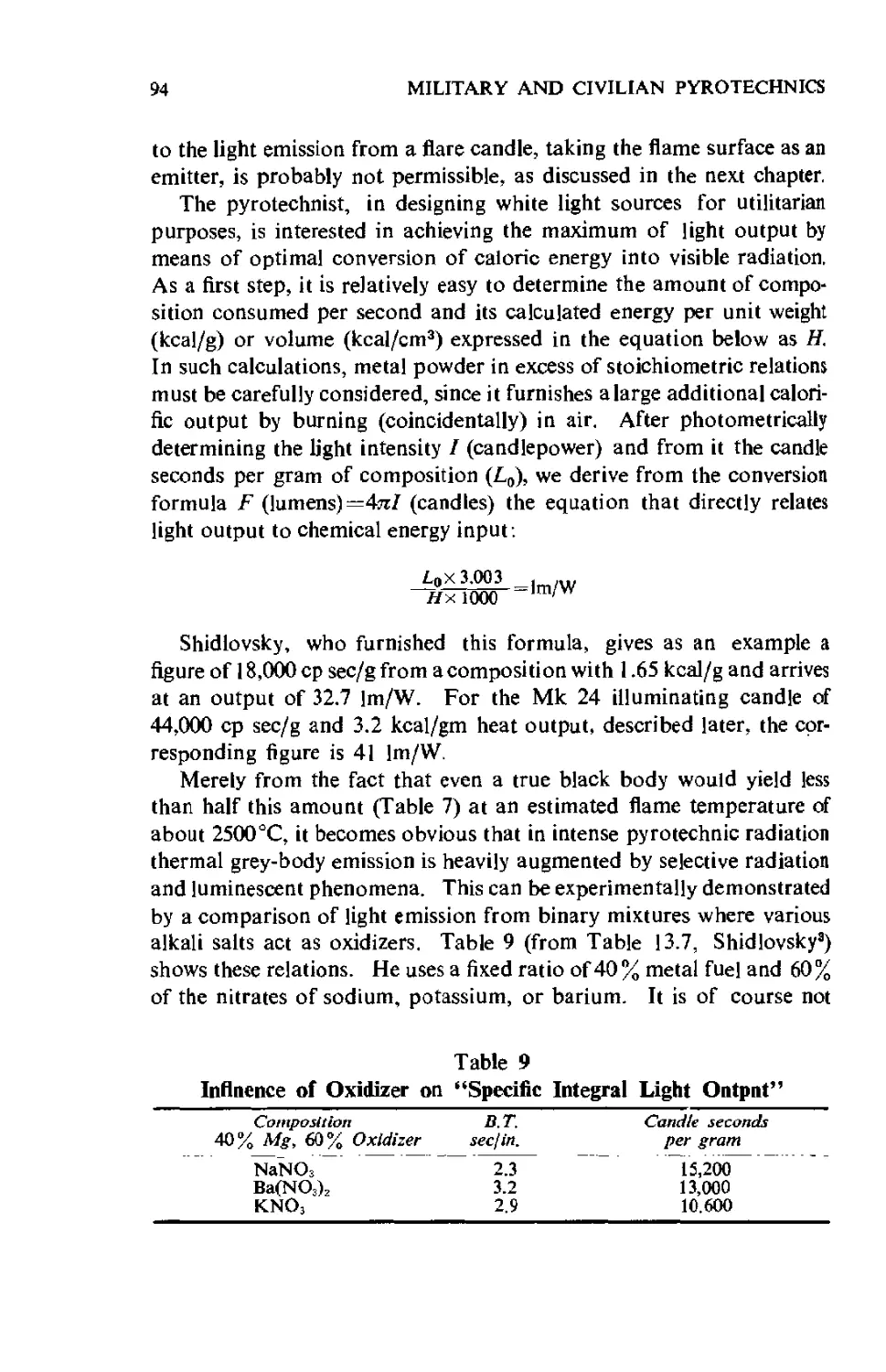
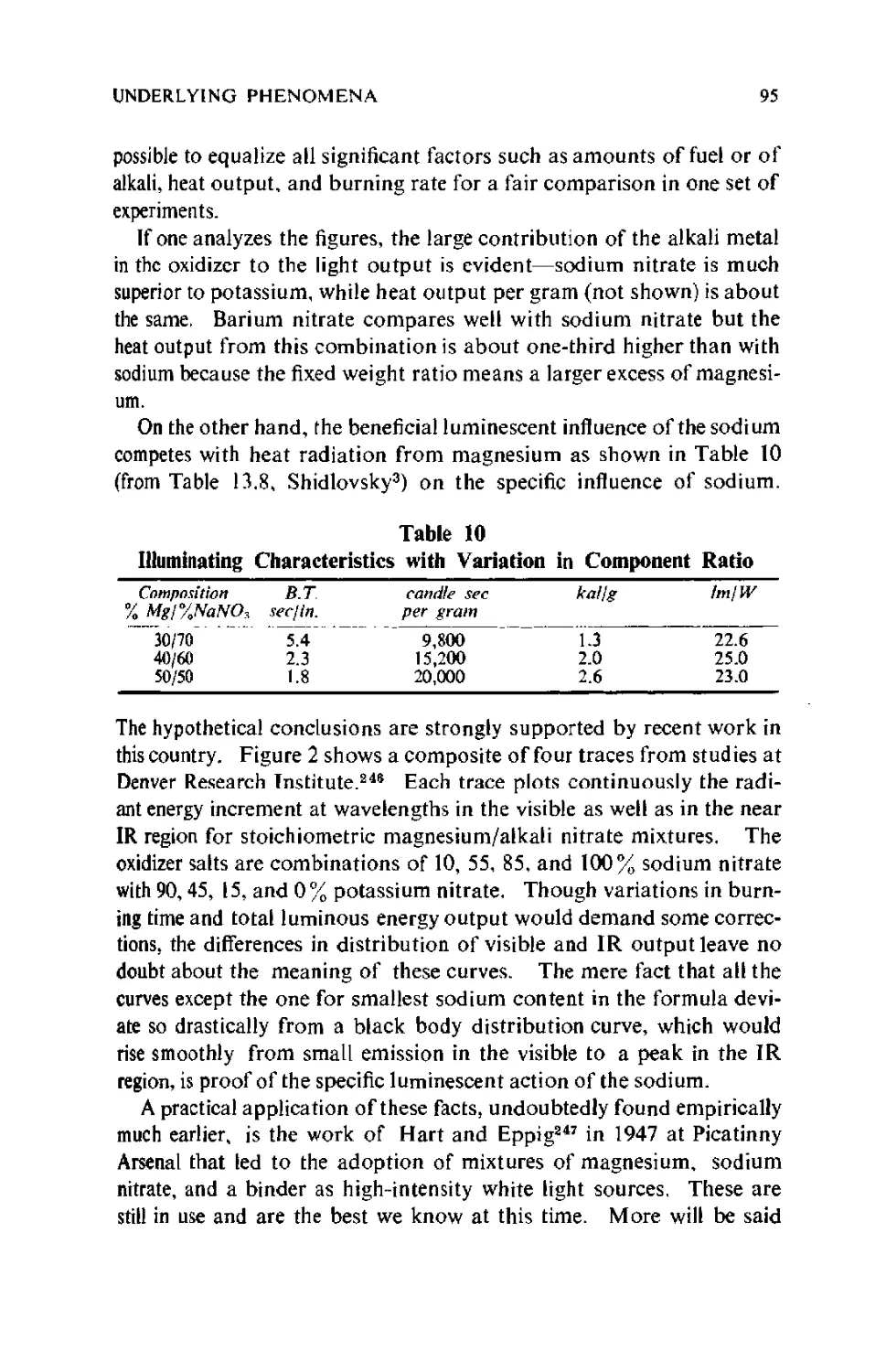
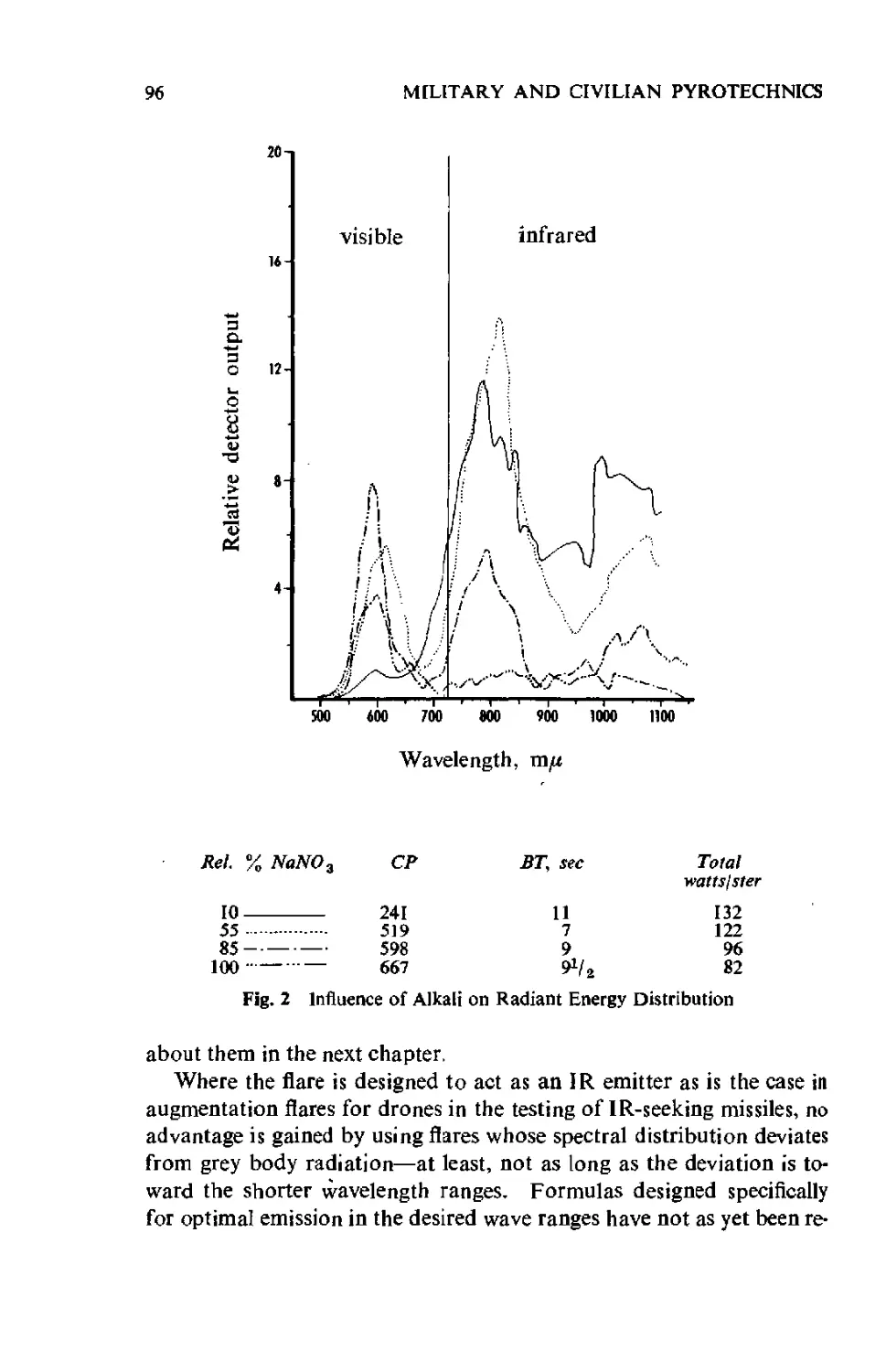
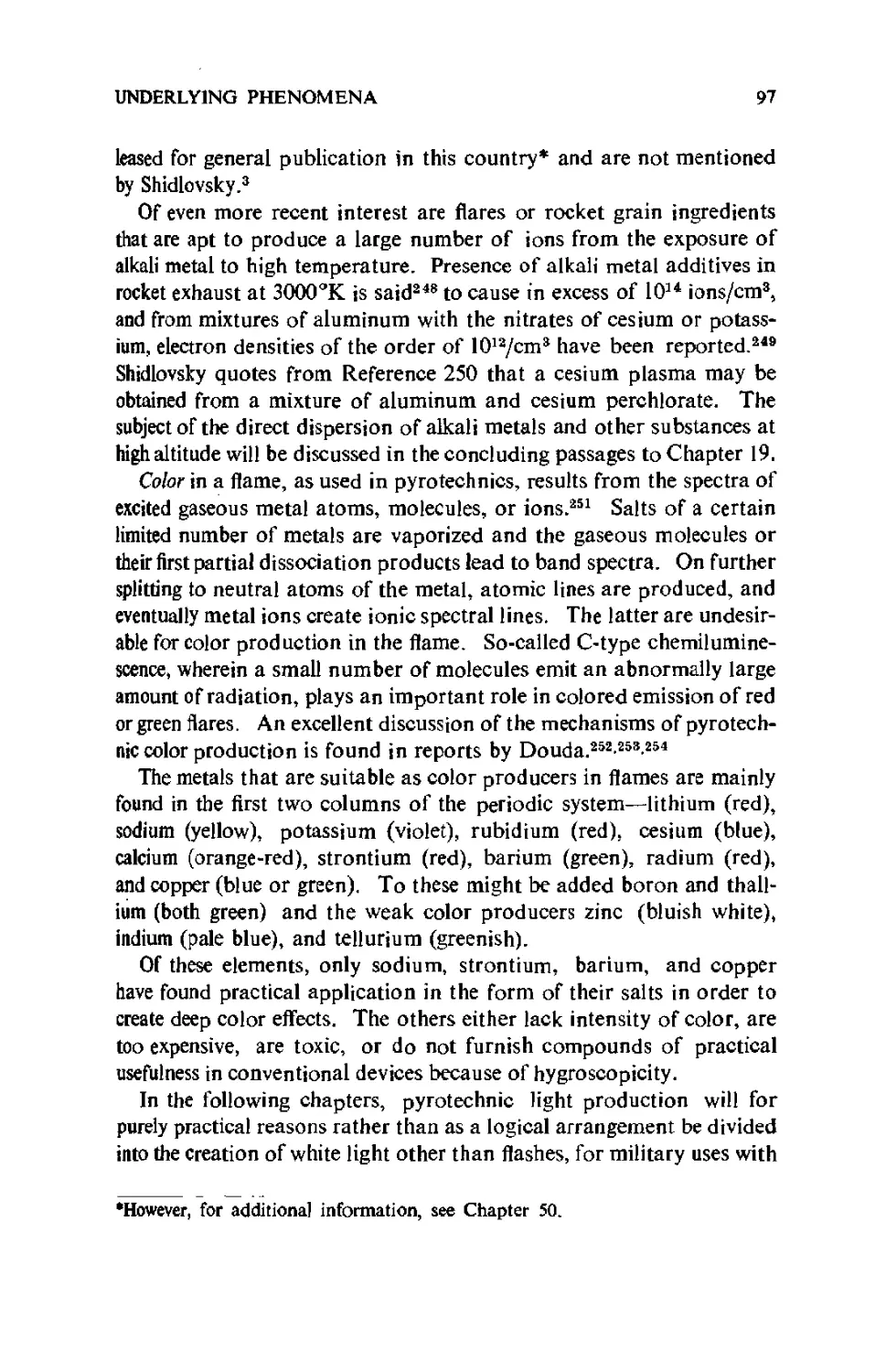

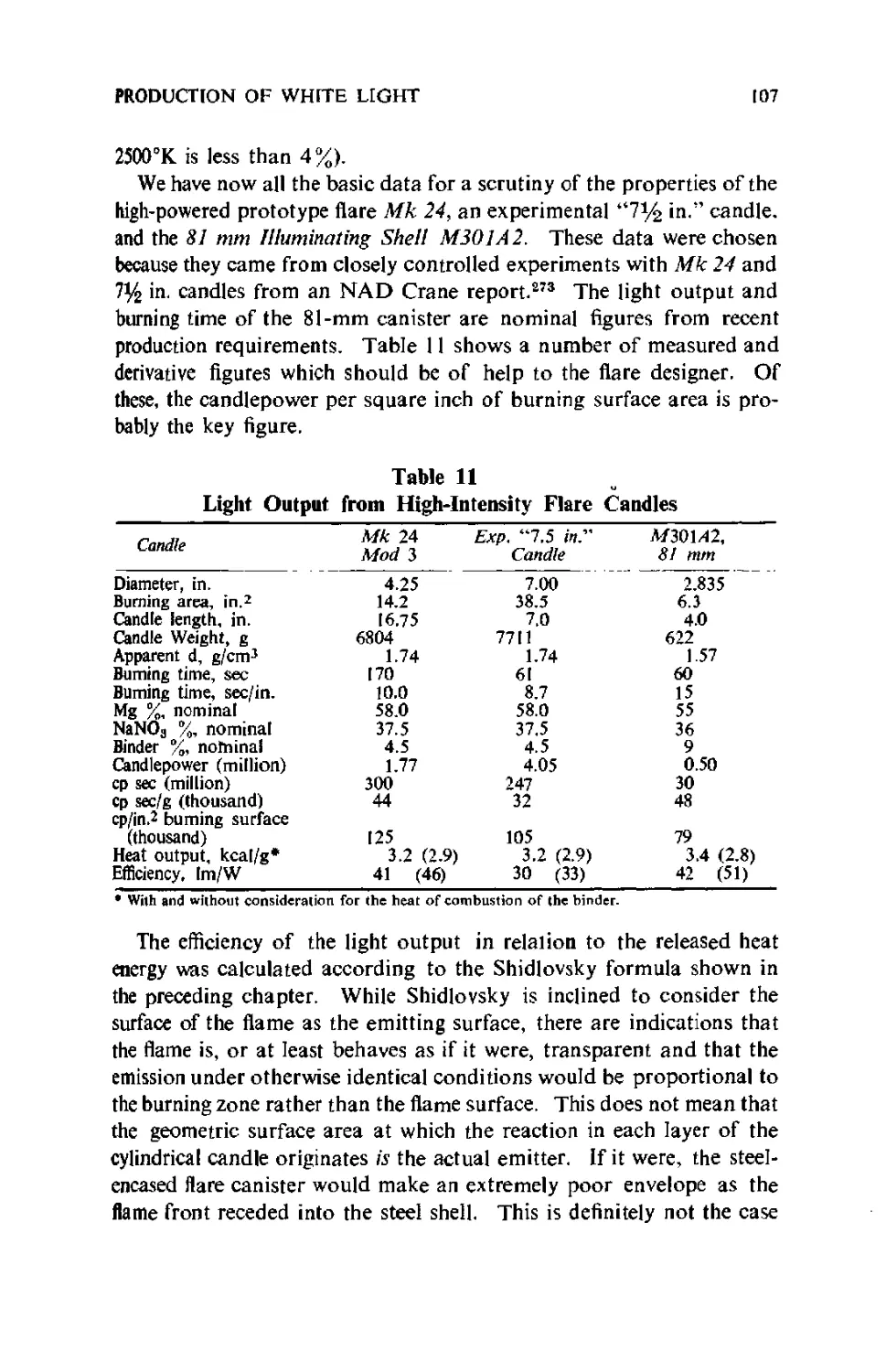
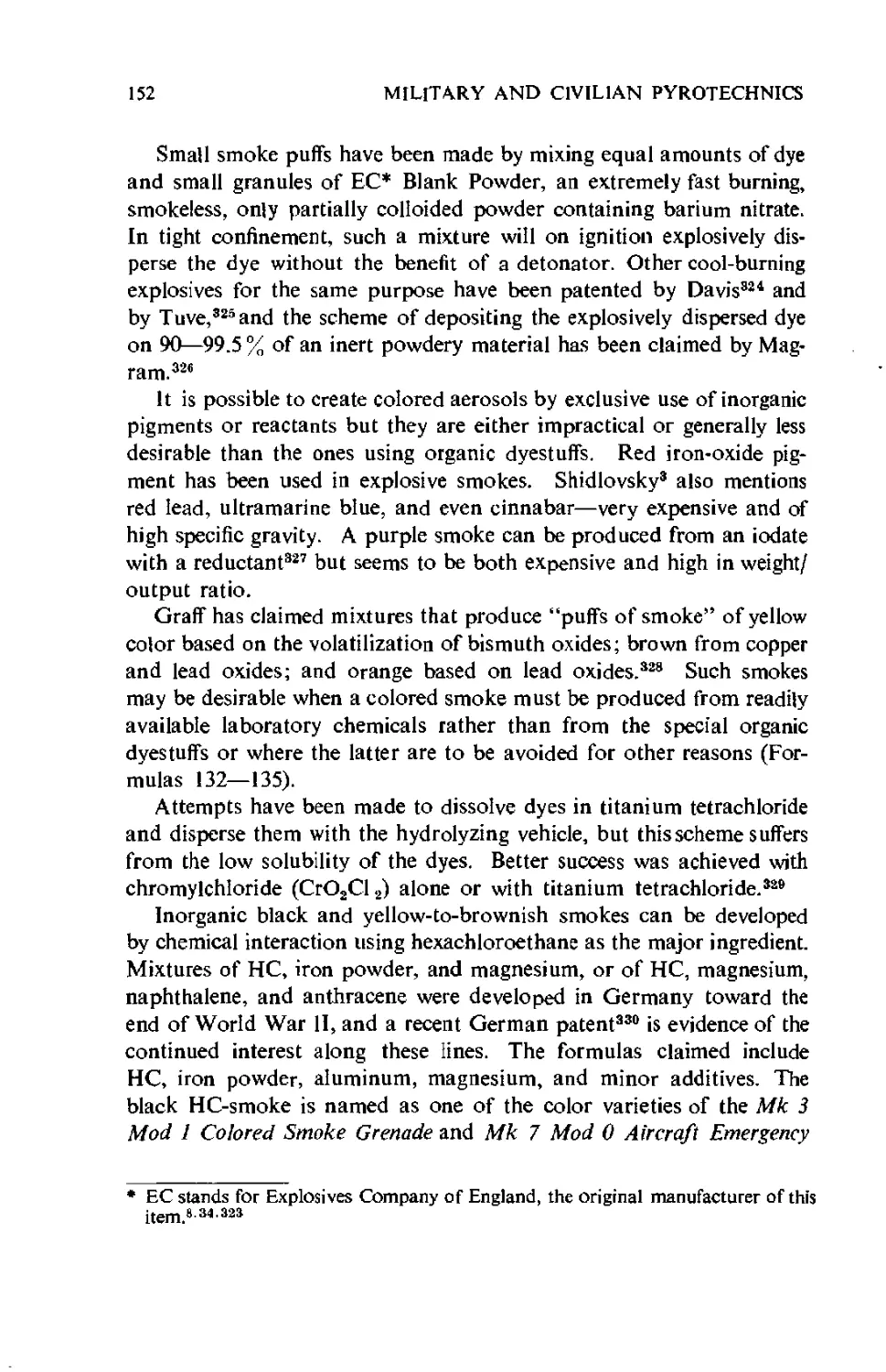
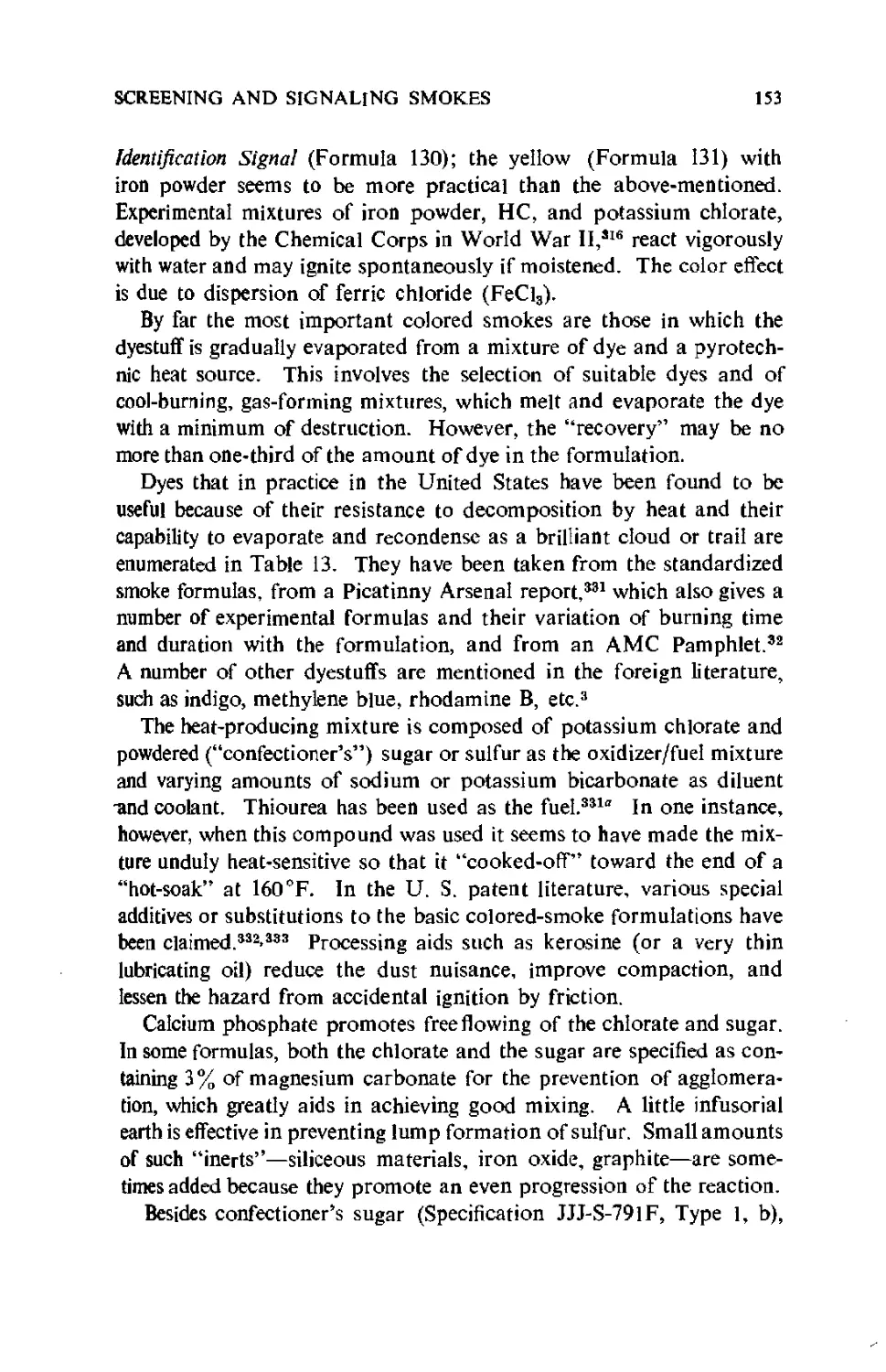
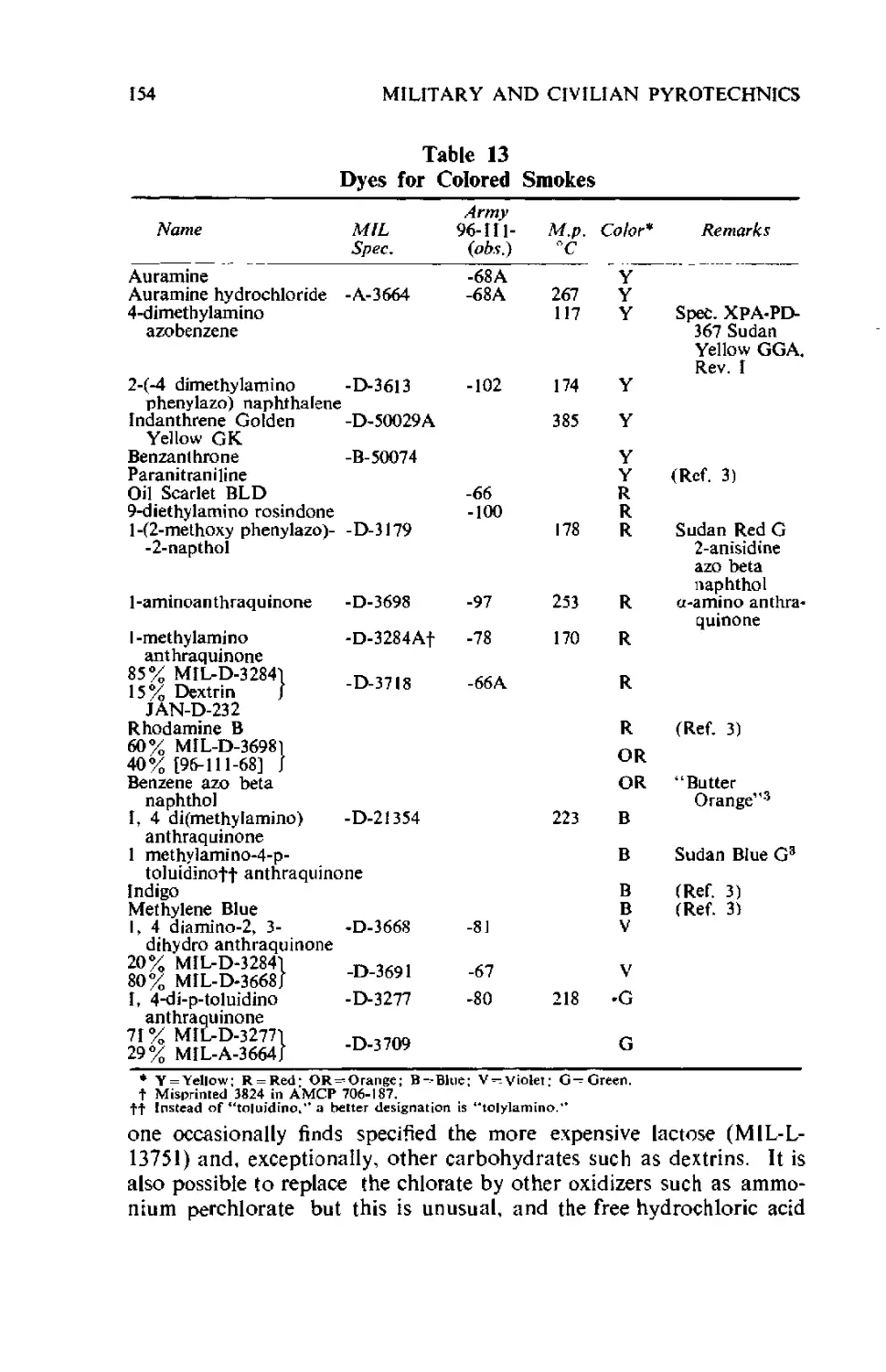
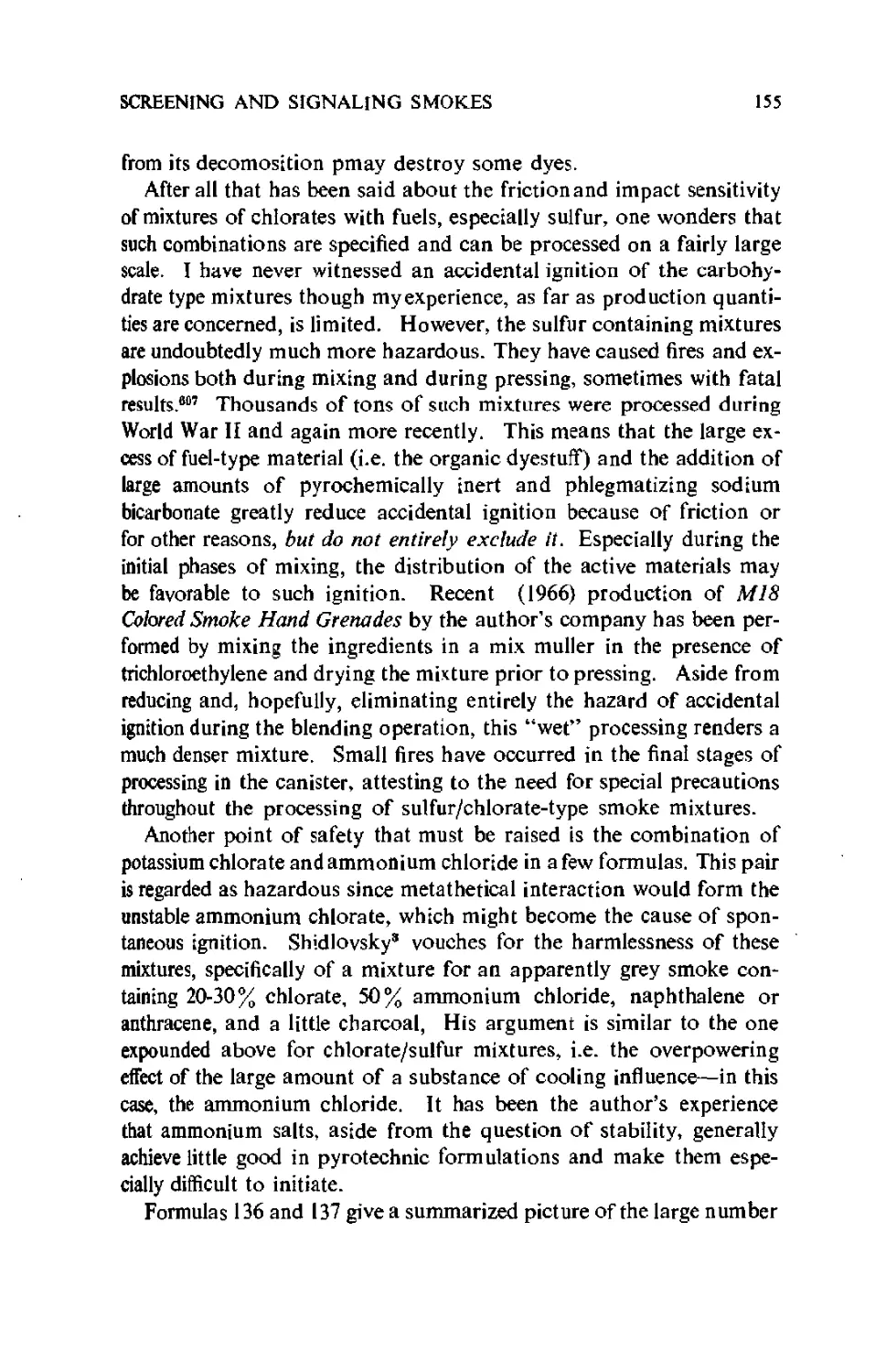
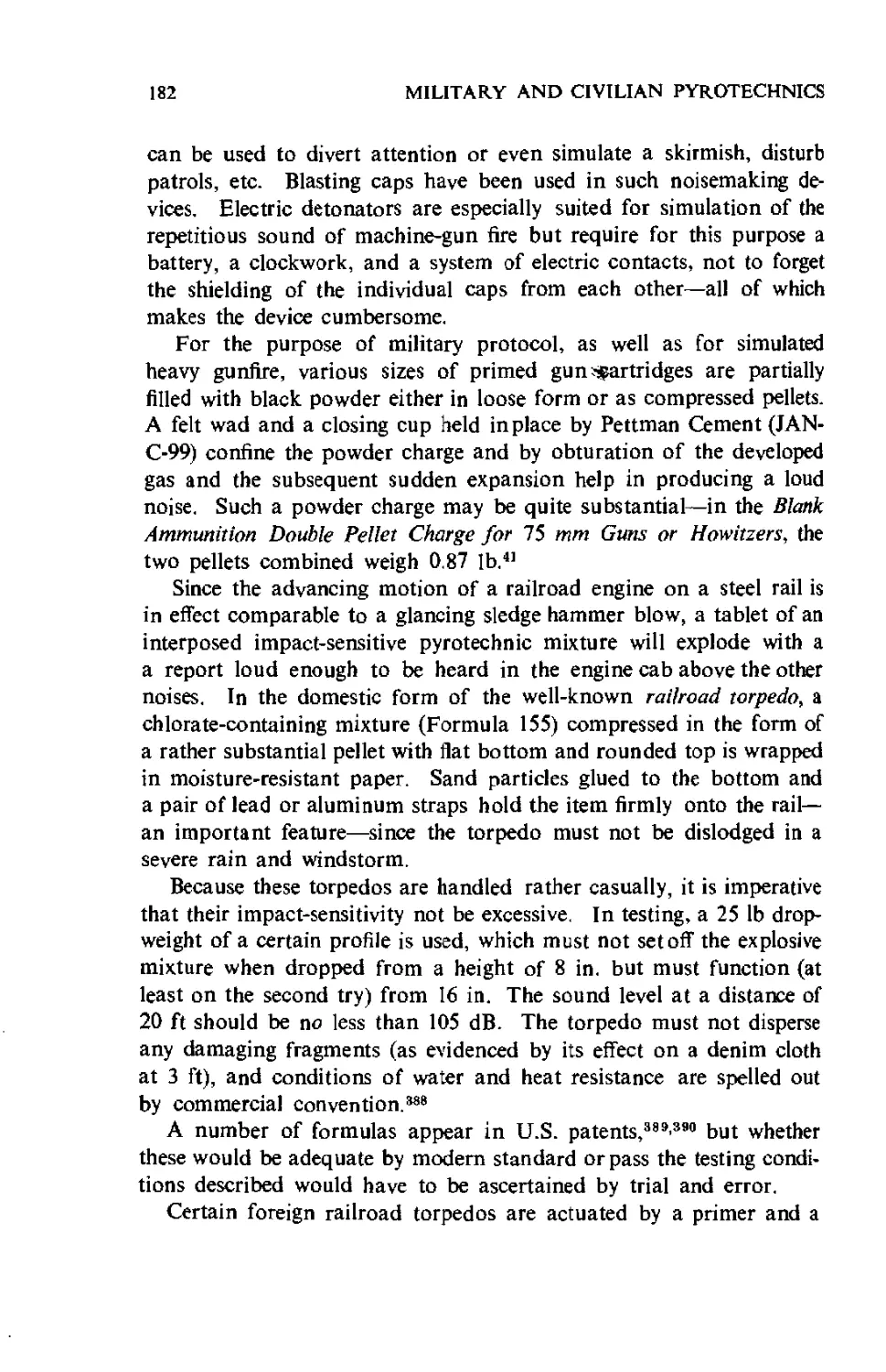
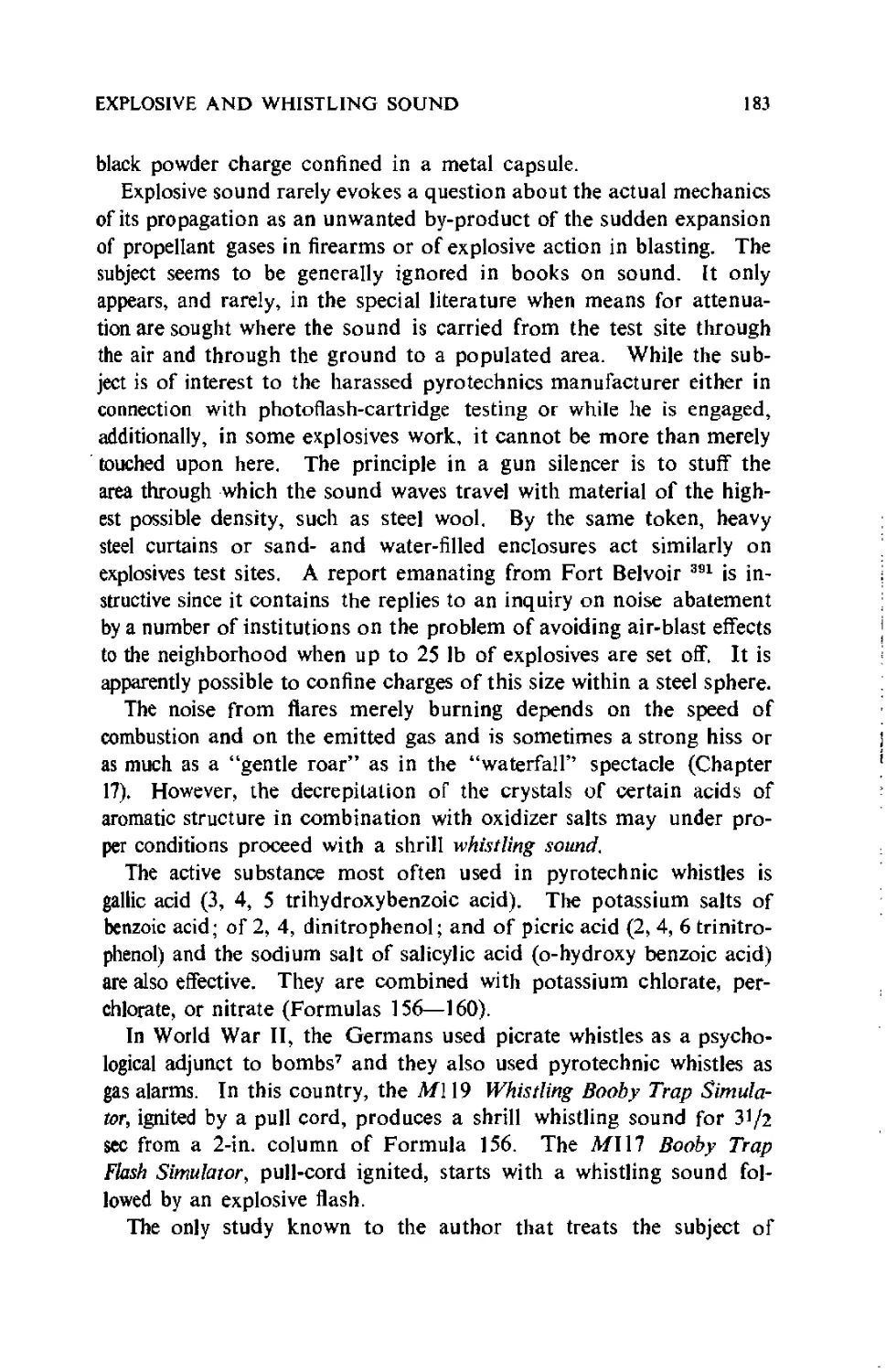
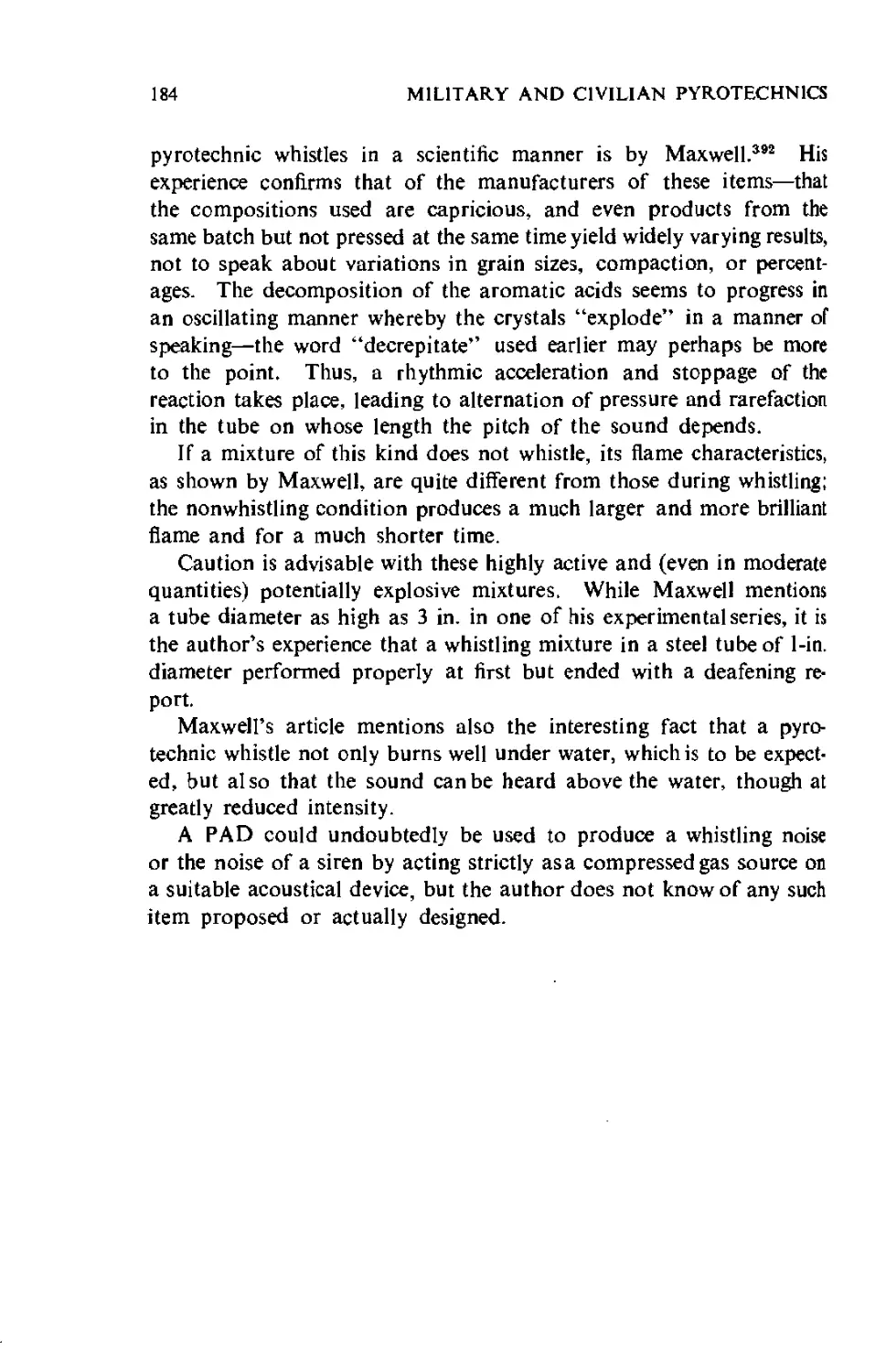
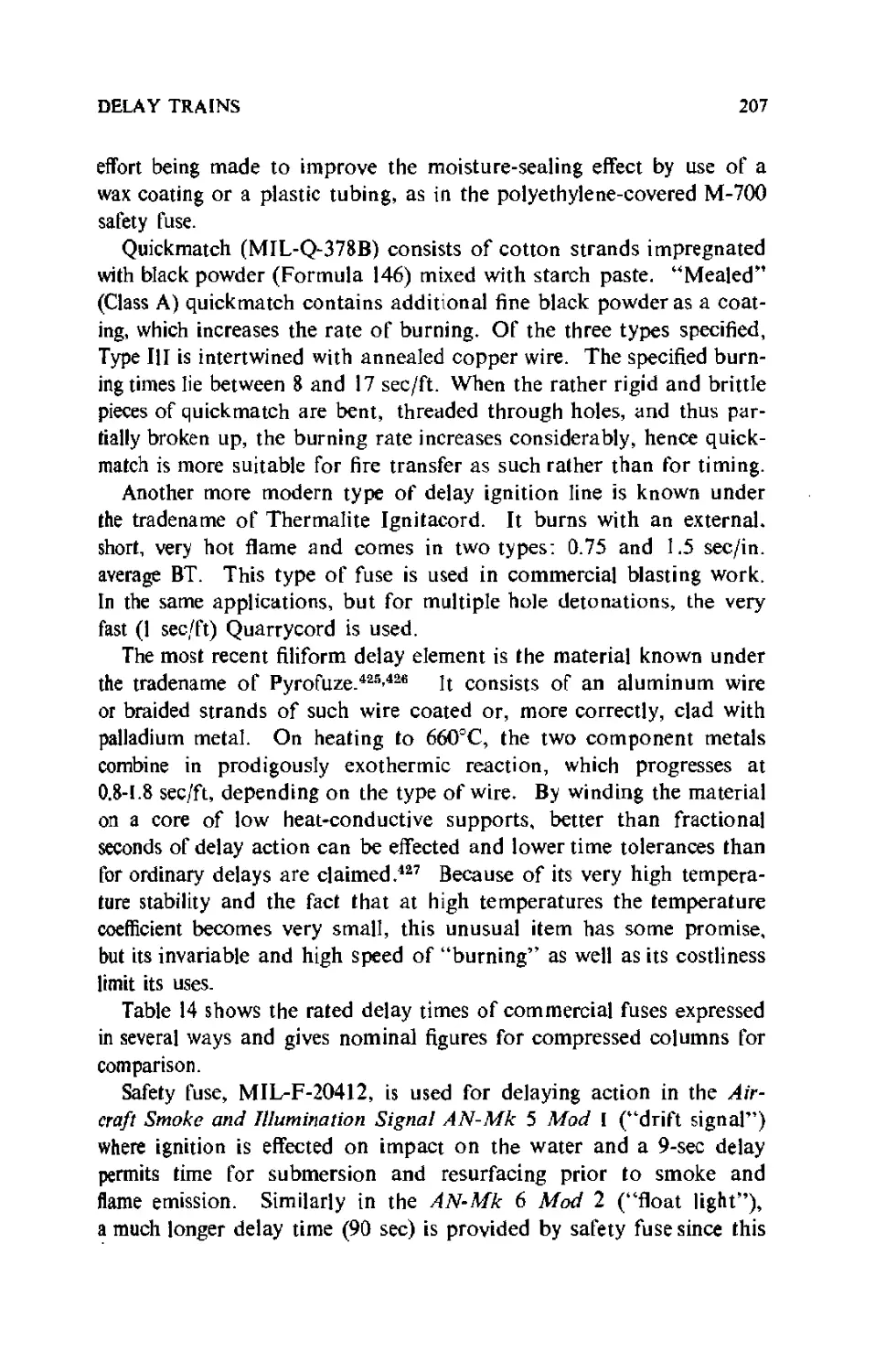
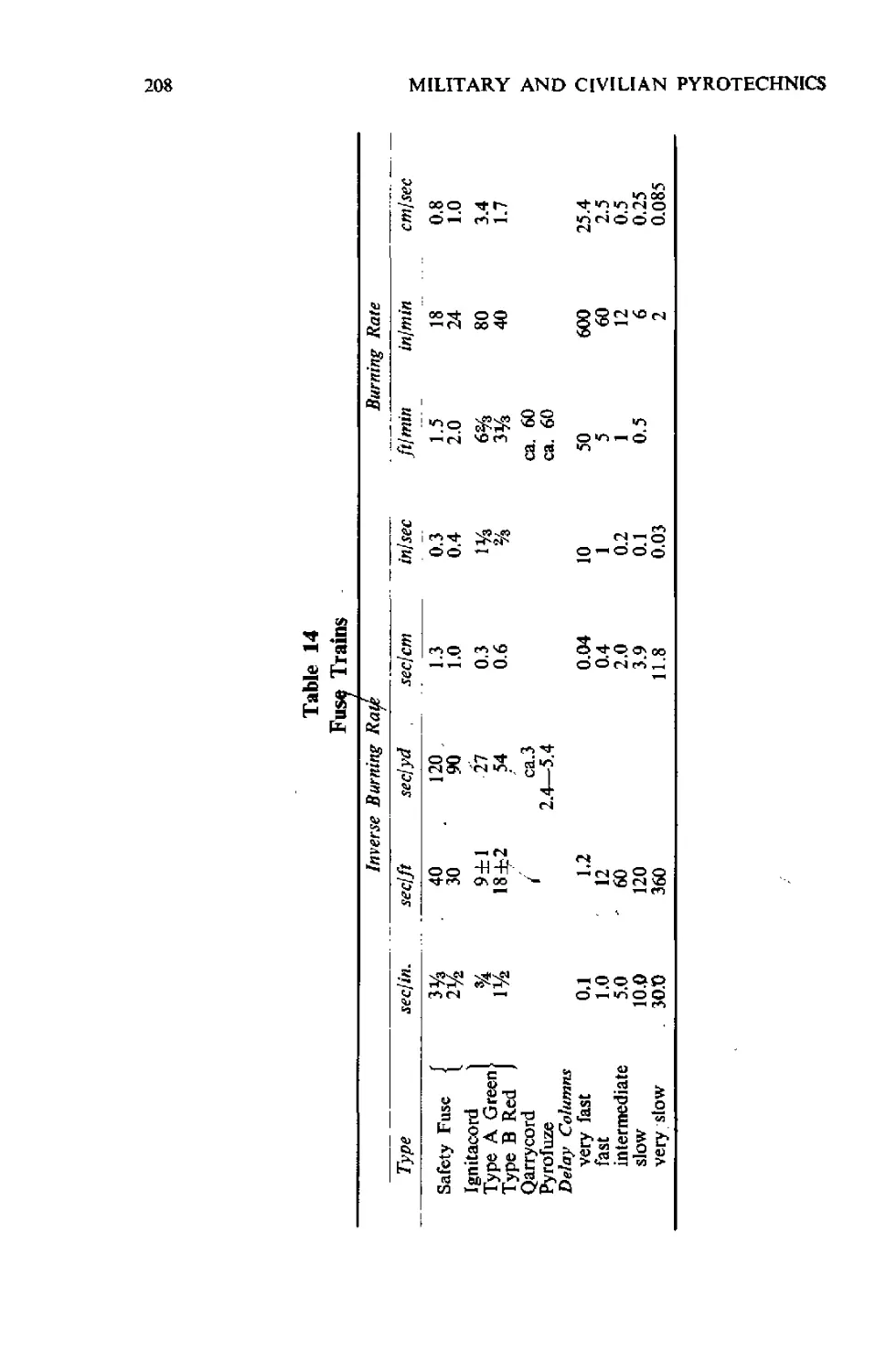
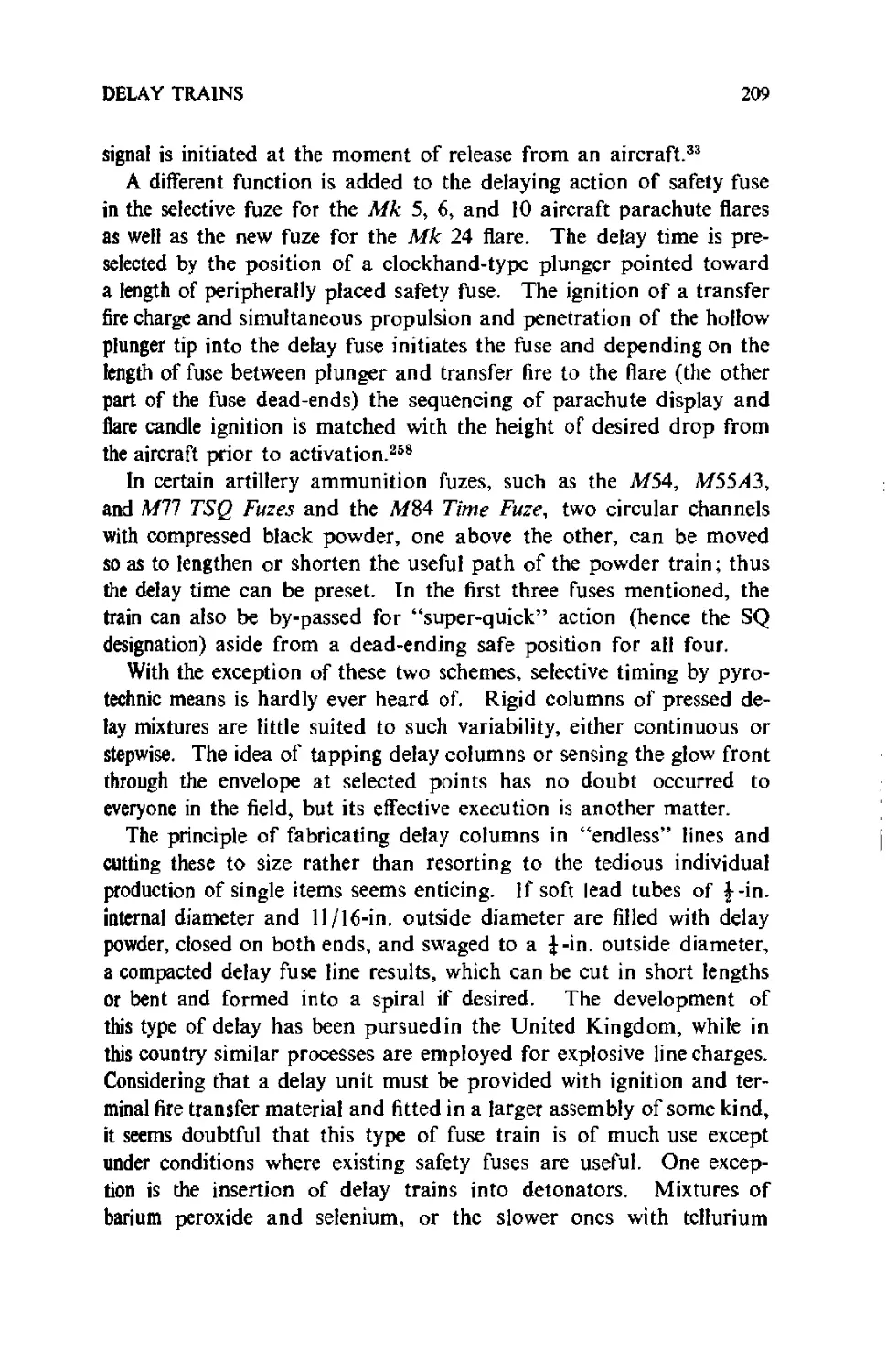
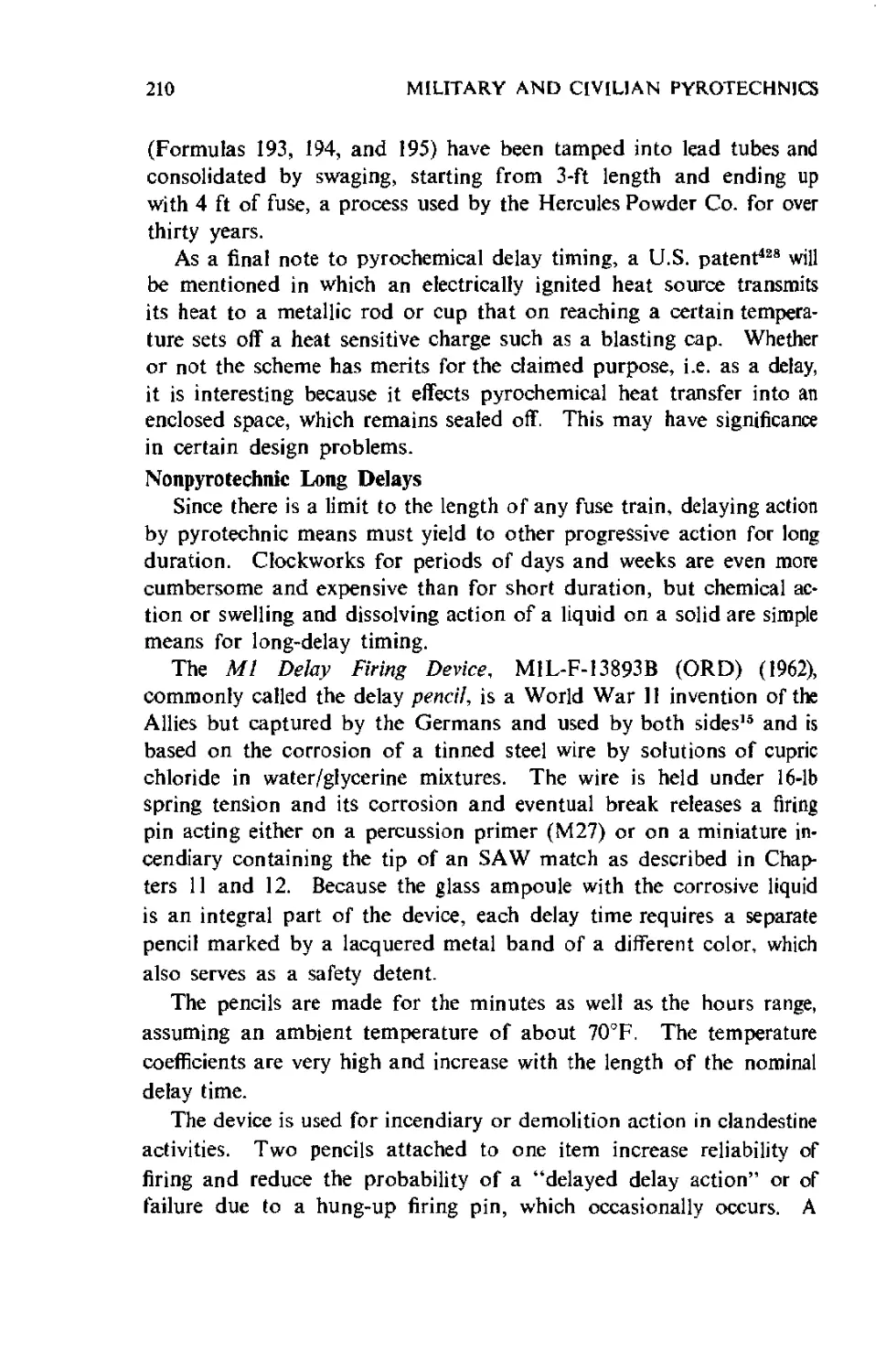
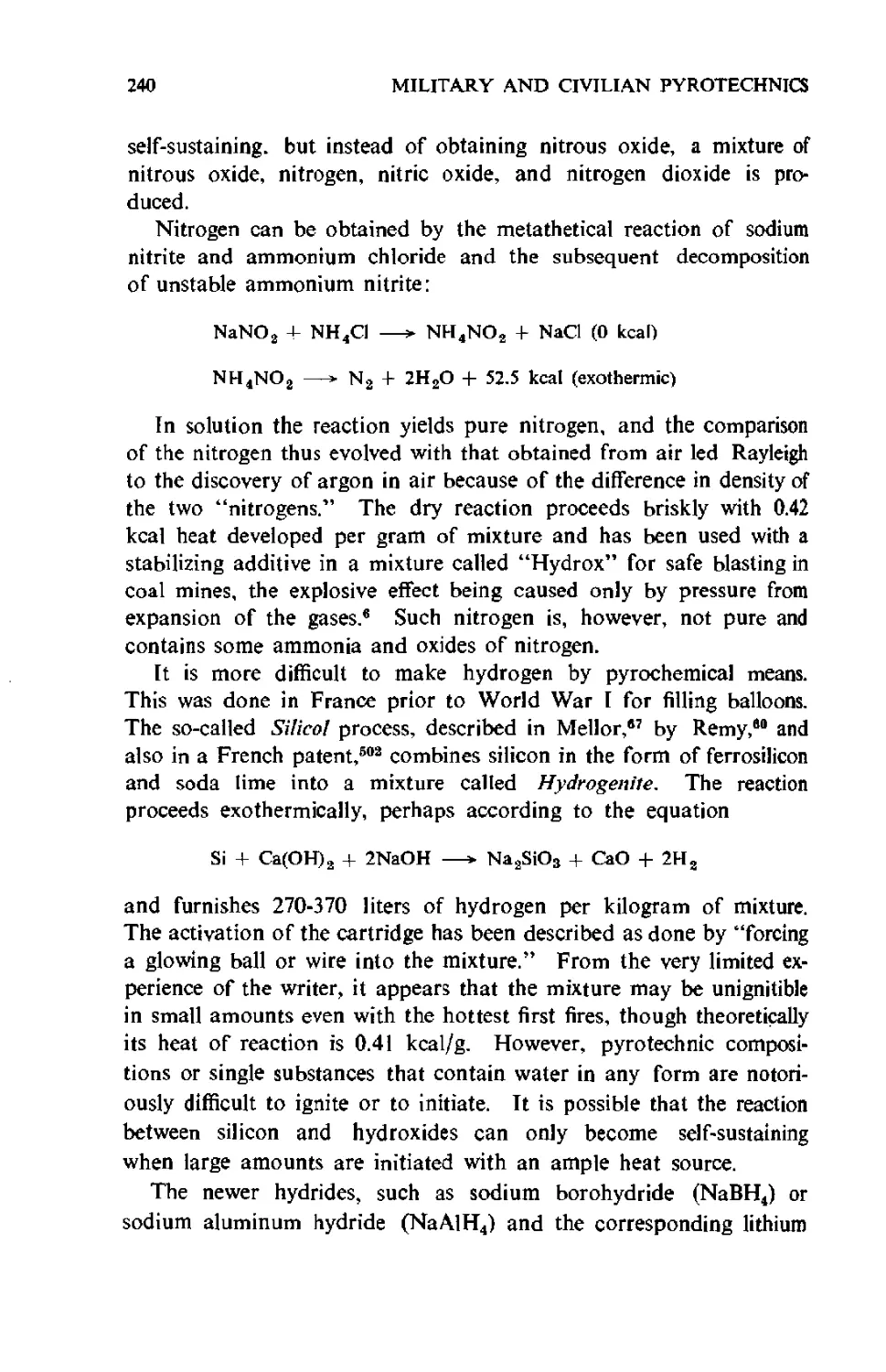
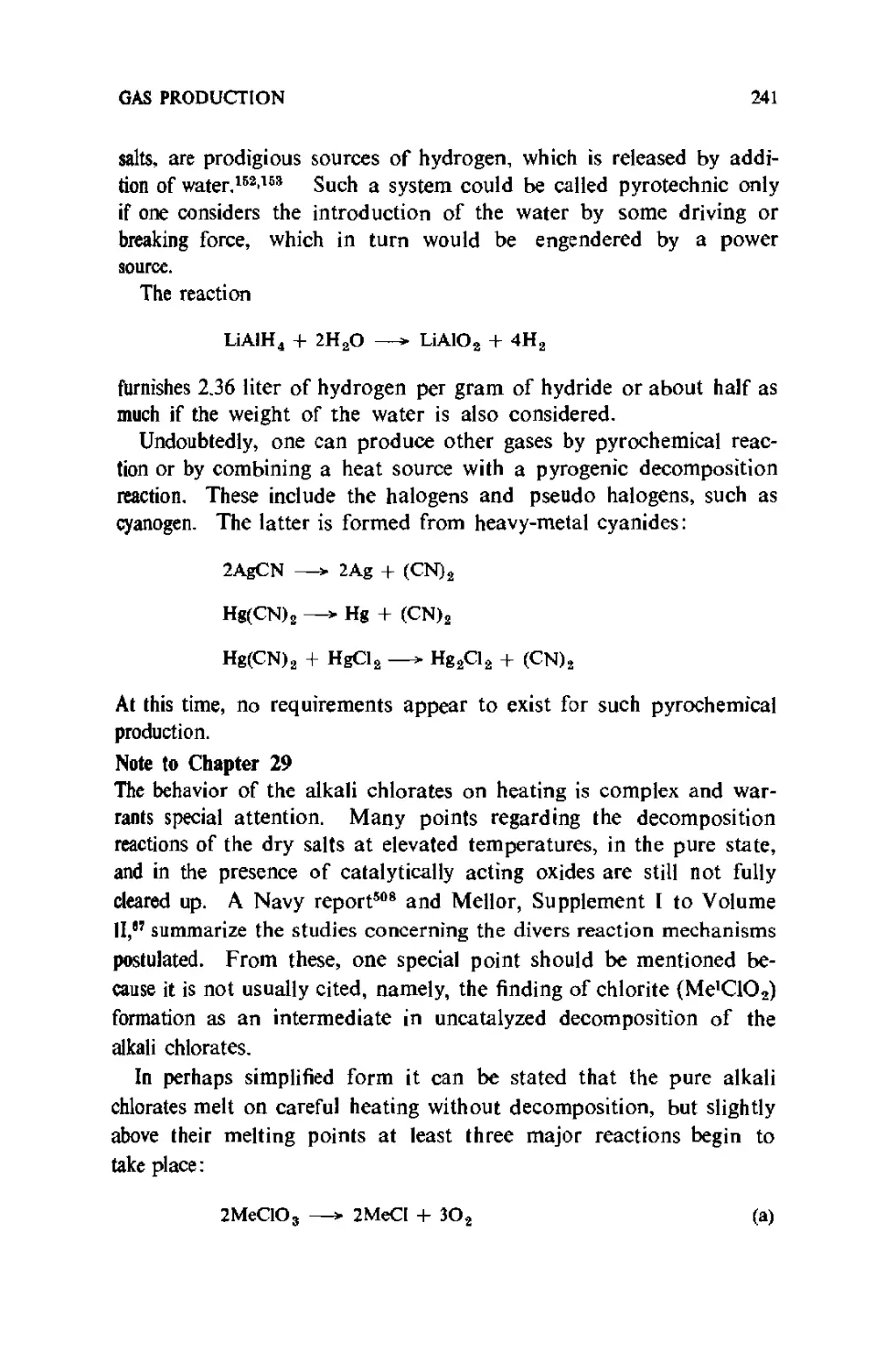
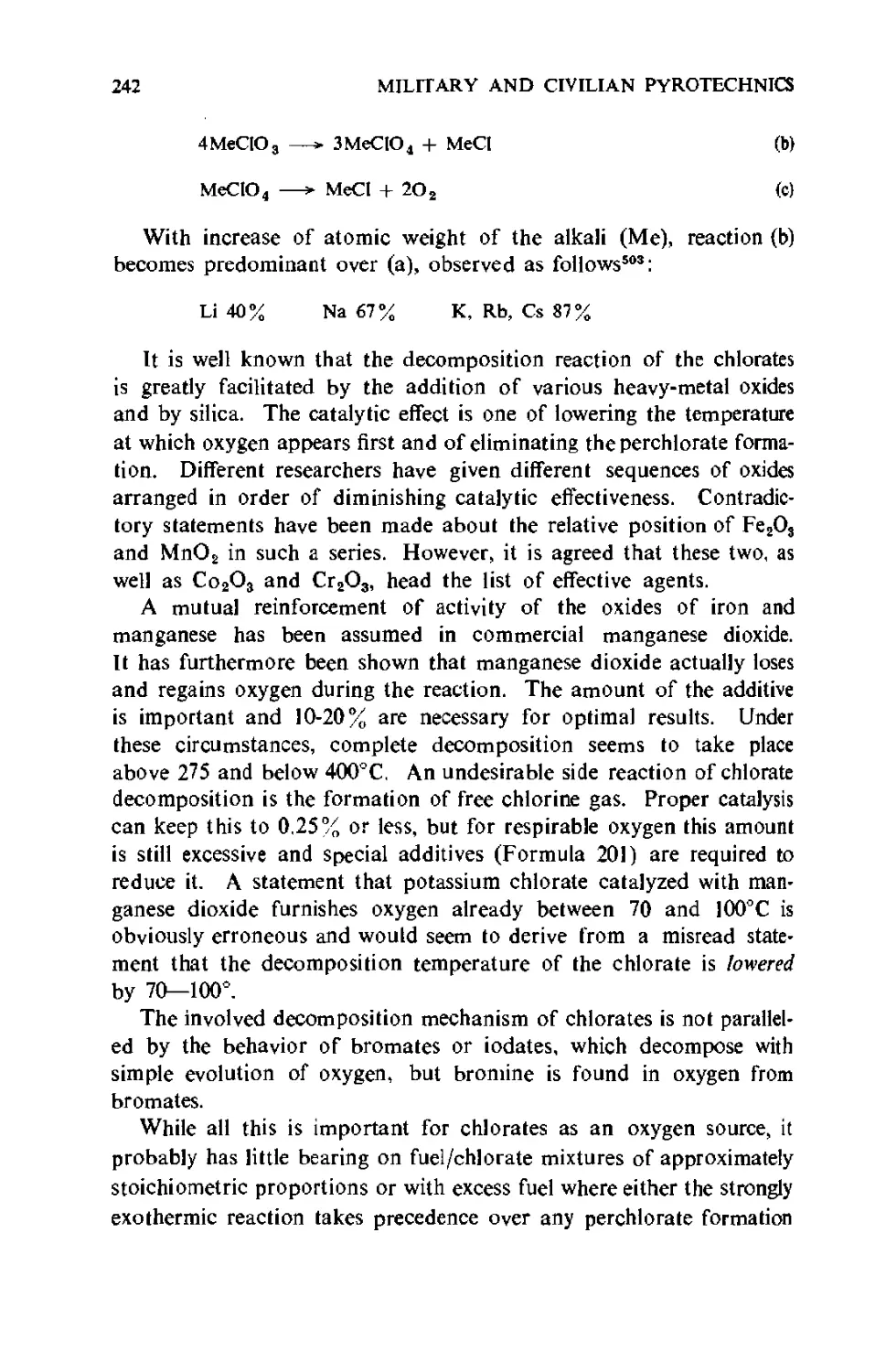
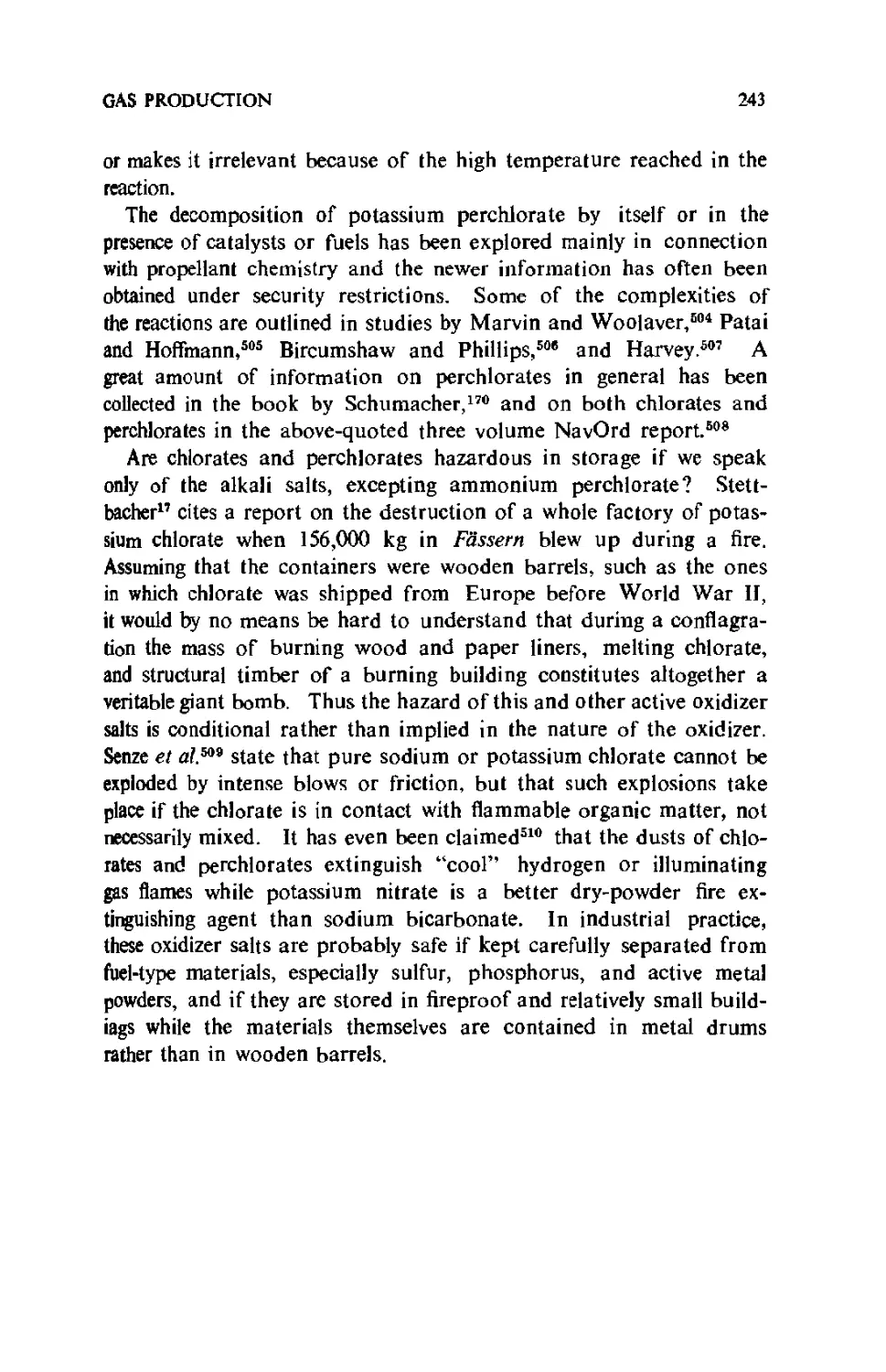

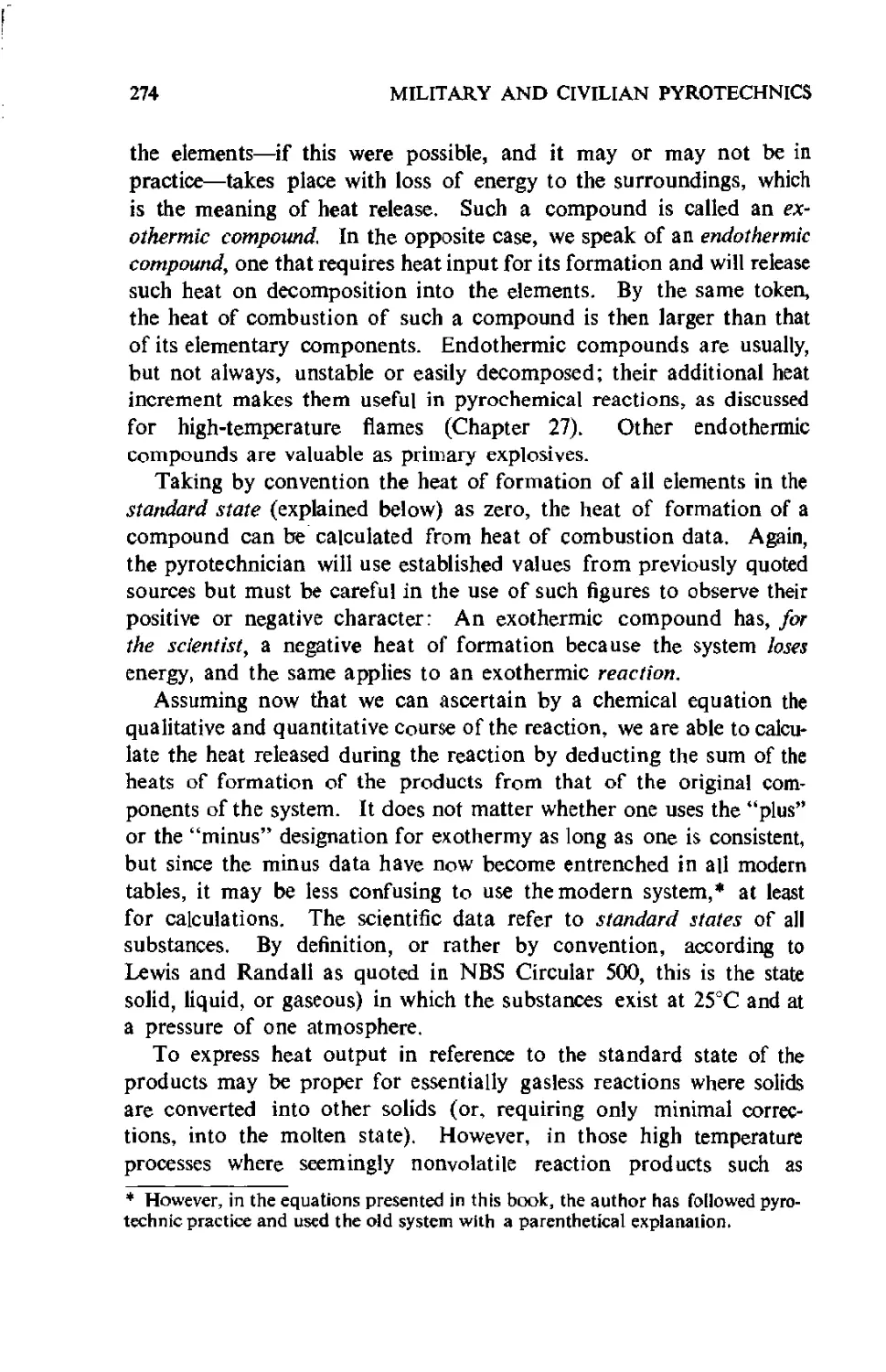
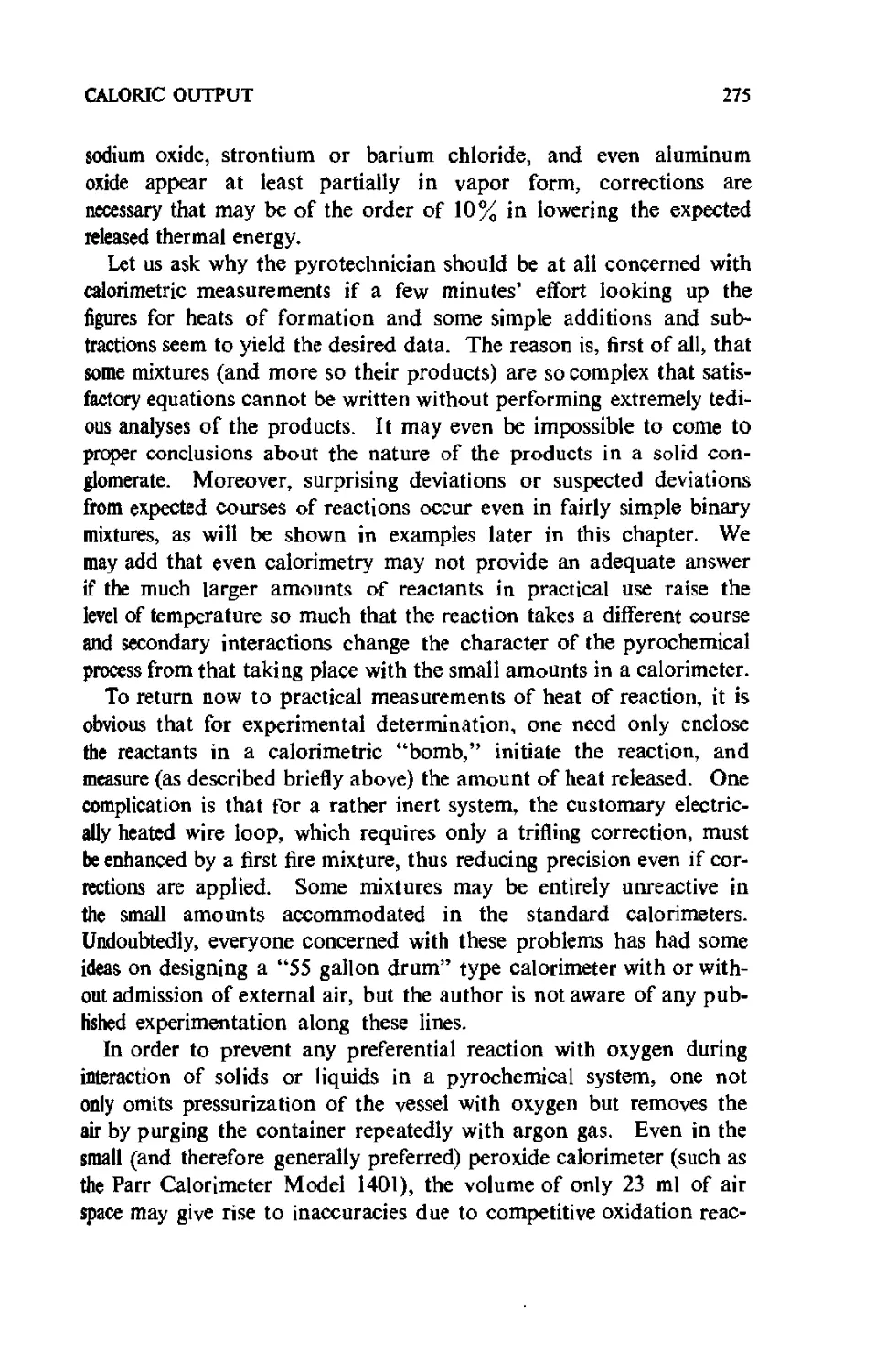
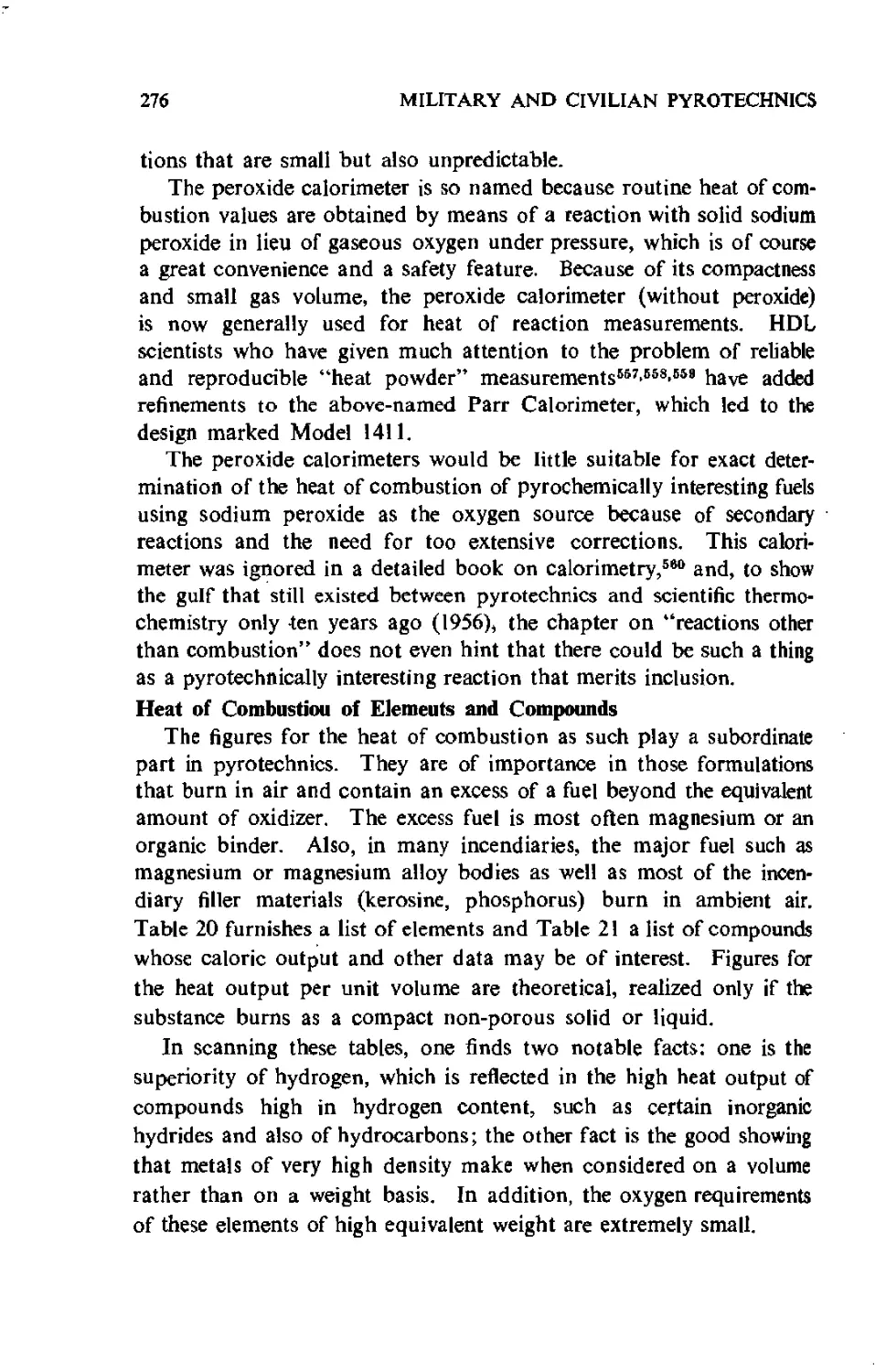

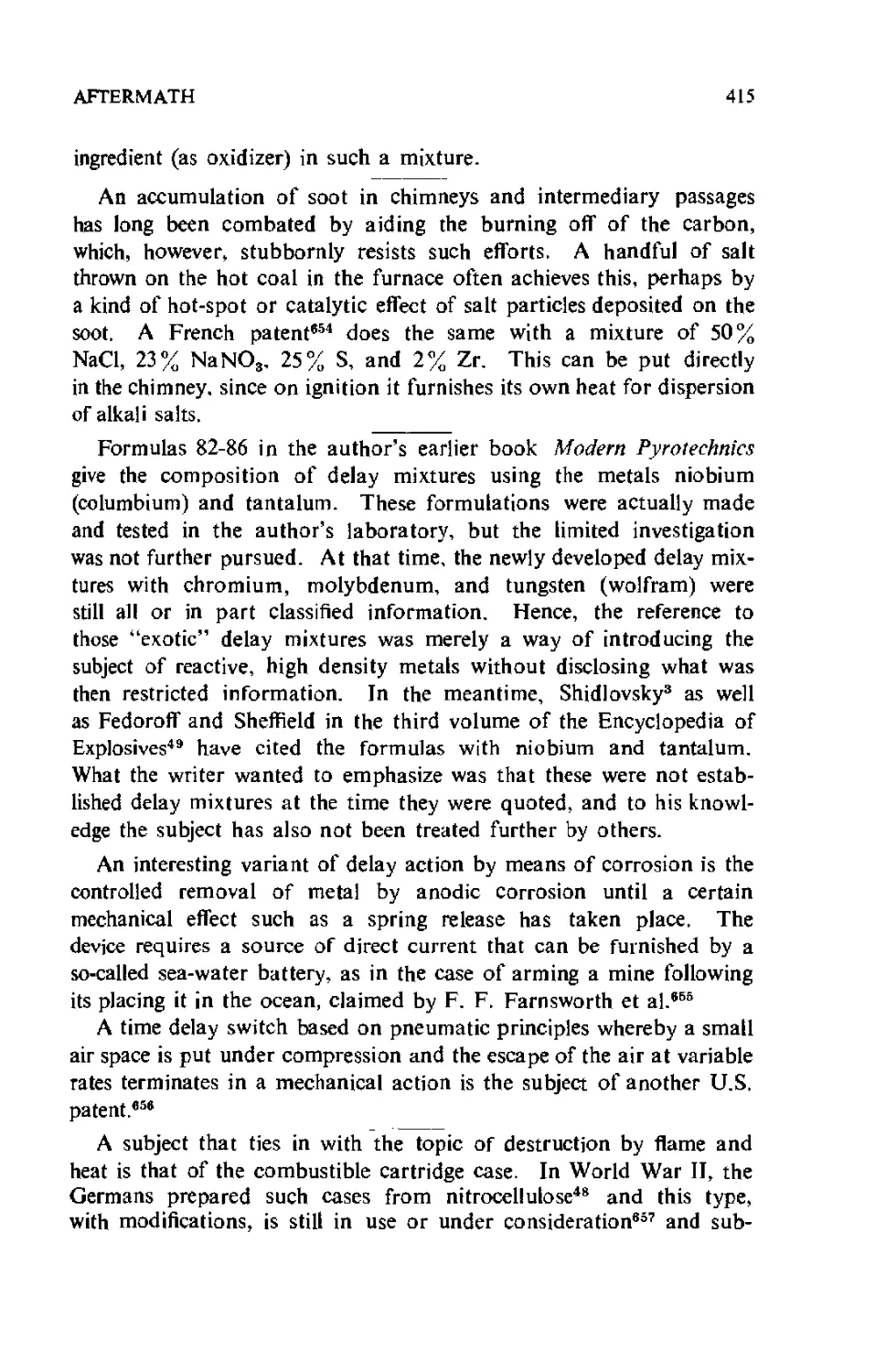
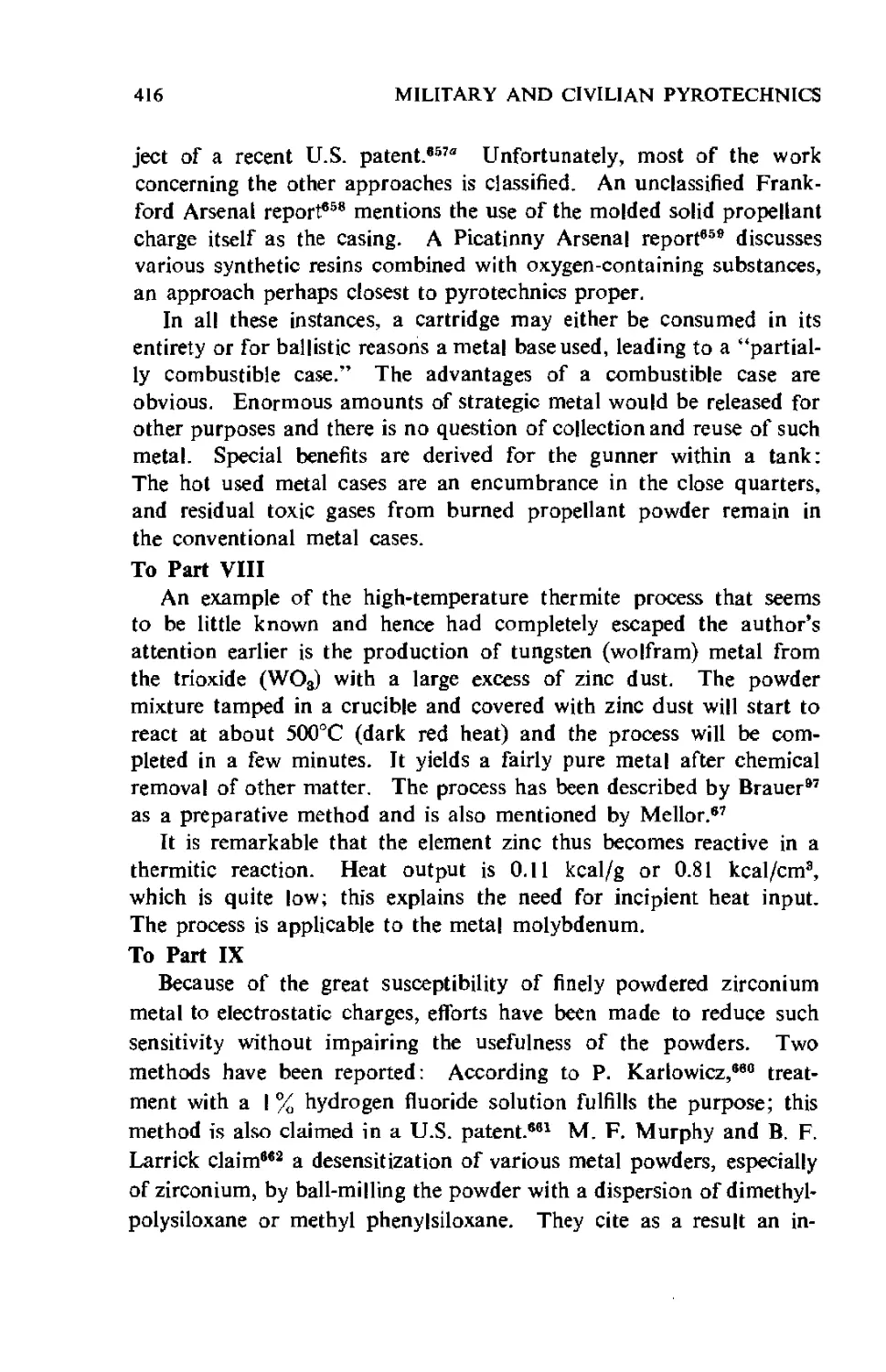
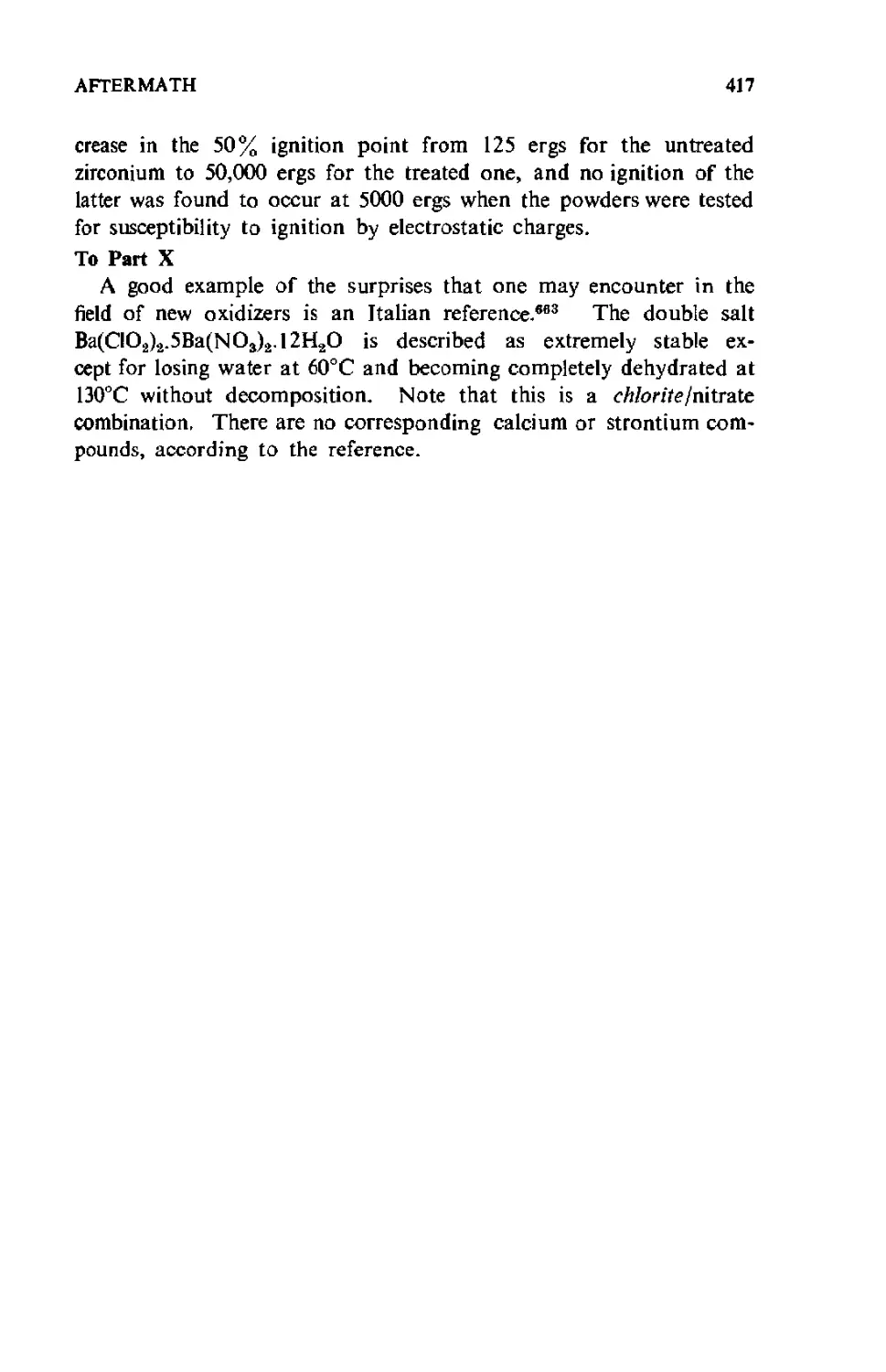
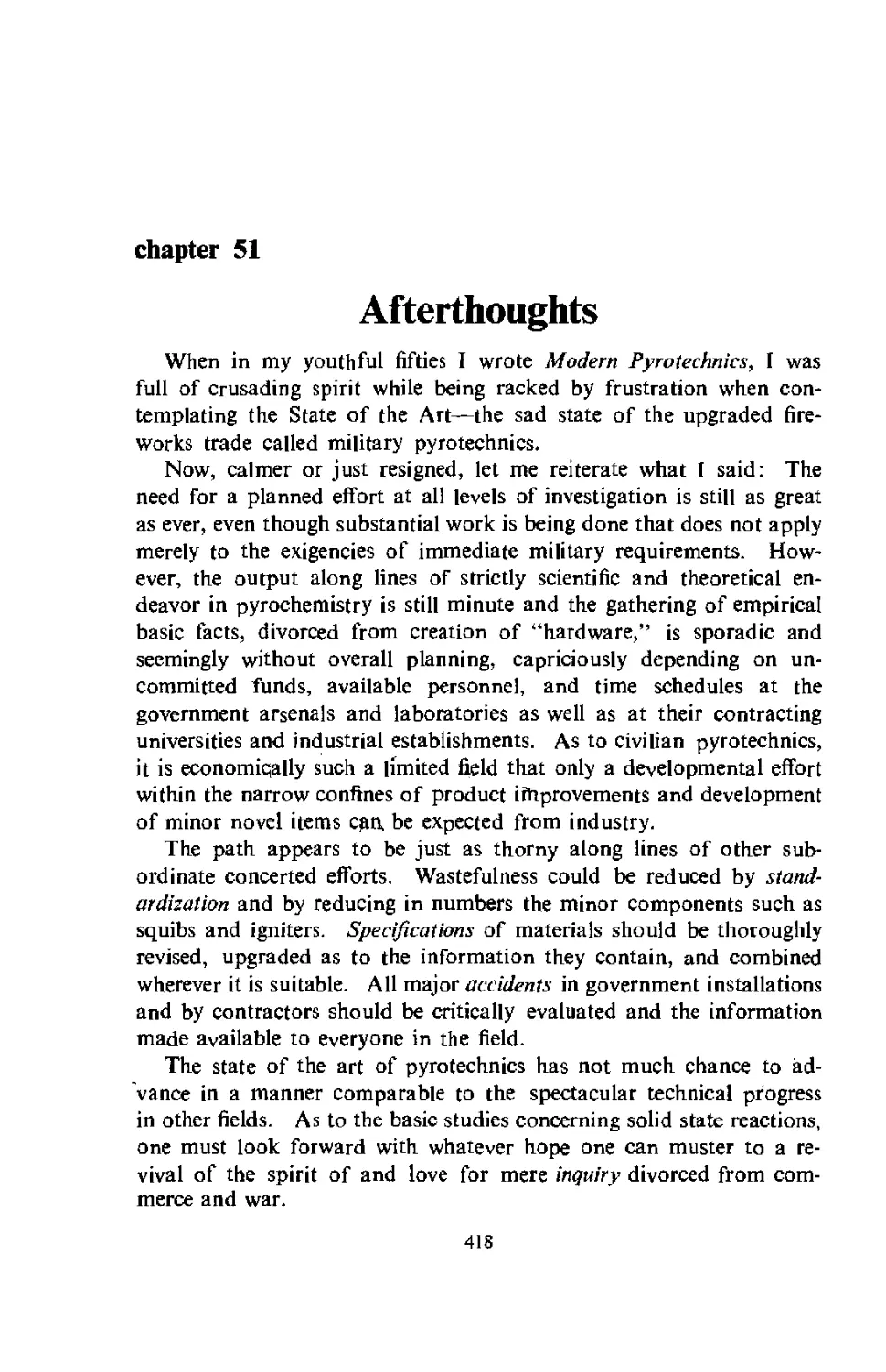

Текст
                    Military and Civilian
Pyrotechnics
by
DR. HERBERT ELLERN
formerly Staff Scientist
UMC Industries Inc.
St. Louis, Mo.
CHEMICAL PUBLISHING COMPANY INC.
New York	1968

 © 1968
Chemical Publishing Company, Inc.
Primed in the United States of America
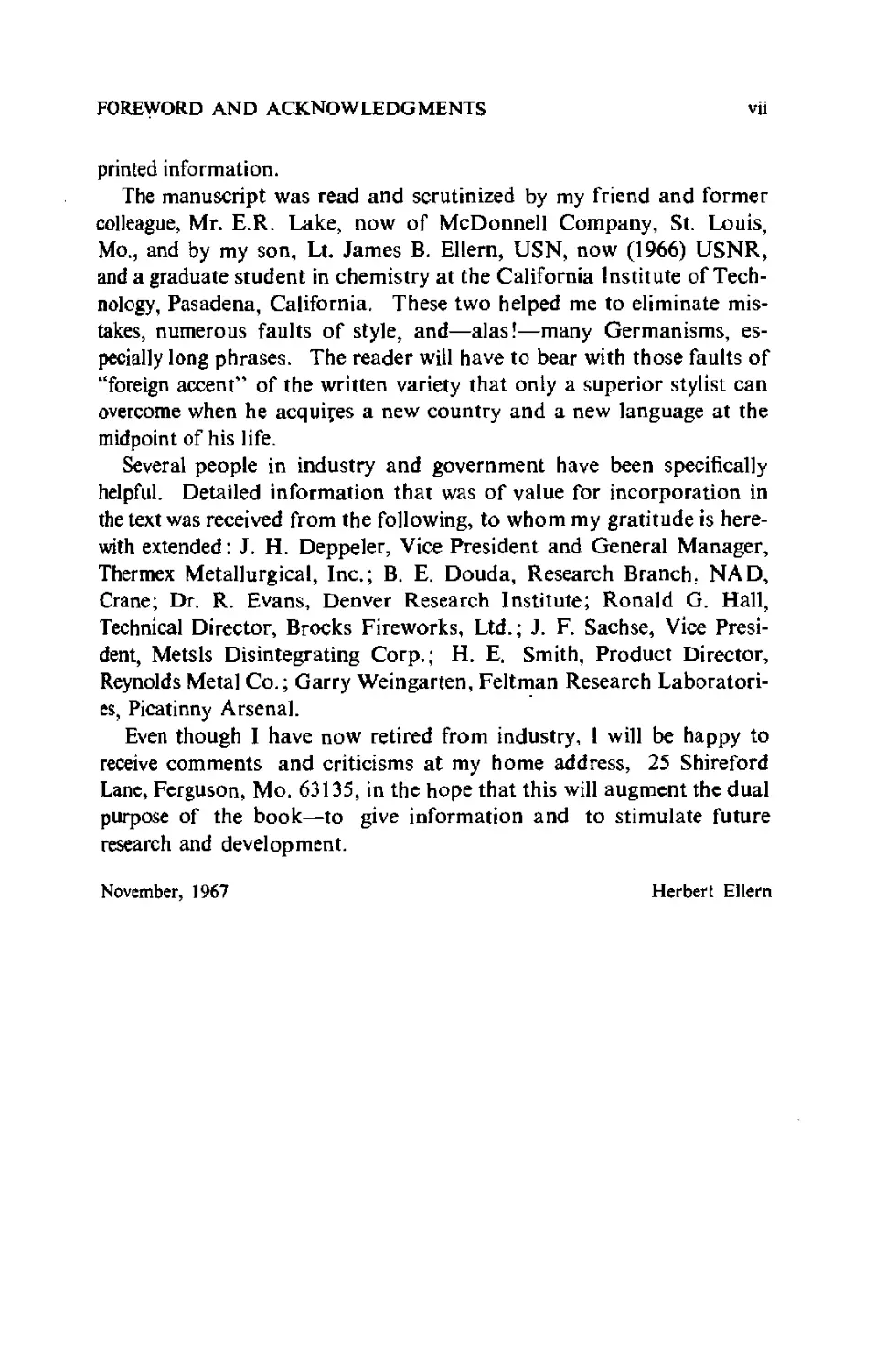
Foreword and Acknowledgments
Modern Pyrotechnics (1961) was the first pyrotechnic primer and
collection of up-to-date information in the English language—written
mainly in order to help the newcomer to the field of military pyrotech-
nics. Judging from the many comments I have received, it served this
purpose well.
This book retains the basic approach and framework of my first
book. The subject matter has been greatly enlarged as indicated by the
increase in the number of formulas from 91 to 201, the addition of
numerous tables, and a near-doubling of the references—from 354 to
about 700. The subjects treated in the first book are presented in greater
detail and, of course, with addition of new information from the years
1961 to 1966. Some of the subjects that formerly were under security
restrictions—now lifted or relaxed—could be added, though not all in
full detail. A special effort was made to enlarge on the commercial,
or as I would rather call it, civilian, aspects of modern pyrotechnics.
These concern the subject of matches, fireworks, the thermite process,
and certain minor devices. An additional feature is a special chapter on
spontaneous ignition of common materials and one on the dispersion
of chemical agents, such as tear gas and insecticides. It has also been
possible to add, with discretion, some of the matter on clandestine
activities from and since World War 11—a subject that has been part of
my and my company’s effort.
Ever since I became engaged in the match industry (1937) and con-
cerned with the chemistry of matches—specifically the safety book
match—I have considered this seemingly commonplace prime ignition
source as the most fascinating phenomenon of pyrotechnics. And
since this subject is not found in the generally accessible literature,
except under the historical aspect, and the chemistry of matches is ra-
ther obscure even to chemists, the chapter on matches has been greatly
enlarged. As to fireworks for pleasure, I became convinced that a book
on pyrotechnics, without some details on this subject, might disappoint
many readers. Since here my specific knowledge is extremely limited,
vj
FOREWORD AND ACKNOWLEDGMENTS
I had to ask for help. Chapter 17 on fireworks was written by the Re-
verend Ronald Lancaster, amateur pyrotechnic!an and consultant to a
firework manufacturer, Pains-Wessex Ltd., Salisbury, England. Only
a few minor alterations and interpolations were added by me. The
formulas on the subject contributed by Mr. Lancaster should be of
special interest since up-to-date formulas connected with commercial
.interests are generally hard or impossible to come by.
Otherwise, the profusion of facts and figures that I present in this
book are a combination of experience, literature study, and advice from
others. In World War II, my company, Universal Match Corporation
of St. Louis, Missouri (now UMC Industries, Inc.), became engaged in
such activities as comminution of magnesium and manufacture of color-
ed flame signals and other military devices—all of which broadened my
pyrochemical knowledge. Since the Korean War, both production and
development work added greatly to the diversification of my personal
experience when for many years I directed the research and develop-
ment effort of the then newly-founded Armament Division. A branch
of the latter is now the Unidynamics Division, Phoenix, Arizona, of
which 1 was staff scientist and consultant until my retirement in the
summer of 1967.
The reader will have little difficulty in discriminating between those
subjects of the military pyrotechnic field, in which 1 speak from per-
sonal experience, and those where I had to rely all or in part on infor-
mation by others. However, a book written by one person, in my
opinion, permits a greatly preferable, comprehensive and cohesive
approach, even though some unevenness must be tolerated. The other
way is to present a subject as “written with a pair of scissors,” as
German publishers used to call it, i.e. as a collection of perhaps com-
petent but more-or-less disjointed articles, often leaving other areas of
the field unmentioned.
A number of people and organizations have helped my effort in a
variety of ways. UMC Industries, Inc., with whom I was affiliated for
over a quarter century, has supported the preparation of the manuscript
to such a generous extent that it could be completed in little more than a
year. During this period, the untiring effort of my secretary, Mrs.
Ruth Levine, extended far beyond typing and retyping, and included
most of the burden of checking on references, patent numbers, and the
other tedious by-play of getting out the final typed copy. Mrs. Mae
Chaudet, librarian of Unidynamics, St. Louis Division of UMC Indus-
tries, Inc., has been most helpful in procuring an unending stream of
FOREWORD AND ACKNOWLEDGMENTS	vii
printed information.
The manuscript was read and scrutinized by my friend and former
colleague, Mr. E.R. Lake, now of McDonnell Company, St. Louis,
Mo., and by my son, Lt. James B. Ellern, USN, now (1966) USNR,
and a graduate student in chemistry at the California Institute of Tech-
nology, Pasadena, California, These two helped me to eliminate mis-
takes, numerous faults of style, and—alas!—many Germanisms, es-
pecially long phrases. The reader will have to bear with those faults of
“foreign accent” of the written variety that only a superior stylist can
overcome when he acquires a new country and a new language at the
midpoint of his life.
Several people in industry and government have been specifically
helpful. Detailed information that was of value for incorporation in
the text was received from the following, to whom my gratitude is here-
with extended: J. H. Deppeler, Vice President and General Manager,
Thermex Metallurgical, Inc.; В. E. Douda, Research Branch. NAD,
Crane; Dr. R. Evans, Denver Research Institute; Ronald G. Hall,
Technical Director, Brocks Fireworks, Ltd.; J. F. Sachse, Vice Presi-
dent, Metsls Disintegrating Corp.; H. E. Smith, Product Director,
Reynolds Metal Co.; Garry Weingarten, Feltman Research Laboratori-
es, Picatinny Arsenal.
Even though I have now retired from industry, 1 will be happy to
receive comments and criticisms at my home address, 25 Shireford
Lane, Ferguson, Mo. 63135, in the hope that this will augment the dual
purpose of the book—to give information and to stimulate future
research and development.
November, 1967
Herbert Ellern
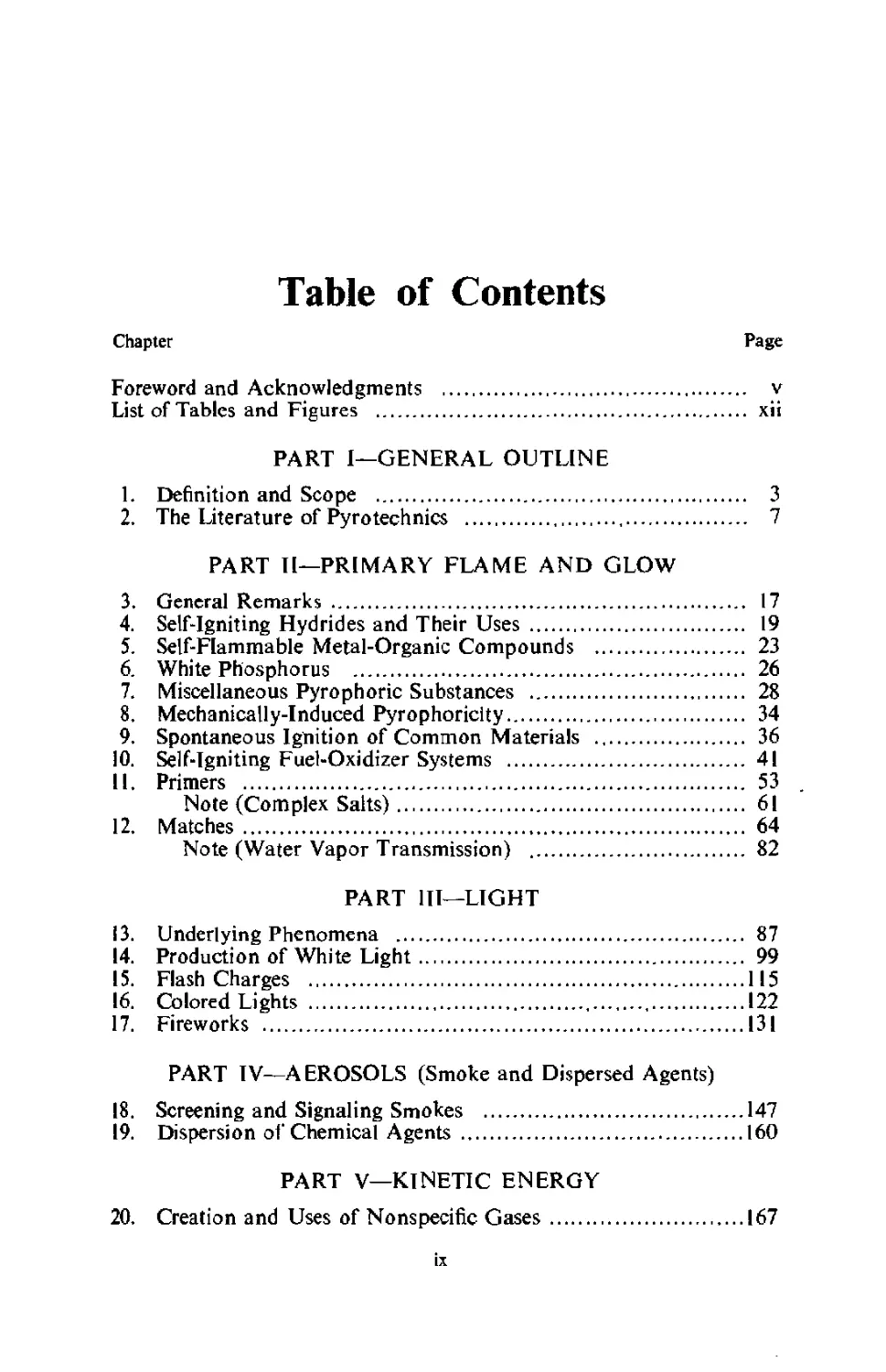
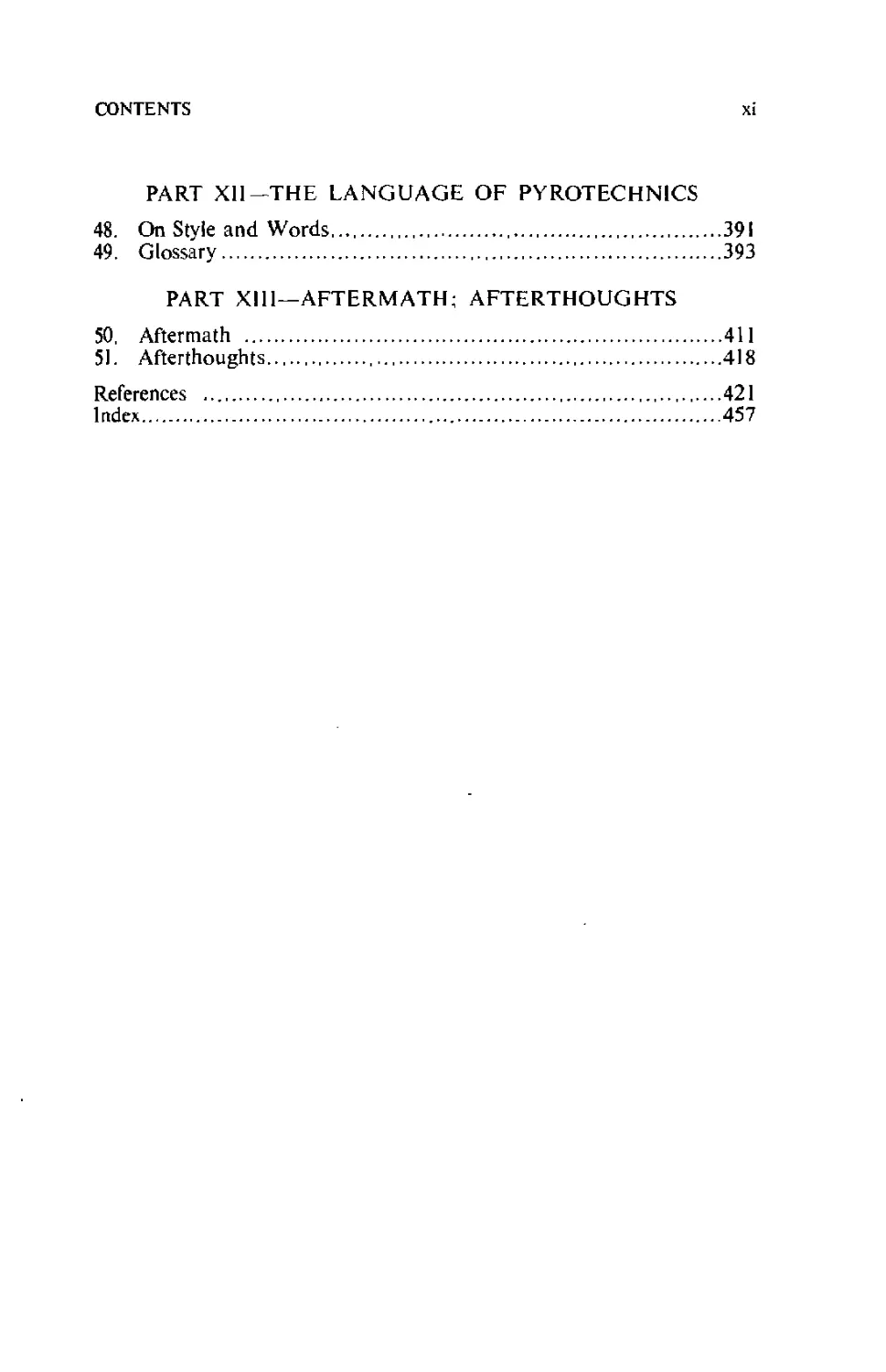
Table of Contents
Chapter	Page
Foreword and Acknowledgments ............................ v
List of Tables and Figures ............................ xii
PART I—GENERAL OUTLINE
1.	Definition and Scope ................................ 3
2.	The Literature of Pyrotechnics ....................   7
PART TI—PRIMARY FLAME AND GLOW
3.	General Remarks .................................... 17
4.	Self-Igniting Hydrides and Their Uses .............. 19
5.	Self-Flammable Metal-Organic Compounds ............. 23
6.	White Phosphorus ................................... 26
7.	Miscellaneous Pyrophoric Substances ................ 28
8.	Mechanically-Induced Pyrophoricity.................. 34
9.	Spontaneous Ignition of Common Materials ........... 36
10.	Self-Igniting Fuel-Oxidizer Systems ................ 41
II.	Primers ............................................. 53	.
Note (Complex Salts)............................. 61
12.	Matches............................................. 64
Note (Water Vapor Transmission) ................. 82
PART HI—LIGHT
13.	Underlying Phenomena ............................... 87
14.	Production of White Light........................... 99
15.	Flash Charges ......................................115
16.	Colored Lights .................................    122
17.	Fireworks ...........................................131
PART IV—AEROSOLS (Smoke and Dispersed Agents)
18.	Screening and Signaling Smokes	.....................147
19.	Dispersion of Chemical Agents ......................160
PART V—KINETIC ENERGY
20.	Creation and Uses of Nonspecific	Gases..............167
ix
X
CONTENTS
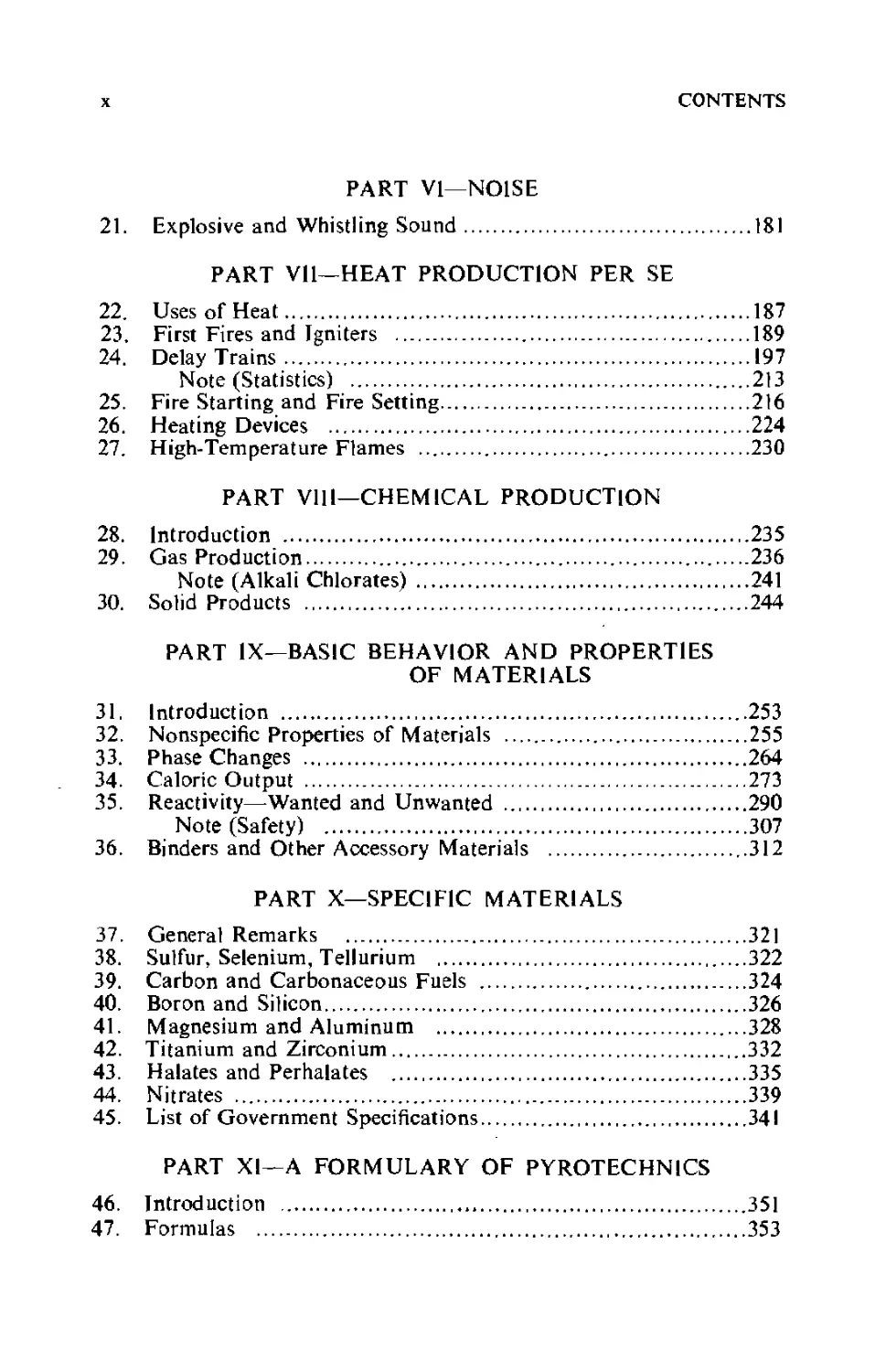
PART VI—NOISE
21.	Explosive and Whistling Sound.........................181
PART Vll—HEAT PRODUCTION PER SE
22.	Uses of Heat......................................    187
23.	First Fires and Igniters .........................    189
24.	Delay Trains..........................................197
Note (Statistics) ................................ 213
25.	Fire Starting and Fire Setting........................216
26.	Heating Devices ......................................224
27.	High-Temperature Flames ..........................    230
PART Vlll—CHEMICAL PRODUCTION
28.	Introduction .........................................235
29.	Gas Production................................        236
Note (Alkali Chlorates) ...........................241
30.	Solid Products ...................................... 244
PART IX—BASIC BEHAVIOR AND PROPERTIES
OF MATERIALS
31.	Introduction .........................................253
32.	Nonspecific Properties of Materials ..................255
33.	Phase Changes ........................................264
34.	Caloric Output .......................................273
35.	Reactivity—-Wanted and Unwanted ......................290
Note (Safety) .....................................307
36.	Binders and Other Accessory Materials ................312
PART X—SPECIFIC MATERIALS
37.	General Remarks ......................................321
38.	Sulfur, Selenium, Tellurium ..........................322
39.	Carbon and Carbonaceous Fuels .....................   324
40.	Boron and Silicon................................... 326
41.	Magnesium and Aluminum ...............................328
42.	Titanium and Zirconium...............................332
43.	Halates and Perhalates ..............................335
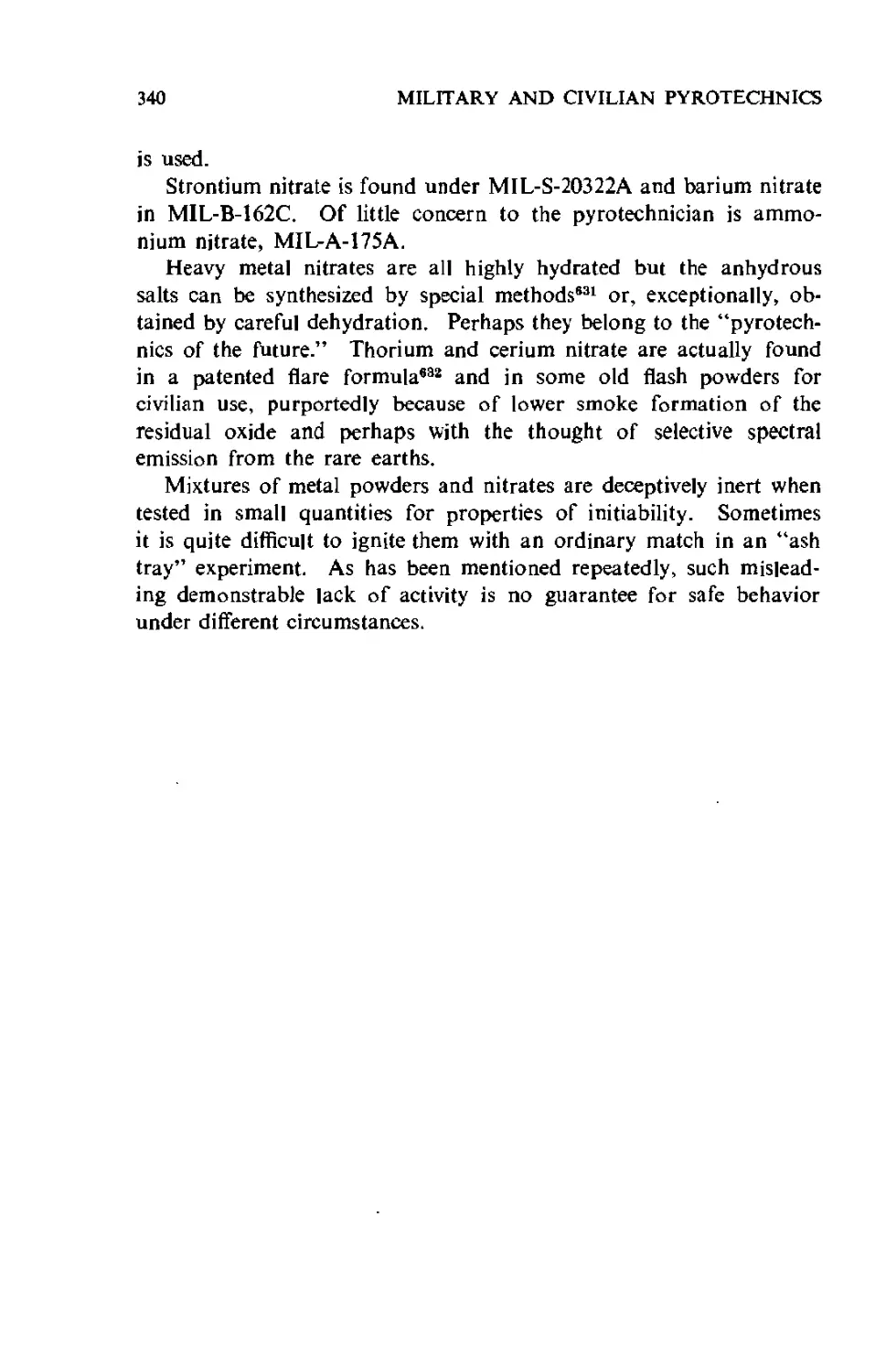
44.	Nitrates ........................................... 339
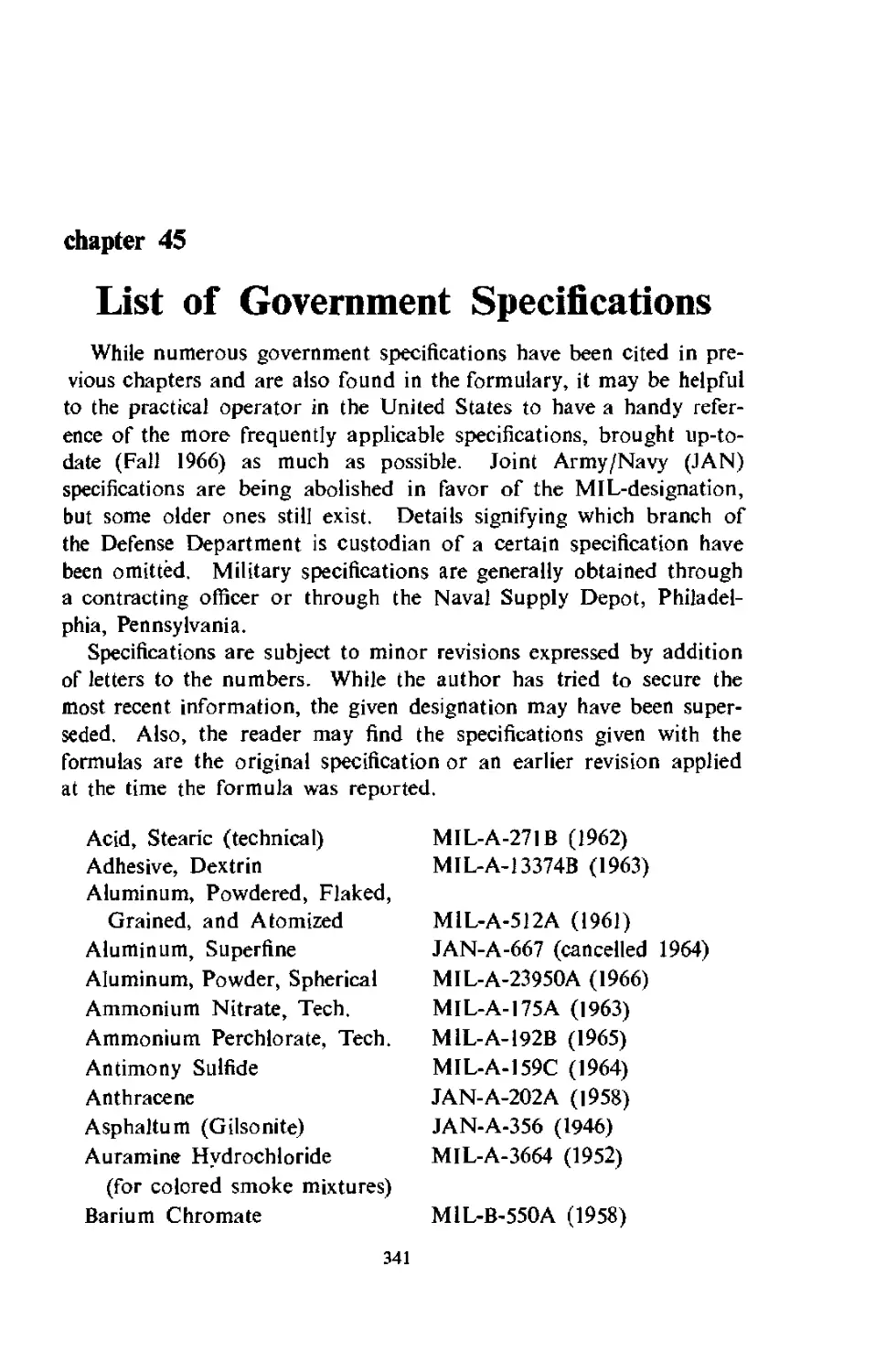
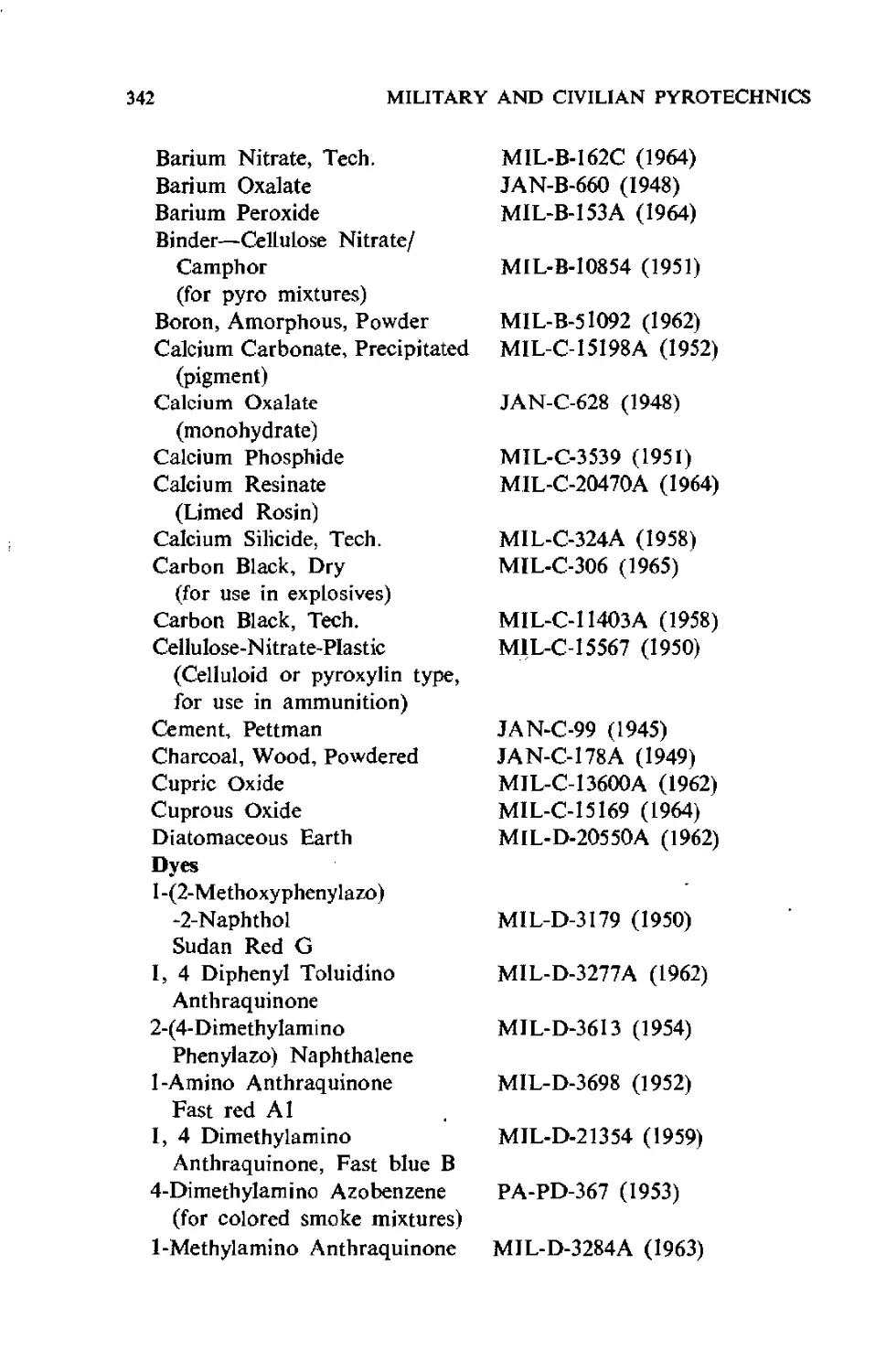
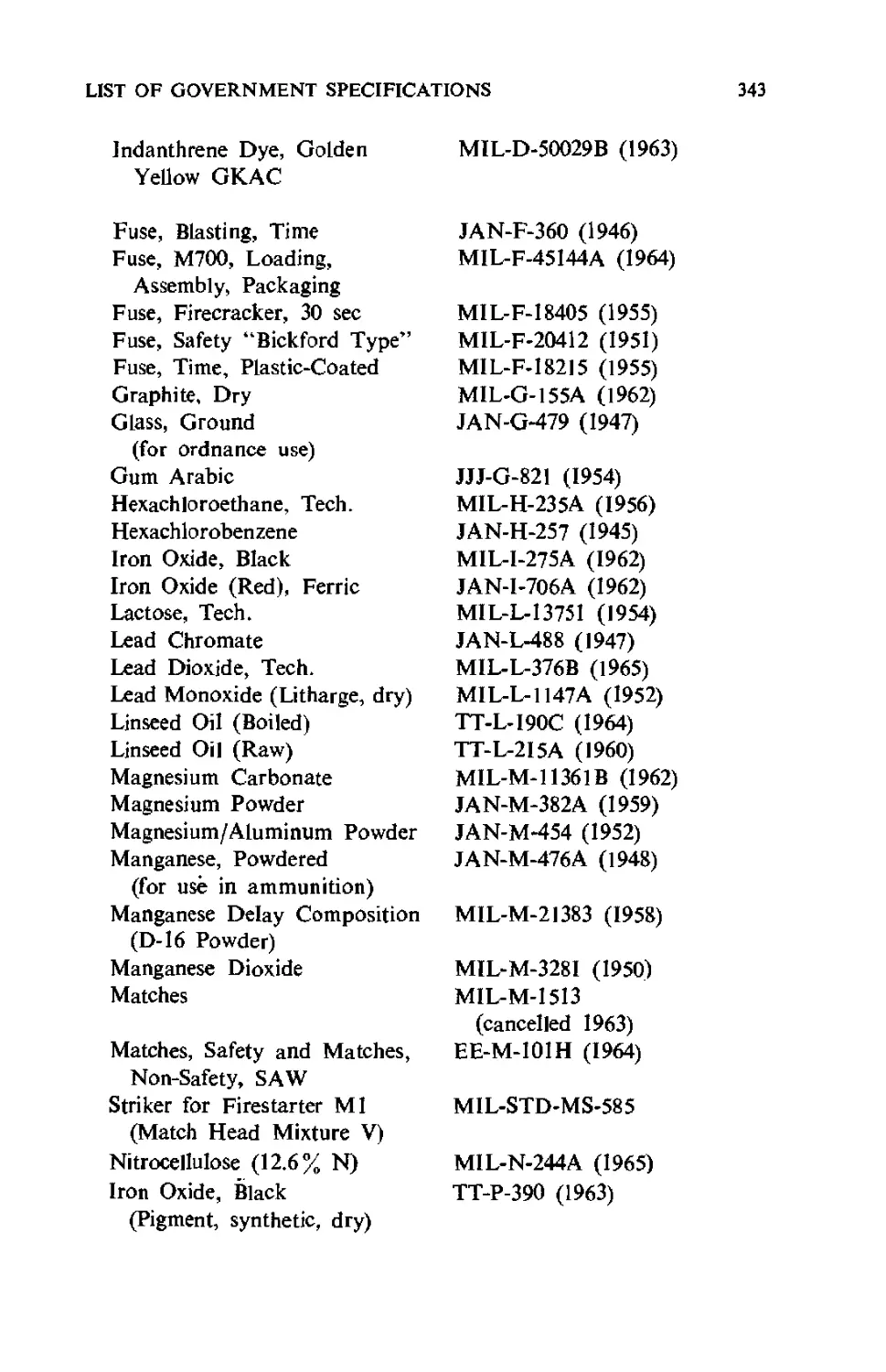
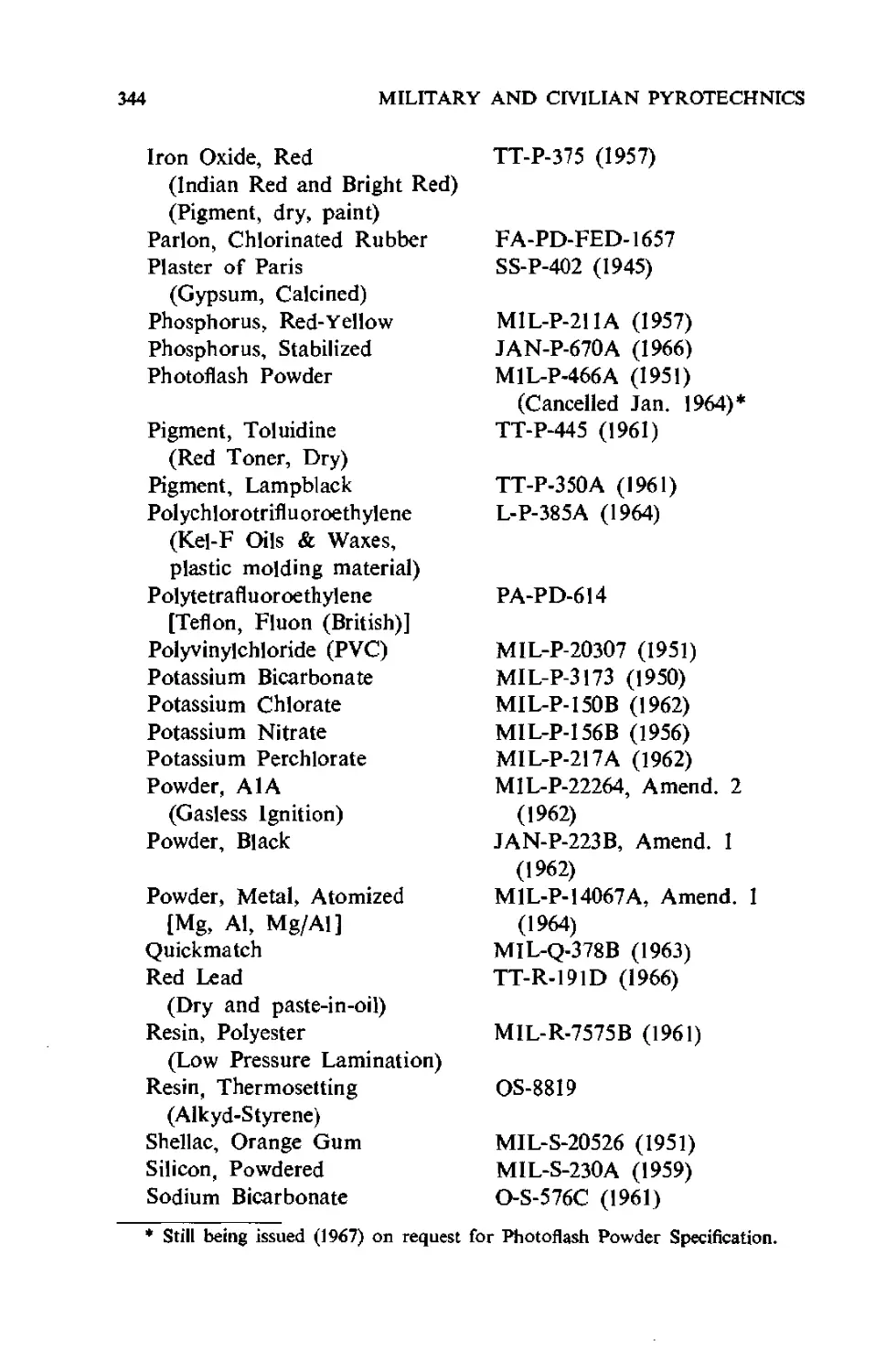
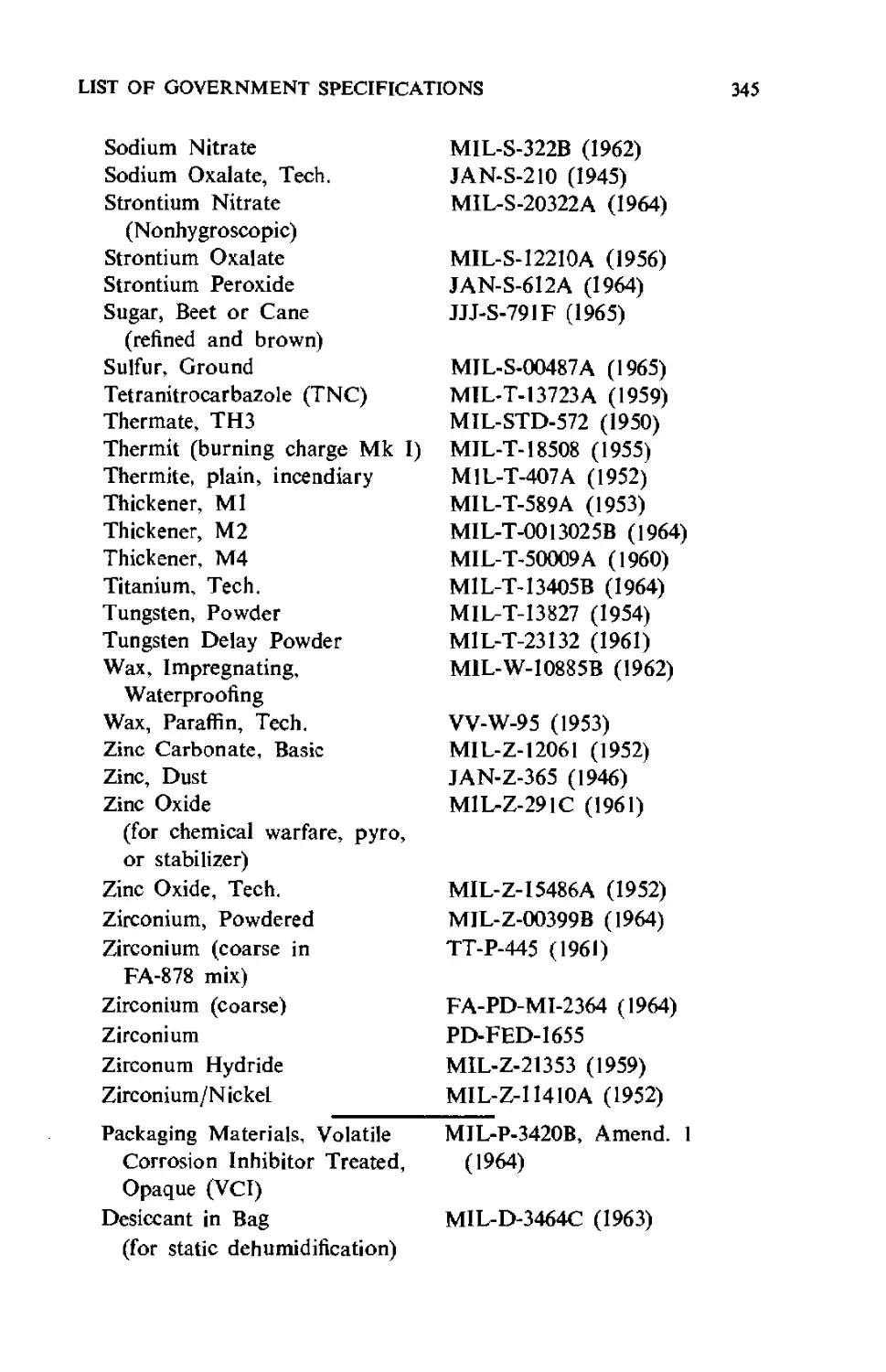
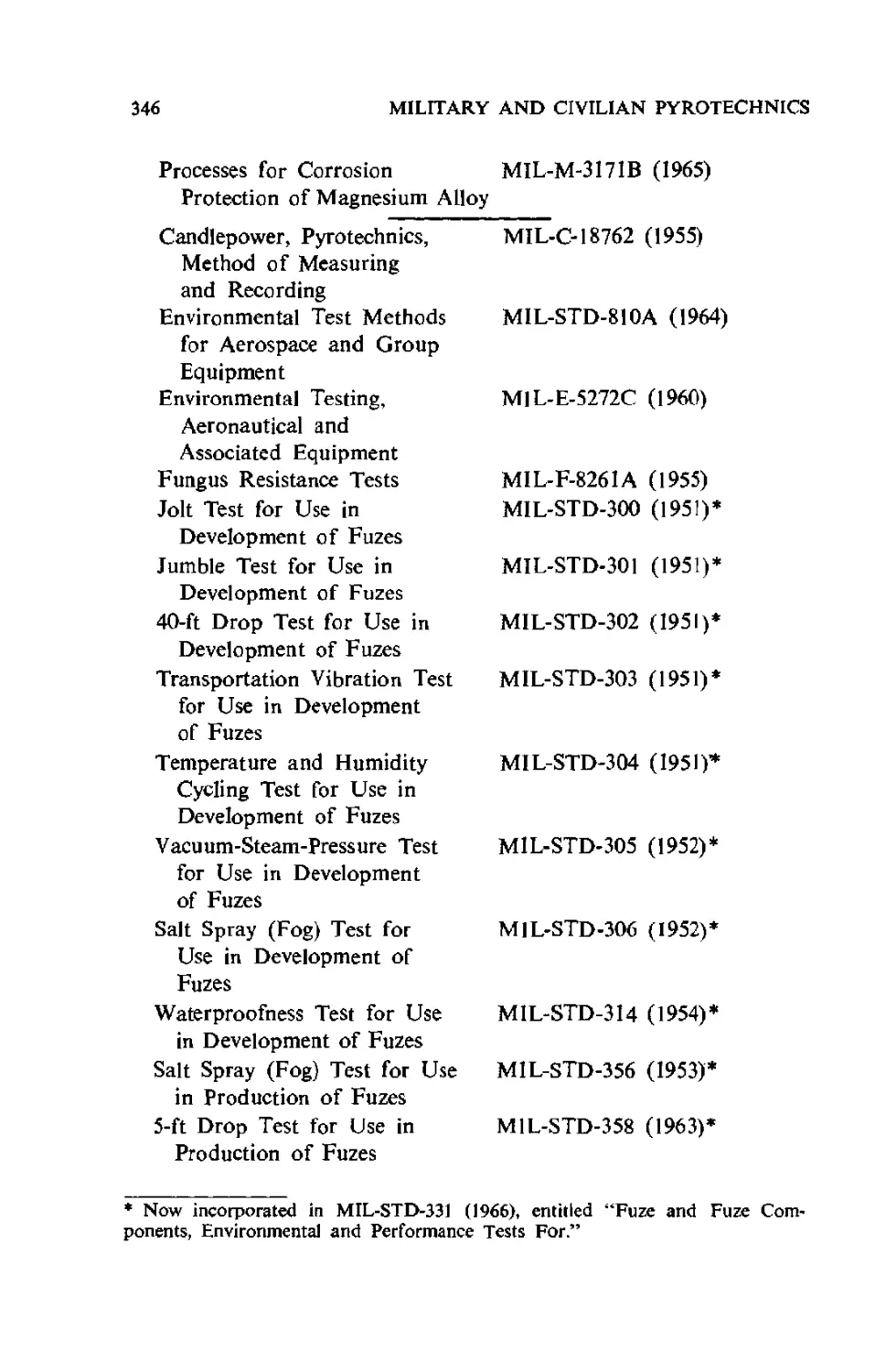
45.	List of Government Specifications....................341
PART XI—A FORMULARY OF PYROTECHNICS
46.	Introduction ....................................... 351
47.	Formulas ............................................353
CONTENTS	xi
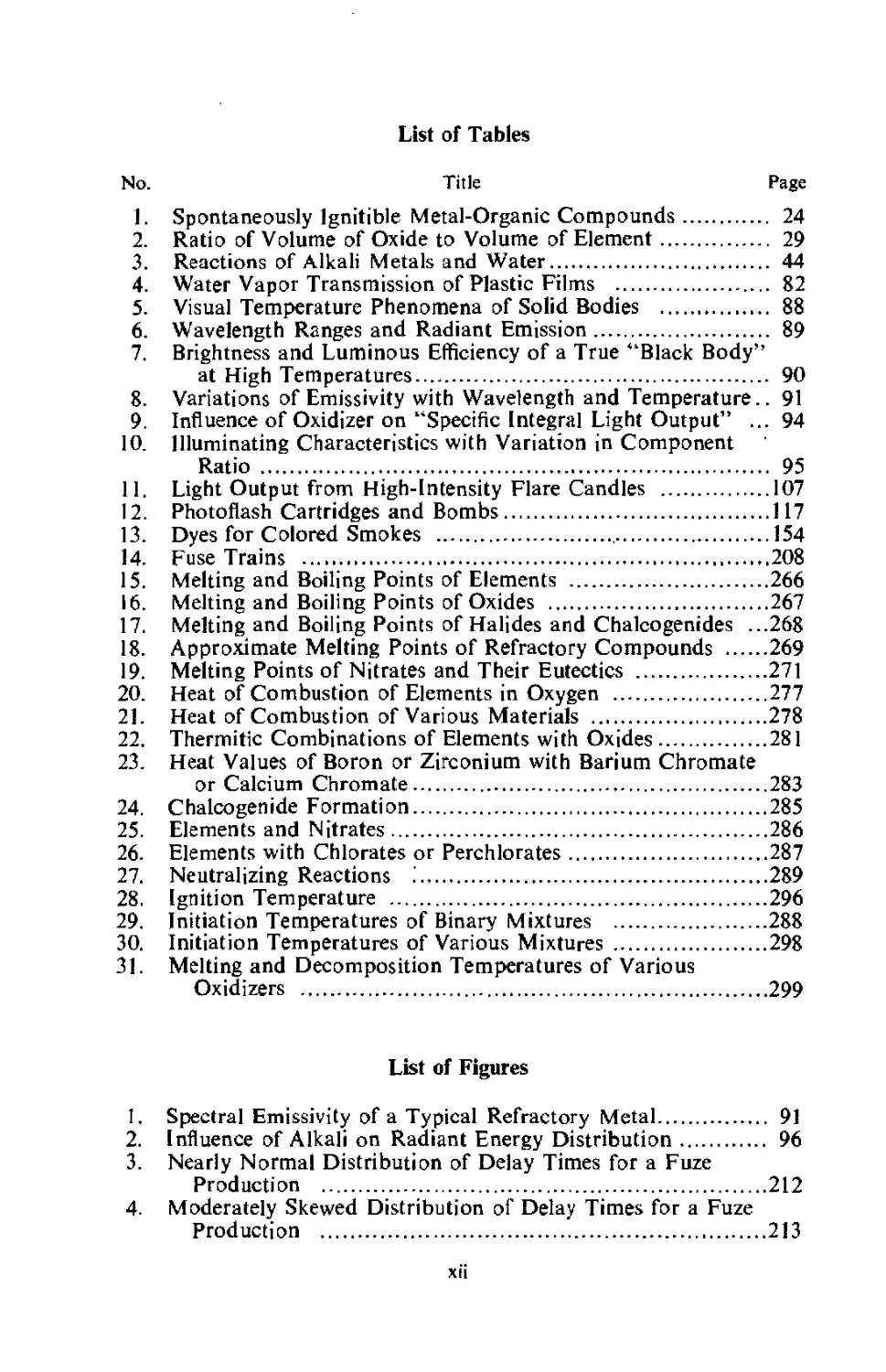
PART Xll—THE LANGUAGE OF PYROTECHNICS
48.	On Style and Words................................391
49.	Glossary..........................................393
PART Xlll—AFTERMATH; AFTERTHOUGHTS
50.	Aftermath ........................................411
51.	Afterthoughts...................................  418
References  ...........................................421
Index...............................................  457
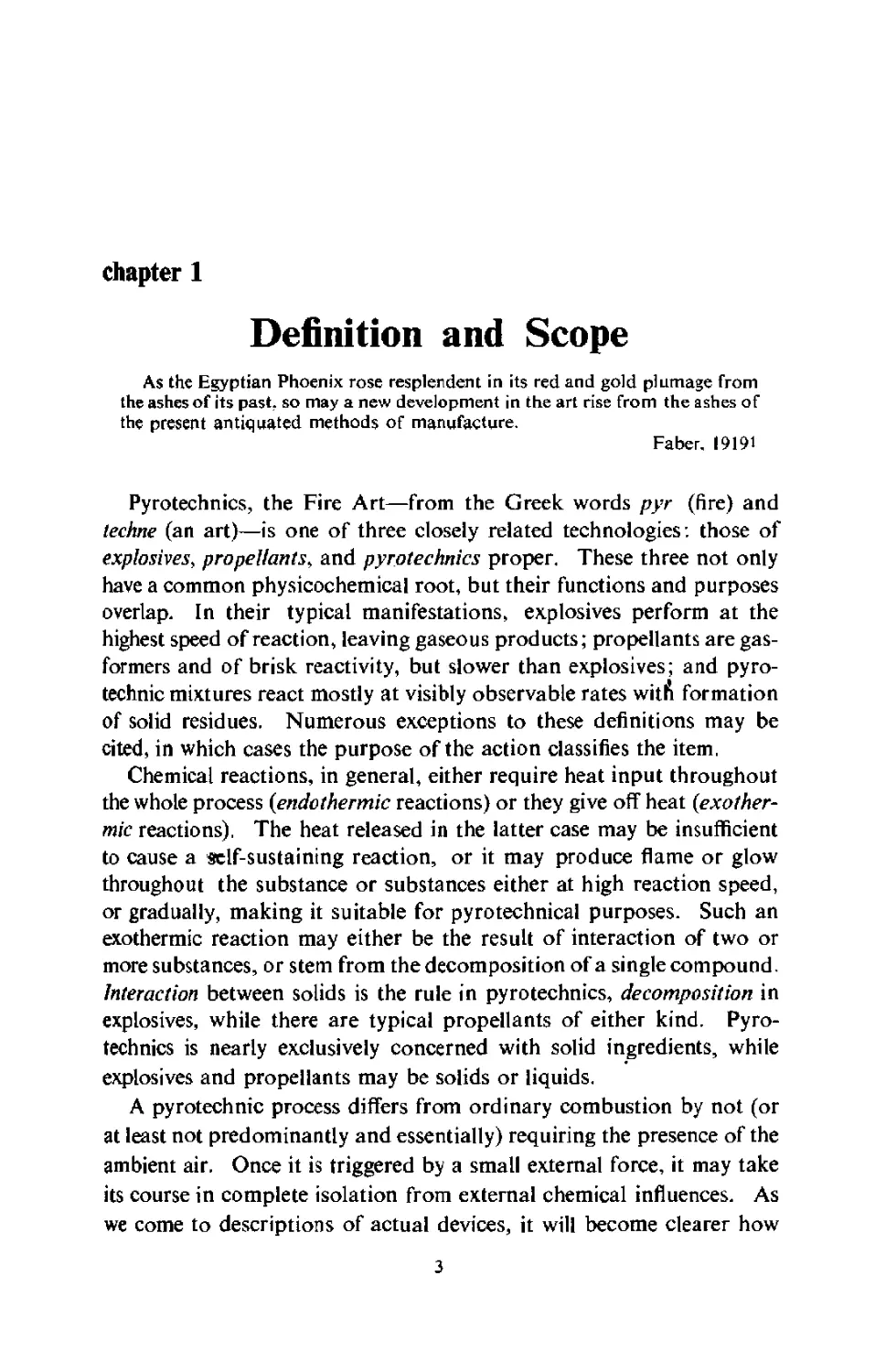
List of Tables
No.	Title	Page
1.	Spontaneously Ignitible Metal-Organic Compounds.......... 24
2.	Ratio of Volume of Oxide to Volume of Element........... 29
3.	Reactions of Alkali Metals and Water.................... 44
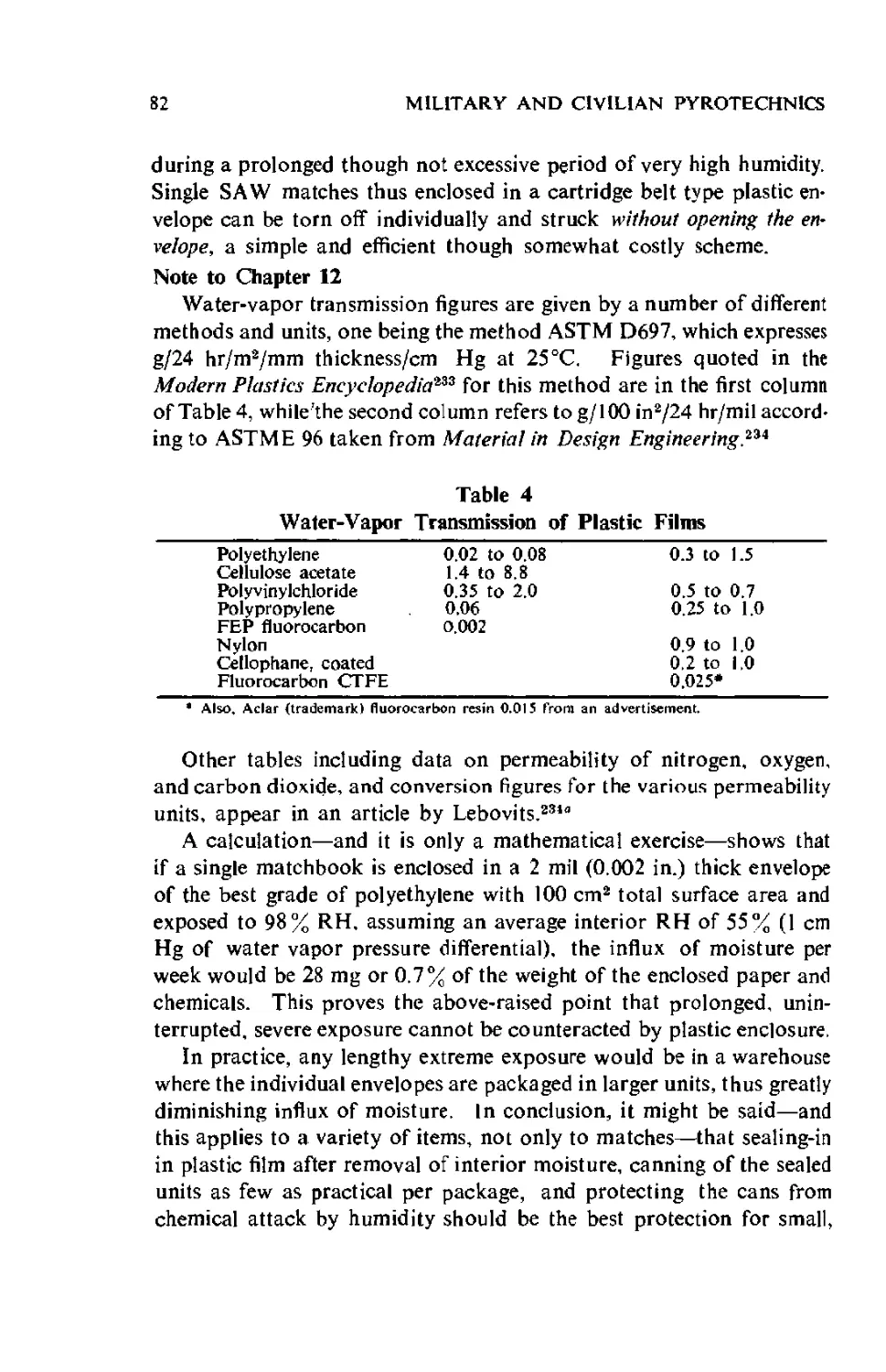
4.	Water Vapor Transmission of Plastic Films .............  82
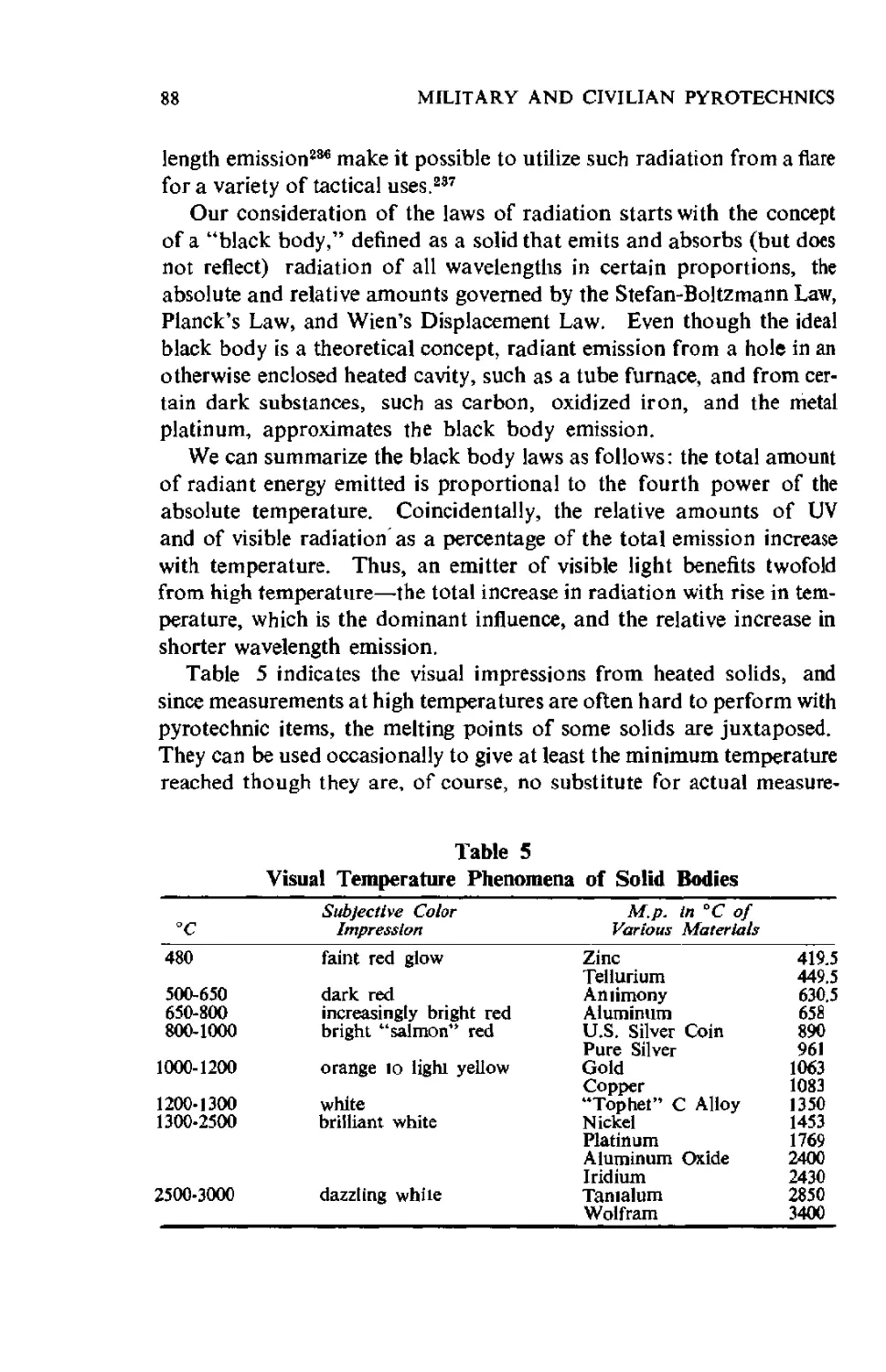
5.	Visual Temperature Phenomena of Solid Bodies ........... 88
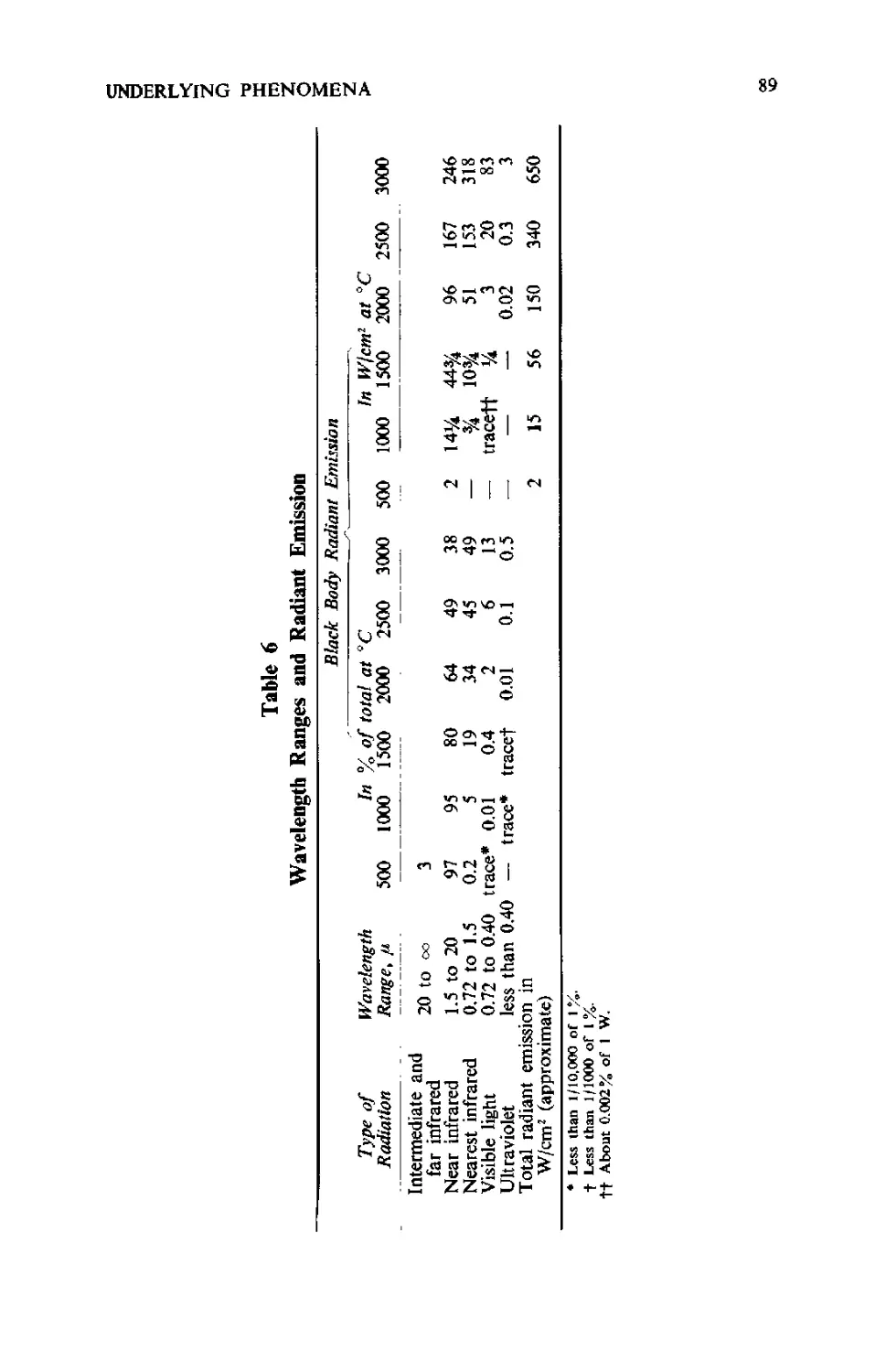
6.	Wavelength Ranges and Radiant Emission.................. 89
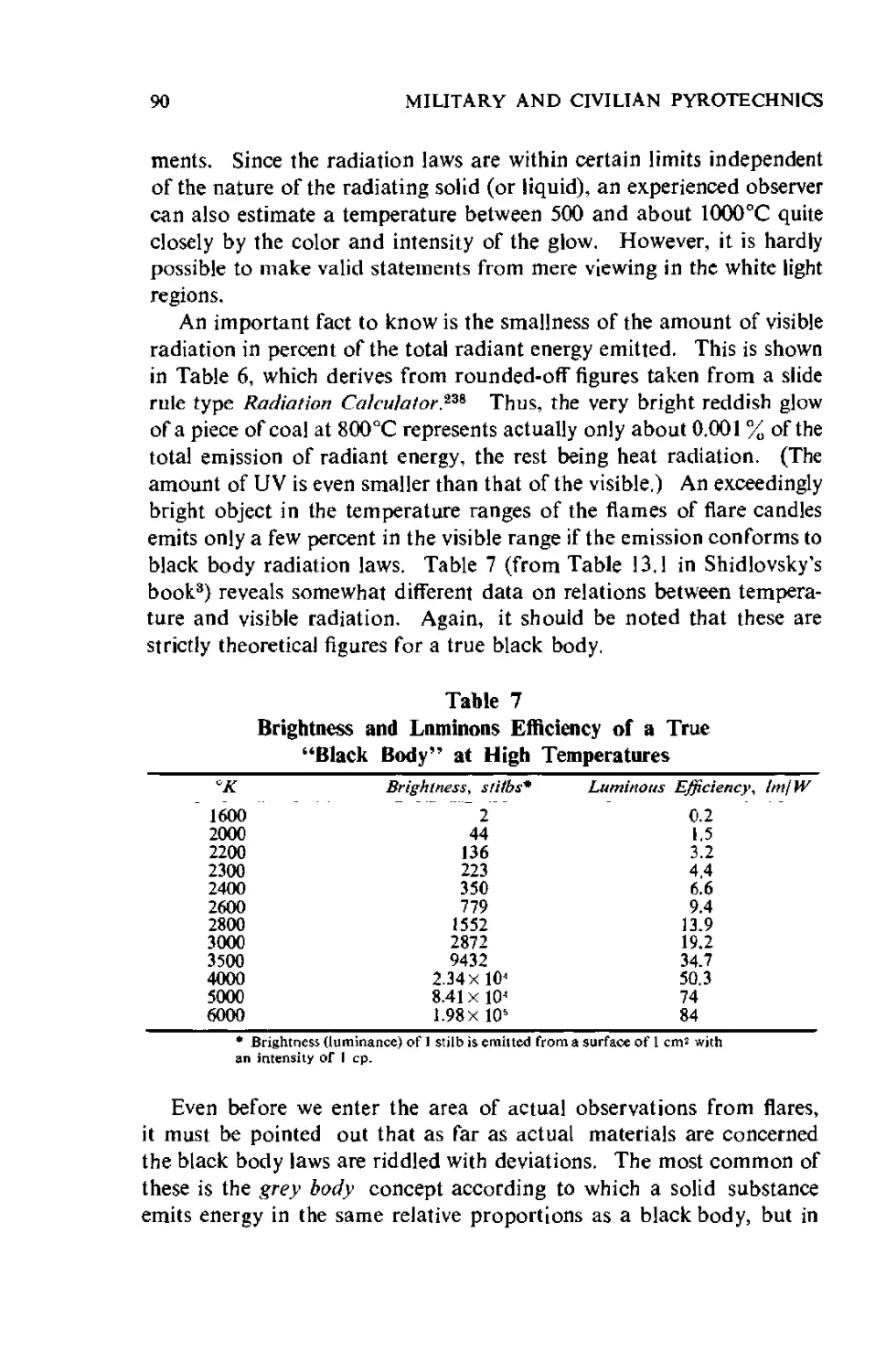
7.	Brightness and Luminous Efficiency of a True “Black Body”
at High Temperatures......................................... 90
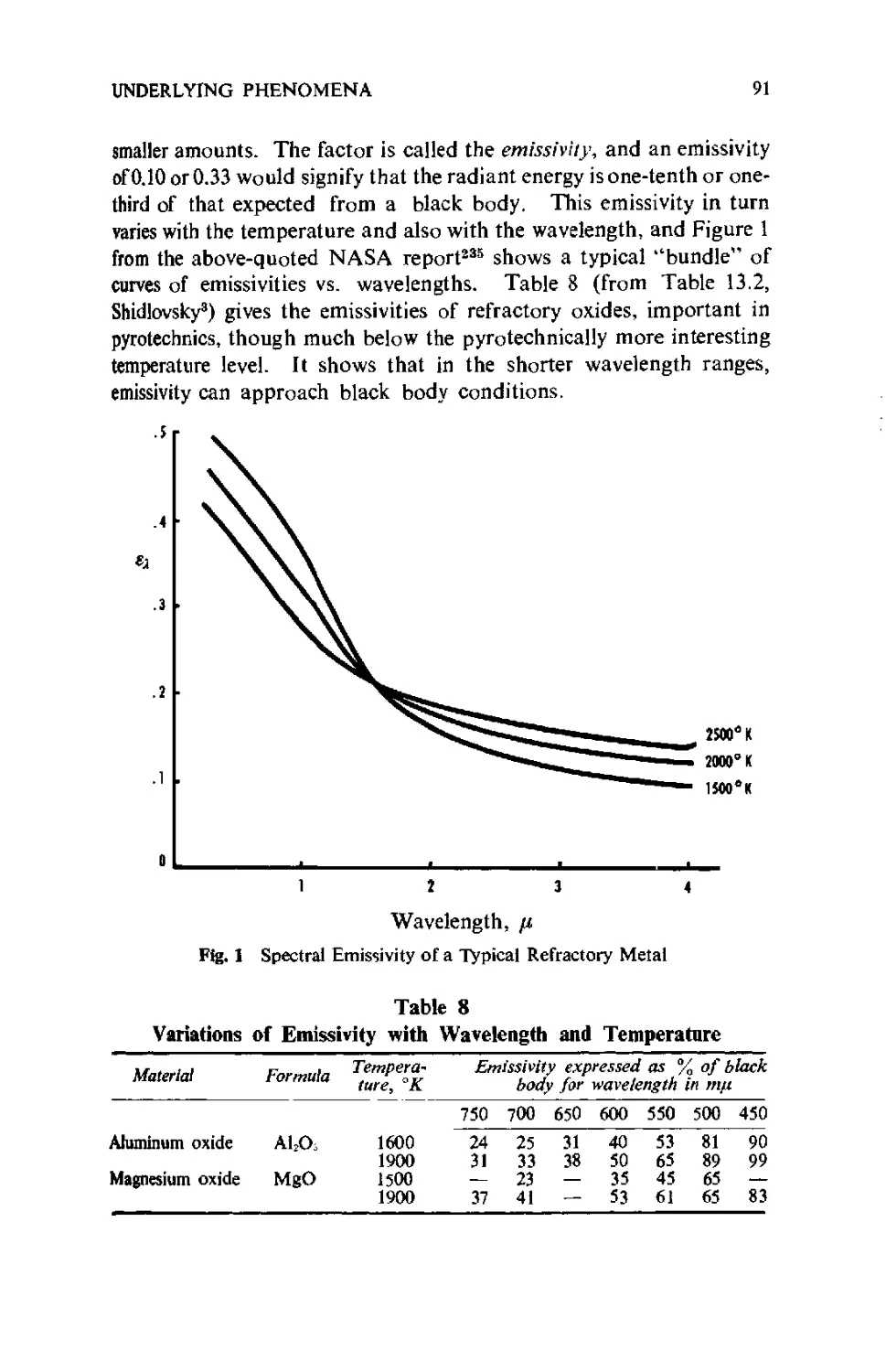
8.	Variations of Emissivity with Wavelength and Temperature.. 91
9.	Influence of Oxidizer on “Specific Integral Light Output” ... 94
10.	Illuminating Characteristics with Variation in Component
Ratio ....................................................... 95
11.	Light Output from High-Intensity Flare Candles .........107
12.	Photoflash Cartridges and Bombs.........................117
13.	Dyes for Colored Smokes ..............................  154
14.	Fuse Trains ............................................208
15.	Melting and Boiling Points of Elements .................266
16.	Melting and Boiling Points of Oxides ...................267
17.	Melting and Boiling Points of Halides and Chalcogenides ...268
18.	Approximate Melting Points of Refractory Compounds .....269
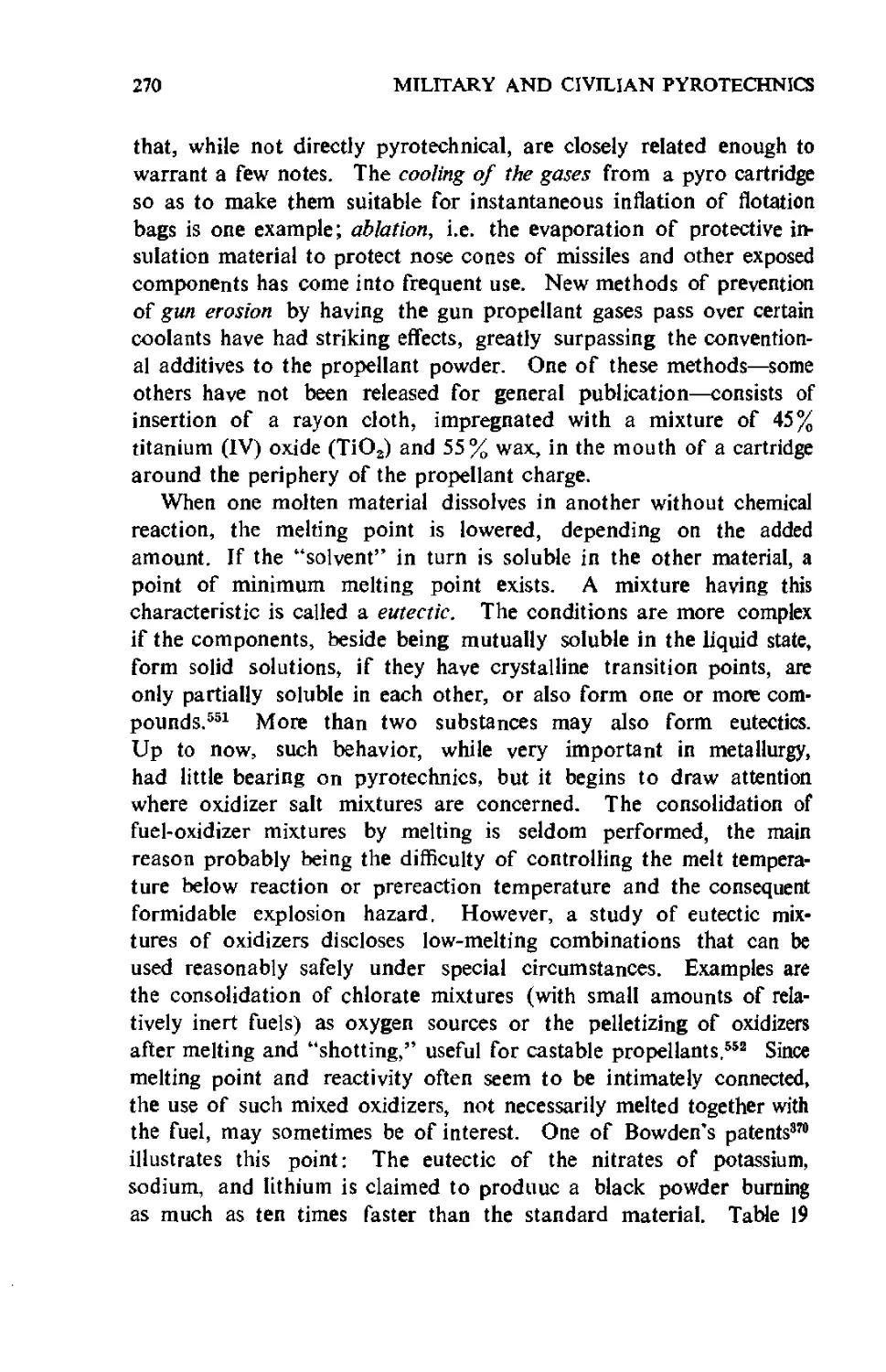
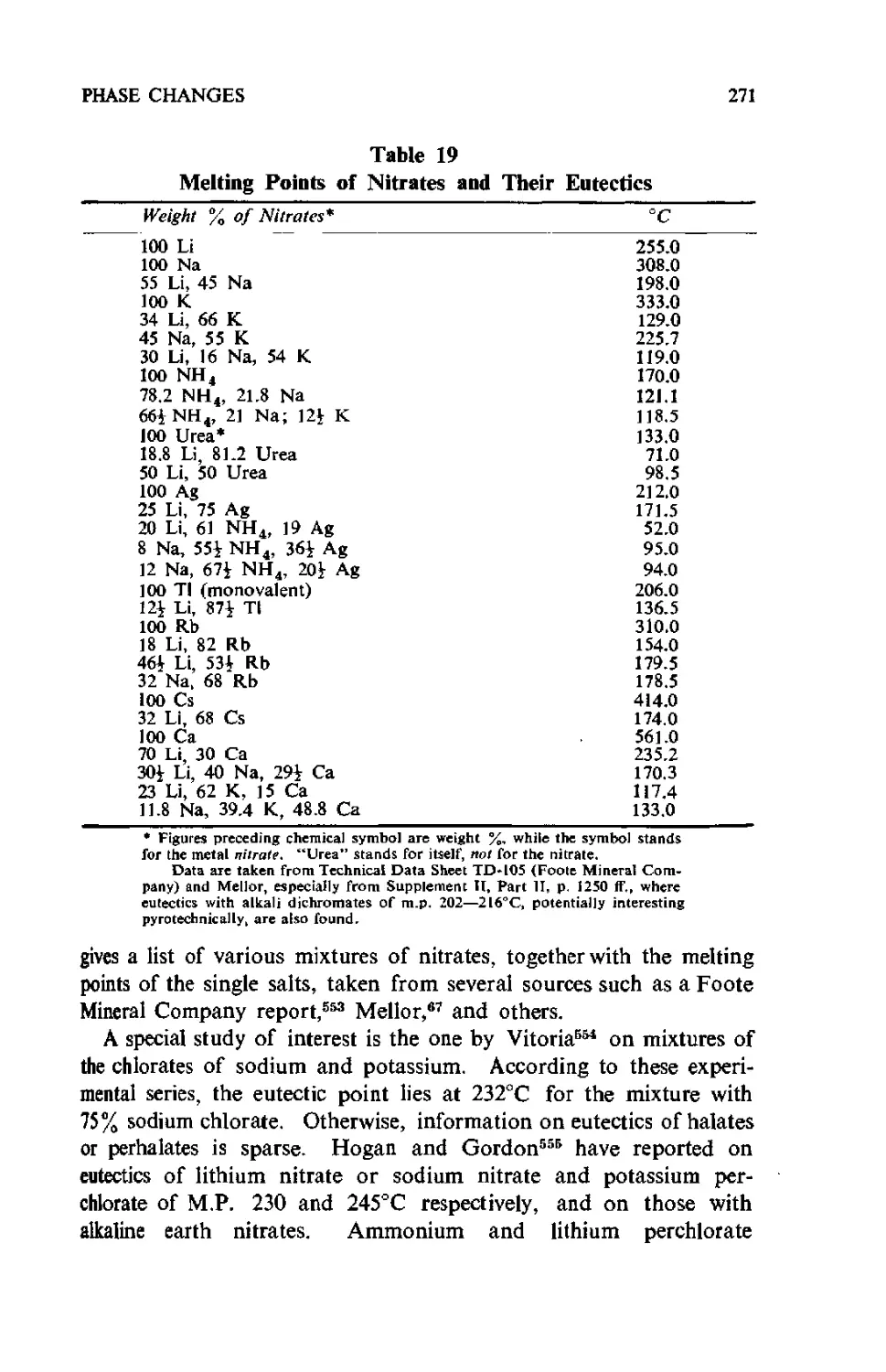
19.	Melting Points of Nitrates and Their Eutectics .........271
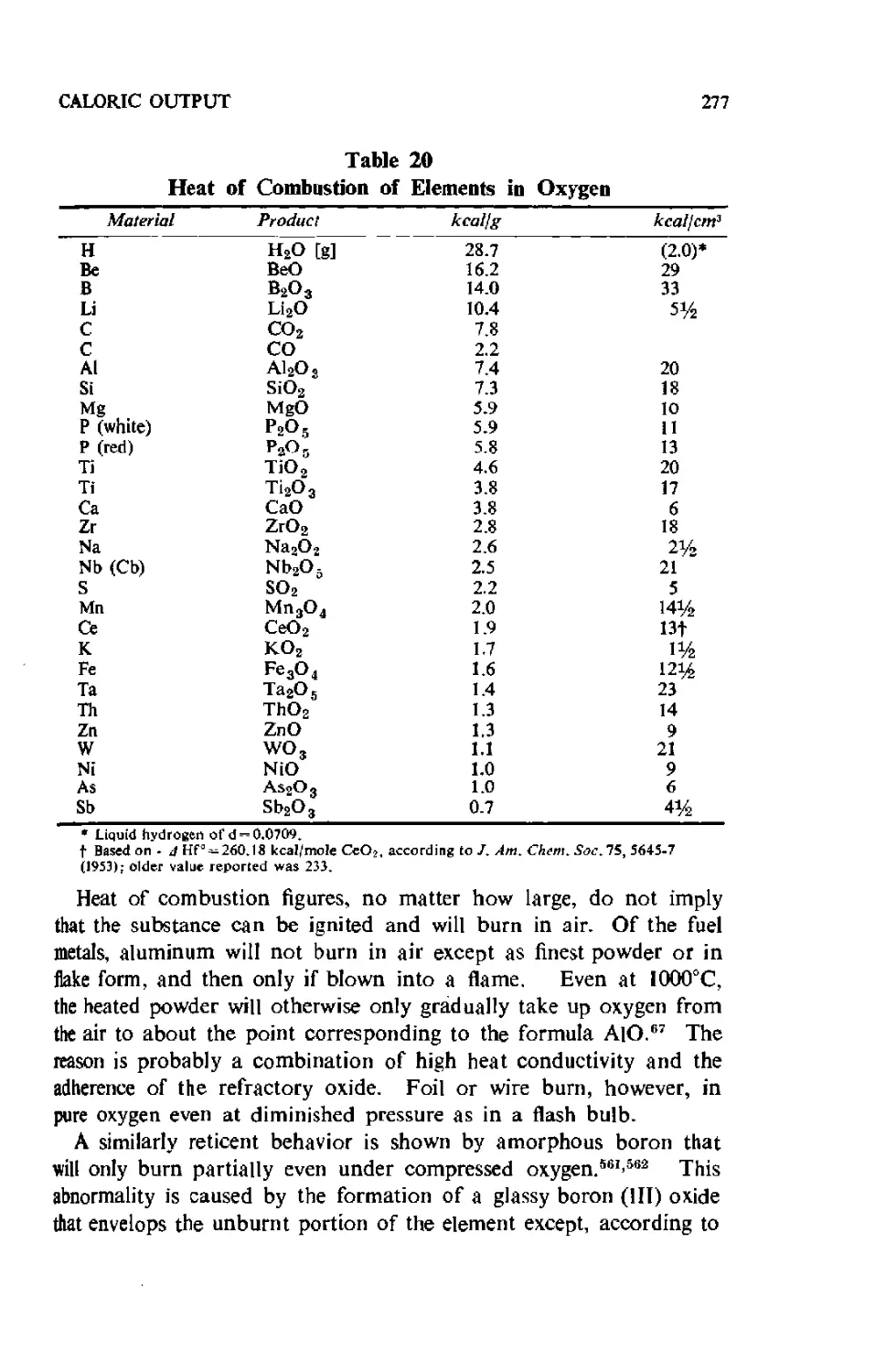
20.	Heat of Combustion of Elements in Oxygen ..............277
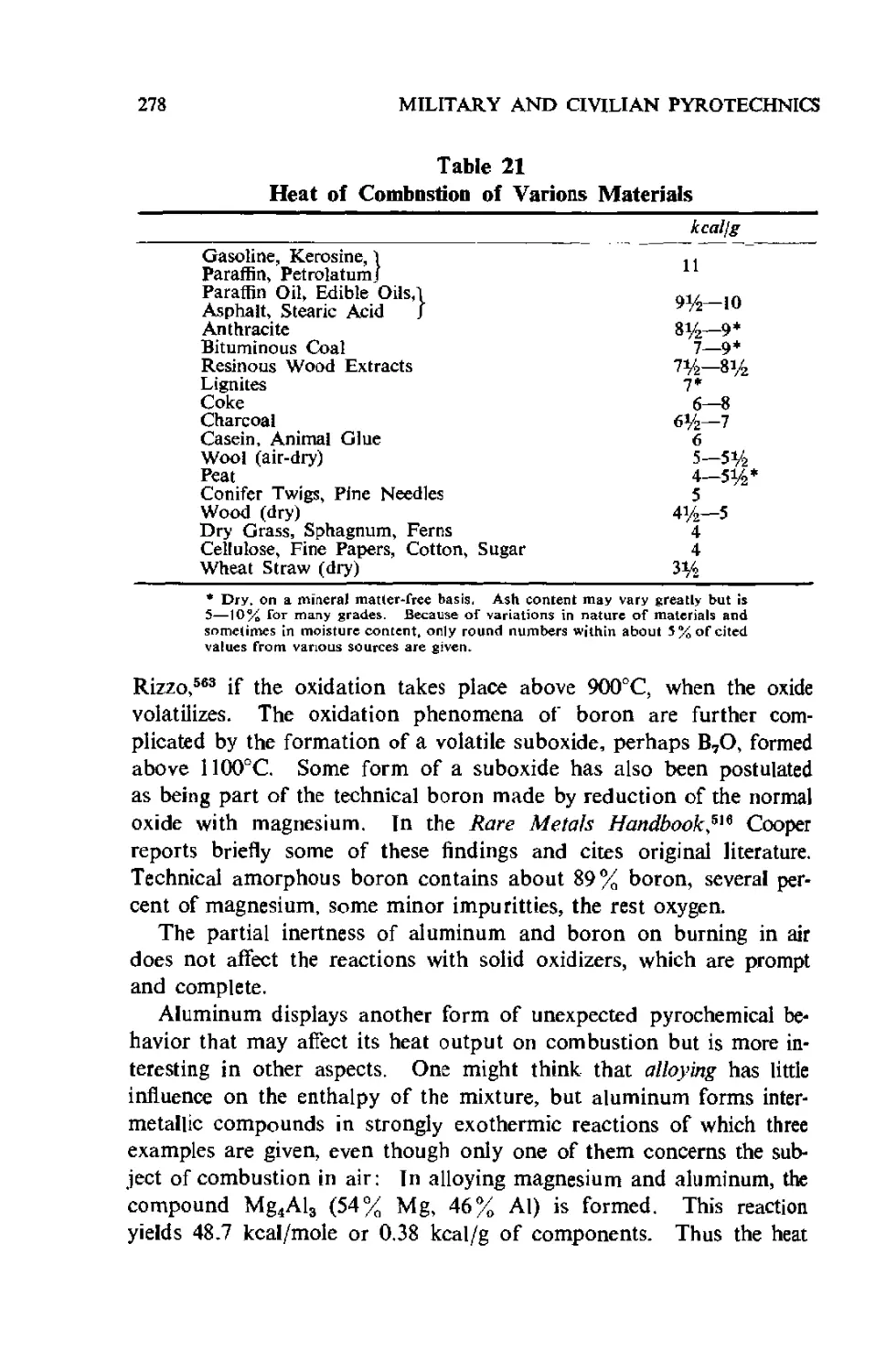
21.	Heat of Combustion of Various Materials ...............278
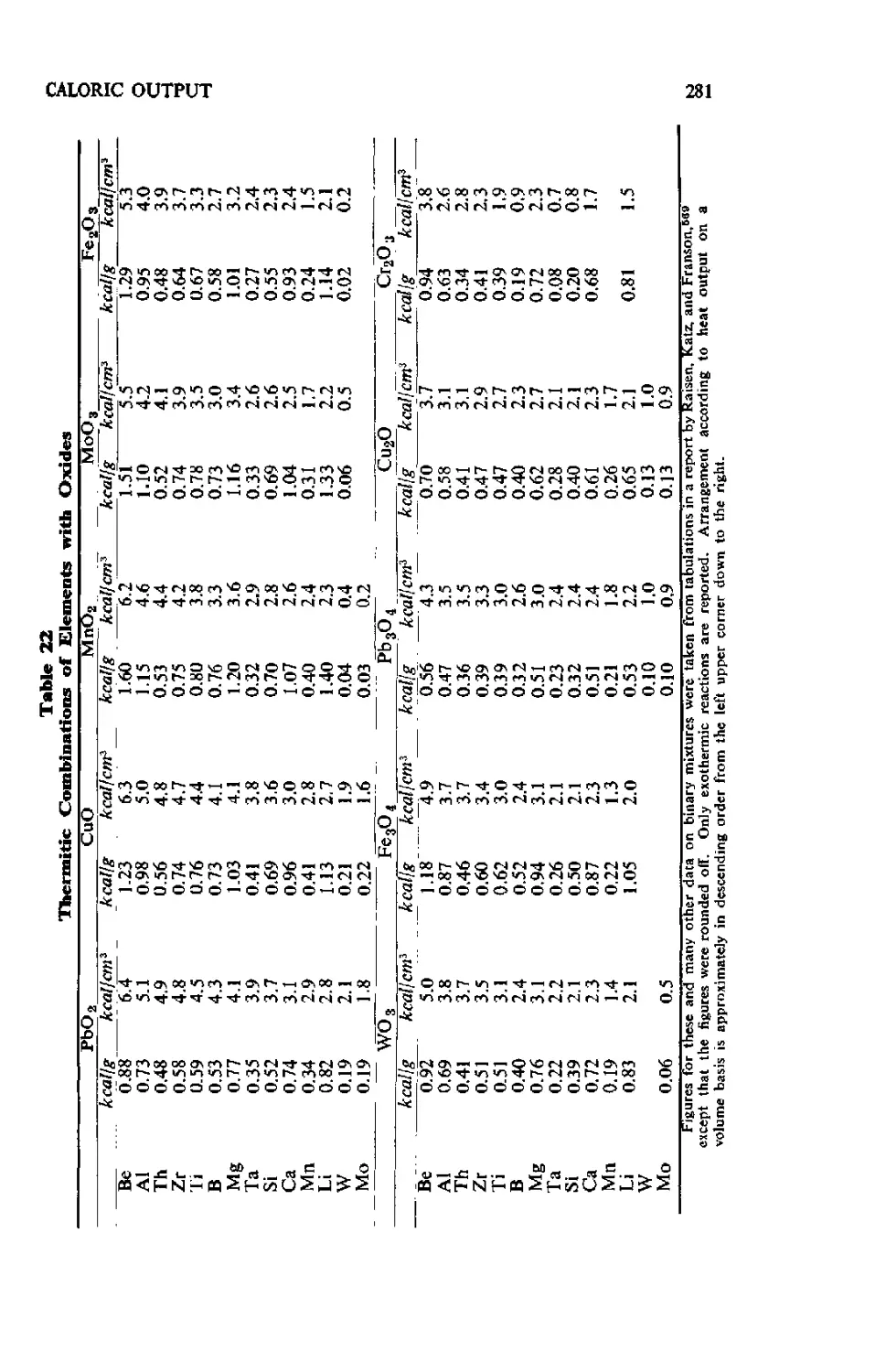
22.	Thermitic Combinations of Elements with Oxides.........281
23.	Heat Values of Boron or Zirconium with Barium Chromate
or Calcium Chromate..........................................283
24.	Chalcogenide Formation.................................285
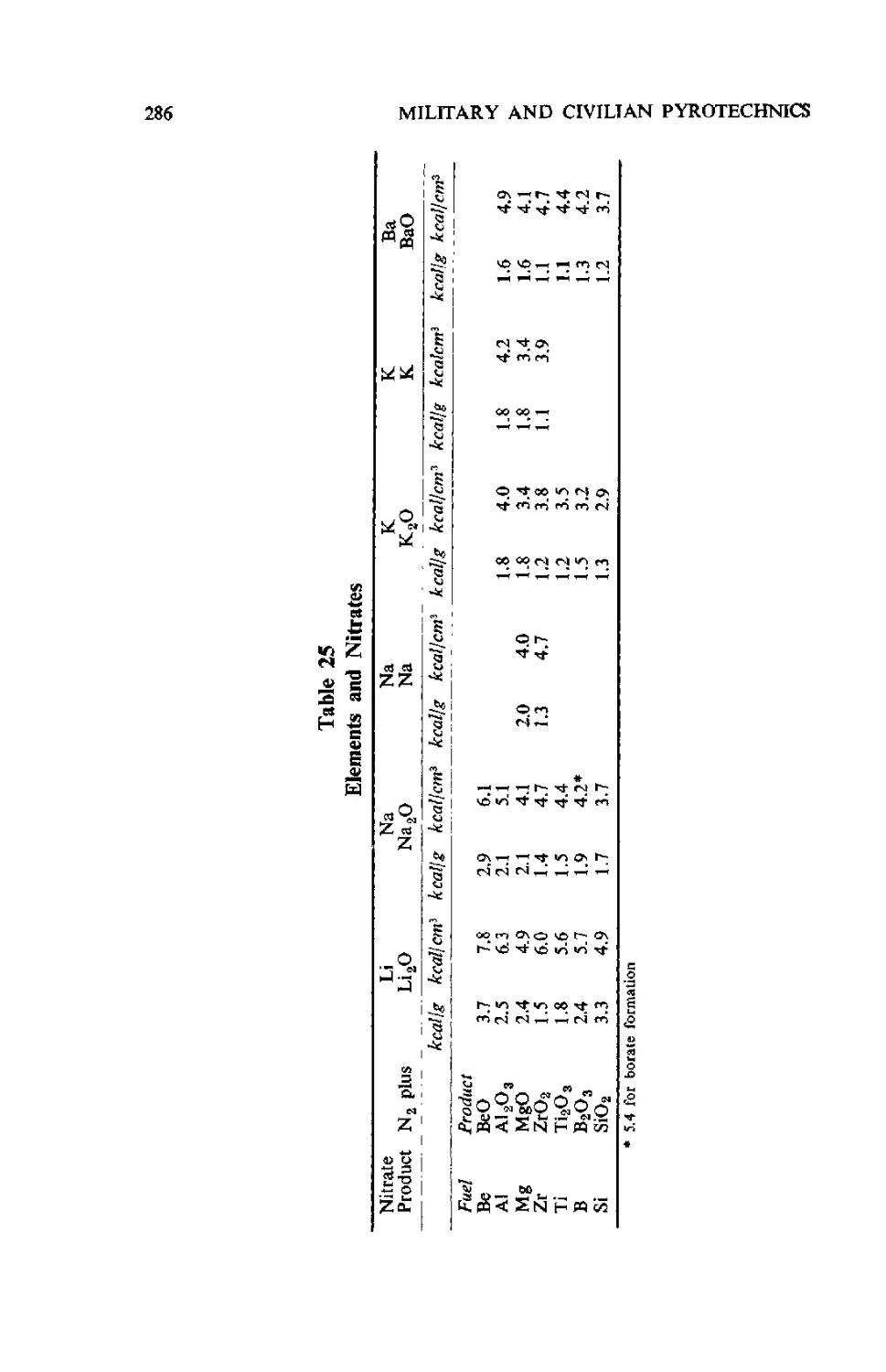
25.	Elements and Nitrates..................................286
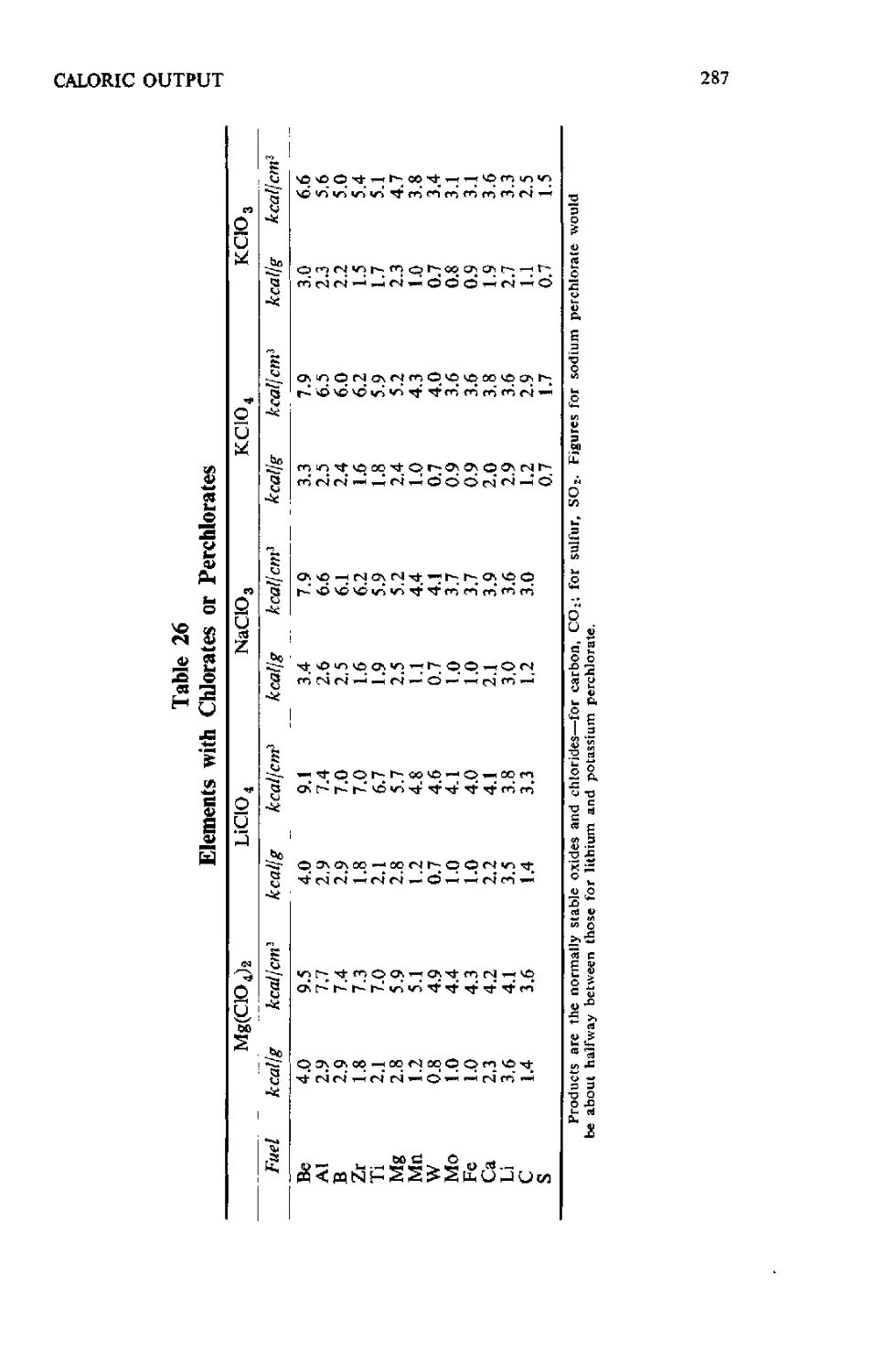
26.	Elements with Chlorates or Perchlorates................287
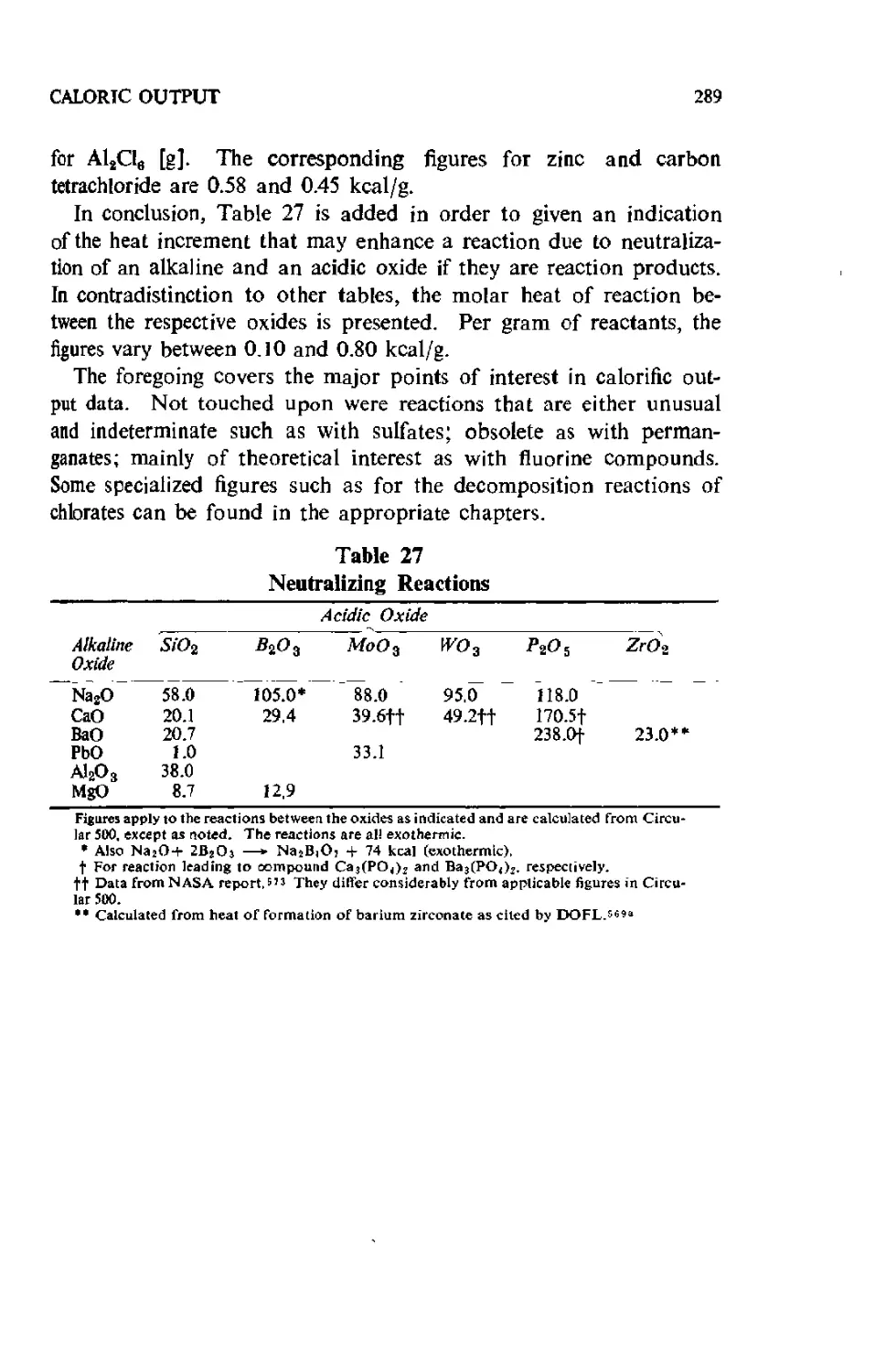
27.	Neutralizing Reactions	i...............................289
28.	Ignition Temperature ..................................296
29.	Initiation Temperatures	of Binary	Mixtures ............288
30.	Initiation Temperatures	of Various	Mixtures ...........298
31.	Melting and Decomposition Temperatures of Various
Oxidizers .................................................. 299
List of Figures
1.	Spectral Emissivity of a Typical Refractory Metal.............. 91
2.	Influence of Alkali on Radiant Energy Distribution............. 96
3.	Nearly Normal Distribution of Delay Times for a Fuze
Production  ......................................................212
4.	Moderately Skewed Distribution of Delay Times for a Fuze
Production .......................................................213
xii
Part I
General Outline
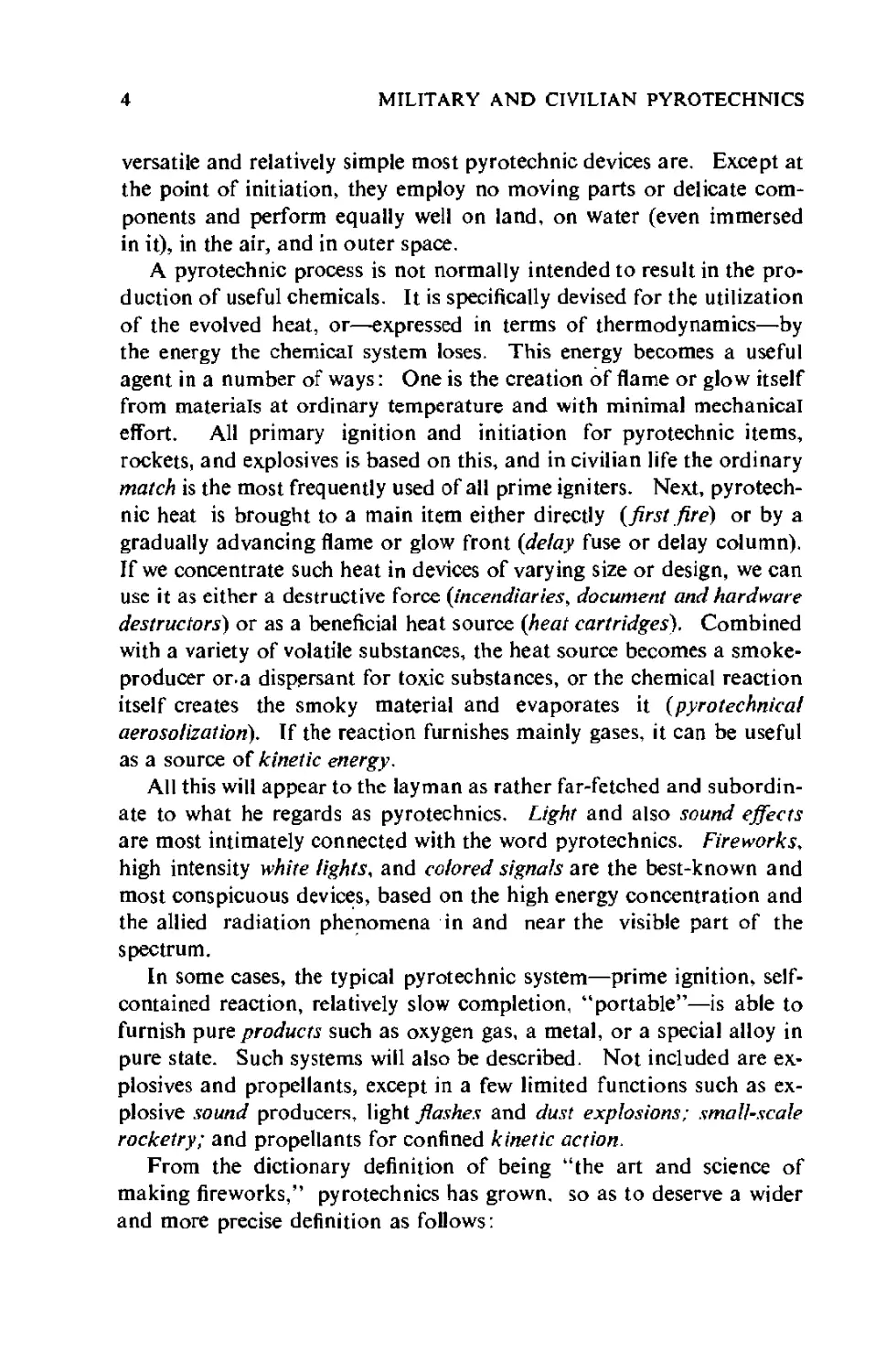
chapter 1
Definition and Scope
As the Egyptian Phoenix rose resplendent in its red and gold plumage from
the ashes of its past, so may a new development in the art rise from the ashes of
the present antiquated methods of manufacture.
Faber, 19191
Pyrotechnics, the Fire Art—from the Greek words pyr (fire) and
techne (an art)—is one of three closely related technologies : those of
explosives, propellants, and pyrotechnics proper. These three not only
have a common physicochemical root, but their functions and purposes
overlap. In their typical manifestations, explosives perform at the
highest speed of reaction, leaving gaseous products; propellants are gas-
formers and of brisk reactivity, but slower than explosives; and pyro-
technic mixtures react mostly at visibly observable rates witA formation
of solid residues. Numerous exceptions to these definitions may be
cited, in which cases the purpose of the action classifies the item.
Chemical reactions, in general, either require heat input throughout
the whole process (endothermic reactions) or they give off heat (exother-
mic reactions). The heat released in the latter case may be insufficient
to cause a self-sustaining reaction, or it may produce flame or glow
throughout the substance or substances either at high reaction speed,
or gradually, making it suitable for pyrotechnical purposes. Such an
exothermic reaction may either be the result of interaction of two or
more substances, or stem from the decomposition of a single compound.
Interaction between solids is the rule in pyrotechnics, decomposition in
explosives, while there are typical propellants of either kind. Pyro-
technics is nearly exclusively concerned with solid ingredients, while
explosives and propellants may be solids or liquids.
A pyrotechnic process differs from ordinary combustion by not (or
at least not predominantly and essentially) requiring the presence of the
ambient air. Once it is triggered by a small external force, it may take
its course in complete isolation from external chemical influences. As
we come to descriptions of actual devices, it will become clearer how
3
4
MILITARY AND CIVILIAN PYROTECHNICS
versatile and relatively simple most pyrotechnic devices are. Except at
the point of initiation, they employ no moving parts or delicate com-
ponents and perform equally well on land, on water (even immersed
in it), in the air, and in outer space.
A pyrotechnic process is not normally intended to result in the pro-
duction of useful chemicals. It is specifically devised for the utilization
of the evolved heat, or—expressed in terms of thermodynamics—by
the energy the chemical system loses. This energy becomes a useful
agent in a number of ways: One is the creation of flame or glow itself
from materials at ordinary temperature and with minimal mechanical
effort. All primary ignition and initiation for pyrotechnic items,
rockets, and explosives is based on this, and in civilian life the ordinary
match is the most frequently used of all prime igniters. Next, pyrotech-
nic heat is brought to a main item either directly {first fire} or by a
gradually advancing flame or glow front {delay fuse or delay column).
If we concentrate such heat in devices of varying size or design, we can
use it as either a destructive force {incendiaries, document and hardware
destructors} or as a beneficial heat source {heat cartridges}. Combined
with a variety of volatile substances, the heat source becomes a smoke-
producer or-a dispersant for toxic substances, or the chemical reaction
itself creates the smoky material and evaporates it {pyrotechnical
aerosolization}. If the reaction furnishes mainly gases, it can be useful
as a source of kinetic energy.
All this will appear to the layman as rather far-fetched and subordin-
ate to what he regards as pyrotechnics. Light and also sound effects
are most intimately connected with the word pyrotechnics. Fireworks,
high intensity white lights, and colored signals are the best-known and
most conspicuous devices, based on the high energy concentration and
the allied radiation phenomena in and near the visible part of the
spectrum.
In some cases, the typical pyrotechnic system—prime ignition, self-
contained reaction, relatively slow completion, “portable”—is able to
furnish pure products such as oxygen gas, a metal, or a special alloy in
pure state. Such systems will also be described. Not included are ex-
plosives and propellants, except in a few limited functions such as ex-
plosive sound producers, light flashes and dust explosions; small-scale
rocketry; and propellants for confined kinetic action.
From the dictionary definition of being “the art and science of
making fireworks,” pyrotechnics has grown, so as to deserve a wider
and more precise definition as follows:
DEFINITION AND SCOPE
5
Pyrotechnics is the art and science of creating and utilizing the heat effects
and products from exothermically reacting, predominantly solid mixtures or
compounds when the reaction is, with some exceptions, nonexplosive and rela-
tively slow, self-sustaining, and self-contained.
The major types of pyrotechnically useful pyrochemical reactions
and devices are the following:
1.	Prime ignition sources—actuated by friction, impact, electricity,
mixing or contact with air; used in the form of matches; stab, percu-
ssion and electric primers; and self-igniting incendiaries.
2,	Light producers of relatively long duration—in the form of
flare candles, sparklers, stars, streamers, etc., both white and colored,
also sometimes utilizing nonvisible radiation for illumination, fireworks,
and signals, including infrared (IR) augmentation.
3.	Light producers of short duration and explosive action—for
creation of intense flashes, mainly as illumination for photographic
purposes.
4.	Smoke formers by chemical reactions - for signal and small-
scale screening smokes.
5.	Gas-forming mixtures—with the heat and gas aerosolizing dye-
stuffs, toxic chemicals, or nuclei for water vapor, and used as colored
smoke, tear gas, or cloud seeding generators.
6.	Gas-forming mixtures and compounds—as energy sources for
actuating cutting devices or electric switches, opening and closing valves,
and performing involved sequencing of mechanical operations culmina-
ing in catapult initiation for the ejection of pilots from airplanes.
7.	Explosive sound producers—as warning signals, for pleasure,
and for gunfire simulation.
8.	Whistling sound producers—for pleasure and in training devices.
9.	Heat-transferring powder trains, surface coatings, and discrete
subassemblies—used as fuses for fire transfer, delay timing, first fires,
and rocket igniters.
10.	Heat sources of extreme heat concentration—for welding or
destruction of metallic items; also to furnish pure metals and alloys.
11.	Low or high-gassing compositions—for ignition of structural
timber and other combustibles as firestarters and incendiaries.
12.	Fully encapsulated low-gassing heat sources—for melting,
warming of food cans, and other uses of indirect heating.
13.	Gas formers—for the production of useful chemical entities
such as respirable oxygen.
The arrangement of the described phenomena and items in the
6
MILITARY AND CIVILIAN PYROTECHNICS
following chapters corresponds with minor exceptions to this enumera-
tion. The reader may gauge from the foreword, as well as from the text
itself, what is mainly taken from books, manuals, specifications, and
reports by others, and what 1 have done or seen myself.
While following the general arrangement of Modern Pyrotechnics,
I have abandoned the separation of each chapter into a main text
appended by notes containing references and subordinate matter. It
caused frequent duplications, though I thought it would help the begin-
ner retain the main thread of narration without interruption by less
important matter. As before, all the references are combined, consecu-
tively numbered, in a single chapter as are all the formulas. The glossa-
ry, specifically adapted to the content of this book, should not only be
helpful to the reader but is also intended for use by the baffled secretary
who, no matter how good her general education is, must be stumped by
the niceties of some differentiations (fuse, fuze, fuzee) as well as by many
unusual words themselves.
chapter 2
The Literature of Pyrotechnics
Much has happened in the field of pyrotechny, as indeed, elsewhere, during the
last twenty-five years. . .
Brock, 19492
Generally available information of practical use to the modern
formulator or designer of military and civilian pyrotechnics is not
abundant. None of the few books written prior to World War II con-
tains more than fragments of applicable information. Faber’s Milit-
ary Pyrotechnics1 (1919) combines historical background, detailed des-
criptions of the manufacturing techniques of World War I devices and,
surprisingly, extensive information on fireworks for pleasure. While
its formulations—for military devices at least—are obsolete, some
modern military items such as parachute flares released from airplanes
and signal lights fired from rifles or pistols are described in their early
modifications.
The first book that concerned the state of the art of contemporary
military pyrotechnics and became known in the United States came out
in 1954 in the Russian language. It was preceded by a first.edition
(1943) of which only a few copies seem to have reached this country.
The 1954 edition of this book by A. A. Shidlovsky,3 a professor at the
University of Moscow, was translated into English in 1964 and this
version is available through U. S. Government channels. A third edi-
tion, of which I received an autographed copy from the author soon
after its publication in 1964, has also been translated into English as a
government report,*
My own book, Modern Pyrotechnics,4 of which this is a rewritten
and expanded edition, was published in 1961. It filled a severely felt
need for a commercially available introduction to the subject, with
emphasis on, but not entirely restricted to, military requirements.
Neither Shidlovsky nor I had any idea of each other’s existence when
•Specific information quoted from Shidlovsky in later chapters is taken from the.
third edition.
7
8
MILITARY AND CIVILIAN PYROTECHNICS
he wrote his second and I my first edition. Still, both books have a
good deal in common. Both use a strictly empirical approach with
theories and calculations being proffered in a subordinate manner. On
the other hand, both books attempt to impart a subjective understand-
ing of the principles of the underlying phenomena rather than offering
mainly a profusion of formulas and detailed “how-to-do” facts. Re-
luctance to perhaps say too much is obvious in the Russian book,
especially in the 1964 edition, where the author quotes many newly
added formulas from my 1961 edition rather than reveal too much of
his more up-to-date native information.
Shidlovsky’s references show that a sizable pyrotechnical literature
exists in Russia. Since this is as good as unknown in this country, a
selection from the second edition going back no farther than 1936 is
referenced 3a—3ee on the basis of interesting titles, though the books
and articles themselves are unknown to me. Additional references,
especially newer ones from the third edition, will be quoted in the
appropriate context. *
Pyrotechnic information also appears in Aerospace Ordnance
Handbook? published in 1966.
The British work by Taylor, Solid Propellent* and Exothermic
Compositions* offers a limited amount of pyrotechnical facts and data
and contains a sizable amount of valuable information on related sub-
jects such as gas-formers, propellants, and explosives.
The modern fireworks industry can be represented by three books.
George Washington Weingart’s Pyrotechnics1 is a practitioner’s man-
ual full of useful details. It has recently been reprinted (1967).
Some of the information on fireworks, both from Weingart and other
sources, is found in Tenney Lombard Davis* The Chemistry of Powder
and Explosives*, which is somewhat more accessible and also, not-
withstanding its age, a mine of useful information on explosives.
Izzo’s book,9 written in Italian, is a rather condensed manual of fire-
works, with emphasis on design of the more elaborate arrangements.
The fireworks industry is rather conservative and three works dating
back to the last century have been cited to me by an expert in the field
as still of some practical use. The student who wishes to delve into
these sources of information must break the language barrier, since
they are written in German,10 French,11 and Italian.12
A History of Fireworks by Alan St H. Brock2 is an eminently readable
•Regarding spelling of this word and others, as well as definitions, see Glossary.
LITERATURE OF PYROTECHNICS
9
work full of interesting details, which also contains some military
material, but essentially deals with historical development. For readers
interested in the history of fireworks, this book contains about one
hundred references, mostly of older works as far back as 1225. One of
these, De La Pirotechnia by Vannoccio Biringuccio, can be warmly
recommended even to those who have no specific interest in the history
of chemistry or of pyrotechnics. It is available in an English translation
13 and gives information on the state of metallurgy at the time of the
Renaissance, as well as on gunpowder, explosive cannon balls, incen-
diaries, and fireworks. It closes with a chapter entitled “Concerning
the Fire that Consumes Without Leaving Ashes’’ (Love!). Somewhat
in the same vein is the rather dry and scholarly History of Greek Fire
and Gunpowder by Partington.14 Once the acolyte of the “art” has be-
come interested, he will want to extend his knowledge of the historical
background and—if he is a chemist—of the history of chemistry and
alchemy.
The series Science in World War // contains occasional references to
pyrotechnics, especially in the volume Chemistry by R. Connor et al.,13
which has some information on smokes, light producers, and explo-
sives.
The German book, Sprengstoffe und Ziindmittel, by Dr, C. Beyling
and Dr. K. Drekopf16 has a misleading title, since the “Ziindmittel”
(igniter materials) refers only to initiation of explosives rather than to
ignition in general.
Pertinent information is sometimes discovered in unexpected places.
Thus, a slender volume by Alfred Stettbacher17 contains a detailed
chapter on sabotage incendiarism and explosive activities, which is
linked to pyrotechnics proper.
More recently, Louis Fieser has revealed some interesting details
on the otherwise barely accessible field of incendiarism and demolition
in clandestine operations during World War II. One wonders if the
rather baffling title of his book, The Scientific Method™, was chosen
with tongue in cheek.
J. Bebie’s Manual of Explosives, Military Pyrotechnics and Chemical
Warfare Agents16, notwithstanding its grand title, is actually only an
extremely limited glossary of terms.
It is obvious that the manufacturers of the few utilitarian products
of civilian pyrotechnics are as reluctant to broadcast their formulas and
techniques as are the fireworks people, and information on such things
as railroad torpedoes and fusees is scarce. The match industry is more
10
MILITARY AND CIVILIAN PYROTECHNICS
open-minded as evidenced by the splendid series of articles by Crass20-21
and articles on the subject in the encyclopedias, though reliable for-
mulas are less prominent than mechanical techniques. What the reader
will find in Chapter 12 of this book is undoubtedly the most extensive
study on the pyrochemical aspects of the subject.
Since articles in the encyclopedias of general knowledge as well
as in the technical encylopedias are written by specialists,* one may
find authoritative information in those works, though an oblique app-
roach may be needed in order to find some subjects. Thus, Ullmann’s
Encykloptidie der technischen Chemie312 relates detailed information on
the metallurgical and other commercial uses of the thermite reaction
under Aluminothermie (Vol. 1) and treats the subject of fireworks
rather extensively under Pyrotechnik (Vol. 14). This edition has not
as yet (1966) reached its final volume, which will contain the subject
of matches under Ziindwaren.
The first edition of the Encyclopedia of Chemical Technology23 con-
tains an authoritative article on military pyrotechnics in Volume 11,
written by the late Dr. David Hart (d. 1958) of Picatinny Arsenal. The
second edition24 of the same work is remarkably detailed on a subject
that in part ties in with pyrotechnics, i.e., Chemical Warfare (Vol. 4).f
The encyclopedias, such as Americana2^ Britannica23 Collier's27
Chamber's23 and the German Brockhaus23 are generally strong on the
subject of matches, especially the historical aspect, but sketchy on other
branches of pyrotechnics. Nevertheless, they often make informative
reading on side issues such as the history of the thermometer scales
devised by Celsius, Reaumur, and Fahrenheit, the principles of optics,
the phlogiston theory, etc.
The largest amount of pertinent and up-to-date information on pyro-
technics is found in reports on the work being performed in govern-
ment arsenals and laboratories as well as by private contractors for
branches of the Defense Department and other government agencies,
such as the National Aeronautics & Space Agency (NASA). Most of
these reports refer to a specific development, and rare are the investiga-
tions that busy themselves with a systematic, scientific (in the empirical
*Ii has been said that the last person who could cover the whole scientific know-
ledge of his time was the German naturalist Alexander Humboldt (1769-1859), as
shown in his conception of the physical world in Kosmos, written at the midpoint
of the last century (Britannica).
fl have completed lhe articles on Matches and on Pyrotechnics in forthcoming vol-
umes.
LITERATURE OF PYROTECHNICS
11
and inductive sense) treatment. Unfortunately, some of the most
informative reports carry the forbidding label “confidential” or “secret”
—sometimes for specious reasons. However, awareness of the need for
more generally available information, at least to the pyrotechnic frater-
nity concerned with military and space applications outside of federal
institutions, is evident from those reports quoted in the later chapters,
which are basic studies. Prominent are the Research Laboratories at
Picatinny Arsenal (PA), Dover, N. J.; Harry Diamond Laboratory
(HDL, formerly DOFL), Washington, D. C.; Frankford Arsenal (FA),
Philadelphia; Naval Ammunition Depot (NAD), Crane, Indiana;
Naval Weapons Laboratory (NWL), Dahlgren. Va., Naval Ordnance
Laboratory (NOL), White Oak, Md., and several others.
Government reports generally available are listed in Government
Research Reports and other lists of titles. Registered defense contrac-
tors can receive reports without charge through the Defense Docu-
mentation Center (formerly ASTIA) at Alexandria, Virginia. Abstracts
of these reports appear in Technical Abstract Bulletin (TAB). Pur-
chasable reports—some subject to special restrictions but all of them
restricted to the qualified users—are also available through the Clear-
ing House for Federal Scientific and Technical Information, Spring-
field, Virginia (formerly OTS). The more recent reports carry an “AD
number” that identifies them, and this number has been added to cited
reports where available.
Foreign material that has been translated into English (or French)
is abstracted in the semimonthly Technical Translations (U. S. Depart-
ment of Commerce), which gives instructions on how to order the trans-
lated reports.
A comprehensive manual30 on which the three Services have labored
mightily for many years is in the process of being published while this
manuscript is being prepared. It should fill a long-felt need. Two
accessory parts of it have already appeared.31-32>32л
Valuable, though often obsolescent, information is contained in the
Technical Manuals of the Army and the Air Force33-*31’ and a number of
similar publications by the Department of the Navy.43-44 Essentially,
these are catalogs of standardized and proven “hardware” such as
parachute flares, smoke grenades, booby traps, simulators for training
purposes, ignition devices, and many others. Formulas are rare, dimen-
sions sketchy, performance data scant, but altogether there is much
useful information for the pyrotechnician in all of the literature cited.
The same agencies have also issued more specialized and detailed
12
MILITARY AND CIVILIAN PYROTECHNICS
books and manuals, such as the Ordnance Explosive Train Designers'
Handbook*6 (now declassified) which, however, shows its age in this
fast-moving era. Special manuals of gas cartridges49'47’470 of recent
or recently revised origin exist. The most recent manuals describe items
for unconventional warfare,and one of them is quite detailed on
the subject of incendiaries. Much of the same information is also avail-
able in loose-leaf form with frequent additions in a handbook issued by
Frankford Arsenal.4™
A review of World War II foreign ordnance49 adds to our knowledge
of pyrotechnics in Germany at that time, The brilliant comprehensive
Encyclopedia of Explosives*0 unfortunately has not advanced beyond
Volume 3, after the retirement from government service of its guiding
spirit, Dr. Basil T. Fedoroff. It is replete with pyro technically useful
information as well as with data on those explosives that are linked
with pyrotechnical devices, and its literature abstracts are prodigious.
A Navy report on Toxic Hazards Associated with Pyrotechnic Items60
is incidentally a large formulary of light and smoke signals, though
devoid of materials specifications and other details because of the
special purpose of the publication. The hazards of processing and
handling pyrotechnic items with special regard to unforeseen or un-
foreseeable flashing or explosive behavior and the safety precautions
applicable to the laboratory or the manufacturing area are described
in condensed form in the General Safety Manual61 and in the Military
Pyrotechnics Series Handbook,31 in greater detail in a PA Handbook,52
and in an NOL Manual.63 Also of interest is the pamphlet Ordnance
Safety Precautions,61 an article “Safety in the Chemical Laboratory,”55
and an article on high energy fuels.59 Additional references will be
found under the specific subjects.
The foundations of pyrotechnics are chemistry and physics. In
elementary texts on physics, and even in works on physical chemistry,
pertinent knowledge on solid reactions, heat and heat flow gets short
shrift. Some books on optics, such as those by Sears57 and Hardy
and Perrin58 go into the important subject (to us) of radiation, at least
enough to furnish some fundamentals, but others confine themselves
exclusively to the refractive aspects of optics.
The picture is much brighter as to chemical information, though the
modern tendency to stress even on the elementary level highly general-
ized theoretical knowledge rather than the despised “masses of un-
connected facts,” makes many modern texts rather frustrating reading
to the student of pyrochemical phenomena. Books on chemistry, with
LITERATURE OF PYROTECHNICS
13
a predominantly empirical, factual approach, are by Ephraim59 and
Remy,®0 both in English translation. The author’s “bible,” however,
which has guided him from his student days (second edition, 1919) to
the present (eighteenth edition, 1965) is the text by Hofmann-Riidorff,®1
Anorganische Chemie. but available only in German. The factual and
theoretical approach has been happily combined in inorganic Chemis-
try by Therald Moeller®2
Data of heats of formation of compounds for the purpose of deter-
mining the enthalpies (heat outputs) of pyrochemical reactions, together
with other pettinent data (on phase changes, melting points, etc.), are
found in Circular 500 NBSe3 and Metallurgical Thermochemistry by
Kubaschewski and Evans.®4 Lange's Handbook^ contains reprinted
data from the former.*
The giants of chemical information, Gmelin,8® Mellor,®’ J. Newton
Friend,®8 and Beilstein6® are indispensable to the unearthing of basic
information, but caution is advised as to the validity of older “facts”
sparse as they are on dry reactions, and more so of figures such as those
on heats of formation. After all, these “handbooks” (nothing to hold
in your hand—rather to be kept at hand for comprehensive reference,
implied by the meaning of the original term Handbuch!) are simply com-
pilations of data elsewhere reported.
Theoretical approaches to solid reactions are represented by two
books: Chemistry of the Solid State70 by W. E. Garner contains two
chapters that touch on the subject of pyrotechnics. Chapter 9, The
Kinetics of Exothermic Solid Reactions, presents data on substances
that decompose exothermically. Chapter 12, Solid—Solid Reactions,
by A. J. E. Welch, treats interaction of solids but without reference to
pyrochemical reactions.
K. Hauffe’s Reaktionen in und an festen Stoffen71 (Reactions In and
On Solid Substances) does not contain specific information on pyro-
technic reactions either, but it has considerable information on meta-
thetical reactions of mixtures of solids, the mechanism of reactions of
powder mixtures, and other subjects that are, in a wider sense, of inter-
est to the pyrochemist.
In the course of this book, a large amount of additional literature
will be cited when a particular book, pamphlet, article, or report is
applicable to the specific subject in question. It should be noted that
*1 found only one misprint therein (tenth edition): JHf° for sodium nitrate should
be — 111,54. This has been rectified in the revised 10th editiion.
14
MILITARY AND CIVILIAN PYROTECHNICS
the author has not always been able to study the original literature,
even though its citations may give the impression. Also, when it is
obvious that the original, e.g. a Japanese or Turkish reference, might
be useful to only a few people in this country, I have let the citation in
Chemical Abstracts stand in its stead.
Part II
Primary Flame and Glow
chapter 3
General Remarks
Pyrotechnic mixtures, propellants, and explosives need a small ex-
ternal energy source in order to bring them to the point of reactivity.
The external energy is applied by impact on a small, sensitive explosive
charge or by electrically heating such primary explosive; rarely is it
applied by other means such as friction. The resulting “spit” of flame
and of glowing particles is, in pyrotechnics, usually only the first link
in a chain of ignition sequences leading eventually to the activation of
the main charge in order to bring it to a self-sustaining reaction.
Modern everyday fire making by means of matches is based on the
same kind of easily induced reaction, though its technique and require-
ments are different from primer initiation.
The whole intriguing field of primary ignition deals with a large
array of diverse chemicals and arrangements. It comprises virtually all
the elements; gases, liquids, and solids; inorganic and organic com-
pounds; and numerous fuel-oxidizer mixtures. Some of these ignite
entirely spontaneously in air or on contact with certain reagents. While
these reactions are more difficult to use as prime ignition systems than
primers, they have their place in some unusual designs or deserve dis-
cussion because of the hazards they present.
Spontaneous ignition in air is a special case of autoxidation—the
process we observe in everyday life in the rusting of iron, the souring
of certain foodstuffs, the decay of paper, or in the hardening of paint.
The heat evolved in such oxidation is normally imperceptible because
of the slowness of the reactions. In spontaneous ignition (also called
self-ignition or pyrophoricity), the oxidation in air or the reaction be-
tween several substances becomes accelerated to the point where igni-
tion temperature is reached, i.e. enough heat is created to bring ad-
joining layers of the substance to self-sustained exothermic reaction.
While a few substances are prone to such spontaneous reaction
under all conditions (except perhaps at extremely low temperature),
others must be converted into the pyrophoric state by increasing the
t7
18
MILITARY AND CIVILIAN PYROTECHNICS
surface area. These circumstances will be discussed in the following
chapters. Materials will be treated in approximate order of declining
intensity of pyrophoric behavior, followed by the practical aspects of
use as primers and matches. The hazards of unwanted self-ignition have
been regarded as sufficiently important to be included in a separate
chapter within the subject of Primary Flame and Glow.
chapter 4
Self-Igniting Hydrides and Their Uses
Some gaseous or liquid compounds of nonmetals and hydrogen
ignite on contact with air and bum with a luminous flame. These are
the phosphines, silanes, and boranes—the hydrides of the elements
phosphorus, silicon, and boron, respectively. Of these, the luminously
burning phosphines have practical importance because they can be
generated by moistening of solid phosphides with plain water
according to the (simplified) equations:
Ca3Pa + 6H3O—>3Ca(OH)2 + 2PH3
Mg3Pa 4- 6HaO —>3Mg(OH)a + 2PH3
A1P 4- 3H2O - >A1(OH)3 + PH3
Actually, the chemistry of the phosphines is more complex. The first
member of the series (PH3) of b. p.—87.4°C is spontaneously flam-
mable in air only when completely dry, but the moist gas can become
self-ignitible under diminished air pressure. It shares this curious
behavior with elemental white phosphorus, whose emission of cool
light in prevented by the increase of oxygen pressure (e.g. in pure
oxygen), and which is more readily spontaneously ignitible when
access in air is diminished. These phenomena point toward a complex
reaction mechanism involving intermediary oxidation products.
In practical use, the self-ignition agent is the compound P2H4 (diphos-
phine)—a liquid at room temperature. This compound is the major
reaction product from water and technical calcium phosphide. The
latter, made from lime and red phosphorus, also contains about 50%
of calcium pyrophosphate. On the other hand, when magnesium
chips, aluminum powder, and red phosphorus are ignited (a pyrochemi-
cal reaction in itself!), a product with the approximate formula MgjP2.
2A1P results. This product, however, furnishes with water a phosphine
gas mixture with only I % P2H4—unable to ignite spontaneously by
itself.72 It is therefore used in combination with 20% of technical
19
20
MILITARY AND CIVILIAN PYROTECHNICS
calcium phosphide in emergency signals and spotting charges such as
the Drill Mine Signal Mk 25.50 A somewhat different scheme is em-
ployed in the Marine Location Marker (night) Mk 233 [formerly called
Depth Charge Marker], in which a large amount of calcium carbide
(CaC2) produces, with infiltrating water, the illuminating gas acetylene
(C2H2), and a smaller charge of calcium phosphide furnishes the self-
ignition material. This signal, after an ignition delay from time of
launching onto the surface of the water of 70—90 seconds (more in
very cold weather), creates a yellowish flame about 9 inches high of 150
cp (candlepower) for about 50 minutes, visible from 4 to 10 miles,
depending on the aspect. It should be noted here that such duration of
pyrochemical action is never found in more conventional pyrotechnical
devices.
The chemistry and behavior of the silanes is equally involved. Ac-
cording to the work by R. Schwarz, based on the studies of Stock and
Somieski (1916),73 only the lower gaseous members of the homologous
series SiH4, Si2He, Si3H8, . . . are stable. They are formed from
magnesium silicide (Mg2Si) and hydrochloric acid in very complex
reactions in which much hydrogen is formed.74 Parallel reactions take
place:
Mg2Si 4- 4HC + 2H2O->SiO2 + 4H2 4- 2MgCI2
Mg2Si + 4HC1—>SiH2 + Нй + 2MgCh
Silene (SiH2), an unsaturated compound, polymerizes and the lower
polymers form with water the silanes and a prosiloxan (H2SiO), which
in turn decomposes in water, forming SiO.2 and H2:
(SiH2)2 4- H2O—>SiH4 4- H2SiO
(SiH2)3 - HaO—>Si2H9 + H2SiO
H2SiO 4- ’ H2O —>SiO2 4- 2H2
The need for acid rather than water for silane formation from silicides
is one of the reasons why these gases have not found practical applica-
tion as illuminants. Another reason is that the flaming is accompanied
by some explosive action. Chemists, who bum magnesium ribbon on
ceramic dishes or heat the powder in glass tubes and subsequently
attempt to clean the vessels with hydrochloric acid, experience the
crackling noises accompanying the scintillating combustion of the
SELF-IGNITING HYDRIDES
21
silanes. The magnesium metal has in part reacted with the silicon (IV)
oxide in the glass or ceramic according to the equation
SiO2 + 4Mg—>2MgO 4 Mg2Si
A third group of related hydrides, the boranes, will be mentioned only
in passing. They are of interest for high-energy propellants and as
starting materials for other high-energy fuels. All are endothermic
compounds, their heat of combustion being the sum of the heats of
combustion of the components augmented by the heat of formation of
the original compound. The lower members of this group are diborane
—a gas (B2He); tetraborane (B4H10)of b. p. 17.6°; pentaborane-9 (B5He);
and pentaborane-11 (B5Hn)—low boiling liquids. Boranes, with the
exception of the lowest member, diborane (BSH6), are found in the
reaction products of hydrochloric acid and magnesium boride. The
latter is made by reducing boron (III) oxide with an excess of magnesi-
um powder:
B2O3 + 6Mg—>3MgO + Mg3B2
Out of a welter of contradictory statements about the pyrochemical
behavior of the boranes, only two will be quoted: “Diborane and the
two penta boranes ignite in air; the other boranes, if they are pure, are
not self-flammable”61; and from a description of Borane Pilot Plants'™:
“Solid boranes in presence of lower hydrides or in mixture are
unpredictable and may ignite from moisture.”
While the connection between the structure of the hydrides and
their pyrophoric behavior seems to be obscure, it should be pointed
out that the compounds of hydrogen fall into three distinctive groups',
the above-described phosphines, silanes, and boranes, which have
covalent bonds; the salt-like hydrides of the alkali and alkaline earth
metals; and the interstitial, nonstoichiometric or “berthollide”—type
hydrides of the transition metals—e.g. the rare earths, titanium, and
zirconium. Pyrophoric compounds are found in all three groups.
While formerly only the phosphines and silanes were of any interest
or even known at all for pyrophoric behavior, the search for new high-
energy fuels has brought more and more of the salt-type hydrides,
described below, into the laboratory and even made them commercially
available.
Sodium hydride (NaH)76 is stable in dry air, but in moist air, self-
ignition may occur; when dispersed in oil, which is then removed by
22
MILITARY AND CIVILIAN PYROTECHNICS
washing with solvents, the exposed hydride may be pyrophoric because
of its small particle size.
Potassium hydride “catches fire in air.”81 No information on the
pyrophoric behavior of the hydrides (or deuterides) of rubidium and
cesium appears in otherwise rather detailed descriptions in Supplement
III of Volume II of Mellor87 or in Volume VI of the Sneed-Brasted
series.77
Magnesium hydride, normally stable and commercially shipped
without special precautions, exists in a pyrophoric form.78
Beryllium borohydride Be(BH4)3 (sublimes at 90°C) flames in air81
and aluminum borohydride Al(BH4)3 (m.p. -64.5°C, b.p. +44.5°C)
is spontaneously flammable in air, besides having an extraordinarily
high heat of combustion of 989 kcal/mole,80 or 14 kcal/g.
Uranium hydride (UH3), a dark powder of d= 10.92, but very low
apparent density, “can ignite spontaneously in air.”79
Cerium hydride (CeH3) and the higher thorium hydride (ThH4 or
Th4HI5) are extremely active chemically and ignite spontaneously in
air. CeH3 will also combine with nitrogen at room temperature but
treatment with dried carbon dioxide will cause some surface passiva-
tion to make the compound more manageable.78 The amount of hydro-
gen shown in these two formulas is, or may be, the maximum out of an
unbroken series of compounds with varying percentages of hydrogen,
depending on temperature and pressure at the time of synthesis. The
formulas with whole figures are given for convenience and the same
applies to other compounds described later, such as TiH2 and ZrH2,
which in reality always contain less than two hydrogen atoms.
Finally, some not clearly classifiable, self-ignitible compounds81
will be mentioned here: the reaction products of SiaCle and ammonia—
thecompound Si2N4He and silicocyan, (SiaN2)„, (R. Schwarz); (SiH3)3N
(A. Stock, 1919); Siloxen (SieO3He) (H. Kautsky, 1925); polysilenes
(SiHa)„ (R. Schwarz, 1935), and the corresponding polygermenes
(ОеН2)л (R. Schwarz and P. Royen, 1933).
Amberger and Boeters80 have described the compound P(SiH3)3
as a colorless liquid that ignites spontaneously in air.
Stewart and Wilson,81 besides giving a review of the silanes, report
on one case of spontaneous ignition of digermane (Ge2He), a liquid
boiling at 29°C. L. Spialter and C. A. MacKenzie82 describe a family
of self-flammable chlorosilicon hydrides for the purpose of producing
finely divided silica (SiO2) and for skywriting,
chapter 5
Self-Flammable Metal-Organic
Compounds
Compounds of metals and alkyl or aryl groups are frequently spon-
taneously ignitible in air, especially the lower members of homologous
series, such as the methyl and ethyl compounds. The metals in the most
active compounds are the alkali metals and aluminum, zinc, and arsenic.
The nonmetals boron and phosphorus also furnish active members,
which conventionally are classed with the metal-organic (sometimes
called organ о-metallic) compounds. It is noteworthy that the alkyls
of silicon do not flame in air.
The first discovered members of this class were dimethyl zinc and
diethyl zinc (Frankland, 1849). They are relatively easy and safe to
handle—for example, blanketed by carbon dioxide gas with which they
do not react, whereas, remarkably, beryllium and magnesium alkyls
can react under glow with carbon dioxide gas. Many of these com-
pounds will react explosively with water and also with carbon tetrachlo-
ride.83 However, spontaneous ignitibility in air and stability toward
various reagents may well occur with the same compound.
Borderline cases of spontaneous ignition are frequent and it should
be kept in mind that probably no substance can unequivocally be called
“spontaneously ignitible in air.” Three parameters must be taken into
account: temperature, air pressure, and dryness of the air. Even if
spontaneous combustion occurs at extremely low ambient tempera-
ture, the reaction may be slow or uncertain enough to make it useless or
impractical in a device such as a flame thrower. Experimental addition
of the more active alkyls to liquid fuels and pairing the manageable ones
with oxidizers as high-energy rocket fuels seem to be the only practical
applications found for these metal alkyls.
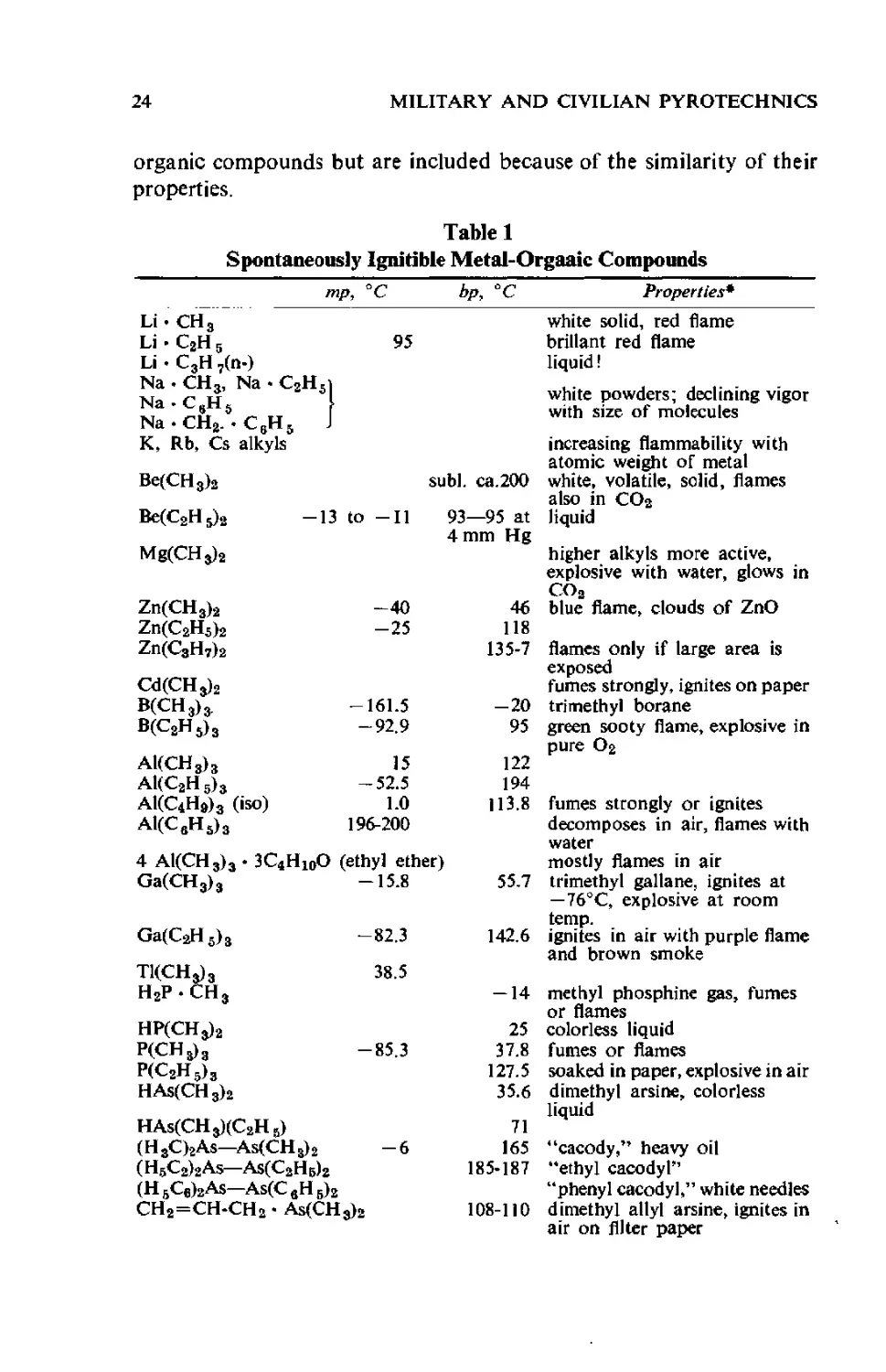
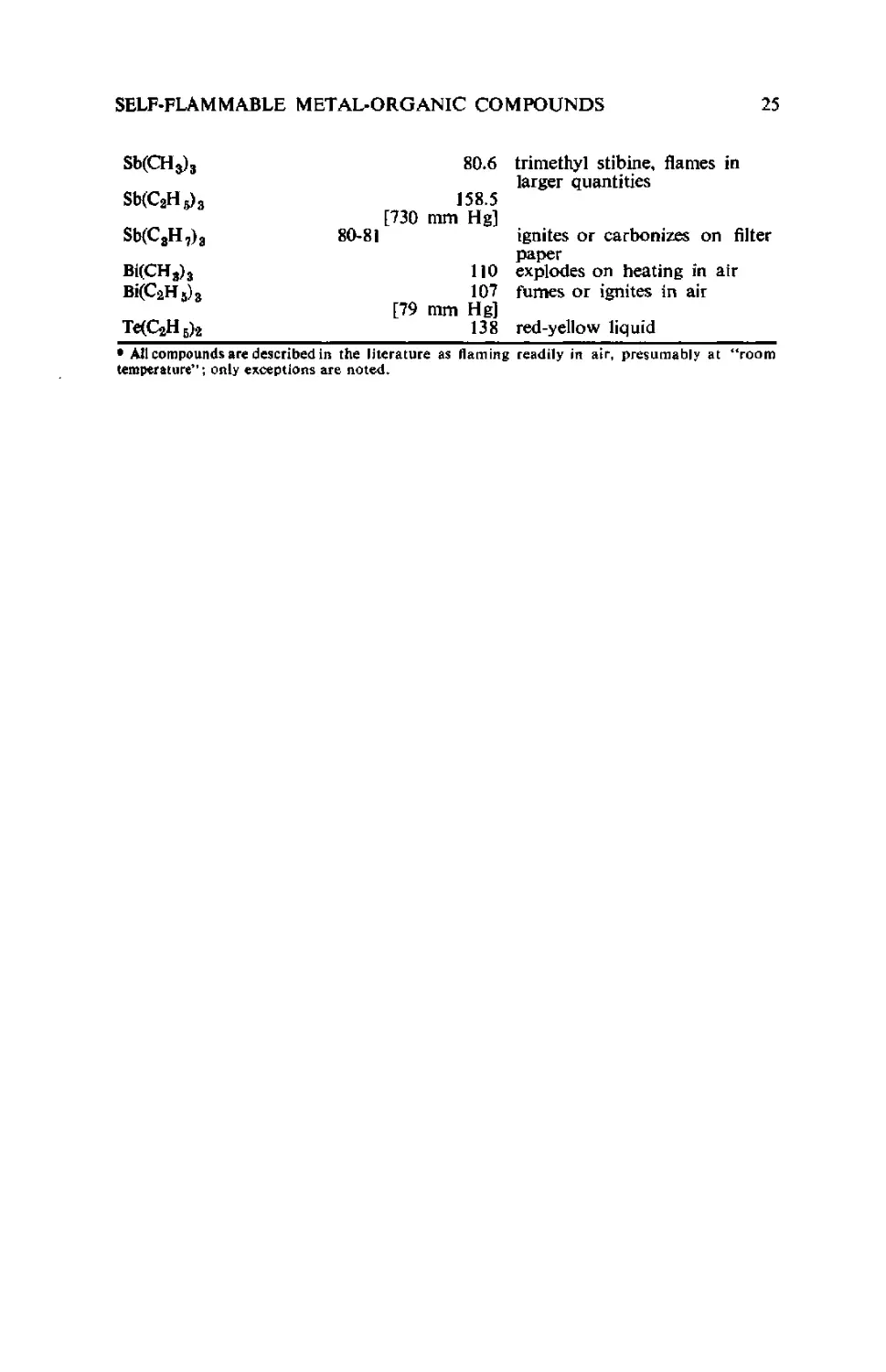
Table 1 of the better known and characterized metal-organic com-
pounds is based on information from major text books61-68 and hand-
books,ee-e® specialized works,84 and some separate articles.85-86
By strict definition, alkyls of boron and phosphorus are not metal-
23
24
MILITARY AND CIVILIAN PYROTECHNICS
organic compounds but are included because of the similarity of their
properties.
Table 1
Spontaneously Ignitible Metal-Orgaaic Compounds
mp, °C	bp, °C	Properties*
Li • CH3 Li • C2H 5	95 Li • C3H 7(n-) Na • CH3, Na • C2H5i Na.CeH5 Na • CH2. • C9H5 J K, Rb, Cs alkyls Be(CH3)2	subl. ca.200	white solid, red flame brillant red flame liquid! white powders; declining vigor with size of molecules increasing flammability with atomic weight of metal white, volatile, solid, flames also in CO2
BeCCsH^	-13 to -Il Mg(CH3)2	93—95 at 4 mm Hg	liquid higher alkyls more active, explosive with water, glows in CO3
Zn(CH3)2	-40 Zn(C2H5)2	-25 ZnfCaHfja са(СНз)2	46 118 135-7	blue flame, clouds of ZnO flames only if large area is exposed fumes strongly, ignites on paper
B(CH3)3	-161.5	-20	trimethyl borane
В(С2Н5)3	-92.9 ARCH 3) 3	15 A1(C2H5)3	-52.5	95 122 194	green sooty flame, explosive in pure O2
Al(C4Hft)3 (iso)	1.0 Al(CeHs)3	196-200	113.8	fumes strongly or ignites decomposes in air, flames with water
4 A1(CH,)3- 3C4H10O (ethyl ether)		mostly flames in air
Ga(CH3)3	-15.8	55.7	trimethyl gallane, ignites at —76°C, explosive at room temp.
Ga(CaH5)3	-82.3	142.6	ignites in air with purple flame and brown smoke
ТКСНЛз	38.5 H2P • CH3 HPtCHjh	-14 25	methyl phosphine gas, fumes or flames colorless liquid
-85.3 P(C2H5)3 HAs(CH3)2 HAs(CH3)(C2Hri)	37.8 127.5 35.6 71	fumes or flames soaked in paper, explosive in air dimethyl arsine, colorless liquid
(H3C)2As—As(CH3)2	-6 (H6C2)2As—As(C2Hg)2 (H6Ce)2As-As(CeH5)2	165 185-187	“cacody,” heavy oil “ethyl cacodyl” “phenyl cacodyl,” white needles
CH2=CH-CH2 • AstCHjjh	108-110	dimethyl allyl arsine, ignites in air on Alter paper
25
SELF-FLAMMABLE METAL-ORGANIC COMPOUNDS
Sb(CH3)3	80-6 trimethyl stibine, flames in larger quantities
	158.5
Sb(CaH7)a	[730 mm Hg] 80-81	ignites or carbonizes on filter
Bi(CH8)3 Bi(C2H5)3	paper 110 explodes on heating in air 107 fumes or ignites in air [79 mm Hg]
ie(U2HE)2	138 red-yellow liquid
* All compounds are described in the literature as flaming readily in air, presumably at “room
temperature”; only exceptions are noted.
chapter 6
White Phosphorus
Paracelsus (c, 1490—1541), physician and philosopher on the na-
ture of man and the origin of sickness, seems to have been the first to
discover “the element of fire” in-the residue of the pyrogenic decomposi-
tion of urine. More than a century later (1669), the alchemist Brandt
discovered or rediscovered the waxy material that miraculously glowed
without heat in the dark and that caught fire on the slightest provoca-
tion. Brandt had “distilled” (i.e. decomposed by heat) urine in the
absence of air in the course of an experiment that was to lead to the
conversion of silver into gold.
After the accidental discovery of phosphorus, better methods of
manufacture were found, but the material, at a price of 50 guineas per
ounce, remained a mere curiosity until another hundred years had
passed. Its use as an ignition material from then on will be traced in
Chapter 12.
Pure phosphorus is a completely transparent colorless solid61 of
m.p. 44.1 °C, but the commercial product is waxy white and after short
exposure to light, yellowish; hence both the names white and yellow
phosphorus for the same material.
Its ignition temperature is variously given between 30 and 60°C,
the higher figure being more realistic. The bulk material has the para-
doxical property of tending to spontaneous ignition at 15.5°C if access
of air is partially restricted by covering the surface with cotton, powder-
ed resin, sulfur, animal charcoal, or lampblack.67 Because of its ease
of ignition, white phosphorus is kept and preferably handled under
water. It may ignite otherwise when cut with a knife or rubbed against
a wooden board. When scattered by the force of a burster charge,
such as the Igniter AN-M9*4 the substance will ignite easily in air and,
in turn ignite various fillings of incendiary bombs. Similarly, it will
ignite when dispersed from items such as the W’P Smoke Shell M302 for
60 mm mortars,41 the M105 for 155 mm howitzers,41 the WP Smoke
Hand Grenade jtf/5,38 or the Navy Smoke Bomb AN-M47A4 with either
26
WHITE PHOSPHORUS
27
100 lb of white phosphorus (WP) or 74 Ib of plasticized white phosphor-
us (PWP),44 The tactical advantages and disadvantages of phosphorus
as a smoke or incendiary material will be dealt with in the proper places.
For the purpose of this chapter, it should only be pointed out that
burning phosphorus after being doused with water will often reignite
spontaneously after drying. This is also true of red phosphorus because
during its burning some of it will volatilize and condense from the vapor
in the white modification.
White phosphorus dissolves easily in carbon disulfide (CS2). If such
a solution is soaked into filter paper or cotton cloth and exposed to
air, the highly volatile solvent evaporates readily and finely dispersed
phosphorus residue bursts spontaneously into flame. Henley87 des-
cribes a “magical act” of igniting paper while breathing on it, which is
based on this phenomenon. Addition of gasoline or toluene to the
phosphorus solution delays the spontaneous ignition because of slower
evaporation rate of the added vehicles.47c
The spontaneous flaming of white phosphorus in air can also be
made more reliable when a eutectic mixture of 55 % of it with 45 % of
of phosphorus sesquisulfide (P4S3) is formed.3 This liquid of d = 1,84
andm,p.=40°C was used in World War II15 in one-shot flame throwers
designed to protect tanks against suicide attacks by foot soldiers (El
Antipersonnel Tank Protector).
Another liquid eutectic (freezing point —7°C) of white phosphorus
contains 25% sulfur3, but nothing seems to have been reported on its
ignition characteristics.
chapter 7
Miscellaneous Pyrophoric Substances
This chapter will deal with a few additional spontaneously igniting
substances. They act in this manner in what might be called their
natural state or, more often, in a special condition of dispersion or
preparation.
The alkali metals form a series having increasing tendency to sponta-
neous flaming with increase in atomic weight: Lithium and sodium will
not ignite in air at ambient temperatures and even up to their melting
points; potassium may oxidize so rapidly that it melts and ignites,
especially when pressure is applied.67 The latter was the case when a
2-cma piece exploded and caught fire after several cuts had been made
with a stainless knife.88 Rubidium will sometimes ignite in dry oxygen.
61-67 and cesium burns in air as it is removed from an inert covering oil.67
The reactivity of the alkali metals is further increased when they are
melted under an inert liquid hydrocarbon, such as xylene, of boiling
point higher than the melting point of the metal, and the mixture is
stirred vigorously.86 This process converts the bulk material into small
globules.
That moisture in the air or in the oxygen plays some partin these
oxidations is evident according to Holt and Sims89 from the fact that
sodium or potassium can be distilled under oxygen that has been dried .
with phosphorus pentoxide. Moreover, the burning metals are said to
have their flame extinguished when “immersed” in thoroughly dried
oxygen.
A more practical way of extinguishing alkali metal fires is to deprive
them of oxygen by covering them with dry alkali chloride, soda ash, or
graphite (carbon dioxide, carbon tetrachloride, and even sodium bicar-
bonate are useless or dangerous).90 Graphite takes a special place
with molten potassium, since it is immediately wetted, swells up, and
disintegrates the metal. If those mixtures are deprived of excess potassi-
um by heating in vacuum, pyrophoric compounds are found to exist of
unusual structure but of definable formulas, C8K and CieK.91 Similar
28
MISCELLANEOUS PYROPHORIC SUBSTANCES
29
“insertion” compounds of rubidium and cesium, from metal vapor over
graphite, have been described more recently in a French article?2
Hauffe71 discusses the surface oxidation of alkali metal, quoting
the theory of Pilling and Bedworth83 that the smaller volume of the
formed oxide is responsible for the progressivity of the reaction. On the
other hand, where the oxide volume is greater as on some heavy metals,
it forms a protective layer.
However, this theory does not explain the existence of pyrophoric
iron or the phenomenon of pyrophoricity at all, as shown in Table 2
by a comparison of the ratio of volume of oxide to volume of element.
Also, in analyzing the problem of autoxidation of the alkali metals,
one must consider than quite different typesof oxides result from burn-
ing of these metals in air, e.g. Li2O, Na2O2, KO2, RbO2, and CsO2.
Table 2
Ratio of Volume of Oxide to Volume of Element
		{according to Pilling & Bedworthy™
Na	0.32	Mg	0.84	Cu	1.70
К	0.51	Al	1.28	Si	2.04
Li	0.60	Pb	1.31	Fe	2.06
Sr	0.69	Th	1.36	Mn	2.07
Ba	0.78	Zr	1.55	Co	2.10
Ca	0.78	Ni	1.68	Cr	3.92
Sodium and potassium form alloys, among them a eutectic of
~12.3°C (9.95°F) freezing point with 77.2% potassium80 This
liquid alloy, perhaps because of its quickly renewable surface area,
is spontaneously ignitible, especially if dropped from a few feet onto a
wooden surface.
“NaK” (pronounced nack), as the eutectic is called, as well as the
alkali metals in general, have found new interest as heat dissipating
and heat transfer agents in nuclear reactors and in motor valve stems of
internal combustion engines. These uses have led to a special series of
articles in the literature on the subject of handling these substances and
their properties.w'81>85’w
The reactivity in air of the alkali metals is more or less preserved
in their previously-described hydrides and also in a few little known
compounds such as their silicides (W. Klemm 1948).ei Brauer87 des-
cribes the preparation of these compounds and characterizes them as
follows: NaSi, self-flammable as loose powder; KSi puffs and flames
in air; with water, all four (i.e. the silicides of Na, K, Rb, Cs) ignite
30
MILITARY AND CIVILIAN PYROTECHNICS
explosively.
We turn now to the elements and compounds that in bulk, or in a
more or less coarsely powdered state, are stable or at least are not
spontaneously ignitible. In order to convert them into the pyrophoric
form, a variety of procedures are employed, all tending to increase the
surface area of the substance.
When the azides of strontium or barium are heated in vacuum to
140° and I6O°C respectively, nitrogen is released and the alkaline earth
metals are formed. These very finely powdered particles of both stron-
tium and barium will burst into flame on admission of air.
This formation of spontaneously ignitible strontium and barium
has been reported by Tiede,98 He also mentions the decomposition of
calcium and lithium azide under the same conditions, but remarks only
that lithium azide is rather explosive on heating.
The following are a number of more generally applicable methods
by which self-ignitible heavy metals and related substances can be pro-
duced :
1.	Pyrogenic decomposition at “low” temperatures of organic
salts such as tartrates. This process yields self-ignitible metal
powders of small particle sizes.
2.	Reduction at relatively low temperatures of finely powdered
oxides by hydrogen,
3.	Transformation of an alloy into a “sponge,” or simply the
alloying process itself, even if the other metal is inactive as in
the case of some amalgams.
4.	Electrolysis of solutions of certain metal salts, using a mercury
cathode. The resulting amalgams or mixtures will yield pyro-
phoric metals after removal of the mercury by distillation.
Processes 1, 2, and 4 produce metal powders of very small particle
size, but the reason for the pyrophoric behavior is not yet fully under-
stood in every instance. Some experiments seem to indicate that adsorb-
ed hydrogen is the cause. In other cases, it is obvious that the metal of
greatest purity is most ignitible and that the presence of hydrogen re-
duces activity. These differences are, however, not irreconcilable since
they may be caused by the different ways in which the hydrogen atoms
are bonded to the reacting metals.
Both Gmelin®6 and Mellor67 quote a variety of conditions under
which metals are produced as pyrophoric substances. An important
observation in cited references is that mixtures of iron oxide with
aluminum oxide will tolerate much higher temperatures (red heat) and
MISCELLANEOUS PYROPHORIC SUBSTANCES
31
still yield pyrophoric iron on reduction by hydrogen.
Increase of surface area by mere mechanical comminution may
sometimes lead to self-flammable products. Such is the case in the
ball-milling of certain stainless steels and of “misch metal” (cerium
alloy) under a hydrocarbon. The process leads to formation of minute
flakes with the character of bronzing powders. Spontaneous ignition
after removal of the liquid in the case of the stainless steels is due to the
absence of a passivating protective layer upon the newly created
surfaces.
The best known pyrophoric metals (using the term in the sense of
spontaneous ignitibility only) are lead, iron, nickel, and cobalt.
Self-flammable lead powder can be made by heating certain organic
salts alone if care is taken to exclude air. Michael Faraday (1791 —
1867), in a delightful little volume of lectures," describes the “lead
pyrophorus" made by heating dry tartrate of lead in a glass tube closed
at one end and drawn to a fine point at the other and then sealed. On
breaking the point and shaking out the powder, he demonstrated to his
“juvenile auditory” how the finely divided lead burned with a red flash.
Beside the tartrate, other organic salts—notably the oxalate and
the formate—yield the more easily produced pyrophoric metals, i.e.
lead, nickel, and cobalt, if the pyrogenic decomposition is performed
at “low” temperature. These organic salts or the oxides of nickel,
cobalt, and iron, under hydrogen at about 300°C, also furnish the self-
flammable metals, but in the case of iron, a pyrophoric ferrous oxide
(FeO) may first appear by reduction with hydrogen as well as by reduc-
tion under carbon monoxide.
The reactivity of nickel is increased by converting it into a “sponge,”
also called “Raney” nickel, which is used as a catalyst in the hydro-
genation of organic compounds. It is made by alloying nickel with
aluminum in equal parts and removing the aluminum by dissolving
it with an alkali. The residual spongy nickel must be kept under water
or oil since it bursts into flame when dry,*50 As a consequence of its
manufacture from the alloy with aluminum, this pyrophoric metal
always contains some aluminum and hydrogen. On removal of the
latter by prolonged aeration of the water slurry, the material loses its
pyrophoricity.100
When nickel is deposited electrolytically on a mercury cathode, it
appears to form an intermetallic compound containing about 24%
nickel, but when the mercury is distilled off, finely divided, strongly
pyrophoric nickel is formed. Iron and cobalt are deposited by electro-
32
MILITARY AND CIVILIAN PYROTECHNICS
lytic process from their salt solutions as very fine suspensions on mercury
cathodes. The iron and cobalt so deposited possess pyrophoric pro-
perties.101
Chromium, molybdenum, and uranium have also been described as
pyrophoric, and Remyeo mentions that chromiun, obtained in a finely
divided state from the amalgam by distilling off the mercury, is pyro-
phoric in air. A recent (1964) Russian article 102 refers to pyrophoric
manganese and manganese nitride, made from manganese amalgam.
The metal is obtained after removal of the mercury through vacuum
distillation, the nitride when the removal is accomplished under
nitrogen.
Evidence for the high reactivity of uranium and some uranium com-
pounds is found in the report by Hartman, Nagy and Jacobson103 that
uranium metal in thin layers ignites at room temperature within a few
minutes after exposure, as do uranium hydride (UH3) and thorium hyd-
ride (ThH2).
Katz and Rabinowitch101 call the powdered uranium “usually
pyrophoric,” UO3 (from uranium and water) “pyrophoric,” and UH3
“often pyrophoric and ignitible on moistening.”
Recently, processes have been invented to produce metal powders
in “ultrafine” condition, i,e. below 0.1particle size. The fuel-type
metals such as aluminum, of an average size of 0.03 /*, are pyrophoric
and must be kept under a hydrocarbon.105-10®-107
Cerium, thorium, and zirconium can be made truly pyrophoric by
alloying. Cerium amalgams, the alloys of cerium and mercury, become
solids if the cerium content exceeds 2%. At 8—10% cerium content,
these amalgams are spontaneously flammable in air.22’®7 Thorium and
zirconium, when alloyed with silver, copper, or gold, become much
more ignitible, bursting into flame on rubbing. Thorium-silver alloys
in approximately a 1:1 proportion are actually self-igniting. These
alloys of 40—60% thorium with silver, made by a sintering process of
powders, are described by Raub and Engels.108 They also describe the
alloys of thorium with copper or with gold as “less pyrophoric.”
Alloys of zirconium with silver, copper, or gold require a rubbing
action in order to exhibit self-ignition, and the alloys of titanium with
silver, copper, or gold are stable.
Brief mention will be given to some self-flammable lower oxides of
active metals. This curious fact—that even lower oxides of elements
can exhibit a strong enough tendency to further oxidation so as to be-
come spontaneously flammable—has been mentioned by Ephraim8®
MISCELLANEOUS PYROPHORIC SUBSTANCES
33
for indium oxide (InO) made by hydrogen reduction; chromous oxide
(CrO) made by oxidation of the amalgam of the metal; and vanadium
sesquioxide (V2O3). Ferrous oxide (FeO) has been mentioned above.
Fricke and Rihl109 have described pyrophoric, pure white ferrous
hydroxide, Fe(OH)2, forming Fe2O3 when it had free access to air, but
Fe8O4 on slow oxidation. The ferrous hydroxide is not stable even in
absence of oxygen.
A pyrophoric iron sulfide made from hydrated iron oxide and
hydrogen sulfide under gasoline has been described recently.110
The easy flammability of some carbonized organic matter (tinder)
is well known and can be increased when organic substances are heated
with various additives in the absence of air. Such pyrophoric or semi-
pyrophoric carbon had some practical uses in the past. Portable, self-
flammable carbon-containing mixtures in sealed glass tubes are men-
tioned in the literature as late as the second half of the last century
under the name of “the pyrophorus,” a word that today is as good as
forgotten.
Crass,20 in his description of the precursors of the modern match,
goes into some detail on these mixtures. They included “Homburg’s
pyrophorus,” a roasted mixture of alum, flour, and sugar, hermetically
sealed, which was essentially an activated charcoal; and “Hare’s pyro-
phorus,” similarly made from Prussian blue heated to redness and
immediately sealed. In 1865 Roesling patented a similar substance
that, “packed in air-tight vessels,” was to be sprinkled on the bowl of a
pipe and brought to red heat by suction, thus lighting the pipe.
Up to this point, all pyrophoric behavior has been reported as tak-
ing place under ambient conditions, meaning the normal atmospheric
pressure. When circumstances are such that a metal is exposed to
an active gas such as oxygen under greatly increased pressure, some
metals may ignite at room temperature even in massive state. This
has been reported for “cleaned” zirconium at oxygen pressures of 300
lb/in.a or higher and for Zircaloy-2 under certain conditions.111
chapter 8
Mechanically-Induced Pyrophoricity
If ambiguity is to be avoided, the term “pyrophoric” should be used
only when ignition occurs completely spontaneously on exposure to air.
However, we have seen in the previous chapters that sometimes a mod-
icum of energy input makes the difference between mere rapid oxida-
tion and flaming or glowing. This energy may do no more than renew
the surface of a liquid or it may simply bring fresh, nonvitiated (i.e.
of normal oxygen content) air to solid surfaces, intensifying the rate
of reaction in both cases.
When we read however, that an alloy of copper, zinc, and harium
metal is described as “pyrophoric, stable in air”112 we realize that a
second meaning, that of “producing sparks when ground or abraded,”113
is attached to the word pyrophoric, causing a need for clarification
where the word pyrophoric is used without further amplification.
Metalsand metal alloys of the spark-producing category—borderline
cases both of pyrophoric behavior and of pyrotechnic interest—are
the subject of this chapter.
The ancient method of striking together flint and steel or flint and
pyrites not only requires considerable effort, but it produces relatively
“cool” sparks that ignite tinder or black powder but not liquids such
as alcohol, benzene, or gasoline. These liquid fuels are easily ignited,
however, by the very hot sparks from alloys of cerium.
Cerium, a rare-earth metal of low ignition temperature (160°C),
is a prodigious producer of white-hot sparks when scratched, abraded,
or struck with a hammer. Most of its alloys share this property. In
practice, the basis for spark-producing “flints” as used in pocket
lighters is a mixture of about 50% cerium with 25% lanthanum, 16%
neodymium, and smaller amounts of other rare earth metals. It is
called misch metal (from the German Mischmetall meaning metal
mixture); its ignition temperature has been given as I5O°C. The com-
plex composition derives from the nature of its raw material, the mona-
zite sand.
34
MECHANICALLY-INDUCED PYROPHORICITY
35
Lighter flint alloys contain additions of iron (up to 30%) for great-
er chemical and physical resistance. The properties of cerium and its
alloys are described in some detail in the major inorganic encyclopedias
and textbooks.
Misch metal, ground under xylene in small ball mills and incorpo-
rated into bridgewire sensitive ignition mixtures and also in some delay
formulas, was still in use in Germany during World War II.49 It seems
to be quite unsuitable for items that have to be stored for a consider-
able time.
Zirconium/lead alloys in a wide range of proportions spark or catch
fire on impact and have been proposed for use as impact igniters for
incendiary bullets, or as tracers that mark the impact of a projectile
by the light effect.114 Similar alloys mixed with organic fuels are claim-
ed in a U. S. patent as self-igniting incendiaries.115
Alloys of either cerium or zirconium with soft metals such as lead or
tin have been described as prodigious spark producers.67-116 Very hot
sparks are also obtained by abrading uranium metal.67
As a final contribution to the use of sparking metal, it should be
mentioned that prior to the invention of Davy’s safety lamp in 1815,
devices seem to have been used that continuously created sparks to
provide some illumination in mines. Mencken117 quotes: “Life is as
the current spark on the miner’s wheel of flint; while it spinneth there is
light; stop it, all is darkness.” However, the only reference this writer
could find on the subject, and a meager one, was by Beyling-Drekopf,16
where the devices are called Lichtmiihlen (“light-mills”'). May one
speculate that it was recognized that such sparks were safer than rush-
lights, candles, or oil lamps because they might have prevented the
explosions caused by firedamp? Biringuccio13 speaks only of oils and
resins as illuminants in mines. His famous contemporary, Agricola,
did not mention the subject at all in his De Re Metallica.™*
chapter 9
Spontaneous Ignition of Common
Materials
Fires and explosions in factories and shops, and more rarely in
homes, may be caused by spontaneous ignition. It is important to
know the circumstances under which such events may take place so that
safety precautions can be taken. This knowledge will also help in differ-
entiating between an intentionally caused fire or explosion and true
accidents. As we shall see, it is also possible to engender a seemingly
accidental “spontaneous” fire and, not quite as easily, an “explosion
without an explosive.”
The oxidation of unsaturated oils such as linseed oil in ambient air
is a strongly exothermic (heat evolving) reaction. Rags used in “wash-
ing up” of printing presses or in cleaning painting utensils are some-
times left in heaps or bundles under conditions where air has access
but cannot circulate freely enough to carry away the heat of autoxida-
tion. Such oil-soaked rags may get hotter and hotter in a few hours,
begin to smolder, and when a temperature of about 350°C is reached
(or less when other easily ignitible materials are present) open flaming
may occur. Commercial oils can be roughly divided as to potential
hazard on the basis of the degree of chemical unsaturation in the mol-
ecule. A measure of this property is the so-called iodine number. A
high iodine number of 170 to 190 means high unsaturation and is found
in tuna, linseed, Chinawood, perilla, menhaden, bodied linseed, sun-
flower, corn, herring, salmon, codliver, and walnut oils. Intermediate
or low are sardine, olive, peanut, and castor oils; lowest are palm,
cottonseed, and cocoanut oils. The hazardousness extends also to
substances naturally impregnated with these oils such as fish meal, fish
scrap, or peanut meal.118-119
A person understanding the principles of this mechanism can deliber-
ately set a fire that not only leaves no incriminating evidence but also
has a delayed action feature that can be determined experimentally be-
forehand with some degree of accuracy and that depends on the ambient
36
SPONTANEOUS IGNITION OF COMMON MATERIALS
37
temperature; the type, amount, and dispersion of the oil; contact with
other combustibles; and the control of air access in a specific arrange-
ment. Such systems are depicted in a recent technical manual.
Morris and Headlee120 have described a laboratory experiment
that is a model of the above-described phenomenon. The relation of
the diameter of spherical piles of various materials to their self-ignition
tendencies has been studied.121 Other authors122-123 have discussed
similar situations of spontaneous combustion of oiled textiles such as
freshly made oil cloth.
Linoleic and linolenic acid are the oxygen acceptors in the linseed
oil. The heat of oxidation of linolenic acid was given to the author121
as 172 cal/g, which ties in with the figures of about 53 kcal/g mole for
ethyl linoleate or linolenate of 308.51 and 306.49 m. w.125 The heat of
polymerization of linseed oil has been reported as 230 cal/g.126
When certain fabricated organic products are stored while still hot
from the manufacturing process and without a chance for rapid dis-
sipation of the heat, destructive exothermic decomposition reactions
that are self-accelerating may occur. This has been observed for piles
of fiber-boards.127-128 K. N. Smith129 has studied this self-heating that
starts at 325 °F and is said to be proportional to the percentage of mater-
ial extractable by a mixture of alcohol and benzene. This is mainly
the natural wood resin in the cellulosic fibers.
When wet hay is piled up, bacterial action takes place with self-
heating when a high relative humidity is maintained (95—97 %). These
biological processes may raise the temperature to 70°C, at which time
the bacteria become the victims of their own metabolism and further
exothermic bacterial action is stopped. However, chemical reaction
may take over from here on and eventually lead to ignition.130
Another hardly ever considered source of heat, under circumstances
similar to the above-described ones, is hygroscopicity, Cellulosic fibers
such as paper or cotton normally contain about 5—12% water in
equilibrium with the humidity in the surrounding atmosphere. When
such moisture is removed by heating, the fibers absorb water from the
air as vigorously as the best chemical drying agents; this absorption
is a strongly exothermic process. In the paper industry, it may lead to
charring, and since some papers tend to be overdried when leaving the
paper machine, the precaution is taken to retain or readmit at least
5% water before winding.131
A few years ago, in the suburban community of Ferguson in St.
Louis County, Missouri, where the author lives, the fire department
38
MILITARY AND CIVILIAN PYROTECHNICS
was called to a home with smoke pouring out. A basket filled with
warm laundry just removed from an automatic clothes dryer had been
set on a bed and had started to smolder. On emptying the basket, its
contents burst into flame. It was impossible to determine what speci-
fically caused the accumulation and production of additional heat, but
similar cases have been reported elsewhere, showing how close to home
spontaneous exothermic reactions may occur.
In addition to these ignition reactions in air, there are occasional
hazards from fuel/oxidizer contacts that cause fires and explosions.
By classification, they would belong in the next chapter, but as hazards
in normal civilian life, their description follows here.
The increased use of calcium hypochlorite bleaching powder,
Ca(OCl)2, for disinfection of swimming pools has led to unexpected
accidents. While ordinary solid bleaching powder consisting of chlori-
nated lime, CaCl(OCl), with half the oxidizing power can cause spon-
taneous flaming, the hazards of the newer hypochlorite are much more
severe. A mixture of calcium hypochlorite and an organic fungicide
has caused a destructive fire and a trailer containing both soap powder
and the bleaching powder in bags has been reported to have exploded.132
Not so very long ago, the slaking of burnt lime was an impressive
little spectacle wherever the old-fashioned building mortar was prepared
from hydrated lime and sand. It was known in antiquity that a moist-
ened mixture of quicklime and an easily flammable material such as
naphtha or sulfur created enough heat to ignite the fuel-type material.
Partington14 quotes various reports of this process being used or sus-
pected of being used either for incendiary purposes or for pretended
magic with religious overtones. We shall meet the heat-producing pro-
perties of lime once more in Chapter 26.
Undoubtedly, the intrusion of more and more highly-reactive
chemicals into everyday life will further increase the danger of fires and
explosions of seemingly obscure origin.
A quite different hazard from spontaneous ignition that is of great
concern where finely powdered combustible substances are produced or
handled is the destructively explosive combustion of dusts. It concerns
the pyrotechnics manufacturer because of his handling of finely powder-
ed metals of great susceptibility to accidental ignition.
In the realm of common dust explosions, we move along the farther
borderline of pyrotechnics, but a few remarks are not amiss because the
phenomena, except for their industrial safety aspects, fall into a no-
man's land. They are not treated in the literature of explosives and do
SPONTANEOUS IGNITION OF COMMON MATERIALS
39
not exactly belong in pyrotechnics.
Dust explosions resemble gas explosions because of the enormous
force that both exert on structural parts. Roofs are blown into the air
and building walls burst apart. In gas explosions, we have a gaseous
hydrocarbon mixed with air and the progression of combustion is thus
able to proceed with the speed of an explosive deflagration. In dust
explosions, the conditions are quite similar, each fuel particle being
surrounded by air. It is in the nature of such explosions that they exert
a considerable pressure for a longer period (long by the standard of
explosive action, i.e. of milliseconds) on large surface areas, which ex-
plains the force and extent of their destructiveness, In contradistinc-
tion, a properly set off high explosive such as dynamite sticks or blocks
of plastic explosives detonate with a much more shattering force, but
their effects are more local as long as relatively small amounts are
involved. Thus, the unfortunate acts of terrorism in civilian life, per-
formed mostly with stolen dynamite, generally do little damage, whereas
a gas leak followed by lighting of a match may completely erase a build-
ing.
The term "static electricity” is understood to mean a high-voltage
low-current electrical discharge in the form of often visible sparks caus-
ed by contact and separation of dissimilar nonconductors and also of
insulated conductors of electricity. It is nowadays in constant evid-
ence in connection with synthetic “plastic” films and fibers and also
with wool and silk used in clothes, carpets, upholstery materials, etc.
In the case of dusts, static electricity is created by the movement of the
particles, and certain sensitive metal powders can ignite by being poured
from a sheet of paper or plastic film. Low relative humidity favors
buildup of static electricity.
Normally, the cause of a dust explosion will remain unknown,
especially in a factory where sparking electrical contacts, hot surfaces
from steam lines, clandestine smoking, and other ignition sources may
have existed but no proof or evidence could be found under the rubble.
The National Fire Protection Handbook133 furnishes interesting
statistics on the extent and variety of dust explosions in the United
States throughout the first fifty nine years of the century. Of 1110
major accidents of this type, the most damaging and most injurious to
life have been those affecting grain elevators and processing plants for
starches, flour, wood, feed, and cereals. Metals are frequently involv-
ed, coal dust much less than might be thought. Cork, sugar, sulfur,
plashes, bark, cotton, coffee and spices—all have caused loss of life and
40
MILITARY AND CIVILIAN PYROTECHNICS
property through jiust explosions.
Fieldner and Rice134 and Hartmann and Greenwald135 have rated
numerous fine metal powders and commercial products as to suscepti-
bility to accidental ignition and explosion. Kalish136 has brought the
hazard into a somewhat different focus by relating it to the settling rate
of metal powders in air: Particles of 100,u size settle at about 60 ft/min;
of 50^ at 10 ft/min; and of 10p, at % ft/min. Because of nondirectional
turbulent flow of air in a room of about 25 ft/min, fine metal powders
will disperse readily and float for prolonged times if given an opportuni-
ty to escape from their container during scooping, etc.137138
A recent U. S. Bureau of Mines report also rates the metal powders,
with the rather surprising result that aluminum dust is classed with
seemingly more hazardous metal powders such as magnesium and
thorium in the most susceptible group.139 Another report discusses
the prevention of such ignition by the use of powdered additives with
inerting properties.140
Accidents involving flammable dusts occur frequently in two stages
—an initial “blow” that in turn disperses more material, which then
may also explode. Systems have been devised that claim to be able to
sense within ten milliseconds the heat and pressure from a dust or gas
explosion and counteract it by discharge of water or inert gas. Thus, an
incipient accident can be effectively suppressed.141
A relatively small explosion with high explosives can be arranged
in such a manner that it provokes a sizable dust explosion. This was
done during World War II in semi-military sabotage activities. Opti-
mum conditions for dispersion and ignition of materials in ships or
warehouses are rather difficult to achieve, and studies on the subject
may be found in certain reports and manuals that fortunately are not
accessible to the general public.
chapter 10
Self-Igniting Fuel-Oxidizer Systems
The spontaneous or easily induced incandescent reactions involving
a fuel and an oxidizer other than air comprise an array of dissimilar
pairs of reactants and numerous modes of activation. They will be
presented in the following order:
1.	Halogens and halogen compounds with fuels;
2.	Water-activated systems in which the water is either the oxidant
itself or acts indirectly through hydrolytic reaction or as a
physical medium;
3.	Liquid oxidizers and fuels and the closely related acid-activated
fuel-oxidizer mixtures;
4.	Spontaneous reactivity of solid oxidizers with solid fuels.
The free halogens fluorine and chlorine gas, liquid bromine, and
solid iodine form a series with decreasing reactivity with increase of
atomic weight. Fluorine was discovered by Henri Moissan (1886) who
tested its reactivity extensively. At ordinary temperatures this gas
combines in incandescent reaction with all but the noble metals but
only superficially with those that form a protective coating on the solid
surface—magnesium, zinc, copper, tin, nickel, bismuth, and lead. The
direct combination with carbon under glow is remarkable, as is an in-
candescent reaction with silica (SiO8) of large surface area. Many
organic substances are ignited on contact with fluorine gas; ordinary
protective clothing may catch fire when hit by a stream of the gas.
Conversely, some organic substances such as sugar and mannite are
curiously unreactive.
Moissan’s often-cited assertion that liquid hydrogen and solid
fluorine will combine explosively at —253°C has been refuted by
Aoyama and Kanda.142 Other modern investigators (Bodenstein,
1934; Grosse, 1955) have found that the reaction of hydrogen and fluo-
rine at very low temperatures depends on the presence of catalytic
agents and impurities and even on the choice of container.
Chlorine gas combines with flame or glow with powdered arsenic,
41
42
MILITARY AND CIVILIAN PYROTECHNICS
antimony and bismuth, and with copper, magnesium, zinc, and steel
wool. White phosphorus explodes with liquid chlorine. The reaction
of hydrogen gas with chlorine has found much interest, and aroused
speculation during the nineteenth century, because it proceeds in pro-
portion to the amount of absorbed visible or ultraviolet radiation.
Thus, if the two gases are mixed in the dark in a transparent container,
the mixture will be quite stable but will react explosively when irradiated
by burning magnesium. Based on this reaction. Draper invented an
actinometer in 1843, later improved by Bunsen and Roscoe.
Bromine reacts with incandescence with white phosphorus, arsenic,
and antimony, but is generally less reactive than chlorine. Iodine, in
turn, is still less reactive than bromine and some of its flaming reactions
require increase of intimate contact by pressure because it is a solid.
In the case of aluminum powder and iodine, the presence of water pro-
motes intimacy of surface contacts, causing flaming reaction.61
The effects of the halogens on the alkali metals vary with tempe-
rature, dryness, and other conditions and consequently the reported
phenomena, especially in secondary references, are sometimes con-
tradictory. Coating of the metal surface with at least a temporarily-
impervious layer of the halide may stop progression of the reaction.
The interhalogen compounds are highly reactive substances, especial-
ly those containing fluorine.143 Chlorine trifluoride (CIF3) of b.p.
11 °C is in many respects more reactive than fluorine and flames instan-
taneously not only with many organic substances but even with alum-
inum oxide and magnesium oxide. Similar in behavior is bromine
trifluoride (BrF3) of m.p. 8.8°C and b.p. 135°C. Other interhalogen
compounds, all very reactive, are CIF, BrF, BrF&, 1F5, and IF7. More
recently discovered was the compound chlorine pentafluoride (C1F5) of
m.p. approximately —103°C and a b.p. of —18.1’C.
Chlorine trifiuoride seems to have been considered as an incendiary
material in World War H by the Germans, who built a 1000-ton plant
for its manufacture. A welding and cutting torch for copper using
chlorine trifluoride and hydrogen has been described.67
Even more reactive and called one of the strongest oxidizers in
existence is the compound ozone difluoride (O3F3),e1-144 which, how-
ever, already decomposes at - 153°C. Other highly active com-
pounds are OF2 and O2F3, and the explosive compounds O3NOF and
O3C1OF, both derivatives of a hypothetical hypofluoric acid.
Many of the above-named halogen compounds have found use, at
least experimentally, as high-energy components of propellant systems;
SELF-IGNITING FUEL-OXIDIZER SYSTEMS
43
others are useful for the synthesis of organic compounds.
Because of the high heat of formation of many metal halides, the
other halogens, especially chlorine, may play a part in some quite un-
expected spontaneous reactions even though the chlorine compound
involved is seemingly unreactive and, unfortunately, unsuspected of
any possible mischief.
Sodium-potassium alloys have been reported to detonate on contact
with silver halides. The word “detonate” seems to be used freely in
the general literature to emphasize violently-explosive reactions without
specific reference to a measurement of high-order detonation velocity.
However, the reaction of the sodium-potassium alloys with organic
halogen compounds such as carbon tetrachloride (CC14) has been speci-
fically reported as high-order detonation, able to initiate substances
that are difficult to detonate. It has been stated that the shock sensi-
tivity of this combination is two hundred times as great as that of
mercury fulminate.145 Similarly, one finds explosive reactions of the
single alkali metals with carbon tetrachloride, chloroform (HCC13),
and diiodomethane (CHJg).8'69
Since many of our thought processes and ensuing convictions and
attitudes (posing as “sound common sense”) are based on mere anal-
ogies and jumping to ill-founded conclusions, it is understandable
that carbon tetrachloride, the popular nonflammable solvent and clean-
ing fluid, has been wrongly endowed with the property of inertness.
As shown above, it is a most hazardous oxidizer in combination with
reactive fuels. Tri ethylaluminum has been reported146 as exploding
violently with this solvent when a cooled mixture reached room tem-
perature.
Lindeijer147 reports a fatal accident from the explosion of powdered
aluminum with carbon tetrachloride, and van Hinte148 describes a case
of spontaneous ignition of clothing, apparently contaminated with
aluminum dust, while being degreased with trichloroethylene.
The instability of organic chlorine compounds in the presence of
zinc and moisture is of interest in pyrotechnic smokes (see Chapter 18).
Water is the oxidizer in flaming reactions with potassium, rubidium,
or cesium metal, which explosively burst into flame on contact. A plum-
sized piece of potassium thrown into water “as a joke” was said to
have killed a German university student in the early part of the century.
Sodium will not burst into flame when thrown onto cold water as long
as the piece of metal can skim freely over the surface of the water. The
moment it attaches itself to the wall of the vessel or is purposely held
44
MILITARY AND CIVILIAN PYROTECHNICS
in one place, it will burst into flame, ignite the developed hydrogen if
accumulated, and often will disintegrate explosively. The same occurs
if the water is thickened by some colloid, such as starch paste, if the
water temperature exceeds 40°C, or if the metal is porous or finely
divided?6 This increased activity of the alkali metals can be used for
ignition by water of gasoline gelled with napalm if as little as 2% of
dispersed sodium or potassium (in xylene) are admixed to the gel.
Lithium is the least active of the alkali metals but a dispersion of it
will ignite if thrown on water.146
That the flaming reactions of the alkali metals and water need no
air may be shown by the fact that sodium (and after some delay, lithium)
ignites in an atmosphere of steam and argon, and a lithium dispersion
will ignite in liquid water under argon.150
Even if we disregard the element lithium whose behavior at the top
of the vertical column in the periodic system tends to resemble that of
the elements of the second column (Ca, Sr, Ba), there is no Coordination
between spontaneous flaming and heat output from the reaction with
water, though there may be a connection with the melting point of the
metals when we keep in mind the influence of renewal of the surface on
reactivity. Table 3 shows these relations. In calculating enthalpies in
pyrochemically unusual cases of this kind, one must clearly state if
the water is included as a reactant and also if the considerable heat
of solution plays a part. In the cited study,150 the heats of formation
of the hydroxides dissolved in an infinite amount of water were given,
rather than the true heats of reaction, which may have been inten-
tional.
Table 3
Reactions of Alkali Metals and Water*
	Li	Na	К	Rb	Cs
Molar Heat of Reaction (kcal)	48.13	33.67	33.46	30.6	28.9
Me(s)+ H;O(l)-McOH(s>- i/2Hj same per g Me	6.9	t.5	0.9 ‘	0.4	0.2
Me(s)+H2O(I)-»MeOH (aq <x>)	53-19	42.92	46.68	45.6	45.9
same per g Me	7.7	1.9	1.2	0.5	0.4
M.p. of metaPC	180.5	97.8	63.6	38.8	29.7
B.p. of metaPC	1370	883	775	680	700
* Figures taken, expanded, and modified from Reference 150.
The hazardous practice of using the reactions of the alkali metals
with water to perform a practical joke has been described by H. Allen
Smith.151 Henley87 mentions a magic trick whereby drinking water
SELF-IGNITING FUEL-OXIDIZER SYSTEMS
45
is “ignited” when it is poured into a brass bowl onto a small piece of
potassium covered with ether. Aside from such unusual practices, the
reactivity of alkali metal and water has limited use. Certain Navy
incendiary bombs contain an igniter loaded with white phosphorus for
ignition on land or filled with sodium for use over water, such as the
Igniter AN-M9 (formerly called Igniter El} or Igniter И15.44 A burster
scatters the sodium, which ignites or continues to bum on contact with
water, and will ignite the incendiary filler of the bomb. Sodium and
methyl nitrate in separate compartments and brought together by
breakage under pressure were used in a land mine by the Germans in
World War II.*8 Methyl nitrate, called “Myrol” was regarded as an
explosive more powerful than nitroglycerine.
In ordnance design in general, highly reactive components of fuel-
oxidizer systems are a poor choice as long as a similar effect can be
achieved with less-active substances. One must consider not only
the difficulties of handling such materials prior to loading but also the
consequences of leakage during storage of the finished item. Damage
or insufficient sealing may cause at best inerting through influx of air
or moisture and at worst a premature reaction and destruction of the
unit and its surroundings.
On the other hand, the number of highly reactive chemicals that
advance from the stage of laboratory curiosities to commercial items is
constantly increasing, Some of these are sodium hydride (NaH),7e
lithium aluminum hydride (LiAlHJ,152 lithium borohydride (LiBH4),1&3
aluminum and beryllium borohydride, A1(BH4)3 and Be(BH4)2,15* the
sodium salt of nitromethane “sodium methane nitronate” or if one
prefers “sodium nitro methanate” (H2CNO2Na),69'155 and barium
carbide (BaC2),159 all of which can flame on contact with water. Again,
it must be stressed that particle size and other conditions of exposure
may determine whether there is flaming or merely a violent reaction on
exposure to water, air, or both.
In a somewhat different manner, the hydrolytic and heat-forming
influence of water prevails in some fuel-oxidizer systems that are reac-
tive in the common manner of pyrotechnical combinations, but will
also be brought to an intensely-hot flaming reaction by the addition of
small amounts of water. Most of these combinations contain sodium
peroxide as the oxidizer. Aluminum and magnesium, mixed with
sodium peroxide, have been recommended as igniters for the thermite
mixtures described later. The magnesium/sodium peroxide can even
be initiated by carbon dioxide. The high reactivity of these combi-
46
MILITARY AND CIVILIAN PYROTECHNICS
nations makes such ignition mixtures quite perishable, especially when
exposed to ambient air, which is never completely devoid of moisture.
Sodium peroxide will also ignite organic matter such as sawdust,
paper, and numerous organic compounds, e.g. hexamethylene tetra-
mine, when the mixture is moistened. Since sodium metal burning in
air forms sodium peroxide, it is not enough to let accidentally ignited
sodium burn itself out. The newly formed peroxide becomes a second-
ary fire hazard and must be destroyed. Moreover, if a larger pool of
sodium burns, a part of the metal tends to stay unburnt, since nodules
of the peroxide form that enclose unreacted metal.157
Water may cause spontaneous ignition in some fuel-oxidizer sys-
tems without taking part in any chemical reaction at all. In the case
of mixtures of aluminum powder and iodine mentioned earlier, it
appears to be simply a matter of promoting contact. In a different
manner, a mixture of magnesium powder and finely crushed silver
nitrate will burst into flame with a dazzling flash on moistening. The
water causes electrochemical exchange between the magnesium and the
silver ion, due to their respective positions in the electromotive series.
The heat of reaction of this exchange provokes the pyrochemical effect.
This remarkable, often violent reaction seems to have escaped even
such diligent compilators as Gmelin and Mellor, perhaps for the good
reason that it never has been described in the scientific literature. A
somewhat similar but far less spectacular exchange reaction (and, in
fact, difficult to produce) takes place between cupric nitrate and genuine
tin foil67 and is said to produce flaming or sparking after intimate con-
tact. Cupric nitrate will also ignite paper spontaneously on prolonged
contact.
An Italian patent158 refers to an “incendiary mixture activated by
water drops” of powdered magnesium, anhydrous copper sulfate,
ammonium nitrate, and potassium chlorate. The water permits both
the exothermic reaction Mg+Cu++—>Mg+ + 4-Cu and the metathetical
reaction of the salts, which produces the unstable ammonium chlorate.
The latter then reacts with excess magnesium. While it is claimed that
“little heat is produced in moist air,” this mixture is undoubtedly un-
stable and hazardous. There is a possibility of spontaneous ignition
whenever a chlorate and an ammonium salt are present, though in some
formulas they appear to be harmlessly combined.
Self-ignition under the influence of moisture has another and more
complex aspect, which often has plagued fireworks manufacturers in
the past. In fireworks formulas with chlorate and sulfur, the oxidation
SELF-IGNITING FUEL-OXTDTZER SYSTEMS
47
of the sulfur in the presence of moisture can lead to acidification of the
system. In the absence of neutralizers, chlorine dioxide (C1O2) or (at
slightly elevated temperature) chlorine and oxygen gas are evolved.
These, in turn, act as strong oxidizing agents. If the rate of the initial
reaction, induced by gradual infiltration of moisture, is slow, nothing
worse than decay of the composition will result, but it can readily be
seen that the decay can become self-accelerating to the point of self-
ignition.
Under ordinary conditions, the alkali chlorates will ignite or explode
spontaneously or nearly spontaneously only when in combination with
the most reactive fuels, such as white or red phosphorus, powdered
arsenic, or selenium. The chlorates of the alkaline earth metals and of
other heavy metals are even more reactive and spontaneous ignition can
occur quite readily with a number of fuels and in the presence of mois-
ture.
Arniel159 has studied the reactivity of the alkaline-earth and heavy-
metal chlorates with sulfur in the presence of a little water and has
found that below 50—60°C, chlorine dioxide is liberated, but that above
these temperatures, chlorine and oxygen are evolved. This leads to
occasional flaming in the presence of organic matter. Amiel also
reports incandescent reactions between selenium and alkali chlorate.
Taradoire*160 reports that wet sulfur, and barium or lead chlorate,
flame spontaneously during drying, but that no flaming occurs with
potassium chlorate. However, potassium chlorate has caused deterio-
ration when used commercially in such items as railroad fusees. These
examples show the relative instability of chlorate-containing systems in
the presence of moisture. However, in matches where chlorate, sulfur,
and organic binders are combined and exposed to the atmosphere,
decomposition is virtually unknown. This shows that proper formulat-
ing with inclusion of acid-neutralizing substances can successfully break
the chain of gradually destructive oxidation-reduction reactions.
The strong oxidizing power of the free chloric acid can easily be
demonstrated by saturating filter paper or linen cloth with the 40% acid,
whereupon the organic substances will catch fire with some delay.
Fuming nitric acid has the ability to oxidize many organic com-
pounds vigorously and instantaneously under incandescent reaction.
This characteristic is of great practical importance. The reactions not
only furnish heat and flame, but produce only gaseous reaction pro-
*Noi Taradoire as misspelled in C. A. 28 (1934).
48
MILITARY AND CIVILIAN PYROTECHNICS
ducts; therefore they have found use as self-starting, so-called hyper-
golic rocket propellant combinations. The system of nitric acid and
aniline with nitromethane added is an example of such a reaction system.
Other oxidizers in hypergolic systems are nitrogen tetroxide and te-
tranitromethane, or concentrated (80%) hydrogen peroxide, in com-
bination with hydrazine, water, and methanol. Highly active oxidizers
such as chlorine trifluoride or fuels such as triethyl aluminum have
been considered in hypergolic propellant or propellant-ignition sys-
tems but the field is really outside strictly pyrotechnical aspects if we
discount the possibility of using such technically rather complex sys-
tems as “liquid flares” or incendiaries.
Several acid derivatives have very strong oxidizing power and some
of them have been tried as igniters for hydrocarbons in flame throwers.
Such compounds are chromium trioxide (CrO3) and chromyl chloride
(CrO2CI2)—the anhydride and chloride respectively of chromic acid,
and manganese heptoxide (Mn2O7)—the anhydride of permanganic
acid (НМпОД181
Other extremely reactive low-boiling substances, all discovered
fairly recently, are: chromyl fluoride (CrO2F2);162-163 chromyl nitrate,
CrO2(NOs)2;164 permanganyl fluoride (MnO3F);16S chloryl fluoride
(C1O2F); perchloryl fluoride (CIOaF); and a number of active
nitrogen-fluorine compounds166 such as NF3, N2F2, N3F, HNF2,
H2NF, CINF2, NOF, NO2F, and NO3F. To these might be added
the well-known and stable compound, nitrosyl perchlorate.167
In contradistinction to these substances that are difficult to handle
and for pyrotechnic purposes overly reactive, there are Combinations
that are noncorrosive and relatively harmless in themselves. They can
be reliably brought to flaming by the addition of the corrosive, but
otherwise easily manageable, concentrated sulfuric acid that liberates
the aciive acid from its salt. Most ofien used is poiassium chlorate with
sugar or nitrobenzene. Dry mixtures will burst into flame on the addi-
tion of a few drops of sulfuric acid, or will explode if mercury fulminate
is present. They have been frequently employed as incendiaries for
sabotage and in bombs. Their advantage as incendiaries lies in the
fact that the reaction can be delayed for hours, days, or weeks by mak-
ing use of the corrosive action of the acid to work its way through some
barrier.
In another setup, the acid gains in volume by absorbing moisture
from the air. This leads eventually to a siphoning action into the active
material. The diluted acid will react with the chlorate though more
SELF-IGNITING FUEL-OXIDIZER SYSTEMS
49
slowly than it does in the concentrated state. Similar contraptions
utilize tilting and spilling or breakage to bring acid, a fuel such as
gasoline, and chlorate together.
The use of the chlorate and sugar or nitrobenzene mixtures for
purposes of political assassination and sabotage as in “partisan mix-
tures,” and their modifications to produce delayed reaction mixtures
such as “Molotov Cocktails” are described by Stettbacher.17 He
attributes the death of Tsar Alexander II of Russia in 1881 and the
Irish baggage explosions in London in 1938 to bombs containing such
ingredients. The author also quotes in this book articles by himself
about chemical ignition.1*8-169
For more genteel uses, the reaction between chlorate and sulfuric
acid was used early in the nineteenth century for a type of match that
will be described in Chapter 12.
Acid-activated prime ignition fails with perchlorates because of the
greater stability of the perchloric acid. However, the free, anhydrous
perchloric acid reacts explosively with combustible substances such as
charcoal, paper, wood, ether, and even with phosphorus pentoxide.
In the latter case, the effect is due to the formation of the explosive
and unstable chlorine heptoxide (С1гО7), a volatile oily liquid.
A severely destructive explosion in Los Angeles in 1947 was caused
by a mixture of 68—72 % perchloric acid with acetic anhydride used
for electropolishing of aluminum plates.170 In general, the perchlo-
ric acid as usually encountered, in concentrations of 70% or less in
water, is rather harmless aside from the fact that it is a very strong acid.
However, if it should be soaked up accidentally in combustible mater-
ial, it would greatly aggravate an existing fire.
A Safety Data Sheet1"11 on perchloric acid gives excellent advice
about the handling of the acid at different concentrations. This is par-
ticularly difficult in a case where the hazard is conditional rather than
straightforward, as is the case with the 70% perchloric acid. It is clear-
ly stated that spillage of this acid on organic matter may become hazard-
ous under the following conditions: additional heat, an existing fire,
or presence of strong dehydrating agents.
In contradistinction to the perchlorates, the oxidative power of the
permanganates surpasses that of the chlorates. Glycerine brought
together with dry crystals of potassium permanganate will burst into
flame within 8—10 seconds after contact. Because of the high viscosity
of the glycerine and the consequently slow wetting of the permanganate,
this reaction is improved by a slight dilution of the glycerine with water.
50
MILITARY AND CIVILIAN PYROTECHNICS
On the other hand, a more reactive and thinner organic fluid such as
dimethyl sulfoxide, (CH8)2SO, and finely powdered potassium per-
manganate will flash instantaneously.
The reaction of permanganate and glycerine is mentioned by
Stettbacher.17 Rathsburg and Gawlich172 describe analogous reactions
in which the glycerine is replaced by substances such as ethylene glycol,
acetaldehyde, or benzaldehyde.
The stability of the salts of acids containing easily reacting oxygen
decreases with increase in the valence of the cation. Consequently,
calcium permanganate is even more reactive than the potassium per-
manganate. It can ignite alcohol, paper, and cotton.
When a permanganate and concentrated sulfuric acid are combined,
the highly reactive manganese heptoxide (Mn2O7) and some ozone
(by decomposition of the anhydride) are formed—both powerful ox-
idizers that easily cause flaming reaction with many fuel-type subs-
tances. The manganese heptoxide itself tends to explosive decom-
position at somewhat elevated temperatures. Therefore, a potentially
hazardous condition may exist when potassium permanganate is placed
in a desiccator where sulfuric acid is the drying agent.
All the previously described mixtures contain at least one gaseous or
liquid component, or liquid is added in order to increase intimacy of
contact. Otherwise, as in the case of iodine, pressure has to be exert-
ed with some solid fuels to produce flaming.
One combination of two solids exists in which a flaming or even ex-
pldsixereaction may take place on merely pushing the powders toward
each other or ofl wtertum of very light pressure. This reaction occurs
when the powdered components are completely dry and the fuel is not
superficially oxidized. The two materials are red phosphorus and
potassium chlorate and a demonstration of their reactivity should be
performed only with a few milligrams of each component. When the
phosphorus has been kept for some time in an ordinary reagent bottle,
the spontaneity of the reaction may not be so obvious, but the final
effect may be just as disastrous, as has been shown many times when
high school students have appropriated and mixed together the two
chemicals.
This reaction is undoubtedly the most fascinating, and perhaps
theoretically the most interesting, solid reaction. It has been ingenious-
ly tamed in the modern safety match, which will be treated extensively
in the twelfth and final chapter on primary ignition.
Red phosphorus and chlorate can be mixed in comparative safety
SELF-IGNITING FUEL-OXIDIZER SYSTEMS
51
in the presence of a liquid vehicle, provided both reactants are thor-
oughly moistened by the vehicle before they come into contact. Using
an aqueous binder solution, small dabs of such a mixture form the ex-
plosive ingredients of toy caps. If alcohol or ether is used as the vehicle,
it is possible to load larger amounts of the mixture in specially designed
containers, so constructed as to allow the liquid to evaporate. The
capsule is then converted into a formidable antipersonnel mine, because
slight pressure will explode the device.*17
The above-described combinations of red phosphorus, poiassium
chlorate, and a binder are called Armstrong's mixture. Its preparation
and application has been described by Davis.8
Toy caps are called amorces in Germany and sometimes in England
from the identical French word meaning a percussion primer or prim-
ing mixture. While the word is neither in Webster’s Dictionary173 nor
in the Oxford English Dictionary,174 it appears without comment in
the title and text of a World War II British Intelligence Objectives Sub-
Committee (BIOS) report.175 The Germans used toy caps in World
War II as hand-grenade primers because of a shortage of mercury
fulminate. The two formulas given in the report as well as the formula
from Davis’ book (Formulas 1, 2, and 3) will be found, with all the
following, in Chapter 47.
The phosphorus/chlorate/binder combinations are at the borderline
between spontaneous reaction and manageable, easily initiated, but
stable systems of reactive fuels and oxidizers. Those that have practical
application will be treated in the following chapter on primers. At
this juncture, mention will be made merely of some highly sensitive
solid-solid combinations of little or no practical value, though of course
odd mixtures may some day be useful agents for the fulfillment of new
requirements.
Red phosphorus forms mixtures that burst into flame or explode
on mild friction or impact, not only with chlorates but also with per-
manganates, lead dioxide (PbO2), perchlorates, and other active ox-
idizers such as silver nitrate. Chlorates form friction- and impact-
sensitive mixtures with most pyrotechnic fuels, in particular with sulfur
and thiocyanates. Chlorates are not only sensitive with arsenic but it
has been reported®5 that arsenic (III) oxide, As2O3, is self-flammable
with sodium chlorate. Mellor57 quotes an old German reference170
*A variation of this item using small amounts of the mixture has been proposed as
an anti-infiltration device, causing flash and sound bui no injury.
52
MILITARY AND CIVILIAN PYROTECHNICS
according to which sublimed arsenic* when triturated with an excess
of silver nitrate “takes fire immediately when shaken out on paper.”
“In German, the word Arsenik refers exclusively to the compound As2O8, while the
element bears the name Arsen. It is possible that the identity of “arsenic” might in
some places get lost in the translation,
chapter 11
Primers
Spontaneous ignition, as previously described, has only a few legiti-
mate uses other than in hypergolic propellant systems. The exposure
to air or the bringing together of liquids and solids are actions that are
rarely suitable for quick, reliable, and easily performed ignition—not
to speak of the design, loading, surveillance, and safety aspects of
such systems. On the other hand, if we provide a certain defined
small energy input acting on an often minute quantity of a solid, stable,
but sensitive mixture or compound, we can produce instantaneous and
reliable flash and flame. In certain cases, as will be shown later in
this chapter in discussing electric primers, even relatively insensitive
mixtures can be employed as prime ignition charges.
Primers fall into two categories according to the mode of activation
—by impact or by electricity. Impact-initiated primers can in turn be
divided into stab primers (detonators) and percussion primers. Electri-
cal initiation is generally performed by means of a heated resistor that
in most cases is a short piece of very fine resistance wire. The items
are called electric matches, electric primers, squibs, actuators, etc.
Since priming devices are merely subordinate components of pyro-
chemical systems, such as flares, guns, rocket motors, and blasting
caps, an extensive and fully detailed treatment is not attempted in this
book.
The salient points have been taken from the Ordnance Explosive
Train Designers'1 Handbook 45 recently declassified, and some other
sources, such as NavOrd Report 6061177 and the AMC Pamphlet Ex-
plosive Trains.1™ Commercial catalogs,179*180 which have also been
consulted, mostly let the customer guess as to actual compositions,
though the major ingredients may be indicated. Percussion primers
are always standardized and commercially available mass-produced
units that change little except by adaptation of formulas to modern
requirements for greater stability and heat resistance; in contradistinc-
tion, the field of electrical initiation is in constant flux, with energy input
53
54
MILITARY AND CIVILIAN PYROTECHNICS
requirements and the choice of active materials changing from year to
year.
Stab igniters are the most sensitive mechanically-actuated primers
used where the available mechanical energy is small. Because of this
sensitivity requirement, the priming mixture contains a large percentage
of prime explosive such as lead azide or, in older formulas, mercury
fulminate. Consequently, the effect is one of high brisance (shattering).
Stab primers (mostly called stab detonators) are used mainly for initiat-
ing detonations, though ignition and mechanical action (secondary
actuation of a percussion primer or breaking of a glass vial) can be
performed by some mixtures. The firing pin is a sharply pointed cone
or pyramid and numerous fine details of geometry, shape, and material
of the striker must be observed, since stab primers are merely tubular,
explosivfe-filletTBylinders closed with flat disks on the ends and mostly
do not contain an “anvil.”
It may be mentioned in passing that strike-anywhere type (“kitch-
en”) match tips and formulations based on these (see Chapter 12) can
be initiated by stab primer pins. Again, the difference between proper
functioning and mere splitting of the match tip may depend on the
profile and roughness of finish of the pins, as was experienced in World
War II in connection with the Ml Delay Firing Device (“delay pen-
cil”')18 about which more will be said later.
The basis of stab primer mixtures is the primary explosive lead
azide. Potassium chlorate with either black antimony sulfide or lead
thiocyanate (synonym sulfocyanate, also called—rarely in the United
States—rhodanate or rhodanide) furnishes additional explosive potent-
ial and hot gases and particles. Deviating somewhat from this scheme
is the formulation NOL-130, which uses barium nitrate in lieu of the
chlorate. The addition of tetracene controls sensitivity. Typical mix-
tures—PA-100. NOL-130, and the older No. 74—are shown in For-
mulas 4, 5, and 6. They are used in a number of different stab pri-
mers (detonators) such as the M26 (Army) that can be used as an
igniter, while the M41 that also contains an intermediate charge of
lead azide and a base charge of tetryl qualifies definitely as a detonat-
ing device; the M45 with PA-100 mix and ignition powders as inter-
mediary and base charges; and the tiny Navy Primer Mk 102 Mod 1,
which uses the NOL-130 mix, thus replacing the No. 74 mix of the
Mk 102 Mod 0. Mercury fulminate mixtures are disappearing even
from civilian uses.
Percussion primers are small metal cups that are dented but not
PRIMERS
55
perforated by a blunt firing pin. This prevents escape of the gaseous
products of reaction, a containment of great importance in the now pre-
vailing obturated (confined) devices. The confinement of the gases not
only increases efficiency of fire transfer but is indispensable for repro-
ducible functioning of pyrotechnical delay-timing columns indepen-
dent of ambient conditions, be it at ground level or under vacuum at
high altitude. (It is, of course, necessary than the unit as a whole be
leak-proof, e.g. that the percussion primer is sealed into the larger unit
in such a way that no gases can escape even under considerable pres-
sure buildup.) The primer cup contains a curved metal insert called
an anvil, which promotes the exertion of a crushing force between cup
and anvil when the cup is dented by the firing pin. Again, numerous
mechanical details apply to the shape of the firing pin, force, thickness
of cup, loading pressure of the explosive, etc. Primers enclosed in a
rimmed outer cup are called battery cup primers.
Since percussion primers are used for initiation of explosives as
well as ignition of propellants in small guns and gas cartridges, and also
for purely pyrotechnical initiation such as of pressed delay trains and
ejection charges, the formulations vary with the purpose, though some
formulas are said to be equally applicable to detonation or ignition. In
other cases, low-violence and low-gas formation are claimed to make
the primer especially useful for pyrotechnic ignition.
A number of impact-sensitive inorganic compounds have been used
or recommended as prime ignition material in the past. They are
nitrogen sulfide, nitrogen selenide, and certain chlorites. The pro-
perties of chlorites are described by Levi.181 Anhydrous sodium
chlorite, remarkably, explodes by itself on impact. Several heavy-
metal chlorites exist, also cationic complex salts. Lead and silver
chlorites combined with sulfur explode on touch with a glass rod,
according to Millon,182 and these and similar mixtures can become
spontaneously explosive.183 The apparently more tractable combi-
nations of chlorites with sugar have been tried for primers. The ex-
plosive behavior of cationic complex salts will be briefly discussed in
the Note to this chapter. |n the literature, one finds also molecular
compounds of lead nitrate and hypophosphite,184 and of styphnates
and hypophosphites of lead185 or of iron.188
The most frequently used modern percussion primer mixtures,
as shown in Formulas 7—11, are combinations of a not too brisant
prime explosive salt such as lead styphnate (normal or basic) contain-
ing inorganic fuels and oxidizer salts for increased heat output.
56
MILITARY AND CIVILIAN PYROTECHNICS
Useful for pyrotechnical fire transfer are the Л/39 (Army) mixture,
Formula 7; mixture PA-101, Formula 8, said to be particularly well-
suited for the ignition of delay compositions; FA-70, Formula 9, used
in numerous pyro primers such as the Л/29 and in commercial small
arms ammunition primers, e.g. Winchester # 8-1/2; NOL-60,
Formula 10; and FA-959, Formula 11. Red phosphorus in combina-
tion with barium nitrate and other materials has been used in several
formulas in percussion primer mixtures and is also the subject of a
patent.187
The requirement for stability at and functionality after exposure
to temperatures of 400—600°F has led to new formulations that in-
clade a patented high explosive188 named Tacot (du Pont) that neither
melts, degrades, or decomposes up to 375°C (about 700°F).
Percussion primers may be integral components of an item such as
a gas-producing cartridge, the outer shell of signal star assemblies,
and of small flares. The latter are fired from a special firing device or
pistol. On the other hand, the primer and the spring-loaded firing pin
mechanism may form a discrete unit that in the field is connected to
a safety fuse or detonating cord or is screwed in a canister or other
container for pyrotechnical material. Such firing devices are described
in the manual on booby traps39 and other places. They are actuated by
pull (Ml and М2 Weatherproof Fuse Lighters)*, pressure (MlAl Pre-
ssure-Type Firing Device), release of tension (М3 Pull Release Firing
Device, will also fire on increased tension), or release of pressure (M5
Pressure Release Firing Device). These are suited for operation by
lanyard, trip-wires and a great variety of nasty arrangements of the
harassment type linked to the opening of a door, picking up of a “bait,”
etc. Such applications would all be explosive. Pyrotechnic munitions
use a well-known type of hand grenade fuze of the pressure release type,
described later in connection with specific devices.
Other military prime ignition devices that also operate by mechani-
cal force, but which are based on the two-component safety match
principle, will be discussed in the following chapter on matches.
Electrical ignition of prime explosives or of prime ignition mixtures
has numerous advantages and some disadvantages over mechanical
initiation. The advantages:
Absence of moving parts;
Instantaneous action, and hence possibility of multiple, simultane-
* Also Л/60 Fuse Lighter and various similar items with built-in delay action.
PRIMERS
57
ous, or accurately timable firings, important in commercial blast-
ing and demolition work of numerous charges as well as in control
or destruction of spacecraft;
Ignition in small, remote spaces with the electrical impulse instant-
aneously relayed, e.g. from a current-creating impact to the tail
fuze of a bomb;
Capability of using extremely small energy (below 100 ergs and as
low as 10—20 ergs) and, conversely, capability of dispensing with
prime ignition materials altogether where relatively high currents
are available;
Relative ease of hermetic sealing by having the electrical leads cast
into molten glass (“glass-to-metal seal”) in ceramic (“ceramic-to-
metal seal”), or embedded into thermosetting plastic;
Achievement of highest reliability and, in line with it, ability to be
subjected to partial nondestructive testing such as continuity
(integrity of bridgewire and connections).
Some of the disadvantages:
The need for some kind of electrical power source;
A requirement for electrical circuitry and connectors creating possi-
ble sources of failure;
The delicate operations in affixing a tiny bridgewire to the base plug
by welding or soldering;
Accidental firing of the more sensitive types by stray currents, radio
frequency (RF), or body “static.”
It is obvious that in small individual units such as hand-held or hand-
thrown signals, percussion priming will be the preferred means of
initiation. On the other hand, the delivery of photoflash cartridges
from a dispenser on an airplane, the initiation of numerous (though not
all) types of gas cartridges and of many delay-timing and switching
devices is most often performed by an electrical impulse. Also, all
58
MILITARY AND CIVILIAN PYROTECHNICS
blasting caps that are not exploded by the flame of safety fuses are
electrically set off.
Carbon bridges, consisting of nothing more than a dab of water-
based colloidal carbon black between two closely-set conductive areas
in a molded plastic plug, are the resistors in the most sensitive electric
primers and they use one of the most heat-sensitive, stable prime ex-
plosives, i.e. normal lead styphnate with some lacquer, as in the Elec-
tric Fuze Primer Mk 121.
The majority of electric primers, squibs, and actuators use a cylindri-
cal base plug (“header”), which contains one or two wire leads (some-
times more for a redundant system) molded into an insulating plug
material made of a thermosetting plastic or a low melting glass. If
the latter, the glass bead is fused into a metal cylinder, and metal alloy
and glass are carefully matched in thermal expansion properties to
assure perfect bonding. After grinding the surface of the plug, the
resistance wire is affixed by soldering or welding. This flat surface per-
mits pressing-on of the pyrochemicals. In other arrangements, the
bridgewire is affixed to protruding conductive leads in such a way that
it is possible to surround the resistance wire by a bead of priming
material. The latter arrangement is also used in so-called electric
matches in which the priming bead and successive layers of ignition
materials form a small bulb resembling a matchhead.
In order to avoid the tedious bridging of the plug, attempts have
been made to replace the wire with a conductive path created by
sprayedon metal and more recently by forming a metal layer through
vacuum depositing. On the other hand, it is now possible to perform
wirebridging in continuous automatic operation.185*
Electric primers are often characterized by the amount of current
that may safely pass through the bridgewire without setting off the
priming charge, as well as by the current that will reliably fire the charge.
The no-fire current, if applied in nondestructive testing, may do nothing
to alter the all-fire characteristics of the item, but in other cases it can
degrade the priming charge and thus cause irreversible changes by a
“cooking-off” (chemically degrading) of the chemical adjacent to the
heated wire. The higher the all-fire charge is above the minimum
stated amount, the quicker is the action. Again, since the electric
primers are subordinate components of pyrotechnical devices, only a
few typical items and formulas will be presented here,*
* This is a field that is in constant flux and some of the information that follows
may already have been superseded, but it is included at least as general information
rather than as a catalog of extant systems.
PRIMERS
59
Electric Matches™ are small resin-impregnated paper strips on
which conductive brass strips are laminated with a wire loop affixed
over one end. Two layers of priming material—Formula 12—follow-
ed by a chlorate/charcoal/lacquer mixture for flame and fire transfer
and protective coatings of clear lacquer form a bulb resembling a book-
match tip. Ignition is achieved by a current of 500 mA for a minimum
of 50 msec. This is only one example out of a series of electric matches,
which are manufactured to various current input requirements and also
with different chemical compositions.
The Л/59 is a plastic molded button-shaped electric igniter used for
the ignition of the propellant powder expulsion charge in the Ml 12
and M123 photoflash cartridges. The pyrotechnic mixture—Formula
13—will tolerate a no-fire current of 1.3 A for 60 sec and will fire
with 1.9 A in 50 msec.
The Mk 1 Mod 0 Squib is a relatively new rocket igniter and all-
purpose squib (MIL-S-17923 NOrd) designed to permit firing at all al-
titudes and under wide extremes of temperature and humidity, as well
as after prolonged severe exposure. It fires with 2.5 A de in 0.2 msec
with minimum brisance and excellent flame output and is nonfunction-
ing at 0,2 A de or with a condenser voltage of 25 V and 4 /zF. Its igni-
tion charge is given in Formula 14. A black powder charge (A5)
furnishes the fire transfer capability.
The older Ml Al Squib uses a combined priming and flame-forming
composition (Formula 15) basically identical with the charges in the
Mk 1. It is somewhat lower in sensitivity and will not withstand ex-
tensive temperature and humidity cycling tests.
The Mk 3 Actuator, as well as related and derivative items, is a
typical completely sealed electric actuator with a flush-mounted resis-
tance wire on which the prime explosive charge—in this case pure
milled normal lead styphnate—is pressed. It is used among others in
the Mk 35 Mod 0 Explosive Switch, the purpose of which is the opening
of a normally closed circuit and the closing of another circuit. Its firing
characteristics are: no-fire at 100 mA for 5 min and all-fire at 580 mA
for 2 msec. The actual firing current is a condenser discharge of 3.75
/iF at 40 V. The prime explosive together with a small pressure-sus-
taining ball powder charge performs the mechanical action—in the
case of explosive switches—of moving a piston.
These few examples of typical electric primers could be extended to
the sizable number of squibs, igniters, or actuators found in commercial
60
MILITARY AND CIVILIAN PYROTECHNICS
catalogs, in data sheets, and in*commercial or military compilations of
the latest designs of devices used for the prime ignition of rocket igniters,
fuse trains, etc.190-191
The tendency to move up to higher and higher firing (and no-fire)
currents has brought out the fact that pyrotechnic fuel-oxidizer mix-
tures, not normally considered as prime ignition charges, can supersede
prime explosives or chlorate mixtures where safety considerations de-
mand such relative inertness and where adequate current is available.
There is, of course, nothing surprising in the fact that compositions of
zirconium with the more active oxidizers respond to relatively small
current inputs.192-193 The next step is indicated in two patents. One194
claims formulas ofboron, barium chromate, and potassium perchlorate;
another195 rather unorthodox mixture of magnesium, tellurium, and
tellurium dioxide emphasizes a high ignition temperature and the appli-
cation of 3—5 A or higher firing currents. The latter is in line with a
“one ohm, one watt, no-fire” squib with an all-fire current of 4.5 A as
demanded in recent years. Even higher no-fire/all-fire Currents can be
useful with a great variety of pyrochemical combinations in which
materials of low ignition temperature or low decomposition tempe-
rature are omitted. If, however, more active materials are preferred,
while relatively high and prolonged no-fire currents are prescribed,
then a heat-dissipating design arrangement and choice of materials
must be resorted to. Replacing a bridgewire by a vacuum-deposited
layer of chromium or gold tends to dissipate heat from a no-fire current
input. It has the additional advantage that the tedious technique of
affixing the bridgewire is omitted. A header made from beryllium
oxide and coated with a metal film has been claimed to permit exposure
of lead azide to 10 A or 10 W of continuous exposure without firing
while being charged from a 1 charged capacitor.1M Beryllium oxide
has the remarkable property of being a ceramic insulator with a (re-
latively) very high heat conductivity.
The principle of using an electrically conductive prime ignition
mixture and thus eliminating the provision for a resistor wire or coating
of the base plug can be achieved in two ways: by the addition of con-
ductive powders such as acetylene black or of a noble metal powder to
lead azide in varying percentages;197 and by the use of mixtures con-
taining at least 20% of lead dioxide that make the pyrotechnic com-
position moderately conductive. This latter scheme has been the sub-
ject of patents by Ciccone168 and Peet and Gowen.199 The former
claims a combination of fine and of coarser grained zirconium with
PRIMERS
61
barium nitrate and lead dioxide. Where the mixture is to provide a
form of propulsion rather than ignition (or perhaps both), PETN
(pentaerythritol tetranitrate) is added as a gas-former. The second
patent is similar but claims that the additional use of zirconium hydride
(ZrHa) acts as a desensitizer in a conspicuous manner causing an in-
crease from a firing energy of only 2000 ergs to a nonfiring energy of
800,000 ergs when part of the zirconium is replaced by the hydride
(Formulas 16, 17, and 18).
In this connection, the problem of prevention of accidental firing
by means other than selection of highly insensitive chemicals can only
be touched upon. It consists in the use of “filters/’ shielding, or use of
integral attenuators in the form of special composition headers800 made
from phosphatized carbonyl iron powder. None of the proposed sys-
tems of protection is satisfactory in all respects.
Mainly of interest in the explosives field is another approach to the
problem—namely, the avoidance of primary explosives or mixtures
altogether. By igniting secondary explosives under high confinement,
the enormous pressure buildup can lead to shock-wave formation.
This is enhanced by creation of a gap or change of continuity of some
kind between parts of the explosive column. Space between two
charges may be filled with uncompressed or porous explosive. These
designs have been the subject of a patent201 and of other research effort.
Note to Chapter 11
In this chapter, the use of certain cationic coordination compounds,
also summarily called “complex salts,” was mentioned and some
additional remarks on the pyrochemical behavior of such compounds
may be in order.
Notwithstanding the extensive special literature on complex salts,
such as the books by Sutherland202 and Bailar203 and the constant flow
of current information, the explosive properties of their pyr ©chemically
active compounds are rarely or only casually mentioned and come to
light in the generally available publications mainly on the occasion of
serious accidents.204 The hazardousness is obviously quite general,
though there are degrees of explosive behavior or of violence of mere
deflagration, but it is not always realized that such substances may be
sensitive primary explosives or powerful high explosives.
The compounds in question contain the cations cobalt and chromi-
um, both in the trivalent state; bivalent copper; bi- or trivalent iron
and others such as in the later-discussed alkaline earth compounds. At
least, these are the most stable ones besides those of platinum and
62
MILITARY AND CIVILIAN PYROTECHNICS
palladium, which are of lesser technical interest for obvious reasons.
The anions that furnish the oxygen for the pyrochemical action are
nitrate, perchlorate, iodate, and periodate, and—exceptionally—
chlorate, nitrite, and permanganate.
Complexing compounds (also called ligands or coordinating groups)
are ammonia and ethylenediamine, urea, the thiocyanate group, hydro-
xylamine, and hydrazine. The last two yield the most active and ex-
plosive compounds, while urea is probably the least active. Coordina-
ting groups may enter the molecule in mixtures together with pyro-
chemically inert ones, so that a great number of variations is possible.
How many groups enter the molecule and how their nature affects the
number of anions present is all well-known to the chemist but of little
interest here. Pyrochemically, it is clear that larger organic ligands such
as pyridine, though they may form stable complex cations, are of little
use since they will make the compound too underbalanced in oxygen.
There are no more than twelve active oxygen atoms present in a per-
chlorate of a trivalent metal and less if an acidic ion such as a halogen
or the thiocyanate ion enters the complex.
The pyrochemically active complex salts have three interesting
properties: they can “stabilize” an otherwise deliquescent metal per-
chlorate by making it nonhygroscopic, as will be shown for colored
flame later; they can yield high explosives and even primary explosives
“tailor made” to special requirements; and they can introduce a cata-
lytically active metal salt or oxide in nascent stage in a pyrochemical
system such as a solid propellant while being exothermically decom-
posing by themselves, thus contributing rather than detracting from the
energy output.
Amiel205 suggested in 1934 the use of bis- or trisethylenediamine
copper chlorates or perchlorates for use in primers. Tomlinson et al.2W
probably made the first fairly systematic study of the explosive pro-
perties of certain chromium (111) and cobalt (111) complex salts. Me-
dard and Barlot207 concentrated on the di- and trihydrazine metal (H)
nitrates, especially of nickel, as primary explosives. Use of complex
salts as low detonation pressure explosives, reported by Abegg and
Meikle208 and performed by Fronabarger, Hoppesch, and Rittenhouse
of UMC Industries was based on the authors’ suggestions, as was earlier,
classified work for Picatinny Arsenal whose subject was the increase of
the burning rate of a solid propellant by admixture of such compounds.
The properties of the heavy-metal chlorates and perchlorates con-
taining hydrazine, and their unusual sensitivity, were studied as early as
PRIMERS	63
1910 by Salvadori.209 later by Friederich and Vervoorst,210 and more
recently by Maissen and Schwarzenbach.211
Iodates and periodates, largely unknown quantities in pyrochemical
reactions with few highly specialized exceptions, seem to have attracted
much more interest outside of the United States as one can see by perus-
ing the list of references in Supplement I to Mellor, Volume IL Ex-
plosive salts containing these anions have been described in Russia by
Lobanov?12
Stability at elevated temperature and difficulty of preparation of
many of these compounds are problems with explosive and other
pyrochemically active complex salts.
chapter 12
Matches
There was one day in the year—among the Romans it was the first of
March—when it was the duty of every family to put out its sacred fire, and
light another immediately. But to procure this new fire, certain rites had
to be scrupulously observed. Especially they must avoid using flint and
steel for this purpose. The only processes allowed were to concentrate the
solar rays into a focus, or to rub together rapidly two pieces of wood of a
given sort.
Fustel de Coulanges, t95621-'
History of Matches
The story of fire-making culminating in the development of the
modern match might well fill a small book by itself, including such
topics as the sacred fire on the hearth, the varieties of primitive methods
of fire-making by different ethnic groups in the world,29 the numerous
devices of chemical and pyrochemical nature developed in the 18th and
19th centuries, the abolition of white phosphorus matches, etc. The
salient points of these developments are treated in quite some detail in
the general and technical encyclopedias and in a limited number of
special articles,214'215 the finest and most detailed ones being the al-
ready-cited series by Crass.20
Only an extremely condensed history of matches will be given in this
chapter. It appears to be least confusing to separate the art of fire-
making into three branches: mechanical (to which may be added chemi-
cal but not pyrochemical methods), developing into the flint lighter;
рЛоур/гогш-based devices culminating in the modern SAW match; and
finally, chlorate-based mixtures leading to the present day safety match.
Here is a quotation from The Voyage of the Beagle a work of the
young Charles Darwin, still interesting and enjoyable:
They then proceeded to make a fire, and cook our evening meal. A
light was procured, by rubbing a blunt-pointed stick in a groove made in
another, as if with intention of deepening it, until by the friction the dust
became ignited. A peculiarly white and very light wood (the Hibiscus
tilaceus) is alone used for this purpose: it is the same which serves for poles
to carry any burden, and for the floating outriggers to their canoes. The
64
MATCHES
65
fire was produced in a few seconds: but to a person who does not under-
stand the art, it requires, as I found, the greatest exertion; but at last, to
my great pride, I succeeded in igniting the dust. The Gaucho in the Pampas
uses a different method; taking an elastic stick about eighteen inches long, he
presses one end on his breast and the other pointed end into a hole in a piece
of wood, and then rapidly turns the curved part, like a carpenter’s centre-
bit.
The scene is Tahiti and the year 1835, which shows that fire-making
then (and throughout the greater part of the 19th century) was still
primitive over large areas of the globe. In variations of the cited me-
thods, the drill may also be turned by a string around it and the latter
moved with a bow by a sawing motion or in pumping fashion. The
burning lens was used in antiquity and played a role in ceremonial fire-
making for relighting the sacred fire on the hearth,213 as did a concave
mirror in the form of a gold cup used by the priests of the Incas in Peru.
Such fire was “purer** than the one created for ordinary purposes by
sparks from hitting stone (flint) against stone, later steel against pyrites,
and finally steel against flint, letting the spark fall on easily ignitible
tinder, sulfur, or carbonized linen. The only practical survivor of the
latter method is the modern “flint” lighter with its much hotter spark,
which will ignite a gasoline drenched wick or a dry wick impregnated
with a nitrate. But it took a long time until the tinder box, and corres-
pondingly, the flint lock on a gun were replaced by match and percus-
sion primer.
In parts of India, fire was made by adiabatic compression of air
in a “fire pump*’—wooden tubes with a wooden piston that contained
some tinder in a hollow at its end—basically identical with the ignition
in the modern diesel engine.
We may add here the Feuerzeug (lighter) of Johann W. Dobereiner
(1823), which was a bulky hydrogen generator (zinc block dipped in
sulfuric acid) with a piece of platinum sponge attached, which, by
catalytic action, first became bright red-hot and then ignited the gas.
Similar devices appear here and there on the market utilizing methanol
and a metal screen coated with platinum catalyst, which becomes hot
enough to light a cigarette pressed against it when air carrying methanol
vapor is sucked through the grid. The use of semipyrophoric subs-
tances, which had gained some popularity during the 19th century as
“pyrophorus” and mentioned in Chapter 7, is another unorthodox
approach to fire-making.
The real story of matches starts in 1680 with the laborious manu-
66
MILITARY AND CIVILIAN PYROTECHNICS
facture of white phosphorus by Hankwits in London and the appli-
cation by Robert Boyle of the then enormously expensive material to
ignite a sulfur tipped wood splint. Between 1780 and 1830, numerous
contrivances approaching the shape of an individual match were intro-
duced, especially in France and Italy. They lead eventually, from about
1835 on, to real matches as we know them now. These were called
“Congreves” in England after the inventor of the war rocket and “loco
focos” in America—both names suggestive of the untamed and hazard-
ous character of the early matches. By reduction of the phosphorus
content from 20% to 5*4% and adjusting the amounts of the other
ingredients such as sulfur or rosin, chlorate, various fillers, and a binder,
the quality of these matches was greatly improved, though no basic
change in formulation had taken place by the time the phosphorus
match encountered its decline toward the end of the 19th century.
However, the obnoxious sulfur in the splint was later replaced by
beeswax and finally by paraffin.
The poisonous qualities of white phosphorus matches showed
themselves rarely in use except when the tips were chewed up by child-
ren or swallowed by people wishing to commit suicide. According
to the U. S, Dispensatory.3,7 an infant was killed by eating the heads of
only two of such matches.
Workers exposed during the manufacture of the matches to the
fumes of white phosphorus, which entered the body mainly through
defective teeth, were subjected to an uncurable destruction of the jaw
bones, the so-called phosphorus necrosis. With the awakening of social
conscience in the protection of workers, all civilized countries either
eventually prohibited use of white phosphorus in matches or taxed
them out of existence as was done in Russia in 1892 and more stringently
in 1905. The United States followed the latter example with an internal
revenue tax of two cents per one hundred matches, which became law
in April 1912, effective on 1 July 1913.
While it was possible to make a match that ignited by friction on any
solid surface without use of white phosphorus, none could equal the
ease of handling of the phosphorus match. A combination of potassi-
um plumbate and red phosphorus with binder and filler called Schwie-
niger Masse; mixtures of a sulfophosphite with potassium chlorate;
scarlet phosphorus—nonpoisonous but more reactive than regular red
phosphorus—and other materials appeared between 1890 and 1905 to
replace white phosphorus in friction matches or “strike-anywhere”
(SAW) matches as they are called today. The problem was finally
MATCHES
67
solved satisfactorily by an invention of two French chemists, Henri
S6v4ne and Emile David Cahen, whose U. S. patent (1898)318 was
acquired by an American manufacturer, William A. Fairburn, and
offered to other companies for the production of safe, non poisonous
SAW matches. Their significant ingredient is the non toxic compound,
tetraphosphorus trisulfide (P4S3), called “sesquisulfide” in the trade.
Originally, a single tip bulb was used, but this was later changed to the
double-dipped (tipped) head described below.
We come now to the most important types of matches, the ones
based essentially on the discovery of potassium chlorate by Berthollet*
ca. 1786. What might be called the first two-component pyrochemical
fire-making device was based on the property of chlorate to produce a
flame in the presence of a fuel when moistened with strong sulfuric acid.
Chancel’s instantaneous light box or briquet oxygene (1805) consisted of
a match tip of potassium chlorate, sulfur, binder, and other ingredients
on a wooden splint. Pressed against asbestos saturated with con-
centrated sulfuric acid in a glass vial, this device furnished a flame,
often accompanied by sputtering and spraying of acid to the detriment
of clothing, if not worse. However, the invention in one form or ano-
ther stayed popular for many years. For a variant of this type, the
invention of Samuel Jones (1828), we again let Charles Darwin216 speak,
with a description of his visit to a Brazilian plantation in July 1832
during the early months of his famous, long circumnavigation of the
world:
learned with me some promethean matches, which I ignited by biting;
it was thought so wonderful that a man should strike fire with his teeth,
that it was usual to collect the whole family to see it: I was once offered a
dollar for a single one.
This match consisted, according to other sources of information,
of a small glass capsule containing somewhat diluted and blue-colored
sulfuric acid and coated with a sugar/chlorate/binder mixture, the
whole wrapped compactly into a three-inch-long piece of paper. For
the less courageous, breaking the vial with pliers was recommended
and a kit sometimes contained such pliers.
The true friction match—the immediate precursor of the safety
match (though in fact a recalcitrant strike-anywhere match without
• Claude Louis Berthollet (1748-1822) must not be mistaken for another important
French chemist, Marcellin Pierre Eugene Berthelot (1827-1907). Both were inter-
ested in gunpowder and explosives, which adds to the possibility of confusion.
68
MILITARY AND CIVILIAN PYROTECHNICS
phosphorus)—was the invention of John Walker (England, 1826 or
1827). It contained chlorate and antimony sulfide and could be ignited
with some skill with a piece of folded “glass paper.” More sensitive
lucifers followed, which contained an addition of sulfur. But soon
after the discovery of red phosphorus (1844), all this changed. Pasch
in Sweden and Bottger (1845) in Germany prepared striking surfaces
containing the new nontoxic material, but the world-wide acceptance
of the system started with the availability of purer materials and im-
proved formulas by J. E. Lundstrom in Jonkoping, Sweden (1855).
Strangely, the United States was slow in accepting the safety match.
The big kitchen match, which could be taken out of the pocket and
struck with ease with one hand on a shoe sole or on one’s trousers,
was more suited to the American temperament and was perhaps less
hazardous in use at a period when other matches tended to be hard
striking, explosive, and sparking.
The final major step in safety matches was the invention of the
paper match, now called book match, ascribed to Joshua Pusey (1892).
Somewhat more difficult to handle than the wood stick match, these
inexpensive, advertising-carrying matches only gradually gained accep-
tance, but now dominate the American match industry as wil] be seen
in the following sections of this chapter.
Economics
In 1958, the latest year for which a census of manufacturers has
been published,218 the value of all matches made in the United States
was $135 million, a figure ten times the value of all fireworks items
produced in this country. This makes the match industry the largest
pyrotechnical producer and the only economically significant one.
Even if nowadays matches fulfill a dual role as flame producers and as a
vehicle for advertising, there is every reason to regard them as pyro-
technical items representing the most intricate and interesting type of
pyrochemical action.
About three-quarters of the 400 billion (400,000,000,000) matches
made in 1958 in this country were of the cardboard variety, the safety-
type book match.* Because of their highly mechanized high-speed
manufacturing methods and the tie-in with advertising, book matches
are the cheapest and most popular form of flame producers in this coun-
try. Since they cost as little as one cent per one hundred lights, they
• According to an unofficial release, production Of book matches in 1964 as report-
ed by 14 companies was 311 billion lights against 287 billion in 1958.
MATCHES
69
are often given away as a service and in connection with their advertis-
ing message on the cover. When the price is higher, the only differ-
ence in what the customer gets is a better quality of paper and a more
elaborate art work and printing effort on the cover.
✓ Book matches that are sold in markets or are given away with
cigarettes are in part paid for by large-scale advertisers who themselves
have nothing directly to do with the distribution of these so-called resale
matches. Similarly, a large company will absorb part of the cost of the
advertising on those books that bear a distributor’s name and address,
such as a service station or an automobile dealer. Banks, hotels,
trucking lines, and many other businesses (not to omit the commissary
of a certain state penitentiary!) will contract for matches with individual
designs of their own, or sometimes a very small establishment will be
satisfied with a standardized “stock design” on which name and address
are imprinted.
While paper matches became cheaper to manufacture and more and
more accepted by the increasing number of smokers, wood for match
splints has become very expensive and the wooden match is falling into
disuse.
The large “strike-anywhere” (SAW) or “kitchen” match has retained
some of its popularity longest, but with the prevalence of the pilot light
in gas stoves, and the electric stove in rural electrification and in city
use, mainly the little guild of pipe smokers appreciates its virtues.
Manufacturing Procedures
Book matches are punched from 0,038-in-thick, lined chipboard in
strips of one hundred splints of 0.125-in, width each. In an eight hour
shift, a single machine can produce about 20 million match splints and
deliver them half an hour later as completed, strikable matches, ready
for cutting and stapling into “books.” In this half hour, the tips of the
punched-out splints are first immersed in molten paraffin wax, without
which no persistent flame and fire transfer is possible. Immediately,
the tip composition is affixed by dipping the ends of the strips into a
thick but smooth fluid suspension carried on a cylinder rotating in a
relatively small tank at the same speed as the match strips move in the
clamps of an endless chain. While an evenly rounded match tip is
formed, cold air is blown against the matches, which then enter a dryer.
There, however, the main object is not so much the speedy removal of
the water in the match composition as the prior congealing of the
matchhead, which takes place at about 75°F and a relative humidity of
70
MILITARY AND CIVILIAN PYROTECHNICS
45—55 %. More about this curious way of drying will be given below
in the discussion of the formulas.
The matchcover board is an 0.015-in.-thick coated or lined chipboard
or sometimes a fancy grade of a variety of decorative and more expen-
sive boards. It is provided with a striking strip, printed on by a roller-
coating process from a thin slurry of a composition described below.
The cover is printed with an advertising message. It establishes the
curious relation of the merchandising of an item of great intrinsic
utility and of a paid message.
Wooden matches can be made by a veneering method whereby aspen
wood is “peeled” off a section of a log and cut into splints that have a
square cross section of 0.10—0.15 in. depending on the length of the
match. The alternate method consists of cutting rows of round splints
from selected blocks of white pine wood by means of individual dies
that resemble somewhat a large darning needle of which the eye is the
cutter.* The wood blocks for this operation must be free from all
knots, as straight-grained as possible, and hand-fed in a certain direc-
tion into the splint-cutting machine, all of which adds to the cost both of
material and labor. These match splints are circular in cross section
except for two adjoining concave grooves caused by an overlap in the
cutting action, which not only prevents formation of useless splinters
but also aids in the fire transfer to the splint at the acute edges. The
splints in both types of operation are forced into holes in cast iron
plates and are thus transported through the various dipping operations.
For quick access in case of fires, which are not infrequent (though easily
controlled) with the strike-anywhere type of match, the chains are not
enclosed in dryer compartments, but rather the whole room is tempe-
rature and humidity controlled.
A third type of commercial match popular in Latin countries is the
wax “vesta” with a center of cotton threads or a rolled and compressed
thin and tough paper surrounded by and impregnated with wax, each
match a miniature candle of long burning time (about one minute).
Similar in performance but approaching a wooden splint in physical
strength is a wax-impregnated paper match invented by the author220
that, however, cannot quite compete economically with the plain book
match.
Two processes precede the affixing of the matchheads on wood or
paper splints. The first one is glow-proofing of the splint by impregna-
Collier's Encyclopedia21 has an excellent photograph showing this operation.
MATCHES
71
tion with ammonium phosphate or a mixture of it with boric acid.
(In paper matches,, this impregnation is conveniently done during the
fabrication of the paper.) This suppresses continuation of glowing of
the carbonized splint after discard and prevents the burned part with
still hot tip from falling off and singeing clothing. The second impreg-
nation is the soaking up of paraffin wax into the stem for a certain
length to assure flame forming and fire transfer to the wood. Head
formation is similar to the process described for book-matches, except
that for SAW matches a second, smaller tip is affixed to the larger bulb.
The rollers in the dipping tank over which the splints travel are grooved,
the first roller deeply for the base tip, the second roller shallow-grooved
for the SAW tip. The same equipment, simply leaving out the second
dipping, can be used for safety matches. Immersion of the tips in
diluted formaldehyde solution (sometimes also employed with paper
matches) aids in congealing and subsequent proper drying of the match-
head.
All wooden matches are packaged in rectangular boxes either of the
the larger size for kitchen matches or in the "penny box” for safety
matches, which in Europe are made from wood veneer, but in this coun-
try from thin cardboard. Depending on the type of match, the boxes
are either provided with a striking strip like the book matches or with a
plain "sand-line” consisting of an adhesive line on which abrasive
material is superficially applied or (lately) a homogeneous mixture is
used.
Non-Standard and Military Matches
Because match manufacture is a series of high-speed and highly
mechanized operations, any variation that involves dimensional or pro-
cedural changes is a major undertaking warranted only if a continuous
high production is forthcoming. Thus, a customer may be accommo-
dated (for a price!) if he desires an unusual shade of color of the tip Or
even of the striking strip, but major variations in the formulas and,
especially, in the size of heads, cannot be tolerated. Hence, specialties,
which occasionally appear on the market, must be classed as fireworks
or special production items, made laboriously and at relatively high cost
(as much as five cents per single match) by hand-di ppi ng with very
limited mechanization. Such matches produce a colored flame, give off
perfume or fumigating vapors, or furnish a persistent glow or flame for
the purpose of. burning in a strong draft. In order to do these things
effectively, an enlarged elongated bulb is preferred. Matches burning
72
MILITARY AND CIVILIAN PYROTECHNICS
with a colored flame, popular as harmless fireworks items, were and
probably still are manufactured in Germany on a fairly large scale and
are called “Bengal Matches.”175 During World War II, the facilities
were used for diesel oil igniters made on the same equipment. A high
content of gas-forming fuels and especially the added effect of a small
amount of phosphorus sesquisulfide make matches wind resistant. A
match with a sizable amount of powdered charcoal will burn
without flame but with strong glow if properly formulated and
designed. Such a match would be commercially unacceptable
because of the fire hazard but is excellent for igniting safety fuse.
An interesting variation of the regular match is the “pull-match?*
It is a paper match, considerably thinner and narrower than a regular
book match, since it needs very little stiffness when being used. The
tip part of the match is enclosed in a strip of corrugated paper glued
to a flat cardboard (such as a box of cigarettes) and the inside of the
corrugated board is covered with striking material. On pulling the
match fast enough out of the corrugation, the tip passes and engages
the striker and becomes lit.
A match that has aroused interest because of the exaggerated claims
for its performance and that has become somewhat of a hardy perenn-
ial in journalism is the “eternal match.” Based on the patents by
Rezso Konig and Zoltan Foldi and numerous followers,221 this re-
peatedly ignitible item consists of a small pencil-like rod, the center
part of which is a safety-match composition, while the outer layer con-
sists of a slow and cool-burning mixture whose essential, effective
ingredient is always metaldehyde (sometimes combined with other
volatile organic substances). These are expensive chemicals to bum
as flame-former in lieu of paper or wood and paraffin; in addition,
they evaporate in storage. Repeated striking of the pre-used match
fouls the striking strip so that the ignition becomes progressively more
difficult.
The fact that a prime ignition device can be blown out and re-ignited
is a remarkable phenomenon for the collector of odd pyrotechnical
facts, but otherwise the item is in no way competitive with normal
match production.
A variation of the pull-match is the commercial Pull-Wire Fuse
Lighter222 that also has the military designation Ml Friction-Type Fuse
Lighter,*™ in which, however, the role of striker and match is reversed.
* Even though there are enough integers in the decimal counting system to number
every piece of hardware in the world unequivocally, the military persists in starting
MATCHES
73
The match mixture is located in a metal cup, and a length of wire,
corrugated and covered with striking mixture near the end, is threaded
through a hole in the cup, with a handle for pulling the wire through it.
The match cup is enclosed in a length of stiff paper tubing for insertion
of a delay fuse, held in fixed position in the tube by a metal ferrule with
sharp protrusions. On removal of the wire with a fast pull, this cheap
device will fairly reliably produce a spit of flame within the tube and
transfer the fire to the fuse train.
In the Portable Flame Thrower, the original electrical ignition has
been replaced by a mechanically actuated safety-type match. The
lirc-producing mixture (Formula 19) is in a tiny metal cup and is actuat-
ed by a blunt steel pin coated with phosphorus mixture, which is pushed
by a lever action into the cup.
Match buttons, ignited by hand with a striker such as the one on the
wooden top of a railroad fusee or on a separate strip under the lid in
the Ml Fire Starter,** are formulated simply according to MIL-STD-
585 (Formula 20), and the striker according to MIL-STD-537 (For-
mula 27), though fusee manufacturers also use other proprietary for-
mulas. A hot and relatively slow and intense flame, affording transfer
of the fire to the substratum into which the match button is embedded,
is the aim of this arrangement and formula. Such formulas sometimes
contain a nonhydrophilic binder such as shellac or nitrocellulose (For-
mula 22). However, in one case, a match of this kind made with an
unsaturated polyester as binder developed explosive properties in
storage, the reason not being ascertainable.
Exceptionally, there may be a requirement in which a match mixture,
after being hit by a phosphorus-coated striking pin, disintegrates into
hot sparks. For this type of fire transfer, a low binder, low ash formula
(Formula 21) is indicated.
A borderline item between a commercial match and a specialty
item is the “self-lighting” cigarette. The idea of combining a “smoke”
with its integral ignition source goes back to 1835 when “loco foco or
self-lighting segars”223 were sold; since then, various patents have been
issued for self-lighting cigarettes, several distinguished mainly by their
amateurish claims to the use of theoretically possible but most imprac-
tical ignition mixtures. The latest and fairly workable item solves the
problem by use of a very small dab of tip composition applied to a
potassium nitrate impregnated circular paper strip.224 A recent (1966)
each category of items with the number 1, hence the confusing array of Ml or Mk
1 items—squibs fire starters, flares, etc..
74
MILITARY AND CIVILIAN PYROTECHNICS
U. S. patent appears to follow a quite similar approach.2240
Formulations for Commercial Matches
While the above-mentioned formulas are simple and effective for
their specific purposes, the commercial match requires a complex,
very carefully compounded and balanced formula for both the striking
strip and the matchhead. Formulas for book matches and wooden
matches are quite similar and so are the formulas used by different com-
panies. There are no secret formulas anymore. Knowledge of a great
many details and experience in adapting and improving a formula in
the face of small changes in materials and external conditions with the
aim of producing a superior and nearly perfectly uniform match is the
real secret of a match company.
In order to understand the chemistry of safety matches and hence
some of the finer points of their formulation, it must first be realized, as
has been pointed out in Chapter 10, that the reaction between potassium
chlorate and red phosphorus, which is the basis of its prime ignition
action, is exiremely hazardous and unpredictable. Their separation in
match tip and striking strip is therefore not only a brilliant piece of
inventive creation, but requires great ingenuity to strike a balance
between effective action and safe action. The next point to consider is
that the prime ignition in its entirety must be confined and followed by
orderly progression of aflame and that any kind of flashing or dropping
of glowing particles must be avoided. This latter task falls to the vari-
ous siliceous ingredients in the matchhead, which form a sintered residue
containing all the nonvolatile residues from the reaction. Similarly,
the phosphorus in the striker must be prevented from burning off and
causing a shower of sparks. This is done by choosing the proper grade
of binder and its right ratio to the phosphorus. Since ease of ignition,
spark-forming, and excessive wear of the striking strip all go together,
while a more adhesive or stronger grade of binder decreaseswear and—
literally—tears and desensitizes the act of ignition, head and striker
formulas must be not only “just right” in themselves but matched in
behavior. The addition of finely powdered glass adds to the resistance
toward “striking through” and burning off of the striking strip.
A similar but far more complex role is played by the binder in the
matchhead. The glue must be strong enough to bind the powdered
ingredients into a firm bulb, but its amount must be small enough to
permit easy abrasion, which precedes ignition. The amount of glue is
also limited by its pyrochemical function as a fuel: while the match is
MATCHES
75
vastly underbalanced in fuel versus oxidizer, a further excess of fuel
beyond certain limits would prevent the tip from flaming altogether,
and the smouldering bulb would not reach the flame point of the wax
in the stem, so that the match tip simply fizzes out.
In modern high-speed match production, the type of binder in the
matchhead is curiously limited to one certain kind and to very few simi-
lar grades of it. High-grade animal-hide glue with the specific capabi-
lity of quickly forming a reversible gel on cooling below 85 °F from its
more concentrated solutions will cause all components of the formula-
tion to stay in their place once the dipping process is completed.
Should the binder instead have a chance to form a skin in the top layer
of the bulb, as happens with high molecular organic colloids in aqueous
solution, the resulting “case-hardening” can convert the matchhead
into a miniature bomb—the chlorate/sulfur/binder mixture can burn
explosively under the slightest confinement. Before temperature and
humidity control of the dryers of matches (or, with open machines, of
the room itself) came into general use, the—unintentionally!—ex-
ploding match was no rarity. This was rarely the result of faulty for-
mulation but mostly derived from matches made under hot and humid
conditions when the congealing of the matchhead at the start of the
drying process was delayed or never took place. The same might also
occur in winter with use of artificial heat, though under these circum-
stances the result is more likely a poorly lighting, “hesitating,” and
insensitive match.
To continue with the specific functions of the chemical ingredients
in matches, we consider next the two purposes in the small percentage
of sulfur in the head formula: It acts as an easily ignitible and hence
somewhat sensitizing fuel and flame-former, and its combustion pro-
duct is the pungent but harmless and not nauseating sulfur dioxide
(SO 2), which masks the much more unpleasant odor of burning glue.
Thus it is a “perfume” of sorts, whose place can also be taken by
powdered rosin.
Both matchhead and striker formulas contain an acid-neutralizing
but insoluble salt such as calcium carbonate (whiting, ground lime-
stone). This aborts any tendency to destructive oxidation of the sulfur
in the head or of the red phosphorus in the striker. The latter process
can be greatly accelerated by catalytic influence of certain heavy metals,
especially copper.235 Since copper-bronze powders are well liked as
decorative components of the artwork on the cover of book matches,
improper formulation of the striking strip may lead to complete destruc-
76
MILITARY AND CIVILIAN PYROTECHNICS
tion of the striker.
The least understood component of the matchhead formula is the
potassium dichromate once generously present in many formulas, if
some recipes in the literature can be trusted. It controls the burning
rate and facilitates the ignition following the “prime” reaction between
chlorate and phosphorus; even fractional percentages exert a noticeable
influence. It can be replaced by lead compounds (lead thiosulfate) and,
in general, by compounds that furnish finely divided oxides of metals
that can occur in several valence states. This parallels the influence of
similar compounds on the lowering of the decomposition point of
molten chlorates, and we may call these additives “catalysts” even
though their precise functioning is obscure.
Formula 23 is a typical, slightly generalized, commercial matchhead
formula on the basis of which anyone with a bit of experimentation and
adaptation can produce a well workable though not necessarily salable
match. Not without good reason has the refreshingly blunt author of
the old National Bureau of Standards circular on matches229 said:
“. . .if they (people who ask NBS about how to make matches] plan to
produce matches for sale, they are hereby advised to seek a more pro-
mising way of earning a living.” However, since many older formulas
that have found their way into encyclopedias and books of recipes seem
to be of dubious usefulness, some elaboration will be added in order to
guide manufacturers of fireworks or ordnance items who may be faced
with the task of using match formulas for some special device.
Match glue used in the tip must be a high-quality animal (hide) glue
free of defoamer or only very slightly treated, so that during processing
of the match paste a somewhat aerated structure is created and preserv-
ed in the final head. The potassium chlorate must be finely powdered,
since coarser crystals would cause sputtering. The sulfur should be
crystalline, finely ground “flour,” not the commonly sold “flowers” of
sulfur, which is too active and acidic. The siliceous materials—aside
from the diatomaceous earth, which is nearly indispensable for “soak-
ing up’* the molten potassium chloride residue—may be powdered
(bottle) glass only or a mixture of various siliceous materials, the cheap-
est of which is plain finely ground silica sand (SiO 2).
Nothing has been said as yet about the gay colors of our American
(and some foreign) matches that are possible because the basic com-
position is nearly colorless. (The use of only fractional percentages of
potassium dichromate as a catalytic burning-rate regulator and sensiti-
zer creates some problem with white matchheads. To the distress of
MATCHES
77
nontechnical supervisors, chemists are not smart enough to know how
to “bleach" dichromates.)* Soluble aniline dyes in fractional percent-
ages create the standard colors—red, blue, green, or any other special
shade.
Formula 28 is the striker or “friction” formula for the commercial
safety match. Nowadays, the binder is always insolubilized either by a
special hardening process,227 a formaldehyde treatment, or use of a
casein solution in ammonia. This prevents the staining formerly
experienced when matchbooks were carried in shirt pockets and sub-
jected to perspiration or exposed to rain, The striking strip can also be
made with hydrophobic binders such as nitrocellulose or various plas-
tic emulsions, but the quality of such a very moisture-resistant striker
is generally inferior as are all special formulas designed to make the
striking strip adhere well to foil, plastic, metal, or other impervious
surfaces.
It is not difficult to vary the color of the striker by omission of the
carbon black or charcoal and tinting or lightening it with various pig-
ments such as water-dispersible titanium dioxide, hydrated iron oxide,
etc. Even bolder colors are possible but not practical.
The typical European match (Formula 24), because of its use of
dark oxide pigments, leaves no chance for esthetic variety, but there are
brightly colored matches outside the United States and matches from
the Far East are now often in delicate pastel colors or white. Formula
29 is a European striker formula apparently for “penny box" application.
The large amount of antimony sulfide in the formula would be shunned
in this country, because antimony is somewhat of a strategic! and
critical! material, fairly expensive and tending to settle out because of its
specific gravity. It can replace the red phosphorus in part because of
its low ignition temperature and its reactivity with chlorates.
Formulas 25 and 26 are typical compositions for SAW matches,
but the two fulfill completely different functions: The tip, which is
easily ignited by rubbing over any smooth or rough surface and also by
scratching, stabbing, or (less reliably) breaking up (crushing), contains
a rather large amount of tetraphosphorus trisulfide (P4S3), familiarly
called “sesqui sulfide.’’ This is the easily ignitible agent in the tip.
The bulb is “loaded” with fuels that provide a billowing flame, and
(with the addition of some sesquisulfide) become the major contributor
• A true incident, Universal Match Corporation, ca. 1936!
f For these and other special terms, see Glossary.
78
MILITARY AND CIVILIAN PYROTECHNICS
to the moderate wind resistance of this type of match. If blown out
immediately after ignition, a well made, large SAW match should “come
back" with full flame once or twice. The chlorate content of the “base”
is kept deliberately low in order to desensitize the bulb. Since the large
SAW matches are packed several hundred to a box and half of them,
facing in the same direction, touch each other, a heavy impact can cause
a sizable amount of friction, which might be sufficient to ignite a high
chlorate formula of this type.
Properties of Matches
Mechanism of Performance. The act of striking a safety match con-
sists of bringing matchhead and striking strip in intimate contact by
rubbing so that the reaction between chlorate and phosphorus can take
place. It is not really an act of creating heat by friction as is often
thought, though of course it is open to argument whether the mechani-
cal action creates a minute “hot spot” from which the reaction spreads
out or it is mainly a matter of intimate contact of chlorate and phos-
phorus. When one rubs a match very lightly over the striker in com-
plete darkness, greenish sparks of burning phosphorus can be observed.
Such mechanical force would appear to be no stronger than necessary
to break through the surrounding glue layers. Normal, stronger rub-
bing will permit the tiny flash from the chlorate/phosphorus reaction to
ignite the glue/sulfur/chlorate system, aided by the catalytic influences
of the heavy-metal additives—dichromate, lead thiosulfate (in some
American matches), and manganese dioxide and others in European
matches.
Safety Aspects. Safety matches can be set off by impact or strong
friction. This in no way detracts from the safety aspect since it takes
great skill to ignite a safety match in the absence of a phosphorus striker.
Such ignition can be performed by rubbing the match over a glass plate
or a piece of fairly smooth and dense cardboard with just the proper
pressure to create enough heat to ignite the match mixture by friction
but without breaking up the fragile match tip. A blow with a hammer
will explode a safety match, and sulfuric acid will ignite it like other fuel
/chlorate mixtures as discussed in Chapter 10.
On the other hand, considering that the safety-match tip mixture
has both explosive and prime ignition characteristics, matches in normal
confinement (as in a matchbook) are extremely safe. Experiments
have been performed in which matches in regular cardboard shipping
cases were ignited by setting off electrically a single book in the standard
carton of 50 books, 50 cartons to a case. In every instance, the flash
MATCHES
79
from the ignited book spread only to the other books in the same small
carton and often only to a few of these books! Neither is there enough
oxygen present to propagate the initial fire, nor does the heat from all
the matchheads in relation to the large mass of paper amount to much.
The story is different, however, when cut-off matchheads are accumu-
lated and set off in tight confinement, as many deplorable accidents
involving young rocketeers have shown.
The question of heat output and flame temperature of a single
matchhead is sometimes raised. According to the author’s estimate,
a single matchhead, without involvement of paraffin or paper, should
furnish about 14 calories or 0.05 Btu. Arditti et a/.228 give the heat of
combustion of matchheads of various provenience as 965 kcal/kg or
less, which, using the weight of the tip of an American paper match as
22 mg, comes to a somewhat higher figure than the author’s. In any
case, this heat is only one-tenth or less of the heat of the burning paraffin,
not including the paper. The same authors238 have measured the
“initial” temperatures of several foreign and domestic matches as be-
tween 1350° and 193O°C.
Claims concerning matches “going off” or “blowing up” spontane-
ously can generally be reduced to the fact that violent striking, ignition
of a cracked bulb, and careless or absentminded handling of the lit
match caused ignition of the whole book. Also, if more than one single
book is carried in one pocket, interlocking may cause ignition under
unfavorable conditions.
Matches ignite spontaneously at 180—200°C when gradually heated
in an oven. A government specification239 stipulates a minimum igni-
tion temperature of 170°C (338°F). Strike-anywhere matches ignite
under the same conditions at 120—150° (248—302°F), in line with a
self-ignition temperature of about 100°C for the phosphorus sesquisul-
fide.97
Toxicity. Small children are inveterate explorers of objects in their
reach andapparently the slightly bitter and salty taste of matchheads is
no deterrent to their liking of chewing and sucking on matches. The
toxicity or innocuousness of matches thus becomes a frequent subject
of parental concern and even the medical practitioner confronted with
a frantic parent may not always have the answer. While potassium
chlorate may cause disturbances if ingested in larger quantities, the
quantity contained in one match is very small (about 9 mg) and the
amount a small child can suck out of one or even a few books should be
below a toxic limit. Osol and Farrar217 give 1 g as the maximum
80
MILITARY AND CIVILIAN PYROTECHNICS
therapeutic dose of potassium chlorate for an adult. The other in-
gredients are either harmless, or present in such minute quantities that
they can be regarded as harmless. Therefore, while safety matches
cannot be recommended as part of a steady diet for infants, anxious
parents need not be unduly disturbed if they find that their child has
chewed up a book of matches.
Since the layman cannot easily understand that two different kinds
of phosphorus exist with entirely different physiological effects, the
word “phosphorus” may evoke the spectre of phosphorus poisoning
where there is truly not the slightest need for concern. No book treat-
ing toxicology should nowadays include “Matches Containing Yellow
Phosphorus”230 except under historical aspects. Similarly, it is way
off the mark to characterize yellow phosphorus by “Odor. Like
matches.”35 However, it is worth mentioning that as late as 1939, the
existence of white-phosphorus-containing matches was reported.
It is generally agreed that red phosphorus is nonpoisonous^ though
Osol and Farrar add the qualification "when pure.” People have
handled daily for decades the red phosphorus in preparing striking mix-
tures without any ill effects where no precautions as to contact with it
are taken. This should be reason enough to doubt contrary statements
such as by Sax,231 which should be reexamined.
Humidity Resistance. During World War II, the armed forces of the
United States requested development of a match that would be igniti-
ble after submersion in water for 6 hours.232 This task was fulfilled by
partially coating kitchen matches with a nitrocellulose lacquer of ade-
quate thickness and proper flow characteristics so that the coating was
reasonably uniform and did not accumulate near the tip so as to make
striking difficult or explosive. The author, though by no means very
knowledgeable in this field, had no difficulty in producing his formula
WM-49 (Formula 30), which is an under plasticized NC solution to
which some cellulose acetate-butyrate was added for arresting the back-
flow because of the gelling properties of the latter. Millions of matches
characterized by a deep green coloring added to the lacquer were
manufactured during the second half of World War II (by Universal
Match Corporation) and they withstood the water immersion at ambient
temperatures for as long as 10 hours. Another company in this country
independently developed the same kind of match, and a related develop-
ment seems to have taken place for the Canadian government218 with a
match that can be "ignited in a rain or wind storm.”
Actually, match tips cannot be made highly humidity resistant in
MATCHES
SI
themselves because of the eventual breakdown of the water-soluble
chlorate, the softening of the glue under prolonged extreme humidity,
and the relatively small amount of binder permitted in a matchhead
formula. By means of a few tricks, safety matches can be made to with-
stand a limited exposure to extreme conditions to comply with EE-M-
101 H (Oct. 31, 1964).229 The test consists in exposing the matchbooks
in a strictly specified manner over water at 106°F for 8 hours. It is not
practical to coat safety matches with a lacquer because of difficulty
in striking, which increases with the effectiveness of the coating.
There is an interesting sequel to the lacquer-coating, waterproofing
business, which affords some glimpses into the whole problem of pro-
tection of moisture-sensitive items against severe ambient conditions:
AU heavily-coated World War II kitchen matches eventually became
unstrikable (after 5 to 10 years under ordinary indoors conditions in
St. Louis, Mo. climate) because of decomposition of the SAW tip.
However, matches coated with a much thinner lacquer soon after
World War II (1946-47) are still in good condition today (1965) after
about 18 years under identical storage conditions as with the heavily
coated ones. No deterioration of the lacquer coating itself and of the
base composition took place in either case.
Since the SAW tip is vulnerable to prolonged high humidity ex-
posure because of its P4S3 content, the conclusion seems inevitable
that where a certain water vapor transmission exists, no matter how
small, and where the exposure fluctuates, the “better” protection may
actually prove to be disadvantageous since justas the influx of moisture
is slowed down, so is the reverse action—the drying out when low-
humidity conditions set in. Unfortunately, no plastic or wax-coating
has a water vapor transmission of zero. But even hermetic sealing,
say in a glass ampoule or a metal box welded or soldered together with
perfect sealing, may not protect a pyrotechnical item from destruction
by moisture. Chemicals, plastics, and especially paper or felt parts, all
contain some moisture in equilibrium with ambient air and when this
equilibrium is disturbed in the enclosed space by uneven heating of the
package, some vulnerable chemical component such as an igniter may
be damaged, the whole package virtually “stewing in its own juice.’*
To sum up this side-glance on the problem of climatic surveillance,
only an analysis of the problem of vulnerability, duration, periodicity,
and extremes of exposure can decide on the best protection.
As far as matches are concerned, a heat-sealed plastic envelope will
protect a book or box of matches from getting soaked in rain and
82
MILITARY AND CIVILIAN PYROTECHNICS
during a prolonged though not excessive period of very high humidity.
Single SAW matches thus enclosed in a cartridge belt type plastic en-
velope can be torn off individually and struck without opening the en-
velope, a simple and efficient though somewhat costly scheme.
Note to Chapter 12
Water-vapor transmission figures are given by a number of different
methods and units, one being the method ASTM D697, which expresses
g/24 hr/m2/mm thickness/cm Hg at 25°C. Figures quoted in the
Modern Plastics Encyclopedia223 for this method are in the first column
of Table 4, while'the second column refers to g/100 ins/24 hr/mil accord-
ing to ASTME 96 taken from Material in Design Engineering.234
Table 4
Water-Vapor Transmission of Plastic Films
Polyethylene	0.02 to 0.08	0.3 to 1.5
Cellulose acetate	1.4 to 8.8
Polyvinylchloride	0.35 to 2.0	0.5 to 0.7
Polypropylene	0.06	0.25 to 1.0
FEP fluorocarbon	O.002
Nylon		0.9 to 1.0
Cellophane, coated		0.2 to 1.0
Fluorocarbon CTFE		0.025*
• Also. Aclar (trademark) fluorocarbon resin 0.015 from an advertisement.
Other tables including data on permeability of nitrogen, oxygen,
and carbon dioxide, and conversion figures for the various permeability
units, appear in an article by Lebovits.2310
A calculation—and it is only a mathematical exercise—shows that
if a single matchbook is enclosed in a 2 mil (0.002 in.) thick envelope
of the best grade of polyethylene with 100 cm2 total surface area and
exposed to 98% RH, assuming an average interior RH of 55% (1 cm
Hg of water vapor pressure differential), the influx of moisture per
week would be 28 mg or 0.7% of the weight of the enclosed paper and
chemicals. This proves the above-raised point that prolonged, unin-
terrupted, severe exposure cannot be counteracted by plastic enclosure.
In practice, any lengthy extreme exposure would be in a warehouse
where the individual envelopes are packaged in larger units, thus greatly
diminishing influx of moisture. In conclusion, it might be said—and
this applies to a variety of items, not only to matches—that sealing-in
in plastic film after removal of interior moisture, canning of the sealed
units as few as practical per package, and protecting the cans from
chemical attack by humidity should be the best protection for small,
MATCHES	83
moisture-sensitive pyrotechnical objects. Simpler and adequate for
many purposes is the use of so-called scrim bags, which consist of
laminates of metal foil and heat-sealable plastic and textile backing. In
this case, water-vapor transmission should be restricted to minute
pinholes in the foil and to the heat-seal edges.
Part HI
Light
chapter 13
Underlying Phenomena
Spectacular light effects have been the chief aim of pyrotechnics
throughout the centuries. The '"fire-art" was mostly the art of making
fireworks. While these have become less important as amusement, the
progress in techniques and the selection of more effective chemicals
have greatly improved pyrotechnic light production for military uses
as important means of signaling and illumination.
In order to understand the relations between pyrochemical reactions
and light, one can cite the laws of radiation as a starting point. But not
all the ramifications of light emission from solid particles or gases in
the complex entity of the flame from a flare or the fireball of a flash
are known. The phenomena of luminescence and of spectral emission
at high temperatures in complex flames are still rather obscure and even
the relatively well explored field of radiation from solids has only
sdoradically yielded data at temperatures in the important 2000—3000°
C range, Many more figures are needed, e.g. emissivity at desirable
wavelengths or discrete ranges of the spectrum, visible and invisible—all
of greatest concern for the theoretical pyrotechnician.
It is gratifying to find evidence in a voluminous report Symposium on
Thermal Radiation of Solids235 of the large amount of work, both ex-
perimental and theoretical, on radiant emission of solids related to
space technology. But closer inspection of these informative reports
yields few applicable data for our specific area of investigation.
Thus, while optimal conditions of luminous efficiency or purity of
color cannot be achieved on the basis of calculations, the theories of
radiation might be a guiding factor—albeit as yet uncertain—in arriv-
ing at superior light sources.
By “light” we understand within the framework of modern pyro-
technics not only the narrow spectral range of radiation that constitutes
visible light (0.40—0.78 p wavelength) but also thespectraily adjoining
portions of the ultraviolet (UV) and—even more important—the
infrared (1R). Sensing devices that respond to invisible longer wave-
87
88
MILITARY AND CIVILIAN PYROTECHNICS
length emission236 make it possible to utilize such radiation from a flare
for a variety of tactical uses.237
Our consideration of the laws of radiation starts with the concept
of a “black body,” defined as a solid that emits and absorbs (but does
not reflect) radiation of all wavelengths in certain proportions, the
absolute and relative amounts governed by the Stefan-Boltzmann Law,
Planck’s Law, and Wien’s Displacement Law, Even though the ideal
black body is a theoretical concept, radiant emission from a hole in an
otherwise enclosed heated cavity, such as a tube furnace, and from cer-
tain dark substances, such as carbon, oxidized iron, and the metal
platinum, approximates the black body emission.
We can summarize the black body laws as follows: the total amount
of radiant energy emitted is proportional to the fourth power of the
absolute temperature. Coincidentally, the relative amounts of UV
and of visible radiation as a percentage of the total emission increase
with temperature. Thus, an emitter of visible light benefits twofold
from high temperature—the total increase in radiation with rise in tem-
perature, which is the dominant influence, and the relative increase in
shorter wavelength emission.
Table 5 indicates the visual impressions from heated solids, and
since measurements at high temperatures are often hard to perform with
pyrotechnic items, the melting points of some solids are juxtaposed.
They can be used occasionally to give at least the minimum temperature
reached though they are, of course, no substitute for actual measure-
Table 5
Visual Temperature Phenomena of Solid Bodies
	Subjective Color	M.p. in °C of
°C	Impression	Various Materials
480	faint red glow	Zinc	419.5
		Tellurium	449.5
500-650	dark red	Antimony	630.5
650-800	increasingly bright red	Aluminum	658
800-1000	bright “salmon’* red	U.S. Silver Coin	890
		Pure Silver	961
1000-1200	orange io light yellow	Gold	1063
		Copper	1083
1200-1300	white	“Tophet” C Alloy	1350
1300-2500	brilliant white	Nickel	1453
		Platinum	1769
		Aluminum Oxide	2400
		Iridium	2430
2500-3000	dazzling white	Tantalum	2850
		Wolfram	3400
Table 6
Wavelength Ranges and Radiant Emission
Black Body Radiant Emission
Type of Radiation	Wavelength Range, p	500	In 1000	% of total at 1500 2000		2500	3000	500	1000	In W/cm2 1500	at °C 2000	2500	3000
Intermediate and far infrared Near infrared	20 to oo 1.5 to 20	3 97	95	80	64	49	38	2	14’A	44%	96	167	246
Nearest infrared	0.72 to 1.5	0.2	5	19	34	45	49	—	%	10%	51	153	318
Visible light	0.72 to 0.40	trace*	0.01	0.4	2	6	13		traceff ft		3	20	83
Ultraviolet	less than 0.40	—	trace*	tracef	0.01	0.1	0.5	’	*	—	—	0.02	0.3	3
Total radiant emission in W/cm’ (approximate)								2	15	56	150	340	650
• Less than 1/10,000 of 1 %.
+ Less than 1/1000 of I %,
ft About 0.002% of 1 W,
UNDERLYING PHENOMENA
oo
'•P
90
MILITARY AND CIVILIAN PYROTECHNICS
ments. Since the radiation laws are within certain limits independent
of the nature of the radiating solid (or liquid), an experienced observer
can also estimate a temperature between 500 and about 1000°C quite
closely by the color and intensity of the glow. However, it is hardly
possible to make valid statements from mere viewing in the white light
regions.
An important fact to know is the smallness of the amount of visible
radiation in percent of the total radiant energy emitted. This is shown
in Table 6, which derives from rounded-off figures taken from a slide
rule type Radiation Calculator.™ Thus, the very bright reddish glow
of a piece of coal at 800QC represents actually only about 0,001 % of the
total emission of radiant energy, the rest being heat radiation. (The
amount of UV is even smaller than that of the visible.) An exceedingly
bright object in the temperature ranges of the flames of flare candles
emits only a few percent in the visible range if the emission conforms to
black body radiation laws. Table 7 (from Table 13.1 in Shidlovsky’s
book3) reveals somewhat different data on relations between tempera-
ture and visible radiation. Again, it should be noted that these are
strictly theoretical figures for a true black body.
Table 7
Brightness and Lnminons Efficiency of a True
“Black Body” at High Temperatures
'K	Brightness, stilbs*	Luminous Efficiency, IrnjW
1600	2	0.2
2000	44	1.5
2200	136	3.2
2300	223	4.4
2400	350	6.6
2600	779	9.4
2800	1552	13.9
3000	2872	19.2
3500	9432	34.7
4000	2.34x 10*	50.3
5000	8.41 x 10*	74
6000	1.98x 10s	84
• Brightness (luminance) of 1 stilb is emitted from a surface of 1 cm» with
an intensity of I cp.
Even before we enter the area of actual observations from flares,
it must be pointed out that as far as actual materials are concerned
the black body laws are riddled with deviations. The most common of
these is the grey body concept according to which a solid substance
emits energy in the same relative proportions as a black body, but in
UNDERLYING PHENOMENA
91
smaller amounts. The factor is called the emissivity, and an emissivity
of 0.10 or 0.33 would signify that the radiant energy is one-tenth or one-
third of that expected from a black body. This emissivity in turn
varies with the temperature and also with the wavelength, and Figure 1
from the above-quoted NASA report235 shows a typical “bundle” of
curves of emissivities vs. wavelengths. Table 8 (from Table 13.2,
Shidlovsky3) gives the emissivities of refractory oxides, important in
pyrotechnics, though much below the pyro technically more interesting
temperature level. It shows that in the shorter wavelength ranges,
emissivity can approach black body conditions.
Wavelength, /z
Fig. 1 Spectral Emissivity of a Typical Refractory Metal
Table 8
Variations of Emissivity with Wavelength and Temperature
Materia!	Formula	Tempera- ture, °K	Emissivity expressed as % of black body for wavelength in mu
Aluminum oxide	ALO	1600	750	700	650	600	550	500	450 24	25	31	40	53	81	90
Magnesium oxide	MgO	1900 1500	31	33	38	50	65	89	99 -	23	—	35	45	65	—
		1900	37 41	-	5 3	6 1 65	8 3
92
MILITARY AND CIVILIAN PYROTECHNICS
Nichols and Howes239 have studied the behavior of refractory oxides
and have found that certain oxides at specific temperatures emit vast
amounts of light in a limited spectral range (they claim as much as
85,000 times the expected amount!) and that such radiation depends on
previous heat treatment.
Some oxides of the rare earth metals show for solid bodies quite
an unusual behavior at elevated temperatures, which should be men-
tioned here even though its applicability to pyrotechnic uses appears to
be remote: Erbium oxide glows with a green light, thulium oxide emits
a carmine red glow when heated, but turns yellow and then almost white
at higher temperature, and yttrium oxide emits a deep red color between
900 and 1000°C.67
The best known practically (though not pyrotechnically) significant
deviation from black (grey) body conditions, is the behavior of thorium
dioxide (ThO2) in combination with 1 % cerium dioxide (CeO2), which
is used in the Welsbach mantle. It permits the use of illuminating gas,
which in normal mixture with air in the Bunsen flame reaches only a
maximal temperature of 1600°C, as a good source of light—good at
least by the standards of the period when electric lighting was just com-
ing into its own. Prior to its invention by Auer von Welsbach (ca. 1880),
luminously burning gas flames, whose surface area was increased by
flattening the flame through emission from a narrow slit in a steatite
nozzle, furnished very poor illumination (by modern standards) of a
yellowish cast from the glowing carbon particles in a flame containing
those hydrocarbons that tend to luminous burning.
It has long been suspected that white light emission from pyrotech-
nic flames cannot be entirely attributed to black or grey body radiation,
but the scientific treatment of such flames seems to have been avoided
in the broader studies on flames, as shown by the scant evidence in the
book by Gaydon and Wolfhard240 It merely skirts the problem in a
chapter on the combustion of solid fuels. However, recent studies in
this country and observations cited by Shidlovsky point toward the role
that luminescence plays in pyrotechnic flames. Luminescence is the
emission of visible radiation caused by excitation of atoms or molecules
and their return to lower energy state if this process is not caused by
high temperature. Shidlovsky quotes Vavilov241 as defining lumine-
scence as an excess over thermal radiation when this excess “has a defi-
nite duration, considerably exceeding the period of the luminous
oscillations.’1
If such excitation of the atoms or molecules is the result of chemical
UNDERLYING PHENOMENA
93
reactions at ambient temperatures, we speak of chemiluminescence.
In recent years, an amazingly powerful chemiluminescent organic com-
pound has been developed at the Naval Ordnance Test Station and is
now manufactured by the du Pont Company. On exposure to air, it
glows brightly enough to permit tactical application. The project
coded “Tiara” is at present still under security restrictions,242 but it has
been disclosed that the most effective chemiluminescent material known
is a relatively simple liquid aliphatic amine, which can be solidified
with the help of a waxy material.
Another luminescent phenomenon is electroluminescence. Novel
types of EL phosphors stimulated by minute electric currents glow
brightly in various colors.243 These two examples are interpolated
here because they are potential competitors to pyrotechnic illumination
or signaling.
While light measurement or any deeper involvement with the optical
aspects of pyrotechnics is not contemplated in this book, a short review
of units of measurement is indicated. That the profusion and confusion
of units must be bewildering has been plaintively noted in the book by
Middleton.244 The books on optics by Sears57 and Hardy and Perrin,58
the discussion of the subject by Shidlovsky, and informative papers
and tables from Temperature2^ have been consulted. Units of special
interest are:
The light intensity (/), called candlepower (cp), now based on the
new candle (candela) and equal to 1 /60 of the intensity of light obtained
from a 1-cm2 surface of a black body at the temperature of solidification
of platinum (2046.6°K). For practical purposes there is no difference
between the old and the new unit.
The unit of brightness (or luminance), the stilb (sb), is the light emitt-
ed with an intensity of 1 cp from a surface of 1 cm2. The same unit is
also applicable to the illuminance, i.e. the illumination referring to the
incidence of light on a material surface. Here the reader encounters
the lux (lm/m2), and the “phot” (lm/cm2), and the illogically termed
foot-candle, which is an illuminance of 1 1 m/ft2.
Familiarity with these and other units is desirable for purposes of
photometry, i.e. the measurement of light intensity from a pyrotechnic
light source as well as of illumination—for example, the brightness
necessary for recognition of objects or for the ability to photograph an
illuminated area.
While radiant emission in the black body concept (which postulates
an opaque surface) is proportional to the surface area, an application
94
MILITARY AND CIVILIAN PYROTECHNICS
to the light emission from a flare candle, taking the flame surface as an
emitter, is probably not permissible, as discussed in the next chapter.
The pyrotechnist, in designing white light sources for utilitarian
purposes, is interested in achieving the maximum of light output by
means of optimal conversion of caloric energy into visible radiation.
As a first step, it is relatively easy to determine the amount of compo-
sition consumed per second and its calculated energy per unit weight
(kcal/g) or volume (kcal/cm3) expressed in the equation below as H.
In such calculations, metal powder in excess of stoichiometric relations
must be carefully considered, since it furnishes a large additional calori-
fic output by burning (coincidentally) in air. After photometrically
determining the light intensity I (candlepower) and from it the candle
seconds per gram of composition (Lo), we derive from the conversion
formula F (lumens)—4л7 (candles) the equation that directly relates
light output to chemical energy input :
Lox 3.003
/Ь: 1000
=lm/W
Shidlovsky, who furnished this formula, gives as an example a
figure of 18,000 cp sec/gfrom a composition with 1.65 kcal/g and arrives
at an output of 32.7 lm/W. For the Mk 24 illuminating candle of
44,000 cp sec/g and 3.2 kcal/gm heat output, described later, the cor-
responding figure is 41 lm/W.
Merely from the fact that even a true black body would yield less
than half this amount (Table 7) at an estimated flame temperature of
about 2500°C, it becomes obvious that in intense pyrotechnic radiation
thermal grey-body emission is heavily augmented by selective radiation
and luminescent phenomena. This can be experimentally demonstrated
by a comparison of light emission from binary mixtures where various
alkali salts act as oxidizers. Table 9 (from Table 13.7, Shidlovsky3)
shows these relations. He uses a fixed ratio of 40% metal fuel and 60%
of the nitrates of sodium, potassium, or barium. It is of course not
Table 9
Inflnence of Oxidizer on “Specific Integral Light Ontpnt”
Composition
40% Afe, 60% Oxidizer
B.T.
sec/in.
NaNOs
Ba(NO3)2
KNO3
Candle seconds
per gram
15,200
13,000
10.600
UNDERLYING PHENOMENA
95
possible to equalize all significant factors such as amounts of fuel or of
alkali, heat output, and burning rate for a fair comparison in one set of
experiments.
If one analyzes the figures, the large contribution of the alkali metal
in the oxidizer to the light output is evident—sodium nitrate is much
superior to potassium, while heat output per gram (not shown) is about
the same. Barium nitrate compares well with sodium nitrate but the
heat output from this combination is about one-third higher than with
sodium because the fixed weight ratio means a larger excess of magnesi-
um.
On the other hand, the beneficial luminescent influence of the sodium
competes with heat radiation from magnesium as shown in Table 10
(from Table 13.8, Shidlovsky3) on the specific influence of sodium.
Table 10
Illuminating Characteristics with Variation in Component Ratio
Composition % Mg!79NaN(h	B.T sec/in.	candle sec per gram	kaljg	hnjW
30/70	5.4	9,800	1.3	22.6
40/60	2.3	15,200	2.0	25.0
50/50	1.8	20,000	2.6	23.0
The hypothetical conclusions are strongly supported by recent work in
this country. Figure 2 shows a composite of four traces from studies at
Denver Research Institute.248 Each trace plots continuously the radi-
ant energy increment at wavelengths in the visible as well as in the near
IR region for stoichiometric magnesium/alkali nitrate mixtures. The
oxidizer salts are combinations of 10, 55, 85, and 100% sodium nitrate
with 90,45, 15, and 0% potassium nitrate. Though variations in burn-
ing time and total luminous energy output would demand some correc-
tions, the differences in distribution of visible and IR output leave no
doubt about the meaning of these curves. The mere fact that all the
curves except the one for smallest sodium content in the formula devi-
ate so drastically from a black body distribution curve, which would
rise smoothly from small emission in the visible to a peak in the IR
region, is proof of the specific luminescent action of the sodium.
A practical application of these facts, undoubtedly found empirically
much earlier, is the work of Hart and Eppig247 in 1947 at Picatinny
Arsenal that led to the adoption of mixtures of magnesium, sodium
nitrate, and a binder as high-intensity white light sources. These are
still in use and are the best we know at this time. More will be said
96
MILITARY AND CIVILIAN PYROTECHNICS
Wavelength, m/z
Rel. % NaNO3 CP
10------------- 241
55.............. 519
85-------------- 598
100 ------------ 667
ВТ, see	Total
wattsister
11	132
7	122
9	96
82
Fig. 2 Influence of Alkali on Radiant Energy Distribution
about them in the next chapter,
Where the flare is designed to act as an IR emitter as is the case in
augmentation flares for drones in the testing of IR-seeking missiles, no
advantage is gained by using flares whose spectral distribution deviates
from grey body radiation—at least, not as long as the deviation is to-
ward the shorter wavelength ranges. Formulas designed specifically
for optimal emission in the desired wave ranges have not as yet been re-
UNDERLYING PHENOMENA
97
leased for general publication in this country* and are not mentioned
by Shidlovsky.3
Of even more recent interest are flares or rocket grain ingredients
that are apt to produce a large number of ions from the exposure of
alkali metal to high temperature. Presence of alkali metal additives in
rocket exhaust at 3000оК is said248 to cause in excess of IO14 ions/cm3,
and from mixtures of aluminum with the nitrates of cesium or potass-
ium, electron densities of the order of 1013/cm3 have been reported.249
Shidlovsky quotes from Reference 250 that a cesium plasma may be
obtained from a mixture of aluminum and cesium perchlorate. The
subject of the direct dispersion of alkali metals and other substances at
high altitude will be discussed in the concluding passages to Chapter 19.
Color in a flame, as used in pyrotechnics, results from the spectra of
excited gaseous metal atoms, molecules, or ions.251 Salts of a certain
limited number of metals are vaporized and the gaseous molecules or
their first partial dissociation products lead to band spectra. On further
splitting to neutral atoms of the metal, atomic lines are produced, and
eventually metal ions create ionic spectral lines. The latter are undesir-
able for color production in the flame. So-called C-type chemilumine-
scence, wherein a small number of molecules emit an abnormally large
amount of radiation, plays an important role in colored emission of red
or green flares. An excellent discussion of the mechanisms of pyrotech-
nic color production is found in reports by Douda.252 253-254
The metals that are suitable as color producers in flames are mainly
found in the first two columns of the periodic system—lithium (red),
sodium (yellow), potassium (violet), rubidium (red), cesium (blue),
calcium (orange-red), strontium (red), barium (green), radium (red),
and copper (blue or green). To these might be added boron and thall-
ium (both green) and the weak color producers zinc (bluish white),
indium (pale blue), and tellurium (greenish).
Of these elements, only sodium, strontium, barium, and copper
have found practical application in the form of their salts in order to
create deep color effects. The others either lack intensity of color, are
too expensive, are toxic, or do not furnish compounds of practical
usefulness in conventional devices because of hygroscopicity.
In the following chapters, pyrotechnic light production will for
purely practical reasons rather than as a logical arrangement be divided
into the creation of white light other than flashes, for military uses with
•However, for additional information, see Chapter 50.
98
MILITARY AND CIVILIAN PYROTECHNICS
emphasis on high intensity candles; flashes, both for military and
civilian uses for photography; colored lights for ordnance and civilian
utilitarian purposes; and finally, the broad field of fireworks.
chapter 14
Production of White Light
General Remarks
Pyrotechnic light production has two purposes: illumination and
recognition. In other words, it either is important to light up an object
or an area to make it visible to the eye or to a camera, or one desires
to see or scan by instrument the light source itself as a signal and, in
the case of fireworks, as an esthetic design of light.
Illumination for photographic purposes is best achieved by very
brief high-intensity flashes of light, which will be treated in Chapter 15.
Signaling by white light, while important in certain spotting charges,
is less common than signaling with colored flames as described in
Chapter 16, while white and colored light production for amusement
will be found in Chapter 17 on fireworks.
The major part of this chapter will be devoted to high intensity,
long-burning white parachute flare candles, which are used to illuminate
large areas of the ground for the purpose of showing bomb targets
and bomb damage at night, illuminating combat areas, acting as anti-
infiltration devices, or aiding in emergency landings of aircraft. Points
of discussion will be the optical requirements, types of hardware, che-
mistry of compositions, and techniques and allied problems of manu-
facture.
Optical Considerations
The light of a full moon on a clear night has been given as yielding
an illuminance of the ground of 0.025 foot candles (lm/ft2), which may
be called the minimum of useful light for a military operation while
0.05—0.1 foot candles are required for some night operatic ns.355
If we restrict our requirements to the (geometrically) normal aspect
of light to target, without involving the cosine law with regard to hilly
ground or slant range of light to ground, the required candlepower,
assuming identical atmospheric conditions, will depend on the height
of the flare above the target. Since a parachute flare descends, but
renders in normal practice a fixed light output during its burning, the
99
100
MILITARY AND CIVILIAN PYROTECHNICS
most unfavorable—i.e. highest—point of the flare above the ground
determines the needed minimum output. For the above-outlined
minimum illumination at an illuminance of 0.025 foot candles, a flareof
I million candlepower will satisfy this requirement from an altitude of
4000 ft and for a 5000-ft operational radius. The same candle would
have to drop to 2000 ft for 0.05—0.1 foot candles at an optimum radius
of 4000 and 2500 ft, respectively. More details on formulas and charts
for illumination can be found in a Picatinny report258
The gist of this thumbnail sketch is that a candlepower of 1 -2 million
over the longest possible or practical burning time of 2-3 minutes is
needed for many operations. Air-dropped parachute flares of this
size exist as described below, as do smaller less powerful units (but
designed for operation at lower altitude) in the formof ground-launched
howitzer or mortar-fired illuminating shells.
Standardized High-Intensity Flares
In order to provide powerful illumination from the air by means
other than search lights, end-burning flare candles suspended by para-
chutes are ejected from tubular containers, that have been released
from external bomb racks or, for high speed airplanes, from special
dispensers. A parachute/candle assembly can also be ejected in flight
from the rear end of a howitzer or a mortar shell. Still another way of
projecting a parachute flare into the air is from the ground using a trip
flare, which is constructed like an antipersonnel mine of the “bouncing
betty” type.267 Hand-held devices are normally too small for useful
ground illumination but serve as signals.
The described methods of launching a flare indicate also in some
measure the expected candlepower, altitude, and time of burning, since
the air-launched canister is the largest; artillery ammunition much
smaller; and ground launchers—at least as customarily designed—the
smallest and achieving lowest altitude. To these might be added the
so-called airport flare—a powerful ground-burning flare for improvised
airport illumination. Most parachute flares descend after deployment
of the chute at about 10 ft/sec; sometimes, much faster.
Surveys of existing munitions (for illumination) are found in techni-
cal manuals,3341258 but without pyrotechnic details such as for-
mulas. The quoted candlepower figures may be much too low com-
pared with those now obtained from the same munitions due to impro-
vements since these manuals were compiled. Dr. Hart255 quotes the
doubling and tripling of light outputs between 1948 and 1958 on numer-
PRODUCTION OF WHITE LIGHT	101
ous flares.
The Mk 6 Mod 6 flare has a cardboard-encased candle with 17 lb
ofilluminant, which is about 15 in. long and 4 in. in diameter. It burn-
ed for at least 3 minutes and gave 1 million candlepower when produced
in the 1950’s. Formula 31 shows the now-historical illuminant com-
position that is inferior to the modern Mk 24 Mod 3 candle of similar
dimensions (Formula 32). The latter, which started as the XA2A ex-
perimental flare in whose development the author was involved, has a
more complex fuzing system whose principle is described in Chapter 24.
Some Army flares, such as the ANM26, M138, and Ml39, exceed in
size or candlepower or both, those named above, but are also con-
siderably heavier.255
Illuminating shells differ from airplane flares mainly in the material
for the flare casing, which is a substantial steel canister with attached
swivel, though sometimes, as in the M301A2 Illuminating Shell for 81
mm mortars, a “boxboard casing” is used. In large canisters, a center
tube permits passage of a cable, which delays deployment of the para-
chute. This center post, naturally, complicates the pressing of the com-
positions.
Illuminating shells exist for 60, 81, 105, and 155 mm Army shells
and for large Navy shells, such as the Navy 5"/38 Illuminating Pro-
jectile.
They vary in light output from 350,000 to 1,000,000 cp. Burning
times are generally 60 seconds or less. Since an illuminating shell such
as ihe Ml 18 for guns or howitzers has the rather high raie of drop of
35—40 ft/sec, it must be launched—i.e. expelled from the shell—at a
minimum of 2100 (better 2500) ft, so that its 60 sec. В. T. can be use-
ful and the candle burns out while still substantially above the ground:41
Modern formulas for illuminating shells are similar to that for the
Mk 24 flare except for the higher amount of binder (Formulas 33, 34,
and 35).
Recent development of illuminating flares has tended toward longer
burning (5 minutes) and more powerful flares of larger diameter. Un-
fortunately, at the present ‘"state of the art,” they are very heavy and
require the use of larger parachutes, In order to increase the efficiency
indirectly, attempts are made to slow down the descent of the item.
Thoughts have also been given to a better weight to useful illumi-
nation ratio by using a candle that stepwise becomes smaller in diameter
as it burns and approaches the ground.
102
MILITARY AND CIVILIAN PYROTECHNICS
Lower-Intensity and Nonstandard Illuminating Flares
Illumination from flares on the ground, with the exception of the
above-cited emergency airport flare, need not be powerful; in fact,
extreme brilliance may defeat the purpose. This is the case where a
sentry wishes to detect a person. Depending on the relative location,
the subject is either silhouetted or seen behind the light source, in which
case the observer may be blinded by the glare259 if observer, flare, and
the observed are more or less in one straight line.
Hand-held underwater flares for use by divers differ from oth₽r types
by their battery operated, self-contained initiator protected by a rubber
diaphragm. The flares, according to a commercial pamphlet,2591' bum
for one or two minutes and furnish 80,000 cp. They can be used at
100-ft depths and lower, and are useful for underwater inspection and
exploration—not to forget their popularappearance in some television
programs.
A U. S. patent380 claims a composition purportedly useful as an
underwater flare, though it appears to be overly rich in fuel under con-
ditions where ambient air is absent and the water is not likely to par-
take in any useful reactions.
In World War II, a flare was designed to be lit under water for
silhouetting of submerged submarines.15 Its interesting formula is
given as Formula 36, but I do not know if it performed well. Obviously
it was not tactically useful.
For other purposes of temporary illumination, such as in caves,
one may use parade torches and similar items described under Fire-
works (Chapter 17). Smoke formation must be held to a minimum.
Chemistry of Illuminants
Through the knowledge we have from theoretical considerations, we
may postulate that a flare of superior white light output should have the
following characteristics:
1.	The major fuel-oxidizer reaction should produce the highest
possible heat output per unit volume of compressed compo-
sition;
2.	The heat of combustion in air of excess fuel should be high;
3.	The melting and boiling points of the products of reaction
should be extremely high and their decomposition temperatures
lie above their boiling points;
4.	The solid refractory main product—oxide—should disperse
readily in air but must have a very high boiling point. No
PRODUCTION OF WHITE LIGHT
103
sintering—partial melting and agglomeration of particles—
should occur near the reaction zone;
5.	Volatile reaction products or by-products should be present in
sufficient quantity to carry away the reaction products from
the reaction zone, but ingredients that tend to convert refrac-
tory products into vapor should be absent;
6.	Emission characteristics should be optimal for the visible part
of the spectrum and luminescent phenomena must contribute to
maximum emission of visible radiation.
Of all fuel-type metals investigated so far, magnesium powder best
fulfills the role of the principal emitting source. It vaporizes in the
reaction zone, producing gas-colloidal oxide. Aluminum is less effec-
tive, though its calorific outpul is slightly advantageous. Fine particles
such as flake aluminum burn with great brilliance as do titanium,
zirconium, cerium, uranium, and their hydrides. However, such par-
ticles tend to burn in the solid phase without evidence of vaporization,
as has been shown by Harrison261 for titanium and zirconium. As far as
aluminum is concerned, only if the oxidation takes place at a tempe-
rature near its boiling point (2327°C), which is about 1200° higher than
that of magnesium (1105°C), can vapor phase oxidation take place.
Korneyev and Vernidub262 noticed that with preheating of aluminum
and oxygen to 400°C, oxidation is continuous and 81—99% com-
plete, while the unpreheated system reacts in a pulsating manner as
aluminum vapor periodically breaks through the oxide film covering the
droplets of metal, leading only to 37—56% completion of the reaction.
Itmay be mentioned that while magnesium in powdered form seems to
burn completely and in the vapor phase, as evidenced from its ash and
flame formation, a burning magnesium ribbon will leave asmuch as 18
% of unburned metal in that part of the ash that is sintered,263
Since aerosolized reaction products surround the flame as dense
white smoke, a complex relation exists between smoke formation and
light. At our present state of the ait, a superior white-light source
cannot do without the presence of whitesmokefrommagnesiumoxide
and sodium oxide (formed from nitrate). By reflection of the light,
such smoke can have some beneficial effect, but of course it will be
detrimental for illumination. This is a physicochemical as well as a
topical problem. The position of the flame, the ambient air currents,
and the convective draft from the heat of the reaction combine to keep
the flame visible or to obscure it. However, it has been indicated from
theoretical consideration that the magnesium oxide within the flame
104
MILITARY AND CIVILIAN PYROTECHNICS
itself is not opaque to visible radiation.
The choice oxidizer for high-energy white flares is sodium nitrate.
It fulfills several important functions: The reaction with magnesium
leads to formation of magnesium oxide; the heat of reaction per gram of
components is high because of the high oxygen content of the nitrates
and the low equivalent weight of the sodium; and the sodium exhibits
luminescent properties that add significantly to the useful light pro-
duction.
In older formulations, barium nitrate appears as the oxidant but
with sodium oxalate added. Light output and other pertinent data for
experimental flares containing both sodium and strontium nitrate in
varying proportions are found in an NAD Crane report.204
White light is sometimes produced with barium nitrate to which a
much smaller percentage of strontium nitrate is added in order to
neutralize any appearance of color. This has been the object of patents
by Schladt.265 Lower-energy white lights, especially for fireworks,
may also use potassium nitrate or chlorate.
During World War II, the Germans utilized the oxidizing properties
of sulfates to stretch their short supply of nitrates.366 Plaster of Paris
replaced part of the sodium nitrate in float and in ground signals with
magnesium as the fuel (Formulas 37 and 38). Water was added, and
while such water becomes chemically bound by the plaster forming the
quite stable dihydrate of calcium sulfate, one might assume that such
mixtures were only suitable for quick consumption under wartime
conditions.
Binders are added to the fuel—oxidizer mixtures to aid as internal
lubricants while in liquid state during the compacting phase. Small
additions of castor oil, linseed oil, or paraffin wax can be used. Shellac
and other natural gums, rosin, resinates, stearic acid, or dextrins are
found in many formulas, especially for small items and fireworks. In
large flare candles, materials of strong binding force, which solidify
and bind by catalytic action without external heating, are now the pre-
ferred binders. The ones most often specified belong to the class of
alkyd resins and are unsaturated polyesters that contain copolymerizing
styrene monomer. The best known in pyrotechnic practice are certain
types manufactured by the American Cyanamid Company under the
tradename Laminac. Other cold-curing resins such as epoxy resins
can be used.
In the Combined (C1OS) and the British (BIOS) Intelligence Ob-
jectives Subcommittee Reports after World War П, the preference is
PRODUCTION OF WHITE LIGHT
105
for “synthetic phenolic resin” in tracers267 and other compositions268
and of polyvinyl chloride (“Igelit”) both in colored and white signals.268
A phenol-formaldehyde resin, apparently of a noncuring lacquer
type, is described by Shidlovsky under the name Iditol, He also men-
tions Bakelite A, which, however, is only recommended where high-
temperature curing to about 150°C is safe.
While the binder adds to mechanical strength and to the important
bonding of the materials to the casing and (where in existence) to a
centerpost, its heat output and concomitant gas formation also play a
part in flame formation and perhaps in light output.
Formulas 32 through 35 show the above-described preferred flare
ingredients in suitable proportions and particle sizes for proper burning
rate andlight output. It has been found convenient to refer to this type
of mixture by the code name “Rita.”* The burning time (inverse burn-
ing rate) decreases with an increase in metal fuel and with a decrease in
particle size. However, within narrow percentages ranges, other in-
fluences may prevail. A change in particle size of the magnesium to
fineness below 200 mesh can increase the burning rate by a factor of
3-5, i.e. the burning time will be from 2%—4sec/in. against 12 sec/in.
for an experimental Mk 24 type series.270
A curious fact taken from single-experiment data from the same
report is that the candlepower of experimental Mk 24 flares stayed about
the same, notwithstanding the increased burning rate, so that the candle-
power second figure and the candlepower seconds per gram composition
became less than one-fourth of the standard value. However, for a
flare with a diameter of 1.65 in. instead of 4.25 in. the fine magnesium
caused both increased burning rate and increased candlepower and the
product of both was only slightly below that of the standard item. The
report by Lottes of NAD Crane264 shows a similar constancy of candle-
power second figures for a different type of experimental flare of small
diameter. Many factors enter the picture and it is obvious that in large
diameter candles at high burning rates, strongly adverse conditions
prevail that prevent good luminous efficiency.
A Picatinny report272 shows that the burning rate increases up to
a magnesium content of about 65%. •
In order to evaluate, calculate, or estimate the energy output as a
a basis for luminous efficiency in flares, we must examine the reaction
* Naming ii Rita seems not to have been an act of gallantry as was Adolph von
Baeyer's naming of barbituric acid after a girl named Barbara whom he courted
during his studies on derivatives of urea.271
106
MILITARY AND CIVILIAN PYROTECHNICS
mechanism.
The conventional way of presenting the Mg/NaN03 reaction is as
follows:
5Mg (s) + 2NaNO3 (s)—>5MgO (s) + Na;O (s) + N, (a)
The ratio of magnesium to sodium nitrate is 41.6:58,4 and the heat of
reaction is calculated as 2,0 kcal/g of the mixture.
Because of the high temperature at which the reaction takes place,
two corrections might apply to thiscalculation: The heatof sublimation
of the sodium oxide (not known) should be considered rather than the
standard solid state assumed, and the reaction might be reformulated
to go to metallic sodium:
6Mg (s) + 2NaN0 (s)—>6MgO (s) + 2Na (s) + N,	(b)
While the stoichiometry changes to 46,6:53.4 of magnesium to sodium
nitrate, the heat output taking sodium in the solid state is identical with
that for formula (a), i.e. 2.0 kcal, and when allowance is made for eva-
poration of the sodium, 1.9 kcal/g (actually a reduction of 8% of the
heat output).
The next calculation, that of the excess magnesium burning in air, is
simple, the figure being 5.9 kcal/g magnesium for the amount above
stoichiometry.
It seems futile to engage in calculations of complicated and uncertain
reactions between the resin and nitrate since in the presence of an excess
of metal fuel one might as well consider the resin as burning in air, using
a figure of 7.0 kcal/g of Laminac given some years ago to the author by
the manufacturer. The figure used at Pica tinny Arsenal is -iHf" —
67.7 kcal for the formula C5H5O [s] from which, in good agreement with
the author’s figure, one calculates the heat of combustion as 7.1 kcal/g
if water is in standard liquid [1] state or 6.7 kcal/g for H2O [g].
The final result of these calculations is that the heat outputs from
the Mk 24 formulation, if we disregard entirely the fate of the binder,
can be calculated as amounting to 2.9 kcal/g for reaction to sodium
vapor, 0.1 kcal higher for sodium in standard state. If the combustion
of the resin is included as part of the useful heat, 0.3 kcal/g of composi-
tion is to be added. As to the resin, one might have to take into account
that at the temperature of the flame, the combustion products from the
resin would hardly be those of calorimetric determination, i.e. COa,
H2O, N2, but rather CO, H2O. and N2 (the dissociation of water below
PRODUCTION OF WHITE LIGHT
107
2500°K is less than 4%).
We have now all the basic data for a scrutiny of the properties of the
high-powered prototype flare Mk 24, an experimental “7^ in.” candle,
and the 81 mm Illuminating Shell M301A2. These data were chosen
because they came from closely controlled experiments with Mk 24 and
?l/2 in. candles from an NAD Crane report.273 The light output and
burning time of the 81-mm canister are nominal figures from recent
production requirements. Table 11 shows a number of measured and
derivative figures which should be of help to the flare designer. Of
these, the candlepower per square inch of burning surface area is pro-
bably the key figure.
Table 11
Light Output from High-Intensity Flare Candles
Candle
Diameter, in.
Burning area, in.2
Candle length, in.
Candle Weight, g
Apparent d, g/cm3
Burning time, sec
Burning time, sec/in.
Mg %, nominal
NaN03 %, nominal
Binder %, notninal
Candlepower (million)
cp sec (million)
cp sec/g (thousand)
cp/in.2 burning surface
(thousand)
Heat output, kcal/g*
Efficiency, Im/W
Mk 24 Mod 3	Exp. “7.5 in." Candle	Л/301Л2, 8/ mm
4.25	7.00	2.835
14.2	38.5	6.3
16.75	7.0	4.0
6804	7711	622
1.74	1.74	1.57
170	61	60
10.0	8.7	15
58.0	58.0	55
37.5	37.5	36
4.5	4.5	9
1.77	4.05	0.50
300	247	30
44	32	48
125	105	79
3.2 (2.9)	3.2 (2.9)	3.4 (2.8)
41 (46)	30 (33)	42 (51)
• With and without consideration for the heat of combustion of the binder.
The efficiency of the light output in relation to the released heat
energy was calculated according to the Shidlovsky formula shown in
the preceding chapter. While Shidlovsky is inclined to consider the
surface of the flame as the emitting surface, there are indications that
the flame is, or at least behaves as if it were, transparent and that the
emission under otherwise identical conditions would be proportional to
the burning zone rather than the flame surface. This does not mean that
the geometric surface area at which the reaction in each layer of the
cylindrical candle originates is the actual emitter. If it were, the steel-
encased flare canister would make an extremely poor envelope as the
flame front receded into the steel shell. This is definitely not the case
108
MILITARY AND CIVILIAN PYROTECHNICS
for high-intensity flares, though there would undoubtedly be a limit to
the depth into which the flame front of a candle in a steel canister could
recede without decline in light output when viewed in profile.
Technical Considerations
Consideration has been given to replacement of the envelope by
other related materials such as plastics for paper, or light metals for
steel. The former may have some advantage because of greater strength
and moisture resistance. Certain plastics appear also to contribute to
light output, though indications are that such influence is restricted to
candles of smaller diameters. As 10 the use of metals such as magnesium
or aluminum as flare canisters, their low melting points militate against
the enticing notion of utilizing the fuel value of the envelope as con-
tributing to light output. Such canisters simply melt away in irregular
patches and expose the unburnt portion of the candle.
The technical problems involved with both cardboard and steel
cases include the question of loading. Under the conventional system
of loading a powder mixture directly into the case and consolidating it
by hydraulic pressure, it is necessary to subdivide the charge into several
parts. As a rule of thumb, the height of the consolidated charge should
be no larger than the interior diameter of the tube orshell, butshallower
increments in larger numbers are often used. This adds to uniformity
of compaction of material.
Where the envelope is made of cardboard, there is not only the
danger of bulging and breaking, but also the influence of frictional
forces on the cylinder wall, which cause it to collapse at the lower end
in an accordion pleating that weakens the structure and shortens the tube
length. The use of large, cumbersome, expensive, hinged split molds
and the consequent need for time-consuming handling adds greatly to
the cost of loading these flares.
In steel-encased flare candles, the loading is somewhat simplified
because of the rigidity of the metal case, but other problems arise. The
direct contact of metal wall and candle substance may lead to erratic
burning as a result of the heat conductivity of the metal. In addition,
cracks, insufficient bonding of the candle, or contraction may create
accelerated burning with build-up of pressure, which can result in actual
detonation of the candle. The most unfavorable conditions exist if a
center post increases the possible areas where flaws may occur and when
the burning rate of the compositions is particularly high.270
Swabbing the inner surface of the metal canister with a catalyzed
PRODUCTION OF WHITE LIGHT
109
Laminac solution, giving it time to convert to a thin protective coating,
will prevent erratic performance of standard illuminating canisters. A
more substantial coating is provided by applying and curing a propriet-
ary plastic material called Coast Proseal.
As a rule, loading pressure for all military items is as high as prac-
tical. By maximal compaction, the largest amount is packed into the
smallest space with the justifiable expectation of greater efficiency; the
effects of sudden acceleration, deceleration, vibration, or temperature
variations might also be minimized. However, one should also think of
possibly lowered ignitibility, the stresses exerted during pressing on the
casing, and the proven possibility of the break-up of larger crystals
(350/0at 10,000 lb/in.2 2730 with consequent effects on burning. There-
fore, the compaction pressure for the large candle does not exceed
,10,000 lb/in2. It takes little arithmetic to calculate that even below this
limit the Mk 24 candle needs at least a 60-ton press.
Specific Hazards of Prodnetiou of Large Flares
The nature of the chemicals involved in high-powered flare compo-
sitions and the large amounts processed at one time and used in one
flare candle create specific hazards, which have been assessed only after
grievous experiences. Unfortunately, such experience is rarely shared,
analyzed, and critically evaluated, but rather obscured by the pyrotech-
nic fraternity, a shining exception being the specifically applicable re-
port of a fatal accident at a Naval installation.270
The large particle size of the magnesium in the above-discussed flare
formulas, the relative inertness of nitrates (compared with chlorates and
perchlorates), and the large amount of liquid resin of friction-reducing
(and thus phlegmatizing) character should make the “Rita” formula
one of the safest. Instead, open trough-type mixers (mix muller) with
moderate charges (less than 50 lb) have blown up with detonating force.
Candles in the mold in the process of compaction have broken molds
and damaged pressing equipment, and burning candles have exploded
during tests with serious consequences.
In some of these cases, a reason can be given for the most likely
causes of accidental ignition. If the sequence of addition of materials
to the mixer is such that fuel and oxidizer come in contact before at least
one of the two has been thoroughly wetted, the hazard of ignition by
friction or by another obscure cause is greatly increased. For this
reason, the preferred sequence of mixing is the combination of metal
powder and binder, the latter sometimes diluted with a volatile solvent
110
MILITARY AND CIVILIAN PYROTECHNICS
such as acetone or trichloroethylene. Though there may be some
qualms about addition of a highly flammable or a potentially pyroche-
mically-active chlorinated solvent, the advantages of fast and uniform
wetting of the magnesium together with the high volatility of the sol-
vents may outweigh the more remote hazards and other disadvantages
(residual solvent strongly inhibits the hardening reaction of some
resins).
In one case of an explosion in the mold, it was found that it occurred
during the last pressing after the first fire had been added. Any acciden-
tal ignition due to excessive friction, as might occur when steel canister
and pressing ram are not perfectly centered, would of course be easily ex-
plained when the much more friction-sensitive first fire (Formula 168) is
involved. Such hazard is greatly lessened by a reversal of the pressing
procedure, starting with the first fire, but this is often impractical and
is impossible where a permanent bottom closure is present.
While these findings are valuable, they should not detract from the
point that fuel-oxidizer mixtures of any description (with perhaps the
sole exception of standard coarse-grained thermite) can explode violent-
ly in loose or compacted state and not necessarily in what may be called
confinement. The rapidly released gases or gasified solids, under a self-
accelerated burning rate and pressure build-up, make the term confine-
ment meaningless for more than minimal, thinly spread quantities.
And since complete control over conditions in or around a mixing
installation is beyond human foresight, a potential explosion must be
made harmless, at least as to life and limb of personnel, by proper
shielding and barricading, and other safety precautions. An essentially
complete automation would be impractical (though it can be achieved
for simpler processes such as photoflash bombs), and a satisfactory
compromise approach can well be reached that permits the direct
handling of the completed mixture (subdividing, weighing, loading into
mold) without undue hazard.
The explosion of candles during burning, especially of experimental
variations or new items, is in some respect a more serious problem be-
cause it is even less common and not expected to occur at all. The
author has observed this phenomenon with a fairly small candle in, of
all things, a large (1000 ft3) vacuum chamber under highly diminished
pressure. The resulting shock was sufficient to cause the large chamber
to become dislocated from its mountings.
PRODUCTION OF WHITE LIGHT
III
White Signals
Visual signals indicate the location of an item in flight or at the
target, or they constitute a distress signal or a prearranged message—
“One if by land. . . . Pyrotechnic light signals are normally design-
ed for night use, in which case their candlepower need seldom be high.
For daytime use, however, in order to achieve a contrast against the sky
as in missile tracking, a candlepower of 100,000 or more is needed.
This suffices for small missiles such as the Sidewinder or Bull Pup,
which employ such flares as the Tracking Flares Mk 21 Mad 0 and Mk
27 Mod 0. For tracking at high altitude, flash charges are preferred, as
shown in the next chapter.
Enhancement of the radiation from the propellant exhaust of drones
by target flares may be called '‘visual” signaling even though it is only
for the benefit of a sensor in an attacking missile guided by 1R radiation.
A peculiarity of both tracking and target flares is their preferred
mode of initiation, i.e. by fire transfer from the hot propellant gases.
This is called “parasitic ignition.”
Spotting charges may be designed as both day and night signals by a
combined light and smoke formation.
A perhaps unexpected use of signal flares consists of misleading a
hostile recipient of the message. Faber1 relates that in World War I
the sending in the air of light signals for the purpose of starting artillery
barrages was at times thoroughly confused by the shooting off of mis-
cellaneous fireworks items by one party in order to confuse the enemy.
In World War 11, the dropping of signal flares from airplanes to indicate
targets (“Pathfinder System”) was counteracted by flares lit on the
ground or launched from the ground in rural areas in order to decoy
the attacking bombers (“Antipathfinder System”).48-268
Quantitatively, the most abundant use of pyrotechnic signals is pro-
bably in tracers for projectiles. Since most tracer formulas pertain to
colored flames, this whole subject will be treated in Chapter 16.
In the class of training weapons and simulators, one finds mostly
small flash charges. These, however, can become quite hazardous,
since the distance from the trainee may be perilously short if he fails to
avoid setting it off. The Ml 18 Illuminating Booby Trap Simulator averts
this hazard since it consists of a slow (30 sec) burning illuminant (For-
mula 39) ignited through match and starter mixtures by means of a pull
wire—in this case, a wire strung across the infiltration path.
A typical formulation for a white signal flare is the one used in the
M18A1 White Star Cluster Ground Illumination Signal of five fr.e-fall-
112
MILITARY AND CIVILIAN PYROTECHNICS
ing stars propelled into the air from a rifle grenade launcher.33 The
formula (# 40) is of the class covered in the earlier cited Schladt
patents.265
Some white light signals based on phosphine gas (which ignites
spontaneously when reaching the surface of water) were described in
Chapter 4, viz. the Drill Mine Signal Mk 25 and the Marine Location
Marker (night) Mk 2.
For marking the location of objects in water, the Signal, Smoke and
Illumination, Aircraft: AN-Mk 5 Mod 4 (formerly Signal, Drift, Night,
AN-Mk 5 Mod 4) and the Signal, Smoke and Illumination, Aircraft:
AN-Mk 6 Mod 2 (formerly Light, Float Aircraft, AN-Mk 6 Mod 2) are
used.253 They are wooden bodies floating on the surface and containing
a rather unusual candle composition. It produces both light and smoke,
thus being useful in daytime and night time. The 12—15 in.-long flame
is visible in clear weather at night as far as 7 miles and the smoke in day-
time up to 3 miles. The burning time of the single candle in the drift
signal is 12 minutes and since the float light contains four sequentially
burning candles, its burning time is about fourfold. A smaller Drift
Signal, Mk 4 has a burning time of only 3 minutes.*
Formula 41 shows the composition of the compressed lead-sheathed
pellets for the three items above. It is neither comparable to the regular
pyrotechnic flame former—i.e. fuel burning luminously in reaction with
solid oxidizer and air—nor with the later-described smoke-formers in
which the agent is evaporated and definitely not ignited. A thermitic
reaction between magnesium and manganese dioxide furnishes enough
heat to evaporate the phosphorus, which then burns at the orifice of the
container. Thus, no part of the candle proper is exposed to water and,
because of the small orifice and the pressure on the inside, infiltration is
unlikely. Should the flame be doused by waves or spray however, the
spontaneous re-ignition of the hot phosphorus vapor in air remedies
the deficiency at once.
Testing of Flares
Notes on photometry and chemical analysis will be restricted to the
barest minimum. Together with other techniques and aspects of
pyrotechnics these subjects would go far beyond the scope of this book.
The measurement of the candlepower of a flare is not a difficult pro-
* An improved design of the Marine Location Marker is the Mk 25, Mods 0, I, 2,
and 3 described in the revised version of OP 2213.43 A significant difference from
the older items is the use of water-activaied batieries and electric squibs for the
initiation.
PRODUCTION OF WHITE LIGHT
113
cedure but it is still somewhat involved. It is described in the specifi-
cation MIL-C-18762(NOrd) (1955). It requires the erection of a test
tunnel painted a flat black color on the inside and provided with baffles
to prevent excessively high readings because of reflected light entering
the barrier layer-type light-sensitive cells. The “fireplace,” where the
candle is burned, is painted white—a condition easily maintained be-
cause of the ample deposits of magnesium oxide from the flame. An
exhaust fan eliminates obscuration of the flame by smoke. Provisions
must be made for burning the flare in at least two vertical positions,
flame up or down. Since the light output (and burning time) of illumi-
nating shells varies greatly with the circular motion caused by the spin
of the projectile (at 3000 rpm the burning time is reduced to one-half),
a turntable may be required to simulate operational condi tions.27Sff
In order to bring the photocell to a response that approximates the
sensitivity of the human eye for the different parts of the visible spec-
trum, color-correcting filters are interposed that attenuate the ranges in
which the normally used selenium cell is more responsive than the eye,
i.e. below 0.53 and above 0.58 и wavelength. Standard lamps are used
for calibration.
The procedures are not claimed to measure accurately the actual
candlepower but rather permit a fairly precise measurement of appro-
ximate values for purposes of routine checks and for acceptance tests.
More elaborate are the provisions if one is specifically interested in the
spectral quality of the light or in areas of the nonvisible portions of the
spectrum. By use of a multiplicity of optical filters with several pho-
tocells, or by use of other sensors such as lead sulfide and lead telluride
cells or bolometers and cut-off filters, some information can be obtained.
Only by use of a scanning device that permits a continuous variation of
the wavelength for which output is recorded can a true picture over
either the visible or other discrete portions of the total spectrum be
obtained. Monochromator spectrometer data are discussed in an NAD
Crane report,274 which also shows the graphic trace of a curve relating
radiant energy vj. wavelength for a pyrotechnic flare compared with
various nonpyrotechnic light sources. Continuous measurements of
visible and infrared radiation over wider wavelength ranges are some-
thing quite new and, as shown in Figure 2 in the preceding chapter,
are able to clear up some of the problems concerning the still-obscure
parts that different emission phenomena play in relation to each other
in pyrotechnic flames.
Quality control of flare production might involve a chemical analysis
114	MILITARY AND CIVILIAN PYROTECHNICS
but the great time lag between the performance of such an analysis and
the flow of produced goods restricts such analysis to spot tesls or to
special inquiries. However, thinking along lines that deviate from
classical quantitative analysis will eventually lead to more rapid quality
control.
Calorimetric tests are probably of very small value in any pyrotech-
nic device that burns in air. Such testing is discussed in Chapter 34 in
connection with processes where the heat output as such is of interest.
chapter 15
Flash Charges
Many fuel—oxidizer mixtures can react instantaneously with explo-
sive force under conditions leading to self-acceleration of an initially
slow and orderly reaction. Pressure build-up is the primary accelerat-
ing factor. It may take place with consolidated charges, not necessarily
in complete confinement, if cracks or defective bonding precipitate a
reaction rate at which the gases cannot properly escape, whereupon the
increased pressure leads to still faster reaction—a cycle completed in
milliseconds. The same may occur—in fact is more likely to occur—
with loose powder mixtures. If such an explosive reaction and disper-
sion is the desired effect, confinement of the charge alone is not relied
upon, but an explosive stimulus is applied from a central burster; if
the charge is large, a certain amount of black powder will help in uni-
form formation of a fire ball. Since all the energy of the reaction is
liberated in less than 1/10 sec, the candlepower from a properly formu-
lated flash charge is very high. Illumination of the ground from a large
distance and over a large area can be achieved for the purpose of photo-
graphic reconnaissance. Smaller flashes are suitable as signals and for
dose-range photography.
Ittuminating Flashes
Illuminating flashes for photography were first used by amateurs
and reporters. For on-the-spot action, magnesium powder was dis-
persed and ignited in hand-held contraptions. For indoor picture tak-
ing, the metal powder and oxidizer were kept in small paper bags, which
were suspended by a string and ignited by an impregnated strip of paper
fastened to the lower end. In the writer’s own experience, this quite
unsafe device seemed to have done nothing worse than engulf the room
in dense smoke and lead to pictures of dubious quality and odd poses.
Attempts were made to reduce smokiness by the use of unusual che-
micals such as thorium nitrate as the oxidizer60 or the oxides of molyb-
denum or tungsten in combination with magnesium or aluminum
powder.275 Equally obsolete is the method of creating the effect of
115
116
MILITARY AND CIVILIAN PYROTECHNICS
lightning on stage by blowing the brightly flashing spores of lycopodium
(club mosses) into an alcohol flame.7
In passing, we must also mention here the modern photoflash bulb,
mainly since it represents a pyrochemical phenomenon in a highly
unusual design. The flash action is safely produced within the confines
of a plastic-coated glass bulb; the oxidizer is pure oxygen but at dimi-
nished pressure; and ignition is by electric current. Thin aluminum
ribbon or wire has long been the light-giving metal fuel, but it is being
replaced by zirconium, which permits the use of a much smaller bulb.
Even more advantageous seems to be the pairing of the fuel metal with
fluorine as the oxidizer or with the more easily handled oxygen difluo-
ride (OF •>)—both still in the experimental stage.27®
Because the ignition of the aluminum in flash bulbs requires a power-
ful igniter mixture, special first-fire mixtures containing zirconium and
potassium perchlorate have been developed and are reported in the
literature.277’278
An unusual flash powder consists of a mixture of powdered alumi-
num and pyrophoric iron.279 The mixture is made from ferrous oxalate
and aluminum heated to 475°C, The iron ignites spontaneously on ex-
posure to air and is said to ignite the aluminum powder.
Illumination for photographic reconnaissance at night in wartime is
performed by powder mixtures or, exceptionally, by metal powders
alone dispersed in air by an explosive charge. Depending on the alti-
tude at which the unit is released, a relatively small “cartridge” or a
much larger “bomb” is used. Table 12 shows five U. S. and two Ger-
man items and pertinent data taken from several sources.48'256-280
The candlepower from a flash charge observed with proper instru-
mentation measuring candlepower rs. time will rise steeply and decay
rapidly. For the M112A1 Photoflash Cartridge* the following data have
been obtained: time to peak 2.2 msec; after 15 msec, candlepower is
half of peak; after 28 msec, only one-tenth. Generally, the useful light
output is measured by integrating the candlepower vj. time curve over
the first 40 msec from start. From the viewpoint of coordination of the
flash with the aerial camera, a minimum time to peak and a reduced
burning time for the period of adequate light emission are desirable
goals for further improvement.
Because of the destructively explosive force of the flash powder, the
cartridge must be ejected from its dispenser and not exploded before a
certain minimum time has passed. The Ml 12 cartridge is furnished
with delays of 1, 2 or 4 sec; the larger Ml23 with 2, 4, or 6 sec. As with
FLASH CHARGES
Table 12
Photoflash Cartridges and Bombs
Type of Munition	Altitude, ft	Charge, lb	Total weight	Peak cp, million	cp sec, million	cp sec/g metal	Formula
Cartridges
Ml RAI	3,500	0.50	1.0	120	1.4	16,700
M123A1 Bombs	8,500	1.75	4.0	400	5.0	15,700	Type III, Class A
M120A1	30.000- 45,000	85	165	3,200	90	5,800	Formula 42
T93 Dust Bombs		230		4,500	111	1,100
German W.W. 11		33		450	63	4,200	Hake Aluminum
л	/Г	/Г		66		800			Atomized Aluminum
(U.S.) Ml22	20,000	75	110	1,300	45	1,300	Mg/Al Alloy 65/35
118
MILITARY AND CIVILIAN PYROTECHNICS
flares, the data in the older manuals33-43 as far as output, loading
density, etc. are concerned may be lower than achieved in more recent
times. In addition, the reported figures contain some obvious misprints
or errors and the delay-time variation, e.g, of the I-sec delay, has been
improved from an earlier ±0.3 sec to±0.1 sec. This, however, is still
regarded as excessive and complicates the shutter synchronization pro-
blem. Photoflash bombs rely on mechanical fuzes.
Aerial night reconnaissance photography was started by the British
in 1918 and went through numerous phases because of the difficult tie-
in of illumination and camera action. The historical aspects of the
development, with emphasis on the problem of relating the interval of
highest light emission with photographic exposure, are related in a
BuWeps report.281
During the course of the development, the preferred materials were
magnesium, aluminum, or magnesium/aluminum alloy with the ox-
idizers barium nitrate and potassium perchlorate. The metal alloy
was used in World War 11 because of the severe shortage of powdered
aluminum and magnesium, the latter being laboriously produced by a
modified lathe-cutting operation that was woefully inadequate to pro-
vide the smaller particle sizes, whereas the alloy is an extremely brittle,
relatively easily comminuted solid. It was used in mixture with either
40% potassium perchlorate or 54.5 % barium nitrate. Later, a mixture
known as the Type III, Class A, specification MIL-P-466A was pre-
ferred and is still the standard composition for both cartridges and
bombs (Formula 42). It contains atomized aluminum as the fuel.
The efficiency in terms of cp sec/g metal for flash charges is much
inferior to that for flares. Since a much larger part of radiant emission
is in that part of the infrared that can be made photographically useful
with special IR sensitive film, efforts have been made along these
lines.281
Another important point is decrease of efficiency both with increase
in the weight of the charge and when only metal powder without ox-
idizer is dispersed. The latter type, the so-called “dust bombs” were
developed because large amounts of the explosive flash mixture make
the airplane carrying photoflash bombs extremely vulnerable to des-
truction. The flash charge and with it everything close by may explode
when the bomb is perforated by bullets or shell fragments. Bombs
that contained only metal powder used either aluminum powders or
(in this country) a magnesium/aluminum alloy (65:35) as in the M122
Photoflash Bomb.
FLASH CHARGES
119
The use of metal alone causes a slower time to peak light output—
42 msec in the case of the M122, which is longer than the time to com-
pletion of the main action with regular flash powder. The inefficiency
of the dust bombs led to development work on segregated compart-
ments for fuel and oxidizer both surrounding the burster coaxially.
However, these efforts did not lead to a better utilization of the powder.
The problems encountered in the creation of a fire ball from a flash
charge, its development, duration, size, shape, useful light output, etc.
depend on many factors and are undoubtedly even more complex than
the problems of ordinary pyrotechnic flames. Chemical ingredients,
geometry of the total assembly, the quality of the burster, the degree of
confinement of the charge (i.e. the strength of container and its seals)
prior to the burst all have a bearing on performance. From a preview
of the subject in the forthcoming AMCP Manual.30 this specific subject
and its literature has been thoroughly treated therein. It has been given
short shrift here because very few people engage in photoflash charge
manufacture and still fewer in a theoretical study of its functions. Un-
doubtedly, further studies could lead to spectacular improvements in
luminous efficiency.
Because photoflash powders are hazardous in any quantity, one
might regard their processing and the manufacture of cartridges and
bombs as the most hazardous in pyrotechnics. It is just this definite,
unequivocal danger that leads to such extensive precautions and special
management that the hazard becomes greatly reduced. A safety factor
lies in the possibility of mixing the ingredients either in the final con-
tainer by vibration or with the help of an attached canister or mixing
device and of disconnecting the two units by remote control only after
the mixed powder has come to rest in the cartridge or bomb. This
makes the production actually safer than that of flares where loose
powder has to be handled after mixing by pouring, pressing, etc. with
only partial remote control action.
Signal Flashes
The majority of flash charges used as a signal or an imitation or
symbol for some flash from a weapon are relatively small. They com-
prise those that are incorporated in training weapons such as the Ml 10
Gunflash Simulator used for the training of artillery observers and troops
in maneuvers and as a decoy, since its effect closely resembles the flash
of certain guns (Formula 43); the Ml 15 Projectile Ground Burst Simu-
lator, which combines a pyrotechnic whistling sound with a loud report
120
MILITARY AND CIVILIAN PYROTECHNICS
and flash (Formula 44); the Ml 17 Booby Trap Flash Simulator (Formula
45); and several air-burst simulators fired from a grenade launcher ora
pyrotechnic pistol. All these are described in a technical manual?’
A similar but larger item is used with a special firing device to simu-
late a tank mounted gun, i.e. the Gun Firing 90 mm Blank Cartridge
with Detonating Cap (Formula 46).
To these items must be added the devices used in the motion picture
industry for “special effects.” Most of these are clever mechanical
arrangements but pyrotechnics plays a part, especially in battle scenes.
A recent (1966) book is devoted to this subject.281 A noteworthy fact
is that a manufacturer of such items advertises, among others, red,
green, and yellow flash powders.2815
The most ambitious and also least innocuous training devices are the
ones which are meant to simulate an atomic bomb. The EX\ Mod 0
Nuclear Air-Burst Simulator is an air-launched bomb weighing in excess
of 500 lb and containing various flash, smoke, and sound charges,
With a total of 300 lb of a modified magnesium flare mixture, red phos-
phorus, and high exPlosive, it produces an impressive fire ball and
“mushroom cloud.”
Signal-type flashes are employed in the calibration of the electronic
tracking system of missiles where small cartridges, especially suited for
effective light output at very high altitudes, are ejected at intervals.
Picatinny Arsenal’s “Daisy” cartridge weighs only 3 oz, furnishes 23
million candlepower at 80,000 ft, and is visible at a distance of 1000
miles.282 There are similar cartridges of slightly different size and
charge weight. A hazard with these items is the fact that they may
damage the missile if their explosion is not properly delayed following
ejection. They also cause radio-frequency interference.
A peculiarity of the class of high-altitude flash charges is that (un-
doubtedly in connection with spectral emission) they are as effective
in the highly rarefied atmosphere as at low altitude.283*283" As shown
in Formulas 47—50, the spectral effects are produced by calcium either
as metal or as compound, and additional advantages are gained by the
presence of a sodium compound. Information on these developments
is found in several Picatinny Arsenal re ports. 283-28e
Flash charges are also used to indicate the point of impact of practice
bombs and of small caliber spotting rounds shot from a small arms
weapon with a trajectory identical to that of a larger gun. Formerly,
black powder was used for such purposes, providing both flash and
smoke. Nowadays, a zirconium-based flash composition of 1.5 million
FLASH CHARGES
121
candlepower and exceptionally long duration (700 msec) has been
successfully employed in a 20-mm spotting round of about 6.5 cm3
volume.10
Another mixture, more modern than black powder but obviously
also a “smoky flash” (though all flash charges end up as a more or less
evanescent smoke puff), is described in a recent Picatinny Arsenal re-
port.387 It consists of a mixture of equal parts of red phosphorus and
magnesium, ejected and ignited by meal powder.
chapter 16
Colored Lights
This chapter will be devoted to colored lights used for military
signaling and for civilian emergency flares, while the following chapter
will contain the colored flames, flares, and spark effects of fireworks for
pleasure. The division is necessary because not only the choice of
colors but also formulations and manufacturing techniques are different.
Both branches can of course benefit from each other and some over-
lapping is obvious.
Color Selection
Briefly, colored signals must be unequivocally recognized and named
as to the color they represent by all observers who are not color-blind.
The color should not lose its quality when viewed from a long distance
or under other unfavorable conditions such as through haze or in day-
time. Fireworks, on the contrary, need neither be very intense in
luminosity nor restricted to definable colors. They are viewed from a
conveniently close spot on clear nights and delight the eye by a wide
variety of delicate tints of, say, pink, carmine, or lavender—none of
which would be a suitable “red.” coded as such.
Holmes288 in an extensive World War II study on no«pyrotechnic
signal lights summed up his findings as follows:
One outstanding result of the experiments is that blue is not seen at low
intensity. Blue and purple cannot be regarded as satisfactory signal colours.
Blue would be safe if the illumination were very high . . . Red is the idea!
signalling colour ... if orange lights are not also seen by the observer.
Green ... is a safe colour . . . confusion with blue . . . Yellow and
white colours are safe if used separately [italics added].
It was also brought out in the printed discussion of this article that
“flashing” (not in lhe sense of a flash charge but showing the light just
long enough that attention can be focused on it) gave better recognition
in cases of doubt than prolonged steady lighting.
These views seem to be well applicable to the pyrotechnic color
recognition and identification problems. Red, green, and yellow are the
122
COLORED LIGHTS
123
foremost recognized signal colors, though one occasionally finds the
designation “amber” and there are blue signal lights. The latter seem to
be somewhat maligned and deprecated,289 apparently not so much on
optical grounds but because it is difficult and perhaps impossible to
create a blue pyrotechnic flame of great depth of color.
Tn a more limited way, a problem exists in the proper naming of
colors,290 and perhaps also in the bias of some observers with otherwise
normal color recognition (such as the writer) toward the color yellow,
whereby the slightest admixture of yellow to blue, especially in light
shades, makes the person call this color “green” rather than “blue.”
As will be shown below, it is possible to extend the variability of
color messages by combining several signals as simultaneously-seen
discrete lights of the same or of different color.
Colored signals as ordnance or utilitarian commercial items com-
prise a variety of devices, which function either on the ground or more
often by being propelled into the air from the ground, from a submarine,
or from an aircraft displaying one or more “stars.” If of short duration
these are unsupported, but if the burning time is longer they are sus-
pended from a small parachute. Such signals are useful for communi-
cation, identification, or as distress signals or spotting charges.
Compositions for Colored Lights
In compiling a list of compositions for colored flame production,
formulas have been taken from specifications for certain items and a
number of such formulas could be found in a rather unusual source,
i.e. a manual on the toxic hazards of pyrotechnic items,50 Others have
come from the writer’s notebooks, a few from patent disclosures or
from special reports. Since there is now little overlapping between the
formulas for ordnance items and for fireworks, the latter, which are
appended to the following chapter, are only of passing interest to the
designer of military flares and stars.
Formulations for red and green flame are remarkably similar. The
basic coloring agents for red and green are the elements strontium and
barium, mainly in form of the relatively volatile chlorides.* It will not
do, however, to use the chlorides as such since the formula would simp-
ly be too “congested” if these salts were combined with a fuel—oxidizer
heat source. In other words, there might not be enough of all three
major ingredients, or, as one might say facetiously, the pyrotechnician
* They are mentioned as ingredients of some novelty—items resembling wax candles
and burning with a colored flame. Bennett313 cites formulas for such candles.
Their fuel may be paraformaldehyde or similar nonsooty burning agents.
124
MILITARY AND CIVILIAN PYROTECHNICS
is stumped by the fact that there is only one hundred percent in a for-
mula. At least one chemical must therefore do double duty, and the
best solution to this problem would seem to be to utilize as oxidizers the
chlorates or perchlorates of sirontium and barium, which become
halides after consumption of their oxygen. This is only practical with
barium chlorate, which had been used until some time after World War
I in the United States in military formulas, but which according to
Fedoroff (Vol. 2)4Э is not used anymore. Strontium and barium
perchlorate are much too hygroscopic for practical use.
Two ways are open to utilize perchlorates as superior colored light
producers: One consists of finding cationic complex salts of the alka-
line earth perchlorates in which the coordinating ammino, ethylene-
diamine, etc. group converts the salt in an anhydrous, nonhygroscopic,
stable compound.
Smith and Koch2®1 have reported on the use of the compounds
Me(NH3)2 (C1O4)2 where Me stands for Ca, Sr, and Ba. A sample
received about ten years ago from the G. Frederick Smith Chemical
Company with the formula Sr en4(CiO4)2 (en=ethylenediamine) is
still in excellent, barely agglomerated condition, and when ignited with
a match yields a flame of beautiful deep red coloration. Douda251
has reported on the properties of tris(glycine) strontium perchlorate
with the same goal in mind, but standardized colored flares have not as
yet come forth from these interesting efforts.
The other approach is to embed the hygroscopic perchlorates in
a plastic material, which thus becomes fuel, binder, and protective
coating and also opens the way for new production techniques. This
scheme has been tried as shown in a U. S. patent292 for lithium per-
chlorate embedded in nylon for the purpose of formulating high-energy
propellants, and it is applicable to colored flame production.29111 A
similar idea is incorporated in another U. S. patent2®3 that deals with
colored flame matches or more exactly match splints made from cellu-
lose acetate in which the perchlorates of copper or strontium perchlo-
rate, dissolved in triethanolamine, are dispersed. Again, the color
effect is most pleasing, but the technique seems to have remained con-
fined to laboratory samples.
We must now return to the less esoteric aspects of colored flame
production. A practical approach is the use of the nitrates of barium
and strontium as oxidizers followed by their partial conversion into
halides by combining them with the oxidizers potassium chlorate or
perchlorate. Eliminating the chlorate for military purposes because of
COLORED LIGHTS
125
its hazardous behavior in combination with fuel-type ingredients,
potassium perchlorate is best suited because of its stability, nonhygro-
scopicity, the negligible tinctorial effect of the potassium (as long as the
quantity is not too large), and the capability of the residual chloride to
react in metathetical interaction with the residue from the strontium
and barium nitrate to yield the desirable alkaline earth chlorides. How-
ever, this secondary conversion can only be a partial one and is even
more limited by the fact that the amount of perchlorate must in many
cases be small because of its accelerating influence on burning time. It
is therefore necessary to introduce a specific halogen donor of high
chlorine content. The favorite materials are organic compounds:
hexachlorobenzene [C6Cle (JAN-H-257)] with 75% chlorine; poly-
vinylchloride [PVC (MIL-P-20307)] with 64% chlorine; and the rarely-
used dimer of hexachlorocyclopentadiene, Dechlorane (trademark of
Hooker Chemical Co.) (C10Cl3), with 78% chlorine. Apparently not
used as color intensifiers are Parlon (trademark of Hercules Powder Co.),
a chlorinated polyisopropylene with 67 % chlorine, and the later-discuss-
ed smoke ingredient, hexachloroethane (HC) [C2Cle (JAN-H-235)]
with 90% chlorine. Note should be taken that hexachlorobenzene
(CeCle) is different from benzene hexachloride (CeHeCle). The latter
occurs in five isomeric forms, one of which is a well-known insecticide
(Gammexane, Lindane).
Copper powder or copper oxide is occasionally added to green for-
mulas as an intensifying flame colorator. The conventional binders are
used but sparingly in order to minimize weakening of the flame by lu-
minous(sooty) burning of organic binders. This is especially important
in flares of low luminosity where, incidentally, one must also consider
that a cardboard tube may have undesirable burning characteristics.
The luminosity of the flame is boosted by the addition of varying
amounts of magnesium powder, which increases the visibility at greater
distance or in daytime, but contributes nothing to the coloration, rather
it tends to overpower it.
Yellow flame presents no color problem considering the very strong
tinctorial power of the yellow sodium light. Because of its nonhygro-
scopicity, the oxalate is nearly always used to introduce the sodium.
There would seem to be no reason to abstain from the use of highly
purified sodium nitrate if the flare could be fully protected from the
influx of high humidity during storage. It should be noted that accord-
ing to Douda262 halogens depress the color radiation for the alkali salts
such as sodium. Furthermore, a series of formulations involving main-
126
MILITARY AND CIVILIAN PYROTECHNICS
ly magnesium and sodium nitrate, with or without added sodium oxa-
late, point toward an improvement in color purity in the presence of
the oxalate.3&3
The most difficult color to produce in satisfactory depth is blue.
This problem is less serious in the fireworks art, but the materials used
there are looked at with suspicion in modern ordnance formulation.
The essential color producing element is copper, which emits a blue
light in the presence of chlorine (in its absence, green). The large num-
ber of compounds of copper one finds enumerated in the fireworks
literature allows the conclusion that none is very effective.
Formulas 51—82 give a fair cross section of recent developments
in colored-flame formulation. The novice in the field must be baffied
by the fact that white and colored flares are so closely related in com-
position considering the differences in generation of visible radiation
of wide or of narrow wavelength bands. The reason lies in the uncom-
fortable fact that the formulation of colored light sources is a series of
compromises between visibility and color recognition. A consequence
of this similarity is that the techniques of mixing, pressing, and fusing
are identical. However, with colored flares of low candlepower one
must avoid the presence in or near the flame of objects that may be
interfering light emitters such as residues of some first fires, cardboard
that contains luminous substances (sodium), or residues from fuse
trains.
As to instrumentation for measurement of light output, the means
are also identical with that for white light. However, if one is interested
in the purity of the color, the measurement of chromaticity coordinates,
and other data specifically pertaining to color, the photometric measure-
ments must be modified by simultaneously employing several sensors
with or without a variety of filters which permits the passage of light in
limited wavelength ranges.s/i53
Standardized Items
Many standardized items of this class are found in technical litera-
ture. ao.w.ssr.sse Because of the varieties encountered, only a summary
and partial enumeration can be presented. The simplest consist of a
large shotgun-type shell, about 4in. high and \y2 in. in diameter, with a
percussion primer in the rimmed base. During World War II, when the
writer’s company fabricated these in enormous quantities, only the
rimmed base was metal, while the body of the shell was made of card-
board. Since then, one-piece impact-extruded aluminum shells have
COLORED LIGHTS
127
been adopted and carry the added designation -Al. (-A1B2 signifies a
steel body). The content of the shell is fired from the Pyrotechnic
Pistol AN-M8, commonly called the “Very Pistol ” though the latter is a
different item of smaller diameter, designated Very Signal Pistol Mk 5
ModOAs The content of the shells is either a single star of the series
AN-M43—45 in red, yellow, or green; two stars of the same or different
colors, AN-M37—42', or a colored “tracer” and two stars of the series
AN-M53—58. The latter scheme would permit 18 combinations, but
not all of them seem to have been used. Such signals were employed
during World War 11 to identify incoming aircraft as friendly when they
displayed the “color of the day.” The formulas used are found under
Nos. 51—59. Of these Nos. 51, 54, and 57 belong to end-burning,
fusee-type flares, but they are grouped with the stars and tracers since
they form a family of formulas with identical ingredients representing
the "state of the art’’ during World War 11.
The unsupported pellet assembly in a thin-walled, perforated alumi-
num cup is ejected by black powder and ignited with quickmatch and
pressed-on coarse black powder. The fire transfer causes enough delay
so that the stars or the tracer are ignited at some distance from the point
of ejection. The pellets reach an altitude of about 250 ft and burn about
7 sec in the case of the single or double stars. Where there is a tracer, it
burns first for about 3 sec and the two stars, which ignite subsequently
and simultaneously near the apex of flight, burn for another 3-4 sec.
all being visible for about 5 miles at night or 2-3 miles in daytime. The
candlepower of the stars is in the 12,000—30,000 range with the red
stars generally being on the high side of light output.
A longer burning item of similar construction and launching is the
Mil Aircraft Red Star Parachute Signal. The “star” in this case is
case is actually an end-burning candle since otherwise the burning time
of 30 sec would be unachievable.
Some signals are designed to be launched without the need for a
special bulky pistol, i.e. from a rifle or carbine. A single parachute
supported star is contained in the M17 to М21 GroundSignals or a free-
falling cluster of five stars in the M18 to M22 series. These signals
differ from other series by using white, green, or “amber” and by omit-
ting red.
The term “ground signal” means that the signal is launched from ra-
ther than burned on the ground, a somewhat confusing terminology.
Even the word “hand-held” does not imply performance on the ground,
as the following items show. There seems to be no unequivocal term
128
MILITARY AND CIVILIAN PYROTECHNICS
for a truly hand-held (or stuck-in-the-ground) torch light.
The “hand-held” M125, 126 and 127 Illumination Ground Signals
require no external launcher at all. Their assembly of five green stars
(M125), single red star (M126), or single white star (M127) is propelled
into the air up to 700 ft by rocket action. Launcher tube and initiation
device are the outer casing and cap, and the “rocket-motor” contains a
compressed black-powder pellet.
The Mk 13 Mod 0 Day and Night Distress Signal is for observation
at ground level. It is double-ended for use as a hand-held red flare or
an orange smoke emitter. Another larger hand-held signal with a
sturdy wooden handle and emitting red, blue, or white light for 1-2
min is the Navy Light Mk I Mod 0, /, and 2.
The Signal, Smoke and Illumination, Marine: AN-Mk 13 Mod 0
(formerly: Signal, Distress. Day and Night: AN-Mk 13 ModO) leads to
the well-known commercial railroad fusee, which is also a military item
under the designation of M72, Railroad Warning Fusee; red 20 min.
This is the most popular size (about 16 in. overall with spike and cap).
Shorter and longer ones of 5—30 minutes В. T. exist. The 30-min flare
as well as yellow and green flares of this type are commercial items.
The red-burning Railroad or Highway Fusee, described in detail
especially as to testing procedures as a commercial item in a Bureau of
Explosives leaflet,291 is a low-intensity (70—85 cp*) flare of slow burn-
ing time (about 2 min/in.) During burning, a prodigious molten and
dropping-off residue is formed, part of which tends to form a sintered
scoria or chimney. The fusee is ignited by a safety-match-type “button.”
On top of the wooden plug that is part of the protective cap is a layer
of match striker material protected by a water-resistant wrapper. For-
mula 63 shows the composition of a good commercial item; closely
related ones have been reported by Weingart.7
As a commercial item, mass-produced by at least half a dozen
manufacturers, the fusee is a very inexpensive (about $25—50 per gross)
flare, but within limitations, serviceable and well-functioning if pro-
tected from exposure to very high humidity for prolonged periods.
There seem to be no statistics on the manufacture and consumption of
this item. Beside its use by truckers and brakemen as a warning light,
it has military and semi-military applications such as in clandestine
operations for the outlining of drop zones or of landing strips. The
* TM9-1370-200 gives, apparently erroneously, 0.85 M cp and so does the author’s
book Modern Pyrotechnics.
COLORED LIGHTS
129
railroad fusee has in the past been the subject of a number of pat-
ents,ae5‘Mi some of which make informative reading.
Very small red signal flare cartridges with a compact, fountain-pen-
sized “launcher” have been merchandized for civilian use as emergency
signals, but have also aroused considerable military interest as shown by
the EX79 Mod Signal Kir, which can be carried in flight clothing.302-303
An item of this kind has also been the subject of U. S. patents.304 Tests
have shown that such a miniature cartridge rises to 275 ft and burns for
about 3 sec, being well visible in daylight. Also, a 12-gauge shotgun
flare shell has been designed whose flare reaches 500 ft and is extinguish-
ed by the time it drops to 150 ft.
The most abundant manufacture of pyrotechnical ordnance com-
ponents is undoubtedly that of the so-called tracers. They are very
small flares pressed into a cavity at the base of a small-arms or artillery
projectile or into a separate assembly fitted into the base. Since the
tracer (if properly functioning) burns in “cigarette fashion,” it may
serve as a delay that destroys the projectile after a definite interval.
Tracer mixtures must be compressed very highly (up to 125,000
lb/in,3), must not explode when ignited under the high pressure of the
propellant gases, and should not blind the gunner. Thus they present
special problems. Red is the preferred color, but others, including
white, have been used outside the United States, as shown in Formulas
64—69. Burning time depends on the function of the shell, 3—4 sec
sufficing for an armor-piercing (AP) shell, while 6—10 sec may be re-
quired for antiaircraft ammunition?57 Information on the chemistry of
tracers and tracer ignition has come out of Frankford Arsenal,305-3M
Picatinny Arsenal,307 and has also been found in the patent litera-
In Formulas 70—80, additional modern or fairly modern (i.e. W.W.
11 or later) recipes are presented with short notes on their specific pro-
perties and applications, in general, the historical position of a formula
can be gaged by the prescription or absence of certain ingredients.
Natural gums, asphaltum (gilsonite), castor oil, and hexachloroben-
zene usually mean that the formula dates back to the forties. PVC,
Laminac, and ammonium perchlorate appeared in the fifties or later.
Dye Markers
The dispersion of dye in water as a marker, indicating for instance
the location of the initial point of contact with a submarine, is pyro-
technical only insofar as a delay fuse and a bursting charge dissipate
130	MILITARY AND CIVILIAN PYROTECHNICS
the dye. The Depth Charge Marker, Day, Mk I, Mods 1, 2, and 3
(Mil-M-18541 A) is thus classed with pyrotechnic devices, in line with the
late Dr. David Hart’s (Picatinny Arsenal) remark that in ordnance
everything that cannot be easily classed is thrown into pyrotechnics.
The active principle in the sea marker is uranine, the sodium salt of the
well known yellowish-green dyestuff fluorescein (40 % in Mod 1, 86% in
Mod 2} mixed with a water-soluble inert compound to facilitate disper-
sion. In another version of the item {Mod 5), a stearated chrome yellow
pigment that forms an undissolved thin layer of brightly colored material
floating on the water is used.
Other items that act by the spreading of soluble dye are the smaller
Slick Marker Cartridge AN-Mk 1 Mod 0 and Slick Marker AN-M59.
It is said43 that the latter, by the use of 1 kg of dye, forms a slick 20 ft
in diameter persisting for 2 hours and visible from 3000 ft at a range of
10 miles.
chapter 17
Fireworks
This chapter, except for some minor alterations, was written by the
Reverend Ronald Lancaster, M.A„ and all the formulas pertaining to fire-
works have come from this contributor.
According to a survey in 1960,3Ift the total retail value of firework
items in the U. S. A. amounted then to 16 million dollars, of which
about 13 million dollars was domestic. 60% of the total production
and imports is used on the Fourth of July, the rest mainly in the South
at Christmas and New Year. In Great Britain, fireworks are mostly
used on the Fifth of November (Guy Fawkes’ Day), the total expen-
diture being in the region of 4 million pounds sterling annually. Ger-
mans have their celebrations at New Year’s Eve (Silvester) and spend
over 30 million marks per year.22 These figures do not seem to include
utilitarian items such as warning flares, railway torpedoes, or special
items used in the motion picture industry.
The condition of the firework industry seems to vary considerably in
different parts of the world and very much reflects the attitude of the
state or country. This is very obvious in the United States where fire-
works are strictly regulated in some states, often only locally. Restric-
tive legislation is mostly provoked by unfortunate accidents to smaller
children and this in turn may be partly a consequence of permissive
attitudes of parents and of negligent supervision. But even display
fireworks that are used with special permission and donated by civic
groups or private enterprise have become rare in the United States with
the above-noted exceptions. We could not say in Britain that the
public has lost its interest in fireworks, though the increasing tendency
to live in flats certainly creates a problem. For many years now, the
British and some other European governments have exercised a sensible
control over the manufacture and sale of fireworks that amounts to a
combination of the restriction of the use of certain dangerous materials
and a gentleman’s agreement over the sale of some potentially danger-
ous fireworks.
131
132
MILITARY AND CIVILIAN PYROTECHNICS
The automation of firework production is something that has come
only slowly. Paper “caps” are produced on automated machinery ata
rate of 25 million a day, and machines are used to roll and label tubes,
fill certain compositions, etc. The writer has not yet seen any machine
that completely automates the production of any given firework and
suspects that even if time and money were put into such a machine it
could only be used for mixtures that were limited in sensitivity or simple
in form. Filling machines and automatic presses are used in Europe,
but friction occasionally causes explosions or fires. The machines are
so arranged that they can be quickly cleaned and restarted.
Bombshells, particularly cylindrical shells, require great skill and
knowledge in their manufacture and can only be made by hand. At the
present time the high cost of manual work accounts for the high price of
fireworks; thus, many countries such as Japan, Hong Kong, and Macao
are able to compete very favorably with the Western hemisphere.
Recent years have seen many changes, not the least in the attitude
of manufacturers. In the past many of the “old school” regarded their
knowledge as a great secret, but really it was technique rather than com-
position that was the great secret. Firework makers used to think
that the addition of a little of this or that made their fireworks so much
better, but their opinion was frequently biased and had no scientific
basis. As time goes on, formulations tend to become simpler rather
than more complex, and this has obvious advantages.
A number of books have been written on the subject and quite a few
formulas have been put into print. The best and most recent of these
are Weingart,7 Davis,8 Izzo,9 and Faber,1 but their formulations do not
give very much away. Any firework manufacturer knows that it is not
only the quantity of a chemical that matters, but also the particle size
of the ingredient, for this governs the burning speed of a composition
more than anything else. In addition, many of the printed formulas
are quite useless or too expensive from a commercial point of view even
if they function properly; no manufacturer, for example, would take
very seriously a star composition made with sodium nitrate, sulfur, and
aluminum, etc., but there is one in print. Some formulations use
picric acid in color production, but these formulas are only of academic
interest. Aluminum, perhaps more than any other substance, presents
problems to the firework maker as so much depends on the method of
manufacture of this material. Atomized aluminum is used increasingly
now and is more reliable, but it has somewhat limited use with our
present knowledge mainly because it is more difficult to ignite a round
FIREWORKS
133
particle than it is to ignite a flake.
In recent years ammonium perchlorate has been used increasingly,
though many still regard it with great suspicion since experience is so
limited. This material in supposedly safe mixtures has apparently given
occasional surprises by exploding. Part of the problem lies in the in-
stability of ammonium or Cuprammonium salts and also the possibility
of double decomposition that arises in the presence of moisture. Quite
a good green flame, for example, can be produced with barium nitrate
and ammonium perchlorate, but if double decomposition takes place,
hygroscopic ammonium nitrate is formed. This does not normally
happen, but the writer recently saw a commercial item that had absorb-
ed moisture during storage. The balance had been upset possibly by
the addition of polyester containing a promoter.
The omission of formulas would be disappointing to the amateur or
to a reader who desires an introduction to this field; therefore, some
formulas have been included. The writer faces the delicate situation of
being connected with a large firework company as advisor, but feels
that he has not been unfair to the industry generally and has not ex-
cessively expanded on what is already to be found in print.
As a general principle, light-producing fireworks for pleasure, in
contradistinction to ordnance items, have the following characteristics:
Compositions are not usually highly compacted; but merely tamped,
shaken down loosely, or at the most charged with a mallet and tool or
pressed. Some compositions are damped, consolidated, and cut into
cubes or formed into cylinders. This contributes greatly to the ease of
ignition and of fire transfer but limits the resistance to physical abuse
and influx of moisture. While all pyrotechnic mixtures have some ex-
plosive potential, civilian fireworks formulas often employ (for better
effects) materials and combinations of materials that are more hazard-
ous than would be permitted in some military items. It is difficult to
generalize on this, of course, and examples could be produced to sup-
port either side. Certainly the use of potassium chlorate has dangers
since it forms impact and friction sensitive mixtures with all solid fuel-
type materials.* Some commercial fireworks have a limited storage
life, particularly if they contain materials that have hygroscopic tend-
encies, but it is amazing what will keep. The writer has frequently fired
* Brock describes some spectacular firework factory explosions that have oc-
curred since the introduction of chlorates into fireworks. Consequently,
the combined use of sulfur and potassium chlorate, an especially sensitive
mixture, was forbidden in England in 1875.
J 34
MILITARY AND CIVILIAN PYROTECHNICS
fireworks that were twenty years old or more and has found them quite
satisfactory.
Finally* fireworks do not aspire to enormous light outputs but
feature spectacular, though actually only moderately bright, white stars
or flashes and deeply colored effects because distances are small between
source and observer.
Illuminating Fires
The textbooks suggest that extensive use of tableau fires was quite
common in the past, but this is certainly not true of the present day.
Simple light effects were produced from loose mixtures of the color-pro-
ducing nitrate* additional oxidizer (chlorate or perchlorate, which also
deepens the color), and some fuel-type material. Loose powder tends to
burn very rapidly and therefore is not very economical, but heaps of
red or green fire can be very effective when placed near trees or bushes.
It is also quite useful to tamp the mixture into a thin-walled tube about
3 or 4 in. in diameter with the colored fire on top of an illuminating com-
position made with magnesium. Smoke is a problem in this as in all
fireworks that create light, but a moderate amount of smoke enhances a
stationary or slowly moving flame by reflecting light. Formulas 81—86
are suitable mixtures for this purpose. The so-called Bengal Illumina-
tions are used for illuminating public buildings, a technique extensively
used by the Germans for lighting up their castles, etc. The candles are
thin-walled tubes about 2 in. in diameter and 12 in. long and are fixed
horizontally behind a board so that the onlookers do not see the flame
itself. This horizontal position also prevents the dross from burning
the tube and thus altering the burning time which is quite slow— being
anything from 30—60 sec/in. Formulas 87—90 are suitable for this
purpose.
Lances
These fireworks are similar to the Bengal Illuminations mentioned
above but are very much smaller and faster burning, Lances are usually
about 5/16 or 3/8 in. in diameter and about 4 in. long. The tube is made of
about three or four turns of a thin paper so that it will burn away with
the composition. Surprisingly, these fireworks can present problems,
for they sometimes form a long chimney-like ash that can obscure the
color and make the lances lose their brightness. Compositions fre-
quently have to be adjusted to fit in with materials, but Formulas 91—95
are typical. The lances are placed at 3 or 4 in. intervals on canework
designs to form pictures or words. In order to achieve the necessary
FIREWORKS
135
simultaneous ignition of the lances, a type of instantaneous fuse train
known as “piped match” is used, consisting of colton threads impregnat-
ed wilh black powder and covered with paper tubing. The only way to
lest a good lance is to see it burning horizontally in the dark at a dis-
tance of about 50 ft.
Torches
The slow-burning, hand-held parade torches consist of large lances of
about 1 in. diameter and provided with a suitable handle. Parade tor-
ches must be formulated so as not to splutter, burn irregularly, or emit
noxious fumes—conditions not always easy to meet, particularly since
these are cheap items. Lance compositions would be suitable for use in
parade torches, and starch or some similar substance could be added
to make the composilion burn more slowly. Formulas 96 and 97 fur-
nish an additional effect with aluminum. It would appear that parade
torches of a specifically pyrotechnic type were more commonly used in
the United States than in Europe where it is much more usual to use a
roll of “hessian” (a type of woven jute cloth) that has been soaked in
paraffin wax and then fixed to a wooden handle. The well-known rail-
way fusee has been described in the preceding chapler and as a utilitar-
ian device takes an intermediate position between a firework item and
ffie ordnance-type illuminants. Also in this category are the marine
handlights, which are usually made of a strontium salt and magnesium,
or the old ships blue lights, which were made of potassium nitrate, sulfur,
and red orpiment (arsenic sulfide, As2S3). Ordinary colored ships
pilots' lights are also lance type compositions that have been slowed a
little.
Stars
Stars are cylinders or cubes of a hard firework composition. The
older method was to damp the composition with a gum solution and
then beat it down into a solid mass, which was then cut into squares
wiih a long knife. The cylindrical stars were made by pressing a copper
or brass tube into the composition and then ejecting the star with a
suitable plunger titled inside the tube. These methods are still used,
except that the cylindrical stars are made in molds producing anything
from 6 to 120 in a single operation. Adhesives have changed consider-
ably over the years. Gum arabic solution that has been kept and allow-
ed to ferment must have been the cause of many accidents when used
wiih chlorates, and the writer has shuddered at the sight of gum arabic
solution being used with a mixture of potassium chlorate and aluminum
136
MILITARY AND CIVILIAN PYROTECHNICS
even in recent years. It is fairly common practice these days to add pow-
dered dextrin to the dry composition and just add water to damp the
mix sufficiently for it to bind together. Use is also frequently made of a
solution of shellac in alcohol or some of the synthetic resins such as
polyester or phenol formaldehyde. In recent years, there has been a
great advance in the use of pressed stars. In some cases, the compo-
sition is pressed into a paper tube using a suitable mold or the material
is pressed without confinement on a modified tablet press. Pressed
stars are not easy to make, for some compositions are too sensitive,
some will not press and hold together, while others become so hard that
they will not light.
The ignition of stars can thus be quite a problem. It has often been
said that cut stars light better because of their sharp corners and while
this is true to some extent, much depends onthecompositionitself. It is
fairly common practice to coat stars with gunpowder while they are still
damp, and while this certainly makes ignition easier, it can make them
more sensitive if the star contains chlorate.
The burning speed of a star is very important and will vary accord-
ing to the purpose for which it is used. An exhibition roman candle,
for example, will need a much fiercer composition than a shell star,
because a roman candle star is projected through the air at quite a speed
and the flame is sometimes extinguished.
In view of the fact that potassium perchlorate is more stable, it
would be preferable to use it for making stars, but this is not always
satisfactory as it tends to produce a much smaller flame than the chlo-
rate and often needs the addition of charcoal to increase the burning
speed. In general, therefore, il is better to use chlorate for roman
candles and perchlorate for some shell stars. Red stars are normally
made with either strontium carbonate or strontium oxalate. Yellow
stars are made with sodium oxalate and cryolite. Green stars are in-
variably made with barium chlorate since barium nitrate gives such a
weak color. Blue has always been a problem because copper salts are
not pleasant to work with. Copper acetoarsenite (Paris Green) gives a
good color and is much used, but it has the disadvantage of high toxi-
city, causing workers to have skin troubles and nose bleeds. Copper
oxychloride is quite useful, but does not give the best blue and does not
keep particularly well, Li has always been considered that copper car-
bonate was almost useless, but in fact it does give one of the best blues
when used with ammonium perchlorate (note the word of caution earlier
in this chapter). Even with potassium chlorate one can get a really
FIREWORKS
137
excellent blue that is quite cheap by using coppercarbonate and the right
chlorine donor.
Some of the existing literature suggests that zinc and steel filings are
used in stars, but this is not generally true now, Zinc is occasionally
used in smoke production but is not used much otherwise. Silver stars
are usually made with aluminum and potassium perchlorate or some-
times potassium chlorate. Good silver effects can also be produced from
barium nitrate and dark pyro aluminum. White stars are usually made
with potassium nitrate, sulfur, gunpowder and antimony, but red orpi-
mentcan also be used and has the advantage of good ignition under the
most difficult circumstances.
The well-known glitter effect is produced by aluminum and antimony
combined with gunpowder. The glitter (a twinkling effect) seems to be
produced by the sudden bursting of a molten blob of dross made by
these materials. Sodium oxalate can be added to the mixture to produce
a yellow glitter, but it also seems to enhance the glitter effect, perhaps
because of the formation of carbon dioxide, Strontium oxalate can be
used if a white glitter is required. Another important matter in the
manufacture of glitter compositions seems to be the kind of aluminum
used—the denser hammered powders seem to be preferable to the kind
produced in a ball mill.
Golden streamer stars and willow effects are made with charcoal or
lampblack or a mixture of both. A good quality of lampblack should
always be used, but it has the disadvantage of being very dirty to handle
and difficult to wet because of its lightness and grease content.
Contrary to general opinion, magnesium stars are not often used in
commerce, mainly because they are expensive and do not keep very well.
A very good pressed star can be made with strontium or barium nitrate
in combination with polyvinylchloride (PVC) and magnesium. These
compositions were developed by the Germans prior to 1939 and were
used by them in the last war, becoming generally known after the release
of the BIOS reports. Formulas 99—109 give examples of star com-
positions.
Roman Candles
It requires skill and experience to make a good roman candle since
there are very many snags. At the bottom of the tube at the clay stopper
there is a small amount of grain gunpowder. On top of this powder is
the cylindrical star, which just comfortably slides down the tube, the
star being surrounded with just enough gunpowder to go down the sides.
138
MILITARY AND CIVILIAN PYROTECHNICS
A slow burning “candle composition” is then placed on top of the star
and gently rammed. This process is continued until the tube is full.
The fit of the star in the tube must be just right—if the stars are too
slack, they pop out of the top of the tube and land on the floor burning;
if they are too tight, they come out with such force that they blow them-
selves out; and if the inner lap of the tube is not firmly stuck down,
they come out like machine gun bullets. The amount of grain powder
varies with the position of the star, of course, and it is important to use a
good grade of grain. The “candle composition” is quite important and
its burning speed is related to the grain charges. The writer has observ-
ed the great force used with gang rammers in some firework plants and
is not surprised to hear that explosions have taken place with their use.
Many seem to think that it is necessary to damp the composition and so
partially granulate it, but this is not necessary, just as heavy ramming
is unnecessary. Formula 110 shows a typical roman candle fuse.
Waterfalls
This very popular firework is best made with a mixture of potassium
perchlorate and aluminum. Potassium chlorate was used in the past
(Formula 111) but perchlorate gives a better effect and requires the
addition of a slightly higher proportion of aluminum, including a pro-
portion of coarse powder (flitter) to give a long drop. The composition
is charged into thin paper tubes that burn away with the composition.
Most people seem to fasten the tubes on wooden battens so that the
cases burn in a horizontal position, but there is a tendency in England
to fasten the tubes to a length of cord so that they dangle vertically and
swing slightly. The above-mentioned composition has obvious dis-
advantages and so it is quite common practice to make this firework
with barium nitrate and dark pyro aluminum. The effect is not quite as
good but the mixture is safer. With barium nitrate there is a tendency
to get a big glare at the top and a drop that is inferior. Sometimes
waterfalls are made by using a bank of iron gerbs.
Rockets
The most spectacular fireworks are those observed high in the air
against the night sky, which permits large crowds to witness the display.
In order to elevate the fireworks to an adequate height, one can use a
bombshell projected from a mortar or a rocket, and although a rocket
cannot carry as much as a shell, it nevertheless tends to be more popular.
The firework rocket consists of a “motor,” which is a stout, con-
volute-wound paper tube. A nozzle is formed by constricting the tube
FIREWORKS
139
or by ramming clay into the tube, which rests on a plug with a central
spindle. The latter forms the nozzle opening and also shapes the pro-
pellant powder, which is rammed or hydraulically pressed into the tube
in small increments. By this procedure, about three-fourths of the
length of the propelling charge has a tapered central hole of about one-
third the internal diameter of the tube at the nozzle end. The last
addition of the propellant is without hole and is followed by a layer of
clay. A hole through the clay transfers the fire from the propellant pow-
der to some gunpowder on the other end in the rocket head and actu-
ates the various effects stored in it.
Since the propellant, which is one of several black powder type
formulations (Formula 112), is tightly rammed or more frequently hy-
draulically pressed, it burns in a progressive, orderly fashion—faster at
first, because of the large surface area caused by the long tapered hole
and then linearly towards the end plug. It is desirable that the igni-
tion in the rocket head take place exactly at the apex of flight, but this
can be difficult in commercial manufacture.
Small rockets for sale in shops are sometimes made entirely of gun-
powder, which is compressed into a tube. There is no spindle but it is
necessary to have the clay washer at the nozzle end with a smaller hole
in the center. These rockets are not as beautiful because the tail does
not show so much, but there are obvious commercial advantages.
Rocket sizes are usually described in ounces and pounds. This is a
relic from the past when the 4-oz rocket, for example, had an internal
diameter that would just admit a lead ball weighing 4 oz. Weingart7
and others suggest that the American system uses the same descriptions
but has different sizes. The literature gives compositions for different
sizes of rockets, but this is quite useless unless the size of the spindle
and other details are disclosed.
While the utilitarian congeners of firework items are treated in other
chapters, some practical uses of the firework rocket will be mentioned
here. Small rockets can be used to carry packages of thin, small pro-
paganda leaflets in the front compartment. Of more practical impor-
tance is (or at least has been in the past) the line-carrying rocket that
throws a thin “leader*'’ from ship to shore. The idea of such emergency
equipment goes back to the eighteenth century. The paper rocket was
later replaced by a sturdier metal-encased item, which for better aim
and faster firing was set in motion and initiated at the same time by a
blank cartridge and within a pistol barrel—the so-called Schermuly
Apparatus, Brock2 describes the historical development of this inven-
140
MILITARY AND CIVILIAN PYROTECHNICS
tion in considerable detail In the United States, the Lyle Lifesaving
Gun is used for line-throwingwith the help of a special projectile fired by
a blank cartridge.311 In England, the Wessex Self-Contained Rocket
Line Throwers are similar and have a range of up to 300 yards.
More recently, the cumbersome marine rocket has been replaced by a
much smaller device with a plastic type propellant that is not much more
than 1 in. diameter and 2 in. long. The whole unit is about 12 in. long
and has no stick.
Shells
A rocket contains its own meansof propulsion and is quite different,
therefore, from the shell, which has to be propelled by a suitable gun-
powder charge. Extensive use is still made in Europe and the East of
hollow paper balls containing stars and bursting charge, and fitted with
a 3-5 sec delay fuse. These shells are fired from mortars with diameters
of anything from 2—16 in. and even 25 in. has been used in the past.
Marutamaya Ogatsu of Tokyo is said to make the largest shell, which
attains the remarkable height of over 1000 ft and is fired from a 36 in.
mortar. In general, ordinary ball shells do not give the best aerial
effects, and much better results can be gained from cylindrical shells,
though these require great skill to manufacture and are very time-
consuming.
Sparklers
These popular and relatively harmless amusements for children are
made by dipping straight pieces of wire into a viscous fluid mixture and
withdrawing them slowly. The process somewhat resembles the dip-
ping of matches and the similarity is reflected in the relatively large
amount of binder (dextrin, etc.) in Formulas 113, 114, and 115. It is
common practice to make sparklers on wires with barium nitrate,
aluminum powder, and steel filings, but the steel has to be protected by
coating with a suitable material such as paraffin or linseed oil. The dry-
ing process has to be extremely slowandthistendsto make mechaniza-
tion difficult. Shower sticks are similar to sparklers and consist of
wooden sticks coated with a mixture of potassium perchlorate and
aluminum, etc.
Wheels
Revolving pieces are turned by fiercely burning fountains. The tube
is similar to that of a rocket with a suitable choke made by constricting
the tube or using a clay washer, but the composition is charged solid
and has no central spindle. Small triangles are turned with tubes about
FIREWORKS
141
1/2 in. in diameter while the very large display wheels have tubes up to
11/2 in. internal diameter.
Saxons are very similar except that the ends of the tube are closed
with a clay plug and the fire is made to come outof a small hole punched
in the side of the case so that the fire is at right angles to the axis of the
tube. The tube has a nail through thecenter to make it revolve.
Pinwheels consist of a very long narrow bore tube filled with a modifi-
ed gunpowder mixture. The tube is wound around a central disk made
of wood or plastic.
Fountains, flower pots, and gerbs are similar to turning cases, though
usually having a less fierce composition. These items are based on gun-
powder that has been modified by the addition of extra potassium
nitrate, sulfur, charcoal, etc. Charcoal in its various mesh sizes is used
for gold effects and lampblack is occasionally used to produce its own
rather characteristic gold sparks. Aluminum will create a rather plea-
sant silvery-gold effect and cast iron turnings are very useful in spite of
the fact that they will not keep unless suitably coated. Titanium is
quite the most useful metal, having been introduced into black powder
mixes in recent years. While it is generally known that finely divided
titanium is rather sensitive, the coarse filings seem to be completely
safe; in fact, the unreactive nature of coarse titanium would appear
to make it safer than magnesium of fine aluminum. Formulas 116—118
and 122—124 are representative of this group.
Noisemakers and Novelty Items
These include flashcrackers, powder crackers, jumping crackers, toy
torpedoes, humming and whistling devices. The utilitarian railway tor-
pedo and the military version of the "salute" firecracker (M-80), as
well as whistling pyrotechnic mixtures, will be treated in Chapter 21.
The potassium picrate whistle is still used by some manufacturers and
with its black tail it can be very effective in roman candles. Although
many consider this whistle to be more dangerous than gallic acid whistl-
es, there seem to be few records of accidents with this substance. It is
usual to press the material with a hand press and a small amount of
stearic acid or asphaltum can be added to the picrate.
The amateur pyrotechnician is urged to prepare flash mixtures in
gram quantities, avoiding any rubbing or pounding action, Weingart7
stated that the danger from large crackers was mainly in use, since the
mixtures are only explosive in confinement. This is an unduly optimi-
stic statement. Not only is the mere flash from a loose powder mixture
142
MILITARY AND CIVILIAN PYROTECHNICS
quite damaging to the processor, but even the unconfined mixtures in
larger quantities will explode with great violence on mere ignition.
What constitutes a “larger” quantity depends on the innate properties
of the composition. Half a pound of some mixture in an open tin may
burn quietly or may “blow” with a loud noise; in this case, “open”
burning is just not open enough to allow the escape of the gaseous
products of reaction fast enough to avoid the pressure build-up that leads
to explosive burning or even to detonation (shock wave creation, also
called “high-order” explosion).
Ordinary pyrotechnic flash composition is made with potassium
perchlorate and dark pyro aluminum and depends greatly on the quali-
ty of the aluminum. Weingart gives mixtures that also add sulfur or
antimony sulfide, but this is dangerous and quite unnecessary. A small
quantity of flash mixture will make quite a large bang. It is usual not to
fill the tube completely. Another good flash composition is a mixture
of barium nitrate, dark pyro aluminum, and sulfur. This composition
is not quite as fierce, and it is usual to almost fill the tube and use tubes of
larger bore. The small “bangers” sold in the shops in Europe are usual-
ly filled with rifle powder. Formulas 119—121 are flash compositions.
Small noisemakers called torpedoes consist of either a sensitive pri-
mary explosive or of Armstrong’s Mixture in combination with small
pieces of gravel enclosed in a paper forming a tiny bag. The primary
explosive, which is very sensitive to explosion by friction or impact, is
silver fulminate. When thrown against a hard surface, the item ex-
plodes with some noise bu t the explosive effect is local so that no damag-
ing particles result from the explosion. For the same reason, so-called
trick cigars using this type of explosive are rather harmless, though
certainly not a recommended “practical joke.”
Book matches are sold that emit a sharp crack after striking. This is
caused by a tiny dab of silver fulminate (or perhaps some other prime
explosive) in shellac applied below the matchhead at the back of the
splint. By affixing this explosive onto the matches in the front row of
the book only, one can remove a normal match from the back row, but
the victim to whom the book is offered will normally use the front-
row match. It is hardly necessary to add that no match manufacturer
will bring such matches on the market, but it is easy to add the noise-
making agent to the finished match.
Humming fireworks are made by charging a short thick-walled tube
with a fierce burning gunpowder type mixture and blocking the two
open ends of the tube with clay. A small hole is then drilled into the
FIREWORKS
143
composition, but the hole is drilled at such an angle that the gases that
come out on ignition will make the tube revolve at speed on its own
axis. In the air this makes a humming noise.
There are several pyrotechnic indoor effects available;, of which per-
haps the best known one is the Pharaoh's Serpent. Textbooks give de-
tails of the nitration of pitch with linseed oil. but the manufacture of a
good snake is not an easy matter. It is generally known that naphthol
pitch gives the best results, but the material needs to be chosen care-
fully. After the pitch has been nitrated, it is ground and mixed with a
suitable material to make it burn and then pressed into pellets. The
material that is added must not be a powerful oxidizing agent or it will
burn the ash that one is trying to produce. Picric acid has been used in
the past, but this is undesirable as it tends to creep to the surface and
stain the fingers. Pitch produces quite the best snakes, which are as
much as fifty times the original volume and nontoxic. Mercuric thiocy-
anate, Hg(CNS)2, has been used in the past, but it is as toxic as it is
expensive. The Snake-in-the-Grass makes use of a small snake pellet
inside a cone of ammonium dichromate to which a small amount of
oxidizing agent and fuel has been added. Green chromic oxide is pro-
duced at first, followed by the black snake.
Snow cones are mainly fine magnesium powderwith some other fuel
and a small amount of oxidizing agent. The powder burns quickly,
producing a shower of magnesium oxide that slowly settles in the room
—much to the delight of the housewife and mother’
It is not easy to bring pyrochemically-created flame into the home.
Flame-coloring salts are sometimes put on logs in fireplaces and yield a
pleasant effect, but candle flames are hard to color because of the salt
residue. Other flame bases also present problems because of the un-
pleasant fumes, but neither such considerations nor the dismal econo-
mic outlook have prevented inventors from covering this field. Chlori-
des and nitrates have been combined with paraformaldehyde, metal-
dehyde, and other organic compounds (likely to release irritating
fumes into the air). Hexamine is somewhat better, but its yellow
coloration tends to mask lithium or other salts. Two German patents312
for such mixtures are found in Volumes 11 and IV of Bennett's For-
ffjy/(7n’,ai3and there are others, such as a Swiss patent.314
Conclusion
Military pyrotechnics has the advantage of having numerous re-
search workers who, under the stimulus of war, are able to devise better
144
MILITARY AND CIVILIAN PYROTECHNICS
production methods. These workers are also fortunate to have money
at their disposal for research in general, while the fireworks industry is
not so well endowed and enters a new phase mainly when new materials
are available. Thus we may speak of the era of black powder with its
predominance of movement and propulsion; the introduction of chlo-
rates and pure chemicals in general, leading to color effects; the advent
of magnesium and aluminum with improved light, spark, and sound
effects; and more recently, the use of titanium, synthetic resins, and
atomized powders for more stable and better defined, reproducible
items. However, the increase in cost due to some of these latter materi-
als can be a serious drawback in commercial production.
Modern advertising methods and the ease of communication ensures
that the populace will have its senses stimulated by a wide variety of
color displays and other excitement but, alas, this leaves the fireworks
display just as another ‘'show” rather than the big, wonderful, eagerly
expected event. The individual fireworks item, especially the firecracker,
is frequently misused, so that it becomes a nuisance to others instead of
being used sensibly and for enjoyment. Thus there is a danger that the
fireworks art may go the way of other specialized arts and occupations
and be swept aside by changing attitudes and shrinking commercial
value.
There will always be a few dedicated enthusiasts, and perhaps in-
genuity will create new and exciting items with a strong safety factor in
order to give the art a new boost. We may find new designs of such
dazzling and overpowering magnitude that even the jaded taste of the
present-day public will be satisfied.
Part IV
Aerosols
(Smoke and Dispersed Agents)
chapter 18
Screening and Signaling Smokes
Principles of Effectiveness of Smokes
“The word aerosol denotes an aerial colloid, a suspensoid with air
as the medium.”214 Using the term aerosol for liquids dispersed from a
pressurized can—hairsprays to whipped cream—constitutes, as Fowler
would call it, a “popularized technicality” since the droplets are much
too large to qualify as aerosols. Also, strictly speaking, the dispersed
particles including the surrounding air should be called collectively the
aerosol, not the dispersed phase alone. Information on the subject,
besides the special references and personal experience, has been obtain-
ed from TM 3-215,35 the article on chemical warfare in Volume 4 of
Kirk-Othmer’s Encyclopedia?4 Shidlovsky,8 and the British or Com-
bined Intelligence Reports after World War J.I, specifically the one on
smoke signals.315 A vast amount of information is found in the volumi-
nous four-part history of the Chemical Warfare Service by Fink les tein.3X4
Tiny liquid droplets are often called “mist” or “fog” and solid par-
ticles “smoke,” but for purposes of obscuration and signaling, we shall
follow ordnance practice and call all of them “smokes.” These aerosol-
ized substances exist in a wide range of particle sizes of about 1 m/z to
10/x radius. In smokes for obscuration or as signals, we are concerned
with 0.5—1.5 // optimal size.
Such small particles have a slow settling rate, acquire electric charges
while moving through the air, and are subjected to Brownian motion
and of course to air currents. Thus, a cloud of such particles in air
acquires what may be called a fleeting persistence or “duration” (as dis-
tinguished from the duration of smoke emittance from a smoke pro-
ducing device). It hovers over the area of its creation but is removed
and dissipated by wind or the thermic updraft, generally before it can
settle or before the particles can coalesce.
In military operations, the optical behavior of smokes and more re-
cently the dispersion and dissipation of definite substances as aerosols
have become of great importance. If light is thrown on a smoke cloud
whose particles are approximately of the size of its wavelengths, and if
147
148
MILITARY AND CIVILIAN PYROTECHNICS
the particles mainly let pass and reflect, but do not absorb, the light, the
result will be the almost complete scattering of the incident light. In
sunlight, optimal conditions prevail when the light is neither in the line
of sight with the observer nor directly opposite but at an angle of45°.3
Be th is as it may, the effect is either one of screening (i.e. from view) of
objects and persons in or behind the cloud of smoke or the aim is to
notice the smoke cloud, puff, or trail as such.
The tactical uses of screening smokes and the means of producing
them are only of limited interest to the pyrotechnician, since his devices
are unable to produce enough smoke except in a relatively small area.
However, the second purpose of smokes—the emission of smoke clouds
or trails as a means of signaling—is well served by pyrotechnic grenades,
pots, or bursts, especially since various bright colors can be achieved
beside white smoke.
Such actions as the envelopment of a ship and the hiding and protec-
tion of advancing or retreating troops require slarge-cale and pro-
longed smoke emission. In an emergency and under favorable wind
conditions, a ship may create a smoke cloud by deliberate maladjust-
ment of its oil furnaces. However, contrary to what the layman may
take for granted, the highly light-absorbing black soot particles and
other types of dark smoke are least effective, whereas white (i.e. color-
less) particles are best.
A minor use of screening smokes is the protection of orchards from
sudden temperature changes by preventing the warmth of the area from
being “radiated away,” while at the same time the smudge pots that
furnish the smoke clouds add some warmth to the area. Another
screening action by smokes being considered is the (probably impracti-
cal) protection of populated areas from nuclear radiation.317'318
Obscuring smokes are effectively and least expensively made by
heating and evaporating of “fog-oil,” a cheap petroleum product
similar to thin motor oil (SGF $2).
From the viewpoint of theoretical effectiveness, i.e. actual obscura-
tion in terms of Ib/mile2,316 white phosphorus (WP) has been mea-
sured as being 47 times as effective as oil-vapor. The obscuring agent
is the combustion product of the phosphorus—pentoxide (P2O5,
now often written P4O10)—in reaction with the moisture in the air.
However, white phosphorus bums rapidly and the heat of its combus-
tion causes updrafts that tend to negate the obscuring effectiveness
(“pillaring”). By converting the phosphorus under hot water into
very small pellets (0.5 mm in diameter) and coating these with a viscous
SCREENING AND SIGNALING SMOKES
149
synthetic (GRS) rubber solution, a slower developing and hence less
easily dissipated smoke is produced from this “plasticized white phos-
phorus” (PWP). Both WP and PWP are disseminated by bombs,
grenades, or by artillery and mortar shell barrages.
Where screening smoke must be delivered by explosive action, and
where at the same time smoke screens without fire hazard are desired, a
solution of 55 parts of sulfur trioxide (SO3) in 45 parts of chlorosulfonic
acid (CLSO3H) is cheap and effective though its screening power is
about one-half or less that of phosphorus. This “FS” mixture and the
more expensive and otherwise less desirable titanium tetrachloride
(TiCL4) called “FM” become aerosolized droplets only in the presence
of water and presumably display their power of obscuration best and
fastest in humid air.
HC-Smokes
We come now to the only type of screening or obscuring smoke that
can be truly called pyrotechnical—the so-called HC-type.
In World War I, Captain Berger of the French Army developed a
mixture of zinc powder and carbon tetrachloride (СС1Д which reacted
strongly exothermically (0.6 kcal/g mixture calculated for the product
zinc chloride in gaseous state) to form zinc chloride as volatile hygro-
scopic droplets and carbon. A modification of this mixture appeared
in World War II in the United States as a Chemical Warfare Specifica-
tion (CWS) with the designation Filling* Type E and used in the AN-M8
HC Smoke Grenade (Formula 125). Since it excluded the metal zinc,
it was much more stable, but the use of a thin volatile liquid such as
carbon tetrachloride in a pyrotechnic item was undesirable. Two other
mixtures, Type A (Formulas 126 and 127) and Type В (Formula 128),
introduced the solidchlorine donor hexachloroethane [(C2Cle), called
HC],a term also generally used to typify the smoke mixtures containing
it. Though this is a substance of high vapor pressure and is somewhat
difficult to break down into a fine powder, it is a great improvement
over a liquid material. However, Type A with zinc and ammonium
chloride was undoubtedly very sensitive to moisture. Type В was the
forerunner of the present Type C (Formula 129), The latter contains
equal or near equal amounts of zinc oxide and HC with aluminum add-
ed in various percentages from 5.5 to 9.0. This controls the rate of
reactions so that under otherwise identical conditions the burning time
varies from 147—55 sec. When the percentage of aluminum is low, a
change in the amount is of greater influence than at the high end.35
150
MILITARY AND CIVILIAN PYROTECHNICS
The burning time also responds strongly to small amounts of additives
such as zinc carbonate. Studies performed in the writer's laboratory
3I8a also showed that the crystalline structure of the zinc oxide plays
another significant part in the burning rate, a fact previously observed
by McLain and Meyer.зш
НС-smoke mixtures react at very high temperature, bringing the
steel canisters to red heat, and create a luminous flame that may have
to be concealed in some way for tactical reasons. The smoke itself is
greyish-white, attesting to the presence of carbon in the smoke. The
amount of carbon is reduced when the aluminum content is low.
The reactions are complex and one can assume, as expressed inTM
3-215,35 a primary reaction between aluminum and HC followed by
a metathetical reaction of aluminum chloride with zinc oxide, leading to
aluminum oxide and zinc chloride. Another way of hypothesizing on
'the sequence of events is the assumption of a primary thermitic reac-
tion of aluminum and zinc oxide followed by interaction of the liberated
zinc with the HC. In either case, the end result remains the same;
2 Al + 3ZnO + C2C16 —> AI2O3 -|- 3 Z11CI2 4- 2 C	(a)
This corresponds closely to the formulation for the highest (9.0%)
metal content for which a heat of reaction of 0.75 kcal/g mixture can be
calculated (with ZnCl2 at the standard solid [s] state, otherwise the
figure would be 0.54). If we reduce the aluminum content to one-third,
we arrive at the other extreme, i.e. a carbon-free reaction:
%A1 + 3ZnO 4- C2C16 —> ^А1гОз 4- 3ZnCl2 4- 2CO	(b)
However, a mixture, with such low aluminum content yields only a
calculated heat output of 0.32 kcal/g (0.10 for ZnCl2 as a gas), so it
is not surprising that there is a tendency to erratic burning.
New variants of НС-smokes have also appeared in U.S. patents,319
which claim inter alia a mixture of magnesium, zinc oxide, HC, and
ammonium perchlorate.
With the exception of the hand grenade, type AN-M8, which con-
tains 19 oz of HC mixture (2 min B.T.) and is thrown, HC-smoke
munitions belong to the largest of the strictly pyrotechnic munitions.
The Ml Smoke Pot (//C) contains 10 lb, the M5 Smoke Pot (HC) 301b
of composition; in addition, they can be stacked for multiplication of
the 5—20 min of smoke emission. First fires for the НС-smokes will
be discussed in Chapter 23.
SCREENING AND SIGNALING SMOKES
151
HC-smokes are useful for small-scale or supporting screening action.
The fumes are somewhat toxic but only slightly irritating and cause no
serious adverse effects for short periods of exposure.316 All screening
smokes can also be used for signaling, especially the smaller items. An
example is the М/5 Smoke Hand Grenade (WP) containing 15 oz of
white phosphorus—a fairly heavy-walled, bursting type munition.
Testing of smoke mixtures for efficacy is difficult. Comparative
simultaneous burning of several items and observations from a proper
vantage point, assuming uniform air movement at the necessarily fairly
widely spaced units is just about the best one can do. A really objective
test is the generation of the smoke under controlled and measured in-
flux of air, drawing it through a test chamber where the amount of
light scatlering between a lamp and a photocell can be registered. Such
a test is described in an NBS report.320
Colored Smokes
While a recent study321 has shown that detection and color identifi-
cation is best for white smokes, it is desirable in daytime signaling to
have a variety of brilliant colors in the form of aerosolized organic
dyestuffs or of inorganic compounds. These may be dispersed by ex-
plosive action furnishing a puff of smoke or by evaporation and con-
densation of the coloring material. Obviously, a puff, streamer, or a
billowing cloud of bright red or orange coloration is not likely to be
mistaken for some incidental smoke from a bursting high-explosive
shell or some burning matter ignited accidentally. White smoke over
water emitted from the previously-described drift signals andfloat lights,
which emit both smoke and flame from burning phosphorus, is
apparently adequate since there the chance of confusion is less likely.
The simplest way of dispersing dyestuffs of good heat resistance is
by tamping the dye, mixed with 20% of table salt as an extender and
coolant, into a shell, drilling a center hole, and filling it with a high ex-
plosive such as 67/33 Batatol.
According to information from the Research Laboratory of Pica-
tinny Arsenal,322 the disadvantage of large-scale destruction of the
dye by the heat from the explosion can be reduced and the efficiency of
color display improved by reversing the arrangement of chemical com-
ponents. In the colored shell XM 152, 2,75я Warhead, HE, the dye is
in the center surrounded by salt, with the explosive charge in the out-
side layer. The smoke-cloud results from the expansion following the
implosive action.
152
MILITARY AND CIVILIAN PYROTECHNICS
Small smoke puffs have been made by mixing equal amounts of dye
and small granules of EC* Blank Powder, an extremely fast burning,
smokeless, only partially colloided powder containing barium nitrate.
In tight confinement, such a mixture will on ignition explosively dis-
perse the dye without the benefit of a detonator. Other cool-burning
explosives for the same purpose have been patented by Davis334 and
by Tuve,325and the scheme of depositing the explosively dispersed dye
on 90—99.5 % of an inert powdery material has been claimed by Mag-
ram.32*
It is possible to create colored aerosols by exclusive use of inorganic
pigments or reactants but they are either impractical or generally less
desirable than the ones using organic dyestuffs. Red iron-oxide pig-
ment has been used in explosive smokes. Shidlovsky3 also mentions
red lead, ultramarine blue, and even cinnabar—very expensive and of
high specific gravity. A purple smoke can be produced from an iodate
with a reductant327 but seems to be both expensive and high in weight/
output ratio.
Graff has claimed mixtures that produce “puffs of smoke” of yellow
color based on the volatilization of bismuth oxides; brown from copper
and lead oxides; and orange based on lead oxides.328 Such smokes
may be desirable when a colored smoke must be produced from readily
available laboratory chemicals rather than from the special organic
dyestuffs or where the latter are to be avoided for other reasons (For-
mulas 132—135).
Attempts have been made to dissolve dyes in titanium tetrachloride
and disperse them with the hydrolyzing vehicle, but this scheme suffers
from the low solubility of the dyes. Better success was achieved with
chromylchloride (CrO2Cl2) alone or with titanium tetrachloride.326
Inorganic black and yellow-to-brownish smokes can be developed
by chemical interaction using hexachloroethane as the major ingredient.
Mixtures of HC, iron powder, and magnesium, or of HC, magnesium,
naphthalene, and anthracene were developed in Germany toward the
end of World War II, and a recent German patent330 is evidence of the
continued interest along these lines. The formulas claimed include
HC, iron powder, aluminum, magnesium, and minor additives. The
black НС-smoke is named as one of the color varieties of the Mk 3
Mod 1 Colored Smoke Grenade and Mk 7 Mod 0 Aircraft Emergency
♦ EC stands for Explosives Company of England, the original manufacturer of this
item.8-34,332
SCREENING AND SIGNALING SMOKES
153
Identification Signal (Formula 130); the yellow (Formula 131) with
iron powder seems to be more practical than the above-mentioned.
Experimental mixtures of iron powder, HC, and potassium chlorate,
developed by the Chemical Corps in World War II,316 react vigorously
with water and may ignite spontaneously if moistened. The color effect
is due to dispersion of ferric chloride (FeCl3).
By far the most important colored smokes are those in which the
dyestuff is gradually evaporated from a mixture of dye and a pyrotech-
nic heat source. This involves the selection of suitable dyes and of
cool-burning, gas-forming mixtures, which melt and evaporate the dye
with a minimum of destruction. However, the “recovery” may be no
more than one-third of the amount of dye in the formulation.
Dyes that in practice in the United States have been found to be
useful because of their resistance to decomposition by heat and their
capability to evaporate and recondense as a brilliant cloud or trail are
enumerated in Table 13. They have been taken from the standardized
smoke formulas, from a Picatinny Arsenal report,331 which also gives a
number of experimental formulas and their variation of burning time
and duration with the formulation, and from an AMC Pamphlet.32
A number of other dyestuffs are mentioned in the foreign literature,
such as indigo, methylene blue, rhodamine B, etc.3
The heat-producing mixture is composed of potassium chlorate and
powdered (“confectioner’s”) sugar or sulfur as the oxidizer/fuel mixture
and varying amounts of sodium or potassium bicarbonate as diluent
•and coolant. Thiourea has been used as the fuel.331" In one instance,
however, when this compound was used it seems to have made the mix-
ture unduly heat-sensitive so that it “cooked-off” toward the end of a
“hot-soak” at 160°F. In the U. S. patent literature, various special
additives or substitutions to the basic colored-smoke formulations have
been claimed.332*333 Processing aids such as kerosine (or a very thin
lubricating oil) reduce the dust nuisance, improve compaction, and
lessen the hazard from accidental ignition by friction.
Calcium phosphate promotes free flowing of the chlorate and sugar.
In some formulas, both the chlorate and the sugar are specified as con-
taining 3% of magnesium carbonate for the prevention of agglomera-
tion, which greatly aids in achieving good mixing. A little infusorial
earth is effective in preventing lump formation of sulfur. Small amounts
of such “inerts”—siliceous materials, iron oxide, graphite—are some-
times added because they promote an even progression of the reaction.
Besides confectioner’s sugar (Specification JJJ-S-791F, Type 1, b),
154
MILITARY AND CIVILIAN PYROTECHNICS
Table 13
Dyes for Colored		Smokes
Name	MIL Spec.	Army 96-111- (ob.s.)	M.p. C	Color*	Remarks
Auramine Auramine hydrochloride -A-3664 4-dimethylamino azobenzene 2-(-4 dimethylamino	-D-3613 phenylazo) naphthalene Indanthrene Golden	-D-50029A Yellow GK Benzanthrone	-B-50074 Paranitraniline Oil Scarlet BLD 9-diethylamino rosindone l-(2-methoxy phenylazo)- -D-3179 -2-napthol 1-aminoanthraquinone	-D-3698 1 -methylamino	-D-3284Af anthraquinone 85% MIL-D-3284)	,7|я 15% Dextrin J	-D-37I8 JAN-D-232 Rhodamine В 60% MIL-D-36981 40% [96-111-68] J Benzene azo beta naphthol I, 4 di(methylamino) -D-21354 anthraquinone 1 methylamino-4-р- toluidinoft anthraquinone Indigo Methylene Blue L 4 diamino-2, 3-	-D-3668 dihydro anthraquinone 20% MIL-D-32841	n 80% MIL-D-3668) I, 4-di-p-toluidino	-D-3277 anthraquinone 71% MIL-D-3277'1	n 29% MIL-A-3664J	-68A -68A -102 -66 -100 -97 -78 -66A -81 -67 -80	267 117 174 385 178 253 170 223 218	Y Y Y Y Y Y R R R R R R R OR OR В В В В V V •G G	Spec. XPA-PD- 367 Sudan Yellow GGA, Rev. I (Ref. 3) Sudan Red G 2-anisidine azo beta naphthol a-amino anthra- quinone (Ref. 3) “Butter Orange’’3 Sudan Blue G3 (Ref. 3) (Ref. 3)
* Y = Yellow; R = Red- OR=Orange; B—Blue; V —violet; G—Green, t Misprinted 3824 in AMCP 706-187. ff Instead of •‘toluidine.’* a better designation is ‘‘tolylamino.’*
one occasionally finds specified the more expensive lactose (MIL-L-
13751) and, exceptionally, other carbohydrates such as dextrins. It is
also possible to replace the chlorate by other oxidizers such as ammo-
nium perchlorate but this is unusual, and the free hydrochloric acid
SCREENING AND SIGNALING SMOKES
155
from its decomosition pmay destroy some dyes.
After all that has been said about the friction and impact sensitivity
of mixtures of chlorates with fuels, especially sulfur, one wonders that
such combinations are specified and can be processed on a fairly large
scale. I have never witnessed an accidental ignition of the carbohy-
drate type mixtures though myexperience, as far as production quanti-
ties are concerned, is limited. However, the sulfur containing mixtures
are undoubtedly much more hazardous. They have caused fires and ex-
plosions both during mixing and during pressing, sometimes with fatal
results.607 Thousands of tons of such mixtures were processed during
World War II and again more recently. This means that the large ex-
cess of fuel-type material (i.e. the organic dyestuff) and the addition of
large amounts of pyrochemically inert and phlegmatizing sodium
bicarbonate greatly reduce accidental ignition because of friction or
for other reasons, but do not entirely exclude it. Especially during the
initial phases of mixing, the distribution of the active materials may
be favorable to such ignition. Recent (1966) production of M18
Colored Smoke Hand Grenades by the author’s company has been per-
formed by mixing the ingredients in a mix muller in the presence of
trichloroethylene and drying the mixture prior to pressing. Aside from
reducing and, hopefully, eliminating entirely the hazard of accidental
ignition during the blending operation, this “wet” processing renders a
much denser mixture. Small fires have occurred in the final stages of
processing in the canister, attesting to the need for special precautions
throughout the processing of sulfur/chlorate-type smoke mixtures.
Another point of safety that must be raised is the combination of
potassium chlorate and ammonium chloride in a few formulas. This pair
is regarded as hazardous since metathetical interaction would form the
unstable ammonium chlorate, which might become the cause of spon-
taneous ignition. Shidlovsky3 vouches for the harmlessness of these
mixtures, specifically of a mixture for an apparently grey smoke con-
taining 20-30% chlorate, 50% ammonium chloride, naphthalene or
anthracene, and a little charcoal, His argument is similar to the one
expounded above for chlorate/sulfur mixtures, i.e. the overpowering
effect of the large amount of a substance of cooling influence—in this
case, the ammonium chloride. It has been the author’s experience
that ammonium salts, aside from the question of stability, generally
achieve little good in pyrotechnic formulations and make them espe-
cially difficult to initiate.
Formulas 136 and 137 give a summarized picture of the large number
156
MILITARY AND CIVILIAN PYROTECHNICS
of former Chemical Corps (now MIL-STD)series of red, yellow, green,
and violet amokes. Orange color, which is esteemed in distress signals
such as the Coast Guard Floating Orange Distress Signal, Model FOS-1
(former Specification 160. 022) of 4—5 min B.T. and its larger counter-
part of 15 min B.T. (sub part 160.057), is easily made using a mixture
of yellow and red smoke dyes in a ration of about 2:1. It might be add-
ed that the specifications for the cited Coast Guard Signals seem to be
unusually strict, even going so far as to specify the “hue, value, and
chroma” according to the Munsell Scale.334
Burning time of colored smoke mixture can be varied widely but
is mostly kept in the range of 10—40 sec/in. Increase in bicarbonate
and dye and reduction of chlorate, in relation to sugar, reduce the burn-
ing rate. In the theoretical chlorate sugar ratio is stoichiometrical-
ly 1.44:1,00 for the reaction to carbon monoxide
4KCIO3 + С12Н22Оц —> 4KC1 + I2CO + IIH2O	(c)
and yields 0.7 kcal/g (water taken as liquid), while the complete com-
bustion yields carbon dioxide and proceeds at a ratio of 2.85:1.00:
8KCIO3 + CiaHssOn —> 8KC1 -j- I2CO3 + IIH2O	(d)
Its heat output is 1.0 kcal/g.
Shidlovsky8 has calculated the same reactions using lactose, which
contains one molecule of water, and gives 0.63 and 1.06 kcal/g, res-
pectively. Since in smoke formulas with sugar, the chlorate :sugar
ratio is generally between 1:1 and 1.5:1 parts by weight, it is clear that
we deal with a large excess of actual and potential fuel in the formula
and hence a chance for preservation of much of the dye. In formulas
with sulfur, the stoichiometric ratio of 2,5:1 chlorate to sulfur is com-
monly observed, but here the much larger addition of bicarbonate
comes into play. The reaction of potassium chlorate and sulfur fur-
nishes about the same amount of heat as the sugar mixture, t.e. 0.7
kcal/g of stoichiometric mixture.
Only scant data have been published on the heat of sublimation
(or fusion plus evaporation) of smoke dyes. AMCP 706-18732 gives
30.85 kcal/mole or 130 cal/g for 1-methylamino anthraquinone, a fre-
quently used red smoke dye, and 28.9 kcal/mole or 128 cal/g for 4-
dimethylamino azobenzene (Sudan Yellow GGA). Shidlovsky8 gives
26.8 and 110 for auramine, 21.2 and 80 for indigo, and 25.3 and 180
for paratoner. Combining the data for heat output from the chlorate
SCREENING AND SIGNALING SMOKES
157
and sugar or sulfur, and the heat requirements for the evaporation of
the dye (disregarding other heat consumption factors), it is obvious
that a large excess of heat is provided. Unfortunately, because of the
flammability of the vaporized dye, this heat may suffice under unfavor-
able conditions to convert the bright, billowing colored cloud into a
miserable, thin, greyish plume of burning dye. However, in most
cases this fault occurs only as a temporary interruption of the smoke
emission. In the case of grenades, it may be caused by dry grass catch-
ing fire from the hot fumes and igniting the dye, or otherwise from burn-
ing tape at the vent holes, perhaps even from an overheated metal burr
at the orifice. In designs where an empty space exists between the top
layer of the composition (plus first fire) and the orifice, the danger of
ignition is reduced.
Colored smoke mixtures are compacted by the usual pressing tech-
niques. This adds to the unpleasantness of processing because of the
unavoidable dust and consequent staining of the skin, which is not
cherished by female workers in particular.
More serious and apparently not realized until fairly recently is
the toxic and potential or actual carcinogenic character of several
smoke dyes—Indanthrene Golden Yellow, MIL-D-5OO29B; the popular
red dye methylamino anthraquinone, MIL-D-3284A; and the much
used auramine hydrochloride.335 An earlier study on the subject has
been issued by the Army Medical Center, Maryland.336
In order to avoid this nuisance and hazard and possibly gain other
advantages such as better dye recovery, experimental smokes have
been formulated with solutions of plastic binders. In one type, intend-
ed for a Drill Mine Signal (Formula 138), a small amount of binder in a
large amount of highly volatile solvent forms together with the standard
ingredients a pourable slurry that solidifies to a spongy mass after eva-
poration of the solvent. In another more conventional formula (No.
139) for a little spotting charge, the very firm small pellets, compacted
at only 5000 lb/in.2 from the nearly dry granules of the mixture, give an
excellent smoke. Future improvements in colored smokes, based on
the conventional reaction mechanisms, may well lie in this direction.
However, work being undertaken by the author’s company during
recent years is concerned with preserving a much larger percentage of
dye by separating a hot gas source and the dye. This is an obvious and
by no means original idea but the proper arrangement of the dye and the
selection of propellant present numerous problems. Earlier efforts
along similar lines are found in a U. S. patent337 in which a compressed
158
MILITARY AND CIVILIAN PYROTECHNICS
heat source containing iron powder and an oxidizer salt is used, segre-
gated from the dye.
Examples of munitions containing colored smoke mixtures are the
M18 Colored Smoke Hand Grenade with 111/2 oz of either red, green,
violet, or yellow mixture;38 the Ml 30 Yellow Streamer {hand-held)
Ground Smoke Signal in which (as in certain light signals) a propellant
charge is ignited by manual actuation of a primer and the undelayed
actuation begins to produce a smoke streamer during the ascent from
about 50 ft above the ground. The burning time is 10 sec and the alti-
tude reached, up to 700 ft.33
Certain Coast Guard floating orange smoke signals have been men-
tioned above and the AN-МкЗ Mod 0 Marine Smoke and Illumination
Signal in Chapter 16. The latter contains separately a flare and an
orange smoke composition of about equal duration (18 sec). However,
only one signal must be initiated at one time. Canisters with colored
smokes (also HC) can be expelled from Howitzer Shells М2 AI and M4,
preferably close to the end of flight, whereupon the canisters follow
essentially the trajectory of the shell.41 Obviously the functioning
of the pyrotechnic part of such munitions is imperiled by the severe
conditions of delivery, such as an impact on rocky ground.
While there are a number of uses of colored smokes, the varieties are
fewer than of light signals. A hand grenade with a clay body mixed
with dyestuff to mark persons in maneuvers is a color “signal” of
sorts.338 As mentioned by the author,4 this is a type of device often sug-
gested by military personnel as a desirable addition to Booby Trap
Simulators. More recently,339 similar ideas have been expressed for
the marking and identification of rioters. The dispersion of invisible
marking material that appears under ultraviolet light has been suggest-
ed in addition to the use of dyestuffs. Colored and white smokes have
also been tried for artillery tracers and lately for the tracking of missiles.
A final word on the visibility of a smoke signal on the ground. Red
and yellow are generally regarded as the best-visible colors, green as
one of the poorest; against a greenish background of vegetation the
smoke may be nearly useless.
Great stress is often laid on duration of the smoke emission—a ten-
tative specification the author reviewed not so long ago proposed that a
signal for nominally 15-min emission should be penalized as 100%
defective if functioning for IOI/2 min and 25% defective at 13l/2min!
Since in any wind exceeding, say, 3—6 m/sec the smoke is promptly
dissipated, visibility and color recogQition near the orifice is all
SCREENING AND SIGNALING SMOKES	159
that can be expected and such visibility is better (otherconditions being
equal) the higher the rate of emission. From this viewpoint, a shorter
lasting, brightly colored smoke should be preferable to a prolonged but
barely recognizable trail. High volume and long burnin timeg are
mutually exclusive at a constant given weight and volume of composi-
tion, hence it appears preferable to aim at a high rate of emission with a
consequent relatively high “duration,”—i.e. persistence of the smoke
cloud—rather than on insistence on a long duration of smoke emission.
Since the purpose of signaling smokes is quite different from that of
screening smokes, the formerly-described test method designed to
measure obscuring power is probably not, or only conditionally, appli-
cable to colored smokes. On the other hand, an accurate measurement
of color is possible, as evident from a U. S. patent340 for a smoke
colorimeter.
chapter 19
Dispersion of Chemical Agents
In a manner that closely parallels the creation of aerosols for obscur-
ation or signaling, one can also form aerosols of definite chemical
entities, As a rule, the substance that is to be evaporated and recon-
densed is mixed with the heat- and gas-producing pyrotechnic mixture.
Exceptionally, the evaporated substance derives from a chemical change
within the heat-producing system. Arrangements where a gaseous
heat source or gas itself furnishes a physically separate dispersing force
fall under a subject treated in the next chapter on nonspecific gases.
Dispersion of chemical agents by pyrotechnic means has advantages
and disadvantages. Where the tactics of dissemination require a multi-
tude of relatively small, discrete units, and in particular where the area is
not directly accessible to the acting party, the self-contained, compact
and reliably functioning simple pyrotechnic canister or grenade is pre-
ferable. Even the fact that a large amount of the agent may be destroy-
ed in the process can often be tolerated. In this respect, the techniques
and means of achieving them parallel the dispersion of signal smoke.
Dissemination over large areas, quite similar to that of screening smok-
es, cannot be performed economically by such chemical mixtures.
Purely physicaldispersion is resorted to, as in crop dusting from small
airplanes.
The agents considered for pyrotechnic dissemination are pesticides
and fungicides, irritants for riot control and warfare, and highly toxic
substances such as nerve gases. To these must be added certain cry-
stalline cloud-seeding substances that promote precipitation of moisture
from the air and are useful for rain-making, hail prevention, fog dis-
persal, and possibly the breaking up of hurricane formations. The
production of disinfectant gases such as sulfur dioxide will be treated
in Chapter 29.
As to the means of dispersion, the principles and practices of cool-
burning compositions for smokes apply to the dispersion of agents
with only slight variations from the formulations for colored smokes.
Sometimes, especially in the older patent literature, one finds unusual
160
DISPERSION OF CHEMICAL AGENTS
161
combinations. The dispersion of pyrethrum or DDT appears in such
patents.311 These claim the active material, on a substratum, to which
carbohydrates or other cool-burning fuel and an oxidizing salt are add-
ed. Green and Lane342 report that DDT or gammexane with a standard
smoke mixture create particles below 3 in diameter.
A remarkable “monopropellant” of cool and often even flameless
exothermic decomposition slightly above its melting point of 203°C is
dinitrosopentamethylene tetr amine, with the even more formidable
chemical name 3, 7 dinitroso-1, 3, 5, 7 tetra-aza bicyclo [3,3,1] nonane.
It was developed in Germany originally as a blowing agent for rubber,
343 but has been used in mixture with pyrethrum, lindane or DDT,
(Formula 140).
Shidlovsky, citing Russian references,34e-347-M8 and one British,349
divides the agriculturally useful thermal mixtures into insecticides in
which gammexane, HC, DDT, and others are combined with chlorate
and anthracene, dicyandiamide, or hexamine; fungicides with dichloro-
naphthoquinone as the active agent; and acar/cwfeyfmite control agents)
using a compound named tedion with chlorate/fuel mixture.
Irritants, which affect the mucous membranes of the eyes and the
respiratory system, are used in war and police work to force people out
of hide-outs or to disperse crowds. Chloroacetophenone (CN) has
long been an effective tear gas (lacrimator) and lends itself to dissemi-
nation by heat when mixed with sugar, potassium chlorate, potassium
bicarbonate, and diatomaceous earth, as in the M7A1 Tear (CN) Hand
Grenade. The effect of CN (this designation has nothing to do with the
chemical symbol CN for the cyanide radical) can be enhanced and pro-
longed by mixing with the vomiting and sneezing agent (sternutator)
diphenylamino chloroarsine or Adamsite (DM), as used in the M6
Irritant Hand Grenade, CN-DNf. This one employs smokeless pow-
der as the heat and propellant source and magnesium oxide as a dilu-
ent.38 DM is also used in a recent U. S. patent.360 The particles are
coated with boiled linseed oil and further coated with precipitated chalk
and nitrocellulose; the granules are then highly compacted.
Recently, these agents have been replaced by the compound o-
chlorobenzal malononitrile, coded CS, as in the M7A3 Tear Hand
Grenade CS. Because of its sensitivity to decomposition, this material
is mixed with sugar and a little wax and water, compressed in pellet
form, coated with sugar syrup, and dried. The pellets are then embedd-
ed in a modified chlorate/sugar composition (Formula 141). In another
procedure, the powdered CS is enclosed in gelatin capsules, which are
162
MILITARY AND CIVILIAN PYROTECHNICS
admixed to the same or a similar heat powder combination.
Irritants can also be dispersed by explosive force, as in the plastic
(to avoid lethal fragments) baseball-sized M25 Riot Hand Grenades,
which are filled with CN or with CS.
The above-mentioned agents, while unpleasant even in minute con-
centration and extremely distressing in larger doses, generally leave no
lasting after-effects. Soon after removal from the contaminated atmo-
sphere recovery from the effects of CS is prompt and complete. But
as little as 1 mg of CS per cubic meter of air will irritate the eye. This is
less than one-thousandth and perhaps as little as one ten-thousandth of
the threshold value for chlorine or sulfur dioxide. The psychological
after-effect of exposure to CS is remarkable: a person who has been
exposed to it, even though the exposure was not extreme, may relive the
burning sensation on lips, tongue, and nose merely by thinking about
it—as in composing or typing of these passages.
Lethal agents, such as the “poison gases’* of World War I, have al-
ways been dispersed by explosive action, with the exception of the origi-
nal chlorine gas attack of 1915 at Ypres, where commercial cylinders
were used.
Turning from the dirtier aspects of pyrotechnic applications to some-
thing more constructive, we enter the field of creating aerosols to cause
condensation of rain clouds and fog.
The crystals of silver iodide (Agl) resemble ice crystals quite closely,
both belonging to the hexagonal crystallographic system. As such,
they can form the nuclei for the condensation and crystallization of
water in a super-cooled and hence super-saturated moisture-laden
atmosphere,351’352 Lead iodide (Pbl 2) behaves similarly and the orga-
nic compounds metaldehyde353 and phloroglucinol354 have in the labora-
tory proved their activity. In fact, metaldehyde forms ice crystals from
water vapor up to 31 °F while silver iodide does this, according to the
article, only up to 25°F.
Two variations of dispersion are possible: the iodides may be present
as such and are dispersed by a mixture of the composite-propellant
type (Formula 142); or the iodide may be produced chemically, with
several ways available to reach that goal. Shidlovsky cites mixtures of
lead powder and iodine donors such as ammonium iodide, iodoform
* If the reader is baffled by the use of the letter J in lieu of I used in Shidlovsky’s
original text and copied faithfully in the translation to the third edition, this un-
doubtedly derives from the adoptation of the German word Лм/for iodine and also
from the casual use of the J in German where it is not regarded as a letter at all but
rather as a variant of the letter I.
DISPERSION OF CHEMICAL AGENTS
163
(CHI3*), or “iodanil” (C6O2Id) mixed with propellant material (For-
mula 143). In the project “Storm Fury” (NOTS), the iodates of silver
or lead were used as oxidizers with gas-forming binder and heat-pro-
ducing fuel metal (Formulas 144 and 145).
While interest in the United States has focused on the aborting of
hurricanes and to a lesser extent on rain-making, it appears that the
major Russian interest is in hail prevention. A secondary effect of
causing precipitation by cloud-seeding is the removal of clouds and of
fog. It has been possible to create enough of a “hole” in a cloud and
fog layer over an airport to enable planes to resume operations (Salt
LakeCity, Utah, December 1962).24
Recently reported studies by R. M. Stillman and E. R. LaChapelle355
demonstrated that a type of snow avalanche prevalent in the Rocky
Mountains is caused in part by sublimation of the lowest snow layers
with formation of weak fragile layers of crystals. This “depth hoar”
may cause the whole mass of snow above it to break off in big slabs.
Traces (a few grams per cubic meter) of long-chain organic molecules
such as 2-octanol, the compounds benzaldehyde, n-hept aldehyde, and
(less effectively) ethylene glycol inhibit ice-crystal growth by sublima-
tion and thus promote formation of a strong bottom layer of snow.
The effectiveness of avalanche control by dissemination of those che-
mical agents has not yet been conclusively proven. However, it is ob-
vious that pyrochemical dispersion of such chemicals would be an
ideal way of spreading out these materials in finely distributed form in
not easily accessible mountainsides just prior to the first snowfall by
dropping canisters or shooting rifle grenades or artillery shells in areas
where potentially hazardous snowbanks form.
A recent concrete development is the dispersion of metals and com-
pounds at high altitude(80—100 km and more). While 1 cubic kilometer
of air at atmospheric pressure weighs 1 million tons, the same volume at
150 km altitude weighs no more than 2 kg: In such a rarefied medium,
a metal vapor such as sodium dispersed from a rocket will create a
large brilliant yellow train visible at twilight, useful for the study of
ionospheric wind and of temperature. The sodium release has been
performed by the heat from 8 kg of thermite evaporating (at a tempe-
rature of 900°C) 2 kg of sodium powder mixed with the thermite.
Oxidation of the sodium takes place slowly.
An important modification of this technique is the replacement of
sodium by barium. This allows the creation of a barium ion-electron
plasma suitable for the study of magnetic field lines. Beside these, potas-
164	MILITARY AND CIVILIAN PYROTECHNICS
sium and cesium have also been employed for certain explorations.
As mentioned earlier (Chapter 13), ion formation of these alkalis also
takes place in high-energy flare mixtures and in rocket propellants
when the alkali is in the form of oxidizer salts.
The explosive dispersion of aluminum or the release of trimethyl
aluminum at high altitude leads to formation of the lower oxide A1O
that emits a blue glow useful for temperature measurements. Other
studies with different goals involve the release of ammonia or nitric
oxide. The subject is lucidly treated, with individual references, in an
article by Rosenberg?55*
Part V
Kinetic Energy
chapter 20
Creation and Uses of
Nonspecific Gases
To Arundell House, where first the Royall Society meet, , ,. Here was an ex-
periment shown about improving the use of powder for creating of force in
winding up of springs, and other uses of great worth. And here was a great
meeting of worthy noble persons. Thence to the office and then home to sup-
per....
Samuel Pepys, Eighth Year (I667)356
Gas: (A word invented by the chymists). It is used by Van Helmont, and
seems designed to signify, in general, a spirit not capable of being coagulated:
but he uses it loosely in many senses and inconsistently (Harris).
Johnson's Dictionary^1
The science and the techniques of gun propellants, rocketry, and
explosives are separate disciplines, though together with pyrotechnics
they have a common pyrochemical basis and involve overlapping pyro-
physical phenomena. As a matter of practice rather than of classifi-
catory nicety, the following uses of pyrochemically-produced gases are
generally regarded as being in the area of pyrotechnics.
Moderately-sized and simply-built rockets, cardboard mortars, or
integral parts of fireworks items that propel such fireworks or military
signals into the air are always regarded as pyrotechnic components.
Subminiature rocket projectiles and very small control rockets for
steering missiles and spacecraft in flight may or may not be considered
in this category.
Cartridge-Actuated Devices (CAD), now preferentially called Pro-
pellant-Actuated Devices (PAD), are used for ejection of stores from
dispensers of airplanes, for the complex mechanisms of ejection of pilots
from fast-flying aircraft as well as astronauts from spacecraft (such as
Gemini) in cases of low-altitude aborts. The major devices are classed
as Removers {Retractors), Thrusters, Catapults, Guillotine-Type Cutters,
and certain Initiators (for operation of other PAD’s).
Gas generators for pressurization operate hydraulic accumulators;
167
168
MILITARY AND CIVILIAN PYROTECHNICS
activate galvanic cells by forcing alkali solutions into the actual battery;
operate fire extinguishers, turbo-blowers, and electric generators; and
inflate balloon-like flexible cells such as emergency flotation bags for
military helicopters. They may also act as dispersants for finely powder-
ed solid agents (of the type described in the preceding chapter) or of
solutions. Tn such applications it often appears to be desirable to
throttle strongly the gas flow from the cartridge. Here, the orifice is
kept so small that delivery of gas proceeds essentially independently
of the geometry and resistance of the secondary device. This is called a
“high-low” system. While it has the advantage that the gas-flow can be
predetermined and tested independently, the heat losses are large so
that more than two and a half times as much propellant is required than
in standard PAD’S. A further disadvantage is the possible obstruction
of the small orifice by unburned propellant slivers or debris from the
initiation system.358
Guillotine-Type Cutters are part of escape and stage separation sys-
tems, since they sever wires or cables preparatory to implementation of
the procedure. Such cutters function in recovery systems to cut para-
chute shroud lines, load lines suspended from a high altitude balloon,
or anchoring cables of a submerged moored mine.
Explosive Switches are devices in which the electrically initiated ex-
plosive prime ignition charge, reinforced by some propellant powder,
moves a piston, opening and closing electric contacts. Similar action is
produced by dimple motors, pistons, or bellows. Dimple motors work by
inversion of a curved flexible disk in the manner of a Belleville spring.
The movement effected may be as small as 1/ю in. in a dimple motor
against an 8-1 b load, 5/16 in. in a piston motor against 20 lb, or 1 in. in a
bellows motor against 10 lb, but the latter may work against as much as
100 lb.178 Tn the same group belong explosive valves, which allow nearly
instantaneous opening or closing of a channel through which gases or
liquids can flow. Perhaps the word “explosive” in such items is a mis-
nomer since the small amount of primary explosive acts essentially with-
out destructive effect and in the manner of a fast propellant. Added
propellant powder may do little more than maintain pressurization and
prevent reversal of the piston. Explosive valves are part of automatic
inflation devices on certain life-vests, such as those for astronauts.
Actual explosive force is employed in explosive bolts and nuts.
Here, efforts are made to literally channel the explosive force inside a
cavity toward a predetermined weak spot in order to effect a clean frac-
ture. These items serve the purpose of stage separation of multistage
CREATION AND USES OF NONSPECIFIC GASES
169
missiles. Some act by brute force” but others by mere over-pressuri-
zation. Choice of type may depend on the toleration or exclusion of
fragmentation.
The development of PAD started prior to World War I, and research
and development between the two wars included both civilian uses,
such as the design of a humane cattle killer by a cartridge-operated
captive bolt, as well as military applications.9 The greatest boost to
the modern PAD came, however, from the need for systems that ejected
pilots from fast-flying aircraft. This problem was given to the Ord-
nance Corps in 1945 and led, together with other parallel efforts, to
the various systems and designs of actuating devices. They have been
covered in a Frankford Arsenal manual339 in loose-leaf form with
inserts that bring the collection up to date. Specific Navy items are
found in two loose-leaf handbooks.17’47*1 The one out of NWL fur-
nishes advice in Chapter 5 on amounts of various propellants for achiev-
ing a certain pressure in a fixed volume; in Chapter 7, formulas for the
theoretical optimization of power cartridges are given.
More detailed basic information can be obtained from the ample
literature on rocketry and rocket propellants, examples of which are
the books by Sutton,390 Wimpress,391 and Warren,392 while the Rocket
Propellant Handbook by Kit and Evered303 is merely a convenient re-
ference for properties of some ingredients.
A comprehensive report useful for reference, on the use of PAD
for escape systems from advanced aerospace vehicles has been prepar-
ed by McDonnell Aircraft Corporation for the Air Force.394
Taylor’s book9 is quite detailed on a great variety of applications of
PAD other than for ejection. It deals, of course, mainly with the
materials and applications in the United Kingdom where apparently a
greater use is made of mixtures and compounds of high nitrogen con-
tent.
Private companies in this country have issued catalogs, pamphlets,
and data sheets on the items that they have produced in the past and are
able to furnish on short notice. The nature of these devices and the
great variety of existing types on the one hand, and the small individual
requirements and irregular demands on the other, as a rule, keep the
manufacturer from having these things as “shelf items.” This applies
to all pyrotechnics, excepting only such merchandise as railroad fusees
and torpedoes that are regular products of commerce.
Our concern here is mainly with the pyrochemical means of obtain-
ing the gas from solid compounds or mixtures. The person not deal-
170
MILITARY AND CIVILIAN PYROTECHNICS
ing specifically with the problems of internal ballistics must at least be
conversant with the gas laws of physics as they are found in general
texts such as Semat.385 They will suffice for understanding the relation
of chemical composition and physical conditions to performance of
gases, but it may be necessary for actual calculations to take cognizance
of the fact that the gas laws are idealized concepts and that under
high pressures and near the point of condensation corrections must be
applied.
Since one gram mole of any compound in gaseous form at STP
(standard conditions of temperature and pressure—(FC and 760 mm
Hg) occupies a volume of 22.4 liter, the optimal ratio of weight of gas
former to obtained gas volume demands the use of elements or com-
pounds of lowest molecular weight. Therefore, the ideal substance
would be hydrogen (H2), but this element is difficult to obtain pyrotech-
nically. Next, in order of ascending molecular weights, are water
(HaO), mostly to be considered a useful gas as long as higher tem-
peratures are maintained after actuation; nitrogen (N2); nitric oxide
(NO); and carbon monoxide (CO). Least desirable are hydrogen
chloride (HC1), carbon dioxide (CO2), and chlorine (Cl 2), as well as
any products of higher molecular weight.
If the average molecular weight of the mixture of the reaction pro-
ducts is near 22, thegas output obtained should be about 1000 cm3 of
gas per gram of reacted propellant. This figure can be approached
with nitrocellulose powders and slightly exceeded with certain high
nitrogen-gas formers. Mixtures such as black powder that leave large
amounts of “fixed” non volatile residue furnish much less. Of course
in actual operation the volume obtained, or at fixed volume the pres-
sure reached, will be higher in proportion to the temperature during
and following reaction. In general, a mechanical action is irreversibly
completed at the end of maximal extension or before a decline in pres-
sure can set in. Sometimes, however, the pressurization must be
maintained at a certain level and for a certain time after peak.
Some details-follow on the most important gas-forming substances
and combinations, i.e. black powder, nitrocellulose powders, high nitro-
gen propellants, composite propellants, and high-temperature propel-
lants. All of these are in practical use and are either specified for stand-
ardized cartridges or are in the process of replacing older propellants.
Black powder (gun powder), the jack-of-all-trades of the older fire-
works art, is characterized by versatility, low cost, easy ignitibility,
excellent fire transfer properties at a wide range of temperatures and
CREATION AND USES OF NONSPECIFIC GASES
171
pressures, and good stability at elevated temperatures. It is, however,
difficult to adapt to orderly slow burning progression, is low in gas out-
put, high in corrosive residue, and uncertain as to very long-range sur-
veillance properties. Its manufacture is relatively hazardous and spe-
cialized, Smaller amounts under good housekeeping conditions are
fairly safe.
The specification M1L-P-223B (1962 with Amendment 1—1963) is
mandatory for all Department of Defense uses. Its formula is given
under No. 146. Black powder is not strictly a mechanical mixture of
potassium nitrate, sulfur, and charcoal. During the ball-milling phase
of mixing the charcoal and sulfur, the latter is forced into the porous
structure of the carbon. This makes the individual grain very dense.
Hard compressed larger pellets or columns are relatively nonporous,
so that they burn in orderly fashion.
In the manufacturing process black powder is granulated or corned.
After finishing and polishing, which involves a slight coating with
graphite (omitted on the finer particles and sometimes also on coarse
powder), it is graded—separated into various grain sizes. Of the nine
classes of fineness, Class 1 is the coarsest and Class 8 the finest powder,
while Class 9 is called sphero-hexagonal with a complex shape of 0.6
in. diameter, each grain weighing 1/128 lb or 3.54 g (55 grains).
Older stores of black powder may have been labeled in accordance
with the superseded Specification JAN-P-223A, which in turn is separat
ed into Army and Navy application. The Army numbers are from Al
for the coarsest to A6 for the finest; the Navy names are Cannon,
Musket, FFG, Shell, and FFFG to about 50 mesh, and Class 6; while
the grades Fuze, FFFFG, and Meal correspond to Classes 7 and 8.
The specific gravity of the coarser grains must be 1.69—1,76 for
unglazed, 1.72—1.80 for glazed powder.
Charcoal, JAN-C-178A, is not truly pure carbon but rather presents
an undefined intermediary state between its organic origin and the
element carbon, retaining both hydrogen and oxygen. Because of this
composition and its high adsorption capability, it contains as much as
6% water; black powder specifications allow, therefore, a maximum
of 0.70% moisture. The equilibrium water content varies with the
relative humidity of the ambient air. At 90% RH, a weight gain ap-
proaching 2 % may be measured but at normal RH (20—60 %), the equi-
librium water content has been given as 0.2—0.6% and between 80
and 90% RH as 1,0—1.5%, This moisture problem accounts for the
deterioration of the powder and sometimes of its container under un-
172
MILITARY AND CIVILIAN PYROTECHNICS
favorable conditions. Replacement of charcoal by a purer, non cellular
carbon made from sucrose (sugar) is the subject of a U. S. patent.3®*
Powders made with such carbon are slower burning than regular black
powders.
Much has been theorized about the reactions that take place when
black powder “burns.” Undoubtedly, the products vary with condi-
tions of the reaction, i.e. temperature and pressure. In one older in-
vestigation, it was found that 56 % solid residue, 43 % gas, and about 1 %
water were obtained. The solids were predominantly potassium car-
bonate (K 2CO3)—61%, potassium sulfate (K2SO4)—15% and potas-
sium sulfide (K2S)—141/2%. The latter might actually be KsS2i
since the analysis gave also 9% sulfur and several minor products.
The gases were carbon dioxide 49%, carbon monoxide 121/2%, and
nitrogen 33%, with some hydrogen sulfide, methane, and hydrogen.
The variability of its reactions (aside from variations in composi-
tion) is evident from the wide range of the volume of permanent gases
measured, i.e. from 198—360 ml/g.367 The same can be said about the
range of heats of explosion: 562—837 cal/g.
The heat of combustion, i.e. the complementation of the internal
reactions in the presence of sufficient ambient air to convert all oxida-
tion products in the highest normally-stable oxides, has been given as
1425 cal/g.
By older standards, black powder has a very good heat stability,
Its explosion or self-ignition temperature has been reported as varying
from 180°C (356°F) to 266°C (510°F), but some lower and higher data
exist, depending on the method of testing. These figures do not apply
to sodium nitrate powder with higher self-ignition temperature, des-
cribed below.
The sensitivity to impact is low, friction sensitivity very small, but
sensitivity to ignition by flame, high. Being a “low” explosive, its
brisance as measured by the Sand Test is only 8 g as crushed sand w.
48 g for TNT.
Under Specification X-PA-PD-623 (superseding JAN-P-540), a slow
burning and fine (Type 8) powder, specifically for use in fuzes, is des-
cribed (Formula 147). It differs from the standard military powder in
the replacement of charcoal by a semi bituminous coal and by a higher
sulfur content.
By substituting sodium nitrate for potassium nitrate, a slower burn-
ing, somewhat more hygroscopic, less powerful black powder, intro-
duced by DuPont in 1857, is obtained. Called “Blasting Powder B,”
CREATION AND USES OF NONSPECIFIC GASES
173
it is used mostly in the form of large compressed pellets for shooting
coal in underground mining, clay, and shale222 (Formula 148). A
government specification for such powder covering various grain sizes
for uses in saluting charges, practice bombs, etc. is JAN-P-362.
The foregoing may already transgress the specific interest in black
powders for PAD. For further details, one may refer to the Encyclo-
pedia of Explosives, Vol. 2;49 Taylor;® Davis;8 and, historically, Birin-
guccio13 and Partington.14 Interesting variants of black powder are
disclosed in British patents by Bowden and Blackwood who claim con-
trol of performance variations by extraction treatment of the char-
coal;388 improvement by replacing sulfur with alkali formate;389 an
increase in burning rate as high as 1000% by use of a low-melting mix-
ture of potassium, sodium, and lithium nitrate;370 and an increase in
reaction rate by the addition of lead acetate to standard black pow-
der.371
German efforts during World War II to eliminate the ill-defined and
water-adsorbing charcoal by tetranitrocarbazole (TNC) led to mixtures
with potassium nitrate and aluminum, useful as intermediary fires for
illuminants, 315 though hardly resembling actual black powder.
Douillet372 reports experiments with modified black powders of high
sulfur (25%) and charcoal (20%) content, the latter declared to be best
when high in volatiles. The advantages of this mixtures are claimed to
be burning at “lowest pressures” at a rate governed by the often cited
formula
¥=КРЯ
where V is the burning rate in mm/sec, К a constant between 2.9 and 3.8,
P the atmospheric pressure expressed in rfecfmeters of mercury (1 dm
= 100 mm), and the coefficient n is 0.62 for powders high in sulfur and
charcoal. According to Shidlovsky,3 ordinary black powder will burn
at only 0.1 lb/in.2 ambient pressure.
Historically, the next types of propellant for PAD are the Nitrocellu-
lose* Powders. They are high in gas, low in residue, and adaptable by
formula and geometry to a wide range of burning rates and pre-
determinable burning-rate variations in the course of their deflagration.
In a special group, certain additives make the burning rate nearly inde-
pendent of the pressure (plateau or mesa burning), but this property
* The word “nitrocellulose” (NC) is generally used notwithstanding the fact that
the so-named products are cellulose nitrates (esters) and not nitro compounds.
174
MILITARY AND CIVILIAN PYROTECHNICS
pertains only to a limped pressure range. Heat resistance is only fair,
and all NC powders tend to gradual, self-accelerating decomposition,
especially at elevated temperatures. This, however, can be counteract-
ed up to a point by stabilizing additives.
When cellulose, such as cotton fiber, is nitrated, between two and
three nitrate groups enter the basic CeH10O5 group causing between 11
and 14% nitrogen (N) to enter the molecule. The lowest nitration
with 11% N leads to products that are soluble in numerous solvents.
As pyroxylin or collodion cotton, they are part of lacquers and plastics,
the best-known being celluloid (Formula 149). Not suitable as a pro-
pellant, such material is sometimes of pyrotechnic interest as a binder
or as a consumable structural component that requires very little oxy-
gen for combustion.
Pyrocellulose (MIL-P-231A—1955) and Guncotton (JAN-N-244—
1945) are higher nitrated, pyr©chemically valuable types of nitrocellu-
lose with 12,6 and 13.35% N, respectively. Pyrocellulose is still solu-
ble in ether/alcohol mixtures, while guncotton has more limited solu-
bility. The two are often blended with each other. Wet extruded, with
small additions of nitrates and stabilizers, they form the so-called
single base powders. Examples of such powders used in PAD are Type
M6 (JAN-P-309) and Type MIO (JAN-P-715) smokeless, and IMR
(“Improved Military Rifle”).
By colloiding guncotton with nitroglycerine (actually glyceryl trini-
trate), the so-called double base powders are obtained. It is possible
to process and extrude these without the use of volatile solvent. This
permits the manufacture of large grains without the need for the time-
consumingremoval of solvent and the disadvantage of ensuing shrinkage.
Such a propellant is first converted into “carpet roll”—0.080-in. thick
rolled-up sheets resembling thin rubber mats, which then are extruded
in large, powerful hydraulic presses located in armored bays. A quite
different mode of propellant preparation is the manufacture of “ball
powder” starting from a lacquer-type solution and converting it into
tiny spheres by agitation in an aqueous solution of a colloid. The pro-
cess is applicable to both single- and double-base propellant.
The ratio of NC to NG in double-base powders varies widely and
with it the energy and behavior of the propellant. The double-base
propellants M5, М2, M26and M9—all found in PAD—contain 15, 20,
25 and 40% NG, respectively. They are solvent extruded with the ex-
ception of M9, which consists of small flakes.
Any solid body of a propellant will furnish a decreasing amount of
CREATION AND USES OF NONSPECIFIC GASES
175
gas per unit time when the surface area becomes smaller during com-
bustion at constant burning rate. In order to keep gas evolution con-
stant or even increasing, geometrical, physical, or chemical means are
employed. Perforations in cylindrical grains with simultaneous external
and internal burning cause the inner surface or surfaces to increase
while the outer decreases. The result is a more-or-less constant volume
of gas produced. If an external surface is completely prevented from
ignition, then the increase of the internal one causes progressive burning,
i.e. gas development at an increasing rate. The physical means of such
restriction of burning is called inhibition and is done by potting, wrap-
ping, or plastic coating of the surface. If the conditions of removal of
the gases are such that the pressure in the chamber or “motor” rises
throughout the burning phase, then conditions for acceleration of gas-
formation rates may occur independently from the geometry of the pow-
der grain or grains. However, the addition of 2-5 % of organic lead salts
such as salicylic or acetyl salicylic acid to double-base propellants has
the curious effect of making the burning rate independent of pressure in
a limited range, a phenomenon called mesa or plateau burning373 because
of the appearance of the pressure/burning-rate curve. Ball powder can
be surface treated in order to counteract the regressive burning of the
spheres.
The burning rates of NC propellants are somewhat difficult to com-
pare with ordinary pyrotechnic rates, since NC powders perform poorly
at atmospheric pressures and their BR is generally represented in a
graph of BR vs. pressures—about 10,000 lb/in.2 for regular NC powders
and about 1000 lb/in.2 for specially phlegmatized, slow burning mix-
tures. The latter have inverse burning rates (“burning times,” given
here for easier comparison) of 2—5 sec/in. at 1000 lb/in.2, while the re-
gular NC powder, both single and double base, are below I sec/in.
Nitrocellulose varies in heat of explosion from 734 cal/g for collodion
cotton to 1160 cal/g for a high-nitrogen NC with 14.14% N, but its
heat of combustion declines with increasing nitration from 2606 cal/g
for dinitro- to 2179 cal/g for tri nitrocellulose, calculated from the for-
mula of Jessup and Prosen374
Heat of Combustion (const, press. 30° C)
= -4176.7 + 141.26 W cal/g
where N is the percentage of nitrogen and the minus sign expresses
exothermic reaction.
176
MILITARY AND CIVILIAN PYROTECHNICS
While all NC’s are thermochemically underbalanced in oxygen,
furnishing CO, CO 2, H 2O, H 2, and N 2 as products, NG is overbalanc-
ed and yields CO 2, H 2O, N4, and О 2. Since the heat of explosion of
NG is 1486 cal/g, the double-base propellants profit both from the
higher heat of explosion of NG and its excess oxygen effecting a more
complete reaction of the NC. Gas volume (water as gas) for both types
varies from 900—1000 ml/g at STP.
Both single and double base propellants will survive temperatures
of 200°F (129°C), but such exposure is only recommended for very
short periods, The self-ignition temperatures (within 5 sec of exposure)
for pyrocellulose, guncotton, and nitroglycerine have been given as
170—230°C,
Specific information on NC, NG, and their Combinations, in addi-
tion to the literature quoted earlier, is found in books by Ott andSpur-
lin375 Miles,375 Naoiim,377 and the classified CP1A (formerly SP1A)
Abstracts.
The High-Nitrogen Propellants comprise the mixtures based mainly
on ammonium nitrate, guanidine nitrate, nitroguanidine, and some more
unusual gas-formers such as nonexplosive azides, dicyandiamide, 5-
amino-tetrazole, and others. This group has the highest gas output,
little or no residue, and often furnishes “cool” gas at slow rates.
The decomposition of ammonium nitrate by itself is an only moder-
ately exothermic reaction according to the equation.
NH4NO3 —* N2O + 2H3O -r 8,8 kcal (exothermic)
With 110 cal/g, it is not initiable from ambient temperature and
barely self-sustaining at elevated temperature; therefore, pyro technical-
ly it is of no interest. While it produces a physiologically interesting
and useful gas (“laughing gas’’), the reaction is not free from side reac-
tions in which not only harmless nitrogen but also the physiologically
most undesirable higher oxides of nitrogen appear. Eight modes of
decomposition have been postulated.5 These are mostly much more
exothermic than the one leading to N2O, furnishing from 219—292
cal/g. The same reactions prevail when certain catalysts are added, and
in the presence of fuels considerably more heat is evolved. Taylor and
Sillitto378 describe mixtures of ammonium nitrate with 2% charcoal or
12% starch that yield 878 and 860 Cal/g and 909 and 938 mlgas/g res-
pectively, calculated at constant pressure and with water considered as a
gas. By using cool-burning or hotter fuels, awide range of flame tem-
CREATION AND USES OF NONSPECIFIC GASES
177
peratures can be achieved—from 360—2000cC and gas volumes up to
1350 ml/g. Among fuels mentioned that are also high gas formers are
ammonium oxalate monohydrate, (NH4)2 C2O4.H2O, and nitro-
guanidine.
British patents by Taylor379 show the use of ammonium dichromate
as catalyst for cool-burning mixtures, which can be cast because they
melt below 120°C. Burgwald et al.3S0 claim additionally the catalyst
Prussian Blue and in excess of 20% of plastic binder and plasticizers.
Similar combinations are claimed by Eiszner and Stan ley381 and
Marti.382 These three rightly belong in the class of composite propel-
lants because of the sizable amount of a fuel-type binder.
A disadvantage of ammonium nitrate is its hygroscopicity and a
crystal-structure change that increases its volume by 3.8 % at the unfor-
tunate transition temperature of 32°C, which is also the “popular”
summer temperature of 90°F over most of the United States. This
transition point can be shifted, i.e. depressed by about 20°, but not
abolished, by admixture of 8% of potassium nitrate.
While ammonium nitrate furnishes the slowest burning propellant-
type mixtures, the use of catalysts and fuels decreases the burning
time (inverse burning rate, used here for easier comparison with strict-
ly pyrotechnical performance) to 2—5 sec/in. at a pressure of 1000 lb/in.2
Guanidine nitrate and nitroguanidine are both exothermically de-
composing materials of similar reactivity and similarly catalyzed de-
composition reactions but without some of the disadvantages of am-
monium nitrate, though they are much less available and of much high-
er cost. Gas volumes on decomposition by themselves or with admix-
ture of ammonium nitrate or various fuels are also in the same bracket
—about 1000 ml/g. Disclosures by Taylor and Hutchison383 and by
Hutchison384 give examples of these types of propellant. Burning-rate
catalysts or “sensitizers” claimed are vanadium oxide (V2O5), cuprous
chloride (Cu 2C12), molybdic acid, ceric oxide, and others. The burn-
ing times achieved are generally long—14—25 sec/in. Nitroguanidine
produces hotter gases and presumably higher burning rates (under com-
parable conditions) than guanidine nitrate. But in general these com-
positions are chosen because of their nonviolent reactions and relatively
cool gas formation, which makes them useful for turbo starters for
aircraft and for dissemination of pesticides as discussed in Chapter 19.
Formulas 150—154, all taken from the above-quoted British sources,
pertain to the high nitrogen gas-formers cited above.
It remains to have a look at Composite and HighTemperature Stable
178
MILITARY AND CIVILIAN PYROTECHNICS
Propellants. They will be needed more and more for supersonic air-
craft and space missiles, which develop high skin temperalures or en-
counter extreme environmental conditions.
Composite propellants, i.e. mixtures of oxidizer salts and vari-
ous plastic binders (generally about 25% of the latter), have been
touched upon above in connection with ammonium nitrate. Plastic
binders are pyrochemically quite inert until pyrogenic breakdown
occurs at very high temperatures; the most temperature-stable should
be the fluorinated polymers. The stability and temperature resistance
will then hinge on the properties of the oxidant. From this viewpoint,
composite propellants using potassium perchlorate should have ihe
best properties. The conventional ammonium perchlorate composite
will in general withstand 300°F for days and 400°F for hours while ihe
corresponding figures for potassium perchlorate are 100°F higher. A
mixture of sodium nitrate, sulfur, and rubber, vulcanized by heating,
has been patented586 as a “composite explosive” suitable to replace
black powder, and might possibly be a heat-resistant gas former.
Mixtures of potassium perchlorate and Hycar (acrylonitrile copoly-
mers) have not only good temperature stability but seem to be free from
forming toxic gases on prolonged storage.386
Epoxy resins have also suitable physical properties, hut silicone
resins proved disappointing. One must always consider that PAD’s
are often small devices and their propellants should be available as
easily handled extruded shapes if at all possible.
In connection with high-temperature resistance, attention has been
given to actual explosives. As a rule, the so-called high explosives will
deflagrate without destructive brisance on ordinary ignition if not ex-
tremely confined or burning in large amounts. They are, however—
a strange and seemingly perverse fact—generally much less heat-resis-
tant than azides and styphnates. Exceptions аге HMX, trinitrobenzene
(TNB), and Hi-Temp, a proprietary material based on RDX. Other
explosives, possibly suitable as gas-formers, are still classified.
Commercially available is the explosive Tacot (du Pont)188 of m.p.
378°C (710°F), at which point it decomposes rapidly, while claimed to
be stable below that temperature. Under development in government
laboratories are compounds that in combination with certain plastic
binders have cook-off temperatures up to 1000°F.
Part VI
Noise
chapter 21
Explosive and Whistling Sound
Pyrotechnic means of creating sound include the “joyful noise’’
of explosive fireworks items described in Chapter 17 and whistling
devices. The latter are found in fireworks for pleasure and in a few
minor military items. The strictly utilitarian explosive sound pro-
ducers are sometimes identical with fireworks items. They are parts
of weapon-simulators that make maneuvers more realistic or are ac-
tually used for deception of real enemies; some provide sound signals
for troop training to show that the trainee “succumbed” to a concealed
weapon; a few have been tried as crop-protecting bird deterrents and
for clearing airport landing strips from hovering birds; others repre-
sent a sizable commercial item in the form of warning signals of the
railroad torpedo type. Various combinations are used for the simula-
tion of noises and other effects on battlefields and for various catas-
trophes in the motion picture industry. Military salutes might also
be included, though their arrangement differs from that of the other
devices.
Military training devices employ flash and (explosive) sound as in
the earlier-described MHO Gunflash Simulator (Chapter 15 and For-
mula 43) and the Ml 15 Projectile Ground Burst Simulator (Formula
44), in which a whistling sound precedes the flash and explosion, and
the Ml 17 Booby Trap Flash Simulator (Formula 45). In fact, all flash
signals function also as auditory signals if operating at a distance not
much exceeding 2000 yards, such as the М27Л1В1 Projectile Airburst
Simulator.93 The M80 Firecracker (and the apparently quite similar
Navy Mkl Mod 0 One-Inch Salute) are the military counterparts of the
civilian “salute”—a small cardboard cylinder with a piece of firecrack-
er fuse of 3 sec.-delay or longer and 3 of a flash cracker mixture of
aluminum, sulfur, antimony sulfide, and potassium perchlorate. It
can be attached to a variety of pull or pressure release mechanisms30-387
for the improvisation of booby-trap simulators. In unconvention-
al “conventional” warfare or guerrilla activities, such noisemakers
181
182
MILITARY AND CIVILIAN PYROTECHNICS
can be used to divert attention or even simulate a skirmish, disturb
patrols, etc. Blasting caps have been used in such noisemaking de-
vices, Electric detonators are especially suited for simulation of the
repetitious sound of machine-gun fire but require for this purpose a
battery, a clockwork, and a system of electric contacts, not to forget
the shielding of the individual caps from each other—all of which
makes the device cumbersome.
For the purpose of military protocol, as well as for simulated
heavy gunfire, various sizes of primed gun -cartridges are partially
filled with black powder either in loose form or as compressed pellets.
A felt wad and a closing cup held in place by Pettman Cement (JAN-
C-99) confine the powder charge and by obturation of the developed
gas and the subsequent sudden expansion help in producing a loud
noise. Such a powder charge may be quite substantial—in the Blank
Ammunition Double Pellet Charge for 75 mm Guns or Howitzers, the
two pellets combined weigh 0,87 lb.41
Since the advancing motion of a railroad engine on a steel rail is
in effect comparable to a glancing sledge hammer blow, a tablet of an
interposed impact-sensitive pyrotechnic mixture will explode with a
a report loud enough to be heard in the engine cab above the other
noises. In the domestic form of the well-known railroad torpedo, a
chlorate-containing mixture (Formula 155) compressed in the form of
a rather substantial pellet with flat bottom and rounded top is wrapped
in moisture-resistant paper. Sand particles glued to the bottom and
a pair of lead or aluminum straps hold the item firmly onto the rail—
an important feature—since the torpedo must not be dislodged in a
severe rain and windstorm.
Because these torpedos are handled rather casually, it is imperative
that their impact-sensitivity not be excessive, In testing, a 25 lb drop-
weight of a certain profile is used, which must not setoff the explosive
mixture when dropped from a height of 8 in. but must function (at
least on the second try) from 16 in. The sound level at a distance of
20 ft should be no less than 105 dB. The torpedo must not disperse
any damaging fragments (as evidenced by its effect on a denim cloth
at 3 ft), and conditions of water and heat resistance are spelled out
by commercial convention.588
A number of formulas appear in U.S. patents,389-39° but whether
these would be adequate by modem standard or pass the testing condi-
tions described would have to be ascertained by trial and error.
Certain foreign railroad torpedos are actuated by a primer and a
EXPLOSIVE AND WHISTLING SOUND
183
black powder charge confined in a metal capsule.
Explosive sound rarely evokes a question about the actual mechanics
of its propagation as an unwanted by-product of the sudden expansion
of propellant gases in firearms or of explosive action in blasting. The
subject seems to be generally ignored in books on sound. It only
appears, and rarely, in the special literature when means for attenua-
tion are sought where the sound is carried from the test site through
the air and through the ground to a populated area. While the sub-
ject is of interest to the harassed pyrotechnics manufacturer either in
connection with photoflash-cartridge testing or while he is engaged,
additionally, in some explosives work, it cannot be more than merely
touched upon here. The principle in a gun silencer is to stuff the
area through which the sound waves travel with material of the high-
est possible density, such as steel wool. By the same token, heavy
steel curtains or sand- and water-filled enclosures act similarly on
explosives test sites. A report emanating from Fort Belvoir 381 is in-
structive since it contains the replies to an inquiry on noise abatement
by a number of institutions on the problem of avoiding air-blast effects
to the neighborhood when up to 25 lb of explosives are set off. It is
apparently possible to confine charges of this size within a steel sphere.
The noise from flares merely burning depends on the speed of
combustion and on the emitted gas and is sometimes a strong hiss or
as much as a “gentle roar” as in the “waterfall” spectacle (Chapter
17). However, the decrepitation of the crystals of certain acids of
aromatic structure in combination with oxidizer salts may under pro-
per conditions proceed with a shrill whistling sound.
The active substance most often used in pyrotechnic whistles is
gallic acid (3, 4, 5 trihydroxybenzoic acid). The potassium salts of
benzoic acid; of 2, 4, dinitrophenol; and of picric acid (2, 4, 6 trinitro-
phenol) and the sodium salt of salicylic acid (o-hydroxy benzoic acid)
are also effective. They are combined with potassium chlorate, per-
chlorate, or nitrate (Formulas 156—160).
In World War II, the Germans used picrate whistles as a psycho-
logical adjunct to bombs7 and they also used pyrotechnic whistles as
gas alarms. In this country, the Ml 19 Whistling Booby Trap Simula-
tor, ignited by a pull cord, produces a shrill whistling sound for 31/2
sec from a 2-in. column of Formula 156. The Mil7 Booby Trap
Flash Simulator, pull-cord ignited, starts with a whistling sound fol-
lowed by an explosive flash.
The only study known to the author that treats the subject of
184
MILITARY AND CIVILIAN PYROTECHNICS
pyrotechnic whistles in a scientific manner is by Maxwell.392 His
experience confirms that of the manufacturers of these items—that
the compositions used are capricious, and even products from the
same batch but not pressed at the same time yield widely varying results,
not to speak about variations in grain sizes, compaction, or percent-
ages. The decomposition of the aromatic acids seems to progress in
an oscillating manner whereby the crystals “explode” in a manner of
speaking—the word “decrepitate” used earlier may perhaps be more
to the point. Thus, a rhythmic acceleration and stoppage of the
reaction takes place, leading to alternation of pressure and rarefaction
in the tube on whose length the pitch of the sound depends.
If a mixture of this kind does not whistle, its flame characteristics,
as shown by Maxwell, are quite different from those during whistling;
the nonwhistling condition produces a much larger and more brilliant
flame and for a much shorter time.
Caution is advisable with these highly active and (even in moderate
quantities) potentially explosive mixtures. While Maxwell mentions
a tube diameter as high as 3 in. in one of his experimental series, it is
the author's experience that a whistling mixture in a steel tube of 1-in.
diameter performed properly at first but ended with a deafening re-
port.
Maxwell’s article mentions also the interesting fact that a pyro-
technic whistle not only burns well under water, which is to be expect-
ed, but also that the sound can be heard above the water, though at
greatly reduced intensity.
A PAD could undoubtedly be used to produce a whistling noise
or the noise of a siren by acting strictly as a compressed gas source on
a suitable acoustical device, but the author does not know of any such
item proposed or actually designed.
Part VII
Heat Production Per Se
chapter 22
Uses of Heat
Creation of flame or glow from pyrochemical reactions proceeding
from ambient temperatures was the subject of Part II, primary Flame
and Glow. In all subsequently described applications, heat was the
source of useful secondary phenomena, viz. radiation (light), aero-
solization (smoke), kinetic energy (PAD, noise), but the heat was not
utilized as such, e.g. for heat transfer plain and simple, except in an
accessory capacity.
The following five chapters are concerned with heat, pyrochemic-
ally produced after initiation by a prime ignition source and employed
for heat transfer exclusively, though other functions may be connected
with it, such as timing.
The specific functions that fall into this category are first fires and
igniters for pyrotechnic mixtures and solid propellants; fire transfer
lines, time fuses and delay columns; fire-starting devices for nondestruc-
tive uses; incendiaries and related destruct units; heat cartridges and
other means for “mild” heat transfer ; and finally, special torch-flame
combinations.
Some of these uses are served by discrete units, such as fire starters,
fuse trains, and heat cartridges, but the fire transfer systems of pyro-
technic items are generally integral components of a flare, smoke
candle, etc., and are formulated and adapted to the specific function
of bringing the main item to self-sustaining reaction after having been
initiated themselves by a prime ignition system or a fire transfer line.
It would appear that such heat transfer would be amenable to
theoretical treatment, so that ignition and heat transfer systems might
be calculated from the amount of heat, temperatures, and the laws
of heat flow. Unfortunately, because of the complexity of the con-
ditions, efforts along these lines and the successful applications of
mathematical formulas, such as the calculations for the progression
of the glow front in delay columns have been limited. However, the
increasing variety of available materials, especially of “modern”
187
188
MILITARY AND CIVILIAN PYROTECHNICS
metal-powder fuels, continues to advance the state-of-the-art along
empirical lines and to increase the reliability of pyrotechnic devices.
Since every point of fire transfer may be a weak link, the importance
of these ancillary and subordinate formulations is obvious.
chapter 23
First Fires and Igniters
The name “first fire’’ should semantically and logically apply to
prime ignition, but in pyrotechnics it refers to the intermediary ignition
source between primary initiation and the main item. The terms
“starter mixture” or “ignition mixture” are occasionally used in the
same sense. In flare candles and other highly compacted items, the
first fire is always put in intimate contact with the major reactant body
by pressing it on top or painting it in slurry or paste form on the sur-
faces to be ignited. Sometimes, additional loose powder or small
granules of an ignition mixture help in fire transfer, especially when
flash from a prime igniter has to bridge a somewhat larger gap. A
separately confined mass of first fire in a tube or capsule that ejects
its contents and spreads hot gases and particles over a larger surface
area is called an igniter, and if it is in the form of a miniature rocket,
a pyrogen igniter. These devices are used for solid-propellant ignition.
The theory of initiation has mainly been expounded in the field of
solid-propellant ignition. A recent effort for pyrotechnics has been
published by Johnson.393 The calculations are difficult since they
involve calories transferred to the surface of the initiated column at
certain temperatures and over a time interval; heat absorption and
flow in the main item, heat developed in the main item from the in-
cipient final reaction, and, of course, heat losses. Johnson advocates
on the basis of theoretical considerations a small area on which fire
transfer is concentrated; low thermal conductivity, density, and speci-
fic heat of the first fire; and use of high-energy, flare-type first fire
mixtures in such a way that radiant heat transfer is optimal.
The need for first fires arises from the fact that many fuel-oxidizer
combinations are difficult to initiate and that if there is a choice the
least sensitive main item is the most desirable one from the viewpoint
of safety in manufacturing and handling. The first fire, on the other
hand, is often a much more hazardous mixture. However, only a
small fraction of the weight of the main item has to be processed, and
189
190
MILITARY AND CIVILIAN PYROTECHNICS
this quantity can sometimes be handled and applied in a liquid medium
that greatly reduces the accidental ignition hazard.
While it may seem advantageous to keep the number of components
of a pyrotechnic system as small as possible, great discretion must be
displayed when it is a question of omitting an intermediary charge in
a chain of ignition. A prime igniter should not be increased in size
or potency in order to make a first fire unnecessary, and the latter
should similarly not be enlarged or upgraded for the purpose of
eliminating a second intermediary mixture. The rule should be to
keep the more hazardous compositions at as low a sensitivity as
practical and at minimum size.
A number of mechanical tricks can be applied in order to facilitate
fire transfer between two solid layers. They consist of increasing
the area of contact between the two compositions. Mixing part of
the first fire with candle composition could be regarded as such a
step, but mere consolidation of the last (top) increment with the layer
of first fire powder or granules in one pressing operation also im-
proves intimacy of contact. “Nesting” the increments by use of a
stepped ram, i.e, a ram with a truncated conical protrusion, is often
resorted to—not only between first fire and candle, but between in-
crements of the main items themselves. In fireworks-type items,
coarse grains of black powder sprinkled on top of the mixture be-
fore consolidation cause embedment of these grains in the
surface and may suffice as a first fire.
Failures of fire transfer from first fire to main object occur fre-
quently. The cause is transfer of too few calories or transfer at too
low a temperature to bring the main object to a self-sustaining exo-
thermic reaction. In these cases, the first fire either does not reach a
sufficiently high temperature because of its composition and nature
of reaction, or it may be present in too small aquantity or dissipate
its heat because of faults of design; it may further react too fast. In
some cases, the first fire, though of seemingly excellent quality, may
be blown off and away from its contact surface, leaving the dudded
surface without any evidence of fire transfer. Such failures are more
likely to occur on very small surfaces such as delay columns, where
the ratio of metallic enclosure material to pyrotechnic mixture is large
and detrimental. In these cases, the behavior of the first fire may also
be influenced by the action of the primary ignition system such as a
percussion primer or an electric igniter. In rare cases where there is
a choice of alternate prime ignition sources, one may be good, another
FIRST FIRES AND IGNITERS
191
one marginal.
Since initiation may take place at high altitude, fire transfer may
be impeded by the changes in burning rate or flame temperature caused
by diminished atmospheric pressure. This can be counteracted if the
fire transfer takes place in full confinement or under adequately ob-
turated conditions. Also, certain first fire mixtures, as shown below,
are less influenced by pressure changes than others.
Transfer lines between prime ignition and first fire must be regarded
as a part of the secondary ignition system. Quickmatch, a type of
black powder fuse that has a more-or-less well-defined burning time
and thus acts as a delaying element, will be described in the next chap-
ter. It becomes a nearly-instantaneous transfer line if enclosed in a
narrow paper tube and is thus used as “piped match” in fireworks
for simultaneous initiation of several effects,7
Where the beginning of a fuse train is not part of a self-contained
system, as is the case in fireworks ignition and certain blasting opera-
tions, the fuse must be lit by hand. Ordinary matches are difficult
to handle in the open, and some black-powder fuse trains, especially
safety fuse, are very hard to start with ordinary matches except by
employing some time-consuming tricks. They are more reliably set
off by a sharp tongue of flame, which can be furnished by a Lead Spitter
Fuse Lighter. This is a coil of thin lead tubing filled with black powder
and burning at a speed of about 36 ft/sec. Another device is a sparkler-
like coated wire called a Hot Wire Fuse Lighter of 7, 9, or 12-in. length
and burning I, 11/2, or 21/4 min, respectively, by means of which a
whole series of fuses can be lit in sequence. These items, including
the Pull- W'ire Fuse Lighter described in Chapter 12, are found in the
Blasters' Handbook222
A new and vastly different fire transfer and method of ignition is
by means of explosive line charges, which contain relatively small
amounts of high explosives. Pyrocore1*0 is the tradename for such an
item. It consists of metal tubing 1/3 in. or less in diameter and a com-
bined explosive and ignition mixture, 4—40 grains per foot, which
can be contained with little additional shielding so that the line may
be threaded through other components of a system without damaging
them. The terminal explosive effect will cause the ignition of numer-
ous metal/oxidant mixtures or of propellants. It is claimed that even
coarse commercial thermite can be initiated from Pyrocore if Alclo
pellets (see Formula 182) are used as a starter. All this seems to
contradict the concept of nonviolent fire transfer in order to preserve
192
MILITARY AND CIVILIAN PYROTECHNICS
the relative position of the compositions during burning and heat trans-
fer, Undoubtedly, the extreme speed of the detonating wave (12,000—
21,000 ft/sec) and the high instantaneous explosive pressure exerted
on the substratum (in the absence of damaging brisance) effects the
fire transfer in this novel manner. Special "mild” explosive initiators
and transfer connections are available for the Pyrocore systems.
Before going into the subject of specific compositions, it should
be mentioned that the same mixtures that are useful as first fires may
also have certain uses in their own right, as in heat-producing cart-
ridges, or be applicable for delay trains. Conversely, a delay or a
"heat powder” mixture may be also an ignition mixture or become
one by the addition of a binder or an ash-forming, heat-retaining,
inert additive such as a siliceous material. Furthermore, mixtures,
(judging from their use of hazardous ingredients) that seem to be
suitable only for prime ignition may be needed in special cases for
fire transfer purposes, confronting the manufacturer, if he has any
choice in the selection, with a dilemma between the desire for the
most reliable fire transfer and for safety in operations.
First fires without metallic fuel* are nowadays mainly found in
fireworks items. The most important one of this class is black powder.
It is fairly safe to handle, often serves as a combined ejection and
ignition material, and is itself easily ignited over a wide range of tem-
peratures and at diminished atmospheric pressure down to about 0.1
atm.3 Its property of “fouling” metal parts because of the corrosive-
ness of its reaction products need rarely be considered since pyro-
technic devices are one-shot items and if ejected from reusable dispens-
ers their own expendable case is the actual “gun barrel.” Black powder
has been discussed in some detail in Chapter 20.
Formulas 161, 162, and 163 are of the same type as black powder
formulated for a variety of applications where extreme heat is neither
needed nor desirable. Here, the evolution of gaseous reaction pro-
ducts is either innocuous or actually beneficial, be it for creating a
certain pressurization above the initiated area or for coincidental ex-
pulsion or separation of the ignited item and container. It might be
mentioned that most of the formulas of this type demonstrate an
effort at creating a black-powder substitute, but no single formula or
family of formulas has yet achieved this goal, even though the newer
* It is customary to group boron and silicon with the metal fuels because of simi-
larity in pyrochemical behavior.
FIRST FIRES AND IGNITERS
193
formulations may have specific advantages in the applications for
which they have been created.
Formula 164 is a somewhat unusual specialty item for paper de-
struction. Formula 165 was developed by the author as FIC-2 for
the XA2A parachute flare, the developmental predecessor of the Mk
24. The mixture is applied to several layers of surgical gauze. Ori-
ginally, a solution of nylon was used as binder for this, as well as for
a second expulsion and fire transfer disk of a somewhat different
formulation containing a sizable percentage of tetra nitrocarbazole
(TNC).
More conventional hot first fires are represented by Formulas 166—
172 based on silicon or silicon and other fuels of high heat output
and high heat retention. Of these, Formulas 166 and 167 are suitable
for HC smokes that are fairly hard to ignite. They produce a certain
amount of gaseous reaction products. While this tends to carry
some of the heat generated away from the substratum, it may actually
be beneficial by creating temporarily a slight overpressure during the
fire transfer in grenades, canisters, or smoke pots. For Formula 168,
the same considerations apply, since here the illuminating flare candles
for which this formula is especially created are in transient confine-
ment during the ignition phase.
The next group of formulas (No. 169—172) are of the “gasless”
type and even though relatively low in calorific output have good fire
transfer properties where the conditions are not too exacting. For-
mula 171 has, curiously, led a semi-anonymous existence as an ignition
powder for the phosphorus mixture in Drift and Float Signals (For-
mula 41) and its history, including the strange selection of cuprous
oxide (Cu,O) as one of the oxidizers, is obscure. Appearing on
Navy drawings, there is no identifying specification, but it has been
given the nickname “six-six-six.”
Much better fares the closely related and probably derivative For-
mula 172, extensively characterized as the Mk 25 Mod 2 Starter Com-
position. It exceeds “six-six-six” moderately in calorific output
(380 cal/g against 344), has a very high ignition point of about 500°C,
and is insensitive to accidental initiation. A considerable amount of
attention has been given to this item in reports emanating from
NAD, Crane, Indiana.394-395-399
An extremely potent, but seemingly very little known mixture, is
the one offtake aluminum and sulfur in approximately stoichiometric
ratio of about one to two parts. It can be ignited with an ordinary
194
MILITARY AND CIVILIAN PYROTECHNICS
match and reacts slowly with brilliant white glow, forming beads of
aluminum sulfide. It is hot enough to initiate mixtures that are quite
difficult to start. Because of the nature of its ingredients, its practical
application is, however, limited. Some degree of consolidation is pos-
sible by adding small amounts of binder and thoroughly moistening
the low-density mass. Remy*0 mentions the reaction and its applica-
tion as a “booster” initiator for thermite, but the pyrotechnic litera-
ture seems to have by-passed this remarkable reaction.
A somewhat specialized group of first fire compositions falls under
the heading of tracer ignition. Tracers for artillery ammunition
have been described in Chapter 16. Because of the stresses on the
tracer composition at the moment of firing, the tracer mixtures are
extremely heavily compacted, which makes ignition difficult. On
the other hand, the use of very active oxidizers (and fuels) in the igniter
is to be shunned because under the conditions of ignition by the
highly-compressed propellant gases explosive action might occur.
The solution has been the employment of alkaline-earth peroxides,
mostly barium peroxide (BaO2) with 12—25% magnesium. Binders
are asphaltum or calcium resinate, and zinc stearate with “red toner”
added as a distinguishing coloring agent. Some formulas also include
Parlon, a chlorinated rubber product (Formulas 173—176).
It is desirable that the first fire from the tracer emit little light so
that the gunner is not blinded by itwhile, with the light trail appearing
at some distance from the gun, the purpose of the tracer is fulfilled.
On the other hand, by filling the tracer cavity with a strontium-
peroxide-type igniter mixture only, a purposely misleading effect can
be achieved, since the tracer seems to pertain to a projectile of much
larger caliber. A projectile for this kind of “psychological warfare”
is called a headlite bullet?^
“Dark” igniters for tracers have been the subject of several patents
by Heiskell397 and by Clay and Sahlin.398
Mixtures similar to the tracer igniters are Formulas 177 and 178,
useful for ignition of thermite. For the same purpose, a mixture
of magnesium and barium peroxide, formed into a small ball with
the help of some collodion and provided with a length of magnesium
ribbon for ignition, has been used in Germany under the name of
Zundkirsche (ignition cherry.)81
Other first fires of highest heat concentration, though not of highest
calorific output, comprise combinations of the elements boron, tita-
nium, and zirconium in the finest powdered state with the oxides of
FIRST FIRES AND IGNITERS
195
iron, manganese, and of other nonvolatilizing metals. The oxidizer
may be an alkaline-earth chromate. All these oxidizers must also be
in finely powdered form. Such mixtures are all of the “gasless” type,
hence free of any binder. Because they may be quite hazardous and
tend to accidental ignition, they are often mixed under water or under
a volatile organic liquid. Mixtures that are not used in complete con-
finement may contain a binder. This promotes good compaction,
produces more stable granules, or permits use as a surface coating.
Addition of glass powder or other siliceous material may dramatic-
ally improve fire transfer by converting a disintegrating residue into
a sintered well-adhering coating. On the other hand, when the
ignition is effected by blowing the glowing particles onto the ignited
surface, the need for persistence of heat retention may require admix-
ture of coarser fuel particles. Representative types of this class are
Formulas 179, 180 and 181. It should be noted that aside from the
indicated additions, Formula 180 may be varied in proportions and
choice of chromate to yield a family of formulas with a wide range of
heat outputs; the same effect can be achieved when boron is replaced
by zirconium. These mixtures are also described in Chapter 34 on
calorific output.
Compositions of highest heat output using boron, aluminum, and
titanium or zirconium, with oxidizers such as potassium nitrate or
perchlorate, are not normally needed in strictly pyrotechnic fire trans-
fer, but they are important in the initiation of solid propellants, be it
for small items such as gas cartridges or for larger grains. Formulas
182, 183, and 184 are some of the better-known examples.
The theory of fire transfer from a pyrochemical ignition mixture to
a powder grain, such as the surface of a double-base propellant, has
been the subject of much speculation and falls outsidethe scope of this
book. Total heat output, pressurization by gaseous reaction pro-
ducts, glowing solid particles, and condensing vapors will contribute
in varying degree to the creation of a stable flame-front on the pro-
pellant surface.
First fire formulas appear sporadically in the patent literature oc-
casionally claiming unusual compounds and alloys as fuels but
generally being in line with formulas cited. Of historical interest is
the original work of Hale399 at Pica tinny Arsenal, which was the
start of the low-gassing mixtures. The formulas of Magram,400
Zenftman,401 Magram and Blissel,402 McLain and Ruble,403 Clay and
Sahlin,398 Heiskell,397 and Hart404 are examples of patented ignition
196	MILITARY AND CIVILIAN PYROTECHNICS
mixtures.
The most modern trends include the use of fluorine-containing
polymers playing a part both as oxidizer and as binder, as shown in a
patent by Williams and Gey.405
chapter 24
Delay Trains
The mediaeval method of measuring time by prayers (Paternosters) or
the recitation of creeds, very common in Europe, especially in Catholic
countries, was used by gunners in timing their fuses.
J. R. Partington (I960).14
Introduction and History
If a pyrotechnic powder mixture that is neither extremely violent
nor too sluggish in its reaction is spread out in the form of an elongat-
ed loose-powder train or tamped or compressed in a narrow column
and ignited at one end, the reaction generally proceeds in an orderly
fashion as shown by a glow or flame-front that can be followed visually.
By coupling prime ignition and the final pyrotechnic event with inter-
position of such a train or column, certain time delays are engendered.
They comprise an important phase of modern pyrotechnics.
The history of pyrotechnic delay timing until about the year 1929
can be summarized in one word—black powder. This all-purpose
material of the older fire-art furnished not only propulsion, fireworks
effects, and explosive force, but in proper arrangement and with
modifications in composition formed compressed powder columns
or elongated fuse lines that are (especially the latter) still used in fire-
works items and some military devices. However, the modern re-
quirements of extension of the timing range, high stability, and com-
plete confinement (obturation) led to a search for low-gassing delay
formulations. The earliest efforts by G. C. Hale,399 starting around
1929, involved silicon and red lead (Pb3O4) or lead chromate (PbCrO4).
Glycerine was added, probably since it has binding power with lead
oxide. These early mixtures were of course gas-forming to some ex-
tent. They were followed by truly low-gassing mixtures such as of
barium peroxide and the chalcogens patented as early as I934?oe
Iron or antimony and potassium permanganate were tried and used
extensively in Germany, but never became popular in this country.
World War П provided a new impetus to research and development
197
198
MILITARY AND CIVILIAN PYROTECHNICS
of the “gasless’ delay formulations and the work on improving them
has continued ever since—by no means steadily but rather by sporadic
efforts.
Delay Ranges and Uses
Pyrotechnic delay timing comprehends an approximate range of
Vioo to 40 seconds per linear inch, a ratio commonly referred to as
“burning time’’ (ВТ), or occasionally as “inverse burning rate,” the
burning rate (BR)—expressed as in./per sec or centimeters or meters
per second—being more popular for characterization of propellants
and explosives. For the indicated range, the figures would be a burn-
ing rate of 100—0.025 in./sec.
Since there are practical limits to the length of a powder column
as well as to the shortness at which reproducible functioning can be
expected, pyrotechnic delaying action of an event can be said to be
practical for a time interval of about 5 msec to 5 min. Where this
range is insufficient, it can be extended to the microsecond range (one
microsecond equals one millionth of a second) by using prime ex-
plosives, sometimes in combination with highly active pyrotechnic
mixtures; in the long time-delay zone of minutes, hours, days, or
weeks, certain chemical or physicochemical effects of corrosion or of
gradual softening of high molecular solids can be utilized. These
means for long delay times are not pyrochemical in nature, but they
are treated in some detail since they are associated with incendiarism
and explosive demolition.
Delay action below I msec and in the lower millisecond range is
used in projectiles and bombs that explode on impact on the target
but which may do greater damage if a time delay is interposedin order
to detonate the missile after penetration of the target.
In the millisecond range, say from 25—1000 msec, the delay action
provides for effective blasting in quarries, salt mines, and numerous
other commercial applications of explosive charges. Staggering the
explosions in series of boreholes reduces vibration and improves frag-
mentation. It has special advantages in grade construction work.222
The range of I—6 sec is used in ground chemical munitions such
as smoke pots, tear gas and smoke grenades, and fragmentation hand
grenades, as well as in photoflash cartridges and similar air or space-
launched signals. With such items, it is imperative that the exploding
or otherwise hazardous object is safely removed from the point of
initial activation—the person throwing the grenade in one class, the
DELAY TRAINS
199
dispenser in the skin of the vehicle in the other. Hand-thrown
grenades, which emit smokes, avail themselves of a 1.2—2.0 sec delay
effected by the well-known L‘bouchon”-type fuzes Л/200/11, Л/201/11,
Л/207Л1, and Л/210. Certain riot grenades allow 1.4—3 sec delay
action in an integral fuze that terminates in a detonator. The bouchon-
type detonating fuze Л/206Л1 is used in a white-phosphorus-smoke
hand grenade with a delay of 4—5 sec.
Longer delay times, up to 60 sec, are found as part of so-called
delay switches. Following an electric initiation, these devices undergo
a pyrotechnic delay action that is followed by a mild explosive effect
from a small charge of a prime explosive. The latter causes a piston
to move, opening or closing one or more electrical connections. Ti-
mers of this kind are used in missiles and nuclear devices to take part
in sequential actions when there is no need for high accuracy of timing
but where there is a stringent requirement that the device function
properly with highest reliability and not before a certain minimum
time interval has elapsed.
In space technology, sequential timing may well go beyond 60
sec. It is possible to arrange delay trains of slow-burning mixtures
to allow up to 5-min delay time, but for longer periods the items be-
come rather cumbersome. At the present state of the art, the limit
of reliably burning mixtures is 40 sec/in. at atmospheric pressure and
considerably less in confinement. Thus, about 10 in. of column
length have to be accommodated in a 5-min delay unit. This has been
achieved by Ellern and Olander in an internally vented arrangement
known under the trademark Pyroclok.407
We come now to the devices for longest delay timing, which are
nonpyrotechnic. They are used as bomb fuzes and mainly constitute
a harassing factor—greater still if they refuse to function properly
and remain a hazard even after the end of hostilities! Similar long
delay timing is used in connection with the clandestine emplacement
of explosive or incendiary charges or in leaving concealed charges
behind during a retreating action. The units that permit such delay-
ing action for hours, days, weeks, and in extreme cases for months,
will be described below. They are quite small and compact, while
clockworks for longer time intervals become quite large and heavy
and have other disadvantages; they are indispensable when the re-
quired time interval must be accurate to minutes or seconds.
The events outlined for the various timing ranges are only a few
examples out of a large number of delay-timing sequences. There
200
MILITARY AND CIVILIAN PYROTECHNICS
are many others such as the bursting of a fireworks-display subassem-
bly at the apex of a rocket flight into the air, or the similar display of
an emergency signal after being shot out of a special pistol for signals.
Parachute flares may use consecutive delay times for free fall, opening
of the chute, and ignition of the flare candle. A few gun-projectile
fuzes employ powder trains rather than mechanical timers.
We shall see later that all chemical delaying devices (pyrotechnic
or otherwise) have large temperature coefficients and only fair accuracy
at any one time. The reason for their use is economical and tactical,
since no expensive component parts or assembly jobs are involved
and millions of delay columnscan be literally '"knocked out” by un-
skilled labor on easily-setup assembly lines for millions of hand grenade
fuzes or photoflash-cartridge delay inserts. In addition, those small,
highly compacted and heavily enclosed devices are rugged, stable,
and have no moving parts that might need servicing after prolonged
storage. In short as well as long delay timing, the added advantage
of smallness is a factor, though in the minute range, clockworks may
be lighter and more compact. Then, however, the problem of initia-
tion of clock action would have to be considered.
Factors in Formulating and Design
In discussing the field of delay timing by pyrochemical means, the
first question to arise might be the calculation of the burning time
(rate) from the reactions of the components and their chemical and
physical properties. Japanese scientists have attempted to arrive at
complex formulas,408 but it is doubtful whether such formulas are
of practical help, partly because of insufficient data on the factors
involved and partly because of the numerous external factors other
than those residing in the chemical components themselves.
Burning time depends on the following factors, enumerated rough-
ly in order of significance:
1.	Nature of the reactants and products;
2.	Particle sizes (especially of fuels);
3.	Relative amounts of ingredients (especially of metal fuels);
4.	Ambient pressure;
5.	Ambient temperature;
6.	Compaction;
7.	Diameter of column;
8.	Nature of envelope.
Without going into detailed analyses of this seemingly inexhaustible
DELAY TRAINS
201
subject, a few random notes will be added on the various parameters
of delay performance.
As farasthe nature of reactants and products isconcerned, one may
cite3 as one of the slowest mixtures (though not likely to be used as a
delay formula) the one of 96% ammonium nitrate and 4%charcoal
of burning time 318 sec/in. at a compaction of d=0.94 g/cma. This
corresponds in slowness of progression to the item called '‘slow
match,” a type of string fuse that, according to a dictionary defini-
tion,174 “now consists of loosely twisted hempen cord steeped in a
solution of saltpetre and lime-water and burns at the rate of one yard
in three hours,” i.e. 300 sec/in.* Davis8 defines slow match as con-
taining lead nitrate but gives no further data. Rope or wick-like,
extremely slow-smoldering fuses made of cellulosic fibers and perhaps
very lightly impregnated with a nitrate are occasionally used in
clandestine work, but they require ambient air. A study on the
burning of cellulose409 may be of significance in this context: the im-
pregnation of alpha-cellulose paper with l*/2% of potassium bicar-
bonate (KHCO3) completely suppresses flaming but it increases the
sensitivity to glowing ignition and presumably to continued burning.
Another interesting topic is the relation of the burning rate and
temperature of the tobacco leaf and its potassium salt or chloride
content, which exert opposite influences. The burning temperatures
are roughly inversely porportional to the potassium content. The
glow time of a tobacco leaf was more than twice as long at the tip than
at the base.4090 Cigarettes, as everyone knows, have been used as
delay fuses in fire-setting since they do not go out (except the Russian
papirosif, with some precautions as to support and positioning, the
rate of glow progression for American cigarettes is of the order of
6-8 minutes per linear inch in still air.
The slowest delay mixtures that function properly under a great
variety of conditions are those based on very finely powdered and
chemically active metals of highest density, especially those develop-
ed in the author’s laboratory by D. E. Olander.410 Of these, the ones
with tungsten (wolfram) metal and up to 40 sec/in. burning time are
the subject of specification MIL-T-23132 (1961).
At the other end of the timing scale, considering the influence of
specific materials on delay time, are mixtures containing zirconium
* The author wishes to apologize to the pyrotechnic fraternity for quoting the OED
as a source Of pyrotechnic information, but sometimes the most commonplace
hems are hard to find without a special study of the more obscure literature.
202
MILITARY AND CIVILIAN PYROTECHNICS
of subsieve fineness. The previously described first fire mixture A1A
and similar combinations have a ВТ of the order of 100 msec/in. Still
faster are mixtures of an excess of finest molybdenum powder com-
bined with potassium perchlorate.
Because of the limitations of choice of oxidizers in delay mixtures,
especially of the low-gassing variety, data on changes in burning time
with change of oxidizer are scarce. Hale and Hart411 have paired red
phosphorus with a number of oxides and chromates and not surpris-
ingly the relatively most active oxidizers such as silver oxide (Ag2O)
and barium peroxide (BaO2) produce very fast compositions, highly
stable oxidizers such as barium chromate (BaCrO4) and the oxides of
iron (Fe2Os and Fe3O4) yield very much slower burning times, while
cuprous oxide (Cu2O) stands in between. The latter oxide appears
also in combination with zinc powder in an article by one L. B. John-
son—Jr!412
In the intermediate pyrotechnic timing range of about |—40 sec/in.,
modern practice employs a variety of metal powders and other elements
that behave like metals such as silicon, boron, selenium, and tellurium.
These must be pyrochemically quite active for reliable fire transfer to
them but not so active as to yield only very short reaction times.
They may be used with two oxidizers, one of them often being the
rather inert barium chromate, while the other is much more reactive
and heat-forming, such as potassium perchlorate. This system per-
mits a wide variety of formula changes and with it of burning times,
though the type and amount of the fuel is generally the superseding
factor. Suitable fuels have been found by trial and error: Besides
silicon and boron, the most popular are certain alloys of zirconium
and nickel, and the metals manganese, tungsten (wolfram), molybde-
num, and chromium. All the delay formulas, no matter how seem-
ingly well standardized and specified as to properties of ingredients,
mixing, and pressing procedures, are capricious and a constant source
of difficulties to the manufacturer—sometimes more so than the main
item. If one can choose, the so-called DI6 series, with a range of
about 3-13 sec/in. and using manganese, barium chromate, and lead
chromate, seems to give less trouble than the others.
Formulas 185-195 are examples of typical low-gassing delay com-
binations used in numerous military items and mostly taken from
the military literature such as drawings and specifications. Quite a
few combinations have appeared in the patent literature, examples of
which are the claims by Hale and Hart,411-413 Bennett and Dubin,414
DELAY TRAINS
203
Hale,415 Hart,416 Patterson,417 and a large number of patents specific-
ally referring to delay blasting caps and their ignition mixtures by
inventors connected with Hercules Powder Co.406*418-422
In German World War II ordnance, the combinations of antimony
metal and potassium permanganate were favorites?8
In the United Kingdom, work on slow-burning mixtures has con-
tinued to follow the trend of employing high-gassing mixtures using
such fuels as tetranitro oxanilide or tetranitrocarbazole with barium
nitrate.
The auihor has explored somewhat casually the qualificaiions of
certain tantalum and niobium (columbium) powder samples and
found that they reacted with barium chromate without the addition
of a more active oxidizer. This is an encouraging feature pointing
toward the potential usefulness of more of the very heavy and pyro-
chemically active metals, if only scientific research can provide us
with means for defining the surface properties of these metals so that
they can be made reproducibly to pyrotechnic requirements.
Particle size of the ingredients of delay mixtures is of great in-
fluence as far as metal fuels are concerned. And not only the meas-
urable factors of particle surface area or average diameter but some
quite elusive properties of reactivity are factors. It is often necessary,
in order to match an existing composition, to proceed by trial and
error to procure samples of various production batches of the fuel
metal. One may find in some cases, in particular with tungsten, that
the pyrochemical behavior of such metal powders may vary enormous-
ly even when particle sizes seem to be little at variance. On the other
hand, the grain size of an active oxidizer such as potassium perchlorate
has little effect on the burning time, though it may influence ignitibility.
The percentage of metal fuel in a formula has a decisive influence
on burning time, mainly insofar as burning times become faster and
faster with excess of metal. This appears to be a function of the
increased heat conductivity of the mixture rather than of the increased
surface area of the active fuel, since the admixture of silver powder in
lieu of part of the excess fuel has been observed not to alter the burn-
ing rate. It is certainly remarkable that whatever the mechanism of
action is, high metal powder content supersedes the calorific output
as a factor in the burning rate up to a point where as much as 95%
metal powder is present.
As to the percentage of oxidizer, if two competing compounds,
such as potassium perchlorate and barium chromate are present it is
204
MILITARY AND CIVILIAN PYROTECHNICS
important that the metal is in stoichiometric excess in relation to the
perchlorate, at least in obturated fuzes, since indications are that free
oxygen is otherwise released. Beyond this condition, it seems to have
little influence on burning time if, say, 5or 10% perchlorate is present.
Even though the greatest effects of gas pressure on burning time
are found where high pressurization is encountered, as in completely
enclosed systems, the rarefaction of the atmosphere due to geo-
graphically encountered variations of altitude must be considered for
open-burning fuse trains. Safety fuse (see below) of a burning time
of 120 sec/yard at or near sea level will be 5% slower at 5000 ft and
burn for 126 sec/yard.222 Extreme conditions would be encountered
on high flying airplanes or on missiles but delay columns for proper
functioning in these cases are designed to be independent of external
pressures. Such enclosed systems do not react, however, at the same
burning time as open ones since no “gasless” mixture is free from
developing a certain amount of volatile and pressurizing substances
derived from traces of adsorbed or chemically-bound water or hydro-
gen, or other volatile or gas-forming substances. In addition, self-
heating during the reaction, interstitial air contributing to pressuriza-
tion with rising temperature and the gaseous products of primer fire
all take a share in speeding up the chemical reaction of the column.
Theoretically it might be possible to design sufficient internal vent
space to annul the influence of such pressurization and also provide
a large “heat sink,” but this is hardly practical. A compromise is
possible, however, and now often resorted to, as found in the U.S.
patent by 1. Kabik et a/.423 It features essentially a delay column
concentrically surrounded by an “empty” (i.e. air-filled) volume.
One might think that evacuation would further improve the condi-
tions, but it is easily seen that an overpressure of many atmospheres
(corresponding to as many volumes of gas at atmospheric pressure)
will be little altered by “taking away” one atmosphere of pressure
due to evacuation—not to speak of technical problems and the in-
creased difficulties of fire transfer.
If the confinement of low-gassing mixtures includes only a minimal
“vent” volume, the burning time of the column is considerably speed-
ed up. In one case where a very slow-burning tungsten mixture was
thus employed, the burning time was about halved. But even the
internally better vented devices are rarely provided with adequate
vent volume to approach open burning conditions and the burning
time is shortened the skimpier the alloted vent volume.
DELAY TRAINS
205
The temperature coefficients of low-gassing delay columns have
been studied quite extensively. Within the most often tested interval,
—65° to ±160°F, a temperature coefficient of 0.08 %/°F is a reason-
able figure. This means that the variability of delay time over the
indicated range of 225°F would amount to ±9% attributable to
temperature change only. Exceptionally, the range may be less, but
more often is much higher. Crowded design, because of size limita-
tions, often provides inadequate vent space, causing a lack of dissipa-
tion of heat that in turn leads to excessive pressure build-up. If we
add a variability due to uncontrollable factors of manufacture and
of burning behavior itself, we may have to allow a burning-time range
approaching ±20%.
Significant design features of the delay column and its envelope
comprise the degree of compaction of the mixture, the diameter of the
delay column, the thickness of the tube or block into which the powder
is pressed, and the material from which the enveloping support is
made.
The burning time and, in some respects, the reliability of the item
itself vary with these factors; increased compaction means slower
reaction speed, the variation being considerable at first, but when a
certain degree of compaction has been reached, an increase in pressure
changes neither density nor burning rate any more than by trifling
amounts. In other words, the compaction pressure vv. burning time
can be represented by a curve steeply ascending and then asymptotic-
ally tapering off, the turning point for the more common delay com-
positions being at 30,000-50,000 lb/in.2
The diameter of the delay column may become critical when the
composition is slow burning and the heat output is small, as is often
the case. A column diameter of 0.20 in. is usually adequate and if
ambient temperature is never expected to be very low, successful burn-
ing is possible at 0.11 in. diameter.45 Otherwise, a composition may
perform adequately at normal and at higher temperature but at ex-
tremely low temperatures enough heat may be “soaked away” in the
surrounding metal that the glow front becomes narrower and literally
“tapers off,” so that burning may cease before the terminal fire-trans-
fer point is reached. By the same token, decrease in the tube-wall
thickness will tend to concentrate the heat in the column (or, better,
will dissipate less heat per unit of time). The result may be a faster
burning time with decrease of wall thickness. Studies on the influence
of the nature of the container—i.e. of its heat conductivity—have been
206
MILITARY AND CIVILIAN PYROTECHNICS
less conclusive, but undoubtedly the selection of ceramic bodies vs.
metallic would have a favorable influence on marginal situations and
especially where multiple columns occur in close proximity?24 It is
obvious that deficiencies caused by heat losses are mainly encounter-
ed with slow burning columns; very fast ones are not affected at all.
One effect of heat conductivity along the column wall may be a
premature initiation of whatever terminal charge follows the delay
column. This “anti&patory effect” has been attributed by Pica tinny
Arsenal researchers to permeation of the unburned column by hot
gases. What£vCF-. the actual reason, some possibility exists that the
terminal effect by which the delay time is measured is not caused by
the glow front ofthe column actually reaching its end. In some un-
happy circumstancesyfhe delay column may be by-passed in its entirety
when—by reverse loading “bottoms up,” for example—a sensitive
first fire is pressed first and some of it is retained along the tube wall
during subsequent filling of the tube with delay mixture. Mechanical
breaking up of the column would have the same result. There is of
course hardly a more unfortunate effect than instantaneous action in
lieu of delayed action because-i^may cause the user’s death, as in the
case of hand grenades.
As can readily be seen, the actual design and assembly of delays,
where high reproducibility is required, involve numerous technical
tricks, and even then unexpected deviations from proper behavior
baffle the pyrotechnic!an, Highly polished internal surfaces, use of
dead-load presses or exertion of excellent pressure control, automatic-
ally preset advance and dwell times of the pressing ram, pressing in
small increments, perfect leak-proof sealing of the unit, and use of the
most uniform prime ignition sources are some of the conditions that
will improve pyrochemical delays.
Commercial Fuse Lines
Ignition lines and tubular fuse trains can be used for delay timing
in fireworks items and in some military signals, but in general do not
burn consistently enough and are not physically suited to withstand
the rigors of military surveillance tests and actual exposure in use.
The Blasters'1 Handbook222 describes safety fuse as a tightly wrap-
ped train of potassium-nitrate-type black powder of 120 or 90 sec
yard burning time (31/з or 21/2 sec/in. burning time—0.4or0.3 in./sec
burning rate) with a normal variability of ±10%. The coating of
such a fuse is most often an impregnated fabric, with more and more
DELAY TRAINS
207
effort being made to improve the moisture-sealing effect by use of a
wax coating or a plastic tubing, as in the polyethylene-covered M-700
safety fuse.
Quickmatch (MIL-Q-378B) consists of cotton strands impregnated
with black powder (Formula 146) mixed with starch paste. “Mealed”
(Class A) quickmatch contains additional fine black powder as a coat-
ing, which increases the rate of burning. Of the three types specified,
Type III is intertwined with annealed copper wire. The specified burn-
ing times lie between 8 and 17 sec/ft. When the rather rigid and brittle
pieces of quickmatch are bent, threaded through holes, and thus par-
tially broken up, the burning rate increases considerably, hence quick-
match is more suitable for fire transfer as such rather than for timing.
Another more modern type of delay ignition line is known under
the tradename of Thermalite Ignitacord. It burns with an external,
short, very hot flame and comes in two types: 0.75 and 1.5 sec/in.
average ВТ. This type of fuse is used in commercial blasting work.
In the same applications, but for multiple hole detonations, the very
fast (1 sec/ft) Quarrycord is used.
The most recent filiform delay element is the material known under
the tradename of Pyrofuze.423-4245 It consists of an aluminum wire
or braided strands of such wire coated or, more correctly, clad with
palladium metal. On heating to 66O°C, the two component metals
combine in prodigously exothermic reaction, which progresses at
0.8-1.8 sec/ft, depending on the type of wire. By winding the material
on a core of low heat-conductive supports, better than fractional
seconds of delay action can be effected and lower time tolerances than
for ordinary delays are claimed.427 Because of its very high tempera-
ture stability and the fact that at high temperatures the temperature
coefficient becomes very small, this unusual item has some promise,
but its invariable and high speed of “burning” as well as its costliness
limit its uses.
Table 14 shows the rated delay times of commercial fuses expressed
in several ways and gives nominal figures for compressed columns for
comparison.
Safety fuse, MIL-F-20412, is used for delaying action in the Air-
craft Smoke and Illumination Signal AN-Mk 5 Mod I (“drift signal”)
where ignition is effected on impact on the water and a 9-sec delay
permits time for submersion and resurfacing prior to smoke and
flame emission. Similarly in the AN-Mk 6 Mod 2 (“float light”),
a much longer delay time (90 sec) is provided by safety fuse since this
Table 14
	Fus-				e Trains
			Inverse Burning Rale				Burning Rate
	Type	secjin.	sec/ft	sec! yd	sec; cm	inlsec	ft! min	in; min	cmjsec
	Safety Fuse {	3% 2%	40 30	120 . 90	1.3 1.0	0.3 0.4	1.5 2.0	18 24	0.8 1.0
	Ignitacord j Type A Green! Type В Red J	% iy2	9±1 18±2	27 54	0.3 0.6	iy3 Уз	6% ЗУз	80 40	3.4 1.7
	Qarrycord		/	ca.3			ca. 60
	Pyrofuze Delay Columns			2.4—5.4			ca. 60

	very fast	0.1	1.2		0.04	10	50	600	25.4
	fast	1.0	12		0.4	1	5	60	2.5
	intermediate	5.0	' 60		2.0	0.2	1	12	0.5
	slow	10.0	120		3.9	0.1	0.5	6	0.25
	very stow	. 30.0	360		11.8	0.03		2	0.085
MILITARY AND CIVILIAN PYROTECHNICS
DELAY TRAINS
209
signal is initiated at the moment of release from an aircraft?3
A different function is added to the delaying action of safety fuse
in the selective fuze for the Mk 5» 6» and 10 aircraft parachute flares
as well as the new fuze for the Mk 24 flare. The delay time is pre-
selected by the position of a clockhand-typc plunger pointed toward
a length of peripherally placed safety fuse. The ignition of a transfer
fire charge and simultaneous propulsion and penetration of the hollow
plunger tip into the delay fuse initiates the fuse and depending on the
length of fuse between plunger and transfer fire to the flare (the other
part of the fuse dead-ends) the sequencing of parachute display and
flare candle ignition is matched with the height of desired drop from
the aircraft prior to activation?58
In certain artillery ammunition fuzes, such as the M54, Л/55ЛЗ,
and Mil TSQ Fuzes and the M84 Time Fuze, two circular channels
with compressed black powder, one above the other, can be moved
so as to lengthen or shorten the useful path of the powder train; thus
the delay time can be preset. In the first three fuses mentioned, the
train can also be by-passed for “super-quick” action (hence the SQ
designation) aside from a dead-ending safe position for all four.
With the exception of these two schemes, selective timing by pyro-
technic means is hardly ever heard of. Rigid columns of pressed de-
lay mixtures are little suited to such variability, either continuous or
stepwise. The idea of tapping delay columns or sensing the glow front
through the envelope at selected points has no doubt occurred to
everyone in the field, but its effective execution is another matter.
The principle of fabricating delay columns in “endless” lines and
cutting these to size rather than resorting to the tedious individual
production of single items seems enticing. If soft lead tubes of |-in.
internal diameter and 11/16-in. outside diameter are filled with delay
powder, closed on both ends, and swaged to a £-in. outside diameter,
a compacted delay fuse line results, which can be cut in short lengths
or bent and formed into a spiral if desired. The development of
this type of delay has been pursued in the United Kingdom, while in
this country similar processes are employed for explosive line charges.
Considering that a delay unit must be provided with ignition and ter-
minal fire transfer material and fitted in a larger assembly of some kind,
it seems doubtful that this type of fuse train is of much use except
under conditions where existing safety fuses are useful. One excep-
tion is the insertion of delay trains into detonators. Mixtures of
barium peroxide and selenium, or the slower ones with tellurium
210
MILITARY AND CIVILIAN PYROTECHNICS
(Formulas 193, 194, and 195) have been tamped into lead tubesand
consolidated by swaging, starting from 3-ft length and ending up
with 4 ft of fuse, a process used by the Hercules Powder Co. for over
thirty years.
As a final note to pyrochemical delay timing, a U.S. patent428 will
be mentioned in which an electrically ignited heat source transmits
its heat to a metallic rod or cup that on reaching a certain tempera-
ture sets off a heat sensitive charge such as a blasting cap. Whether
or not the scheme has merits for the claimed purpose, i.e. as a delay,
it is interesting because it effects pyrochemical heat transfer into an
enclosed space, which remains sealed off. This may have significance
in certain design problems.
Nonpyrotechnic Long Delays
Since there is a limit to the length of any fuse train, delaying action
by pyrotechnic means must yield to other progressive action for long
duration. Clockworks for periods of days and weeks are even more
cumbersome and expensive than for short duration, but chemical ac-
tion or swelling and dissolving action of a liquid on a solid are simple
means for long-delay timing.
The Ml Delay Firing Device, M1L-F-13893B (ORD) (1962),
commonly called the delay pencil, is a World War 11 invention of the
Allies but captured by the Germans and used by both sides15 and is
based on the corrosion of a tinned steel wire by solutions of cupric
chloride in water/glycerine mixtures. The wire is held under 16-lb
spring tension and its corrosion and eventual break releases a firing
pin acting either on a percussion primer (M27) or on a miniature in-
cendiary containing the tip of an SAW match as described in Chap-
ters 11 and 12. Because the glass ampoule with the corrosive liquid
is an integral part of the device, each delay time requires a separate
pencil marked by a lacquered metal band of a different color, which
also serves as a safety detent.
The pencils are made for the minutes as well as the hours range,
assuming an ambient temperature of about 70°F. The temperature
coefficients are very high and increase with the length of the nominal
delay time.
The device is used for incendiary or demolition action in clandestine
activities. Two pencils attached to one item increase reliability of
firing and reduce the probability of a “delayed delay action” or of
failure due to a hung-up firing pin, which occasionally occurs. A
DELAY TRAINS
211
hazard of the device is corrosion of the wire in storage, be it because
of breakage of an ampoule or through external influences. While a
peephole allows a check on a “fired” but retained striker, it is not pos-
sible to discern if a partial corrosion has left the device at the brink
of firing.
A different principle is involed in fuzes, of which the Long Delay
Tail Fuzes AN-M\23 are examples.44 Omitting the preliminary
arming mechanism necessary to assure that a bomb can be safely handl-
ed and released, the delay action is engendered by the softening action
of solvent on a celluloid collar that retains a firing pin. Vials containing
solvents of varying activity toward nitrocellulose (acetone, being the
most active, esters least) allow a nominal delay range of 1-144 hours.
Again, the temperature coefficient is high—for up to 12 hours nominal,
a timing ratio varying from 1:9 to 1:24 applies within the relatively
small temperature range of 115°F down to 25°F, The slow-acting
solvents become quite unreliable at low temperatures because they
may not dissolve but only swell the disk, which then may remain
strong enough to hold back the striker. As a result, this type of fuze
may stay suspended for many months or years, and either never go
off or if at all, only due to unpredictable gradual shear.
Different in design but based on the same principle are the Fuzes
AN-MX32, 133, and 134, all of nominally 16-min delay time (6-80
min range between 120°F and 10°F),
Devices of this class that in size and application correspond to the
above-described delay pencil, except that they permit much longer
delaying action, have been used since World War II429 but enjoy a
more anonymous existence. They are suitable for underwater demoli-
tion. Because their glass ampoules are not part of the device but are
only inserted prior to emplacement and activation by crushing, one
item plus a set of ampoules serves the whole delay range.
It has been shown earlier that pyrochemical action between sulfuric
acid and chlorate mixtures can be used in combined delaying and
ignition devices (Chapter 10). This can be done by use of the corro-
sive or hygroscopic actions of the acid, or the active components can
be brought together by tilting or spilling, an effect that may be pro-
duced from some gradual, external process of a simple nature,
A short glance must be given to long-delay timing based on elec-
tronic phenomena. A DOFL (now HDL) report430 describes an elec-
tronic delay timer that can be set in 5-min increments to up to 49
hours 55 minutes.
212
MILITARY AND CIVILIAN PYROTECHNICS
SECONDS
BURNING TIME
Fig. 3 Nearly Normal Distribution of Delay Times for a Fuze Production
An electronic delay element for certain propellant-actuated device
is described in a Frankford Arsenal report,431 About 3 in,3 in volumi
and 4 oz in weight, it is claimed to permit delay times of 0.1-15 set
with a ±3% accuracy over an interval of —65 to ±200°F. By com-
parison with pyrotechnic standards superior performance, this is
surpassed by another device,433 for which incremental delay times of
0.1 sec up to 1000 sec are claimed with an accuracy of ±0,1 %, The
future will show if the above-described advantages of pyrotechnic
delays (economy, ruggedness, producibility) will outweigh the per-
formance characteristics of electronic or mechanical delays.
DELAY TRAINS
213
Fig. 4 Moderately Skewed Distribution of Delay Times for a Fuze Production
Note to Chapter 24
In order to evaluate the delay-time data of a production lot, it is
necessary to delve into the methods and the terminology of statistics,
of which a few highlights will be given here.
Mean value and range are the simplest expressions and the most
common. They are generally understood, but do not suffice at all in
the characterization of a population (complete set) of values, or of a
sample out of such a population. For variations in measurable
quantities, such as delay time, the most useful measure of dispersion
of a frequency distribution of these variations is the standard deviation,
with which the reader must familiarize himself. The term standard
deviation (represented by the Greek letter <r) is the root-mean-square
214
MILITARY AND CIVILIAN PYROTECHNICS
deviation of the observed numbers from their mean. Expressed
algebraically, a is obtained by taking the square root of the sum of
the squares of all such deviations from the mean, divided by the
number of deviations. A second term of significance is the coefficient
of variation, which is <r expressed as a percentage of the mean value.
This coefficient permits a comparison of the dispersions of two or more
series. If a number of sets of values are to be compared—for example,
the quality of a 2-sec fuze and a 4-sec fuze—and have a standard
deviation of 0.02 and 0.04 sec respectively, a coefficient of variation
of I % for each would signify that the relative variation in delay time
is the same for both fuzes.
If all the values measured are arranged in order of length of timing
from the lowest to the highest, using a conveniently small interval
of say 0.2 sec for a delay unit with a mean value of 50.0 sec, a graphic
presentation of time w. number of cases will form a characteristic
histogram, and the frequency distribution will form a line approaching
a bell-shaped curve (Gaussian or “normal” distribution) under ideal
conditions. Figure 3 represents a curve taken from actual production
data that comes fairly close to such a distribution.
This curve shows that delay times that are close to the average value
are most frequent and that the number of extreme values, either low
or high, becomes smaller and smaller, the greater the deviation from
the mean. The value of the standard deviation lies in the fact that it
can be used to predict the probability that a certain value will fall within
specified limits from the mean. In the example of Figure 3, a standard
deviation of 1.14 sec and a coefficient of variation of 2.28% were
calculated. Taking ±2 <r=4 <r=4.56 sec, the statistician will then cal-
culate that the probability of all values falling within the range of 4.56
sec is 95,5%; this is the ratio of the shaded area of the curve to the
total. Similarly, with a ±3 a spread, or 6.84 sec, the probability of
all values falling within this range is 99.7%.
Figure 4 shows a curve approaching a normal distribution for a
similar item, bur for complex reasons the distribution of values shows
a definite deviation from the ideal curve, in other words, the curve is
skewed to the right (the direction in which the excess tail appears).
However, in either case, the major portion of the area under the curve
is covered within the ±2 a or ±3 a limits, so that any probability re-
lations will still be fairly close to the theoretical. A comparison of
the coefficients of variation of the two curves shows that the relative
DELAY TRAINS
215
variation in delay time is less in the population represented by Figure
3 than that of Figure 4.
Sometimes the harried manufacturer may find that the distribution
of values shows two distinct peaks. This is called a bimodal distribu-
tion and may mean that two influences are at work, such as the use of
two strongly deviating powder lots or differences in the fabrication
methods on two production lines.
Since pyrotechnic time delays are “one-shot” items, the quality of
a fuze must be determined from samples. Other mathematical rela-
tions govern the probability that a sample will approach the true
value for a given population. These and many other statistical con-
siderations are for the specialist. Books on statistical analysis, some
of fair readability and others quite difficult, are found in the refer-
ences.433-438
Selection and evaluation of samples themselves for acceptance of
ordnance materials that can be tested by measurable properties is
made according to M1L-STD-105D (1963) Sampling Procedures and
Tables for Inspection by Attributes.
chapter 25
Fire Starting and Fire Setting
Everyone vicariously enjoys witnessing a devastating fire, and its appeal
is sufficiently elemental to surmount intellectual and cultural differences.
Nolan D. C. Lewis and Helen Yarnell Ц951)
This chapter will deal with starting fires for comfort under difficult
conditions, as well as with incendiarism and the destruction of docu-
ments and related items by burning or application of intense heat.
The means of achieving these purposes are not always pyrotechnic
but the presence of special initiation systems, the choice of unusual
fuels, or conversely the supply of solid oxidizers to the common fuel
make this subject one of pyrotechnic interest.
As an aid in quickly starting a fire in the open for strictly civilian
purposes, mixtures of fuels and oxidizers are avoided because of their
hazards in storage, but occasionally one is found in the patent litera-
ture.438 Easily ignitible mixtures of sawdust and pitch, or rosin com-
pressed into pellets or cakes, serve adequately; so do waxed cartons
or a dash of kerosine. Solid oxidizer material is sometimes marketed
in small paper cups and is relatively harmless.
Firemaking for comfort and for warming food under adverse wea-
ther conditions may be a problem for military personnel such as
downed flyers, for whom the carrying of liquid hydrocarbon fuel
would be impractical. The Ml and М2 Fire Starters™ are handy
gadgets for starting nearly instantaneously a prolonged (13 and 4 min,
respectively) high-caloric quietly-flaming combustion that will cause
sustained burning of even wet wood and other solid fuels. Both items
consist of congealed kerosine in a celluloid container, a safety match
igniter and striker, and are waterproofed. They are too small for
effective incendiary action except under very favorable conditions.
The PI or PTI (for pocket incendiary) consists of a celluloid case
that just fits an average-sized pocket. It contains several ounces of
gelled kerosine but has no ignition system. Two clips are provided
for attaching two Ml Delay Firing Devices, each holding a “match-
216
FIRE STARTING AND FIRE SETTING
217
head”—originally a small celluloid cylinder into which the tip of an
SAW kitchen match was cemented and which was filled with a mixture
of antimony sulfide and potassium chlorate.
The development of the M\ “Candle," the PI Case, and the "pencil"
and its Igniter, have'been described by Fieser,13 The author’s com-
pany produced the original celluloid matchheads for the “pencils”
that later became the Magnesium Matchheads designed and formulated
by him and his co-workers.
The development in World War TT of stable gels of various con-
sistencies from liquid fuels for use in flame throwers, incendiary bombs,
and the above-named small devices was the work of scientists at the
Chemical Warfare Services Laboratory at Massachusetts Institute of
Technology and of others. The most satisfactory of these was Napaim
byFieser,18-439 the name derived from its main ingredients—aluminum
NAphthenate and PALMitate. Napalm is now standardized as Ml
and Ml Thickener [M1L-T-589A (1953), M1L-T-13O25A (1955), and
M1L-T-0013025B (1964)], Related types are M4 Thickener, (ISO),
MIL-T-5OOO9A (1960), and one consisting of natural rubber and
isobutyl methacrylate (polymer AE) developed by du Pont.15
Concurrently with these efforts at the start of World War II,
Standard Oil Development Company worked on a sodium soap
thickener; indeed, as a field expedient, ordinary laundry soap does quite
well where long-lasting stability is no object. The most recent de-
velopments omit the soaps altogether and use as a basis a large amount
of synthetic plastic compound. The mixture, called Napalm B, while
solidifying at —30°F, will remain a viscous liquid even on exposure
to lower temperatures because of slow heat transfer. The idea of a
thus-thickened hydrocarbon fuel is also found in a Belgian patent.440
The thickening principle is also used in Composition PTI, a complex
mixture of magnesium oxide and carbon, with hydrocarbon in paste
form (“goop”) compounded with hydrocarbon thinners, magnesium,
and sodium nitrate. Another mixture of plastic thickener—gasoline,
magnesium, and sodium nitrate—is Composition PTV. All are
described in TM3-215.35
Congealing a liquid fuel has the advantage in incendiary practice
that the hurning gel does not run out even if unsupported, e,g. if spat-
tered from a bomb or after a celluloid casing burns away. Thus con-
sumption is slowed down and the flame remains in one place. Since
with flames of relatively low temperature (where heat transfer is
essentially convective and conductive) duration is of the greatest
218
MILITARY AND CIVILIAN PYROTECHNICS
importance for ignition of heavier wooden structures, Napalm—a
term now popularly standing for the congealed liquid rather than for
the thickener—is one of the most effective incendiary agents.
Other approaches to solidification of liquids are the gelling of nitro-
paraffins with dextran nitrate esters441 or of methyl nitrate* with
nitrocellulose or kieselguhr.48 An older study of theoretical inlerest
and not specifically pertaining to incendiaries is the article by Thorne
and Smith442 concerned with solidified alcohol.
Sterna is a well-known commercial solidified liquid fuel. It bums
with a nearly invisible flame and little residue, and these properties
as well as its odor proclaim it to be mainly ethyl alcohol. It is a handy
heat source for campers, etc. According to a U.S. patent.443 it con-
sists of an alcoholic solution of nitrocellulose, solidified by addition
of a miscible nonsolvent for the nitrocellulose. The latter is thus
“thrown out” of solution and forms a voluminous mass that traps most
of the liquid portion.
Since the appearance of pyrogenic, extremely fine silica (0.015-
0.020 /4 particle size), commercially known as Cab-O-Sil444 and other
tradenames, it has been possible to gel many liquids instantaneously
by the addition of several percent of the powder. A stable, firm in-
cendiary gel can be made from Stoddard Solvent with 8 % of Cab-O-
Sil. The finest type (7 m/x) will even congeal liquid hydrogen.445
In the patent literature, we find in addition to the quoted Fieser
patent439 one for a more stable incendiary fuel by Bauer and Brough-
ton,446 and various methods by Schaad,447 Vannucci,448 and Long,448
the latter actually pertaining to a gelled propellant. A surprisingly
large number of additives for improvising gelled gasoline are de-
scribed in the technical manual on incendiaries.47r
A relatively cool-burning incendiary is white phosphorus. Some
of its igniting and incendiary properties have been discussed in Chap-
ter 6. Phosphorus by itself is a poor incendiary, effective only against
easily ignited objects. Thus the first air attacks in World War 1 by
hydrogen-filled dirigibles (zeppelins) were soon abandoned because
phosphorus-filled bullets spelled death to lighter-than-air craft.450 In
the late summer of 1940, British airplanes carried nitrocellulose sheets,
two inches square and covered with yellow phosphorus (kept in water
prior to release), and dropped them in the region of the Black Forest
* According to Stetibacher. methyl nitrate was the agent used in the infamous
Reichstag burning (1933).
FIRE STARTING AND FIRE SETTING
219
in Germany. These fire leaves or “visiting cards" did little damage
because of cold weather, which often led to slow oxidation rather
than to ignition. Similarly, Japanese efforts in World War II to do
damage by means of small balloons carrying phosphorus, which drift-
ed toward the northwestern U.S. coastal region, were ineffectual.
Notwithstanding its deficiencies as an incendiary, phosphorus has
a certain tactical value because of the power of obscuration caused by
the volatility of its final combustion product, phosphorus pentoxide
(P2OS), the spontaneous ге-ignitibility of doused, unburned residues,
and the severity of the wounds caused by burning phosphorus when
it comes in contact with human skin. Its burning properties can be
improved by mixing it with synthetic (GRS) rubber, a mixture called
plasticized white phosphorus (PWP).35
After what has been previously said about high-energy flares, one
might wonder why the magnesium/salt-type oxidizer mixtures should
not be useful as incendiaries. The heat from flare candles is rapidly
dissipated in the cloud of volatile or aerosolized reaction products.
The duration of any hot-burning flare of reasonable size for an in-
cendiary unit is short. In addition, the deposited salt and metal-oxide
particles interfere with the combustion of structural parts. This is
not to say that certain slow-burning magnesium/sodium nitrate/binder
mixtures cannot be specially formulated to serve as incendiaries, but
a simple experiment will show that light-producing pyrotechnic
candles with flame impinging on a substantial piece of wood will
mostly have a disappointing ignition effect.
Burning magnesium in bulk will be more-or-less effective while
acting mainly on the substratum on direct contact. A quietly resting,
fully ignited piece of magnesium will form a molten pool that becomes
covered with loosely adhering oxide while the ambient air gradually
diffuses to the unburnt metal beneath. The combustion becomes
more lively if there is a strong movement of air or if the quiescent
burning is disturbed and fresh metal is exposed through shifting of
the solid surface. Thus the effect on a wooden floor may consist main-
ly of deep charring, but incendiary action can be good against difficult-
to-ignite substances such as rubber and plastics, and of course against
all fairly easily ignited solids or liquids—at least as long as there is
no overwhelming quenching effect by the liquid.
In order to make magnesium work properly, a hollow magnesium
body is filled with a mixture that creates temperatures high enough
to ignite and melt the magnesium body. Actually, in the magnesium
220
MILITARY AND CIVILIAN PYROTECHNICS
bombs of World War 11 an alloy of magnesium with a small per-
centage of aluminum, some zinc, and manganese was used.451 The
use of such magnesium alloys goes back to World War I, when the
Germans developed an alloy they called “Elektron” containing 13%
aluminum and some copper. These additions increased the mechani-
cal strength of the magnesium without affecting its ignitibility. Some-
times, a much larger percentage of aluminum is mentioned in sources
of information, but actually such mixtures—the 50:50 alloy for
instance—are very brittle, more useful for conversion into fuel powder.
The filler for magnesium bombs such as the 2-lb T.V-/W52TI and
the 4-lb T.V-/W50T2 is a modified thermite called thermate—TH3,
formerly Therm 64-C35 (see Formula 196, and 197, a similar mixture
with a synthetic resin binder, called TH4). TH3 thermate is also the
filler in the ЛУ-Л/14 Incendiary Hand Grenade2* [M1L-G-12297C
(MU) (1965)]. Even though by design this is a grenade for throwing,
its main function is as an equipment-destroying item that might func-
tion more effectively if carefully emplaced.
In line with the development of thermates are the patent by
Thompson,432 filed in 1944 but awarded in 1957,* and the similar one
by Woodberry et a/.453
The small hexagonal—cross-section magnesium bombs were drop-
ped in clusters, and since they are fairly easily made harmless by
covering with dry sand or graphite powder, an explosive charge with
variously delayed action was added to a design variant, the Л/5ОУЛЗ,
to discourage firefighting.257 As an incendiary, such an item that
scatters the burning magnesium becomes much less effective. In
the mass raids of World War II,454 such as those on Hamburg and
Dresden, the 4-lb magnesium bombs were dropped by the hundreds
of thousands together with other bombs and incendiaries, causing
so many fires simultaneously that the updraft produced firestorms
of hurricane force. The loss of life caused by these firestorms may
have been of the order of that caused by the atomic bombs at Hiro-
shima and Nagasaki, though recently these estimates have been doubt-
ed.
Very little can be found in the quoted manuals and other publica-
* There is no such thing as a "secret patent” under U.S. patent law. A patentable
invention that the federal government regards as undesirable for publication is
processed like any other patent application (though in a special department) and
kept under a Secrecy Order until the time when the order is rescinded and the
patent can be awarded.
FIRE STARTING AND FIRE SETTING
221
tions about incendiary projectiles. Naval Airborne Ordnance259
speaks of 20-mm aircraft ammunition with incendiary or high explo-
sive and incendiary filling for use against other aircraft. White-
phosphorus-filled smoke shells, such as the M302 for 60 mm mortars
and other WP shells,11 while normally employed for spotting and
laying down smoke screens, have a certain incendiary effect. A
patent by Stevenson155 claims mixtures of powdered magnesium/
aluminum alloy powder (50:50) with oxidizer salts with improved
burst duration by the addition of zirconium of 20-60 ц particle size
for use in projectiles.
Thermite itself (Formula 198) causes an extremely high heat con-
centration and is able to penetrate metal by means of one of its two
reactions product, iron, in molten state high above its melting point
at approximately 2500°C. Under some conditions, solid steel plates
as thick as one inch can be perforated by a properly directed stream
of the white-hot mass. While thermite can act as an incendiary be-
cause of its combination of convective or conductive and radiative
heat, it is more valuable because of these penetrating properties, such
as for demolition of machinery. Small amounts are too easily quench-
ed to exert the proper persistent heat flow necessary for ignition of
combustible structures.
Thermite is most efficient in its typical manifestations when used
without a binder, though two patents15fi>157 claim improvements by
binders and other additives. Because of their cooling effect, such
binders, make ignition more difficult and cause heat-flow away from the
substratum. Counteracting this by the addition of a stronger oxidizer
can partially remedy these faults, but in the end the character of the
thermite reaction is lost.
An interesting combination of incendiary actions is the subject of
a German patent458 which claims thermitic high-temperature reactions
between aluminum ("PyroschliiT") or calcium silicide, with phosphates
such as tertiary calcium phosphate as the oxidizer. Since phosphides
are the products of reaction, the application of water during fire fight-
ing will cause formation of self-flammable phosphine. It would
appear that such secondary action might be more of a nuisance than
tactically efficient.
A combination that resembles thermite in its character of destruc-
tive effects, though it is quite gas-forming, is the one claimed by
Linzell169 for mixtures of aluminum powder and anhydrous calcium
sulfate. Sulfates as oxidizer substitutes for nitrates have been men-
222
MILITARY AND CIVILIAN PYROTECHNICS
tioned earlier. While the patent is listed as “Incendiary Composition,”
the author speaks of it also as a heating composition for refractory
materials, and it is obvious that what constitutes destructive or con-
structive action depends on the desired result rather than on the nature
of the mixture, the ability to control the result being one criterion.
Plain thermite (TH1) in relatively substantial amount is the in-
gredient in the M1A1, Л/1Л2, and the Л/2Л1 cryptographic-equip-
ment-destroying incendiary units. Their purpose is the complete
breakdown of electronic equipment by melting, burning and severing
of connections of certain classified devices. This task is not as easy
as it appears, especially on a small scale and when the heat has to
be confined, e.g. under indoor conditions. Where the purpose of
annihilation can be performed by combustion, as with security-
sensitive information written on paper, celluloid boxes containing
sodium nitrate and interspersed between the documents in heavy filing
cabinets are successful, and the cabinet confines the sizable conflagra-
tion. The Л/4 Incendiary File Destroyer of this class and the preced-
ing destructors are described in some detail in TM3-300.38
Larger quantities of documents can be speedily disposed of by mix-
ing them in an open pit, drum, or the like with about 140% of their
weight of sodium nitrate. Provisions must be made to prevent the
powerful flame and updraft of this spectacular reaction from carrying
away any unburnt paper. The destruction of the paper and also of
admixed plastic items is very thorough and any somewhat more re-
sistant combustibles are likely to be gradually consumed in the large
molten residue after the main reaction is over. Any substantial ad-
mixture of combustible metals such as magnesium or aluminum must
be avoided, since a disastrous explosion may occur.
Alkali chlorates can be used in the same manner and are valuable
when the destruction is on a small scale and where the reaction of the
paper, etc. with a nitrate might be too sluggish. However, chlorates
do not form a substantial molten residue, since the alkali chloride is
partly aerosolized. Admixture of some nitrate may correct this de-
ficiency,160 and perchlorate may also be added to increase oxygen
supply.
The destruction of paper in the presence of oxidizer salts is of
great importance where speed is necessary; otherwise, plain burning
under proper conditions of loosening up and disintegration of the
residue or mechanical communition is preferred. Tactically, the
former situation may arise during a hasty withdrawal action or a
FIRE STARTING AND FIRE SETTING
223
surprise infiltration into an area where classified or compromising
documents are stored. The principle can be extended to “push-button”
destruction of papers in a briefcase or a notebook by interspersing the
sheets with a film composed of equal parts of celluloid and sodium
nitrate, as reported by Fieser.18 Unfortunately, these and similar
devices act with strong flaming. A quick, gasless and gas-scavenging,
cold or cool-smoldering, fast-acting chemical destruct system has not
yet been invented.
A few remarks should be added about testing the effectiveness of
incendiaries. It is quite appropriate to compare small incendiary
units with the help of standardized wooden structures of moderate
dimensions. They imitate actual conditions by creating some updraft
between vertical parallel boards or by addition of horizontal and
vertical members of wood of standardized size, nature, and moisture
content. Similarly, the incendiary may be applied to other materials
and the procession of the fire transfer observed. As a rule, however,
any miniaturization is likely to give a false picture as to actual effec-
tiveness.
In rare instances, permission can be obtained to destroy or attempt
to destroy a building prior to its being razed and under controlled
conditions of fire setting. A book with the disingenuous title “Opera-
tion School Burning”461 describes such tests, which were performed
following a disastrous school fire in Los Angeles in 1958.
Some common staple foods resist sustained burning in moderately
large amounts no matter what incendiary effort is applied. This is
specifically true of carbohydrates or substances rich in carbohydrates,
such as sugar or corn. The subject is rather obscure and one might
be permitted to speak of a “critical mass” below which sustained
burning will not take place.
chapter 26
Heating Devices
In civilian life, in technology, and in a few specialized military
applications, other than the aforementioned ignition or destruct sys-
tems, it is sometimes convenient to have an intense, self-contained,
instant heat source available. This type of pyrotechnic gadgetry has
been boosted by the discovery of the “gasless” heat powders. They
can be confined in fully sealed cartridges, whereby not only the heat-
ing takes place without flame or sparks but more heat can be trans-
ferred in orderly fashion without losses through vent holes. But even
where such efficiency is not possible or not needed, and the heating
process is rather uncontrolled, as in some applications in welding
or foundry practice, the capacity to bring heat to any spot, without
power lines, gas burners, or welding equipment can be a great con-
venience.
Stones heated in a fire and dumped into a shallow depression in
the ground served as one of the oldest means of warming food; a bag
of roasted chestnuts fresh from the roasting pan is a fine hand-warmer
while the contents are being consumed; and the hot water bottle,
while obsolescent, can still be found in the home as a bed-and body-
warming device. All these items have in common with pyrotechnic
heat sources that they contain just so much heat and for useful heat
transfer must be at a high temperature, without causing damage or
discomfort.
By insulation, heat transfer can be slowed down and attenuated,
and in a pyrotechnic device, the heat itself can be gradually released
though rarely slowly enough to make much difference. Also, these
schemes are of little help when the heat transfer must be fast and still
not excessive as to temperature. If we add the requirement that
certain devices must be functional and effective at extremes of ambient
temperatures, at least between —65 and +160°F as in certain power
sources described below, the problem only becomes solvable by com-
promise. One could devise auxiliary heat sources activated through
224
HEATING DEVICES
225
thermal monitors at the lower temperatures, but the smallness and
innate simplicity of pyrotechnic arrangements allows such complexity
only exceptionally. Another expedient could be a built-in heat sink,
i.e. a material such as solid zinc, which absorbs much more heat by
melting than by mere heating in solid state and which returns the
latent heat of fusion on subsequent solidification. This scheme is
also rarely practical.
Examples of nondestructive applications of pyrotechnic heat are
the heating of canned foodstuffs, or of water for the preparation of food
by sealed heat cartridges or in double-walled cans; the activation of
galvanic cells with solid, fusible electrolyte; auxiliary heat sources for
some other types of galvanic cells; heat cartridges for soldering irons;
heat sources for comfort in extremely cold weather; means for welding
wires; and heat applications at various levels of intensity in foundry
practice for prevention of cooling of top layers of melts or of so-called
risers.
A self-heating soup can is shown in Taylor’s book6 together with
the results of the investigation by Caldwell and Gillies462 of suitable
heat sources. One such a source consisted of equal parts of calcium
silicide (CaSi2) and “hammerschlag” (Fe3O4) with 0.58 kcal/g. Over-
heating was reduced by lining the cartridge with asbestos paper.
However, instead of a self-contained initiation, the first fire for the
heat source had to be ignited by means of quickmatch; this means
that the cartridge was vented to the atmosphere. Even with a “gas-
less” mixture, this should cause a considerable loss of heat.
Brock2 mentions the use of burnt lime and water as a heat source
for food cans. This reaction furnishes 0.26 kcal/g of calcium oxide
(CaO), and while not exactly classifiable as pyrochemical is said to be
able to produce a temperature as high as 450°C—enough to set fire
to guncotton, sulfur, wood, and “sometimes straw.”67
In patents (rarely to be taken too seriously as to usefulness, prac-
ticability, or economic potential), one finds mixtures containing iron
filings, aluminum powder, ammonium chloride, potassium chlorate,
mercuric and cupric salts, and alkali permanganate in various com-
binations, all activated by water and purportedly useful for heating
foodstuffs, to assist in hair-waving or to act as heat pads on the human
body.483-467
Serious attention has been given to modern approaches to chemical
body heating systems, though in these reactions we move farther
away from pyrotechnics proper. One of these systems,468 investigated
226
MILITARY AND CIVILIAN PYROTECHNICS
by the Ethyl Corporation, channels exhaled air over sodium aluminum
hydride (NaAlH4), producing heat as well as hydrogen gas that at the
most exposed body parts in shoes and gloves can be catalytically and
highly exothermically reacted. For anyone trying his wits on the
problem, the following figures should be of interest: Under severe
arctic conditions, each glove requires 3 and each boot 7 watt-hours
for reasonable comfort but after long exposure (7 to 8 hours) these
figures must be multiplied by a factor of about six. (1 watt-hour
equals 860 calories.)
It is possible without resorting to the use of highly refractory metal
as an envelope to design a heat cartridge that will heat water in sec-
onds to near-boiling, provided that the greater part of the tube re-
mains submerged in the water. The strong quenching effect prevents
the steel body from melting and since no consideration of scorching
arises, such a concentrated heat source is (exceptionally) permissible.
Direct creation of steam within ar pyrochemical system seems to
belong in the category of unsolved problems because of the enormous
cooling effect of the evaporating water. The term direct creation out
of the pyrotechnic-system proper is used, since the application of
encased high heat producers to create steam for driving underwater
projectiles, for instance, is quite another matter and has been pro-
posed and patented.4e!)
A commercially available^ practical pyrotechnic heat source is the
fully enclosed, primer-activated cartridge, a type of which is described
in patents by Bennett.470 .-MixHircs of zinc, barium chromate, and
manganese dioxide are claimed) as the heat-producing mixture. A
soldering iron is marketed - in the United States that uses such a cart-
ridge activated by the puij ana release of a spring-loaded pin. The
inexpensive cartridge furnishes 10 kcal and is of merit for use in isolat-
ed spots where electrical'current is unavailable or use of a torch flame
for heating is impractical or hazardous.471
Worthy of mention also is the burning portion of self-vulcanizing
tire patches consisting of a cool and slow-burning mixture of potas-
sium nitrate and a carbonaceous material such as sugar with some
binder materials.7
The activation of solid-electrolyte cells by gasless heat powders
has received a large amount of attention—all buried in the classified
literature. What can be disclosed in this book is taken from a com-
mercial brochure:472 The most common heat source is Z-2, a mixture
of zirconium metal and barium chromate converted by means of
HEATING DEVICES
227
glass and silica fibers into so-called heat paper. The battery itself
consists of the metal pair Ni/Mg, while the solid electrolyte is a eutectic
mixture of potassium chloride and lithium chloride with certain addi-
tives acting as depolarizer and thickener. The value of a solid-
electrolyte battery derives from the fact that the ordinary galvanic
cell undergoes chemical reactions whether in use or in storage, while
the heat battery is completely dormant until the moment the elec-
trolyte is melted. This advantage is of course somewhat balanced by
the transient nature of the current and the fact that one deals with
“one shot” devices with all the inherent difficulties of establishing
reliability data that that term implies. Heat output data on the
zirconium/barium chromate family of heat sources are found in
Chapter 34.
Pyrotechnics plays a more subordinate role in other galvanic cells
of high storage life where the inactivity is achieved by separation of
hattery proper and of electrolyte. In ammonia activated batteries,
pyrochemical heat aids in transfer of the ammonia, and in certain
alkaline batteries, a concentrated potassium hydroxide solution is pro-
jected into the battery cavity with the help of a propellant-gas cart-
ridge.
At low ambient temperatures, dry cells and other galvanic cells473
lose their faculty to give their nominal current output. Pyrotechnic
heat sources can be employed to remedy this deficiency. Experiment-
ally, one such system consists of cheap, easily molded, relatively cool
burning pellets, inserted into metal tubes, which are immersed in the
electrolyte. The pellets consist of fine iron powder and sulfur in the
proportion 70/30 (theory 64/36; calc. 250 cal/g). They are easily
ignited and while expanding in a semiliquid state, glow at bright red
heat.
A variety of other mixtures will be described in Part IX and speci-
fically in Chapter 34 where their calorific output is given.
In metallurgy it may be desirable to prolong the molten state of a
metal before and after pouring. Contamination may be tolerable if
the additives float as a slag on top of the metal. This type of pyro-
chemical heating is the subject of a British patent474 that claims mix-
tures of aluminum and silicon with salt-type oxidizers and sand.
These are molded into slabs and put into packages to be laid on the
surface of the molten metal.
In United States foundry practice,475 less exothermic varieties
called “hot topping compounds” are found more often than strongly
228
MILITARY AND CIVILIAN PYROTECHNICS
exothermic heat sources. These are used on the surface of risers
where by mere glowing they add heat to the riser and at the same
time act as heat insulators. The mixtures are water-wet molded in
any desired shape and “baked.” After initiation, they retain their
shape. Such a mixture is also effective in the form of a hollow cylinder
surrounding the wall of the riser.
A patent by Camp and Mackenzie,4™ remarkable for its claims
of unusual combinations in unusual form, concerns fluid mixtures of
metal alloys such as Li/Mg/Al with fluorocarbon oils, which, dropped
on a hot surface, react with evolution of 1.2 to 2.3 kcal/g mixture
“without appreciable gaseous by-products.” The reactions proceed
with formation of the fluorides and chlorides of the fuel metals and of
carbon. The reactivity of fluorinated organic compounds is some-
thing rather new in pyrochemistry and extends also to the explosives
field, as evident from a patent by Gey and Van Dolah.477
Because of its erosively destructive effects, the thermite reaction
previously described, must be modified in such a way that instead of a
separation into liquefied layers, the whole reacting mass sinters and
stays in place. This is achieved by replacing the aluminum, all or in
part, by magnesium, whose highly refractory oxide permeates the
liquefied mass. Such a composition is said to be useful for the weld-
ing of aluminum or aluminum-alloy wire cables, as explained in a
Swiss patent.478 Formula 199, quoted from this patent, is actually
not part of the patent claims, which are concerned with means of
consolidating mixtures for use as heat cartridges.
Along exactly the same lines, Shidlovsky3 emphasizes, as shown
by several drawings in both the 2nd and 3rd editions, the usefulness
of “magnesium thermite” for welding telephone and telegraph wires.
He describes a cylindrical pyrocartridge, longitudinally perforated
and slipped over the abutting wire ends that are temporarily conjoin-
ed by a kind of plier. He also quotes the composition (Formula 200)
of a special thermite said to be used to weld ground wires to metallic
structures.
While the author has not worked along these lines, he found from
some incidental experiments that the addition of coarse atomized
magnesium to commerical thermite did produce the sintered ash but,
strangely, the mixture became very hard to ignite, even though one
would have expected just the opposite. Furthermore, the reaction
was much slowed down.
In the future, this type of operation, i.e. welding or brazing by
HEATING DEVICES
229
means of a small, self-contained highly concentrated heat source, will
probably be used for emergency repair operations in outer space,479
Welding on a larger scale, whereby both the heat from the reaction
and the produced metal play a part, will be described in Chapter 30,
Solid Producis.
chapter 27
High-Temperature Flames
For welding or cutting, torches function by means of a constant
supply of gaseous fuel and oxidizer such as acetylene and oxygen.
The resulting flame is the hottest of all those using common fuel gases,
better than with hydrogen or natural gas. It is hotter than the flames
of pyrotechnic mixtures, which are unsuitable for most of the specific
uses of torches because of their short duration and the larger amounts
of solids in most of them. When pyrotechnic mixtures display a per-
forating power comparable to that of a cutting torch, this is caused
by the erosive force of extremely hot molten material such as from a
thermite reaction.
If the subject of high-temperature flames has any place in the
context of pyrotechnics, it is because attempts have been made to
increase the temperature and with it the potential efficiency of torch
flames by the use of unorthodox fuels, some of which are found in
pyrotechnics and, to a lesser extent, of unusual oxidizers.
The combustion of hydrogen in oxygen is superior in heat output
to all pyrochemical combinations on a calories-per-gram basis. Hence
the greater energy concentration in other flames must either derive
from the presence of more stable combustion products or from feed-
ing fuel and oxidizer at an increased rate. The latter of course is only
useful if the speed of reaction is adequate to cope with the amounts
available. An example is the comparison of the hydrogen/oxygen
and hydrogen/fluorine reactions: The heat output for both reac-
tions is identical—3.2 kcal/g—but by volume the hydrogen/fluorine
reaction is superior—2.9 against 1.7 kcal/liter of reactants. The
decisive point is, however, that under the same conditions the speed
of the hydrogen/fluorine reaction is ten times as fast as that of the
hydrogen/oxygen. As a result, the flame temperature is over 1000°
higher, namely 43OO°K against 2930°K.480
Heat output can also be boosted by the use of endothermic fuels,
i.e. those that decompose into the elements with release of energy.
Two of these are cyanogen [(CN)2] and carbon subnitride (C4N2),
230
HIGH-TEMPERATURE FLAMES
231
the latter actually the dinitrile of acetylene dicarboxylic acid; thus,
NC. C=C. CN. They furnish, with oxygen, flames measured at 4800
and 5300°K, respectively—higher than any other measured. Ace-
tylene itself (C2H2) is an endothermic compound as is diacetylene
(C4H2), said to be better for gas welding than acetylene, with a flame
temperature with oxygen of about 3900°K.
A recent member of this group of endothermic, hot flame-formers
is the compound tetracyanoethylene, (NC)2C=C(CN)a, of M.p.
I99°C and B.p. 223°C, synthesized in 1957, highly endothermic, and
furnishing a flame of 4000° К or higher, as reported in the chapter on
cyanocarbons in К irk-Oth mer’s Encyclopedia.24
Still another way to increase energy output is the use of endothermic
compounds as oxidizers. The oxides of nitrogen (N2O, NO, N2O4)
are such endothermic compounds. Ozone (O3) has been considered
and tried, though it is hazardous to handle in undiluted state. On
the other hand, even a stable exothermic compound such as nitrogen
trifluoride (NF3) can furnish with hydrogen an extremely hot flame
(Kirk-Othmer,24 Volume, 9, p. 629).
Some interest was displayed in the fifties in the use of metal pow-
ders, especially flake aluminum with oxygen, for torch flames. A
very thorough report on the subject has come out of the Research
Institute of Temple University,481 whence other articles and reports
on the subject of high temperature flames have also emana-
ted.488.182-488 The subject is, however, not so new, as shown by an
article by Baker and Strong from the year 1930.489
While some spectacular results can be shown by the action of the
aluminum/oxygen torch,499 the use of a solid fuel and the fact that the
flame is not self-sustaining and requires the presence of a “pilot
gas" complicates the operation of such a torch. Actually, the alumi-
num/oxygen flame probably owes its effectiveness to the heat concen-
tration in the product, since at 38OO°K peak temperature it is not spec-
tacularly hot. One of the reasons may be that the stability of alumi-
num oxide (AlaO3) at very high temperature is relatively poor and
the reaction
A12O5 (1) - 2A1O (g) + о
highly endothermic.491 On the other hand, the most stable molecules
known, “stable enogh to exist at temperatures of the sun," are nitro-
gen and carbon monoxide. Since between 5500 and 6000°K one
232	MILITARY AND CIVILIAN PYROTECHNICS
reaches “the limits of chemistry,’’49(* this means also that pyrochemic-
ally-created heat cannot rise above this limit.
Part VIH
Chemical Production
chapter 28
Introduction
The products of pyrotechnic devices are as a rule an unextricable
mixture of worthless solid residues and of various gases and dispersed
solids. Even in the case of aerosols, where one species such as the
dye in a colored smoke or the phosphorus pentoxide in a white smoke
may appear in more-or-less pure state, one is not interested in isolating
or producing the substance as a chemical but only in observing it as
a physical phenomenon,
A number of pyrochemical exothermic reactions produce pure
metals or compounds, alloys, or specific gases as chemical entities.
Most of these processes are part of common production methods in
metallurgy and chemical technology, such as the roasting of sulfidic
ores or the synthesis of chalcogenides or halides from the elements,
but a few lend themselves to performance in the manner of pyrotech-
nics, A condition for this is, of course, that the reaction be self-
contained, because it is self-sustaining owing to the amount of heat
evolved and the level of temperature reached. If the desired product
is volatile, separation from a residue is a minor problem. In the case
of solids, it is necessary that the product appears first as a liquid and
that it is of much higher (or lower) specific gravity than the remainder.
Exceptionally, the total residue may be the product, as in the well-
known conversion of a mixture of iron powder and sulfur into iron
sulfide (FeS).
Pyrotechnic production of chemical substances will be practiced
where one wants to bring the material during its liberation or synthesis
to the place of use and be able to achieve such production without
any of the devices of chemical or metallurgical technology, such as
furnaces, feeding mechanisms, ducts, etc. The reason for such pro-
cedures and the means of achieving them will become evident in the
following two chapters.
235
chapter 29
Gas Production
In order to have a supply of a specific gas handy for occasional
use, such as an emergency need for oxygen, one would think that
keeping the pure gas in highly compressed or compressed and liquefied
form would be the only sensible means of storage. For most ap-
plications this is undoubtedly the case, especially when greatest purity
is demanded and limitations of space and weight are not necessary.
There are, however, excellent reasons for preferring a chemical, and
especially a pyrochemical and pyrotechnic, preparation of a gas in
situ: Nonliquefiable gases require strong and heavy containers for rela-
tively small amounts of compressed gas and the operation of valves,
perhaps by remote control, adds to the weight, size, and complicacy
of the system. The situation is not much better when the gas is lique-
fied. Then we have to consider, beside the low density of such a liquid,
the fact that at different ambient temperatures the rate of release of
the gas may vary so much that auxiliary heating devices must be em-
ployed. Third, and this may come as somewhat of a surprise to many,
the volume of the ingredients of a chemical mixture may be lower ant*
the weight of the gas released from it higher than that of the gas itself
in condensed form in the same space, notwithstanding the fact that
the residue is considerable—in the case of hydrogen even much larger
than the weight of the released gas.
Pyrochemical gas production has, however, some serious dis-
advantages: The gas is delivered at a high temperature and the
canister from which it emanates may become heated to the point of
being a hazard; salt fog and miscellaneous debris may be admixed
to the gas stream, requiring filtration; worst of all, the chemical reac-
tions as presented by textbook equations are hardly ever realized
without side reactions taking place. This may mean that the gas
contains undesirable and harmful contaminants, as will be shown
below. The best known pyrotechnic gas generator is the oxygen
candle.492-493'494 It is based on the thermal decomposition of alkali
236
GAS PRODUCTION
237
chlorates according to the equations.
2NaClO3 —> 2NaCl + 3O2 + 25.0 kcal (exothermic)
2KC1O3 —> 2KC1 + 3O2 + 21,4 kcal (exothermic)
These exothermic reactions are easily promoted by catalytic agents
that depress the temperature of decomposition, but the evolved heat
is insufficient for self-sustaining decomposition. A small amount of
a fuel that furnishes no gas and is nonhazardous in mixture with
chlorates—such as powdered iron or steel wool—is added, as well
as barium peroxide, glass powder, and glass fibers. For respirable
oxygen, the formation of chlorine and carbon monoxide must be com-
pletely suppressed. Compositions of this kind deliver about 40% of
the chemical mixture as oxygen, or 280 ml/g at STP (Formula 201).
If such a mixture is carefully heated and kept only a few degrees
above the melting point of the chlorate, it can be cast rather than
compacted by pressing. Another method, which takes advantage of
the low melting point of sodium chlorate (255CC), consists of hot
pressing at high compaction pressure (120,000 lb/in.2) and 225°C,
whereby the theoretical density is approached. Higher temperature
(245°C) produces still better compaction at much lower compression
but the mass becomes sticky or even liquefies at only 7000 lb/in,2,
according to an NRL report.494
Jackson and Bovard496 claim to avoid the dangerous heating up
of the canister to red heat during use by means of a layer of potassium
perchlorate. The low heat conductivity and the near zero heat of
decomposition of the perchlorate into chloride and oxygen is the
reason for the protective action—not a purported endothermic de-
composition.
Water is sometimes recommended as an additive during the mixing
and pressing of chlorate formulas but, as pointed out in the quoted
NRL report, any residual moisture contributes to formation of sodium
chlorite (NaClO2) and hypochlorite (NaOCl) and hence to chlorine
formation.
A somewhat different approach to the oxygen candle is described
in a technical report,499 which also includes an extensive bibliography.
This candle consists of lithium perchlorate with the addition of man-
ganese powder and lithium peroxide (Formula 202). The yield of
238
MILITARY AND CIVILIAN PYROTECHNICS
oxygen is 49% of the candle weight compared to about 40% for the
chlorate candle. At a compacted density of 2.32 g/cm3, it contains
as much oxygen as an equal volume of liquid oxygen at -183°C.
A problem with otherwise desirable components such as lithum per-
chlorate is their hygroscopicity, though small amounts of moisture,
according to the report, neither caused chlorine formation nor inter-
fered with the decomposition reaction itself.
While not strictly pyrotechnic in nature, two closely related
sources of oxygen should be mentioned. The first is a German
method during World War II to supply oxygen to the diesel engines
of submerged submarines.48 The reaction between calcium perman-
ganate and highly concentrated hydrogen peroxide not only produced
oxygen, but the reaction also furnished 552 cal/g, using 80-85% hydro-
gen peroxide. Water was released as superheated steam and utilized
first as a power source in a steam turbine and then as a source of
“pure” water for the submarine crew. A practically identical system
was described more recently for the production of respirable oxygen
and electrical energy through decomposition of 90% hydrogen per-
oxide.497
The other system, described in an article by С. B. Jackson and
R. C. Werner,498 consists essentially of potassium superoxide, (KOa)
(formerly regarded as K2O4), which is used in a self-contained breath-
ing apparatus. It appears to be ideal for the purpose since it evolves
oxygen by breathing on it (i.e. with water), controls humidity by
absorbing water, and removes the excess carbon dioxide in the ex-
haled air by chemical absorption according to the equations:
2KO2 + H2O - > 2K0H + O2
2KOH 4- CO2 —> KaCO3 4- H2O
Certain metal oxides catalyze these reactions, but in a canister as part
of a breathing apparatus, only a small portion of the superoxide
needs a catalyst. Potassium superoxide contains theoretically one-
third of its weight of oxygen in the form that can be liberated as a gas,
but in actual practice the amount is smaller, amounting to 190cm3/g.
In a pamphlet,499 the use of sodium superoxide—NaO2 (not to be
mistaken for sodium peroxide, Na3O2)—has also been mentioned. This
should furnish about 30% more oxygen than the potassium com-
pound.
GAS PRODUCTION
239
More recently, the use of alkali ozonides such as KO3 has been
mentioned for air revitalization.500 These compounds were formerly
regarded as quite explosive and excessively reactive.61 Such introduc-
tion of substances once regarded as “impossible” for practical use
shows not only the trend of the times but also that what appears in
the literature and is faithfully copied by later compilators often needs
a reappraisal.
The production of sulfur dioxide by reacting sulfur with oxidizer
salts is rather simple, though in practice two difficulties are encounter-
ed: If for safety’s sake a rather unreactive oxidizer is used, the sulfur
may tend to burn off without initiating the decomposition of the
oxidizer salt, which in a closed space will of course end the gas forma-
tion right at the start; however, as soon as the reaction is well initiated
by means of a hot starter mixture, the heat of reaction may be ex-
cessive. This problem was solved in the writer’s laboratory by
Kowarsky and Olander501 by coupling an exothermic and an en-
dothermic sulfur-dioxide-producing reaction as follows:
2S + KC1O4 —» 2SO2 4- KC1 4- 71.5 kcal (exothermic)
2S 4 CuSO4 —> CuS + 2SO2 - 30.5 kcal (endothermic)
This reaction can thus be kept at a brisk pace without excessive heat
output. The SO2 candle or canister, at one time considered in a cer-
tain tactical biological application, could be used as a quick-acting
fungicide, disinfectant, or animal repellent. Small cardboard cart-
ridges for insertion in the runs of moles or gophers also contain mix-
tures with sulfur, perhaps similar to those recommended by Izzo9
for destruction of wasp nests by means of a modified black powder
(58 parts potassium nitrate, 10 parts sulfur, 32 parts charcoal) that
combines an incendiary and a repellent effect by its emission of
noxious gas.
It is not possible to produce nitrous oxide (N2O) in the pyrotechnic
manner. The heat output of the reaction
NH4NOa —* N2O 4 2H3O + 8.8 kcal (exothermic)
is insufficient for a self-sustained process and the gas is not pure
enough for inhalation as an anesthetic (“laughing gas”). Very toxic
nitric gases are formed in side reactions. Catalysts such as am-
monium dichromate make the decomposition of the ammonium nitrate
240
MILITARY AND CIVILIAN PYROTECHNICS
self-sustaining, but instead of obtaining nitrous oxide, a mixture of
nitrous oxide, nitrogen, nitric oxide, and nitrogen dioxide is pro-
duced.
Nitrogen can be obtained by the metathetical reaction of sodium
nitrite and ammonium chloride and the subsequent decomposition
of unstable ammonium nitrite:
NaNO2 + NH4C1 —> NH4NO2 4- NaCl (0 kcal)
NH4NOa > Na + 2H2O + 52.5 kcal (exothermic)
In solution the reaction yields pure nitrogen, and the comparison
of the nitrogen thus evolved with that obtained from air led Rayleigh
to the discovery of argon in air because of the difference in density of
the two “nitrogens.” The dry reaction proceeds briskly with 0.42
kcal heat developed per gram of mixture and has been used with a
stabilizing additive in a mixture called “Hydrox” for safe blasting in
coal mines, the explosive effect being caused only by pressure from
expansion of the gases.® Such nitrogen is, however, not pure and
contains some ammonia and oxides of nitrogen.
It is more difficult to make hydrogen by pyrochemical means.
This was done in France prior to World War I for filling balloons.
The so-called Silicol process, described in Mellor,®7 by Remy,®0 and
also in a French patent,503 combines silicon in the form of ferrosilicon
and soda lime into a mixture called Hydrogenite. The reaction
proceeds exothermically, perhaps according to the equation
Si 4- Ca(OH)2 + 2NaOH —* NaaSiO3 + CaO + 2H3
and furnishes 270-370 liters of hydrogen per kilogram of mixture.
The activation of the cartridge has been described as done by “forcing
a glowing ball or wire into the mixture.” From the very limited ex-
perience of the writer, it appears that the mixture may be unignitible
in small amounts even with the hottest first fires, though theoretically
its heat of reaction is 0.41 kcal/g. However, pyrotechnic composi-
tions or single substances that contain water in any form are notori-
ously difficult to ignite or to initiate. It is possible that the reaction
between silicon and hydroxides can only become self-sustaining
when large amounts are initiated with an ample heat source.
The newer hydrides, such as sodium borohydride (NaBH4) or
sodium aluminum hydride (NaAlH4) and the corresponding lithium
GAS PRODUCTION
241
salts, are prodigious sources of hydrogen, which is released by addi-
tion of water,153-153 Such a system could be called pyrotechnic only
if one considers the introduction of the water by some driving or
breaking force, which in turn would be engendered by a power
source.
The reaction
LiAIH4 + 2H2O - * LiAlO3 + 4H2
ftirnishes 2,36 liter of hydrogen per gram of hydride or about half as
much if the weight of the water is also considered.
Undoubtedly, one can produce other gases by pyrochemical reac-
tion or by combining a heat source with a pyrogenic decomposition
reaction. These include the halogens and pseudo halogens, such as
cyanogen. The latter is formed from heavy-metal cyanides:
2AgCN —> 2Ag + (CN)2
Hg(CN)s —> Hg I (CN)j
Hg(CN)2 + HgCl2 —> Hg2Cl2 + (CN)2
At this time, no requirements appear to exist for such pyrochemical
production.
Note to Chapter 29
The behavior of the alkali chlorates on heating is complex and war-
rants special attention. Many points regarding the decomposition
reactions of the dry salts at elevated temperatures, in the pure state,
and in the presence of catalytically acting oxides are still not fully
cleared up. A Navy report508 and Mellor, Supplement I to Volume
II,57 summarize the studies concerning the divers reaction mechanisms
postulated. From these, one special point should be mentioned be-
cause it is not usually cited, namely, the finding of chlorite (MelC102)
formation as an intermediate in uncatalyzed decomposition of the
alkali chlorates.
In perhaps simplified form it can be stated that the pure alkali
chlorates melt on careful heating without decomposition, but slightly
above their melting points at least three major reactions begin to
take place:
2MeClO3 —> 2MeCI + 30 2	(a)
242
MILITARY AND CIVILIAN PYROTECHNICS
4MeClO3 - * 3MeClO4 + MeCl	(b)
MeClO4 —> MeCl + 20 2	(c)
With increase of atomic weight of the alkali (Me), reaction (b)
becomes predominant over (a), observed as follows503:
Li 40% Na 67% K, Rb, Cs 87%
It is well known that the decomposition reaction of the chlorates
is greatly facilitated by the addition of various heavy-metal oxides
and by silica. The catalytic effect is one of lowering the temperature
at which oxygen appears first and of eliminating the perchlorate forma-
tion. Different researchers have given different sequences of oxides
arranged in order of diminishing catalytic effectiveness. Contradic-
tory statements have been made about the relative position of Fe2O3
and Mn02 in such a series. However, it is agreed that these two, as
well as Co2O3 and Cr2O3, head the list of effective agents.
A mutual reinforcement of activity of the oxides of iron and
manganese has been assumed in commercial manganese dioxide.
It has furthermore been shown that manganese dioxide actually loses
and regains oxygen during the reaction. The amount of the additive
is important and 10-20% are necessary for optimal results. Under
these circumstances, complete decomposition seems to take place
above 275 and below 400°C, An undesirable side reaction of chlorate
decomposition is the formation of free chlorine gas. Proper catalysis
can keep this to 0.25% or less, but for respirable oxygen this amount
is still excessive and special additives (Formula 201) are required to
reduce it. A statement that potassium chlorate catalyzed with man-
ganese dioxide furnishes oxygen already between 70 and 100°C is
obviously erroneous and would seem to derive from a misread state-
ment that the decomposition temperature of the chlorate is lowered
by 70—100°.
The involved decomposition mechanism of chlorates is not parallel-
ed by the behavior of bromates or iodates, which decompose with
simple evolution of oxygen, but bromine is found in oxygen from
bromates.
While all this is important for chlorates as an oxygen source, it
probably has little bearing on fuel/chlorate mixtures of approximately
stoichiometric proportions or with excess fuel where either the strongly
exothermic reaction takes precedence over any perchlorate formation
GAS PRODUCTION
243
or makes it irrelevant because of the high temperature reached in the
reaction.
The decomposition of potassium perchlorate by itself or in the
presence of catalysts or fuels has been explored mainly in connection
with propellant chemistry and the newer information has often been
obtained under security restrictions. Some of the complexities of
the reactions are outlined in studies by Marvin and Wool aver,504 Patai
and Hoffmann,505 Bircumshaw and Phillips,508 and Harvey.507 A
great amount of information on perchlorates in general has been
collected in the book by Schumacher,170 and on both chlorates and
perchlorates in the above-quoted three volume NavOrd report.508
Are chlorates and perchlorates hazardous in storage if we speak
only of the alkali salts, excepting ammonium perchlorate? Stett-
bacher17 cites a report on the destruction of a whole factory of potas-
sium chlorate when 156,000 kg in Fassern blew up during a fire.
Assuming that the containers were wooden barrels, such as the ones
in which chlorate was shipped from Europe before World War II,
it would by no means be hard to understand that during a conflagra-
tion the mass of burning wood and paper liners, melting chlorate,
and structural timber of a burning building constitutes altogether a
veritable giant bomb. Thus the hazard of this and other active oxidizer
salts is conditional rather than implied in the nature of the oxidizer.
Senze el a?.508 state that pure sodium or potassium chlorate cannot be
exploded by intense blows or friction, but that such explosions take
place if the chlorate is in contact with flammable organic matter, not
necessarily mixed. It has even been claimed510 that the dusts of chlo-
rates and perchlorates extinguish “cool” hydrogen or illuminating
gas flames while potassium nitrate is a better dry-powder fire ex-
tinguishing agent than sodium bicarbonate. In industrial practice,
these oxidizer salts are probably safe if kept carefully separated from
fuel-type materials, especially sulfur, phosphorus, and active metal
powders, and if they are stored in fireproof and relatively small build-
iags while the materials themselves are contained in metal drums
rather than in wooden barrels.
chapter 30
Solid Products
The thermite process described earlier for destructive purposes
and as a mere heat source was originally destined for the production
of metals, alloys, and certain compounds, and the uses of the physical
effects of the reactions were an afterthought. Tissier in 185687 and
Beketov in the 186O’s3 first observed the strong reducing power of
aluminum powder in dry reaction, but aluminum, as a new material
(Wohler 1828), was then much too expensive for commercial uses.
Dr. Hans Goldschmidt, in numerous patents from 1895 on,511 claimed
production of the majority of metals and their alloys, and of phos-
phides, arsenides, silicides, and borides by reduction of the oxides
or respective salts with aluminum, both in more-or-less finely dis-
persed state. He also coined the original tradename Thermit*, which
eventually became the common term “thermite” (sometimes, and of
dubious legality, “thermit”). The technique itself is important enough
to employ the special term Aluminothermies, and many details on the
subject are found under this heading in the Encyclopedia Americana.®
A similarly extensive description of the thermite process is found in
Volume 3 of Ullmann’s encyclopedia22 under Aluminothermie.
Information on the present uses of thermite in the United States was
given to the author privately.475
Pyrotechnic production delivers the metal at extremely high tem-
perature so that it can be used in situ for welding of rails, repairing
heavy machine parts, or producing small castings. Some metals
that are difficult to liberate by conventional methods are easily ob-
tained, pure or as definite alloys, for convenient admixture in the
manufacture of specialty steels. Metal produced by the thermite
process is entirely free from carbon, which is always a contaminant
in metallurgical processes with coke or charcoal. Such carbon is a
detriment to certain usages. Finally, nothing could be simpler and
* Thermit is still a registered trademark owned in the U.S. by Thermex Metal-
lurgical, Inc., Lakehurst, N. J.
244
SOLID PRODUCTS
245
more convenient than preparing a limited amount of any one of a large
variety of rare or rarely produced metals and their alloys by what may
be called a “push-button method.” For these reasons, pyrotechnic
production of solids by the Goldschmidt process or one of its variants
is an important technological method.
In a general way, the thermite reaction is the reduction of a metal
oxide by a reactive metal leading to the oxide of the reductant and to
the metal from the reduced oxide. The prototype reaction, also the
commercially and technically most important, is the following:
8A1 + 3Fe3O4 —* 4A12O3 + 9Fe + 795 kcal (exothermic)
The heat output of this reaction per gram of reactants is 0.87 kcal/g
or 3.7 kcal/cm3 (theoretical) and must be called moderate, both on a
weight or actual volume basis (the density of the unconsolidated mix-
ture, the form in which the material is used, is about 2 g/cm3). The
heat output is a little higher for the reaction
2A1 + Fe2O3 —► A13O3 + 2Fe + 203 kcal (exothermic)
which yields 0.95 kcal/g. The preference for the use of “black” iron
oxide, sometimes called ferrosoferric oxide, may derive from the
fact that a coarse but reactive, scaly product of relatively large surface
area is available as hammerschlag (German for hammer-beaten,
meaning blacksmith’s scales)—the result of surface oxidation of bulk
iron during heating in air. Together with a coarse “grained” alumi-
num, this yields just the proper reaction speed and heat concentration
for optimal temperature and promotion of coalescence of the metal
below and the slag above it.
The temperature reached by the reacting mass has been given as
2000-3000°C (one may encounter similar figures given in °F that are
erroneous), but is probably limited by the boiling point of aluminum,
which is below 2500°C. If the reaction is too fast because of small
particle size of the components, or especially because oxides are used
that have low heats of formation, such as the oxides of copper, lead,
or bismuth, the process may exhibit explosive violence.
On the other hand, when the heat of formation of the aluminum
oxide is only moderately higher than that of an equivalent amount of
the oxide that is to be reduced, the reaction may not take place, or
only sluggishly, or lead to alloys of unused aluminum and the liberated
metal. A typical case is that of titanium, where the reaction between
246
MILITARY AND CIVILIAN PYROTECHNICS
aluminum and titanium (IV) oxide (TiO2) comes to an equilibrium
leading to alloys of the two metals and alsoto formation of titanium
(II) oxide (TiO), which collects in the slag?2 For zirconium, the
alloy ZrAl3 has been named as the aluminothermic product.512 In
such cases, some modifications of the basic process can achieve the goal
of making a pure metal. There are at least four such modifications,
all of which are either used or have been proposed or patented in the
period since 1894.
One of these variants is the addition of a more active, more heat-
forming but chemically related oxide. Thus in the case of chromium
a few percent of a Cr(VI) compound (K2Cr2O7 or CrO3) will increase
the yield of a consolidated “regulus” of chromium on the bottom of
the crucible from the main reaction:97
2A1 + Cr2O3 —* A12O3 + 2Cr +129 kcal (exothermic)
which on an equivalent basis amounts only to 21 kcal compared with
33 kcal for the Al/Fe3O4 reaction. (Equivalence means the amounts of
metal and oxides able to react with or containing a gram equivalent
of oxygen, i.e. 8 g.) Similarly for manganese where the dioxide reacts
too violently and the monoxide is unsuitable, a mixture of the two is
effective, as quoted from a German patent by Ullmann,22 or the
compound Mn3O4 can be used.
The second method involves the addition of high heat producing
extraneous oxidizers. Frequently mentioned are barium peroxide
and other strong oxidizers such as lead dioxide, sodium persulfate
(Na2SO5) and even chlorate. Kuhne513 claims such additions for
the aluminothermic production of numerous metals, and Cueilleron
and Pascand for aluminum/titanium alloys.514
A third modification and one that already had been claimed in the
original Goldschmidt patent511 and by many successors is the re-
placement, all or in part, of the aluminum by other reductants. Among
the replacements or additives are calcium, silicon, magnesium, cal-
cium carbide (CaC2), misch metal, and boron. Misch metal has been
used by Weiss and Aichel515 for producing vanadium and niobium
(columbium), the latter, however, forming aluminum alloys rather
than pure metal. Vanadium is now made from the vanadium oxides
(V2O3 or V2O5) with calcium in the presence of calcium chloride,
“thermally initiated” in an argon atmosphere.519
The last modification to be mentioned here consists of starting the
SOLID PRODUCTS
247
reaction at a previously elevated temperature, thus gaining the ad-
vantage of promoting it without introduction of foreign materials or
expensive reductants. It must however be noted that in such a scheme
we move away from a simple pyrotechnic production and are back
at a more-or-less conventional metallurgical operation; in fact, this
is precisely the case in metallurgical processes where the thermite
reaction is performed in furnaces. Thus Ullmann22 cites the pro-
duction of 250 kg of ferrotitanium alloy from 600 kg of the mineral
Ilmenit, aluminum “griess,” and lime, the reaction time being only
7 min. Other examples of the high-temperature thermite process are
the formation of titanium and zirconium from their dioxides with
magnesium powder and fluxes after heating the mixture under argon
above 1000°C?17 Under hydrogen, zirconium hydride is obtained
in a quite similar operation.518 Iron/titanium alloys are obtained,
according to a Japanese reference,519 with varying titanium content
ftom 10—50%, the amount increasing with increased starting tem-
perature.
As the above-mentioned formation of zirconium hydride shows,
not only metals but also various compounds can be the end product
of a thermitic process. Silicides, such as the compound BaSi2 from
the peroxide and oxide with silicon, have been quoted by Ullmann22
from German patents. The lower oxide of titanium (TiO) has been
described as obtainable from the dioxide and magnesium?7 A very
hard form of artificial corundum (crystalline aluminum oxide) of
superior quality for grinding and polishing operations is the by-
product of the above-described production of chromium metal.22
Because the sulfides of metals have a lower heat of formation than
the oxides, some difficult-to-obtain metals can be made from their
sulfides with aluminum. This process has been described by Gardner
for niobium (columbium) and tantalum from their disulfides (NbSa
and TaS3), whereby the relatively volatile by-product AlaS3 distills off
above 1550°C. It is an interesting coincidence that the production
of the same two metals by reduction of the pentoxides NbjO5 and
TatO5 with silicon can be performed under formation of silicon (II)
oxide (SiO), which volatilizes in vacuum.
Solid SiO, reacted with the oxides of zinc, magnesium or man-
ganese in a vacuum, forms the metals, which in turn distill off?1
The welding or the repairing of heavy machinery with thermite is
somewhat different from the formerly described welding and brazing
operations by pyrotechnic heat (Chapter 26), because here the metal
248
MILITARY AND CIVILIAN PYROTECHNICS
produced becomes part of the joint or crack, or replaces a worn or
broken-off piece. For these purposes, a forging type (with man-
ganese), a cast-iron type (with added ferrosilicon), or a so-called
wabbler thermite of great mechanical strength for building up worn
machine parts have been formulated.
While other methods of reparing machine parts, such as electroslag
and submerged-arc welding, have become popular, the thermite pro-
cess has remained competitive because it requires no capital investment
and is easily performed as a one-at-a-time operation. Normally, a
certain amount of preheating is desirable, but recently a “Self-
Preheat” process has dispensed with this.521
In the field of rail welding, the thermite process supplements and
sometimes replaces flash or gas-pressure welding. The latter methods
require very costly factory installations. They furnish rails about
one-quarter of a mile long, which are hauled to the point of field
installation. Here one can resort to the old-fashioned mechanical join-
ing (a source of most maintenance on a railroad) or use field welds,
The best of these is the thermite weld. It may be used exclusively
with specialty items such as crossings, for haulage tracks in coal mines,
and for crane rails.175
The thermite process is also suitable for the butt-welding of re-
inforcing bars of large diameter. Here the thermite process has re-
mained competitive with other methods such as arc welding because
it produces a true fusion weld of high tensile strength. Economically,
it requires a lower labor cost, thus offsetting the higher expense for
material.475
A relatively new development is the combination of metals and
ceramic in compacts called cermets. The purpose is to combine the
high refractoriness, resistance to osidation, electrical insulation, and
retention of compression strength on heating—all properties of
ceramic bodies—with the ductibility and thermal shock resistance
of metals.522
Obviously the thermitic processes can serve this purpose when, for
instance, the oxide of the finished cermet is produced from aluminum
powder, which liberates the metals in reaction with an oxide of a
suitable metal such as chromium or cobalt. An excess of aluminum
oxide and addition of other refractory oxides or clay to the thermitic
formulation is needed for the desired cermet.
The reaction can be extended to the formation of complex mixtures
with heavy-metal silicides, borides, or carbides in lieu of metal.
SOLID PRODUCTS
249
When zirconium silicate (ZrSiO4) or a mixture of ZrO3 and SiO2 is
reacted with aluminum in the presence of aluminum oxide and then
reheated, zirconium silicide (ZrSi2) becomes the major product.
Titanium dioxide (TiO3) and boron (HI) oxide (B3O3) with aluminum
similarly form titanium boride (TiB3). If the reduction of the oxides
such as TiO3 or SiO3 with aluminum is performed in the presence of
carbon black, the carbides TiC and SiC are formed embedded in
aluminum oxide.523 This subject is also treated in a British patent
titled “Autothermic Fired Ceramics.”524
In all these cases it appears that the exothermic process must be
initiated by heating the preformed pellets, etc. in a furnace. This
is again the above-described high-temperature process in which the
need for promoting reactivity by an initial high temperature derives
either from the dilution of the reactants with oxides, the low heat out-
put of the main reaction, or both.
In Chapter 19, it was indicated that the dispersion of alkali metals
at high altitudes is a new tool in space exploration. Instead of merely
evaporating the metals by pyrochemical heat sources, one might think
of producing them by chemical reaction and dispersing the resulting
metal vapors in the rarefied atmosphere.
Lithium, sodium, potassium, rubidium, and cesium have been
produced by reacting their chromates, dichromates, sulfates, molyb-
dates, or tungstates with an excess of zirconium powder. The reac-
tions, in general, are violent or even explosive and yield impure metals,
but if the zirconium is in larger excess, the process is said to take
place smoothly and gently and the metals are obtained in high yield
and nearly free from oxide. The processes are cited in Supplements
П and III to Volume II of Mellor’s Treatise’7 as performed in a
vacuum and by heating the mixtures to temperatures of 250—1000°C
—mostly below 500°C. Since these reactions are strongly exother-
mic, there is not the slightest doubt that pyrotechnic initiation will
lead to satisfactory performance. The dissemination of the evaporat-
iag metals should take place under the high-altitude conditions just
as well as the distilling off “in vacuo” in the laboratory.
The indicated chemical reactions are not the only ones that be-
cause of strongly exothermic performance might be used for chemical
dispersion—the decomposition of alkali and alkaline-earth azides
being one other example. However, since this subject is at the
moment merely speculative in the possible application to space
exploration, the examples given should suffice to indicate approaches
250	MILITARY AND CIVILIAN PYROTECHNICS
that will most likely have been realized by the time this book reaches
the public.
Part IX
Basic Behavior and
Properties of Materials
chapter 31
Introduction
In describing the phenomena of pyrotechnics and presenting
formulations, numerous materials have been shown to achieve the
desired results. The functionality of such materials was explained
more or less in detail as the situation warranted. Thus, the specific
properties of prime ignition materials, the selection of effective light-
producing fuels and oxidizers, and the choice of mixtures to achieve
very high temperatures or exact caloric outputs were pointed out. If
pyrochemistry were an exact science, one would start with the pro-
perties of the materials and arrive by deductive processes at the most
suitable formulas. At the present state of the art, such proceedings
would not be successful. We are still in a mainly empirical phase
of gathering information by trial and error, of drawing conclusions
from measurements following qualitative and quantitative variations
in ingredients, and building our theories on systematic experimenta-
tion.
For these reasons, a description of single materials, their measur-
able properties, and their behavior on interactions has been ap-
pended to the preceding parts. As our knowledge is fragmentary, so
are the facts presented, which are in part data and in part subjective,
or at least not exactly measured or measurable, observations.
A formula is, however, not based on mere considerations of suit-
able properties of components. Numerous extraneous factors come
into play and are discussed. They include surveillance properties
(involving, among others, compatibility and adverse external in-
fluences) and also such practical aspects as availability, reproduci-
bility, economy, and the uses of processing aids.
In presenting this information, it is hard to arrange it in a logical
sequence. Essentially, I have retained the division used in Modern
Pyrotechnics. The general properties of materials with emphasis on
particle size are followed by phase changes of materials and products.
Caloric output follows with more extensive tables of data than
253
254
MILITARY AND CIVILIAN PYROTECHNICS
formerly offered. Reactivity, including the subjects of ignitibility,
compatibility, and negative aspects such as destructive external in-
fluences, takes another chapter. Processing and processing aids,
and, lastly, binders conclude this part. Thumb-nail sketches of
specific materials and their individual characteristics are added in
Part X.
chapter 32
Nonspecific Properties of Materials
Specifying the particle size distribution of a subsieve powder by requir-
ing that no more than 5 % shall be coarser than the finest testing sieve is akin
to agreeing to buy a mongrel dog upon being shown the tip of his tail stuck
through a knothole in a board fence.535
The pyrotechnist’s relation to the pyrochemically active mate-
rials in a formula depends on the specific purpose: For the
production to prescribed specifications of a standardized item, he
is mainly concerned with obtaining the materials promptly from
commercial sources and in the verification of compliance of the
delivered materials with the specifications, In a developmental effort,
the emphasis is on the experimental study of different grades of known
and proven materials in varying proportions. Finall y, in research
as well as in development of new types of devices, he may also con-
rider substances formerly not regarded as useful for pyrotechnics.
The major nonspecific properties of materialsand aspects of their
usefulness are purity and particle size as well as availability and eco-
nomy. In production of standardized items, the choice may seem
to be limited, but in practice the lines are not drawn so tightly as it
seems, Specifications are rarely so rigid or so well defined that two
competing materials of different price and slightly different quality
might not be suitable. In the development phase, the inexperienced
formulator frequently succumbs to the temptation to start out by
reaching for handy laboratory chemicals. Later on, he may be
uanble to match his results when using commercial products made
to defined physical specifications and pure enough for his purpose,
but different from the expensive reaction-grade chemicals. Even
: more difficulties are expected with metal powders such as magnesium,
obtained from a supplier of fine chemicals. In the research phase,
.йе scientist may find that the chemical that gives him the new effect
ц only available in limited quantities either in the physical state in
Which he used it or as a chemical individual. This, however, should
255
256
MILITARY AND CIVILIAN PYROTECHNICS
not deter him from the use of such materials. If the result of research
leads to large-scale production and the special effects cannot be ob-
tained by conventional means, then either the higher cost has to be
borne or, more likely, the demand for the new materials will stimulate
their production and reduce their price.
Purity
Most chemicals, such as metal powders, other elements, and metal
oxides, are far from being of highest purity in the form in which they
are offered in the trade for pyrotechnic purposes. Such materials
are mostly well suited though, exceptionally, some impurities in a
commercial product can be detrimental.
Impurities are somewhat more important in the water-soluble
salts such as nitrates, chlorates, and perchlorates. Commercial
potassium salts are generally of adequately high purity because of
the ease with which they can be recrystallized, being little soluble in
cold water and much more soluble in hot, and the same applies to
barium nitrate. This is fortunate for the production of colored lights
where even traces of sodium, a common impurity, would influence
adversely the creation of a blue, green, or red effect. Sodium nitrate
is less hygroscopic (to a point) the purer it is. Obviously the manu-
facturer must decide whether his product can tolerate the somewhat
more hygroscopic grade or if he has to use the moreexpensive purer
material.
In a recent (summer 1967) production of flares, an unaccountably
low light output was observed. After every other reason for this
calamitous occurrence had been checked, the most unlikely cause was
discovered: The manufacturer of the sodium nitrate, during change-
over from processing potassium nitrate to sodium nitrate, had
furnished a sodium nitrate that contained several percent of the
potassium salt. Thus the subject of purity may come up under
unexpected circumstances; it is difficult to safeguard against such
events since it is not usual to perform a chemical analysis as part of
the quality control of incoming raw materials.
Particle Size
No property of the ingredients of a pyrotechnic formula is more
critical than what is loosely called particle size, and none is at times
more elusive and baffling. Our discussion will concentrate on metal
powders, these being literally the focal points of most compositions
(the Latin word focus means hearth or fireplace). Particle size or,
NONSPECIFIC PROPERTIES OF MATERIALS
257
more correctly, the surface area of the metal particles has a great
influence on burning rate and ignitibility. The manufacturer is often
able to counterbalance a slight change in burning rate, caused by
variations in his metal powders, by alterations in the formula, but the
major difficulty lies in the fact that his means of discovering the
changes in the metal from shipment to shipment or batch to batch
are limited. Thus he will not know about it, or at least not exactly,
until the end item is tested, and this is most unsatisfactory under pro-
duction conditions.
If metal powders could be bought as one buys ball-bearings—i.e.
as truly spherical entities all of the same diameter and of a true smooth
surface area, approaching the geometrical surface as much as is
practically possible—the problem of reproducibility would barely
exist (Perhaps such a powder would be unignitible, but that is an-
other problem!)
Spherical particles made by the so-called atomizing process
have been developed for the pyro technically most important
metals—magnesium and aluminum (also their alloys)—and are
marketed in average particle sizes from a few microns in diameter
to a mixture of particles, all or nearly all of which pass a “30 mesh”
standard screen and are retained on “50 mesh.” Such powders
—even though there is a certain latitude of total surface area, especially
for the finer grades—have the best reproducibility. Problems arise
not only through poor definition of the particle-size distribution but
in cases where the globules deviate from sphericity. They may form
pear-shaped and other irregular more or less spheroidal particles.
Should the powder consist of other types of comminuted, irregular
fragments, the definition becomes even more difficult. And while cer-
tain types of such materials can still be compared from batch to batch
by comparing narrow cuts of screening fractions, this becomes less
and less meaningful the more fine “subsieve size” particles are in the
powder. It is obvious that, say, 5% by weight of particles of about
40 ft diameter just passing through a 325 mesh screen or the same
quantity of much finer particles will cause a significant difference in
the total surface area. In the coarser grades, a material that is formed
from fragments with a rough, very irregular surface structure from
balled-up but not massive spherical globules or from deeply rifted
scales would behave differently from an essentially smooth and denser
material.
The geometries of the metal powders used in pyrotechnics can be
258
MILITARY AND CIVILIAN PYROTECHNICS
briefly illustrated in connection with manufacturing procedures,
starting with those that produce the finest, most active particles.
So-called ultrafine metal powders below 1 д in diameter can be
made by pyrogenic dissociation of the vapors of the carbonyls of iron,
nickel, and cobalt.525 Aluminum of a particle size below the resolv-
ing power of the electron microscope has been formed by evapora-
tion and condensation under vacuum in an inert atmosphere.104 Simi-
larly, evaporated magnesium has been quenched by JP-4 fuel for
directly making a slurry fuel.107 Also, long ball-milling of fine
magnesium powder in the presence of a surfactant can lead to parti-
cles below 1 Iron524 or nickel527 electrolytically deposited on a
mercury cathode form very active, often pyrophoric, fine powders
that, however, can be stabilized in order to be handled in air.
An unusual way of disintegration is by the conversion of a solid
metal into a brittle hydride. Wilhelm and Chiotti528 used thorium
to produce a higher hydride, Th4H1B, and then decomposed this
hydride to ThH2 and finally to pure thorium by heating under
vacuum and breaking the metal down to a “30 mesh” material. Mas-
sive uranium acts similarly. All metals that can be embrittled by
hydrogen, such as zirconium or its alloys (e.g. Zircaloy-2) can be
converted into powder via hydriding, comminution, and subsequent
degassing.529
Reduction processes in which a finely powdered pigment-like
oxide is reduced at a temperature below its own melting point and
that of the resulting metal furnish the so-called subsieve powders of
which titanium, zirconium, amorphous boron, and hydrogen-reduced
iron are the most important representatives.
Other powders of very large surface area are the flaked materials,
which formerly were made by stamping, but are now produced from
coarser grained powder by ball-milling in the presence of an organic
solvent, stearic acid, or oleic acid. Except in fireworks items, flakes
are now little used in pyrotechnics because they make compositions
bulky and hard to consolidate.
Metals of low or moderately high melting points can be con-
verted into particles by forming molten globules that congeal by
passing through the air or an inert gas. Granulating and shotting,
the latter from molten metal poured through sieves in a shot tower,
produce particles too coarse for pyrotechnics. By blowing com-
pressed air, helium, or argon through molten aluminum, magnesium,
or their alloys, the atomized powders, ranging from 5—1000/4 particle
NONSPECIFIC PROPERTIES OF MATERIALS
259
diameter, are obtained. These may exhibit nearly perfect sphericity,
but quite irregular particles that hardly deserve the term “globules,”
are similarly produced and are called ’’blown aluminum.” A detailed
discussion of the powders of aluminum and magnesium will be found
in Chapter 41. Tt is a curious fact that aluminum is commercially
available in just about every type of size and shape from superfine to
coarsest granules.
In the above, we have not paid any attention to oxidizer salts, metal
oxides, and nonmetallic fuels such as sulfur and red phosphorus. If
a general statement may be allowed, in all these materials degrees
of fineness are important to achieve intimacy of mixing (provided
other materials are of comparable size) and hence ease of initiation
and smooth reactivity. Thus, a match made with coarsely crystalline
chlorate will sputter, a thermate made with a dense type of black
iron oxide rather than the rifted coarse flakes or scales may be un-
ignitible, and delay mixtures made with identical amounts of perchlo-
rate of varying fineness may differ little in burning rate but largely
in initiability. Zinc oxide, on the other hand, may have a large in-
fluence on the burning rate of HC smokes, depending on its mode
of manufacture and, presumably, its particle size and shape.318д Л
Particle Size Determination
Determination of particle size, size distribution, and surface area
increases in difficulty with the degree of accuracy and the validity of
the obtained information. In view of the extensive literature on the
subject, a few remarks may suffice. The well-known U.S. Standard
sieve series, mostly used between the screen number 16 with an open-
ing of 1190 и (1.190 mm) and number 325 with a 44 ц opening,
used in series in an automatic shaker such as the Ro-Тар (W, S.
Tyler Co.), serves well for powders of spheroidal shapes and contain-
ing relatively few fine (—200 or —325) particles. A recent article530
claims the usefulness of micromesh sieves made by electroforming in
extending screening methods into a useful range of 5—50 ц.
Methods based on sedimentation rates (Micromerograph) or flota-
tion (Roller Analyzer) aim to offer the actual particle-size distribu-
tion. Optical microscopy is qualitatively informative but its faults
are the extreme smallness of the sample, the tediousness of size tabula-
tion if numerical results are desired, and the inability to discriminate
m some cases between discrete particles and agglomerates.
Since, under proper conditions, gases or solutes from liquid
260
MILITARY AND CIVILIAN PYROTECHNICS
solutions are adsorbed on solids in monomolecular layers, methods
for surface area determination from the adsorption of gases such
as nitrogen at low temperature or of stearic acid from a solution in
isopropanol are used. They are, however, little suited for routine
quality control. Other methods or attempts at correlation are based
on chemical reactivity, electrical or heat conductivity of a column,
compressibility, and the bulk density of a column of powder produced
with a minimum of any kind of consolidation or vibrated to a point
where further reduction in volume becomes minimal. The most
frequently used indirect method, however, is based on permeability.
Here, a “fluid,” generally air, passes through a bed of particles in
the form of a column and the rate of flow has a definite relation to the
surface area of the powder. If the particles are spherical, or nearly
so, good agreement can be obtained with directly observed size deter-
minations. In other cases, particles of the same type can be com-
pared, even though the calculated average particle size may be a
fictitious value. A frequently used and simply operated instrument
for such measurements is the Fisher Sub-sieve Sizer.
A goodly number of lucidly written books on fine particles and
their measurement have appeared, such as those by Orr and Dal-
ia valle,531 Rose,532 Cadle,533 and Her dan.534 The booklet by the
Metals Disintegrating Company535 is quite detailed on the practice
of the Roller Analyzer, the Fisher Sub-sieve Sizer, and methods of
adsorption. The Sharpies Micromerograph is evaluated and re-
garded as more suitable for quality control than for absolute values
in a report by Kaye, Middlebrooks and Weingarten.53* Cornyn*37
discusses the inadequacy of particle-size specifications in a technical
report and recommends the B.E.T. (Brunauer-Emmit-Teller) nitrogen
adsorption method for total surface area determination and the
Eagle-Picher turbidimetric method (“Turbimeter”) for size distribu-
tion. The latter is based on optical permeability during sedimenta-
tion. An unusual apparatus is the Coulter Counter.538 Its measure-
ments are based on the change in electrical conductivity in a liquid
by the interposition of particles of different electrical behavior. For
calibration, ragweed pollen of 18-19 or mulberry pollen of 11-12 ft
size can be used as standards.
The quoted works themselves contain numerous references, many
from the special literature of the paint industry and of powder
metallurgy, The work by Goetzel538 offers specific information on
the latter, and the treatment of very fine particles mainly in connec-
NONSPECIFIC PROPERTIES OF MATERIALS
261
tion with air pollution is found in a newer book by Cadle.540
Occasionally, metal powders of seemingly the same particle size
purity display variations in pyrochemical behavior that are
and disturbing to the user. Such powders may cause and
wide varieties of burning rate or, still worse, of most baffling
initiability or compactability in identical formulations. Tungsten
and iron powder are well-known examples. Since these metal
powders are industrially produced for purposes other than pyro-
technics, minor variations in their production process (or more im-
portant, a major change in the manufacturing technique) may lead to
products of widely varying character as far as pyrotechnic applica-
tion is concerned, while the other properties for powder metallurgical
application are unaffected. Sometimes, one can choose by trial and
error from samples of stored production lots and select a suitable lot
large enough to satisfy a complete production run—a rather sorry
expedient. A similar but lesser problem arose when natural gums
and resins were used more frequently and when the provenience,
Le. the place of origin, and the specific and not measurable (or at least
not attempted to be measured) properties of the substance, were tied
to a geographical name, and to the shape, shade of color, and even
type of packing of the natural or processed material.
Availability
The foregoing considerations bring up the subject of availability—
technical and strategic. The pyrotechnic manufacturer or research
scientist relies on a producer of powdered materials of specified particle
«ze, since he is rarely equipped to convert a bulk material into powder.
Smaller amounts of brittle substances such as oxidizer salts, are some-
times comminuted by passing coarser crystals or powders through
various types of mill. In these, the particles are reduced in size by a
flailing impact (hammermill) or by shearing action and removed
through perforated plates, the continuous process repeated if neces-
sary until the desired average particle size, say of 5 or 10 /к, is achieved.
Ball-milling will also reduce particle size of brittle substances,
•while with metal powders or actual pyrotechnic mixtures, wet ball-
milling may lead to increased reactivity without change in size. This
change may be the result of the breaking up of agglomerates or
more likely of stripping the metal particles from inhibiting surface
layers, and it must be taken into account when ball-milling is used as
a mixing procedure.
262
MILITARY AND CIVILIAN PYROTECHNICS
Physicochemical methods of precipitation can be used for sample
quantities, such as mixing a solution of a water-soluble salt with
alcohol. However, in the case of metals that are not offered in the
trade in form of powder of suitable grain sizes, it is nearly impossible
to achieve with simple means a pyro technically useful state of dis-
integration. If the metal is brittle, lathe-cutting may lead to small
enough chips. This technical gap frustrates the research-minded
who would like to explore systematically such materials as alkaline
earth metals and binary or ternary alloys of a great variety of com-
positions. Again, with more and more metals becoming available
for powder metallurgy—even such former rarities as niobium
(columbium) or tantalum powder—it may be by mere chance that
the existing material has pyrotechnically valuable properties.
Another aspect is the quantitative availability if a “new** material
becomes so desirable for extended usage that demand exceeds facilities
or domestic deposits of raw materials, especially if the larger natural
deposits are in potentially hostile territories. During World War
II, under enormously increased demands, such materials as magne-
sium, aluminum powders, antimony compounds, and perchlorates
(the latter because of use and irretrievable dissipation of platinum
in the electrolytic manufacture) were critical materials. (The term
strategic material pertains to the requirement in support of the war
effort as such, while critical implies shortage in any one form).
Economy
This chapter on the general properties of materials will be closed
with a consideration of questions of economy. Since fuels may be
as low in price as a few cents per pound or higher than $10, while
oxidizers and binders are generally in the dime to quarters group,
the cost of a pyrotechnic mixture hinges mostly on the choice of the
fuels. In civilian pyrotechnics, especially for mass-produced com-
petitive items, economy is of course a decisive factor. Even when
most of the materials are generally in the pennies to 25 cents per
pound category, as in matches, emergency signals, and many fire-
works items, the economic aspect is constantly in the mind of the
manufacturer.
At the opposite end of the scale is the use of the really expensive
materials costing $10 or more per pound. When the pyrotechnician
is faced with an unusual, perhaps really new, requirement, his
thoughts must be concentrated on the solutionof the technical prob-
NONSPECIFIC PROPERTIES OF MATERIALS
263
lem and he must leave the question of economy and all other prob-
lems, even that of manufacturability, as secondary considerations.
We are speaking here strictly of research, but the point must be em-
phasized since the entirely valid demand for practical thinking through-
out a developmental phase must not obscure the need for bold ap-
proaches along novel lines divorced from considerations of hazard,
cost, or limited availability of materials. But even in production prac-
tice, we nowadays find expensive rare metals used routinely.
That chemicals costing over $10 per pound are considered at all
is due to several facts: Pyrotechnic items and, in particular, the special
compositions in which those materials are used, are small, amounting
on the average to a few grams per unit. Moreover, costs of chemicals
may be only a small fraction of costs for the mechanical parts and for
the labor used in making the item. The reliability of the first fire,
igniter, or delay train that uses these expensive materials will govern
the performance of the much larger, or more costly, main item. Within
the complexity of modern warfare, as well as in space exploration,
the consequence of a failure or inadequate performance of even one
signal, marker, actuator, or power source may be far reaching. Since
these devices are integral components of airplanes, rockets, large
missiles, and nuclear devices, the materials costs shrink into insigni-
ficance, as do the costs of establishing performance limits and statisti-
cally valid reliability data. This latter aspect of true economy, i.e. the
expenditure of adequate sums to cope with the peculiarities of “one-
shot” subassemblies, is not always well understood.
From examples presented in earlier chapters, it should be abun-
dantly clear that every substance (especially every fuel) represents an
individual that can only be replaced with difficulty by another with
which it has some properties in common. Thus, the cheapest fuels,
such as sulfur, carbon, asphalt, sugars, and resins (all in the “pennies
per pound” class) behave entirely differently from the metals alumi-
num and magnesium of roughly ten times the cost; these again are
different from boron, titanium, and zirconium in the “$10” group.
But even within a group, substitutions are often impossible. To take
advantage of the lower equivalent weight of titanium as against zico-
nium or of the higher heat output of aluminum against magnesium can
only be done with elaborate adjustment—if possible at all.
chapter 33
Phase Changes
The physical state—solid, liquid, or gaseous—of the products of
reaction, as well as some phase transitions of the reactants, prior to
chemical interaction, play an important part in the functionality of
the reaction, superseding even the caloric output. Pyrotechnically
useful heat must be “located” according to one of three patterns:
It can be concentrated at the exact place where it is created and flow
mainly into the immediate surroundings; it may stay in a flame pattern
above the burning zone but remain essentially stationary; or it will be
carried convectively to a designated area by motion of particles or gas-
es. Furthermore, to be properly effective, such heat must be concent-
rated within suitable temperature ranges that may loosely be divided
into “low” for the range from below red heat to moderate red heat;
“medium” up to incipient white heat; and “high” up to the highest
obtainable limit.
The enormous differences in temperature one can create depend
(disregarding energy dissipation) on heat output, rate of reaction,
and on the physical properties of the ingredients and the products.
Of these factors, the phases of the products—solid, liquid, or gaseous
-—are undoubtedly the most important. We need only think of a
certain amount of thermite compared with the same amount of an
ammonium nitrate propellant, both of identical heat output per unit
weight, to appreciate the extremes of behavior due to phase, changes,
In this example, the division seems to be fairly clear cut, since
the products from the propellant are unequivocally gaseous even in
the standard state or only slightly above it, including water vapor.
But in a flare we have to ascertain if or to what extent an oxide or
chloride is volatilized, and even in a highly refractory system such
as thermite when used in technical quantities, some of the aluminum
oxide whose bulk is concentrated in a liquid slag may appear as
“Rauch” (smoke).22
Dislocation of heat is also caused by the small amounts of gas
264
PHASE CHANGES
265
from adsorbed moisture and minor impuritites, as well as the inter-
stitial air between the particles, especially in unconsolidated masses.
Calculated heat output may be diminished, in practice, and the
achievable temperature limited by instability of products at high
temperatures. Exceptionally, this may take the form of secondary
interaction. In former discussions, examples were cited of secondary
reactions yielding additional heat. The classical thermite reaction
shows the opposite behavior. Concurrent with the main reaction of
aluminum and iron oxide to aluminum oxide, AI2O3, and iron, the
product A12O3 combines with some unused aluminum to form in
endothermic reaction the lower oxide AI2O. If silicon is also present
the gaseous silicon (11) oxide, SiO, is formed. Since A12O has the
low boiling point of 1450°C, its evaporation as well as that of SiO,
if present, causes an additional drain on the caloric concentration
in the liquefied products. Eventually, the lower oxides may burn
in air to the stable higher oxides, but by then the lost energy is re-
covered away from the desired place.
The effect of melting and boiling points of original materials
rather than of products has been touched upon earlier in one of its
facets in describing the aerosolization of the oxides of magnesium
and aluminum after prior vaporization of the metals. Aside from
the special meaning this has for high-intensity white flares, there is
the negative aspect that magnesium oxide, notwithstanding its ex-
tremely high melting and boiling points and its stability, can dissipate
heat by the dispersion of the oxide as if it were a gas. Similarly,
the low sublimation point of the combustion product of phosphorus
restricts the latter’s usefulness as an incendiary.
The liquid state in the reaction zone causes, as a rule, little con-
cern from the viewpoint of heat loss, since the latent heat of fusion is
small. It can, however, cause a form of convective heat loss that
may have unfortunate consequences. In a flare that burns with the
flame upward, such as a railroad fusee, a molten slag is sometimes
normally permitted to drop off. By faulty formulation, an excessive
liquefaction may take place so that not only the burned-out slag but
the molten material in the burning zone itself may slide off and pre-
maturely end the burning of the flare. Similar conditions may
occur with flame-down burning candles under violent motion.
Tables 15, 16, and 17 give figures on melting and boiling points
of elements, oxides, and halides—starting materials of formulas or
products, as the case may be. Table 18 adds a number of highly
266
MILITARY AND CIVILIAN PYROTECHNICS
refractory compounds that may possibly appear as products of
highest temperature reaction but are mainly interesting as structural
refractory materials.
Melting and boiling points of substances at high temperatures are
quoted among others from Brewer,543 and from a book by Kuba-
schewski and Evans,64 the latter providing many useful tables on heat
of formation and heat of transformation, heat capacities, and in-
formation on calorimetry.
The difficult problems of measuring the properties of substances
at very high temperatures have received attention mainly in connec-
tion with the study of modern rockets and the need for highly re-
fractory nozzle materials and other structural parts. A book by
Kingery543 is concerned with these problems, as are two collections
of articles, both entitled High Temperature Technology,544•545 The
literature on refractory materials is steadily growing as evidenced by
a series of handbooks, one of them compiling physical constants,546
Table 15
Melting and Boiling Points of Elements
Element	°C	B.p., °C
Ag	961	2193
Al	660	2327
As	—	610 s
В	2300	2550
Be	1283	(2400)
C	—	4347
Ca	850	1420
Cu	1083	2582
Fe	1535	2800
Li	180	1326
Mg	650	1120
Mn	1244	2087
Mo	2610	4830
Nb (Cb)	2487	4930
Ni	1455	2800
Pb	327	1750
Pt	1769	4010
S	119	445
Sb	630	1440
Se	217	685
Si	1410	2600
Sn	232	2337
Ta	2977	5430
Те	450	1087
Th	1840	4200
Ti	1812	3260
W	3380	5530
Zn	420	907
Zr	1852	(4750)
s = sublimes
PHASE CHANGES
267
and others reporting on Russian compilations on the properties of
high temperature materials.547’548’548 Referring to Table 15:
Figures at very high temperatures may be only approximate even
though they are not rounded off. Data about Mo, Nb (Cb), Ta, and
W are from a 1960 Data Sheet;541
According to references cited by Gmelin, magnesium sublimes in
a vacuum below 2 mm Hg at a temperature between 500 and 65O°C;
The alloy of 54% magnesium and 46% aluminum, actually the
intermetallic compound Mg4AI3 melts at 463°C according to Shid-
Table 16
Melting and Boiling Points of Oxides
Oxides	°C	Bp., °C	Bp., °K
A12O3	2030		3800 d
	450		2520
BaO	1925		3000
BeO	2530	4120
CaO	2600		3800
CeOa	2600
Cr2O3	2400		3300 d
Cu2O	1230
	1371		3400 d
^e3^4	1597		2060 d
Fe<>O3	1457 d		1730 d
Kao			1750 d
LasOg	2320		4470
LiaO	1430
MgO		2770 s
MnO	1785		3400 d
Mn3O4	1560
MoO3	795	1280
Na2O	920
Nb2O5	1460
NiO	1960
	580	605
PbO	885	(1470)
6b2Oj	656	1425
sio2	1713		2250 d
SrO	2460		3500
	1870
ThO2	3200		4670
TiO	1760
TiO2	1920
TiaOg	2130		3300
wo3	1473
y2o3	2420		4570
ZnO	1975
ZrOa	2700	(4300)
d —decomposes
s=sublimes
268
MILITARY AND CIVILIAN PYROTECHNICS
lovsky,3 who also shows the complete phase diagram of the two
metals.
Referring to Table 16:
Data given in °C are taken from Kubaschewski and Evans ;ei in °K,
from Brewer,542 The latter also gives boiling points of some oxides
in high vacuum that are of the order of 1000° lower than at atmos-
pheric pressure, Mellor, in supplements, cites for K2O: sublimes at
88ГС under 600 mm Hg pressure; for Na2O: begins to vaporize at
1350°C, boils >I6OO°C, No data are given for Rb2O and Cs2O
but the melting points for the higher oxides are near 500°C.
Table 17
Melting and Boiling Points of Halides and Chalcogenides
	M.p., °C	B.p., °C
LiCI	614	1382
NaCI	80 [	1465
KC1	772	1407
RbCl	717	[381
CsCl	645	1300
MgCI2	7L4	1418
CaCL2	782	(2000)
SrCI2	763	(2000)
BaC[2	960	([830)
A1CI3		ISOs
FeCl3	307	319
FeCl2	677	1026
ZnCl2	275	756
CuCl2	498	d
Cu2CL3	430	[366
HgCl3	277	304
Hg2Cl2		383 S
Agl	558	[504
РЫ2	412	872
FeS	1L93
AI2S3	[[18*
PbS	1114
PbSe	LO65
PbTc	905
d = decomposes
s—sublimes
* Sublimes in vacuo at 1100—125O°C; forms A1S, in inert atmosphere at ordi-
nary pressure, at 2100°C. AljSj in mixture with 27% Al;Oj melts at 997°,
according to Biltz and Caspari as quoted by Mellor.”
PHASE CHANGES
269
Table 18
Approximate Melting Points of Refractory Compounds
Carbides	°C	Silicides	°C
Ta, Nb, Hf	4000	Ta	2400
Zr	3500	W	2200
Ti	3200	Zr	2100
W	2900	Mo	2000
Al	2800	Ti	1500
В	2500	Mg	llOOd
U	2500
Si	2200 d, 2600
Borides	°C	Nitrides	°C
Hf	3300	Hf	3300
Ta	3100	Ta	3000
Zr	3000	Zr	3000
Ti	3000	В	3000 d
Nb	2900 d	Ti	2900 d
W	2900	Al	2200 d
Cr	2000	Si	1900 d
d=decomposes
References (Table 18): among others. Handbook of High Temperature
Materials™ a compilation of literature data showing wide variations.
Therefore, the above-given figures are rounded-off values indicating
temperature level rather than observed temperatures. Formulas are
omitted but more often than not various reported component
ratios such as WB, WB2, WBe, W2B5 show the same or closely
ranging melting points;
The most diverse data exist about the best-known compound
silicon carbide (SiC), perhaps because oxidation (in air), dissocia-
tion, sublimation, and phase change obscure the picture. No
aluminum silicide has been described.
Mixed compounds exist with properties such as resistance to air
oxidation, sometimes specially advantageous.550
Anyone concerned with the phase changes of materials at very
high temperatures is advised to scrutinize the latest original literature
for experimental details and confirmation of data in order to obtain
the presumably most reliable figures. Not only are measurements
at high temperatures beset with difficulties, but it is sometimes dubi-
ous what is actually measured. Thus, in the cases of oxides that
appear in several oxidation states, incipient decomposition and
subsequent solution of one oxide in another may cloud the issue of
melting points.
The cooling effect from phase changes has practical applications
270
MILITARY AND CIVILIAN PYROTECHNICS
that, while not directly pyrotechnical, are closely related enough to
warrant a few notes. The cooling of the gases from a pyro cartridge
so as to make them suitable for instantaneous inflation of flotation
bags is one example; ablation, i.e. the evaporation of protective in-
sulation material to protect nose cones of missiles and other exposed
components has come into frequent use. New methods of prevention
of gun erosion by having the gun propellant gases pass over certain
coolants have had striking effects, greatly surpassing the convention-
al additives to the propellant powder. One of these methods—some
others have not been released for general publication—consists of
insertion of a rayon cloth, impregnated with a mixture of 45%
titanium (IV) oxide (TiOs) and 55% wax, in the mouth of a cartridge
around the periphery of the propellant charge.
When one molten material dissolves in another without chemical
reaction, the melting point is lowered, depending on the added
amount. If the “solvent” in turn is soluble in the other material, a
point of minimum melting point exists. A mixture having this
characteristic is called a eutectic. The conditions are more complex
if the components, beside being mutually soluble in the liquid state,
form solid solutions, if they have crystalline transition points, are
only partially soluble in each other, or also form one or more com-
pounds.551 More than two substances may also form eutectics.
Up to now, such behavior, while very important in metallurgy,
had little bearing on pyrotechnics, but it begins to draw attention
where oxidizer salt mixtures are concerned. The consolidation of
fuel-oxidizer mixtures by melting is seldom performed, the main
reason probably being the difficulty of controlling the melt tempera-
ture below reaction or prereaction temperature and the consequent
formidable explosion hazard. However, a study of eutectic mix-
tures of oxidizers discloses low-melting combinations that can be
used reasonably safely under special circumstances. Examples are
the consolidation of chlorate mixtures (with small amounts of rela-
tively inert fuels) as oxygen sources or the pelletizing of oxidizers
after melting and “shotting,” useful for castable propellants.552 Since
melting point and reactivity often seem to be intimately connected,
the use of such mixed oxidizers, not necessarily melted together with
the fuel, may sometimes be of interest. One of Bowden's patents870
illustrates this point: The eutectic of the nitrates of potassium,
sodium, and lithium is claimed to produuc a black powder burning
as much as ten times faster than the standard material. Table 19
PHASE CHANGES
271
Table 19
Melting Points of Nitrates and Their Eutectics
Weight % of Nitrates*
100 Li	255.0
100 Na	308.0
55 Li, 45 Na	198.0
100 К	333.0
34 Li, 66 К	129.0
45 Na, 55 К	225.7
30 Li, 16 Na, 54 К	119.0
too nh4	170.0
78.2 NH4, 21.8 Na	121.1
661 NH4, 21 Na; 12J К	118.5
100 Urea*	133.0
18.8 Li, 81.2 Urea	71.0
50 Li, 50 Urea	98.5
100 Ag	212.0
25 Li, 75 Ag	171.5
20 Li, 61 NH4, 19 Ag	52.0
8 Na, 55| NH4, 36| Ag	95.0
12 Na, 671 NH4, 20 i Ag	94.0
100 TI (monovalent)	206.0
12| Li, 871 Tl	136.5
100 Rb	310.0
18 Li, 82 Rb	154.0
46| Li, 53| Rb	179.5
32 Na, 68 Rb	178.5
100 Cs	414.0
32 Li, 68 Cs	174.0
100 Ca	561.0
70 Li, 30 Ca	235.2
301 Li, 40 Na, 29} Ca	170.3
23 Li, 62 K, 15 Ca	117.4
11.8 Na, 39.4 K, 48.8 Ca	133.0
* Figures preceding chemical symbol are weight %, while the symbol stands
for the metal nitrate. “Urea” stands for itself, not for the nitrate.
Data are taken from Technical Data Sheet TD-105 (Foote Mineral Com-
pany) and Mellor, especially from Supplement II, Part II, p. 1250 fft, where
eutectics with alkali dichromates of m.p. 202—216°C, potentially interesting
pyrotechnic ally, are also found.
gives a list of various mixtures of nitrates, together with the melting
points of the single salts, taken from several sources such as a Foote
Mineral Company report,553 Mellor,87 and others.
A special study of interest is the one by Vitoria551 on mixtures of
the chlorates of sodium and potassium. According to these experi-
mental series, the eutectic point lies at 232°C for the mixture with
75% sodium chlorate. Otherwise, information on eutectics of halates
or perhalates is sparse. Hogan and Gordon555 have reported on
eutectics of lithium nitrate or sodium nitrate and potassium per-
chlorate of M.P. 230 and 245°C respectively, and on those with
alkaline earth nitrates. Ammonium and lithium perchlorate
212
MILITARY AND CIVILIAN PYROTECHNICS
(321/2: 671/2) melt at 182°C; lithium nitrate and perchlorate (36:64)
at 172°C. All the percentage figures here and above are weight per-
cent, not mole percent.
The physical integrity of a pyrotechnic formulation may, ex-
ceptionally, be threatened by evaporation. This can occur when a
rather volatile compound is a necessary component because of uni-
que properties that make it difficult or impossible to replace it with a
more stable ingredient. Two such compounds have been described
earlier; One is metaldehyde of a sublimation point of about 112qC
and found only in novelty items such as repeatedly ignitible matches,
hence of little concern in commercial practice; the other is the HC
smoke ingredient hexachloroethane. Its vapor pressure, as evidenced
by the odor at room temperature, is sufficient to cause concern,
In practice, however, with tightly compressed and sealed mixtures
in substantial units, the volatility of HC seems to cause no trouble.
Because we have earlier included long-term delays based on the
dissolution or softening of celluloid, it should be pointed out that
this solid solution of nitrocellulose and camphor alters its physico-
chemical behavior with time, i.e. with loss of camphor, but a “plateau”
of stability seems to be reached after some aging.
Highly hydrated salts have been proposed in mixtures where the
water is intended to be an essential reactant as oxidizer.550 Such
salts are obviously not stable, but they may form lower hydrates that
are stable even at moderately elevated temperature and might be safely
used. Undoubtedly, those hydrates that are the normal products
of commerce, such as the vitriols, borax, etc,, would be dubious
candidates for any pyrotechnic formula.
chapter 34
Caloric Output
Significance of Caloric Output
The requirement for a specified quantity of calories to be de-
livered and therefore exactly measured is the exception rather than
the rule in the applications of pyrotechnic heat production. How-
ever» with the mounting interest in the basic behavior of pyrotechnic
heat sources and their relation to radiant output, dissemination, and
other objectives, the question of how many calories a fuel or a mix-
ture delivers is frequently in the mind of the modern practitioner.
Heat output has the advantage that (as with physical constants) it
often can be measured exactly. However, as has been emphasized
previously, the number of calories as such is only one of the factors
that determine usefulness or efficacy of a mixture.
Calorimetry
One determines the heat of combustion by reacting the substance
with pure oxygen following electric initiation in a so-called bomb
calorimeter and measuring the amount of released heat by the tem-
perature rise of water in which the vessel is immersed. It is a pain-
staking but not particularly difficult procedure that need not be
described here in detail. Normally used for finding the fuel value
of coals and other organic substances, the method gives the heat of
formation of an oxide formed from an element or the heat of combus-
tion of a compound. In either case, this value, with some possible
minor reservations, is also the heat of combustion in air. As a rule,
the pyrotechnician has no need to perform such measurements him-
self, since the data for most substances are well known from scientific
investigations.
Chemical compounds furnish on combustion a heat output that
is either larger or smaller than it would be if the combustible chemical
elements contained therein were burned in elementary state. As a
rule the heat output is smaller, and this means, according to the laws
of thermodynamics, that the formation of the compound itself from
273
274
MILITARY AND CIVILIAN PYROTECHNICS
the elements—if this were possible, and it may or may not be in
practice—takes place with loss of energy to the surroundings, which
is the meaning of heat release. Such a compound is called an ex-
othermic compound. In the opposite case, we speak of an endothermic
compound, one that requires heat input for its formation and will release
such heat on decomposition into the elements. By the same token,
the heat of combustion of such a compound is then larger than that
of its elementary components. Endothermic compounds are usually,
but not always, unstable or easily decomposed; their additional heat
increment makes them useful in pyrochemical reactions, as discussed
for high-temperature flames (Chapter 27). Other endothermic
compounds are valuable as primary explosives.
Taking by convention the heat of formation of all elements in the
standard state (explained below) as zero, the heat of formation of a
compound can be calculated from heat of combustion data. Again,
the pyrotechnician will use established values from previously quoted
sources but must be careful in the use of such figures to observe their
positive or negative character: An exothermic compound has, for
the scientist, a negative heat of formation because the system loses
energy, and the same applies to an exothermic reaction.
Assuming now that we can ascertain by a chemical equation the
qualitative and quantitative course of the reaction, we are able to calcu-
late the heat released during the reaction by deducting the sum of the
heats of formation of the products from that of the original com-
ponents of the system. It does not matter whether one uses the “plus”
or the “minus” designation for ex other my as long as one is consistent,
but since the minus data have now become entrenched in all modern
tables, it may be less confusing to use the modern system,* at least
for calculations. The scientific data refer to standard states of all
substances. By definition, or rather by convention, according to
Lewis and Randall as quoted in NBS Circular 500, this is the state
solid, liquid, or gaseous) in which the substances exist at 25°C and at
a pressure of one atmosphere.
To express heat output in reference to the standard state of the
products may be proper for essentially gasless reactions where solids
are converted into other solids (or, requiring only minimal correc-
tions, into the molten state). However, in those high temperature
processes where seemingly nonvolatile reaction products such as
* However, in the equations presented in this book, the author has followed pyro-
technic practice and used the old system with a parenthetical explanation.
CALORIC OUTPUT
275
sodium oxide, strontium or barium chloride, and even aluminum
oxide appear at least partially in vapor form, corrections are
necessary that may be of the order of 10% in lowering the expected
released thermal energy.
Let us ask why the pyrotechnician should be at all concerned with
calorimetric measurements if a few minutes’ effort looking up the
figures for heats of formation and some simple additions and sub-
tractions seem to yield the desired data. The reason is, first of all, that
some mixtures (and more so their products) are so complex that satis-
factory equations cannot be written without performing extremely tedi-
ous analyses of the products. It may even be impossible to come to
proper conclusions about the nature of the products in a solid con-
glomerate. Moreover, surprising deviations or suspected deviations
from expected courses of reactions occur even in fairly simple binary
mixtures, as will be shown in examples later in this chapter. We
may add that even calorimetry may not provide an adequate answer
if the much larger amounts of reactants in practical use raise the
level of temperature so much that the reaction takes a different course
and secondary interactions change the character of the pyrochemical
process from that taking place with the small amounts in a calorimeter.
To return now to practical measurements of heat of reaction, it is
obvious that for experimental determination, one need only enclose
the reactants in a calorimetric “bomb,” initiate the reaction, and
measure (as described briefly above) the amount of heat released. One
complication is that for a rather inert system, the customary electric-
ally heated wire loop, which requires only a trifling correction, must
be enhanced by a first fire mixture, thus reducing precision even if cor-
rections are applied. Some mixtures may be entirely unreactive in
the small amounts accommodated in the standard calorimeters.
Undoubtedly, everyone concerned with these problems has had some
ideas on designing a “55 gallon drum” type calorimeter with or with-
out admission of external air, but the author is not aware of any pub-
lished experimentation along these lines.
In order to prevent any preferential reaction with oxygen during
interaction of solids or liquids in a pyrochemical system, one not
only omits pressurization of the vessel with oxygen but removes the
air by purging the container repeatedly with argon gas. Even in the
small (and therefore generally preferred) peroxide calorimeter (such as
the Parr Calorimeter Model 1401), the volume of only 23 ml of air
space may give rise to inaccuracies due to competitive oxidation reac-
276
MILITARY AND CIVILIAN PYROTECHNICS
tions that are small but also unpredictable.
The peroxide calorimeter is so named because routine heat of com-
bustion values are obtained by means of a reaction with solid sodium
peroxide in lieu of gaseous oxygen under pressure, which is of course
a great convenience and a safety feature. Because of its compactness
and small gas volume, the peroxide calorimeter (without peroxide)
is now generally used for heat of reaction measurements. HDL
scientists who have given much attention to the problem of reliable
and reproducible “heat powder” measurements557-558-559 have added
refinements to the above-named Parr Calorimeter, which led to the
design marked Model 1411.
The peroxide calorimeters would be little suitable for exact deter-
mination of the heat of combustion of pyrochemically interesting fuels
using sodium peroxide as the oxygen source because of secondary
reactions and the need for too extensive corrections. This calori-
meter was ignored in a detailed book on calorimetry,560 and, to show
the gulf that still existed between pyrotechnics and scientific thermo-
chemistry only -ten years ago (1956), the chapter on “reactions other
than combustion” does not even hint that there could be such a thing
as a pyrotechnically interesting reaction that merits inclusion.
Heat of Combustion of Elements and Compounds
The figures for the heat of combustion as such play a subordinate
part in pyrotechnics. They are of importance in those formulations
that burn in air and contain an excess of a fuel beyond the equivalent
amount of oxidizer. The excess fuel is most often magnesium or an
organic binder. Also, in many incendiaries, the major fuel such as
magnesium or magnesium alloy bodies as well as most of the incen-
diary filler materials (kerosine, phosphorus) burn in ambient air.
Table 20 furnishes a list of elements and Table 21 a list of compounds
whose caloric output and other data may be of interest. Figures for
the heat output per unit volume are theoretical, realized only if the
substance bums as a compact non-porous solid or liquid.
In scanning these tables, one finds two notable facts: one is the
superiority of hydrogen, which is reflected in the high heat output of
compounds high in hydrogen content, such as certain inorganic
hydrides and also of hydrocarbons; the other fact is the good showing
that metals of very high density make when considered on a volume
rather than on a weight basis. In addition, the oxygen requirements
of these elements of high equivalent weight are extremely small.
CALORIC OUTPUT
277
Table 20 Heat of Combustion of Elements in Oxygen
Material	Product	kcaljg	kcalfcm3
H	H2o [g]	28.7	(2.0)*
Be	BeO	16.2	29
В	B2O3	14.0	33
Li	Li2O	10.4	5^
C C Al	co2 co A12OS	7.8 2.2 7.4	20
Si	SiO3	7.3	18
Mg	MgO	5.9	10
P (white)	P2O5	5.9	11
P (red)	PSO5	5.8	13
Ti	тю2	4.6	20
Ti	Ti2O3	3.8	17
Ca	CaO	3.8	6
Zr	ZrO2	2.8	18
Na	Na2O3	2.6	2Ц>
Nb (Cb)	Nb2O5	2.5	21
S	SO2	2.2	5
Mn	Mn3O4	2.0	14У2
Ce	CeO2	1.9	13f
К	KO2	1.7	iy2
Fe	Fe3O 4	1.6	12У
Ta	Ta2Os	1.4	23
Th	ThO2	1.3	14
Zn	ZnO	1.3	9
W	WO 3	1.1	21
Ni	NiO	1.0	9
As	As2O3	1.0	6
Sb	Sb2O3	0.7	4%
* Liquid hydrogen f Based on - д Hf °	of d-0.0709. — 260.18 kcal/mole CeOj, according to J. J/n. Chem. Sac. 75, 5645-7
(1953); older value reported was 233.
Heat of combustion figures, no matter how large, do not imply
that the substance can be ignited and will burn in air. Of the fuel
metals, aluminum will not burn in air except as finest powder or in
flake form, and then only if blown into a flame. Even at I000°C,
the heated powder will otherwise only gradually take up oxygen from
the air to about the point corresponding to the formula A1O.67 The
reason is probably a combination of high heat conductivity and the
adherence of the refractory oxide. Foil or wire burn, however, in
pure oxygen even at diminished pressure as in a flash bulb.
A similarly reticent behavior is shown by amorphous boron that
will only burn partially even under compressed oxygen.561»562 This
abnormality is caused by the formation of a glassy boron (III) oxide
that envelops the unburnt portion of the element except, according to
278
MILITARY AND CIVILIAN PYROTECHNICS
Table 21
Heat of Combustion of Varions Materials
Gasoline, Kerosine, 1
Paraffin, Petrolatum]
Paraffin Oil, Edible Oils,!
Asphalt, Stearic Acid J
Anthracite
Bituminous Coal
Resinous Wood Extracts
Lignites
Coke
Charcoal
Casein, Animal Glue
Wool (air-dry)
Peat
Conifer Twigs, Pine Needles
Wood (dry)
Dry Grass, Sphagnum, Ferns
Cellulose, Fine Papers, Cotton, Sugar
Wheat Straw (dry)
kcaljg
11
9*4—10
81Д-9*
7—9*
7^>-8i4
7*
6У2—7
6
5-5^
4—5*4*
5
41/2-5
4
4
3%
* Dry. on a mineral matler-free basis. Ash content may vary greatly but is
5—10% Гог many grades. Because of variations in nature of materials and
sometimes in moisture content, only round numbers within about 5% of cited
values from various sources are given.
Rizzo,563 if the oxidation takes place above 900°C, when the oxide
volatilizes. The oxidation phenomena of boron are further com-
plicated by the formation of a volatile suboxide, perhaps B7O, formed
above 1100°C. Some form of a suboxide has also been postulated
as being part of the technical boron made by reduction of the normal
oxide with magnesium. Tn the Rare Metah Handbook™ Cooper
reports briefly some of these findings and cites original literature.
Technical amorphous boron contains about 89% boron, several per-
cent of magnesium, some minor impuritties, the rest oxygen.
The partial inertness of aluminum and boron on burning in air
does not affect the reactions with solid oxidizers, which are prompt
and complete.
Aluminum displays another form of unexpected pyrochemical be-
havior that may affect its heat output on combustion but is more in-
teresting in other aspects. One might think that alloying has little
influence on the enthalpy of the mixture, but aluminum forms inter-
metallic compounds in strongly exothermic reactions of which three
examples are given, even though only one of them concerns the sub-
ject of combustion in air: Tn alloying magnesium and aluminum, the
compound Mg4Al3 (54% Mg, 46% Al) is formed. This reaction
yields 48.7 kcal/mole or 0.38 kcal/g of components. Thus the heat
CALORIC OUTPUT
279
output from combustion of the alloy in a firebomb will be smaller
than that of the two metals in physical mixture though the deficit is
not large. Tn another example, however, the exothermy of the “alloy-
ing” itself becomes a heat-producing process in its own right, as
described in Chapter 24 for the item called Pyrofuze. It occurs in
the reaction between palladium and aluminum described as furnishing
327 cal/g of components. (A ratio of 3 parts of palladium to 1 part
of aluminum has been indicated in one data sheet564) The reaction
proceeds with disintegration of the palladium clad wire, sheet, or
granule with white-hot sparks produced not by burning but derived
entirely from formation of an intermetallic compound,
Mellor67 cites the phenomenon of a temperature rise of 30 g of
molten gold at 1155°C after addition of only 0.3 g of aluminum.
The latter, being cold, caused an initial drop to 1045°, whereupon the
temperature rose to 1380°C. A perusal of Circular 500,63 as well as
of the books by Kubaschewski and Evans64 and Kubaschewski and
Cate rail.56161 shows numerous strongly exothermic reactions between
metals as expressed by the heaL of formation of arsenides, antimonides,
bismuthides, aluminides, and others.
Returning now to the subject of combustion in air, a few examples
will be given demonstrating the high heat of combustion that is gen-
erally achieved with compounds rich in hydrogen. In the case of
the boranes, the heat of combustion is of the order of 17 kcal/g. The
fact that the boranes are endothermic compounds adds slightly to
the heat of combustion. Conversely, the exothermic formation of the
silanes (11.3, 36.2, 54.4, and 70.8 kcal/mole for the first four homo-
logous members) deducts a little from their heat of combustion;565
it is 9—10 kcal/g. Lithium aluminum hydride (LiAlHJ, lithium
borohydride (LiBHJ, and aluminum borohydride [А1(ВН4)з] also dis-
play prodigious heats of combustion of 10, 14, and 14 kcal/g respec-
tively. These compounds have no place in present day pyrotechnics,
but searchers for high-energy propellants have considered them since
the energy output of some exceeds that of the common liquid hydro-
carbon fuels.
In the case of the simple metal hydrides, the hydrogen content is
small and the exothermic heat of formation of the hydride becomes
significant. Thus calcium hydride (CaH2) will do little better on com-
bustion than calcium metal.566 Tn the heavy metal hydrides, the
conditions are similar. The exothermic heat of formation of all pyro-
chemically applicable metal hydrides such as of calcium, zirconium,
280
MILITARY AND CIVILIAN PYROTECHNICS
and many rare earth metals is of the order of 40kcal/mole, according
to Mikheeva*.79
The simple hydrides of aluminum, gallium, and indium (A1H8,
GaHa, TnHa) will be mentioned merely because their names may be
entirely unfamiliar, i.e. alane, gallane, and indane, to which must be
added the incomparable neologism beane (BeH2) that in any other
context is a bit puzzling.
Combustion in Nitrogen, Carbon Dioxide, and Water Vapor
If we extend the term “atmosphere” to include the nitrogen, carbon
dioxide, or water vapor in the air, the behavior of the most energetic
fuel metals in relation to these oxidizing agents becomes of interest
The atmospheres of the planets Mars and Venus may consist essen-
tially of mixtures of carbon dioxide and nitrogen, which has stimu-
lated a study on the subject.568 Data therein refer mainly to ignition
temperatures, which appear to be higher than in air for carbon dioxide
and still higher for nitrogen.
The heat of combustion in nitrogen, carbon dioxide, or water vapor
compared with combustion in oxygen and calculated in the same
manner, i.e. per gram metal only, is considerably smaller. For
magnesium, the figures are 1.5 kcal in nitrogen, 4.0 kcal in carbon
dioxide, and 3.5 kcal in water vapor, compared with 5.9 kcal in
oxygen. Some implications of these three types of reaction will be
found in the following chapter.
Thermitic Reactions
Next to combustion in air, the simplest reactions are those between
an element and an oxide, generally called thermitic reactions after
the thermite reactions repeatedly mentioned earlier. Table 22 shows
a sizable number of such combinations. This table is merely a handy
reference for expected heat output on the basis of grams or (theore-
tical) cubic centimeters of combined reactants and gives no information
on the character of the reaction or even if it takes place at all, though
the reactions of smallest heat output can be expected to be incomplete
or difficult to perform.
An approximate gage for the reactivity of aluminum with various
oxides is the difference between the equivalent heats of formation of
aluminum oxide (66 kcal) and the oxide to be reduced: Tf this dif-
ference exceeds 40 kcal (as is the case for PbO, Bi2O3, CuO, and PbO2)
* For TiHi 73, 1 Hf° is —31.1 kcal/mole according io Sieveris and Goita,567
misprinted as 3.1 in the quoted AEC translation.
Table 22
Thermitic Combinations of Elements with Oxides
		PbO2	CuO		MnOj		MoO3			FeaO3
	kcaljg	kcaljcm3	kcaljg	kcaljcm3	kcaljg	kcaljcm3	kcaljg	kcaljcm3	kcaljg	kcaljcm3
Be	0.88	6.4	1-23	6.3	1.60	6.2	1.51	5.5	1.29	5.3
Al	0.73	5.1	0.98	5.0	1.15	4.6	1.10	4-2	0.95	4.0
Th	0.48	4.9	0.56	4.8	0.53	4.4	0.52	4.1	0.48	3.9
Zr	0.58	4.8	0.74	4.7	0.75	4.2	0.74	3.9	0.64	3.7
Ti	0.59	4.5	0.76	4.4	0.80	3.8	0.78	3.5	0.67	3.3
В	0.53	4.3	0.73	4.1	0.76	3.3	0.73	3.0	0.58	2.7
Mg	0.77	4.1	1.03	4.1	1.20	3.6	1.16	3.4	1.01	3.2
Ta	0.35	3.9	0.41	3.8	0.32	2.9	0.33	2.6	0.27	2.4
Si	0.52	3.7	0.69	3.6	0.70	2.8	0.69	2.6	0.55	2.3
Ca	0.74	3.1	0.96	3.0	1.07	2.6	1.04	2.5	0.93	2.4
Mn	0.34	2.9	0.41	2.8	0.40	2.4	0.31	1.7	0.24	1.5
Li	0.82	2.8	1.13	2.7	1.40	2.3	1.33	2.2	1.14	2.1
W	0.19	2.1	0.21	1.9	0.04	0.4	0.06	0.5	0.02	0.2
Mo	0.19	1.8	0.22	1.6	0.03	0.2
		wo3	Fe3O4		Pb		Си2О		Сг2О3
	kcaljg	kcaljcm3	kcaljg	kcaljcm3	kcaljg	kcaljcm3	kcaljg	kcaljcm3	kcaljg	kcaljcm3
Be	0.92	5.0	1.18	4.9	0.56	4.3	0.70	3.7	0.94	3.8
Al	0.69	3.8	0.87	3.7	0.47	3.5	0.58	3.1	0.63	2.6
Th	0.41	3.7	0.46	3.7	0.36	3.5	0.41	3.1	0.34	2.8
Zr	0.51	3.5	0.60	3.4	0.39	3.3	0.47	2.9	0.41	2.3
Ti	0.51	3.1	0.62	3.0	0.39	3.0	0.47	2.7	0.39	1.9
В	0.40	2.4	0.52	2.4	0.32	2.6	0.40	2.3	0.19	0.9
Mg	0.76	3.1	0.94	3.1	0.51	3.0	0.62	2.7	0.72	2.3
Ta	0.22	2.2	0.26	2.1	0.23	2.4	0.28	2.1	0.08	0.7
Si	0.39	2.1	0.50	2.1	0.32	2.4	0.40	2.1	0.20	0.8
Ca	0.72	2.3	0.87	2.3	0.51	2.4	0.61	2.3	0.68	1.7
Mn	0.19	1.4	0.22	1.3	0.21	1.8	0.26	1.7
Li	0.83	2.1	1.05	2.0	0.53	2.2	0.65	2.1	0.81	1.5
W					0.10	1.0	0.13	1.0
Mo	0.06	0.5			0.10	0.9	0.13	0.9
Figures for these and many other data on binary mixtures were taken from tabulations in a report by feaisen, Katz, and Franson,6®0
except that the figures were rounded off. Only exothermic reactions are reported. Arrangement according to heat output on a
volume basis is approximately in descending order from the left upper comer down to the right.
CALORIC OUTPUT
282
MILITARY AND CIVILIAN PYROTECHNICS
the reaction is apt to be excessively vigorous, even violent; around
33 kcal (the rounded-off value for the reactions with iron oxides)
normal behavior is indicated; much below this value (as for WO3,
Ta2O5, TiO2, or ZrO2) the reaction is normally not completed. This
subject has been more thoroughly discussed in Chapter 30 where the
technological aspects of the thermite process are treated.
Reactions with Alkaline Earth Chromates
The reactions of the most active fuel-type metals such as zirconium
and of the element boron with the chromates of calcium, strontium,
and barium seem to be closely related chemically to the thermite
reaction. They are essentially gasless and can be regarded as reac-
tions between a metal and metal oxides. However, they do not lead
to separable metals,* As mentioned in Chapter 26, these mixtures
are very important for the delivery of an exact number of calories and
are therefore useful for the delicate heat transfer to molten-electrolyte
cells and for other purposes. The suitability of these combinations
stems from a number of advantageous properties such as very low
gas evolution; formation of a firmly sintered residue; a combination
of great ease of ignition and more or less rapid (but mostly not violent)
reactivity; and, best of all, delivery of an exact, predeterminable amount
of heat in unbroken series in the most useful 300—500 cal/g range
(and also in higher ranges up to 850 cal) from binary mixtures through
mere change in the ratio of components.
Mixtures of this type were originally developed as first fires and
delay compositions. They contained 5-10% boron, and barium
chromate. As actual heat sources, the mixtures of zirconium and
barium chromate were developed and were known under designations
such as Z-2 or Z-3. These are often used as “heat paper” on a sub-
stratum of silica fibers.
The stoichiometric relations of the fuel and the oxidizer are ob-
scured by two facts: Both boron and zirconium are impure and
(especially in the case of boron) the actual composition of the fuel is
unknown; uncertainty exists also as to the products of the reactions
and the enthalpies of possible or probable secondary products such
as borates and zirconates. The primary and textbook reactions might
be written as follows;
* This is noi true under all conditions. Compare the previously reported
reactions of all alkali chromates with an excess of zirconium that produce alkali
metal vapors (Chapter 30).
CALORIC OUTPUT
283
2B +	2BaCrO4	—B2O3 Ч*	2BaO	4- Cr3O3	(1)
2B +	BaCrO4	—>	B2O3 +	BaO	4- Cr	(la)
3Zr 4-	4BaCrO4	—>	3ZrO2 4-	4BaO	4- 2Cr2O3	(2)
3Zr +	2BaCrO4	-- >	3ZrOa +	2BaO	+ 2Cr	(2a)
With allowances for the actual metal content of zirconium (a small
correction is also necessary for the hafnium content of about 21/2%)
and postulation of barium zirconate formation (see Table 27), reason-
able accord between calculated and measured caloric output is estab-
lished?8 9a However, the situation is more complex with boron mix-
tures where one encounters increase of heat output with increase of
the percentage of boron in the mixtures much beyond the amounts
of Equation (la). Thus, even with the reasonable assumption of
secondary barium borate formation, the stoichiometry and heat out-
put of the mixtures with more than about 10% of technical boron
(theoretical 8%) is obscure. Chromium boride formation may be a
factor.
In a series of experiments and measurements performed in the
writer’s laboratory, it was shown that the range of heat outputs can
be vastly extended by using strontium and (even better) calcium
chromate in lieu of the barium chromate (Table 23). Because of the
lower equivalent weight of the alkaline earth “ballast” in the calcium
chromate, the peak calories per gram for series of mixtures with boron
Table 23
Heat Values of Boron or Zirconium with Barium Chromate or
Calcium Chromate
	Remainder: BaCrO4,	CaCrO4, calls	calls		% Zr	Remainder:
% *				BaCrO4, calls	CaCrO4, calls
4	360	-		15	300
5	410	630	20	387	375
8	470	685	25	437	475
10	510	700	30	470	570
12		770	35	490	610
15	567	785	40	505*	630
17	573*		45	485	650
18		830	50	455	670*
20	537	860*	55		655
25	515	820	60		605
30	507	800	65		540
35		775
* Peak values, Because caloric output of production quantities in many of these mixtures
can be controlled within ± 5 cal/g the values are given in small calories.
284
MILITARY AND CIVILIAN PYROTECHNICS
or zirconium lie at 0.86 and 0.67 kcal compared with 0.57 and 0.50
for barium chromate. It may be that earlier students of the problem
were deterred by the formula CaCrO4. 2H2O given for the calcium
chromate in the handbooks. It turned out, however, that the com-
mercial pigment is the anhydrous compound. Traces of water and
perhaps other volatile impurities are easily removed by heating the
calcium chromate to bright red heat for several hours. (A trifling
superficial reduction, causing a greenish discoloration, may occur.)
It should also be noted that on subsequent slurrying with water, the
calcium chromate remains anhydrous—an interesting parallel to the
behavior of calcium sulfate.
The high caloric mixtures with calcium chromate are excellent fire
transfer compositions and are used in squibs and as “gasless” heat
powders in general.
Reactions of the Chalcogens
According to the dictionary definition, the chalcogens (“ore-
formers”) are oxygen, sulfur, selenium, and tellurium, but in chemical
usage oxygen seems to be generally omitted from the group. Several
metals and sulfur combine quite vigorously under glow. The best
known example is that of fine iron powder and powdered sulfur. This
conversion of the mixture under bright glow into something that is
not magnetic and from which sulfur is not extractable by carbon disul-
fide has long been the basic object lesson for demonstrating the dif-
ference between a mechanical mixture and a chemical compound.
Less well known is the fact that flake aluminum and sulfur behave
quite similarly, in fact, under a heat evolution that on a weight basis
is nearly as large as for thermite.
Lead and selenium or tellurium, of practical importance in blasting
cap initiation,570’571 show such low heat output that one wonders
that they actually are pyrotechnically useful. However, the calculated
figures are somewhat distorted because of the high equivalent weight
of lead. The enthalpies per gram mole are as large as for iron and
sulfur, i.e. of the order of —22 kcal. Table 24 shows calculated values
from heat of formation data for interesting metal/chalcogen com-
binations.
While the chalcogens play the part of oxidizer in these reactions,
they are also useful as fuels. Here, instead of being reduced to tbe
minus two valence state, they are oxidized to the plus four or plus six
state.
CALORIC OUTPUT
285
Table 24
Exothermy of Metal/Chalcogen Reactions
s				Se		Те
Metal	kcal lg	kcal /cm3	kcal Is	kcal /cm3	kcal Is	kcal /cm3	Products
Mg	1.5	2.8	0.60	2.1	0.30	1.4	MgS, MgSe, MgTe
Al	0.8	1.8					AlaS3
Zn	0.5	2.0	0.20	1.3	0.20	1.0	ZnS, ZnSe, ZnTe
Mn	0.6	2.1	0.20	1.2			MnS, MnSe
Mo	0.4	1.3					MoSg
Fe	0.3	1.0					FeS
Co	O.2	0.9	0.10	O.4			CoS, CoSe
Ni	0.2	0.8	0.10	0.4			NiS, NiSe
Cu	0.1	0.5					CuS
Pb	0.1	0.7	0.06	O.5	0.05	O.4	PbS, PbSe, PbTc
Note: Data reported by different authors vary, some considerably. A high value for the
molar heat of formation of A12S, is cited by Kubaschewski and Evans’* front a Russian
source, which also should cast doubt on the corresponding values for AI2Sej and AljTej.
In such mixtures of practical importance as selenium or tellurium
with barium peroxide, secondary neutralizing reactions increase the
heat output due to selenate and tellurate formation. Johnson573
has postulated the following equations:
Se4- 3BaO2 —> BaSeO4 4- 2BaO 4- 95.3 kcal (exothermic)
2Se 4- 2BaO2 —* BaSeOd 4- BaSe 4- 121 kcal (exothermic)
Per gram of reactants, the heat outputs are 0.16 and 0.24 kcal
respectively.
High Calorific Reactions with “Salt-Type” Oxidizers
Nitrates, chlorates, and perchlorates are high in oxygen content
and more or less low in the amount of “ballast” they carry in the
form of metal oxide and nitrogen, or as chloride. The energy require-
ment for their decomposition is small for nitrates and zero (actually,
very slightly negative) for perchlorates. With chlorates, the decom-
position proceeds under energy release. For these reasons, the mix-
tures of these salts with certain metals furnish the highest heat outputs
of all combinations—a fact utilized in flare formulas, ignition pellets,
and numerous other applications.
Tables 25 and 26 give a selection of such mixtures, though without
indication of actual usefulness. The practitioner will notice that the
mixtures of the more common materials he deals with yield from 2.0—
2.5 kcal/g or 5.0—6.5 kcal/cm3 (theoretical) for the most energetic
combinations. The scientist will take note of the considerably higher
Table 25
Elements and Nitrates
Nitrate Product	N2 plus	kcaljg	Li Li2O	Na Na2O		Na Na		К K3O			К К	Ba BaO
			kcaljcm'	kcaljg	kcaljcm3	kcaljg	kcaljcm3	kcaljg	kcaljcm3	kcaljg	kcalcm3	kcaljg kcaljcm3
Fuel	Product
Be	BeO	3.7	7.8	2.9	6.1
Al	Al 2O3	2.5	6.3	2.1	5.1			1.8	4.0	1.8	4.2	1.6	4.9
Mg	MgO	2.4	4.9	2.1	4.1	2.0	4.0	1.8	3.4	1.8	3.4	1.6	4.1
Zr	ZrO3	1.5	6.0	1.4	4.7	1.3	4.7	1.2	3.8	1.1	3.9	1.1	4.7
Ti	Ti2O3	1.8	5.6	1.5	4.4			1.2	3.5			1.1	4.4
В	B3O3	2.4	5.7	1.9	4.2*			1.5	3.2			1.3	4.2
Si	SiO2	3.3	4.9	1.7	3.7			1.3	2.9			1.2	3.7
*	5.4 for borate formation
MILITARY AND CIVILIAN PYROTECHNICS
CALORIC OUTPUT
Table 26
Elements with Chlorates or Perchlorates
Mg(ClO 4)2	LiClO 4	NaClO3	КСЮ 4	KCIO 3
Fuel	kcal[g	kcal [cm1	kcal[g	kcal [cm1	kcal[g	kcal'iCm1	kcal[g	kcal[cm1	kcaljg	kcal [cm-
Be	4.0	9.5	4.0	9.1	3.4	7.9	3.3	7.9	3.0	6.6
Al	2.9	7,7	2.9	7.4	2.6	6.6	2.5	6.5	2.3	5.6
В	2.9	7.4	2.9	7.0	2.5	6.1	2.4	6.0	2.2	5.0
Zr	1.8	7.3	1.8	7.0	1.6	6.2	1.6	6.2	1.5	5.4
Ti	2.1	7.0	2.1	6.7	1.9	5.9	1.8	5.9	1.7	5.1
Mg	2.8	5.9	2.8	5.7	2.5	5.2	2.4	5.2	2.3	4.7
Mn	1.2	5.1	1.2	4.8	1.1	4.4	1.0	4.3	1.0	3.8
w	0.8	4.9	0.7	4.6	0.7	4.1	0.7	4.0	0.7	3.4
Mo	1.0	4.4	1.0	4.1	1.0	3.7	0.9	3.6	0.8	3.1
Fe	1.0	4.3	1.0	4.0	1.0	3.7	0.9	3.6	0.9	3.1
Ca	2,3	4.2	2.2	4.1	2.1	3.9	2.0	3.8	1.9	3.6
Li	3.6	4.1	3.5	3.8	3.0	3.6	2.9	3.6	2.7	3.3
C	1.4	3.6	1.4	3.3	1.2	3.0	1.2	2.9	1.1	2.5
S							0.7	1.7	0.7	1.5
	Products are	the normally stable oxides and chlorides-			—for carbon,	CO2: for sulfur,	SO:. Figures for sodium		perchlorate would
be about halfway between those for lithium and potassium perchlorate.
288
MILITARY AND CIVILIAN PYROTECHNICS
output for mixtures that include the metal beryllium or the oxidizers
not normally employed, magnesium or lithium perchlorate. Sec-
ondary reactions may occur, more likely in confined systems than in
flares. What the actual reaction products are and hence the true
stoichiometry and enthalpy changes at the moment when the useful
pyrophysical phenomena take place may be dubious.
Iodates, though formally analogous, are not comparable to chlo-
rates in thermochemical behavior since the conversion of an iodate
into the iodide requires considerable heat input. The expected caloric
effect of a mixture with a metal would be more comparable to the
reaction of a nitrate. The behavior of the periodates is rather obscure
and no figures about their heat of formation in solid state appear in
Circular 500. Some metaperiodates (MeTIO4) have been reported
as explosively decomposing on heating.60-97 Stable, solid iodine
pentoxide (I2O5) is an exothermic compound (heat of formation —43
kcal/mole).60 Its pyrochemical possibilities seem not to have at-
tracted any attention.
The reactions of the nitrates, chlorates, and perchlorates with
sulfur, carbon, and numerous organic substances, while of practical
value, are difficult to put into meaningful equations, and caloric out-
put will vary with reaction conditions because the products of the
reactions are not always the same. Notwithstanding wide variations
in composition, the heat output for these types of mixtures stays gen-
erally between 0.5 and 1.0 kcal/g. For sucrose and potassium chlorate,
the basic heat source of many colored smokes, the figures are 0.7 and
1.0 kcal/g, depending on whether the reaction goes to CO or COa
formation.* Ammonium nitrate in propellant-type combinations
with charcoal, starch, or nitroguanidine yields about 0.9 kcal/g and
black powder between 0.6 and 0.8 kcal/g.
Miscellaneous Reactions
Reactions of zinc or aluminum with organic halogen compounds as
used in certain white smoke formulations also fall into the inter-
mediate (0.5—1.0 kcal/g) range. In order to present meaningful
figures, the considerable heat of vaporization of the aluminum (HI)
chloride (A1CI3) and the still higher one of zinc chloride (ZnCIJ
must be considered. The reaction of aluminum with hexachloro-
ethane (C2C16) furnishes 0.98 kcal/g in standard states but only 0.88
* On p. 208 of Modern Pyrotechnics, the figures given were not only wrong and in
reverse order, but an erroneous conclusion was tacked onto the false data!
CALORIC OUTPUT
289
for Al2Cle [g]. The corresponding figures for zinc and carbon
tetrachloride are 0.58 and 0.45 kcal/g.
In conclusion, Table 27 is added in order to given an indication
of the heat increment that may enhance a reaction due to neutraliza-
tion of an alkaline and an acidic oxide if they are reaction products.
In contradistinction to other tables, the molar heat of reaction be-
tween the respective oxides is presented. Per gram of reactants, the
figures vary between 0.10 and 0.80 kcal/g.
The foregoing covers the major points of interest in calorific out-
put data. Not touched upon were reactions that are either unusual
and indeterminate such as with sulfates; obsolete as with perman-
ganates; mainly of theoretical interest as with fluorine compounds.
Some specialized figures such as for the decomposition reactions of
chlorates can be found in the appropriate chapters.
Table 27
Neutralizing Reactions
			Acidic Oxide
Alkaline Oxide	SIO2	^2^3	МоОз		P2O5	Zrt>2
Na2O	58.0	105.0*	’ 88.0	95.0”	118.0
CaO	20.1	29,4	39.6ft	49.2ft	170.5f
BaO	20.7				23 8.Of-	23.0**
PbO	1.0		33.1
AlaOs	38.0
MgO	8.7	12.9
Figures apply to the reactions between the oxides as indicated and are calculated front Circu-
lar 300, except as noted. The reactions are al! exothermic.
* Also NajO-f- ZBsOj —* NaiB]Oj + 74 kcal (exothermic),
+ For reaction leading to oompound Са5(РО<)г and BajtPOj),. respectively.
tt Data from NASA report, They differ considerably from applicable figures in Circu-
lar 500.
•• Calculated from heat of formation of barium zirconate as cited by DOFL.5i9s
chapter 35
Reactivity—Wanted and Unwanted
Scope of Chapter
Continuing the characterization of materials by measurable at-
tributes, the ignitibility of single substances exposed to air or other
gases will be described, as well as the behavior of fuel-oxidizer mix-
tures under various conditions leading to initiation—heat, static elec-
tricity, impact, and friction. Destructive influences, especially of mois-
ture and other external factors comprising the broad field of surveil-
lance and surveillance testing, will be described.
Mechanism of Reaction of Solids
While the combustion of gaseous fuels can boast a sizable litera-
ture, the ignition of solid fuels and the phenomena of solid/solid reac-
tion are probably the least explored. In certain model reactions, the
finer points of interaction have been more or less well established and
the subject emerges sporadically in the general literature?74-57*
An increased amount of empirical data is a hopeful sign but the sub-
ject, admittedly difficult to approach theoretically, has to the author’s
knowledge not led to a unified and generally applicable theory.
Remy’s Treatise60 offers a chapter on reactions of solid substances
and a subchapter on reactions between solids only. It is pointed out
that chemical interaction between two solid powders in intimate mix-
ture may occur as a true solid-phase reaction, not dependent on lower-
melting impurities or gaseous decomposition products—a viewpoint
taken from investigations by Tammann (1927) and Hedvall (1929).
A noteworthy statement is that the inception of a reaction coincides
almost always with the temperature at which one or the other
of the reactants undergoes recrystallization. This may occur by
partial fusion on the surface (sintering) that can take place (as proved
by Hedvall) below actual fusion temperature accompanied by diffusion
processes, sintering, and recrystallization with consequent shrinkage.
These observations appear to derive from ceramic mixtures but may
be applicable to pyrochemical combinations.
290
REACTIVITY
291
In greater detail, though with barely a reference to exothermic
processes, the scientific effort in the physicochemical behavior of solids
has been compiled in the book by Hauffe.71 In Garner’s book,70
intramolecular exothermic decomposition and other solid reactions
are treated by several authors, but again exothermic solid/solid reac-
tions get short shift.
Measurement of Stability and Reacitivity
Considerable progress has been made in devising new methods or in
refining older ones for the determination of various aspects of reactivity
of materials and mixtures. For continuous monitoring of exothermic
and endothermic changes that occur during heating of an element,
compound, or mixture, the method called Differential Thermal Analy-
sis (DTA) is widely used—by no means exclusively for pyroche mically
interesting substances. In fact it was designed to study the behavior
of clays at different temperatures by LeChatelier in 1887.580-581 Brief-
ly, the method consists of comparing the temperature rise caused by
a carefully controlled steady heat input with that of an equally treated
sample of a “thermally inert” substance, i.e. one known not to under-
go chemical, structural, or phase changes in the range of observed
temperatures. An easily accessible, short description of the proce-
dure and a cross-sectional schematic drawing of the apparatus is
found in an article by Campbell and Weingarten582 incidental to a
study on black powder. Thermo gravimetric analysis (TGA) is the
measurement of weight changes during such heating.583 A refinement
of DTA has been called Derivative Differential Thermal Analysis
(DDTA).584'585 A comprehensive presentation of the different
thermal methods of analysis, though not specifically slanted toward
pyrochemical reactions, is found in a book by Wendlandt.585"
DTA will detect events caused by rise in temperature, such as loss
of moisture, change in crystal structure, fusion, evaporation, boiling,
and thermal decomposition. In the case of fuel-oxidizer mixtures, a
gradual steepening of the heating curve over that of the compared
inert substance indicates certain pre-ignition reactions between fuel
and oxidizer that are not yet self-sustaining. As a terminal result, the
spike in the temperature curve will show the ignition or initiation tem-
perature. Such figures, especially on initiation, may be different from
those obtained by other methods where the heating occurs abruptly
by exposing the material suddenly to elevated temperature or by
keeping it at any one level of temperature for some time. From the
292
MILITARY AND CIVILIAN PYROTECHNICS
latter method, one may learn that the material or mixture is indefinite-
ly stable at a certain temperature—an important factor in environ-
mental surveillance; that a mixture decays and becomes unsuitable
for its purported use but does not “go off”; and finally, that it ignites
or reacts instantaneously. In the latter case, the instantaneous ignition
point would be extrapolated from small ignition delays at several
temperatures observed slightly below the theoretical point. This
type of test is usually performed by immersion of a thin-walled copper
tube containing 100 mg of material into a carefully controlled con-
stant temperature bath of Wood’s metal using a different sample for
each 5°F step and by measuring time to ignition down to a 2-sec inter-
val.5ae Recently, Sinclair587 has reported a technique that permits
the use of extremely small samples.
The mere fact of the existence of pyrophoric metal powders and of
the relatively low ignition temperatures of dusts (while the same sub-
stance in coarsely powdered form has a much higher ignition tem-
perature and in bulk form may be unignitible) shows the dependence
of the ignition temperature on particle size. It carries over into the
problem of initiation of mixtures. The ease of initiation is generally
dependent on the particle size or, to put it more precisely, on the
surface area of the fuel and (though in most cases to a much smaller
degree) of the oxidizer. The word “ease” is of course a subjective term.
By effecting the transfer of so many calories at certain temperature
levels and over a certain time interval, one initiates release of energy
on the surface of the fuel-oxidizer mixture that may or may not be
sufficient to become a self-sustained reaction. It may be better to
leave it at that and let better minds develop the mathematics of these
processes. An auspicious beginning by Johnson393 has been discussed
in Chapter 23.
The sensitivity of many finely powdered fuel-type materials to
self-ignition greatly concerns the pyrotechnician from the viewpoint
of safety. Many fuel powders, even those not classed as of “subsieve
size,” contain enough very fine particles in, say, the 1—5 д diameter
range to present a spontaneous ignition hazard as outlined in Chapter
9. They may be ignited by electrical discharge from the human body
or by electricity created through motion, especially in contact with
paper, plastic sheets, or when the powder is poured from one contain-
er into another. In order to establish standards of hazardous-
ness or to test the sensitivity of materials and of mixtures, the de-
liberate input of measured static electric charges in stationary dusts
REACTIVITY
293
or in dust clouds has been performed with a variety of apparatus. An
extensive literature on the subject is available in Bureau of Mines
reports and publications by Picatinny Arsenal, Naval Ordnance
Laboratory, and others. For our purpose, it suffices to point out the
severe and ever-present static hazard for zirconium in the finest com-
mercially available form and the potential hazardousness of the finer
fractions of powders such as aluminum, magnesium, their alloys,
and titanium. All these metals retain their susceptibility to spontane-
ous ignition under nitrogen or carbon dioxide.135-139
From certain preliminary data for a series of tests on the electro-
static sensitivity of mixtures,588 it can be concluded that most com-
monly encountered fuel-oxidizer mixtures, disregarding first fires,
require for successful initiation a minimal electrical input of the order
of 0.1—15 joules. As a guide, the Bureau of Mines quotes a figure of
0.015 joules as the possible (maximal) discharge from a human
body.598
The processor is equally concerned with the sensitivity of mixtures
to impact and friction. Devices that permit a weight to drop from
measured heights on a small sample (mostly 20 mg) have been de-
signed among others by the Bureau of Mines and by Picatinny Arsenal.
690 Both differ in the arrangement of the sample, also in the units of
measurement since BM data are in centimeters, PA data in inches.
The values, if no other indication is given, represent the minimum
height at which spark or flash, smoke or sound is observed, at least
once in ten trials, a fresh sample being used for every trial. Other
figures such as the all-negative maximum height Or the 50% firing
level may be indicated. Tests of this type use often the “staircase”
method (Bruceton test) whereby the drop-weight height is lowered
if the preceding test was negative or raised if it was positive. Under
Picatinny Arsenal practice, a starting height of 12 in. is usual and a
variation of 2 in. down or 4 in. up follows in order to find the proper
range. This scheme leads quickly to the critical range of heights
and reduces the number of samples required. When as many as 250
samples are available, a “rundown” procedure of testing 25 to 50
samples at any one of at least five heights within the critical range is
an alternate procedure. It must be obvious and it is borne out by
practice that numerous factors, some difficult to control, such as the
even spreading of the sample on the anvil, will influence the result.
The practitioner can often satisfy his curiosity as to classification of
a mixture in regard to impact sensitivity by testing a sample on a steel
294
MILITARY AND CIVILIAN PYROTECHNICS
block and tapping it with a small peen hammer. He will soon gain
sufficient skill to grade at least the more sensitive mixtures. His main
thought, however, should be that even the mixture that yields no
positive results on roughest treatment may still be hazardous in other
respects.
Basically identical drop-test methods have been devised for deter-
mining the sensitivity of stab or percussion primers.45 Stevenson dis-
cussed the method used at Frankford Arsenal591 with special modi-
fications for an investigation of variations in a tracer igniter mixture
and their relation to impact sensitivity.
Elaborate and bulky test equipment is required for a standardized
friction test using either a fiber or a steel shoe.592 The results are
more subjective than with the impact machine and are expressed as
explosions, crackles, sparks, or no reaction,593 Friction tests in an
improvised style such as in a little mortar have probably little value
except for a comparison of highly sensitive mixtures.
The susceptibility of a solid to the igniting effect of an actual flash
or flame would be one of the most desirable tests if it could be quanti-
tatively measured. Probably everyone in the field has pondered
over this problem or even devised some kind of test setup, but the
results seem generally to have been discouraging. A related method,
which has also been tried in one form or another for solid propellant
ignition, is exposure of a sample to a weighed quantity of black
powder594 at a certain distance.
Russian researchers, quoted by Shidlovsky (and undoubtedly
others elsewhere), have attempted to achieve quantitative measure-
ments from minimum and maximum distances between composition
and the spit of a flame from the end of a length of safety fuse, but
reproducibility seems to be poor.
Ignition, Initiation, and Decomposition
Table 28 gives ignition temperatures in air collected from several
sources. Because of the great variety of particle sizes as well as dif-
ferences in methods of determination of ignition point (not always
disclosed with quoted figures), these data must be taken with reserva-
tions.
The reactivity of magnesium with nitrogen, carbon dioxide, and
water has been mentioned in Chapter 32 and it warrants some addi-
tional remarks regarding the specific conditions under which this
reactivity is evidenced or nonexistent. If magnesium is burned with
REACTIVITY
295
insufficient air. such as by accidental ignition in a closed ball mill, the
strong odor of ammonia after exposure of the product to ambient
air is evidence of magnesium nitride (Mg3N2) formation, which
hydrolyses easily in contact with moist air:
Mg3N2 + 6H2O —> 3Mg (OH)a + 2NH3
However, this reaction of magnesium and nitrogen takes place only
above 1000°C. considerably above the melting point of the metal.
Therefore, magnesium, used in the fabrication of certain automobile
crankcases can be melted under nitrogen pressure.597 It might be
added that liquid magnesium in a melt kettle is quite easily handled
without a protective gas by merely covering it with some molten flux.
If unprotected, ignition starts slowly at one point and is easily sup-
pressed. When pouring the metal into a mold, a little sulfur, which
burns off without leaving a residue, provides the protection. These
observations date from the author’s efforts with miniature incendiaries
(“magnesium matchheads”) in World War II when casting magne-
sium slugs (and sad-looking specimens they werel) was the only way
to beat the long delivery times for the extruded rod.
Burning magnesium on which a stream of dry carbon dioxide (as
from a fire extinguisher) is directed will continue to burn under heavy
soot formation, attesting to the reaction
2Mg + co2 —> 2MgO + c
Similarly, steam supports the combustion of ignited magnesium:
Mg + H2O —> MgO + H2
More dramatic is the reaction of liquid water with burning magnesium
where the physical violence caused by the disturbance of the magne-
sium metal by steam and the reaction leading to hydrogen formation
is spectacular. However, if a relatively small magnesium body is
quenched in a large excess of water, the cooling effect stops the reac-
tion safely. The reactivity of magnesium and water at room tempera-
ture may play a part in sensitizing it for spontaneous ignitibility.
Shidlovsky598 has studied the explosive behavior of metal/water
mixtures and regards magnesium in the presence of water as very
shock-sensitive. Aluminum powder and water or magnesium and
methanol are less sensitive but their explosive potential is enhanced
296
MILITARY AND CIVILIAN PYROTECHNICS
Table 28
Ignition Temperature*
	°C	Remarks

Lithium	200	in bulk
Sodium	125	in bulk
Beryllium	>2000f	<45 //
Magnesium	475—550	fine powder
	600	coarse powder
	540	ribbon
	618	cast pieces
Calcium	(300)	in oxygen
Boron	(400—900)	gradual oxidation
Aluminum	585	flake
	>700	atomized, foil, etc.
	660	in bulk in oxygen
Carbon	300—400	charcoal
	555	pure carbon black
	313—535	various blacks
	>700	graphite
	700—800	diamond in oxygen
Silicon	950
Phosphorus, white	45
Phosphorus, red	260	technical
	360	technical, stabilized
	430	purest
Arsenic	>400	in vapor form
Antimony	700—800
Sulfur	260—300	fine powder, rhombic,
		“flour”
	>190	“flowers”
Titanium
	250	finest powder
	400	powder
	700—800	massive
Zirconium	250—300	finest powder
Zirconium Hydride	270
Cerium	160
by the addition of PETN.
The protection of fine zirconium or titanium powders by moisten-
ing with water requires the presence of at least 25% of water. If
less water is present, the metal might not only be ignitible but the
combustion may be extremely violent because of steam formation
and reaction of metal and water. Actual use of water in the form of
hydrated salts has been claimed for pyrotechnic purposes.659
The scarcity of systematic data on the initiation temperature of
REACTIVITY
297
Table 28 (continued)
	°C	Remarks
Thorium	280	fine powder
Iron	290	H-reduced
Manganese	450—492	fine powder
Zinc	500—650	oxidizes >150°
Uranium	150—170
Plastics
Ethylcellulose	296
Polyethylene	349
Urethane	416
Polyamide (Nylon)	424
Phenolic Paper Laminate	429
Polyvinyl Chloride	454
Polystyrene	496
Polyester (+glass fiber)'	510
Miscellaneous Substances
Organic Dusts	145—200
Paper	233
Paraffin Wax	%
Gasoline
Kerosine
Fuel Oil #1-4	245—260
Wood Shavings
Cotton Batting
Glycerine	393
Various Starches, Sugar	380—422
Fuel Oil #6	407
Cylinder Oil	417
Peat	475
Various Coals	480—660
Asphalt	485
Safety Matches	185—200
SAW Matches	120—160
• In air, except when noted.
t Figures on beryllium run the gamut From this extremely high tempereture as given
in a NASA reports’* to pyrophoricity for superfine material,568 A BM reporti39
gives 540°C for an impure, 1 ft material in a dust layer.
Other figures quoted from numerous sources such as company pamphlets, NBS
data reported in handbook tables, also Cosia et al.?’s and Fisher,Figures
on plastics From Modern PIastics.it*
binary fuel-oxidizer mixtures restricts general statements. If we
scrutinize Table 29 from Shidlovsky’s book, it is apparent that with
the relatively most reactive oxidizer salt- potassium chlorate—either
the ignition temperature or the melting point of the fuel may govern
the point of initiation. Conversely, when the oxidizer has a higher
decomposition temperature or a higher melting point or both, as is
the case with the perchlorate and nitrate in relation to the melting or
ignition point of the fuel, those higher temperatures are responsible
298
MILITARY AND CIVILIAN PYROTECHNICS
Table 29
Initiation Temperatures of Binary Mixtures
	MP.	Sulfur Lactose		Char- coal	Magnesium 650		Aluminum 660
		113	202
Potassium Chlorate	360	220	195	335	540	670*	785
Potassium Perchlorate	588	560	315	460	460		765
Potassium Nitrate	337	440	390	445	565	670*	>890
Sodium Nitrate	310					610*
Barium Nitrate	596					660*
All figures in °C.
Data Гют Shidlovsky (3rd ed.) Table 9.1, Stoichiometric relations. Cup method except for figures
with *. The latter are extrapolated from controlled heating in an oven according to U-S<S<R- Gov-
vernment Specification GOST (Gosudarstvenny Obshchesoyuzny Standart) 2040-43.
for higher initiation temperature. Similar relations apply to reac-
tions between more or less active fuels, say, zirconium versus aluminum
and a very inert oxidizer such as iron oxide. A few applicable data
are shown in Table 30.
It may happen that the difference in reactivity between fuel and
oxidizer is large enough to prevent interaction. Thus, in a mixture
of sulfur and sodium nitrate the sulfur may burn off without furnishing
enough heat to bring the nitrate to the reaction temperature. How-
Table 30
Initiation Temperatures of Various Mixtures
Ignition Mixtures	Formula No.	°C
Zr/Fe2O3/Si62 (A1A)	181	300
B/KNO3	184*	370
Mg/Teflonf		493
Si/PbO2/CuO	172	540
Mg/BaO2, 12/88%++		570
Mg/PbO2, 20/80%		600
Mg/PbCrO4, 20/80%		620
Delay Powders
Se/BaO2	193	>265
Cr/BaCrO4/KClO4	191	340
W/BaCrO4/KClO4	190	430
Zr-Ni AIIoys/BaCrO4/KClO4	188	495
Mn/BaCrO4/PbCrO4 (D-16)	189	382—522
B/BaCrO4, 10/90%	187	685
B/BaCrO4, 5/95%	186	700
• From Data Sheets of Flare-Northern Division, Atlantic Research Corp., same
figure for 18/82% mixture without binder.
t From Data Sheet of Flare-Northern Division. Atlantic Research Corp.
tt Ignition point is depressed to 320, 360, or 395 C, respectively, after addition of
2% of sulfur, rosin, or asphalt.
REACTIVITY
299
ever, in compacted mixtures and with a strong enough initiating
heat-source this does not occur.
Because of the intimate relation of melting point and decomposi-
tion temperature of oxidizers with reaction temperature, a number
of such figures have been compiled in Table 31. It should be no
surprise that even creditable figures of melting points of these types
of compounds show some variations and quoted decomposition tem-
peratures vary even more. When decomposition sets in at a tempera-
ture below the phase change, then what is called the melting point
will always be uncertain.
Table 31
Melting and Decomposition Temperatures of Various Oxidizers
Substance	M.p., °C	Decomp. Temp., °C
LiClO3	127.6
NaClO3	256	350
KC1O3	364	565—620
К.С1О3 catalyzed	-‘350	335—415
KCIO3/NaC[O3, 25/75%	232	—
KClO3/NaClO3, 85/15%	—	305
AgClO3	231	270
Ba CIO 3	400	>300
LiBrO3	248 d
NaBrO3	381
KBrO3	370
RbBrO3	430
CsBrO3	420
K1O3	560
AgIO3	>200
LiCl()4	236	440
NaClO4	473	490—527
KC1O4	588	510—619
RbClO4	606	635
CsClO4	575	630
BaCIO4	469	504
KIO4		256—288
Pb3lO5		170
LiNO3	252	365
NaNO3	304	(520)
KNO3	332	628—800
CsNO3	417
AgNO3	214	305
Ba (NO3)2	588	605
300
MILITARY AND CIVILIAN PYROTECHNICS
Table 31 (continued)
Substance	M.p., °C	Decomp. Temp., °C
Sr (NO3)2	645
T1’NO3	206.5
Na2CrO4	800	(stable 1000)
K2CrO4	984
K3Cr 2O 7	395	>500
CrO3	180—190	300—550
(NH4)2 CrO4		>204
CaCrO4		>1000
PbCrO4	844	(starts 600)
PbO2		375—460
PbgOg		460—520
Pb3O4		585—678
PbO	890
SrO2		460
BaO2		795
LiMnO4		190
NaMnO4		170
KMnO4		240
RbMnO4		259
CsMnO4		320
Destructive Reactions
Negative aspects of ignitibility and reactivity fall under the head-
ings of hygroscopicity and self-destructive interaction (which are most-
ly intimately connected), extremes of temperature, and mechanical
stresses.
All solid substances of large surface area, such as the ingredients
of pyrotechnic formulas, adsorb moisture from the air, the amount
depending on the relative humidity. Such moisture is of the order
of some hundredths or tenths of one percent in weight and is generally
of little concern, since it does not adversely affect ignition or burning
behavior. By heating the materials or their mixturfe (if this is prac-
tical) prior to loading, exposing the material as little as possible lo
normal ambient conditions, and by loading under specially (and ex-
pensively) created low humidity conditions, the presence of no more
than minimal amounts of moisture in the final product can be assured.
Exceptions are charcoal with about 5% water and uncalcined infusorial
earth with 6 %.599 When cardboard tubes, paper and cardboard disks,
REACTIVITY
301
felt pads, and the like are used, one should realize that fibrous mate-
rial, such as chipboard, will absorb 6-8% water in equilibrium with
common ambient humidity conditions of the air, say 50 to 60% RH,
and still more in really damp surroundings. A preheating of such
component parts can be beneficial, in particular, when the items are
subsequently protected from moisture by canning, sealing in plastic
or plastic/foil laminate bags or at least partially sealing them through
waxing or judicious packaging. Aspects of the problem of sealing
have been discussed in some detail in the chapter on matches.
The pyro technician is frequently forced to use substances that can
be handled well under low or moderately high humidity conditions
but that attract several percent of water above a certain point of
ambient humidity. The most frequently encountered are sodium
nitrate and strontium nitrate. If influx of moisture occurs in storage,
the crystals will agglomerate, first loosely, which necessitates only a
mild grinding or forceful screening action, but eventually an irreversi-
ble lump formation occurs. In salts that do not attract more than
minimal moisture, such as potassium chlorate or perchlorate and
barium nitrate, a less pronounced but in the end just as damaging ac-
cretion occurs, perhaps mainly as the result of time and pressure under
the material's own weight. Of the fuels, the organic materials such
as carbohydrates, hydrophilic binders, and charcoal are affected by
ambient humidity.
The term hygroscopicity is rather unsatisfactory since it leaves one
guessing if the material will attract moisture to a damaging degree
under average humidity conditions or merely at extremely high
humidity, whether it will deliquesce and thus irreversibly lose its
physical integrity as discrete particles, or remain physically intact.
But in any case it signifies that at somepoint the material will attract
enough moisture to make its proper pyrochemical functioning un-
certain, whether such moisture is picked up prior to final processing or
has a chance to infiltrate in storage. Substances of high solubility in
water are generally suspected of such behavior and, as a rule of thumb,
as tabulated by Shidlovsky,3 the relative humidity over a saturated
solution of the salt can be called an indicator of hygroscopicity.
Shidlovsky states that when this relative humidity at 20°C is 92.5%
or above, the salt can be safely used. There may be trouble if the
relative humidity over the saturated solution drops to 80% or lower.
Measurements of water content after exposure until equilibrium is
reached at various constant humidities yield objectively the practical
302
MILITARY AND CIVILIAN PYROTECHNICS
information of the safe exposure time during processing or up to a
certain point of ambient relative humidity for extended periods. A
few such studies are found in the literature, some reported in AMCP
706-187.33 The considerably lesser moisture attraction of the purer
grade in the cases of sodium or strontium nitrate points toward the
impurities as a contributing factor of moisture attraction. How re-
liable such figures from laboratory tests are, is difficult to evaluate.
A formidable obstacle is the maintaining of an unequivocally defined
level of humidity, especially in the critical 90-100% RH region where
a minute temperature drop or unevenness of temperature in the test
vessel may lead to condensation. U.S.P. grade sodium nitrate seems
to attract only traces of moisture at 45 % RH whereas at 70 % RH, 11 %
moisture pick-up has been reported. The difference in behavior be-
tween grades of different purity disappears in the region of severe
exposure. Considering the importance of the subject to the pyrotech-
nic manufacturer, the scarcity of well-defined experimental data is
surprising.
If metal and oxidizer salts in mixture are exposed to high humidity,
the normal deterioration of a metal, such as magnesium, is intensified
by the action of the moist salt on the metal surface. Oxidation/reduc-
tion will take place, as a rule, though perchlorates resist reduction
even by some strong reductants, a notable exception being iron powder.
The powerful reducing agent is ferrous hydroxide, Fe(OH)2, an inter-
mediate in the “rusting” process. Aluminum, being protected by a
passivating oxide skin, will withstand water-wet processing in a neutral
medium but will deteriorate from contact with either acidic or alkaline
substances. A nitrate in the presence of an active metal may undergo
reduction to ammonia if moisture is present, even though otherwise
the mixture—e.g. aluminum and barium nitrate—may be stable.
In order to counteract a possible surface deterioration of metal
powders, protective coatings have long been used. No such protec-
tion is absolute, it merely allays and delays the attack. Coating with
molten paraffin has been recommended for steel fillings by Weingart.7
The irregular shaped, lathe-cut magnesium “powders” of World War
II were treated with linseed oil or mixtures of linseed and castor oil.
(If the manufacturer of such a powder was also a fabricator of signals,
he first sweated blood to keep his powder free from all traces of ma-
chine oil, which made it unacceptable, then proceeded to add 3% of
oil to protect it!) Zirconium/nickel alloys, which do not share the
excellent passivity of the elementary zirconium by itself, are “dichro-
REACTIVITY
303
mated” by boiling in a slightly acidified sodium dichromate solution,418
Dichromating of manganese or cobalt powder may be followed by a
stearic acid treatment according to Cornyn,800 though this appears
undesirable in some applications.801 “Inactivation” of powders of
aluminum, magnesium, or zinc has been patented,802 and consists of
pickling followed by stearic acid adsorption. All these operations
are tedious. Magnesium in bulk, as in incendiary casings, can also
be somewhat protected from corrosion by a variety of dichromate
treatments or better by anodizing,803 whereby, in one method, dichro-
mate together with fluoride and phosphate come into play. Such
treatments also form the basis for better adhesion of paint coatings.
It may be added that the pyrotechnic manufacturer should not rely
on vague notions of corrosion resistance when faced with problems
such as attack by sea water, burial in the ground, etc. of completed
items. Sea water is particularly detrimental even to stainless steels
because of the combined optimal effect of 3-4% sodium chloride
and of dissolved oxygen.804 Even bacteria, acting as depolarizers
and activators,605 contribute to corrosion of steels. On the other
hand, certain aluminum and magnesium alloys are resistant in vary-
ing degrees to sea water.606
Protection of solid metal and even of metal powder, especially of
iron, can be obtained by certain nitrites of organic bases classed as
vapor phase inhibitors (VPI), such as dicyclohexylammonium nitrite
(Shell Oil Co.), which is effective in the form of coated paper (M1L-
P-342OB) for wrapping of sensitive metal parts.
In the case of an acid-forming nonmetallic fuel such as sulfur the
consequences of moisture infiltration can be the most serious, es-
pecially if the oxidizer is a chlorate. By the combined effect of air
and water, strong acids of sulfur are formed that in turn liberate the
free chloric acid from the chlorate. The latter is an active oxidizer
that converts more sulfur into sulfuric acid. Thus a “vicious circle”
(or cycle) is established, leading to possible complete breakdown of
the composition and under unfavorable conditions of heat reten-
tion and accumulation causing spontaneous ignition.159-160-169-172
However, by the addition of neutralizing oxides or carbonates, the
mechanism of self-destruction can be effectively aborted. The mate-
rials used are zinc oxide, calcium carbonate (as ground limestone or,
more active, as precipitated chalk, called whiting), magnesium car-
bonate, aluminum oxide (alumina), and, in the case of certain smoke
mixtures, sodium bicarbonate. Since red phosphorus oxidizes also
304
MILITARY AND CIVILIAN PYROTECHNICS
with acid formation, it should never be used except in the presence
of a few percent of such a neutralizer.
Incompatibilities may be caused by the presence of base metals
and of salts of a relatively nobler metal such as copper or mercury.
This incompatibility may extend to the metal body with which the
mixture is in intimate contact. The situation does not arise frequently,
but one might face it with flare formulas for blue flame.
A special and also unusual case of destruction through contact
with metal, in this case with copper or copper bronze, is that of red
phosphorus, as mentioned in Chapter 12. The oxidation in the pre-
sence of air and moisture is also strongly promoted by impurities such
as iron or copper within the material (not necessarily as metals).
Stabilized red phosphorus, JAN-P-670A, is not only low in iron and
copper but particles of less than 10 « diameter are mostly removed
and 2.5% of alumina is added as a stabilizer. From experiences in
the match industry, the author would confidently say that the special
manipulations of red phosphorus leading to the stabilized variety are
quite unnecessary since several percent of effective neutralizers such
as zinc oxide prevent any acidification of the system in storage.
Recently, McLain and Lewis607 have discovered a remarkable spon-
taneous explosive reactivity of chlorate and sulfur in the present of
copper ions. They voice a warning that copper or bronze screens, etc.
may under some circumstances lead to a "doping” of chlorate that
increases tendencies to breakdown even at room temperature.
Occasionally, other baffling and obscure destructive reactions take
place. They are especially harmful when they emanate from the main
body of the system and exert their influence on a smaller but vital
part, such as a first fire or a priming system, thus destroying the chain
of fire transfer at the very beginning. Magnesium mixed with black
powder has been found to cause formation of hydrogen sulfide, which
destroys primer material containing lead compounds.48 Residual
solvent or unreacted organic monomers of plastic binders have been
suspected of such obscure influence when an unexplainable failure
has occurred.
Survival and Surveillance of Finished Items
When all the critical properties of an item have seemingly been ade-
quately explored and proper functioning has been established, the
question arises how well the object of the development or production
will fare after it has been shipped to its final destination. It may
REACTIVITY
305
undergo long intermediate periods of storage, possible exposure to
extremes of environmental conditions, and handling and mishandling
in transit. Exceptionally, surveillance tests are carried out in ambient
storage for years, as on propellant powder for visible decay or for cor-
rosion resistance on packaged hardware.608 This, however, is rarely
possible or practical.
A number of physical exposure tests involving the item proper or
in packaged or packed-for-shipping condition, such as repeated drops
from a prescribed height in several attitudes and upon a defined ob-
ject, e.g. a steel plate, are fairly straightforward. If the drop height
is very large (40 ft), the purpose of the test is normally the safety of
the item, not the concern for the survival and subsequent usability.
In fact, these aspects of testing should always be clearly stated:
Must the item function properly after completion of the test or is it
the aim to demonstrate that some extreme of abuse causes no damage
to the surroundings and danger to personnel? Jolt and jumble tests
(separate and so named) simulate continual rough handling expected
to occur in transit.
Transportation vibration of powder mixtures may cause some
unmixing—an improbable occurence but one that must be tucked
away somewhere in the trouble—shooter’s mind, especially when
powders of highly diverse specific gravities are involved. Even the
single materials in storage, such as metal powders in slack-filled
drums, may show a certain degree of separation into finer and coarser
particles—a fact that can sometimes be visually observed if a powder
is poured in the form of a conical mound, larger grains appearing at
the base and periphery of the pile.
Tests of exposure to high humidity and temperature, and resistance
to salt spray or to attack by fungi must be performed by trading time
for exaggeratedly severe conditions. These are not necessarily fully
valid survival tests, but they attempt to give a fair picture of the be-
havior of material.
Applicable U.S. Government specifications are:*
MIL-STD-300 Jolt	MIL-STD-314 Waterproofness
MIL-STD-301 Jumble	MIL-E-5272C Environmental
Testing, Aeronau-
tical & Associated
Equipment
• The quoted MIL-STD surveillance tests of the 300 series now appear combined
under MIL-STD-331 of 10 January 1966, entitled “Fuze and Fuze Components,
Environmental and Performance Tests For.”
306
MILITARY AND CIVILIAN PYROTECHNICS
MIL-STD-302
40-ft Drop
(Temperature and Humidity Cycl-
ing—Temperature Shock and Ex-
posure and Performance at High
& Low Temperature)
MIL-STD-306 Salt Spray
MIL-STD-356 Salt Spray
MIL-A-8625A Salt Spray
MIL-STD-358
MIL-STD-304
5-ft Drop
Temperature
& Humidity
Cycling
(popularly called “JAN Cycle”)
MIL-STD-305 Vacuum Steam MIL-STD-810A Environmental
Test Methods for
Aerospace &
Ground Equip-
ment
MLL-STD-303 Transportation MIL-F-8261A Fungus Resistance
Vibration
Disregarding overtesting where severity is increased while time is
shortened, a valid question is how realistic within the limits of normal
terrestrial conditions is the frequent range of test conditions from
—65°F to +160Т. The low end of the scale is approached or even
exceeded on airplane transportation at high altitude and in arctic
areas. As to the high end, an illuminating study available to the
public is by Porter,608 conducted at Yuma, Arizona. Under the
most adverse conditions, a maximum temperature of 152°F was en-
countered under and near the roof of railroad freight cars. While
munitions will wherever possible be packed and protected so that am-
bient maximum temperatures are not reached or built up due to
slowness of heat transfer and limits of exposure time under the diurnal
cycle, it must also be considered that under emergency conditions in
the field the opposite may take place—maximum exposure when
munitions are openly exposed to the weather because there is neither
time nor the means available for protected storage. A temperature
of 215°F (10ГС) has been measured on an aircraft wing in the direct
sun in Arizona and elsewhere 177°F (8ГС) on an aircraft where the
internal temperature had reached 167°F (75°C).610
In addition, entirely new problems have arisen with clandestine
“cold war” and “limited war” activities, such as the underground and
partisan actions of World War II and their more recent counterparts.
Burial of material in the ground or under fresh or salt water poses
severe surveillance conditions for the outer envelope, while long-
REACTIVITY
307
delayed activation under tropical rainy season weather exposes the
more or less unprotected item itself to infiltration of moisture that
jeopardizes its eventual proper functioning.
A new factor pertaining both to stability and reactivity is the be-
havior of pyrochemical components under the influence of certain
types of radiation. One aspect is the exposure to neutrons in an ex-
traterrestrial environment or perhaps in the proximity of nuclear
devices. An example of a material sensitive (o such exposure is the
element boron. Ordinary boron consists of 80% of isotope Bn and
20% of B10. Of these, B10 captures neutrons at a rate about 10,000
times higher than that of Bu. Boron-comaining compositions are
therefore regarded with suspicion where extreme conditions of ex-
posure to certain types of radiation are possible. A way to avoid the
difficulty would be the use of a Bn-enriched (up to 98%) boron.
Unfortunately, this raises the price to $25 per gram, which might be
a bit steep for use in a pyrotechnic application.
Oxidizers such as ammonium perchlorate, chlorates, and periodates
have been exposed to UV radiation, and in many cases chemical
activity and decomposition rates could be increased. The pre-
irradiation of ammonium perchlorate has been studied by Freeman
and Anderson,®11 the decomposition of potassium periodate by
Phillips and Taylor,®12 and NavOrd 7147508 quotes several authors
in connection with work on chlorates. A growing literature in this
special field is to be expected and present interest is indicated in several
articles in the book Reactivity of Solids.^13
Note to Chapter 35
Aspects of safety in the pyrotechnic laboratory and in production
have been touched upon previously in connection with specific sub-
jects, and in Chapter 2 a number of pamphlets treating this matter
have been cited. It might not be amiss at this point, i.e. under the
chapter heading Reactions—Wanted and Unwanted, to add a few
general points on safety in the pyrotechnic laboratory with some
side glances on production.
In explosives technology, the hazards encountered with primary
explosives or with high explosives are rather well defined. There we
deal most frequently with chemical compounds whose properties, and
especially whose response to friction, impact, static sensitivity, or plain
ignition, can be ascertained by fairly straightforward measurements.
In pyrotechnics, however, the nonhomogeneous mixtures in their
308
MILITARY AND CIVILIAN PYROTECHNICS
infinite varieties of weight ratios, surface properties of particles, sen-
sitizing or phlegmatizing additives, and the great dependence in be-
havior on the amount of material itself create much uncertainty as to
actual performance under conditions conducive to accidental initia-
tion. Moreover, the constantly increasing number of “new” sub-
stances, i.e. not previously employed pyrotechnically, such as rare
metals of small particle size, makes it impossible for the experimenter
to predict the behavior of a novel combination. One can of course
draw some conclusions from the speed of reaction and other behavior
on willful initiation and from comparing the functioning of a small
amount—say, of a few grams—with that of a pound of unconsolidat-
ed materials. And there are the standardized sensitivity tests—for
what they are worth—described earlier in this chapter. Unfortunate-
ly, all such tests are mere warning signs if the results prove to be
unfavorable from the viewpoint of safety, but a negative result does
not exclude hazardous behavior under slightly different conditions.
This uncertainty should lead one to the conclusion that every pyro-
technic operation must be regarded as possibly dangerous in some
manner even after safety precautions aiming at prevention of acci-
dental initiation have been taken. To express it somewhat differently,
the emphasis lies on the ever-present and undeniable possibility of
accidental initiation, rather than on the means for diminution of the
chances of a mishap. This shifts the attitude from one of complacency
(“everything has been done to prevent an accident”) to a more realistic
viewpoint of reflecting in this manner: “Now what happens if the
mixture goes off notwithstanding all measures taken?”
Under this aspect, and since complete remote control of weighing,
mixing or pressing is almost out of the question, the protection of per-
sonnel is the first point of departure. In the laboratory where rela-
tively small amounts are handled, this involves first and foremost the
protection of the eyes; next, exposed skin surfaces—face, hand, and
forearms; then the prevention of ignition of clothing.
In these measures, compromises are necessary in order to make the
worker accept the encumbrance of eye glasses, gloves, safety shields,
etc., and also in order not to hinder the operator in fulfilling his task
adequately. The idea that an operator, be he scientist or workman,
would protect himself out of self-interest is unfortunately entirely
false. Why this is so would take a whole chapter to attempt to analyze
and explain. Because of such unwillingness to obey mere exhortations,
absolutely no choice must be given to the individual whether or not
REACTIVITY
309
he will wear his safety glasses if he is in a work area. There are no
difficulties with the permanent wearer of pre scription-type hardened
lenses and fire-resistant frames. But the person who does not wear
glasses away from work must be forced to wear them in the work
area all the time and must not be permitted to use his own judgment as
to his situation. True, he may merely handle some inert material at
a certain moment, but he may be near a co-worker engaged in a
hazardous job.
Side-shields on eye glasses or complete eye-shields fall in the cate-
gory of additional desirable protection, but one that is often foregone
in order to make the somewhat lesser protection by ordinary glasses
acceptable and hence enforceable.
A similar compromise can be achieved with gloves. Suede leather
gloves (which are washable and must be kept clean*) permit mobility
of the fingers while affording protection against searing flashes. Rub-
ber or plastic gloves must never be worn, since they melt from heat
and stick to the damaged skin, thus being worse than no protection
at all.
Of outer clothing, anything that is reasonably flame-resistant and
does not lend itself to build-up of static electricity is permissible. Wool
clothing, though it may be suspected of creating static, is an excellent
protective covering.
The bare face is best protected if the operator stays behind a heavy
glass or plastic shield with the hands and arms working around it.
Face shields protect only in certain attitudes, though some are de-
signed to protect the chin and throat area. They may be needed
where stationary shields are impractical.
Safety showers are most desirable, safety blankets of dubious
value. A bucket of sand or water or (in the case of handling red
phosphorus) merely a large wet rag, may be a good thing to have
handy. In order to stop the flaming and spontaneous reignition of
phosphorus, especially after it has become attached to the skin, an
aqueous solution of copper vitriol (cupric sulfate) should be readily
available. Such a solution causes precipitation of metallic copper on
the surface of (white) phosphorus, thus excluding air sufficiently to
prevent reignition.
The subject of fire fighting will not be treated further. Certain
* They are easily washed in lukewarm water while on one’s hands. When clean, a
rinse after the final soaping is omitted. This keeps the glove flexible after drying,
310
MILITARY AND CIVILIAN PYROTECHNICS
special problems, such as those concerning sodium or magnesium
fires, have been treated earlier.
One additional point pertaining to the safety in the laboratory
must be mentioned since it is so often disregarded. This is the pre-
sence of flammable solvents on shelves above the work area or on
the laboratory table. A small flash or explosion can be converted
into a raging fire by the proximity of a bottle containing a few ounces
of acetone, etc. that is there because it plays a part in the preparation
of the pyrotechnic mixture. The same applies to other reactive
materials that so often clutter the laboratory area.
Aside from the preparation and handling of overly large production
batches under conditions of inadequate shielding or absence of re-
mote control, the potentially must hazardous pyrotechnic operation
seems to be the pilot production that is too small or too intimately
connected with the laboratory group to be put in the production area
and is performed in the crowded and insufficiently policed area of the
laboratory rather than in a specially designed and suited experimental
pilot-production station.
It is a valuable point to remember that what is in front of the
operator on the assembly line is probably less of a hazard than what
is on one side (loose powder) or on the other (accumulated, open, half-
finished units). On the really large production line, (he flow of
processed items may obviate this condition, but not always. And
while we have the picture of the production line before us, it is the
duty of the supervisor and the safety committee members to see
that every worker is located so that he can instantaneously back away
from his work area and leave the room or building without interference
from objects or persons.
It would go too far to delve deeper into the aspects of safe produc-
tion engineering. Mixing operations are mostly remotely started and
stopped, but it is often necessary to enter the mixing bay for intermit-
tent manipulation or to empty a mixer. The use of aluminized asbestos
suits and special safety helmets for (his operation should be the rule
rather than the exception. The old-fashioned method of mixing by
forcing the materials through a framed screen with a gloved hand has
the virtue of gentle action and no investment costs, but it is slow and
unsuitable for those mixtures that tend to violent or explosive burn-
ing in powdered form when present in the quantities handled in such
an operation.
Pressing behind a barricade, by use of a rotary index table of which
REACTIVITY	311
only a small part protrudes into the loading and unloading area, is a
good and safe arrangement. Much depends of course on the size of
the item.
Accidents in fireworks or other pyrotechnic processing plants are
only a minute fraction of industrial or private accidents. They cap-
ture the headlines because of their spectacular nature. Seldom are
they adequately reported or investigated so that one could judge if
neglect of ordered safety measures, an unfortunate concatenation of
circumstances, ignorance about the hazardousness of the material,
or plain absence of proper procedures was the cause of the mishap.
chapter 36
Binders and Other
Accessory Materials
Compositions that are not used in loose powder form are consoli-
dated in one of three ways: They can be mixed with a sizable amount
of a strong adhesive to form firm beads, bulbs, or elongated rods sup-
ported by wires, wood, or paper splints; they can be compressed or
loosely aggregated with the aid of adhesives to serve as overall burn-
ing stars; or they may be pressed into a protective envelope with or
without a binder.
In the first category belong electric ignition beads, matches,
sparklers, and ignition or expulsion mixtures slurried and painted on
surgical gauze pads, and ignition-sensitive end-seals of safety-fuse trains
consisting of a paste of black meal powder and NC lacquer. Here
the binder often becomes an important intrinsic component of the
mixture. It is the only substance that holds the mass together and may
also be a major fuel and flame-former. Its rheological properties in
solution can be the decisive factor in shaping the mass and may even
determine its reactivity, as explained in the chapter on matches.
Though many mixtures compact quite well under compression, a
certain amount of adhesive material is desirable in overall burning
stars, be it that the rate of consolidation is slight, as is the case in many
fireworks items, or that the pellet is subjected to strong adverse in-
fluences such as transportation vibration.
In partially enclosed items, even though most of the mixture rpay
be protected from physical disintegration by a strong cardboard or
metal cylinder, binders are regularly added for increased strength and
also for flame formation. The exception is the item whose proper
function demands minimum gas development.
Among water-soluble or water-dispersible binders are dextrins,
gum arabic, casein, and animal hide glue. The latter has received
great attention from the match manufacturers as well as from other
industries.614^15 Hide glue is marketed in a great variety of viscosi-
312
BINDERS AND ACCESSORY MATERIALS
313
ties and “jelly strengths.” These properties determine the quality
and price. Anyone using a high-grade animal-hide glue should make
himself thoroughly familiar with the peculiarities of its solutions, e.g.
the formation of a reversible gel (at about 85°F), the skin formation
of the liquefied colloid, its foaming properties, etc.
Fortunately, the less specialized formulations do not employ such
a difficult material; in fact, only rarely does one find a water-soluble
colloid. A frequently found binder material is lacquer-grade nitro-
cellulose (MIL-N-244A, Grade D, sometimes also Grade A), dis-
solved in acetone (O-A-51) or other low-boiling solvents such as ethyl
acetate. Celluloid (M1L-B-10854) solutions in acetone are some-
times preferred. Usual amounts are 1,8-4.0 % on a dry basis.
The binder most often specified in large military flare candles be-
longs to the class of thermosetting alkyd-styrene resins (OS 8819,
Class 3) more commonly called unsaturated polyesters (with added
styrene). It is best known by the tradename of Laminac 4116 (MIL-
R-7575A) and is made by the American Cyanamid Company. Since
the liquid resin is relatively low in viscosity, it has the virtue of being
able to be added to the solid powders without any volatile solvent.
For activation, 1-2% of methyl ethyl ketone peroxide (tradename
Lupersol DDM) are mixed with the resin. This “catalyst,” actually
a curing agent that reacts chemically, converts the resin first into the
gel state, then in strongly exothermic reaction into a hard solid. The
reaction is accelerated by the promoting agent cobalt naphthenate.
It is inhibited by air, so that curing in thin layers may leave a tacky
mass, but the type 4110 is claimed to be less influenced by air.
Laminac is usually admixed as 4-9% of the formula weight. Not-
withstanding its relatively low viscosity, the incorporation, usually
together with the metal powder in a preliminary mixing phase, can be
somewhat difficult. The addition of a wetting agent, specifically of
Pluronic F-68 (the tradename for a polyoxy alkylene polyol), has been
recommended with the claim that it reduces friction (presumably by
facilitating spreading out of the liquid resins) and thus shortens mix-
ing time.273" It is also possible to add more styrene as a diluent and
this additional copolymerizing plastic monomer will become part of
the solid resin. The practice has been to add some acetone or tri-
chloroethylene whenever it appears desirable to facilitate distribution
of the resin and complete wetting of the metal powder. One may have
qualms about the addition of such solvents, but both evaporate quickly
during mixing and it seems that their hazard is small compared with
314
MILITARY AND CIVILIAN PYROTECHNICS
the chance that unmoistened metal powder and subsequently added
dry oxidizer salt are subjected to the strong pressures and frictional
forces of the mix muller. Presence of residual solvents definitely
retards setting, which may be desirable to a point, but after some
aging following mixing, no solvents should remain. Afterwards,
one expects that the setting and consequent hardening will proceed
at room temperature under the self-accelerating influence of the
exothermically progressing polymerization.
The specific gravity of Laminac 4116 has been given as 1.12 before
and 1.17-1.20 after cure with a shrinkage of 6.5%. No figures on
the actual heat of polymerization of these resins seem to have been
published anywhere. The given figure (from the manufacturer's
data sheets) of 350°F for “peak exotherm,” i.e. for the resin mixed
only with curing agents, is of no help except for comparison with other
cold-setting resins and may relate to curing time as well as to heat of
reaction. One may take a cue from the heat of polymerization of
various “plastics” monomers such as methylmethacrylate, vinylidene
chloride, styrene, acrylonitrile, and vinylacetate, which have been
given as 13.0, 14.4, 16.1, 17.3, and 21.3 kcal per mole of monomer,818
from which values between 130 and 325 cal/g can be calculated.
Epoxy resins have been used successfully as strong binders in some
special mixtures. A suitable type is Epon 828 (Shell Oil Co.) diluted
with the active additive AGE (allyl glycidyl ether) that reduces the
viscosity to less than one-tenth and about 8% DETA (diethylene-
triamine) as a cold-curing “catalyst” (actually a cross-linking agent).
This mixture can be used very much like a polyester resin. For less
rigid compositions, a polyfunctional mercaptan such as LP-2 and
LP-3 (Thiokol Chemical Corp.) can be used and such a resin can be
combined with epoxy resin. A number of these types of resins are
claimed as pyrotechnic binders in a patent by Hart. Eppig, and
Powers.817
Wherever “plastic binders” appear on the scene, the words “cast-
able” and “extrudable” are not far away. However, the amount of
liquid resins in pyrotechnic mixtures seldom reaches the minimum
weight at which the compositions become pourable or reasonably
well extrudable, i.e. 20-25%. By dilution with solvents, the pourable
state can be attained, but the problem of solvent removal and the fact
that a low-density sponge or a collapsing mass will then remain would
restrict this technique to special cicumstances.
The plastic binders that are used in monomeric or low polymeric
BINDERS AND ACCESSORY MATERIALS
315
form and are cured by additives must be distinguished from fully
polymerized synthetic resins, or from natural solid resins, which re-
quire the presence of a solvent in order to display their full binding
power. The exceptions are such materials that are plastic in the
rheological rather than the vernacular sense, i.e. that flow easily under
pressure. Gilsonite, a natural, pure asphalt, can be stored in finely
powdered state and thus is easily incorporated in a mixture, but will
also display good binding power on pelletizing. It was popular in
World War И formulas, but it tends to leave a gummy residue in
molds and rams after some period of continual production.
Natural gums, such as red gum (gum accroides), shellac, or rosin,
are found in some formulas, but in general the tendency has been to
get away from natural products, which, however, seem to persist in
fireworks formulas. Rosin is not only unpleasant to comminute be-
cause it gums up the grinding equipment, but the particles lump to-
gether in storage. Limed rosin or calcium resinate, however, re-
mains stable as do various other rosin derivatives and a cheap, related
natural resin called Vinsol.
Of the synthetic resins that are found in pyrotechnic formulas, we
find vinyl derivatives such as polyvinyl acetate and chloride, the
latter as a chlorine donor rather than as a binder; rubbery resins such
as polyacrylic resin Hycar 1052 x 3 in MEK solvent have been
successfully incorporated in pellets.
A survey of the applications of plastic binders to smoke formula-
tions, the pros and cons of their addition, and a literature search has
been performed by a contractor to CRDL.618
Shidlovsky3 describes and gives formulas with Iditol, a lacquer-
type condensate of phenol and formaldehyde and with Bakelite A of
the same general class as to composition but requiring as much as
180°C for the formation of the stable B- or C-type high polymer.
Federoff48 has reported that Bakelite A was also found in German
World War II tracer compositions. Undoubtedly, a large number
of synthetic polymeric materials can be incorporated in pyrotechnic
mixtures, but in actual use the number seems to be strangely limited,
perhaps because strictly comparative experiments pointing toward
special advantages are rarely performed. However, modern require-
ments for high temperature stability have brought silicone resins and
especially fluorinated polymers into the pyrochemical orbit, though
mostly for use in propellants or explosives.405-4™’477
All resins perform several tasks in compressed columns or pellets.
316
MILITARY AND CIVILIAN PYROTECHNICS
They are first a compaction aid, since as liquid or easily deformed
plastic substances they reduce internal friction and friction against
the enveloping mold or casing and tend to fill interstices between
particles. For this reason, oils, waxes, paraffin, and dry lubricants
such as graphite and, exceptionally, molybdenum disulfide, exert a
beneficial influence and are in older formulas often the only “binder.”
Even moistening with water or a volatile organic solvent alone can lead
to considerable improvement of compactability. Were it not for the
difficulty of complete removal, such a vehicle would perhaps be more
often used in low-gassing, highly compacted columns since no effec-
tive inorganic, nongassing binder has yet been found. Sodium silicale
has been mentioned in an Italian patent,456 but the formula given
appears to be an impossible one. Alkali silicates mixed with borax
or gelatinous ferric hydroxide, Fe(OH)3, are shown in a British patent.
457 Colloidal silica in aqueous dispersion has weak binding power.
Perhaps the silicate and phosphate cements point the way toward
better inorganic binders. They are described in an encyclopedia article
on “Dental Materials.”24
In the typical flare formula, the oxidizer does not furnish enough
oxygen to satisfy even the demands of the metal fuel; therefore the
organic binder acts mainly as a ballast and diluent in regard to calorific
output in the self-contained state. In the air, the evaporated binder
or its pyrogenic decomposition products will burn. There are in-
dications that at least a part of the chemically contained oxygen in a
binder will react in the burning zone with excess of a strong reductant
such as magnesium. Since the CH2 group requires a minimum of
2.3 parts of oxygen per unit weight, hence roughly five to six parts
of the most oxygen-rich salts, it is obvious that one does not find
oxygen balanced formulas that include the binder. (Nitrocellulose,
nearly oxygen-balanced by itself, would be an exception.)
A number of accessory materials and processing acids other than
the foregoing have been mentioned in various places earlier; some
more must be added here to complete the picture. Manufacturing
aids that remain with the finished materials are stearic or oleic acid in
flaked aluminum or stainless steel flakes. Surface protection of metal
powders has been cited in the preceding chapter. It may be per-
formed by the manufacturer or by the user.
Burning-rate modifiers have also been mentioned. They may be
true catalysts or influence the initiation or the progress of reaction
in some indirect manner. An instructive as well as baffling demon-
BINDERS AND ACCESSORY MATERIALS
317
stration of such an influence, which can be used as a “parlor trick,”
is setting a cube of sugar on the edge of an ashtray and attempting to
light it with a match; no flame appears, the sugar merely melts. The
demonstrator then proceeds to show that the same or any other cube
will be easily ignited and burn with a flame. The trick consists in
applying surreptitiously a speck of cigarette ash to one corner of the
cube, and the thus created “hot spot” acts somewhat like a wick.
In propellants, increase in burning rate has been demonstrated by
embedment of pieces of metal wires. They act physically by con-
ducting the heat from the flame front deeper and faster into the
propellant grain. In a somewhat similar vein, it has been found that
radiative heat transfer in more or less translucent propellants can
create hot spots in dark specks of impurities and thus cause erratic
burning. This is of course undesirable. Uniform darkening of the
grain by carbon black is the answer to this deficiency.
Substances that keep powdered materials in free-flowing condition
—anticaking aids—are used daily by everyone who is not on a salt-
free diet. Such additives are found in table salt for this purpose. The
salts of pyrotechnics, especially potassium chlorate and confectioner’s
sugar, are treated with 3% of magnesium carbonate and the effec-
tiveness of such additions in preventing agglomeration can be start-
ling. Sulfur tends to form loose aggregates, which can appear in a mix-
ture as visible specks and little balls. These disperse easily on addition
of some infusorial earth. Even more efficient is pyrogenic silica such
as Cab-O-Sil of 15-20 m^ particle size, of which as little as 0.04% is
effective.444
The anticaking properties of acid magenta and other dyestuffs have
been described by Whetstone,*19 who recommends an 0.10% coverage
of ammonium nitrate crystals during the crystallization process from
solution as the preferred method. Butchart*20 claims the addition of
certain water-soluble anthraquinone derivatives to solutions or to
wet crystals to promote free-flowing “low setting” tendencies in
potassium nitrate crystals. Similar improvements are claimed by
Marti921 for the addition of 2-3 % CuO or Cu2O to ammonium nitrate.
A processing aid may be psychologically rather than physically
acting if it serves to identify a mixture by means of an addition of
color. Toluidine Red Toner as a dry pigment, about 0.5% of the
total, has been used in tracer compositions for this purpose. A
soluble dye admixed to a protective lacquer coating might have the
added advantage of indicating thickness and evenness of coating by
318
MILITARY AND CIVILIAN PYROTECHNICS
the depth of coloration.
Mix-ups on processing lines may occasionally create a real prob-
lem and the formulator might be advised to tint mixtures in a series
of increments that look alike but are functionally different. Red iron
oxide pigment should be considered for this purpose. And, speaking
of identification, the most disastrous mix-up is the one of potassium
perchlorate and chlorate in the pyrotechnic laboratory, which at one
time caused a serious accident to an associate in the writer’s labora-
tory. By the same token, the acidic and relatively unstable form of
sulfur, the “flowers of sulfur,” should be banned from the shelf en-
tirely. Its only place in pyrotechnics would be in items of the field-
expedient type.
Preservatives are sometimes added to hydrophilic binders such as
glue and dextrins. Sodium ortho phenyl phenoxide (tradename:
Dowicide A) is used in matches. Copper 8-quinolinate (“Quindex”)
is an effective fungicide and mildewicide, 1% of the commercial 10%
dispersion being added to dipping was according to MI L-W-10885.
This wax is a high-melting microcrystalline coating material for card-
board and paper. There are, of course, numerous other effective
fungicidal or fungistatic agents and other preservatives, many described
in a book on deterioration of materials.010 While everyone knows that
paper, textiles, and cordage are easily destroyed by microorganisms, it
should be realized that rubber and “plastics,” seemingly not nourishing
substrata for bacteria, etc., are attacked under tropical and other
unfavorable conditions.
Part X
Specific Materials
chapter 37
General Remarks
The following notes on the materials most frequently employed as
active ingredients of pyrotechnic formulas are written as supplements
to the dispersed remarks on specific properties, not as comprehensive
descriptions. Extensive evaluation of each single material from the
pyrochemical viewpoint has never been attempted and the lack of such
information is probably often keenly felt, An example is the confusing
multiplicity of specifications and lack of even unambiguous termino-
logy for aluminum powder. Being in the position of one who asks
questions, the writer leaves it to better-informed persons to provide
the answers. AMCP 706-18732 is a beginning, but it leaves out many
desirable specific facts. And inorganic chemical textbooks are nowa-
days rarely factually detailed, emphasizing “understanding” while
supplying a bare minimum of those “disjointed, incoherent facts”
that, alas, are the life-blood of developmental research and of tech-
nology in general.
321
chapter 38
Sulfur, Selenium, Tellurium
Sulfur is one of the old-time fuels of fireworks—abundantly avail-
able, cheap, safe to handle, nontoxic, of good stability, easily ignitible.
It is not useful for achieving very high temperature or high caloric
output, and dissipates heat, since the products of combustion are
gaseous.
— When raw sulfur is distilled for purification, it liquefies on cooling
and becomes a crystalline (rhombic) solid, completely soluble in
carbon disulfide. After grinding, such flour of sulfur is the material
of MIL-S-00487A (1965) and the only type used correctly in pyro-
technics proper. On the other hand, if the sulfur vapor is chilled to
solidify directly from the gaseous state, a fine powder is obtained con-
sisting of various molecular aggregates, part of which are insoluble
in carbon disulfide. It is called flowers of sulfur, is much easier oxidiz-
ed in air than the other kind, and always contains acid (up to 0.25%).
Because of its greater activity, it is used as a fungicide and therapeutic
agent and may, because of convenient access from the drug store,
often find its way in the laboratory. Only in field-expedient devices
should such sulfur ever be considered pyrotechnically.
— Sulfur ignites at about 260°C (data as low as 190°C pertain to
sulfur flowers) and burns to sulfur dioxide (SO2), but some trioxide
(SO3) may appear, especially in the presence of iron oxides or other
catalysts. Among minor products, sulfide, thiocyanate, thiosulfate,
and sulfate may occur in alkaline residues.
Sulfur and its congeners selenium and tellurium—the three forming
the group called the chalcogens—can either be fuels or serve as
oxidizers, in the latter case mainly in reactions with lead or iron,
Selenium and tellurium, while used only in some specialties (delays
and igniters for blasting caps), are highly toxic when ingested. Tel-
lurium, in particular, causes a noisome odor in exhaled air and per-
spiration as long as the element is in the human body.
The major uses of sulfur are for black powder, railroad fusees
322
SULFUR, SELENIUM, TELLURIUM
323
and similar low-powered flares, thermate, matches, and colored
smokes (“Chemical Corps” type).
chapter 39
Carbon and Carbonaceous Fuels
Carbon shares several significant properties with sulfur; It is
easily ignited» safe, fairly stable, abundant, cheap, and its products
of combustion are gaseous. It can, however, hardly be called ver-
satile. In fact, with the decline of black powder, it has been mostly
relegated to some fireworks effects to produce a prolonged glow of
reddish sparks.
The so-called amorphous carbons—charcoals, or more rarely,
the “blacks”—are the only ones considered, graphite being much too
difficult to ignite, though it is combustible above TOO’C. Graphite
is sometimes used as a mold release agent and its effect on the reac-
tions is either indifferent or adverse.
Charcoals are made by the pyrolytic decomposition of wood and
are often not even remotely close to being pure carbon if manufac-
tured at relatively low temperatures. Alder charcoal, used in some
black powders, contains only about 70% pure carbon. The best calcin-
ed grades retain hydrogen and oxygen equivalent to about 5% water,
and some nitrogen. Therefore, no composition containing charcoal
can be safely regarded as stable over long periods. Porosity reduces
the apparent specific gravity to below I (it floats on water), while its
true specific gravity is about 1.8. The specification for wood charcoal,
JAN-C-178A, permits a moisture content of 5%; black powder,
consequently, may contain 0.70%.
The author has not found Carbon Black, MIL-C-11403A, or Lamp
Black, TT-L-706, in ordnance formulas, but a “Carbon Black, dry
for use in explosives” appears under M1L-C-3O6 and has been specified
for and used in a Nuclear Air-Burst Simulator,
The ignition points of charcoal and other carbons vary widely
and are influenced by the presence of catalysts such as lead salts.
Nebel and Cramer,622 in a study concerning the behavior of carbon in
gasoline engines, reported an ignition temperature of 555°C for pure
carbon, but the addition of lead compounds depressed the ignition
324
CARBON AND CARBONACEOUS FUELS
325
temperature, the lowest figure being 266°C. The ignition tempera-
ture of charcoal varies with the kind of wood and the duration and
maximum temperature of pyrogenic decomposition—300 to 400CC
is given in text books.e°-ei
Charcoal is used mainly in black powder, the other carbons for
fireworks effects and as a darkening agent in match striking strips and
certain propellants.
Of carbonaceous fuels, only those that are not also binders will be
mentioned here. Common sugar (sucrose, saccharose), of specifica-
tion JJJ-S-791F, mostly used in powdered form, and the somewhat
more expensive lactose monohydrate, specification MIL-L-13751,
are examples of this small group. Sucrose is an important cool-burn-
ing fuel in colored smokes (Navy type) and for dissemination of toxic
agents. Hardwood flour is probably the cheapest fuel in pyrotechnics
and is used in commercial fusees. Rosin and rosin derivatives belong
here and are occasionally found in formulas.
Because pyrotechnic formulas favor retention rather than dis-
sipation of heat, carbonaceous fuels are not much used and often
only unavoidably if the material functions as an adhesive.
chapter 40
Boron and Silicon
Boron and silicon are elements and nonmetals like sulfur, carbon,
and phosphorus. In pyrotechnic behavior, they differ widely from
these three, in part because of nonvolatility of their oxides. They
act like metal fuels to a certain extent and are often incorrectly called
“metals,” though they form acidic oxides that appear as borates or
silicates in secondary exothermic reactions in the “ash.”
Boron surpasses in heat output every element except hydrogen and
beryllium. By itself it burns only partially, even under pure oxygen
at higher pressure, forming a glassy, low-melting oxide that envelops
the unburnt resid ue.5*1 Reactivity in mixtures, however, is complete
and borate formation may contribute significantly to heat output.
Boron, also called amorphous boron, is a very fine (about 1 &
SLNtrsL^ particle size) somewhat difficult to disperse dark brown pow-
der, for which purchase description PA-PD-451 and specification
M1L-B-51092 have been issued. The commercial product may con-
tain only 84-96% boron, the main impurity being oxygen, said to be
in the form of a suboxide of boron, (B4O).510
Boron is the most expensive of all regular pyrotechnic ingredients
and is only used in small, accessory items such as first fires, rocket
igniters, or delay compositions. Its costliness is somewhat lessened
because of a very low equivalent weight, so that it is contained in
suitable compositions at as little as 3% up to a maximum of 25%.
The great value of such compositions is good stability, ease of initia-
tion, persistence of burning even at greatly diminished atmospheric
pressure, and excellent fire transfer properties.
The combinations of boron with oxidizers other than lead com-
pounds seem to be less subject to accidental ignition than comparable
mixtures of sensitive metals and oxidizers. Boron is used extensively
in first fires and delay compositions and may be useful as a specialty
heat source. Because of the small amount of boron required in
combination with heavy metal oxides, certain mixtures can be used
326
BORON AND SILICON
327
as nonconductive plugs between two electrical leads. On initiation
of the mixture by an ignition source, the plug becomes electrically
conductive, so that the device operates like the earlier described
“explosive” switches but without moving components.
Silicon, MIL-S-23OA, is a much longer used ingredient of pyrotech-
nic mixtures, mainly in ignition compositions and delay trains and
in variants of the thermite process. It is abundantly available, stable,
inexpensive, and very safe to handle. The crystalline form, finely
ground to about 5-19 ц average particle size, is the commercial pro-
duct. An amorphous type of about 2 exists but is not recommend-
ed. 23 Though widely used in mass-produced ordnance items such as
hand grenade fuzes, it seems never to have been examined in detail
for pyrochemical properties such as the influence of impurities con-
tained in technical products.
Silicon is a dark grey powder, difficult to ignite by itself, though its
heat of combustion is high. Its normal reaction product is silicon
dioxide (SiO2) that in secondary reactions may form silicates, but the
additional heat from these reactions is very small. Under certain
conditions at high temperature, a gaseous SiO that forms a solid
dark powder on sudden cooling may appear.
With metals, silicon combines in exothermic reactions to silicides
such as Mg2Si. It can also combine exothermically with nitrogen at
1000°C.
chapter 41
Magnesium and Aluminum
Magnesium and aluminum are the most important pyrotechnic
fuels in quantity of consumption as well as in effectiveness for creating
light and heat. Magnesium, since its introduction into fireworks
about 1865, has been in the forefront of the development of radiation
effects—white and colored, visible, ultraviolet, and infrared, while
aluminum, used pyrochemica 11 у since about 1895, has been primarily
a heat source in the thermite process but has also taken an increasing
part in light production such as in flash charges.
Both metals are now readily available in a variety of powdered
forms, also alloyed with each other and forming the compound MgaAl^,
and are moderately costly, magnesium more so than aluminum. While
safe in storage or if handled by themselves (with the possible excep-
tion of the very finest grades as dust ignition hazards), nearly all their
pyrotechnic mixtures are enormously hazardous. The danger in-
creases with lowered particle size, reactivity of the oxidizer, and
amount of mixture. Little exact knowledge exists about some en-
vironmental conditions such as the purported sensitization by water.
In recent decades, accidents have occurred with magnesium/sodium
nitrate/binder mixtures during the mixing process and with photo-
flash mixtures with aluminum during loading. An exploding charge
of 50 lb or even less will not only demolish a mixing apparatus and
blow off the roof and doors of an armored bay, but can crack and dis-
locate slightly a 12-in. wall of reinforced concrete. Under some
conditions, flare mixtures in the finished, consolidated form can
explode following normal initiation.
The terminology of the powders and the profusion of old and new
specifications and of commercial grades, especially for aluminum is
confusing. Here is a list of military specifications:
JAN-M-382A (1959): Only specification given for magnesium in
AMCP 706-187.32 Three types including stamped and atomized mate-
rial are described. The various grades are designated by numbers
328
MAGNESIUM AND ALUMINUM
329
such as the nominal mesh size 30/50 by # 18, but an average particle
size of 350 ± 50 ц is also given.
MIL-P-14067A (1963)—with minor amendments in 1964—con-
tains Type I, atomized magnesium. Type II, aluminum “spheroidal or
granular”; Type III, Mg/AI (65/35) alloy, spheroidal. Granulations
are five close cuts from 20/50 to 200/325 for magnesium; one only,
200/325, for aluminum; and two for the alloy.
JAN-A-667 (cancelled 1964), quoted in the AMC pamphlet, with
three types for aluminum: flakes; “granular or spheroidal manufac-
tured by the atomizing process or grinding”; and “granular or
spheroidal by the atomizing process.”
MIL-A-5I2A (1961) shows two grades of aluminum, a very fine
one and a coarse one of “irregular granules.”
JAN-A-289, superseded by the preceding one.
MIL-A-2395OA (1966) shows three grades of spherical aluminum
powders, all very fine; 4.5-9.0 /*, 12.0-18.0 /л, and 25.0-30.0 /л.
JAN-M-454 (1952) contains a 50/50 and a 65/35 magnesium/
aluminum alloy of different granulations.
A few notes from literature and older correspondences with manu-
facturers tying in commercial grades with specifications may be
helpful: Metals Disintegrating Company’s atomized aluminum of
designations MD 101 and 201 are in the range of MIL-P-14067A
“200/325” material and also apparently of MIL-A-512A, Grade I.
The latter specification applies also to Reynolds Metals’ “120,”
while their grade LS-985 corresponds to the same specification, Grade
II, “granular.”
Of fine commercial aluminum powders, Reynolds # 40 has an
average particle size of 7	# 1-511 of 25 Metals Disintegrating
Company’s | 209 of 18	# 201 of 33 /g and Alcoa’s # 123A of
10
Going back to descriptive definitions, the confusion continues:
Granular metal would seem to be a very coarse material and Edwards
and Wraye24 speak of “granulated” for the coarsest grade (up to |
in. in diameter). Grained aluminum, quoting the same source and other
information, consists of irregular-shaped grains 1/64 to 1/4 in. in width
or length derived from molten aluminum stirred slightly below the
temperature of consolidation. It is suitable for commercial thermite.
However, the specifications for thermite and thermate define grained
aluminum as atomized, 200 mesh material (in thermate only) and
“granulated” (in both thermite and thermate) as a —12/4-140 mesh
330
MILITARY AND CIVILIAN PYROTECHNICS
coarse powder.
Outside of military specifications seems to be “pyro” aluminum,
a dark powder,7 called by Izzo9 a Hum in io пего (black) or oscuro (dark),
of which the grade piro (pyro) is “very fine.” An American com-
mercial grade consists of extremely fine flakes suitable for and used in
flash crackers. Such powder is made from burned paper-backed
foil scrap and contains a little carbon that promotes ignitibility.
As a lower-priced substitute for atomized magnesium, a material
is offered in the trade that is made by the ball-milling under an inert
gas of chips cut from ingots.*124" The flattened particles are compacted
during the milling to form more or less globular shapes that com-
pare in screen “cuts” with corresponding atomized material, but are
of course of lower apparent density.
A British sample of a “blown” aluminum consists of irregular more
or less spindle-shaped, fairly small particles obviously made by a
process similar to “atomizing.”
Commercial aluminum flakes, little used in ordnance items because
of difficulty in compacting, come in various particle sizes, all of large
surface area and formerly made by stamping, but now by wet ball-
milling. Either stearic acid or a lubricant similar to oleic acid is added,
which determines the ability to film-forming (“leafing”) for use in
paints or the absence of this property. Flakes not only retain 1-4%
of the organic material but their oxygen content can go as high as
15°/
1 *' /о*
German terms for aluminum and magnesium powders, necessary
for the understanding of World War II formulas in CIOS and BIOS
reports, are Griess (coarse cereal, farina) for very coarse powders;
Flitter for a coarse, flaky material; Schliff for flakes for metal inks;
and Pyroschliff for finest flakes for fireworks.
Recently, undoubtedly in order to reconcile the demands for high
reactivity and burning rate without the difficulties encountered in
working flake material into mixtures, new types of aluminum powders
called acicular or micro-acicular have been brought out by the Valley
Metallurgical Processing Company. The material resembles wire
segments.
To reiterate briefly the uses of these metals in pyrotechnics: Mag-
nesium is the main ingredient of high intensity military flares and a
minor ingredient in colored lights. Aluminum is the fuel in most
flash compositions and in thermite and thermate. The alloys find
limited use in some flash mixtures and those with low aluminum con-
MAGNESIUM AND ALUMINUM
331
tent as bodies of fire-bombs.
chapter 42
Titanium and Zirconium
Titanium and zirconium have gained much favor in pyrotechnic
accessory devices of highest reliability, such as first fires, igniters,
and heat sources. Both metals combine very high stability with low
ignition and initiation temperatures. They are high in calorific out-
put, form white-hot sparks, and display excellent fire-transfer pro-
perties. Finely powdered zirconium is exceedingly sensitive to acci-
dental ignition by static electricity.155 625 626 Both elements are very
expensive.
The most useful commercially available titanium powders are
made by calcium hydride reduction, and are furnished in a variety of
particle sizes, generally coarser than zirconium. The latter is made
by calcium metal reduction and is of an average particle size of only
2-5 /I, measured by the permeation method, though coarser grades
also exist. The differences of manufacture and grain sizes do not per-
mit a fair comparison of the two as to intrinsic hazardousness, but at
present in this country, zirconium is frequently the cause of serious
accidents, while to the author’s knowledge titanium rarely is. Con-
versely, the subsieve-size zirconium affords advantages in perform-
ance that cannot be duplicated by the other metal.
If the average particle size is at least 10 ц, the hazard in handling
zirconium in the dry state is regarded as small. The fine powders are
shipped, and wherever possible, processed under water. If, however,
the amount of water present is small (less than 20%),* any accidental
ignition has been said to have more serious consequences than re-
sults from burning in a dry state because of the violently explosive
action caused by steam formation and reaction with the water as the
oxidizer.
Specifications for the two metals are of limited usefulness for the
fabricator. M1L-T-13405B for technical powdered titanium super-
* The stored zirconium metal slurry must be homogenized before removal from
its container since separation of water and metal powder may cause a severe hazard.
332
TITANIUM AND ZIRCONIUM
333
sedes an old Chemical Corps specification (196-131-422) and refers
to one grade for which burning rate limits are given. The burning
rate is determined on unconsolidated powder in narrow paper tubes.
Such simple comparative tests (sometimes performed on a split metal
tube forming a shallow trough perhaps one foot long) can indicate a
consistency of the material from container to container or lot to lot.
Zirconium is still designated, as far as the finest commercial grade
is concerned, as JAN-Z-00399B with several exceptions. Grade 120A
of the Foote Mineral Company and a comparative grade made by
Ventron Corporation, Metal Hydrides Division are the ones to
choose from. Both conform also to particle-size distributions and
surface-area recommendations that came out of DOFL (now HDL)
investigations.68
Coarser (but still very fine) zirconium is found in two purchase
descriptions: FA-PD-MI-2364, Grade A or B, and the older PD-
FED-1655, Grade B. There is also a PA-PD-464.
The ignition temperature of these metal powders is low. It has
been given for zirconium as 180-2СЮ C in air. Zirconium always con-
tains traces of hydrogen and its ignition temperature is lower the less
hydrogen is present.
Both metals form hydrides of the approximate formula MeH2,
but actually hydrogen is bound to the metal in an unbroken series of
proportions as interstitial hydrides. The hydrogen can be removed
by heat and vacuum. The hydrides of titanium and zirconium are
much safer to handle than the metals themselves and are shipped in
dry state. Unfortunately, their greater inertness shows itself also in
a lower ignition sensitivity and a slower burning rate, which limits
their usefulness. Conversely, the removal of the last traces of hydro-
gen increases the burning rate and sensitivity to ignition. Tt has been
stated that the purest, very fine zirconium powders are unmanageable
because of ignition points as low as 85°C8S7
Titanium forms several stable oxides—TiO2, Ti2O3, Ti3O5, TiO.
While the product of combustion of the metal is TiO2, some calcula-
tions of reactions have been based on Ti2O3 as the product, undoubt-
edly because of dissociation of TiO2 into lower oxides at high tempera-
tures. TiO is a commercially available “easily vaporized, grey-golden”
solid used for optical purposes. Zirconium forms only ZrO3 on
oxidative reaction but a lower oxide, ZrO, apparently exists in solid
and in gaseous state.
Zirconium is always associated in nature with the element hafnium
334	MILITARY AND CIVILIAN PYROTECHNICS
from which it is difficult to separate. Should hafnium become more
available, it promises to have interesting pyrochemical properties.
Because of its high density (11.4), nearly twice that of zirconium, its
moderate heat of combustion of 1.5 kcal/g becomes on a volume
basis nearly as large as that of zirconium.
Titanium and zirconium powders, other than the very fine powders
described above, are on the market for powder metallurgical purposes
and will undoubtedly play a part in future pyrochemical reactions
other than for primers or first fires. Zirconium foil is also available
and is replacing aluminum foil in oxy gen-filled flash bulbs.628 829
Hafnium powder as well as foil of 0.0022-in. thickness has recently
been offered for sale but at high cost, the foil being priced at $4.00
per square inch (Newsletter of Carborundum Metals Climax, Inc. of
June 1966).
chapter 43
Halates and Perhalates
These two groups include chlorates, bromates, iodates, perchlo-
rates, and periodates. Of these, only potassium chlorate and potas-
sium perchlorate are of pyrotechnic importance because they are the
most stable nonhygroscopic salts in this class. Barium chlorate is
found in fireworks but has been abandoned for military purposes;
ammonium perchlorate is rarely found but is important in propellants.
The similarity of the words chlorate and perchlorate is unfortunate
and a new nomenclature would be desirable. Misquotations occur
even in formulas in the literature and accidents in the laboratory
can happen due to mislabeling or because of misreading of correct
labels.
Greater hazardousness or activity is often erroneously imputed to
the compounds that are higher in oxygen content, namely the per-
chlorates. Even chemists are sometimes guilty of this dangerous mis-
conception. Actually, all chlorates are much more of a potential
hazard than perchlorates because of the considerably greater friction
and impact sensitivity of mixtures of chlorates with fuels, especially
with nonmetallic solids such as phosphorus or sulfur, but also with
sulfides and metal powders.
In forming anions from chlorine and oxygen atoms, the stability of
the anion increases with the number of oxygen atoms, from hypoch-
lorite to chlorite, to chlorate, and to perchlorate. This difference is
still pronounced at the last step between chlorate and perchlorate. The
lower decomposition temperature and lower melting point of the
chlorate, its exothermic decomposition, the fact that this reaction is
easily catalyzed, and the instability of free chloric acid are all factors
that contribute to the greater reactivity and sensitivity of chlorate
mixtures.
It must not be concluded, however, that the lower friction and
impact sensitivity of perchlorate mixtures makes them “safe" in a
general sense. Should a condition of accidental ignition arise at all,
335
336
MILITARY AND CIVILIAN PYROTECHNICS
such as in mixing and loading operations, then the perchlorate/fuel
mixtures are as potent and destructive as chlorate mixtures The
ability of such mixtures in the form of dry powders or even in con-
solidated state to react instantaneously and be destructively explosive
under some conditions is often underrated. Because the volume of
the gases and gasified solids from the reactions is much smaller than
in “real” explosives, the destructive effect of pyrotechnic explosions
is essentially a local one.
From the safety standpoint, neither chlorate nor perchlorate pre-
sent a hazard by themselves, except that due to danger of spillage they
should be located away from fuel-type materials and if stored in very
large quantites must never be exposed to any potential major conflagra-
tion.
While the production of oxygen from chlorate is an instructive and
useful laboratory experiment, chlorate should not be included in so-
called chemistry sets for children.63**
Potassium chlorate is the subject of MIL-P-150B (1962) that in-
cludes three grades and seven classes of fineness. Class 6 or Class 7
(the finest) approximate the granulation used for matches. Grade
A and В differ in bromate content, which is regarded as possibly
exerting a degrading influence. Grade C contains 3% magnesium
carbonate (MIL-M-11361B, Class A, Grade B). This prevents ag-
glomeration and promotes free-flowing and thus better dry-mixing
behavior. Potassium perchlorate is covered by M1L-P-217A in two
grades and five classes, the finest specified as 20 ± 5 p particle size,
the same as in the older PA-PD-254, Grade A (for delays). In some
delay formulas, this particle size is not small enough and custom
grinding must be resorted to.
Chlorates and perchlorates agglomerate in storage, as it seems
mainly under the influence of pressure. Up to a point, mild regrind-
ing or screening will restore the original particle size.
Ammonium perchlorate carries the specification M1L-A-192B. Be-
cause of the importance of ammonium perchlorate, propellant produc-
ers have set up their own specifications?08
Chlorates find use in primary explosives and igniter mixtures for
colored lights in commercial fireworks, in colored smokes, and for
oxygen production.
Potassium perchlorate is an important component of various light
producers, especially colored flares and of photoflash powder, and is
a burning-rate controlling and accelerating accessory in low gassing
HALATES AND PERHALATES
337
ignition and delay mixtures. Potassium and ammonium perchlorate
are the major ingredients in composite rocket fuels in combination
with organic polymers.
The stability of the chlorates declines with the increase of valence
of the cation. Barium chlorate, normally forming a monohydrate
that loses its water above 120°C, is somewhat less stable than potas-
sium chlorate. Sodium chlorate would be a desirable substitute for
the potassium salt were it not for its hygroscopicity. It has a lower
melting and decomposition temperature than potassium chlorate, and
mixtures of both oxidizers melt at even lower temperatures.
The heavy metal chlorates are all very soluble and hydrated salts
except for monovalent mercury and thallium salts. The organo-
metallic base mercarbid of K, A. Hofmann, which is explosive by
itself, forms a chlorate that explodes violently when shaken, even in
aqueous suspension.
Bromates, iodates, and periodates have hardly attracted the atten-
tion of the pyrochemist, though they could be of considerable theore-
tical interest. Bromates and iodates would be expected to be more
stable than chlorates, and the few data that are available for the iodates
point in this direction.
Of the perchlorates other than the potassium and ammonium salt,
mainly lithium perchlorate has found interest as an oxidizer for com-
posite propellants and for making elementary oxygen because of its
very high oxygen content. It is, however, extremely hygroscopic in
the anhydrous state and will deliquesce at normal ambient humidities.
Even at an ambient relative humidity of only 25%, it has been said
to take up 5% water.
Sodium perchlorate, which is also hygroscopic but less than the
lithium salt (though the information is scant), is rarely mentioned and
even its specific gravity in anhydrous state, though reported in 1931
as 2.499, came to light only when quoted in Mellor’s Supplement I
to Volume 11 (issued as “Supplement II, Part I”). It might deserve
more attention and study than given previously.
Hygroscopicity need not be an unsurm о untable hindrance to its
use in large composite propellant grains, where accidental influx of
humidity from the atmosphere can be readily controlled, but it im-
poses heavy burdens on economy of handling and processing the
material up to the point where it is enclosed in the rocket motor. Simi-
lar considerations may apply to future pyrotechnic items when pre-
sence of larger amounts of plastic binder, in which the hygroscopic
338
MILITARY AND CIVILIAN PYROTECHNICS
salt is embedded, is permitted and hermetic sealing of units prior to
initiation is performed.
The greater stability of perchloric acid and its alkali salts, com-
pared with chloric acid and chlorates, applies also to its alkaline-
earth and heavy-metal salts, but all arc either highly hydrated or ex-
tremely hygroscopic when prepared in anhydrous state. This does
not apply to some cationic complex salts that have been proposed for
colored light production. Others deserve attention because of their
explosive properties.
An intriguing property of potassium perchlorate is its ability to
form isomorphous crystal mixtures with potassium permanganate in
an apparently continuous series, reported from 3-96 mole-% potas-
sium permanganate and cited by Mellor.67 A similar behavior is
reported with rubidium permanganate and with potassium periodate
(KIO4). To the author’s knowledge, this possibility of influencing
the reactivity of the perchlorate by “built-in” permanganate has never
been pyrochemically exploited.
chapter 44
Nitrates
The nitrates are more economical and more abundantly available
in war time and safer to handle but more difficult to initiate under
comparable conditions than chlorates or perchlorates. They are
practically equal to chlorates in usable oxygen but also release nitro-
gen. This is generally not objectionable in flare candles, star composi-
tions, etc., but makes them undesirable for fully confined applications
other than for pressurization.
Potassium nitrate, formerly the only practical nitrate because of
its low solubility and non hygroscopicity is now frequently replaced
by the sodium salt where the latter’s spectral characteristics are not
objectionable or are even desirable, as in high-intensity flares.
Barium nitrate would be the best of the three from the standpoint
of physical stability and also of heat concentration because barium
oxide has considerably better refractory properties than either potas-
sium or sodium oxide. However, the high equivalent weight of
barium limits its usefulness. Barium and strontium nitrates are in-
dispensable for green and red effects and can also be used combined for
white light. In combination with potassium perchlorate and alumi-
num, barium nitrate is part of standard photoflash powder. Am-
monium and guanidine nitrate are sometimes used because of their
gas-forming properties, and lead and silver nitrate can be found in
special applications.
Sodium nitrate carries the specification number MIL-S-322B,
covering two classes, “technical” and “double refined,” and two
granulations. The purer material, ground to below 50 ц average
particle size (30 ± 15 л), is prescribed for flare formulas of the “Rita”
type and the material predried prior to mixing.
Potassium nitrate is described in MIL-P-156B for one purity and
three granulations. Aside from use in black powder and some starter
mixtures, its main pyrotechnic application is as the oxidizer in boron/
potassium nitrate pellets. In the latter, a very fine granulation, 10±5//
339
340
MILITARY AND CIVILIAN PYROTECHNICS
is used.
Strontium nitrate is found under MIL-S-2O322A and barium nitrate
in MIL-B-162C. Of little concern to the pyrotechnician is ammo-
nium nitrate, M1L-A-175A.
Heavy metal nitrates are all highly hydrated but the anhydrous
salts can be synthesized by special methods831 or, exceptionally, ob-
tained by careful dehydration. Perhaps they belong to the “pyrotech-
nics of the future.” Thorium and cerium nitrate are actually found
in a patented flare formula832 and in some old flash powders for
civilian use, purportedly because of lower smoke formation of the
residual oxide and perhaps with the thought of selective spectral
emission from the rare earths.
Mixtures of metal powders and nitrates are deceptively inert when
tested in small quantities for properties of initiability. Sometimes
it is quite difficult to ignite them with an ordinary match in an “ash
tray” experiment. As has been mentioned repeatedly, such mislead-
ing demonstrable lack of activity is no guarantee for safe behavior
under different circumstances.
chapter 45
List of Government Specifications
While numerous government specifications have been cited in pre-
vious chapters and are also found in the formulary, it may be helpful
to the practical operator in the United States to have a handy refer-
ence of the more frequently applicable specifications, brought up-to-
date (Fall 1966) as much as possible. Joint Army/Navy (JAN)
specifications are being abolished in favor of the MIL-designation,
but some older ones still exist. Details signifying which branch of
the Defense Department is custodian of a certain specification have
been omitted. Military specifications are generally obtained through
a contracting officer or through the Naval Supply Depot, Philadel-
phia, Pennsylvania.
Specifications are subject to minor revisions expressed by addition
of letters to the numbers. While the author has tried to secure the
most recent information, the given designation may have been super-
seded. Also, the reader may find the specifications given with the
formulas are the original specification or an earlier revision applied
at the time the formula was reported.
Acid, Stearic (technical)
Adhesive, Dextrin
Aluminum, Powdered, Flaked,
Grained, and Atomized
Aluminum, Superfine
Aluminum, Powder, Spherical
Ammonium Nitrate, Tech.
Ammonium Perchlorate, Tech.
Antimony Sulfide
Anthracene
Asphaltum (Gilsonite)
Auramine Hydrochloride
(for colored smoke mixtures)
Barium Chromate
MIL-A-271B (1962)
MIL-A-13374B (1963)
M1L-A-512A (1961)
JAN-A-667 (cancelled 1964)
MIL-A-2395OA (1966)
MIL-A-175A (1963)
M1L-A-192B (1965)
MIL-A-159C (1964)
JAN-A-202A (1958)
JAN-A-356 (1946)
MIL-A-3664 (1952)
M1L-B-55OA (1958)
341
342
MILITARY AND CIVILIAN PYROTECHNICS
Barium Nitrate, Tech, Barium Oxalate Barium Peroxide Binder—Cellulose Nitrate/ Camphor (for pyro mixtures) Boron, Amorphous, Powder Calcium Carbonate, Precipitated (pigment) Calcium Oxalate (monohydrate) Calcium Phosphide Calcium Resinate (Limed Rosin) Calcium Silicide, Tech. Carbon Black, Dry (for use in explosives) Carbon Black, Tech. Cellulose-N itrate-PIastic (Celluloid or pyroxylin type, for use in ammunition) Cement, Pettman Charcoal, Wood, Powdered Cupric Oxide Cuprous Oxide Diatomaceous Earth Dyes 1 -(2-Methoxy phenylazo) -2-Naphthol Sudan Red G	MIL-B-162C (1964) JAN-B-660 (1948) MIL-B-153A (1964) MIL-B-10854 (1951) MIL-B-51092 (1962) MIL-C-15198A (1952) JAN-C-628 (1948) MIL-C-3539 (1951) MIL-C-20470A (1964) MIL-C-324A (1958) MIL-C-306 (1965) MIL-C-11403A (1958) MIL-C-15567 (1950) JAN-C-99 (1945) JAN-C-178A (1949) MIL-C-13600A (1962) MIL-C-15169 (1964) MIL-D-2O55OA (1962) MIL-D-3179 (1950)
I, 4 Diphenyl Toluidino Anthraquinone 2-(4-Dimethylamino Phenylazo) Naphthalene 1-Amino Anthraquinone Fast red Al I, 4 Dimethylamino	MIL-D-3277A (1962) MIL-D-3613 (1954) MIL-D-3698 (1952) MIL-D-21354 (1959)
Anthraquinone, Fast blue В
4-Dimethylamino Azobenzene (for colored smoke mixtures) 1-Methylamino Anthraquinone	PA-PD-367 (1953) MIL-D-3284A (1963)
LIST OF GOVERNMENT SPECIFICATIONS
343
Indanthrene Dye, Golden	MIL-D-50029В (1963)
Yellow GKAC
Fuse, Blasting, Time Fuse, M700, Loading, Assembly, Packaging Fuse, Firecracker, 30 sec Fuse, Safety “Bickford Type” Fuse, Time, Plastic-Coated Graphite, Dry Glass, Ground (for ordnance use) Gum Arabic Hexachloroethane, Tech. Hexachlorobenzene Iron Oxide, Black Iron Oxide (Red), Ferric Lactose, Tech. Lead Chromate Lead Dioxide, Tech. Lead Monoxide (Litharge, dry) Linseed Oil (Boiled) Linseed Oil (Raw) Magnesium Carbonate Magnesium Powder Magnesium/Aluminum Powder Manganese, Powdered (for use in ammunition) Manganese Delay Composition (D-16 Powder) Manganese Dioxide Matches	JAN-F-360 (1946) MIL-F-45144A (1964) MIL-F-18405 (1955) MIL-F-20412 (1951) MIL-F-18215 (1955) MIL-G-155A (1962) JAN-G-479 (1947) JJJ-G-821 (1954) MIL-H-235A (1956) JAN-H-257 (1945) MIL-I-275A (1962) JAN-I-706A (1962) MIL-L-13751 (1954) JAN-L-488 (1947) MIL-L-376B (1965) MIL-L-1147A (1952) TT-L-I90C (1964) TT-L-2I5A (1960) MIL-M-11361B (1962) JAN-M-382A (1959) JAN-M-454 (1952) JAN-M-476A (1948) MIL-M-21383 (1958) MIL-M-3281 (1950) MIL-M-1513 (cancelled 1963)
Matches, Safety and Matches, Non-Safety, SAW Striker for Firestarter Ml (Match Head Mixture V) Nitrocellulose (12.6% N) Iron Oxide, Black (Pigment, synthetic, dry)	EE-M-101 H (1964) MIL-STD-MS-585 MIL-N-244A (1965) TT-P-390 (1963)
344
MILITARY AND CIVILIAN PYROTECHNICS
Iron Oxide, Red (Indian Red and Bright Red) (Pigment, dry, paint) Parlon, Chlorinated Rubber Plaster of Paris (Gypsum, Calcined) Phosphorus, Red-Yellow Phosphorus, Stabilized Photoflash Powder	TT-P-375 (1957) FA-PD-FED-1657 SS-P-402 (1945) M1L-P-211A (1957) JAN-P-670A (1966) M1L-P-466A (1951) (Cancelled Jan. 1964)*
Pigment, Toluidine (Red Toner, Dry) Pigment, Lampblack Polychlorotrifluoroethylene	TT-P-445 (1961) TT-P-35OA (1961) L-P-385A (1964)
(Kel-F Oils & Waxes,
plastic molding material) Polytetrafluoroethylene [Teflon, Fluon (British)] Polyvinylchloride (PVC) Potassium Bicarbonate Potassium Chlorate Potassium Nitrate Potassium Perchlorate Powder, Al A (Gasless Ignition) Powder, Black	PA-PD-614 MIL-P-20307 (1951) MIL-P-3173 (1950) MIL-P-150B (1962) MIL-P-156B (1956) MIL-P-217A (1962) MIL-P-22264, Amend. 2 (1962) JAN-P-223B, Amend. 1 (1962)
Powder, Metal, Atomized [Mg, Al, Mg/Al] Quickmatch Red Lead (Dry and paste-in-oil) Resin, Polyester (Low Pressure Lamination) Resin, Thermosetting (Alkyd-Styrene) Shellac, Orange Gum Silicon, Powdered Sodium Bicarbonate	M1L-P-14067A, Amend. 1 (1964) MIL-Q-378B (1963) TT-R-191D (1966) MIL-R-7575B (1961) OS-8819 MIL-S-20526 (1951) MIL-S-230A (1959) O-S-576C (1961)
* Still being issued (1967) on request for Photoflash Powder Specification.
LIST OF GOVERNMENT SPECIFICATIONS
345
Sodium Nitrate	MIL-S-322B (1962)
Sodium Oxalate, Tech.	JAN-S-210 (1945)
Strontium Nitrate	MIL-S-20322A (1964)
(Nonhygroscopic) Strontium Oxalate	MIL-S-12210A (1956)
Strontium Peroxide	JAN-S-612A (1964)
Sugar, Beet or Cane	JJJ-S-791F (1965)
(refined and brown) Sulfur, Ground	MIL-S-00487A (1965)
Tetranitrocarbazole (TNC)	MIL-T-13723A (1959)
Thermate, TH3	MIL-STD-572 (1950)
Thermit (burning charge Mk I)	MIL-T-18508 (1955)
Thermite, plain, incendiary	M1L-T-407A (1952)
Thickener, Ml	MIL-T-589A (1953)
Thickener, М2	MIL-T-OO13O25B (1964)
Thickener, M4	MIL-T-50009A (1960)
Titanium, Tech.	M1L-T-13405B (1964)
Tungsten, Powder	MIL-T-13827 (1954)
Tungsten Delay Powder	M1L-T-23132 (1961)
Wax, Impregnating,	M1L-W-1O885B (1962)
Waterproofing Wax, Paraffin, Tech.	VV-W-95 (1953)
Zinc Carbonate, Basic	MIL-Z-12061 (1952)
Zinc, Dust	JAN-Z-365 (1946)
Zinc Oxide	M1L-Z-291C (1961)
(for chemical warfare, pyro, or stabilizer)
Zinc Oxide, Tech.	MIL-Z-I5486A (1952)
Zirconium, Powdered	MIL-Z-OO399B (1964)
Zirconium (coarse in	TT-P-445 (1961)
FA-878 mix) Zirconium (coarse)	FA-PD-MI-2364 (1964)
Zirconium	PD-FED-1655
Zirconum Hydride	MIL-Z-21353 (1959)
Zirconium / N ickel	MIL-Z-11410A (1952)
Packaging Materials, Volatile	MIL-P-3420B, Amend. 1
Corrosion Inhibitor Treated, Opaque (VC I)	(1964)
Desiccant in Bag	MIL-D-3464C (1963)
(for static dehumidification)
346
MILITARY AND CIVILIAN PYROTECHNICS
Processes for Corrosion	MIL-M-3171B (1965)
Protection of Magnesium Alloy
Candlepower, Pyrotechnics,
Method of Measuring
and Recording
Environmental Test Methods
for Aerospace and Group
Equipment
Environmental Testing,
Aeronautical and
Associated Equipment
Fungus Resistance Tests
Jolt Test for Use in
Development of Fuzes
Jumble Test for Use in
Development of Fuzes
40-ft Drop Test for Use in
Development of Fuzes
Transportation Vibration Test
for Use in Development
of Fuzes
Temperature and Humidity
Cycling Test for Use in
Envelopment of Fuzes
Vacuum-Steam-Pressure Test
for Use in Development
of Fuzes
Salt Spray (Fog) Test for
Use in Development of
Fuzes
Waterproofness Test for Use
in Development of Fuzes
Salt Spray (Fog) Test for Use
in Production of Fuzes
5-ft Drop Test for Use in
Production of Fuzes
MIL-C-18762 (1955)
MIL-STD-810A (1964)
M1L-E-5272C (1960)
MIL-F-8261A (1955)
MIL-STD-300 (1951)*
MIL-STD-301 (1951)*
MIL-STD-302 (1951)*
MIL-STD-303 (1951)*
MIL-STD-304 (1951)*
M1L-STD-3O5 (1952)*
MIL-STD-306 (1952)*
MIL-STD-314 (1954)*
MIL-STD-356 (1953)*
MIL-STD-358 (1963)*
* Now incorporated in MIL-STD-331 (1966), entitled “Fuze and Fuze Com-
ponents, Environmental and Performance Tests For.”
LIST OF GOVERNMENT SPECIFICATIONS
347
Salt Spray Tests
Pyrotechnics, Sampling,
Inspection, and Testing
MIL-A-8625A
MIL-STD-1234
Part XI
A Formulary of Pyrotechnics
chapter 46
Introduction
Counsel is no command. That is, I advise you so; but you may do as
you please.”
James Kelly (1721)633
Formulas or recipes belong in the category of "good advice.”
Such advice, whether freely given or hard to find, may be of dubious
value, but even if it is fully valid, it does not guarantee success—
rather it is a stepping stone on the way to it.
Commercial formulas are rarely disclosed, at least not the up-to-
date ones, and if they are, there is much more to them than meets
the eye. The given formulas on matches, for instance, coming out
of the practice of the author’s company, are examples of valid but
complex formulas—complex not only in the physical sense, but because
of the difficulty involved in making them workable to full satisfaction.
Military formulas with a reasonable amount of detail appear mainly
on production drawings available to manufacturers of flares, etc. They
suffer, as has been shown in the previous discussion on particle size,
from some vagueness of definition of the materials and also from the
fact that many imponderables stand between the formula and the
acceptable performance of the completed item. Notes may have
been added on some phases of processing, compaction pressure, etc.,
but altogether the beginner and even the experienced pyrotechnician
who encounters the specific formula is in the unenviable position of
the young bride who bakes her first cake.
The author has tried to get together an even larger number and
variety of formulas than in the previous book and has added, where
he could and thought it to be of value, the military specification of
materials.
What the professional worker in the field desires above all are
sets or families of formulas in which the nature of one material, its
quantity, particle size, or other variables are changed one at a time
and in small steps. Of course, strictly speaking, one cannot change
351
352
MILITARY AND CIVILIAN PYROTECHNICS
the quantity of any one material without altering several factors of
behavior. It is also possible to obtain significant information by so-
called "factorial” experimentation where several parameters of con-
ditions are changed at the same time. The resulting changes in per-
formance, such as light output and burning rate, are not only of inesti-
mable value for the practitioner but also afford greater insight into
the theoretical aspects of pyrochemical and pyrophysical phenomena.
Unfortunately, the number of systematic studies of this kind that
reach the public is sparse, though their number is increasing.
Very few formulas in the pyrotechnic field are strictly privately
owned. Where commercial contractors develop new items for the
Department of Defense and with government funds, only the non-
military applications create proprietary rights for the patent owners.
Conversely, patents obtained by government employees can be used
royalty-free for military purposes. The reader who wishes to find out
about restrictions in the use of any of the given formulas will have
no difficulties in ascertaining the status from the patents quoted in
the references.
chapter 47
Formulas
Formulas I, 2, and 3
Armstrong’s Mixture
1		2	3
	О / /о	О/ /о	°/ /о
Potassium Chlorate	81	68	67
Phosphorus	8	12	27
Sulfur	51/2	9	3
Precipitated Chalk	51/2	11	3
None of these formulas gives the amount of gum arabic or dextrin
used in the “gum water” with which the extremely hazardous in-
gredients are moistened before mixing. Formulas 1 and 2 are from
German World War II manu^clure; 3 from Davis.8
Formulas 4, 5, and 6
Stab Primer Compositions
	4 0/	5 0/	6 О/
Mercury Fulminate	/ и	/ 0	/ 0 32
Lead Azide	5	20	—
Basic Lead Styphnue	—	40	—
Tetracene	—	5	—
Potassium Chlorate	53	—	45
Barium Nitrate	—	20	—
Antimony Sulfide	17	15	23
Lead Thiocyanate	25	—	—
Formula 4 is PA-100,	used in stab primers as well as		detonators;
#5 is NOL-130, of higher sensitivity than PA-100 and also higher
heat resistance; it may also be formulated with normal instead of
basic lead styphnate. #6 is Pom Pom #74. much inferior to both
in humidity resistance and now obsolete.
353
354
MILITARY AND CIVILIAN PYROTECHNICS
Formulas 7, 8. 9, 10, and 11
Percussion Primer Compositions
7		8	9	10	и
	О/	°/	°/	о/	О/
	/о	/о	/о	/о	/о
Lead Slyphnate	—	—	—	—	35.0
Basic Lead Styphnate	—	53	—	60	—
Tetracene	—	5	—	5	3.1
Potassium Chlorate	37.05	—	53	—	—
Barium Nitrate	8.68	22	—	25	31.0
Antimony Sulfide	—	10	17	10	10.3
Lead Thiocyanate	38.13	—	25	—	—
Powdered Glass	10.45	—	—	—	—
Powdered Aluminum	—	10	—	—	—
Powdered Zirconium	—	—	—	—	10.3
Lead Dioxide	—	—	—	—	10.3
TNT	5.69	—	5	—	—
Military Designations: #7—M-39; #8—PA-101; #9—FA-70; #10
—NOL-60; #11—FA-959.
Formulas 12, 13, 14, and 15
Electric Primer Compositions
12		13	14	15
	%	О/	%
Potassium Chlorate	8.5	55	25	60
Lead Mononitro Resorcinate Nitrocellulose	76.5	—	—	—
(1/2 sec—dry base)	15.0	—	—	—
Lead Thiocyanate	—	45	—	—
Diazodinitrophenol (DDNP)	—	—	75	20
Charcoal	—	—	—~	15
Nitrostarch	—	—	—	5
Formula 12 for electric matches; #13 wide у used in M-59 electric
igniter; #14, which is milled with a 2.4% solution of nitrostarch in
butylacetate, is a modern squib mixture (Mk I Mod 0); #15 is for
combined prime ignition and fire transfer.
Formulas 16, 17, and 18
Conductive Primer Mixtures
	16	17	18
	/о	/0	%
Zirconium, fine	71/2	6—9	15
Zirconium, coarse	321/2	30- -35	—
Zirconium Hydride	—	—	30
Lead Dioxide	25	18—22	20
FORMULAS
355
Barium Nitrate	35
PETN
15—25	15
15—23	20
Formulas 16 and 17 according to U.S. Pat. 2,970,047 ;198 #18 after
U.S. Pat. 3,090,310?" Ciccone (#16 and #17) defines the fine
zirconium as of <5 ц particle size; the coarse grade as 100%—100
mesh; 50% —200 mesh; max. 35% —325 mesh and average particle
size to exceed 10 /x.
Formulas 19, 20, 21, and 22
Special Purpose Safety Matches
19		20	21	22
	°/	°/	°/	°/
	/О	/О	/о	/о
Dextrin	—	20	2	+
Gum Arabic	1U/2	—	—	—
Potassium Chlorate	60	50	88	45
Wood Charcoal	6	—	10	3
Wood Flour	—	—	—	8
Antimony Sulfide Red Iron Oxide	-—	30	—	—
(Fe2O3)	—-	—	—	5
Powdered Glass	221/2	—	—	39
Formula 23
Commercial Safety Match, U.S.A.
Animal (Hide) Glue		A> 9—11
Starch		2—3
Sulfur		3—5
Potassium Chlorate		45—55
Neutralizer (ZnO, CaCO3)		3
Diatomaceous Earth		5—6
Other Siliceous Fillers (powdered glass, “fine” silica)		15—32
Burning Rate Catalyst (K2Cr2O7 or	PbS2Os)	to suit
Water-Soluble Dye		to suit
The best striking qualities are obtained by use of very high grade
glue (such as Peter Cooper Grade Ila extra with foaming properties),
leading to amatch paste of d-1.20-1.35 at a watercontent of 30-32%.
* б3/* parts (dry base) of NC as 25 % solution added to 100 parts.
356
MILITARY AND CIVILIAN PYROTECHNICS
Formula 24
European Safety Match
0/
/о
Animal Glue	11
Sulfur	5
Potassium Chlorate	51
Zinc Oxide	7
Black Iron Oxide (Fe3O4)	6
Manganese Dioxide	4
Powdered Glass	15
Potassium Dichromate	1
This formula is taken from Shidlovsky?
Formula 25 and 26
SAW (“strike-anywhere”) Match Tip
and Base Compositions
Animal Glue
Extender (Starch)
Paraffin
Potassium Chlorate
Phosphorus Sesquisulfide (P4S3)
Sulfur
Rosin
Dammar Gum
Infusorial Earth
Powdered Glass and Other Filler
Potassium Dichromate
Zinc Oxide
25
О/
/о
11
4
32
10
4
33
6
26
О/
/о
12
5
2
37
3
6
6
3
3
2П/2
*/2
1
Formula 25 represents the tip formula, which ignites on any hard
surface. Formula 26 is its base, loaded with combustibles for strong
billowing flame but of low friction sensitivity. ’
Formulas 27, 28, and 29
Safety Match Striker
	27	28	29
	°/	<*/	0J
	/О	/о	/о
Animal Glue	—	16*	9.3
Dextrin	20	—	7.0
Red Phosphorus	50	50	37.2
Antimony Sulfide	—	—	33.5
Iron Oxide (Fe3O4)	—	—	7.0
Manganese Dioxide				—	3.4
FORMULAS
357
Calcium Carbonate	—	5
Powdered Glass	—	25
Sand (clean sharp	edges) 30	—
Carbon Black	—	4
2.0
0.6
* Casein and animal glue plus hardener of U.S. Pal. 2,722,484.S3T Formula 29
is taken from Shidlovsky.3
Formula 30
Waterproof Coating of SAW Matches
(>/
/о
NC 1/2 sec RS in ethyl acetate/butyl acetate
(plus ethanol) as	25%	solution	70.0
Cellulose acetate-butyratc in acetone as
19% solution	13.7
Dibutyl Phthalate	16.3
Dye Soluble in Organic Solvents	optional
Toluene and Isopropanol (added in 2:1 ratio
to achieve ca. 1000 + 200 cP viscosity in
20% solution)
The grade of cellulose acetate-butyrate used in the years 1944-45
was designated as 161-2.
Formula 31
Older High-Intensity Flare
	/о
Magnesium	36.80
Aluminum, flake	5.62
Barium Nitrate	41.16
Sodium Oxalate	12.15
Paraffin	2.16
Linseed Oil	1.00
Castor Oil	1.00
Cobalt Naphthenate	0.11
Used in Mk 5 and Mk 6 Aircraft Parachute Flares. Light output
in terms of candlepower per square inch of burning area or candle-
power seconds per gram of composition is substantially lower than
the output achieved by Formulas 32 through 35.
Formulas 32—35
High-Intensity White Flares
32		33	34	35
	О/	(>/	°/	О/
	/(>	/о	53	/о
Magnesium “30/50” JAN-M-38 2A.*	58+2	451/2		55
Type 111, Gran. 18
358
MILITARY AND CIVILIAN PYROTECHNICS
Sodium Nitrate	371/г±2	451/2	39	36
MIL-S-322, Grade В
Laminac	4]/2± 1 /2	9	8	9
* Now MIL-P-14067A
Formula 32 is the iiluminant in the Mk 24 Flare, #35 in the
Л/ЗО1Л2 Illuminating Shell, 81 mm. Formula 33 was used during the
Korean War in the Л/314 Howitzer Illuminating Shell, 105 mm;
#34 was the formula in a similar experimental projectile. Laminac
#4110, which is less air-inhibited than #4116, otherwise quite
similar, was employed in the latter.
Formula 36
Underwater Flare
°/
Magnesium	16
Aluminum	12
Barium Sulfate	40
Barium Nitrate	32
As binder, 8 parts of linseed oil and 1 part of manganese dioxide
were added. This experimental formula is given here mainly to de-
monstrate the capability of sulfates to substitute for the conventional
oxidizers.
Formulas 37 and 38
White Light Compositions with Sulfate as Oxidizer
	37 О/	38 °/
Magnesium/Aluminum Alloy	/о 41	/О
Magnesium “'Griess”	—	40
Sodium Nitrate	11	13
Plaster of Paris	32	40
Water	1	7
Calcium Carbonate	15	—
German W. W. II formulas. Plaster of Paris sets with the added
water and is a substitute for nitrate.
Formula 39
Mild, White Light Source
О/
Red Gum	21
Dextrin	6
Potassium	Perchlorate	73
FORMULAS
359
This mixture is the illuminating “paste” used in the M118 Booby
Trap Simulator.
Formula 40
White Star
%
Magnesium	25
Aluminum	14
Barium Nitrate	42
Strontium Nitrate	11
Asphaltum	5
Linseed Oil	3
Formula 41
Combined Smoke and Light for Drift
and Float Signals
o /
Magnesium	8
Red Phosphorus	51
Magnese Dioxide	35
Zinc Oxide	3
Linseed Oil	3
Pyrotechnically, an unusual combination, effecting mainly the
evaporation of the phosphorus that afterwards ignites at an orifice
and burns in air.
Formula 42
Standard Photoflash Powder
%
Aluminum, Atomized, JAN-A-289	40
Type C, Class C (with exceptions),
20 ± 5 p
Potassium Perchlorate	30
PA-PD-254,24 //
Barium Nitrate PA-PD-253.147 p	30
This mixture, Type 111, Class A, contains a sizable excess of fuel.
Its calculated heat of reaction including complete burning of excess
aluminum in air is 2.8 kcal/g. Depending on the amount of vibration
(tapping) its actual density varies from 1.7-1.8 or from60-65% com-
paction.
360
MILITARY AND CIVILIAN PYROTECHNICS
Formula 43
Gunflash Simulator
О/
/о
Magnesium	45
Potassium Perchlorate	35
Barium Nitrate	15
Barium Oxalate	3
Calcium Oxalate	1
Graphite	I
Used in a Bakelite tube in the Л//70 Gunflash Simulator. If the
magnesium powder contains particles larger than —50 mesh, visible
sparks and streamer effects are observed.
Formula 44
Projectile Ground-Burst Simulator
Magnesium
Aluminum
Potassium Perchlorate
/о
34
26
40
This mixture, Photofiash Powder, Type I, Class A, wasusedat the
start of W. W. II for M46 Photoflash ZtomZwbutis now relegated to
small items such as the Ml 15 Projectile Ground-Burst Simulator in
which the flash and sound follow a pyrotechnic whistle.
Formula 45
Flash for Booby Trap Simulator
О/
Magnesium, Grade A, Type 1	17
Antimony Sulfide, Grade I or II, Class C 33
Potassium Perchlorate	50
Formula 46
Tank Gun Simulator
Parts
331/3
331/5
331/3
Navy SPD* Propellant Powder
Magnesium/Aluminum Alloy (50:50)
Potassium Perchlorate
The cartridge contains, in addition to 90 g of this mixture, some
fine black powder mixed with calcium oxalate and barium oxalate.
This designation is said to stand for Solid Propellant, Diphenylamine.
FORMULAS
361
Formulas 47—50
High Altitude Flash Charges
47		48	49	50
	О/	<> /	О/	Ox
Aluminum, fine	40	31	20	—
Calcium Metal	—	—	30	80
Sodium Perchlorate	—	—	—	20
Potassium Perchlorate	60	49	50	—
Calcium Fluoride	—	20	—	—
In these formulas, thealuminum must be very fine (less than 17 //),
otherwise light output is small. Formula 49 is superior at high altitude
but #48 would be preferable from the viewpoint of availability and
stability. Formula 50 is vastly superior to all of them but it would
be difficult to preserve the easily oxidized metal and the highly hygro-
scopic salt of this experimental mixture. A morestable formula with
calcium uses 10% potassium perchlorate and 10% sodium nitrate.283"
Formulas 5i—59
High Intensity (Colored) Flare, Star and Tracer Mixtures
(For Star Signal)
		Red		Green			Yellow
	Fl	St	Tr	Fl	St	Tr	Fl	St	Tr
	51	52	53	54	55	56	57	58	59
		°/	° /	°/	D /	°/	0 /	°/	°/
	/о	/О	/О	/О	/о	/О	/О	/О	/О
Magnesium	29	23	46	26	15	48	26	19	49
Gilsonite	2	8	3	2	—	3	2	9	5
Oil	2	—	—	2	2	—	2	—	—
Hexachlorobenzene	4	6	4	7	15	6	5	7	—
Copper Powder	—	—	—•	—	2	2	—	—	—
Cupric Oxide	—	—	—	2	—	—	—	—	—
Barium Nitrate	—	—	—	45	66	16	29	 ~	—
Strontium Nitrate	34	4l	18	—	—	—	—	—	—
Potassium Perchlorate	29	22	29	16	—	25	23	50	31
Sodium Oxalate							13	15	15
W. W. II formulas of high energy, brilliant, relatively slow burning
mixtures for end-burning ground flares (Fl), star signals (St), and
tracers for double star signals (Tr.) The magnesium was lathe-cut
“powder”—prior to availability of atomized powder.
Mixtures containing so much magnesium display too much white
light for real depth of color. Also, everything else being comparable,
hexachlorobenzene is not as good a color intensifieras PVCin more
modern formulas.
FORMULAS
363
Sulfur	—	-	—	—	2	—
Polyvinylchloride	—	17	-	-—	—	—
Binder and Fuel	—	—	15* lOf	6f
Calcium Resinate	4	—	—	—	—-	—
Formula 64 is the R-257 NATO deep red tracer, notable for its
inclusion of perchlorate, #65 is R-284, Cal. .30. also deep red.635
The others are foreign, as reported by Fedoroff?8
Formulas 70 and 71
Slow Burning Red Flare
	49	50 О .
Magnesium	3—5	/() 8
Charcoal	—	1
Strontium Oxalate	—	8
Strontium Nitrate	68—70	52
Hexachlorobenzene	—	18
Polyvinylchloride	23	—
Linseed Oil	5	—
Stearic Acid	—	13
These formulas differ from #60 and #61 by the absence of per-
chlorate and the considerably lower magnesium content, which
favors slow burning. They were reported to the writer about twelve
years ago as experimental NOL formulas.
Formula 72
Drill Mine Signal—Red Flame
parts
Magnesium	8
Calcium Silicide	2
Strontium Oxalate	10
Strontium Nitrate	38
Ammonium Perchlorate	15
Polyvinylchloride	17
Stearic Acid	6
Used in Mk 43 and 44 Mods 0 Drill Mine Signals, a rather un-
orthodox, long-flame formula with ammonium perchlorate. This
formula (and any red one in general) is easily adaptable for green
flame.
* Unspecified
t Phenolic resin
ft Unaccounted
364
MILITARY AND CIVILIAN PYROTECHNICS
Formula 73
Drill Mine Signal—Green Flame
%
Magnesium	20
Barium Nitrate	50
Potass urn Perchlorate	10
Polyvinylchloride	16
Asphaltum	4
For Drill Mine Signal MK 39 Mod 0.
Formula 74
Green Flare
Paris
Magnesium	35
Barium Nitrate	221/2
Potassium Perchlorate	221/2
Polyvinylchloride	13
Laminac	5
This formula corresponds to #62 and is from the same source.
Notwithstanding its higher magnesium content, it has been reported
as yielding only about 40% of the light output of the red flame of
same B.T.
Formulas 75 and 76
Yellow Light
	75	76
	Parts	О/ /О
Aluminum	Mil	3-20
Magnesium	—	0—11
Potassium Nitrate	151/2	—
Strontium Nitrate	151/2	—
Barium Nitrate	—	63—67
Sodium Oxalate	64	8—17
Sulfur	—	4—5
Castor Oil	2	2—3
Rosin	5	—
These formulas were taken from OP 2793м where they are marked
as pertaining to numerous diverse items. Formula 75 is rather
unusual and only occurs in one item.
FORMULAS
365
Formulas 77 and 78
Blue Lights
77		78
	О/	О/
	/О	/0
Potassium Perchlorate	39.8	40
Ammonium Perchlorate	—	30
Barium Nitrate	19.5	<—
Basic Copper Carbonate	—	15
Paris Green	32.6	—
Red Gum	—	15
Stearic Acid	8.2	—
Formula 77 is one of three alternates for the Mk 1 Mod 1 Distress
Signal (Blue Light), the other two being fireworks formulas with
potassium chlorate. Formula 78 was given to the author by the Rev.
Ronald Lancaster (cf. #86). Formula 77 has been characterized838
as whitish, smoky, unevenly burnng with copious ash, and toxic.
Formula 79
“Ashless Blue Flare”
°/
/о
Ammonium Perchlorate	74.2
Copper Dust	11.1
Stearic Acid	11.1
•f- Paraffin	3.7
This formula has been described in detail in an NAD Crane re-
port838 and has been characterized as much superior in color to #77
though lower in cp.
Formula 80
Blue Fusee
Parts
Ammonium Perchlorate	10
Potassium Perchlorate	20
Barium Nitrate	20
Cuprous Chloride (Cu2Cl2)	17
Mercurous Chloride (Hg2Cl2)	10
Powdered Sugar	15
Castor Oil	5
This expensive, toxic, high ash-forming, unorthodox formula de-
veloped by the author for a fusee-type signal flare has nothing to re-
commend itself except the excellence of its color. It also burns very
slowly (about 16 sec/in.) and with a long torch-like flame.
366
MILITARY AND CIVILIAN PYROTECHNICS
Formulas 81 to 86
Illuminating Fires
(For Burning in the Open)
Red	Green Blue
81		82	83	84	85	86
	О/	°/	о/	о/		°/
	/о	/о	/о	/о	/о	/о
Potassium Perchlorate	66	—	—	—	—	26
Potassium Chlorate	—	13	26	14	33	—
Ammonium Perchlorate	—	—	—	—	—	46
Barium Nitrate	—	—	54	72	—	—
Strontium Nitrate	—	66	—	—	—	—
Strontium Carbonate	20	—	—	—	—	—
Barium Chlorate	<—►	—	—	—	55	 	1
Red Gum (Acaroid)	14	—	20	—	12	15
Shellac BS* 30/200 mesh	—	17	—	14	—	—
Charcoal BS 150 mesh	—	4	—	—	—	<—
Copper Carbonate	—	—	—	—-	—	10
Stearine	—	—	—	—	—	3
In firework formulas 81-124, unless stated otherwise, it is assumed
that the chemicals are ground topass a British Standard 120 mesh
sieve (124 /г). Shellac 30/200 has a wide range of particle size and so
gives a longer burning time. Red Gum or Acaroid Resin has a simi-
lar wide range but usually passes 80 mesh (190 /г).
Formulas 87—90
Bengal Illuminations
Red	Green
87		88	89	90
	° /	**/		°/
	/0	/о	/о	/0
Strontium Nitrate	65	631/2
Barium Nitrate	—	—	681/2	70
Potassium Chlorate	20	—	—	16
Potassium Perchlorate	—	16	15	—
Shellac BS 30/200	15	—	—	—
Red Gum	—	91/2	15	13
Sawdust	—	91/2	—	—
Lampblack	—	H/2	—	—
Antimony Metal Powder	—		П/2	—
Paraffin Oil	—	—		1
Approximate burning time tn sec/in.	45	30	20	40
* The difference between U.S. Standard sieve numbers and British Standard
is negligible for all practical purposes. Several books on particle size534637 have
comparative tables and detailed figures on the two series and on others.
FORMULAS
371
Formulas 122—124
Gerbs
	122 °/	123 О/	124 0/
Meal Gunpowder	/О 80	/о 42	/0 72
Charcoal BS 150 Mesh	20	—	—
Potassium Nitrate	—	21	7
Sulfur	—	11	—
Iron Turnings or Titanium	—	18	—
Charcoal BS 40/100 Mesh	—	8	7
Aluminum, Dark Pyro	—	—	7
Aluminum BS 80/120 Mesh	—	—	7
Formula 125
White Smoke, Type E
Carbon Tetrachloride
Aluminum, Grained
Zinc Oxide
О/
/«
45.9
5.6
48.5
This improved Berger's mixture for the
AN-M8 Grenade is now
obsolete.
Formulas 126 and 127
White Smoke, Type A
126		126'	127	127'
		°/	/о	°/
Zinc Dust	36	381/2	36	381/2
Hexachloroethane (HC)	43	461/2	44	461/2
Ammonium Chloride	6	3	10	6
Ammonium Perchlorate	15	—	10	—
Potassium Perchlorate	—	12	—	9
These older mixtures for the AN-M8 Grenade consist of a faster
burning upper increment (126 or 126') and a mainchargeof the slower
burning mixture (127 or 127'), each giving a choice of the use of
oxidizer.
These and the following HC formulas were specified to be con-
solidated at 2500-3000 lb/in.2
Formula 128
White Smoke, Type В
Calcium Silicide
Hexachloroethane (HC)
Zinc Oxide
9.0
45.5
45.5
372
MILITARY AND CIVILIAN PYROTECHNICS
Formula 129
White (Gray) HC Smoke, Type C
О/
Aluminum, MIL-A-5I2A, Type II
Grade C, Class 4	9.0
Hexachloroethane (HC) MIL-H-235	44,5
Zinc Oxide, MIL-Z-291C,	46.5
Grade A, Class I
Aluminum may be lowered to 5.5% to increase B.T. Zinc carbon-
ate and even more effectively zinc borate lengthen burning time when
added in small amounts (0.5-1.5 %). The given ratio of zinc oxide
to HC of 1.04:1.00 may be changed to a 1:1 ratio.
Formulas 130 and 131
Colored HC Smoke
130		130'	131
	О/	О/
	/о	/о	/о
Magnesium	19	19	16
Hexachloroethane (HC)	62	55	48
Anthracene	19	26	—
Iron Oxide (Fe2O3)	—	—	36
Color	Black	Yellow to
Orange
Formulas 130 and 130' show two slight variations of a U.S. for-
mula. while 131 is a German formula reported by Fedoroff.48
Formulas 132, 133, and 134
Inorganic Colored Smokes
	132 0/ /О	133 /о	134 /о
Potassium Dichromate	66	35	1 —
Bismuth Tetroxide	20	—	—
Lead Dioxide	—	50	35
Cupric Oxide	—		50
Magnesium Powder	14	и;	15
Color	Yellow	Orange	Brown
FORMULAS
373
Formula 135
‘Pink” Inorganic Smoke
Calcium Silicide	37
Potassium Chromate	9
Potassium Iodate	54
While this mixture has been described as producing pink smoke,
other mixtures containing an iodate and a fuel (such as magnesium)
form purple smoke because of the prevalence of free iodine.
Formulas 136 and 137
Standardized Colored Smokes
136	137
О/
Potassium Chlorate	20—35	22—30
JAN-P-150, Grade II, Class C or E
Sugar, JJJ-S-791	23—35	—
Type I, powdered
Sulfur	—	81/2—12
Dye	30—54	38—47
Sodium Bicarbonate	0—15	18—3H/2
These are composites of M1L-STD formulas of the following
numbers:
Red—504, 518, 527, 528, 529; Yellow—505, 506, 519, 520, 521,
532, 533, 542; Green—516 & 517; Violet—507, 522, 523.
Another red formula specified 18i4% of lactose and 5±2% of
magnesium carbonate. MIL-STD-503 green specifies 5% of potas-
sium bicarbonate. 4% kerosine is permitted in all formulas but the
old MIL-STD-505 (1949) contains the crypticenjoinder “No oil shall
be used with this smoke mixture to prevent dusting.”
Formula 138
Plastic Bonded Colored Smoke
Parts
Potassium Chlorate	23
Sugar	18
Green Dye, M1L-D-3277	51
Potassium Bicarbonate	8
combined with
Polyvinyl Acetate (Plasticized)	2,2
Dichloromethane (solvent for PVA)	50
The combined slurry is “cured” by evaporation of the solvent in
situ.
374
MILITARY AND CIVILIAN PYROTECHNICS
Formula 139
Plastic Bonded Colored Smoke
О/
/о
Potassium Chlorate	281/4
Sugar	191/2
Red Dye, MIL-D-3284	35
Sodium Bicarbonate	61/2
Infusorial Earth	1З/4
Polyvinyl Acetate	9
44
50
6
The plastic binder is added as a solution in acetone. Most of the
solvent evaporates during mixing and granulation. This is not a
standardized formula but similar “castable” mixtures have been re-
ported by others. Unsaturated polyester with added styrene has
also been tried for this purpose.
Formula 140
Insecticide Dispersal
DNPT*
Pyrethrum Flowers
Piperonyl Butoxide
The mixture can be used in powdered form, enclosed in small
polyethylene bags. It is ignited with a nitrate-impregnated paper
strip.
Formula 141
Tear Gas Grenade (CS) Filling
О/
Potassium Chlorate	40
Sugar	28
Magnesium Carbonate	32
100 parts granulated with 8 parts of NC (JAN-N-244 Grade D)
in 92 parts of acetone. Approximately 150 g of this fuel are mixed
with 115 g of CS.
Formula 142
Cloud-Seeding with Prepared Crystals
О/
Silver Iodide or Lead Iodide	40—60
Ammonium Perchlorate	24—45
Iditol (synthetic resin)	10—25
Graphite or Oil	11/2—2
* Dinotrosopentamethylenetet famine C5Hl0O2Ne
FORMULAS
375
Formula 143
Cloud-Seeding with Chemically Formed Agent
О/
Powdered Lead	20—25
Ammonium Iodide	25—34
Ammonium Perchlorate	20—30
Iditol (synthetic resin)	10—20
Formulas 142 and 143 are from Shidlovsky, 3rd ed.
Formulas 144 and 145
American Cloud-Seeding Mixtures
	144	145 °7
Silver Iodate, AglOs	/о 75	/о
Lead Iodate, Pb(lO3)2	—	75
Magnesium 25	15	10
Laminac (no hardener)	10	15
Prior to addition of the resin, the components were moistened with
acetone and the mixture pressed into grains several feet long and four
inches in diameter.
Formulas 146, 147, and 148
Black (Gun) Powder 146 О/		147 0/	148 О /
Charcoal JAN-C-178A	/о 15.6	/о	/о 16
Semibituminous Coal	—	14	—
Sulfur JAN-S-487	10.4	16	12
Potassium Nitrate M1L-P-156B	74.0	70	—
Sodium Nitrate M1L-S-322B	—	—	72
The standard military black powder (#146) and the slow-burning
powder for fuzes (#147) carry a ±1 % tolerance for all components;
#148 a tolerance of ±2%. For glazing, a small quantity of finely
powdered graphite (JAN-G-155) is added during the finishing process.
Formula 149
Celluloid
Nitrocellulose (ca, 11% N)
40-60 sec viscosity
149
О/
/о
72—78
149'
°/
/о
71
376
MILITARY AND CIVILIAN PYROTECHNICS
Camphor	28—22	26
Triacetin	—	3
Formula 149 is according to MIL-C-15567 (1950), Cellulose
Nitrate Plastic (Celluloid or Pyroxylin Type), for use in ammunition;
also called Composition B, Up to 5 % of residual solvent is permit-
ted, Also covered in MIL-C-15567 is a Composition A for sheets
and other shapes of “approximately 3 parts to 1 part” NC to camphor
with 3/4% urea added.
Formulas 150— 154
High Nitrogen Type Gas Producers
	150	151 0/	152 О/	153	154 0/
Ammonium Nitrate	78?5	/О 72	x> 68.4	/о	/о
Potassium Nitrate	9.0	—	—	—	—
Sodium Nitrate	—	16	—	—	—
Guanidine Nitrate	—	—	—	94.5	—
Nitroguanidine	—	—	13.7	—	80
Ammonium Chloride	—	4	—	—	—
Dicyandiamide	—	—	8.5	—	—
Ammonium Oxalate (anhy.)	6.9	—	—	—	—
Ammonium Dichromate	5.6	8	9.4	—	—
Potassium Chromate	—	—	—	—	20
Other Additives	*	f
Formulas 151 and 152 are castable after melting at 105 to 120°C,
Formula 155
Railroad Torpedo
/О
Potassium Chlorate	40
Sulfur	16
Sand (—60 mesh)	37
Binder	5
Neutralizer	2
Formulas 156—160
Whistling Compositions
Potassium Chlorate
Potassium Perchlorate
156	157	158
О/	О/	Oy
/о	/«I	/О
73	—	—
—	—	70
159
160
721/2
* 0.7-2,5 pts, China Gay to tOO pts
t 0.5% V2O5 and 5,0% Cu2O
FORMULAS
377
Potassium Nitrate	—	50	—	30	—
Red Gum	3	—	—	—	—
Gallic Acid	24	—	—	—	—
Potassium Picrate	—	50	—	—	—
Potassium Benzoate	—	—	30	—	—
Potassium Dinitrophenate	—	—	—	70	—
Sodium Salicylate	—	—	—	—	271/2
Formula 156 is the mixture used in the Ml 19 Whistling Booby Trap
Simulator (the proportions may be changed to 77:4:19), Formula
.157 is supposedly an alternate but the picrate should be avoided as a
more hazardous material Formulas 158 and 159 are from the quoted
article by Maxwell.392 Formula 160 is an interesting experimental
mixture of very slow B.T,
Shidlovsky3 mentions variants of Formula 157 with as low as 15%
potassium nitrate and from Weingart’s description of the subject7 it
appears that the potassium picrate is effective by itself.
Formula 161
Starter Mixture VI (W/B)*
О/
/о
Potassium Chlorate	43.2
Sulfur	16,8
Sodium Bicarbonate	30.0
Cornstarch	10,0
60 parts of this mixture are mixed with 40 parts of a 4% nitrocellu-
lose solution in acetone. Built obviously in imitation of an actual
colored smoke mixture, but without dye and hotter burning, this mix-
ture, though prescribed for some colored smokes, has several un-
desirable features.
Formula 162
Starter Mixture
cy
Potassium Perchlorate	49
Wood Flour (Hardwood)	7
Charcoal	6
Red Iron Oxide	7
Finely Powdered Glass	31
To 100 parts, add 37 parts of a 25% solution of i/2-sec nitrocellu-
lose in ethyl acetate. This W. W. Il formula was used for initiation of
colored smokes.
* With binder
378
MILITARY AND CIVILIAN PYROTECHNICS
Formula 163
Starter Mixture XII (W/B)
Potassium Nitrate, M1L-P-I56B, Class 2	70.5
99.9%—60 mesh; 40 %—100 mesh
Charcoal, JAN-C-178, Class D	29.5
98%—60 mesh; 80%—140 mesh;
50% min., 88% max.—325 mesh
50 parts dry mixed with 50 parts of 4% nitrocellulose, Grade D
(M1L-N-244) in 90% acetone.
The mixture of nitrate and charcoal without the binder is also
called “sulfurless black powder.”
Formula 164
Ignition Mixtare
Sodium Nitrate	47
M1L-S-00322A, Grade A, Class 1
Sugar, JJJ-S-791	47
Type I, Grade A
Charcoal, JAN-C-178, Class D	6
This loose powder mixture, sealed in aplastic bag together with a
transfer line such as the end of a length of delay fuse (the latter pro-
vided with some adhering first-fire mixture at its flash end) is asafe,
cool-burning starter for such items as mixtures of paper and nitrate
for document destruction.
Formula 165
Flare Ignition and Ejection Disk (BuOrd 1619437)
Potassium Perchlorate, JAN-P-217
Grade D
Ammonium Dichromate, Fed. O-A-498
Red Iron Oxide, JAN-I-706
Purity 69.2-70.2% Fe; 100% —325 mesh
Nitrocellulose, JAN-N-244
Grade A, Type II
74%0
10.5
5.0
10.5*
* Dissolved in butylacetate and methanol
FORMULAS
379
Formula 166
Starter Mixture V for Smokes (W/B)
О/
Silicon, MIL-S-230, Grade 11, Class C	40?0
98% —170 mesh; 90% —230 mesh
Potassium Nitrate, M1L-PJ56B	54.0
100% —14 mesh; 55% —60 mesh;
20% max, —170 mesh
Charcoal, JAN-C-178	6.0
98% —60 mesh; 80% —140 mesh;
50% min., 80% max. —325 mesh
70 parts of this mixture added to 30 parts of a solution of 4 parts
NC, M1L-N-244, Grade D, in 96 parts acetone, O-A-51. This for-
mula goes back to (at least) 1942 where it is presented in a Chemical
Corps specification for starting anHC smoke mixture as follows:
Silicon 40; Potassium Nitrate 40; Sulfurless Meal Powder 20 (See
Formula 163).
Formula 167
Starter Mixture XXV for HC Smokes (W/B)
О/
/о
Silicon	26
Potassium Nitrate	35
Black Iron Oxide, MIL-1-275, Class C	22
Charcoa.1	4
Aluminum, MIL-A-512A	13
Type 11, Grade C, Class 4
83.3 parts of above mixed with 16.7 partsof a 6% NC solution in
acetone.
Formula 168
First Fire for Illuminating Flares
%
Silicon, MIL-S-230, Class A, Grade I	20
Zirconium Hydride, MIL-Z-21353,	5*3	f£	15
TNC, MIL-T-13723, technical grade	10
Barium Nitrate, JAN-B-162, Class	A,	Gran. I	50
Binder*	5
This efficient, pressed-on first fire is the final igniting compound
in many illuminating flares of the magnesium/sodium nitrate/resin
binder-type such as the Mk 24 Parachute Flare, and various illumi-
* 98.6% unsaturated polyester resin (Laminac 4110 or 4116) and 1.4% catalyst
(Lupersol DDM).
380
MILITARY AND CIVILIAN PYROTECHNICS
naling candles such as for Shell M-314 for the 105 mm Howitzer or
for the 5"/38 projectile.
Formula 169
First Fire X (W/B)
0 /
/о
Silicon	25
Red Lead, Pb3O4	50
Titanium*	25
A maximum of 0.6 parts (per 100 parts dry)of graphite, MIL-G-
155, and 1.8 NC/Camphor (celluloid) of MlL-B-10854, dry base
(but as 8-10% solution in acetone, Spec. O-A-51) maybe added if so
desired.
This is an efficient, pressed-on first fire for delay trains of related
composition as in the M201 Al and similar delay fuzes for chemical
grenades; also for thermate.
Formula 170
First Fire (B2-56)
Silicon	25
Red Lead	25
Titanium	25
Red Iron Oxide	25
In loose powder form, this mixture can serve as a "gap-bridging”
primer flash accepior on top of pressed-on #166.
Formulas 171 and 172
Ignition Powder and Starter Composition
171	172
%	%
Silicon	331 /3	50
Lead Dioxide	331/з	20
JAN-L-376, Grade В
Cuprous Oxide	331/з	—
MIL-C-15169
Cupric Oxide	—	30
Formula 171 is used for phosphorus candles of float or drift
signals (Formula 41). Formula 172 is for the Mk 25 ModO and Mod
2 Flare (according to BuWeps Dwg. #2150073, Rev. В of LD
#282857).
* Titanium with B.T. according to M1L-T-13405
FORMULAS
381
Formulas 173 176
Artillery Tracer Ignition
173		174	175	176
Magnesium, Type III, Gran. 12	/О 20	О/ 17^5	О/ 25	/о 14.0
JAN-M-382
Barium Peroxide, JAN-B-153	78	80.5	4	79.0
Strontium Peroxide, JAN-S-612	—	—	70	—
Grade 8
Asphaltum	2	-—	—	— —
Calcium Resin ate	—	2.0	—	—
Zinc Stearate	—	—	1	0.9
Toluidine Red Toner	—	—	—	0.5
Parlon (Chlorinated Rubber)	—	—	—	5.6
FA-PD-FED-1657
Formula 173 is known as igniter composition ”K“; #174 is a simi-
lar one for a tracer for 40-mm ammunition. Formulas 175 and 176
are known under the Ordnance Corps designations 1-237 and 1-508.
1-237 with the addition of 2% of Dechlorane (Hooker Chemical Co.)
is coded 1-531. As an intentionally intensely bright “Headlight
Tracer.” #175 has been used for 0.50 cal. munition.
Formulas 177 and 178
Thermite Ignition
	177 %	178 О/
Atomized Aluminum, fine	/О 40	/<>
Magnesium Powder	—	9
Black Iron Oxide	29	—
Barium Peroxide	31	91
Formula 179
Ignition Mixture III (W/B)
Zirconium, JAN-Z-399A	17.5
Titanium, 95% —200 mesh	32.5
Iron Oxide, TT-P-375	50.0
Indian Red and Bright Red, Fe2O3
Also known as Chemical Corps B2-50 or ’“Boom Powder,” where
the requirement for Ti is 100% —80 and 100% 4-325 mesh. 1.8%
NC/Camphor is added in solution, and the mixture is granulated.
382
MILITARY AND CIVILIAN PYROTECHNICS
Formula 180
Ignition Mixture
%
Amorphous Boron	10
Barium Chromate	90
A “gasless” mixture that is relatively safe to process and to handle.
It will burn under greatly diminished atmospheric pressure. Used
with NC binder and added powdered glass, it adheres to the sub-
stratum and its ash continues to adhere for efficient fire transfer, its
efficacy can be increased by an increase in the percentage of boron
and replacement of barium chromate by calcium chromate.
Formula 181
Ignition Mixture “A1A”
°/
Zirconium	65
(120A Foote Mineral Co. or eq.)
Red Iron Oxide, JAN-l-706	25
(with exceptions)
Superfloss*	10
A rather violently burning, hazardous mixture of very high static
sensitivity. Originally dubbed XD-8A, later AlA, detailed process-
ing and testing procedures are given on BuOrd Dwg. 1170731 (1955).
Its specification number is MIL-P-22264, Amendment 2 (1962). AlA
has an excess of fuel and a heat output of 550 cal. Its gas release at
STP is given as 25 ml/g.
A related mixture F-33B with 41 % Zr and 49% Fe3O3 is less violent
but also more limited in ignitibility and fire transfer qualities. It is
recommended for the ignition of D-16 delay powders.
Formula 182
Ignition Pellet, OS 98 3 3a (“Aldo”) and
Powder, OS 9878
%
Aluminum	35
Potassium perchlorate	64
Vegetable Oil	I
Heat of explosion 2.2 to 2.5 kcal/g; in pellet form this material at
d 2.45 develops 6 kcal/cc. While extremely high in heat output, it
* Superfloss is a tradename for a type of finely ground and calcined diatomaceous
eanh.
FORMULAS
383
tends to irregular burning, which can be rectified by metal additives.638
Formula 183
"Ti chloral" Rocket Igniter Mixtnre
О/
Aluminum (Reynolds 1-511)	20
Titanium	13
Potassium Perchlorate	63
Vistanex (polyisobutylene)	4
Formula 184
Rocket Igniter Pellet
%
Amorphous Boron	23.7-2
Potassium Nitrate <15 «	70.7^2
Laminac 4116	5.6±0.5
(containing 2% Lupersol catalyst)
This relatively high caloric mixture (1.5 kcal/g) is described in
BuOrd SK 445983. It is used most often in pellet or tablet form.
Formula 185
Delay Mixture V (W/B)
О /
/()
Silicon	20±2
Red Lead, Pb3O4, TT-R-I9I,	80±2
Type I, Grade 85, 99% —325 mesh
3 to 7 parts (per 100 parts dry mixture) of diatomaceous earth,
MlL-D-20550, Grade A, may be added for adjustment of ВТ; add
celluloid/camphor and graphite as for First Fire X (Formula 169);
the latter is used for its first fire in hand grenade fuzes.
Mixture X was formerly (1950) designated B2-53 but “Fuller’s
Earth” was specified in lieu of diatomaceous earth. A similar formula
was B2-54 with 15/85 ratio of Si to Pb3O4.
Formulas 186 and 187
Boron Type Delays
186	187
О/	О/
/о	/о
Amorphous Boron	5	10
Barium Chromate	95	90
These mixtures are suitable for use in photoflash cartridge fuzes
for I and 2-sec delay time. The large change in ВТ with slight changes
384
MILITARY AND CIVILIAN PYROTECHNICS
in fuel (186: 21/2 sec/in,; 187: 1/2 sec/in.) is a disadvantage as is the
tendency of all boron mixtures to reach their “final” stable ВТ after
some aging. Formula 187 will reliably function at diminished pres-
sure and both will not self-ignite until about 700°C is reached.
Formula 188
Zr/Ni Alloy Type Delays
	a 0/	b °/ /	c /□	d О/ /о	e %	f %
Zr/Ni Alloy, MIL-Z-U4I0A	54	—	—	26	9	3
Type I (70% Zr) (50% Zr).	—	54	-™—_	—	—
Type II (30% Zr)	—„	—	54	—	17	23
Barium Chromate	31	31	31	60	60	60
Potassium Perchlorate	15	15	15	14	14	14
Rated ВТ sec/in. (approx.)	21/2	5	8	2	5	12
Formulas d, e, and f according to specification MlL-C-13739 (Ord)
(1954), called Types I, ll, and III, respectively.
The Zr/Ni alloy is treated with sodium dichromate according to
U.S, Patent 2,696,429416 to promote stability of delay time on pro-
longed storage of finished items.
Formula 189
D-16, Manganese-Type Delays
Manganese, JAN-M-476A,	a 44	b °/ 39	c 0 / /<> 37	d /о 33
Grade I Barium Chromate,	3	14	20	31
JAN-B-550, Class A (with exceptions)
Lead Chromate, 5 p	53	47	43	36
JAN-L-488 Rated ВТ sec/in.	3.7	5.8	8.7	13.5
A very reliable mixture that must be carefully prepared according
to NavOrd 9360 (1st Rev. 1957). However, recent investigations601
have, disclosed that the tedious protective treatment required by the
original procedure600 is actually undesirable.
D-16 carries now the designation MIL-M-21383 (NOrd) (1958)
superseding NavOrd OS 5445D.
Note. It is obvious that in a three-component system where all three
materials are chemically active, different formulations may produce
FORMULAS
385
identical burning times. Thus, the burning times of Formulas 189c
and I89d have also been reported for the ratios of 33/30/37 and
33/37/30 respectively for Mn/BaCrO4/PbCrO4.
Formula 190
Slow-Burning Delays with Tnngsten
	a О/ /о	b О/ /о	c ° / /0	d °z /0	e *>/ /О	f О / /о	g /о	h О/
Tungsten (Wolfram) 7-10	27	30	33	34	49	63	80	58
Ml L-T-13827 (1961) Barium Chromate	58	56	52	52	41	22	12	32
Potassium Perchlorate	10	9	10	9	5	5	5	5
Superfloss	5	5	5	5	5	10	3	5
Rated ВТ sec/in.	40	32	29	18	10	31/2	H/2	1
(approx.)
Formula 190a is probably the only reliably functioning gasless de-
lay powder with a burning time as long as 40 sec/in. in unobturated
state. Burning times may vary widely with particle size and manufac-
turing procedure of the metal powder and only certain grades (selected
by trial and error) will produce ignitible and well-burning columns
at all.
Formula 191
Delays Based on Chrominm
	a	b	c	d	e
	°/	0/	о /	О/
	/О	/0	/о	/о	/о
Chromium	80	70	62	50	40
Barium Chromate	10	20	25	25	50
Potassium Perchlorate	10	10	13	25	10
Rated ВТ sec/in.	1.5	2.5	3.8	7.0	7.7
These delay formulas of a U.S.		patent410	seem not	to have	receiv-
ed the attention they deserve.
Formula 192
Molybdenum, 4 м
Delays Based on Molybdennmf
a	btt	c
%	и/	О/
80—89	80	55
d
*>/
35
e
О/
/о
30
* Particle size of metal about 2 fi
f 5 parts of diatomaceous earth per 100 improved performance, especially in the
slower burning formulas.
ft This formula has been completely misprinted in the cited patent under “Ex-
ample IV.”
386
MILITARY AND CIVILIAN PYROTECHNICS
Barium Chromate
Potassium Perchlorate
Rated ВТ sec/in.
--	10	40	55	65
20—11	10	5	10	5
0.01—0.04	0.1	2	6	18
Molybdenum delays, also of the above U.S. patent,410 extend over
the seconds as well as the millisecond range with proper selection of
the metal powder qualities. In loose powder form, the fast mixtures
burn very violently.
Formulas 193, 194, and 195
Delays for Detonators
	193	194	195
	0/	О/	0/
	/0	Zt>	/о
Barium Peroxide	80—84	40	70
Selenium	20—16	20	—
Tellurium	—	40	30
Rated ВТ sec/in.	3,6—4.0	9,0	4.4
These mixtures described in a U.S. patent422 are used in combina-
tion with Pb/Se or Pb/Te ignition mixtures. The composition of the
ignition mixtures and their arrangement play a part in accuracy of the
delay proper.
Formulas 196 and 197
Thermate
196	197
О 7	<> /
□
Aluminum, granulated	16	19
JAN-A-512, Grade II
100% —12 mesh; max. 3% —140 mesh
Aluminum, grained	9	3
JAN-A-512. Grade I
100% —50 mesh; max. 97% —200 mesh
Black Iron Oxide	44	51
MIL-I-275A, Grade В
10% max. —140 mesh
Barium Nitrate	29	22
MIL-B-162, Class 5
99 % —12 mesh; 5 % max. —200 mesh
Sulfur	2	—
JAN-S-487, Grade E
Resin, Low Pressure Laminating —	5
MIL-R-7575, QPL 7575 Alkyd-Styrene
The granulated aluminum and the black iron oxide in both formulas
can be added combined as Thermite- Plain Incendiary- MIL-T-407A
(1952), The resin in Formula 197 is usually the commercial resin
FORMULAS
387
Laminac 4116 with catalyst added.
Formula 198
Plain Incendiary Thermite
%
Aluminum	25—28
JAN-A-512, Grade 1Г
Iron Oxide, Magnetic	75—72
JAN-l-275, Class В
min. 99.9% —12 mesh; min. 95%—25 mesh;
max. 70% —50 mesh
The specification calls for a calorific output of 825 cal/g; theoretical
value is 870 cal.
Formulas 199 and 200
Special Thermites for Welding Wires
199	200
О/	Oy
Magnesium	20—30	41/2
Aluminum	2—7	18
Iron/Manganese (50%/50%)	—	5
Black Iron Oxide	67—78	721/2
Formula 199 is a nonliquefying modified thermite mixture said to
be useful to weld aluminum cables. Formula 200 is claimed to be
suited for welding of grounding wires to metallic structures.
Formula 201
Oxygen Candle
Sodium Chlorate	92
Barium Peroxide	4
Steel Wool, Grade	2 or 00	4
This formula is said to be lower in chlorine content (<0.5 ppm)
than older formulas with iron powder and glass fiber.
Formula 202
Oxygen Candle
Lithium Perchlorate
Lithium Peroxide
Manganese Metal Powder
A development for the Air Force by the
pany.m
О /
/о
84.82
4.24
10.94
Foote Mineral Com-
Part ХИ
The Language of Pyrotechnics
chapter 48
On Style and Words
Dictionaries are like watches; the worst is better than none, and
the best cannot be expected to go quite true.
Samuel Johnson639
If pyrotechnics were merely what the word implies, a technique, it
would suffice for purposes of communication to add to the spoken
and written language the relatively few special terms not normally or
ever encountered outside of it. This is achieved by a Glossary (from
the Greek glossa, the tongue; hence, language, and a word needing
explanation) that follows this chapter.
The word pyrotechnics, according to its modern meaning, is some-
what of a misnomer, since it is fixed in people’s mind as dealing with
fireworks and firecrackers. No better and perhaps more dignified
word has been found, though the author has attempted to speak of
pyrochemistry and pyrochemical reactions wherever it seemed proper.
To say, on the other hand, that pyrotechnics has become a science
is going too far. It is true that the term science is being downgraded
while pyrotechnics is being upgraded, but this does not mean that the
two have met. Science, so-called, is riding high, heavily endowed by
industry and the military. It has been all but forgotten that the term
was once synonymous with natural philosophy. When the natural
sciences arose as disciplines of their own, the four faculties of the
university (theology, jurisprudence, medicine, and philosophy) tagged
them onto philosophy, hence the Ph.D.—philosophiae doctor.
Perhaps the reader may think that this little excursion is to exhort
the pyrotechnician to assume what is called a “philosophical attitude” in
the face of the problems that plague him. Actually, all the writer wishes
to say is that modern pyrotechnics is respectable enough and is de-
veloping an extensive literature so as to deserve a language that is not
only clear and unambiguous but also presents the material in a style
that makes it a pleasure to read, rather than a bore and a chore. No
style manuals, of which there are quite a few, can give more than some
391
392
MILITARY AND CIVILIAN PYROTECHNICS
guidelines and admonitions. Style comes out of love for the written
word, which is nurtured by copiously reading well-written and pre-
ferably nonscientific literature. It is marred by grammatical illiteracies
(this data, this phenomena) even though these may parade as “modern
usage.” Furthermore, the unusual and special word has its place in
a special field of knowledge and its use is not an unnecessary show of
learnedness or deliberate obscurity, though such excesses may occur.
The glossary that follows is a collection of words appearing in the
text (and a few not occuring there) that may be unfamiliar to some
readers and also to otherwise competent and scientifically schooled
secretaries. A more comprehensive glossary of ordnance terms is
Ordnance Technical Terminology^11 and its short supplement from the
AMC Military Pyrotechnics Series.31 The author has been guided by his
own preferences, aiming at the pitfalls rather than at comprehensive-
ness. This should save some leafings through a standard dictionary,
but for more help with strictly chemical terms, at least two good special
dictionaries are a vail able.1131840
chapter 49
Glossary
Abbreviations— For names of government installations and a few re-
lated terms, see list at end of Glossary.
Ablation—The wearing away of surface material by hot gases, result-
ing in protection of the material (nose cone) below it.
Absorption—Act of “soaking up” and retaining a gas in liquid or a
liquid in a solid; also retention (opposite—reflection) of radiant
energy.
Accuracy—Closeness to true value; not to be used indiscriminately
as a synonym for precision, which means reproducibility of meas-
urement.
Actuator (explosive)—A self-contained power transmitting device to
convert chemical energy into mechanical force. Removers (re-
tractors), thrusters, dimple motors, etc. fall into this category.
Additive—Something added to a basic composition (mostly in small
proportions) to accomplish some specific subordinate result.
Adiabatic—Occurring without (external) gain or loss of heat; used
fiame temperature as a calculated value, often extremely high but
only theoretical.
Adsorption—Taking up a gas or liquid by a solid due to surface energy.
Aerial—Of or pertaining to operations in the air; items used in the
air or delivered from aircraft.
Aerosol—A system of extremely fine droplets or solid particles in a
gas (air); popularly and commercially, a cloud of fairly coarse
liquid droplets out of a pressure can.
Ambient—Surrounding on all sides; used mainly for the existing
“normal” conditions of temperature and pressure in terrestrial
environment. Its use implies (if not stated otherwise) that the
object has reached the ambient condition.
Amine—An organic compound containing the NH2 group, such as
ethylenediamine.
Ammine—A part of an inorganic coordination compound containing
393
394
MILITARY AND CIVILIAN PYROTECHNICS
the NH3 molecule, such as the compound hexammine cobalt (HI)
nitrate.
Amorce (French)—A toy cap; mainly used in Europe.
Anode—The positive electrode in electroplating toward which the
negative ions move; in electrolysis the pole toward which negatively
charged anions move, sometimes dissolving the anode (anodic
corrosion) or changing chemically its surface (anodizing). Op-
posite—cathode.
Art—The sum total of skiil and knowledge of a specific technological
branch.
Atomizing—An unfortunate term referring to the conversion of
molten metal, by a blast from air or inert gases, into tiny spherical
droplets, which form a powder on solidification.
Attenuate—Outside of electronics, meaning to reduce, weaken,
mitigate.
Autoxidation—Fairly rapid combination with oxygen of the air under
ambient (q.v.) conditions.
Auxiliary—Thus, though frequently misspelled “11.”
Average—Strangely derived from the French word havarie or ship-
wreck, indicating the early relation of ships’ insurance (under-
writing) to statistics. Here, the word “mean” (value) is preferred.
Ballistics—Applying to the motion and behavior characteristics of
missiles. Interior ballistics—within the bore of the weapon;
exterior ballistics—in flight.
Bandoleer—-A wide ribbon of fabric or plastic provided with numer-
ous adjoining pockets to accommodate small-arms ammunition or
similarly shaped items.
Batch—See Lot.
Belleville spring—A curved, springy piece of steel or plastic, mostly
circular, sometimes with a center hole; used as a spring tension
washer or, arranged to “flip over,” as a driving force on the per-
cussion primer of an AP (antipersonnel) mine or for other uses of
mechanical force.
Billion—Representing the magnitude 109 in the U.S. but Ю12 in
several other countries and to be shunned for this reason in scientific
terminology.
Black (grey) body—An ideal concept of a solid radiating substance.
Black powder (gun powder)—An “old fashioned” mixture of sulfur,
charcoal, and a nitrate, becoming obsolete, but still used to a limited
extent in pyrotechnics, especially in civilian fireworks.
GLOSSARY
395
Blasting cap—A narrow, short tube filled with explosives that de-
tonate from an electric bridgewire or from safety fuse for the
purpose of initiating a high explosive.
Booby trap—A concealed AP explosive charge, set off unexpectedly
by a trip wire, pressure, opening of a door, etc. If actuated by
being stepped on, it is called an AP mine.
Bouchon {French', cork, stopper)—A closure of a grenade, etc.; hence,
bouchon fuze, a pressure release type fuze so installed on a hand
grenade.
Brazing—Welding with coalescence by heating, using nonferrous
filler metal; welding, i.e. joining by heat, is the generic term.
Brisance (adj', brisant)—Ability of an explosive to shatter its solid con-
fines or surroundings.
Burning—Applied in a broad sense to propellants and pyrotechnic
mixtures, though the correct term would be “reacting,” since no
external air is required to “burn” the material.
Burning rate (BR)/ Burning time (ST)—The linear regression of the
reaction zone measured in in./sec or in other units is the burning
rate; the reciprocal term sec/in. should not be called burning rate
but rather burning time or inverse burning rate. “Rate” is com-
mon for propellants, “time” for pyrotechnics such as flares and
delay columns,
Caloric (adj.)—Pertaining to heat, but mostly used in lieu of the
word calorific, which means heat-furnishing; (as a noun)—a his-
toric and obsolete term for “heat-substance.”
Calorimeter—A device for measuring heat of combustion (under com-
pressed oxygen or with sodium peroxide) or heat of explosion (under
an inert gas such as argon): The latter is used for propellants,
explosives, and pyrochemical mixtures, which react without out-
side oxygen. Not to be mistaken for colorimeter, an apparatus to
measure color.
Canister—A metal can for hand-thrown chemical munitions, mostly
the size of a beer can. The second most misspelled word in pyro-
technics (—nn—).
Catalyst—A promoting agent for a chemical reaction that itself is not
chemically changed; in plastics technology sometimes loosely used
for an additive that becomes part of the final product through
chemical interaction.
Celsius (°C)—The original name for centigrade. Adopted officially
again in the U.S. in 1948 by N.B.S.
396
MILITARY AND CIVILIAN PYROTECHNICS
Chemical spelling—Small differences may mean entirely different com-
pounds. Example: chloride, chlorite, chlorate, perchlorate.
Mistaking one for the other may have fatal consequences! Sulfur,
sulfide, sulfuric acid, etc. have yielded to modernized spelling: f
in lieu of ph.
Chemiluminescence— Light emission from chemical action, not
ascribable to incandescence (q.v.)
Cigarette-type burning—A linear progression (or perhaps better, re-
gression) of the flame or glow front of a column of solid reactants,
the action resembling the way a burning cigarette is consumed.
Clandestine—In secrecy, such as of sabotage and espionage, before
these activities became respectable and fashionable.
Classification—Arranging information (verbal, documentary, objects)
into groups of restricted availability with the intention of safe-
guarding national advantages. In ascending order of severity, the
present U.S. labels are: confidential, secret, top secret. Formerly
the lowest label was “restricted,” but this is now just a general term
again.
Colored smoke—An aerosol of special dyestuffs or chemical reactants
dispersed by pyrochemical heal or by explosion. Used for signaling
and spotting.
Comestible—Pertaining to foodstuff; rare, but found in a pyrotechnic
patent.
Comminute (noun: comminution)—Pulverize, triturate, break up into
small particles.
Compatibility—Absence of unwanted interaction of the components
in chemical mixtures or of such mixtures or compounds with ad-
jacent metals, plastics, etc. (Not -ability!).
Composite propellant—A solid propellant that contains an inorganic
oxidizer salt and a plastic binder, which is also the fuel.
Composition—Specifically, a castable or moldable explosive contain-
ing more than one ingredient, such as Composition B, Composi-
tion C-4; also a pyrotechnic mixture. A composition may be com-
pounded (by mixing) but the term a compound must be reserved to
chemical individuals. “A mix” is slang.
Critical material— Something not available in sufficient quantity in
war time.
Decimals—Caution! 7 gram is not the same as 7.0, which again is
different from 7.000. And if one adds 7.0 and 7.055, the result is
14.0, not 14.055.
GLOSSARY
397
Deflagration—The brisk “burning” of a compound or mixture with-
out detonation (q. v.), Some confusion exists on the use of the
word deflagration to characterize nondetonating explosives. It
would perhaps be preferable to restrict the word deflagration to
fast exothermic reactions that are not regarded as explosions.
Delay (train)—A pyrotechnic item, mostly of relatively slow reaction
time (0.1 to 30 sec/in.), suitable for timing sequences of events.
“Delays” may also be mechanical (clocks), electronic, physico-
chemical (actuation by corrosion, or by softening of a plastic), or
physical (release of compressed air).
Deliquescent--A hygroscopic (q.v.) solid material that liquefies when
enough water has been attracted.
Destruct system (to destruct)— Modern “back-formations” from
the word destruction signifying the means to destroy a military
object in order to make it harmless or unrecognizable to an enemy.
Detent—A mechanism that locks and unlocks a movement such as a
flip-over lever on certain booby trap release designs; the “catch”
itself is called a sear.
Deterrent (coating)—A surface treatment of a solid propellant, which
reduces initial burning rate.
Detonation—A type of explosion of highest rate of progression, ac-
companied by a shock wave. The word detonation should not be
used indiscriminately. A deafening “bang” does not signify de-
tonation because of its loudness. Detonation is also called ‘‘high
order” explosion in contradistinction to “low order” explosion by
mere expansion (as of black powder).
Detonator—A somewhat more general term than blasting cap (q.v.)
for an explosive initiating device, which in turn is initiated by a
primer (q.v.) or other forms of heat input.
Diatomaceous earth—A bulky light-weight mineral deposit (and
commercial product) consisting of silica “skeletons” of tiny marine
organisms. Also called infusorial earth and (rarely heard) dia-
tomite. Fuller’s Earth and Bentonite have somewhat similar pro-
perties, but are chemically related to clay.
Diluent—Specifically (in lacquer technology) a liquid compatible
with a solution, though not a solvent by itself. Also an inert, dry,
admixed powder.
Discrete', Discreet—One must use discretion in keeping apart the
meaning, as in “discrete (i.e. separate) particles,” or in “being
discreet in talking to strangers about military work.”
398
MILITARY AND CIVILIAN PYROTECHNICS
Disk—Preferred spelling, except as a botanical or an anatomical
term, where disc is used.
Divers; diverse—Divers (i.e. several) opinions may be expressed about
diverse (i.e. different, distinct, dissimilar) ideas.
Double-base propellant—A propellant containing two active in-
gredients, specifically nitrocellulose and nitroglycerine; there are
jjMg/e-base and tripte-base propellants.
Drift signal—See float signal.
DTA; DDTA—Differential thermal analysis; derivative differential
thermal analysis. Test methods for pyrotechnic mixtures by
gradual heating.
Dummy—A nonexplosive item resembling in outside dimensions a
bomb or the like, to be used for demonstration, camouflage,
training. Different from an inert object, which is an actual, usable
item that does not contain any “hot” materials such as active
primers, pyrotechnic mixtures, or explosives.
Endothermic (reaction)—Proceeding under absorption of heat. An
endothermic compound, however, is (theoretically) formed under
heat absorption and decomposes into the elements under release
of heat. See exothermic.
Enthalpy—In thermodynamics, a term meaning total heat energy.
Envelope—Used to signify a container; also, the overall dimensions
of an item.
Environmental testing—Tests referring to exposure of items to clima-
tic, mechanical, and other external stresses.
Equivalent weight—The amount of an element (or compound) that
combines with one (gram) equivalent, i.e. 8 g of oxygen.
Error—Not the same as a mistake; error pertains to deviations from a
true value and may be unavoidable.
Eutectic—Of solid mixtures of elements or compounds, the one (or
several) having minimum melting points.
Exothermic Occurring with release of heat; of compounds having
been formed from the elements with release of heat.
Expendable—Something that is consumed, lost, abandoned, or
destroyed in the action; opposite—reloadable, reusable.
Explosion—A very fast chemical reaction, not necessarily as fast as
a detonation.
Explosives—High explosives are detonating explosives when initiated
by a primary explosive. TNT, RDX, HMX, MOX are such
(secondary) high explosives. Black powder is a nondetonating
GLOSSARY
399
(low) explosive. Tetryl is an intermediary booster explosive.
Explosive switch—A self-contained electrically initiated small unit
that causes one or more electric circuits to be opened and/or closed
by “explosive” (actually, propulsive) action.
Feasibility study—A much misused and over-used term to denote the
determination of the practicability, advisability, or adaptability of
an item or technique for an intended purpose. Not just any kind
of initial effort.
Field expendient—A material or a device such as an explosive or a wea-
pon that can be made by simple means from available substances,
especially behind the lines or in guerilla warfare.
Firing device—Any item designed to initiate, mostly by mechanical
means, a blasting cap or an igniter.
Flechette—An aerial dart or a small fin-stabilized missile.
Float signal (drift signal)—Light- and smoke-producing day and
night markers, floating on water and dropped from airplanes as
reference points. (Both terms obsolete as official designations.)
Fluorine (and derivative words)—Another candidate for top honors in
a misspelling contest (-ou-).
Frangible—A solid material that breaks up into a powder or small
fragments. It may be quite strong, which makes it somewhat dif-
ferent from one that is friable.
Fuel-— In pyrotechnics, anything combustible or acting as a chemical
reducing agent, such as sulfur, aluminum powder, iron powder,
charcoal, magnesium, gums, and plastic binder.	Opposite—
oxidizer.
Fuse', Fuze, Fusee', Fuzee—Fuse: An igniting or explosive device in
the form of a string or tube that contains pyrochemical mixture.
Slow burning fuse is called safety fuse-, other types: quickmatch,
firecracker fuse, detonating cord (Primacord). Fuze: A hardware
item for the same purpose, but its function may be essentially
mechanical or electronic. Fusee its a warning (R, R.) flare or a
special type of strongly burning match, sometimes spelled fuzee.
Neither word is related to the word (to) fuse (from Latin fundere,
fusus, pour out) but derives from the Latin fusus, a spindle, by
way of the French word (la) fusee, a spindle of tow. Fusee has
become, in English, fusee.
Gage—Thus, also gauge, but not guage.
Gasless—To denote a pyrotechnic material that reacts with the release
of very small amounts of volatile matter. It stands, mostly without
400
MILITARY AND CIVILIAN PYROTECHNICS
express qualification, for “virtually gasless.”
Grain, rocket propellant—A preformed item of a solid propellant
regardless of size.
Gram—Metric unit of weight for which, unfortunately, no generally
adopted abbreviation exists; g or gm is most frequently used, also
g. (Chemical Abstracts) and Gm. (medical); gr stands for grain.
I/1000 g is one milligram (mg); 1/1000 mg is called one microgram.
Grenade—A small explosive or chemical (pyrotechnic) missile, thrown
by hand or propelled from a rifle or special launcher.
Hardware—Actual units in contradistinction to chemical components;
also, loosely, opposed to experimental effort (“. . . the usual clamor
for hardware before the developmental phase is completed”).
Hermetic (seal)—A type of closure that lets neither gas nor liquid
enter or escape.
Homing—Of a missile, one which guides itself toward a target,
Howitzer—A weapon firing slower than a gun and faster, but at lower
angle, than a mortar.
Hydrophilic—(not -illi-). Having a strong affinity to water, swelling,
or dissolving in it. Example, animal glue. (Opposite—hydro-
phobic).
Hygroscopic—Eagerly absorbing water in vapor form by adsorption
or chemical bond under heat evolution, (not hydro-).
Hypergolic—Of propellants, one that ignites spontaneously upon
contact with an oxidizer. A coined word derived from a German
(W. W. II) code word “gola.” Similar coinages such as “pro-
pergol,” “monergol,” “katergol,” and “lithergol” for propellant,
monopropellant, catalytically self-ignited monopropellant, and
solid/liquid (or gaseous) bipropellant are used in Germany and
occasionally in this country.
Igniter—A capsule, etc. containing ignition material, mostly electric-
ally initiated, (not ignitor).
Ignitible (-able)—Ignitible and ignitable are both correct, but uni-
formity should be preserved throughout a script—a matter of per-
sonal preference; -ible in this book except when quoted verbatim
as -able.
Illuminant—A pyrotechnic mixture formulated to give light.
Implosion—Sounds like a joke, but is a proper expression. The op-
posite of explosion; an inward burst of particles, fragments, etc.
due to reduced pressure or from surrounding explosive.
Incandescence—Light emission from a substance because of its high
GLOSSARY
401
temperature.
Incendiary—(Noun or adjective). Substance used for destructive
ignition.
Inert—Not chemically reactive under specific circumstances.
Infrared (IR)—Invisible radiation of longer wavelength than visible
light; heat radiation. Invisible radiation of shorter wavelength in
the range adjoining the visible (0.40-0.78 p) is called ultraviolet
(UV).
Initiator—The first element of an explosive or pyrotechnic train
normally containing a small amount of sensitive prime explosive.
Ion—An electrically charged particle such as emitted by an “ion flare.’5
In situ (Latin)—“In place” e.g. (in pyrotechnics) produced right at the
spot where it is used.
Intense; Intensive—The latter is often used where the meaning of the
first should correctly apply; intense heat but intensive treatment.
Iso—Equal, in terms such as isobaric, isothermal, and in unusual
formations such as isochronal, meaning of equal time.
Jell [gel (preferred)]—Something gelatinized (like “Jello”) but spelled
“jellied gasoline,” (gasoline thickened with “Napalm”).
Kerosene; Kerosine—The former spelling is the usual one but E>e-
partment of Defense Cataloging Handbook H6-I dictates the
latter.
Laminac—Proprietary name for a plastic binder material, a poly-
merizable unsaturated polyester.
Lanyard—A cord or cable for setting off a firing mechanism from a
distance.
Leidenfrost phenomenon—The observation that a drop of water on a
red-hot metal plate will not evaporate at once, since it is protected
by its own layer of steam.
Logistics—Aspects of a (military) operation that deal with providing
material and services and comprising determination of needs, plan-
ning, and implementation.
Lot—A quantity of material or of manufactured items produced
under identical conditions (as far as possible) though not neces-
sarily in one batch. A batch is a uniform product assumed to be
uniform because of the nature of its processing. Several lots (or
batches) of powder and the like can be homogeneously blended to
produce a homogeneous lot. This method is suitable for powders
or liquids but undesirable for discrete items.
Mark (Mk)—Followed by a number, designates Navy items; an
402
MILITARY AND CIVILIAN PYROTECHNICS
added “Mod” means modifications starting with zero (pronounced
“oh.” i.e. none) to I, 2, . . . M stands for ordnance items in
general.
Match—Something resembling a commercial match such as an electric
match; a magnesium matchhead. Also a type of fuse—quickmatch.
Materiel', Material—The first word is more generic (and used only
in singular) for “all kinds of materials,” but sometimes restricted
to military items other than of the common “household type,”
such as uniforms, food, etc.
Medium—(Noun). A liquid in which solid particles are suspended;
also called a vehicle.
Memory—A material, such as a piece of plastic, is said to have
memory if it tends to return to the shape and size into which it
was originally cast or molded.
Metathetical—Referring to “double decomposition” such as in a
reaction of the type AB 4- CD —> AC — BD.
Micron (p)—1/1000 of one millimeter (mm), not to be confused with
1/1000 of one inch, which is called one mil; 1/1000 p. is a milli-
micron (m/<).
Missile—Be sure not to spell missle! A missive is mostly a written
message, but may have the meaning of missile.
Misznay-Schardin—A special type of shaped charge (q.v.). As for-
midable in action as it is to spell!
Mockup—A model (often crude) for study or training.
Moment (of inertia)—Has nothing to do with time.
Napalm—Several materials that convert combustible liquids (gasoline,
Stoddard solvent) in the congealed state. By extension, the gel
itself is now often called Napalm.
Nascent—In the state of “being born,” such as a compound or ele-
ment at the moment it is chemically created; hence, very active.
Chemists, who formerly learned more Latin than is customary
now, used to speak of hydrogen in statu nascendi—a powerful
reducing agent.
Obsolete; Obsolescent—The second word means in the process of
becoming obsolete.
Obturate—To seal-in a delay element, etc. to prevent escape of gas.
Ordnance—Military material such as weapons and ammunition, and
accessory items such as vehicles and repair tools.
Packaging; Packing—The first word means the wrapping, cushioning,
etc. of the individual item; the second is the process of putting the
GLOSSARY
403
packages in a shipping container.
PAD—Stands for propellant actuated device; older term CAD—
cartridge actuated device.
Percussion primer—A small capsule containing prime explosive, ignited
by a blunt firing pin.
Phlegmatize*—To slow down, to make less active; a word showing
our cultural heritage from the ancient Greek.
Phosphorus—Uncontestedly, the most misspelled word in pyrotechnics
(-ous).
Photofiash (cartridge, bomb)—Photoflash powder is a loose pyrote-
technic mixture that yields a very large amount of light for a
small fraction of a second on exploding.
Prime; Primary Ignition—The first step in a pyrotechnic (or explosive)
system that raises the temperature by release of pyrochemical
energy. A primer is a small capsule containing prime (primary)
explosive, which is easily exploded by mechanical or electrical
energy.
Propellant; Propellent—Propellant is the noun; propellent the
adjective—the latter rarely used in the U.S., but in British usage
the accepted spelling for noun and adjective both is pro pel lw.
Pyrochemical—To be used (with discretion) in lieu of pyrotechnical,
especially in regard to the chemical reactions of pyrotechnics.
Pyrozone—Igniting spontaneously on exposure to air; sometimes
used of alloys such as lighter “flints” that on abrasion yield a pro-
fusion of sparks. A noun, the pyrophorus, is now obsolete.
Pyrotechnic; Pyrotechnical—No difference in meaning, the longer
word is scoffed at by Fowler but quite proper.
(гйе) Pyrotechnic—This noun, paralleling the word “the explosive,”
sounds odd but seems to fill a need for the layman, who uses it
most frequently. This author has never needed it.
Qualitative; Quantitative—Terms from analytical chemistry pertain-
ing to determination of either the nature or the amount of in-
gredients or elements in a compound or mixture.
Rarefaction; Rarefied—Pertaining to the atmosphere at high altitude.
* It is most surprising lhat neither Webster’s Unabridged Dictionary nor lhe targe
OED carry this useful word or the corresponding phiegmatization. Davis8 uses the
verb in describing lhe effect of castor oit on unmanageably sensitive chlorate ex-
plosives; the noun is given to indicate lhe two references in the book’s index. The
just published (October 1966) Random House Dictionary®40’ has “phtegmatized”
and its proper explanation.
404
MILITARY AND CIVILIAN PYROTECHNICS
Redundant—Over-abundant and hence superfluous, but in military
parlance referring to a multiplication of a single auxiliary device
(such as an ignition system) in order to increase probability of
success.
Refractory—Very resistant, especially to high temperature; refractive
pertains to optics.
Respirable—Suitable for being breathed, e.g. uncontaminated oxygen
gas.
Retrofitted)—A partial change in older equipment.
Rifted— From solid particles, those that contain many deep cracks
and cleavages and thus have a much increased true surface area.
Riser—In foundry practice (also in plastics molding), a vertical
channel on the mold for escape of air and as a receptacle for ex-
cess material.
Safety fuse—See fuse.
Safety pin—Something similar to a bobby pin that locks movable
parts of a fuze during transportation but is speedily removed by
means of a pull-ring either by hand or with a lanyard (q.v.).
Scavengetf)—Sometimes used to indicate removal of (gaseous) mate-
rial by energetic chemical action.
Scoria—Slag or dross, occasionally used for the “chimney” forming
on some flares during burning.
Seek; Seek er— Refers to instrumentation for the guiding of missiles
to the target.
Setback—Sudden rearward motion due to inertia, as in launching of
a projectile.
Shaped charge—An explosive charge of special configuration that
produces very high penetrations, also called lined cavity charge.
Do not write “shape’’ charge.
Shelf item—Something made and put in storage for prospective cus-
tomers before an order is received. Hardly ever attempted in
pyrotechnics, except for standardized commercial items.
Shelf life—Length of time in storage during which an item will re-
main in serviceable condition. Same as storage life.
Silicon; Silicone; Silica; Siliceous—Silicon is a chemical element;
silicones are plastic organic substances containing the element
silicon; silica is a general term for minerals (such as quartz sand)
consisting of an oxide of silicon. Siliceous material includes more
complex inorganic compounds such as glass, asbestos, bentonite.
Simulator—An item that more or less harmlessly simulates a hazard-
GLOSSARY
405
ous device for training purposes; also an imitation setup for teach-
ing complex sequences of operations.
Smoke—In pyrotechnics, an aerosol (q.v.) of white or colored chemical
particles (droplets) for signaling or for obscuring objects (“screen-
ing”).
Specification—A more or less successful attempt to describe an item
and its expected functioning so that anyone skilled in “the art”
can produce it. The bane of the Government contractor.
Spontaneous ignition—Occurring without external energy input from
mere exposure to air (see also autoxidatiori).
Squib—An electrically fired igniter.
Star—A pyrotechnic light signal of short duration (but not a flash)
that burns as a spot of light in the air.
Stoichiometry; Stoichiometric—Referring to exact balance of weights
of materials in a reacting mixture, based on the stipulations of
the Daltonide compounds in which each molecule contains atoms
in proportions of small whole numbers. Opposite—nonstoichio-
metric or Berthollide compounds.
Stores—Items or supplies for an army, a ship, or a station; naval
stores are certain resinous products.
Strategic material—Needed for the industrial support of a war effort
(cf. critical material).
Sublime; Sublimate—A solid sublimes when, after passing from the
solid to the gaseous state without liquefaction, it condenses again
directly to the solid state; the person doing it sublimates the sub-
stance, but to sublimate is also used intransitively meaning the
same as to sublime.
Subsieve size—Of a fineness in particle size too small to be separated
and characterized by so-called standard sieves. Below about 44 pi
particle diameter; in pyrotechnics, generally in the 1-10 pi average
diameter class.
Surveillance—Originally merely a term for watchfulness and observa-
tion, it has assumed the meaning of the observation of survival or
breakdown of ordnance items under severe test conditions.
Temperature coefficient—The relative change of some measurable
quantity (e.g. burning time per unit length) with change of tem-
perature, mostly expressed as mean change per degree in percent
of mean temperature within a certain range.
Thermate—Incendiary filler consisting of thermite with additives.
Thermite—A mixture that produces very high temperature; derived
406
MILITARY AND CIVILIAN PYROTECHNICS
from the coined and proprietary word Thermit. Do not use
“thermit.”
TGA—Thermal gravimetric analysis, a test method by means of heating
and determining loss of weight.
Topical—Relating to a place, more often used in medicine (a topical
application of an ointment).
Vehicle—A liquid in which solid particles are dispersed or soaked.
Very Pistol—A popular but obsolete term for a pistol-shaped firing
device for pyrotechnic cartridges, now better called a Pyrotechnic
Pistol.
Viscosity; Consistency—Related but quite different rheological (per-
taining to flow) terms. A metal ball will penetrate a viscous sub-
stance (asphaltum) no matter how long it takes, but may stay on
top of a weak but highly consistent semisolid (starch paste) for an
indefinite period.
Vitiated (air)—Partially “used up” in burning, i.e. of reduced oxygen
content.
Abbreviations
The following abbreviations are given as an aid in identifying
letter combinations and acronyms pertaining to Government installa-
tions that have some connection with pyrotechnics and a few related
terms appearing in the text and references.
AEC AFOSR AMC AOA ARDC ARPA ASTIA	Atomic Energy Commission Air Force Office of Scientific Research Army Material Command American Ordnance Association Air Research & Development Center Advanced Research Projects Agency Armed Services Technical Information Agency (obsolete)
ASTM BIOS BM BuOrd BuWeps	American Society for Testing Materials British Intelligence Objectives Sub-Committee Bureau of Mines Bureau of Ordnance (USN) (obsolete) Bureau of Naval Weapons (USN)
ABBREVIATIONS
407
CC or CmlC
CBR
CIOS
CPIA
CRDL
CWS
DDC
DOFL
DOD
FA
HDL
JANAF
NAD
NASA
NDRC
NOL
NOTS
NRL
NWL
ONR
OSRD
FA
USAERDL
USNPP
WADC
Chemical Corps (obsolete)
Chemical, Biological, Radiological
Combined Intelligence Objectives Sub-Com-
mittee
Chemical Propulsion Information Agency
(formerly SPIA), Silver Spring, Md.
Chemical Research and Development Labora-
tories, Edgewood Arsenal, Md.
Chemical Warfare Service (obsolete)
Defense Documentation Center, Alexandria, Va.
Diamond Ordnance Fuze Laboratories
(obsolete, see HDL)
Department of Defense
Frankford Arsenal, Philadelphia, Pa.
Harry Diamond Laboratories, Washington,
D. C.
Joint Army-Navy-Air Force
Naval Ammunition Depot
National Aeronautics & Space Administration
National Defense Research Committee
(W. W. II)
Naval Ordnance Laboratory, White Oak, Md.
(also Corona, Calif.)
Naval Ordnance Test Station, China Lake,
Calif.
Naval Research Laboratory, Washington,
D. C.
Naval Weapons Laboratories, Dahlgren, Va.
Office of Naval Research
Office of Scientific Research and Development
(W. W. П)
F’icaCtnny Arsine/, Dover, 2V, J.
U.S. Army Engineer Research and Develop-
ment Laboratories, Ft. Belvoir, Va.
U.S. Naval Propellant Plant, Indian Head, Md.
(formerly “Powder Factory”)
Wright Air Development Center, Ohio
Part XIII
Aftermath ; Afterthoughts
chapter 50
Aftermath
Worthwhile new material comes to one’s attention while a manu-
script takes shape. This is a seemingly never ending invitation to
making changes. However, it is less bothersome to the author than
his becoming aware that he has omitted certain facts that in the
course of writing either did not fit into the scheme of things or emerged
into his consciousness too late to be integrated in the text.
Aftermath is defined in the dictionary as a second-growth crop,
and the following notes are just that—a selection from the crop of
information that came to the author’s knowledge after completion of
the respective chapters. In addition, to stay within the metaphor,
gleanings from the harvested field of older information have been
added, but only those that seem to fulfill a useful purpose.
To Part I
With Mellor’s Treatise of the years 1922 to 1937 being only slowly
supplemented, and Gmelin’s Handbuch being forbiddingly expensive
to many, a French encyclopedia of chemistry may fill the gap.641
Twenty volumes were scheduled to be issued, most of them priced
around NF 125—or about $25 per volume.
A newcomer to the field of explosives is a translation of a book
from the Polish language*42
The area of thermodynamic behavior of the oxides of the groups
II—VI of the periodic systems, including the pyro technically im-
portant and little known facts on their evaporation and existence of
lower oxides, is part of the subject of a translation from the Russian
language.®43 It was not available at the time of completion of this
book.
To Part II
The list of spontaneously igniting compounds becomes steadily
longer. Add two newcomers: The compound SiH3PH2 (B.p.
12.7°C),e44 a close relative of P(SiHs)s;w the other is the compound
lithium dimethylamide, Li N(CH3)2, a white solid, self-igniting with
411
412
MILITARY AND CIVILIAN PYROTECHNICS
a “steady, subdued flame.”’46
To Part III
A phenomenon cited by Gmelin that deserves further scrutiny is
the ignition of aluminum foil in oxgen under glass by exposure to
photoflash (Blitzlichf) but not sun or arc light. The original article
is by W. Zimmermann.846
It was pointed out in the text that with flares for highest amount
of infrared emission, the preferences of white-light production do
not apply. As long as no practical means exist for the shifting of
radiant energy into the desired IR ranges, a maximum of grey-body
emission must be achieved. This occurs with magnesium flares in
which the oxidizer is not a salt but rather an organic fluorine com-
pound. Pressed magnesium/teflon compositions were formerly used,
but now it is known that advantages are gained by liquid or plastic
processing, perhaps because of the benefits from greater intimacy of
fuel and oxidizer.
One such flare, described in some advertising literature,847 claims
the use of fluoroalkyl-ester monomers as oxidizer and (after casting
and curing) as binder. Heat of reaction is up to 2 kcal/g, and an
auto-ignition temperature above 470°C has been reported.
This subject, explored since the mid-fifties, has been treated in the
restricted literature, which is the reason why it was formerly excluded
from open discussion.
In this context, a few additional remarks on mixing may not be
amiss. The subject applies, of course, not only to light sources but
to all compositions of pyrotechnics.
When nonporous metal powders and crystalline oxidizer salts or
oxides are combined, an intermingling of the particles to the point of
greatest homogeneity may be all that can be achieved, as with flash
powders or thermite. A much more thorough permeation occurs
with black powder where a porous fuel, charcoal, and a plastic-de-
formable fuel—sulfur—are subjected to mixing under heavy rollers.8
In other cases, where liquid or semiliquid components are involved,
various degrees of intimacy of mixture are possible. One of the
benefits of a liquid or plastic component entering pores and interstices
of granules seems to be the improvement of behavior under high-
altitude conditions. However, even where only dry powders are
concerned, they can be mixed under a suitable liquid vehicle and at
proper pH (an adjustable state of “active” acidity not too far from the
AFTERMATH
413
point of neutrality) to undergo a process called agglomerate mixing™*
Here, the homogeneously dispersed particles are forcefully re-agglo-
merated so that after removal of the liquid a superior state of intimacy
and of proper distribution of particles is achieved.
A liquid vehicle is also involved in a production process dubbed
“Quickmix.650 It was originally devised for composite propel-
lants, but is applicable to such mixtures as colored smokes. It not
only provides intimate mixing but it is automated to bring together
the ingredients in exact proportions. The use of a liquid vehicle is a
safety factor, especially valuable where large quantities of fuel-oxidizer
mixtures must be processed.
What might be called the opposite approach to the foregoing is
reported in a U.S. patent.851 Here, the liquid binder—a plasticized
polyvinyl dispersion—is frozen by dry ice, ground and mixed with
ammonium perchlorate, for the compounding of a propellant formula-
tion.
To Part IV
Small and inexpensive white НС-smoke cartridges for civilian uses
are marketed by the Superior Signal Company under the name
Sportsman Smoke Signal. The 3-in,—long item delivers a good white
smoke, purportedly amounting to 10,000 ft3, for 75 sec.
Small smoke cartridges claimed to be nontoxic and suitable for
indoor use are sold commercially for the purpose of detecting leaks in
air ducts or for following visually the air flow from an air condition-
ing or heating system. Such smoke generators burn from 1-5 min
and are claimed to emit from 8,000-100,000 ft3 of smoke.
Colored smokes for use on low-spin, folding fin aircraft rockets of
20-30 sec/in. ВТ (2-3 in./min BR) have recently (1966) been formulat-
ed using conventional formulation with addition of small amounts of
polyvinyl alcohol/acetate (VAAR) resin8510 By use of high loading
pressures, the volume of composition can be significantly decreased
and burning time prolonged. Figures are given of 12% increase in
ВТ and 20% of reduction of volume when compacting pressure was
raised from 9,000 to 45,000 lb/in3
One of the queerest facets of pyrotechnics is the use of potassium
chlorate with pipe tobacco as a substitute for hashish {Cannabis sativa),
a drug similar to marijuana. Since the publication of Modern Pyro-
technics, the author had occasion to study the original article,852 The
description of the symptoms experienced by the students and hospital
414
MILITARY AND CIVILIAN PYROTECHNICS
personnel who underwent clinical tests confirms the efficacy of the
substitute “drug.” The side effects seemed to have been so unplea-
sant that the spread of such usage is unlikely. Nothing is said about
the reasons for the physiological behavior of the smoke except that
no СО-hemoglobin or methemoglobin was found in the blood of the
users.
The containment and dispersion of unruly or aggressive crowds
has made it necessary to provide weapons that are not only nonlethal
but also do not cause injuries or lasting after effects. Neither the burn-
ing type nor the exploding tear gas grenades are suitable weapons in
mob control.
By converting CN or CS agent into talc-size dustlike (“microniz-
ed”) particles and expelling it from a nonfragmenting grenade by the
action of a piston, an effective dust cloud of highly irritating material
that adheres to clothes and moist skin areas can be created. A simi-
lar principle is involved in an item called by the tradename Chemical
Mace in which the offensive material is dispersed in a liquid solu-
tion.e53(I
To Part V
The difficulties encountered with inhibition of propellant powders
have been mentioned, specifically of case-bonding, i.e. the attachment
of cylindrical powder grains to the envelope in order to achieve
cigarette-type or internal-surface burning. The subject applies also
to flare candles.
A patent,663 “Pyrotechnical Devices and Methods of Making Same”
(the bad English is not the inventor’s) claims the immersion of the
grain in a semisolid silicone grease so that the external wall surfaces
of grains or pellets are effectively inhibited in a nonrigid manner that
offers several advantages. One of these is the use of the technique
of pressing and assembling pellets rather than pressing the material
into a flare casing. There are also disadvantages in the method, but
altogether it is a departure from conventional practice that at least
experimentally has proved its usefulness.
To Part VII
Sulfur in combination with aluminum also appears obliquely in
Bebie’s manual19 under the heading “Thermit,” where it is mentioned
as a binder: “When sulfur is used, the resulting Thermit (sic!) is
called Dais He." The author has been unable to locate any other re-
ference to Daisite or to ascertain if sulfur is regarded as a major active
AFTERMATH
415
ingredient (as oxidizer) in such a mixture.
An accumulation of soot in chimneys and intermediary passages
has long been combated by aiding the burning off of the carbon,
which, however, stubbornly resists such efforts. A handful of salt
thrown on the hot coal in the furnace often achieves this, perhaps by
a kind of hot-spot or catalytic effect of salt particles deposited on the
soot. A French patent654 does the same with a mixture of 50%
NaCl, 23% NaNO3, 25% S, and 2% Zr. This can be put directly
in the chimney, since on ignition it furnishes its own heat for dispersion
of alkali salts.
Formulas 82-86 in the author’s earlier book Modern Pyrotechnics
give the composition of delay mixtures using the metals niobium
(columbium) and tantalum. These formulations were actually made
and tested in the author’s laboratory, but the limited investigation
was not further pursued. At that time, the newly developed delay mix-
tures with chromium, molybdenum, and tungsten (wolfram) were
still all or in part classified information. Hence, the reference to
those “exotic” delay mixtures was merely a way of introducing the
subject of reactive, high density metals without disclosing what was
then restricted information. In the meantime, Shidlovsky3 as well
as Fedoroff and Sheffield in the third volume of the Encyclopedia of
Explosives49 have cited the formulas with niobium and tantalum.
What the writer wanted to emphasize was that these were not estab-
lished delay mixtures at the time they were quoted, and to his knowl-
edge the subject has also not been treated further by others.
An interesting variant of delay action by means of corrosion is the
controlled removal of metal by anodic corrosion until a certain
mechanical effect such as a spring release has taken place. The
device requires a source of direct current that can be furnished by a
so-called sea-water battery, as in the case of arming a mine following
its placing it in the ocean, claimed by F. F. Farnsworth et al.655
A time delay switch based on pneumatic principles whereby a small
air space is put under compression and the escape of the air at variable
rates terminates in a mechanical action is the subject of another U.S.
pa tent.656
A subject that ties in with the topic of destruction by flame and
heat is that of the combustible cartridge case. In World War II, the
Germans prepared such cases from nitrocellulose48 and this type,
with modifications, is still in use or under consideration657 and sub-
416
MILITARY AND CIVILIAN PYROTECHNICS
ject of a recent U.S. patent.857® Unfortunately, most of the work
concerning the other approaches is classified. An unclassified Frank-
ford Arsenal report858 mentions the use of the molded solid propellant
charge itself as the casing. A Picatinny Arsenal report05® discusses
various synthetic resins combined with oxygen-containing substances,
an approach perhaps closest to pyrotechnics proper.
In all these instances, a cartridge may either be consumed in its
entirety or for ballistic reasons a metal base used, leading to a “partial-
ly combustible case.” The advantages of a combustible case are
obvious. Enormous amounts of strategic metal would be released for
other purposes and there is no question of collection and reuse of such
metal. Special benefits are derived for the gunner within a tank:
The hot used metal cases are an encumbrance in the close quarters,
and residual toxic gases from burned propellant powder remain in
the conventional metal cases.
To Part VIII
An example of the high-temperature thermite process that seems
to be little known and hence had completely escaped the author’s
attention earlier is the production of tungsten (wolfram) metal from
the trioxide (WO3I with a large excess of zinc dust. The powder
mixture tamped in a crucible and covered with zinc dust will start to
react at about 500°C (dark red heat) and the process will be com-
pleted in a few minutes. It yields a fairly pure metal after chemical
removal of other matter. The process has been described by Brauer97
as a preparative method and is also mentioned by Mellor.87
It is remarkable that the element zinc thus becomes reactive in a
thermitic reaction. Heat output is 0.11 kcal/g or 0.81 kcal/cma,
which is quite low; this explains the need for incipient heat input.
The process is applicable to the metal molybdenum.
To Part IX
Because of the great susceptibility of finely powdered zirconium
metal to electrostatic charges, efforts have been made to reduce such
sensitivity without impairing the usefulness of the powders. Two
methods have been reported: According to P. Karlowicz,680 treat-
ment with a I % hydrogen fluoride solution fulfills the purpose; this
method is also claimed in a U.S. patent.861 M. F. Murphy and B. F.
Larrick claim682 a desensitization of various metal powders, especially
of zirconium, by ball-milling the powder with a dispersion of dimethyl-
polysiloxane or methyl phenylsiloxane. They cite as a result an in-
AFTERMATH
417
crease in the 50% ignition point from 125 ergs for the untreated
zirconium to 50,000 ergs for the treated one, and no ignition of the
latter was found to occur at 5000 ergs when the powders were tested
for susceptibility to ignition by electrostatic charges.
To Part X
A good example of the surprises that one may encounter in the
field of new oxidizers is an Italian reference.603 The double salt
Ba(CIO2)2.5Ba(NOs)2,12H2O is described as extremely stable ex-
cept for losing water at 60°C and becoming completely dehydrated at
130°C without decomposition. Note that this is a chlorite/nitrate
combination, There are no corresponding calcium or strontium com-
pounds, according to the reference.
chapter 51
Afterthoughts
When in my youthful fifties I wrote Modern Pyrotechnics, I was
full of crusading spirit while being racked by frustration when con-
templating the State of the Art—the sad state of the upgraded fire-
works trade called military pyrotechnics.
Now, calmer or just resigned, let me reiterate what I said: The
need for a planned effort at all levels of investigation is still as great
as ever, even though substantial work is being done that does not apply
merely to the exigencies of immediate military requirements. How-
ever, the output along lines of strictly scientific and theoretical en-
deavor in pyrochemistry is still minute and the gathering of empirical
basic facts, divorced from creation of “hardware,” is sporadic and
seemingly without overall planning, capriciously depending on un-
committed funds, available personnel, and time schedules at the
government arsenals and laboratories as well as at their contracting
universities and industrial establishments. As to civilian pyrotechnics,
it is economically such a limited field that only a developmental effort
within the narrow confines of product improvements and development
of minor novel items can, be expected from industry.
The path appears to be just as thorny along lines of other sub-
ordinate concerted efforts. Wastefulness could be reduced by stand-
ardization and by reducing in numbers the minor components such as
squibs and igniters. Specifications of materials should be thoroughly
revised, upgraded as to the information they contain, and combined
wherever it is suitable. All major accidents in government installations
and by contractors should be critically evaluated and the information
made available to everyone in the field.
The state of the art of pyrotechnics has not much chance to ad-
vance in a manner comparable to the spectacular technical progress
in other fields. As to the basic studies concerning solid state reactions,
one must look forward with whatever hope one can muster to a re-
vival of the spirit of and love for mere inquiry divorced from com-
merce and war.
418
References
References
1. Henry В. Faber Military Pyrotechnics, The History and De-
velopment of Military Pyrotechnics, 3 Vol,, Government
Printing Office, Washington, 1919.
2, A, St. H. Brock, A History of Fireworks, George G. Наттар
& Co., Ltd., London (1949).
3.* A. A. Shidlovsky, Osnovy Pirotekhniki (“Fundamentals of
Pyrotechnics”), Government Publication of the Defense In-
dustry, 1st Ed., Moscow, 1943 (The Library of Congress,
Card No. UF 860. S5); 2nd Ed., Moscow, 1954 (Translation
as “Foundation of Pyrotechnics” by Wright Patternson Air
Force Base, Ohio, AD 602687 30 April 1964); 3rd Ed., Mos-
cow, 1964 (Translated by U.S. Joint Publication Research
Service, Feltman Research Laboratories, Picatinny Arsenal,
Dover, N. J. as Technical Memo 1615, “Fundamentals of
Pyrotechnics,” May 1965).
3a. A. F. Belyayev and L. D. Komkova, Zavisimost’ skorosti
goreniya termitov ot davleniya (“Dependence of Speed of
Burning of Thermites on Pressure”), J. Phys. Chem. U.S.S.R.
24 [11], 1302 (1950).
3b. A. F. Belyayev and A. B. Nalbandyan, Kvoprosy о vzryv-
chatykh svoystvakh bezgazovykh sistem (“To the Question of
Explosive Qualities of Gasless Systems”), Doklady Akad.
Nauk S.S.S.R. 46 [3], 113 (1945).
3c. P. F. Bubnov and I. P. Sykhov, Sredstva initsiirovaniya
(“Means of Initiation”), Oborongiz, Moscow, 1945.
3d. I. V. Bystrov, Kratky kurs pirotekhni (“Short Course in
Pyrotechnics”), Oborongiz, Moscow, 1940.
3e. G. P. Bystrov, Spichechnoye proizvodstvo (“Match Produc-
tion”), Goslesbymizdam, Moscow & Leningard, 1950.
3f. P. G. Demidov, Osnovy goreniya veshchestv (“Primer of Fuel
Materials”), RSFSR, Moscow, 1951.
3g. A. N. Demidov, Vvedeniye v pirotekhniku (“Introduction to
• Transliteration of References 3a-3ee according to Gregory Razran, Translitera-
tion of Russian, Science, 129, 1111 (1959).
421
422
MILITARY AND CIVILIAN PYROTECHNICS
Pyrotechnics”), Voyenizdat, Moscow, 1939.
3h. A. A. Freyman, Kratky kurs pirotekhniki, (“Short Course in
Pyrotechnics”), Oborongiz, Moscow, 1940.
3i. I. A. Fuks, Uspekhi v izuchenii aerozoley i prakticheskiye
dostizheniya v etoy oblasti (“Progress & Studies of Aerosols
& Practical Achievements in this Field”), Usp. Khim. 19,
[2], 1950.
3j. A. P. Gorlov, Zazhigatel'nye sredstva, ikh primeneniye i
boryba c nimi, (“Incendiary Articles, Their Application &
Wartime Uses”), 1943, Izd. Narkomkhoza RSFSR, Moscow
& Leningrad, 1943.
3k. A. G. Gorst, Porokha i vzryvchatye veshchestva (“Powders
& Explosives”), Oborongiz, Moscow, 1949.
31. M. Karasev, Termit i termitnaya svarka rel'sov (“Thermite &
Thermite Welding of Rails”), Gostransizdat, Moscow, 1936.
3m. P. P. Karpov, Sredstva initsiirovaniya (“Means of Initiation”),
Oborongiz, Moscow, 1945.
3n. M. D. Konshin, Aerofototopografiya (“Aerial Photographic
Topography”), Geodezizdat, Moscow, 1949.
3o. A. N. Kukin, Novye vidy termitnoy svarki (“New Means of
Thermite Welding”), Transzheldorizdat, Moscow, 1951.
Зр. I. B. Levitin, Vidimost’ i maskirovka korabley, (“Visibility
& Camouflage of Ships”), Voyenizdat Moscow, 1949.
3q. V. A. Likhachev, Pirotekhnika v kino (“Pyrotechnics in Mov-
ing Pictures”), Goskinoizdat, Moscow, 1944.
Зг. B. Ya. Mikhaylov, Fotografiya i aerofotografiya (“Photo-
graphy and Aerial Photography”), Geodezizdat, Moscow,
1952.
3s. M. B. Ravich, Poverkhnostnoye besplamennoye goreniye
(“Flameless Surface Burning”), Izd. AN. SSSR. Moscow,
1949.
3t. N. P. Rozhdestvin, Aerofotografiya (“Aerial Photography”)
Voyenizdat, Moscow, 1947.
3u. L- T. Safronov, Nochnoye vozdushnoye fotografirovaniye,
(“Aerial Night Photography”) Voyenizdat, Moscow, 1947.
3v. N. A. Shilling,, Kurs dymnykh porokhov (“Course in Smoke
Compositions”), Oborongiz, Moscow, 1940.
3w. V. P. Sivkov. Primeneniye dymovykh zaves tankovymi podraz-
deleniyami (“Application of Smoke Screens by Tank Sub-
divisions”) Voyenizdat, Moscow, 1946.
Зх. V. Ya. Smirnov, Pirotekhnicheskiye materialy (“Pyrotech-
nical Materials”), Oborongiz, Moscow, 1939.
Зу. V. Ya. Smirnov, Vvedeniye v tekhnologiyu piroteknicheskikh
REFERENCES
423
proizvodstv (“Introduction in the Technology of Pyrotech-
nical Production”), Oborongiz, Moscow, 1940.
3z. В. M. Solodovnikov, Pirotekhnika (proizvodstvо i szhiganie
feyerverka) (“Pyrotechnics [Production & Combustion of
Fireworks]”) Oborongiz, Moscow, 1938.
Заа. I. P. Tolmachev, Proizvodstvo alyuminiyevo poroshka, alyu-
miniyevoy pudry i termita (“Production of Aluminum Pow-
ders & Thermite”), GNTI, Moscow & Leningrad, 1938.
3bb. Yu. I. Veytser i G. P. Luchinsky, Maskiruyushchiye dymy
(“Screening Smokes”), Goskhimizdat, Moscow & Lenin-
grad, 1947.
3cc. G. M. Zhabrova, Teplo hez plameni (“Heat Without Flame”),
Izd. AN SSSR, Moscow, 1945.
3dd. O. A. Yes in and P. V. Gel’d, Fizicheskaya khimiya pirometal-
lurgicheskikh protsessov, chasf I (“Physical Chemistry of
Руго-Metallurgical Processes, Part I”) Metallurgizdam, Mos-
cow, 1950.
3ee. N. F. Zhirov, Svecheniye pirotekhnicheskovoplameni (“Light
Output of the Pyrotechnical Flame”), Oborongiz, Moscow,
1939.
4.	Herbert Ellern, Modern Pyrotechnics, Chemical Publishing
Co., Inc., N. Y„ 1961.
5.	Aerospace Ordnance Handbook, (Frank B. Pollardand Jack
H. Arnold, Jr., Editors) Prentice-Hall, Inc., Englewood Cliffs,
N. J., 1966.
6.	James Taylor, Solid Propellent and Exothermic Composi-
tions, Gge. Newnes Ltd., London, 1959.
7.	G. W. Weingart, Pyrotechnics, 2nd Ed., Chemical Publishing
Co., Brooklyn, N. Y., 1947. Reprinted 1968.
8.	T. L. Davis, The Chemistry of Powder & Explosives, John
Wiley & Sons, Inc., N. Y., 1941.
9.	Colonnello Dott. Attilio Izzo, Pirotecnia e Fuochi Artificial!
(Ulrico Hoepli, Editor) Milano, 1950.
10.	Julius Hutstein and Prof. Dr. Martin Web sky, Lustfeuer-
werkkunst, Leipzig, 1878, at the Library of the University of
Washington, Seattle.
11.	Amedee Denisse, Traite Pratique Complet des Feux d'Artifice,
Paris, 1882, at the New York Public Library (not for loan).
12.	Domenico Antoni, Trattao-Pratico Di Pirotechnia Civile,
Trieste, 1893, not located in the U.S.
13.	Vannoccio Biringuccio, The Pirotecnia, Basic Books, Inc.
(Translation), N. Y. (re-issued) 1959; also paperback edition,
MIT Press, Cambridge, Mass., 1966.
424
MILITARY AND CIVILIAN PYROTECHNICS
14,	J. R. Partington, A History of Greek Fire & Gunpowder., W.
Heffer & Sons, Ltd., Cambridge, 1960.
15.	R. Connor et. al., Chemistry, Science in World War П OS RD.
(W. A. Noyes, Jr,, Editor) Little, Brown & Co., Boston, 1948.
16,	Dr. C, Beyling and Dr. K. Drekopf, Sprengstoffe & Zilnd-
mittel (“Explosives & Ignition Materials”), Julius Springer
Verlag, Berlin, Germany, 1936.
17,	Dr. A, Stettbacher, Spreng- und Schiesstoffe, Atomzerfalls-
elemente und ihre Entladungserscheinungen (“Explosives &
Ammunition, Nuclear Fission & Its Phenomena”), Rascher
Verlag, Zurich, Switzerland, 1948.
18.	L, F, Fieser, The Scientific Method, Reinhold Publishing
Corp., N. Y„ 1964.
19.	J. Bebie, Manual of Explosives, Military Pyrotechnics &
Chemical Warfare Agents, The MacMillan Co., N, Y.,
1943.
20,	M. F, Crass, Jr., “A History of the Match Industry,” J.
Chem. Educ. 18, [3, 6, 7, 8, 9] (1941).
21.	M. F. Crass, Jr., “The Match Industry: Raw Materials Em-
ployed,” Chem. Ind., April, May 1941.
22.	F. Ullmann, Encyklopadie der technischen Chemie (“En-
cyclopedia of Technological Chemistry”), 3rd Edition issued
by Dr. Wm. Foerst, Munchen, 1951 to—.
23.	Encyclopedia of Chemical Technology, Vol, 11, “Pyrotechnics
(Military),” Intetscience Publishers, Inc,, N. Y„ 1953.
24.	Kirk-0 thmer Encyclopedia of Chemical Technology (An-
thony Standen, Executive Editor) 2nd Ed., Interscience
Publishers, Inc., N. Y., 1963 to—,
25.	The Encyclopedia Americana, Encyclopedia Americana Corp,,
N. Y. and Chicago, 1965,
26.	Encyclopaedia Britannica, Encyclopaedia Britannica, Inc.,
Chicago, 1965.
27.	Collier's Encyclopedia, P. F. Collier & Son Corp., N. Y.,
1950.
28.	Chamber's Encyclopaedia, Oxford University Press, N, Y„
1950.
29.	F. A, Brockhaus, Brockhaus Konversationslexikon (“ ‘Brock-
haus* Encyclopedia”), Wiesbaden, 1954.
30.	AMC Pamphlet, Military Pyrotechnics Series, Part One
[Pamphlet 706-185, issued 1967].
31,	AMC Pamphlet 706-186, Engineering Design Handbook,
Military Pyrotechnics Series; Part Two, Safety, Procedures &
Glossary, Hq. U.S. Army Material Command, October 1963.
REFERENCES
425
32.	AMC Pamphlet 706-187, Engineering Design Handbook,
Military Pyrotechnics Series, Part Three, Properties of Mate-
rials Used in Pyrotechnic Compositions, Hq. U.S, Army
Materiel Command, October 1963.
32a. AMC Pamphlet 706-189, Engineering Design Handbook,
Military Pyrotechnic Series, Part Five, Bibliography, Octo-
ber 1966.
33-42. Department of the Army, Washington, D, C. Technical
Manuals (TM) (cf. Ref, 47b. 47c, and 387):
33-	Military Pyrotechnics, TM9-1370-200 (1958).
34.	Military Explosives, TM9-1910 (1955).
35,	Military Chemistry & Chemical Agents, TM3-215 (1963),
36.	Ammunition, General, TM9-1900 (1956).
37.	Foreign Mine Warfare Equipment, TM 5-223 (1957).
38.	Ground Chemical Munitions, TM3-300 (1956).
39.	Use and Installation of Boobytraps, FM5-31 (1956).
40.	Explosives & Demolitions, FM5-25 (1954).
41.	Artillery Ammunition, TM9-1901 (1950).
42.	Bombs for Aircraft, TM9-1980 (1950).
42a, Flame Thrower and Fire Bomb Fuels, TM-3 (1958),
43,	Pyrotechnics and Miscellaneous Explosive Items, Dept, of
the Navy OP 2213, Bureau of Ordnance Publication (1957);
Pyrotechnic, Screening, & Dye Marking Devices, NavWeps
OP 2213, 1st rev.
44,	Aircraft Bombs, Fuzes, & Associated Components, Vol, 1,
Dept, of the Navy, NavWeps OP 2216, 1960.
45.	Ordnance Explosive Train Designers' Handbook, NOLR
1111 (1952), declassified April 1964, Naval Ordnance Labora-
tory.
46.	Research & Development of Materiel, Engineering Design
Handbook, Propellant Actuated Devices, AMC Pamphlet
706-270, U.S. Army Materiel Command, August 1963.
47.	Power Cartridge Handbook, 2nd Edition, U.S. Naval Weapons
Lab., Dahlgren, Va., NavWeps Report 7836 (1961).
47a. Cartridges & Cartridge Actuated Devices for Aircraft & As-
sociated Equipment, Fourth Revision, U.S. Naval Weapons
Lab., Dahlgren, Va,, NavWeps OP 2606 (15 July 1964).
47b. Unconventional Warfare Devices & Techniques, References,
Department of Army, Technical Manual, TM31-200-1 (1966).
47c. Unconventional Warfare Devices & Techniques, Incendiaries,
Department of Army, Technical Manual, TM 31-201-1
(1966).
47d. Improvised Munitions Handbook, Frankford Arsenal, Phila-
426
MILITARY AND CIVILIAN PYROTECHNICS
delaphia, Pa.
48.	В. T. Fedoroff et al., Dictionary of Explosives, Ammunition
& Weapons (German Section), Picatinny Arsenal TR #2510,
Dover, N. J., 1958.
49.	Encyclopedia of Explosives & Related Items, Vol. 1, A to
Azoxy (I960), Fedoroff et al.; Vol. 2, В (Explosif) to Chloric
Acid (1962), Fedoroff & Sheffield; Vol. 3, C (Chlorides)
to Detonating Relays (1966), Fedoroff & Sheffield, Picatinny
Arsenal, Dover, N.J.
50.	Toxic Hazards Associated with Pyrotechnic Items, AD 436880,
Bureau of Naval Weapons, NavWeps OP 2793 (1963).
51.	General Safety Manual, AMCR 385-224, U.S. Army Mate-
riel Command, (formerly ORDM 7-224; 1951—supplement-
ed by ORDM 7-225, 1952),
52.	Safety Handbook, AD 233149, Picatinny Arsenal, Dover,
N. J., Explosives and Propellants Laboratory, Explosives
Research Section, (1959).
53,	Explosives, Propellants & Pyrotechnic Safety, Naval Ord-
nance Laboratory, NOLTR 61-138, R. McGill, AD 272424,
(1961).
54.	Ordnance Safety Precautions, OP-1014 (First Review 1955).
55.	D. T. Smith, “Safety in the Chemical Laboratory,” J. Chem.
Educ. 41, A520 (1964).
56.	C. L. Knapp, “High Energy Fuels, Safe Handling,” Ind.
Eng. Chem., 55, 25 (1963).
57.	F. W. Sears, Optics, Addison-Wesley Press, Inc., Cambridge,
Mass., 1949.
58.	Arthur C. Hardy and Fred H. Perrin, The Principles of Optics,
1st Ed., McGraw-Hill Book Co., N. Y., 1932.
59.	F. Ephraim, Inorganic Chemistry, 6th English Ed. (P. C. L.
Thorne and E. R. Roberts, Editors), Interscience Publishers,
Inc., N. Y_, 1954.
60.	H. Remy, Treatise on Inorganic Chemistry, 2 Vol., Elsevier
Publishing Co., N. Y., 1956; reprinted 1965.
61.	Dr. Karl A. Hofmann, Anorganische Chemie (“Inorganic
Chemistry”) [Prof. Dr. Ulrich Hofmann and Prof. Dr.
Walter Rudorff, Editors] 17th Ed., 1963; 18th Ed., 1965.
62.	T. Moeller, Inorganic Chemistry, An Advanced Textbook, John
Wiley & Sons, Inc., N. Y„ 1952.
63.	F. D. Rossini et al., Selected Values of Chemical Thermody-
namic Properties, Circular of the National Bureau of Stand-
ards 500, U.S. Government Printing Office, Washington,
D. in two parts, C., (reprinted 1961).
REFERENCES
427
64.	О. Kubaschewski & E. LI. Evans, Metallurgical Thermo-
chemistry, John Wiley & Sons, N. Y., 1956.
65.	N. A. Lange, Handbook of Chemistry, 10th Ed., Handbook
Publishers, Sandusky, Ohio, 1961. Revised Edition 1967.
66.	G me tin’s Handbuch der anorganischen Chemie (“Encyclopedia
of Inorganic Chemistry”), 8th Ed., 71 Sy stem-N ummern
(“Parts”), Verlag Chemie GMBH, Weinheim, Bergstrasse
(Germany), 1922 to—.
67.	J. W. Mellor, A Comprehensive Treatise of Inorganic & Theore-
tical Chemistry, 16 Vol. (1927), New Impression (1952); also
Supplements I (1956), II (1961), III (1963) to Vol. II, Supple-
ment I (1964) to Vol. Ill, Supplement I (Part I) to Volume
VIII, Longmans Green & Co., Ltd., London; the last 3 vol-
umes sold in the U.S. through John Wiley & Sons, Inc., N. Y.
68.	A Textbook of Inorganic Chemistry, (J. Newton Friend,
Editor), Chas. Griffin & Co., Ltd., London, 1928.
69.	F. Beilstein, Handbuch der organischen Chemie, (“Encyclo-
pedia of Organic Chemistry”), 4th Ed. by F, Richter, Julius
Springer Verlag, Berlin, Germany; supplemental series of
volumes are continually issued, series III being the latest.
70.	Chemistry of the Solid State, (W. E. Garner, Editor), Butter-
worths Scientific Publications, London, 1955; U.S. edition,
Academic Press, Inc., N. Y.
71.	K. Hauffe, Reaktionen in und an festen Stoffen (“Reactions
in and upon Solids”). Springer Verlag, Berlin, 1955.
72.	E. F. Van Dersarl, U.S. Patent 3,110,259 (1961).
73.	A. Stock and C. Somieski, Ber. 49, 111 (1916); ibid. 50, 169
(1917); ibid. 55, 3961 (1922).
74.	R. Schwarz, Z. Anorg. Chem., 215, 288 (1933).
75.	C. S. Herrick et aL, “Borane Pilot Plants,” Ind. Eng. Chem.
52, 105 (1960).
76.	Tech, Bull. 507 C and 508Л, Metal Hydrides, Inc., Beverly,
Mass.
77.	Sneed-Brasted, Comprehensive Inorganic Chemistry, Vol. 6,
“The Alkali Metals” by John F. Suttle, D. Van Nostrand
Co., Inc., N. Y., 1957.
78.	W. Freundlich and B. Claudel, Bull, Soe. Chem. France, 967-
70 (1956).
79.	V- I. Mikheeva, Hydrides of the Transition Metals (1960),
Translation Series AEC-TR-5224 (October 1962).
80.	E. Amberger .& H. Boeters, Angew. Chemie, 74, 32-3 (1962);
C. A, 56, 12522 (1962).
81.	A. W. Stewart and C. L. Wilson, Recent Advances in Physical
428
MILITARY AND CIVILIAN PYROTECHNICS
& Inorganic Chemistry, 7th Ed, Longmans, Green & Co,,
London, 1946.
82.	L, Spialter and C, A. MacKenzie, U.S. Pat, 2,614,906(1952).
83.	Angew. Chem. 75 (24), 1205 (1963); C. A. 60, 6692(1964).
84.	G. E. Coates, Organo-Metallic Compounds, Methuen &
Co,, Ltd,, London; J. Wiley & Sons, inc,, N, Y., 1956.
85,	J, E, Knap et al,, “Safe Handling of Alkylaluminum Com-
pounds,” Ind. Eng. Chem. 49, 874 (1957).
86.	Heck, Jr, & Johnson, “Aluminum Alkyls Safe Handling,”
Ind. Eng. Chem. 54, 35 (1962).
87,	Henley's 20th Century Book of Formulas, Processes & Trade
Secrets, N, W. Henley Publishing Co,, N. Y., 1947.
88.	Chem. Ind, (London), 52, 2132 (1964); C. A. 62, 7577(1965).
89.	W, Holt and W. E. Sims, J. Chem. Soc. 65, 432 (1894),
90,	С, B. Jackson, Liquid Metals Handbook, Supplement T.I.D,
5227, U.S.A.E.C., 3rd Ed., Washington, D, C., 1955.
91.	H. J. Emeleus & J, S, Anderson, Modern Aspects of Inorganic
Chemistry, 2nd Ed., D. Van Nostrand Co., Inc., N. Y., 1952.
92.	C, A. 50, 656 (1956).
93.	N. B. Pilling and R. E. Bedworth, J. Inst. Metals, 29, 529
(1923).
94.	R. N. Lyon, Liquid Metals Handbook, NAVEXOS P-733
(Rev.), U.S. Gov. Printing Office, Washington, D, C., 1952.
95.	Handling & Uses of the Alkali Metals, A, E. C. Publication,
May 1957.
96.	Handling Metallic Sodium on a Plant Scale, U.S. Industrial
Chemicals Co., 3rd Ed., N. Y., 1959,
97.	Georg Brauer, Handbuch der praparativen anorganischen
Chemie (“Handbook of Inorganic Synthesis”), Ferd. Enke
Verlag, Stuttgart, Germany, 1954.
98.	E. Tiede, Ber. 49, 1742, 1744 (1916).
99.	M. Faraday, A Course of Six Lectures on the Chemical His-
tory of a Candle, Chautauqua Press, N, Y., Re-issued,
“The Chemical History of a Candle,” Viking Press, N. Y.,
1960.
100.	L. M. Kefeli and S, L. Lel’chuk, Doklady Akad. Nauk,
S.S.S.R. 83, 697-9 (1952).
101.	F. Pawlek, Z. Metallk. 41, 451-3 (1950); C. A. 48, 4271
(1954).
102.	C. A. 60, 5045 (1964).
103.	Hartman, Nagy and Jacobson, U.S. Bureau of Mines (Pitts-
burgh, pa.) Rpt. Invest, #4835 (1951).
104,	J, J. Katz & E, Rabinowitch, The Chemistry of Uranium,
REFERENCES
429
Part. I, McGraw-Hill Book Co., Inc., N. Y„ 1951.
105.	“Ultrafine Particles,” Symposium Papers, Sponsored by the
Electrothermics & Metallurgy Division of the Electro-
chemical Society, Indianapolis, J. Wiley & Sons, N. Y., 1963.
106.	M. Ya. Gen et al., Doklady Akad. Nauk, S.S.S.R. 127,
366-8 (1959); C. A. 54, 23603 (1960).
107.	A & E. C. Prod. Res. & Dev. 2, 212 (September 1963).
108.	E. Raub & M. Engels, Metallforschung, 2, 115-19 (1947).
109,	R. Fricke and S. Rihl, Z. Anorg. Allgem. Chem. 251, 414-
21 (1943).
ПО. C. A. 60, 5058 (1965).
111.	U.S.A.E.C., SW/L29 (1960); C. A. 55, 8230 (1961).
112.	R. E. Mitchell and H. Bradley, British Patent 666,141.
113.	The Van Nostrand Chemist’s Dictionary, D. Van Nostrand
Co., Inc., N. Y., 1953.
114.	P. P. Alexander, U.S. Patent 2,611,316 (1952).
115.	C. Balke, D. Hill, and W. Graff, U.S.	Patent 2,819,163	(1958).
116.	H. S. Cooper, U.S. Patent 1,562,540	(1925).
117-	H. L. Mencken, A New Dictionary	of Quotations,	A. A.
Knopf, N. Y., 1942.
117a. Georgius Agricola, De Re Metallica, translated from the
Latin Edition of 1556 by Herbert C. and Lou H. Hoover,
Dover Publications, Inc., N. Y., 1950.
118.	“Table of Materials Subject to Spontaneous Heating,*’
National Fire Protection Association, Boston (1947).
119.	Factory Mutual Eng, Div. Loss Prev, Bull. #36.10, Boston
(1950).
120.	L. Morris and A. J. W. Headlee, J. Chem. Educ. 10, 637
(1933).
121.	J. Res. Natl. Bur. Std. 61, 413-17, Res. Paper 2909 (1958);
C. A. 53, 8629 (1959).
122.	Anon., Теxtil-Rundschau, 12, 273 (1957).
123.	M. Kehren, Textil-Rundschau, 3, 409-17 (1948); Chem. Zentr.
(Russian Zone Ed.), 1, 943 (1949).
124.	W. D. Maclay, Dir., Northern Div., U.S. Dept, of Agricul-
ture, Agricultural Research Service, Peoria, Ill., Personal
Communication.
125.	Bolland and Gee, Trans. Farad. Soc. 42, 244 (1946).
126.	Drinberg and Shepelov, J. Gen. Chem. USSR, 10, 2049
(1940).
127.	Bjorn Holmgren, Svensk Tapper st id. 51, 230-2.
128.	N. D. Mitchell, “Self Ignition,” NBS, reprint from Aar. Fire
Prot. Assoc. Quarterly (Oct. 1951), Boston.
430
MILITARY AND CIVILIAN PYROTECHNICS
129.	K. N. Smith, “Self-heating of Wood Fiber,*’ Tappi.42, 869-
872 (1959); Fire Research Abstracts and Reviews, 2, 49
(1960),
130.	H. P. Rothbaum, J. Appl. Chem. (London) 13, 291-302
(1963); C. A. 59, 7310 (1963).
131.	M. B. Cunningham, Tappi. 44 [3], 194A-198A (1961);
C. A. 55, 14911 (1961).
132.	Special Interest Bulletin #214 American Insurance As-
sociation (Feb. 1965).
133.	Fire Protection Handbook, 12th Ed., Chapter V, “Fire Hazard
Properties of Dusts,” National Fire Protection Association,
Boston, 1962.
134.	A. C. Fieldner and W. E. Rice, U.S. Bur. of Mines Inf. Circ.
7241 (1943).
135.	I. Hartmann and H. P. Greenwald, Mining & Met. 26,
331-5 (1945); C. A. 40, 2629 (1946).
136.	H. S. Kalish, Pyrophoricity & Toxicity of Metal Powders.
Speech before Powder Metallurgy Committee, А.1.М.Е.,
N. Y. Section, Nov. 1959.
137.	Fire Research Abstracts, Vol. 3, #1 (Jan. 1961); H. Selle and
J. Zehr, VDI, Berichte, 19 73-87 (1957).
138.	N. P. Setchkin, Modern Plastics, 38, 119 (1961).
139.	U.S. Bureau of Mines Report Invest. #6516 (9), (1964); C. A.
61, 13117 (1964).
140.	U.S. Bureau of Mines Report Invest. #6543 (10), (1964);
C. A. 62, 394 (1965).
141.	“When Explosion Threatens, Every Millisecond Counts,”
Occupational Hazards, p. 52-54, June 1965.
142.	Shin-1 chi Aoyama and Eizo Kan da, Bull. Chem. Soc. (Japan),
12, 521-4 (1937); C. A. 32, 4843 (1938).
143.	Product Information Technical Bulletin TA 8532-1 of Baker
& Adamson Products, Gen. Chem. Div., Allied Chemical &
Dye Corp., N. Y.
144.	American Rocket Society J. 32 [3], 384-7 (1962); C. A. 61,
4138 (1964).
145.	H. N. Gilbert, “Some Unique Properties of Sodium & Potas-
sium,” Chem. Eng. News. 26, 2604 (1943).
146.	Angew. Chem. 75 [24], 1025 (1963); C. A. 60, 6692 (1964).
147.	E. W. Lindeijer, Chemical IVее к bl ad y 46, 571 (1950); C. A.
46, 7769 (1952).
148.	J. Van Hinte, Veiligheid (Amsterdam), 28, 121 (1952); C. A.
47, 10152 (1953).
149.	Chem. Eng. News, 36, 40 (1958).
REFERENCES
431
150.	J. Chem. Ed. 40, 633 (1963).
151.	H. A. Smith, The Compleat Practical Joker, Pocket Books,
Inc., N. Y., 1956.
152.	Tech. Bulletin 401D. Metal Hydrides, Inc., Beverly, Mass.
153.	Tech. Bulletin 402C. Metal Hydrides, Inc., Beverly, Mass.
154.	Tech. Bulletin 502F. Metal Hydrides, Inc., Beverly, Mass.
155.	Anon., Pamphlet, Nitroparaffine Symposium sponsored by
Commercial Solvents Corp., (1956).
156.	E. Masdupuy and F. Gallais, Compt. rend. 78th Congr. socs.
savants Paris et dept., Sect. sci. 369 (1953).
157.	Fire Research Abstracts, 4 150 (1962); C. A. 55 9878 (1961).
158.	It. Patent 446,010 (1949); C. A. 45, 1770 (1951).
159.	J. Amiel, Compt. Rend. 198, 1033-5 (1934); ibid. 199, 787-9
(1934).
160,	F. Taradoire, Compt. Rend. 199, 603-5 (1934).
161.	E. C. Kirkpatrick, Rpt. OS RD #3507 (declassified), Chemical
Ignition of Flame Throwers, 1944.
162.	A. Engelbrecht and A. V. Grosse, J. Am. Chem. Soc. 64,
5262-4 (1942).
163.	A. V. Grosse, U.S. Patent 2,684,284 (1954).
164.	M. Schmeisser and D. Luetzow, Angew. Chem. 66, 230(1954).
165.	A. Engelbrecht and A. V. Grosse, J. Am. Chem. Soc. 76,
2042-5 (1954).
166.	Chemical Reviews, 62, 1 (1962).
167.	K. A. Hofmann and A. v. Zedtwitz, Ber. 42, 2021 (1909).
168.	Dr. A. Stettbacher, Die chemische Zundung und ihre Anwen-
dungsmbglichkeiten (“Chemical Ignition & Its Uses”),
Nitrozellulose, 9, S. 75-7, 100-1, 138-41 (1938).
169.	Dr. A. Stettbacher, Schweiz. Chem. Z. S. 27-37 (1944).
170.	J. C. Schumacher, Editor, Perchlorates, ACS Monograph
146,	Reinhold Publishing Co., N. Y., 1960.
171.	Chemical Safety Data Sheet (S'/)-! 1), Manufacturing
Chemists’ Association, Inc., Washington, D. C. (1947).
172.	H. Rathsburg and H. Gawlick, Chem. Z. 65, 426-7 (1941).
173.	Webster's Unabridged Dictionary, G. & C. Merriam Co.,
Springfield, Mass., 1963.
174.	The Oxford English Dictionary, At the Clarendon Press
(1933), reprinted 1961.
175.	German Methods of Production of Amorces & Sundry Pyro-
technical Stores, BIOS, Final Rept. #1313, Item 17, 37,
London—HM Stationery Office, 38-46 Cadogan Sq., Lon-
don SWI, (1947).
176.	M. Mauder, Almanach fur Scheidekilnstler, 1, 36 (1780.)
432
MILITARY AND CIVILIAN PYROTECHNICS
177.	Evaluation Test Results on Service & Experimental Squibs,
U.S. Navy Report, NavOrd Rept. 6061 by Peet and Gowen,
1958.
178.	Engineering Design Handbook, Explosives Series, Explosive
Trains, AMC Pamphlet 706-179, AD 462254, Hq. U.S. Army
Materiel Command, March 1965.
179.	Percussion and Electric Primers, 3rd Ed. Olin Mathieson
Chemical Corp., Winchester-Western Div., 1962.
180.	Explosive Specialities Manual, E. I. du Pont deNemours,
Wilmington 98, Del.
181.	Levi, Atti Line. (5), 31 I, 214 (1922); ibid. 32 I, 166 (1923).
182.	Millon, Ann. Chim. Phys. 3, 329 (1843).
183.	Schiel, Lieb. Ann. 109, 321 (1859).
184.	E. von Herz, Zeit, ges. Schiess- und Sprengstojfw. 11, 365
(1916).
185.	J. D. McNutt and S. D. Ehrlich, U.S. Patent 2,292.956(1942).
186.	J. F. Kenney, U.S. Patent 2.689,788 (1954) and 2,702,746
(1955).
187.	W. B. Woodring and H. T. McAdams, U.S. Patent 2,970,900
(1961); C. A. 55, 11850 (1961).
188.	R. A. Carboni, U.S. Patent 2,904,544 (1959).
188a. L. B. Steinmark and L. Saffian, Automated Manufacturing of
Electric Detonators, PA-TM-1490, AD 448451 Picatinny
Arsenal, Dover, N. J., (1964).
189.	Atlas Match M-I00 etc., Data Sheets, Wilmington, Del.,
1957.
190.	Datalog, Unidynamics/Phoenix Div., UMC Industries,
Inc., Phoenix, Ariz., 1966.
191.	Explosive Ordnance Technical Data Book, McCormick-
Selph Assoc,, Hollister, Calif.
192.	O. A. Pickett, U.S. Patent 2,008,366 (1935).
193.	E. E. Kilmer, U.S. Patent 3,150,020 (1964).
194.	F. R. Seavey and N. J. Wilkaitis, U.S. Patent 3,142,253(1964).
195.	Wm. E. Schulz, U.S. Patent 2,953,447 (1960).
196.	Pulse-Sensitive Electro-Explosive Devices, AD 406346,
Aerojet-General Corp., Sacramento, Calif.
197.	Dr. D. D. Taylor, Electric Initiators of the Conductive Mix
Type, American Ordnance Association, Loading Section
Meeting, May 1961.
198.	Th. Q. Ciccone, U.S. Patent 2,970,047 (1961).
199.	G. W. Peet and L. F. Gowen, U.S. Patent 3,090,310 (1963).
200,	F. M. Correll, Development of RF-Protected Electro-Ex-
plosive Devices, PA-TM-1258, AD 600944, Picatinny
REFERENCES
433
Arsenal, Dover, N. J.
201.	A. McLellan Yuill, U.S. Patent 3,096,714 (1963).
202.	M. M. J. Sutherland, A Textbook of Inorganic Chemistry,
Vol, X, “The Metal Ammines,” Chas, Griffin & Co., Ltd.,
London, 1928,
203.	J. C. Bailar, Jr., The Chemistry of Coordination Compounds,
ACS Monograph Series, Reinhold Publishing Co., N. Y.,
1956.
204.	H, Ellern and D. E. Olander, J. Chem. Educ. 32, 24(1955).
205.	J. Amiel, Compt. Rend. 199, 201-3 (1934); C. A. 28, 5774
(1934).
206.	W. R. Tomlinson, K. G. Ottoson, and L. F. Audrieth, J.
Am. Chem. Soc. 71, 375-6 (1949).
207,	L. Medard and J. Barlot, Mem. Poudres, 34, 159 (1952).
208.	Dr, Taylor Abegg and Wm. Meikle, C. A. 63, 2839 (1965).
209.	R. Salvador!, Gazz. Chim. Ital. 40, II, 12 (1910); 42, 1, 458
(1912).
210,	W. Friederich and P, Vervoorst, Z. ges. Schiess- und
Sprengstojfw. 21, 49-52, 65-69, 84-87. 103-105, 143-146 (1926).
211.	Maissen and Schwarzenbach, Hetv. Chim. Acta, 34, 2084
(1951).
212.	N. 1. Lobanov, C. A. 52, 1832 (1958); C. A. 53, 21354 (1959);
C. A. 55, 23155 (1961); C. A. 59, 8344 (1963); Zh. Neorgan.
Khint. 2, 1035-9 (1957); 4, 344-5 (1959); 6, 870-3 (1961); 8
(5), 1112-15 (1963).
213.	Fustel de Coulanges, The Ancient City, Doubleday Anchor
Books, Doubleday & Co., Inc., Garden City, N. Y., 1956.
214.	P. M. Woolley, ‘A Hundred Years of Making Matches at
Bryant & May, Ltd,,” Chemistry and Industry, Soc. of Chem.
Industry, p. 374 f. (25 March 1961).
215.	Kenneth Lunny, “Matchmaking Past and Present,” Cana-
dian Chem. Processing, p. 54-55, Toronto, Ont., (20 June
’ 1952).
216.	Charles Darwin, The Voyage of the Beagle, Everyman Paper-
back Edition, E. P. Dutton & Co., Inc., N. Y. (1961);
Doubleday Anchor Book, Doubleday & Co., Inc., Garden
City, N. Y. (1962).
217.	A. Osol and G. E. Farrar, The Dispensatory of the United
States, J. B. Lippincott Co., Phila,, 1950,
218,	Henri Sev6ne and Emile David Cahen, U.S. Patent 614,350
(1898),
219.	U.S, Department of Commerce, Census of Manufacturers
(1958).
434
MILITARY AND CIVILIAN PYROTECHNICS
220.
221.
222.
223.
224.
224a
225.
226.
227.
228.
229.
230.
231.
232.
233.
234.
Herbert Ellern, U.S. Patent 2,495,575 (1950); Canadian
Patent 526,012 (1956); U.S. Patent 2,647,048 (1953).
Zoltan Foldi and Rezso Konig, Hungarian Patent 108,056
1934), 108,188 (1934); British Patent 409,291 (1934); C. A.
28, 6314 (1934); U.S. Patent 2,093,516 (1937); C. A. 31,
8202 (1937); К. E. Olson, Swedish Patent 83,904; C. A. 31,
2824 (1937); Jos. Ellenbogen, British Patent 590,036; U.S.
Patent 2,545,076 (1951); Benjamin Edelberg, U.S. Patent
2,566,560 (1951); John B. Tigrett, Belgian Patent 625,124
(1963); French Patent 1,366,748; French Patent 1,366,705
(1964).
Blasters' Handbook, 14th Ed., E, I. du Pont deNemours,
Wilmington 98, Del., 1963; 15th Ed., 1966.
Dictionary of Americanisms on Historical Principles, (M.
M. Mathews, Editor) U. of Chicago Press, 1951.
F. de Capitani, British Patents 746,435 (1954); 758,858 (1953);
800,596 (1955) [Group VI].
F. De Capitani, U.S. Patent 3,262,456 (1966); C. A. 65 13452
(1966).
M.	S. Silverstein et al., U.S. Patents 2,635,953 (1953);
2,664,343 (1953); 2,664,344 (1953); 2,645,571 (1953);
2,440,303 (1948).
Letter Circular 423, U.S. Dept, of Commerce, NBS, Wash.,
D. C. (1934).
I. Kowarsky, U.S. Patent 2,722,484 (1955).
Rene Arditti, Hubert Gaudry, and Yvon Laure, Compt.
Rend. 226, 1179-80 (1948); C. A. 42, 7044 (1948).
Federal Specification EE-M-101H (1964), “Match, Safety
and Match, Non-Safety (Strike Anywhere).’’
The Merck Manual of Diagnosis & Therapy, 10th Ed., Merck
& Co., Inc., Rahway, N. J. (1961).*
N.	J. Sax, Dangerous Properties of Industrial Materials,
Reinhold Publishing Co., N. Y., 1957; 2nd Ed., 1963.
Federal Specification MIL-M-1513 (October 1949), cancelled
1963 (Originally QMC Tent, JCQD #1007, April 1944, and
#1007A, Sept. 1944).
Modern Plastics Encyclopedia, McGraw-Hill, Inc., N. Y.,
1965.
Materials in Design Engineering, Materials Selector Issue,
Reinhold Publishing Co., N, Y. (Oct. 1964).
• The misleading statement mentioned in the text does not appear in the Ihh
edition (1966).
REFERENCES
435
234a. Alexander Lebovits, Modern Plastics, 43, 139 ff (March
1966).
235.	NASA Report SP 55, Air Force ML-TDR-64-159, Sym-
posium on "Thermal Radiation of Solids,” San Francisco
(1964).
236.	R. A. Smith et al., The Detection & Measurement of Infrared
Radiation, Oxford at the Clarendon Press, 1957.
237.	H. L. Hackforth, Infrared Radiation, McGraw-Hill Book
Co., N. Y., 1960.
238.	Radiation Calculator GEN. 15-5 9-56 (2500) by Optics &
Color Engineering Lab., General Electric Lab., Schenectady,
N. Y.
239.	E. L. Nichols and H. L. Howes, Phys. Rev. 19, 300-18 (1922);
C. A. 16, 2265 (1922).
240.	A. G. Gaydon and H, G. Wolfhard, Flames, Their Structure,
Radiation & Temperature, Chapman & Hall, 2nd Ed., Lon-
don, 1960.
241.	Optika v Voyennom Dele (“Optics in Military Affairs”),
Collection of Articles Edited by S. 1. Vavilov, AN SSSR,
1945.
242.	Missiles and Rockets, 14, 9 (October 5, 1964).
243.	Missiles and Rockets, 14, 31 (October 5, 1964).
244.	W. E. Knowles Middleton, Vision Through the Atmosphere,
University of Toronto Press, 1952, reprint (1963) in U.S.
245.	"Temperature." Symposium of the American Inst, of Physics,
in N. Y. City in 1939, Reinhold Publ. Corp., N. Y. (1941);
ibid. Article by A. G. Worthing, “Temperature Radiation
Emissivities & Emittances”; ibid. W. F. Roeser and H. T.
Wensel (NBS), Tables 16, 17, 18, 19 (in Appendix).
246.	Dr. Robert W. Evans, Comments Concerning the Production
of Light by Visual Flares, Speech at American Ordnance
Association, Military Pyrotechnics Section Meeting, Novem-
ber 1965, Monterey, Calif.
247.	D. Hart and H. S. Eppig, Long Range Research on Pyro-
technics', Burning Characteristics of Binary Mixtures, TR-
1669, DDC-ATI 66289, Picatinny Arsenal, Dover, N. J.
October 1947.
248.	C. A. 55, 24014 (1961).
249.	C. A. 60, 6689 (1964).
250.	Z. W. Flagg* and R. Friedman, ‘Solid Powders as Sources
of Cesium Plasma,” Raketnaya lekhnika (Rocket Engineer-
ing), N. 1, 122 (1961).
• Thus, in the translation; Fagg, in the original.
436
MILITARY AND CIVILIAN PYROTECHNICS
251.	B. Douda, NAD, Crane, Ind., Colored Flare Ingredient
Synthesis Program, RDTR No. 43, 10 July 1964; also U.S,
Patent 3,296,045 (1967).
252.	B. Douda, NAD, Crane, Ind., Theory of Colored Flame
Production, RDTN No. 71, 20 March 1964.
253.	B. Douda. NAD, Crane, Ind., Relationships Observed in
Colored Flames, RDTR No. 45, 25 Sept. 1964.
254.	В. E. Douda, J. Opt. Soc. 55 No. 7, pp. 787-793, (July 1965).
255.	Dr. David Hart, Picatinny Arsenal, Dover, N. J., Pyro-
technic Illumination of Bombing Targets, Speech at Ameri-
can Ordnance Association, Military Pyrotechnics Section
Meeting at NOL, March 1958.
256.	H. N. Cohen and G. F. Kottler, The Optimum Height of a
Burning Flare, Samuel Feltman Labs.. Picatinny Arsenal,
f Dover, N. J.. TR 2081, (Oct. 1954.)
257.	Maj. T. C. Oh art, Elements of Ammunition, J. Wiley & Sons,
Inc., N. Y., 1952.
258.	Naval Airborne Ordnance, NavPers 10826-Л, 1st Ed. 1958,
Reprinted with minor changes 1961, U.S. Gov. Printing
Office.
259.	P. S. Strauss and G. R. DeTogni, Personnel Target Acquisi-
tion Under Flare Illumination, Report #3012, Picatinny
Arsenal, Dover, N. J., July 1962.
259a. Pamphlet, "Underwater Flare,” Special Devices, Inc., New-
hall, Calif.
260.	E. W. Rolle, U.S. Patent 3,107,614 (1963).
261.	P. L. Harrison, The Combustion of Titanium & Zirconium,
Seventh Symposium (International) on Combustion (1958),
Butterworths Scientific Publications, London (1959).
262.	V. J. Korneyev and I. I. Vernidub, Issled. po Zharoproch.
Splavam, Akad. Nauk SSSR, Inst. Met. A. A. Baikova
(“Investigations of Heat Resistant Alloys, Academy of
Sciences of the USSR, A. A. Baikov Institute of Metallurgy”),
7, 309-16 (1961); C. A. 56 8428 (1962).
263.	К. P. Coffin, “Some Physical Aspects of the Combustion of
Magnesium Ribbons,” Fifth Symposium on Combustion
(1954), Reinhold Publ. Co., N. Y„ 1955.
264.	Henry C. Lottes, NAD, Crane, Ind., Flare Performance
Investigation, NavWeps Report 8250 (2 Nov. 1962).
265.	G. J. Schladt, U.S. Patents 2,035,509 (1936) and 2,149,314
(1939).
266.	German Illuminating Flares, CIOS, Target No. За/164 and
17/34.
REFERENCES
437
267.	German Tracer Compositions, CIOS, by H. Eppig, Item No.
3, File No. ХХХП-20, (4 Sept. 1945).
268.	Pyrotechnic Anti-Pathfinder Devices, CIOS, by H. Eppig,
Item No, 3 and 17, File No, XXXII-56, (June-July 1945).
269.	German Pyrotechnic Factories, BIOS, Final Report No. 477,
Item No. 17.
270.	Technical Investigation of “Exploding” Flare Fatality, Res.
and Develop. Dept., NAD, Crane, Ind., RDTR No. 39,
(1963).
271.	From My Life, The Memoirs of Richard Willstatter, trans-
lated from German by Lilli S. Hornig, W, A. Benjamin,
Inc., N. Y., 1965.
272.	A. Taschler and Seymour M. Kaye, Feltman Res. Labs,,
Picatinny Arsenal, Dover, N. J., Effects of Magnesium Con-
tent, Case Material, and Case Coating on Burning Charac-
teristics of a Flare System, April 1960.
273.	Ralph Chipman, NAD, Crane, Ind., Experimental High
Intensity Flare Systems Data Reduction and Analysis, RDTR
No. 57 (11 May 1965).
273a. D. E. Middlebrooks and S. M. Kaye, Picatinny Arsenal
Dover, N. J., The Effects of Processing on Pyrotechnics Com-
positions, Part I, PA-TR-3252, AD 472872 (Sept. 1965).
273b. W. J. Nolan and H. Dorfman, Picatinny Arsenal, Dover,
N.J., PA-TR-2027 (May 1954).
274.	James Swinson, NAD, Crane, Ind., Computer Program for
the Analysis of Visible Spectrometric Data'. Chromaticity,
RDTR No. 59 (26 Aug. 1965).
275.	French Patent 828,664.
276.	Chem. Eng. News, p. 50 (12 Oct. 1964).
277.	L. D. Lockwood, U.S. Patent 2,263,179 (1941).
278.	M. Pipkin, U.S. Patent 2,285,125 (1942).
279.	R. E. Vollrath, U.S. Patent 2,149,694 (1939).
280.	Airborne Photographic Equipment, Air Force Systems Com-
mand, Wright Patterson AFB, Ohio, Reconnaissance Ap-
plication Branch Report, 1964.
281.	Investigation of Current Techniques of Low Altitude Pyro-
technic Flash Night Aerial Reconnaissance Photography,
U.S. Naval Air Development Center, Johnsville, Pa., Report
No. NADC-6012, AD 257359 (1960).
281a. F. P. Clark, Special Effects in Motion Pictures, The Society
of Motion Picture & Television Engineers, N. Y_, 1966.
281b. Special Effects Materials & Prices, Special Devices, Inc.,
Newhall, Calif., Leaflet.
438
MILITARY AND CIVILIAN PYROTECHNICS
282.	D. D. Collins, Missile Firing Lab., Cape Canaveral, Fla.,
Speech, Pyrotechnic Flashes & Flares in Guided Missile
Tracking, at Aberdeen Proving Ground, Md. (Oct. 1959),
Meeting of Military Pyrotechnics Section, AOA.
283.	B. Jackson, S. M. Kaye, & G. Weingarten, Picatinny Arsenal,
Dover, N. J. Development of Substitute Compositions for
High Altitude Flash Systems Containing Elemental Calcium,
TR 3068, AD 457878; C. A. 65, 12056 (1966).
283a. S. Lopatin and David Hart, U.S. Patent 3,261,731 (1966).
284.	S. M. Kaye and J. Harris, Picatinny Arsenal, Dover, N. J.,
Effect of Fuel & Oxidant Particle Size on the Performance
Characteristics of 60/40 Potassium Perchlorate/Aluminum
Flash Composition, AD 266486; C. A. 58, 5443 (1963).
285.	Hershkowitz, Dalrymple and H. Dorfman, Picatinny Arsenal,
Dover, N. J., TR 3098, AD 415926.
286.	S. Lopatin, Picatinny Arsenal, Dover, N, J., Sea Level &
High Altitude Performance of Experimental Photoflash Com-
positions, Tech. Rept. FRL-TR-29, AD 266213 (Oct. 1961).
287.	E. D. Crane, B. Werbel, and G. Weingarten, Picatinny
Arsenal, Dover, N. J., Development of Pyrotechnic Spotting &
Ejection Charges for Use in the Davy Crocket 37 mm Spotting
Round, PA-TM-1431, AD 460333 (March 1965).
288.	J. G. Holmes, "Recognition of Colored Light Signals,” Trans.
Illumination Eng. Soc. 6, #1, pp. 71-97 (1941); Nature
(London), 147, 423-4 (1941).
289.	R. F. Barrow and E. F. Caldin, Proc. Phys. Soc. (London),
62B, 32-9 (1949).
290.	A. Chapanis, “Color Names for Color Space,” The Amer-
ican Scientist, 53, 327-345 (1965).
291.	G. F. Smith and E. G. Koch, Z. anorg. allgem. Chem. 223
17 (1935).
291a.	В. E. Douda, U.S. Patent 3,258,373 (1966).
292.	Ross M. Hedrick and Edward H. Mottus, U.S. Patent
3,094,444 (1963).
293.	W. M. Fredericks, U.S. Patent 2,538,360 (1951).
294.	Specification for Red Railroad Fusees or Red Highway Fusees,
Bureau of Explosives, Revised May 1, 1959.
295.	I. Niditch, U.S. Patent 954,330 (1910).
296.	L. S. Ross, U.S. Patent 1,019,190 (1912).
297.	I. Niditch, U.S. Patent 1,029,884 (1912).
298.	E. C. Pfeil, U.S. Patent 1,441,878 (1923).
299.	L. A. Sherman, U.S. Patent 2,120,580 (1938).
300.	J. Vinton, U.S. Patent 2,628,897 (1953).
REFERENCES
439
301.	H. C. Clauser and R. S. Long, U.S. Patent 2,640,771 (1953).
302.	Evaluation of Pocket Pen Flare, Arctic Aeromedical Lab.,
Fort Wainwright, Alaska, Tech. Note 63-3, AD 411357,
(1963).
303.	Operational Test & Evaluation Aerial Signal Flare, Tactical
Air Command, Langley AFB, Va., AD 613006, (March
1965).
304.	R. O. Stefan and A. G. Lang, U.S. Patent 3,102,477 (1963)
and 3,044,360 (1962).
305.	T. Stevenson and E. R. Rechel, Frankford Arsenal, Phila.,
Pa.. Delay Action Tracer Ammunition, R-44 (1940).
306.	T. Stevenson, Frankford, Arsenal, Phila., Pa., Delay Action
& Dim Igniters for Small Arms Tracer Bullets, R-708 (1946).
307.	Tech. Rept. #1335. Picatinny Arsenal, Dover, N. J. (6 Sept.
1943), declassified.
308.	S. P. Meek, U.S. Patent 1,708,186 (1929).
309.	С. H. Pritham, U.S. Patent 2,123,201 (1938).
310.	“Fireworks: No Boom,” Chemical Week, 87, p. 55 (2 July
I960).
311.	Ordnance Technical Terminology, ST 9-152, U.S. Army
Ordnance School, Aberdeen Proving Ground, Md. (June
1962), superseding June 1959 Preliminary Edition, Glossary
of Ordnance Terms.
312.	German Patent 565,250 and 646,129.
313.	H. Bennett, The Chemical Formulary, Vols. I through XII1,
Chemical Publ. Co., Inc., N. Y. (1933-1966).
314.	Max Wullschleger-Hirschi, Swiss Patent 319,241 (1957);
C. A. 51, 15132 f. (1957).
315.	The Chemical Compositions of German Pyrotechnic Colored
Signal Lights, CIOS, by H. Eppig, Target No. 3a/163;
7/222; 17/33.
316.	Leo Finklestein, U.S. Army Edgewood Arsenal, Md., His-
tory of Research and Development of the Chemical Warfare
Service in W. W. II, CRDL Spec. Publ. 1-42, AD 461129
(June 1964).
317.	Maj. Gen. W. M. Creasy. "Smoke to Protect from A-Bomb
Heat,” Armed Forces Chem, J, (May/June 1955).
318.	E. H. Engquist, “Attenuation of Thermal Radiation,”
Armed Forces Chem, J. (Jan./Feb. 1958).
318a. Final Engineering Report, Phase II, Preparedness Study,
for Improved HC Smoke Mixture, Universal Match Corp.,
Ferguson. Mo. to Pine Bluff Arsenal, Ark. (1954-declassified
1961).
440
MILITARY AND CIVILIAN PYROTECHNICS
318b. J. H. McLain and S. Mayer, Correlation of the Properties
of НС-Туре E with the Density of the Constituent Zinc
Oxide, TDMR 750 (1943).
319.	J. О. M. Brock, U.S. Patent 2,939,779 and 2,939,780 (1960).
320.	R. P. Teels and H. K. Hammond, Development of a Labora-
tory Test for Evaluation of the Effectiveness of Smoke Signals,
NBS Rept. 4792 (1956), U.S. Dept, of Commerce, Wash-
ington, D. C.
321.	M. H. Weasner and J. Carlock, Picatinny Arsenal, Dover,
N. J., Smoke Marker Detection and Identification Study,
PA-TR-3259 (1965).
322.	Speech, Leo Frey, Picatinny Arsenal, Dover, N. J., at
American Ordnance Association, Military Pyrotechnics Sec-
tion Meeting, December 1964.
323.	J. S. Hatcher, Textbook of Pistols and Revolvers, Small
Arms Technical Publ. Co., Plantersville, S. C., 1935.
324.	T. L. Davis, U.S. Patent 2,409,111 (1946).
325.	R. L. Tuve, U.S. Patent 2,469,421 (1949).
326.	S. J. Magram, U.S. Patent 2,775,515 (1956).
327.	Wm. G. Finnegan, Rex L. Smith, and L. R. Burkardt,
U.S. Patent 3,046,168 (1962); C. A. 57, 14046 (1962).
328.	G. Graff, U.S. Patents 1,920,254 (1933); 1,975,099 (1934);
1,975,785 (1934); 2,091,977 (1937).
329.	A. F. Tatyrek, Picatinny Arsenal, Dover, N. J., The Pro-
duction of Colored Smokes from Highly Reactive Hydrolyz-
able Metal Chlorides, PA-TM-I644, (1965).
330.	German Patent 1,188,490 (1965); C, A. 62, 12970 (1965).
331.	E. Crane, B. Werbel, and G. Weingarten, Picatinny Arsenal,
Dover, N. J., Improved Green, Red, Yellow and Violet Smoke
Compositions for Rocket-Type Parachute Ground Signals,
TM 1033 (1963).
331a. E. Crane, B. Werbel, and G. Weingarten, Picatinny Arsenal,
Dover, N. J., Development of Miniature Smoke Signal Pack-
age for Inclusion in Survival Kits, TR-3294, October 1966.
332.	J. W. Van Karner, U.S. Patent 2,411,070 (1946).
333.	J. W. Orelup, U.S. Patents 2,419,851 (1947) and 2,478,418
(1949).
334.	Munsell Book of Color, Munsell Color Company, 10 E.
Franklin St., Baltimore, Md.
335.	A. F. Tatyrek, Picatinny Arsenal, Dover, N. J., The Health
Hazards of Certain Smoke Dyes in Current Use, PA-TM-
1674 (1965).
336.	N. Anson and P. Parent, Army Medical Center, Md., Toxi-
REFERENCES
441
cological Information Center, Toxicity of Nine Dyes, A
Literature Study, Tech. Memo 47-6 (1959).
337, В. B, Blackford et aL, U.S, Patent 2,546,964 (1951),
338,	Leonard Jans, U.S, Patent 3,103,171 (1963).
339.	Lt. Col. Rex Applegate, “New Riot Control Weapons,”
Ordnance, 49, 67 (July/August 1964),
340, L Nimeroff and S. W. Wilson, U.S, Patent 2,802,390 (1957).
341.	C. Katzenberger, U.S. Patent 1,207,766 (1916); W. McLain
et aL, U.S. Patent 2,385,636 (1945); J. Dinsdale, P. Holmes,
and P. Martin, U.S. Patent 2,557,814 (1951); E. Wheelwright
et aL, U.S. Patent 2.557,815 (1951); E, Bateman et aL, U.S.
Patent 2,606,095 (1952); J. Gillies and W. Cunningham,
U.S. Patent 2,606,858 (1952); Australian Patents 142,197
(1951) and 152,786 (1953).
342.	H. L. Green and W. R. Lane, Particulate Clouds, Dusts,
Smokes, and Mists, 2nd Ed., D. Van Nostrand Co., Inc.,
Princeton, N. J., 1964.
343.	German Patent 1,058,895 (1959); Ber. 21, 2737 (1888); Ber.
21, 2883 (1888).
344.	Hans G. Bremer, “Pyrethrum Reaction Aerosol,1’ J, Econ.
Entomol. 57, 62-67 (1964).
345.	Zentr. Biol. Aerosol Forsch. 11, 114-31 (1963).
346.	Aerozoli v SeFskom Khozyaystve (“Aerosols in Agricul-
ture”), Collection of Articles Edited by A. G. Amelin,
Sel’khozgiz (“State Agricultural Publishing House), 1956.
347.	A. 1. Sidorov, Zashchita Rasteniy ot Vrediteley i Bolezney,
(“Aerosol Smoke Pots”), No. 2, 8, 38-39 (1960).
348.	Kratkaya Khimicheskaya Entsiklopediya (“Brief Chemical
Encyclopedia KKhE”), Vols. 1, 2, and 3 (publ. to be con-
tinued), 1961-1964.
349.	D. Marke and C. Lilly, “The Formation of Insecticide
Smokes,” J. Sci. Food Agr. 2, 56 (1951).
350.	C. R. Weinert, U.S. Patent 3,085,047 (1963).
351.	I. I. Vernidub et aL, Izv. Akad. Nauk SSSR, Ser. Geofiz.
(“Bulletin of the Academy of Sciences of the USSR, Geo-
physical Series”), 9, 1286-1293 (1962), “Investigation of the
Ice-Forming Properties of Lead Iodide.”
352.	B. D. Meyson, Fizika Oblakov (“Physics of Clouds’’),
Gidrometeoizdat (Hydrometeorological Publ. House), 1961;
V. Ya. Nikandrov, Iskusstvennyye Vozdeystviya na Oblaka
i Tumany (“Artificial Effects on Clouds and Fogs”), Gidro-
meteoizdat, Leningrad (1959).
353.	Science News Letter, 17 August 1963, Ref. to Nature, 199,
442
MILITARY AND CIVILIAN PYROTECHNICS
475 (1963).
354.	Science News Letter, 22 February 1964, Ref. to J. Atmos-
pheric Sciences, 20, 563 (1964).
355.	R. M. Stillman and E. R. LaChapelle, “The Control of
Snow Avalanches,” Scientific American, 214, 99-101 (1966),
355a. N. W. Rosenberg, “Chemical Releases at High Altitudes,”
Science, Vol. 152, No. 3725 (20 May 1966).
356.	The Diary of Samuel Pepys, Selections, Harper Torch-
books, The Academy Library, Harper & Bros., N. Y.,
1960.
357.	Johnson's Dictionary, Pantheon Books, Div. of Random
House, N. Y., 1963.
358.	S. Hedden, J. Massey, Jr., and P. Stamoulas, Naval Weapons
Lab., Dahlgren, Va., An Evaluation of the High-Low Ballis-
tic Principle for CAD, Rept. #1964 (1965).
359.	Frankford Arsenal, Phila., Pa., Propellant Actuated De-
vices, Engineering Manual, IEP 65-6370-8, (April 1965),
loose-leaf with revisions.
360.	G. P. Sutton, Rocket Propulsion Elements, 3rd Ed., J.
Wiley & Sons, N. Y., 1963.
361.	R. N. Wimpress, Internal Ballistics of Solid Fuel Rockets,
McGraw Hill Book Co., Inc., N. Y., 1950.
362.	F. A. Warren, Rocket Propellants, Reinhold Publ. Corp.,
N. Y., 1958.
363.	B. Kit and D. S. Evered, Rocket Propellant Handbook, The
MacMillan Co., N. Y., i960.
364.	R. H. Bleikamp, E. R. Lake, and D. R. McGovern, Mc-
Donnell Aircraft Corp., St. Louis, Mo., Investigation
of PAD for Use in Emergency Crew Escape Systems for
Advanced Aerospace Vehicles, AFFDL-TR-65-26, (1964).
365.	Henry Semat, Fundamentals of Phvsics, 3rd Ed., Rinehart
& Co., Inc, N. Y., 1957.
366.	W. H. Rinkenbach and V. C. Allison, U.S. Patent 2,415,848
(1947).
367.	J. W. Burns, Black Powder Manual, Sec. H, Div. 3, NDRC
Report (unclassified).
368.	F.	P. Bowden and J. D. Blackwood, Brit. Patent 712,765.
369.	F.	P. Bowden and J. D. Blackwood, Brit. Patent 715,827.
370.	F.	P. Bowden and J. D. Blackwood, Brit. Patent 715,828.
371.	F.	P. Bowden and J. D. Blackwood, Brit. Patent 715,829.
372.	A.	Douillet, Mem. Poudres, 37, 167-96 (1955); C. A. 51,
p. 717 (1957).
373.	A. T. Camp, U.S. Patent 3,088,858 (1963); C. A. 51,6191 (1963).
REFERENCES
443
374.	R. S. Jessup and E. J. Prosen, J. Res. Natl. Bur. Standards.,
44, 387, (1950).
375.	E. Ott and H. M. Spurlin, High Polymers, Vol. V, Part II,
Interscience Publ. Co., N. Y., 1951.
376.	Frank Douglas Miles, Cellulose Nitrate. Interscience Publ.
Co., N. Y., 1955.
377.	Phokion Naoum Nitroglycerine and Nitroglycerine Explosive
(translated by E. M. Symmes, Hercules Powder Co.) The
Williams & Wilkins Co., 1928.
378.	J. Taylor and G. P. Sillito, “Catalytics of Decomposition of
Ammonium Nitrate by Chromates,” Paper #73, 3rd Sympo-
sium on Combustion and Flame & Explosion Phenomena, The
Williams & Wilkins Co., Baltimore, Md., 1949.
379.	J. Taylor, U. K. Patents 570,075 and 570,211.
380.	T. A. Burgwald et	al., U.S. Patent 2,942,964 (1960).
381.	J. R. Eiszner and	Wm. G. Stanley, U.S. Patent	2,942,961
(1960); C. A. 54, 25830 (1960).
382.	Paul O. Marti, Jr.,	U.S. Patent 3,013,871 (1961).
383.	J. Taylor and A.	C. Hutchison, U.S. Patents	2,604,391
(1952) and 2,653,086 (1953).
384.	A. C. Hutchison, U.S. Patents 2,682,461 (1954) and 2,710,-
793 (1955).
385.	David P. Moore, U.S. Patent 3,135,634 (1964).
386.	A. M. Halstead, Frankford Arsenal, Phil a., Pa., A Study of
Selected Propellant Actuated Devices to Eliminate or Minimize
Toxic Propellant Gases, M65-19-1, SEG TR 65-27 (May
1965).
387.	Dept, of Army Technical Manual, Demolition Materials,
TM9-I946 (1955).
388.	Bureau of Explosives, Specifications for Standard Track
Torpedoes, Revised February 1, 1949.
389.	R. A, Hunter, U.S. Patent 2,189,398 (1940); F. Dutcher,
U.S. Patent 1,421,187 (1922).
390.	L. A. Sherman, U.S. Patent 2,061,854 (1936).
391.	Francis В. Paca, U.S. Army Engineer R & D Labs., Fort
Belvoir, Va., Reduction of Noise Arising from Demolition
Activities, Rept. I7O3-TR (20 December 1961).
392.	W. R. Maxwell, “Pyrotechnic Whistles,” Fourth Symposium
on Combustion, Paper No. Ill, p. 906, The Williams &
Wilkins Co., Baltimore, Md. (1953).
393.	Duane M. Johnson, NAD, Crane, Ind., Ignition Theory:
Application to the Design of New Ignition Systems, RDTR
No. 56, AD 627257 (24 Nov. 1965).
444
MILITARY AND CIVILIAN PYROTECHNICS
394.	Wm. Ripley, NAD, Crane, Ind., Investigation of Mk 25
Mod 2 Starter Composition, Rept. No. 36, AD 436599
(March 1964), cf. Ref. 623.
395.	Pyrotechnic Starter Composition, NAD, Crane, Ind., AD
288746 (20 Feb. 1963).
396.	Wm. Ripley, NAD. Crane, Ind., Chemical Analysis of a
Typical 6-6-8 Pyrotechnic Starter, RDTR No. 27 (13 July
1962).
397.	R. H. Heiskell, U.S. Patents 2,716,599 (1955); 2,726,943
(1955); 2,726,944 (1955).
398.	F. B. Clay and R. A. Sahlin, U.S. Patent 2,709,129 (1955).
399.	G. C. Hale, U.S. Patent 1,805,214 (1931).
400.	S. J. Magram, U.S. Patent 2,421,029 (1947).
401.	H. Zenftman, U.S. Patent 2,497,387 (1950).
402.	S. J. Magram and J. J. Blissel, U.S. Patent 2,640,770(1953);
C. A. 47, 7779 (1953).
403.	J. H. McLain and T. A. Ruble, U.S. Patent 2,643,946 (1953);
C. A. 47, 10851 (1953).
404.	D. Hart, U.S. Patent 3,030,243 (1962); C. A. 57, 2489
(1962).
405.	H. Williams and W. A. Gey, U.S. Patent 2,900,242 (1959).
406.	Jean Piccard, U.S. Patent 1,971,502 (1934).
407.	H. Ellern and D. E. Olander, U.S. Patent 2,954,735 (1960);
Pyroclok Trademark Certificate No. 688260 (Nov. 1959).
408.	Shoji Nakahara, Kogyo Kayaku Kyokaishi, 21, 363-74 (1960);
C. A. 55, 20433 (1961), “Theory of Burning Rate of Delay
Powders.”
409.	A. Broido and S. B. Martin, U.S. Naval Radiological De-
fense Lab., San Francisco, Calif., Ignition of Cellulose,
AD 268729; C. A. 58, 1627 (1963).
409a. “Tobacco,” Lloyd Peterson, Science & Technology, No. 31,
p. 46 ff., (July 1964).
410.	D. E. Olander, U.S. Patent 3,028,229 (1962); C. A. 57,
10096-7 (1962).
411.	G. C. Hale and D. Hart, U.S. Patent 2,468,061 (1949).
412.	L. B. Johnson, Jr., Research Lab for Engineering Sciences,
U. of Va., Charlottesville, Va., Ind. Eng. Chem. 52, 868
(1960).
413.	G. C. Hale and D. Hart, U.S. Patents 2,461,544(1949) and
2,467,334 (1949).
414.	O. G. Bennett and J. Dubin, U.S. Patent 2,457,860 (1949).
415.	G. C. Hale, U.S. Patent 2,450,892 (1948).
416.	D. Hart, U.S. Patent 2,696,429 (1954).
REFERENCES
445
417.	E. M. Patterson, U.S. Patent 2,478,501 (1949).
418.	H. W. Coleman, U.S. Patent 2,725,821 (1955).
419.	H. E. Nash, U.S. Patent 1,960,591 (1934).
420.	D. T. Zebree, U.S. Patent 2,892,695 (1959); C. A, 53, 17514
(1959).
421,	D. T. Zebree, U.S. Patent 3,094,933 (1963).
422.	D. T. Zebree, U.S. Patent 3,113,519 (1963).
423.	1. Kabik et al., U.S. Patent 3,088,006 (1963).
424.	R. H. Comyn and R. E. McIntyre, Influence of Body on Delay
Time, NASA Doc. N63-20944 (1964); C. A. 60, 11840
(1964).
425.	James Cohn, U.S. Patent 2,911,504 (1959).
426.	“Pyrofuze,” pamphlet by Pyrofuze Corp., Mt. Vernon, N. Y,
(1962); Engineering Data #66 Series, (1966).
427.	W. R. Peterson, Frankford Arsenal, Phila., Pa., Investigation
of a Close Tolerance Pyrotechnic Metallic Delay Element,
Rept. R-1693, ASD-TDR-63-563, (Sept. 1963).
428.	M. Palmieri and S. D. Ehrlich, U.S. Patent 2,103,014(1937).
429.	M. Manus, Underwater Saboteur, Wm. Kimber & Co., Ltd.,
London, 1956.
430.	Ira Marcus, Diamond Ordnance Fuze Laboratories, Wash-
ington, D. C., Electronic Long-Delay Timer, Report TR-995,
(12 Dec. 1961).
431.	Development and Qualification of Delay Elements for Pro-
pellant Actuated Devices, Frankford Arsenal, Phila., Pa.,
AD 451654, (1964).
432.	W. Katz and R. Huxster, Picatinny Arsenal, Dover, N. J.,
Development of a Temperature Stabilized Ordnance—Binary
Timer, Tech. Memo #1017, AD 292923.
433,	W. J. Youden, Statistical Methods for Chemists, J. Wiley &
Sons, Inc,, N. Y., 1951.
434,	K. A. Brownlee, Industrial Experimentation, Chemical Pub-
lishing Co., Inc., N. Y., 1952,
435.	M. J. Monroney, Facts from Figures, Penguin Books, Inc.,
Baltimore, Md., 1957.
436.	Statistical Methods in Research and Production, O. L. Davies,
Editor, Hafner Publishing Co., N. Y., 1957.
437.	Nolan D. C. Lewis and Helen Yarnell, Pathological Fire-
setting (Pyromania), Dept, of Psychiatry, Columbia Univ.,
Nervous and Mental Disease Monographs, N. Y„ 1951.
438.	E. Josue, U.S. Patent 1,534,962 (1925).
439.	L. F. Fieser, U.S. Patent 2,606,107 (1952).
440.	Belgian Patent 644,290 (1964); C. A. 63, 9736 (1965),
446
MILITARY AND CIVILIAN PYROTECHNICS
441.	L. J. Novak, U.S. Patent 2,921,846 (1960).
442.	P. C. L. Thorne and C. G. Smith, “Solidified Alcohol” in
Colloid Chemistry, Vol. IV, The Chemical Catalog Co.,
Inc., N. Y., 1931.
443.	John E. Schultze, U.S. Patent 2,721,120 (1955),
444.	K. A. Loftman, Cabot Corporation, Boston, Paper on
Theoretical and Practical Aspects of the Rheological Pro-
perties of Pyrogenic Silica in Aqueous and Non-Aqueous
Media, April 1960,
445.	H. Kartluke et al., Technidyne, Inc., West Chester, Pa,,
Gelling of Liquid Hydrogen, Final Report RR 64-47, NASA
CR-54-55 (31 July 1964).
446.	E. E. Bauer and G. Broughton, U.S. Patent 2,922,703 (I960).
447.	R. E. Schaad, U.S, Patent 2,891,852 (1959); C. A. 53,
17512 (1959).
448.	Frank N. Vannucci, U.S. Patent 3,126,259 (1964).
449.	C. G. Long, U.S. Patent 3,035,950 (1962); C. A. 57, 7510
(1962).
450.	G. J. B. Fisher, Incendiary Warfare, McGraw Hill Book
Co., Inc., N. Y., 1946.
451.	Federal Specification R-R-M-31A (1960).
452.	N. J. Thompson, U.S. Patent 2,791,178 (1957).
453.	D. L. Woodberry, W. W. Howerton, and A. Dunbar, U.S.
Patent 2,452,091 (1948).
454.	David Irving, The Destruction of Dresden, Ballantine Books,
N. Y. (1965).
455.	Thomas Stevenson, U.S. Patent 2,951,752 (1960); C. A,
55, 2108 (1961).
456.	Italian Patent 448,101 and 460,630.
457.	British Patent 126,394.
458.	Edmund Ritter von Herz, German Patent 1,114,419 (ap-
plied for 1960).
459.	Harry K. Linzell, U.S. Patent 2,424,937 (1947).
460.	Weapons Technology, “The Importance of Pyrotechnics in
Modern Weaponry,” American Ordnance Association,
Wash., D. C., Technical Division Report, November, 1960.
461.	“Operation School Burning,” National Fire Protection
Association, Boston, 1959.
462.	W.	A. Caldwell and J. Gillies, Ind. Chemist, 26,	301(1950).
463.	M.	Bamberger and F. Boeck, U.S. Patent 802,256.
464.	W. H. Foster, U.S. Patent 2,157,169 (1939).
465.	W.	M. Bruner, U.S. Patent 2,261,221 (1941).
466.	French Patents 808,510 and 820,530.
REFERENCES
447
467.	British Patents 22,242; 474,249; 475,411; 479,671; 531,250.
468.	Chem, Eng. News, 5 Feb. 1962.
469.	British Patent 936,310.
470.	O. G. Bennett, U.S. Patents 2,500,790 (1950) and 2,531,548
(1950).
471.	Quik-Shot, Advertising Leaflet, The Kemode Manufacturing
Co., Inc., N. Y.
472.	Thermal Battery Technical Discussion, Vol. 1, Eureka-Wil-
liams Co., Bloomington, 111.
473.	J. P. Schrodt et al., U.S. Patent 2,442,380 (1948).
474.	British Pat. 891,035 (1962); C. A. 56, 12615 (1962).
475.	J. H. Deppeler, Jr., Thermex Metallurgical Co., Lakehurst,
N.J., Personal Communication, 26 August 1965.
476.	Albert T. Camp and Gerald L. Mackenzie, U.S. Patent
3,156,595 (1964).
477.	William A. Gey and Robert W. Van Dolah, U.S. Patent
3,110,640 (1963).
478.	Swiss Patent, 268,855, Klasse 39c, (1950).
479.	Missiles and Rockets, 13, 48 (1963).
480.	Anon., “Putting on the Heat,’’ Chem. Eng. News, Vol. 34,
p. 3442 (1956).
481.	J. B. Conway and A. V. Grosse, Powdered-Metal Flames,
Third Technical Report, High Temperature Project Contr.
N9-onr-87301, Research Institute of Temple Univ., August
1953.
482.	C. S. Stokes et al., Ind. Eng. Chem. 52, 75 (1960).
483.	A. V. Grosse, Chem. Eng. News, 29, 1704 (1951) and 31,
2160 (1953).
484.	A. V. Grosse and J. B. Conway, Ind. Eng. Chem. 50, 663
(1958).
485.	J. B. Conway, R. H. Wilson, Jr., and A. V. Grosse, J. Am.
Chem. Soc. 75, 499 (1953).
486.	A. V. Grosse and A. D. Kirshenbaum, J. Am. Chem. Soc.
77, 5012 (1955).
487.	J. B. Conway, et al., J. Am. Chem. Soc. 77, 2026 (1955).
488.	A. D. Kirshenbaum and A. V. Grosse, J. Am. Chem. Soc.
78, 2020 (1956).
489.	R. A. Baker and F. M. Strong, Ind. Eng, Chem. 22, 788
(1930).
490.	B. Lewis, “High Temperatures: Flame,’’ Sci. American,
special issue on Heat, 191, No. 3, p. 84 (Sept. 1954).
491.	L. Brewer and A. W. Searcy, J. Am. Chem. Soc. 73, 5308
(1951).
448
MILITARY AND CIVILIAN PYROTECHNICS
492.	W, H. Schechter, U.S. Patent 2,469,414 (1949).
493.	J. Moni and Ph. LeChartier de Sedony, French Patent
1,142, 360; C. A. 54, 784 (1960).
494.	P. R. Gustafson, S. H, Smith, Jr., and R. R. Miller, Naval
Research Lab., Washington, D. C., Chlorate-Candle Fabrica-
tion by Hot Pressing, NRL 5732, AD 272580, (January 1962).
495.	С. B. Jackson and R, M. Bovard, U.S, Patent 2,558,756
(1951).
496.	M. M. Markowitzand Eugene W. Dezmelyk, Foote Mineral
Co., Exton, Pa., A Study of the Application of Lithium
Chemicals to Air Regeneration Techniques in Manned, Sealed
Environments, Tech. Doc. Rept. No. AMRL-TDR-64-1, AD
435815, (Feb. 1964).
497.	В. M. Fabuss and A. S. Borsanyi, Monsanto Research Corp.,
Everett, Mass., Self-Contained Generator for Shelter Use,
AD 616639 (1964).
498.	С. B. Jackson and R. C. Werner, Mine Safety Appliances
Co., Callery, Pa., Manufacture and Use of Potassium
Superoxide (cf. Ref. 95).
499.	Mine Safety Appliances Co., Callery, Pa., Final Report,
Solid Sources of Gaseous Oxygen (1962).
500,	Missiles and Rockets, p. 27, (17 May 1965).
501.	H. Ellern, I. Kowarsky, and D, E. Olander, U.S. Patent
2,842,477 (1958).
502.	G. F. Jaubert, French Patent 406,930.
503.	M. M. Markowitz et al., Foote Mineral Co., Exton, Pa.,
J. Phys. Chem. 68 (8), 2282-9 (1964); C. A. 61, 7930 (1964).
504.	G. G. Marvin and L. B. Woolaver, Jnd, Eng. Chem. Vol.
17, 474-6 (1945).
505.	S. Patai and E. Hoffmann, “Pre-ignition Reactions of Some
Combustible Solids with Solid Oxidants/’ J, Appl. Chem,
(London), 2, 8 (1952).
506.	L. L. Bircumshaw and T. R. Phillips, J. Chem. Soc. p. 703-7
(1953).
507.	A. E. Harvey et al., J. Am. Chem. Soc. 76, 3270 (1954); (cf.
Ref. 170).
508.	F. A. Warren et al., Southwest Research Institute, San
Antonio, Texas, Chlorates and Perchlorates, Their Manu-
facture, Properties, & Uses, Vol. I, NavOrd Report #7147,
AD 242192 (1960).
509,	Senze et al., Jahresb. Chem-Tech. Reichsanstalt, 8, 1-3
(1931),
REFERENCES
449
510.
511.
512.
513.
514.
515.
516.
517.
518.
519.
520.
521.
522.
523.
524,
525.
526.
527.
528.
529.
530.
531.
532.
533.
534.
535.
C. Dufraisse and M. German, Compt, Rend., 207, 1221-4
(1938).
Dr. Hans Goldschmidt, German Patent 96,317 (1895).
Ceram. Ind. 57 [2], 54-5, 57-8, 100, (1951).
K. A. Kiihne, British Patent 11,606 (1907); C. A. 3, 166
(1909).
Cueilleron and Pascand, Compt. Rend. 233, 745-7, (1951);
C. A. 46, 2983, (1952).
Weiss and Aichel, Liebigs Annalen, 337, 380 (1904).
C. A. Hampel, Rare Metals Handbook, Reinhold Publishing
Corp., N. Y., 1956, (2nd Ed., l96i).
British Patent 675,933 (1952); C. A. 46, 11092, (1952).
W. Rutkowski, Prace Inst. Min. Hutniczych, 6, 176-83,
(1954).
C. A. 47, 7413, (1953); ibid. p. 12195.
D, Gardner, U.S. Patent 2,556,912 (1951).
Thermex Metallurgical Co,, Lakehurst, N. J., Brochure,
1965.
F. and S, S. Singer, Industrial Ceramics, Chapman & Hall,
Ltd., London, 1963; U.S. Edition (1964), Chemical Pub-
lishing, N. Y.
J. D. Walton, Jr. and N. E. Poulos, J. Am. Ceram. Soc. 42,
40-49, (1959).
British Patent 892,048 (1962); C. A. 56, 15172, (1962).
Hans Beller, U.S. Patent 2,900,245 (1959).
Gerh. Jangg et al., Z. Metallic. 50, 460-5, (1959); C. A.
53, 21530, (1959).
O. G. Bennett and Joseph C. W. Frazer, U.S. Patent 1,893,-
879 (1933).
H. A. Wilhelm and P. Chiolti, U.S. Patent 2,635,956 (1953).
Metallurgy at Metal Hydrides, Metal Hydrides, Inc.,
Beverly, Mass,, pamphlet.
Riyad R. Irani, Intern. J. of Powder Metallurgy, 1, (4),
22-27, (1965).
C. Orr, Jr. and J. M. Dalia valle, Fine Particle Measurement,
The Macmillan Co., N. Y., 1959.
H. E. Rose, The Measurement of Particle Size in Very Fine
Powders, Chemical Publishing Co., Inc., N. Y., 1954.
R. D. Cadle, Particle Size Determination, Interscience Pub-
lishers, Inc., N. Y., 1955; 2nd Rev. Ed., 1960.
G. Herdan, Small Particle Statistics, The Elsevier Press,
N. Y., 1953; 2nd Ed., 1960.
Metals Disintegraling Co., Elizabeth, N. J., Particle Size
450
MILITARY AND CIVILIAN PYROTECHNICS
Analysis of Metal Powders, 1946.
536.	S. M. Kaye, D. E. Middlebrooks, and G. Weingarten, Pica-
tinny Arsenal, Dover, N. J., Evaluation of Sharpies Micro-
merograph for Particle Size Distribution Analysis, Tech.
Report, FRL-TR-54.
537.	R. H. Comyn, Diamond Ordnance Fuze Laboratories,
Washington, D. C., Measurement of Particle Size of Com-
ponents of Gasless Mixtures, Tech. Rept. #636 (1958),
538.	R. H. Berg, '‘Electronic Size Analysis of Sub-sieve Particles
Through a Small Liquid Resistor,” Am. Soc. Testing Mater.
Special Tech. Publ. #234 (1958).
539.	Cl. G. Goetzel, Treatise on Powder Metallurgy, Interscience
Publishers, Inc., N. Y., 1949.
540.	R. D. Cadle, Nat. Center for Atmos. Research, Boulder,
Colo., Particle Size: Theory and Industrial Application,
Reinhold Book Div., N. Y., 1965.
541.	Fansteel Metallurgical Corp., N. Chicago, Ill., Data Sheet.
542.	L. Brewer, “The Thermodynamic Properties of the Oxides
and Their Vaporization Processes,” Chem. Rev. 52, 1 (1953).
543.	W. D. Kingery, Property Measurements at High Tempera-
tures, J. Wiley & Sons, Inc., N. Y., 1959.
544.	I. E. Campbell (Ed.-in-Chief), High Temperature Tech-
nology, J. Wiley & Sons, Inc., N. Y., 1956.
545.	High Temperature Technology, Proceedings of an Interna-
tional Symposium, McGraw-Hill Book Co., Inc., N. Y.,
1960.
546.	P. T. B. Shaffer, Handbook of High Temperature Mate-
rials #1, Materials Index, Plenum Press, N. Y., 1964.
547.	G. V. Samsonov, Handbook of High Temperature Mate-
rials #2, Properties Index, Plenum Press, N. Y., 1964.
548.	W. D. Wood, H. W. Deen, and C. F. Lucks, Handbook of
High Temperature Materials #3, Thermal Radiative Pro-
perties, Plenum Press, N. Y., 1964.
549.	M. A. Bramson, Handbook of High Temperature Materials
#4, Infrared Radiation from Hot Bodies, Plenum Press,
N. Y., 1964.
550.	Advertising Pamphlet, Materials Technology, Carborundum
Co., 1963.
551.	Samuel Glasstone, Textbook of Physical Chemistry, 2nd
Ed., D. Van Nostrand Co., Inc., N. Y.. 1946.
552.	L. L. Weil, U.S. Patent 3,106,497 (1963).
553.	Foote Mineral Co., Exton, Pa., Report TD-105, October
1959.
REFERENCES
451
554, A. P. Vitoria, Anales Real Soc. Espan. Fis. Quim. 27, 787
(1929).
555.	V, D. Hogan and S. Gordon, Picatinny Arsenal, Dover,
N. J., PB Report 143903 (1959); C. A. 55, 16249 (1961),
556.	J. A. Fitzpatrick, U.S. Patent 2,885,277 (1959).
557.	Diamond Ordnance Fuze Laboratories, Wash., D. C.,
The Measurement of Heat Evolved by Thermite Mixtures,
Part I, TR-488; Part II, TR-494; Part HI, TR-576; Part
IV, TR-844 (March 1957).
558.	R. H. Comyn and I. R. Marcus, Diamond Ordnance Fuze
Laboratories, Wash,, D. C., Summary of Heat-Powder
Calorimetry, TR-862 (1 Aug. 1960).
559.	Sheldon G. Levin and Robert E. McIntyre, Harry Diamond
Labs., Wash., D. C., Statistical Evaluation of Calorimetric
Measurements on Heat-Source Materials, TR-1028 (March
1963).
560.	Frederick D. Rossini (Editor), Experimental Thermochemis-
try, Measurements of Heats of Reaction, Interscience Pub-
lishers, Inc., N. Y,, 1956.
561.	W. Eggersgluess et al., Trans. Faraday Soc. 45, 661 (1949).
562.	G. V. Samsonov et al., Bor, yego soyedineniya i splavy
(“Boron, Its Compounds and Alloys”), AN SSSR, Kiev.
1960.
563,	Harry F. Rizzo, “Oxidation of Boron at Temperatures Be-
tween 400 and 1300°C in Air,” in Boron, Synthesis, Struc-
ture, and Properties, Plenum Press, Inc., N. Y., 1960.
564.	Engineering Data Sheet, No. 66-24, Pyrofuze Corp., Mt.
Vernon, N. Y. (cf. Ref. 426).
565.	Angew. Chem. 75 (18), 859 (1963); C. A. 59, 14657 (1963).
566.	Metal Hydrides, Inc., Beverly, Mass., Tech. Bulletin 201-D.
567.	A. Sieverts and A. Gotta, Z. Anorg. Allgem. Chem. 199,
384 (1931).
568.	R, A. Rhein, Jet Propulsion Lab., California Institute of
Technology, Pasadena, Calif., The Ignition of Powdered
Metals in Nitrogen and in Carbon Dioxide, Tech. Rept.
32-679 (Sept. 1964).
564a. O. Kubaschewski and J. A. Catterall, Thermochemical Data
of Alloys, Pergamon Press, London-New York (1956).
569.	E. Raisen, S. Katz, and K. Franson, IITRI (formerly
Armour Research Institute), Chicago, Ill., Survey of Thermo-
chemistry of High Energy Reactions, ASD-TDR-63-846 (Aug-
ust 1963).
569a. R. E. McIntyre and M. L. Couch, Diamond Ordnance Fuze
452
MILITARY AND CIVILIAN PYROTECHNICS
Labs., Wash., D. C., Specification of Zirconium for Use in
Gasless Mixtures, TR-821 (9 March 1960).
570.	H. B. Alexander, U.S. Patent 1,989,729 (1935).
571.	G. H. Smith, U.S. Patent 2,189,301 (1940).
572.	L. B. Johnson, Jr., Univ, of Va., Ind. Eng. Chem. 52, 241
(1960).
573.	NASA Doc. N63-11332 (1962); C. A. 60, 14627 (1964).
574.	J, E. Spice and L. A- K. Stavely, J. Soc. Chem. Ind. Part I,
68, 313 (1949); Part П, 68, 348 (1949).
575.	R. A. Hill, L. E. Sutton, R, B. Temple, and A. White, Re-
search (London), 3, 569 (1950).
576,	R. A. Hill, Nature, 170, 29 (1952); Proc. Roy. Soc. (London),
A226, 455 (1954); ibid. A476, 239 (1957).
577.	R. A. Hill, L. E. Sutton, and T. L. Cotrell, “Studies of Com-
bustion Waves in Solids,** Fourth Symposium on Combustion,
The Williams & Wilkins Co., Baltimore, Md., 1953.
578,	F. Booth, Trans. Faraday Soc. 49, Pt. 3,272 (1953).
579.	B. L. Hicks, J. Chem. Phys. 22, 414 (1954).
580.	W. J. Smothers and Yao Chiang, Differential Thermal
Analysis, Chemical Publishing Co., Inc., N. Y., 1958; new
edition (1966), Handbook of Differential Thermal Analysis.
581.	С. B. Murphy, Anal. Chem. 32 [5], pp. 1R-292R (April
1960).
582.	C. Campbell and G. Weingarten, Picatinny Arsenal, Dover,
N. J., “A Th erm oana lytical Study of the Ignition and Com-
bustion Reactions of Black Powder,” Monograph 43; Trans.
Farad. Soc. 55, Part 12 (1959).
583.	Cl. Duval, Inorganic Thermogravimetrlc Analysis, 2nd Rev.
Ed., Elsevier Publishing Co., N. Y., 1963.
584.	E. S. Freeman and D. Edelman, Anal. Chem. 31, 624 (1959).
585.	Cl. Campbell, S. Gordon, and Cl. Smith, Anal. Chem. 31,
1188 (1959).
585a. Wesley Wm. Wendlandt, Thermal Methods of Analysis,
Interscience Publishers, Div. of John Wiley & Sons, N. Y.,
1964.
586.	Henkin and McGill, Ind. Eng. Chem. 44, 1391 (1952).
587.	Dr. James E. Sinclair, The Autoignition of Various Pyro-
technics, Speech at Military Pyrotechnics Section Meeting,
AO A, November 1965.
588.	David J. Edelman, Picatinny Arsenal, Dover, N. J., Elec-
trostatic Sensitivity of Pyrotechnic and Explosive Composi-
tions'. First Report, PL IR 8.
589.	R. W. Brown, D. J. Kusler, and F. C. Gibson. Bureau of
REFERENCES
453
Mines Report of Investigation #5002, “Sensitivity of Ex-
plosives to Initiation by Electrostatic Discharges,” (Septem-
ber 1953).
590.	A. J. Clear, Picatinny Arsenal, Dover, N. J., Standard
Laboratory Procedures for Sensitivity, Brisance, and Stability
of Explosives, Tech. Rept. FRL-TR-25, January 1961.
591,	T. Stevenson, Frankford Arsenal, Philadelphia, Pa., “Tracer
Bullet Ignition,” Weapons Technology, American Ordnance
Ass’n., Technical Div. Report, November I960.
592.	J. H, Mclvor, Picatinny Arsenal, Dover, N. J,, Friction Pen-
dulum, Manual 7-1 (May 1950).
593.	Joseph Kristal and S. M. Kaye, Picatinny Arsenal, Dover,
N. J., Survey of Sensitivity Characteristics of Typical Delay,
Igniter, Flash, and Signal Type Pyrotechnic Compositions,
Tech. Memo 1316 (April 1964).
594.	C. R. Grande, Picatinny Arsenal, Dover, N. J,, New Methods
for the Measurement of Relative Ignitibility & Ignition
Efficiency, Tech. Rept, 2469 (Feb. 1958).
595.	D. Costa et al., Chim. Ind, (Milan), 34, 645-54 (1952).
596.	NASA report, Univ, of Va., C. A. 61, 13118 (1964).
597.	Light Metals, p. 40-41 (December 1964).
598.	A. A, Shidlovsky, J. Appt, Chem. U.S.S.R., 19, 371-8 (1946).
599.	H. F. Payne, Organic Coating Technology, Vol. 11, J. Wiley
& Sons, N. Y., 1961.
600.	R, H. Cornyn, U.S. Patent 2,832,704 (1958).
601.	R. H. Cornyn, M. L. Couch, and R. E. McIntyre, Diamond
Ordnance Fuze Labs., Wash., D.C., Stability of Manganese
Delay Mixtures, AD 268079 (1961); C. A, 61, 526 (1964).
602.	Stig Yngve E, K. and John A. D. Eldh, U.S. Patent 2,894,-
864 (1959).
603.	H. A. Barbian, “Finish Systems on Magnesium,” Materials
and Methods, 1, 102 (1954).
604.	Frederick W. Fink, “Metal Corrosion in Saline Water,”
Battelle Technical Review, September 1963,
605.	Air Force Report, The Role of Bacteria in Electrochemical
Corrosion of Steel in Sea Water, AD 602332.
606.	Naval Research Laboratory, Corrosion of Metals in Tropical
Environments—Part 6, AD 609618.
607.	Jos, H. McLain and Donald V, Lewis, U.S, Army Edgewood
Arsenal, Md., Effect of Phase Change in Solid-Solid Reac-
tions, Report. No, WCDC-6465, Annual Report, October
1965.
608.	Robert E. Johnson, Rock Island Arsenal Lab., Rock Island,
454
MILITARY AND CIVILIAN PYROTECHNICS
111.,	The Use of Volatile Corrosion Inhibitors as a Preserva-
tive Medium for Long Term Storage of Ordnance Material—
Addendum VII—Results After Ten Years of Exposure, RIA
Lab Rept. 61-544, (9 Feb. 1961).
609.	W. L. Porter, Headquarters, QM R & D Command, Natick,
Mass., Occurrence of High Temperatures in Standing Box-
cars, Tech. Re pt. EP-27, (1956).
610,	Glenn A. Greathouse and Carl J. Wessel, Deterioration of
Materials, Reinhold Publishing Corp., N. Y., 1954.
611.	E. S. Freeman and D. A. Anderson, Picatinny Arsenal,
Dover, N. J„ PA-TR-2673.
612.	B. R. Phillips and Duncan Taylor, Л Chem. Soc. 5583-90,
(1963); C. A, 60, 2537, (1964).
613.	J. H, DeBoer et al., Reactivity of Solids, Elsevier Publishing
Co., London, 1961.
614.	Clyde H. Teesdale, Modern Glues and Glue Handling, The
Periodical Publ. Co., Grand Rapids, Mich., 1922,
615.	Animal Glue in Industry, prepared and published by National
Association of Glue Manufacturers, Inc., N. Y., 1951.
616.	L. K. J. Tong and W. O. Kenyon, J. Am. Chem. Soc. 69,
1402-5, (1947); ibid. 69, 2245-6, (1947).
617.	D. Hart, H. Eppig, and W. J. Powers, U.S. Patent 2,700,603
(1955).
618.	Special Report USA CRDL, Survey of Recent Investigations
of Plastic-Bonded and Cast able Smoke Compositions, by
Atlantic Research Corp., Alexandria, Va., AD 422745,
(April 1963),
619.	J. Whetstone, U.S. Patent 2,616,787 (1952).
620.	A. Butchart, U.S. Patent 2,616,785 (1952).
621.	P. O. Marti, Jr., U.S. Patent 2,901,317 (1959).
622.	F. G. Nebel and T. L. Cramer, Ind. & Eng. Chem. 47, 2393-6
(1955).
623.	Wm, Ripley, NAD, Crane, Ind., Investigation of the Burning
Characteristics of the Lead Dioxide—Cupric Oxide—Silicon
Starter Composition, Rept. No. 41, AD 437978 (1964).
624.	J. D. Edwards and R. 1. Wray, Aluminum Paint and Powder,
Reinhold Publishing Co., N. Y., 1955.
624a. J. A. Carrazza, D. E. Middlebrooks, and S. M. Kaye,
Picatinny Arsenal, Dover, N. J., Comparison of Mechanically
Balled Magnesium with Atomized Magnesium for Use in
Pyrotechnic Compositions, PA-TR-3364, AD 638132, Septem-
ber 1966.
625.	I. Hartmann et al., Bureau of Mines Investigation #4835,
REFERENCES
455
“The Explosive Characteristics of Titanium, Zirconium,
Thorium, Uranium and Their Hydrides/’ (1951).
626.	Manufacturing Chemists Ass’n., Wash., D, C,, Chemical
Safety Data Sheet SD-92, “Zirconium and Hafnium Pow-
der,” (adopted 1966),
627.	M. D. Banus and J. J. McSharry, U.S. Patent 2,688,575
(1954).
628.	“Zirconium in Photoflash Bulbs,” Symposium on Zirconium
and Zirconium Alloys, ASM, Eighth Western Metal Con-
gress & Exposition, 1953.
629.	“Handling Zirconium,” Sylvania Elect. Prod. Co., Occupa-
tional Hazards, (December 1954).
630.	C. L. Roberts, “Junior’s Chemistry Set,” National Safety
News, 72, #5 (1955).
631.	Th. Moeller and V. D. Aftandilian, J. Am. Chem. Soc. 76,
5249-50 (1954); C. A. 49, 2919-20 (1955).
632.	H. C. Clauser and R. S. Long, U.S. Patent 2,651.567 (1953);
C. A. 48, 1004 (1954).
633.	Burton Stevenson, MacMillan Book of Proverbs, Maxims,
and Famous Phrases, MacMillan Co., N. Y., 1948 (6th Print-
ing, 1965).
634.	E. Crane and J. Kristal, Picatinny Arsenal, Dover, N. J.,
New Formulas for Hand-Held Rocket Type Signals, Tech.
Note #50 (June 1960).
635.	Winston W. Cavell, Frankford Arsenal, Phila., Pa., A Survey
of Some of the Recent Applications of Pyrotechnics to Small
Arms Ammunition and Mild Detonating Fuse Systems, Rept.
A65-9 (4-5 Nov. 1965).
636.	Wm, Ripley, NAD, Crane, Ind., An Experimental Ashless
Blue Flare Composition, RDTR No. 34 (April 1963).
637.	J. M. Dallavalle, Micromeritics, 2nd Ed., Pitman Publishing
Corp., N. Y., 1948.
638.	German Patent 1,158,884 (1963); C. A. 60, 9094 (1964).
639.	The Shorter Bartlett's Familiar Quotations, Permabooks,
N. Y., 1959.
640.	Hack h's Chemical Dictionary, Julius Grant (Editor), The
Blakiston Co., Phila., (3rd ed., 1944); new edition in pre-
paration, McGraw Hill Book Co., N. Y.
640a. The Random House Dictionary of the English Language,
Unabridged Edition, Jess Stein—Editor-in-Chief, Laurence
Urdang—Managing Editor, Random House, N. Y., 1966.
641.	Nouveau traite de chimie minerale (Pascal), Masson & Cie,
Paris, France (1965).
456
MILITARY AND CIVILIAN PYROTECHNICS
642.	T. Urbanski, Chemistry & Technology of Explosives (Transla-
tion from Polish language), MacMillan Co,, N. Y., 1964.
643.	N. A. Toropov and V, P. Barzarhovskii, High Temperature
Chemistry of Silicates and Other Oxide Systems (Translation
from Russian language), Consultants Bureau, Plenum Press
Data Div., N. Y„ 1966.
644.	Angew. Chem. Intern. Ed. in Engl, 5, 53, (1966),
645.	Frank H. Wilson П1, Ventron Corp., Metal Hydrides Div.,
Beverly, Mass., Personal Communication, Feb. 1966.
646.	W. Zimmermann, Naturwiss. 18, 837, (1930).
647.	Information Sheet, Cast Infrared-Producing Flares, Flare-
Northern Div., Atlantic Research Corp.
648.	R. H. Cornyn et al., Ind. Eng. Chem. 52, 995, (1961).
649.	R. D, Sheeline, Chem. Eng. Progr. 61, 77-82, (1965).
650.	F, B. Cramer, U.S, Patent 3,022,149 (1962).
651.	W. Shaafsma, U.S. Patent 3,092,527 (1963).
651a. E. Crane, B. Werbel, and G. Weingarten, Picatinny Arsenal,
Dover, N. J., Development of Burning-Type Colored Smokes,
PA-TR-3273, AD 637790, August 1966.
652.	S. Dontas and P. Zis, Wien. Klin. Wochschr. 41» 161-3, (1928).
652a.	Col. Rex Applegate, Weapons for Riot Control, Ordnance,
51, 604-609 (1967).
653.	H. Ellern, U.S. Patent 3,120,184 (1964).
654.	Andre Rollet, French Patent 1,001,058 (1953).
655.	F. F. Farnsworth, et al.. U.S. Patent 2,962,965 (1960).
656.	Robert W. Bachi, U.S. Patent 2,866,862 (1958).
657.	Picatinny Arsenal, Dover, N, J., Cellulose Nitrate-Acetate
Mixed Esters, PA-TR-3105.
657a. J. N. Godfrey and M. G. DeVries, U.S, Patent 3,260,203
(1966); C. A. 65, 10418, (1966).
658.	E. F. Van Artsdalen, M. Levy, and J. B. Quinlan, Frankford
Arsenal, Phila., Pa., Combustible Ammunition for Small Arms,
Rcpt. R-1643.
659.	S. Axelrod and V. Mirko, Picatinny Arsenal, Dover, N. J.,
Surveillance and Cycling of Cast Combustible Cartridge Case
Formulations, Rept. No, 3066.
660.	P. Karlowicz et al., J. Electrochem. Soc. 108, 659-63, (1961);
C. A. 55, 25253, (1961).
661.	P. Karlowicz, U.S, Patent 3,017,264 (1962).
662,	M. F. Murphy and B. F. Larrick, U.S. Patent 3,110,638(1963).
663.	C. A. 55, 11159 (1961).
Index
A
Acetone, 110, 211, 313
Acetylene, 20, 230Г
Acetylene black, 60
Alkali metals
dispersion, 163
production, 249
reactivity (air), 28f
reactivity (water), 43fT
Alkali silicides, 29
Alloying, exothermic, 278f
Alloys
Al/Ti, 246
Ce/Th/Zr, 32
Cu/Zn/Ba, 34
Elektron, 220
ferro-silicon, 248
ferro-titanium, 247
Li/Mg/AI, 228
Mg/Al, 118, 221, 278, 328
Na/K, 43
Zr/Al, 246
Zr/Ni, 202
Zr/Pb, 35
Alumina, 303f
Aluminum (metal), 40, 45, 97, 115fT,
132, 137Г, 140fT, 152, 173, 193, 195,
225, 227, 231, 244ff, 258Г, 278ff,
303, 328ff, 412
Aluminum
alkyls, 24, 43, 164
chloride, 288Г
oxides (lower), 164, 231, 265
phosphide, 19
Amalgams, 31Г
Ammonia, 62
Ammonium
chloride, 155, 225
dichromate, 143
nitrate, 176Г, 201, 239, 288, 317
oxsldtc 177
perchlorate, 129, 133, 136, 150, 178,
336Г
Amorces, 51
Animal glue, 74ff, 152, 155, 312Г
Anthracene, 152, 155, 161
Anticaking aids, 153, 317, 336
Anticipatory effect, 206
Antimony (metal), 197, 203
Antimony sulfide, 54, 77, 217
Armstrong’s mixture, 51, 142
Arsenic oxide, 51 f
Arsenic sulfide, 135
Arsenik, 52
Avalanche control, 163
Azide
of Sr, Ba, 30
of Pb, 54
В
Bakelite, 105, 315
Ball milling, 31, 35, 261, 330
Barium
carbide, 45
chlorate, 124, 136, 337
chromate, 60, 202, 226Г, 282f
metal, ions, 30, 34, 163f
nitrate, 56, 94f, 104, 133, 137Г, 203,
285f, 339
peroxide, 194, 202, 246
silicide, 247
zirconate, 289
Bengal matches, 72
Beryllium oxide, 60
Binders, see Gums, Resins, etc.
Bird deterrents. 181
Bismuth oxide, 280
Black (grey) body, 88ff
Black powder, 120f, 136ff, 170ff, 209,
457
458
INDEX
270, 304
Body heating, 225 f
Bombs
incendiary, 26
smoke, 26f
photoflash, 116ff
Booby traps, 56
Book matches, 69f
Boranes, 19, 21
Borate formation, 282, 326
Borohydrides, 22, 45, 240, 279
Boron, 60, 195, 246, 282f, 326f
Boron suboxides, 278, 326
Bromates, 242, 337
Burning time
and altitude, 204
in confinement, 204f
of flash charges, 116
and spin rate, 113
temperature coefficient, 205
C
Calcium
carbide, 20, 246
carbonate, 75, 303
chromate, 282ff
hydride, 279
metal, 246
permanganate, 238
phosphate, 153, 221
phosphide, 19f, 221
resinate, 313
silicide, 22l, 225
sulfate, 104, 221
Calorimetry, 114, 273ff
Carbon
black, 324
dioxide, 23, 28 , 280, 295
subnitride, 230f
tetrachloride, 23, 28, 43, 149
Casting
of smoke mixtures, 157
of hot-melts, 237, 270
Castor oil, 129
Catalysts
for chlorates, 242, 304
destructive, 304
for hydrogen, 65
for matches, 76
for perchlorates, 243
for phosphorus, 75, 304
propellants, 62, 177
for superoxides, 238
synthetic resins, 313f
Celluloid, 211, 216f, 272, 313
Cerium (metal), 32, 34f
Cerium nitrate, 340
Cermets, 248
Cesium
chlorate, 242
perchlorate, 97
Chalcogens, 284f, 322
Charcoal, 59, 141, 17lf, 201, 324f
Chemiluminescence, 93, 97
Chlorates, 62, 237, 241f, 335ff
Chloric acid, 47
Chlorine
dioxide, 47
donors, 125
heptoxide, 49
and hydrogen, 42
trifluoride, 42
Chlorites, 55, 237, 241, 417
Chlorosulfonic acid, 149
Chloryl fluoride, 48
Chromium (metal), 32, 202
Chromium trioxide, 48, 246
Chromous oxide, 33
Chromyl chloride, 48, 152
Chromyl nitrate, 48
Cigarette
self-lighting, 73
as delay, 201
Cloud seeding, 162
Color recognition, 122
Colored flames, 97, 123f
Columbium, see Niobium
Combustible cartridge, 415f
Combustion
of boron, 277f, 326
of magnesium ribbon, 103
in solid phase, 103
of tobacco leaves, 201
Compaction aids, 316
Complex salts, 55, 61ff, 124
Conductive mixtures, 60f
Copper
catalytic effect, 75, 304
nitrate, 46
oxides, 125, 202, 280, 317
perchlorate, 124
powder, 125f
sulfate, 239, 309
Corrosion, delay action, 210, 415
INDEX
459
Corrosion resistance, 303
Corundum, artificial, 247
Cryolite, 136
Cyanogen, 230, 241
Explosive bolt, nut, I68f
Explosives
as propellants, 178
sound attenuation, 183
D
Daisite, 414
Daisy cartridge, 120
DDTA, 291
Dechlorane, [25
Delay columns, swaged, 209f
Delay pencil, 54, 210
Destruct systems, 222Г
Deterioration
of fireworks, 46f
of SAW matches, 81
Dichromating, 302Г
Di germane, 22
Dimethyl sulfoxide, 50
Di nitrosopentamet hylene
tetramine, 161
Dispersion
at high altitude, 163f, 249
of toxic substances, 160ff
Drop test, 182, 293f
DTA, 29If
Dust
bombs. 118
explosions, 38ff
settling rate, 40
Dye markers, 129f
Dyes, for smokes, 15Iff
E
EC blank powder, 152
Electric ignition, 56ff
Electroluminescence, 93
Efficiency
of flares, 94f, 105Г
of flashes, 118f
Emissivity, 91
Epoxy resins, 178, 314
Erbium oxide, 92
Ethylenediamine, 62, 124
Eutectics
Na/K, 29
P/P4S3; P/S, 27
of salts, 270f
Explosive switch, 59, 168
F
Ferric hydroxide, 316
Ferrous hydroxide, 33, 302
Ferrous oxide, 31, 33
Fiber board, 37
Fire making, 64Г, 216
Fire storms, 220
Firing devices, 56, 210
Flame sensitivity, 294
Flame thrower, 73
Flare cases, 108
Flash bulb, 116
Flitter, 330
Flour, flowers (sulfur), 322
Fluorine, 41Г, 230
Fluorocarbons, 196, 228, 412
Food heating, 225
Formaldehyde, 77
Fuselines, commercial, 206ff
end seals for, 312
Friction test, 294
Fungicides, 318
Fuse lighters, 56, 72, 19[
Fuzes, variable, 209
G
Gallic acid, [41, 183
Galvanic cells, 226Г
Gelled fuels, 216ГГ
Gilsonite, [29, 315
Glycerine, 49, 197
Government installations, 407f
Graphite
alkali compounds, 28f
as lubricant, [53, 316
Griess, 330
Guanidine nitrate, [76f
Gums, natural, 104, 129, 136, 312f, 315
Gun erosion, 270
H
Hafhium, 283, 334
460
INDEX
Hail prevention, 163
Halogens, reactions of, 41 f
Hammer mill, 261
Hammerschlag, 225, 245
Hashish substitute, 413f
Hazards, specific
of bleaching powder, 38
of chlorate with phosphorus, 50f
of chlorinated solvents, 43
of fine powders, 38 If, 292
of fireworks, 133, 141 f
of flare candles, 110
of flare mixtures, 109f
of flash charges, 119, 141 f
of fluorine, 41
of Paris green, 136
of perchloric acid, 49
of phosphorus (red), 74
of phosphorus (white), 26, 66
of potassium, 28, 43
of smoke mixtures, 155
of unsaturated oils, 36
Hay (self ignition), 37
Hexachlorobenzene (HB), 125, 129
Hexachloroethane (HQ, 125, 149f, 152f,
272
Heat battery, 227
Heat paper, 227, 282
High altitude
dispersion, 163f, 249
flashes, 120
High-low system, 168
Hot-topping compounds, 227f
Humidity resistance, 80f, 140, 302f
Hurricane abortion, 163
Hycar resins, 315
Hydrazine, 48, 62
Hydrides
of alkali metals, 21 f, 45
of Al, Ga, In, Be, 280
of boron, 19, 21f, 240
of germanium, 22
of phosphorus, 19f
of rare earth metals, 22
of silicon, 19f
of thorium, 32, 258
of uranium, 32
Hydrogen, 42, 65, 240f
Hydrogen peroxide, 48, 238
Hydrox, 240
Hydroxylamine, 62
Hygroscopicity, 37, 300ff, 337
Hypergolic systems, 47f
Hypophosphites, 55
I
Iditol, 315
Ignitacord, 207f
Ignition, 189ff
of flame throwers, 73
parasitic, 111
temperature, 29Iff
Impact tests, 293f
Impurities, 256
Incendiarism, 36f, 216ff
Indium oxide, 33
Inhibition, 414
Initiation temperature, 296ff
Insecticides, 161
Interhalogens, 42
Iodates, 62f, 162, 242, 288, 337
Iodine number, 36
Iodine pentoxide, 288
Ion flare, 97
1R flares, 96, 412
Iron powder, 61, 152f, 158, 197, 225,
227, 235
Iron oxides, 30Г, 33, 153, 202, 242, 245f
К
Kerosine, gelled, 216
L
Lactose, 154, 325
Laminac, 104, 106, 109, 129, 3l3f
Lamp black, 137, 141, 324
Lead
azide, 54, 60
chromate, 197, 202
nitrate, 55
oxides, 51, 60, 197, 246, 280
pyrophorus, 31
metal powder, 284
styphnate, 58 f
thiocyanate, 54
thiosulfate, 76, 78
Lichtmiihlen, 35
Light
measurement, 112Г
output, 94f} 118
INDEX
461
units, 93
Lighter flints, 34 f, 65
Lime (CaO), 38, 225
Limits of chemistry, 232
Line-throwing devices, 139f
Lower oxides, pyrophoric, 32f
Luminescence, 87, 92, 94f, 97
Lithium
aluminum hydride, 45, 241, 279
chlorate, 242
dimethylamide, 411
perchlorate, 124, 237f, 271, 337
peroxide. 237
M
Mace, 414
Magical acts, tricks, 27, 38, 44f
Magnesium (metal), 40, 45f, 60, 94f,
106f, U2, 115, 118, 120, 150, 152,
194, 217, 219f, 228, 246, 258. 280,
303, 328ff, 412
Magnesium
carbonate, 317, 336
hydride, 22
matchhead, 217
nitride, 295
phosphide, 19
silicide, 20f, 327
in thermite, 228
Manganese (metal), 202, 237, 302
Manganese
dioxide, 112, 226, 242, 246
heptoxide, 50
Matches, 64flT
electric, 58f
for fusee, 73, 128
humidity resistant, 80ff
ignition temperature, 79
repeatedly ignitible, 72
trick (exploding), 142
toxicity, 66, 79f
Melting points (cf. Eutectics)
of various substances, 266ff
of oxidizer salts, 299f
Mercaptan resins, 31 4
Mercarbid, 337
Mercuric
cyanide, 241
fulminate, 48, 54
thiocyanate, 143
Metaldehyde, 72, 143, 162, 272
Methyl nitrate, 45, 218
Mischmetal, 31, 34f, 246
Mixing techniques, 412f
Molybdenum (metal), 32, 202, 416
Molybdenum oxides, 115
Munsell scale, 156
N
Napalm, 217
Naphthalene, 152, 155
Neutralizing reactions. 289
Night photography, 118
Niobium, 203, 246f, 415
Nitrobenzene, 48f
Nitrocellulose, 77, 170, 173ff, 313, 415
Nitrogen, 240, 280. 294f
Nitrogen-fluorine compounds, 48, 231
Nitrogen sulfide, selenide, 55
Nitro guanidine, 176f, 288
Nitrosyl perchlorate, 48
Nitrous oxide, 239
О
Obscuration by smokes, 148
Oil cloth, 37
Oils, unsaturated, 36f
Oxygen difluoride, 42, 116
Ozone, 231
Ozonides, 239
P
PAD, 167ff
civilian uses, 169
high-low. 168
Palladium, 62, 279
Paraffin, 69, 71, 302, 316
Paraformaldehyde, 123, 143
Paris green, 136
Parlon, 125, 194
Parlor trick, 317
Particle size, 255fT
Patents
secrecy orders, 220
for government. 352
Pathfinder system, 111
Perchlorates
reduction, 302
462
INDEX
isomorphous mixtures, 338
Perchloryl fluoride, 48
Percussion primers, 54ff
Periodates, 62f, 288, 337f
Permanganates, 49f; 197, 203, 225, 338
PETN, 61, 296
Phosphines, 19f, 112, 221
Phosphorus
red, 19, 50f, 56, 66, 68, 74f, 112, 120f,
202, 304
sesquisulfide, 27, 67, 77
white (yellow), 42, 66, 80, 148ff, 218ff
Pigments, 77, 152, 194
Plastic films, 82
Platinum, 61, 65, 262
Pneumatic switch, 415
Potassium
bicarbonate, 153, 161, 201
chlorate, 46, 50f, 54, 59, 64ff, 133f,
138, 155f, 161, 183, 195, 217, 225,
237, 241ff, 285f, 336
dichromate, 76, 78, 246
nitrate, 94f, 135, 173, 177, 183, 195,
226, 28 5f, 317, 339
perchlorate, 60* 134, 137f, 140, 178,
183, 239, 243, 336f
picrate, 141, 183
superoxide, 238
Practical jokes, 43, 44, 142
Preservatives, 318
Pressing
of candles, 108, 190
hot-pressing, 237
safety measures, 31 Of
of stars (fireworks), 135
Processing aids, 153, 316ff, 336
Protective clothing, 41, 3O8f
Pull match, 72
PVC, 125, 129, 137, 315
Pyroclok, 199
Pyrocore, 191
Pyrofuze, 207, 279
Pyrogen igniter, 189
Pyrophorus, 33, 65
Pyroschliff, 221, 330
Q
Quarrycord, 207f
Quickmatch, 191, 207
Quickmix, 413
R
Radiation
nuclear, 148
IR, UV, 87f, 96, 111, 412
and reaction rate, 307
Rain making, 162f
Raney nickel, 31
Rare earth oxides, 92
Reaction mechanisms, 290f
Resins, synthetic, 104ff, 129, 136, 178,
313ff
Riot control, 158, 160f, 414
Rockets (fireworks), 138ff
R.R. fusee, 47, 128
R.R. torpedo, 182f
Rubidium chlorate, 242
S
Sabotage, 36, 40, 48f, 221
Safety
literature, 12
general aspects, 3O7ff
Schliff, 330
Schwieniger Masse, 66
Secrecy order (patents), 220
Selenium, 209, 284f, 322f
Sieves, standard, 259
Silica, 41, 76, 153, 192, 249
pyrogenic, 218, 317
Silicates, 316, 326f
Silicides, 20f, 248f, 327
Silicol process, 240
Silicon, 193, 197, 227, 240, 246, 326f
monoxide, 247, 265, 327
resins, 178, 414, 416
Silver
cyanide, 241
fulminate, 142
nitrate, 46, 51f, 142
Silylphosphines, 22, 411
Simulators, 111, U9f, 158, 161, 324
Skywriting, 22
Slow match, 201
Smoke
civilian uses, 148, 413
of flares, 103
of flashes, 120f
for screening, 148ff
for signaling, 151ff
INDEX
463
Sodium (metal)
combustion, 28 f, 46
dispersion, 163
and methyl nitrate, 45
and water, 43f
Sodium
aluminum hydride, 226, 240f
bicarbonate, 28; 153, 156, 303
borohydride, 240f
chlorate, 237, 24Iff, 337
methane nitronate, 45
nitrate, 13, 94f, 104, 106f, 132, 217,
285Г, 339
oxalate, 125, 136
perchlorate, 337
peroxide, 45 f
superoxide, 238
Soldering iron, 226
Solid electrolyte cells, 226f
Soot removal, 415
Specifications, list, 341ff
Spotting charges, 119f
Stab igniters, 54
Standard state, 274
Static electricity, 39, 292f, 332, 416f
Statistics, 213ff
Steam production, 226, 238
Sterno, 218
Strontium
carbonate, 136
chromate, 282
nitrate, 104, 136, 302, 340
oxalate, 136f
perchlorate, 124
Sugar, 48f, 55, 153, 161, 193, 226, 288,
317, 325
Sulfur, 47, 76, I32f, 135, 155Г 173, 193,
227, 235, 239, 322ff
dioxide, 75, 239
trioxide, 149
Superoxides, 238
Surveillance tests, 304ff
T
Tacot, 178
Tantalum, 203, 247, 415
Tear gas, 160ff
Technical manuals, Ilf, 100, 119
Teflon, 298, 412
Tellurium (element), 60, 209, 284Г, 322Г
Tellurium dioxide, 60
Testing
of candle power, 112f
of incendiaries, 223
of sensitivity, 292ff
Tetracyanoethylene, 231
Tetranitrocarbazole, 173, 193, 203
Tetranitrooxanil ide, 203
TGA, 291
Thermate, 220
Thermit (trademark), 244
Thermite, 221f, 228, 244ff, 248, 416
Thiourea, 153
Thorium (metal), 32, 40
Thorium
hydrides, 32, 258
nitrate, 115, 340
Thulium oxide, 92
Tiara, 93
Timers, electronic, 211 f
Tire patches, 226
Titanium (metal), 195, 247, 296, 332ff
Titanium
dioxide, 77, 270
hydride, 22, 333
monoxide, 246f, 333
tetrachloride, 149, 152
Toxic by-products
of oxygen, 237
of nitrous oxide, 239
Toxicity
of HC smoke, 151
of matches, 79f
of phosphorus (red), 80
of phosphorus (white), 66
of selenium, tellurium, 322
of smoke dyes, 157
of tear gas (CS), 162
Toy caps, 51, 132
Tracers
for star signals, 127
for artillery, 129
Trichloroethylene, 43, 110, 313
Tungsten (metal), 20If, 416
Tungsten oxides, 115
U
Ultrafine powders, 32, 258
Underwater flare, 102
Uranium (metal), 32
Uranium
hydride, 22, 32
464
INDEX
oxide, 32
V
VAAR resin, 413
Vanadium, 246
Vapor phase inhibitors, 303
W
Wabbler thermite, 248
Water absorption, 48, 80f, 300ff
Water (as reactant), 43ff, 280, 295f
Welding, 228f, 230, 247f
Welsbach mantle, 92
Wolfram, see Tungsten
Y
Yttrium oxide, 92
Z
Zinc
alkyls, 23
chloride, 150, 288
metallic, 137, 149, 226, 303, 416
oxide, 149f, 259, 303
Zircaloy-2, 33, 258
Zirconate formation, 282
Zirconium imetal), 32, 60, 116, 120, 195,
221, 226f, 247, 282 f, 296, 332ff, 416
Zirconium
hydride, 22, 61, 247, 333
silicide, 249
Ziindkirsche, 194