/










Автор: Desmond Morris
Теги: human anatomy psychology anthropology human physiology
ISBN: 978-0-312-3385
Год: 2007



Текст
                    "Undeniably the
quintessential
obse ver of the
human condition."
—Booklis
T E » MAN
* Study of the Female Body
e- n is

"MORRIS'S BOOK GIVES AN ELEGANT VIEW OF
NATURE'S TIMELESS EVOLUTIONARY PROCESSES AN»
ONE OF ITS MOST SOPHISTICATED CREATIONS: WOM *
— Helen Fisher, The New York Times Book meview
T DIFFERENT TIMES AND IN DIFFERENT PLACES, hu •
societies have tried to improve on nature, modifying
embellishing the female body in a thousand differen
In this new s udy, bestsell g auth* and world-famous hu
behaviorist Des nd Morris turns his skill and attention to •
female form. Highlighting the evolutionary functions of biolo*
features that all women share Morris explores the enhance -
and constraints that human societies have developed in the • --
for the per ect female o m
Written from a zoologist's perspective and tacked f
scientific fact, fascinating accounts, and thought-provoking o
sions The Naked Woman builds on Desmond Morris's unn - -
experience as an observer of the human animal.
"Morris casts hi di erning eye upon the feminine form in this «
to-toe tour of all things female in a continuation of the i •
he began with the seminal The Naked Ape.... Always entert-
Morris takes a complex subject nd cogently dissects it in f i -
for a critically enlightening experience." —Booklis
DESMOND MORRIS has a Ph.D. In zoology from Oxford and Is the auth*
International bestsellers The Naked Ape and Manwatching. He makes
appearances In television shows and films on human and animal beha
friendly and accessible approach makes him popular with adults and
and he is now one of the best-known figures in the field of natural his •
is also an accomplished artist.
COVER DESIGN BY STEVE SNIDER
COVER PHOTO © THINKSTOCK / ALAMY
www.thomasdunnebooKs.com
www.stmartins.com
THOMAS DUNNE BOOK
ST. MARTIN'S GRIFFI
175 FIFTH AVENUE, NEW YORK, N.Y. 10010
PRINTED IN THE UNITED STATES OF AMERICA
ISBN 978-0-312
;s
N
7«n
■* 1 ?hTfi«;TA
-3
5

ALSO BY DESMOND MORRIS
The Biology of Art
The Mammals: a Guide to the living Species
Men and Snakes (co-author)
Men and Apes (co-author)
Men and Pandas (co-author)
Zootime
Primate Ethology (editor)
The Naked Ape
The Human Zoo
Patterns of Reproductive Behaviour
Intimate Behaviour
Manwatching: a Field-guide to Human Behaviour
Gestures: Their Origins and Distributions (co-author)
Animal Days (autobiography)
The Soccer Tribe
The Giant Panda (co-author)
Inrock (fiction)
The Book of Ages
The Art of Ancient Cyprus
Body watching: a Field-guide to the Human Species
Catwatching
Dogwatching
The Secret Surrealist
Catlore
The Human Nestbuilders
Horsewatching
The Animal Contract
Animalwatching: a Field-guide to Animal Behaviour
Babywatching
Christmas Watching
The World of Animals
The Naked Ape Trilogy
The Human Animal: a Personal View of the Human Species
Bodytalk: A World Guide to Gestures
Catworld: a Feline Encyclopedia
The Human Sexes: A Natural History of Man and Woman
Cool Cats: the 100 Cat Breeds of the World
Body Guards: Protective Amulets and Charms
The Naked Ape and Cosmetic Behaviour (co-author) (in Japanese)
The Naked Eye (autobiography)
Dogs: a Dictionary of Dog Breeds
Peoplewatching
The Silent Language (in Italian)
The Nature of Happiness (in Italian)

The Naked Woman
A Study of the
Female Body
Desmond Morris
Thomas Dunne Books
St. Martin's Griffin n New York

THOMAS DUNNE BOOKS.
An imprint of St. Martin's Press.
the naked woman. Copyright © 2004 by Desmond Morris. All rights reserved.
Printed in the United States of America. For information, address St. Martin's
Press, 175 Fifth Avenue, New York, N.Y. 10010.
www.thomasdunnebooks.com
www.stmartins.com
Library of Congress Cataloging-in-Publication Data
Morris, Desmond.
The naked woman : a study of the female body / Desmond Morris.
p. cm.
ISBN-13: 978-0-312-33853-4
ISBN-10: 0-312-33853-8
1. Women. 2. Women—Physiology. 3. Women—Evolution. 4. Body,
Human—Social aspects. 5. Sex role. I. Title.
HQ1206.M657 2005
306.4—dc22
2005048414
First published in Great Britain by Jonathan Cape
10 9 8 7 6 5 4

<*
*
n>
s
X
c>
<*
</>
mO^OOOnJON^^UjK)m
HHHHHHHHHHHHHHHHHHHHHHH
Buttoc
Legs
Feet
rr
C/3
Genita
C/3
Pubic
X
CO
W 03 ?Tl <2 W
n tr >T3 £. ^
p
cy>
tr
o
a!
££
g^
Z w w w
s 8 a |
o
o
o
!*>
Ck
a
o
ftT
,S-
%
3
<*
a
"0
iet
r
S
o
«*
Sr
B
n
o
H

Picture Credits
Hair: 1 above Aquarius Library; 1 below Perou/www.perouinc.com; 2 above Powerstock.com/
E Bernager; 2 below Magnum Photos/Ferdinando Scianna; 3 above Gettyimages/Hulton
Archives; 3 below Rex Features/Still Press Agency. Eyebrows: 1 above Rapho/Fran^oise
Huguier; 1 below Corbis/Bettmann; 2 above left AKG Images; 2 above right Hutchison
Library/Sarah Errington; 2 below left Gettyimages/Maurizio Cigognetti; 2 below right Rex
Features. Ears: 1 above left Rex Features/Mark Campbell; 1 above right Robert Estall Photo
Library/Carol Beckwith/Angela Fisher; 1 below Royal Geographical Society/C Boulanger.
Eyes: 1 above Aquarius Library; 1 below left Rex Features/Richard Jones; 1 below right
Photolibrary.com; 2 above Colin Campbell; 2 below left Topham Picturepoint/IMAS; 2 below
right Powerstock.com/Baldomero Fernandez. Nose: 1 above Robert Estall Photo Library/
Angela Beckwith/Carol Beckwith; 1 below Eye Ubiquitous/Bennett Dean. Cheeks: 1 above
left Magnum Photos/Bruno Barbey; 1 above right Robert Estall Photo Library/Carol Beckwith;
1 below left Eye Ubiquitous/Frank Leather; 1 below right Popperfoto.com. Lips: 1 above
Kobal Collection; 1 below left Hutchison Library/Michael Macintyre; 1 below right
Gettyimages/Paul Chesley; 2 Gettyimages/Robert Daly; 3 above left Gettyimages/Jacques
Jangoux; 3 above right Corbis/Hulton Deutsch Collection; 3 below Rex Features. Mouth:
Rex Features Neck: 1 above left Corbis/Jeremy Horner; 1 above right Robert Estall Photo
Library; 1 below left PhotoIibrary.com; 1 below right Hutchison Library/Michael Macintyre.
Shoulders: 1 left Perou/www.perouinc.com; 1 right Corbis/Pierre Vauthey. Arms: 1 above
left Rex Features; 1 above right Hutchison Library/Michael Macintyre; 1 below Katz Pictures.
Hands: 1 above Hutchison Library/Michael Macintyre; 1 below Topham Picturepoint/Image
Works; 2 Topham Picturepoint/Image Works. Breasts: 1 above theartarchive; 1 below Kobal
Collection; 2 above left Gettyimages; 2 above right Gettyimages/Hulton Archive; 2 below
Corbis Sygma/Stephane Cardinale. Waist: 1 left Corbis/Eric Robert; 1 above right Mary Evans
Picture Library; 1 below right Corbis/Archivo Iconografico, S.A. Hips: 1 above Gettyimages/
Ron Chappie; 1 below Topham Picturepoint. Belly: 1 above Rex Features/Yael Tzur; 1 below
Robert Estall Photo Library/Carol Beckwith. Back: 1 Rapho/Laurent Monlau/Marie-Jose
Crespin's jewellery ornaments, fashion stylist from Dakar, Senegal; 2 left Magnum Photos/Eve
Arnold; 2 right Photolibrary.com. Pubic Hair: 1 above left Rex Features; 1 above right
Magnum Photos/Thomas Hoepker; 1 below Rex Features. Buttocks: 1 above left Rex Features/
Edward Hirst; 1 above right Rex Features/Juergen; 1 below Rex Features; 2 Katz Pictures/FSP.
Legs: 1 left Rex Features ;1 above right Topham Picturepoint/PA; 1 below right Topham
Picturepoint. Feet: 1 above AKG Images; 1 below Rex Features/SIPA Press; 2 above Rex
Features; 2 below Topham Picturepoint/PA.

Acknowledgements
I would like to express my special thanks to the following: my wife
Ramona for her endless encouragement and constructive criticism;
my colleague Clive Bromhall, for many valuable discussions; and
from Random House, Marcella Edwards, Caroline Michel, Dan
Franklin and Ellah Allfrey, for their editorial expertise, Nadine Bazar
for her painstaking picture research and David Fordham for his
inset design-

Introduction
This book takes the reader on a guided tour of the female body,
explaining its many unusual features. It is not a medical text, or a
psychologist's laboratory analysis, but a zoologist's portrait,
celebrating women as they appear in the real world, in their natural
environment.
The human female has undergone dramatic changes during the
course of her evolution - far more than the human male. She has
left behind many of the feminine qualities of other primates and, in
the shape of modern woman, has become a unique being of an
extraordinary kind.
Every woman has a beautiful body - beautiful because it is the
brilliant end-point of millions of years of evolution. It is loaded with
amazing adjustments and subtle refinements that make it the most
remarkable organism on the planet. Despite this, at different times
and in different places, human societies have tried to improve on
nature, modifying and embellishing the female body in a thousand
different ways. Some of these cultural elaborations have been
pleasurable, others have been painful, but all have sought to make the
human female even more beautiful than she already is.
Local concepts of beauty have varied wildly and each human society
has developed its own ideas of what is more appealing. Some cultures
like slender figures, others prefer more rounded flesh; some like small
breasts, others relish large ones; some like white teeth, others insist
on filed teeth; some like shaven heads, others dote on long, luxuriant
hair. Even within Western culture there have been striking contrasts
as the fickle world of fashion keeps on changing its priorities.
IX

THE NAKED WOMAN
As a result, each chapter - as the book travels from head to toe
- not only explains the exciting biological features that all human
females share, but also discusses the many ways in which these
features have been exaggerated or suppressed, enlarged or reduced,
and in this way attempts to give a rounded picture of the most
fascinating subject in the world - the naked woman.
On a personal note - this book reflects a lifelong fascination with
the evolution and status of the human female. A few years ago this
led me to make a series for American television called The Human
Sexes in which I examined in some detail the nature of the
relationship between human males and females, all around the globe.
The more I travelled, the more disturbed and angry I became with
the way women were being treated in many countries. Despite the
advances made by feminist rebellion in the West, there are still
millions of women in other parts of the world who are considered
the 'property' of males and as inferior members of society. For them,
the feminist movement simply did not happen.
To me, as a zoologist who has studied human evolution, this trend
towards male domination is simply not in keeping with the way in
which Homo sapiens has developed over a period of millions of years.
Our success as a species was due to a division of labour between males
and females, in which the males became specialized as hunters. Living
in small tribes, this meant that, with the males away hunting, the
females were left in the very centre of social life, gathering the food
and preparing it, rearing the young, and generally organizing the tribal
settlement. As men became better at focusing on their one, crucially
important task, women became better at dealing with several
problems at once. (This personality difference is still with us today.) There
was never any question of one sex being dominant over the other.
They relied totally on one another for survival. There was a primeval
balance between the human sexes - they were different but equal.
This balance was lost when human populations grew, towns and
cities were built, and tribespeople became citizens. Religion, at the
x

INTRODUCTION
centre of human societies, has had a major part to play. In ancient
times the great deity was always a woman, but then, as
urbanization spread, She underwent a disastrous sex change and, in simple
terms, the benign Mother Goddess became the authoritarian God
the Father. With a vengeful male God to back them up, ruthless
holy men through the ages have ensured their own affluent
security and the higher social status of men in general, at the expense
of women who sank to a low social status that was far from their
evolutionary birthright. It was this birthright that the suffragettes
and later the feminists sought to regain. It may be imagined that
these women were asking for a new social respect, asserting new
rights. But in reality they were simply seeking to have their ancient,
primeval role returned to them. In the West, they largely succeeded,
but elsewhere the subordination of women has continued to thrive.
After completing The Human Sexes I had become more and more
preoccupied with this issue and, when it was agreed that a new
edition of my 1985 book Bodywatching should be prepared, I
decided that, instead of following the original pattern and dealing
with both sexes, I would confine the new book solely to the female
body. In Bodywatching I had examined the human body from head
to toe, taking each part of it in turn. I have kept that arrangement
for the present book, taking the reader on an anatomical tour of
inspection, from head to toe, or, to be more precise, from hair to
feet. Some of the text from the original Bodywatching book has
been incorporated, but very little. Although it started out as a
revision of an old book, The Naked Woman has ended up almost
entirely as a new work.
In each chapter I have presented the biological aspect of a
particular part of the female body - those aspects that all women share
- and I have then gone on to examine the various ways in which
different societies have modified these biological qualities. It has
been an absorbing voyage of discovery and I only wish that, when
I was eighteen, I had known all that I know now - as a result of
writing this book - about the complexity of the female form.
XI

i. The Evolution
To the zoologist, human beings are tailless apes with very large
brains. Their most astonishing feature is just how incredibly
successful they have been. While other apes cower in their last
retreats, awaiting the arrival of the chainsaw, the 6,000 million
humans have infested almost the entire globe, spreading so far and
so fast that, like a plague of giant locusts, they have dramatically
changed the landscape.
The secret of their success has been their ability to live in larger
and larger populations where, even at the highest densities, they are
able to adapt to the stresses of life and continue to breed under
conditions that any other ape would find intolerable. Combined
with this ability is an insatiable curiosity that keeps them ever
searching for new challenges.
This magic combination of friendliness and curiosity has been
made possible by an evolutionary process called neoteny, which has
seen humans retain juvenile characters into adult life. Other animals
are playful when they are young, but lose this quality when they
mature. Humans remain playful all their lives - they are the Peter
Pan species that never grows up. Of course, once they have become
adult, they call play by different names; they refer to it as art or
research, sport or philosophy, music or poetry, travel or
entertainment. Like childhood play, all these activities involve innovation,
risk-taking, exploration and creativity. And it is these activities that
have made us truly human.
Men and women have not followed this evolutionary trend
in quite the same way. Both have gone a long way down the
1

THE NAKED WOMAN
'childlike-adult' path, but they have advanced at slightly different
rates with certain features. Men are slightly more childlike in their
behaviour, women in their anatomy. For instance:
At the age of thirty, men are 15 times more accident-prone than
women. This is because men have retained the risk-taking element
of child's play more strongly than women. Although this quality
frequently gets men into trouble, it was a valuable asset back in
primeval times when, in order to succeed in the hunt, men were
forced to take risks. Primeval women were too valuable to risk on
the hunt, but the males of the tribe were expendable, so they became
the specialized risk-takers. If a few of them died in the process, it
did not reduce the breeding abilities of the small tribes, but if a few
women died, then the breeding rate was immediately threatened. It
is important to remember that, in primeval times, there were so few
of us alive on the planet that breeding rates were all-important.
There are more male inventors than female inventors. Risk-taking
was not only physical, it was also mental. Innovation always involves
risk - trying out something unknown rather than relying on well-
tried, trusted traditions. Women had to be cautious. In their primeval
role at the very centre of tribal society, with responsibility for almost
everything except hunting, they could not afford to make costly
mistakes. During the course of evolution they became better at doing
several things at once; they became more fluent verbal
communicators; their senses of smell, hearing, touch and colour vision were
all superior to those of the males; they became better nurturers -
more sensitive parents; and they became more resistant to disease
- their health as mothers was vitally important.
All of this added up to a difference in male and female brains,
in which men retained more 'little boy' features than women did
'little girl' qualities. Men became more imaginative and sometimes
perverse. Women became more sensible and caring. These
differences suited their roles in society. They complemented one another
and the combination spelled success.
Physically the story was rather different. Because of the new
division of labour that was evolving, men had to be physically
stronger, and more athletic, for the hunt. The average male body
contains 28 kg (57 lb) of muscle, the female only 15 kg (33 lb).
2

THE EVOLUTION
The typical male body is 30 per cent stronger, 10 per cent heavier,
and 7 per cent taller than the typical female body. The female body,
being so important for reproduction, had to be better protected
against starvation. As a result, the average woman's curvaceous body
contains 25 per cent fat, while the stringy male has only 12.5 per
cent.
This greater retention of puppy-fat in the female was a strongly
infantile characteristic, and with it went a whole host of other
juvenile features that served her well. Adult males had been programmed
by evolution to be strongly protective of their children. To thrive,
the slow-growing human offspring required the assistance of both
parents. Paternal responses to the rounded, fat-covered bodies of
human babies were so strong that they could be exploited by the
adult females. The more physical baby features the females displayed,
the more protective responses they could elicit in their mates.
The result of this was that adult women's voices remained higher
pitched than men's. Deep male voices operate at 130-145 cycles a
second. High female voices operate at 230-255 cycles a second. In
other words, women kept childlike voices. Women also retained
more juvenile facial features and, most conspicuously, kept their
childlike hair pattern. While adult males grew their heavier brows,
chins and noses, and their moustaches, beards and hairy chests,
women kept their smooth, finer-boned, baby-faces.
So, to sum up - as the human sexes advanced down their
evolutionary pathway, towards greater and greater neoteny, the males
behaved in a more and more childlike way, while showing fewer
physical changes, while the females developed more and more
childlike physical qualities, while showing fewer childlike mental
qualities.
It is important to make a point here about the degree of
difference between men and women. I have been concentrating on listing
the various differences between the sexes, but it is crucial to
remember that both human sexes are 100 times more neotenous in
every respect than the sexes of other species. The differences between
men and women are very real and very interesting, but they remain
very slight. I have dwelt on them here only because it is important
to establish, at the start, the fact that the human female's body is
3

THE NAKED WOMAN
more advanced - that is, more neotenous - than the male's in many
ways. Understanding this will help to clarify many of the features
of the female anatomy that we meet as we travel from head to toe.
It does not explain everything, because there have, in addition, been
many highly specialized evolutionary developments in female
anatomy, particularly in sexual and reproductive features, that make
a woman's body such a highly evolved and wonderfully refined
organism. As we shall see . . .
4

2. The Hair
There is scarcely a woman alive today who allows her hair to grow
as nature intended. If she did, she would end up with a mane that
reached down to her knees, or, if she were dark-skinned, with a
huge woolly bush that dominated her skull. Just how our remote,
primeval ancestors managed to cope with these extravagant hair
patterns, before they had invented knives, scissors, combs and other
grooming tools, is never discussed by anthropologists, perhaps
because they have no answer. Often, when prehistoric people are
described in books, the illustrations show, in their imaginative
reconstructions, women who have somehow mysteriously paid a visit to
the hairdresser before posing. Their hair is always too short. Unless
hairdressing, rather than prostitution, is the world's oldest
profession, there is something wrong here, and the error conceals one of
the great mysteries of female anatomy - namely, why does the human
female grow such ridiculously long tresses? In an ancient, tribal
world, such an exaggerated, swishing cape of hair would prove to
be a serious encumbrance, reminiscent of a peacock's tail. What was
the evolutionary advantage of such an excessive development?
Even odder is the fact that, apart from the top of her head, her
armpits and her genitals, the typical human female is virtually
hairless. It is true that, under a magnifying glass, it is possible to see
tiny, stunted hairs all over her skin, but from a distance these are
invisible and her skin is functionally naked. This makes her metre-
long head hair even more outlandish.
It is not too difficult to trace the human hair pattern back to its
origins. When a chimpanzee foetus is about twenty-six weeks old
5

THE NAKED WOMAN
it displays a hair distribution that is very similar to our adult one.
The fact that, in humans, this pattern survives into adulthood is yet
another example of neoteny. Unlike the apes, who grow a full coat
before they are born, we retain the foetal hair pattern all our lives.
Men are less advanced than women in this respect, having hairier
bodies, with long moustaches and beards, but both sexes remain
functionally naked over most of their body surface. Even the hairiest
of males would gain no comfort from his chest-hairs on a freezing
night, or avoid sunburn in intense heat.
So it would seem that nature has dealt us an extremely odd
hairstyle, when we are compared with any other species. The foetal
explanation may tell us where we acquired our bizarre adult hair
pattern, but it does not tell us what survival advantage we gained
from keeping it. Inevitably, where there is no obvious explanation,
speculative ideas abound.
Proponents of the aquatic theory of human origin have suggested
that we lost our body fur as an adaptation to swimming, but retained
our head hair to protect the tops of our heads from the rays of the
sun. They have also suggested that the metre-long female head hair
was useful for infants to cling on to when swimming with their
mothers. Critics of the aquatic theory consider this to be farfetched.
If mothers were diving for food in the water, they would have been
unlikely to allow their infants to accompany them. Also, if our
ancestors evolved in a hot African climate, it is likely that their hair
pattern was not long and flowing, but much bushier - closer to that
seen on modern African heads.
The idea of scalp hair as protective does, however, have some
merit, with or without an aquatic location. If primeval humans
became daytime hunter/gatherers on the African savannahs they
would require a shield from the intense heat of the tropical sun.
Thick head hair would provide that, while keeping the rest of the
skin naked would dramatically increase cooling by sweating. (Sweat
cools five times as efficiently on naked skin as it does on a furry
coat.) If other African animals retained their body fur, this was
presumably because they were most active at dawn and dusk, when
the sun was not blazing down on them. Early humans were typically
daytime animals, like other apes and monkeys.
6

THE HAIR
This may explain the typical African hairstyle - a thick bushy
covering over the scalp, efficiently insulating the brain from
overheating - but it does not help to clarify the mystery of the long,
flowing hair of humans from the cooler regions to the north. Some
anthropologists have suggested that the very long head hair helped
to keep the bodies of the northern peoples warm in winter - like
a natural cape thrown over the shoulders and hanging down the
back. As they crouched up at night, the great mane of hair could
have acted almost like a blanket against the bitter cold. It may even
have given them the idea for making their very first clothing by
wrapping animal skins around their bodies. But if this were the
case, why did the cold-country humans not re-grow a whole coat
of thick fur to protect them? As before, there are serious flaws in
the argument.
The most likely explanation is that the bizarre human hair pattern
acts as a species flag - a display that set us apart from all our close
relatives (relatives that we have long since eliminated). If we try to
picture a little group of our remote ancestors, long before they
developed clothing or any kind of cutting implement, it is clear that
they would look very different from anything else on the planet. With
their naked bodies surmounted by long swishing capes or gigantic
woolly bushes, they would immediately be identifiable as members
of this newfangled species that walks about on its hind legs. This may
seem an odd way to label a species, but a quick look at the other
apes and monkeys soon shows how often strange hair patterns have
arisen as species identification markers. There is a rich variety of
crests, manes, capes, beards, moustaches and brightly coloured hair
patches. Primates are predominantly visual animals and it follows that
displaying conspicuous visual signals will be the quickest and most
efficient way of distinguishing one species from another.
In their primeval condition, our remote human ancestors, with
their naked bodies and long head hair, could be spotted far off in
the distance, and easily differentiated from their furry-bodied
cousins. Coming slightly closer, it would then become possible to
distinguish between the sexes. The males, with their hairy faces,
could not be confused with the naked-faced females.
There is, however, more to the human hair patterns than just
7

THE NAKED WOMAN
species and gender identification. As human beings began to spread
out from their original homeland in Africa and were forced to adapt
to different environments, these new peoples started to differ more
and more from the tropical ones they left behind. The need to adapt
to different climates set them off on evolutionary pathways leading
to the development of several distinct racial types. Finding
themselves struggling to survive in hot, dry deserts, or in moderately
warm temperate zones, or in the freezing northlands, their bodies
had to become modified if they were to survive. Once these
modifications had been achieved it was important they should not be
lost. As with any other evolutionary trend, barriers had to be set
up that would reduce interbreeding. The different races had to look
as different from one another as possible. One of the quickest ways
to achieve this was by varying the human hair pattern. Woolly hair,
crinkly hair, wavy hair, straight hair, blond hair - variations of this
type could quickly label human groups as being different from one
another.
This process obviously started to gain momentum at an early
stage, as humans spread their range wider and wider across the
globe. There is little doubt that we were on the way to evolving as
a new group of closely related species - tropical humans, desert
humans, temperate humans, polar humans, and so on. Our different
hairstyles were the first hint that this process was taking place. But
before it could get very far, the human story took a dramatic new
turn. Through our advanced intelligence, we became incredibly
mobile. We invented boats and ships, we tamed horses and rode
them, we invented the wheel and made coaches, we built trains and
cars, railways and motorways, and eventually aeroplanes. The racial
differences that had started to develop were still at a very
preliminary stage. Only two kinds had made any headway - those concerned
purely with heat and humidity (differences in skin pigmentation, the
density of sweat glands, and such features) and those concerned
with visual labels - the hair patterns.
Modern human populations have little use today for the climatic
adaptations of their bodies. They are specializations that have
become almost obsolete. We have learnt to tame our environments
with our clothing, with fire and central heating, with refrigeration
8

THE HAIR
and air conditioning. The surviving differences between the races
are no longer important. As for the different hair patterns that arose
as isolating mechanisms, helping to keep the different types apart,
they are today nothing but an outdated nuisance. As we no longer
do keep apart, but mix together all over the world, they only lead
to disharmony. In the future, as our populations mix more and
more, these isolating mechanisms should eventually disappear
altogether, but in the meantime they need to be understood. If we
imagine wrongly that they reflect deeper differences between the
races, they will continue to cause trouble. They may be conspicuous,
but they are nevertheless trivial and superficial and should be viewed
as such.
Turning now specifically to the female head of hair, it is clear
that her long tresses and naked face must have made a striking
visual contrast. If, as I have argued, the excessive hair growth on
top of her head evolved primarily as a visual display, it should come
as no surprise that, over the centuries, it has been the subject of so
much attention, both positive and negative. It has been shown off,
concealed, styled, cut, trimmed, extended, straightened, waved, put
up, let down, coloured and decorated in a thousand different ways.
It has been everything from woman's crowning glory to the cause
of strict religious taboos. No other part of the female body has been
subjected to such an incredible range of cultural variations.
Before examining these variations in more detail, it is worth taking
a closer look at the individual hairs themselves. There are about
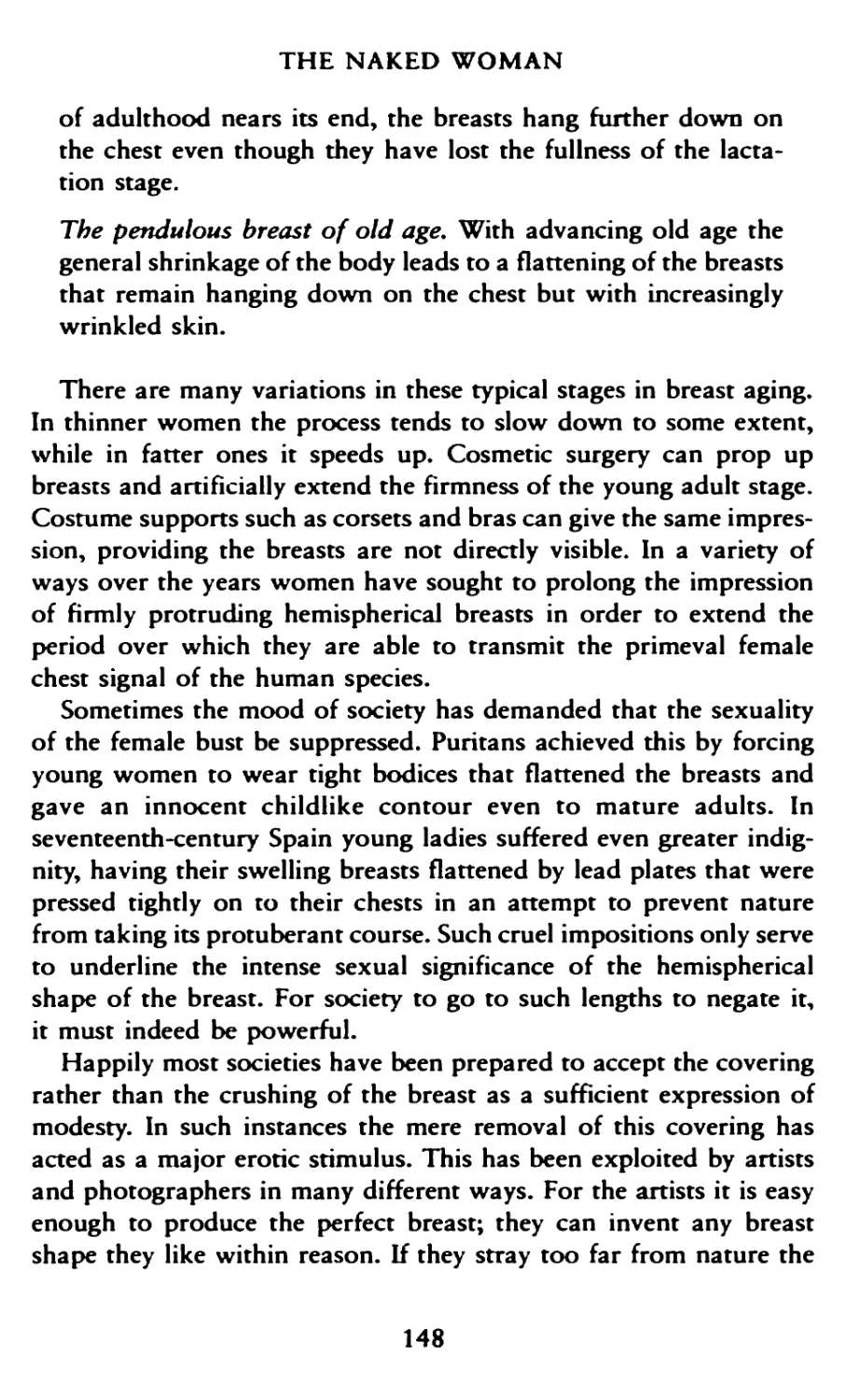
100,000 on each human head. Blondes have finer hair and compen-
sjate for this by having a slightly larger number than average - usually
about 140,000. Brunettes have about 108,000 hairs, while redheads,
who have the coarsest hair, possess only 90,000.
Typically, each hair grows for about six years. It then goes into
a three-month resting phase before falling out. At any one time, 90
per cent of the hairs are actively growing, while 10 per cent are
resting. In a full human lifespan each hair papilla therefore grows
about 12 hairs, one after the other. Unlike many other mammals,
humans do not have seasonal moults. Our scalp hair is of the same
thickness in all seasons.
On average, each individual hair grows 13 cm (5 inches) a year.
9

THE NAKED WOMAN
But among healthy young adults this is increased to 18 cm (7 inches)
a year. So, for them, each scalp hair would, if left untrimmed, grow
to be just over a metre (Vli feet) long before dropping out. This
far exceeds anything found in other primates and is one of the truly
unique features of the human species.
In rare cases there is a curious exception to this rule. Instead of
falling out after six years, the hairs simply keep on growing longer
and longer, until they reach ground level. In some instances they go
on far beyond this and some women have grown hair so long that
they can stand on it. One young American woman possessed hair
that was over 4 metres (13 feet) in length, but even her
extraordinary achievement was beaten by a Chinese woman whose world
record hair was measured at almost 5 metres (16 feet). It is as though
such a momentum has been developed in the genetic trend to evolve
longer human hair that occasionally it runs away with itself, creating
super-haired individuals.
Even without these extremes, it is clear that, with so much head
hair to play with, the ever inventive human being was soon going
to be tempted to start experimenting with different shapes and styles.
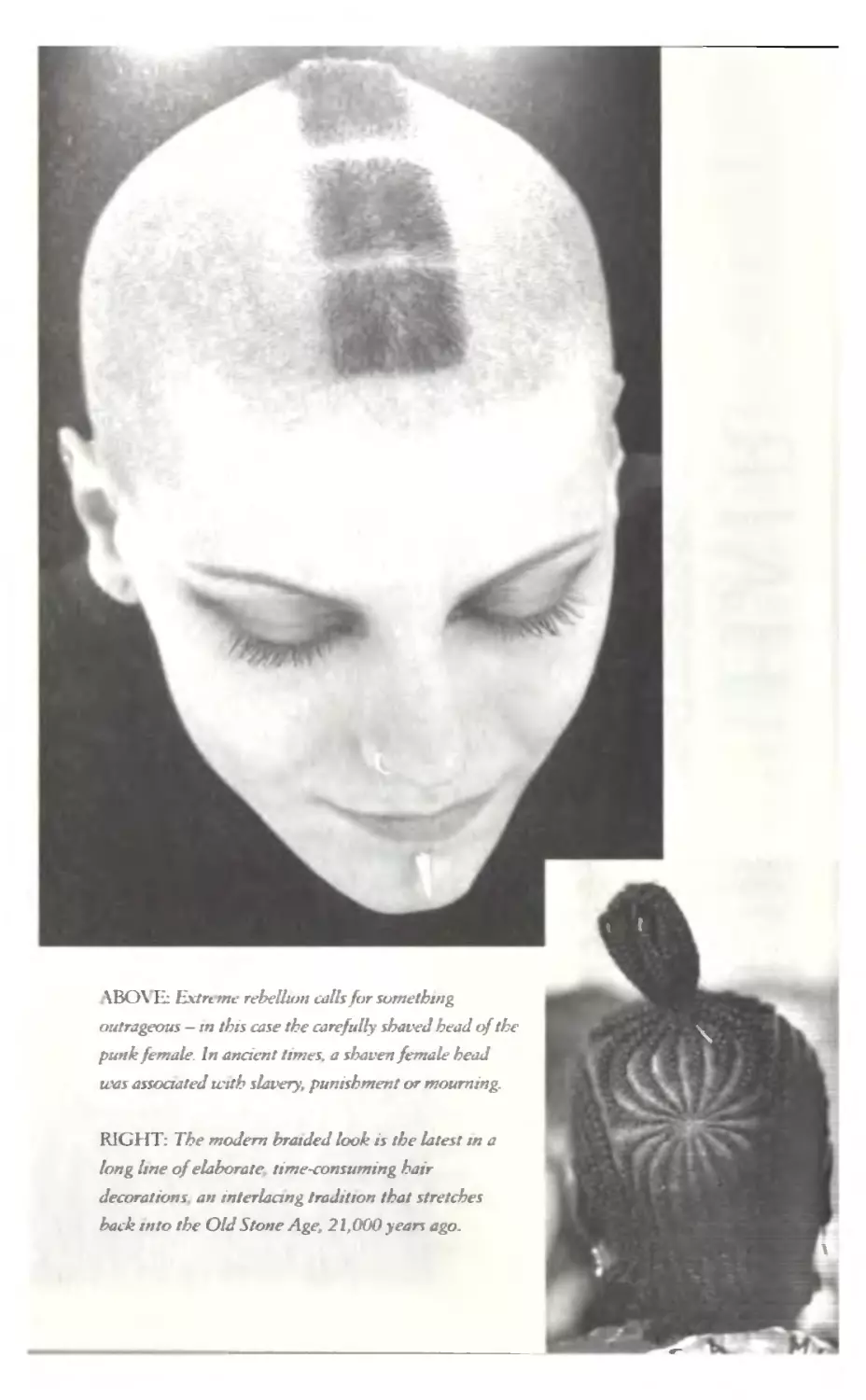
We know, from some of the oldest Venus figurines, that this has
been going on for at least 20,000 years. Stone Age carvings have
been found which clearly show several distinct hairstyles, including
elaborate partings down the middle of the head and, in one case,
with the addition of braided hair thrown over the right shoulder.
Looking back at earlier historical periods, it is possible to see
how the predominant styles have slowly changed, with each epoch
showing hair fashions that are highly characteristic of their time. In
the modern era, with the arrival of professional styling salons and
global communication systems, the speed of these fashion changes
has dramatically accelerated.
Today, in the twenty-first century, there are so many competing
influences that a single theme no longer exists. With individuality
the order of the day, there are more hairstyles on display than ever
before. The urge to imitate celebrities still creates short-lived mini-
trends, but there are so many role-models to choose from that no
clear leader emerges to cry out This is the dominant hairstyle of
the early twenty-first century'. The short, efficient hair of the female
10

THE HAIR
politician, the long flowing hair of the pop star, the carefully
'dishevelled' hair of the Hollywood actress, the wild spiky hair of the rebel,
all these and more can be seen side by side in our morning
newspapers. And even to give crude labels to these competing styles in
this way is a stereotyping that is unjustified because, within these
types, there are countless minor variations.
This is not the place to list all these inventive variations in detail,
but it is important to record that, over the centuries, there have
been a small number of major 'female hair strategies'. These are
related, not to the whims of fashion, but to the basic possibilities
of what can be done with female head hair. Some of these
strategies have vanished into history and today seem very strange. Others
are still with us.
The simplest strategy of all is to adopt the Natural Look. In this,
the woman wears her hair down, loose and natural at all times,
whether in public or private, and both on special social occasions
and for everyday use. She may wash, brush and comb her hair, but
does not attempt to dress or style it in any way. Although this is
the most basic of all strategies, it is now comparatively rare. It may
still be found in unsophisticated societies or in cultures where
simplicity has become a social doctrine. Poverty may spawn it, but
even where there is no money to spend on hair products or
professional hair care, native women are fond of dressing their hair.
Twisting, plaiting and braiding costs little or nothing and helps to
pass the time.
For women whose lives involve strenuous physical work - in the
fields or in the factory, for example - a Practical Look is introduced.
The hair is tied back for convenience, to prevent it falling over the
eyes or becoming entangled. When the woman is not labouring at
her daily tasks, she unties it and lets it fall loose. This has been a
popular peasant strategy in past times and is still used by many
women today who, although no longer engaged in hard physical
labour, find that screwing the hair back in a ponytail can be a useful
device to control untidy hair, both in the workplace and the home.
For the majority of women, especially those living in urban
societies, the natural and the practical solutions have never been enough.
For centuries they have adopted the Styled Look in which the hair
11

THE NAKED WOMAN
is dressed in some way - clipped, shaped, coloured, waved,
straightened, layered, streaked, or decorated. This is the usual strategy,
especially in those countries where hairdressing salons are popular,
but it is forbidden in countries where strict religious rules are applied
and displays of female beauty are taboo.
Two of the major strategies involved in styling the hair are to
enlarge it or to reduce it. Enlarging the hair increases the strength
of the visual display of whatever modification has been chosen. It
makes the woman seem taller and more conspicuous. A favourite
way of accomplishing this has been to wear a wig of some kind.
The wearing of false hair is a strategy that is at least 5,000 years
old. In ancient Egypt it was the custom for high-ranking females to
shave the head completely and then to wear an ornate wig in public.
Roman ladies did not shave their heads, but they too enjoyed wearing
fancy wigs as a status display. Their form of showing off led to an
unpleasant trend when it became fashionable to insist that the hair
from which their wigs were made should be taken from the heads
of conquered people whose countries had been defeated by the
Roman army - an ancient Roman version of scalping one's enemies.
Fancy wigs were banned by the Church in medieval times, but
reappeared in the Elizabethan era. This was largely because the
primitive cosmetics of the period did so much damage to hair and
skin that a massive cover-up was required. But the fancy wig was
not to reach its zenith until the eighteenth century, when
exaggeration upon exaggeration occurred, until the hair displays of
fashionable women came to exceed anything seen either before or since.
Some of their wigs were over 75 cm (30 inches) in height and
elaborately decorated. Doorways had to be raised to allow them to pass
through. The seating in carriages had to be specially lowered. Special
bed supports had to be designed so that women could lie down and
rest while still wearing their enormous wigs. At the Paris Opera,
wigs were permitted only in the boxes - their presence elsewhere
would have obscured the stage. Never has any other hair strategy
made such an impact on society. It was an example of a special
kind of conspicuous consumption. Because of the huge cost of
making and maintaining the wigs, the husbands of the wig-wearers
had to be unusually generous in funding the fashion. As a result,
12

THE HAIR
their wives' hair displays have been referred to as an example of
'surrogate consumption' - a way of showing off how rich their
husbands were.
The only woman who could bring an end to this outrageously
extreme fashion was Madame Guillotine, who chopped off the
aristocratic wig-wearer's heads. After the French Revolution the use of
fancy wigs never made a full recovery. There were moments when
it resurfaced briefly in one form or another - as with the Fun Wigs
of the 1960s, made out of synthetic materials and in a range of
bright, artificial colours - but the great days were over. In more
modern times, where wigs have been worn they have usually been
so realistic as to deny their own existence.
Some women (especially those whose real hair is thinning with
age) will never appear in public without a realistic wig in place. A
number of famous celebrities also adopt this strategy, not because
of hair problems, but as a matter of convenience. Even if their own
hair is in good condition, it is often easier for them to don a wig
than to waste valuable time having their hair styled. The great
advantage of this is that a whole series of elegant wigs can be kept groomed
and in perfect condition in the absence of the wearer.
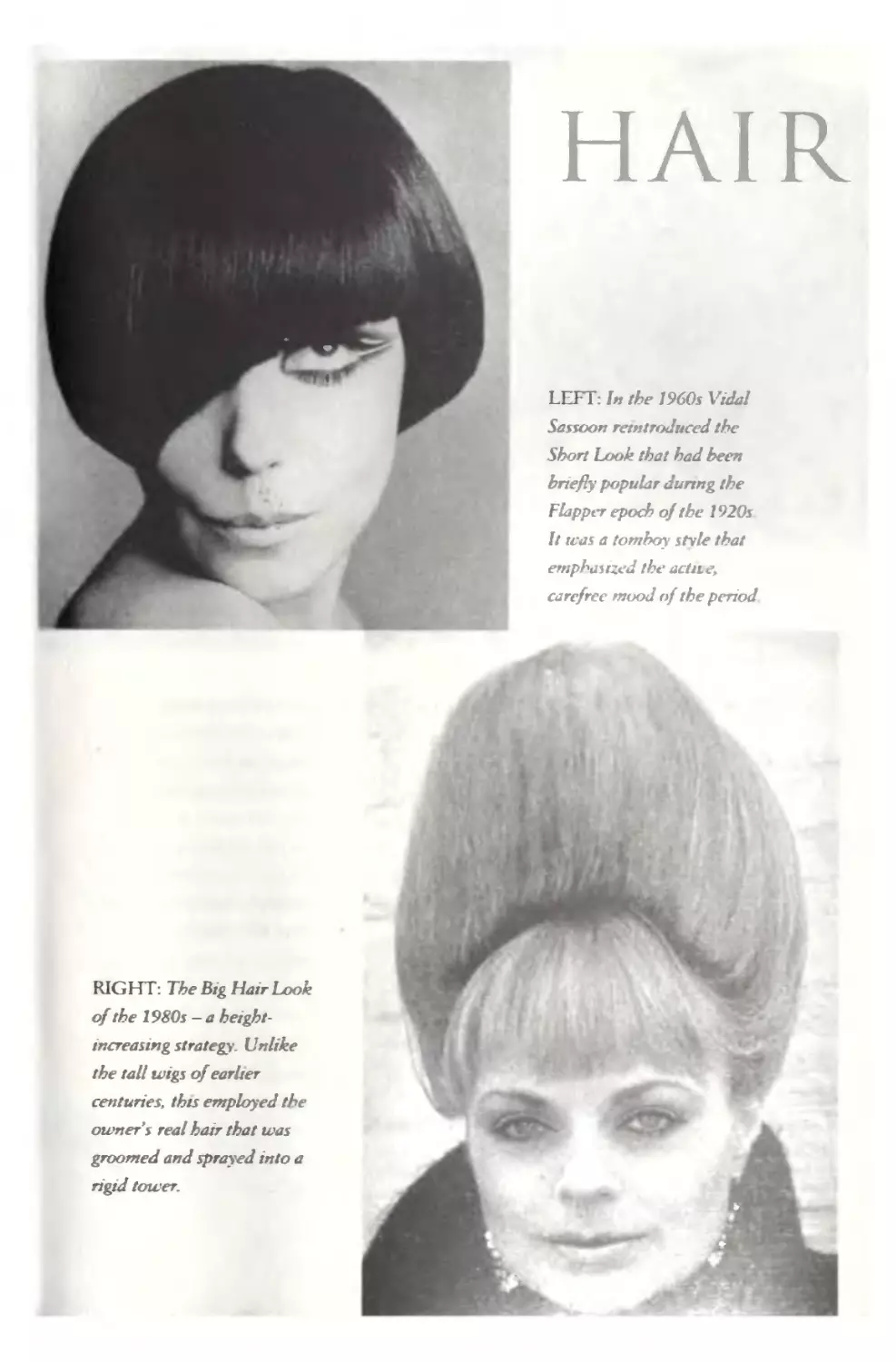
Returning to the strategy of hair enlargement, a remarkable
example from the recent past is the Big-Hair Look that became
popular in the 1980s. In this, instead of wearing a wig, the owner's
real hair was made to look as voluminous as possible. The
appearance of increased bulk was obtained by 'blow-drying upside down,
teasing out, mousse-ing and then copiously spraying'. The gravity
defying result was wryly described by one critic as 'one of the
architectural marvels of our time'. Sometimes referred to as Dolly Parton
Hair (after the American country singer), this bouffant style was
especially popular in small-town America and the Southern States,
where the motto 'the higher the hair, the nearer to God' was often
heard. One of the reasons for its popularity was that its great size
made large facial features seem smaller and therefore more
attractive. It was also extrovert and cheerfully assertive, making the wearer
appear more confident. To its opponents, however, it was brash and
vulgar, and nothing more than a compensation for inadequacies.
And it had one major shortcoming - it may have been a blatant
13

THE NAKED WOMAN
female advertisement, but also happened to be anti-sexual - because
men could not run their hands through it, ruffle it, or gently stroke
it.
More recently, a more sophisticated form of hair enlargement has
been favoured. Hair extensions have been added to the natural hair
to make it appear much longer. This is done either to enjoy a
temporary change from a short hairstyle, or when the natural hair fails
to grow as long as the woman wishes. Modern hairdressing skills
have made it almost impossible to detect the presence of these hair
extensions, although some of them are visibly, deliberately false and
act almost like a kind of partial wig.
The second major styling strategy is to reduce the natural hair in
some way, either by removing some of it, or by tightly restricting
it. In its least extreme version it takes the form of adopting a severe,
controlled hairstyle as a social display on special occasions, but with
it worn down, loose and natural for everyday use and in private.
In recent decades many women wish to appear casually 'free and
easy' for most of the time, but will go to extra trouble for very
special occasions, such as funerals, weddings, and grand events or
celebrations. In order to give themselves a sense of social standing
and discipline they usually put their hair up or restrain it in some
way. This display says to the onlooker, 'I am important, I am serious,
do not be familiar with me.'
Some women go a step further, never letting their hair down in
public. They keep it closely confined in a tight bun or some other
constricted style at all times until in the privacy of the home. This
is what might be called the 'governess' or 'head-mistress' strategy.
Women who need to impose their authority on others can increase
their air of control and power by clamping their hair as tightly as
possible onto their skulls. This de-feminizes them and rids them of
any air of casual relaxation or personal freedom. Their hair is so
neat that it cannot be ruffled, so tightly arranged that it cannot be
stroked. This makes them appear both literally and metaphorically
unruffled and renders them unapproachable and untouchable.
Some women have chosen to have their hair bobbed so short that
it can no longer be 'tied back', 'put up', or 'let down'. What little
is left of it may still hang loose, but it no longer requires holding
14

THE HAIR
back to facilitate physical labour, nor can its style be changed to
suit different social contexts. The flappers of the 1920s were the
first to adopt this style as a fashion statement and it reappeared in
the 1960s through the work of stylist Vidal Sassoon.
Clearly, the intended message of the Short Look is that the women
wearing it are active and carefree. They reduce their hair to an
elegant but highly abbreviated, tomboy statement rather than a fussy
feminine display. The drawback, however, is that, although in
principle this made sense, in practice the short styles of the 1920s and
1960s proved rather difficult to keep in good condition after leaving
the salon.
The Short Look resurfaced again in the 1970s when, in a more
severe form, it became a common feminist strategy, usually as an
assertive display in which women in the workplace were seeking to
be treated with more respect by their male colleagues. By the 1990s
the short styles had softened. They now had a more feminine touch.
The hair strategy of the post-feminist businesswoman was saying 'I
am still disciplined, but I no longer have to give up my femininity
to be a top player in this world.' As a softer short hairstyle, the
1990s look walked the tightrope between being too belligerently
butch on the one hand, or too decoratively ornate on the other. Its
aim was to combine polished control with a sense of sexy freedom.
This became the new challenge for the professional hairstylist in the
West as the twenty-first century dawned.
In a more drastic form of hair reduction, some women have taken
the step of close-cropping their hair. This removes all 'natural
looseness', all the time, even when they are in private. For beautiful
women this is a defiant statement which says 'look at me, I do not
need pretty hair to make me attractive'. As such it can be seen as
a display of vanity. It is also the statement of a rebel, one who
ignores convention and refuses to follow the hair trends of
fashionable or conformist women. Those women who dislike it see it as a
deliberate attempt at self-advertisement by the use of shock tactics.
Men may simply feel threatened by it, having been robbed of the
quest for the softly flowing locks they dream of caressing.
Certain women have taken the even more extreme step of close-
shaving their heads to remove all trace of head hair completely. In
15

THE NAKED WOMAN
some cultures, shaving the female head had been carried out as a
punishment. In others it has been a mark of slavery, or voluntary
subordination to a deity. In still others it has been required of all
women, at special mourning ceremonies. Among the ancient
Phoenicians, failure to adopt the shaven head of mourning meant
that the women concerned had to offer themselves as temple
prostitutes. In recent times a French fashion designer persuaded all his
models to shave their heads to demonstrate that modern women
should not be 'imprisoned by their own hair'. For men, this shaved
look has nearly always been unappetizing and (from Joan of Arc
to the female punk rockers) has had little or no sex appeal, being
a complete denial of all that is sensual about long female hair.
Because of its capacity for arousing men, the exposure of an
expanse of female hair - in any style - has sometimes been
prohibited. Covering or obscuring the hair is required to eliminate its
potentially erotic signalling- The mildest form of this puritanical
'cover-up' is the wearing of some sort of headgear. The demand that
women wear a hat or a scarf when entering a Catholic church is a
reminder of the times when they were required to obscure their hair
completely when attending Christian services. A modern remnant
of this ancient practice is the social convention of wearing hats on
formal occasions, such as weddings and funerals.
In strict religious communities, past and present, women are
required to cover their heads completely at all times in public, only
uncovering their hair in the privacy of their homes, when no strangers
are present. In societies where Islamic law is rigidly imposed, for
example, this look is ever-present. Even accidentally displaying a
small wisp of hair, from under the traditional head covering, when
walking in the street, has led to women being beaten by male
religious officials. The stricter communities of the Christian Church
have also imposed rules concerning female hair covering. In the past,
these rules often applied to devout wives, whose hair could not be
seen in public, and even today they still apply to nuns.
One extraordinary example of religious hair concealment is found
today in New York, among Orthodox Jewish communities. Women
in these communities must cover their hair totally in public and may
only let their natural hair been seen by their husbands in the privacy
16

THE HAIR
of the bedroom. Despite this, women in these communities wish to
live the lives of typical New Yorkers and solve their dilemma in an
ingenious way. They have highly realistic wigs manufactured at great
cost to look exactly like their own real hair. When they place such
a wig, called a sheitel, over the top of their own hair, their
appearance hardly changes. A casual onlooker would find it hard to tell
whether they were wearing the wig or not. In this way the religious
rule is obeyed without sacrificing personal image.
It is clear that hair invites experimentation more than any other
part of the female body. This is because it is easy to change, these
changes can be made quickly and they are not permanent. When
the hair grows out, new styles can be tried. Above all, hair is highly
conspicuous and even the smallest alteration in hairstyle is
immediately obvious to even the casual onlooker.
In the symbolism of female hair there is a simple dichotomy - a
contrast between the long, free-flowing, strokeable, natural hair and
the short, severe, tightly dressed hair. Long, loose hair has been seen
as symbolizing lack of restraint, sexuality, freedom of spirit, peaceful
rebellion and creativity. Short, tight hair has been associated with
discipline, self-control, efficiency, conformity and assertiveness.
These are obviously crude over-generalizations, but it is surprising
how well they fit the facts in many cases. The great joy of hair for
the human female, however, remains that it is always available for
her to express her personal style and her individuality, as well as
hfcr general mood. Providing the grim world of sexist religious
practices does not interfere, she can use her hair as a wonderfully
expressive appendage to present herself to the world.
In addition to the wide range of shaping and styling options that
exist, there is also the question of modification of hair colour. The
natural variation, from very dark to very pale, is, like skin colour,
an adaptation to the climatic conditions of the environment. Each
colour, whether black, brown, red or yellow, has its own adaptive
significance and its own special appeal. It is therefore surprising to
find that, when women decide to change the colour of their hair,
there is one choice that completely dominates all the others. Of
every hundred women who take the step of radically altering their
hair colour, it would be fair to say that over 90 per cent of them
17

THE NAKED WOMAN
choose to become blonde. At first sight this is mystifying. Why on
earth should so many dark-haired women want to look like fair-
haired Scandinavians, when so few Scandinavians ever want to dye
their hair brown or black? It clearly has nothing to do with climate.
Nor does it have anything to do with race, since the majority of
Caucasians are dark-haired. So what is the special appeal of blonde
hair, an appeal so strong that it has led to the bizarre situation that
there are now more artificial blondes in the world than real ones?
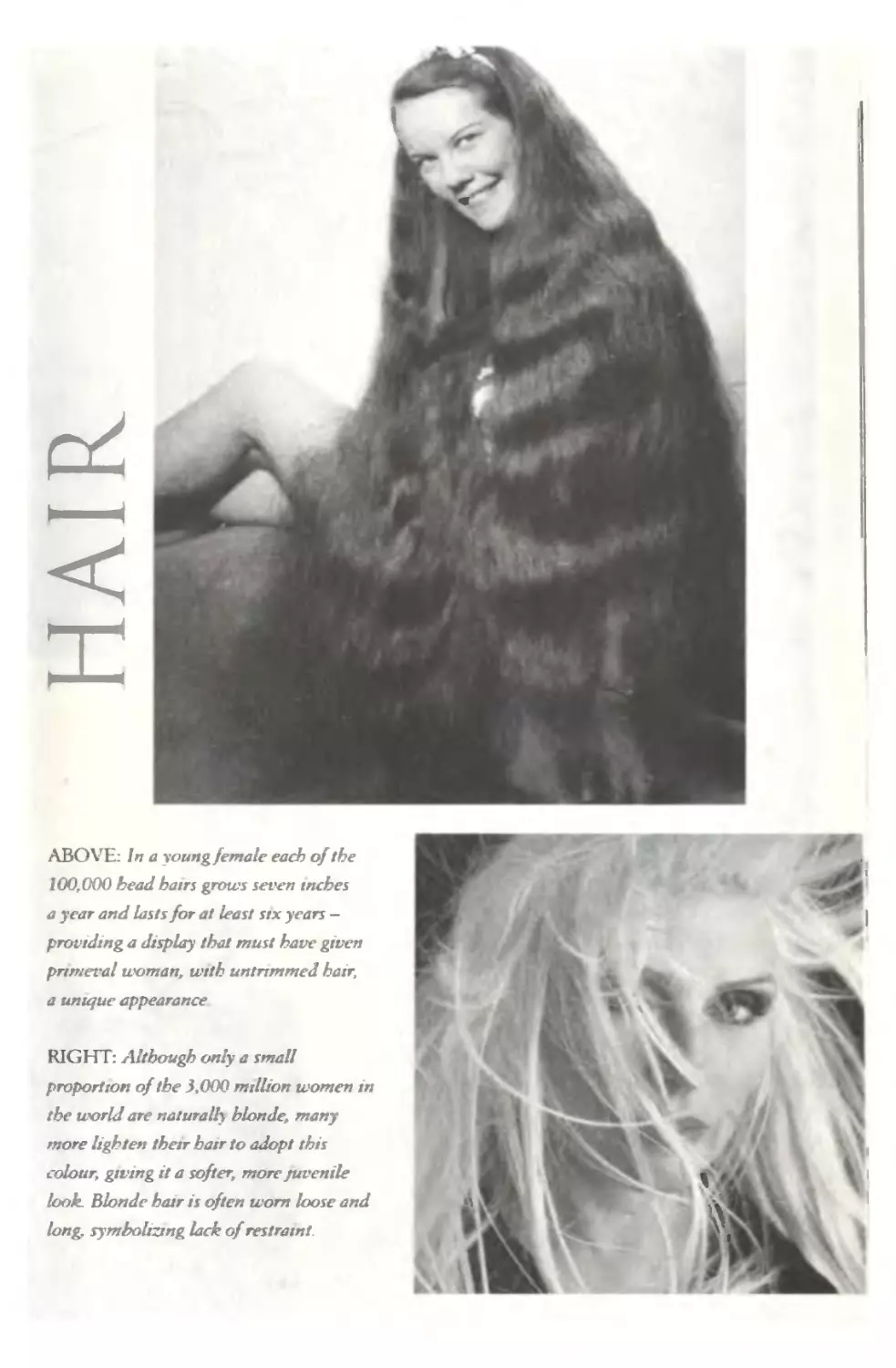
Part of blonde appeal lies in the fineness of the hair. The unusual
thinness of the blonde strands makes them genuinely softer to the
touch and therefore more sensuous in moments of intimate body
contact. Under stroking fingers, or against the male cheek, the
softness of the hair echoes the softness of rounded female flesh. So in
that sense, blondes are more feminine than redheads or brunettes.
Indeed, femininity of blondness extends over the whole body. The
blonde has a fine, soft fuzz where the brunette must wield razor or
depilatory. In particular, the blonde's armpits and pubis are more
delicately hirsute. Her pubic hair's soft silkiness contrasts strikingly
with the more aggressive bushiness of the brunette's. In moments
of extreme intimacy she therefore has a slight advantage over darker-
haired women.
If it is argued that this softness of blonde hair is what makes so
many darker-haired women lighten their tresses, it should be pointed
out that any advantage gained is by association only. The bleaching
of dark hair does not make it any finer, or softer. It merely looks
finer.
There is, however, another advantage in being blonde, and this
one depends purely on visual signalling: being blonde creates a more
juvenile image than being dark-haired. And such an image projected
by an adult human helps to increase their sex appeal, transmitting
intense 'take care of me' signals. The reason blondness suggests
youth is that for a large section of humanity, babies are blonder
than their parents, and the 'baby blues' and 'blond locks' become
indelibly associated with childhood.
Needless to say, this is good news for hair dyers and wig makers.
From the empires of the ancient world to the salons of baroque
Europe, generation after generation of dark- or mousy-haired
18

THE HAIR
women streamed to their establishments for the latest styles and
potions, intent on making themselves a little, or a lot, blonder than
nature had intended. Virtually since the dawn of recorded history,
the blonding of women has been a major industry.
Some of the measures taken to meet the social demands of
blondness were hazardous and even, on occasion, lethal. The ancient
Greeks employed a pomade of yellow flower petals, a potassium
solution and coloured powders that 'veiled the hair' to gain the sexy
blonde look. Roman ladies dyed their hair with a German soap,
specially imported from the north, but were more likely to take the
easy way out by wearing a blonde wig. These early wigs were made
of the fair human hair of the northern Europeans the Romans had
conquered in their great expansion. The fashion became so
widespread that the Roman poet Martial mocked it with the lines:
The golden hair that Galla wears
Is hers - who would have thought it?
She swears 'tis hers, and true she swears
For I know where she bought it.
More and more tricks were used to bleach the hair as the centuries
passed. Ashes of plants, nutshells, elderberries and vinegar sediment
were popular in the early days. Saffron was scrubbed into the hair
with great vigour. Boiled egg yolks and wild honey were tried, aided
by prolonged exposure to strong sunlight. Elizabethan women
powdered their hair with gold dust or, more economically, applied
the scrapings of rhubarb steeped in white wine. Sometimes they
took the risk of dipping their hair in oil of vitriol or alum water.
For some, these chemical treatments solved the problem of unwanted
dark hair so effectively that they went completely bald and were
forced to wear blonde wigs for the rest of their fashionable lives.
The recipes became more and more complicated and demanding.
By 1825 a learned treatise called The Art of Beauty informed its
readers of a formula they should brew if they wished to display
flaxen hair: Boil up a quart of lye; add half an ounce of briny
celandine roots and turmeric; two drachms of saffron and lily roots,
and a drachm each of flowers of mullein, yellow stechas, broom,
19

THE NAKED WOMAN
and St John's wort. The resulting concoction was to be applied
regularly to the scalp.
It is clear that for year after year and century after century, many
a socially aware female was prepared to go to great lengths to
acquire the desirable tones of blondness. But like many fashionable
conceits, the bleaching of hair inevitably developed a secondary
association with over-exaggerated display. Even in Roman times its
appeal did not always remain that of the unblemished virgin. The
artificiality of wigs and dyes decreased the symbolic value of pale
colouring. At one stage it became synonymous not with innocent
femininity, but with professional sexuality: it became the sign of the
whore.
Roman prostitutes were carefully organized. They were licensed,
taxed, and actually required by law to wear blonde hair. The third
wife of the Emperor Claudius, the wild nymphomaniac Messalina,
was so excited by the idea of sudden, brutal sex with strangers that
she would sneak out at night clad in a whore's wig and prowl the
city. So violent was her lovemaking that it is rumoured she frequently
dislodged her blonde hairpiece, returning to the royal precincts in
all too recognizable condition.
Other Roman ladies of fashion were soon imitating her, and the
lawmakers were impotent to stem the trend. Their blonde-wig-
whoring law was ruined, but the element of wickedness and abandon
by now associated with blondness was to survive down the centuries,
repeatedly re-surfacing as an opposing strand in contrast to the
image of fair-haired virginal innocence. Usually the distinction was
made that true blondes were angels and fake blondes were
promiscuous. The fact that the artificial blondes went to much trouble to
look appealing meant that they had sex very much on their minds;
the extreme and therefore imitation blonde became the archetypal
good-time girl, the blonde bombshell, the swinger, the dolly bird,
the bimbo. Each generation had its name for her, and each
generation had its super-blondes.
In the wake of the First World War, the platinum blonde appeared
on the scene. When Jean Harlow died at the age of twenty-six in
1937, she had already set in train a long succession of blonde movie
stars - golden girls who have continued to dominate the screen from
20

THE HAIR
that day to this. The vast majority of the great female personalities
to come out of Hollywood have been blonde - usually by design
rather than genetics. Some have gone to great lengths to perfect
their blondness, Marilyn Monroe even painfully bleaching her pubic
hair to match her platinum tresses. Most were faithful to the ancient
association between the sun and the gold in their hair - they were
cheerful and warm, life-giving, and life-enhancing. They often came
a cropper, but that too was part of their natural appeal - their
childlike blonde vulnerability.
In defence of brunettes, a commentator in the late 1960s
remarked: 'If a man is serious about a girl he wants her to be natural.
Anything artificial does not appeal to a serious thinking man . . .
Generally speaking he prefers a blonde for a mistress and a brunette
for a wife. Brunettes have more integrity.'
21

3. The Brow
The brow region of the face plays a major role in body language.
An eighteenth-century expert on facial expressions said of the
forehead that 'of all parts of the face it is the most important and the
most characteristic'. To some people today this statement might
seem surprising, because so much attention is paid to eye make-up
and lipstick, with the result that the eyes and the mouth tend to
dominate the female face and overshadow other parts of it. But
despite this, it is doubtful if anyone has ever enjoyed a face-to-face
conversation without unconsciously employing forehead signals in
the form of eyebrow movements and skin wrinkling - actions that
are vitally important in indicating changing moods.
Before examining these signals and the ways in which the female
brow differs from the male, it is worth asking why we have a brow
region at all. If you take a close look at a chimpanzee's face, side
by side with a human face, the forehead difference is striking. In the
case of the ape, the brow region is almost non-existent. In humans,
the brow rises vertically above the eyes as a great expanse of naked
skin, conspicuously decorated with two small eyebrow patches. In
stark contrast, the chimpanzee's hairline comes right down to the
eyebrows, which themselves are almost hairless. In fact, the brow
region of the ape is the complete opposite of that in human beings.
When you look at a chimpanzee's face, or that of any other ape,
the impression is that they have huge, prominent eyebrow ridges -
protruding bony crests that help to protect their eyes from damage
- while we have lost ours. But this is an illusion. If you touch the
bony region just above your eye sockets, with your fingertips, you
22

THE BROW
can feel the thickening of the skull that is still there to protect you.
That it is less obvious in humans is not caused by its disappearance
but by the fact that the forehead above it has expanded
dramatically to house our much bigger brains. The human brow ridges have
not vanished, they have simply been engulfed. The brain of the
chimpanzee has a volume of only about 400 cubic centimetres, whereas
the human brain has a volume of 1,350 cubic centimetres - more
than three times the size. It was this expansion of the human brain,
especially in the frontal region, that gave us a 'face above our eyes'.
Possessing a new, exclusively human area of skin above the eyes
provided our ancient ancestors with an additional zone for visual
signalling. This is made possible by the fact that the forehead skin,
although stretched tight over the front of the skull, is not completely
immobile. It is capable of slight movement - small but clearly visible.
This movement is easy to detect because, when the skin shifts, it
creates visible wrinkle patterns. Also, more importantly, the human
face has retained two small patches of hair on its otherwise smooth-
skinned forehead. These hairs, known technically as superciliary
patches, but more usually referred to as eyebrows, act as 'markers'
that help to make the skin movements even more conspicuous at a
distance.
Once, it was thought that the main duty of the eyebrows was
to prevent sweat and rain from dripping into the eyes. Although
they may be of minor assistance in this way, acting as deflecting
'gutters' at the bottom of the forehead, their main role today is
undoubtedly to act as signalling devices, transmitting information
to companions about second-by-second alterations in the state of
mind of their owners.
Studying the female face in all its many moods, it is clear that
there are six distinct eyebrow actions, each linked to a particular
emotional state. They are as follows:
Eyebrows Lower. This action, the frown, is not strictly vertical. As
the eyebrows move downwards they also move slightly inwards,
coming closer together. This has the effect of squeezing the skin
between them and throwing it into short, vertical folds. The number
of these folds varies from individual to individual and each adult
23

THE NAKED WOMAN
has a characteristic 'frown pattern' of one, two, three or four lines.
Frequently they are asymmetrical, with the lines on one side of the
inter-eyebrow space (an area known as the glabellum) being longer
or stronger than the other.
The horizontal wrinkle lines on the forehead tend to be smoothed
out by the action of lowering the eyebrows but they may not
disappear completely. Part of the aging process in the human animal
involves an increasing fixation of temporary expression lines. Skin
creases which, in the young, appear and vanish again with each
changing mood, become permanently etched into the skin surface
as the years go by. The strength of a frown line on a non-frowning
face is a fair indication of the sum total of past frowning performed
by that individual.
Eyebrow lowering occurs in two quite different kinds of
situation that can be crudely labelled as aggressive and protective. In
aggressive contexts the action covers a wide range of intensities,
from mere disapproval or self-assertive determination right through
to annoyance and violent anger. In protective contexts the action
occurs whenever there is a threat to the eyes.
At moments of danger the lowering of the brows over the eyes
is not protective enough, however, and in such instances there is
also a raising of the cheeks from below. Together these two actions
provide the maximum level of eye protection possible, while still
keeping the eyes open and active. This 'screwing up' of the eyes is
typical of a wincing face that anticipates physical attack, or of an
over-illuminated face exposed to such strong light that the eyes are
beginning to suffer from it.
This protective 'screwing up' also occurs frequently during
laughter, crying and at moments of intense disgust, indicating that
these conditions can also perhaps be looked upon as kinds of
overexposure.
It is the eye protection function that explains the ancient origin
of the lowering of the brow region. The use of this lowering in
aggressive contexts appears to be secondary, based on a need to
defend the eyes from the retaliatory attacks that the aggressive mood
can be expected to provoke. We often think of the frowning face
as a 'fierce' face and therefore not one that should be connected
24

THE BROW
with self-protection, but this would appear to be an error. It may
be fierce, but it is not so fearlessly fierce as to be unconcerned about
the need for self-protection of those crucially important organs, the
eyes. The truly fearless face of aggression, by contrast, displays a
pair of staring, unfrowning eyes, but this is a comparatively rare
occurrence, since overtly hostile acts are seldom safe from some
kind of retaliatory response.
Eyebrows Raise. Like the last movement, this action is not strictly
perpendicular. As the eyebrows are raised they move slightly
outwards, away from each other. This has the effect of stretching
the skin between them and flattening out the short vertical frown-
folds there. At the same time, however, the whole of the forehead
skin is squeezed upwards, creating a pattern of long horizontal
crease-lines. These are roughly parallel with one another and number
four or five in most cases. Sometimes there are as few as three or
as many as ten, but it is difficult to be precise because the upper
and lower lines are usually fragmentary. Only the middle lines run
right across the brow in most instances.
This is the 'furrowed brow' of popular speech and is usually
thought of as belonging to a 'worried' individual. Its true range
however, is much wider than that. It has been described by various
authors as signifying: wonder, amazement, surprise, happiness,
scepticism, negation, ignorance, arrogance, anticipation, querying,
incomprehension, anxiety and fear. One music critic famously
commented that a particular opera star 'was a singer who had to
take any note above A with her eyebrows'. With all these different
interpretations, the only way to understand the significance of this
movement is to look backwards towards its ancient origin.
Brow raising is a pattern we share with other primate species and
for them, like us, it appears to have started out as a vision-improving
device. The pulling up of the forehead skin and the raising of the
eyebrows has the immediate effect of increasing the overall range
of vision. To use a well-known phrase, it is an 'eye-opener'. It
increases visual input.
Among monkeys it seems to be an emergency reaction, brought
into use whenever the animals are confronted by something that
25

THE NAKED WOMAN
makes them want to flee. It only occurs, however, if, at the same
time, there is something else in the situation that stops them from
fleeing. This 'something else' can be a number of things. It can be
a conflicting urge to attack, or a burning curiosity to stay and look
at the thing that is so frightening, or any other tendency to stay put
which conflicts with the urge to flee and blocks it.
If we now apply this concept of 'thwarted escape' to the human
context it fits remarkably well. Humans and monkeys behave in
much the same way. The worried person with the furrowed brow
is essentially someone who would like to escape but for some reason
cannot do so. The laughing individual with the same brow-wrinkling
expression is also slightly alarmed. There are telltale elements of
body withdrawal in this posture. The laughter may be genuine but
whatever is being laughed at is also rather disturbing. This is not
uncommon. Much humour takes us to the brink of fear and makes
us laugh only because it does not push us over. The arrogant person
with stiffly arched eyebrows would also like to escape from the
surrounding crassness. In popular speech, we give such an individual
the appropriate name of 'highbrow'.
When this expression is compared with the lowering of the
eyebrows, a problem emerges. Suppose we see something
frightening in front of us: we can either lower our brows to protect our
eyes, or raise our brows to increase our range of vision. Both will
be helpful, but we have to choose. The brain has to assess which
is the more important demand and instruct the face accordingly. If
we look at monkeys, we see that during their most aggressive threats
their brows are lowered; during their rather scared threats their
brows are raised; and during moments of beaten submission their
brows are lowered again. The position is much the same in humans.
WTien human beings are very aggressive and might provoke an
immediate retaliation, or where they are beaten and fearful of
imminent attack, they sacrifice improved vision and protect their eyes with
lowered eyebrows. When they are slightly aggressive but also very
scared, or where they are in any state of conflict that does not appear
to be in imminent danger of turning into a physical attack, they
sacrifice eye protection for the tactical advantages of being able to see
more clearly what is happening around them and raise their eyebrows.
26

THE BROW
Once these two actions have developed their primary roles, they
can be used as indicators in quite mild contexts. We put them to
work as contrived signals. People may raise their eyebrows
deliberately, even when they are not worried, simply in order to signal
to someone 'How worrying for you\ But such refinements and
modifications would not be possible were it not for the original
primitive significance of the actions.
As with frown lines, the arched creases caused by raising the
eyebrows can become indelibly fixed as we grow older. The skin of
our foreheads becomes scarred with traces of all the grimacing we
have done over the years. If we are frequently nervous or anxious,
our repeatedly raised forehead skin becomes permanently marked
with thin arched lines. The elasticity of the skin declines as we age
and, like a piece of creased paper that we try to flatten out, the
forehead refuses to regain its completely smooth, juvenile condition,
even at times of relaxation and calm.
The female forehead that becomes lined in this way is a telltale
sign that its owner is no longer young. It also suggests an
overanxious personality. 'Old and nervous' is not what an image-
conscious female wishes to transmit, and so she has to take some
kind of action to repair the damage, or at least to conceal it.
Heavy make-up can help, but it can only go so far. A thick fringe
of hair can act as a useful cover-up, until a gust of wind dislodges
it. For those women who make a living from their looks, more
drastic action is needed. For many years now, the surgical option
has been the face-lift. It is drastic but effective, pulling the skin so
tightly over the skull that it is incapable of showing even the tiniest
wrinkle.
A more modern-alternative for eliminating wrinkles, available
since the 1990s, is a course of Botox brow injections. These have
the effect of paralysing the forehead so that it is incapable of any
movement, no matter how emotional its owner may be. Botox is,
in fact, a poison, a protein neurotoxin produced by the Clostridium
botulinum bacterium. It is injected straight into the muscles that
cause the wrinkles, inactivating them for a period of three to five
months. In this type of cosmetic treatment it is used in such small
quantities that there is little or no danger, although it has yet to be
27

THE NAKED WOMAN
approved as safe by official medical bodies. Despite this, it is said
to have become the second most popular form of cosmetic surgery
in use at the present time.
The problem with these severe solutions is that they leave the
forehead almost too smooth, incapable of showing any emotion at
all. This can create a mask-like appearance - a young face, but a
rigid face. A more perfect medical solution remains to be found.
Eyebrow Cock. This is a mixture of the previous two actions, with
one eyebrow being lowered while the other is raised. It is not a
particularly common expression - many people find it hard to
perform.
The message given by this action is as intermediate as the
expression itself. Half the face looks aggressive while the other half looks
scared. For some reason, this contradictory response is observed far
less frequently in adult females than in males. The mood of the
eyebrow cocker is usually one of scepticism. The single raised
eyebrow acts rather like a question mark in relation to the other,
glaring eye.
Eyebrows Knit. The eyebrows are simultaneously raised and drawn
towards each other. Like the last action, this is a complex one made
up of two elements taken from the Lower and the Raise. The inward
movement is taken from the Eyebrows Lower action, producing
short vertical creases in the narrowed space between the eyebrows.
The upward movement is taken from the Eyebrows Raise action,
producing horizontal creases across the forehead. The knitting of
the brows therefore produces a double set of skin wrinkles.
This is the expression associated with intense anxiety and grief.
It is also observed in some cases of chronic, as opposed to acute,
pain. A sudden sharp pain gives rise to the Face Wince reaction,
with its lowered brows, but a dull prolonged pain is more likely to
produce the Eyebrows Knit posture. A good example of this is the
standard expression employed in advertisements for headache
medication.
In origin, this action appears to be an attempt by the brow to
respond to a double signal from the brain. One message says 'raise
28

THE BROW
the brows' and the other says 'lower them'. Different sets of muscles
start to pull in opposite directions. The first set manages to pull the
eyebrows up a little, but the second set, although trying to tug them
down and in, only manages to pull them in towards each other.
In some cases, but by no means all, the inner ends of the eyebrow
are pulled up further than the outer ends, resulting in the 'oblique
eyebrows of grief. This exaggerated form of the knitting action is
most marked in those who have seen more than their fair share of
tragedy. If women with less tragic histories try to force their eyebrows
up into the oblique position, they may have little success, even
though they may be able to feel their brows trying to move into
this special posture. Theoretically it should be possible to tell how
much misfortune there has been in a woman's past life simply by
checking the ease with which she manages to adopt the 'oblique
brows' posture.
Eyebrows Flash. The eyebrows are raised and lowered again in a
fraction of a second. This brief upward flick of the eyebrows is an
important and apparently universal human greeting signal. It has
been recorded not only in Europeans from many areas, but also in
people from as far afield as Bali, New Guinea and the Amazon
basin, sometimes in instances where there have been no European
influences. In each case it has the same meaning, indicating a friendly
recognition of the other person's presence.
The Eyebrows Flash is usually performed at a distance, at the
beginning of an encounter, and is not part of the close proximity
displays, such as handshaking, kissing and embracing, that follow.
It is often accompanied by a head toss and a smile, but may also
occur by itself.
In origin it is clearly a momentary adoption of the Eyebrows
Raise posture of surprise. Combined with the smile it becomes a
signal of pleasant surprise. The extreme brevity of the action, no
more than a split second, indicates that the surprised mood is quickly
banished, leaving the friendly smile to dominate the scene.
As already mentioned, the raising of the eyebrows has an element
of fear in it, and it may seem strange that such a factor should play
a part in a greeting between friends. But every greeting, no matter
29

THE NAKED WOMAN
how amicable, involves an increase in social unpredictability. We
simply do not know how the others are going to behave or how
they may have changed since we last met them. This inevitably tinges
the encounter with a small, fleeting element of fear.
In addition to its role as a greeting signal, the Eyebrows Flash is
frequently employed during ordinary conversational speech as a
'marking point' for emphasis. Each time a word is stressed strongly,
the eyebrows flick up and back again. Most of us do this
occasionally but with some individuals it becomes particularly frequent
and exaggerated. It is as if we are saying 'these are the surprise-
points' in the verbal communication.
Eyebrows Shrug. The eyebrows are raised, momentarily held in the
upper position and then lowered again. It is the brief 'hold' of the
eyebrows in the raised position that distinguishes this action from
the Eyebrows Flash of greeting and emphasis.
This is the eyebrow element of the complex shrug reaction, which
also involves a special posture of the mouth, head, shoulders, arms
and hands. Almost all the elements of this compound display can
also occur separately, in isolation, or in conjunction with one or
two other elements. The Eyebrows Shrug, although it may
sometimes occur entirely on its own, is usually accompanied by a Mouth
Shrug - rapid and momentary turning down of the mouth corners.
This combination - what might be called the Face Shrug - frequently
occurs in the absence of the other shrug elements.
Unlike the Eyebrows Flash, therefore, this action is typically linked
with a 'sad' mouth rather than a 'happy' one. This should give it
the meaning of a mildly unpleasant surprise, which is frequently the
way it is used. If, for instance, two people are sitting together and
a third one nearby does something socially 'uncomfortable', one of
the two intimates may give the Eyebrows Shrug to the other to
indicate surprised disapproval.
The Eyebrows Shrug is also often seen as an accompaniment to
speech in certain individuals. Nearly all of us, when talking
animatedly, make repeated, small body movements to stress what we at
saying. At each point of verbal emphasis we add a visual emphasis.
With most people it is the hands or the head that keep moving with
30

THE BROW
each stressed point, but some individuals favour their eyebrows. As
they speak, their eyebrows are repeatedly shrugged in time with the
special points they are making. This is typical of the speech of
the chronic 'complainer', who seems to be perpetually surprised by
the vagaries of life, but it is by no means confined to this
particular personality type.
Leaving the question of eyebrow movements and turning to their
anatomy, there is an important gender difference: female eyebrows
are thinner and less bushy than those of males. This difference has
led to many forms of 'improvement'. Female eyebrows have been
made super-female by artificially increasing their thinness and
smallness.
This has been done for centuries, using a variety of techniques
such as shaving, waxing, plucking and painting. Originally the
excuse given was that these procedures helped to ward off evil; later
they were supposed to protect the body from disease and, in
particular, to prevent blindness; later still, they were done to enhance
personal beauty. In all instances the underlying urge was to make
the eyebrows look more exaggeratedly feminine.
In the twentieth century, the peak of eyebrow plucking came in
the interwar period, in the 1920s and 1930s, when 'the eyebrow
pencil was in every vanity bag, available in five bewitching shades'.
After the thickness of the eyebrows had been reduced by the use of
tweezers, the eyebrow pencil was employed to emphasize the thin
arched line of hair that survived.
For some eyebrow shapers, the use of tweezers is considered too
crude. At the moment of plucking, the metal ends of the tweezers
could easily break the hair and this means that it will quickly re-
grow. A preferred method is 'threading', in which a tiny thread is
tied around each hair before it is pulled out. This ensures that the
root of the hair is also removed. This method is especially popular
in Asia and the Middle East.
If a particular woman felt that her eyebrows were in an
unbecoming position on her forehead, she could, of course, remove them
altogether and paint in totally artificial lines in a new position to
31

THE NAKED WOMAN
suit her taste. When this step was taken, the new eyebrows nearly
always appeared above the true position, giving her face less of a
frown. There is a late eighteenth-century saying that 'Eyebrows
gently arched harmonize with the modesty of a young virgin' and
it is certainly true that artificially raised eyebrows do give a more
innocent, childlike, 'wide-eyed' look. A woman with naturally low-
set eyebrows can look so sinister that she has sometimes been
referred to as having 'witch's brows'.
The precise shape of the modified eyebrows has varied from era
to era and from individual to individual. Great care has often been
taken to sculpt the eyebrows in a way that both obeys the fashion
of the period and yet, at the same time, is a perfect match for the
rest of the face. One eyebrow virtuoso insists that the ideal shape
'is formed from a two-thirds upward sweeping curve and a one-
third downward sweeping curve', although this may have to be
adapted to fit certain individual faces. Such are the subtleties of
eyebrow aesthetics.
Perhaps the strangest example of false eyebrows comes from
England in the early eighteenth century. At that time, fashionable
eyebrows were also shaved and then replaced, but it was the nature
of the replacement that was so bizarre. The eyebrow 'falsies' of the
day were made of mouse-skin. Swift records this strange fashion
with the words: 'Her eyebrows from a mouse's hide, Stuck on with
art on either side.'
Because these attentions were all concerned with improving
feminine appearance, it followed that leaving the eyebrows in their
natural, unplucked condition was frequently a statement of a strong
'non-sexual' nature. Women working in conditions where they were
expected to suppress their sexuality were also expected to leave their
eyebrows alone. In the 1930s there was a hotly debated case
involving a London hospital where a matron had refused
permission for a nurse to pluck her eyebrows. A complaint was made to
the effect that this was interfering with personal liberty, but the
matron's decision was upheld by the London County Council.
Hospital patients were, as a result, spared the erotic stimulation of
the sight of a delicately plucked eyebrow, as they lay in their sickbeds.
(Someone who would have been pleased with this ruling is the
32

THE BROW
Prophet Mohammed, one of whose sayings contains the phrase 'May
God curse the women who . . . pluck their eyebrows.')
Finally, a mention must be made of the female face that displays
a dramatic 'monobrow' or 'unibrow'. In this condition the two
eyebrows are joined across their inner ends to create one long,
continuous brow-patch. It is not common, and where it does exist
it is seldom left untrimmed. Any woman who is born with this
feature will usually go to great pains to pluck out the offending
hairs that cover the glabellum at the top of her nose. There are
several reasons for this. First, the extra hairiness of the brow region
is unduly masculine. Second, there is an 'animal' quality to having
hair where usually there is none. Third, if the central hair is left
there it gives the impression of a permanent frown. And fourth,
there is a centuries-old superstition that any woman possessing a
unibrow must be a vampire.
Together, these unfortunate associations are enough to have any
fashionable woman searching for her tweezers. To retain the sinister
unibrow, a woman would have to be 'above fashion'. One such
woman did exist in the twentieth century - the famous, bisexual
Mexican artist Frida Kahlo. For her, the hairy glabellum became a
personal trademark and she reproduced it faithfully in all her self-
portraits. Described as 'hovering above her piercing dark eyes like
a bird in flight', her jet black unibrow was also likened to a major
landmark. As one critic put it: 'Frida Kahlo may have been an
interesting and creative woman, but she only had one eyebrow. It
stretched from one side of her face to the other, like the Great Wall
of China and, like that wall, it was probably visible from the moon.'
It is amusing that these extreme reactions are all caused by the
presence of a few dark hairs at the top of Kahlo's nose, and it is
remarkable that such a small extension of the human eyebrow
patches should produce such a powerful response. We take the
eyebrows so much for granted that it is only when something odd
happens to them that we sit up and take notice.
Apart from Frida Kahlo's idiosyncratic unibrow, there has only
been one time in recent years when heavy female eyebrows were
considered acceptable and, for a while, even became popular. That
was in the 1980s, when the feminist movement had reached the
33

THE NAKED WOMAN
stage where women decided that looking more like men was a good
way to compete with them. This was the era that saw the young
Hollywood star, Brooke Shields, appear in movies with what were
described as 'caterpillar brows'. They may not have joined in the
middle, like Kahlo's, but they were as heavy as any man's, and gave
her a fiercely determined, highly assertive look. Since then, as women
have concluded that it is much more appropriate and satisfying to
succeed as women, rather than as pseudo-males, their eyebrows have
returned once more to the trimmed and arched condition that has
been in favour for centuries. As Shakespeare put it in The Winter's
Tale: 'Yet black brows, they say, become some women best, so that
there be not too much hair there, but in the semicircle or a half-
moon made with a pen.'
34

4. The Ears
Female ears have never been treated well. They have either been
ignored or they have been mutilated. The powder and paint that
has been so lovingly applied to the female face has passed them by.
While the meticulously decorated face has taken centre stage, the
ears have been ignored, frequently hidden beneath female hair. And
when they have emerged from hiding, they have been considered fit
only for drilling to create jewellery supports. On the rare occasions
when ears have been the subject of cosmetic surgery, the treatment
has been only to make them even more inconspicuous - as when
slightly protruding ears are pinned back more tightly against the
sides of the female head. But before examining in more detail the
cultural abuses heaped on the long-suffering female ear, it is worth
pausing to consider the biology and anatomy of this part of the
female body.
The visible part of the human ear is a rather modest affair. During
the course of evolution it has lost its long pointed tip and its mobility.
Its fine, sensitive edges have gone too, curled over into a 'rolled
rim'. But it should certainly not be dismissed as a useless remnant.
The main function of the external ear remains that of a sound
gatherer - a flesh-and-blood ear trumpet. We may not be able to
prick up our ears like other animals, or to twist and turn them when
seeking the direction of a sudden noise, but we are still capable of
detecting the source of a sound to within 3 degrees. What humans
have lost in ear mobility we have made up for with head mobility.
When a deer or an antelope hears an alarming sound, it raises its
head and twists its ears this way and that. When we hear such a
35

THE NAKED WOMAN
sound, we turn our heads, and it works almost as well.
Although our ears feel rigid at the sides of the head, they do
retain a ghost of the movements they once boasted. If you strain
the muscles of the ear region tight, while looking in a mirror, you
can just see a trace of the protective movement, as your ear tries to
flatten itself against the side of your head. Animals with big mobile
ears nearly always flatten them when fighting - trying to keep them
out of harm's way - and we still do this automatically when we
tighten the head skin in moments of panic, even though our ears
are already flattened in their normal resting posture.
The shape of our external ears is important in delivering undis-
torted sound to our eardrums. A person unfortunate enough to have
their ears sliced off would find themselves far less efficient as
listeners. The ear canals and their eardrums would form a
'resonant system' with some sounds being emphasized at the expense of
others. The seemingly haphazard shape of the ear - its curving folds
and ridges - is in reality a special design preventing any distortion
of this kind.
A minor function of our ears is temperature control. Elephants
flap their huge ears when they are overheated and this helps to cool
the animals down. There is a profusion of blood vessels near the
surface of the skin and heat loss by this route can be important to
many species. For us it may only play a trivial role in
thermoregulation, but it has become a social signal. If a woman overheats in
a moment of emotional conflict, her ears may go bright red. This
ear blushing has been the subject of comment since ancient times.
Nearly 2,000 years ago, Pliny wrote: 'When our ears glow and
tingle, someone is talking of us in our absence.' And Shakespeare
makes Beatrice ask the question 'What fire is in mine ears?' when
she is being discussed by others.
Finally, our ears appear to have acquired a new erotic function
with the development of soft fleshy lobes. These are absent in our
nearest relatives and appear to be a uniquely human feature, evolved
as part of our increased sexuality. Early anatomists dismissed them
as functionless: 'a new feature which apparently serves no useful
purpose, unless it is pierced for the carrying of ornaments'; but
recent observations of sexual behaviour have revealed that during
36

THE EARS
intense arousal the earlobes become swollen and engorged with
blood. This makes them unusually sensitive to touch. Caressing,
sucking and kissing of the lobes during lovemaking acts as a strong
sexual stimulus for many women. In rare instances, according to
Kinsey and his colleagues at the Institute for Sex Research in Indiana,
a woman may even reach orgasm as a result of stimulation of her
ears.
At the centre of the external ear is the shadowy 'ear hole' that
leads to a narrow canal about an inch long. The canal twists slightly,
giving it a design that helps to keep the air inside it warm. This
warmth is important for the proper functioning of the eardrum at
its inner end. The eardrum itself is an extremely delicate organ and
the canal not only keeps it snugly warm but also protects it from
physical damage. The price we must pay for this protection, however,
is the presence on our bodies of a deep recess that we cannot clean
with our fingers. We can groom the rest of our bodies with
comparative ease, freeing ourselves from dirt and small parasites, and we
can snort, sniff or blow our noses to cleanse those other open
recesses, the nostrils; but if an invader enters one of our ear canals,
we are in trouble. Attempts to remove the irritation with a thin
stick can easily damage the eardrum and we clearly need some
special defence against intrusions of this kind. Evolution has
provided the answer in the shape of hairs to keep out larger insects,
and earwax to defeat smaller creatures. The orange-coloured earwax
has a bitter taste which is repellent to insects. This wax is produced
by 4,000 tiny ceruminous glands that are highly modified apocrine
glands - the kind which produce the strong-smelling sweat in the
regions of the armpits and the crotch.
This is not the place to tell the detailed story of the interior parts
of the ear. Briefly, the sound vibrations that strike the eardrum are
converted into nervous impulses for transmission to the brain. The
eardrum is incredibly sensitive, capable of detecting a vibration so
faint that it displaces the surface of the drum only a thousand-
millionth of a centimetre. This displacement is then transmitted
through three strangely shaped bones (the hammer, the anvil and
the stirrup) in the middle ear, which amplify the pressure 22 times.
The enlarged signal is then passed on to the inner ear where an
37

THE NAKED WOMAN
odd, snail-shaped organ filled with fluid is activated. Vibrations are
set up in this fluid that impinge on hair-like nerve cells. There are
thousands of these nerve cells - each one tuned to a particular
vibration - and they send their messages to the brain via the auditory
nerve.
The inner ear also contains vital organs of balance, three
semicircular canals, one of which deals with up-and-down movements,
one with forward movements and one with side-to-side movements.
The importance of these organs grew dramatically when our
ancestors first stood up on their hind legs and adopted bipedal
locomotion. An animal standing on four legs is reasonably stable, but
vertical living creates an almost non-stop demand for subtle
balancing adjustments. Although we take these balancing organs for
granted, they are in fact more crucial to our survival than the parts
of the ear that deal with sounds. A deaf person can survive more
easily than one who has completely lost the sense of balance.
One of the unfortunate aspects of our sense of hearing is that it
starts to go into decline as soon as we are born. The human infant
can detect sound wave frequencies from 16 cycles a second up to
30,000. At adolescence, the upper limit has already dropped to 20,000
cycles a second. By the age of sixty this has declined to about 12,000
and the upper pitch that we can detect continues to fall further and
further as we become more elderly. For the very old, it becomes a
problem to listen to conversation in a crowded room, although they
may still be happy enough listening to a single voice in a quiet place.
This is because, with their greatly narrowed range of hearing, they
find it hard to distinguish between different voices when several are
speaking at once.
Modern hi-fi systems are efficient up to frequencies of 20,000
cycles a second, and it is a galling thought for a middle-aged woman
who has just spent a large sum of money to install such a system
that the only members of her family who will be able to appreciate
its full range will be her young children. She herself will be lucky
if she can detect its output at anything above 15,000 cycles a second.
Our ears have one serious weakness in relation to volume of
sound. We evolved, like other species, in a comparatively quiet
world, when the loudest sounds we heard were roars and screams.
38

THE EARS
There was nothing louder to damage our sensitive eardrums and so
we developed no special protection against very loud sounds. Today,
thanks to our infinite ingenuity, we have thundering machines, high
explosives and a whole variety of super-sounds which can very easily
damage our hearing. Clearly, our ears serve as a reminder to us all
that we now live in a very different world from the one in which
we evolved.
Returning to the external ear, it has long been argued that it is
possible to identify every individual by their ear shape. In the last
century it was suggested that this feature could be used to detect
criminals, but a rival method - fingerprinting - won the day and
ear-typing was forgotten. It remains true, however, that it is
impossible to find two people with precisely the same ear details. Thirteen
ear zones have been labelled and two of them deserve special
mention.
The first is the fleshy lobe. Apart from variations in its size, this
has one major classificatory feature. Each of us has either 'free'
lobes or 'attached' lobes. Free lobes hang down slightly from their
point of contact with the head; attached lobes do not. A doctor
who went to the trouble of examining 4,171 European ears
discovered that 64 per cent of them had free lobes and 36 per cent attached
lobes.
The second is a small bump on the rim of the ear, called Darwin's
Point. It is present in most ears, but is often so slight that it is hard
to detect. If you feel down the inside edge of the folded rim of your
ear starting at the top, you will come across it about a third of the
way down the height of your ear. It feels like a slight swelling, not
much more than a swollen pimple, but Darwin was convinced that
it was significant remnant of our primeval days, when we had long
pointed ears that could be moved about freely, searching.for small
sounds. In his own words, these 'points are vestiges of the tips of
formerly erect and pointed ears'. Careful studies have revealed that
they are present in a conspicuous form in about 26 per cent of
Europeans.
It is variations in details like these that make the ears a suitable
subject for criminal identification, but the use of fingerprinting has
now reached such an advanced state that it is doubtful whether ear
39

THE NAKED WOMAN
shapes will ever be needed. Unhappily the only people to make
elaborate studies of ear zones at present are latter-day physiognomists
with their romantic claims of character and personality
identification from the reading of facial proportions. Their fanciful comments,
which lost all credibility early in the twentieth century,
astonishingly resurfaced in the 1980s, when it was possible to read that a
large ear is the ear of an achiever; that a small, well-shaped ear
belongs to a conformist; and that a pointed ear is that of an
opportunist. These and hundreds of other such 'readings', often going into
great detail, are an insult to human intelligence and their popularity
in the late twentieth century is hard to understand.
Criminologists studying facial details have reported that ear design
can never be predicted from facial design. If you see a rounded face
and an angular face it is impossible to predict which will have the
more rounded or angular ear shapes. Somatotyping experts do not
quite agree with this. They claim that endomorphs (the more roly-
poly among us) and ectomorphs (the more bony and angular) do
have different types of ears. Endomorph ears are characterized as
lying flat against the head and having the lobe and the pinna (the
flap of the ear) equally well developed. Ectomorph ears, by contrast,
have the pinnae projecting laterally and better developed than the
lobes. Perhaps the explanation for this disagreement is that the
criminologists are only considering the head region, while the somato-
typers are examining the whole body shape.
Symbolically, the ear has been given several roles. Because it is a
flap of skin surrounding an orifice it has inevitably been viewed as
a symbol of the female genitals. In Yugoslavia, for instance, a slang
expression for the vulva is 'the ear between the legs'. In some cultures
mutilation of the ears was employed as a substitute for female
circumcision. In parts of the Orient young girls at puberty were
forced to go through an initiation ritual in which holes were bored
in their ears. In ancient Egypt the punishment for an adulteress was
the removal of her ears with a sharp knife - another example of
the ears as genital substitutes.
Because the ears were seen as female genitals in many different
cultures, it is not particularly surprising to discover that certain
exceptional individuals were born through the ear. Kama, the son
40

THE EARS
of the Hindu sun god, Surya, is said to have emerged from this
organ, and it has been pointed out that, technically speaking, Kama's
ear-delivery meant that his mother, Kunti, enjoyed a virgin birth. In
some legends it has also been claimed that Buddha was born from
his mother's ear.
In the satirical works of Francois Rabelais, published in 1653,
Gargantua also entered the world in this unusual fashion. When
Gargamelle was about to give birth to him, 'the child sprung up
and leapt, and so entering the hollow vein, did climb by the
diaphragm even above her shoulders, where that vein divides itself
into two, and from thence taking his way towards the left side,
issued forth at her left ear'. The author admits that this is hard to
believe, but defends himself by pointing out that there is nothing
in the Bible to contradict such a form of birth and that, if God
wished it, 'all women henceforth should bring forth their children
at the ear'.
A completely different form of ear symbolism sees this organ as
representing wisdom. This is because it is the ear that hears the
word of God. This has been given as the excuse for pulling the ears
of children when they are naughty, the idea being that the
activation of the ear will wake up the intelligence lying dormant there.
Some of these strange superstitions were to lead to the ancient
custom of piercing the ears for earrings. This primitive form of
mutilation has proved remarkably tenacious and is one of the few types
of artificial deformity that has retained a widespread popularity in
the modern world. Today most women who have their ears pierced
do so for purely decorative purposes, with no understanding of what
this once meant. In ancient times there were several explanations:
Because the Devil and other evil spirits are always attempting to
enter the human body to take it over, it is necessary to protect all
the orifices through which they might gain access. The wearing of
lucky charms on the ears was thought to have been the best way
to guard against an earful of demons.
Because ears are the seat of wisdom, it follows that the very wise
have very big ears, especially earlobes. Heavy earrings that pull
down the lobes and make them even longer must therefore increase
natural wisdom and intelligence. A study of Hindu, Buddhist and
41

THE NAKED WOMAN
Chinese sculptured figures from earlier days reveals that, if they
were important royal persons, they always possessed elongated
earlobes.
Other early beliefs were that wearing earrings would cure bad
eyesight, or would act as a protection from drowning.
Over a long period of time these original, varied reasons for
donning earrings have been forgotten. In the modern era, nearly all
earrings, both tribal and urban, are purely decorative and have been
worn solely for reasons of beauty or status. In tribal cultures, where
long earlobes have been fashionable, the process of mutilation
usually starts out in infancy, with tiny children having holes bored
in their earlobes. These small holes are then gradually enlarged, year
by year, so that the ears stretch further and further downwards. By
puberty, only the girls with the longest ears are considered to be
beautiful. The really gorgeous ones have to have ears down to their
breasts. If, in the process, the long hanging loop of ear-flesh snaps
under the strain of repeated tugging and the weight of heavy ear
ornaments, a girl's beauty is instantly ruined. In some cultures she
is then considered to be too ugly to marry.
Surprisingly, examples of these extreme elongations of the female
ears are found scattered all over the world. The custom appears to
have arisen independently, time and again, from places as far apart
as Borneo and Brazil, Africa and Cambodia. Among the Trobriand
Islanders, if a girl had dared to ignore this custom, or she would
have been ridiculed as 'having the ears of a bush-pig'.
In some tribes there is a special festival associated with the ritual
of piercing the earlobes of the young girls. In certain cultures, the
heavy ornaments hanging from the stretched earlobes of a married
woman may not be taken off until her husband dies. They are then
removed as a sign of mourning at the funeral ceremony.
The size of the earlobe ornaments is sometimes astonishing. In
one tribe, as many as 50 brass rings, 10 cm (4 inches) in diameter,
are hung from each ear. In another, heavy copper rings are added
until the total weight pulling down each extended lobe is as much
as 1 kg (2.5 lb). In yet another, full-size jam pots, or food cans,
begged from Westerners, are inserted into the gaping earlobe holes.
In earlier centuries, the Western world was shocked and horri-
42

THE EARS
fied by these excessive forms of mutilation. John Bulwer, writing in
1654, devoted a whole chapter of his book A View of the People
of the Whole World to attacking 'Auricular fashions, or certain
strange inventions of people, in new-moulding their ears', castigating
women who 'think it a great comeliness to have their ears most
shamefully bored', making a hole in it and 'putting lead into it,
which with its weight so extends it, that it hangs down to the
shoulders, the hole so big that you may put your arm through it.' To
Bulwer and his epoch, any attempt to improve or modify the human
form was an insult to God.
Such disapproval did little to halt these tribal customs. They were
too much a part of cultural history to be abandoned lightly. In a
few cases foreign influences may have eroded the more extreme
forms of mutilation but in many of the more remote societies they
still survive undiluted even in the twenty-first century.
Despite its often extravagant fashions, the Western world has
never displayed anything to compete with the extended earlobes of
those tribal societies. The most extreme examples we can offer are
to be found in the brief flowering of punk rock in the 1970s. Seeking
to outrage, the punks searched for bizarre objects to thrust into
their clumsily drilled lobes. Large safety pins were clear favourites,
but chains carrying everything from razor blades to electric light
bulbs were also used by the shock troops of the new wave. Their
mood was too impatient, however, for them to bother with the
prolonged and gradual stretching of the earlobes found in tribal
groups.
Later, with the dramatic increase in body piercing that started to
flourish towards the end of the twentieth century, Western female
ears could be seen with multiple earrings. Instead of one hole, the
ear was drilled again and again, all around its perimeter, so that a
whole series of earrings could be attached to it.
For the vast majority of women, however, the ears today are
decorated in a simple way, with easily removable, stud or drop earrings
attached through a single, small hole, or simply clipped on. Unlike
tribal earrings they are not worn continuously, but are often changed
daily to match whatever else is being worn at the time. Some women
own only a few pairs, but others become addicted to acquiring large
43

THE NAKED WOMAN
numbers, the record-holder (according to the Guinness Book of
Records) being an American woman from Pennsylvania who has
amassed a collection of 17,122 pairs. If she wore a different one
each day, it would take her nearly half a century to get through
them all.
44

5. The Eyes
For many centuries the female eyes have been the focus of a great
deal of attention. Eye make-up is known to have been employed
for over 6,000 years. In ancient Egypt, black cosmetics were used
to colour the eyelids, and the Roman satirist Martial, writing in the
first century, made the waspish comment: 'still you wink at men
under an eyelid which you took out of a drawer that same morning'.
Eyelids, eyelashes and the skin around the eyes have been the subject
of endless subtle variations in colour, shade and embellishment in
every major civilization in the history of the world. Eye shadow,
eyeliners, eyelash curlers, false eyelashes and coloured contact lenses
have all been employed to enhance the female eye region. But before
taking a closer look at these improvements on nature, what about
the natural eye itself?
The eyes are the dominant sense organs of the human body. It
has been estimated that 80 per cent of our information about the
outside world enters through these remarkable structures. Despite
all the talking and listening we do we remain essentially visual
animals. In this we do not differ greatly from our close relatives,
the monkeys and apes. The whole primate order is a vision-
dominated group, with the two eyes brought to the front of the
head, providing a binocular view of the world.
The human eye is only about 2.5 cm (1 inch) in diameter and
yet it makes the most sophisticated television camera look like
something from the Stone Age. The light-sensitive retina at the back of
the eyeball contains 137 million cells that send messages to the
brain, telling it what we are seeing. Of these, 130 million are rod-
45

THE NAKED WOMAN
shaped and concerned with black-and-white vision; the remaining
7 million are cone-shaped and facilitate colour vision. At any one
moment these light-responsive cells can deal with one-and-a-half
million simultaneous messages. Because it is so complex, it is hardly
surprising that the eye is the part of the body that shows the least
growth between birth and adulthood. Even the brain grows more
than the eye.
At the eye's centre is the black pupil - the aperture through which
light passes to fall on the retina. The pupil increases in size with
weak light and decreases in strong light, controlling the amount of
illumination falling on the retina. In this respect the eye does act
much like a camera with an adjustable diaphragm, but it also has a
curious override system. If the eye sees something it likes very much
the pupil expands rather more than normal, and if it sees something
distasteful it shrinks to a pinprick. It is easy to understand the second
of these two responses because further contraction of the pupil's
aperture would simply reduce the illumination of the retina and
'damp down' the distasteful image. The increased pupil dilation that
occurs when we see something attractive is harder to explain. This
must interfere with the accuracy of our vision by letting too much
light flood on to the retina. The result must be a hazy glow rather
than a sharp balanced image. This may be an advantage for young
lovers, however, when they gaze deeply into each other's dilated
pupils. They may benefit by seeing a slightly fuzzy image bathed in
a halo of light - the very opposite of a 'warts-and-alP image.
In earlier centuries, the courtesans of Italy would put drops of
belladonna in their eyes just before receiving a visitor. This had the
effect of dilating their pupils massively, which made them more
appealing because it gave the false impression that they loved what
they saw (even if it was only the bloated, ravaged face of an elderly
roue).
Around the pupil is the muscular, coloured iris, the contracting
disc responsible for the changes in pupil size. This task is performed
by involuntary muscles, so we can never deliberately or consciously
control our pupil size. It is this fact that makes pupil expansion and
contraction such a reliable guide to our emotional responses to visual
images. Our pupils cannot lie.
46

THE EYES
The colour of the iris varies considerably from person to person,
but this is not due to a variety of pigments. Blue-eyed people do
not possess blue eye pigment; they simply have less pigment than
others, and this gives the impression of blueness. If you have a dark
brown ring around your pupils, this means that you have a generous
amount of melanin pigment in the front layers of your irises. If the
melanin here is less and the pigment is largely confined to the deeper
layers of the iris, then your eyes will be paler, ranging from hazel
or green to grey or blue as the pigment decreases. Violet colouring
is due to blood showing through.
Brightly coloured eyes in human beings are therefore something
of an optical illusion. They indicate a loss of melanin and seem to
be part of the general 'paling' of the body that occurs as one moves
away from the equator towards the less sunny polar zones. This
effect is most striking when one compares the babies of white people
with those of darker-skinned races. Almost all white babies are blue-
eyed at birth. Dark-skinned babies are dark-eyed. Then, as they
grow older, most white offspring gradually develop the melanin
pigment on the front of the iris, making their eyes darker and darker.
Only a very small percentage fail to do this and retain their 'baby
blues'.
Covering the pupil and the iris is a transparent window, the
cornea, and around it is the region we refer to as 'the whites of the
eyes', technically called the sclera. It is this non-optical part of
the human eye that is its most unusual feature. Uniquely, parts
of the whites of our eyes are visible to onlookers. Most animals
have circular 'button' eyes. The same is true of lower primates, but
with most monkeys the skin around the eyes is slightly pulled back,
left and right, to givethe eyes 'corners'. These eyes are still nearer
to a circle in shape than an oval; but the trend goes a step further
in the apes, where the eyes are more elliptical, approaching the
human shape. Even here no 'whites' are visible, the exposed area
on either side of the iris matching its dark brown colour. In humans
the whiteness of these same areas makes them highly conspicuous.
The effect of this small evolutionary change is that during social
encounters shifts in gaze direction are easily detected, even at a
distance.
47

THE NAKED WOMAN
Surrounding the visible part of the eye, the eyelids, fringed with
curved eyelashes, have greasy, shiny edges. The greasiness is cause
by the secretions of rows of tiny glands, visible as minute pinpricks
just behind the roots of the eyelashes. The regular blinking of these
lids moistens and cleans the cornea. The process is aided by the
secretion of tears from the tear gland, tucked in under the upper
eyelid. The liquid is drained off through two small tear ducts - also
visible as pinpricks, but bigger ones, on the edges of the eyelids.
They are positioned at the nose end of the lids, one in the upper
and one in the lower. The two ducts connect up into a single tube
that carries the 'used' tears down into the interior of the nose and
away. When an irritation in the eye or intense emotions make the
tear glands produce tears more quickly than the ducts can drain
them off, we weep. The excess tears spill over on to our cheeks and
we wipe them away. This is the second unique feature of the human
eyes, for we are the only land animal that frequently weeps with
emotion.
Between the two tear ducts, in the corner of the eye next to the
nose, there is a small pink lump. This is the remnant of our third
eyelid and it now appears to be completely functionless. In many
species it is an organ of some value. Some use it as a 'windscreen
wiper', blinking sideways to clean the eye; others have coloured
ones that they flash as a signal; still others have completely
transparent ones they can use as natural sunglasses. Diving ducks go
even further, having specially thickened transparent ones that they
pull over their sensitive corneas when swimming under water. If
only our primeval ancestor had been more aquatic, our sub-aqua
pleasures today might have been greatly enhanced.
The eyelashes, which provide us with a protective fringe above
and below the eyes, have one exceptional feature: they do not become
white with age like other head and body hairs. Each eye has about
200 of them, more on the upper lid than the lower, and each lash
lasts between three and five months before falling out and being
replaced. Eyelashes have the same lifespan as the hairs of the
eyebrows.
Another form of eye protection occurs in Orientals, who possess
a flap of skin called the epicanthic fold that lies over the upper
48

THE EYES
eyelid and gives their eyes their characteristic 'slant'. This fold is
present in the human foetus in all races, but is retained into
adulthood only by the Eastern branch of the human family. A few Western
babies are born with the eye fold still present, but it gradually
disappears as the nose narrows and changes shape with advancing age.
Among the Oriental peoples the epicanthic fold seems to have been
retained as part of a general adaptation to cold. The whole face is
more fat-laden, flatter and better able to cope with icy conditions,
and the extra fold of skin above the eyes helps to shield this
delicate area in an extreme environment.
The shape of the Oriental eye is undeniably appealing, but many
women in the Far East do not see it that way and today their
hospitals are full of young, eye-bandaged figures subjecting themselves
to the surgeon's knife and having their epicanthic folds removed so
that their eyes have a more Western appearance.
There are small gender differences in the eye. The female eye is
very slightly smaller than that of the male, and it shows a higher
proportion of white. In many cultures the tear glands are more
active in emotional females than in emotional males, but whether
this is due to cultural training that requires the males to be less
emotionally demonstrative or is a biological difference of a more
basic kind is hard to say. It does appear to be a remarkably
widespread difference for it to be simply the result of social training.
A word about the tears themselves: they are not only lubricants
for the exposed surface of the eye, they are also bactericidal. They
contain an enzyme called lysozyme which kills bacteria and protects
the eye from infection.
Poor eyesight must have been a curse for many of our remote
ancestors, not only because of the lack of precision in obtaining
visual information but also because the permanent strain of trying
to see with defective vision causes severe headaches and migraines.
The curse remained for people of the earliest civilizations and with
the invention of writing it became acute, many elderly scholars
having to employ young people to read for them.
Seneca, the Roman connoisseur of the art of rhetoric who lived
at the time of Christ, seems to have been the first person to attempt
to solve this terrible problem. It is said that despite poor sight he
49

THE NAKED WOMAN
managed to read his way through the libraries of Rome by using a
'globe of water' as a magnifying glass. This ingenious solution should
have led to an early development of eyeglasses, but it failed to do
so. It was not until the thirteenth century that the English
philosopher Roger Bacon recorded his observation that 'If anyone
examines letters or other minute objects through the medium of crystal
or glass ... if it be shaped like the lesser segment of a sphere, with
the convex side towards the eye, he will see the letters far better
and they will seem large to him.' He went on to say that such a
glass would be useful to those with weak eyes, but again there was
no rush to develop this boon to human vision. Towards the end of
the century, in Italy, true spectacles for reading did at last appear,
though it is not clear whether they were influenced by Bacon. In
1306 a monk in Florence gave a sermon that included the following
phrase: 'It is not yet 20 years since the art of making spectacles,
one of the most useful arts on earth, was discovered . . .' At about
the same time Marco Polo recorded seeing elderly Chinese using
lenses for reading, so it is clear that by the fourteenth century the
move towards a wide use of eyeglasses had begun in earnest. In the
fifteenth century special lenses for correcting short-sightedness
appeared, and in the eighteenth century Benjamin Franklin invented
bifocals. The first successful contact lenses were made in Switzerland
in 1887.
This brief history of eyeglasses is of more than medical interest
because it also changed the appearance of our eyes. The shape of
the spectacles became part of the facial expression of the wearer. A
heavy upper rim became a super-frown, making the owner look
more fierce and domineering. A wide circular rim produced a wide-
eyed stare, as though the curve of the rim represented arched
eyebrows. There was no deception, as in the case of subtle
makeup. The spectacles were clearly not part of the face and yet it was
impossible not to be influenced by their lines, just as an eye mask
alters the whole expression of the wearer.
The effect of dark glasses is especially dramatic. Telltale eye
movements, made conspicuous by the whites of the eyes, as mentioned
earlier, provide a constant source of information during social
encounters, but dark glasses effectively eliminate that information.
50

THE EYES
Darting eyes, shifty eyes, inattentive eyes, over-attentive eyes, dilated
eyes, all are hidden from the companions of someone wearing
'shades'. They can only guess at what is taking place behind the
mask of the sunglasses.
What are they missing? Imagine a social gathering of a group of
women. Precisely what do their eye movements tell us? In any such
gathering subordinates tend to look at dominant figures and
dominants tend to ignore subordinates, except in special circumstances.
For example, if a friendly submissive individual enters a room her
eyes will dart this way and that, checking on all those present. If
she spots high-status, dominant individuals she will keep a persistent
watchful eye on them. Whenever a joking remark or a
controversial statement is made or a personal opinion is expressed the
subordinate's eyes will flick in the direction of the dominant person to
assess any reaction. The dominant figure typically remains aloof
during such exchanges and hardly bothers to look at the
subordinates during general conversation. But if she fires a straight
question at one of them she does so with a direct stare. The individual
on whom she fixes finds herself unable to return this stare for any
length of time and during most of her reply looks elsewhere.
This is the situation where a clear pecking order operates and
where certain individuals have control over others and wish to
exercise it. When friends of equal status meet, the eye movements are
rather different. Here everyone uses 'subordinate' eye movements
even though they are not subordinate. This is done because the
simplest way of demonstrating friendliness with body language is
to display non-hostility and non-dominance. So we are watchful of
our friends, treating them with our eyes as if they are dominants.
When they speak or ace active we look at them; when we speak
and they watch us we look away and glance at them only briefly
from time to time to check their reactions to what we are saying.
In this way, each of two friends will treat the other as the powerful
one and thus make each other feel good.
If a dominant female wishes to ingratiate herself with someone
she can do so by deliberately adopting the friendly body language
of an equal. When addressing an employee or servant of some kind,
she can manipulatively switch on an attentive eye, hanging on the
51

THE NAKED WOMAN
underling's every word. Such devices are rarely used by dominant
individuals outside special contexts (such as election campaigns).
Prolonged eye-to-eye staring occurs only at moments of intense
love or hate. For most people in most settings a direct stare that
is held for more than a few moments is too threatening and they
quickly look away. For lovers there is such total mutual trust that
they can hold each other's gaze without even a twinge of fear.
As they stare into each other's eyes they are unconsciously checking
the degree of pupil dilation. If they see deep black pools they know
intuitively that their feelings are reciprocated. If they see tiny
pinprick pupils they may start to feel uneasy, sensing that all is not
well in their relationship.
Turning from lovers to haters, the staring eyes of an angry person
are strongly intimidating. In earlier days, when superstitions were
rife, it was believed that supernatural beings were watching over
human events and influencing their outcome. The fact that these
divine powers or deities were watching meant that they must have
eyes. Since they had to watch over so much it was supposed that
they must have many eyes and be all-seeing. Where good gods were
concerned this was clearly a great advantage to human beings
because benign deities could be protective. But there were also bad
gods, demons and devils - evil spirits with evil eyes - and a look
from them could spell disaster.
A belief in the power of evil eyes became widespread and survives
even today in some parts of the world. The evil eyes became the
Evil Eye, a malicious, harmful and even deadly influence that could
strike down a victim without warning. If its glance fell on you
something terrible would happen. Sometimes an ordinary woman became
possessed, against her will, of the Evil Eye, and everyone she looked
at suffered in some way soon afterwards. Many lucky charms and
talismans were employed to protect people against these threats,
usually worn on a costume, kept in a handbag, or hung up in the
house. Some of these protective devices operated on the principle
that an intensely sexual image would distract the Evil Eye and keep
it preoccupied.
Astonishingly, with this concept in mind, many Christian churches
in medieval Europe displayed stone-carved images of female genitals
52

THE EYES
above their doors, to stop 'the evil ones' from entering the buildings.
To intensify the image, the genitals are usually shown being held open
by a pair of hands. Not surprisingly, most of these carvings were
removed or hidden during the pious Victorian era, but a few still
survive to this day. A much better survivor is the lucky horseshoe,
also placed on a building to bring good luck. Were it generally known
that, in this protective context, the horseshoe originally also
symbolized the female genitals, it too might start to disappear.
Since the Evil Eye's worst deeds were thought to be caused by
envy it was important not to lavish praise on anyone who might
be vulnerable. A mother might be horrified if a stranger praised her
new baby, for example, and would have to hang a lucky charm on
the infant's cot to defend it, or carry out some other protective
ritual. Even today, especially in the Mediterranean region, these
superstitious precautions are still taken very seriously by many
people.
Turning from the imagined eyes of evil spirits to the real eyes of
the human female, there are many visual messages to be read in her
changing expressions:
Eyes Lower. Lowering the eyes formally is sometimes used as a
modesty signal. It is based on the natural behaviour of subordinates
who dare not look at their superiors, but it is not random in its
direction. The primly modest 'flower' does not cast her eyes to left
or right but only down at the ground. There is the suggestion of a
bow in this action, or of the lowering of the head in submission.
Eyes Raise. Raising the eyes is also sometimes used as a deliberate
signal. If they are held in the up position for a while, the
expression is one of 'a pretence of innocence'. Performed today only in
jest, this eye movement is based on the idea of looking up to heaven
as a witness of the claimed innocence.
Eyes Glare. Glaring eyes are often employed by a mother when
trying to subdue children while remaining silent. The glare is a
complex version of the stare. The eyes fixate the 'victim' with
frowning eyebrows but widely opened eyes. This is a contradiction
53

THE NAKED WOMAN
because the opening wide of the eyes normally goes with raised
eyebrows, so these two parts of the face have to work against each
other. For this reason it is not an expression that is held for any
length of time. During the glare the upper eyelids press upwards so
hard that they almost disappear behind the descending brows, and
the demarcation line of the glaring eye is provided by the brow skin,
not the eyelid. This gives a strange apparent shape to the eyes that
is unmistakable. The message of the glare is one of surprised anger.
Sidelong Glance, This is used to steal a look at someone without
being seen to do so. It is also used as a deliberate signal of shyness
when it becomes a sign of coyness. 'I am too frightened to look
straight at you, but I can't help staring' is the message here, and
the popular phrase 'making sheep's eyes at someone' has been coined
to describe this action.
Eyes De-focus. De-focusing the eyes occurs when we are very tired
or when we are daydreaming. Someone who wishes to signal that
they have something special to daydream about (a new lover, for
instance) may deliberately stare out of a window or across a room
with de-focused eyes as a way of impressing companions.
Eyes Wide. Widening the eyes to the extent that white is showing
above and/or below the iris is a basic response of moderate surprise.
This action increases the field of vision of the eyes and paves the
way for increased responsiveness to visual stimuli. As with many of
these automatic reactions of the eyes, a deliberately 'acted' version
is now sometimes used to signal mock-surprise.
Eyes Narrow. Narrowing the eyes also has its deliberate version.
Basically it is a protective response against too much light or possible
damage, but it has a contemptuous form in which the person
narrowing the eyes is plainly not suffering overexposure or a threat
of damage. This artificially 'pained' expression implies that those
present are the cause of a more-or-less permanent anguish. It is an
expression of distaste - a haughty look of disdain upon the world
around. The special fold of skin above the Oriental eye sometimes
54

THE EYES
creates a false impression of 'haughtiness' because it makes the eye
look as though it is being deliberately narrowed.
Eyes Glisten. Glistening eyes transmit an entirely different signal
and one that is hard to fake (except for professional actors). The
twinkling, sparkling or glistening surface of the eyes is slightly
overloaded with secretion from the tear glands caused by aroused
emotions, but the feelings are not sufficiently strong to produce
actual weeping. These are the gleaming eyes of the passionate lover,
the adoring fan, the proud mother and the triumphant athlete. They
are also the shining eyes of anguish, distress and bereavement, in
fact any strong emotional condition that stops just short of crying.
Eyes Weep. Weeping itself is also a powerful social signal. The fact
that we weep and other primates do not has aroused considerable
interest, and it has been suggested that this difference is due to our
ancestors having passed through an aquatic phase several million
years ago. Seals weep when emotionally distressed and sea otters
have also been seen to weep when they have lost their young. It has
been suggested that copious shedding of tears is a by-product of the
improved eye-cleaning function of tears in mammals that have
returned to the sea.
This aquatic explanation is certainly logical enough. If man went
through an aquatic phase several million years ago, stepped up his
tear production in response to prolonged exposure to sea water and
then returned to dry land as a savannah hunter, he might well retain
his tearful eyes, exploiting emotional weeping as a new social signal.
It would explain why he is the only primate to display this
characteristic. An alternative explanation is that it was the dusty
world of the savannah that increased tear production and that copious
emotional weeping was a by-product of improved eye-cleaning. If it
is pointed out that other mammals living in dusty conditions are all
non-weepers when distressed, it can be argued that they all have
hairy cheeks in which flowing tears would be lost. Only on the naked
facial skin of the human species would the glistening teardrops act
as a powerful visual signal to nearby companions.
A completely different explanation of weeping eyes is based on
55

THE NAKED WOMAN
the idea that tears, like urine, have excretion of waste products as
their main function. Chemical analysis of tears produced by distress
and those produced by irritation to the surface of the eyes has
revealed that the two liquids spilling down the face contain different
proteins. The suggestion is that emotional weeping is primarily a
way of ridding the body of excess stress chemicals, which would
explain why 'a good weep makes you feel better' - the
improvement in mood being a biochemical one. The visual signal of the wet
cheeks of the weeper, which encourages companions to embrace and
comfort the distressed individual, must then be seen as a secondary
exploitation of this waste-product-removal mechanism. Once again
it is hard to see how this theory can be reconciled with the absence
of weeping in such animals as chimpanzees, who suffer from
intensely stressful moments during social disputes in the wild.
Eyes Blink. Leaving the dramatic subject of weeping and turning to
the more mundane one of blinking, there are several deliberate
signals that are in use today. The ordinary blink, the windscreen-
wiper action of the eyelids that cleans and moistens the corneal
surface at frequent intervals throughout the day, takes approximately
74oth of a second. In emotional states, as tear production starts to
increase, the blink rate increases with it, so that a measure of the
frequency of blinking can be used as an index of mood.
Modified forms of blinking include the Multi-blink, the Super-
blink, the Eyelash Flutter and the Wink:
Eyes Multi-blink. The Multi-blink occurs when someone is on
the verge of tears. It is a desperate attempt to bail out the eyes
before they start spilling over. Because of this it can also be used
as a conscious signal of sympathetic distress.
Eyes Super-blink. The Super-blink is a single massive exaggerated
blink, slower in speed and greater in amplitude than the normal
blink. It is used as a melodramatic signal of mock-surprise and is
employed exclusively as a contrived 'theatrical' action. The message
is 'I don't believe my eyes, so I am wiping them clean with a huge
blink in order to make sure that what I am seeing is really there.'
56

THE EYES
Eyelash Flutter. The Eyelash Flutter in which the eyes are rapidly
fluttered open and shut is similar to the Multi-blink but involves a
greater degree of eye opening, being performed with a wide-eyed
'innocent' look. It is another contrived coquettish action of a theatrical
kind, employed in a 'y°u can't be cross with little me' context.
The Wink. The wink is a deliberate one-eyed blink that signifies a
state of collusion between the winker and the person winked at. The
message of the wink is 'You and I are momentarily involved in a shared
act which secretly excludes all others.' Performed between friends at
a social gathering it implies that the winker and her companion are
privately in sympathy over some issue, or that they are closer to each
other than either is to the others present. Performed between strangers
the gesture usually carries a strong sexual invitation regardless of the
genders involved. Because it suggests a private understanding between
two people the secretive wink can be used openly as a 'tease' gesture
to make a third party feel like an outsider. Whether it is used covertly
or overtly the gesture is considered improper by writers on etiquette,
one authority declaring that in Europe the act of winking by a woman
is not 'upper class' and might be classified with 'the jab in the ribs to
make a point . . .' As one well-known television presenter frequently
reminds us with her farewell gesture at the end of each programme,
many women find it difficult to wink convincingly, and look awkward
when attempting it. For some reason as yet undiscovered (unless it be
the difficulty of winking while wearing eye make-up) men find it much
easier than women to perform a convincing wink.
In origin the wink could be described as a 'directional eye closure'.
Closing the eye suggests that the secret is aimed only at the person
being looked at. The other eye is kept open for the rest of the world,
who are excluded from the private exchange.
Because the female eyes transmit so many important visual signals,
it is not surprising that they have been subjected to various cosmetic
improvement. By 5000 BC, eye-paint in ancient Egypt had already
become quite sophisticated. Galena, an early type of kohl composed
of lead ore, was employed to make black lines that exaggerated the
shape of the eyelids. Specially imported malachite, an oxide of
57

THE NAKED WOMAN
copper, was used to make the famous green make-up that was
applied to the eye region as a kind of paste. This was more than
merely decorative, also acting as a protection against the sun's glare.
A more elite form of purely decorative eye make-up was concocted
from crushed ants' eggs.
It is clear that, for the fashionable Egyptian woman of ancient
times, eye make-up was both costly and time consuming and new
research has revealed that, by the second millennium BC, it became
even more complicated than was previously believed. In addition to
the well-known black and green colours, it is now known that,
4,000 years ago, the Egyptian lady of fashion had purple, yellow,
blue and three types of white available to her, thanks to some fairly
advanced chemistry. Two of the whites also acted as antibiotics. In
addition, the black she used was available in both dull matt and
shiny forms, depending on how finely ground it was.
To apply these cosmetics to her eyes, she used round-ended,
carefully carved applicator sticks made of wood, bronze, haematite,
obsidian or glass. Sets of these sticks, and beautifully decorated
cosmetic pots, have been found in elaborate make-up cabinets and
toilet boxes dating from over 3,000 years ago.
The actual design of the embellishment of the female Egyptian
eye included one strange element - a horizontal black line that
extended back from the outer side of each eye heading towards the
ear. This highly characteristic, decorative element had a magical
significance, because it was an imitation of the eye-markings of the
cat - an animal sacred to ancient Egyptians.
This obsession with eye make-up in ancient Egypt lasted for
several thousand years. Even towards the end of that great
civilization, Queen Cleopatra was still experimenting with novel colour
combinations, painting her upper eyelids deep blue and her lower
ones bright green.
Matters were rather different in ancient Greece, where respectable
women were expected to display the purity and grace of a natural
complexion. Despite the fact that it was the Greek language that
gave us the word 'cosmetic' (from kasmetikos, meaning 'skilled
decoration') only the Greek courtesans were able to enjoy the facial
improvements of the make-up box. For them, it was acceptable for
58

THE EYES
the eyelids to be emphasized with a brush dipped in incense black,
and for the eyes to be underscored with kohl. Although many Greek
males enjoyed the company of such women, the painted courtesans
were sneered at by the puritanical authors of the day, one of whom
remarked that, to see such women getting out of bed in the morning
'one would find them even less attractive than monkeys'.
The ancient Romans were less austere in this respect. Ovid, who
wrote the first-ever book on the subject of cosmetics, records the
fashionable use of both black eye shadow, made from wood-ash,
and golden eye shadow, derived from saffron. The Roman
dramatist Plautus commented that 'a women without paint is like food
without salt'.
After the fall of Rome, female eye make-up virtually disappeared
in Europe and was not to re-surface for many centuries. When it
did so it was usually the preserve of ladies of easy virtue - Europe
following the Greek traditional. It did not re-surface fully until the
beginning of the twentieth century, when a backlash against the
primness of Victorian values began to gain momentum. The year
1910 saw the publication of a remarkable little volume called The
Daily Mirror Beauty Book, in which it was daringly suggested that
a pencil line might be used to elongate the eyes. It also described a
device for curling the eyelashes, to make them 'look like stars'.
Following the First World War, the 1920s and the 1930s saw
these Edwardian beginnings blossom into a vast commercial world
of mass-marketed cosmetics. The newly emancipated young women
of this period were determined to decorate their bodies to suit their
own tastes and to reject any interference from male authority figures.
They were strongly influenced by the early cinema. Actresses
appearing on the technically primitive 'silver screens' of the day
were forced to emphasize their facial features to make them clearly
visible to their audiences.
One film actress in particular, Theda Bara, made a major impact
on the development of mass-produced cosmetics, appearing with
heavy-lidded eyes that sparked a new fashion. Her eye make-up was
the brainchild of Helena Rubenstein, the first great pioneer of
modern cosmetics. Rubenstein had borrowed the idea of colour-
shaded eyes from the French theatre and, with a knowledge of
59

THE NAKED WOMAN
ancient Egypt, she experimented with kohl to create Theda Bara's
dramatic mascara for her film role as Cleopatra.
This was the beginning of a cosmetic revolution. Within a few
decades, the extremes of Hollywood had become commonplace
worldwide. In the early 1960s ancient Egypt was once again to exert
a massive influence on how women decorated their eyes. This time
it was Elizabeth Taylor who appeared as Cleopatra. In the 1963
cinema epic, her heavily made-up eyes became an inspiration for
young women everywhere and the sales of eye shadow, eyeliner and
false eyelashes boomed.
By the late 1960s the defiantly artificial eye-style of the Cleopatra-
look gave way to a more natural appearance, but eye cosmetics had
certainly not vanished. Their supposedly natural look was, in reality,
highly contrived. The blatancy of the early 1960s eye make-up was
replaced by cunning subtlety creating 'the innocence of childhood'.
An advertisement proclaimed that 'To the Naked Eye It's a Naked
Face'. The catch was that this 'naked face' was achieved by the
longest and most painstaking cosmetic procedure in the history of
make-up.
Since then, eye make-up has been an ever-present element in
modern female cosmetics - sometimes subtle, sometimes less so -
with the skin shadows above and below the eyes, the eye-line and
the eyelashes all receiving varying attention, as dictated by the
temporary whims of fashion. In the Western world, at least, there
is no sign of any impending restriction in this area of female
'modification'. Even in countries where religious dogma demands the
subjugation of women to the extent that they must cover their faces
in public, there is (if only the male religious persecutors could see
it) elaborate eye make-up that is given as much attention as ever -
even if it can only be enjoyed in private. As one Iranian female
author put it, women may be forced to look plain by the leaders
of the Islamic Republic, but 'ironically the Iranian make-up industry
is booming'. Clearly, the female desire to emphasize the beauty of
their eyes remains as strong today as it did in the times of the ancient
civilizations.
60

6. The Nose
The nose is a very small part of a woman's anatomy but it has a
significance that is out of proportion to its size. It is an
inexpressive part of a woman's face, capable of little more than wrinkling
itself up in disgust. Yet it has always attracted an unusual amount
of attention. Its precise shape has been of great importance in judging
a woman's beauty, so much so that cosmetic operations to modify
female nose shape have been in great demand for over half a century.
Why should this be? What is so special about this part of the female
anatomy? Why does Tennyson wax lyrical about 'her slender nose,
tip-tilted like the petal of a flower'?
It is all too clear why, in the evolution of our species, such features
as wide childbearing hips, healthy glowing skin and ample breasts
should have a powerful impact as primary signals of female appeal,
but what possible evolutionary advantage could there be in the exact
shape of a female nose? To understand this it is first necessary to
examine the basic biology of the nose.
If we compare the human nose with the noses of our animal
relatives, it soon becomes apparent that our nose, with its
prominent bridge, its elongated tip and down-turned nostrils, is unique.
Monkeys and apes have nothing quite like it. Those that do have
a long snout also have a long face to match. We have a protruding
nose on a flat face; this strange condition requires a special
explanation.
Some anatomists have offered the unconvincing argument that as
the human face became flatter during the course of evolution, the
nose simply stayed where it was, like a large rock being exposed
61

THE NAKED WOMAN
by the receding tide. It is hard to accept this view. There is
something so positive about the independence of the nose from its
surrounding facial elements, that the 'projectile organ', as it has
been called, must give some specific biological advantage to its
owners. Several have been proposed.
The first theory sees the proud human proboscis as a resonator.
Its enlarged condition is interpreted as a move in support of the
ever-growing importance of human vocalization. As the voice
evolved and speech developed, so, it is argued, did the nose. To
illustrate this it is only necessary to try talking while pinching the
nose shut between thumb and forefinger. The loss of vocal quality
is dramatic. This is why opera singers are so terrified of catching a
cold. But perhaps the clear human voice needs only the large sinuses
- the hidden nasal cavities - to resonate efficiently? If this is the
case we still need some other explanation for the protruding, external
nose.
A second theory sees the human nose as a shield - a bony piece
of armour helping to protect the eyes. If you place the tip of your
thumb on your cheekbone, a fingertip on your eyebrow and another
on the bridge of your nose, you will feel your hand pushing against
three defensive protrusions surrounding the eye. This bony triangle
protects the soft and vulnerable eye from frontal blows.
A third and rather fanciful idea sees the nose as a shield against
water. It is argued that our ancestors may have gone through an
aquatic phase several million years ago and that during those watery
days our bodies adapted in a number of ways. In this view, the nose
is seen as a shield against the inrush of water when diving. It is
pointed out that when we jump into the water we hold our noses,
but that we do not need to do this when we dive headfirst. This is
true, but it seems much more likely that, if human beings did go
through a prolonged aquatic phase, we would have taken the more
obvious step of evolving nostril valves like a seal. It would only
require a small evolutionary step to develop a nose that could shut
tight under water. If we did this there would be no need to develop
a long nose-tip with down-turned nostrils - and valvular nostrils
would be so much more useful to an aquatic ape.
But perhaps the shape of the human nose helped it to act as a
62

THE NOSE
shield of a different kind - a shield against dust and wind-driven
dirt. Leaving the peace of the trees and moving out on to the open
plains and other more hostile environments, our remote ancestors
must have encountered harsh, windy conditions where a down-
turned nose would have served them well. This argument sees the
nose as an air-conditioning plant faced with an increasing burden
as our ancestors spread out into colder and drier regions of
the earth. To understand this it is necessary to take a look inside
the nose.
When the outside air is inhaled through the nostrils it is hardly
ever in an ideal state for passing on to the lungs. The lungs are
fussy about the kind of air they get - ideally it must be at a
temperature of 35°C (95°F), a humidity of 95 per cent, and it must be free
of dust. In other words, it must be warm, wet and clean, to prevent
the delicate linings of the lungs from drying out or becoming
damaged. The nose achieves this in a remarkable way, supplying
over 14 cubic metres (500 cubic feet) of conditioned air regularly
every 24 hours.
If hospital patients lose the use of their nose for some reason they
will find their lungs in serious trouble within only a day or so.
Attempts to produce an artificial nose for such patients have run
into many difficulties, underlining the amazing engineering efficiency
of the human nose.
The whole of the inner surface of the complex nasal cavities is
covered with a mucous membrane that secretes about 1 litre
(2 pints) of water a day. This damp surface is not static: it is always
on the move, because embedded in it are millions of minute hairs
called cilia. These keep beating away at a rate of 250 times a minute,
shifting the mucous blanket along about half an inch a minute. With
the help of gravity the mucous layer moves down towards the back
of the throat, where it is swallowed. While this is happening, the
air passing through these cavities gets warmer and warmer and more
and more damp. The dust and dirt it is carrying collects on the
mucus and is swept away. The lungs are safe for another breath.
It follows from this that as our ancestors spread out from their
original, steamy tropical environment, moving into the grasslands
to hunt game, the demands put upon their noses were gradually
63

THE NAKED WOMAN
increased. For example, in a hot moist climate 76 per cent of the
moisture comes from the outside and the nose is only asked to
contribute 24 per cent. In a hot dry climate, on the other hand,
only 27 per cent of the moisture comes from the air, while 73 per
cent must come from the nasal linings. This means that to retain
its efficiency, the nose of the hot savannah or desert dweller must
be much taller and more prominent that that of the rainforest
dweller.
Today, modern human beings whose ancestors have been
inhabiting their present zones for a long period of time do have noses to
match. Careful mapping reveals that it is possible to classify people
by their nasal index and show how they then fall into regional
groups that match up with the temperature and humidity. This does
not mean that they are being classified into what are usually called
the 'races' of man. For example, dark-skinned people living in hot
wet areas in, say, West Africa, will have much wider flatter noses
than even darker-skinned people living in the much drier grasslands
of East Africa. Nose shape is simply an indication of the kind of
air your ancestors breathed and nothing else.
To sum up, then, the human nose is a resonator and a bony shield
which grew taller and longer as our species spread out and away
from its hot moist Garden of Eden, keeping its air-conditioning
function up to scratch. But there is more to the nose than this, of course,
for it is also our main organ of smell and 'taste'. The smelling is
carried out by two small odour-detecting patches of cells about the
size of a small coin, high up in the nasal passages. These patches
are made up of about five million yellowish cells that give us a
much better sensitivity to fragrances and odours than we usually
realize- We are capable of detecting certain substances in dilutions
of less than one part in several billion parts of air. And experiments
have proved that the human nose is good enough to be able to
follow a fresh trail of invisible human footprints across a 'carpet'
of clean blotting paper.
The female nose has a remarkable sensitivity to masculine odours.
Research carried out in the 1970s identified over 200 different
chemical compounds that can be found in body fluids such as sweat,
saliva, skin oils and genital liquids- Amazingly, it was discovered
64

THE NOSE
that women who enjoy regular, frequent sexual encounters, during
which, inevitably, a complex bouquet of male fragrances wafts into
their nasal cavities, have a much more balanced physiology. They
experience more regular menstrual cycles and fewer fertility
problems - such is the power of the nose.
Mothers are also able to identify their own babies purely by their
body fragrance. If, in a simple experiment, a group of mothers is
lined up and blindfolded and their babies are then carried down the
line, one by one, each mother is able to pick out her own offspring
and distinguish it from all the others. The young women are usually
surprised to discover that they can do this - it being a sensitivity
that they did not realize they possessed. Once again, the ability of
the human nose has been underestimated. (For the record, only 50
per cent of the young fathers were successful.)
The reason we are unaware of the high efficiency of our nose is
because we have increasingly ignored and interfered with its
operations. We live in towns and cities where natural fragrances are
smothered, we wear clothes that sour our natural healthy body
odours, and we spray our world full of scent killers and scent
maskers. We even think of 'smelling' as somehow primitive and
brutish - an ancient ability best forgotten and left behind. Only in
certain specialized areas - the wine taster, the perfumer - is there
any attempt to educate the modern nose and develop its full and
extraordinary potential.
Calling the nose our main organ of taste as well as smell requires
explanation. The tongue is the true organ of taste, but it is very
crude in its ability. It can distinguish only four qualities - sweet,
sour, bitter and salty. All the other 'tastes' of our widely varied
cuisine are in fact detected not on the eager surfaces of our
slobbering tongues, as we munch and chew and gulp our meals, but on
the small odour-sensitive patches high up in our nasal cavities.
Odour-bearing particles make their way there either directly through
the nose as we bring the food to our mouths, or indirectly from the
mouth itself. A meal may taste good (on the tongue) but it smells
delicious (in the nose).
That, then, is the biology of the nose, but how can it help us to
understand the strong link that exists between female nose shape
65

THE NAKED WOMAN
and feminine beauty? One answer can be found in the unique, bony
protrusion of the human nose - the way that the bridge of the nose
sticks out on the otherwise rather flat human face. If, as has been
suggested, this helped to protect the eyes from violent blows, then
it follows that primeval hunting males would need more protection
that primeval food-gathering females. In primitive tribes the adult
females were too valuable to send off on the hunt. Adult males were
more expendable, but even so, if they were to face the physical
dangers of the hunt, they needed all the protection they could get.
One way they acquired it was by developing heavier skulls, with
thicker brows, stronger cheekbones and larger nose-bridges.
Together, these gave better protection to their eyes. And the larger
nose-bridges meant that, on average, male noses were going to be
bigger than female noses.
In addition, the increased athleticism of the males as they pursued
their fleet-footed prey meant that the nose became more important
as an air-conditioning unit. Again, there was an evolutionary
pressure for the male's nose to be bigger than the female's.
This gender difference created the equation: smaller nose =
feminine nose. It followed that any female born with an unusually modest
nose would be seen as super-feminine. Any female born with an
unusually big nose would feel uncomfortable.
This was not all. There was a further influence at work, favouring
the small female nose. As babies we all possess tiny, button noses.
As we progress through childhood these small projections grow in
proportion to the rest of the face and reach their greatest level with
adulthood. So it follows that a small nose is a young nose. Add to
this situation a 'cult of youth' and the consequence is clear: the
smaller your nose the younger you look.
So, to be youthfully feminine it is doubly important to have a
small nose. For most women this is not a problem - nature has
equipped them appropriately. For some, however, there is a feeling
that they have been genetically unlucky and have been dealt an
unduly large, masculine nose. There are two possible reasons for
this. One is that they have been unfortunate simply as part of the
individual variation that occurs in all populations. The other is that
their recent ancestors came from a part of the world where larger
66

THE NOSE
noses were a valuable adaptation to the extreme climate that was
prevalent there. Noses from hot dry desert regions, like the Middle
East and North Africa, are taller than usual; those from hot humid
regions, like certain parts of tropical Africa, are wider than usual.
If people from these regions find themselves living in other parts of
the world, where the climate is more temperate, some of them will
feel that their noses are not feminine enough and will wish they
were smaller. Until the last century there was little they could do
about it, but then the introduction of more advanced techniques in
cosmetic surgery came to their rescue - the 'nose bob' was born.
Cosmetic surgery had come of age as a way of reconstructing the
shattered faces of soldiers injured in the World Wars of the twentieth
century. With the new surgical refinements achieved, it was then
realized that the same procedures could be applied for purely
aesthetic reasons, where someone was unhappy with the face that
nature had given them. Reducing the size of a woman's nose became
by far the most popular operation.
The technical term for the nose bob, or nose job, is rhinoplasty
- Greek for 'nose-moulding'. The surgery is performed inside the
nose so that there are no external scars. A typical case involves the
removal of a bony hump that is making the nose too prominent
and hooked. A special saw removes this hump of bone and the nasal
profile is dramatically reduced. Less common modifications are the
reduction of an unusually bulbous nose-end, nostril trimming and
the elevation of drooping nose-tips.
As often happens with new developments in body 'improvements',
some of the earliest customers for nose bobs were the stars of show
business. In 1923 the then famous American theatrical performer
Fanny Brice summoned a famous cosmetic surgeon to her
apartment at the Ritz where he performed rhinoplasty to reduce her
prominent nose to more petite dimensions. Her employer was
horrified, exclaiming that she had had a inimitable 'million-dollar nose',
and Dorothy Parker, famous for her caustic comments about the
celebrities of the day, acidly remarked that Brice (who was Jewish)
had 'cut off her nose to spite her race'. The actress vigorously
defended her action. Later, in the 1960s, when Barbra Streisand
played the role of Fanny Brice in the film Funny Girl, she bravely
67

THE NAKED WOMAN
refused to modify her impressive nose, and the original Brice nose
bob incident was omitted from the script of the film biography.
Streisand, her resolve strengthened by her powerful personality,
was, however, an exceptional case. In the second half of the
twentieth century nose bobs became increasingly popular in the Western
world, as actresses, models and, indeed, women from all walks of
life had their large noses trimmed down to more modest
proportions. By the twenty-first century, the number of noses that had been
surgically modified could be counted in their hundreds of thousands.
Even in the natural homelands of the larger noses, the custom
began to spread. Cosmetic surgeons in Israel, for example, have
been kept busy trying to meet the demands for more and more nose
reductions. In addition to the local population, the socially aware
young women of Egypt, Jordan, Saudi Arabia and the Gulf States
have all been flocking to Israeli clinics to have this done.
The procedure became popular even in the most unexpected
places. In the strict Islamic regime imposed in Iran, where women
must cover their hair in public and expose only their faces, or parts
of their faces, it is astonishing to discover that rhinoplastic surgery
is flourishing. At the start of the twenty-first century it was reported
that nose reductions had become such an obsession with smart young
Iranian women that more than 100 rhinoplastic surgeons were
performing 35,000 nose operations per year. A Tehran teenager
commented, 'It is such a trend that even if people don't get a nose
job, they will wear tape for the attention it brings.' Their excuse is
that, according to Islamic teaching 'God loves beautiful people', but
the real reason, of course, is that, with almost all the rest of their
anatomy concealed by the Islamic dress code, the nose has become
a main focus of attention.
In some regions of tropical Africa, a different kind of operation
was gaining in popularity. With this, the unduly flat, wide noses of
the local women are made narrower and given a firmer nose-bridge.
This is the nasal equivalent of straightening crinkly hair and is an
attempt by fashionable young African women to look more
European. A similar trend has recently been reported from the Far
East. In Vietnam and China, noses are now also being Westernized
in large numbers.
68

THE NOSE
As a site for jewellery the female nose has not been as popular
as the ears, the neck, the wrist or the fingers. In some tribal
societies the nasal septum has sometimes been perforated for the
attachment of hanging ornaments, but this has never become widespread.
Nostril piercing has a longer history, having started in the Middle
East about 4000 years ago. It is still a common practice among the
nomadic Berber and Bedouin peoples of North Africa and the Middle
East, where the husband gives his bride a gold nose ring when they
are married. The size of the ring indicates the wealth of the family,
and, if a divorce occurs later, the rejected wife can use the gold in
her nose to provide her with security.
The nose-piercing tradition was carried from the Middle East to
India during the Mogul period in the seventeenth century, where it
became the custom to pierce the left nostril. The left one was chosen
because, in local superstition, this side was connected with female
reproduction and childbirth. It was believed that, if a nose stud was
worn (and sometimes connected to the left ear by a gold chain), it
would render childbirth less painful.
In the 1960s it became popular for Western hippies to trek to
Asia to 'find themselves' and, when they saw the pierced noses of
local women, many decided to adopt this exotic form of body
mutilation. Back in Britain, it was taken up, in a crude form, by the
punks of the 1970s, but was still looked upon as an exotic form of
body piercing. Later, towards the end of the twentieth century,
perhaps under the spreading influence of Bollywood films, small,
jewelled nose studs became increasingly popular. In many places
there were angry reactions from employers and sacking of employees
for wearing this new type of female decoration, but eventually the
custom became so,accepted that it lost some of its 'rebel appeal'
and now, in the twenty-first century, it is already on the wane.
Nose contacts have always been rare in social contexts. Public,
interpersonal contacts with the nose in Europe have usually been
brutish and nasty. The best a nose could hope for would be a tweak
or a punch. The worst was a particularly savage form of
punishment - the nose slit - in which a knife was inserted into the nostrils
and the nose then sliced open. This was introduced in the ninth
century as a way of dealing with those who failed to pay their taxes.
69

THE NAKED WOMAN
Although today tax collectors have put away their knives, we still
have a relic of their early methods, in the popular saying 'to pay
through the nose'.
Only between lovers in private was the nose offered more gentle
touches in the Western world. During lovemaking, nuzzling, nose-
pressing and nose-kissing have always been common, but they have
never developed outside the context of sexual intimacy. Among
Pacific islanders they occur in both sexual and non-sexual
situations. Here is Malinowski's translation of a Trobriand man's
description of his lovemaking: '. . . I embrace her, I hug her with my whole
body, I rub noses with her. We suck each other's lower lip, so that
we are stirred by passion. We suck each other's tongues, we bite
each other's noses, we bite each other's chins, we bite cheeks and
caress the armpit and the groin . . .'
In purely social contexts the peoples of the Pacific region employed
nose-to-nose contact in much the same way that we would use a
social kiss. Their action is usually referred to as 'nose-rubbing', but
this is an error. The rubbing movements are normally reserved for
the erotic encounters of the kind described by Malinowski. In public
the action is little more than nose-tip touching or pressing. It is
based on the concept of mutual smelling with each nose inhaling
the fragrance of the other's body.
As a formal greeting, nose touching is sometimes subjected to rigid
rules of status. In one culture, the Tikopia, found in the Solomon
Islands in the South Pacific, there is a whole range of parts of the
body that may or may not be touched with the greeter's nose. Nose-
to-nose or nose-to-cheek contact is only allowed between social
equals. When a junior meets a senior the contact must be nose-to-
wrist. When a follower greets a great chief, it must be nose-to-knee.
Nose greetings are on the decline today. The more cosmopolitan
way of life, increased travel and mixing of cultures, more and more
tourism and international trade, have all contributed to a greater
uniformity of greeting gesture, with the ubiquitous handshake
spreading to cover almost the entire globe. Nowadays, when high-
ranking Maoris meet they combine a vigorous handshake with a
fleeting nose-touch - the new edging out the old.
70

j. The Cheeks
Since ancient times the soft, smooth, female cheeks have been
thought of as a focal point of human beauty, innocence and modesty.
This is partly because the exaggerated roundness of the cheeks of
a baby - a feature unique to humans - acts as a powerful infantile
stimulus releasing strong feelings of parental love. This early
connection between smooth cheeks and intense love leaves a residue in our
adult relationships. In our more tender moments we reach out to
touch, kiss, stroke or gently pinch the cheeks of a loved one, homing
in on this part of the anatomy because of its associations with the
pure love between parent and child. Just as the young mother presses
her infant's cheek gently against her own, so do lovers dance cheek
to cheek and old friends kiss and embrace cheek to cheek.
Symbolically the cheek is the gentlest part of the whole female body.
The cheek is also the region most likely to expose the true
emotions of its owners. For it is here that emotional changes of
colour are most conspicuously displayed. The blush of shame or
sexual embarrassment begins at the very centre of the cheeks - at
two small points that turn a deep red - to be quickly followed by
the rest of the surface of the skin of the cheek and then, if the blush
intensifies still further, by other areas of skin such as the neck, the
nose, the earlobes and the upper chest. Mark Twain once exclaimed
that 'Man is the only animal that blushes. Or needs to . . .' - as if
it were the terrible misdeeds of human beings that caused their
cheeks to flame red with shame. But this is not the context in which
the blush is observed. The typical blusher is young, self-conscious,
socially rather shy and usually has nothing much to be ashamed
71

THE NAKED WOMAN
about except personal inexperience and unwanted innocence in an
atmosphere of sophisticated knowingness.
The fact that blushing crops up repeatedly in erotic situations
makes it look rather like a special sexual display of virginal
innocence. The 'blushing bride' is a popular cliche of marriage
ceremonies, the blush here being the result of a self-consciousness about
the thought that everyone present is privately contemplating the
young woman's imminent loss of virginity. Because blushing is (or
was, before modern sexual education led to a greater openness and
frankness on the subject) closely linked to courtship contexts and
flirtation moments of very young adults, it has come to be linked
with sex appeal. The woman who does not blush is either unaware
of her own sexuality or is brazen about it. The woman who blushes
when a sexual remark is made is obviously aware of her own
sexuality but is still unsophisticated. Therefore it could be argued that
blushing is basically a human colour-signal denoting virginity. In
this connection it is significant that the young women being offered
at ancient slave markets for use in harems fetched much higher
prices if they blushed when being paraded before potential buyers.
The female cheeks also act as indicators of anger when they flush
bright red. This is a different pattern of reddening, a general diffusing
of the colour rather than a spreading from the centre of the cheek.
The mood of the angry woman is one of inhibited attack. She may
issue dire threats, but the red skin indicates that the mood is a
frustrated one. The cheeks of the truly aggressive woman turn very pale,
as the blood is drained away from the skin, ready for immediate
action. This is the face of the woman who is really likely to leap
into the attack at any moment. Similarly, if she is intensely
frightened the emotion of fear will also make the cheeks blanch, ready
for the action of fleeing or of striking out if cornered.
In modern times, the bronzed cheeks of the (Caucasian) sunbather
offer the status signal of a woman who has been able to take time
off to lie in the sun on some holiday beach. This is a comparatively
recent development. In earlier centuries no high-status young female
or 'young lady of fashion', as she would have been called then -
would have been seen dead with suntanned skin. In those days
tanned skin meant only one thing - peasant toil in the fields. Upper-
72

THE CHEEKS
class young ladies would have looked upon a tanned skin as utterly
repugnant and would even have taken special measures to avoid the
slightest tinge from a stroll in the park, by wearing a sun-shading
hat or bonnet, or carrying a parasol.
At certain periods in history this anti-sun attitude led to the
whitening of cheeks with the aid of make-up. In more extreme cases,
women would go to the length of bleeding themselves to make their
cheeks paler. Neither of these practices was without its dangers.
White make-up in the sixteenth century was especially hazardous
because it contained lead oxide. Repeated use of this type of cheek-
paint resulted in the cumulative storage of poison in the body that
eventually caused muscle paralysis and sometimes even death.
At other times, when it was thought that rosy cheeks as distinct
from bronzed ones were a sign of good health and natural vigour,
the centres of the cheeks were painted with rouge. If rouge was not
worn, young ladies could be found pinching their cheeks outside an
important social gathering to bring the blood to them.
'Blushers' are still popular in female cosmetics to this day,
although they tend to come and go year by year as the fashion
houses struggle to keep novelty alive for commercial purposes. This
form of make-up carries not only the pseudo-healthy signals but
also a suspicion of the teenage blush of innocence as well, giving it
a double advantage in sexual contexts.
In the twenty-first century, following a medical campaign in which
over-enthusiastic sunbathing has been directly linked with skin
cancer, the bronzed cheek has once again fallen out of favour. Many
young women now avoid grilling themselves on holiday beaches
and use heavy sunblock creams, or avoid the sun altogether. The
pale cheek is once against a popular symbol - this time of the
responsibly health-conscious. Some women, however, still refuse to
abandon their sun-worshipping ways, and holiday crowds are now
split between the cautious paleskins and the risk-taking bronzers. It
remains to be seen which group will finally prevail.
If suntanned skin can sometimes cause medical problems, they
are minor compared with the impact of a cheek-cream that was sold
under the name of 'Aqua Toffana', or 'Manna of St. Nicholas of
Bar' in seventeenth-century Italy. A certain Signora Giulia Toffana
73

THE NAKED WOMAN
offered this very special face-treatment for sale to fashionable ladies
and it proved to be particularly popular among wives who wished
to dispose of their husbands. Sold as a cream or powder, it was a
highly poisonous mixture containing arsenic and other lethal
ingredients. Signora Toffana always insisted on a special visit from each
of her clients, so that she could instruct them in its proper use. She
explained to them that they must never ingest the make-up and must
apply it to their cheeks when their husbands were about to engage
them in amorous contact. This ensured that their husbands' mouths,
pressed against their cheeks, would take in enough of the make-up
to kill them. Afterwards, the excuse was always 'death from sexual
excess' and the ruse worked well for many years.
Toffana was responsible for over 600 deaths and the creation of
the same number of wealthy widows, making her the greatest
poisoner of all time. Her crimes were uncovered in 1709, when she
was arrested, tortured and strangled in prison.
Apart from colour, the shape of the cheeks is also important. A
dimpled cheek has always been considered attractive in Europe
because the dimples are said to be the mark made by the
impression of God's finger. Dimples do not seem to be common today and
they have probably always been rather rare, which may account for
the unusual amount of folklore and superstition attached to them.
There are many old rhymes and sayings about them, such as 'A
dimple in your cheek / Many hearts you will seek . . .' and 'If you
have a dimple in your cheek you will never commit murder.'
Among the early Greeks the shape of the cheeks was also
important as a standard of beauty, and the Greeks had a special gesture
for it: the Cheek Stroke. This consisted of placing the thumb and
forefinger of one hand high on the cheeks, the thumb on one
cheekbone and the forefinger on the other. From this starting point the
hand is stroked gently down the cheeks towards the chin and off.
During this movement the thumb and forefinger are brought
gradually closer towards one another, suggesting a tapering shape to the
face. It was this egg-shaped face that the Greeks considered as the
ideal of feminine beauty. Modern Greeks still interpret the gesture
in this way.
The word 'cheeky', meaning impudent, stems from the gesture
74

THE CHEEKS
known as 'tongue-in-cheek' in which the gesturer signals disbelief
by pressing her tongue hard into one cheek so that the shape of
the cheek is distorted. This originates from the idea that the only
way the gesturer can prevent herself from saying something
critical is to press it hard into her cheek, to stop her uttering the words
that are 'on the tip of her tongue'. To show 'cheek' in this way
was considered rude, especially if done by children, and in the early
Victorian period the terms 'cheek' and 'cheeky' entered the British
language.
Another gesture, largely confined to Italy, is the Cheek Screw.
The forefinger is pressed into the cheek and twisted round as if
screwing something into the flesh. It is known by almost everyone,
from Turin in the north to Sicily and Sardinia in the south of the
country. It always has the same meaning: 'Good!' In origin it is a
compliment to the chef signifying that the pasta is la\ dente* or 'on
the tooth'. In other words, the food is cooked to just the right
consistency, as suggested by the forefinger pointing at the teeth inside the
cheek. But as time passed it became used in a wider and wider
context to include anything good. When used of a young woman,
it is roughly equivalent to the English expression 'Very tasty!'
Placing the palms together and then resting one cheek on the
back of one hand is a widespread sign meaning 'I am sleepy', based
on the fact that the moment which most typifies the activity of
sleeping is when the cheek hits the pillow. It is interesting that when
people are tired or bored but have to remain sitting at a desk or
table they are most likely to adopt a resting posture in which one
hand supports a cheek as if propping up a heavy head. When
lecturers or teachers see this posture they should realize that they
are in trouble. A more obvious sign of boredom is the Cheek Crease,
in which one mouth-corner pulls back hard to bunch up the flesh
of the cheek. This also signifies disbelief and is essentially a gesture
of heavy sarcasm.
In some parts of the Mediterranean pinching your own cheek is
a signal that something is excellent or delicious. Almost everywhere
this same action, but performed on someone else's cheek, is a sign
of affection. It has been used in this way for over 2,000 years,
having been popular in ancient Rome. It is normally used by adults
75

THE NAKED WOMAN
towards children (who frequently hate it), but may also be performed
in a joking way between adults.
The Cheek Pat with the palm of the hand is employed as a slightly
less irritating alternative, but this too can become annoying when
it is performed with too much vigour. In cases of false affection this
patting action may easily become magnified into a near slap, leaving
the victims in an awkward state of knowing that they have been
insulted but unable to do anything about it because the action is so
close to the friendly gesture.
The Cheek Slap itself has a long tradition. It was the classic action
of a lady responding to the unwelcome attentions of a male. In
essence the Cheek Slap is a 'display-blow' - a blow that makes a
great deal of noise but causes so little physical damage that it does
not provoke an immediate defensive or aggressive action on the part
of the victim. Although it instantly pulls the recipient up short, its
significance sinks in later.
At the other end of the emotional scale are the Cheek Kiss, the
Cheek Touch and the gentle Cheek Stroke. The Cheek Kiss is a
reciprocal action suitable only for two people of equal status. It is
a diverted, low-powered Mouth Kiss and has become widespread
in many countries as part of the ritual greetings and farewells of
social gatherings. Where lipstick is worn it is often more of a cheek-
to-cheek press combined with a kissing noise but without lip-to-
cheek contact. There are considerable sub-cultural variations in its
frequency. In theatrical circles and in the more flamboyant social
spheres it is almost over-used, whereas in 'lower income' areas it is
often extremely rare except between close family. This difference
varies as one moves from country to country. In parts of Eastern
Europe, for example, the original mouth-to-mouth greeting kiss
remains common and is not diverted on to the cheek.
Mutilations of the cheek region have not been particularly popular
because of the need for facial mobility in so many situations. In
ancient times there was, however, a custom among female mourners
of scratching their cheeks and making them bleed as the most
obvious way of displaying their agony.- John Bulwer reports that
this led to a 'keep-cheeks-smooth' law being passed: 'The Roman
dames of old were wont to tear and scratch their cheeks in grief
76

THE CHEEKS
. . . insomuch, as the Senate taking notice thereof, made an edict
against it, commanding that no women should in time to come, rent
or scratch the cheeks, in grief or sorrow, because the cheeks are the
seat of modesty and shame.'
Tribal decorations of the cheeks include a variety of face-
paintings, tattooings, incisings and hole-borings. Apart from the
simple powder-and-rouge routines mentioned earlier, the Western
world is comparatively free of these facial adornments, although
there was a brief resurgence of them in the 1970s with the punk
rock movement in London, when women could be seen with a safety
pin inserted in the flesh of their cheeks, usually close to the mouth.
These savage mutilations of the early Punks gradually softened and
fake safety pins were eventually put on sale, giving the impression
of being skewered through the flesh without actually harming it.
The only other form of cheek decoration that deserves a special
mention is the 'beauty spot' that became the height of fashion in
the seventeenth and eighteenth centuries. This began as a cover-up
for small blemishes, but soon took on a cosmetic life of its own. A
story was put about that Venus was born with a natural beauty
spot on her cheek and that any lady of fashion who chose to emulate
her could therefore only gain in beauty. This provided the excuse
for covering a mole, wart or pockmark with a small, circular black
patch, or disguising it with a black make-up pencil.
This form of cheek decoration became so popular that women
with perfectly smooth skins joined in and adopted face patches and
beauty spots as a purely decorative device. Eventually they became
so essential in court circles that, at one stage, it was said that 'all
fashionable ladies should wear them all the time, unless they were
in mourning.' At the end of the seventeenth century, a sharp-tongued
Frenchman visiting London was moved to comment, 'In England
the young the old and the ugly are all bepatched until they are
bedridden. I have often counted fifteen patches or more upon the
swarthy, wrinkled face of a hag three-score and ten upwards . . .'
By the early eighteenth century, the fashion had became so
intricate that the position of the beauty spots even developed political
significance, with (right wing) Whig ladies decorating the right cheek
and (then left wing) Tory ladies decorating the left cheek. The beauty
77

THE NAKED WOMAN
marks themselves ceased to be mere spots and were elaborated into
stars, crescents, crowns, lozenges and hearts. These excesses were
soon to disappear, but an occasional, single beauty spot could still
be seen from time to time - a simple survivor from a complex past.
In modern times, with a few notable exceptions, this fashion for
beauty spots has waned and today's blemished female cheek is
offered a different kind of treatment. Because a smooth,
unblemished cheek suggests that its owner is both youthful and healthy, it
is doubly important for an attractive young woman to conceal any
acne scars, blotches, roughness, wrinkle lines, or other forms of skin
damage. If ordinary make-up cannot mask the problem, something
more severe is needed. To this end, several new procedures have
been introduced by cosmetic surgeons.
One is skin abrasion, or, to give it its technical term 'micro-
dermabrasion'. In this, the cheeks are virtually sandblasted into
smoothness. A stream of sand-like aluminium oxide crystals is aimed
at the cheek, removing the outer layers of skin. After healing, the
skin is much smoother, if the treatment is successful.
Another procedure is chemical skin-peeling. A thin layer of a
special peel gel is applied to the cheeks and then, after about five
minutes, carefully wiped away. This acidic gel removes the damaged
outer layers of the skin.
A third method employs a high-tech combination of ultrasound,
micro-current, skin-vacuum and laser treatment.
In all three cases the procedures usually have to be repeated a
number of times and the results are not always perfect, but new
advances in this kind of cheek-improvement are being made all the
time and the day will soon come when any woman will be able to
buy perfectly smooth cheeks - at a price.
78

8. The Lips
There is something very strange about human lips. Uniquely in the
animal world, they are turned inside out. Most people do not realize
this because our lips are taken for granted and we never bother to
compare them with the lips of our primate relatives, the apes and
monkeys. But if we looked closely at the mouth of a chimpanzee
or a gorilla we would soon see that, there, the soft, fleshy, shiny
surface that we see when we look at any human mouth is hidden
from view.
Why do humans have these everted lips? Once again, the answer
is connected with our evolution as childlike adults. As our adult
anatomy and behaviour became progressively more infantile, we
retained more and more 'babyish' features, and our visible, fleshy
lips are part of this trend. And because the human female is slightly
more advanced anatomically - that is to say, more juvenile - than
the male in this respect, it follows that her lips are, on average,
more conspicuous and protuberant. As a result, they have become
the focus of a great deal of attention.
But first, where can,we track down the origins of these super-
lips? The answer lies, not in a human baby, or even a chimpanzee
baby, but in a tiny chimp embryo. When the ape foetus is only
sixteen weeks old, it has a typically humanoid mouth, with big,
puffy lips. Two months later, when it is about twenty-six weeks old,
they have already gone. They have shrunk back to the thin-lipped
type that will remain with the ape for the whole of the rest of its
life. So, to be accurate, human lips are not merely juvenile, they are
embryonic.
79

THE NAKED WOMAN
Unlike the chimp baby, the human baby clings on to the early
foetal design and at birth it gurgles at its mother with a pair of
pouting outrolled lips that are soon pressed joyously on her short
nipples, where they squeeze the milk from her very rounded breasts.
The little chimp is instead clamping its thin-lipped, muscular mouth
on its mother's long teat and working the milk from her like a
farmer milking a cow.
So the uniquely everted human lips are well suited to their first
task as milking devices on the equally unique human female breasts.
They provide an airtight seal on the rounded surface they encounter.
But the story does not end there. If it did, the baby-lips would turn
in on themselves as the infant was weaned on to solid foods, and
then follow the typical, thin-lipped, primate pattern into adulthood.
In the adult human male they do, indeed, become slightly tighter
and thinner and, in a primitive condition, eventually disappear from
view beneath masculine facial whiskers.
The typical human female, however, continues to display a pair
of full, soft lips for the rest of her adult life - or at least until she
reaches very old age, when she too joins the thin-lipped. As a young
adult with sex on her mind, she now starts to treat her lips as a
new kind of signal - a strongly sexual one. She moistens them, pouts
them, blows kisses with them and decorates them. Even before she
has placed them on her first lover's mouth, they will have played a
major part in her feminine presentation.
What makes the lips visually so sexual? The answer is that in their
shape, their texture and their colour, they are mimics of the female's
other lips, the ones so intensely sexual that, even today, they are
spoken of in a classical language - labia being Latin for lips.
When the human female becomes sexually aroused, her labia
become reddened and tumescent. At the same time, on her face, her
lips also become swollen, redder and more sensitive. These changes
occur in unison, as part of the physiological upheaval that
accompanies extreme sexual arousal. One of the key factors in this process
is a shifting of blood from the deeper organs to the surface. The
skin of the sexually active individual glows and shines as the tiny
blood vessels become distended with an increased blood supply. This
extra blood arrives more quickly than it can depart and, as a result,
80

THE LIPS
the body surface becomes more and more sensitive to touch. This
is especially true of the lips. The distended blood vessels also make
the lips and the labia more conspicuous, their increased redness
contrasting more and more with the surrounding flesh.
Intuitively, the females of early societies began to exploit this
lips/labia mimicry. Prostitutes in ancient Egypt used red ochre to
heighten the colour of their lips. There is a papyrus drawing dating
from 1150 BC that shows a scene in a Theban brothel where a semi-
naked young woman is holding up a mirror and applying lip colour
with a long stick. A balding client with a large erection is depicted
in the act of moving his hand towards her genitals. The connection
between reddened female lips and erotic activity is therefore more
than 3,000 years old.
The use of some kind of lip colouring is even older than that,
for evidence of its existence has been dated back to the city of Ur,
in what is now southern Iraq, four and a half thousand years ago,
where a great queen, Queen Puabi, was buried with an ample supply
of make-up for use in the afterlife. Her cosmetic paints were kept
in large cockleshells, or in imitation shells made of silver or of gold.
There was red paint for her lips and white, green and black,
presumably for her eyes.
The manufacture of the earliest lip colourings was achieved by
grinding red ochre to a fine powder, using a small pestle and mortar,
and then mixing this powder with animal fats. Later, in the fourth
century BC, the ancient Greeks were more experimental and are
reported to have added certain plant dyes, human saliva, sheep sweat
and even crocodile dung to the mixture. In the second century AD,
women in Palestine had advanced to the stage where they even had
a choice of colour - bright orange-red or deep raspberry-purple.
Since those days, the artificial reddening of the female lips has
been a popular and recurrent theme of feminine display, although
it has sometimes fallen foul of puritanical authorities. In cultures
where restrictive regimes have imposed themselves and have sought
to suppress sexual pleasures, lips have remained unadorned. In
extreme cases, even the unadorned lips have been considered too
exciting to be seen in public and unfortunate women have been
forced to conceal them beneath veils of cloth.
81

THE NAKED WOMAN
The hidden lips of veiled women are generally thought of as a
requirement of the Islamic faith, but this is not the case. It is true
that this concealment occurs widely in Moslem countries, but it has
nothing to do with the teachings of Mohammed. It has been imposed
on women by their male-dominated society. It is not a religious
statement, but a sexist one, in which women are callously treated
as male property.
The Christian Church has had an ambivalent attitude to red
female lips. At times it has been open-minded, but there have also
been periods of ruthless suppression when artificially coloured lips
have been viewed as evil and as a vile challenge to God's
handiwork - the natural human body. One seventeenth-century clergyman
condemned painted lips as 'the badge of a harlot' - an ensnarement
that kindled a fire of lust in the hearts of men unfortunate enough
to set eyes on them.
Politicians have generally kept out of such matters, but at one
point in eighteenth-century England, they felt obliged to pass a law
banning the use of lip colouring because certain anxious males felt
that they might be falsely lured into wedlock by the sight of red-
lipped women. This nonsensical state of affairs created something
of a problem for the young ladies of the day. Their solution was to
suck on grenadine sticks or pinch their lips just before making their
entrance at a social gathering.
Despite repeated suppressions by Church and State, lip cosmetics
refused to disappear and throughout history kept on bouncing back
in one fashionable style or another. In a Lady's Magazine of the late
1820s, it is clear that a special lip-shape has been adopted - the
cupid's bow. In this, the lips are enhanced vertically instead of
sideways. The lower lip is deeper but not wider, and the upper lip shows
a marked dip just below the nose. This gives the female mouths a
babyish look, and transmits the appealing signal to the gallant males
of the day that these fair maidens need their protection.
Moving on to modern times, the application of lipstick has come
to support a major industry. This industry grew gradually
throughout the twentieth century. By the end of the Victorian era
bright red lips had become largely confined to the infamous Houses
of Pleasure, driven there by the prudery and double standards of
82

THE LIPS
the day. Countless male clients were excited by their blatantly
inviting colour, before returning home to their pale-lipped wives.
Then, during the First World War, lipstick began its slow climb
up the social ladder, spreading from the brothels to the theatres and
from the theatres to the more daring members of Bohemian society.
After the war, in the roaring twenties, the red lips spread further
still, to smart young things on the dance floor. In the twenties and
thirties, lipstick was also taken up by the great stars of the rapidly
spreading cinema screen, and had soon become the social norm.
One of the earliest film stars, Clara Bow, the original It Girl,
reintroduced the cupid's bow lips, but in a bolder, more vivid form.
With her baby-face, she was appropriately christened the 'Hottest
Jazz Baby in Films' and in 1925 starred in a film entitled My Lady's
Lips, In the 1930s, more dominant females appeared on the scene
and changed the lipstick style to an imposing, red gash. After this,
the babyish cupid's bow disappeared.
By the outbreak of the Second World War, among the young at
least, applying a bright red colouring to the lips was seen as the
patriotic thing to do - to cheer up the brave fighting boys.
Recruitment posters showed vividly red female lips that were clearly
intended to offer the promise of female support to anyone who
would defend their country.
In 1945, at the close of the Second World War, a period of austerity
began. Peace may have returned, but lipsticks were now a trivial
luxury and came in only a few different colours - always bright
reds of one shade or another. The use of any other colour was
unheard of. In the 1950s this was all to change. In France and Italy
at about this time, cosmeticians introduced titanium white into their
lipsticks to produce paler -colours and in so doing started a dramatic
increase in the range of colours and shades. The fashion magazines
of the day held great influence and had the power to introduce a
new colour each year - a colour that became the craze for a whole
season, then vanished, to be replaced by 'the latest thing'.
In the 1960s, with the arrival of the contraceptive pill for women,
open sexuality enjoyed a field day and women began to express
themselves more vigorously as individuals. Instead of one dominant
lipstick colour, there was a whole range of startling, rebellious shades
83

THE NAKED WOMAN
and hues from which to choose, including many very pale shades.
With the arrival of feminism in the 1970s this quickly changed.
Painting one's lips was, for a while, looked upon as pandering to
male desire, and a new kind of female-dominated puritanism came
to the fore. Feminist lips went unadorned. At the same time, women
were protesting widely against the Vietnam War, and, if they were
outside the feminist movement, sometimes adopted dark, forbidding
lip colours such as blue, purple or even gothic black.
Once the Vietnam War was over and young females had gained
a greater social equality, the more severe forms of battledress were
discarded and successful women now felt free to look like women
again. In the 1980s and 1990s bright red lipstick returned once
more.
By the start of the twenty-first century, young females had begun
to express their sexual desires more honestly than ever before and,
with this greater sexual confidence and openness came increasingly
erotic promotions of lipstick products. There were three basic
strategies - intensely red lips, brighter than ever before; natural-
coloured lips rendered shiny by lip gloss; or a combination of the
two - very red and very shiny. Individuality was now the key. Women
were no longer slaves to one, over-riding fashion rule. Each could
make up her own mind. At a pop concert, one female performer
could appear with vivid, blood red lips and the next come on stage
with glossy pink lips - or occasionally no lipstick at all.
Advertisers became increasingly obsessed with descriptions of
ultra-shiny lips, juicy lips, luscious lips, wet-look lips and
mouthwatering shades. Their accompanying colour photographs displayed
female lips of such glistening wetness that it is impossible to avoid
the underlying biological message, namely that if intense sexual
arousal leads to genital secretions, the new lipsticks must somehow
suggest this physiological change. These lipstick manufacturers did
not create an enhanced mouth, they created a pair of super-labia.
The message is now clear for all to see - women are actively displaying
their enjoyment of sex and they do not care who knows it.
Impressive as they are, all these Western techniques of female lip
enhancement pale into insignificance alongside the lip-stretching
mutilations of some tribal societies. In the Surma people of south-
84

THE LIPS
west Ethiopia the adult females are known as 'plate-women'. When
they are in their early twenties, six months before they are to be
married, either the lower lip or the upper lip is cut away from
the rest of the face and a small plate, called a labret, is inserted in
the incised hole. This stretches the lip out from the face in a rubbery
ring of flesh. As soon as they can bear to do so, the young women
remove the small plate and replace it with a slightly larger one, then
a larger one still, until they are displaying a lip labret almost the
size of a dinner plate. In earlier days these plates were wedge-shaped
and carved out of wood, but more recently it has become the fashion
to make them circular and of baked clay. When the women are
alone, or eating, sleeping or in the company of other women, they
are allowed to take the labrets out. When they do this, their
stretched, incised lips hang down loosely from their faces. When
men are present, however, the plates must always be worn, and act
as a badge of status, the size of the plate denoting the worth of the
woman. The dimensions of the largest plate that a particular young
woman can tolerate will be used as a measure of her beauty and
also to determine how many cattle she is worth when her hand is
offered in marriage.
This bizarre form of lip enlargement has existed in quite a
number of distinct African tribes, not only the Surma, but also the
Makonde of Kenya, the Lobi of Ghana, and the Sara-Kaba and the
Ubangi of the Congo basin. Amazingly, for such an extreme form
of body decoration, it was also discovered by early explorers in a
completely different part of the world - on the west coast of Canada,
where Tlingit Indian women in British Columbia displayed large
lip-discs. Once again, it was the women with the largest discs who
enjoyed the highest status.
The precise technique varies from tribe to tribe. Some stretch only
one lip, some both lips, while others fit wooden pegs into holes
both above and below the lips. In all cases the effect is to enlarge
the lip region and make it the focus of attention. In the case of the
Ubangi, it has been suggested that the tribal chiefs instigated the
procedure to deter Arab slave traders, who found the plate-wearers
unappealing and went elsewhere in their search for slave-girls.
Although this story has been widely reported, there appears to be
85

THE NAKED WOMAN
little to support it. What is much more likely is that the Ubangi,
like the other lip-plate tribes, saw the stretched lips of their women
as a mark of beauty, and that the distaste of the slave traders was
merely an added bonus.
Other tribes employ different techniques. The Shilluks of the
Sudan prefer blue-stained lips on their women. The Ainu of Japan
like their females to have tattooed lips. The tattooing starts in
childhood and by the time the girls are adult the blue-black lip tattoo
has spread right out from the mouth until it reaches almost from
ear to ear. In some Philippine tribes a chewing gum made of betel
nut is used to incarnadine (redden) the lips.
When early explorers first set eyes on these extravagant lip
fashions, they sometimes found it hard to believe that they were
self-inflicted, assuming that the women of the tribes had evolved
such lips: '. . . they are naturally born with their lower lip of that
greatness, it turns again and covers the great part of their bosom,
and remains with that rawness on the side that hangs down, that
through the occasion of the sun's extreme heat, it is still subject to
putrefaction; so as they have no means to preserve themselves, but
by continually casting salt upon it'. This account was written by
John Bulwer as early as 1654, in one of the first anthropology books
ever published, and it clearly did not occur to him that the health
problems involved with these huge lips resulted from the surgical
creation of raw surfaces, where the lips had been cut away from
the mouth, for the fitting of the large discs.
Cosmetic lip surgery, once so common in African tribal societies,
was nowhere to be seen in urban society for many centuries, but
recently re-surfaced in a new form in California. Hollywood
actresses, aware of the sex appeal of thick, luscious lips, began
having their natural beauty enhanced by a variety of surgical
procedures. Without going into technical detail, the main points of this
type of cosmetic surgery can be summarized as follows (although
it must be emphasized that new procedures are being introduced all
the time):
The least drastic procedure is a series of syringe injections, of
either collagen or hylaform gel, at various points along the top lip,
then along the bottom lip. The effect lasts for about three to six
86

THE LIPS
months and an actress will sometimes employ this type of lip
enhancement for a specific role in a particular movie.
More permanent enlargement requires a procedure involving the
surgical excavation of a small tunnel in the patient's lips, reaching
from one mouth-corner to the other. Into this hollowed-out space,
additional material is inserted, to swell up the lip tissue. The
substance added may take the form of strands of synthetic material;
or alloderm, which is freeze-dried skin; or the patient's own fat,
taken from her buttocks, purified and then re-injected into her lips.
Finally, there is the most extreme form of enhancement - lip
surgery. This is a permanent reshaping of the lips by the surgeon's
knife and has to be carried out in an operating theatre. The
procedure takes about an hour and has the disadvantage that it leaves
scars. Although these scars are invisible, being positioned inside the
mouth, they can still be felt.
In each of these cases, the augmentation of the lips can be designed
to increase one of two qualities: the general fullness of the lips, or
their forward projection. Which of these two features is enhanced
will depend on the precise placing of the added substances.
Sometimes the fuller-lips strategy has the odd effect of eliminating
the cupid's bow shaping of the top line of the upper lip. Instead of
dipping in the middle, the top line curves smoothly across beneath
the nose, creating a slightly artificial look.
Another risk with all these surgical procedures is that, after the
lips have been modified, they no longer suit the face that surrounds
them. There are already certain actresses whose 'bee-sting lips' look
so impressive that they overpower the rest of their facial features
(and in some cases have been cruelly referred to as a 'trout pout').
Critics have voiced the opinion that, unless a young woman is
excessively thin-lipped, it is wise to think twice about undergoing this
type of surgery. But such comments are going largely unheard, and
the twenty-first century has seen a rapid spread of this type of
cosmetic procedure, from its beginnings in California, across the
United States, to Europe and beyond. It is certainly true that, if the
lip specialist does his or her job well, and avoids the pitfalls
mentioned here, a female face can suddenly become much sexier,
such is the erotic impact of the human female lip-shape.
87

THE NAKED WOMAN
Up to this point, the lips have only been considered as visual
signals, but, of course, they are not there merely to be seen. In a
recent survey of the ten most important contact points on a woman's
body (for a man to touch during foreplay), the number one female
erogenous zone was named as the lips. Not the breasts or the
genitals, but the lips. It is true that, in the later stages of lovemaking,
stimulation of the clitoris is most likely to lead to orgasm, but during
the earlier phase of sexual foreplay, it is contact with the lips that
is the biggest arousal factor, according to the women interviewed
for the survey. This may explain why, traditionally, prostitutes say
'no kissing', despite the fact that they permit all kinds of genital
contact. When asked for a reason for their kissing taboo they are
reported as replying that it is not because mouth-to-mouth kissing
in unhygienic, but because it is 'too personal', a comment which
says a great deal about the significance of the female lips. It may
also explain why, in some countries such as Japan, there is a taboo
on kissing in public.
Erotic mouth kissing has an intriguing origin. When lovers bring
their open lips together and start probing the interior of one another's
mouths with their tongues (the so-called deep kiss, French kiss or
soul kiss) they are performing an action that harks back to primeval
times. Before there was convenient 'baby food' available, tribal
women used to wean their infants off breast milk and on to solid
foods by pre-chewing the food in their mouths until it was soft and
semi-liquid. They then placed their open mouths over those of their
babies and, using their tongues, passed it over into their babies'
mouths. As the infants grew used to this, they began to probe for
the soft food with their own tongues, as soon as mouth-to-mouth
contact was made. In this way, the action of tongue-probing became
indelibly associated with a loving act.
From this ancient beginning grew the deep kissing of loving adults.
We have forgotten how this came about because today it is extremely
rare to find surviving examples of the primeval food-kissing. It does
still occur in some remote tribal societies but is now unknown and
long forgotten everywhere else.
It is worth pointing out that, because of the very high tactile
sensitivity of the female lips, their application to different parts of the
88

THE LIPS
male body during sexual foreplay and lovemaking is less altruistic
than it may seem. According to the classic study of human female
sexuality by Kinsey and his colleagues, published half a century ago,
some women may even be able to arouse themselves to the level of
orgasm during prolonged bouts of mouth-to-mouth deep kissing, and
this can occur despite the absence of any kind of genital contact.
A few women may also be able to achieve orgasm when applying
their lips to the male phallus. The female may appear to be involved
purely in servicing the male and arousing him, but so refined are
the nerve-endings in the mucous membranes of the everted female
lips, that every touch they make on a loved one's body also sends
back powerful stimuli to their owner. In this respect, as in so many
others, the human female is the most highly developed of all the
primates.
Oral-genital contacts - which we now know are not the modern
inventions of 'decadent' Western society but have played a major
role in the sexual activities of many cultures for thousands of years
- are strongly related to infantile oral pleasures at the breast. When
a young lover kisses the penis of her partner her mouth movements
are strongly reminiscent of those she enjoyed when, as a baby, she
was suckled by her mother. The impression made by that early oral
stage of life stays with her in some shape or form throughout much
of her adulthood.
It should be added that the Freudian view of adult oral pleasures
is that they reflect infantile deprivation. The suggestion is that infants
denied the oral rewards normally provided by mothers will spend
the rest of their lives trying to compensate for the loss. In extreme
cases this may well be so, but what Freud overlooked is that the
pleasures experienced at any stage of life are liable to establish
patterns of behaviour for the future. An individual who as a baby
enjoyed sucking at the breast, as most do, is hardly likely to forgo
the chance of enjoying adult ways of recapturing such a pleasure -
simply because there was no infantile deprivation. Freud's negative
attitude towards adults who enjoy kissing, smoking, eating sweet
foods and sipping warm sweet drinks is perhaps not hard to
understand because his own mouth caused him endless agony. He suffered
from cancer of the palate, most of which had to be removed in a
89

THE NAKED WOMAN
series of 33 operations, so he could be forgiven for his attitude
towards adults whom he called orally arrested, breast-fixated and
infantile simply because, unlike him, they were able to enjoy adult
oral pleasures.
Finally, it is important to examine the female lips as a major
source of facial signals. The changing moods of their owners affect
their position in four different ways: open and shut, forward and
back, up and down, tense and slack. Combined in different ways
these four shifts give us an enormous range of oral expressions. The
changes are brought about by a very complex set of muscles which
basically operate as follows:
Around the lips is a powerful circular muscle, the orbicularis oris,
which contracts to close them. It is this muscle that is working hard
when the lips are pursed, or adopt some other tight-lipped
expression. It is tempting to think of this as a simple sphincter muscle,
but that would be to underestimate it. If the whole muscle contracts,
the lips are closed, but if its deeper fibres are activated more strongly
its contraction presses the closed lips back against the teeth. If its
superficial fibres are more active, then the lips close and protrude
forward. So the same muscle, operating in different ways, can
produce the softly puckered lips of the lover inviting a kiss or the
tense, tightened lips of a woman who expects to be hit in the face.
Most of the other oral muscles work against this central circular
muscle, struggling to pull the mouth open in one direction or another.
To simplify considerably, the levator muscles raise the upper lip and
help to create expressions of grief and contempt. The zygomaticus
muscle pulls the mouth up and back in the happy expressions of
smiling and laughter. The triangularis muscle draws the mouth
downwards and backwards in the glum expression of sadness. The
depressor muscles pull the lower lips down to help form
expressions such as disgust and irony. There is also the levator menti
muscle, which raises the chin and projects the lower lip forward in
an expression of defiance, and the buccinator, or trumpeter's muscle,
which compresses the cheeks against the teeth. This is used not only
to blow musical instruments but also to help with the chewing of
food. When experiencing acute pain, horror or agonized rage use
is made of yet another muscle, the platysma of the neck region,
90

THE LIPS
which drags the mouth down and sideways as part of the tensing
of the neck in anticipation of physical injury.
Complicating matters further are the various vocalizations that
accompany the mouth expressions. These add a degree of mouth
opening or closing which introduces a new element into the subtleties
of facial signalling. Take, for example, the contrasting faces of anger
and fear. The key difference is the degree to which the mouth-corners
are drawn back. In anger they push forward as if advancing on the
enemy; in fear they are retracted as if in retreat from attack. But
these opposing movements of the mouth-corners can operate with
the mouth open and noisy or with it closed and silent. In silent
anger the lips are tensely pressed together, with the mouth-corners
forward; in noisy anger - roaring or snarling - the mouth is open
exposing both upper and lower front teeth, but again with the
mouth-corners in the forward position, making a roughly square-
shaped mouth aperture. In silent fear the lips are tensely retracted
until they form a wide horizontal slit, with the mouth-corners pulled
back as far as they will go; in noisy fear - gasping or screaming -
the mouth is opened wide, stretching the lips up and back at the
same time. Because fear is retracting the lips, the screamer exposes
the teeth far less than the snarler.
Happy faces also have closed and open versions. As the lips pull
back and up they may stay in contact with each other, resulting in
a wide silent smile. Alternatively they may part to give the broad
grin in which the upper teeth are exposed to view. If the sound of
laughter is added and the mouth is opened wide the lower teeth
may also come into view, but because of the upward curve of the
stretched lips these lower teeth are never exposed as fully as the
upper ones, no matter how raucous the laughter becomes. If a
laughing woman does expose her lower teeth fully we may doubt
the sincerity of her vocal expression.
Another feature of the happy face is the skin creasing that appear
between the lips and the cheeks. These diagonal lines, caused by
the raising of the mouth-corners, are the naso-labial folds, and they
vary considerably from individual to individual. They help to
'personalize' our smiles and grins, an important visual factor in
strengthening bonds of friendship.
91

THE NAKED WOMAN
There is one contradictory face, the sad smile, that illustrates
another subtlety of female expressions, namely the ability to combine
seemingly incompatible elements to transmit complex moods. In the
sad smile the whole face composes itself into the twinkly-eyed look
of good humour - except the corners of the mouth, which
stubbornly refuse to jack themselves up into the appropriately raised
position. Instead they droop to create the 'brave smile' of the
harassed hostess or the sardonic smile of the schoolmistress refusing
a request. There are many other 'mixed' or blended expressions
that, together with the single-minded ones, provide the female face
with the richest repertoire of visual signals in the animal world.
92

9. The Mouth
The female mouth works overtime. Other animals use their mouths
a great deal - to bite, lick, suck, taste, chew, swallow, cough, yawn,
snarl, scream and grunt - but the human female has added to this
list. She also uses it for talking, smiling, laughing, kissing, whistling
and smoking. It is hardly surprising that the mouth has been
described as 'the battle ground of the face'.
Inside the lips, the mouth contains an essential feature - the
tongue. Without their tongues women could not talk and would be
robbed of one of their supreme qualities - the ability to
communicate verbally better than any other animal in the world and better
even than the human male. Brain scan studies have confirmed what
many have suspected, namely that women are, by nature, more
fluent talkers than men. This is an evolutionary statement, not a
cultural one. When posed a verbal task, much more of the female
brain is employed in registering an answer than is the case with the
male. Primeval women were the organizing communicators of tribal
life (while men, out on the periphery, were stealthily hunting down
prey with barely a grunt to break the silence) and today's women
have inherited this quality to their great advantage.
The tongue's role in the act of speaking is sometimes
underestimated, the larynx being given all the credit, but this error is
quickly corrected by trying to speak with the tongue held on the
floor of the mouth. Anyone who has visited a dentist will have
discovered this.
The tongue is also, of course, a major player in the act of feeding,
being actively involved in tasting, masticating and swallowing. Its
93

THE NAKED WOMAN
rough upper surface is covered in papillae that carry a total of
between nine and ten thousand taste buds. These are capable of
detecting four tastes: sweet and salt on the tip of the tongue; sour
on the sides of the tongue; and bitter at the back of the tongue. It
used to be thought that all tasting took place on the upper surface
of the tongue, but it is now known that this is not the case. There
are sweet and salt taste buds elsewhere in the mouth, especially on
the upper throat, while the primary tasters of sour and bitter are
on the roof of the mouth at the point where the hard palate meets
the soft palate.
It is believed that these particular taste responses exist because it
was important for our ancestors to be able to tell the ripeness - and
therefore sweetness - of fruits; to be able to maintain a correct salt
balance; and to be able to avoid certain dangerous foods - which
would have tasted very strongly bitter or sour (acidic). All the subtle
tastiness of our foods derives from a mixture of these four basic
qualities, aided by other flavours which we smell in the nose.
Besides taste, the surface of the tongue is also responsive to food
texture, to heat and to pain. During mastication it rolls the food
round and round in the mouth, testing it for lumps. When it judges
that all sharp pieces have been crushed or rejected it participates in
the crucial act of swallowing. To do this its tip presses against the
top of the mouth and then its rear part humps up to catapult
the wad of saliva-soaked food into the throat and on its way to the
stomach. This extremely complex muscular action is something that
is taken entirely for granted because it is so automatic. It is so basic,
in fact, that babies are able to perform the action well in advance
of any need for it - while they are still inside the womb.
When the meal is over, the tongue busies itself like an outsize
toothpick, flicking this way and that, trying to dislodge annoying
particles of clinging food from between the teeth.
Because of its protected position inside the mouth, the tongue
has rarely been the subject of any cosmetic 'improvements'.
However, towards the end of the twentieth century it finally met its
match, when the female mouth suffered a strange new intrusion in
the form of tongue-studs. As part of a youthful search for adult
disapproval, young females subjected themselves to the pain of
94

THE MOUTH
having their tongues pierced for the insertion of metal studs. Despite
the fact that this hindered the clarity of their diction, this form of
mutilation was even endorsed by certain pop singers.
Apart from its role as a symbol of social rebellion, the tongue-
stud seemed to offer only one advantage. According to one male
partner of a stud-wearer, deep kissing without one was like beef
without mustard.
An unforeseen disadvantage is one that was discovered in the
summer of 2003 when an English woman on holiday in Corfu was
struck by lightning. The lightning bolt was attracted by the metal
stud in her tongue, shot through her body and departed through
her feet. She nearly died - her tongue was badly blistered, her body
shook for 10 minutes, she was temporarily blinded and she was
unable to speak for three days. As she said later, she had needed
the vacation to recharge her batteries but her tongue-stud had taken
this too literally.
Inside the lips are the teeth which, in the human species, are
employed almost exclusively for feeding. A woman may
occasionally use them to snip a thread of cotton, but their non-feeding uses
are much rarer than in other species. Give an ape a strange object
to examine and it will pick it up and almost immediately raise it
to its mouth to explore it with lips, tongue and teeth. It may then
manipulate it with deft fingers, but overall there is a dependence
on both digital and oral contact, with the oral playing the major
role. This is also true of human infants, whose parents must always
be on the watch for dangerous objects being thrust into tender
mouths.
As we mature, however, the mouth gradually loses its
'investigative role', which is taken over almost exclusively by our superior
hands. This switch also applies to fighting. Apes in a rage grab at
their opponents and bite them. Humans in a rage beat their
opponents over the head, and punch, kick and wrestle with them. They
bite only as a last resort. The same is true of killing prey. Again the
hands - with the help of weapons - have taken over the task of the
lethal bite so common among carnivores. Along with this shift from
mouth to hand, the human teeth have become smaller and are rather
modest compared with those of other species. Our canines have
95

THE NAKED WOMAN
ceased to be fangs with long sharp points. They are only slightly
longer than the other teeth, with no more than small blunt points
to remind us of our distant ancestry.
The full complement of adult human teeth is 32, 28 of which
establish themselves by puberty, having gradually replaced the
smaller set of 'milk teeth' which we use during childhood- The last
four teeth, the wisdom teeth at the back of the mouth, emerge as
we become young adults. Sometimes a few of these, or all of them,
fail to appear, so that adult mouths can vary in numbers of teeth
from 28 to 32.
There are slight differences between male and female teeth,
especially in the front upper teeth. A woman's teeth usually curve more
gently than a man's. His are generally more angular and blunt. Also,
because women have lighter jaws than men, their teeth tend to be
slightly smaller on average.
Apart from their obvious actions of biting and chewing food,
teeth are also said to clench and clamp, to gnash, grit and grind,
and to chatter with cold. Clenching or clamping the teeth occurs at
moments of intense physical effort or when someone is anticipating
pain. It is seen on the face of the grappling wrestler or the child
about to be injected and is a primeval response to possible injury.
If a blow were to fall on the face of an open-jawed individual it
could cause much more damage, clashing the teeth together and
possibly splintering them or dislocating the 'undamped' lower
jawbone.
To gnash or grit the teeth is the same as to grind them, and it is
hard to understand why the language needs three words for the
same action, especially as it is so rarely used in real life. During the
sleep of many individuals, however, a gentle grinding together of
the teeth does apparently take place, indicating a kind of suppressed
anger. Again, this is a primitive response which re-surfaces as a sort
of 'muscular dreaming', with the frustrated individuals symbolically
grinding down their enemies in the safety of their slumbers.
Although tooth enamel is the hardest substance in the entire
human body, dental decay is the most common human ailment in
the world today. The cause seems obvious enough. A bacterium in
the mouth, Lactobacillus acidophilus loves carbohydrates, and if
96

THE MOUTH
particles of sugary or starchy foodstuff are left clinging to the teeth
or gums after eating it rapidly ferments them into lactic acid. The
bacterium loves this acid even more and starts to reproduce wildly,
dramatically increasing the whole process until the saliva in the
mouth has become unusually acidic. The acidity then eats away at
the surface of the teeth, making small holes in the enamel that
develop into festering cavities. All this has been confirmed in a
number of ways. For example, children growing up in wartime
Europe, when there was very little refined sugar or starch, had fewer
cavities. Also, animals fed with a sugar-rich diet develop tooth decay
if they eat their food in the usual way but do not if the same diet
is tube-fed to them and never touches their teeth. Furthermore, wild
chimpanzees living deep in the forest have excellent teeth, while
those scavenging near human settlements have rotten teeth.
Yet there are some strange facts about tooth strength that we
simply do not understand. Some individuals, for example, seem to
be almost immune to decay even when they eat the sickliest of sweet
diets. Others fall prey to decay despite great care with both diet
and tooth-cleaning. Also, logic would insist that the lower front
teeth would, with the help of gravity, become the most food-laden
and therefore acid-attacked. Surprisingly, these are the most decay
resistant of all the teeth. In the Western world nearly 90 per cent
of people have healthy decay-free lower front teeth. In sharp contrast
more than 60 per cent have lost their upper-right-middle molar from
decay. Despite great advances in dental science the teeth still retain
some of their mysteries.
Western eyes have always regarded a healthy set of gleaming white
teeth as an essential mark of beauty, but many cultures have taken
a different view. One trend has been to remove the central incisors
in order to emphasize the pointed canines, which makes the mouth
look more menacing and beast-like - almost a Dracula face. This
technique has been employed in parts of Africa, Asia and North
America.
Another method of making teeth look savage is to file them to
sharp points. This too has occurred over a wide range, from Africa
to Southeast Asia and the Americas. Sometimes precious stones or
metals were inlayed in the teeth to add glamour to them as high-
97

THE NAKED WOMAN
status displays. Many of these tooth operations and mutilations were
carried out at special times in the lives of the tribespeople,
especially at puberty and at marriage, implying that the mouths were
being used symbolically as 'displaced genitals'.
In some areas the impact of teeth was reduced rather than
exaggerated. In Bali, for instance, young adults were subjected to painful
tooth-filing to flatten out the points of the canines and make the
human mouth look less like an animal mouth. In certain other
Eastern cultures the females blackened their teeth or dyed them dark
red, making them virtually disappear from sight and creating an
infantile expression, as though they had suddenly regressed to the
gummy stage of babyhood. In this way they made themselves appear
more subordinate and submissive to their males.
Because, in the Western world, flashing a wide expanse of the
whitest of white teeth is today considered an essential part of
feminine beauty (a beauty that can now be enhanced by modern
bleaching techniques), it is hard for Westerners to comprehend the
idea of black teeth as appealing. White is, after all, the natural
colour of healthy young teeth, so how could blackening them become
linked with an attractive visual display?
The answer, in the times of Elizabeth I, was the price of sugar.
Only the very rich could afford to fill their mouths with sugar
candies, thereby rotting their teeth and discolouring them. It
followed that, if you were too poor to rot your teeth in this way,
you had to pretend to have done so. And so it bizarrely came about
that blackening your teeth gave you a high-status look that enhanced
your beauty in social terms. After all, the Queen herself had black
teeth - from eating a surfeit of sugared violets and confits.
Black teeth were also considered fashionable in early Japan. They
were dyed this colour as part of the elaborate make-up used by
high-ranking women. The black teeth (called ohaguro) were said to
make a lady look especially beautiful. The dye was prepared by
soaking iron filings in sake or tea. Its use reached a peak in the
eighteenth century and continued into the nineteenth until, in 1873,
the Empress was seen to be displaying white teeth, at which point
the fashion for black teeth went into a rapid decline.
In other parts of the Orient, the chewing of betel was a popular
98

THE MOUTH
indulgence that also led to blackening of the teeth. Betel leaves,
palm nuts and lime paste made from ground seashells were mixed
together to form a wad that was used rather like chewing tobacco.
Bits of nut were covered in the paste and then this was wrapped in
the leaves of the betel vine. This package was called a quid. Pushed
into the side of the mouth and chewed repeatedly, it acted as a mild
stimulant that also reddened the lips and blackened the teeth. Its
use was so widespread in Southeast Asia that local girls would
exclaim, 'Only dogs, ghosts and Europeans have white teeth.' Its
popularity began to decline in the twentieth century, first in the
cities and then later in the country areas.
Betel chewing usually only created dark brown teeth, and in some
countries - Vietnam for instance - ladies who wanted to perfect
their beauty by having teeth that were jet black had to take special
steps to ensure this. Painting the teeth with black lacquer was the
answer, but it was not a simple matter because the mouth's saliva
kept washing the lacquer away. Because of this the application of
the lacquer had to be turned into a special ceremony involving
several treatments and special restrictions including no solid food
for a week and liquids taken only through a straw. For teenage girls
it was a coming-of-age ritual, after which they were considered
beautiful enough to be married. If asked what was wrong with white
teeth, they would reply that such a condition was fit only for savages
and wild animals.
Towards the end of the twentieth century, modern women in the
Western world showed the first signs of interfering with the pure
white surfaces of their teeth. There were no black teeth on view,
however, the new fashion trend being for 'tooth jewels'. Pioneers of
this fad went to the lengths of having small holes drilled in their
teeth to hold tiny diamonds. The gleaming smile became a dazzling
one. But this procedure was too drastic for most women and the
fashion remained an extreme one. Then certain celebrities, including
one of the high-profile Spice Girls, took the radical step of displaying
one gold tooth. Soon it was possible to have a non-permanent gold
tooth-cap fitted. Then the fashion for gluing very small jewels on
to fingernails spread to the mouth and temporary tooth jewels
suddenly became popular. As one breathless advertiser put it:
99

THE NAKED WOMAN
'Sometimes known as razzle-dazzle, ghetto glow, tin grin or metal
mouth, tooth jewels have recently become all the rage.' Their appeal
is that their attachment, using dental glue, takes only three minutes,
and they can easily be removed later on if their owners become
bored with them. Tiny crystals in the shape of hearts, flowers, circles
or stars, between 2 and 4 millimetres in size, are used and are kept
in place from as little as one day to as much as a year. They vary
from flashy to discreet, according to which teeth they are attached
to. Although decorative, the fact that they break up the broad white
expanse of tooth-smile will probably mean that they are no more
than a passing fad.
The two main features of the mouth - the teeth and the tongue
- are kept moist by the secretions of three pairs of salivary glands.
The pair embedded in the cheeks are known as the parotid glands
and they produce about a quarter of the saliva; those beneath the
jaw under the molar teeth - the sub-mandibular glands - are the
most productive, accounting for about 70 per cent; and those
beneath the tongue - the sub-lingual glands - contribute the other
5 per cent. Estimates of a person's total output of saliva per day
vary (between 1 and 3 pints). More food means more saliva. Fear
and intense excitement mean less saliva.
When saliva leaves the ducts of the salivary glands it is free of
all bacteria, but by the time it has swirled around the mouth a few
times it will have collected up between 10 million and 1,000 million
bacteria per cubic centimetre. It acquires these from the tiny
fragments of 'wet dandruff that are always present inside our mouths,
as the skin surfaces there repeatedly slough off old layers and replace
them with new tissue.
Saliva has a number of functions. It moistens the food as it enters
the mouth and makes it accessible to the taste buds, for dry food
cannot be tasted at all. It also lubricates the wad of chewed food
before it is swallowed and in this way eases its passage down the
oesophagus. Its quality as a lubricant is improved by the presence
of a protein called mucin. If food is chewed for any length of time
an enzyme in the saliva called ptyalin starts breaking down starch
to maltose. Ptyalin also acts as an oral germ-killer, as do other
lyzozymes that help to clean the mouth and teeth. Saliva also
100

THE MOUTH
contains chemicals that create slightly alkaline conditions that help
to reduce acid attack on the tooth enamel. Finally, the lubricating
action of saliva improves the quality of vocal tones, as anyone who
has tried croaking with a dry mouth will appreciate.
101

io. The Neck
In the West, men tend to look upon the female neck simply as
something that holds up a woman's head. They may be aware that the
skin of the neck is sensitive to gentle caresses and that kissing it
softly can arouse the female partner during sexual foreplay (giving
us the term 'necking'), but beyond that it is not credited with much
importance. It is certainly not viewed as a major erotic zone. -
The situation is very different in Japan, where exposing the back
of the female neck is considered to be one of the most sexually
tantalizing actions possible - the equivalent of exposing the breasts
in the West. It is an action expected of a Geisha, but shunned by
a respectable Japanese wife, who would rather fit her collar snug
to the nape of her neck.
Traditionally, every Geisha was trained in the art of elegantly
exposing her neck and this can still be witnessed on the bodies of
the few traditional Geishas remaining in Kyoto today. Their
costumes are high at the front and low at the back, with the collars
pulled down to expose the skin of both the neck and the upper
back, 'well below the first large bone of the spine'. As one
commentator remarked, men everywhere seem to enjoy a plunging neckline,
but in Japan it plunges backwards.
When applying her smooth, white make-up (which includes the
vital ingredient of nightingale droppings), a Geisha will leave a small
margin of bare skin around her hairline. This emphasizes the
artificiality of the make-up and excites a man by drawing attention to
her bare skin beneath the mask of white. According to one observer,
the erotic significance of this custom is enhanced by the special
102

THE NECK
shape of the 'naked neck' region, the nape showing 'a perfect V of
bare skin, which hints at a woman's private parts'.
There was a special Japanese phrase to describe the beautiful
shape of the hairline on the back of the neck - komata no kereagatta
hito - but its meaning has changed. Because the make-up is
deliberately applied to mirror the shape of the genitals, the phrase now
signifies 'a Geisha with a lovely genital area'.
An intriguing suggestion has been made to explain the Japanese
switch from breasts to neck, as a focus of erotic attention. It is
pointed out that, traditionally, Japanese children spend more time
strapped to their mother's back than they do nursing at the breast.
This, and the fact that the breasts of Japanese women are
comparatively modest in their dimensions, is thought to be the reason for
the neck-fixation.
Anatomically, the neck has been described as the most subtle part
of the human body. Besides containing the vital connections between
mouth and stomach, nose and lungs, and brain and spine, it houses
the crucial blood vessels between heart and brain. And surrounding
these connection lines are complex groups of muscles that enable
the human head to dip and nod, shake and twist, turn and toss and
perform a whole range of movements that convey important
messages during social interactions.
Traditionally, the exceptionally feminine figure is endowed with
a graceful 'swan-like' neck while the exceptionally masculine figure
is 'bull-necked'. These differences are real enough. The female neck
is longer, more slender and more tapered and the male neck is shorter
and more thickset. This is partly because the female has a shorter
thorax, the top of her breastbone being lower in relation to the
backbone than the male's, and partly because of the stronger
musculature of the male. This gender difference undoubtedly developed
during the long hunting phase of human evolution, when males with
stronger, less-snappable necks were at an advantage in moments of
physical violence.
Another gender difference in the neck concerns the Adam's apple,
which is much more conspicuous than Eve's equivalent. This is
because women, with higher pitched voices, have shorter vocal cords
103

THE NAKED WOMAN
requiring a smaller voice box. Female vocal cords are only about
13 millimetres (0.5 inches) long, while those of the male are 18 mm
(0.7 inches). The female larynx is roughly 30 per cent smaller than
that of the male and is also placed slightly higher in the throat,
which has the effect of making it less prominent. This laryngeal
gender difference does not appear until puberty, when the male voice
deepens, or 'breaks'. The adult female voice and the female larynx
are essentially more infantile than the male's, retaining a pitch of
between 230 and 255 cycles a second, while the adult male voice
sinks to somewhere between 130 and 145 cycles a second.
For some reason experienced prostitutes have been found to have
a larger larynx and deeper register than other women. Why their
occupation should make them vocally more masculine is not clear,
although it suggests that their unusual sexual lifestyle may in some
way disturb their hormonal balance.
Because the female neck is more slender than the male's, artists
have frequently exaggerated this feature to create super-feminine
images. Cartoonists portraying attractive women invariably narrow
and lengthen the neck even further than normal anatomy would
permit. Also, model agencies, when selecting individual girls for
training, choose those with necks that are thinner and longer than
the average.
In one culture this desire for long-necked women has been taken
to remarkable extremes. The Padaung branch of the Karen people
of upland Burma boast what came to be known in Europe as 'giraffe-
necked' women. The word 'padaung' means 'brass wearer' and the
females of this group are required by local fashion to start wearing
brass neck-rings from an early age. To begin with, five rings are
fixed around the neck and this number is increased gradually, year
by year. As adults, the total number displayed is usually between
20 and 30, but the ultimate goal is to reach 32 - a feat seldom
realized. Brass rings are also put on the arms and legs, so an adult
female might carry around with her a weight of brass totalling 20
and 30 kilos (between 50 and 60 lbs). Despite this encumbrance
the women of the tribe are expected to walk long distances and
work in the fields.
The most amazing aspect of this custom is the extent to which
104

THE NECK
it artificially lengthens the women's necks. The record neck-length
documented is 40 cm (15.75 inches). The neck muscles are stretched
so severely by this practice that the neck vertebrae are pulled apart
in a completely abnormal way. It is said of such a woman that if
her heavy brass rings were removed, her neck would be unable to
support her head. Europeans, fascinated by this dramatic cultural
distortion of the human body, paraded a number of these long-
necked women in circus sideshows - until human displays of this
kind were no longer considered socially acceptable.
For the Padaung women themselves the chief concern today is
not, as one might imagine, the physical distortion of their bodies
or the restriction of movement imposed on them by their bizarre
adornment but, more mundanely, how they can find enough money
to pay for the expensive brass rings. A recent solution has been to
slip over the border into Thailand where they can charge $10 a time
to have their photographs taken with tourists. To some observers
this seems like a deplorable return to the circus sideshows of old,
but it can equally be argued that, given the rising cost of brass rings,
it does at least keep an ancient tribal custom alive.
If you ask tribal historians how the Padaung long-neck custom
first began, they will tell you that, in ancient times, women were
threatened by attacks from marauding tigers and that they started
wearing thick neck-rings to protect themselves. Modern Padaung
women ignore this legend, saying simply that they adopt these
decorative extremes because it makes them look more beautiful. And
who are we, in the West, with our tongue-studs, pierced navels and
genital rings, to criticize them?
In occult circles the rieck has always been a body zone of major
importance, and it is no accident that, in vampire mythology, the
ritual bite is always located at the side of the neck. In some cults,
such as voodoo in Haiti, it is believed that the human soul resides
in the nape of the neck, and it was the occult significance of the
neck that led to the widespread use of necklaces in earlier days.
They were more than mere decorations, having the special function
of protecting this vital part of the human anatomy from hostile
influences such as the 'Evil Eye'.
105

THE NAKED WOMAN
The oldest known necklace is one that was worn, not by a modern
human, but by a Neanderthal. Indeed, necklaces are a truly ancient
form of body decoration. Of two prehistoric ones, both found in
France, one from La Quina, made of animal teeth and bone beads,
has been dated to 38000 BC, and one from the Grotte du Renne,
made of grooved and notched animal teeth beads, has been recorded
as 31000 bc. And in Western Australia, at a site called Mandu Mandu,
another amazingly early necklace has been dated to 30000 BC.
Finally, at Patnia, in the Maharashtra region of India, a 23000 BC
necklace of disc beads, manufactured from Olivia shell and ostrich
eggshell, has been discovered. These few examples clearly show
that the wearing of a necklace of some kind was not an isolated
local custom, but one that was already remarkably widespread
30 millennia ago.
Some of the very first necklaces were made from simple objects
such as fish vertebrae, but an exceptional one found in France, that
was created over 11,000 years ago, in the Old Stone Age, was made
of 19 beautifully carved bone-fragments. Eighteen of them were
elegantly fashioned as ibex heads and one as a bison head. It
demonstrates very clearly how much attention was given to artefacts worn
in the neck region.
The neck also became the focus of certain occult ritual practices.
It was discovered that by applying pressure to the large carotid
arteries which run up the side of the neck, carrying blood to the
brain, a subject could be made dizzy and confused - an easy prey
to suggestion. What was happening, of course, was that the subject's
brain was being deprived of oxygen; but in the mumbo jumbo of
religious rites, her condition could conveniently be attributed to the
supernatural.
A much healthier form of neck manipulation was developed by
Matthias Alexander, who founded what was to become known as
the Alexander Technique. This was based on the idea that by
modifying the basic posture of the neck on the shoulders, it was possible
to cure not only certain physical symptoms but also a variety of
psychological disturbances. Some critics have argued that this
concept gives the neck an almost mystical power over the rest of
the body, but there is a simpler explanation. Because urbanites spend
106

THE NECK
so much time hunched over a desk or a table or slouched in a chair
the neck gradually loses its natural vertical posture. If through
Alexander training this posture can be re-established, the rest of the
body automatically follows suit and recovers its correct balance.
The scene is then set for a return to a healthy body tonus, which
may in turn lead to a healthier mental state. It is really no more
mystical than the kind of posture training a ballet dancer receives.
In both cases the neck seems to be the key that unlocks the body's
poise.
Turning to gestures, there are comparatively few that focus
specifically on the neck. The most widespread is the throat-cut mime, in
which the gesturer uses her hand as a mock knife to slice across the
front of her throat. This has two closely related meanings. If done
in anger it can indicate what the gesturer would like to do to someone
else. If done as an apology it shows what the gesturer feels like
doing to herself. In a different context, done by an actress when a
scene is going wrong, it means simply 'cut!'
Also widespread is the 'mock self-strangling' gesture in which the
woman's hand or hands clasp her own neck and pretend to throttle
it. As with the mock throat-cut this has two closely related
meanings, signfying either 'I want to strangle you' or 'I could strangle
myself.
Another popular neck gesture is the 'I-am-fed-up-to-here' signal,
in which the forefinger-edge of a palm-down hand is tapped several
times against the throat. The implication is that the gesturer has
been stuffed so full of something that she cannot take any more.
More important than these regional gestures are the many neck
actions that result in head movements or postures. These are of two
kinds. First, there are,actions that adjust the woman's body to her
environment, as when her head is turned to look at something,
cocked to listen to a sound, or raised to sniff the air. Second, there
are the actions whose sole function is to transmit visual signals to
companions. These include such movements as the head nod, bow,
shake, dip, toss and point. In these and most other neck actions,
there is no difference between males and females, but there are three
cases where a specifically feminine signal is transmitted.
One is the head beckon, in which the woman's neck pulls her
107

THE NAKED WOMAN
head away from her companion, jerking it backwards with a slightly
tilted posture. This gesture says 'come with me' or 'come over here'
and is a substitute for the hand or forefinger beckon. It is most
likely to occur when the beckoner wishes to signal without being
too conspicuous. It is the traditional head movement given, almost
imperceptibly, by a streetwalking prostitute to a potential client,
when he is hesitating to approach her. Today it is sometimes also
used between established couples as a joke invitation to sex, with
the female partner being provocative by 'acting the whore'.
Another is the head lower in which the woman's neck tips her
head down and keeps it in its drooped posture. This is a way of
cutting off the outside world, but because it embodies a height
reduction it has a subordinate air about it. The head swept away to one
side can be haughty but the lowered head cannot. Modesty and
shyness are signalled by this sudden lowering of the head to hide
the face, and feminine coyness can be indicated by a combination
of the head lower and an upward glance of the eyes.
A third neck movement, often seen when a woman is in a friendly
or loving mood, is the head cock. In this, she tilts her heads to
one side and holds it there. It is done while she is facing her
companion, at a short distance. This action derives from a
childhood comfort-contact in which, as a little girl, she once rested her
head against the body of her protective parent. When, as an adult
female, she tilts her head to one side, it is as if she is leaning it
against a now-imaginary protector. This 'little child' act is
contradicted by the mature sexual signals of the adult body of the gesturer,
giving the head cock an element of coyness. If used as part of a
flirtation, the head cock has about it an air of pseudo-innocence
or coquettishness. The message says, 'I am just a child in your
hands and would like to rest my head on your shoulder like this.'
If used as part of a submissive display the gesture says in effect,
'I am like a child in your presence, dependent on you now as I
was when I laid my head on my parent's body.' It is only a mild
signal, however, and does not make this point strongly but merely
hints at it.
There are many more head movements and postures created by
the human neck muscles as specific social signals, but the few
108

THE NECK
mentioned here are already sufficient to illustrate the subtlety and
complexity of the ever-shifting neck. Anyone who has suffered from
a stiff neck or been forced to wear a medical collar following neck
injury will know just how deprived the human frame feels when it
cannot express itself with this part of the body.
109

ii. The Shoulders
Female shoulders are rounder, softer, smoother, narrower and thinner
than those of the male. They may not be as powerful as the broader
masculine shoulders, but their smoothly rounded shape - resulting
from a subcutaneous pillow of fat - does give them an erotic quality
whenever they appear unclothed. And an off-the-shoulder style of
dressing has the added appeal that the clothing promises, at any
moment, to slip down to reveal the breasts.
Because the smoothly curved 'corners' of the exposed female
shoulders display almost hemispherical patches of flesh, poetically
described by one author as 'two rounded orbs, one erotic pearl on
each side', they cannot avoid transmitting the primeval female sexual
signal that originates in the hemispherical shape of the buttocks.
This 'paired hemisphere' signal, which has such a powerful impact
on sexually responsive males, finds body-echoes, not only in the
female breasts, but also in the female knees and shoulders, when
certain postures are adopted. When a young woman with tightly
bent legs hugs her knees close to her chest, the knees, if exposed,
present a pair of smooth hemispheres to watching male eyes. In the
same way, if unclothed shoulders are hunched up they, too, can echo
the 'paired hemisphere' signal, giving them added appeal to male
eyes. In addition, a typical 'glamour' pose involving the resting of
the chin on one raised, naked shoulder, emphasizes and draws
attention to the roundedness of the smooth flesh. In these ways,
shoulders, even though they lack any primary sexual function, can
transmit mild erotic signals.
Before examining the ways in which various cultures have modi-
110

THE SHOULDERS
fied the natural female shoulder-line, it is worth taking a brief look
at the biology of this part of the female anatomy.
The main function of the shoulders is to provide a strong
foundation for the multi-purpose arms. Ever since our ancestors adopted
an upright way of life, our 'front legs' have become increasingly
versatile, and the shoulder girdle, or pectoral girdle, has had to serve
that versatility by becoming more flexible. The collar bones and
shoulder blades are capable of movements through about 40 degrees
and, with their complex muscles, can help the arms to swing, twist,
lift and rotate in an amazing number of ways.
The shoulders of an average female are seven-eighths as broad
as those of an average male. Even more important is their
measurement from front to back. In this direction the difference is
greater, reflecting the comparative weakness of the female shoulder
musculature.
Inevitably this sex difference led to a variety of cultural
exploitations. If feminine shoulders are narrow, then making them narrower
still should increase the femininity of the woman in question.
However, although this type of exaggeration is possible in other
parts of the female anatomy, it is difficult in the shoulder region,
and has rarely been attempted. One exception is illustrated in John
Bulwer's seventeenth-century volume of anthropology, called A View
of the People of the Whole World, where he shows a young woman
with her shoulder blades squashed together to an abnormal degree.
He writes that 'Narrow and contracted shoulders were esteemed so
proper to women of old, that they affected this composure of the
shoulders, and learnt it very diligently as a great elegancy and beauty
. . . A handsome slender woman [with], as it were, pinioned
shoulders.'
In complete contrast, women who have wished to assert
themselves have adopted artificially broadened shoulders, and this has
happened at several points in the recent past. It was noticeable in
the dress of the Emancipated Woman of the 1890s. In her bid for
sexual equality she displayed her mood by adopting 'shoulder
equality'. Fashion historians have recorded the shift: The slightly
puffed shoulders developed into epaulettes and then into something
looking like small bags until by 1895 they were rather like a pair
111

THE NAKED WOMAN
of large balloons quivering on the shoulders.' These broad-
shouldered women competed with men by taking university degrees,
going out to work and engaging in sports that had hitherto been
barred to them. Beneath their masculine attire, however, they still
wore corsets and petticoats. They were masculine in public but
feminine in private.
The second wave of big-shouldered women appeared in the 1940s,
during the Second World War, when rather square-cut, military-style
clothing was adopted even by civilians. This included a stiffly
supported shoulder-line which often extended well beyond the
natural end of the shoulders. It was an appropriate display for a
wartime period when women were playing a bigger role in
hostilities than ever before.
The third wave arrived in the 1970s with the women's liberation
movement. Initially it took the form of what could be described as
'terrorist chic'. Pseudo-battledress tops with epaulettes created the
required air of female toughness, and once again the shoulders were
squared to give an air of masculine strength. An accompanying shift
in glamour figures could also be detected. Leading ladies in films
no longer minced and wiggled, they strode out. Girls with naturally
wide shoulders were given chances that would have been denied
them in the 1960s or earlier. Figures with broad shoulders preferred
to be thought of as one of the 'guys'. As an extension of this trend,
female body-building surfaced and found a considerable following.
A few decades earlier a female musclewoman would have been
viewed as a circus freak, but in the feminist climate she became a
symbol of the new female strength and had the powerfully
developed shoulders to prove it.
The 1980s saw the arrival of female 'power dressing'. This was
the decade in which the earlier feminist battledress gave way to the
dark business suit. Writers of the period referred to these suits as
having 'Joan Crawford Shoulders', harking back to the severe female
shoulder-padding of 1940s. But these shoulder-pads were even more
exaggerated as the tough new generation of hard-talking female
executives began to storm the boardroom. The 1980s shoulders
made such an impact that they had the journalists of the day
competing with one another to coin new phrases. 'Shoulderism,'
112

THE SHOULDERS
said one, 'is making it difficult to find space in an elevator.' Everyone
is wearing 'don't push me shoulders' said another.
Other comments in the mid-1980s included: 'Shoulder-pad
factories in the Bronx are laying down new assembly lines after years of
idleness'; women are so aggressive now that 'they have returned to
a wartime shoulder-shape'; women are demanding 'Dynasty frocks
with aircraft-carrier pads'; models with naturally wide shoulders
'are being favoured today', and the singer Grace Jones had 'a haircut
that even gave her shoulders on her head'; big-shouldered women
are 'toughies demanding their own space'; women now prefer to
wear 'those vast cantilevered Star Trek jobs which soar inches up
and away from the body'; and finally 'women can never go home
again - they'd never get their shoulders through the door'.
As the 1980s gave way to the 90s, the female shoulder softened
again. The feminist movement (at least in the West) had made
sufficient strides for women to enjoy equality as females, rather than as
pseudo-males. The shape of the shoulder now depended on the
design of a particular costume, rather than on an all-embracing
social statement.
Interestingly, although by the 1990s women had a greater freedom
to dress as they liked, the concept of broad-shouldered women lived
on as a verbal label, even though it was no longer a costume reality.
As late as 1994 an article was written on the subject of the increasing
domination of the publishing industry by female executives, under
the title 'Why shoulder-pads are back in power'. By this date, real
shoulder-pads would have looked rather old-fashioned, but the term
itself managed to survive as a metaphor for the triumph of women
in a male world.
One aspect of male shoulders that has been difficult for women
to imitate is their height above the ground. The average male is
about 13 cm (5 inches) taller than the average female, with the
result that males have always been able to offer a shoulder to cry
on, not because it is broad but because it is high enough to act as
a comfortable resting place for a distraught female cheek. With tears
and vulnerability out of fashion, the modern female still finds herself
faced with a tall shoulder. Since the extra height of her male
companions evolved through their primeval hunting activities it seems
113

THE NAKED WOMAN
unfair to many women that modern-day deskbound, pen-pushing
males should still display this badge of physical superiority.
Unfortunately evolution works at a very slow pace. Another million
years of pen-pushing may correct matters, but in the meantime male
shoulders will remain stubbornly at female head-resting height. Short
of cutting down men's legs, the only hope of shoulder-height equality
is the wearing of five-inch lifts on female shoes. The difficulty with
this is that very tall shoes make for instability and the need for a
helping male hand, which defeats the object of the exercise. For the
time being it looks as if, physically, women will have to continue
to look up to men, even though mentally they have adopted a very
different viewpoint.
The mobility of the human shoulders is such that even when they
are not involved in arm movements they can be raised and lowered,
rounded and squared, hunched and shrugged. Some of these
movements have become modified as special signals in the language of
the body, but to understand them it is necessary to look at the more
primitive reasons for adopting one type of shoulder posture rather
than another.
Basically, shoulders are kept down and back in a mood of calm
and alertness and are brought up and forward in moments of anxiety,
alarm or hostility. The cheerfully resolute, dominant woman keeps
her shoulders lowered and squared. Women who are being
dominated or who are frightened or angry tend to hunch up their
shoulders as an act of self-defence. If someone is threatening to hit a
woman over the head she automatically tries to protect her head
and neck region by tucking her head down into her shoulders, and
this tensed up position has become synonymous with
unpleasantness of every kind.
It follows from this that if a woman has a stressful day, full of
disappointments or irritations, she will keep on tensing up her
shoulders. These actions might be useful if she was being beaten
with a stick, but they are useless when she is being 'beaten' instead
with harsh words. At the end of such a day she will find herself
slightly more round-shouldered than she was in the morning when
the day's events began. If this is repeated day after day, week after
weekr she can eventually develop a marked stoop in her posture,
114

THE SHOULDERS
with hunched, permanently rounded shoulders. The long sloping
neck she displayed as a child slowly shrinks down into her
shoulders until it all but disappears. By old age, her chin has come to
rest on her chest.
Successful women (that is to say, successful to themselves as well
as to the outside world) do not undergo this gradual hunching-up
decline, and there have been plenty of ram-rod-straight ninety-year-
olds to prove the point. Full of self-confidence and optimism, there
are too few blows in their lives to make them duck in anticipation
into a life-long hunch. For others, and they are in the majority, there
are too many anxieties in modern living to avoid at least some
degree of shoulder tensing during waking hours.
Two special shoulder signals owe their origin to this defensive
hunching. They are the 'Shoulder Shake' and the 'Shoulder Shrug'.
The Shoulder Shake is a conspicuous addition to social laughing. If
something makes us laugh when we are on our own we let out a
guffaw or a snigger but we do not usually add body movements.
These are kept for social occasions, when we are not only amused
but also want to convey our amusement to our companions. Because
there a slight hunching up of the shoulders when we laugh we can
augment our display of good humour by exaggerating this hunching
action, repeating it and enlarging it, so that the shoulders rise and
fall rapidly with our laughter.
The reason why people 'shake with laughter' in this way is that
the basis of humour is fear. Humour must shock us in a safe way
and we signal our surprise and our relief simultaneously by laughing.
The hunching of the shoulders that accompanies this vocalization
is part of the primeval fear element. The repeated rise and fall of
the shoulders when they shake with laughter is saying, in effect,
that there is fear present, but it is not serious. If it were serious, the
shoulders would stay up.
The Shoulder Shrug has a similar origin. In this action, the
shoulders are raised into a fully hunched position for a brief moment
and then dropped again. The hands are turned palm-up in a manner
similar to that seen in begging or imploring, and the mouth-corners
are lowered. Sometimes the eyes are deflected upwards as if avoiding
your gaze. This combination of actions indicates a momentary
115

THE NAKED WOMAN
lowering of status, a symbolic impotence, a fleeting acceptance of
an inability to cope.
Most shrugs are signals of ignorance ('I don't know'),
indifference ('I couldn't care less'), helplessness ('I can't help it') or
resignation ('There's nothing to be done'). They are all negatives,
admissions of inability, and with that inability goes the brief loss of
status. As the status momentarily sinks, the shoulders momentarily
rise. This formal adoption of a tensed-up posture does not mean
that we are seriously stressed or that we necessarily feel inferior to,
or threatened by, the speaker who has provoked our shrug. It simply
means that we cannot deal with their specific question or comment.
The use of shrugging varies considerably from culture to culture
but it always has the same basis. In some Mediterranean countries
its threshold of use is very low. One only has to make a passing
mention of government restrictions, taxation, or the increase in
traffic jams, to produce an immediate, prolonged and silent shrug.
This expresses the shrugger's complete helplessness in the face of
inconceivable folly. Her shrugging posture says: 'These blows keep
falling on my poor shoulders and I raise them like this to protect
myself but what good does it do?' In countries farther north,
shrugging, like other gesture-replies, is considered impolite and it occurs
less frequently, but when it does appear it has similar roots.
Not all shoulder-raising is defensive hunching. There are several
kinds that do not involve a protective element. Raising and rounding
the shoulders forward, with the arms clasping the front of the body
is a form of 'vacuum embrace'. It is the action of hugging ourselves
in the absence of someone else to hug. Here the raised and rounded
shoulders are mimicking the posture they would adopt if the loved
one were present to be truly hugged. Another version of this is the
raising of one shoulder to make contact with the chin or the cheek.
The head rests against the shoulder, again as if performing a tender
action towards a loved one. The shoulder is 'standing in', as it were,
for the missing shoulder of the absent loved one.
116

i2. The Arms
The arms are the least erotic part of the female body. If a man
wishes to touch a woman's body in a non-sexual way - to attract
her attention, say, or to guide her in a particular direction - the
safest place to make contact with her is her arm. Anywhere else
would be too intimate.
It is worth remembering that, in evolutionary terms, the human
arms are our front legs. Indeed, to any four-footed creature they
must look like a pair of useless limbs dangling in the air. But when
our ancestors stood up on their hind legs our forelimbs were
dramatically relieved of load-bearing and able to specialize as multi-purpose
manipulators. Our front feet turned into sophisticated prehensile
grippers and our front legs became their wonderfully mobile
servants.
The arms serve in two ways: with power and with precision. If
the hands must act forcefully - climbing, throwing, beating,
punching - the strong arm muscles, such as the biceps and triceps,
ripple and bulge into action. If the thumb and fingers are acting
with delicate precision the arm then operates as a mobile crane,
moving the hand into the ideal position for the more finicky work
to be carried out.
The arm is based on three long-bones: the heavy humerus of the
upper arm and the lighter radius and ulna of the forearm. These
bones are apparent at the shoulder, the elbow and the wrist, but
elsewhere they are embedded in muscles. The two bones of the
forearm cross over each other when the hand is rotated into a palm-
up position which means that the most relaxed arm position is a
117

THE NAKED WOMAN
palm-down one. For those who cannot remember which bone is the
ulna and which the radius, the ulna is the slightly more slender one
in line with the little finger, while the radius is the stouter one in
line with the thumb.
The main arm-muscles and the movements they create are as
follows: The deltoid is the bulky muscle that rounds off the top of
the arm where it meets the shoulder. Its function is to raise the arm
up and away from the side of the body. The biceps are the bulging
muscles on the front of the upper arm. Their function is to bend
the arm. The triceps are the powerful muscles at the back of the
upper arm, with the function of extending the forearm.
Muscle-building techniques make it possible to pump these arm
muscles up to an amazing degree and the bulging arms of
competitors in female body-building contests create an impression of
immense strength. Many males report that they do not find such
displays sexually attractive. The main reason appears to be that the
amount of effort obviously involved in developing the arms to this
extent implies a degree of self-obsession verging on the narcissistic.
The top female body-builder seems to be less interested in the body
of a male companion than in the body she sees in the mirror.
Another problem with the over-developed female arm is that it
looks too masculine. Typical female arms are shorter, weaker and
more slender than typical male arms, so that when body-building
enlarges them they inevitably lose their normal feminine qualities.
The longer forearms of the male are seen as reflections of his
specialized evolutionary role as an aimer and thrower. As a result
of this, men are much better javelin throwers than women. The
male world record for this event is 96.72 metres (317 feet), the
female 72.40 metres (237 feet). This difference is much greater (33
per cent) than the differences for track events (average 10 per cent).
Another gender difference concerns the elbow joint. In females
the upper arms are naturally closer to the flanks than is the case
for males. The broader shoulders of males mean that their arms
hang down away from the body. When they are allowed to dangle
in space they have a strongly masculine flavour, but if a male were
to force them close in to his sides while spreading his forearms out
away from his body he would appear effeminate. This is because
118

THE ARMS
there is a greater elbow angle - greater by about 6 degrees - in the
female. So the posture of the arms also provides us with significant
gender signals that cannot be ascribed to local cultural conditioning.
If the elbow suddenly encounters a hard object, there may be a
numbing, stinging sensation accompanied by considerable
temporary pain. This is described as 'hitting one's funny bone', a phrase
which is a play on the technical term for the bone involved, the
humerus of the upper arm. It is the knob at the lower end of this
bone that is the 'funny bone', because it is there that the ulnar nerve
is exposed just under the skin. It is striking this nerve that causes
the stinging sensation and for a moment incapacitates the arm in
question.
Another anatomical detail of the arm that deserves brief mention
is the much-maligned, much-shaved and much-sprayed armpit.
Technically known as the axilla, this small hairy zone plays an
important role in chemical signalling and reflects a major change
in the sexual habits of the human species. When our remote
ancestors mated, with the female on all fours, the armpits were nowhere
near the partner's face. When eventually we adopted a vertical gait
and switched to a face-to-face posture as the dominant sexual
position, embracing couples found their noses close to the shoulder
regions of their partners. Nearby was the partly enclosed armpit,
the ideal site for the development of specialized scent glands. Their
abundant presence is unique to the human species and they are
present in both sexes.
Females possess more of these scent glands than males and the
odours produced differ between the sexes, suggesting that they
operate as sexual signals between amorous partners. Indeed, recent
experiments have revealed that blindfolded men become more
sexually aroused by sniffing female armpit sweat than by smelling
expensive commercial perfumes.
These armpit scent glands are called apocrine glands and their
secretions are slightly oilier than ordinary sweat. They do not
develop until puberty, when the arrival of sex hormones activates
them and at the same time causes the growth of armpit hair. The
hair acts as a scent trap, keeping the glandular secretions within the
axillary region and helping to intensify their signal.
119

THE NAKED WOMAN
There is an old English folk custom, handed down from
generation to generation, based on the idea that if a young man wishes
to seduce a young woman at a dance he must place a clean
handkerchief in his armpit, beneath his shirt, before starting to dance.
Afterwards he takes it out and fans her with it as if trying to cool
her. In fact what he is doing is wafting his apocrine scent over her
in the hope that she will be seduced by its fragrance.
In rural Austria the trick worked the other way. Young women
would place a slice of apple in their armpits when dancing and when
the music stopped, they would offer it to a favoured male partner
to eat. When he obediently consumed it he was automatically
exposed to her personal sexual fragrance. This trick was also known
in Elizabethan England, where a whole, peeled apple (known as a
'love apple') was placed in the young woman's armpit until it was
soaked with her sweat, when she would give it to her sweetheart,
who would inhale its fragrance.
Later, in the sixteenth century, the sexual impact of female armpit
fragrance is said to have made itself felt at the French Court. A
beautiful young princess, Mary of Cleves, the wife of the ugly Prince
of Conde, was feeling hot from vigorous dancing at court, and
retired to change her sweat-stained chemise in one of the side-rooms,
adjoining the Louvre ballroom. The Due d'Anjou (who would soon
become King Henri III of France), also suffering from the heat,
entered this side-room and, thinking the discarded chemise was a
napkin, used it to wipe his perspiring face. According to the
chronicler of the day, his senses were deeply affected by this action. Already
a secret admirer of the teenage princess, from the moment he inhaled
her fragrance he developed an uncontrollable passion for her and
was forced to break his silence and tell her of his intense feelings
towards her. It was a doomed infatuation that was to cause him
agony and heartbreak in the years that followed.
Considering the major industry that today is based on the sale
of underarm deodorants, these stories sound rather odd. If human
beings carry such a powerful sexual stimulus under their arms, why
do so many go to such trouble to remove it, with washings, rubbings,
sprayings and, in the case of women, depilations? The answer has
to do with clothing. The young man in the English folk tale, well
120

THE ARMS
scrubbed and wearing his best clean shirt for the dance, produces
fresh apocrine secretions from his scent glands. Soaked in these, his
clean handkerchief really does carry a strongly sexual scent signal.
That is the primeval system at work. Sadly, today, with our bodies
covered in layers of clothes, our sweaty skin can easily become a
hothouse where millions of bacteria start to decay. Our natural body
fragrance turns sour in this unnaturally confined environment and
our scents become stinks. The unpleasantness when this happens
concerns us so much that we would rather spray our armpit glands
into abject submission than risk our axillary attractions turning into
the socially dreaded 'body odour'.
As long ago as the first century BC, the Roman poet Ovid, in his
handbook of seduction The Art of Love, warned ladies that they
'carry a goat in the armpits'.
Recent research has shown that the armpit secretions of males
and females differ chemically in several ways and have odour-appeal
specifically directed at the opposite sex. The male's secretion is said
to be muskier, with the male hormone androsterone playing a
significant role. However, in its pure, fresh form neither male nor female
secretion is easily detected consciously by the human nose. They
appear to act at an unconscious level, leaving us feeling stimulated
but not knowing quite why.
Orientals, incidentally, lack this underarm odour-signalling system
almost entirely. Among the Koreans at least half the population have
no axillary scent glands at all. The glands are also rare among
Japanese - with 90 per cent of the population having no detectable
underarm odour. In fact, to have strong-smelling armpits in Japan
is considered a disease and has been given the technical name of
'osmidrosis axillae'. At one time individuals suffering from this
'ailment' were even excused military duty. In China the situation is
even more extreme, with only 2-3 per cent of the population having
any detectable armpit odour. Because of this racial difference,
Orientals often find the natural armpit odours of Europeans and
Africans overpowering and even offensive.
The removal of armpit hair (by shaving, waxing or creaming)
is a comparatively recent practice, first introduced in the Western
world in the 1920s by the newly burgeoning cosmetics industry.
121

THE NAKED WOMAN
Advertisements telling young women that they would be more
fragrantly appealing if they eliminated their armpit-hair 'scent-traps'
had a powerful impact and before long the majority of Western
women had fallen into line. Today it is claimed that fewer than
1 per cent reject underarm depilation as a routine procedure.
Occasionally there has been a minor rebellion against this popular
form of armpit 'mutilation'. The famous lovers' guide, The Joy of
Sex, published in 1972, was strongly opposed, commenting: 'Armpit
- classical site for kisses. Should on no account be shaved.' Shaving
'might be forgivable in a hot climate with no plumbing, but now it
is simply ignorant vandalism'. It added the curious advice that the
armpit 'can be used instead of the palm to silence your partner at
climax' - presumably to ensure that your axillary scent signals are
appreciated to the full.
It is not clear how many young women abandoned depilation as
a result of this advice, although The Joy of Sex seemed to think
that in the early 1970s there was already a trend in this direction,
saying that 'a new generation started to realize that it was sexy' to
retain armpit hair. Judging by magazine photographs and films that
have appeared in the decades since then, the fashion world has
ignored this trend and the majority of young women appear to have
followed this lead. When one famous Hollywood actress recently
raised her arm to wave to the crowd at a star-studded premiere and
revealed that she had a hairy armpit, it was a hot topic for the
gossip columns and was generally considered to be repulsive.
Despite this, the closing years of the twentieth century saw the
arrival of a magazine called Hair to Stay, sub-titled 'The World's
only Magazine for Lovers of Natural, Hairy Women', although it
had to admit that it was fighting an uphill battle: 'Women in the
90s who choose not to shave their underarms are categorized,
ridiculed and embarrassed. These women are considered to be
lesbians, radical feminists, immigrants who don't know any better,
or hippies left over from the 60s.' This is wrong, the magazine
insisted, because 'from a psycho-social point of view, the act of
removing body hair is a rebellion against sexuality'. Underarm hair,
it claimed, 'acts as a transmitting antenna, sending out signals to
invite sexual intercourse'. Warming to its theme, it went on to say
122

THE ARMS
that when an adult woman shows off a hairless armpit she is
symbolically offering herself as a child and is therefore encouraging a
perverted attitude to sex. It conveniently failed to point out that
this extreme line of argument would end up accusing every
cleanshaven adult male of encouraging paedophilia - because little boys
have no beards.
The simple fact is that removal of body hair by adults, of either
sex, makes them look cleaner and younger and helps them to reduce
their scent-signalling. Since modern adults, especially in crowded
urban conditions, frequently find themselves in unnaturally close
proximity with other adults, in totally non-sexual situations, there
is every reason to want to damp down the primeval sexual signals.
For this reason, it seems likely that body depilations of various sorts
will continue to thrive, whatever the social rebels have to say on
the subject. Only if we were all to return to a semi-naked tribal
condition would their arguments become valid.
Turning to arm postures, there are four main ones to consider:
Arms Down, Arms Up, Arms Spread and Arms Forward. The Arms
Down posture is the neutral one, with the arm muscles at their most
relaxed and inactive. As part of the balancing act of bipedal
locomotion we swing our arms slightly out of this resting position as
we stride along but, unless we have been bullied into a showy
military marching gait, we do not put much effort into this action. Even
after a long cross-country walk, when our feet are aching and our
leg muscles are exhausted, our gently moving arms still feel fresh
and relaxed. It is only when we start to pull them right away from
the body that they feel the strain of our endeavours.
The Arms Up posture is the hardest to hold for any length of
time. It is the typical gesture of triumph and victory, much loved
by politicians and sports stars. With their arms stretched aloft they
greet their followers and celebrate their high status with a high
posture. The raising of the arms makes them seem taller and stronger
and also renders them more conspicuous at moments when they
most want to be seen. They hold this position only for a matter of
seconds, however. If they tried it for a matter of hours or even
minutes, instead of seconds, they would soon find themselves
suffering.
123

THE NAKED WOMAN
A totally different meaning applies when a thug with a gun
commands 'Hands up!' Here too the arms are raised, but in defeat
rather than victory. There is a subtle difference, however, in the
angle of the arms in the two cases. In the victorious posture, the
arms are usually kept straight or, if they are bent, are angled slightly
forwards. In the gun-threatened posture, the arms are typically bent
slightly at the elbow and are in the vertical plane rather than angled
forward. The essence of the defeated posture is that it should
indicate limp, ineffectual arms and hands, removed as far as possible
from the body, where a weapon of some kind might be hidden.
The Arms Spread posture is the long-distance embrace-invitation
gesture. A woman greeting an old friend who is still some paces
away may fling wide her arms and hold them there until they can
be wrapped around the friend's shoulders in an emotional hug. This
same posture is seen after a circus performer has completed a
difficult trick. She will fling wide her arms and the audience will
immediately respond by applauding. The performer has invited an
embrace and the audience has obliged with the only sort of gesture
they can manage from their seats in the auditorium. Their action
of clapping the hands together is in origin a highly modified form
of 'vacuum embrace', in which the feel of the hug has been converted
into the sound of a symbolic hug.
The Arms Forward position is more complicated. This can either
signal rejection, if the palms are pushing forward; or aggression, if
the fists are clenched; or begging, if the palms are held face-up. Like
the spread arms it can also be an embrace-invitation gesture, and
it can transmit a whole variety of other signals, according to the
way the hands are being used.
Specialized arm signals include the different forms of waving,
beckoning and saluting, each with its own particular flavour. When
an important female figure gestures from a balcony her arm
movements can be seen from a great distance. Their exact shape and style
indicate something of her mood. The Queen's royal wave is the
modestly elevated, rather limp gesture of passive power. By contrast,
the clenched-fist salute of the female rebel leader is the fierce sign
of active revolutionary power. The Nazi Heil was the stiff flat-
handed action of rigid loyalty. The Military Salute - bent elbow,
124

THE ARMS
and hand to headgear - is the stylized intention movement of raising
the vizor or removing the helmet, an appeasing act meant to cancel
the hostile signal otherwise transmitted by the gesturer's
appearance. And so on. Arms are used for gesturing whenever we need a
long-distance signal of a cruder kind than those transmitted by
fingers and facial expressions. In this role, female arms act as
invaluable body-flags.
In person-to-person contact the arm region is often a focus of
friendly non-sexual actions. If we help an elderly stranger across
the street we take their arm to support them. If we guide someone
through a door we gently direct them by their elbow. If we wish to
attract a stranger's attention we tap them on the arm. If in any of
the contexts we touched waist, chest, or head our actions would
immediately come under suspicion. The arms are the most neutral
of body parts in this respect, as free of special intimate significance
as any body zone can be. Friends may link arms when walking
together, regardless of gender; but if any other kind of contact was
made while walking it would promptly signal intimacy of a special
order.
Arms have often been tattooed; but the most common form of
adornment has always been the bracelet. Bracelets have nearly
always been worn by females and it has been suggested that the
custom originated as a way of exaggerating the gender signal of the
slender feminine arm, the fine bracelets emphasizing the thinness of
the arm diameter inside them. A rival suggestion is that they appeal
to males because they are symbolic manacles, suggesting the
enslavement of the women by their men.
125

13. The Hands
Female hands are superior to male hands in one important respect
- they are more flexible. They may be smaller than the beefy paws
of adult males and they may lack the immense gripping power of
the male hand, but they have far greater finesse when it comes to
the delicate handling of small objects.
Where intricate finger-work is required, the female hand is
unbeatable. To give one example: the piano keyboard was designed for
the male hand, putting female players at an immediate
disadvantage when spanning the notes. The result is that most of the great
pianists are males. But if a slightly smaller keyboard was made,
scaled down to suit the smaller size of the female hand, then the
greater flexibility of the female fingers would mean that female
pianists would easily outplay their male counterparts. In a similar
way, rock-climbers report that female flexibility matches male
strength, giving the two sexes equal potential when scaling difficult
rock faces.
How did this come about? What is the evolutionary story of the
female hands? What happened when, millions of years ago, our
ancestors stood up on their hind legs and freed their front feet to
develop in a new direction?
The key element in this story - the secret of success for the human
hands - was the development of opposable thumbs. Freed from the
task of locomotion, both on the ground and in the trees, the design
of the hands could for the first time become solely manipulatory.
This was one of the most important steps in the whole evolution
of our species. The human species became dextrous - and crossed
126

THE HANDS
a major threshold into a world where nothing was safe from its
grasping fingers.
In a physical sense males are much more grasping than females.
The average male hand has about twice the gripping power of the
average female hand. This is one of the more pronounced gender
gaps and reflects the great importance of strong hands to the primeval
hunter. The typical male can exert a grip of about 40 kg (90 lb),
and with special training can increase this to 54 kg (120 lb) or more.
A vice-like grip was particularly useful for fashioning weapons and
other early implements, for throwing objects with force and for other
activities involving such actions as hammering, twisting, tearing,
clinging and carrying. Even today, tasks that benefit from large
powerful hands are still male dominated. There are few female
carpenters.
The Power Grip is only one half of the manual success story,
however. The other half is the equally important Precision Grip-
Power is achieved by opposing the whole of the thumb against the
whole of the fingers. Precision is achieved by opposing only the tips
of the digits. In this action the female is superior to the male. The
big male hands, although capable of great precision when compared
with the short-thumbed hands of other species, cannot compete with
the delicately agile, small-boned hands of the human female when
it comes to finicky tasks. As a result, in the past, females have always
excelled at such pursuits as sewing, knitting, weaving and the finer
forms of decorative work. Before the pottery wheel was introduced
women also dominated the important ancient art of ceramics, where
nimble fingers were so important in shaping and decorating the
vessels. Because pottery was the major art form of the prehistoric
period it follows that during that long phase in the human story it
was the females and not the males who were the important creative
artists - a fact usually overlooked by archaeologists and art
historians.
The situation has changed little today, although the exact nature
of the tasks involved may have been updated. Take a look inside
any factory that involves, say, the intricate assembly of the tiny
working parts of electronic equipment, and you will see rooms full
of agile female hands. Needle and thread may be less in evidence,
127

THE NAKED WOMAN
but female manual dexterity remains an important commodity.
This difference in manual precision is not just a matter of women
having lighter, thinner fingers. The female finger-joints are also more
flexible, a feature thought to be influenced by hormonal factors. It
has been argued that this was a special adaptation to the primeval
feminine specialization of food-gathering, as opposed to hunting.
Food-collecting, involving harvesting roots, picking seeds, nuts and
berries, and selecting fruits, required the deft quick fingers of the
fine-boned, loose-jointed female hand rather than the power-paws
of the muscular male.
This physical division of labour, which has occurred during our
evolution, has made men and women slightly less like one another
- each better in certain ways. And of course the process of
specialization never went too far. Women's hands remained reasonably strong
and men's hands were capable of quite fine work. The strongest of
women could always tear apart a piece of meat or (today) open a
stubborn bottle-top better than the weakest men in any group; and
sailors at sea have always proved adept with a needle and thread.
There are even a few male harpists, with remarkably flexible fingers.
But right from the earliest days of the Old Stone Age there has been
a significant hand-bias - power for men and precision for women.
Of all parts of the human body the hands are perhaps the most
active, yet we seldom hear of anyone complaining of 'tired hands'.
As complex pieces of machinery they are superb. It has been
estimated that during one lifetime the fingers bend and stretch at least
25 million times. Even newborn babies have remarkable strength in
their fingers, and their hands are hardly ever still. As they lie in
their cots their tiny fingers are flexing and twitching as if
anticipating the pleasures of handlings to come. And later in life what
handlings they prove to be: operating a keyboard at a hundred
words a minute, playing concertos at breakneck speed, operating
complex machinery, performing brain surgery, painting masterpieces,
reading Braille with the fingertips, and even reciting poetry in sign
language for the deaf. Compared with the Rolls Royce of the human
hand, the other species do not even own a bicycle.
A pair of human hands contain no fewer than 54 bones. In each
hand there are 14 digital bones, 5 palmar ones and 8 in the wrist.
128

THE HANDS
The sensitivity of the hand to heat, pain and touch is fine-tuned
and there are literally thousands of nerve-endings per square
centimetre. The muscular strength of the hands and fingers comes
not only from the musculature in the hand itself but also from more
remote muscles in the forearm.
On the surface of the hands there are three kinds of lines - the
Flexure Lines, the Tension Lines and the Papillary Ridges. The first
of these, the Flexure Lines or 'skin hinges', are creases that reflect
the movements of the hand. They vary slightly from individual to
individual, a fact that has ensured a steady income for palmists
down the centuries. Like those other confidence tricks, phrenology
and astrology, palmistry lost ground rapidly in the twentieth century
and is now at last no more than the fairground fun it deserves to
be. Its one useful legacy is the naming of the various crease-lines in
a way that can easily be remembered. The four main lines are the
'head line' and the 'heart line', running across the palm, and the
'life line' and the 'fate line', running around the base of the thumb.
In apes, the head line and the heart line are one, but in humans the
independence of the forefinger is such that it splits the line into two.
Some people, however, still display the ancient condition - the single
line or 'Simian Crease', right across the palm. It is present in roughly
1 person in 25.
The Tension Lines are the small wrinkles that increase with age
and become permanent as the skin loses its elasticity. The tiny
Papillary Ridges are the 'grip' lines that are the basis of fingerprints.
Sweat makes these little ridges swell and become more elevated,
helping the hand to grip objects firmly. The sweating action of the
hands is unusual. When people are asleep the palmar sweat glands
cease activity, no matter how hot they may be in bed. In fact, they
do not respond at all to heat-increases like the sweat glands on
other parts of the body. They only react to increased stress. If your
palms are bone dry you are relaxed. As you become more and more
anxious they get damper and damper, preparing themselves for the
physical action which your system is anticipating. Unfortunately the
human body evolved this reaction at a time when most stress was
of a physical nature, but today our modern tensions are more likely
to be psychological ones, with the result that you are left with damp
129

THE NAKED WOMAN
sticky palms and nothing to grip. Palmar sweating is a relic of an
ancient hunting past that most modern urbanites could do without.
During the famous Cuban missile crisis in the 1960s, when the
Western world held its breath, fearing a nuclear war, all laboratory
experiments into palmar sweating had to be abandoned temporarily.
The general increase in stress raised the sweating rate to an extent
that made it impossible to get a 'relaxed' reading from any of the
subjects being tested. Such is the sensitivity of the human hand.
The fingerprints form three basic patterns: loops, which are very
common; whorls, which are moderately common; and arches, which
are rather rare. No two human digits have ever been found with
identical fingerprint details. Despite popular opinion to the contrary
even identical twins have different fingerprints. The use of prints
for identifying individuals is centuries old. Over 2,200 years ago
the Chinese were labelling their seals of authority with their personal
finger marks. Since signatures can so easily be forged, it is surprising
that we do not follow the ancient Chinese custom. The use of
fingerprinting in modern crime detection has become highly sophisticated,
with the technique of 'ridge-counting' and attention to tiny line
details bearing such names as 'lakes', 'islands', 'spun crossovers' and
'bifurcations'. There is no way that criminals can avoid this type of
identification by trying to alter their prints. Even if they have them
painfully worn away, they soon grow back again, and they do not
alter with age.
Racial differences in fingerprints do exist and Caucasians, for
example, have fewer whorls than Orientals, and more loops; but
the differences are only slight.
There are three special colour qualities of the human hand that
have aroused interest. When pale-skinned people become suntanned
the backs of their hands become brown, but their palms refuse to
darken. This special feature of the human palms is said to have
evolved in connection with the need to keep hand gestures highly
conspicuous. Even dark-skinned races have pale palms.
Anyone who has been snowballing will have discovered that after
a period of time has passed the palms become bright red. This special
response appears to be a mechanism to prevent damage to the
sensitive palmar skin from chilling. The reaction to prolonged cold
130

THE HANDS
produces a dramatic increase in blood flow that warms the hands.
This is a remarkable and complex response. The initial reaction of
the hands to the cold snow is vasoconstriction, reducing the flow
of blood to the surface. This is the usual reaction of the body as a
whole. It prevents warm blood from dissipating the vital body heat
from the surface. This response remains the same for the rest of the
body, no matter how long the exposure to cold may last, but the
hands operate independently in a special way. After about five
minutes they switch from strong vasoconstriction to the exact
opposite - strong vasodilation. The palm and finger blood vessels
suddenly expand and the hand goes bright red. Then, after about
another five minutes the process reverses itself. If the ungloved snow-
baller were sufficiently stoical to keep going for an hour she would
observe her hands turning from blue to red and back again every
five minutes. This is an emergency protection system that we
probably evolved back in the Ice Age, when frostbitten hands could easily
spell disaster. By repeatedly warming the hand-surfaces for brief
five-minute spells it prevents the prolonged chilling that can cause
the real damage. By repeatedly allowing them to cool for five-minute
intervals it conserves precious body heat.
One of the most extraordinary items of human handlore is the
claim by certain holy people to be afflicted by stigmata. These are
supposed to be spontaneously formed wounds on the palms of the
hands, similar to those that Christ is assumed to have suffered on
the cross. The vast majority of the 330 people on record who have
displayed the bleeding stigmata have been Roman Catholics,
including a number of nuns. Intriguingly, women suffering from the
stigmata outnumber men showing these marks by a ratio of 7 to 1.
The phenomenon has,been known for over 700 years, from the
thirteenth century to the present day.
The Church authorities have always been uneasy about such
claims. It is not the wounds themselves that are in doubt but whether
they were miraculously caused. In typical cases the wounds on the
palms would suddenly start to bleed, then heal up, then bleed again.
One stigmatic bled to a very tight schedule: between one o'clock
and two o'clock every Friday afternoon, and then again between
four o'clock and five o'clock.
131

THE NAKED WOMAN
The most likely explanation of the cause of the stigmata
wounds, assuming there was no deliberate self-mutilation, is that
they were cases of localized virus infection. Children using public
swimming pools often catch verrucas - small virus-warts, which
have to be removed surgically. Similar warts may also appear on
the palms of the hands, although they are less common there.
When they do develop, however, they are often scratched and
start to bleed. The scratcher may not even recall touching them.
After a while they heal, but the process is much slower than in
an ordinary cut. Because of the virus, the healing is not perfect
and sooner or later they start to bleed again, growing larger in
the process. Surgery is needed to remove them permanently. It is
easy to see how such a minor affliction could fire the
imagination of a devout nun and become a miraculous re-enactment of
Christ's suffering.
Unfortunately there is nearly always one fatal flaw - the stigmata
appear in the centre of the palms of the hands, while in true
crucifixions, the nails were driven into the wrists. Religious artists are
to blame for this error, having shown nails through the centres of
Christ's palms in their religious paintings and sculptures from the
ninth century to the present day. It would seem that their error,
which to them was no more than artistic licence, has then been
slavishly and painfully copied by the would-be miracle-sufferers.
Significantly, the few who have bled through their wrists have all
appeared very recently, after it became known that this was the
actual location of the crucifixion nails.
Turning now to the digits - each has its own qualities:
The first digit, the thumb, is without question the most
important of the five digits, since it endows the hand with its grip. Its
vital role has been recognized since medieval times, when
compensation for the loss of a thumb was placed at more than four times
that of the little finger. If a thumb is lost today, modern surgery can
adjust the forefinger so that it works in opposition to the other
fingers, to some extent restoring the hand's gripping action.
In Latin, the thumb was known as Pollex. In ancient times it was
dedicated to Venus, presumably because of its phallic significance.
In Islam it was dedicated to Mohammed. It has three key gesture
132

THE HANDS
meanings: it points direction, it delivers a phallic insult and it
signifies that all is well.
The second digit, the forefinger, is the most independent and
important of the four fingers. It is the one most used in opposition
to the thumb for delicate precision actions. It is the finger that pulls
the trigger, the finger that points the way, the finger that dials the
phone, the finger that beckons, the finger that calls for attention,
the finger that jabs an opponent in the ribs and the finger that
presses the button.
It has been given many names. Because it indicates the way, it
has been termed the index finger, the indicative finger, the
demonstrative finger or the pointer. Because it fires a gun, it has been
named the shooting finger or the trigger finger. It has also at various
times been called the Napoleonic finger, the finger of ambition, the
towcher (toucher), and the world finger. Its strangest title is that of
the poison finger. In early days it was forbidden to use this finger
for any sort of medication because it was believed to be venomous.
This probably stems from the use of this digit in aggressive pointing
and finger-jabbing, which gives it the symbolic role of a dagger or
sword - something dangerous which may wound you, like the
stabbing fangs of a snake.
Catholics dedicate the forefinger to the Holy Ghost, Islam to the
Lady Fatima.
Despite its importance the forefinger is usually only the third-
longest of the four fingers, being exceeded in most cases by both
the middle finger and the ring finger. In 45 per cent of females,
however, it is the second-longest finger, relegating the ring finger to
third place. Surprisingly, this is true of only 22 per cent of males.
Why there should be 3 significant gender difference in this respect
is a mystery.
The third digit, the middle finger, the longest of the digits, acquired
a whole range of names in ancient times, being known variously as
the Medius, the Famosus, the Impudicus, the Infamis and the
Obscenus. The reason for most of these names is that it was this
finger that was employed in the most famous of Roman rude
gestures. In this the other digits are bent tight while the stiffly erect
middle finger is jerked vigorously upwards. The two bent digits on
133

THE NAKED WOMAN
either side symbolize the testicles and the middle finger is the active
phallus. This gesture has survived well during the 2,000 years since
it was made in the streets of ancient Rome and in modern America
is simply known as 'The Finger'. Its use by women, at least in the
Western world, has increased greatly during recent years, the arrival
of greater respect for sexual equality having brought with it greater
gestural equality. In the past, obscene finger gestures have been
almost exclusively male, but today's more assertive females are no
longer shy about expressing themselves in this way.
In the more rarefied atmosphere of religion, the middle finger has
quite different associations. In Catholicism it is the finger dedicated
to Christ and salvation; in Islam it is dedicated to Ali, husband of
Fatima.
The fourth digit, the ring finger, has been used in healing
ceremonies for over 2,000 years. In the ancient rituals of the Aegean
it was encased in a finger-stall of magnetic iron and used in 'magic
medicine'. Later this idea was adopted by the Romans who called
it the digitus medicus - the medical digit. They believed that there
was a nerve running from the ring finger straight to the heart. They
always used this finger when stirring mixtures because they thought
that nothing poisonous could touch it without giving due warning
to the heart. This superstition lasted for centuries, although the
nerve to the heart sometimes becomes a vein and sometimes an
artery. In medieval times the apothecaries were still religiously using
this finger to stir their potions and insisted that all ointments should
be rubbed on with it. The forefinger was avoided at all costs. For
some, simply to stroke the ring finger over a wound was enough
to heal it and it eventually became known as the healing finger or
the leech finger. In parts of Europe it is still used today as the only
finger suitable for scratching the skin.
If there is any practical value in this superstition it is that of all
the digits the ring finger is the least used and therefore probably
the cleanest. The reason for its comparative inactivity is that its
musculature renders it the least independent of all the digits. If you
make a fist with your hand and then try to straighten out and bend
back each digit, one at a time, it is only the ring finger that refuses
to straighten itself out fully - or does so with great difficulty. If the
134

THE HANDS
finger on either side of it is straightened at the same time there is
no problem, but on its own it feels too weak to make the
movement. This meant that it was the least likely of the digits to have
been touching anything harmful and was therefore the safest for
medical use. It must also have meant that it was difficult to use as
an efficient stirrer without keeping the other fingers pressed back
out of the way by the thumb.
It was because of this lack of independence that the finger also
became known as the ring finger. The ancient custom of placing the
wedding ring on the third finger of the left hand was based on the
idea that the wife was committing herself to be less independent,
like the symbolic digit. The use of the left hand was based on the
idea that this was the weaker, submissive hand, appropriate for what
was then considered to be the wife's subordinate role. It is only
because these facts have been largely forgotten that we still use this
finger today as a ritual part of the marriage service. If the true,
sexist significance of the symbolism of the ring finger were more
widely known, it would create an intriguing conflict for many a
modern bride.
Because of its role as the ring finger, it was also known to the
Romans as the digitus annularis. In Islam it was given to Hassan;
and for Christians it was the 'Amen Finger', based on the fact the
gestures of blessing were made with the Thumb (The Father), the
Forefinger (The Son), and the Middle Finger (The Holy Ghost)
followed by the Amen of the ring finger.
The fifth digit, the little finger, was known in Latin as the minimus
or the auricularis, minimus because it is the smallest and auricu-
laris because of its association with the ear. It is usually claimed
that its title as the 'ear finger' is based on the fact that it is small
enough to be useful in cleaning the ear, but this is probably a modern
rationalization. In earlier days it was thought that by blocking the
ears with the little fingers it was possible to increase the chances of
a psychic experience, a prophetic vision, or some other
supernatural event. Anyone who has attended a seance will probably have
indulged in a modern survival of this superstition when joining hands
in a circle. On such occasions the medium usually insists that it is
the tips of the little fingers that are used to make contact with one's
135

THE NAKED WOMAN
neighbours because this was the ancient way of forging a psychic
link.
In America the popular name for this finger is the pinkie. The
term was first used there by children in New York, but later spread
to adults and to other cities. It is thought to have originated in
Scotland, where children referred to anything small as a 'pinkie5 and
it is supposed to have been transported to the New World by Scottish
settlers. However, the original name for New York was New
Amsterdam and it may also be significant that the Dutch word for
the little finger is pinkje. The children who employed the word often
did so in a special rhyme that they chanted when making a solemn
bargain. As they did so they interlocked their little fingers to make
the bargain binding. This is yet another survival of the ancient
psychic-link role of the little finger. In some European countries,
when two people accidentally say the same word at precisely the
same moment they shout 'Snap!' and then interlock their little
fingers. While doing this they are both permitted to make a silent
wish, which will come true if nothing is said until their fingers are
released. Once again, this reflects the ancient belief in the psychic
power of the little fingers and their ability to transmit supernatural
forces. The reason for saying 'Snap' also has to do with the digits,
because it is a verbal substitute for the action of snapping the fingers,
another act with superstitious origins. It used to be thought that
the loud noise made by the snap of the forefinger against the thumb
would scare away evil spirits (which is why it is rude to snap your
fingers for attention), and this was thought necessary when two
people uttered the same word simultaneously.
In a completely non-magical context, the crooking of the little
finger when drinking from a cup or a glass has long been thought
of as the height of genteel affectation. In origin, nothing could be
further from the truth. Early religious paintings often show the little
finger crooked away from the other digits, even when the female
figure in question is not drinking. It is claimed that this was a sign
that the real life models for the religious figures were girls with an
unusual degree of sexual independence. This belief that an
'independent' little finger symbolized sexual freedom was the basis of a
new fashion started by the members of the women's movement at
136

THE HANDS
the end of the nineteenth century. They deliberately crooked their
little fingers when drinking to display their support for the idea of
equal rights in sexual matters. Slowly spreading as a fashionable
finger posture, this action gradually shed its original meaning and
eventually lost its sexual significance, becoming merely 'the thing
to do' when in company. From there it was on its way to becoming
a sign of polite gentility, ending up with almost the opposite meaning
to its original one.
Used together, the five digits of the hand are capable of a huge
range of gestures and signs, some deliberate and symbolic, others
unconscious and expressive. Worldwide, women are less likely than
men - even today - to employ the symbolic gestures, but they are
more likely than men to make full use of the 'baton gestures' that
accompany conversations and emphasize the words that are being
spoken. Then, the female hand may be made into a grasping claw,
a chopping edge, a stabbing point, a tight fist, or a spreading fan,
according to the emotions of the moment. It is hard to recall, after
a conversation is over, precisely what the fingers have been doing
but, despite this, the message of the moving hands gets across to
companions well enough at a subliminal level.
Adorning the female fingers has been popular for at least 6,000
years and probably much longer. By 2500 BC the goldsmiths of the
Middle East had already reached an advanced stage in the
manufacture of finger rings, and rings have never lost favour from that
day to this. Originally they were worn for far more than mere
decoration. It was believed that they also had important protective
powers, bringing the wearer good fortune, protecting her from evil
spirits, and offering her great wealth and even immortality (because
the ring has no beginning and no ending).
A special advantage of ancient finger rings, and one that we would
not think of today, is that, before there were efficient mirrors, rings
were more appreciated than any kind of head or neck adornment,
for the simple reason that they could be seen clearly by their wearers.
At a later date, another special benefit that they bestowed on
some of their female wearers was the ability to dispose of unwanted
males, it being simple enough to add ornate decorations to finger
rings containing small secret chambers filled with lethal poisons.
137

THE NAKED WOMAN
The skin of the female hands has received comparatively little
decorative attention, with the attractive exception of the
application of henna patterns. These have been popular in North Africa,
the Middle East and parts of Asia for centuries, and are an
important part of the wedding ceremonies. Henna is an orange-red stain
made from the powdered leaves of a small shrub. The intricate
patterns that are laboriously painted on to the bride-to-be's hands
are thought to protect her from the Evil Eye, a malevolent spirit
that is always attracted to happy occasions with the intention of
spoiling them. Henna is believed to possess a 'virtue' that purifies
the bride from all earthy taints and renders her immune to the
assaults of the Devil and his agents.
The night before the wedding, the bride, surrounded by her close
female friends, must submit herself to the attentions of a special
female artist called a hennaria. This artist will spend hours applying
the traditional patterns, after which she bandages the bride's hands
and places them inside two embroidered bags to ensure that they
dry without smudging. This event is called the henna night - from
which we seem to have taken our phrase 'the hen party'. For the
wedding, the decorated hands are unwrapped and the beautiful
patterns are displayed. The patterns normally last about four weeks,
after which they can be allowed to fade or may be renewed. Today,
a minor fashion for purely decorative henna-hands has appeared in
both Europe and America, but the inconvenience of the designs has
prevented it from become a mainstream form of female adornment.
In its undecorated condition, the skin on the backs of the female
hands can pose a serious problem for the older woman. If she has
rejuvenated her face by 'firming creams' or, more drastically, by a
face-lift, making her look 20 years younger, she may find to her
dismay that her true age is given away by the scrawny, wrinkly
appearance of her hands. In earlier times, she could have worn an
ornamental pair of gloves, but that useful form of cover-up is no
longer fashionable. Tougher measures are needed to bring her hands
into line with her younger look, and today a bewildering plethora
of expensive procedures is available to her, including such dubious
delights as micro-dermabrasion, acid peel, ultrasound, vitamin
infusion, oxygen boosting, hot wax, acid multi-injections and laser
138

THE HANDS
treatment. The most radical procedure on offer is the manual
equivalent of a face-lift - the hand-lift. This involves taking fat from the
thighs and injecting it into the backs of the hands. This plumps
them up and makes them look remarkably young again, but the
treatment has to be repeated several times and even then lasts only
for a year or so.
Finally, there are the fingernails - dead tissue growing from a
living base at a rate of one millimetre every ten days - about four
times as fast as toenails. This rate of growth means that, uncut, the
fingernails would become about one centimetre longer in 100 days.
In primeval times this would have been counteracted by natural
wear and tear. In modern times regular cutting or filing is required
to keep the nails at a convenient length.
Many women in different epochs and in different cultures have
ignored convenience and have allowed their fingernails to grow long
as a sign that they are not required to undertake any form of manual
labour. This high-status display is enhanced by the application of
brightly coloured varnish to the nails to draw attention to the fact
that these are hands that never have to toil. In ancient China, noble
women grew their nails long for this reason and painted them gold.
Later, because this made their ordinary hand movements so
cumbersome, they restricted the display to the little fingers only, clipping
the others much shorter. Another solution was to have shorter nails
for everyday use and then to clip on wildly exaggerated false nails
for special occasions. Both these practices are found today in Europe.
Many women use false nails that they glue on for social events and
then remove for work.
With some eccentric individuals the fingernails have been allowed
to grow to astonishing Jengths, making ordinary, day-to-day hand-
actions extremely difficult. Telephone numbers, for example, have
to be dialled with the knuckles. One Dallas nail-fanatic boasted a
total of 380 cm (150 inches) of nail on her hands, her most
impressive one measuring 71 cm (28 inches). It took her eight to ten hours
to paint her amazing talons. After caring for them for 24 years, she
finally decided to have them trimmed. Once they were removed, her
first great pleasures were going to be to scratch herself, and then
to give someone a hug.
139

THE NAKED WOMAN
When they grow very long, female nails do not grow straight,
they start to curve, and this in itself can cause problems. A woman
in Augusta, Georgia, who had been charged with a misdemeanour,
routinely had to have her fingerprints taken. When the police
attempted to do this, they found that her 15cm long (6 inches),
curved talons made it impossible and ordered her to cut her nails.
She refused and, to save her spectacular hands from abbreviation,
was forced to spend four nights in jail, while police arranged for a
special way of obtaining her fingerprint impressions.
Long female nails can easily become weapons of male
destruction. A jilted Connecticut woman was so outraged at finding her
partner in bed with another woman, that she employed her
manicured hands to take her revenge. The injured man required 24
stitches to close the wound in his scrotum.
In recent years, the fashion for long painted fingernails has been
amplified by the introduction of 'nail art', in which fancy patterns
are added to the surface of the nails. Astonishingly, there are now
61,400 websites on the internet dealing with the subject of 'nail art'
and there is even a Nail Art Encyclopedia available for those who
wish to take this subject seriously. There is themed nail art,
freehand nail art, encased nail art; and there are stick-on rhinestones,
acrylic nail sculptures, hologram tips, and dangling nail jewellery
for pierced nails. The list is endless.
Many women have found this elaborate nail art too exotic and
overstated, and have turned instead to a newer style, the French
Manicure, that gives the appearance of a natural-looking nail, but
with emphasized white tips. Alternatively, nails have been cut short
and painted with near-black polish, as the fashion world continues
to ring the changes.
It is easy to smile at these cultural exaggerations and decorative
embellishments of female fingernails, but a tradition that has lasted
for over 6,000 years, in one form or another, is hardly likely to
disappear overnight. Providing that the modifications do not
interfere with the mobility and flexibility of the female hands, there is
no harm in them. And even when they do hamper female hand
actions, their social impact may be so rewarding for their owners
that it compensates for the loss of manual dexterity. (Just so long
140

THE HANDS
as they do not suffer the fate of a Massachusetts woman whose
long fingernail became wedged in the slot of a parking meter and
who required the police and the local fire brigade to come to her
rescue and release her.)

i4- The Breasts
The female breasts have received more erotic attention from males
that any other part of the body. Focusing such attention directly on
the genitals is too extreme; on other parts of the anatomy not
extreme enough. The breasts are the perfect happy medium - a
taboo zone, but one that is not too shocking.
As a result, breasts have attracted an amazing range of euphemisms.
No fewer than 74 colourful titles have been ascribed to them over
the centuries, including such exotica as Big Brown Eyes, Brace and
Bits, Cats and Kitties, Charlie Wheeler, Cupid's Kettledrums, Golden
Apples, Mae West, Moons of Paradise and Twin Globes. Less flowery
terms include bosom (tenth century), paps (fourteenth century), duckys
(sixteenth century), bubbies or tits (seventeenth century), bust or
diddies (eighteenth century), dugs or titties (nineteenth century),
boobs, bristols, gazungas, hooters, jugs, knockers, mammaries or
melons (twentieth century).
The breasts of the human female have two biological functions,
one parental and the other sexual. Parentally they act as gigantic
sweat glands producing the modified sweat we call milk. The
glandular tissues that produce the milk become enlarged during
pregnancy, making the breasts slightly bigger than usual. The blood
vessels serving these tissues become much more conspicuous on the
breast surfaces. As the milk forms it passes along ducts towards
special storage spaces called sinuses. These are positioned in the
centre of the breast behind the dark-brown areolar patches that
surround the nipples. From these sinuses there are some 15 to 20
tubes, the lactiferous ducts, leading to each nipple.
142

THE BREASTS
When a baby sucks it takes the whole of the areolar patch and
the nipple into its mouth, squeezing the brown skin with its gums
and squirting the milk out of the nipple. If it takes only the nipple
into its mouth it has a problem, because squeezing the nipple alone
does not produce the desired milk. It may respond to this
frustration by chewing on the nipple, which does little good either to
mother or offspring. An inexperienced mother soon finds that she
can avoid the pain caused by these hungry attentions by squeezing
more of her breast into the baby's mouth.
The areolar patch surrounding the nipple is an intriguing
anatomical detail of the human species. In virgin females and those who
have yet to become mothers it is a pinkish colour, but during
pregnancy it changes. About two months after conception it starts to
grow larger and becomes much darker. By the time lactation has
started it is usually a darkish brown colour and later, when the baby
is weaned, it never quite returns to its original virginal pink. In
function these areolar patches appear to be protective. They are full of
specialized glands that secrete a fatty substance. To the naked eye
the glands look like 'goose pimples' on the pigmented skin. During
the breast-feeding phase they become much enlarged, and are then
called Montgomery's tubercles. Their secretions help to protect the
skin of the nipple and its surrounding skin - a form of biological
'skin care' much needed by the lovingly abused surface of the breast.
The milk produced by the female breasts contains proteins,
carbohydrate, fat, cholesterol, calcium, phosphorus, potassium, sodium,
magnesium, iron and vitamins. It also contains various antibodies
that may make the infant more disease-resistant. Cow's milk is a
fair substitute for mother's milk, but its phosphorus level is rather
high and may interfere with the intake of calcium and magnesium
by human infants. Also, some babies may have allergic reactions to
bovine proteins. Wisely, more mothers are breast-feeding nowadays
- and there is the added bonus that it forms a much stronger bond
of love between mother and baby.
While mother's milk is ideal for a growing baby it has to be said
that the shape of her breast is far from perfect for the task of
breastfeeding. The teat of a milk bottle is much more suitably shaped for
delivering milk into the infant mouth than the real nipple on the
143

THE NAKED WOMAN
mother's breast. If this appears to be an evolutionary flaw, it must
be remembered that the female breast has a dual role - parental
and sexual - and it is the sexual factor that causes the problem
here. To understand why this should be, it helps to cast a sidelong
glance at the breasts of our close relatives, the monkeys and apes.
In all other primate species the females are flat-chested when not
lactating. When they are breast-feeding, the region around the
nipples becomes somewhat swollen with milk, but even then it is
rare to find anything approaching the hemispherical shape of the
human female breast. In the case of those few that do approach the
human shape when they have a particularly generous milk supply
the swellings disappear after lactation is complete. The 'breasts' of
monkeys and apes are purely parental.
The breasts of the human female are different. Although they
increase in size slightly when full of milk they remain protuberant
and firmly shaped throughout the period of young adulthood
regardless of parental consideration. Even a nun has protuberant breasts
though they remain unused throughout her lifetime.
An examination of the anatomy of the breast reveals that most
of its bulk is made up of fat tissue, while only a small part is
glandular tissue concerned with milk production. The rounded shape of
the breast, created by this fat tissue, therefore requires a separate
explanation, one that goes beyond milk production. Although it is
clear to a biologist that this explanation has to do with sexual
signalling, some women have objected to this interpretation. They
find offensive the idea that some aspects of the female body might
have evolved their present form to appeal to the human male.
Ignoring the fact that physical sex appeal was involved in their own
conception, they insist that the female breast must be totally parental
in function and apply their ingenuity to finding non-sexual
explanations for the evolution of breast roundedness. They have put
forward seven suggestions:
The fat tissue cushions the milk glands. This may be true during
lactation, but does not explain the persistent roundedness at
other times. And it fails to explain why other primates have
not needed this aid.
144

THE BREASTS
The fat tissue keeps the milk warm. Again, this is needed only
during lactation.
The roundedness of the breast makes it more comfortable to
feed the baby. This is simply not true. One only has to think
of milk bottle design.
The roundedness acts as a visual signal telling males that the
owner of a large breast will be a good nursing mother. Again,
this is not true. Small-breasted women can breast-feed more
easily than big-busted ones.
The fat tissue acts as a valuable form of fat storage for when
food is scarce. Yes, it does, but why concentrate this storage
on the chest, where large protruding breasts make fast running
more difficult? The female body has a generous layer of fat
over most of its surface and this wide-spreading of its fat storage
is the most efficient way of insuring against the hazards of
temporary famine. Furthermore, the breast fat represents only
4 per cent of the female body-fat total, and it is the least
variable fat when it comes to weight loss.
The fat tissue compensates for the absence of a coat of maternal
fur, to which the baby can cling when feeding. This is not true.
As any mother knows, the human baby has to be held to the
breast and, in any case, a smooth, large hemisphere of flesh
hardly helps to make the nipple more accessible.
The hemispherical shape of the breast is, according to one
author, (non-functional to the point of being counter-
functional9. When all the other parental explanations are seen
to be faulty, this is the last ditch stand of those who refuse to
accept that the female breast shape is sexual.
The inescapable conclusion is that the hemispherical shape of the
breasts is not a parental development. It is concerned instead with
sexual signalling. This means that suggestions that men's interest in
women's breasts is 'infantile' or 'regressive' are unfounded. The male
responding to the prominent breasts of a virgin or non-lactating
145

THE NAKED WOMAN
female is reacting to a primeval sex signal of the human species.
The origin of paired hemispheres as a human female sexual signal
is not hard to find. The females of all other primates display their
sexual signals backwards from the rump region as they walk about
on all fours. Their sexual swellings are key stimuli that excite their
males. The rump signals of a human female consist of unique paired
hemispheres, the buttocks. These can act as powerful erotic signals
when she is seen from behind, but she does not go around on all
fours like other species, with her frontal region hidden from view.
She stands upright and is encountered frontally in most social
contexts. When she stands face-to-face with a male her rump-signals
are concealed from view, but the evolution of a pair of mimic-
buttocks on her chest enables her to continue to transmit the
primeval sexual signal without turning her back on her companion.
So important was this sexual element in breast development that
it actually began to interfere with the primary parental function.
The breasts became so bulgingly hemispherical in their efforts to
mimic the buttocks that they made it difficult for a baby to get at
the nipples. In other species the female nipples are elongated and
the baby monkey or ape has no difficulty whatever in taking the
long teat into its mouth and sucking away at the milk supply. But
the human infant of a well-rounded mother may be almost
suffocated by the great curve of flesh that surrounds the rather modest
human nipple. Such mothers have to take precautions that would
never be needed in any other species. Dr Spock advises: 'At times
you may need to put a finger on the breast to give him breathing
space for his nose.' Another baby book comments: 'It may surprise
you that he takes the brown area around the nipple in his mouth
as well. All you need to do is to make sure that he can breathe. In
his eagerness he may obstruct his nostrils with breast tissue or with
his own upper lip.' Cautions such as these leave no doubt about
the dual role of the human breasts.
Women who have rather small breasts often worry that they will
not be able to breast-feed. Ironically they may well be able to
breastfeed more efficiently than their well-rounded friends. This is because
they have less of the fat tissue that gives the breasts their sexual
hemispherical shape but which has little to do with the milk supply.
146

THE BREASTS
Once they become pregnant their glandular tissue will increase in
size, as with all expectant mothers, but they will not have such
bulbous breasts as heavier women and their babies will find sucking
much easier and less suffocating.
In their sexual role the female breasts operate first as visual stimuli
and then as tactile ones. Even at a great distance they are normally
sufficient to distinguish the silhouette of the adult female from that
of the male. At a closer range this crude gender signal gives way to
a more subtle age-indicator. The shape of the breast changes
gradually from the age of puberty to old age. This slow alteration in
mammary profile can be simplified into the 'seven ages of the female
breast' as follows:
The nipple breast of childhood. Only the nipple is elevated in
this pre-pubertal stage.
The breast-bud of puberty. At the very start of the
reproductive phase, when menstruation begins and the genitals start to
sprout pubic hair, the region around the nipple starts to swell.
The pointed breast of adolescence. As the teenage years pass
there is a further slight increase in breast size. At this stage
both the nipple and the areolar patch project above the breast,
creating a more pointed conical shape.
The firm breast of young adulthood. The ideal physical age
for the human animal is twenty-five. This is the stage at which
the body is at its peak of condition and all growth processes
have been completed. During the twenties the female breast
fills out to its most rounded hemispherical condition. Although
it is larger its weight has not yet started to make it droop.
The full breast of motherhood. With maternity and the sudden
additional bulk of enlarged glandular tissue, the milk-laden
breast balloons out and starts to turn downwards on the chest.
The lower margin of the breast overlaps the chest skin to create
a hidden fold.
The sagging breast of middle age. As the reproductive phase
147

THE NAKED WOMAN
of adulthood nears its end, the breasts hang further down on
the chest even though they have lost the fullness of the
lactation stage.
The pendulous breast of old age. With advancing old age the
general shrinkage of the body leads to a flattening of the breasts
that remain hanging down on the chest but with increasingly
wrinkled skin.
There are many variations in these typical stages in breast aging.
In thinner women the process tends to slow down to some extent,
while in fatter ones it speeds up. Cosmetic surgery can prop up
breasts and artificially extend the firmness of the young adult stage.
Costume supports such as corsets and bras can give the same
impression, providing the breasts are not directly visible. In a variety of
ways over the years women have sought to prolong the impression
of firmly protruding hemispherical breasts in order to extend the
period over which they are able to transmit the primeval female
chest signal of the human species.
Sometimes the mood of society has demanded that the sexuality
of the female bust be suppressed. Puritans achieved this by forcing
young women to wear tight bodices that flattened the breasts and
gave an innocent childlike contour even to mature adults. In
seventeenth-century Spain young ladies suffered even greater
indignity, having their swelling breasts flattened by lead plates that were
pressed tightly on to their chests in an attempt to prevent nature
from taking its protuberant course. Such cruel impositions only serve
to underline the intense sexual significance of the hemispherical
shape of the breast. For society to go to such lengths to negate it,
it must indeed be powerful.
Happily most societies have been prepared to accept the covering
rather than the crushing of the breast as a sufficient expression of
modesty. In such instances the mere removal of this covering has
acted as a major erotic stimulus. This has been exploited by artists
and photographers in many different ways. For the artists it is easy
enough to produce the perfect breast; they can invent any breast
shape they like within reason. If they stray too far from nature the
148

<
ABOVE: In a young female each of the
100,000 bead hairs grows seven inches
a year and lasts for at least six years -
providing a display that must have given
primeval woman, with untrtmmed hair,
a unique appearance
RIGHT: Although only a small
proportion of the 3,000 million women in
the world are naturally blonde, many
more lighten their hair to adopt this
colour, giving it a softer, more juvenile
look. Blonde batr is often worn loose and
long, symbolizing lack of restraint.

t t
\BO\ E: Extreme rebellion calls for something
outrageous - in this case the carefully shaved head of the v
punk female. In ancient times, a shaven female head
was associated with slavery, punishment or mourning.
RIGHT: The modern braided look is the latest m a
long line of elaborate time-consuming hair
decorations an interlacing tradition that stretches
back into the Old Stone Age, 21,000 years ago.
\

RIGHT: The Big Hair Look
of the 1980s - a height-
increasing strategy. Unlike
the tall wigs of earlier
centuries, this employed the
owners real hair that was
groomed and sprayed into a
rigid tower.
HAIR
LEFT: In the 1960s Vidal
Sassoon reintroduced the
Short Look that had been
briefly popular during the
Flapper epoch of the 1920s
It was a tomboy style that
emphasized the active,
carefree mood af the period

EYEBROWS
ABOVE: As part of the
feminist rebellion certain
women deliberately wore
heavier eyebrows, sometimes
called 'caterpillar brows', as
a way of displaying a more
assertive, more fiercely
determined facial expression,
and at the same time
rejecting elaborate grooming.
LEFT: The most extreme
form of female eyebrow-
display is that of the Latin
American artist Frida Kahlo
with her famous unibrow or
monobrou.

X
Because female eyebrows are less bushy
than those of the male, they have often
been trimmed thinner to make them super-
female, as here with Mae West (ABOVE).
In the West today a few women display
pterced eyebrows, but in tribal societies
brow scarification (ABOVE RIGHT) has
been commonplace for centuries.
The raised eyebrows of surprise fRIGHT)
and the cocked eyebrows of the quizzical
(BELOW) are just two of the six eyebrow
signals that indicate changing moods.

EARS
v.®
4V
Female ears have been brutalized in
many cultures all over the world with
the long-suffering earlobes pierced,
stretched and decorated in a hundred
different ways. Originally this was
done to increase the wisdom of the
woman, or to protect her from
misfortune, but today it is largely
aesthetic The stretching of the lobes
is earned to extremes in some African
(ABOVE RIGHT) and Asiatic
• LEFT) tribes. And in the West today
some women subject themselves to
multiple piercings (ABOVE LEFT).

RIGHT: Queen Cleopatra was renowned
for her experimental eye make-up colour ^
combinations, especially blue and green. ;m """ ^
When Elizabeth Taylor appeared as .£■
Cleopatra in 1961. wearing elaborate, heavy \
eye make-up. she started a trend that was to
influence fashion for several years to come
BELOW RIGHT: The one-eyed blink f -
that we call the wink is a light-hearted
signal of collusion that some women find
difficult to perform in a casual way
BELOW: The eptcantktc eye-fold of
Oriental woman is today often surgically
removed to give its owner a more
Western appearance.
on
<
V .

EYES
BELOW: Because eye contact
is the key element in all social
interaction, the appearance of
the eyes cannot be missed. As
a result, elaborate eye make-up
remains a favourite ofbtgh
fashion today.
ABOVE: Each human female possesses a total
of about 400 eyelashes. Artificial extensions
have often been used to exaggerate the size of
the eyes and to increase the impact of the
fluttering eyelash signal

N\
As a site for attaching ornaments, tbe
nose has always been less popular than
the ears because, unless the ornaments are
rather small (ABOVE) they bang down
over the mouth I RIGHT) and interfere
with tbe actions of eating, drinking and
speaking. Despite this, some tribal women
traditionally have the nasal septum
pierced and display valuable nose
ornaments on special occasions
NOSE av^Wi
i*\\l%«

HEEKS
The smooth beauty of the female cheek is
usually left unmarked and, if it is
adorned, is merely powdered or painted
to look even smoother. Rut from time to
lime it receives more exaggerated forms of
attention, including smearing with face
paint (in Madagascar, ABOVE),
decorating with tribal patterns (in Kenya,
RIGHT), ivhitening (in Japan, BELOW
LEFT), or even being adorned with
World Cup football designs (Korea,
BELOW RIGHT).
s ■
■. Sfi--L
*&%

LEFT: The fcupid's how'
lip-fashion displays an
exaggerated dip in the
middle of the upper lip and
a deep lower lip, giving the
- * - . woman a more baby-faced
-* ,f , .; appearance. This was
■ **•' , A . popular in the 1920s, with
■t i -'.'/- \ •: >'"«''" ; Hollywood actresses, like
the aptly named Clara
f Boiv, seen here, who made
it a special feature of her
■ ■, facial make-up. In the Far
East (BELOW),. Japanese
Geishas adopt a similar
style, but with even greater
emphasis on the deep
lower lip.

LIPS
The female lips transmit powerful sexual signals
because they mimic the colour, shape and texture of
the labia. The labia become redder during sexual
arousal, which explains why red has always been the
dominant colour for lipstick, regardless of attempts by
cosmetic companies to introduce new colour variations

V
*
1 ^i
^^
Tribal lip decorations include an insertion
of massive lip plates (in Africa, ABOVE
LEFT) and lip tattooing (among the
Japanese Ainu, ABOVE). In some
African tribes, the ivorth of a woman is
measured by the size of her lip plate.
LEFT: In Western society a new fashion
for enlarged lips has led some women to
undergo painful cosmetic enhancement
creating what has been cruelly called the
'trout pout'.

X
O
Because the human mouth is so busy talking, singing, chewing, licking,
tasting and swallowing, it has rarely been mutilated for decorative reasons.
A recent exception to this is the metal tongue-stud favoured by some young
Western women Although it creates a slightly lisping voice, it appeals to
the more rebellious spirits because it upsets the older generation.

'nec
LEFT: The female neck is longer and
more slender than that of the male. This
makes it the perfect site for decorative
necklaces (as with this Karo woman,
ABOVE RIGHT), and the Paduang
woman from Burma (ABOVE LEFT).
ABOVE: In Japan, the hack of the neck is
a site of a great deal of erotic attention;
Geishas go to great lengths to decorate
and display this part of their bodies.

't- i *
ABOVE: The smoothly rounded contour of
the female shoulder transmits an erotic
signal, especially when emphasized by the
'chin on naked shotdder* pose. The
hemispherical shape of the raised shotdder acts as
a body-echo of the female breast or buttock.
RIGHT: In the 1980s, female 'power
dressing' included the introduction of
large shoulder-pads, creating a squared,
masculine appearance. This strategy gave
women a more aggressive look that had
not been favoured since the tough
wartime years of the 1940s.
SH ULDERS

I
*
A' S
ABOVE: Arm bracelets have been
popular for thousands of years.
ABOVE LEFT: When actress Julia
Roberts displayed hairy armpits at a
recent film premiere, it created a major
stir in the world of cosmetics.
LEFT: Female bodybuilders develop
massively muscular arms that are
unattractive to most males, not merely
because the arms appear so masculine
but also because the huge effort
required to develop these muscles
suggests an extreme form of narcissism.

ABOVE: The female hand is
much more flexible than that
of the male. This is perfectly
demonstrated by oriental
dancers, ivho emphasize this
flexibility by adding elongated
finger-stalls that exaggerate
their hand gestures.
LEFT: Some modern women
prefer to grow their nails
unusually long, so that their
hands look like savage claws.
The presence of long nails
also makes it clear that these
women are incapable of
carrying out any form of
manual labour, and must
therefore enjoy high status.

on
Q
<
|J-H
* **
« * .
f
\V
it
V
V
^
* *,■■-■*
.; V"v^
ABOVE: Because they are kept so busy, hands are rarely decorated, but an exception to
this is the application of henna patterns. In many parts of North Africa, the Middle East
and Asia, the bride is decorated in this way on the eve of her wedding, at a special 'henna
party' (which gives us our 'hen party). The complicated patterns are thought to protect
her from the Evil Eye and they last for several weeks.

on
H
on
<
\
\
V
A-
V
s
■7 > ■' ^ V:..
i>
*x

FAR LEFT ABOVE: The bikini is not a
new invention, as illustrated by these
young women of the third century A.D.
FAR LEFT: The services of a structural
engineer were enlisted to develop a specially
J cantilevered brassiere for Jane Russell.
ABOVE: In the 1950s, actresses often
ivore conical bras that gave the impression
they had aggressively pointed breasts
shaped like warheads. This strange fashion
resurfaced briefly in a Madonna video in
1994 (ABOVE LEFT).
LEFT: Over one million women have
had their breasts artificially enlarged by
implants in recent years

-£«?'■ ,
J :
■'".,- -
*'<?
■ ?t'
": ' .<SVi
■:A. ■\
' -^' *
I
I«\\
■;..V'-
WAIST
ABOVE: The female waist :hip ratio
differs significantly from that of the male
- 7:Z0, compared with 9:10. To
exaggerate this difference, a super-
feminine silhouette became the goal of
high fashion in earlier centuries, achieved
by corsets so tight that brutal measures
had to be taken to lace them. Even today,
tight corsets still appear from time to time
as an erotic novelty (LEFT).

\
ABOVE: The swaying body movements
of the female Hawaiian dancer emphasizes
the shape of her wide hips, focusing the
attention of watchers on the flexibility of
her childbearing pelvic region.
RIGHT: The arms akimbo posture -
hands on hips - is an essentially
unfriendly posture, ivith the protruding
elbows saying 'keep away from me'. It is
an anti-embracing posture seen when a
figure is demanding more space.
HIPS

PQ
/ '
,.-gJ^*^1 ,\| ABOVE: T/7C recent fashion among
, ^gi/ young women in the West for exposed
bellies has encouraged the spread of
decorative navel-piercing. Rare in the past
1 . because it went unnoticed, the pierced
^ r~~ navel has now become a common sight.
* Among tribal people, such as the Karo of
Ethiopia (Left), where the whole of the
belly region is exposed to view, more
*" extensive decoration is found in the form
of patterned scarification.
... V.
&
■.#..

C\
A
ABOVE: Back ornaments are
comparatively rare, except where tribal
women leave this part of their bodies fully
exposed to view.

BACK
LEFT: In the West the female back
ivas first bared as a fashion
statement in 1932 and since then has
appeared from time to time as a
politely daring exposure of a large
expanse of naked flesh.
BELOW: The back provides the
best 'body canvas* for the tattooist's
art and there are some dramatic
examples to be found on female
backs today.
»,
•j?% '" '
^V. ■
iv
t i.
%\
•#"

■■•■'■ <-::'■■. i$*
-.V'\ ,;!:?1 ■'''■"
■ '■: ,. i \ *'■ .,
AI»
ABOVE LEFT: The display of
female pubic hair has always been a
powerful taboo in urban society and
its accidental exposure has led to
various forms of depilation. However
even these careful trimmings do not
always have the desired effect when
young nightclubbers are caught
unawares by the camera (LEFT).
ABOVE: Women at the Tapati
festival in Hanga Roa on Easter
Island solve the problem of 'modest
nudity' by resorting to the old custom
of wearing a pubic wig, or merkin

\
4: ^
i
V
ABOVE: The protruding female buttocks
transmit a poiuerful gender signal, both in
sportswomen like Serena Williams and
performers like Kylie Minogue (ABOVE
LEFT) and Jennifer Lopez (LEFT). Their
protrusion is emphasized by the backward
rotation of the female pelvis.

u
o
D
ABOVE: T^f well-known heart symbol with the cleft in its upper surface
looks very little like the real heart, but does have an uncanny resemblance
to female buttocks seen from behind

■■•US
V
i
v ?
LEGS

y
f
v
.*7
jj^-
K;
. -K^'-"
m f
^4^ young girls reach sexual maturity their
legs become longer in relation to the rest of
their bodies. It follows that exceptionally
long legs have greater sex appeal
(OPPOSITE PAGE, TOP RIGHT),
Wren Scott's legs, the longest in the ivorld
(FAR LEFT), measure 49 inches (124 cm.)
feet bound tightly until they became
permanently crushed.
BELOW: Some high-status women have
demonstrated their power and wealth by the
size of their shoe collections. Imelda Marcus
reputedly owned more than 3,000 pairs.
Part of the fascination of legs is that they
focus attention on the point where they
meet, and this was never more obvious than
in Sharon Stone's infamous leg-crossing
scene (OPPOSITE PAGE, BELOW).
TOP: For a thousand years girls of high
status in China were forced to have their

RIGHT: Fashion designers seem to care
little about the practical demands of
female locomotion. Some shoes become so
outlandishly clumsy that even experienced
models lose their balance.
BELOW: The most extraordinary
example of high-status female footivc ar
ivent on display in 2003 - a pair of
stiletto-heeled shoes by designer Stuart
Weitzman, boasting 642 rubies set in
specially spun platinum, inspired by the
magical ruby slippers in The Wizard of
Oz. They were put on sale at a price of
one million pounds (approximately 1.5
milium dollars).

THE BREASTS
primeval signal becomes distorted and its impact is lost. But if the
basic hemispherical shape is made slightly more hemispherical than
usual it is possible to create a super-breast which is perhaps even
more stimulating that the real thing.
The photographer has a more difficult task. Confined to real
breasts the only hope is to improve their shape by special lighting
or by arranging the models in postures that enhance the
hemispherical signals. Of course the photographer can ensure that the
models are both metaphorically and literally at their peak of breast
development. To capture a super-breast requires a model whose
adolescent breasts have reached maximum development just before
their increasing weight starts to make them droop. There is a conflict
of forces here because the increase in size that gives the full
hemispherical shape inevitably also adds to the weight and starts to pull
the breast downwards. There is only one point in a female's life
when her breasts have maximum protrusion with minimum droop
and that is the moment when the camera shutter must click to
produce the most erotic images.
It is interesting that expert photographers who work for glossy
magazines specializing in erotic pictures find that there is only one
kind of girl with the super-breasts they seek. Her age is slightly
younger than one might expect, namely the late teens, and her breasts
have grown to full adult size slightly earlier than the average: they
exhibit the perfect roundedness required, but still retain the
firmness of extreme youth. This special combination has provided the
kind of image of which centrefolds and men's-magazine fortunes
have been made.
Once the visual signals of the female breast - and her other
physical and mental charms - have attracted a male partner and sexual
contact has begun, the tactile qualities of the breasts come into play.
In pre-copulatory sequences there is often a great deal of oral and
manual caressing of the breasts by the male. This excites the male
even more than the female and it is possible that a special
additional stimulus is operating here. It was mentioned earlier that the
brown patches of skin around the nipples contain glands that secrete
a fatty substance during lactation. This is claimed to be a soothing
lubricant for the over-worked skin of the nipple region and there is
149

THE NAKED WOMAN
no reason to doubt this. But the fact that the glands of the areolar
region are, in origin, apocrine glands suggests that during sexual
activity the nipple zone of the breasts of the female may actually
transmit scent signals to the male nose. Apocrine glands are the
ones responsible for the special sexual fragrance of the armpits and
the genital regions, and although males are not consciously aware
of the erotic odours these glands produce, their secretions do make
a massive unconscious impact that aids sexual arousal. The areolar
glands may well be part of this primeval odour-signalling system,
which may explain why males exploring their partners' bodies spend
so much time nosing around in the mammary zone.
As sexual arousal mounts, the female chest undergoes several
marked changes. The nipples become erect, increasing in length by
up to a centimetre. The breasts themselves become engorged with
blood, increasing their overall size by up to 25 per cent. This turgidity
has the effect of making their whole surface more sensitive and
responsive to the body-to-body clasping of the mating pair.
With the approach of orgasm two further changes occur. The
areolar patches become tumescent and swell so much that they start
to mask the nipple, giving the false impression that the strongly
aroused female is actually losing her nipple erection. There also
appears a strange measles-like rash over the surface of the breasts
and elsewhere on the chest. This 'sex flush' was observed to occur
in 75 per cent of women who were the subjects of a detailed sex
investigation. It is far less common in men but was seen in 25 per
cent of those taking part in the same investigation. It is most likely
to occur during the moments immediately before orgasm in both
sexes. In females, however, it may sometimes appear quite a while
before orgasm is reached, whereas in males it never appears until
the last moment. Although it is not possible to develop this rash
without experiencing intense sexual arousal, the converse is not true.
Many individuals of both sexes never display the sex flush despite
vigorous sex lives full of orgasmic experiences. Why people should
differ in this way is not known. One important factor that favours
the rash is a hot atmosphere. In cool conditions individuals who
might otherwise display the sex flush do not do so. When it is very
hot, on the other hand, the rash may extend far beyond the primary
150

THE BREASTS
chest region, covering an area that ranges from the forehead to the
thighs.
One of the facts that we all take for granted is that human females
have only two breasts, but this is not always the case. About one
in every 200 women has more than two. The condition is referred
to as polymastia. There is nothing sinister in this and the additional
breasts are usually non-functional. Sometimes they are little more
than additional nipples, sometimes small breast-buds without
nipples. Very occasionally a woman is found who does have more
than two functional, milk-producing breasts. The most
extraordinary case concerns a French woman presented to the French
Academy of Medicine in 1886 by a learned professor. She had no
fewer than five pairs of fully lactating breasts. A few months later,
in one of the strangest medical contests ever, a rival academic was
able to present a Polish woman who also had ten functional breasts.
These extra breasts are remnants of our very ancient ancestry:
like most other mammal species, our remote forebears had several
pairs with which they could feed a whole litter of offspring. When
our litter size fell to one, or occasionally two, the number of nipples
diminished in parallel.
Several famous women have possessed more than two breasts.
Julia, the mother of the Roman emperor Alexander Severus, was
many-breasted and was given the name Julia Mamaea as a result.
More surprisingly, close examination reveals that the famous statue
the Venus de Milo, in the Louvre, displays three breasts. This is
usually overlooked because the third breast has no nipple and is
little more than a small breast-bud. It is situated above the right
breast, near the armpit. Henry VIIPs unfortunate wife Ann Boleyn
was also said to possess,a third breast - a claim faithfully recorded
in books on medical abnormalities. In this case, however, the alleged
third breast may well have been a 'witchcraft' slur. Witches were
once believed to have extra nipples with which they suckled their
familiars, and women who were thought to be guilty of witchcraft
were sometimes searched for telltale signs of their evil ways. Pious
Christian witch-hunters would diligently search the most private
crevices of a suspected witch for a hidden nipple. A wart or a large
mole and sometimes even a slightly enlarged clitoris would be enough
151

THE NAKED WOMAN
to have the wretched owner burned to death at the stake. Rumours
of Ann Boleyn's third breast may have been deliberately spread at
her death to suggest that she was evil and deserved to die.
The most famous multi-breasted figure in history is the Diana -
or Artemis - of Ephesus. Her ample sculptured bosom displays
several rows of breasts crowded together. Some versions of the statue
show more than 20 breasts. Or do they? A closer look reveals that
none of these breasts has a nipple or an areolar patch. They are all
'blind breasts'. Recently the cult of this ancient Anatolian mother
goddess has been examined more carefully and an entirely new
interpretation has emerged. To understate the case, the Diana's chest is
a less friendly place than has long been supposed. It seems that the
goddess's arch-priest had to be a eunuch: in order to serve her he
had to castrate himself and bury his testicles near her altar.
Inscriptions have been found which reveal that, after a time, bulls
were substituted for priests at the castration ceremonies. Their huge
testicles were removed and preserved in scented oils, then
ceremonially hung on the chest of the sacred statue. The original statue
was made of wood, but copies of it were made in stone, with the
cluster of sacrificed bulls' testicles shown in place. It was a study
of inaccurate stone copies that gave rise to the long-standing error
that the Great Mother was many-breasted. The reason for covering
the chest of the goddess with the testicles was that the millions of
spermatozoa contained in them were thought to fertilize her. This
was achieved in such a way that she could become a mother while
remaining a virgin, a theme that was to reappear in connection with
the birth of Christ.
A breast myth of an entirely different kind surrounds the ancient
nation of female warriors known as the Amazons. It is doubtful
whether they ever really existed but according to early writers they
were a fearsome all-female community forever attacking
neighbouring peoples with their bows and arrows. In order to release
their arrows more efficiently they were said by some to burn off
the right breast of all girls at puberty. Others had it that the offending
breast was cut off. Unfortunately for these stories all the ancient
works of art showing these ferocious females depict them with two
sound breasts. If the Amazons existed at all it is more likely that
152

THE BREASTS
they wore a one-sided leather tunic that flattened the right breast
during battle. The name Amazon means literally 'without breast'
(a-mazos).
Curiously, in recent years Westerners have started to mutilate their
breasts for erotic and decorative purposes. Cases are rare but
sufficiently widespread to alarm sociologists, one of whom declared that
the new fashion of 'erotic body-piercing of nipples, navel and labia,
and the insertion of chains, jewellery etc' could easily forestall
sensible legislation to outlaw the African custom of female
circumcision. Modern nipple-piercing is essentially part of the bondage
syndrome from the world of exotic sexual practices. Among tribal
societies mutilation of the breast is extremely rare for the obvious
reason that it interferes with breast-feeding - a serious drawback
where bottle-feeding is not an available alternative.
Less harmful were the erotic nipple decorations found in earlier
times. Three thousand years ago, in ancient Egypt, high-status
women enjoyed covering their nipples lavishly with gold paint.
In ancient Rome, 2,000 years ago, the preference was to decorate
nipples with rouge, to spice up erotic encounters. The Empress
Messalina, nymphomaniac wife of the long-suffering Claudius, was
notorious for her red-painted nipples, as the satirist Juvenal was
happy to point out:
Nightly she donned her cowl and with her maid, left him to
play her shameless masquerade . . .
She bared her painted nipples and kept loose those thighs that
birthed well-born Britannicus.
Among deliberate actions that transmit sexual breast signals are
various forms of breast-cupping with the hands, chest protrusions
and dance movements that shake or emphasize the shape of the
breasts. All these draw attention to the sexual hemispheres of the
female. The most extreme was the famous tassel dance of old-style
burlesque shows in which the performers rotated both breasts in
the same direction and then in opposite directions, with the tassels
following suit.
The simplest form of sexual breast display is, of course, their full
153

THE NAKED WOMAN
exposure in a context where they are expected to be covered up.
This applies in urban societies throughout the world. 'Going topless'
is a risque action that always attracts a great deal of male
attention. Sometimes the males in question have been uniformed police,
as happened on the beaches in the South of France in the 1960s
when young women decided it was time to venture out in topless
bathing suits called the mono-bikinis, or monokinis, in order to gain
a more extensive suntan. For a while there were unseemly struggles
with embarrassed policemen grappling with near-naked women, but
before long the authorities had lost the battle and topless bathing
gradually became commonplace.
This first topless female bathing suit was introduced by
controversial Austrian designer Rudi Gernreich in 1964. In the United
States one of these suits was obtained by a nightclub dancer and
used for her act, creating the first topless performance. Other clubs
soon followed suit, but the following year religious opposition grew
and the police raided the clubs and arrested the topless dancers,
citing 'lewd conduct'. They were acquitted and immediately returned
to work. In 1966 some New York restaurants introduced topless
waitresses, but within a few days the Mayor of New York had them
outlawed. In 1969 Ronald Reagan took a similar step in California.
It was not until the 1970s that resistance to topless performances
began to wane. Even then, limits were set and rules laid out as to
how, when and where they could occur.
Curiously, something as natural and non-sexual as breast-feeding
sometimes created a scandal in urban environments, when it was
done in a public place. In 1975 three American women were arrested
for breast-feeding their babies in a Miami park. Their offence was
classified as 'indecent exposure'. Objections to such arrests mounted
in the following years and today breast-feeding in public is legally
permitted in much of North America.
In the 1980s a new approach to topless females in public was
observed. Groups of young women, demanding full sexual equality,
deliberately exposed their breasts in public places, insisting that they
should be treated in exactly the same way as young men, who were
allowed to take off their shirts without criticism. (In a similar vein,
young men refused to wear collars and ties in upmarket restaurants
154

THE BREASTS
because women did not have to do so.) This extreme form of sexual
equality was not exactly what social reformers had in mind when
they tried to stamp out gender abuses.
As the twentieth century drew to a close, naked breasts were
increasingly exposed in newspapers and magazines, in the cinema
and eventually on television. In lap dancing clubs they were
literally waved under the noses of the male clients. Their overt visual
impact is clearly still operating, but some of their tantalizing mystery
has been lost.
It should be stressed that this more relaxed attitude to topless
displays is largely confined to the Western world. Even in the twenty-
first century, Westerners visiting foreign holiday locations have found
themselves in difficulties when they overlooked this fact. As recently
as 2003, a British teenager was sentenced to eight months'
imprisonment, or a €2,800 fine, for exposing her breasts during a
'Eurovision Thong Contest' in a nightclub on the Greek island of
Rhodes. She was accused of 'insulting local values and morals'. The
taboo continues.
Before leaving the subject of female breast exposure, there is one
extraordinary fact that demands mention. Uniquely, it concerns a
law that was passed insisting that naked breasts must be shown in
public - the complete opposite of all the other legal steps taken in
this sphere. This law was passed in Venice, in the fifteenth century,
and applied to prostitutes who sat in windows trying to attract
customers. Homosexual practices were so popular at the time that
some of the women had taken to cross-dressing in order to lure
young men seeking male partners. This so outraged the authorities,
who were trying to stamp out sodomy (which was punishable by
death), that they introduced a ruling that, when working, the female
prostitutes must always fully display their bare breasts to prove their
gender. When they left their homes, there was one special bridge on
which they stood and where they displayed their bodies naked from
the waist up. The bridge became so famous for this that it was
named the Ponte delle Tette - the Bridge of Breasts.
A brief word is necessary to clear up a misunderstanding about
ancient figures that are shown squeezing their breasts with their
hands. These have always been called Mother Goddess images and
155

THE NAKED WOMAN
it has been supposed that they were emphasizing their breasts by
cupping them erotically. We now know that this was not the case.
These figures, usually found in ancient tombs, were mourner figures.
In early times females performed a mourning ritual that involved
both beating and squeezing their breasts. A side effect of this, if
they were lactating at the time, was that the squeezing sometimes
squirted milk from their nipples in long jets. It is possible that
this action eventually became incorporated into certain rituals.
Anthropologists have found, to their surprise, that in certain remote
tribal societies, lactating females react in a similar way to sudden
shock, grabbing at their breasts in panic and squirting milk several
feet in front of them.
Finally, there is the inevitable question of how women can improve
their breasts to make them transmit younger and/or sexier signals.
For centuries, tight corseting has been used to push the breasts
inwards and upwards, but although these garments improved the
breast-shape of a woman, they also restricted her movements. When
young women started to demand a more physically active role in
society, there was an urgent need for clothing that permitted this.
One of the first steps in this direction was taken at the start of the
twentieth century, when the suffocating corset was divided into an
upper and a lower portion - the brassiere and the girdle. Later in
that century the girdle also disappeared, but the brassiere was here
to stay. In 1935 it became known simply as 'the bra' and the
combination of 'bra and panties' remains with us to this day as the favoured
form of female underwear.
There is much debate among fashion historians as to who invented
the brassiere. The New York socialite Mary Phelps Jacob (known
professionally as Caresse Crosby) insisted that is was she who had
invented it, having obtained a patent for it in 1914. The idea had
come to her the previous year when she was dressing to go to a
formal event and found that her corset, stiffened with whalebone
and steel rods, was incompatible with the plunging neckline of her
sheer evening gown. With a creative flourish, using two
handkerchiefs and some pink ribbons, she put together what she claimed
was the first bra.
In fact, she was merely reinventing it, because 'breast supports'
156

THE BREASTS
had already appeared in France at the end of the nineteenth century
and had been given the name of 'brassiere' as early as 1907. The
French couturier Paul Poiret insisted that the honour of introducing
the bra was really his, declaring that 'In the name of Liberty I
proclaimed the fall of the corset and the adoption of the brassiere
. . . I freed the bust.' And he was not the only one. The English
couturier Lucile (Lady Duff-Gordon), who introduced the term 'chic'
to the fashion world, counterclaimed that it was she who, in 1911,
'brought in the brassiere in opposition to the hideous corset'.
The simple truth is that they were all part of a general trend, as
the twentieth century began, that saw the gradual freeing of the
female body from its past restraints. And they gained
encouragement from an unlikely source. During the First World War, the US
War Industries Board became alarmed at the amount of metal being
wasted to make corset-stiffeners. They began a campaign to stop
women wearing corsets and in this way hastened the switch to bras.
They later claimed to have saved 28,000 tons of metal by this means,
'enough to build two battleships'.
The newfangled brassiere had two quite distinct functions. It
protected large breasts, preventing them from bouncing awkwardly
during rapid body movements, and it also made them look firm and
round, and therefore more sexy. When a few of the early feminists
were reported to be burning their bras in the late 1960s, they were
objecting to the second of these two functions.
Some feminist historians have claimed that bra-burning was little
more than a publicity stunt by anti-feminists to belittle and ridicule
the movement. This is surprising because, although the actual
incineration of bras may have been exaggerated by the press, there was
a period in the late 60s and early 70s when there was, indeed, a
strong anti-bra movement that went hand-in-hand with a rebellion
against elaborate make-up, vivid lipstick, tight shoes and other forms
of direct female sexual display. The feeling at this time, when
feminists were campaigning vigorously to ensure that women should be
treated as social equals, was that men should accept female bodies
as they are, without any embellishment, and because breast-boosting
bras were part of this embellishment, they had to go. This phase
did not last long, however, because the discomfort of a braless
157

THE NAKED WOMAN
condition was unacceptable to the majority of women and bra-
burning was quickly forgotten.
In its erotic role, the bra has nearly always been designed to create
a roughly hemispherical shape, but there was one curious period in
the 1950s, when designers used it to create not a rounded but a
pointed breast. This was achieved by introducing 'torpedo-shaped
bras that are stiffened and built to sharp points, wholly defying
nature and gravity'. These were augmented by the addition of pads
called 'falsies'. The general result was an almost aggressively thrust-
out chest that would soon give way to the softer roundness of the
1960s breasts and which would never reappear in ordinary daywear.
We were to catch sight of them again only when they enjoyed a
brief, conical outing in a 1994 performance by the singer Madonna,
where pointed breasts re-surfaced with all the demure femininity of
a pair of rocket warheads.
According to Hollywood legend, one of the most sophisticated
bras ever designed was that created by billionaire Howard Hughes
for Hollywood actress Jane Russell. For a particular film role, he
wanted her to display super-erotic breasts without going topless. To
achieve this he enlisted the services of a structural engineer who
was a specialist in designing bridges. This man produced a set of
plans from which it was possible to develop a specially cantilevered
brassiere that lifted and at the same time separated her breasts. The
result was so impressive that there were serious attempts to have
the film banned as obscene. (That, at least, is the endlessly repeated
story, but recently an elderly Jane Russell insisted that, in reality,
she never wore the famous bra.)
Tight corsets and modern bras can help to emphasize the breasts,
but once the clothing comes off, the game is up and something more
drastic is needed. Enter the plastic surgeon. The introduction of
implants to make even the completely naked breasts stand round
and firm, started to take off in the 1960s. The first insertion of
silicone gel implants was carried out by cosmetic surgeons in Texas in
1963. The operation became steadily more popular in the 1970s
and 1980s and by the 1990s there was a boom in this procedure,
with as many as 100,000 women a year going under the knife for
the sake of a more prominent bust-line. It has been calculated that,
158

THE BREASTS
by the year 2002, more than 1 million American women had had
their breasts enhanced by surgery. This is a staggering figure for any
kind of cosmetic surgery and reveals the deep-seated need many
women have to display this primeval female signal.
Unfortunately, these surgically aided breasts never look (or feel)
completely convincing. They are somehow too perfect and they do
not move as freely or softly as they should do, as their owner shifts
her body from one position to another. As a result of this, the
twenty-first century has seen the beginning of a reversal in this trend.
In 2001 no fewer than 4000 American women subjected themselves
to another bout of surgery in order to have their silicone implants
removed. This has alarmed some plastic surgeons, who have grown
rich as the creators of super-busts, but it would seem to be a major
and growing shift back to natural breasts, even if these are smaller
than average.
The hope has been expressed that, in the post-feminist phase,
men are beginning to choose their mates more on personality than
on breast-shape, but sadly this is not always the case. Some women
admit freely that they are having their breast implants removed
simply because they have done their job. Initially, they helped these
women to acquire a high-status mate, but once the brides were cosily
settled down to married life they no longer required such powerful
sexual signals and therefore discarded them.
Some women, rather naturally, have resented the fact that they
had to undertake this type of surgery to please a prospective mate.
One female lawyer summed up her surgical 'reversal' succinctly by
saying that, following a divorce, 'the first things to go, apart from
his smelly dog, was the bloody bosom ... It felt like my IQ jumped
by 20 points.'
159

15. The Waist
One of the key gender signals in identifying the adult human female
is the hourglass shape of her torso. This silhouette is defined by a
special feature of the female body - its slender waist. This
narrowness of the waist is partly due to the broad features above and below
it - the protruding breasts above and the wide, childbearing hips
below. But even without these contrasts, the female waist is smaller
than that of the adult male.
The usual way of expressing the 'waist indentation' of a body is
to give it as a simple waist-to-hip ratio. The figure deemed
attractive for an adult human female is 7:10; for a male, 9:10. The
difference between these two figures is remarkably resistant to cultural
changes. If people in one society find fuller figures appealing, or in
another country like unusually slender forms, this does not affect
the gender differences in waist-to-hip ratio. Men and women,
whether chubby or spindly, still show a marked difference in their
'waist indentations'. This feature of the human body appears to
have an ancient and very basic significance.
Today's women, largely free of waist constraints, have an average
waist measurement of about 71 cm (28 inches). Young women
specially selected for their slender beauty, such as models, beauty
pageant contestants and magazine pin-ups, have an average waist
measurement of about 61 cm (24 inches). Modern female athletes,
selected for pseudo-masculine muscular strength rather than beauty,
have thicker waists averaging 74 cm (29 inches).
Of course, to appreciate the 'contour value' of these figures they
have to be related to the bust and hip measurements above and
160

THE WAIST
below them. It is the relationship between these three sizes that gives
the all-important 'waist indentation' factor of the typical female
silhouette.
A carefully selected beauty pageant contestant will have a perfectly
balanced contour, with identical bust and hip measurements.
Typically, a beauty queen will measure 91-61-91 cm (36-24-36
inches). A skinny fashion model, of the kind favoured by modern
couturiers is more likely to measure 76-61-84 cm (30-24-33
inches). Such a model may have an exquisite face and make an
elegant clothes peg, but she will lack the hourglass contour that
appeals to the primeval eye of the sexual male.
The typical British woman has a slightly different problem, her
average statistics being 94-71-99 cm (37-28-39 inches). Her hips,
being 5 cm (2 inches) larger than her bust, give her what is called
a 'two-inch drop'. This hippy (as distinct from hippie) condition is
even greater in some other European countries. In Germany and
Switzerland it is 6 cm (2.4 inches) and in Sweden and France it is
8 cm (3.2 inches).
This large-hipped condition is reversed in the pin-up model. The
typical pin-up has measurements of 94-61-89 cm (37-24-35
inches). In place of a two-inch drop there is a two-inch rise. Her
breasts are the same size as those of the typical European woman,
but they appear bigger because her waist and hips are smaller. She
will inevitably be described as being 'big bosomed' but this is only
an illusion, created by her small waist and hips.
It could be argued that female 'vital statistics' such as these are
outdated and irrelevant. The organizers of most beauty contests no
longer dare mention them in post-feminist society. But the fact
remains that they do continue to play a vital part in human
relations. In a recent experiment a row of life-sized, cut-out female
silhouettes of varying proportions was set up in a shopping mall
and adult males who were passing by were asked to indicate which
one they most liked. The vast majority selected the one with
curvaceous, waisted, balanced proportions. The verdict of these randomly
selected males clearly supports the view that a 'waist indentation'
factor is still important. It is too deeply ingrained in the male psyche
to be swept away by modern cultural attitudes.
161

THE NAKED WOMAN
As with other parts of the female body, the gender difference in
waist size has led to artificial exaggerations. If a small waist is
feminine, then a tiny waist must be super-feminine, and many a young
woman has, in the past, been prepared to suffer to achieve this
improved condition. The special appeal of an unusually small waist
lies it its double message - its comparative smallness in contrast to
the swelling breasts and hips that border it, and, in addition, its
actual, absolute smallness.
The reason that absolute smallness has such appeal is simple and
biological. After a young woman has given birth to her first
offspring, there is always some degree of thickening in her waist
region. Even if she manages, by strict dieting, to keep the rest of
her body as slim as it was before she first became pregnant, her
waist will never again be quite as trim as it was. This is because of
the irreversible changes that take place in her abdominal region
when she becomes a mother. It has been estimated that, following
the birth of several children, the average female waist, if left uncon-
stricted by tight garments, will have increased in size by 15-20 cm
(6-8 inches). As a result of this, the tiny female waist has, for
centuries, stood as a symbol of nubile virginity - of the woman who
is ready for sex, but has not yet had it. This condition has such a
huge, primeval attraction for the reproductive male of the species,
that many women, even those who have left it far behind them,
have yearned to recreate it, if only in a symbolic way.
To achieve this, waists have, for hundreds of years, been squashed
and squeezed into strong belts, tight bindings or laced corsets and
the use of these restricting garments has given rise to much heated
debate. The arguments are far from simple. It is not a question of
the puritanical versus the hedonistic, as with so many female
fashions. Here, there are arguments both ways from both sides.
Those who have strongly opposed the cult of the tiny corseted
waist include both the pious and the liberated. Back in the
seventeenth century it was the pious who led the attack. They vigorously
promoted the view that any attempt to improve on nature, with a
woman's body, was an offence to God. Writing in 1654, John
Bulwer raged against the 'dangerous fashions and desperate
affectations about the waist'. He described a tight corset as a 'fashion
162

THE WAIST
pernicious beyond imagination' and issued dire warnings to young
women who 'straight-laced themselves to attain a wand-like small-
ness of waist, never thinking themselves fine enough until they can
span their waist [with their hands]'. If they ignored him they would,
he thundered, 'soon purchase a stinking breath and . . . open a door
to consumptions and a withering rottenness'.
This view was often repeated in the years that followed. The
subtitle of a book on the perils of tight lacing, by the American Orson
Fowler, published in 1846, referred to 'the evils inflicted on mind
and body by compressing the organs of animal life, thereby retarding
and enfeebling the vital functions'. In place of Bulwer's withering
rottenness, Fowler promised the corseted woman insanity and
depravity.
Other, less extreme critics also voiced their fears about medical
complications brought on by the powerful squeezing of the tight
corset-strings. Among the ailments listed were: headaches, fainting,
hernia, liver damage, miscarriage and difficulties with both breathing
and blood circulation. Some even went so far as to include skeletal
deformities, cancer, kidney diseases, birth defects, epilepsy and
sterility. One Victorian author listed no fewer than 97 medical
conditions that he claimed were caused by wearing tight corsets.
All these health warnings were largely unnecessary because most
young women who wore corsets were sensible enough not to go to
extremes of tight lacing, or to wear their corsets continually over
long periods of time. Clearly, fanatically tight lacing could restrict
both respiration and circulation and cause headaches, fainting and
gasping for breath. Prolonged tight lacing could also weaken back
muscles, so that backache occurred when the corsets were finally
removed. But limited use and moderate lacing could easily be
employed to create an attractively small waist for special occasions,
without causing undue medical damage, and this is how the majority
of young corset-wearers behaved, despite horror stories to the
contrary.
A completely different attack came from the liberated woman of
modern times. For her, the idea of wearing any kind of restrictive
costume was an insult to female freedom. To be restrained
physically was not merely unathletic, it was also symbolic of a mental
163

THE NAKED WOMAN
imprisonment by the male. The tight corset was an instrument of
torture imposed on submissive women as part of masculine
oppression.
If the modern, hedonistic female wanted to undulate her body
provocatively on the dance floor, she could tolerate no kind of
costume rigidity. If she wanted to engage in sexual equality during
foreplay, she had to be as flexible and 'flesh-free' as her male partner.
If she wanted a small waist, it would have to be gained by working-
out in the gymnasium, by jogging and other vigorous health regimes,
rather than by the passive solution of strapping on a tight corset.
She would have to replace inactive clothing disciplines with active
athletic disciplines in her quest for male admiration.
The intelligent feminist also wanted body freedom, but for a
different reason. For her, the aim was to divert male attention away
from her sexual body and focus it instead on the qualities of her
brain. If she was going to impress a male partner, it was going to
be with her intellectual ability and not her reproductive potential.
So any attempt to exaggerate her feminine silhouette was taboo.
These, then, are the anti-corset voices, raised against any attempt
to improve on the naturally occurring, curvaceous female contour.
Ranged against them are the tight-lacers, again with several distinct
viewpoints.
First, there is the opinion that tight lacing proudly displays self-
discipline and symbolically stands for laudable self-restraint. It has,
after all, given the English language the term 'straitlaced', meaning
'precise and puritanical'.
Second, there is the view that a tightly laced waist demonstrates
respectability and a high moral tone because it helps to make the
wearer inaccessible. She is virtually armoured against male
attention. Her slim waist may excite masculine eyes, but her tight
corseting with its complicated lacing makes her naked body far more
remote.
In earlier days the corset was also important as an aid to
aristocratic deportment. The tightly laced young woman is forced to adopt
a stiffly erect, vertical posture of a kind that gives her an air of
graceful aloofness. There is no slouching or relaxed sprawling for
her. A special device that was employed to help to keep the torso
164

THE WAIST
vertical was a long, flattened piece of bone, called a busk, which
was thrust down the front of the corset. (It was also said to be a
useful weapon with which to defend the wearer against any male
admirer who had lost control of his sexual urges and was attempting
to rip open her lacings.) The opposite condition - the unlaced woman
with her voluptuous freedom of movement - gave us the term 'loose
woman'.
The tightly laced young woman also creates the impression
(despite her concealed bust) of being slightly vulnerable - like a
trapped animal. Her caged body restricts her ability to flee at high
speed. This inevitably appeals to her male suitor, who can
unconsciously enjoy the fantasy of how easy it will be to catch her, should
he decide to pursue her.
For some men, this caged condition also lends a fetishistic appeal
to tight corsets, endowing them with a strong hint of female bondage.
In these cases, the sex appeal of corsets lies not only in the female
silhouette that they create, but also in the unspoken knowledge that
the admired female is suffering physical torture for her admirer.
From here it is easy to see how the extremes of tight corseting have
become an integral part of the sado-masochistic scene.
So, to sum up, both the puritan and the libertine can be found
in the ranks of both the anti-corset and the pro-corset groups. The
presence of a tight corset can make you either coldly straitlaced or
tantalizingly sexy; and its absence can render you either a natural,
liberated female or a loose woman.
Such is the interest in the smallness of the female waist that two
popular myths have developed in modern times. The first is that in
earlier days, as a result of tight corsets, minute waist measurements
were frequent and widespread. There is a well-known claim that,
in late Victorian times, towards the end of the nineteenth century,
an attractive girl was one whose waist measurement in inches was
the same as her age at her last birthday. A Spanish proverb demanded
that a young woman should have a waist as slender as that of a
greyhound. And there was an old saying that the ideal female waist
is 'so slight that the sun can cast no shadow'.
165

THE NAKED WOMAN
It was widely believed that waist measurements as small as 38-41
cm (15-16 inches) were commonplace and that these were achieved
by starting tight lacing early and continuing it ruthlessly throughout
the years of puberty and young adulthood. Cartoons of the
eighteenth and nineteenth centuries showed women being brutally laced
until there was hardly any waist left at all. Recently, however, careful
scholarship has refuted these ideas. The first blow was struck in
1949, when a close study was made of early garments and it was
found that the smallest waist size that could be found in a huge
costume collection measured 61 cm (24 inches). In 2001 a
painstaking new study appeared that confirmed this. The smallest
measurement found among eighteenth-century garments was 61 cm (24
inches). It is true that matters did become more extreme in the
nineteenth century, thanks to the invention of metal eyelets that permitted
tighter lacing, but even then, the smallest size was 46 cm (18 inches).
Victorian waists, at the height of tight-lacing fashions, ranged widely
from 46-76 cm (18-30 inches).
This does not mean that minute waists were non-existent, but
that if they did occur they must have been isolated oddities rather
than commonplace achievements. Even in modern times extreme
examples have been recorded and the Guinness Book of Records
mentions a twentieth-century English woman who managed to
reduce her waist from a slender 56 cm (22 inches) in 1929, when
she was twenty-four years old, to an astonishing 33 cm (13 inches)
in 1939. She lived on for another 43 years after this, so clearly, in
her case at least, the brutal squashing of her internal organs did her
no immediate harm. But it is important to identify her as a freakish
exception to the general rule, rather than an example of a major
social trend. Women may want a small waist because of the primeval
gender signal it transmits, but they will only go so far to achieve
it. To go further is to become obsessive to a degree that damages
the balance of life. A few of the tight-lacers went too far in earlier
days, just as a few of their modern equivalents - the 'health diet
fanatics' - have done today. But for the vast majority of the female
population, these outlandish extremes were never attempted and
suggestions to the contrary represent one of the great myths of
fashion history.
166

THE WAIST
The second myth is that, in pursuit of the perfect waist,
Victorian women used to go to the horrific lengths of subjecting
themselves to a dangerous rib-removal operation. It has been
categorically stated in serious books on the history of fashion
that, at the end of the nineteenth century, some young women
were achieving the perfect hourglass figure by having their bottom
ribs surgically removed. No details were ever given, but
photographs were sometimes included to illustrate the amazingly tiny
waist that had been obtained in this way. Many later authors
(including myself in The Naked Ape and Germaine Greer in The
Female Eunuch) accepted this and repeated the assertion, using
it as an example of how far women were prepared to go in
improving on nature.
It now seems that we were misled. A detailed investigation by
Valerie Steele of New York's Fashion Institute came to the blunt
conclusion that 'There is no evidence at all that this practice ever
existed . . .' She points out that there is no mention of rib removal
in any history of cosmetic surgery and that, at the end of the
nineteenth century, it would have been an extremely hazardous
operation. Medical procedures at the time simply were not advanced
enough to consider taking such a risk. Looking again at the
photographs that are supposed to show de-ribbed women, it seems likely
that the images have been retouched to make the small waists appear
even smaller.
Despite this, the urge to believe in cosmetic rib removal is so
strong that a whole new 'urban legend' has sprung up around it.
False rumours have been circulating for several years that certain
world-famous Hollywood stars have recently undergone the
operation. It is claimed that, now we have the advanced surgical
technology at our disposal, it is something that can and has been done
to enhance the figures of these famous women. The names of at
least seven major stars have been mentioned as being among those
who are rumoured to have sacrificed their lower ribs to their quest
for beautiful figures.
The reality is that there is no evidence to suggest that any of these
difficult surgical procedures have taken place, and most of the stars
involved have simply ignored the claims as ludicrous. The rumours
167

THE NAKED WOMAN
surrounding one, the singer/actress Cher, were, however, so persistent
that she was obliged to issue a total denial, submit herself for medical
examination and sue a famous French magazine for repeating the
rumour.
Although it now seems clear that neither Victorian ladies nor
modern celebrities have routinely subjected themselves to this
extreme measure, the question remains as to whether the act of
removing lower ribs for cosmetic purposes has ever taken place. It
is hard to be certain, but there is some evidence to suggest that it
may have been done in very rare instances. A description of surgical
procedures offered to transsexual males who wish to appear more
feminine includes the statement that 'Rib Removal is occasionally
undertaken to obtain a more pronounced waistline.' But this is
followed by the warning that 'It is widely regarded as inadvisable.'
The names of several American cosmetic surgeons who are prepared
to perform this operation have been published, along with a quoted
fee of $4,500.
In Hamburg, a young woman claims to have reduced her waist
measurement from 51 down to 36 cm (20 down to 14 inches), by
means of a series of tight belts, corsets and a rib-removal
operation. She reports that she was in hospital for three days after the
operation and that it was successful, enabling her to appear on
television in Germany, Australia and America to show off her
extraordinary figure. Her claim may be true, but we can be certain that,
even if it is, it represents an isolated, extreme case. Statements that
'rib jobs were relatively common in the fifties' and other similar
comments remain unsubstantiated. Routine rib removal, it now
seems, is no more than a myth born out of endlessly repeated gossip.
The significance of its persistence is that it reflects, not a surgical
truth, but the tenacity of a male fantasy. The image of a small female
waist appears to be indelibly imprinted on the brain of the human
male.
168

16. The Hips
The broad, childbearing hips of the human female constitute one
of the key signals of the feminine silhouette. Regardless of whether
the waist above them is narrow or not, wide hips spell out the
primeval message that this woman is capable of producing offspring.
Only when a human society is in a phase where it favours youthful
playfulness over fecundity and reproduction does it abandon the
appeal of wide hips for the boyishly slender look.
Because the female pelvic girdle is wider than that of the male,
the wide hip is one of the major gender signals. To be precise, the
average female hip width is 39 cm (15.3 inches) while that of the
male is only 36 cm (14 inches). This basic biological gender
difference has led to a great variety of exaggerations and modifications.
Today most women are prepared to rely on natural unmagnified
hip signals, but in the past they have often made themselves the
slaves of super-hips, and the victims of super-hip technology. The
lengths to which some fanatics went are hard to believe.
In the sixteenth century, European dress stores were busy selling
huge cumbersome 'hip cushions' looking like padded motor-tyres
and almost as big. These were tied on beneath vast skirts to double
the natural pelvic width. They made any kind of vigorous or athletic
movement impossible and created a costume so heavy and tiring
that the ladies of the day were incapable of any energetic activities.
The eighteenth century saw the invention of 'hip improvers' or
bell-like panniers. These steel-structured undergarments, designed to
give the impression that their owners had childbearing hips, held the
skirts out so wide that women had to pass through doors sideways.
169

THE NAKED WOMAN
Turning from shapes to movements and postures, it is not
surprising to find that most hip actions have a strong female bias.
Walking styles that involve conspicuous hip sway or wiggle are so
strongly feminine that they are employed as caricature elements in
comically erotic theatrical performances. Every major sex goddess
has swayed a sexy hip from time to time. But only males
impersonating females, or outrageously camp male homosexuals, would
allow masculine hips to undulate in this way.
The sideways hip-jut is equally feminine, or effeminate. This is
the postural equivalent of the walking hip-sway. It is a slightly
contradictory pose, being both contrived and relaxed. The
message it transmits is 'look what nice hips I've got', but the off-
balance, asymmetrical posture of the body fails to signal a clear-
cut mood.
Many dance routines incorporate vigorous hip movements, such
as the side-jerk, the rapid hip-shake and the hip rotation, and again
these are usually the province of the female rather than the male.
In the famous Hawaiian hula dance, young girls, their pelvic regions
emphasized by grass skirts, perform a variety of rhythmic
movements of the hips, swaying them, jerking them and rotating them
in time to the music. Two special dance movements are the Ami
and the Around-the-island. The Ami is a Hip Roll. One hand is
raised while the other rests on the hip. The hips are then moved in
a circle, first clockwise and then counter-clockwise. The movement
called Around-the-island is similar except that the body turns a
quarter-circle with each hip roll, going 'around the island' in four
counts.
Perhaps the most important hip gesture of all is the hands-on-
hips action called the akimbo posture. It is usually said to
indicate authority, defiance or an emphatic mood, but it is more
complex than that. Essentially it is an anti-social gesture. It is the
opposite of holding out the arms to invite an embrace. It is, indeed,
quite difficult to embrace someone who stubbornly retains an
akimbo stance. When the hands are placed firmly on the projecting
hips, the elbows stick out sideways like arrowheads pointing away
from the torso. It is as if they are saying, 'Keep away, keep back,
or I will jab you.' It is performed unthinkingly and automatically
170

THE HIPS
when the mood is right, with the performer hardly aware that she
has done it. And it is global in distribution.
The akimbo action occurs whenever the person concerned is in
a mood of rejection. This is why it is characteristic of defiance.
The woman standing at the door of her house, arms akimbo, is
silently saying, 'Keep away, no one shall dare to enter.' This is also
why it carries a mood of authority. The person who holds authority,
and wishes to display it, must be seen to be standing apart from
others, not sharing space and posture with them. The akimbo
gesture of a dominant member of a group tells the others to keep
their places.
The akimbo gesture is also used by individuals who have just
suffered a setback. They may not be in a dominant mood but they
are certainly not seeking fellow-comfort. The sportswoman who has
just lost a contest immediately adopts the hand-on-hips posture,
usually with her head slightly lowered, reflecting her lowered spirits.
Her akimbo message is 'Keep away from me, I am so angry I don't
want anyone near me.'
If a woman wishes to dissociate herself from a group of people
on, say, her left, then only the left arm comes up into the akimbo
posture. If there is a group on the right with which she feels some
affinity, then the arm on that side will stay down. These half-
akimbos, often seen at parties or other social gatherings, quickly
reveal the ties that certain individuals feel with the others present.
A strange feature of the akimbo posture is that, despite its
worldwide use, it does not seem to have a name in other languages. It
is given a descriptive phrase such as 'fists-on-haunches' or 'the pot
with two handles', but there is no single-word equivalent. This
reveals the extent to which the posture is taken for granted. It is
one of those common human behaviour patterns which we see
every day and to which we react subliminally without ever analysing
the body signal we are receiving. If it were a more conscious gesture
like a salute or a wave, there would be words for it in every
language.
Finally, there is the interpersonal contact of the hip embrace.
Young lovers often walk for long distances together, progressing
snugly side-by-side, with their flanks touching and with their arms
171

THE NAKED WOMAN
around each other. Their embracing hands come to rest on their
partner's hips. It is as if they are attempting to indulge in a full
embrace and walk along at the same time, with the hip embrace as
the compromise solution. It is not an easy double action to perform
and hampers forward movement, but on such occasions the mobility
of the couple is less important than their display of intimacy - which
is done both for themselves and for the others around them. It acts
as a powerful 'excluder' to anyone accompanying them or watching
them.
As a tie-sign, this kind of embracing has a more potent message
than the equally common shoulder embrace. Two males may indulge
in a shoulder embrace, either standing together or walking along.
It is friendly, but there is nothing so intimate about it that it suggests
a sexual liaison. To embrace the hips of another person, however,
brings the embracing hand much nearer to the primary sexual zone
and makes the action more sexually loaded. For this reason males
offer such an embrace only to females, unless of course the
intention is to display their homosexuality in public.
A sample of hip embraces was analysed for gender differences
and it was found that in the majority of cases only one partner
was actively embracing at any one time. The other was
permitting the embrace but was not reciprocating. In 77 per cent of cases
the embrace was by a male to a female; in 14 per cent it was by
a female to a male; and in 9 per cent it was by a female to another
female. (Parents embracing their small children were excluded from
this sample.) As anticipated, there were no males embracing males,
but it seems that the taboo on same-sex hip-embracing is less strict
between females than between males. In this respect, however, it
does not differ from many other public intimacies, such as greeting
kisses.
The big difference in percentages between male-to-female and
female-to-male embraces neatly sums up the whole attitude of adults
to the hip region of the body. The males are obviously much more
interested in embracing the female hips than vice versa. Viewed in
social terms it is now clear that the hips are essentially female
attributes. Because of the broad childbearing pelvis which makes
them such a strong feature of the female form they are almost as
172

THE HIPS
loaded with femininity as the breasts. Only when the male starts
to make his urgent pelvic thrusts do hips begin to acquire a more
masculine flavour.

i7- The Belly
The female belly has always been a taboo zone, not because it is in
itself unusually erotic, but because it is so closely related to the
primary sexual region located just beneath it. Clothing that exposes
it attracts the gaze down towards the genital region. In the Western
world, everyday clothing has therefore traditionally covered this
area, but in recent years (since late 1998 to be precise) there has
been a fashion for exposing it by wearing low-slung jeans combined
with unusually shorts tops. This has brought the female belly out
of hiding and made it into a new focus of male attention. In Japan
this fashion even has a special name - heso dashi.
The reason for the choice of this newly exposed 'erogenous
zone' is interesting and has to do with a major change in
everyday female clothing. As mentioned elsewhere, in the Western
world there has recently been a large-scale shift from skirt-wearing
to trouser-wearing on the part of young adult females. Today,
over 80 per cent of women are to be seen walking down city
streets wearing jeans or some other kind of trousers. The result
of this is that female legs have largely lost their role as areas of
exposed flesh and some new zone was needed as a replacement.
Low tops that expose shoulders and breast cleavage have been
employed in the past, but that solution had become too familiar.
Something novel was required and somewhere, someone had
the bright idea of wearing a top that was too short to reach the
trousers. Suddenly a new erogenous zone was born and the fashion
spread rapidly. Legs might be frustratingly fully clad but, as a
compensation, female navels were now available for male inspection.
174

THE BELLY
(For a while, at least - until the fashion cycle moves on yet again.)
The theory behind this type of fashion change was first
introduced by German costume analysts in the 1920s. They explained
that, in modern female fashion, there exists a law of Shifting
Erogenous Zones. This law states that young women will always
want to display a particular part of their bodies, but that this display
will keep moving from one region of the body to another. As one
bit covers up, another becomes exposed. There are two reasons for
this. The first is novelty - each new exposure is exciting because it
has not been seen recently - familiarity has not yet bred contempt.
The second is modesty - if more than one body zone is exposed at
the same time, the impact is too vulgar. So, to keep the exposure
fresh, but not too exaggerated, the erogenous zone keeps on shifting
from one area of the body to another, as fashions change. Right
now, at the start of the twenty-first century, the emphasis happens
to be on the belly.
One special advantage of this is that the recent fashion for navel-
piercing is no longer hidden. One of the problems of body-piercing
below head level has always been that only one's most intimate
companions become aware of it. But now, at last, decorative navel
studs and rings have been able to come out into the open. As a
result they have become increasingly popular and have spread from
being an oddity employed by a specialist minority to a widespread
fashion across a much broader field.
Pierced navels have an obvious decorative appeal, but it is
surprising that sexually active young women should wish to wear
jewellery in such a vulnerable position. Vigorous face-to-face sexual
contact would seem to be a problem here, with a high risk of navel-
tearing as body moves on, body. Some writers have called in
'umbilical vandalism', but, despite this, by the start of the twenty-first
century, it was reported that navel-piercing was second in popularity
only to ear-piercing.
What of earlier attitudes to this part of the female anatomy? In
Victorian times it became impolite even to use the word belly and
a substitute had to be found. Because the belly region contains the
stomach and because the stomach is positioned high up in it, well
away from the 'unspeakable' genitals, the Victorians decreed that a
175

THE NAKED WOMAN
belly-ache should become a stomach-ache. This anatomical
inaccuracy became so entrenched that it has survived into modern times
even though Victorian prudery has long since been put behind us.
In Victorian nurseries, even the word 'stomach' was considered too
anatomical and was modified to 'tummy'. Stomach-ache became
tummy ache in the 1860s and that term too has stubbornly survived,
reminding us that the Victorian heritage still lurks in the background
of our supposedly liberated society.
While one class was shifting the belly politely up to the region
of the stomach, another group was rudely pulling it down to the
genitals. With equal and opposite inaccuracy they spoke of the belly
as though it referred to the region below the pubic hair, rather than
above it. An early slang expression for a mistress was a 'belly-piece'
and the male's penis was called a 'belly-ruffian'. An 'itch in the
belly' was sexual desire; 'belly-work' was copulation.
A third inaccuracy was to use the term belly as synonymous with
womb. In the days when female criminals were executed for certain
crimes there was a well-known strategy called the 'belly-plea' based
on the ruling that a pregnant woman was spared capital
punishment. In most prisons there were men called 'child-getters' whose
less than arduous task was ensuring that inmates were qualified to
'plead their bellies'.
The correct Anglo-Saxon meaning of 'belly' is the lower front
part of the body, below the chest and above the genitals, containing
the stomach and intestines and, in the female, the uterus. In medical
parlance: the abdomen.
This region of the body boasts few surface landmarks. Apart from
the navel, or umbilicus (of which more later), there is the midline
depression called the linea alba. In a typical adult this runs
vertically from the navel up to the lower part of the chest. If a slender,
athletic body is viewed in a suitable side-light, the linea alba shows
up as a narrow but distinct indentation in the flesh, marking the
place where the muscles of the left side of the body meet up with
those of the right. In young muscular individuals the line can be
detected below the navel as well as above it. However, anyone
running to fat (at any age) will find it hard to detect either below
or above the navel.
176

THE BELLY
The belly of the female is more rounded in the lower part than
that of the male. The female's belly is also proportionally longer
than the male's, with a greater distance between the navel and the
genitals. The typical female navel is also more deeply recessed than
its male equivalent, assuming that both individuals are of similar
average build. These differences can be summed up by saying that
the human female has a larger and more curved abdomen than the
male, a feature that is often exaggerated by artists.
As females grow older their bodies tend to become heavier and
their bellies more generous. If they over-indulge in what used to be
called 'belly-cheer' or 'belly-timber' - in other words, food - they
soon become ruefully or proudly big-bellied. In earlier days of
shortage, large bellies were often worn with pride and ostentation
and tribal girls were fattened up for their bridegrooms. The new
body puritanism, with its craving for eternal youth, has changed all
that. Now, flat bellies are the order of the day for all ages.
This change of belly-fashion has had one unusual side effect. It
has altered the shape of the female navel. On plump figures the
navel is roughly circular in shape, but on slender ones it is more
likely to be a vertical slit. A survey of works of art showing the
more generously proportioned females of earlier days revealed that
the vast majority (92 per cent) displayed circular navels. A similar
survey of modern photographic models sees this figure fall to
54 per cent. So today's slender females are six times as likely to
have vertical-slit navels as their more voluptuous predecessors.
There is more to this navel manoeuvre than mere loss of weight,
however. All that the slimmer body does is to make the vertical
navel a possibility. Whether it is displayed or not ultimately depends
on the posture of the model. Even the skinniest female can present
a circular navel if she slumps her body forward. So modern poses,
either consciously or unconsciously, seem to be aiming towards a
greater emphasis on the vertical-slit navel. The reason is not hard
to discover. Because it looks like a body orifice, the navel has always
played a minor role as a genital echo. Its indented shape in the
centre of the belly makes it strongly reminiscent of the true orifices
situated below it. The female's genital orifice is part of a vertical
cleft, while her anal orifice is much more circular in shape. It follows
177

THE NAKED WOMAN
that a shift towards a vertical navel display strengthens the
specifically genital symbolism. In glamour photographs where the true
genital cleft is concealed, the photographer and his model can
contrive to offer a subliminal pseudo-orifice as a substitute for the
real thing.
If this sounds rather fanciful, it is only necessary to look back at
what happened to the navel in the more puritanical phases of the
twentieth century. In early photographs it was studiously painted
out, the pictures being retouched to give the ludicrous impression
that the female belly was completely smooth. This was done because,
it was said, the navel was far too suggestive. Suggestive of what,
was never mentioned.
With early films there was also shock and horror at the
exposure of this part of the anatomy by dancing girls. An official letter
from the censor to the makers of The Arabian Nights stated: 'Passed
for adult distribution provided that all dancing scenes showing the
dancing-girl's navel are cut out.' A second wave of film censorship,
in the 30s and 40s, returned to this suppression of the navel. The
notorious Hollywood Code insisted that naked navels were to be
outlawed. If they could not be covered in clothing, then they must
be filled with jewels or some other kind of exotic adornment. What
seemed to outrage the puritans about films in particular was that
the dancers were able to move their navels - to make them gape
and stretch as they undulated their half-clad bodies. This took the
orifice symbolism too far and had to be ruthlessly stamped out to
prevent sexual hysteria in the auditorium.
No sooner had the Western world relaxed its censorship of the
cinema navel than another assault was mounted. This time it
occurred in the true homeland of the belly dance - the Middle East.
There, with new cultural and religious moods sweeping the Arab
world, nightclub performers were instructed to cover their bellies
when engaging in what had now come to be called 'traditional
folklore dances'.
It is clear from these restrictions that the navel does have the
power to transmit erotic signals, even if to most of us today it
appears to be a comparatively innocuous detail of the human
anatomy. Sex manuals have noted its appeal, stressing its fascina-
178

THE BELLY
tion to young lovers who are exploring each other's bodies. The
comments in such books reinforce its role as a genital echo. For
instance: 'It . . . has a lot of cultivable sexual sensation; it fits the
finger, glans or big toe, and merits careful attention when you kiss
or touch.' (From The Joy of Sex.) A popular pose in illustrated sex
manuals shows a man probing his partner's navel with his tongue
- a pseudo-penis inserted into a pseudo-vagina.
For some, interest in the erotic possibilities of the female navel
has reached fetishistic proportions. An organization calling itself the
US Navel Observatory has devised a whole classification for this
small detail of the female anatomy. Not for them the simple
separation of navels into vertical and round. In a report entitled Navel
Architecture, they recognize no fewer than nine navel shapes, as
follows:
The Vertical Slit - a rare type; graceful, feminine and erotic.
The Navette Navel - strong vertical elongation, but wider in
the mid-section. Named after a navette-cut gemstone.
The Triangular Navel - a common type, but considered
beautiful; shaped like an inverted triangle with convex sides. Often with
a deep furrow from the apex to the interior.
The Almond-shaped Navel - considered by the Japanese to be
the zenith of umbilical beauty.
The Circle - a rare type today, the perfectly round navel.
The Oval - one of the most common shapes.
The Cat's Eye Navel - more horizontal than vertical in shape,
giving it the appearance of an eye.
The Coffee-bean Navel - a shallow oval 'innie' with two flesh
protrusions inside it. A combination of the 'innie' and the 'outie'
navel.
The Pierced Navel - the modern mutilated navel.
179

THE NAKED WOMAN
Although this report is meant to be a light-hearted examination
of female navels, the trouble taken to make it an accurate
assessment reveals the level of sexual interest that the humble belly button
can generate. Indeed, this is not the only navel classification that
has been made. A German psychologist has compiled his own list
of shapes, claiming bizarrely that you can 'understand yourself
through your navel'. He recognizes: The Horizontal Navel, the
Vertical Navel, the Protruding Navel, the Concave Navel, the Off-
centre Navel and the Round Navel.
Outside the sexual sphere, the navel has caused something of a
problem in religious circles. For those who believe in the literal truth
of ancient religious texts there is the thorny problem of whether or
not the first human beings possessed navels. If these beings were
created by the deity, rather than born of woman, there were
presumably no umbilical cords and therefore no navels. Early artists had
the dilemma of deciding whether to include navels in their
paintings of Adam and Eve in the Garden of Eden. Most of them opted
to do so and no doubt invented their own reasons for the existence
of these first navels, but their decision led to an even greater problem:
since God created human beings in his own image, God too must
have a navel. Naturally this gave rise to the further intriguing
question: Who gave birth to God?
The Turks have found their own unusual solution to the problem
of the first navel. They have an ancient legend which explains that,
after Allah created the first human being, the Devil was so angry
that he spat on the body of the new arrival. His spittle landed on
the centre of the belly and Allah reacted quickly by snatching out
the polluted spot, to prevent the contamination spreading. His
considerate action left a small hole where the spittle had been and
that hole was the first navel.
A totally different symbolism sees the navel as the centre of the
universe and it is in this loftier role that it is contemplated by
Buddhist ascetics. To 'contemplate one's navel' has often been
misinterpreted as a self-centred, inward-looking form of meditation
when in fact it is the exact opposite. It is an attempt to obliterate
180

THE BELLY
the individual by focusing on the whole universe via its central point.
Returning from the navel to the belly in general, there remains
the question of how the famous female 'belly dance' - the danse du
ventre - originated. It was mentioned earlier that it is now rather
primly referred to as a 'traditional folklore dance', but for once it
is a tradition whose beginnings have not been 'lost in the mists of
time'. Modern puritans might prefer in this case that they had been
lost.
There are three main movements in the belly dance: bumps, grinds
and ripples. Bumps are forward jerks of the pelvis. Grinds are
rotations of the pelvis. And ripples are muscular undulations of the belly
region involving expert muscular control. The first two are easy and
commonplace. The third is the province of only the most skilled
female performers. All three are active sexual movements. They
began in the harem, where the overlord was usually grossly fat,
hopelessly unathletic and sexually bored. To stimulate him sexually,
his young females would have to squat over his recumbent body,
insert his penis and then wriggle their bodies enticingly to bring him
to a climax. This wriggling became an expert activity, with special
movements of the female pelvis and contractions of the abdominal
muscles to massage the great lord's penis. As an act of copulation
it has been described as 'fertile masturbation'.
As time passed, the female pelvic movements became developed
into a visual display to titillate and excite the master of the harem
before copulation itself was attempted. Freed from contact with his
sluggish body, the harem women were able to exaggerate the actions
and make them more rhythmic. With music added the whole display
soon became stylized into what was called the 'muscle dance', and
what we refer to as belly dancing.
Some sources have suggested an additional element. They claim
that certain of the movements represent not copulation but birth.
It is pointed out that in many cultures, before a pregnant woman
was turned into a doctor's patient, she did not lie down to give
birth, painfully pushing against gravity, but instead adopted a
squatting position using gravity to help her deliver her child. She assisted
the birth by moving her abdomen in a rolling motion, bearing down
hard as she did so. It is this element of parturition that is said to
181

THE NAKED WOMAN
have been incorporated in the belly dance as the centuries passed.
It became not merely a dance of mimed copulation by a vigorous
young female straddling an indolent, corpulent male, but a symbolic
enactment of both conception and birth - the whole reproductive
cycle in one performance.
Whether this modified interpretation of the belly dance is correct,
or whether it is an attempt to sanitize a purely copulatory dance
and bring it into line with other 'folkloric' activities, is hard to say.
In any case, the purification process has gone much further in recent
years. A belly dancing instruction manual published in the 1980s
introduces its subject with the following words: 'In its new role as
a healthy physical art form, the emphasis is on its keep fit
qualities.' The harem dancing-girl has become a gym mistress.
Despite the fact that the belly dance is now being promoted as
'an excellent form of therapy for tension and depression', the names
that have been assigned to its various movements still give a vivid
glimpse of its more erotic origins. They include: the pivoting hip
rotation, the travelling pelvic roll, the undulating pelvic tilt, the heel-
hip thrust, the backbend shimmy, the hip skip and the camel rock.
Clearly, all has not been lost.
In its non-sexual symbolism, the belly, like the navel, has several
roles. Its most widespread association is with the earthier, animal
side of human life. Because the belly is connected with our appetite
for food, it becomes linked with all our animal appetites. There is
a Greek proverb that states: The vilest of beasts is the belly.' And
another pronouncement from ancient Greece cries out: 'May God
look with hatred on the belly and its food; it is through them that
chastity breaks down.' This unflattering Western symbolism is at
complete odds with Oriental symbolism that sees the belly as the
seat of life. In Japan the belly is regarded as the centre of the body.
Ordinary, everyday belly gestures are few and far between, and
because of its proximity to the genital region, the belly figures rarely
in interpersonal contacts. When someone touches someone else's
belly, the two involved are usually members of same family, lovers,
or very old friends. Parents may pat their children's bellies when
they have eaten well; a proud husband may gently pat the protruding
belly of his pregnant wife to show his pleasure at her condition;
182

THE BELLY
and lovers may lie quietly together with the head of one resting on
the recumbent belly of the other.
Apart from these actions and a rare punch in the belly from an
enemy, there is only one other important person-to-person contact
in this category and that is the belly-to-belly intimacy of frontal
copulation. Strangely enough this posture is the subject of one of
the oldest recorded jokes known to mankind. In one of the ancient
Sumerian texts dating from the third millennium BC the writer
records with sad humour: 'Brick on brick was this house built; belly
on belly was it torn asunder.'
183

18. The Back
The female back has often been ignored, both by its owner and by
onlookers. Other parts of the body - especially the head, breasts
and legs - are given much more attention and also attract far more
interest. And yet the female back has an undeniable beauty. Even
at rest, it is naturally more arched than the male's back, and if this
curve of the female spine is deliberately increased, helping to
protrude the buttocks, this immediately adds a sexier outline to the
profile of the body.
Seen from behind, the contours of the back are, of course,
strikingly different in the human female and the human male, with the
lower back being wider in the female and the upper back wider in
the male. So there is a gender contrast both from the side and from
behind.
Occasionally the female back has figured powerfully in the world
of erotic imagery. As mentioned when looking at the nape of the
neck, the Japanese are especially fond of this region in terms of
sexual appeal. The kimono is cut away from the back of the neck
to a precise degree, according to the status of the wearer. If she is
a married woman, the alluring line of her spine is barely suggested,
but if she is a Geisha, the kimono is cut so that it stands away from
the back of the neck. When she kneels down in front of her male
companion, he is able to glimpse the whole length of her back,
tantalizingly revealed by the stiffness of her costume.
In the West, costume designers have, from time to time, placed
erotic emphasis on the back. If dresses are being worn with high
fronts, then the interest may be shifted around to the rear, with low-
184

THE BACK
cut lines exposing most of the upper back. Hollywood started a
craze for this in 1932, when actress Tallulah Bankhead appeared in
a backless dress that was rapidly copied by the daringly
fashionable.
More extreme versions of this design, revealing the whole of the
female back, have appeared on rare occasions, when fashion
designers have found a brave client who is prepared to shock at
some major public event. One of the first examples of this was
Ungaro's famous jumpsuit of 1967 in which the entire back was
exposed, right down to the top of the buttock-cleft. This cleft then
produced a 'cleavage-echo' relating the lower back to the female's
upper-chest region. It also gave the wearer the possibility of
displaying her sacral dimples and her 'Lozenge of Michaelis'.
These dimples are female back details that in the past have
sometimes aroused male ardour to the level of passionate obsession. One
writer, closing in on this part of the female body, described it as
'that silky, succulent, mouth-watering area, right where the little
back dimples are . . .'.
The dimples are less evident on the slender female figures so
popular today but, when the more voluptuous shapes were in vogue,
they became favourite talking points among the more sophisticated
libertines. The two dimples, which appear as small indentations on
either side of the base of the spine, just above the buttock region,
are present in both sexes, but are much more distinct on the female
back because of the fatty deposits in that area. In males they are
so poorly differentiated that they are only visible at all in 18-25
per cent of cases.
The classical world was fascinated by these female dimples and
ancient poets sang their praises. Greek sculptors also paid loving
attention to them. It is possible that the sexual appeal of female
dimples on the cheeks of the face owes something to the presence
of these other dimples close to the cheeks of the buttocks.
The Lozenge, or rhomboid, of Michaelis is a diamond-shaped
zone situated between the sacral dimples, which was also a focus
of erotic interest in earlier days. It is named after a German
gynaecologist, Gustav Michaelis, who spent an undue amount of time
studying it. It is sometimes surrounded and defined by four dimples,
185

THE NAKED WOMAN
instead of two, there being one above and below the Lozenge, as
well as the usual ones on either side.
Full exposure of the female back has not always proved successful,
however. One critic, faced with ballerinas wearing backless ballet
costumes, was moved to comment that 'their backs look numb and
scared of exposure, like snails that have lost their shells'. Clearly
the emaciated, muscular bodies of modern ballerinas are not best
suited to a full display of the back. Without its curve-smoothing,
underlying layer of fat it is in danger of becoming too wiry and
'stringy'. Sexy back displays, it would seem, are better left to those
with fuller, more rounded figures.
Turning from its sex appeal to its biology, the female back is the
hardest-working yet least-known region of a woman's body. Ever
since our remote ancestors stood up on their hind legs, our back
muscles have been forced to work overtime, and it is a rare
individual who does not, at some time in her life, suffer from a nagging
backache. For most women this is the only time they ever really
pause to consider their backs as a separate part of their anatomy.
At other moments it is a case of 'out of sight, out of mind', and
there are few women who could identify themselves in a 'backs
only' line-up.
If any woman did take the trouble to have a closer look at her
long-suffering back she would find a brilliantly assembled set of
muscles and bones with the twin functions of body support and
spinal-cord protection. The cord itself, which is about 46 cm (18
inches) long and just over 1 cm (two-fifths of an inch) in diameter,
certainly needs protection. If anything serious happens to it, it is
time to buy a wheelchair. The back securely encases it, first in a
triple-layered sheath, second in a shock-absorbing fluid, and third
in a hard, blow-resistant casing we call the backbone. In reality, of
course, there is no such thing as the backbone - there are 33 bones,
in a long series. These, the vertebrae, are of 5 different types: The
cervical or neck vertebrae have an amazing degree of mobility,
permitting all the various head movements so vital to scanning the
world and protecting the face. There are 7 of these bones. The 12
thoracic or chest vertebrae are much less mobile because their main
job is acting as an anchor for the ribs. The 5 lumbar, or 'loin'
186

THE BACK
vertebrae, the heaviest and stoutest of all, have the task of carrying
the greater part of the body's weight. It is here that the dreaded
backache is most likely to strike.
The sacral, or 'sacred' vertebrae are fused together beneath the
lumbar region to form the curved sacrum. This consists of five
vertebrae but they now act as one. It may seem curious that this
triangular bone at the base of the spine should be thought of as sacred,
but in occult circles it is designated as the most important bone in
the body and plays a special role in rituals involving divination by
the use of 'holy bones'. It was also considered to be the bone
containing the body's immortal spirit. To most people, however,
there is something strangely perverse about locating the 'soul' at the
bottom of the back. Perhaps this was the point, because it is the
sacral bone that is ceremonially kissed at the witches' sabbath.
The coccygeal vertebrae are the smallest and lowest of the bones
of the back. They are also fused together, to form the coccyx - all
that remains of our primate tail. The naming of this tiny, pointed
bone is even stranger than in the case of the sacrum, for the word
'coccyx' means 'cuckoo'. You may well wonder what possible
connection there might be between our remnant of a tail and a bird
like a cuckoo. The answer lies in the bone's unusual shape, which
early anatomists claimed was reminiscent of a cuckoo's bill. Some
of our body parts have acquired their names in delightfully
eccentric ways.
The muscle system of the back is extremely complex, but consists
of three main units: the trapezius of the upper back, the dorsal
muscles of the middle back, and the gluteus muscles of the lower
back. Most cases of backache are caused by straining these muscles
in some way. Omitting special medical problems, women suffer from
back pain for one main reason - lack of exercise in a civilized, urban
environment. If the back muscles grow weak from disuse, they can
easily fall prey to misuse, and they are misused by poor posture, by
sudden, unaccustomed violent action and by tension.
Poor posture arises from certain work styles, where the body is
asked to hold a particular position for hours on end. It also becomes
a problem during the increasingly lengthy leisure time of the Western
world, where soft furniture has spread into every home. During the
187

THE NAKED WOMAN
many hours spent watching television, talking or reading, the under-
exercised urbanite snuggles into her soft chair or soft bed for
comfort, like an infant seeking the security of her mother's body.
Mentally this embracing, gentle furniture creates a sense of safety
and calm, but physically it is putting heavy demands on the back
muscles, which struggle valiantly to keep the spine - literally - in
good shape. This is especially punishing when the slumped or
sprawled or curled figure on the soft surface is overweight. Pregnant
women have come to expect backache as an almost inevitable hazard
of carrying the weight of a child, but unusually plump individuals,
who carry an almost identical load in the same region, are often
surprised when they start to suffer from similar symptoms.
Picking up heavy objects by bending forward and employing the
back like a crane is another classic piece of misuse that often tests
the human back beyond endurance. Although, for athletic women
who are gymnasium-fit, there is little danger attached to this type
of manoeuvre, those who live a less physically active existence are
at some risk.
Mental tension is another way of testing-to-destruction the human
back. Body tensions caused by mental anguish and anxiety can lead
to prolonged strain on the back muscles. Eventually they begin to
ache and this causes even greater anguish, which causes . . . and so
on, until a doctor is needed. This process often takes place almost
unnoticed at first and may be initiated by emotional problems that
preoccupy the brain so much that side effects are ignored until it is
too late. Another cause of backache, it has been claimed, is sexual
frustration, and greatly increased sexual activity has sometimes been
suggested as a cure.
In the world of symbolism, the back has little part to play, except
as the housing of the spine. The spine itself was seen as a replica
of the primal cosmic tree, reaching up to the heaven of the brain.
Macedonians believed that, as a corpse rotted, its backbone turned
into a snake. Other interpretations of the human spine saw it as a
road, a ladder or a rod. In medieval times, the 'essence' of the spine
was held to be unusually beneficial, and anyone who had more than
a fair share of backbone was considered to be full of good luck.
For this reason it was thought to bring good fortune to touch the
188

THE BACK
hump of a hunchback. This belief still lives on in parts of the
Mediterranean where small, plastic talismans can be purchased
depicting a smiling hunchback. It also survives in the phrase 'I have
a hunch' about something, meaning that I have a feeling I will
somehow be lucky.
The back is not one of the more expressive parts of the female
body. Even the expression 'to get my back up' is based not on a
human posture but on the arching of the back of an angry cat. A
woman can, however, bend, stiffen, arch, slump or wriggle her back
as her moods change, and champion body-builders can even ripple
their backs.
Bending the back forward, which for some elderly women
becomes a chronic and permanent posture when walking, is an
essential part of the subordinate acts of bowing, kneeling, kowtowing
and prostrating. The vital element of all these actions is the lowering
of the body to match the low status of the performer. In earlier days
the movement had to be extreme enough to expose the whole of
the lowered back to the dominant individual. This was, in fact, the
only way in which a back could be shown without causing offence.
To turn the back when standing upright was considered an
unforgivable rudeness, because it was an active movement of rejection.
For this reason it was necessary for subordinates to vacate the
presence of a Great One by walking out backwards from the room or
royal chamber. Even today there is a remnant of this formal
procedure, observable at a crowded party when someone twists his
head and says 'excuse my back' to a friend who, in the crush, has
come face to face with it. And sharply turning your back on someone
to whom you have just been introduced remains to this day a major
insult.
If turning the back is rude because it deliberately ignores a
companion, stiffening the back is threatening because it suggests a
bodily preparation for violent action. For this reason, the military
are specially trained in back-stiffening so that, even when they are
relaxed and at ease, they appear a little more aggressive than the
average citizen. Stiffening the back also has the effect of slightly
increasing the overall body height, a change that aids a display of
dominance. Slumping the back, which occurs with depression (and
189

THE NAKED WOMAN
incidentally gives the condition its name) transmits signals of loss
of dominance by lowering the body slightly - almost as though one
were observing an incipient bow of subordination.
When a woman makes contact with her own back, there are
several characteristic actions. The simplest is standing or walking
with 'arms-behind-the-back\ This is done with the knuckles of one
hand clasped in the palm of the other and is a popular posture of
high-status individuals, especially royalty and political leaders on
formal occasions, when they are inspecting special displays prepared
for them. The posture is one of extreme dominance because it is
the opposite of the nervous 'body-cross' in which the arms are
connected in some way across the front of the body as a kind of
safety barrier. The hands-behind-the-back posture says that the
person is so confidently dominant that there is no need for even the
slightest frontal protection. Schoolteachers also employ the same
posture when walking in their school grounds, demonstrating their
own dominance in that particular territory.
Other reasons for making back-contact include the secretive use
of hidden gestures, as when a little girl puts her hand behind her
back in order to cross her fingers when telling a lie.
There are also several ways in which others can make back-
contact, the most common of which is the proverbial 'pat on the
back'. This is an almost universal way of demonstrating comfort,
friendliness, congratulation, or simple good humour. The reason this
act is so widespread, and always has the same meaning, is that it
is a miniature version of that most basic of all person-to-person
contacts, the embrace. When she is very young a little girl enjoys
the embrace of her mother's enfolding arms, spelling total security
and love, and the feel of gentle hands pressing against her back
becomes one of the primary body signals of caring and friendship.
She still indulges in full-blown body-embracing and hugging when
she is adult, if the situation is sufficiently intense and emotional,
but in less passionate moments she switches to a minor version -
the pat on the back - which reminds the body sufficiently of the
major gesture. Even a brief, gentle pat given to someone in distress
acts as a powerful comforting device, out of all proportion to the
simplicity and brevity of the physical contact, because of the ancient
190

THE BACK
echo it sounds from our infancy.
Another common form of contact is the back-guide, in which a
companion is steered by lightly touching the back instead of the
more usual forearm or elbow. The back-guide is slightly more
intimate because it brings the two bodies closer together as they move
forward. A related form of back-touching which does not involve
actual steering is the light hand contact which 'lets you know I am
here' when two people are standing together, facing in the same
direction.
Because of its large, flat expanse, the back is one of the most
popular areas for detailed decoration such as tattooing. Magnificent
demonstrations of the tattooist's art can be seen pricked painfully
into the backs of brave women all around the world. These include
a popular joke-motif tattoo that shows a hunting scene with horses
and hounds chasing the fox down the length of the tattooed back,
with the fox's tail just about to disappear between the buttocks.
191

19. The Pubic Hair
Throughout their childhood girls enjoy the simplicity of having
virtually hairless bodies, with the obvious exception of the long
hairs on top of their heads. Then, with the arrival of puberty,
matters become more complex. As their ovaries start to enlarge
and hormone production begins, visible changes appear, including
the emergence of their first pubic hairs, just above the external
genitals. Usually this happens between the ages of eleven and twelve,
although in rare cases it may start as early as eight or be delayed
until fourteen.
In typical cases, between the ages of twelve and thirteen, there is
a darkening and thickening of the pubic hair. Then, between
thirteen and fourteen, the quantity of pubic hair increases and starts to
form a triangular shape. By the age of fifteen, the growth of this
hair is usually more or less complete and it now resembles the adult
pattern.
When this development occurs, some girls find it faintly
unpleasant. The idea of having a hairy genital region strikes them
as being either 'animalistic' or 'masculine'. As children, their bodies
were clean and smooth, now they are suddenly 'dirty and furry'.
They may have seen little of adult pubic hair, which may have been
hidden from their view by prudish parents and film censors, and it
may come as something of a shock to them. They will have noticed
that men have hairy bodies and this may also make them uneasy.
These comments may seem exaggerated to those who grew up in
cultures where there was a 'liberated' family atmosphere, but they
remain true for large numbers of developing girls. The proof of this
192

THE PUBIC HAIR
emerged, unexpectedly, when a scientific study was being made of
animal loves and animal hates. It was discovered that, among British
children reaching puberty, spider hatred showed a huge increase in
girls, but not in boys. By the age of fourteen, the precise time when
pubic hair is showing its fastest growth, hatred of spiders leapt up
dramatically to become twice as strong in girls as in boys.
At first sight, this had no obvious connection to pubic hair, but
when the girls in question were asked to explain why they hated
spiders so much, they nearly always replied that it was because they
are 'nasty, hairy things'. Boys, who are expecting to develop body
hair, like their fathers, are far less concerned about this. If they were
asked why they disliked spiders, they were more likely to reply that
'some of them are poisonous'.
The hairiness of the spider is symbolic rather than real. What the
fourteen-year-old girl is seeing, when a spider runs across the floor,
is the movement of its long legs - legs that radiate from its soft,
central body. It is these legs that are seen as 'hairs', and the whole
spider is unconsciously viewed as some kind of 'mobile, hairy tuft'.
The fact that the fear of this object doubles at the very moment
when girls are coming to terms with the fact that there is a 'hairy
tuft' growing between their legs, is clearly significant. So, for every
girl who is proud to find herself sprouting body hair, there is another
that is disturbed by it.
In different parts of the world, there is considerable variation in
the type of female pubic hair, from short to long, from sparse to
dense, and from straight and soft to wiry and curly. Also, in colour
and texture, the pubic hair does not always match the head hair.
Many dark-haired women have lighter pubic hair, often with a red
tinge. Most women have wavy or curly pubic hair, even when their
head hair is straight. The main exception to this is found in the Far
East, where the straight black head-hair is matched by pubic hair
that has been described as 'black, short, straight and not thick but
rather sparse . . . forming a somewhat narrow triangle with apex
upwards'.
One of the first questions pubertal girls are likely to ask about
their pubic hair is 'Why do I have it?' 'What does it do?' There are
three answers:
193

THE NAKED WOMAN
First and foremost, the display of pubic hair is a visual signal. In
primeval, naked times, it will have acted as a signal indicating that
a growing girl is now a sexual adult. Its full appearance at age
fifteen coincides with the start of ovulation, and the biological ability
to breed. To a prehistoric male, the absence of pubic hair in younger
girls will also have been an important signal telling him that they
are too young to breed. The presence of visible pubic hair will have
helped to trigger his sexual response, while its absence will have
inhibited it. (It is this inhibition that is so curiously - and so
unnaturally - lacking in paedophiles.)
A second function of pubic hair is to act as a scent-trap. Skin
glands in the genital region secrete special pheromones - natural
scents that adult males unconsciously find sexually attractive - and
their fragrance persists longer in the densely curly hair than on
smooth, naked skin. There is, however, a disadvantage to this
primeval kind of scent-signalling. In prehistoric times, when naked
skin was exposed to the air, the natural fragrances remained fresh.
But today, with tight clothing enclosing the pubic region, it is all
too easy for a lack of hygiene to lead to a bacterial decay of the
scent gland secretions. The result is an unattractive body odour.
This is why modern, clothed humans have to wash more often than
tribal unclothed ones if they are to keep their ancient scent signals
operating successfully.
A third function of pubic hair is that it supposedly acts as a buffer
between the skin surfaces of the adult male and female during
vigorous sexual contact, protecting the female mons pubis from
abrasion. This protective role is often mentioned, and there may be
an element of truth in it, but the adult female in modern times who
has had her pubic hair removed does not appear to suffer
unusually from its absence, when her body is being subjected to a thrusting
male pelvis.
In addition to these three serious suggestions, several other highly
improbable functions have been proposed in the past. These include
the idea that the pubic hair acts as a 'modesty concealment' of the
genitals. Conversely, that it is a tantalizingly erotic veil that 'inflames
the imagination'. Also, that it protects the genitals from cold and
accident, that it absorbs perspiration dripping down the front of
194

THE PUBIC HAIR
the body, and that it 'facilitates the accumulation and mutual
interchange of electricity between the two individual opposite poles in
copulation', whatever that may mean.
Perhaps the most delightfully odd observation of the use of pubic
hair is that recorded by an early German anthropologist who visited
the tribal people living on the Bismarck Archipelago in the South
Pacific, where 'the women wiped their hands on their pubic hair
whenever they were soiled or damp, as we are accustomed to use
towels'.
As with many other parts of the female body, the pubic hair has
not been left alone to enjoy its natural state. In both ancient and
modern times there has been considerable interest in modifying it.
This has involved dying it, shaping it, decorating it, or removing it,
and, as always, there have been two strongly opposed views as to
the acceptability of these modifications.
Those in favour of leaving pubic hair alone, in its natural state,
include both the puritanical and the fun-loving. The prudes feel that
to modify this part of the body in any way suggests an unhealthy
obsession with sexual anatomy. Any shaping, trimming or colouring
implies an interest in the visual display of body parts that should
remain strictly private. Furthermore, they see the removal of pubic
hair as the removal of something that helps to mask and obscure
the vertical genital slit. In a hairless condition, this slit is fully
exposed to view and heightens the gender display of the female
body.
The early feminists saw pubic hair 'dressing' as pandering to males
and rejected the idea, along with all other forms of make-up or
cosmetic improvement.
Hedonists, in complete contrast, see the natural condition of the
pubic hair as appealingly erotic because it presents the male with a
primeval visual signal of female readiness to mate. In its role as a
sexual scent-trap, it also offers the male the promise of a stronger
retention of erotic fragrances from the female skin-glands.
The removal of pubic hair gives rise to two completely
contradictory reactions. Puritanical support comes from the idea that pubic
hair is potentially dirty and smelly, and that its removal is
therefore hygienic and cleansing. In addition, the idea of being completely
195

THE NAKED WOMAN
smooth and 'having nothing between the legs', like a child's doll, is
non-sexual and therefore non-erotic. This view has led, in the past,
to many female statues having smooth pubic regions, with no hint
of hair or any other genital features. It has also led to artists' models
shaving off their pubic hair, ostensibly to clarify the details of their
pelvic contours, but in reality to make them look more like
sanitized classical statues.
There is one famous case where a naive, intensely romantic
Victorian scholar suffered terribly as a result of the artificial
smoothness of classical statues. John Ruskin, Britain's first Professor of Art,
was 28 when he started courting his future wife, knowing little of
sexual matters. He married her the following year and she was
stunned when she discovered that he was incapable of making love
to her. After years of evasive action, he finally admitted that he
found her pubic hair repulsive. As an ardent student of classical
marble sculpture, he knew the naked female form intimately, and
enjoyed it aesthetically, but he had never set eyes on female pubic
hair and apparently had no knowledge that it even existed. (Classical
marble statues of males show curly pubic hair, statues of females
do not.) His horror on finding that his beloved partner displayed a
hairy tuft between her legs was so intense that he was never able
to consummate the marriage and his wife was eventually forced to
have it annulled, despite the embarrassment of having to prove,
through medical examination, that she was still a virgin.
If some puritanical males have shown a marked preference for a
hygienically hairless female crotch, it is perhaps surprising to
discover that many licentious males have shown remarkably similar
interests. Just as the fully haired crotch has appealed to both the
pure and the impure, so has the naked one.
The sexual appeal of pubic hair removal has three sources. The
first is that removal of the pubic hair lays bare the vertical genital
slit. In classical statues this detail is tastefully omitted; in traditional
artists' models the slit is often obscured by the pose they adopt, or
is again omitted by the artist in the finished work. In real life,
however, this intimate detail ('cleft by God's golden axe') is fully
exposed and transmits an even more powerful visual signal than the
tuft of hair itself, to a watching male.
196

THE PUBIC HAIR
The second is that the hairless condition transmits a signal of
virginal innocence. It is the body image of a girl too young to have
sex and therefore, symbolically, too young to have had sex.
Comments by males who have responded favourably to seeing a
depilated female pubis, include the following telltale remarks: 'it is
baby smooth', 'it is the schoolgirl fantasy thing', 'it's the Lolita look'.
Critics have snapped back that it is 'a step in the direction of kiddie
porn', but they overlook the fact that the men who are aroused by
the hairless pubic display are aware that the rest of their female
partner's body is adult. The fact that they like a symbolically
'virginal' feature does not mean that they would respond sexually
to a genuinely pre-pubertal girl. One woman, defending her
hairless pubis, remarked that 'any woman who suggests that a man's
liking for a shorn vulva means he is a closet paedophile, risks having
the same logic thrown back at her, unless all her lovers had full
beards'. If nobody has accused women who prefer 'little boy'
cleanshaven faces on their male lovers of having paedophile tendencies,
then why should a clean-shaven female pubis be viewed in this way?
Apart from its innocent quality, several other advantages have
also been mentioned in connection with the removal of female pubic
hair. The genital region becomes much more sensitive to tactile
stimulation. In particular, the pleasures of oral sex are greatly increased
for both partners. Some women have reported that even the simple
act of taking a walk feels more erotic: 'Just walking down the street
is fun because you glide', it 'puts an extra swagger in your step'.
Others see the appeal as being that of 'having a sexy secret, known
only to you and your partner'.
To sum up, the contradictory attitudes towards female pubic hair
include seeing full hair puritanically as natural and modest, or
licentiously as erotically adult and fragrantly sexy; also, seeing removal
of pubic hair puritanically as hygienic and cleansing, or licentiously
as genitally exposed and sensitized. As with so many aspects of the
adult female body, there are highly conflicting viewpoints.
Turning to the history of the removal of female pubic hair, it is
clear that it is far from being a passing whim of modern fashion.
Records show that it can be traced back as far as the ancient
Egyptians. Egyptian women were fastidious about their body hair,
197

THE NAKED WOMAN
removing all traces of it. This was done by a 'waxing' process, using
a sticky cream made out of honey and oil.
It has also been claimed that King Solomon disliked female pubic
hair. When the Queen of Sheba visited him, in the tenth century BC,
he is reputed to have asked her to depilate herself before they made
love, requiring that she made herself open to him by removing
'nature's veil'.
A little later, in ancient Greece, it is recorded that men preferred
their women to 'remove the hairs from their privy parts'. This was
because 'the strong growth of hairs of southern women would
otherwise prevent their private parts from being seen . . .' As a result,
in ancient Greece female depilation was the rule. It was achieved
by one of three techniques. The first was hair-by-hair plucking; the
second was singeing with a burning lamp; and the third by singeing
with hot ashes.
The practice of female pubic hair removal was also popular in
ancient Rome, but their techniques were slightly different. Like the
Greeks, they did employ plucking, using special tweezers called
volsella. Unlike the Greeks, however, they replaced the risky singeing
techniques with the less hazardous application of depilatory creams.
A form of waxing was also practised, using pitch or resin. Among
fashionable Romans, young girls would start to employ one of these
methods as soon as their pubic hairs began to grow.
When the Crusaders were in the Holy Land they discovered that
Arab women depilated their pubic region. Impressed by what they
experienced there, they brought the fashion back with them to
Europe where some aristocrats adopted it during the Middle Ages.
It flourished for a while but then died out.
Later, in the sixteenth century, it is known that Turkish women
were so keen to denude their pubic region that special rooms were
set aside for this purpose in the public baths. It was thought to be
sinful for them to allow their pubic hair to grow naturally.
By Victorian times, in Europe, the removal of pubic hair was
unheard of, except possibly among some of the 'ladies of the night'.
It did not re-surface as a popular female fashion until the sexually
liberated days of the 1960s. Then, suddenly, anything was possible
and certain leading figures rebelled against customs considered to
198

THE PUBIC HAIR
be prudish or traditional. One of the most famous rebels was
designer Mary Quant, who set out to shock by announcing publicly
that she had had her pubic hair trimmed into a heart shape by her
husband. Others soon followed her lead.
During the 1970s the rise of the feminist movement saw a return
to the natural look and pubic topiary once again fell out of favour.
By the end of the twentieth century, however, it was back in a big
way, with a whole variety of different styles. This new trend began
because of a change in swimsuit fashions. The lower line of beach-
wear was cut higher and higher (to make the legs look longer) and
this resulted in a few stray pubic hairs emerging on either side of
the now very narrow strip of cloth between the legs. These hairs
looked ugly and were quickly trimmed away. This 'concealment5
trimming set in motion an increasingly drastic reduction in pubic
hair. More and more extreme styles appeared until, eventually,
complete removal of every single hair became the ultimate quest of
the fashionable. By the early part of the twenty-first century, extreme
pubic depilation had become the latest female fashion fad, a defiantly
modern trend which, paradoxically, has returned us once more the
popular pubic styles of the ancient civilizations.
A whole new terminology has sprung up around this denuding
craze, with each beauty salon having its own set of names for the
different degrees of pubic nudity. These names are not always
employed consistently, from salon to salon, but a rough guide is as
follows:
The Bikini Line: This is the least extreme form. All pubic hair
covered by the bikini is left in place. Only straggling hairs on
either side are removed, so that none are visible when a bikini
with high-cut sides is being worn.
The Full Bikini: Only a small amount of hair is left, on the
Mount of Venus (the mons pubis).
The European: All pubic hair is removed 'except for a small
patch on the mound'.
The Triangle: All pubic hair is removed except for a sharply
trimmed triangle with the central, lower point aimed at the top
199

THE NAKED WOMAN
of the genitals. It has been described as 'an arrowhead pointing
the way to pleasure'.
The Moustache: Everything is removed except for a wide,
rectangular patch just above the hood at the top of the genital
slit. This is sometimes called The Hitler's Moustache',
sometimes 'Chaplin's Moustache'.
The Heart: The main pubic tuft is shaped into a heart symbol
and may be dyed pink. This is a popular style for St. Valentine's
Day, presented as an erotic surprise to a sexual partner.
The Landing Strip: The central hair is trimmed into a narrow
vertical strip and all other pubic hair is removed. This has
become popular with models who must wear garments of an
extreme narrowness in the crotch region.
The Playboy Strip: Everything is removed except for a long,
narrow rectangle of hair, 4 cm (IV2 inches) wide. This precise
measurement may seem odd, but it has a legal history. In the
American state of Georgia, exotic dancers were required to
leave a strip of pubic hair that is 'two fingers' width' (which
is equal to about IV2 inches or 4 centimetres) if they performed
naked. This was considered, by Atlanta's lawmakers, to provide
a sufficiently modest cover for the genital slit. A one-finger
strip was considered to be obscene and was forbidden by law.
Local lawmen were forced to undertake the arduous nightly
task of checking for too-narrow strips of pubic hair and sending
any girl home who disobeyed this strict rule. After a while the
novelty of this strange duty wore off and the rule was relaxed.
Confusingly, some salons refer to The Playboy as meaning
'everything off.
The Brazilian: This is the most famous of the new styles but
there is some confusion about its exact form. To some it is the
same as the Landing Strip, to others it is a more extreme form
of the Landing Strip, leaving only a 'vertical stripe of hair'. To
still others it signifies the removal of all pubic hair. It began
on the Copacabana Beach in Rio, where the highest cuts in
200

THE PUBIC HAIR
bikini-lines (little more than thongs) first appeared. Then, a
family of seven Brazilian sisters (known as the J. Sisters) moved
to New York and opened a Manhattan beauty salon, where
they started offering pubic depilation to their clients. Movie
stars and top models began to visit them and soon their salon
became the Mecca for pubic waxing. It was because of the
J. Sisters' growing fame that the name of their style became
known as the Brazilian. When other salons copied them they
did not always follow the exact degree of hair removal, hence
the confusion. But the J. Sisters have made it quite clear what
they do, describing it succinctly as 'Everything off except a tiny
strip'.
The Sphynx: This is unambiguously the 'everything off style,
leaving a completely hairless pubic region. The name is derived
from that of a naked breed of cat from Canada. The smooth-
skinned, hairless Sphynx Cat was a genetic oddity discovered
in Toronto in 1966. Some salons refer to 'the Sphynx' as 'the
Hollywood'.
These are the most popular pubic styles at the beginning of the
twenty-first century. In addition there are:
Speciality styles: Some fashionable pubic-hair stylists offer exotic
variants, such as a corporate logo; bull's eyes; stars-and-stripes; a
target; or a family crest. One flamboyant stylist has introduced what
could be called pubic kitsch, with titles like: honeymoon surprise,
alpine jet stream, mod squad, queen of diamonds, cha-cha and flower
blossoming. Another offers the exclamation mark, three-tipped leaf,
crown, star, Mohawk, purple lightning bolt, or partner's initials.
To obtain these styles, tweezer-plucking, shaving, dyeing,
depilatory creaming, electrolysis, sugaring and waxing have been
employed. The most fashionable technique today is waxing, after
which the pubic region remains hairless for several weeks until new
hairs have had time to grow.
A complete contrast to pubic hair reductions is the curious custom
of merkin-wearing. A merkin is a pubic wig made of human hair,
nylon or yak belly hair. It is held in place either by an inconspicuous
201

THE NAKED WOMAN
G-string, or by gluing it on to the real pubic hair beneath.
Merkins have a long history, stretching back hundreds of years
and are still offered for sale today. Their original function, centuries
ago, was to mask the ravages of syphilis or other venereal diseases
that disfigured the external genitals. Later they were used by
prostitutes for customers who found a generously bushy pubic patch
sexually appealing. More recently, in the world of film-making, they
have been used as a 'modesty mask' by actresses required to appear
naked in sex scenes. They have also been used as a temporary 'stick-
on' alternative to pubic hair styling. The merkin can be given an
exotic shape and colour for a special occasion, and then removed
afterwards - a more convenient solution for some women than going
to the lengths of genuine pubic topiary.
Some merkins have been decorated with jewels, flowers, or
coloured ribbons and all three of these types of pubic
embellishment have been known for centuries - both on merkins and
occasionally even on real pubic hair. There are records that prove they
were popular as long ago as the sixteenth century. Knowledge of
their use was obtained in an unusual manner. The murdered body
of a French marchioness was left in a public street with its genitals
deliberately exposed. There, for everyone to see, was her patch of
pubic hair 'adorned with crimp ribbons of different colours'. It seems
that, when the King of France insisted that the ladies of the royal
court should restrict the splendour of their costumes, they obeyed
their monarch but then compensated for this imposition by taking
their fashionable fripperies underground. Outwardly, publicly, they
were obedient to the King's wishes, but secretly they continued to
indulge in their ornamental excesses, vying with one another to
create the most glamorous of pubic tufts - some tied with ribbons,
some bedecked with flowers and some dotted with precious jewels.
Those adorned with jewels sometimes rendered the pubic region the
most valuable part of the female body and this led to a popular
euphemism in which female genitals were referred to as 'a woman's
treasure chest', or simply her 'treasure'.
202

2o. The Genitals
With this part of the female body we have come to the major taboo
zone. As a source of great sexual pleasure the genitals should be
celebrated and yet they are rarely mentioned in polite society. (The
brilliant play The Vagina Monologues is a unique exception to this
rule.) Why should this be? Why should people be so reluctant to
talk about this important region of the female anatomy? To find
the answer it is necessary to turn the clock back to primeval days.
When our early ancestors first took to walking about on their
hind legs they found themselves unavoidably offering a full-frontal
display whenever they approached their companions. Previously it
had been normal to advance on four legs, with the genitals
completely concealed and well protected. To display the genitals
then required a special posture. Now they were on show every time
one human animal turned towards another. This meant that it was
impossible for an adult to approach another without making a sexual
statement. As a way of damping down these signals both males and
females eventually took to wearing some kind of covering over the
genital region: the loincloth was born.
The loincloth had three advantages. It not only reduced the
strength of the sexual display of its owner when he or she was in
a non-sexual public context, but it also intensified the sexuality of
the private moments when it was removed. Thirdly, it helped to
protect the delicate genital region from the harsher surfaces of the
natural environment.
Today whenever people shed their clothes because of the heat it
is always the modern equivalent of the loincloth that is the last to
203

THE NAKED WOMAN
go. Unless we are dedicated nudists, we reserve our genital displays
almost exclusively for our sex partners. Only with tiny children in
a clearly pre-sexual phase do we relax this rule.
In most countries we do not rely on custom alone to keep adult
genitals covered but also impose formal controls: it is against the
law to 'exhibit' one's genitals in public. Generations of pious
churchgoers have responded to calls from the pulpit - 'Nudism is ... as
shameless as the Devil himself . . . the zenith of human rebellion
against God.'
What precisely are we at such pains to conceal? In the case of
the adult female there is relatively little to see. Beneath the pubic
hair, and partly obscured by it, is a small vertical slit created by the
pair of outer labia - fleshy folds that protect the more delicate inner
labia which flank the vaginal opening. At the top of the slit is a
small hood of flesh that partially covers the clitoris, a small and
highly sensitive button of flesh just above the urinary opening, the
urethra. And that is it. Compared with the male's sexual equipment,
it can only be described as visually modest. Yet the attention it
attracts is enormous and the lengths to which people have gone to
conceal it from view have been extravagant, to say the least.
The reason for the excitement this body zone generates does not
lie in its visual qualities, but its tactile ones. No other part of the
female body is so sensitive to touch during sexual encounters,
whether from the male fingers, lips, tongue or penis. The special
design of the male's penis is significant in this respect. Compared
with the penises of other primates, the human organ is most unusual.
It lacks an os penis - the small bone that clicks into position to
provide monkeys and apes with a rapid erection. Instead, it relies
on vasocongestion to achieve erection. This is a system that, when
sexual arousal occurs, allows blood to enter the penis more rapidly
than it can leave. This not only stiffens the penis but it also greatly
increases its length and, especially, its width. The result is that, when
it is inserted into the female's vagina, it puts pressure on the vaginal
walls and the labia. This pressure creates a strong erotic response
in the female, permitting her to share the male's mounting sexual
excitement as copulation proceeds.
This may seem an obvious and inevitable mechanism of mating,
204

If THE GENITALS
\
put it differs markedly from what occurs in other primates. Female
'jpionkeys receive a few rapid thrusts from the thin bony spikes of
jtheir males and in a trice copulation is over. In baboons, for example,
* typical mating act takes as little as 8 seconds, with ejaculation
Occurring, on average, after only 6 pelvic thrusts. Even an
abnormally long mating act would take no more than 15-20 seconds. As
| result, female monkeys do not enjoy the slowly increasing sexual
arousal and the explosive orgasms experienced by the human female.
The thick human penis causes powerful contact sensations as it
Ittoves against the surfaces of the female genitals, during the often-
lengthy pelvic thrusting of our species. The female orifice,
surrounded by its highly sensitive folds of skin, is subjected to
Repeated, rhythmic massage by the tightly fitting penis. As female
Sexual arousal gradually grows, both the outer labia and the inner
labia become engorged with blood, swell to twice their normal size
and develop greatly increased sensitivity to touch. After prolonged
Stimulation the female eventually experiences an orgasmic climax
that is physiologically very similar to that of the male. This means
that both partners experience a massive reward for their sexual
labours and the encounter, unlike that of monkeys, may lead to a
tight emotional bonding between the pair. The fact that the human
female (unlike female monkeys) gives no clear signal to the male
when she is ovulating also means that the majority of copulations
are not procreative but instead serve to further tighten the emotional
bond. When human beings make love they literally make love.
Collectively, the external genitals are known as the vulva. It is
worth taking a closer look at each part of this region, separately:
The Mount of Venus. Also known by its Latin name of mons veneris,
and sometimes called the mons pubis, this is a sturdy pad of fatty
tissue, covered in pubic hair, that acts as a buffer for the pubic bone.
It is situated just above the labia, and its role is to protect the pubic
bone from the impact of the male's body during the more vigorous
moments of the sexual encounter. It also plays a role in sexual
arousal because it is well supplied with nerve endings. Any
accidental or deliberate massaging of this region will have an erotic
impact and some women have claimed to be able to reach orgasm
205

THE NAKED WOMAN
simply from mons massage. It is more sensitive to massage when
its covering of pubic hair has been removed, which may partly
account for the popularity of pubic depilation.
The Mount of Venus does not appear until puberty, when the
sudden increase in levels of oestrogen triggers its formation.
However, fashionably emaciated women will find it hard to develop
this fatty tissue and, as a result, their vulvas will appear to be located
further forward than usual.
The Outer Labia. Also known as the labia majora, meaning 'big
lips', the fleshy outer labia normally cover up the inner labia, unless
the legs are held wide apart. When they are close together they
create a vertical slit between them that is referred to as the genital
or pudendal cleft. A thin scattering of pubic hairs sprouts from their
surfaces, and they are well endowed with scent glands. The skin is
similar to that on the rest of the female body, although it may be
slightly darker in colour.
During intense sexual arousal the outer labia may become redder.
The male equivalent is the scrotum. There is some variation in the
size of the outer labia, from woman to woman, there being more
fatty tissue in some individuals, making their labia more rounded
and prominent.
The Inner Labia. They are also known as the labia minora, meaning
'little lips', or the nymphae. Positioned inside the fleshy outer labia,
these smaller, flatter (fat-free) lips take the form of a pair of
sensitive flaps covered in a completely hairless, highly sensitive, mucous
membrane that is kept moist by fluid seeping through from the
blood vessels beneath the surface. During pelvic thrusting, these
inner labia receive such prolonged tactile stimulation from the erect
penis that they become swollen and suffused with blood, making
them appear red in colour. (Absence of this redness in a seemingly
orgasmic female is usually a sign of deception.)
There is considerable variety in the shape of these inner lips, some
being small and smooth, while others are folded, ruffled, winged or
lumpy. Among the Bushmen (San) people of southern Africa, the
labia minora are sometimes greatly elongated and hang down
206

THE GENITALS
between the legs 'like two flesh-finger pendants'. According to some
reports, they can measure up to 11 cm (4.5 inches), and can be
tucked into the vagina. One authority insists that they may even
extend to 20 cm (7.9 inches) in length, and there is a hard-to-credit
account dating from the 1860s that one mother 'was able to fold
back her own nymphae so that they met behind over her buttocks.
They have been referred to as the 'Hottentot Apron' or the 'Tablier
Egyptien', and there has been a great deal of debate as to whether
their greater length is a racial characteristic, or whether it is the
result of a cultural custom of artificially stretching the labia.
Labia-stretching has re-surfaced as a modern Western practice in
recent years and there are now clubs that teach it as a practice that
increases sexual pleasure. There is no general agreement on this,
however, some critics insisting that larger labia lead to painful
chafing and tangling in tight clothing. Also, larger labia are
considered ugly by some writers, who insist that 'Perfectly developed
women will always have symmetrical labia minora which do not
protrude past the outer lips; they will also have labia minora that
are smooth and without excessive folds or crevices and wrinkles.'
Cosmetic surgeons would agree with this last view, since most
requests for genital enhancement are concerned with reducing the
size of the inner labia or, where one labium has become bigger than
the other, having labial symmetry restored. Labioplasty, as this is
called, has become the most commonly requested form of what is
now known as 'intimate surgery'.
The Vagina. The vaginal passage is a tube of flesh about 8-10 cm
(3-4 inches) in length when not in a state of sexual arousal. When
at rest, its front and back walls touch one another. With sexual
excitement it expands to a length of 10-15 cm (4-6 inches). During
the adult phase, between puberty and the menopause, the lining of
the vagina is slightly corrugated. Before and after this phase it is
smooth.
In virgins, at the outer end of the vagina a thin membrane of
skin, like a collar, partially closes the entrance. The presence of this
hymen, or maidenhead, has been of extreme importance historically,
in cases where bridegrooms have demanded untouched brides.
207

THE NAKED WOMAN
Traditionally, the skin is torn by the first insertion of the male's
penis on the wedding night, and there is bleeding. In some cultures
it became a significant ritual to display the bloodstained sheets of
the marriage-bed as visible proof of the bride's virginity. Experienced
women, faking honeymoon chastity, were known to insert a small
sponge soaked in pigeon's blood into their vaginas, or to conceal a
phial of animal blood under their pillow to spill on to the sheets at
a convenient moment.
In modern times, with young females indulging in many kinds of
vigorous sports, not to mention inserting tampons and masturbating
in various ways, many hymens are torn before any penetrative sex
has taken place. As a result, only about 50 per cent of modern
women show the traditional bleeding when they first engage in
vaginal intercourse. It has therefore been pointed out that, in today's
society, 'virginity is a spiritual attribute and not a physical one'.
In evolutionary terms, the existence of the hymen is puzzling. Its
effect is to render the first sexual act both painful and difficult.
What survival value can this have? The only possible explanation
seems to be that it was an evolutionary step that put a slight brake
on early sexual encounters. Deflowering a girl became a greater
threshold for a boy to pass over, and the first sexual act between a
pair of young lovers became a more serious and significant moment.
For a pair-forming species this makes sense.
Inside the vagina there are two zones of unusual sensitivity, and
these sexual 'hot spots' will be discussed later. The lower third of
the vagina - the part nearest its opening - is surrounded by muscular
tissue. This tissue controls the size of the vaginal opening, making
it tighter in younger women. In older women who have already
given birth, these muscles become weaker and some of the vaginal
tightness is lost. Because this tightness appeals to males, there is
now a cosmetic operation available for re-tightening the vagina -
creating the infamous 'designer vagina' - the genital equivalent of
a face-lift. The area of the upper two-thirds of the vagina - its inner
section - is less muscular and can be more easily expanded to
accommodate the male penis. At the inner end of the vagina is the cervix
- the mouth of the uterus.
During the sexual act, intense arousal has the effect of increasing
208

THE GENITALS
the dimensions of the vagina, but even at its largest it is alwtyi
short enough to allow the penis to reach its far end, where the sperm
can be ejaculated against the cervical opening. Through this they
swim on their great journey across the uterus to the Fallopian tubes
where, if the timing is right, they will meet a minute egg descending,
and one of them will join with it to start a new life.
Although the female's ovaries contain literally thousands of eggs,
she sheds no more than 400 during her reproductive lifetime. They
mature at the rate of one a month and are fertile only as they pass
down the fallopian tubes, a 10-cm (4-inch) journey which takes
them several days.
In addition to the vaginal passage and its surrounding labia, the
female genitals also boast four sexual 'Hot Spots'. These are small
zones of heightened erotic sensitivity, the stimulation of which during
the mating act helps to bring the female nearer to an orgasmic
condition. They are: the Clitoris, the U-spot, the G-spot, and the A-spot.
The first two are outside the vagina, the second two inside it:
The Clitoris. This is the best known of the female genital hot spots,
located at the top of the vulva, where the inner labia join at their
upper ends. The visible part is the small, nipple-sized, female
equivalent of the tip of the male penis, and is partially covered by a
protective hood. Essentially it is a bundle of 8000 nerve fibres,
making it the most sensitive spot on the entire female body. It is
purely sexual in function and becomes enlarged (longer, more
swollen, more erect) and even more sensitive during copulation.
During foreplay it is often stimulated directly by touch, and many
women who do not easily reach orgasm purely from vaginal
stimulation find it easier to climax from oral, digital, or mechanical
stimulation of the clitoris.
An Australian surgeon recently reported that the clitoris is larger
than previously thought, much of it being hidden beneath the surface.
The part that is visible is simply its tip, the rest of its length - its
shaft - lying beneath the surface and extending down to surround
the vaginal opening. This means that, during pelvic thrusting, its
concealed part will be massaged vigorously by the movements of
the inserted penis. There will therefore always be some degree of
209

THE NAKED WOMAN
clitoral stimulation, even when the tip is not touched directly. The
clitoral shaft is, however, less sensitive than the exposed tip, so that
direct contact with the tip will always have a greater impact on
female arousal. Some women claim that, by employing a rhythmic,
downward roll of the pelvis, they can create a direct friction on the
clitoris tip while the male is making pelvic thrusts, and can in this
way magnify their arousal, but this requires a more dominant role
for the female, which is not always accepted by the male.
The U-Spot. This is a small patch of sensitive erectile tissue located
just above and on either side of the urethral opening. It is absent
just below the urethra, in the small area between the urethra and
the vagina. Less well known than the clitoris, its erotic potential
was only recently investigated by American clinical research workers.
They found that if this region was gently caressed, with the finger,
the tongue, or the tip of the penis, there was an unexpectedly
powerful erotic response.
While on the subject of the female urethra, it is important to
mention 'female ejaculation'. In the male, the urethral tube delivers
both urine and seminal fluid containing sperm. In the female it is
usually believed that it delivers only urine, but this is not the case.
When there is an unusually powerful orgasm, some females may
emit a liquid from their urethral openings that is not urine. There
are specialized glands surrounding the urethral tube, called Skene's
glands, or para-urethral glands, similar to the male's prostate, and
under extreme stimulation they produce an alkaline liquid that is
chemically similar to male seminal fluid. Women who experience
ejaculation (which ranges in quantity from a few drops to a few
tablespoonfuls), sometimes imagine that the extreme muscular
exertions of their climactic moments have forced them into involuntary
urination, but this is simply because they do not understand their
own physiology. Nor, incidentally, did some medical authorities,
who insisted that ejaculating women were suffering from 'urinary
stress incontinence' and suggested operations to cure it. (One man
recently sued for divorce because he believed that his wife was
urinating on him, such is the ignorance of female genital activity.)
It is not clear what the value of this female ejaculation can be,
210

THE GENITALS
as its occurrence is clearly a little late to act as an aid to
lubrication. Vaginal lubrication is, in fact, carried out by the walls of the
vagina themselves, which rapidly become covered in a liquid film
when female sexual arousal first begins.
The G-Spot, or Grafenberg Spot. This is a small, highly sensitive
area located 5-8 cm (2-3 inches) inside the vagina, on the front or
upper wall. Named after its discoverer, a German gynaecologist
called Ernst Grafenberg, it is sometimes romantically referred to as
the Goddess Spot. Research into the nature of the female orgasm,
carried out in the 1940s, led to the discovery that the female's
urethral tube, that lies on top of the vagina, is surrounded by
erectile tissue similar to that found in the male penis. When the female
becomes sexually aroused, this tissue starts to swell. In the G-spot
zone this expansion results in a small patch of the vaginal wall
protruding into the vaginal canal. It is this raised patch that is,
according to Grafenberg, 'a primary erotic zone, perhaps more
important than the clitoris'. He explains that its significance was
lost when the 'missionary position' became a dominant feature of
human sexual behaviour. Other sexual positions are far more
efficient at stimulating this erogenous zone and therefore at achieving
vaginal orgasms.
It should be pointed out that the term 'G-spot' was not used by
Grafenberg himself. As mentioned above, he called it 'an erotic
zone', which is a much better description of it. Unfortunately, the
modern use of 'G-spot' as a popular term has led to some
misunderstanding. Some women have been led to believe, optimistically,
that there is a 'sex button' that can be pressed like a starter button,
at any time, to cause an -erotic explosion. Disappointed, they then
come to the conclusion that the whole concept of a cG-spot' is false
and that it does not exist. The truth, as already explained, is that
the G-spot is a sexually sensitive patch of vaginal wall that protrudes
slightly only when the glands surrounding the urethral tube have
become swollen. Several leading gynaecologists denied its existence
when it was first discussed at their conferences, and a major
controversy arose, but later, when it was specially demonstrated for their
benefit, they changed their minds. Sexual politics also entered the
211

THE NAKED WOMAN
debate, when certain anti-male campaigners rejected out of hand
the idea that vaginal orgasm could be possible. For them clitoral
orgasm was politically correct and no other would do. How they
have reacted to the recent marketing of 'G-spotter' attachments for
vibrators is not recorded.
Astonishingly, there have been recent reports that some women
have been undergoing 'G-spot enhancement'. This involves injecting
collagen into the G-spot zone to enlarge it. According to one source,
'One of the latest procedures to catch on is G-spot injection. Similar
substances to those injected into the lips to plump them up can now
be injected into your G-spot. The idea is that this will increase its
sensitivity and so give you better orgasms.' This sounds more like
an urban myth than a surgical reality, but where female sexual
improvements are concerned, almost anything is possible.
The A-Spot, AFE-zone or Anterior Fornix Erogenous Zone. Also
referred to as the Epicentre, this is a patch of sensitive tissue at the
inner end of the vaginal tube between the cervix and the bladder,
described technically as the 'female degenerated prostate'. (In other
words, it is the female equivalent of the male prostate, just as the
clitoris is the female equivalent of the male penis.) Direct
stimulation of this spot can produce violent orgasmic contractions. Unlike
the clitoris, it is not supposed to suffer from post-orgasmic over-
sensitivity.
Its existence was reported by a Malaysian physician in Kuala
Lumpur as recently as the 1990s. There has been some mis-reporting
about it, and its precise position has been incorrectly described by
several writers. Its true location is just above the cervix, at the
innermost point of the vagina. The cervix of the uterus is the narrow
part that protrudes slightly into the vagina, leaving a circular recess
around itself. The front part of this recess is called the anterior
fornix. Pressure on it produces rapid lubrication of the vagina, even
in women who are not normally sexually responsive. It is now
possible to buy a special AFE vibrator - long thin and upward
curved at its end, to probe this zone.
Students of female sexual physiology claim (perhaps over-
212

THE GENITALS
enthusiastically) that if these four erotic centres are stimulated in
rotation, one after the other, it is possible for a woman to enjoy
many orgasms in a single night. It is pointed out, however, that it
takes an extremely experienced and sensitive lover to achieve this.
It has been claimed that two out of every three women fail to
reach regular orgasms from simple penetrative sex. As mentioned
above, most of them find that only digital or oral stimulation of
the clitoris can be guaranteed to bring them to climax. This must
mean that, for them, the two 'hot spots' inside the vagina are not
living up to their name. The reason for this, it seems, is monotony
in sexual positioning. A group of 27 couples were asked to vary
their sexual positions experimentally, employing postures that would
allow greater stimulation of the two vaginal 'hot spots', and it was
found that three-quarters of the females involved were then able to
achieve regular vaginal orgasms.
Finally, the changes that the female genitals undergo during sexual
arousal can be summarized as follows:
Phase one: the start of sexual arousal
Vaginal lubrication begins within the first minute.
The inner two-thirds of the vaginal tube begins to expand.
The cervix and the uterus are pulled upwards.
The outer labia begin to spread apart.
The inner labia begin to swell.
The clitoral tip begins to grow in size.
Phase two: full arousal
Lubrication eases off.
The inner two-thirds of the vagina is now fully expanded.
The walls of the outer third of the vaginal tube are swollen
from vasocongestion.
The vaginal opening decreases in size by 30 per cent, due to
swelling of vaginal walls.
The outer labia are so spread apart that the vagina is more
conspicuous.
The inner labia are now at least twice as thick.
The inner labia change colour from pink to red.
The clitoris is fully erect.
213

THE NAKED WOMAN
Phase three: orgasmic climax
The outer third of the vagina undergoes rhythmic muscular
contractions.
The first, most powerful contractions occur every eight-tenths
of a second.
The number of contractions per orgasm varies from 3 to 15.
Muscular contractions occur throughout the pelvic region (and
elsewhere).
Female ejaculation from the urethra (of non-urine liquid) may
occur.
The time taken for a woman to reach orgasm can be as little as
5 minutes, but the average time, based on a study of 20,000 female
orgasms, proved to be about 20 minutes. Following the orgasm, the
clitoris, labia, vagina and uterus all return to their normal, relaxed
condition. Some women find it possible to enjoy multiple orgasms,
one after another in quick succession, while others experience such
an intense first climax that they do not feel the urge to repeat it for
some time.
According to a UK survey carried out in 2003, 1 in 4 women
always reach orgasm when they make love; 1 in 2 usually do so,
1 in 8 rarely do so, and 1 in 20 never do. Figures like these have
been used in the past to argue that women are biologically less
orgasmic than men. It is much more likely, however, that men and
women are equally orgasmic, but that due to cultural pressures and
prudish traditions, men have become inept at fully arousing their
partners. The fact that, in the same survey, 60 per cent of women
mentioned that they also achieve orgasm by masturbating, suggests
that the inadequacy lies, not in their sex drives, but in the sexual
technique of their partners.
Considering the great delicacy, complexity and sensitivity of the
female genitals, one might imagine that an intelligent species like
ours would treat them with care. Sadly this has not always been
the case. For thousands of years, in many different cultures, they
have fallen victim to an amazing variety of mutilations and
restrictions. For organs that are capable of giving so much pleasure they
have been given an inordinate amount of pain.
214

THE GENITALS
The commonest form of assault they have suffered is
circumcision. This mutilation has been rare in the West, although as recently
as 1937 a Texas doctor was advocating the removal of the clitoris
to cure frigidity. This is an isolated oddity, but in many parts of
Africa, the Middle East and Asia, female circumcision has been a
common and widespread practice for centuries. It is a staggering
fact that, far from being an ancient memory, the practice of cutting
away all or part of the external genitals of young females is still
going on in more than 20 countries.
The reasons given to justify the operation include the following:
If a man's penis touches a woman's clitoris, he may become sick,
may become impotent, or he may die. If a baby touches its mother's
clitoris when it is being born it may die. Possessing a clitoris may
make a mother's milk poisonous. Possessing external genitals makes
women evil-smelling. It may also drive husbands to take illegal drugs
when trying to match their wives' insatiable sexual urges. Removing
external genitals prevents a wide range of 'women's problems',
including a yellow complexion, nervousness, ugliness, neurosis and
vaginal cancer. The real reason, of course, is that, by reducing
women's sexual pleasure, it helps to subordinate them to their
tyrannical male partners.
How is the operation carried out? In the worst cases young girls
have their labia and clitoris scraped or cut away and their vaginal
opening stitched up with silk, catgut or thorns, leaving only a tiny
opening for urine and menstrual blood. After the operation the girl's
legs are bound together to ensure that scar-tissue forms and the
condition becomes permanent. Later, when they marry, these females
suffer the pain of having their artificially reduced orifices broken
open by their husbands.«(As if this were not enough - if the husband
leaves on a long trip, his wife may be sewn up again.)
This most extreme form of female genital mutilation - infibula-
tion - is sometimes called Pharaonic circumcision. A slightly less
monstrous form involves only the removal of the clitoris and the
labia. And a more moderate form, sometimes referred to as Sunna
circumcision (because it is claimed to have been recommended by
the prophet Mohammed), requires only the tip of the clitoris and/or
the clitoral hood to be cut away.
215

THE NAKED WOMAN
The anti-sexual nature of these operations has been clearly
expressed by one of the 'specialists' who carry it out: 'First I examine
them intimately. If their clitoris hangs out and arouses them sexually
by rubbing against their underwear, then that's the time it should
be cut.'
Every year no fewer than 2 million small girls are held down,
screaming, and, without receiving any anaesthetic, are subjected to
this brutal operation. The cutting instruments are crude - razor
blades, knives or scissors - there is little hygiene and there are
frequent deaths, but these are always hushed up. It is defended by
those who support it with the words, 'Female circumcision is sacred
and life without it would be meaningless.'
The scale of this outrage against women is vast. It has been
estimated that there are well over 100 million women alive today
who have been mutilated in this way. Some figures, country by
country, are as follows: Nigeria, 33 million; Ethiopia, 24 million;
Egypt, 24 million; Sudan, 10 million; Kenya, 7 million; Somalia,
4.5 million. In addition, 90 per cent of girls living in Djibouti,
Eritrea and Sierra Leone, and 50 per cent in Benin, Burkina Faso,
Central African Republic, Chad, Ivory Coast, Gambia, Guinea
Bissau, Liberia, Mali and Togo have been genitally mutilated. And
the list goes on. Although Africa appears to be the original source
of the operation, it has long since spread to the Middle East, where
is it practised in Bahrain, Oman, Yemen and the UAE, and to Asia,
where it is common among the Moslem populations of Malaysia
and Indonesia.
Even in countries where it has been officially outlawed, it
continues almost unabated. In Egypt, where it was prohibited (to
no avail), the ban was overturned in 1997 by a Moslem
fundamentalist who brought a court case against the government and
won.
When faced with this situation, the male diplomats and
politicians of the United Nations and other such impotent organizations
take refuge behind convenient phrases like 'showing respect for local
traditions and customs'. It is little wonder that they themselves
command so little respect.
Because there has been some public questioning of the ritual
216

THE GENITALS
recently, the mutilators (who make good money out of performing
the operation) have banded together and formed a society to protect
themselves. They insist that circumcising the young girls is '. . . an
easy way to reduce their sexual promiscuity that would normally
lead to friction in the home between husbands and wives'. And they
have demanded that their governments impose a fine of half a million
dollars on anyone who dares to discuss the matter further in the
local media. Medical authorities are, needless to say, fighting this
proposal.
In Egypt, where 3,000 girls are circumcised every day, a leading
Moslem theologian has issued a fatwa against anyone opposing it,
saying they deserve to die and referring to the operation as a
'laudable practice that does honour to women'. Since only 15 per cent
of the world's population follows Islam, and almost everyone outside
Islam (not to mention many inside Islam) would refuse to condone
the practice, this means that this man, the Sheikh of Al Azhar, has
ordered the death penalty to be carried out on, at the very least, 85
per cent of the entire human race. This holy man has no authority
for his statement, since there is no mention of female circumcision
in the Koran, and the claim that Mohammed said 'It is allowed
[but] if you cut, do not overdo it' has been described by Moslem
scholars as 'non-authentic'.
The sheikh's supporters reflect his violent posturing. When a
female Egyptian reporter asked awkward questions, she was told
to shut up or 'I will cut your tongue out and the tongues of those
who gave birth to you'. And in a further, bizarre outburst, she
was also told that if she herself had had her clitoris removed, she
might have had a better complexion (one of the spurious claims
for female circumcision being that it 'makes a woman's face more
beautiful').
Finally, it is important to make a brief mention of the recent,
fashionable practice of genital piercing. This diffets in two
important ways from the genital mutilation that is usually called female
circumcision. First, it is voluntary and is performed only on
consenting adults. Second, its stated function is 'to decorate,
enhance, stimulate and arouse sexual interest in the female genitals,'
rather than to destroy them.
217

THE NAKED WOMAN
Why anyone would wish to have metal studs or rings inserted
into small holes bored into sensitive parts of the vulva is hard
for most people to understand, but for a small minority it
has become an exciting new fashion in the long history of body
adornment.
The main genital piercings are as follows:
The Vertical Clitoral Hood Piercing. This is the most popular of
modern genital piercings. It may consist of a thin, bent bar or rod
going vertically through the hood of skin that is situated just above
the clitoris, with a spherical stud attached to each end. The lower
of these two studs is therefore in contact with the clitoris and may
stimulate it when certain body movements occur. Or it may consist
of a simple metal ring inserted vertically through the hood.
The Horizontal Clitoral Hood Piercing. In this case, the hole is
pierced through from one side of the clitoral hood to the other.
Again, stud-bars or rings can be inserted. The effect is said to be
more decorative but less stimulating.
Clitoral Piercing. This is extremely rare, for obvious reasons. The
clitoris is too sensitive and, in most cases, too small for efficient
piercing.
Triangle Piercing. This is a horizontal piercing at the base of the
clitoral hood. Whereas the Vertical Clitoral Hood piercing can
stimulate the front of the clitoris, the Triangle piercing stimulates the
back of it.
Labial Piercing. The inner labia or the outer labia are pierced with
pairs of rings or studs, on either side of the clitoris or the vaginal
opening.
Although this new fascination with decorative mutilation of the
female genitals is probably no more than a passing fad, it is an
unfortunate development at a time when so much effort is being
put into trying to discourage the forcible anti-sexual mutilation of
millions of girls through female circumcision. If some modern
women are prepared to go to the lengths of having their genitals
218

THE GENITALS
painfully pierced in order to follow a trivial whim of fashion, then
it becomes that much harder to complain about other, more serious
forms of genital mangling. But although both activities may involve
surgical attacks on the sensitive female vulva, it has to be kept in
mind that, in one case, the assault is supposed to enhance sexual
pleasure, while in the other it is meant to destroy it.
219

2i. The Buttocks
The buttocks have quite unfairly become the 'joke' region of the
female body. They make people laugh; they are a popular subject
for dirty jokes. The arse (eleventh century), the bum and the tail
(fourteenth century), the butt and the rump (fifteenth century), the
backside (sixteenth century), the posterior and the seat (seventeenth
century), the behind, the bottom and the derriere (eighteenth
century), the sit-upon and the tush (nineteenth century), the buns,
the fanny and the keester (twentieth century) - whatever name they
are given, the buttocks are looked upon as either ridiculous or
obscene. Even when they are considered as an erotic zone, because
of their proximity to the genitals, they are more likely to be pinched
or slapped than caressed.
One has to search diligently through the literature to find words
of praise for this region of the female anatomy. In Lady Chatterley's
Lover D. H. Lawrence does briefly wax lyrical about the
'slumberous, round stillness of the buttocks', and Rimbaud admires them
as 'two outstanding arcs', while Byron admits that the female behind
is 'A strange and beautiful thing to behold.'
More recent authors have remarked, rather obscurely, that 'the
ass is the face of the soul of sex' and that it offers 'a buffet of
delights'. Italian film director Federico Fellini commented, equally
obscurely, that 'the arsy woman is a molecular epic of femininity'
- a phrase that appears to have lost something in translation. Spanish
artist Salvador Dali went even further, insisting that 'it is through
the arse that life's greatest mysteries can be fathomed'.
These are isolated examples, however, and it is much more
220

THE BUTTOCKS
common to find the buttocks treated in a comic or vulgar manner,
and this negative attitude persists despite the fact that the buttocks
are specially and uniquely human. They were acquired when our
ancient ancestors took the truly giant step - and stood up on their
hind legs. The powerful, bulging gluteal muscles expanded
dramatically, enabling their bodies to remain permanently and fully erect,
and it is those muscles which gave them the pair of curved
hemispheres at the base of the back which today we ungratefully find
so laughable.
It is easy to see how this has come about. The buttocks are not
alone. Between them lurks the anus, through which must pass, day
after day, all our solid waste matter and - even more notoriously
- the occasional emission of gas. Furthermore, when we bend down,
the genitals swing into view, also framed by the twin curves of the
buttocks. So there is no escaping excretory and sexual associations.
It follows from this that to display the buttocks is interpreted
either as a gross insult - a symbolic act of defecation on an enemy
- or as a gross obscenity - a shameless presentation of sexual organs.
In modern society the showing of a bare behind in public can produce
reactions varying from embarrassed laughter to serious complaints,
outrage and even prosecution. Quite recently in Switzerland the
Federal Supreme Court was wrestling with the fine point as to
whether a particular buttock display was 'offensive' or 'indecent'.
On this subtle distinction rested the decision concerning a
conviction. A Swiss woman, during an angry quarrel with a neighbour,
had suddenly 'displayed her naked posterior'. As there were
children present, she was arrested on a charge of public indecency and
had been found guilty by a lower court. After due deliberation the
Supreme Court quashed the woman's conviction and even awarded
her costs. They did this because they came to the conclusion that
'the gesture was certainly insulting behaviour and punishable as such
but it could not be considered indecent because no organs of
procreation were involved'. Presumably, if she had bent further forward
when making her defiant gesture, her conviction would have stood.
Such extreme responses to buttock displays are rare today in the
West. Streakers who expose themselves at sporting events usually
produce only laughter, as do 'mooners' at American colleges who
221

THE NAKED WOMAN
stick their behinds out of dormitory windows. As a protest, nudity
is not what it used to be.
The buttock display is sometimes made more abusive by the
addition of the phrase 'kiss my arse'. Taken at face value this is insulting
because it demands a humiliating act of subordination. But there is
more to it than that. Although probably neither the insulter nor the
insulted person realises it, they are engaged in a modern version of
an age-old occult practice. To understand this it is best to return
first to ancient Greece.
The present-day view of the buttocks as a joke region of the body
was not shared by early Greeks. To them it was an unusually
beautiful part of the anatomy, partly because of its pleasing
curvature but also because it made a powerful contrast with the animal
rump of apes and monkeys. The human hemispheres were so
different from the tough patches of hardened skin (the ischial
callosities) on the lean-bottomed ape, that the Greeks saw them, quite
correctly, as supremely human and non-bestial. The curvaceous
Goddess of Love, Aphrodite Kallipygos - literally the 'Goddess with
Beautiful Buttocks' - was said to have a behind more aesthetically
pleasing than any other part of her anatomy. It was so revered that
a temple was built in its honour - thereby making the buttocks the
only part of the human body so honoured.
This early view of the buttocks as exquisitely human gave rise to
a further notion. It was argued that if rounded buttocks were the
hallmark distinguishing human beings from the beasts, then the
monsters of darkness must lack this particular anatomical feature.
So it was that the Devil gained the lasting reputation of being
buttockless. Early Europeans were quite convinced that the Devil,
even though he could assume human form, could never complete
the transformation because, try as he might, he could never manage
to simulate the rounded human buttocks. This, the most gloriously,
most exclusively human feature of the body, was beyond even his
fiendish powers.
This weakness was thought to be a source of great anguish to
the Devil, and it provided a golden opportunity for tormenting him.
To inflame his envy all that was needed was to show him your bare
buttocks. Because it reminded him of his deficiency, the sudden
222

THE BUTTOCKS
display would force him to look away, averting his evil gaze. This
protected the buttock-displaying human from the much feared 'Evil
Eye' and became widely employed as a valuable device for repelling
the forces of wickedness.
Buttock displays used in this special way were not regarded as
vulgar or dissolute. Early fortifications and churches often displayed
carvings of human females showing off their rounded buttocks to
drive away evil spirits, the exposed behinds always pointing
outwards from the main entrances. In the Germany of those times,
if there was a particularly terrifying storm at night, women would
protrude their naked buttocks from their front doors in the hope
of warding off the powers of evil and avoiding a stormy death.
It is quite probable that this is how all buttock displays began
and that today's streakers and mooners are carrying on an ancient
Christian tradition without realizing it. With the Devil out of fashion
as the great enemy, the display is now seen merely as 'rude'. From
an act of religious defiance it has slipped easily into an obscene
exposure of a taboo body zone.
But how does this explain the phrase 'kiss my arse'? To
understand this it is necessary to examine early engravings depicting the
Devil. If he does not have buttocks, then what does he have on his
hindquarters? The answer is that where his buttocks should be he
has another face. This second face is the one that was supposed to
be kissed by witches as part of the ritual of the Sabbath. Accused
of the filthy action of kissing the Devil's rump, they reputedly
defended themselves by insisting that they had only kissed the mouth
of his second face.
All these activities were, of course, the inventions of fertile
medieval imaginations, but that is beside the point. The legends and
beliefs handed down from one superstitious generation to the next,
made it clear that 'arse-kissing' was the foul act of a follower of
Satan and, as such, was an abhorrence. When the superstitions began
to fade and die away, the connections were lost but, as so often
happens, the popular phrase survived to be incorporated in the
modern insult.
So far, the display of the buttocks has been examined purely as
a hostile act - as ancient defiance or as modern insult. But there is
223

THE NAKED WOMAN
another side to it. In a completely different context, the buttocks
also transmit powerful signals of sexual appeal.
The females of many species of monkeys and apes have brightly
coloured rumps. Their hind quarters become increasingly
conspicuous and swollen as the time of ovulation approaches, then recede
again as it passes. This means that a male can tell at a glance whether
a female is sexually active. Matings usually take place only when
the females are displaying their most exaggerated sexual swellings.
Human females are different. Their rumps do not rise and fall
with their menstrual cycles. Their buttocks remain protuberant
throughout. Matching this, sexuality also remains high. As part of
her pair-bonding system, the human female has extended her
sexiness so that she is always potentially responsive to the male. She
will mate even at times when she cannot possibly conceive, because
the function of human mating is no longer purely procreative. As
a reward system it helps to cement the bond of attachment between
male and female, keeping the vital family breeding unit together. As
already noted, for humans, copulation is literally lovemaking, and
it is important for the female's body to be able to transmit its erotic
signals at all times.
It could be argued that if the gluteal muscles of the human rump
are essentially concerned with the mechanics of standing erect,
females cannot help but display permanently protruding buttocks.
In their sexuality, however, the female buttocks go beyond the
demands of simple mechanics. Relative to body size they are larger
than those of the male, not because they are more muscled, but
because they incorporate much more fatty tissue. This additional
fat has been described as an emergency food store - rather like a
camel's hump - but whether this is true or not, the fact that it is
gender-linked automatically makes it a female sex signal.
This signal is accentuated by two other female properties: the
backward rotation of the pelvis and the sway of the hips in walking.
As previously mentioned, the typical female - not to be confused
with the female athlete, whose body has been severely masculinized
by special training - has a more arched back than the male. In a
normal position of rest her behind sticks out backwards more than
the male counterpart, regardless of its size. When she walks, the
224

THE BUTTOCKS
different leg and hip design of the female skeleton produces a greater
undulation in the buttock region. To put it bluntly, she wiggles as
she walks.
When these three qualities - more fat, more protrusion and more
undulation - are combined, the result is a powerful erotic signal to
the male. This is not because the female is deliberately thrusting out
her behind and consciously wagging it at admiring males but simply
because this is the way her body is designed. She can, of course,
exaggerate her natural signals if she is prepared to risk caricature,
and wiggle her bottom outrageously. (A zealous observer recently
reported that, during an evening's performance, singer Kylie
Minogue wiggled her bottom a total of 251 times.) But even if a
female does nothing at all her basic anatomy will be constantly
transmitting signals on behalf of her gender.
Today we may be seeing less of this female buttock signalling
than was once the norm. It seems likely that the females of our
early ancestors were, in fact, much bigger-buttocked than their
modern counterparts. Evidence of this cannot, of course, be found
in ancient skeletons, but when we look at Stone Age paintings and
sculptures, huge buttocks are everywhere. They persist after the
Stone Age in the prehistoric art of many cultures, but then
gradually begin to disappear, dwindling to modern proportions which,
although still relatively much larger than those of the males, are
considerably less extreme. These early 'super-buttocks' have given
rise to a great deal of speculation.
One possible scenario runs as follows: Our primeval ancestors
mated from behind, like other primates, so the pre-human sexual
signals of the female came from the rear, as with other species. Then,
as we evolved into the.erect posture and our rump muscles bulged
out into buttocks, the swollen shape became the new human sex
signal. Females with larger swellings on their rumps sent out stronger
sex signals, and this condition then started to increase until the
buttocks became huge. The sexiest females had the advantage of
supernormal buttock-signals with their new super-buttocks, but
these became so big that they actually began to interfere with the
sexual act they were promoting. So the males solved the problem
by switching to frontal copulation. As part of this new frontal
225

THE NAKED WOMAN
approach, the breasts became permanently swollen as mimics of the
large hemispherical buttocks. Now these super-breasts could also
send out sexual signals, sharing the load, so to speak, with the
buttocks, which could now decrease in size. This later version of
the human female, better balanced and more agile, was at a
considerable advantage over the fat-laden earlier model, which was
gradually replaced.
If this speculative sequence is correct, we would expect to find
some remnants of evidence to support it. Those remnants are to be
found today in the southwestern deserts of Africa, where Bushman
females still display the super-buttocks depicted in the Stone Age
figures. Their remarkable contours reach astonishing proportions in
some individuals and may well be showing us today what all our
ancestral females used to look like, many thousands of years ago.
It has been argued that to compare Stone Age Europeans - who
were presumably the models for the Stone Age figurines - with
modern-day Bushman people living in the far south of Africa is
nonsensical, but this objection overlooks the true history of the
Bushman. The present-day tribespeople are not living in their
remote desert because it is their favoured environment. They are
there because it is the last corner of Earth where they have been
able to cling on, as a disappearing branch of the human family.
Their ancestors owned much of Africa and left their beautiful rock
paintings behind to prove it. But they represented the Old Stone
Age, the period epitomized by hunting and gathering as a way of
life. With the arrival of New Stone Age peoples - the early farmers
- they were driven from nearly all their territories, and today only
some 50,000 survive, scarcely enough to populate a small city. In
the past, however, they were one of the dominant forms of our
species, and there is no reason to suppose that very large buttocks
(the condition called steatopygia) was some kind of obscure desert
rarity. It is more than likely that in the primeval hunting phase of
human prehistory huge buttocks were normal for women and that
the Stone Age artists based their figurines on reality rather than
erotic fantasy.
When the slender, more agile females came to dominate the scene,
the old big-buttock image did not fade away completely from the
226

THE BUTTOCKS
human unconscious mind. It still re-surfaces from time to time in
rather unexpected ways. Many trivial costumes and dance
movements exaggerate the buttock region. Even in staid Victorian times,
with the introduction of the bustle, the male gaze was offered a
new, artificial version of steatopygia. Hoops, padding, wire netting
and steel springs were brought into play to recreate the long-lost
fatty protrusions in the rump region. The elegant ladies who wore
their bustles in polite Victorian society would no doubt have been
horrified at such a view of their costumes, but today the
comparison seems inescapable. In the twentieth century the major device
for exaggerating the female buttocks was the high-heeled shoe. This
type of footwear distorted female walking in such a way that the
buttocks were thrust upwards and outwards more than normally
and were forced to undulate even more when in motion.
Even without undue exaggeration the buttocks continue to
provide one of the main erotic focuses of the modern female body.
Long dresses that hide the legs are often cut so as to display the
contours of the behind and clearly delineate their movements. Short
garments like the 1960s miniskirt displayed the buttocks more
directly and tight trousers, while obscuring the actual flesh, leave
no doubt about the precise shape of the hemispheres.
In the early 1980s, there was a period of great emphasis on
carefully designed, tight-fitting, high-priced jeans, deliberately intended
as the perfect 'casing' for showing off this region of the body as a
bold sexual signal from the newly liberated female. The author of
a book called Rear View, published at the time and devoted
exclusively to the erotic impact of female buttocks, hailed the new fashion
era with these breathless words: The Butt Blitz began in 1979 when
a spokesperson thrust her vibrating, gyrating, designerized derriere
into the startled face of network television ... It was the start of
the cultural phenomenon known as Designer Jeans.'
Within a few years designer jeans were in competition with baggy,
boiler suit trousers that borrowed their shape from astronaut-wear,
and both styles have managed to survive alongside one another. As
female trousers of one sort or another have come to dominate the
world of women's fashions and skirts have increasingly lost favour
among younger women, the old, crudely cut 'working jeans' have
227

THE NAKED WOMAN
become a distant memory and more and more attention has been
paid to creating female Meg-coverings' that delineate and glamorize
the buttock region.
An extreme form of this type of fashion trend appeared in 1992
when a young English designer introduced what he called 'bumsters'.
These trousers had the waistband cut so low that the buttock cleft
was exposed to public view. This started a phase of buttock emphasis
that gave rise to such terms as 'butt couture', 'cheek chic' and
'derriere decolletage'. Not everyone in the fashion world was
amused, however, one critic remarking that high fashion had sunk
to the level of the 'builder's bum'.
Despite these reservations, the female buttocks were about to
enjoy a new phase of erotic praise instead of the usual ridicule and,
as the twentieth century came to an end, more and more young
people paid attention to this region of the body. One trendy
commentator was even moved to make the remark that 'bottoms are the
new breasts'.
In the United States, a whole style of music, called Booty Rap,
became popular. A branch of black Southern Rap music, it spread
from its roots in Miami with racy song titles such as 'Free your
mind and your ass will follow'.
The word 'booty' was yet another euphemism for buttocks. It
originated in the twentieth century, but was then restricted to black
American slang. It did not become mainstream until the beginning
of the twenty-first century, when it first appeared in a general
dictionary in 2002, along with its adjective 'bootylicious', which
was defined as 'sexually attractive especially with curvaceous
buttocks'.
The singer/actress Jennifer Lopez became the focus of this new
buttock-attention in 1999 when newspapers in both Europe and
America announced that she had insured her greatly admired behind
for 1 billion dollars. Although she issued a denial, the fact that such
a story could be invented and could make headlines was an
indication of the degree of interest that existed in this part of the female
anatomy as the twentieth century came to a close and the twenty-
first began. In Brazil they even invented a new word to describe a
woman with big, beautiful buttocks - popozuda - and the Brazilian
228

THE BUTTOCKS
music scene saw a growing cult of Popozuda Rock 'n' Roll. The
skinny models, with their so-called 'heroin chic' and buttocks that
were only three-quarters the size of those of other women, were
suddenly out of favour.
In the UK, an annual event in which an award was made for the
female who was voted The Rear of the Year' became increasingly
popular. It had started slowly in the 1980s, but was given much
more publicity as the twenty-first century dawned. On both sides
of the Atlantic, demands for cosmetic improvements to the buttocks
were growing. Bottom-lifters and bum-boosters were already being
built in to certain female garments, but now surgery beckoned, with
cosmetic surgeons reporting a surge in requests for more voluptuous
bottoms, both by fat injections and silicone implants. This form of
surgery costs as much as $10,000, but the high cost appears to have
been no deterrent.
In addition to buttock enlargement, there has also been a great
demand for buttock firming and tightening, to create a younger look
as well as a more voluptuous one - a doubly improved behind. One
of the world centres for this type of surgery is Brazil where there
are now estimated to be no fewer than 1,600 cosmetic surgeons
operating. Apparently, this type of surgery is such a dominant theme
there that, when you check in to a hotel bedroom in Rio, you are
likely to find leaflets advertising rival cosmetic surgeons placed
alongside the inevitable Gideon Bible.
How long this fashion for firmly rounded, generously
proportioned buttocks will last is hard to say, but clearly the world of
fashion and popular culture keeps on returning to the primeval
buttock region as an erotic focus. We may have long since given up
locomotion on all fours .but the sexual rump of the female refuses
to fade from the unconscious mind of the male. It has even been
suggested that the universal symbol of love, the stylized heart shape,
is in reality based on the buttocks. It certainly looks very little like
the real heart, but with the cleft in its upper surface it does have
an uncanny resemblance to female buttocks seen from behind. Here
again a primeval human image may be at work.
Up to this point we have looked at insulting buttocks and sexual
buttocks, but there is a third way in which this part of the body
229

THE NAKED WOMAN
has been displayed, and that is submissively. The presentation of
the buttocks in a humble bent-over posture has had an enduring
role as an appeasement gesture. In this respect there is no
difference whatever between the behaviour of the submissive human
individual and a submissive monkey or ape. In all cases, the 'presenter'
is saying T offer myself in the passive female role. Please show your
dominance by mounting me instead of attacking me.' Subordinate
monkeys of either sex will make a rump presentation to dominant
monkeys, also of either sex. The dominant individuals rarely attack
such a subordinate, either ignoring it, or else mounting it briefly
and making a few formalized pelvic thrusts. As an appeasement
display the action is valuable because it enables a weak subordinate
to remain close to a powerful dominant without being attacked.
In some tribal societies it has been observed that the bow
performed as a greeting ceremony is done facing away from the
greeted person. This looks so much like a 'rump presentation' that
it is hard not to see it as related to the typical primate appeasement
action. A much more commonplace form of rump presentation is
seen when a child is spanked as a punishment. The victim must first
bend over in the primate appeasement posture and then, having
adopted the very position which, were it a monkey, would save it
from attack, is most unfairly assaulted with a hand, cane or whip.
For some dominant humans, it seems, a humiliating rump posture
is not enough.
Because of their sexual implications, interpersonal buttock
contacts are also somewhat restricted. Outside the sphere of loving
couples, the pat or mild slap on the behind can only be used safely
as signal of friendship when there is no danger of sexual
implication. Employed between friends at an ordinary social gathering it
could easily be misconstrued and the pat-on-the-back is preferred
to the pat-on-the-behind unless sexual innuendos are deliberately
intended. The pat-on-the-behind is therefore restricted to such
contexts as a parent with a very small child; or sportsmen during
violent team contests. In both these cases, sexual thoughts are so
remote from the relationships that no misunderstanding can arise.
By contrast, elderly relatives or 'friends-of-the-family' who exploit
age differences by patting the bottoms of teenage daughters -
230

THE BUTTOCKS
enjoying mild sexual touching disguised as harmless pseudo-parental
contact - can be the source of much annoyance.
Between lovers, buttock-clasping is common in both courtship
and copulation itself. It is a frequent accompaniment of advanced
stages of kissing and embracing, the back embrace being lowered
to a buttock embrace as arousal increases. In old-fashioned
ballroom dancing, where strangers are permitted to enjoy a frontal
embrace as they dance, a male partner may exploit the situation by
letting his hand shift down his partner's back towards her buttocks.
In the classic film caricature of this strategy he quickly finds the
offending hand returned to its original position.
During the advanced stages of copulation itself, buttock-clasping
often becomes quite powerful buttock-grasping as an
accompaniment to vigorous pelvic thrusting. It is during this phase of body
contact that the hemispherical shape of the buttocks becomes so
intimately linked in the minds of the lovers with intense sexual feelings.
It is this sexual linkage, again, that causes the occasional furore
over the once notorious Italian pastime of public bottom-pinching.
Any attractive young woman walking the streets of an Italian city
was liable to have her buttocks pinched by admiring strangers.
According to her social background she may respond with pride,
amusement, irritation or outrage. The author of a satirical work
entitled How to be an Italian lists the following 'three fundamental
pinches':
The Pizzicato a quick tweaking pinch performed with the
thumb and middle finger. Recommended for beginners
The Vivace a more vigorous, multi-fingered pinch performed
several times in quick succession
The Sostenuto a prolonged, rather heavy-handed rotating pinch
for use on 'living girdles'.
Modern feminists have long since ceased to find this subject a source
of humour and have even on occasion struck back by taking to the
streets in search of male buttocks for concerted pinching assaults.
231

THE NAKED WOMAN
As potential areas for body decoration the buttocks provide
little scope. They are too private for displaying the handiwork and
too sat-upon for the attachment of ornaments. Tattooed buttocks
are not common, except among the true fanatics. The only example
of ornamented buttocks comes from the seventeenth-century
work Man Transformed by John Bulwer, in which he shows a
particularly miserable looking native with jewels hanging from the
left buttock. Bulwer comments: 'Among other filthy-fine devices
of some nations, I remember ... a certain people, who in an
absurd kind of bravery, bore holes in their buttocks, wherein they
hang precious stones. Which by their leaves must needs prove but
an inconvenient and uneasy fashion, and very prejudicial to a
sedentary life.'
Finally, there is the question of the female anus being used as a
sexual orifice. It has been estimated that about 50 per cent of Western
women have experimented with anal intercourse at some time in
their lives. Only 1 in 10 of them find it sufficiently rewarding to
make it a regular feature of their sexual activities. In some parts of
the world the figure is much higher than this. A survey of 5000
households in Brazil revealed that 40 per cent of rural couples and
50 per cent of urban couples 'considered anal intercourse a normal
part of sexuality'.
Anatomically, the anus is rich in nerve endings, so that it has the
potential to be a source of physical pleasure. However, functionally
it is an exit, not an entrance, and evolution has not designed it to
welcome penetration. Biologically speaking, anal sex is therefore not
a 'natural' activity and it is not aided by automatic lubrication from
specialized glands or any of the other changes that come to the aid
of vaginal penetration. Despite this, over the course of history, the
anus has often been coerced into playing the role of a symbolic
vagina. There appear to be four reasons for this:
In early centuries, before condoms were available, anal sex was
used as a primitive, but efficient, form of birth control. This is
explicitly shown in Pre-Columbian pottery figurines from ancient
Peru, for example. Wherever a couple are shown together, having
sex, vaginal penetration is shown unless there is a baby sleeping
next to them. When there is a baby present - the artist's way of
232

THE BUTTOCKS
showing that they already have a family - the male's penetration is
clearly anal.
This form of contraception has survived right up to the present
day in many parts of the world, especially in Latin America, parts
of Africa and the East. Wherever condoms are not available, for
whatever reason - poverty, ignorance or religious dogma - there is
the likelihood that, despite health risks, anal penetration will be
employed as a simple form of birth control.
A second reason is that it permits young couples to engage in
sexual encounters before marriage without the female partner losing
her virginity. This is particularly true in certain Mediterranean
cultures, where the display of bloodstained sheets on the morning
following the wedding is still demanded as proof of the bride's intact
hymen.
A third reason has to do with the widespread male dislike of
menstrual blood. Because the human female remains sexually
receptive even when she is menstruating, males often wish to enjoy sex
at those times, but are inhibited from doing so because of the
bleeding that is taking place. Anal sex provides them with a
solution to this problem.
' Finally, in addition to avoiding pregnancy, injury to the hymen
before marriage, or contact with menstrual blood, anal sex is also
employed as an erotic variant between couples seeking sexual
novelty. Together, these reasons explain the widespread occurrence
of an activity that has often been an intensely taboo subject.
233

22. The Legs
The erotic value of legs has long been recognized. When the
innocent, fifteen-year-old Austrian princess, Mariana, was about to be
married to Philip IV of Spain, among the wedding gifts offered to
her was a pair of stockings. These were brusquely refused by an
envoy with the scathing comment that 'the Queen of Spain has no
legs'. When she heard of this, the little princess burst into tears,
horrified at the thought that, once she was married, she would have
to have her legs cut off. In reality, of course, all that the envoy had
intended to convey was that, since a Queen's legs could never be
seen, there was no point in adorning them with decorative
stockings. In those days, 'show a leg' may have meant 'look lively' to a
sailor, but to a high-status female is was tantamount to a sexual
invitation.
What is it about female legs that has led to them being
considered so sexy? Their primary function is standing and walking.
They have clearly evolved as locomotory structures, and yet men
everywhere are obsessed with them as erotic features of the female
body. A traditional all-male locker-room question is: 'Are you a leg
man or a breast man?' The term 'leg man' has become so embedded
in male thinking that there is even an entire publication devoted to
the interests of leg-fixated males, an advertisement proudly
proclaiming that 'If you are a leg man, Leg World is the magazine
for you.'
For some men, the obsession with female legs reaches the level
of becoming a full-blown fetish. Technically this is known as
'partialism', meaning that just one part of the female body is enough
234

THE LEGS
to provide sexual satisfaction. An extreme 'leg man' is not
interested in the rest of the female body and can obtain gratification
from, for example, caressing a pair of nylon stockings.
Such behaviour is comparatively rare, but even among ordinary
heterosexual males, who are still sexually interested in all parts of
the female body, there does seem to be an unexplained bias in favour
of the leg region. So, before examining the female legs as a walking
device, it is worth investigating the reasons for their sex appeal.
The first, and perhaps most obvious, sexual connection lies in the
way they are joined to one another. Every time a woman moves her
legs, opens them, closes them, or crosses them tightly, she inevitably
draws attention to the point where they meet - which is, of course,
the focal point of male sexual interest. It is almost as if, inside the
deeper recesses of the male mind, a pair of female legs acts as an
arrow pointing at the sexual 'promised land' of the female crotch.
In this context, the opening wide of the female legs has always
been considered an action loaded with sexual significance, even on
occasions when it may be no more than a woman adopting a more
comfortable resting posture. This is because face-to-face coupling
favours a 'legs apart' female position and male humour has often
equated female sexual 'generosity' with this posture (for example,
of a sexually active female: 'she had to be buried in a Y-shaped
coffin' or 'her legs were without equal - they knew no parallel').
Inevitably, etiquette books have instructed young women to avoid
the parted-legs posture. Amy Vanderbilt, as recently as 1972, found
it necessary to inform American women that it is 'graceful to sit
with the toe of one foot drawn up to the instep of the other and
with the knees close together'. All legs-together postures, whether
standing or sitting, have about them an air of formality, politeness,
primness or subordination. The 'proper' young lady sitting
decorously on her chair, left knee touching right knee, at a social
gathering, displays an essential neutrality of leg posture that gives her an
air of inhibited 'correctness'.
The only alternative to legs-apart or legs-together is legs-crossed.
This third basic position has about it an air of informality. In the
nineteenth century, women in polite society were forbidden to adopt
this posture in public and even today the stuffier books of etiquette
235

THE NAKED WOMAN
still disapprove of it. Here is Amy Vanderbilt, doyenne of modern
American manners, again: 'Crossing the legs is no longer
considered masculine in women, but there are good reasons to avoid it as
much as possible. First, it creates unattractive bulges on the leg and
thigh crossed over. Secondly, when skirts are worn short, crossed
legs can be indecent or at least immodest. Thirdly, it is said to
encourage varicose veins by interfering with circulation.' She goes
on to caution against the dangers of crossing one's legs when
applying for a job, arguing that the informality of the posture may
create an impression of immodesty, or that one is too casual.
The basis of this mood difference between the prim and proper
legs-together and the relaxed and casual legs-crossed is the degree
which they indicate a readiness or an unreadiness to rise from the
comfortable sitting posture. The legs-together position shows a
deferential readiness for action. The legs-crossed position indicates
that the sitter has 'settled in' and has no intention of suddenly
leaping up in an attentive fashion.
Looking more closely at the action of crossing one leg over the
other, it emerges that there are nine ways in which this is done.
They are as follows:
The Ankle-ankle Cross. This is the most modest and formal of
the crossing postures. The amount of cross-over is very small
and the position is only slightly removed from the formal legs-
together.
The Calf-calf Cross. This is not a common variant. It has a
similar mood-flavour to the ankle-ankle cross - formal and
'correct'. These first two versions of the leg-cross are the only
ones displayed by certain high-status individuals on public
occasions. The Queen of England, for instance, has never been
photographed with her legs crossed above the calf.
The Knee-knee Cross. This is the first of the truly informal
postures and is the most common one seen on ordinary social
occasions. For females wearing skirts this is one of the actions
that may lead to unintended thigh exposure. It is therefore
available for (conscious or unconscious) sexual displays.
236

THE LEGS
The Thigh-thigh Cross. This is a more extreme version of the
last one, in which the legs are crossed as tightly over one
another as possible. Because of the design of the (wider) female
pelvic girdle, this particular posture is easily adopted by women
but is rarely performed by men.
The Calf-knee Cross. The Ankle-knee Cross; and The Ankle-
thigh Cross. These three related postures involve the pulling
up of one leg high on the other. It is a form of leg-crossing
which, if performed by a female wearing a skirt, would expose
not only her thighs but even the region of her crotch. It is
therefore almost entirely limited to males and to the occasional
woman wearing trousers. Because of its masculine bias it is
favoured by macho males who wish to emphasize their gender
(or by females who wish to show that they are 'one of the
boys').
The Leg Twine. In this form of crossing, one leg is twisted
around the other and held there by the entwined foot. This
position transmits a powerful feminine signal, because most
males find it impossible to perform. Again, it is the wider female
pelvis that is responsible for this difference.
The Touching-foot Cross. In this special type of leg crossing,
the crossed-over foot comes to rest alongside the calf of the
other leg. This is another predominantly female posture, the
action involved being extremely uncomfortable for a male,
again because of his pelvic design.
These forms of leg-crossing appear repeatedly at almost every
formal social gathering and represent a form of body language that
transmits subliminal mood signals from person to person. Apart
from the gender signals already mentioned, they can be used to
signal like-mindedness between two female friends. If two women
think alike on a particular issue, then they are highly likely to adopt
similar forms of leg-crossing as they sit together talking. If one is
much more dominant than the other, however, and is asserting her
status, she will almost certainly adopt a different type of leg-crossing
237

THE NAKED WOMAN
from her subordinate. Her legs transmit the unspoken message: 'I
am different from you.'
When women are sitting side-by-side, the direction of their leg-
cross is also significant. If they are friendly they point the top leg
towards their companion. If they are unfriendly this leg points away
and helps to bias the body in that negative direction.
There is one final, significant element in leg-crossing, and this
has to do with how tightly the crossed-over legs are clamped together.
In general, it is safe to say that the tighter the cross, the more
defensive the mood of the woman concerned. The legs-apart posture
discussed earlier revealed a basic confidence in the performer. In a
sense, legs-crossed is the opposite of legs-apart and it has been
suggested that, because of this, all people with crossed legs are
defensive. This an oversimplification, because many people feel more
comfortable in a crossed posture and adopt it even when they are
alone. But it is true to say that when someone feels ill-at-ease in
company they are likely to clamp their legs together rather more
forcefully than when they are completely relaxed, and this element
of their posture does not go unnoticed, even if their companions
are unconscious of their reactions. The leg-twinings and thigh-
crossings are the variants that display this type of crotch-defence
most clearly.
If a woman over-does this crotch-defence action and starts to
clamp her legs together in an extreme way, or wraps them almost
painfully tightly around one another, this ceases to be protective
and begins to develop a special kind of sexual flavour because 'the
lady protests too much'. In fact, so strong are the sexual signals
transmitted by female legs that only a relaxed intermediate between
the two extremes of tight shut and wide open can be used without
drawing sexual attention to them.
Another sexual aspect of the legs is the way that they have been
concealed by clothing. Throughout history the major religions have
preferred to see female legs completely covered up - yet another
admission of their erotic potential. Where women have fought
against this, they have shortened their skirts more and more. Each
238

THE LEGS
degree of leg exposure has been hailed as wantonly licentious by
puritanical authorities, but then often goes on to become the
accepted norm. To shock, the exposure then has to go further still,
until the entire leg is visible to the naked eye, with only the crotch
area covered by a narrow band of cloth.
At different periods in Western culture the amount of female leg
flesh visible to male eyes has varied considerably. In the last century
female legs disappeared altogether for long periods and even a brief
glimpse of an ankle was considered shocking. So intense and
complete was this suppression of the 'erotic leg' that even the word
itself became prohibited in polite circles. In the United States legs
were called 'limbs'. Other euphemisms for legs included
'extremities', 'understandings', 'underpinners' and 'benders'. At table, a
chicken leg became 'dark meat'.
Today it is hard for us to comprehend a social climate in which
such extremes of prudery could flourish, but the fact remains that
legs were a taboo subject for a very long time. Only after the First
World War did they emerge from hiding and even then they caused
many a raised eyebrow. The rebellious young females of the 1920s
were boldly exposing their calves and even their knees and this was
too much for some men. They insisted that the new fashion
was causing a decline in moral standards and that the 'modern girl'
was behaving like a harlot. There were many cases of employees
being forbidden to wear the new, shorter skirts to work. One man,
described as a distinguished lawyer, complained that 'The
provocation of silken leg and half-naked thigh . . . was devastating and
overwhelming.'
The main significance of such comments is that they reveal, yet
again, the extremely potent sexual signalling that emanates from
young female legs. The reason is obvious enough. The more of a
pair of legs that becomes visible, the easier it is to imagine the point
where they meet. It would be an error to conclude from this,
however, that changes in skirt length during the twentieth century
reflect nothing more than fluctuations in the sexual vigour of society.
If we look at the rise and fall of the skirt, decade by decade in the
twentieth century, it is clear that short skirts arrived in periods
of economic buoyancy and long skirts reappeared during periods of
239

THE NAKED WOMAN
economic decline. The short skirts of the roaring 20s were replaced
by the long skirts of the depressed 30s; the long skirts of the austere
postwar period in the late 40s were replaced by the tiny miniskirts
of the swinging 60s. These in turn made way for the long skirts of
the seventies' recession. It is as if young females, influenced by the
mood of society, revealed their level of optimism and self-confidence
by the level of their hems. To the extent that an optimistic attitude
went with a lively sexuality it can be said that shorter skirts did
reflect a society with greater sexual energy, but this is clearly only
part of the story. The longer-skirted phase in the 70s, for example,
was certainly not an outcome of prudishness.
The fact is that both the short skirt and the long skirt have sexual
potential, with regard to the exposure of the legs. The short skirt
has the advantage that it shows off the 'lower limbs' all the time,
so that they are repeatedly displayed to males; but it also has the
disadvantage that familiarity exhausts the male response. As any
strip-tease dancer knows, you always start your act fully clothed
and it is the slow removal of the skirt that makes the emergence of
the legs such a strong sexual stimulus. The long skirt therefore, has
the advantage that it can make a powerful impact when raised or
removed, but the disadvantage that for much of the time it blocks
sexual signals from the legs.
What the very short skirts have symbolized, more than any sexual
factor, is a sense of freedom. Females in short skirts can stride and
leap and step out in the world. Those in long flowing skirts or tight
tubular ones are engulfed in them and held back by them. The
explosion of leggy mini- and micro-skirted girls in the 60s was the
result of the new-found freedom stemming from the invention of
the contraceptive pill and from the boom economy. The long legs
transmitted the social message: 'We young females are on the move.'
By the time the 80s had arrived it was clear where the move had
taken them - to the feminist movement and a renewed struggle for
true sexual equality. With this last step came another shift. While the
confused economic picture gave rise to confused fashions for skirts -
some long, some medium and some short - the avant garde of the
female population were sidestepping the issue completely by switching
to leg-equality: they donned male leg-attire - jeans, slacks and trousers.
240

THE LEGS
These garments, which like short skirts had caused uproar when first
introduced and which led to young females being thrown out of elite
gatherings, quickly became acceptable in more and more contexts.
(By the twenty-first century, 84 per cent of young women walking
down London streets were wearing trousers in preference to skirts.)
Just like short skirts and long skirts, tight female trousers had an
advantage and a disadvantage. They revealed to the naked eye for
the first time the precise shape of the region where the left leg meets
the right. This gave them a strong erotic potential. But at the same
time they interfered with the smooth shape of the leg, adding un-
aesthetic folds and crinkles to the gently curving contours. They
also gave the impression of a protective coat of armour, encasing
the legs and robbing them of their vulnerability to male approach.
In the mind's eye of the male, to lift a skirt is easy, to remove a
pair of jeans is a struggle.
If the Western world has become increasingly liberal in its
attitude towards leg exposure, so that women can wear short skirts,
long skirts, tight trousers or loose trousers, as they wish, without
any pressure on them to conform to a rigid social ruling, other parts
of the globe are still highly restrictive. Moslem countries tyrannized
by strict male religious leaders still permit no female leg exposure
of any kind in public. Communist China has also seen severe
restrictions throughout much of the twentieth century, but this is now
changing thanks to what has been called the 'marketization' of the
Chinese economy. Symptomatic of this, as the twentieth century
drew to a close, is the fact that female legs with sex appeal started
to make an appearance on Chinese television screens.
However, although in the twenty-first century there is an air of
modernization sweeping through Chinese society, it has not been
allowed to spread without some resistance. As recently as 1998, for
example, a group of students submitted a formal complaint demanding
'a [television] screen cleansed of commercial trash that exposes the
female body to sell beautification and other products'. The
authorities were concerned enough to issue a ban on inappropriately exposed
female legs on television, but within weeks, the attractive legs were
back selling beauty products as before. The welcome liberalization of
modern China now appears to be unstoppable.
241

THE NAKED WOMAN
A further aspect of 'lower limb' sexuality concerns their
smoothness. A seventeenth-century poet, musing about his loved one's legs
wrote: 'Fain would I kiss my Julia's dainty leg, which is as white
and hairless as an egg.' The egg-smooth finish of the skin of the
female leg (sometimes perfected with a little help in the bathroom)
contrasts vividly with the hairiness of the male leg and this
difference acts as a powerful gender signal.
The use of sheer silk or nylon stockings has often been
widespread as a way of increasing the appearance of female leg
smoothness. Another development in this direction has been the 'spray-on
stocking' or 'air stocking'. This is obtained in canisters that produce
a spray-on mist of silk powder that adheres to the legs and looks
like a very sheer version of the real thing. It has the advantage that
it is cooler, waterproof and never ladders. In Japan, especially, this
technique has proved to be a great success. In modern Japan there
are over 12 million working women who are forbidden to display
bare legs by the companies that employ them, and for them the
spray-on solution is ideal. It gives their legs the smoothly elegant
'clothed' look for the business place, without any of the
disadvantages of tights or stockings.
Another gender contrast is the curvaceous shape of the female
leg, when compared with the more knobbly, muscular male leg.
Smoothly ascending curves appeal to the male eye, again because
of the way they differ from the design of the male leg, but also
because they hint at a vigorous and healthy body. Emaciated,
skinny legs that have sometimes been popular in the world of
high fashion, and thick, flabby legs, are both unappealing to the
male eye because neither suggest a young woman at the peak of
physical fitness. Curvaceous legs - not too thin, not too fat, are
associated (in the primeval male mind) with a body condition
that bodes well for breeding. And it has been shown that, in all
human cultures, fitness for breeding is one of the key elements
in feminine appeal.
Finally, there is a special advantage in having very long female
legs. A curious description of a sexually attractive female that is
often heard is that 'her legs reached up to her armpits'. When 1000
men were asked to name the actress with the best legs, the one voted
242

THE LEGS
into top place (Nicole Kidman) was well known for having
especially long legs. The reason for the sex appeal of long female legs
is not hard to find. Adult females possess legs that are both
relatively and in absolute terms longer than those of children. There is
a spurt in leg growth at puberty and longer legs therefore come to
signify the arrival of sexual maturity. An unusually 'leggy' young
woman therefore transmits super-female signals. In the 1940s,
pinup artists and cartoonists began to exploit this feature, sometimes
increasing the legs on their drawings to as much as one-and-a-half
times the length of the real legs on their live models. Clearly, if they
had gone too far the legs in their drawings would have looked
spidery and grotesque, but there was an optimum improvement that
undeniably gave the cartoon females an added sexiness.
From that time onwards, throughout the second half of the
twentieth century and into the twenty-first, real females appeared
to grow longer and longer legs. In truth, of course, it was simply a
matter of the longer-legged individuals being increasingly favoured
by fashion houses, glamour photographers and film directors. This
process continued, year after year, until today it would be
impossible for a short-legged model to find work in any fashion house,
or in any other glamour occupation.
To sum up, female legs are sexually exciting (1) because the point
where they meet is the focus of male erotic attention, (2) because
their varying postures, from wide open to tightly crossed, suggest
erotic preoccupations, (3) because the degree of covering with
clothing permits erotic exposure of hidden flesh, (4) because their
smooth curves emphasize feminine body-shapes, and (5) because
accelerated limb-growth at puberty permits longer legs to transmit
signals of sexual readiness.
Leaving this question of the sex appeal of the female leg, what about
its biology and anatomy? The leg accounts for half the body's height.
When artists are (accurately) sketching the human form they divide
it up into four roughly equal parts: from the sole to the bottom of
the kneecap, from the kneecap to the pubic region, from the pubic
region to the nipples and from the nipples to the top of the head.
243

THE NAKED WOMAN
In other words, they portray the legs as being half the height of the
whole body. This is the shape of the average adult.
The teenager with the longest legs in the world - measuring 124
cm (49 inches) of her 190 cm (6 foot 3 inch) frame - has legs that
are proportionally 30.5 cm (12 inches) longer than the average -
indicating the degree of variation that exists in adult female leg
ratios.
The skeletal foundation of the leg comprises four bones: the
massive thigh bone, the longest bone in the human body, called the
femur; the kneecap which protects the front of the hinge joint at
the base of the femur, called the patella; the shin bone, or the tibia,
which articulates with the femur; and the splint bone, or fibula,
which lies alongside the tibia.
Propelled by its strong, shapely legs, the female frame has sailed
over 2 metres (nearly 7 feet) up into the air and has managed a
long jump of 7.5 metres (nearly 25 feet). Marathon dancing has
dragged on, week after week, with the participants in a state of near
exhaustion, for as long as 214 days. Such feats of strength and
endurance are a remarkable testimony to the evolution of the female
legs during a million years of evolution.
A great deal has been written about gait. The walking styles of
different individuals and of different cultures have fascinated
observers for many years. Typically, the female stride is shorter than
that of the male, but personal differences are enormous and many
famous women have such distinctive walking actions that they can
be imitated with ease. One only has to mention the names of Mae
West or Marilyn Monroe to illustrate this. At a cultural level there
are huge differences between, say, Japanese women and American
women. The Japanese excel at the more formal gaits, while
Americans are better at the more casual kinds of locomotion.
Altogether, 36 different kinds of bipedal gait have been
identified for the human species - from the slow stroll, at about one step
per second, to the walk, at two steps per second, to the fast sprint,
at four to five steps per second - but only nine of them show any
gender-bias and therefore deserve a brief mention here:
244

THE LEGS
The Hobble is the gait of those whose legs cannot perform full
strides with comfort. The hobbler moves forward using very
short steps. This is typical of women wearing very tight skirts
or cramped shoes.
The Mince is a gait in which fast but very short steps are taken.
In effect, it is an exaggeration of the female walking style, the
short steps of which are made even more abbreviated. It is a
type of gait described as displaying 'affected preciseness'.
The Glide is an elegant version of the mince. By short,
delicate movements of the feet, the body seems to glide forward
as if on wheels. Once common among high-status females in
parts of Europe, it is now confined largely to Japan. To create
its impact it requires the wearing of a full-length skirt that
hides the movements of the feet.
The Bounce is a gait typical of a teenage girl, when she walks
with a springy step that bounces the body with each pace. It
is a joyous gait visibly demonstrating health and optimism.
The Stride is a cool but dominant gait characterized by
unusually large paces. This is typical of females imitating the force-
fulness of the more powerful male gait.
The Wiggle is the erotic walk of the female who wishes to
display her gender signals to the maximum. The weight is
placed first on one hip and then on the other. If
overemphasized, this gait quickly becomes a sexual joke. Marilyn Monroe
enhanced her famous wiggle by wearing high-heeled shoes that
had one heel slightly shorter than the other.
The Dart is an anxious female gait, full of short, indecisive
scurrying movements, this way and that, with much flutter and
birdlike change of direction.
The Prance is a playful fast walk in which unnecessary springs
and small leaps are made with the feet as the woman progresses
forward. It is a fast version of the bounce, with a more vigorous
leg action.
245

THE NAKED WOMAN
The Run is of special interest because the body-design of a
woman forces her to perform this action is a slightly different
way from a man. This is due to the way in which the female
legs are attached to the pelvic girdle. Just as this anatomical
design results in females being able to cross their legs in a
different way (with the leg twine), so it gives them a different
running gait, with a rotation element that is lacking in the male
running action. This difference has been obscured by the fact
that we watch female athletes running more than other, less
athletic women, and top female athletes are selected (from
millions of women) because of their unusually masculine gait.
Their bodies lack the usual feminine curves and prominent
breasts, their fat layers are greatly reduced and their running
leg actions are in a frontal plane, with all traces of typical
female leg rotation eliminated. These are the females runners
we see so often on our television screens, but if a less muscular,
more voluptuous woman is closely observed when she is, say,
running to catch a bus, the typical female leg-rotation is all
too obvious. This ungainly gait suggests that the female body,
in its specialization as a childbearing structure, has sacrificed
some of its athletic running ability, which developed as a
specialization of the (primeval hunting) male.
Some forms of female locomotion are triggered by emotional
conditions while others are the result of social rules. These rules
have varied from epoch to epoch, and in more formal times strict
conditions were laid down concerning the manner in which a lady
should walk in a public place. A century ago she was told to avoid
'athletic striding', 'happy-go-lucky ambling', trotting, shuffling and
rushing. An early etiquette book describes a woman with a socially
acceptable gait in the following words: 'Her body is perfectly
balanced, she holds herself straight, and yet in nothing suggests a
ramrod. She takes steps of medium length and walks from the hip
and not the knee. On no account does she swing her arms, nor
when walking does she wave her hands about in gesticulation.'
These rules of 'good deportment' sound strange today, when a
woman simply walks out of the front door and down the street
246

THE LEGS
without giving a passing thought to the way she is placing one foot
in front another. This new informality has allowed personal gaits
to develop unhindered by the restrictions of etiquette, and provides
a much greater variety of walking actions.
Finally, one female leg action that deserves a mention, despite the
fact that it is rapidly disappearing from modern society, is the curtsey
- a salutation in which one foot moves back behind the other, and
then both legs are bent slightly at the knee. In origin it is a partial
kneeling action - a token half-kneel. Today this leg movement is
largely limited to women greeting royalty, but in earlier times, it
was widely used as a polite greeting, often combined with a bow
of the head. This was performed by both sexes, but then, in the
seventeenth century, these two elements - the dip of the legs and
the lowering of the head - became separated from one another, the
curtsey becoming exclusively female and the bow becoming
exclusively male. The one context is which this gender division breaks
down is in the theatre, where today the actresses tend to copy the
actors and offer their audiences a bow rather than a curtsey. The
exception to this is when the play they have performed is a period
piece - a restoration comedy, for example - and belongs to the
period when the correct form of salutation was the combined curtsey
and bow. Only then does one see the original combined version
being given by the actresses, who attempt in this way to remain in
period.
247

23. The Feet
The human foot is yet another piece of anatomy that acts as a
gender signal - large for male, small for female. The female foot
is both shorter and narrower than that of the male. The average
length for the male foot is 26.8 cm (10.5 inches) and for the female
24.4 cm (9.5 inches). More specifically, the female heel is narrower
in relation to the forefoot (or the ball of the sole of the foot), than
is the case in the male.
As with other parts of the body this difference in size has been
endlessly exploited and exaggerated. If a small foot is a female
feature, then it follows that a tiny foot is ultrafeminine, and during
the course of history countless women have suffered as a result of
this. Their feet have been squeezed, squashed, cramped and crushed
in pursuit of small-footed beauty. But before examining these painful
modifications, what of the foot itself?
We take the act of standing upright for granted, and yet it is an
extremely rare act for any mammal to perform. The human foot -
a masterpiece of engineering, as Leonardo da Vinci called it - makes
this possible. Structurally, the foot contains 26 bones, 114 ligaments
and 20 muscles, and with these it has to maintain our balance and
enable us to walk, run, leap, dance and kick. It has been calculated
that, for an average, active woman, the feet hit the ground more
than 270 million times during a lifetime. This is a formidable task
and yet we rarely give it a moment's thought. Taking their cue from
our eyes, our feet effortlessly serve us and steer us through our
changing environment. Almost the only time we are reminded of
how wonderfully they perform is when our eyes let us down and,
248

THE FEET
in the half-dark, we take one step too many when going up or down
a flight of stairs. Expecting a surface that is not there, or finding
one we did not expect, leads to a sudden shock and loss of balance.
In those rare moments we are reminded of just how brilliant our
feet are at all other times.
When we are moving about, each foot-action consists of three
elements. The first is shock-absorbing, as the foot touches the
ground; the second is body-supporting, as it takes our weight; and
the third is propulsion, as it helps to push us forward. This triple
duty is carried out every time we take a step. To do this efficiently
we have, during the course of evolution, made a small sacrifice -
we no longer have opposable big toes, like other primates. The big
toe has been lined up alongside the smaller ones and can no longer
be used to grasp objects in the way that we use our thumbs. This
makes us far less acrobatic when trying to climb trees, but it is a
small loss when set alongside the huge gain we have in fleet-footed
running and walking.
The specialization of the human male as a cooperative hunter
meant that larger feet were a distinct advantage for him. They were
needed for the chase. There was no such evolutionary pressure on
the female foot and it has remained smaller and more nimble. Seeking
to exaggerate this feminine quality, women have, for centuries,
attempted to squeeze their feet into uncomfortably tight shoes.
Three devices have been employed by shoemakers to help their
clients' feet to look smaller than they really are. The first is to make
shoes too tight. The second is to make them too pointed and the
third is to make them high-heeled. The first squeezes the foot, the
second streamlines it, and the third makes it appear shorter by
raising the position of the heel. Together, these modifications to the
natural condition may create a 'sexier' foot, but they also put a
serious strain on it. And it is no accident that 80 per cent of foot
surgery patients are women.
The whole balance of the female body is disturbed by the extreme
form of 'fashion shoe', giving rise to leg pains, backache and even
headache, but the deep-seated fear of the ugliness of the big-footed
body drives women on. Words like 'clodhopper' and 'goosefoot' do
little to help.
249

THE NAKED WOMAN
A woman unfortunate enough to have a pair of large, masculine
feet is looked upon as decidedly odd - so odd, in fact, that the
American jazz pianist Fats Waller composed a whole song about
her. It offers her nothing but ridicule and downright rejection, and
includes the following lines: 'Up in Harlem at a table for two, there
were four of us - me, your big feet and you. From your ankles up
I'd say you sure look sweet, from there down there's just too much
feet. Yes, your feet's too big. Can't use you cos your feet's too big
. . . Oh your pedal extremities are colossal. To me you look like a
fossil . . .'
It is little wonder, then, that many women have gone to great
lengths to minimize these extremities. The passion for small feet
reached such intensity in earlier centuries that some ladies of fashion
were known to have had their small toes amputated to give them
an extra advantage when slipping their feet into ever-more-pointed
footwear.
Mention of amputation inevitably brings to mind the cruel story
of Cinderella. Today's Disneyfied version of it is harmless enough,
but the original was bloody and savage. A prince was looking for
a wife, but to satisfy his demand for femininity, she had to have
very small feet. A tiny fur slipper was used to test prospective brides.
Two sisters were desperate to be chosen. The elder one tried to force
her foot into the slipper, but it would not fit, so her mother told
her to cut off her big toe, explaining that once she was married to
the prince she would never need to walk again, so there was nothing
to lose. The girl chopped off her big toe and squeezed her bleeding
foot into the slipper, but as she rode away with the prince, he noticed
the blood oozing from the slipper and staining her stockings. He
returned her to her mother, who offered him the other daughter.
This time the unfortunate girl had to have her heel cut down in size
to squeeze into the slipper. Again, spurts of blood gave the game
away and she too was rejected. Only then did the prince find
Cinderella, whose tiny foot was a perfect fit and who became the
blushing bride of the princely foot-fetishist.
The bizarre premise of this story - that a high-ranking male will
find a tiny-footed female acceptable regardless of her other
qualities - seems to have been overlooked by modern audiences. This is
250

THE FEET
because the modern version of Cinderella has converted the two
sisters into ugly sisters, while Cinderella is always very pretty. But
this is cheating. The prince made only one demand of his bride -
that her foot should fit the tiny fur shoe (not glass, by the way,
which was a mistranslation of vair for verre). To understand why
he put such emphasis on the foot alone, it is necessary to know that
this story originated in China, where footbinding of young girls had
been a common practice among families of high rank for centuries.
There, the smallness of a girl's foot was the all-important mark of
beauty.
Chinese footbinding began in the tenth century and lasted for
just over 1000 years. Amazingly, for such a barbaric custom, it was
not outlawed until the early part of the twentieth century. It took
the following form. When a girl was tiny she was allowed to run
about freely, but before long, usually between the ages of six and
eight, she was subjected to the agony of having her toes tied in to
her sole. First, her feet were washed in hot water and massaged.
Then, a bandage 5 cm (2 inches) wide and 305 cm (10 feet) long
was wrapped over the four small toes, bending them cruelly back
on themselves. It was then wound tightly around the heel, pulling
the bent toes and the heel closer together. The rest of the bandage
was wrapped around and around to ensure that the foot could not
be forced open again into a normal position. Only the big toe escaped
this punishment and was left unbound.
Girls who cried were beaten. Despite the pain, they were forced
to walk on their crushed feet in order to force the feet into accepting
their new, buckled shape. Every two weeks, a new pair of shoes was
put on, always 0.25cm (one-tenth of an inch) shorter than before.
The aim, incredibly, was. to reduce the length of the foot to one-third
of its normal size - to the much-prized 'Three-inch Golden Lotus'.
By the time they were adult such girls were permanently crippled,
unable to walk normally and strictly limited in the physical
activities they could perform. This was the social bonus of the deformity.
Not only did they have super-feminine smallness of foot, but they
were also literally unable to stray from their husbands. In addition,
they provided a permanent display of high status, since they clearly
could do no manual labour of any kind. Only with the modern-
251

THE NAKED WOMAN
ization of China in the twentieth century and the sweeping away
of Mandarin society was this extraordinary form of female
mutilation stamped out.
One of the reasons for the appeal of the Chinese bound foot was
sexual. The Golden Lotus, as the tiny foot was called by its male
admirers, had erotic significance in several strange ways. The girls'
lovers were said to enjoy not merely kissing their feet during sexual
foreplay, but actually taking the whole foot into their mouth and
sucking it avidly. The more sadistic lovers enjoyed the ease with
which they could make their women scream during lovemaking
simply by squeezing their crippled feet. Furthermore, by placing the
two feet together, their buckled shape formed a pseudo-orifice that
could be employed as a symbolic vagina. The real vagina was also
said to be improved by the stilted form of walking caused by the
bound feet: The smaller the woman's foot, the more wondrous
become the folds of the vagina.'
In addition to these and other, more outlandish erotic ideas about
the Golden Lotus, there was a general sexual excitement in the idea
of the helplessness of the females with bound feet. With their
localized form of bondage they were at the mercy of their men, and
suffered at their hands for centuries.
Leaving China, the general symbolism of the foot is often sexual
elsewhere, even without the bondage factor. There has been a widely
held belief that unusually large feet in a man mean that he has a
large penis and that unusually small feet in a woman mean that she
has a small vagina. But this is no more than a simplistic extension
of the biological gender difference in foot size.
The shoe has frequently been employed as a symbol of the female
genitals, and this is why The Old Woman who Lived in a Shoe' (in
other words, whose life revolved around her genitals) 'had so many
children she didn't know what to do'. It also explains why shoes
are tied to the back of the cars of departing honeymooners and why
a romantic lover used to drink champagne out of his lady's shoe.
An old French tradition demands that the bride should keep her
wedding shoes and never give them away if she wants to live happily
ever after with her husband. And Sicilian girls seeking a husband
always slept with a shoe under their pillows. These and many other
252

THE FEET
similar customs confirm the symbolic link between the shoe and
sex.
Both the shoe and the foot itself figure extensively in the strange
world of the sexual fetishist. For those males who have an erotic
fixation on female shoes, the style of footwear involved is usually
limited to the extreme forms of high-heeled stilettos. In the bizarre
world of sexual fantasy, this design of shoe becomes a brutal weapon
of voluntary torture for the male masochist, his dominant female
partner trampling on his body with her sharply pointed heels.
The naked foot plays a different fetish role. It is kissed, caressed,
licked and sucked. The obsessed male may or may not be in a
subordinate role. He may be cowering at the feet of a dominant female
partner, obeying her orders to attend to her feet. Or he may, in
complete contrast, be in a dominant role himself, with a helpless
female partner being gently tortured by having her feet sensitized
by the application of his mouth, to a point that is beyond pleasure.
Or there may be no sado-masochistic elements involved, the naked
female foot being stroked and kissed to enhance normal foreplay
arousal.
To most people, all this sexual attention to the humble foot seems
decidedly odd. Feet are, after all, encased for most of the day in a
leather covering that encourages the development of bacterial and
even fungal growth. Foot odour is so widespread that special
products are sold to combat it. This does not give the feet much of a
boost in the erotica stakes. So why do certain individuals still find
this anatomically non-sexual part of the body so sexually
stimulating? Why did no less an expert than Casanova remark that 'men
with strong sexual appetites feel a marked attraction to the female
foot'?
There are two answers. One has to do with scent glands and the
other with sexual symbolism. There are specialized skin glands on
the feet that transmit personal signals about their owners. If we
walked barefoot we would automatically leave a trail of personal
fragrance wherever we went. To this day, some tribal people can
detect this fragrance and by sniffing a path can tell who has walked
down it and when. If this seems farfetched one only has to remember
that a bloodhound can track a human scent that is 24 hours old,
253

THE NAKED WOMAN
over a distance of 3 miles in as little as 18 minutes, ignoring other
strong scents that may crisscross its path.
In our ancient, unclothed past, this scent-signalling system of the
human foot undoubtedly had some use, but in modern urban life
all this has changed. Inside our airless shoes, bacteria quickly breed
and our scent secretions soon decay. If we do not change our
footwear and wash our feet daily, their pleasant, natural fragrance
quickly deteriorates and our feet begin to smell. During the stress
and agitation of modern living, we sometimes notice that our palms
are sweating, but we fail to detect that our shoe-encased feet are
also sweating in a similar way. This moisture cannot evaporate as
nature intended and our feet suffer as a result.
It is not surprising, therefore, that to many people the idea of
foot-kissing or toe-sucking is repugnant rather than enticingly erotic.
They are thinking of the modern foot as it all too often is, rather
than as it should be. When it is freed of its shoe-prison in the
bedroom, bathed and cleansed in the bathroom, and then presented
for a lover's caress, it is an entirely different sexual proposition. It
is suddenly the fragrant object that nature intended it to be and
close contact with it can be exciting both for the foot-owner and
for her attentive lover.
Beyond this primeval appeal there is also a symbolic attraction
in operation. Sucking a female toe provides the amorous male with
a sensation that he is closing his lips over a giant nipple, a huge
clitoris, or even a female tongue. Again, to some, these symbolic
equations may seem farfetched, but it is well known from many
psychiatric studies that, at moments of sexual arousal, certain parts
of the body easily become 'anatomical echoes' of other organs. Lips
become labia, the mouth cavity becomes a vagina, stiff fingers
become a penis and breasts become buttocks, inside the sexually
excited brain.
Furthermore, while sexual foreplay is taking place, the female feet
are not insensitive. The kissing, sucking and licking makes them highly
responsive. Freed of their shoes, they demonstrate a response to touch
that can become intensely erotic. During moments of orgasm, the toes
can be seen to spread wide or curl tight, as if the feet are trying their
best to join in the writhing of the climactic body-reaction.
254

THE FEET
To sum up, despite the appalling way they have been treated in
recent times, the female feet remain a powerful erogenous zone,
both for their owner and for her male partner.
Leaving the erotic aspects of the feet, in a non-sexual context the
female foot has frequently been exploited as a focal point for high-
status displays. These have taken several forms, including exotically
expensive shoes, golden anklets, jewelled toe-rings, and time-
consuming toenail decorations.
Some exceptionally high-status women have demonstrated their
power and wealth by the size of their shoe collections. In recent
times, Imelda Marcos, the 'Steel Butterfly' of the Philippines, was
a striking example, forever travelling the world to buy new shoes.
She reputedly owned more then 3000 pairs, housing her collection
in five separate rooms in the Presidential Palace in Manila. After
she and her husband were removed from power she was accused
of 'putting the delectation of her feet' above the basic needs of her
subjects. She countered that she had collected them as 'a symbol of
love and thanks', and that, in any case, she had only 1,060 pairs,
not 3,000. Curiously, of these 1,060 pairs, 1,220 pairs are now on
show in the recently opened Philippines Footwear Museum, and it
has been estimated that today Mrs Marcos has managed to create
a new collection of 2,000 more pairs.
Even more extreme was the case of the Princess Eugenie, wife of
Napoleon III, who refused to wear any pair of shoes more than
once. Luckily she had very small feet, so that her daily cast-offs
could be gathered up and despatched to orphanages for the
barefoot girls there to wear.
Perhaps the most extraordinary example of high-status female
footwear went on display at Harrods in London in the spring of
2003. A pair of stiletto-heeled red shoes by designer Stuart
Weitzman, boasting 642 rubies set in specially spun platinum,
inspired by the magical ruby slippers worn by Dorothy in The
Wizard of Oz, was put on sale at a price of 1 million pounds
(approximately 1.5 million dollars).
Finally, it has to be admitted that the early craving for
abnormally small female feet is a painful traditional that is still with us
today. Modern shoe designers have once again been putting cruel
255

THE NAKED WOMAN
demands on their fashionable female clients. Glamorous shoes have
become increasingly narrow and pointed, and in 2003 it was
predicted that future designs would be 20 per cent narrower and
more sharply pointed than ever before. This has driven some women
in the United States to request 'little toe removar as a new form of
cosmetic surgery. Podiatrists (specialist foot surgeons) have so far
refused to provide this type of treatment, but some of them have
agreed to the less drastic measure of shortening the second or third
toe, by removing a small piece of bone. This enables the women
concerned to squeeze their newly sculpted feet into more flatteringly
tiny designer shoes. Cinderella lives.
256

References
THE EVOLUTION
Morris, Desmond. 1997. The Human Sexes. Network Books, London.
THE HAIR
Aurand, A. Monroe. 1938. Little-Known Facts about the Witches in Our
Hair. Curious Lore about the Uses and Abuses of Hair Throughout the
World in all Ages. Aurand Press, Harrisburg.
Berg, Charles. 1951. The Unconscious Significance of Hair. Allen and
Unwin, London.
Cooper, Wendy. 1971. Hair: Sex, Society, Symbolism. Aldus Books,
London.
Corson, Richard. 1965. Fashions in Hair. Peter Owen, London.
Macfadden, Bernarr. 1939. Hair Culture. Macfadden, New York.
McCracken, Grant. 1997. Big Hair: A Journey into the Transformation of
Self. Indigo, London.
Powers, Rosemary. 1994. The Human Form in Palaeolithic Art'. Modern
Geology'. 19, pp. 109-346.
Severn, Bill. 1971. The Long and Short of It. Five Thousand Years of Fun
and Fury Over Hair. David McKay, New York.
Sieber, Roy, 2000. Hair in African Art and Culture: Status, Symbol and
Style. Prestel Publishing, New York.
Trasko, Mary. 1994. Daring Do's. A History of Extraordinary Hair.
Flammarion, Paris.
Woodforde, John. 1971. The Strange Story of False Hair. Routledge, London.
Yates, Paula. 1984. Blondes. A History From Their Earliest Roots. Putnam,
New York.
Zemler, Charles De. 1939. Once over Lightly, the Story of Man and his
Hair. Author, New York.
257

THE NAKED WOMAN
THE BROW
Cosio, Robyn, and Robin, Cynthia. 2000. The Eyebrow. Regan Books,
New York.
Herrera, Hayden. 1983. Frida: a Biography ofFrida Kahlo. HarperCollins,
New York.
Lavater, J. C. 1789. Essays on Physiognomy. John Murray, London.
Parker, Nancy, and Kalish, Nancy. 2000. Beautiful Brows: the Ultimate
Guide to Styling, Shaping, and Maintaining Your Eyebrows. Three
Rivers Press, New York.
THE EARS
Mascetti, Daniela, and Triossi, Amanda. 1999. Earrings from Antiquity
to the Present. Thames and Hudson, London.
THE EYES
Argyle, Michael, and Cook, Mark. 1976. Gaze and Mutual Gaze.
Cambridge University Press, Cambridge.
Coss, Richard. 1965. Mood-Provoking Visual Stimuli. UCLA.
Eden, John. 1978. The Eye Book. Viking Press, New York.
Elworthy, Frederick Thomas. 1895. The Evil Eye. John Murray, London.
Gifford, Edward S. 1958, The Evil Eye. Macmillan, New York.
Hess, Eckhard H. 1975. The Tell-Tale Eye. Van Nostrand Reinhold, New
York.
Maloney, Clarence. 1976. The Evil Eye. Columbia University Press, New
York.
Potts, Albert M. 1982. The World's Eye. The University Press of Kentucky.
Walls, Gordon Lynn. 1967. The Vertebrate Eye. Hafner, New York.
THE NOSE
Gilman, Sander L. 1999. Making the Body Beautiful. A Cultural History of
Aesthetic Surgery. Princeton University Press, New Jersey.
Glaser, Gabrielle. 2002. The Nose: A Profile of Sex, Beauty and Survival
Simon and Schuster, New York.
THE CHEEKS
Baird, John F. 1930. Make-up. Samuel French, New York.
Bates, Brian, and Cleese, John. 2001. The Human Face. BBC Books,
London.
Brophy, John. 1945. The Human Face. Harrap, London.
Brophy, John. 1962. The Human Face Reconsidered. Harrap, London.
258

REFERENCES
Izard, Carroll E. 1971. The Face of Emotion. Appleton-Century-Crofts,
New York.
Liggett, John. 1974. The Human Face. Constable, London.
McNeill, Daniel. 1998. The Face: a Guided Tour. Little Brown 6c Company,
London.
Picard, Max. 1931. The Human Face. Cassell, London.
THE LIPS
Anon. 2000. Lips in Art. MQ Publications, London.
Ragas, Meg Cohen, and Kozlowski, Karen. 1978. Read My Lips: a Cultural
History of Lipstick. Chronicle, San Francisco.
THE MOUTH
Beadnell, C. M. 1942. The Origin of the Kiss. Watts and Co., London.
Blue, Adrianne. 1996. On Kissing: from the Metaphysical to the Erotic.
Weidenfeld & Nicolson, London.
Garfield, Sydney. 1972. Teeth, Teeth, Teeth. Arlington Books, London.
Huber, Ernst. 1931. Evolution of Facial Musculature and Facial Expression.
Johns Hopkins Press, Baltimore.
Morris, Hugh. 1977. The Art of Kissing. Doubleday, London.
Perella, Nicholas James. 1969. The Kiss, Sacred and Profane. University
of California Press, Berkeley.
Phillips, Adam. 1993. On Kissing, Tickling and Being Bored. Faber and
Faber, London.
Tabori, Lena. 1991. Kisses. Virgin, London.
THE NECK
Dubin, Lois Sherr. 1995. The History of Beads. Thames and Hudson,
London.
THE ARMS
Comfort, Alex. 1972. The Joy of Sex. Crown, New York.
Friedel, Ricky. 1998. The Complete Book of Hugs. Evans, New York.
Stoddart, Michael D. 1990. The Scented Ape. Cambridge University Press,
Cambridge.
Watson, Lyall. 2000. Jacobson's Organ. Penguin Books, London.
THE HANDS
Groning, Karl. 1999. Hande; beruhren, begreifen, formen. Frederking &
Thaler, Munich.
259

THE NAKED WOMAN
Harrison, Ted. 1996. Stigmata: A Medieval Mystery in a Modern Age.
Penguin Books, New York.
Lee, Linda, and Charlton, James. 1980. The Hand Book. Prentice-Hall,
New Jersey.
Morris, Desmond. 1997. The Human Sexes. Network Books, London.
Napier, John. 1980. Hands. Allen and Unwin, London.
Sorrell, Walter. 1968. The Story of the Human Hand. Bobb-Merrill Co.,
Indianapolis.
Ward, Anne, et al. 1981. The Ring, from Antiquity to the Twentieth
Century. Thames and Hudson, London.
Wilson, Frank R. 1999. The Hand. Vintage Books, New York.
THE BREASTS
Anon. 2000. Breasts in Art. MQ Publications, London.
Ayalah, Daphna, and Weinstock, Isaac J. 1980. Breasts. Hutchinson,
London.
Burr, Timothy. 1965. Bisba. Hercules Publishing, New Jersey.
Holledge, James. 1966. The Cult of the Bosom. The Ups and Downs of
the Bosom Over the Ages. Horwitz, Sydney.
Latteier, Carolyn. 1998. Breasts: The Women's Perspective on an American
Obsession. Haworth Press, Binghamton, NY.
Levy, Mervyn. 1962. The Moons of Paradise: Reflections on the Breast in
Art. Arthur Barker, London.
Niemoeller, A. F. 1939. The Complete Guide to Bust Culture. Harvest
House, New York.
Prose, Francine, et al. 1998. Master Breasts. Aperture Foundation, New
York.
Snoop, Fabius Zachary. 1928. From The Monotrernes to the Madonna. A
study of the breast in culture and religion. John Bale & Co., London.
Spiegel, Maura, and Sebesta, Lithe, 2002. The Breast Book: an Intimate
and Curious History. Workman, New York.
Stoppard, Miriam. 1996. The Breast Book. Penguin Books, New York.
Wilson, Robert. 1974. Book of the Breast. Playboy Press, Chicago.
Witkowski, G.-J. 1903. Anecdotes historiques et religieuses sur les seins.
A. Maloine, Paris. (French text study of women's breasts in history and
art.)
Yalom, Marilyn. 1997. A History of the Breast. Alfred A. Knopf, New
York.
260

REFERENCES
THE WAIST
Bulwer, John. 1654. A View of the People of the Whole World, William
Hunt, London.
Fontanel, Beatrice. 1997. Support and Seduction, Harry N. Abrams, New
York.
Fowler, Orson S. 1846. Intemperance and Tight Lacing, Fowlers and Wells,
New York.
Lord, William Barry. 1868. The Corset and the Crinoline, Ward, Lock &
Tyler, London.
Moore, Doris Langley. 1949. The Woman in Fashion. Batsford, London.
Sante, Madame de la. 1865. The Corset Defended, Carler, London.
Steele, Valerie* 2001. The Corset: a Cultural History. Yale University Press,
New Haven.
Waugh, Norah. 1954. Corsets and Crinolines, Batsford, London.
Zilliacus, Benedict. 1963. The Corset, Helsinki.
THE BELLY
Flugel, J. C. 1930. The Psychology of Clothes. Hogarth Press, London.
Hobin, Tina. 1982. Belly Dancing. Duckworth, London.
Laver, James. 1969. Modesty in Dress. Heinemann, London.
THE BACK
Draspa, Jenny. 1996. Bad Backs & Painful Parts. Whitefriars, Chester.
Inglis, Brian. 1978. The Book of the Back. Ebury Press, London.
THE PUBIC HAIR
Kiefer, Otto. 1934. Sexual Life in Ancient Rome. Routledge, London.
Licht, Hans. 1932. Sexual Life in Ancient Greece. Routledge, London.
Manniche, Lise. 1987. Sexual Life in Ancient Egypt. Kegan Paul
International, London.
THE GENITALS
Bryk, Felix. 1934. Circumcision in Man and Woman: Its History,
Psychology and Ethnology. American Ethnological Press, New York.
Chalker, Rebecca. 2000. The Clitoral Truth. The Secret World at your
Fingertips. Seven Stories Press, New York.
Denniston, George C. and Milos, Marilyn Fayre. 1997. Sexual Mutilations:
a Human Tragedy. Plenum Press, New York.
Dingwall, Eric John. 1931. The Girdle of Chastity. Routledge, London.
Ensler, Eve. 1998. The Vagina Monologues. Villard Books, New York.
261

THE NAKED WOMAN
Fisher, Seymour. 1973. The Female Orgasm. Allen Lane, London.
Frankfort, Ellen. 1972. Vaginal Politics. Quadrangle Books, New York.
Ladas, Alice Kahn, et al. 1982. The G Spot, and other recent discoveries
about human sexuality. Holt, Rhinehart and Winston, New York.
Loughlin, Marie H. 1997. Hymeneutics. Associated University Presses,
London.
Lowry, Thomas P. 1978. The Classic Clitoris: Historic Contributions to
Scientific Sexuality. Nelson-Hall, Chicago.
Ridley, Constance Marjorie. 1975. The Vulva. Saunders, Philadelphia.
Salmansohn, Karen. 2002. The Clitourist: A Guide to One of the Hottest
Spots on Earth. Universe Publishers, New York.
Schwartz, Kit. 1989. The Female Member. Robson Books, London.
Walker, Alice, and Pratibha, Parmar. 1993. Warrior Marks: female genital
mutilation and the sexual blinding of women. Harcourt Brace, New York.
Weir, Anthony, and Jerman, James. 1986. Images of Lust: Sexual Carvings
on Medieval Churches. Batsford, London.
THE BUTTOCKS
Aubel, Virginia (ed.). 1984. More Rear Views. Putnam, New York.
Hennig, Jean Luc. 1995. The Rear View. Souvenir Press, London.
Tosches, Nick. 1981. Rear View. Putnam, New York.
THE LEGS
Anon. 1970s. Sheer Silk Legs. J & G Trading Co., London. (Described as
'a fetish magazine for those appreciative of the sensual properties of
long legs, stockings and heels'.)
Karan, Donna, et al. 1998. The Leg. Thames and Hudson, London.
Platinum. 1990. Footwork. Star Distributors, New York. (Described as 'a
magazine for foot and leg worshippers'.)
THE FEET
Anon. 1989. Foot Steps. Holly Publications, North Hollywood, California.
Arnot, Michelle. 1982. Foot Notes. Sphere Books, London.
Gaines, Doug (ed.). 1995. Kiss Foot, Lick Boot: Foot, Sox, Sneaker &
Boot Worship. Leyland Publications, San Francisco, California.
Jackson, Beverly. 1997. Splendid Slippers: a Thousand Years of an Erotic
Tradition. Ten Speed Press, Berkeley, California.
Levy, Howard S. 1966. Chinese Footbinding. Neville Spearman, London.
Vanderlinden, Kathy. 2003. Foot: a Playful Biography. Douglas &
Mclntyre, New York.
262

REFERENCES
Wigglesworth, Linda. 1996. The Sway of the Golden Lotus. Chinese
Costumes and Textiles, London. (Catalogue for the exhibition of a
collection of Chinese shoes for bound feet.)
GENERAL
Angier, Natalie. 2000. Woman: An Intimate Geography. Little Brown,
London.
Baron-Cohen, Simon. 2003. The Essential Difference, Allen Lane, London.
Biss, Hubert E. J. 1951. Atlas of the Anatomy and Physiology of the Female
Human Body. Baillier, Tindall & Cox, London.
Boston Women's Health Collective. 1976. Our Bodies, Ourselves: A Book
By And For Women. Simon & Schuster, New York.
Broby-Johansen, R. 1968. Body and Clothes. Faber, London.
Campbell, Anne (ed.). 1989. The Opposite Sex: the Complete Guide to
the Differences Between the Sexes. Ebury, London.
Cassou, Jean, and Grigson, Geoffrey. 1953. The Female Form in Fainting.
Thames and Hudson, London
Comfort, Alex. 1967. The Anxiety Makers. Nelson, London.
Comfort, Alex. 1972. The Joy of Sex. Crown, New York.
Davis, Kathy. 1995. Reshaping The Female Body. Routledge, New York.
Devine, Elizabeth. 1982. Appearances. A Complete Guide to Cosmetic
Surgery. Piatkus, Lough ton.
Dickinson, Robert Latou. 1949. Human Sex Anatomy. Williams & Wilkins,
Baltimore.
Dolezal, Seemanthini Niranjana. 2000. Gender And Space: Femininity,
Sexualization And The Female Body. Sage Publications, New Delhi.
(Editors). 1989. Woman's Body - An Owner's Manual. Bantam Books,
New York.
Ford, Clellan S., and Beach, Frank A. 1952 Patterns of Sexual Behaviour.
Eyre & Spottiswoode, London.
Fryer, Peter. 1963. Mrs Grundy. Studies in English Prudery. Dennis Dobson,
London.
Gabor, Mark. 1972. The Pin-up, a Modest History. Pan, London.
Gamman, Lorraine, and Makinen, Merja. 1995. Female Fetishism. New
York University Press, New York.
Gardiner, Leslie E. 1971. Faces, Figures and Feelings. Burstock Courtenay
Press, Brighton.
Garland, Madge. 1970. The Changing Form of Fashion. Dent, London.
Ghesquiere, J., et al. 1985. Human Sexual Dimorphism. Taylor & Francis,
London.
263

THE NAKED WOMAN
Gifford-Jones, W. 1971. On Being A Woman. McMillan, New York.
Goldman, George D., and Milman, Donald S. (editors). 1969. Modern
Woman: Her Psychology & Sexuality. Charles C. Thomas, Springfield,
Illinois.
Goldstein, Laurence (ed.). 1991. The Female Body: Figures, Styles,
Speculations. University of Michigan Press, Ann Arbor.
Goodman, W. Charisse. 1995. The Invisible Woman: Confronting Weight
Prejudice in America. Gurze Books, Carlsbad, C.A.
Groning, Karl. 1997. Decorated Skin. Thames and Hudson, London.
Guthrie, R. Dale. 1976. Body Hot Spots. Van Nostrand Reinhold, New
York.
Hales, Dianne. 1999. Just Like a Woman. Virago Press, London.
Jacobus, Mary, Keller, E. E, and Shuttleworth, S. (eds.). 1990.
Body/Politics. Women and the Discourses of Science. Routledge,
London.
Jennings, Thomas. 1971. The Female Figure in Movement. Watson-Guptill
Publications, New York.
Katchadourian, Herant A., and Lunde, Donald T. 1975. Biological Aspects
of Human Sexuality. Holt, Rinehart & Winston, New York.
Kiefer, Otto. 1934. Sexual Life in Ancient Rome. Routledge, London.
Kinsey, Alfred C, et al. 1953. Sexual Behavior in the Human Female.
Saunders, Philadelphia.
Krafft-Ebing, Richard von. 1946. Psychopathia Sexualis. Pioneer, New
York.
Kupfermann, Jeanette. 1979. The MsTaken Body. Robson, London.
Lang, Theo. 1971. The Difference Between a Man and a Woman. Michael
Joseph, London.
Lanson, Lucienne. 1975. From Woman to Woman: A Gynaecologist
Answers Questions About You and Your Body. Alfred A. Knopf, New
York.
Licht, Hans. 1932. Sexual Life in Ancient Greece. Routledge, London.
Lloyd, Barbara, and Archer, John, (eds.) 1976. Exploring Sex Differences.
Academic Press, London.
Lloyd, Charles W. 1964. Human Reproduction and Sexual Behavior.
Kimpton, London.
Maccoby, Eleanor (ed.). 1967. The Development of Sex Differences.
Tavistock, London.
Markun, Leo. 1927. The Mental Differences Between Men and Women:
Neither of the Sexes is to an Important Extent Superior to the Other.
Haldeman-Julius Publications, Girard, Kansas.
264

REFERENCES
Masters, William. H., and Johnson, Virginia. E. 1966. Human Sexual
Response. Churchill, London.
Masters, William. H., Johnson, Virginia. E., and Kolodny, Robert C. 1985.
Sex and Human Loving. Little Brown, Boston.
McDowell, Colin. 1992. Dressed to Kill. Hutchinson, London.
Montagu, Ashley. 1954. The Natural Superiority of Women. Allen and
Unwin, London.
Moore, Doris Langley. 1949. The Woman in Fashion. Batsford, London.
Morris, Desmond. 1967. The Naked Ape. Jonathan Cape, London.
Morris, Desmond. 1969. The Human Zoo. Jonathan Cape, London.
Morris, Desmond. 1971. Intimate Behaviour. Jonathan Cape, London.
Morris, Desmond. 1977. Manwatching. Jonathan Cape, London.
Morris, Desmond, et al. 1979. Gestures. Jonathan Cape, London.
Morris, Desmond. 1983. The Book of Ages. Jonathan Cape, London.
Morris, Desmond. 1985. Bodywatching. Jonathan Cape, London.
Morris, Desmond. 1994. Bodytalk. Jonathan Cape, London.
Morris, Desmond. 1994. The Human Animal. BBC Books, London.
Morris, Desmond. 1997. The Human Sexes. Network Books, London.
Morris, Desmond. 1999. Body Guards. Element Books, Shaftesbury.
Morris, Desmond. 2002. Peoplewatching. Vintage, London.
Morgan, Peggy (ed.). 1996. The Female Body: An Owner's Manual, Rodale
Press, Emmaus, Pennsylvania.
Nicholson, John. 1993. Men and Women. How Different are They? Oxford
University Press, New York.
Parker, Elizabeth. 1960. The Seven Ages of Woman. Johns Hopkins,
Baltimore.
Ploss, Herman Heinrich, et al. 1935. Woman. An Historical,
Gynaecological and Anthropological Compendium. Heinemann,
London.
Prevention Magazine, 1996. The Female Body. Rodale Press, Emmaus,
Pennsylvania.
Psychology Today, 1973. The Female Experience. Psychology Today, Del
Mar, California.
Rilly, Cheryl. 1999. Great Moments in Sex. Three Rivers Press, New York.
Robinson, Julian. 1988. Body Packaging: a Guide to Human Sexual
Display. Elysium, Los Angeles.
St. Paige, Edward. 1999. Zaftig: the Case for Curves. Darling and Co,
Seattle.
Sherfey, Mary Jane. 1972. The Nature and Evolution of Female Sexuality.
Random House, New York.
265

THE NAKED WOMAN
Short, R. V., and Balaban E. (eds.). 1994. The Differences Between the
Sexes. Cambridge University Press, New York.
Shorter, Edward. 1983. A History of Women's Bodies. Allen Lane, London.
Steele, Valerie. 1985. Fashion and Eroticism. Oxford University Press, New
York.
Steele, Valerie. 1996. Fetish: Fashion, Sex and Power. Oxford University
Press, New York.
Stewart, Lea P., et al. 1986. Communication Between the Sexes: Sex
Differences and Sex-Role Stereotypes. Gorsuch Scarisbrick, Scottsdale.
Thesander, Marianne. 1997. The Feminine Ideal. Reaktion Books, London.
Turner, E. S. 1954. A History of Courting. Michael Joseph, London.
Walker, Alexander. 1892. Beauty in Woman Analysed and Classified.
Thomas D. Morison, Glasgow.
Warner, Marina. 2001. Monuments and Maidens: The Allegory of the
Female Form. University of California Press, Berkeley.
Wildeblood, Joan. 1973. The Polite World. Davis-Poynter, London.
Woodforde, John. 1995. The History of Vanity. Alan Sutton, Stroud.
Wykes-Joyce, Max. 1961. Cosmetics and Adornment; Ancient and
Contemporary Usage. Philosophical Library, New York.
266

Index
A-spot, 209, 212
Adam's apple, 103-4
Africa, 6, 7, 8, 42, 64, 67, 68, 69, 97,
138, 206-7, 215, 216, 226, 233
akimbo, 170-71
Al Azhar, Sheikh of, 217
Alexander Severus, Emperor, 151
Alexander Technique, 106-7
Amazon basin, 29
Amazons, 152-3
America, 13, 87, 97, 134, 136, 138,
154, 159, 200, 228, 239, 244, 256
anal sex, 232-3
androsterone, 121
Anjou, Due d\ 120
antelopes, 35
Anterior Fornix Erogenous Zone see A-
spot
anus, 221 see also anal sex
apes, 1, 6, 7, 22, 45, 47, 61, 79, 95,
129, 144, 146, 222, 224
Aphrodite Kallipygos, 222
apocrine glands, 37, 119, 121, 150
Aqua Toffana, 73-4
aquatic theory, 6, 55, 62
Arabian Nights, The, 178
Arabs, 198
areolar patches, 142, 143, 149-50
arms, 117-25
armpits, 119-23
bones, 117-18, 119
evolution, 117
gender differences, 118-19
muscles, 117, 118
person-to-person contact, 125
postures, 123-4
signals, 124-5
wearing bracelets, 125
Art of Beauty, The, 19-20
Asia, 31, 97, 99, 138, 215, 216
Australia, 106
Austria, 120
babies, 65, 68, 128 see also breast-feeding
baboons, 205
back, 184-91
actions, 189-91
'arms-behind-the-back' posture, 190
back-guide, 191
biology, 186-7
causes of backache, 187-8
erotic emphasis on, 184-5
exposure, 184-5, 186
gender differences, 184, 185
Lozenge of Michaelis, 185-6
sacral dimples, 185
slumping, 189-90
stiffening, 189
symbolism and superstition, 188-9
tattooed, 191
turning the back, 189
backache, 186, 187, 188
Bacon, Roger, 50
Bahrain, 216
balance, 38
Bali, 29, 98
Bankhead, Tallulah, 185
Bara, Theda, 59-60
beauty spots, 77-8
Bedouin, 69
Belladonna, 46
belly, 174-83
267

THE NAKED WOMAN
belly dance, 178, 181-2
earlier attitudes to, 175-6
and fashion, 174-5
gender differences, 177
in interpersonal contacts, 182-3
linea alba, 176
linked with animal appetites, 182
navel-piercing, 175
navels, 177-81
belly dance, 178, 181-2
Benin, 216
Berbers, 69
betel chewing, 86, 98-9
biceps, 118
Bikini Line, 199
Bismarck Archipelago, 195
blinking, 56-7
blondes, 9, 18-21
blusher, 73
blushing:
cheeks, 71-2
ears, 36
body-building, 112, 118
body-piercing, 41-3, 69, 153, 175,
217-19
Bodywatching (Morris), xi
Boleyn, Ann, 151, 152
Bollywood, 69
Booty Rap, 228
Borneo, 42
Botox, 27-8
bounce (gait) 245
Bow, Clara, 83
bra-burning, 157-8
bracelets, 125
brains, 2, 23
brassiere, 156-8
Brazil, 42, 228-9, 232
Brazilian (public hair), 200-201
breast implants, 158-9
breast-feeding, 80, 143-5, 146-7, 154
breast-milk, 143
breasts, 142-59, 226
changes with age, 147-8
cosmetic surgery, 158-9
decoration, 153
display, 153-5
erotic depictions, 148-9
euphemisms, 142
extra, 151-2
mutilation, 153
and myth of Amazons, 152-3
parental function, 142-5, 146-7
sexual role, 145-6, 147, 148-51, 226
squeezing, 155-6
underwear, 156-8
see also breast-feeding
Br ice, Fanny, 67-8
Bridge of Breasts, Venice, 155
Britain/UK, 69, 161, 229 see also
England
British Columbia, 85
brow, 22-34
brunettes, 9, 18, 21
buccinator muscle, 90
Buddha, 41
Buddhism, 180-81
Bulwer, John, 43, 76-7, 86, 111, 162-3,
232
bumsters, 228
Burkina Faso, 216
Burma, 104-5
Bushmen (San), 206-7, 226
bustles, 227
buttock-clasping, 231
buttocks, 146, 220-33
appeasement gesture, 230
decoration, 232
display, 221^, 230
euphemisms, 220, 228
and fashion, 227-8
interpersonal contacts, 230-31
'kiss my arse' phrase, 222-3
modern attention to, 228-9
negative attitude to, 220, 221
pinching, 231
praise for, 220, 228
and sexual activity, 231, 232-3
and sexual signalling, 146, 224-5
super-buttocks, 225-7
Byron, Lord, 220
California, 86, 87, 154
Cambodia, 42
Canada, 85
Casanova, 253
Catholics, 16, 131, 133, 134 see also
Church
Caucasians, 18, 130
Central African Republic, 216
cervix, 208, 212, 213
Chad, 216
cheeks, 71-8
blushing, 71-2
268

INDEX
colour, 71-3
cosmetic surgery, 78
decoration, 77-8
dimpled, 74
flushing with anger, 72
gestures associated with, 74-6
make-up, 73
mutilation, 76-7
Cher, 168
chimpanzees, 5-6, 22, 23, 79, 80, 97
China, 50, 68, 121, 130, 139, 241,
251-2
Chinese footbinding, 251-2
Christians, 135 see also Catholics;
Church
Church, 12, 16, 82, 131
Cinderella, 250-51
circumcision, female, 215-19
Claudius, Emperor, 20, 153
Cleopatra, Queen, 58, 60
Cleves, Mary of, 120
climatic adaptations, 8-9, 17, 63—4
clitoral piercing, 218
clitoris, 204, 209-10, 213, 215, 216
coccyx, 187
cold, response of hands to, 130-31
collagen injections, 86-7
communication, 93
Conde, Prince of, 120
Congo basin, 85
contact lenses, 50
contraceptive pill, 83, 240
Copacabana Beach, 200-201
copulation, 181, 183, 204-5, 224, 231
cornea, 47
corsets, 156, 157, 162-5
cosmetic surgery:
Botox injections, 27-8
breast implants, 158-9
buttock improvements, 229.
cheek improvements, 78
designer vagina, 208
face-lift, 27
G-spot enhancement, 212
hand improvements, 138-9
labioplasty, 207
lip enhancement, 86-7
pinning back ears, 35
removal of epicanthic fold, 49
rhinoplasty, 67-8
rib-removal, 167-8
toe-shortening, 256
courtesans, 46, 58-9
criminal identification, 39-40
Crosby, Caresse (Mary Phelps Jacob),
156
Crusaders, 198
crying see weeping
cupid's bow, 82, 83
curtsey, 247
Daily Mirror Beauty Book, The, 59
Dali, Salvador, 220
dance, 153, 170, 178, 181-2
dart (gait), 245
Darwin's Point, 39
deer, 35
deltoid muscle, 118
dental decay, 96-7
depilation see hair removal
depressor muscles, 90
designer vagina, 208
Devil, 180, 222-3
Diana of Ephesus, 152
dimples:
cheek, 74
sacral, 185
division of labour, x, 128
Djibouti, 216
dorsal muscles, 187
ducks, diving, 48
Duff-Gordon, Lady (Lucile), 157
ear canals, 37
eardrum, 37
earlobes, 36-7 39, 41-2
earrings, 41, 42, 43—4
ears, 35-44
and balance, 38
biology and anatomy of, 35-9
blushing, 36
cosmetic surgery, 35
decoration, 41, 42, 43—4
elongation, 41-3
external, 35-7, 39
and hearing, 35-6, 38
in relation to facial design, 40
interior, 37-8
movement, 35-6
piercing, 41-3
symbolism, 40—41
and temperature control, 36
tribal customs, 42-3
variations in 39-40
269

THE NAKED WOMAN
see also ear canals; eardrum; earlobes;
earrings; earwax
earwax, 37
Eastern Europe, 76
ectomorphs, 40
Egypt, 12, 40, 45, 57-8, 60, 68, 81, 153,
197-8, 216, 217
ejaculation, female, 210-11, 214
elbow, 118-19
elephants, 36
Elizabeth I, Queen, 98
Elizabethan period, 12, 19, 98, 120
endomorphs, 40
England, 32, 77, 120 see also Britain/UK
epicanthic fold, 48-9
Eritrea, 216
Ethiopia, 85, 216
Eugenie, Princess, 255
Europe/Europeans, 29, 39, 52-3, 57, 59,
69, 87, 97, 136, 138, 139, 161, 169,
198, 222
Eastern, 76
European, the (pubic hair), 199
Evil Eye, 52-3, 105, 138, 223
evolution, x, 1-4, 5-9, 22-3, 55, 61-4,
66, 79, 93, 117, 126-7, 208
eyebrow falsies, 32
eyebrow-plucking, 31
eyebrows, 22, 23-34
chimpanzee contrasted with human,
22
heavy, 33-4
modifying, 31-2
movements, 23-31
role, 23
unibrow, 33
eyelashes, 48
eyelids, 48
eyes, 45-60
blinking, 56-7
colour, 47
epicanthic fold, 48-9
gender differences, 49
glaring, 53-4
glasses, 50-51
lowering, 53
make-up, 45, 57-60
movements, 50, 51-2, 53-7
narrowing, 54-5
poor sight, 49-50
raising, 53
sidelong glance, 54
structure, 45-8
superstition of Evil Eye, 52-3
weeping, 48, 55-6
widening, 54
face-lift, 27
Fallopian tubes, 209
'falsies':
breast, 158
eyebrows, 32
Far East, 68, 193
fashion, 111-13, 169, 174-5, 184-5,
227-8, 239-41
fat, 3, 144-5, 224
feeding, 93-4
feet, 248-56
action, 249
Cinderella story, 250-51
erotic aspects, 253-5
and fetishism, 253
footbinding, 251-2
gender differences, 248, 249
shoes, 249, 252-3, 255-6
symbolism, 252-3
Fellini, Federico, 220
female circumcision, 215-17, 218-19
female ejaculation, 210-11, 214
Female Eunuch, The (Greer), 167
feminism, x, xi, 15, 33-4, 84, 112, 113,
157, 164, 195, 199, 231, 240
fetishes, 234-5, 253
fingernails, 139-41
fingerprints, 130
fingers, 133-7
Flexure Lines, 129
flushing, 72
food-kissing, 88
foot-kissing, 254
footbinding, 251-2
forefinger, 133
Fowler, Orson, 163
France, 83, 106, 120, 154, 157, 161,
202
Franklin, Benjamin, 50
French Manicure, 140
Freud, Sigmund, 89
frown, 23-5
Full Bikini (pubic hair), 199
Funny Girl, 67-8
G-spot, 209, 211-12
gait, 244-7
270

INDEX
galena, 57
Gambia, 216
gaze, 52
Geishas, 102-3, 184
genital piercing, 217-19
genitals, 52-3, 203-19
carvings of, 52-3
changes during sexual arousal,
213-14
and copulation, 204-5
covering, 203-4
description, 204, 205-9
'hot spots*, 209-13
mutilation, 214-19
Germany, 161, 223
Gernreich, Rudi, 154
Ghana, 85
glare, 53-4
glasses, 50-51
glide (gait), 245
gluteus muscles, 187
Goddess of Love, 222
Golden Lotus, 251, 252
gorillas, 79
Grafenberg, Ernst, 211
Grafenberg Spot see G-spot
Greeks, 19, 58-9, 74, 81, 182, 185, 198,
222
Greer, Germaine: The Female Eunuch,
167
grin, 91
grip, 127
Grotte du Renne, 106
Guinea Bissau, 216
Gulf States, 68
hair, 5-21
colour, 17-21
concealment, 16-17
enlargement, 12-14
extensions, 14
evolution, 5-9
growth, 9-10
racial differences, 8-9
reduction, 14-16
styles and strategies, 10-16
symbolism, 17
hair removal:
pubic, 195-201
underarm, 121-3
Hair to Stay, 122-3
Haiti, 105
Hamburg, 168
hand-lift, 139
hands, 95, 126-41
'baton gestures', 137
bones, 128
cosmetic treatments, 138-9
digits, 132-7
evolution, 126-7
fingernails, 139-41
fingerprints, 130
flexibility, 126, 128
Flexure Lines, 129
gender differences, 126, 127-8
gripping power, 127
muscles, 128
nerve endings, 129
pale palms, 130
palmar sweating, 129-30
Papillary Ridges, 129
precision, 127-8
response to cold 130-31
rings, 137
shift from mouth to, 95
skin ageing, 138
skin decoration, 138
stigmata, 131-2
Tension Lines, 129
handshake, 70
Harlow, Jean, 20
Hawaii, 170
head movements, 107-9
hearing, 35-6, 38-9
Heart (pubic hair), 200
henna, 138
Henri III, King, 120
Henry VIII, King, 151
heso dashi, 174
hip cushions, 169
hip embrace, 171-2
hip improvers, 169
hips, 169-73 see also waist indentation
hobble (gait), 245
Hollywood, 21, 60, 86, 122, 158, 167,
185
Hollywood Code, 178
Holy Land, 198
horseshoe, 53
'Hot Spots', 209-13
'Hottentot Apron', 207
Hughes, Howard, 158
hula dance, 170
Human Sexes, The, x, xi
271

THE NAKED WOMAN
humerus bone, 117, 119
humour, 26, 115
hylaform gel injections, 86-7
hymen, 207-8
India, 69, 106
Indonesia, 216
infibulation, 215
inner labia {labia minora; nymphae),
204, 205, 206-7, 213
Institute for Sex Research, 37
Iraq, 81
Iran, 60, 68
iris, 46-7
Islam, 16, 68, 82, 132, 133, 134, 135,
217
Israel, 68
Italy, 46, 50, 73-4, 75, 83, 231
Ivory Coast, 216
Khalo, Frida, 33
Kama, 40-41
Kenya, 85, 216
Kidman, Nicole, 243
Kinsey, Alfred, 37, 89
kissing, 88, 89, 95
kohl, 57
Koran, 217
Koreans, 121
Kuala Lumpur, 212
Kunti, 41
La Quina, 106
labia, 80, 81, 215
inner, 204, 205, 206-7, 213
outer, 204, 205, 206, 213
labial piercing, 218
labioplasty, 207
labrets, 85
Lactobacillus acidophilus, 96-7
Lady Chatterley's Lover (Lawrence), 220
Lady's Magazine, 82
Landing Strip (pubic hair), 200
larynx, 104
laughter, 26, 91, 115
Lawrence, D.H.: Lady Chatterley's
Lover, 220
Leg World, 234
leg-crossing, 235-8
legs, 234-47
biology and anatomy, 243-4
concealment, 238
curtseying, 247
exposure, 238-41
gait, 244-7
length, 242-3, 244
positions, 235-8
sex appeal, 234-43
shape, 242
smoothness, 242
levator muscles, 90
levator menti muscle, 90
Liberia, 216
lightning, 95
linea alba, 176
lip surgery, 86-7
lips, 79-92
and breastfeeding, 80
concealment, 81-2
cosmetic surgery, 86-7
enlargement, 85-6, 86-7
evolution, 79
expressions, 90-92
make-up, 81-4
and sexual arousal, 80-81, 88-90
tattooed, 86
tribal customs, 84-6
unique in animal world, 79
lipstick, 82-4
little finger, 135-7
Lobi, 85
loincloth, 203
London, 32, 77, 255
Lopez, Jennifer, 228
Lozenge of Michaelis, 185-6
Lucile (Lady Duff-Gordon), 157
lungs, 63
lysozyme, 49
Macedonians, 188
Jacob, Mary Phelps (Caresse Crosby), 156
Japan, 86, 88, 98, 102-3, 121, 174, 182,
184, 242, 244, 245
jeans/trousers, 174, 227-8, 240^1
jewellery, 69, 140, 175, 202, 232, 255
see also bracelets; earrings; necklaces;
rings; tooth jewels; tongue-studs
Jews, Orthodox, 16-17
Jones, Grace, 113
Jordan, 68
Joy of Sex, The, 122, 179
Julia Mamaea, 151
Juvenal, 153
272

INDEX
Madonna, 158
make-up, 45, 57-60, 73, 81-4, 102
Makonde, 85
malachite, 57-8
Malaysia, 212, 216
males:
armpit secretions, 121
arms, 118-19
back, 184, 185
belly, 177
brains, 2
communication, 93
dominance, x, xi, 82
eyes, 49
feet, 248, 249
hands, 126, 127, 128
height, 113-14
hip embrace, 172
hips, 169, 173
legs, 242
neck, 103, 104
nose, 66
odour, 64-5, 121
penis, 89, 204, 205
physical strength, 2-3
risk-taking, 2
shoulders, 111
teeth, 96
voice, 3, 104
waist indentation, 160
Mali, 216
Malinowski Bronislow, 70
Mandu Mandu, 106
Manila, 255
Maoris, 70
Marco Polo, 50
Marcos, Imelda, 255
Mariana, Princess, 234
Martial, 19, 45
Mary of Cleves, 120
Mediterranean region, 53, 75-6, 116,
189, 233
melanin, 47
merkin, 201-2
Messalina, Empress, 20, 153
Michaelis, Gustav, 185
Middle East, 31, 67, 69, 137, 138, 1
215, 216
middle finger, 133-4
mince (gait), 245
Minogue, Kylie, 225
Mogul period, 69
Mohammed, Prophet, 33, 82, 132, 215,
217
monkeys, 7, 25-6, 45, 47, 61, 79, 144,
146, 205, 224, 230
monobrow, 33
Monroe, Marilyn, 21, 245
mons pubis see Mount of Venus
mons veneris see Mount of Venus
Montgomery's tubercles, 143
mooners, 221-2, 223
Mother Goddess, xi, 155-6
Mount of Venus {mons pubis; mons
veneris), 194, 199, 204-5
mourning, 76-7, 156
Moustache (pubic hair), 200
mouth, 93-101
saliva, 100-101
teeth, 95-100
tongue, 93-5
mutilation, 35, 40, 41-3, 69, 76-7,
84-6, 94-5, 97-8, 153, 214-19,
251-2
My Lady's Lips, 83
nails, 139-41
Naked Ape, The (Morris), 167
Napoleon III, 255
nasal cavities, 63
nasolabial folds, 91
navel-piercing, 175
navels, 177-81
Neanderthal period, 106
neck, 102-9
anatomical importance, 103
exposing, 102-3
gender differences, 103-4
gestures focused on, 107
movements, 107-9
and the occult, 105, 106
posture training, 106-7
tribal customs, 104-5
neck-rings, 104-5
necklaces, 105-6
neoteny, 1-4, 6
New Guinea, 29
New Stone Age, 226
New York, 16-17, 136, 154, 201
Nigeria, 216
nipple-piercing, 153
nipples, 143, 147, 150, 151, 153
nose, 61-70
biology and evolution, 61-4, 66
273

THE NAKED WOMAN
contacts, 69-70
cosmetic surgery, 67-8
mucous membrane, 63
ornaments, 69
piercing, 69
size, 66-7
and smell, 64-5
and taste, 65
nose bob, 67-8
nose slit, 69-70
nose touching, 70
nostril-piercing, 69
nymphae see inner labia
Old Stone Age, 106, 128, 226
Oman, 216
oral expressions, 90-92
oral pleasures, 89-90
oral-genital contact, 89
orbicularis oris muscle, 90
orgasm, 89, 205, 213, 214
Orient/Orientals, 40, 48-9, 54-5, 98-9,
121, 130, 182
Orthodox Jews, 16-17
os penis, 204
outer labia {labia majora), 204, 205,
206, 213
ovaries, 209
Ovid, 59, 121
Pacific region, 70, 195
Padaung, 104-5
paired hemispheres, 110, 146
Palestine, 81
Papillary Ridges, 129
para-urethral glands, 210
Paris Opera, 12
Parker, Dorothy, 67
parotid glands, 100
Parton, Dolly, 13
Patnia, 106
penis, 89, 204, 205
Peru, 232-3
Pharaonic circumcision, 215
pheromones, 194
Philip IV, King of Spain, 234
Philippines, 86, 255
Phoenicians, 16
'plate women*, 85
platysma muscle, 90-91
Plautus, 59
Playboy Strip (pubic hair), 200
Pliny, 36
Poiret, Paul, 157
poison, 74, 137
polymastia, 151-2
Ponte delle Tette, Venice, 155
popozuda, 228
Popozuda Rock >n' Roll, 229
Power Grip, 127
power-dressing, 112-13
prance (gait), 245
Precision Grip, 127
prostitutes, 20, 81, 88, 104, 108, 155
Puabi, Queen, 81
pubic hair, 192-202
decoration, 202
functions, 193-5
growth at puberty, 192-3
merkins, 201-2
removal, 195-201
styles, 199-201
types, 193
punks, 43, 69, 77
pupils, 46, 52
Puritans 148
Quant, Mary, 199
Rabelais, Francois, 41
racial differences, 8-9, 130, 121
Reagan, Ronald, 154
Rear View, 227
redheads, 9
religion, x-xi, 16-17, 60, 180-81 see
also names of religions
retina, 45-6
risk-taking, 2
rhinoplasty, 67-8
Rhodes, 155
rib-removal, 167-8
Rimbaud, Arthur, 220
ring finger, 134-5
rings:
finger, 137
neck, 104-5
nose, 69
Rio, 200-201, 229
Romans, 12, 19, 20, 45, 59, 75, 76-7,
133-4, 135, 153, 198
rouge, 73
rubbing noses, 70
Rubenstein, Helena, 59-60
running, 246
274

INDEX
Ruskin, John, 196
Russell, Jane, 158
sacral dimples, 185
sacrum, 187
saliva, 100-101
salivary glands, 100
Sara-Kaba, 85
Sassoon, Vidal, 15
Satan, 232
Saudi Arabia, 68
Scandinavians, 18
scent glands, 119, 121, 150, 194, 253
sclera, 47
sea otters, 55
seals, 55
Second World War, 83, 112
Seneca, 49-50
sex flush, 150-51
sexual arousal:
and armpit odours, 119-20
and breasts, 145-6, 147, 148-51
and earlobes, 36-7
and genitals, 204, 205, 207, 208-9,
210,211,213-14
and lips, 80-81, 88-90
sexual position, 119, 213
Shakespeare, William, 36
The Winter's Tale, 34
Sheba, Queen of, 198
shekel, 17
Shields, Brooke, 34
Shifting Erogenous Zones, 175
Shilluks, 86
shoe fetish, 253
shoes, 227, 249, 252-3, 255-6
shoulder embrace, 172
shoulder-pads, 112-13
shoulders, 110-16
artificially broadened, 111-13
biology, 111
and erotic signals, 110
gender differences, 111
hunching up, 114-15
making narrower, 111
movements, 111, 114-16
shaking, 115
shrugging, 115-16
shrugs, 30, 115-16
Sierra Leone, 216
sight, 45-6
poor, 49-50
silicone implants, 158-9
Simian crease, 129
Skene glands, 210
skin abrasion, 78
skin-peeling, 78
skirt length, 238-40
smell, 64-5
smile, 91-2
Solomon, King, 198
Solomon Islands, 70
Somalia, 216
somatotypes, 40
sound, 35-6, 38-9
Spain, 148
spectacles, 50
sperm, 209
Spice Girls, 99
Sphynx (pubic hair), 201
spiders, 193
spine, 186-7, 188
Spock, Dr, 146
spray-on stockings, 242
staring, 51, 52
steatopygia, 226, 227
Steele, Valerie, 167
stigmata, 131-2
stockings, 242
Stone Age, 10, 106, 128, 225, 226
streakers, 221, 223
Streisand, Barbra, 67-8
stride (gait), 245
sub-lingual glands, 100
sub-mandibular glands, 100
Sudan, 86, 216
sunglasses/dark glasses, 50-51
Sunna circumcision, 215
suntan, 72-3
surgery see cosmetic surgery
Surma, 84-5
swallowing, 94
sweating, 6, 129-30, 254
Sweden, 161
Swift, Jonathan, 32
Switzerland, 50, 161, 221
Tablier Egyptien', 207
tassel dance, 153
taste, 65, 94
tattoos, 86, 125, 191
Taylor, Elizabeth, 60
tear ducts, 48
tear glands, 48, 49
275

THE NAKED WOMAN
tears, 48, 49, 55, 56
teeth, 95-100
clenching, 96
decay, 96-7
decoration, 99-100
gender differences, 96
grinding, 96
number, 96
size, 95-6
tribal customs, 97-8
Tehran, 68
temperature control, 36
Tennyson, Alfred, Lord, 61
Texas, 158
'threading', 31
thumbs, 126, 132-3
Tikopia, 70
Tlingit Indians, 85
toe-shortening, 256
toe-sucking, 254
Toffana, Giulia, 73-4
Togo, 216
tongue, 65, 93-4
tongue-probing, 88
tongue-studs, 94-5
tooth jewels, 99-100
tooth-filing, 97, 98
topless display, 154-5
trapezius muscle, 187
Triangle (pubic hair), 199-200
triangularis muscle, 90
tribal customs, 42-3, 69, 77, 84-6, 88,
97-8, 104-5, 215-17
triceps, 118
Trobriand Islanders, 42, 70
trousers see jeans/trousers
Turks, 180, 198
Twain, Mark, 71
U-spot, 209, 210-11
Ubangi, 85-6
ulna, 117, 118
Ungaro, 185
unibrow, 33
United Nations, 216
United States see AmericaAJnited States
Ur, 81
urethra, 204, 210, 214
'vacuum embrace', 116, 124
vagina, 204, 207-9, 213, 214
Vagina Monologues, The, 203
vaginal lubrication, 211, 213
Vanderbilt, Amy, 235, 236
Venice, 155
Venus de Milo, 151
Venus figurines, 10
vertebrae, 186-7
Victorian period, 165, 166, 175-6, 198,
227
Vietnam, 68, 84, 99
virginity, 72, 162, 197, 207-8
vision, 45-6, 49-50
vital statistics, 161
vocal cords, 103-4
vocalizations, 91
voice, 3, 62, 104
waist, 160-68
effect of childbirth, 162
gender differences, 160
myths about, 165-8
restricting, 162-5
see also waist indentation
waist indentation, 160-61
walking, 224-5, 244-5, 246-7
Waller, Fats, 250
weeping, 48, 55-6
Weitzman, Stuart, 255
Western world, 42-3, 60, 69, 70, 77, 84,
97, 98, 99, 102, 121, 122, 130, 153,
155, 174, 178, 184-5, 187, 207,
221-2, 232, 239, 241
wiggle, 225, 245
wigs, 12-13, 17, 19
winking, 57
witches, 151-2
Wizard of Oz, The, 255
wrinkles, 24, 27
Yemen, 216
Yugoslavia, 40
zygomaticus muscle, 90
276