/




Текст
A CRYPTOGRAPHIC
SERIES
nAn
MILITARY CRYPTANALYSIS
PART II
With Added PROBLEMS and COMPUTER PROGRAMS
Introductory remarks ...........................................
Cipher alphabets for polyalphabetic substitution ................
Theory of solution of repeating-key systems .....................
Repeating-key systems Lvith standard cipher alphabets .........
Repeating-key systems with mixed cipher alphabets, I ..........
Repeating-key systems with mixed cipher alphabets, IT .........
Theory of indirect symmetry of position in secondary alphabets
Application of principles of indirect symmetry of position. ......
Repeating-key systems with mixed cipher alphabets, III ........
Repeating-key systems \vith mixed cipher alphabets, TV ........
Appendix l......................................................
Appendix 2 . . . . . . . . . . . . . . . . . . . . . . . . . . . . . . . . . . . . . . . . . . . . . . . . . . . . . .
Appendix 5 . . . . . . . . . . . . . . . . . . . . . . . . . . . . . . . . . . . . . . . . . . . . . . . . . . . . . .
Index . . . . . . . . . . . . . . . . . . . . . . . . . . . . . . . . . . . . . . . . . . . . . . . . . . . . . . . . . . . .
P R O B L E M S . ....................................................
COMPUTER PROGRAMS ......................................
Yagm
. . . . . . 1-3
.
. 4-9
. . 10-16
. . 17-23
. 24-48
. . 49-51
52-59
I 60-77
78-83
84-95
: : 96-107
.108-118
119-126
: 127-128
132-145
: 146-158
bY
William F. Friedman
n
From Aegean Park Press
Page 1
Previous Book
Previous Page
Home
Next Page
Next Book
MILITARY CRYPTANALYSIS II ...........................................
With Added PROBLEMS and COMPUTER ......................
FOREWORD .....................................................................
1
1
4
POLYALPHABETIC SUBSTITUTION SYSTEMS .....................
5
SECTION I .........................................................................
6
INTRODUCTORY REMARKS ...................................................
6
SECTXON II ......................................................................
9
CIPHER ALPHABETS FOB POLYALPHABETIC ......................
9
SECTION III .......................................................................
15
THEORY OF SOLUTION OF REPEATING-KEY SYSTEMS ....
15
SECTION IV ......................................................................
22
REPEATING-KEY SYSTEMS WITH STANDARD CIPHER ......
22
SECTION V .......................................................................
29
REPEATING-KEY SYSTEMS WITH MIXED CIPHER ..............
29
SECTION VI ......................................................................
54
REPEATING-KEY SYSTEMS WITH MIXED CIPHER ..............
54
SECTION VII .....................................................................
57
THEORY OF INDIRECT SYMMETRY OF POSITION IN ..........
57
SECTION VIII ....................................................................
65
APPLICATION OF PRINCIPLES OF INDIRECT .......................
65
SECTION IX ......................................................................
83
REPEATING-KEY SYSTEMS WITH MIXED CIPHER ..............
83
SECTION X .......................................................................
89
BEPEATING-KEY SYSTEMS WITH MIXED CIPEEB ...............
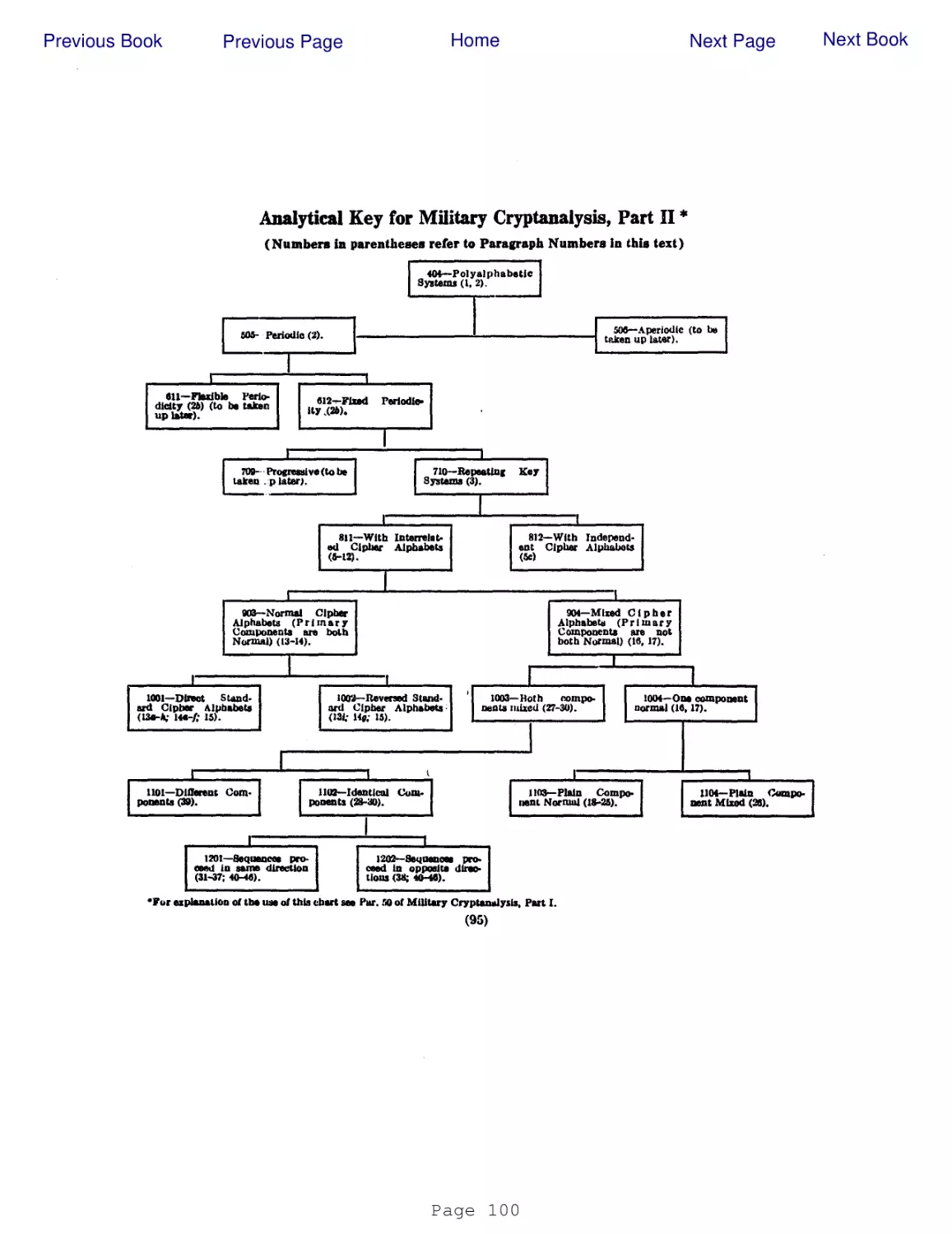
Analytical Key for Military Cryptanalysis, Part II * ......................
89
100
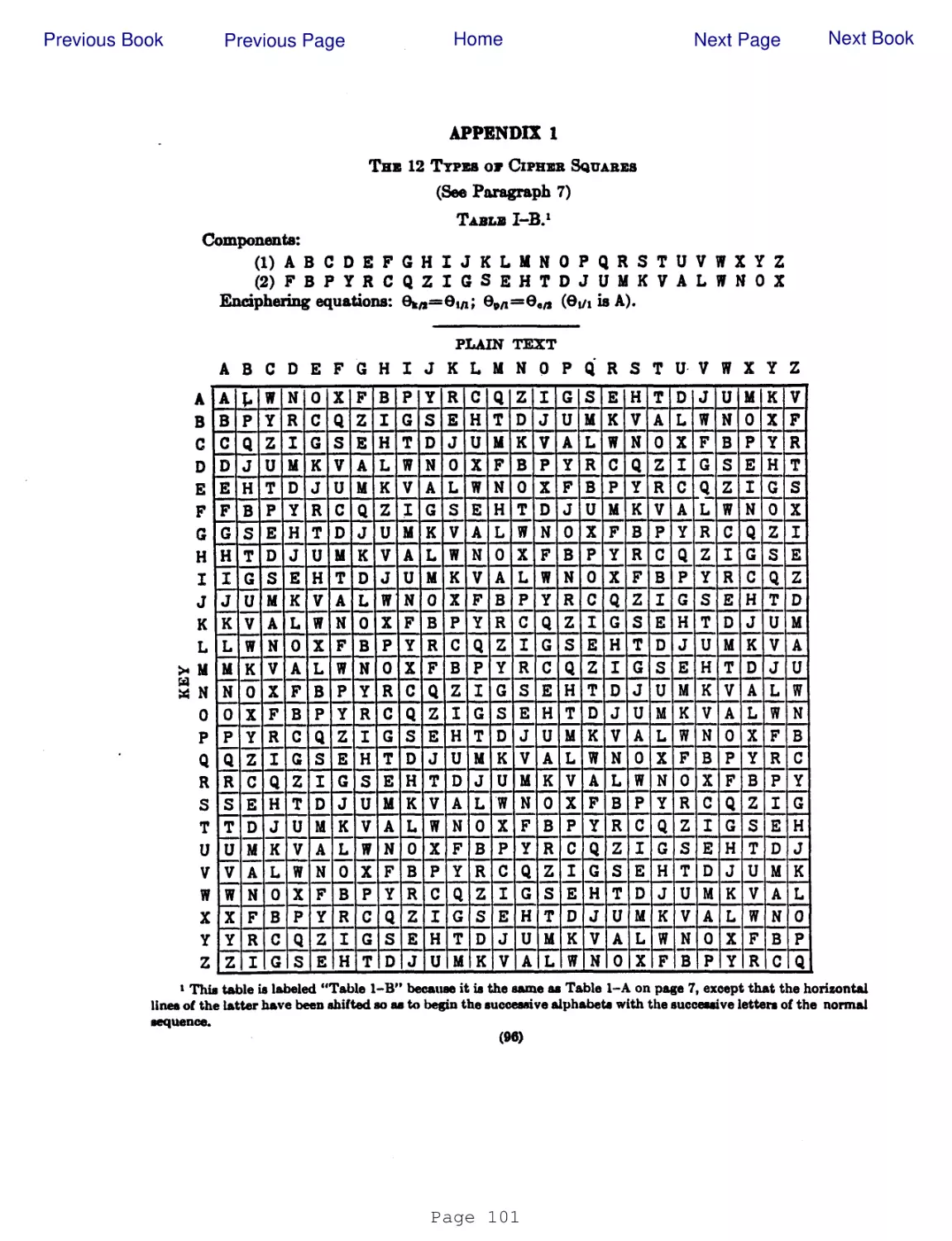
APPENDIX 1 ..................................................................... 101
THE 12 TYPES oF CIPHER SQUARES....................................
101
APPENDIX 2 .................................................................... 113
ELEMENTARY STATISTICAL THEOEY APPLICABLE TO ......
113
APPENDIX 3 ..................................................................... 126
A GRAPHICAL METHOD OF RECONSTRUCTING .................
126
INDEX ................................................................................
PROBLEMS .......................................................................
COMPUTER PROGRAMS ................................................
INDEX OF PROGRAMS ....................................................
137
139
153
154
Vigenere Encipherment .............................................................
TRUE BEAUFORT ENCIPHERMENT .......................................
VARIANT BEAUFORT ENCIPHERMENT .................................
DETERMINING THE PERIOD OF A PERIODIC CIPHER ........
VIGENERE ENCIPHERMENT USING MIXED ALPHABETS ....
155
157
159
161
163
Previous Book
Previous Page
Home
Next Page
MILITARY CRYPTANALYSIS
Part II
SIMPLER VARIETIES
OF POLYALPHABETIC SUBSTITUTION SYSTEMS
BY
WILLIAM F. FRIEDMAN
Page 2
Next Book
Previous Book
Previous Page
Home
Next Page
@I984 Aegean Park Press
ISBN: cl-89412-Q64-6
AEGEAN PARK PRESS
P. Q. Bsx 2837
Laguna Hills, California 92654
(7141586-8811
Manufactured in the United States of America
Page 3
Next Book
Previous Book
Previous Page
Home
Next Page
Next Book
FOREWORD
We are proud to add this book, MILITARY CRYPTANALYSTS, PART II, recently
declassified by the U.S. Government, to our Cryptographic Series. As in the
case of MILITARY CRYPTANALYSIS, PART 1, we have added a large number of
problems to the book.
These problems, largely keyed to the order that the
material is presented in the text, not only will provide the student with
many hours of enjoyment, but at the same time will act as the ultimate
teaching aid.
In keeping with what might be termed modern cryptologic advances, we have
also added to the book some computer programs.
There is no doubt that the
computer has greatly affected modern cryptology, and today cryptographic and
cryptanalytic "tasks" which at one time took hours and even days to accomplish can now be done in seconds, if not microseconds.
The added computer
programs, found at the end of the book, following the problems, are only
representative of the many programs that can be used with the large class of
cipher systems discussed in this book*
The student should set his sights on
modifying, improving, and developing other programs which will assist him in
his solution efforts.
Comments concerning this book,
are always greatly received.
or any book in our Cryptographic Series,
September 1984
AEGEAN PARK PRESS
Page 4
Previous Book
Previous Page
Home
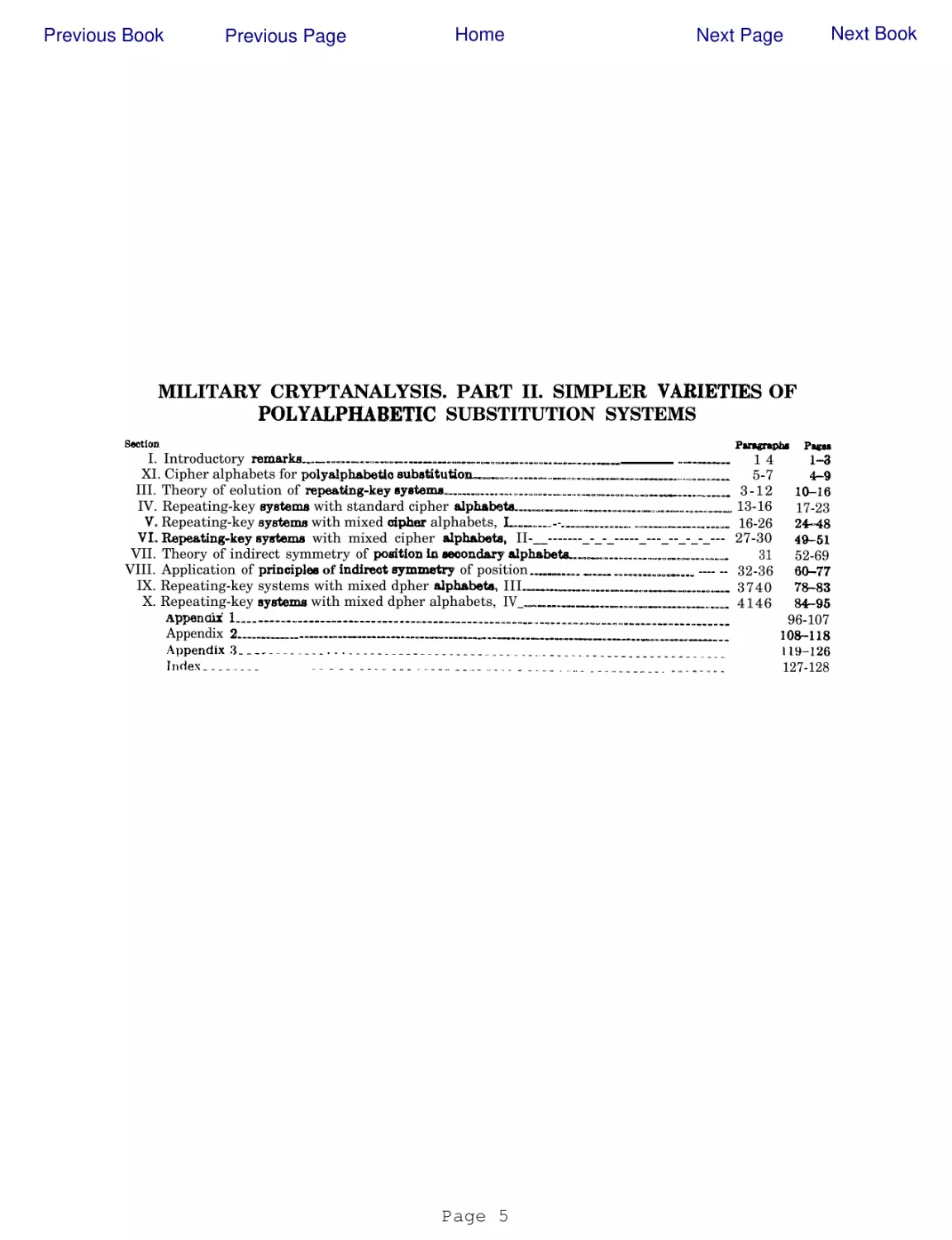
MILITARY CRYPTANALYSIS. PART II. SIMPLER VARIETIJZS OF
POLYALPHABETIC SUBSTITUTION SYSTEMS
section
--?
I. Introductory remarka___ ~DD~~-~~~~-D--I~~oI~-~-~~~-~~---oy--------*
14
XI. Cipher alphabets for polyalphabetio eub&itution____---_---_--------.------_-----.__..____--5-7
III. Theory of eolution of repeatig-key syetema ~----Y-----_.----“---~--.*--LID- 3 - 1 2
IV. Repeating-key syetellne with standard cipher alphabeta_--.____-_---------____-___-_-__--____
13-16
V. Repeating-key systems with mixed dpher alphabets, I__..----_ -------_-----... ~~~~“~~-~~~~~~~ 16-26
VI, Rqeating-key aystem~ with mixed cipher alphabeta, II-__-------_-_-_-----_---_--_-_-_--- 27-30
VII. Theory of indirect symmetry of poeition in eeoondary alph8beta_____._..__-_-_-_-----_--__
31
VIII. Application of principlea of indireot qmmetq of position -~---- _-_- -“---*~------_ ---- -- 32-36
IX. Repeating-key systems with mixed dpher alphabeta, III~““--~~~~~-~-~~~~~~~~~~~ 3740
X. Repeating-key sy&~mn with mixed dpher alphabets, IV_ _o---“s”-----_-“---““““------- 4146
..=
AplnmllX
i____
12
4-9
lo-16
17-23
24-48
49-51
52-69
60-77
73-83
84-96
96-107
103-118
119-126
127-128
~~~“~“--“~~------~~~_D__________________”~---~-“““~““~~~~.”””__”~“~~“___“~“~“~___~__
Appendix 2”--_-__-___ -----I--~-----------~--~---~-------------~_”--_-___-_____i-_-____
Al,pendix3_____~...___ . . . .._--...-_-...____ - _-..._._ -.___.________________ _.___ _
Indes__._.___
~_ . . _ _._.. ____ ..__.. __.__ .._.. _ _._._ .._._ __________. _._ ._..._ _
Page 5
Next Book
Next Page
Previous Book
Previous Page
Home
Next Page
Next Book
SECTION I
INTBODUCTOBYBEMABKS
The eaentM diihrenae between monoalphabetio and polyalphabetic subatitutfoa
Primary elaoalflorrtlon of polyalphab&io sycJtemR-~--------------_-__-l-Primary olamacrrtlon of periodlo eystema _-_---------_--_-I_-------t3equenm of study of polynlphabetio qvka----e---v-
P-E&
1
2
3
4
1. The essential diflerenoe between monoalphabetio and polyalphabedo anbstitution.-u.
In the substitution methods thus far discussed it has been pointed out that their basic feature
is that of monoalphabeticity. F’rom the cryptanalyti~ standpint, neither the nature of the
cipher symbols, nor their method of production is an essential feature, although these may be
difIerentiating charaoteristics from the cryptographic etandpoint. It is true that in those caeee
designated as monoalphabetic substitution with variants or multiple equivalents, there is a
departure, more or less considerable, from strict monoalphabeticity. In some of tbose cases,
indeed, there may be available two or more wholly independent sets of equivalents, which,
moreover, may even be arranged in the form of completely separate alphabets. Thus, while a
loose terminology might permit one to designate such systems as polyalphabetic, it is better to
reserve this nomenolature for those caseswherein polyalphabeticity is the essenceof the method,
specifically introduced with tbe purpose of imparting a po&onal variation in the substitutive
equivalents for plain-text letters, in accordance with some rule directly or indirectly connected
with the absolute positions tbe plain-text lettem occupy in the message. This point calls for
amplification.
b. In monoalphabetic substitution with variants the object of having di%rent or multiple
equivalents is to suppress, so far as possible by simple methods, the characteristic frequencies
of the letters occurring in plain text. As has been noted, it is by means of these characteristic
frequencies that the cipher equivalents can usually be identified. In these systems the varying
equivalents for plain-text letters are subject to the free choice and caprice of the enciphering
olerk; if he is careful and conscientious in the work, he will really make use of all the dSrent
equivalents afforded by the system; but if he is slip-shod and hurried in his work, he will use the
same equivalents repeatedly rather than take pains and time to refer to the charts, tables, or
diagrams to find the variants. Moreover, and this is a crucial point, even if the individual
enciphering clerks are extremely careful, when many of them employ the same system it is entirely
impossible to insure a complete diversity in the encipherments produced by two or more clerks
working at ditIerent message centers. The result is inevitably to produce plenty of repetitions
in the texts emanating from several stations, and when texts such as these are all available for
study they are open to solution, by a comparison of their &uilarities and differences.
c. In true polyalphabetic systems, on the other hand, there is established a rather deflnita
procedure which automatically determines the shifts or changes in equivalents or in the manner
in which they sre introduced, so that these changes are beyond the momentary whim or choice of
the enciphering clerk. When the method of shifting or changing the equivalents is scientifically
sound and sufllciently complex, the research necessary to establish the values of the cipher
characters is much more prolonged and diflicult than is the case even in complicated monoalphsr
betic substitution with variants, as will later be seen. These are the objects of true polyalphabetic substitution systems. The number of such systems is quite large, and it will be possible to
(1)
Page 6
Previous Book
Previous Page
Home
Next Page
Next Book
2
describe in detail the cryptan@eis of only a few of the more common or typical examplea of
methods encountered in practical military communications.
d. The three methods, (1) single-equivalent monoalphabetic substitution, (2) monoalphabet& substitution withy variants, and (3) true polyalphabetic substitution, show the following
relationships as regards the equivalency between plain-text and cipher-text unite:
A. In method (I), there is a set of 26 symbols; a plain&xt letter is always represented by
one and only one of these symbois; conversely, a symbol always repreaente the same piain=text
letter. The equivalence between the plain-text and the cipher letters is constant in both encipherment and decipherment.
B. In method (2), there is a set of n symbols, where 1) may be any number greater than 26
and often is a multiple of that number; a plain4ext letter may be represented by 1,2, 3, . . .
Merent symbols; conversely, a symbol always representi the same plain-text letter, the same as
is the case in method (I). The equivalence between the plain-text and the cipher letters is
variable in encipherment but constant in decipherment.l
C. In method (3) there is, as in the first method, a set of 26 symbols; a plain-text letter
may be represented by 1,2,3, . . . 26 diRerent symbols; convemely, a symbol may repreeent
1, 2, 3, . . . 26 difEerent plain text letters, depending upon the system and the specS~ key.
The equivalence between the plain-text and the cipher letters is variable in both encipherment
and decipherment.
2. Primary clastioation oi polyalphabetio systems.--a. A primary &r&cation
of polyalphabetic systems into two rather distinct typee may be made: (1) periodic systems and (2)
aperiodicsystem& When the enciphering prooees involves a cryptographic treatment which is
repetitive in character, and which results in the production of cyclic pW
in the cryptoWhen the enciphering process is not of the type
graphic text, the system is termed p&&c.
described in the foregoing general terms, the system is termed aperio&.
The substitution in
both cases involvea the use of two or more cipher alphabeta.
b. The cyc+ phenomena inherent in a periodic system may be exhibited externally, in
which case they are said to be paten& or they may not be exhibited exteunally, and must be uncovered by a preliminary step in the analyeia, in whioh case they are said to be Zutent. The
periodicity may be quite definite in nature, and therefore determinable with mathematical
exactitude allowing for no variability, in which case the periodicity is said to be&&.
In other
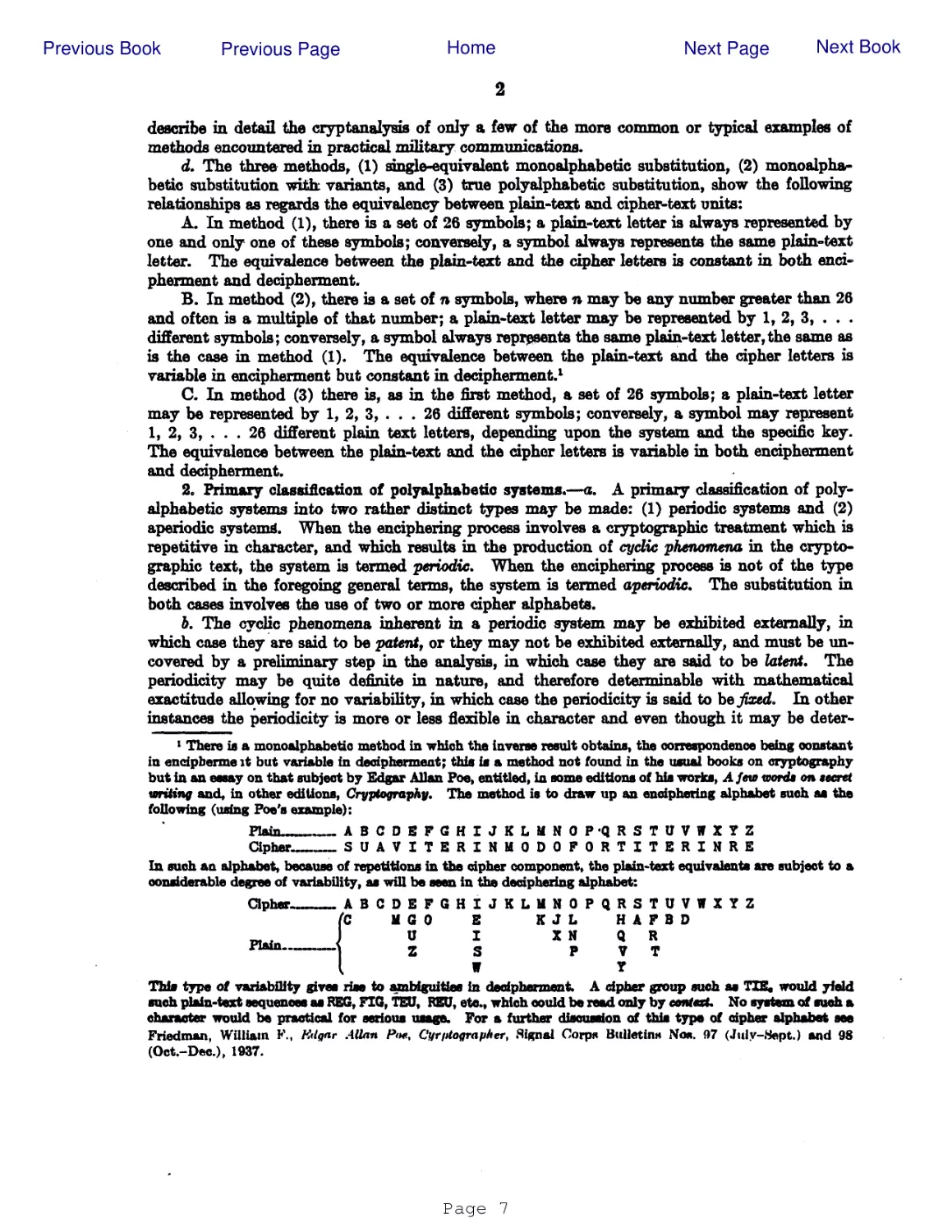
instancea the periodicity is more or less flexible in character and even though it may be deter* There is a monoalphabetio method in wbioh the inveme result obtains, the aormapondencs being am&ant
in endpberme It but variable in cbaiplmmmnt; tbia ir a method not found in the usual books on uryptographp
but in an woay on that aubjeat by Edgar AUan Poe, e&i&d, in oome editiona of h& worko, A )%wwor& on moral
dng
and, in other editiona, Cryptograpliy. The method ir to draw up an endphering alphabet mmh M the
foUowing (u&g Poe’s example):
ABCbEFCHIJKLYNOPeQRSTUVWXYZ
SUAVITERINYODOFORTITERINRE
cipllee-In auoh an alphabet, beoau& of repetition8 in the dpher component, the plein-text equivalenta am aubjeet to a
oondderable degree of variability, (Y will be m in the deoiphsring dphabetz
ABCDEFGHIJKLYNOPQRSTUVWXYZ
ClpkC
XJL
HAFBD
MOO
E
U
I
XN
QR
..P
Z
V
T
P
1”
(
ThlrtypeofvariabiUtygiva~foq&&uitieeindeaiphermeak
AdpeatgroupeuehruTXE.wouIdyfdd
mmh plain-text sequences as REG,FIG, TW, REU, eta., whioh aould be mad only by cenfu&. No w
of mzaha
oharmterwouldbapraetiedformrloumuaqe.
Forafurtherdiaoumionofthiatypeofdpherdphabatwe
Friedman, William Y., Etlqnr .4Utanhe, C~rpto~apher, R&d corps Balletinn NOR. 97 (Jui~-Bept.) and 98
(Oat.-Dee.), 1937.
Page 7
Previous Book
Previous Page
Home
Next Page
Next Book
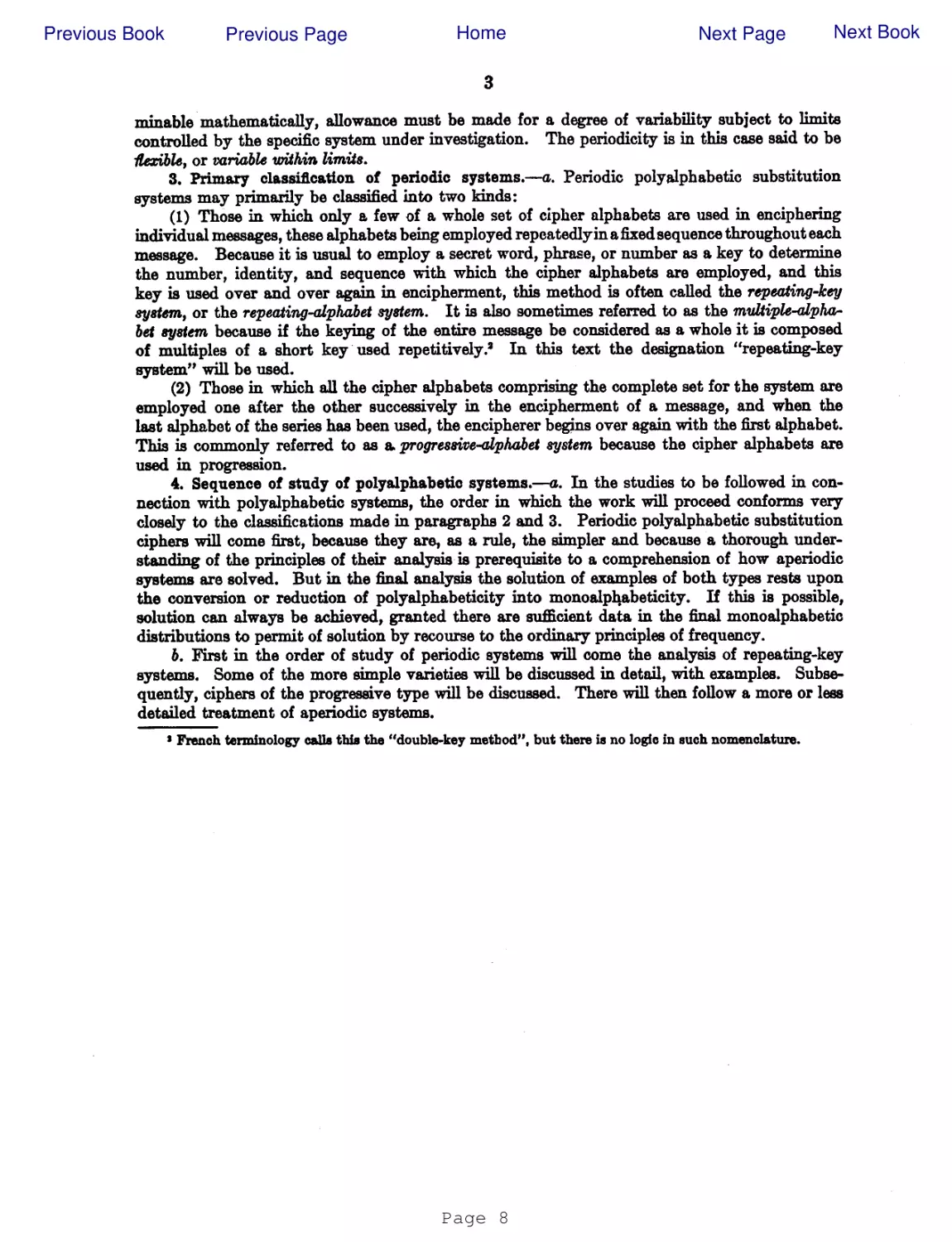
3
minable mathematically, allowance must be made for a degree of variability subject to limits
controlled by the specific system under investigation. The periodicity is in this case said to be
&xibb, or lxlriabb withk limits.
3. primary classification of periodic systems.--+. Periodic polyalphabetic substitution
systems may primarily be classified into two kinds:
(1) Those in which only a few of a whole set of cipher alphabets are used in enciphering
individual messages,these alphabet8 being employed repeatedly in a fixed sequencethroughout each
message. Because it is usual to employ a secret word, phrase, or number a8 a key to determine
the number, identity, and sequence with which the cipher alphabets are employed, and this
key is used over and over again in encipherment, this method is often called the repea&ng-key
system, or the repeating-alphabet system. It is also sometime8 referred to as the mu&iple&phabd system because if the keying of the entire message be considered as a whole it is composed
of multiples of a short key. used repetitively? In this text the designation “repeating-key
system” will be used.
(2) Those in which all the cipher alphabets comprising the complete set for the system are
employed one after the other successively in the encipherment of a message, and when the
last alphabet of the series hae been used, the encipherer begins over again with the first alphabet.
system because the cipher alphabets are
This is commonly referred to as a progres&ealpMet
used in progression.
4. Sequence of study of polyalphabetio systems.-o. In the studies to be followed in connection with polyalphabetic systems, the order in which the work will proceed conform8 very
closely to the classifications made in paragraphs 2 and 3. Periodic polyalphabetic substitution
ciphers will come first, because they are, se a rule, the simpler and becau8e a thorough understanding of the principles of their analysis is prerequisite to a comprehension of how aperiodic
systems are solved. But in the final analy8i8 the solution of examples of both types r&e upon
the conversion or reduction of polyalphabeticity into monoalphabeticity. If this i8 possible,
solution can alwaya be achieved, granted there are sutbcient data in the fmal monoalphabetic
distributions to permit of solution by recourse to the ordinary principles of frequency.
b. First in the order of study of periodic systems will come the analysis of repeating-key
systems. Some of the more simple varieties will be discussed in detail, with examples. Subeequently, cipher8 of the progre8sive type will be discussed. There will then follow a more or leas
detailed treatment of aperiodic systems.
s Frenoh Wmiuology ti
this the “double-key method”, but there is no logio in suoh nomenclature.
Page 8
Previous Book
Home
Previous Page
Next Book
Next Page
SECTXON n
CIPHER ALPHABETSFOB POlLYAEPHABETICSUWHTUTION
claEei5~tion of tipher alphabeltcupon the bssisof their daivation---,,wRhmry aomponent~~and a+ondary alpha-Primary oomponenfr, aipher dih, and square tablea
m-e-m--Im-m------
---
-nw'a'
5
--
6
7
5. Claatioation of cipher alphabets upon the baais of their derivation-o.
The substitution processes in polyalphabetic methods involve the use of a plurality of cipher alphabets.
The latter may be derived by various schemes, the exact nature of which determines the principal
characteristics of the cipher alphabets and plays a very important role in the preparation and
solution of polyalphabetic cryptograms. For these reasons it is advisable, before proceeding to a
discussion of the principles and methods of analysis, to point out these various types of cipher
alphabets, show how they are produced, and how the method of their production or derivation
may be made to yield important clues and short-cuts in analysis.
b. A primary classiCcation of cipher alphabets for polyalphabetic substitution may be made
into the two following types:
(1) Independent or unrelated cipher alphabets.
(2) Derived or interrelated cipher alphabets.
c. Independent cipher alphabets may be disposed of in a very few words. They are merely
separate and distinct alphabets showing no relationship to one another in any way. They may
be compiled by the various methods discussed in Section IX of Eztmentary Military Cryptography.
The solution of cryptograms written by means of such alphabets is rendered more diEcult by
reason of the absence of any relationship between the equivalents of one cipher alphabet and
those of any of the other alphabets of the same cryptogram. On the other hand, from the point of
view of practicability in their production and their handling in cryptographing and decryptographing, they present some di&ulties which make them less favored by cryptographers than cipher
alphabets of the second type.
d. Derived or interrelated alphabets, as their name indicates, are most commonly produced
by the i&ra&on of two primary components, which when juxtaposed at the various points of
coincidence can be made to yield 8ecoRdapya&&zbekl
6. Primary components and secondary alphabets.- Two basic, slidable sequences or components of n characters each will yield n secondary alphabets. The components may be &ssified according to various schemes. For cryptanalytic purposes the following classification will be
found useful:
CASE A. The primary components are both normal sequences.
(The secondary alphabets are direct
(1) The sequences proceed in the same direction.
standard alphabets.) (Pars. 13-15.)
(2) The sequences proceed in opposite directions. (The secondary alphabets are reversed
standard alphabets; they are also reciprocal cipher alphabets.) (Par. l3i, 14g.)
CASE B. The primary componeuta are not both normal sequences.
(1) The plain component is normal, the cipher component is a mixed sequence. (The
secondary alphabets are mixed alphabets.) (Par. 16-25.)
’ Bee Sm. VIII and IX, Etummtm
Milhy
Ctyphgmphy.
(4)
Page 9
Previous Book
Previous Page
Home
Next Page
Next Book
5
(2) The plain component is a mixed sequence, the cipher component is normal. (The
secondary alphabets are mixed alphabets.) (Par. 26.)
(3) Both components are mixed sequences.
(a) Components are identical mixed sequences.
I. Sequences proceed in the same direction. (The secondary alphabets are
mixed alphabets.) (Par. 28.)
II. Sequences proceed in opposite directions. (The secondary alphabets are
reciprocal mixed alphabets.) (Par. 38.)
(b) Components are different mixed sequences. (The secondary alphabets are mixed
alphabets.) (Par. 39.)
7. Primary components, cipher disks, and square tables.+. In preceding texts it has
been shown that the equivalents obtainable from the use of quadricular or square tables may be
duplicated by the use of revolving cipher disks or of sliding primary components. It was also
stated that there are various ways of employing such tables, disks, and sliding components.
Cryptographically t*he results may be quite diverse from different methods of using such paraphernalia, since the specific equivalents obtained from one method may be altogether different
from those obtained from another method. But from the cryptanalytic point of view the
diversity referred to is of little significance; only in one or two csses does the specific method of
employing these cryptographic instrumentalities have an important bearing upon the procedure
in cryptanalysis. However, it is advisable that the student learn something about these different
methods before proceeding with further work.
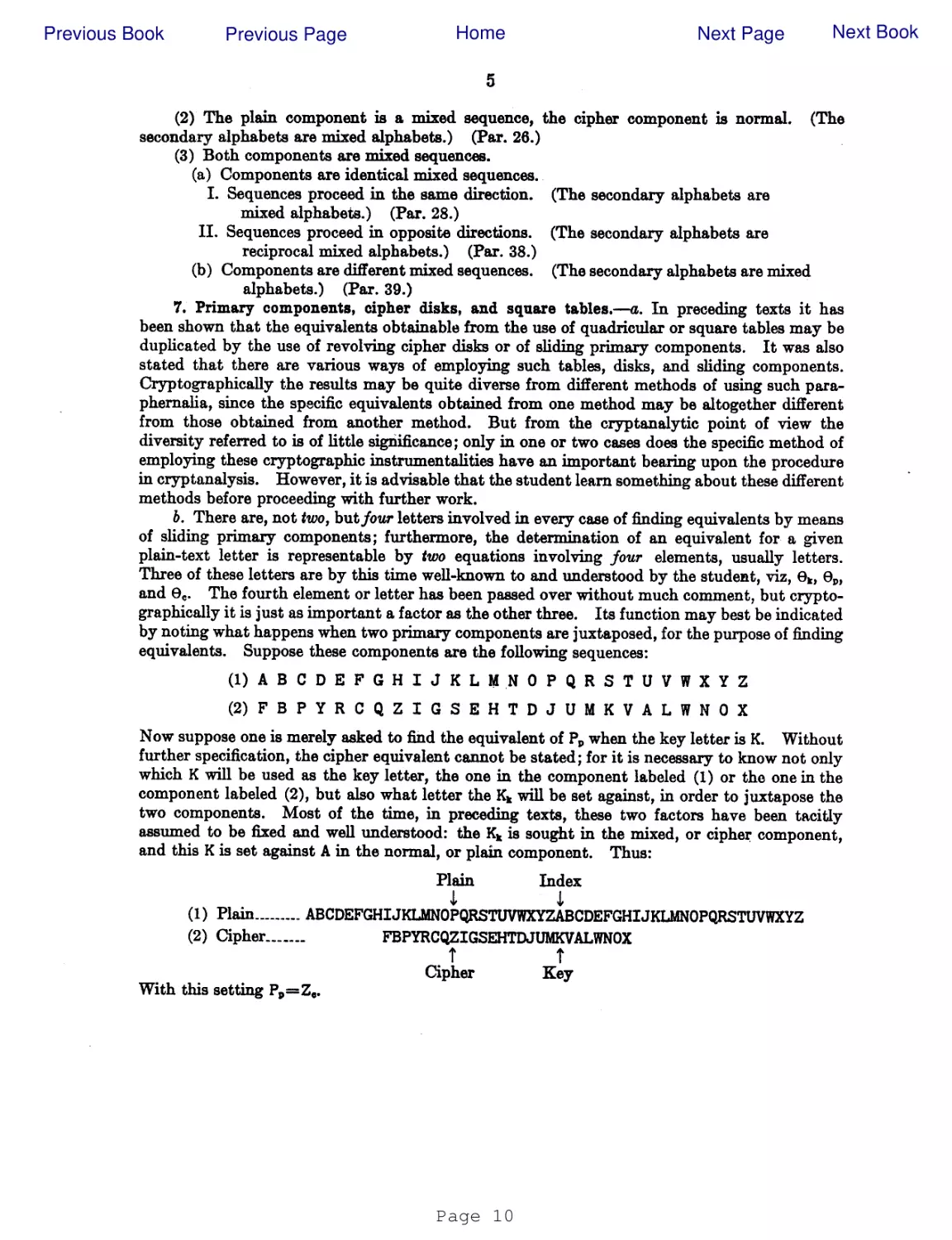
b. There are, not two, but four letters involved in every case of tiding equivalents by means
of sliding primary components; furthermore, the determination of an equivalent for a given
plain-text letter is representable by two equations involving four elements, usually letters.
Three of these letters are by this time well-known to and understood by the student, viz, G,, C,,
and 8,. The fourth element or letter has been passed over without much comment, but cryptographically it is just as important a factor as the other three. Its function may best be indicated
by noting what happens when two primary components are juxtaposed, for the purpose of tiding
equivalents. Suppose these components are the following sequences:
(1)ABCDEFGHIJKLNNOPQRSTUVWXYZ
(2)FBPYRCQZIGSEHTDJUMKVALWNOX
Now suppose one is merely asked to &id the equivalent of P, when the key letter is K. Without
further specification, the cipher equivalent cannot be stated; for it is necessary to know not only
which K will be used as the key letter, the one in the component labeled (1) or the one in the
component labeled (2), but also what letter the Kk will be set against, in order to juxtapose the
two components. Most of the time, in preceding texts, these two factors have been tacitly
assumed to be fixed and well understood: the r<, is sought in the mixed, or cipher component,
and this K is set against A in the normal, or plain component. Thus:
Plain
Index
1
i
ABCDEFGHIJKLNNOPQRSTwwxmAB CDEFGHIJKLMNOPQRSTWWXYZ
(1) Plain _________
(2) Cipher _______
FBPYRCQZIGSEHTDJUMKVALWNOX
t
t
Cipher
Kv
With this setting Po=Z,.
Page 10
Previous Book
Home
Previous Page
Next Page
Next Book
6
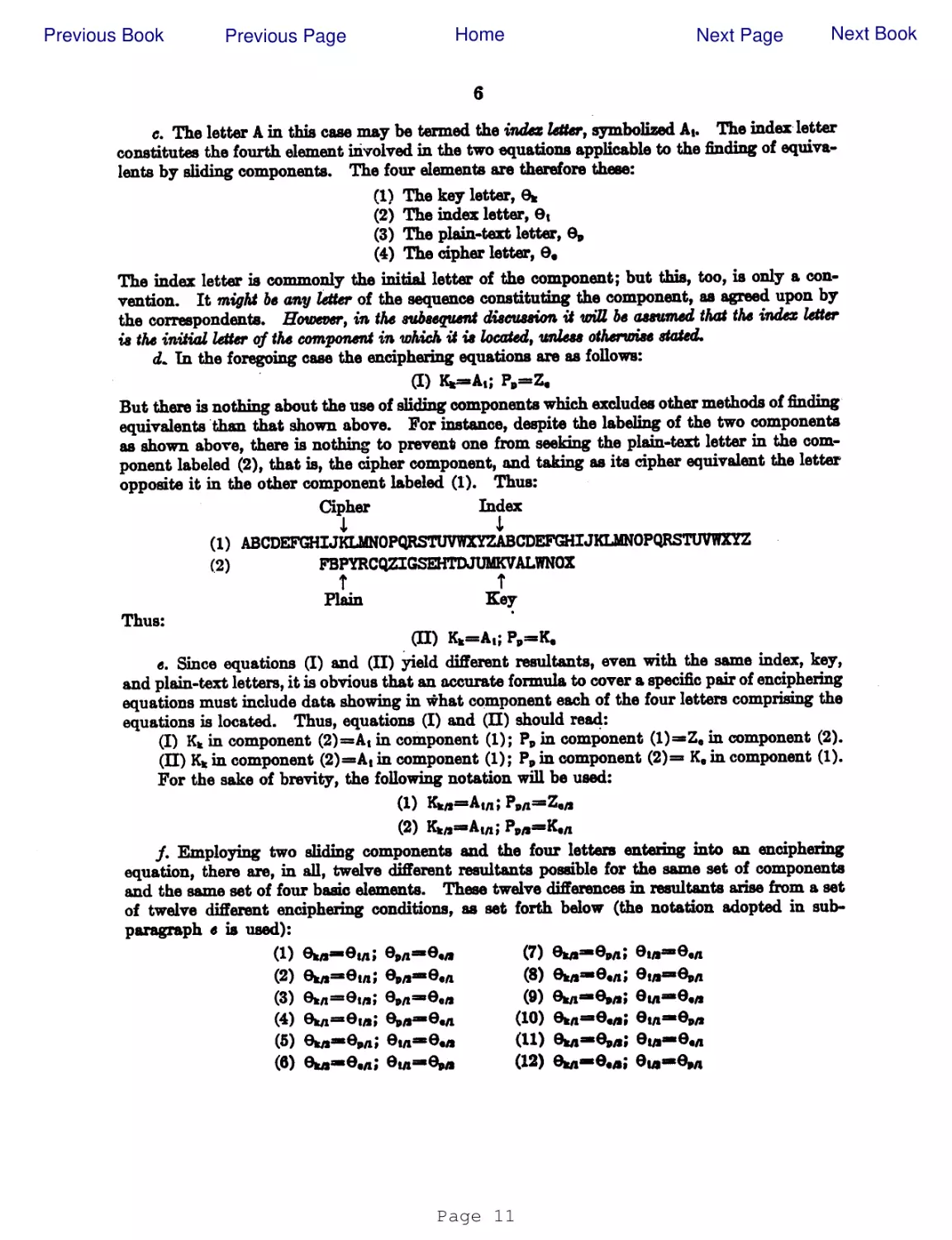
c. The letter A in this case may be termed the iti
f&u-, symbolized A,. The iudexletter
constitutes the fourth element involved in the two equations applicable to the 6miing of equivalents by sliding componenta. The four elements are therefore theee:
(19 The key letter, 0k
(2) The index letter, 8c
(3) The plejn-tea letter, h
(4) The cipher letter, 8.
The index letter is commonly the initial letter of the component; but this, too, ia only a convention. It nrisrJ be any Z&r of the se~nence constituting the component, as agreed upon by
if’lDiab6amm!dthutth6indexkttU
the correspondenti. Howtsar, in this subesqrtsnt d&u&n
iet~inifiolIc#stoft~~~inwh~itislocatcd,~~ot~~
d. In the foregoing case the enciphering equations are aa follows:
Q b=Ai; P,=z,
But there is nothing about the use of sliding components which excludes other methods of fluding
cquivalenta’than that shown above. For instance, de+spitethe labeling of the two components
ae shown above, there is nothing to prevent one from seeking the plain-text letter in the component labeled (2), that is, the cipher component, and taking ae ita cipher equivalent the letter
opposite it in the other component labeled (1). Thus:
l.n$ex
Cipher
(1) ABCEFGHW~0P~~~J~0P~
FBPYRCQzIC
(2)
T
Plain
-r
Ices.
Thus:
(II) K.=A,;P,=K.
e. Since equations (I) and (II) yield different resultants, even with the same index, key,
and plain-text letters, it is obvious that an accurate formula to cover a specific pair of enciphering
equations must include data showing in *hat component each of the four lettera comprising the
equations is located. Thus, equations (I) and (II) should read:
(I) Kk in component (2)=-A, in component (1) ; Pv in component (l)=Z, in component (2).
(II) Kk in component (2)=A, in component (1); P, in component (2)= K, in component (1).
For the sake of brevity, the following notation will be used:
0) &z=h;
Cm=Zen
(29 &a=h;
%P&I
f. Employing two sliding componenta and the four letters entering into an enciphering
equation, there are, in all, twelve diGrent resultants poseible for the same set of components
and the same set of four basic elements. These twelve di&mncea in resultants arise from a set
of twelve different enciphering conditions, ae set forth below (the notation adopted in subparagraph 6 is used):
Page 11
Previous Book
Previous Page
Home
Next Page
Next Book
7
g. The twelve resultants obtainable from juxtaposing sliding components aa indicated under
the preceding subparagraph may also be obtained either from one square table, in which case
twelve different methods of finding equivalents must be applied, or from twelve different square
tables, in which case one standard method of fInding equivalents will serve all purposes.
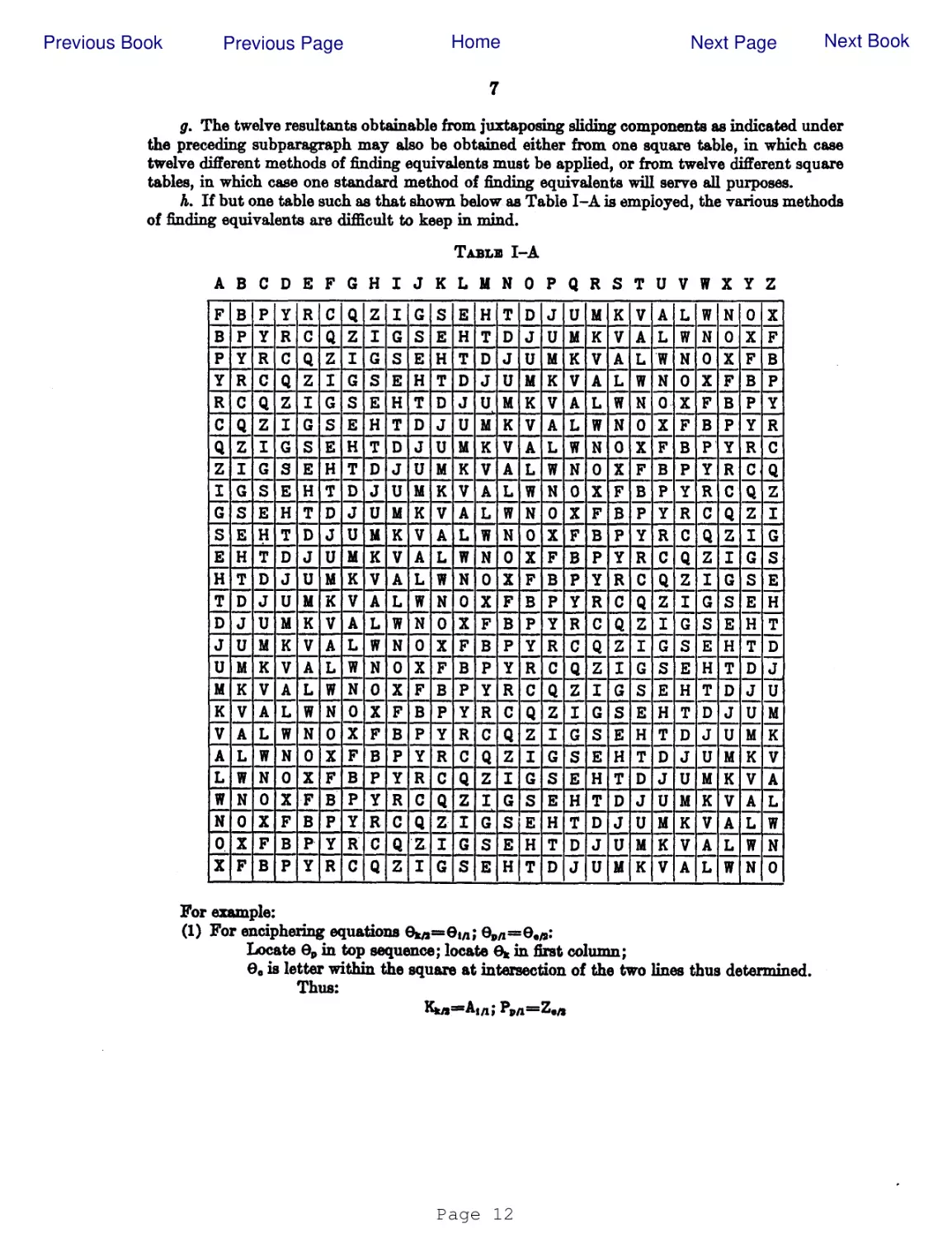
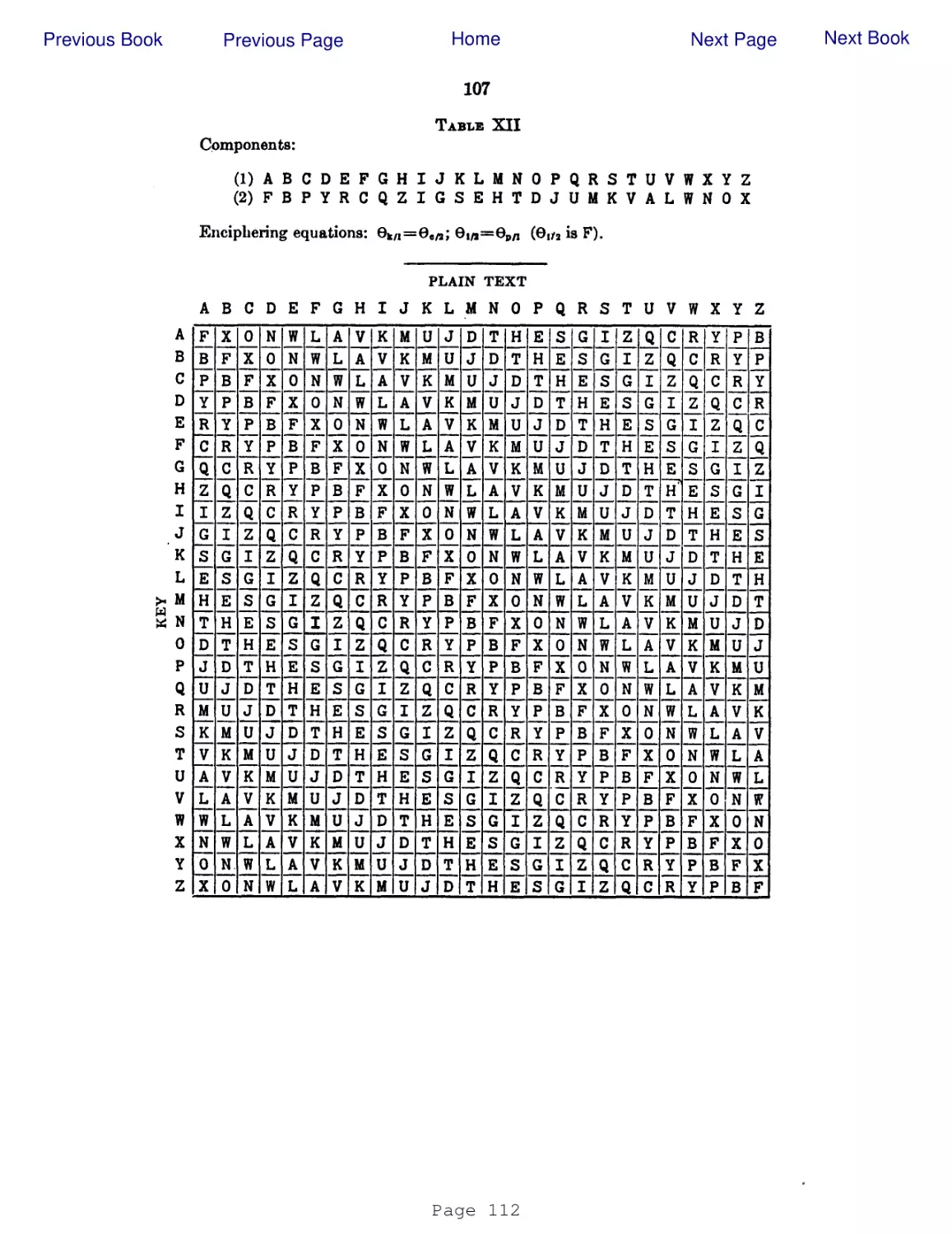
h. If but one table such as that shown below as Table I-A is employed, the various methods
of &ding equivalents are d.%icult to keep in mind.
TABLI I-A
ABCDEFGHIJKLHNOPQRSTUVWXYZ
For example:
(1) For enciphering equations %=01~; Q=eoIO:
Locate 43,in top sequence; locate % in 6rst column;
8, is letter within the square at intersection of the two lines thus determined.
Thus:
&n=Am
; Pm=&n
Page 12
Previous Book
Home
Previous Page
Next Page
Next Book
8
(2) For enciphering equationa &=efn;
Gtir=Go~:
Locate e, in iht column; follow line to right to 8,; proceed up this cohmm; 8, is
letter at top.
Thus:
&n=ha
(3) For enciphering equations t&,,=el,,;
; P~=%I
e,,f13eon:
Locate % in top sequence and proceed down column to 8, ;
Locate e, in top sequence; e, is letter at other corner of rectangle thus formed.
ThUfl:
Kw~=&a; Ppn=Xon
Only three different methods have been shown and the student no doubt already has encountered
difficulty in keeping them segregated in his mind. It would obviously be very confusing to try
to remember all twelve methods. But if one standard or fixed method of finding equivalents is
followed with several d&rent tables, then this dlfhculty dwlppears. Suppose that the following
method is adopted: Arrange the square so that the plain-text letter may be sought in a separate
sequence, arranged alphabetically, above the square and so that the key letter may be sought
in a separate sequence, also armnged alphabetically, to the left of the square; look for the plaintext letter in the top row; locate the key letter in the 1st column to the left; find the letter standing within the square at the intersection of the vertical and horixontal lines thus determined.
Then tweh squares, equivalent to the twelve d&rent conditions listed in subparagraph f, can
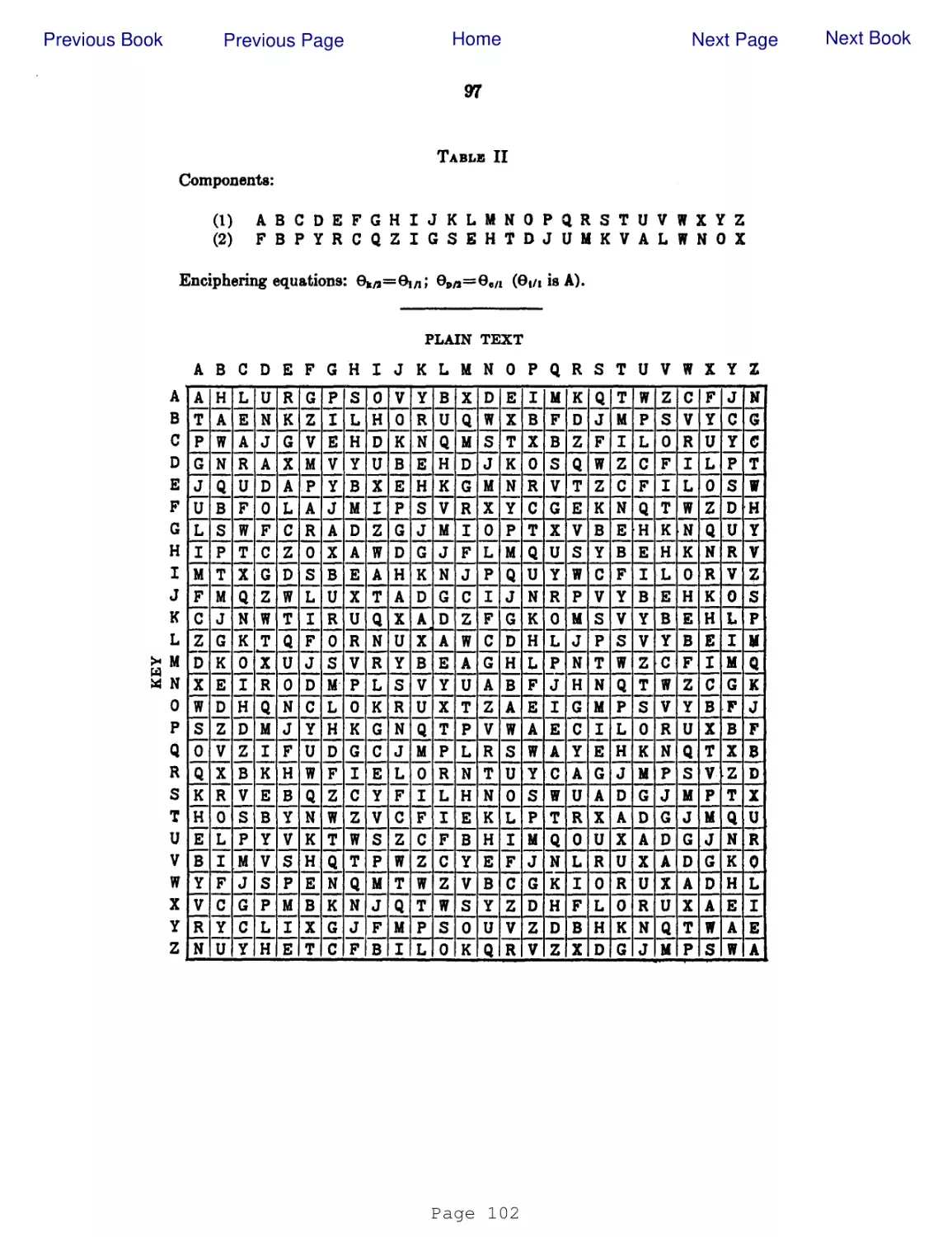
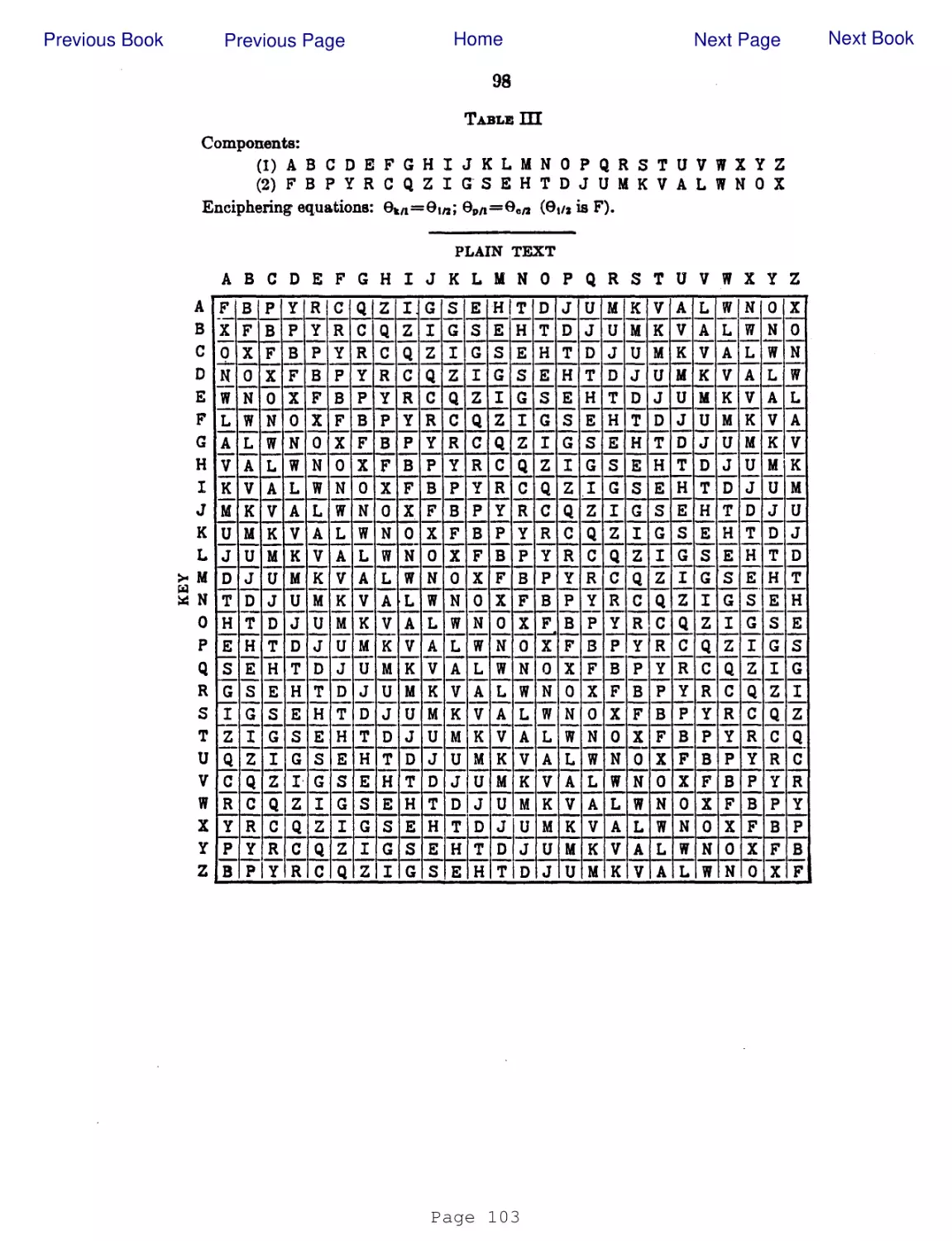
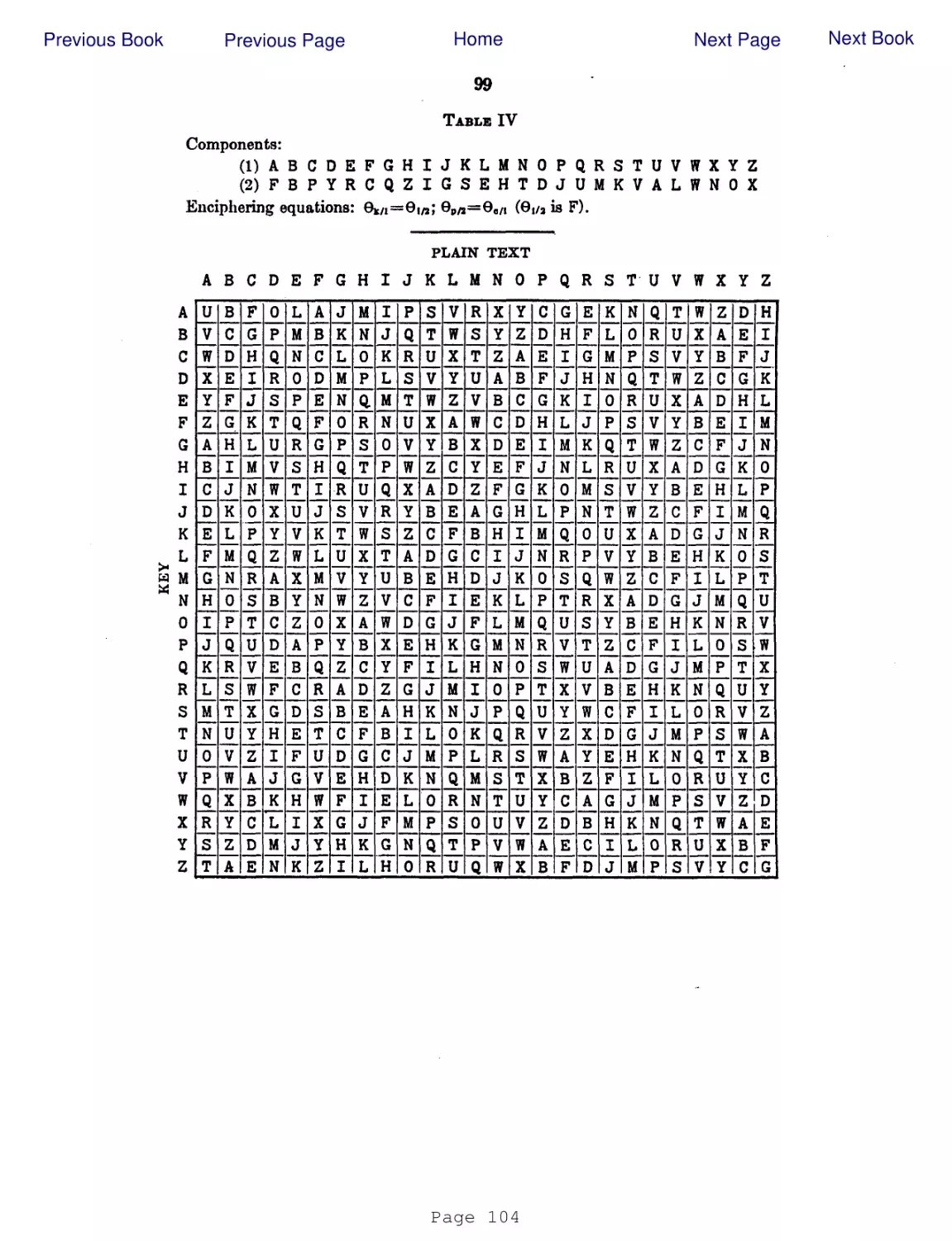
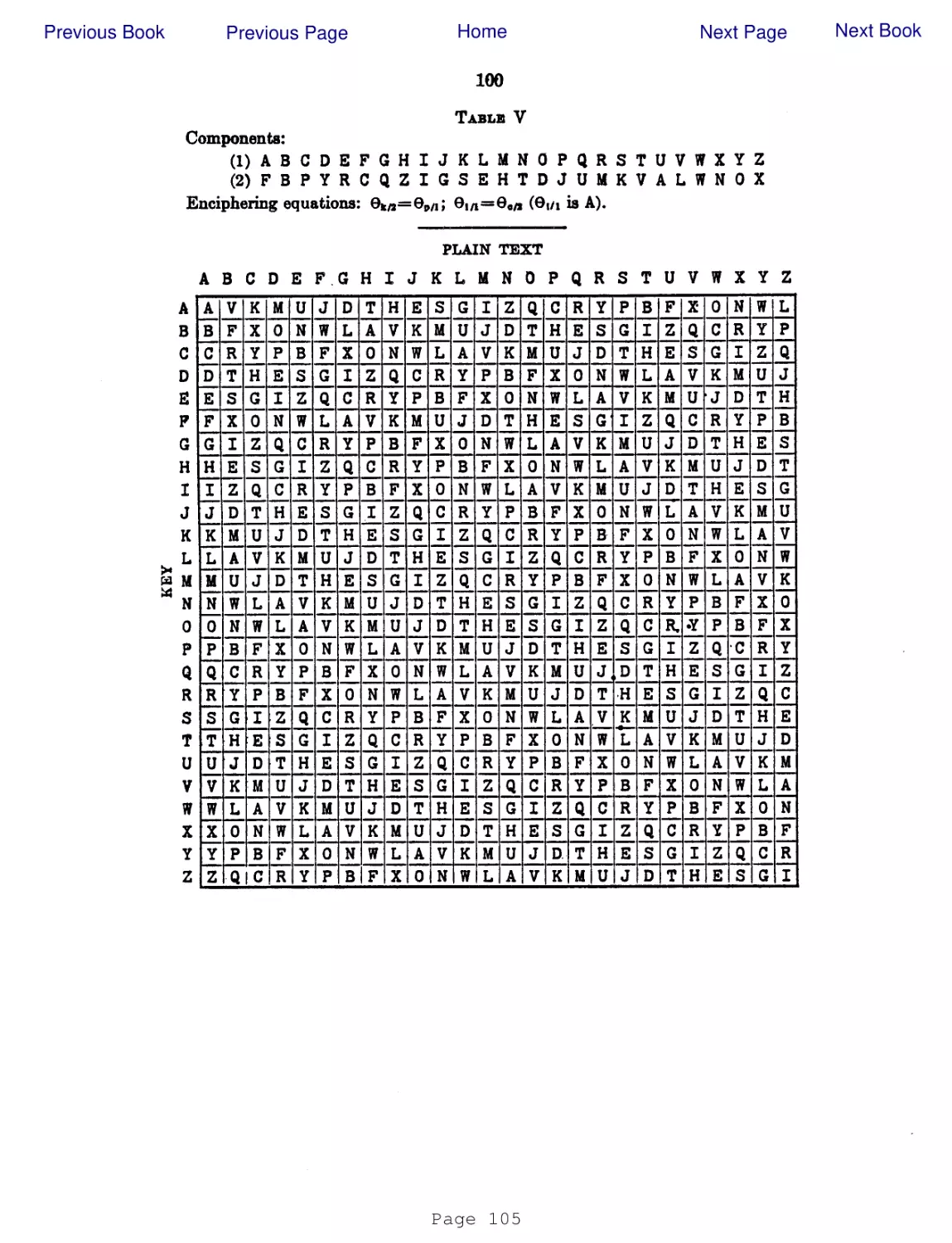
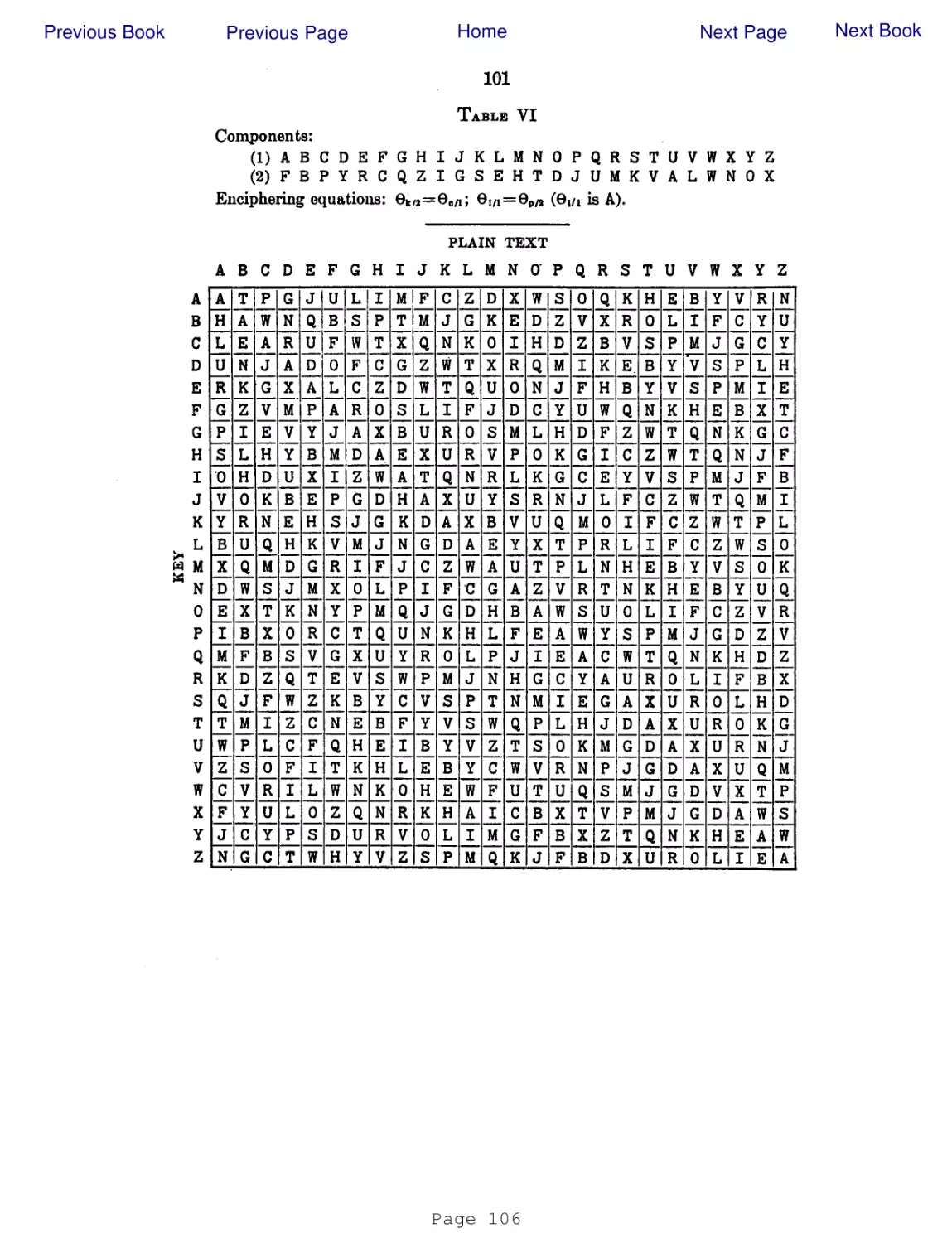
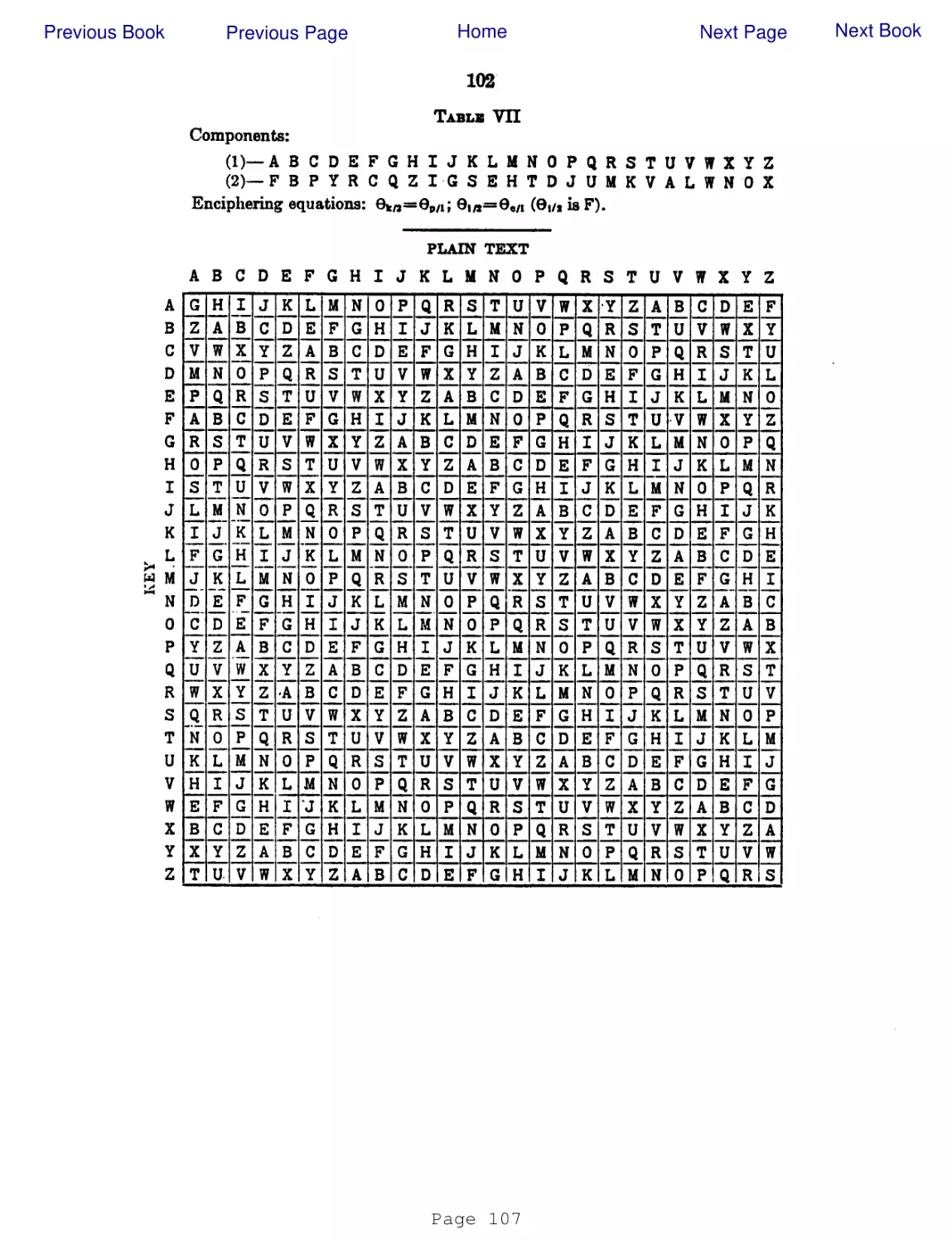
readily be constructed. They are all shown in Appendix 1, pp. W-107.
i. When these square tables are examined carefully, certain interesting points are noted.
In the first place, the tables may be paired so that one of a pair may serve for enciphering and the
other of the pair may serve for deciphering, or vice versa. For example, tables I and II bear this
reciprocal relationship to each other; III and IV, V and VI, VII and VIII, IX and X, XI and
XII. In the second place, the internal dispositions of the letters, although the tables are derived
from the same pair of components, are quite diverse. For example, in table I-B the horixontal
sequences are identical with those of Table I-A, but are merely displaced to the right and to the
left different intervals according to the successive key letters. Hence this square shows what
may be termed a horizontally-displaced, direct symmetry of the cipher component. Vertically,
it shows no symmetry, or if there is symmetry, it is not visible.* But when Table I-B is more
carefully examined, an invisible, or indirect, vertical symmetry may be discerned. where at first
glance it is not apparent. If one takes any two colvmne of the table, it is found that the interval
between the members of any pair of letters in one column is the same as the interval between the
members of the homologous pair of letters in the other column, if the.dietant% ie mca8ured on th-e
tiphe component. For example, consider the 2d and 15th columns (headed by L and I, respectidy) ; take the letters P and G in the 2d column, and J and Win the 15th column. The distance
between P andG on the cipher component is 7 intervals: the distance between J and Won the same
component is uZ807 intervals. This phenomenon implies a kind of hidden, or latent, or indirect
symmetry within the cipher square. In fact, it may. be stated that every table which sets forth
in systematic fashion the various secondary alphabete derivable by sliding two primary sequences
through all points of coincidence to find cipher equivalents must show some kind of symmetry,
’ It b true that ths fkot column within the table nhowa~the pbbcomponenf
requence, but thin is merely
Wum the method of finding the equivalenta in this cafe b mch that thb sequence t bound to appear in that
aolumn,aincethemwoadvekeyle&teraareA,
8, C, , . . 2, and tbia mqucnce bappau to bc identical with
thepldncomponantinthiacase.
Thesrrmbir~~T~VrrrPdXI;itLdw,~~kths~~wof
TWIXcurdx.
Page 13
Previous Book
Home
Previous Page
Next Page
Next Book
9
both horizontally and vertically. The symmetry may be termed Z&Y&%or direct, if the sequences
of letters in the rows (or columns) are the same throughout and &re identical with that of one
of the primary components; it may be termed hidden or indirect if the sequencesof letters in the
rows or columns are different, apparently not related to either of the components, but are in
reality decimations of one of the primary components.
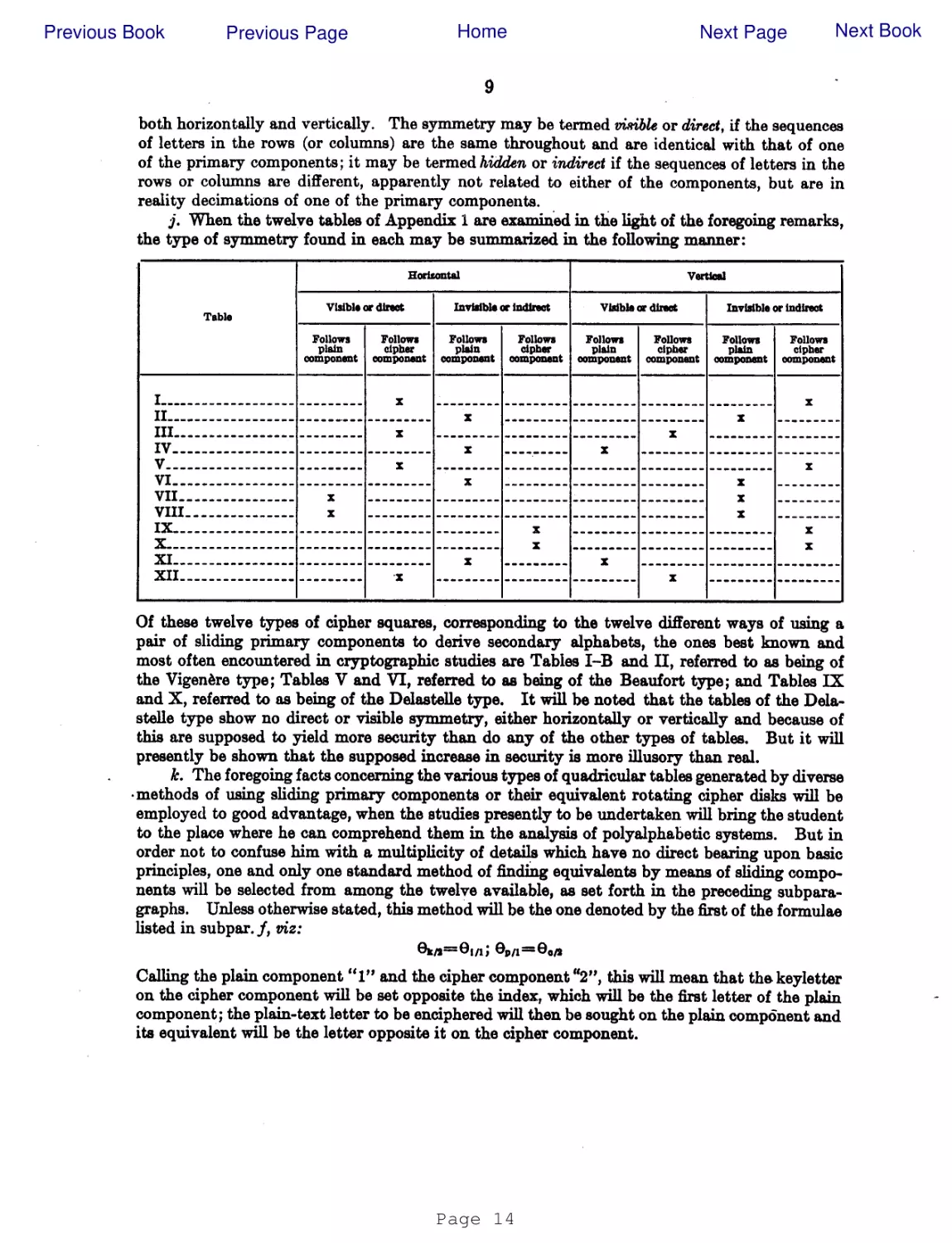
j. When the twelve tables of Appendix 181~ ex8mined in the light of the foregoing remarks,
the type of symmetry found in each may be sumnmrixed in the following manner:
I
Table
I
HUdCGIltd
VMblo or dhat
I
V@ ic8l
Invldbloalndhat
I
VIdbla Q dimat
1
----------------.
------------*----.
X
----e---.
X
--m------
----m------------.
---------II--------.
Of these twelve types of cipher squares, corresponding to the twelve different ways of using a
pair of sliding primary components to derive secondary alphabets, the ones best known snd
most often encountered in cryptogr8phic studies 8re Tables I-B and II, referred to 8s being of
the Vigenere type; Tables V and VI, referred to 8s be@ of the Beaufort type; and Tables IX
and X, referred to 8s being of the Delastelle type. It will be noted that the tables of the Delastdle type show no direct or visible symmetry, either horixont8lly or vertics.lly and because of
this 8re supposed to yield more security than do sny of the other types of tables. But it will
presently be shown that the supposed increase in security is more illusory thns re8l.
k. The foregoing facts concerning the vasious types of qu8dricular tables generated by diverse
*methods of using sliding primary components or their equiv8lent rotating cipher disks will be
employed to good advantage, when the studies presently to be undertaken will bring the student
to the place where he can comprehend them in the axmlysis of polyalphabetic systems. But in
order not to confuse him with a multiplicity of det$s which have no direct bearing upon basic
principles, one and only one standard method of finding equivrtlents by means of sliding components will be selected from among the twelve available, 8s set forth in the preceding subparagraphs. Unless otherwise stated, this method will be the one denoted by the first of the formulae
listed in subpar.f, tiz:
%t=%l;
$/1- -%/a
CMli.ng the pl8in component “1” asd the cipher component “‘2”, this will mean that the keyletter
on the cipher component will be set opposite the index, which will be the first letter of the plain
component; the plain-text letter to be enciphered will then be sought on the plain component and
its equivalent will be the letter opposite it on the cipher component.
Page 14
Previous Book
Previous Page
Home
Next Page
Next Book
smmo~ III
THEOBY OF SOLUTION OFREPEATING-KEY SYSTEM%
8
TbetbFooetepelntbeaualyldsd~~eyrfsm=
Flmtaep:lldngilbolongtbotthopar&d
GCUlOdnmrrvbOll~
Soeond step: diatiributing the aiphar bxt into the eompouont
Third etop: llolving the monodpllabeao dfatribUti0~
monoalphabab
9
10
11
12
8. The three steps in the analysis of repeating-key systems.--a The method of enciphering
ackling
to the principle of the repeating key, or repeating alphabeta is adequately explained in
Section XI of Elementary MGtary Cyptogmphy, and no further referenoe need be made at this
time. The analysis of a cryptogram of this type, regardless of the kind of cipher alphabeta
employed9 or their method of production, 1~4.~89 itself i&o three distinct and succwsive~stepa
(1) Determination of the length of the repeatingkey, which ia the &me as the determination
of the exact number of alphabeti involved in the oryptograrn;
(2) Allocation or distribution of the letters of the cipher text into the respective cipher alphabeta to which they belong. This is the step which reducea the polyalphabetic text to monoalphabetic terms;
(3) Analysis of the individual monoalphabetic distributions to determine plain-text values of
the cipher lettera in each distribution or alphabet.
b. The foregoing steps will be treatad in the order in which mentioned. The first step may
be described briefly as that of dstsnnining tha pe&L
The second step may be described briefly
aa that of reduct&n to nunumJphub& tarn&& The third etap may be d&gnat4 as &f&$&on
of
ciphm-tczt ualw.
9. Fimt step : &uiing the length of the peuiod.-a. The determination of the period, that
ia, the length of the key or the number of cipher alphabets involved in a cryptogram enciphered
by the repeating-key method is, as a rule, a relatively simple matter. The cryptogram itself
usually manifests externaUy certain phenomena whi& are the direct result of the use of a repeating key. The principles involved are, however, so fundamental in cryptanalyais that their
elucidation warrants a somewhat detailed treatment. This will be done in connection with a
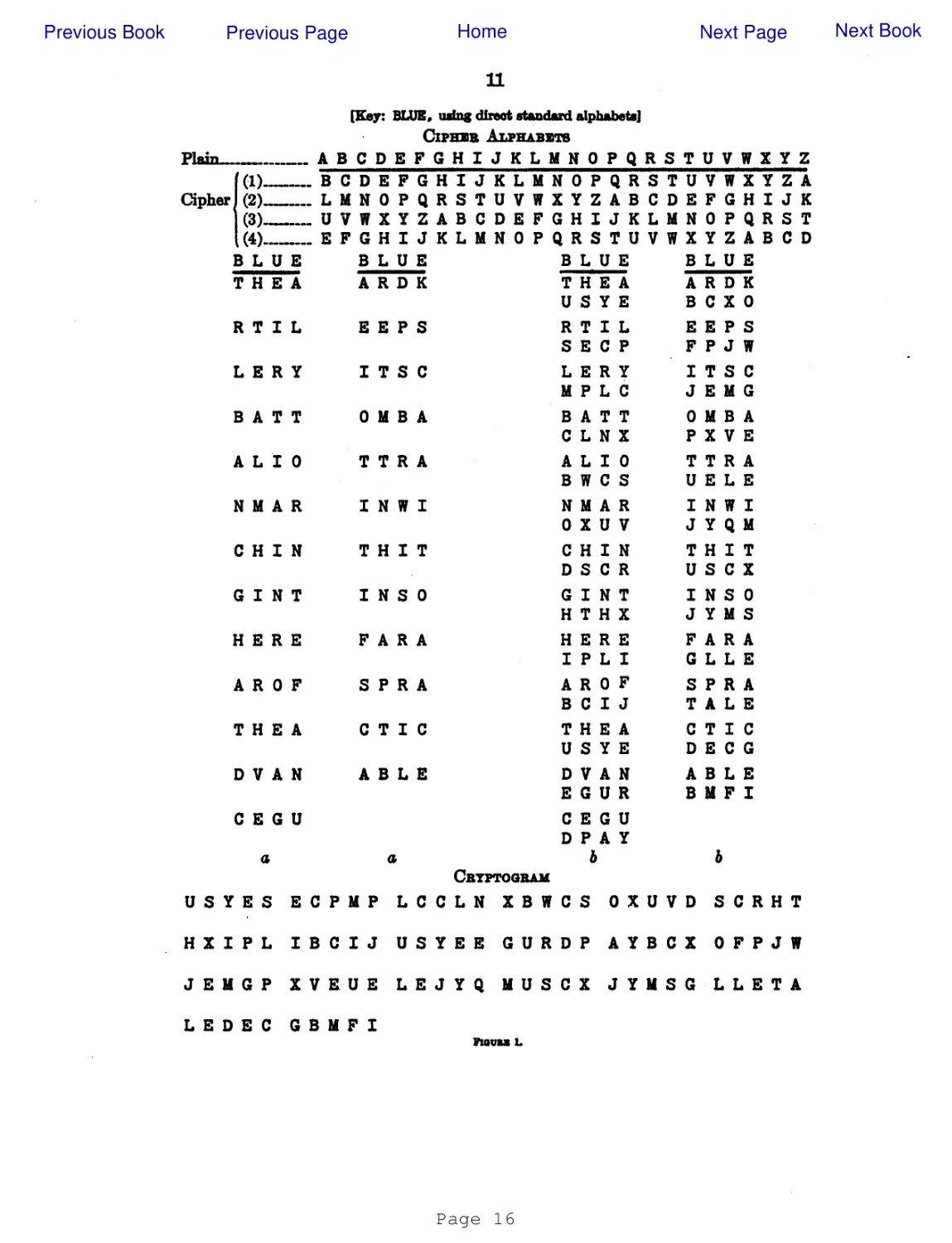
short example of encipherment, &own in sig. 1.
MXEBActm
THE ARTILLERY BATTALION NARCHING IN ‘IRE REAR OF THE ADVANCE GUARD KEEPS
ITS COMBAT TRAI?J WITH IT INSOFAR AS PFUCTICABLE.
(10)
Page 15
Previous Book
Home
Previous Page
Next Page
ll
@?yzBLuE,udngdireattltmdud8Ip~~]
CIPEEIB bPHABWl’8
Plhl------f(l) --Cipher (2)---e
(3)----I (4)-----BLUE
THEA
RTIL
LERY
BATT
AL10
NMAR
CHIN
GINT
HERE
AROF
THEA
DVAN
CEGU
a
ABCDEFGHIJKLMNOPQRSTUVWXYZ
BCDEFGHIJKLMNOPQRSTUYWXYZA
LMNOPQRSTUVWXYZABCDEFGHIJK
UVWXYZABCDEFGHIJKLMNOPQRST
EFGHIJKLMNOPQRSTUVWXYZABCD
BLUE
BLUE
THEA
ARDK
USYE
RTIL
EEPS
SECP
LERY
ITSC
YPLC
BATT
OMBA
CLNX
AL10
TTRA
BWCS
NMAR
INWI
oxuv
THIT
CHIN
DSCR
GINT
INS0
HTHX
HERE
FARA
IPLI
AROF
SPRA
BCIJ
THEA
CTIC
USYE
ABLE
DVAN
EGUR
CEGU
DPAY
b
a
BLUE
ARDK
BCXO
EEPS
FPJW
ITSC
JEMG
OMBA
PXVE
TTRA
UELE
INWI
JYQM
THIT
uscx
INS0
JYMS
FARA
GLLE
SPRA
TALE
CTIC
DECG
ABLE
BYFI
b
CBYP!POQBAM
USYES
ECPMP
LCCLN
XBWCS
OXUVD
SCRHT
HXIPL
IBCIJ
USYEE
GURDP
AYBCX
OFPJW
JEYGP
XVEUE
LEJYQ
YUSCX
JYMSG
LLETA
LEDEC
GBMFI
FIOUBBL
Page 16
Next Book
Previous Book
Previous Page
Home
Next Page
Next Book
b. Regardless of what system ia used, identical plain-text letters enciphered by the same
cipher alphabet 1 must yield identical cipher letters. Referring to Fig. 1, such 8 condition is
brought about every time that identical plain-text lettera happen to be enciphered with the same
key-letter, or every time identical plain-text letters fall into the same column in the encipherment.* Now since the number of columns or positiona with respect to the key is very limited
(axcept in the case of very long key words), and since the repetition of letters is an inevitable
condition in plain text, it follows that there will be in a message of fair length many caseawhere
identical plain-text letters mwt fall into the same column They wilI thus be enciphered by the
same cipher alphabet, resulting, therefore, in the produotion of many identical letters in the
cipher text and these will represent identical letters in the plain text. When identical plain-text
polygraphs fall into identical columns the result is the formation of identical cipher-text polygrrtphs, that is, repetitions of groups of 2, 3, 4, . . . letters 8re exhibited in the cryptogram.
Repetitions of this type will hereafter be called causal repetifions, because they are produced by
8 definite, traceable cause, z&r, the encipherment of identical letters by the same cipher alphabets.
c. It will also happen, however, that di#ernt plain-text letters falling in d$erent columns
will, by mere sccident, produce identical cipher letters. Note, for example, in Fig. 1 th8t in
Column 1, R, becomes S, and that in Column 2,H,,also becomes S,. The production of an identical
cipher text letter in these two cases (that is, a repetition where the plain-text letters are difIerent
and enciphered by different alphabets) is merely fortuitous. It is, in every day language, “a
mere coincidence”, or “an accident.” For this reason repetitions of this type will hereafter be
c8lled accidental repetitions.
d. A consideration of the phenomenon pointed out in c makes it obvious that in polyalphabetic ciphers it is important that the cryptanalyst be able to tell whether the repetitions he &ids
in a specific case are causal or accidental in their origin, that is, whether they represent actual
encipherments of identical plain-text letters by identical keying elements, or mere coincidences
brought about purely fortuitously.
e. Now accidental repetitions will, of course, happen fairly frequently with individual letters,
but less frequently with digmphs, because in this case the same kind of an “accident” must take
place twice in succession. Intuitively one feels that the chances that such 8 purely fortuitous
coincidence will happen two times in succession must be much less than that it will happen every
once in 8 while in the case of single letters. Similarly, intuition makes one feel that the chances
of such accidents happening in the case of three or more consecutive letters are still less than in
the case of digraphs, decreasing very rapidly as the repetition increases in length,
f. The phenomena of cryptogr8phic repetition may, fortunately, be dealt with statistically,
thus taking the matter outside the realm of intuition and putting it on a firm mathematical or
objective basis. Moreover, often the statistical analysis will tell the cryptanalyst when he has
arranged or rearranged his text properly,that is, when he is approaching or has reached monoalphabeticity in his efforts to reduce polyalphabetic text to its simplest terms. However, in
order to preserve continuity of thought it is deemed inadvisable to inject these statistical considerations at this place in the text proper; they have been incorporated in Appendix 2 hereof.
The student is advised to study the Appendix very carefully after he haa fInished reading this
section of the text.
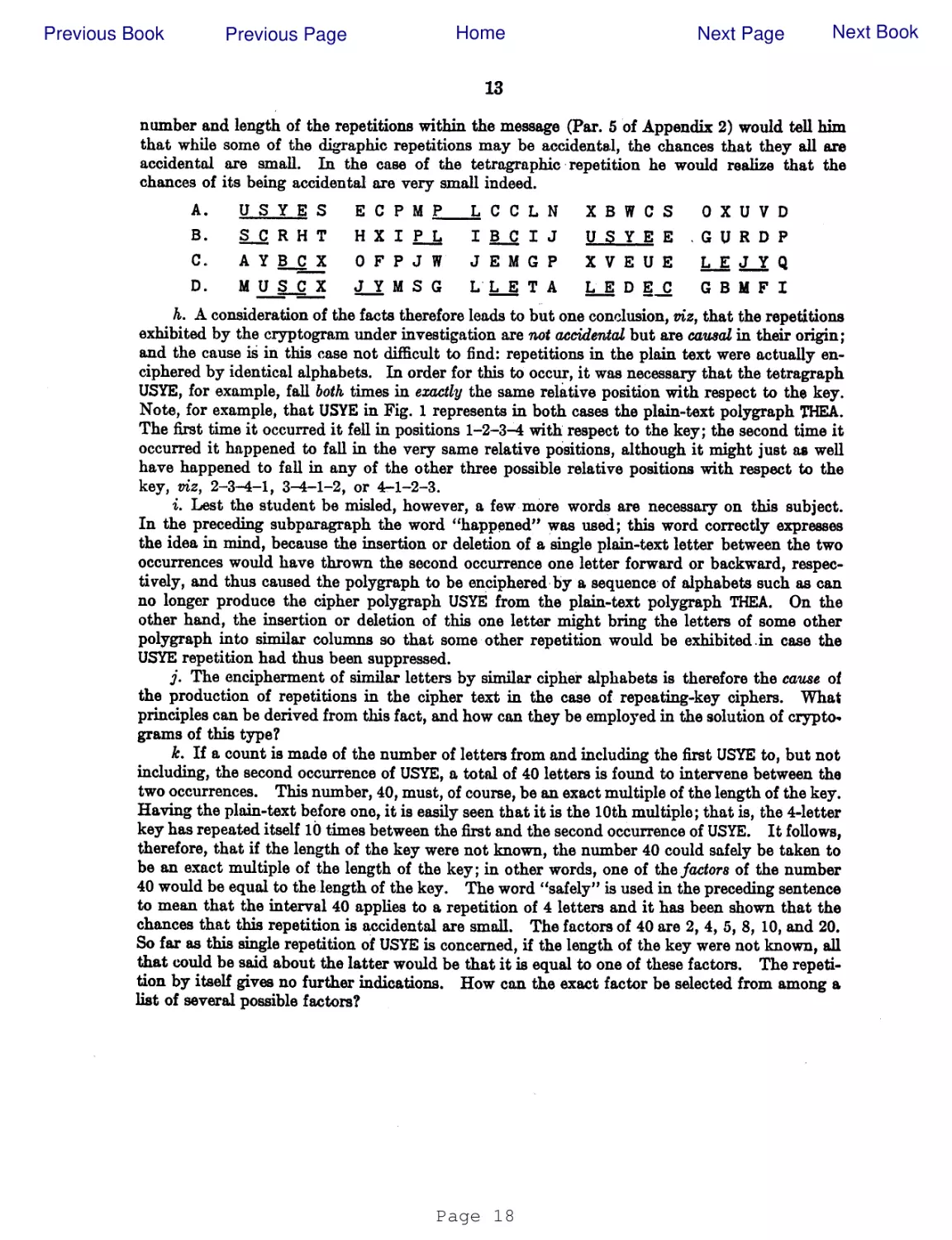
g. At this point it will merely be indicated that if a cryptanalyst were to have at hand only
the cryptogram of Fii. 1, with the repetitions underlined as below, a statistical study of the
1 It is to be understood, of course, that cipher alphsb& with singleequivalenta am meant in this case.
* The frequenay with which thin condition may be Qpsdal to oaaur can be definitely calculated
A diecuesion of this point falls beyond the eoope of the present text.
Page 17
Previous Book
Home
Previous Page
Next Page
Next Book
13
number and length of the repetitions within the message (Par. 5 of Appendix 2) would tell him
that while some of the digraphic repetitions may be accidental, the chances that they all are
accidental are small. In the case of the tetragraphic ‘repetition he would realize that the
chances of its being accidental are very small indeed.
A.
B.
C.
USYES
URHT
AYBCX
ECPMP
HXIU
OFPJW
LCCLN
IUIJ
JEMGP
XBWCS
USYEE
XVEUE
D.
M uyzi
JYMSG
L'L- E T A
GDEJ
OXUVD
.GURDP
LEJYQ
GBMFI
h. A consideration of the facts therefore leads to but one conclusion, z&z,that the repetitions
exhibited by the cryptogram under investigation are not accidental but are cawral in their origin;
and the cause is in this case not difficult to find: repetitions in the plain text were actually enciphered by identical alphabets. In order for this to occur, it was necessary that the tetragraph
USYE, for example, fall both times in em.ctZythe same relative position with respect to the key.
Note, for example, that USYE in Fig. 1 represents in both cases the plain-text polygraph THEA.
The first time it occurred it fell in positions l-2-3-4 with respect to the key; the second time it
occurred it happened to fall in the very same relative positions, although it might just aa well
have happened to fall in any of the other three possible relative positions with respect to the
key, wiz, 2-3-4-1, 3-4-l-2, or 4-l-2-3.
i. Lest the student be misled, however, a few more words are necessary on this subject.
In the preceding subparagraph the word “happened” was used; this word correctly expresses
the idea in mind, because the insertion or deletion of a single plain-text letter between the two
occurrences would have thrown the second occurrence one letter forward or backward, respectively, and thus caused the polygraph to be enciphered,by a sequence’of alphabets such as can
no longer produce the cipher polygraph USYE from the plain-text polygraph THEA. On the
other hand, the insertion or deletion of this one letter might bring the letters of some other
polygraph into similar columns so that some other repetition would be exhibitedin case the
USYE repetition had thus been suppressed.
j. The encipherment of similar letters by similar cipher alphabets is therefore the curse of
the production of repetitions in the cipher text in the case of repeating-key ciphers. What
principles can be derived from this fact, and how can they be employed in the solution of cryptograms of this type?
k. If a count is made of the number of letters from and including the first USYE to, but not
including, the second occurrence of USYE, a total of 40 letters is found to intervene between the
two occurrences. This number, 40, must, of course, be an exact multiple of the length of the key.
Having the plain-text before one, it is easily seen that it is the 10th multiple; that is, the 4-letter
key has repeated itself 10 times between the first and the second occurrence of USYE. It follows,
therefore, that if the length of the key were not known, the number 40 could safely be taken to
be an exact multiple of the length of the key; in other words, one of the factors of the number
40 would be equal to the length of the key. The word “safely” is used in the preceding sentence
to mean that the interval 40 applies to a repetition of 4 letters and it has been shown that the
chances that this repetition is accidental are small. The factors of 40 are 2, 4, 5, 8, 10, and 20.
So far as this single repetition of USYE is concerned, if the length of the key were not known, all
that could be said about the latter would be that it is equal to one of these factors. The repetition by itself gives no further indications. How can the exact factor be selected from among a
list of several possible factors?
Page 18
Previous Book
Previous Page
Home
Next Page
Next Book
14
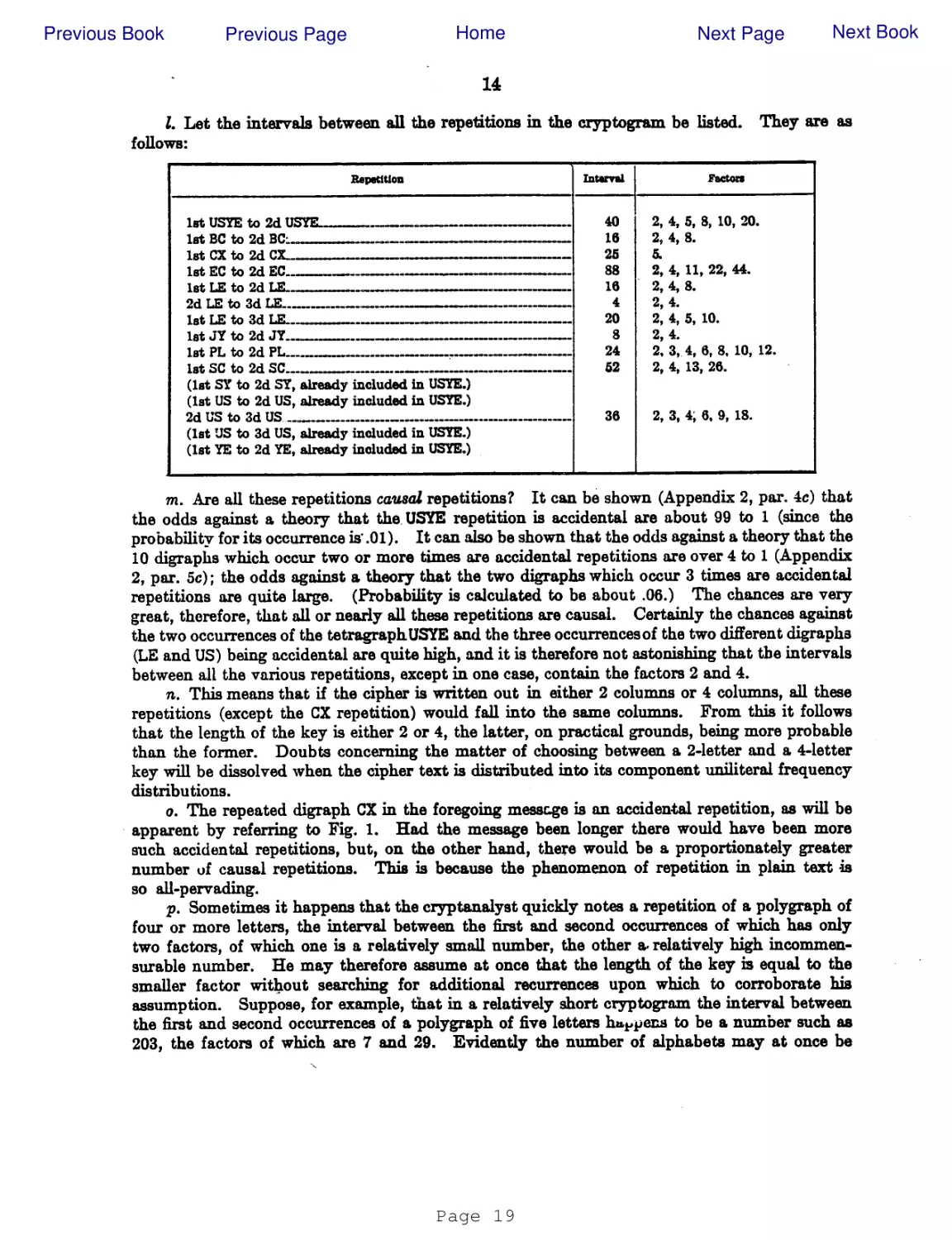
1. Let the intervals between all the repetitions in the cryptogram be listed.
follows:
let USYE to 2d WYEm-mmmm..m-s
pe--v----e
let BC to 2d BQ
--------a
1st CX to 2d CX----mm.w-n-list EC to 2d EC----------..-.----DII---1st LE to 2d tE---_I
---2d LE to 3d LB--__--m- se
-L--I-----*
1st LE to 3d LEe----I-------let JY to 2d JP __--___-_p---_-----------let PL to 2d PL -------------“------o---ol-u”--~------------let SC to 2d SC___-_v_______.--___
--s-_-a pm-m
(let SS to 2d SY, already included in UsyE.1
(let US to 2d US, already included in UsyE.
2d US to 3d US ____-_-_a_ omm____
- ________--------------m-w-m
(let US to 3d US, already imluded in USYE.)
(let YE to 2d YE, already inoludeai in USYE.)
40
16
25
88
16
4
20
8
24
52
2,
2,
5.
2,
2,
2,
2,
2,
2,
2,
36
2, 3, 4; 6, 9, 18.
They are as
4, 5, 8, 10, 20.
4, 8.
4,
4,
4.
4,
4.
3,
4,
11, 22, 44.
8.
5, 10.
4, 6, 8. 10, 12.
13, 26.
m. Are all these repetitions cuusul repetitions? It can be shown (Appendix 2, par. 4c) that
the odds against a theory that the, USYE repetition is accidental are about 99 to 1 (since the
probability for its occurrence is.01). It can also be shown that the odds against a theory that the
10 digraphs which occur two or more times are accidental repetitions are over 4 to 1 (Appendix
2, par. 5~); the odds against a theory that the two digraphs which occur 3 times are accidental
repetitions are quite large. (Probability is calculated to be about .06.) The chances are very
great, therefore, that all or nearly all these repetitions are causal. Certainly the chances against
the two occurrences of the tetragraphUSYE and the three occurrencesof the two different digrapha
(LE and US) being accidental are quite high, and it is therefore not sstonishing that tbe intervals
between all the vnrious repetitions, except in one case, contain the factors 2 and 4.
n. This means that if the cipher is written out in either 2 columns or 4 columns, all these
repetitions (except the CX repetition) would fall into the same columns. From this it follows
that the length of the key is either 2 or 4, the latter, on practical grounds, being more probable
than the former. Doubts concerning the matter of choosing between a a-letter and a 4-letter
key will be dissolved when the cipher text is distributed into its component uniliteral frequency
distributions.
o. The repeated digraph CX in the foregoing mess-e is an accidental repetition, as will be
apparent by referring to Fig. 1. Had the message been longer there would have been more
such accidental repetitions, but, on the other hand, there would be a proportionately greater
number of causal repetitions. This is because the phenomenon of repetition in plain text i
so all-pervading.
p. Sometimes it happens that the cryptanalyst quickly notes a repetition of a polygraph of
four or more letters, the interval between the first and second occurrences of which has only
two factors, of which one is a relatively small number, the other a.relatively high incommensurable number. He may therefore assume at once that the length of the key is equal to the
smaller factor without searching for additional recurrences upon which to corroborate his
assumption. Suppose, for example, that in a relatively short cryptogram the interval between
the first and second occurrences of a polygraph of five letters h+gens to be a number such as
203, the factors of which are 7 and 29. Evidently the number of alphabets may at once be
Page 19
Previous Book
Previous Page
Home
Next Page
Next Book
15
assumed to be 7, unless one is dealing with messageaexchanged among correspondents known
to use long keys. In the latter case one could assume the number of alphabets to be 29.
Q. The forgoing method of determining the period in a polyalphabetic cipher is commonly
referred to in the literature asi’fa&ring the intervals between repetitions”; or more often it is
simply called “factoring.”
Because the latter is an apt term and is brief, it will be employed
hereafter in this text to designate the process.
10. General remarks on factoring.-o. The statement made in Par. 2 with respect to the
cyclic phenomena said to be exhibited in cryptograms of the periodic type now becomes clear.
The use of a short repeating key produces a periodicity of recurrences or repetitions collectively
termed “cyclic phenomena”, an analysis of which leads to a determination of the length of the
period or cycle, and this gives the length of the key. Only in the case of relativeiy short cryptograms enciphered by a relatively long key does factoring fail to lead to the correct determination
of the number of cipher alphabets in a repeating-key cipher; and of course, the fact that a cryptogram contains repetitions whose factors show constancy is in itself an indication and test of its
periodic nature. It also follows that if the cryptogram is not a repeating-key cipher, then
.factoring will show no definite results, and conversely the fact that it does not yield definite
result.43at once indicates that the cryptogram is not a periodic, repeating-key cipher.
b. There are two caeesin which factoring leads to no definite resulta. One is in the case of
monoalphabetic substitution ciphers. Here recurrences are very plentiful as a rule, and the
intervals separating these recurrences may be fa&m3d, bud the factors wiu show no Con8tancy;
there will be several factors common to many or most of the recurrences. This in itself is an
indication of a monoalphabetic substitution cipher, if the very fact of the presence of many
recurrencea fails to impress itself upon the inexperienced cryptanalyst. The other c&sein which
the process of factoring is nonsigmficant involves certain types of nonperiodic, polyalphabetic
ciphers, In certain of these ciphers recurrences of digraphs, trigraphs, and even polygraphs
may be plentiful in a long message, but the intervals between such recurrences bear no definite
multiple relation to the length of the key, such as in the case of the true periodic, repeating-key
cipher, in which the alphabets change with successive letters and repeat themselves over and
over again.
c. Factoring is not the only method of determining the length of the period of a periodic,
polyalphabetic substitution cipher, although it is by far the most common and easily applied.
At this point it will merely be stated that when the message under study is relatively short in
comparison with the length of the key, so that there are only a few cycles of cipher text and no
long repetitions affording a basis for factoring, there are several other methods available.
However, it being deemed inadvisable to interject the data concerning those other methods
at this point, they will be explained subsequently. It is desirable at this juncture merely to
indicate that methods other than factoring do exist and are used in practical work.
d. Fundamentally, the factoring process is merely a more or less simple mathematical method
of studying the phenomena of periodicity in cryptograms. It will usually enable the cryptanalyst to ascertain definitely whether or not a given cryptogram is periodic in nature, and if
so, the length of the period, stated in terms of the cryptographic
unit involved.
By the latter
statement is meant that the factoring process may be applied not only in analyzing the periodicity
manifested by cryptograms in which the plain-text uuits subjected to cryptographic treatment
are monographic in nature (i. e. are single letters) but also in studying the periodicity exhibited
by those occasional cryptograms wherein the plain-text units are digraphic, trigraphic, or
n-graphic in character. The student should bear this point in mind when he comes to the study
of substitution systems of the latter sort. However, the present text will deal solely with cases
of the former type, wherein the plain-text units subjected to cryptographic treatment are single
letters.
Page 20
Previous Book
Previous Page
Home
Next Page
Next Book
16
11. Second step: distributing the cipher text into the oomponent monoalphabek.-u.
After the number of cipher alphabets involved in the cryptogram has been ascertained, the next
step is to rewrite the message in groups corresponding to the length of the key, or in columnar
fashion, whichever is more’convenient, and this automatically divides up the text so that the
lettera belonging to the same cipher alphabet occupy similar positions in the groups, or, if the
colum~~armethod is used, fall in the same column. The letters are thus allocated or distributed
into the respective cipher alphabets to which they belong. This reduces the polyalphabetic
tent to monoalphabetic terms.
b. Then separate uniliteral frequency distributions for the thus isolated individual alphabeta
are compiled. For example, in the case of the cipher on page. 13, having determined that four
alphabeta are involved, and having rewritten the mesaagein four columna, a frequency diatribution is made of the letters in Column 1, another is made of the letters in Column 2, and so on for
the rest of the columns. Each, of tha resu&ng diatributiona ia thmafora a monoaZphabsticfrapncy
dietrihhon.
If these distributions do not give the characteristic irregular crest and trough
appearance of monoalphabetic frequency distributions, then the analysis which led to the
hypothesis as regards the number of alphabets involved ia fallacious. In fact, the appearance of
these individual distributions may be conaidered to be an index of the co~ectnees of the factoring
process;‘for theoretically, and practically, the individual distributiona constructed upon the
correct hypothesis will tend to conform more closely fo the irregular crest and trough appearacne
of a monoalphabetic frequency distribution than will the graphic tables constructed upon an
incorrect hypothesis. These individual distributions may also be teeted for monoalphaheticity
by statistical methods.
12. Third step : solving the monoalphabetic distributions.-The
difbculty experienced in
analyzing the individual or isolated frequency distributions depends mostly upon the type of
cipher alphabets that is used. It is apparent that mixed alphabets may be used just as easily aa
standard alphabets, and, of course, the cipher lettera themselves give no indication aa to which
is the case. However, just as it wae found that in the case of monoalphabeticaubatitution ciphers,
a uniliteral frequency distribution gives clear indications as to whether the cipher alphabet ia a
standard or a mixed alphabet, by the relative positions and extensions of the crests and troughs
in the table, so it is found that in the case of repeating-key ciphers, uniliteral frequency distributiona for the isolated or individual alphabets will also give clear indications aa to whether these
alphabets are standard alphabets or mixed alphabets. Only one or two such frequency distributions are necessary for this determination; if they appear to be standard alphabets, similar distributions can be made for the rest of the alphabets; but if they appear to be mixed alphabets, then
it is beat to compile triliteral frequency distributions for all the alphabets. The analysis of the
values of the cipher lettera in each table proceeds &IQ the same linea aa in the case of monoalphabetic ciphers. The analysis ia more difbcult only because of the reduced size of the tablee, but
if the message be very long, then each frequency distribution will contain a sufficient number of
elements to enable a speedy solution to be achieved.
Page 21
Previous Book
Home
Previous Page
Next Page
Smo!RorJ
Iv
BEPEATING-KEYSYSTEMSWITH STANDABDCIPHEB ALPHABETS
Next Book
-=mwh
L---- _______________________
13
Solution by applyiug priuciplca of frequency- --____---_--------_-_____I______________--------------__-__----_-____
14
l3olution by completing the plaii-component
sequence---.,-,-,---.---_--__---_--_--_-__-_______I______
-eIwmmeIm-Solution by the “probable-word
method”15
13. Solution by applying principles of frequency.-o.
let the following cryptogram be studied:
In the light of the foregoing principles,
MESSAQSU
A.
AU&Y
-JA;KI
B.
ETIMI
DPVXK
NLUFM
AJZF
AUHY
BVZVI
WFQGK
=ZLAMV
UMDF
UAWPR
ZHBHR
QUKH.Q
PZYNV
GUMTV
POEXW
ZIIVO
NCLE
KFMWF
AAEXI
NVIWE
cD.
E.
F.
G.
H.
J.
K.
L.
ZGWM
AYYZM
LHVRM
CHUE
DPTEJ
PVNG
SPTEG
PTIKW
NPLZI
JLUFM
JKZG
JMiGX
ILVME
JAZNG
HKQGK
ECMYS
EYXEE
KUBBR
DJZXI
OVVQbJ
PZJNV
-ZLAFM --
NdLX
JKUTG
GZUE
IPLWP
QYBAV
UDPXR
QUXP
GO101
ZKTXG
CAIGI
HS
A search for repetitions discloses the following short list with the intervals and factors
10 omitted
(for previous experience may lead to the conclusion that it is unlikely that the
cryptogram involves more than 10 alphabets, showing the number of recurrences which it does):
above
Rapc4tition
LuF?dPwNvc-----..
JZKIG--.,----..
EJK-PTE
QGK.-e.
-
EJ
FM
lw.
lx
FM.-FM
JLA mh
NL
-
Loathn
Intwml
Dl,
El,
B4,
E3,
D4,
Al,
Jl,
D3,
B4,
K3
H4
=
G3
Hl
C2
L4
L3
L2
AS. D1
AS, 52
52, J4
bJ4,K3
K3,L4
A2, c4
Fl, Jl
Jl
L4
65 H2
Dl:H2
H2,Kl
160
90
215
50
85
55
65
175
115
S7
,185
12
20
30
Cl, cs
a0
-A3,83
E
65
10
105
4S
25
------I
(17)
Page 22
Bactcm
2,
2,
5.
2,
5.
5.
5.
3,
5.
3.
5.
2,
2,
2,
2
3’
5’
2’
3:
3,
2,
5.
4, 5, 3, 10.
3, 5, 6, 9, 10.
5, 10.
5, 7,
3, 4,
4, 5,
3, 5,
3 4,
51
6.
10.
6, 10.
5, 6, 10.
5.
5, 7.
5, 9.
4# 5, 10.
Previous Book
Home
Previous Page
Next Page
Next Book
b. The factor 5 appear in all but two cases, each of which involves only a digraph. It seems
almost certain that the number of alphabets is five. Since the text already appears in groups Of
five letters, it is unnecessary to rewrite the message. The next step is to make a uniliteral frequency distribution for Alphabet 1 to see if it can be determined whether or not atandrrrd alphabeta are involved. It is as follows:
ALPWET
c. Although the indications are not very clear cut, yet if one takes into consideration the
small amount of data the assumption of a direct standard alphabet with Wa=A,,,is worth further
test. Accordingly a similar distribution is made for Alphabet 2.
ALPHABET 2
zABc,E~G~;~~LaN~~QRa~~~wx~~
-:
d. There is every indication of a direct standard alphabet, with H,=A,.
butions be made for the last three alphabets. They are as follows:
Let similar distri-
ALPHABET 3
ALPHABET 4
ALPHABETS
6. After but little experiment it is found that the distributions can best be made to fit
the normal when the following values are assumed:
Alphabet l,,..---, A,,=W.
Alphabet 2__..----- A,=H,
Alphabet 3,,,--A,,= I,
Alphabet 4 __-_-_- &=Td
Alphabet 5_____-__A,,=E,
f. Note the key word given by the successive equivalents of A,: WHITE The real proof of
the correctness of the analysis is, of course, to test the values of the solved alphabets on the
cryptogram. The five complete cipher alphabets are as follows:
Plain--- --------__ ABCDEFGHIJKLMNOPQ
RSTUVWXYZ
(l-------- WXYZABCDEFGHIJKLMNOPQRSTUV
-v-msm-msHIJKLMNOPQRSTUVWXYZABCDEFG
--we--IJKLMNOPQRSTUVWXYZABCDEFGH
B-m---- TUVWXYZABCDEFGHIJK-LMNOPQRS
---m-swB- EFGHIJKLHNOPQRSTUVWXYZABCD
Rouua
Page 23
Previous Book
Previous Page
Home
Next Page
Next Book
19
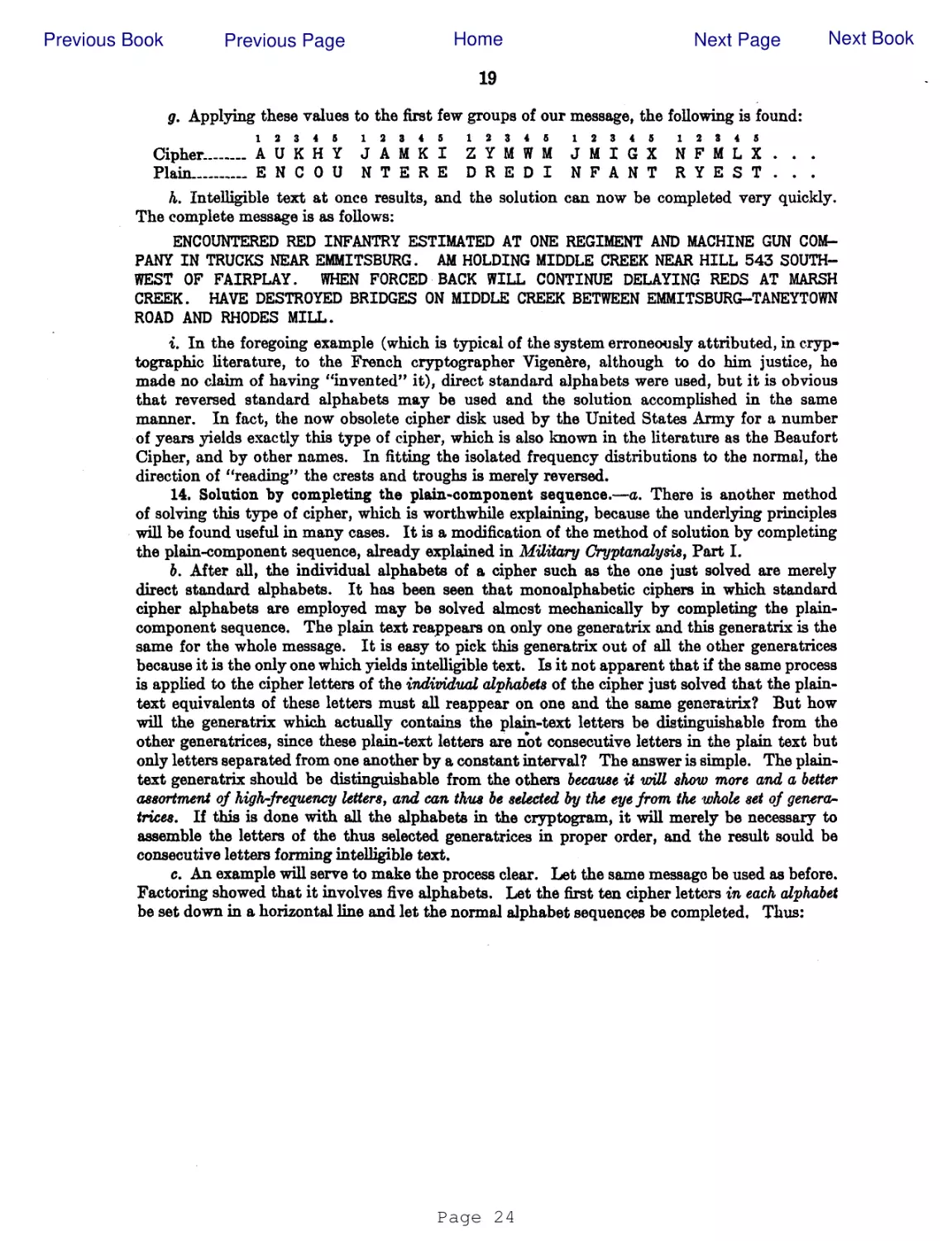
g. Applying these values to the first few groups of our message, the following is found:
118
4 5
12
a 4 6 12 3 4 6 12 8 4 6
12
3 4 li
AUKHY
JAMKI
ZYMWM
JMIGX
NFMLX...
Cipher __--____
ENCOU
NTERE
DREDI
NFANT
RYEST...
Plain _________
h. Intelligible text at once results, and the solution can now be completed very quickly.
The complete messageis as follows:
ENCOUNTERED
RED INFANTRYESTIMATEDAT ONEREGIMENTANDMACHINEGUNCOMPANYIN TRUCKSNEAREMMITSBURG.AMHOLDINGMIDDLECREEKNEARHILL 543 SOUTHWESTOF FAIRPLAY. WHENFORCEDBACK WILL CONTINUEDELAYINGREDS AT MARSH
CREEK. HAVEDESTROYED
BRIDGESONMIDDLECREEKBETWEEN
EMMITSBURGTANEYTOWN
ROADAND RHODESMILL.
i. In the foregoing example (which is typical of the system erroneously attributed, in cryptographic literature, to the French cryptographer Vigenere, although to do him justice, he
made no claim of having “invented” it), direct standard alphabets were used, but it is obvious
that reversed standard alphabets may be used and the solution accomplished in the same
manner. In fact, the now obsolete cipher disk used by the United States Army for a number
of years yields exactly this type of cipher, which is also known in the literature as the Beaufort
Cipher, and by other names. In fitting the isolated frequency distributions to the normal, the
direction of “reading” the crests and troughs is merely reversed.
14. Solution by completing the plain-component sequence.--a. There is another method
of solving this type of cipher, which is worthwhile explaining, because the underlying principles
will be found useful in many cases. It is a modification of the method of solution by completing
the plain-component sequence, already explained in Military Cryptandy&, Part I.
b. After all, the individual alphabets of a cipher such as the one just solved are merely
direct standard alphabets. It has been seen that monoalphabetic ciphers in which standard
cipher alphabets are employed may be solved almcst mechanically by completing the plaincomponent sequence. The plain text reappears on only one generatrix and this generatrix is the
same for the whole message. It is easy to pick this generatrix out of all the other generatrices
because it is the only one which yields intelligible text. Is it not apparent that if the same process
is applied to the cipher letters of the in&&!~
alpha& of the cipher just solved that the plaintext equivalents of these letters must all reappear on one and the same generatrix? But how
will the generatrix which actually contains the plain-text letters be distinguishable from the
other genera&ices, since these plain-text letters are n&t consecutive letters in the plain text but
only letters separated from one another by a constant interval? The answer is simple. The plaintext generatrix should be distinguishable from the others becauseit wiu show mwe and a better
assortmant of high-jrequency letters, and can thw be seWed by the eyefrom tb whde set of genera-
If this is done with all the alphabets in the cryptogram, it will merely be necessary to
assemble the letters of the thus selected gene&rices in proper order, and the result sould be
consecutive letters forming intelligible text.
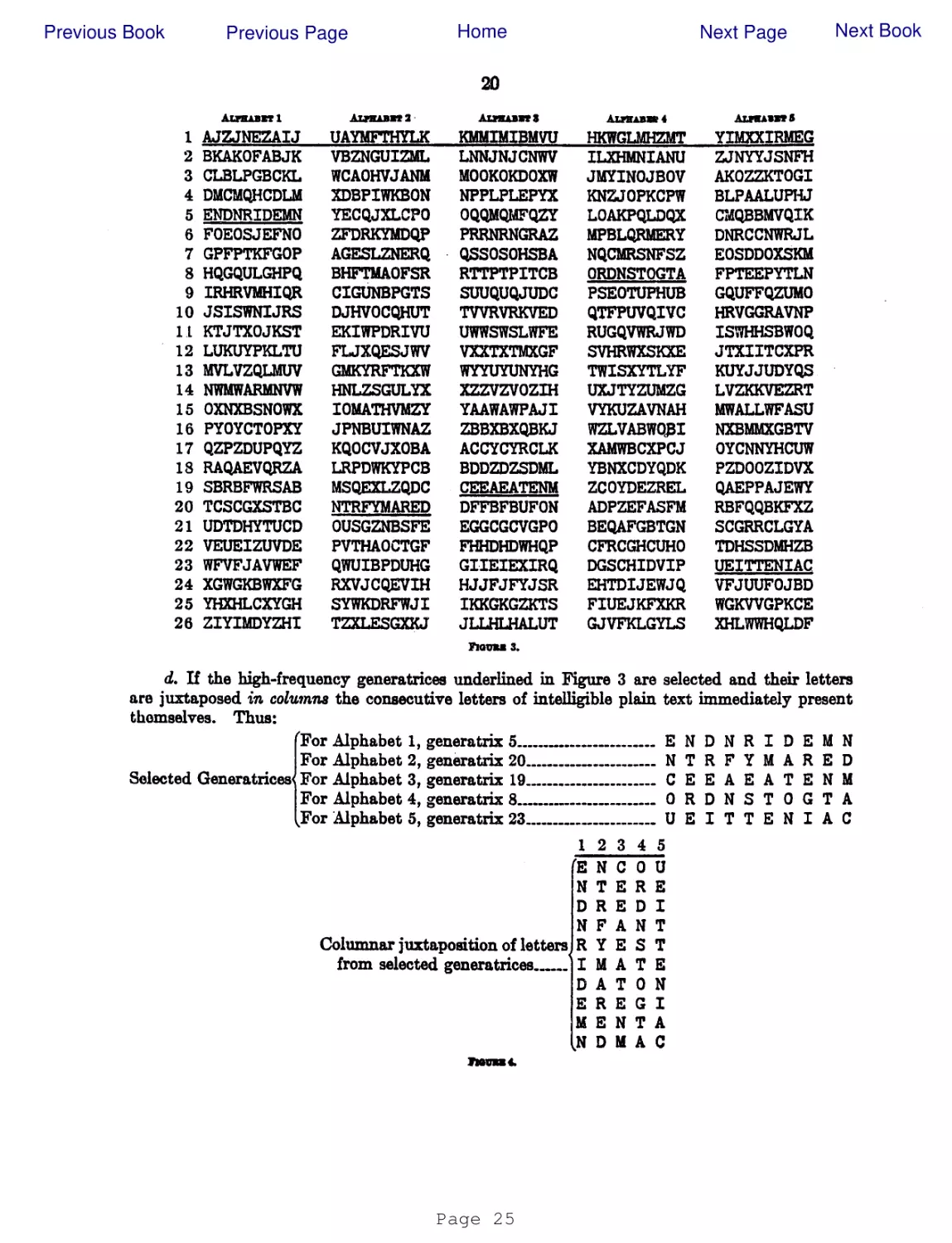
c. An example will serve to make the process clear. Let the same messagcbe used as before.
Factoring showed that it involves five alphabets. Let the fhst ten cipher letters in each alphabet
be set down in a horizontal line and let the normal alphabet sequences be completed, Thus:
t&es.
Page 24
Previous Book
Home
Previous Page
AURABET1
AUEABBTl.
ALnmaa
Next Book
Next Page
AmnAnP4
ALnbmT
a
1AJZJNEZAIJ
UAYMFTHYLX KMMIMIBMVU HKWGLMHZMTYIMXXIRMEG
2 BKAKOFABJK VBZNGUIZMLl LNNJNJCNWV ILXHMNIANU ZJNYYJSNFH
3 CLBLPGBCKL WCAOHVJANM MOOKOKDOXW JMYINOJBOV AKOZZKTOGI
4 DMCMQHCDLM XDBPIWKBON NPPLPLIEPYX KNzJoPKcPw BLPAALUPHJ
CXQBBMVQIK
5 ENDNRIDEMN YECQJXLCPO OQWa@QZ'Y LO~eLD~
MPBLQRMERY DNRCCNWRJL
6 FOEOSJEFNO m-Q?
7 GPFPTKFGOP AGESLZNERQ FijzEiE
NQCMRSNFSZ ECSDDOXSKM
ORDNSTOGTA FPTEEPYTLN
8 HQGQULGHPQ BHFTMAOFSR RTTPTPITCB
9 IRHRVMHIQR CIGUNBPGTS SUUQUQJUDC PSEOTUPHUB GQmWO
10 JSISWNIJRS DJHVOCQHUT TWRVRKVED QTFPWQIVC HRVGGRAVNP
11 KTJTXOJKST EKIWPDRIVU uwwswsLwFE RUGQVWRJWD ISWHHSBWOQ
12LUKUYPKLTU FLJXQESJWV VXXTXTMXGF SVHRWXSKXE JTXIITCXPR
TWISXYTLYF KUYJJUDYQS
13b!VLVZQLMUV
WYYIMNHG
HNLzsGuLYx xzzvzvOZIH
UXJTYZUMZG LWKKVEZRT
14 Nv?Mwm
15 OXNXBSNOWXIOMATHVMZY YAAWAWPAJI vYKuzAvNAH MWALLWFASU
16 PYOYCTOPXY JFNBUIWNAZ ZBBXBXQBKJ WZLVABWOBI NXBMbfXGBTV
17 QZPZDUPQYZ KQOCVJXOBA ACCYCYRCLK XAMWBCXPCJ OYCNNYHCUW
13 RAQAEVQRZA LRPDWKYPCB BDDZDZSDML YBNXCDYQDK PZDOOZIDVX
19 SBRBFWRSAB WQEXLZQDC CEEAEATENM ZCOYDEZREL QAEPPAJEWY
20 TCSCGXSTBC NTRFYMARED DFFBFBUFON ADPZEFASFM RBFQQBKFXZ
21 UDTDHYTUCD OUSGZNBSFE EGGCGCVGPOBEQAFGBTGN SCGRRCLGYA
22VEUEIZUVDE PVTHAOCTGF FHHDHDWHQPCFRCGHCUHOTDHSSDMHZB
DGSCHIDVIP UEITTENIAC
23 WFVFJAVWEF QWUIBPDUHG GIIEIEXIRQ
24 XGWGKBWXFG RXVJCQEVIH HJJFJFYJSR EHTDIJEWJQ VFJWFOJBD
25 YHXHLCXYGH SYWKDRFWJI IKKGKGZKTS FIUEJKFXKR WGKVVGPKCE
26 ZIYIMDYZHI TZXLESGXKJ JLLHLHALUT GJVFKLGYLS XHLWWHQLDF
RauBB
a.
d. If the high-frequency gene&rices underlined in Figure 3 are selected and their letters
are juxfaposed in columns the consecutive letters of intelligible plain text immediately present
themselves. Thus:
For Alphabet 1, generatrix 5________________________
E N D N R I D E MN
For Alphabet 2, generatrix 20_______________________
N T RF YM A RE D
CEEAEAT ENM
Selected Generatrices For Alphabet 3, genera&ix 19_______________________
For Alphabet 4, genera&x 8_______-________________
0 R DNS T 0 GT A
For ‘Alphabet 5, generatrix 23_____________________
U E I T T E N I A C
12345
‘ENCOU
NTERE
DREDI
NFANT
Columnar juxtaposition of letters R Y E S T
from selected generatrices,,,,, I M A T E
DATON
EREGI
MENTA
,NDMAC
YIeun*
Page 25
Previous Book
Home
Previous Page
Next Page
Next Book
21
Plailltextz KNCOUNTEREDRED INFANTRY ESTIMATED AT ONE
REGIMENT AND MAC . . . .e. Solution by this method can thus be achieved without the compilation of any frequency
tables whatever and is very quickly attained. The inexperienced cryptanalyst may have difllculty at first in selecting the gene&rices which contain the most and the best assortment of
high-frequency letters, but with increased practice, R high degree of proficiency is attained.
After all it is only R matter of experiment, trial, and error to select and assemble the proper
generatrices so as to produce intelligible text.
j. If the letters on the sliding strips were accompanied by numbers representing their relative
frequencies in plain text, and these numbers were added ~47088each generatrix, then that generatrix with the highest total frequency would theoretical& always be the plain-text genera&ix.
Practically it will be among the generatrices which show the first three or four greatest totals.
Thus, an entirely mathematical solution for this type of cipher may be applied.
g. If the cipher alphabets are reversed standard alphabets, it is only necessary to convert
the cipher letters of each isolated alphabet into their normal, plain-component equivalents and
then proceed as in the case of direct standard alphabets..
h. It has been seenhow the key word may be discovered in this type of cryptogram. Ususlly
the key is made up of those letters in the successivealphabets whose equivalents are A, but other
conventions are of course possible. Sometimes R key number is used, such as 847-1-12,
which means merely that A, is represented by the eighth letter from A (in the normal alphabet)
in the first cipher alphabet, by the fourth letter from A in the second cipher alphabet, and so on.
This modification is known in the literature as the Gronsfeld cipher. However, the method of
solution as illustrated above, being independent of the nature of the key, is the same as before.
15. Solution by the “probable-word method.“- a. The common use of key words in cryptograms such as the foregoing makes possible a method of solution that is simple and can be used
where the more detailed method of analysis using frequency distributions or by completing the
plain-component sequence is of no avail. In the case of a very short messagewhich may show
no recurrences and give no indications as to the number of alphabets involved, this modified
method will be found most useful.
b. Briefly, the method consists in assuming the presence of R probable word in the message,
and referring to the alphabets to fmd the key letters applicable when this hypothetical word is
assumed to be present in various positions in the cipher text. If the assumed word happens to
be correct, and is placed in the correct position in the message, the key letters produced by
referring to the alphabets will yield the key word. In the following example it is assumed that
reversed standard alphabets are known to be used by the enemy.
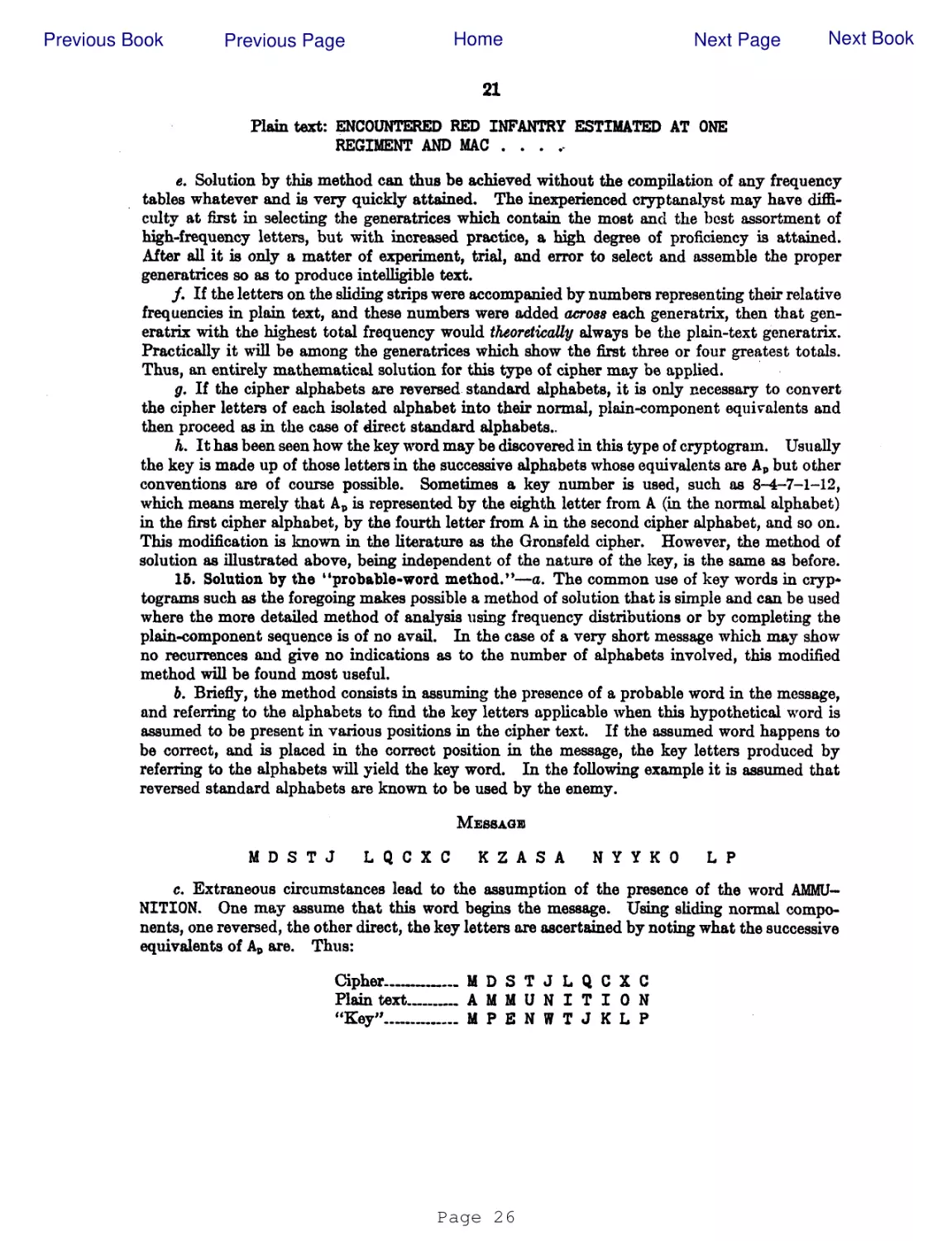
MESSAQ~
MDSTJ
LQCXC
KZASA
NYYKO
LP
c. Extraneous circumstances lead to the sssumption of the presence of the word AMMUNITION. One may assume that this word begins the message. Using sliding normal components, one reversed, the other direct, the key letters are ascertained by noting what the successive
equivalents of AI, are. Thus:
Cipher -_____
- __-_ MDSTJLQCXC
Plain text,- ------- AMMUNITION
“Key”,,- __________
MPENWTJKLP
Page 26
Previous Book
Home
Previous Page
Next Page
Next Book
22
The key does not spell any intelligible word.
forward and another trial is made.
One therefore shifts the assumed word one letter
Cipher -___ _____ DSTJLQCXCK
AMMUNITION
Plain text----,,,
DEFDYYVFQX
“KeyJ’-_____--..This also yields no intelligible key word. One continues to shift the assumed word forward
one space at R time until the following point is reached.
Cipher--,--,,
Plain text---“Key” -_______
LQCXCKZASA
AMMUNITION
LCORPSSIGN
The key now becomes evident. It is a cyclic permutation of SIGNAL CORPS. It should be
clear that since the key word or key phrase repeats itself during the encipherment of such a
message, the plain-text word upon whose assumed presence in the message this test is being
based may begin to be enciphered at any point in the key, and continue over into its next repetition if it is longer than the key. VVhen this is the csae it is merely necessary to shift the latter
part of the sequence of key letters to the fimt part, as in the case noted: LCORPSSIGNis transposed into SIGN . . . LCORPS, and thus SIGNAL CORPS.
d. It will be seen in the foregoing method of solution that the length of the key is of no
particular interest or consequence in the stepa taken in effecting the solution. The determination of the length and elements of the key comes after the solution rather than before it. In this
case the length of the period is seen to be eleven, corresponding to the length of the key (SIGNAL
CORPS).
c. The foregoing method is one of the other methods of determining the length of the key
(besides factoring), referred to in Par. 10~.
f. If the assumption of reversed standard alphabets yields no good results, then direct
standard alphabets are assumed and the test made exactly in the same manner. As will be
shown subsequently, the method can also be used .as a last resort when mixed alphabets are
employed.
g. When the assumed word is longer than the key, the sequence of recovered key letters will
show a periodicity equal to the length of the key; that is, after R certain number of letters the
sequence of key letters will repeat. This phenomenon would be most useful in the case of keys
that are not intelligible words but are composed of random letters or figures. Of course, if such
R key is longer than the assumed word, this method is of no avail.
h. This method of solution by searching for a word is contingent upon the following circumstances:
(1) That the word whose presence is assumed actually occurs in the message, is properly
spelled, and correctly enciphered.
(2) That the sliding components (or equivalent cipher disks or squares) employed in the
search for the assumed word are a&rally the ones which were employed in the encipherment,
or are such as to give identical resulta as the ones which were actually used.
(3) That the pair of enciphering equations used in the test is actually the pair which was
employed in the encipherment; or if a cipher square is used in the test, the method of tiding
equivalents givea results that correspond with those actually obtained in the encipherment.
(see par. 0.)
Page 27
Previous Book
Previous Page
Home
Next Page
Next Book
23
i. The foregoing appears to be quite an array of contingencies and the student may think
that on this account the method will often fail. But examining these contingencies one by one,
it will be seen that successful application of the method may not be at all rare-after the solution
of some messageshas disclosed what sort of paraphernalia and methods of employing them nre
favored by the enemy. From the foregoing remark it is to be inferred that the probable-word
method has its greatest usefulness not in an initial solution of a system, but only after successful
study of enemy communications by more diEcult processes of analysis has told its story to the
alert cryptanalyst. Although it is commonly attributed to Bazeries, the French cryptanalyst
of 1900, the probable-word method is very old in cryptanalysis and goes back several centuries.
Its usefulness in practical work may best be indicated by quoting from a competent observer 1:
There ia another [method] which is to thic first method what the geometric method ie to analysie in ckrtain
ecienceu, 8nd, Recording to the whims of individuala, certain cryptsnalyets prefer one tc the other. Certain others,
inc8psble of getting the 8nawer with one of the method8 in the solution of a difficult problem, conquer it by meana
of the other, with 8 disconcerting masterly stroke. This other method is that of the probable word. We msy
have more or leas definite opinions concerning the subject of the cryptogmm.
We may know something about its
date, and the correspondents, who may have been indiscreet in the subject they have treated. On this basis, the
hypothesis la made that a certain word probably appeara in the text.
. . . In certain clasaea of documents,
militrrry or diplomcrtic telegmme., bsnklng 8nd mining tiaim, etc., it is not impossible to make very huportant
aaaumptiona about the presence of certain worda in the text. After a cryptanalyst
hse worked for a long time
with the writinge of certain correspondentc, he gete ueed to their expressions.
He gets a whole load of worda
to try out; then the changes of key, and eometlmw of aystem, no longer throw into hia way the difficulties of an
absolutely new study, which might require the snslytical method.
To which I am prompted to add the amusing definition of cryptanalysis attributed to a
British wag: “All cryptanalysis is divided into two parts: trance-titution and supposition.”
1 Givierge,
M., Cows de Cryptographti,
Paris, 1926, p. 30.
Page 28
Previous Book
Previous Page
Home
Next Page
REPEATING-EEYSYSTEMSWITH MIXED CIPHER ALPHABETS,I
-____--_-_-_--___-_-___________)_______
Reason for the use of mixed alphabek---------l---~--~---~-e~
InterrtWed
mixed alpha------Prlnciplea of direot eymmetq of positioa
------_
-I--m-----v-Inltid step8 in the solution of a typical examp&----,-Application
of prlnciplea of direct symmetry of position _-___----mm-- ---------s--w---=
Subsequent steps in solution--.
I__---_-_---_--_--_----~--------Completing the solution-Solution of subsequent messages enciphered by same cipher component----,------Summation of relative frequencies as an aid to the sale&ion of the correct gener&riae~Solution by the probable-word
me&\,--,,,-..------,-Eblution when plain component is mixed, the cipher component, the normal- _____-_-_-_-----
Next Book
P-UN
16
17
18
19
20
21
22
23
24
26
26
16. Beason for the use of mixed alphabets.-o. It has been seen in the examples oonsidered
thus far that the use of several alphabets in the same message does not greatly complicate the
analysis of such a cryptogram. There are three reasons why this is so. Fitly, only relatively
few alphabets were employed; secondly, these alphabets were employed in a periodic or repeating
manner, giving rise to cyclic phenomena in the cryptogram, by means of which the number of
alphabets could be determined; and, thirdly, the cipher alphabets were know, alphabets, by *
which is meant merely that the sequences of letters in both components of the cipher alphabets
were known sequences.
b. In the case of monoalphabetic ciphers it was found that the use of a mixed alphabet
delayed the solution to a considerable degree, and it will now be seen that the use of mixed alphabets in polyalphabetic ciphers renders the analysis much more difhcult than the use of standard
alphabets, but the solution is still fairly easy to achieve.
17. Interrelated mixed alphabet&--a. It was stated in Par. 5 that the method of producing
the mixed alphabets in a polyalphabetic cipher often affords clues which are of great assistance
in the analysis of the cipher alphabets. This is so, of course, only when the cipher alphabets
are interrelated secondary alphabets produced by sliding components or their equivalents.
Reference is now made to the classification set forth in Par. 6, in connection with the types of
alphabets which may be employed in polyalphabetio substitution. It will be seen that thus far
only Cases A (1) and (2) have been treated. Csse B (1) will now be discuseed.
b. Here one of the components, the plain component, is the normal sequence, while the
cipher component is a mixed sequence, the various juxtapositions of the two components yielding
mixed alphabets. The mixed component may be a systematically-mbred or a’ random-mixed
sequence. If the 25 successive displacements of the mixed component are recorded in separate
lines, a symmetrical cipher square such sa that shown in Fii. 5 results therefrom. It is identical
in form with the square table shown on p. 7, labeled Table I-A..
(24)
Page 29
Previous Book
Previous Page
Home
Next Page
Next Book
25
l%ill-,~-
ABCDEFGHIJKLMNOPQRSTUVWXYZ
'LEAVNWORTHBCDFGIJKMPQSUXYZ
EAVNWORTHBCDFGIJKMPQSUXYZL
AVNWORTHBCDFGIJKMPQSUXYZLE
VNWORTHBCDFGIJKMPQSUXYZLEA
NWORTHBCDFGIJKMPQSUXYZLEAV
WORTHBCDFGIJKMPQSUXYZLEAVN
ORTHBCDFGIJKMPQSUXYZLEAVNW
RTHBCDFGIJKMPQSUXYZLEAVNWO
THBCDFGIJKMPQSUXYZLEAVNWOR
HBCDFGIJKMPQS.UXYZLEAVNW.ORT
BCDFGIJKMPQSUXYZLEAVNWORTH
CDFGIJKMPQSUXYZLEAVNWORTHB
Cipher,,,,
,DFGIJKMPQSUXYZLEAVNWORTHBC
FGIJKHPQSUXYZLEAVNWOR.THBCD
GIJKMPQSUXYZLEAVNWORTHBCDF
IJKMPQSUXYZLEAVNWORTH.BCDFG
JKMPQSUXYZLEAVNWORTHBCDFGI
KMPQSUXYZLEAVNW~ORTHBCDFGIJ
MPQSUXYZLEAVNWORTHBCDFGIJK
PQSUXYZLEAVNWORTHBCDFGIJKM
QSUXYZLEAVNWORTHBCDFGIJKMP
SUXYZLEAVNWORTHBCDFGIJKMPQ
UXYZLEAVNWORTHBCDFGIJKMPQS
XYZLEAVNWORTHBCDFGIJKMPQSU
YZLEAVNWORTHBCDFGIJKMPQSUX
,ZLEAVNWORTHBCDFGIJKMPQSUXY
6.
PIOUM
c. Such a cipher square may be used in exactly the same manner as the Viien&e square.
Withthekey wordBLUEandconformingt~thenormalencipher.ingequations
(O~/l=&/l;+l=
c&I~), the following lines of the square would be used:
ABCDEFGHIJKLMNOPQRSTUVWXYZ
BCDFGIJKM.PQSUXYZLEAVNWORTH
LEAVNWORTHBCDFGIJKMPQSUXYZ
UXYZLEAVNWORTHBCDFGIJKMPQS
EAVNWORTHBCDFGIJKMPQSUXYZL
ROUW
6s.
These lines would,ofcoume,yield
the following cipher alphabets:
(1) Plain,-,,-,,,,, ABCDEFGHIJKLMNOPQRSTUVWXYZ
Cipher,,,,,,,,, BCDFGIJKMPQSUXYZLEAVNWORTH
(2) Plain,,,,,,-,,,, ABCDEFGHIJKLMNOPQRSTUVWXYZ
Cipher-.,-,,,,- LEAVNWORTHBCDFGIJKMPQSUXYZ
@) Plain,,,,,,-,,
ABCDEFGHIJKLMNOPQRSTUVWXYZ
Cipher,,,,,,,, UXYZLEAVNWORTHBCDFGIJKMPQS
PlaiIl.-,,,,,,
ABCDEFGHIJKLMNOPQRSTUVWXYZ
(*I Cipher,,,,,,
EAVNWORTHBCDFGIJKMPQSUXYZL
Rorru 66.
Page 30
Previous Book
Previous Page
Home
Next Page
Next Book
26
18. Principles of direat synuw~try of poeition.-a. It was stated directly above that Fig.5
is a symmetrical cipher square, by which is meant that the letters in its successive horizontal
lines show a symm&y of posit&m with respect to one another. They constitute, in reality, one
and only one sequence or series of letters, the sequences being merely displaced successively 1,
2, 3, . . . intervals. The symmetry exhibited is obvious and is said to be visible, or ditch.
This fact can be used to good advantage, as has already been alluded to in par. 7j.
b. Consider, for example, the pair of letters G, and V,,in cipher alphabet (1) of Fii* 6b. The
letter V, is the 15th letter to the right of G,. In cipher alphabet (2), V,,is also the 15th letter to
the right of Gd,as is the case in each of the four cipher alphabets in l?ii. 6b, since the r&z&~
positions they occupy are the same in each horizontal line in Fig. 6a, that is, in each of the successive recordings of the cipher component as the latter is slid to the right against the plain or
normal component. If, therefore, the relative positions occupied by two letters, 8, and 9,, in
such a cipher alphabet, Cl, are known, and if the position of e1 in another cipher alphabet, C,,
belonging to the same series is known, then’& may at once be placed into its correct position in Ct.
Suppose, for example, that as the result of an analysis based upon considerations of frequency,
the following values in four cipher alphabets have been tentatively determined:
ABCDEFGHIJKLMNOPQRSTUVWXYZ
(l) Plain------Y
V
G
Cipher -_- -Plain- ---- _--- ABCDEFGHIJKLMNOPQRSTUVWXYZ
(2) Cipher ---G
P
N
(3) yIl~
------- ABCDEFGHIJKLMNOPQRSTUVWXYZ
B
I
L
------m
Plain- ---- -- -- ABCDEFGHIJKLMNOPQRSTUVWXYZ
I
W
(4) Cipher---..
Q
.
BrnuBB
?a
c. The cipher components of these four secondary alphabets may, for convenience, be assembled into a cellular structure, hereinafter called a sc~zulrcerecvn&zt&n &&ton, as shown in
Fii. 76. Regarding the top line of the reconstruction skeleton in Fii. 7b as being common to aJ.l
four secondary cipher alphabets listed in Fig. 7a, the successivelines of the reconstruction skeleton
may now be termed cipher alphabets, and may be referred to by the numbers at the left.
Plain- -_- --
d. The letter G is common to Alphabets 1 and 2. In Alphabet 2 it is noted that N occupies
the 10th position to the left of G, and the letter P occupies the 5th position to the right of G.
One may therefore place these letters, N and P, in their proper positions in Alphabet 1, the letter N
being placed 10 letters before G, and the letter P, 5 letters after G. Thus:
--------- A B C D E F G H I J K L M N 0 P Q R S T U V W X Y Z
plhlw.-..]-==d++#i
Page 31
V N
Previous Book
Home
Previous Page
Next Page
Next Book
27
Thus, the values of two new letters in Alphabet 1, viz, P,=J,, and N,=U, have been automstitally determined; these values were obtained without any analysis based upon the freqwncy of
Likewise, in Alphabet 2, the letters Y and V may be inserted in these positions:
P,andN,.
AIBCDEFGHI
JKLMNOPQRSTUVWXYZ
““~:~~::~~-i-l-t;;~~~~~~#~~~~~=~=~=~~=~=~=~=~~~=~
This gives the new values V,=D, and Y,=Y,, in Alphabet 2. Alphabets 3 and 4 have a common
letter I, which permits of the placement of Q and Win Alphabet 3, and of B and L in Alphabet 4.
c. The new values thus found are of course immediately inserted throughout the cryptogram, thus leading to the assumption of further values in the cipher text. This process, viz, the
reconstruction of the primary components, by the application of the principles of direct symmetry
of position to the cells of the reconstruction skeleton, thus facilitates and hastens solution.
f. It must be clearly understood that before the principles of direct symmetry of position
can be applied in c-es such ‘as the foregoing, it is necessary that the plain component be a known
sequence. Whether it is the normal sequence or not is immaterial, so long as the sequence is
known. Obviously, if the sequence is unknown, symmetry, even if present, cannot be detected
by the cryptanalyst because he has no base upon which tc try out his assumptions for
symmetry. In other words, direct symmetry of position is ma.nifested in the illustrative
example because the plain component is a known sequence, and not because it is the
normal alphabet. The significance of this point will become apparent later on in connection
with the problem discussed in Par. 26b.
19. Initial steps in the solution of a typical example.- a. In the light of the foregoing principles let a typical messagenow be studied.
MESSAGE
A.
B.
QWB’RI
LWMGW
C. VWYIG
D. I:DMRU
E. VCGXG
F. QLFCO
G. VPWMR
H. MYJJY
J. IDDRU
K. BXDBN
L. SEZZG
M.
MFDZT
N.
QYAHQ
P.
Q.
R.
S.
IVJRN
ATYEW
XINBA
QWJYQ
VW;CA
ICJCI
IS;JL
MTZEI
RB;EY
MIBKN
QW;EU
QWBRI
BWNBQ
VEZYG
BKZZG
MTYZT
QIIEW
QVFWY
OPJQQ
PXFPU
IBEYU
CTJRD
VEDCQ
WNBRI
CBYZT
IKWJQ
IBWRX
QCGQH
IWJKA
CTGYO
NTZAO
OPDKA
GEGXN
BPDBL
BWFEQ
GDGIG
VBGRS
MCJKX
RDGDG
SANCD
KILCJ
SBGZN
QWBII
IRGQP
LRZNQ
GWFJQ
QIGVN
rvxcy
CCBYQ
ICGXG
RWNFL
ZRHCN
YXNFG
KDHCA
MIYZQ
LXNCL
VPJEL
EVGQU
RDZYF
Page 32
BLGQQ
GXNFW
VWDYQ
MPJEL
MBJJF
ACJRR
LVVCS
TAGDN
VPYHL
KWFZL
Previous Book
Home
Previous Page
Next Page
Next Book
28
6. The principal repetitions of three or more letters have been underlined in the message and
the factors (up tu 20 only) of the i&rvala between them are as follows:
48-3, 5, 9, 15.
QWBRIVWY..
CGXGBPJL
ZZGL
BRIVBRZ--
KAL
ZEI
QWBWIC-
XNFYZTZTC--
60=2,3,4,6,
6, 10, 12, 16,20.
96=-5,19.
146-S.
285=+ 5,15, 19.
46~3,5,9,15.
76-3, 5, 16.
166-3, 5, 15.
46==3,5, 9, 15.
275==6,111
130~2, 5, 10, 13.
4s=3, 5,9, 15.
225=3, 5, 15.
14a=3, 5.
The factor 5 is common to ail of these repetitions, and there seems to be every indication that
five alphabets are involved. Smee the meaeage already appean3 in groups uf five lett8r8, it irl
unnecessary in this case to rewrite it in groups corresponding to the length of the key. The
unilitaral frequency distribution for Alphabet 1 is aa follows:
.
Rawma
c. Attempts to fit this distribution to the normal on the basis of a direct or reversed standard
alphabet do not give positive results, and it is assumed that mixed alphabeta are involved.
Individual triliteral frequency distributions are then compiled and are shown in Fii. 9. These
tables are similar to those made for single mixed alphabet ciphera, and am mrrde in the same
way except that instead of taking the letone after the other, the lettim which belong to the
separate alphabets now must be assembled in separate tablee. For example, in Alphabet 1,
the trigraph QACmeans that A occura in Alphabet 1; Q, its prefix, occurs in AIphabet 5, and C, its
s&ix, occurs in Alphabet 2. All confusion may be avoifv, by placing numbers indicating the
alphabets in which they belong above the letters, thus: QAC *
ABCDEFCHIJKLYNOPQRSTUVIXYZ
QCGWNT
TV
AE
As
AD
WC
PT OP TO
GKTT
tJf
Hw
ow WB
CL
Gx
Ld
RD
Gv
WC
XD
GB
xv
.W
AK
w
MUWITUTQPNX-WLBLALA
FIQXII
UP
YN YW DE
rw LV OT
N11QD=
LRSY
QC Qp
WC
GI
GP
QL
AB
RI
JF
Yv
DI
NY
ficQIQIux
IN
UE
LC
GP
QB
NW
QE
Gi
:
Page 33
Previous Book
Home
Previous Page
Next Book
Next Page
ALPEAnBT2
ABCDEFGHIJKLYNOPQRSTUVWXYZ
MB
SNRZIJIMGGHD
IWQF
TG VG QG GG VZ
BZ BG
Qa
IE VG ID SZ
QI
MJ CB RG VD
KL
SC IG KH
MY
CYMJRZ
XN
IWAJ
WB
BD
OD
VW
w
MJ
VJ
VY
ZH IP MZ
IG
CC
Lz
Nz
MY
CJ
AY
IXQBGNW
QF'JYBDQA
LV QY PF
IJ LM YN
EC QB LN
VY
BN
IJ
BF
RN
:
KF
GF
QJ
ABCDEFGHIJKLYNOPQRSTUVWXYZ
YHWR
PB BY WE CQ RC IE CC
IK
PK
LC EX DC
WK
DR
WR
VW IV
YJ
CY
XPTY
CK
z
wzcx
WI
PQ
NR
n
WJ DI
PE
EC
cx
BJ
TR
LQ
BR
CR
DD
VR
BZ
PE
AD
WY
IC WC WB
DR WF
XF
XF
AC
xc
IB
SJ
VC PM VC WC BE
KJ
BR
WETE
WIEY
Tz Kz
IZ TA
TEEZ
BZ RN
PH DY
I
RQ
VQ
ABCDEFGHIJKLYNOPQRSTUVWXYZ
ZO NQ YA GG ZY NL NW AQ YG PL BN
DL Jf GN YU NW
YL GG JY JA
DN XU
ZI NC
BI JF DA
NA FO
FQ
WQJX
HN
IN
FQ
ND
JL
HA
JL
LJ
Yw
WR ZQ
DQ
FU GH BI
GQ BI
JOMU
GP GS
GU DU
JD
JR
JN
BI
wx
NL
vs
Page 34
GN FY GN ZG ZG
GGGOYT
GG BQ ZG
DQDT
a~ YQ
ZFGN
JQYT
FL
Previous Book
Previous Page
Home
Next Page
30
AB
CI
KG
KG
CN
BI
CDEFGH.IJ
KLMNO
JR
JK IB QI RV CM
cs
BV
YKYQ
CN
RN
FG
XB
EN
Es
ZI
RV
CL
IV
II
RV
m
XB
HL
DB
ZG
FN
ZI
PQRSTUVWXYZ
KQTB QA BQ MQ RM ZC EL
XIAB
EQ RB CQ ZC RV
vc CN
YO
ZECN
RO
cv
QV
PI!
BP
Qz
YK
YR
ZQ
ZA
Rw
Qv
Hv
DI
CL
Nx
JR
GI KI EQ
EI R- JQ
FN
WR
EC
JQ
YI
$L *
l-2-344-144
QWBRIVWY-2
2-34-B-l
CGXGB-2
2-3-4l
PJEL-2
3-4-6-l
B-R-I-V
Z-2x-I-2
VP-3
VW
C GX-2
P J lS2
W B R-2
X N F-2
BRI-3
GXG2
J Et2
Y Z T-2
ZZG2
4-5-l
K A 02
XGB-2
Z G I-2
ZT C-2
RI V-3
B-l-2
I v w-2
QRD-2
w I C-2
2-3
Cc-3
CJ-3
PJ-3
WB-3
W F-3
w Y-3
XN-3
34
BR-3
GQ-4
G X-3
J R-3
N F-3
Y&3
4-5
R I-3
Y4-3
ZT-3
5-l
GB4
I v-3
QQ-3
Page 35
Next Book
Previous Book
Previous Page
Home
Next Page
Next Book
d. One now proceeds to analyxe each alphabet distribution, in an endeavor to establish
identifloations of cipher equivalents. Wirst, of course, attempts should be made to separate
the vowels from the consonants in each alphabet, using the same test ss in the case of a single
mixed-alphabet cipher. There seems to-be-no doubt about the equivalent of E,,in each alphabet:
E=;.,~~,&*~e,&
e. The letters of greatest frequency in Alphabet 1 are I, M, Q, V, B, G, L, R, S, and C. I,
has already been assumed to be 4.
If i* and &=&,
then one should be able to distinguish the
vowels from the consonants among the lettem At, Q, V, B, G, L, R, S, and C by examining the
prefixes of i,,, and the suflixes of &
trili~ral
The preties and suflixes of these letters, as shown by the
frequency distributions, are these:
Preiixes of ia (=&
Suflix~ of ;. (&
J. Consider now the letter &; it doca not occur either as a prefix of i,, or as a suflix of h.
Hence it is most probably a vowel, ant on account of its high frequency i,t may be sssumed to
be O,,. On the other hand, note that Q, occurs five times as a prefix of W, aud three times as
It is’ therefore a consonant, mo;,t probably &, for it would give the digraph
a sufEx6;f i.
ER (= QQJ as occurring three times and RE (= QW,)ss occurring five times.
g. The letter ;. occurs three times ss a prefix of i. and twice as a suflix of i..
It is there-
fore a consonant, and on account of ite frequency, let it be assumed to be TP. The letter 4.
occurs twice se a prefix of ie but not ss a suflix of i..
probably a consonant.
Ita frequency is only medium, aud it is
In fact, the twice repeated digraph &
is once a part of the trigraph
612
GBW,and &, the letter of second highest frequency in Alphabet 5, looks excellent for TD. Might
b11
not the t&graph GBWbe THFJ It will be well to keep this possibility in mind.
h. The letter G. occurs only once as a preti of i. and does not occur as a sufbx of i.. It may
be a vowel, but one can not be sure. The letter i. occurs once as a prefix of ;. and once as a
sufFix of 4.. It may be considered to be a consonant. R. occurs once as a prefix of ;,, and twice
6
I
I
as a suflix of Q,, and is certainly a consonant. Neither the letter S, nor the letter C, occurs as a
pdx
of ;. or as a s&ix of 4.; both would seem to be vowels, but a study of the prefixes and
autbxes of these letters lends more weight to the assumption that 6, is a vowel than that 4, is a
vowel. For all the prefixes of C, vis, i, 3; and ;, are in subsequent analysis of Alphabet 6 classified as consonants, as are likewise its suflixes, viz, T, C, and B in Alphabet 2. On the other hand,
only one prefix, L., and one suflix, &, of k, are later classitled as consonauts. since vowels are
Page 36
Previous Book
Home
Previous Page
Next Page
Next Book
32
more often amooi8ted with oomonm ta than with other vowels, it would seem that d, is more
likelytobeavowelthan&.
Atsngrste~,b~tobeavowel,forthe~-t,leeving~.
lmldatded,
i.aOingthroughthesamestepswiththeremaikg
obtain&
alphabets, the following result6 are
am
1
3
8
4
5
t-
Q.
B,
J,
I,
G,
V,
C,
N,
2,
N,
8,
D,
D,
J.
A,
L, R. GO
T.
Y, F.
Q.
I. 1. L, T.
I, N, c.
w, P, I.
G, Z.
C, E?, R?, BP
Q* u.
20. Applioation of prinaipler of diremt syxnnte~ of positiox~+. The next step is to try
to determine a few values in each alphabet. In Alphabet I, from ,tie foregoing analysis, the
fouowhg date are on haed:
F+l;a,ABCDE-FGHIJKLMNOPQRSTUVWXYZ
Y
I
CT
Cipher-,
C?
Q v
Let the valuee of & already assumed in the remaining alphabets, be set down in a reconstruction
skeleton, au followx
lI 2-
C?
f
W
Cipher’ a-.--
l
b. It is that by good fortune the letter Q is common to Alphabets 1 and 5, and the
letter C is common to Alphabets 1 and 4. If it is assumed that one is dealing with a case in which
a mixed component is sliding against the normal component, one can apply the principles of
diwmt qznmetxy of poeition to tbeuw alphabeti, as outlined in Par. 18. For example, one may
insert the following values in Alphabet 5:
Page 37
Previous Book
Previous Page
Home
Next Page
c. The proceee at once givea three definite valuea: i,=B,,, t.-G,,,
&+.
duced values be substantiated by referring to the frequency distribution.
Next Book
Let them DebSince B and G are
normally low or medium frequency lettem in plain tent, one should find that & and V, their
hypothetical equivalents in Alphabet 5, should have low frequencies. Aa a matter of fact, they
do not appear in this alphabet, which thus far corroborates the aaaumption. On the other hand,
since t.=&,
if the values derived from symmetry of position are correct, i. should be of high
frequency, and reference to the distribution shows that I, ie of high frequency.
C is doubtful; it belongs either under NDor V,
The position of
Iftheformeril3coRect,thenthefrequency
of i. should be high, for it would equal N,; if the latter is correct, then ite frequency should be
low, for it would equal V,. As a matter of fact, & doer, not occur, and it must be concluded
that it belongs under V,,. This in turn s&t&a the value of d., for it must now be placed definitely
under I,, and removed from beneath 4.
d. The definite placement of C now permits the insertion of new valueo m Alphabet 4, and
one now hse the following:
I5
----------I
PI I Pi PI I I I. I I I I I I III I I ICII I I I
11, Subsequent rtepr in rolndon.-o. It ia high time that the thus far deduced values, aa
recorded in the reconstruotion skeleton, be inwrted in the tipher text, for by tbia time it mu&+em
that the analysis baa certainly gone too far upon unproved hypotheses. The following resulti
are obtained:
MWJAGXI
A.
B.
QW;RI
RE
LWMGW
E
C.- VWYIG
TEA
R
VW;CA
TEE
IS;JL
E
ICJCI
E
ER
YTZEI
0
BWNBQ
E
E
QCGQH
R EN
Page 38
RB;;EY
QWkJ
RE
YIBKN
QWBRI
BE
RO.
IUJKA
EE.
GEGXN
E
R
Previous Book
Home
Previous Page
Next Book
Next Page
34
D.
VEZYG
T
IDYRU
E
K. V C GXG
T
F.
BKZ
Z G
QLFCO
E
G. VPWMR
T
K
VBGRS
T
E
RWNFL
E
GXNFW
YCJKX
0
OPJQQ
BXDBN
PXFPU
Q.
R.
S.
KDHCA
ATYEW
CBYZT
I
XINBA
IKWJQ
E
IBWRX
QWJYQ
E
EA
RDGDG
E
MPJEL
0
SANCD
MBJJF
0
KILCJ
ACJRR
SBGZN
E
E
E
LVVCS
E
E
R
E
E
LXNCL
EE
WNBRI
E
:lYZa
VEDCQ
ET
IVJRN
B
RE
YXNFG
CTJRD
I
0
VWDYQ
TE
E
IBEYU
E
M. MFDZT
E
ZRHCN
NE
SEZZG
OPDKA'GDGIG
BLGQQ
ENE
IDDRU
E
P.
BWFEQ
E
ICGXG
E
E
J.
R
NTZAO
E
QIXEW
R
QVFWY
R
N. QYAHQ
IVXCU
CCBYQ
I.
MYJJY
0
L.
BPDBL
YTYZT
oi
H.
K.
CTGYO
IE
E
E
R
QIGVN
R
EP
QWBII
RE
AR
VPJEL
T
T&GDN'
E
IR.GQP
E
EN
EVGQU
EN
VPYHL
T
LRZNQ
RDZYF
KWFZL
E
GWFJQ
E
E
-
EE
Page 39
E
E
Previous Book
Home
Previous Page
b. The yzbinations
Next Book
Next Page
given are excellent throughout and no inconsistencies appear. Note
the trigraph QWB,which is repeated in the following polygraphs (underlined in the foregoing text):
;;rGs...;;;;;;;
R E
RT..
.
.RE
.ARE
c. The letter i,, is common to* both polygraphs, and a little imagination will lead to the
assumption of the value .&=P,, yielding the following:
;;;lt;;.
R E P
0
R T
.
.
.
.:;;i;;*;
. P R.E
P A R E
ra1134
d. Note also (in F5) the polygraph : G g P W KM,which looks like the word ATTACK. The
frequency distributions are consulted to see whether the frequenoies given for 6. and $. are high
enough for TD and A,, respectively, and also whether the frequency of i. is good enough for C,;
it is noted that they me excellent. Moreover, the digraph &,
like TH, thus making B.=H,.
which occurs four times, looks
Does the insertion of these four new values in our diagram of
alphabets bring forth any inconsisten&s?
The insertion of the value bo=AD and &&,
givee
no indications either way, since neither letter has yet been located in any of the other alphabets.
The insertion of the value &=T,
gives a value common to Alphabets 3 and 5, for the value
&,=E, was assumed long ago. Unfortunately
an inconsistency is found here. The letter I
has been placed two letters to the left of G in the mixed component, and has given good results
in Alphabeta 1 and 5; if the value i o=CD (obtained above from the assumption of the word
ATTACK) is correct, then W,and not I, should be the second letter to the left of G. Which shall
be retained? There has been so far nothing to establish the value of &,=ED; this value w&s
assumed from frequency considerations solely. Perhaps it is wrong. It certainly behaves like
a vowel, and one may see what happens when one changes its value to 0,. The following
placements in the reconstruction skeleton result from the analysis, when only two or three new
valueshave been added as a result of the clues aflorded by the deductions:
Plain ---- ------- IAIBICID
F G
=E =
G
-
H
=
B
-
Page 40
Previous Book
Home
Previous Page
Next Book
Next Page
36
6. h?fauy new vt%hs are produoed, and thew are inserted throughout the meefubge,yhh%ng
the following:
3
2
A.
QW:RI
REPOR
VWYCA
TE
E
ISPJL
EMY
B.
LWMGW
EWCH
ICJCI
ES
ER
MTZEI
0
BWNBQ
HE
DE
C. VWYIG
TE
D.
E.
F.
AT
IDMRU
E
WO
VCGXG
TSO
T
QLFCO
R
E
MIBKN
OOP
QWBRI
REPOR
RSON
IWJKA
EE
GEGXN
G
0
T
QIGVN
ROOP
CTGYO
10
BPDBL
HA
D
BKZZG
H
IVXCU
ED
E
NTZAO
T
BWFEQ
HE
CCBYQ
ISPE
OPDKA
A
GDGIG
G OAT
QIIEW
ROM
TACKF
BLGQQ
H
ONE
VBGRS
TROOP
MYJJY
MCJKX
OS
R
QCGQH
MTYZT
0
G. VPWMR
H.
QW;EU
RE
VEZYG
.T
4
RBZEY
SR
ICGXG
H
ES0
T
0
QVFWY
RD
Q'
RWNFL
SE
GXNFW
G
H
J.
IDDRU
E
0
OPJQQ
A
NE
ZRHCN
CE
VWDYQ
TE
RDGDG
ESOT
K.
BXDBN
H
D
PXFPU
Q
M
YXNFG
IBEYU
ER
KDHCA
CTJRD
I
0
MIYZQ
00
VEDCQ
LXNCL
L.
Y.
N.
SEZZG
C
T
MFDZT
0
QYAHQ
R
P.
IVJRN
ED0
Q.
ATYEW
ET
H
R.
,
S.
XINBA
OD
QUJYQ
RE
E
EE
E
E
MPJEL
OA
SANCD
C
E
MBJJF
OR
KILCJ
0
E
ACJRR
SOF
SBGZN
CR0
LVVCS
DBEP
QWBII
RERAR
WNBRI
U
PO'R
VPJEL
TA
TAGDN
0
IRGQP
ECOND
CBYZT
IR
EVGQU
DON
VPYHL
TA
LRZNQ
C
RDZYF
s
KWFZL
E
GWFJQ
GE
.E
IKWJQ
E
E
T
E
E
IBWRX
ER
0
Page 41
E
Previous Book
Previous Page
Home
Next Page
Next Book
37
22. Completing the solution.-o. Completion of solution is now 8 very easy matter.
The mixed component is finally found to be the following sequence, based upon the word
EXHAUSTING:
EXHAUSTINGBCDFJKLMOPQRVWYZ
and the completely reconstructed skeleton of the cipher square is shown in Fig. 13b.
Plain,,.
Cipher-
mournlab.
b. Note that the successive equivalents of 4 spell the word APRIL, which is the key for the
message. The plain-text message is as follows:
REPORTED
ENEMYHASRETIREDTO NEWCHESTER,ONETROOPIS REPORTED
AT HENDERSONMEETINGHOUSE:TWOOTHERTROOPSIN ORCHARD
AT SOUTHWEST
EDGEOF NEWTHE SOUTH. ONETROOPOF 3D SQ IS
CHESTER. 2D SQ IS PREPARINGTO ATTACK FROM
ENGAGINGHOSTILE TROOPAT NEWCHFSTER.REST OF 3D SQ IS MOVINGTO ATTACK
NEWCHESTER
FROM
THE NORTH. MOVEYOURSQ INTO WOODS
EAST OF CROSSROAD
539 AND
BEPREPAREDTOSUPPORTATTACKOF2DAND3DSQ.
DONOTADVANCEBEYONDNEWCHESTER.
MESSAGES
HERE.
-,
COL.
c. The preceding case is a good example of the value of the principles of direct symmetry
of position when applied properly to a cryptogram enciphered by the sliding of a mixed component against the normal. The cryptsnalyst starts off with only a very limited number of
assumptions and builds up many new values se a result of the placement of the few original
values in the reconstruction skeleton.
23. Solution. of subsequent messages enciphered by the same cipher oomponent-e.
Preliminary remarka .--Let it be supposed that the correspondents are using the same basic or
primary component but with di8erent key words for other messages. Can the knowledge of
the sequence of lettem in the reconstruoted primary component be used to solve the subsequent
messages? It has been shown that in the csae of a monoalphabetic cipher in which a mixed
alphabet was used, the process of completing the plain component could be applied to solve
subsequent messageein which the same cipher component wae used, even though the cipher
component was set at a different key letter. A modification of the procedure used in that case
can be used in this caee, where a plurality of cipher alphabets based upon a sliding primary
component is used.
Page 42
Previous Book
Home
Previous Page
Next Page
Next Book
38
6. Ths meeeage.-Let it be auppoeed that the followiug mm
pas&g between the same
two correqondcnts as in the preceding message has been intercepted:
MES!SAffa
SFDZR YRRKX MIWLL
IJQKF
XUWBS MDJZK
AeRLU
ReFRT
MICQC
l.pPTv
TYRNH
TRORV
BQLTI
QBNPR
RTUHD
PTIVE
RMGQN
LRATQ
PLUKR
KGRZF
JCMGP
IHSMR
GQRFX
BCABA
OEMTL
‘Pv
RGQSZ
VB
c. Factoring and con=&
id plain common& q&&&.-The
presence of a repetition
of a four-letter polygraph whose interval ie 21 lettem suggests a key word of seven letters. There
sre very few other repetitions, and this ia to be expected in a short message with a key of such
length.
1914647
12a4447
SFDZRYR
RKXMIWL
LAQRLUR
QFRTIJQ
RFXUWBS
d. Tranwipiitm
into perioda.-Let
the message
HDJZKMI
be written in groups of seven letters, iu cohunnar
CQCUDPT
fashion, aa shown in Fig. 14. The letters in each
VTYRNHT
column belong to a single alphabet. Let the letters
RORVBQL
in
each columrn be converted into their plain-cornTIQBNPR
ponent
equivalents by setting the recouetructed
RTUHDPT
cipher
component
against the normal elphabet at any
IVERMGQ
arbitrarily
selected
point, for example, that shown
NLRATQP
below:
LUKRKGR
ZFJCYGP
IHSMRGQ
RFXBCAB
AOEMTLP
CXJMRGQ
SZVB
Fmum1c
ABCDEFGHIJKLMNOPQRSTUVWXYZ
Plain..-Cipher _______
EXHAUSTINGBCDFJKLMOPQRVWYZ
FNMZVYV
VPBRHXQ
QDUVQEV
UNVGHOU
PNBEXKF
RMOZPRH
LULEMTG
WGYVICG
VSVWKUQ
GHUKITV
VGECMTG
HWAVRJU
IQVDGUT
QEPVPJV
ZNOLRJT
HCFRVJU
VNBKLDK
DSARGQT
LBORVJU
FZWK
mourn 16.
The columns of equivalents are now as shown in Fig. 15.
of g-.-It
haa been shown that in the case of a monoalphabetic cipher it was merely necessary to complete the normal alphabet sequence beneath
the plain-component equivalenta and the plain text all reappearedon one genera&ix. It wae
also found that in the cue of a multiple-alphabet cipher involving standard alphabets, the plaintext equivalenta of each alphabet reappearedon the same generatrix, and it was neceaaarg only
to combine the proper ganeratrice!a in order to produce the plain text of the mm.
In the
caee at hand both proceasetsare combined: the normal alphabet sequence is continued beneath
the lettem of eaoh column and then the generatricem are combined to produce the plain text.
The completaly developed generatrix d&rama for the fin& two c&mna are as follows (Fig. 16):
e. EJzaminution and diction
Page 43
Previous Book
Previous Page
Home
Next Page
39
0oLuxla 1
FVQUPRLWVGVHIQZHVDLF
1GWRVQSMXWHWTJRAIWEMG
2 HXSWRTNYXIXJKSBJXFNH
3 IYTXSUOZYJYKLTCKYGOI
4JZUYTVP-LZHPJ
5 KAVZUWQBA-IQK
6 LBWAVXRCBMBNOWFNBJRL
7 MCXBWYSDCNCOPXGOCKSM
8 NDYCXZTEDODPQYHPDLTN
9 OEZDYAUFEPEQRZIQEMUO
10 PFAEZBVGFQFRSAJRFNVP
11 QGBFACWHGRGSTBKSGOWQ
12 RHCGBDXIHSHTUCLTHPXR
13 SIDHCEYJITIUVDMUIQYS
14 TJEIDFZKJUJVWENVJRZT
15 UKFJEG-OWKSAU
16VLGKFHBMLWLXYGPXLTBV
17 KMHLGIcNMXWZHQYMUCW
18 XNIMHJDONYNZAIRZNVDX
19 YOJNIKEPOZOABJSAOWEY
20 ZPKOJLFQPAPBCKTBPXFZ
21 AQLPKMGRQBQCDLUCQYGA
22 BRMQLNHSRCRDEMVDRZHB
23 CSNRMOITSDSEFNWESAIC
24 DTOSNPJUTETFGOXFTBJD
25 EUPTOQKVUFUGHPYGUCKE
b;,
SQ
NE
RO
MO
ON
IV
TH
ST
DI
SH
EX
FR
NF
wo
ED
so
AT
IC
CA
OOLKmu 2
NPDNNMUGSHGWQENCNSBZ
1 OQEOONVHTIHXRFODOTCA
2 PRFPPOWIUJIYSGPEPUDB
3 QSGQQPXJVKJZTHQFQVEC
4 RTHRRQYKWLKAUIRGRWFD
5 SUISSRUXMLBVJSHSXGE
6 TVJTTSAMYNMCWKTITYHF
7 UWKUUTBNZONDXLUJUZIG
8 VXLVVUCOAPOEYMVKVAJH
9 WYMWWVDPBQPFZNWLWBKI
10 XZNXXWEQCRQGAOXMXCLJ
11 YAOYYXFRDSRHBPYNYDMK
12 ZBPZZYGSETSICQZOZENL
13 AC~JDRAPAFOM
14 BDRBBAIUGVUKESBQBGPN
15 CESCCBJVHWVLFTCRCHQO
16 DFTDDCKWIXWMGUDSDIRP
17EGUEEDLXJYXNHVETEJSQ
18 FHvFFEMyKzYOIWFUFKTR
19 GIWGGFNZLAZPJXGVGLUS
20 HJXHHGOAMBAQ
21 IKYIIHPBNCBRLZIXINWU
22 JLZJJIQCODCSMAJYJOXV
23 KMAKKJRDPEDTNBKZKPYW
24 LNBLLKSEQFEUOCLALQZX
25 MOCMMLTFRG~PDMBMRAY
generWice8.--After some experif. Combining
the selectd
menting with these generatrices the 23d generatrix of Column 1 and
the 1st of Column 2, which yield the digraphs shown in Fig. 17a,
are combined. The genera&ices of the subsequent columns are
examined to select those which may be added to these already
selected in order to build up the plain text. The results are shown
in Fig. 176. This process is a very valuable aid in the solution of
messsges after the primary component has been recovered as a
result of the longer and more detailed analysis of the frequency
distributions of the first messageintercepted. Very often a short
message can be solved in no other way than the one shown,
if the primary component is completely known.
g. Recovery of the key.-It may be of interest to find the key
word for the message. Assuming that enciphering method number 1 (see Par. 7j, page 6) were known to be employed, all that
is necessary is to set the mixed component of the cipher alphabet
underneath the plain component so as to produce the cipher letter
indicated as the equivalent of any given plain-text letter in each
of the alphabets. For example, in the fix& alphabet it is noted that
CD-S,. Adjust the two components under each other so as to
bring S of the cipher component beneath C of the plain component,
1264Q67
COFIRST
SQUADRO
NENEMYT
ROOPDIS
MOUNTED
ONHILLF
IVENINE
THREEWE
STOFGOO
DINTENT
SHXLINE
EXTENDS
FROMCOR
NFIELDT
WOHUNDR
EDYARDS
SOUTHXI
ATTACKR
ICHARDS
CAPT
FIOUU 17b.
Page 44
Next Book
Previous Book
Home
Previous Page
Next Page
Next Book
40
.
PhILClpht3K.Z
ABCD~KLMNOP~~OP~
EXHAUSTINGPCUF+TKLJdOPQRVWYZ
It is noted that &=A,.
&noe,the~tletterofthekeywordtothemessageisA.
The2d,
3d,4th, . o . 7th key letters are found in exactly the same manner, and the following is obtained:
WhenCOFIRSTequaIa
SFDZRYRthenA,m~edv~eqwlrr
AZIMUTH
!J4. Summation of relath fkeqnenoier a8 an aid to the seleadon of the oorreot generatrioe8.a. In the foregoing example, under subparagraph f, there oooura this phrasez “After some
experimenting with thesegeneratrioee . . .” By this was meant, of comw, that the selection of
the correot initial pair of generatriees of plairktext equivalents is in this pess a matter of trial
and error. The test of “correotness~’ is whether, when juxtaposed, the two generatrioes so
selected yield “good” digraphs, that is, high-frequenoy digraphs such as ooour in normal plain
text. In bin early effortathe etude& may have tmmedi&ulty in sebting, memly by ocular
examination, the moat likely generatricee to try. There may be in eaoh diagram several generatrices whioh contain good assortments of high-frequenoy letters, and the number of trials of
combinations of gene&rices may be quite large. Perhaps a simple mathematical method may
be of assistanoe in the prooess.
b. Suppoem, in Fig. 16, that each letter were accompanied by a number which corresponds
to its relative frequenoy in normal English telegraphic text. Then, by adding the numbem along
each AU&H& line, the totals thus obtained will serve sa relative numerical messures of the
frequency valut38 of the respective generatricew5. TheJoretically, the generatrix with the greatest
value will be the correct generatrix because its total will represent the sum of the individual
valu88 of the actual plaintext letters. In actual practice, of course, the generatrix w%h the
greatit value may not be the correot one, but the correct one will certainly be among the three
or four generatrices with the large& values. Thus, the number of trkls may be greatly reduced,
in the attempt to put together the correct generatrices.
c. Using the preceding messege as an example, note the respeotive generatrk values in Fig.
18. The frequency values of the respective letters shown in the 6gure are based upon the normal
distribution for War Department telegraph text (see Table 3, Appendix 1, Military Crypt
analpi8, Part I).
Page 45
Previous Book
Home
Previous Page
Next Page
41
COLUMW
0
1
FVQUPRLWVGVHIQZHVDLF
8201884222287003344a
1
GWRVQSMXWHWIJRAIWEMG
2
HXSWRTNYXIXJKSBJXFNH
3
IYTXSUOZYJYKLTCKYGOI
4
JZUYTVPAZ.KZLMUDLZHPJ
5
KAVZUWQBALAMNVEYAIQK
P200620282706772U2f
20622962070000100~22
72000880202042102227
008292670004224401S0
0720a20174726tU27700
6
LBWAVXRCBMBNOWFNBJRL
7
MCXBWYSDCNCOPXGOCKSY
41272061121882181064
2101226422a61026~062
8
NDYCXZTEDODPQYHPDLTN
9
OEZDYAUFEPEQRZIQEMUO
10
PFAEZBVGFQFRSAJRFNVP
11
QGBFACWHGRGSTBKSGOWQ
12
RHCGBDXIHSHTUCLTHPXR
842aoo9u4848oa8a4498
6PO4278~U8UO607OU286
a87uol228oa60706a828
02117128262021062220
888214078680~~423308
13
SIDHCEYJITIUVDYUIQYS
14
TJEIDFZKJUJVWENVJRZT
67468U20797824287026
20u74a0002022u220800
15
UKFJEGALKVKWXFOWKSAU
16
VLGKFHBMLWLXYGPXLTBV
17
WMHLGICNMXMYZHQYMUCW
8080U27401020682007’:
2420:1124240!42804912
228427~620220~022882
18
XNIMHJDONYNZAIRZNVDX
19
YOJNIKEPOZOABJSAOWEY
08726042826077608240
26067OlS~8027106782U2
20
ZPKOJLFQPAPBCKTBPXFZ
21
AQLPKMGRQBQCDLUCQYGA
22
BRMQLNHSRCRDEMVDRZHB
23
CSNRMOITSDSEFNW.ESAIC
24
DTOSNPJUTETFGOXFTBJD
0a0604t0a711100180~0
704102260106448~0227
182046106884122246061
a8062679646U682UII771
4080680:2l82828080104
25
EUPTOQKVUFUGHPYGUCKE
l2~~08002::l2a822¶80U
Page 46
57
77
66
74
49
74
73
66
91
110
82
67
82
90
83
65
50
52
86
103
51
55
88
129
102
78
Next Book
Previous Book
Home
Previous Page
Next Page
42
2
COLUMN
0
NPDNNMUGSHGWQENCNSBZ
dim
90
884882a16a210l3888610
1
OQEOONVHTIHXRFODOTCA
2
PRFPPOWIUJIYSGPEPUDB
119
8O928828273O83848Q37
8
8
3
8
2
8
2
7
8
0
7
2
8
3
QSGQQPXJVKJZTHQFQVEC
4
RTHRRQYKWLKAUIRGRWFD
1
8 18 3
8
4
1
46
061008002000980302u3
88
82888020.240787818284
5
SUISSRZLXYLBVJSHSXGE
79
6874480401412068402l8
6
TVJTTSAMYN.N.CWKTITYHF
7
UWKUUTBNZONDXLUJUZIG
8
VXLVVUCOAPOEYMVKVAJH
94
22022271182Jl02722J2
68
82083918088404808072
73
20422888788l312102708
9
WYMWWVDPBQPFZNWLWBKI
10
XZNXXWEQCRQGAOXMXCLJ
11
YAOYYXFRDSRHBPYNYDMK
50
22222248108308242107
60
008001l30880178020840
75
27822038468818282420
12,
ZBPZZYGSETSICQZOZENL
13
ACQAAZHTFUTJDRAPAFOM
14
BDRBBAIUGVUKESBQBGPN
85
01300224l390780080l884
93
73077089389048737882
73
148117732280l38101288
15
CESCCBJVHWVLFTCRCHQO
16
DFTDDCKWIXWMGUDSDIRP
al88
3
310
2
8
2
2
4
8
9
8
8
8
3
0
8
EGUEEDLXJYXNHVETEJSQ
133
.
3l2
134
4
0
0
2
0
8
8
18
FHVFFEMYKZYOIWFUFKTR
19
GIWGGFNZLAZPJXGVGLUtS
332JJIJ22OO18’72J2JO28
27131320470300222486
20
HJXHHGOAMBAQKYHWHMVT
21
IKYIIHPBNCBRLZIXINWU
a0088287217002823219
2WOl30
4
0
108
76
59
59
81
70377381881840707823
22
JLZJJIQCODCSMAJYJOXV
23
KMAKKJRDPEDTNBKZKPYW
04000708848627020802
037000843l34O01000832
24
LNBLLKSEQFEUOCLALQZX
25
MOCMMLTFRGFVPDMBYRAY
4814400l303l3388474000
3B382498128234113872
mouaa
79
77
48944302702128444783
17
84
la
Page 47
56
66
86
77
Next Book
Previous Book
Previous Page
Home
Next Page
Next Book
43
d. It will be noted that the frequency value of the 23d generatrix for the first column of
cipher letters is the greatest; that of the firat generatrix for the second column is the greatest.
In both cases these are the correct generatrices. Thus the selection of the correct generatxices
in such csaeshas been reduced to a purely mathematical basis which is at times of much assistance
in effecting a quick solution. Moreover, an understanding of the principles involved will be of
considerable value in subsequent work.
25. Solution by the probable-word method.-u. Occasionally one may encounter a cryptogram which is so short that it contains no recurrences even of digraphs, and thus gives no indications of the number of alphabets involved. If the sliding mixed component is known, one may
apply the method illustrated in Par. 15, assuming the presence of a probable word, checking it
against the te.xt and the sliding components to establish a key, if the correspondents are using
key words.
b. For example, suppose that the presence of the word ENEMYis assumed in the message
in Par. 23b above. One proceeds to check it against an unknown key word, sliding the already
reconstructed mixed component against the normal and starting with the first letter of the
cryptogram, in this manner:
When ENEMYequals
SF’DZRthen AD successively equals
XENFW
The sequence 2UDJFWspells no intelligible word. Therefore, the location of the assumed word
ENEMYis shifted one letter forward in the cipher text, and the test is made again, just ss was
explained in Par. 15. When the group AQRLU is tried, the key letters ZIMUT are obtained,
which, taken as a part of a word, suggests the word AZIMUTH. The method must yield solution
when the correct assumptions sre made.
c. The danger to cryptographic security resulting from the inclusion of cryptographed
addresses and signatures in cryptographic messages becomes quite obvious in the light of
solution by the probable-word method. To illustrate, reference is made fo the messageemployed
in Pars. 19-22. It will be noted in Par. 22b that the message carried a signature (Treer, Col.)
and that the latter was enciphered. Suppose that this were an authorized practice, and that
every message could be assumed to conclude with a cryptographed signature. The signature
“TREER COL” would at once afford a very good basis for the quick solution of subsequent messages emanating from the same headquarters as did the 6rst message, because presumably this
same signature would appear in other messages. It is for tbis reason that addresses and signatures must not be cryptographed; if they must be included they should be cryptographed in a
totally different system or by a wholly different method, perhaps by means of a speoial address
and signature code. It would be best, however, to omit all addresses and signatures, and to
let the call signs of the headquarters concerned also konvey these parts of the message, leaving
the delivery to the addressee a matter for local action.
26. Solution when the plain component is a mixed sequence, the cipher component, the
normal .-a. This falls under Case B (2) outlined in Par. 6. It is not the usual method of
employing a single mixed component, but may be encountered occasionally in cipher devices.
b. The preliminary steps, as regards factoring to determine the length of the period, are
the same as usual. The message is then transcribed into its periods. Frequency distributions
sre then made, as usual, and these are attacked by the principles of frequency and recurrence.
An attempt is made to apply the principles of direct symmetry of position, but this attempt
will be futile, for the reason that the plain component is in this case an WAmixed sequence.
Page 48
Previous Book
Previous Page
Home
Next Page
Next Book
44l(SeePar.l&f.)
Bnyatfamptto~dsgmmefrgia~esecondargrrlphsbetsbseeduponthenormal
sequencecantherefore~~nosgmme~b~8ueethe~etrgwhioh~~iebaeedupona
whollydifferentsequence.
c. However,if the principlea of d&ectsymmetFy of position are of no avail in this case,
there are certain otherprincipleeofsymmetzywhiahmaybe
employed to great advantage.
To explain theman actualexamplewillbeused.
Eetitbeaseumed
thatitiaknownto
the
cryptrtnelyetthaftheenemyieusingtheganeraieyetemundeFdiecueeion,oizr,amixedsequence,
variable from day to day,ie uwdasplain
component;thenormal
sequence is used aa cipher
component;and ampeatingkey,variable
frommemage to meaeage,ie uaedin the ordimuy
manner!l!hefollowingmei3sageheebeeninfarceptedz
1
ER:"E
ND&K
EViTY
JViTG
LRYLZ
A.
QEt)VK
YHYME
GQAMB
SFYYO
YAAYP
DKEIJ
B.
VRZMO
KZBUE
KQILE
NELVT
HUFBU
KQYMU
C. UQAXR
DKKYK
POAYO
XUDGL
LADVK
D. ULIBK
NDAXB
TVDZL
UEEME
FFMTE
GVWBY
BVNFV
E.
LADHY
NCFSH
E U-D D K
XVAZC
UDYUE
LKMMA
F.
SPBHB
FVWBX
DKOUE
XUQVB
HQXPP
G. HSAHY
TMGUJ
YAGZL
OVWVP
IVAAA
NSZIL
NXALB
TCDLM
H.
GKNCG
YHIVP
NCRRE
XKDQZ
J.
SHYME
GQDHO
NQGUY
OADLG
TMAHW
XRLBL
JIWYY
K. NQGUY
DKEIZ
GWGUO
XEDTP
ERFLE
JHRVX
L.
JUUGB
TGGLO
KJCBZ
MKGHB
SSNLO
M. VXNWA
FAANE
DKATE
NQCYY
TMWIP
HGERY
TMWLZ
N.
PKMBX
DEYCL
OPAHC
DFZYY
JRZTL
FLNUJ
NDTVX
IQDLP
NINGJ
HQEBR
KVWMU
;:
TECXB
GPGTY
KMWMB
YRFBF
GUWBR
HUQWM
VRQBW
R. JKATE
NDSBX
XKNAO
JGDVK
LKRRE
S.
TMULZ
LAAHY
NLZIJ
FDNWP
VKMBW
ISAUE
T.
XCGZA
HDGTL
GECZU
KQAP
FIGHP
V.
AVNHL
GVWVK
SRQZL
d. A study of therecurrencea andfaotoringtheiriutervale
disclosee that five alphabets am
involved. Uniliteral frequencydistributionearemadeand
areshowninFig.19a:
Page 49
Previous Book
Previous Page
Home
Next Page
Next Book
45
e. Since the cipher component in this case is the normal alphabet, it fo~%ws that the $ve
frequmcy di&-ibutions are based upon a sequence which i.a known, and therefore, the jive. frequency
distributions &ndd manifeest a direct symmetry of distribution of crest8 and trough& By virtue of
this symmetry and by shifting the five distributions relative to one another to proper superimpositions, the several distributions may be combined into a single uniliteral distribution. Note
how this sbifting has been done in the case of the five illustrative distributions:
ALPHABET
1
ABCDEFGHIJKLMNOPQRSTUVWXYZ
ALPHABET 2
ALPFIABET
Page 50
5
Previous Book
Previous Page
Home
Next Page
Next Book
46
f. The aupwimposition of the respective distribution enabk one to conve& the cipher
lettam of the five alphabets into one alphabet. Suppose it is decided to convert Alphabeta
2,3,4, and 5 into Alphabet 1. It is merely neceasq to substitute for the respective lettam in
the four alphabets those which stand above them in Alphabet 1. For example, in Fig. 19b, X.
in Alphabet 2 is directly under A, in Alphabet 1; hence, if the superimposition is correct then
Therefore, in the cryptait is merely necessary to replace every X, in the second
&;L$
position by A,. Agaiu T, in Alphabet 3=A, iu Alphabet 1; therefore, in the cryptogram one
replaces every T, in the third position by A,,. The entire process, hereinafter designated aa
co7werti into monodphubeticte77q giveuathe following wnwted meaaage:
A.
B.
C.
D.
E.
F.
Gt.
QHtHT
VUGYX
UTHJA
UOPNT
LDKTH
SSITK
HVHTH
H.
NAHXK
J.
K.
L.
M.
N.
SKTYN
NTNGH
JXBSK
VAUIJ
PNTNG
g-i
R.
S.
T.
v.
c”:N”z
JNHFN
TPBXI
XFNLJ
SUXLU
LUiXI
YDHYY
HXMND
NGHJK
BYURE
XYHLL
TPNGS
TFKXV
GTKTX
JLDKH
JKYHG
FDHZN
HJLDH
NGAHG
THJJK
GXDNA
L D’H T H
HGNFU
AYUTU
JYiFP
DNLUS
KTFYD
XXKSU
UHLYN
UGFGN
HTEBY
IYHhdJ
YKPHY
TPHTF
EUMXN
MNNTK
TPDXI
JUGFU
HTLNA
HXXIV
JJKHT
VNTNF
GYDHT
Page 51
NGiHT
SITKX
NHSHC
LDKHT
FITFN
LNTYJ
DNVGN.
NVGUU
NFYDN
XUSNU
GZNGX
svuxx
NTJKH
OSHTL
KYDYD
VUXNF
LNYDN
IVHGN
FLNTY
EYiFH
YKTYN
KTPXN
PRHKX
GYDNH
EXKPT
XXXHK
OYDHY
XNKCI
ODKXP
XHKFY
KMJNI
TPDUY
DIGKH
NLUSS
YUMNO
XNUYX
FGUIY
GHJLD
EUJGN
GTHYK
KCIGN
DNRKT
TYKLU
NFMEQ
FYDNG
YDNLU
GNUOP
NTNGH
DNLUI
TJNXX
DNHFN
DHFOU
ITKXY
KPDYK
NGZNG
NOGUS
KTHB
Previous Book
Previous Page
Home
Next Page
Next Book
47
g. The problem having been reduced to monoalphabetic terms, a triliteral frequency distribution can now be made and solution readily attained by simple principles. It yields the
following:
JAPAN CONSULTED
GERMiNYTODAYONREPORTS
THATTHE COMMUNIST
INTERNATIONAL
WAS BEHIND THE AMAZINGSEIZURE OF GENERALJSSIMO CHIANGKAI SHEK IN CHINA.
TOKYOACTEDUNDERTHE ANTICOMMUNIST
ACCORD
RECENTLYSIGNEDBY JAPANANDGERMANY. THE PRESSSAID THEREWASINDISPUTABLE'PROOF
THATTHE COMINTERN
INSTIGATEDTHE SEIZURE OF GENERAL CHIANG AND SOME OF HIS GENERALS. MILITARY OBSERVERSSAID THE COUPWOULDHAVEBEENIMPOSSIBLEUNLESSGENERALCHANGHSUEN
LIANG HOTHEADED
FORMER
WARLORDOF MANCHURIA
HADFORMED
AN ALLIANCEWITH THE
COMMUNIST
LEADERSHE WASSUPPOSED
TO BE FIGHTING. SUCHAN ALLIANCETHESE
OBSERVERS
DECLAREDOPENEDUP A RED ROUTEFROMMOSCOW
TO NORTHAND CENTRAL
CHINA.
h. The reconstruction of the plain component is now a very simple matter.
be as follows:
It is found to
HYDRAULICBEFGJKMNOPQSTVWXZ
Note also, in Fig. 19b, the keyword for the message, (HEAVY), the letters being in the columns
headed by the letter H.
i. The solution of subsequent messageswith different keys can now be reached directly, by
a simple modification of the principles explained in Par. 18. This modification consists in using
for the completion sequence the m&ed plain component (now known) instead of the normal alphabet, after the cipher letters have been converted into their plain-component equivalents. Let
the student confirm this by experiment.
j. Tho probable-word method of solution discussed under Paragraph 20 is also applicable
here, in case of very short cryptograms. This method presupposes of course, possession of the
mixed component and the procedure is essentially the same as that in Par. 20. In the example
discussed in the present paragraph, the letter A on the plain component was successively set
against the key letters HEAVY; but this is not the only possible procedure.
k. The student should go over carefully the principle of “conversion into monoalphabetic
terms” explained in subparagraphf above until he thoroughly understands it. Later on he will
encounter cases in which this principle is of very great assistance in the cryptanalysis of more
complex problems. (Another example will be found under Par. 45.)
1. The principle illustrated in subparagraph a, that is, shifting two or more monoalphabetic
frequency distributions relatively so as lo bring them into proper alignment for amalgamation
into a single monoalphabetic distribution, is called matching. It is a very important cryptanalytic principle. Note that its practical application consists in sliding one monoalphabetic
distribution against the other so as to obtain the best coincidence between the entire sequence
of crests and troughs of one distribution and the entire sequenceof crests and troughs of the other
distribution. When the beat point of coincidence has been found, the two sequences may be
amalgamated and l&ore&u@ the single resultant distribution will also be monoalphabetic in
character. The successful application of the principle of matching depends upon several factors.
First, the cryptographic situation must be such that matching is a correct cryptographic step.
For example, the distributions in figure 19bare properly subject to matching because the cipher
component in the basic sequences concerned in this problem is the normal sequence, while the
plain component is a mixed sequence. But it would be futile to try to match the distributions
in figure 9, for in that case the cipher component is a mixed sequence, the plain component is
the normal sequence. Hence, no amount of shifting or matching can bring the distributions of
Page 52
Previous Book
Previous Page
Home
Next Page
Next Book
48
f&ure 9 into proper superimposition for correct nmnlpnmntion. (If the owurren cei4inthemrioua
distributions in Sgure 9 had been distributed according to the sequence of letten in the mixed
component, then matching would be possible; but in order to be able to distribute these orences according to the mixed component, the latter haa to be kruna--rmd that is just what is
mkuown until the problem has been solved.) A second factor involved in succe&ul matching
ie the numb of elements in the two distributions forming the subject.of the test. If both
of them have very few tallies, there is hardly sufkient information to permit of makhiug with
any degree of assurau~ that the work is not in vain. Ifoneofthemhasmanytallies,theother
only a few, the chances for suare better than before, because the positions of the MM&I in
the two distnbutions can be used aa a guide for their proper superimposition.
m. There are certain mathema&cal and statistical procedures which a be brought to bear
upon the matter of cryptanaIytic matching. These will be presented in a later text. However,
until the student has studied theee mathematical and statistical methods of matching distributions, he will have to rely upon mere ocular examination as a guide to proper superimposition.
Obviously, the more data he has in each distribution, the ea&r is the co-t
supe&nposition
tucedahed by any method.
Page 53
Previous Book
Previous Page
Home
Next Book
Next Page
SECTION VI
REPEATING-KEYSYSTEMSWITH MIXED CIPHER ALPHABETS,II
P-mph
Further caeea to be considered _-_______________________I____ I ___I______________________I___________
- ___-Identical primary mixed components proceeding in the same direction ___-_______- ----- -- - _- - -Cryptographing
and decryptographing
by metans of identical primary mixed components --------Principles of solution. __________ - ---____ - _____
- ~-~~~~~~~~-- _---_-__________-___ -_- -_---- -_ ---
27
28
29
30
27. Further cases to be considered.-+ Thus far Cases B (1) and (2), mentioned in Paragraph 6 have been treated. There remains Case B (3), and this case has been further subdivided
as follows:
CASE B (3). Both components are mixed sequences.
(a) Components are identical mixed sequences.
(1) Sequencesproceed in the same direction (The secondary alphabets are mixed
‘- alphabets.)
(2) Sequences proceed in opposite directions. (The secondary alphabets are
reciprocal mixed alphabets.)
(b) Components are different mixed sequences. (The secondary alphabets are mixed
alphabets.)
6. The first of the foregoing subcases will now be examined.
28. Identical primary mixed oomponents proceeding in the same direction-u.
It is often
the case that the mixed components are derived from an easily remembered word or phrase,
so that they can be reproduced at any time from memory. Thus, for example, given the key
word QUESTIONABLY.the following mixed sequence is derived:
QUESTIONABLYCDFGHJKMPRVWXZ
15.By using this sequence as both plain and cipher component, that is, by sliding this
sequence against itself, a series of 26 secondary mixed alphabets may be produced. In enciphering a message, sliding strips may be employed with a key word to designate the particular and
successivepositions in which the strips are to be set, the same as was the casein previous examples
of the use of sliding components. The method of designating the positions, however, requires
a word or two of comment at tbis point. In the examples thus far shown, the key letter, as
located on the cipher component, was always set opposite A, as located on the plain component;
possibly an erroneous impression has been created, viz, that this is invariably the rule. This
is decidedly not true, as has already been explained in paragraph 715. If it has seemed to be the
case that 8t always equals A,, it is only because the text has dealt thus far principally with casesin
which the plain component is the normal sequence and its initial letter, which usually constitutes the index for juxtaposing cipher components, is A. It must be emphasized, however,
that various conventions may be adopted iu this respect; but the most common of them is to
employ the initial letter of the plain component as the index letter. That is, the index letter,
81, will be the initial letter of the mixed sequence, in this case, Q% Furthermore, to prevent the
possibility of ambiguity it will be stated again that the pair of enciphering equations employed
in the ensuing discussion will be the first of the 12 set forth under Par. 7f, $2, eJZ=8J1; OJl=O&.
In this case the subscript “1” means the plain component, the subscript “2”, the cipher
component, so that the enciphering equation is the following: eJo=&/p; 6~,/~=0,J,,.
(49)
Page 54
Previous Book
Previous Page
Home
Next Page
Next Book
50
c. By setting the two sliding components against each other in the two positions shown
below, the cipher alphabets labeled (1) and (2) given by two key letters, A and B, are seen to be
different.
KAY
LETTBJB=A
81
Plain component-- _______Q~~ON~LY~F~~~~~~ON~LYCDF
clipher componenf, ______..
QvEsRoYLyC
e,
Secondary alphabet (1):
ABCDEFGHIJKLMNOPQRSTUVWXYZ
Plain---Cipher __---_ HJPRLVWXDZQKUGFEASYCBTIOMN
KBY Lwrrnn-B
Plain component __I______ QUESTIONABLYC
Cipher component---,,
6
VWXZQUESTIONABLYCD-VWXZ
QmloTLymF-s
Secondary alphabet (2):
ABCDEFGHIJKLMNOPQRSTUVWXYZ
Plain -JKRVYWXZFQUMEHGSBTCDLIONPA
Cipher--d. Very frequently a quadricular or square table is employed by the correspondents, instead
of sliding strips, but the results are the same. The cipher square based upon the word QUESTIONABLY is shown inFig. 21. It will be noted that it does nothing more than set forth the successive
positions of the two primary sliding components; the top line of the square is the plain component,
the successive horizontal lines below it, the cipher component in its various juxtapositions. The
usual method of employing such a square (i. e., corresponding to the enciphering equations
%o=%D; %/o--C&J is to take as the cipher equivalent of a plain-text letter that letter which
lies at the intersection of the vertical column headed by the plain-text letter and the horizontal
row begun by the key letter. For example, the cipher equivalent of Ev with keyletter T is the
letter 0,; or & (Tk)=O,. The method given in paragraph 6, for determi&g the cipher equive
lents by means of the two sliding strips yields the same results as does the cipher square.
Page 55
Previous Book
Previous Page
Home
Next Page
Next Book
51
QUESTIONABLYCDFGHJKMPRVWXZ
_ UESTIONABLYCDFGHJKMPRVWXZQ
ESTIONABLYCDFGHJKMPRVWXZQU
STIONABLYCDFGHJKMPRVWXZQUE
TIONABLYCDFGHJKMPRVWXZQUES
IONABLYCDFGHJKMPRVWXZQUEST
ONABLYCDFGHJKMPRVWXZQUESTI
N.ABLYCDFGHJKMPRVWXZQUESTIO
ABLYCD-FGHJKMPRVWXZQUESTION
BLYCDFGHJKMPRVWXZQUESTIONA
LYCDFGHJKMPRVWXZQUESTIONAB
YCDFGHJKMPRVWXZQUESTIONABL
CDFGHJKMPRVWXZQUESTIONABLY
DFGHJKMPRVWXZQUESTIONABLYC
FGHJKMPRVWXZQUESTIONABLYCD
GHJKMPRVWXZQUESTIONABLYCDF
HJKMPRVWXZQUESTIONABLYCDFG
JKMPRVWXZQUESTIONABLYCDFGH
KMPRVWXZQUESTIONABLYCDFGHJ
MPRVWXZQUESTIONABLYCDFGHJK
PRVWXZQUESTIONABLYCDFGHJKM
RVWXZQUESTIONABLYCDFGHJKMP
VWXZQUESTIONABLYCDFGHJKMPR
WXZQUESTIONAB.LYCDFGHJKMPRV
XZQUESTIONABLYCDFGHJKMPRVW
ZQUESTIONABLYCDFGHJKMPRVWX
FlCms21.
20. Cryptographingand decryptopaphing by identical primary mixed components.-There
is nothing of special interest to be noted in connection with the use either of identical mixed
components or of an equivalent quadricular table such as that shown in Fig. 21, in enciphering or
deciphering a message. The basic principles are the same as in the case of the sliding of one
mixed component against the normal, the displacements of the two components being controlled
by changeable key words of varying lengths. The components may be changed at will and so on.
All this has been demonstrated adequately enough in Elementary Military Gyptography, and
Admneed Military
Cryptography.
30. Principles of solntion.-e. Basically the principles of solution in the case of a cryptogram enciphered by two identical mixed sliding components are the same as in the preceding
case. Primary recourse is had to the principles of frequency and repetition of single letters,
digraphs, trigraphs, and polygraphs. Once an entering wedge has been forced into the problem,
the subsequent steps may consist merely in continuing along the same lines as before, building
up the solution bit by bit.
b. Doubtless the question has already arisen in the student’s mind as to whether any
principles of symmetery of position can be used to assist in the solution and in the reconstruction
of the cipher alphabets in cases of the kind under consideration. This phase of the subject will
be taken up in the next section and will be treated in a somewhat detailed manner, because the
theory and principles involved are of very wide application in cryptanalytics.
Page 56
Previous Book
THEORY
Reconatruotion
Home
Previous Page
OF INDIRECT
of prfm8ry
SYMMETRY
oomponentd
OF POSITION
Next Page
Next Book
IN SECONDARY ALPHABETS’
from moondary alphabob ---_-_--_---o_-o_--_____________oo__
31
31. Beoonstruction of primary oomponents from seoondary alphabets.-+
Note the two
secondary alphabets (1) and (2) given in paragraph 2%. Eixtmdly they show no resemblance
or symmetry despite the fact that they were produced from the same primary componente.
Nevertheless, when the matter is studied with care, a symmetry of position is discoverable.
Because it is a hidden or latent phenomenon, it may be termed &ten4 aymm&y of pod&m.
However, in previous ‘texts the phenomenon hss been designated as a.n&&rect symmetry of position
and this terminology has grown into usage, so that a change is perhaps now inadvisable.
Indirect symmetry of position is a very interesting and exceedingly useful phenomenon in
cryptanalytics.
b. Consider the following secondary alphabet (the one labeled (2) in paragraph 28~):
ABCDEFGHIJKLMNOPQRSTUVWXYZ
PlainJKRVYWXZFQUMEHGSBTCDLIONPA
(‘I {Cipher::::
c. Assuming it to be known that this is a secondary alphabet produced by two primary
identical mixed components, it is desired to reconstruct the latter. Construct a chain of alternating plain-text and cipher-text equivalents, begin&g at any point and continuing until the
chain has been completed. Thus, for example, beghming with b=J,, JD==Q,,$=B,, a . ., and
dropping out the letters common to successive pairs, there results the sequence A J Q B . . .. By
completing the chain the following sequence of letters is established:
AJQBKULMEYPSCRTDVIFWOGXNHZ
d. This sequence consists of 26 letters. When slid against it&f ii will produce cxuetly ths
8ame awondiz~~ alphabets aa do tha primuq compolunfe bawd upon tics word QUESTIONABLY.
To demonstrate that this is the case, compare the secondary alphabets given by the two settings
of the externally difYerent components shown below:
Plain component,,,,,, QUESTIONABLYCDFGHJKMPRVWXZQUESTIONABLYCDFGHJKMPRVWXZ
Cipher component,,,
QUESTIONABLYCDFGHmaaPRVetXZ
Secondary alphabet (1):
Plain, -------- ABCDEFGHIJKLMNOPQRSTUVWXYZ
Cipher ---__ JKRVYWXZFQUMEHGSBTCDLIONPA
Plain component,,,,
AJQBKULMEYPsCRTDVIFWoGXNHZAJQB
KULMEYPSCRTDVIFWOGXNHZ
Cipher component,,,,
AJQBKULMEYPSCRTDVIFWOGXNHZ
Secondary alphabet (2):
Plain--,
ABCDEFGHIJKLMNOPQRSTUVWXYZ
Cipher,,-..,
JKRVYWXZFQUMEHGSBTCDLIONPA
1 After the student has read this and the next .s&&ion it would he weu for him ~JJstudy Appendix
another and perhapa RimpIer method is explained.
(5‘4
Page 57
3, where
Previous Book
Home
Previous Page
Next Book
Next Page
53
e. Since the sequenceA J Q B K . . . gives exactly the same equivalents in the secondary
alphabets as the sequence Q U E S T . . . gives, the former sequence is cryptographically
equivalent to the latter sequence. For this reason the A J Q B K . . . sequence is termed
an equivad?entprimary component. 1 If the real or original primary
component is a key-word mixed
sequence, it is hidden or latent within the equivalent primary sequence; but it can be made patent
by decimation of the equivalent primary component. The procedure is as follows: Find three
letters in the equivalent primary component such as are likely to have formed an unbroken
sequence in the original primary component, and see if the interval between the first and second
is the same as that between the second and third. Such a case is presented by the letters W,X,
and Z in the equivalent primary component above. Note the sequence. . . W 0 G X N H Z . . . ;
the distance or interval between the letters-w, X, and Z is two letters. Continuing the chain by
adding letters two intervals removed, the latent original primary component is made patent.
Thus:
1
2 2
4
6
0
t
2
0 10 11 12 111 14 lb 16 17 18 19 20 21 22 23 24 25 243
WXZQUESTIONABLYCDFGHJKMPRV
f. It is possible to perform the steps given in c and e in a combined single operation when the
original primary component is a key-word mixed sequence. Starting with any pair of letters (in
the cipher component of the secondary alphabet) likely to be sequent in the key-word mixed
sequence, such as JK, in the secondary alphabet labeled (2), the following chain of &graphs may
be set up. Thus, J , K, in the plain component stand over Q, U , respectively, in the cipher component; Q, U, in the plain component stand over B , L, respectively, in the cipher component, and
so on. Connecting the pairs in a series, the following results are obtained:
JK + QU + BL + KM + UE + LY+ NP + ES + YC -+ PR + ST + CD + RV +
TI~DF~VW-,IO-,M:-,WX-,CINjGH-,XZ-,NA-tHJ~ZQ,AB~JK..
.
These may now be united by means of their common letters:
JK+KM+MP+PR+RV+etc&KMPRVWXZQUESTIONABLYCDFGH
The original primary component is thus completely reconstructed.
g. Not all of the 26 secondary alphabets of the series yielded by two sliding primary components may be used to develop a complete equivalent primary component. If examination be made,
it will be found that only 13 of these secondary alphabets will yield complete equivalent primary
components when the method of reconstruction shown in subparagraph c above is followed. For
example the following secondary alphabet, which is also derived, from the primary components
based upon the word QUESTIONABLYwill not yield a complete chain of 26 plain text-cipherplain text equivalents:
Plain,---,
Cipher---
ABCDEFGHIJKLMNOPQRSTUVWXYZ
CDHJOKMPBRVFWYLXTZNAIQUEGS
1 Such an equivalent component is merely a sequence which haa been or can be developed or derived from
the original sequence or basic primary component by applying a decimation process to the latter; conversely,
the original or basic component can be derived from an equivalent component by applying the same sort of
proceea to the equivalent component.
By decimation ia meant the selection of elementa from a sequenae according to Borne fixed interval.
For example, the sequence A E I Y . . . ia derived, by decimation, from the
normal alphabet by aelecting every fourth letter.
Page 58
Previous Book
Home
Previous Page
Next Page
Next Book
Equivalent primary component:
1224S6782lOlll2l2
1
ACHPXEOLFKVQT
ACH..
I
2
2
. (!i’he A C H sequencebeginsagain.)
h. It is seen that only 13 letters of the chsin have been established before the sequence begins
to repeat itself. It is evident that exactly one-half of the chain has been established. The other
half may be established by beginning with a letter not in the first hrrlb, Thus:
12a4se789101112~
I
2
2
BDJRZSNYGMWUX
. (The B D J sequence begins again.)
I BDJ..
i. It is now necessary to distribute the letters of each half-sequence within 26 spaces, to
comapond with their placements in a complete alphabet. This can only be done by allowing a
Distributions
con&M odd number of spaces between the lettem of one of the halfquences.
are therefore made upon the basis of 3, 5, 7, 9, . . a spaces. Select that distribution which
most nearly coincides with the distribution to be expected in a key-word component. Thus, for
example, with the first half-sequence the distribution selected is the one made by leaving three
spaces between the letters. It is as follows:
12
2
4
s
6
7
I)
A-L-C-F-H
9Iuuul4uul7ulaP~3PYmm
-K-P-V-X-Q-E-T-O-
j. Now interpolate, by the same constant interval (three in this case), the letters of the other
half-sequence. Noting that the group F - H appears in the foregoing distribution, it is appareut
that G of the second half-sequence should be inserted between F and H. The letter which immt+
diataly follows G in the second half-sequence, oiz, M, is next inserted in the position three spaces to
the right of G, and so on, until the interpolation has been completed. This yields the original
primary component, which is as follows:.
1
2
a
4
S S
7
6
0 10 Ill2
I2 14 IS IS 17 l2 12 P
21 P
22 24 r
r
ABLYCDFGHJKMPRVWXZQUESTION
k. Another method of handling cases such as the foregoing is indicated in subparagraph j
By extendiug the principles set forth in that subparagraph, one may reconstruct the following
chain of 13 pairs from the secondary alphabet given in subparagraph g:
a
4
2
6
6
l2
1
I
7
9
8
lo
.
~~~~PR,E,~,ON~LY,FG~~,~~~~~~~~
I+ CD..
Now find, in the foregoing chain, two pairs likely to be saqnent, for example HJ and KM and count
the interval between them in the chain. It is 7 (counting by pairs). If this decimation interval
is now applied to the chain of p&s, the following is established:
12
t
4
S
0
7
8
9 101112U14U1S17P12~~~~~~~~
HJKMPRVWXZQUESTIONABLYCDFG
1. The resson why a complete chain of 26 letters cannot be constructed from the secondary
alphabet given under subparagraph g is that it represents a case in which two pm
components of 26 letters were slid an 66~~ number of intervals apart. (This will be explained in
further detail in subparagraph f below.) There are in all 12 such cases, none of which will
admit of the construction of a complete chain of 26 letters. In addition, there is one case whers
in, despite the fact that the pw
components are an odd number of intervals apart, the
secondary alphabet cannot be mada to yield a complete chain of 26 letters for an equivalent
primary component. This is the case in which the displacement is 13 intervals. Note the
secondary alphabet based upon the primary components below (which are the same as those
shown in subparagraph 4:
Page 59
Previous Book
Home
Previous Page
Next Page
Next Book
Paraaaa~ COMPONIINTB
QUESTIONABLYCDFGHJKMPRVWXZ
DFGHJKMPRVWXZQUESTIONABLYC
SECOND-Y
Plaie,,,,,,,
Cipher,,,,,
ALPHABET
ABCDEFGHIJKLMNOPQRSTUVWXYZ
RVZQGUESKTIWOPMNDAHJFBLYXC
tic. If an attempt is made to construct a chain of letters from this secondary alphabet slone,
no progress can be made because the alphabet is completely reciprocal. However, the cryptanalyst need not at all be baffled by this case. The attack will follow along the lines shown below
in subparagraphs n and o.
n. If the original primary component is a key-word mixed sequence, the cryptanalyst may
reconstruct it by attempting to “dovetail” the 13 reciprocal pairs (AR, BV, CZ, DQ, EG, FU, HS,
IK, JT, LW,MO,NP, and XY) into one sequence. The members of these pairs are all 13intervals
apart. Thus:
11224S6782lolll2l2
A............R
B............V
c............z
D............Q
E............G
F............U
H............S
I............K
J............T
L............W
M............O
N............P
X............Y
!u
Write out the series of numbers from 1 to 28 aud insert as many pairs into position as possible.
being guided by considerations of probable partial sequences iu the key-word mixed sequence,
Thus:
Ram
0
1
I
2
4
s
6
8
7
0 10 11 l2 la 14 1s 16
ABCD.........RVZQ
It begins to look as though the key-word commences with the letter Q, in which case it should
be followed by U. This means that the next pair to be inserted is FU. Thus:
0 1 2 8 4 S S 7 8 0 IO 11 l2 12 14 16 16 17
ABCDF........RVZQU
The sequence A B C D F means that E is in the key. Perhaps the sequence is A B C D F G H.
Upon trial, using the pairs EG and HS, the following placements are obtained:
0
1
2
4
8
6
6
7
8
0 10 11 12 l2 14 1s 10 17 l2 19
ABCDFGH......RVZQUES
This suggests the word QUESTor QUESTION. The pair JT is added:
0
12
a
4
6
6
7
8
Ololll2l214U1~17l8ls20
ABCDFGHJ.....RVZQUEST
Page 60
Previous Book
Home
Previous Page
Next Page
Next Book
56
ThesequenceGHJsuggestsGHJK,‘whichplacessnIafterT.
Enoughoftheprocesshas
been shown to make the steps clear.
o. Another method of circumventing the di&u.lties introduced by the 14th secondary
alphabet (displacement interval, 13) is to use it in conjunction with another secondary alphabet
which is produced by an even-interval displacement. For example, suppose the following two
secondary alphabets are available.’
ABCDEFGHIJKLMNOPQRSTUVWXYZ
RVZQGUESKTIWOPMNDAHJFBLYXC
XZESKTIORNAQBWVLHYMPJCDFUG
Ravnm.
0 I_-
l2-
The Gmt of these secondaries is the 134nterval secondary; the second is one of the eveninterval secondaries, from which only half-chain sequences can be constructed. But if the construction be based upon the two sequences, 1 aud 2 in the foregoing diagram, the following is
obtained:
RXUTNLDHMVZEIAYFJPWQSOBCGK
This is a complete equivalent primary component. The original key-word mixed component
can be recovered from it by decimation based upon the 9th interval:
RVWXZQUESTIONABLYCDFGHJKMP
p. (1) When the primary components are identical mixed sequences proceeding in oppobits
directions, all the secondary alphabets will be reciprocal alphabets. Reconstruction of the
primary component can be accomplished by the procedure indicated under subparagraph o
above. Note the following three reciprocal secondary alphabets:
1
2
8
4
6
6
7
2
0 10 Ill2
l2 14 l2 16 17 12 19 20 P22
~ABCDEFGHIJKLMNOPQR~T~~~XYZ
l- PMHGQFDCWYLKBRVAENZXUOITJS
!a 24 I
22
2
WVMKSJHGQFDRCXZYILEUTBANPO
3::TSQZLXWVNRPEMIOKCJBAYHGFUD
(2) Using lines 1 aud 2, the following chain can be constructed (equivalent primsry component):
PWQSOBCGKRXUTNLDHYVZEIAYFJ
1 The method of writing down the eecondariea ahown in dgure 23 will here&er be followed .in all w
when
alphabet reoonetruation skeletons are neceamry. The top line will be under&xxi to be the plain aomponent; it
ir common to all the secondary alphsbeta, sod ia set off from the cipher components by the heavy black line.
Thit~ top line of letters will be designated by the digit 0, and will be referred to M “the zero line” in the diagram
The auacemive liner of letten, which oooupy the apace below the mro ISne and which contdn the variour cipher
componenti of the eeveml secondary alph&ete, will be numbered serially. Them numbers may then be used IU
reference numbers for designating the horixontal liner in the diagmm. The numbom standing abovethe lettom
may be used au referenae numbem for the vertical cAmma in the dbxgmm. Hence, any letter in the moon&rue
tlon skeleton may be designated by coordinmteu, giving the ho&o&d or X ooordinate 5mt. Thue, D (2-11)
meana the letter D stauding in line 2, Column 11.
Page 61
Previous Book
Previous Page
Home
Next Page
Next Book
57
Or,usinglines2and3:
WTYKZODPUAGVSLJXICMQNFREBH
The original key-word mixed primary component (based on the word QUESTIONABLY) can
be recovered from either of the two foregoing equivalent primary components. But if lines 1
and 3 are used, only half-chains can be constructed:
PTFXAKECVOHQL
and
MSDWNJUYRIGZB
Tbis is because 1 and 3 are both odd-interval secondary alphabets, whereas 2 is an eveninterval secondary. It may be added that odd-interval secondaries are characterized by having
two cases in which a plain-text letter is enciphered by itself; that is, 0, is identical with 8,.
This phrase “identical with” will be represented by the symbol =; the phrase “not identical
with” will be represented by the symbol # . (Note that in secondary alphabet number 1 above,
F,mF, and UB=Uo; in secondary alphabet number 3 above, MD+ and O,=O,). This characteristic will enable the cryptanalyst to select at once the proper two secondaries to work with in
case several are available; one should show two cases where 8,=0,; the other should show
none.
p. (1) When the primary components are different mixed sequences, their reconstruction
from secondary cipher alphabets follows along the same lines as set forth above, under b to j,
inclusive, with the exception that the selection of letters for building up the chain of equivalents
for the primary cipher component is restricted to those below the zero line in the reconstruction
skeleton. Having reconstructed the primary cipher component, the plain component can be
readily reconstructed. This will become clear if the student will study the following example.
~~,,ABcDEFGHIJKLMNoPQR~T~~~~Y~
1--- TVABULIQXYCWSNDPFEZGRHJKMO
2, ZJSTVIQRMONKXEAGBWPLHYCDFU
Flow88
25.
(2) Using only lines 1 and 2, the following chain is constructed:
TZPGLIQRHYOUVJCNEWKDASXMFB
This is an equivalent primary cipher component. By &ding the values of the successive
letters of this chain in terms of the plain component of secondary alphabet number 1 (the zero
line), the following is obtained:
TZPGLIQRHYOUVJCNEWKDASXMFB
ASPTFGHUVJZEBWKNRLXOCMIYQD
The sehuence A S P T . . . is au equivalent primary plain component. The original keyword mixed components may be recovered from each of the equivalent primary components.
That for the primary plain component is based upon the key PUBLISHERS MAGAZINE; that for
the primary cipher component is based upon the key QUESTIONABLY.
Page 62
Previous Book
Home
Previous Page
Next Page
Next Book
(3) Another method of accomplishing the process indicated above cau be ill~trated graphically by the following two chains, based upon the two secondary alphabets set forth in subParsgTsph p (1):
I
0 -I-
1
2zI
2
a
4
s
6
7
8
D 10u
x2 iaNis
10 17 18 1920~
2222~2sr
ABCDEFGHIJKLMNOPQRSTUVWXYZ
TVABULIQXYCWSNDPFEZGRHJKMO
ZJSTVIQRMONKXEAGBWkLHYCDFU
Cdl.
Cd. 2
3 T (l-l);
-,
B (l-4);
D M-4
--,
F (1-17);
Q M-17)
3
Y
(l-25):
Y &J-W
3
x
(l-9);
1 ow
M (P-13) 3 s (1-13);
etc.
etc.
A (0-l)
--*
--,
-+
--*
+
+.
T (2-i) -,
B (2-17)d
.F (2-25) --*
M (24) --,
x (2-13) +
s (2-3) +
D (64);
Q (9-17);
Y (8-25);
I (0-9);
M (fa-13);
c (0-3);
+
+
+
+
-b
-,
(4) By joining the letters in Column 1, the following chain isobtained: A D Q Y I M, etc.
examined, it will be found to be an equivalent primary of the sequence bas8d upon
uthisbe
PUBLISHERS MAGAZINE. By joining the lettens in Columu 2, the following chain ia obtained:
T B F M X S. This is au equivalent primary of the sequence based upon QDESTIONABLY.
r. A final word concerning the reconstruction of primary components in gen8ral may be
added. It has b88n s88n that in the case of a 26&ment component sliding against itself (both
components proceeding in the same direction), it is only the Becondary alphabets msultiug from
odd-interval displacements of the primary components which permit of reconstructing a single
%-letter chain of equivalents. This is true except for the 13th inkzval displacement, which
even though an odd number, still acts like an even number displacement in that no complefe
chain of equivalents can be established from the secondary alphabet. This exception giv8s the
clue to the basic reason for this phenomenon: it is that the number 26 has two factors, 2 and 13,
which enter into the picture. With the exception of displacementGnt8rval 1, any m
htmal
seqwncs
d&&d
which is a sub-mdtipk of, or haa a factor in common with the nvmbct of let&a in tlb primary
wiJl yield a secondmy alphabet from whkh no compkta chain of 26 quiti
can bs
for ths CO1CBtmCtiOl)
of a compiet~ equkaknt p&nary componest. This g8neral rule is
applicable only to component8 which progress in the same direction; if they progress in opposite
directions, all the secondary alphabet8 are reciprocal alphabets and they behave exactly like
the reciprocal secondaries resulting from the l3-interval displacement of two 26-letter identical
components progressing in the same dim&on.
8. The
foregoing remarks give rise to the following oba8Fpaticms based upon the g8n8ral
rule poinfed’out above. Whether or not a complete equivalent primary compouent is derivable
by decimation from an original primary component (and if not, the lengths and numbers of chains
of IetteFe, or incomplete components, that can be constructed in attempts to darive such equivalent components) will depend upon the number of letters in the original primary component
and the specifk decimation interval selected. For example, in a 26-letter original p&mu-y component, decimation interval 5 will yield a complete equivalent primary component of 26 lettem,
whemas decimation intervals 4 or 8 will yield 2 chains of 13 letters each. In a 2kletter component, d8cimation interval 5 will also yield a complete equivalent primary component (of 24 letters),
but decimation int8rval4 will yield 6 chains of 4 letters each, and decimation interval 8 will
Page 63
Previous Book
Home
Previous Page
Next Page
Next Book
59
yield 3 chains of 8 letters each. It also follows that in the c8se of 8$ original prim8ry component in which the total number of characters is a prime number, aL?decimation intervaIs wiil
yield complete equivalent primary components., The following table has been drawn up in the
light of these observations, for original primary sequences from 16 to 32 elements. (All primenumber sequences have been omitted.) In this table, the column at the extreme left gives the
various decimation intervals, omitting in each case the first interval, which merely gives the
original primary sequence, and the last interval, which merely gives the original sequence
reversed. The top line of the table gives the various lengths of original primary sequencesfrom
32 down to 16. (The student should bear in mind that sequencescontaining characters in sddition to the letters of the alphabet may be encountered; he can add to this table when he is
interested in sequences of more than 32 characters.) The numbers within the table then show,
for each combination of decimation interval and length of, original sequence, the lengths of the
chains of characters that csn be constructed. (The student may note the symmetry in each
column.) The bottom line shows the total number of complete equivalent primary components
which c8n be derived for each Werent length of original component.
32
2
16
3
32
4
8
5
32
6
16
7
32
4
8
9
‘32
10
16
11
32
12
8
13
32
16
14
32
i5
2
16
32
17
18
16
19
32
20
8
21
32
22
16
23
32
24
4
25
32
26
16
27
32
28
8
29
32
30
16
Totalnumba 14
of wmp1rta
30
15
10
15
6
5
30
15
10
3
30
5
30
15
2
15
30
5
30
3
10
15
30
5
6
15
10
15
NWIlbWOf28 27 26
14 27 13
28 9 26
7 27 13
28 27 26
14 9 13
4 27 26
7 27 13
28 9 26
14 27 13
28 27 26
7 9 13
28 27 2
2 27 13
28 9 26
7 27 13
28 27 26
14 9 13
28 27 26
7 27 13
4 9 26
14 27 13
28 27 26
7 9 13
28 27
14
in orlgfnal
prlmery
wmponent
25 24 22 21 20
25 12 11 21 10
25 8 22 7 20
25 6 11 21 5
5 24 22 21 4
25 4 11 7 10
25 24 22 3 20
25 6 11 21 5
25 8 22 7 20
5 12 11 21 2
25 24 2 21 20
25 2 11 7 5
25 24 22 21 20
25 12 11 3 10
5 8 22 7 4
25 6 11 21 5
25 24 22 21 20
25 4 11 7 10
25 24 22 21
5 6 11
25 8
25 12
25
6 10 16 IO 18 16
YpUOlUXU
Page 64
8 10
6
18
9
6
9
18
3
18
9
2
9
18
3
18
9
6
9
16
8
16
4
16
8
16
2
16
8
16
4
16
8
4
6
Previous Book
Previous Page
APPLICATION
OF PRINCIPLES
Home
OF INDIRECT
Next Book
Next Page
SYMMETItY
OF POSITION
p-
Applying the principlea to B @a
example,
The aryptogr8m employad in tha arpo&lio--~~
F’undamantal theory
Application of principleat3elm8lm~ka------
32
,-a3
-34
I_-__I-
36
36
3% Applying the principlea to a specifto example.-+. The preceding section, with the
many details covered, now forma a su&ient base for proceeding with an exposition of how the
principles of indirect symmetry of position can be applied very early in the solution of a polyalphabetic substitution cipher in which sliding primary components were employed to produce
the secondary cipher alphabets for the enciphering of the cryptogram.
b. The -caee described below will serve not only to explain the method of applying these
principles but will at the same time show how their application greatly facilitates the solution
of a single, rather Mcult, polyalphabetic substitution cipher. It is realized, of course, that the
cryptogram could be solved by the usual methods of frequency and long, patient experimentation.
However, the method to be described was actually applied and very materially reduced the
amount of time and labor that would otherwise have been required for solution.
33. The aryptogam employed in the exposition.--a. The problem that will be used in this
exposition involves an actual cryptogrclm submitted fox solution in connection with a cipher
device having two concentric disks upon which the same random mixed alphabet appears, both
alphabgt$ progreasing in the same direction. This was obtained from a study of the descriptive
circular accompanying the cryptogram. By the usual process of factoring, it was determined
that the cryptogram involved 10 alphabets. The message aa arranged according to its period
is shown in Fiie
27, in which all repetitions of two or more letters are indicated.
b. The triliteral frequency distributions are given in Figure 28. It will be seen that on
account of the brevity of the message, considering the number of alphabets involved, the frequency distributions do not yield many clues. By a very careful study of the repetitions,
tentative individual determinations of values of cipher letters, aa illustrated in Fiies
29,30,
31, and 32, were made. These are given in sequence and in detail in order to show that there is
not&g artifmial or arbitrary in the prelimin&ry stages of analysis here set forth.
wn
Page 65
Previous Book
Home
Previous Page
Next Book
Next Page
61
THE CRYPTOGRAM
(Repetitions
12
3
4
se?
8
210
underlined)
1284S678910
123411678910
A WFUPCFOCJY
--
P RCVOPNBLCW
EE UDZFMTGQJ
B GBZDPFBUO
Q LQZAAAUCH
FF LUYDTZVHQ
C GRFTZMQMAV
R BZZCKQOIKFGGAGWNKXJTRN
D KZUGDYFTRW
SCFBSCVXCHQ
HHYTXCDPMVLW
EGJXNLWLYOX
TZTZSDUWCM
II
F IKEPQZOKZ
U RKUHEQEDGX
JJ HHVLAQQVU
V FKVHPJJKJY
KK JQWOOTTNVQ
HGKQHOLODVM
W YQDPCJXLLL
LL BKXDSSRSN-
IGOXSNZHASE
X GHXEROQPSE
MMyJXOpPyoXz
J
YG>gTLFDu
NNHOZOWMXCGQ
K QCBZEXQTU
Z OCDHUZTQ
00 JJUGDWQVM
L JCQRQFVMLH
AA KLBPCJOEE
PP UUPEFXENF
G PRUWLZICW
BBJIPQFJHD
M sRQLEVi'LNAEBB
5
BGMWOQRGN
HSPOPNMDLMQQCCUGDWPEUH
N GSXEROZJSE
CCGCKWDVBLSE
RR YBWEWV~WJ
OSVQWEJMKGH
DD-GUGDPUHX
SS RZX
Broocc
27.
Page 66
--
Previous Book
Home
Previous Page
Next Page
I
ABCDEFGHIJKLMNOPQRSTUVWXYZ
ZC ZR DC HC HR
MK
JZ
XK YB Es XK zc vz WQ
VQ ZL JF
OR NH
WJ ZO
QJ
WK
UO
Es
Ev
LH
EK
MC
Es
EBFF
HZ FC
XK
WG
w
MK
-F
YQ QT
NT QG
Nu
HB
II
ABCDEFGHIJKLYNOPQRSTUVWXYZ
WUZNGX
CB BB HV
LU
GZ '3
BJ JQ
YN RV
00
GK
cu
GXIWKB
JU GQ
RU
Fv
GB
BD
LZ GF GX ZZ YX GQ
YDPXHPM
JW SQ GU
Gx
Hz
Ku
BZ
Rx
III
ABCDEFGHIJKLUNOPQRSTUVWXYZ
CZ
QP
Fs
Kw
LP
GN
CH
Kz
RT
FP CO KE
ZGKHGNRD
KH HL QO
SG
KP
FY
BE
JG
CC
so KH
CR
RE
VW
BI CW
JN
OS
SE
HE
TC
KD
uo
z-
BD
QA
ZC
TS
.oo
IV
ABCDEFGHIJKLYNOPQRSTUVWXYZ
ZA
ZKZPWP
XDXNQW
XSXR
UD QO JP
UDUE
UDVP
UD DW
VA
XL VP UC
NK PP DC
WO BC
XPNE
zw
Page 67
QQ XN Fz
BC
ZD
QE
BT
KD
BN
UD BE
DF
Next Book
Previous Book
Home
Previous Page
Next Page
63
V
ABCDEFGHIJKLMNOPQRSTUVWXYZ
AA
LQ
PF
SV
PJ
PJ
GY
SM
WV
GP
YT
GP
Gw
Gw
ZX ZM
WJ
RQ
PF
CQ NW
SZ HL DF RF EO DO WL
OT EQ
EO
Nx
DL
EM
Hu
wo
0111
N
IQ
ON
HJ
ON
OP
TM
VI
ABCDEFGHIJKLYNOPQR'STUVWXYZ
EM
AM
co
PJ
PB
cx
QV
Ex
co
WZ ZQ PB RZ DO
00 WL F'M RQ DM
TF DX
WQ PY
wz
sz
FT
wx
PZ
PF
KO
EE
DZ
OT
CX LY EQ
DB DQ KJ
WA!DP
FM
DF NH
AQ
VII
ABCDEFGHIJKLMNOPQRSTUVWXYZ
QDYT
ZA
JK
FO
XT
NL
QJ
LD
VL
MN JK
FC WE MM
MG
AD
LD
XT
TN
ND
Pv
VD
QI
JT
PT
OP
OR
QV
WR
VC WOQO
Mw PO LI
JL
OJ
MC
MT
FE
TV
OR
.
VIII
ABCDEFGHIJKLMNOPQRSTUVWXYZ
OJ OV XN
TQ
ZC FH MG BC QA LA BU QS
Hs
XH MC PU
OKZSJJXLVLTVYU
XGEG
ZK
Bs
Fu
Yx
ML
QG
zs
QV
FR
w
2J.J
ox
ZH xc
bn.4
QA
OH
JR
M!t
IX
ABCDEFGHIJKLYNOPQRSTUVWXYZ
KH JD
Mv
IW
CYOZMH
NE
LW
DX CQ
KY IF LL
RNTX
W
DH
DU
wu
VW
CQ VQ
EF
GJTWAE
TN JE
PE
LE
RN
00 Dbl
OX NQ
DZ RM
Tz
EH
TZ DJ
TE
OZ
X
ABCDEFGHIJKLYNOPQRSTUVWZYZ
HQ SB KC
LS
QL
AC NC
GR
YR
SG
CB
SC
UY
xi
SO
LG VG RY UC
CRGH
LGSY
vu
Page 68
Hz
Hz
VB
GJ
AK RG UI JG KP
AJ CC GF JY XJ
CL HB
uo
LB
UK
XH
Next Book
Previous Book
I
1¶846678~lo
A
B
C
D
E
F
G
H
I
J
Home
Previous Page
WFUPCFOCJY
>G
GBZDPFBUO
E
GRFTZHQMU
E
KZUGDYFTRV
THE
GJXNLWL,QX
E E
IUEPQZOKZ
E
PRXDWLZICW
E
_CKQHOLODu
EE
EOXSNZHASE
E E
BBJIPQFJHD
8
4
A d
‘I
8
0 10
Q LQZAAA.MDCH
R BZZCKQOIKE
TH
L JCQRQFVMLH
H
N GSXEROZJSE
? E
TH
0 GVQWEJMKGH
E
E’
S GFBSCVXCHQ
H
T ZTZSDUWCM
E
U RKUHEQEDGX
ET
V FKVHPJJKJY
E
E
W YQDPCJXLLL
THE
X GHXEROQPU
TH
EE
Y G_KBWTLFDu
EE
Z OCDHUZTU
AA KLBPCJUXE
THE
BB HSPOPNMDLM
H
CC GCKWDVBLSE
-e
TH
E
E
DD GSUGDPOTHX
&TE
Page 69
Next Book
118466’189lO
EE BKDZFYTGQJ
-T
FF LFUYDTZVHQ
-TE
GG ZGWNKXJTRN
P RCVOPNUU
K QCBZEXQu>
Y SRQE_j'i'LNA&
a
Next Page
HH XTXCDPMVLW
ET
II BGUWOQRGN
JJ HHVLAQQVU
KK JQWOOTTNVQ
LL BKXDSURSH
EE
MM ~ux_opPYoxz--
T
NN HOZOWECGQ
00 JJUGDWQRVM
THE
PP UUPEFXENE
E T
QQ CCUGDWPEUH
THE
RR YBUWVMDYJ
-ss RZX
E
Previous Book
Home
Previous Page
Next Book
Next Page
65
ADDITIONAL
VALUES-FROMASEWMPITONS (r)
Refer toline DDinFigure129;&
assumed to be NV
Refer to line bfin figure 29;;. assumed to be W,,.
0 10 1 2 8 4 6
TheninlineeC-D,AVKZUGD
1
2
8
4
6
6
7
8
0 10
A WFUPCFOCJY
-TTH
B GBZDPFBUO
E
C GRFTZMQMU
WI
E
D KZUGDYFTRW
THTHE
-E GJXNLWLCX
E
E
F IKEPQZOKZ
E
G PRUWLZICW
i
E
H _CKQHOLODVM
F
EE
I EOXSNZHASE
TH
E
E
J BBJIPQFJHD
K
QCBZEXQTx=
L
JCQRQFVMLH
M SRQUMLNAE
WH
N _GXEROZJJ
ENE
0 SVQWEJMKGH
E
E
TH
1 2
8
isassumedtobeWITHTHE.
4
6
6
7
8
0
P RCVOPNBLCW
-m-
--
HH YTXCDPMVLW
E E
II
BGHWOQRCN
.JJ
HHVLAQQVM
WI
KK JQWOOTTNVQ
LL
BKXDSURSH
EE
MM ~uxopPYoxz
TH
AA KLBPCJOTXE
T
THE
BB HSPOPNMDLY
N
CC GCKWDVBLSE -m
E
TH
E
DD GSUGDPUHX
ENTHE
Page 70
12a46678210
EE UDZFMTGQJ
E
FF LUYDTZVHQ
T
E
GG ZGWNKXJTRN
Q LQZAAAUCH
R BZZCKQOIKE
H
S EFBSCVXCHQ
H
T ZTZSDMXWCM
E
U RKUHEQEDGX
ET
V FKVHPJJKJY
E
E
W YQDPCJXLLL
THE
X GHXEROQPU
EE
Y GABWTLFDm
EE
Z OCDHWMZTU
10
NN HOZOWMXCGQ
00
JJUGDWQRVM
THE
PP UKWPEFXENE
E-T
QQ CCUGDWPEUH
THE
RR YBLiVMYJ
SS RZX
HE
T
Previous Book
Home
Previous Page
Next Book
Next Page
66
ADDITIONAL VA~UES~OYIASSU~ONS
'12
RefertoFigure30,lineA;
S
4
6
O?
8
(II)
9lO
W F U P C F 0 C J Y; asumetobeBUT
--TTH----w
THOUGH.
1466
Refer to Figure 30, lines N and X, where repetition X E R 0 occurs; assume EACH
E w-w
12246678910
12
A WFUPCFOCJY
QCBZEXQTXZ
JCQRQFVMLM
0
M SRQ&&'&'LNAE
-A
N GSXEROZJU
ibI E A C H
0 EVQWEJMKGH
E
E
4
6
0
7
8
910
P RCVOPNBLCW
--m
BUTTHOUGH
B" GBZDPFBOUO
'0
E
C GRFIZMQMAV
E
WI
D KZUGDYFTRW
THi%-i
E' 'GJXNLWLUX
E
E
F IKWEPQZOKZ
E
A
G PRXDWLZICW
F
EH GKQHOLODU
u
EE
1 GOXSNZHASE
TH
E
E
J BBJIPOFJHD
K
8
L
WH
TH
EE UDZFMTGQJ
E
FF L-FUYDTZVU
=E
GG ZGWNKXJTRN
Q LQZAAAUCH
R BZZCKQOIKE
U
H
S ~FBSCVXC~
U
H?
T ZTZSDMXWCM
EU RKUHEQEDGX
ET
V FKVHPJJKJY
EE
E
111 YQDPCJXLLL
THE
X GHXEROQPSE
E
EACH
Y ELmTLFDu
EE
Z OCDHmZT_UZ
AA KLBFCJOTXE
-m
-H
THEU
T
BB HSPOPNMDLM
N
CC ECKWDVBLSE
-TH
E
E
DD SSUGDPoTHX
ENTHE
U
Page 71
1224S6789lO
--
HH ITXCUMVLW
E
E
II
BGBWWRGN
H
JJ HHVLAQQVU
WI
KK JQWOOTTNVQ
iiLL
fi
BKXDSURSN
H
EE
MM yuxopPYoxz
--
T
NN HOZOWMxCGQ
G
00
PP
QQ
RR
SS
JJUGDWRVM
THE
UUPEFXENL
E
T
0
GCUGDWPEUH
THE
YB&tEVMYJ
A
RZX
HE
-
Previous Book
Home
Previous Page
Next Book
Next Page
67
ADDITIONAL
FROMASSUMPTIONS
Values
(III)
416
OPN-assume ING from repetition and frequency.
9 10 1
HQZ-assume ING from repetition and frequency.
12
2
4
S 6
7
A WFUPCFOCJY
BUTTHOUGH
B GBZDPFBOU
E
NO
C GRFIZMQMU
E
D KZUGDYFu_W
THTHE
E GJXNLWLYOX
E
E
F IKEPZOKZ
E
AN
G PRXDW.LZICW
E
H GKQHOLODU
EE
u
I GOXSNZHAsE
E
E
J BBJIPQFJHD
N
K QCBZEXQTxd
JCORQFVMLM
0
M SRQMMLNAE
A
N GsXEROZJsE
ENEA.CH
0 GVQWEJMKGH
E
E
8
010
12
9
4
S 6
7
8
210
P RCVOPNBLCW
PmING
Q LQZAAAUCH
WI
i
TH
I
L
WH
TH
R BZZCKQOIKF
H
U
S CFBSCVXCHQ
U
H
GIN
T ZTZSDUWCM
G
E
U RKUHEQEDGX
ET
V FKVHPJJKJY
E
NEE
H
W YQDPCJXLLL
THE
X GHXEROQPSE
E
EACH
TH
Y EBWTLFDM
EE
Z OCDHUZTU
AA KLBPCJOTXE
T
THEU-H
BB HSPOPNMDLY
N ING
CC ECKWDVBLSE mE
E
DD EsUGDPoTHX
EHTHEU
Page 72
12
4
6
6
7
8
010
IN
WI
KK JQWOOTTNVQ
I
N
LL B-&XDSuRS_N
EE
H
T
MM ~uxopPYoxz
IN
NN HOZOL_XM'GQ
G N
I
00 JJUGDWQRVM
THE
PP UUPEFXENE
E
T
0
QQ ECUGDWPEUH
THE
RR YBWEWVQYJ
A
TH
I
8
EE UDZFMTGQJ
E
FF LFUYDTZVU
=E
GG HGWNKXJTRN
G
HH YTXCDPMVLW
E
E
II
BGUWOQRGN
H
JJ HHVLAQQVU
SS RZX
HE
Previous Book
Home
Previous Page
Next Page
Next Book
68
c. From the initial and subsequent tentative identificationa shown in Figuree 29, 30, 31,
and 32, the values obtained were arranged in the form of the secondary alphabets in a reconatruction skeletcxi, shown in Fii
33.
I
2
.8 4
6
6
7
8
0
1Q 11 12 lS
14 lS
16 17 U
IQ 20 2l
P
P
24 26 Ib
34. Fundamental theory.-o. In paragraph 31, methods of reconstructing primary components from secondary alphabets were given in detail. It is necessary that those methods be
fully understood before the following steps be studied. It was there shown that the primary
component can be one of a series of equivalent primary sequences, all of which will give exactly
similar results so far as the secondary alphabets and the cryptographic text are concerned.
It is not necessary that the identical or original primary component employed in the cryptogrsphing be reeenstructed; any equivalent primary sequence will serve. The whole question is
one of establishing a sequence of lettera the interval between which is either identical with that
in the original pr&ary compenent or else is-an exact constant multiple of the interval separating
the letters in the original primary component. For example, suppose K P X N Q forma a
sequence in the original primary component. Here theinterval between K and P, and P and X,
X and N, N and Q is one; in an equivalent primary component, say the sequence K . . P . . X
Q, the interval between K and P is’ three, that between P and X also three, and so on;
. N..
&d the two sequences will yield the same secondary alphabets. So long aa the interval between
. . . , is a constant one, the sequence will be cryptographically
KandP,PandX,XandN,NandQ,
equivalent to the original primary sequence and will yield the same secondary alphabeta ae do
those of the original primary sequence. However, in the case of a 264etter component, it ia
necessary that tbie interval be an odd number other than 13, sa these are the only cases which
will yield one unbroken sequence of 26 lettem. Suppose a secondary alphabet to be ae follows:
Plda~ARCDEFGHIJKLMNOPQRSTUVWXYZ
&ipher-
Page 73
X
KN
P
Previous Book
Home
Previous Page
Next Book
Next Page
69
It can be said that the primary component contains the following sequences:
XN KP NQ PX
These, when united by means of their common letters, yield K P X N Q.
Suppose also the following secondary alphabet is at hand:
.
---e------mABCDEFGHIJKLMNOPQRSTUVWXYZ
P
x
(2) {F!iTer _________
K
N
Here the sequences PN, XQ, KX, and NZ can be obtained, which when united yield the two sequences KXQ and PNZ.
By a comparison of the sequences K P X N Q, K X Q, and P N Z, one can establish the
following:
KPXNQ
K.X.Q
P.N.Z
It follows that one can now add the letter Z to the sequence, making it K P X N (1 Z.
b. The reconstruction of a primary component from one of the secondary alphabets by the
process given in paragraph 31 requires a complete or nearly complete secondary alphabet.
This is at hand only afier a cryptogram has been completely solved. But if one could employ
several very scant or skeletonized secondary alphabets simultaneously with the analysis of the
cryptogram, one could then possibly build up a primary component from fewer data and thus
solve the cryptogram much more rapidly than would otherwise be possible.
c. Suppose only the cipher components of the two secondary alphabets (1) and (2) given
above be placed into juxtaposition. Thus:
1
2
8
4
6
6
7
9
9
l9
ll
12 I2
14 IS 16 17 l6
19 20 2l
22 25 24 26 26
(l).....‘........X.KN......P..
(2).............P..X......K.N
The sequences PX, XN, and KP are given by juxtaposition. These, when united, yield KPXN
as part of the primary sequence. It follows, therefore, that one can employ the cipher components
of secondary alphabets aa sources ojindepcndent data to assist in building up the primary sequences.
The usefulness of this point will become clearer subsequently.
36. Application of principles.-a.
Refer now to the reconstruction skeleton shown in
Figure 33. Hereafter, in order to avoid all ambiguity and for ease in reference, the position of
a letter in Figure 33 will be indicated as stated in footnote 1, page 56. Thus, N (6-7) refers to
the letter N in line 6 and in column 7 of Fiie 33.
b. (1) Now, consider the following pairs of letters:
E (0-5)
G (0-7)
Hb-4
J (3-5)
N (6-7)
0 (0-15)
(One is able to use the line marked zero in Figure 33 since this is a mixed sequence sliding against
iteetf.
)
Page 74
Previous Book
Previous Page
Home
Next Page
Next Book
(2) The immediate resuh of this set of vahma will now be given. Having HOF as a sequence,
with EJ as belonging to the same dispiacement interva& suppose HOF and EJ are placed into
juxtaposition as portions of sliding components. Thus:
Main,,,
. . . H 0 F . . .
Cipher -. . . E J . . . .
When b=E,, then On=J..
(3) Refer now to alphabet 10, Figure 33, where it is seen that K=E,.
ZVk d+ked tnz.Z~~
O,=J,, an immediutdy be ilzscrted in the same alphabet and substituted in the cryptogram.
(4) The student may possibly get a clearer idea of the principIea involved if he will regard
the matter as though he were dealing with arithmetical proportion. For instance, given any
three terms in the proportion 2~834: 16, the 4th term can easily be found. Furthermore, given
the pair of values on the left-hand side of the equation, one may find numerous pairs of
valuee which may be inserted in the right-hand side, or vice versa. For instance, 2 :8=4 : 16
is the same as 2:8=5:20, or 9:36=4:16, and so on. An illustration of each of these principles
will now be given, reference being made to Figure 33. As an example of the first prkiple, note
that E (6-5):H (pI-s)=J (6-5):O (6-8). Now find E (10-8):H (0-8)=? (19-15):0 (8-15).
It is clear that J ~.y be inserted aa the 3d term in this proportion, thus giving the
important new value, OD=J,, which is exactly what was obtained directly above, by means of
the partiai sliding components. Ba an example of the second principle, note the following pairs:
.
E M-5)
H (0-8)
K (2-5)
Z (24)
D (5-5)
C (5-8)
J (6-6)
0 (6-8)
These additional pairs are aiso noted:
Therefore, E:H=K:Z=D:C=J:O=T:G,
K (l-20) Z (l-7)
T W-20) G (0-7)
and T may be inserted in position (4-5).
c. (1) Again, GNbelongs to the same set of displacement-interval values as do EJ and HOF.
Hence, by superimposition:
Plains,,
. . .HOF..
.
Cipher _-_
. . . GN . . . .
(2) Referring to alphabet 4, when H D=Go thtn 0 ,,=N, ‘iTherefor% the letterN can be inserted
in position (4-15) in Figure 33, and the value N,--0, can be substituted in the cryptogram.
(3) Furthermore, note the corroboration found from this particular superimposition:
H WI)
0 (6-8)
G (0-7)
N (e-7)
This checks up the value in alphabet 6, G9=N0.
(1. (1) Again superimpose HOF and GN:
. . . HOF...
. . . . GN..
.
(2) Note this corroboration:
G (Ir-s)
0 @-@
F (fk15)
N (e-16)
which has just been ins&A in Figure 33, aa stated above.
Page 75
Previous Book
Home
Previous Page
Next Page
Next Book
71
e. (1) Again using HOF and EJ, but in a Werent superimposition:
. . . HOF..
. .
. . EJ..
(2) Refer now to H (9-g), J (9-8). Directly under these letters is found V (10-g), E (10-8).
Therefore, the V can be added immediately before H 0 F, making the sequence V H 0 F.
j. (1) Now take V H 0 F and juxtapose it with E J, thus:
. . . VHOF..
.
. . . EJ..
.
(2) Refer now to Fire 33, and find the following:
E (10-8)
v w-9)
H (9-g)
0 M-9)
J N-N
G (44
1 w-9)
H M-8)
(3) From the value 0 G it follows that G can be set next to J in E J. Thus:
VHOF..
.
. . . EJG..
.
(4) But G N already is known to belong to the same set of displacementAnterva1 values
as E J. Therefore, it is now possible to combine E J, J 6, and G N into one sequence, E J G N,
yielding:
. . . VHOF..
.
. . . EJGN..
.
.
.
l
g. (1) Refer now to Figure 33.
V
?
?
?
?
?
(0-22)
(l-22)
(2-22)
(3-22)
(5-22)
(6-22)
E (165)
G (l-5)
K (2-5)
X (3-5)
D (5-5)
J (6-5)
(2) The only values which can be inserted are:
-0 ‘(l-22)
G (l-5)
‘H (6-22)
J (6-5)
(3) This means that V,=O, in alphabet 1 and that V,,=H, in alphabet 6. There is one 0,
in the frequency distribution for alphabet 1, and no H, in that for alphabet 6. The frequency
distribution is, therefore, corroborative insofar as these values are concerned.
(h) (1) Further, taking E J G N and V H 0 F, superimpose them thus:
.
. . . EJGN..
.. . . VHOF..
.
(2) Refer now to F’igure 33.
E W)
y l0-8,’
G (l-6)
Page 76
Previous Book
Home
Previous Page
Next Page
Next Book
72
(3) From the diagram of superimposition the vahm C (l-6) F (l-3) can be insert&
in aiphabet 1.
gives h--F,
i. (1) AgaiqVHOFaudEJGNarejuxtaposed:
. . . VHOF..
.
EJGN..
.
(2) Refer to Figure 33 and fiad the folhxsing
whioh
H U-4
G (4-W
A w-1)
E (41)
This means that it is possible to add A, thus:
. . . AVHOF..
.
. . EJGN..
.
(3) Inthesettherearealso:
G (l-6)
z (l-7)
G &+7)
Then in the superimposition
EJGN..
.
. . XGN..
.
.
It is possibIe to add 2 under G, making the sequence E J G N Z.
(4) Then w
.
. . . AVHOF..
.
. . . EJGNZ...
andreferringtoRi3ure33:
N M-14)
H M-N
7 (6-14)
0 (6-s)
It will be seen that O-Z from superimposition, and hence in alphabet 6 N,,=Z,, au important
new value, but ooourriug only onoe in the cryptogram. Has au error been made? The work
so far seems too corroborative in interlocking detaila to think so.
i. (1) The possibilities of the superimposition and sliding of the AVHOF and the KJGNZ
sequences have by no meaus been exhausted as yet, but a little Merent trail this time may
be advisable.
l
E’
U-6)
E W-6)
G (l-5)
x (3-6)
T W-20)
K (l-20)
u (3-20)
(2) Then:
. . . EJGNZ..
. . T.K..
.
.
(8) Now refer to the follow&
E (Bb)
K CW
N (8-14): S (2-14).
Page 77
Previous Book
Home
Previous Page
Next Page
Next Book
73
whereupon the value S can be inserted:
EJGNZ..
. . .‘T:K..S...
.
k. (1) Consider all the values based upon
J (6-5) G (l-5)+ J (9- 8)
N (6-7) Z (l-7) H (9- 9)
S (9-20)
the dispiacement interval corresponding to JG:
G (4- 8)
0 (4- 9)
P (+2O)+S (2-14) P (5-14)
Z (2- 8) C (5- 8)
K (2- 5) D (5- 5)
(2) Since J*and G are sequent in the E J G N Z sequence, it can be said that ail the letters
of the foregoing pairs are also sequent. Hence Z C, S P, and K D are available as new data.
ThesegiveE J G N Z CandT . K D . S P.
(3) Now consider:
T (9-20)
P (&20)
A (0- 1) E @- 1)
H W 8) G (4- 8)
I (0- 9) 0 (4- 9)
121466
Now in the T . K D . S P sequence the interval between T and P is T . . . . . P.
Hence the interval between A and E is 6 also. It foiiows therefore that the sequencesA V H 0 F
and E J G N Z C should be united, thus:
128466
EJGNZC...
.
AVHOF.
(4) Corroboration is found in the interval between H and G, which is also six. The letter I
can be placed into position, from the relation I (6-S) 0 (4-g), thus:
.
.
.
121466
.
.
.
I..
AVHOF.
EJGNZC..
.
1. (1) From Figure 33:
H
E
N
u
(2) Since in the I . . A .*H 0 F .
by 8 intervals one can write:
(66 8) Z (2- 8)
(a- 5) K (2- 5)
(0-14)
S (2-14)
F (2-21)
(a-21)
E J G N Z C sequence the letters H and Z are separated
1224SO76
.
.
.
.
.
.
.
.
.
.
.
.
H.......Z...
E.......K...
N.......S...
U.......F...
Page 78
Previous Book
Home
Previous Page
Next Page
Next Book
74
(3) Hence one can make the sequence
12,S4S67l?
EJGNZC..K...
AVHOF.
.I..
::.I...AVHOF.EJGNZCT.KD.SP...
..yI..AVHOE.EJGYZCT.KD.SP...
Then
and
1234b678
1234S679
m. (1) Subsequent derivations can be indicated very briefly as follows:
E (W3
D G-5)
1
2
3
4
6
6
7
8
9
10 11 l2
18 14 l6
c (8-3)
R (5-3)
16 17 L8 19 20 P
21 P
24 26 Ib
FromUI..AVHOF.EJGNZCT.KD.SP...
. . . E . . . . C...
one can write
1
2
a
4
6
and
. . . D..
. .R.
I
2
a
4
5
19 !i# 21 a
P
ld
2S C%
P
P
24 26 =
21 P
z(
24 26 26
P
24 =
making the sequence
1
2
3
4
I
6
7
8
9
10 11 12 M
14 l8
M
U (3-20)
x (3- 5)
1
2
8
4
5
6
7
8
17 l8
EJGNZCT.KD.SP.R.
UI.
.AVHOF.
(2) bother derivation:
9
l0
11 II
U
!4
I6
T M-20)
E W 5)
16 17 IE l9
29 P
EJGNZCT.KD.SP.R.
.AVHOF.
FromU I.
one can write
UI..............T...
a . . . . . ..X......
and . . . . . . . . ..E.
making the sequence
1
2
a
4
6
I
7
8
9
IO 11 l2
w
14 16 16 17 l8
IS m
EJGNZCT.KDXSP.R.
.AVHOF.
UI.
(3) Another derivation:
G (l-5)
E (8-5)
w (l-2)
B W-2)
From
. . . EJG..
.
one can write
. . . E.G..
.
and then
. . . B.W..
.
There is only one place where B . W can fit, &, at the end:
1
UI..
1
3
4
I
6
7
AVHOF.
8
9
10 11 12 la
I4
lb
16 17 18 19 29 2l
EJGNZCT.
P
26
KDXSPBRW
n. Only four letters remain to be placed into the seauence, aiz, L, M, Q, and Y. Their
positions are easily found by application of the primary component to the message. The complete sequence is ss follows:
1 2 a 4 b 6 7 8 9 10 11 12 la 14 l6 I6 17 18 19 1Q 21 22 P 24 25 26
UIMYAVHOFLEJGNZCTQKDXSPBRW
Page 79
Previous Book
Previous Page
Home
Next Page
Next Book
75
Having the primary component fully constructed, decipherment of the cryptogram can be
completed with speed and precision. The text is as follows:
WFUPCFOCJY
BUTTHOUGHW
RCVOPNBLCW
P~OSINGTHES
BKDZFMTGQJ
SELFWILLGO
GBZDPFBOUO
ECANNOTASY
LQZAAAMDCH
OLARSYSTEM
LFUYDTZVHQ
OUTBECOMIN-
GRFIZMQMAV
ETREVIEWWI
BZZCKQOIKF
SHALLTURNA
ZGWNKXJTRN
GACOLDANDL
KZUGDYFTRW
THTHEMINDS
CFBSCVXCHQ
NUNCHANGIN
YTXCDPMVLW
IFELESSMAS
GJXNLWYOUX
EYEOURPAST
ZTZSDMXWCM
GFACEINPER
BGBWWOQRGN
SANDTHESOL
ITWEPQZOKZ
WECANTOANE
RKUHEQEDGX
PETUITYTOT
HHVLAQQVAV
ARSYSTEMWI
PRXCWLZICW
XTENTFORES
FKVHPJJKJY
HESUNEACHW
JQWOOTTNVQ
LLCIRCLEUN
GKQHOLODVM
EEOURFUTUR
YQDPCJXLLL
ILLTHENHAV
BKXDSOZRSN
SEENGHOSTL
GOXSNZHASE
EWECANWITH
GHXEROQPSE
EREACHEDTH
YuxoPPYoxz
IKEINSPACE
BBJIPQFJHD
SCIENTIFIC
GKBWTLFDUZ
EENDOFITSE
H 0 Z 0 WM X C G Q
AWAITINGON
QCBZEXQTXZ
CONFIDENCE
OCDHWMZTUZ
VOLUTIONSE
JJUGJWQRVM
LYTHERESUR
JCQRQFVMLM
LOOKFORWAR
KLBPCJOTXE
TINTHEUNCH
UKWPEFXENF
RECTIONOFA
SRQEWMLNAE
DTOATIMEWH
HSPOPNMDLM
ANGINGSTAR
CCUGDWPEUH
NOTHERCOSM
GSXEROZJSE
ENEACHOFTH
GCKWDVBLSE
EOFDEATHTH
YBWEWVMDYJ
ICCATASTRO
GVQWEJMKGH
EBODIESCOM
GSUGDPOTHX
ENTHESUNIT
RZX
PHE
Frovnr
3c
o. The primary component appears to be a random-mixed sequence; no key word is to be
found, at least none reappears on experimentation with various hypotheses as to enciphering
equations. Nevertheless, the random construction of the primary component did not complicate or retard the solution.
Page 80
Previous Book
Home
Previous Page
Next Book
Next Page
76
p. Some students may prefer to work exclusively with the rewnstr&ion
skeleton, rathar
than with &ding strips. One method is as good as the other and personal preferencea will dictate
which will be used by the individual student. If the reconstruction skeleton is used, the original
letters should be inserted in ink, so as to differentiate thee from derived letters.
36. Gceneral remarks.-u. It is to be stated that the sequence of steps described in the
p~Cdi.Ug
paragraphs
COlT6SpOndS
qUit@J
clody
With
that
&dly
followed
in
thing
the
pr&-
lam. It is also to be pointed out that this method can be used ss a control in the early stages
of analysis because it will allow the cryptanalyst to check assumptions for values. For example,
the very first value derived in applying the principles of indirect symmetry to the problem
herein described wsa H,=A, in alphabet 1. As-a matter of. fact the writer had been inclined
toward this value, from a study of the frequency and combinations which H, showed; when the
indirec~etry
method actually substantiated his t$&ative hypothesis he immediately
proceeded to substitute the value given. If he had assigned a different value to H,, or if he had
assumed a letter other than H, for i&, in that alphabet, the conclusion would immediately follow
that either the assumed value for H, wss erroneous, or that one of the values which led to the
derivation of H,=A, by indirect symmetry waa wrong. Thus, these principles aid not only in
the systematic and nearly automatic derivation of new values (with only occasional, or incidental
references to the actual frequencies of letters), but they also assist very materially in serving as
corroborative checks upon the ?alidity of the assumptions already made.
b. Furthermore, while the writer has set forth, iu the reconstruction skeleton in Figure 33,
a set of 30 values apparently obtained before he began to reconstruct the primary component,
this wss done for purposes of clarity and brevity in exposition of the principles herein described.
As a matter of fact, what he did was to watch very carefully, when inserting values iu the reconstruction skeleton to find the very first chance to employ the principlea of indirect symmetry;
and just as soon as a value could be derived, he substituted the value in the cryptographic text.
This is good procedure for two reasons. Not only will it disclose impossible combinations but
also it gives opportunity for making further assumptions for values by the addition of the derived
values to those previously assumed. Thus, the processes of reconstructing the primary component and finding additional data for the reconstruction proceed simultaneously in an everwidening circle.
c. It, is worth noting that the careful analysis of only 30 cipher equivalents in the reconstruction skeleton shown in Figure 33 results in the derivation of the entire table of secondary
alphabets, 676 values in all. And while the elucidation of the method seemslong and tedious, in
its actual application the results are speedy, accurate, and grntifying in their corroborative effect
upon the mental activity of the cryptanalyst.
d. (1) The problem here.used M an illustrative case is by no means one that most favorably
presents the application and the value of the method, for it has been applied iu other caseswith
much speedier success. For example, suppose that in a cryptogrnm of 6 alphabets the equivalents
of only THE in all 6 alphabets are fairly certain. As in the previous csse, it is supposed that the
secondary al&abets are obtained by sliding a mixed alphabet against itself. Suppose the secondary alphabets to be aa follows:
Page 81
Previous Book
Home
Previous Page
(2) Consider
H
T
E
Next Page
Next Book
the following chain of derivatives arranged diagrammatically:
(o- 8) 0 (5- 8)
(0-20) P (5-20)
(@- 5) X (5- 5)4E (l-20) X (2-20)
Q (I- 8) L (2- 8)
B (l- 5) C (2- 5)-*B (4~20) C (3-20)
N (4- 5) I (3- 5)
P (& 8) V (3- 8)+
+P (5-20) v (6-20)
0 (5- 8) z (6- 8)
X (5- 5) T (6- 5)-*X (2-20) T (8-20)
L (2- 8) Ii W- 8)
C (2- 5) E (0- 5)+C (3-20) E (l-20)
V (3- 8) Q (l- 8)
I (3- 5) B (l- 5)
(3) These pairs manifestly all belong to the same displacement interval, and therefore
unions can be made immediately. The complete list is as follows:
E X,
Q L,
N I,
L H,
H 0, B C,
0 Z, C E,
T P,
P V, X T,
V Q, I B
(4) Joining pairs by their common letters, the following sequence is obtained:
. . . NIBCEXTPVQLHOZ...
e. With this as a nucleus the cryptogram can be solved speedily and accurately. When
it is realized’that the cryptanalyst can assume THE'srather readily in some cases, the value of
this principle becomes apparent. When it is further realized that if a cryptogram has sufficient
text to enable the THE’s to be found easily, it is usually also not at all d.ifElcultto make correct
assumptions of values for two or three other high-frequency letters, it is clear that the principles
of indirect symmetry of position may often be used with gratifyingly quick successto reconstruct
the complete primary component.
f. When the probable-word method is combined with the principles of indirect symmetry
the solution of a difBcult case is often accomplished with astonishing ease and rapidity.
Page 82
Previous Book
Previous Page
Home
Next Page
Next Book
SECTIONIX
BEPEATING-KEY SYSTElWWITH MXXED CXPHEBALPHAJBETS,IH
Solutdonof meumgea entiphemdby knowu primary componenta
--_3
Solution ofrepeating-key ciphers iu whiah the idedicd mixed oomponenta proaeed in opposite diredoum-Solution of retpeating-key ciphers in which the primary componeud ara di&mntmixed mquenSolution ofsubsequent mesagee after the primary componenta have been reooverd---
38
39
40
37. Solution ofsubsequentmesaageeenoipheredbythe
same primarycomponents.-u.
In
the discussion of the methods of solving repeating-key ciphers using secondary alphabets derived
from the sliding of a mixed component against the normal component (Section V), it was shown
how subsequent messages enciphered by the same pair of primary components but with d&rent
keys could be solved by application of principles involving the completion of the plain-component
sequence (paragraphs 23, 24). The present paragraph deals with the application of these same
principles to the case where the primary components are identical mixed sequences.
b. Suppose that the following primary component has been reconstructed from the analysis
of a lengthy cryptogram:
QUESTIONABLYCDFGHJKMPRVWXZ
A new message exchauged between the same correspondents is intercepted and is suspected
of having been enciphered by the same primary components but with a different key. The
message is aa follows:
NFWWP
NOMKI
UIDS
CAAET
QVZSE
YOJSC
AAAFG
RVNHD
WDSCA
EGNFP
FOEMT
HXLJW
PNOMK
IQDBJ
IVNHL
TFNCS
BGCRP
c. Factoring discloses that the period is 7 letters.
is asfouowE:
NFWWPNO
MKIWPID
SCAAETQ
VZSEYOJ
SCAAAFG
RVNHDWD
SCAEGNF
PFOEMTH
XLJWPNO
HKIQDBJ
IVNHLTF
NCSBGCR
P
Fmusnn.
(78)
Page 83
The text is transcribed accordingly, and
Previous Book
Previous Page
Home
Next Page
Next Book
79
d. ,The letters belonging to the same alphabet are fhen employed aa the initial letters of
completion sequences, in the manner shown in paragraph 23e, using fhe tiy
reconstructed
primary component. The completion diagrams for the tit five letters of the f%, three alphabeta
are as follows:
AL?EABET
NMSVS
APTWT
BRIXI
LVOZO
YWNQN
CXAUA
DZBEB
FQLSL
GUYTY
“HECIC
JSDOD
KTFNF
MIGAG
POHBH
RNJLJ
VAKYK
WBMCM
XLPDP
ZYRFR
QCVGV
UDWHW
EFXJX
SGZKZ
1
AL?mua
2
PKCZC
GMDQD
HPFUF
JRGEG
KVHSH
MWJTJ
PXKIK
RZMOM
VQPNP
WURAR
XEVBV
‘ZSWLW
QTXYX
UIZCZ
EOQDQ
SNUFU
TAEGE
IBSHS
OLTJT
NYIKI
*ACOMO
ALPXABRS
WIASA
XOBTB
ZNLIL
QAYOY
UBCNC
ELDAD
SYFBF
TCGLG
IDHYH
OFJCJ
NGKDK
AHMFM
BJPGP
LKRHR
YMVSV
CPWKW
DRXMX
FVZPZ
GWQRQ
HXUVU
JZEWE
KQSXX
MUTZT
PEIQI
RSOUO
*VTNEN
BDNPN
LFARA
YGBVB
THQMQ
IJUPU
CHLWL
OKERE
DJYXY
RIOnu33.
e. Examining the successive gcneratracies to select the ones showing the best assortment of
high-frequency letters, those marked in Figure 38 bv asterisks are chosen. These are then assembled in columnar fashion and yield the following plain text:
1234S67
HAV
ECT
CON
IME
CON
Page 84
Previous Book
Previous Page
Home
Next Page
Next Book
60
f. The ColTBBpondipg key-lettem are sought, using encipheu+ng equations &,,=011p; &,=p
t!~.,~~,
and are found to be JOU, which suggesta the keyword JOURNEY. Testing the key&letRNEY for alphabets 4,5, 6, and 7, the following results are obtained:
1114667
JOURNEY
NFWWPNO
HAVEDIR
WKIWPID
ECTEDSE
The message may now be completed with ease. It is as follows:
JOURNEY
SAINCEI
PFOEYTH
NTHEDIR
XLJWPNO
ECTIONO
MKIQDBJ
FHORSES
IVNHLTF
HOEFALL
NCSBGCR
S
P
JOURNEY
HAVEDIR
NFWWPNO
ECTEDSE
YEIWPID
CONDREG
SCAAETQ
IMENTTO
VZSEYOJ
CONDUCT
SCAAAFG
THORORE
RVNHDWD
CONNAIS
SCAEGNF
38. Solution of repeating-key ciphers in which the identical mixed components proceed in
opposite directions.- The secondary alphabets in this case (paragraph 6, Case B (3) (a) (II)
are reciprocal. The steps in solution are essentially the same as in the preceding case (p=
graph 28) ; the principles of indirect symmetry of position can also be applied with the necessary
modifications introduced by virtue of the reciprocity existing within the respective secondary
alphabets (paragraph 31~).
39. Solution of repeating-key ciphers in which the primary components are diEerent mixed
sequences. --This is Case B (3) (b) of paragraph 6. The steps in solution are essentially the same
as in paragraphs 28 and 31, except that in applying the principles of indirect symmetry of position it is necessary to take cognizance of the fact that the primary components are Werent
mixed sequences (paragraph 31q).
40. Solution of subsequent messages after the primary components have been reoovered.a. In the csee in which the primary components are idential mixed sequences proceeding in
opposite directions, aa well as in that in which the primaxy components are different mixed
Page 85
Previous Book
Previous Page
Home
Next Page
Next Book
81
sequences, the solution of subsequent messa.gesl is a relatively easy matter. Xn both cases,however, the student must remember that before the method illustrated in paragraph 37 can be
applied it is necessary to convert the cipher letters into their plaineomponent equivalents
before completing the plain-component sequence. From there on, the process of selecting and
assembling the proper generatrices is the same as usual.
b. Perhaps an example may be advisable. Suppose the enemy has been found to be using
primary components based upon the keyword QUESTIONABLY,the plain component running
from left to right, the cipher component in the reverse direction. The following new message
has arrived from the intercept station:
BZIYZ
NLWZH
UIEO
OOEPZ
EJBSH
BONAU
NRAMV,
‘XUAI
JYXWF
KNDOW
RAPZI
-JERCU
AAQUW
JWXYI
DGRKD
QBDRM
QECYV
MVXOX-FXUX
RALVB,
QW
126466
122460
MVXOXB
ZIYZNL
WZHOXI
EOOOEP
ZFXSRX
EJBSHB
ONAURA
PZINRA
MVXOXA
IJYXWF
KNDOWJ
ERCURA
LVBZAQ
UWJWXY
IDGRKD
QBDRMQ
ECYVQW
Brouu4%
c. Factoring discloses that the period is 6 and the message is accordingly transcribed into 6 columns, Fii. 42.
The letters of these columns are then converted into their
plnin component equivalents by juxtaposing the two primary components at any point of coincidence, for example Q,=Z,. The converted letters are shown in Fii. 43.
The letters of the individual columns are then used as the
initial letters of completion sequences, using the
QUESTIONABLYprimary sequence. The final step is the
selection and assembling of the selected genera&ices.
The results for the first ten letters of the first three columns
are shown below:
OSUMUH
QPFQKG
EQBMUP
WMMMWI
QYUVTU
WAHVBH
MKJXTJ
IQPKTJ
OSUMUJ
PAFUEY
NKCMEA
WTDXTJ
GSHQJZ
XEAEUF
PCLTNC
ZHCTOZ
WDFSZE
Fmuar4a.
1 That is, meascrgeaintercepted after the primary components have been reconetructed and enciphered by
keya dUBrent from those used in the meanagesupon which the reconstruction of the primary components WM
acaomplfahed.
Page 86
Previous Book
Previous Page
OoLuMn
1
OQEWQWMIOP
NUSXUXPONR
AETZEZRNAV
BSIQSQVABW
LTOUTUWBLX
YINEIEXLYZ
COASOSZYCQ
DNBTNTQCDU
*FALIAIUDFE
GBYOBOEFGS
HLCNLNSGHT
JYDAYATHJI
KCFBCBIJKO
MDGLDLOKMN
PFHYFYNYPA
RGJCGCAPRB
VHKDHDBRVL
WJMFJFLVWY
XKPGKGYWXC
ZYRHMHCXZD
QPVJPJDZQF
URWKRKFQUG
EVXMVYGUEH
SWZPWPHESJ
TXQRSRJSTK
IZUVZVKTIM
Home
Next Page
-a
SPQMYAKQSA
TRUPCBYUTB
"YVERDLPEIL
OWSVFYRSOY
NXTWGCVTNC
AZIXHDWIAD
BQOZJFXOBF
LUNQKGZNLG
YEAUYHQAYH
CSBEPJUBCJ
DTLSRKELDK
FIYTVMSYFM
GOCIWPTCGP
HNDOXRIDHR
JAFNZVOFJV
KBGAQWNGKW
MLHBUXAHMX
PYJLEZBJPZ
RCKYSQLKRQ
VDMCTUYMVU
WFPDIECPWE
XGRFOSDRXS
ZHVGNTFVZT
QJWHAIG‘WOI
UKXJBOHXUO
EMZKLNJZEN
ooLuMwt
UFBHUHJPUF
EGLPEJKREG
SHYRSKMVSH
TJCVTYPWTJ
IKDWIPRXIK
OYFXORVZOY
NPGZNVWQNP
ARHQAWXUAR
BVJUBXZEBV
LWKELZQSLW
YXMSYQUTYX
CZPTCUEICZ
DQRIDESODQ
FUVOFSTNFU
GEWNGTIAGE
HSXAHIOBHS
JTZBJONLJT
KIQLKNAYKI
MOUYMABCMO
PNECPBLDPN
"RASDRLYFRA
VBTFVYCGVB
WLIGWCDHWL
XYOHXDFJXY
ZCNJZFGKZC
QDAKQGHNQD
118464
FIR...
AVA...
LES...
IRD...
ADR...
ILL...
UPY...
DEF...
FIR...
ELA...
Page 87
.
.
Next Book
Previous Book
Previous Page
Home
Next Page
Next Book
83
1.3.The key letters are sought, and found to be NUM,which suggesti NUMBER. The entire
message may now be read with ease. It is as follows:
NUMBER
NUMBER
FIRSTC
ELAYIN
IJYXWF
MVXOXB
AVALRY
GPOSIT
KNDOWJ
ZIYZNL
LESSTH
IONAND
WZHOXI
ERCURA
IRDSQU
WILLPR
EOOOEP
LVBZAQ
OTECTL
ADRONW
ZFXSRX
UWJWXY
EFTFLA
ILLOCC
IDGRKD
EJBSHB
NKOFBR
U P Y A N'D
QBDRMQ
ONAURA
DEFEND
IGADEX
PZINRA
ECYVQW
FIRSTD
MVXOXA
e. If the primq components are different mixed sequences, the procedure ia identical with
that just indicated. The important point to note is that one must not fail to convert the letters
into their plain-component equiva.1ent.sbefore the completion-sequence method is applied.
Page 88
.
Previous Book
Home
Previous Page
Next Book
Next Page
SlacTxONx
BEPEATING-KEY
Gelled remMka-----
SYSTEMS WITH MIXED
---
--
CIPEEB ALPHABETS, IV
w------------B
P-llWJ~
Deriving the secondary alphabeta, the primary componenta, and the key, given a cryptogram with ite
------plaintexL------I___-------Deriving the ae~~ondaryalphabet+ the primary componenta, and the keywords for me-gee, given two or
more cryptograma in merent keye and euepe~ted to contain identical plain text--,----P
The caee of repeating-key eyateme-,,----,--_---_-___-__--____DI__________
The case of identical meeeageaenciphered by keywords of dif?erent lengthn-.Concluding rem8rL
e------------e---s
41
42
43
44
4s
46
41. General remarks .-The preceding three sections have been devoted to an elucidation
of the general principles and procedure in the solution of typical cases of repeating-key ciphers.
This section will be devoted to a consideration of the variations in cryptanalytic procedure arising
from special circumstances. It may be well to add that by the designation “special circumstances” it is not meant to imply that the latter are necessarily und
circumstances. 2’7~
&dent should dumys bs on ths alert to s&u upon any opportunities that may appear in which he may
apply the methods to be &&bed.
In practical work such opportunities are by no means rare and
are seldom overlooked by competent cryptanalysts.
42. Deriving the secondary alphabets, the primary components, and the key, given a
cryptogram with its plain text.-a. It may happen that a cryptogram and its equivalent plain
text are at hand, as the result of capture, pilferage, compromise, etc. This, as a general rule,
affords a very easy attack upon the whole system.
b. Taking first the case where the plain component is the normal alphabet, the cipher component a mixed sequence, the first thing to do is to write out the cipher text with its letter-forletter decipherment. From this, by a slight modification of the principles of “factoring”, one discovers the length of the key. It is obvious that when n word of three or four letters is enciphered
by the same cipher text, the interval between the two occurrences is almost certainly a multiple
of the length of the key. By noting a few recurrences of piain text and cipher letters, one can
quickly determine the length of the key (assuming of course that the message is long enough to
afford suflicient data). Having determined the length of the key, the messageis rewritten according to its periods, with the plain text likewise in periods under the cipher letters. From this
arrangement one can now reconstruct complete or partial secondary alphabets. If the secondary
alphabets are complete, they will show direct symmetry of position; if they are but fragmentary
in seveml alphabets’ then the primary component can be reconstructed by the application of the
principles of direct symmetry of position.
c. If the plain component is a mixed sequence, and the cipher component the normal (direct or
reversed sequence), the secondary alphabets will show no direct symmetry unless they are arranged in the form of deciphering alphabets (that is, & . . . 2, above the zero line, with their
equivalents below). The student should be on the lookout for such cases.
d. (1) If the plain and cipher primary components are identical mixed sequences proceeding
in the same direction, the secondary alphabets will show indirect symmetry of position, and they
can be used for the speedy reconstruction of the primary componenta (Paragraph 31a to 0).
WI
Page 89
Previous Book
Home
Previous Page
Next Page
Next Book
85
(2) If the plain and the cipher primary componenta are identical mixed sequenceaproceeding
in opposite directions, the secondary alphabets will be completely reciprocal secondary alphabets
and the primary component may be reconstructed by applying the principles outlined in paragraph 31~.
(3) If the plain and the cipher prnnary components are different mixed sequences, the
secondary alphabets will show indirect symmetry of position and the primary components may
be reconstructed by applying the principles outlined in paragraph 31q.
e. In all the foregoing cases, after the primary components have been reconstructed, the
keys can be readily recovered.
43. Deriving the seoondary alphabets, the primary components, and the keywords for
messages, given two or more cryptograms in different keys and suspected to contain identical
plain text.-o. The simplest case of this kind is that involving two monoalphabetic substitution
ciphers with mixed alphabets derived from the same pair of sliding components. An understanding of this case is necessary to that of the case involving repeating-key ciphers.
b. (1) A messageis transmitted from station A to station B. B then sends A some operating
signals which indicate that B cannot decipher the message,and soon thereafter A sends a second
message,identical in length with the fist. This leads to the suspicion that the plain text of both
messagesis the same. The intercepted messagesare superimposed. Thus:
1. NXGRV MPUOFZQVCP VWERX QDZVX WXZQETRDSP WXJK RFZWH ZUWLU IYVZQ FXOAR
2. EMLHJ FGVUR PRJNG JKWHM RAPJM KMPRWZTAXG JJMCD HRPKY PVKIV QOJPR BMUSH
(2) Initiating a chain of cipher-text equivalents from message 1 to message2, the following
..
complete sequence is obtained:
1
2
3
4
s
6
7
3
0
10 11 l2
l3
14 1s 16 17 I3
10 20 2122
23 24 25 zb
NEWKDASXMFBTZPGLIQRHYOUVJC
(3) Experimentation along already-indicated lines soon discloses the fact that the foregoing
component is an equivalent primary component of the original primary based upon the keyword
QUESTIONABLY,decimated on the 21st interval. I.& the student decipher the cryptogram.
(4) The foregoing example is somewhat art&ial in that the plain text was consciously
selected with a view to making it contain every letter of the alphabet. The purpose in doing
this was to permit the construction of a complete chain of equivalents from only two short
messages,in order to give a simple illustration of the principles involved. If the plain-text message
does not contain every letter of the alphabet, then only partial chains of equivalents can be constructed. These may be united, if circumstances will permit, by recourse to the various principles elucidated in paragraph 31.
(5) The student should carefully study the foregoing example in order to obtain a thorough
comprehension of the reaso7cwhy it was possible to reconstruct the primary component from the
two cipher messageswithout having any plain text to begin with at all. Since the plain text of
both messagesis the same, the relative displacement of the primary components in the case of
message 1 differs from the relative displacement of the same primary components in the case of
message 2 by ajiazd interval. Therefore, the distance between N and E (the first letters of the
two messages), on the primary component, regardleas of what plain-text letter these two
cipher letters represent, is the same as the distance between E and W (the 18th letters), Wand K
(the 17th letters), and so on. Thus, this &red interval permits of establishing a complete chain
of letters separated by constant intervals and thin chain becomes an equivalent primary component.
Page 90
Previous Book
Home
Previous Page
Next Page
Next Book
86
44. The case of repeating-key systems.-u. With the foregoing baaio principles in mind
the student is ready to note the procedure in the case of two repeating-key ciphers having identical
plain texts. First, the case in which both messageshave keywords of identical length but merent
compositions will be studied.
b. (1) Given the following two cryptobgr
suspected to contain the same plain text:
PVLLT
ZEFIZ
UBUKA
NGKFA
UHAFK
YHYEX
PCQTU
TROQS
ABUVV
BDJEZ
DYSAB
ALVID
HLQFT
LCBLQ
FLRHL
NETOC
MBW~AC+IU
2
CGSLZ
MTAIQ
VSNZR
.CTYBV
NSDWN'
QUBMN
ZWMDQ
BJNOQ
(2) The first step is to try to determine the length of the period. The usual method of
factoring cannot be employed because tb.ere are no long repetitions and not enough repetitions
even of digraphs to give any convincing indications. However, a subterfuge will be employed,
based upon the theory of factoring.
c. (1) Let the two messages be superimposed.
1
2
3
4
II
8
7
8
0
lo
ll;3
l3
14 13 13 17 u
19 10
l.YHYEXUBUKAPVLLTABUVV
2.CGSLZQUBMNCTYBVHLQFT
2122
23 24 23 23 27 2)
23 30 3132
33 34 33 33 39 33 33 #
LDYSABPCQTUNGKFAZEFIZ
2.FLRHLMTAIQZWMDQNSDWN
U~~U~IUIOrnQIIM~~~~~~
l.BDJEZALVIDTROQSUHAFK
2.LCBLQNETOCVSNZRBJNOQ
U
(2) Now let
;
E
For example, L and L
search be made of cases of identical superimposition.
a0
;i
u
are separated by 40 letters, Q, Q, and Q are separated by 12 letters. Let these intervals between
identical superimpositions be factored, just as though they were ordinary repetitions. That
factor which is the most frequent should correspond with the length of the period for the following
reason. If the period is the same and the plaiu text is the same in both messages, then the condition of identity of superimposition can only be the result of identity of encipherments by
identical cipher alphabets. This is only another way of saying that the same relative position in
the keying cycle has been resched in both caseu~of identity. Therefore, the distance between
identical superimpositions must be either equal to or else a multiple of the length of the period.
Hence, factoring the intervals must yield the length of the period. The complete list of intervals
a
Page 91
Previous Book
Home
Previous Page
Next Book
Next Page
and factors applicable to cases of identical superimposed pairs is as follows (factors above 12
are omitted):
Repotltlon
F&LU#
Intetv8l
40
let EL to 2d ~--~
1st UP to 2d UQ- --m--em- 12
12
2d UQ to 3d UQ-------48
1st UB to 2d UB-e---24
1st KM to 2d KMs,--36
ltlt ANta MAN ---- ---12
2dANto3dAN---8
let VT to 2d VT-,-28
2d VT to 3d VT----
2,
2,
2,
2,
2,
2,
2,
2,
2,
let TV to 2d TV________
-_ 36
8
1st AH to 2d AH----w
let BL to 2d BL- _________8
16
2d BL to 3d BL, __________
32
lot SR to 2d SR-,.-a4
1st FD to 2d FD_______
-_
4
let !zNto 2d zN-,-m,,.
8
lot DC to 2d DC.----
4, 5, 8, 10.
3, 4, 6, 12.
3, 4, 6, 12.
3, 4, 6, a, 12.
3, 4, 6, 8, 12.
3, 4, 6, 9, 12.
3, 4, 6, 12.
4, 8.
4, 7.
2, 3, 4, 6, 9, 12.
2, 4, 8.
2, 4, 8.
2, 4, 8.
2, 4, 8.
2, 4.
2, 4.
2, 4, a.
(3) The factors 4 and 2 are the only ones common to every one of these intervals and since a
period of 2 is not very probable it may be taken as beyond question that the length of the period is 4.
d. Let the messagesnow be superimposed according to their periods:
1
2
3
4
1
2
3
4
1
1134
XUBU
1. YHYE
ZQUB
2. CGSL
KFAZ
1. TUNG
MDQN
2. IQZW
1. HAFK
2. JNOQ
e. (1) Now distribute the
alphabets.”
Thus:
KAPV
MNCT
EFIZ
SDWN
!J
3
LLTA
YBVH
BDJE
LCBL
4
1
2
3
BUVV
LQFT
ZALV
QNET
4
1
2
3
DYSA
FLRH
IDTR
ocvs
4
1
2
3
4
BPCQ
LMTA
OQSU
NZRB
superimposed letters into a reconstruction skeleton of “secondary
(2) By the usual methods, construct the primary or an equivalent primary component.
Taking lines 0 and 1, the following sequences are noted:
BL,
DF,
ES,
HJ,
IO,
KM,
LY,
ON,
TI,
XZ,
YC,
ZQ,
which, when united by means of common letters and study of other sequences,yield the complete
original primary component based upon the keyword QUESTIONABLY:
QUESTIONABLYCDFGHJKMPRVWXZ
(3) The fact that the pair of lines with which the process was commenced yield the original
primary sequent is purely ddental;
it might have just as well yielded an equivalent primary
SeqU0UC&
Page 92
Previous Book
Home
Previous Page
Next Page
Next Book
88
f. (1) Having the primary component, the solution of the rnv
ie now a r&My
dimple
matter. An application of the method elucidated in paragraph 37 ia made, involving the comple
tion of the plain-component sequence for each alphabet and selecting those generatricea which
contain the best asaortmente~of high-frequenq letters. Thus, ueiug Mesage 1:
smolm
YXKLB
CZMYL
DQPCY
FURDC
GEVFD
H S W.G F
JTXHG
KIZJH
MOQKJ
PNUHK
RAEPM
VBSRP
WLTVR
XYIWV
zcoxw
QDNZX
UFAQZ
EGBUQ
SHLEU
TJYSE
I K-C T S
OMDIT
NPFOI
"ARGNO
BVHAN
LWJBA
-
TmBD-xa
HUALq
JEBYE
KSLCS
BATYDT
P%CFI
RODGO
VNFHN
WAGJA
XBHKB
ZLJML
QYKPY
UCYRC
EDPVD
SFRWF
TGVXG
IHWZH
OJXQJ
NKZUK
AMQEH
BPUSP
*LRETR
YVSIV
CWTOW
DXINX
FZOAZ
GQNBQ
YBPTV
CLRIW
DYVOX
FCWNZ
GDXAQ
HFZBU
JGQLE
KHUYS
YJECT
PKSDI
.RYTFO
VPIGN
WROHA
XVNJB
ZWAKL
QXBMY
UZLPC
EQYRD
SUCVF
TEDWG
I.59 F X H
OTGZJ
NIHQK
AOJUM
BNKEP
*LAMSR
(2) The selected generatrices (those marked by &eriska
columnar manner:
ALLA
RRAN
GEME
NTSF
ORRE
rlom840.
Page 93
?0un%-a
EUVAV
SEWBW
TSXLX
ITZYZ
OIQCQ
NOUDU
"ANEFE
BASGS
LBTHT
YLIJI
CYOKO
DCNMN
FDAPA
GFBRB
HGLVL
JHYWY
KJCXC
MKDZD
PMFQF
RPGUG
V'R H E H
WVJSJ
XWKTK
ZXMIM
QZPOP
UQRNR
in Fig. 48) are assembled in
Previous Book
Home
Previous Page
Next Page
Next Book
89
(3) The key lettam are sought and give the keyword SOUP. The plain text for the sBoond
menage ie now known, and by reference to the cipher text and the primaq component+ the
keyword for this meaasgeis found to be TIME. The complete texts are as follows:
TIME
SOUP
ALLA
ALLA
CGSL
YHYE
RRAN
RRAN
XUBU
ZQUB
GEME
GEME
KAPV
MNCT
NTSF
LLTA
ORRE
BUVV
LIEF
DYSA
OFYO
BPCQ
UROR
TUNG
GANI
KFAZ
ZATI
EFIZ
ONHA
BDJE
VEBE
ZALV
ENSU
IDTR
SPEN
OQSU
DEDX
HAFK
NTSF
YBVH
ORRE
LQFT
LIEF
FLRH
OFYO
LMTA
UROR
IQZW
GANI
MDQN
ZATI
SDWN
ONHA
LCBL.
VEBE
QNET
ENSU
ocvs
SPEN
NZRB
DEDX
JNOQ
Flovu m.
46. The aaae of identical messages enoiphered by keywords of merent 1engtha-u. In the
foregoing case the keywords for the two m-ages, although different, were identical in length.
When this is not true and the keywords are of different lengths, the procedure need be only
alightly modified.
Page 94
Previous Book
Home
Previous Page
Next Page
Next Book
90
13.Given the following two cryptograms suspected of containing the same’ plain-text enciphered by the same primary components but with di&rent keycnrordsof difEerent lengths, solve
the messages.
MESBAQENo. 1
EAUNT
SKXKR
AFEKV
ENWNT
YMJPW
VMVAJ
VMYZG
SEOAF
SMKSF
YTDKF
KXQPU
CTMZZ
JIZAKB
ZORDO
YZVOX
LAJLZ
OSIYS
PKFAY
YWCAC
QURCM
DBQKU
QTDBT
UMYKB
ZRDEF
VABTA
POUMA
YIYKU
VFIVV
BLKFE
YYUOA
BOAFS
ROGYW
MOQOJ
EMOQU
PWXYM
LAQEM
PXBYU
WJXRV
MESSACS~
No. 2
ZGANW
DHXBY
OGGFT
ZDJXY
QMNKY
GDKDS
IOMOA
UQMGA
MRHVF
MEDDY
FLUYY
XCEEC
CLRLP
DBSPU
VAUPF
PNLGX
DNCZE
CODHA
UVGLQ
GWKNI
BOSVY
GVPVR
OABIR
ABRVI
XDYDO
KJQOR
c. The messages are long enough to show a few short repetitions which permit factoring.
The latter discloses that Message 1 has a period of 4 and Message 2, a period of 6 letters.
The
messagesare superimposed, with numbers marking the position of each letter in the correqonding
period, as shown below:
123412341234123412341234
No.l.VMYZGEAUNTPKFAYJIZMBUMYK
No.2.ZGANWIOMOACODHACLRLPMOQO
1234b61234b61214bb1234S~
123412341234123412341234
No. 1. BVFIVVSEOAFSKXKRYWCACZOR
No.2.JEMOQUDHXBYUQMGAUVGLQDBS
,i
2
3
4
5
6
i
2
3
4
6
0
i
12341234123412a412341234
No.l.DOZRDEFBLKFESMKSFAFEKVQU
No.2.PUOABIRPWXYMOGGFTMRHVFGW
1234661234181234681234K6
123412341234123412341234
No.l.RCMYZVOXVABTAYYUOAYTDKFE
No.2.KNIVAUPFABRVILAQEMZDJXYM
~23466~2a46612a4661234s~
123412341234123412341234
No.l.NWNTDBQKULAJLZIOUMABOAFS~
No.2.EDDYBOSVMPNLGXXDYDOPXBYU
12a46b12a4b612345e12a466
12341234123412a412341234
No.1.KXQPUYMJPWQTDBTOSIYSMIYK
No.2.QMNKYFLUYYGVPVRDNCZEKJQO
1234s6~2a46012a46e12a466
i23412a41254laa4
No.l.UROGMWCTMZZVMVAJ
No.2.RWJXRVGDKDSXCEEC
i2546012a46612a4
Page 95
2
a
4
s
8
12
3
4
5
6
Previous Book
Home
Previous Page
Next Page
Next Book
91
d. A reconstruction skeleton of “secondary alphabets” is now made by distributing the
letters in respective lines corresponding to the 12 different superimposed pairs of numbers. For
example, all pairs corresponding to the superimposition of position 1 of Message 1 with position 1
of Message 2 are distributed in lines 0 and 1 of the skeleton. Thus, the very 6rst superimposed
1
pair is g; the letter Z is inserted in line 1 under the letter V. The next {: pair is the 13th super11
imposition, with F
D; the letter D is inserted in line 1 under the letter F, and so on. The skeleton
I
is then as follows:
jj%
lz
I
----------------
R
H
Rlomu
Sl.
e. There are more than suthcient data here to permit of the reconstruction of a complete
equivalent primary component, for example, the following:
1
1
3
4
3
0
7
3
9
10 11 13 13 14 16 16 17 13 19 20 21 P
ITKNPZHMWBQEULFCSJAXRGDVOY
28 34 23 23
f. The subsequent steps in the actual decipherment of the text of either of the two messages
are of considerable interest. Thus far the cryptanalyst has only the cipher component of the
primary sliding components. The plain component may be identical with the cipher component and may progress in the same direction, or in the reverse direction; or, the two components may be di8erent. If d&rent, the plain component may be the normal sequence,
direct or reversed. Teats must be made to ascertain which of these various possibilities is true.
g. (1) It will first be assumed that the primary plain component is the normal direct
sequence. Applying the procedure outlined in Par. 23 to the message with the shorter key
(Message No. 1, to give the most data per secondary alphabet), an attempt is made to solve
the message. It is unnecessary here to go further into detail in this procedure; suEice it to
indicate that the attempt is unsuccessful and it follows that the plain component is not the
normal direct sequence. A normal revemed sequence is then assumed for the plain component
and the proper procedure applied. Again the attempt is found useless. Next, it is assumed
that the plain component is identical with the cipher component, and the procedure outlined in
Par. 37 is tried. This also is unsuccessful. Another attempt, assuming the plain component
rms in the reverse direction, is likewise unsuccessful. There remains one last hypothesis, viz,
that the two primary components are difEerent mixed sequences.
Page 96
Previous Book
Previous Page
Home
Next Page
Next Book
(2) Here is Message No. 1 tram&M
9 periods of four letters. Uniliteral frequency
distributions for the four secondary alphabets are shown below in Fig. 52, labeled la, 2a, 3a,
and 4a. These distributions are baaed upon the normal sequence A to Z.. But since the reconstructed cipher component is at hand these distributions can be marmnged according to the
sequence of the cipher component, as shown in distributions labeled lb, 2b, 3b, and 4b in Fig. 52.
lla latter diatribditma may be wmbinui
impo&cnu with m8ped to 1b 80 a%to.yi&
In otk wotds, h polyalphabdio -6
wnsidhrably simplijying tirs 8oh4iun.
GEAU
AYYU
NTPK
OAYT
FAYJ
DKFE
BVFI
ULAJ
VVSE
LZIO
OAFS
UMAB
KXKR
OAFS
YWCA
KXQP
SMKS
MIYK
by shifing dikbuih%
Bb, 3b, and .Jb to proper supera si%gk &phabetic
distribzltion for theentire?nt?88aga.
can bu wnti
into mon&phubetic tunu, tlvus vrry
L
20. ABaD~FGHfJtt~NaPQaS~U~~~~~
4cc. ii~cD~FGHI~~L,YN02PQ,~~~~~WiZ~Z
Page 97
Previous Book
Home
Previous Page
Next Page
Next Book
93
(3) Note in Fig. 53 how the four distributions are shifted for superimposition and how the
combined distribution presents the characteristica of a typical monoalphabetic distribution.
4b.
lb.-ah.
combined
Rauar
63.
(4) Tho letters belonging to alphabets 2,3, and 4 of Fig. 52 may now be transcribed in terms
of alphabet 1. That is, the two E’s of alphabet 2 become I’s; the L of alphabet 2 becomes a K;
the C becomes a P, and so on. Likewise, the two K’s of alphabet 3 become I’s, the N becomes
a T, and so on. The entire messageis then a monoalphabet and can readily be solved. It is as
fOll6WS:
VDVTG
ENEMY
KOFMV
ISWNS
HASCA
UKWIS
OPSHA
MUMKU
RORPO
MNVTV
RCEME
FZLPV
ULDBE
XMUSL
FMOMU
URTRO
SDIUF
ANHOU
VVDJU
EINFO
KWWIU
PSSHO
LVMRN
PTURE
YVLFC
VEDUG
WWRPZ
SSIBL
DOWOU
NTSTO
WVDOY
SENTV
LIRZZ
DHILL
RDSDL
INAND
GZUDC
YLONG
KSLLR
PADDI
RSCVU
IAGEO
UDVOB
ONETW
NSDIU
CANHO
VMMVA
ERREQ
ORUDS
TIONA
MCVOU
RGETO
UUDVU
OONEC
ZLJUM
LDFOR
FVWOM
UESTR
ZOMUU
LTROO
BDJMV
WNFRE
KROAD
DERIC
(5) Having the plain text, the derivation of the plain component (an equivalent) is an easy
matter. It is mernly necessarv to base the reconstruction upon any of the secondary alphabets, since the plain text-cipher relationship is now known directly, and the primary cipher
component is at hand. The primary plain component is found to be as follows:
1
2
3
4
S
6
HMPCBL.RSW..
7
8
9
10 11 12 13 14 16 16 17 16 19 20 21 P
23 24 26 26
ODUGAFQKIYNETV
(6) The keywords for both messagescan now be found, if desirable, by finding the equivalent
of A,,in each of the secondary alphabets of the original polyalphabetic messages. The keyword
for No. 1 is STAR; that for No. 2 is OCEANS.
Page 98
Previous Book
Previous Page
Home
Next Page
Next Book
94.
(7) The etudent may, if he wiahee, try to find out whether the primary components recon-
structedaboveaxethe original componanteor are equivalent componenta, by examin@ all the
possible decimations of the two components for evidencea of derivation from keywords.
h. As already stated in Par. 26m, there are certain statistical and mathematical tests that
can be employed in the process of “matching” distributions to ascertain proper superimpositions
for monoalphabeticity.
In the case just considered there were%u&ient data in the distributions
to permit the process to be applied successfully by eye, without necessitating statistical tests.
i. This case is an excellent illustration of the application of the process of CO~W+J Q
polyalphabetic cipti into monoalphu&ic terms. Because it is a very valuable and important
cryptmalytic “trick,” the student should study it most carefully in order to gain a good understanding of the principle upon which it is based and its significance in cryptanalysis. The
conversion in the case under discussion was possible because the sequence of letters forming the
cipher component had been reconstructed and was known, and therefore the uniliteral distributions for the respective secondary cipher alphabete could theoretically be shifted to correct
It also happened that there were suflicient data in
superimpositions for monoalphabeticity.
the distributions to give proper indications for their relative displacements. Therefore, the
theoretical possibility in this case became an actuality. Without these two necessary conditions
the superimposition and conversion cannot be accomplished. The student should always be
on the lookout for situations in which this is poesible.
46, Concluding remarka.--o. The observant student will have noted that a large part of
this text is devoted to the elucidation and application of a very few basic principles. These
principles are, however, extremely important and their proper usage in the hands of a skilled
cryptanalyst makes them practically indispensable tools of his art. The student should therefore
drill himself in the application of these tools by having someone make up problem after problem
for him to practice upon, until he acquires facility in their use and feels competent to apply
them in practice whenever the least opportunity presents itself. This will save him much time
and effort in the solution of bona fide messages.
b. Continuing the analytical key introduced in hGlitary Cryptanalysis Part I, the outline
for the studies covered by Part II follows herewith.
Page 99
Previous Book
Home
Previous Page
Next Page
Analytical Key for Military Cryptanalysis, Part II *
(Numbem
in parentheses
refer to Paragraph
Numbers
In this text)
404-Polyalphabetic
SyatemA
(1. 2).
SM-Aperiodic
tAkerI UP later).
I
(to
I
70!4--Progmm6ve(tabe
t.Ah,
. P IAtert.
7Io-FtepKdmlg
es(3).
lcw
I
I
IllI-With
ed&Xpber
I
812-With
ena\ Cipher
Inbrmlat-
Alph~bb
IndependAI&AIJo~
I
I
I
cm-MIxed
Alphabnb
CompoDenb
both Normal)
!303-NormAl
Clpber
AIphaheb
(Prlmsry
coruPonenb
Are bolh
Norm~I)
(19-14).
Clphrr
(Primary
are
not
(16. II).
I
l Pur
ax&~~llOn
Of tba us
of thb
ebart
am Par.
II) of MiUluy
Cryptuulyrb,
w
Page 100
Part
I.
1*,
Next Book
Previous Book
Previous Page
Home
Next Page
APPENDIX
Next Book
1
TEBI 12 TYPES o? Cmmx &UAEWi
@-
Pnrsgraph
7)
TABS I-B.’
Componentaz
(l)ABCDEFGHIJKLMNOPQRSTUVWXYZ
(2)FBPYRCQZIGSEHTDJUFdKVALWNOX
Enciphering equations: ~&=e,~; e,,,,=t&, (&/I is A).
PLAIN
TEXT
ABCDEFGHIJKLYNOPfiRSTU4!WXYZ
A
B
c
D
E
F
G
H
I
J
K
L
EM
MN
0
P
Q
R
S
T
U
V
w
X
Y
Z
1 m table is labeled “Table 1-B” becauw it k the same M Table 1-A on page 7, except that the horizontal
liner, of the latter have bean shifted 110M to hegin the mmceanivealphabeta with the aucceuive letten of the normal
sequence.
W)
Page 101
Previous Book
Previous Page
Home
Next Page
TABLE II
Components:
(1)
(2)
ABCDEFGHIJKLMNOPQRSTUVWXYZ
FBPYRCQZIGSEHTDJUMKVALWNOX
Enciphering equations: f&=(3,,;
&Dn=&
(8,/, is A).
PLAIN TEXT
ABCDEFGHIJKLMNOPQRSTUVWXYZ
A
B
C
D
E
F
G
H
I
J
K
L
0
P
Q
R
S
T
U
V
W
X
Y
Z
Page 102
Next Book
Previous Book
Previous Page
Home
Next Book
Next Page
TABLEIII
Components:
(1)ABCDEFGHIJKLMNOPQRSTUVWXYZ
(2)FBPYRCQZIG'SEHTDJUMKVALWNOX
Enciphering equations: etn=f3,n; 6$,n=63)an(8,/:, is F).
PLAIN TEXT
ABCDEFGHIJKLMNOPQRSTUVWXYZ
A
B
C
D
E
F
G
-.X
i.0
IIII
I t-l I
DJUMK
----TDJUM
--HTDJU -EHTDJ
I.N
WI
L
i-H V
I x I
bbl
J
K U
L J
*M
!N
0
P
q
R
S
T
U
V
1A
II
Y
z
--------'-----
--Q
C
R
Y
P
B
4
Page 103
Previous Book
Previous Page
Home
Next Page
TABLE IV
Components:
(1)ABCDEFGHIJKLMNOPQRSTUVWXYZ
(2)FBPYRCQZIGSEHTDJUMKVALWNOX
Enciphering equations: &,1=8,n; &,/l=ea,l (8,/, is F).
PLAIN TEXT
ABCDEFGHIJKLMNOPQRST.UVWXYZ
A
B
C
D
E
F
G
H
I
J
K
L
BIMVSHQTPWZCYEFJNLRUXADGKO-e----------a---------CJNWTIRUQXADZFGKOMSVYBEHLP
-------------em----------DKOXUJSVRYBEAGHLPNTWZCFIMQ
--.------------e----e-_-__ELPYVKTWSZCFBHIMQOUXADGJNR
----------_------_--______
FMQZWLUXTADGCIJNRPVYBEHKOS
--------------e---m
GNRAXMVYUBEHDJKOSQW~C~-?-y-?i.
kM
-----------.
mm---------N -----------e--e----------HOSBYNWZVCFIEKLPTRXADGJMQU
0 --c---------------m--m--_IPTCZOXAWDGJFLMQUSYBEHKNRV
P --I-------m-------m-_e___JQUDAPYBXEHKGMNRVTZCFIL0S.W
KRVEBQZCYFILHNOSWUADGJMPTX
Q ------------------_--_--_R -e----eLSWFCRADZGJMIOPTXVBEHKNQUY
----------_--_S -------------------------MTXGDSBEAHKNJPQUYWCFILORVZ
T ------------------v------NUYHETCFBILOKQRVZXDGJMPSWA
U --------OVZIFUDGCJMPLRSWAYEHKNQTXB
-e------------V -------------v--v-PWAJGVEHDKNQMSTXBZFILORUYC
W -e----eQXBKHWFIELORNTUYCAG~M~~~?-D
X -----------m-----------RYCLIXGJFMP%-OU~~DBHKXQTWAE
Y --------.I----------------SZDMJYHKGNQTPVWAECILORUX-i?F
Z TAENKZILHORUQWXBFDJMPSVYCG
Page 104
-
----
Next Book
Previous Book
Previous Page
Home
Next Page
TABLB V
Components
(l)ABCDEFGHIJKLMNOPQR
(2)FBPYRCQZIGSEHTDJUM
Enciphering equations: 8kn=B,n; &0=&b
STUVWXYZ
KVALWNOX
(9111is A).
PLAINTEXT
ABCDEF.GHIJKLYNDPQR
STUVWXYZ
0
P
Q
R
S
T
U
V
W
X
Y
Z
Page 105
Next Book
Previous Book
Previous Page
Home
Next Page
101
TABLE VI
Cornponen ts:
(1)ABCDEFGHIJKLMNOPQRSTUVWXYZ
(2)FBPYRCQZIGSEHTDJUMKVALWNOX
Enciphering equations: 9k12=8,n; (3111=6DIP
(8,/1 is A).
PLAIN TEXT
ABCDEFGHIJKLMNO-PQRSTUVWXYZ
------
Page 106
Next Book
Previous Book
Previous Page
Home
Next Page
102
TABLIDVII
Components:
(l)-ABCDEFGHIJKLMNOPQRSTIJVWXYZ
(2)-FBPYRCQZI~GSEHTDJUMKVALWNOX
Enciphering equations: hn=eD,;; e,n=e,,l (e,/%is F).
PLAIN TEXT
ABCDEFGHIJKLMNOPQRSTUVWXYZ
A ------em---------GHIJKLMNOPQRSTUVWX*YZABCDEF
B ------------------AZABCDEFGHIJKLMNOPQRSTUVWXY
C VWXYZABCDEFGHIJKLMNOFQRSTU---D
E
F
G
H
I
J
K
0 ------------------b----b-CDEFGHIJKLMNOPQRSTUVWXYZAB
m--m
-----
P --.-----------A-----------YZABCDEFGHIJKLMNOPQRSTUVWX
UVWXYZABCDEFGHIJKLMNOPQRST
Q --------------------v----m
R mm-----------WXYZ.ABCDEFGHIJKLMNOPQRSTUV
------em
S --------------------------b
QRSTUVWXYZABCDEFGHIJKLMNOP
T -------v-----vNOPQRSTUVWXYZABCDEFGHIJKLM
U -m---e---------------KLMNOPQRSTUVWXY~ABCDEFCHfJ
V ---HIJKLMNOPQRSTUVWXYZABCDEFG
-e--a---EFGHI-JKLMNOPQRSTUVWXYTABCD
W ----------w
X ---------v-s
BCDEFGHIJKLM:NOPQ%STFyWXYZA
--B----eY -me------XYZABCDEFGHIJKLMNOPQRSTUTW
-----Z T U V W X Y Z A B C D E F GiH I,J,K,L
M N 0 P Q-h3
Page 107
Next Book
Previous Book
Previous Page
Home
Next Page
103
TABLE VIII
Comporwnts:
(l)ABCDEFGHIJKLMNOPQRSTUVWXYZ
(2)FBPYRCQZIGSEHTDJUMKVALWNOX
Enciphering equations: exIz=c3cll; Etllz=f3,,,, (8,/2 is F).
PLAIN TEX'I
ABC
DEFGHIJKLMNOPQRSTUVWXYZ
AUVW
B --B CD
CFGH
--DOPQ
-- - -ELMN
F ---AFT
GJKL
----
---------------__
-._i_
-.-.-.
DEFGHIJKLMNOPQRSTUV'WXYZ
--------------_-_-____MNOPQRSTUVWXYZABCDEFGHI
--------a-----_-_-_-_-HMNO
PQRSTUVWXYZABCDEFGHIJKL
--------a-----_-_-_-___---LMNOPQRSTUVWXYZABCDEFGH ________L._.
IIJK
_-----------------STUVWXYZABCDEFGHIJKLMNO
JPQR
------------------__--_---_
VWXYZABCDEFGHIJKLMNOPQR,
KSTU
I -----------------_-_-_--__--d
YZABCDEFGHIJKLMNOPQRSTU
$LVWX
-.- -- - --A--------.-----_-_-_-_--_-..
;etMRST
UVWXYZABCD~EFGHIJKLMNOPQ:
.----------------.-------_-_--__--ABCDEFGHIJKLMNOPQRSTUVW
NXYZ
--A---------.--__---___--..._
_-_.
--es
BCDEFGHIJKLIMNOPQRSTUVWX
OYZA
--- - ------~-~--~------.-~---_-__.--.
FGHIJKL.MNOPQRSTUVWXYZAB
PCDE
- - ---- -----------------------.-__--___
QGHI
JKLMNOPQRSTUVWXYZABCDEF
-- -- .- --------------_-_--_-_-____._.-._
REFG
HIJKLMNOPQRSTBVWXYZ'ABCD
-- -----------------------__-___-.__
___
NOPQRSTUVW'XYZABCD-EFGHIJ
SKLM
..--------m-v-.---_.--. -.---_-.
--__-_TNOP
QRSTUVWX-YZABCDEFGHIJKLM _--_-_-____...
--_-----------.__--__UQRS
T U V W X '1Y Z A;B C‘D E F G H I J K L M N 0 P
-----------------------_----WXYZABCDEFGHIJKLMNOPQRS
VTUV
-------------------------WWXY
ZABCDEFGHIJKLMNOPQRSTUV
----c--~~-~_----------~-,_-_
X --Z ‘A B CDEFGHIJKLMNOPQRSTUVWJXY
-YDEF
--ZHIJ
Page 108
Next Book
Previous Book
Home
Previous Page
Next Page
Next Book
104
TABLB
IX1
Components:
(r)ABCDEFGHIJKLMNOPQRSTUVWXYz
(2)FBPYRCQZIGSEHTDJuMKVALWNOX
Enciphering equations: %l,=8Dn;
BCDEFGHI
&=&
(%I is A).
PEAIN TEXT
JKLMNOPQRSTUVWXYZ
A
B
C
D
E
F
G
H
I
J
K
gL
's;M
N
0 OlTIMIFINIHILlOlAlBlR(ZIYIGISIDIKIUIW(
P
Q
R
S
T
U
V
w
X
Y
z
XPCIEJV
---
1 An lntereuting fact about this case ia that if the plain component ia made identical with the cipher oomponent (both being the aequenae FBPY . . . ), and lf the enoipherlng equations are the time aa for Table 1-B.
then the renultant aipher square ir identiaal with Table IX, except that the key lettem at the left are in the
order of the revemed mired component, FXON . . . . In other words, the oeoondary cipher alphabeta produced
by the intaraetlon of two ident&& mixed aomponentu are the Bbme M those given by the inbraation of 8
mixed
compomnt
andths om
component.
Page 109
Previous Book
Previous Page
Home
Next Page
Next Book
105
TABLIQ
Xs
Components:
(1)ABCDEF
(2) FBPYRC
GHIJKLMNOPQRSTUVWXYZ
QZIGSEHTDJUMKVALWNOX
Enciphering equations: ekl,=edr; eln=eon (eh
PLAIN
ABCDEFGH
is A).
TEXT
IJKLMNOPQRSTUVWXYZ
A
B
C
D
E
F
G
H -m-------m---------------PGTWVIMAUNFYXCQSDHKLOBRZEJ
I -----A-------------------YSDNAGKLMOBRFQZEJTVWXPCIHU
J ------------w-_-v---m---vK REJOLSVWKXPCBZIHUDANFYQGTM
-B--e------------------CHUXWEANVFYQPIGTMJLOBRZSDK
L -v---m-------------------*M -----QTMFNHLOABRZYGSDKUWXPCIEJV
-d---A---------w
XN -------A--------ZDKBOTWXLPCIRSEJVMNFYQGHTA
----0 -----w-----A-------------IJVPXDNFWYQGCEHUAKOBRZSTML
GUAYFJOBNRZSQHTMLVXPCIEDKW
P -----w-----e---------.
SMLRBUXPOCIEZTDKWAFYQGHJTN
Q --------------_----A-----R --------------_----------EKWCPMFYXQGHIDJVNLBRZSTUAO
HVNQYKBRFZSTGJUAOWPCIEDMLX
S ---------e-e-------------T --------------__
TAOZRVPCBIEDSUMLXNYQGHJKWF
_
U ---------w-e------------.
DLXICAYQPGHJEMKWFOR??STFTNB
V -----A------Am
JWFGQLRZYSTUHKVNBXCIEDMAOP
---W UNBSZWCIREDMTVAOPFQGHJKt-XY
-m-------_
--,
X -w---------MOPEINQGCHJKDALXYBZSTUVWFR
_ --Y --------v----------v---m
KXYHGOZSQTUV~LWFRPIEDMANBC
Z VFRTSXIEZDMAIUWNBCYGHJKLOPO
8Footnote2 to TableIX, page104,aleoapplieeto this table, except that the key let&m
followtheorderof the directmixedcomponent,
Page 110
-
at
theleft will
Previous Book
Previous Page
Home
106
TABLIZXI
components:
(l)ABCDEFGHIJKLMNOPQRSTUVWXYZ
(QFBPYRCQZIGSEHTDJUMKVALWNOX
Enciphering equations: &=0,*;
F)tn=-8,fl (8,/2is F).
PLAIN
TEXT
ABCDEFGHIJKLMNOPQRSTUVWXYZ
Page 111
Next Page
Next Book
Previous Book
Previous Page
Home
Next Page
107
TABLE XII
Components:
(1)ABCDEF
(2)FBPYRC
GHIJKLMNOPQRSTUVWXYZ
QZIGSEHTDJUMKVALWNOX
Encipllering equations: %1=%2; %a=Ql
Oh is W.
PLAIN TEXT
ABCDEFGH
A FlXlOlNlWtLtAlVlKl
B
C
D
E
F
G
H
I
J
K
L
IJKLMNOPQRSTUVWXYZ
gM
XN
0
P
Q
R
S
T
U
V
W
X
Y
Z
Page 112
Next Book
Previous Book
Previous Page
Home
APPENDIX
ELEMENTARY
STATISTICAL
Next Page
Next Book
2’
THEOEY APPLICABLE TO TFIE PHENOMENA OB REPETITION
IN CRYPTANALYSIS
1. Introductory.-&
In Par. 9c it was stated that the phenomena of repetition in cryptanalytics may be removed from the realm of intuition and dealt with statistically. The discussion of the matter will here be confined to relatively simple phases of the theory of probability,
a definition of which implies philosophical questions of no practical interest to the student of
cryptanalysis. Par his purposes, the following definition of a priori probability will be sufficient:
The probabihty that an event will occur is the ratio of the number of “favorabie cases” to the number of total possible cases, all cases being equally
,likeiy to occur. By a “favorable case” is meant one which will produce the
event in question.
b. In what follows, reference will be made to rundom assorfments of letters and especially to
random betiS By the latter will be meant merely that the text under consideration has been assumed to have been enciphered by some more or less complex cryptographic system so that for
all practical purposes the sequence of letters constituting this text is a random assortment; that
is, the sequence is just about what would have been obtained if the letters had been drawn at
random out of a box containing a large number of the 26 letters of the alphabet, all in equal
proportions, so that there are exactly the same numbers of A’s, B’s, C’s, . . . Z’s. .It is assumed
that each time in making a drawing from such a box, the latter is thoroughly shaken so that the
letters arc thoroughly mixod and then a single letter is selected at random, recorded, and
replaced in the same box. In what follows, the word “box” will refer to the box as described.
c. A uniliteral frequency distribution of a large volume of random text will be “flat,”
i. o., lacking crests and troughs.
d. For purposes of statistical analysis, the text of a monoalphabetic substitution cipher is
equivalent to plain text. As a corollary, when a polyalphnbctic substitution cipher has been
rcduccd to the simple terms of a set of monoalphabets, i. e., when the letters constituting the
cipher text have beon allocated into their proper uniliteral distributions, the letters falling into
tha respective distributions are statistically equivalent to plain text.
2. Data pertaining to single letters.+.
(1) A single letter will be drawn at random from
the box. What is the probability that it will be an A? According to the foregoing definition of
probability, since the total number of possible cases is 26 and the number of favorable cases is
here only 1, the probability is 1: 26=&=. 0385. This is the probability of drawing an A from
the box. The probability that the lotter drawn will be a B, n C, a D, . . ., a Z is the same as for A.
In other words, the probability of drawing any specijicd s-ingle letter is p= .03&L
(2) The.value p-. 0386, MJ found above, may also be termed the probability constant for
single letters in random text of a 26-letter alphabet. For any language this constant is merely
the reciprocal of the total number of different chnrscters which may be employed in writing the
text in question.
1 In the preparation of this appendix, the author hae had the benefit of the very helpful suggestions of
Capt. H. G. Miller, Signal Corps, Mr. F. B. Rowlett, Dr. 9. Kullback, and Dr. A. Sinkov, Assistant Cryptanalysts,
0. C. Yig. 0. Certain parta of Dr. Kullback’e important paper Y3tatiaticd Methods in Cryptanalynie” form
the basis of the discussion.
Page 113
Previous Book
Previous Page
Home
Next Page
109
(3) Another way of interpreting the notation p= .0385 is to say that in a large volume of
random t,ext, for example in 100,000 letters, any letter that one may choose to specify may be
expected to occur about 3,850 times; in 10,000 letters it may be expected to occur about 385
times; in 1,000 letters, about 38.5 times, and so on. In every-day language it would be said
that “in the long run” or “on the average” in 1,000 letters of random text there will be about
38.5 occurrences of each of the 26 letters of the alphabet.
(4) But unfortunately, in cryptanalysis it is not often the case that one has such a large
number of letters available for study in any single cipher alphabet. More often the cryptanalyst
has a relatively small number of letters and these must be distributed over several cipher
alphabets. Hence it is necessary to be able to deal with smaller numbers of letters. Consider
a specific piece of random text of only 100 letters. It has been seen that “in the long run”
each letter may be expected to occur abuut 3.85 times in this amount of random text; that is,
the 26 letters will have an average frequency of 3.85. But in reaching this average of 3.83
occurrences in 100 letters, it is obvious that some letter or letters may not appear at all, some
may appear once, some twice, and so on. How many will not appear at all; how many will
appear1,2,3,.
. . times? In other words, how will the diiferent categories of letters (different in respect to frequency of occurrence) be distributed, or what will the distribution be like?
Will it follow any kind of law or pattern ? The cryptanalyst also wants to know the answer
to questions such as these: What is the probability that a specified letter will not appear at
all in a given piece of text ? That it will appear era&y 1, 2, 3, . . . times? That it will appear
at least 1, 2, 3, . . . times? The same sort of questions may be asked with respect to digraphs,
trigraphs, and so on.
b. (1) It may be stated at onc.e that questions of this nature are not easily answered, and
a complete discussion falls quite outside the scope of this text. However, it will be sufficient
for the present purposes if the student is provided with a more or less simple and practical mea.ns
of finding the answers. With this in view certain curves have been prepared from data based
upon Poisson’s exponential expansion, or the “law of small probabilities” and their use will
now be explained. Students without a knowledge of the mathematical theory of probability
and statistics will have to take the curves “on faith” Those interested in their derivation are
referred to the following texts:
Fisher, R. A., Sfatistical Methods for Research IVorkers, London, 1937.
Fry, T. C., Probability and Its Engineering Uses, New York, 1928.
(2) By means of these proZ&iZity curues, it is possible to find, in a relatively easy manner,
the probability for 0, 1, 2, . . . 11 occurrences of an event in n cases, if the mean (expected,
average, probable) number of occurrences in these n casesis known. For example, given a cryptogram equivalent to 100 letters of random text, what is the probability that any specified single
letter, whatever will not appear at all in the cryptogram? Since the probability of the occurrence
1
of a specified single letter is 23=. 0385, and there are 100 letters in the cryptogram, the average
or expected or mean number of occurrences of an A, a B, a C, . . ., is .0385X 100=3.85. Refer
now to that probability curve which is marked ‘fo”, meaning
“frequency
zero",
or
"zero
occurrences.” On the horizontal or x axis of that curve find the point corresponding to the value
3.85 and follow the vertical coordinate determined by this value up t,o the point
of
intersection
with the curve itself; then follow the horizontal coordinate determined by this intersection p&t
over to the left and read the value on the vertical axis of the curve. It is approximately .021.
This means that the probability that a specified single letter (an A, a B, a C, . . .) will not appear
at all in the cryptogram, if it really were a perfectly random assortment of 100 letters, is .021.
Page 114
Next Book
Previous Book
Home
Previous Page
Next Page
Next Book
110
That ia, according to the theory of probability, in 1,000 cases of random-text messages of 100
letters each, one may expect to End about 21 messages in which a specified single letter will not
appear at all. Another way of saying the same thing is: If 1,000 sets of 100 letters of random
text are examined, in about 21 out of the 1,000 such sets any letter that one may choose to
name will be absent. This, of course, is merely a theoretical expectancy; it indicates only
what probably will happen in the long run.
(3) What is the probability that a specified single letter will appear eructly once in 100
letters of random text? To answerthis question, End on the curve marked fi, the point of
intersection of the vertical coordinate corresponding to the mean or average value 3.85 with
the cunve; follow the horizontal coordinate thus determined over to the vertical scale at the
left; read the value on this scale. It is .082, which means that in 1,000 cases of random-text
messages of 190 letters each, one may expect to find about 82 messages in which any letter
one chooses to specify will occur exactly once, no more and no less.
(4) In the same way, the probability that a specified single letter will appear ezactly twice
is found to be .158 ; exactly 3 times, .202 ; and so on, as shown in the table below:
1OO&tt4traofrandomLszt
0
1
2
3
4
5
6
7
8
9
10
11
0.021
082
: 158
202
: 196
150
:096
063
.026
011
:094
,001
(5) To find the probability that a specified single letter will occur at lea& 1,2,3, . . . times
in a series of letters constituting random text, one reasons as follows: Since the concept “at least
1” implies that the number specified is to be considered only as the minimum, with no limit
indicnted as to maximum, occurrences of 2,3,4, . . . are also “favorable” cases; the probnbilities
for ezu& 1,2,3,4, . . . occurrences should therefore be added and this will give the probability
for “at least 1.” Thus, in the case of 100 letters, the sum of the probabilities for exaotly 1 to 11
oocurrences,’ as set forth in the table directly above, is .978, and the latter value approximates
the probability for at least 1 occurrence.
(6) A more aocurate result will be obtained by the following reasoning. The probability
for zero occurrences is 921. Since it is certain that a specified letter will occur either zero times
or 1, 2, 3, . . . times, to find the probability for af Zeastone time it is merely necessary to subtract the probability for zero occurrences from unity. That is, l-.021=.979,
which is .OOl
greater than the result obtained by the other method. The reason it is greateria that the value
.979 includes occurrenct~ beyond 11, which were excluded from the previous calculation. Of
CO~ZBC+
the probabilities for these occurrences beyond 11 are very small, but taken all together they
Page 115
Previous Book
Previous Page
Home
Next Book
Next Page
c
.4
Page 116
Previous Book
Previous Page
Home
Y
Page 117
Next Page
Next Book
Previous Book
Home
Previous Page
Next Page
Next Book
ill
ndd up to .ool, the difference between the results obtained by the two riMhods. The probability for at least 2 occurrences is the diflerence between unity and the sum%f the probability
for zero and exactly 1 occurrences; that is, l-(P,+P,)=l-(.021-l-.082)=1-.1&S---.897.
The
respective probabilities for various numbers of occurrences of a specified single letter (from 0 to
11) are given in the following table:
0
1
2
3
4
5
6
7
a
9
1Q
11
0.021
.oa2
158
:2Q2
.I95
150
:096
053
:026
.Oll
,004
.OOl
1. 000
.979
.S97
739
:537
.342
192
A96
.043
.017
. cl06
.002
(7) The foregoing calculations refer to random text composed of 100 letters. For other
numbers of letters, it is merely necessary to find the mean (multiply the probability for drawing
a specified single letter out of the box, which is & or .0385, by the number of letters in the
assortment) and refer to the various curves, as before. For example, for a random assortment
of 200 letters, the mean is 200 X .0385,or 7.7,and this is the value of the point to be sought along
the horizontal or z axes of the curves; the intersections of the respective vertical lines corresponding to this mean with the various curves for 0, 1,2,3, . . . occurrences give the probabilities for
these occurrences, the reading being taken on the vertical or y axes of the curves.
(8) The C’scussion thus far hss dealt with the probabilities for 0, 1, 2, 3, . . . occurrences
of specified single letters. It may be of more practical advantage to the student if he could be
shown how to find the answer to these questions: Given a random assortment of 100 letters
how many letters may b3 expected to occur exactly 0, 1, 2, 3, . . . times? How many mny be
expected to occur at Z-eat 1, 2, 3, . . . times? The curves may here again be used to answer
these questions, by a very simple calculation: multiply the probability value as obtained above
for a specified single letter by the number of different elements being considered. For example,
the probability that a specified single letter will occur exactly twice in a perfectly random assortment of 100 letters is .158; since the number of dXerent letters is 26, the absolute number of single
letters that may be expected to occur exactly 2 times in this assortment is .158X26=4.108.
That is, in 100 lettors of random text there should be about four letters which occur exactly 2
tiJJlw.
The! following table gives the data for various numbers of occurrences.
Page 118
Previous Book
Home
Previous Page
0
1
2
3
4
5
6
7
a
9
10
11
(I. oar
.082
l58
:302
. 196
.150
.096
.053
.020
. 011
.lw4
.QQl
LOO0
.979
.897
.739
.m
.343
.lQ2
.096
.043
.017
.006
em!2
Next Page
0,545
2 132
40108
5.252
aon,
a900
2.496
L 378
.576
.286
101
:020
Next Book
ULOOO
%i 454
28 322
le. 214
la 962
889a
4992
2496
1. 118
.442
.156
,062
(9) Referring again to the (curves, and speciscally to the tabulated resulta set forth dire&
above, it will be seen that the probability that there will be exactly two occurrences of a specified
single letter in 100 letters of random text (.168), is less than the probability that there will be
exactly three occurrences (.202); in other words, the chances that a specified single letter will
occur exactly three times are better, by about 25 percent, than that it will occur only two timea.
Furthermore, there will be about five letters which will occur exactly 3 times, and about five
which will occur exactly 4 times, whereas there will be only about two lettera which will occur
exactly 1 time. Other faots of a similar import may be deduced from the foregoing table.
c. The discussion thus far has dealt with random assortments of letters. What about other
types of texts, for example, normal plain text? What is the probability that E will occur 0, 1,
2, 3, i . . times in 50 lettem of normal English? The relative frequency value or probability
that a letter selected at random from a large volume of normal English text will be E ia .12604.
(In 100,000 letters E ocourred 12,604 times.) For 50 letters this value must be multiplied by 50,
giving 6.3 as the mean or point to be found along the z axes of the curves. The probabilities for
0, 1,2, 3, . . . oocurrences are tabulated below:
60 Wara of normal English QitZiltlezt
0
1
a002
. 011
LOO0
3
4
6
0
7
.070
.03e
. 120
. 161
. 159
143
: 113
.079
.050
.039
: 937
QSI
.a7s
.755
.604
.445
,302
.223
.173
. 123
a
9
10
11
Page 119
398
Previous Book
Home
Previous Page
Next Book
Next Page
113
d. (1) It has been seen that the probability of occurrence of a specified single letter in random
.
text employing a 26-letter alphabet is p-h-.
0385. If a considerable volume of such text is
written on a large sheet of paper and a pencil is directed at random toward this text, the probability that the pencil point will hit the letter A, or any other letter whtih may be epecifid in advance,
is .0386. Now suppose two pencils are directed simultaneously toward the sheet of paper. The
probability that both pencil points will hit two A’s is AX&=&=
.00148, since in this case
one is dealing with the probability of the simultaneous occurrence of two events which are
independent.
The probability of hitting two B’s, two C’s, . . ., two Z’s is likewise &a
Hence,
if no particular letter is specified, and merely this question is aeked: “What is the probability
that both pencil points will hit the same letter?” the answer must be the sum of the separate
probabilities for simultaneously hitting two A’s, two B’s, and so on, for the whole alphabet,
1 1
0385. This, then, is the probability that any two letters selected at random
whichis26Xs,=s=.
in random text of a 26-letter alphabet will be identical or will coincide. Since this value remains
the same so long as the number of alphabetic elements remains fixed, it may be said that the
probability of monographic coincidence in random text of a &T-element alphabet is .0385. The foregoing italicised expression ’ is important enough to warrant assigning a special symbol to it, viz,
K?(read “kappa sub-r”). For a 20-clement alphabet, then, xP=.0385.
(2) Now if one asks:. “Given a random assortment of 10 letters, what are the respective
probabilities of occurrence of 0, 1, 2, . . . single-letter coincidences?” one proceeds as follows.
As before, it is first necessary to find the mean or expected number of coincidences and then
refer to the various probability curves. To find the mean, one reasons as follows. Given a
sequence of 10 letters, one may begin with the 1st letter and compare it with the 2d, 3d, . . . 10th
letter to see if any two letters coincide; 9 such comparisons may be made, or in other words there
are, beginning with the 1st letter, 9 opportunities for the occurrence of a coincidence. But
one may also start with the 2nd letter and compare it with the 3d, 4th . . . 10th letter, thus
yielding 8 more opportunities for the occurrence of a coincidence, and so on. This process may
continue until one reaches the 9th letter and compares it with the lOth, yielding but one opportunity for the occurrence in question. The total number of comparisons that can be made is
therefore the sum of the series of numbers 9, 8, 7, . . . 1, which is 45 comparisons.* Since in
the 10 letters there are 46 opportunities for coincidence of single letters, and since the probability
1 The expreneion i&&f may be termed LLparameter, which in mathematics is often used to designate a constant
that characteri- by each of itr particular values some particular member of a system of values, fun&ions, etc.
The word ia applicable in the aaee under disouaeion because the value obtained forr, ia .0385; for a 254ement
alphabet, Iv= B400; for a 2?-element siphabet, x,= .0370, eta.
n(n- 1)
8 The nun&em of compariaona may readily be found by the formula 2
9 where s is the total number
of letten involved.
Thir formula la merely a rpecial aaeeunder the general formula for a8certuining the number
nl
thing3 taken I at a time, which is ,C,--. rl(n-t)f
In the
of oombinationr that may be made of n Merent
present C&W, dnce only two letten
which L the same M
are compared at a time, r ie alwayr 2, and hence the exprelreion r, (i[rj,P
n(n-
9 beoomee by cancellation of the term (n-211 reduced to 2.
Page 120
1)
Previous Book
Home
Previous Page
Next Page
Next Book
114
for monograpbic coincidence in random text is .0385 the expected number of coincidences is
.0385X45 = 1.7325. With m= 1.7 one consults the various probability curves and an approximate distribution for exactly and for at least 0, 1,2, . . . coincidences mayreadily be awxtaiued.’
e. (I) Now consider the matter of monographic coincidence in Engiish plain textes Following the same reasoning outlined in subpar. d (l), the probabilig of coincidence of two A’sin plain
text is the square of the probabiity of occurrence of the single letter A in such text. The
probability of coincidence of two B’s is the squsxe of the probability of occurrence of the single
letter B, and so on. The sum of these squares for all the letters of the alphabet, aa shown in
the following table, is found to be .0667.
b
78.66
0.0737
B
C
9. 74
30.68
0097
: 0307
0.0054
0001
: 0009
: 0424
1300
. 0283
. 0018
0169
: 0008
33.88
16. 38
73.
1. 52
64
2. 96
. 0164
0839
: 0735
: 0012
0003
0064
.0016
: 0000
. 0030
0000
36.4274
24.
79.50
75.28
26.70
3. 50
75. 76
61. 16
: 0247
0364
0795
: 0753
0267
: 0035
. 0758
. 0612
:. 0006
0013
0063
: 0057
* 0007
0000
: 0057
0037
: 0084
0007
: 0002
129.96
42.44
L=
F
28.32
--
ii----
I
J l_l_m----
K----z
i---
N.
0
P
Q
R
s.
.-..---w&e.-
T,
U--e-e
V.---
--I
--I__
:
Y
2
--
91. 90
.0919
26.00
15.32
0260
: 0153
16.60
4. 62
19.34
.0156
.0046
.0193
. 0010
: 0000
0002
0004
1.0000
. 0667
. 98
Totel
1,000.00
: 0000
This then is the probability that any two. letters selected at. random in a large volume of
normal English telegraphic plain text will coincide. Since this value remainsthesamesolong
as the chamcter of the language does not change radically, i&may be said that ik probab%fy
c!f ’mmographic coib~
in English telegmphic plain tat is ,.0667, or I[,,= .0667.
4 The npproximation
given by the Poisson dfetribution in the can of single W
fr not u good 1u that
in the w of digrspb trigraphs, etc., dieauased in paragrapha 3, & below.
‘ The theory of monographio coincidence in plain text wee originally developed and applied by the author
enciphered by a eryptqrsph known
in a technical paper written in 1925 dealing with hia solution of v
ao the “Hebern Eleotrio &qe&ode.”
The paper m printed iu 1934.
Page 121
Previous Book
Home
Previous Page
Next Page
Next Book
115
(2) Given 10 letters of English plain text, what is the probability that there will be 0, 1,
2 . . single-letter coincidences? Following the line of reasoning in subparagraph d (2), the
ekected number of coincidences is .0667X45=3.00, or m=3. The distribution for exactly and
foratleastO,1,2,.
. . coincidences may readily be found by reference to the various probability
curves. (See footnote 4.)
f. The fact that K~ (for English) is almost twice as great as K, is of considerable importance
in cryp tanalysis. It will be dealt with in detail in a subsequent text. At this point it will merely be said that rc,and I[, for other languages and alphabets have been calculated and show considerable variation, as will be noted in the table shown in paragraph 3d.
3. Data pertaining to digraphs.-o. (1) The foregoing discussion has been restricted to
questions concerning single letters, but by slight modification it can be applied to questions
concerning digraphs, trigraphs, and longer polygraphs.
(2) In the preceding cases it was necessary, before referring to the, various probability
curves, to find the mean or expected number of occurrences of the event in question in the
total number of cases or trials being considered. Given a piece of random text Walling 100
letters, for example, what is the mean (average, probable, expected) number of occurrences of
digraphs in this text? Since there are 676 different digraphs, the probability of occurrence
.
of any specified digraph is 6%-. 00148; since in 100 letters thore are 99 digraphs (if the letters
are taken consecutively in pairs) the mean or average number of occurrences in this case is
Having the mean number of occurrences of the event under consideration,
.00148X99=.147.
one may now find the answers to these questions: What is the probability that any specified
digraph, say XY, will not occur? What is the probability that it will occur exactly 1, 2,
3 . . times? At least 1,2, 3, . . . times?
’ * (3) Again the probability curves may be used as before, for the type of distribution is the
same. The following values are obtainable by reference to the various curves, using the mean
value .00148X99=.147.
100lettersof randomtat
Probsblllty
0
1
2
3
that
0. 86
13
: 01
.oo
Probability
that
Probsbla
1. 00
. 14
01
: 00
number
581.36
87.88
6.76
0. 00
Probabb
numbw
1
676.00
94. 64
6. 76
0. 00
(4) Thus it is seen that in 100 letters of random text the probability that a specified digraph
will occur exactly once, for example, is .13; at least once, .14; at least twice, .Ol. The probability
that a specified digraph will occur at least 3 timesis negligible. (By calculation, it is found to
to be .0005.)
b. (1) The probability of digraphio coincidence in random text baaed upon a 26-clement
alphabet is of course quite simply obtained: since there are 262different digraphs, the probability
of selecting any specified~digraph in random text is &*
The probability of selecting two iden-
tical digmphs in such text; when the d@raphs are specijied, is &X&=&i
difIerent digraphs, the probability of digraphic coincidence in random text,
tOO148.
Page 122
Smce there are 262
KS, is
26.?X~&=$~=
Previous Book
Home
Previous Page
Next Page
Next Book
116
(2) Given a random assortment of 100 letters, what is the probability
of occurrence of
0, 1, 2, . . . digrapbic coincidences? Following the line of reasoning in paragraph 2d (2), in
100 letters the total number of comparisons that may be made to see if two digraphs coincide
is 4,851.
This number is obtained as follows: Consider the 1st and 2d letters in the series of
100 letters; they may be combined to form a digraph to be compared with the digraphs formed
by combining .the 2d and 3d, the 3d aud 4th, the 4th and 5th letters, and so on, giving R total of
98 comparisons. Consider the digraph formed by combining the 2d and 3d letters; it may be
compared with the digraphs formed by combining the 3d and (rth, 4th and 5th letters, and so on0
giving a total of 97 comparisons. This process may be continued down’ to the digraph formed
by combining the 98th and 99th letters, which yields only one comparison, since it may be
compared only with the digraph resulting from combiningthe 99th and 100th letters. The
total number of comparisons is the sum of the sequence of numbers 98, .97, 90, 95, . . . 1, which
is 4,851.6
(3) Since in the 100 letters there are 4,851 opportunities for the occurrence of a digraphic
coincidence, and since G*= .OOl48, the expecti number of coincidences is .00148X4851=
7.17948=7.2. The various probability curvea may now be referred to and the following results
are obtained:
Dbtribuiion
Fm.llwwY
Q
0
1
2
3
4
5
6
7
8
9
10
11
for 100 leiicts of random tea2
Probablllty
digmphh
for exwtly
coholdancea
r
Probability
dlgmphlo
for at least 5
calnddancm
0. 001
.005
.019
1. 900
046
: 083
. 120
144
: 148
. 134
975
: 929
346
: 726
107
999
. 994
.582
434
:300
:077
193
.050
: 116
c. In this tab18 it will be noted that it is almost certain that in 100 letters of random text
there will be at least one digraphic coincidence, despite the fact that there are 676 possible
digraphs and only 99 of them have appeared in 100 letters. When one tbinke of a total of 676
different digraphs from which the 99 digraphs may be selected it may appear rather incredible
that the chances are better than even (.582) that one will find at least 7 digraphic coincidences in
100 letters of random text, yet that is what the statistical analysis of the problem shows to be
the case. These are, of COW~L,p-u&y accidental repciitti.
It is important that the student
should fully realize that more coincidences or accidental repetitions than he feels intuitively
should occur in random text will actually occur in the cryptograms he will study. He must
therefore be on guard against putting too much reliance upon the surface appearances of the
phenomena of repetition; he must calculate what may be expected from pure chance, to make
sure that the number and length of the repetitions he doea see in a cryptogram are really better
than what may be expected in random text. Ih studying cryptograms composed of figures this
8 The formula for finding the number of comparisons that can be made is as follows, where n = the tot&l number
of letters in the sequence and f is the length of the polygraph: Since the number of polygraphs possible is
n--t+l,
the number of comparisons is
(n-t+11 (n-t)
2
he08uee
any one of the n--l + 1 polygraphs may be compared with any one Of the remaining n-t but 8s 8 comparison of A with B is the same ae a comparison of B wtth A, the product muatbe halved.
Page 123
Previous Book
Home
Previous Page
Next Page
Next Book
117
ia very important, for as the number of d&rent symbol8 decreasea the probability for pureIy
chance coincidence8 increaese.
d. (1) For convenience the following valuee of the reciprocals of various numbens from 20 to
36, and of the reciprocals of the Bquares, cubea, and 4th powers of these numbers are listed:
s!
*
20
21
22
23
24
25
26
27
28
29
30
31
32
33
34
35
36
0.0500
0476
: 0455
0435
: 0417
0400
: 0385
0370
: 0357
0345
: 0333
0323
: 0313
0303
: 0294
0286
: 0278
4ls
lI@
0.060125
.060108
.ooooQ4
000082
: OOo073
000064
: 000057
.000051
oooo46
: 000041
.000037
. OOQO34
.000031
OOQO28
: 000025
oooo28
: 000021
O.OQOOO625
. OOOOO514
.OOOOO429
OOOQO358
: 00000302
00000256
: OOOOO220
00000187
: 00060162
.00060142
.60000123
OOOOO109
: OOOOOO90
oooooO84
: 00000075
ooOQOO67
:oooooO60
4*
a002500
002260
: 002070
.OQ1892
001739
: OOlSOQ
.001482
.001369
001274
: OOllQO
. OOllOQ
.001043
.oooQ80
OQOQ18
: 000864
.000818
. 000773
(2) The following table give8 the probabilities for monographic and digraphic coincidence
fpr plain-text in several languagea.
-luy
English __________________________
French--,,,,,,,,,-,,,,,,,-,-,,-,
GCrman,-,,,------,-----------,Italian __ _ _______________________
Spanish __________________________
5
w
0.0667
.0778
0762
: 0738
.0775
0.0069
.OQQ3
0112
: 0081
.0093
4. Data pertaining to’trigraphs, etc.-u. Enough has been shown to make clear t0 the student
how to calculate probability data concerning trigraphs, tetragraphs, and longer polygraphe.
b. (1) For example, in 100 letters of random text the value of m (the mean) for trigraphe
ia .00005689X100=.005689.
With so small a value, the probability curve8 are hardly usable,
but at any rate they show that the probability of occurrence of a specif%d trigraph in 80 8f118u
a volume of text ia 80 small aa to be practically negligible. The probability of a specified trigraph
OCcUtig twice in that text ii3an even smaller quantity.
(2) The calculation for tiding t&probability
of at least one trigraphic coincidence in 100
letter8 of random text ie 8s follows:
Referring to curve jO, with m= .27 the probability of &ding no trigrapbic coincidence i8.76.
The probability of fkling at least one trigraphic coincidence is therefore l--.76=.24.
C. The calculation for a tetragrapbic coincidence ie as followe:
Referring to curve jo, with m= .Ol the probability of finding no tetragraphic coincidauce is
80 high as to amount almost to certainty. Consequently, the probability of flnding at least
Page 124
Previous Book
Previous Page
Home
Next Page
Next Book
WiIlCid8~W i8 lXT4CtiCd~ Id. (It is C8hd8t0d t0 be .0094=8pprOximst&ly .ol.
This means that in a hundred cases of 100-letter random-text cryptograms, one might expect
to find but one cryptogram in which a Pletter repetition is brought about purely by chance; it
is, in common parlance, 8 “hundred to one ehot.“) consequently, if a tetragraphic repetition
is found in a cryptogram of 100 lettera, the’probability that it is an accidental repetition is
If not accidental, then it must be causal, and the cause should be aecertained.
extremely sd.
6. An exampk-a.
The messageof Par. 9a of the text proper will be employed. First, let
the repetitions be sought and underlined; then the repetitions are listed for convenience.,
OPB t8tragrsphiC
A.
B.
C.
D.
USYES
URHT
AYBCX
MuJf
LCCLN
IBCIJ
JGGP
LUTA
ECPMP
HXIU
OFPJW
JYMSG
XBWCS
USYEE
XVEUE
LED=
Group
Number of
occurrcnccs
BC
cx
EC
LE
JY
PL
SC
SY
us
YE
SYE
USY
USYE
2
2
2
3
2
2
2
2
3
2
2
2
2
OXUVD
GURDP
LE Jy,
GBMFI
Q
b. Referring to the table in Par. 3a (3) above, it will be seen that in 100 letters of random
text one might expect to find about 7 digraphs appearing at least twice and no digraph appearing
3 hne8. The list of repetitione Show8 8 digrapha occurring twice and 2 occurring 3 time&
c. Again, the list of repetitiona show8 10 digrapha each repeated at leaat twice; the table in
Par. 3b (3) above ahowe that in 100 letters of random text the probability of finding at lea&
that many digraphic coiucidencee ie only .193. That is, the chancea of this being an accident are
but 176 in a thousand ; or another way of expreaeing the same thing ia to say that the odde againat
this phenomenon being an accident are as 807 is to 193 or roughly 4 to 1.
d. The probability of finding at lee& one trigraphic coincidence in 100 letters of random
text is very s&l& na noted in Par. 4b; the probability of finding at least one Mragraphk coincidence is still smaller (Par. 4c). Yet this cipher meaeageof but 1Oqlettan, contains a repetition
of this length.
6. A consideration of the foregoing leada to the conclusion that the number and length of the
repetitions manifested by the cryptogram are not accidental, such aa might be expected to occur
in random text of the same length; hence they muat be causal in their origin. The cause in this
case is not dif6culf to find: repeated isolated letters and repeated sequences of leftem (digraphe,
trigraphs) in the plain text were actually enciphered by identical slphabeta, reeulting in producing
repeated lettem and sequences in the cipher text.
Page 125
Previous Book
Previous Page
Home
Next Book
Next Page
119
APPENDIX 3
A GRAPHICAL
METHOD
APPLYING
THE
OF RECONSTRUCTING
PRIMARY
COMPONENTS
PRINCIPLES
OF INDIRECT
SYMMETRY
OF
POSITION
’
BY
1. Fundamental theory.+.
It ha8 been shown t-hat the interval bctwecn letters of a
sequence obtained from a secondary alphabet ia a constant function of tho interval separating
the letters in the original primary component. Consider the following scquenca:
QUESTIONABLYCDFGHJKMPRVWXZ
Assume that this component is slid against itself and that the following groups of pat%ial scqunnces
cl,reobtained from three secondary alphabets:
Group 1-S
Group2-I
Group 3-T
T I; U E; N A
N; E T; 0 A
N; Q S 0
Flaum
1.
Referring to tbr primary component, it will be spen that t,he lett,cbrsof the partial scqucncI\s
obt.aincd from group 1 coincide in their interval with that in the primary component; tlw lcttcsrs
of the partial sequences obtained from group 2 represent a decimation intrrval of two in thc~
primnry component; and those obtained from group 3, a decimation interval of three.
b. In the foregoing case, decimation was accomplished by taking intcnrvnls to the right.
Hlong a horizontal component. Given Figures 2 below, let 1~portion of that squaw table: or
matrix bc considered, as shown in Figure 3:
.
1 The basic theory underlying t,hie modified method of appliing the principles wns set forth in a brief paper
(November 5, 1941) by 1st Lieut. Paul E. Seff, Sig. C. To his original notes, which I have slightly modified
for purposw of clarification, I have also added t,he matter contained in Pars. Se and f.
Page 126
Previous Book
Home
Previous Page
Next Page
120
1
2
3
4
6
6
7
8
10 ii
9
12
13
14
is
10
17
18
12
20
QUESTIONABLYCDFGHJKMPRVWXZ
UESTIONABLYCDFGHJXMP,RVWXZQ
ESTIONABLYCDFGHJ'XMPRVW.XZQU
STIONABLYCDFGHJXMPRVWXZQUE
TIONABLYCDFGHJXMPRVWXZQUES
IONABLYCDFGHJXMPRVWX>ZQUEST
ONABLYCDFGHJXMPRVWXZQUESTI
NABLYCDFGHJXMPRVWXZQUESTIO
ABLYCDFGHJKMPRVWXZQUESTION
BLYCDFGHJXMPRVKXZQUESTIONA
LYCDFGHJKMPRVWXZQUESTIONAB
YCDFGHJXMPRVWXZQUESTIONABL
CDFGHJXMPRV-WXZQUESTIONABLY
DFGHJXMPRVWXZQUESTIONABLYC
FGHJXMPRVWXZQUESTIONABLYCD
GHJXMPRVWXZQUESTIONABLYCDF
HJXMPRVWXZQUESTIONABLYCDFG
JXMPRVWXZQUESTIONABLYCDFGH
XMPRVWXZQUESTIONABLYCDFGHJ
MPRVWXZQUESTIONABLYCDFGHJX
PRVWXZQUESTIONABLYCDFGHJXM
RVWXZQUESTIONABLYCDFGHJXMP
VWXZQUESTIONABLYCDFGHJXMPR
WXZQUESTIONABLYCDFGHJXMPRV
XZQUESTIONABLYCDFGHJXMP'RVW
ZQUESTIONABLYCDFGHJXMPRVWX
ROW88
Column
Nn.
1
2
3
4
5
11
7
2.
8
ESTIONAB
STIONABL
STIONABL
(a)
Column
No.
1
2
3
4
(4
5
6
7
8
J'A
UEST~ONA
EST-ISNAB
STIONABL
STIONABL
TIONABLY
T 4~NABLY
(d)
(cl
Innawl
3.
Page 127
n
22
23
24
26
23
Next Book
Previous Book
Home
Previous Page
Next Page
Next Book
121
c. Again referring to Figure 1, the partial sequences STI, UE, and NA can be obtained from
Figure 3(a) by reading down columns 4, 2, and 8, respectively. This can be represented
graphically
by the symbol j, 1, which means that all partial sequences obtained from Figure
3(a) by proceeding downward in any- column would be in the same group (i. e., secondary
alphabet) and have the same decimation interval.
d. The partial sequences IN, ET, and OA can be represented graphically by 1 Ii” or simply
\I, which indicsk that all partial sequences obtained by taking lettem one space down and
one space to the right: or one space down a diagonal to the right would represent the same
decimation inter&.
6. The partial sequences TN and QSO oan be represented by the symbol 1 I+; but they can
2
also be represented by 2 I+ and, if the entire matrix of Fiie 2 is considered, by other possible
1
.
rOllfee.
f. Ths dacimatiora inturval of a 8econdar-geeqwnti d&v& from a primary ie the Rzllll of the
horizontal and w-&al compownt8 of the. route selected. Since the partial sequence TN can be
represented by 1 I+ the decimation interval of this sequence is equal to the vertical decimation
2
interva.1 of the basic square plus twice the horizontal decimation interval in that square. Any
other route selected for the same sequence would give an equivalent of this.
8. It is seen, therefore, that the decimation interval of a component can be represented
graphically in various ways other than along the horizontal, by use of diagrams such as in
Figure 3, in which the successive juxtaposed componenti have t.he same relative displacement.
In this case the successive horizontal lines had a one-letter displacement to the left.
h. Not being limited to one dimension, reconstruction of the primary component or au
equivalent should be possible in one combined matrix by reversing the foregoing process and
graphically integrating partial sequences from dif%rent secondary alphabets into a single
diagram. Suppose the partial sequences in Figure 1 are given and it is desired to reconstruct.
the primary component.
2
3
Group-_________. _ 1
ST1
IN
TN
Partial nequenocw--U E
ET
QSO
i
NA
OA
1
/1
11
Fnluxr4.
i. (1) Using cross-section paper one can arbitrarily select the ST1 sequence in group 1 and
write this sequencehorizontally, m&ii the graphical notation T below group 1.
(2) Proceeding to group 2, the partial sequence IN contains one letter in common with
the sequence ST1 already entered, but since NA forms a sequence in group 1 and OA forms a
sequence in group 2, it is clear that two different decimations are involved and therefore it
would. be incorrect to integrate the ST1 and the IN into SPIN. However, the letter N can
arbitrarily be placed in any position ofher than along the horizontal line*on which ST1 has been
placed. It will be placed directly below the letter I and the group will be denoted graphically
by 4 1, give:
ST1
. . id
Ftom~4(a).
Page 128
.
Previous Book
Home
Previous Page
Next Page
Next Book
122
(3) The skeleto n of the matrix or diagram is now tied in two. dimensions, and no further
letters csn be at&4nctily placed within it. However, additional sequences tirn groups 1 and 2
can be added, provided 8 common letter is available in the diagram; sequences from other
groups can be added, provided one psir is 8l.re8dy entered in the diagram which would fix the
proper graphical decimation.
(4) Moving to group 3, there is the partial sequence TN and it is noted that this peir of letters
is present in the diagram. The symbol 11 c8n therefore be placed under group 3.
(5) In group 3 the partial sequence QSO appears snd the letter S is in the dim.
It
therefore follows that the lettera Q nnd 0 c8n be placed thurr:
(1)Q.
. .
(2) . S T I
(3) . . 0, N
FIOUU
4 ca).
(6) Similarly
the letter E of the partial sequence ET in group 2 goes directly above the T:
(1) Q . E .
(2) . S T I
(3). . ON
FIOWBB
4 (01.
(7) The
letter U of th e sequence UE in group 1 goes before the E:
(1) Q U E .
(8) Liiewise
the letter
A of
NA in
(2) . S T I
(3). . ON
FIOUU
4(a).
group 1 follows N:
(1)QUE.
(2) . S T I
.
.
(3). . ONA
FmuxB
4 (0).
(9) The sequence OA in group 2 remains to be entered. Since both these letters 8re already
in the diagram, the letter A can be placed under the exksting 0 or the letter 0 csn be placed
shove the existing A. Either alternative would be correct. Selecting the latter alternative
yields the following:
(1) Q U E . .
ST10
(2)
(3)..ONA
FIOUU4tn.
l
j. All the original information hae now been entered in the dii
seen in Figure 4 (f)
snd the letter 0 appesn\ twice therein. This letter 0 rmry be termed the “ti&n”
letter since it
indicstea the horizontal interval between the juxtaposed reconstructed sequences of the beaic
matrix.
The absence of a tie-in letter in the diagram would indicate
thet insuf6cient data 8re
preeent for the reconetruction of a complete fiequence.
k. (1) By sliding the last row of Figure 4 (f) two intervals to the right the two O’s c8n be
superimpo&xi, giving:
(1) Q U E . .
(2).STIO..
(3).
. . . ONA
mmr40.
Page 129
Previous Book
Home
Previous Page
Next Page
Next Book
123
(2) Since each horizontal sequence must be shifted two intervals to the right of its initial
position in relation to the line above, row (1) must be moved two intervals to the left of its original
position. Thus:
(l)QUE......
(2).
. . STIO..
(3).
. . . . . ONA
AOVIII
4 (h).~
(3) Since the three rows involve the same decimation, and since the 0 of ONA coincides
with the 0 of STIO, the ONA sequence may be raised up one row and united with the ST10
sequence. If this is legitimate then the new row (2) may likewise be raised up one row. This
yields the united sequence QUESTIONA. . . . This last step may be more clearly understood by
studying the following partially reconstructed matrix:
(4)ONABLYCD..
FI9uF.r
4 (I).
2. Application of principles.-u. For the specific application of the principles underlying
this method reference is made to the problem described in Section VIII of the text. It is desired
to reconstruct the original primary component, or an equivalent, from the values entered in the
reconstruction skeleton shown in Figure 33, page 68. Since a mixed sequence is sliding against
itself, all the partial sequences (pairs or greater) which can be established by studying the
reconstruction skeleton are listed as shown in Figure 5(a). The single pairs in 6-7 and 8-s are
crossed out since they offer no data for reconstruction. This yields the following groups of
partial sequences:
%- 1
BW I& E”x AE ED FL +zGJ&
EGZ HZ TU HG HGB GN
TS
IV
GZ NS
IO NP HOF
WA
NQ
.
TP
TX
UF
FIOUBE
5 (a).
b. (1) The sequencesHOF and EJ in group 6 and HE in group 10 are noted. The HOF will
be placed horizontally and the notation --, made under group 6. The letter E of the pair HE
1
of group 10 will be placed under the H, and the notation 4 1 added under group 10. Thus:
6-
1
BW
EGZ
GZ
TX
ii
I&
HZ TU
NS
UF
A: E”D &
&
HG HCB GN
IO NP HOF
TP
-,
1
FIOUBE
t&
I’mr
TS
WA
&
IV
NQ
41
6 (b).
Since the sequence EJ belongs to the same displacement interval as HOF, the letter J can be
inserted after the letter E, giving:
HOF
EJ.
ROuaC
6(a).
Page 130
Previous Book
Home
Previous Page
Next Page
Next Book
124
No more paim can be immediately added from group8 6 or 10. Those pairs already entered are
out in their respective groupa and an inspection is made for additional data in another
group.
(2) The sequence IHJ is noted in group 9. The letters H and J are already entered in the
diagram. One can therefore place the letter I, and the notation 11 is placed under group 9.
The addition of the letter I now permits the insertion of the letter V of the sequence IV in group
trod
10, giving:
I..
.
V-H 0 F
. EJ.
ROUBS
e(b).
(3) In group 4 there is the sequence IO which ia obtainable in the diagram by the route 1 I+.
This notation ie made beneath group 4; the letter A of the sequence AE and the letter G of ie
sequence HG can now also be entered. The addition of the letter A permite the placement of
the letter Wof the pair WA of group 9; likewise the addition of the letter G permits the insertion of
the letter N of the sequence GE of group 6; finally, tht placement of the’ letter N permits the
placement of the Q of group 9. One now haa:
W.I...
. AVHOF.
EJGN
. . . . . . Q
rfoun8e(0).
l
.
.
(4) Referring to group 1, the sequence EGZ is noted, of which EC appeara in the diagram
at +. The letter 2 can therefore be placed and the letter B of the sequence BWcan be inserted
2
two intervals to the left of the letter W. giving:
B.W.I.....
. . . AVHOF..
. . . . . EJGNZ
. . . . * . . . Q *
Roum 0 (d).
(5) Noting the sequence HZ of group 2 aa being graphically represented in the diagram by 1 IT
the letters K, S and U of the sequencea EK, NS and UF may be placed.
B
.
.
.
.
.
.
.
WUI........
. AVHOF.....
. . . EJGNZ..
. . . . . . QK.
Rowae(0).
Page 131
.
.S
Thus:
Previous Book
Home
Previous Page
Next Page
Next Book
125
(6) The letter T of the sequence TK of group 1 can now be placed, which permits the addition of the letter P of the sequence TP of bgo~p 4. A study of the diagram shows the pair TU
of group 8 ,at interval 3?-, which allows the placing of the letter X of the pair EX of the same
group.
One then has:
4
i
.
.
.
.
x...........
. WUI........
. . AVHOF.....
. . . . EJGNZ..
. . . . . . TQK.
. . . . . . . . P..
Rooar6(0.
.
.S
.
(7) The diagmm now shows the pair NP of group 5 at 2 I+.
The letter D of the sequence
1
ED and the letters C and R of HCR can therefore be inserted.
.x...........
B . WUI........
. . . AVHOF.....
. . . . . EJGNZ..
. . . . . . CTQK.
. . . . . . D..P...
. . . . . * . R..
FIourr6(g).
Thus:
.
.S
. . .
(8) Pair TS of group 9 remams. It has already been noted that the notation \l has
been applied to group 9. Hence the letter S can also be placed one interval to the right and
below the T, as shown in Figure 6 (h), in which all the available data are now entered.
(1).X...........
(2)B.WUI..
. . . . . .
(3) . . . AVHOF.....
(4).
. . . .EJGNZ..
(5)......CTQK..S
(6)......D.SP...
(7).......R.....
Flomr 6 (h).
Page 132
.
Previous Book
Home
Previous Page
Next Page
Next Book
126
C. (1) The letter S appears in rows (5) and (6) at a diiplacement interval of four. This
letter then serves as the “tie-in” letter. Marking off 26 squares on cross-section paper the
D.SP of row (6) is written, and row (5) is moved four intervals to the left, at which position
the letter S is properly superimposed as follows:
1
2
3
4
5
6
9
8
P
10 11 12 13 14 15 16 17 l3
19 29 n
P
23 24 25 m
Row (5) C T Q K . . S .
Row (6) . . . . D . S P
(2) Likewise row (4) is moved four intervals to the left of its original relative position to
row (5) and dropped into position. Row (3) is moved the same distance in relation to row (4),
etc. These steps may be illustrated as follows:
I
2
3
4
5
0
7
8
9
IO 11 12 IS
14 1s 16 17
18 19 29 21 22
2)
24 25 26
Row (4) . . . . EJGNZCTQKD.SP.........
Row(3)H
0 F . EJGNZCTQKD.SP.......AV
Row (2) H 0 F . EJGNZCTQKD.SPB.WUT..G
(3) The placing of the letter X of row (1) and the letter R of row (7) gives the final sequence:
1
2
HOF.
3
4
5
6
7
3
9
IO 11 l2
IS
14 IS
EJ-GNZCTQKDXSPBRWUI..
16 17 18 19 20 21 P
23 24 26 26
AV
(4) It will be noted that the -fmgoing component is identical with that obtained in subparagraph m(3), page 74 of the text.
3. Remarks.-+. In the example given above only one tie-in letter was available and it was
located in adjacent rows. Although only one is necessary, in most cases several tie-in letters
are present after all pairs of letters have been entered in the diagram; then the superimposed
sequences can be easily connected by their common letters. If the tie-in letter had appeared
in adjacent columns instead of adjacent mws as in the foregoing example, the columns would
have been shifted vertically and the sequence taken from the diagram in that manner.
b. When only a few pairs of letter forming part&l sequences are available, frequently only
one tie-in letter may be encountered. If it does not occur in adjacent rows or columns the component can still be written with additional considerations. For example, adjacent diagonals
might be used. However, the student will experience no difllculty after the application of this
method to R few problems.
c. Since all the data are entered in one diagram, the graphical method of reconstruction
quickly discloses erroneous assumptions and enables one to ascertain in a short time whether
sufficient data are present for the reconstruction of, the component., Even if this is not the case,
the diagram automatically offers new values which may be substituted in the cryptogram. One
may then assume additional values which can be entered in the diagram or which will serve to
corroborate sequences already entered.
d. The placing of the first two sequences of different displacement intervals in the diagram
determines the type of sequences that will be established. If the original sequence entered
horizontally in the diagram is an odd decimation of the primarv component, a 26-letter sequence
can be obtained horizontally.
If this original sequence is initially tied in vertically with another
sequence of an odd decimation interval, a 26-letter sequence can also be obtained vertically
from the diagram.
Page 133
Previous Book
Previous Page
Home
Next Page
Next Book
127
e. (1) In certain instances, however, it ,will happen that the available partial sequences
have all resulted from even decimations of the basic sequence and that no tie-in letters are present
to permit the integration of all the data into a single diagram. In such cases the reconstruction
of the basic sequence may take place by taking data from two or more different diagrams, and
then, using the relative positions of the letters with respect to each other in these diagrams, the
basic sequence may be established. This method can best be demonstrated by means of an
example, and the following one is based upon the QUEST. . . sequence of paragraph la. Suppose
the reconstruction diagram from the derivation of a few plain text-cipher relationships yields the
following partial sequences:
Group,,----Q:V
Q;A
‘QliO
FT
XE
OT
PK
FK
CE
Sequences----c J N
FC
UIB
WDS
uzw
2s
YGM
NI
GD
\
Ylnrrar
7.
(2) The partial sequences in the t,hree groups can be combined to form two diagrams.
This may be accomplished by considering the sequences of group 1 as parts of a horizontal component and those of group 2 as parts of a vertical component of a cipher square based upon the
original or an equivalent primary sequence. When all the letters of these two groups have
been entered into the two resultant diagrams in Figure 8 (a) and (b), it will be observed that the
positions occupied in these two diagrams by the letters of group 3 represent the interval 1 13.
2
Thus:
YUJN..
QHO..
XFTP.
.ZGI..
VCEKA
. WDSMB
(b)
(3
F~ousr
8.
(3) It will be noted that there are 12 letters in each of the two diagrams and that all the
letters appearing in the original partial sequences have been included in these two groups. It
appears, first, that two 13-letter sequencesare involved and second, that the partial sequences in
all three groups represent even decimations of the basic component. The problem now remains
to reconstruct the original or an equivalent primary cipher square to which these diagrams belong,
or to find the original or an equivalent component of which the partial sequences in groups 1, 2,
and 3 are derivatives.
(4) Since the two diagrams are linked by the partial sequences of group 3 (because the
interval 1 I--, is common to both of them), it follows that any two letters in one of the diagrams
2
will be separated from each other in the basic sequence by the same interval &s any two letters
occupying the same relative positions in the other diagram. Another way of saying the same
thing is, that while the intervals between V and C, C and E, E and K, and K and A, in the basic
component (or an equivalent thereof) are unknown, whatever they are they are identical and the
same as that between W and D, D and S, S and M, P and B (from WDSMB),or between Y and U,
U and J, J and N (from YUJN), and so on. Likewise, Q and K (interval 2 I,) are separated by the
3
same interval as Y and S, or U and M, and so on.
Page 134
Previous Book
Home
Previous Page
Next Page
Next Book
(5) Making the easiest assumption first, suppose the, basic sequence is a keyword-mixed
sequence, and that the letter 2 is the final letter thereof. If it is preceded by Y, then, because of
the relative positions occupied by Y and 2 in Figure 8 (b), the following would also be sequent
in the basic sequence: QF, HT, OP, XC, FE, TK, PA; UG, JI, ZD, GS, and Ill. Since the majority
of these are hardly likely to occur in a keyword-mixed sequence, the assumption that Y precedes
z is discarded. Suppose X precedes 2 (implying that Y is in the keyword). But X and 2 are not
in the same diagram, so no test can be made. Suppose the sequence is W . 2. Then the
following sequences would be valid:
V.X.Q
w . z . u
C . F . H
D.G.J
E . T . 0
S . I . N
K.P
These look very likely. In fact, noting the D. G. J and the 6. F . H sequences it seems logical to
integrate or “dovetail” them thus: CDFGHJ. This then suggests that W. Z. U and V. X. Q may
be integrated into VWXZQU;S. I. N and E. T. 0 may be integrated into ESTION. From this
point on the matter of extending the partial sequences into the basic one is simple and rather
obvious.
f. (1) Suppose, however, that the basic sequence is not a keyword-mixed sequence, so that
clues of the nature of those employed in the preceding subparagraph are no longer available.
Then what?
(2) Referring back to subparagraph d (3), it has already been noted that the two diagrams,
each containing 12 letters, represent half-sequences (of 13 letters) derived ‘from an even decimation of the original component. (The decimation must be the same in both cases because the
interval 11, is common to them.) Suppose an attempt is made to integrate the QHO,XPTP, and
2
VCEKA sequences of Figure 8 (a) into a 134etter cycle or half-sequence. The three partial
sequences in this diagram may be united into a l&letter cycle in a number of ways but the
correct integration will be that which will satisfy all the conditions set up by the partial sequences
in groups 1, 2, and 3. After a bit of experimentation it is found that the only one which will
satisfy all conditions is this:
1
2
3
4
5
6
7
8
9
10 11 12 I.3
QHOVCEKAXFTP.
Note, for example, that the conditions represented by QXV in group 2 are satisfied in that the
intervals between these letters are the same in the la-letter cycle; the same is true as regards the
intervals between 0 and T, P and K, snd so on. Likewise, the conjugate sequence from Figure 8
(b) is established as
2
3
4
5
8
7
6
9
10 11 12 13
YUJNWDSMBZGI.
Thus there have been established the two half-sequences involved. The problem now remains
to integrate them into a single sequence which is either the primary or an equivalent basic
component.
*
(3) Each of these sequences may, of course, be expanded to form a a&element sequence the
elements of which will satisfy the interval relationships among the letters in each la-letter
,
sequence. Thus :
1
(1)
(2)
2
3
4
6
a
7
8
9
10 11 12 13 14 16 16 17 la
Q.O.C.K.X.T...H.V.E.A.F.P.
Y.J.W.S.B.G...U.N.D.M.Z.I.
Flmmr
9.
Page 135
19 29 II
P
23 24 I
28
Previous Book
Home
Previous Page
There remains the problem of integrating
(4) Suppose a start is made thus:
2
3
4
5
6
7
8
9
Next Page
Next Book
these two sequences into a single sequence.
10 11 12 13 I4
QY~JOWKSXI~TG..
15 16 17 18 19 !XJ 21 22 23 24 25 26
HUVNEDAMFZPI
FIounr 10.
All the interval relationships of groups 1, 2, and 3 of Figure 7 are satisfied by this sequence. If
the sequence is written on a pair of sliding strips, any even-interval displacement of one of the
strips will produce plain text-cipher
relationships fully satisfied by the requirements of the
sequences in Figure 7 or Figure 8. Thus:
('
QYOJCWKSXBTG.
HUVNEDAMFZPIQiOJCWKSXBTG..
(2)
QYOJCWKSXBTB..HUVNEDAMFZPI
XBTG..
HUVNEDAMFZ'PIQYOJCWKS
(3)
QYOJCWKSXBTG..HUVNEDAMFZPI
T G . . HUVNED.AMFZPIQYOJCWKSXB
HUVNEDAMFZPI
Fn.:mr
11.
The foregoing three juxtapositions will satisfy all the requirements of the sequences indicated in
groups 1,2, and 3 of Figure 7, as well as those indicated in Figures 8 (a) and (b). Without further
restrictions or additional data, therefore, it is impossible to tell whether the reconstructed single
sequence is correct or not. In fact, there are 13 possible integrations of the two expanded l3letter sequences which will yield equivalent results, since there are 13 positions in which the
“dovetailing” of the second sequence may be commenced with respect to the first sequence. Only
one of these, however, will be correct in that it will yield a single sequence which, when slid
against itself at all juxtapositions (both odd and even displacements) will invariably yield the
full quota of plain text-cipher
relationships that the original basic or an equivalent primary
component yields when slid against itself. (An incorrect integration will often yield a series of
equivalents of which only a few are wrong.)
(5) The correct integration will, however, be disclosed quickly enough when the cipher text
is consulted and one or two additional values are derived. Thus, suppose an additional word is
deciphered and it yields a pair of values in a new secondary alphabet, for example, A,=D, and
u,= 0,. The single sequence reconstructed as shown in Figure 10 will not yield this pair of
values, as seen in the following juxtaposition of the sliding strips:
QYOJCWKSXBTG..HUVNEDAMFZPI
IQYOJCW*KSXBTG..HUVNEDAMFZP
I
Flonar 12.
Here A,=D,. but U,,=He, not 0,. However, if the “dovetailing” is commenced with the letter S,
of Figure 9 and the resultant 26-letter sequence is juxtaposed against itself as shown in Figure 13,
it will be found that the sequence will now satisfy all the requirements.
QSOBCGK.XUTN.
IAYFJPWQSOBCGK.XUTN.DHM'VZE
Fromr
DHMVZEIAYFJPW
13.
The sequence is, of course, a decimation of the QUESTIONABLY . . . sequence, at the third interval.
Page 136
Previous Book
Previous Page
Home
Next Page
Next Book
INDEX
A.c4idou3iaIrepefftions ------
AlphdXW
_---e-v--sw-ee---
Pus
12 Equ&ioae,eneiphering
EquiYahnt
primacy
PUI
w______s._____-__-- m--CompOneultB-
42
- wD - - - - _ - -- - -
109
4 ExpeatedllumbarofoaouKenoea
-mmm--------m
of, - - -e-w ----ew---m-m-m--4 Fsctoring,,,,,,,-,,,-------~~-------------15
Derived,,,,,----------,--,-----------IntsrprL,,,,-------------------------86
24
Interrelated, -----_--_----_---__-------23
24 Glvislgs _________________________Footnota 1
MlXed _-_-------__-_-__-_-__e_o________
4 Gary,,,,,,--,-----------------------21
-_-----_------_-_-_________o_
80COIldary
- 95 Idemtiaai meaeegea enelphered by keywoti of
Analytierrllcep,,,,,,,,,-,-,----------------dimlmt length0 ----_---------_----------Aperiodio eystema____________-_______--s se-m
2
89fl
86
76 Idantiu&I auperimpo&ion8 --s-_-------------Amumptfona for valueu, ohecrlt,________---_-_109 adze,,,---------,------------------6
Aversge,,-,,,---------------------~--.---8-9
a Indirect eynunetry __________________-------Maria,----,----------------------------Of ~tion----------.--------52-77,119-129
Beaufort ___________________________________ 9,lQ
24
12 Werrelatadalphmbeta ________o-_-_-m ______-_
c8U9d
l’Ci@itiOM
___________________
----__e52
5 Lsta?ultsymmeJtry ----___---_eo-D_----_______
ciphet~,,,,,--,,,,,,----,--,-----,----109
Claun&ation of alphabeta, _ _ ________________ , 4 Lsw of Qndl probabilitier __________________-Matctching,,,---,,,,,-----------------------47
Coincidence:
~butioMll,,,,---------------^-------94
Digmphic ____________________________ 11&1!6
Monogrsphia-----------------------113;114 Mean number---,------------------------109
114
Coincidences, of, ___-___ ______--_ -w-m-w117
Te&@JlUphie ss--~w---w---s~-_--------115
117-11s
Trigraphio ---_-_-_-_--_---o_-----*--m3ww
of ----_--___--------_-_______
Compsrieona number of _______..____.,__--__ 113,116 Mixedalphabete,,,,,,,,
__-___ o-S ______-__ mm 24
46
Completing the plain component aequemoe~19,79,82,88 Monoalphabetic terma, convemion into, _______
15 Monographic coincidence, _______________---_ 113fl
Componeintmono8lphabeta,,,, ________--___3
85 Multiple alphabet my&em___________________eonrtentin~~,,,-,,,,,---,,-------------Number of comp&aone, __________________ 113-116
Conversion:
Into monoalphabetic terma ______________s 92,94 Parameter _____-____-___-_______ Footnote 2 113
85
Into plsin-aomponent equivalentr _________ 81,83 Partial chains of equivalenta _________________
Period, de&x&&ion
of ___________--___--_-- 1415
cryptogramo:
2
Periodic oyt3teme-_-__------_----_----------In difkent keyr, conteining identioal plain
3
Primary clami&ation, __ _______.._o______
texf,,-,,,---,-----------p----~-~---65
108
84 Phenomenn of repetition ___-___- _- ---_ _- - -- -With plain ~,,,,,,,,,,,,,,,,---------2 Poe, Edgsr Allan _______________ Footnote l,2
Cyclic phenomena _--------_--_--__--------Poiaeon’r exponential expansion _______________ 109
Data pertaining to:
115-116 Polyalphsbetio subetitution:
Digrsphs,,,,,-,,,,----------*------1
Dletinguiahed from monoelphabetic, _____Trigrap~-,,,,,,.,----------,-,-----117-118
2
Primary cifissi6oation ___________________
De&&ion ______________________ Footnote 1
53
3
Sequence of study, __ -w_______________-D~Ue,,,,,-,-,,,-----------------------9
45
4 Primrvy component -___-_______________---Derived alp@betr __-___-------------_-----E~vaent,,,,,,,,---,,-----------------53
Digrsphio coincidence, _______________s-_-- 115-116
Beconatruction of ______________________- 27,52
Probability for _________________________ 115
115 Principle0 of indhwt symmetry of poeition :
Digraphs, data pertaining to --------..---y---Application of principler _________________ 69f7
Direot symmetry ___________________________ 9,26
Applicstion to specific example ___________ WY
32
Application of principle0 _____________-__Fundsmentsl theory, --_____________ D-m- S&69
34
Of position ------_____------___--------Rob8bility:
D&rib&ion
of different c&et&m of l&era in
108
Definition of option _________________-_..109
rmpeot to frequency of ocoumalae --w---vOf digraphia coinoidence _______________ 11G-116
3Double-key m
_______-__-____ Footnote 2
(130)
clafHJacmtion
Page 137
Previous Book
Previous Page
Home
Next Page
Next Book
131
-IT@
Probability-Continued.
Repetitions:
Of monographic coincidence -------------113j
Accidental---------------------------12,110
c8Usal”“““““““““““““““““““““““““”
““““”
12
117
Of tetragraphic coincidence -------------117
Phenomena of ----------------------- -Of trigraphic coincidence.- -- ------------108
Probable-word method- - ------- -------- ----- 21,43 Secondary alphabeta “““““““““““““““““““““““”
4
----Progreefdve 8lphhet eyetan -----------------3 Sequence reconetruction skeleton -------26
Randomtext------------------------------108 Square tables “““““““““““““““““““““--“““““““”
5
Reconetruction of equivalent primary compoSymmetry of position- ---_ _--__ ____ 8. 9, 52, 119-129
-nents ----------------------------4,5,27,52,53 Tetragraphic coincidence- -- - -------------117
Reconetruction ekeletone-------Footnote l-- 26,56 Theory of factoring ------------------------15,86
40 Trigraphic coincidence -------------Relative frequencies ------------------------- -------117
Repeating-key ciphers
Trigraphe, d&a pertaining to- --- - - - - - - - - - - - - 117
Primary componenb are diflerent mixed
Typed of cipher squarea------ - --------------w
~uences-,-,,----,,,,,_,,,,_,,,,,,,_
SO Vigen&re----------------------------------9,lS
Repeating-key system ----------------------3
Analyeia of----------------------------10
Solution of aubeequent rnv
enciphered
by the came primary componente----- 78$80#
0
Page 138
Previous Book
Home
Previous Page
Next Page
PROBLEMS
VIGENERE Ciphers.
1.
2.
3.
Text
is military
and key-lengths
are between
4 and 11.
QNVKJ
PNWDO
CYNTV
YUTPF
LSVQO
RVYDE
QLZTY
CWAFW
FEEBL
YFLZD
ZALTV
QSTYY
EAARR
FVLDI
IHAPV
PLTVR
ZCRLM
ERABE
TRPDN
WMNPR
TMRVF
OGUTL
YNQEG
WZUNG
HIJCO
ISPAR
VBPFV
QUTVG
YFBUY
AKGZN
VVDET
CTVRG
(160)
KOFWA
DAQLW
EGRNT
ZCHZT
ZFWPD
RRDKV
LTHZS
XIPMB
KSWWD
SESZS
GAUMR
KOPWJ
VIQBV
VNHFH
KWHVH
PFRCF
YOXZG
JTRXM
FUUZS
XIPMB
KWLTZ
SEDBH
RCKMR
KOWPS
JEFWB
UDLDW
KIRV
(134)
HIBKM
IMRTM
WLWEB
T J Z V-J
CPMYJ
CIGUZ
CNDBZ
UVPWN
NCDVB
VWNYC
IOVTB
HZVVD
BJMEF
AKUXJ
MAMMG
GZGQC
PTRXT
LAHJZ
KUNFM
MDILZ
WZITD
KIONY
MAHUL
TQGQO
IAKUX
FQGIM
UMMAM
RVTUG
DVLSJ
V
NIP7H
GVIIN
MWIIO
SNGLP
NEPLT
YVZRI
IGMSI
PCEBN
LKDSU
KZWKK
TTAPW
NEPLV
VQGHI
TXFSL
NTEKZ
SEJIL
KLULE
WIMPS
EZETX
KJZRI
AIYMC
OXOIH
HMEWE
POIEP
LEROE
MAERK
PZVZ
(134)
GLAPS
ZCUBK
MAKAT
WUOPK
XMSXD
CSEOO
GYGSX
DBWMS
UQHLO
IELUI
0 R T T'A
RHXWH
YOVEX
LGCOC
JVXVP
WGIMO
GCECV
WIQVR
YCHYO
VEXLG
COCJV
XVPBQ
NQAAV
RXKHX
BQMRG
GZYPE
XYEIW
RHRMJ
MWYFI
LYFRD
GBTLX
HAQHI
YAMKZ
NXPYZ
ZYPBH
WBYNS
BZD
(183)
(146)
4.
5.
132
Page 139
Next Book
Previous Book
Home
Previous Page
Next Page
WPOQL
WXJTF
YOZMK
YYPLI
LRXZY
SGOOI
EOVFY
NAIVD
KZPOW
IGTFW
GJAIP
WNRCJ
JIXCF
TLEUK
WETAR
DLXVL
NYGJN
AMWQN
MITIR
NJZLO
PBWPU
EC111
VLSOU
ESPPL
XEDKY
WMIBP
CGZ
(133)
LEARJ
PRAIK
ICTDH
ESAGI
LFBPG
OYNOC
HTHGK
PWAOV
ALSET
EWYXT
BRZTC
TXIFZ
VAMZC
YPNWK
VPXNM
VFCDG
TKWZC
RXGCC
IWBCZ
MTSXE
HJDUK
YSLSQ
NRFET
RLKVT
HAYKS
CCOHE
GEDP
(134)
JIWBX
YUCLA
GCTRH
SGYQX
PBCCM
YGXCY
EOTPG
NMOVD
SYNKD
NUOYN
GXNYK
CFHTO
LXCLW
YUDZJ
RVPUU
OCYRO
LNVRP
FCCEM
GXEYP
MP
(97)
RYWOW
LTNNU
LROOX
YHXAN
EIMKM
YYMSZ
EQNCU
ACITN
SBNMZ
BWXXN
KLFTL
GKMKT
GYTOE
UELYC
PMEYT
XSMEX
LIMKJ
ORSKM
OJZBW
FEMYU
YXCIT
NSBNM
MUJUL
YYUFW
IMAHJ
XAXGV
DX
(132)
10. H P V E J
ZHTXZ
HLPPY
YIGKV
LUXPH
SMFEU
XBJVE
EOMLV
GCMXO
ZFPIV
DQXRW
TKHVU
TLRIS
ZBAVV
VMBQA
ELTXZ
HLHGE
KMWME
WCEEN
KUXRK
KCVYH
RBBSE
YMJVB
ZDXTF
BLIWE
OAMSG
KCFYA
JBTRF
YDXGA
IJXEJ
LGVRA
UBAMJ
ACPHM
LIKXV
KQXRY
FVGIT
MGDRS
ZBAXY
XAWEJ
XML
(198)
11. U L Z T Y
HASWD
CGTMR
GPRDQ
ZCASH
MVHDM
DHFUE
LTVIX
OKTQY
XNLRL
FHDIH
NYTMP
JYIXG
IGMKD
AVTKL
TDXEY
IBTWH
CFCQS
GILGL
HKUER
PTPLK
NESRL
FHDXW
UKQCM
SAV
(123)
6.
7.
8.
9.
133
Page 140
Next Book
Previous Book
Home
Previous Page
Next Page
CHHBW
OHTHE
KGHEK
KSYHS
MTVGH
EHSDE
LTUER
GJZLJ
QZQZO
NWCWE
KUICF
UAMDZ
DLWXC
WVYHZ
SZVPU
KODRT
TZUZV
TVGQE
L U-B TV
ABVQU
KYVZC
A
(111)
12. 0 H T VT
TRUE BEAUFORT Ciphers.
10.
Text
is military
and key-lengths
are between
13.VWREC
TCSOL
AWOQC
GWKBU
KTEUP
TAYVK
IDNEL
ZAVAP
JSEIJ
YJOAF
HSLEO
ZWOPO
XHZEQ
IIOIW
ISOUP
BCRIL
TSGXR
OJCIZ
MZVEK
TMR
(98)
14. H X C J 0
BDROW
UZPJV
KDRHS
EMSZQ
MYMWW
ESVVS
CWUEE
SSZLK
ASGJG
LPRYS
YKTHZ
WQGXE
WMPZQ
AZWQA
KVFIA
SWUQF
HZOIN
AUAXS
WANDL
WWKUN
ABJHD
QKACH
ARLXR
FAAAE
FORRP
HFPRY
TDMTF
JQWEU
TLJLV
VHYTK
EEHNS
WDNDM
KMRRQ
WSYYT
AVKEE
XPWMP
NLMJI
SGJGV
PQE
(198)
,
15. W W M J W
PHIUM
ALEIW
ZBIAA
AODWU
ENQLA
OXCMK
KWAAJ
BDOXV
VRDSE
AWUJT
RJAHI
CRVKA
KIRWP
SEDUY
HGDPI
CVVDL
ECJMM
AEVWO
LLBNI
KEIWJ
OXOEU
AZXEE
BZMVL
YQUPZ
ASUIB
ACFQJ
HGLLY
JZZYI
ONATO
EEK
(153)
16. E P N W V
VAPIZ
YPAZG
MFCAT
ZAGLG
YTLZC
TGOLN
KATNG
BSKPZ
QMPMO
NQRKA
ZGJCZ
EDZQK
CJCPZ
OKCGO
KGVLY
CMONQ
R
17. F E X Z A
ZDIWA
WGLEW
VMXHT
ZCLQS
TWFJJ
TEKTM
ZIUAT
MCIQV
LDGSQ
UFPVS
IWPLR
MAANW
EUUBL
RLKUW
AEAFU
TGBZS
NJCGK
IOWBL
DHMJT
TZIGN
GKZSI
FCMXH
TZCL
(86)
(119)
Page 141
Next Book
3 and
Previous Book
Home
Previous Page
Next Page
18. Q D C C A
LGFGI
XXYNN
QBTOF
EKRNX
DTVDN
BEMNU
NTPEJ
WCPAI
LJENN
ALVJI
NTAAW
EELEU
WKTGP
MTRYM
NFBYM
PBPRJ
AKFVL
TXGES
RRFEO
QCLEU
QDCRX
JXGPW
CJHFA
RUED1
LEFAM
EUKXN
CELDN
IQLZQ
AZARN
YJOJF
AFLUH
IJAVM
(165)
19. A D M D T
BDJNG
OMTHR
KPDVT
VNFLG
VZPMV
NZGHN
BGGZM
JYYEL
ATKAU
RNTWA
HYZGZ
UYXRY
KZJYB
YRLMX
GVGAV
LJDLT
VIDGV
VNYMD
UGAHI
LZYWU
KPDVE
HNZLC
AHNJY
VDEYB
WNDLQ
VNLIP
OPASR
YZYMY
GONTE
QYRPA
ICEWV
CGSPA
KOKAU
BNUCA
XIJNG
JDHLT
MZKSA
(190)
20. A U Q F K
OFXUO
VDMCF
KSKIY
ORXYV
RANQB
VLBOZ
ZLVBH
YATQW
IYLDZ
ZEAAM
KXBBW
YGGPK
VXJID
ETVGO
JEKDZ
CGVQM
ITKCF
KSKIL
YQKHH
USHBW
YBKWH
OULEJ
OSKTS
IHUHN
IXVQ
(129)
21. H Q J C D
NOMZZ
MCNHL
NAAYM
CZMQK
AAODJ
ONZXD
VYGBD
DWDYV
YGYXC
JGUAO
JFEQL
DIBXH
FPUUJ
GAZAA
YMCYN
NYBFF
QVYGY
22. K P Y V G
UMOVN
UTLZU
UMLMZ
DHENJ
HEOEG
ETLLZ
KUTZV
EKHXN
RMGKX
EHJJX
TORSM
CYEEV
NZOXB
BUKVH
XDKDI
ZGYOO
FGVID
AZITL
WLPXA
OJSZG
OFYNH
HHUIT
KEHWK
XVYJX
XKFCZ
NHRSP
NNPDE
FUBUT
HZOVN
GLLBS
GZTHH
BOCYB
WYZZU
GVIDA
Z
23. D E A Z G
RATBA
QWSQC
QMKDX
WXVNB
APZDQ
EKOTO
LBCLP
AYGPJ
AKKTC
BQBTC
GUMQR
(90)
(176)
135
Page 142
Next Book
Previous Book
Home
Previous Page
Next Page
NKROF
MKOOP
SQNTE
LBCCL
NQNXP
GMSQQ
IAVWS
ASMTA
AWSUQ
EKMUD
KUND
(114)
24. Z I G Y A
WNTPO
VGGEA
CBWXH
YOWNL
TAREQ
FSFEP
YXKZM
BCVET
MFVHK
URIDW
SGOPU
XRJOO
JPLBU
LWKJC
XYQFN
KIVTY
QJLOJ
PIIVU
ZQIRX
UQUSD
AABBI
KLKEE
OYOVZ
EFPBO
GZTQS
RZEVH
NKKEY
HWZLO
KEZTQ
USDDB
EUTWC
HOWEZ
IWIKJ
DYVWN
NKIVE
UGCGA
EAHEE
KOOUR
IT
(197)
is military
and key-lengths
are between
VARIANT BEAUFORT Ciphers.
and 9.
Text
25. M T N Z A
BECPA
LFAWJ
ZBXAO
BNRTE
MKCPW
MFQMA
GQVGS
BXUJA
ZUWBD
XUAMT
IQLBA
WAONA
GENQJ
MTNVA
QFOWN
MKNQC
AFQWQ
KEBBK
IUOMJ
XYHIN
MUUTA
KKOQN
XEDLZ
XZUGE
GOAMW
LQBIZ
OUBMP
AUBPA
TPZCW
KFNZO
BYVMZ
BMCMH
R
(166)
26. 0 S Y D D
JCULA
QKHRS
CUODA
BFGTM
SABUL
KUBWC
QROMS
PQQCU
QLUQM
QVZKU
NZMBS
GWVYS
UUSEX
ZDVDS
SXICL
WROCA
NPRSD
NDCHD
DWWKA
OMMCN
EGUFG
ANERP
YZPNE
ULIHH
UMBCU
RAHAS
PYLAM
UYAQK
U
27. A F T Q F
TYQUU
YWFWG
MAGOJ
PRLLM
KHTGI
PGLZL
LAEXX
WHQSH
FGUTA
AXGCQ
KTHWC
LWGAR
TDGHF
GEFZT
BAAAL
TVWRF
WSMFS
TSHNW
TZUPB
LJDWS
(105)
28. U Q P 0 C
ODKAQ
CQPMI
FLSDR
PDTPC
DKBDA
GZCED
KRTTP
MGIEZ
MCHMR
IECNA
RCDXS
CDHQM
BDRPY
PFLRD
OAQHX
PQSRE
UCLLM
(146)
136
Page 143
Next Book
3
Previous Book
Home
Previous Page
Next Page
AFLQG
RLZXK
ERGLK
TXIiF
LLRTG
BCLTO
MLTOM
FDOMM
SGSZR
QGACP
CHTKD
UKBQU
MCGHT
(155)
OMEEK
PJCNM
ULQIC
EWZVE
BEKPZ
BMIXD
AORBY
ZKGNP
LQKUD
FQWAJ
HSIZA
MABFA
KMBVB
FAXAK
HWDTX
HARTA
BOQFA
PCHUV
RMWZX
AKJZL
BJNFW
MNWTM
TAXLX
IAZUW
CTQKH
QAUBZ
XAQMB
VBFAB
GVYKA
FXXBP
OHBOQ
LNLBY
CVNMC
PTNTN
GVZND
RWJLM
KTXQO
B
(191)
30. H K Q L K
ACKLP
XRPJJ
YXJEK
UWXCP
TLPGA
AUAEU
NZSCS
XNEKN
YIDNU
AAHPS
GCEWA
VKHHD
NOABP
SEYEX
FGYCE
YEDOJ
YCPBO
T D C P.T
JSGBM
TAYIX
XENZS
RDTZD
ZXARA
LYNFH
EYMCS
PPDEB
ETITS
VPSEL
ZNWN
TWWBU
BRMLJ
NPMZE
NPNCC
QBENJ
KANEG
EUWSN
FMJPG
KRRQQ
RENLB
RPEHC
KNEVC
ZHENH
PCFQW
CIYUY
R A'G J Y
AAVQU
LEKLJ
QYEPP
KULAM
NOMRF
YXKBF
ZSPON
BEHZV
ADNWT
OGKJA
JQQRF
YPJPR
TOEYF
OCCYG
EUW
(158)
32. V Z M P Q
DGDKA
RHLMJ
CDFUV
MWXAG
NQTZD
TIJKA
BQUCX
OMFGD
RDCDZ
QGDRD
OZDAO
NUGHO
AYVQR
DLNFA
WCRDE
UAZLR
TGPRN
QYQYL
XGXNL
TSTSA
ADAGE
SGJBE
ANPXU
OTQYD
IHPIK
OOZNV
TTAGD
HLAQZ
MPCHS
TS
(152)
WBZPC
EXEEX
ZYCLG
IKTDU
UBXHZ
XRKPP
MNBXP
PMRAQ
ZRDAE
NXWPV
AQPBQ
NRAUO
BTFAQ
MALUX
MNCKQ
ZSVUJ
EMTAL
NYXCK
ABAHB
ECLAB
RAQOS
FYWPR
FKRAD
29.TNGLM
(149)
31.RAQZS
33. S CXWH
137
Page 144
Next Book
Previous Book
Home
Previous Page
ACLFK
NIXAY
OQ
(152)
Next Page
LQWBO
UOCPT
ALMTA
WTDNG
34. I Y E T N
RZRPP
IZYDB
AACXO
OYPGK
FHLGE
NOTRW
TPDID
AEEWA
EYPBU
SQTGO
TOTKE
STZCE
SQLRE
NRJDQ
RQZJN
RPRXI
EYEHP
OANPJ
YZFRK
NQTGI
T S TH K
ROPGK
FMLIP
CLEXK
NBFTN
Y
(141)
LPTSA'NETUE
35. P P P c s
LCWYL
MPTGJ
DKDZM
HOTAT
EIPVE
LLAWQ
PLCAY
LKAJA
GWJEL
DPWJP
EUQJK
XKATR
EYYDT
DHEZN
PWBTN
AKWNZ
RACGO
EGLLV
RTKAH
ZWEEA
LKQCW
OJGQL
JAESG
TFCBM
ACQ
(128)
TMWZH
ZSWMU
QAWKR
AKZAT
JNLKE
JWWOD
NQQZJ
WYPNN
NRNQB
AXNEM
RAHUH
FRKMP
AUAUA
CEMPU
SIAQC
DDBDU
ALZCH
NOMJQ
VZXBS
T Q-U V L
YHOEU
RJPWM
AWBTG
JMYQP
ELQZJ
AAAYN
ZPUEQ
UFNNB
QBJAP
ZMEBM
FUBOM
CESUE
DWAZX
SNZXY
VLECK
OOMDG
VGYNN
HUTMH
ZHEMR
AHUHF
RKM
36. S A0
E U
Next Book
(208)
concern
Repeating
Key Systems with
standard
and
The following
problems
Read the messages and recover the keywords.
reversed standard alphabets.
37. U C G Z D
FRCAJ
GTZVF
WFZVU
KHZVH
DRUEW
AZFRU
QGNBS
QCOJL
DZGBY
WHICR
KWNVR
FGIAV
GINUP
GIHGD
ABNBP
GFLBZ
UCGZD
UCGCO
WHCAJ
ECPRE
QHYAS
EGNBS
JSXSR
JQYFH
KHCZD
LSXNW
SFYVQ
XCLPH
VRCIL
KWIAD
JSGBY
ABABQ
YSNGB
KPOEJ
VOMUK
SBIIH
JFING
KHICW
ZWMQL
NWMVR
FKCYO
U C H.G L
FIYGR
YIUEG
LVYEL
YVNSO
SBEBI
138
Page 145
Previous Book
Home
Previous Page
Next Book
Next Page
GILPR
JDMFW
GDUZP
MBCGL
GBQVO
DQIAW
ABORW
GPYSX
JBCFK
WRCAD
FMUZR
MBNFG
WGCEH
VPIGK
XCLFH
NSHGB
XWPRV
SBXSR
JZUEJ
WFAHQ
KGNBS
YOMBO
ABYSR
JHLNF
LCLFZ
AZFOH
GPNNL
FOVYH
SHZBX
JQIEQ
WFMNW
SBSGL
ESUSW
WFYVJ
ZHUKP
LCGBU
JCQFW
GDWTV
WQIAG
VWPVV
ACH
(443)
38. V K S W D
EXFCK
CZKEX
FTYZD
IFNWA
EUJTA
XRPCI
MAXHG
GRLNA
VNQJY
MWDWD
GAVZW
DGIUS
PVKWJ
YYHYT
LSNZZ
EFVTK
UHJTB
ZDIFN
WAEHZ
NXKAS
HZL
(108)
NMXHG
HLNXB
LGHAN
RFOPD
QYPNE
QWMEE
FEFIG
EEULJ
LIQGA
MRHVL
RAWGZ
BNFXI
UOMQX
TETL
(74)
39. KOWY
[Probable
Z
word:
PLEASANTON]
The following
problems
concern Repeating
Key Systems with
alphabets.
Read the messages and recover the keywords used.
mixed
4O.FQUHA
cipher
WXDVI
UWXCP
HHVTP
PQNNK
RTNNX
DKHEQ
KXZFN
PQNYU
OTSFQ
UHAIW
XHVPT
PZRXH
VPXHV
PBCZM
GBSVM
HKOIH
PRKCK
JOWEM
MBGVP
PPRAC
WDBXN
QZHKJ
PXPZO
LFOOI
GVOXP
VYDVR
YAXTF
GBFPN
OPKYW
ULAEU
SHQEP
MQMYI
MUOKW
TFGQN
LVEMM
CPFXH
RULKG
KLWXQ
LBGPA
GYUOW
DEGBE
NGXPJ
LJXOO
IGVOX
PEGBO
RADIM
EDLVP
BQNID
KTBSG
NTCPW
KRIWP
COHLA
XFDCX
RALBP
APZFN
PQNNB
GCMLR
FSPWF
GWGNB
XPWYF
XZOLF
MGIEU
OWDEG
BORNX
PJWYE
UOXRR
YBKAO
WIEPH
VNGXP
VPBQN
IFIYY
UVAYL
XTBSE
VPPNT
PHRWM
BERKH
DFDHP
WNXPE
KXPWP
MENPR
XDOBR
MYIRF
SPWFG
WVRNT
KWLGG
NTXVM
OWDIY
FJWMC
XXFPX
139
Page 146
Previous Book
Home
Previous Page
Next Book
Next Page
QLBGP
ACXNO
WEWLH
PDGTV
MYIIJ
KROPK
YWDLU
RCLWE
UYUKF
FHWPQ
LFPTB
GCMLE
UKCPM
MLQOY
IENHX
VWMXW
W-O U E T
PLIME
CSQYB
ENPUL
VPXSQ
LGKRY
B
(561)
KKTUK
YMSMU
ZHUDI
SFLUO
41. J UAAC
HA.XF
R
TCKQR
RRUSW
CEXZG
NAKBU
GEMHN.
IKQRP
IYKYC
NTGRO
QBEEJ
WAKQH
BSSJY
ZJWAK
QHZYK
PLUZC
GB
(102)
[This message has been enciphered
Problem 40 above.]
using
the
same components
as used in
42. A D C M 0
GZRIT
FUSOS
WITZI
UXFOR
BZBMV
BUZCD
XODCX
PGJDY
FAFDB
BDF
(53)
[The word CROSSROADSoccurs in the message and the same cipher
employed in Problem 40 above was used.]
The following
problem concerns
a Repeating
Key System with
Read the message and recover the keywords used.
component.
43. S FYXF
alphabet
a mixed
IOCOD
OUXMC
NCHEZ
KPIIH
SIGEM
ZYYMH
PWEOT
XKSMC
XPTXH
NCFSA
EOKJO
TQMUM
ZHWZO
KTJEN
AHLRD
SXSVT
DHAPL
LLGJE
WOESB
ZJTNM
JNCXA
SLROD
STLIL
WSAXT
EOMHG
QCHSF
LEVAI
OUDOX
LATIH
JPVDT
OGXBC
TAQJW
DBYTM
ZWPJD
TWGAZ
z I L-W s
XBIYE
MJAYX
OEJQE
VAIOY
HWWSH
EUJEX
VISBJ
QYWXK
FUFSA
NSLHC
ZLYEN
ITZLL
TPCHG
BTPWH
QLAHT
IHXSX
OCJXF
YLLLG
JEWCD
ZUJRG
RKTOJ
ENAHL
RDSXQ
MOFXF
ssoco
PFWOI
SLOBW
ZTTIH
QTLLV
WYFTJ
ISJJM
EUXSF
AAXLI
EMJOO
AXSJL
JXJMU
JQJSS
VSFLJ
PMHSL
IBKWX
PFQHI
ZEOOD
MECKP
UOTZL
OMGCX
ZRKTO
YXFIO
WZGEV
WXMFS
BWWEC
BJQWC
STWKZ
PJMXJ
UFNAH
LDHAP
LLLGJ
EPJML
WHXGA
QPAHE
VAQLZ
CEVCV
UFQFV
MVUIH
GIWBS
LGHGG
140
Page 147
plain
Previous Book
Previous Page
Home
Next Page
DLVAH
GWMEB
HAXBM
SPYDX
BQOFP
EVAQL
ZCEVR
EOGSI
RCHBH
ZAYAH
VWIAX
TE-OMH
GWSLR
NHBUY
LREZA
QLXSF
AHIZK
TPGEZ
RSVGA
APCDR
NIEVA
PAPYL
YAQTW
SBKAF
LYDET
SVKFP
NZWLH
PSQES
ATOTY
AUOOM
DMEAH
NRDAX
CVUUD
EWHMM
IZCSA
XEBJQ
FCNTP
LEXVE
CNSFK
AVJNC
XNAHL
NQGPE
UTYSH
UAPAP
NFESD
ZPSQW
XNVYF
EVVMT
Next Book
(750)
What are
(secondary
the keys on which the
alphabets)
are based:
following
44.
NGSUHTRIVYKWBLXCMZDOJEPAFQ
45.
OMDKUGNCJSZ,RBIQYEAHPXVTFLW
46.
JRHUFPZMBEXKTIVGOCQDSYLANW
47.
ZYASDGKQWCPNIEHMUXRTLBFJOV
equivalent
primary
components
Two messages, Message A (plaintext)
and Message B (ciphertext),
have been
intercepted.
It is suspected that Message A is the plaintext
beginning
of
Message B (and only that portion
of Message B that matches Message A is furnished).
The enemy has been using a mixed sequence slid against
itself.
Determine
the keyword upon which the primary
component is based and the
specific
key used to encipher Message B.
48.
Message A
WE ARE EXPECTING A MOVE TO BORTON SCHOOLHOUSETONIGHT
SOON AFTER ONE AM TO DEFEND THE LINES EAST OF BORTON
SCHOOLHOUSE BE PREPARED AT THAT TIME TO MOVE OUT
PROMPTLYSTOP OUR ADV....
Message B
CNUYW
VLELY
MXZCK
AALLU
PSSYU
PYVJM
PACTV
NUGDV
KXWTU
EASBK
XWGYV
KNUUU
PIGMW
KIATW
WXZLL
141
Page 148
Previous Book
Home
Previous Page
Next Page
VRVDV
XSSYU
PYVJM
PACTV
NUGFW
SFGVK
INNNU
MVUDU
J,C G D V
AALLV
NWEYV
ADARE
EWSVV
NFUK-C
....
The following
problem concerns a Repeating Key System with
Read the message and recover the keywords used.
mixed components.
49. X J I T Z
FPVYV
MNNTL
CJIDT
FNHTL
XVWZT
HJOKH
BZEYE
VPNHZ
NMAEA
RWHXA
RFWKK
VGAKH
BSWMR
DLCNC
UAJEF
QNSQC
IVLJK
XZKNX
CPXZX
KLJLH
RYQKE
MBDXK
HNFJE
AZUKH
BSCZL
BPNXD
BAXMR
BBHQC
PPPCF
EJLGT
GRXPE
SBOLH
HNVMO
URGAV
BFSPS
NWUZZ
COLZP
KJHPL
JRKET
HXTHR
JWIDK
IITKH
BSIZJ
ANHAW
NPJTE
ABDXX
JYFZO
ANKKK
PAHYT
TNNAL
NVLPK
CJOLH
HNVMO
UCBKH
BZHIZ
DBDKH
BSYES
NBDXF
PYZHT
TBLHC
CWLRZ
B-NH
BAHIZ
BQGYW
JWHCS
LIBXC
PWLRZ
BRHWH
RYIEO
MWBMS
EVQML
ENUAW
XWLRZ
B.C B T Z
XYZWT
FBPZL
CYXVP
KBDXW
XNJMJ
KSTYW
JWHIN
RBDXH
RYIZO
KNCHD
PAIZN
ALURL
QKWMS
MJCQA
UYHTS
N>N C D R
XYAZE
TRGMH
RAHMR
DTLKU
BOAVW
YGLKO
BARIL
DQGRL
YAHWK
XJIAW
WKBMT
BIGBW
XVMMJ
DMDAW
QGIGW
DUPXL
XVMZE
YGBMU
XYKEM
KNHXW
XYFCF
NULPL
CYBMJ
YGNXL
YKCTS
ALBNC
NMCUE
RJUQM
YKCTS
VJSXC
(605)
[Probable
words:
X B
THE, COMMA, STOP, ARTILLERY,
The following
two messages have been intercepted.
reconstruct
the alphabets
and keywords used.
50.
ENEMY, INFANTRY, POINT.]
Read the messages
Message A
MUOUV
DSWKN
ICHGL
BJSIM
XOPJC
IWNUR
MTOGG
SDNOO
I
ZKXKE
ONNVM
GQOKJ
A
H T'P
Page 149
Next Book
and
Previous Book
Home
Previous Page
Next Page
QCKAE
YQQSO
MOCBM
HKJQC
THSJJ
OYWUY
HOJKN
EJZJM
LCZEO
NNERJ
OOMVI
OHMQH
MCKGU
JRICW
NKOMY
MMQHI
YYUUF
ICMKX
KEONN
GZMJK
NHYOH
MRUFO
PNRFT
MIMMJ
DNORQ
XJMXR
QXAFM
VECHT
(200)
Next Book
Messaee B
UQQCL
OHTBP
UAZFF
FHDDJ
KTOXF
UCPQJ
UPQJF
DWMQT
UMZPU
UCKGV
QPMGU
FVTCX
AIBDV
SAZDT
JQFAY
MCXAI
IMKXQ
NSYQS
ZNXLM
HQYXO
SARVQ
PMHOH
QTJGD
NWOZW
UIBJQ
XOUAY
MBCJS
OJVZU
SQQEX
UAOCK
GVQPM
TRJXL
MWENW
OEEXN
UPEPS
JROJX
WMQBZ
KQJKB
ZKPDY
RVAZP
(200)
The following
message was intercepted
shortly
after
the transmission
of
Messages A and B in Problem 50 above.
It is believed
that this message uses
the same components as were used for Messages A and B. Read the message and
determine its keyword.
51. W F KQ F
QRXLQ
TFCCX
GWELC
PSAKW
FAQRU
TFFAK
ICCKG
OCDKR
EDJOQ
PCWFK
QFEXC
(60)
The following
two messages were intercepted
within minutes of each other.
It
is believed
that the plaintext
of both is the same. Read the messages, reconstruct
the components used, and recover the keywords used.
52.
Message A
TBERJ
SYQMI
MREGJ
HARBV
UXJCF
YEMEM
UTNCX
IVSJE
TBEBN
KNPNV
BSVPQ
GTVBL
ABJRG
YYGXD
FZVRJ
(75)
Message B
NQIPK
DSFMT
VFZZN
TTEAG
UIOJS
PIBFV
WMNWU
OHJNZ
UHUVN
RWSCF
GLWZK
STGHV
MQNPH
GSSXP
KDHNN
(75)
143
Page 150
Previous Book
Home
Previous Page
Next Page
Next Book
As in the case of the two messages in Problem 52, the two messages in this
problem were intercepted
at approximately
the same time, and their plaintext
Read the messages, reconstruct
the components
is believed
to be the same.
used, and determine
the keywords used.
53.
Message A
FUZYV
TAQWF
WDWUX
QAZWL
QUQTE
NFALO
OPAKK
MKWZD
NKYFU
MDTTG
FFCAN
NHPAO
TTPZK
ODDXB
IKZPU
OXJTX
(80)
Message B
UXAGT
YEFLV
BPEPT
HZPOC
LZJPE
ULPJK
GRSCV
FLTFL
KFKXA
YSJUX
AHIMN
UPYXK
DIOBV
AUZUT
JFUHA
ZVAUX
(80)
Read the following
message.
Determine the alphabets
used for
which they are based, and the specific-key
ment.
employed, the keys upon
the message's encipher-
54. N C L 0 0
ALTXJ
ASNJQ
SFBBL
KHNUA
HWWHP
ULDGV
UFJMB
BPVST
CQLKO
PGIAZ
NLYFR
ZBLNS
EZARP
QFBHY
BKPNW
WQIWD
NXQZF
OYMGW
QIIJN
IRZBK
AZXLO
TVTXY
CRYFZ
MGIDG
PZMFL
QYQOS
JOMLD
UEVYY
BMYNV
YRMFA
EFWQN
GNCYC
RYPND
WBWUW
GWXTC
QWONW
RHBKL
JGDYE
MUEQW
QNLVZ
WDPFM
ESEJS
BRVLG
WMRLJ
JJZAQ
MVEEJ
QIKWO
BGOTL
TCURZ
BLZGG
ZEFKW
SXWQY
MONGR
SIWUP
GDTMQ
EGGKR
TQLJJ
MQEQW
SXWQB
RXSFT
WIFES
EJPBG
NSXRZ
BKAZX
LOTVE
SYCOL
ZAYUW
RHZVC
KTWAK
HMWHE
FFVJA
TVFAZ
CBLTB
RXSFT
WIKLJ-
JRZBM
ZDGRZ
RMENR
YTBCA
NRRQN
LVCMX
WGLNO
HDUNA
VFGYM
GLZGG
ZSIWU
PGWQN
GEQGZ
WRLPS
EJWID
NDVOT
FMZYF
XDYMQ
NYZOM
FAYXR
WAIDN
XRZBL
ZGGZQ
EWLHB
JHHQU
YFTSW
MOIRF
EFKPQ
GAWIL
JEYVR
ZJVFU
AOLZL
144
Page 151
Previous Book
Home
Previous Page
Next Page
CYLBF
SNDVO
TFMZY
FDMMQ
VMGHS
WMYNW
ZQFZG
NXUTN
LPQJA
FFZLY
FWMTV
TYEDQ
UWGWZ
TXQLH
SUCWA
MYNVA
PNJND
VOTFM
ZYFKA
UKPHB
JMNRL
CRCAN
ZLJJM
OLZND
ZOHRR
SNUQR
LZQNX
LDGQU
GBYXB
LOAWR
MFJLN
PGWIM
NDZOH
RRSNU
APNJP
QWRVF
AZCBL
TRLPS
EJWID
HYXRZ
NSPQG
IPFPX
NWRUW
XTXGW
MTVTY
E
(766)
[Probable
words:
STOP, FIRST, THE, ARTILLERY, DIVISION,
Next Book
AMBULANCES.]
The following
message contains
in its text a repetition
of plaintext
eighty
nine letters
long.
Read the message, reconstruct
the plain and cipher components, and determine the keywords used.
55. L I U D B
USNYL
BIDDK
BZULA
XMQZP
QKUCW
SLCWL
SLVUX
IMMLP
ANULP
ANUWY
INCZO
LQRDG
YSHBS
YNZPC
SSPYY
STWHO
GBGMW
IBRID
SLWHA
TUPHK
JODPW
BKGZK
JODPK
YLARN
IBCUC
AUWCY
IYDLG
IQNKE
JTRPA
TUPIli
TDNJK
BRDDQ
DBDDQ
DBPKK
DUUAY
ELHPF
JMICF
DJKWA
JTSKA
XEWAN
YNELK
YLXXA
TEWUO
LTWHW
CSKLP
ANUHW
CSKSH
(240)
145
Page 152
Previous Book
Home
Previous Page
Next Book
Next Page
COMPUTERPROGRAMS
The computer
programs
that
follow
have been especially
by Wayne G. Barker.
These computer
in BASIC for
a TRS-80 MODEL 4 computer,
are
likewise
applicable
programs
computer
to
use with
are
polyalphabetic
particularly
lytic
only
Each of
the
program
to show clearly
following
sults
of using
with
respect
the
to
Cipher",
listed
be easily
the
is
letters,
and the
reasonable
found
in
being
tested.
(the
of
provides
the more likely
is
correct
this
connection,
of
program,
it
the
both
the cryptana-
and perhaps
even
to
in
"tests"
turn
monographic
is that
various
probably
short,
the key-length
pages 108-118.
146
Page 153
ciphers
respect
to
25
to provide
a
of
the key.
first
For each key-length
for
English
producing
especially
the repetitions
by the key-length
"IC"
of the ciphertext
the student
Using
beginning
formed
in
a
up to about
letter
key-lengths,
the average
of
required.
with
of coincidences"
that
Period
substitution
of 2, etc.
coincidence
that
the
by each
distributions
or key-length
advised
Only
must be sufficient
a key-length
the closer
it
are self-evident.
qualification
be enciphered
"index
by a RUN of the
The re-
polyalphabetic
ciphertext
monoalphabetic
is
systems
the program.
must be relatively
the average
"period'*
all
"Determining
The only
letters
In general,
of
pertain
to perform
followed
by using
of the program
"period"
1, then
the various
text),
the
listed
is
the most part
of most simple
the
program
probability
for
discovered.
of
a key-length
the program
programs
length
number
The computer
with
that
that
cipher
programs
virtually
programs
obtained
is an explanation
can usually
program
results
fourth
the "period"
The
use BASIC.
book can be duplicated
computer
the
the program,
which
programs.
listed
the
this
book
minimum change
These type
Indeed,
this
specifically
usually
computers
systems.
tasks.
in
written
with
to the use of computer
described
upon by computer
although
for
of the many programs
cipher
and cryptanalytic
improved
personal
representative
themselves
operations
Periodic
other
substitution
lend
cryptographic
to
programs,
written
approaches
telegraphic
that
being
.0667
plain-
average
examined.
read Appendix
"If?'
In
2,
Previous Book
Home
Previous Page
Next Page
INDEX OF PROGRAMS
Page
Vigenere
True Beaufort
Variant
150
Encipherment
Beaufort
Determining
Vigenere
148
Encipherment
152
Encipherment
the Period
Encipherment
of a Periodic
Cipher
Using Mixed Alphabets
147
Page 154
154
156
Next Book
Previous Book
Previous Page
Home
10 REM -- "VIGENERE"
20 REM -- VIGENERE ENCIPHERMENT.
30 CLEAR 1000
40 DIM A$(25O),K$(25)&(25O),K(25),P(25O),Q(250)
50 CLS
60 PRINT "Enter
KEYWORD --"
70 INPUT K$
80 FOR I=1 TO LEN(K$)
90 K(I)=ASC(MID$(K$,I;l))
100 NEXT
110 PRINT
120 PRINT "Enter
PLAINTEXT --"
130 INPUT A$
140 FOR I=1 TO LEN(A$)
150 Q(I)=ASC(MID$(A$,I,1))
160 NEXT
170 R=O
180 FOR S=l TO LEN(A$)
190 IF Q(S)<65 OR Q(S)>90 THEN 220
200 R=R+l
210 P(R)=Q(S)
220 NEXT
230 PRINT
e
240 J=O
250 FOR I=1 TO R
260 J=J+l
270 IF J>LEN(K$)
THEN J=O:GOTO 260
280 K=K(J)-65
290 IF P(I)>SO-K
THEN 320
300 C(I)=P(I)+K
310 GOT0 330
320 C(I)=(P(I)+K-90)+64
330 NEXT
340 PRINT "Ciphertext
--"
350 PRINT
360 L-O
370 FOR M-l TO 5
380 FOR N=l TO 5
390 L-L+1
400 PRINT CHR$(C(L))"
"t
410 IF L=R THEN 470
420 NEXT
430 PRINT "
";
440 NEXT
450 PRINT
460 GOT0 370
470 PRINT:PRINT
480 PRINT "("R")"
490 END
148
Page 155
Next Page
Next Book
Previous Book
Previous Page
Home
Next Page
Enter KEYWORD -? BED
Enter PLAINTEXT -? SEND SUPPLIES TO MORLEYS STATION
Ciphertext
TIQEW
M R 0
(
28
-XQTOJ.
IVUSP
1
149
Page 156
PVOFC
'VTXDU
Next Book
Previous Book
Previous Page
Home
TRUE BEAUFORTENCIPHERMENT
10 REM -- "BEAUFORT"
20 REM -- TRUE BEAUFORT ENCIPHERMENT.
30 CLEAR 1000
40 DIM A$(250),K$(25),C(250),K(250),p(250~~Q(250~
50 CLS
KEYWORD --"
60 PRINT "Enter
70 INPUT K$
80 FOR I-1 TO LEN(K$)
90 K(I)=ASC(MID$(K$,I,l))
100 NEXT
110 PRINT
120 PRINT "Enter
PLAINTEXT --"
130 INPUT A$
140 FOR I=1 TO LEN(A$)
150 Q(I)=ASC(MID$(A$,I,l))
160 NEXT
170 R=O
180 FOR S=l TO LEN(A$)
190 IF q(s)<65
OR Q(S)>90 THEN 220
200 R=R+l
210 P(R)=Q(S)
220 NEXT
230 PRINT
240 J=O
250 FOR I=1 TO R
260 J=J+l
270 IF J>LEN(K$)
THEN J=O:GOTO 260
280 K=K(J)-65
290 C(I)=P(I)+(26-2*(P(IbK(J))bK
300 IF C(I)>90
THEN C(I)=C(I)-26
310 NEXT
320 PRINT "Ciphertext
--"
330 L=O
340 FOR M=l TO 5
350 FOR N-l TO 5
360 L=L+l
370 PRINT CHR$(C(L))"
";
380 IF L=R THEN 440
390 NEXT
400 PRINT "
"t
410 NEXT
420 PRINT
430 GOT0 340
440 PRINT:PRINT
450 PRINT "("R")"
460 END
150
Page 157
Next Page
Next Book
Previous Book
Home
Previous Page
Enter KEYWORD -? COMET
Enter PLAINTEXT -? SEND SUPPLIES
Ciphertext
KK'ZBB
-IZXTL
YW
( 12 )
151
Page 158
Next Page
Next Book
Previous Book
Previous Page
Home
Next Page
VARIANT BEAUFORTENCIPHERMENT
10 REM -- "VARIANT"
20 REM -- VARIANT BEAUFORT ENCIPHERMENT.
30 CLEAR 1000
40 DIM A$(25O),K$(25),C(25O),K(25),P(25O),Q(250)
50 CLS
60 PRINT "Enter
KEYWORD --"
70 INPUT KS
80 FOR I=1 TO LEN(K$)
90 K(I)=ASC(MID$(K$,I,l))
100 NEXT
110 PRINT
120 PRINT "Enter
PLAINTEXT --"
130 INPUT A$
140 FOR I-1 TO LEN(A$)
150 Q(I)=ASC(MID$(A$,I,l))
160 NEXT
170 R=O
180 FOR S=l TO LEN(A$)
190 IF Q(S)<65 OR Q(S)>90 THEN 220
200 R=R+l
210 P(R)=Q(S)
220 NEXT
230 PRINT
240 J=O
250 FOR I=1 TO R
260 J=J+l
270 IF J>LEN(K$)
THEN J=O:GOTO 260
280 K=K(J)-65
290 C(I)=P(I)-K
300 IF C(I)<65
THEN 320
310 GOT0 330
320 C(I)=C(I)+26
330 NEXT
340 PRINT "Ciphertext
--a
350 PRINT
360 L=O
370'FOR M=l TO 5
380 FOR N=l TO 5
390 L=L+l
400 PRINT CHR$(C(L))"
";
410 IF L=R THEN 470
420 NEXT
430 PRINT "
";
440 NEXT
450 PRINT
460 GOT0 370
470 PRINT:PRINT
480 PRINT "("R")"
490 END
152
Page 159
Next Book
Previous Book
Previous Page
Home
Enter KEYWORD -? COMET
Enter PLAINTEXT -? SEND SUPPLIES
Ciphertext
QQBZz
-SBDHP
CE
( 12 )
.
153
Page 160
Next Page
Next Book
Previous Book
Previous Page
Home
Next Page
DETERMINING THE PERIOD OF A PERIODIC CIPHER
10 REM -- "PERIOD"
THE PERIOD OF A PERIODIC CIPHER.
20 REM -- DETERMINING
30 CLEAR 600
40 CLS
50 DIM C(255),4(255),2(90)
-.
60 DEFINT I
70 INPUT "Test KEY LENGTHS to what 1ength";K
80 PRINT
90 PRINT "Enter
text of periodic
cipher
--"
100 INPUT A$
110 FOR I=1 TO LEN(A$)
120 Q(I)=ASC(MID$(A$,I,l))
130 NEXT
140 FOR S--l TO LEN(A$)
150 IF Q(S)<65 OR Q(S)>90 THEN 180
160 R=R+l
170 C(R)=Q(S)
180 NEXT
190 PRINT
200 J=J+l
210 B=l
220 FOR I=1 TO R
230 N-N+1
240 IF N=B THEN Z(C(I))=Z(C(I))+l:T=T+l
250 IF N=J THEN N=O
260 NEXT
270 FOR I=65 TO 90
280 H=Z(I)*(Z(I)-l):M=M+H
290 Z(I)=0
300 NEXT
310 W=M/(T*(T-l)):A=A+W
320 H=O:M=O:N=O:T=O:W=O
330 IF B=J THEN 360
340 B=B+l
350 GOT0 220
360 PRiNT "FOR KEY LENGTH "J "-- AVERAGE IC ="A/J
370 A=0
380 IF J=K THEN 400
390 GOT0 200
400 END
154
Page 161
Next Book
Previous Book
Home
Previous Page
Test
KEY LENGTHS to what
Next Page
length?
10
Enter text of periodic
cipher
-? NFWWPNOMKI WPIDS CAAET QVZSE YOJSC AAAFG RVNHD
WDSCA EGNFP FOEMT HXLJW PNOMK IQDBJ IVNHL TFNCS
BGCRP
FOR
FOR
FOR
FOR
FOR
FOR
FOR
FOR
FOR
FOR
KEY
KEY
KEY
KEY
KEY
KEY
KEY
KEY
KEY
KEY
LENGTH
LENGTH
LENGTH
LENGTH
LENGTH
LENGTH
LENGTH
LENGTH
LENGTH
LENGTH
1
2
3
4
6"
------
AVERAGE
AVERAGE
AVERAGE
AVERAGE
AVERAGE
IC
IC
IC
IC
IC
=
=
=
=
=
.0372549
.0363288
.0283707
.0392857
.0285714
.0426471
7 -- AVERAGE IC = .0932401
8 -- AVERAGE IC = .0522727
9 -- AVERAGE IC = .0320988
10 -- AVERAGE IC = .0253968
155
Page 162
Next Book
Previous Book
Previous Page
Home
Next Page
VIGENERE ENCIPHERMENT USING MIXED ALPHABETS
10 REM -- "MIXED"
20 REM -- VIGENERE ENCIPHERMENT USING MIXED ALPHABETS.
30 CLEAR 1000
40 CLS.
50 DIM B(26,90),C(255),K(25),N(255),P(255),Q(255)
60 DIM CA(26),CC(26),PA(26),PC(26),PD(26)
70 PRINT "Enter
KEYWORD --"
80 INPUT KS
90 FOR I=1 TO LEN(K$)
100 K(I)=ASC(MID$(K$,I,l))
110 NEXT
120 PRINT
130 PRINT "Enter
INDEX LETTER --"
140 INPUT E$
150 PRINT
160 PRINT "Enter
PLAINTEXT COMPONENT --"
170 INPUT PC$
180 IF LEN(PC$)<>26
THEN 160
190 FOR I=1 TO 26
200 PC(I)=ASC(MID$(PC$,I,l))
210 NEXT
220 PRINT
230 PRINT "Enter
CIPHERTEXT COMPONENT --"
240 INPUT CCS
250 IF LEN(CC$)O26
THEN 230
260 FOR I=1 TO 26
270 CC(I)=ASC(MID$(CC$,I,l))
280 NEXT
290 PRINT
300 PRINT "Enter
PLAINTEXT --"
310 INPUT P$
320 FOR I=1 TO LEN(P$)
330 Q(I)=ASC(MID$(P$,I,l))
340 NEXT
350 R-O
360 FOR I=1 TO LEN(P$)
370 IF Q(I)<65
OR Q(I)>90
THEN 4'00
380 R=R+l
390 P(R)=Q(I)
400 NEXT
410 FOR I-1 TO 26
420 IF PC(I)=ASC(E$)
THEN X=I:GOTO 440
430 NEXT
440 FOR I=1 TO 26
450 G=X+S
460 IF G>26 THEN G=G-26
470 PA(I)=PC(G)
480 S=S+l
490 NEXT
500 J=O
156
Page 163
Next Book
Previous Book
Previous Page
Home
510 J=J+l
520 FOR I=1 TO 26
530 IF K(J)=CC(I)
THEN Y=I:T=O:GOTO 560
540 NEXT
550 T=O
560 FOR I=1 TO 26
570 H=Y+T
580 IF H>26 THEN H=H-26
590 CA(I)=CC(H)
600 H=O
610 T=T+l
620 NEXT
630 FOR I=1 TO 26
640 B(J,I)=CA(I)
650 NEXT
660 IF J=LEN(K$) THEN 680
670 GOT0 510
680 I=0
690 I=I+l
700 FOR J=65 TO 90
710 IF PA(I)=J
THEN PD(J-64)-I:
GOT0 730
720 NEXT
730 IF I=26 GOT0 750
740 GOT0 690
750 I=0
760 PRINT
770 PRINT "CIPHERTEXT:"
780 PRINT
790 FOR K=l TO LEN(K$)
800 W=W+l
810 L=P(W)-64
820 M=PD(L)
830 N(W)=B(K,M)
840 IF W=R THEN 870
850 NEXT
860 GOT0 790
870 W=O
880 FOR M=l TO 5
890 FOR N=l TO 5
900 W=W+l
910 PRINT CHR$(N(W))"
";
920 IF W-R THEN 980
930 NEXT
940 PRINT "
";
950 NEXT
960 PRINT
970 GOT0 880
980 PRINT
990 PRINT "("R")"
1000 PRINT
1010 END
157
Page 164
Next Page
Next Book
Previous Book
Enth~
? a
Previous Page
Home
_--_,.
INi3li’X bE?TTER ,-=
CIPBERTEXTI
158
Page 165
Next Page
Next Book