/


Автор: Roszak T.
Теги: ecology psychology environment environmental psychology
ISBN: 0-671-72968-3
Год: 1992



Текст
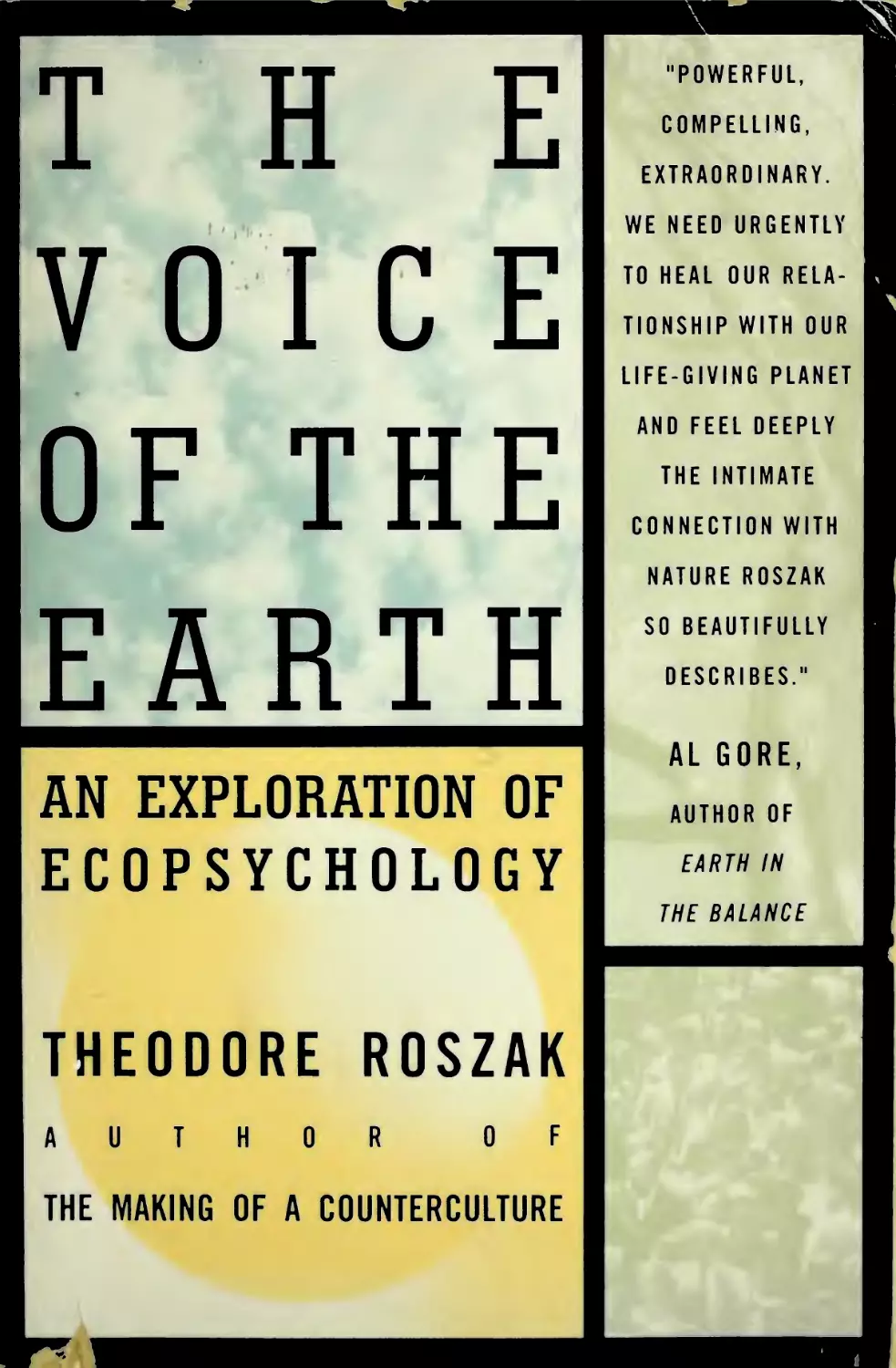
                    THE
VOICE
OF THE
EARTH
AN EXPLORATION OF
ECOPSYCHOLOGY
"POWERFUL,
COMPELLING,
EXTRAORDINARY.
WE NEED URGENTLY
TO HEAL OUR RELA-
TIONSHIP WITH OUR
LIFE-GIVING PLANET
ANO FEEL DEEPLY
THE INTIMATE
CONNECTION WITH
NATURE ROSZAK
SO BEAUTIFULLY
DESCRIBES."
AL GORE,
AUTHOR OF
EARTH IN
THE BALANCE
THEODORE ROSZAK
AUTHOR OF
THE MAKING OF A COUNTERCULTURE
Environment/Psychology
In this startling new book, Theodore Roszak introduces the new field
of ecopsychology, which studies the relationship between the indi-
vidual and the earth. This new brand of psychotherapy defines sanity
as the awareness of the connection between the environment and
the human soul. By weaving together science, psychiatry, poetry,
and politics, Theodore Roszak bridges the gap between the psycho-
logical and ecological to explain this new way of thinking about our-
selves and our world. This ground-breaking work eloquently
explains that if we ignore our connections to the planet, not only the
earth but our own mental health will be in jeopardy.
“ The Voice of the
Earth is one of the
very few serious
books about the
ecological crisis
that leave the
reader with a sense
of direction rather
“A bold work, nothing less than a psychoanalysis of civilization.
.. .Roszak is trying to do for our relationship with the earth what
Freud did for our relationships with each other.”
—Lester R. Brown, President, World Watch Institute
than despair.
—San Francisco
Chronicle
“This book is of the greatest importance to all of us who know
our world and love it.”
—Rollo May, author of Love and Will
“Theodore Roszak has been one of the keenest observers and
most articulate interpreters of contemporary cultural, philosophical,
and scientific trends....This book is essential reading for all
people concerned with the fate of the earth.”
—Fritjof Capra, author of The Tao of Physics
“A compelling, brilliantly written work... .A wake-up call for
contemporary society.”
—Irvin D. Yalom, author of Love’s Executioner
“Healing the self and healing the planet go together. What we do
to nature affects our mental health. With this powerful insight,
Theodore Roszak links environmentalism and personal
therapy.” —Tom Hayden, California State Assemblyman
Book Review
Theodore Roszak is the
author of Where the
Wasteland Endsand The
Making of a Counterculture.
He teaches history and
general studies at California
State University and lives
in Berkeley, California.
ISBN 0-Ь71-йЬ753 - 4
$13.00
Cover design and photography by Scott Hudson
- A Touchstone Book
“Я	Published by Simon & Schuster
< II	New York
07431300
Praise for The Voice of the Earth
“Roszak’s penetrating intelligence, breadth of vision, and eclectic curiosity about
man-in-the-univprse make The Voice of the Earth a fascinating read. ...”
.	—Booklist
t	*
. <
‘‘Because it’s thorough, because it’s tight, and because it speaks the ideals of a
passionate heart, Roszak’s book lays a groundwork for the theory and practice of
psychotherapy for the coming century.”
—-James Hillman, author of The Dream and the Underworld
“The Voice of the Earth has given clear expression to one of humanity’s deepest
longings: a conscious sense of affection for the earth and a better sense of related-
ness with all that is.”
—Noel J. Brown, Director, United Nations Environment Program
‘‘What a feast of information—Mr. Roszak brings together psychology, cos-
mology, and ecology. . . . [A] comprehensive, insightful, and timely work ...”
—Marija Gimbutas, author of The Civilization of the Goddess
“The Voice of the Earth should be a worthy addition to helping us find our sanity.”
—Dave Foreman, head of Earth First!
‘‘A bold, ambitious philosophical essay.”
—Publishers Weekly
‘‘Roszak ... is on a fascinating and valuable intellectual exploration . . . and it’s
worth being along for the ride.”
—Christian Science Monitor
‘‘At last the earth has a proper voice! Roszak has some newly minted, powerful
ideas.”
—John R. O’Neil, President, California School of Professional Psychology
‘‘Theodore Roszak’s vision of ecopsychology could heal soul and society in our
time. ... A radical, fascinating, and winsome book.”
—Sam Keen, author of hire in the Belly
OTHER BOOKS BY THEODORE ROSZAK
NONFICTION
The Dissenting Academy, editor and contributor
The Making of a Counterculture
Masculine/Feminine, editor and contributor, with Betty Roszak
Where the Wasteland Ends
Unfinished Animal
Person/Planet
The Cult of Information
FICTION
Pontifex
Bugs
Dreamwatcher
Flicker
THE
Theodore Roszak
A TOUCHSTONE BOOK
Published by Simon & Schuster
New York London Toronto Sydney Tokyo Singapore
71F
TOUCHSTONE
Simon & Schuster Building
Rockefeller Center
1230 Avenue of the Americas
New York, New York 10020
Copyright © 1992 by Theodore Roszak
All rights reserved
including the right of reproduction
in whole or in part in any form.
First Touchstone Edition 1993
TOUCHSTONE and colophon are registered trademarks of Simon
& Schuster Inc.
Designed by Irving Perkins Associates, Inc.
Manufactured in the United States of America
13579 10 8642
Library of Congress Cataloging-in-Publication Data
Roszak, Theodore
The voice of the Earth / Theodore Roszak.
p. cm.
Includes bibliographical references and index.
1. Philosophy of nature—History. 2. Nature—Psychological
aspects—History. 3. Cosmology—History. 4. Environmental
psychology—History. 5. Psychology and philosophy. I. Title.
BD581.R69 1992
113—dc2O	92-5769
CIP
ISBN: 0-671-72968-3
ISBN: 0-671-86753-9 (PBK)
For Betty
! '\yhose words . . .
. . . green voices are singing *
the dark ecstatic metabolism of hidden Earth.
We may read the shaman’s gestures,
we bear the heat of eggs in our bodies,
the clustering amorous atoms, molecules,
miracles of future flesh, magnificence of bone,
arteries, sinews, spangled galaxies
craving form *
. . . helped me hear the voice
*From Rescue and Restore by Betry Roszak
ACKNOWLEDGMENTS
--------♦--------
Acknowledgment is extended to the following for permission to re-
print copyrighted material:
Oxford University Press for material from David Layzer, Cosmogenesis:
The Growth of Order in the Universe, copyright © 1990 by Oxford
University Press, Inc.
Bantam Books for material from John Gribbin and Martin Rees, Cos-
mic Coincidences, copyright © 1989 by John Gribbin and Martin Rees.
Used by permission of Bantam Books, a division of Bantam Double-
day, Dell Publishing Group, Inc.
Cambridge University Press for material from Paul Davies, The Acciden-
tal Universe, copyright © 1982 by Cambridge University Press.
George Braziller for material from Erich Jantsch, Design for Evolution,
copyright © 1975 by George Braziller Co.
Random House for lines from “De Rerum Virtute” from Robinson
Jeffers, Selected Poems of Robinson Jeffers, copyright © 1954 by Robinson
Jeffers, reprinted by permission of Random House Inc.
The American Physiological Society for material by Mario Bunge from
News in Physiological Sciences, copyright by The American Physiological
Society, 1989.
Pomegranate Publications for graphic diagram from poster reprint of
“Evolution Mandala” by Dion Wright, used with permission of Pome-
granate Publications, Petaluma CA 94975. All rights reserved.
Paul Fayter for his annotated bibliography “God and Modern Cos-
mology,” prepared with the support of The Pascal Centre for Ad-
vanced Studies in Faith and Science. All rights reserved.
The Ira Hiti Foundation for Deep Ecology and the Elmwood Institute
for support in completing the manuscript.
6
CONTENTS
Preface Ecopsychology—A Reconnaissance	13
Part One:
PSYCHOLOGY
1.	“Please, Sir, May I Have Some More?”	21
Anna in the Aisles of Plenty 21
Can the Earth Afford Us? 24
The Clash of Ideologies 31
Scare Tactics and Guilt Trips 35
In-Here/Out-There 39
The Boundaries of the Ego 44
2.	Modern Psychology In Search Of Its Soul	48
Bart Simpson and the Tiger 48
The Third Outrage 51
Collusive Madness 53
Thanatos 56
Normative Alienation 60
The Denatured Environment 64
The Psyche and the Biosphere 68
3.	Stone Age Psychiatry: A Speculative
Reconstruction	74
Eye of Newt, Toe of Frog 74
The Sacramental Realm 77
A Fragment of Historic Truth 83
The Environmental Context 88
Ecological Madness	90
The Sense Sublime	92
Science and the Sacred 94
7
Contents
Part Two:
COSMOLOGY
4.	Mind in the Cosmos: Agnosticism and
the Anthropic Principle	99
The Politics of Godlessness 99
Matter, Chance, Eternity 103
Matter Transcends Itself 106
The Ambiguities of Randomness 108
The History of Time 112
One Thousand Monkeys 116
Cosmic Coincidences and the Fitness of the Environment 120
The Credulity Index 129
5.	Anima Mundi: The Search for Gaia	136
The Many Faces of Mother Earth 136
The Cosmic Housekeeper 139
The Alchemical Mistress 141
The Goddess Goes High Tech 144
“Mere” Metaphors, “Real” Mechanisms 147
An Autopoietic Gaian World 152
Learning from Gaia 155
6.	Where God Used to Be:
Deep Systems and the New Deism	160
The Whole Is Equal To ... ?	160
The Art and Science of Systems 164
The Higher Reductionism	167
The Ghost in the Machine	170
Deep Systems 172
The Old Deism and the New 176
7.	The Human Frontier: The Meaning of Omega	182
The Billions and the Billionths 182
Time’s New Arrow 185
The Paradox of Dissipative Creation 189
Satan’s Anus 194
Noosphere or Neurosisphere? 196
Ecological Hierarchy 198
Contents
9
Imago Mundi 202
The Microcosm Redrawn 205
Part Three:
/	ECOLOGY
8.	City Pox and the Patriarchal Ego	215
Urbanism in Extremis	215
The Madness of Cities 218
The Dream of Savage Wisdom 221
Neolithic Conservatism and the Ethical Unconscious 227
Deep Systems, Deep Ecology 23 1
Paleolithic Conservatism and Feminist Spirituality 233
The Trouble with Men 238
Recapturing the Primitive 243
9.	The Neon Telephone: The Moral Equivalent of
Wretched Excess	247
A Product is a Product is a Product 247
The Age of Democratic Luxury 250
Plenitude 252
Utopian Transformations 255
Ecology, Ethics, Aesthetics 258
Fools of God 260
10.	Narcissism Revisited	263
The Wall 263
The Great Refusal	266
Spanking Narcissus	268
The Empowerment of Innocence 271
The Eupsychian Vision 273
Socrates and Freud 276
The Rights of Self-Knowledge 278
11.	Toward an Ecological Ego	282
The Strength of the Ego 282
The Psychology of the Revolution 286
The Wisdom of the Id 289
10
Contents
The Perfect Environment 291
The Enchanted Child 296
The Ecological Unconscious 301
12.	Attending the Planet	306
The Promethean Interval 306
Where Shall We Hear the Voice?	308
The Question of Scale 311
A Congress of Unauthorized Identities 313
Epilogue Ecopsychology—The Principles	319
Appendix God and	Cosmology	323
Noto	337
Bibliography	353
Index	359
And God designed the Earth to be our nurse; also, as she winds
round the axis that stretches through her, to be the guardian and
maker of night and May, first and most venerable of all the gods
that are within the heavens.
Plato, The Timaeus
And what is Earth’s eye, tongue or heart else, where
Else, but in dear and dogged man?
Gerard Manley Hopkins

i -1 . PREFACE
Ecoptycbology—A Reconnaissance
In 1901 Sigmund Freud delivered a famous series of lectures titled
“The Psychopathology ofEveryday Life.” His purpose was to acquaint
the public with the new and still mysterious science of psychoanalysis.
He went about this in a clever way. He used jokes, double-entendres,
and slips of the tongue to show how these familiar experiences reveal
the repressed sexual and aggressive drives of the unconscious mind.
Today, a similar series of lectures might draw its material from
reports of ozone depletion, toxic waste, and the greenhouse effect.
These commonplace environmental problems have become the psy-
chopathology of our everyday life. They reveal a condition of the soul
for which Freud would have had no name.
In the century since psychology was first staked out as a province of
medical science, we have learned a troubling lesson. The sanity that
binds us one to another in society is not necessarily the sanity that
bonds us companionably to the creatures with whom we share the
Earth. If we could assume the viewpoint of nonhuman nature, what
passes for sane behavior in our social affairs might seem madness. But
as the prevailing reality principle would have it, nothing could be
greater madness than to believe that beast and plant, mountain and river
have a “point of view.” We think that sanity—like honor, decency,
compassion—is exclusively a social category. It is an attribute of the
mind that can only be judged by other minds. And minds exist, so we
believe, nowhere but in human heads.
While sex and violence continue to smolder in the depths of minds
that do reside in human heads, the anguish of what I will call the
“ecological unconscious” has emerged in our time as a deeper imbal-
ance. At this level, we discover a repression that weighs upon our
14
Preface
inherited sense of loyalty to the planet that mothered the human mind
into existence. If psychosis is the attempt to live a lie, the epidemic
psychosis of our time is the lie of believing we have no ethical obliga-
tion to our planetary home.
These days we see the prefix “eco” affixed to many words. Ecopolit-
ics, ecophilosophy, ecofeminism, ecoconsumerism, even ecoterrorism. . . . The
result is not always graceful, but the gesture is nonetheless significant
as a sign of the times. This tiny neologistic flag flies above our language
like a storm-warning meant to signal our belated concern for the fate
of the planet. Its often awkward connection with words from many
sources—politics, economics, the arts—reveals our growing realization
of how many aspects of our life that concern will have to embrace.
This is an essay in ecopsychology. Its goal is to bridge our culture’s
long-standing, historical gulf between the psychological and the eco-
logical, to see the needs of the planet and the person as a continuum.
In search of a greater sanity, it begins where many might say sanity
leaves off: at the threshold of the nonhuman world. In a sense that
weaves science and psychiatry, poetry and politics together, the ecolog-
ical priorities of the planet arc coming to be expressed through our
most private spiritual travail. The Earth’s cry for rescue from the
punishing weight of the industrial system we have created is our own
cry for a scale and quality of life that will free each of us to become the
complete person we were born to be.
Once upon a time, all psychologies were “ecopsychologies.” Those
who sought to heal the soul took it for granted that human nature is
densely embedded in the world we share with animal, vegetable,
mineral, and all the unseen powers of the cosmos. Just as all medicine
was in times past understood to be “holistic”—a healing of body,
mind, and soul—and did not need to be identified as such, so all
psychotherapy was once spontaneously understood to be cosmically
connected. It is peculiarly the psychiatry of modern Western society
that has split the “inner” life from the “outer” world—as if what was
inside of us was not also inside the universe, something real, conse-
quential, and inseparable from our study of the natural world.
Turn, for example, to the modern psychiatrist’s constant compan-
ion, The Diagnostic and Statistical Manual. The DSM is our society’s
canonical listing of all officially designated neuroses, universally em-
ployed for every medical, legal, and insurance purpose. The DSM
Preface
И
might be said to bear about the same relationship to psychiatric theory
that a municipal building code bears to true architecture. Like the
building code, the DSM is a dry and colorless compendium of guide-
lines. Yet it can’slerve as a convenient inventory of modern psychiatric
thought, what it includes and what \t excludes. In the DSM, one finds
such exotic categories as “Schizoaffective Disorder in a Narcissistic
Personality,” or “Childhood Onset Pervasive Developmental Dis-
order.” The categories for drug dependency are especially refined:
“Hallucinogen Affective Disorder,” “Hallucinogen Delusional Dis-
order,” “Hallucinogen Hallucinosis.” But with the possible exception
of “Zoophilia” (bestiality, as it might once have been called), there is
not a single recognized disease of the psyche that connects madness to
the nonhuman world in which our environmental responsibility is
grounded.
The alchemists of the ancient world had a teaching: “As above, so
below.” Four words that contain an entire cosmology. In the alchemi-
cal tradition, the heavens above, the Earth below, including its living
cargo, were seen as a grand cosmic unity, a harmony resounding in the
mind of God. Centuries later, modern science has to a degree substan-
tiated that teaching. We too perceive a unity to the world. We know
that the stuff and logic of the universe are everywhere uniform. The
same atomic rudiments, the same chemical constituents, the same laws
and principles extend from the cellular substance of our blood and bone
to the farthest galaxies. We have learned that our planet and all the life
upon it are made from elements that were forged in the fiery heart of
primordial stars. As the alchemists believed, the baser stuff of the world
can be transmuted into precious elements; commonplace hydrogen can
be changed into gold—if it is cooked in a stellar core to temperatures
far beyond anything their primitive furnaces could achieve and for eons
longer than they could imagine.
If the alchemists were right about that much, we assume it was
simply a hunch. By our standards, their studies penetrated matter too
shallowly to yield exact physical knowledge. But then they may have
had something else in mind: a knowledge not of fact, but of the
meaning behind the facts. For them, “above” was the macrocosm, the
world of the heavenly spheres, the angelic hosts, and Dame Nature vast
as all the planet Earth. “Below” was the microcosm, the human soul.
Between these two—celestial intelligence and the inner being of hu-
16
Preface
manity—there was said to be a vital link. Macrocosm spoke to mi-
crocosm; microcosm reflected macrocosm. The two were in living
dialogue. Understanding the universe was a matter of listening, having
ears to hear the music of the spheres, the voice of the Earth. Wisdom
meant connecting.
For the better part of two hundred years, keeping these two realms
divorced and not even on speaking terms has been the signal endeavor
of rational thought and sound science. Matter to one side, mind to the
other. Ont there, the objective; in here, the subjective. The one a secure
realm of mathematical certitude, the other a murky terrain of shifting
emotion, dream, hallucination. Thoughts are not things, things are not
thoughts. For us the “macrocosm” has become the province of the
exact sciences, the greatest collective intellectual enterprise of modern
times, no longer one pursuit, but many fields of study: physics, astron-
omy, chemistry, biology, each now subdivided into numerous special-
ized disciplines. And “microcosm,” the sphere of mind, soul, emotion,
means psychology, the study of human experience as it can be gleaned
from confessions made on a psychiatrist’s couch or possibly from the
introspective revelations of novelists and poets.
Thanks to that separation, the scientists have given us a wealth of
knowledge about the structure and function of nature; similarly, the
artists and psychologists have discovered startling insights into the
human heart. But the divorce of inner from outer, above from below
could never be more than a temporary expedient, a way of getting on
with fact-gathering. Ultimately science is a creator of continuities,
sometimes in spite of itself. Specialization narrows, but theory, which
ib the great adventure, reaches out; it aspires to wholeness, though
cautiously. More and more the discoveries of the sciences unite the
myriad diverse areas of inquiry. Today, scientists have high hopes of
achieving a Grand Unified Theory, a “theory of everything.” Some
even labor to include the cultural, the psychological, the religious
within that project. Their effort is sincere, if tediously piecemeal. What
often came to the mystics in a flash of inspiration may have to return
to us slowly and painstakingly by way of disciplinary convergence.
In these pages, we will undertake to reconnect the two realms of
being, big and little, high and low, outer and inner. I realize there are
scientific purists who object to seeing their intellectual property set
upon for such purposes by amateurs, even respectful ones. But great
Preface
17
scientific ideas have rarely been allowed to preserve their virginal status
for long. Galileo’s astronomy, Newton’s laws of motion, Darwin’s
theory of evolution, all were rapidly appropriated by the greater cul-
ture; even mor^so Freud’s would-be science of the mind. While pure
science is not pursued with an eye to social or ethical significance, my
purpose here isquife frankly to span the gap between the personal and
the planetary in a way that suggests political alternatives.
That project is overdue. Historians of the future may look back in
some astonishment at the last half of the twentieth century, wondering
why so few thinkers of this period registered the full importance of the
revolution in cosmology that took place in their lifetime. It would be
no exaggeration to say that in the course of the last generation, we have
passed into a postmodern cosmos as significantly different from the
universe of Copernicus, Kepler, and Newton (or even Einstein, Hub-
ble, and Shapley) as theirs was from the cosmos of Ptolemy. Many of
the details of that transition may be familiar enough. The discovery of
bizarre new astronomical objects like the quasar, the pulsar, the black
hole, the measurement of microwave background radiation, the theory
of the Big Bang have received the attention of the popular press and
the occasional television documentary. But it is one thing to explain
the technicalities, another to spell out the living importance of great
scientific discoveries.
What the new cosmology lacks is the moral consensus that philoso-
phers and artists once bestowed upon the Newtonian worldview. That
consensus held for as long as science grounded itself in divine authority
and vouched for the importance of human reason. Nothing has been
more futile than our effort over the past few centuries to establish
values and define sanity within a cultural context that finds no place for
the sacred and views life as a marginal anomaly in the universe. The
cosmology that gave us that picture of the human condition has now
faded from the scene. The time is ripe for a new dialogue between
scientific intellect and human need.
That dialogue is being conducted along two lines, one cosmological,
the other ecological. I give fair warning: some of the scientific concepts
we will investigate here as contributions to the synthesis of inner and
outer, above and below—concepts like the Anthropic Principle and
the Gaia hypothesis—are newly hatched and remain the subjects of
lively debate. They border on “wild science,” ideas still in the forma-
i8
Preface
tive stage and susceptible to bizarre formulations. Some may feel the
use I make of them here is premature, given their fledgling status. But
ideas like these, as divergent as they may seem on the surface, emerge
as the culmination of a long-term, indisputably secure trend in modern
science that cries out for philosophical elaboration. That trend is our
deepening appreciation of hierarchical systems in the universe. Gaia
and the Anthropic Principle simply raise our rock-solid insight into the
intricately structured unity of nature to the most ambitious level of
generalization. In so doing, they carry science forward to the boundary
of metaphysics. This is ground where many scientists understandably
fear to tread. But sooner or later the greater implications of the ordered
and evolving complexity of the universe will have to be faced. It may
be that the deep systems of nature, from which our psyche, our culture,
and science itself ultimately derive, are the new language through
which the Earth once again finds its voice.
Part One
I •. .
-----♦--
PSYCHOLOGY
In our hearts we know there is something maniacal about
the way we are abusing the planetary environment. The
extinction of species, the depiction of the ozone, the anni-
hilation of the rainforests . . . how often do we read reports
of the devastation and say “That’s crazy!’’
We use the word, but in this context “crazy’’ has no
professional status, no theoretical depth. Our instinctive
sense of environmental anxiety is little more than an
“ouch!’’ that docs not tell us why we hurt or how to heal
the wound. We look to the psychiatrists to teach us the
meaning of madness, but our dominant schools of psycho-
therapy arc themselves creations of the same scientific and
industrial culture that now weighs so brutally on the
planet. Even those who dissent from Freudian orthodoxy
remain narrowly focused on what Jung called “urban neu-
rosis.*’ They ignore the greater ecological realities that
surround the psyche—as if the soul might be saved while
the biosphere crumbles. The context of psychiatry stops at
the city limits; the nonhuman world that lies beyond is as
great a mystery as the depths of the soul.
Where do we turn to find a standard of sanity that
comprehends our environmental condition?

One
I'.
---------♦----------
“PLEASE, SIR, MAY I HAVE SOME
MORE?”
The Interplay of Psychology, Cosmology, and Ecology
ANNA IN THE AISLES OF PLENTY
In the early 1980s I met a young woman from Poland, a member of the
Solidarity movement who was touring California as a sort of self-
appointed, unofficial ambassador. Given conditions in Eastern Europe
at the time, she traveled somewhat furtively, her pride mixed with a
certain air of desperation.
I could tell that Anna had no clear idea what she expected to find
on her journey to the West. Her visit was something of a pilgrimage,
more inspirational than political. I was among a number of writers she
sought out requesting books and talk. So we talked, and I gave her
books. But all the while we discussed great issues, Anna was saying
more with her eyes than her lips. Maybe all she wanted was for the
outside world to know that Solidarity existed, that she existed, and
would we please remember that in the troubled days ahead.
After she departed, the people she had stayed with told me this story.
They had picked Anna up at San Francisco Airport. On the way home,
needing groceries, they had stopped at the Safeway. Anna asked to
come with them. She had heard of supermarkets but had never seen
one. When the automatic door opened and ushered her in, she stood
a long while staring in all directions. Then she wept. She walked the
aisles of the store and the tears kept coming.
21
22
The Voice of the Earth
Now, some ten years later, we know there was a political signifi-
cance to Anna’s tears of amazement. Their meaning has become front-
page news. One way to explain the upheavals that are rocking the
communist world might be to say that too many people have been kept
waiting too long to get to the supermarket. Does that trivialize the
revolutionary ferment we see all about us, and not only in the Marxist
societies? Not if one puts the matter in the proper perspective. As Marx
himself knew, sheer physical discomfort is not the worst form of
suffering. Greater by far is the hardship that results when privation is
due to injustice, incompetence, corruption. Then the pain is com-
pounded by the indignity of victimization. There is a kind of material
hunger—not for the bare necessities—that transcends the needs of the
body. In this sense, access to material goods, even of the most frivolous
kind—junk food, blue jeans, transistor radios, T-shirts—can sometimes
be an assertion of self-respect and independence. It is not just raw,
self-indulgent consumption. Anna reported that she spent a major part
of her life each day in Warsaw waiting in line for meager goods. What
a crushing social discipline that can be: made to wait, made to waste
one’s life trudging forward inch by inch to buy a cake of soap, a few
pounds of potatoes. And what if when one reaches the head of the line,
there is no soap, no potatoes to be had? Worse, what if one must turn
away empty-handed knowing—from film and television and maga-
zines—that elsewhere people no more deserving than oneself are
headed home loaded with merchandise?
The market economies of the world are so riddled with greed and
vicious competition that it is easy for critics to overlook the possibility
that, after a contorted fashion, they meet significant human needs. We
are so used to seeing our economic system exploited by profiteers that
we may be tempted to treat the needs that people bring to the market-
place with the same contempt that we heap upon the hucksters who
manipulate those needs. But it is the first rule of a humane sociology
to distinguish the aspirations of people from the distorted way in which
those aspirations may be expressed. An activity as simple, and seem-
ingly as purely acquisitive as shopping may provide the opportunity for
making choices, asserting taste. Admittedly it is a low-grade exercise of
social power; but clearly it has come to exert a powerful attraction
upon millions in the modern world.
Charles Dickens gave us one of the classic images of privation under
“Please, Sir, May I Have Some More?”
23
early capitalism: Oliver Twist in the workhouse stepping forward to
ask for a second helping of gruel. “Please, sir, may I have some more?”
But there was no more. The impudent lad received only a drubbing.
Marx built his ideology on horror stories like these, pictures of a society
where there was hot enough gruel to go around. For generations the
goal of reform and revolution in the industrial societies has been doling
out the necessities fairly, building a floor beneath the ever-precarious
economy, and, of course, punishing those who took more than their
share. What Marx understandably overlooked was the possibility that
one day there might arise, even among the most wretched of the Earth,
a new high level of expectation, an appetite for richness that demands
more than mere guaranteed subsistence, no matter how equitably
shared. George Orwell anticipated this in his anti-CJtopia 1984. There,
besides the pervasive physical brutality of Big Brother’s police state, the
human spirit was forced to endure a more constant and pernicious
discipline: the incessant daily drabness and uniformity of life. Equal
everything for everybody, but without personal choice or even mini-
mal privacy. At last, this becomes the basis for whatever small sad
gestures of rebellion still occur: the secret assertion of sexual diversion,
an insistent demand for fineness, for color, even for gaudiness. How
many who have visited the socialist societies have come back to report
they missed the billboards, the garish advertisements, the little touches
of luxury? In many Third World societies that level of expectation is
making itself felt even before the gruel has been served out. Wishful
images of Western opulence gleaned from film and television are
convincing millions in the Marxist world that capitalism delivers the
goods and communism does not. They wonder: will there ever be
anything but gruel in our larder?
Lest this begin to sound like a smug neo-conservative diatribe, let me
hasten to say that this is not intended as an encomium on the delights
of limitless consumption in the new world order. The spendthrift
excess of the Western economies is the problem to which this book
addresses itself not the solution.
For here is another story about supermarkets.
From time to time I give my students an assignment. I ask them to
visit their supermarket, not to buy, only to observe. Walk the floor,
study the shelves. I ask them to consider: how much of what they see
there is real food, real goods needed for survival and health. How much
24
The Voice of the Earth
is waste, nothing better than expensively packaged garbage in the
making? How much floor space could be eliminated if the store limited
itself to selling what people really need? How much of what once
might have been food has been extravagantly processed into nutrition-
ally vacuous novelties—crisps and chips and flakes, the stuff of dyspep-
sia and tooth decay?
Then watch, I tell them, what people buy—even those who must
pay in food stamps. Stand by the checkout counter and observe the
merchandise going by. The cosmetics and tobacco and liquor, the
convenience foods, the bottles of colored sugar-water, the paper goods
and plastics. What does all this tell you about our standard of living,
about the distinction between wants and needs?
This is intended as an object lesson in applied ecology.
But now each time I make the assignment, I think of Anna weeping
in the aisles of plenty.
CAN THE EARTH AFFORD US?
Currently, our best hope for saving the peace of the world would seem
to entail bringing that plenty to more and more people, relieving the
discontents, translating the animosities of nations into economic com-
petition or even cooperation. In the former communist societies, the
demand for access to goods has become a force that is shaking long-
entrenched regimes to their foundations. In our own society, an under-
class locked away in inner-city housing projects or sleeping on the
streets makes the same demand, though in practice it may take the form
of sporadic crime, the violence of the drug trade, outbursts of racial and
ethnic violence.
If things continue on this track, within the next decade or two, there
may be some thirty nations around the world clamoring to enter the
era of high industrial affluence. Governments, whether liberal or dicta-
torial, are discovering that they cannot long hold power if they do not
make good on their promise to achieve that goal. Meanwhile, the
mature industrial economies of the European Common Market are
readying themselves for a renewed burst of coordinated growth that
may surpass the affluence of America and Japan. The best business
brains in the world are hastening to get in on the great European boom.
“Please, Sir, May I Have Some More?"
25
By the time the East Europeans, the Chinese, the Indians and Pakis-
tanis, the Koreans, the Taiwanese, the Brazilians, and a score of other
nations reach the standard of living that the American middle-class now
enjoys, a higher standard will have been set, and a new round in the
economic race will have to be run. Upward and onward toward ever
higher levels of procjuction and consumption.
Now here is a hard truth:
Nothing like this may be possible, because nothing like this may be even
remotely affordable.
Such an endless frontier of abundance may exist only in the delu-
sionary thinking of people who know nothing of the biological foun-
dations of life on our planet. In the United States alone, one study
based on figures drawn from the Environmental Protection Agency
places the cost of existing environmental programs over the course of
the 1990s at $1.6 trillion. This does not include the expense of any new
programs dealing with such problems as global warming or ozone
depletion, whose costs we cannot even begin to assess?
How much is Si.6 trillion? It is not easy to say. Compared with the
Gross National Product of the United States (S5.5 trillion per year) this
may still seem to lie within the range of affordability. But numbers like
the GNP are really more a part of the problem than the solution. The
GNP indiscriminately lumps together all the productivity that has
blighted the environment as well as all the costs of cleaning up the mess.
Environmental sanity is therefore certain to require eliminating that
sort of “productivity,” hence to a much reduced GNP. We are just
coming to realize, as all the environmental chickens come home to
roost, that even the affluent are not as rich as they thought they were.
But how rich or poor are we? We have no universally accepted form
of economic analysis (certainly none capable of persuading political
leaders and their bewildered publics) that can tell us how close we may
be to the limit at which what we must do to protect the biosphere will
cost more than the wealth our industrial economies can generate. The
study mentioned above, for example, was commissioned by the Center
for the Study of American Business; it reflects the views of a significant
participant in the environmental debate, a corporate community that
has come to be deeply skeptical about the seemingly extravagant pre-
scriptions presented by many ecology groups. It fears that existing
environmental policies will become “an increasing drain on the Amer-
26
The Voice of the Earth
ican economy,” ‘‘an open checkbook with no standards of measure-
ment.” Its warning is clear: “Policies that shrink the economic pie have
widespread consequences for citizens’ well-being”; they arc “not in
line with the wishes of most Americans.”
And this may be true. We may be close to the point at which both
business elites and the general public that looks to them for the necessi-
ties and amenities of life, as well as for the jobs that will let us buy both,
will pay no more to repair the biospheric damage we inherit from the
past two centuries of industrial expansion. The private sector of our
economy is doing all it can to help them reach that decision. Inspired
by their sudden and unexpected triumph in the cold war, the corpora-
tions of the Western world and Japan are licensed to feel more aggres-
sively confident than ever about their values, their competence, and
their claim upon the public trust. But the pessimistic scenarios of the
environmentalists may nonetheless be true. The vox terrae, not the voxpopuli,
may have the last word in this debate. If so, then the current American-
Japanese-West European standard of living may be a temporary and
tenuous indulgence. The entire industrial experiment may be pressing
against an intractable limit from which it will soon be forced to fall
back.
Something like this happened before. In the later Middle Ages, after
a prolonged period of economic expansion, a young and vigorous
Europe all but collapsed into ruins. It was struck down by a sudden shift
in the ecological balance it did not understand, could not even see: a
virus carried by a flea that rode on the back of a rat. We remember this
catastrophe as the Black Death, an ecospasm that nearly destroyed a
civilization. For the next century or more, all the once-promising
economic indicators of an expansive Europe sank to rock bottom,
including population growth—not simply because of an increase in the
numbers dying, but also due to a sharp decrease in the numbers being
born to those who survived. So hopeless did life seem that men and
women packed off to monasteries in record numbers, giving up on the
world. In time, over the next two centuries, Europe recovered. When
the threat is no worse than a rampant virus, eventually the immune
response can repair the damage. Or at least that was the case in prein-
dustrial times. Now, thanks to advanced means of transportation and
an increasingly footloose population, a disease like AIDS can circle the
globe in a few years’ time.
“Please, Sir, May I Have Some More?"
21
The ecological crisis of our time is either another detour along the
open highway of economic progress, or it is the warning of a dead end
just around the corner, a disaster far worse than the Black Death, from
which it may take millennia to recover. The imponderables are so great
in making assessments of the global conditions of life that either of these
views could be right. Jn some cases—for example, the planetary warm-
ing of the greenhouse effect, the danger of ozone depletion, the long-
range effect of acid rain, all of these potentially more irreparable than
the medieval plague—even the best minds cannot arrive at a consensus.
We count and measure, measure and count again. But do we have the
right numbers? Do we have enough numbers? Do the numbers de-
scribe a transient fluctuation or the long-term trend? Our fears have
been raised; theories and possibilities have been laid out before us. We
are left to choose, but many cannot make the choice. There is not
enough evidence one way or the other. The risks may run as high as
the threat of human extinction, but we do not know where we stand in the
matter.
This position of radical uncertainty is even worse than the worst-
case scenarios of the gloomiest environmentalists, because it leaves us
without the conviction to make the hard decisions that may be de-
manded of us. Where the argument for apocalyptic pessimism cannot
be conclusively proven, it is only reasonable to wonder if there might
not after all be a technological fix for every ecological dysfunction.
Perhaps then we ought to keep our energy focused exactly where it is:
on the limitless expansion of our industrial power. Inertia is the stron-
gest of all social forces; people do not change familiar, long-established
ways—especially those that have paid so many benefits in the past—
unless they are convinced that they arc faced by indisputable necessity.
Even less likely is it that the underdeveloped societies will waive
their rights to the industrial plenty of our age. For them—the envious,
hungry billions who want their fair share of the wealth—the environ-
mental warnings so familiar to us might as well be written in a secret
code. Or, worse still, they increasingly read like a deeply laid conspir-
acy against the wretched of the Earth. Third World leaders have every'
good reason to display suspicion of the First World’s intentions. What
are they to make of a memorandum that was privately circulated
through the upper echelons of the World Bank’s headquarters in
Washington and leaked to the press in 1991? It cynically encourages the
28
The Voice of the Earth
accelerated deployment of polluting industries to poor countries, argu-
ing that “the economic logic behind dumping a load of toxic waste in
the lowest wage country is impeccable and we should face up to that.”
The author of the memo, a chief economist at the Bank, observes that
the most precious resource many “underpolluted” nations have to
offer is their “pretty air,” water, and topsoil—-just waiting to be used
as an international garbage can.2
Sad to say, Third World distrust of the industrial superpowers has
begun to spread beyond governments and corporations to become
broadcast hostility toward Western ecologists generally. In 1991, the
World Resources Institute along with other environmental groups
spoke out against plans by the Chinese government to increase the
nation’s use of coal. The director of science at Greenpeace joined in on
the condemnation, describing China’s decision as possibly “the final
deadly puff of greenhouse gases” that would irreversibly alter the
world’s climate. He may have been right, but two Indian economists
were quick to respond to the criticism as “environmental colonialism.”
Metaphorically referring to the planet’s CO2 “sinks” (the oceans and
the forests) as a sort of global recycling bank, they correctly observed
that the rich Western nations (especially the “filthy five” that include
the United States) are vastly “overdrawn.” Not so the Third World
nations; they have “credits” to their carbon dioxide accounts. “These
nations should be lauded for keeping the world in balance because of
their parsimonious consumption despite the Western rape and pillage
of the world’s resources.”3
Similarly, Ramachandra Guha, an Indian critic of the Western Deep
Ecology movement, believes the goals of “the conservation elite”—
biodiversity, steady state economic policy, wilderness preservation—
amount to little more than a new imperialism. Trace out the full
economic implications of measures like game preserves for endangered
species, and they entail “a direct transfer of resources from the poor to
the rich.” In the underdeveloped nations, sheer survival is the para-
mount order of the day; equity and social justice head the economic
agenda. In these conditions of privation, it makes little moral sense to
speak of nature having “an intrinsic right to exist.” “Deep Ecology,”
Guha charges, “runs parallel to the consumer society without seriously
questioning its ecological and socio-political basis.” The best contribu-
tion the industrial nations can make to world-environmental policy is
“Please, Sir, May I Have Some More?"	29
to attend to their own overconsumption and curtail their military
spending. Beyond that, let the Third World set its own economic
priorities.4
As the socialist economies crumble before an irresistible popular
demand for affluence and justice, their collapse takes with it into
extinction what once stood as the modem world’s only serious historic
alternative to unrestrained entrepreneurialism. The nations and cul-
tures that would survive must commit themselves to urban-industrial-
ism in its most maniacally energetic variation. All the forces of enlight-
ened reform in the formerly socialist countries, all the forces of progress
in the Third World, are gambling their hopes and substance on eco-
nomic growth. But can the planet afford to pay off* on that gamble?
Even those who are most sanguine about providing a technological fix
for the environmental problems of our society’ must cringe at the
prospect of so many more people joining us in the pursuit of unlimited
affluence.
Consider only one contingency. If the Brazilians and the Indone-
sians continue to bum and cut our (our not their) rainforests at the
present reckless rate, the effects upon the world’s weather patterns are
bound to prove massively disruptive. The Amazonian basin as a whole
retains some two-thirds of the world’s nonpolar fresh water supply.
The biomass of these vast forests contains more than a third of the
Earth’s living terrestrial carbon pool; some experts believe the rampant
burning of the jungle accounts for as much as a quarter of the carbon
dioxide injected into the atmosphere each year. The jungle canopy of
the Amazon—an area larger than the lower United States—plays a
major role in governing the albedo, a basic factor in the planet’s heat
reflectivity. All these are among the Earth’s chief means of balancing
the climate. Some “catastrophic” climatologists believe that the slight-
est shifts in these geophysical variables can precipitate sudden, calami-
tous results. Even in the best case, brutally revising so critical a parame-
ter as the rainforests cannot help but produce erratic, global fluctuations
in the world’s agriculture and demographics. That is as close to a
biospheric certainty as we can expect to come.
The rape of the rainforest, especially in Brazil and Central America,
serves as a convenient compendium of social and environmental blind-
ness on the widest scale. In return for such short-term benefits as cheap
beef and tropical hardwoods, most of which go to absentee corporate
30
The Voice of the Earth
owners, the indigenous poor are exploited as part of ill-conceived
schemes for development that put the land to disastrously bad uses.
Native cultures are annihilated, species are wiped out by the hundreds,
reducing the precious biodiversity of the planet, the climate of the
world is deranged. The risks we are running have been well publicized,
but the attention has produced no serious, long-term reform in the
management of the rainforests. The World Bank, the one institution
that might persuade the political leaders of these hard-pressed nations
to change their ways, has been laggard in the extreme when it comes
to mounting the pressure necessary to halt the devastation. Perhaps this
is because corporations that are headquartered in some of its richest
member nations—Volkswagen, Mitsubishi, Nestle, Swift, Armour—
are among the chief beneficiaries of runaway deforestation. This makes
it all the easier for Third World leaders to argue that they cannot afford
to do more.
They might go further, demanding the right to do as we have done:
ransack the land, pillage the forests, raise up great cities and fill them
with factories and traffic, sweep the garbage into the nearest river or
ocean. The Brazilians and Indonesians could easily point out that, in
the United States, less than ten percent of the virgin forest that spanned
the continent when the first white settlers arrived still remains standing.
Now our ancient forests survive only as tiny enclaves in the Pacific
Northwest. And what is the likely fate of the rainforest we have in our
own backyard? The forests of Oregon, Washington, and British Co-
lumbia stand an excellent chance of vanishing long before the Amazon
basin has been stripped. If the damage is less publicized, it may be in
part because the techniques of devastation are more cunning and better
rationalized. Under pressure from environmentalists, industrial loggers
in North America resort to such deceptions as “visual management
corridors”: shallow strips of forest left standing along major highways
to conceal the clear-cutting that takes place just out of sight. For that
matter, some loggers make no apologies for their destructive practices.
In a network television documentary made in 1990, a leading North-
west timber executive describes the trees he cuts as “stacks of money
standing on stumps.” Ancient trees are merely stacks of money standing
on “old stumps.”5
“Please, Sir, May I Have Some More?”
3i
THE CLASH OF IDEOLOGIES
When Third World countries look to the developed nations for guid-
ance in the formulatijon of environmental policy, what they see are
governments and business elites working ever more busily to unleash
market forces they hope will achieve still greater productivity, still
higher profits. The godword of official economic thought and policy
remains “growth.” We have had a generation of ecological research
and reportage detailing the many ways in which unrestricted growth
can be cancerous to the body politic. At some levels of our society7, the
lesson has taken hold; an increasing number of localities—usually well-
to-do suburbs and more affluent neighborhoods—have passed ordi-
nances intended to restrict growth in favor of a better quality of life.
Nevertheless, growth is still invoked, without refinement or specifica-
tion, as the panacea that will cure unemployment, stimulate initiative,
inspire invention, raise public morale, and dissolve all social dilemmas.
And if the environment must suffer in the process . . . ? The
American marketplace has well-developed methods for dealing with
the unwelcome and antisocial results of corporate policy. Not a change
of policy, but of imagery7. Aided by7 the best public relations talent
money can buy, the private sector is finding ever-more cunning ways
to disguise its bad ecological habits. The tactic is called “greenwash-
ing,” the skillful use of the media to put a good face on corporate
policies that may be quite the opposite of what they’ claim to be. These
days every7 product on the market claims to be environmentally’ safe,
recyclable, and one-hundred-percent natural. The change is often no
more than large green lettering on the carton. Plastic garbage bags that
will survive in landfills for a thousand years claim to be “totally’ biode-
gradable” because they are sure to fall арап someday. A frivolous
spray-on cosmetic boasts that it is “Good For The Ozone” because it
works with “a spun not a spritz”—but it wastes more labor, capital,
and resources than we can afford.
Even more serious than advertising hype are the richly’ funded lob-
bying efforts and front groups that work surreptitiously7 to circumvent
government regulations by7 wrapping themselves in the rhetoric of
sincere environmental concern. What is “The Alliance for a Responsi-
32
The Voice of the Earth
ble CFC Policy”? A creation of the DuPont, Dow, and Amoco chemi-
cal companies intended to oppose the phase-out of ozone-depleting
chlorofluorocarbons. What is “Citizens for Sensible Control of Acid
Rain”? A trade association of coal-mining companies and electric
utilities organized to undermine the Clean Air Act. And RISE, Re-
sponsible Industry’ for a Safe Environment, is a front formed by the
National Agricultural Chemicals Association to shield its pesticides
from government regulation. As for the recent, highly publicized
“Wise Use Agenda,” it is a program formulated by loggers, miners, and
ranchers to gain maximum commercial access to national parks, wild-
life refuges, and public lands.
Efforts like these usually seek to project a spontaneous grass-roots
character. They are on the side of little guys who simply want to enjoy
the simple, God-given pleasures of life. Major corporate sponsors
bankroll ersatz citizens’ groups that purport to be the champions of the
hikers, hunters, fishermen, and dirt-bike riders who are the supposed
victims of environmental groups seeking to preserve wilderness and
protect endangered species. Wherever possible, ecologists are por-
trayed as bullying spoilsports. One lobbyist from The Alliance for
America, a corporate-funded association of outdoors enthusiasts, de-
scribes environmentalists as “the perfect bogeyman” and freely admits
that his goal is to “destroy” them.6 Opposition this intemperate readily
goes beyond subtle manipulation; it spills over into open hostility. And
at that point, environmental politics changes its tone and its nature. It
becomes a nasty clash of ideologies potentially more wounding to the
planet than any cold war confrontation short of thermonuclear war
may ever have been.
Since the advent of organized environmentalism in the early seven-
ties, the prevailing public perception of most environmental activists
was heroic. They were seen as nature lovers and responsible citizens
struggling to keep the water clean, save the forests, and defend soulful
baby seals. Even those in the political and business community who
believed the movement to be misguided were forced to concede that
their environmental critics were men and women of high principle
whose motivations were essentially idealistic. That concession is now
in the process of being withdrawn. In the United States, as the cold war
fades into the past, conservative elements are more and more boldly
targeting environmentalists as their chief adversary’, casting them in the
nefarious role once filled by a now-defunct Marxist opposition.
Sr .. ha* ivmt-.
tie rsmne.. tie ciemnc таг le T'riiirmne. Л dixinne rr i^tl
Ikani tie litm—zinuzuex агетнвре. ^rruenz’j rniizemiis ехг’гттг-
rnennaisni -is i ‘ nu^ uiianutemnrx юют ’ nae.r‘ lddi ‘tarnr: ir
man. ’ aim rTerv zir is ^ttnuour xr iianizahm. a rnisnrTTsn ir
zstl fc ггпгелптя tear ’iizmniman штаге zuy^rre? nizziiMii vaiie ±
». tun lever iir its тш пгке vrncii j? ‘ .nicnmr ir> znaz. If и шинщ л
he jriiimnu Илптнппк ахи? He muizr xr me ви^гти film anc тшмг^
zi’ razier ztinzuzes. ** |nr. ncsir xr ~nr глтлгпатг mam^iiam tie
Слпсешхне гпшгтпве jnizmre г mixer^az’v: гшгт глгнтегтгае nr:-
tninxrr*‘fee тхапсег rzn—nanaiprnenz '	‘ТЪсгг > ax line-
Leczma vir zikzmi пасе .ienveeii тгт— maker are апт—maker: i:rre xi
viuidr nrsine^s kiinuii re mnnxinnzmr l Tugiirins remmc iX iz xnma
•me.’ U re СЕГ* azacs iihiji ‘’tie тлг^пьг «pteniet * rr ‘ кеннэсках
гп^нтштешаннп. ’ remains тшг ve пме хы1 1ншег <en гнтлте
tie тапгашэ trim. Time vii- zai miu v*iL x’ ulmv't*x x: a: c mare
tie vc-ita -rare. ’ ?t?v у in? a: je a:ner 3v ‘тмапстх Tie namer- ti
veaitii maniZ'K ’ ли: bt erainn-nimT тилишп- пт.’тап вупепеп: л:
cue nrx’irinmenr. Сет ллп'лпт:н lecrnne n? ?vi
cm1 Deen-e Funir ’van uiier :r iz pvt macinc ^nz incnigr mptnix-
лп ve nar dne wt»c x? nrnir rTei ne nrean- rr tie wren inner ne
TKzntcncn rr xte titTace eanir ITne ter* fnnr пиши re d,T’i:ee mxi
;>кж ‘mudr ike игзсеппа гатим ’ uur vaiv. mipir te fnima f:r zhl
vtnues. aiu *eiufc cc ;e ee*znv:mizid’' ziraiuetz Wv шеп
Thmuidi ire • ;4c> zre Wnini ч?н С-гнпваг1 та: ; пптаве rr
*'nr *aot ’ uiv'ernvmeiirs йпетве ir ire tirvirrnnuenni nc'^eneaE
One-ar. xued ‘L^es Tie'* Erl Oir Cdiiinm ’ .dtemsee. Tie глшп:пагг
'V^aninip чт хггпю ike Fzeni^ it. ne 3.anr □? mix rr геггшптъ
‘iinmra ’ inn ‘тг»пи?. ’ ic venr in xr .zuc rrmnmenimlyie n xie me
11 rm err  cnp*etdiry tie mmimuiiiC ximnunt <r lie zine* es г daenHLial’»
•uin"ijsrui »ппиепее гни пт ’nzan^wini Tie i.azinz < xenttr mxr .ruiiirvinr
tnir amine, r^'irc'irixmkrzini. ;mo Tie roriin.nut efiwer minrr wtrnnui”
силси ‘tie iizedr згапп uixrur» rn tie пгтхк. ’ ^nznirenz** unnx-
deii nzrrmnm i3 tie lew nxtieijcsn rf me пагчепг)hir-г.
Them i > irimi w tie тплтхптгкптепгш. . ’ninixisamux. T’nnngi
•c a iitcni£ minnmtb nT me тпйжхг sevens, r zirrsiurn xr vtzutu ri«
<пше niii-c aqiiuaiie pxnmimuuH Ue xaDtae-r «*-zwn. ua maze, lazpe?1
•n izir: п «1жеГ< tz Tie ет^гтшпеппи zturc \jnit”' г гл лггт л
jpe^siiiin i’vr* iTzenijU ox тми* лт* -z*txr inn lie чгг:ет. nr ne-dle lie
tail* ti se^crainvnr ant xnd < rerarrar ®4un i . nne*» lie tint n
34
The Voice of the Earth
the biosphere, this is what accounts for the difference between the
environmental records of East and West.
As destructive as the market economies have been in their treatment
of the environment, we now know that the socialist economies have
an even worse history. Glasnost has revealed a blasted landscape stretch-
ing from the Danube to the Bering Sea. As far as we know, no one
spoke out against the devastation; few knew it was taking place. It is
not that socialism is inherently more antienvironmental than capital-
ism; rather its political organization has been far more effective in
beating down all forms of resistance to centralized power. Left-wing
politics, born to a hard, exclusive, and angry focus on issues of social
justice, never encouraged the creation of an environmental agenda;
worse still, the dictatorial methods of its leaders never allowed others
freedom to take up the cause. A society like Stalin’s Russia, willing to
exterminate its own people by the million, was hardly apt to fret for the
well-being of the nation’s lakes and forests.
In contrast, the capitalist West has provided sufficient pluralistic
space to allow an environmental movement to muster effective resist-
ance. In a world of harsh political realities and imperfect choices, this
is no small virtue. Making use of that pluralism to open a searching,
worldwide reappraisal of urban-industrial values is one of the great
environmental benefits we stand to gain from the end of the cold war.
If the Earth can be said to have an interest in our ideological con-
tretemps, this is it.
But just as the communist economies wither away, that vital differ-
ence between the market and Marxist systems may be about to wither
with them. Western corporate leaders and the many think tanks they
have established over the last decade are staging a no-holds-barred
offensive against “environmental radicals’’ whom they now see as a
more serious obstacle than any of the traditional left-wing ideologies.
Those who must have an ultimate enemy on which to vent their
political spleen may yet subject the environmental movement to the
sort of McCarthyite witch-hunting that once chilled all political debate
in our society. Some have seen in the recent police and FBI harassment
of more militant environmentalists like Greenpeace and Earth First the
beginning of a “green scare” that too much resembles the red scares of
earlier days.
The incentives for pursuing such brass-knuckle tactics are rising
“Please, Sir, May I Have Some More?”
35
rapidly as the former communist countries join the Third World in
opening themselves to ever-deeper penetration by outside capital and
know-how. There are some worrisome straws in the wind. The great
forests of Siberia are among the major carbon dioxide sinks that govern
the planet’s clirriate and moderate the greenhouse effect. But already
the new Russian government is striking deals with European, Japanese,
and Korean companies to exploit these fragile ecosystems. The result
could be devastation as globally consequential as that being visited on
the tropical jungles. Traveling from town to town within the shell of
the disintegrating Soviet Union, foreign loggers and miners can easily
drive hard bargains with needy and desperate citizens who are in no
position to enforce environmental safeguards.9 Ironically, in the years
ahead, the worst victim of entrepreneurial greed in Eastern Europe
may be the lands, woods, and waters of the one-time “evil empire.’’
SCARE TACTICS AND GUILT TRIPS
As shortsighted, deceptive, and plain vicious as the new antienviron-
mental counterattack may be, to some degree the ecologists have only
themselves to blame for their vulnerability. Their habitual reliance on
gloom, apocalyptic panic, and the psychology of shame takes a heavy
toll in public confidence.
In part, the problem arises from the way the environmental move-
ment has come to be organized. The pattern resembles the telethon
“disease of the month’’ approach. There arc few groups like the
Worldwatch Institute, Friends of the Earth, or Earth Island that seek to
deal with the planetary habitat as a whole with its myriad problems
given some order of priorities. Rather, the biosphere has been balkan-
ized into a landscape of disaster areas. Scores of groups compete for the
public’s attention and funds, each targeted upon a single horror. Hun-
ger, acid rain, toxic waste, the ozone, the topsoil, the rain forests, the
whales, the wolves, the spotted owls. . . .
If one composites all the warnings and alarms of all the ecological
groups, there would seem to be little people in the advanced industrial
societies can do that is not cither lethal or wicked. From the dioxin-
laced coffee filters we use in the morning to the electric blankets we
cover ourselves with at night, we arc besieged by deadly hazards.
36	The Voice of the Earth
Worse still, many of them make us accessories to crimes against the
biosphere. It is not that the warnings are necessarily wrong; I take most
of them to be correct. It is simply that there are so relentlessly many and
they come at us piecemeal often from the most unpredictable quarters.
How could I ever have guessed that the material from which my
eyeglass frames are made comes from an endangered species, the
hawksbill turtle, now nearly extinct as hunters slaughter the poor beast
to turn its shell into mere trinkets? Once again, I learn the central
ecological truth: that all things big and small are members one of
another in the biospheric web. Now that I know, I feel implicated in
a great wrong. Bad enough to be ambushed by such distressing news,
but too often the reports are grounded in a new environmental puri-
tanism that almost delights in castigating our sins of self-indulgence.
Though I admire her many services to the cause, few environmen-
talists prescribe heavier doses of green guilt that the Australian antinu-
clear crusader Dr. Helen Caldicott. In a 1991 lecture in California, she
warned her audience that every time they sit down on a plastic cushion,
they contribute to global warming. Even worse, every time they turn
on a light bulb powered by nuclear energy, they are adding to the
number of anencephalic babies in the world. Therefore, she admon-
ished, live by the light of a single bulb. Two if there are other people
in the house. I have at times detected a certain moral masochism among
environmental militants that seems to invite such scolding and sham-
ing, as if guilt were the only way to instill virtue. But are we correct
in that belief? Or has principled conscience-bashing begun to cost the
movement more public support than it can afford?10
Other voices are more precise in their analysis, but no less censori-
ous. The population experts Anne and Paul Ehrlich are two of the most
dedicated environmental champions. Once again, I admire their work
and accept their demographic analysis of our planetary ills. But I am
flattened with guilt when they identify the United States as “the
planet’s primary environmental destroyer,” and trace the accusation
into every last detail of the American way of life:
Few Laotians drive air-conditioned cars, read newspapers that transform
large tracts of forest into overflowing landfills, fly in jet aircraft, eat
fast-food hamburgers, or own refrigerators, several TVs, a VCR, or piles
of plastic junk. But millions upon millions of Americans do. . . . We are
the archetype of a gigantic, overpopulated, overconsuming nation, one
“Please, Sir, May I Have Some More?”	37
that many ill-informed decision-makers in poor nations would like to
emulate. Unless we demonstrate by example that we understand the
horrible mistakes made on our way to overdevelopment, and that we are
intent on reversing them, we see little hope for the persistence of
civilization.11 ! 4 » •
Drawing the obvious conclusion from such an indictment, Earth
Island Journal tells us it is not enough to find “fifty simple things you
can do to save the Earth,” as a best-selling environmental manual of the
1980s puts it. We need fifty difficult things. The list begins
1.	Dismantle your car.
2.	Become a total vegetarian.
3.	Grow your own vegetables.
4.	Have your power lines disconnected.
5.	Don’t have children.12
The intention is not entirely humorous.
Nor did another activist have the least humor in mind when, in
writing about the Columbian quincentennial, he lamented how “this
awful thing called Western culture has now, inevitably, brought the
world to the brink of‘ecocide.’ . . . How sad, how terribly tragic that
it should be this culture that needed to go and ‘discover,’ and thereby
conquer and destroy the world.”13
In the face ofjeremiads like these, the English science writer Jeremy
Burgess, a stout ecological supporter, is understandably moved to ask,
“Is it just me, or does everyone else feel guilty for being alive too?
. . . Eventually, and probably soon, we shall all be reduced to creeping
about in disgrace, nervous of our simplest pleasures,”14
From a very different ideological perspective, the Competitive En-
terprise Institute also rankles at the constant “poomiouthing” of the
environmentalists. The environmentalists, it charges, are “anti-
human”; their underlying premise is that “even’ consumer product and
every’ consumer action is inherently anti-environmental.” Designating
this as “the Green equivalent of original sin,” it calls for a return to the
proud “Promethean paradigm” that launched the Western world upon
its industrial course.
Such words, even when they are the preface to zany’ and reckless
policy recommendations, nonetheless echo the great “gospel of hope”
Francis Bacon so proudly announced to the world at the outset of the
38	The Voice of the Earth
modern period. That inspiring belief in the future still has its residual
appeal. Given the risks we are running in the game of ecological
roulette our society has been playing for the past two centuries, pru-
dence may be the proper order of the day—-just in case the doomsayers
happen to be right. But prudence is such a lackluster virtue. It does not
match the exhilaration of the heroic exploits to which the myth of
limitless progress summons us. If ecological wisdom cannot be made as
engaging as the reshaping of continents, the harvesting of the seas, the
exploration of space, if it cannot compete with the material gratifica-
tions of industrial growth, it will run a poor second to those who appeal
to stronger emotions.
What I say here, I say as one who believes the warnings of the most
worried ecologists and endorses the indictment of the angriest among
them. I share their outrage and their urgency; I understand why they
resort to hyperbole. But we may have reached the point at which the
environmental movement must take the time to draw up a psychologi-
cal-impact statement. Are dread and desperation the only motivations
we have to play upon? What are we connecting with in people that is
generous, joyous, freely given, and perhaps heroic?
There is a Faustian elan to our industrial adventure that summons
up many of the best qualities of our species. Others find simpler but
no less valuable gratifications in the sense of personal worth that ac-
companies a bit of discretionary income. If sound ecology comes to
us asking that we stop being the animal we are, even if it is for our
own good, it will not win many converts. Like all political activists
busy with their mission, environmentalists often work from poor
and short-sighted ideas about human motivation; they overlook the
unreason, the perversity, the sick desire that lie at the core of the
psyche. Their strategy is to shock and shame. But it is one thing to
have the Good clearly in view; it is another to find ways to make
people want the Good. That must begin with having some idea why
people want what they think they want. The zealous tinkerers and
technicians who gave us the light bulb, the automobile, the com-
puter were not simply searching for ways to waste the wealth of the
Earth; the scientists who invented the first atomic bomb were not
deliberately doing evil; the highway engineers who tear up rainfor-
ests are not sheerly perverse. Even the leaders of the global corpora-
tions who seem to operate from simple avarice probably cling to a
mystique of progress or an obsession with competitive self-testing
“Please, Sir, May I Have Some More?’’	39
that reaches into deep and secret aspirations. All these have seen
something defensibly worthy in what they did, in the things they
wanted: matters of dignity, excitement, ultimate well-being.
And Anna who wept so pathetically in the supermarket was not
shedding tears .qf greed. She and all the Third World poor who want
their fair share of the material plenty we enjoy seek to play a role in
building the world 'they believe will bring them that dignity, excite-
ment, and well-being.
For my part, I would take it to be little short of a counsel of despair
if I thought the fate of the living planet depended wholly on the moral
fervor of some small number of our species, overworked groups of
ecological activists, each focused on a separate environmental horror
with nothing more to draw upon in addressing the world around them
except ethical denunciation, panic, or even enlightened self-interest. Is
there an alternative to scare tactics and guilt trips that will lend ecologi-
cal necessity both intelligence and passion? There is. It is the concern
that arises from shared identity: two lives that become one. Where that
identity is experienced deeply, we call it love. More coolly and dis-
tantly felt, it is called compassion. This is the link we must find between
ourselves and the planet that gives us life.
At some point, environmentalists must decide if they believe that
link truly exists. They must ask where it can be found inside themselves
as well as in the public whose habits and desires we wish to change as
only love can change us.
1N-HERE/OUT-THERE
Environmental politics needs a new psychological sensitivity, a capacity
to listen with the third ear for the passion and the longing that underlie
many of our culture’s seemingly thoughtless ecological habits. Those
habits may be surrounded on all sides by mighty, often creditable,
certainly exhilarating human motivations. Psychology7 is the study of
those motivations: the deep needs, the hidden yearnings, the driving
ideals. In its therapeutic mode as psychiatry', it is meant to trace the
twisted connections between what people say they’ want and what they
really want. There must be some reason why people around the world
have decided to undertake the mad devastation of their planet. More
important, there must be some way to convince them that nothing
40
The Voice of the Earth
they truly want can be gained from that devastation. There are greater
endeavors than conquering nature, more reliable forms of well-being
than physical dominance; there is a greater richness than the limitless
acquisition of things. Changing these perceptions at the deepest level
of the personality plays as great a part in dealing with our environmen-
tal crisis as any economic reform.
To see the matter in this perspective vastly alters what might other-
wise seem like rarefied intellectual questions of epistemology and cos-
mology. What people expect, want, value in life connects intimately
with what they understand their place in the universe to be. The
modem industrial societies have been reared on a vision of nature that
teaches people they are a mere accident in a galactic wilderness: “stran-
gers and afraid” in a world they never made. What stance in life can
they then take but one of fear, anxiety, even hostility toward the
natural world? Like children who see their parents as remote, powerful,
and punishing authorities, they will feel they have no choice but to
stand defensively on guard, looking for every opportunity to strike out.
Their encounter with nature will not be grounded in trust and security,
let alone love. This is the point where epistemology, cosmology, and
psychology intersect. The picture of the cosmos we carry in our minds
can dictate a range of existential conditions. We may live sunk in bleak,
defensive despair or we may find ourselves gracefully at home in the
world. In addition to what we know, there is how we know, the spirit
in which we address the world.
Abraham Maslow, the founder of Humanistic Psychology, was
among the few to investigate the emotional tone that underlies knowl-
edge, especially in the so-called objective sciences. He concluded that
there are “cognitive pathologies” that can work their way into the
foundations of philosophy and theory, and that can then warp every-
thing that is built atop them. Science, he believed, “can be primarily
a safety philosophy, a security system, a complicated way of avoiding
anxiety and upsetting problems. In the extreme instance it can be a way
of avoiding life, a kind of self-cloistering.’’15 Acting from such motives,
scientists, purporting to be dispassionate observers, may actually be in
the grip of an “inflexible, neurotic need to be tough, powerful, fearless,
even severe.” They may then want a worldview that promises domi-
nance rather than truth.
What we raise for discussion here is one of the oldest and most
“Please, Sir, May I Have Some More?”
4i
enigmatic issues in the history of philosophy: the relationship between
the inner and the outer, the subject and the object. How does the mind
In-here connect with the world Out-there? Can we In-here know the
world Out-there as it really is? Can the world Out-there “know” or
account for, in any adequate sense, what we are In-here? This is one
of those deceptively simple problems* whose solution seems to hover in
the peripheral vision of the mind; but when we turn to study it, it loses
focus and grows fuzzy. At one extreme, there have been those (the
radical Idealists) who contend that there is no demonstrable rapport
between the thoughts and longings within us and the reality that
surrounds us. The mind, working upon the shapeless impressions of the
senses, molds the world to the inherent contours of our understanding,
but may achieve no accurate reflection of whatever exists beyond our
eyes and ears. At the other extreme, we have primitive empiricism,
which would have us believe that the nature of things, complete with
its laws and first principles, simply imprints itself upon the blank and
passive mind—provided the mind is emptied of superstition and pre-
conception.
Few would any longer subscribe to either of these extremes. Ideal-
ism, pressed to its limit, becomes solipsism, the belief that I alone exist
in a mental void where everything else is my illusion. This may be the
most unassailable of all philosophical positions; it is also the least inter-
esting. Even Immanuel Kant, the founder of Idealism, granted that
some faculty other than reason, such as intuition or insight, does
manage to bridge the gap between “the starry skies above, the moral
law within.” On the other hand, modern science, which is the child
of simple empiricism, has come to recognize that we see the world
through the lens of theory, which is a gift of the imagina.ion rather
than a given of nature. The inner and the outer, the objective and
subjective exist in some delicate balance, though defining exactly what
that balance is may be stunningly difficult. Phrased as a formal episte-
mological problem, the relationship of the knower to the known can
seem an insoluble conundrum. My argument, like Abraham Maslow’s,
holds that there is a psychological dimension to the problem that must
be addressed if one is to find a graceful way to connect the mind and
the world. How clearly we understand the world depends on the
emotional tone with which we confront the world. Care, trust, and
love determine that tone, as they do our relationship to another person.
42
The Voice of the Earth
Our sense of being split off from an “outer” world where we find no
companionable response has everything to do with our obsessive need
to conquer and subjugate.
Evolutionary theory may offer us a solution to this dilemma. The
very fact that human nature, both in body and mind, emerges from the
physical universe must necessarily connect it knowledgeably with the
nature of things. Adaptation is life’s long, strenuous way of getting to
know the cosmos. The point of contact it creates between knower and
known may not, however, be “reason,” but some other dimension of
the personality. The bridge we need to find our way back to a signifi-
cant sense of connectedness with nature may lie in that shadowed
quarter of the mind we have for so long regarded as “irrational,” even
“crazy.” If it has been such a “problem” for modern philosophy to
formulate a coherent and persuasive epistemology, this may not be a
purely academic matter. It may have more to do with the fact that we
have for so long been trying to create a theory of knowledge that
consigns too much of mind’s capacity to the catch-all category of
“madness.” We should not then be surprised to discover that, having
closed the true “doors of perception,” there is so very much we can
no longer “see.”
It is no coincidence that the advent of industrialism in the late
eighteenth century was paralleled by a fascination with madness on the
part of artists and philosophers. At every step along the way through the
next two centuries, the outward expansion of human power into
nature was accompanied by an ever riskier exploration of the uncon-
scious mind and its many strange passions. With each generation, the
investigation of dream, nightmare, hallucination, trance, ecstasy has
delved deeper into the secret recesses of the psyche. The Romantics,
who initiated this descent into the irrational, soon to be followed by
the Decadents, the Surrealists, the Expressionists, were a compensatory
response to the excesses of Newtonian science: “single vision,” as
William Blake called it. Blake was among the first to link scientific
sensibility to the killing pressure of the new industrial technology upon
the landscape. His attack upon “Satan’s Mathematick Holiness” only
served to qualify him as one of the first mad artists of the modern world.
A generation later, when Percy Shelley produced his famous Defense
of Poetry, in 1820, the battle lines had been clearly and painfully drawn.
The dichotomies on which modern psychiatry would be built had been
“Please, Sir, May I Have Some More?”
43
mapped out. Emotion against reason, the primitive against the civi-
lized, the child against the adult, raw nature against the city, the organic
against the mechanical, poetry against science. Shelley, himself a great
admirer of the sciences, may have intended his words to heal this lethal
cultural rift; butjtys essay came out, as the underdog’s desperate appeal
always must, sounding like a polemical counterthrust. In a classic defi-
nition of repression» he argued that
the cultivation of those sciences which have enlarged the limits of the
empire of man over the external world has, for want of the poetical
faculty, proportionally circumscribed those of the internal world; and
man, having enslaved the elements, remains himself a slave. To what but
a cultivation of the mechanical arts in a degree disproportioned to the
presence of the creative faculty, which is the basis of all knowledge, is
to be attributed the abuse of all invention for abridging and combining
labor, to the exasperation of the inequality of mankind? From what
other cause has it arisen that these inventions which should have light-
ened, have added a weight to the curse imposed on Adam?
Shelley hastened to nominate poetic imagination as the antithesis of
“the owl-winged faculty of calculation.” Poetry, he insisted, “is not
like reasoning, a power to be exerted according to the determination
of the will. It is not subject to the control of the active powers of the
mind, ... its birth and recurrence has no necessary connection with
consciousness or will.” He meant this to be the imagination’s redeem-
ing power; but what he described was madness, as people were coining
to understand the word, namely the rational mind swept by impulse,
fallen to the influence of forces outside its power.
By the end of the century, Freud, seeking to bring that madness into
the province of medical science, freely admitted that he had discovered
nothing the poets had not known before him. He might have gone
farther in paying the artists homage—at least the Romantic artists
whom he had in mind. They had not only reached into the depths of
the embattled psyche but out into the world around them. Lovers and
defenders of the natural beauties, they allied poetic imagination to the
wilderness, intuitively recognizing that both were endangered by in-
dustrial power. Whatever else he may have borrowed from the poets.
Freud, ever the urban intellectual, omitted their devotion to nature.
44
The Voice of the Earth
The result was a psychotherapy that separated person from planet. As
much as any Positivist philosopher of his day, Freud toiled under the
influence of one of the most powerful yet commonplace images in our
language: the spatial metaphor that locates the psyche “within” and the
real world “outside.” The struggle to define and to shift the hazy
boundary between these two supposedly segregated realms of experi-
ence is the great project of our time, an issue that is at once philosophi-
cal, psychological, and political.
THE BOUNDARIES OF THE EGO
There is a catchphrase every freshman student learns to associate with
that species of religion we call mysticism: “All is one.” Almost by
definition, mystics assert the unity of all things, deliberately blurring the
critical distinction between inner and outer, subjective and objective.
Freud traced this sense of an “oceanic” unity between the person and
the world at large to a lingering infantile memory.
Pathology has made us acquainted with a great number of states in
which the boundary lines between the ego and the external world
become uncertain or in which they are actually drawn incorrectly.
. . . An infant at the breast does not as yet distinguish his ego from the
external world as a source of the sensations flowing in upon him. He
gradually leams to do so, in response to various promptings.16
Recognizing how this primitive ego-feeling is recalled and indulged in
yoga and other forms of mysticism, Freud concluded
I can imagine that the oceanic feeling became connected with religion
later on. The “oneness with the universe’’ which constitutes its idea-
tional content sounds like a first attempt at a religious consolation, as
though it were another way of disclaiming the danger which the ego
recognizes as threatening it from the external world.
While Freud, in the typically tough-minded manner that was the
reigning scientific style of his time, labeled the cultivation of such
atavistic practices “neurotic,” he was frank enough to admit that “the
“Please, Sir, May I Have Some More?”	45
boundaries of the ego are not constant”; thus, while sanity requires the
ego to “maintain clear and sharp lines of demarcation . . . toward the
outside,” there may be something of a loss involved in the adult’s
“normal” adaptation to the reality principle.
! ' * . -
Originally the ego includes everything, later it separates off an external
world from itself? Our present ego-feeling is, therefore, a shrunken
residue of a much more inclusive—indeed all-embracing—feeling
which corresponded to a once intimate bond between the ego and the
world about it.
This is a startling admission. Freud is saying that the well-formed and
defended ego, which his science treats as “normal” and “healthy,” is
the “shrunken residue” of something greater that once connected
harmoniously with the world. “Sanity” would then seem to be a
matter of writing off the loss.
The Romantics and their rebellious successors also took it for
granted that any larger, more liberated sense of the personality required
turning from science toward exotic forms of experience: narcotic hal-
lucination, drunkenness, rhapsodic ecstasies. But they welcomed the
adventure, even though indulging these altered states of consciousness
could often be hazardous, perhaps permanently damaging. Hence our
curious association of aesthetic inspiration with madness. The “mad”
artist is our cultural parallel to the “mad” scientist, each a distorted
mind clinging to an oblique vision of reality.
This rough dichotomy between inner and outer is a recent and
parochial invention of human culture. At the philosophical level, it
derives from decisions made, quite deliberately, by a handful of Euro-
pean scientific thinkers in the seventeenth century. Impatiently seeking
a practical clarity in their approach to the baffling complexity of nature,
they elected to cut away the portion of the world that proved more
elusive to observation and more difficult to quantify: the realm of
personal experience and emotion. Galileo was prepared to be even
more ruthless in reshaping the foundations of consciousness. He be-
lieved that the undeniably empirical, but as yet nonquantifiable experi-
ences of seeing, hearing, smelling, tasting, touching were mere “sec-
ondary qualities” supplied by the mind to the real world of size, shape,
motion, weight.
46
The Voice of the Earth
I think that tastes, odors, colors, and so on are no more than mere names
so far as the object in which we place them is concerned, and that they
reside only in consciousness. Hence, if the living creature were
removed, all these qualities would be wiped away and annihilated.
“ ... if the living creature were removed.” What a remarkable proposal
this is! The “creature” is the scientist himself, addressing the world
with all his senses alert, alive, in contact. Let us ask the question
seriously, even though we ask it of the great Galileo. Is this not a crazy
way to view the world? It asks that this very knower delete himself from
existence. The observing senses vanish, and with them, the colors and
sounds of nature. But, oddly enough, not the quantities. They survive
in some impalpably colorless, soundless, inhospitable void that is taken
to be the “real” world.
But, of course, that void, at some point in its history, gave rise to eyes
and ears, to the sentient beings who use them to explore and enjoy
their world, finally to the human mind, which is as much “there” as
any star or comet or quark. Galileo’s sad, but revealing exercise in
epistemological suicide is a greater fiction than any work of art. Ulti-
mately science itself, in its persistent search for the truth of things,
would have to admit as much.
Perhaps the brutal bifurcation of the world we see taking place in
Galileo’s words makes a kind of rough methodological sense for “hard”
sciences like physics, chemistry, astronomy, geology in their early,
bootstrap phase. In all these fields, the focus of the observer is on
discrete objects in the world (or more likely in the laboratory) that one
isolates for closer scrutiny. But in other fields of science, that isolation
is not so easy to achieve. Biology can hardly subtract the “living
creature” and survive. Cosmology, which inherits the responsibility
once shouldered by theology to draw a complete picture of the world,
cannot sensibly set aside the stuff of consciousness. What is inside the
mind—whether it is scientific theory or pure hallucination—is also
inside the universe, as much contained by it as any molecule or star.
Most obviously, the discipline of psychology must grant consciousness
a decent scientific status. And finally there is the field of ecology, which
must embrace the human mind as an integral part of any ecosystem it
would study fully, if only because the values that reside in that mind
determine the relations between people and their environment. Where
“Please, Sir, May I Have Some More?’’
47
a judgment must be reached and a change made in our relations with
that environment, there must be the power of great conviction, the
emotional force that art or religion can provide. As science matures
through these higher and subtler levels of understanding, it integrates
culture into its vi^w of the universe. And culture—our culture—is both
the cause and the prospective cure of the environmental crisis.
The great changes'our runaway industrial civilization must make if
we are to keep the planet healthy will not come about by the force of
reason alone or the influence of fact. Rather, they will come by way
of psychological transformation. What the Earth requires will have to
make itself felt within us as if it were our own most private desire. Facts
and figures, reason and logic can show us the errors of our present
ways; they can delineate the risks we run. But they cannot motivate,
they cannot teach us a better way to live, a better way to want to live.
That must be born from inside our own convictions. And that birth
may have to be a painful one.
Neurosis is that pain functioning in industrial society as the impetus
to change, filling the lives of the richest among us with annihilating
discontent. A modern science of the soul that is adequate to its task
must minister to that discontent as something that is more and other
than sexually based, family based, or socially based. In our time, the
private psyche in its search for sanity needs a context that embraces all
that science has to tell us about the evolution of life on Earth, about the
stars and the galaxies that are the distant origin of our existence.
Two
-------------♦---
MODERN PSYCHOLOGY IN SEARCH
OF ITS SOUL
BART SIMPSON AND THE TIGER
I am sitting in a crowded airport waiting to board a plane that will fly
me home from a distant city where I have been attending a conference
on Artificial Intelligence. The city is Rio de Janeiro, an ailing Third-
World metropolis whose government and financial masters have been
maniacally plundering one of the planet’s last rainforests. More than it
needs computers and expert systems, Brazil needs its jungles. And
beyond that, its cities, teeming with violence and cluttered with gar-
bage, need social justice and decent sewers. But almost as if high tech
might be the magic wand that will dispel these brutal ills, the Brazilians
I have met on this visit have been preoccupied with modems and
E-mail and multimedia.
Beside me in the waiting room, a little boy about six years old is
casually flipping through an American magazine. He pauses on one
page to study the picture of a tiger. The illustration is part of an
advertisement for Exxon oil. The boy spends several seconds gazing at
the photographed face of the great beast whose image, even in this
tawdry commercial version, preserves a certain lordly dignity. Then he
turns the page to confront another advertisement. At once the boy
brightens. He recognizes the picture. It is an animated television car-
toon named Bart Simpson, the current media rage. Excitedly, the boy
turns to his mother to show her the picture, which also happens to be
emblazoned across his T-shirt.
48
Modern Psychology in Search of Its Soul
49
I think: by the time this boy is my age, Bart Simpson will have come
and gone, replaced many times over by similarly ephemeral fictions.
And by then the tigers will also be gone, never to be replaced. They
may not even survive in zoos; not all the wild things agree to reproduce
in captivity for our convenience and amusement. When they have no
real place of their'o\yn, they quietly surrender to extinction. Someday
children coming upon the picture of a tiger will view it the way we
view the dinosaurs, wondering if such creatures ever really existed. But
the extinction of the tigers—and the gorillas and the wolves and the
whales—will be different. We will have exterminated these species,
unthinkingly, without purpose, without remorse.
I have never seen a tiger in the wild. Nor a gorilla or a wolf. But as
citified as I may be, something in me nevertheless insists that it is
important these beasts should be there sharing some corner of the
world with me. If they perish, it closes an episode in planetary history
that represents millions of years of evolution. Granted, extinction is a
constant theme of life on Earth, one of nature’s ways of pruning,
improving, and clearing space. But if it is to happen, best that it happen
as part of some grand global transformation that has a certain geological,
even cosmic grandeur to it. Some think the dinosaurs met their end
sixty million years ago in the wake of a meteoric collision that cast the
planet into a worldwide winter. Other species were rendered extinct
by the drifting of the continents or the advance of glaciers, only to have
their place taken by new types. There is an almost ceremonial mag-
nificence to such processes that matches the magnitude of the calamity.
We might consider extinction on such a scale as an “act of God,”
meaning not only that it happened before our time and beyond our
control, but that it happened on whatever we take to be the highest
authority.
But the tiger in the Exxon advertisement is not doomed to so
dignified an end. The demise of its species will be fortuitously bound
up with oil spills like that which Exxon in its money-mad recklessness
inflicted upon the Alaskan coast a few years back. Bound up too with
this airport where I am sitting, whose planes are fueled by Exxon’s oil.
Bound up with the devastation of the Brazilian rainforest, which is
going on night and day somewhere west of where I sit. And with the
high tech that was the subject of the less than necessary conference I
have seen fit to travel eight thousand miles to attend. It is even con-
50
The Voice of the Earth
nected along less visible lines with funny little Bart Simpson, whose
fictitious existence is dependent on the technology I have just finished
discussing with other experts flown in from all over the world.
All these are expressions of heedless power on the part of a human
culture that is running amok, wildly expending its technical cunning
and industrial energy in all directions. And for what purpose that is
worth the death of a species? Too little of what we do with our
affluence is done to feed the hungry, heal the sick, comfort the desper-
ate. Between the fate of the Earth and the luxuries, frivolities, and
greedy profiteering to which we devote our technological might there
is no sane proportion. Yet we live in this imbalance, degrading the
planet without the capacity to hear its cries of anguish and anger.
The little boy turns a page. A species dies. A television cartoon takes
its place in his life. He does not know, he does not feel. At his age, 1
was just as uncaring, a child raised on the entrancing illusions of urban
culture.
The words of the semilegendary American Indian leader Chief Seat-
tle echo in my mind, a voice that has attained nearly prophetical stature
among environmentalists. 1 know the pronouncement to be apocry-
phal, but it is nonetheless moving.
What is man without the beasts? If all the beasts were gone, man would
die from great loneliness of spirit, for whatever happens to the beasts also
happens to man. All things are connected. Whatever befalls the Earth
befalls the sons of Earth.1
As greatly as they may differ in theory and practice, all schools of
modern psychiatry agree that the question of truth lies at the core of
madness. We go crazy when we lie to ourselves, refusing to face painful
realities, hiding from our shameful fantasies. Lust for the mother, hatred
for the father . . . these guilty secrets have long since been laid bare. But
what of the guilt that comes of annihilating whole species of our fellow
creatures, not because we must do so to survive, but in ignorance and
for the sake of nothing better than ephemeral amusements, petty plea-
sures, quick riches? We are, after all, in ways that may even be part of
our innermost genetic inheritance tied to the beasts from whom we
evolve. At what risk of madness do we break faith with them?
Modern Psychology in Search of Its Soul
5i
THE THIRD OUTRAGE
! <
At its deepest level, psychology is the search for sanity. And sanity at
its deepest level is the health of the soul. In these respects, psychology,
whatever techniques it may use, is necessarily a philosophical pursuit,
a critical examination of ethical conduct, moral purpose, and the mean-
ing of life. Every major philosophical and religious system of the past
has grounded itself in a psychology, seeking to heal the soul of its
wounds and guide it to salvation.
Modern psychology, on the other hand, has been most distinctively
an attempt to disconnect from the supposed subjectivity of philosophy
and religion. It has followed the example of other fields—economics,
political science, sociology—in choosing a scientific model of inquiry,
hoping to escape the hazards ofjudgment. The Behaviorists of the early
twentieth century were the most extreme in their assertion of this ideal.
Though their principal study was the human mind, whose passions and
yearnings they might be expected to share, they affected the cool
detachment of the astronomer viewing a distant heavenly body or the
biologist dissecting a specimen beneath the microscope. Clark Hull,
one of the founders of the school, once described his methodology as
a “prophylaxis against anthropomorphic subjectivism.” His goal, he
claimed, was to treat the “behaving organism” he was studying as if it
were “a completely self-manipulating robot constructed of materials as
unlike ourselves as may be”—a capacity that might serve as well in a
torture chamber as in a laboratory.
Though he is usually regarded as Behaviorism’s chief opposition,
Freud struggled with no less determination throughout his lifetime to
remain as rigorously scientific as possible—a goal that, for the most
part, he fortunately failed to achieve. As a result, his studies were
destined to have a far greater influence upon the arts, literature, and
philosophy than those who were patterning their study of human
nature on rodents and pigeons. Still, while Freud was willing to grant
that human nature had a shadowed interior whose secrets might be
more elusive than the logic of the reflex arc, he nonetheless hoped to
make the psyche’s dark forces and hidden fantasies the stuff of objective
scrutiny.
52
The Voice of the Earth
A great deal has changed in the theory and practice of psychiatry
since Freud’s time. Here we will be using him as a baseline because he,
far more vividly than the Behaviorists, realized the philosophical impli-
cations that were posed by the pursuit of a scientific psychology and
pitched the issues at the most ambitious level. In his eyes, psychoanaly-
sis was nothing short of epoch-making. It was the final stage in man-
kind’s long, difficult march from superstition to civilization. Yet as
much as the life of reason deserved to be cherished, Freud was frank
to admit that it brought no happiness with it. Quite the contrary. The
progress of science was a punishing ordeal. “Humanity has in the
course of time had to endure from the hands of science two great
outrages upon its naive self-love,” he declared. The first of these came
in the age of Copernicus when the human race “realized that our Earth
was not the center of the universe. It was only a tiny speck in a world
system of a magnitude hardly conceivable.”
Three centuries later came the Darwinian revolution in biology,
which “robbed man of his peculiar privilege of having been specially
created, and relegated him to a descent from the animal world, imply-
ing an ineradicable animal nature in him.” Bad enough, but worse was
yet to come: “Mankind’s craving for grandiosity is now suffering the
third and most bitter blow from present-day psychological research
which is endeavoring to prove to the ‘ego’ of each one of us that he
is not even master in his own house.”2
Did psychoanalysis have to be another outrage to the human ego? It
did insofar as Freud insisted upon creating a psychology that shared
common ground with the science of Newton and Darwin. Never one
to flinch at public disapproval, he predicted there would inevitably be
a “universal revolt against our science . . . and the liberation of opposi-
tion from all the constraints of impartial logic.” He was prepared to
meet this response by forcing the bitter pill down the public throat. It
never occurred to him that there might be more to that revolt than
infantile petulance; it might betoken a legitimate need for transcendent
meaning that his science was too readily dismissing.
At the outset of his career Freud made the key decision to adopt the
medical model of psychiatric disease, picturing the injured psyche as
something like a broken bone: obvious damage in need of some equally
obvious repair. It was a safe, minimal assumption, one that came easily
to him as a neurologist and which might be expected to appeal to his
Modern Psychology in Search of Its Soul
53
colleagues. At times he outdid the mechanistic Behaviorists, speaking
of the mind as a repository of pressures, drives, and discharges, as if it
were a sort of dynamo inside the head fueled by the instinctual ener-
gies. To be sure, a good deal of this clanking, technical jargon was
imported into his1 writing by his translators; Freud did, after all, refer to
his subject of study, as die Seek, “soul” rather than “mind,” choosing
the German word a poet or philosopher might have used? Still, he did
have a weakness for engineering metaphors and for the reductionistic
methods that dominated the science of his day. It was Freud’s hope that
the medical model would guarantee the scientific rigor of psychoanaly-
sis. But in order to live up to that criterion he required an objective
measure of mental health. Like the Behaviorists, he felt this could be
found in the preexisting social standard of normality. What father and
mother, church and state, friends and neighbors, defined as sanity was
sanity. Seeking to sound as scientific as possible, Freud called the child’s
assimilation to the adult world the “reality principle.” Once the reality
principle takes over, the infantile “pleasure principle,” with its imprac-
tical demand for immediate consolation, is subordinated to a more
sensible system of hedonistic budgeting. The child learns to settle for
deferred gratifications. If this transition to adulthood ushered children
into a humane and fulfilling quality of life, it might represent a decent
enough ideal of “normality.” But of course it does not. The world of
the reality principle is the world of wars, witch-hunts, crusades, po-
groms, prisons, criminal violence, class exploitation. Nevertheless,
Freud’s original position was straightforward and stoical. One must
submit oneself to the powers. The psychiatrist’s role was to guide the
wayward patient back into socially normative paths.
COLLUSIVE MADNESS
Simplistic assumptions like these characterize Freud’s early period,
when he still hoped to ingratiate himself to the medical establishment
of his day. But in his later years, he opened up two extremely nch veins
of speculation that are hardly simple and potentially the very7 opposite
of reductionistic.
The first of these derives from Freud’s growing doubts about the
social context of sanity, a skepticism that eventually led him to ques-
54
The Voice of the Earth
tion, though not entirely reject, the medical model of neurosis that he
had pioneered. The shock of the First World War put an end to Freud’s
complacent acceptance of consensual normality. What he saw before
him in the carnage of the battlefield was a world gone murderously
berserk in behalf of ideals, policies, and interests that had long been
respected as “rational.” How could such a society presume to prescribe
criteria of sanity? Can those who fail to adopt its norms fairly be
regarded as mad? Was it the psychologist’s role to label them as such
and whip them back into step with these “communal neuroses”?
Freud was the first to raise the ominous possibility that society itself
might be psychopathological and so cannot serve as a standard of
health. He asked: “May we not be justified in reaching the diagnosis
that, under the influence of cultural urges, some civilizations or some
epochs of civilization—possibly the whole of mankind—have become
‘neurotic’?”4 With these words, Freud was on the brink of departing
psychiatry to assume the task of a chastising Jeremiah. It was a role he
was unwilling to take on. “I have not the courage to rise up before my
fellow-men as a prophet,” he apologized. Accordingly, he never pur-
sued the political implications of his great insight, nor did he seek to
integrate it into his clinical practice. By all reports, Freud the father,
husband, teacher was too much the authoritarian to challenge the
ruling powers; his political stance was that of the intellectual elitist
staving off the revolt of the masses. Ultimately he was willing to defer
to official authority even if it was diseased. The alternative, he felt
certain, would be anarchy. Caught between crazy governments and the
threat of total social upheaval, he resigned himself to the conclusion
that civilization was hopelessly tormented by discontents that might
turn out to be genocidal: more frustration, leading to more explosive
fits of rebellion, leading to more repression, leading to bigger wars.
With the exception of Freud’s eccentric disciple Wilhelm Keich—
to whom we will return later—it was not until a second World War
had come and gone that a school of psychology appeared that was
willing to take Freud’s hypothesis of collective insanity seriously and to
launch out along a different route. R. D. Laing, whose background was
as much Existentialist—Marxist as it was Freudian, was among the first
to assume an adversarial position on the issue of insanity. Convinced
that the mad (or at least some portion of those designated “schizophre-
nic”) may be a rare and endangered species desperately in need of
Modern Psychology in Search of Its Soul
55
protection, Laing argued that psychological breakdown could be the
first step toward enlightened breakthrough. It might be an incipient
assertion of true sanity by those who were still at least resilient enough
to feel the pain of society’s oppression. It is therefore the psychiatrist’s
responsibility to take the side of the mad against wrong-headed social
authority. We live, said Laing, in the midst of “socially shared halluci-
nations . . . our collusive madness is what we call sanity.”5 This is the
fact from which both theory and therapy must take their bearings. If
families are the source of neurosis, then the family must be resisted; if
the state makes demands that drive sensitive people mad, then the state
must be resisted. Psychiatry is called to a revolutionary task.
From Laing’s work and that of Thomas Szasz (The Myth of Mental
Illness), a small, insurgent school of Radical Therapy (sometimes called
“Antipsychiatry”) has developed, which sees itself as a sort of Mad
Liberation Front, the ally and advocate of suffering souls against all the
forces that would “adjust” them to their place in an insane world. One
group of Laingian disciples, Activists For Alternatives, which calls itself
“an organization of former psychiatric inmates, commonly known as
‘mental patients,’ ” describes its mission in this way:
Our position is uncompromising. We believe the “mental health’’ Es-
tablishment has conned the American people. The idea of “mental
illness’’ is a misleading and degrading metaphor. “Psychiatric treat-
ments’’ in mental hospitals are for the most part forms of physical and
emotional abuse. Psychiatric “diagnoses” are demeaning labels without
any scientific validity. . . . There has been no revolution in the treatment
of individuals who are psychiatrically labeled: it is an unbroken history
of barbaric practices, justified by professionals as medical procedures
designed to control patients’ ostensible mental diseases.6
The project of the Radical Therapists is a brave and compassionate
one; but, like many forms of political radicalism, it fares better at
denunciation than reconstruction. It speaks out for the rights of rebel-
lion but with no clear image of that higher sanity’ it would place above
the authority of family and society. My impression has been that those
who commit to Radical Therapy may never get beyond heroic opposi-
tion to the psychiatric establishment. The result is often a political cause
rather than personal health—though always with the hope that the two
56
The Voice of the Earth
can be allied as “a people’s psychology” that will provide “the integrat-
ing factor of self-awareness within the revolutionary process.”7
With the Radical Therapists, I accept the premise that neurosis is
defined within a political context; it is therefore intimately related to
the social health and harmony that surround the individual. I also
believe Radical Therapy is correct in challenging any form of psychia-
try that sees its role as that of simply imposing its definition of mental
illness upon the socially deviant as if this act might not be a subject of
controversy. But in these pages my purpose is to connect that contro-
versy with a second great insight in the later works of Freud, one that
raises an even greater intellectual challenge than the concept of collu-
sive madness.
THANATOS
When, following the First World War, Freud set about revamping
psychoanalysis, the task took him beyond both the pleasure and reality
principles. In these uncharted regions of the mind he erected a daring
new theoretical framework that would do no less than give psychology
a cosmic dimension. Exploring the deepest foundations of conscious-
ness, he concluded that there are instincts deeper than sexuality. Below
the level of the libido, we find the elemental biological thrust of life
itself, which, Freud was convinced, cuts across the grain of physical
nature. Life is an “unnatural” event in an uncaring universe, opposed
by the most conservative of all the instincts. Thanatos, the death in-
stinct. Thanatos wants nothing less than to extinguish life and return
the universe to its inorganic state. Vitality, Freud believed, is at war
with the very physicality it must draw upon to make living bodies and
thinking minds.
The attributes of life [he reasoned] were at some time evoked in inani-
mate matter by the action of a force of whose nature we can form no
conception. . . . The tension which then arose in what had hitherto been
an inanimate substance endeavored to cancel itself out. In this way the
first instinct came into being: the instinct to return to the inanimate
state.8
Psydwlvg» .п Search jf Zfj Зет*	<-
Though. the idei seems neczphv^caLv reeded. Freud socsdx co nve
re chmcX apphcauoci. Foe i ешк he believed the ^reneaoou cotnpui-
sioc. might be connected with the pcmal Ью«?сз<з± need to remm co
some previous pleasure. repeating it over and over Thrs rrwfeg rsst*e
from the hi Aiea onve ж ab hvmx dur® co rezum to ^be- mzrtotthil
inorgMec state- ~The goi of 28 EJe is iexL’ Freud bebeved—1
marvelously ambiguous pronouncexnenr &t mav represent the height
of wrsdova oc the depth of despair
Because the death insurer Longs to soothe iw the яп^иучЬ <?f
existence. Freud also reterred to rt as the ^zHrvaua	die
юг chat acsohxe салсгаейку chat he fek could o-uy te :crad ж cock
XHishiooTi Th»s is a q*we Thtenre interpretauor ос’ whs: ft>iiwgc
raeass when it speaks ot csvaca is the cessaooe. of desire- FreudTs
reading smacks much more of eariv Gem^n Rotna-soccsm. к is zSoser
co the trrfndifRerz of the poet Novass. who Longed co expire tezbte the
anguish of unduHBcd existence к is uoeetheless a provocacveiv amht-
gous hiea. Bv wav of ?g aeurophv^-oiogbca- cocsc-oiuoe in the braze.
Freud connects the mmd wyzh the material universe >: [aree In etzs
encounter of the cusek and the dead. hfe s die underdog Nature.
Freud was convinced. ’ is егегтаДт remote. She destroys Qg—
coWkn er^eSv. reientlessbr Tbes tragK iad гаехосаЫе crach is too
feiEftil for most people to face. In its sernhle presence, tae vise ож*зсу
of our fainthearted species can do nodanc but ram u? the £кгяосс5 of
rehgroc. or go cruv wxh terror and gnef
Soch ciesokce views were ссегшоа among agnosoz rnreiecruah x
the cum of die cencurv; the pbvocai science of that perwd give fcfe hi
i«onsecajenual pbee m the «averse. I: was seen as cfae жргеЬаЫе
resak of random d^_xuaoons amoeg seen cfeemacks Ooh a few dseo-
reocal pbvsicists had begun во ceet the*’ wav sxo that newS Jssco-verrd
realm of яэЬкоспсс paradox where 2П die oid Newrotsei cerusaoes
dHuKegrxe Even so. the New Ptvucs provided ’» acd sand wxh no
more " natural” place »the «ммалсп traverse For the спзЬЬс ьс arge-.
rnaocr vms soil 1 sample hole ЬаЛ and duster» oc Araei- risezxxrx
wstfL so verv deferent гот !иё that there seesee no wit cd accoczsc
lot cbe ejceteuce ot &vmg d*ags к ifl except as * treArsk accidesx that
has ceragvrariy vaohsed die sovereqpifv oc cbe second Law or cherao-
Jvcuxrocs Ldr was a tranaerr: cooknoc Awrsed u? аппййихге H dae
теткаЫе drui soward m дуг гляди eoErcvy. «кигимеЬ. ever» -с±етз»г^
58
The Voice of the Earth
process in the universe would succumb to the great and final “heat
death.” After that, for all eternity, there would be nothing, nothing,
nothing at all except empty space sparsely littered with the wandering
cinders of long-expired stars.
At the turn of the century, this vision of inescapable doom per-
meated philosophy and the arts as well as the sciences. It accounts for
the aura of invincible pessimism that surrounds the poetry of Housman
and Dowson, the historical studies of Henry Adams and Oswald
Spengler, the plays of Eugene O’Neill, and the novels of Thomas
Hardy. The poet Swinburne lamented
771CM star nor sun shall waken,
Nor any change of light:
Nor sound of waters shaken,
Nor any sound or sight:
Nor wintry leaves nor vernal,
Nor days nor things diurnal
Only the sleep eternal
In an eternal night.
This was the brooding intellectual atmosphere in which Freud set
about connecting consciousness with the cosmos. A doctrinaire materi-
alist, he envisaged psychoanalysis as essentially an inquiry into “the
demands made upon the mind in consequence of its connection with
the body.” The body was the reservoir of the instincts; and when Freud
spoke of “instinct,” he meant the word in its evolutionary sense: that
which connects human with animal in biological history. Ultimately,
however, Freud’s search for the physical foundation of the psyche
reached a literal dead end. His vision of a lifeless, uncaring universe was
so grim that it proved to have no future in psychiatry. It yielded an
image of the human psyche trapped in the desolation of an infinity
where it finds no consolation, no remorse, no response to its need for
warmth, love, and acceptance. A cosmology like this has nothing to
warm the human spirit.
There may be a hearty few who find a certain fatalistic bravado in
facing that alien void. The Existentialist philosophers have, for exam-
ple, characterized human life as a cosmic absurdity that has no meaning
except that which is heroically but arbitrarily assigned to it by each
Modern Psychology in Search of Its Soul
59
isolated individual consciousness. At the extreme. Ernest Becker dis-
plays a sadistic delight in brandishing Freudian pessimism like an intel-
lectual whip.
What are we to make of a creation in which the routine activity is for
organisms to be tearing others арап with teeth of all types—biting,
grinding flesh, plant stalks, bones between molars, pushing the pulp
greedily down the gullet with delight, incorporating its essence into
one’s own organization, and then excreting with foul stench and gasses
the residue. . . .
Creation is a nightmare spectacular taking place on a planet that has been
soaked for hundreds of millions of years in the blood of all its creatures.
Freud knew better, as he gradually came to see that the evil in the
world is not only in the insides of people but on the outside, in nature—
which is why he became more realistic and pessimistic in his later work.
. . . whatever man does on this planet has to be done in the lived truth
of the terror of creation, of the grotesque, of the rumble of panic
underneath every thing.10
What does the practicing psychotherapist do with a vision like this?
Distressed clients arrive bearing the wounds of unresolved infantile
fears and longings, grinding insecurity’, debilitating anxieties. Does
their physician then heap the “terror of creation” upon them?
Despite their rich metaphysical resonance (or perhaps because of it)
the death instinct and the nirvana principle have remained intellectual
curiosities in the history’ of Western psychology’. Even before Freud’s
death, the psychiatrist Edward Bibnng had designated these primal
instincts as “theoretical.” never to be adduced “in discussions of a
clinical or empirical nature.”11 Accordingly, psychiatry* after Freud has
gone otf in other, more practical directions. By and large the develop-
ment can be described as the search for a larger social framework in
which to treat the neuroses. The usual cnticism of Freud is that his
theories are claustrophobically’ restricted to the intrapsychic mech-
anisms, the familiar batdeground of the ego, superego, and id. His
disciples felt the need of escaping from this tinv psychic box into the
outer world of the family, the group, the culture at large, in order to
find the sources of neurotic suffering. Most of the schools that have
grown up this century* have been of this character, variations on inter-
6о
The Voice of the Earth
personal themes that take as their goal a functioning accommodation
to social demands.
Freud’s followers made an understandable adjustment meant to give
their professional work more applicability. But there was also a signifi-
cant loss that has gone unnoticed. Because these psychiatric alternatives
simply ignored Freud’s explorations beyond the pleasure principle,
they have appeared to be larger, more comprehensive therapeutic
systems. In one sense, this is true; they are socially more integrative. But
in another sense, they have severely lowered the horizons of psychiatric
theory, leaving out the universal dimension that Freud sought to give
his science in his later, more prophetical essays. Neo-Freudianism has
become, as one might only expect, the psychotherapy of urban indus-
trial culture, sharing that culture’s blithe ignorance of the greater natu-
ral environment on which we depend in body, soul, and mind.
NORMATIVE ALIENATION
Freud’s attempt to qualify psychoanalysis as a branch of medical science
led some, beginning with his most gifted pupil, Carl Jung, to criticize
his approach to the study of the mind as narrowly reductionistic. The
response is by now a familiar one. It holds that Freud sought to trace
all human conduct to physical, mainly sexual origins, assuming that
once these mainly childhood traumas had been brought back into
consciousness, the patient would be cured. Yet, as critical as Jung was
eventually to become of Freud’s militantly scientific stance, he was
among the few analysts to speculate, at least in passing, upon the
connection between the psyche and physical nature. In his studies of
alchemy, Jung was struck by the prominence of the number four in the
religious symbolism of the world. He noted that quaternities (the four
points of the compass, the four elements, the four temperaments, the
four sides of the square, etc.) frequently appear as images of wholeness.
What to make of this “statistical probability” in myth and lore? “I can
hardly refrain from remarking—a curious ‘sport of nature,’ ” he ob-
served, “that the chief chemical constituent of the physical organism is
carbon, which is characterized by four valencies. . . .” Jung quickly
backed off the idea, fearing that “such an analogy” might be “a lamen-
table piece of intellectual bad taste.” One wonders what Jung had in
Modern Psychology in Search of Its Soul	61
mind. Some deep archetypal recollection of the chemical basis of life,
perhaps?12
At other points in his writing, Jung dabbled with the possibility that
there may be an overlap between depth psychology and the new field
of quantum mechanics. The hypothesis relates to Jung’s concept of the
units mundus, the ineffable unity that lies at the core of mystical illumi-
nation. He wondered if quantum mechanics, especially the principle of
complementarity, might offer some insight into this otherwise impene-
trable theoretical realm.
If these reflections are justified, they must have weighty consequences
with regard to the nature of the psyche, since as an objective fact it
would then be intimately connected with physiological and biological
phenomena, but with physical events too—and so it would appear, most
intimately of all with those that pertain to the realm of atomic physics.13
Though Jung undertook an exchange of letters on this subject with
the physicist Wolfgang Pauli (who was one of his patients), he pressed
the idea little further. Some Jungian theorists, among them Victor
Mansfield and J. Marvin Spiegelman, have since sought to resume the
inquiry. They suggest that the radically ambiguous relationship of
particle to wave in quantum physics might, at least symbolically, ex-
press the complementary relationship between the conscious and un-
conscious mind.
In contrast to Freud, the consummate urban intellectual, Jung always
remained sentimentally attached to the rural surroundings in which he
was raised. A sympathy for natural beauty and wildlife plays in and out
of his writing. In his memoirs Memories, Dreams and Reflections, he tells
how filled with wonders nature was for him in his childhood. “Every
stone, every plant, every single thing seemed alive and indescribably
marvelous. I immersed myself in nature and away from the whole
human world.” In 1923, at one of his earliest professional seminars, he
identified the four integral parts of the psyche that he believed had
experienced the most serious repression in civilized people: “nature,
animals, primitive man, and creative fantasy.”14 Still, in the years that
followed, a deepening reaction to the dominant scientific paradigm of
his day comes to color Jung’s thought. Ambitious theoretical attempts
to connect the psyche and physical nature fade from his more mature
62
The Voice of the Earth
thought to be replaced by an adamantly nonphysical conception of the
psyche. Underlying, or cradling the mind, he envisioned a nonmaterial
collective unconscious that contains the compounded wisdom of the
human race. The contents of this root mind are written in the language
of archetypes, symbols that transcend parochial cultural boundaries,
summoning the mind to enlightenment. How exactly this reservoir of
salvational teachings came to exist, Jung could not say. But judging by
the grandeur and universality he attributed to it, and by the reverence
with which he always addressed it, for Jung the collective unconscious
was either God or of God. At least that is how he believed people have
traditionally understood this “world-system of the spirit.” They ex-
plained it as a person “and they called this being God, the quintessence
of all reality.”
As Jung fully realized, the idea of the collective unconscious and its
archetypal contents represented a decisive break with Freud’s biomedi-
cal reductionism. He had at last rejected “the omnipotence of matter”
in favor of “an independent psyche that is not determined by the
body.” His would be “a psychology that does not explain everything
upon physical grounds, but appeals to a world of the spirit whose active
principle is neither matter and its qualities nor any state of energy, but
God.”15 In later years, Freud would mock his once-favored student for
his defection, making it clear that he respected only those ideas Jung
had developed when he was “a mere psychoanalyst and did not yet
aspire to be a prophet.”16
For many religiously estranged Westerners, Jungian psychiatry has
opened doors that were long locked shut by conventionally rational
thought. Jung once called his work an effort to heal “the urban neurosis
of atheism.” Some commentators have seen in Jung’s work a modern-
ized form of ancient gnosticism, the quest for illumination through
knowledge of the mysteries.17 The system certainly offers a grandiose
perspective for the discussion of sanity. All the highest teachings of the
great religious traditions can now be brought back into our culture
through the collective unconscious and discussed in a more negotiable,
psychologized idiom. Unfortunately, that idiom is not always the best
vehicle for spiritual purposes. Too often a Jungian analysis of the
archetypes takes on a dry, eclectic flavor. Things get labeled and listed:
an example of the Divine Child here, there an example of the Suffering
Savior. One pigeonholes the items and moves on. Such an approach
Modern Psychology in Search of Its Soul	63
may succeed in breathing a small, academic breath of life into the old
myths; the recent popularity of the work of Joseph Campbell, the
Jungian mythologist, is testimony to the attraction people find in
combing through the world’s forgotten lore when the project seeks to
salvage things 'of living value. But the approach can become oppres-
sively pedantic. •
More seriously, it can have the effect of deepening the very dichot-
omy between psyche and nature that needs to be healed. This is ironic,
since it was Jung’s conviction that he was contributing to a “practical
psychology . . . one which helps us to explain things in a way that is
justified by the outcome for the patient.” As he saw it, “in practical
psychotherapy we strive to fit people for life. If I recognize only
naturalistic values and explain everything in physical terms, I shall
depreciate, hinder, or even destroy the spiritual development of my
patients.” While he professed the desire to do justice to “the physical
being” of his patients, Jung’s decision was finally to ally himself all but
totally with the “psychic reality” that scientific materialism placed
under such killing pressure. Like the efforts of so many other humanis-
tic champions, his “practical” strategy finished by surrendering the
natural world to a desacralized science and so deepening the rift be-
tween the physical and the spiritual. It also transformed certain strains
ofjungianism into a quasi-religious sect that other therapists, still con-
cerned to guard their scientific credentials, have been reluctant to
follow.
Beyond his undeveloped hypotheses about complementarity and the
archetype of quaternity, it seems fair to say that Jung, for all the size and
spiritual resonance of his system, is resolutely lacking in the one signif-
icant quality that emerges in the later Freud. Though Jung was,
throughout his life, most at home in a pastoral retreat surrounded by
woods and waters, his formal theoretical work tends to have little sense
of nature to it, except insofar as it gives scholarly attention to abstrac-
tions like the Mother Earth or the Father Sky. Otherwise Jung seems
to overleap all the universe to land in the high and rarefied intellectual
empyrean. The result is a kind of unfleshed, phantasmal collection of
ideas about the mind that seems wholly divorced from the world in
which that mind evolved. Like all the post-Freudians, he too accepts
our estrangement from forest and sea, rivers and mountains, and from
all our brother and sister creatures as given and irreversible. Therapy
64
The Voice of the Earth
does the best it can within this condition of normative alienation to
replace the “urban neurosis of atheism’’ with a religiosity that is no less
urban.
In later chapters, we will return to certain ecologically promising
extensions of Jungianism. Here, let us leave off with noting that al-
though Freud could find nothing kindred or consoling in insensate
nature, nature is still there in his work, if only as a tragic backdrop.
Human beings are bonded to it. Their psyche is an outgrowth, if an
anomalous one, of the material stuff of the universe at large; the forces
of nature pulse through us, filling our lives with animal lust and hunger.
The mind is the brain, the brain is flesh, flesh is chemicals, atoms,
electrical energy, and all these belong to the province of science.
Where Jung seems to abandon science, Freud clings to it as the only
reliable study of natural objects. And for Freud, though the fact is a
cheerless one, the psyche is a natural object.
THE DENATURED ENVIRONMENT
Though it is rarely discussed in the professional literature, Freud’s
despairing vision of life continues to haunt the major schools of main-
stream psychiatric thought. It is a sort of negative presence, unmen-
tioned but always there in the background: the image of a cosmos too
alien to take into consciousness. The decision modern psychiatry has
made to cut itself off from nature at large and minister to the psyche
within a purely personal or social frame of reference follows from
Freud’s courageous but failed effort to find a humanly acceptable
connection between the inner and the outer worlds.
That failure shows up with special pathos in the school of Existen-
tialist therapy that has made one of the most determined efforts to
revise Freudian orthodoxy. Daseinanalyse, which draws heavily upon
German existentialism and phenomenology, sets out to discover the
patient’s real world, “the world in which he lives and moves and has
his being.” Most emphatically this means that the therapist must—in
Rollo May’s words—“portray the human being not as a collection of
static substances or mechanisms or patterns but as emerging and
becoming, that is to say existing.” In undertaking this effort to find the
patient’s living, immediate reality, the Existentialists are careful to
Modem Psychology in Search of Its Soul
65
include the environment (die Utnwelt) in their theoretical apparatus.
But their understanding of “environment” is sadly revealing. Urnwelt is
only one of three “worlds” in which the psyche resides; it is quickly
passed over in favor of the social world (Mitwelt) and especially the
personal world (Eigenwelt). Utnwelt is understood to be little more than
the sum total of thwarting physical necessities. In May’s words, it
consists of
biological needs, drives, instincts—the world one would still be in if
. . . one had no self-awareness. It is the world of natural law and natural
cycles, of sleep and awakeness, of being born and dying, desire and relief,
the world of finiteness and biological determinism, the ‘thrown world’
to which each of us must in some way adjust.18
All this, wc learn, was adequately handled by Freud. For the Existen-
tialists, getting beyond Freud does not mean revising his vision of
nature but rather building new layers of analysis on top of it. Urnwelt
therefore need only be noted in passing as one moves rapidly into the
“unexplored frontier of psychotherapeutic theory.” And what is that?
The Eigenwelt, “the self in relation to itself.” This is the distinctly
human realm, where we disengage from objective nature and stand
above it. It is a true “world” in contrast to a mere “environment.”
“The animal,” as Ludwig Binswanger puts it, “not being able to be an
Z-yoH-ire-self . . . does not have any world. . . . The animal has an
environment by the grace of nature, not by the grace of freedom to
transcend the situation.”19
What we have here is the denatured environment precisely as we
might expect urban therapists and their clientele to know it: a blank,
characterless, somewhat bothersome background to “real life,” which
is social and personal. As Rollo May would have it, “the aim of therapy
is that the patient experience his existence as real.” A laudable goal. But
the Existentialists understand this to mean turning inward and away
from the environment. “The neurotic is overconcerned about the
Utnwelt and underconcerned about Eigenwelt.” Utnwelt, being the
world common to all organisms, is of little interest. On the other hand,
Eigenwelt is a repository of fascinating human anxieties, exactly those
traumas that people go to psychiatrists to discuss. In mapping the
contours of Eigenwelt, the Existentialists, like Freud before them, arc
66
The Voice of the Earth
prepared to borrow insights from literature and philosophy. But the
authorities they favor—Nietzsche, Marcel, Tillich, Sartre, Camus—are
one and all specialists in the peculiar angst of modern Western man. For
all their insight, they are the articulate symptoms of a neurotic culture
rather than its medicine. Even the religious among them—like Kier-
kegaard—begin by endorsing the dead and alien universe of modern
science and then working away from it as an agonizing premise. One
does not work through nature, but seeks to transcend it by a “leap of
faith.” Nature is the prison we must escape in search of a God who is
taken to be wholly other.
Granted there is much to be learned from the study of such gifted
and articulate victims of our alienated status. But the main lesson
therapy might draw from them is the one question these sensitive, but
intensely urbanized minds never raise. What is the source of the “epis-
temological loneliness” that characterizes modern life? Can it be our
ecological ignorance? While clients may have to begin their therapeutic
quest as pathologically isolated egos, can the impoverished, essentially
negative conception of environment we find embodied in Utnwelt do
anything to heal that condition?
Mary Midgley, seeking to delineate the subtle and complex connec-
tions between “beast and man” in our cultural heritage, finds the
doctrinaire dismissal of the physical and biological worlds to be “the
really monstrous thing about Existentialism.” The philosophy reasons
as if the world contained only dead matter (things) on the one hand and
fully rational, educated, adult human beings on the other—as if there
were no other life-fonns. The impression of desertion or abandonment
which Existentialists have is due, I am sure, not to the removal of God,
but to this contemptuous dismissal of the biosphere—plants, animals,
and children. Life shrinks to a few urban rooms; no wonder it becomes
absurd.20
Similarly, in the Object Relations school, one of the major post-
Freudian revisions, the concept of “environment” appears frequently.
But upon inspection, it turns out to be the social environment, which
supposedly takes over immediately upon birth. “The external world to
which the human organism must adapt,” Jay Greenberg tells us, “is
unquestionably a social world.”21 Specifically, that social world is the
Modem Psychology lfl Search of Its Soul	6~
mother, who. if she were the ideal candidate for her role, would be the
“facilitating environment” for harmonious child development. No
mother is really expected to be perfect, only “good enough.” But
whether perfect or merely adequate, the mother’s role is a socializing
one. She must bring about a smooth separation and individuation of
the baby. In the process, gender formation and role training take place,
and another certified urban-industrial personality is initiated into the
culture, ready to make a career, raise a family, take advantage of what
the marketplace offers, and in general cam’ on in the same state of
ecological ignorance as the parents that came before.
To take one last example: even when we turn to the more daringly
innovative Humanistic Psychology’ of the late twentieth century’, we
find the same cultural limitations at work reducing the physical envi-
ronment to the status of nonentity. The pioneering work of Abraham
Maslow, for example, is “humanistic” in a meek and defensive way; it
wears the same air of resignation that surrounds the Humanities in our
universities. There the study of literature, philosophy, history, some-
times the arts survives as a ghettoized body of knowledge strictly-
segregated from the natural sciences. The Humanities attend to those
things that happen exclusively inside the human mind on purely sub-
jective ground. All the world outside and bey’ond is left to the scientists.
Similarly, the “growth” and “self-actualization” in which Humanistic
Psychology’ distinctively deals have no connection with the real world
outside the mind. They’ are the private affairs of the solitary’ psyche.
Psychology’. Maslow insisted, has its own “unique jurisdiction.” It
deals with “that portion of the psyche which is not a reflection of the
outer world or a molding to it.” But of course the only “outer world”
Maslow had in mind was the world of social relations. Thus, in reacting
against what he took to be the other-directed emphasis of interpersonal
psychiatrists such as Harry- Stack Sullivan, Maslow moved further and
further in championing an “autonomous self or pure psyche.” He thus
becomes a sad but instructive example of what befalls ambitious psychi-
atric theory’ when it lacks an environmental dimension.
Maslow’s ideal was “transcendence of environment.” understood in
purely social terms. Even so. at a certain point, he relented, believing
he had pressed his pursuit of the “self-governing character too far in
the direction of detachment. Admitting that it might seem “paradoxi-
cal,” he suggested that the search for the “real Self might actuallv
68
The Voice of the Earth
mature into a form of re-connectedness. But since, as a man of the
academy and the clinic, Maslow could not imagine anything beyond
the social world, his major concession was to admit the possibility of
a “biological brotherhood to all other human beings.” Thus far and no
further Humanistic Psychology.22
Such schools of psychiatry are born of a healthy revolt against the
dispiriting reductionism and physicality of the Behaviorists and Freudi-
ans; but the rebellion finishes by locking itself away in an existential
vacuum. One looks in vain in the work of Maslow or the Existential
therapists for any sense of the nonhuman environment. It is not there;
it has been surrendered to the “hard sciences.” Purpose, meaning, and
value are left to be improvised within the human heart.
THE PSYCHE AND THE BIOSPHERE
The post-Freudians who sought a larger social context for psychiatry
were justified in feeling that the mind had to be freed from the restric-
tions of classic psychoanalysis. In their desire to create a relevant and
helpful therapy, they were also justified in turning away from the route
Freud had mapped beyond the pleasure principle. He seemed to find
nothing in the outer darkness of the universe that was of practical
therapeutic use.
What his successors could not appreciate was the dynamism of an
urban culture that would at some point impinge upon the planetary
environment. When it did, questions would arise about the relation-
ship between the human and natural worlds that could no longer be
avoided. It would then be essential to provide the family and society
with an ecological context. Sick souls may indeed be the fruit of sick
families and sick societies; but what, in turn, is the measure of sickness
for society as a whole? While many criteria might be nominated, there
is surely one that ranks above all others: the species that destroys its own
habitat in pursuit of false values, in willful ignorance of what it does,
is “mad” if the word means anything.
Within such an environmental frame of reference, we may find the
beginning of that higher sanity that the Radical Therapists would use
as a refuge from oppressive social authority. The scientized psychiatric
establishment with which they are at odds is, after all, grounded in the
Modern Psychology in Search of Its Soul
69
same vision of nature that permeates the official politics of the industrial
societies. From this realization may follow a psychology of permanence
that transcends the conventional wisdom and transient values of the
day. The two bold departures of Freud's later years—his search for a transcub
tural standard of sanity and his desire to integrate the mental and the physical—
meet within an ecological framework.
There is a historical dimension to this matter that makes the environ-
mental criterion of sanity peculiarly relevant in our time. In the past,
societies have, in their ignorance, blighted portions of their habitat
sufficiently to endanger their own survival, but the urgency of the
matter was much less than we feel today. River valleys have been
devastated, forests denuded, the topsoil worn away; but the damage
was limited and temporary. Other societies in distant parts of the world
may never have known of the tragic loss. The species with whom we
share the planet carried on in blissful disregard of the blunders perpe-
trated by their human cousins who were so often too smart for their
own good. Populations relocated and multiplied. Soon after the calam-
ity—a few decades, a few centuries—the land was healed, the ruin
mercifully covered over. The rivers rolled on, the great natural systems
of the planet closed upon the damage and continued functioning
unaffected.
Now all this has changed. Our power over die global environment
has become enormous and practically instantaneous. A single human
invention may be marketed and put into use around the world before
we realize what harm it can do to the environment. We are being
warned that within a few decades industrial culture may, out of simple
inadvertence, be able to warp the biosphere in ways that will derange
age-old ecological harmonies for millennia to come. The chloro-
fluorocarbons used as propellants and refrigerating agents are an in-
structive example of such lethal—and yet utterly casual—dynamism.
Following their first commercial use in the 1930s, CFCs were rapidly
distributed worldwide before, out of mere curiosity, two inquiring
scientists (Frank Sherwood Rowland and Mario Molina of the Univer-
sity of California) began to wonder in the mid-seventies where this odd
new chemical might be going once it had been released into the
atmosphere. The answer was jolting. The CFCs are eating away the
ozone that protects life from potentially lethal ultraviolet radiation.
Since the discovery' of the first ozone hole over the Antarctic, we at last
70
The Voice of the Earth
understand the lethal power of this substance. Yet even now, with
evidence of the risk clearly before our eyes, it remains uncertain that
people—or rather governments—will act quickly enough, on a large
enough scale to heal the damage. For that matter, there are still some
experts who question the reliability of the data, as if it might be wisest
to run the risk of waiting to act until we are absolutely certain that our
survival is at stake.
Yet what we are dealing with here is but a minor product, many of
whose uses are little better than novelties. One might almost conclude
that as a species we lack some necessary instinctive reflex to respond to
problems of such magnitude. Instead we find bad excuses to continue
our destructive ways. We say there are jobs at risk . . . investments to
be considered . . . conveniences we dare not sacrifice. Can it be that
our survival instincts are solely tuned to emergencies of a far more
obvious, immediate, and local character? What would we say of a man
who could not make up his mind to flee a burning building because he
could not locate his credit cards? Confronted with global crisis, we lose
our way among similarly petty distractions.
Psychological theory that cannot address itself to irrationality on
such a scale is surely deeply flawed. A culture that can do so much to
damage the planetary fabric that sustains it, and yet continues along its
course unimpeded, is mad with the madness of a deadly compulsion
that reaches beyond our own kind to all the brute innocence about us.
We are, in ways that have been expertly rationalized, pressing forward
to create a monocultural world-society in which whatever survives
must do so as the adjunct of urban industrial civilization. Unquestion-
ably such a depletion of the planetary variety is ecologically hazardous,
perhaps genocidal. But even short of that dire prospect, our devastation
of the biosphere deprives us of the beauty and magnificence of things.
And the loss that comes of that crime falls upon us as much as upon any
species of plant or animal we annihilate; for the planet will, of course,
endure, perhaps to generate new adventures in life in the eons to come.
But we are being diminished by our destructive insensitivity in ways
that cripple our ability to enjoy, grow, create. By becoming so aggres-
sively and masterfully “human,” we lose our essential humanity.
The issue we raise here is at once both ethical and psychological, a
debate that pits many increasingly distressed environmental scientists
against a far greater number of invincibly optinustic entrepreneurs.
Modem Psychology tn Search of Its Soul
7i
Underlying the controversy he deep questions about what we perceive
to be “real” and what we understand to be “good.”
Toward the end of the 1980s, the Science Advisory Board of the
Environmental Protection Agency issued a report in which it took to
task the priorities that have been set by the EPA during the current
politically conservative era. Specifically, it called into question the
EPA‘s willingness to reduce its role to a minimal emphasis upon prob-
lems that immediately endanger public health. While recognizing that
“healthy ecosystems are a prerequisite to healthy humans and prosper-
ous economies.” the SAB argued for greater ethical range.
The value of natural ecosystems is not limited to their immediate utility
to humans. They have an intrinsic, moral value that must be measured
in its own terms and protected for its own sake. . . . EPA has paid too
little attention to natural ecosystems. . . . [Its] response to human health
risks as compared to ecological nsks is inappropriate, because in the real
world, there is little distinction between the two.23
The words may be stilted and academic, but if one listens closely, one
hears behind them the impassioned plea of Chief Seattle quoted earlier
m this chapter. His lamentation for the slaughter of the beasts who
share the world with us sounds through the SAB’s demand for an
environmental ethic that embraces the rights of the nonhuman.
But across a significant segment of the business community’, the
SAB's noble appeal fell on deaf ears. It proved no more persuasive than
Chief Seatlie was in his entreaty’ to America’s political leaders a century’
ago. A rebuttal authored by one of the country's leading business
schools argued:
If the Science Advisory’ Board's notion of finding better methods to
value natural resources is to attach “intrinsic, moral value . . . measured
m its own terms” co natural ecosvstems. then the process will degenerate
into an ideological dispute co be decided quite apart brom sound scien-
tific and economic principles. Protecting an ecosystem “tor its own
sake” implies a blank-check approach that entails bearing manv oppor-
tunity costs, including losses in public health and welfare often what
is £ood for ecological sv^tems is good for human health and welfare.
Taken hterallv. however. Americans are being asked co attach as much
significance to the Northern Spotted Owl or the delta smelt as thev do
72
The Voice of the Earth
to human beings. Most people are not ready to embrace that they are
no more significant in the universe than owls and fish.24
Clearly, the “real world” as the SAB perceives it is not that of practical
business leaders. Yet approached as the business leaders propose by way
of a species-by-species, cost-effective analysis, every environmental
issue we face will seem to point to an obvious choice. Is the owl, the
smelt, the dolphin, the redwood tree worth the loss of profits, jobs,
conveniences to the planet’s dominant species? Starting from “sound
scientific and economic principles” like these, where will the line ever
be drawn short of the wholesale extinction of the planetary variety—if
it were within our power to achieve such a nightmarish result?
The narrow-gauged logicality of such thinking reminds one of the
paranoid who proves his case point by point with legalistic precision.
Each incident makes perfect sense within his tiny universe of unques-
tioned assumptions; but the pattern as a whole is insane. This is what
Lewis Mumford once called “mad rationality”; it reveals itself nowhere
more fully than in our relations with the nonhuman world from which
our human world rose into being.
Among the commanding figures in Existential psychiatry is Viktor
Frankl, who was able to bring the most extreme of “boundary condi-
tions” into his life’s work as a matter of personal experience. A survivor
of the Holocaust, Frankl had traversed the depths and heights of human
nature as a prisoner in the death camps of Nazi Germany. He returned
to the world determined to integrate the hellishness of what he had
suffered into contemporary psychiatric theory. Though he respected
the work of his predecessors, he reflected almost mockingly on the
comfortable bourgeois origins of his profession.
Thank heaven Sigmund Freud was spared knowing the concentration
camps from the inside. His subjects lay on a couch designed in the plush
style of Victorian culture, not in the filth of Auschwitz. There . . . people
unmasked themselves, both the swine and the saints.
Thanks largelv to Frankl, the horror of the camps and of the war as a
whole has forced serious psychiatry to revamp its understanding of the
human condition. The task has been a wrenching one; but to avoid it
in favor of therapeutic business as usual would be cowardly. Frankl
Modern Psychology in Search of Its Soul
73
insisted that there were parameters of terror and despair that have to be
confronted. “So, let us be alert—alert in a twofold sense: Since Ausch-
witz we know what man is capable of. And since Hiroshima we know
what is at stake.”25
Now we encounter another landmark in our exploration of the
psyche, the most imposing thus far. We come upon it as our technolog-
ical power attains global closure. What Auschwitz was to its human
inmates—an expertly rationalized, efficiently organized killing
ground—our urban-industrial system is fast becoming for the bio-
sphere at large, and for ourselves as an inseparable part of that environ-
ment. The dimensions of psychiatric theory, and with them our under-
standing of our connection with all things human, nonhuman, and
transhuman, must grow to include the planetary habitat as a whole.
Once again, to shrink from the challenge would be cowardice.
In one of his late prophetical essays, Freud pondered the dilemma of
collective madness, recognizing that it raises “a special difficulty.”
In an individual neurosis, we take as our starting point the contrast that
distinguishes the patient from his environment, which is assumed to be
“normal.” For a group all of whose members are affected by one and the
same disorder, no such background could exist; it would have to be
found elsewhere.26
What follows is a reconnaissance of “elsewhere.” It begins with the
oldest psychiatry we know.
Three
--------♦--------
STONE-AGE PSYCHIATRY
A Speculative Reconstruction
EYE OF NEWT, TOE OF FROG
Playfully, we call them “shrinks,” acknowledging each time we do so
that the psychiatrist’s precursor was the head-shrinking witchdoctor,
the original healer of souls. Often we use the name sardonically, imply-
ing that a certain residue of mumbo-jumbo still clings to our sup-
posedly enlightened science of the mind. But by the same token might
there not be something of at least marginal value to be found in the
supposedly superstitious practice of witchdoctoring? Have traditional
cultures anything to teach our industrial society about the meaning of
sanity? The anthropologist Marshall Sahlins, assembling a composite
picture of life among the hunters and gatherers, once undertook to
reconstruct a “stone-age economics” from which he believed we
might learn something about the meaning of wealth and poverty. Is
there a “stone-age psychiatry” that can be mined for similarly heuristic
insights?
Until well into this century, even trained anthropological observers
tended to regard tribal healers as charlatans whose practices were mere
quackery. Some scholars classified all shamans as psychotics whose
practices were “witchcraft” in the most pejorative meaning of the
word. The terms used ranged from the politely technical (“neurotic-
epileptoid type”) to the bluntly dismissive (“veritable idiots”), but all
came down to regarding tribal therapy as the mad treating the mad.
Thanks largely to the work of Claude Levi-Strauss and subsequent
74
Stone-Age Psychiatry
75
studies in transcultural psychiatry’, we have since come to see that tribal
societies possess spiritual and psychotherapeutic traditions that may be
more effective in the treatment of their own people than Western
medicine, especially when it comes to mental and emotional disorders.
The anthropologist I. M. Lewis, standing the question on ics head, has
gone so tar as to suggest that our psychotherapy might be viewed as a
scaled down subspecies ot traditional healing. “The more meaningful
equivalence," he observes, “is that psychiatry’, and especially’ psycho-
analysis, as Jung would perhaps have admitted much more freely’ than
most Freudians would care to. represent limited and imperfect forms
of shamanism.”1 The remark is not entirely’ fair to Freud, who readily’
acknowledged that tribal healers can be as adept as many’ psychiatrists
at creating a “condition of expectant faith" that can have great thera-
peutic effect.2
Perhaps the most marked difference between psychotherapy old and
new is the complexity’ and breadth of traditional healing. In tribal
societies, the distinction between the physical and psy’chic is far less
rigid than we understand it to be. One might almost say’ that traditional
medicine regards all disease as psychosomatic, in the sense that the
psyche is implicated in its etiology’. Even a frozen foot may’ be treated
by Eskimo shamans as a psychic disturbance. Therefore, thoughts,
dreams, memories, emotions must be mobilized in its cure.3 The prov-
ince of stone-age psychiatry’ is a broad one.
E. Fuller Torrey, taking issue with the “psychiatric imperialism" of
Western society, points out that healing has everything to do with the
cultural bond that unites therapist and client. A common worldview,
a shared diagnostic vocabulary’, mutually’ respected ideas and principles
make for the trust and conviction without which healing may be
impossible.4 But if we have learned that tribal techniques can be more
effective than modem psychiatry’ in treating native people, this knowl-
edge may’ have little direct value for us—unless we can find some
common ground with tribal peoples that allows us to borrow a portion
of their culture. That common ground may’ be the ground ot despera-
tion. If our relations with nature are as deeply tailed as the environmen-
tal crisis suggests, we mav have to look tor help wherever we can tind
it, including insights long absent from our own society. Where else are
these to be found but in the experience ot our tellow humans living
different lives in a different world?
But here a serious problem arises for anyone interested in more than
lb
The Voice of the Earth
an academic survey of tribal psychiatry. The therapies of tribal people
come at us in a hodge-podge of exotic, “irrational” practices. The lore
that stands behind them is unfamiliar to us; it invokes forces and spirits
of a bewildering variety. Every group has its own rituals, its own words
of power. As outside observers, we may feel convinced that common
themes underlie the many tribal variations; if so, it is up to us to draw
them out. Yet this selective and abstracting process is a liberty we take
with the living lore of another people. The habit of generalization is a
distinctly modern and Western approach to the study of culture. Na-
tive healers have little interest in universalizing their methods or princi-
ples. We might see this as the natural result of cultural isolation; but on
the other hand, no Jungian archetype, for all its sophistication, can do
justice to what the buffalo means to the Sioux or the seal to the Eskimo.
From the tribal viewpoint, it may seem that plucking indigenous sym-
bols and rites from their cultural soil vitiates their power. There arc
tribal healers who have denied the validity of any attempt to do so.
Sudhi Kakar, studying the methods of Tantric practitioners in rural
India, found himself rebuffed when he suggested that the mantras used
to excite various psychic states merely symbolized some underlying
emotional mechanism. His informants insisted there were unique oc-
cult correspondences between the physiological vibrations of certain
sounds and the emotions they evoke in the patient. But of course these
verbal formulas would mean nothing beyond the village culture of
India.
Traditional therapy can be stubbornly parochial; it is embedded in
a place and a history, in the rhythms of climate, in the contours of a
landscape where the birds and beasts have been close companions for
centuries. In local lore, a river, a mountain, a grove may take on the
personality of a tribal elder, a presence named and known over the
generations. Artifacts assume a peculiarly evocative power. The ma-
nangs of Borneo come to their patients bearing a bundle filled with
strange implements: the horns of the giant beetle, a quartz amulet that
is “the stone of light,” a wild boar’s tusk that can retrieve lost souls.
What can these things mean to us? They seem like the proverbial “eye
of newt and toe of frog” that make witchcraft appear so ludicrous. Yet
the effectiveness of the shaman’s method largely lies in its emotional
specificity. What we as modern observers achieve by our efforts to
universalize is, at last, something of our own, a new creation that may
lack the color and force of the original.
Stone-Age Psychiatry
What follows is based upon some sweeping, but I think defensible
generalizations about the meaning of sanity and madness in tribal
societies, together with some admittedly less defensible extrapolations
to prehistory. As anthropologists warn us, it is always nsky to infer from
contemporary’ to prehistoric tribal groups. Existing tribal societies have
experienced as much history’ as the rest of the human race: in our time,
they have all been deeply influenced by a ubiquitouslv intrusive West-
ern culture. Still, at the very' least, those tribal groups that preserve a
degree of autonomy suggest something of what culture may have been
like among earlier hunters and gatherers before the advent of the city.
Another point worth mentioning at the outset. Seeking to salvage
value, I take the liberty ot passing over practices one finds scattered
through tribal culture (such as hexes, curses, the evil eye. or, at the
extreme, human sacrifice) that I would be inclined to agree are authen-
tically “superstitious”—which may only mean these are customs that
I cannot stretch my imagination sufficiently to understand or counte-
nance. This is a limitation on my part that would, incidentally, extend
to the faith healing. Christian Science, and many forms of New Age
medicine widely practiced in my own society’ today. Each of us works
within limits of tolerance and understanding. Here, I do not ask that
we ignore the existence of seemingly senseless and benighted practices
in tribal culture. While acknowledging the problem they raise, I pro-
pose to look beyond them—-just as, when we turn back to the ’’golden
age” of Athens for inspiration, we charitably disregard the vices of
slaverv, infanticide, and mob rule. As Paul Goodman once observed,
the political use of anthropology is “to show what of human nature has
been ‘lost’ and. practically, to dense experiments for its recovery.”
Provided, that is. we regard what is “lost” as worth finding.
THE SACRAMENTAL REALM
As its lingering association with witchdoctors might suggest, psychiatry'
is an ancient and universal practice, as structured and ritualized among
traditional people as among ourselves. The healing ot souls always
happens in special places, at special times (by appointment only), at the
hands of a trained practitioner—and with a tee (possibly a bartered
item) for services rendered. In some tribal societies, psychotherapy is
even more specialized than in the modem Western world. The
78
The Voice of the Earth
Senegalese have six specialized spiritual healers. Among the Navajos,
diagnosis is entrusted to a special “hand-trembler” who intuitively
reads the patient’s condition by passing his hands over the body. There
are fixed, highly refined categories in which the Navajo healer locates
diseases; the cure is then delegated to “singers,” who are skilled in
dealing with one or another of these categories. Some singers specialize
in chants related to “moth sickness,” others in chanting for “ghost
sickness.”
If we fail to recognize the highly sophisticated character of tribal
psychotherapy, it is probably because elements of what we might call
“psychiatry” are inextricably blended with the political, economic, and
spiritual life of the tribe. Its categories draw upon folklore and myth,
its greatest powers may be tapped in states of trance or ecstasy. The
shaman often interprets psychosis as demonic possession for which the
prescribed treatment is ritual exorcism, not clinical analysis. Madness
mingles with impiety. The contrast this creates with psychotherapy as
we know it shows up in many ways.
All psychology, whether traditional or modern, stems from the
assumption that there is more to the mind than we are normally aware
of. Conscious life is the outer shell of a larger, shadowed identity. Even
doctrinaire Behaviorists, for whom words like “mind” and “uncon-
scious” are anathema, acknowledge that the action of the well-formed
reflex arc drops below the level of awareness into some subliminal gulf
of the cerebral cortex. The great issues arise among schools of psychol-
ogy when we ask how this submerged portion of the mind relates to
the body. What is the psychosomatic (the body-mind) continuum?
Here we must proceed with care. There is a misleading similarity
between what “psychosomatic” means in traditional societies and in
our own. In both cases, the term connects the psyche with the body.
But what in turn is the status of this body?
In the Western world the biomedical model of the psyche was
patterned upon a preexisting biomedical model of the body. The body
to which the mind was assimilated was already a disenchanted object.
Stripped down to its physiological components, it was understood to
be “nothing but” a machine. Anatomical sketches of the seventeenth
and eighteenth centuries reveal a fascination with the idea that the
limbs and organs of the body can be analyzed into springs, levers,
pumps, pistons. This is the distant origin of our conviction that the
Stone-Age Psychiatry
79
body can be improved upon by spare-parts surgery. The psyche came
to be seen as nothing sacred because the body to which it was attached
was nothing sacred. The connection between the two was the nervous
system, seen as an electrochemical apparatus. Along these reductive
physical lines, onb treats the psyche by way of drugs, electroshock, or
surgical intervention.
Freud never rejected this model; his background in neurology biased
him in favor of a purely physiological approach. Still, almost in spite of
himself, he developed a method for investigating the psyche that relied
on such intangibles as dreams, memories, and biographical narrative.
Psychoanalysis takes experience seriously; to that degree it preserves a
quasi-spiritual conception of the unconscious. Nevertheless, the thera-
peutic orientation is wholly secular. Metaphorically speaking, it moves
down and then horizontally: through the psyche into the brain and then
out into the social world that is the source of conditioning, scripting,
or trauma. Among the major theorists, only Jung, postulating a mys-
teriously disembodied collective unconscious, held out for a transcen-
dent extension of the personality. Even so, Jung’s psychology, strug-
gling against Freud’s persistent materialism, maintains a fastidiously
Cartesian split between the physica1 and the mental. We do not find
this dichotomy in traditional cultures, where the body has not been
desacralized. There, quite often, bodily functions and natural objects
enter into the healing of the soul. Nature at large as well as the body
is viewed as alive, possibly divine. The supernatural resides in the
natural, a constant, intentional presence. Stone-age psychiatry draws on
a prescientific psychology; body as well as mind participates in an
animistic worldview.
Precisely because the natural realm possesses a sacramental quality,
traditional psychotherapy would insist that people must remain vitally
connected with it as if there were between them an ongoing dialogue.
What Martin Buber called a You-and-I relationship is not restricted to
people, or to a transcendent deity. The human must establish a transac-
tional bond with the natural; there must be give and take, courtesy and
respect. One bargains with nature, apologizes for intruding upon it,
begs pardon of the animals one hunts and kills, tries to make good the
losses one has brought about, offers sacrifice and compensation. Sanity
is just such a matter of balance and reciprocity between the human and
not-human. The very’ idea that the two can be segregated, that the
8о
The Voice of the Earth
human world should or even can be treated as autonomously self-
contained, would be the very height of madness for a traditional psy-
chiatry. The connection between the two is not simply a matter of
survival but of moral and spiritual well-being. Relations with the
environment are understood to be ethical, as much so as one’s relations
with a fellow human. Or even more so, because the natural realm is
infused with divinity; to break faith with it is not only crazy but
sacrilegious.
The assumption that the natural world is populated by sentient
beings accounts for the “mystical” practices so prevalent in traditional
societies. If one is to honor the spirits of nature, one must hold dis-
course with them. One must speak and hear their language. For this
purpose, special states of awareness are necessary involving meditation,
drunkenness, the use of narcotics, the dizziness induced by the dance,
fasting, or the various forms of self-inflicted suffering that have given
tribal people their reputation for “savagery.” Within the Christian
tradition, mysticism has always been an exceptional, often suspect
element in religion. It was offensive not only to religion. During the
Enlightenment, mystical (“enthusiastic”) experience was targeted for
ridicule as the worst transgression against reason and science. But in
tribal groups, visionary practices, though they may require rigorous
preparation, are not at all unusual and can even be quite casual: a
standard part of religious ceremonies. It is understood that different
realities demand different modes of consciousness that may be no
farther away than each night’s dreams. Ecstasy is the medium of trans-
human communications.
In modern society, dreams had to qualify as a scientific subject matter
before they were taken seriously by anybody besides Romantic or
Decadent artists. Many would regard the reclamation of dreams—as
“the royal road to the unconscious”—to be Freud’s greatest, most
enduring contribution to psychiatry. But in tribal society, the dream-
life is understood—again quite casually—to be a normal and valuable
extension of consciousness. It was the importance tribal people at-
tributed to dreams that convinced many early anthropologists that they
were dealing with “primitives”; these people seemed to have no sure
grip on the reality principle. Yet, in traditional society it would be
considered mad to suppress or ignore the dream-life. Rather, one seeks
to stay in constant consultation with the dreaming mind. By civilized
Stone-Age Psychiatry
81
standards, many tribal people “waste” an inordinate amount of time
attending to dreams, combing through them for guidance and insight.
For us, each working day begins with the dream-shattering blast of the
alarm clock and a heavy dose of caffeine, the better to clear our heads
for the busy demands of the “real” world. One sometimes suspects that
in modern society dreams have been split off and delegated to movies
and television, the official, electronic fantasy-life of our culture.
Among tribal folk, on the other hand, rituals that last for days may be
designed to probe the visions of great dreamers; far-reaching decisions
about war and peace, about important economic and political matters
may be based on the interpretation of such visions. The Oglala Sioux
medicine-man Black Elk tells how his uncle, the great chief Crazy
Horse, was selected for leadership on the basis of a single powerful
dream in which he saw a strangely dancing horse; later, the entire
surviving Sioux nation gathered to celebrate one of Black Elk’s own
great dreams, pinning their very hope of survival upon its promise.5
Here we touch upon a crucial point for those like the Laingian
Radical Therapists, who demand greater tolerance for supposedly
psychotic personalities. When, in obedience to a narrow reality princi-
ple, we make the nonhuman world less than it is, we also make
ourselves less than we are. More of the mind is split off and driven into
that zone of impermissible experience called “insane.”
By our standards, tribal societies are in many ways quite restrictive.
Their world is so much more limited than ours, perhaps comprising no
more than an island, a few valleys, or a small corner of the forest. Yet
in some ways their range is greater than ours. Because they regard
visionary forms of experience as the basis for communion with the
sacred, traditional peoples often handle eccentricity with great toler-
ance, making distinctions that elude our seculanzed psychology. There
are, after all, forms of “madness” that may betoken a spiritual vocation.
We recognize this, if grudgingly, when we make reference to the
“madness” of genius Still, we have no institutionalized way of honor-
ing, let alone encouraging such madness. In contrast, ifa child in a tribal
society behaves abnormally, the youngster may be left in the care of a
shaman who then spends days or months carefully observing the child s
conduct. He is watching for some indication that this madness may be
divinely inspired. The culture provides criteria for such a judgment.
The shaman may decide that the child is indeed inspired, a young
82
The Voice of the Earth
shaman in the making, or he may conclude that the child is simply
deranged and send it home for care.
Our psychiatry has been a long while coming around to a similarly
mature distinction between diseased and gifted madness; one suspects
many people would still find it hard to accept. Our cities now teem
with mendicant psychotics. The only reason they are not locked away
is because the taxpaying public has elected to save the cost of keeping
the asylums open. So they roam the streets mumbling and raving,
begging and menacing. What criteria would we confidently apply to
decide if their delusions are visions? Not many people any longer
believe there is a spiritual dimension to the natural world which merits
our attention; few can even see the natural world for all the concrete
and traffic that surrounds us. We frequently refer to mad people as
“hearing things” “seeing things” that the conventional reality principle
insists are not there. In tribal societies, there is very much more to see
and hear. The mountain speaks, the bear speaks, the river speaks; the
rainbow signifies, the eclipse is a sign.
The animistic personification of natural objects may be difficult for
us to accept in any “literal” way. Yet, judged solely on intellectual
grounds, “primitive” animism might be credited with a more sophis-
ticated perception of physicality than we would have found in Western
science through the nineteenth century. Tribal folk are apt to believe
that matter has a depth and complexity that does far greater justice to
what we now know of its inherent system-building tendency. Far from
regarding it as dead stuff, they perceive it as infused with mind, will,
and intention. We will see in later chapters, that, taken as a basis for
understanding the deep self-organizing intricacy of matter, animism
may provide a better initial model than Newtonian atomism ever did.
Some might go further, granting animism a proven ecological utility:
it disciplines the relationship of humans to their environment, impos-
ing an ethical restraint upon exploitation and abuse. But at some point
one must face a greater issue. For traditional people, animism is not
merely a “model,” nor is its justification purely utilitarian. It is how
they truly see the world. Our ancestors evolved into human intelli-
gence carrying something like that sensibility with them.
Is it possible that the loss of this sensibility accounts not only for our ecological
crisis, but for our crazy-making discontent?
Stone-Age Psychiatry
83
A FRAGMENT OF HISTORIC TRUTH
Freud was convinced that the “progress” of civilization would bring
with it an ever-deepening neurosis. In making that morose assessment,
he focused on the myriad ways in which civilized life restricts what he
took to be the most powerful instinctual drives: sexuality and aggres-
sion. Most Freudians still believe that the Oedipal dilemma lies some-
where at the core of neurotic suffering, a complex that Freud fancifully
traced back to the father-son conflicts of the primal horde. “There is
not only method in madness,” he felt, “but also a fragment of historic
truth." But what if that fragment of truth derives not from the distant
ancestral past but from something more recent: the beginning of civi-
lized life, the social and economic transition that rooted our species out
of its original environment and relocated it to the city? The “primal
crime” may not have been the prehistoric betrayal of the father, but the
act of breaking faith with the mother: Mother Earth—or whatever
characterization we might wish to make of the planetary biosphere as
a vital, self-regulating system.
Let us press the Freudian interpretation of neurosis a bit farther.
Indulging in his own psychoanalytical myth-making, Freud conjec-
tured that totemism represents the displacement upon some arbitrarily
selected plant or animal of the love-hate ambivalence that savage sons
once felt toward their murdered father. The role of the totem was to
commemorate the father, using his remembered authority to enforce
various tribal taboos, especially those that relate to “the horror of
incest.”
If the totem animal is the father, then the two taboo prohibitions which
constitute its core—not to kill the totem and not to have sexual relations
with a woman of the same totem—coincide in their content with the
two crimes of Oedipus.6
As dramatic as the idea is, there has always been something far-
fetched about it; certainly few anthropologists have been persuaded of
its validity. Nor have they been willing to accept the universal applica-
bility of the peculiarly Victorian ideas about sexuality that so often
84
The Voice of the Earth
colored Freud’s theories. In effect, Freud was reading the qualities of
the nineteenth century bourgeois family into prehistoric tribal life, and
in so doing overlooking values and priorities that mean much more to
precivilized cultures than parent-child antagonism.
Freud believed he was being brutally literal in his reading of totem-
ism and therefore brutally candid about its underlying meaning. But
there may be a far more obvious meaning to totemism, namely, that it
is exactly what it purports to be: a display of reverent respect for the
animals who are the constant companions of tribal folk. Out of admira-
tion, the authority of their images is appropriated for the august pur-
pose of defining clan-membership and for various social functions. The
totemic rituals, which often involve playful imitations of the animals,
are symbolic gestures, but not as Freud interpreted them to be. They
do not symbolize expiation for a supposed patricidal guilt; rather they
express esteem for one’s fellow creatures. They honor the cunning of
the raven, the courage of the bear, the majesty of the eagle. They are
acts of communion with the animal spirits that dwell within these
remarkable beasts. To understand these creatures, to move knowledge-
ably within their consciousness, is a necessity of life for tribal people.
The Pawnees of North America, for example, grouped themselves in
animal cults that held ecstatic rites in which the various beasts were
consulted about the medicinal value of herbs and roots. The animals
were understood to dwell together in a great lodge that could only be
entered in a state of trance. Those who found their way there were
granted secret instructions in healing.7 What are we to make of a
mythology that credits the animals with such deep knowledge? Perhaps
what tribal people see in them and seek to recapture—an instinctual
solidarity with nature, the graceful use of one’s habitat—is what human
beings can just barely remember of their own evolutionary origins. The
animals remain part of an undivided world where reciprocity with the
elements of nature is immediate and unshakable. Honoring them is an
effort to recapitulate that quality of experience. The “great lodge”
might be seen as the evolutionary memory of our species; we return
there with the permission of the beasts who still reside within it.
Understandably, it would be difficult for a citified intellectual like
Freud to appreciate so simple and candid an offering of homage; he
might have regarded it as childlike. And so it is, in the best sense of the
word: an expression of the capacity for wonder in the presence of
Stone-Age Psychiatry
85
things that are wonderful. But Freud insisted upon a more convoluted
interpretation, something that was more accessible to his patients and
colleagues and of greater importance to them, namely, the sexual
frustration that attended child-rearing in middle-class homes of the
time. In our day/the relations between parent and child have greatly
changed. In those industrial societies that have achieved a more affluent
phase, the prudish restrictions with which psychoanalysis once had to
deal so exclusively have somewhat eased. In the more permissive
climate we inhabit today, we can look for other, more enduring mean-
ings in the cultural practices of our ancestors.
Let us try to summarize this highly speculative exploration of stone-
age psychiatry. Picture the matter like this: the individual psyche sur-
rounded by a series of concentric rings.
At the center, the very core of our identity, we find the Freudian id,
a modern version of human nature after the Fall: willful, rebellious,
perverse. In Christian theology, this unruly element in human nature
was quaintly called the “Old Adam” or “the natural man.” This is also
the Hobbesian brute, the “each” that wages war against “all.”
Surrounding this dangerous collection of untamed instincts, caging
it, denaturing it, we have the embattled ego, our socially defined identity
negotiating our fate with the “outside” world—which it must deeply
“introject” into us as the admonishing parental superego. Beginning
with once severely punitive forms of toilet-training, the ego teaches us
good manners, respectability, the necessary’ social disciplines. Superego
is the phantom family within us drawing its force from the actual
parents on whom we depend for sustenance and instruction.
In turn, surrounding the family is the society, which defines and
enforces parental authority. Most immediately and intimidatingly this
takes the form of laws, judges, courts, cops, the threat of physical
punishment. If the introjection of the superego succeeds in penetrating
sufficiently deep, there is also, on the part of both parents and legal
authority, the emotional threat of disapproval, social disgrace, the with-
drawal of love. Social beings that we are, the weapon of dis-recogni-
tion—turning the face away, driving into exile as the Lord God drove
his disobedient children from Eden—can be more fearful than physical
retribution. Franz Kafka made much ofjust this chronically psychotic
aspect of modern life in his fiction. His meek antiheroes move cower-
ing through a world that threatens disapprobation on all sides. Even
86
The Voice of the Earth
when the disapproval comes from faceless officials, it cuts to the quick
like a whiplash.
This is as far out from the psyche as most modern, scientific psychiat-
ric systems go. They intend to be “interpersonal,” but only insofar as
“persons” are understood to be other people: parents, public officials,
teachers, priests. All these function in the psychic economy as the
agents of repressive guilt, forcing upon us the assigned identities that
large-scale social organization demands. As we have seen, when Freud
sought to widen the psychiatric context to include the cosmos, he
found there only the all-devouring entropic abyss from which his
successors understandably recoiled. But now, what if we were to intro-
duce that greater circle that encompasses society and culture: the global
environment, the living body of the Earth from which all life springs,
the ultimate source of our individual and social being? How can so
ancient and intimate a part of our organic development not have a role
to play in determining our psychic balance?
Sudhir Kakar observes that modern psychiatry, at least in its classic
Freudian form, differs from traditional therapies in emphasizing “text”
over “context.” By “text” he means the private life of the patient
treated as the self-contained story of an autonomous individual. This
sense of heroically embattled identity is strongly embedded in Western
society’s commitment to the reality of the personal soul, originally
understood to be a special creation of God that has been placed in the
world to work out its own salvation. This Judeo-Christian teaching
underpins our culture’s fascination with autobiography and portraiture,
with introspective art and poetry, and with the puritanical guilt that is
the core of so much confessional literature. As a basis for psychother-
apy, this tight focus upon the self-as-tcxt makes the healing of the
wounded soul a lonely, purely intrapsychic struggle. The patient re-
ports to the doctor for a private session, reclines on the couch in the
quiet, darkened room and turns inward to review his or her life. Only
the largely unspeaking psychiatrist is there to assist cither as a nonjudg-
mental, sympathetic presence or as a blank screen on which the pa-
tient’s anguish can be projected.
Kakar points out that traditional therapy gives little attention to
personal text; lather it has always been practiced within a larger social
context, on the assumption that “faith and surrender to a power
beyond the individual are better than individual effort and struggle,
. . . that the source of human strengths lies in a harmonious integration
Stone-Age Psychiatry
87
with one’s group.” In rural villages and tribal societies, the family is
invariably on hand to assist in the healing; possibly the community as
a whole becomes part of the process. Since the 1930s, a growing
number of Western psychiatrists have come to agree that the isolation
of Freudian psychoanalysis may make the reliving of the repressed far
more of an ordeal than it need be. The privacy of the psychiatric
session, like the privacy of the Catholic confessional, may only serve to
accentuate the sense of guilty secrecy and furtiveness. So we have many
new forms of family and group therapy that place the intrapsychic
struggle within a supportive setting that may include parents, relatives,
employers, and fellow workers who have played some significant role
in the patient’s life.
Even so there remains a difference between traditional and modern
group psychiatry; it has to do with the number of elements: that are
included in the greater context. In traditional therapy, the circle widens
beyond family and the immediate social group; ancestors are apt to be
invoked, a powerful conservative influence that would compromise
our ideal of the autonomous individual. In the tribal setting, personal
problems become densely relational, involving obligations to distant,
long-dead forebears. Traditional therapy is built upon a powerful sense
of social and genealogical connectedness.
There are significant issues here. What would any reference to
“ancestors” mean in our changeful and footloose urban-industrial soci-
ety, where so few can recall relations that extend back farther than
grandparents, and where earlier generations are rarely regarded as
sources of enduring wisdom? Moreover, Western society’s image of
the autonomous and morally responsible person is surely the basis of
our culture’s dynamism, part of what freedom and the struggle for
self-fulfillment mean to us. Much of what we honor as “the rights of
man” derives from the individualism so deeply ingrained in our politi-
cal philosophy. Could we bring ourselves to see our obsession with the
sclf-as-tcxt as more diseased than “normal”? Would we be willing to
relinquish it in favor of the security that comes of surrender to the
expectations of the community? What would then become of the
Kadical Therapist’s conviction that the “mad” may represent society’s
best hope for defining a higher sanity? There are aspects of traditional
therapy that we may find it not only impossible to recover, but undesir-
able as well.
On the other hand, ancestry may be susceptible to a challenging new
88
The Voice of the Earth
interpretation in the modern world. We might envisage our “elders”
as being the undivided family of mankind whose culture we know so
fully, thanks to generations of exploration and ethnographic scholar-
ship. In this great and rewarding sense, those of us who live in the
seemingly rootless modem metropolis might yet reclaim a universal
ancestry that opens the myths, traditions, and teachings of the entire
race to us.
THE ENVIRONMENTAL CONTEXT
Beyond the dense social context that it invokes, traditional therapy, in
its search for psychic balance, reaches out still further to include the
gods and the habitat. In his study of the Pawnee, Gene Weltfish
describes the elaborate days-long preparation that once ushered in the
buffalo hunt. It included tribal rites of purification that invoked deities
of the Earth, the waters, the stars. The hunt focused upon a figure
called the taxpiku, a holy man who was chosen to embody the tribe’s
sacred obligations to the land and to the buffalo that the hunters were
now preparing to slaughter. During the weeks of the hunt, the taxpiku
was surrounded with rigid taboos that were meant to preserve the
purity and worthiness of the people. He was entrusted with the role of
making offerings to the powers above in return for their favor.8 Rites
like these deal with the psychology of guilt and expiation, not on a
narrow personal basis, but as collective experience reflected on a cos-
mic scale.
Among the Navajo, animals and the great forces of nature are fre-
quently invoked as healing agents. The medicine men of the tribe
know the animal spirits from their own vision quest, in the course of
which they meet the familiars that will empower them. The sand
paintings that play a central role in healing ceremonies are thickly
populated with the Wind People, Buffalo People, Cactus People,
Snake People, Coyote People. The most powerful Navajo rite is the
Blessing Way, often used to restore mental balance in the mad. Its
chants and prayers call up the life-giving corn and pollen deities.
Donald Sandner describes the ritual as “an orderly but mystical pene-
tration into the mysteries of fertility and healing.”9 At the heart of the
two-day ceremony lies the act of communion with the “inner form”
Stone-Age Psychiatry
S9
of the Earth, which is the spiritual principle of life. The Navajo have
a subtle natural philosophy. They regard all physical objects as '‘dead”;
only their inner form enlivens them. Of all these vital principles, none
is greater than the form ot the Earth, in which all the forces of nature
are concentrated. With Western psychiatry’, the Navajo medicine man
shares processes of confession and transference; but these experiences
are contained within an intricate symbol system that is used to create
“a new, reconstructed universe” where the ailing soul can feel securely
at home.
The Eskimo shamans provide a special insight into the importance
of the ecological context in traditional psychotherapy. Perhaps because
these healers live within one of the most unstructured of human socie-
ties, there is a thinner shell of customs and institutions to separate them
from the immediate natural environment; they work right up against
the elements. Even the ancestors of the tribes receive less recognition
as factors in psychosis than do the nature spirits, especially those of the
animals whose life must be taken by the hunters. The fish, the seals, the
walrus are understood to be fully sentient and ensouled beings. An early
student of the tribes learned from one of the shamans
the greatest peril of life lies in the fact that human food consists entirely
of souls. All creatures which we have to kill and eat. all those that we
have to strike down and destroy to make clothes for ourselves, have souls
as we have, souls that do not perish with the body and which therefore
must be propitiated lest they revenge themselves on us for taking away
their bodies.’0
This intense awareness that a life-and-death reciprocity binds the
tribe to its habitat leads to long and grueling ceremonies of purification,
where penance and expiation are vehemently released. The shamanic
seance might be viewed as the original group therapy session. The
shaman, usually drawing upon an animal spirit to lend him authority
and insight, probes the souls of the community as pan ot a collective
catharsis. Offenses of all kinds against one’s fellows and against tribal
taboos are brought into the open, all seen as elements of disharmony.
In response to this purgation, the animals on whom the society’ depends
for survival agree—through the shaman—to let their lives be taken.
90
The Voice of the Earth
The result, as Jane Murphy records it, is both an enforcement of the
rules that defend the ecosystem and a powerful emotional cleansing.
The St. Lawrence Eskimos believe that, if the proper acts of respect and
consideration for animals are not carried out, then animal spirits will be
offended and will cause the animals to withdraw from the island so that
they no longer offer themselves to humans as meat for subsistence. Thus
the behavior defined as sinful enough to result in disease or death was
that considered threatening to the survival of the group as a whole or as
an infringement of the laws about individual rights and social sharing
relating to the administration of the most vital sources of food supply.11
Long before modern biology formulated its theories about the de-
scent of man, traditional therapies were instinctively drawing upon an
evolutionary priority older than family and society, rooted in the
foundations of life itself the claim of the nurturing planet upon our
loyalty. Where our society seeks to gain security by domination and
conquest, tribal societies have relied on trust, expecting their loyalty to
be fairly requited. Whether we, in the long run, will prove to be the
more justified in our expectations than they have been in theirs is yet
to be seen. If our greedy and heedless industrial culture should meet the
bad end some ecologists predict, then our choice will have been a
foolish one that brought us neither peace of mind nor long-term
prosperity—perhaps not even a humanly creditable stance in the world.
ECOLOGICAL MADNESS
Yet even if we admit to finding something of value in the long-lost
animistic worldview, what chance is there that it can be recaptured by
those of us who live in an industrial culture? Paul Shepard, in a
provocative interpretation of “ecological madness,” suggests the possi-
bility may be closer at hand than we realize. He offers an evolutionary
explanation for the harmony that once existed between precivilized
people and their habitat. During the long hunting and gathering stage
of human culture, a pattern of psychological development that re-
sponded to the intimately enveloping environment may have been
favored by selective pressures. Perhaps the imprinting originated in the
St one-Age Psychiatry
9i
experience of childbirth, which, among traditional people, is practiced
in a quiet, natural setting. The young are born to the sky, the songs of
birds, the textures and odors of the wild. “The outdoors is also in some
sense another inside,” he observes, “a kind of enlivenment of that fetal
landscape which is not so constant as once supposed. . . . The experi-
ence of such a world is initially that the mother is always there.” An
infancy that begins like this flows gracefully into a lifelong sense of
kinship with the natural world. But then starting with the practice of
agriculture some ten thousand years ago, human beings suffered what
Shepard calls an “ontogenetic crippling.” They had begun to manhan-
dle their environment in ways that broke the bond that had for so long
kept them connected to nature. The result has been “chronic mad-
ness.” As grim as this sounds, Shepard believes that traces of our
original ecological harmony may remain latent within us, “an inherited
possession ... a legacy of the evolutionary past in which human and
nonhuman achieved a healthy rapport.”12
While Shepard’s formulation has a Lamarckian ring to it that most
biologists are apt to reject (it seems to assert the inheritance of acquired
characteristics), there is nonetheless a certain persuasiveness to his the-
sis. We know that at an advanced stage in human evolution, our highly
developed intelligence took over much that was once left to the raw
instinctual drives that govern the behavior of other creatures. From
there forward, culture becomes a “second nature” that acts upon us by
way of education and social discipline. But until the human race
reached that stage, the evolutionary process had been working directly
on the psyche for a long while, making it ready for this great transition.
It is reasonable to assume that the protohuman psyche possessed the
same spontaneous environmental rapport we find in other creatures,
the capacity to live receptively and acceptively in their habitat alert to
its every signal, obedient to its every demand. The brainstem in which
the most primitive impulses and reflexes reside is still a physical compo-
nent of the human brain. The boundary between protohuman and
human is surely a hazy zone spread out over generations; yet where it
is finally crossed, this instinctual repertory survives, but now assuming
an intellectually self-aware character. It loses the immediate responsive-
ness we find in animals; instead it comes to be expressed in rite, ritual,
myth, symbol—teachings and images that embody what was once
instinctual. What simpler creatures understand unreflectively by way of
92
The Voice of the Earth
an odor, a color, a physical hunger, we must learn by way of discursive
intelligence from a folk tale or a religious ceremony. Perhaps this is
what art originally was: an act of collective imagination meant to
recapture the memory of instinctual union. The naivete and clarity of
primitive art may stem from this primordial function. In traditional
societies, a simple chant, a ritual gesture even awkwardly performed
often has greater emotional force than the most polished work of
civilized artists; the work stands closer to the true source of aesthetic
power.
Consider, for example, the artwork of the Cro-Magnon people, as
we find it preserved in the famous paintings at Lascaux. It remains a
mystery why these painstaking images were placed in the recesses of
dark caves where the difficulty of creating them must have been ex-
treme. We can only speculate. Does the cave recapture the darkness of
the psyche in whose depths the old instinctual wisdom still resided?
This homage to the great beasts may be that memory externalized in
art, yet still meant to retain the inwardness and secrecy of the psycho-
logical contents. The cave then becomes a reminder of the tribal mind,
now undergoing radical transformation as individual intelligence takes
over from collective instinct.
THE SENSE SUBLIME
When I read the surviving poetry of tribal people or view their art, I
discover I have no experiential sense of what they meant when they
addressed the animals and the elements as if they were friends, brothers,
sentient beings. For that matter, I have no vivid knowledge of what the
ancient Greeks were experiencing when they invoked their gods. I
believe I can appreciate the plays of Sophocles, but I come away empty
when I seek to grasp what filled his mind or that of his audience when
his chorus cries out to Apollo for pity. Nor can I understand what so
urbane an artist as Praxiteles intended when he shaped the god in
marble as a gorgeously athletic youth. Of one thing I feel certain: the
worship of the pagans, whether as civilized as Aristotle or as primitive
as Neanderthal man, was never as childish or perversely stupid as hostile
Jewish and Christian observers have supposed it to be since the time of
the prophets. Obviously, the Athenians did not believe the deities to
Stone-Age Psychiatry
93
whom they appealed for guidance, mercy, and wisdom were so many
oversized, well-fleshed men and women walking about the sky. So,
too, I doubt that native Americans conceived of the eagle or the buffalo
to whom they offered their prayers as human beings dressed up in
feathers or hide.
“The heathen in his blindness bows down to wood and stone.” The
words, redolent with centuries of arrogance, are from a hymn written
by a British missionary stationed in Calcutta at the time the first cotton
mills were beginning to fill the sky above Manchester with soot. With
the benefit of hindsight, realizing what a ruin we are making of the
world in our times, I can no longer believe the worship of the “hea-
then” was ever “blindness.” The blindness is ours. No people, regard-
less of the simplicity of their culture, ever took a stone carving to be
divine. Modern anthropological scholarship now tells us as much. We
have lost some quality of experience that would allow us to see the
world as they did—or rather to see through it as they did. I take the
animist worldview to be just that: things were once transparent to the
human eye; greater realities moved behind and within them, were seen
in this and that, here and there as if through a lens. This is where the
concept of “spirit” comes from, this once-homely, utterly normal
sense that something other than matter moves behind matter, animates
it, sustains it. Of that “something,” tribal people stood in awe, as
Wordsworth still did when he reached back to salvage the remnants of
a visionary childhood in language that can still speak to us.
And I have felt [he tells us]
A presence that disturbs me with the joy
Of elevated thoughts; a sense sublime
Of something far more deeply interfused,
Whose dwelling is the light of setting suns,
And the round ocean and the living air,
And the blue sky, and in the mind of man;
A motion and a spirit, that impels
All thinking things, all objects of all thought,
And rolls through all things.
That “sense sublime” was enough; it was a knowledge pure and potent
of how the world truly is. But then, inevitably, the imagination, seek-
94
The Voice of the Earth
ing to give that sense a shape, conceives of it as entities mentally and
physically like ourselves. Such images symbolize what could not other-
wise be put into words: the disembodied, ubiquitous will and intelli-
gence that acts powerfully all about us.
At least, this is what I think the world of animist sensibility was like.
I realize I must say cautiously little about it. For me, that same world
that once pulsed with spiritual vitality has lost its transparency; it has
grown densely opaque. To that degree, it has been reduced. That eclipse
of sacramental consciousness is the beginning of “modern civiliza-
tion.” The poet Robert Bly puts it well:
When we deny there is consciousness in nature, we also deny conscious-
ness to the worlds we find by going through nature; and we end with
only one world, the world of McDonald’s, and that is exploitable.13
Some of us are coming to realize how great the cost of that denial
is. But how are we to repair the damage?
SCIENCE AND THE SACRED
In later chapters we will review some recent efforts by various ecologi-
cal, neo-pagan, and ecofeminist movements to resurrect the animist
worldview. These are a commendable act of homage by some of the
powerful many who dwell in the industrial heartland to all the perish-
ing few who cling to its margins. They remind us how much we have
sacrificed along the way in becoming civilized and industrialized. They
make the best possible use of the great global convergence of our time,
sampling the historical variety, salvaging the cultural wealth that sci-
ence and scholarship have placed before us.
But in and of themselves, I think these efforts will not be enough.
For us the way back in time is not the way out of our environmental
crisis. If any part of an animist sensibility is to be reclaimed, the project
will have to integrate with modern science. Nothing else will qualify
as an honest intellectual effort. The work of the scientists, as psycholog-
ically underdimensioned as it may be when it conies to experiences of
a nonlogical, nonmathematical kind, is too firmly grounded in empiri-
cal verification to be lightly dismissed. Moreover, along the lines of its
Stone-Age Psychiatry
95
own meticulous methods, science has produced a wealth of astonish-
ments, investigations of the big and small that vastly enrich our under-
standing of the universe. If human conduct were governed by reason
alone, what science has taught us about the great ecological patterns
and cycles of the planet might be enough to reform our bad environ-
mental habits.
Science permeates the lives of people everywhere in the modem
world. It is the closest our species has come to a universal culture since
the days of the hunters and gatherers. Even those, like the Christian
Evangelicals who struggle to preserve the old-time religion from the
dreaded “secular humanists,” quite casually appropriate the benefits of
the science they despise every time they switch on an electric light bulb
or whenever a new video ministry takes to the air. So, too, the Islamic
fundamentalists who rebel violently against Western values, neverthe-
less borrow the inventions of science and live off the market the
modern West provides for their resources. When the ayatollahs address
their followers, they do so with microphones and television cameras.
All of us use the power of science; we rely upon it as fully as
primitive folk relied upon their skill at tracking game or foraging in the
wild. Nothing now stands a better chance of uniting us as one human
family. That promise is graphically embodied in the image science has
given us of the Earth photographed from outer space, the icon of our
era. This is not nature as our ancestors knew it, a local landscape
intimately encountered in all its dense and jumbled detail. This is a neat
technological artifact, a pattern of light and color captured on chemical
emulsion, recorded as only the passengers aboard a spacecraft might
view it. Viewed distantly from space, the Earth loses its “earthiness”;
it becomes more coolly abstract than our ancestors knew it, an object
to be studied rather than a living presence to be addressed and em-
braced. But this may yet become our sense of “locality” in the galactic
wilderness. Each time I see this photo I am persuaded that it is still
another way in which the living Earth seeks to remind us of the bond
that holds us to it, a fragile blue outpost of life in the dark immensity.
Committed as they are to an impersonal rhetoric and precise mea-
surement, scientists cannot speak of that world as our ancestors did;
they cannot give it a face and a voice and pronounce its name with
reverence—though it is remarkable how their descriptions of it contin-
ually slide into anthropomorphic metaphors, a curious habit we will
96
The Voice of the Earth
investigate in later chapters. Nevertheless, the deeper modern science
delves into the nature of things, the more it finds hints and traces of the
primordial animist world: mind in the cosmos, as we will refer to it. In
their own halting, roundabout way, scientists are fashioning a picture
of the world as alive, intentional, creative—though they may be the last
to admit it. The objective truth of the matter demands a revision of our
natural philosophy. And I think something more comes into play: an
ecological unconscious, the “savage” remnant within us, that rises up
subjectively to meet the environmental need of the time. This is why
new theoretical departures like the Gaia hypothesis and the Anthropic
Principle, which we will examine in the chapters to come, are of such
importance. They represent the first faltering steps toward a science
that can deliver us from the dead and meaningless universe of the past.
In its place, these theories offer the chance once again to connect.
Once upon a time—actually before time itself existed—the world
In-here and the world Out-there existed in the unity of a creative instant:
the inexpressible “singularity” from which, so the new cosmology tells
us, all things were generated. After being so long divided by modern
science as if by a great gulf fixed, these two worlds may at last be finding
their way back to their original unity.
Part Two
--♦--
COSMOLOGY
“Stone-age psychiatry” may offer an instructive contrast
with modem psychotherapy, but its peculiar healing power
derives from an animistic experience of nature that seems
hopelessly lost to the modern world. “Lost” and not by
many regretted. Hearing “tongues in trees, sermons in
stones”—as anything more than poetic license—has come
to be regarded as the very essence of superstition in the
modem world. Orthodox science over the past three cen-
turies has taught us that the natural world, far from being
a speaking presence, is wholly other and alien. Life and
mind, adrift in a galactic no-man’s land, are unaccountable
curiosities.
But science also has its history, and has many times
revised its deepest assumptions. We are living through such
a period of shifting paradigms. Convergent developments
in cosmology, physics, and biology' over the past century’
are radically altering our understanding of our place in the
universe. As our sense of ethical and psychological conti-
nuity with the nonhuman world deepens, we have the
chance to recapture, on our own contemporary’ terms,
some trace of the ancestral sensibility.

Four
MIND IN THE COSMOS
Agnosticism and the Anthropic Principle
Today there is a wide measure of agreement, which on the
physical side of science approaches to unanimity’, that the
stream of knowledge is heading toward a non-mechanical
reality; the universe begins to look more like a great thought
than like a great machine. Mind no longer appears as an
accidental intruder into the realm of matter; we are begin-
ning to suspect that we ought rather to hail it as the creator
and governor of the realm of matter.
James Jeans, The Mysterious Universe
THE POLITICS OF GODLESSNESS
When I took my first philosophy course in college, the principal text
was Bertrand Russell’s A Free Matt's Worship. Though the essay dated
back to 1903, it was still a favorite freshman assignment—and not for
its historical value. The work spoke for a point of view widely repre-
sented in the philosophy departments of American and British universi-
ties, a defense of the life of reason, which seemed to have taken on
special relevance in the wake of World War II. As many liberal intellec-
tuals saw it, any deviation from the strict logic and clear thinking for
which Russell spoke would lead straight to fascist hysteria. My teacher,
a doctrinaire Logical Positivist who had studied with Russell, laid his
99
IOO
The Voice of the Earth
mentor’s words before us with an unmistakably proselytizing fervor,
seeking to win his class over to the great man’s heroic stoicism. He
succeeded with me. Having only recently cast aside the Roman Catho-
lic dogmatism of my childhood, I was on the lookout for a new creed.
For the next several years, I proudly and somewhat pugnaciously
carried Russell’s words with me in my memory as a sort of agnostic
manifesto.
That man is the product of causes which had no prevision of the end
they were achieving; that his origin, his growth, his hopes and fears, his
loves and his beliefs, are but the outcome of accidental collocations of
atoms; that no fire, no heroism, no intensity of thought and feeling can
preserve an individual life beyond the grave; that all the labors of the
ages, all the devotion, all the inspirations, all the noonday brightness of
human genius, are destined to extinction in the vast death of the solar
system, and that the temple of Man’s achievement must inevitably be
buried beneath the debris of the universe in ruins—all these things, if not
beyond dispute, are yet so nearly certain, that no philosophy which
rejects them can hope to stand. Only within the scaffolding of these
truths, only on the firm foundation of unyielding despair can the soul’s
habitation henceforth be safely built.1
From Positivism, which was at its height when he wrote these words,
Russell gained a fiercely lucid perception of the role of philosophy.
Philosophy was the faithful handmaiden of science, entrusted with
keeping its master’s methodological instruments well oiled and highly
polished. Its future would have more and more to do with the esoteric
intricacies of logic, mathematics, and linguistic analysis. Philosophers
were technicians, the sanitary engineers of the intellectual world
charged with cleaning up a culture still sunk in superstition and emo-
tional drivel. If they did their job well, they would someday be merci-
fully relieved of having to deal with messy issues of metaphysics,
morality, or theology. All these would have been driven off like so
many noxious vapors. In this respect, Russell, a man of great con-
science who continued to address ethical and political issues with zest
and compassion, was far from being the most rigorous of Positivists.
In the pages that follow we will be examining how this clear,
crusading vision of philosophy has come to be clouded with doubts and
Mind in the Cosmos
101
reservations. The firm [if cheerless] foundation” that science once
provided for courageous spirits like Russell has significantly shifted—to
the point that those who wish to make some greater philosophical sense
of the emerging worldview of our day will have to address questions
of a frankly religious character. Can we continue to regard the world
as the result of blind chance? Or is there some essential element of
design in nature that intimates the presence of intelligence? Are life and
mind still to be seen as the accidental epiphenomena that Russell, like
Freud, took them to be? Or does the cosmology whose outlines are
taking shape in the late twentieth century point toward a new human-
centeredness that will require us to reevaluate our place in the universe?
We may be on the brink of a rapprochement between science and
religion, or at least between science and certain religious categories of
thought that have long been exiled from our secular culture.
As appealing as it might be to some to find an alternative to Russell’s
“unyielding despair,” I suspect there are few scientists, few in the
intellectual community generally, who would welcome such a detente.
It is important to understand why this resistance exists, since it may
needlessly obstruct serious efforts at intellectual synthesis. Once again,
as in many other cases, in order to understand the nature of science, we
must step outside of science into its surrounding culture.
In one of the memorable, if blood-chilling pronouncements of the
great age of democratic revolution, Louis de Saint-Just, the French
political leader who helped administer the Reign of Terror, declared
that mankind could never be truly free until “the last king lies strangled
in the entrails of the last priest.” The inveterate anticlericalism of that
era rapidly elevated godlessness to a principled political stance. Accord-
ingly, zealous agnostics of the Enlightenment set about ousting God
from the universe as a means of driving his ecclesiastical henchmen
from positions of authority. Convinced that “religion was invented
when a charlatan met a fool,” they lost sight of an important distinc-
tion. Anticlericalism is a matter of politics; atheism a matter of philoso-
phy. It is one of the misfortunes of modern history7 that in the heat of
revolutionary7 endeavor these two very7 different causes were fused into
a single unwieldy program. As a result, the new science of that era,
celebrated as the epitome of reason, assumed an uncompromisingly
antireligious bent. The old theological categories—many of them un-
doubtedly defunct and riddled with obfuscation—were closed down.
102
The Voice of the Earth
The study of the universe became a wholly secular pursuit, as deeply
grounded in physical determinism as possible.
At this point, let me declare an interest. I wholeheartedly endorse the
political ideal of the Enlightenment as one of the splendors of the
Western heritage. It may be the finest contribution our society has to
offer other cultures. No question but that clerical privilege is as anti-
thetical to democracy as aristocratic dominance, and indeed in Saint-
Just’s day the two stood (and fell) together. But over the years I have
come to have serious doubts about the philosophical goal that came to
be assimilated to the politics of revolution. I would now regard the
militant secularization of liberal thought as intellectually crippling in
the extreme. I say this with no doctrinal bias; by the standards of many
devout people, I would surely not qualify as religious in any sense of
the word they recognize. Nonetheless, there are certain concepts we
inherit from theological thought—teleology, final cause, emergence—
that I believe are philosophically rich, even scientifically useful.
The oblique conception of “God” I invoke here will not be
negotiable with committed Christians, Jews, or Moslems; it will focus
more on mentality than divinity, and on paternalistic authority not at all.
Nor will it necessarily offer the consolation expected of a heavenly
father, a deity who hears the prayers of troubled hearts and grants
miraculous aid. But there is no way to pursue the line of thought I wish
to take up without drawing upon elements we inherit from the world’s
religious traditions, especially the idea of creatively intelligent, non-
physical power alive and at work within nature: mind in the cosmos.
In ways they seem not to realize—and which many would shun if they
heard it associated with the word “God”—scientists have been salvag-
ing that idea for the better part of this century. It may be time for them
to cease being squeamish about that fact. Throughout its history, after
all, science has borrowed concepts, models, images from outside itself
and then adapted them to its needs. Newtonian physics could not have
bootstrapped itself into existence if it had not appropriated the image
of a law-giver deity who lent nature a rational order.
Now, remarkably enough, religious concepts of a much older vin-
tage, perceptions of spirit, creative will, intentionality inherited from
the earliest animistic stages of human culture, may be playing the same
role as the old clockmaker God. They may be functioning as the
metaphysical scaffolding of a new cosmology. If for no other reason
Mind in the Cosmos
103
than that this heritage is “tainted” by elements of paganism and nature
mysticism, it is apt to prove even more unpalatable to religiously
conservative tastes than standard scientific agnosticism. Alien gods have
always been more threatening to true believers than outright godless-
ness.
MATTER, CHANCE, ETERNITY
For the sake of perspective, let us review the strategy7 that agnostics like
Russell have used since the days of Tom Paine and Baron d’Holbach
to delete God from the universe. There are three gambits to the attack:
materialism, chance, and infinite time.
First: one asserts that all things are made of matter, defined as tiny
petrified globs of indi visibly dense primordial stuff as wholly other from
life and mind as possible.
Second: one asserts that matter is acted upon by various blind, hap-
hazard forces and energies whose impact on the tiny globs is wholly
random. That is to say, these forces impinge upon matter unpredict-
ably, heating it, cooling it, shifting it from place to place, aggregating
it, blowing it apart, mixing it up in unpredictable combinations.
Finally: one asserts that given enough time—an eternity of time—
this undirected interplay of inert matter and mindless force will finally
produce not only the recognizable objects of the natural world, but the
human mind that recognizes them as well.
Fit these three assumptions together as tightly as possible and there
is no room left for creative divinity. The world just happens; it makes
itself by accident. We are that accident in its self-conscious form. No
God needed.
This is essentially the cosmology7 of the ancient Greek and Roman
atomists updated by the addition of advanced mathematical formula-
tions. In both cases, the goal was the same: to deprive the cosmos of
its need for divine intervention, to account for its order in non-deistic
ways. Interestingly enough, the objective of atomists like Lucretius was
to spare mankind the anxiety that came of living under the shadow of
fickle, omnipotent gods. Atomism meant benign, predictable order; its
goal was tranquillity, including release from the dread of damnation.
Doctrinaire materialism came into existence to achieve precisely the
104
The Voice of the Earth
psychological consolation that stalwart atheists like to insist is the cow-
ardly objective of religion.
The bracing, even breathtaking simplicity that marked the scientific
worldview of the seventeenth century bespeaks such absolute convic-
tion that one easily overlooks an important fact: nothing in it had been
decisively proven at the time it was formulated. Nobody had witnessed
an atom of matter, let alone tested its capacities. Nobody had ever
observed any complex natural object simply falling together by acci-
dent. The known forces of nature came down to a few kinds of
elementary motion, mainly gravitation. These basic motions had not
yet—and never would be—successfully generalized to such phenom-
ena as magnetism or light or the intricacy of many chemical reactions.
Even the mechanistic model used to analyze nature was a fantasy, since
nobody had ever built—or ever would build—the sort of machine the
universe was understood to be: a perpetually revolving collection of
objects driven by mutual gravitational forces. As for the duration of the
universe, not only was there no proof that it was infinitely old; there
was no way to measure its age whatsoever. In short, the mechanistic
worldview of the Enlightenment was a compilation of a priori assump-
tions—as much so as anything the medieval schoolmen ever taught
about angelic intelligences among the crystalline spheres. All it really
had going for it was the brilliance of Newton’s Principia—that and the
inspiration of the great man’s “mind forever voyaging through strange
seas of thought, alone.’’ That was a lot, but not nearly enough to
contain the universe.
Looking back across the centuries, we can now see that the entire
materialist program reads like a secular catechism based upon articles of
faith. It was asserted into existence by passionate men on the grounds
of their own fiery certitude. It was not a finding; it was the program
of an ethical and political cause. In that capacity it served well as a way
of clearing the intellectual decks for action; radical, even ruthless sim-
plification was a way of starting afresh, eliminating the inherited clut-
ter, trying out new ideas. But as commendably eager as materialism was
to rebuild society on the foundations of pure reason, it eventually ran
up against a formidable obstacle: reality. Truth is never simple, no more
so in the state of nature than in human affairs.
By the early nineteenth century, it was becoming clear that New-
tonian science was more limited than its disciples realized. It certainly
Mind in the Cosmos
105
had no sensible connection whatever with biology’, which was to be
the most prolific science of the period. More seriously, it would have
no explanation to offer for the most advanced discoveries in the physi-
cal sciences: electricity and radiation. When Michael Faraday sought to
explain the baffling phenomenon of electricity, he had to improvise a
radically new, worrisomely nonphysical concept that would eventually
stretch Newtonianism to the breaking point; he called it the “field.”
While scientists are generally reluctant to admit it, the concept of the
field is as spectral as anything ever invented by the theological imagina-
tion. It has never been made clear to the general public in what sense
a field is either “physical” or “mechanical” as Newton would have
used these terms. The closest one can come to giving the field material
substance is to fill it with some kind of subtle fluid like ether—a
solution that has not proved viable. Beyond that, fields become con-
figurations in pure space in which the once-solid atoms have dissolved
into waves, vibrations, patterns of activity. Calling a field “physical” or
“mechanical” is really just a way to confer upon it a reality that
scientists can continue to respect. What does that “reality” come down
to beyond the fact that fields can be measured and treated mathemati-
cally? But that is a reality principle more appropriate to the mystic
Pythagoras than to the sort of hard-edged empiricists most “physical”
scientists continue to claim they are.
By century’s end, the New Physics of Planck, Bohr, Heisenberg, de
Broglie was rapidly tearing down the remaining ramparts of material-
ism. Matter ceased to be simple and ultimate. “Things” were replaced
by “events,” often of an ambiguous, if not highly contradictory kind.
As the dividing lines between matter, energy, and pure space evapo-
rated, it ceased to be possible to give a coherent picture of the property’
that supposedly made science “physical.” Matter had vanished into a
mathematical formalism that measured, but could no longer render
visible the elusive “something” that underlay the solid surface of every-
day life. “Particles” took the place of atoms as the rudimentary’ sub-
stance of nature. But particles were not simply some smaller species of
atom. From the outset, they were murky entities, not easily explained
to the general public in ordinary language. They remain so. Whatever
“particles” may be—transient bumps or charges or knots that travel in
a space—time trajectory—they are not to be understood as objects.
What, then, does it mean to be a “materialist” in the absence of matter?
I об
The Voice of the Earth
MATTER TRANSCENDS ITSELF
The situation is ironic. By their ever more penetrating explorations of
the universe over the past three centuries, scientists have made it
impossible for Christians to believe that God is a bearded gentleman
sitting on a golden throne at the top of the sky. No top of the sky, no
golden throne, no bearded gentleman. It is a defunct idea. But now, by
refining matter into immaterial fields and forces, science has dealt the
same blow to materialism. It also turns out to be a defunct idea. Its
basis—matter—has become a nonconcept. The tension here is not
between science and religion; it is between the two great wings of
science itself: theory, which generated materialism as a comprehensive
picture of nature, and observation, which continues to probe deeper into
the phenomena of the world, constantly uncovering angles and aspects
of reality that undermine old theories and clear the stage for new
paradigms. In this case, the study of the cathode ray tube, of radium and
x-rays, and of black body radiation finally collected a mass of data that
burst the vessel of Newtonian physicality. As Karl Popper once put it,
in the new quantum universe, “matter has transcended itself.”
The obsolescence of the materialist doctrine is, of course, as serious
a dilemma for the religious as for the nonreligious. Both require an
absolute opposition between matter and spirit. Now neither has it. We
simply cannot divide the world up that way any longer. Rather, there
is some kind of a continuum in nature that at one stage in cosmic time
and at one level of perception assumes the solidity of matter, but in an
earlier period and at a deeper level is nothing at all like the everyday
world of naive empiricism. The physicist David Bohm has settled for
defining matter as “that which unfolds, whatever the medium may
be.” Unfolds what? An “implicate order,” which remains a realm of
impenetrable mystery. If we ever find the power to search deeply
enough, we may find that Spinoza was right in calling matter “God as
extension.” Scientists can express the behavior of matter mathemati-
cally, but we cannot say we understand its capacities or its limits. We
cannot therefore say that “spirit” is other than “matter,” let alone
antagonistic to it. We have in our time lost a dichotomy on which
centuries of both religious belief and scientific theory have relied to
make their most ambitious claims.
Mind in the Cosmos
107
Yet, while the New Physics was steadily discrediting classical materi-
alism, it was not making the universe more livably human. On the
contrary. By the time the atomic scientists of the early twentieth
century had finished reshaping the world, it had lost all connection
with common sense and ordinary experience. It had become an Alice-
in-Wonderland universe where even the questing human mind might
not be at home among the vast imponderables. Scientists, I sometimes
think, find a certain impish amusement in teasing the lay public with
outlandish descriptions of the puzzling substructure of the universe. It
allows them to play with paradox and ambiguity. The playfulness
shows up in the whimsical vocabulary used by theoretical physicists
these days: “quarks” that have ups, downs, taste, color, and charm,
“gluons” that stick things together, “wimps,” “guts,” “googles,”
“jiffies”. . . . All very tongue-in-cheek; physics with a sense of humor.
But—and one cannot be too emphatic about the point—this is not what
science was supposed to be all about. Since Newton’s time, it was assumed
that science meant the clear, rational explanation of things: a world
more accessible to human comprehension than obfuscating theologians
had ever rendered it. Our place in nature was defined by intellect, the
ability to understand the clear and accessible logic of the universe.
Contrast this with the way in which the physicist Richard Feynman
once began a lecture series. “Nobody who comes to a science lecture
expects to understand anything,” he announced. But that was quite all
right. When it comes to subjects like quantum electrodynamics, nei-
ther did his own students; neither did he! All he wished to do was to
show his listeners “Nature as She really is. Absurd.”2 The cold void of
Newton’s universe had been exchanged for the queasy absurdity of
Einstein’s. The transition from the old to the new era in physics was
in that respect no advance in human values. What Feynman was so
blithely referring to is the Existenialist’s void, the edge of that abyss on
which Samuel Beckett’s anguished dramas are played out.
The erosion of classical materialism, however, was only the begin-
ning of the great undoing. There are two more major developments
that have taken place in the course of just the past quarter century that
must radically change all science-based philosophy. The first of these
(which we will explore at greater length in chapters 5 and 6) is our
growing appreciation of natural systems—a steady accumulation of
insights that has both enriched and complicated our understanding of
the world. The second is the discovery of cosmic evolution. Together,
io8	The Voice of the Earth
these raise troubling questions for all explanations that base themselves
on chance. Chance, like matter before it, may be approaching extinc-
tion as a concept—except in its cruder usages in gambling casinos or
among computer programmers.
The problem is this: among the elements of an ordered whole there
is a ghostly presence. It is the enduring nonphysical pattern of the parts,
a structure which is “there,” but not in the same sense that the isolable
physical components are there. The structure resides between the parts;
or it is some phantom framework surrounding the parts. When that
structure holds together as it moves through time, retaining its identity
while constantly altering its physical makeup, the pattern becomes a
process that is historical as well as spatial. Structure and process do not
present themselves empirically like the simple observation of an object
or a pointer-reading; they have to be recognized and explicated by the
observing mind. The caterpillar knows the leaf as surely as its teeth take
hold of it; but only the human mind knows the photosynthesis that
takes place within it. Ervin Laszlo, one of the leading systems theorists,
makes the point well. At one stage—the stage studied by science
through its first three centuries—nature is “change,” a simple succes-
sion of states that one measures. At another stage, which has come to
occupy more and more of our attention in the twentieth century, we
are drawn to study the order of change, which is “process.” Only now
are we beginning to ask about the order of process in the most compre-
hensive sense, which is “evolution.” The latter two stages make up the
study of “systems.”
THE AMBIGUITIES OF RANDOMNESS
Where do such systemic patterns come from, how do they start, why
do they endure? Can they have come about by chance? More to the
point, did they come about by chance? For most scientists, there con-
tinues to be no question about it; their conviction in the matter can
achieve an all but dogmatic certainty.
Chance alone [the Nobel laureate Jacques Monod assures us] is at the
source of every innovation, of all creation in the biosphere. E^ure chance,
absolutely free but blind, at the very root of the stupendous edifice of
Mind in the Cosmos
109
evolution: this central concept of modem biology ... is today the sole
conceivable hypothesis .... And nothing warrants the supposition—or
the hope—that on this score our position is likely ever to be revised?
But like many words used in science, “chance" has numerous mean-
ings both general and technical. We may ask what the “chances” are
that one can roll ten consecutive sevens at the dice table. The answer
is a low probability. How about a thousand sevens in a row? A much
lower probability, but still a probability that can be calculated. Two
dice with only so many sides: that makes a manageable problem.
Similarly, the principal system known to classical physicists was a man-
ageable one: the solar system. We now know that the “simple" me-
chanics of that system actually present a great number of computational
complexities that were unappreciated by the early modem astrono-
mers, not to speak of Einsteinian gravitational distortions that were
unobserved until this century’. Still, as natural systems go. it is among
the simpler ones. Even so. most scientists of the seventeenth and
eighteenth centuries were convinced it took a god to make it. Eventu-
ally, however, their more agnostic colleagues felt certain it could have
fallen into place with the aid of little more than the classic Newtonian
laws. No God needed.
But now ask, as we have asked about the rolling dice, “what are the
chances that all the matter there is [whatever we may understand
“matter” to be] can be shuffled together into the existing universe?"
This is obviously a senseless question. There was only one roll of the
“dice” in this game—all the debus of the cosmos blown арап in a Big
Bang. That one roll produced what we have. What are the “chances”
of that happening? Clearly we cannot apply the word that way here.
For that matter, it would be just as meaningless to ask what the
chances are that a single protein enzyme was ever onginally shuffled
into existence randomly, unless we have a clear record before us of
numerous combinations and recombinations chat took place in the
distant past. As far as we know, this also was a unique event. We may
assume such random mixtures took place, but we do not really know
that. The only argument that can be given in suppon of that assump-
tion would be something like “how else could it have happened? But
that is where science is supposed co begin, not end.
“Random” is a word we can use tor dealing with lottery numbers
I IO
The Voice of the Earth
or selecting names by lot. Statisticians have designed random number
machines to guarantee against bias in various operations—though some
mathematicians regard these as “pseudo” random number machines
because of the Emitations any machine is up against in dealing with
infinite operations. AU forms of randomness involve certain boundary
conditions. Beyond that boundary, the unpredictability may end, repe-
titions and patterns may begin. There are only so many names in the
pool from which we draw lots, only so many tickets to be selected
among in the lottery. What if there were more? What if we kept on
mixing and drawing? Unless we were to run a random number ma-
chine eternally, we could not be sure that some predictable pattern
might not begin unfolding just after the last number selected. The
machine is random within certain practical limits. “Randomness,”
Heinz Pagels believes, “may be absolutely undefinable.”4
Is the behavior of things in the universe “random” in some more
definitive way than the action of a random number machine? Recently
a new branch of science has begun studying what were once taken to
be totaDy unpredictable, radicaUy haphazard processes such as ocean
waves and atmospheric gyrations. The field is caUed chaos theory. The
phenomena that fall within its province include all the most tenaciously
disorderly things; for example turbulence, which used to be the bete noir
of the physical sciences due to its stubborn non-computability. The
cheap and rapid calculating power of computers has made it possible to
model processes that include once intractable variables—ideally (but
not actually) down to the influence of a butterfly’s wings on the
weather. The conclusion that emerges is ambiguous. On the one hand,
chaos theory has demonstrated that the sort of totally deterministic
predictability once held by classical physicists to be in principle possible
is, in principle, impossible. In chaotic systems, like global weather, the
sensitivity to initial conditions is so great that computational errors are
bound to grow at an accelerating rate along the way. For that matter,
even a simple system Eke an oscillating pendulum, once thought to be
fully understood, can become unpredictably chaotic, and in that sense
radicaUy “random” in its movements. Even so, the resulting chaos may
assume an overaU nonrandom shape, at least as modeled on a computer.
It is almost as if, under extreme conditions of confusion and turbulence,
matter falls back to a second Enc of order: the best it can do under the
circumstances. Such order-of-last-resort includes “strange attractors,”
Mind in the Cos tn os
111
mysteriously favored mathematical basins toward which otherwise in-
calculable events want to sink. In short, if randomness underlies the
superficial illusion of regularity, a still deeper order of sorts may un-
derlie the illusion of randomness. World within world within world.
A committed materialist might still hold out against the odds, declar-
ing that given enough time all the systems we know could in principle have
blindly sorted themselves into existence. The argument assumes that
even the most infinitesimal probability has some ghost of a chance of
turning up over an infinity of time. In the nineteenth century, Ludwig
Boltzmann, one of the pioneers in the study of gases (the word itself
was derived from the Greek “chaos”) took the position that chance
alone accounted for the coherent structure of the universe. He even
calculated the time required for chance to achieve that result. Enough
time equals io10 years. A heroic calculation indeed: ten raised to a
power expressed by another ten followed by eighty zeros. There would
not be enough pages in all the books in all the libraries in the world to
contain that large a figure.
A number so vast seems purely fanciful, but Boltzmann was quite
serious. His calculation was based on the assumption that the universe
is eternal. In an eternity of time, there is a paradoxical sense in which
the inexorable second law of thermodynamics can be “suspended.”
The law is after all a statement of probability; it tells us that any ordered
arrangement of things is likely—very likely—to lose order in the next
minute, year, millennium, eon. But if that is so, why is there any order
left in the universe at all (as there obviously is) after all the time that has
passed? Boltzmann’s answer was: eternity is filled with endless fluctua-
tions. As the atoms that drift through the void knock about forever,
they are bound to cycle through every possible fluctuation again and
again, including a return to more ordered states. This is what our
present highly ordered universe is: one such fluctuation. The odds are
that it will now tend toward disorder, but in time it will return to this
state. Randomness stretched to eternity includes random states of
order. Is this how our universe came into existence? That amounts to
asking: have there been iolo8° years of time—or anything like it?
I 12
The Voice of the Earth
THE HISTORY OF TIME
Obviously Boltzmann believed there had been. But now we know he
was wrong. In one of its most significant discoveries, the new cos-
mology tells us that the universe, and with it time itself, may be in short
supply. Both had a beginning and have had a measurable duration. We
may not be certain whether that instant of spontaneous creation hap-
pened fifteen or twenty billion years ago, or whether wc can even
meaningfully say it “happened” as a moment in time. In any case, we
can no longer credit the universe with that majestically eternal span of
eons that Boltzmann once thought sufficient for the random accumula-
tion of mindless matter into a coherent cosmos filed with physical and
biological structures.
The new cosmology is by now familiar in its general outlines. What
is often not sufficiently appreciated is the speed with which it has come
into existence and the wrenching change it demands in our scientific
paradigm. All the important discoveries of the new worldview can be
grouped within the period between the 1920s to the 1980s, dating from
Edwin Hubble’s identification of the nebula in Andromeda as a galaxy,
the first of the “island universes.” With that discovery, infinity itself
took on size. By 1930 Hubble had also announced the first solid
evidence of cosmic expansion: the red shift of the galaxies. The discov-
eries were dramatic; but few people realize how capriciously specula-
tive cosmology remained in the eyes of “hard” scientists. There
seemed so little that could be proven about the far reaches of space,
certainly not enough to discriminate between contending theories.
The notion that the expansion of the universe might be due to an
explosive beginning remained wholly theoretical through the 1950s.
When the astronomer Fred Hoyle named that hypothetical event the
“Big Bang,” he did so derisively, rejecting the very idea. Not until the
mid-sixties, when Arno Penzias and Robert Wilson accidentally hap-
pened upon background microwave radiation did scientists have proof
that this catastrophic origin had occurred. That ghostly shell of radia-
tion is the faint, receding aftermath of our explosive cosmic origin.
By then another astronomical novelty had been documented: the
quasars, the first truly exotic heavenly bodies to be observed since the
Mind in the Cosmos
ИЗ
comet was sighted in Galileo’s time. Quasars proved that there existed
in the universe very distant entities that were also very strange, far
stranger than anything theories of the past could account for. Within
an expanding cpsmos, the relationship between how distant quasars are
and how strange they are is the important point. The discovery of the
quasars, as we can now observe them billions of years after their light
began its journey toward us, holds somewhat the same significance in
astronomy that the discovery of fossilized dinosaur bones once had in
biological theory’. They are relics of an ancient universe in which
matter assumed strange forms. Taken together with the Big Bang, they
prove that the universe has altered radically over time. It has a history,
a record of significant change. And since that history has to be the
history’ of everything there is, it must include the particles that nuclear
physicists have come to recognize as the constituents of matter. These
too were created, have matured, and evolved. In the early seventies,
nuclear physicists “discovered” cosmology’ and began to move in on
the field. In the heat and pressure of the Big Bang they recognized the
properties of a particle accelerator capable of doing what no engine of
their own making could ever do: build the atoms that they had been
trying to disintegrate for analysis. That unique historical event, espe-
cially what must have occurred in the first moments of creation, con-
nected with aspects of their theories. These findings—background
radiation, the quasar, the Big Bang, and later, Stephen Hawking’s
research on black holes—rapidly coalesced with quantum mechanics
and Einstein’s relativity to produce a radically new world picture. We
now know that history is a characteristic of everything, not only living
things. We know that the heavier elements we are made of were forged
during that history’ in the deep interior of stars. We know that whatever
exists, no matter how intricate, has to be accounted for within the
dynamics of cosmic expansion and the framework of cosmic time.
Once we introduce the factor of duration, the discussion of random-
ness is radically’ altered. There may be a point at which probability falls
to zero. Those who invoke chance to explain the order of things have
never been quite candid about this. They’ have not distinguished be-
tween an abstract calculation about the fall of dice and the fact that in
the real world a human hand must take time to throw those dice over
and over again. It is one thing to calculate and jot down a million rolls
of the dice, another to moke those million rolls. In the real study’ of
114	The Voice of the Earth
nature, it makes no sense to hold that anything is in principle possible
when in practice there is not enough time in the history of time itself for
the process to work through all the permutations. The history of the
universe is all the time there is; when we go beyond it, that is the point
at which we confront zero probability. This limit applies not only to
the time it takes for the events themselves to transpire, but to our
capacity as observers to prove anything about those events with mathe-
matical certainty, including the fact that they obey the so-called basic
laws of nature.
For example, while nobody would argue that a baseball game vio-
lates the laws of physics, nevertheless no scientist, using all the informa-
tion technology in the world, would ever claim that every last detail of
a game could be predicted with certainty, nor even what the outcome
will be. There are just too many variables to chase down. It would take
centuries simply to collect precise and exhaustive data about the initial
conditions of the game: the state of the field and all the equipment to
be used, the likely shifts of the wind and weather, the eyesight of the
umpires, the judgment of the managers, the health and morale of the
players, etc. By that time the game would be long over. A project like
this may sound absurd; but for generations the prestige of science has
been largely based on the claim that, in principle, it can do such things.
If it cannot, the door may be open to some troublingly “supernatural”
possibilities. There is, for example, an anecdotal study of athletics that
argues that games arc frequently punctuated by “psychic” events that
defy scientific explanation: instances of extrasensory perception, unnat-
ural feats of exertion, levitation, etc.5 Is this so? We may doubt it; but
the only way we could be certain about our doubt would be to see if
this thesis violates a solid prediction about the course of the game. And
this we cannot do. Stephen Hawking grudgingly admits to such a
restriction when he tells us that in principle “quantum mechanics enables
us to predict everything we see around us within the limits set by the
uncertainty principle,” but then goes on to add, “In practice, however,
the calculations required for systems containing more then a few elec-
trons are so complicated that we cannot do them.”6 This might be
called the second uncertainty principle.
There is an important point that even this brief discussion of matter,
chance, and randomness brings to light. If we agree that the traditional
connotation of these terms has been all but totally dissipated, perhaps
Mind in the Cosmos
П5
we can recognize that their true meaning was never technical or
empirical. Rather, this is language that was imported into science as
part of its agnostic program. All that may survive of that program in the
awareness of many scientists is its underlying and now highly dubious
assumption that all things in nature can be described without reference
to premeditated design or purpose. No God needed. This is really all
that is being said whenever people state that they are offering a “mate-
rial’ or “physical explanation. It has become a rule of the scientific
game to explain things on that basis. But the assumption was always a
metaphysical premise, linked to a moral-political agenda.
Which does not mean the assumption has gone without some exper-
imental exploration, especially with respect to the greatest puzzle of all:
the origin of lite. Ever since 1828 vv'hen Friedreich Wohler synthesized
urea, the first organic compound, scientists have been attempting to
pluck the secret of life out of test-tubes by way’ of random mixing,
heating, and electrification. Stanley L. Miller has made the most deter-
mined long-term attempt to coax life, or its rudiments, into existence
in this way. He has been sparking various gases since the early 1950s.
w’hen he did succeed in producing amino acids in this way. The work
continues at the University of Maryland, w here a special laboratory* has
been devoted to the study of “chemical evolution." There, within
recent years. Cyril Ponnamperuma and his colleagues have managed to
produce enzyme-like molecules by shooting an electrical discharge
through a model of the Earth’s primordial atmosphere, proving that
complex proteins may have existed before any living cells. Similarly, at
MIT in 1990, Julius Rebek managed to synthesize a simple self-
replicating molecule, “a primitive sign of life," as he calls it. These are
far from impressive results tor so much experimentation. Moreover, it
is difficult co say w hat would be proved even if the results w*ere richer.
The experiments are, after all, being carried out by thinking, planning
minds with a clear goal in sight. And they are happening some fifteen
billion years into the life-history’ of the universe at the culmination ot
eons of system and structure-building with no idea w’hac the initial
conditions of that lengthy cosmic process might have been.
There are still texts being written in biology’ chat use experiments
like those mentioned to explain the origin of lite. One can usually
expect the account co contain many slippery’ assumptions, plus a
healthy serving of the legendary’ “primordial soup. For example:
116
The Voice of the Earth
Thus, it appears likely that the sea of the primitive Earth spontaneously
accumulated a great variety of organic molecules. The sea became a sort
of dilute organic soup ... in which the molecules collided and reacted
to form new molecules of increasing levels of complexity. Purines,
pyrimidines, nucleotides, and all other constituents of protoplasm came
into existence. The association of nucleic acid molecules and proteins
would lead inevitably to a virus-like nucleoprotein particle capable of
self-duplication or self-reproduction8
In the late 1970s Fred Hoyle and Chandra Wickramasinghe calculated
the odds that life could have originated from just such an undirected
sloshing about. Rather than trying to compute the probability for an
entire organism springing into existence, they limited the problem to
a sequence of twenty or thirty key amino acids in the enzymes of some
hypothetical cell. The number they came up with was one chance in
IQ 40,000 9
Odds like these become even more telling when we introduce the
factor of time. F. B. Salisbury has attempted to do just that. He under-
took to calculate the probability for the haphazard assemblage of the
thousand nucleotides necessary to synthesize even a small enzyme
containing a mere three hundred amino acids. His conclusion was that
there would be not even a fraction of the time needed in the entire
history of the universe. This left Salisbury to observe that chance may
be the factor that has to be eliminated if the evolutionary explanation
of life is to retain its cogency. An ironic proposal. Chance, previously
so powerful an explanatory device, now becomes the obstacle to co-
herent explanation.10
ONE THOUSAND MONKEYS
There is a parable that was popular among militant atheists of the last
century. It was meant to illustrate the omnipotent power of chance.
Place one thousand monkeys in a room filled with one thousand
typewriters and let the beasts bang away indefinitely. Given enough
time (the monkeys are apparently immortal, the typewriters indestruc-
tible) and by the “laws of probability’’ the monkeys will produce the
complete works of Shakespeare. No Shakespeare needed.
Mind in the Cosmos
117
Maybe nobody takes this old chestnut seriously any longer. One
attempt to calculate the odds for composing one line from Shakespeare
by random monkey power concluded that there was one chance in
10,000 million million million million million million.11 Within the
time span such odds would require, it is easier to imagine the monkeys
evolving into intelligent beings capable of creating their own literary
masterpieces. But while this example has a facetious tone to it, it does
allow us the opportunity to ponder the unutterable complexity of
nature—and the embarrassing bravado with which scientists once con-
fronted its study. The probabilities that must be factored when we deal
with even the simplest natural phenomena are far beyond what our
hypothetical monkeys confront with their typewriters. Typewriters,
after all, come equipped with formed letters, ready to write words. But
here beside me as I work at this word-processor sits a dot-matrix
printer, which is designed to print letters on a page of paper. The letters
are composed of tiny dots, rather like little atoms of ink. Suppose we
removed from this machine the program that shapes the dots into
alphabetical and numerical symbols. Suppose it was reduced to the
point of simply spitting ink at the page. How long would we have to
wait for the randomized dots to become an alphabet or a numerical
system, for the letters and numbers to fall into the shape of words or
equations, the words into sentences and literary works, the equations
into mathematical theories?
The proposition is by now absurd, but let us loiter over it a bit longer
to notice an assumption that frequently passes unnoticed in statements
about probability. The question raised here makes reference to time
twice. Once in the obvious form “how long?’’ But again in another less
obvious way. The difference between random dots, formed letters,
meaningful words, coherent sentences, reflective works of literature is
also a question of time, in this instance cultural time. What a dot-matrix
printer does is time-bound in this second deeper sense; it draws upon
a singular progression in the course of which alphabets and number
systems were laboriously created, vocabularies assembled, grammars
refined. This we call a history. There are thousands of years of unique
and unrepeatable cultural history' embedded in this machine at my side.
Even if the printer should, by chance, spray out the entire alphabet, it
would not be recapitulating the history' from which the alphabet de-
rives. In that sense, it would not produce the “real’’ alphabet. The same
118
The Voice of the Earth
is true, but even more dramatically, when we come to the constituent
elements of nature at large; these too are time-bound creations that
stand in the same sort of hierarchical relationship to one another that
letters stand to words, words to grammar. The confidence scientists
have in the creative and coordinative power of probability when it
comes to complex systems and their evolution is really an article of
faith, something one asserts despite the absence of any reasonable or
even conceivable proof. The claims made for randomness are rhetorical
devices, uttered in a tone intended to persuade us that it is supremely
rational to believe in the possibility of anything to which the least
quantum of probability can be assigned.
Some have suggested that once we reach the biological level, a new
factor enters the scene that contributes to the creativity of blind chance:
selection.12 The argument runs like this: in the process of biological
evolution, the randomness of genetic variation is disciplined by the
selective force of the surrounding, ever-shifting environment, which is
rather like the all-shaping invisible hand Adam Smith erroneously
thought he saw working in the marketplace. Smith’s economics was in
fact the source from which Darwin drew his conviction in the powers
of mindless selection. Creatures fit their environmental niche because,
over the generations, those that did not were weeded out just as the
market weeds out the incompetent and inferior. This again is taken to
be an illustration of how nature can produce results that look designed
but are not.
There is a problem here. Biological selection emerges some three-
quarters of the way through the history of time. By then, there is a great
deal more coherence to account for than the natural selection of flora
and fauna on Earth. There are structures and systems, elements obeying
regularities: laws of nature all in place. Though some scientists have
toyed with the possibility that there might be some form of prebiotic
evolution based on a nonbiological selective process, the notion ap-
proaches the preposterous. The idea of evolutionary selection is inex-
tricably biological; it requires reproduction, adaptation, survival, ex-
tinction. None of the preconditions of natural selection can be
accounted for by any sort of nonorganic selection; nonorganic things
have no need to survive in order to continue being there. Selection in
the state of nature can only act upon living organisms by way of
competitive proliferation. There are no nonbiotic replicators other
Mind m the Cc<rno<
119
than mathematical simulations invented tor computer programs. These
are. of course, premeditated artifacts that were caretullv designed co
demonstrate that premeditated design does not exist in nature. Cer-
tainly there is no form ot natural selection that resulted in the presence
of such life-supportmg necessities as the water on this globe or the
operation of the carbon cycle.
Finally, the very process we call evolution by natural selection is in
itself a system. It is exactly the way life might be installed on Earth with
an eye to its survival by variation and adaptation. The element of
indeterminacy involved in the random shuffling of genetic characteris-
tics makes sense as part ot such a system. As John Polkinghome ob-
serves. the full potentiality of matter requires an element of built-in
randomness in nature for its realization.
To some . . . the role of chance is evidence of meaninglessness in the
process of the world. To others of us it has seemed chat the potentiality
thereby exhibited as being inherent in the properties of matter—a po-
tentiality which is explored through the shuffling operations of
chance—is so remarkable as co constitute an insight of design present in
the structure of the world 15
All of this is not co say thac conventionally religious thinkers who
state that God guides evolution 1 which is the predominanc position
taken by theologians since Darwin's day. are right; it is simply thac they
are not ludicrouslv wrong. They are asserting the possibility that some-
thing like intelligence seems to be involved in the evolutionary process.
Similarly, the weakening position ot materialism does not imply that
the Vitalists, hohscs. orgamcists. etc., have alwavs been right—simply
that thev mav not have been as wholly wrong as their critics once
thought.
While no new svnthesis has yet arisen chat can till the many-sided
role once plaved bv mechanistic science, here is where contemporary
science and all science-based philosophies would seem co stand as ot the
end of the twentieth century:
All discoveries in theoretical physics since the time ot Planck. Cune.
Bohr. Einstein, and Heisenberg have rendered the traditional concept
of “matter” meaningless
All discoveries related to the age ot the universe and the rapidity
I 2O
I'm Vou 1 or i in ISau in
with whuli nutlet, lite, .mJ ninul have risen into existence have
icndeicd large-scale retcicuccs to randomness in nature meaningless.
ЛИ attempts to hud sonic u reducible simple “thing" that will serve
as the building Ькн к of all other more complex things have tailed.
I’hete ate no simple things, even at (he deep subatomic level.
Suppose then we are coulionted with (he following statement:
hi pi пи iplc, I loci it should iiltiiu.ilciv be possible to explain the abstract
tuiis (ions o( (he iniitd in teiins ot processes organized bv the material
snbsi.uk c ot the btain M
Л gcneiation ago. a iciii.uk like this would have passed as standard
sk icutitic parlance. I'od.iv. (hough the words were w ritten m 1990.
(hev arc cmptv: the kev teitns (“explain." “organized." “material
substance") have lost then oncc-un.imbiguous meaning.
It (his docs not define a philosophical crisis, then there has never
been one
Siuiplv bv laisnig these inu omtortable issues, we nuv have dect-
sivelx palled companv with mainstream sjcncc. winch remains com-
mitted to the premise ot a mindless universe Old orthodoxies die hard.
And \ct niiiul does exist ui that universe (he human mind. ;\nd tn
sonic sense s^ iciu e K.innot fulls express, (hat possibihtv was there from
the outset It was as mudi a pan of the Big Bang as the tiixt hvdrogen
atom. 01 the galutic shisteix. ot am enzsme. Bv its vets commitment
to the uinvcixahts and compiehensivcncss ot its laws and principles,
sitctkc must giant us vontrnum with that creative instant
COSMIC COINClIU'NCbS ЛХ'Р ГНГ 11 I’Nb’SS Ob ГНЕ
b'XVlROXMVXr
\\v' aie v'ulx capable ot understanding a unnerve in whkh beings
чАраЬк' ot understanding н к ould exoKe
the onlx kind ot niuxcixe that is understandable is one that is able to
excise being\ capable ot understanding it
l ang I izhi"
llie Josesi that mainstream wictu e has \ ct approached to granting
hte and mentahtx a tiamcendcntlx qualitative distinction takes the form
Mind in the Cosmos
121
of the Anthropic Principle. A much-debated idea subject to a number
of contrasting readings, all versions of the Anthropic Principle stem
from a few basic, seemingly irrefutable premises. The quotation from
physicist Fang Lizhi captures the paradoxical, yet common sensible
flavor of the concept. Another way to state it might be:
A question cannot be answered until it has been asked.
A question cannot be asked until there is someone to ask it.
The words “until” and “someone” are carefully chosen. “Until”
rather than “unless,” because time is of the essence in the Anthropic
Principle. There has come a time in the history of the universe when
questions about the origin and nature of things can be asked: our time.
And the questioning is being done not by a hypothetical agent, but by
a “someone,” namely ourselves, the result of a specific evolutionary
unfolding. Simply by raising questions—any questions—we assert the
existence of intelligence in the universe. The question may be a great
one—“Why is everything the way it is?” But even greater than the
question is the statement we make by the act of inquiry itself. “We are
here.” And our presence is based upon an astonishing number of
delicately balanced physical coincidences.
Consider, for example, the all-important density parameter, which
expresses the rate at which the universe must have expanded at the time
of the Big Bang to achieve the present estimated density of matter. John
Gribbin has called this the “finest of finely tuned cosmic coinci-
dences”; he calculates that if the parameter had been different by the
merest fraction (“a decimal point followed by sixty zeroes and a one”),
galaxies could never have formed, and within them the stars that have
generated every element besides hydrogen and helium.16 But for just
the “right” rate of expansion, life could never have come into exis-
tence on Earth and had the chance to evolve toward intelligence.
Among the first scientists to catalogue and ponder coincidences like
these was the Harvard biochemist Lawrence Henderson. In two re-
markable books written about the time of the First World War, Hen-
derson mapped out the facts and laid the theoretical groundwork for
the Anthropic Principle.17 It is interesting to review his thought be-
cause of the clear sense of intellectual struggle it reflects. This is the
work of a respected mainstream scientist who is groping his way
beyond the prevailing paradigm into controversial territory. He was
drawn to do so by what his science had taught him about the intricacy
122
The Voice of the Earth
of living things. Henderson could no longer believe that complexity of
this order had simply fallen into place by chance. While he never
doubted that Darwinian natural selection plays its role in shaping spe-
cies to their environment, he was convinced that there was a far greater
factor at work. He called it “the fitness of the environment.” Once it
appears, life evolves within a set of complex physical and chemical
parameters that seem prepared to receive it, support it, and nurture its
further development. By way of natural selection, living things may fit
themselves into their various habitats; but all the habitats are contained
within a planetary environment that is already fit to sustain life. Hen-
derson was especially impressed by the peculiar physical characteristics
of water and of the elements that constitute the basis of organic chemis-
try. These are as delicately adapted to supporting life as any creature is
to the environment those elements compose. Water, for example, has
a number of unique qualities: its power to dissolve so many substances,
its thermal conductivity, its surface tension, its capacity to expand
when it reaches the point of freezing and so float in the form of ice on
the surface of watery bodies. In all this, Henderson could not help but
see a teleological factor, at work that was oriented toward the goal of
maintaining life.
Henderson was willing to range far afield in tracing this “preparation
for the process of physical evolution.” This is the point at which he
broaches the Anthropic Principle. He implies that all time and all
matter are implicated in the creation of life. In space, “an examination
of the relationship between life and the environment . . . should rest
upon a physico-chemical description of the whole universe”; and in
time, “we must assume that the origin of environmental fitness lies at
least as far back as the phenomena of the periodic system, at least as far
back as the evolution of the elements, if they were ever evolved.” This
is a remarkable feat of theoretical anticipation. In Henderson’s day,
nothing was yet known of an expanding universe, let alone of the Big
Bang and cosmic evolution. Still, he grounded his theory in the possi-
bility that physical substance itself had a history that accounted for its
birth and development. And from the beginning of that history matter
was weaving the fitness of the total environment in which at some
distant point life would arise to make a home in the cosmos—and
perhaps not only on this planet. Henderson was convinced that many
other organically evolved planets must exist.
Mind in the Cosmos
123
So great was the harmony Henderson saw between the demands of
life and the readiness of its environment to supply them that he was
certain the result could not be accidental. There must be a “law capable
of explaining such fitness of the very nature of things.” That law, as he
formulated it, is a “natural formative tendency” that acts on both “the
organic and cosmic evolutionary processes.” No sooner did Henderson
produce the idea, however, than he hastened to designate it “meta-
physical teleology” and to place it outside the boundaries of science.
His respect for scientific orthodoxy was still so strong that it led him
to segregate the teleological aspect of nature into a separate, transcen-
dent realm that Res beyond mechanism. His solution is a kind of
intellectual apartheid. He carefully sets aside everything that results from
the formative tendency to be studied by conventional physical and
chemical analysis. The tendency itself belongs “at the very origin of
things, just before mechanism begins to act.”
In short, our new teleology cannot have originated in or through mech-
anism, but it is a necessary and preestablished associate of mechanism.
Matter and energy have an original property, assuredly not by chance,
which organizes the universe in space and time. . . . For the whole
evolutionary process both cosmic and organic is one, and the biologist
may now rightly regard the universe in its very essence as biocentric.
The “original property” that makes the universe biocentric at last
retreats to the status of an Aristotelian prime mover forever beyond
empirical investigation. But in contrast to older versions of the first
cause, Henderson’s variant draws upon everything he had learned
about the complexity of natural systems. If it is a metaphysical premise,
it is one that arises from the close scrutiny of physical nature.
Though Henderson struggled to make his theory compatible with
scientific objectivity, he was perfectly aware that there was another, far
more cautious way to view all the facts he had gathered. The fitness of
the environment might be dismissed as nothing more than a selection
effect taking place on a cosmic scale. Selection effects in science can be
of many kinds. The apparatus can have a selective influence: study the
world through rose-tinted glasses, and all will appear rosy. In the social
sciences, the personality of the researcher may “select” for certain
results. A sexist male psychologist who intimidates, infuriates, or alien-
124
The Voice of the Earth
ates his female subjects may conclude that all women are man-haters.
The very act of observation may bias the outcome. A biologist who
keeps the lights on and sits staring constantly at a shy nocturnal creature
may conclude that these animals never eat, move, or mate.
The same kinked result may occur in cosmology. One might con-
tend that if physical-chemical conditions were not just as they are,
nobody would be here to ask the question why in the first place. As far
as we can say, this is the only possible configuration of things that
permits inquiring, intelligent life to emerge. Tilings simply happen to have
turned out that way. The only significance to the question “why are
things as they are?’’ is that it tells us there is a kind of self-conscious
matter that can ask it. Formulated in this way, the fitness of the
environment becomes the “Weak” Anthropic Principle, as it has been
called. “Weak” because it is devoid of teleology or any hint of guiding
intelligence.
Or one can push the matter even further in the direction of paradox.
Suppose there has been (or is now in some bafflingly parallel fashion)
an infinite number of universes exhausting every possible arrangement
of initial states, basic particles, fundamental force, and universal law: an
infinite number of rolls of an infinite number of dice over an infinite
amount of time. One version of this idea imagines this and other
coexisting universes having the character of bubbles in some imaginary
cosmic foam, each with its own configuration of forces. In this one
bubble, the numbers came up as they did, and here we have intelligent
observers, ourselves, to ask why things are as they are. But in some
parallel or previous state of things, whatever universes might have
existed were void of life, and so the question never arose. The cosmos
next door is uninhabited; nobody at home.
Phrased in this way, the Anthropic Principle might be seen as the
ultimate and irrefutable appeal to blind chance. It postulates that sooner
or later, somewhere or another, our lucky number was bound to come
up in much the same way that the thousand monkeys were bound to
produce Shakespeare’s works. It finds “enough time’’ for chance to
work its nonmiraculous wonders by postulating an infinity of “other’’
universes, or other parts of the universe so hidden from our horizon of
knowledge that the seeming specialness of the universe we know is
irretrievably lost in the unimaginable vastness. The astrophysicist James
Gunn has called this possibility “the ultimate Copernican idea’’: “not
Mind in the Cosmos
125
only are we of no conceivable consequence, but even our universe is of
no conceivable consequence.”18 Speculation like this obviously takes
the argument beyond all possibility of demonstration, and even beyond
sensible discourse What does it mean to say there have been an infinite
number of universes? Would not all such universes be contained within
a single, greater superuniverse? If that is the case, we are back at square
one, faced with our own existence as a special, highly improbable
event.
Such ideas have about them the character of a Zen Buddhist koan;
they boggle the mind with contradiction. They seem to say, at one and
the same time, we reside in a unique condition that is nothing special.
Yet even in this almost flippant formulation, the Anthropic Principle
echoes a certain subdued amazement at the very fact of intelligent
being. It loiters to wonder at the fact that the universe has generated
self-conscious life that survives within such a narrow zone of probabili-
ties. If it took countless billions of Big Bangs and Big Crunches to
produce this result, does that make the result any less remarkable?
Could one not say that this was the point of it all? Brandon Carter (who
first formulated the “Strong” Anthropic Principle) captures the para-
dox of the matter when he observes, “If our biological evolution had
proceeded more slowly by a mere factor of two compared with the rate
of thermonuclear evolution of the Sun, we would never have come
into existence at all before it was too late.”19
The Anthropic Principle has been called “sterile” and “far-fetched”
by those who find they can accept it only in its weak version. But at
least a few scientists cling to Henderson’s conviction that there is more
to the cosmic coincidences that support life than a mere selection
effect. “The universe,” as John Wheeler puts it, “is adapted to man.”
Imagine a universe in which one or another of the fundamental dimen-
sionless constants of physics is altered by a few percent one way or the
other. Man could never come into being in such a universe. That is the
central point of the Anthropic Principle. According to this principle, a
life-giving factor lies at the center of the whole machinery' and design
of the world.20
Paul Davies also believes that “a hidden principle seems to be at
work organizing the cosmos in a coherent way.”
126
The Voice of the Earth
It is hard to resist the impression of something—some influence capable
of transcending spacetime and the confinements of relativistic causal-
ity—possessing an overview of the entire cosmos at the instant of its
creation, and manipulating all the causally disconnected parts to go bang
with almost exactly the same vigor at the same time, and yet not so
exactly coordinated as to preclude the small scale, slight irregularities
that eventually formed the galaxies, and us.21
From this point of view, all the coincidences on which the An-
thropic Principle is based would have had to be accounted for uniquely
and precisely by the initial states following the Big Bang. We live not
only off the thin layer of biosphere that clings like a film to this planet
but off a precisely organized combination of cosmic conditions that has
unfolded in just the right way over the past fifteen to twenty billion
years. Life is rooted all the way down into the subtle continuum of
matter-energy as it has developed since the beginning of time: rooted
there as a seed is in the soil that brings it to fruition. George Seielstad
has gone so far as to work a variation on the Anthropic Principle that
brings to mind Bishop Berkeley’s familiar conundrum. Is there sound
without an ear to hear or an object without eyes to see, hands to touch?
Seielstad gives the query a cosmic extension. He asks if conscious life
might not be as fundamentally physical a feature of the universe as time
or space. In its absence, nothing might exist; hence, the goal of a
universe in search of reality is to generate observership. It is the pres-
ence of mind that “rescues a universe from nonentity by recognizing
that universe’s existence.’’ In this sense, Seielstad suggests, nature has
a “use” for us.22
The connection suggested here between life, mind, and matter is not
the same as the conventional materialist position, which grants matter
no history, no potentiality, but simply an ongoing, eternal sameness
within which only accidental combinations are possible. The An-
thropic Principle operates within a “postphysical” physics in which
matter has been dematerialized to the point of taking on certain attrib-
utes of mind, for example the capacity to mature, to accumulate expe-
rience, to remember. In an Anthropic universe the material substance
of nature is granted a narrative quality, a biographical dynamic that
elevates substance to its present most complex state of expression in
us—and in any other conscious life-forms that may exist in the uni-
verse. What is original in the Anthropic Principle is the fact that it
Mind in the Cosmos	127
places life and niind at the center of cosmology as matters to be
accounted for and reckoned with. This inevitably leads, even on the
part of those who would say it was merely a rhetorical convention, to
a teleological mode of discourse: things are as they are because at the
instant of creation‘thfc.y had to get here, to us. There was only one very
restricted set of initial states that could do that, only one slender strain
of conditions that could reach this end.
If the Anthropic Principle has done nothing more, it has freed some
scientists to confess their honest amazement at the extraordinary com-
bination of factors that lie at the basis of physical reality—and to ask,
quite candidly, if these should in fact be regarded as “coincidences.”
This is the point at which science bridges with theology, or at least
comes close to that without resorting to Sunday school language. Fred
Hoyle, who has spoken of the improbabilities of organic chemistry as
“a put-on job,” observes that “a commonsense interpretation of the
facts suggests that a superintellect has monkeyed with physics, as well
as chemistry and biology.”23 His remark stems from his own remark-
able contribution to the Anthropic Principle, a rare example of the
principle being used predictively. In 1954, Hoyle made a calculation
about the energy levels necessary for heavy nuclei to be amalgamated
at the center of stars. His curiosity focused on carbon-12, without
which life would not exist. But since life does exist, carbon-12 must
have a certain chemical “resonance,” which had not at the time been
detected. Experiments were conducted that proved Hoyle’s hypothesis
to be correct. From that finding flows all later research in stellar nucleo-
synthesis: the creation of heavy elements in the interior of stars. The
experiments also revealed that the existence of carbon in the universe
is based on some finely tuned, highly surprising chemical conditions—
coincidences of which Hoyle was prepared to say
I do not believe that any scientist who examined the evidence would fail
to draw the inference that the laws of nuclear physics have been deliber-
ately designed with regard to the consequences they produce inside the
stars. If this is so, then my apparently random quirks have become part
of a deep-laid scheme. If not, then we are back again at a monstrous
sequence of accidents.24
The Anthropic Principle still lacks a secure place in scientific theory’;
it may never find one. The science of Aristotle was comfortable with
128
The Voice of the Earth
introducing “final cause” into its explanations, asking what things were
for as well as how they behaved. Aristotle could deal in final causes
without even giving much prominence to a creator god. But as Ste-
phen Hawking points out, to speak this way “runs against the tide of
the whole history of science.” The Anthropic Principle in its strongest
formulation “would claim that this whole vast construction exists sim-
ply for our sake. This is very hard to believe.”25 This is especially so
when the principle is pressed to the verge of science fiction—as it has
been by John Barrow and Frank Tipler in their Final Anthropic Princi-
ple. This holds that intelligent life, once it appears, has the destiny of
surviving eternally, using its powers to reshape the entire universe. At
the extreme, some more speculative cosmologists have toyed with the
possibility of linking the Anthropic Principle with Teilhard de Char-
din’s “Omega point”—the culmination of the evolutionary process. In
that grand climactic moment, Barrow and Tipler speculate:
Life will have gained control of all matter and forces not only in a single
universe, but in all the universes whose existence is logically possible; life
will have spread into all spatial regions in all universes which could
logically exist, and will have stored an infinite amount of information,
including all bits of knowledge which it is logically possible to know.
And this is the end. ... A modern-day theologian might wish to say that
the totality of life at the Omega Point is omnipotent, omnipresent, and
omniscient!26
Barrow and Tipler may only be flirting with such intoxicating teleo-
logical fantasies; yet their words arc a telling measure of how far into
the metaphysical twilight zone the Anthropic Principle invites the
questing mind. Others arc far from persuaded that such high spiritual
hopes can be based on so flimsy a foundation.
Since the days of David Hume, philosophers have assembled an
arsenal of weapons to refute the venerable argument from design.
Hume himself, incidentally, intended that arsenal to be used not so
much to disprove the existence of design as to refute the doctrines that
Christians had built upon it. But as skillfully as Hume’s arguments have
been used to embarrass conventional Christian theology, those refuta-
tions have always had to fall back on some other, better way of explain-
ing the order that science itself discovers in nature. That, as we have
Mind in the Cosmos
129
suggested here, has become more and more difficult to do as the appeal
to chance has lost its cogency. Not unreasonably, then, some (like
Hoyle, Wheeler, Barrow, and Tipler quoted here) have sought to
salvage at least thi^s much of the religious position: that the universe
appears more and more as if it is grounded upon a nonphysical and
ideational act of creation.
THE CREDULITY INDEX
At the heart of the issue we raise here there lies a question that the
Anthropic Principle will not answer for us. It is an issue neither of fact
nor of theory, but of the ivill to believe. “Blind faith” is a category we
usually associate with religion, where it has been exercised to the point
of affirming the absurd—and doing so proudly as a measure of one’s
devotion. But believing—whether in general principles, guiding val-
ues, or the statements of respected authorities—is one of the chief ways
in which all of us find meaning in the world. Beliefs are frames of
reference that help all of us, the pious and the skeptical alike, to sort
through conflicting information and arrange what we take to be valid
in a meaningful pattern.
Normally, on a wide range of matters, we share a consensus with
others that relieves us of having to “believe” in any very strenuous
meaning of the word. We trust to common sense or we accept what
trusted experts tell us. At times, this reliable consensus may be called
into question; at that point we realize that even what we once took to
be reliable matters of fact may also be based on some underlying set of
presumed truths. Does the sun go around the Earth or the Earth around
the sun? Are aristocrats bom with better blood than commoners? Is the
papacy infallible in matters of faith and morals? Questions like these
force us to ask why we believe what we believe. We may then discover
that the roots of conviction lie buried in emotional needs, psychic
quirks, intellectual pnde and prejudice. Even disbelief can become a
matter of impassioned ideological principle. People can develop just as
arrogant a commitment to skepticism as to religious dogma. Though
it sounds paradoxical, one can “believe" in not believing, in being
militantly skeptical—at least toward other people’s beliefs. And yet the
skeptic who rejects religious fiith may display no less a willingness to
130
The Voice of the Earth
assent to nontheistic explanations that reach the point of absurdity.
When it comes to the role of pure chance in nature, scientists have
shown as great a capacity as the pious to become true believers, grant-
ing accident and coincidence a creative power once reserved only to
God.
In science as well as religion there is a factor at work that might be
called the “Credulity Index.” Let us suppose we are seeking to under-
stand how the apparent design of a natural phenomenon might have
come into existence by pure chance. Science can make undirected
randomness seem like a perfectly satisfactory explanation for some
problems. For example, how are we to account for the fact that among
mammalian species, the number of males and females born into the
population remains in the long run exactly equal? Does this remarkably
reliable result need to be explained by some sort of divine supervision?
Once one understands the behavior of chromosomes in the genetic
process, an explanation presents itself that allows chance alone to pro-
vide the result. We see that each newborn has a built-in fifty-fifty
chance of turning out male or female.
But now take more complex matters. How did the intricate genetic
coding that governs such matters as sexual physiology come into exis-
tence in the first place? How are we to account for the process of
development by which all the parts of the fetus, whether male or
female, grow in the right place at the right rate? Can we imagine so
intricate a system arising from random chemical shuffling? When we
turn to the study of any natural process that achieves this order of
complexity, we find ourselves faced with a range of compounding
improbabilities. Along a scale that stretches from the position taken by,
say, a Christian teleologist like John Polkinghorne at one end to, say,
an inveterate atheist like Jacques Monod at the other, at what point
would you declare “I can’t believe that”?
For those who care about such things, the Credulity Index might
even be quantified. As we have seen in the previous pages, several
scientists like Fred Hoyle and B. F. Salisbury have offered the sort of
calculations we might use for the purpose. Their conclusions amount
to astronomical levels of improbability. Similarly, when it comes to the
spontaneous origin of life, Christian De Duve has worked out the
combined probability of a series of hypothetical but necessary “bio-
genic steps” taking place in exactly the right order. The numbers that
Mind in the Cosmos
131
result “border on the miraculous: 10“300 for as few as one thousand
consecutive steps.” He concludes that “a multiple-step process that
relies on one improbable event’s following another is sure to abort
sooner or later.
But some would take issue with the word “sure.” They would insist
on saying that the series is “likely” to abort, but not certain; there is
always some slender probability that things will turn out as in fact they
have. Using much the same logic as the Anthropic Principle draws
upon, believers like Monod might argue from first atheist principles:
since there is no God, the existence of complex structures, life, and
mind only goes to prove what randomness can produce. There is no
way to reply to such a position; rather, what we are seeking here is that
measure of personal conviction that is elicited when we find ourselves
confronted with the complexity of natural systems as science has re-
vealed them to us. Do we find it credible that what we see could be
the result of chance? Those who can answer yes will see nothing more
in the Anthropic Principle than its weak version. Those who cannot
give that answer will choose the stronger versions of the principle.
Even the philosopher John Earman, who dismisses the Anthropic
Principle as “an empty tease” and “muddled speculation,” acknowl-
edges the key role that is played in the hypothesis by simple “amaze-
ment at how ‘finely tuned’ the laws of nature are in favor of life.” He
recognizes that the principle was born of that amazement. Still, he
rejects the Anthropic Principle as essentially an overblown selection
effect. He asks us to “imagine the wonderment of a species of mud
worms who discover that if the constant of thermometric conductivity
of mud were different by a small percentage they would not be able to
survive.”28
But that objection misses the point. Mind is of the essence of the
Anthropic Principle; it assumes the existence of rational self-conscious-
ness. Mud worms may indeed have no idea how remarkable they are
as a feature of the cosmos; they lack what it takes, which is self-
awareness, curiosity, deductive intelligence. Nevertheless, the exis-
tence of any life-form deserves to be a subject of wonderment, even if
the species in question is incapable of the emotion. The Anthropic
Principle is based on the fact that ire are here to supply precisely that
capacity, and can stretch it even farther to marvel at our own ability to
marvel. For some, including a growing number of scientists, the ex-
132
The Voice of the Earth
traordinary “coincidences” that make the existence of that wondering
species possible seem far beyond what undirected randomness can
account for.
At this point in the history of the new cosmology, most scientists
continue to rank high on the Credulity Index when it comes to
believing that blind chance can be credited with the fact that there is
“something rather than nothing” in the universe. Even so, in candid
recognition of how marvelously structured that “something” is, their
professional caution may be tinged with an abstract sort of astonish-
ment. Charles Misner, who regards the question of design in the
universe as a purely religious assumption, nevertheless agrees that “one
should have some kind of respect and awe for the whole business.
. . . It’s very magnificent and shouldn’t be taken for granted.”29
“. . . the whole business . . . very magnificent.” The admission is so
touchingly sincere, yet so heartbreakingly feeble. It is typical of a
science that is trapped between old agnostic commitments and new-
found wonders. Still, it represents a shift of the sensibilities. Over the
past two decades, as its full implications have made themselves felt, the
new cosmology has stimulated enormous outpouring of theologically
tinged speculation, much of it by scientists. The word “God”—usually
invoked as a tongue-in-cheek “ultimate”—has probably not appeared
so frequently in the literature of science since the days of Newton and
Voltaire.* But this opening toward religion is not the rule. Most
scientists maintain a somewhat macho orthodoxy, still clinging to Rus-
sell’s “unyielding despair,” even pressing it toward unyielding hostility.
Dennis Sciama’s words are revealing . . . and saddening.
Roughly speaking, what I like to say is that the universe is enormous—it
is much stronger than you are—and your only way of hitting back at it
is to understand it.30
Lawrence Henderson wisely recognized how great a part sensibility
plays in science when he first speculated upon the fitness of the envi-
ronment. He finished his study with the words of his friend and
colleague, the evolutionary philosopher Josiah Royce.
*For a sampling of recent literature dealing with the interplay of science and religion, see the
Appendix “God and Modem Cosmology” in this volume.
Mind in the Cosmos
133
Look upon all these things descriptively, and you shall see nothing but
matter moving instant after instant, each containing in its full description
the necessity of passing over into the next. . . . But look at the whole
appreciatively, historically, synthetically, as a musician listens to a sym-
phony, as a spectator watches a drama. Now you shall seem to have seen
in phenomenal form, a story.
*
The capacity’—or at least the willingness—to dew nature with such
an aesthetic eye remains as rare in science today as it was in Henderson’s
time. But, if anything, cosmology’ in the twentieth century’ has joined
forces with Henderson’s biochemistry’ to make the “drama” of life in
the universe more convincing than ever for those who cannot believe
in the omnipotence of chance.
There are those in the sciences who continue to question the find-
ings and ideas to which the Anthropic Principle would seem to be
inextricably^ bound: the Big Bang, cosmic evolution, cold dark matter,
even the standard interpretation of the Doppler shift and background
microwave radiation.31 If any of these major pillars of the new cos-
mology’ should be seriously’ shaken, the Anthropic Principle might
have to be scrapped. Science is, at last, an empirical pursuit. On the
other hand, Errol Harris makes the point that, as long as the universe
continues to reveal itself to careful scientific study as an emerging
hierarchy of interlocking systems (“a scale of forms”), it will possess an
order that challenges any paradigm grounded in chance, randomness,
or accident.32
Only’ those who rank high on the Credulity’ Index will believe that
mind in the cosmos results from the mindless shuffling of primordial
stuff. Of course such credulity’ would be strengthened if the theory’ of
the Big Bang should prove w rong and time should once again become
available in a limitless supply. In an eternal or steady-state universe
anything might eventually happen; as Ludwig Boltzmann once be-
lieved, every’ atom in the entire universe might finally’ fall into place
with nothing more than gravitation at work in the process. Even then
there would still be those wrho felt certain “there must be more to it
than that.”
As long as time is understood to have had a start, then in some sense
that science cannot yet find the language to clarify’, the mind I use to
write these words, the mind you use to read them, have ahvay’s been
134
The Voice of the Earth
there, enfolded in the first radiation that bulged into nothingness to
create space. The laws and patterns of development were there, the
structure-making thrust of time was there to yield this end. Now when
we look back across cosmic history to study the background radiation
of deep space or the outrushing expansion of the farthest astronomical
bodies, we draw upon a consciousness that was born out of that very
process, and we take in what we see as an idea: the idea of the cosmos.
It is there and we think it. We are that inherent possibility of mind
realized at this horizon of time. Far from a marginal quirk in a dead
void, mind has been there all along taking shape.
It was one of Plato’s teachings that we are rational beings because we
share some small, imperfect piece of the greater mind that shapes the
cosmos. While this may still seem an odd way to view the scientific
project, it is no longer quite so far-fetched. Perhaps all that stands in the
way of such a concept is our lingering sense that intelligence must have
a physical organ in which to reside. But this may be no more warranted
than the notion, once so indubitable, that a wave cannot exist unless
it acts within a material medium—water or ether. After all, the only
waves human beings knew anything about until the late nineteenth
century rode the ocean or the air. The word was taken from that
commonplace experience as a metaphor and finally liberated from its
physical matrix. Can we do the same with thought?
In the early years of this century, the physicist and philosopher James
Jeans remarked that the universe looked to him a great deal “more like
a great thought than like a great machine.” Arthur Eddington, among
the more pious of modern scientists, seconded the idea, suggesting that
“the stuff of the world is mind-stuff” These were precocious insights.
As our knowledge of system, structure, and process has advanced, the
universe has taken on a quality that is more ideational than mechanistic.
While anthropomorphic images of ideation may no longer serve for us,
we are more and more coming to see nature as mind-like in its higher
operations. Where materialism settled for simple interactions among
disparate units, we now perceive a depth of organization and self-
regulation, systems that were potentially there at the beginning of time
and that reach so deep into nature that we may yet discover them
functioning among the seemingly most chaotic phenomena. Where
reductionism and materialism could find continuity between the
human and the natural only at the physical level, we can now imagine
Mind in the Cosmos
135
a higher connection at the level of mentality. Mind-within and “Mind
At Large” (to use Aldous Huxley’s phrase) overlap in the perception of
form and order. Science may soon be seen as the effort to think as the
universe thinks.
и ( ..
i
For the general public, as well most scientists, the Anthropic Principle
is apt to remain an abstract epistemological conundrum, intellectually
intriguing but not the least emotionally engaging. It may embody a
great deal of what is most exciting in contemporary cosmological
thought; it stretches the mind ambitiously across the grand vista of
cosmic evolution. But the fact that it can be assigned a “weak” inter-
pretation and then dismissed as a curiosity undermines its place in both
science and philosophy. We can, however, find an equally engaging
scientific discovery closer to home, one that also holds great philosoph-
ical promise. The Gaia hypothesis, which we turn to next, opens the
possibility of a new relationship between the human and nonhuman
worlds—but does so with a great deal more mythological and aesthetic
resonance than the Anthropic Principle. It invites us to see ourselves,
not as “strangers and afraid in a world we never made,” but as revolu-
tionary partners in the fate of a planet that life has helped create.
Five
----♦----
ANIMA MUNDI:
THE SEARCH FOR GAIA
THE MANY FACES OF MOTHER EARTH
Here arc three texts widely separated in time and place. Read them as
you might listen to variations on a musical theme. Taken together, they
describe the long, strange career of the anima ntundi, the great mother-
ing soul of the world, as she has been celebrated in folklore, philoso-
phy, and science.
Behold! Our Mother Earth is lying here.
Behold! She gives of her fruitfulness.
Truly her power she gives us.
Give thanks to Mother Earth who lies here.
Behold on Mother Earth the growing fields!
Behold the promise of her fruitfulness!
Truly her power she gives us.
Give thanks to Mother Earth who lies here.
(Pawnee tribal hynin, prehistoric)
When the whole fabric of the World Soul had been finished to its
maker’s mind, he next began to fashion within the soul all that is bodily
and brought the two together, fitting them center to center. And the
soul being everywhere inwoven from the center to the outermost
heaven and enveloping the heaven all round on the outside, revolving
136
Anima Mundi: The Search for Gaia
137
within its own limit, made a divine beginning of ceaseless and intelligent
life for all time. (Plato, The Timaeus, 4th century B.c.)
The Earth holds together, its tissues cohere, and it has the look of a
structure that really would make comprehensible sense if we only knew
enough about it. From a little way off, photographed from, say, a
satellite, it seems to be a kind of organism. Moreover, looked at over
geologic time, it is plainly in the process of developing like an immense
embryo. It is. for all its stupendous size and the numberless units and
infinite variety of its life forms, coherent. Every’ tissue is dependent for
its existence on other tissues. It is a creature, or if y’ou want a more
conventional, but less interesting term, it is a system. (Lewis Thomas, in
The Xew England Journal of Medicine, 1978)
Myths like the anima mundi never die. They7 have the immortality’ of
the phoenix. Reduced to ashes, they7 undergo miraculous transforma-
tions, returning to life with their essence intact. They might be de-
scribed as a sort of ethereal gene passed from mind to mind across the
centuries, mingling along the way, as all genetic traits do, with other
cultural strains and intellectual mutations. Some myths have sufficient
vitality to transcend the boundaries of history7 and ethnicity7, finally7 to
be absorbed into a permanent pool of images and teachings that
become the common property’ of the human family. These are perhaps
what Jung called “archetypes,” the ageless furniture of the collective
unconscious.
In the case of the anima mundi, we may be dealing with one of the
oldest experiences of mankind, the spontaneous sense of dread and
wonder primitive humans once felt in the presence of the Earth's
majestic power. When they were no more than the first few7 represent-
atives of a timid, scurrying new species in the world, these early
humans must have greeted the immense creativity7 of nature with an
awe that has since been lost to all but the poetic minority’ among us in
the modem w7orld. The Earth does go so powerfully and competently
about her work, bringing forth the crops, ushering in the seasons,
nurturing the many species that find their home in her vast body. She
can, of course, also be a menacing giant; that too is remembered in
myth and folklore. Many of the oldest rituals are acts of propitiation
offered to a sometimes fierce and punishing divinity, an Earth w ho can
be an angry mother as w’ell as a bountiful one.
138
The Voice of the Earth
One of the oldest and best-known depictions we have of the Mother
Goddess is a lumpy little carving nicknamed by anthropologists the
Venus of Willensdorf. A blatantly sexual image, all breasts and buttocks,
she was intended to embody female divinity as our hunting and gather-
ing ancestors understood it. It is difficult to imagine that so primeval an
image could outlast the culture of the hunting camp and the agrarian
village, but so she did. Mother Earth is as universal a symbol as our race
possesses, at home even in those societies that have moved on to more
civilized ways. But at that point in her long history, as she leaves the
land to enter the city, a significant change takes place. Her further
adventures proceed along two contrasting, often conflicting routes,
one religious, the other philosophical and eventually scientific. This
bifurcation mirrors a deep psychological split that segregates emotion
from intellect. And, as we will see, this dichotomy also corresponds to
the masculine and feminine stereotypes that divide every culture.
Along these lines, the transformations of the mother goddess underlie
many tangled issues of sexual politics that have had to wait until our
own time to be brought to the surface for discussion.
As late as the age of Plato and Aristotle, when Athens was the
cosmopolitan hub of the ancient world, the Great Mother was still
being worshipped in the groves and forests of Greece; but by then, her
rites had become a religion of the oppressed, and principally of women,
the notorious Bacchae who sought frenzied union with the mother
deity through sacrificial ceremonies that were rumored to be obscene
and bloody. Later still in the Roman-Hellenistic period, cults of Isis
and Magna Mater flourished in the great cities. The urbanized versions
of age-old agricultural rituals offered by the cults may have been tamer,
but their promise was the same: the expiation of sin, the renewal of life,
the merciful love of the divine mother. Once again the main adherents
of these cults were women, who apparently found little gratification in
the official, male-dominated pantheon of the civil religion. The wor-
ship of the mystery cults was more emotional and personal; there they
could be in the presence of a divine woman who knew a mortal
woman’s needs.
All the while, subtler, or at least more circumspect minds were
seeking a more sophisticated conception of the Earth Mother than such
ecstatic mysteries rites provided. These were primarily male philoso-
phers in whose speculation the image of the ancient fertility goddess
Mundt. The Search fcr Gata
139
was dissolving more and more into a metaphysical abstraction. She was
becoming the anima mundi, the World Soul, who was understood co
be the governing intelligence of the physical universe. We first meet
her in this new identity in the works of Plato and his followers?
_ *
THE COSMIC HOUSEKEEPER
Platonic cosmology begins in the realm of the incorporeal forms. The
forms, like the theories of modem science, provide the intellectual
substructure of reality. Ac their highest expression, they possess a math-
ematical ifor Plato a specifically geometrical* punty. In this state of
self-evident perfection, they stand as Plato’s model for all knowledge.
Logical, eternal, universal, the forms may be older chan any of the gods.
Without them, matter would be unintelligible if not wholly nonexis-
tent, a realm of unrealized possibility.
It was inconceivable to Plato thac the forms, in their pnsune tran-
scendence. could have any connection with the impermanent material
world. How then do they take effect in nature? It was by way of
answering this question that Plato conceived of the anima mundi. It—or
rather ’’she” (the anima is always female)—senes as intermediary be-
tween the changeless being of the forms and the grubby turbulence of
this lower world. Яшш mundi is mentality embedded in physicality,
chat which bestows rational shape upon what would otherwise be
chaos. She might be seen as the cosmic housekeeper performing a
woman’s traditional chores—cleaning, straightening up. arranging—
on the largest scale.
One must look closely co find any recognizable trace of the voluptu-
ous old Earth Mother in Plato’s urbane metaphysical theones. In lan-
guage and spirit. Plato takes us a long way tfom the vulgar, often savage
rites with which the Great Goddess was still being honored by the
bacchantes of his own day. But even in his philosophy, something of
the ancient fertility mysteries survives. It can be found in his comicnon
chat the whole of the cosmos is a single great organism, which, like all
organisms, must be vitalized by a soul—an all-mochenng female soul.
For all his metaphysical elegance. Plato sull clings co the animistic
assumption that the order and purposiveness of nature must derive
from the indwelling action of an intelligent being.
140
The Voice of the Earth
If Plato would have been loath to associate his philosophical abstrac-
tions with anything as grossly sensuous as the Mother Earth, I suspect
modern scientists would be even more reluctant to see their work
connected with an outlandish metaphysical construction like the anima
mundi. Science prefers to keep its metaphysics muted, pretending that
it works exclusively from physical facts and objective measurements.
Nevertheless, it has borrowed heavily from this particular bit of Pla-
tonic cosmology. Without it, science as we know it may have never
come to be. Why is there any point at all in trying to make sense of
the world? Because we assume there is sense there to be found, an order
that responds to the inquiring habits of the human mind. Our questions
will be answered if they are properly formulated. It is the anima mundi
that lays the foundations of all theory, teaching us that nature is a
cosmos, an ordered whole. Behind its turbulent surface, it possesses a
constant and intelligible structure. We inherit that premise from the
Greek philosophers, and among them most importantly from Plato,
who was one of the first to identify and elaborate mathematical preci-
sion as the golden key to the natural order of things.
Since Plato’s time,- the anima mundi has had a long and varied career
in Western thought. Many of the richest speculations in our culture
were first spun around this image. For example, Plato’s disciple, the
fourth century a.d. philosopher Plotinus, attributed the existence of
time to the anima mundi. Plotinus was certain that the anima mundi,
because she works below the level of pure, disembodied reason, cannot
grasp eternity whole; she is too greatly burdened by the gross matter
that she is charged with overseeing. So she does the best she can. She
reads the all-at-onceness of the forms sequentially, spreading them out
as one thing after another. By her mediation they become that succes-
sion of events we experience as time passing. Like Plato, Plotinus
believed that time was “the moving image of eternity,” the anima
mundi’s attempt to manifest the divine at a lower level of reality. There
are at least a few lines of speculation in contemporary physics—theories
of parallel universes—that echo this intriguing notion.
During the medieval period, the anima mundi was often forced to
travel incognita through Christian Europe. She carried rather too much
heretical luggage with her to be wholly respectable: memories of the
old pagan deities, implications of animism. In the official view of the
Church, nature was desacralized territory, created by God but apart
Anima Mundi: Hie Search for Gaia	141
from and wholly other than God. The anima mundi threatened to
impart some aura of divinity to that profane and fallen realm. Some
have seen in mainstream Christianity’s entrenched hostility to nature
worship one of the deep roots of our environmental crisis.2 But while
orthodoxy proscribed teachings that compromised the uniqueness and
transcendence of God, many medieval philosophers entertained the
possibility that the cosmos was populated by numerous intermediary
beings—at the very least the angels and devils. Among these supernatu-
ral intelligences, one might still find the anima mundi who remained an
especially lively concept for those who filtered their Christianity
through Plato or Plotinus. Some Christian Platonists cautiously al-
lowed her the status of a lesser deity, God’s handmaiden in the running
of the universe. Others assimilated her to the study of astrology, a
subject not altogether banned by the Church of the Middle Ages. The
anima mundi was frequently entrusted with mediating the influence of
the stars in human affairs. The word “influence” is of astrological
origin, designating what Newton and his mechanistic heirs could never
fully endorse: action at a distance. In a universe that was understood to
be mindless, how could such action be possible? No such problem
presented itself in the quasi-animistic world of the anima mundi. There
Mind At Large qualified as a force of nature.
At the same time, the split that had developed in Plato’s time be-
tween the religious and philosophical identities of the Great Mother
continued and deepened. While medieval theologians pondered the
anima mundi as a metaphysical principle, cults of Hecate and the Earth
Mother, sometimes assimilated to the Virgin Mary, continued to
flourish in the countryside and in the remote villages, and once again
primarily among women. In these surviving traces of the pagan myster-
ies, we can see the earliest adumbrations of European witchcraft, later
to become a prime target for religious persecution.
THE ALCHEMICAL MISTRESS
But it was the alchemists, working along the shadowy fringes of medie-
val culture, who made the most consequential use of the anima mundi.
For the “chemical philosophers,” she became the reigning mistress of
all natural forces. While all alchemists shared the goal of penetrating her
142
The Voice of the Earth
secrets so that they might share her powers, they differed markedly
about how this might best be done. One school, the spiritual alche-
mists, believed a harmonious communion with the anima mundi might
only be achieved by prayerful purification of the soul. Their practice
of the Great Work may have been a quasi-Christian, quasi-gnostic
form of nature mysticism in which, it is worth noting, femininity
played a significant if secondary role. In their quest for the mysterious
philosopher’s stone, those who regarded themselves as “high alche-
mists’’ frequently employed a female assistant, the soror mystica (the
mystic sister) kept close at hand to remind them of “the eternal femi-
nine.”
But there was a second kind of alchemy—vulgar alchemy—from
which we inherit the stereotype of the scruffy sorcerer in his dank and
smoke-filled workshop, surrounded by bizarre apparatus, brewing up
evil-smelling concoctions in bubbling vats and convoluted retorts,
seeking the secrets of the material world in mixtures of mercury and
mare’s dung. There were such shady characters on the scene, some of
them, like the uncanny Elizabethan magus John Dee, serving at the
royal courts of Europe as astrologers or wizards promising godlike
power and much gold to gullible potentates. Their ways with the anima
mundi were very different. Their hope was that by occult means, they
might harness the forces of the universe. High and vulgar alchemy
represent two divergent approaches to the natural world, one based on
respectful communion, the other on brute force. Of the two, it was
vulgar alchemy that was destined to inherit the future, though in a
highly unpredictable way. As comically antiquated as these alchemical
“puffers” may seem to us now, in a crucial sense their activities fore-
shadow the coming scientific era. Those who identify alchemy as a
kind of primitive forerunner of chemistry have vulgar alchemy in
mind. And when it comes to underlying intentions, they are not far off
the mark in seeing a connection between the two.
By the later Middle Ages, this profane species of alchemy had spun
off into a school of “natural magic,” which sought and often claimed
to have acquired miraculous powers. Natural magic survived among
learned men until the age of Newton, who was himself more than a
merely dilettante alchemist; at his death, he left behind more unpub-
lished papers dealing with alchemy and astrology than with physics.
Natural magic was always careful to distinguish itself from demonic
magic, which was prepared to traffic with devils and other unclean
Anima Mundi: The Search for Gaia
143
spirits. The latter was the magic of Doctor Faustus, a dangerous and
forbidden pursuit. Natural magic worked more respectfully with the
anima mundi, whose power was understood to be derived from God.
This was the mbdel that Francis Bacon adopted in the seventeenth
century for what he called his “New Philosophy,” the intellectual
forerunner of modem science. In the eyes of the Renaissance Hermetic
philosopher Cornelius Agrippa, natural magic may have been the
“lowest realm of magic,” but it was not for that reason to be despised,
since it “teacheth the nature of those things which are in the world,
searching and enquiring into their Causes, Effects, Times, Places, Fash-
ions, Events, their whole, and Parts, also.”3
This association of the anima mundi with alchemy and magic is a
significant departure in Western history. Here we have pursuits aimed
at mastering or at least effectively manipulating natural forces. The
enterprise is pursued with conviction because it is based on the assump-
tion that there is a responsive mind on the “other side” of nature whose
sympathy we can elicit and whose secrets we can probe. For Plato, the
anima mundi was an object of contemplation, there to be studied and
described; but as the alchemists saw it, she is capable of being used—
either gently by persuasion or forcibly. In either case, these are ways to
tap her power. This represents an entirely new relationship between
mankind and nature. It is not Plato’s passive meditation, nor is it the
supplication of folk religion. It is a willful act based upon the assump-
tion of human superiority over all natural things and empowered by a
form of knowledge that gives the ability to manipulate and exploit for
immediate human purposes. Today we would refer to that knowledge
as “know-how,” the basis of technology. For the followers of Francis
Bacon, this would soon become the only kind of knowledge worth
pursuing. Bacon’s writings bristle with references to nature that reveal
suspicion, distrust, hostility. Nature, always portrayed as female, be-
comes an elusive antagonist who must be vexed, prodded, tortured
into confessing her secrets. She must be stretched “on the rack” in
“relentless interrogation.” Mere figures of speech perhaps, but they
come all too close to the persecution that church and state were literally
visiting upon the Great Goddess’s last disciples in Christian Europe: the
witches (eighty percent of them estimated to be women) who were
being hunted down and exterminated at the same time that modern
science was being born.4
The sixteenth and seventeenth centuries are the watershed in the
144
The Voice of the Earth
long life-story of the anima mundi. Educated minds of that era still took
her existence seriously; in the many microcosmic diagrams that were
drawn in that period, she is always prominently stationed just below
God, just above the Earth, a regal and imposing presence in the cosmos
(see Figure 2 in chapter 7). Prominent scientists still featured her in
their theories. The English natural philosopher William Gilbert based
his research into magnetism on the assumption that the lodestone was
a piece of the anima mundi exerting her occult attraction on the metals
of the Earth. Gilbert was among the most organic and an-
thropomorphic of the early scientists. He speaks defensively of the
Earth against all who would dismiss her as lowly and brutish. For him,
she is “the mother of us all”; her magnetic field is referred to as a
“mind”; its attractive power is a form of “coition.”5 As late as the end
of the eighteenth century, the pioneering geologist James Hutton was
prepared to speak of the Earth as an organism possessing a metabolism.
But by that time, such notions had become quaint; the poetic meta-
phors and symbolic imagery that sustained the Great Goddess were
wearing thin. A new metaphor was displacing her, that of the machine;
and a new symbolism—mathematics—had become the principal lan-
guage of science. For the next two centuries, she would go into deep
eclipse in our culture. When she appeared once again, it would be in
a very different guise—as a hypothesis developed out of abstruse studies
in gas chromatography in a distinctly high tech setting. The language
that ushered her back into the world would be that of modern chemis-
try and would involve many refined calculations; but she would retain
one of her traditional names: Gaia.
THE GODDESS GOES HIGH TECH
In the mid-sixties, the chemist James Lovelock found himself part of a
team at the Jet Propulsion Laboratory (JPL) whose assignment was to
search for life on Mars. While the lab was committed to carrying out
this project by way of robotic landing-craft, Lovelock came to the
conclusion that this was not necessary. Life could be detected remotely
and far more cheaply by long-range scrutiny of the planetary atmo-
sphere, whether on Mars or on any other world. This thesis was
connected with Lovelock’s earlier invention of a technique called
Anima Mundi: The Search for Gaia
145
electron capture detection, which was able to identify faint traces of
specified chemical substances. It is worth noting that this bit of technol-
ogy was to have a significant though unforeseen political result. It
allowed Lovelock to document the existence of faint toxic residues in
the environment that could be traced back to the widespread use of
agricultural pesticides. This discovery was the basis of Rachel Carson’s
research in Silent Spring, the book usually credited with launching the
environmental movement. From the outset, Lovelock’s work has been
freighted with ecological significance.
Lovelock’s assignment at JPL quickly flowered into an ambitious
hypothesis regarding the relationship of atmosphere to biosphere. His
contention was that living things, once they appeared on our planet,
took charge of the global environment in a creative way. They became
full-fledged partners in the shaping of the Earth, its rocks and water and
soil. At that time, the orthodox view in the Earth sciences was that life
was a passive dependent riding the planet, just fortunate enough to find
a niche and survive. While it was recognized that biological systems
might alter their immediate ecosystem in ways that produced signifi-
cant local effects, such changes were not prominently regarded as
globally significant, nor were they measured on a time-scale that com-
prehended the whole of geological history. Lovelock's hypothesis was
a departure. It held that all species in the planetary biomass act symbi-
otically to enhance the total life-giving potentiality of its planet. The
goal of life is global homeostasis, and toward this end it transforms the
planet into what might be viewed as a single self-regulating organism.
He summarized his thesis in this way:
The Earth has remained a comfortable place for living organisms for the
whole 3.5 billion years since life began, despite a 25 percent increase in
the output of heat from the Sun. The atmosphere is an unstable mixture
of reactive gases, yet its composition remains constant and breathable for
long penods and for whoever happen to be the inhabitants. . . . living
organisms have always, and actively, kept their planet fit for life. In
contrast, conventional wisdom saw life as adapting to the otherwise
inescapable physical and chemical changes of its environment. . . . The
theory' sees the evolution of the species of living organisms so closely-
coupled with the evolution of their physical and chemical environment
that together they constitute a single and indivisible evolutionary pro-
cess.6
146	The Voice of the Earth
This, in essence, is the hypothesis that Lovelock and his close col-
laborator Lynn Margulis were to call “Gaia.” The idea significantly
modifies the central Darwinian paradigm of modern biology. Compe-
tition—natural selection at the species level—becomes much less im-
portant than the overall integration of living things within a symbiotic
global network. The basic unit of evolutionary survival becomes the
biomass as a whole, which may select species for their capacity to
enhance the liveability of the planet.
Gaia has been a suspicious character since Lovelock and Margulis
first introduced her to the scientific community. For one thing, Gaia
is a big hypothesis, an attempt to synthesize several disciplines—always
a risky enterprise in the highly territorial academic world. But more
provocatively, the theory is saturated with teleological and an-
thropomorphic implications. If there is one signal that will raise the
collective hackles (and the guard) of professional science, it is any hint
of intentionality. The great commandment of the guild is “Thou shalt
not endow nature with goals, purposes, sentience, values,” except
where human beings are concerned—though the more extreme Be-
haviorists might refuse even that minimal concession. Nothing makes
modern science more distinctively modem than its commitment to the
image of a mindless and impersonal universe. The whole sport in
science since the days of Galileo and Newton has been to find clever
ways to dispel the illusion of purpose in nature.
Yet in Gaia we have a hypothesis that, for all its mathematical
precision, seems bent on smuggling a barely disguised version of the
anima mundi back into polite scientific society. The effort has met
strong opposition. In a typical response, one critic characterized Gaia
as “pseudoscientific myth-making,” an “almost medieval” idea that
rings of “obscurantism, wishful thinking and mysticism.”7 The charge
is largely valid. The hypothesis does echo elements of mysticism and
medieval thought. For that very reason no one proved to be more
uneasy with this seeming indiscretion than Lovelock and Margulis
themselves. Initially, Lovelock was at great pains to explain that Gaia
is merely a metaphor—as if metaphor were not a powerful agency of the
mind, one of our most precious ways of understanding the world, and
therefore perhaps related to whatever we take the “truth” to be.
Challenged or stung by the criticism of his colleagues, he sought to find
some chance-based, nonintentional mechanism to explain the actions
of Gaia. The effort was an understandable bid to stay in the good graces
Anima Mundi: Hie Search for Gaia	147
of the scientific community; but what Lovelock was up against is a
profound issue in the rhetoric, and ultimately the metaphysics of sci-
ence. The issue has to do with the increasingly large role that systems
have come to plUyjn.our understanding of the universe.
“MERE” METAPHORS, “REAL” MECHANISMS
In later chapters we will have more to say about the place of systems
in nature and in scientific theory’. Here let us simply note that systems,
and especially a system as vast as Gaia, are all but impossible to discuss
without employing purposive language. One asks why something
behaves as it does within a system, and the answer automatically comes
out “in order to.” The pans within a system act as if they had a sense
of the whole. We have no other intelligible way to discuss such matters.
Critics might argue that we are committing the empathic fallacy by
reading intentionality into nature. They overlook the possibility that,
first of all, nature has read intentionality into us. We see what it was
given to us to see.
Scientists often betray their awareness of this issue by affecting a
self-consciously flippant tone when they resort to an intentional mode
of discourse—a sort of wised-up wink and nod that is meant to dispel
any assumption that they mean what they seem to be saying. At a
certain level of description it might seem there is often nothing more
to the matter than rhetorical convenience. For example, my doctor
once explained a blood test for cholesterol to me by describing some
lipids (the HDLs) as “the good guys” and others (the LDLs) as “the bad
guys.” He was clearly joking. Yet if he had sought to describe the
body’s remarkable system for regulating its need for cholesterol, he
might have found himselfjust as immersed in purposive references, but
with less awareness of the fact. That is what we see in this passage from
a standard survey of the New Biology of the mid-sixties. I choose the
book because its overall orientation is highly mechanistic and reduc-
tionistic, brimming with the newly adopted imagery of data-proces-
sing—flow-charts, feedback loops, information transfer—that has since
become commonplace in the field of genetics.
So before it can even begin to act on its external environment, the cell,
or the living anima), has to provide the mechanisms whereby, first, it can
148
The Voice of the Earth
protect itself against dissolution and destruction by the outside world, and,
second, it can continuously resynthesize its more complex parts from much
simpler molecules. . . . How does the cell set about achieving the large
number of highly complex chemical reactions necessary for the synthesis
of macromolecules? [italics added]8
The cell must “provide,” it “protects itself,” it “resynthesizes its more
complex parts,” “it sets about.” ... In later passages, the author speaks
of enzymes that “choose,” “require,” “recognize,” “discriminate,”
“refuse.” “Other enzymes are slightly more choosey,” he tells us, “and
demand that at least one half of the molecules they act on be deter-
mined.” Even in an essay whose specific purpose is to refute the
existence of designing intelligence in nature, one comes upon phrases
like “evolution ... is a tinkerer, banging into shape, with minimal
change, anything that works.”9 No doubt a scientist asked to explain
this curiously anthropomorphic choice of words would pass it off as
another “mere” metaphor. Very well, eliminate the metaphors. What
other words will do the job? And how do scientists themselves, in the
privacy of their own imagination, really make sense of what the en-
zyme is observed to be doing?
At times it is almost comic to see scientists struggling with the
problem of purposiveness in nature, trying to pretend it is not there
even while it infuses every word they say. Nobody could be more
militant in this regard than the English biologist Richard Dawkins,
who must be the last crusading village atheist left in the scientific
community. Dawkins has made a career of defending Darwinian or-
thodoxy against a host of unspecified religious antagonists. But how
does he go about it? By inventing the surrealistic notion that there exist
“selfish genes” that drive the evolutionary process forward. His thesis
teems with anthropomorphic characterizations of genes in action that
even old Bishop Wilberforce would have blushed to employ in taking
issue with Charles Darwin himself. At various points, Dawkins likens
his personified genes to gamblers, rivals, companions, architects, oars-
men, master programmers, even Chicago gangsters. They “instruct,”
“anticipate,” “give advice”; they are said to be “gregarious,” “strug-
gling,” and of course “selfish.” A presentation meant to eradicate the
“apparent purposiveness” of evolutionary adaptation and genetic struc-
ture brims with phrases like “building a leg is a multi-gene cooperative
Anima Mundi: The Search for Gaia
149
activity/’ Finally Dawkins reminds us that “we must not think of genes
as conscious, purposeful agents”; all this has been a ‘‘convenient short-
hand,” a mere “fruitful metaphor.” Yet remove the metaphors and
there is no thesis?0; .
Or consider a passage like this, which personifies pieces and parts of
the human brain: - *
The amygdala scrutinizes information perceived for its emotional
weight. It notes that a growl may spell danger. If an emotional response
is warranted, the amygdala sends signals along the numerous nerve cell
pathways that connect it to other brain structures, which can then
generate the gamut of emotional reactions such as fear, anxiety or joy.11
Why do we sense that there is something misconceived in statements
like this—as there is in Dawkins’s fantasy about gangster genes? Only
because the explanation, having necessarily invoked purpose to make
sense of the process being studied, then locates it at the wrong level:
in the parts rather than in the whole. The description fails to recognize
the comprehensive system (the whole organism, the whole person)
within which the gene or the brain structure functions and to which
the activity of the constituent parts is subordinated. A sensible intro-
duction of purpose must relate to the correct context ; that is where we
would expect to find the intentional act that coordinates the parts
toward some end. For some processes, like the nucleosynthesis of
heavy elements in the interior of stars, that governing context may be
as large as the universe—or at least, as we have seen, that is how the
matter would be viewed by those who choose the “strong” interpreta-
tion of the Anthropic Principle.
The inconsistency one sees in efforts like those of Dawkins that both
assert and deny the existence of purpose in nature, goes back to Dar-
win’s own day. At the time there were many biologists who saw natural
selection as (in the words of one contemporary) “one of the greatest
advances in the world of thought” precisely because it brought closer
“the possibility, ever so distant, of banishing from nature its seeming
purpose, and putting a blind necessity everywhere in place of final
cause.” How mercifully this would ease “the torment of the intellect’’
that comes of having to speak of “functions, performances, actions, and
purposes of the organs.”12 Yet Darwin himself again and again resorted
150
The Voice of the Earth
to intentional metaphors to explain his theory. His hope was always
that he could wave aside the implications of his language. “For brev-
ity’s sake I sometimes speak of natural selection as an intelligent power.
... I have, also, often personified the word Nature; for I have found
it difficult to avoid this ambiguity.”13 Darwin was especially hard-
pressed to find his way around personification when it came to what
he called “organs of extreme perfection” like the eye. Here is the
curious way he addressed the problem.
To suppose that the eye with all its inimitable contrivances for adjusting
the focus to different distances, for admitting different amounts of light,
and for the correction of spherical and chromatic aberration, could have
been formed by natural selection, seems, I freely confess, absurd in the
highest degree.
Still, he perseveres in the effort, suggesting that
we must suppose that there is a power, represented by natural selection
always intently watching each slight alteration in the transparent layers
[of the primitive eye] and carefully preserving each which, in any way
or degree, tends to produce a distincter image. Let this process go on for
millions of years; and during each year on millions of individuals of
many kinds; and may we not believe that a living optical instrument
might thus be formed as superior to one of glass, as the works of the
Creator are to those of man?14
“A power . . . always intently watching. ...” The anthropomorphic
reference and the only partially rhetorical question at the end of the
passage are clear signs that the theory is straining to find a suitably
impersonal explanation for a central fact of nature: the seemingly
designed character of organic forms.
In choosing the name “Gaia” for their theory, Lovelock and Margu-
lis were only giving full-blown theoretical imagery to a rhetorical habit
that remains as entrenched as ever in biology. But for a long while,
Lovelock was far from comfortable about that choice. He suggested the
name Gaia was chosen merely as a device for communicating with the
lay public without the need to employ “precise but esoteric language.”
As of 1979 he was at great pains to say of one of his books
Anima Mundi: The Search for Gaia
151
there are passages . . . which may read as if infected with the twin blights
of anthropomorphism and teleology’. ... I have frequently used Gaia as
a shorthand for the hypothesis itself. . . . Occasionally it has been
difficult, without excessive circumlocution, to avoid talking of Gaia as
if she were known to be sentient. This is meant no more seriously than
is the appellation “she” when given to a ship by those who sail in her.15
Despite these disclaimers, not even Lovelock and Margulis could
possibly make sense of their own theory’, let alone communicate it to
anybody else, without reference to goals, purposes, intentions. Noth-
ing that is taken to be “self-regulating” can be freed of these attributes.
Gaia seen as an active intelligence is emphatically’ not a metaphor. She
is the very’ substance of the idea. A metaphor, let us remember, is a
word that stands for other words. It should be possible to say’ what the
other words are; and those words, once given, should communicate
our meaning as clearly’ or even more so. Phrases like “body’ politic” and
“head of state” are easily’ replaced by any’ number of possibilities. But
when Margulis quite casually tells us that “prokaryotes tapped into an
energy’ source” or thac “life regulates the temperature of the planet,”
what “other words” could she use that conveyed her meaning more
directly’ and clearly?16 Would she substitute chemical formulae? She is
discussing a process that serves to achieve a result; even if the process
involves trial and error or flailing about—as our own human activities
often do—the result connects sensibly’ with the activity’ only if we
assume some purposive link between them. The one language we have
for that is based on intentional action.
Rather than reading purposiveness out of Gaia, we might better try’ to
find ways to read purposiveness beyond human conduct. Scientists could
then.avoid the “blight” of anthropomorphism (or more properly’ in this
casegynetnorphisni, since Gaia continues to be seen as female) by’ conceiv-
ing of intelligence in something other chan anthropomorphic terms.
Their real problem is that they’ have found no place to locate mind in the
cosmos except inside a human skull. Is it not odd that everything science
finds inside the human frame, all the molecular building blocks, all the
electrochemical vibrations, all the energy’ fields, are understood co
penetrate us and extend bey’ond the boundaries ot the body? They’ got
“in” from “outside.” Everything thac is. except the mind. Thac exists
nowhere buc in the gray’ matter we carry’ abouc in our heads.
152
The Voice of the Earth
There are many fascinating issues connected with the question of
scientific rhetoric that Lovelock raises. Why, for example, is the com-
monplace use of the word “mechanism” in science not also seen as
merely metaphorical? There are after all no “mechanisms” in nature,
not as we know them from the devices that this word was created to
designate. And insofar as we think there are, why are mechanisms not
“blighted” by implications of anthropomorphism and teleology? We
know of no machines that were not created by human beings and
endowed by their makers with purposes. It would seem that by invok-
ing the connotation of hardware, nuts and bolts, engines and motors,
the word “mechanism” sounds more securely physical and so has been
granted a special nonmetaphorical status. Yet, if anything, a metaphor
like mechanism simply places the same problems that a personified Gaia
raises at one remove. It leaves us to ask, Who made the mechanisms
that account for the coherence of the universe?
AN AUTOPOIETIC GAIAN WORLD
Gaia is a big system. Unless we discover life on other worlds, she is as
large a superorganism as we will ever know. But the symbiotic tend-
ency she displays in maintaining global homeostasis may extend to life
on the smallest scale. We now have good reason to believe that symbi-
osis is one of the original and most successful strategies of evolution.
Lynn Margulis has suggested that, like the planetary patina at large,
every living thing may be a biological composite made up of many
symbiotic entities that have joined together over the eons. All orga-
nisms are, in her view, “metabolically complex communities of a
multitude of tightly organized beings.” Even the ancient bacteria, once
regarded as the simplest of living things, are now thought to have
become systems within systems. A similar confederation of preexisting
organisms may be the origin of the plastids and mitochondria in our
cells. They are the descendants of bacteria that were once independent
entities, but which relinquished that status in a way that allowed subse-
quent living things to become complex autopoietic (self-regulating)
oxygen-breathing creatures. As Margulis puts it, resorting to unabash-
edly political personification, the first protists “cooperated and central-
ized, and in doing so formed a new kind of cellular government.”17
A/uriii The Search ,vf Gjij	i<;
There seems no ocher way co explain the suddenness with which
evolution made the transition from the unicellular co the eukaryotic
(many-celled; level and beyond.
Although Marguhs has been as professionally cautious as Lovelock m
endorsing any teleological readings of Gaia that might challenge Dar-
winian orthodoxy.- she sees her research in "microbial community
biology" as a significant theoretical departure. Standard biologs- regards
evolution as largely a matter of passive adaptation by lucks* individuals
that are selected by the ever-shifting environment. From the symbiotic
point of view, there are no "individuals"—except perhaps the bacteria.
All beings are “intrinsically communities.*"*
At the basis of the controversy between neo-Darwmism and what
Margulis calls the "autopoieuc Gaian" new of nature, there lies a bone
of theoretical contention that daces well back into the nineteenth
century. There were always biologists and philosophers who believed
that the evolutionary process was more intricate chan Darwinian natu-
ral selection allowed for. Darwin, reviewing the origins of his theory,
identified Thomas Malthus*s law of population as the catalyst that had
acted upon his years of observation in the field to produce the idea of
natural selection. Malthus*s famous essay was not a biological treatise at
all. but an item of economic theory (if not social propaganda* written
under the influence of the new school of classical economics. Malthus
sought to delineate the mechanism chat governed che growth and
decline of population as a factor in the marketplace. His not-so-hidden
agenda included his dismal moral views on sexuality. Wnong as a
clergyman, he took the occasion to lash out at che "vice" of the
working class । meaning too much sex> and the promiscuity of women.
In a treatise that was destined to label classical economics the "gloomy
science." Malthus concluded that the proletariat had nobody but itself
to blame for its miserv. By the law's of the flee market, only hard work,
thrift, and abstinence could improve the condition of the poor.
.Ml the harsh, competitive assumptions of Malthus and the Manches-
ter School got mixed into the foundations of Darwinian biology. Far
from reading the ethos of the jungle into civilized society. Darwin read
the ethos of industrial capitalism into che jungle, concluding that all lite
had co be what it had become in the early milltowns: a vicious "struggle
for existence."
Those who clung to a more romanticallv sentimental and holistic
154
The Voice of the Earth
view of nature were never comfortable with this bellicose model of the
organic world. They were more impressed by the spontaneous har-
mony one also sees in nature, none more so than the Russian naturalist
and political philosopher Prince Peter Kropotkin, who concluded that
there is at least as much cooperation within and between species as
bloody conflict. Kropotkin was among the foremost critics of Darwin-
ism at the height of its intellectual dominance. He was convinced that
evolution had more to do with complex systems of cooperation within
and between species—“mutual aid” as he called it—than with compe-
tition between individuals. Such systems were good for society, good
for the land, and good for the soul. For that matter, even the action of
predators like the wolf and lion can be seen as a ruggedly efficient way
of culling and strengthening their prey. The contribution that Kropot-
kin made to evolutionary theory by this emphasis upon intraspecies
cooperation is now generally recognized. Kropotkin would have con-
sidered Margulis’s research in cellular symbiosis and the coevolution of
microbial communities as a vindication of his theory of animal sociabil-
ity carried to the primordial level of life. Darwin himself eventually
recognized that factors like beauty among the birds may play as great
a part in enhancing the prospects of proliferation as ruthless predation.
Now it appears that even individual beings may be, in their genetic
constitution, what Margulis calls “diversities of co-evolving associ-
ates.”
To be sure, symbiotic evolutionary processes can, with enough
effort, be assimilated to natural selection as the sort of advantage that
favors survival and becomes part of inheritance. But all the images and
metaphors that surround such a perception are bound to be different
from those that have for so long characterized standard biology. As is
so often the case in science, the tone of the observation, the rhetorical
texture of the theory, make all the difference. Neo-Darwinism empha-
sizes a mechanistic simplicity in which life is passive and for the most
part in peril, caught between the random shuffling of genes and fortui-
tous changes in the environment. One tracks the evolutionary course
by way of discrete units of adaptive advantage or disadvantage. The
overall, cooperative upbuilding of ecosystems, some within the cell
itself, is absent. On the other hand, the autopoietic Gaian view requires
a shift from the chaotic, random clashing of atomized individuals and
“selfish genes” to intricate and subtle forms of balance, harmony,
Anima Mundi: The Search for Gaia
155
cooperation. The evolutionary process becomes deeply systematic; on
a global scale, it becomes the creatively teleological adjustment of Gaia,
nurturing all her children, weaving them into the community of life.19
LEARNING FROM GAIA
We will return to the greater philosophical questions raised by Gaian
biology’ in the next chapter, especially those that have to do with the
place of systems in our understanding of nature. Here, let us simply
conclude by taking the hypothesis at its most cautious, minimal level.
Let us define it as nonmythologically as possible as a natural cybernetic
system that maintains a life-supporting condition of homeostasis on the
planet. Lovelock tells us that if he had not fancifully called his hypothe-
sis Gaia, he might have come up with something like “Biocybemetic
Universal System Tendency”—a title w’hose acronym (BUST) pre-
serves a certain motherly connotation. By any other name, it still
remains a superorganic system, and within it our species finds its place.
But w’hat exactly is that place? Presumably w’e remain as subject to
its techniques of adjustment and control as the rest of nature—animal,
vegetable, and mineral. Yet w’e are left to w’onder. how’ does that
system cope with an organism like us? How does it monitor and
maneuver our conduct? It cannot be through the simple tropisms,
chemical signals, and instinctual ties that suffice to influence other
creatures. With us these w’ould not be a reliable means of communica-
tion. Between us and our surviving instincts there intervenes the am-
bivalent barrier of culture, the product of our free-w’heeling intelli-
gence, the glory’ and the curse of our species. Our very’ survival has
come to depend upon our ability7 to delay, even ignore the promptings
of immediate impulse and physical necessity’. Before we act or react, w’e
mull things over, entertain alternatives, shuffle through a selection of
scenarios. We catch the w’orld in a net of language and play with the
many possibilities the future may’ hold in store.
Then, perhaps, w’here human beings are concerned, the great bio-
cy’bemetic sy’stem w’orks through that very’ intelligence, relying on the
fact that we are the one creature within the global feedback loop that
can analyze its conditions of life. Is it possible that Lovelock and
Margulis, endowing their research w’ith an urgency’ that has brought so
156
The Voice of the Earth
much timely attention to the plight of the biosphere, have drawn the
inspiration and the imagery of their hypothesis from the subtle prompt-
ing of Gaia? But again, a connection that works through scientific
intellect, while important, is unreliable. For our species as a whole, it
would require a collective expertise and unanimous certainty about the
environmental facts that may take too long coming. Intelligence—the
habit of wait-and-see, think-it-over, look-before-you-leap—may ac-
tually work against us at the fateful moment, influencing us to argue the
facts, pick at details, debate the way forward until it is too late. More-
over, there is an obvious lack of dependable rapport between our
rationality and our emotional energy; the latter does not always “listen
to reason.” Not infrequently, psychotic distortions intervene to play
their part, at times driving individuals to suicide and societies toward
calamity.
How then does the great biospheric feedback system instruct and
counsel us, its uniquely culture-bound, uniquely psychological species?
The answer may lie in a development that has not been entirely
welcomed by Gaia’s strictly scientific proponents. Lovelock and Mar-
gulis may have managed to raise the hackles of many of their col-
leagues; but they have found an avid audience among environmental-
ists and other political activists outside the scientific community. This
has sometimes been more troubling for them than critical resistance
within their profession. The world environmental movement is a var-
ied affair; many contingents march beneath its banner. Among these
are groups that are prepared to embrace Gaia as the rebirth of paganism
in our time; others who take her as a basis for nature mysticism, others
who see her as an ally in the politics of ecofeminism. The pronounce-
ments and activities of these followers, to which we will return in later
chapters, may be a long way from anything a practicing scientist had in
mind. Yet here are those who have given the hypothesis, or at least
their understanding of it, the emotional and moral force it may need
to become politically relevant.
The situation is not without precedent. This is exactly what hap-
pened to Newtonian physics in the eighteenth century when it became
identified with the politics of liberal democracy; it is what happened to
Darwinian biology when it was adopted by Social Darwinists and by
Marxists as proof of the value of historical struggle. Was Thomas
Jefferson violating true science when he construed the laws of nature
Anima Mundi: The Search for Gaia
157
as a sanction for natural rights? Was he undermining mathematical
rationality when he invoked the self-evident character of the right to
life and liberty? Or were these essentially defensible efforts to connect
the natural and hurpap worlds in a way that prescribes value? Scientists
may feel anguished.to see their carefully defined work taken up by rank
amateurs and applied to the political realm; yet it is all but inevitable
that this will happen. It is one of the glories of science that it can give
back to the culture from which it grows.
This is not to say that anything goes. While every extension of a
scientific idea into ethics or politics may bend the idea a bit, there is a
difference between reasonably knowledgeable interpretations and gross
distortions. In my own view, the decisive factor in any adoption of a
scientific idea for political purposes is the moral quality of the effort.
The use Voltaire, Jefferson, Paine made of Newtonian science was
humane and liberating. It used science to ennoble. The use imperialists
and fascists made of Darwin was brutal and murderous. It degraded the
idea.
In the case of Gaia’s environmental crusaders, the cause and the
methods have by and large struck me as brave, compassionate, and
life-enhancing. There is often a poetry to ecological politics, a humble
and loving appeal to the great and lordly beasts, to the beauty of the
land, to the magnificence of this planet. There has even been an effort
to rescue the endangered aboriginal cultures of mankind whose teach-
ings can be construed as the original hymn to Gaia. “Green religion”
builds community; it embraces variety; it teaches the solidarity of living
things. It would seem little short of churlish to reject all this because it
rhapsodizes certain aspects of the hypothesis.
While Lovelock has not endorsed the many poetic and religious
extensions that have grown up around Gaia, he has in later writings
somewhat mellowed toward those who take these liberties. He de-
scribes his own outlook as a “positive agnosticism” that prefers to keep
the hypothesis modest and “manageable.” Though he cannot see Gaia
as “sentient,” he admits to finding it “satisfying” that the theory has
found a spiritual as well as a scientific reading. A generous concession
for a professional scientist to make. There may, however, be more to
these developments than he recognizes. A hypothesis that contends that
the great biofeedback system of planet Earth acts upon all its cargo of
life in ways that seek homeostasis must at some point weigh the possi-
158	The Voice of the Earth
bility that Gaian politics, including its ecofeminist and mystic “extremes," is
among the ways such action finds expression in our species. The poetic license
and religious fervor of these efforts may even be among the planet’s
most effective means of self-defense—more effective than the cold
edge of mathematics or the weight of fact. Gaia was after all born of
wonder and ecstasy.
On the other hand, what may have been overlooked by the Gaians
in their often sentimental depiction of the Goddess is the dark side of
the matriarchal tradition. Not all Earth Mothers are endowed with
loving kindness and mercy; some, like Kali and Hecate, are hard, often
chastising parents. Sekhmet, the terrible lion-headed goddess of Egypt,
once sought to devour the entire human race for its disobedience.
Lovelock has warned of that. Gaia is, in his view, “stern and tough,
always keeping the world warm and comfortable for those who obey
the rules, but ruthless in her destruction of those who transgress.’’20
The Nobel laureate Joshua Lederberg warns us of much the same
thing when he observes that we have no guarantee evolution will
balance out in our favor. It is, in fact, an almost species chauvinist pride
that blinds us to a more dire possibility.
Human intelligence, culture, and technology have left all other plant
and animal species out of the competition. . . . But we have too many
illusions that we can, by writ, govern the remaining kingdoms, the
microbes, that remain our competitors of last resort for dominion of the
planet. The bacteria and viruses know nothing of national sovereignties.
In that natural evolutionary competition, there is no guarantee that we
will find ourselves the survivor.21
If the Earth is a self-adjusting organism, its adaptive power may be
that of a metabolic system: efficient, impersonal, crushingly powerful.
That is frequently the picture I form when I try to give some mythical
embodiment to the Gaia hypothesis. If there is an integrating intelli-
gence at work in the planet all around me, I sense it is not a human
intelligence. It is at once something greater and more primal, a wisdom
like that of the body in its stubborn will to pursue the tasks that physical
survival demands. In the classic metaphysical use of the word, this is
what “soul’’ meant: the principle of bodily life that only God could
create, but which functioned at some lower level than the demands of
Anima Mundi: The Search for Gaia	159
mind or spirit. In Latin anima suggests a closer connection with "ani-
mality'* (instinct) than intellect.
That may be what Gaia, the World Soul, is in her relationship to her
most highly evolved creation. If so. in her brute determination to
defend the variety’ arid quantin’ of life she carries, she may at some point
decide that this 50-cLever human species is too troublesome a hazard to
maintain. The adjustment she may then see fit to make will be far from
gentle.
Six
WHERE GOD USED TO BE
Deep Systems and the New Deism
“But is there something where God used to be?”
Iris Murdoch, The Message to the Planet
THE WHOLE IS EQUAL TO ... ?
In their more adventurous interpretations, the Gaia hypothesis and the
Anthropic Principle are unlikely to find acceptance in the scientific
mainstream anytime in the near future. Not many scientists are apt to
agree that the Earth is a superorganism in anything more than a meta-
phorical sense; as we have seen, some find even the metaphor trou-
bling. As for the Anthropic Principle, it is likely to remain an epistemo-
logical curiosity in astronomy textbooks. If it is noted at all, it will
probably be in its weakest version. And even then, it may be cited only
for cautionary purposes as the ultimate example of the selection effect
in action: astronomers should not be surprised to discover that they live
in a universe that makes the existence of astronomers possible.
Yet, whatever the fate of these two ideas, both stem from an indispu-
tably solid and irreversible development in modern science. Both are
efforts to do ambitious theoretical justice to the astonishing interplay of
improbable conditions and forces that support life and mind in the
universe. Thanks to the ingenious techniques and instruments of sci-
160
Where God Used to Be
161
ence, we now know that the biography of the universe is written in the
language of ordered complexity. Insofar as we express our wonder at
the magnificence of nature by speaking of “miracles” and “mysteries,”
our religious tradition—at least in its mainstream—pales beside what
modern science nds taught us such terms can mean
Given what we now know about the many-layered complexity of
nature, it is startling to realize how embarrassingly primitive the ex-
planatory devices of Western science were only as recently as the turn
of the twentieth century. In seeking to understand the universe, biolo-
gists as well as physicists were making do with a pitifully small collec-
tion of objects and principles. Writing in 1900, the influential scientist-
philosopher Ernest Haeckel thought he needed only two items to
furnish the universe: atoms and ether. Atoms were then still defined as
“homogeneous, infinitesimal, distinct particles, which are incapable of
further analysis.” The ether that surrounded the atoms was an equally
irreducible, equally physical substance. Ether was “imponderable mat-
ter .. . an extremely attenuated medium filling the whole of space.”
The interaction of these two entities explained all things. In so simple
a universe there was no need to deal with systemic self-regulation, let
alone to invoke creative intelligence. Chemistry was a linear extension
of physics; biology was a combination of the two. Even the soul was
nothing more than a cluster of “psychoplasm ... a body of the group
we call protoplasmic bodies, the albuminoid, carbon-combinations
which are at the root of all vital processes.”
The economy of this worldview was, in Haeckel’s eyes, its principal
validation. It stripped the world down to its bare philosophical essen-
tials. “Our monistic view . . . marks the highest intellectual progress,
in that it definitely rules out the three central dogmas of metaphysics:
God, freedom, and immortality. In assigning mechanical causes to
phenomena everywhere, the law of substance comes into line with the
universal law of causality.” This, Haeckel was convinced, is “the
steady, immovable pole-star whose light falls on our path through the
dark labyrinth of the countless separate phenomena.”1
Haeckel’s barcboncs cosmology drew its inspiration from Darwin,
who, he felt, had taken the last great step in science; he had liberated
“rational anthropology” from “the fetters of tradition and supersti-
tion.” But for Darwin himself things were never quite so simple. As we
saw in earlier chapters, he struggled with the problem of explaining
1б2
The Voice of the Earth
“organs of extreme perfection.” Though he did his best to bring
biological complexity within the province of natural selection, the
effort often seems half-hearted. Darwin was a great scientist, and like
every great scientist, in the presence of nature, he was struck with true
wonder. “We cannot fathom the marvelous complexity of an organic
being,” he concluded. Each of them “must be looked at as a mi-
crocosm—a little universe formed of a host of self-propagating orga-
nisms, inconceivably minute and as numerous as the stars in heaven.”2
He could not have guessed how crowded with complexity that
“little universe” would soon become—crowded enough to call his
own theory into question.
As school children in our first geometry class we learned the well-
known Euclidian axiom: “The whole is equal to the sum of its parts.”
It is one of those statements that seems too obvious for words—until
one thinks about it a second time. Then one sees that every word of
this innocent precept is slippery. What does “whole” mean, or
“equal,” or “sum”? Is a “whole” the same as a “collection”? “Equal”
in what sense, by what criterion? Suppose we were offered a choice.
On a table before us lie the parts of a disassembled watch collected in
a heap; beside them lies the exact same number of parts but arranged
into the fully functioning timepiece. Which would one choose? Obvi-
ously, the assembled watch is preferable to a pile of loose pieces. Every
organized, functioning whole is worth more, and in that sense is more
than “equal.”
But suppose, instead of introducing “subjective” considerations of
utility and economic value, we stick strictly to measurements of quan-
tity, which is what Euclid seems to have had in mind. What becomes
of the axiom then? Now things get a bit trickier and more interesting.
Is the assembled watch, even quantitatively speaking, still “equal” to
the sum of its parts? Or does the assemblage have something more to
it than counting or weighing would reveal? Are all sums equal? Or is
the “sum” of the parts, once the parts have been organized within the
whole, in some sense “greater”? Is the/опи of the assembled watch a
“part” that can be counted as being there in the watch? Is the intangible
relationship between all the functioning parts something that is there and
which must be enumerated as part of the whole?
All these questions grow more baffling when we move from hu-
manly contrived systems to natural systems. The metaphorical “clock-
Where God Used to Be
163
work” that Western science once believed it saw in nature has far less
chance of being treated as an isolated, fully analytical object than a
literal timepiece. How does one separate a tree from the soil and air that
sustain it? Or a star from the galaxy that envelops it? Where then does
any natural systemtend? There is an even more interesting question:
where do natural systems begin? How deep in the nature of things is
structure rooted? In the nineteenth century, the nascent science of
thermodynamics began with the convenient assumption that the seem-
ing order of the macroscopic world around us was a mere pause in the
inevitable drift toward maximum entropy. The most familiar image of
entropy (and the one that still appears in most basic physics texts)
depicted the random behavior of gas molecules wandering here and
there in a box or perhaps in the great “box” of the universe, becoming
more spread out and cooler with the passage of time until they reached
the condition called “heat death.”
Is this what chaos looks like? Hardly. Now we know that these
drifting molecules are already highly structured systems; so too the
atoms from which they are built. Spatially speaking, they embody a
high degree of order. Even if one analyzes to the level of the particles
or wavicles from which atoms are made, we are dealing with structures
of activity as old as the history of time. Granted that at this level
quantum indeterminacy appears; but the indeterminacy is caged within
highly durable structures Eke atoms and galaxies. Does God play dice
with the universe? Quantum mechanics tells us yes; but the game is
played out in the basement of the universe behind the locked doors of
a well-constructed building. As Errol Harris observes, “Random activ-
ity is always parasitic on some sort of order and cannot have ultimate
priority.”3
On both the infinitely large and infinitely small scale, nature opens
out before us like a Chinese box puzzle: a seemingly endless nesting of
systems within systems. Every system appears to be cradled within
other, bigger systems. The cells that make up the tissues of the body are
systems; the tissues are clearly contained within the larger system of the
body as a whole. But the body, in turn, inhabits an ecosystem filled
with plants, animals, microbes, natural forces. It also inhabits a society
and a culture, both the immaterial creations of the mind that draws
upon the body. If we accept the Gaia hypothesis, we must locate all
ecosystems within a biospheric system as big as the planet. The An-
164	The Voice of the Earth
thropic Principle extends the web of complexity even farther; it sug-
gests the cosmos as a whole might be regarded as one all-embracing
system maturing through a vast evolutionary history that was dictated
by the “initial conditions” of the Big Bang. Were those mysterious
initial conditions, in turn, a “system,” a complex of forces and princi-
ples that worked harmoniously together to produce just this universe?
Where can we leave off the study of any system, saying we know
enough about it? The answer seems to be the same that scientists must
often give in making measurements. At a certain, always arbitrary
point, one simply “rounds off” the calculation on the grounds of
practicality. So too with systems. One rounds off the study, hoping
nothing immediately relevant has been left out. But that is a rough,
pragmatic compromise; a true philosophy of systems requires global
comprehension.
THE ART AND SCIENCE OF SYSTEMS
Systems, whether humanly made or naturally given, stem from the
most intricately creative of impulses. Yet, ironically, their formal aca-
demic study came into its own as an adjunct of war, the most ruinous
of human activities. During the Second World War, systems analysis
flourished as a means of dealing with vastly compEcated military opera-
tions. How to coordinate the weapons (by then called “weapons sys-
tems'"), ballistics, targeting priorities, troop movements, command
structures, supply lines, intelligence, logistics that war calls into exis-
tence? Systems analysts were entrusted with deploying radar and refin-
ing the techniques of aerial bombardment. The most famous of the
early computer scientists, Alan Turing, was part of the British systems
team assigned to cracking Nazi secret codes. After the war, systems
analysts went on to become the original strategists of thermonuclear
war. The first deep investigations of systems in our time had to do
primarily with engines of destruction and with the social units and
command structures that make use of them. This did much to lend the
discipline a certain coldly cerebral, rigorously utilitarian image.
The study of systems has never recovered from certain characteristics
that stem from this origin. The field remains crowded with thinkers of
a predominantly mathematical, logical, engineering mentality. The
IMiere God Used to Be
165
word “system” has itself taken on a chilly, metallic ring—which is
doubtlessly why it has survived so long and so prominently as part of
the scientific vocabulary’. First adopted in the age of Galileo to describe
the heliocentric Ьаппрпу of the “new world system.” later to designate
the Newtonian vision of nature (the mechanistic or corpuscular sys-
tem), it has gone* or>to enjoy even more currency in the age of high
tech where it has assumed a special luster. There hovers about it the
connotation of something more highly engineered than the ordinary7
machines of yestery’ear. These day’s every’ least commodity* on the
market has become some kind of “system.” Ajar of face cream is a
“skin protection and rejuvenation system”; a vacuum cleaner is a
“sanitary* dust disposal sy’stem.” If one comes upon a toothbrush pack-
aged with a tube of toothpaste in the supermarket, it is apt to be called
a “dental hy’giene sy’stem.” The word gives the feel of sleek efficiency,
implying state-of-the-art precision. But with the image comes a sty’le
of thought that easily shades off into technocratic managerialism.
Ludwig Von Bertalanffy, the creator of General Systems Theory*,
sought to free his science from this prevailing military and technologi-
cal association. “The systems approach.” he warned, “can be used for
the further mechanization, enslavement, and alienation of man. It has
up till now mainly applied to the benefit of the industrial-commercial-
military’ complex.” This was, he laments, an e.xpression of the ambiva-
lence that surrounds every* field of science. In the service of an appro-
priate theory’ of human nature, however, he hoped that systems theory*
might overcome “the robot model of man.”4
Von Bertalanffy's protest reminds us that, as cold-blooded as systems
analysis has become, its essential insight stems from an aesthetic percep-
tion. In the distant historical background, behind the hard-headed
technicians of our day. stand the Romantic artists and philosophers—
Goethe, Coleridge. Hegel. From such sources in the late eighteenth
century*, there descends a school of Xaturphilosophie that has long taken
issue with the “mechanistic” approach of the Newtonians and Dar-
winians. For Romantic naturalists, the form of things—especially or-
ganic things—took precedence over the study ot the pans. Form, as
Goethe saw it, is the “pnmal phenomenon”: it must be grasped as a
morphological totality* within which the function and identity* ot the
parts is determined by their relationship to the whole.
Holistic thinkers, always deeply imbued with an anistic appreciation
166
The Voice of the Earth
for the subtle, the mysterious, the incommensurable, were stubbornly
hostile toward the mathematical and analytical habits that had for so
long dominated the scientific mainstream. Reductionists seek always to
understand by atomizing things into their component parts. Perhaps a
machine or a purely physical phenomenon (like chemical reactions or
the collision of inert particles) can be dealt with so brutally—take it
apart, examine the pieces, see how they fit together—but not a living
being or a social entity. Reductionists, it was argued, failed to see the
forest for the trees. Worse still, as Wordsworth lamented, they “murder
to dissect.” Holistic biology, at least in its early formulations, seemed
to imply that the study of nature is inherently bifurcated. It assigned the
physical and mechanical to one realm of study; the vital, the human and
social to another. At the extreme the argument was pushed to the point
of insisting that the study of holistic phenomena requires the use of a
totally different faculty, something that is other and more than the
rational mind. Intuition, aesthetic sensibility, visionary powers have to
be brought into play if nature is to be rightly understood.
Most scientists have treated such arguments with impatience, if not
contempt. They regard Naturphilosophie as the twittering of flagrant
amateurs: obfuscating poets or metaphysicians who are intent on sub-
merging science in the Cloud of Unknowing. Conventional science
has been prepared to agree that there is a dichotomy involved in the
study of nature; but the dividing line falls between those who are
professionally qualified to undertake the job and those who are not. As
one nineteenth century7 biologist insisted:
Poetryr and science are two regions distinct in their inmost essence,
which both lose their value when they are intermingled. ... A poetical
treatment of science ... is as repugnant and distasteful to the clearly
educated mind as if one should strike a bargain, order a coat, or call a
servant [as part of] a poetical speech. . . . poetical science is the troubled
mysticism of a cloudy fanatic.5
At times, seeking to vindicate their method, reductionists have af-
fected a brusque, coldblooded air that makes much use of the dismissive
phrase “nothing but.” At the rhetorical level, relations between the
two camps could become strained enough to cloud the values (and the
shortcomings) that exist on both sides.
Hkere God Used to Be
16-
The debate was co become all the more vehement when it got mixed
into political ideology and nationalist antagomsm. While Romanticism
swept through the whole of European society, the movement cast a
special charm over che Germans, who identified it as peculiarly theirs
and infused it with a deep sense of ethnic pride that eventually spilled
over into the politics of two world wars. In nineteenth century’ Ger-
many, holistic thought generated a school of Idealist legal and political
theory that conceived of the state as a metaphorical organism, the
mystic community of che Volk and their leaders, which could not be
properly understood by purely functional or utilitarian analysis. Late
German Romantic thinkers saw themselves as the guardians of a pre-
cious cultural heritage that was under threat by the frigidly geometric
French and the brutally positivistic British. Nothing less than the Ger-
man soul was at stake in the dispute. Unhappily, some champions of
holistic thought weakened toward totalitarianism in ways that eventu-
ally associated their philosophy, especially in its more lumpen-intellec-
tual formulations, with fascism, Nazism, and other perversely irrational
political movements. ’’Think with your blood!” Hitler, himself a failed
painter, advised his frenzied followers. In the face of such blatant
mass-hysteria, his enemies found it only too easy to believe that both
their predominantly empirical and analytical philosophical traditions as
well as their political cause represented all that was humane and pro-
gressive: the defense of reason against naked barbarism.
THE HIGHER REDUCTIONISM
These days, with the political heat fortunately gone out of the issue, the
debate between hohsts and reductionists is apt to seem a bit musty. A
great deal has changed over the last hundred years of scientific research:
concessions have had to be made on both sides. Reductionistic analysis
has continued to discover more and more about the inner-workings ot
nature. Its productivity as a method of research cannot be denied.
Things that the hohsts and Vitahsts once considered too radically mys-
terious ever to be explained by callous analysis—such as the chemistry
of organic life—are now understood in great detail and can often be
reproduced in laboratories. At the same time, by way ot that very
analysis, science has found its way into more and more intricate realms
168
The Voice of the Earth
of structure. The stripped-down simplicity of classical Newtonianism
has given way to such undreamt-of levels of complexity as the cellular
symbiosis we mentioned in the previous chapter. And not only in the
life sciences. The complexity of atomic structure very nearly rivals that
of biological systems. Alfred North Whitehead was not wide of the
mark when he described physics as the study of “the smaller orga-
nisms.”
With analysis now so deeply infused with an appreciation of systems
in nature, we might wonder if there is anything left to the old argument
between reductionists and holists. Are we perhaps at the point of
achieving a new, humane unity among the physical, biological, and
social sciences that puts to rest the issues of the past? The answer to that
question has everything to do with how we conceive of the systematic
character of nature. Once having recognized the prominence of sys-
tems, what model will we choose to do them justice?
At least one of the new schools of systems research, Norbert Wie-
ner’s Cybernetics, has managed to sound a provocative new variation
on the old debate. Wiener asserted the proposition that all systems,
living or inert, biological or mechanical, physical or mental are gov-
erned by a common set of principles. Cybernetics is defined as the
study of “control and communication in the animal and the ma-
chine.”6 Wiener was convinced that once cybernation had produced
a sufficiently advanced apparatus, “the over-all system will correspond
to the complete animal with sense organs, effectors and proprioceptors,
and not, as in the ultra-rapid computing machine, to an isolated brain.”
We should then be able to include everything living and dead within
the same theory, provided one treats things as systems, granting them a
complexity that old-fashioned mechanistic science never would. But
what Wiener had in mind as a model for such a grand unifying system
was a newer and better machine: the computer. What he was able to
explain by reference to the computer—for example, the phenomenon
of feedback—seemed to him a characteristic of all living things. The
secret of organic self-regulation was information-processing. The tell-
ing point is the continued prominence that Cybernetics bestowed
upon entropy. Entropy, as Wiener interpreted the term, may have
received a new, broader meaning as part of mental activity, social
intercourse, culture—all understood as forms of information-transfer.
But there was no question in his mind that harnessing the secret of
feedback in computerized systems granted us only a partial and tempo-
И W God Used to Be
169
ran* escape from the inexorable advance of the second law of thermo-
dynamics. Though machines might “also contribute to a local and
temporary’ building up of information,
it 1$ a foregone conclusion that the lucky accident which pernuts the
continuation of life jh any form on this Earth, even without restncting
life to something like human life, is bound to come to a complete and
disastrous end. ... In a very* real sense we are shipwrecked passengers
on a doomed planet.’
The words, here spoken bv one of the founders of systems theory,
echo the stark pessimism that Freud and Bertrand Russell derived from
their vision of a dead and hostile universe. If anything, the studv of
systems as Wiener conceived of it reaffirmed the same sense of cosnuc
alienation, granting it a new lease on life and an even greater place m
the lite sciences. By a fateful coincidence, at the same tune Wiener was
working out the pnnciples of Cybernetics, geneticists were eagerly
mapping out a “New Biology." In need of some model to guide their
research into the intricate structure of DNA. thev quicklv adopted
Wiener’s imagery, reading cybernation into their study of the gene.
Was not the stuff of life itself a sort of “biocomputer," processing
information along various microscopic tapes and loops and coils? Fol-
lowing Wiener’s lead, there would soon be computer scientists on the
scene asserting that human beings were “nothing but" information-
processing instruments, perhaps one day co be replaced bv superior
forms of artificial intelligence.
In this way. by a new route starting within the studv of systems, we
arrive at a higher order of reductiomsm. Mechanism once again enters
the scene as the basic model of life, mind. and nature—onlv now it is
the mechanism of the computer, so very much more complicated than
the clockwork imagery* of the past. Wiener'* great hope was that
Cybernetics might contribute co “the human use of human beings" bv
relieving them of subintellectual drudgery in the workplace Yet his
formulation of the new science of systems is a* grave an assault upon
holistic pnnciples as Newtonian atonumi. Worse still, it lends icselt co
a “robot image of man" that easily lead* co the *ort ot managenal
authoncananism Kurt Vonnegut foresaw in hi* anti-Ucopian novel
Pijyer Piaw
A hypothesis hke Wiener’s quicklv run* into num ot the same
170
The Voice of the Earth
difficulties as reductionism Old Style. However closely one may feel
that a computer and a living thing resemble one another, there are
plaguing differences, among them one of the classic holistic observa-
tions. A machine, including the computer, can be taken apart and put
back together losing nothing in the process. Not so an organism. Take
it apart and something special happens. It dies. Interrupt its vital pro-
cesses for any length of time by pulling it to pieces and it loses some-
thing that must have been there hidden away in the relationship be-
tween the parts and which cannot be restored. Lived time is radically
different from clock time. Living things are systems to which history
is indispensable.
This distinction shows up nowhere so markedly as in the faculty that
is frequently and casually associated with the computer: memory. Inso-
far as machines have “memories,” they function very differently from
memory in the organic realm. Organic memory is a record of experi-
ence, an intricate, highly selective blending of emotion, sensuous stimu-
lation, existential crisis. In plants and animals, the experience may be
that collective embodiment of evolutionary history we refer to as
instinct. At the human level, it is connected with the psyche, a true
mind that grows from a personal as well as an evolutionary history. This
in turn connects with another great difference between organic and
mechanical systems, one that also has to do with time. In the history
of the universe, organic systems precede mechanical systems. No ma-
chine existed until a human being made one upon this planet. And as
yet, no human being has succeeded in making a machine that matches
the complexity of our own mind or body. This is why the mechanistic
hypothesis has always been deeply flawed; it has chosen the lesser
system as a model of the more complex.
THE GHOST IN THE MACHINE
Yet, Wiener’s Cybernetics, if freely elaborated, might provide us with
a rather different perspective on systems than he intended, one that
arises from the remarkably subtle character of information technology.
Anyone who has ever worked with a computer soon learns the
distinction between hardware and software. Hardware is readily recog-
nized as machinery; it comes in the form of boxy objects, electrical
Where God Used to Be
171
conduits, keyboards, terminals. But software is a different matter. Mi-
croscopically etched into silicon chips or finely drawn on sheets of
cardboard, its very delicacy of appearance suggests that we are dealing
with a fragile pattern of interlocking logical premises and inferences
whose relationship to the physical materials it uses—transistors, circuits,
motherboards—ds highly tenuous. What we see so elegantly sketched
into the tiny chips of the memory and the central processing unit of a
computer is a manifestation of mind.
This is of course true of every machine; all are infused with a
“system” that determines their purpose. The phrase “a ghost in the
machine” may have been coined to contrast the spiritual element in
human nature with the physical body that is so often referred to as a
mechanism. But the words might actually be better applied in just the
opposite direction. Every machine is haunted by the ghost of the
human intention that animates it. This is what Tracy Kidder had in
mind when he spoke of a machine as having a “soul.”8 In the past,
however, the “souls” of machines were anything but subtle. They
were brutally apparent in the ponderous linkage between gears, levers,
cams, shafts, pistons: physical things pushing or pulling physical things.
In contrast, the systems we call “software,” while they must use a
machine to do their job, are not themselves mechanical in any conven-
tional and familiar way. As programs, they are the repositories of
symbols that stand for logical, mathematical, and verbal relationships.
They remind us that systems are not machines; rather machines are
systems. And the best way to model any system, including natural
systems, is to regard them as ideas. The systems we see around us in
nature are the cosmologically given archetypes of what rises to articu-
late self-awareness in us as ‘‘thoughts.” We think because, in some
sense that blends the literal and the figurative, the universe “thinks.”
It generates structure and pattern and process the way the brain con-
jures up ideas. The historical and hierarchical progression is from
natural systems, as old perhaps as the initial cosmological conditions,
through the human mind toward the social, cultural, technological
systems that make up our portion of life on Earth. At which point,
reflecting upon the nature of things, we mirror the ideas that were our
progenitors—the great system of the universe that encompasses all the
rest.
Are we discussing anything more than metaphors here, mere models
172	The Voice of the Earth
of the world around us? R. D. Laing once characterized science as
“knowledge adequate to its subject.” It is one of the trickiest questions
in science to decide at what point a model becomes so fully “ade-
quate,” that it becomes an acceptable representation of reality: a mirror
held up to nature reflecting what is really there. But even if we insist
on maintaining the distinction between models and reality, the model
we choose can make a great deal of difference. Conceive of nature as
a machine—any machine, even a “thinking” machine—and you as-
sume one relationship to the world. Conceive of it as sentient mental-
ity, and you take another stance. To see the world as a realm of
interrelated ideas places us in a condition of dialogue; it connects
In-here with Out-there as a continuum. It places us on “speaking
terms” with the universe.
DEEP SYSTEMS
These days all scientists acknowledge the complexity of natural systems.
For most, systems remain a secondary feature of the universe that can
still be explained (at least “in principle”) by physical reduction and
possibly mechanical simulation. But for others, systems are “deep”;
they are primary and radical structures that cannot be reduced to
anything simpler without losing something essential to the phenome-
non under study. Here again, as in the case of Lawrence Henderson’s
approach to the fitness of the environment, the sensibility of the indi-
vidual scientist may be the decisive quality. What is “essential,” and
when has it been “lost”?
Issues like these sound one of the main themes in the study of deep
systems: emergence. Emergence is what happens when we move across
the boundary that defines hierarchical levels; we encounter authentic
novelty. Possibilities arise that were not there before and could not
have been predicted. In a universe of deep systems, surprise is a basic
category of experience. This can be seen even at the “lowest” levels of
physical reality. The structure of the atom, together with all the most
basic forces that give it permanence, could not be fully predicted from
the most thorough analysis of the elusive quarks and other particles that
compose it. The material unit we call an atom, the enduring assemblage
that arises when waves, vibrations, fields are packaged together just so,
Where God Used to Be
173
is radically undeducible; it would have come as a surprise to any
observer who could have been on hand to see it rise into existence.
Suddenly, where there was streaming energy, there came to be com-
paction, stability, opacity: persisting things instead of transient events. So
too the “wateriness” of water, so commonplace that it is nearly impos-
sible to describe>its capacity to shape itself into drops, trickles, streams,
to feel “wet,” to be loosely coherent, to achieve a temporarily binding
tension at its surface, to expand at the freezing point—none of these
familiar qualities and properties could have been deduced from an
analysis of the two gases that combine to create the water molecule. As
Niels Bohr once remarked to the biologist Ernst Mayr, systemic com-
plexity is no longer the monopoly of living things; the properties of the
chemical elements “could not have been predicted in detail on the basis
of a knowledge of isolated protons, neutrons, and electrons.”9 Systems
theory pays attention to qualities, as much so as the science of Aristotle
and the alchemists; rather than hastening to reduce qualities to quan-
tity, systems theorists take the form, texture, feel, appearance of things
to be independently important.
While there is as yet no consensus among the systems theorists upon
the names and number of levels that must be included in a complete
inventory, there are certain broad areas of agreement. All theories of
deep systems are hierarchical. They map the universe as a pyramid of
systems ranked from lesser to greater, lower to higher, simpler to more
complex. Invariably, the physical stuff of the world (particles, atoms,
molecules) is classified as lesser and lower. Complex structures (life,
consciousness, mind, culture) are classed as greater and higher. Mario
Bunge, for example, offers an eleven-level scale of systems; each level
compounds into the next as we move up the scale of complexity.
Though each level subsumes the subsystems below it, no higher level
can be fully explained by the levels below, nor could it have been
deduced from the lower levels. “Every’ concrete thing is either a system
or a component of a system, i.e., a thing composed of interconnected
things. ... at every’ level some properties (in particular law s) are gained
(or emerge) while others are lost (or submerge).”10 (Figure 1.)
While concepts like hierarchy* and emergence can be formulated as
abstruse metaphorical distinctions, they’ also have a homely reality that
is as close at hand as our every’day experience. Consider the common-
place fact that an automobile mechanic who knows nothing about
174
The Voice of the Earth

Social levels
/ Biological levels
Chemical levels
Physical levels
7
The supcrsystcms and subsystems of a human being.
FIGURE I
basic physics—quanta, quarks, thermodynamics—is quite capable of
repairing a car, and doing an excellent job of it. Every piece and part
he handles, every process he manipulates is subject to profound physical
analysis and could be expressed in sophisticated mathematical formula-
tions. The mechanic needs to know none of this; he works within a
system—the automobile—which is pragmatically self-contained, elc-
Where God Used to Be
175
vated above its components and principles. On the other hand, the
physicist who studies the atomic foundations of metal, combustion,
electricity may have no idea how to fix a car. The mechanic and the
physicist work within an obvious continuity, but between their areas
of expertise there is a radical disjuncture that allows them to pursue
their goals separately jand autonomously.
Heinz Pagels has a name for this: he calls it “causally decoupling.”
Where we cross “the barrier of complexity” between a higher and
lower system, each takes on an autonomy.11 All specialization in sci-
ence is based on this astonishing process by which each structural level
is not only elevated above, but in a significant sense is liberated from the
governance of the next level down, and so can be understood in its
own terms. Each level both depends upon and yet transcends the level
below. The pattern holds all along the line. Biologists would never
question the fact that the physical organs and processes they study are
constituted of atoms; but their professional interest in those atoms need
not require a complete mastery of theoretical physics. It may not go
beyond a practical knowledge of organic chemistry. So too an-
thropologists need know nothing whatever about the chemistry of cells
in order to study the culture and customs of the people who are made
of those cells. In what sense, then, is reductionism from higher to lower
levels an “explanation” of anything? If it were, how could such auton-
omous fields of study be possible?
Richard Feynman, commenting on the same problem, offers a
succession of ascendingly complex levels reaching from fundamen-
tal laws of heat and pressure up through human affairs and philoso-
phical concepts like justice, evil, and beauty. “We cannot, and it is
no use making believe,” he tells us, “that we can draw a line all the
way from one end of this thing to the other, because we have only
just begun to sec that there is this relative hierarchy.” Nor can we
be certain “which end is nearer to God, if I may use a religious
metaphor.”12
Of course, it is important to be aware of the continuities that weave
the natural world together; science begins with the assumption of
universal law. But the decoupling and reconfiguration of qualities that
occur spontaneously as we move from level to level within the hierar-
chy of systems is as real as any symmetry or invariance and perhaps
more philosophically significant. Things do not simply collide or mix
176	The Voice of the Earth
or compile; they radically alter their form and their behavior. Again, to
use a reference drawn from mentality rather then physicality, at the
point of juncture between the levels, it is as if a new Gestalt appears,
as unforeseen as the Gestalt that the human eye or ear create from
scattered perceptual stimuli or the mind from disjointed intellectual
material.
THE OLD DEISM AND THE NEW
But how does inert stuff become transformed into a hierarchical ar-
rangement of systems so complex that our science still struggles to find
a model that will match its subtlety? How does mindless matter become
the mind that struggles with the task of understanding matter? Scientists
can be remarkably casual in dealing with such questions; at times so
off-handed that they seem not to recognize the questions at all. “In the
beginning, life assembled itself,” one scientist writes. Another coins the
phrase “spontaneous self-organization” to supplement Darwin’s theory
of evolution by natural selection. Still another speaks of life “bootstrap-
ping itself into existence from a soup of amino acids.”13 Such formula-
tions mean to sound smoothly automatic, but not far behind them
hovers the implication of primordial directive intelligence. And the
name our culture gives us for that is “God.” Though systems theory
may be based on the latest findings of the laboratory and the observa-
tory, in one important respect it reaches back to the earliest days of
modern science before natural philosophy had parted company with
theology.
In the era of Galileo, Kepler, and Newton, the prevailing worldview
of most advanced Western intellectuals was that curious blend of reason
and faith called Deism. Also known as “natural religion,” Deism was
the theology that seemed most compatible with the Newtonian uni-
verse. The leading figures of the Enlightenment—Voltaire, Jefferson,
Locke, Doctor Johnson—were Deists, convinced that it was the high-
est calling of reason to “read God’s Mind in the Works of Nature.” For
men like these, Deist Christianity, purged of its miracles and prophetic
tremors, was a thoroughly civilized religion, a simple belief in the First
Cause and the rule of reason that was intended to stand as a barrier
against every form of fanaticism and at the same time as a bridge
Where God Used to Be
177
between people of good will everywhere. It was also a politically
potent ideology holding for self-evident and universal human rights.
Deism may have been the religion of scholars, scientists, and gentle-
men of good conversation, but it was no match for merciless skeptics
like David Hume, who came to believe they could do very nicely
without a Supreme Being. Hume’s attack on natural religion was on
two levels: one logical, the other factual. At the level of logic, he took
issue with those few fond remnants of Judeo-Christianity that Deists
were nostalgically determined to preserve. Deism continued to view
God the Creator as he is pictured in the first two chapters of Genesis,
and it was committed to preserving the status of Jesus as the best and
wisest man who ever lived. Deism may have reduced its relations with
the inherited religious tradition to a minimum, but in the eyes of more
fanatically secular thinkers, it suffered for the few tenuous connections
that remained. Somewhere in the background there was the lingering
memory of bearded Jehovah on his mountaintop handing down the
tables of the law. The old gentleman may have become more of a
celestial bureaucrat (some Deists referred to him as “the Great Man-
ager”); the tablets of the laws may have become logarithmic tables; but
the imagery remained illogically anthropomorphic. God was still a
“He” (or for Doctor Johnson a “Sir”) somewhere in the distant heav-
ens, an assumption that became more and more intolerably supersti-
tious.
Even more telling, the Deists tried, against all logic, to preserve the
traditional idea of the Prime Mover as a caring father to his children.
This lingering affection for the consolations of Sunday school cate-
chism came in for withering analysis. Where was the evidence, Hume
demanded, for the goodness and loving-kindness of God in this trou-
bled world? By what right do we regard the universe as “designed’’
from the viewpoint of human happiness? If anything, the vale of tears
we inhabit suggests a malicious deity, or at the least a bumbling and
negligent one.
At the factual level, Deism faded into obsolescence because the sort
of shallow systems it set out to explain came to be seen as needing no
supernatural explanation. The clockwork universe that the Supreme
Being watched over was so predictably law-abiding, it became possible
to imagine it running by itself forever. In a famous boast, the French
physicist Laplace once claimed that his science no longer required the
178
The Voice of the Earth
“hypothesis” of God; the implication was that the cosmos might have
simply fallen into place by accident. After an eternity of bouncing
around at random, the tiny billiard ball atoms had finally slipped into
the ruts of a few simple laws of motion and, thanks to an absolute
determinism, stayed put in an endless stability. The simplicity of such
a universe left little room in nature for any form of mentality beyond
the original blueprint that God might have drawn up. By the early
nineteenth century, few scientists felt the need for blueprints; instead,
as their research became constantly more specialized, they had less
interest in the integrative form of inquiry that theology demands.
Careers were built upon findings, not faith. Stephen Toulmin speaks
of the “disciplinary abstraction” that came to characterize professional
science in the course of the century. With the advent of professional-
ism, scientists sought a “productive” approach to knowledge that guar-
anteed solid results and, not incidentally, a rewarding career. Almost
necessarily, the division of intellectual labor secularizes thought by
drawing it away from great questions of “cosmic interrelatedness.”14
Deism had one more significant vulnerability, a weakness that was
the other side of its strength. The religion of civilized and reasonable
people, it was chillingly cerebral. There was neither visionary splendor
nor prophetic fire to it. “Enthusiasts” like the Wesleyans, who longed
for a religion of the heart, found it a bloodless bore and boisterously
dissented from it. Their unbecoming behavior—camp meetings featur-
ing lively hymns, soul-wracking confessions, ecstatic seizures—only
strengthened the resolve of sincere Deists to assert the virtues of reason-
able conduct all the more insistently. As a matter of principle and of
taste, natural religion left the passions unengaged and unexplored. In
this respect, it contributed to that repressive rationality of nineteenth
century European culture that the Romantics found intolerable and
that, eventually, modern psychiatry would be created to heal.
In its view of both nature and human nature, Deism Old Style lacked
depth. The science on which it was based saw nothing more to the
world around it than the endless, law-abiding interaction of atoms,
nothing more to the human mind that it cared to dignify than cool
logic. No deep systems, no deep feelings. Deism had no taste for
mysteries Out-there or In-here. Rather, it preferred clarity and good
manners. When, at last, Freud developed psychoanalysis to delve into
the unconscious, the neuroses he found festering there were wounds
Where God Used to Be
179
inflicted by the underdimensioned psychology of the very science he
so admired.
Looking back, we can now see that Deism in its original formulation
sought to straddle an impossible divide in the study of nature. It found
design in the universe at two levels, both of which it conveniently
assimilated to the_ category of “order.” Though it was not fully under-
stood until the twentieth century, these levels are distinct and in some
ways incompatible. Both exist in nature, but each requires a different
mode of understanding.
There was first of all the level of general physical laws, mainly the
Newtonian laws of motion and gravitation. These were admired for
their simplicity and universality. From this there arose the image of
God as a mathematician and clockmaker. Second, there was the per-
ception of order in the complex adaption of things to one another in
the world around us. This was seen primarily in the neat fit between
organisms and their environment. The flower seemed designed for the
bee, the bee for the flower. Order in this sense is far from simple and
may not be mathematical at all. Rather, it is the very intricacy of the
arrangements that elicits wonder. Newton’s formulas are succinct and
easily stated. In a sense, they are final within a certain realm of observa-
tion and discourse: namely the three-dimensional world of large bodies
moving more slowly than the speed of light. On the other hand, one
can write whole books on the marvelous complexity of the termite
colony or the physiology of the tree, knowing that there will always be
more to see, more to discuss. There is “order” here, but not the sort
that can once and for all be wrapped up in a mathematical formula.
To some degree, these two forms of order appeal to different tastes
and sensibilities. One is abstruse, almost reclusive in temperament; it is
a labor of the mind working among numbers and logical relations,
needing perhaps nothing more than pen and paper. The other is
profoundly observational and relishes a wealth of enmeshed detail. One
must go walking through the world to seek it out. The first few
generations of Deist philosophers assumed that somehow the simple
mathematical order that characterized astronomy and physics had given
rise to the complexity of biological phenomena and would ultimately
explain it. Someday the connection between the two would be found.
But when that connection was finally made by Darwin in the late
nineteenth century, it proved devastating to the argument from design.
i8o
The Voice of the Earth
Darwin’s natural selection, while not mathematical in its formulation,
had all the simplicity Deists admired in Newton’s laws. It included,
however, one lethal element. Chance. Darwin argued that variation,
selection, and adaptation can, by purely random combinations, pro-
duce the order of the biological world—if given enough time.
At the time the argument seemed absolutely conclusive, especially to
those who were willing to use any convenient stick to beat the pious.
Yet it was badly flawed in two directions. There was no firm connec-
tion between the physical and biological, only the assumption that,
once again by chance, living things had arisen from inert matter.
Second, as we have seen, the intricacy of natural systems is far greater
than the science of Darwin’s day allowed for. As that complexity came
to be more and more appreciated, it required a higher and higher
Credulity Index (as we have called it) to believe that so much order
could be generated within the timespan that modern cosmology offers
us. It is at this point that the age-old argument from design took on a
new life.
The new Deism, whose shadowed outlines one can see throughout
deep systems theory, has a much firmer intellectual and psychological
foundation beneath it. It harbors no lingering loyalty to Judeo-Chris-
tian theology, no need to prop up a personal God. It is not called upon
to trace the intelligence it finds reflected in nature back to a divine and
fatherly law-giver. The evidence it discovers for Mind At Large is
solidly grounded in good science. Ordered complexity exists; its dis-
covery, system by system, system within system, marks the greatest
chapter in the history of science. That complexity can be approached
by way of mathematical abstraction, but it also requires indispensably
that empirical phenomena be studied fully. Errol Harris puts the point
well: “The argument from design in modern dress” is not “a resort to
God as a cloak to cover our ignorance, but is the logical consequence
of the very nature of our knowledge and of the structure of the
universe as discovered by empirical science.”15
Without dismissing the role of reason in the investigation of nature,
the new Deism opens itself to intuitive insight and aesthetic experience
and so sounds more levels of the psyche than conventional rationality
can. Its strong sympathetic connection with deep ecology, ecofemi-
nism, neo-paganism also lends psychological breadth. Along many
lines, deep systems theory might be seen as the expository prose version
Where God Used to Be
181
of nature mysticism. Most important, systems theory offers the unique
promise of achieving what science has always posed as its goal: a unified
worldview that seeks to do justice to the mental, the cultural, the
spiritual as much as to the mathematical and physical.
There is a subtle but insistent continuity between the study of deep
systems in nature, and the system and structure-making habits of the
human imagination. The experience is not unknown even in the most
exact sciences where aesthetic pleasure has often opened the gates of
knowledge. James Watson, reducing the “secret of life” to chemical
formulae, was drawn to the double helix as much by its beauty as its
explanatory power. It was, as he said, an “idea too beautiful not to be
true.”
Lancelot Law Whyte, one of the pioneering theorists of form in the
sciences and among the first to designate the morphic tendency in
nature as a special subject of study, once described his fascination with
hierarchal structures in this way:
To understand hierarchy is one way to understand ourselves. Each of us
is a hierarchically constructed organism; our anatomy, physiology,
thoughts, and actions are all organized in a sequence of levels. When not
pathological the human person is, like all viable organisms, a differenti-
ated hierarchy, a superbly coordinated system of hierarchies. . . . When
we are ill there is a failure of coordination at one or more levels in these
hierarchies, and the clarification of the relation of body to mind and
psychosomatic illness requires a hierarchical approach. Guilt, hypocrisy,
heartbreak, and so on, are lesions in the hierarchy. Hierarchical structure
is the basic feature common to matter and mind.}(y
The study of deep systems lies at the intersection between form as
we find it in nature and form as we create it in culture. Form in the
world calls out to form in the perceiving mind. How can any Theory
of Everything be complete if it leaves out the imagination that created
it?
Seven
---------♦---------
THE HUMAN FRONTIER
The Meaning of Omega
I believe the first living cell
Had echoes of the future in it, and felt
Direction and the great animals, the deep green forest
And the whale’s-track sea; I believe this globed earth
Not all by chance and fortune brings forth her broods,
But feels and chooses. And the Galaxy, the firewheel
On which we are pinned, the whirlwind of stars in which
our sun is one dust-grain, one electron, this
giant atom of the universe
Is not blind force, but fulfills its life and intends its course.
Robinson Jeffers, De Rerum Virtute
THE BILLIONS AND THE BILLIONTHS
Nothing is more impressive about the worldview of modern science
than the magnitudes in which it deals: the tininess of the atom, the
vastness of the galaxies. These are the first cosmological facts every
schoolchild learns, the constant theme of every popular science docu-
mentary. Astronomers explore distances in space that overwhelm the
imagination. At the other end of the scale, atomic physicists dazzle us
with the minutiae of the world, leaving us with the knowledge that we
move each day through a ghostly mesh of invisible entities. We have
182
Hie Human Frontier
183
learned that between the realms of the billions and the billionths, there
is no limit to how small or how large the works of nature can become.
The result is a mystique of quantity that simultaneously disorients and
disenchants us. Wq seem to live sandwiched between magnitudes that
have no human proportion.
The historian of science Alexandre Koyre suggests that the transition
from “closed world to infinite universe” in the age of Galileo was the
most wrenching intellectual experience of the modern Western
world.1 Infinite is not simply very big; it is tneaninglessly big, an immen-
sity that seems to devour every value and virtue within it. In the early
history of the infinite universe, there were only two quantities that had
philosophical importance: inconceivably tiny us and inconceivably big
It. Only faith in a creator God filled the void between. When God
faded from the minds of thoughtful skeptics, nothing remained to
bridge the gap. Infinity became a wilderness in which the Earth wan-
dered without guiding direction, without merciful witness. It may well
be that the most nagging, existentially wounding knowledge we carry
through the day—even the most religious among us—is the numbing
anxiety of being sunk in the abyss of endless space. We may not speak
of it, but the question is there at the back of our minds. What living
sense can we make of our lives in the presence of that annihilating
immensity?
The twin infinities great and small take on a wholly different aspect,
however, when we introduce the factor of time as it functions in the
new cosmology. In both the Newtonian and Einsteinian universes,
time, understood as eternity, was little more than so much gray cosmic
wallpaper, a purely neutral background endlessly there for no better
purpose than to allow matter and chance to play out their mindless
game of random interaction. But in the new cosmology, time becomes
history. And in historical time, both space and matter take on a quality
that restores their human significance; their vastness becomes the pre-
condition of life.
The Anthropic Principle tells us that life could have come into
existence only within a certain interval of cosmic history. Lacking an
inventory of heavy elements to build with, no life could be possible.
But heavy elements can come into existence in the necessary abun-
dance only after at least two generations of stars have lived, died, and
poured their substance into the void of space. The appearance of life
184
The Voice of the Earth
demands a certain period of cosmic expansion during which the uni-
verse can cool and the galaxies achieve stability. “If the birth of life
requires a gestation of many billion years,” Hubert Reeves observes,
“the expanding universe must consistently spread over billions of light-
years.”2 The two aspects of our modern worldpicture that have often
seemed so humbling—the size and age of the cosmos—now prove to
be life-sustaining. They must be exactly what they are to make life
possible. Just as the womb shelters and nurtures the newly fertilized cell
it so vastly overwhelms in size, so too these intimidating immensities
sustain the life that seems lost within their magnitude.
Furthermore, in historical time, the universe takes on a narrative
direction; it relates the story of a well-defined evolution toward higher
and higher levels of ordered complexity. Consider once again Mario
Bunge’s hierarchy of emergent and submergent structures referred to
in the previous chapter. The pyramid of ordered forms he describes is
not static; time unfolds between the levels. No matter how modestly
one cares to construe the Anthropic Principle, it is grounded in this one
important cosmological insight: that time, matter, life, and mind are
twined together historically. The universe down to its most in-
finitesimal particles has a biography in which there is a significant
“before” and a significant “after.” We now know that the structures
studied by astronomy and physics (the atom, the stars, the galaxies) are
early creations of the universe, dating back to the first few billions of
years after the Big Bang—or, in the case of the basic particles, to the
first few moments. The new cosmology begins with the first split
seconds in the history of time, intervals that have no readily conceiv-
able meaning since they actually predate the existence of time as we
know it.3 After that, for eons, we have the generations of stars whose
role it was to forge the inventory of heavier elements that would
eventually form the planets we know in our own solar system and
which some believe may exist throughout space. Within the last few
billion years, at least on this one planet warmed by a main sequence star
about halfway through its life span, organic life appears. Finally, emerg-
ing in the latest chapter of the history of time, we find our own human
species, the culminating level of complexity. All the systems that have
come before are either subsystems of our biological structure or the
supersystems (galaxies and galactic clusters) that account for the cosmo-
logical structure within which life has uniquely had the chance to
develop.
The Human Frontier
185
In this sense, as the emergent form at the outer edge of cosmic
evolution, our species assumes a strange, new centrality in that history.
As vast as all the universe may be in its sheer quantities, qualitatively
speaking there is a; specialness to life and to mind that makes it more than
a marginal accident, in some dark corner of infinity. Seeing things this
way is simply a matter of disengaging sufficiently from the mystique of
size to recognize that the universe is not essentially in the business of
producing bigness, but of elaborating complexity. That is what it uses
distance and matter for: to embody its ideas of things. Sizes both big and
small are governed by these complexities, each level shaped by the
needs of the next level up—or at least this is one reading that systems
theory would offer within the assumptions of the Anthropic Principle.
There must be atoms of a certain size and character, durable galactic
structure, space of a certain expansive magnitude—all there to cope
with the primary forces of nature if more complex levels of organiza-
tion are to appear. This is what the universe has been doing in all the
long while since the atom and the galaxy rose into existence. It has
been reaching forward toward finer orders of complexity, toward
realms so subtle and complex that they can be fabricated only out of the
delicate dynamics of the human imagination. And what stands at the
crest of the hierarchy holds a crowning position. It embodies the full
potentiality of all that has gone before, realizing it, expressing it. It
occupies the frontier of the cosmos.
How can this not be a significant fact?
TIME’S NEW ARROW
As we have seen, nothing more firmly anchored the heroic fatalism of
Freudian psychoanalysis than the concept of entropy. With so many
others of his generation, Freud shared an absolute conviction in the
heat death of the cosmos. This willingness to endorse so pessimistic a
vision of life deserves a closer reading, especially in light of what
systems theory and the new cosmology now offer as an alternative
worldview.
Along with evolution, entropy was the crowning achievement of
nineteenth century science. Beginning its career as a technical problem
in the study of heat engines, the idea was destined to spread well
beyond the perimeters of science to touch every area of surrounding
186
The Voice of the Earth
culture. By the end of the century, as a “law” of thermodynamics, it
was being widely touted as mankind’s supreme insight into the nature
of the universe. Law in quotation marks, because this was a new and
strange kind of law: the first statistical generalization in modern science
to gain that status. Entropy is, after all, a statement not of absolute
regularity, but of probable tendency. Newton’s laws might be said to
express God’s power; the second law of thermodynamics expresses
human impotence. “It seems odd,” the historian of science Charles
Gillispie observes, “that a fundamental law of nature should rest upon
the exclusion of what man cannot do, namely create perpetual mo-
tion.”4 Entropy might almost be seen as a cosmic projection of the
helplessness many people of the period felt before the vast, inexorable
forces that the industrial revolution had released in the world. There
is a deep psychological link between the withering desperation of the
characters we find in Franz Kafka’s novels and the entropic worldview
of the early twentieth century.
One might have expected more caution on the part of those who so
eagerly read the operations of heat engines into the universe as a whole,
especially when so very much about the culture of science was at stake.
In an earlier period, the materialism and atheism associated with the
advance of science had been forces of liberation, intended to sweep
away the accumulated superstition of the past. Godlessness was re-
garded as a precondition of progress. By the late nineteenth century, a
darker prospect of the industrial future prevailed. The dislocation and
suffering of the system seemed insurmountable. Optimism was no
longer the vogue. Instead, the impending thermal demise of the uni-
verse was now thought to define the very direction of time, a problem
that had been left unresolved by Newton’s time-reversible formulas for
motion.
Curiously enough, even Freud, a student of the inner life, never
asked why the direction of time should have been any sort of “prob-
lem” in the first place. However ambiguous Newton’s equations may
be when it comes to the observation of recoiling and gravitating bodies,
human consciousness spontaneously records time as directional, mov-
ing from birth to death, from thought to deed, from actions to their
results. Reverse a movie film, and we have no difficulty recognizing
that it is running backward—unless the movie shows nothing more
than billiard balls careening across a table. Even then, include the
The Human Frontier
187
billiard players in the picture, and we can tell at once whether the
action is moving forward or back. The human experience of time stems
from memory, which is the foundation of personality. Memory tells
me who I am; it is che register of growth, maturity, and moral responsi-
bility. The recollection of things past is the raw material from which
psychoanalysis would presumably shape self-knowledge and wisdom.
Yet in the great age of materialism, even a psychologist was reluctant
to introduce such “subjective” considerations into the study of nature.
Instead, Freud lent his authority to the belief that only a physical
process could tell us the direction of “time’s arrow” and that the flight
of that arrow is in the mathematically measurable direction of increas-
ing entropy.
Modern science has been curiously reluctant to let go of this dreary7
vision, even when it has every7 good reason to do so. In a remarkable
book published in 1930, the astronomer Harlow Shapley listed some
fifteen levels of ordered complexity7 ranging from subatomic particles
to the distant galaxies. The universe, Shapley contended, describes
“progress toward order.” One of the first to study galactic structure, he
was clearly not discussing some marginal and transient aspect of the
universe, but a central feature of its development, in which the human
mind might be seen to rank as the uppermost point of development.
Though he touched upon the subject guardedly, Shapley was com-
pelled to ask, “If Mind appears at all, might it not possibly enter every
class and subclass?”5 By which he meant, mentality might be seen as
potentially “present” all along the way.
Nevertheless, the allegiance of science to entropy went unshaken.
When the atomic physicist Erwin Schrodinger turned from physics to
the study of biology7, he had to acknowledge that living things would
seem to be the very antithesis of entropy. But then, as if to censor that
obvious fact out of existence, he denied the phenomenon any proper
name; he gave it the shadowed reality of a negative definition. Things
that do not follow where entropy points display “negentropy,” negative
entropy. This is on the level of defining love as “nonhatred” or beauty'
as “negative ugliness.” The implication is clear: dead stuff dominates
the universe. What deviates from it is abnormal.
Even more chilling is the role that Norbert Wiener saw fit to assign
to entropy in laying the foundations of information theory. Wiener saw
the introduction of thermodynamic probability7 into physics as “the
188
The Voice of the Earth
first great revolution of twentieth century physics.” He went on to
suggest a striking parallel between entropy and Freud’s discovery of the
unconscious. Both, it seemed to him, were recognitions of the radically
random and irrational, one inside and one outside the mind. As such,
both were elements of‘‘evil . . . the negative evil which Saint Augus-
tine characterizes as incompleteness.”6
Given what we now know about the prominence of systems and
structure in the universe, we should be in the position to see that the
once-omnipotent second law of thermodynamics was based on an
eccentric interpretation of order. Like so much else in its vocabulary,
science borrowed the word ‘‘order” from outside its boundaries, from
fields like law and aesthetics. But in so doing, the scientists very nearly
inverted the meaning of the term. As the second law would have it,
there was more “order” in the earliest stages of the universe than there
is now. And what was that order? An expanding flash of radiation in
which nothing had shape or substance, within which (most likely) no
laws of nature could govern. In what sense except the concentration of
energy can this be called “order”? And in what sense can the use of that
energy for the creation of all ensuing physical reality be called “dis-
order”?
Within limits, scientists are free to define their terms as they please.
But words have a history that deserves some respect, especially where
great philosophical issues are involved. Whatever we may care to say
entropy is measuring, it ought not to be called “order.” An artist who
invests many years of life in a piece of sculpture has expended energy
that can never be recovered. He has “used up” time that can never be
lived again. Materials may have been irreversibly changed by his efforts.
All this might be seen as a kind of “entropy.” But there is also finally
a work of art that meaningfully embodies the previously scattered units
of time, energy, material. What was once only potentially there as an
unrealized image in the artist’s mind is now present for all to see and
share. Has there been a loss or a gain? Is there now more or less “order”
in the world?
In every traditional use of the word, the Big Bang, that initial burst
of raw, unformed energy, would be regarded as the near absence of
“order.” Mythologically speaking, this is the “chaos” that existed
before the moment of divine creation when “the Earth was without
form and void.” As nothing but unrealized potentiality, it would have
The Human Frontier
189
been regarded by most schools of metaphysics as “nonbeing.” For that
matter, even common sense, clinging to the ordinary meaning of
words, would insist that there is more “order” in a universe of galactic
systems and living'tjeings than in a barren ball of fire. From a culturally
literate point of view, there is more order in the robin’s wing or in the
simplest nursery rhyme taught by mother to child than one can imagine
in the Big Bang when it was all there was. Deep systems theory’ builds
upon both traditional thought and common sense in interpreting the
cosmos as an evolution toward increasing levels of coherent organiza-
tion.
In this respect, we can say without any subjective implication that
order is “in the eye of the beholder,” because the beholder (ourselves)
is the inheritor of all that has come before. We find order building
toward us, generating us in all our physical, mental, social, cultural
complexity. “Time’s arrow,” once thought to be exclusively oriented
toward the heat death of the universe, points in the direction of
structures and systems, and at last conscious life: the human frontier.
Entropy is exhausted matter’s arrow, not the living mind’s.
“Somehow, after all,” James Gleick observes, “as the universe ebbs
toward its final equilibrium in the featureless heat death of maximum
entropy, it manages to create interesting structures.” The great ques-
tion then is “how a purposeless flow of energy can wash life and
consciousness into the world.”7
THE PARADOX OF DISSIPATIVE CREATION
From the viewpoint of systems theory, ordered complexity, not en-
tropy, represents the dominant theme of change in the universe. En-
tropy shrinks to a lesser stature, a more limited phenomenon within the
structure-building cosmos at large. It becomes a characteristic of sys-
tems that exchange neither energy nor matter with their surroundings,
eventually reaching equilibrium and succumbing to thermal depletion.
Some scientists use the term “closed” for such systems; others call them
“isolated.” In either case, those systems that best display increasing
entropy arc all but wholly hypothetical phenomena. David Layzer
states simply, “Closed systems aren’t to be found in nature.” On the
other hand, there arc innumerable “open systems” that can hold out
190
The Voice of the Earth
against entropic degradation indefinitely, buying the luxury of time
while they burn the animating resources of the universe. Some open
systems can fluctuate further and further from equilibrium, possibly
moving into that area now studied by chaos theory. In the 1940s, Ilya
Prigogine and Paul Glansdorff undertook the study of such nonequilib-
rium systems. They discovered that such nonlinear systems have the
capacity to produce new ordered structures on the far side of instability.
As long as they receive a steady flow of energy from “outside,” they
do not degenerate into randomness, but become self-organizing.
Prigogine named these “dissipative structures.”8 Life is a structure that
constantly recreates itself by dissipation. For deep systems theory, it is
of the essence of the new cosmology that life appears “later” rather
than “earlier” in the history of the universe. Dissipative structuring is
what time builds toward. Not only do we have quasars and galactic
clusters extending to the far reaches of space, but on at least this one
planet, we have the astonishing complexity of organic life, human
culture, social life. We have science itself, a prodigious intellectual
edifice.
Eventually, of course, life on Earth will deplete all the sources of
energy we can now imagine; even the sun will die. But will that be the
end of dissipative structures including living things everywhere? This
amounts to asking whether entropy increases in a universal system—of
which we have only one example. Clearly the universe is an excep-
tional system. It is everything there is drawing upon the thrust of a
unique explosive or inflationary event. Does such a system ever achieve
equilibrium? Or does it have some inexhaustible source of “outside”
energy that makes it an all-encompassing dissipative structure? Some
theorists have raised the uncanny possibility of “spacetime tunnels”
that channel matter from “other universes” into ours through black
holes.9 Perhaps the universe “bounces” between Big Bangs and Big
Crunches so that it is perpetually in motion, an energetic system that
will never cease its creativity. We have no way of knowing. But neither
do those who assign everything to the universal heat death. How can
they be so confident about extending the second law of thermodynam-
ics from here to eternity? Is this anything more than an arbitrarily
morbid vision?
For the systems philosopher Erich Jantsch, dissipative structures find
their highest destiny in evolution, the adventure of using time to
The Human Frontier
191
achieve surprise.10 Jantsch’s approach vividly displays the radically new
(and highly controversial) perspective that the study of systems has to
offer at its most ambitious extension. Systems theory tends to be aug-
mentative ratherith^n reductive. While there can be exceptions (as we
have seen in the case of Wiener’s Cybernetics, which clings to a
mechanistic model),/most systems theorists “round off’ toward the
next highest level, explaining by way of direction and purpose. While
no less rationally analytical than conventional science, systems theory
prefers to project its analysis forward from the cause to the effect (the
fully developed system), searching for intimations of that result in the
cause. In the Aristotelian science of an older period, this was known as
the study of “final causes,’’ that end-state that seems to guide the
process toward its completion. Inevitably, this draws some, like Jantsch,
to ponder the culmination of all processes in the universe as a whole.
The theme one then sees threaded through the universe from begin-
ning to end is the evolution of consciousness, the most recent and
complex of all systems. As we can see in the following figure, Jantsch’s
universe strives toward a true “Theory of Everything,’’ the realm of
mind as well as the realm of matter. Integrating the two is evolution.
It progresses as a hierarchy of dynamic systems, all of which culminate
in the human world. (See Figure 2, next page.)
Read from lower left to upper right, this matrix is meant to present
the inert and simple together with the vital and intricate as a con-
tinuum. At first the juxtaposition of the physical, biological, mental,
and cultural we see here is bound to be jarring—especially to more
cautious scientists, whose habit is either to keep these realms separate
or to assume the more complex can somehow be explained by reduc-
tion to the less complex. Yet, as a representation of the totality of
scientific knowledge, such a graph might be regarded as a nonmath-
ematical extension of Mendeleev’s familiar periodic table of elements.
One need only read into that table (as the new cosmology has) a
temporal dimension, recognizing that at one point in the history of
time there were only a few lightweight nuclei, mainly hydrogen and
helium, synthesized out of the Big Bang; all the other elements arose
later, each one gifted with surprising qualities that could not have been
deduced from its preexisting modules. No more (or no less) remark-
ably, at some time later, these elements composed themselves into the
universe we know today: a universe of ordered complexity that shows
Spiritual/human systems
FIGURE 2
Perspective X.	(level of inquiry) Nature	X. of System X.	Rational Change	Mythological Process	Evolutionary Evolution
Apperception Self-reflective consciousness (ternary)	X	Al Rational role-playing models	X	A2 Learning approaches, gaming, moral systems approach	X	A3 Formation of spiritual paradigms, cultural morphogenesis, syntony
Perception Reflective consciousness (binary)	\	Pl Mechanistic system models, rigid behavioristic models	\	P2 Adaptive system models, homeostasis, ecological models, contingency models	рз Inventive system models, biological and social morphogenesis, coordinative models of relations
Subjectivity Non reflective consciousness (singular)	\	SI Newtonian mechanics, cause/effect models	\	S2 Irreversible thermodynamics, statistical mechanics, econometrics	\	S3 I dissipative structures
Vitality
Probability
(statistically
preprogrammed
behavior)
Volition
(moral action)
Causality
(local
determinism)
Creativity
The Voice of the Earth
behavior)
The Human Frontier
193
no sign of entropic demise. As an anonymous scientific quip puts it,
“Hydrogen is a light, odorless gas, which, given enough time, turns
into people.”
Like all sciences, the study of systems often suffers from bloodless
abstraction. But at, times we gain an insight into the poignancy and
drama of key concepts like “potentiality.” Contemporary ethology
offers us one. In the field of animal communication, nothing has been
more hotly disputed than the study of ape language. Those who work
closely with the apes come away convinced that they have a remarkable
capacity to learn human language: to understand it, to generate new
words, to master simple sentences. On the other hand, there are critics
who insist that language is uniquely human. In their view, apes lack the
“cognitive substrate” to deal with language except in the most rudi-
mentary, mainly mimicking way. The debate seems to turn upon the
inability to find a middle term between continuity and discontinuity in
evolution. “Potentiality” is exactly that term. It is the zone of possibil-
ity that lies waiting to be crossed between hierarchical levels. It is there,
but not there at the same time. The word allows us to say that apes have
a well-developed capacity to use language, but not to invent it or to
elaborate it fully as a child can. Potentiality is that nameless form-
creating thrust that carries reality forward from one level of the hierar-
chy to the next.
The much-studied pygmy chimp Kanzi offers a glimpse of potential-
ity at work. Kanzi, who was born in 1980, makes his home at the
Language Research Center in Atlanta, Georgia. There he has made
more progress in mastering language than any ape before. His achieve-
ments are remarkable, but nothing is quite so impressive as the picture
his trainer gives us of Kanzi pressing at the limits of his innate ability.
His capacity for comprehension far outstrips his capacity to produce
language using the lexigram. “He gets extremely frustrated,’’ says Sue
Savage-Rumbaugh. He often gets very vocal at these times, a kind of
high-pitched squeaking. Is he trying to imitate speech? . . . “He tries
very hard. He looks right at you and makes these sounds. When you talk
back to him he vocalizes more and more.”11
That high-pitched squeaking strikes a chord. Is it the anguish and the
effort that comes of encountering unfulfilled potentiality? Did a cry like
194
The Voice of the Earth
that sound deep inside our ancestors as they struggled to extend the
range of their experience? Perhaps it can still be heard inside us when-
ever we find ourselves thwarted in the pursuit of an aspiration that lies
beyond our grasp. Is the suffering we call “neurosis,” then, significantly
tied to such encounters with the greater identity we find locked away
inside us?
SATAN’S ANUS
Yet even if the concept of a human frontier in the cosmos should prove
to be intellectually engaging, I suspect there would remain an emo-
tional barrier for many in accepting the idea. One no sooner raises the
prospect of a human-centered universe (in any sense of the phrase) than
one senses the discomfort of secular skeptics who can hear nothing
more than the arrogance it seems to imply. Once again, bigness enters
the discussion. How can anything as small as the Earth, as tiny as the
life it carries really matter? To suggest that quality rather than size is the
essence of the cosmos, that novelty, surprise, purpose are of more
importance than brute magnitude, brings to mind the overweening
self-importance human beings supposedly once claimed within the
traditional religious worldview.
True enough: human beings once saw themselves as a special cre-
ation of God, made in the divine image, placed at the center of the
universe. A psychiatrist might see nothing but infantile delusions of
grandeur in that story: narcissism on a cosmic scale. But there has
always been another reading of the myth of Genesis, one that empha-
sizes responsibility rather than presumption. Being at the center, bear-
ing the divine stamp, represents an ideal that takes some living up to.
And in the Judeo-Christian tradition, the teaching is that mankind
failed in that assignment. In the old geocentric astronomy, after all, the
center of the universe was the bottom of the universe, a vale of tears, a
den of iniquity. Christian theology interpreted this to be the proper
home of a flawed and fallen creature, one that had many sins to work
off, many failures to make good. In the Christianized Ptolemaic world-
system, heaven and the angels in their perfection were at the distant
perimeter; the Earth was the cesspool of creation; it was regarded, in
the words of one sixteenth-century theologian, as “so depraved and
The Human Frontier
195
broken in all kinds of vices and abominations that it seemeth to be a
place that hath received all the filthiness and purgings of all other
worlds and ages.”12 The lowest level of creation lay at the core of the
Earth itself; it w^ called hell, the point most hopelessly distant from
God. In his Divine Comedy, Dante was even more explicit. The exact
dead center of the universe was Satan’s anus frozen forever into the icy
foundations of perdition. Centrality was hardly a laudatory status.
It was the pre-Christian Greeks and the high-spirited humanists of
the Renaissance who mustered the self-importance to assert that ‘‘man
is the measure of all things.” The proud claim that Pico della Mirandola
put forward in his famous ‘‘Oration on the Dignity of Man” was a
deliberate effort to throw off the sense of shame and unworthiness that
Christian humility seemed to require. So, too, the early Copernican
astronomers: they saw their cause as that of salvaging the dignity of the
Earth and its human population from the slanderous ignominy that the
geocentric universe entailed. The English cleric John Wilkins, writing
in the mid-seventeenth century, associated himself with that goal. The
old universe brought with it the assumption that “bodies must bee as
farre distant in place as in Nobilitie”; this meant that “the Earth is a
more ignoble substance than the other Planets, consisting of a more
base and vile matter,” and therefore closer to hell, which “must needs
be situated in the centre of our Earth.”13 Anthropocentrism can, in
short, bring with it very different attributes; it can be seen as conferring
privilege justifying conceit, imposing a duty, or raising a challenge. It
can be a vain boast or a terrible burden. But in all cases it requires us
to take the human adventure seriously as a major feature of the uni-
verse. It asks us to seek knowledge of nature not only beyond ourselves,
but in ourselves and through ourselves.
The concept of the human frontier poses great problems even for
those who are willing to endorse it. A frontier is unknown territory apt
to be filled with hazards, a place where one easily loses one’s way. If
the human mind marks the beginning of that frontier, we should
remember that it is an instrument that can sound many modulations.
Intelligence, as we know from our own daily experience, assumes any
number of forms. We possess a rich inventory of mental faculties to
describe the range of the mind: wisdom, judgment, intuition, reason,
insight. Which of these is the essence of mind, the faculty that brings
us closest to Mind At Large in the cosmos? More challengingly, we
196	The Voice of the Earth
have the various psychopathologies to take into account: the mind
warped, bent, gone wrong. A brilliant mind can be deranged, slow wits
can be gifted with compassion, rationality can be cold and twisted.
Does mind in the cosmos share any of these traits? Science fiction tells
tales of alien intelligences that are hostile; ancient mythologies speak of
gods who are malevolent, even mad. If there is an ordering principle
like mentality at work in the universe, does it attach to a personality?
Can it offer warmth, sympathy, consolation? If mind evolves, does it
necessarily progress toward wisdom?
NOOSPHERE OR NEUROSISPHERE?
By the very nature of Oinega, there can only be one possible point
of definitive emersion—that point at which, under the synthesiz-
ing action of personalizing union, the noosphere (furling its ele-
ments upon themselves as it too furls upon itself) will reach collec-
tively its point of convergence—at the “end of the world.”
Pierre Teilhard de Chardin, The Phenomenon of Man.
The place of mind in evolution has been a conundrum since the theory
was first expounded. Though Darwin himself was reluctant to specu-
late on the question beyond the narrow limits of selective advantage,
the cofounder of evolutionary theory, Alfred Russel Wallace, pon-
dered the greater issues raised by human intelligence. Wallace was
frankly bewildered by the exaggerated dimensions that mind has at-
tained in our species. There is simply so much there! A surplus of
intellective, creative, imaginative capacity. Why should this be so?
How can a theory based on natural selection cope with what would
seem to be a massive exception to its own principles? It is not difficult
for Darwinian biology to account for small, incremental advances in
intelligence. A creature sharing the same habitat with others that man-
ages to “think” a little better—for example, the chimpanzee compet-
ing for resources with its own kind or closely related types—may
survive better thanks to a bit more cunning, quicker judgment, the
ability to take up a stick in self-defense, the capacity to find its way to
fruit in a high tree. But once that level of superiority has been reached,
The Human Frontier
197
why should the brain grow the least bit more cunning, let alone
creative? Where does art fit in, or religion, or drcams? Where does
science itself belong? Being able to calculate the orbit of Mars or to
explain the photosynthesis of leaves clearly confers no selective advan-
tage.
There does exist a biological category called ‘‘hypertrophy”—over-
development, a good thing that has gone too far. One can see evidence
of such evolutionary liabilities in the remains of extinct species: antlers,
fangs, talons that grew too large to be of use. It was once thought the
dinosaurs, specializing in size, outgrew their food supply. Is that how
human intelligence is to be classified? If so, science would have to
designate its own best instrument as a biological mistake. As Wallace
saw, when we come to our own species, brains have gone far beyond
anything necessary for mere survival. With that recognition, a philoso-
phy of mind becomes especially pertinent.
The issue can be taken up from a different, more ominous angle.
Not every aspect of human mental development is easily seen as an
advantage. Humans have the ability to frighten themselves with ghastly
fantasies, to invent cruel gods, to anticipate dire fate. They can also
become the victims of hallucinations, nightmares, false beliefs, supersti-
tion. They can lie—to others and themselves. What contribution does
such perverse conduct make to our biological condition? Hard-headed
evolutionary theorists have never quite faced up to this dilemma. If
intelligence is a selective advantage, does that advantage include all that
comes with it? Does it include neurosis, which seems to be the constant
companion of intelligence?
Among the most ambitious efforts made to integrate mind into the
evolutionary process is that of the French paleontologist—priest Pierre
Teilhard de Chardin. Teilhard argues that atop all the other physical
spheres of our planet (the lithosphere, biosphere, stratosphere) there is
the “noosphere,” the culminating realm of mind. The noosphere is the
greatest system of all and the most pregnant. It leads forward toward the
climactic sphere of supermentality called “Omega Point.” Evolution
moves toward that level, building from primitive sentience to high
philosophy and mysticism. At the summit of development, all individ-
ual human minds will coalesce into what a student of Teilhard describes
as “one single, hyper-complex and conscious arch-molecule coexten-
sive with the planet itself.”14
198
The Voice of the Earth
But Teilhard’s treatment of mind suffers from obvious idealization.
It leaves out whole levels of pathological deviation at the human level.
If we grant the legitimacy of the noosphere as an evolutionary phase,
it might still be the case that its selective advantage ends with the higher
primates, the placid gorillas for example, whose intelligence allows
them to live reasonably contented lives, or with aquatic mammals like
the whales and dolphins. With mankind, we may move beyond the
noosphere into what might better be called the “neurosisphere”: the
realm of psychiatric disease. If it were the case that our species managed
to kill itself off and take most of the biosphere with it, would we not
have to judge our experiment in intelligence as a failure?
Teilhard de Chardin is only one of those who have developed a
philosophy based on the reflexive character of evolution: the possibility
that the universe attains self-consciousness in the human mind. He was
himself much under the influence of the Vitalist philosophy of Henri
Bergson, who surveyed the same ground in his theory of “creative
evolution.” Bergson’s philosophy postulated the existence of an elan
vital a sort of anima mundi in progress. The elan vital, shaping itself along
the way, guides the evolutionary process forward. At its highest level
of creativity, it generates human intelligence. But for Bergson this was
not the end of the story. The mind that mattered was that of the artist
and saint, the mind gifted with intuition. Below that level, conscious-
ness is flawed in ways that produce suffering and carnage.
Most philosophies that deal in the evolution of consciousness place
more value on the creative and spiritual than the merely clever. They
remind us that the mind is a universe in its own right divided into many
sectors, many levels. Even if we were to agree that the cosmos is
mind-like in character, we would still have to discriminate among the
varieties of mentality, asking which represents the way forward in the
history of time. At what point does our mind most parallel that greater
mind in which the galaxies whirl like so many magnificent ideas?
ECOLOGICAL HIERARCHY
Teilhard’s speculation takes us to an apocalyptic extreme where any-
body’s guess is as good as his. But by brainstorming the concept of
hierarchy on such an ambitious scale, he raises significant ethical and
The Human Frontier
199
political questions. Hierarchy is a rich idea; it is also a risky one. It needs
to be handled with care. In spelling out the importance of hierarchy in
systems theory, we must be careful to distinguish organic and ecologi-
cal from political !апД social structures. Every form of despotism has,
after all, grounded itself in some version of the metaphorical body
politic, reducing its citizens to the status of cellular units within a
greater whole.
Teilhard’s Omega, culminating in a single static and transcendent
point, is reminiscent of Dante’s vision of the great, glowing heavenly
rose at the end of The Divine Comedy. There, at the height of paradise,
every living presence has become a depersonalized petal in that fiery
bouquet. The light is dazzlingly brilliant, but it washes away all individ-
ual features. The angels are interchangeable entities immersed forever
in a solid celestial collectivity. Nothing changes, nothing moves, noth-
ing happens. Teilhard patterns Omega on Dante’s image of ultimate
beatitude, but with an evolutionary dimension added. Time progresses
toward this point, species by species, until, with the ecstatic apotheosis
of humanity, all individual minds coalesce into one unified planetary
consciousness, a mental singularity that is the final ethereal counterpart
of the physical singularity from which the Big Bang erupted at the
beginning of time. “At the world’s Omega, as at its Alpha, lies the
Impersonal.” There are no longer people in view, but only “a harmo-
nized collectivity of consciousnesses equivalent to a sort of supercon-
sciousness.”15 One has the picture of a single and eternal compacted
intelligence left to think one thought forever. Teilhard speaks of this
condition as “hyperpersonal,” but it is difficult to see that the personal
soul, the most distinctive feature of Christian psychology, survives in
the all-embracing divine persona. We have arrived at the highest stage
of theocratic totalitarianism, an image of our destiny that might be used
to sanction lower, secular forms of regimentation.
Everything Teilhard says about Omega tends to melt away into
scientized mysticism. But the metaphors seem to draw a consistent
picture. “Involution . . . implosion . . . unification . . . convergence
. . . mega-synthesis . . . unanimity . . . centeredness.” This is the
language of authoritarian centralization. In the history of life on Earth,
hierarchy of this kind is a recent human invention, dating back no
farther than the despotic monarchies of the early River Valley civiliza-
tions. Its pattern is the Egyptian pyramid topped by a single capstone
200
The Voice of the Earth
that represents the divine omnipotence of the pharaoh. It authorizes a
monolithic style of politics born of fear, greed, and ambition. Societies
like this can be welded together only by terror, mystification, and
violence. In later industrial terms, this would be the society of Orwell’s
Big Brother.
If deep systems ecology has anything of value to teach us, it is that
Teilhard’s Omega is a bad idea about life raised to the highest power.
Hierarchy, as he wields the term, is an invention of the human neuro-
sisphere. Natural hierarchies (like our own bodies) arise spontaneously
out of the evolutionary process; once selected, the constituent entities
(cells and organs) hold together symbiotically. They do not need to be
whipped and driven into existence by brute force. They do not cost
their component parts some unrealized potentiality. In contrast, once
the members of a species have attained a sufficient degree of individua-
tion, they become participating partners within ecosystems where di-
versity, not unity is the basis of health. As we can see from the extrava-
gant proliferation of life-forms, variety characterizes the evolutionary
process. Evolution works out and away from its once safely stable and
utterly uniform microbial origin, showing no sign of reconverging
toward a single point. It does not contract; it flowers.
Yes, there are ant-heaps and beehives, herds and flocks; but there is
also the human community, based upon voluntary belonging and mu-
tual aid. The human mind makes all the difference. Far from being a
cellular subunit of the body politic, it is a universe in its own right. At
the human frontier, the proper ecology of mind takes us in the direc-
tion of personal growth and democratic rights.
Some deep systems theorists have great reservations about the con-
cept of hierarchy. Viewing it as another form of anthropocentric arro-
gance, they fear it encourages the sort of “human chauvinism” that, in
the words of the ecophilosopher Warwick Fox, results in an “unwar-
ranted differential treatment of other beings on the basis of the fact that
they are not human.”16 The concern is justified. Hierarchy is one of
those ideas that can intoxicate. Teilhard was among the first to recog-
nize that the process of evolution confers a new centrality upon the
human species. “Man,” he observes, “is not the center of the universe
as once we thought in our simplicity, but something much more
wonderful—the arrow pointing the way to the final unification of the
world in terms of life. Man alone constitutes the last-born, the freshest,
the most complicated, the most subtle of all the successive layers of
The Human Frontier
201
life.” Unfortunately, Teilhard shows us how such rhapsodic self-con-
gratulations can lead to absurd conclusions, as when he decides that
insects display “psychic inferiority” because they are “too small.”17
Poor things! They have reached a “morphological dead end.” Only
mammals are the right size.
Anybody who wants'to explore the philosophy of evolution would
do well to start with Teilhard; from the viewpoint of standard biology
as well as Deep Ecology, he goes wrong in every way imaginable.
There is no question but that anthropocentrism can lead to claims of
human supremacy over nature that lie at the root of our ecological
problems. To state the possibility is to issue the warning, and to invite
a different reading. We should remember that the worst environmental
depredation has taken place in the modern period within a rigorously
nonanthropocentric cosmology, one that reduces human existence to
an inconsequential cipher in the universe. The thesis of this book has
been that such a sweepingly devaluation of human life may only serve
to starve our need for meaning until it produces a pathological infatua-
tion with power. If so, it is our despairing flight from nothingness more
so than any sort of anthropocentric pretension that encourages the
willful assertion of human dominance.
Insofar as the evolution of the cosmos can be seen as an unfolding
of ordered complexity, the human mind holds an advanced position in
that process. It deserves as much admiration as all that came before. It
should be possible to say this without staking out inordinate claims to
superiority. More appropriate in my view would be a pride tempered
by a sense of responsibility and above all curiosity. Our role is not to
play pharaoh to the universe. If only we could depend upon our sense
of humor to show us the comedy of such megalomania. Unfortunately,
our species has too often allowed ludicrously cosmic pretensions to go
to its head and has behaved accordingly.
Robinson Jeffers, perhaps the greatest English-speaking nature poet
of our time, spent a lifetime of art and thought pondering the place of
human life in the universe. He at last found his way to a richly
ambivalent philosophical position. He described it as “Inhumanism: a
shifting of emphasis and significance from man to not-man.”
It seems time that our race began to think as an adult does, rather than
like an egocentric baby or insane person. This manner of thought and
feeling is neither misanthropic nor pessimist. . . It involves no false-
202
The Voice of the Earth
hoods, and is a means of maintaining sanity in slippery times; it has
objective truth and human value. It offers a reasonable detachment as a
rule of conduct, instead of love, hate and envy. It neutralizes fanaticism
and wild hopes; but it provides magnificence for the religious instinct,
and satisfies our need to admire greatness and rejoice in beauty.18
In the service of Inhumanism, Jeffers became a voice raised in celebra-
tion of “the transhuman magnificence.” That voice, that singing voice,
bearing unsentimental witness in its unique way to all that cannot
know its own grandeur—“star-fire and rock-strength, the sea’s cold
flow and man’s dark soul”—comes close to defining all that I would
name as the glory of the human frontier.
IMAGO MUNDI
Through the seventeenth century in the Western world, there existed
an artistic genre that combined cosmology and psychology. It was the
art of the microcosm, the “little cosmos” as it might be graphically
depicted. Until the universe came to be seen as a mathematical artifact
best understood by numbers and formulas, natural philosophers freely
employed religious symbols, myths, and poetic metaphors to depict
and explain the world they lived in. The depiction was the explanation.
Human forms, the signs of the zodiac, mythical beasts, esoteric em-
blems were intermingled to illustrate the shape and nature of the
cosmos. Numbers were also prominent, a treasured legacy of Py-
thagoras and Plato, who taught the primacy of mathematics in the
representation of knowledge. But the mathematics of the time was
almost exclusively geometry, which lends itself to graphic art. Without
exception the geometric forms of the planets, the celestial spheres, the
crystals, the seasonal cycles shaded off into a mystic numerology that
embraced astrology, alchemy, the music of the spheres, the transcen-
dent harmonies of nature.
Invariably human beings and the Earth found their place at the
center of the imago mundi, richly surrounded by all the stuff of nature
and culture. Through deep self-knowledge, human beings might each
ideally become microcosms in their own right, distillations in body,
Hie Human Frontier
203
mind, and spirit of all the universe around them. In this sense, a
microcosm was a sort of mandala, the symbolic circle used in Eastern
cultures to concentrate the mind during meditation. The microcosm,
like the mandala, is contemplative domain where the soul finds its
proper place.
A fully elaborated microcosm might become hopelessly congested in
its attempt to tie all things together by way of esoteric correspondences:
the planets of the heavens with the metals of the Earth, the anatomy
Figure 3: Typical Ptolemaic microcosm c 154°
204
The Voice of the Earth
of the body with the musical intervals, sexual symbols with astronomi-
cal images. This was the ancient and medieval world’s effort to create
in an artistic mode what scientists today seek in a Grand Unified
Theory. As late as the mid-seventeenth century, leading thinkers in the
Western world were convinced that the forces of nature, the principles
of art, poetry and music, medicine, biblical lore, and high theology
might all be harmonized into a unitary system.
Although the traditional Ptolemaic cosmos pictured here managed
to hold its place in the religious doctrines of the Western world for
some two thousand years, it was, from a certain point of view, inher-
ently “materialistic.” It defined the relationships between all things (the
Great Chain of Being) spatially. God, heaven, and the choirs of angels
were at the “top” presumably occupying some remote, circumambient
location; man and the Earth were at the axis, which was also, ambigu-
ously, the “bottom” of the cosmos. Subtler minds might also read a
symbolic meaning into the geometry of the system; but the spatial
arrangement of the heavenly bodies and the central location of the
Earth were also understood to be literally true. The universe looked this
way both to the observing eye and the contemplative imagination. The
anthropocentrism of this cosmology was thus embedded in physical
locations: things found their order and value on the basis of their
distances and proximities in space.
In the pre-Copernican cosmos as depicted by Robert Fludd (see
Figure 4), the anima mundi mediates between God and physical nature.
She stands astride the heavenly and terrestrial spheres. Fludd, an al-
chemical philosopher, was among the most prolific microcosmic artists
of the seventeenth century. Careful to stay on the right side of Chris-
tian orthodoxy, he says of Dame Nature in this depiction, “She is not
a goddess, but the proximate minister of God at whose behest she
governs the subcelestial worlds.” Notice the Great Chain of Being that
runs from the hand of God through her grasp to the Earth below. It
is meant to represent the ranked order of things throughout the uni-
verse. The monkey to whom she is connected by the chain is the
symbol of human culture, the “ape of nature,” an image that nicely
expresses the way in which the creative power of human thought was
understood to mirror divine power. Once again, the imagery expresses
anthropocentrism spatially, ordering things by their place.
The Human Frontier
20 S
Figure 4: Microcosm including Anima Mundi
THE MICROCOSM REDRAWN
The new cosmology is not quite done with certain elements of physical
centrality tor our world. It is among the more striking cosmic coinci-
dences that the dimensions of physical bodies in the infinite universe
are not, as one might expect, random and erratic. Things do not come
in all sizes; rather everything appears to lie within a fairly restricted zone
206
Tin: Voice of the Earth
of possibilities. “Suppose," John Barrow asks, “we were to commission
a survey of all the diflerent types of objects in the universe from the
scale of elementary particles to the highest clusters of galaxies." He then
shows us what that assignment might produce on a size-mass diagram
(Figure 5).19
SIZE IN CI N I IMI ! IRS
I К;URE. S
While we might have expected figure 5 to reveal a senseless scatter-
ing of objects, it clearly does not. There is a systematic clustering in one
sector of the plane, leaving large areas empty. What to make of this?
George Seielstad, working with a similar diagram, draws a thought-
provoking conclusion. After roughly arranging all there is in the uni-
verse—from the bacterium to the galaxy—along the two axes of size
(in centimeters) and mass (in grams) he concludes that “not too tar
The Human Frontier
207
from the middle of this enormous span of sizes and masses lies the one
configuration of matter that has pushed the investigation in both direc-
tions.”20 In this curious statistical spread, ‘‘humans are a rough mean
between the near-ripfinitesimal and the near-infinite. . . . For the
mathematically minded, a human’s size is the approximate geometric
mean of the sizes of a planet and an atom, that is,
human’s size — (planet’s size x atom’s size)1/2
His or her mass is the approximate geometric mean of the masses of a
planet and a proton:
human’s mass (planet’s mass x proton’s mass)'/2”
Here, in a version by John Gribbin and Martin Rees, is much the
same idea, this time using a somewhat more traditional iconography:
the tail-biting serpent Oeroborous, the alchemical symbol of whole-
ness (Figure 6).21 The depiction is meant to show “the linkages be-
tween micro and macro scales,” the great and small of the cosmos.
Once again mankind is centrally positioned. The scientists postulate
that the smallest of things, “the dominant dark matter may be subnu-
clear particles surviving from the Big Bang. The ultimate unified the-
ory . . . may relate quantum gravitational effects (on scales of the Planck
length, 10 ~33 cm) to the properties of the entire observable universe
(io28 cm).”
How seriously should one take this sort of numbers game in the
philosophical reconstruction of modern science? As far as mere statisti-
cal novelties and highly speculative correlations are concerned, perhaps
not very. Barrow believes some of the curiosities referred to here may
be among the lesser selection effects of the Anthropic Principle. Then,
too, numbers—even the seemingly exact quantities of physicists—lend
themselves to many arbitrary permutations. With the aid of a small
computer, one could probably generate all sorts of coincidences and
correlations. But when Sir Arthur Eddington tried to make some
ambitious epistemological sense of the many dimensionless constants
on which modern science is based, he was accused of indulging in
numerology. Still, it is of some interest to note that there arc scientists
these days who take time to play such games.
208
The Voice of the Earth
On the other hand, the relationship between the size, mass, or
structure of things and the history of the universe is another matter.
That time and matter have a parallel history is a solid fact in modern
science, one that ties together a growing body of knowledge in both
physics and astronomy. There is, of course, always the chance that
everything about the new cosmology—the Big Bang, cosmic inflation,
background radiation, the general theory of relativity—might come
unstrung by new evidence. But if the theory holds, it places life and
mind in a temporal-developmental position that is distinctly new and
provocative as a frontier phenomenon. The microcosms presented
here may lack the artistic resonance and rich symbolism that once
characterized natural philosophy; but behind these graphs and charts—
which could not have been drawn as recently as two generations
ago—there lie ideas about the cosmos that bring with them a new
interpretation of human centrality.
The Human Frontier
209
In the new cosmology' of the late twentieth century7, human central-
ity is defined historically, rather than spatially. Life and mind emerge
at the culminating “now” of a hierarchically evolving universe. Their
place is as unique as tha.t of humanity in the ancient Ptolemaic cosmos,
but the expression of that uniqueness has become more scientifically
sophisticated and more ethereal-—in the sense that it depends upon the
nonmaterial medium of time. In this case, the Chain of Being becomes
the temporal progression of complex systems emerging and maturing
since the Big Bang, from the most primitive atomic configurations
through to the organization of galactic clusters and finally—within our
own galaxy—the life-bearing Earth. In this depiction of “the history of
the universe” by Paul Davies we see direction in time replacing posi-
tion in space as the central consideration for philosophical elaboration
(Figure 7).22
David Layzer offers a chart that illustrates the same hierarchical
progression, but extends it farther into the realm of mind to include
the “feedback loops” that produce social and cultural levels of exper-
figure 7
210
The Voice or the Earth
icncc (Figure 8).23 He notes that “at the beginning of the cosmic ex-
pansion, there was little or no order in the universe. As the universe
expanded, chemical and structural order come into being. . . .
Every process creates structures and initial conditions that make pos-
sible new processes. . . . Every level and sublevel of the hierarchy of
initial conditions embodies a qualitatively distinct variety of order.’’
Among the most aesthetically ambitious modern microcosms is
Dion Wright’s “Evolution Mandala,’’ which for all its artistic liberties
is a reasonably accurate presentation of modern scientific ideas (Figure
9). It is an achievement that the natural philosophers of Robert Fludd’s
Initial Conditions
Structures
Cosmogenic
Processes
FIGURE 8
Hie	Premier
21 I
age would have respected The original work, which was painted m a
comcnb in Woodstock. New York, m the rmd-sixties. is too large and
detailed to be reproduced here. I otter a small schematic diagram that
shows its overall conceptual organization. The artist admits to taking a
tew poetic liberties. A vin-vang. male—female polantv is introduced
212
The Voice of the Earth
associating man with the sun at the top, woman with the moon at the
bottom. But this is done with a cautionary note that the prominence
of the human in this design is meant to imply planetary stewardship not
dominance.
The overall coherence of the work is more than a matter of creative
selection and embellishment, however; it draws thoughtfully upon
valid astronomical, geological, and biological knowledge and arranges
it in a defensible order. Most notably, Wright has found a way to avoid
the stolid and misleading linearity of most evolutionary depictions,
which almost inevitably use a tree-branch formation or a grid that loses
the efflorescent creativity of the process. Instead, here we have a
flowering pattern in which the endless organic variety at the circumfer-
ence wells up from a simple core where we find the basic atomic-
molecular constituents of life surrounded by the DNA double helix. In
such a depiction, we have the sense of “progress” in evolution not as
an orthogenic straight line, but as rich diversity with an overall increase
in complexity as time goes on. We also achieve a clear sense of the
magnitude of the nonhuman in the story of life, especially the enor-
mous space taken up with Protozoans.
For all its detail and magnitude, what this depiction lacks is the
dimension of cosmic time and development from the moment of the
Big Bang. We would then see the biology of the Earth embraced by
a still greater evolutionary framework requiring an even greater appre-
ciation of hierarchical process and structure in the universe at large.
Part Three
ECOLOGY
The New Cosmology and our deepening study of ordered
complexity provide the raw intellectual material for a new
understanding of human connectedness with nature. In
time, with enough help from the artists and visionary phi-
losophers, this body of fact and theory may mature into an
ecologically grounded form of animism. We will find our-
selves once again on speaking terms with nature. Within
this greater environmental context, sanity and madness
take on new meanings. We begin to see how the urban-
industrial reality principle represses much that is essential to
the health both of person and planet: the primitive, the
organic, the feminine, the child-like, the wild.
Let us assume that the psyche, like all natural systems,
retains the capacity for creative self-adjustment—at least
within limits. It is, after all, an offspring of the greater Gaian
system that works to enhance life on Earth. How, then,
does the planet respond to the reckless monkey cunning of
its troublesome human children? Is it possible that the
“narcissism” we see emerging in the high industrial socie-
ties has a creative role to play in taming our Promethean
delusions?

Eight
CITY POX AND THE PATRIARCHAL
EGO
URBANISM IN EXTREMIS
Imagine we possessed a motion picture of the planet Earth filmed from
an orbiting satellite over the time span of the last million years. An
animated slice of the most recent and eventful chapter in Gaia’s biogra-
phy. The greatest movie ever made.
Suppose we accelerated the film to compress those million years into
a few hours running time.
What do we see?
For nearly the whole of that period, only the seas and deserts, the
grasslands and forests, the polar ice-caps and great mountain chains
show through beneath the drifting clouds. No sign of animal life is
visible, certainly no trace of human existence, even though, during the
last few hundred thousand years, our ancestors are there, tiny hunting
and gathering bands unobtrusively roaming the woodlands and savan-
nas, chasing down game, pulling up roots, plucking berries. For most
of the movie wc see just this: a floating blue-green sphere with
swatches of sun-baked sand and crinkled belts of rock.
Not until we reach the final scenes—the most recent four or five
millennia—do we detect a few scattered human works, mainly in the
fertile valleys of the Nile, Euphrates, Indus, Yellow rivers. Fragile
irrigation grids, patchwork plots and strips of cultivated soil. Possibly
the Egyptian pyramids or the Great Wall of China would show up, the
215
2l6
The Voice of the Earth
terraced mountain slopes of the Andes and the curious “Nazca lines,”
the colossal Earth-drawings of Peru. But more significant than any of
these giant-sized works would be the unusual habitat in which their
builders reside. It is a space of their own making: tight little clusters of
homes, workshops, markets along the seacoasts or at the junctures of
rivers. Around these confines, the humans build high walls; within
them they cover the ground beneath their feet with paving stone,
forcing the green land, the forest, and the wild things away from
them—as if they wished to become a world to themselves.
We are watching the first cities come into being. There are only a
few and they are small by our standards, but already we can sense a
fateful change in the human condition. The townsfolk are an alert and
greedy breed. They connive to draw riches to themselves from distant
points; they organize armies clothed in bronze and iron that subjugate
the tribal peoples nearby. They create self-congratulatory myths of
their power and magnificence, tales of heroes who stamp the Earth
with ruthless conquest. Kings appear among them who disport them-
selves like gods and organize vast collective projects: roadways, for-
tresses, canals that carry the water of rivers where people wish it to go.
For the first time, we can see the marks of human will graven on the
face of the planet, a message of mighty structures that seems to declare
to the heavens, “See, we are here. Take notice of us!”
With these settlements, a daring experiment begins. We see a small
fraction of our species ensconcing itself within a tiny universe of their
own design, a theatrical arena that magnifies the stature of its occupants
and multiplies their energy. But the towns are no more than pinpricks
on the surface of the globe, none of them visible without the aid of a
zoom focus. They are still massively surrounded by an invincible wil-
derness that mockingly dwarfs their pretensions And so they remain for
another four or five thousand years . . . until we are no more than two
centuries from our own time.
Then in the closing moment of the film (we must watch closely now
to catch sight of this) we notice a curious change in the scene below
us. It begins in the midlands of Britain, a tiny island off the western
edge of the Eurasian land mass. Gray and black dots issuing smoke like
strange, smoldering sores break out on the surface of the planet. The
dots spread across western Europe, leap the ocean to North America,
then to the other continents. They quickly increase in number and in
City Pox and the Patriarchal Ego
217
size, becoming ugly dark blemishes. Focusing in more closely, we can
see heaps of slag and rubble forming around them like weltering flesh.
We see the smoke thicken into man-made clouds that block out the
sky. Rivulets of oily waste and noxious fluids issue from these fuming
sites, draining into nearby lakes and streams.
We are watching the rise and spread of the first industrial towns—
only a few at first, but growing haphazardly in size and number. From
them, railways of steel, highways of asphalt and concrete fan out to
connect one with another until over sprawling sectors of landscape
there is a vibrant network of racing vehicles that carries the urban
rhythm over the countryside. Soon the sky is filled with the traffic of
aircraft; great ships ply the seas, converging upon the cities with cargoes
from distant lands. We see one more thing, and that perhaps the most
ominous. By the thousands, then by the millions, people leave the
countryside to stream into the cities as if they were hypnotically drawn
by the hammering tempo of this new way of life. As the cities swell in
size, they begin to take up a prodigious amount of open space; they
dilate through stages of gargantuan growth—from metropolis to mega-
lopolis to conurbations that stretch across continents, spreading one
urban stain into another.
Gaia has been stricken with City Pox.
What we experience in our time in a thousand forms of discomfort,
unsightliness, disease originates in this sudden, spreading rash of indus-
trial cities. “Sudden” means within two centuries, since the first mill
towns sprang up in England in the 1780s. Even so, in England, the
cradle of industrialism, the population did not become predominantly
urban until 1850; in the United States not until 1910. We are talking
about the last eyeblink in the history of life on Earth. Yet within that
mere instant of geological time, industrial culture has become an urban
empire whose power spans oceans and continents.
For that matter, it is not enough to diagnose City Pox by the mere
territorial size of cities. We must imagine the appetite for resources and
political control that spreads out like so many invisible filaments from
the urban centers, claiming the forests, the buned mineral deposits, the
pools of oil, the deep aquifers, the most distant sources ot energy’. The
cities own everything, govern everything, consume everything. Their
pipelines and electrical power-gnds cross mountains, jungles, tundra;
their satellites patrol the frontiers of empty space. The subtle web of
218
The Voice of the Earth
their communications wraps the planet in an electronic skin. Their
artifacts rest on the surface of the moon and nearby planets. The
wilderness has become their playground, recreational space for weary
tourists. Wildlife survives by their sufferance upon reservations, as do
the few remaining traditional societies. The culture of cities has
become the planet’s only culture, all others lingering on as curiosities
preserved for scholarly study, or, as in the case of the Moslem funda-
mentalist insurgents, fighting a losing rear guard action. In the presence
of the urbanites, only the vermin and the microbes thrive and multiply.
Now, in just the last few frames before our film rushes to its end, we
see the megalopolitan pockmarks on the planet’s surface swirl and
churn themselves into so many insatiable vortices. Nothing escapes the
pull of their omnivorous metabolism. They suck in the riches of the
Earth and spew them back in running streams of merchandise and
debris. We can see nothing below us but a vista of parasitic urban
agglomerations that eat and eat at the substance of the planet, returning
more garbage than the world’s natural cycles can clean away.
City Pox may be approaching its terminal stage.
THE MADNESS OF CITIES
Modern psychology has always been plagued by the problem of evi-
dence. Wishing to be more than purely speculative, it has had to find
an empirical method for exploring the inaccessible intenor of the
psyche. By its very nature, the mind is a mystery; it cannot be laid on
the table for dissection or x-rayed like the limbs and organs of the body.
Wanting to know more about the meaning of human behavior than he
could learn from studying muscular reflexes and physiological traces,
Freud arrived at the concept of “projection.” The hidden contents of
the psyche must in some way be projected into the world for analysis.
He began modestly. The first projections were simply what he could
get his patients to tell him. Psychoanalysis was “the talking cure.”
Patients revealed themselves by letting consciousness stream. Eventu-
ally, Freud hoped, they would get around to telling him what mattered
most. The method may have borrowed indirectly from the new tech-
nology of motion pictures. At least that is what Freud seemed to have
in mind when he described the analyst as a “blank screen” on which
City Pox and the Patriarchal Ego
219
the troubled psyche can be freely projected. Cleverly used, the tech-
nique can be reasonably productive, but there are obvious pitfalls.
Repression distorts and misleads. Memory is not always the most
reliable register of motivation, affect, emotion. Patients forget, they
exaggerate, they li£. Seeking a more direct route into the unconscious,
Freud hit upon dreams, jhe symbolic landscape of the psyche. This may
have been his most enduring contribution, primarily because it opened
up a new vista for the study of human nature. If dreams can be read as
a code that reveals hidden intentions, why stop there? Might not the
whole of culture be seen as the collective dream of our species? Thanks
to Freud and to Jung after him, psychiatry rapidly developed from a
would-be science that had nearly nothing to work with into a philo-
sophical inquiry that had everything to work with, all the myth, lore,
art, literature, and religion of the human race.
As bold as psychiatry has become in using cultural contents to probe
the unconscious, it has been less willing to use political and social
institutions for that purpose. This may be because governments, corpo-
rations, political parties, armies present themselves as products of delib-
eration and reason, rather than free fantasy. They seem more “real”
than the inventions of art and religion. It has been left to artists like
Kafka and De Chirico to capture the nightmarish quality that haunts
the streets, the bureaucracies, the law courts of everyday life.
And what of the city, which has grown to become the biggest of all
human institutions? Nothing has absorbed more human energy; noth-
ing projects more of our aspirations. Yet modern psychiatry has never
undertaken a symbolic reading of the city. Doubtless this is because
psychiatrists work from within the city on which they are totally
dependent for sustenance, for recognition from their peers, for making
money, and for building their careers. Nevertheless, for an ecopsy-
chology, nothing serves as a more telling symptom of our collective
state of soul than this urban habitat, which has balanced on the edge of
psychopathology since its beginning. Now thoroughly rationalized and
accepted as “normal,” the city dates back to the fantasies of megaloma-
niac pharaohs and conquering god-kings. It was born of delusions of
grandeur, built by disciplined violence, and dedicated to the ruthless
regimentation of man and nature. The walls and towers, pyramids and
ziggurats of ancient cities were declarations of a wishful biological
independence from the natural environment. For many centuries that
220
The Voice of the Earth
isolation was only partial; the wild environs were never far away. With
the passage of time and the growth of technology, we have gained the
power to reify the wish. Soon there will be no great beasts that are not
in zoos or on reservations; there will be no tribal peoples who remem-
ber a different relationship to the planet than that of the urbanites. At
last our delusions of omnipotence can be fully indulged; the projection
of the urban fantasy is complete. We see it in every modern city,
realized in glass, concrete, and metal. It is the ancient dream of a totally
encapsulated existence free of disease, dependency, the dirt and dis-
comfort of organic life—perhaps even finally of death.
As a way of life, urbanism was never intended for more than a small
minority of maniacal warlords, profit-frenzied merchants, and eccen-
tric intellectuals, people obsessed with human works and human power
whose view of the world was bounded by the city walls. Industrialism,
with its rapacious use of the environment as either raw material or
dumping ground, has further entrenched the city’s alienation from
nature. It has more solidly institutionalized and rationalized urban
culture’s psychotic habits. Wilhelm Reich coined the phrase “body
armor’’ for the neurotic defense mechanism that cuts us off from
spontaneous vitality and sensuous intimacy. The industrial city might
be seen as the collective “body armor” of our culture, a pathological
effort to distance us from close contact with the natural continuum
from which we evolve. Yet it is in this crazed and crazy-making
context that our psychotherapeutic rites are practiced in obedience to
theories that include not a single critical reflection on that context. Freud and
the Radical Therapists may have been bold enough to float the possi-
bility that all people participate in a “collusive madness.” But even they
raise the hypothesis from within cities, looking out upon the world and
upon history through that warped lens. They are like astronomers who
should not expect to see the heavens that lie beyond the glowing haze
of the cities unless they leave those cities for distant, unpopulated
places. What they would offer as therapy, even at its most compassion-
ate, is an artifact of the same urban intellect that raised up what Lewis
Mumford once called “the megamachines” of the ancient River Val-
leys. Their science too is indebted to the technics and politics of mass
extermination.
The situation is somewhat like this.
Imagine we are watching a psychiatrist at work, a good, caring, even
City Pox and the Patriarchal Ego
221
gifted psychiatrist. In the waiting room outside sits a throng of patients,
a thriving practice. One by one they are brought in for treatment. They
prove to be a demanding lot, exhibiting a veritable compendium of
emotional disorders: people nearly hysterical, people weighed down by
suicidal depression, people suffering hallucinations, people turned cata-
tonic, people afflicted with horrific nightmares, people driven to des-
peration by paranoid delusions that they are constantly being watched
by those who intend them grave harm.
Dutifully, at the psychiatrist’s bidding, the patients do what they are
asked to do. They rehearse their dreams, confess their fears, their
hidden desires, their guilty secrets. The psychiatrist listens and ponders
each case, struggling heroically to heal them, spending long, hard hours
at the job. But few are cured. Their terror and tormenting delusions
continue and even grow worse. The psychiatrist very* nearly despairs,
yet soldiers on determined to do whatever can be done by a humane
doctor offering first-class care.
Now step back and view the scene from a wider perspective. The
patients report for therapy to a room. The room is in a building, the
building is in a place. The place has a name. Buchenwald. Just outside
the doctor’s window we can see the barbed wire, the whipping post,
the ovens.
What would we say of a psychiatrist who undertook to heal the mad
in a place that was itself the creation of madness? What would it mean
to “cure” in such a place? Would it mean reconciling the inmates to
their condition, soothing away their fears, talking them out of their
nightmares?
Psychiatry' as we know it, practiced by urbanites upon urbanites in
an urban setting, is very much that sort of project. If neither doctor nor
patient can see it that way, it may be that those who are born and raised
in a concentration camp have no reason to believe there is any* place
else to be, and even less so when the camp expands to become as big
as all the world.
THE DREAM OF SAVAGE WISDOM
The American Indian is the vengeful ghost lurking in the back ot
the troubled American mind. . . . That ghost will claim the next
222
The Voice of the Earth
generation as its own. When this has happened, citizens of the
USA will at last begin to be Americans, truly at home on the
continent, in love with their land. The chorus of a Cheyenne
Indian Ghost dance song—“hi-nisiva’ vita’ki’ni”—“We shall live
again.”
Gary Snyder
Gaia is sick. In her fevered state, she dreams—through the minds of her
most sensitive human children—of the simple folk who once lived
lightly on her ample body, taking little, giving back in pious reciproc-
ity, admiring and fearing her magnificence. Images of noble savagery
haunt the modern Western world, a healthy sign of self-doubt.
It was, significantly, a woman, the seventeenth century English
novelist Aphra Behn, who created this piece of folklore. Herself an
outsider, a career woman in the densely masculine, intensely competi-
tive intellectual community of her time, she could easily envision the
dignity that might reside in those who shared her outcast status. She
invented the figure of Oroonoko the Royal Slave as a critical correc-
tive to the smug self-righteousness of the London intelligentsia through
which she moved as an amusing oddity.
The myth of the noble savage has always had about it a dream like
ambiguity, an overlapping of contradictory images. In the civilized
Western world, the prevailing public perception of real traditional
people has long made them out to be contemptible heathens, cultural
failures bordering on the subhuman. Even anthropologists of the early
twentieth century tended to regard their uncivilized subjects of study
as woefully retarded, therefore deservedly obsolescent. On these
grounds of arrogant ethnocentrism, popular and scholarly opinion con-
verged. Savages were backward because superstitious, superstitious be-
cause backward, therefore much in need of Christianizing, civilizing,
and development. (Or more likely, eligible for outright extermination
at the hands of their white Western conquerors.) Hostility to the
primitive and traditional was the party line of revolutionaries as well as
colonial profiteers. From Marx’s viewpoint, the goal of progressive
politics was to abolish “the idiocy of rural life” and all that predated it
in favor of industrial progress. Among the political philosophers of the
industrial period, only sentimental anarchists like William Morris or
Peter Kropotkin held out against this ideological consensus, harking
City Pox and the Patriarchal Ego
223
back like the Romantics before them to a legendary state of nature
when village democracy and tribal egalitarianism reigned.
At the same time, in each generation, some version of primitive
innocence has returned in fiction to challenge our confidence in the
rightness and rationality of civilized ways. Figures like Oroonoko,
Uncas (the last of the/ Mohicans), Robinson Crusoe’s Friday, and
Tarzan (who combined both European whiteness and jungle savagery)
have enjoyed widespread popularity, betraying a fascination with vir-
tues that we sense civilization endangers.
Through the nineteenth century, the nobility of savages was under-
stood to reside in their moral excellence. They were pristine and pure,
the children of Eden untouched by original sin. That image remains
with us today. In the early 1980s a South African movie called The Gods
Must Be Crazy attained a cult status in the United States, in many cities
setting records for the length of its run. A slender effort that had little
to offer except some zany slapstick comedy, its totally unexpected
popularity apparently had to do with the picture of life it offered among
the Bushman natives of the Kalahari. Audiences, especially in college
towns and upscale neighborhoods, found them charmingly naive,
trusting, the perfect foil for the mad antics of the civilized whites
around them. Of course, these Bushmen were appearing in a movie;
some of them may have been professional actors. In any case, they were
playing a part—and a very cliched part: the noble children of nature all
over again. But the public loved it.
Implicit in this image has always been the assumption that living
close to untamed nature accounts for the superiority of uncivilized
people. Often the wilderness was credited with little more than the
capacity to isolate the savage from the vices of the city. At different
times different heroic qualities were understood to prosper among
savage folk in their seclusion. Their inherent honor and freedom
proved most appealing during the Enlightenment and through the
Romantic period. Or sometimes it was their child-like innocence that
drew a more condescending admiration. “The savage,’’ as Shelley put
it, “is to the ages what the child is to years.’’ Later among the Social
Darwinists and Nietzscheans, it was their hardihood and toughness that
won acclaim, the virtues of the warrior. The savage was more self-
denyingly rugged, lived more abstemiously, possessed more valor than
what the chauvinistic Teddy Roosevelt called “the over-civilized
224
The Voice of the Earth
man.” (Though, by a nice contradiction, T.R. also regarded a “war
against savages” as the “most ultimately righteous.”) Later still, after
Freud, who envisaged prehistoric people as dominated by “heedless
sexual and primitive egotistic motives,” writers like D. H. Lawrence
imagined that savages were gifted with greater erotic prowess and a
guiltless disregard for middle-class inhibitions; they lived closer to the
instinctual drives, went proudly naked in the world, and fornicated
without shame.
What none of these flattering, largely fantastic images granted to
savages was intellectual competence, the ability to understand the
world better than their civilized counterparts and use its resources to
greater advantage. Primitive folk were, by definition, underdeveloped.
They had no true science; they possessed no technological proficiency.
This might contribute to their moral health, but not their economic
well-being. Savages were noble in spite of their ignorance, backward-
ness, poverty. Only now, as the empire of cities crowds the wilderness
toward obsolescence and threatens all traditional societies with extinc-
tion, does an intriguing new variation on the old theme emerge:
savagery as ecological wisdom, the secret of survival and permanent well-
being. It is precisely the technological simplicity and the absence of
science that create the environmental harmony in which traditional
people supposedly live. Their “superstition” emerges as an alternative
worldview possessing its own dignity and practicality.
We know now that the durability of traditional societies had much
to do with the moral reciprocity between human beings and their
environment that characterizes the animistic worldview. Some an-
thropologists have come to see the value of “ritually regulated ecosys-
tems” that impose religious constraints on human depredation. There
are some remarkable examples of these still in existence. In some cases,
they look enough like viable solutions to contemporary economic
problems to attract the attention of experts. Perhaps these traditional
ways offer solutions where more sophisticated methods have failed. For
example, in the Colombian Amazon, native peoples have proved so
successful at sustaining the integrity of the rainforests, that it became
official policy in the late eighties to restore them to the land from
which they had been driven by rubber companies and other industrial
vandals. Their religious lore plays an indispensable role in their dis-
criminating use of the jungle’s rich but imperiled resources. One stu-
City Pox and the Patriarchal Ego	225
dent of these societies (they number more than fifty ethnic groups
totaling some 70,000 people) calls the shaman who stands at the center
of their hallucinogenic rites, “an ecologist by culture,” one who
negotiates with “the guardians of the plants and animals” to determine
the hunting and gathering privileges of the tribes.1
Similarly, in Bali, the potentially disastrous impact of Western
“green revolution” agriculture has been mollified by the influence of
an American anthropologist. Steven Lansing took the care to study the
traditional water control system of the island. He used an ingenious
computer simulation to analyze the operations of the age-old water
temples of Bali, each the shrine of a water goddess attended by a priest.
He discovered that centuries ago the rice farmers had achieved a
remarkably efficient system of water-sharing that also serves as a form
of pest control.2 In another part of the world, hydraulic engineers are
now rethinking many of the ambitious irrigation and drainage projects
planned by African nations where the scarcity of water is often the
greatest barrier to development. Some of the grandiose dams built in
Nigeria, Egypt, and Zambia over the past few generations have turned
out to be expensive failures. The alternative to such Western-inspired
“engineering megalomania” may be a return to traditional techniques
of trapping rainfall by means of tunnels, walls, dikes, and microcatch-
ments. These cheap, durable, and flexible methods derive from genera-
tions of experience living in barren terrain. In a recent study of archaic
water-collecting techniques, archaeologist David Gilbertson concludes
that “the wisdom of the ancients in managing these harsh landscapes
was more substantive than our own.”3
One of the oldest and most effective ritual-based ecosystems can be
found in the Bolivian Andes. Anthropologist Joseph Bastien has studied
what might be called the “metaphorical economics” of the villages that
survive on the severely vertical terrain of Mount Kaata. In Inca times
the indigenous people worked out an elaborate image of their moun-
tain as a vast human body. Each subgroup has its place within the
geo-anatomical design of the region. There are the pastoral folk who
inhabit the largely barren highlands on the “head” of the mountain; the
central fields around the village of Kaata are the “belly” and the
“heart”; farther down the slope in the lower corn fields, the families
think of themselves as the “toenails” of the mountain-body. The
anatomical paradigm cements the economic interdependence of the
226
The Voice of the Earth
villages; but more than that, it expresses basic religious teachings.
Wholeness is understood to be sacred among the Andean people; the
integrity of the region is the chief focus of rites carried out by tribal
diviners who understand the sacrifices they conduct as the spiritual
metabolism of the mountain. The role of the ritualist is “to circulate
life and energy throughout the social and ecological levels. He sets in
motion vital principles which unite the mountain into a social and
metaphorical whole.”4
How markedly different from our own response to the environment
is the reverence we see displayed in these examples. Yet the use of ritual
and metaphor works in ways that even the most utilitarian observer
would find commendable. Each also reflects the personal rapport with
the natural world that we found at the core of traditional psychother-
apy. Far from assigning economy and psyche to separate compartments
of life, these cultures blend them in ways that allow the physical and
spiritual to enhance one another. Even if we find little here that we can
directly borrow and use, a renewed appreciation of the primitive and
the traditional may be one of our most useful resources in dealing with
our environmental emergency. Granted that one can find instances of
tribal societies that have abused and even ruined their habitat. In
prehistoric times, the tribal and nomadic people of the Mediterranean
basin overcut and overgrazed the land so severely that the scars of the
resulting erosion can still be seen. Their sacramental sense of nature did
not offset their ignorance of the long-range damage they were doing
to their habitat.
Even so, one finds nothing in the historical record to compare with
the wanton assault upon the global environment we witness in our
own time—and this on the part of developed industrial societies that
arrogantly claim to know better. When it comes to understanding
nature in all its complexity, knowledge—the sort of knowledge mod-
ern biology, geography, geology make available—is surely essential.
But just as surely, when it comes to preserving the environment,
knowledge is not sufficient. Something else is needed, at the very least,
a properly nonethnocentric humility and a willingness to admit the
error of our collective ways. And beyond that, the greatness of soul to
seek instruction wherever it can be found, even from nonliterate,
nonurban societies. These arc not virtues the civilized have practiced
in their relations with the primitive—until very recently.
City Pox and the Patriarchal Ego
NEOLITHIC CONSERVATISM AND THE ETHICAL
UNCONSCIOUS
The reappraisal of the primitive—especially for its ecological wis-
dom—has come along many routes, in some cases heavily freighted
with political as well as environmental priorities. This can be seen
vividly in the Utopian anarchism that Paul Goodman brought to
prominence in the sixties. Goodman liked to refer to himself, some-
what impishly, as a conservative, one who cared most of all
for green grass and clean nvers, children with bnght eyes and good color
whatever the color, people safe from being pushed around so they can
be themselves. Conservatives at present seem to want to go back to
conditions that obtained in the administration of McKinley. But when
people are subject to universal social engineering and the biosphere itself
is in danger, we need a more neolithic conservatism.5
In contrast to the “phony conservatives” who continue to care more
for the welfare of high rollers in the marketplace and the baronial
corporations, Goodman took as his historical baseline the tribal sim-
plicities of the prehistoric past. The result was a conservatism that
reached so far beyond the empire of cities that it became the basis for
a new radicalism. Goodman was through and through a New Yorker
of intensely sophisticated tastes; yet like many romantic anarchists
before him. he nursed a sincere if somewhat sentimentalized allegiance
to bucolic folkways. His goal was to recapture these ancestral values
within the context of the modem metropolis. Like E. F. Schumacher,
he sought to achieve the “small” that is “beautiful" within the context
of the big by way of decentralization and internal diversification. He
felt this would be the cure not only for many of our political ills but
for the crippling sense of powerlessness that is the peculiar psycho-
pathology of industrial society. For Goodman, the ideal village for
modem times would be something like Greenwich Village in its hey-
day, a colorful, lively community of artists and intellectuals blessed with
cultural distinction and a decent amount ot neighborhood autonomy
within the otherwise suffocating bulk of greater New York.
228
The Voice of the Earth
In his effort to recapture the spirit of the neolithic within a high
industrial order, Goodman was following the trail blazed by Prince
Peter Kropotkin, whose discovery of intraspecies cooperation we have
mentioned in chapter 5. Kropotkin’s place as one of the founders of
modern ecology is widely acknowledged; he is among those who
created the concept of the ecosystem. What is less recognized is the
psychological theory that Kropotkin deduced from his studies and that
qualifies him as among the first ecopsychologists.
Kropotkin was always careful to insist that the mutual aid he dis-
cerned among all living things was not primarily an altruistic virtue. It
went much deeper. It was an instinctual, utterly spontaneous impulse
welded into the foundations of animal consciousness and evolving
throughout the history of life on Earth. The contrast with Freud could
not be more dramatic. Based on his close, lifelong study of animals in
the wild and the tribal societies of Siberia and Manchuria (a larger body
of evidence than Freud ever accumulated in his consulting room),
Kropotkin concluded that human nature was fundamentally ethical;
kinship and moral concern come to it as naturally as the song comes to
the bird. At the foundations of the unconscious one finds conscience, the
moral energy of the personality as firmly rooted in the psyche as
patricidal jealousy or the death instinct—or possibly more so.
It is not love and not even sympathy upon which society is based in
mankind. It is the conscience—be it only at the stage of an instinct—of
human solidarity. It is the unconscious recognition of the force that is
borrowed by each man from the practice of mutual aid; of the close
dependency of every one’s happiness upon the happiness of all; and of
the sense of justice, or equity, which brings the individual to consider
the rights of every other individual as equal to his own. Upon this broad
and necessary foundation the still higher moral feelings are developed.6
For Kropotkin, the factor of innate conscience makes human com-
munity a great deal more than an agglomeration of people held to-
gether by a social contract. It is a biologically deep and intricate system.
In contrast to the totalitarian regimentation that treats the populace as
so many subordinate cellular units of the body politic, Kropotkin
would have a society of autonomous persons, each linked to each by
ethical caring. Nothing more is needed, no police force, no bureau-
City Pox and the Patriarchal Ego
229
cratic apparatus. But of course we have police and bureaucracy; we
have had them for a very long time. Why? What is the need if there
is an ethical unconscious that provides a reliable social bond? Anarchists
have never produc/eji a good answer to the question; they are no better
at explaining the origin of evil than anybody else. But it is nonetheless
clear that if an ethical ^Unconscious did not exist, no amount of police
force or bureaucracy could hold any society together. We form our-
selves spontaneously into family, clan, band, tribe, guild, village, town.
This is social ecology in action. The anarchist asks: how far can this
instinctual sociability be used to solve the social evils that beset us?
Freud, dealing with the psychic casualties of bourgeois industrial
Europe, could find nothing in nature with which to connect the
psyche but vindictive selfishness—and beyond that the alien void of a
dead universe. Kropotkin, dealing with healthy animals in the wild and
ruggedly independent peasant folk, asserted an ethical unconscious
derived from biological symbiosis. Goodman, in his turn drawing on
the same fine faith in human nature to create his neolithic conserva-
tism, broadened the analysis. He was among the first to connect decen-
tralism and healthy ecology with the Taoist tradition. In the Tao, at
least as he understood it, he found the principle of organic self-regula-
tion whether of the body, the community, or the environment. The
homely mysticism of Lao Tzu, the Chinese peasant sage, became the
basis of Goodman’s Gestalt psychology, a significant departure from
Freudian orthodoxy that involved trusting the body, the senses, and the
natural environment to solve their problems in their own spontaneous
way.
Gestalt began in the 1920s as a divergent approach to the psychology
of perception. In contrast to the Behaviorists, who saw perception as
essentially passive and receptive, the Gestaltists Wolfgang Kohler and
Kun Koffka fixed upon the remarkable capacity of the sensory organs
to create meaningful patterns (“Gestalts”) even when confronted with
seeming chaos. The mind makes meaning, even when it has little to
work with. This finding raised intriguing questions. How far can this
formative tendency be extended beyond the eye, ear, touch? Can it be
found throughout the organism in all parts of mind and body? Can it
be found in our relation to other people and external nature as a whole?
In the late forties, Goodman and the Freudian maverick Fritz Peris,
starting with these questions, elaborated Gestalt into a new school of
230
The Voice of the Earth
psychiatry, the first therapy to use the word “ecology” to describe the
spontaneous adjustive power of the organism within its environment.
Gestalt assumed innate healthy functioning. Where there was neurosis,
then, the therapeutically pertinent question became: what is getting in the
way?7
The distinguishing feature of these early efforts to combine psychol-
ogy and ecology is optimism. Both Kropotkin and Goodman credit
human nature with native innocence. Neither force nor the threats of
a father god are necessary to make people behave as convivial beings.
The politics of domination begins when some people teach other
people that the body, the psyche, the community, and nature at large
are unreliable, incompetent, hostile, therefore in need of top-down
supervision. Authoritarian politics roots itself in the guilty conscience.
It begins by convincing people they cannot trust one another, that they
cannot trust themselves. The Zen poet Gary Snyder summarizes the
critique nicely. His poetry is meant to invoke “the Great Subculture”
that “runs without break from Paleo-Siberian Shamanism and Mag-
dalenian cave-painting; through megaliths and Mysteries, astronomers,
ritualists, alchemists . . . right down to Golden Gate Park,” the scene
of many a gathering of the San Francisco tribes during the 1960s.
All this [he tells us] is subversive to civilization: for civilization is built
on hierarchy and specialization. A ruling class, to survive, must propose
a Law: a law to work must have a hook into the social psyche—and the
most effective way to achieve this is to make people doubt their natural worth and
instincts, especially sexual. To make “human nature” suspect is also to
make Nature—the wilderness—the adversary. Hence the ecological
crisis of today. [Italics added]8
From a scholarly viewpoint, Kropotkin, Goodman, and Snyder may
take great liberties in their generalizations about “primary people”
(Snyder’s name for tribal and peasant societies), though I would say less
so than Freud. They are nonetheless offering us the founding principles
of a new psychology, one that seeks to do justice to the whole of our
cultural experience, the tribal as well as the civilized. The result is a
significant critique of the basic sanity of urban-industrial society. In this
respect, the myth of savage nobility as neolithic conservatives have
elaborated it is a good myth, one that counsels tolerance and provokes
self-criticism—always the highest virtues of civilized life.
City Pox and the Patriarchal Ego
231
The reappraisal of primary people as a basis for contemporary politics
and personal sanity is no small achievement. It is a rare act of cultural
renunciation. After all, the cultural life of the modern world, whatever
its national, ethnicj, or ideological variations, belongs to citified intel-
lectuals, an international class that shares a common commitment to
urban ways. They.monopolize the critical dialogue. Whatever ques-
tions of justice may divide the classes, races, and sexes of the urban-
industrial world, those questions are raised within the culture of cities
and between members of that culture. For this reason, those who speak
in behalf of nonurban or preurban people—like those who protest for
the endangered species—reveal a unique sense of the universal.
DEEP SYSTEMS, DEEP ECOLOGY
Neolithic conservatism is among the most important tributaries flow-
ing into contemporary environmental politics. It is the basis of “Deep
Ecology,” the mystical—religious—feminist wing of environmentalism.
The Deep Ecologists remind us of the unsettling fact that many of the
cultures that white Western Europeans have for so long been pleased
to dismiss as backward and deservedly defunct possessed one quality
that may yet elude us: survival ... at least up the point at which tve
rendered them extinct. Gary Snyder’s “Great Subculture” lasted the
better part of ten millennia and may at times—as among the Pacific
Northwest tribes and still today the Bushman-Hottentots—have
achieved a comfortable, if modest standard of living with much leisure
left over for cultural creativity. The anthropologist Marshall Sahlins,
writing on “Stone Age economics,” even suggests that the hunters and
gatherers might be regarded as “the original affluent society.”
The world’s most primitive people have few possessions, but they are not
poor. Poverty is not a certain amount of goods, nor is it just a relation
between means and ends; above all it is a relation between people.
Poverty is a social status. As such it is the invention of civilization.9
Plato observed that “poverty consists not so much in small property
as in large desires.” A poor man is one with many needs; a rich man
one with few. In that wise sense of the word, at least in contrast with
our own hmitlessly needy high-consumption society, primary people
232
The Voice of the Earth
who live within their environmental means might be called “wealthy.”
The Deep Ecologists have taken facts like this seriously enough to
divide the environmental movement into two often heatedly conten-
tious camps. They reject the premise that most of our ecological
problems can be solved by a legislative agenda that settles for improved
resource budgeting and better global management. Deep Ecology con-
tends that our environmental crisis is more than a random catalogue of
mistakes, miscalculations, and false starts that can easily be made good
with a bit more expertise in the right places. Nothing less than an
altered sensibility is needed, a radically new standard of sanity that
undercuts scientific rationality and uproots the fundamental assump-
tions of industrial life.
The Norwegian “ecosopher” Arne Naess, one of the founders of
Deep Ecology, described his goal in a seminal article in 1973 as “rejec-
tion of the man-in-environment image in favor of the relational, total-
field image. Organisms as knots in the biospherical net or field of
intrinsic relations.” What he meant by this terse formulation is, within
the context of the social and biological sciences, little short of revolu-
tionary. It was a call for “biospherical egalitarianism” among all species.
(Or at least “in principle,” since, as Naess admits, “any realistic praxis
necessitates some killing.”)
The ecological field-worker acquires a deep-seated respect, even a ven-
eration for the ways and forms of life. He reaches an understanding from
within, a kind of understanding that others reserve for fellow men.
... To the ecological field-worker, the equal right to live and blossom
is an intuitively clear and obvious value axiom. Its restriction to humans
is an anthropocentrism with detrimental effects upon the life quality of
humans themselves.10
“An understanding from within ...” Naess is saying that there is
a deep system in nature that contains us as a species, if only we can open
ourselves to the knowledge. Deep Ecology was from the outset the
academic and political expression of nature mysticism, based on an
alternate, essentially animistic mode of experience rather than a differ-
ent set of theoretical principles. It found the root cause of our environ-
mental ills in our inveterate belief that human beings stand apart from
nature and above it, whether as master or steward. Many major envi-
City Pox and the Patriarchal Ego
233
ronmental organizations (the “shallow” ecologists) continue to regard
the planet as ours to do with as we see fit; their methods are essentially
managerial. That assumption, Deep Ecology argues, poisons all we try
to do. It endorses our ^elf-proclaimed superiority over nature and with
it our isolation from all the beings with whom we ought properly to
share the planet in biocentric fellowship.
A question we might well ponder: when human beings unilaterally
declare their superiority to all other species, who do they think is
paying attention?
The contrast between deep and shallow ecologies is revealed in the
difference between those conservationists who would deal with the
possible extinction of the great whale herds by setting international
quotas upon their kill, and organizations Eke Greenpeace or Earth First,
which would set the quota at zero—on the basis that no species, or at
least no large, fully sentient species (there continues to be some dis-
agreement on where one draws the defending line, if at all) may be
denied its right to Efe. In a biocentric democracy, the “rights of man”
belong to aU species. Natural rights have at last been extended to nature
at large.11
PALEOLITHIC CONSERVATISM AND FEMINIST
SPIRITUALITY
Having staked out the radical wing of the environmental cause, the
Deep Ecologists could hardly have expected to find themselves out-
flanked by a movement that had even more acute cultural and psycho-
logical insights to offer. But this is exactly what happened. A new form
of feminism—ecofeminism—emerged from a landmark conference on
“Women and the Environment” held at the University of CaEfornia
at Berkeley in 1973. It was destined to unsettle both Deep Ecology and
the women’s movement itself.
No one could have predicted when Women’s Liberation began in
the middle sixties that it would, within a decade, become a principal
force in environmental politics. The initial issue raised by feminists was
the conventional democratic demand for political and social equaEty
that dates back to the suffragettes of the Victorian period. Votes, jobs,
education for women. Betty Fnedan’s Hie Feminine Mystique (1963)
234
The Voice of the Earth
was a straightforward critical attack on the discriminatory stereotyping
that kept middle-class women locked away in a split-level, suburban
ghetto cut off from the educational and employment opportunities that
would allow them to compete fairly for careers. Even when the move-
ment broadened to include Third World women and women of color,
the political agenda remained essentially integrationist, aimed at gain-
ing admission to male-dominated privileges for women both rich and
poor alike.
In the past two decades this aspect of the movement has achieved a
reasonable degree of success, more so than anybody might have imag-
ined from the vantage point of the Eisenhower fifties. One need only
watch some reruns of family situation comedies from that period to
register the contrasting images of women then and now. Yet, all
through this early phase of the movement, there were socialist feminists
who insisted that the true goal of Women’s Liberation ought to be a
radical change in property rights and class relations—the familiar pro-
gram of social democracy. The socialist critique held that all institutions
within a capitalist economy are morally tainted, no matter how racially
or sexually integrated they may become.
What came as a surprise to both liberal and socialist feminists was the
turn the women’s movement took in the early seventies. One might
say the socialist analysis was pressed so far to the “left” that it carried
beyond the edge of the ideological spectrum.
For by then there were women who had come to believe that the
“taint” in question runs deeper than the vices of the capitalist market-
place. The root of the problem lies in prehistoric sociology. Modern
institutions, whether socialist or capitalist, have been corrupted to their
core by patriarchal values that vastly predate the modern property
system and all other class relations; it is the prototypical form of social
domination. In order to find a culture free of its distorting influence,
one may have to reach back in history to that early neolithic, village-
based, agrarian culture that the archaeologist Marija Gimbutas calls
“Old Europe.” What we know of this pre-Indo-European culture that
once spanned Europe can only be reconstructed speculatively from its
physical artifacts. These suggest a matrilineal, relatively egalitarian,
nonmilitaristic way of life based on the cult of the goddess.
Speculating still more ambitiously, some feminists came to see this
as the original and once universal human culture, a matrifocal golden
City Pox and the Patriarchal Ego
235
age which lasted until the time of the big-game hunters. Their politics
became a paleolithic conservatism whose insights were at once politi-
cal, psychological, and ecological.12 They recognized the severe per-
sonal price they might have to pay if “progress” meant they must
accept the status of honorary men. A false consciousness was being
forced upon them, е\тп by their own political leaders. They were
being asked to imitate the very male stereotype that had for so long
oppressed and restricted them.
From the outset, Women’s Liberation had been a searchingly psy-
chological movement, grounded in consciousness raising and confes-
sional introspection. Now that style revealed a subliminal level of
oppression that was more radical than discussions of marriage, family,
and career had touched. Along lines of myth, metaphor, symbol, theo-
logical doctrine as well as social mechanics and political structure,
women were finding their fate linked to the fate of the “Earthbody”
of the planet. Gender identity in all but a few exceptional cultures of
the world stems from the assumption that “women [in Sherry’ Ortner’s
classic formulation] are to nature as man is to culture.” Most decisively
for purposes of environmental politics, even modem science, in the
tough-minded, aggressively probing, emotionally detached objectivity
of its method, has been “genderized" into a kind of all-purpose intel-
lectual gynecology. The traditional imagery’ of Mother Earth and
Dame Nature is far from a mere poetic simile. It embodies an age-old
association between women and the natural world that has transformed
both into alien and contemptible targets of male domination.
Return for a moment to the origins of the city in history’. There are
myths that commemorate this great transition in human culture. They’
arc shot through with sexual politics. The great Baby lonian father god
Marduk is remembered as the creator of the civilized world. His
achievement came at the expense of the monstrous sea-goddess Tia-
mat, the female embodiment of chaos who had ruled the Earth betorc
him. As wc have seen in an earlier discussion ot thermodynamics, the
distinction between order and chaos is very much a matter ot taste.
“Order” is something we expect or prefer; “chaos” may only’ be
another kind of order, one not anticipated or appreciated. In the
Babylonian creation myth, Tiamat’s so-called chaos represents the old
culture where females played a greater role, perhaps at times a domi-
nant role. Recent archaeological finds suggest that in the time ot the
236	The Voice of the Earth
village cultures that predate the city, women were socially and spiritu-
ally potent enough to keep the warlike, reckless male in a condition of
partnership and to defend the land as if it were their own mothering
bodies. In Marija Gimbutas’s influential formulation, it was the Indo-
European incursion of warlike Indo-European nomadic tribes, wor-
shippers of masculine sky gods, that replaced the matricentric cultures
of Old Europe with an “androcratic warrior” society and that hence-
forth claimed all the virtues of “civilization” for itself But before that
there had been a “civilization of the goddess” marked by peace and
high art. Under the spell of this original version of Gaia, there was even
a different kind of “city,” one that honored the Earth and rested lightly
upon it.13
The women’s movement has created a speculative history (her-story)
of its own to explore that remote, all but forgotten period. If it existed,
its demise is remembered as a battle of the sexes on a cosmic scale.
Marduk, the great male deity, ousts Tiamat from power, tears her body
to shreds and uses the pieces to construct a new world order more to
his liking. It will be the order of warlords and patriarchal masters. It will
also be the order of science; Marduk measures and bounds the world
he creates, establishing the fixed rhythms of seasons and stars. He is the
first astronomer, geographer, and surveyor. After him, god-kings rule
the river valley by force and by law. Though female deities survive in
the pantheon (associated more and more exclusively with fertility and
childbearing), they are consigned to strictly subordinate positions; even
mortal men can be their superiors. The great hero Gilgamesh spurns
the love of the cruel and devious goddess Ishtar, the Babylonian Venus;
he is permitted to defy and defeat her. Her love is treated as something
treacherous and enfeebling. For that matter, all the male rivals he faces
in battle are ridiculed as “women”; they are overthrown with unpity-
ing contempt.
A dream of human omnipotence lies at the foundation of the city.
But it is a male dream, realized at the expense of women’s values,
women’s ways. Reflecting on the sexual undercurrent of this historical
episode, ecofeminists make the following argument: Deep Ecology
finds anthropocentrism at the root of our environmental troubles. But
if the “anthropos” in anthropocentric refers to such character traits as
domination, aggressiveness, intellectual detachment, the lust to subju-
gate and exploit, then “anthropos” does not refer to all human beings.
City Pox 2nd the Pitnarchal Ego	237
It refers co some human beings. They are called ‘'men.” Ocher human
beings (called “women”) lack chose craics—generally speaking- They
are expected co lack chem. They are reared and condiuoned co lack
them; chey are expected co bear greac social disadvancages because chey
lack chem. And perhaps < che pome is subject co greac dispute,’ they really
do lack them as a matter of genetics. In any case, women have been
raised co cake their place m the world among those many “others”
(enemy peoples, social inferiors, savages, the beasts of the hunt, nature
in general,! against which masculinity pits itself in the struggle for
mastery.
Ecofemmiscs insist chat a distinction needs co be made. Androcentnsm,
noc anthropocentrism, is the cause of our environmental problem. Men
are che problem—at least in the person and planet-crushing role they
have assigned themselves co plav m history’. “The hatred of women and
the hatred of nature are mumacely connected and mutually reinforc-
ing.” Ynestra King laments. And yet.
Ecologists, with their concern for nonhuman nature, have vet co under-
stand chat chey have a particular stake in ending che dommauon of
women Thev do noc understand chac a central reason for women's
oppression is her association with che despised nacure chev are so con-
cerned about. *
Viewed trom this angle, even Deep Ecology comes co be seen as
“shockmglv sexist.” in Sharon Doubiago's words. And this due co
some of its most distinctive traits. In a typically high-handed male wav.
Doubiago charges, the Deep Ecologists have appropriated “woman
consciousness” without crediting its source. They pay homage co tradi-
tional American Indian cultures, co Buddhism, co che new physics, co
mystics and cranscendencalists. co everything “exouc. removed, and
masculine.” when in fact
ал you, male ecologists, will have co admit upon anv renecuon. vour bed
partners and che person who most likelv dominated vour childhood has
been sharing this consciousness with vou all vour lives
Doubiago's remarks raise issues chat divide feminists themselves Is
there a “woman consciousness”3 If so. is it innace or inculcated? Ntanv
238	The Voice of the Earth
ecofeminists have been inclined to say that there is indeed a peculiar
and inherent bond between women and nature, a viewpoint that
comes close to agreeing with misogynists down through the ages who
have insisted that woman’s biology is her destiny. For some, those
involved in Feminist Spirituality, that destiny is proudly embraced. In
true loyalty to Gaia, it involves honoring some version of the “Goddess
culture,” the matriarchal golden age of natural harmony that predates
extensive irrigation systems and the rise of the city. These efforts to
revive the prehistoric cult of the goddess can at times approach a new
wave of stereotyping on the part of women themselves, some of whom
would claim intuition, sensitivity, mystical rapport with nature as ex-
clusive female qualities. There are significant issues here that feminists,
social ecologists, and ecofeminists have yet to sort out. They are well
summarized by Betty Roszak:
The crucial question has to be raised. Are women once more to be
identified with the archetypal mother, or Mother Nature? Do women
have a special calling to save humanity and the Earth through a supe-
rior compassion and wisdom? Or is this just another repetition of the
old stereotyping we have tried so hard to break? Are we not being
used again subtly in the service of male power? By acknowledging a
special relationship between women and nature, do we not reinforce
the projection of male responsibility onto women as saviors of the
world? . . .
As feminists we need to guard as much against a new sentimentalized
interpretation of women as against the romanticization of nature. . . .
Until every man accepts and expresses what has been called “the femi-
nine” in his own nature and every woman is allowed to express what
has been called the “masculine” in her own nature, we must be wary
of setting ourselves apart as women in a new version of the Noble
Savage who bears all wisdom and will redress the wrongs and injustices
of the world.16
THE TROUBLE WITH MEN
No political movement on the contemporary scene has achieved the
astonishing range of feminism. Since its inception in the sixties as a
liberal reform program essentially skewed toward the interests of edu-
City Pox and the Patriarchal Ego
239
cated middle-class women, the movement has generously grown to
embrace issues of race, poverty, sexual preference, child abuse, war, the
Third World, religion, endangered cultures, endangered species, the
global environment. Women have come to see their exploited “other-
ness” reflected in all forms of victimization. The patriarchal ego has
been found at work everywhere from the worship of the warlike Father
God of the Old Testament to the bellicose videogames and movies that
treat adolescent boys to the thrill of world-shattering violence.
The better to understand the origins and power of patriarchy, the
women’s movement has had to immerse itself in issues of psychological
theory, asking why men are what they are, why women are what they
are, how far back differences of gender go in personal life and in the
history of our species. Feminists soon discovered that, as vital as these
questions are, orthodox psychiatry is of little help in providing answers.
In many ways, it is among the bastions of sexism. In Freud’s view and
that of his followers (including the women analysts among them17),
men were the official representatives of the human race; the male
psyche was normative. The problems of women were frequently intro-
duced as an afterthought or a minor qualification. Feminists have not
been alone is seeing such culture-bound notions of male—female child
development as little short of ludicrous. Penis envy, in particular, so
central to Freudian analysis, has come to be seen by both sexes as
material for one-line comedy rather than serious psychiatry.
Jung was little better than Freud when it came to giving women fair
representation in psychiatric theory. Though he recognized the exis-
tence of a feminized anima in men as well as women, much of what he
wrote on the subject remains heavily swaddled in German-Romantic
Schwarmerei about “the eternal feminine”—a pedestal that feminists
have learned better than to mount. In the Jungian psyche, character
traits like tenderness, ambition, heroic endeavor remain sex-identified;
repackaged as anima and animus, the old stereotypes continue in force.
Jung, like Freud, held dismally conventional ideas about a woman’s
place. He was prepared to warn any career-minded woman who con-
sulted him that she was doing something “directly injurious to her
feminine nature.” Moreover, as feminist critics now equipped with
more accurate historical scholarship have observed, many of the Jun-
gian archetypes that arc meant to relate to women—and to relate to
them inspirationally—arc permeated with the sexist bias of the Olym-
240
The Voice of the Earth
pian pantheon, a later patriarchal reinterpretation that usually subordi-
nates the goddesses to the gods. The pre-Hellenic and paleolithic
goddesses, so much more potent and robust, are given much less
prominence.18
With so little to draw upon that was free of sexual preconceptions,
the women’s movement has very nearly had to reinvent psychother-
apy, its methods, theories, and values. Ecological implications lurk in
the background at every step along the way in that project. The Gestalt
analyst Dorothy Dinnerstein was among the first to recognize how the
patriarchal ego violates the environment as well as women’s nature.
She takes it to be a central role of therapy to mobilize “our protective
filial concern for Earthly nature.” The main way she would bring about
“new uses of gender” seems modest enough, if not downright homely:
men should do approximately half the world’s childrearing, the better
to enjoy the nurturant satisfactions of the job. The result would be a
world of “relational individuals” gifted with the best possible combina-
tion of the stereotypical masculine and feminine traits. At that point it
might be possible to stop identifying human characteristics by gender
and allow a free choice by each sex. Dinnerstein puts it this way:
When men start participating as deeply as women in the initiation of
infants into the human estate, when both male and female parents come
to carry for all of us the special meanings of early childhood, the trouble
we have reconciling these meanings with person-ness will finally be
faced. The consequence, of course, will be a fuller and more realistic, a
kinder and at the same time more demanding definition of person-
ness.19
Object Relations is the post-Freudian school to which many femi-
nist psychiatrists have turned for a more constructive approach to child
development. Object Relations theory pays particular attention to the
pre-Oedipal period in which children begin to separate themselves
from a “mother figure” that has come to seem “all-powerful”—espe-
cially in societies like our own where breadwinning usually takes the
father away from the home. Supposedly, the experience of separation
differs markedly for boys and for girls. Feminist Object Relationists
believe boys disengage from the mother in ways that leave them
emotionally isolated within hard-edged ego boundaries. Growing up
City Pox and the Patriarchal Ego
241
to be a manly man entails censoring all traces of femininity within
themselves in order to make that separation secure. “The self-identity
of the boy child,” Marti Kheel observes, “is thus founded upon the
negation and objectification of an other.”20 Pitted against this alienated
other, the male grows up to be sharply and competitively differenti-
ated. The result may be more than a matter of personal psychology; it
may bleed over into the natural philosophy of the culture. Catherine
Keller makes a telling observation:
It would seem that the sense of self inflicted upon males bears a startling
resemblance to the Newtonian atom! It is separate, impenetrable, and
only extrinsically and accidentally related to the others it bumps into in
its void. . . . The more fully does a male incarnate this sense of separate-
ness, the more efficiently has he conformed to the machine-economy of
modem patriarchy.21
Girls, on the other hand, generally preserve a warmer, more “inter-
subjective” quality about their mature personality. If they grow up to
be good, stereotypic females, they will become the docile and nurtur-
ing mothers a patriarchal society expects them to be. But they will also
be less publicly assertive and more dependent.
If this sexual asymmetry in the early experience of individuation can
be taken as universal, it may explain why nature in myth and metaphor
has come to be perceived as feminine. As a network of intricately
related systems, it possesses the more relational quality that has been
inculcated upon females. Men have read into the world around them
the caring warmth they insist on having from women and hope to find
in nature. The insight is a valuable one, but given just the right twist,
it could have a far from beneficial result for the feminist cause. It can
make the job of mothering so “apocalyptic” (as Nancy Chodorow puts
it) that women might wind up bearing the full responsibility for the
warped development of their sons. In their own minds they can allow
themselves to be victimized by the “myth of the perfect mother.”
Still, in its tight focus on early mothering. Object Relations may
have something of value to offer the women’s movement. All the more
unfortunate then that so much of its literature comes off sounding
stilted and abstract. Common enough vices ot the academic style,
perhaps, but exactly the qualities that fenunists themselves have percep-
242
The Voice of the Earth
tively identified as official patriarchal prose: words drained of their
emotional juice. After all, what is one to make of a name like “Object
Relations”—especially where the “object” in question means moth-
ers?
Despite the best efforts of ecofeminists, the ecology-psychology
connection still waits to be spelled out by psychiatrists at the profes-
sional level and is long overdue. By now we have all the historical and
anthropological perspective on sexual stereotypes we could possibly
need. We also have the long chronicle of injustice and suffering that
women have endured as (in the eyes of the emotionally crippled
adjacent sex) living embodiments of nature. All that may be lacking is
a female and feminist Freud to weave the heartbreak and the theory
together. The need is urgent. There is no question but that the way the
world shapes the minds of its male children lies somewhere close to the
root of our environmental dilemma. As long as the men who run the
media keep feeding the minds of the boys they seem to think are their
only audience on a steady diet of Terminators and Liquidators and An-
nihilators and Die Hards and Top Guns, we cannot expect to free
ourselves from the morals of extermination. We are tied to it by the
psyches of twelve-year-old boys who will grow up to become thirty-
year-old corporation executives and forty-year-old colonels and fifty-
year-old politicians. Consider for a moment the Robocop movies that
have enjoyed such popularity among males between the ages of ten and
twenty-five. What do we have here as an ideal of manly prowess? The
corpse of a cop reanimated by science, equipped with an indestructible
metal physique and an electronic brain, sent into the streets with an
armory' of hair-trigger phallic weaponry7 to perpetrate instantaneous
mass annihilation. The bodies fly, the buildings explode, the vehicles
collide, the blood gushes. All the kindest appeals and gentlest gestures
on the part of ecofeminism and Feminist Spirituality pale before the
virulent power of images like these that tempt but do not assuage the
most violent appetites of the death instinct.
Habits as old as gender discrimination put down deep roots, so deep
that we cannot tell with certainty where culture leaves off and nature
begins. Currently even some of the most sensitive men around seem
rather too desperately intent on retrieving a few sad remnants of their
insecure gender-identity. Responding to the uppity women around
them, they fall back on salvaging some version of the “warrior" quali-
City Pox and the Patriarchal Ego
243
ties. No matter how metaphorical a reading they may give the word,
they are working with a tradition that will not easily have the blood
wiped from it. That makes their task both pathetic and threatening. In
the best of hands,, recent efforts at male consciousness-raising veer
fearfully close to expressing a fiercely resentful backlash. They sound a
little too much like the old “white power” movement responding to
the cause of civil rights. The poet Robert Bly, who has emerged as the
major spokesman for imperiled males, is convinced that “the deep
masculine” need not preclude gentleness, sensitivity, and nurturing
warmth. Let us hope he is right. But if he is, he ought to know better
than to believe he is talking about specifically male attributes. He
sometimes seems to acknowledge as much. Thus, he distinguishes the
“wild man” he would have men liberate within themselves from the
“savage man.” Wild man. unlike savage man, accepts “the feminine
side” of his personality, having no desire to exploit or do violence. But
why then name these “men”? There will be no peace in the battle of
the sexes and no ecological sanity until we finally have done with the
nonsense of sorting human virtues into masculine and feminine bins.22
RECAPTURING THE PRIMITIVE
Generalizations about “the nature of man” and “the nature of woman”
turn out to be generalizations about the entire human race—always a
risky exercise. A moment’s reflection on one's own personal experi-
ence is usually sufficient to produce scores of exceptions. Perhaps that
is what human nature is: countless exceptions to all the rules. But while
people are many, role models are few: and there is no question but that
gender has been more heavily freighted with stereotypes than any other
human distinction. Suppose we were to grant, then, that at least within
the realm of stereotypes, the ecological sensibility the planet needs can
be found sheltering in “woman consciousness.” We are left to ask if it
is to be found exclusively there? And if not, how long must w’e wait to
see it evoked in males as well? Are mothers themselves, rearing their
young in a still male-biased culture, proud enough ot these nurturing
virtues to want to sec them flourish in their sons as much as in their
daughters' If our environmental crisis is as ingrained in the childrearing
habits of the human race as the Object Rclationists believe, we mav be
244
The Voice of the Earth
a long while waiting for the patriarchal ego to yield its cultural domi-
nance to the relational psyche.
And in the meanwhile . . . ? How long can we expect women, now
that they have a far greater choice of careers in the male world, to carry
on as the long-suffering exemplars of virtues that men must emulate?
Perhaps this is the importance of ecofeminism and Feminist Spirituality
in our time. As a visible, outspoken movement it dignifies and cham-
pions the human qualities that must be saved if the planet is to be
healed. In the process, ecofeminists have made some of the most
dramatic efforts to recapture the age and ethos of the goddess experien-
tially. Precisely because they have found the daring to throw off con-
ventional academic restrictions, ecofeminists have, through the arts and
through ritual practices, discovered new ways to recreate the animist
sensibility.
As bizarre as these efforts may seem when viewed from the outside,
they represent a serious archaeological dig back through the collective
consciousness. For who can say what might still survive there though
buried alive? Perhaps some small part of our ancestral worldview still
holds out within the reluctantly civilized id. If we are to develop an
ecopsychology, finding our way back to some at least rough approxi-
mation of our species’ oldest natural philosophy will have to be part of
the search.
I recall an event of this kind that I attended: a ritual staged by a group
of California “ceremonialists” who treat their calling as a cross between
research and performance art. There was no pretense of historical
accuracy surrounding the occasion. Everyone was aware that we were
a gathering of modern Western men and women; we had arrived by
car and valued the indoor plumbing we had left behind us at home.
The goal of the evening was to honor, and just possibly come closer
to the vital core of another people’s vision of nature than words alone
might bring us. The result becomes a sort of freely fashioned anthropo-
logical composite of (in this case) a winter solstice ceremony. Selections
are read from Native American mythology; there is music and chant-
ing; artifacts are passed around; gifts are exchanged, food shared; a fire
is lit, people move solemnly about it in a made-up dance.
To take another example: the Council of All Beings is a “re-earth-
ing” ritual that has been performed in a variety of locations from
wilderness settings like the Grand Canyon to student lounges at univer-
City Pox and the Patriarchal Ego
245
sides. Created in the mid-eighties by John Seed, the director of the
Rainforest Information Centre in Australia, and Joanna Macy, the
American therapist and writer, the event begins with a period of
solitary meditation ip which participants are asked to imagine their way
into a nonhuman identity. The inspiration for the exercise traces back
to the American naturalist Aldo Leopold, whose “land ethic” of the
1930s is usually taken to be one of the first statements of Deep Ecology.
Leopold held that no one can fully understand an ecosystem until they
try to “think like a mountain.” Accordingly, those who gather as part
of the Council of All Beings don masks of their own making and speak
as Rainforest, Wombat, Wild Goose, Slug, Dead Leaf, Mountain.
Thus, Dolphin says:
I love to roll and leap and play. Yes, humans, to play with you too, when
I can trust you, for we feel great affinity with you. But in the gill nets
you use we tangle and drown. Taking cruel advantage of your friendli-
ness, you use us for military experiments, fix monitors and transmitters
on our backs. You wall us into your sea parks for show. ... I speak for
all captive beings. Find your own freedom in honoring ours.
Along the way there are ceremonies that draw on the traditional rites
of the Medicine Wheel, but the pervasive spirit of the occasion is
distinctly modern and Western, a braiding together of folklore, envi-
ronmental research, and the news of the day. In distinctly contempo-
rary terms, one and all are asked to “remember our bio-ecological
history, as our species and its forebears evolved through four and a half
billion years of this planet’s life.”23
If it were not for the undeniable sincerity and unpretentious good
humor that animate them, events like these might be cynically dis-
missed as New Age fun and games. Yet give them a chance to take
effect, and at the very least one comes away wishing our society still
celebrated the seasonal rite like that of the reborn sun with some more
dignified, emotionally engaging gesture than the annual Christmas
shopping orgy and Hallmark greeting cards. One has surely gained the
sense of something there to be experienced, a rhythm of the Earth that
“normally” (among us) passes with less recognition than the annual
Superbowl game. And for what better reason have we surrendered that
experience than because once upon a time the fathers of the early
246	The Voice of the Earth
church decided that such rites were a heathen transgression? And
because several centuries later the fathers of modern science, who were
no less hostile to the animist sensibility, decided that the seasons are
nothing more than a certain measurable tilt in the rotational axis of a
small planet orbiting a dead ball of burning gas?
We are not any emotionally richer for following such dictates, nor
any closer to the secret of a healthy ecology, which must at some point
draw upon love and wonder as much as upon scientific precision.
Exercises like the Council of All Beings bear little resemblance to the
techniques of conventional psychiatry. They are communal; they are
participative; they involve drama, song, dance; they draw upon non-
verbal powers of expression and catharsis. There is no commanding
professional presence, no doctor who knows better and takes charge.
But then perhaps an ecopsychology must break new ground, as much
so in practice as in theory.
Nine
THE NEON TELEPHONE
The Moral Equivalent of Wretched Excess
A PRODUCT IS A PRODUCT IS A PRODUCT
It was one of those stores you find in all the malls these days, a
cornucopia of glitzy novelties and “adult toys” fashioned in the image
of a Las Vegas casino. They sport names like Razzle-Dazzle, Gizmo
Heaven, Electric Dreams. Upscale franchise versions like The Sharper
Image have been called “a Woolworth for the millionaire kid in all of
us.” At The Sharper Image, a personalized, programmed, digital voice-
read-out scale can cost up to S450. Step on the platform and it intones
your weight, reminding you (with a cheery “Congratulations!”) how
many pounds you’ve lost or (with a sincerely concerned “I’m sorry to
tell you”) how many you’ve gained. You have your choice of either
male or female vocalizations.
This place was called Headlines, a garish, middle-scale operation
whose decor and merchandise tilted toward riotous bad taste. And
there occupying center floor space was this month’s featured astonish-
ment.
The neon telephone.
Not one model, but a dozen, some winking and blinking, some
spiraling colored lights, some bubbling and perking. Most were de-
signed in see-through acrylic, revealing a fake inner circuitry sizzling
with rainbow-tinted sparks. One was fashioned in the likeness of the
old giant Wurlitzer; another lit up like a picture palace marquee when
248
The Voice of the Earth
it rang, the colored lights flashing “Ring-a-ding!!!” They were with-
out doubt the ugliest commercial objects I had seen in years.
I picked one up, turned it over. “Made in Taiwan.”
Some inspired entrepreneur had set out eight thousand miles across
the sea to have this high-tech monstrosity manufactured. Someone else
had labored to design it, dredging up every fluorescent bend and curl
out of the depths of an aesthetic nightmare; hundreds of others had
toiled, no doubt at a rock-bottom wage, to assemble its thousand
microscopic parts. Perhaps some dedicated minister of overseas trade
had spent months in delicate negotiations to position the object so that
it might earn his nation the maximum foreign exchange. Reportedly,
Taiwan is among the Third World economies that is proving itself
good at this sort of thing: a hard-charging rapid developer, a member
in good-standing of the Pacific Rim boom. This was the evidence of
that boom. The neon telephone.
In the nineteenth century, anticapitalist critics like Marx insisted that
economics must be contained within an ethical context; social justice
counted for more than industrial efficiency or private profit. In the late
twentieth century, the environmental movement is trying to teach us
that both economics and ethics must be contained within an ecological
context. In our own enlightened self-interest, if for no better reason,
our conception of distributive justice has to include the whales, the
redwood trees, and the ozone layer. Whatever wealth there is to share
must be ecologically as well as socially affordable. But the neon tele-
phone underscores a terrible dilemma in everybody’s bookkeeping,
whether Marxist or capitalist. All over the Third World today, inves-
tors are investing, workers are working, planners are planning with a
view to making the great leap forward into industrial affluence. For the
assembly-line worker in Singapore or Mexico, a novelty like the neon
telephone means a job that pays enough to feed the family, maybe
someday to emigrate to a richer country. For the ambitious entrepre-
neur, it means the chance to usher himself and his nation into the
corporate major leagues, perhaps to be bought out and taken over by
a Japanese or German or American conglomerate that will invest more
capital and employ more people to build the next generation of bigger,
gaudier neon telephones. For governments that struggle to consum-
mate the long-delayed revolution of rising expectations, a salable prod-
uct means money to pay off the World Bank in time to hit the
International Monetary Fund for another loan.
The Xeon Telephone
249
Some of what comes of this maniacal rush toward development is
defensible enough by the going industrial standard of living: automo-
biles, television sets, aircraft, computers . . . though even these may
soon be among the items that will have to be cut back by any country
that embarks upon environmentally sustainable policies. Much the rest
of what the developing economies produce—cheap fashions, gim-
micky appliances, Sega and Nintendo computer games—is obvious
waste. But then, is the distinction even worth raising? All that registers
on the ledgers of orthodox economic accounting is the fact of produc-
tion, the fact of selling. As long as the item moves in the marketplace,
it does not matter that societies lacking the bare essentials may be
lavishing their capital, their resources, their muscle and brains on the
prolific production of tomorrow’s garbage. This, after all, is their way
into the modem world—or so they hope. Find a product; make it
cheaper; sell it in St. Louis or Stockholm or Sydney. Sell lots of it, then
make more. A product is a product is a product. On electronic gadgetry
alone—cellular phones, answering machines, computer games, VCRs
with more buttons and switches than most people can identify—
Americans were spending in excess of S50 billion in the late eighties.
For the practical economist, that brute monetary fact says it all. It takes
us to the edge of the known intellectual world. Beyond lies outer
darkness.
Within the last fifteen years a few of the more developed economies
have invented a category called “environmental impact.’’ Those un-
dertaking large-scale operations are now expected to file a statement
justifying that impact. How meaningful such statements will be wholly
depends upon how honestly concerned governments are, how vigilant
the public is. Usually, not very. Even given true concern and vigilance,
imponderable questions remain. Where does one draw the boundaries
of the assessment in space and time? Do we try to take into account
cumulative global influences, as well as short-range local effects? Do we
include the fate of distant generations? Which generations? The gener-
ations of the trees, the rivers, the wolves? Most economists would
regard these as social values and ethical priorities that have no place in
their science. The notion that the future of the human race, let alone
its spiritual well-being, may be a nonrenewable resource, plays no part
in serious economic analysis. Our habit has been to regard the future
as the carpet under which environmental degradation gets swept. It is
called “externalizing*’ the costs, meaning writing them off to our
2jO
The Voice of the Earth
children’s, children’s, children’s. . . . Out of sight, out of mind. On the
other hand, the crying need of underdeveloped peoples to attain a bare
subsistence before their children famish is clear cut and immediate.
What is the calculus of such competing interests? There are environ-
mental militants (like some in the animal rights movement) who assert
the equal right of every species to life, a position not apt to find
widespread endorsement among the hungry many where their interests
clash with bird or beast.
THE AGE OF DEMOCRATIC LUXURY
Standard economics is right, however, when it reminds us that a
flourishing supply implies an expanding demand. The Third World
would not be producing frivolous junk if the First World did not
provide so gleeful a market for it. That fact raises another, deeper issue.
Ask anybody on the street if they really need a neon telephone; what
answer would you expect to receive? Most likely a unanimous “not at
all.” But ask again after they have seen a neon telephone or two, and
they might—some of them—sheepishly confess that, while they don’t
actually need such an item, it just might be “fun” to own one. “Fun”
covers a great deal of economic territory in affluent societies. It sells a
lot of merchandise. Fun movies, fun clothes, fun cosmetics, fun food
. . . why not fun telephones? Fun—meaning impulse buying relished
as much for the impulse as for the buying—delivers a sense of well-
being, a small touch of luxury. It makes shopping one of the staple
entertainments of our time. Always another cute little novelty, another
quirky gizmo, another fad or fashion to bring home and talk about.
In times past, only the elite could afford to squander the wealth of
the nation. It was done as a spectator sport for the toiling masses to see
and perhaps vicariously enjoy. From a strictly environmental view-
point, one might almost say that an aristocratic social order makes
ecological sense. It limits prodigality to an affordable few. The penuri-
ous majority dare not waste lest it go to bed each night wanting. If the
neon telephone were marketed only to a narrow elite, the biosphere
could easily budget the excess. But what if neon telephones are to be
produced and consumed by the millions? Even cut-rate luxuries may
be more than the Earth can provide, if they must be provided on a
democratic basis.
The Neon Telephone
251
Lester Brown of the Worldwatch Institute has defined the goal of
the environmental movement as sustainability, by which he means “the
capacity to satisfy current needs without jeopardizing the prospects of
future generations.” E|ut who is to define “current needs”? At the level
of physical needs, nutritionists and medical doctors can specify the
criteria of health with sojiie assurance. But at a certain point, econom-
ics borders on psychology, and there the objective criteria are much less
clear. We cross that line when we probe any consumer demand that
goes beyond physical necessity. How do wants at that level become
needs? The question transcends industrial societies. Among tribal
groups living in far more reduced material circumstances, the potlatch
provides a ceremonial opportunity to squander, even destroy wealth.
The wealth has been saved up for that very reason; the act of wasting
it confers social status. The occasion, a ritualized blow-out, is enjoyed
by all as an experience of uproarious extravagance.
With the advent of industrialism, at least through the period of
primitive accumulation, the chance to experience such extravagance
was significantly diminished for working millions—but only for a few
generations. Eventually, the privation became both intolerable and
unnecessary. Phase two of every industrial economy is the pay-off
when consumption becomes not simply a pleasure but a duty. The
need to move the goods becomes so pressing that ingenious methods
must be invented to enhance the hunger for more. An advertising
industry is created to stimulate consumption, lest the system grind to
a halt. But once our human weakness for frivolous, high-spirited ex-
penditure comes to be joined to the massive productive power of an
industrial system, we are clearly in for trouble sooner or later.
The classic imagery of early industrialism was that of sweated labor
and grinding exploitation. There is no question but that the infrastruc-
ture of the capitalist economies was wrung from a powerless proletariat
that was expected to function as nothing more than the “hands” of the
system. But one generation after Marx died, something very different
was being required of the workforce: the duty of compulsive consump-
tion. Entrepreneurs like Henry Ford readily acknowledged that they
had become dependent on the capacity7 of their workers to afford the
tin lizzies they were producing. Today in societies where many still
lack for the necessities, there is an appetite for “fun” merchandise that
can make the demand for neon telephones as fierce as the demand for
bare subsistence ever was. There are no wretched of the Earth any
252	The Voice of the Earth
longer who live so remote from a movie theater, a television set, a
VCR that they have not been treated to scenes of people like them-
selves in the developed societies wallowing in abundance. They see it,
they want it, they need it. Amenities that were unimaginable for the
workhouse rabble of Marx’s day have become commonplace priorities
around the world.
The passion to have, to own, indeed to waste is more than mindless
extravagance. Consumer egalitarianism is clearly the inevitable adjunct
of political equality. In the modern world, an inalienable right to the
pursuit of happiness has come to include a universal claim upon discre-
tionary income. Emphasize the “discretionary.” That has become the
crucial distinction between equality as an individual political right and
uniformity as a collective economic condition. Even in prosperous
societies like Britain and the Scandinavian countries, taxation at a level
that eliminates a certain margin of discretionary spending, no matter
how capricious, has led to middle-class taxpayer revolts against the
welfare establishment. Not, in all cases, because of simple greed, but
because the ability to pick and choose in an open market, to buy a
luxury or two brings with it a sense of freedom and dignity.
Of necessity, a democratic social order must be an ecological order;
and the truer the democracy (meaning the more authentically accessi-
ble the power and the goods) the more real must the collective ecologi-
cal intelligence of the society be. The standards of consumption set by
aristocrats and the early industrial bourgeoisie simply cannot be ex-
tended to societies en masse. Rather, the desires that undergird those
standards—the craving for specialness, distinction, personal worth—
must be uncovered, examined, reshaped. The aspiration must be
peeled down to its essence. In practical environmental terms, what does
it mean (in the words of the old populist slogan) to proclaim “every
man a king?”
PLENITUDE
Freud taught us that there are two ways in which a society can deal
with moral vice. It can try to repress the act by some combination of
intimidation and punishment. As every naughty child knows, this
works but only for as long as watchful authority is on hand to enforce
The Xeon Telephone
253
its dictates. If it once looks aside, the vice reemerges, possibly to be
perpetrated with greater relish as a forbidden pleasure. The better
course, he advised, is to find ways to divert unacceptable conduct into
acceptable, even constructive forms of gratification. This he called
sublimation, which might mean salvaging some residue of nobility that
lies hidden in otherwise base conduct. By and large, the strategy of the
environmental movement in dealing with wasteful consumption has
been repression. Committed ecologists have too often been sternly
censorious, meeting our human frailties with doctrinaire intolerance.
There is a strain of stern asceticism running through environmental
politics that has been unwilling to recognize, let alone condone the
connection between consumerism and the search for personal fulfill-
ment. The neon telephone may be a pathetic object on which to rest
that need, but scolding and shaming the public will never break the
habit of waste if one fails to ask why humans so often waste the wealth
of the planet as they do. In one sense, nobody needs a neon telephone;
in another sense everybody does and deserves one. How do we make
luxury democratically available, yet ecologically sustainable?
A century ago, when militaristic bravado was the going standard of
national greatness in the Western world, the philosopher William
James recognized that many of the noblest human qualities—courage,
self-sacrifice, loyalty, daring—had gotten tragically confused with the
blatant chauvinism of the period. James felt that while political aggres-
sion had to be eliminated, the virtues attached to it should be preserved
and encouraged. We need, said James, a “moral equivalent of war.” In
James’s lifetime nothing like this was found. But in our own day, a
group like Greenpeace may have hit upon exactly the solution James
wanted: an ecological substitute for warfare that summons up a kind of
interspecies chivalry in defense of the biosphere.
Something like the same strategy of creative redirection needs to be
applied to the problem of wasteful extravagance. Industrial power is
one of the great achievements of our species, the closest we have come
to building a world in which health, leisure, long life, material security,
and a truly global community become possible. But we are in danger
of losing all these benefits if we cannot find a moral equivalent for
wretched excess.
In one of his last works, The Pentagon of Power, Lewis Mumford, the
premier historian of industrial culture, pondered this problem, recoin-
254
The Voice of the Earth
mending a new category in economic thought: plenitude, a sense of
“enoughness” that can only be achieved when people are encouraged
to ask “wealth for what?”
Under a regime of plenitude abundance is permissive, not compulsive:
it allows for extravagant expenditures to satisfy man’s higher needs for
knowledge, beauty, or love . . . while it may exact the severest economy
for less worthy purposes. Emerson’s advice, to save on the low levels and
spend on the high ones, lies at the very core of this conception?
While Mumford believed one might find scattered economies of
plenitude among tribal groups, his appeal was not backward-looking.
Too often “primitive plenitude” led to “fossilization”; it was “solitary,
meager, unadventurous” with a tendency to sink “into torpid penury
and stupefication.” For Mumford, the trick was to make industrial
progress compatible with plenitude. “It is not to go back toward such
a primitive plenitude, but forward to a more generous regimen . . . that
the coming generations must lay their plans.” Where there is true
affluence, one might even afford “the luxury of turning one’s back
upon specious luxuries.”
What Mumford had in mind might be as close at hand as challenging
people to take their rewards in life in the currency of leisure (say, as
sabbatical leaves from the workplace) rather than wages—free time to
think, create, play, meditate. The current buzzword for the idea is
“quality time”—which I doubt that anybody would suggest means
shopping. To some degree the widespread practice of job-sharing
might be a step in the direction of trading money for time, though
often it is simply a way for families to find a second income. In any case,
who will value unencumbered leisure in an economy that continues to
pin its accounting to so fictitious a measure as the Gross National
Product? From the viewpoint of the GNP, time off is a waste of time
that might have been spent producing neon telephones.
Plenitude is not an economic calculus; it does not measure anything
in the marketplace or prescribe a line of fiscal policy. Its value, like that
of any good idea, lies in its Socratic provocation. It challenges us to
define our real needs, at first personally, then socially. Present such a
challenge to most economists and their answer is predictable. “Ques-
tions like these lie in the realm of philosophy and ethics. None of our
The Xreon Telephone
255
business.” But that in itself is a significant reply. It reveals the self-
confessed limits of economic science, telling us we must look else-
where for the secret of an economy of plenitude.
' 1
UTOPIAN TRANSFORMATIONS
If defining an appropriate human standard of living has seemed too
subjectively slippery for the economists to pursue, it is the very sub-
stance of Utopian literature. In striking a balance between luxury and
necessity, Utopias fall somewhere along a spectrum that stretches from
ascetic to hedonistic. At one extreme, Plato’s Republic and Thomas
More’s Utopia favor an abstemious standard of consumption, at least for
those who embody the community’s criterion of enlightenment.
Plato’s philosopher-kings live lives of monastic simplicity for the good
of their souls; More’s ideal society includes a voluntary class of public
servants who live poor, do the dirty work of caring for the old and sick
and cleaning up the streets for no pay, accepting as their only reward
the acclaim of the community. In neither case is austerity required of
the entire population; the hope is, rather, that by conferring prestige
upon self-denying philosophers and saints, one will induce others to
constrain their appetite for material goods. Quite a contrast with our
contemporary fixation on the ‘‘lifestyles of the rich and famous,” an
item of popular culture that uses envy to promote high consumption.
Plato expected little in the way of intellectual endeavor from the
Republic’s nonphilosophical many; he assumed they would continue
to value their creature comforts. Thomas More, with a greater demo-
cratic optimism, believed that life-long learning, a delight of the mind
that requires only leisure and modest material support, could become
the focus of society as a whole provided a dependable security was
guaranteed to all. Nearly two thousand years divide More from Plato,
yet both were writing under conditions of preindustrial scarcity that
demanded a low consumption standard. Together, they established the
basic strategy for an economics of plenitude; they place their hope for
happiness in a nonmatenal wealth that diminishes the need to acquire
and consume. Fulfillment at some higher level of aspiration is offered
as the alternative to material self-indulgence. The psychology of the
effort is clear: controlled consumption must be given a positive quality.
2j6
The Voice of the Earth
By way of education and persuasion, the good of the soul must be made
to seem of greater appeal than the pleasures of the flesh. The monastic
orders of the middle ages were wholly devoted to an economics of
plenitude. The rule of life was simple. Ora et labora. A life of labor and
prayer disciplined the appetites (especially sexuality) and incidentally
produced a wealth of culture and invention.
At the height of the Renaissance, Francois Rabelais cleverly inverted
the monastic ideal to explore the other Utopian extreme: hedonistic
leisure amid inexhaustible abundance. At his fictitious Abbey of The-
lemc, the inhabitants comport themselves in a regal splendor that was
clearly the stuff of fantasy in the early sixteenth century as a standard
for society at large. But a century later, Francis Bacon decisively trans-
formed the Utopian tradition. He raised the possibility that, given
sufficient technological power over nature, the hope of a democratic
abundance might not be unrealistic. Bacon’s New Atlantis holds its
place as the first scientific Utopia, a bold prediction of good things to
come based on the assumption that the unlimited proliferation of
material goods is within the realm of the possible. That vision has
hovered in the background of the entire industrial process as its one
justification for the privation, harsh discipline, wrenching dislocation,
grime, and soot that this great adventure has cost. Combine Rabelais
and Bacon, and you have the promise of aristocratic opulence for all
derived from limitless mechanized productivity. With that prospect in
view, the concept of plenitude went into eclipse; the foundation of our
contemporary ecological crisis was laid.
It was not until the waste, drudgery, and filth of industrialism were
vividly imprinted on the historical landscape that the plenitude for-
merly sought in the medieval monasteries became a timely topic once
again. William Morris, the Victorian poet, painter, and political philos-
opher, was among the first to take up the discussion in his Utopian
novel News From Nowhere. Morris, a bitter critic of both the ugliness
and injustice of the industrial system, laid his hopes for a balanced
economic order upon a reformation of taste. In Morris’s land of No-
where, aesthetics is the context of economic life. The sensibilities of
people have been schooled to value the quality, not the quantity of
goods. For Morris this meant a handicraft standard of excellence, which
he took to be of benefit for the soul as well as the body. His Arts and
Crafts Movement sprang from the conviction that one good item of
The Xreon Telephone
257
apparel, one aesthetically pleasing personal possession counted for more
than thirty pairs of shoddily made shoes in the closet, a dozen cheap and
perishable appliances in the kitchen. Among Morris’s Utopians, with
their trained eye for “whatever is made good and thoroughly fit for its
purpose,” there would surely have been no market for the neon tele-
phone.
One need not endorse Morris’s doctrinaire antiindustrial stance in
order to see great practical sense in his proposal. As a matter of environ-
mental sanity, there may be a point at which industrial societies will
have to revive the handicraft standard, emphasizing the value of fine
design and durability as an alternative to disposability or wasteful turn-
over. Once the physical necessities of life have been more than met,
consumption might be disciplined by seeking an aesthetic satisfaction
in what one owns. The land of Nowhere is sited near a postindustrial
London of the twenty-first century. Nothing is more striking about its
vista than the clean air, pure water, and healthy wildlife—amenities
Londoners had not enjoyed for centuries. In Morris’s Utopian book-
keeping, these natural beauties are accounted the true wealth of the
nation. It is also worth noting that the livelihood of the society—
handicrafts—is that form of calming and balancing work universally
recommended as “occupational therapy” for the distressed psyche.
Morris, following his aesthetic instincts, had found his way to the
outskirts of an ecopsychology.
In her ecological Utopia Woman on the Edge of Time, Marge Piercy
proposes another approach to plenitude. In the environmentally intelli-
gent future she envisions—a worldwide society of well-kept rural
communes—there exists a global lending library of luxuries, from
which jewels, objets d'art, fashionable clothes may be borrowed and
examined by the entire population. Everybody gets the chance to
handle, appreciate, admire. It is, once again, an idea worth pondering.
Can the enjoyment of valued objects, like the books we share in the
library, be kept separate from ownership? At the highest stage of
industrial development, does environmental necessity dictate a greater
public expenditure on readily accessible, neighborhood-based mu-
seums, galleries, concert halls?
In one of the most highly developed ecological Utopias, Ernest
Callenbach deals with problems of necessity and luxury by imagining
a “stable state” economy that redirects the gratifications of high con-
258
The Voice of the Earth
sumption toward a variety of cheap, nonmaterial pleasures.2 As in
Morris’s Nowhere, the citizens of Ecotopia own little, but it is elegantly
handmade; beyond that, the prevailing style of housing and dress is
dropped-out funky. The workweek has been pared back to twenty
hours; leisure becomes a value in its own right, used for the arts and
crafts, for play, for recreational sports—especially hiking, camping,
climbing in the fiercely defended wilderness, which has come to be
respected by one and all as Ecotopia’s principal public asset. There is
also much sexual dalliance in the baths and the woods and the
fields—more than the staid Victorian Morris could allow for. Callen-
bach’s version of Utopian plenitude has the feel of a human potential
spa like the Esalen Institute in California. People take joy in one
another’s company, in the beauty of the land, in simple sensuous
pleasures that cost no resources.
From the viewpoint of psychoanalytic orthodoxy, both ends of the
traditional Utopian spectrum—that of excess and that of austerity—
would have to be classified as “neurotic.” The pursuit of luxury would
be seen as a form of displaced anal-eroticism oriented toward the
retention of a cherished object that was originally the child’s own feces.
The lust for money is that frustrated infantile goal transferred to the
world’s official symbol of wealth. On the other hand, asceticism is no
less neurotic. As a form of instinctual renunciation, it qualifies as
masochism and can have behind it only the motivation of guilt.
Plenitude, however, seeks to moderate and synthesize these Utopian
ideals within a sustainable environmental context. Rather than a form
of self-inflicted punishment, an economy of modest means makes
possible a simplicity that allows other needs to be gratified. The goal
is not cathartic suffering, but pleasure of a superior order. Freud would
have seen this superiority as the “displacement upward” of an instinc-
tual goal that must undergo sublimation. But within a broader ecologi-
cal framework, this sublimation is a necessity of survival and so consti-
tutes a psychiatric imperative.
ECOLOGY, ETHICS, AESTHETICS
If there is to be a moral equivalent of wretched excess, it will have to
be designed within several parameters: the ecological, the ethical, the
aesthetic, the spiritual. The general formulation might be somewhat
The Neon Telephone
259
like this: ecology defines the economic framework within which we
decide what the planetary biosphere can afford to provide; ethics de-
cides how the wealth is to be shared, especially with respect to the
minimal standard that must be available to all as a matter of right;
aesthetics and religion provide the values that set the upper limits to
material consumption. >
Mumford was right in believing that the standard of plenitude we
seek for the modern world requires the abundance that only an indus-
trial technology makes possible. But the abundance must be democrati-
cally shared before there is the chance for it to be individually squan-
dered. This means spreading the sort of “safety net” beneath the
economy that even fiscal conservatives now grudgingly regard as a
legitimate public responsibility. And it must be a generously wide,
dependably secure net. No advanced industrial economy need consign
thousands of its members to the permanent status of homelessness and
joblessness, nor to a lifetime spent below a statistical poverty line. To
do so is not only inhumane but self-defeating. Unless there is guaran-
teed universal access to the high and healthy living standard that indus-
trial power, sanitation, and the best medical practice make available, we
will never be free of the anxious compulsion to hoard and glut. The
haves will consume all the more voraciously, convinced there is not
enough to go around. The have-nots, in resentful desperation, will do
all they can to gain their turn at the trough. Inadequate and humiliating
welfare systems do nothing to inspire a sense of environmental respon-
sibility, either on the part of those who pay for them or those who live
off them.
That much most environmentalists will grant. But frequently
beyond the minimal standard, they paint a picture of the future that is
oppressively frugal and self-denying. They leave no place for some
margin of discretionary income, “mad money” people may save or
spend freely as an expression of personal taste that diversifies an other-
wise grimly uniform state-controlled system of social security. But
allow for that, and you must expect that there may well be a certain
amount of frivolous merchandise floating through the marketplace,
perhaps even a certain number of neon telephones. The appropriate
response to the wasteful mass proliferation of such inanities is to tap
those deeper motivations, both aesthetic and religious, that Plato,
More, and Morris placed at the foundations of their Utopias.
At the very least, that response must lead to the revaluation of
2бО
The Voice of the Earth
leisure as an economic good of the highest order, the chance to grow,
to create, to enjoy time and the world. Leisure is what John Ruskin had
in mind when he proclaimed that there is “no wealth but life”; it is
what all the labor, the investment, the production are/or, that personal
sabbath in which we work out our salvation with diligence. William
Morris would have known exactly what to do with that leisure. He
would have invested it in the cultivation of popular taste, especially the
arts and crafts. People will only cease cluttering the world with more
junk than the planet can metabolize if they can recognize junk when
they see it, and appreciate its absence when they walk through the
untrashed landscape of the city or the open land. It would be a counsel
of despair to conclude that the popular culture in our time cannot be
schooled to respect excellence as it did in the days of Sophocles and of
Shakespeare—both of whom wrote for hoi polloi. What we most need
in order to set out on that great educational venture is a clear recogni-
tion that art has a vital role to play in curing our environmental ills. It
is the gentle discipline of the appetite.
FOOLS OF GOD
But something more than a heightened aesthetic sensibility is needed
to put plenitude to its full use. Another Utopian work rounds out the
picture. In one of his last books, Aldous Huxley sought to offer his own
response to the future he had predicted forty years before in Brave New
World. His novel Island stands as one of the most comprehensive
ecological Utopias yet to be written. It was Huxley’s conviction that
religion and science must ultimately be brought together in a graceful,
mutually supportive synthesis. He refused to believe that the “perennial
philosophy”—his name for the universal teachings one finds at the
source of the great religious traditions—required that the great discov-
eries of modem science, especially those of biology, must be brushed
aside or viewed with hostility. In his Utopia, the study of deep systems
begins in kindergarten as the introduction to religion and ethics.
Never give children a chance of imagining chat anything exists in isola-
tion. Make it plain from the very first that all living is relationship. Show
them relationships in the woods, in the fields, in the ponds and streams,
The Neon Telephone
261
in the village and the country around it. . . . always teach the science of
relationship in conjunction with the ethics of relationship. . . . Elemen-
tary ecology leads straight to elementary Buddhism.
Unlike more secular Utopians, who often fail to provide a convinc-
ing motivation for the good life they would have people lead, Huxley
grounded the plenitude enjoyed by his imaginary islanders in his own
hybrid brand of Vedantic mysticism. The religion of the society is the
secret of its sustainability as well as its sanity. For Freud, religion was
an illusion, perhaps necessary but nonetheless pathetic; it was a fragile
consolation that denied the body and crucified the mind. Huxley,
however, imagined a religion that allowed for gratifications of mind
and body Freud never dreamed of. In his ideal society, hallucinogens
like LSD are discriminately used as part of a therapeutic yoga. More-
over, the islanders are expertly trained in maithuna, a form of Tantric
sex that also doubles as the society’s main contraceptive technique.
Huxley outflanks Freud in his treatment of sexuality. Rather than
settling for a meager sublimation of the libido, he sets out to salvage the
total-body eroticism of our original instinctual impulse.
What we experience all through infancy and childhood is a sexuality that
isn’t concentrated on the genitals; it’s a sexuality diffused throughout the
whole organism. That’s the paradise we inherit. But the paradise gets lost
as the child grows up. Maithuna is the organized attempt to regain that
paradise.3
Given his liberal and many-faceted religious tastes, it was possible for
Huxley to infuse his ideal society with an eclectic, nonascetic spiritual-
ity that works in tandem with the quest for plenitude. He draws here
upon a cultural image that is well represented in the Eastern religions:
the happy sage who lives at one with nature in a free and joyous
simplicity, the mind alert on all its levels, the senses fully alive. Both the
Taoist and Zen traditions feature such figures of crazy wisdom, good-
humored monks untouched by the solemnity or long-suffering of
Western monasticism. Even if their way of life is celibate and abstemi-
ous, it has nothing about it that suggests the mortification of the flesh.
It is difficult to imagine an ecological Utopia based on Christianity
that would not be dismally austere. The necessary' rapport with nature
2б2
The Voice of the Earth
is not prominently there. In Christianity, the “green man” of the
Middle Ages—a free spirit roaming the woodlands, living the life of
Adam before the Fall—smacked too much of the pagan Pan; the figure
could not blend with saint or sage. Yet something of the jovial monk
managed to survive in Francis of Assisi and his zany follower Brother
Juniper. Both were such fools of god, delighting in the company of the
birds, the trees, the sun, and the stars. It is no coincidence that this
variety of spontaneous elation is connected with the pantheistic love of
nature. It is as if the body of the sage has grown to encompass the
greater body of the Earth whose variety and fertility he then claims as
his own. There are, here and there, a few brave and embattled Chris-
tian thinkers—like Father Matthew Fox, Father Thomas Berry, Rose-
mary Ruether—who are struggling to give their tradition ecological
depth.
In relation to the Earth [Thomas Berry reminds both his religious and
nonreligious readers] we have been autistic for centuries. Only now
have we begun to listen with some attention and with a willingness to
respond to the Earth’s demands that we cease our industrial assault,
. . . that we renew our human participation in the grand liturgy of the
universe.4
Experiences of this order, a nature mysticism embodying all that
Deep Ecology has to teach us, belong to a higher sanity that will find
in plenitude greater rewards than the machines can ever offer.
Ten
NARCISSISM REVISITED
I long for a self which is continuous and permanent; which,
untouched by all we acquire and all we shed, pushes a green
spear through the dead leaves and through the mould,
thrusts a scaled bud through years of darkness until, one day,
the light discovers it and shakes the flower free—and we are
alive—we are flowering for our moment upon the Earth.
This is the moment which, after all, we live for.
Katherine Mansfield, Scrapbook
THE WALL
Historians may never find anything good to say about the American
experience in Vietnam. The bastard child of ill-conceived, deeply
deceptive, and badly executed policy, it is America’s most morally
compromised military adventure. All the society has managed to do in
order to “put the war behind us” (as official Washington likes to
describe its policies of induced social amnesia) is to drown the memory
in the blood of another “successful” war fought a decade and a half later
against a more vulnerable opponent. Yet along with its many scars, the
war has left behind one ethically significant landmark.
The wall.
The Vietnam Memorial in Washington may be, aesthetically speak-
ing, the single most understated public monument in history. For that
reason it is worth pondering its one distinctive feature. It lists all the
263
264
The Voice of the Earth
names. Rather than presenting an idealized figure or a symbolic group
over the grave of a great national agony, the wall simply lists the names.
And while there are only the names, the public that comes to view the
wall has from the beginning sought to bestow a personal value on these
names, bringing photos, mementos, flowers, messages, standing in
grieving silence before the one name that matters, reaching out to
touch it, to plant a kiss. These tributes have become a part of the wall;
its very featurelessness invites decoration.
The names are not there as they might be on tombstones where
necessity requires it. A monument is meant to express a nation’s collec-
tive sense of a great event’s importance. The wall does so by stripping
that event of everything that has been used for that purpose in the past:
the platitudes, icons, patriotic emblems. Nothing is left but the terrible
reality. The names of the dead. What else would a nation so divided
about the war have tolerated? Sculptor Maya Lin, interviewed in The
New York Times, says of her monument,
I stripped the question down to ‘How are all these people going to
overcome the pain of losing something?’ How do you really overcome
death? And that brought me to the names. It would absolutely not help
them to put up something that was falsely heroic. The only way you can
work with history and the only way you can overcome anything is to
accept it very, very honestly.
I want to characterize the wall in a special way. I want to call it the
monument to a narcissistic era. I use “narcissism” as we find it in the
words quoted from Katherine Mansfield above, a woman close to
death becoming suddenly, fiercely aware of her moment upon Earth,
a moment made special by her unique presence within it. Her adven-
ture, her opportunity, once lost, never to be repeated.
This is not the way “narcissism” is normally used. Ask what the
word means and most people are likely to identify it as disease or moral
failure, a synonym for conceit and antisociability carried to a pathologi-
cal extreme. In psychology textbooks, one is apt to find it described
pejoratively as a life of “grandiose fantasy,” “obsessive self-gratifica-
tion.” Narcissus is, after all, the gorgeous youth who starved beside the
pool, enchanted by his own beguiling reflection. The condition named
after him has never had a healthy ring to it. At its extreme, the
Narcissism Revisited
265
condition has been traced by some therapists to an inner sense of
emptiness for which the narcissist compensates by inventing a histrionic
“false self” that may be highly vulnerable to rapid deflation and incon-
solable despair.
What the disparaging, popular reading of narcissism overlooks is the
fact that Freud, who did the most to embed the word in our psycholog-
ical vocabulary, believed there was a normally narcissistic interval in
life, diseased only if it is prolonged without modification into adult-
hood. He did not invent the term, but borrowed it for the specific
purpose of taking issue with the psychiatrist who had classified it as a
perversion. It was not, in Freud’s view, the same as egotism, a more
disruptive adult disorder, nor was it to be equated with greed, conceit,
swinish self-indulgence. It was, in the form called “primary narcis-
sism,” the child’s normal preoccupation with the pleasures of the body.
“It is probable [Freud reasoned] that this narcissism is the universal
original condition out of which love-objects develop later without
thereby necessarily effecting a disappearance of the narcissism.”1
Taking our lead from Freud, then, we might be able to salvage an
affirmative use for the word—one that explains the intensely emotional
importance so many people have tried to find even in the names that
line the blank facade of a war memorial. Narcissism, for all its suspect
qualities, may be a necessary stage in the creation of an authentic
personal identity. Even in its most frivolous forms, it can play that part
in people’s lives. It may represent the destination to which our long
forced march through the industrial process has finally led us: the
building of a social order in which the great Socratic project of self-
knowledge becomes possible for one and all. Moreover, it may be that,
at a certain hazardous ecological phase in the industrial process, narcis-
sism is the compensatory balance our threatened planet needs if it is to
restrain the excesses of industrial growth or even reverse them.
Narcissism in the form of auto-eroticism is the individual’s first
experience of physical exhilaration; it includes such lifelong delights as
sex, sleep, and those varieties of gratification which Freud named
“polymorphous perversity.” In its initial manifestation before the in-
fant can clearly distinguish the bodily boundaries of individual identity
from the surrounding world, it embraces everything in an undifferen-
tiated “oceanic” eroticism. In contrast to “egotism,” which relates to
mundane interests and social goals usually of a competitive character,
266
The Voice of the Earth
narcissism aims for the private satisfaction of libidinal desires. It is the
basis of that joy that world-beating egotists may spend a sullen lifetime
denying themselves. For this reason, there are psychiatrists who reserve
a place in their diagnostic catalogue for “healthy” or “high-level nar-
cissism,” without which, one authority tells us, “we could not invest
our unique self-representations with the positive feelings necessary for
self-esteem and self-assertion.”2
THE GREAT REFUSAL
Seen in this light, narcissism may survive into later life as a legitimate
concern for sensual pleasure, even as an erotic response to all of na-
ture—as with the Romantic poets whose ecstatic embrace of the land-
scape was always associated with a lingering child-like innocence. In a
seminal work of the nineteen fifties, the political philosopher Herbert
Marcuse saw a significant political value in these possibilities. Narcis-
sism, Freud had said, is implicated in “the backwardness of sexuality in
learning to conform to the reality principle.” By “reality principle” he
meant the going standard of sanity. But, asked Marcuse, what if the
reality principle is life-denying and plain crazy? What if it is maniacally
hell-bent on the exploitation of man and nature, submerged in acquisi-
tiveness, obsessed with violence and war? As we have seen, Freud had
once raised this possibility. But Marcuse was prepared to draw the
political conclusion Freud left unspoken. If reality as the world under-
stands it is pathologically warped, might not a great deal then be said
for anything that is prepared to “revolt against culture based on toil,
domination, and renunciation” in favor of “a non-repressive erotic
attitude toward reality”?3
For Marcuse, one of the early Marxist-Humamsts, Freud’s insight
into primary narcissism became the basis for what he called the “Great
Refusal,” the rejection of a mad world’s dehumanizing values. Marcuse
argued that in the high industrial period, democratically shared afflu-
ence and leisure become real options. Accordingly, the “surplus repres-
sion” that makes narcissism one of the childish things we are forced to
lay aside in becoming adults is substantially lightened and the onerous
discipline of the “performance principle” (steady toil and deferred
gratification) can be lifted. If we do not see this happening, the reasons
Narcissism Revisited
267
are neither biological nor psychological but political; the situation is
ripe for change.
Ideas like this, which so clearly endanger industrial discipline and the
work ethic, were not without their critics. As one might have ex-
pected, the corporate community and the government, whose pro-
grams of high production, full employment, and mandatory consump-
tion were responsible for the easing of social constraints, suddenly
found themselves confronted with more free expression, irreverence,
and outright rebellion than they had bargained for. During the twenty
years following World War Two, while America held its place as king
of the industrial mountain, we passed through a remarkable political
period in which, for the first time in history, those who wielded power
sought to defend their status more often by way of inducement, re-
ward, and bribery than by brute force and the threat of privation. This
was not a matter of generosity; the war-born prosperity of the period
demanded a steeply rising level of consumer spending. The feasible
standard of living in America was potentially so high, there was no way
to bring scarcity to bear as a social control except where it might
coincide with lingering forms of racial or ethnic bigotry. Even so, the
nation’s minorities (“the other America” as it came to be known) soon
began to demand admittance to the affluent society in ways that could
not be thwarted. The easiest course was to buy off the discontent on
all sides. Hence, the great Society and the War on Poverty. Or at least
that was the strategy until the mid- to late seventies, when later trans-
formations in the world economy dictated less generous policies.
What political and corporate leaders expected to purchase for their
largesse was, in the words of sociologist C. Wright Mills, a population
of “cheerful robots.” Marcuse used the phrase “one-dimensional man”
to refer to a similar state of timidly acquiescent gratitude. In return for
high wages and good times, the populace was expected to kowtow to
authority, become obedient Organization Men (and their housewifely
wives) willing to trade citizenly initiative for suburban contentment,
credit cards galore, and season tickets to Disneyland for the family.
There might even be a suave new level of sexual permissiveness, a
big-spending, commercialized eroticism: “repressive desublimation,
as Marcuse called it. In the immediate postwar period, George Orwell
had seen the world headed toward the sadistic totalitarianism of 1984.
But as of the Eisenhower fifties, it looked as if Aldous Huxley had made
268
The Voice of the Earth
the better prediction: industrial society was on its way into a Brave
New World of expertly engineered, imbecilic hedonism.
In these economic transformations there was a dialectical process at
work that Marx could never have foreseen. He had expected rebellion
to arise from suffering; the terrible precondition of revolution was the
intolerable “immiserization” of the masses. Instead, in the course of
America’s first affluent generation, the possibility began to emerge that
pleasure, leisure, abundance might provide the basis for political disaf-
filiation. What the corporate leadership of the affluent society expected
was loyal employees; what the government expected was productive
bomb physicists and obedient cannon fodder. They got a good deal of
that; but they also got beatniks, hippies, yippies, Woodstock, the Wea-
thermen, Kool-Aid acid tests, teach-ins, be-ins, love-ins, and far more
hell-raising than they could handle. It is no wonder that they soon
went sour on the strategy of manipulative permissiveness. Paul Good-
man put it colorfully when in 1969 he observed of “the theoretically
‘impossible’ youth revolt” that it was “in the cards for the children of
affluence, brought up without toilet training, freely masturbating, and
with casual clothing, to be daring, disobedient, and simple-minded.”4
SPANKING NARCISSUS
That deviant conduct like this would shock the politicians and the
corporate elite was predictable enough. But there were others outside
the circles of power who were no less distressed by the strange new
morals and mores of the affluent society. Their reservations were more
honest and cut deeper. Daniel Bell called what he saw about him “the
megalomania of self-infinitization, ... a longing for the lost gratifica-
tions of an idealized childhood.” Peter Marin called it plain “solipsism
. . . a retreat from the worlds of morality and history.” Christopher
Lasch was the most influential in labeling the new middle-class Ameri-
can hedonism as a “culture of narcissism” in the most damning sense
of the word. For him, such developments as the “awareness move-
ment,” the human potential therapies, the “rhetoric of authenticity”
thinly masked an underlying despair. It was all infantile and empty, a
futile attempt to flee “the void within.” Worse, it was “a retreat from
politics.” Unlike others who wielded the term in a disparaging way,
Narcissism Revisited
269
Lasch had a sure and discriminating grip on the clinical meaning of
narcissism. He used it, nonetheless, like a heavy parental paddle to
spank the narcissists of American society who, as he saw it, were unable
“to lay to rest the terrors of infancy or to enjoy the consolations of
adulthood.”5
Now it is one thing for social critics to lambast well-defined
groups—especially those gifted with wealth and power who can be
held culpable for doing obvious harm. It is another to strike out so
harshly at anonymous millions of one’s fellow citizens who are at worst
doing a less than brilliant job of growing up and growing wise. Surely
the critics who raise the charge are making ambitious claims for their
own emotional balance and ethical impeccability to position them-
selves on such lofty ground. What is it the antinarcissists purported to
find lacking in the generation of the sixties and seventies? That so many
have botched their marriages, their love affairs, their parental responsi-
bilities, their careers and citizenly duties? That they have failed to
become whole and happy elders, a model to the upcoming generation?
A serious indictment, but one that could be drawn against Everyman
and Everywoman down through the ages. What is the historical base-
line for such a scathing attack? Where in the past do we find societies
of fully mature, totally competent adults masterfully taking charge of
their lives? The forties . . . the fifties . . . the seventies . . . the eighties?
Of course, we find nothing of the kind. For most of human history,
the adults of the world—a handful of saints, sages, and political heroes
excepted—have been overgrown children struggling to fill the shoes of
equally incompetent parents, usually making the sort of mess of their
world that has provided novelists and dramatists with the raw material
of their art, and prophets with the object of their wrath. What are we
to make of the generations that were the target of Voltaire’s recrimina-
tion—or Tolstoy’s or Marx’s or Zola’s or Ibsen’s or Shaw’s?
On the other hand, the eagerness to openly psychologize one’s
miseries and failures—“the therapeutic outlook,” as Lasch called it—
this is new. The whining and the tears, the endless revelations of anger,
pain, resentment, the delicate awareness of victimization—these are
new. So, too, the level of expectation that people have set for them-
selves in contemporary America when it comes to freedom, enjoy-
ment, and self-expression. Even more so the capacity for hurt and
disappointment when those expectations arc not met. The fact that we
270	The Voice of the Earth
know these things about people, can comment on them, ridicule or
satirize them if we will, the fact that so many people are prepared to
be so candid about their vulnerabilities, to “let it all hang out” demand-
ing our attention for their grievances, all this is new. New and signifi-
cant, even when it fails to find elegantly refined expression.
This is what most distinguishes the “culture of narcissism,” this
willingness of so many to lay bare their confusion and self-doubt before
the world, to reveal themselves as the antiheroes most people have
always been. Even when, for lack of better means, they resort to
“psychobabble,” they are telling us a great deal about weaknesses and
inadequacies that may deserve more mercy than they have received
from critics who would have us believe they share no such frailties.
This is what gets lost in the diatribes that have been directed against
the derelictions of narcissism. Over the course of the last generation, a
uniquely insistent, if frequently ungainly sense of personal identity has
been developing in the popular culture of the high industrial societies.
While they have not often gone about it gracefully, thousands, espe-
cially in the United States, have been in pursuit of therapeutic self-
knowledge more intensively, and more inventively than one would
expect to find anywhere in times past except among the artistic and
contemplative few. Nor has this psychologically sensitive style been
limited to the affluent middle-class. One need only think back to works
like Malcolm X’s memoirs or Eldridge Cleaver’s Soul on Ice. Here we
find black Americans groping through their own childhood insecurities
and sexual hang-ups with an honesty that is unprecedented in the
literature of political protest. Nothing is more striking than how rapidly
a confessional candor that would have been shocking to our parents’
generation has come to be taken for granted—to the point that it can
be used as the raw material for humorists like Woody Allen, Jules
Feiffer, Gary Trudeau.
This is a remarkable cultural development. And yet, liberal and
radical thinkers who might at least have been expected to show some
curiosity about the matter have hurried to participate in the same
backlash against the political disaffiliation of the sixties and seventies
that was already under way on the part of the nation’s political and
corporate leaders from the Johnson presidency on. Whether their
approach was a scholarly application of Freudian psychiatry or a jour-
nalistic tirade against the “Me Generation,” the storyline was the same:
Narcissism Revisited
271
the protest of the period was skin deep and immature; for the most part
it was frivolous, an outburst by pampered adolescents whose real values
turned out to be those of their parents; where alternatives to the
middle-class way of life were presented, they failed because they were
insincere or misconceived. In time, the “big chill” was bound to set in,
the hippies would give way to the yuppies, and the great American way
of life rolls on unperturbed.
Even the towering fact that these spoiled brats, wishing to make love
not war, did a reasonably effective job of stopping the military machine
in Vietnam, unseating a corrupt president, raising issues of justice in
every mainstream American institution, and in general authoring the
most sweeping indictment of the nation’s moral failures since the days
of the muckrakers, has not seemed sufficient to offset the exasperation
that remains for remembered discourtesies and occasional aberrations.
Discourtesies and aberrations there were. But then name a major politi-
cal movement that ran its course with unexceptional good manners and
exemplary intelligence. Lint-picking the scattered flaws and faults of a
cause while ignoring the greater issues raised has always been an easy
way to distract and discredit.
THE EMPOWERMENT OF INNOCENCE
One cannot help but feel there was more to this critical battering of
narcissism than issues either of good taste or moral reservation. For
often these objections, even when they were reasonably appropriate,
were touched with an unspoken apprehension that was never fully
clarified. I believe it was the astonishing guiltlessness of those who were
labeled narcissists that offended so many and invited their belittling. For
a brief period, a mere fraction of a generation, images of a joyous,
antinomian life were brazenly projected on the social scene. People
dared to be interested in themselves, and therefore claimed the right to
be themselves and to like themselves, making no apologies, showing no
visible shame for the affront they posed to good manners, respectable
appearances, sexual morality, social duty.
Such misconduct, if it amounts to no more than the wishful and
crippled gestures of ah anarchic few, even if it is for the most part an
illusion fabricated by the sensationalizing media, strikes at well-en-
2^2	The Voice of the Earth
trenched values. It seems to make a laughingstock of what Lionel
Trilling once called “the stratum of hardness that runs through the
Jewish and Christian traditions as they respond to the hardness of
human destiny.” Daniel Bell, fretting over the fact that “release, de-
bauch, and total freedom” stand in danger of becoming “the demo-
cratic property of the mass,” was echoing a moral horror that reaches
back to the prophets of Israel. Among modern intellectuals it has long
been fashionable to scoff at the Puritanism that once dominated the
cultural establishment in England and America. But the scoffing was
mainly a matter of clever jibes and polished literature. It was for
qualified people to do, people of education, social presence, scintillat-
ing wit. That ordinary people—people unskilled in the conversational
arts and without literary talent—should act on that criticism, should
treat sexuality as a natural right and condition, talk dirty, uncover the
body, even fornicate publicly, and do all this shamelessly, that is quite
another matter. Worse still, that people should blithely mock all au-
thority, the discipline of the workplace, intellectual rigor—this smacks
of barbarism.
It runs remarkably deep in our culture, this stern conviction that
freedom, pleasure, self-indulgence must be earned—and hard-earned
at that. Somewhere at its foundation lies a radical sense of human
unworthiness, a belief in the congenital perversity of our nature that we
must struggle to redeem. Socrates believed that the goal of philosophy
was self-knowledge. But the only methods of knowing one’s self that
Western culture has invented start from the assumption that the essence
of introspection is the search for dirty secrets. Consider the techniques:
the Catholic confessional, the Puritan diary, the campground testimo-
nial. The process in each case is the rehearsal of sins, the plea for
forgiveness. One finishes with acknowledging inborn demerits that
must be worked off. Freud is said to have invented the psychoanalytical
couch as a confessional for Protestants. He too conceived of the human
heart as a den of iniquity; the object of analysis was to rake the muck.
Self-knowledge in the Western world has come to mean self-castiga-
tion; it has been practiced under the wrathful eye of a lawgiver god
from whom no evil can be hidden.
What happens then if, quite unpredictably, a generation appears
whose rearing has softened these elements of self-loathing and denigra-
tion, leaving it equipped with what Freud would have regarded as a
Narcissism Revisited
273
shamefully underdeveloped superego? People relax, they enjoy, they
goof off, they make love, perhaps in public places—and (worst of all)
they think well of themselves for doing it. Or at least they try to do all
this with an air of entitlement. Of course this looks irresponsibly,
self-centeredly impudent to many an astonished observer: “narcissism”
in the mean and wrathful sense of the word. But from another view-
point, they have also developed that prickly claim upon pleasure and
freedom that makes for Marcuse’s Great Refusal. In this sense, their
innocence empowers them, urging them to demand more from life
than any generation of the past. They take off along their peculiar path.
Quoting Emerson, they assert that life is a matter of “doing your
thing”—or as the even more personalized popular version of the phrase
would have it, “doing your own thing.”
THE EUPSYCHIAN VISION
Critics who pay more attention to the gracelessness and raucous tone
of these defiant antics than to their substance are bound to overlook
what Western psychiatry as a whole has largely ignored since its incep-
tion: that there is a bright spirit waiting to be found in each of us, a true
self that needs the optimistic trust and freedom that neither social
respectability nor conscience-driven politics will give it. Abraham
Maslow’s Humanistic Psychology is among the schools that can be
credited (or blamed) for exerting this corrective pressure upon main-
stream psychotherapy. Taken as a whole, this often awkward yet boldly
innovative body of thought might stand as the best landmark for any
evaluation of narcissism that wishes to deal with something more than
journalistic anecdotes.
Maslow began writing his way out of the Behaviorist laboratory in
the early fifties. His groundbreaking 1954 work, Motivation and Person-
ality, is a struggling but brave effort to map out ‘‘the healthy half” of
the personality that Freud had neglected. By the early sixties he and
Anthony Sutich had launched the Journal of Humanistic Psychology to
deal with such strange new subjects as “self-actualization” and “peak
experiences.” Maslow’s thought was always cumbersome in both style
and content. The “eupsychian” image of human nature he had in view
did not exactly flow from his pen when he sought to depict it. His
274
The Voice of the Earth
writing was wordy, over-organized and jargon-freighted. He was
given to coining terms like “В-Motivations” or “D-Values” to distin-
guish high-level from low-level functioning and then compiling long
lists of criteria to measure each. Worse still—at least from the view-
point of the intellectual establishment—he could seem utterly boorish
in his treatment of contemporary cultural idols. For example, he dis-
missed the European Existentialists for their “exclusive harping on
dread, anguish, despair, and the like.” He called their work ‘‘high IQ
whining on a cosmic scale”; he preferred to emphasize ‘‘joy, ecstasy,
or even normal happiness.” Sartre and the rest were dismissed as
“non-peakers, people who just don’t experience joy.” This was not the
way one curried favor in the best literary journals of the fifties and
sixties, where Freudian angst and Marxist fervor were the fashion.
As liberating an influence as Maslow proved to be for many younger
academics in his profession, Humanistic Psychology might have been
a long while passing over from theory to practice. But there was
another, more active force on the scene that was moving rapidly to
meet the still inarticulate popular need for new therapeutic outlets. The
Human Potential movement was inventing what would become the
“mass medium” for Maslow’s thought; it was called the growth center.
In the early sixties, by way of little more than a chance encounter,
Maslow joined forces with the most prominent of the centers: Michael
Murphy’s Esalen Institute in California.6
At the time, Murphy and his colleagues were exploring what Aldous
Huxley once called the “nonverbal humanities,” an attempt to extend
education beyond the jabbering forebrain to the mind and body as a
whole. At Esalen, Maslow crossed paths with another psychological
maverick, the Gestalt therapist Fritz Peris who, despite his Freudian
training, had taken eagerly to the free-wheeling (often literally) unbut-
toned atmosphere of Esalen. Though the relations between Maslow
the restrained academic and Peris the priapic wildman were abrasive
from the start, between the two of them they managed to give a new
public visibility to “Third Force Psychology” in America. While Mas-
low regarded this as a “revolution in the truest, oldest sense of the
word,” he nevertheless looked forward to a “still higher Fourth Psy-
chology, transpersonal, transhuman, centered in the cosmos rather than
in human needs and interests, going beyond humanness, identity, self-
actualization, and the like.”7 This is to ask, once again, Freud’s great
Narcissism Revisited
275
question about the natural foundations of sanity; but here we find that
question raised by a later, far more optimistically American generation
of psychologists. From that source flowed a host of new, unorthodox
therapies. The techhiques and theories of Gestalt, Encounter, Transac-
tional, Psychodrama, Transpersonal differ in many ways, but all the
schools are united in asserting the essential health and innocence of
human nature. They are the therapies of a narcissistic culture, and
unapologetically so.
The humanistic therapies differ widely in intellectual quality. Some
may be easily dismissed as little more than touchy-feely parlor games:
mutual admiration (“Гт O.K., You’re O.K.”) in the hot-tub. Others
are quite bizarre, but intriguingly so. At a San Francisco Bay Area
seminary, I once came across an improvisation called Bodily Theology,
a species of nude encounter for nuns and priests. Exercises like this
come close to sounding like the stuff of satire; but speaking from the
viewpoint of my own guilt-ridden Catholic boyhood, I rather wish the
clergy who were in charge of my early education had been brave
enough to confront the sexual distortions that they and their predeces-
sors in the Church had visited upon generations of children. How do
people get out from under their neurotic fears? Maybe it takes more
than lectures and books.
Other humanistic therapies offer unusual insights into the nature of
the personality. Gestalt Psychology, a formidable mixture of Reichian
sexuality and Westernized Taoism, is among the richest modern forms
of introspection. Even the quirky form of bodywork called Rolfing
(after Ida Rolf) tells us that our real autobiography may be engraved in
our muscle fiber more deeply than in our memory. The body remem-
bers what the head willfully forgets; Freud, I think, might have ap-
proved of such an effort to tic mind to body, though he might not have
wanted to agree that the kinks and knots of old anxieties can be
pummclcd out of the flesh.
In any case, however one might wish to evaluate the new therapies
on their intellectual merits, one and all they deserve serious attention
as symptoms of a significant need in our time: the passion for self-
discovery and guiltless self-assertion that we find among the most
seemingly ordinary people. Even the most simplistic of these systems
is grounded in a commitment to the creative potentiality in people. In
our time that need makes itself felt as powerfully and infectiously as the
276
The Voice of the Earth
demand for political equality once did, and where that happens people
do the best they can, not always with a clear idea of what it is they seek
beyond attention, appreciation, recognition. Not many in our society
find their way to a great Socratic master. For most, an easy-to-do, even
commercially opportunistic therapy is the best our society has to offer.
If at times people go about the project of self-knowledge with less
polish than a Saint Augustine or a Rousseau making their eloquent
confessions to the world, what are we to say about that? At a certain
point of urgency, the search for self-knowledge is neither a public
performance nor a literary exercise; it is the hunger of the soul wanting
to be acknowledged as a unique event in the universe. Better, then, to
make the halting effort than to surrender one’s claim to personhood.
I have never left a session at one of the growth centers without
marveling at the candor and intensity with which the people around
me searched their motives, their needs, their fears. The importance of
the project was unmistakable. Critics who feel such introspective ven-
tures do not go deep enough would do well to ask: how much better
was the task performed fifty years ago, a hundred years ago? Was it ever
undertaken before by more than a sensitive handful? Once again, what
is the baseline for this negative judgment? How crushing it would be
to insist that the adventure of self-discovery belongs only to the few
who can carry it off with intellectual excellence in full public view.
One might understand such stern elitism on the part of conservative
critics out to strengthen the politics of domination. But why should
purported liberals and radicals compete in enhancing the repression?
SOCRATES AND FREUD
The deepening psychological tone of late twentieth century life, how-
ever amateurishly expressed, is born of a healthy sense of unlived life
and alienated power. Just as neurosis, recognized and diagnosed, can be
the first step toward sanity, so a narcissistic fascination with the self can
be the beginning of cultural renewal.
Let us think of the psyche as a self-regulating system that deals in
emotions, passions, aspirations the way the living cell deals in proteins
and energy transfers. The environment that the psyche must confront
in its task of adjustment is the culture that psyches before it (those of
Narcissism Revisited
277
the parents and ancestors) have created as a “second nature.” Accord-
ingly, the psyche strives to cope with the stresses and strains this cultural
environment imposes upon it. Even when the demands are severely
out of balance with the needs of its own internal biological economy,
it struggles to conform, if need be by way of crazy distortion. At last,
having gone as far as it can to accommodate the pressures, it asserts its
desperate need for healthy balance.
What the modern cultural environment has required of us is an
enormous extroversion of attention and energy for the purpose of
reshaping the Earth into a global industrial economy. For two centuries
we have been subordinating the planet and our deepest personal needs
to that project. This great act of collective alienation, I have suggested,
lies at the root of both the environmental crisis and individual neurosis.
In some way, at some point, a change of direction, a therapeutic
turning inward, had to take place within a culture as maniacally driven
as ours has been by the need to achieve and conquer.
In this great and far from finished task, Socrates and Freud, philoso-
phy and therapy, are allied as midwives of self-knowledge. But Freud
was the beginning, not the end, of the project. His could not be the
last word. The humanistic therapies can be credited with devising a
more refined analysis of guilt than Freud had to offer. We can now see
that there are two kinds of guilt. There is the guilt that legitimately
attaches to acts of violence and betrayal against our fellows. But there
is another guilt (some would call it “shame” to make the distinction)
that is essentially society’s chief means of regimenting its millions.
Shame stems from our anxiety that we have failed to honor the identity
that society has assigned us in life. If we are not what a man-husband-
father is supposed to be, if we are not what a woman-wife-mother is
supposed to be, we are made to feel ashamed. Human history has for the
greater part been populated by such types and stereotypes. The false
identities they wear are what William Blake called the “Mind-Forged
Manacles.” No society gets its work done, its taxes collected, its wars
fought unless millions will accept the bondage of these chains.
But now we arrive at a point in the life-story of the planet where that
discipline needs to be broken; the great industrial armies, the techno-
logical systems must be hobbled in their runaway career. I think this is
how it is done. At least in part, narcissistic fascination is the way we
break the manacles. Whatever Gaia may be, impersonal system or
278	The Voice of the Earth
immanent divinity, she speaks to that within each of us that wishes to
be known peculiarly and personally, the self that fits no mold, the “me”
that cannot be made interchangeable.
This “song of myself’ may be no more than a brief discordant tune.
But sung by a sufficient number, it is enough to halt the rhythm of the
great machine. In that moment we become what Charlie Chaplin’s
little victim-hero became in Modern Times when, falling out of synch
on the assembly line, he wound up jamming the man-eating gears. In
becoming even a small piece of ourselves, we become what the bur-
dened planet needs: creatures with some more urgent calling, some
greater joy than comes of waging war upon nature.
Was Montaigne a narcissist? Was Whitman? Was Rilke or Kierke-
gaard or Dostoyevsky? Or are they excused from the label because they
possessed the talent to raise their obsessive soul-searching to the level
of great art? Are the rights of self-knowledge then to be restricted to
genius? It is a question intellectuals have never asked: what would an
ethos of democratized self-knowledge look like? The answer may be:
look around you. This is it. Or at least this is how it begins.
THE RIGHTS OF SELF-KNOWLEDGE
We might better appreciate this transformation in the light of an
historical parallel that takes us back some three centuries. In the view
of most historians, the modern era began with the wave of eighteenth
and nineteenth century revolutions that destroyed the old feudal order
and replaced it with democratic, or would-be democratic societies,
which in turn set free the capital, the entrepreneurial skill, and the
laboring masses to undertake industrial development. The words I
quote below come from the beginning of that mighty transition in
whose turbulent wake we now find ourselves. The year is 1647; the
place is Putney Common in England, the nation that was destined to
launch the liberal tradition and the industrial revolution; the speaker is
a man we know little about, one Colonel Rainborough, who, despite
his military rank, was an illiterate soldier risen from the ranks of Oliver
Cromwell’s revolutionary legions during the English Civil War.
Really I thinke that the poorest hee that is in England hath a life to live
as the greatest hee; and therefore truly, Sir, I thinke itf s clcarc, that every'
Narcissism Revisited
279
man that is to live under a Government ought first by his owne consent
to putt himself under that Government; and I doe thinke that the
poorest man in England is nott att all bound in a stricte sence to that
Government that hee hath not had a voice to putt himself under . . .
every man bom in England cannot, ought no:t, neither by the law of
God nor the law of nature, to bee exempted from the choice of those
who are to make lawes, for him to live under, and for him, for ought
I know, to loose his life under.
These words come from one of the most remarkable documents in
European history. The Putney Debates are the verbatim record of a
series of impassioned discussions held around the campfires of an insur-
rectionary army. Colonel Rainborough emerged as the spokesman for
the common soldiers in these debates, voicing their demand for a new
constitution once the monarchy had been driven from power.
Most of what the man has to say should be as familiar to modern
readers as the air we breathe. A century and a quarter later, in 1776,
revised by a more learned hand, the ideal we find expounded here
would become the text of our own Declaration of Independence. But
read the words again, and as you do so, try to hear the struggle behind
them, the trembling voice, the stutter of uncertainty. Hear them as the
words of a common man demanding his rights of social superiors who
have never heard of such rights, who regard them as an absurd, if not
obscene improvisation.
Think, as you read these words: nothing like this had ever been said before
in hutnan history.
This is the beginning, the absolute beginning of democratic politics.
This is where it started, in this stammered outpouring of an unlettered
soldier’s moral conviction. “Really I thinke ... I thinke itt’s cleare
. . . and I doe thinke . . . and I am confident . . .” But he was not
confident. How could he be, when the officers and gentlemen who
gave him his marching orders and who opposed him in these debates
with eloquence and learned allusion regarded him as a member of the
rightless mob, one not authorized to hold a thought, to speak his piece.
Fearing for their property and their privilege, the gentlemen rejected
everything he said as impudent and presumptuous nonsense. The man
did not speak their language. His faltering references to scripture, to
theology, to law lacked erudition; his vocabulary’ was meager, his logic
flawed. Worst of all, there was no humility’ in the man, no sense of
280
The Voice of the Earth
shame and unworthiness. Scornful critics of the time might have dis-
missed his garbled efforts as “rabble-babble.” Colonel Rainborough
lost the debate. His “betters” prevailed.
Two generations later, these words, with their grammar corrected
and their rhetoric suitably polished, were on the Ups of all the keenest
minds of the Enlightenment. The age of democratic revolution had
found its intellectual cadres.
Here is the parallel I wish to draw.
In Colonel Rainborough’s day, what was crucially at stake was the
political integrity of the commonwealth. The cause that needed to be
advanced was that of equal rights. The language of those rights was
legal and political. The result of the revolutionary fervor those words
inspired was the modern industrial world we see about us.
In our day, even before democratic rights have been universally
won, what is crucially at stake is the physical integrity of the biosphere.
The cause that needs to be advanced is that of biocentric community.
But the endangered species, the imperilled biosphere, cannot speak for
themselves. We must be their voice. We speak for them when we
speak for the personhood that is endangered by the same forces that
burden the planetary environment. On this historical horizon, the right
to self-knowledge parallels the right to self-government. The specialness
of people-in-particular takes its place alongside the equality of people-
in-general. The language of this new cause, still every bit as rough-
tongued and halting as Colonel Rainborough’s untutored speech, is
psychological, the only idiom of self-knowledge we have.
A further parallel.
In Colonel Rainborough’s day, there were elites around the camp-
fires at Putney who greeted the ideal of democracy with uncom-
prehending contempt. So, too, in our day there are elites who greet the
cause of self-discovery with the same bewildered disdain. They, too,
decry the presumption of innocence they hear in these struggling
attempts to achieve self-knowledge. They miss the angst and sophistica-
tion they wish might be there. They hear “ordinary” people calling out
for personal acknowledgment, and they call it “narcissism.” They hear
the desire to be treated as special and unique, and they call it spoiled
self-indulgence. They bemoan the buzz-words on the surface, failing
to attend the desperate need beneath. Shall we say they “pity the
plumage, but forget the dying bird?”
Narcissism Revisited	281
A “Me Generation,” “psychobabble,” “self-infinitization,” “the
triumph of the therapeutic.” . . . After the easy condemnation has been
pronounced, the question remains: what shall we do in the presence of
this rising popular demand for attention and recognition? Do we work
with it, strive to educate it, shape it into the tool the planet needs
... or resign the ideal? For my own part, though I wince at the frequent
vulgarities, I see great political, personal, and ecological value in this
change of cultural direction, too much for me to reject it out of hand.
It is the brave beginning of a project that both the person and the planet
require.
If this be narcissism, make the most of it.
Eleven
TOWARD AN ECOLOGICAL EGO
THE STRENGTH OF THE EGO
The separation of the ego from the id seems justifiable, is indeed forced
upon us by certain findings. Yet on the other hand the ego is identical
with the id, is only a specially differentiated portion of it. If in our
thinking we contrast this portion with the whole, or if an actual disjunc-
tion of the two has come about, then the weakness of this ego becomes
apparent. If, however, the ego remains one with the id and indistin-
guishable from it, then it is its strength that is apparent.1
This was as close as Freud came to dignifying the status of the id,
granting it the role of a sort of psychic muscle that might, by drawing
upon the original unity of the soul, serve to empower the embattled
ego. But empower the ego against what—and in behalf of what? It
remained for his followers, or at least the more adventurous among
them, to spell out the possibilities of the idea.
It is implicit in Freud’s concept of neurosis that parents drive their
children more or less crazy by splitting ego from id and then, by virtue
of the inevitably unresolved Oedipal complex, leaving these once-
united sectors of the psyche forever at war. But, of course, these parents
were driven more or less crazy by their parents. And now their children
will visit the same sad condition upon the next generation of infantile
victims. And on and on. Freud envisioned this state of affairs reaching
back to the legendary “primal horde,” with the father, a sexually
acquisitive brute, bearing particular blame for the initial sundering of
the psyche.
282
Toward an Ecological Ego
283
Supposedly, fathers of this kind, retrospectively modeled on the
nineteenth century bourgeois pater familias, had been visiting psychic
lesions upon their woeful sons since time immemorial, and for quite as
long, the sons had been (in fact or fantasy) murdering these heavy
fathers and suffering pangs of patricidal guilt. In some later schools of
psychiatry, mothers have been held responsible for deforming the
minds of the young. Not so Freud. He traced the original psychotic
trauma to the mythic father of us all somewhere in the dim prehistoric
past. In effect, the archetypal father-figure invented the repression of
the instincts, first by emasculating his sons, then by becoming the focus
of the remorse they felt for venting their murderous rage upon him.
Oddly enough, despite the glaring injustice of this scenario, Freud
failed to draw the obvious conclusion. Nowhere does he suggest that
the task of making ego and id one and inseparable again might best
begin with a clear declaration that, at least in the therapist’s compas-
sionate eye, the patient’s guilt is uncalled for. If there were ever fathers
like this, they deserved what they got in the way of hostility, ingrati-
tude, even perhaps a few hard knocks. Rather, Freud was persuaded to
accept such toxic human relations as eternally given, an irremediable
biological warp at the core of family life. Since he was himself, by all
reports, just such a domineering Big Daddy both to his family and his
students, it was apparently unthinkable to him that this wretched state
of affairs might be altered. Freud was resigned to defining normality
within the terms of the familial status quo as passable, low-grade func-
tioning, provided all the leftover childhood anxieties and animosities
were kept under control—or at least under wraps. The Oedipal rem-
nants might leave behind some messy castration fears; but since this did
not usually get in the way of “normal” genital intercourse, one must
simply live with it as the best one can expect in life.
The proposition never arises in Freud’s work that all this must stop—
with the psychiatrist coming to the child’s rescue. How could this be
done without changing the society from top to bottom? Even the
childhood memories his female patients so often laid before him of
sexual abuse at the hands of their fathers failed to produce outrage.
What could these shocking stories be but fantasies of the wishful
unconscious? We have since learned, as Freud might have discovered
with more sensitive examination and greater trust in his patients, how
frequently these reports turn out to be true. He preferred to regard
284
The Voice of the Earth
them as figments of the overwrought female sexual imagination. They
were to be talked away in favor of saving the reputation of fathers and
the stability of the family.
Similarly with the post-Freudians, we find the family and society
generally but casually implicated in driving each new generation to one
degree or another crazy—though usually with less emphasis on sexual
repression. Once again, recognition of the parental culpability for
neurosis does not lead to a revolutionary conclusion. One settles for a
therapeutic fix performed on a case by case basis. This is rather as if
physicians, confronted with an outbreak of cholera, undertook to treat
each case individually, making no attempt to get at the source of the
infection.
Among the early post-Freudians, only the eccentric Wilhelm Reich
was prepared to identify the castrating father as a major political issue.
The damage done in the nursery, Reich insisted, was more than per-
sonal and private. It did not stop at the front door but flowed into the
streets to become totalitarian mass movements.
Reich is a thinker who must be handled with care. The latter part
of his career became a notorious thicket of quackery and paranoia that
is best left charitably unmentioned. But as a critic of Freudian or-
thodoxy in his early years, Reich produced a number of intriguing
ideas. Among the most promising was his conviction that the uncon-
scious as Freud described it is not the true unconscious. It is an interme-
diary “layer” between the ego and a still-deeper level of the psyche.
Freud’s unconscious is merely “the sum total of all so-called secondary
drives.” It is not that which is repressed; it is that which represses.
Represses what? The “primary biologic urges,” which might be called
the id beneath the id. “If one penetrates through this second layer of
perversion, deeper into the biologic substratum of the human animal,
one always discovers the third deepest layer, which we call the biologic
core.” At that core and given favorable conditions, Reich felt certain
that “man is essentially honest, industrious, cooperative, loving.”2
On the other hand, Reich saw Freud’s false unconscious as the
psychic force that was used by repressive ideologies to strangle “man’s
original biologic demands.” It was the fascist within all of us. “Plea-
sure-anxiety (fear of pleasurable excitation) which is represented physi-
ologically in chronic muscular spasms ... is the soil on which the
individual recreates the life-negating ideologies which are the basis of
dictatorship.”
Toward an Ecological Ego
285
Since “orgastic impotence” lies at the root of fascism, Reich argued,
the struggle to achieve a healthy “sex economy” must begin by un-
leashing the full healing power of the thwarted instincts.
Freud’s therapeutic formula is correct but incomplete. The first
prerequisite of cure is, indeed, to make the repressed sexuality con-
scious. However, though this alone may effect the cure, it need not of
necessity do so. It does so . . . only if the awareness of instinctual demands
goes hand in hand with the capacity for full orgastic gratification. In that case
the pathological psychic growths are deprived of energy at the source.3
From this point of view, Reich was convinced that “even after the
military victory over German fascism, the fascist human structure will
continue to exist in Germany, Russia, America and everywhere else.”
The “supreme goal” of therapy would therefore remain “the establish-
ment of orgiastic potency, of the ability to discharge an amount of
sexual energy equal to that accumulated.”
The instincts, to which Reich traces his political analysis, play a
curious role in modern psychotherapy. In the hands of radical theorists,
they are the supposed bedrock of depth psychology, as deep as analysis
can go. Yet they are most often depicted as essentially the mammalian
sexual drive. In Freud, the id, which is the source and shelter of that
drive, is associated with stereotypes of wild savagery and unfettered
protohuman lechery. The Darwinian reference is obvious, as is the
prudish Victorian framework within which Darwin worked. The
randy appetite lingers on within us, a repressed heritage of ancestral
animality always in danger of breaking loose like the hairy ape that
strains at the bars of its cage. For three generations, writers and artists
(D. H. Lawrence, Henry Miller, Norman Mailer, as well as every
pornographer on the scene) have exploited this image of the caged
libido for its erotic possibilities. Few have asked whether this character-
ization of our mammalian forebears is at all accurate. How all-consum-
ing a preoccupation is sexuality among the “lower” animals, and how
rapaciously is it displayed? In few species is sex as constantly available
as among humans, and in none (as far as we can discern) is it as subject
to fantastic elaboration.
But there is a greater question. Why should this speculative explora-
tion of the “biologic core” stop at the mammalian level, rather than
probing deeper into evolutionary history? If we take Darwinism seri-
286
The Voice of the Earth
ously as a key to human nature, we are related all the way back along
the biological tree, to the fish, the reptiles, the plants. Wc might then
expect this greater lineage to have left its residues within the id. If so,
then the ego, in its search for a robust, independent identity, may have
something greater to draw upon than mammalian sexuality. It may
possess a Gaian birthright from which to draw strength.
THE PSYCHOLOGY OF THE REVOLUTION
The question is an important one because the hope for a revolutionary
psychology has grounded itself so exclusively and for so long in the
power of the sexual instincts. Consider, for example, the position taken
by Reich’s staunchest American disciple, Paul Goodman, and by the
Gestalt school he helped to develop. Goodman clung fiercely to
Reich’s belief in the liberating effectiveness of “true orgiastic po-
tency.” He pressed this point with his usual flair for provocation, at
times seeming to take an impish delight in shocking his more sedate
colleagues. He went so far as to assert that any system of psychotherapy
that diminished the role of the instinctual drives, even if it was ad-
vocated by certified left-wingers like Erich Fromm or C. Wright Mills,
was simply a surrender to the various psychologies of adjustment that
flourish in high industrial culture. Goodman could imagine no other
source of significant social disruption and renewal than free sexual
expression. “Orgiastically potent people,” he argued, “will not tolerate
authority or present-day industrial forms, but will instinctually create
new forms.” This, he believed, was “the psychology of the revolu-
tion.”
As late as the Eisenhower fifties, there was something to be said for
this extreme Reichian position. It did then seem that “present-day
industrial forms” were committed to a priggishness that could not help
but make sexuality an explosive force. In those days, the very words
“pregnancy” and “virginity” were unmentionable in the mass media.
There could be no open discussion of homosexuality, nor even of such
elementary physiological facts of life as menstruation, masturbation,
impotence, venereal disease. For this reason, as a matter of political
principle, Goodman, at various stages of his life, courted scorn and
physical abuse by flaunting his bisexuality. He had every reason to
Toward an Ecological Ego
287
believe that “immediate general sex-liberation in education, morals,
and marriage” was the gateway to revolutionary change. Why else was
sexuality being so tightly patrolled? Why were frank talk about sex and
overt displays of lu$t regarded as “bad taste” even by supposedly en-
lightened intellectuals? In a gesture that was typically both quirky and
illuminating, Goodman claimed he sometimes answered phone calls
from friends with the remark that he could not speak now; he was busy
masturbating. He was convinced that their skittish response must mean
something. Wrapped within that conviction was an article of anarchist
faith, namely, that fidelity to our original nature is the only sure
foundation of a just, free, and fulfilling social order. W|iere else was this
original nature to be found but in the carnal instincts of the organism,
and no place more deeply rooted than in our gonads?
History has since caught up with that assumption and revealed its
limitations. Even before Goodman’s death, in 1972, the sexual mores
of the industrial societies had changed significantly. In part, the change
was due to the widespread youthful rebellion that Goodman himself
had done so much to instigate. Sex is the one front on which the
countercultural insurgency of the sixties clearly won out over the
parental order. But that breakthrough was itself part of a transformation
that emerged as one of the spinoffs of high industrial affluence. Even
the politically timid psychologies of adjustment that Reichians scorned
have played a part in preparing the ground for this transformation.
They ushered in a permissive style of childrearing that substantially
softens parental authority, taking the pressure off toilet training and
sexual curiosity. At the point when Goodman wrote, the first genera-
tion of Dr. Spock’s babies was just beginning to raise hell, in large part
inspired by the hunger for sexual freedom. And as it turned out, along
these lines the established order was prepared to make concessions.
Let me, make clear, I am not referring to the soft-core titillation of
Playboy aipd Penthouse or to the commercial exploitation of sex by
advertising and the media—though even these developments presup-
pose a relaxed acceptance of nudity, graphic descriptions of sexual
activity, and the once unspeakable perversions that was nowhere to be
found before the sixties except in Bohemian enclaves. Rather I have
in mind th|e simple, everyday frankness one finds these days when it
comes to sexuality in the best novels, films, magazines, public television
documentaries, serious journalism, and sex education in the schools.
288
The Voice of the Earth
Sexuality has lost its charged allure along with its Romantic mystique.
It is simply no longer taboo. I cannot think of a single sexual topic that
one might not expect to find openly described and discussed on the
local news, in the daily paper, in the mass circulation magazines. Surely
all this has something to do with diminished repression. Has our
culture, then, achieved “true orgasmic potency”? Since the words have
the sound of an extremely ambitious goal—a kind of erotic satori—the
answer is probably no. But on the other hand, sexual habits and values
have changed remarkably over the past two decades, enough to make
clear that the Reichian ideal falls well short of revolutionary signifi-
cance. “Present-day industrial forms” continue to grow, to integrate,
and to centralize despite the open erotic expression they now tolerate.
Goodman, who based so much of his political faith in a return to
“the state of nature,” had the right goal in mind but the wrong route.
If we have not gone all the way down the Reichian road, we have
traveled far enough to realize that it shows no sign of taking us beyond
the city limits of industrial culture.
It is all to the good that the once absurd sexual constraints that
burdened our society have relaxed; while they were in effect, they
provided an efficient means of intimidating people or of driving them
crazy. Now, sexual shame is much less available as a means of domi-
nation. That development is a necessary step toward our liberation; but
it is not sufficient. A surfeit of sexual gratification—a great deal more
than ever the Victorian family could have imagined—does not guaran-
tee happiness or fulfillment, let alone citizenly engagement. There are
two ways to think about this situation.
Either there is something incomplete, distorted, or illusory about the
gratification—in which case, we must return to square one to redo a
failed sexual revolution.
Or the sexual revolution, while adequate in its own terms and a
distinct contribution to sanity, is not enough in itself to restore the ego
to its full strength. If that is so, then the cure for the discontents of
civilization must lie elsewhere.
My interpretation will be the latter.
Toward an Ecological Ego
289
THE WISDOM OF THE ID
For what shapes our lives and natures is not simply the content of
our conscious mind,; but in much greater degree that of our un-
conscious. Between the two is a sieve, and above, in the con-
sciousness, only the coarse material is kept back; the sand for the
mortar of life falls into the depths of the id; above remains only the
chaff, down below the good flour for the bread of life collects,
down there in the unconscious.
Georg Groddeck, The Book of the It
Let us return then to the id as we find it presented in classical psycho-
analysis: a repository of unruly energy that resides at the instinctual core
of our nature. Though Freud may once have credited the id with the
capacity to bolster the ego, more often he saw it as the task of the ego
to tame this savage self into social acceptability. In a famous image, he
once characterized the ego as “a man on horseback” struggling to
control a runaway bronco. The anxiety that attends the onset of neuro-
sis is the ego’s fear that the id is about to run wild. Within the highly
repressive middle-class context in which Freud worked, the id was seen
in narrowly moralistic terms. Its recalcitrance and assertiveness were
viewed as wholly uncivil; the satisfaction it desired was regarded as
mere selfish pleasure, a threat to the stability of family and society. The
id, in the imagery of a classic Victorian morality tale, was Mr. Hyde
plotting the overthrow of the rigorously respectable Dr. Jekyll. When
Freud sought to give his theories an evolutionary foundation, he
unquestioningly adopted the harsh Social Darwinism that was the
fashion of his day. This only reinforced his conception of the id as a
fiercely predatory beast of prey stalking the jungles of the unconscious.
But this is absurd. The id is that very protohuman psychic core that
our evolution has spent millions of years molding to fit the planetary
environment. Its seeming unruliness deserves a deeper understanding,
if only because it grows from a long evolutionary history. In the course
of that history its dominant characteristics must have been selected for
some good reason.
77ic id is very old, therefore well-adapted; the civilized society that presumes
290
The Voice of the Earth
to instruct it is the “infantile” element in the picture, the come-lately
product of many false starts and compromises between ecological bal-
ance and social aspirations that, like the grandiose ambitions of the
god-kings of the ancient river valleys, border on megalomania. Here,
at the very outset of civilization, were warrior-autocrats who regarded
themselves as divine, who sought to change the course of rivers, to raise
up monuments that rivaled the mountains. They had learned their skills
and proved their virtues as hunting chieftains and warlords. Transferred
to the landscape of the early civilizations as an inordinate desire to
control and reshape, their investment in violence and domination
permeated the societies they built with a sense of antagonism to the
Earth. The distrust born of that bad beginning lingers on in our rela-
tions with the environment—a “war against nature,’’ which has finally
swelled to the goal we call “the conquest of space.’’
The id, as Freud recognized, is a deeply conservative component of
the psyche. But lacking ecological insight, he misconceived the locus
of that conservatism. At one stage in his theoretical development, he
connected it with the father-son rivalry of the primordial horde; at
another, he reached back to connect it with the death instinct, a
longing to return to the inanimate state. But between these two way-
stations in the history of the cosmos there lies a broad historical-
evolutionary zone during which life and mind emerged from the
innate system-building tendencies of the universe. In that vast interval,
all the patterns of environmental adaptation were meticulously laid
down as basic properties of living things and of the planet as a whole.
Seen from this perspective, what the id conserves from its long maturing
process is our treasury of ecological intelligence. Its intractability stems from
its deeply ingrained resistance to all social forms that endanger the
harmony of the human and the natural; its untamed “selfishness’’
represents a bond between psyche and cosmos whose distant origins
reach back to the initial conditions of the Big Bang. Just as there is a
“wisdom of the body,’’ which often has a better sense of health than
medical science, so too there may be a “wisdom of the id’’ that knows
what sanity is better than any school of psychiatry whose standard of
normality is essentially a defense of misconceived social necessity.
What are the implications of that possibility for contemporary psychotherapy?
There have been a few marginal members of the Freudian tradition
who conceived of the id in comparably ambitious terms. Georg Grod-
Toward an Ecological Ego
291
deck, for example, attributed to the deep unconscious an autonomy
and power that practically annihilated the ego. “We are lived by our
unconscious,” Groddeck argued.
I am by no means “I„” but a continually changing form in which the Id
displays itself, and the ‘T’-feeling is one of its tricks to lead man astray
in his self-knowledge, to render his self-deception easier, to make of him
life’s pliant tool.
If we are sick either mentally or physically, Groddeck believed it is
because the id has so decreed. Significantly, he is one of the few
Freudians to treat art in a nonreductive way. He did so because he
believed “great works of art are works of nature just as truly as moun-
tains, streams and plains.” Taking his inspiration from Goethe, the one
great Romantic whose influence left no mark on Freud, Groddeck
almost perversely prided himself on being unscientific in his approach
to psychiatry. He affected a homely literary style and preferred an
organic and aesthetic model of the psyche to a mechanistic one. In this
way he hoped to reconnect human beings with the natural world.
“Men lose their chance of cultural development if they turn away from
nature, cease to recognize their dependence upon the universal whole,
and direct their love, their fear, their reverence only upon the strivings
and sufferings of their fellow-men.”4 The authority of Groddeck’s
unconscious, however, was limited to healing the personal mind and
body. Here we suggest that it may have a greater, transpersonal role as
the enduring reservoir of intuitive environmental knowledge. This
may be the most significant version of noble savagery: the id as the
Earth’s ally in the preservation of the biosphere.
But what would it mean to return the ego to its evolutionary-
ecological sources in the id?
THE PERFECT ENVIRONMENT
D. W. Winnicott, a founder of the Object Relations school, once
offered an intriguing formulation of the psyche’s most powerful need:
“The mind has a root, perhaps its most important root, in the need of
the individual, at the core of the self, for a perfect environment. 5
292
The Voice of the Earth
As we have seen, the word “environment” in Object Relations is as
underdimensioned as it is in most mainstream schools of psychiatry. It
is a wholly interpersonal concept, with no extension beyond social
relations. In the infant state, which is most decisive for Object Rela-
tions, that environment contains a population of two. Besides the self,
there is one other “object”: the “primary caregiver,” usually under-
stood to be the mother. Or rather “the environment mother,” not to
be confused with the “object mother,” who is the target of the libidinal
drives. If the mother, in the tiny habitat of the newborn, does her job
well, she will socialize a reasonably whole and functioning personality
into the world. That will be, as Winnicott mercifully saw it, “good
enough.” But as often as not, she does her job poorly, since she is
herself the somewhat damaged result of somewhat inadequate mother-
ing. Then the result will be another neurotic specimen struggling to
piece together the jagged fragments of a life. In this sense, Winnicott
was prepared to define psychosis as “an environment deficiency dis-
ease.”
The special contribution of Object Relations is to emphasize the
importance of this early, pre-Oedipal phase in which the primary social
relationship of mother and child exerts the single most decisive influ-
ence in human development. But while Object Relations offers a
welcome escape from the intrapsychic confines of Freudian orthodoxy,
some feminists within the psychiatric community have come to feel
that the school unfairly assumes that the responsibility of caregiving
must be restricted to women, and with it all the scapegoating that
attends “bad mothering.” The task is more than most women can
discharge competently, especially if they must deal with many children,
an outside job, a troubled marriage or no marriage at all, failing health,
little money ... in short, with real life.
As we saw in an earlier chapter, some feminist therapists, Dorothy
Dinnerstein foremost among them, argue that a larger, more varied
style of parenting is needed, one that includes the often remote father.
In this way, if the task is shared between the parents, a more balanced
gender-identity will be available to boys as well as girls. But the benefit
would be more than merely social. Dinnerstein thinks such coparent-
ing would have far-reaching ecological implications. It would dissolve
the mythological association of human mother with Mother Nature
that has throughout history given the male encounter with nature
Toward an Ecological Ego
293
exploitive sexual overtones. “It is at this point that the human projects
of brotherhood, of peace with nature, and of sexual liberty interpene-
trate.”6
Dinnerstein may be expecting rather too much to come of a change
in parenting arrangements, as significant a reform as that might be; but
her idea, pressed a bit farther, may lead us to a greater and more fruitful
project.
Freud’s familiar formula for the psychoanalytic goal was: “where id
is, there ego shall be.” Working within the ungainly vocabulary of
Object Relations, the feminist psychotherapist Nancy Chodorow has
suggested a revision: “where fragmented internal objects were, there
shall harmoniously related objects be.” But now suppose this psychiat-
ric agenda were broadened to include something more than shared
childrearing. Suppose we introduced not only feminist but ecofeminist
values into the mix. Then, granting the need for a “perfect environ-
ment,” we might let it be the real environment of all living things: the
planetary biosphere, which is everybody’s “primary care-giver.” We
might then have “relational individuals” whose relations extend
beyond family and society to embrace the natural world that sustains all
living communities. Let us imagine parenting that is responsible for
making that environment as “perfect” as possible. What, after all, do
parents owe their young that is more important than a warm and
trusting connection to the Earth that accounts for our evolutionary
history?
Admittedly, we are taking liberties with what Winnicott and his
followers meant by “environment.” But bear in mind what once-
shocking liberties Freud took with the ordinary meaning of sex, ex-
panding the “normal” man-woman relationship—officially limited in
his day to straight genital intercourse—to include all the perversions
and polymorphous gratifications. The result was a sudden and il-
luminating expansion of the concept. In Winnicott’s case, a great deal
was brought within the therapeutic horizon by simply extending the
infant’s “environment” to include the paraphernalia of child care: the
bottle, the bath, the blanket, the toys and teething ring. Winnicott
himself, who possessed a certain Wordsworthian vision of childhood
that gave him a remarkable rapport with the many children he treated,
might not have objected to expanding the analytical environment to
embrace the still greater planetary habitat . He had the habit of doo-
294
The Voice of the Earth
dling his ideas into his notebooks in little line drawings that often
played with such key concepts in his theory as “space” and “bound-
ary.” In his work, as in that of most mainstream psychiatrists, the lines
never reach beyond an outer circle labeled “society” or “govern-
ment.” But suppose we stretch that circle to its maximum and label it
“Earth,” “cosmos.” Significant insights might then come of reading
such a greater meaning of “environment” into his conclusion that
Independence is never absolute. The healthy individual does not
become isolated, but becomes related to the environment in such a way
that the individual and the environment can be said to be interdepen-
dent.7
Freud, given his dour, alienated vision of nature and of our anoma-
lous place within it, could not have recognized the therapeutic rela-
tionship we are proposing here. There is one element of his theory,
however, that leads in that direction: his conviction that the psyche is
biologically grounded. The Freudian revisionists have taken fierce issue
with his extreme “biologism,” which was admittedly shot through
with reductionistic overtones. But their adjustment works in the
wrong direction; it substitutes sociology for biology, emphasizing par-
enting, family, the society at large. There is, however, another possibil-
ity: to read not less, but more biology into the psyche. Biology is, after
all, the thread that leads from the wounded psyche through the body
and its organic drives, and finally (if we follow the course to its end)
radiates out into the true environment beyond. The body—its appe-
tites and vital drives, its electrochemical rhythms and genetic memory,
its busily scheming gray matter—is the intermediary between nature
and human nature. Instead of retreating from biology, then, we might
move through it toward ecology, committed to the search for an
environment that is perfect because we have sought to make ourselves
at home within it as a loyal species.
There is one highly original member of the Freudian school who has
sought to introduce the “nonhuman environment” into the psychiatric
mainstream. In a book by that title, Harold Searles undertook an
ambitious study of the role of the biosphere in neurosis and child
development. The book is marked throughout by a strenuously defen-
sive stance that betrays how divergent he felt his theories to be. The
Toward an Ecological Ego
295
prospectus for the future of psychiatry he mapped out (and which
found no response in the profession as of i960) is quite similar to the
position I take in this book.
During the past sixty years, the focus of psychiatry’s attention has gradu-
ally become enlarged, from an early preoccupation with intrapsychic
processes (particularly the individual’s struggles with his own conflictual
id, ego, and superego strivings), to include interpersonal and broad
sociological-anthropological factors. It would seem, then, that a natural
next phase would consist in our broadening our focus still further, to
include the investigation of man’s relationships with his nonhuman
environment.
Searles raised the possibility of a “pre-object” stage in child develop-
ment that links farther back than the connection to the pre-Oedipal
mother. He identified a still earlier phase of “deeply felt kinship” with
the nonhuman environment perhaps reaching as deep as the subatomic
level. Successfully terminating our innate “dedifferentiation” from that
phase during the early postnatal period (especially the first five months
of life) may be more critical than the separation from the mother that
plays so great a role in Winnicott’s work. Almost amusingly, Searles,
rejects the idea that the “objects” discussed in Oject Relations theory
are symbolic representations of human beings like the mother. They
are, rather, real objects: things of the nonhuman world still permeated
in every infants’s experience by a primordial animism. The child’s
consciousness recapitulates the psychic phylogeny of life on Earth,
preserving the ancestral sensibility. In the modern world, Searles feels,
we have not found a good way to achieve “divorcement” from the
animistic stage; that failure lies at the root of schizophrenia and other
disorders.
Though Searles drew freely upon literature (Wordsworth, Thoreau,
the novel Green Mansions') to illustrate his theory, his interest was far
from purely theoretical. He undertook to apply his insights to very
difficult cases, especially the chronically psychotic. He even sought to
work out clinical techniques that involved using natural settings, which
he describes lyrically. But there is an odd twist to his pioneering efforts.
As significant as the psyche’s relations with the nonhuman world may
be, they were, for Searles, shot through with an anxiety that arises from
2()6
The Voice of the Earth
our fear of being swallowed back up by the “chaos” of that world.
Ultimately, he believed, there must be a durable separation from the
nonhuman environment; the personality must grow beyond any “re-
gression to the primitive infantile ego” to develop a “sense of integrity
and independence.” There must be no “dissolution of the ego boun-
dries.” At last Searles appeals beyond psychiatry to philosophy for his
model of sanity: the I-Thou relationship of Martin Buber defines the
ideal nexus with the nonhuman world. “Relatedness,” not unity is the
goal of maturity. In this respect he sees no greater value in the “oceanic
feeling” than Freud.8
Object Relations quite properly focuses on early infancy as the
critical stage in development. But its perception of that period is
skewed by the same alienating tendency we find in all schools of
psychiatry that arise within urban-industrial culture. There is no real
nature anywhere to be seen on its intellectual horizon. If “environ-
ment” is restricted to being used metaphorically to mean interpersonal
relations (whether within the family or in the society at large), then it
is no wonder that so many mothers fail in their task; and fathers too,
working as they do from within an ecologically ignorant cultural set-
ting. The assignment is wrongly defined. The “environment” that
matters most is not a social construction; it is given by nature at large.
Until civilized society begins to manhandle it, that environment cannot
help but be “perfect,” since it is all there is: the evolutionary record left
behind by time and matter, a magnificence beyond words, the stuff of
high art and worship. All we can seek to achieve is a perfect response to
that environment, one that allows us to grow, move, act within it
gracefully.
THE ENCHANTED CHILD
Freud was frank to admit he had taken many of his insights from the
poets, especially the Romantics who were almost frenetically eager to
give voice to the unconscious. Typically, the Romantics had no need
to recapture the repressed; the repressed captured them—engulfed
them, swallowed them whole. Among the prominent Romantic
themes Freud chose to ignore was that of enchanted childhood. While
the Romantic attitude toward children weakened toward sentimental-
Toward an Ecological Ego
297
ity, there was more to it than that. Childhood held an epistemological
significance. The Romantics were convinced by their own powerful
gift for introspection that children possess a rare noetic talent. Chil-
dren’s innocence endows them with purity of perception. They greet
life, and especially the natural world around them, with an instinctively
animist response. It is alive and personal for them. It has a voice. In the
lucidity of their experience, something of the old sacramental vision of
nature is reborn.
The poet who most vividly expresses this special quality of child-like
perception predates the Romantics by two generations. Thomas Tra-
herne, who was born within a few years of Isaac Newton, produced
one of the most astonishing bodies of verse in the English language.
Much of it recounts his eidetically vivid recollection of nature as he
knew it in his childhood when “som thing infinit Behind evry thing
appeared.” Not only did Traherne remember what he had seen, heard,
and felt, but he remembered the sensory texture of the moment: the
how of the experience as well as the what. He offers a perfect example
of the “childish animism” that Jean Piaget believes may last through the
first five years of life.
All mine! And seen so Easily! How Great, how Blest!
How soon am I of all possest!
My Infancie no Sooner Opes its Eys,
But Straight the Spacious Earth
Abounds with Joy Peace Glory Mirth
And being Wise,
The very Skies,
And Stars do mine becom; being all possest
Even in that Way that is the Best.
Like Wordsworth’s later exuberant memories of childhood in the
wilds of England, Traherne’s poetry tunnels back into the animistic
foundations of the unconscious, the point at which we remain tied to
the distant preverbal origins of our species: the world as we once knew
it before we were taught that it is an accumulation of dead and pur-
poseless stuff. Traherne was inclined to believe that the acquisition of
speech marks the end of our innate animistic sensibility; from there
forward the child grows away from inherent intimacy with nature. In
his hymn to “dumnesse,” he recalls the time when he experienced
298
The Voice of the Earth
. . . evry Stone, and Evry Star a Tongue
And evry Gale of Wind a Curious Song.
The Heavens were an Orakle, and spake
Divinity.
This was before his response to the world was caught up in language.
Then the only voice was that of the Earth speaking to his childish
intuition.
... the first Words mine Infancy did hear,
The Things which in my Dumness did appear,
Preventing all the rest, got such a root
Within my Heart, and stick so close unto’t
It may be Trampld on, but still will grow;
And nutriment to Soyl it self will owe,
The first Impressions are Immortal all.
As if confounded by his own experience, Traherne asked, “Is it not
Strange that an Infant should be Heir of the World, and see those
Mysteries which the Books of the Learned never unfold?” But stranger
still is the reality principle that sees fit to root that heritage out of each
child. “Growing up,” at least within the Judeo-Christian and Islamic
cultures, has meant throttling our joy in Traherne’s natural mysteries,
and replacing it with distrust of nature, if not hostility toward it.
Finally, it has meant imposing a proper respect for the emotionally
denatured objectivity that is the ideal of modern science. Along the
way, this strange ordeal in consciousness deprivation has cost us our
inherent ecological intelligence. What remains after that act of parental
vandalism is the small poor residue of sexual and aggressive drives that
has become the total preoccupation of modern psychiatry.
Take a modest but instructive example. For generations it has been
a subject of debate among naturalists whether animals can be said to
have any form of intelligence or even minimal sentience. In the early
days of science, the consensus was overwhelmingly negative. The
anatomists of that period indulged in the vivisection of unanesthetized
animals, dismissing their howls of anguish as merely mechanical reac-
tions, the sort of sound a spring might make when it was struck or
twisted. Following Descartes and the orthodox Christian teaching that
Toward an Ecological Ego
299
animals have no souls, the investigators compared their specimens to
clocks, which feel no pain when they are taken apart. For that matter,
as recently as the early years of this century, some behavioral psycholo-
gists found it methodologically unpardonable to concede that human
beings, let alone animals, have minds, feelings, inner thoughts. When
Jane Goodall undertook'her long, arduous study of chimpanzees in the
wild, eventually coming to see them as intelligent personalities, even
companions, she found it no easy task to win over her colleagues to the
value of her methods. Since then, however, at least a few daring
zoologists and psychologists have (in the guarded words of Richard
Byrne writing on “brute intellect’’) found it “tempting to view some
animal behavior as the expression of minds—oddly limited minds, to
be sure.” Even so, he still finds that “the question of animal conscious-
ness is fraught with problems.”9
Contrast such professional caution with the fact that children every-
where are raised on a body of folklore and fairy-tales that is grounded
in an intuitive admiration of animals as sentient, purposive creatures. It
makes perfect sense to children to endow the beasts with intelligence,
even personality; it is what the unbiased eye sees in their conduct. It
is not until we “educate” them to think differently that the young
surrender this naive, spontaneous perception. In short, education cen-
sors their experience in the name of making them “realistic.” Yet here
is a case where scientists of the current generation have learned that
being “child-like” in our response to the world (as Jane Goodall had
the courage to be) has salvaged an impressive body of knowledge
where experts once thought there was nothing to be learned.
Some might ask, of course, how far such child-like personification
of the natural world should be allowed to go. Skeptically, one thinks
of the talking ducks and the mice in human clothing that populate Walt
Disney cartoons. But these are not the creations of children, who know
full well that the animals do not speak our language nor wear our
clothes. These are the sadly condescending efforts of adults, themselves
estranged from the child’s real view, seeking to depict what they
believe happens in the child’s imagination. Perhaps the children play
along; but their own experience is simply that the animals seem to be
going about what they do with intelligence and intention. And so they
do.
The psychologist Nicholas Humphrey has pondered the seemingly
Зоо
The Voice of the Earth
incorrigible propensity of human beings to view the world in an-
thropomorphic terms, a habit of mind not limited to tribal folk and
children. As we have seen in earlier chapters, the literature of science
brims with casual personification and intentional rhetoric. Humphrey
suggests that the tendency has an evolutionary explanation. It derives
from the need of early humans to solve problems requiring social rather
than technical intelligence. Hence, things are treated more or less like
people. “Social intelligence” inculcates the habit of envisaging all
things as sentient and endowed with mentality. Humphrey believes
“socio-magical” thinking once conferred such a selective advantage
that it may be irrepressible.
Through a long history, men have, I believe, explored the transactional
possibilities of countless things in their environment, and sometimes,
Pygmalion-like, the things have come alive. Thus many of mankind’s
most prized technological discoveries, from agriculture to chemistry,
may have had their origin not in the deliberate application of practical
intelligence but in the fortunate misapplication of social intelligence.10
What we have then reborn with every child is a habit of mind that
has served our species well for a very long while, that communicates
observations about the behavior of systems, especially biological sys-
tems, more clearly than any alternative mode of description, that ap-
peals to common sense, that has yielded significant scientific findings
in contemporary ethology, and that has produced a wealth of art and
literature. This would seem to go a long way toward qualifying as
“truth.”
All this might seem like a minor quibble if it were not for the fact
that this commonplace aspect of childrearing—encouraging children to
doubt rather than build upon their inherent response to the natural
world—is the first step toward a worldview that will finish by reading
sentience and intentionality out of nature at every level. In this way we
deprive the id of an important portion of its inborn ecological wisdom.
How difficult it then becomes for well-trained scientists to make sense
of the ordered complexity they find in all the natural systems they
study. They are staring at the evidence of mind in the cosmos, the
original mentality of which their intellect is a distant echo. But profes-
sional caution prevents seeing things that way ... or from saying that
they do.
Toward an Ecological Ego
301
Preserving an accessible trace of our innate animism is what Paul
Shepard seems to have in mind when he speaks in praise of the way
children in traditional societies are brought into the world. They take
the environment in with their first breath. “The experience of such a
world is initially that the mother is always there.”
Along similar lines, the anthropologist and therapist Jean Liedloff
concludes that the modern world’s pathological suppression of our
innate ecological connectedness begins from the moment of birth. It
occurs in the commonplace practice of separating the infant from the
mother. This act, routinely carried out in every hospital, violates the
child’s “evolved expectations” of the world, namely, to be held, to be
made warm and secure against the mother’s body. The traumatic
separation breaks the physical “continuum” between mother and
child, which ought to provide the newborn’s transition from “the
entirely alive surrounding inside of the mother’s body to a partly live
one outside it.”
And so the civilized baby enters life crying ... as babies bom into
traditional societies and kept in-arms usually do not. The crying, which
is a protest, is conveniently regarded as “normal” and allowed to
continue until the baby learns it is useless to cry and resigns hope. At
that point the civilizing process has begun. Liedloff defines the “appro-
priate environment” for the newborn as the bodily intimacy provided
by anyone—father, siblings, grandparents, friends, neighbors—there to
hold and care. “Mothering” can be done by all members of the fam-
ily.11
“Where the id was, there the ego shall be.” But the therapeutic
project will fall short of its ecological potentiality if the id we speak of
has been reduced to its minimal social content. Even if, as feminists in
the Object Relations school propose, we seek to strengthen and bal-
ance the “relational values” of both boys and girls, the circle of rela-
tionship will fail to encompass that greater and all-encompassing “pri-
mary care-giver” that needs most to be integrated into the mature ego.
THE ECOLOGICAL UNCONSCIOUS
Of all the theoretical apparatus we inherit from mainstream modern
psychology, Jung’s often elusive and always controversial notion of a
collective unconscious may prove to be the most serviceable in the
302
The Voice of the Earth
creation of an ecopsychology. Like the Freudian id, the collective
unconscious is meant to be an essentially conservative entity, a sort of
psychic ballast filled with residues of formative experience. In his
original formulation, Jung intended it to be a repository for the com-
pounded evolutionary history of our species. “Just as the body has its
evolutionary history and shows clear traces of the various evolutionary
stages, so too does the psyche.”12 In the reading of some analysts, it
extends beyond the human farther back into the past. For the Jungian
analyst Calvin Hall,
The collective unconscious is a reservoir of latent images, usually called
primordial images by Jung. . . . Man inherits these images from his
ancestral past, a past that includes all of his human ancestors as well as
his prehuman or animal ancestors. . . . they are predispositions or
potentialities for experiencing and responding to the world in the same
ways that his ancestors did.
The deepest and most influential substratum of the collective uncon-
scious is our archaic prehuman experience: “man’s basic animal nature
. . . the most dangerous of all the archetypes.”13
This is the material that coalesces into the Jungian archetype of the
shadow, a constellation of unruly animal vitality Freud could easily
associate with the id. For a time Freud also entertained the possibility
of a “collective mind.” This, he felt, might be the physical locus of a
“psychical continuity in the sequence of generations,” which has com-
municated the drama of the primal horde and the sin of the murdering
sons down through the ages.14
But while Freud was willing to allow for the preservation of a few
prehistoric memory traces somewhere in the brain, Jung went on to
expand the collective unconscious to a far larger size and importance,
making it more and more exclusively human and more and more
rarefied. It became a massive cultural storehouse, especially suited to
housing the great religious symbols of the human race. In its most
elaborated form, it came to resemble a psychologized version of Plato’s
world of eternal forms, the realm of true being. Its contents were no
longer evolutionary episodes or prehistoric incidents; they were grand
spiritual themes on which human experience became so many minor,
transient variations. The mortal flesh began to diminish in comparison
Toward an Ecological Ego
303
to these transcendent symbols. The mother’s womb, whatever its psy-
chological importance to the individual, was only a particular instance
of the archetypal womb of the Mother Goddess and seemingly less
“real” in comparison.
Jung’s thought was always suffused with a certain Platonic-Gnostic
aversion to the physical, 2 legitimate concern insofar as Freud’s theories
tended to assume a narrow sexual emphasis. He wanted urgently to find
a place to shelter the religious needs within the cruelly reductionistic
and materialistic paradigm that prevailed in the sciences. His was one
of the “soft” psychologies, prepared to sacrifice scientific rigor in order
to save the spiritual values. His solution was to make the collective
unconscious increasingly more incorporeal and strictly cultural, a realm
of art, myth, and piety lifted safely above the brute matter of the
cosmos, elevated as well above the primitive instincts of our physical
evolution. The psyche seemed to need such a lofty status to preserve
a modicum of sanctity in a godless culture.
Within recent years, some Jungians have sought to grant the body
a more central place in analytical theory and practice. The archetype
has, for example, been interpreted as a “psychosomatic entity having
two aspects,” one of which is “linked closely with the physical or-
gans.”15
Jung might not have felt so passionately intent upon transporting the
collective unconscious beyond the physical had he taken greater advan-
tage of his association with Wolfgang Pauli and recognized that the
New Physics of his time was already dissipating matter into an incor-
poreal enigma. Add to that development, as we have sought to do in
this book, our deepening awareness of the hierarchical systems into
which matter organizes itself, and we have the possibility of radically
reinterpreting the collective unconscious. It might then be regarded as
the repository of an evolutionary record that ties the psyche to the full
sweep of cosmic history. Mind, far from being a belated and aberrant
development in a universe of dead matter, connects with that universe
as the latest emergent stage on its unfolding frontier.
In a famous formulation, William James, one of the first psycholo-
gists to explore religious experience with the goal of salvaging its
values, concluded that “if there be higher powers able to impress us,
they may get access to us only through the subliminal door. 16 Draw-
ing upon the most recent findings of science, we might now say that
304
The Voice of the Earth
Gaia—however we might want to envisage the life-creating and en-
hancing potentiality of our planet—gains access to us through the door
of the id. The voice of the Earth is that close by. If we are, as the
Romantic poets believed, bom with the gift of hearing that voice, then
turning a deaf ear to her appeal must be a wrenching effort, and a
painful one to maintain, just as all efforts to hide from the truth of our
identity must be painful. Repression hurts. We call that pain “neuro-
sis.”
Strict Freudians used to argue that any form of psychiatry that did less
than engage the instincts is merely adjustive. It will end as an ego
psychology that may relieve the immediate suffering, but leaves the
core of the neurosis untouched: a wound still needing to be probed and
cauterized. Might not the same be said of any psychiatry that limits itself
to sex, parenting, family, social relations, but fails to engage the ecolog-
ical level of the unconscious? It, too, is merely adjustive. It leaves the
underlying neurosis—which is our estrangement from Gaia—un-
treated. Worse, by somewhat assuaging the anxiety (a result that is
more and more achieved these days by medication) and assuring us that
we have indeed been healed, it may return us to our bad old habits of
urban-industrial life with the energies of annihilation renewed and
ready to do more damage.
All psychologies turn to the unconscious to find the root of neurosis,
as well as the powers that will heal the troubled psyche. Like detectives
investigating a mystery, therapists work through the tangled contents
of the submerged mind seeking clues to our true identity. Freudians
find there fantasies of incest and murder, Jungians the remnants of
myth, ritual, religious symbolism, Reichians a backlog of thwarted
orgasmic energy, Object Relationists the ragged termination of the
mother-child nexus, Existentialist analysis the anguish of an Eigenwelt
adrift in the void of meaninglessness. Only the Gestalt school has
introduced a larger, more fully biological context for therapy that seeks
to unite figure with ground, organism with environment; it is the only
school that uses the concept of ecology in its theories. What I propose
here builds upon that beginning. The collective unconscious, at its
deepest level, shelters the compacted ecological intelligence of our
species, the source from which culture finally unfolds as the self-
conscious reflection of nature’s own steadily emergent mindlikeness.
The survival of life and of our species would not have been possible
Toward an Ecological Ego
305
without such a self-adjusting, system-building wisdom. It was there to
guide that development by trial and error, selection and extinction, as
it was there in the instant of the Big Bang to congeal the first flash of
radiation into the rudiments of durable matter. It is this id with which
the ego must unite if we are to become a sane species capable of greater
evolutionary adventures*.
Twelve
----♦---
ATTENDING THE PLANET
THE PROMETHEAN INTERVAL
Psychology, like theology, must eventually come to terms with original
sin. Both madness and sin presuppose a preexisting state of grace. At
some point, the healthy animals we once were, if only for some split
second of prenatal or postnatal time, lost that primal sanity and grew up
to become the bad mothers and fathers who made all the bad institu-
tions. Within the framework of an ecopsychology, we raise the ques-
tion: how did a psyche that was once symbiotically rooted in the
planetary ecosystem produce the environmental crisis we now con-
front?
Blaming the trauma on parents or on society in general is no real
answer; it simply moves the problem a step farther back. Systems
theory, especially the work of Ilya Prigogine, which plays so great a
role in Deep Ecology, may offer a better answer. Prigogine focuses on
those systems that elude entropy by oscillating through and out of
equilibrium. Their order is not that of dead rest but of constant fluctu-
ation, a sort of dialectic of dissipative structures. Their episodic oscilla-
tions are as natural as the compensatory equilibrium toward which they
tend to return. All organisms—and in the case of human beings, the
social structures they create—are examples of such “nonequilibrium
thermodynamics.” Evolution through symmetry breaking is their nor-
mal mode. Extending Prigogine’s theory to the study of society and
culture, Erich Jantsch suggests,
306
Attending the Planet
307
Human systems with all their tangible and intangible aspects might then
perhaps be regarded as dissipative structures, arising from the interaction
of strong and highly nonequilibrium flows of ideas and actions. . . . This
organization would be physical as well as psychic. Indeed, the borderline
between both becomes blurred in the light of the emerging insight that
information itself may have a self-organizing capacity.1
This approach to our ecological condition possesses a rich ambiva-
lence. In the tiny slice of cosmic time that represents the history of
human life on Earth, we may imagine consciousness evolving through
a series of creative oscillations. Various distortions and exaggerations
occur. With hindsight, we can now identify these as various cultural
styles of the past playing in and around the equilibrium of sanity. The
balance point would be the “perfect environment” understood as a
state of solid harmony with our habitat, the sort of unquestioning stasis
that prehuman organisms have presumably attained. But we are the
species that is uniquely capable of becoming “unbalanced” ; the capac-
ity to flirt with imbalance makes us such an interesting experiment.
Following Prigogine, we might assign, if only metaphorically, an in-
triguing new thermodynamic meaning to this familiar term for mad-
ness. Human intelligence oscillates like every open system. Developed
far beyond what competitive advantage requires, it takes off on flights
of creative fancy, high art, religious and scientific speculation. It has
created a universe within the universe, a realm of wild, spinning, and
magnificent ideas that, from time to time, take hold of entire popula-
tions and become a culture. The tension between neurotic distortion
and sane equilibrium is what we call “history.”
Currently, we find ourselves somewhere at the outer limit of a
particularly exaggerated oscillation. It is called urban-industrialism, the
willful withdrawal of our species from the natural habitat in which it
evolved. The modern city represents our most daring attempt to live
“beyond” nature as its detached observer and master. As we approach
the giddy extremity of that distortion, modem science comes to play
the most energetic and decisive role in our history, producing the one
culture that the entire human race has come closest to sharing since the
Paleolithic period. By tapping and trapping the forces of nature, West-
ern science has made it possible to knit the disparate cultures of the
world together into the urban industrial complex we inhabit today.
3o8	The Voice of the Earth
This has been a prodigious accomplishment; it places at our disposal all
the genius of our species to be mined and reworked. But it is also a risky
venture. It allows us, like the defiant Titan Prometheus, to steal the fire
of the gods, and in turn to play god to the planet, transforming it to suit
the often whimsical and profligate tastes of an urban population no
longer in vital touch with the true conditions of its survival. As of the
late twentieth century, we are somewhere near the culmination of this
Promethean interval, at a point where its powers have to be renounced.
But in favor of what?
WHERE SHALL WE HEAR THE VOICE?
The environmental crisis has become the news of the day everyday.
There is, as the journalists put it, a “hole” saved for it in every edition
of the papers, every newscast. That is all to the good. But it is a story
without a center, a formless flurry of incidents and events. There are
endless accounts of disaster, menace, impending doom; but the scat-
tered reports come at us like gunshots fired by a sniper in the night.
Our life is at stake, but the danger seems accidental, a stroke of bad
luck. There are facts and figures about the threat, more than most of
us can take in. At a certain point we may even grow numb and turn
off in confusion or resignation.
Our argument here has been that the environmental predicament is
a great deal more than this—more personal, more threatening, more
radical. It may well be that more and more of what people bring before
doctors and therapists for treatment—agonies of body and spirit—are
symptoms of the biospheric emergency registering at the most intimate
level of life. The Earth hurts, and we hurt with it. If we could still
accept the imagery of a Mother Earth, we might say that the planet’s
umbilical cord Enks to us at the root of the unconscious mind.
Our culture gives us little opportunity to stop and to honor that great
truth. There are no deep seasonal celebrations left that have not
become media fictions and merchandising gambits. We give more
attention to the Dow of the marketplace than to the Tao of the
universe. But sometimes the voice of the Earth breaks through to us in
an instant of realization that flashes back across the cons, reminding us
of who we are, where we came from, what we arc made of. For an
Attending the Planet
309
instant we touch the great cosmic continuity that is easily lost in the
frenzied affairs of the day. Here is a candid and moving example of such
a moment, a recollection by Charlene Spretnak, one of the leading
voices of the ecofeminist movement.
In thinking about ecofeminism recently, I remembered an event that
took place sixteen years ago, which I had nearly lost from memory.
When my daughter was about three days old and we were still in the
hospital, I wrapped her up one evening and slipped outside to a little
garden in the warmth of late June. I introduced her to the pine trees and
the plants and the flowers, and they to her, and finally to the pearly
moon wrapped in a soft haze and to the stars. I, knowing nothing then
of nature-based religious ritual or ecofeminist theory, had felt an impulse
for my wondrous little child to meet the rest of cosmic society. The
interesting thing is that experience, although lovely and rich, was so
disconnected from life in a modern, technocratic society that I soon
forgot all about it.2
A small private ceremony to welcome the newborn. But how fur-
tively undertaken and how soon forgotten. And yet, unless the Earth
can speak to us of our dependence in ways like this that engage the
heart, what will all the knowledge of all the experts count for? It will
remain a chaos of information without an integrating theme. That
theme, if we have the courage to face it, is our entire way of life, the
pattern and the power of an industrial culture that cuts us off from the
natural continuum.
A feminist psychotherapist has suggested that the clinical setting for
analysis might be changed in ways that seek to dissolve the masculine/
feminine dichotomy with which so many patients are burdened. A
more “feminized” encounter might set a different tone for the exami-
nation of the self Instead of the conventionally silent, detached and
“blank wall” stance of the (usually) male analyst, there might be an
effort to achieve “real relationship” and “cognitive exchange” be-
tween the two participants. The objective would be to introduce more
of the “empathy and nurturance” that is stereotypically attributed to
women.3 No doubt such a change would contribute to a wanner
dialogue. Many practitioners over the years have felt the need for a
different doctor-patient, therapist-client relationship, something more
ЗЮ
The Voice of the Earth
empathic and unstructured. But this more humane setting would still
be surrounded by the same alienated urban-industrial context in which
all therapy takes place in our society. It would happen in an office or
a clinic. On the other side of the door would be the waiting room and
the receptionist. Outside would be the parking lot, the street, the city,
the suburb. The patient would leave to see more telephone poles than
trees, more high-rise buildings than mountains, more storm drains than
rivers. And overhead perhaps no sun or stars to be seen for the grime
in the air.
While James Hillman has proposed “prescribing nature” as part of
therapy, therapists, tied to the city by their careers and their bank
accounts, cannot be expected to treat their clients anywhere but in the
city. We have no psychiatry that requires doctor and patient to abscond
to a place apart from human works and urban rhythms, not even for
as long as a single therapeutic session. Therapy makes no demand for
clean air, the songs of birds, the presence of trees or sea, mountain or
stream. The troubled soul locked in a tortured ego will never be coaxed
to look out and around at something greater, more lordly, more enno-
bling: a state of nature that invites the mind to contemplate eternal
things. Yet common experience tells us that a solitary walk by the river
or ocean, a few calm hours in the woods restore the spirit and may
produce more insight into our motives and goals than the best labors
of the professional analyst. The quiet contemplation of the night sky
before one turns to sleep and dreams might do more to touch the mind
with a healing grandeur than weeks, months, years of obsessive autobi-
ographical excavation.
My guess would be that by the time most clients have fought their
way home on the freeway, whatever good was achieved during their
Sioo-per-fifty-minute-psychiatric-hour has been undone. They are
sunk once more in the collusive madness that they never left behind.
The issue I raise here about the practice of psychotherapy might, of
course, be asked of everything that gets done within the confines of the
urban empire, including my own work in the university and in the
literary marketplace. What are my needs as professor and writer? Li-
braries, bookstores, university campuses, museums, art galleries, the
media, and at last the money and means of the publishing industry.
Even the most conscience-driven ecologists are beholden to the culture
of cities to make their message known. The environmental philosopher
Anthony Weston puts the point with admirable candor.
Attending the Planet
311
I think it not surprising . . . that much of the environmental ethics
offered by contemporary philosophers is very often the most abstract,
wholly intellectual construction. . . . How many times I have walked to
my evening classes watching the blazing Long Island sunset, only to lose
sight and thought of it as I am pulled into our windowless lecture
building—even as I plan to discuss the values of nature! But what the
literature offers fits the building, not the sky the building hides.4
THE QUESTION OF SCALE
The way out of our collusive madness cannot, in any case, be by way
of individual therapy. We have neither the time nor the medical
resources to place our hope in such an approach. Nor do we have the
professional consensus to get on with the job. While we need a psy-
chology that is ecologically grounded, we cannot look to psychiatrists
to make the institutional changes that a life-sustaining biosphere re-
quires. The therapist’s role is primarily a heuristic one, that of raising
questions about our standard of sanity. That is an extremely important
role, as much for what it might serve to downplay (careerist pressures,
money, and status) as for what it might emphasize (our abiding need
for wilderness, tranquility, or animal companions). But the energy that
will put that standard to work as a political force must come from other,
more widespread and spontaneous sources. The direction in which that
force will have to work is clear enough. Both the therapists and the
ecologists offer us a common political agenda for the good of the
planet, for the good of the person. It is simply stated:
Scale down.
Slow down.
Democratize.
Decentralize.
Ecological goals that can heal the psyche; psychological values that
can heal the planet.
This convergence of inner and outer needs cannot be purely coinci-
dental. It is the Hermetic philosopher’s old dictum—“As above, so
below”—come back to us as the shared prescription of psychiatry’ and
science.
If there is one generalization about traditional people that holds true,
it is that they lived on a smaller scale than civilized societies have
3i2	The Voice of the Earth
known since the days of the pharaoh. It is easy to overlook this obvious
fact. We too easily assume it to be a law of historical development that
because big things start small, all small things are meant to get big. But
the small scale has enduring virtues all its own. It may be essential to
the survival of our species, the secret of what E. F. Schumacher called
“an economics of permanence.” Even those traditional societies that
failed and perished did not, thanks to their limited dominion, drag
down the rest of the species with them. Their relations with the Earth
were mediated by modestly scaled tribal systems; that, as much as their
nature worship, accounts for their frequently surprising endurance. Or,
rather, the two factors worked in tandem, modest scale and animist
sensibility reinforcing one another. The intimate rapport they sought
with nature was only possible in societies that could know the wild
things as companions. And the better they knew them, the more likely
they were to respect and admire them.
I think how warmly, often wistfully many people, though hopelessly
enmeshed in our industrial society, continue to respond to the wild
things of the world as if some deeply submerged loyalty bound them
in fellowship to these creatures. The response is surely there in children
whose fascination with the animals lives on irrepressibly. Even when
“untamed” nature can be contacted only in pathetically contrived
ways—by way of packaged tours to African game parks or National
Geographic documentaries on television—still honest curiosity and
affection are there. And yet so warped have our relations with the
planetary environment become that these very gestures, a small, sad
reaching out to our endangered companions, often distort or destroy
more than they help. Jane Goodall has warned that safaris into the
wildlife reserves of Africa now threaten to drive the anxious chimpan-
zees crazy; so too the intrusions of well-intentioned wildlife photogra-
phers and documentary filmmakers can reach the point of menacing
saturation. These days even the Antarctic wilderness is being staked out
as a tourist attraction; reportedly, the scientists who visit there to
explore its long-remote splendors are the worst polluters of the region,
leaving it littered with everything from beer cans to radioactive waste.
If some genetically ingrained vestige of the animist sensibility re-
mains buried within us mercifully nurtured and preserved by the evo-
lutionary process, it will surely not have the chance to unfold until it
once again has something more than tourist outings and media fac-
Attending the Planet
3U
similes to connect with. An instinctive camaraderie with nature needs
the living presence of nature—as autonomously there before us as we
would want any loved one to be. That means scaling back the urban-
industrial dominance in order that the wild things may have the auton-
omy they need to survive with us in biocentric community.
How do we regain that scale from within the empire of cities that
now holds the entire planet in its grip?
I think not by the sort of direct frontal assault that more militant
environmentalists have attempted. Neither fear nor guilt will do the
job, nor stringent demands for puritanical self-denial. The motivation
for change on a planetary scale must arise from within, a genuinely
personal need for a new quality of life. If she has her wits about her,
Gaia, I suspect, is working along these lines. Let us see if we can turn
to her for guidance, if only as a speculative exercise.
A CONGRESS OF UNAUTHORIZED IDENTITIES
If we evolve in body and mind within some greater sentient and
self-adjusting system, we might expect the ultimate goal of our animal
intelligence, whatever its wild periodic fluctuations, to be life-sustain-
ing and enhancing. It is one of the primary insights of ecology that
stability is grounded in variety. The dynamics of evolution also empha-
size the importance of plentiful variation, many types bidding to colo-
nize many habitats. As Darwin observed with an awe that was touched
with dread when he saw how spendthrift nature was in weeding out
her multitudes, excess is the basis of evolutionary development. If we
apply this tendency toward proliferation to the realm of thought, we
have, instead of the DNA helix, the human personality as the genera-
tive factor. But where thought and value are concerned, there is no
need for competition. Play might be more appropriate than struggle.
The habitat of mind is infinite in its capacity. Ideas and values are born
of individual minds, each a microcosm all its own; style, taste, insight
grow from within personalities. If we are to have a rich harvest of ideas,
we must have whole, free, and inspired people and between them a
respectful dialogue.
Diversity is the health of ecosystems. Every new species, every least
variation within a species, represents a heightened chance of survival
34
The Voice of the Earth
under unpredictable conditions. Diversity matters to the species itself;
it matters to us—who may make unforeseeable uses of things that
variation and selection bring us. As advanced as our best laboratories
may be, we continually discover substances in the plants and animals
around us that heal and nourish: a toad or moth here, an orchid or a
fungus there. In only the last few weeks, as I complete this manuscript,
there have been reports of a chemical isolated from the bark of a rare
yew tree that provides the promise of a cancer cure; and another of a
new class of drugs extracted from a nondescript garden spider that will
help treat stroke and epilepsy. This is why the steadily accelerating rate
of extinction we witness today impoverishes us even if it is in ways we
may never realize. How much more important it is, then, to protect the
diversity of talent and intelligence we find among our own kind.
Where we address the role of mind in the cosmos, what is at stake
is not simply a matter of mere survival but of our greater destiny on this
planet. Who can say what mix of intellectual and aesthetic gifts we may
need to make us as fully human as we can become? As we have seen,
a philosopher like Henri Bergson, a theologian like Teilhard de Char-
din might be inclined to nominate the sages and saints as the most
valuable minds among us. It is understandable that they should do so
in a materialistic and pragmatic era, suggesting that these more spiritual
endowments point the way forward in the evolution of consciousness.
But there are so many great and ennobling human virtues, too many
by far to limit our choices to a single human type. The Renaissance
philosopher Pico della Mirandola came closer to the mark when he
described mankind as a species of chameleon whose role it was to
explore all the possibilities of experience. If nothing else, the efflores-
cence of human personalities makes for a delightful existence. We need
the clowns as well as the sages, the athletes as well as the aesthetes, the
logicians as well as the mystics. We may even need the villains as much
as the saints.
Freud spoke of sanity as the reclamation of the repressed. He never
thought of the project in political terms, yet repression, which divides
the soul, can also unite oppressed people in the cause of liberation.
Since the end of World War Two, like so many restive tribes, the
outcast and dispossessed have been making their unofficial presence
shamelessly known. The cosmopolitan openness and affluence of high
industrialism makes such boisterous self-expression possible. For a
Attending the Planet
315
time, this opening up of the system took the form of highly visible
“liberation” movements—not simply among formerly colonized peo-
ple in the Third World, but among the internal colonials: the excluded
minorities most obviously (the black, the Native American, the Asian,
the Hispanic), but also the women, the gays, the old, the disabled, the
fat, the mad. These days public campaigning along the liberation front
may be less obstreperous, but the cause is ingrained and has become
intricately refined. Every least nuance of specialness demands a hearing.
Women are no longer simply “women”; they are Third World
women, lesbians, lesbian mothers, battered wives, daughters of alco-
holic mothers, mothers of drug-dependent daughters, women with
AIDS, women ex-cons, hookers. A flyer I come upon in a local
bookstore invites “wounded daughters of remote fathers” to meet for
support. The identities are not always those of victims, but victimiza-
tion is often the first step toward self-knowledge. And the next is
coming together with others who have the same song to sing. Ask any
public agency, any personnel manager, any boss anywhere trying to
make a big bureaucratic system work, and they can give you a listing
yards long of the social variety they must—but cannot—deal with each
day. The pressure of the divergent many can be felt within every
institution, an insistent demand for respect, fairness, freedom.
Because those who join together in this congress of unauthorized
identities speak for what they are, proudly and endlessly, they are
(incorrectly) labeled self-indulgent and spoiled, and they are scolded by
critics who are fortunate enough to need no such platform. Because
they demand attention and concessions, they are (correctly) seen as an
obstacle to the technocratic order and are badgered, hassled, beaten
back as often as possible, though never for long. The powers that run
the urban-industrial world are well advised to see the personalistic style
of the times as threatening. No well-oiled, efficient system can coexist
with such a riot of personal improvisations. Self-discovery is the death
of the industrial megamachine in the same way that democracy was the
death of feudalism. But the disintegration we see impending is a creative
disintegration, one that opens a generous place for difference and
diversity. Political equality was the beginning of this historical current;
personal uniqueness is its destination. And both—the demand for
equality, the demand for uniqueness—began inside, in the depths of the
private psyche before either became a revolutionary' movement in the
316
The Voice of the Earth
world. Long before there was a political cause, there were people
secretly hurting, needing, wanting.
For the first time in human history, every odd and outcast member
of our race will be able to step forward without shame and tell his or
her story. If we arc a culture of narcissists, we seem to find everybody’s
narcissism as fascinating as our own. Images of the outlandish and
bizarre fill the media of modern times. The daily audience participation
and talk shows on television probe every kink and twist of human
nature. Pausing at the checkout counter of the supermarket, I come
upon a small library of tawdry newspapers, each vying with the other
to lay a more grotesque freak show before its readers. Yet even these
exercises in tasteless sensationalism tell us something important. They
reveal how very interested in one another we have become, how wc
crave to learn of the oddness and eccentricity of people everywhere.
Simple animal curiosity may finally come to our rescue; there may be
a saving wisdom hidden in this fascination with everyman’s and every-
woman’s story. We will need all these personal histories to do even
minimal justice to whatever the rerum natura is. Ecologically speaking,
the music of the spheres is neither a solo nor a massed chorus carrying
a single melody, but a jazz improvisation where each player has a riff.
There is something more we can learn from basic ecology besides
the value of variety. The urban revolution was the beginning of the
interval of disequilibrium in whose latter days we now live. By human
standards, the five thousand years of that interval may seem enormously
long; but in the Gaian chronicles of the planet it is a minor, recent
fluctuation still playing out its full implications. Now wc begin to see
with benefit of historical perspective how very ruthless this experiment
has been in the regimentation of mental and physical energy. In the
industrial period, machines of metal and chemical fuels have taken the
place of muscle and animal metabolism, but the massification of people
that began with the pharaoh’s work-gang continues in the form of the
assembly line, the white collar office force, the consumer market, the
conscript army.
Industrialism demands massification for its extraordinary power over
nature: mass production, mass media, mass marketing. Our complex
global economy is built upon millions of small, private acts of psycho-
logical surrender, the willingness of people to acquiesce in playing their
assigned parts as cogs in the great social machine that encompasses all
other machines. They must shape themselves to the prefabricated iden-
Attending the Planet
317
cities that make efficient coordination possible. If Gaia is to moderate
the planet-punishing thrust of world industrialism, that capacity for
self-enslavement must be broken. And the rock on which it founders
is self-discovery, your conviction and mine that we are each a remark-
able, unrepeatable event in the universe, a life shaped around an idea
that happens only once and never again. The ecological ego is born of
a narcissism that boldly asserts love and fascination with the self, not as
a competitive agent, but as a freely created being demanding attention,
recognition, respect.
Is this not exactly what we see happening throughout the major
industrial societies today? Most surprisingly we see it in the socialist
countries where for so long it seemed that collectivist pressure had
crushed the personality. For two generations the anticommunist propa-
ganda of the capitalist West has been filled with images of robotized
millions obediently serving the will of Big Brother, all the while
ignoring the degree to which market economics, advertising, and po-
litical propaganda have done a subtler but no less effective violence to
the rights of the person in our own society. But now we see that the
autonomous personality remains alive even in the most restrictive
conditions. We place the rebellions of Eastern Europe and China in the
category of politics; but it may be that these revolutionary currents
serve a greater purpose. In league with a heightened ecological aware-
ness, they may also represent the first steps toward a postindustrial
culture in which both the person and the planet at last receive the
loyalty they deserve.
What the political and economic leaders of East and West have in
view for our future is doubtless another chapter in the dreary, soul-
squelching history of industrial progress: bigger systems, bigger mar-
kets, more getting, more spending. Those who govern the market
economies of the world see this as their moment of triumph and
opportunity. Armed with tempting investments and intoxicating plans
to scale still dizzier heights of industrial development, they are poised
for the economic invasion of Russia, Eastern Europe, and China.
But what Gaia has in mind may be something very different. Her
needs lie with that worldwide congress of unauthorized identities we
see all around us groping fitfully toward another kind of wealth. At the
height of the industrial epoch, she summons us back to the oldest of
philosophical tasks: know thyself.

Epilogue
.'---♦----
ECOPSYCHOLOGY—THE
PRINCIPLES
Our scientists seek a Grand Unified Theory that will embrace all
things, all forces, all time and matter. In the past they have found no
place for themselves in that unity. But their painstaking study of nature
over the generations—a labor of honest inquiry and intellectual pas-
sion—has finally given the questing mind a significant status in the
universe. What unity ultimately requires is closure. The circle of scien-
tific theory comes round like the alchemical snake that bites its tail.
What is must at last be known. Perhaps that is what underlies the eager
unfolding of the natural hierarchy from the Big Bang to the human
frontier: substance reaching out hungrily toward sentience.
Oddly, this seems to have been better known by prescientific hu-
mans who worked from myth, image, ritual. If ecopsychology has
anything to add to the Socratic-Freudian project of self-knowledge, it
is to remind us of what our ancestors took to be common knowledge:
there is more to know about the self, or rather more self to know, than
our personal history reveals. Making a personality, the task that Jung
called “individuation,” may be the adventure of a lifetime. But the
person is anchored within a greater, universal identity. Salt remnants of
ancient oceans flow through our veins, ashes of expired stars rekindle
in our genetic chemistry. The oldest of the atoms, hydrogen—whose
primacy among the elements should have gained it a more poetically
resonant name—is a cosmic theme; mysteriously elaborated billions-
fold, it has created from Nothing the Everything that includes us.
3’9
320
Epilogue
When we look out into the night sky, the stars we see in the chill,
receding distance may seem crushingly vast in size and number. But the
swelling emptiness that contains them is, precisely by virtue of its
magnitude, the physical matrix that makes living intelligence possible.
Those who believed we were cradled in the hands of God have not
been so very wrong.
All this belongs to the principles of ecopsychology, but not in any
doctrinaire or purely clinical way. Psychiatry is best played by ear. It is
after all a matter of listening to the whole person, all that is submerged,
unborn, in hiding: the infant, the shadow, the savage. The list of
principles we finish with here is merely a guide, suggesting how deep
that listening must go to hear the Self that speaks through the self.
i.	The core of the mind is the ecological unconscious. For ecopsy-
chology, repression of the ecological unconscious is the deepest root of
collusive madness in industrial society; open access to the ecological
unconscious is the path to sanity.
2.	The contents of the ecological unconscious represent, in some
degree, at some level of mentality, the living record of cosmic evolu-
tion, tracing back to distant initial conditions in the history of time.
Contemporary studies in the ordered complexity of nature tell us that
life and mind emerge from this evolutionary tale as culminating natural
systems within the unfolding sequence of physical, biological, mental,
and cultural systems we know as “the universe.” Ecopsychology draws
upon these findings of the new cosmology, striving to make them real
to experience.
3.	Just as it has been the goal of previous therapies to recover the
repressed contents of the unconscious, so the goal of ecopsychology is
to awaken the inherent sense of environmental reciprocity that lies
within the ecological unconscious. Other therapies seek to heal the
alienation between person and person, person and family, person and
society. Ecopsychology seeks to heal the more fundamental alienation
between the person and the natural environment.
4.	For ecopsychology, as for other therapies, the crucial stage of
development is the life of the child. The ecological unconscious is
regenerated, as if it were a gift, in the newborn’s enchanted sense of the
world. Ecopsychology seeks to recover the child’s innately animistic
quality of experience in functionally “sane” adults. To do this, it turns
to many sources, among them the traditional healing techniques of
Epilogue
321
primary people, nature mysticism as expressed in religion and art, the
experience of wilderness, the insights of Deep Ecology. It adapts these
to the goal of creating the ecological ego.
5.	The ecological ego, matures toward a sense of ethical responsibil-
ity with the planet that is as vividly experienced as our ethical responsi-
bility to other people. 4t seeks to weave that responsibility into the
fabric of social relations and political decisions.
6.	Among the therapeutic projects most important to ecopsy-
chology is the re-evaluation of certain compulsively “masculine” char-
acter traits that permeate our structures of political power and which
drive us to dominate nature as if it were an alien and rightless realm.
In this regard, ecopsychology draws significantly on some (not all) of
the insights of ecofeminism and Feminist Spirituality with a view to
demystifying the sexual stereotypes.
7.	Whatever contributes to small scale social forms and personal
empowerment nourishes the ecological ego. Whatever strives for
large-scale domination and the suppression of personhood undermines
the ecological ego. Ecopsychology therefore deeply questions the es-
sential sanity of our gargantuan urban-industrial culture, whether capi-
talistic or collectivistic in its organization. But it does so without
necessarily rejecting the technological genius of our species or some
life-enhancing measure of the industrial power v. e have assembled.
Ecopsychology is /^industrial not янй’-industrial in its social orienta-
tion.
8.	Ecopsychology holds that there is a synergistic interplay between
planetary and personal well-being. The term “synergy” is chosen de-
liberately for its traditional theological connotation, which once taught
that the human and divine are cooperatively linked in the quest for
salvation. The contemporary ecological translation of the term might
be: the needs of the planet are the needs of the person, the rights of the
person are the rights of the planet.

Appendix
GOD AND MODERN COSMOLOGY
Over the past generation, new developments in cosmology and in the study
of ordered complexity have forced scientists, philosophers, and theologians to
rethink the place of life and mind in the universe. While there is as yet no
consensus on these matters, the agnostic orthodoxy that dominated the
sciences during the early years of this century has been called significantly into
question. Ideas about teleology and design that were once regarded as little
more than pious wishful thinking are now finding a new, more scientifically
based status. The “new Deism,” as we have called it, perhaps precisely because
it is no longer tied to Christian apologetics, restores a traditional relationship
between religious thought and natural philosophy that was broken off at the
end of the Enlightenment. It has been the thesis of this work that there are
significant ecological implications to be found in this renewed exchange.
This bibliography, collected and annotated by Paul Fayter, Lecturer in the
History of Sciences and Humanities at York University, Canada, illustrates the
scope and variety of literature dealing with cosmology and natural theology.
It is limited to materials that have appeared since the 1980s and does not
include works that, like Fritjof Capra’s Tao of Physics or Gary Zukov’s Dancing
Wu-Li Masters, draw primarily upon Asian religion or philosophy. It might be
seen as an extended footnote to chapters 4, 6, and 7, indicating how rich and
lively the dialogue has become.
Adair, Robert K., The Great Design: Particles, Fields, and Creation, New York,
Oxford University Press, 1987.
Adler, Mortimer J., How to Think About God, New York, Collier Macmillan,
1980.
A philosophically lucid and cogent (though theologically problematic)
revision of the cosmological argument for God in light of modern science.
324
Appendix
Ambrose, E. J., The Mirror of Creation, Edinburgh, Scottish Academic Press,
1990.
The “fine-tuned,” ordered, and evolutionary universe as God’s creation.
Ambrose is an English cell biologist.
Barbour, Ian, Religion in An Age of Science, The Gifford Lectures, 1989-91, vol
1. San Francisco, Harper & Row, 1990.
Method in theology and science; physics, cosmology, evolution, and theo-
logical implications; process theism. One of the most respected science-
and-religion scholars offers a clear, critical exposition of the issues.
Barrow, John D., The World Within the World, Oxford and New York,
Oxford University Press, 1988.
Quantum theory and the “laws of nature.” Concludes that the Anthropic
Principle is not an argument for God’s existence, though it is compatible
with natural theology.
Barrow, John I)., Theories of Everything: The Quest for Ultimate Explanation,
New York, Oxford University Press, 1991.
The theologian’s role is being preempted by a new generation of mathe-
matical physicists. Barrow is skeptical that any scientific formula or theory
can ever deliver the whole truth about the universe.
Barrow, John D., and Frank J. Tipler, The Anthropic Cosmological Principle,
Oxford and New York, Oxford University Press, 1988.
Corrected paperback edition of a 700-page treatise.
Raises questions of design, purpose, and human meaning from the physical
structure and invariant constants of the world. Barrow is an astronomer,
Tipler is a mathematical physicist.
Bartholomew, David J., Cod of Chance, London, SCM Press, 1984.
Science, chance, and God’s providential activity. Bartholomew is an En-
glish mathematician.
Bartusiak, Marcia, Thursday’s Universe: A Report from the Frontier on the Origin,
Nature, and Destiny of the Universe, New York, Times Books, 1986.
A good, popular survey of recent theories and personalities in cosmo-
logy.
Betty, L. S., and B. Cordell, “God and Modern Science, New Life for the
Teleological Argument,” International Philosophical Quarterly, 27, 1987, PP-
409-435 •
Birch, Charles, William Eakin, and Jay B. McDaniel, eds., Liberating Life:
Contemporary Approaches to Ecological Theology, Maryknoll, New York,
Orbis, 1990.
Toward a new theology of nature and environmental ethics. Essays by
Habgood, Birch, Regan, Haught, Cobb, et al.
Appendix	325
Bohm, David, Wholeness and the Implicate Order, London, Routledge & Kcgan
Paul, 1980.
Note: See also Russell, 1985, Griffin, ed., 1986, and Sharpe, 1987.
Bohm, along with Prigogine and Stapp, is one of a group of eminent physi-
cists whose work is seen (especially by Whiteheadian process philosophers
and theologians) as having significant metaphysical and theistic implications.
Briggs, John, and F. David Peat, The Turbulent Mirror: An Illustrated Guide to
Chaos Theory and the Science of Wholeness, New York, Harper & Row, 1989.
A popular, lucid, and visually stunning account.
Bruck, H. A., G. V. Coyne, and M. S. Longair, eds., Astrophysical Cosmology,
Vatican City, Pontifical Academy of Sciences, 1982.
Collection of technical papers. Coyne is a Jesuit priest, cosmologist, and
head of the Vatican Observatory.
Carvin, W. P., Creation and Scientific Explanation, Edinburgh, Scottish Aca-
demic Press, 1988.
Historical and philosophical analysis of creation ex nihilo, natural theology,
and cosmology.
Cornell, James, ed., Bumps, Voids, and Bubbles in Time: The New Cosmology,
Cambridge, Cambridge University Press, 1988.
The discovery of ultra-large structures in the universe has provoked revi-
sions to the Big Bang model. Accessible articles by cutting edge cosmolo-
gists, including Geller, Guth, and Lightman.
Coyne, George V., Michael Heller, J. Zycinski, eds., Newton and the New
Direction in Science, Vatican City, Vatican Observatory, 1988.
The new cosmology and its implications.
Davies, Paul, Die Accidental Universe, New York, Cambridge University Press,
1982.
Davies, Paul, “The Anthropic Principle,” Particle and Nuclear Physics, 10, 1983,
pp. 1-38.
Davies, Paul, Cod and the New Physics, London, J. M. Dent & Sons, 1983.
Argues that “science offers a surer path to God than religion.” As a theolo-
gian, Davies makes a good theoretical physicist.
Davies, Paul, Die Cosmic Blueprint: New Discoveries in Nature's Creative Ability
to Order the Universe, New York, Simon & Schuster, 1988.
The universe is unfolding as it was designed to do. Finds “powerful evi-
dence” of “something going on” behind the laws of physics and biology.
Davies, Paul, and John Gribbin, Die Matter Myth: Toward 21st Century Science,
London, Viking, 1991.
Traces paradigm shift in modern science from Newtonian determinism to
a “cosmic network” characterized by “self-organizational complexity.
326
Appendix
Davies, Paul, The Mind of God, New York, Simon & Schuster, 1992.
Earman, John, “The SAP Also Rises: A Critical Examination of the Anthro-
pic Principle,” American Philosophical Quarterly, 24, 4, October 1987, p. 314.
Severely skeptical critique of Anthropic Principle as “muddled specula-
tion.” But see Harris (1991) for an unmuddled, sympathetic analysis.
Fennema, Jan, and Iain Paul, eds., Science and Religion: One World, Dordrecht,
Kluwer, 1990.
Ford, Adam, Universe: God, Science, and the Human Person, Mystic, Connecti-
cut, Twenty-third Publications, 1987.
Reflections on the religious meaning of physics, cosmology, and evolution.
Gerhart, Mary, and Allen M. Russell, Metaphoric Process: The Creation of
Scientific and Religious Understanding, Fort Worth, Texas Christian Univer-
sity Press, 1984.
Glieck, James, Chaos Theory: Making a New Science, New York, Viking, 1987.
A sound introductory discussion.
Greenstein, George, The Symbiotic Universe, New York, William Morrow,
1988.
Appendix offers useful summary of main “cosmic coincidences.”
Gribbin, John, and Martin Rees, Cosmic Coincidences: Dark Matter, Mankind,
and Anthropic Cosmology, New York, Bantam, 1989.
Griffin, David Ray, ed., Physics and the Ultimate Significance of Time: Bohm,
Prigogine and Process Philosophy, Albany, SUNY Press, 1986.
Includes paper by Stapp on time in Einstein and in process thought.
Griffin, David Ray, ed., The Reenchantment of Science: Postmodern Proposals,
Albany, SUNY Press, 1988.
Essays by Griffin, Bohm, Birch, Sheldrake, Cobb, et al.
Halliwell, Jonathan J., “Quantum Cosmology and the Creation of the Uni-
verse,” Scientific American, 265, December 1991, pp. 76-79, 82-85.
Perhaps the universe appeared from a “quantum fuzz,” having “tunneled”
into existence from “nothing” in “imaginary time,” followed by real time
“inflation” and the hot Big Bang. It should be noted that, given the nature
of quantum fluctuating vacua, “nothing” is a misnomer.
Halliwell, Jonathan J., Quantum Cosmology, Cambridge, Cambridge Univer-
sity Press, 1992.
Toward a scientific, naturalistic, and “complete” account of creation, fol-
lowing Hawking’s quest for what happened “before” the Big Bang. Theol-
ogy is rarely as confident and arcane as Halliwell’s science.
Harris, Errol E., Cosmos and Anthropos: A Philosophical Interpretation of the
Anthropic Cosmological Principle, Atlantic Highlands, New Jersey, Humani-
ties Press International, 1991-
Appendix
327
A fine study, informed by process theism and postmodern biology, of new
developments in cosmological, quantum, and chaos theory. Discusses the
implications arising from our natural knowledge of the intricate and inter-
dependent structure of the world. Offers a new argument from design based
on “the unity of the universe as a necessarily self-differentiating and self-
explicating whole.”
Harris, Errol E., Cosmos and Theos: Ethical and Theological Implications of the
Anthropic Cosmological Principle, Atlantic Highlands, New Jersey, Humani-
ties Press International, 1992.
A critical and constructive review of new developments in physics and cos-
mology that opens up room for revisions of the traditional arguments (onto-
logical, cosmological, teleological, and moral) for the existence of God.
Hartshorne, Charles, “God and Nature,” Anticipation, 125, 1979, pp. 58-64.
A contribution to the large literature on science and theology sponsored by
the World Council of Churches. Hartshorne, along with Whitehead and
Cobb, is a key architect of process metaphysics. He is also an ornithologist.
Hartshorne, Charles, Omnipotence and Other Theological Mistakes, Albany,
SUNY Press, 1984.
Haught, John F., The Cosmic Adventure: Science, Religion and the Quest For
Purpose, Ramsey, Paulist Press, 1984.
Theology, cosmology and evolution. Haught is a Catholic Whiteheadian.
Haught, John F, “The Emergent Environment and the Problem of Cosmic
Purpose,” Environmental Ethics, 8, 1986, pp. 139—150.
Hawking, Stephen, A Brief History of Time: From the Big Bang to Black Holes,
New York, Bantam Books, 1988.
Reviews recent changes to the Big Bang model, including quantum cos-
mology and inflationary theory. Though he raises all the ultimate questions,
Hawking is no theist; he is confident that science will one day “know the
mind of God,” by which he means achieve a complete theory of the what,
how, and why of “creation.”
Houghton, John, Does God Play Dice? A Look at the Story of the Universe,
Leicester, InterVarsity Press, 1988.
Reflections on cosmology and God by an English atmospheric physicist.
Houghton, John, “New Ideas of Chaos in Physics,” Science and Christian
Belief, 1, 1989, pp. 41-51.
Jahn, Robert, and Brenda Dunn, Margins of Reality: The Role of Consciousness
in the Physical World, San Diego, Harcourt Brace Jovanovich, 1989.
Jaki, Stanley L., The Road of Science and the Ways to God, Gifford Lectures.
Chicago, University of Chicago Press, 1978.
Physics and cosmology require a theistic framework. Jaki is a learned and
328
Appendix
prolific Benedictine priest, physicist, and theologian. He tends to write
intemperate and polemical apologetics disguised as history and philosophy
of science.
Jaki, Stanley L., Cosmos and Creation, Edinburgh, Scottish Academic Press,
1980.
A more popular version of some of his technical work in theology and
physics.
Jaki, Stanley L., “Teaching of Transcendence in Physics,’’ American Journal of
Physics, 55, 1987, pp. 884-888.
Jaki, Stanley L., God and the Cosmologists, Washington, DC, Regnery Gate-
way, 1989.
Develops a new version of the cosmological argument on the basis of the
specificity, design, and contingency of the universe. Jaki has no use for
process theology or for the metaphysics indulged in by many scientists
because such perspectives undermine the classical view of God as omnipo-
tent, omniscient, and future-determining. The book, though comprehen-
sive and informed, is marred by Jaki’s usual ad hominem attacks on Bohr,
Einstein, Dirac, Hawking, et al.
Jantzen, Grace, God's World, God's Body, Philadelphia, Westminster Press, 1984.
A Canadian theologian who teaches in England argues that the cosmos is
the embodiment of God.
Kitchener, Richard F., ed., Die World View of Contemporary Physics: Does It
Need a New Metaphysics? Albany, SUNY Press, 1988.
See Stapp’s essay on Bell’s theorem.
Layzer, David, Cosmogenesis: Die Growth of Order in the Universe, New York,
Oxford University Press, 1990.
A naturalistic theory’ of the emergence of order that connects cosmology
and quantum mechanics with the second law of thermodynamics and the
evolution of human mind and freedom. Layzer, the eminent Harvard
astrophysicist, argues for the existence of genuine and unpredictable cre-
ativity in a world governed by physical laws.
Leslie, John, Universes, London, Routledge 8c Kegan Paul, 1989.
On God, cosmology, multiple worlds, anthropic explanations, and design
arguments. Leslie is a philosopher at the University of Guelph, Canada,
interested in the metaphysics of cosmology. He thinks it is a toss- up
whether a creating and designing God or the many-world hypothesis best
accounts for our fine-tuned universe.
Leslie, John, ed., Physical Cosmology and Philosophy, New York, Macmillan,
1989.
Includes an introduction and annotated bibliography by Leslie.
Appendix
329
Liderbach, Daniel, The Numinous Universe, Mahwah, Paulist Press, 1989.
Signs of the transcendent presence of God in relativistic and quantum
physics. The author did his doctorate in theology at St. Michael’s at the
University of Toronto.
Lightman, Alan, Ancient Light: Our Changing View of the Universe, Cambridge,
Harvard University Press, 1991.
A lucid and comprehensive survey of recent cosmological theory, including
such challenges to the Big Bang model as the proposed “great attractor’’
and the discovery of the “great wall” of galaxies.
Lightman, Alan, and Roberta Brawer, Origins: Ute Lives and Worlds of Modern
Cosmologists, Cambridge, Harvard University Press, 1990.
Includes helpful essay, “An Introduction to Modern Cosmology,” plus
interviews with 27 scientists, including Hoyle, Sandage, De Vaucouleurs,
Peebles, Rubin, Hawking, Page, Penrose, Weinberg, Guth, and Linde.
Important for what some can (and cannot) affirm about God and purpose.
Linde, Andrei, Inflation and Quantum Cosmology, New York, Academic Press,
1990.
The Russian cosmologist, now at Stanford University, is the author of the
“chaotic inflation” theory in which the universe—or multiverse—is eter-
nal and infinitely branching.
McFague, Sallie, Models of God: Theology for an Ecological, Nuclear Age, Phila-
delphia, Fortress Press, 1987.
Theological reconstruction by one who sees both scientific and religious
discourse as metaphoric.
McMullin, Ernan, ed., Evolution and Creation, Notre Dame, University of
Notre Dame Press, 1985.
Essays by McMullin, Ayala, Leslie, Sloan, Lash, et al. On explanation in
theology and science; cosmological and evolutionary theory in relation to
concepts of creation and providence.
Mangum, John M., ed., The Netv Faith-Science Debate: Probing Cosmology,
Technology, and Theology, Geneva and Minneapolis, WCC and Augsburg
Fortress, 1989.
Essays by Peacocke, Peters, Russell, et al.
Mitchell, R. G., Einstein and Christ, Edinburgh, Scottish Academic Press,
1987.
Includes discussions of Schrodinger, Popper, and Eccles; theological an-
thropology.
Moltmann, Jurgen, God in Creation: An Ecological Doctrine oj Creation, Gifford
Lectures. Translated by Margaret Kohl. London, SCM Press, 1985.
A major essay in theological reconstruction.
330
Appendix
Montefiore, Hugh, The Probability of God, London, SCM Press, 1985.
Cosmology, evolution, and natural theology. Montefiore is an Anglican
bishop.
Murphy, Nancey, Theology in the Age of Scientific Reasoning, Ithaca, Cornell
University Press, 1990.
Sees Lakatos (rather than Kuhn, Laudan, or Feyerabend) as the philosopher
of science whose work is most helpful for relating theological and scientific
methodologies.
Oliver, Harold H., “The Complementarity of Theology and Cosmology,” in
Relatedness: Essays in Metaphysics and Theology, Macon, Mercer University
Press, 1984.
Overbye, Dennis, Lonely Hearts of the Cosmos: The Scientific Quest for the Secret
of the Universe, New York, HarperCollins, 1991.
Inspired science journalism, sensitive to the personal motivations and
meanings of the new cosmological theories.
Pagels, Heinz, The Cosmic Code: Quantum Physics as the Language of Nature,
New York, Simon & Schuster, 1982.
Pagels, Heinz, Perfect Symmetry: The Search for the Beginning of Time, New
York, Simon & Schuster, 1985.
Two books on cosmology and physics by the late theoretical physicist that
remain open to the possibility of God.
Paul, Iain, Science, Theology, and Einstein, New York, Oxford University Press,
1982.
Metaphysical and epistemological implications of physics.
Peacocke, Arthur R., Creation and the World of Science, Oxford, Clarendon
Press, 1979.
An important discussion of science and theology by the English physical
biochemist, theologian, and Anglican priest.
Peacocke, Arthur R., ed., The Sciences and Theology in the Twentieth Century,
Stocksfield, Oriel Press/Routledge, 1981.
Cosmology, quantum physics, creation, epistemology, ideology; sociology
of science and religion. Essays by Peacocke, Pannenberg, McMullin,
Hefner, Torrance, Bowker, Swinburne, Ravetz, Lash, Rudwick, Hess, et
al.
Peacocke, Arthur R., Intimations of Reality: Critical Realism in Science and
Religion, Notre Dame, University of Notre Dame Press, 1984.
Cosmology, epistemology, and divine activity in the world. A more popu-
lar presentation of ideas discussed in Creation and the World of Science.
Peacocke, Arthur R., God and the New Biology, London, J. M. Dent & Sons,
1986.
Appendix
331
Continues Peacocke’s interpretation of science and theology’ as compatible
and convergent enterprises, and the reconstruction of the idea of creation.
Includes discussion of thermodynamics, but emphasizes evolutionary biol-
ogy, genetics, and sociobiology.
Peat, F. David, Einstein's Moon: Bell's Theorem and the Curious Quest for
Quantum Reality, Chicago, Contemporary Books, 1990.
Peat is a Canadian physicist interested in philosophy and psychology. On
the subject of the book, see also John S. Bell, Speakable and Unspeakable in
Quantum Mechanics, New York, Cambridge University Press, 1987.
Peat, F. David, Superstrings and the Search for the Theory of Everything, Chicago,
Contemporary Books, 1988.
The story and some implications of the theory that matter, forces, and space
itself all consist of incredibly small ю-dimensional strings. This popular tour
through postmodern physics includes chapters on Penrose’s twistor theory,
a mathematical theory connecting quantum mechanics and relativistic phys-
ics that helps explain the generation of fields (e.g., gravity) and of space itself
Peat, F. David, “Mathematics and the Language of Nature,” in Mathematics
and Science, edited by Ronald E. Mickens, Teaneck, NJ, World Scientific,
1990, pp. 154-172.
Peat, F. David, The Philosopher's Stone: Chaos, Synchronicity, and the Hidden
Order of the World, New York, Bantam Books, 1991.
An interpretation of the meaning of mathematics, matter, mind, and spirit
by the coauthor (with David Bohm) of Science, Order and Creativity, 1987.
Penrose, Roger, The Emperor's New Mind: On Computers, Minds, and the Laws
of Physics, Oxford University Press, 1989.
While not a religious thinker, the noted mathematician argues that classical
physics, quantum mechanics, and natural selection are incapable of explain-
ing the mind. Penrose believes mathematics makes “contact with Plato’s
world” of eternal forms. Provocative discussions of the Anthropic Princi-
ple, Big Bang cosmology, quantum physics, and entropy, and the limita-
tions of Artificial Intelligence.
Peters, Ted, ed., Cosmos as Creation: Theology and Science in Consonance, Nash-
ville, Abingdon Press, 1989.
A useful volume arising out of the work of the Center for Theology and
the Natural Sciences at the Graduate Theological Union in Berkeley.
Peacocke on theology and science; Peters on cosmos as creation; Barbour
on creation and cosmology; Pannenberg on creation and science; Russell
on cosmology and contingency.
Polkinghorne, John C., The Particle Play: An Account of the Ultimate Constituents
of Matter, San Francisco, W. FI. Freeman, 1979
332
Appendix
Formerly a mathematical physicist at Cambridge, Polkinghorne is also an
Anglican priest who now concentrates on faith-and-science issues as presi-
dent of Queen’s College, Cambridge.
Polkinghorne, John C., Creation and the Structure of the Physical World, London,
Christian Evidence Society, 1986.
A popular and more explicitly religious account of some of his earlier,
technical work in quantum physics.
Polkinghorne, John C., One World: The Interaction of Science and Theology,
Princeton, Princeton University Press, 1986.
Polkinghorne, John C., “Creation and the Structure of the Physical World,”
Theology Today, 44, April 1987, pp. 53-68.
Polkinghorne, John C., Science and Creation: Hie Search for Understanding,
London, SPCK, 1988.
Relating scientific and theological world views; modern science and natural
theology.
Polkinghorne, John C., Science and Providence: God's Interaction until the World,
Boston, Shambhala, 1989.
Polkinghorne, John C., “God’s Action in the World,” CTNS Bulletin, 10,
Spring 1990, pp. 1-12.
A symposium organized by the Center for Theology and the Natural
Sciences, with responses by Wright, Murphy, Guagliardo, Russell, Bar-
bour, and Peters, pp. 13-29.
Polkinghorne, John C., Reason and Reality, Philadelphia, Trinity Press Inter-
national, 1991.
On the “cross-traffic” between science and theology. Includes careful
analysis of the Anthropic Principle and other metaphysically laden issues
arising in cosmology.
Pollard, William G., Transcendence and Providence: Reflections of a Physicist and
Priest, Edinburgh, Scottish Academic Press, 1987.
Prigogine, Ilya, and Isabelle Stengers, Order Out of Chaos, New York, Ban-
tam, 1984.
The emergence of order in nonequilibrium thermodynamics. Barbour and
Peacocke are among those who have analyzed the theological implications
of Prigogine’s work.
Ravindra, Ravi, ed., Science and Spirit, New York, Paragon House,
1991.
A wide-ranging, scholarly survey of current issues in religion and science
that includes Hindu perspectives, and a consideration of the cognitive
power of mysticism as well as of physics. Ravindra teaches physics and
religion at Dalhousie University in Halifax, Canada.
Robson, John M., ed., Origin and Evolution of the Universe: Evidence for Design?
Kingston and Montreal, McGill-Queen’s University Press, 1987.
Appendix
333
North American and European scientists and philosophers reexamine de-
sign arguments in light of modern cosmology.
Rolston, Holmes, III, Science and Religion: A Critical Survey, New York,
Random House, 1987.
A fine textbook by a philosopher best known for his work in environmen-
tal ethics.
Russell, Robert John, William R. Stoeger, and George V. Coyne, eds.,
Physics, Philosophy and Theology, Vatican City, Vatican Observatory, 1988.
Subtitled “A common quest for understanding,” this major collection
brings together theologians, scientists, and philosophers on physics, cos-
mology, creation, natural theology, epistemology, etc. Papers by Barbour,
McMullin, Buckley, Clarke, Hesse, Lash, Peters, Leslie, Tipler, Polking-
home, Russell, et al.
Russell, Robert John, ‘‘The Physics of David Bohm and its Relevance to
Philosophy and Theology,” Zygon: Journal of Religion and Science, 20, June
1985, pp. 135—158.
Russell is Director of the Center for Theology and the Natural Sciences at
Berkeley. His specialty is theology and cosmology; he has done research on
Whitehead’s theory of gravitation.
Schindler, David, ed., Beyond Mechanism: The Universe in Recent Physics and
Catholic Thought, New York, University Press of America, 1986.
Seielstad, George, At the Heart of the Web, The Inevitable Genesis of Intelligent
Life, New York, Harcourt Brace Jovanovich, 1989.
Uses Anthropic Principle to argue that observership ‘‘creates” the uni-
verse.
Sharpe, Kevin James, ‘‘Christian Theology and the Metaphysics, Physics and
Mathematics of David Bohm,” Ph.D. thesis, Boston University, 1987.
Sheldrake, Rupert, The Rebirth of Nature: The Greening of Science and God,
London, Century, 1990.
A study of the new postmechanistic paradigm and the revival of animism.
Sheldrake created the theory of “morphic resonance.”
Stapp, Henry P., ‘‘Whiteheadian Approach to Quantum Theory and the
Generalized Bell’s Theorem,” Foundations of Physics, vol. 9, nos. 1-2, 1979»
PP- 1-25.
A physicist who uses process philosophy in his science. More recently,
Stapp has done research in topological bootstrap theory and faster-than-
light quantum “influences.”
Stewart, Ian, Does God Play Dice? The Mathematics oj Chaos, Oxford, Black-
well, 1989.
A good introduction to chaos theory. Despite the title, does not include
theological discussion.
Stoeger, William R., “What Contemporary’ Cosmology and Theology’ Have
334
Appendix
to Say to One Another,” Center for Theology and the Natural Sciences Bulletin,
9, Spring 1989, pp. i—15.
A nch survey of the current dialogue by the Jesuit astrophysicist and
cosmologist who works at the Vatican Observatory in Koine and who
coedits the journal Philosophy in Science.
Swiminc, Brian and Thomas Berry, The Universe Story: From the Primordial
Flaring Forth to the Ecozoic Era, San Francisco, HarperCollins, 1992.
Talbot, Michael, Beyond the Quantum, New York, Macmillan, 1987.
A popular interpretation of the metaphysical implications of the new phys-
ics.
Templeton, John M., and Robert L. Herrmann, The God Who Would Be
Known: Revelations of the Divine in Contemporary Science, New York, Harper
8c Row, 1989.
A wide-ranging survey by a supercapitalist who has published in, and has
financially supported the faith-science dialogue, and by a biochemist with
an informed evangelical outlook.
Tipler, Frank J., ‘‘The Omega Point Theory: A Model of an Evolving God,”
in Physics, Philosophy, and Theology, edited by Russell, Stocgcr, and Coyne,
Vatican City, Vatican Observatory, 1988, pp. 313—331.
The coauthor of The Anthropic Cosmological Principle writes, ‘‘It is the pur-
pose of this paper to provide an argument for the existence of a Supreme
Being who is also a Person. My analysis will be carried out entirely within
physics itself” Cf. Barrow, 1988.
Torrance, Thomas F., Christian Theology and Scientific Culture, Theology and
science at the frontiers of knowledge, edited by Thomas F. Torrance.
Belfast, Christian Journals, 1980.
Torrance, of the Church of Scotland, is one of the major figures in the
contemporary dialogue; he holds doctorates in theology, science, and liter-
ature. Most recently, he has been associated with the Center of Theological
Inquiry at Princeton, one of the US centers for advanced research in science
and religion.
Torrance, Thomas F., Divine and Contingent Order, Oxford, Oxford Univer-
sity Press, 1981.
Torrance, Thomas F., Transformation and Convergence in the Frame of Knowledge:
Explorations in the Interrelations of Scientific and Theological Enterprise, Grand
Rapids, Eerdmans, 1984.
Includes a discussion of the importance of Michael Polanyi’s thought for
understanding belief in science and religion.
Torrance, Thomas F., The Christian Frame of Mind: Reason, Order, and Open-
ness in Theology and Natural Science, Colorado Springs, Helmers & Howard.
1989.
Continues his integrative work; science and theology arc both concerned
Appendix	335
with the intelligibility of the universe, understood as a cosmos of divine and
contingent order.
Toulmin, Stephen, The Return to Cosmology: Postmodern Science and the Theol-
ogy of Nature, University of California Press, 1982.
See especially Part Three, “The Future of Cosmology: Postmodern Sci-
ence and Natural Religion,’’ in which Toulmin, a philosopher of science,
suggests that the new physics and cosmology have opened up a path to the
possible future reunion of natural science and natural theology.
Tracy, David, and Nicholas Lash, eds., Cosmos and Theology, 166, Concilium
series, Edinburgh and New York, T. & T. Clark/ Seabury Press, 1983.
Brief but illuminating essays by theologians and cosmologists.
Van Till, Howard J., The Fourth Day: What the Bible and the Heavens Are Telling
Us About the Creation, Grand Rapids, Eerdmans, 1986.
Van Till is a scholarly evangelical who is also an astrophysicist. This book
and the one listed below' are part of a large but unjustly neglected literature
on science and religion produced by scientists from the evangelical wing of
the Church. They are mostly theistic evolutionists; they are not “scientific
creationists.’’ They do object to the ideology of scientism.
Van Till, Howard J., Robert E. Snow, John H. Stek, and Davis A. Young,
Portraits of Creation: Biblical and Scientific Perspectives on the World's Formation,
Grand Rapids, Eerdmans, 1990.
Cosmology, geology, and theology of creation. Science and faith both
necessary in interpreting the cosmos.
Viney, Donald, Charles Hartshorne and the Existence of God, Albany, SUNY
Press, 1985.
Not the final word on its subject, but useful until more people begin
reading and interpreting the thought of this most significant process
theist.
Ward, Keith, Rational Theology and the Creativity of God, Oxford, Blackwell,
1982.
An example from the literature in theology and philosophy of religion on
the question of divine creativity.
Wilber, Ken, ed., Quantum Questions: A4ystical Writings of the World's Great
Physicists, Boston, Shambhala, 1984.
Collects the religious opinions of Heisenberg, Schrodinger, Einstein, De
Broglie, Jeans, Planck, Pauli, and Eddington. The editor insists that modern
physics is completely unrelated to religious belief. It is interesting, however,
that these twentieth-century' scientists (and many more could have been
included m such a volume) were profoundly religious, while not necessarily
“orthodox” as Jews and Christians.
Wilkinson, D. A., “The Revival of Natural Theology in Contemporary
Cosmology,” Science and Christian Belief, October 1990, pp. 96—115.
336
Appendix
A good introductory survey of the material. Wilkinson is an English astro-
physicist and Methodist minister.
Wolf, Fred Alan, Taking the Quantum Leap, 2nd edition, New York, Harper
& Row, 1989.
A physicist takes the reader on an informed, exhilarating, humorous, and
well-illustrated romp through the weird world of quantum physics.
NOTES
CHAPTER I
i.	Kenneth Chilton, Environmental Dialogue: Setting Priorities for Environmen-
tal Protection, St. Louis, Washington University, Center for the Study of
American Business, October 1991.
2.	The memo, attributed to chief economist Lawrence Summers, was leaked
by the Bank Information Center, a Washington watchdog group. It is
reported in New Scientist, February 1, 1992, p. 13.
3.	Anil Agarwal and Sunita Narain, Global Warming in an Unequal World: A
Case of Environmental Colonialism, Centre for Science and the Environ-
ment, 807 Vishal Bhawan, 95 Nehru Place, New Delhi 110019, India.
4.	Ramachandra Guha, “Radical American Environmentalism and Wilder-
ness Preservation: A Third World Perspective,” Environmental Ethics,
Spring 1989, pp. 71-83-
5.	“America’s Ancient Forests: Cathedrals or Cornfields?” ABC Television,
1990.
6.	Timothy Egan, ‘‘The Environmentalist as Bogeyman,” New York Times,
Jan. 4, 1992; also see Chip Berlet and William Burke, “Corporate Fronts:
Inside the Anti-Environmental Movement,” Greenpeace, Jan/Feb/Mar.
1991. Also see the Nightline report on anti-environmentalism, ABC-
television, February 4, 1992.
7.	George Rcisman, The Toxicity of Environmentalism, Laguna Hills, CA,
The Jefferson School of Philosophy, Economics, and Psychology, 1990.
8.	For literature dealing with its Environmental Studies Program and other
publications, write to the Competitive Enterprise Institute, 233 Pennsyl-
vania Ave., SE, Suite 200, Washington, DC 20003.
9.	A. Roscncranz and A. Scott, “Siberia’s Threatened Forests, Nature,
January 23. 1992.
10.	In her 1992 book, If You Love This Planet, Caldicott offers a somewhat
gentler insight. Recognizing that many bad environmental habits have
the feel of addiction, she wisely observes that “the only way to break
337
338
Notes
addictive behavior is to love and cherish something more than your
addiction.” (p. 193) The words might have been written as a preface to
the next eleven chapters of this book.
11.	Paul and Anne Ehrlich, “The Most Overpopulated Nation,” The Nega-
tive Population Growth Forum, January 1991.
12.	“Fifty Difficult Things You Can Do To Save The Earth,” Earth Island
Journal, Winter 1991, p. 12.
13.	Kirkpatrick Sale, Raise the Stakes: The Planet Drum Review, San Francisco,
Fall 1989, p. 3.
14.	Jeremy Burgess, “Excuse Me for Being Alive,” New Scientist, June 8,
1991, p. 52.
15.	Abraham Maslow, The Psychology of Science, New York, Harper & Row,
1966, pp. 20-21.
16.	Sigmund Freud, Civilization and its Discontents, translated by James Stra-
chey, New York, W. W. Norton, 1962, pp. 13-14.
chapter 2
1.	For the most accurate verbatim version of Chief Seattle’s much mis-
quoted message, see The Washington Historical Quarterly, 23:4, October
1931, pp. 243—276. The words I quote are not there. For this reason, I
initially had some scholarly qualms about citing the chief—at least when
it comes to the letter rather than the spirit of his surviving pronounce-
ments. His famous speech addressed to “The Great Chief in Washington”
(President Franklin Pierce) must be the most familiar of all Native Ameri-
can texts, primarily because of the eloquence with which it states the
traditional vision of nature. But while the chief s message to the president
was jotted down by a contemporary English-speaking witness in 1855,
most of what is attributed to him today comes from a free “recreation”
of that speech by the screenwriter Ted Perry written for a 1972 ABC
television film titled Home. Perry heard Chief Seattle’s words quoted at
a rally on the first Earth Day in 1970. They inspired him to write a play
about the pollution of the environment. He of course exercised some
dramatic license with the chiefs words. In effect, what we have here is
a piece of folklore in the making, a literary artifact mingling traditional
culture with contemporary aspiration that has taken on a life of its own.
The words have become precious to the environmental movement; but
I have it on good authority from anthropologists I know that many
(though not all) Native Americans honor the quotation as an accurate
reflection of their people’s understanding of the land. This is the passage
that echoed in my mind on the occasion I report. Whoever wrote or
Notes
339
spoke these words, I quote them here for the nobility wc have come to
see in them.
2.	Sigmund Freud, A General Introduction to Psychoanalysis, translated by Joan
Riviere, New York, Washington Square Press, 1952, p. 296.
3.	See Bruno Bettlehejm,, Freud and Man’s Soul, London, Chatto & Windus,
1983, for a discussion of Freud’s philosophical vocabulary.
4.	Sigmund Freud, Civilization and its Discontents, translated by James Stra-
chey, New York, W. W. Norton, 1962, p. 91.
5.	R. D. Laing, The Politics of Experience, London, Penguin Books, 1967, pp.
61-62.
6.	Activists For Alternatives is headquartered at 172 West 79th St., #2E,
New York, New York 10024.
7.	See Phil Brown, ed., Radical Psychology, New York, Harper Colophon
Books, 1973, for a good basic selection of RT materials. Several local
groups and publications continue the radical therapist’s struggle. Among
them: Dendron News (Eugene, Oregon), the National Association for
Rights Protection and Advocacy (Minneapolis, Minnesota), Projects to
Empower and Organize the Psychiatrically Labeled (Poughkeepsie, New
York).
8.	Sigmund Freud, Beyond the Pleasure Principle, translated byJames Strachey,
New York, Bantam Books, 1959, p. 70.
9.	Sigmund Freud, The Future of an Illusion, translated by James Strachey,
New York, W. W. Norton, 1961, p. 15.
10.	Ernest Becker, The Denial of Death, New York, Free Press, 1973- PP-
282-283.
11.	Quoted in Ernest Jones, The Life and Work of Sigmund Freud, New York,
Basic Books, 1961, p. 407.
12.	C. G. Jung, Psychology and Alchemy, Bollingen Series, 2nd edition, Prince-
ton University Press, 1953, p. 218.
13.	Jung quoted in Victor Mansfield, “The Opposites in Quantum Physics
and Jungian Psychology,” Journal of Analytical Psychology, February 199°»
p. 1. Mansfield offers a basic survey of Jung’s scientific speculation.
14.	Barbara Hannah, Jung, His Lfe and Work, New York, Putnam, 197b, pp.
150-152.
15.	C. G. Jung, Modern Man in Search of a Soul, New York, Harcourt Brace
& Company, 1933, pp. 179-180, 187-188.
16.	Sigmund Freud, A General Introduction to Psychoanalysis, New York,
Washington Square Books, 1963, p. 280.
17.	See, for example, Christopher Lasch, “Anti-Modern Mysticism: E. M.
Cioran and C. G. Jung,” New Oxford Review, March 1991, PP- 20—26.
340
Notes
18.	Rollo May, “Contributions of Existential Psychotherapy,’’ in Rollo
May, et al., eds., Existence: A New Dimension in Psychiatry and Psychology,
New York, Basic Books, 1958, pp. 61-64.
19.	Ludwig Binswanger, “The Existential Analysis School of Thought,’’ in
Rollo May, et al., eds., Existence: A New Dimension of Psychiatry and
Psychology, New York, Basic Books, 1958, p. 198.
20.	Mary Midgeley, Beast and Man, Ithaca, New York, Cornell University
Press, 1978, pp. 18-19.
21.	Jay R. Greenberg and Stephen Mitchell, Object Relations in Psychoanalytic
Theory, Cambridge, Harvard University Press, 1983, p. 248.
22.	Abraham Maslow, Toward a Psychology of Being, New York, D. VanNos-
trand Co, 1968, Chapter 13.
23.	U.S. Environmental Protection Agency Science Advisory Board, Reduc-
ing Risk: Setting Priorities and Strategies for Environmental Protection, Wash-
ington, DC, September 1990, pp. 9, 17.
24.	Kenneth Chilton, ’’Environmental Dialogue: Setting Priorities for Environ-
mental Protection,” St. Louis, Washington University, Center for the
Study of American Business, October 1991, p. 16.
25.	Viktor Frankl, Man’s Search for Meaning, New York, Washington Square
Press, 1959, pp. 178-179.
26.	Sigmund Freud, Civilization and its Discontents, translated by James Stra-
chey, New York, W. W. Norton, 1962, p. 91.
chapter 3
1.	I. M. Lewis, Ecstatic Religion, London, Routledge & Kegan Paul, 2nd
edition, 1989, p. 178. Also see Iago Galdston, ed., The Interface Between
Psychiatry and Anthropology, London, Butterworths, 1971, and Sudhir
Kakar, Shamans, Mystics, and Doctors, New York, Knopf, 1982, chapter
four.
2.	Sigmund Freud, “On Psychotherapy,’’ Collected Papers, New York, Basic
Books, 1959, 1:250.
3.	Jane Murphy offers examples of psychosomatic healing in “Psycho-
therapeutic Aspects of Shamanism on St. Lawrence Island,’’ in An Kiev,
ed., Magic, Faith, and Healing, Glencoe, IL, Free Press, 1964.
4.	E. Fuller Torrey, Witchdoctors and Psychiatrists: The Common Roots of Psy-
chotherapy and Its Future, New York, Harper & Row Perennial Library,
1986.
5.	John G. Niehardt, Black Elk Speaks: The Life Story of a Holy Man of the
Oglala Sioux, New York, William Morrow, 1932. Also see Joseph Epes
Notes
341
Brown, ed., The Sacred Pipe: Black Elk’s Account of the Seven Rites of the
Oglala Sioux, University of Oklahoma Press, 1953.
6.	Sigmund Freud, Totem and Taboo, translated by James Strachey, London,
Routledge & Kegan Paul, 1961, p. 132.
7.	Gene Weltfish, The Lost Universe: The Way of Life of the Pawnee, New
York, Ballantine Books, 1965, pp. 403.-406.
8.	Gene Weltfish, The Lost Universe: The Way of Life of the Pawnee, New
York, Ballantine Books, 1965, pp. 285—287.
9.	Donald Sandner, Navaho Symbols of Healing, New York, Harvest Books,
1979, P- i3i
10.	K. Rasmussen, The Intellectual Culture of the Iglulik Eskimos, Copenhagen,
1929, p. 56.
11.	Jane Murphy, “Psychotherapeutic Aspects of Shamanism on St. Law-
rence Island,” in Ari Kiev, ed., Magic, Faith, and Healing, Glencoe, IL,
Free Press, 1964, p. 64.
12.	Paul Shepard, Nature and Madness, San Francisco, Sierra Club Books,
1982, pp. 7, 9, 128.
13.	Robert Bly, News of the Universe, San Francisco, Sierra Club, 1980, p. 9.
chapter 4
1.	Bertrand Russell, “A Free Man’s Worship,” in Robert Egner, ed., Basic
Writings of Bertrand Russell, New York, Touchstone Books, 1961, p. 72.
2.	Richard Feynman, QED, Princeton University Press, 1985, p. 9.
3.	Jacques Monod, Chance and Necessity, New York, Knopf, 1971, pp.
112-113.
4.	Heinz Pagels, The Cosmic Code, New York, Bantam Books, 1983, p. 87.
5.	Michael Murphy, The Psychic Side of Sports, Reading, MA, Addison-
Wesley, 1978.
6.	Stephen Hawking, A Brief History of Time, New York, Bantam Books,
1988, p. 60.
7.	On Ponnamperuma, see №10 Scientist, May 19, 1990, p. 30. On Rebek,
sec New Scientist, April 28, 1990, p. 38.
8.	E. Peter Volpe, Understanding Evolution, Dubuque, I A, Wm. C. Brown
Company, 1972, p. 142.
9.	Fred Hoyle and N. C. Wickramasinghe, Lifecloud: The Origin of Life in the
I inverse, London, J. M. Dent, 1978. For a critical response to Hoyle, see
the article by H.N.V. Temperley in New Scientist, August 19, 1982, pp.
505-506. where it is objected that Darwinians do not believe the entire
enzyme system was generated all at once, but that it evolved from sim-
342
Notes
pier systems.” The problem that arises from chopping one big improba-
bility into an endless series of lesser improbabilities is to account for how
each of the lesser improbabilities was selected for preservation and lasted
long enough to compound into the whole evolutionary change.
io.	F. B. Salisbury, “Natural Selection and the Complexity of the Gene,”
Nature (London) 1970, 224, issue 5217, p. 342. Hoimar Ditfurth has made
a similar calculation for the chance evolution of a single enzyme, cyto-
chrome C, one of the earliest complex proteins to emerge in the history
of life on Earth. He asked what the probability is that the enzyme’s
protein sequence of 104 amino acids might have been randomly shuffled
into place. He estimated the answer to be one chance in 1013°. At the rate
of one random change per second, this would once again require more
time than has passed since the Big Bang. See Hoimar Ditfurth, The Origins
of Life, San Francisco, Harper & Kow, 1982, p. 29.
11.	Richard Dawkins, Hie Blind Watchmaker, New York, W. W. Norton,
1986, p. 47.
12.	“Taming chance” through “cumulative selection by slow and gradual
degrees” is the main thesis of Richard Dawkins, Hie Blind Watchmaker,
New York, W. W. Norton, 1986. By such a process, Dawkins believes
“we shall be able to derive anything from anything else.”
13.	John Polkinghorne, Science and Creation, Boston, New Science Library',
1989, pp. 47-4*L
14.	Jennifer Altman, “The Ghost in the Brain,” New Scientist, May 12, 1990,
p. 70.
15.	Fang Lizhi, “Physics and Beauty,” Michigan Quarterly Review, Summer
1991, p. 410.
16.	John Gribbin and Martin Rees, Cosmic Coincidences: Dark Matter, Man-
kind, and Die Anthropic Principle, New York, Bantam Books, 1989, pp. i 5-
18. For a convenient and accessible inventory' of cosmic coincidences, see
George Greenstein’s list in the appendix to Hie Symbiotic Universe, New
York, Morrow Quill, 1988.
17.	Lawrence J. Henderson, The Fitness of the Environment, Boston, Beacon
Hill, 1913; Hie Order of Nature, Cambridge, Harvard University' Press,
1917. Also see the discussion of Henderson in Barrow and Tipler, Hie
Anthropic Cosmological Principle, pp. 143-148.
18.	Quoted in Alan Lightman and Roberta Brawer, Origins: Hie Lives and
Worlds of Modern Cosmologists, Cambridge, Harvard University Press,
1991.
19.	Brandon Carter in S. K. Biswas, et al., eds., Cosmic Perspectives, New
York, Cambridge University Press, 1989.
Notes
343
20.	John Wheeler, Foreword to John T. Barrow and Frank J. Tipler, The
Anthropic Cosmological Principle, New York, Oxford University Press,
1986, p. v.
21.	P. C. W. Davies, The Accidental Universe, New York, Cambridge Univer-
sity Press, 1982, pp. no-111.
22.	George Seielstad, At the Heart of the Web, The Inevitable Genesis of Intelligent
Life, New York, Harcourt Brace Jovanovich, 1989, pp. 233, 271.
23.	Fred Hoyle, from an unpublished article quoted in P. C. W. Davies, The
Accidental Universe, New York, Cambridge University Press, 1982, p.i 18.
24.	Hoyle quoted in John Barrow and Frank Tipler, The Anthropic Cosmologi-
cal Principle, New York, Oxford University Press, 1986, p. 22.
25.	Stephen Hawking, A Brief History of Time, New York, Bantam Books,
1988, p. 126.
26.	John D. Barrow and Frank J. Tipler, The Anthropic Cosmological Principle,
New York, Oxford University Press, 1986, pp. 677, 682.
27.	Christian De Duve, “Prelude to a Cell,” The Sciences, November/De-
cember 1990, p. 24. Along similar lines, in sources referred to previously,
Brandon Carter, John Barrow, and Frank Tipler have devised probability
distribution formulas that play off the number of crucial steps in human
evolution that would have to take place in an ordered succession against
the time available—which is the life span of main sequence stars like the
sun. Such steps include the origination of the DNA code, aerobic respira-
tion, glucose fermentation, the evolution of an eye precursor, etc. At
various points different people are apt to say, “I can’t believe so many
unlikely events could happen in the right succession by accident.” That
would be their Credulity Index. Of course, hard-core randomists are
always free to point out how unlikely any sequence of events is within
some large enough framework of possibilities, and to settle for the fact
that life did in fact evolve—and that’s the way it is.
28.	John Eannan, “The SAP Also Rises: A Critical Examination of the
Anthropic Principle,” American Philosophical Quarterly, 24, 4, October
1987, P- ЗЧ.
29.	Quoted in Alan Lightman and Roberta Brawer, Origins: The Lives and
Worlds of Modern Cosmologists, Cambridge, Harvard University' Press,
1991, p 247.
30.	Quoted in Alan Lightman and Roberta Brawer, Origins: The Lives and
Worlds of Modern Cosmologists, Cambridge, Harvard University Press,
1991, p. 139.
31	See, for example, Gained Narhkar, “What It the Big Bang Didn t Hap-
pen?” Xcir Scientist, March 2, 1991, pp. 48-S,< and The Extragalactic
344
Notes
Universe: An Alternative View,” Nature, August 30, 1990, p. 807. For a
quite quirky presentation of an opposing theory, see Eric J. Lerner’s more
than slightly paranoid The Big Bang Never Happened: A Startling Refutation
of the Dominant Theory of the Origin of the Universe, New York, Times
Books, 1991. For some dismissively critical views of the Anthropic Prin-
ciple, see George Greenstein and Allen Kropf, “Cognizable Worlds: The
Anthropic Principle and the Fundamental Constants of Nature,” Ameri-
can Journal of Physics, August 1989, pp. 746-749, and N. Dowrick and N.
McDougall, “Axions and the Anthropic Principle,” Physical Review, De-
cember 15, 1988, pp. 3619-3624.
32.	Errol Harris, Cosmos and Anthropos, New Jersey, Humanities Press Inter-
national, 1991, p. 173.
chapter 5
1.	For a historical survey of the anima mundi in Western thought, see Conrad
Bonifaci, The Soul of the World, Lanham, MD, University Press of Amer-
ica, 1978.
2.	Lynn White, “The Religious Roots of Our Ecological Crisis,” in Machine
Ex Deus: Essays in the Dynamism of Western Culture, Cambridge, MIT
Press, 1968.
3.	D. P. Walker, Spiritual and Demonic Magic from Ficino to Campanella, South
Bend, IN, University of Notre Dame Press, 1975. Also see Peter Finch,
John Dee: The World of an Elizabethan Magus, London, Routledge &
Kegan Paul, 1972.
4.	For the social and psychological connection between the persecution of
the witches and the rise of modem science, see Carolyn Merchant, Die
Death of Nature, New York, Harper & Row, 1980.
5.	On Gilbert and other magician-scientists of the seventeenth century, see
Brian Easlea, Witch Hunting, Magic and The New Philosophy, The Atlantic
Press, 1980, chapter three.
6.	James Lovelock, “Gaia: The World as Living Organism,” New Scientist,
December 18, 1986, p. 25.
7.	John Postgate, “Gaia Gets Too Big For Her Boots,” New Scientist, April
7, 1988, p. 60.
8.	Steven Rose, The Chemistry of Life, New York, Penguin Books, 1966, pp.
78-9.
9.	Roald Hoffmann and Shira Leibowitz, “Molecular Mimicry,” Michigan
Quarterly Review, Summer 1991, p. 386.
Notes
345
io.	Richard Dawkins, The Selfish Gene, New York, Oxford University Press,
1976, p. 211.
11.	Margie Patlak, “What Is Emotion For?” San Francisco Examiner, March
10, 1991, p. D16.95.
12.	Quoted in Lawrence Henderson, The Fitness of the Environment, Boston,
Beacon Press, 1913, p. 289.
13.	Charles Darwin, The Variation of Animals and Plants under Domestication,
London, Murray, 1875, pp. 7-8.
14.	Charles Darwin, The Origin of Species, London, John Murray, 1859, chap-
ter six, passim.
15.	James Lovelock, Gaia, A New Look at Life on Earth, New York, Oxford
University Press, 1979, pp. ix-x.
16.	Lynn Margulis and Dorian Sagan, Microcosmos: Four Billion Years of Mi-
crobial Evolution, New York, Summit Books, 1986, pp. 115, 268.
17.	Lynn Margulis and Dorian Sagan, Microcosmos: Four Billion Years of Mi-
crobial Evolution, New York, Summit Books, 1986, p. 117.
18.	Lynn Margulis, “Big Trouble in Biology,” in John Brockman, ed., Doing
Science, New York, Prentice-Hall, 1991, p. 221.
19.	In the debate over evolutionary imagery, the beat goes on. A study of
dolphins published in 1991 includes the following observation in its
preface by Lyall Watson. “Too much of our thinking is still based on
views inherited from the nineteenth century and a model of nature that
is red in tooth and claw. Naive observation of animal behavior in the days
of Darwin led to a description of evolution as a rutldess struggle in which
the winners take all. The truth is that there is no such war in nature.
Cooperation, not competition, is the secret of survival.” Exactly the
position I take here. But one tougher-than-thou reviewer of the book
characterized this viewpoint as “romantic New Age notions masquerad-
ing as science. Watson, like everybody else, is entitled to chat with the
flowers or play flutes to the whales, but the danger is that some readers
will accept his assertions as facts rather than wishful thinking.” See New
Scientist, April 13, 1991, p. 43. No doubt my remarks will elicit the same
response; but I hope my intellectual sins will not be taken out on the
dolphins or the whales.
20.	James Lovelock, The Ages of Gaia, New York, Oxford University Press,
1988, p. 212.
21.	Joshua Lederberg, “Medical Science, Infectious Disease, and the Unity of
Humankind,” Journal of the American Medical Association, August 5, 1988,
p. 684.
346
Notes
chapter 6
i.	Ernest Haeckel, The Riddle of the Universe, New York, Harper & Brothers,
1900, pp. 225, 232.
2.	Charles Darwin, The Variation of Animals and Plants Under Domestication,
New York, Organe Judd, 1868, II, 204.
3.	Errol Harris, Cosmos and Anthropos, New Jersey, Humanities Press Inter-
national, 1991, p. 13.
4.	Ludwig Von Bertalanffy, “System, Symbol, and the Image of Man,” in
Iago Galdston, ed., The Interface Between Psychiatry and Anthropology, Lon-
don, Butterworths, 1971, p. 90. Also see his Robots, Men and Mind:
Psychology in the Modern World, New York, Braziller, 1967.
5.	M. J. Schleiden in 1842 quoted in Philip Ritterbush, The Art of Organic
Forms, Washington, DC, Smithsonian Institution Press, 1968, p. 38.
6.	Norbert Wiener, Cybernetics, 1948 and The Human Use of Human Beings:
Cybernetics and Society, New York, Doubleday Anchor Books, 1954.
7.	Norbert Wiener, The Human Use of Human Beings, New York, Double-
day Anchor Books, 1954, pp. 31, 40.
8.	Tracy Kidder, The Soul of a New Machine, Boston, Little, Brown, 1981.
9.	Bohr quoted in Sidney Fox, “In the Beginning Life Assembled Itself,”
New Scientist, February 27, 1969, p. 451.
10.	Mario Bunge, “From Neuron to Mind,” News in Physiological Sciences,
October 1989, pp. 206—209. See Bunge’s A World of Systems, Boston,
Reidel, 1979.
11.	Heinz Pagels, The Dreams of Reason, New York, Simon & Schuster, 1988,
p. 222.
12.	Richard Feynman quoted by P. C. W. Davies in God and the New Physics,
London, Dent, 1983.
13.	Sidney Fox, “In the Beginning, Life Assembled Itself,” New Scientist,
February 27, 1969, p. 450; “Spontaneous Order, Evolution, and Life,”
report on the second workshop on artificial life (Santa Fe, New Mexico,
February 1990) Science, March 30, 1990, pp. 1543-1544.
14.	Stephen Toulmin, The Return to Cosmology: Postmodern Science and the
Theology of Nature, Berkeley, CA, University of California Press, 1982,
pp. 230-234.
15.	Errol E. Harris, Cosmos and Anthropos, New Jersey, Humanities Press
International, 1991, p. 172.
16.	Lancelot Law Whyte, “On the Frontiers of Science: This Hierarchical
Universe,” address delivered at the Harvard Club, New York, April 18,
1969. Also see Whyte’s Accent on Form, New York, Harper & Brothers,
1954.
Notes
347
CHAPTER 7
I.	Alexandre Koyre, From the Closed World to the Infinite Universe, New
York, Harper Torchbooks, 1957.
2.	Hubert Reeves, “Man in the Universe,” in S. K. Biswas, et al., eds.,
Cosmic Perspectives, New York, Cambridge University Press, 1989, p. 73.
Also see Reeves’s remarks on the “essential role” played by chance in
producing “the richness and diversity of forms in the realm of the living.”
3.	For example, see Steven Weinberg, The First Three Minutes: A Modern
View of the Origin of the Universe, New York, Basic Books, 1977.
4.	Charles Gillispie, The Edge of Objectivity, Princeton University Press,
i960, p. 402.
5.	Harlow Shapley, Flights From Chaos, New York, Whittlesey House,
1930.
6.	Norbert Wiener, The Human Use of Human Beings, New York, Double-
day Anchor Books, 1954, p. 11.
7.	James Gleick, Chaos: Making a New Science, New York, Viking, 1987, pp.
308, 314.
8.	Ilya Prigogine and I. Stengers, Order Out of Chaos, London, Heinemann,
1984.
9.	Paul Davies and John Gribbin, The Matter Myth: Toward 21st Century
Science, London, Viking, 1991, p. 266.
10.	Erich Jantsch, Design for Evolution, New York, Braziller, 1975, p. 196.
11.	Roger Lewin, “Look Who's Talking Now,” New Scientist, April 27,
1991, p. 52.
12.	Quoted in E. M. W. Tillyard, The Elizabethan World Picture, New York,
Vintage Books, 1943, p. 39.
13.	Wilkins quoted in Brian Easlea, Witch Hunting, Magic and The New Philos-
ophy, The Atlantic Press, 1980, pp. 87-88.
14.	Conrad Bonifaci, quoted in George Sessions, Environmental Ethics, Fall
1981, p. 277.
15.	Pierre Teilhard de Chardin, The Phenomenon of Alan, translated by Ber-
nard Wall, New York, Harper Torchbooks, 1959» P- 251.
16.	Warwick Fox, Toward a Transpersonal Ecology: Developing New Foundations
for Environmentalism, Boston, Shambhala Books, 1990, PP- 20-21. Fox s
book is the most thorough analysis so far of the many ecological schools
of thought.
17.	Pierre Teilhard de Chardin, The Phenomenon oj Man, translated by Ber-
nard Wall, New York, Harper Torchbooks, 1959, PP- ,54-157
18.	Robinson Jeffers, The Double /Lvc, New York, Liveright, 1977» P-
xxi.
348
Notes
19.	John Barrow and Frank Tipler, The Anthropic Cosmological Principle, New
York, Oxford University Press, 1986, p. 290.
20.	George Seielstad, The Heart of the Web, New York, Harcourt Brace
Jovanovich, 1989, pp. 53—55.
21.	John Gribbin and Martin Rees, Cosmic Coincidences: Dark Matter, Man-
kind, and Anthropic Cosmology, New York, Bantam Books, 1989, p. 93.
22.	Paul Davies, The Accidental Universe, New York, Cambridge University
Press, 1982, p. 29.
23.	David Layzer, Cosmogenesis, New York, Oxford University Press, 1990,
P- 37-
CHAPTER 8
i.	Peter Bunyard, “Guardians of the Amazon,’’ New Scientist, December 16,
1989.
2.	See the television documentary “The Goddess and the Computer,’’ pro-
duced by Andre Singer and Independent Communications Associates for
WGBH, Boston, 1988.
3.	Quoted in Fred Pearce, “Africa at a Watershed,’’ New Scientist, March 23,
1981, pp. 34-40.
4.	Joseph W. Bastien, Mountain of the Condor, Prospect Heights, IL, Wave-
land Press, 1985, p. 54. Originally published by the American Ethnologi-
cal Society series as monograph 64. Also see Mac Chapin, “Losing the
Way of the Great Father,’’ New Scientist, August 10, 1991, pp. 40-44.
5.	Paul Goodman, The New Reformation: Notes of a Neolithic Conservative,
New York, Vintage Books, 1970, p. 191.
6.	Peter Kropotkin, Mutual Aid, New York, Knopf, 1914, p. 9.
7.	Goodman’s basic contributions to Gestalt can be found in the volume he
coauthored with Peris and Ralph Hefferline, Gestalt Therapy, New York,
Delta Books, 1951. Walter Truett Anderson tells the bizarre story behind
the writing of this odd but influential work in The Upstart Spring, Read-
ing, MA, Addison-Wesley, 1983, pp. 94-96. Also see Taylor Stoehr, ed.,
Nature Heals: The Psychological Essays of Paul Goodman, New York, Dut-
ton, 1977.
8.	Gary Snyder, Earth House Hold, New York, New Directions, 1969» P-
112.
9.	Marshall Sahlins, Stone Age Economics, New York, Aldine-Atherton,
1972, p. 37.
10.	Arne Naess, “The Shallow and the Deep Ecology Movements,’’ Inquiry,
Oslo, Norway, 1973. vol. 16, pp. 95-100. For a fuller development of
Notes
349
Naess’s ideas, see his Ecology, Community, and Lifestyle, New York, Cam-
bridge University Press, 1989.
11.	See Warwick Fox, Toward a Transpersonal Ecology: Developing New Founda-
tions for Environmentalism, Boston, Shambhala, 1990, parts 2, 3, for a full
critical survey of the varieties of Deep Ecology’.
12.	Murray Bookchin, later to become one of the severest critics of ecofemi-
nism, speculatively but convincingly’ traces out the prehistoric “emer-
gence of hierarchy” in man-woman relations in The Ecology of Freedom,
Palo Alto, CA, Cheshire Books, 1981, chapter three. Also see the critical
discussion of “Goddess Spirituality” in Charlene Spretnak, States of Grace,
San Francisco, HarperCollins, 1991, pp. 127-133.
13.	Merlin Stone’s When God Was a Woman, New York, Dial Press, 1976,
is one of the first feminist revisions of prehistory. Also see Riane Eisler,
Die Chalice and the Blade, San Francisco, Harper & Row, 1987; Susan
Griffin, Woman and Nature, San Francisco, Harper & Row, 1978; Elinor
Gadon, Die Once and Future Goddess, San Francisco, Harper & Row,
1987; and above all Marija Gimbutas’s landmark archaeological studies,
Goddesses and Gods of Old Europe, University of California Press, 1982,
Die Language of the Goddess, San Francisco, Harper and Row, 1989, and
Die Civilization of the Goddess, San Francisco, HarperCollins, 1991.
14.	Ynestra King, “The Ecology of Feminism and the Feminism of Ecol-
ogy,” in Judith Plant, ed., Healing the Wounds: The Promise of Ecofeminism,
Philadelphia, New Society Publishers, 1989, p. 18.
15.	Sharon Doubiago, “Mama Coyote Talks to the Boys,” in Judith Plant,
ed., Healing the Wounds: Die Promise of Ecofeminism, Philadelphia, New
Society Publishers, 1989, p. 40.
16.	Betty Roszak, “The Spirit of the Goddess,” Resurgence, London, January/
February 1991, pp. 28-29.
17.	Nancy J. Chodorow has studied the “strategies of accommodation” prac-
ticed by female analysts of the period 1930-60. See her Feminism and
Psychoanalytic Dieory, New Haven, Yale University Press, 1989, chapter
ten. Some of the women worked from views about penis envy that were
very much at odds with official Freudian doctrine, but they kept their
reservations secret. For a survey of Freud’s views of women, see Elizabeth
Young-Bruehl, Freud on Women: A Reader, New York, W. W. Norton,
1990.
18.	See the introduction to Charlene Spretnak, Lost Goddesses of Early Greece:
A Collection of Pre-Hellenic Myths, Boston, Beacon Press, 1981.
19.	Dorothy Dinnerstein, The Mermaid and the Minotaur, New York, Harper
& Row, 1976, p. 94.
350
Notes
20.	Marti Kheel, “Ecofeminism and Deep Ecology,” in Irene Diamond, et
al., Reweaving the World: The Emergence of Ecofeminism, San Francisco,
Sierra Club Books, 1990, p. 129. For the most influential feminist exten-
sion of Object Relations, see Nancy J. Chodorow, The Reproduction of
Mothering: Psychoanalysis and the Sociology of Gender, University of Califor-
nia Press, 1978, and Feminism and Psychoanalytic Theory, New Haven, Yale
University Press, 1989.
21.	Catherine Keller, ‘‘Toward a Postpatriarchal Postmodernity,” in David
Ray Griffin, ed., Spirituality and Society, Albany, SUNY Press, 1988, p. 72.
22.	See Robert Bly, Iron John, Reading, MA, Addison-Wesley, 1991, and A
Little Book About the Human Shadow, New York, Harper & Row, 1988,
p. 53. On the contemporary men’s movement, also see Sam Keen, Fire
in the Belly: On Being a Man, New York, Bantam Books, 1991.
23.	For a full how-to description of the Council of All Beings ritual, see John
Seed, et al., Thinking Like A Mountain, Philadelphia, New Society Pub-
lishers, 1988. Also see Joanna Macy, World as Lover, World as Self, Berke-
ley, CA, Parallax Press, 1991, especially chapter 17, ‘‘The Greening of the
Self.”
CHAPTER 9
1.	Lewis Mumford, The Pentagon of Power, New York, Harcourt Brace
Jovanovich, 1970, p. 402.
2.	Ernest Callenbach, Ecotopia, New York, Bantam Books, 1977.
3.	Aldous Huxley, Island, New York, Bantam Books, 1962, p. 76.
4.	Thomas Berry, The Dream of the Earth, San Francisco, Sierra Club Books,
1988. Also see Matthew Fox, The Coming of the Cosmic Christ: The Healing
of the Mother Earth, San Francisco, Harper & Row, 1988, and Rosemary
Ruether, New Women/New Earth, New York, Seabury Press, 1975.
CHAPTER 10
i.	Sigmund Freud, A General Introduction to Psychoanalysis, translated by Joan
Riviere, New York, Washington Square Press, 1952, pp. 423-425.
2.	James F. Masterson, The Search for the Real Self, New York, Free Press,
1988. See chapter six.
3.	Herbert Marcuse, Eros and Civilization, Boston, Beacon Press, 1955- See
especially chapter eight.
4.	Paul Goodman, Introduction to Use Ollendorff Reich, Wilhelm Reich: A
Personal Biography, London, Elek, 1969, p. 3.
Notes
3S1
5.	A survey of the antinarcissist literature of the seventies should include
Daniel Bell, The Cultural Contradictions of Capitalism, New York, Basic
Books, 1976; Peter Marin, “The New Narcissism,” Harpers, October
1975; Christopher Lasch, The Culture of Narcissism, New York, W. W.
Norton, 1978; Robert Nisbet, The Twilight of Authority, New York, Ox-
ford University Press, 1975; Harvey Cox, Turning East: Те Promise and the
Peril of the New Orientalism, New York, Simon & Schuster, 1977; Edwin
Schur, The Awareness Trap: Self-absorption Instead of Social Change, Chicago,
Quadrangle Books, 1976. In a lighter but no less censorious vein, see Tom
Wolfe, “The Me Decade and the Third Great Awakening,” New York,
August 23, 1976, R. D. Rosen, Psychobabble, New York, Atheneum, 1978.
6.	Walter Truett Anderson, The Upstart Spring, Reading, MA, Addison-
Wesley, 1983, is an excellent social history ofEsalen Institute and Human-
istic Psychology in general.
7.	See especially Abraham Maslow, Toward a Psychology of Being, New York,
D. Van Nostrand, 1968.
CHAPTER II
1.	Sigmund Freud, Inhibitions, Symptoms, and Anxiety, translated by Alix
Strachey, New York, W. W. Norton, 1959, p. 17.
2.	Wilhelm Reich, The Mass Psychology of Fascism, translated by Vincent
Carfagno, New York, Farrar, Straus & Giroux, 1970, p. xi.
3.	Wilhelm Reich, The Function of the Orgasm, translated by Theodore
Wolfe, New York, World Publishing Company, 1971, p. 89.
4.	Georg Groddeck, The Book of the It, translated by the author, New York,
Nervous and Mental Disease Publishing Company, 1928; The World of
Man as Reflected in Art, in Words, and in Disease, London, C. W. Daniel,
1947-
5.	D. W. Winnicott, “Mind and its Relation to the Psyche-soma,” Collected
Papers, New York, Basic Books, 1958, p. 246. On Winnicott’s concept
of environment, also sec M. Gerard Fromm and Bruce L. Smith, eds.,
Hie Facilitating Environment: Clinical Applications of Winnicott’s Theory,
Madison WI, International Universities Press, 1989.
6.	Dorothy Dinncrstein, The Mermaid and the Minotaur, New York, Harper
Colophon, 1977, p. 94.
7.	Madeline Davis and David Wallbridge, Boundary and Space: An Introduc-
tion to the Work of D. W. Winnicott, New York, Brunncr/Mazel Publish-
ers, 1981, p. 35.
352
Notes
8.	Harold Searles, The Nonhuman Environment In Normal Development and In
Schizophrenia, New York, International Universities Press, i960.
9.	Richard Byrne, “Brute Intellect,” The Sciences, May/June 1991, pp. 42-
47-
10.	Nicholas Humphrey, Consciousness Regained: Chapters in the Development
of Mind, New York, Oxford University Press, 1983, p. 27.
11.	Jean Liedloff, The Continuum Concept, New York, Knopf, 1977.
12.	Carl G. Jung, “Two Kinds of Thinking,” Symbols of Transformation,
Collected Works, vol 5, New York, Pantheon Books, Bollingen Series XX,
1956, p. 29.
13.	Calvin Hall and Vernon Nordby, A Primer of Jungian Psychology, New
York, Mentor Books, 1973, p. 40.
14.	Sigmund Freud, Totem and Taboo, translated by James Strachey, London,
Routledge & Kegan Paul, 1961, p. 158.
15.	I am grateful to the Jungian therapist Meredith Sabini for drawing my
attention to this direction in analytical theory. See Nathan Schwartz-
Salant, ed., “The Body in Analysis,” Chiron: A Review of Jungian Analysis,
1986.
16.	William James, The Varieties of Religious Experience, New York, New
American Library, 1958, p. 195.
chapter 12
1.	Erich Jantsch, Design for Evolution, New York, Braziller, 1975, p. 60.
2.	Charlene Spretnak, “Ecofeminism: Our Roots and Flowering,” in Irene
Diamond, et al., Reweaving the World: Die Emergence of Ecofeminism, San
Francisco, Sierra Club Books, 1990, p. 13.
3.	Nancy Chodorow, Feminism and Psychoanalytic Theory, New Haven, Yale
University Press, 1989, pp. 159-162.
4.	Anthony Weston, “Ethics Out of Place,” Environmental & Architectural
Phenomenology Newsletter, Winter 1992, p. 13.
. BIBLIOGRAPHY
Also see bibliographic appendix “God and Modern Cosmology.’’ Several
works used in this study appear listed there.
Anderson, Walter Truett, The Upstart Spring, Reading, MA, Addison-Wesley,
1983.
Barfield, Owen, Saving the Appearances: A Study in Idolatry, New York, Har-
court, Brace & World, 1976.
Bastien, Joseph W., Mountain of the Condor, Prospect Heights, IL, Waveland
Press, 1985.
Berry, Thomas, The Dream of the Earth, San Francisco, Sierra Club, 1988.
Bertalanffy, Ludwig Von, Robots, Men and Mind: Psychology in the Modern
World, New York, Braziller, 1967.
Biswas, S.K., et al., eds., Cosmic Perspectives, New York, Cambridge Univer-
sity Press, 1989.
Bly, Robert, Iron John, Reading, MA, Addison-Wesley, 1991.
Bly, Robert, Neu^s of the Universe, San Francisco, Sierra Club, 1980.
Bonifaci, Conrad, The Soul of the World, Lanham, MD, University Press of
America, 1978.
Bookchin, Murray, The Ecology of Freedom, Palo Alto, CA, Cheshire Books,
1981.
Brockman, John, ed., Doing Science, New York, Prentice-Hall, 1991.
Brown, Joseph Epes, ed., The Sacred Pipe: Black Elk's Account of the Seven Rites
of the Oglala Sioux, New York, Penguin Books, 1971.
Brown, Phil, ed., Radical Psychology, New York, Harper Colophon Books,
1973-
Bunge, Mario, A World of Systems, Boston, Reidel, 1979.
Callenbach, Ernest, Ecotopia, New York, Bantam Books, 1977.
Chodorow, Nancy J., Feminism and Psychoanalytic Theory, New Haven, Yale
University Press, 1989.
Darwin, Charles, The Origin of Species, London, John Murray, 1859.
Darwin, Charles, The Variation of Animals and Plants under Domestication,
London, John Murray, 187$.
353
354
Bibliography
Davis, Madeline, and David Wallbridge, Boundary and Space: An Introduction
to the Work of D. W. Winnicott, New York, Brunner/Mazel Publishers,
1981.
Dawkins, Richard, The Blind Watchmaker, New York, W. W. Norton, 1986.
Dawkins, Richard, The Selfish Gene, New York, Oxford University Press,
1976.
Diamond, Irene, et al., Reweaving the World: The Emergence of Ecofeminism, San
Francisco, Sierra Club Books, 1990.
Dinnerstein, Dorothy, The Mermaid and the Minotaur, New York, Harper &
Row, 1976.
Ditfurth, Hoimar, The Origins of Life, San Francisco, Harper & Row, 1982.
Easlea, Brian, Witch Hunting, Magic and The New Philosophy, The Atlantic
Press, 1980.
Eisler, Riane, The Chalice and the Blade, San Francisco, Harper & Row, 1987.
Feynman, Richard, QED, Princeton University Press, 1985.
Finch, Peter, John Dee: The World of an Elizabethan Magus, London, Rout-
ledge & Kegan Paul, 1972.
Fox, Matthew, The Coming of the Cosmic Christ: The Healing of the Mother
Earth, San Francisco, Harper & Row, 1988.
Fox, Warwick, Toward a Transpersonal Ecology: Developing New Foundations for
Environmentalism, Boston, Shambhala Books, 1990.
Frankl, Viktor, Man's Search for Meaning, New York, Washington Square
Press, 1959.
Freud, Sigmund, Beyond the Pleasure Principle, translated by James Strachey,
New York, Bantam Books, 1959.
Freud, Sigmund, Civilization and its Discontents, translated by James Strachey,
New York, W. W. Norton, 1962.
Freud, Sigmund, The Future of an Illusion, translated by James Strachey, New
York, W. W. Norton, 1961.
Freud, Sigmund, A General Introduction to Psychoanalysis, translated by Joan
Riviere, New York, Washington Square Press, 1952.
Freud, Sigmund, Inhibitions, Symptoms, and Anxiety, translated by Alix Stra-
chey, New York, W. W. Norton, 1959.
Freud, Sigmund, Totem and Taboo, translated by James Strachey, London,
Routledge & Kegan Paul, 1961.
Fromm, M. Gerard, and Bruce L. Smith, eds., The Facilitating Environment:
Clinical Applications of Winnicott's Theory, Madison WI, International Uni-
versities Press, 1989.
Gadon, Elinor, The Once and Future Goddess, San Francisco, Harper & Row,
1987.
Bibliography	355
Galdston, Iago, ed., The Interface Between Psychiatry and Anthropology, London,
Butterworths, 1971.
Gillispie, Charles, The Edge of Objectivity, Princeton University Press, i960.
Gimbutas, Marija, Goddesses and Gods of Old Europe, Los Angeles, University
of California Press, 1982.
Gimbutas, Marija, The Civilization of the Goddess, San Francisco, HarperCol-
lins, 1991.
Goodman, Paul, The New Reformation: Notes of a Neolithic Conservative, New
York, Vintage Books, 1970.
Goodman, Paul, Frederick Peris, and Ralph Hefferline, Gestalt Therapy, New
York, Delta Books, 1951.
Greenberg, Jay R., and Stephen Mitchell, Object Relations in Psychoanalytic
Theory, Cambridge, Harvard University Press, 1983.
Griffin, David Ray, ed., Spirituality and Society, Albany, SUNY Press,
1988.
Griffin, Susan, Woman and Nature, San Francisco, Harper & Row, 1978.
Groddeck, Georg, The Book of the It, New York, Nervous & Mental Disease
Publishing Company, 1928.
Groddeck, Georg, The World of Man as Reflected in Art, in Words, and in
Disease, London, C. W. Daniel, 1947.
Haeckel, Ernest, The Riddle of the Universe, New York, Harper & Brothers,
1900.
Hall, Calvin, and Vernon Nordby, A Primer of Jungian Psychology, New York,
Mentor Books, 1973.
Hawking, Stephen, A Brief History of Time, New York, Bantam Books, 1988.
Henderson, Lawrence J., The Fitness of the Environment, Boston, Beacon Hill,
1913.
Henderson, Lawrence J., The Order of Nature, Cambridge, Harvard University
Press, 1917.
Hillman, James, Revisioning Psychology, New York, Harper & Row, 1975.
Hoyle, Fred, and N.C. Wickramasinghe, Lifecloud: The Origin of Life in the
Universe, London, J. M. Dent, 1978.
Humphrey, Nicholas, Consciousness Regained: Chapters in the Development of
Mind, New York, Oxford University Press, 1983.
Huxley, Aldous, Island, New York, Bantam Books, 1962.
James, William, The Varieties of Religious Experience, New York, New Ameri-
can Library, 1958.
Jantsch, Erich, Design for Evolution, New York, Braziller, 1975.
Jung, Carl G., Modern Man in Search of a Soul, New York, Harcourt, Brace &
Company, 1933.
356
Bibliography
Jung, Carl G., Psychology and Alchemy, Bollingen Series, 2nd edition, Prince-
ton University Press, 1953.
Jung, Carl G., “Two Kinds of Thinking,” Symbols of Transformation, Collected
Works, vol 5, New York, Pantheon Books, Bollingen Series XX, 1956.
Kakar, Sudhir, Shamans, Mystics, and Doctors, New York, Knopf, 1982.
Keen, Sam, Fire in the Belly: On Being a Man, New York, Bantam Books,
1991.
Kidder, Tracy, The Soul of a New Machine, Boston, Little, Brown, 1981.
Kiev, Ari, ed., Magic, Faith, and Healing, Glencoe, IL, Free Press, 1964.
Kropotkin, Peter, Mutual Aid, New York, Knopf, 1914.
Laing, R. D., The Politics of Experience, London, Penguin Books, 1967.
Lasch, Christopher, The Culture of Narcissim, New York, W. W. Norton,
1978.
Lasch, Christopher, “Anti-Modern Mysticism: E. M. Cioran and C. G.
Jung,” New Oxford Review, March 1991, pp. 20-26.
Lewis, I. M., Ecstatic Religion, London, Routledge & Kegan Paul, 2nd edition,
1989.
Liedloff, Jean, The Continuum Concept, New York, Knopf, 1977.
Lightman, Alan, and Roberta Brawer, Origins: The Lives and Worlds of Modern
Cosmologists, Cambridge, Harvard University Press, 1991.
Lovelock, James, “Gaia: The World as Living Organism,” New Scientist,
December 18, 1986.
Lovelock, James, The Ages of Gaia, New York, W. W. Norton, 1988.
Lovelock, James, Gaia, A New Look at Lafe on Earth, New York, Oxford
University Press, 1979.
Macy, Joanna, World as Lover, World as Self, Berkeley, CA, Parallax Press,
1991.
Mander, Jerry, In the Absence of the Sacred: The Failure of Technology and the
Survival of the Indian Nations, San Francisco, Sierra Club Books, 1991.
Marcuse, Herbert, Eros and Civilization, Boston, Beacon Press, 1955.
Margulis, Lynn, and Dorion Sagan, Microcosmos: Four Billion Years of Microbial
Evolution, New York, Summit Books, 1986.
Maslow, Abraham, The Psychology of Science, New York, Harper & Row,
1966.
Maslow, Abraham, Toward a Psychology of Being, New York, D. Van Nos-
trand, 1968.
Masterson, James F., The Search for the Real Self New York, Free Press, 1988.
May, Rollo, et al., eds., Existence: A New Dimension in Psychiatry and Psychol-
ogy, New York, Basic Books, 1958.
Merchant, Caroline, The Death of Nature, New York, Harper & Row, 1980.
Bibliography
Midgley, Mary, Beast and Man: The Roots of Human Nature, Ithaca, Cornell
University Press, 1978.
Monod, Jacques, Chance and Necessity, New York, Knopf, 1971.
Mumford, Lewis, The Pentagon of Power, New York, Harcourt Brace Jovano-
vich, 1970.
Naess, Arne, “The Shallow and the Deep Ecology Movements,” Inquiry,
Oslo, Norway, 1973,, vol 16, pp. 95-400.
Naess, Arne, Ecology, Community, and Lifestyle, New York, Cambridge Uni-
versity Press, 1989.
Niehardt, John G., Black Elk Speaks: The Life Story of a Holy Man of the Oglala
Sioux, New York, William Morrow, 1932.
Pagels, Heinz, The Cosmic Code, New York, Bantam Books, 1983.
Pagels, Heinz, The Dreams of Reason, New York, Simon & Schuster, 1988.
Phillips, Adam, Winnicott, Cambridge, Harvard University Press, 1988.
Plant, Judith, ed., Healing the Wounds: The Promise of Ecofeminism, Philadel-
phia, New Society Publishers, 1989.
Rasmussen, K., The Intellectual Culture of the Iglulik Eskimos, Copenhagen,
1929.
Reich, Use Ollendorff, Wilhelm Reich: A Personal Biography, London, Elek,
1969.
Reich, Wilhelm, The Function of the Orgasm, translated by Theodore Wolfe,
New York, World Publishing Company, 1971.
Reich, Wilhelm, The Mass Psychology of Fascism, translated by Vincent Car-
fagno, New York, Farrar, Straus & Giroux, 1970.
Ritterbush, Philip, The Art of Organic Forms, Washington, DC, Smithsonian
Institution, 1968.
Roszak, Betty, “The Spirit of the Goddess,” Resurgence, Jan-Feb 1991, pp.
28-29.
Roszak, Theodore, Person/Planet, New York, Doubleday, 1979.
Roszak, Theodore, Unfinished Animal, New York, Harper & Row, 1975.
Roszak, Theodore, Where The Wasteland Ends, Berkeley, CA, Celestial Arts,
1989.
Sahhns, Marshall, Stone Age Economics, New York, Aldine-Atherton, 1972.
Sandner, Donald, Navaho Symbols of Healing, New York, Harvest Books,
1979.
Searles, Harold, The Nonhuman Environment In Normal Development and In
Schizophrenia, New York, International Universities Press, i960.
Seed, John, Joanna Macy, Pat Fleming, Arne Naess, Thinking Like a Mountain:
Toward a Council of All Beings, Philadelphia, New Society Publishers, 1988.
Shapley, Harlow, Flights From Chaos, New York, Whittlesey House, 1930.
358
Bibliography
Shepard, Paul, Nature and Madness, San Francisco, Sierra Club Books, 1982.
Snyder, Gary, Earth House Hold, New York, New Directions, 1969.
Spiegehnan, J. Marvin, and Victor Mansfield: “Complex Numbers in the
Psyche Matter,” Harvest (England), 1990 and “The Opposites in Quantum
Physics and Jungian Psychology,” Journal of Analytical Psychology, February
1990.
Spretnak, Charlene, Lost Goddesses of Early Greece: A Collection of Pre-Hellenic
Myths, Boston, Beacon Press, 1981.
Spretnak, Charlene, ed., The Politics of Women’s Spirituality, New York, Dou-
bleday Anchor Books, 1982.
Spretnak, Charlene, States of Grace: Spiritual Grounding in the Postmodern Age,
San Francisco, HarperCollins Books, 1991.
Stoehr, Taylor, ed., Nature Heals: The Psychological Essays of Paul Goodman,
New York, Dutton, 1977.
Stone, Merlin, When God Was a Woman, New York, Dial Press, 1976.
Teilhard de Chardin, Pierre, The Phenomenon of Man, translated by Bernard
Wall, New York, Harper Torchbooks, 1959.
Torrey, E. Fuller, Witchdoctors and Psychiatrists: The Common Roots oj Psycho-
therapy and Its Future, New York, Harper & Row Perennial Library, 1986.
Traherne, Thomas, Poems, Centuries, and Three Thanksgivings, New York,
Oxford University Press, 1966.
Trefil, James, The Dark Side of the Universe, New York, Scribners, 1988.
Volpe, E. Peter, Understanding Evolution, Dubuque, IA, Win. C. Brown
Company, 1972.
Walker, D. P., Spiritual and Demonic Magic from Ficino to Campanella, Univer-
sity of Notre Dame Press, 1975.
Weinberg, Steven, The First Three Minutes: A Modern View of the Origin of the
Universe, New York, Basic Books, 1977.
Wells, H. G., and Julian Huxley, The Science of Life, New York, Doubleday,
Doran & Co., 1931.
Weltfish, Gene, The Lost Universe: The Way of Life of the Pawnee, New York,
Ballantine Books, 1965.
Whitehead, Alfred North, Science and the Modern World, New York, Macmil-
lan, 1924.
Whyte, Lancelot Law, Accent on Form, New York, Harper & Brothers, 1954.
Wiener, Norbert, The Human Use of Human Beings, New York, Doubleday
Anchor Books, 1954.
Young-Bruehl, Elizabeth, Freud on Women: A Reader, New York, W. W.
Norton, 1990.
INDEX
Acid rain, 27, 32, 35
Activists for Alternatives, 55
Affordability, 25, 248, 250
Agnosticism, 57, 99, 100, 103, 157; and
modern science, 101, 109, 115,
130-132, 148, 186; see also atheism
Agrippa, Cornelius, 143
AIDS, 26, 315
Alchemy, 15, 60, 207, 230, 319; and anima
mundi, 141-143, 204; and Jung, 202
Alliance for America, 32
Androcentnsm, 237
Anima mundi, 136, 137, 139-144, 146, 159,
198, 204
Animism, 94, 224, 301, 320; and anima
mundi, 139—141; in childhood, 295,
297; and ecology, 82, 224, 232; and
modem science, 96, 97, 102, 213;
and neopaganism, 244, 246;
regarded as superstition, 93; and
psychotherapy, 79, 90
Antarctic, 69, 312
Anthropic Principle, 17, 18, 96, 121, 122,
124-129, 135, 149, 160, 183-185,
207; criticism of, 131, 133; and life
in the universe, 183-185; and
selection effects, 123, 125, 13 1, 160
Anthropomorphic imagery in modem
science, 151, 152
Anti-environmental movement, 33,35
Anticlencalism, 101
Antipsychiatry, sec Radical Therapy
Archetypes, 63, 76; and collective
unconscious, 302, 303
Aristotle, 92, 123, 127, 128, 138, 173, 191
Arts and ('rafts movement, 256
Atheism, 130, 131, 148, 101, 186; and
Jung, 62, 64; see also agnosticism
Athens, 77
Atomism, 82, 103, 169
Augustine, Saint, 188, 276
Autopoietic worldview, 152—154
Bacchae, 138-139
Background microwave radiation, 17,
112-113, 133-134, 208
Bacon, Francis, 37, 143, 256
Bali ritually-regulated ecosystem, 225
Barrow, John T., 121, 125, 127, 128, 131,
206, 207
Bart Simpson, 48-50
Bastien, Joseph, 225-226
Becker, Ernest, 50, 59
Behaviorism, 51-53, 68, 78, 146, 229, 273
Behn, Aphra, 222
Bell, Daniel, 268, 269, 272
Bergson, Henri, 198, 314
Berry, Thomas, 262
Bibring, Edward, 59
Big Bang, 17, 109, 112, 113, 191, 199,
207-209, 212, 290, 305, 319; and
Anthropic Principle, 126, 133, 164;
and entropy, 188-189; time, history
of, 116, 184; and mind in the
cosmos, 120-122; recent doubts
about, 344
Binswanger, Ludwig, so, 65
Biocentric community, 280, 313
Biomedical model in psychiatry’, 62, 78
Biosphencal egalitarianism, 232
Black Death, 26, 27
Black Elk. 81
359
360
Index
Blake, William, 42, 277
Bly, Robert, 94, 243
Body armor, 220; see also Reich, Wilhelm
Bohm, David, 106
Bohr, Niels, 105, 119, 173
Bolivian Andes (ritually-regulated
ecosystem), 225
Boltzmann, Ludwig, 111, 112, 133
Bookchin, Murray, 235, 349
Brave Neu> World (Huxley), 260, 268
Brazil, 48; see also rainforests
Brown, Lester R., 251
Buber, Martin, 79, 296
Bunge, Mario, 173, 184
Burgess, Jeremy, 37
Bushmen, 223
BUST (Biocybernctic Universal System
Tendency), suggested as alternative
name for “Gaia,” 155
Byme, Richard, 299
Caldecott, Helen, 36
Callenbach, Ernest, 257, 258
Campbell, Joseph, 63
Carson, Rachel, 145
Carter, Brandon, 125, 131
Catholic confessional, 87, 272
Causal decoupling, 175
Center for the Study of American Business,
25
Ceremonialists, 244: see also neopaganism
Chance, 182-184, 208; blind chance, 101,
103, 108; critique of chance
explanations in science, 109—in,
113-114, 116-119; and Credulity
Index, 129-133; in evolution, 118,
149, 180; and Gaia hypothesis, 146;
and ordered complexity in nature,
121—124; see also cosmic
coincidences, order in nature,
randomness
Chaos, in, 235; and anima mundi, 139;
and entropy, 163, 187-190; and
Gestalt therapy, 229; and nonhuman
environment, 296; see also chance,
cosmic coincidences, order in
nature, randomness
Chaos theory, no, 190
Childhood, 67, 275, 287; child-like
experience of nature, 93, 213;
childrearing and sexual stereotyping,
237-241; and ecology, 66, 84, 260,
293-294, 304-305, 309-320; and
enchantment, 298-301; and
mothering in Object Relations
theory, 66-67, 240-241, 292-293,
296; and narcissism, 265, 268-270;
and neurosis in Freud, 53, 60, 85,
258, 261, 282-283; and shamanism,
81-82
Chlorofluorocarbons (CFCs), 32, 69
Chodorow, Nancy, 241, 293, 349, 352
Christian Platonists, 141
Christianity, 176, 177, 261, 262; and the
environmental crisis, 141
Cities, 307; city pox and madness of cities,
215, 217-220, 223-236, 238;
compared to Buchenwald, 221; and
anima mundi, 138; and practice of
psychiatry, 310; and sanity, 19,
82-83
Cleaver, Eldridge, 270
Coincidences, see cosmic coincidences
Collective unconscious, 62, 79, 137,
301-303; see also archetypes,
ecological unconscious
Collusive madness, 53-56, 220, 310, 311,
320; communal neuroses in Freud,
54
Colombian Amazon (ritually regulated
ecosystem), 224
Common market (EEC), 24
Competitive Enterprise Institute, 33, 37,
337
Computers, 38, 48, 108, 119, 207, 225,
249; and chaos theory, no; and
systems theory, 164-171
Confessional style of self-knowledge, 235,
270, 276; see also Catholic
confessional
Continuum concept in childrearing, 301
Cosmic coincidences, 120, 121, 125, 205,
207
Council of AU Beings ritual, 244-246
Crazy Horse, Chief, 81
Creative evolution, 198; see also Bergson,
Henri
Credulity Index, 129, 130-133, 180, 343
The Culture of Narcissism (Christopher
Lasch), 268-270
Cybernetics, 168-170, 191; see also
computers, systems, Wiener,
Norbert
Dante, 195, 199
Darwin, Charles, 17, 52, 118, 119,
148-149, 150, 153-155. 157. 161,
176, 196, 285, 313; and argument
from design, 179, 180; and organs
of extreme perfection, 162; see also
evolution, natural selection, Social
Darwinism
Index
361
Darwinian and neo-Darwinian biology, 52,
122, 146, 148, 156, 196, 285
Daseinanalyse, 64; see also Existential therapy
Davies, Paul, 125-127, 175, 190, 209
Dawkins, Richard, 117, 118, 148, 149, 342
De Duve, Christian, 130, 131
Death instinct, 56, 5^/59, Д2.8, 242, 290
Dee, John, 142, 143
Deep ecology, 28, 180/201,, 245, 262, 306,
321, contrasted with “shallow
ecology,’’ 231-233; contrasted with
ecofeminism, 236, 237
Deep masculine, 243
Deep systems, 18, 160, 178, 189, 200, 260;
and Deep Ecology, 231; and
dissipative structures, 190; and
emergent evolution, 172-176; and
ordered complexity, 180-181; see
also systems
Defense of Poetry (Shelley), 42
Deism, 160, 176-180; see also New Deism
Descartes, Rene, 79, 298
Diagnostic and Statistical Manual (DSM), 14,15
Dickens, Charles, 22, 252
Dinnerstein, Dorothy, 240, 292, 293
Dinosaurs, extinction of, 49, 197
Dissipative structures, 190, 306, 307
Ditfurth, Hoimar, 342
Doctor Faustus, 143; Faustian elan, 38
Doubiago, Sharon, 237
Dreams, in traditional healing, 79-81; in
Freud, 80, 219; Gaia dreaming, 221
DSM, see Diagnostic and Statistical Manual
Eannan, John, 131
Earth First, 34, 233
Earth Island Journal, 37
Ecofeminism, 14, 94, 180, 244, 309, 321;
and women’s liberation, 233—235;
contrast with deep ecology,
236-238; and Gaia hypothesis, 156,
158; and compulsive masculinity,
241; and men's movement, 242; see
also Feminist Spirituality
Ecological ego, 282, 317, 321
Ecological hierarchy, 198
Ecological unconscious, 13, 96, 301, 320
Ecopsychology, 13, 14, 219, 228, 244, 246,
257, 302, 306, 3 19—321
Ecotopia (Callenbach), 258
Eddington, Sir Arthur, 134, 207
Ehrlich, Ann and Paul, 36, 37
Eigen welt, 65, 304
Elan vital, see Bergson, Henn
Emergence (in evolution), 102, 172, 173,
235, 241, 309
Empiricism, 41
Entropy, 57, 163, 168, 185-190, 306; as
despairing worldview, 58, 169, 186;
see also heat death, negentropy,
order in nature, second law of
thermodynamics
Environmental movement, 25, 26, 50, 200,
231-233, 259, 313; and Third
World nations, 28, 29; under attack
by anti-environmentalists, 32-35; in
need of greater psychological
sensitivity, 36-39, 248-253; and
Gaia hypothesis, 145, 156
Environmental Protection Agency (EPA),
25. 50, 7i
EPA, see Environmental Protection Agency
Eros and Civilization (Marcuse), 266
Esalen Institute, 258, 274
Eskimos, 75, 76, 89, 90
European Common Market (EEC),
24
Evolution, 17, 42, 47, 49, 131, 133, 135»
145, 148, 154, 176, 196, 303; and
autopoietic Gaian worldview,
152-155; and Anthropic Principle,
120—122; and cultural diversity, 313,
314, 320; and fitness of the
environment, 121-123; and
hierarchical systems, 189-191; and
human frontier, 209-212; and
nonequilibrium thermodynamics,
306-308; and ontogenetic crippling,
91; and primordial soup, 115-116;
and possibility of human extinction,
158; and potentiality, 193; and
randomness, 118-120; Teilhard de
Chardin and 196-201; and wisdom
of the id, 289-291; cosmic
evolution, 107-109, 184-185; see
also Darwin, emergence, natural
selection, Social Darwinism
Evolution Mandala, 210
Existential therapy, 64—66, 304
Existentialism, 54, 58, 66, 274,
Extinction, 27, 305; and biocentric
democracy, 233; of endangered
species, 49, 314; of rainforest
species, 29, 71-72, 224; and natural
selection, 118; human extinction,
158
Exxon, 48, 49
Fang Lizhi. 120, 121
Faraday, Michael, 105
Fascism, 99, 167, 284, 285
Fayter, Paul, 323
Index
Feminism, 231, 233, 236, 237-239, 241,
292-293, 301, 309; and Object
Relations, 240; see also
ecofeminism, men's movement
Feminist Spirituality, 233, 238-242, 242,
244, 321; see also ecofeminism
Feynman, Richard, 107, 175
Final cause, 102, 128, 149, 191
The Fitness of the Environment (Henderson),
120-124, 132, 149, 172
Fludd, Robert, 204, 210
Fox, Matthew, 262
Fox, Warwick, 200
Francis of Assisi, Saint, 262
Frank!, Viktor, 72, 73
A Free Man’s Worship (Russell), 99
Free market eco-management, 33
Freud, 13, 17, 50, 62, 65, 66, 68, 69, 72,
75, 80, 101, 169, 178, 224, 252,
261, 293, 314; and Romantic
sensibility, 43; and oceanic feeling,
44-45, 296; and the three outrages,
52-54; and communal neuroses,
53-56, 731 and death instinct,
56-59; and place of mind in nature,
57, 64; materialism and biologism
of, 79, 294; and totemism, 83-86;
and entropy, 185-188; as urban
intellectual, 218—220; and primitive
culture, 228-230; as male
chauvinist, 239, 349; and plenitude,
258; and narcissism, 265-266;
contrasted with Humanistic
Psychology, 272-277; and the
strength of the ego, 282-285;
negative assessment of the id,
289-291; and childhood, 296; and
prehistoric memory’ traces, 302, 303
Freudian therapists, 63, 68, 75, 83, 284,
291, 304
Fromm, Erich, 286
Gaia, 213, 222; as voice of the troubled
biosphere, 277-278, 304, 313, 317;
biography of as seen from outer
space, 215-218
Gaia hypothesis, 17, 18, 96, 135, 160, 163;
as variation on anima mundi, 136,
144; definition of, 145-146;
dismissed as “pseudoscience,”
146-147; anthropomorphism and
teleology in, 150-153, 155;
connection with ecofeminism and
environmental politics, 155—156;
religious implications, 157; and
Feminist Spirituality, 236-238
Galileo, 17, 45, 46, 113, 146, 165, 176, 183
General Systems Theory, 165
German Romanticism, 239; and holistic
method, 165-167, influence on
Freud, 57, 291; see also
Romanticism
Gestalt therapy, 176, 229, 240, 274; body
work, 275; and orgiastic potency,
286; introduces ecological
framework, 230, 304
Gilbert, William, 144
Gilbertson, David, 225
Gilgamesh, 236
Gillispie, Charles, 186
Gimbutas, Marija, 234, 236-238
Glansdorff, Paul, 190
Glasnost, 34
Gleick, James, 189
Gnosticism, 62, 142, 303
Goddess culture, see Gimbutas, Manja
The Gods Must Be Crazy, 223
Goethe, Johann, 165, 291
Goodall, Jane, 299, 312
Goodman, Paul, 77, 268, 286-288; and
neolithic conservatism, 227-230
Grand Unified Theory, 16, 204, 319
Great Chain of Being, 204
Great Goddess, 138, 139, 141, 143,
143-144
Great Mother, see Great Goddess
Great Refusal, 266, 273
Greenberg, Jay, 50, 66
Greenhouse effect, 13, 27, 28, 33, 35
Greenpeace, 28, 32, 34, 233, 253
Greenwashing, 31
Gribbin, John, 121, 190, 207
Groddeck, Georg, 289, 291
Gross National Product, 25, 254
Guha, Ramachandra, 28, 29
Gunn, James, 124
Haeckel, Ernst, 161
Hall, Calvin, 302
Harris, Errol, 133, 163, 180
Hawking, Stephen, 113, 128
Heat death of the universe, 58, 163, 185,
189, 190; see also entropy,
negentropy, second law of
thermodynamics
Heathenism, 93, 222, 246; see also paganism
Hecate, 141, 158
Henderson, Lawrence J., 121-123, 125,
132, 133, 149, 172
“Her-story,” 236
Higher reductionism, 167; see also Wiener,
Norbert
Index
ЗбЗ
Hillman, James, 310
History of time, see time, history’ of
Hitler, Adolf, 167
Holbach, Baron Paul Henri d’, 103
Holistic method, 14, 119, 153, 166-170;
and Xaturphilosophie, 166-167
Hoyle, Fred, 112, 116, 127, 130
Hubble, Edwin, 17, 112 ‘
Hull, Clark. 51	'
Human Potential Movement, 258, 268, 274
Humanistic Psychology, 40, 67, 68, 273,
274; see also Maslow, Abraham
Hume, David, 128, 177
Humphrey, Nicholas, 299, 300
Hutton, James, 144
Huxley, Aldous, 135, 260, 261, 267, 274
Idealism, 41
Imago mundi, 202—205
Industrial cities, spread of seen as city pox,
217
Infinite universe, 58, 111, 112, 124, 183,
205
Inhumanism, 201, 202
Initial conditions, 164, 290, 320; in
evolution of the universe, 114, 115,
210; in chaos theory, no
Intentionality' in nature, 147-148, 150, 151;
scientific opposition to, 146, 149;
see also Mind At Large, order in
nature, purposivcncss in nature
International Monetary’ Fund, 248
Ishtar, 236
Island (Huxley), 260, 261, 311
James, William, 253, 303
Jantsch, Erich, 190-192, 306
Jeans, James, 99, 134
Jeffers, Robinson, 182, 201, 202
Jung, Carl G., 19, 137, 219, 319; speculates
on chemical basis of mind, 60-61;
love of nature, 61; turns from
Freudian materialism, 62-63;
treatment of women patients, 239;
and collective unconscious, 79;
collective unconscious interpreted as
ecological unconscious, 301-303
Kafka, Franz, 85, 186, 219
Kakar, Sudhir, 76, 86
Kali, 1 58
Kant, Immanuel, 41
Kanzi the chimpanzee, 193
Keller, Catherine, 241
Khecl, Marti, 241
Kidder, Tracv, 171
King, Ynestra, 237
Koffka, Kurt, 229
Kohler, Wolfgang, 229
Koyre, Alexandre, 183
Kropotkin, Prince Peter, 154, 222,
228-230; see also mutual aid
Laing, P. D., 54 55, 172
Lansing, Steven, 225
Lao Tzu, 229
Laplace, Charles, 177
Lascaux caves, 92
Lasch, Christopher, 268, 269, 339
Laszlo, Ervin, 108
Lawrence, D. H., 224, 285
Layzer, David, 189, 209
Lederbcrg, Joshua, 158
Leopold, Aldo, 245
Levi-Strauss, Claude, 74
Lewis, I. M., 75
Liedloif, Jean, 301
Lin, Maya, 264
Lovelock, James, 144-147, 150-153,
155-ИН
Lucretius, 103
Macy, Joanna, 245
Mad liberation front, 55
Madness, 13, 15, 19, 45, 50, 213, 306, 320;
Romantics and 42—43; collusive
madness, 53-56; and nonnative
alienation, 60-63; and the rights of
the nenhuman, 70-72; as defined in
traditional forms of therapy, 77-83;
ecological madness, 90-92; madness
of cities, 218-221; at height of the
Promethean interval, 307-308; as
treated in the urban setting,
310-311
Magna Mater, 138; see also Great Goddess
Malthus, Thomas, 153
Mansfield, Katherine, 263, 264
Mansfield, Victor, 61
Marcuse, Herbert, 266, 267, 273
Marduk, 235, 236
Margulis, Lynn, 146, 150-156
Marin, Peter, 268
Market economies, 22, 34, 317
Marx, Karl, 22, 23, 222, 248, 251, 268, 269
Marxism, 22, 32, 34, 54, 156, 266, 274
Maslow, Abraham, 40, 41, 67, 68, 273, 274
Materialism, 58, ill, 126, 134, 204; Jung
rejects, 63; Freud’s commitment to,
79; as a scientific ideology’,
103-104; crisis of materialist
philosophy, 104-107, 119; and
364
Index
Materialism (cont.)
entropy, 186—187; and the psyche
303; see also matter, mechanistic
worldview, particles, physicality,
reductionism
Matter, 103; transcends itself in New
Physics, 105-108; see also
materialism, particles
May, Rollo, 64, 65
Mayr, Ernst, 173
“Me Generation,” 270, 281
Mechanistic worldview, 53, 141, 291; and
mechanistic metaphors in science
147, 154; and systems theory’, 165,
168, 170, 191; see also matter,
materialism, particles, physicality,
reductionism
Medicine men, 88, 89
Megamachines, 220
Memory’, 44; human memory' contrasted
with computer memory, 170, 171;
and entropy, 187; in psychiatry,
219, 275, 294; and the ecological
unconscious, 84, 92, 302
Men’s movement, 243
Microcosm, 15, 16, 144, 162, 202-205, ЗИ
Midgley, Mary’, 66
Miller, Stanley L., 115, 285
Mills, C. Wright, 267, 286
Mind At Large, 135, 141, 180, 195; see also
intentionality m nature, order in
nature, purposivcness in nature
Misner, Charles, 132
Mobil Oil Company, 33
Monod, Jacques, 108, 130, 131
The Moral Equivalent of War (James), 253
More, Thomas, 255
Morphic tendency, 181; see also
intentionality in nature, Mind At
Large, order in nature,
purposivcness in nature, teleology
Morris, William, 222, 256-260
Mother Earth, 63, 83, 136, 138, 140, 235,
308; see also Gaia, Great Goddess
Mount Kaata (ritually-regulated ecosystem),
225
Mumford, Lewis, 72, 220, 253, 254, 259
Murphy, Jane, 90
Murphy, Michael, 274
Mutual aid, 154, 200, 228; see also
Kropotkin, Prince Peter
Mystery’ cults, 138
Mysticism, 80, 103, 166, 229, 321; and
oceanic feeling in Freud; 44, and
Jungianisin 62; and alchemy, 142;
and Gaia hypothesis, 146, 156; deep
systems theory as nature mysticism
181; in Teilhard de Chardin, 197,
199; and Deep Ecology, 232; and
ecology in Aldous Huxley, 261-262
Naess, Arne, 232
Narcissism, 15, 194, 213; controversy
concerning narcissism as part of
counterculture of the sixties,
263-266, 268-271, 273, 275-277,
280, 281; high-level narcissism, 266;
as early stage of self-knowledge,
3i6, 317
Natural hierarchies, 200, 319
Natural magic, 142, 143
Natural selection, 116, 122, 146, 150, 162,
176, 180, 196; and free market
economics, 118-119; and Malthus,
153~154> contrasted with mutual
aid, 154-155; see also Darwin,
evolution, chance
Xaturphilosophie, 165, 166
Navajos, 78, 88, 89
Nazism, 33, 167
Negentropy, 187; see also entropy
Neo-paganism, 94, 180; see also
ceremonialists
Neolithic conservatism, 227, 229, 231
New Biology, 147, 169
New Cosmology, 17, 96, 102, 190, 191,
213, 320; major findings, 112-113;
and Anthropic Principle, 122-129,
131-132, 183-185; and
human-centeredness in time, 205,
208, 209; Deistic implications,
1761-181
New Deism, 160, 180
New Physics, 57, 105, 107, 175, 237, 303
Xeivs From Xou'here (Morris), 256
Newton and Newtonian worldview, 17,
52, 104, 105, 107, 132, 141, 146,
186, 297; and alchemy, 142; and
Deism, 176, 179, 180; and liberal
democracy, 156-157
Nietzsche, Friedrich, 66, 223
Noble savage, 222, 238, 291
Non-cquihbnum systems, 190
Noosphere, 196-198
Novalis, 57
Object Relations, 50, 66, 240-243,
291-293, 295, 296, 301, 304
Oceanic feeling, 44, 296; see also Freud,
mysticism
Omega Point, 128, 182, 196, 197, 199,
200; see also Teilhard de Chardin
Index
365
One thousand monkeys, 116
Order in nature, 108, 180-181, 187,
188-189, 210; see also chance,
entropy, Mind At Large,
randomness, second law of
thermodynamics'
Orgiastic potency, 285, 286
Oroonoko, 222, 223	;
Ortner, Sherry, 235
Orwell, George, 23, 200, 267
Ozone depletion, 13, 19, 25, 27, 31, 32,
35. 69, 248
Pacific northwest, 30, 231; Oregon
rainforests, 50, 56
Paganism, 103, 140-141, 156, 180, 262; and
animist worldview, 92-93
Pagels, Heinz, 110, 175
Paine, Thomas, 103, 157
Paleolithic conservatism, 233, 235
Parallel universes, 124; see also Anthropic
Principle, new cosmology
Particles, 124, 161, 166, 187; as matter
transcending itself in New Physics,
105 ; in the history of time, 113,
184; as elements of deep systems,
163, 172, 173; as elements of
cosmic hierarchy, 206, 207
Patriarchal ego, 215, 234, 236, 239-242
Pauli, Wolfgang, 61, 303
Pawnees, 84, 88, 136
Penzias, Arno, 112
Perennial philosophy, 260
Perfect environment, 291, 293, 307
Periodic table of elements, 191
Peris, Fritz, 229, 274
Physicality’, 139, 176; in Freud 56, 68;
animistic perception of 82; radically
changing meaning, 106; “post-
physical physics,” 126; see also
mechanistic worldview, materialism,
particles
Pico della Mirandola, Giovanni, 195,
34
Piercy, Marge, 257
Plato, 134, 139, 140, 143. 202, 231, 255,
259, 302, 303; and World Soul,
I37-I4I
Playboy, 287
Pleasure principle, 50, 53, 56, 60, 68
Plenitude, 252, 254-262
Plotinus, 140, 141
Polkinghorne, John, 119, 130
Polymorphous perversity, 265
Popper, Karl, 106
Positivism, 44, 99, 100
Post-Freudian revisions, 63, 66, 68, 240,
284
Potentiality, 126, 145, 188, 301, 304; full
potentiality of matter, 119, in
cosmic evolution, 185, in study of
systems, 193, 200, creative
potentiality in people, 275
Pre-Oedipal mother, 295
Prigogine, Ilya, 190, 306, 307
Primal horde, 83, 282, 302
Primary people, 80, 95, 224, 230, 231, 321
Primordial soup, 115; see also randomness
Probability, 60, 109, in, 130, 131, 187;
zero probability, 113, 114; and
time, history of, 116-118
The Psychopathology of Everyday Life (Freud),
И
Ptolemaic universe, 17, 194, 204, 209
Purposiveness in nature, 139; scientific
discomfort with, 148; persistence of
purposive language in science, 127,
151; see also intentionality in nature,
Mind At Large, order in nature
Putney Debates, 279
Pythagoras, 105, 202
Quantum indeterminacy, 163
Quantum mechanics, 61, 113, 114, 174
Quantum universe, 106
Quasars, 112, 113, 190
Quatemity, 63
Rabelais, Francois, 256
Radical Therapy, 55, 56, 68, 81, 220, 339
Rainborough, Colonel, 278-280
Rainforests, 19, 20, 35, 38, 224, 245;
Amazonian, 25, 29, 30, 49; see also
Brazil
Rand, Ayn, 33
Randomness, 57, 127, 154, 183, 205;
ambiguous meaning of, 108-in;
random numbers, no; and entropy,
163, 178, 180; and order, 188;
random mixing to create life, 109,
115-117, and Credulity Index, 129;
see also chance, cosmic coincidences
Reality principle, 13, 45» 53» 80-82, 105,
213, 266, 298
Rebek, Julias, 115
Reductionism, 53, 60, 62, 68, 134, 147,
294, 303; contrasted with holism,
166-167, 169, 170, 175; see also
materialism, mechanistic worldview,
physicality
Rees, Martin, 207
Reeves, Hubert, 184
збб
Index
Reich, Wilhelm, 54, 220, 268, 275,
284-286, 287, 288, 304
Reisman, George, 337
Responsible Industry for a Safe
Environment (RISE), 32
Rio de Janeiro, 48
Ritually regulated ecosystems, 224-226
Robocop, 242
Rolf, Ida, 275
Romanticism, 42-43, 45, 167, 178, 266,
288, 296; and noble savagery, 223;
and dreams, 80; and enchanted
childhood, 297, 304; see also
German Romanticism
Roosevelt, Theodore, 223
Roszak, Betty, 238
Rowland, Frank Rowland, 69
Royce, Josiah, 132
Ruether, Rosalind, 262
Ruskin, John, 260
Russell, Bertrand, 99-101, 103, 132, 169
Sahlins, Marshall, 74, 231
Saint-Just, Louis, 101, 102
Salisbury, F. B., 116, 130
Sandner, Donald, 88
Savage-Rumbaugh, Sue, 193
Savagery, as image of Freudian id 285; as
ecological wisdom, 224; see also
noble savage
Schrodinger, Erwin, 187
Schumacher, E. F., 227, 312
Sciama, Dennis, 132
Science Advisory Board (Environmental
Protection Agency), 71
Searles, Harold, 294-296
Seattle, Chief, 50, 71, 338-339
Second law of thermodynamics, 57, 111,
169, 186, 188, 190; see also entropy,
heat death, randomness, order in
nature
Seed, John, 245
Seielstad, George, 126, 206, 207
Sekhmet, 158
Selection effects, 123, 125, 131, 160, 207
Sexism, 237, 239
Shamanism, 74-76, 78, 81-82, 89-90, 230;
shamans as “natural ecologists,’’ 225
Shapley, Harlow, 17, 187
Shelley, Percy, 42, 43, 223
Shepard, Paul, 90, 91, 301
Silent Spring (Carson), 145
Simpson, Bart, see Bart Simpson
Sioux, 76, 81
Smith, Adam, 118
Snyder, Gary, 222, 230, 231
Social Darwinism, 156, 223, 289, 345
Social ecology, 238
Socratic self-knowledge, 265, 272, 276, 319
Software, 170, 171
Solidarity (Poland), 21
Soror mystica, 142
Soviet Union, 35, 228, 317
Spengler, Oswald, 58
Spinoza, Benedict, 106
Spock, Dr. Benjamin, 287
Strange attractors, no
Superstition, 41, 93, 97, 197, psychoanalysis
and science seen as alternative to,
52, 100, 161, 186; and primary
people, 224
Surrealists, 42
Sutich, Anthony, 273
Swinburne, Algernon, 58
Systems, 18, 48, 82, 160, 259-260, 303,
320; ecosystems, devastation of, 69,
71; systems in nature, 147, 168, 181;
and Anthropic Principle, 131-134;
natural systems and randomness,
107-111, 116-118; radical
complexity of, 114, 123, 162-164;
Gaia as largest of biological systems,
145, 147; symbiotic systems, 152,
154, 155, 213; deep systems and
hierarchical structure, 172-176; and
Deep Ecology, 231-233; as
evidence ot intelligent design in
nature (New Deism), 176-181, 300;
and entropy, 185-189, 306-307; and
dissipative structures, 189-194; as
basis of human frontier, 182-185,
196-198, 209-212; and Omega
Point, 196-201; see also deep
systems
Systems theory and analysis, 164-167;
mechanistic rcductionism in
cybernetic study of systems,
165-170; computer model of,
170-172
Szasz, Thomas, 55
Taoism, 261; in Gestalt therapy, 229
Teilhard de Chardin, Pierre, 128, 196-201,
314
Teleology’, 102, 127; in Lawrence
Henderson’s work, 123, 124; and
Gaia hypothesis, 151, 152; see also
intentionality in nature, order in
nature, Mind At Large,
purposiveness in nature
Thanatos, 56; see also death instinct
Theleme, 256
Index
367
Theory of everything, 16, 181, 191
Third Force Psychology, 274; see also
Maslow, Abraham, Humanistic
Psychology
Third World, 23, 35, 39, 234, 239, 315;
troubled relations with Western
environmentalispt, 27-31; and
economic development, 248, 250
Third World women, 234, 315
Thomas, Lewis, 137	*
Time, history of, 112, 114, 118, 128, 163,
184, 191, 198, 320
Time’s arrow, 187, 189; see also entropy,
second law of thermodynamics
Tipler, Frank, 121, 125, 127, 128, 131, 206
Torrey, E. Fuller, 75
Totemism, 83, 84, 302
Toulmin, Stephen, 178
Traherne, Thomas, 297, 298
Transcultural psychiatry’, 75
Turbulence in chaos theory’, no, 139
Turing, A. M., 164
Urnwelt, 65, 66
Utopia, 23, 169, 255-257, 260, 261
Utopian anarchism, 227
Vedantic mysticism, 261
Venus of Willensdorf, 138
Vietnam, 263, 271
Vietnam Memorial, 263
Vitalism, 106, 119, 167, 198
Voltaire, 132, 157, 176, 269
Von Bcrtalanffy, Ludwig, 165
Vonnegut, Kurt, 169
Wallace, Alfred Russel, 196, 197
Watson, James, 181
Watson, Lyle, 345
Weltfish, Gene, 88
Weston, x^nthony, 310, 311
Wheeler, John, 125
Whitehead, Alfred North, 168
Whitman, Walt, 278
Whyte, Lancelot Law, 181
Wiener, Norbert, 168-170, 187, 188,
191
Wilberforce, Bishop Samuel, 148
Wild science, 17
Wilkins, John, 195
Wilson, Robert, 112
Winnicott, D. W., 291-295
Wisdom of the body, 290
Wisdom of the id, 289, 290
Wise Use Agenda, 32
Witchcraft, 74, 76, 141, 143
Witchdoctors, 74, 75, 77
Wohler, Friedreich, 115
Women and the Environment Conference,
233
Women’s Liberation, 233-235
Woodstock, 211, 268
Wordsworth, William, 93, 166, 295,
297
World Bank, 27, 30, 248
World soul, see anima mundi
Worldwatch Institute, 35, 251
Wright, Dion, 210-212
X, Malcolm, 270
Zoophilia, 15
ABOUT THE AUTHOR
Theodore Roszak is the author of The Making of a Counterculture, the
book that named a generation. He has also written four works of
fiction. He lives in Berkeley and teaches history and general studies at
California State University, Hayward. He has twice been nominated
for the National Book Award and has received a Guggenheim Fellow-
ship.