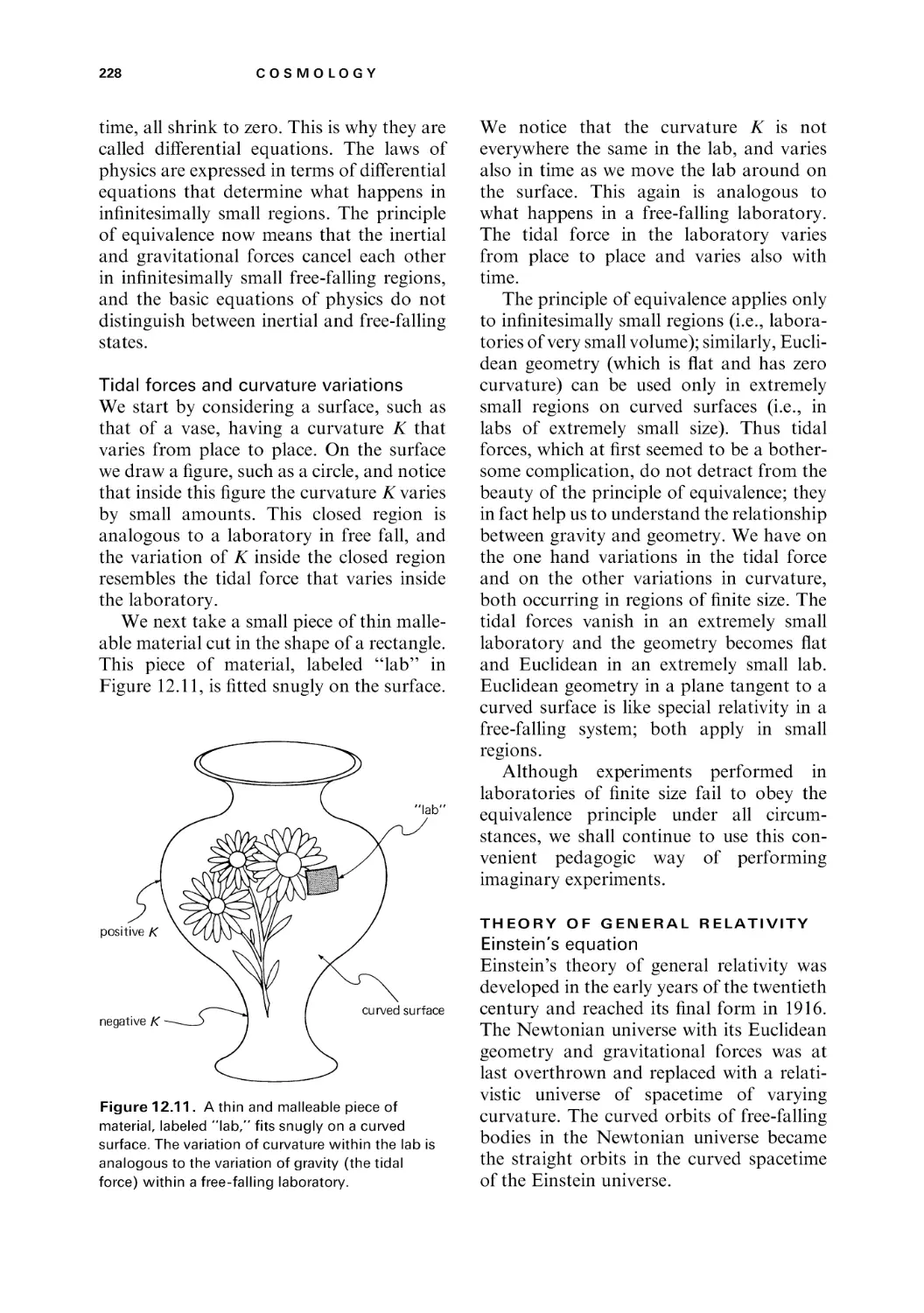
/




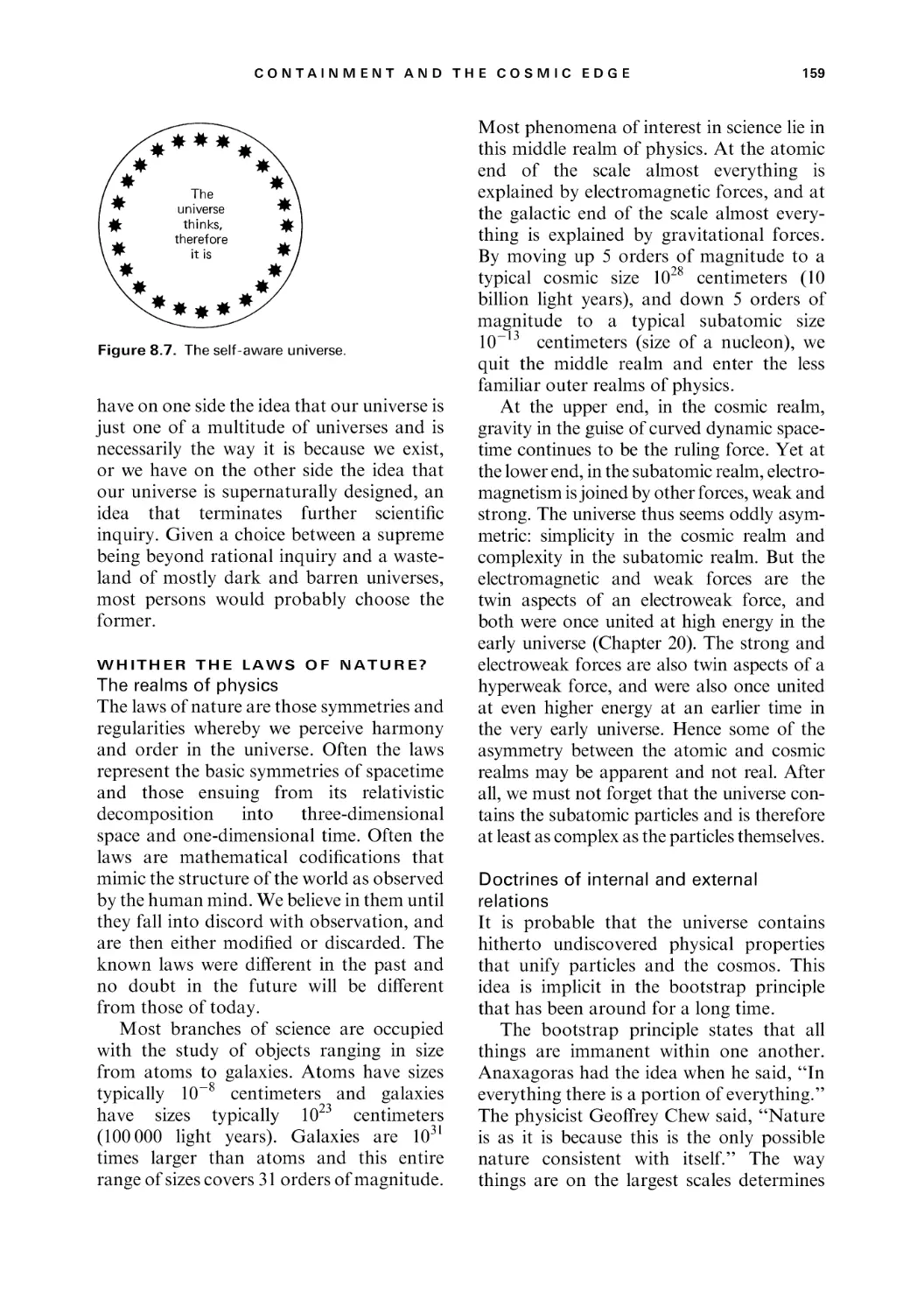
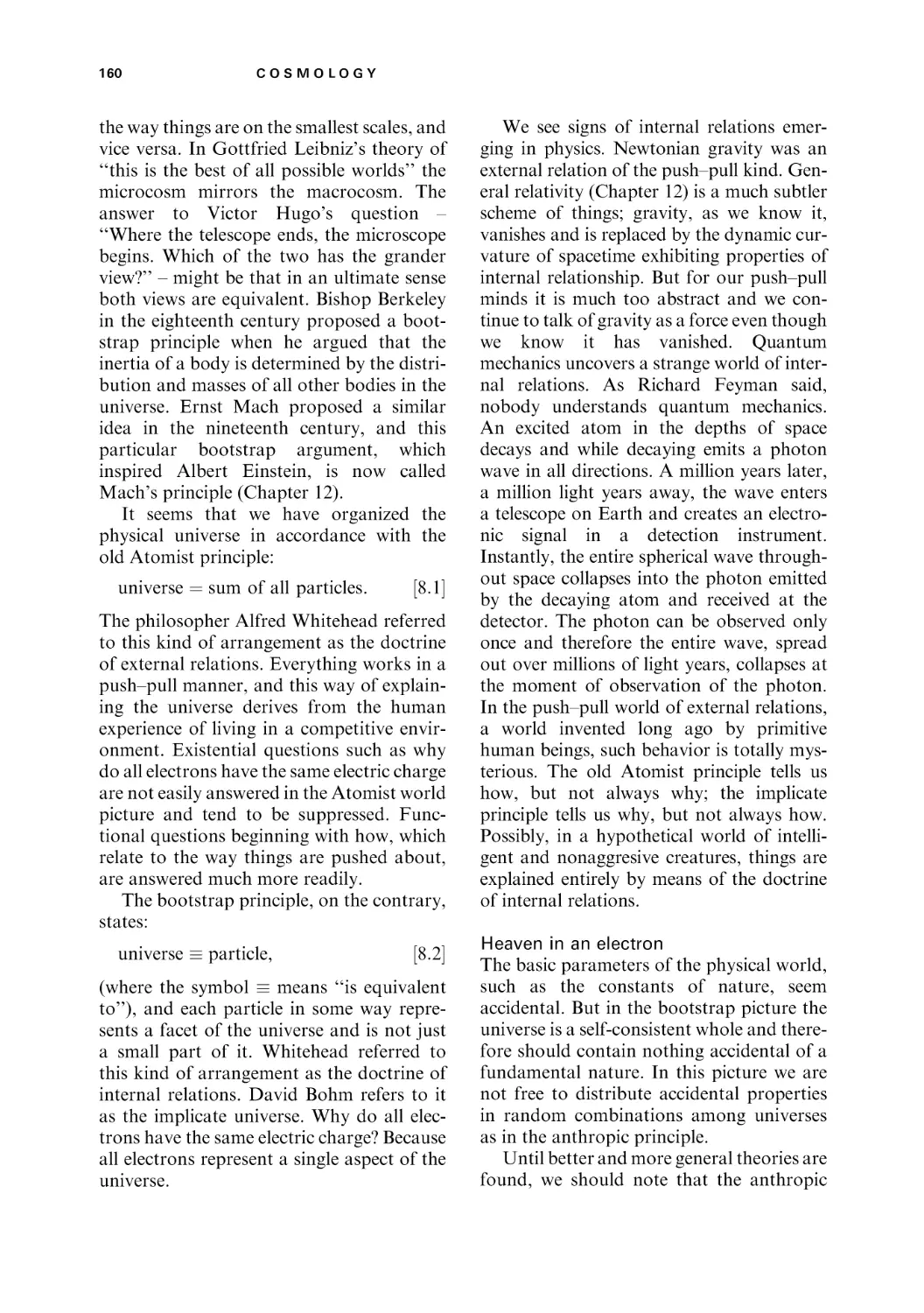
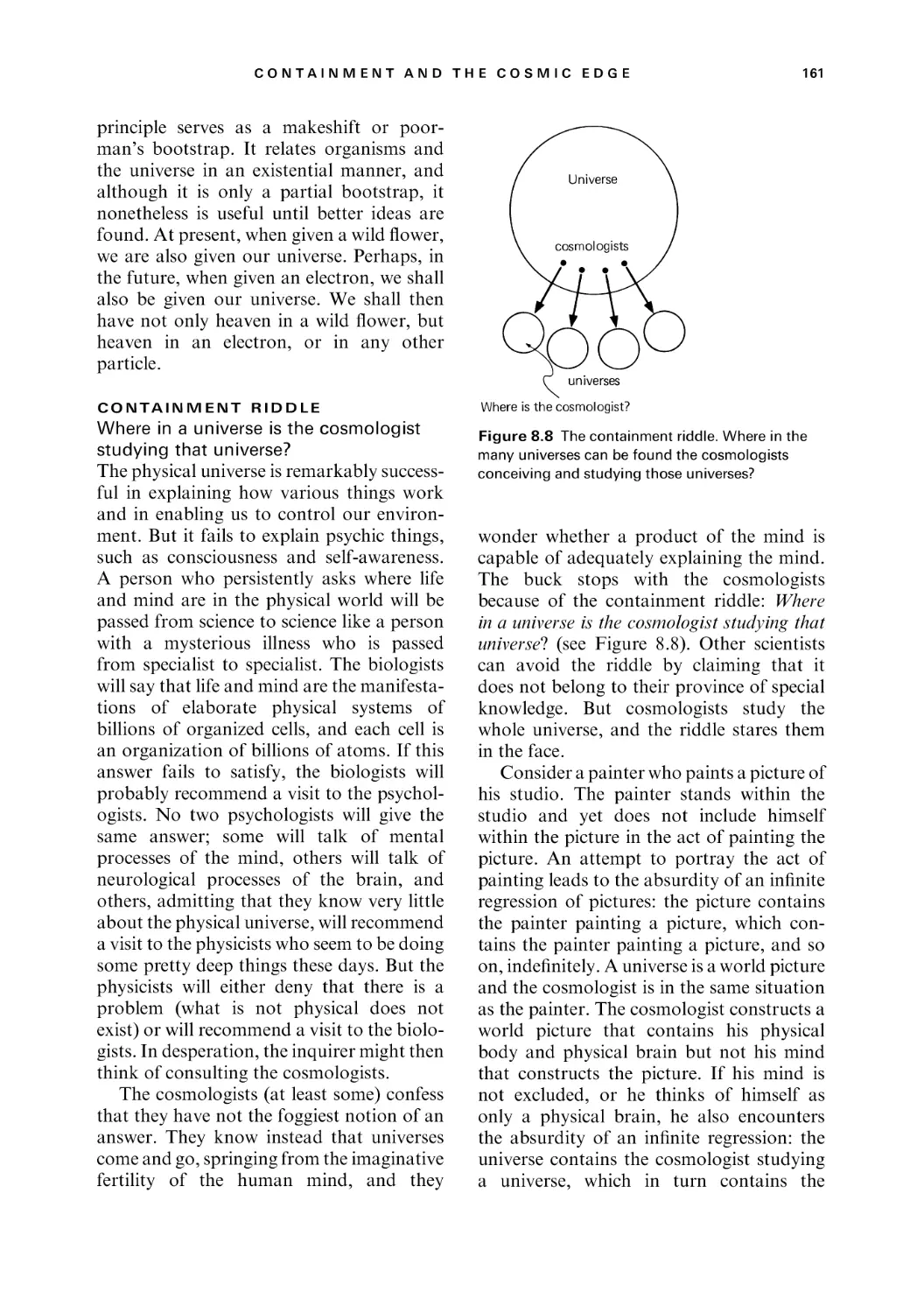

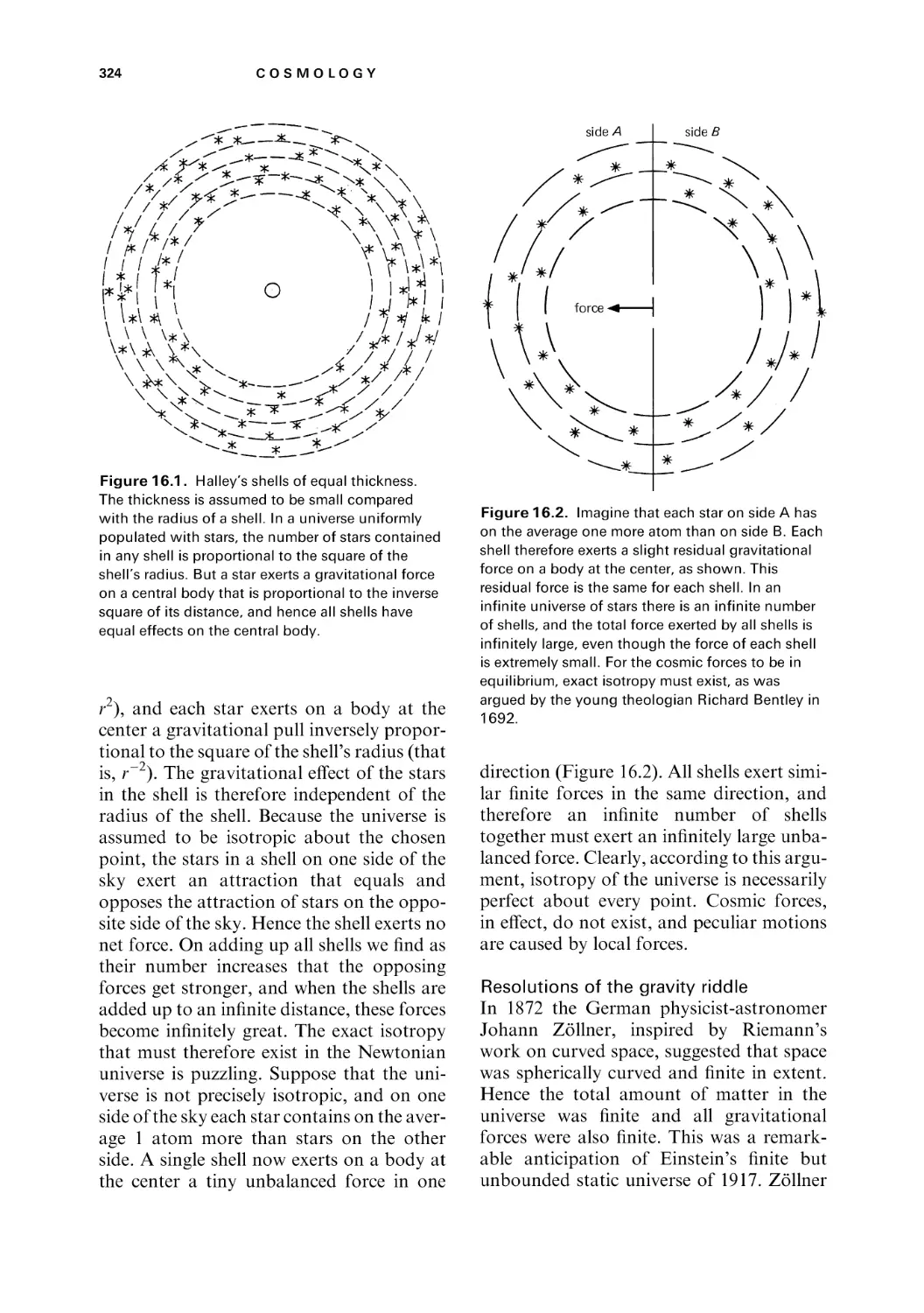
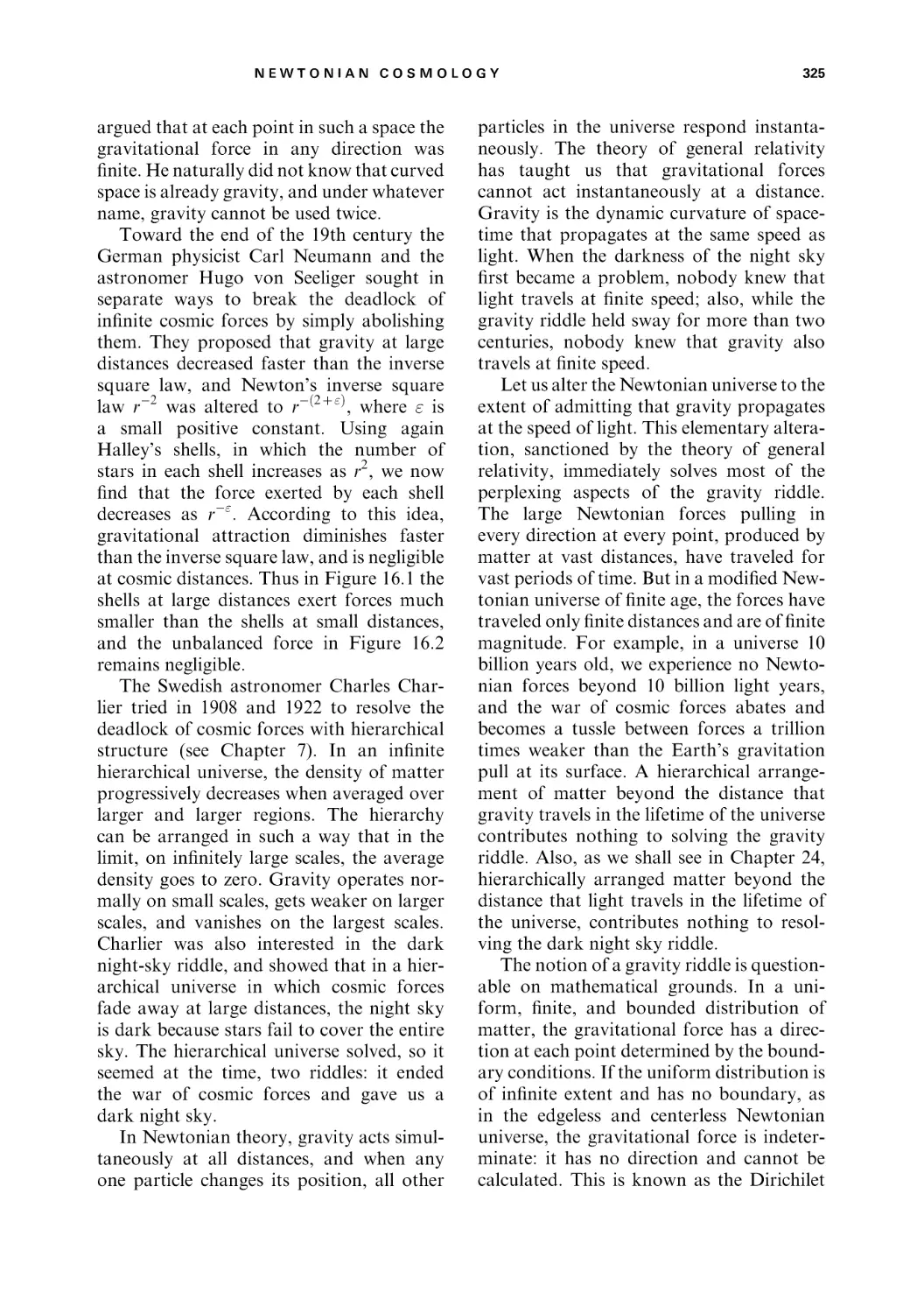
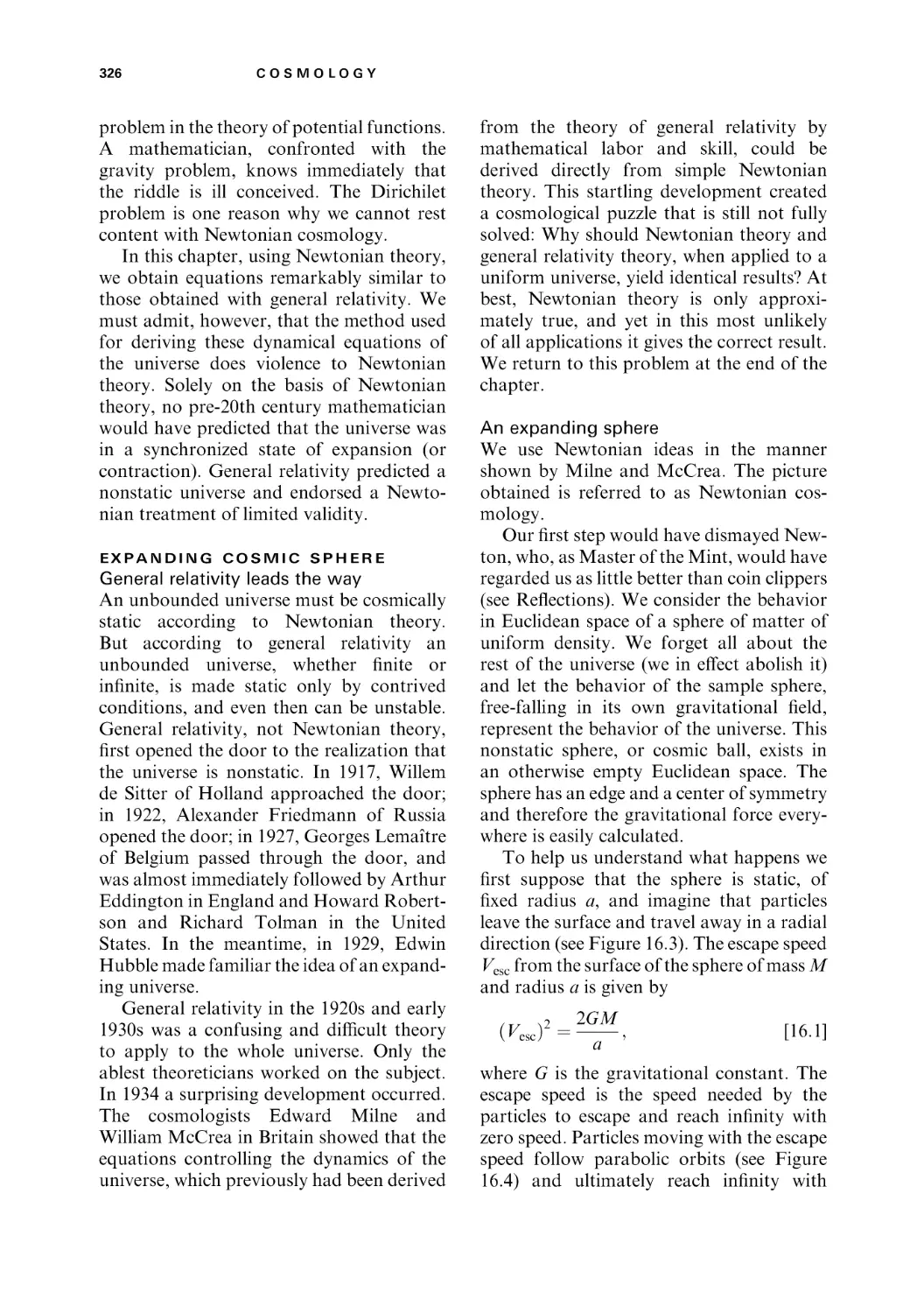
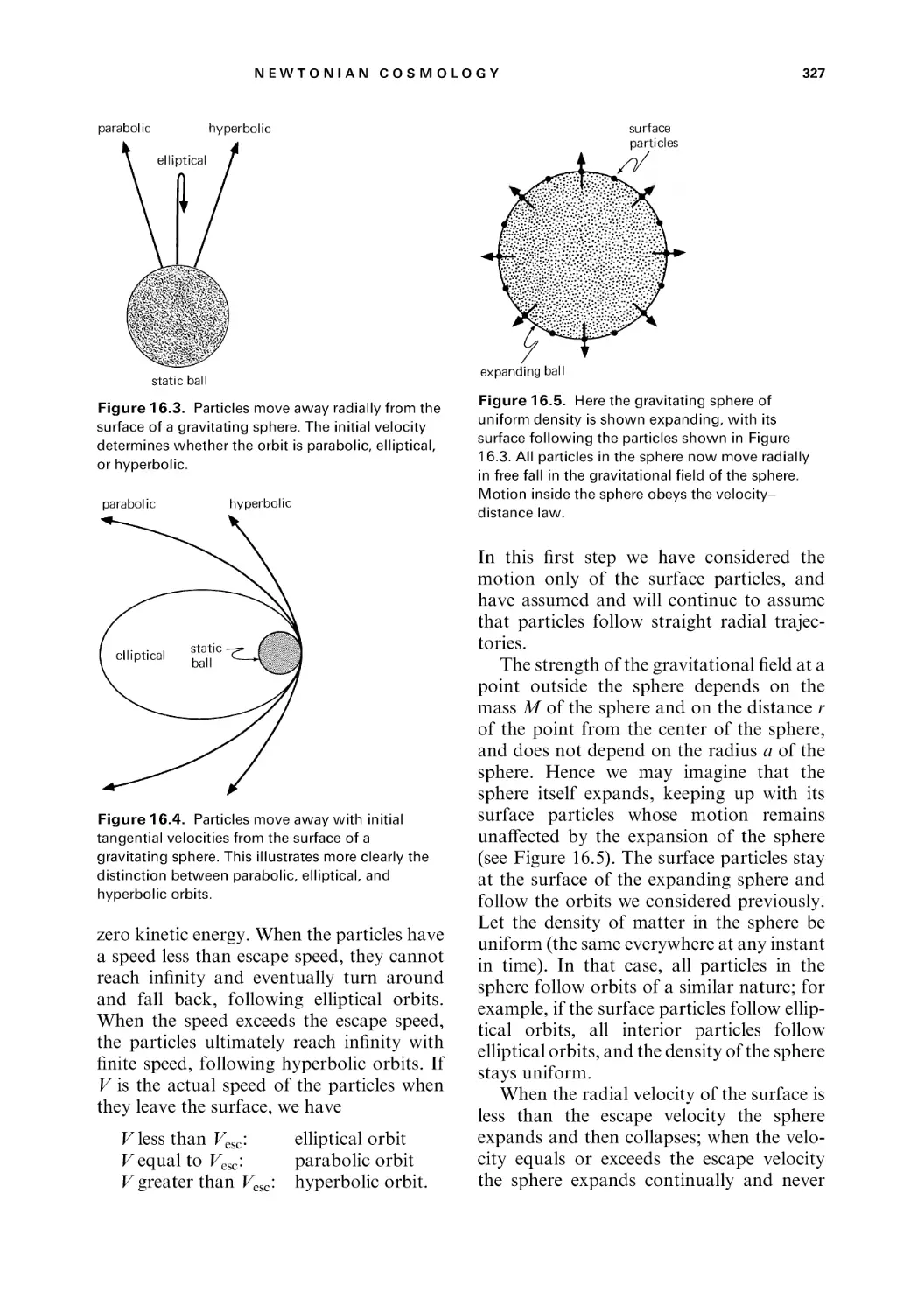
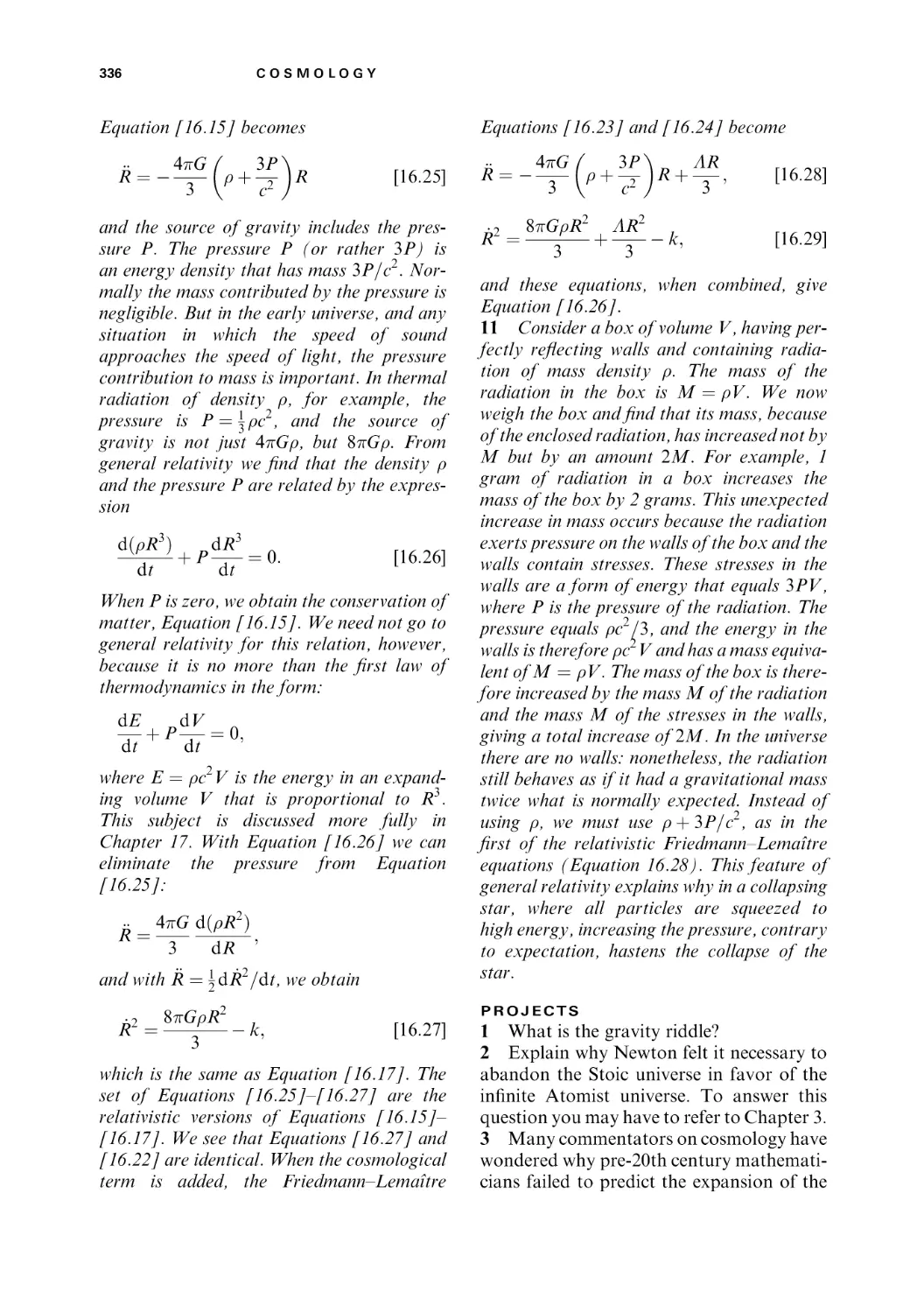
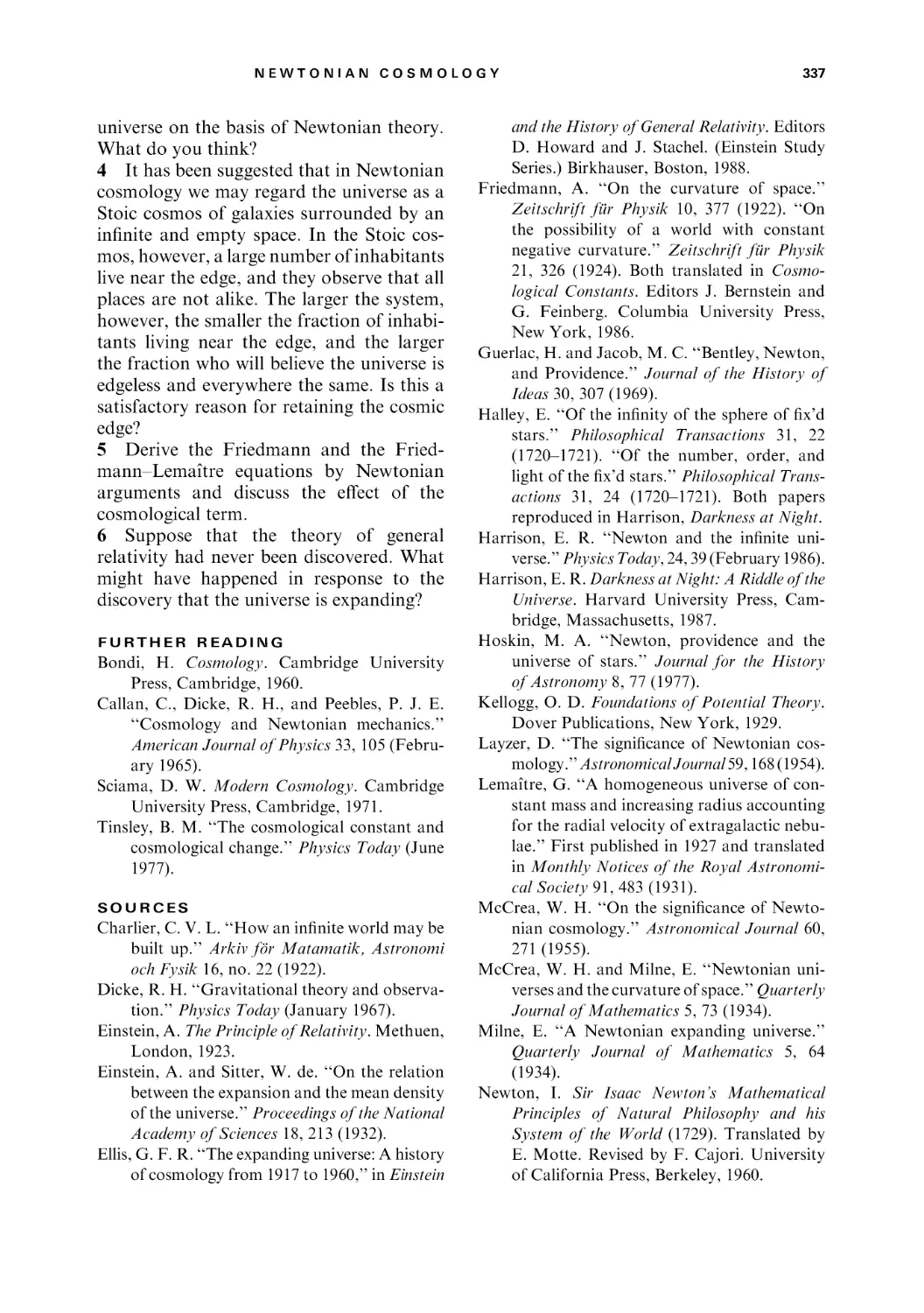
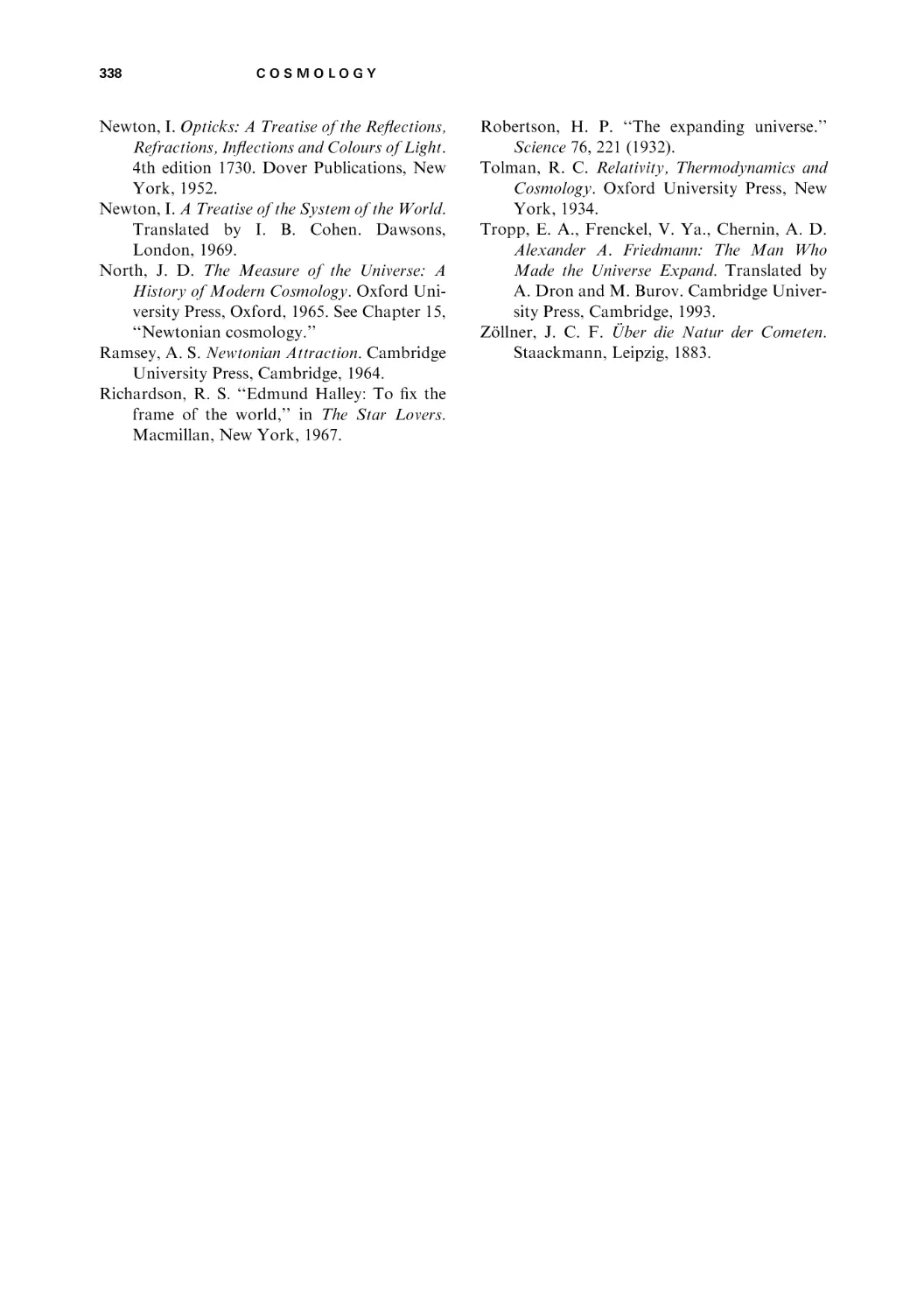
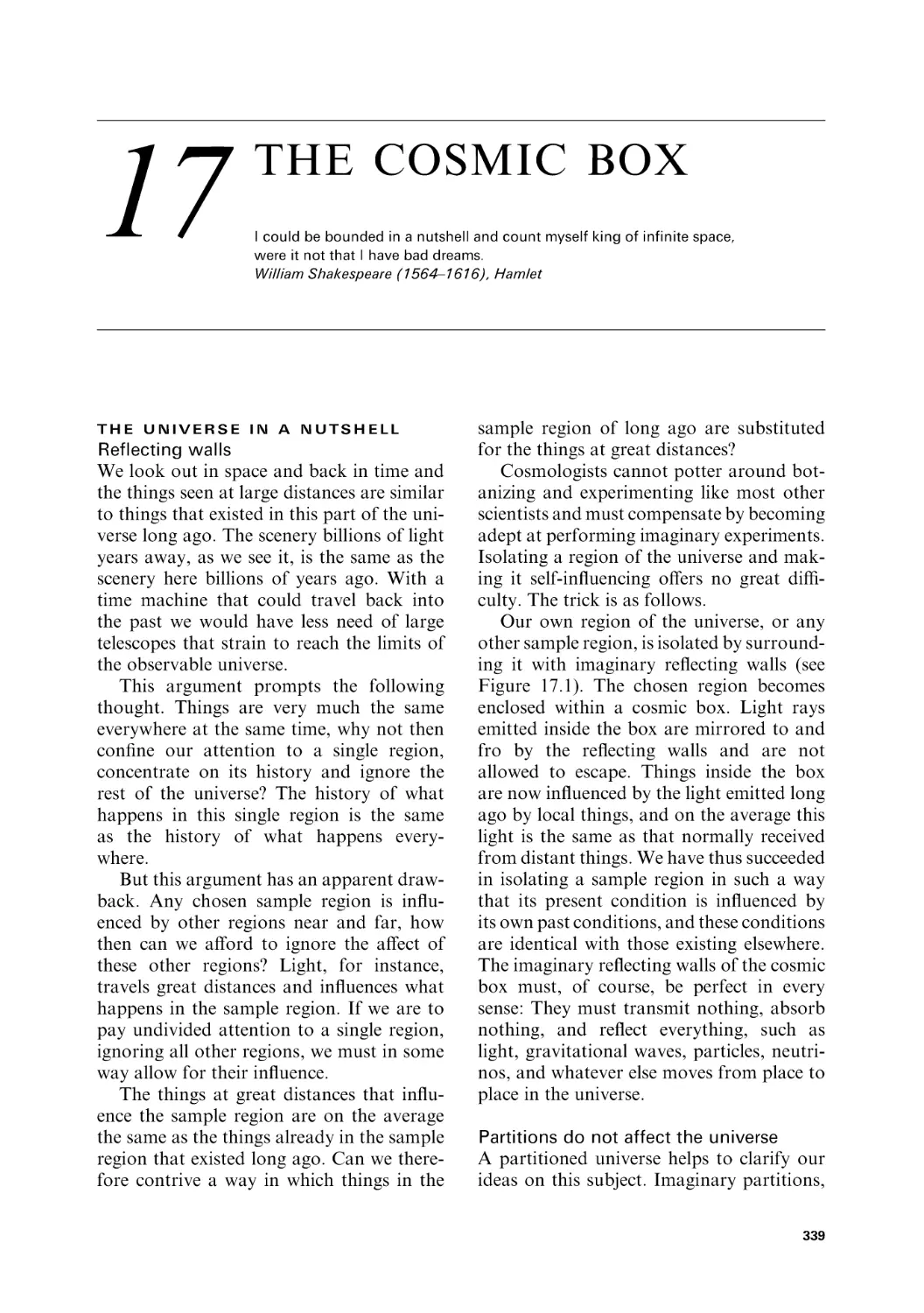
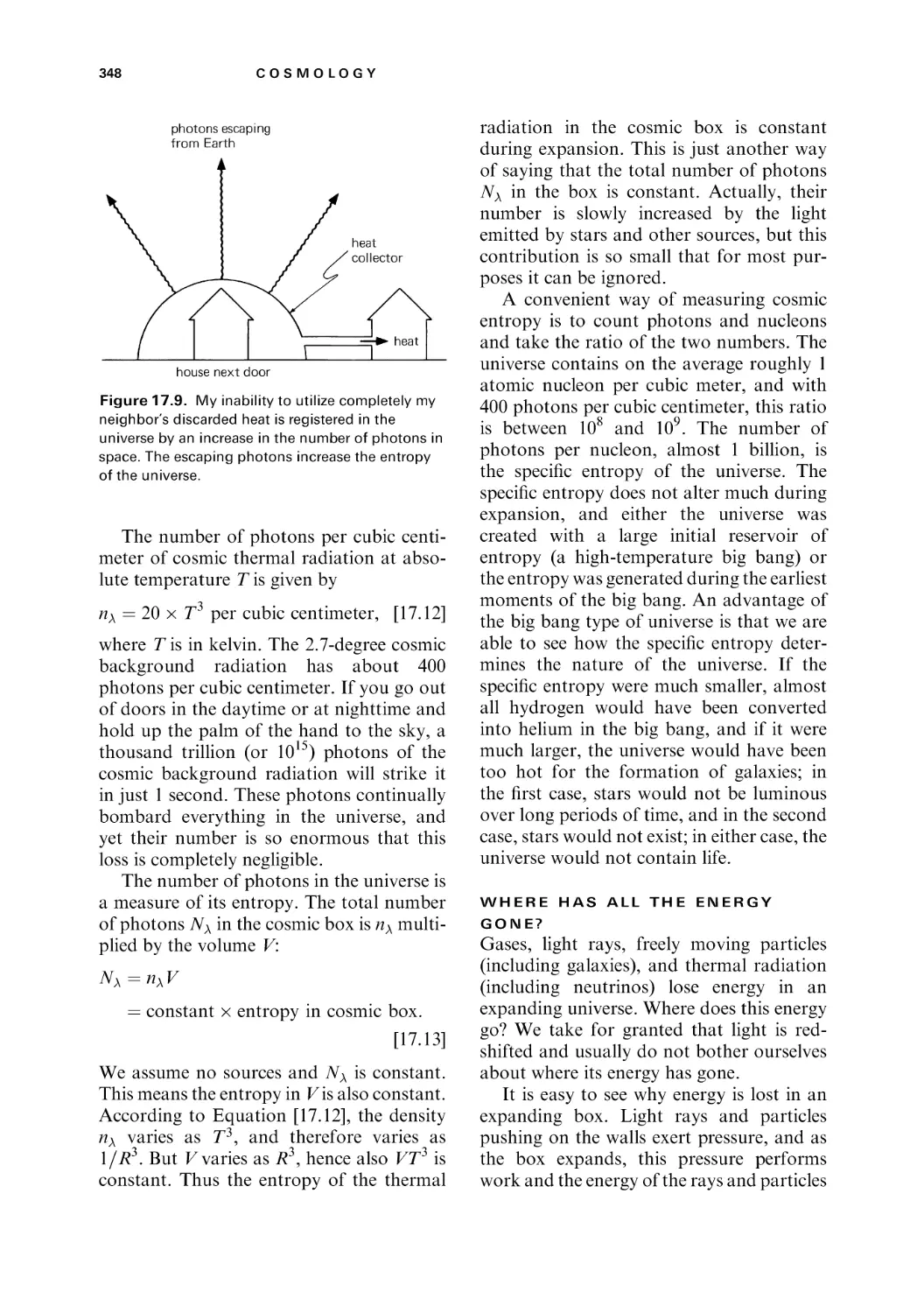


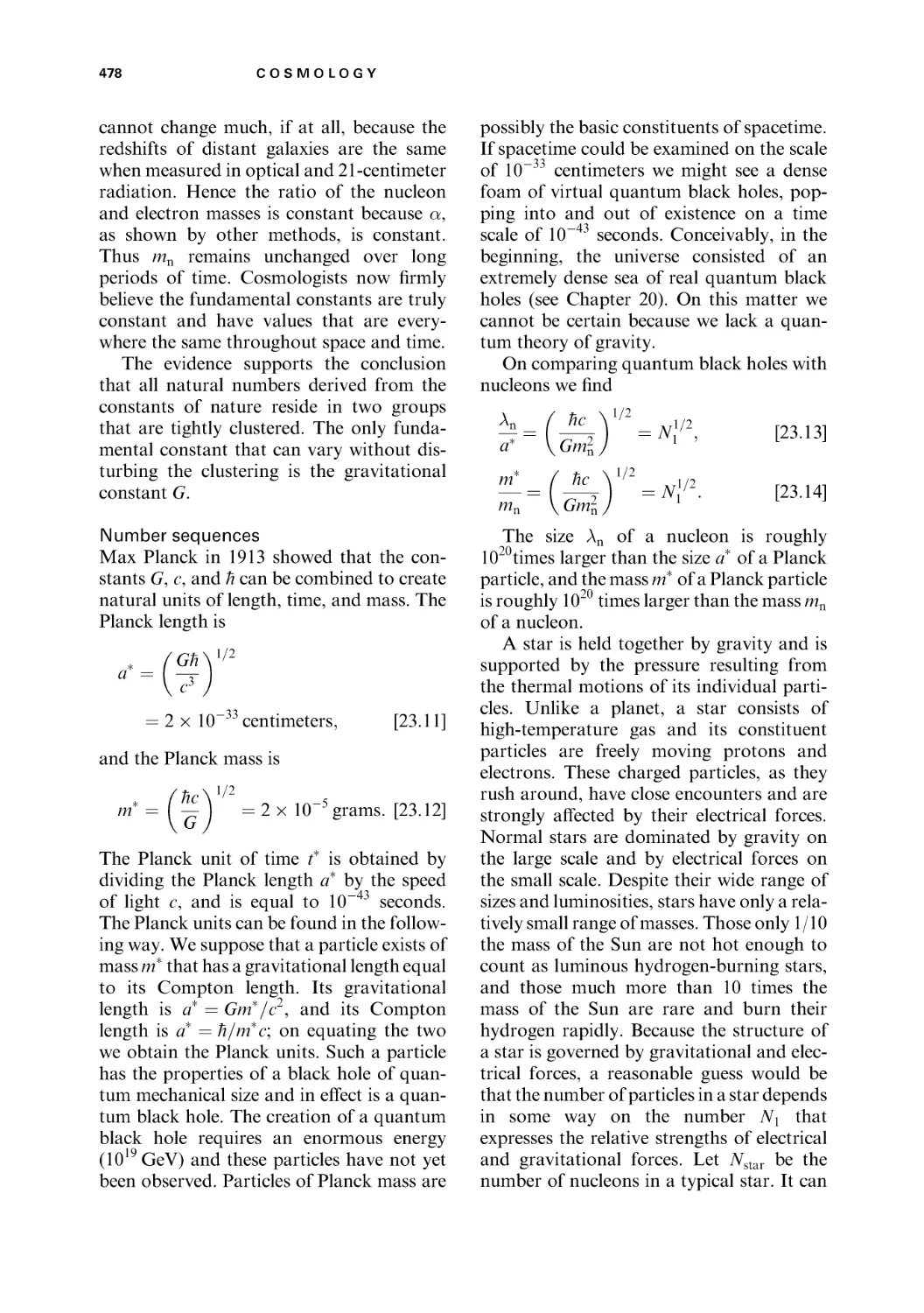
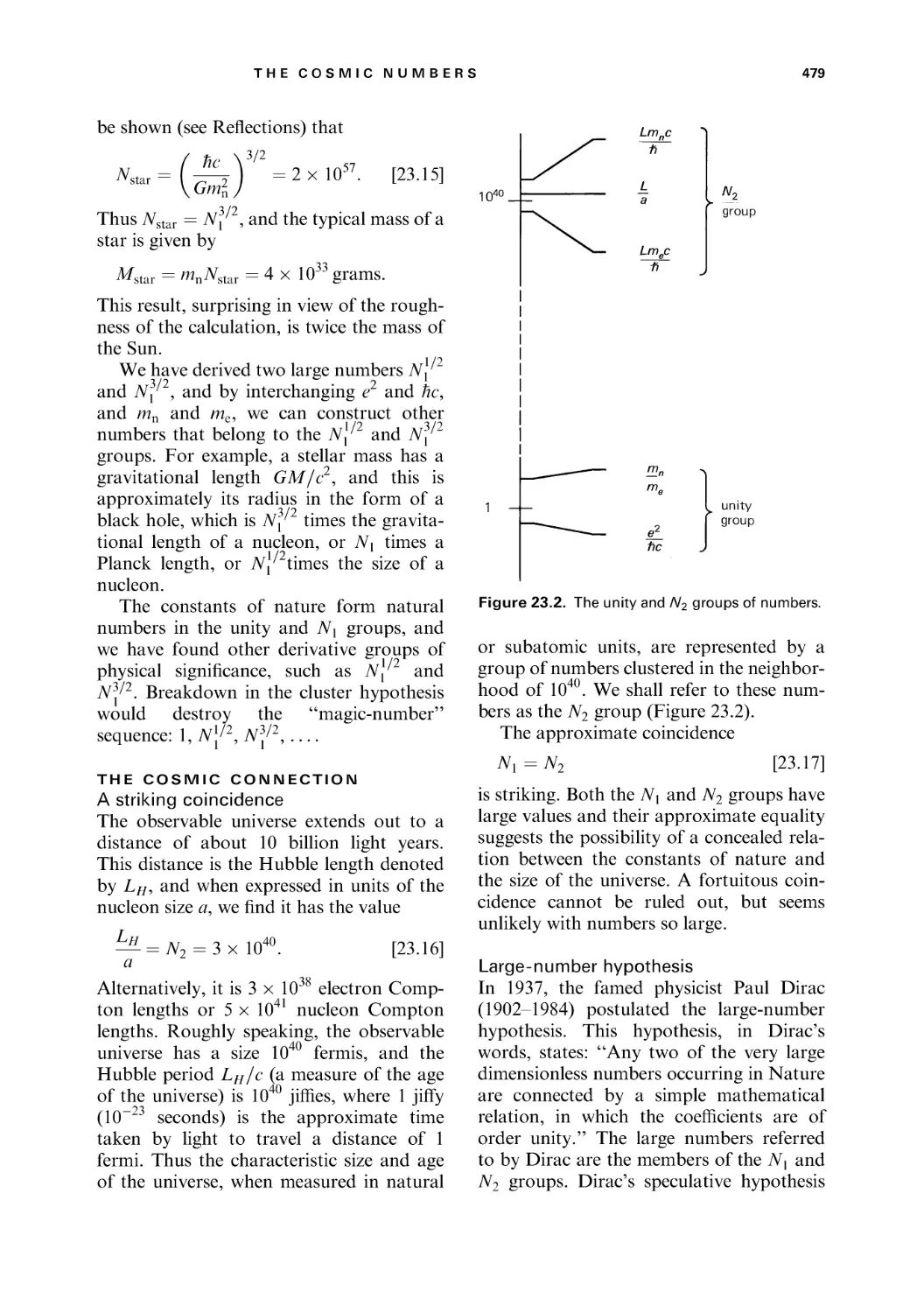
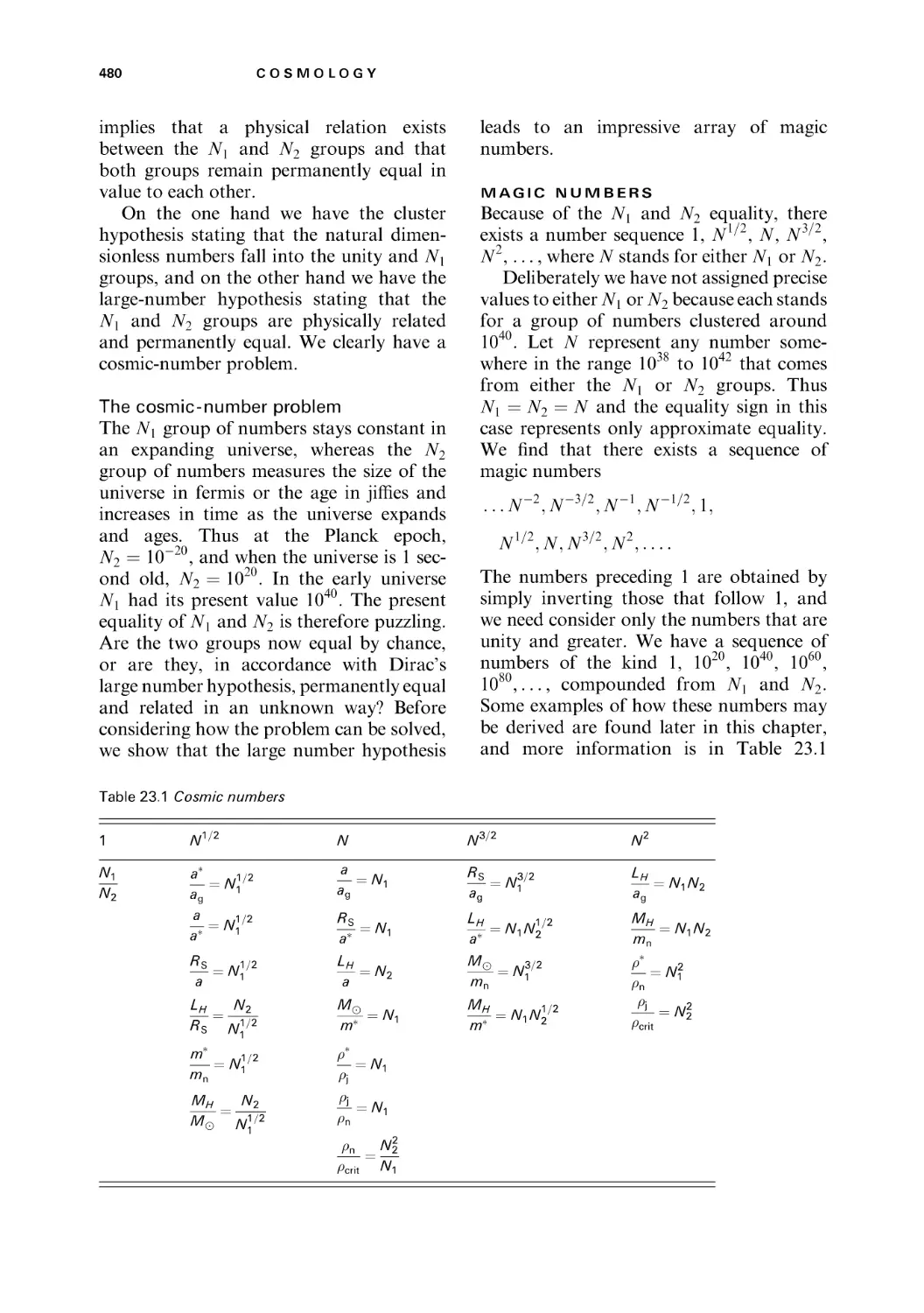
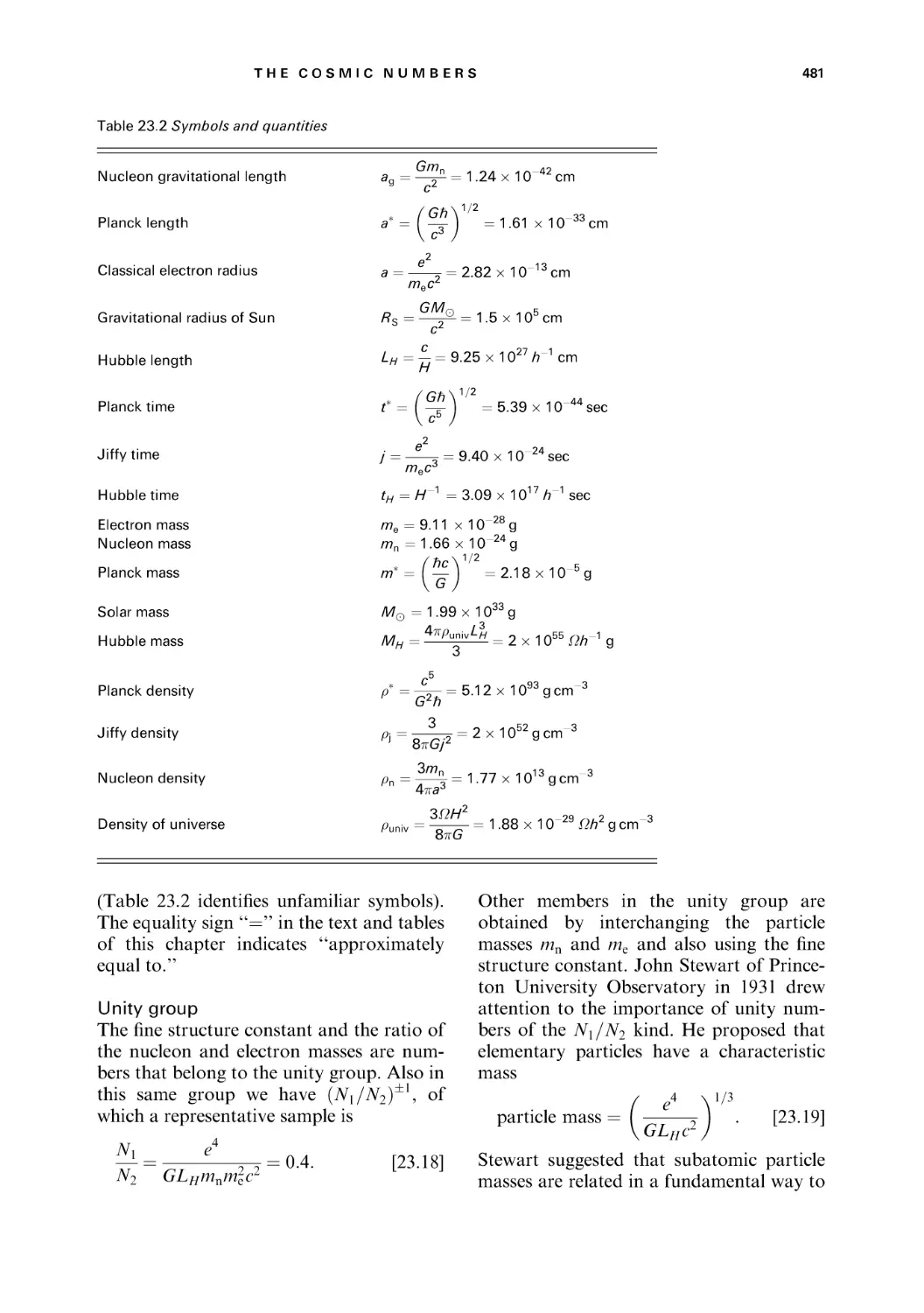
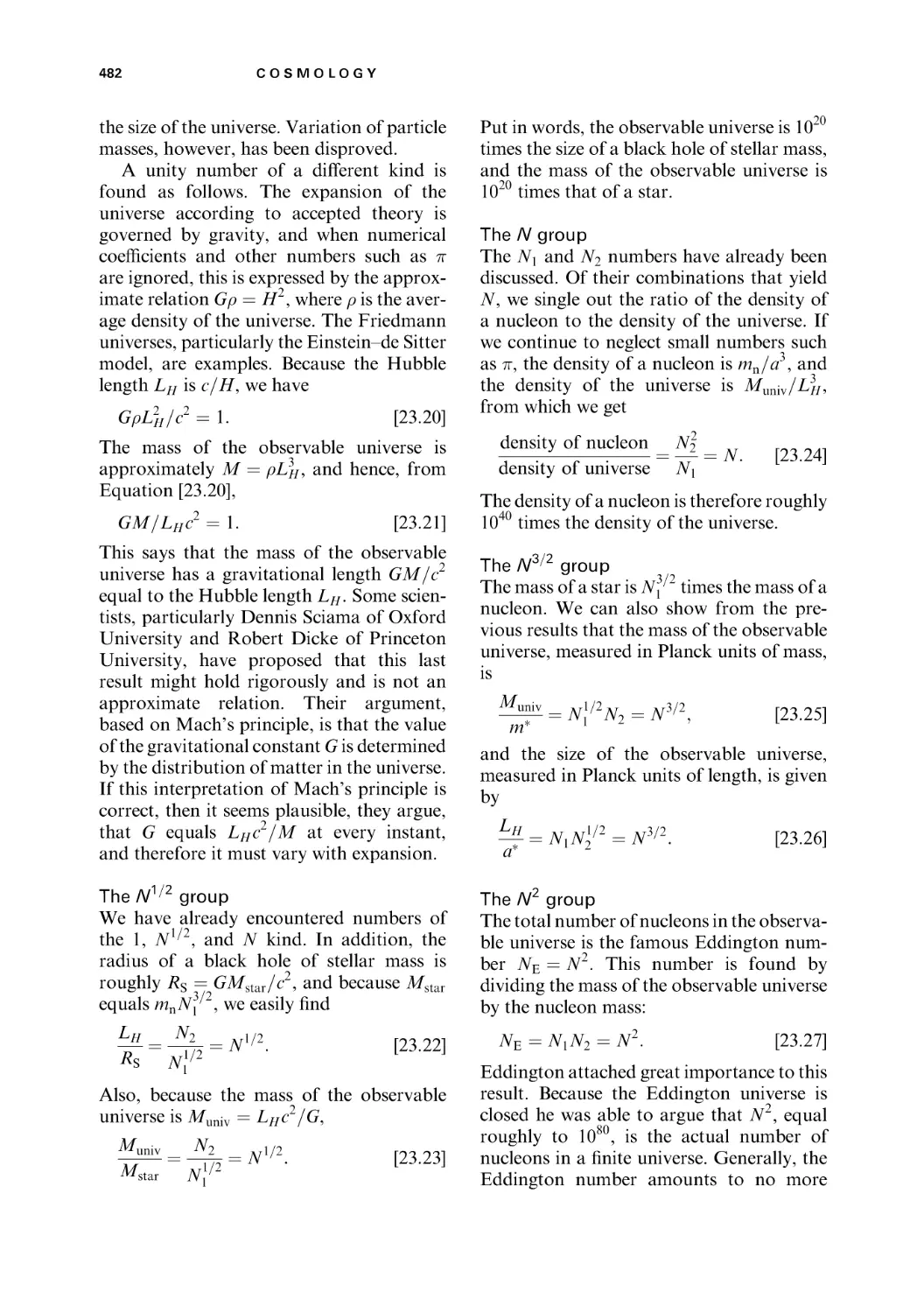
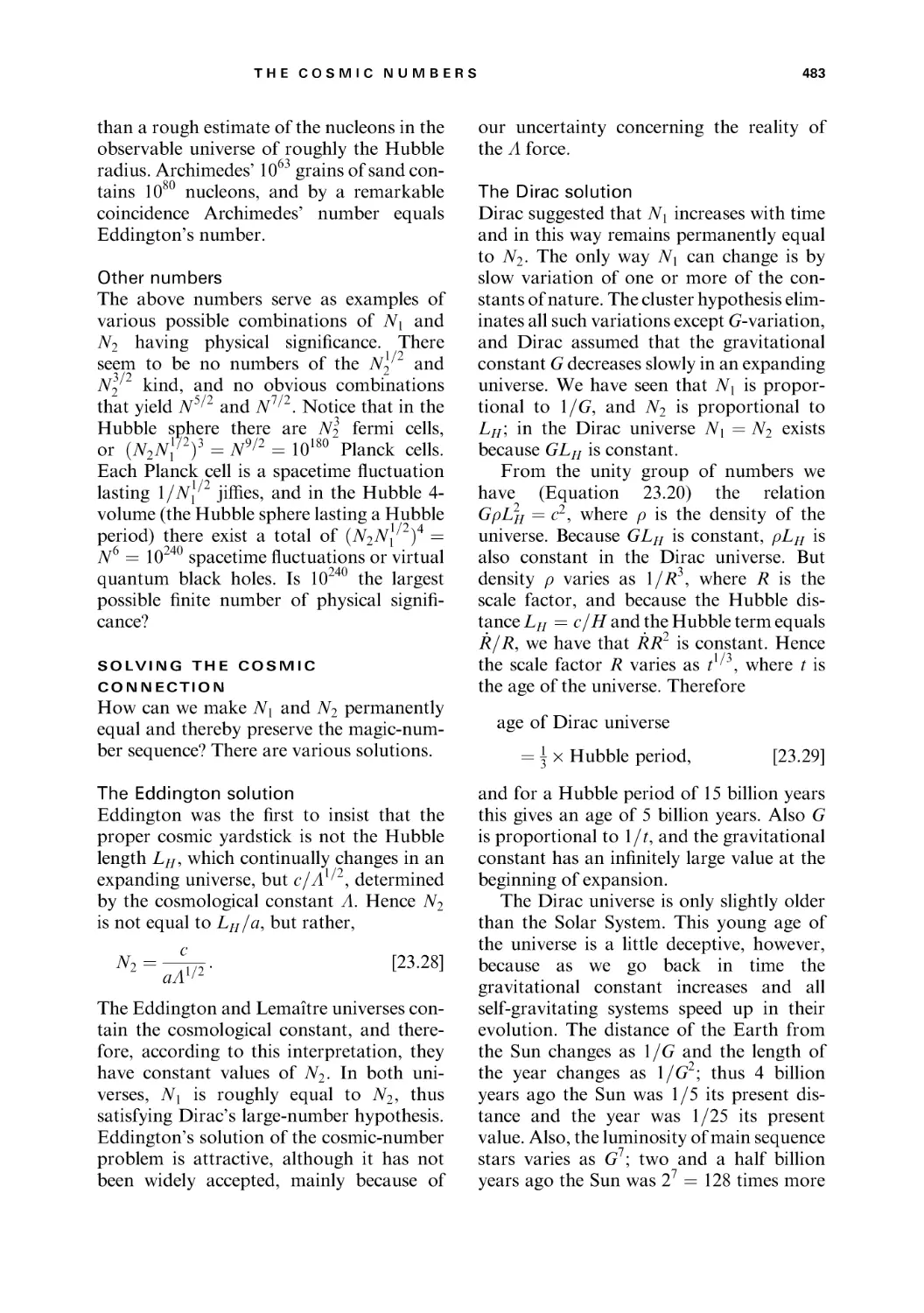
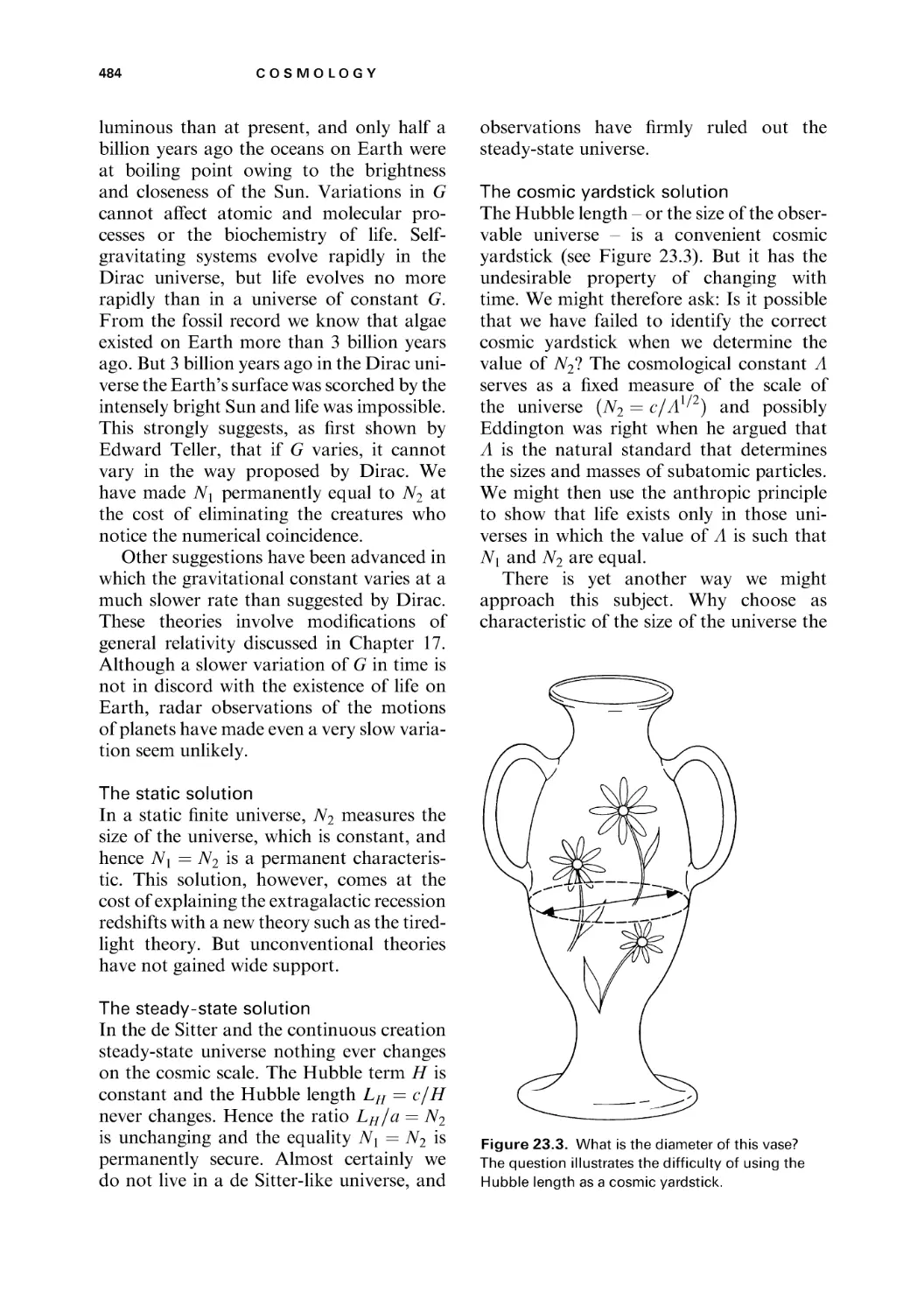
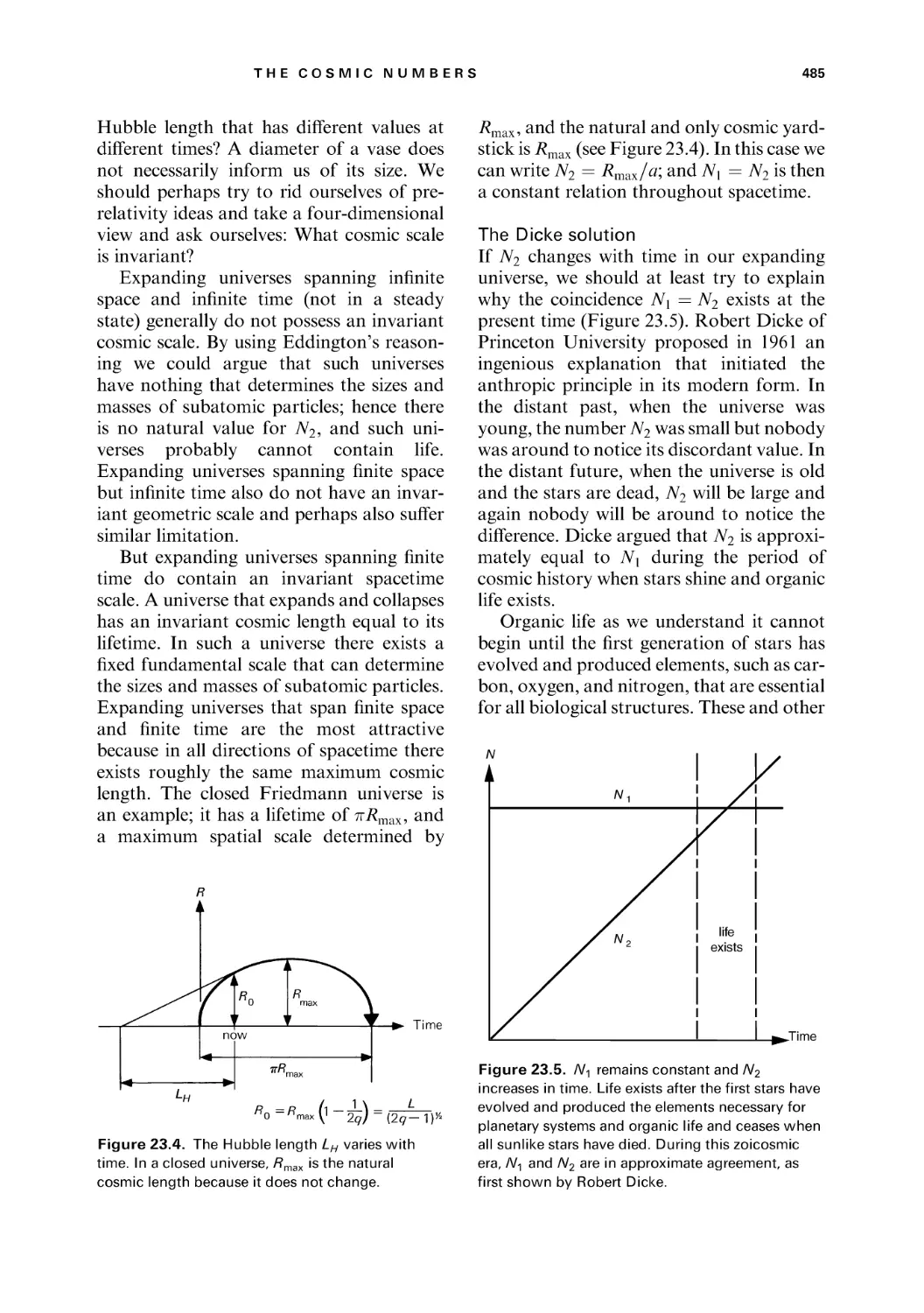

Текст
                    Cosmology
Advances in science have greatly changed our ideas on the nature of the universe. Cosmology:
The Science of the Universe is a broad and elementary introduction to cosmology that includes
aspects of its history, theology, and philosophy. The book explores the realm of receding
galaxies, the fascinating properties of space and time, the bizarre world of black holes, the
astonishing expansion of the universe, the elegant simplicity of cosmic redshifts, and the
momentous issues of inflation. Its subjects cover modern views on the origin of atoms,
galaxies, life, and the universe itself; they range from the subatomic to the extragalactic,
from the beginning to the end of time, and from terrestrial to extraterrestrial life. Old
problems (e.g., the cosmic-edge) are revived and new perplexities (e.g., the containment
riddle) are reviewed. In this unique book, Professor Harrison shows how in every age societies
devise universes that make sense of the human experience. He explores the cosmic scenery
of the Babylonian, Pythagorean, Aristotelian, Stoic, Epicurean, Medieval, Cartesian, and
Newtonian world systems and shows how these and other systems laid the foundations of
the modern physical universe.
The first edition of this best-selling book received world-wide acclaim for its far ranging
treatment and clarity of explanation. This eagerly awaited second edition updates and extends
the first edition. The additional chapters discuss Early Scientific Cosmology, Cartesian and
Newtonian World Systems, Cosmology After Newton and Before Einstein, Observational
Cosmology, Inflation, and Creation of the Universe.
edward harrison, distinguished university professor emeritus of physics and astronomy at
the University of Massachusetts, was born in London at the end of World War I. He studied
at London University and served for several years in action with the British Army in World
War II. He was a scientist at the Atomic Energy Research Establishment and the Rutherford
High Energy Laboratory in England until 1966 when he became a Five College professor at
the University of Massachusetts and taught at Amherst, Hampshire, Mount Holyoke, and
Smith Colleges. Professor Harrison is author of The Masks of the Universe (which gained
the Melcher Award), Darkness at Night: A Riddle of the Universe, and numerous scientific
articles that have contributed to the advance of modern cosmology. He has also written
many articles on the history and philosophy of early cosmology. He is married to Photeni,
has two children, John-Peter and June Zoe, and is now adjunct professor at the Steward
Observatory, University of Arizona.

Cosmology
THE SCIENCE OF THE UNIVERSE
, - £ ^< ~" ^ --
J&
SECOND EDITION
*> '
* r
££ >^-
**
if.r
\
\ I I
'/
%■
♦ >*
tf
EDWARD HARRISON
Five College Astronomy Department, University of Massachusetts
/\ Steward Observatory, University of Arizona
^ J<
V\
\Vi I"
\
,\
» ... '"
*> Jl
■*«*-
a,
r.
*.*-
#
t
.i>:
7 /"
i/t'
.J*
*/.
■^ >^
***
Cambridge
UNIVERSITY PRESS

CAMBRIDGE UNIVERSITY PRESS
Cambridge, New York, Melbourne, Madrid, Cape Town, Singapore, Sao Paulo
Delhi, Dubai, Tokyo, Mexico City
Cambridge University Press
The Edinburgh Building, Cambridge CB2 8RU, UK
Published in the United States of America by Cambridge University Press, New York
www.cambridge.org
Information on this title: www.cambridge.org/9780521661485
© Cambridge University Press 1981, 2000
This book is in copyright. Subject to statutory exception
and to the provisions of relevant collective licensing agreements,
no reproduction of any part may take place without
the written permission of Cambridge University Press.
First published 1981
Reprinted 1985, 1986, 1988, 1989, 1991
Second edition 2000
Fifth printing 2010
Printed in the United Kingdom at the University Press, Cambridge
A catalogue record for this book is available from the British Library
Library of Congress Cataloguing in Publication data
Harrison, Edward Robert.
Cosmology: the science of the universe / Edward R. Harrison. —
2nd ed.
p. cm.
Includes bibliographical references and index.
ISBN0 521 66148 X
1. Cosmology. I. Title. II. Title: Cosmology, the science of the universe.
QB981.H276 1999
523.1-dc21 99-10172 CIP
ISBN 978-0-521-66148-5 Hardback
Cambridge University Press has no responsibility for the persistence or accuracy
of URLs for external or third-party internet websites referred to in this
publication, and does not guarantee that any content on such websites is,
or will remain, accurate or appropriate.

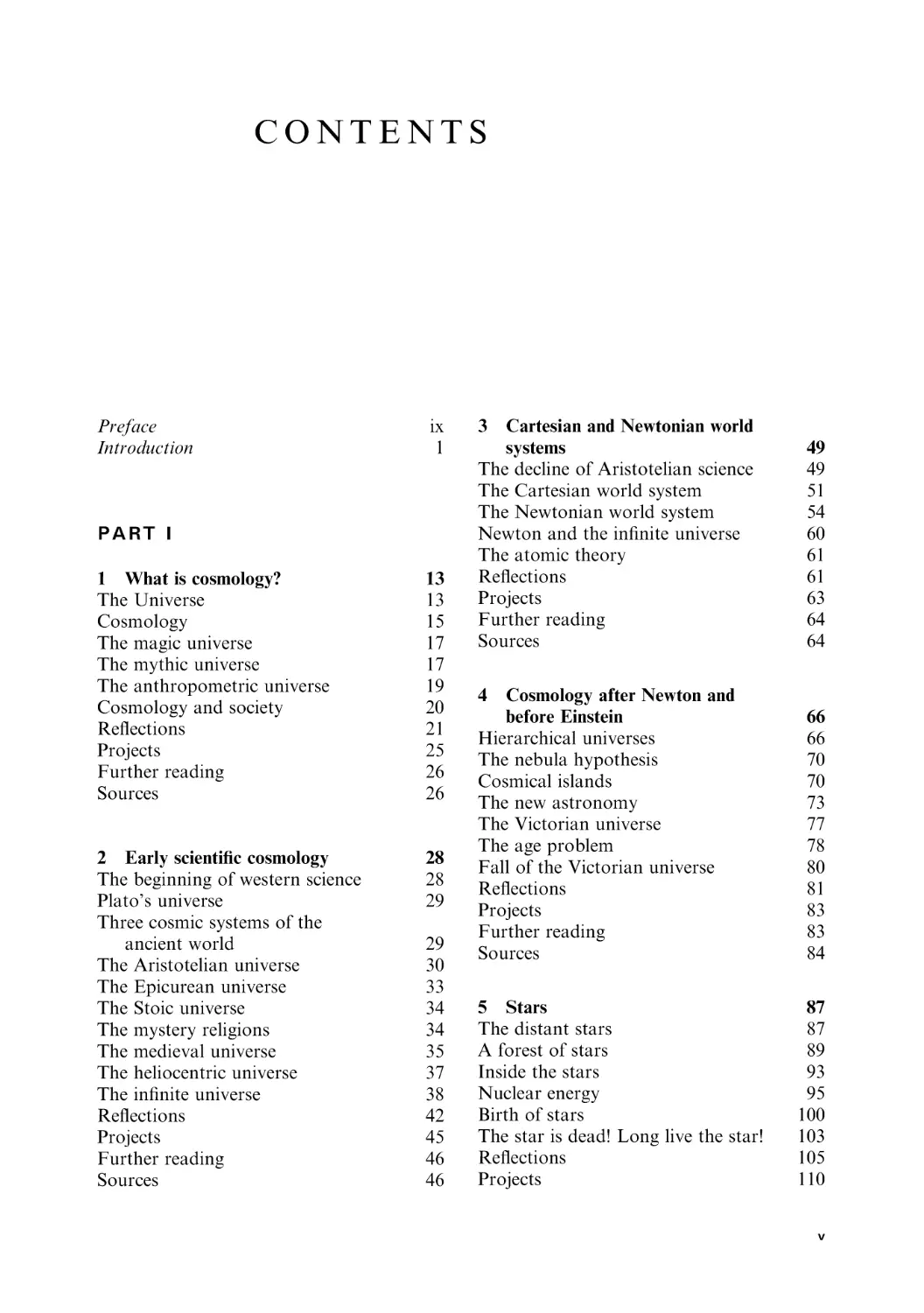
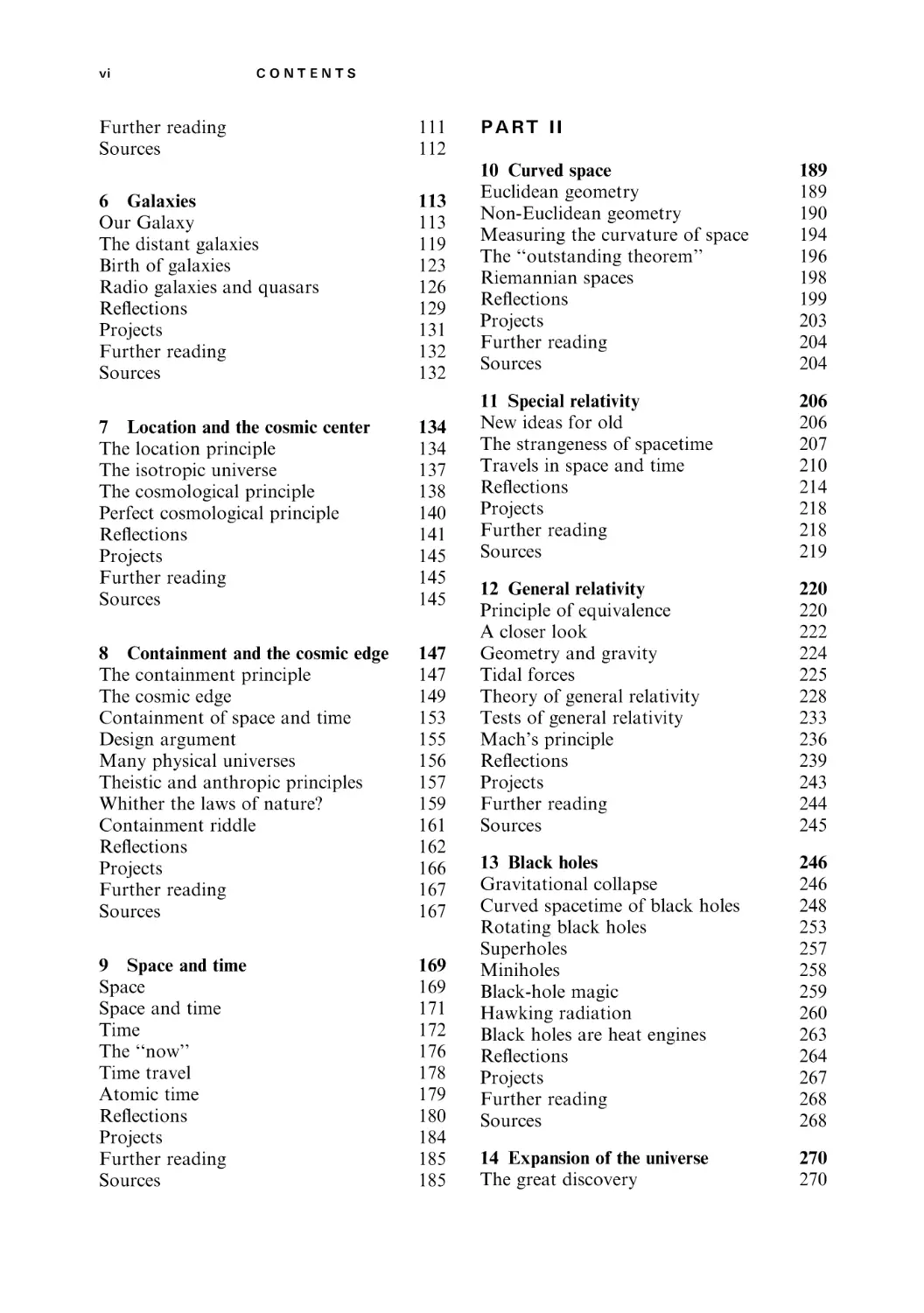
CONTENT
S
Preface
Introduction
PART 1
1 What is cosmology?
The Universe
Cosmology
The magic universe
The mythic universe
The anthropometric universe
Cosmology and society
Reflections
Projects
Further reading
Sources
2 Early scientific cosmology
The beginning of western science
Plato's universe
Three cosmic systems of the
ancient world
The Aristotelian universe
The Epicurean universe
The Stoic universe
The mystery religions
The medieval universe
The heliocentric universe
The infinite universe
Reflections
Projects
Further reading
Sources
ix
1
13
13
15
17
17
19
20
21
25
26
26
28
28
29
29
30
33
34
34
35
37
38
42
45
46
46
3 Cartesian and Newtonian world
systems
The decline of Aristotelian science
The Cartesian world system
The Newtonian world system
Newton and the infinite universe
The atomic theory
Reflections
Projects
Further reading
Sources
4 Cosmology after Newton and
before Einstein
Hierarchical universes
The nebula hypothesis
Cosmical islands
The new astronomy
The Victorian universe
The age problem
Fall of the Victorian universe
Reflections
Projects
Further reading
Sources
5 Stars
The distant stars
A forest of stars
Inside the stars
Nuclear energy
Birth of stars
The star is dead! Long live the star!
Reflections
Projects
49
49
51
54
60
61
61
63
64
64
66
66
70
70
73
77
78
80
81
83
83
84
87
87
89
93
95
100
103
105
110

vi CONTENTS
Further reading
Sources
6 Galaxies
Our Galaxy
The distant galaxies
Birth of galaxies
Radio galaxies and quasars
Reflections
Projects
Further reading
Sources
7 Location and the cosmic center
The location principle
The isotropic universe
The cosmological principle
Perfect cosmological principle
Reflections
Projects
Further reading
Sources
8 Containment and the cosmic edge
The containment principle
The cosmic edge
Containment of space and time
Design argument
Many physical universes
Theistic and anthropic principles
Whither the laws of nature?
Containment riddle
Reflections
Projects
Further reading
Sources
9 Space and time
Space
Space and time
Time
The "now"
Time travel
Atomic time
Reflections
Projects
Further reading
Sources
111
112
113
113
119
123
126
129
131
132
132
134
134
137
138
140
141
145
145
145
147
147
149
153
155
156
157
159
161
162
166
167
167
169
169
171
172
176
178
179
180
184
185
185
PART II
10 Curved space
Euclidean geometry
Non-Euclidean geometry
Measuring the curvature of space
The "outstanding theorem"
Riemannian spaces
Reflections
Projects
Further reading
Sources
11 Special relativity
New ideas for old
The strangeness of spacetime
Travels in space and time
Reflections
Projects
Further reading
Sources
12 General relativity
Principle of equivalence
A closer look
Geometry and gravity
Tidal forces
Theory of general relativity
Tests of general relativity
Mach's principle
Reflections
Projects
Further reading
Sources
13 Black holes
Gravitational collapse
Curved spacetime of black holes
Rotating black holes
Superholes
Miniholes
Black-hole magic
Hawking radiation
Black holes are heat engines
Reflections
Projects
Further reading
Sources
14 Expansion of the universe
The great discovery
189
189
190
194
196
198
199
203
204
204
206
206
207
210
214
218
218
219
220
220
222
224
225
228
233
236
239
243
244
245
246
246
248
253
257
258
259
260
263
264
267
268
268
270
270

CONTENTS
VII
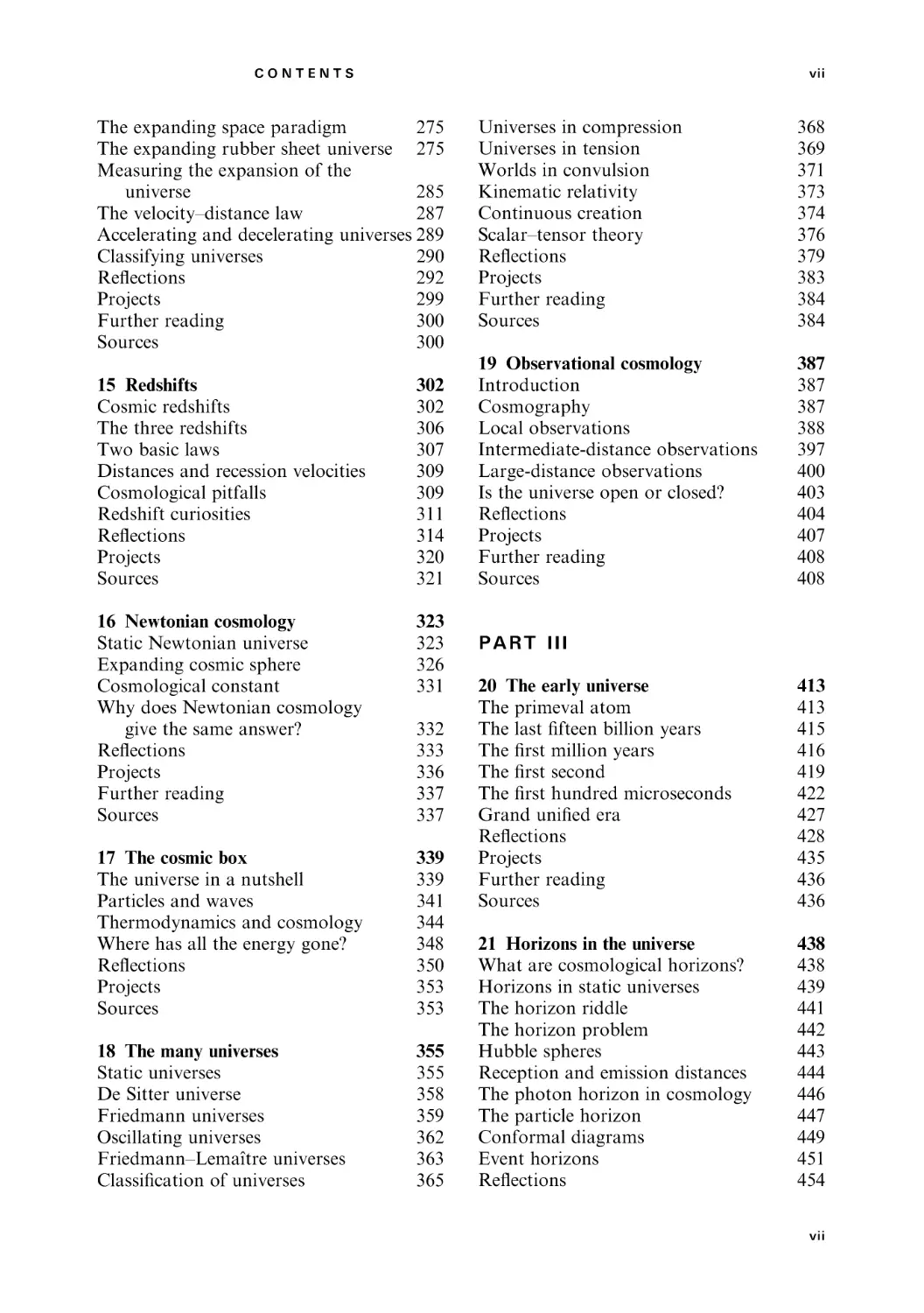
The expanding space paradigm
The expanding rubber sheet universe
Measuring the expansion of the
universe
The velocity-distance law
275
275
285
287
Accelerating and decelerating universes 289
Classifying universes
Reflections
Projects
Further reading
Sources
15 Redshifts
Cosmic redshifts
The three redshifts
Two basic laws
Distances and recession velocities
Cosmological pitfalls
Redshift curiosities
Reflections
Projects
Sources
16 Newtonian cosmology
Static Newtonian universe
Expanding cosmic sphere
Cosmological constant
Why does Newtonian cosmology
give the same answer?
Reflections
Projects
Further reading
Sources
17 The cosmic box
The universe in a nutshell
Particles and waves
Thermodynamics and cosmology
Where has all the energy gone?
Reflections
Projects
Sources
18 The many universes
Static universes
De Sitter universe
Friedmann universes
Oscillating universes
Friedmann-Lemaitre universes
Classification of universes
290
292
299
300
300
302
302
306
307
309
309
311
314
320
321
323
323
326
331
332
333
336
337
337
339
339
341
344
348
350
353
353
355
355
358
359
362
363
365
Universes in compression
Universes in tension
Worlds in convulsion
Kinematic relativity
Continuous creation
Scalar-tensor theory
Reflections
Projects
Further reading
Sources
19 Observational cosmology
Introduction
Cosmography
Local observations
Intermediate-distance observations
Large-distance observations
Is the universe open or closed?
Reflections
Projects
Further reading
Sources
PART III
20 The early universe
The primeval atom
The last fifteen billion years
The first million years
The first second
The first hundred microseconds
Grand unified era
Reflections
Projects
Further reading
Sources
21 Horizons in the universe
What are cosmological horizons?
Horizons in static universes
The horizon riddle
The horizon problem
Hubble spheres
Reception and emission distances
The photon horizon in cosmology
The particle horizon
Conformal diagrams
Event horizons
Reflections
368
369
371
373
374
376
379
383
384
384
387
387
387
388
397
400
403
404
407
408
408
413
413
415
416
419
422
427
428
435
436
436
438
438
439
441
442
443
444
446
447
449
451
454

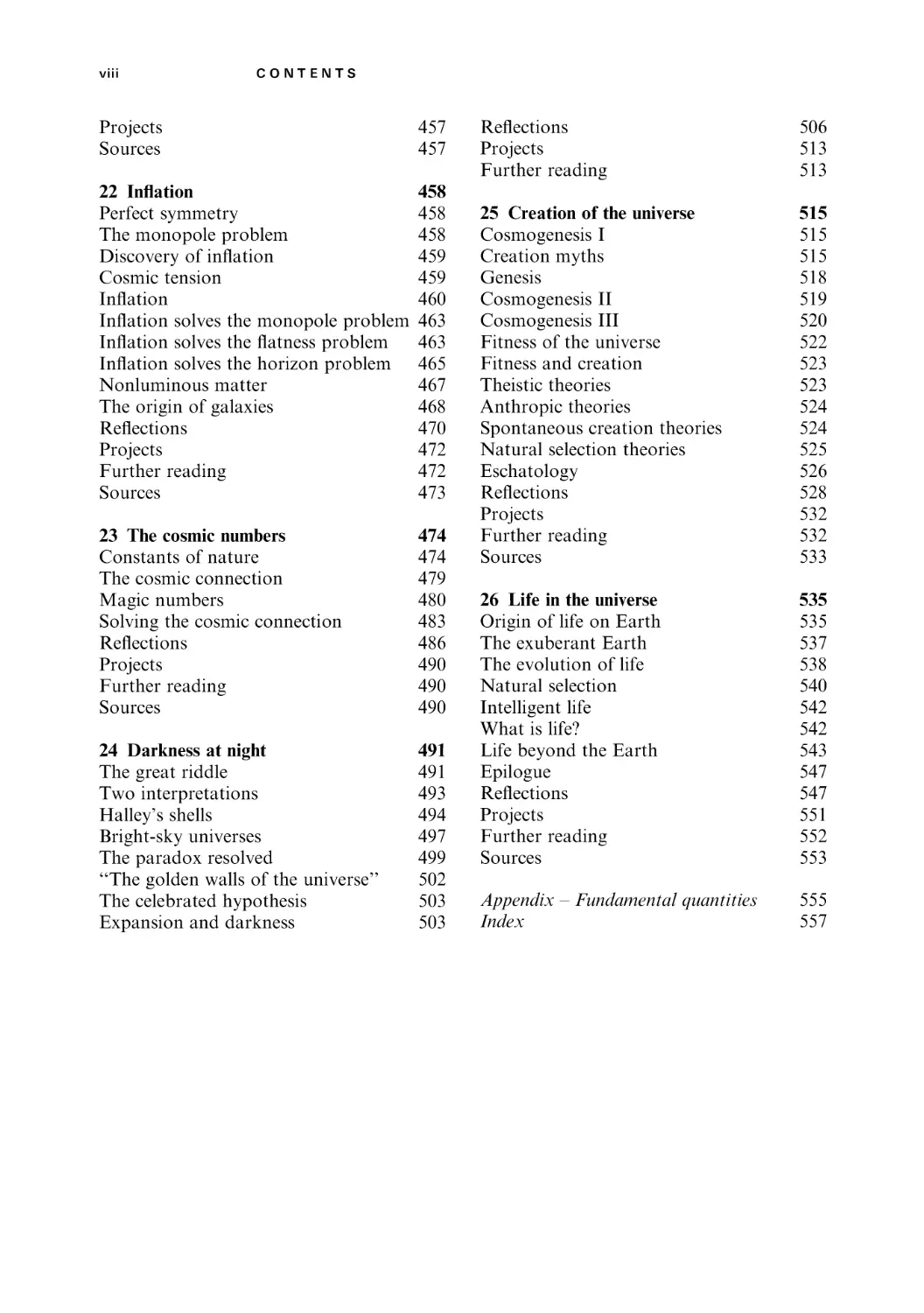
viii CONTENTS
Projects
Sources
22 Inflation
Perfect symmetry
The monopole problem
Discovery of inflation
Cosmic tension
Inflation
457
457
458
458
458
459
459
460
Inflation solves the monopole problem 463
Inflation solves the flatness problem
Inflation solves the horizon problem
Nonluminous matter
The origin of galaxies
Reflections
Projects
Further reading
Sources
23 The cosmic numbers
Constants of nature
The cosmic connection
Magic numbers
Solving the cosmic connection
Reflections
Projects
Further reading
Sources
24 Darkness at night
The great riddle
Two interpretations
Halley's shells
Bright-sky universes
The paradox resolved
"The golden walls of the universe"
The celebrated hypothesis
Expansion and darkness
463
465
467
468
470
472
472
473
474
474
479
480
483
486
490
490
490
491
491
493
494
497
499
502
503
503
Reflections
Projects
Further reading
25 Creation of the universe
Cosmogenesis I
Creation myths
Genesis
Cosmogenesis II
Cosmogenesis III
Fitness of the universe
Fitness and creation
Theistic theories
Anthropic theories
Spontaneous creation theories
Natural selection theories
Eschatology
Reflections
Projects
Further reading
Sources
26 Life in the universe
Origin of life on Earth
The exuberant Earth
The evolution of life
Natural selection
Intelligent life
What is life?
Life beyond the Earth
Epilogue
Reflections
Projects
Further reading
Sources
Appendix - Fundamental quantities
Index
506
513
513
515
515
515
518
519
520
522
523
523
524
524
525
526
528
532
532
533
535
535
537
538
540
542
542
543
547
547
551
552
553
555
557

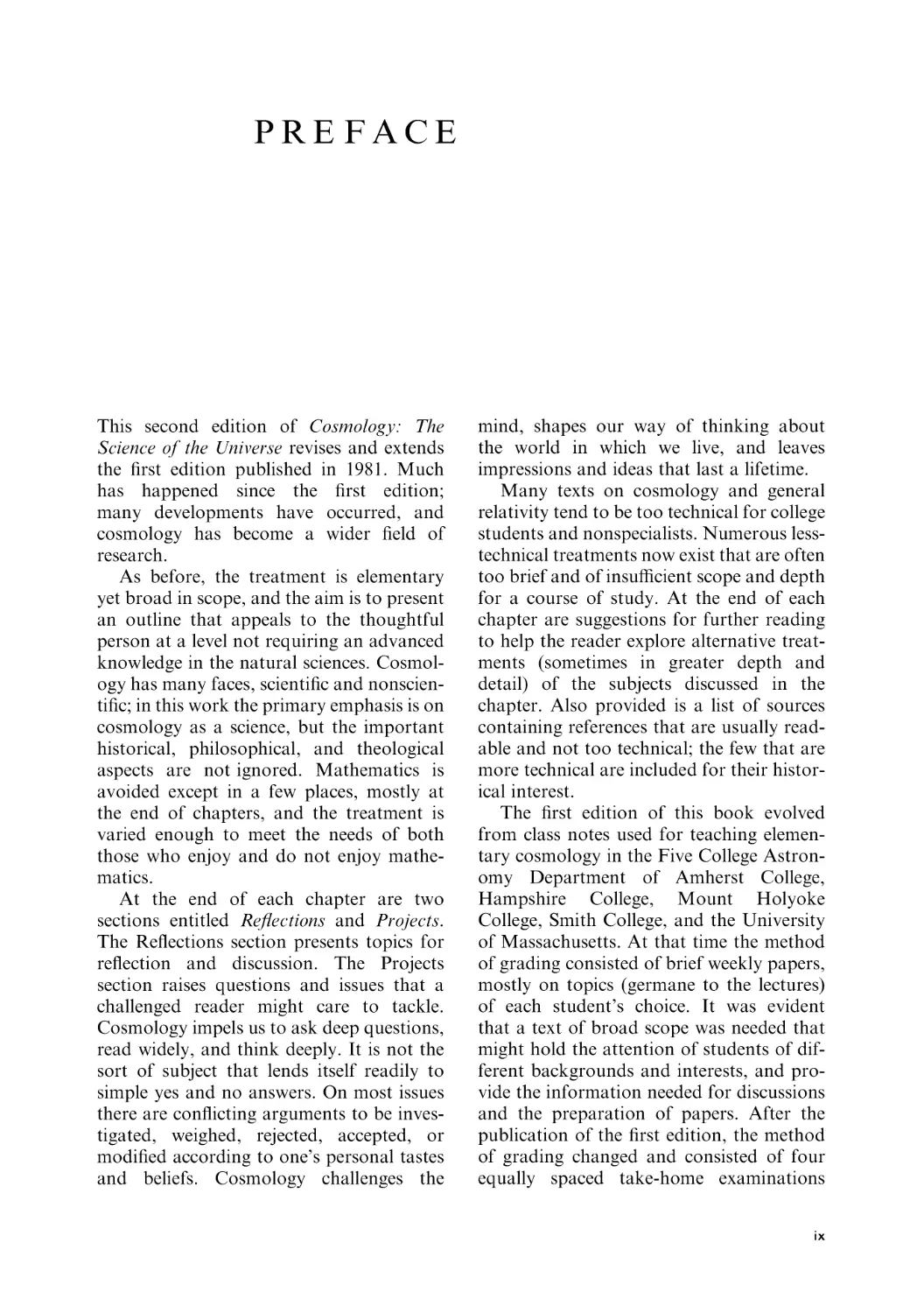
PREFACE
This second edition of Cosmology: The
Science of the Universe revises and extends
the first edition published in 1981. Much
has happened since the first edition;
many developments have occurred, and
cosmology has become a wider field of
research.
As before, the treatment is elementary
yet broad in scope, and the aim is to present
an outline that appeals to the thoughtful
person at a level not requiring an advanced
knowledge in the natural sciences.
Cosmology has many faces, scientific and nonscien-
tific; in this work the primary emphasis is on
cosmology as a science, but the important
historical, philosophical, and theological
aspects are not ignored. Mathematics is
avoided except in a few places, mostly at
the end of chapters, and the treatment is
varied enough to meet the needs of both
those who enjoy and do not enjoy
mathematics.
At the end of each chapter are two
sections entitled Reflections and Projects.
The Reflections section presents topics for
reflection and discussion. The Projects
section raises questions and issues that a
challenged reader might care to tackle.
Cosmology impels us to ask deep questions,
read widely, and think deeply. It is not the
sort of subject that lends itself readily to
simple yes and no answers. On most issues
there are conflicting arguments to be
investigated, weighed, rejected, accepted, or
modified according to one's personal tastes
and beliefs. Cosmology challenges the
mind, shapes our way of thinking about
the world in which we live, and leaves
impressions and ideas that last a lifetime.
Many texts on cosmology and general
relativity tend to be too technical for college
students and nonspecialists. Numerous less-
technical treatments now exist that are often
too brief and of insufficient scope and depth
for a course of study. At the end of each
chapter are suggestions for further reading
to help the reader explore alternative
treatments (sometimes in greater depth and
detail) of the subjects discussed in the
chapter. Also provided is a list of sources
containing references that are usually
readable and not too technical; the few that are
more technical are included for their
historical interest.
The first edition of this book evolved
from class notes used for teaching
elementary cosmology in the Five College
Astronomy Department of Amherst College,
Hampshire College, Mount Holyoke
College, Smith College, and the University
of Massachusetts. At that time the method
of grading consisted of brief weekly papers,
mostly on topics (germane to the lectures)
of each student's choice. It was evident
that a text of broad scope was needed that
might hold the attention of students of
different backgrounds and interests, and
provide the information needed for discussions
and the preparation of papers. After the
publication of the first edition, the method
of grading changed and consisted of four
equally spaced take-home examinations
ix

X
PREFACE
followed by an end-of-semester
examination. Many questions included in the
examinations did not require mathematical
skills. Both methods of grading have their
advantages and disadvantages. There must
be a better way!
I am indebted to many persons for their
comments and helpful suggestions,
particularly Thomas Arny (University of
Massachusetts, Amherst), Gregory Benford
(University of California, Irvine), Robert
Brandenberger (Brown University), Mario
Bunge (McGill University), Thomas
Dennis (Mount Holyoke College), James
Ellern (University of Southern California,
Los Angeles), George Ellis (University of
Capetown), Stephen Gottesman (University
of Florida, Gainsville), George Greenstein
(Amherst College), Gary Hinshaw
(NASA/Goddard Space Flight Center),
Paul Hodge (University of Washington),
Duane Howells (Hughs Research
Laboratories), John Huchra
(Harvard-Smithsonian Center for Astrophysics), John
Lathrop, Charles Leffert, William McCrea
(University of Sussex), A. J. Meadows
(Loughborough University of Technology),
Heinz Pagels (University of California,
Santa Cruz), Joel Primack (University of
California, Santa Cruz), Martin Rees
(Cambridge University), Joe Rosen (University of
Central Arkansas), Rick Shafer (NASA/
Goddard Space Flight Center), Stephen
Schneider (University of Massachusetts,
Amherst), Joseph Snider (Oberlin College),
Joseph Tenn (Sonoma State University),
Virginia Trimble (University of California,
Irvine), David Van Blerkom (University of
Massachusetts, Amherst), Gerard de
Vaucouleurs (University of Texas, Austin),
and Robert Wilson (Smithsonian Astro-
physical Observatory).
I am particularly grateful to Fred
Stevenson (University of Leeds) for his helpful
comments and corrections.
EDWARD HARRISON
Mesilla, New Mexico, May 1998

INTRODUCTION
With equal passion I have sought knowledge. I have wished to understand the hearts of
men, I have wished to know why the stars shine. And I have tried to apprehend the
Pythagorean power by which number holds sway above the flux. A little of this, but not
much, I have achieved.
Bertrand Russell (1872-1970), Autobiography, Prologue
PROLOGUE
Cosmology, the science of the universe,
attracts and fascinates us all. In one sense,
it is the science of the large-scale structure
of the universe: of the realm of extragalactic
nebulae, of distant and receding horizons,
and of the dynamic curvature of cosmic
space and time. In another sense, it seeks
to assemble all knowledge into a unifying
cosmic picture. Most sciences tear things
apart into smaller and smaller constituents
in order to examine the world in ever
greater detail, whereas cosmology is the
one science that puts the pieces together
into a "mighty frame." In yet another
sense, it is the history of mankind's search
for understanding of the universe, a quest
that began long ago at the dawn of the
human race. We cannot study cosmology
in the broadest sense without heeding the
many cosmic pictures of the past that have
shaped human history. We trace the rise of
the scientific method and how it has
increased our understanding of the physical
universe. Which brings us to the major aim
of this book: gaining an elementary
understanding of the physical universe of modern
times.
Cosmology compels us, willy-nilly, to
examine our deepest and sometimes most
cherished beliefs. It awakens an awareness
of ancient vestigial paradigms that control
our lives and direct the destiny of societies.
A person who migrates to a new land, joins
a revolution, goes to war, seeks political
power, gains or loses a fortune, gets married,
or does any momentous thing is influenced
by cosmic beliefs.
A brief summary of the contents of this
book serves as an introduction to the scope
of cosmology as a modern science. In outline
only, chapter by chapter, the subjects
covered are as follows.
CHAPTER 1
WHAT IS COSMOLOGY?
The history of cosmology shows that in
every age in all societies people believe that
they have at last discovered the true nature
of the Universe. But in each case they have
devised a mask fitted on the face of the
unknown Universe. In this book we use
"universe" to denote "a model of the
Universe" and avoid making claims to true
and final knowledge of the Universe.
Where there is a society of rational
individuals, there we find a universe, and where
there is a universe, there we find a society
of rational individuals. Proud of their
knowledge and confident of its final truth,
the members of a society pity the ignorance
of their ancestors and fail to foresee that
their descendants will also pity them for
their ignorance.
Cosmology is the study of universes, how
they originate, how they evolve. Plausibly,
hundreds of thousands of years ago, in an
Age of Magic, the world was explained by
the activity of ambient spirits. In an Age of
Myths, tens of thousand years ago, lasting
until recent times, the world was explained
by the capricious acts of nature spirits and
1

2
COSMOLOGY
the will of remote gods and goddesses. In an
Age of Science, we have abandoned much
of our anthropocentric heritage, and have
devised a series of mechanistic universes.
The old historic universes (Sumerian,
Egyptian, Judaic, Zoroastrian, Confucian,
Taoist, Jainic, Buddhist, Aristotelian,
Platonic, Stoic, Epicurean, Neoplatonic,
Medieval,...) dealt with cosmic themes
that gave meaning to human life, themes
that now fail to fit naturally into the
current physical universe. This causes
concern and prompts us all to think deeply.
The last section in this chapter considers
how cosmology relates to society and
affects our everyday thoughts, actions, and
beliefs.
CHAPTER 2
EARLY SCIENTIFIC COSMOLOGY
This chapter briefly reviews known early
scientific cosmology with comments on the
Babylonian, Pythagorean, and Platonic
systems. Emphasis is placed on the three
important and enduring Hellenistic world
systems: Aristotelianism, Epicureanism,
and Stoicism. The Aristotelian universe,
finite in size, consisted of planetary spheres
bounded by an outer sphere of stars; the
Epicurean universe, infinite in extent,
consisted of endless worlds composed of
atoms; and the Stoic universe, finite in size,
consisted of a cosmos of planets and stars
surrounded by empty infinite space. These
world systems have shaped the history of
subsequent cosmology.
The Medieval universe, with Aristotelian
foundations, reached its peak in the High
Middle Ages. Because of the
Condemnations by the bishop of Paris of Aristotelian
cosmology in 1277, the Medieval universe
evolved into a Stoic-like system, able to
accommodate an omnipotent God of
unlimited extent. The Copernican
revolution overthrew geocentric astronomy in
favor of heliocentric astronomy, which
in turn was soon overthrown by the rise
of the Cartesian and Newtonian world
systems.
CHAPTER 3
CARTESIAN AND NEWTONIAN
WORLD SYSTEMS
In the seventeenth century, the
revolutionary Cartesian and Newtonian systems math-
ematized and mechanized the natural world.
From medieval mathematics and dynamics,
Rene Descartes fashioned a mechanized
atomless Epicurean-like world of matter
and motion operating in strict obedience to
natural laws. The repercussions - scientific,
philosophical, and theological - were, and
still are, profound. The body-mind (or
body-soul) duality became more sharply
etched than ever before and haunts us to
this day.
Isaac Newton reacted strongly against
Cartesian materialism and at first believed
in a finite Stoic cosmos surrounded by an
infinite mysterious space. What Descartes
had denied - the existence of atoms, the
vacuum, and forces acting at a distance -
Newton affirmed. Newton's laws of motion
and the theory of universal gravity
transformed astronomy. The atomic theory lost
its atheistic associations and began to
make sense of the properties of matter.
Where there is no matter, declared Newton,
space still exists by virtue of the presence of
spirit. Bodies act upon one another across
empty space by means of long-range gravity.
The implications of universal gravity caused
Newton later to change his mind and believe
in an infinite Epicurean-like universe,
endlessly populated with uniformly distributed
stars.
CHAPTER 4
COSMOLOGY AFTER NEWTON AND
BEFORE EINSTEIN
But even the naked eye sees that stars do not
cover the sky uniformly. Thomas Wright in
the eighteenth century proposed that the
Milky Way is an enormous assembly of
stars, and that possibly other milky ways
exist far away. Immanuel Kant expanded
on this idea and devised a hierarchical
universe. The renowned astronomer William
Herschel explored the heavens, surveyed the
Galaxy, and formed the opinion that many

INTRODUCTION
3
of the small fuzzy patches of light (nebulae)
not only are clusters of unresolved stars but
also some are distant milky ways (galaxies)
similar to our own Milky Way (Galaxy).
The nebula hypothesis, the idea that the
Sun and planets formed from a rotating and
contracting cloud of interstellar gas, was
suggested by Kant and later considered in
more detail by Pierre Simon de Laplace.
Thus began the riddle of the nebulae: are
the nebulae distant milky ways in a many-
island universe or are they solar systems in
the process of formation in a one-island
universe? Herschel later in life changed his mind
and favored the one-island universe. In the
nineteenth century, the spectroscopic
analysis of starlight by William Huggins and
other astronomers and the development of
photography established the "new
astronomy" that later became known as
astrophysics. At last human beings knew the
stars consist of chemical elements exactly
the same as on Earth. And astronomers
knew that many nebulae consist only of gas
(tipping the balance in favor of the Kant-
Laplace nebula hypothesis and against the
Wright-Kant milky way hypothesis).
Astronomers succeeded in measuring the
radial velocities of stars by the Fizeau-
Doppler displacement in spectral lines. The
Victorian universe of the nineteenth century
was a one-island universe. The Solar System
occupied the center of the Galaxy, which
existed in a void of infinite, mysterious
space. The Darwinian theory of natural
selection exacerbated the age-of-the-universe
problem and brought fundamental
cosmological issues into every home. The old conflict
between the Stoic and Epicurean systems
climaxed in the early years of the twentieth
century and the many-island universe
emerged triumphant. We now know that
some of the fuzzy patches of light are
unresolved star clusters, some are swirling gas
clouds, and others are distant galaxies.
CHAPTERS 5 AND 6
STARS AND GALAXIES
These two chapters discuss stars and galaxies
and their treatment is oriented toward
cosmology. Readers familiar with elementary
astronomy may wish to skip these two
chapters and proceed immediately to the
next two chapters that discuss the important
subjects of location and containment.
CHAPTER 7
LOCATION AND THE COSMIC
CENTER
Generally, the subject of location (Chapter
7) deals with the cosmic center, and the
subject of containment (Chapter 8) deals with
the cosmic edge. The location and
containment principles, which seem deceptively
simple, serve to guide us among the pitfalls
that trapped earlier cosmologists and still
trap students.
This chapter deals with the rise and fall of
the geocentric and heliocentric universes,
and the rise of the centerless universes. We
live in an isotropic universe in which all
directions in space are alike. The location
principle states that "probably we do not
occupy a cosmic center." The observed
isotropy of the universe, coupled with the
location principle, leads us to the conclusion
that the universe is probably homogeneous.
The homogeneity of the universe,
meaning that all places in space are alike at a
common instant in time, is the essence of
the cosmological principle. The perfect
cosmological principle, which states that
all places in both space and time are alike,
applies not only to the Cartesian and
Newtonian world systems, but also to the more
recent expanding steady-state universe.
CHAPTER 8
CONTAINMENT AND THE COSMIC
EDGE
Containment deals with the edge and
contents of the physical universe. The
containment principle states: "the physical
universe contains only physical things." In
modern physics, both space and time in the
form of spacetime are physically real and
therefore part of the physical universe. As
cosmophysicists we deal with the physical
universe. But the Universe contains also
nonphysical things and this aspect of

4
COSMOLOGY
containment has implications in the social
and life sciences. Various topics are
considered, such as cosmic design and the finely
tuned fundamental physical constants, the
theistic and anthropic principles, and the
laws of nature.
A word of warning comes not amiss while
on the subject of containment. Cosmology is
incomplete in the fundamental sense that we
do not know how to put ourselves, as
cosmologists, into our world systems. The
Universe is self-aware - it contains us who
are conscious beings - but the physical
universe is not self-aware and does not contain
us as self-aware beings. We can put our
physical bodies and biochemical brains
into a physical universe, which is a model
of the Universe, but we cannot put our
minds (whatever that means) into a universe
conceived and studied by our minds. When
we try, we fall into an infinite regression:
the cosmologist studies a universe, which
contains the cosmologist studying that
universe, which contains the cosmologist, ...
and so on, indefinitely. For the same reason,
painters in the act of painting landscapes
leave themselves out of the landscapes
they paint. Otherwise they would have to
include themselves painting a picture that
includes themselves painting a picture
that includes This subject is referred to
as the containment riddle: "Where in a
universe is the cosmologist studying that
universe?" The solution to the riddle
requires that we distinguish between the
inconceivable Universe (of which we are
totally a part) and our conceived
universes (of which we are not totally a part)
that we create to make sense of our
experiences.
CHAPTER 9
SPACE AND TIME
In more depth than usual in an elementary
work, we consider the fascinating nature of
space and time in pre-Newtonian and post-
Newtonian universes. Some topics discussed
are the arrow of time, the "now," time
travel, Zeno's paradoxes, Parmenidean
states of being, Heraclitean acts of becoming,
and conjugate time in the Islamic Kalam
universe.
Our everyday understanding of time is a
patchwork of primitive and sophisticated
concepts. The time that is used in special
relativity is not the same as that used in
most other sciences, which is not the same
as that in everyday speech, which in turn is
not the same as the time we actually
experience. Conflict and contrast abound
whenever we discuss the nature of time. With
not much hope of success, we try to clarify
some of the issues involved in this perplexing
subject; any fundamental change in our
understanding of time will undoubtedly
profoundly affect cosmology.
CHAPTER 10
CURVED SPACE
The development of non-Euclidean
geometry in the nineteenth century forms an
engrossing subject in the history of science
and mathematics. Understanding curved
space is not easy, even for people who live
in curved spaces. Much of our attention in
this chapter focuses on the three
homogeneous and isotropic spaces that are of basic
importance in modern cosmology.
CHAPTER 11
SPECIAL RELATIVITY
Special relativity, contrary to students'
expectations, is easy to understand, and a
true grasp of the essential ideas does not
require mathematics. The secret lies in
spacetime pictures and the realization that
in spacetime the shortest distance is not a
straight line. Space travel close to the speed
of light provides interesting applications of
relativity theory. The "twin paradox" is
puzzling only when the most elementary
aspects of the theory are not understood.
CHAPTER 12
GENERAL RELATIVITY
Special relativity and curved space lead us to
general relativity and the labors of Albert
Einstein. The first stepping-stone is the
principle of equivalence. This is established
by means of experiments in imaginary

INTRODUCTION
5
laboratories that move freely in space near to
and far from stars. The second stepping-stone
is the realization that this dynamic state of
affairs is analogous in many respects to the
geometric properties of curved space. In a
flight of inspiration we are catapulted to the
theory of general relativity and the Einstein
master equation. Many ingenious tests of
general relativity have been performed,
successfully verifying the validity of the theory
on astronomical (not cosmic) scales.
We consider the bootstrap ideas
embodied in Mach's principle, a principle so-
named by Einstein who found Mach's
ideas inspiring. The old bootstrap theory,
periodically revived, asserts that all things
are immanent within one another, and the
nature of any one thing is determined by
the universe as a whole. So far, science has
failed to make sense of the bootstrap theory.
Mach's principle, a bootstrap theory, claims
that the inertia of a body is determined by all
the matter distributed in the universe. Many
persons dislike an "undressed" space that
exists in its own right, and with the ancients,
Bishop Berkeley, and Ernst Mach, think
that space cannot exist in a real sense unless
decently dressed in a distribution of matter.
Berkeley's ideas, revamped by Mach, played
a historic role in the formulation of general
relativity. But the idea: the materialization
of space, championed at first by Einstein,
was dropped when Einstein performed the
converse: the geometrization of matter.
CHAPTER 13
BLACK HOLES
Although black holes were anticipated in
the eighteenth century on the basis of
Newtonian theory, the proper theory for their
study is general relativity. Of spherical
bodies of similar mass, black holes have
the highest density and the strongest
gravitational force at their surface. They are
wrapped in their own curved spacetime. A
black hole exists in a frozen state of
permanent free-fall collapse. Owing to the extreme
distortion of spacetime, an external observer
sees the black hole in a frozen state, from
which nothing (according to the classical
theory), not even light, can escape. We
consider several topics of interest, such as
nonrotating and rotating black holes, the
energy liberated by accretion of matter,
miniholes and superholes, the temperature
of black holes, Hawking radiation, and
violation of certain cherished laws of
conservation.
CHAPTER 14
EXPANSION OF THE UNIVERSE
The expansion of the physical universe ranks
as one of the greatest discoveries in the
history of the human race. We invoke the
expanding space paradigm and perform
imaginary experiments with ERSU -
Expanding Rubber Sheet Universe. To aid
us in our investigations we use the two
different observers introduced in Chapter 7: the
ordinary stay-at-home "observer" who
looks out at distant things in the same way
that we do, and the imaginary gadabout
"explorer" who rushes around at infinite
speed and traverses the universe in zero
cosmic time. The explorer in these experiments
is really us looking down on ERSU as
external observers. Our experiments shed light on
many topics, such as homogeneous
expansion, cosmic time, recession of the galaxies,
the velocity-distance law of expansion, and
the Hubble redshift-distance law. The
experiments stress that the galaxies are not
hurling away through space but are actually
at rest in space that is expanding. This is why
distant galaxies can recede from us faster
than the speed of light. Recession velocity
is unlike the ordinary velocity with which
we are familiar. Measuring the expansion
requires the introduction of comoving
coordinates, coordinate distances, the scaling
factor, the Hubble term, and the
deceleration term, and we show how universes are
classified according to the way the scaling
factor changes in time.
CHAPTER 15
REDSHIFTS
Light rays from distant galaxies are red-
shifted because of the expansion of the
universe. This cosmological redshift, which

6
COSMOLOGY
is distinct from the Doppler and
gravitational redshifts, is produced by the
stretching of wavelengths as radiation propagates
through expanding space. Space expands,
wavelengths are stretched, and the cosmic
redshift is as simple as that. There are a
few redshift curiosities. The oddest curiosity
of all is the unwise practice in popular
literature of failing to distinguish between cosmic
and Doppler redshifts. The Doppler effect
implies that galaxies are rushing away
through space and that special relativity
explains the universe. This is a dangerous
interpretation and leads to endless
confusion for those trying to understand modern
cosmology. It restores the cosmic edge at
which recession reaches the speed of light.
Our treatment stresses two concepts: first,
recession is the result of the expansion of
space (and galaxies are more or less
stationary in expanding space); and second, cosmic
redshifts are the result of the stretching of
wavelengths as light and other forms of
radiation travel through expanding space.
It is now clear why we have previously
insisted that space and time are physically
real (this is the essence of general relativity)
and are contained in the universe; the
universe is not expanding in space, but consists
of expanding space.
CHAPTER 16
NEWTONIAN COSMOLOGY
Isaac Newton resolved the gravity paradox
(or war of cosmic forces) by assuming that
the universe is perfectly homogeneous.
Under certain limiting conditions
Newtonian theory gives the same results as general
relativity. The dynamics of the universe
showing how gravity and the lambda force
determine expansion are discussed with the
aid of Newtonian ideas. We try to explain
why Newtonian theory under certain
conditions yields the same results in cosmology as
general relativity.
CHAPTER 17
THE COSMIC BOX
The principle that all places in the universe
are alike at each moment in cosmic time has
far-reaching consequences. Distant regions
are in the same state as local regions when
compared at the same time, and we can
discover much about the universe by studying
the history of only a sample region. This is
the basic idea of the "universe in a nutshell."
We suppose that a part of the universe is
enclosed in an imaginary cosmic box that
has perfectly reflecting walls and expands
with the universe. What happens inside is
exactly the same as what happens outside.
The cosmic box is small on the cosmic scale,
hence we assume Euclidean space and the
ordinary laws of physics, as used in the
laboratory, to study the various forms of
cosmic phenomena. The enclosed cosmic
box serves as a useful tool for tackling
subjects that otherwise would be difficult, such
as the entropy of the universe and the non-
conservation of energy on the cosmic scale.
CHAPTER 18
THE MANY UNIVERSES
In the past, many cosmological theories,
now mostly of historical interest, have been
proposed. We look at various "mighty
frames," or cosmic models, such as the
Einstein, de Sitter, Friedmann, and Fried-
mann-Lemaitre universes. These models
may be classified as static, bang, whimper,
or oscillating. Other methods of
classifications are given. In this great gallery of
universes, the lambda force, popularized by
Einstein, adds much to the variety. From
this cosmological supermarket we select
and examine Milne's kinematic universe,
steady-state universes, and universes in
compression, tension, and convulsion. We
consider also inflation, chaos, and antichaos.
The "dream machine" of the scalar-tensor
theory is discussed; by adjusting its control
knobs the cosmologist converts a universe
into any one of an infinite number of
different universes.
CHAPTER 19
OBSERVATIONAL COSMOLOGY
We consider first local observations, then
observations at intermediate distances, and
finally observations at cosmically large

INTRODUCTION
7
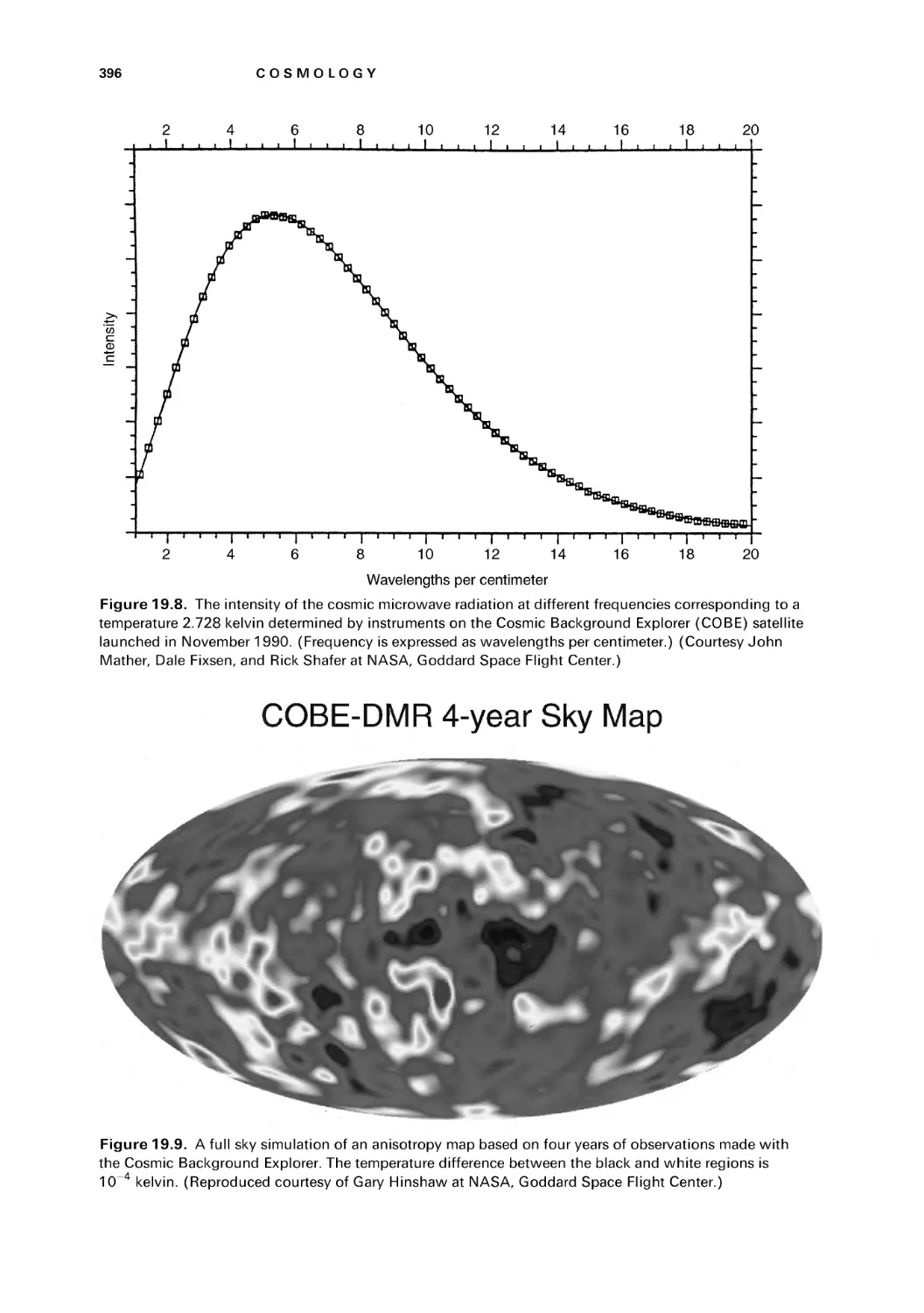
distances. The local observations are
confined to the Solar System, Galaxy, and
Local Group of galaxies and extend no
farther than a few million light years. They
determine the first steps in a distance ladder,
the distribution and density of matter, the
ages of stars and the age of the Galaxy
(setting lower limits on the age ofthe universe),
the abundance ofthe chemical elements, the
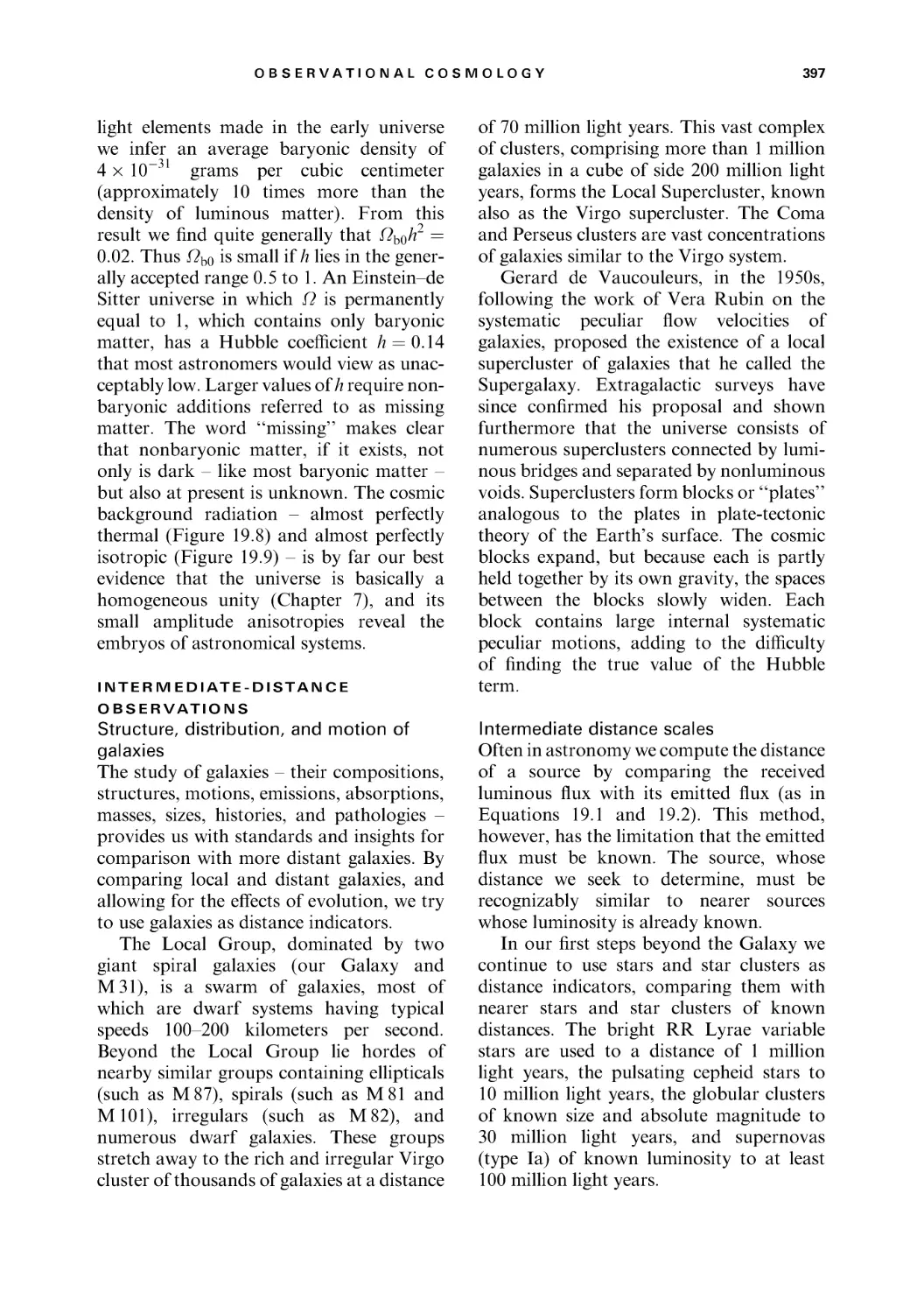
cosmic background radiation that
originated in the early universe (and reveals the
peculiar motion of the Galaxy), and give
cosmological information on topics such as
the baryon density and properties of the
cosmic background radiation.
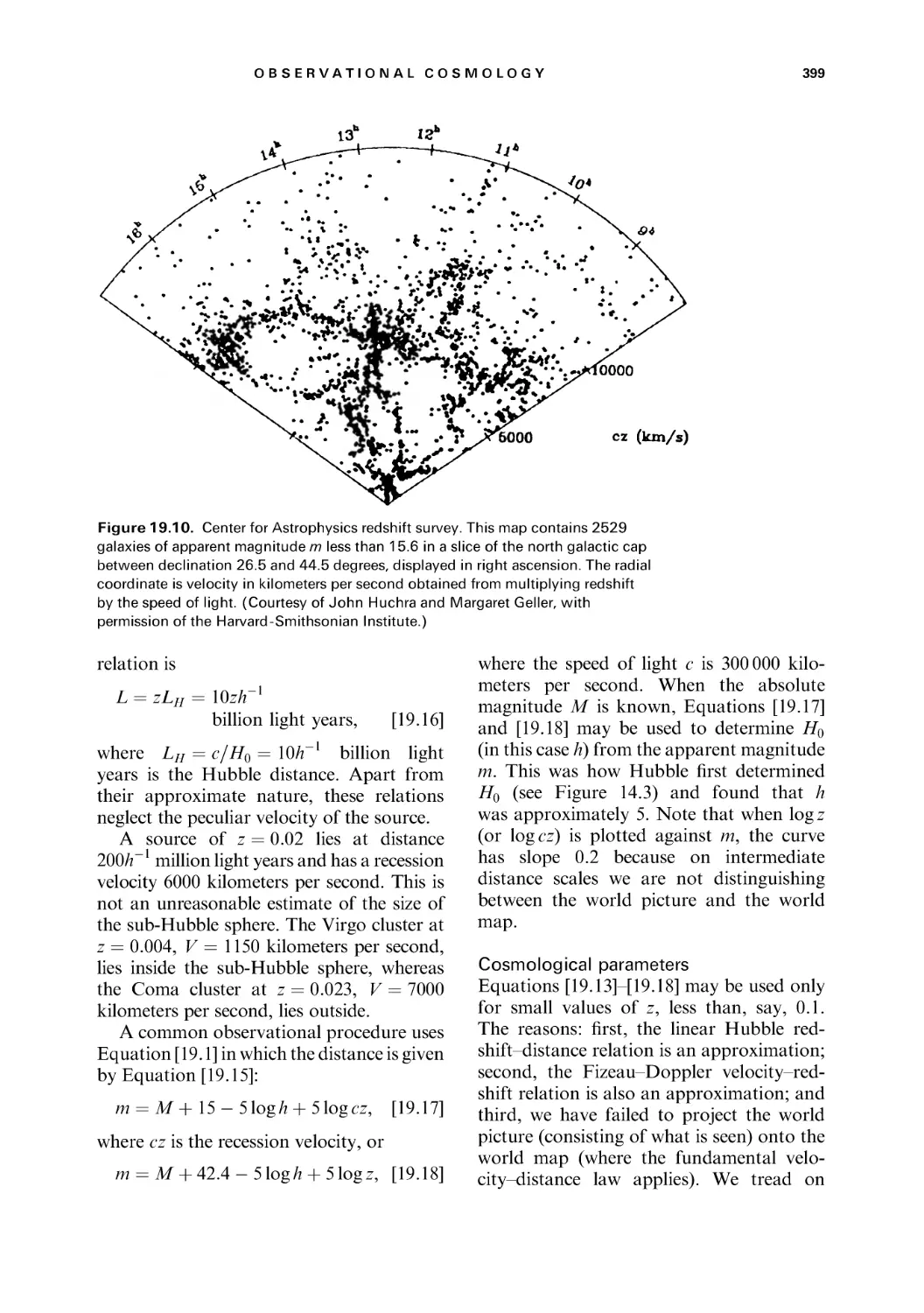
Observations at intermediate distances
are confined mainly to the Local (or Virgo)
Supercluster and extend a few hundred
million light years. They explore only the sub-
Hubble sphere and do not extend into the
full Hubble flow. They determine the
structure, distribution, and motions of galaxies,
extended distance scales, redshift-distance
and velocity-distance laws in approximate
form, and give information on topics such
as the age of the universe, baryon density,
the density parameters, and the approximate
value of the Hubble term.
Observations at cosmically large distances
extend deep into the Hubble flow where the
redshift-distance relation ceases to be linear.
We piece together evolutionary histories by
comparing nearby and distant astronomical
systems. What is seen in the world picture
(on the observer's backward lightcone)
must be projected forward onto the world
map (in which the linear velocity-distance
law holds). This mapping procedure greatly
complicates the determination of the
cosmological parameters and we are still far from a
secure knowledge ofthe values ofthe Hubble
term, the density parameters, the
deceleration term, the cosmological term, and the
curvature constant.
CHAPTER 20
THE EARLY UNIVERSE
The cosmic background radiation,
discovered in 1965, provides unambiguous
evidence of a big bang in the early history of
the universe. We explore the big bang, not
by traveling in space, but by remaining
where we are and traveling far back in
time. The big bang was everywhere. If the
universe extends infinitely in space, then so
also did the big bang. As we journey back
in time, the cosmic density and temperature
rise steadily and the universe at age a few
hundred thousand years is filled with
brilliant light. We stand at the threshold of the
radiation era. From this epoch descends
directly the cosmic background radiation,
cooled by expansion, that we nowadays
observe. When the universe is one second
old, and the temperature is 10 billion kelvin
and the density is one million times that of
water, we quit the radiation era and enter
the bizarre world of the lepton era. Hordes
of electrons and muons, and their antiparti-
cles, struggle to survive and from the lepton
battlefields flee hosts of ghostly neutrinos
condemned forever to wander unseen
through the universe. We continue our
journey back in time, traveling through the
hadron era and its warring matter and
antimatter ruled by the strong, electromagnetic,
and weak forces. Eventually we enter the
quark era ruled by the strong and electro-
weak forces. Finally phase transitions pass
us through an inflation era into a world
ruled by the hyperweak force in which
matter and antimatter are indistinguishable.
Our journey back in time ultimately comes
to a halt at the impenetrable Planck barrier.
At the Planck epoch the age ofthe universe is
one billion-trillionth of a jiffy (a jiffy is one
billion-trillionth of a second) and the density
of the universe is 1 followed by 93 zeros
times the density of water. Quantum
fluctuations of space and time are now of cosmic
magnitude and spacetime forms a foam of
tangled discontinuities.
We return from the early universe and
with our time machine turned to the future
we journey to the end of time. We find that
perhaps the universe ceases to expand, then
collapses and terminates in a new big bang,
or perhaps it expands forever and dies in a
long drawn-out whimper. In the first
possibility, during the collapse of the universe,

8
COSMOLOGY
galaxies are crushed together, and in the
devastation that follows, dissolving stars zip
through space at speeds close to that of
light. The brilliance of the radiation era
returns and the universe reverts to its original
primordial state. In the second possibility, the
galaxies continue to recede from one another
and after hundreds of billions of years are
dead and lifeless. In the enormous stretches
of time that follow, star systems and galaxies
contract to form black holes, and particles
slowly decay and convert into radiation.
After eons of time all black holes evaporate,
mostly into low-temperature radiation, and
the universe then contains almost no matter,
only feeble radiation forever growing feebler.
CHAPTER 21
HORIZONS IN THE UNIVERSE
How far can we see in the universe? The
answer depends on the things that we see,
whether they are events or world lines.
Event and particle (or world line) horizons
are discussed, first in the static Newtonian
universe to illustrate their nature, and then
more generally in nonstatic universes. The
horizon riddle, the horizon problem, the
Hubble sphere, and other topics are
discussed. Also discussed is the photon
horizon, beyond which photons emitted in our
direction actually recede.
CHAPTER 22
INFLATION
Possibly, the universe begins in a state of
utmost symmetry, and progresses through
a series of phase transitions to states of
lower symmetry and richer diversity.
Among the first-born in the very early
universe are the magnetic monopole particles.
These massive monopoles cannot decay
and should still exist and be as abundant as
the photons of the cosmic background
radiation. An era of inflation explains why
they have not been observed. During the
grand-unified phase transition, in which
the hyperweak force split into the electro-
weak and strong forces, the universe is
thrown into a state of extreme tension. In
this state, the universe expands (or inflates)
enormously at constant density. This
inflation solves not only the monopole problem
but also the flatness and horizon problems.
But inflation exacts a price: it creates the
problem of missing nonbaryonic matter.
CHAPTER 23
THE COSMIC NUMBERS
Cosmic numbers connect the subatomic and
cosmic properties of the universe. These
dimensionless numbers have intriguing
coincidences. Discussed are the cluster
hypothesis and Dirac's large-number
hypothesis, and their connection with the
anthropic principle. The art of cosmo-
numerology began long ago in the ancient
world when Archimedes calculated in the
Sand Reckoner the number of grains of
sand needed to fill the universe.
CHAPTER 24
DARKNESS AT NIGHT
The dark night-sky riddle, known as Olbers'
paradox, originated during the Copernican
revolution in the sixteenth century. Why the
sky at night is dark, and not ablaze with
light from countless stars has puzzled many
scientists, and played a conspicuous role in
the history of cosmology. Many writers in
recent times have said the night sky is dark
because of the expansion of the universe.
But this cannot be true because calculation
shows that if our universe were static the
sky at night would still be dark. The universe
does not contain enough energy to create a
bright-sky universe. The correct solution
was anticipated by the poet Edgar Allan
Poe and investigated in depth by Lord
Kelvin. The sky at night is dark because the
stars shine for too short a time to fill the
universe with radiation in equilibrium with stars;
equivalently, stars shine for too short a time
for the universe to contain sufficient visible
stars to cover the sky.
CHAPTER 25
CREATION OF THE UNIVERSE
We consider miscellaneous topics in cosmo-
geny, beginning with the creation myths of
earlier societies. The Mosaic chronology

INTRODUCTION
9
that fixes the date of creation of the universe
to five or six thousand years before the
present has been the cause of considerable
conflict between science and religion.
Creation and fitness of the universe are
distinguished as separate subjects and examined
in current theistic, anthropic, spontaneous,
and natural selection theories. Eschato-
logical myths and end-of-the-world theories
are also briefly reviewed.
CHAPTER 26
LIFE IN THE UNIVERSE
In this last chapter we consider past and
present theories of the origin of life and
discuss aspects of evolution and natural
selection. Understanding the nature of
intelligence is vitally important in cosmology,
and we consider how human beings might
have acquired their large brains. As cosmol-
ogists, in our finely tuned universe, we feel
impelled to believe that intelligent life must
exist elsewhere in the multitudes of galaxies.
But what is life? What is intelligence? Does
intelligent life, technologically advanced,
exist elsewhere in our Galaxy? Avenues of
inquiry open up in pursuit of answers to
this and other questions.

Part I

1
WHAT IS COSMOLOGY?
He has ventured far beyond the flaming ramparts of the world
and in mind and spirit traversed the boundless universe.
Lucretius (99-55 bc). The Nature of the Universe
THE UNIVERSE
From the outset we must decide whether to
use Universe or universe. This is not so trivial
a matter as it might seem. We know of only
one planet called Earth; similarly, we know
of only one Universe. Surely then the proper
word is Universe!
The Universe is everything and includes
us thinking about what to call it. But what
is the Universe? Do we truly know? It has
many faces and means many different things
to different people. To religious people it is a
theistically created world ruled by
supernatural forces; to artists it is an exquisite
world revealed by sensitive perceptions; to
professional philosophers it is a logical
world of analytic and synthetic structures;
and to scientists it is a world of controlled
observations elucidated by natural forces.
Or it may be all these things at different
times. Even more diverse are the worlds or
cosmic pictures held by people of different
societies, such as the Australian aboriginals,
Chinese, Eskimos, Hindus, Hopi, Maoris,
Navajo, Polynesians, Zulus. Cosmic
pictures evolve because cultures influence one
another, and because knowledge advances.
Thus in Europe the medieval picture,
influenced by the rise of Islam, evolved into the
Cartesian, then Newtonian, Victorian, and
finally Einsteinian pictures. The standard
Western world picture of the late nineteenth
century - the Victorian picture - was totally
unlike the standard picture - the Einsteinian
picture - of a hundred years later. Each
society in each age constructs a different
cosmic picture that is like a mask fitted on
the face of the unknown Universe.
If the word "Universe" is used we must
distinguish between the various "models
of the Universe." Each model, religious,
artistic, philosophical, or scientific, is one
of many representations; and similarly
with the models of different societies. Thus
in the history of science we distinguish
between the Pythagorean model, the
Atomist model, the Aristotelian model,
and so on. More precisely, we should say,
the Pythagorean model of the Universe,
the Atomist model of the Universe, the
Aristotelian model of the Universe, and so
on. Inevitably, the models receive the
abbreviated titles: the Pythagorean Universe, the
Atomist Universe, the Aristotelian
Universe, ..., and we confuse ourselves by
using the word Universe to mean "a model
of the Universe."
The grandiose word Universe has a
further major disadvantage. When used
alone, without specification of the model
we have in mind, it conveys the impression
that we know the true nature of the
Universe. We find ourselves, in the company of
multitudes of others in the past, speaking
of the Universe as if it were at last discovered
and revealed. By referring to the
contemporary model of the Universe as the "Universe,"
we forget that our contemporary model will
undoubtedly suffer the same fate as its
predecessors. Always, we mistake the mask
for the face, the model universe for the
actual Universe. Our ancestors made this
13

14
COSMOLOGY
JEAST
OUTER PLANETS
Mk*s JufiUrtrutSaturn
is
I
INNER PLANETS
Vtrius andMnury
FIXED STARS
THE
WEST
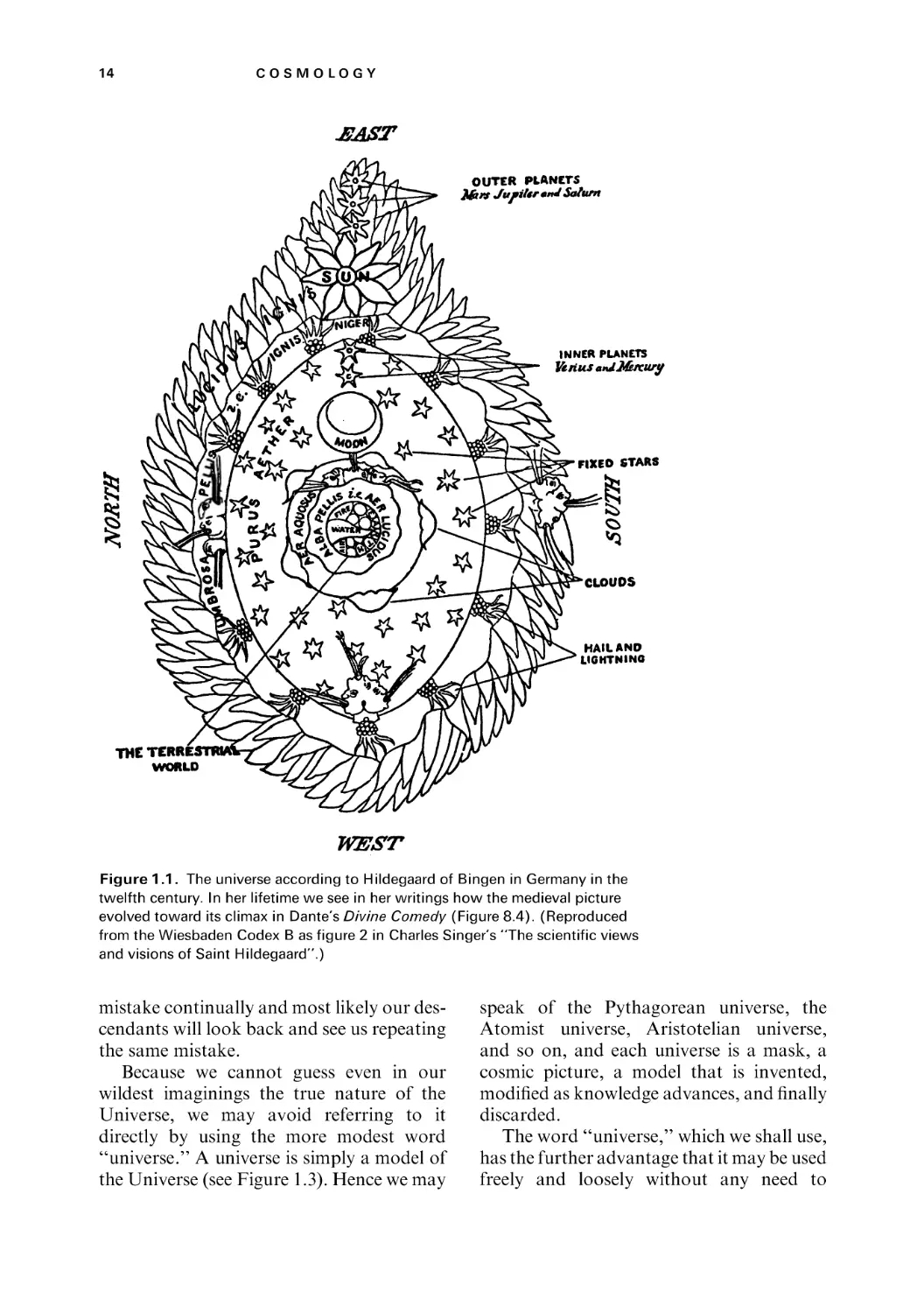
Figure 1.1. The universe according to Hildegaard of Bingen in Germany in the
twelfth century. In her lifetime we see in her writings how the medieval picture
evolved toward its climax in Dante's Divine Comedy (Figure 8.4). (Reproduced
from the Wiesbaden Codex B as figure 2 in Charles Singer's "The scientific views
and visions of Saint Hildegaard".)
mistake continually and most likely our
descendants will look back and see us repeating
the same mistake.
Because we cannot guess even in our
wildest imaginings the true nature of the
Universe, we may avoid referring to it
directly by using the more modest word
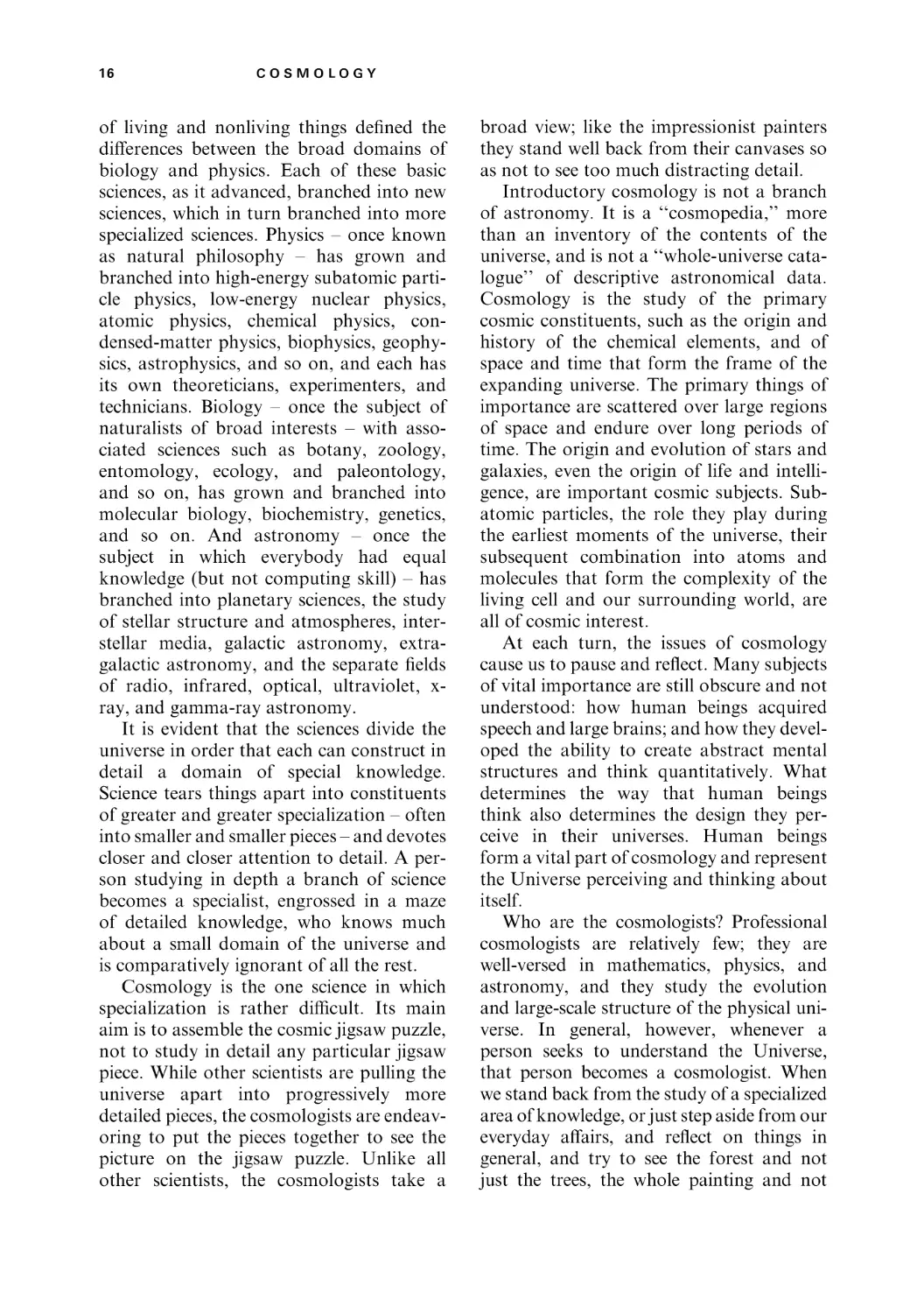
"universe." A universe is simply a model of
the Universe (see Figure 1.3). Hence we may
speak of the Pythagorean universe, the
Atomist universe, Aristotelian universe,
and so on, and each universe is a mask, a
cosmic picture, a model that is invented,
modified as knowledge advances, and finally
discarded.
The word "universe," which we shall use,
has the further advantage that it may be used
freely and loosely without any need to

WHAT IS COSMOLOGY?
15
mm
* -jy, nmmi
^^0"
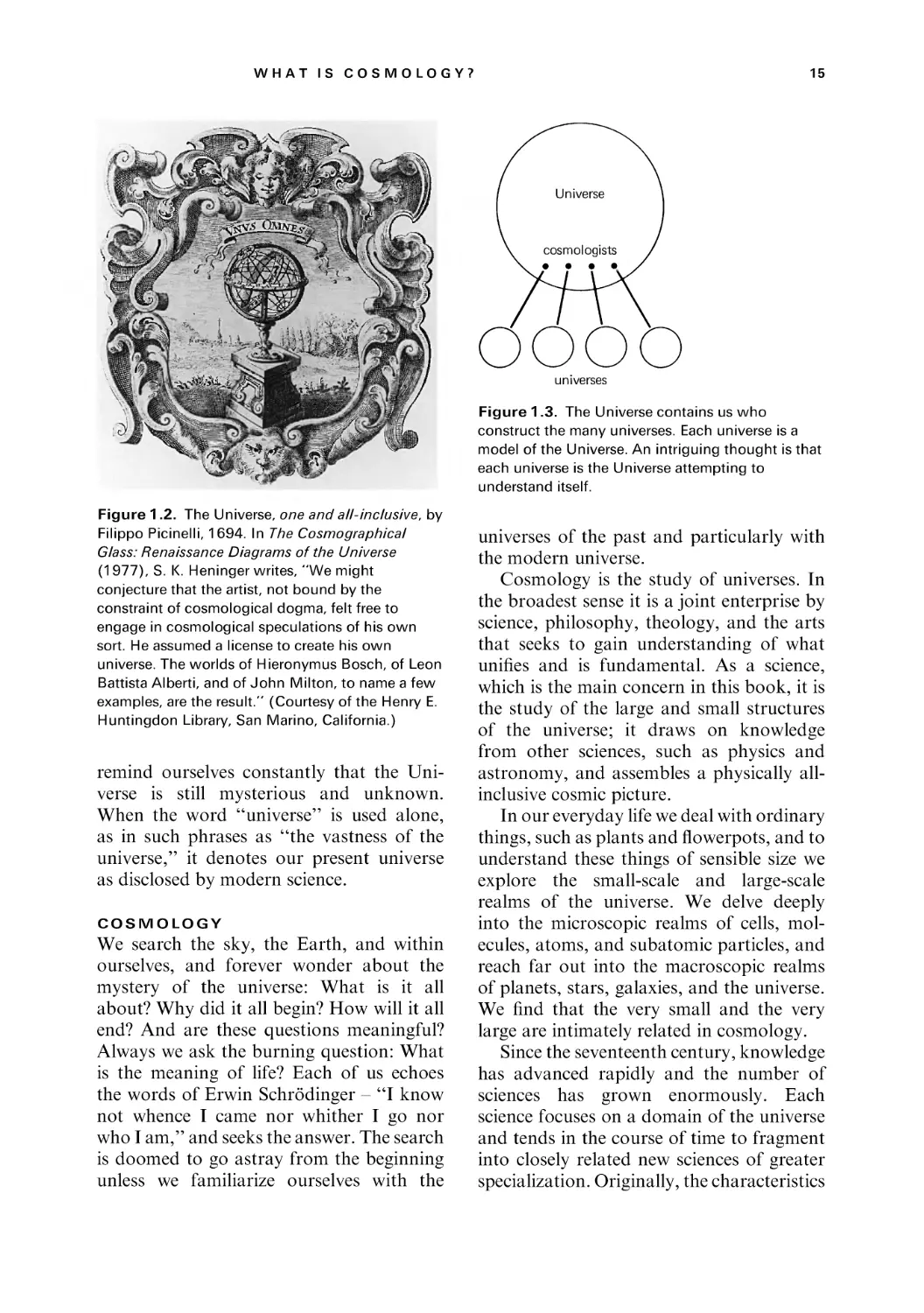
Figure 1.2. The Universe, one and all-inclusive, by
Filippo Picinelli, 1694. In The Cosmographical
Glass: Renaissance Diagrams of the Universe
(1977), S. K. Heninger writes, "We might
conjecture that the artist, not bound by the
constraint of cosmological dogma, felt free to
engage in cosmological speculations of his own
sort. He assumed a license to create his own
universe. The worlds of Hieronymus Bosch, of Leon
Battista Alberti, and of John Milton, to name a few
examples, are the result." (Courtesy of the Henry E.
Huntingdon Library, San Marino, California.)
remind ourselves constantly that the
Universe is still mysterious and unknown.
When the word "universe" is used alone,
as in such phrases as "the vastness of the
universe," it denotes our present universe
as disclosed by modern science.
COSMOLOGY
We search the sky, the Earth, and within
ourselves, and forever wonder about the
mystery of the universe: What is it all
about? Why did it all begin? How will it all
end? And are these questions meaningful?
Always we ask the burning question: What
is the meaning of life? Each of us echoes
the words of Erwin Schrodinger - "I know
not whence I came nor whither I go nor
who I am," and seeks the answer. The search
is doomed to go astray from the beginning
unless we familiarize ourselves with the
oooo
universes
Figure 1.3. The Universe contains us who
construct the many universes. Each universe is a
model of the Universe. An intriguing thought is that
each universe is the Universe attempting to
understand itself.
universes of the past and particularly with
the modern universe.
Cosmology is the study of universes. In
the broadest sense it is a joint enterprise by
science, philosophy, theology, and the arts
that seeks to gain understanding of what
unifies and is fundamental. As a science,
which is the main concern in this book, it is
the study of the large and small structures
of the universe; it draws on knowledge
from other sciences, such as physics and
astronomy, and assembles a physically all-
inclusive cosmic picture.
In our everyday life we deal with ordinary
things, such as plants and flowerpots, and to
understand these things of sensible size we
explore the small-scale and large-scale
realms of the universe. We delve deeply
into the microscopic realms of cells,
molecules, atoms, and subatomic particles, and
reach far out into the macroscopic realms
of planets, stars, galaxies, and the universe.
We find that the very small and the very
large are intimately related in cosmology.
Since the seventeenth century, knowledge
has advanced rapidly and the number of
sciences has grown enormously. Each
science focuses on a domain of the universe
and tends in the course of time to fragment
into closely related new sciences of greater
specialization. Originally, the characteristics

16
COSMOLOGY
of living and nonliving things defined the
differences between the broad domains of
biology and physics. Each of these basic
sciences, as it advanced, branched into new
sciences, which in turn branched into more
specialized sciences. Physics - once known
as natural philosophy - has grown and
branched into high-energy subatomic
particle physics, low-energy nuclear physics,
atomic physics, chemical physics,
condensed-matter physics, biophysics,
geophysics, astrophysics, and so on, and each has
its own theoreticians, experimenters, and
technicians. Biology - once the subject of
naturalists of broad interests - with
associated sciences such as botany, zoology,
entomology, ecology, and paleontology,
and so on, has grown and branched into
molecular biology, biochemistry, genetics,
and so on. And astronomy - once the
subject in which everybody had equal
knowledge (but not computing skill) - has
branched into planetary sciences, the study
of stellar structure and atmospheres,
interstellar media, galactic astronomy, extra-
galactic astronomy, and the separate fields
of radio, infrared, optical, ultraviolet, x-
ray, and gamma-ray astronomy.
It is evident that the sciences divide the
universe in order that each can construct in
detail a domain of special knowledge.
Science tears things apart into constituents
of greater and greater specialization - often
into smaller and smaller pieces - and devotes
closer and closer attention to detail. A
person studying in depth a branch of science
becomes a specialist, engrossed in a maze
of detailed knowledge, who knows much
about a small domain of the universe and
is comparatively ignorant of all the rest.
Cosmology is the one science in which
specialization is rather difficult. Its main
aim is to assemble the cosmic jigsaw puzzle,
not to study in detail any particular jigsaw
piece. While other scientists are pulling the
universe apart into progressively more
detailed pieces, the cosmologists are
endeavoring to put the pieces together to see the
picture on the jigsaw puzzle. Unlike all
other scientists, the cosmologists take a
broad view; like the impressionist painters
they stand well back from their canvases so
as not to see too much distracting detail.
Introductory cosmology is not a branch
of astronomy. It is a "cosmopedia," more
than an inventory of the contents of the
universe, and is not a "whole-universe
catalogue" of descriptive astronomical data.
Cosmology is the study of the primary
cosmic constituents, such as the origin and
history of the chemical elements, and of
space and time that form the frame of the
expanding universe. The primary things of
importance are scattered over large regions
of space and endure over long periods of
time. The origin and evolution of stars and
galaxies, even the origin of life and
intelligence, are important cosmic subjects.
Subatomic particles, the role they play during
the earliest moments of the universe, their
subsequent combination into atoms and
molecules that form the complexity of the
living cell and our surrounding world, are
all of cosmic interest.
At each turn, the issues of cosmology
cause us to pause and reflect. Many subjects
of vital importance are still obscure and not
understood: how human beings acquired
speech and large brains; and how they
developed the ability to create abstract mental
structures and think quantitatively. What
determines the way that human beings
think also determines the design they
perceive in their universes. Human beings
form a vital part of cosmology and represent
the Universe perceiving and thinking about
itself.
Who are the cosmologists? Professional
cosmologists are relatively few; they are
well-versed in mathematics, physics, and
astronomy, and they study the evolution
and large-scale structure of the physical
universe. In general, however, whenever a
person seeks to understand the Universe,
that person becomes a cosmologist. When
we stand back from the study of a specialized
area of knowledge, or just step aside from our
everyday affairs, and reflect on things in
general, and try to see the forest and not
just the trees, the whole painting and not

WHAT IS COSMOLOGY?
17
just the dabs of paint, the whole tapestry and
not just the threads, we become cosmologists.
THE MAGIC UNIVERSE
Cosmology is as old as Homo sapiens. It goes
back to a time when human beings, living in
primitive social groups, developed language
and made their first attempts to understand
the world around them. Probably, hundreds
of thousands of years ago, human beings
explained their world by means of spirits.
Spirits of all kinds, motivated by humanlike
impulses and passions, activated everything.
The early people projected their own inner
thoughts and feelings into an outer animistic
world, a world in which everything was
alive. With supplications, prayers, sacrifices,
and gifts to the spirits, human beings gained
control of the phenomena of their world.
It was the Age of Magic, of benign and
demonic spirits incarnate in plant, animal,
and human form. Everything that happened
was explained readily and easily by the
passions, motives, and actions of ambient
and indwelling spirits. It was an
anthropomorphic world, of the living earth, water,
wind, and fire, into which men and women
projected their own emotions and motives
as the guiding forces; the kind of world
that children read about in fairy tales.
From this "golden age" comes our primeval
fear of the menace of darkness and the rage
of storms, and our enchantment with the
wizardry of sunrises, sunsets, and rainbows.
For reasons not yet fully understood, human
beings everywhere remained one species,
and cultures (languages, social codes, belief
systems, laws, technologies) inter diffused.
Possibly, our moral codes of today, which
regulate behavior in the family and society
and determine in general what is ethically
right and wrong, were naturally selected
over long periods of time in primitive
societies. Societies deficient in codes of mutual
care and support among individuals had
little chance of surviving.
THE MYTHIC UNIVERSE
At the dawn of history, ten or more
thousand years ago, the early city-states attained
more abstract concepts of the Universe. The
magic universe evolved into the mythic
universe. The long age of magic gave way
to what might be called the Age of Theism.
The spirits that had been everywhere,
activating everything, amalgamated, retreated
into remote mythic realms, and became
powerful gods who personified abstractions
of thought and language. James Frazer, in
The Golden Bough, speculated on how
magic among primitive people evolved into
theism, and how the magic universe
transformed into a variety of mythic universe:
But with the growth of knowledge man learns to
realize more clearly the vastness of nature and his
own littleness and feebleness in the presence of it.
The recognition of his helplessness does not,
however, carry with it a corresponding belief in
the impotence of those supernatural beings with
which his imagination peoples the universe. On
the contrary, it enhances his conception of their
power If then he feels himself to be so frail and
slight, how vast and powerful must he deem the
beings who control the gigantic machinery of
nature! ... Thus in the acuter minds magic is
gradually superseded by religion, which explains
the succession of natural phenomena as regulated
by will, passion, or caprice of the spiritual beings
like man in kind, though vastly superior to him in
power.
Much of mythology consists of primitive
cosmic imagery (Figure 1.4). The Sumerian,
Assyro-Babylonian, Minoan, Greek,
Chinese, Norse, Celtic, and Mayan
mythologies, to name only a few, are of historical
interest because they illustrate mankind's
earlier views of the universe. The creation
myths, often difficult to interpret, are of
particular interest (see Chapter 25).
Human beings at the cosmic center
No matter how powerful and remote they
became, the mythic gods continued to serve
and protect human beings, and men and
women everywhere remained secure and of
central importance in an anthropocentric
universe. The universe was assembled about
a center and human beings were located
prominently at the center.
Anthropocentricity formed the basis of
the Greek cosmology of an Earth-centered

18
COSMOLOGY
Figure 1.4. The Ancient of Days by William Blake (1757-1827). "When he sets a
compass upon the face of the depths" (Proverbs 8:27)
universe. The universe of Aristotle in the
fourth century bc was geocentric (or Earth
centered); the spherical Earth rested at the
center of the universe and the Moon, Sun,
planets, and stars, fixed to translucent
celestial spheres, revolved about the Earth. The
innermost region of heaven - the sublunar
sphere between the Earth and the Moon -
contained earthly and tangible things in an
ever-changing state, and the outer regions
of heaven - the celestial spheres - contained
ethereal and intangible things in a never-
changing state. The subsequent elaborations
of this system, bringing it into closer
agreement with astronomical observations,
culminated in the Ptolemaic system of ad 140.
The Middle Ages (fifth to fifteenth
centuries) were not so terribly dark as was once

WHAT IS COSMOLOGY?
19
supposed. The medieval universe from the
thirteenth century to the sixteenth century
was perhaps the most satisfying form of
cosmology known in history. Christians,
Jews, and Moslems were blessed with a finite
universe in which they had utmost
importance. By the Arab and European standards
of those times it was a rational and well-
organized universe that everybody could
understand; it gave location and prominence
to mankind's place in the scheme of things, it
provided a secure foundation for religion
and gave meaning and purpose to human
life on Earth. Never before or since has
cosmology served in so vivid a manner the
everyday needs of ordinary people; it was
simultaneously their religion, philosophy,
and science.
The Copernican Revolution
The transition from the finite geocentric
universe to the infinite and centerless universe is
known as the Copernican Revolution. In the
sixteenth century, Nicolaus Copernicus
crystallized trends in astronomical thought
that had originated in Greek science almost
2000 years before and proposed the
heliocentric (or Sun-centered) universe. The
Copernican heliocentric universe was soon
transformed into the infinite and centerless
Cartesian universe, which in turn was
followed by the Newtonian universe. This
revolution in outlook occupied the sixteenth
and seventeenth centuries. The Copernican
Revolution opened the way for modern
cosmology.
But the spiritual universe, thought to be
vastly more important than the physical
universe, remained firmly anthropocentric.
The spiritual universe was the "great chain
of being," a chain of countless links that
descended from human beings through all the
lower forms of life to inanimate matter,
and ascended from human beings through
hierarchies of angelic beings to the throne
of God. Mankind was the central link
connecting the angelic and brute worlds. Even
in an infinitely large physical universe,
deprived first of the Earth and then of the
Sun as its natural center, it was still possible
to cling to old ideas that portrayed human
beings as having central importance in the
cosmic drama. The gods were ever
mysterious and after the Copernican Revolution
they became more mysterious than before.
The Darwinian revolution
In the middle of the nineteenth century came
the most dreadful of all revolutions: the
Darwinian Revolution. Human beings,
hitherto the central figures in the cosmic
drama, became akin to the beasts of the
field. The gods who had attended and
protected mankind for so long were cast out of
the physical universe.
The anthropomorphic (magic) and
anthropocentric (mythic) universes were
wrong in almost every detail. The medieval
universe has gone and with it has gone the
great chain of being. Science at last is the
victor, putting to flight the myths and
superstitions of the past. We applaud the
Renaissance (fifteenth to sixteenth centuries) with
its revival of art and learning, we applaud
the rise of the Cartesian and Newtonian
world-systems in the seventeenth century,
we applaud the Age of Reason (the
Enlightenment of the eighteenth century) with its
conviction in the power of human reason,
and we applaud the Age of Science
(seventeenth to twentieth centuries), and too
easily forget the growing dismay of ordinary
men and women in a universe that century
by century progressively became more
meaningless and senseless. With the
decline and death of the old universes -
anthropomorphic and anthropocentric -
mankind was cast aimlessly adrift in an
alien universe.
THE ANTHROPOMETRIC UNIVERSE
"Man is the measure of all things."
Protagoras (fifth century bc)
We believe that the universe is not
anthropomorphic and not made in the image of
human beings; it is not a magic realm alive
with humanlike spirits. Also we believe
that the universe is not anthropocentric
with human beings occupying its center; we

20
COSMOLOGY
are not the central figures; and the world is
not controlled by gods and goddesses.
Instead, as Protagoras said, we are the
measure of the universe, and this means
that the universe is anthropometric. Let us
try to understand what this means.
We have minds, or as some would say, we
have brains. For our purpose it is not
necessary to inquire into the nature of the mind-
brain and attempt to probe its mysteries.
It does not matter if we think the mind is a
nonphysical entity of psychic activity or is
a physical brain throbbing with bioelectro-
chemical activity. We have mind-brains
into which information pours via the
sensory pathways and from this information
we devise in our mind-brains the
Aristotelian, Stoic, Epicurean, Zoroastrian, Neopla-
tonic, Medieval, Cartesian, Newtonian, and
all the other universes that have dominated
human thought in different ages. We observe
plants and flowerpots and other things and
devise grand theories that relate and explain
them, and these theories reside not in the
things themselves but in our mind-brains.
At each step in the history of cosmology,
different universes prevail, and every universe
in every society is a grand mental edifice
that makes sense of the human experience.
Each universe is anthropometric because it
consists of ideas devised by human beings
seeking to understand the things they
observe and experience.
For those lost in the vast and apparently
meaningless modern universe there is
comfort in the realization that all universes are
anthropometric. The Medieval universe
was made and measured by men and
women, although the medievalists
themselves would have hotly denied the thought.
The modern universe with its bioelectro-
chemical brains pondering over it is also
human-made. Like the Medieval universe
it will inevitably fade away in time and be
replaced by other universes. The universes
of the future will almost certainly differ
from our modern version; nevertheless,
they will all be anthropometric because
"man is the measure of all things"
entertained by man. The Universe itself, of
course, is not human-made, but we have
no true conception of what it actually is.
All we know is that it contains us - the
dreamers of universes.
COSMOLOGY AND SOCIETY
Cosmology and society are intimately
related. Where there is a society, there is a
universe, and where there is a universe,
there is a society of thinking individuals.
Each universe shapes the history and directs
the destiny of its society.
This intimate relationship is most
obvious in primitive cosmology where
mythology and society mirror each other
and the ways of gods and goddesses are the
ways of men and women. Cruel people
create cruel gods who sanction cruel behavior,
and peaceful people create peaceful gods
who foster peaceful behavior. The interplay
between cosmology and society in the
modern world is as strong as ever, if not
stronger, but often in less easily recognized
forms.
Without doubt the most powerful and
influential ideas in any society are those that
relate to the universe. They shape histories,
inspire civilizations, foment wars, create
monarchies, launch empires, and establish
political systems. One such idea was the
principle of plenitude, which can be traced
back to Plato and has been enormously
influential since the fifteenth century.
The principle of plenitude originated in
the anthropocentric belief system that the
universe is created for mankind by an
intelligible supreme being. In its simplest form
it states that a beneficent Creator has given
to human beings for their own use an
Earth of unlimited bounty. The more formal
argument is as follows. The supreme being is
without limitation because limitation
implies imperfection and imperfection is
contrary to belief. The unlimited potential
of the supreme being is made manifest in
the unlimited actuality of the created
world. The Earth necessarily displays every
form of reality in inexhaustible abundance.
This is the principle of plenitude that
saturates Western culture.

WHAT IS COSMOLOGY?
21
In the Late Middle Ages, telescopes
disclosed the richness of the heavens,
microscopes disclosed a teeming world of micro-
organic life, and the worldwide voyages by
mariners opened up dazzling vistas of a
vast and bountiful Earth. An unlimited
abundance of every conceivable thing
provided sufficient proof of the principle of
plenitude. Europeans developed the
principle, were guided by it, and have since
exported it to the rest of the world.
Political ideologies were shaped by the
principle of plenitude. The principle
guaranteed endless untapped wealth and free
enterprise flourished as never before. To offset
depletion and escape population growth it
was necessary only to push farther east and
west to the glittering prizes of unravished
lands. "The real price of anything is the
toil and trouble of acquiring it" said Adam
Smith. Go east! the streets are paved in
gold. Go west! beyond the sunset lie lands
of unharvested wealth. Husbandry of finite
resources was not part of plenitude
philosophy. People confidently believed that
everything existed in unlimited abundance, and
when anything became exhausted (such as
the elimination of the bison herds, the
extinction of the carrier pigeons and the
great auks), they were taken by surprise
and felt cheated.
The inevitable question followed, and has
since echoed around the world: Why should
inequality of wealth exist in a world of
unlimited abundance? One answer came in
the message from Karl Marx: in the
Communist Manifesto we are told the less wealthy
"have nothing to lose but their chains.
They have a world to win." The principle
of plenitude, which now lies buried deep in
our cultural heritage and has been
disseminated in various forms throughout the
world, is unfortunately nothing but a
cosmological myth.
Old ideas of cosmological breadth still
dominate our everyday thoughts and many
of these ideas are totally unsuitable in the
modern world. We are, it seems, locked
into the misguiding logic of obsolete
universes that threaten to destroy us. We live
in an age of crises - unchecked population
growth, rapid depletion of resources,
environmental and atmospheric pollution - and
are mesmerized by prophecies of doom.
In 1776 the engineering firm of Boulton
and Watt began to sell steam engines that,
unlike previous steam devices, were
powerful, quick-acting, and easily adapted for
driving machinery of various kinds. This
event more than any other ushered in the
Industrial Revolution that has transformed
our way of life. Many persons say that the
ills of today are the direct consequence of
the Industrial Revolution. But it is not
the technologies that are to blame, but the
ideas - the belief systems - that govern the
use of the technology.
To make the point clear, let us imagine
that space travelers encounter a planet
that has been devastated by unbridled
technology and become lifeless. In their
investigations the space travelers cannot
automatically assume that technology was
the cause of the devastation. They must
search for evidence indicating the nature of
the beliefs of the vanished inhabitants.
What inner mental world resulted in the
outer ruined world? In their reports they
will probably draw the conclusion that the
ruined world is the result of an ancient
cosmology, a cosmology founded on principles
that in their saner moments the inhabitants
had rejected and yet had driven them to
their doom.
REFLECTIONS
1 "I don't pretend to understand the
Universe - it's a great deal bigger than I
am." Attributed to William Allingham
(1828-1889).
• The word Universe can be thought of as
combining Unity and the J/verse. The word
cosmos means the harmonious whole of all
reality. But what are the full meanings of
unity, diversity, harmony, and reality?
2 In cosmology, there are two distinct
languages: the first refers to universes and
the second refers to cosmologies. In the
first, cosmology is the study of many
universes, and each universe is a model of the

22
COSMOLOGY
Universe. (Naturally in any age cosmology
tends to be the study of the contemporary
universe.) In the second, the Universe is studied
by many cosmologies, and each cosmology is
peculiar to a particular society. We have
either a single cosmology studying many
universes or a single Universe studied by many
cosmologies. The first refers repeatedly to
universes and the second refers repeatedly to
the Universe. In this book we adopt the first
method because it avoids using the word
"Universe," except occasionally to make a point
clear, and does not foster the illusion that
the Universe is a known or even knowable
thing.
3 Homo sapiens has existed for about one
million years. How did the early human beings
view the world around them? "Ishall invite my
readers to step outside the closed study of the
theorist into the open air of the
anthropological field," wrote Bransilaw Malinowski
in his book on the Tobriand Islanders of
Melanesia. Through his observations and
those of many other anthropologists studying
different societies we find not primitive but
sophisticated cultures and intricate languages
existing everywhere. Truly primitive human
beings, offering us insight into how our remote
ancestors thought and lived, most probably
exist nowhere in the world today.
The world of primitive people was
"possessed, pervaded, and crowded with spiritual
beings," according to the Victorian
anthropologist Edward Tylor in his book Primitive
Culture. He advanced the theory of animism.
The early human beings projected their own
emotions and motives into the surrounding
world, and the world, thus animated, was
able to explain almost everything that needed
explaining. In the course of time, with the
growth in language and abstract thought,
the ambient spirits amalgamated into
powerful nature spirits, godlings, gods, and
goddesses.
"The conception of gods as superhuman
beings endowed with the powers to which
man possesses nothing comparable in degree
and hardly in kind has been slowly evolved in
the course of history," wrote James Frazer
in The Golden Bough. Frazer discussed the
evolution of animism into theism, and of how
the management of "the gigantic machinery
of nature" was handed over to the gods. He
assumed as a basic premise that religion was
born with the rise of the gods.
4 Religion in general is not easily defined. It
seems to comprise emotions and ideas. The
religious emotions experienced by individuals
are much the same in all societies, whereas the
religious ideas that evoke those emotions are
peculiar to each society. Religious emotions
are probably an integral part of human nature
and essential in the survival of human
societies. Theology is the study of religious
ideas, and faith is the conviction in the
absolute truth of those ideas. Invariably, the
ideas have cosmological significance (see
Chapters 2, 3, 4, 7, 8, 25, and 26). We note
that everywhere in every age people in
different societies have similar religious emotions,
but have totally different religious ideas in
whose absolute truth they have complete faith.
Recognition of the universality of religious
emotions and the diversity of religious ideas
suggests that Frazer was wrong when he
traced the roots of religion back to the birth
of gods. Possibly religion is as old as Homo
sapiens. The error of confusing religious
emotions with religious ideas seems quite
common. When members of religious
institutions insist on keeping their mythic beliefs,
they unwittingly make the mistake of
confusing theory with emotional experience and
think that without primitive cosmology they
cannot have religion. They fail to realize
that scientific rejection of mythic cosmology
does not bring science into conflict with
religious experience. The modern theory of
light as quanta of energy, for example, has
not robbed us of the sensation of color and
the emotional experience that accompanies
color.
Mythology is the study of myths. Myths
apparently are ideas and stories that provide
historical insights into the belief systems of
other and often earlier cultures. Although
credible in the belief systems in which they
first originated, myths become incredible
when transplanted into the belief systems of
other cultures.

WHAT IS COSMOLOGY?
23
5 Cosmological concepts have great
influence for good and evil. Consider: "Thou
shalt not suffer a witch to live. "It is estimated
that in the witch universe of the late Middle
Ages (known as the Renaissance) and of the
Age of Reason (known as the Enlightenment)
about half a million men, women, and children
confessed heresy and witchcraft under torture
and were burned to death. It was said that
heretics would burn forever in hell and the
temporary anguish of fire on Earth was
justified if they were saved from eternal fire
of hell. Here is an instance of the maxim:
"cruel people create cruel gods who sanction
cruel behavior."
• ' And the awful fact was that whenever you
found one witch and used the just and proper
instruments of inquiry, you inevitably found
many others. Their numbers multiplied and
seemed without limit. Male and female
witches and their evilly spawned children
were consumed by fire in mounting numbers,
and still they multiplied" (E. Harrison,
Masks of the Universe^.
"All Christianity, it seems, is at the mercy
of these horrifying creatures. Countries in
which they had previously been unknown are
now suddenly found to be swarming with
them, and the closer we look, the more of
them we find. All contemporary observers
agree that they are multiplying at an
incredible rate. They have acquired powers hitherto
unknown, a complex international
organization and social habits of indecent
sophistication. Some of the most powerful minds of the
time turn from human sciences to explore
this newly discovered continent, this America
of the spiritual world" (Trevor-Roper, The
European Witch CrazeJ.
"The details they discovered are constantly
and amply confirmed by other research
workers - experimenters in confessional and
torture chamber, theorists in library and
cloister - leaving the facts still more securely
established and the prospect even more
alarming than before. Instead of being stamped out,
the witches increased at a frightening rate,
until the whole of Christendom seemed
about to be overwhelmed by the marshaled
forces of triumphant evil. To protest in any
way against witch hunting as inhuman in a
time of emergency was sheer lunacy,
condemned by the popes as bewitchment and the
result of consorting with devils" (E. Harrison,
Masks of the Universe^.
6 Edward Milne in his last book Modern
Cosmology and the Christian Idea of God,
published posthumously in 1952, wrote:
"There is a remarkable difference between
physics and philosophy. On the one hand,
physicists agree with one another in general
at any one time, yet the physical theories of
any one decade differ profoundly from those
of each succeeding decade - at any rate in
the twentieth century. On the other hand,
philosophers disagree with one another at
any one time, yet the grand problems of
philosophy remain the same from age to age....
The man of science should be essentially a
rebel, a prophet rather than a priest, one
who should not be ashamed of finding himself
in opposition to the hierarchy.... The hard-
baked or hardboiled scientist usually holds
that science and religion, whilst on nodding
terms, have no immediate bearing on one
another. On the contrary, one cannot study
cosmology without having a religious attitude
to the universe. Cosmology assumes the
rationality of the universe, but can give no
reason for it short of a creator of the laws of
nature being a rational creator."
7 "Whereas philosophers and theologians
appear to possess an emotional attachment
to their theories and ideas that requires them
to believe in them, scientists tend to regard
their ideas differently. They are interested in
formulating many logically consistent
possibilities, leaving any judgment regarding their
truth to observation. Scientists feel no qualms
about suggesting different but mutually
exclusive explanations for the same phenomenon"
(John Barrow and Frank Tipler, The
Anthropic Cosmological Principle, 1986).
8 The emergence of science, says Herbert
Butterfield in The Origins of Modern
Science, "outshines everything since the rise
of Christianity and reduces the Renaissance
and Reformation to the rank of mere
episodes, " and "looms so large as the real origin
both of the modern world and the modern

24
COSMOLOGY
mentality that our customary periodisation of
European history has become an anachronism
and an encumbrance." Butterfield argues that
science saved Europe from the mad witch
universe. Not the humanities, not religion,
but the sciences ended the witch craze of the
Renaissance. Science was reaching out to a
new universe more capable of distinguishing
between the supernatural and the natural
and of defining the limits of human control
over nature.
9 "Possibly the world of external facts is
much more fertile and plastic than we have
ventured to suppose: it may be that all these
cosmologies and many more analyses and
classifications are genuine ways of arranging
what nature offers to our understanding, and
that the main condition determining our
selection between them is something in us
rather than something in the external world"
(Edwin Burtt, The Metaphysical
Foundations of Modern Physical Science, 1932).
• "Natural science does not simply describe
and explain nature; it is part of the interplay
between nature and ourselves; it describes
nature as exposed to our method of
questioning" (Werner Heisenberg, Physics and
Philosophy, 1958).
• In The Discarded Image (1967), C. S.
Lewis writes: "The great masters do not
take any Model quite so seriously as the rest
of us. They know that it is, after all, only a
model, possibly replaceable." Later he
continues: "It is not impossible that our own
Model will die a violent death, ruthlessly
smashed by an unprovoked assault of new
facts - unprovoked as the nova of 1572. But
I think it is more likely to change when, and
because, far-reaching changes in the mental
temper of our descendants demand that it
should. The new Model will not be set up
without evidence, but the evidence will turn up
when the inner need for it becomes sufficiently
great. It will be true evidence. But nature gives
most of her evidence in answer to the questions
we ask her."
10 In The Great Chain of Being (1936) by
Arthur Lovejoy, we read: "Next to the word
'nature,' the 'Great Chain of Being' was
the sacred phrase of the eighteenth century,
playing a part somewhat analogous to that
of the blessed word 'evolution' in the late
nineteenth. " The great chain inspired the notion of
"missing links" long before Darwin. The
great chain of being, according to Lovejoy,
was intimately associated with the principle
of plenitude. "Not so very long ago the
world seemed almost infinite in its ability to
provide for man's needs - and limitless as a
receptacle for man's waste products. Those
with an inclination to escape from worn-out
farms or the clutter of urban life could always
move out into afresh, unspoiled environment.
There were virgin forests, rich lodes waiting to
be discovered, frontiers to push back, and
large blank regions marked unexplored on
the map It has, so far as I know, never
been distinguished by an appropriate name;
and for want of this, its identity in varying
contexts and in different phrasings seems
often to have escaped recognition by
historians. I shall call it the principle of plenitude."
• Garrett Hardin in "The tragedy of the
commons" (1968) discusses how old myths
and cosmological beliefs affect the way we
live. Individuals strive to maximize their
share of a common resource in the belief
that ownership is a natural and even divine
right. When herdsmen graze their beasts on
common land, each strives to increase the
size of his herd. Disease and tribal warfare
maintain a state of equilibrium by limiting
the numbers of persons and beasts below the
capacity of the land. Then comes a more
orderly and civilized way of life that, with
diminished war and disease, places an
increased burden on the commons. A
herdsman now thinks, "If I increase my herd, the
loss owing to overgrazing will be shared by
all, and my gain will exceed my loss." All
herdsmen think this way and therein lies the
tragedy. "Each person," states Hardin, "is
locked into a system that compels him to
increase his herd without limit - in a world
that is limited Ruin is the destination to
which all men rush." Unfortunately, most
problems created by outdated cosmic myths
(such as the Great Chain of Being, the
principle of plenitude, and the freedom to reproduce
without limit) do not have technical solutions.

WHAT IS COSMOLOGY?
25
"A technical solution may be defined as one
that requires a change only in the techniques
of the natural sciences, demanding little or
nothing in the way of change in human values
or ideas of morality." The "concern here is
with that important concept of a class of
human problems which can be called 'no
technical solution problems.'... My thesis is that
the 'population problem,' as conventionally
conceived, is a member of this class.... It is
fair to say that most people who anguish
over the population problem ... think that
farming the seas or developing new strains of
wheat will solve the problem - technically."
PROJECTS
1 Consider the old English prayer: "God
help me in my search for truth, and protect
me from those who believe they have
found it."
• Consider also: In the Memoirs of Zeus by
Maurice Druon, the goddess Mnemosyn
declares "we would be better mirrors of the
Universe if we were less concerned about
our own image."
2 In the ancient world and in the Middle
Ages astrology was the science of planets
and stars, astrolatry was the worship of
stars, and astromancy was the practice
of soothsaying and divination by means of
celestial configurations. We use the word
biology for the science of living things and
properly speaking we should use the word
astrology for the science of stars. But
astrology became corrupted and took the
place of astrolatry and astromancy.
Astrology now is the mythological belief
that the affairs of human beings are
influenced by the heavenly bodies.
Millions of people in America read the
astrology (or rather the astromancy)
columns in the daily newspapers; they find
astromancy interesting and entertaining,
for it is anthropocentric and connects
human beings and the universe in ways
that are meaningful to most people. Some
persons take it seriously, and then, by
modern standards, it becomes slightly
ridiculous. But most people find it entertaining
because it appeals to vestigial elements in
our cultural heritage. Bart Bok, Lawrence
Jerome, and 19 other leading scientists, in
"Objections to astrology" (1975), vent
their dismay: "Scientists in a variety of fields
have become concerned about the increased
acceptance of astrology in many parts of the
world It should be apparent that those
individuals who continue to have faith in
astrology do so in spite of the fact that
there is no verified scientific basis for their
beliefs, and indeed that there is strong
evidence to the contrary."
Discuss why astrology is still popular.
Can it be that many persons find themselves
in a largely meaningless universe from which
their religions and philosophies have
retreated? What can be done about this
unhappy situation in which people find
comfort in astromancy that science is resolved to
eliminate? Sunday schools (in my day) did
not arrest the flight from religion; will
more introductory science courses arrest
the flight from the scientific universe?
Consider also Alfred Whitehead's statement in
Science and the Modern World: "Nature is
a dull affair, soundless, scentless, colourless;
merely the hurrying of material, endlessly,
meaninglessly."
3 Adam Smith's famous statement "The
real price of anything is the toil and trouble
of acquiring it" needs reexamining. In all
undertakings with nature we should read
the small print in the contract. This might
disclose that the real price is paid by those
who inherit the depletion and despoliation
that follows. Are we already beginning to
see the real price?
4 Give examples of problems that have
no technical solution. Note that technical
solutions, when they exist, often entail new
problems. New drugs cure old diseases but
add to the problem of population growth
and may lead to greater suffering.
Population growth has become a problem without
technical solution, and requires, in Hardin's
words, either a "change in human values or
ideas of morality."
Do you think that colonizing space will
technically solve the population problem?
Sebastian von Hoerner, in "Population

26
COSMOLOGY
explosion and interstellar expansion"
(1975), shows that this could solve the
problem, with the present growth in
birthrate, for at most only 500 years. The
human space bubble, full of human beings,
would expand faster and faster and in 500
years would expand at the speed of light.
Each colonized planet would become more
crowded and face the same problem that
we now face on Earth. To what extent is
the West with its technology, pharmacology,
hygiene, and ideas of plenitude responsible
for the alarming decrease in wild life and
startling increase in human life?
5 Consider critically the syllogism:
We are part of the Universe,
we are alive,
therefore the Universe is alive.
Consider also:
The Universe contains us,
we create universes,
therefore no universe contains us.
6 Discuss the following examples of
cosmic despair and hope:
"That man is the product of causes which
had no prevision of the end they were
achieving; that his origin, his growth, his hopes and
fears, his loves and his beliefs, are but the
outcome of accidental collocations of atoms;
that no fire, no heroism, no intensity of
thought or feeling, can preserve a life beyond
the grave; that all the labors of the ages, all
the devotion, all the inspiration, all the
noonday brightness of human genius, are destined
to extinction in the vast death of the solar
system; and the whole temple of Man's
achievement must inevitably be buried beneath the
debris of a universe in ruins - all these things,
if not quite beyond dispute, are yet so nearly
certain, that no philosophy which rejects
them can hope to stand. Only within the
scaffolding of these truths, only on the firm
foundation of unyielding despair, can the
soul's habitation be safely built" (Bertrand
Russell, A Free Man's Worship, 1923).
• "The same thrill, the same awe and
mystery, come again and again when we look at
any problem deeply enough. With more
knowledge comes deeper, more wonderful
mystery, luring one on to penetrate deeper
still. Never concerned that the answer may
prove disappointing, but with pleasure and
confidence we turn over each new stone to
find unimagined strangeness leading on to
more wonderful questions and mysteries -
certainly a grand adventure!" (Richard
Feynman, "The value of science," 1958).
FURTHER READING
Blacker, C. and Loewe, M. Editors. Ancient
Cosmologies. George Allen and Unwin,
London, 1975.
Hamilton, E. Mythology: Timeless Tales of Gods
and Heroes. Little, Brown, Boston, 1942.
Munitz, M. K. Editor. Theories of the Universe:
From Babylonian Myth to Modern Science.
Free Press, Glencoe, Illinois, 1957.
SOURCES
Barrow, J. D. and Tipler, F. J. The Anthropic
Cosmological Principle. Oxford University
Press, Oxford, 1986.
Bok, B. J., Jerome, L. E., Kurtz, P. et al.
"Objections to astrology." Humanist 35, 4 (October
1975).
Burtt, E. The Metaphysical Foundations of
Modern Physical Science. 1924. Revised edition:
Humanities Press, New York, 1932. Reprint:
Doubleday, Garden City, New York, 1954.
Butterfield, H. The Origins of Modern Science,
1300-1800. Bell and Sons, London, 1957.
Revised edition: Free Press, New York,
1965.
Campbell, J. The Masks of God: Primitive
Mythology. Viking Press, New York, 1959.
Campbell, J. The Mythic Image. Princeton
University Press, Princeton, New Jersey, 1974.
Childe, V. G. What Happened in History. Penguin
Books, London, 1942.
Feynman, R. "The value of science," in Frontiers
in Science: A Survey. Editor E. Hutchings.
Basic Books, New York, 1958.
Frankfort, H., Frankfort, H. A., Wilson, J. A.,
and Jacobsen, T. Before Philosophy. Penguin
Books, London, 1949. First published as The
Intellectual Adventure of Ancient Man.
University of Chicago Press, Chicago, 1946.
Frazer, J. G. The Golden Bough: A Study in Magic
and Religion. Abridged edition: Macmillan,
London, 1922.

WHAT IS COSMOLOGY?
27
Greene, J. C. Darwin and the Modern World View.
Louisiana State University Press, Baton
Rouge, 1973.
Hardin, G. "The tragedy of the commons."
Science 162, 1243(1968).
Harrison, E. R. Masks of the Universe. Mac-
millan, New York, 1985.
Heisenberg, W. Physics and Philosophy. Harper
and Row, New York, 1958.
Heninger, S. K. The Cosmographical Glass:
Renaissance Diagrams of the Universe.
Huntington Library, San Marino, 1977.
Hoerner, S. von. "Population explosion and
interstellar expansion." Journal of the British
Interplanetary Society 28, 691 (1975).
Hoyle, F. Ten Faces of the Universe. Freeman,
San Francisco, 1977.
John, L. Editor. Cosmology Now. British
Broadcasting Corporation, London, 1973.
Kruglak, H. and O'Bryan, M. "Astrology in the
astronomy classroom." Mercury
(November-December 1977).
Leach, M. The Beginning: Creation Myths
Around the World. Funk and Wagnalls,
New York, 1956.
Leslie, J. Universes. Routledge, New York, 1989.
Lewis, C. S. The Abolition of Man. Macmillan,
New York, 1947.
Lewis, C. S. The Discarded Image. Cambridge
University Press, Cambridge, 1967.
Lovejoy, A. O. The Great Chain of Being: A Study
of the History of an Idea. Harvard University
Press, Cambridge, Massachusetts, 1936.
Lucretius. The Nature of the Universe. Translated
by R. E. Latham. Penguin, Harmondsworth,
England, 1951.
Malinowski, B. Magic, Science and Religion. Free
Press, New York, 1948.
Milne, E. A. Modern Cosmology and the Christian
Idea of God. Oxford University Press,
Oxford, 1952.
Neugebauer, O. The Exact Sciences in Antiquity.
Brown University Press, Providence, Rhode
Island, 1957.
Russell, B. A Free Man's Worship. Mosher,
Portland, Maine, 1923.
Schrodinger, E. Science and Humanism: Physics
in Our Time. Cambridge University Press,
Cambridge, 1951.
Schrodinger, E. Science, Theory and Man. Dover
Publications, New York, 1957.
Singer, C. "The scientific views and visions of
Saint Hildegaard (1098-1180)." In Studies
in the History and Method of Science. Editor
C. Singer. Dawson, London, 1955.
Trevor-Roper, H. R. The European Witch Craze.
Harper and Row, New York, 1969.
Tylor, E. B. Primitive Culture. London, 1871.
Whitehead, A. N. Science and the Modern World.
Macmillan, London, 1925.

EARLY SCIENTIFIC
COSMOLOGY
Philosophers of ancient times were diversely transported in the stream of their own
opinions, both concerning the worlds originall and continuance: some determining that
it once began; others imagining that it was without beginning, and that the circled orbs
should spin out a thread as long as is eternite, before it found an ending.
John Swan, Speculum Mundi (1635)
THE BEGINNING OF WESTERN
SCIENCE
Babylonic wizardry
Four thousand years ago Babylonian sky-
gazers divided the sky into the constellations
of the Zodiac, compiled star catalogs, and
recorded the movements of planets. They
invented multiplication tables, established
rules of arithmetic, and were skilled in the
arts of computation. By studying the
rhythmic variations of the heavens, they predicted
eclipses and prepared calendars forecasting
the seasons and dates of full and new
Moon. All this was done as religious
worship (astrolatry) and religious divination
(astromancy). The Babylonian wizards
charted the heavens, guided by mythic
principles, and failed to develop natural
explanations of celestial movements.
Greek philosopher-scientists
From the time of Thales of Miletus (sixth
century bc), the Greek
philosopher-scientists sought to account for the complexity
of the world by reducing it to an interplay
of elements. The proposed elements or
primary constituents were
water: Thales (sixth century bc)
air: Anaximenes (sixth century bc)
seeds: Anaxagoras (sixth century bc)
atoms: Leucippus (fifth century bc)
fire: Heraclitus (fifth century bc)
earth: Xenophanes (fifth century bc)
earth, water, air, fire: Empedocles (fifth century bc)
earth, water, air,
fire, ether: Aristotle (fourth century bc)
"There exists an ultimate substance," said
Thales, "from which all things come to be,
it being conserved." Early scientists asked
how things worked and used analogies
drawn from the mechanical arts and crafts,
such as pottery and metalwork. They
believed in the conservation of elements
that constantly combine and recombine to
form objects of different shapes and colors.
They rejected supernatural (mythological)
explanations of natural phenomena,
reduced everything to basic elements, and
used conservation rules. They freely
hypothesized and made experiments based
on hypotheses. All this is the essence of the
scientific method.
In the sixth century bc, starting with
Pythagoras, Heraclitus, and Parmenides, we
see the budding of novel and potent ideas.
Pythagoras of Samos, who founded an
influential school of advanced thought and may
have been the first to use the word
"philosopher," taught that the Earth is a sphere and
the harmonies of the cosmos are governed
by mathematical relations. Heraclitus of
Ephesus, known as the "weeping
philosopher" because of his pessimism, said
everything changes, nothing endures, and the
basic element is therefore fire. He conceived
a universe of tempestuous flux governed by
a conflict of opposing forces, and said
wisdom consists of knowing how things change.
Parmenides of Elia said nothing changes,
everything endures, and wisdom consists of
rejecting the sensory deceptions. He
conceived an abstract universe of truth, beauty,
28

EARLY SCIENTIFIC COSMOLOGY
29
and justice in which all change was an illusion
of the senses. The Heraclitean flux and the
timeless Parmenidean continuum are highly
original concepts; the former anticipates the
Newtonian universe of dynamic motions,
and the latter anticipates the Riemannian
spacetime of relativity theory.
Pythagorean harmony
The Babylonian astronomers were priests
and prophets, whereas the Hellenic (or
Greek) astronomers were philosophers and
scientists. The Babylonians excelled in
arithmetic and abstraction, whereas the Greeks
excelled in geometry and metaphor.
Pythagoras visualized a universe of
geometrical harmony and used spheres, circles,
and vortical motions as basic forms in the
design of the universe. "It was said,"
according to Diogenes Laertius (third century ad),
"that Pythagoras was the first to call the
heavens cosmos and the Earth a sphere."
The Pythagoreans believed that the heavenly
bodies were perfect spheres moving in
perfect circles around a central cosmic fire that
lay beyond the reach of mortal vision. The
heavenly bodies emitted melodious notes
and their celestial symphony or harmony
of the spheres lay beyond the reach of mortal
hearing.
PLATO'S UNIVERSE
Socrates
Socrates (about 470-399 bc) lived in Athens
where he taught the liberal arts and stressed
the importance of humanistic studies.
Through his disciple Plato, he changed the
course of philosophy. He wrote almost
nothing that has survived and his teachings
are known through the writings of Plato.
Socrates believed that the immortal soul
(or mind) inhabited a mortal house of clay.
He stressed the importance of questions
that commence with why, whereas the
Greek scientists, with the aid of analogies
from the mechanical arts, stressed the
importance of how things worked. If atoms
indeed explain how matter is constructed,
what of it? Surely it is more important to
know why atoms exist, and only pure reason
searching within the soul can determine their
necessity and purpose. At the age of seventy
he was condemned to death on a charge of
misleading his students with heretical
thoughts.
Plato
Plato (about 427-347 bc) established in
Athens the first school of advanced learning,
known as the Academy. Over the centuries
his teachings have been more influential
than those of any other philosopher. He
interwove the Pythagorean and Socratic
themes into a cosmology that stressed the
wide difference between appearance and
reality, between fugitive matter and concrete
mind. The transitory phenomenal world is
only a shadowy image of the eternal real
world. Matter, which is innately disordered,
incoherent, and discordant, is governed
by Mind, which is the source of order,
coherence, and harmony. In the parable of
the cave, Plato imagines people chained in
a cave and unable to move. The wall in
front is illuminated by light shining from
behind them that they cannot see. Behind
them moving objects cast shadows on the
illuminated wall. Throughout their life
they are chained and know only of the
shadows cast on the wall. "Surely," wrote
Plato, "such persons would believe the
shadows to be the only realities." According
to this parable, we are prisoners of our
senses, and the real world beyond the
senses can be reached only by the intelligent
mind.
THREE COSMIC SYSTEMS OF THE
ANCIENT WORLD
Aristotelianism, Epicureanism, Stoicism
Three rational belief systems -
Aristotelianism, Epicureanism, and Stoicism -
dominated the Mediterranean world from the
fourth century bc to the third century ad.
Each was a universe combining
philosophical, scientific, and ethical principles.
Remnants of all three universes lie deep in
the cultural heritage of the West.
The Aristotelian universe of celestial
spheres originated in Athens, and centuries

30
COSMOLOGY
later was adopted by the Judaic-Christian-
Islamic world. Outfitted with theistic
additions of Babylonian and Zoroastrian origin,
it evolved into the Medieval universe that
survived until the sixteenth century.
The Epicurean universe of endless worlds
originated in Athens in the late fourth
century and enjoyed wide popularity among
educated and middle class people for several
centuries. It incorporated atomist ideas,
emphasized the life sciences, rejected the
gods as explicative agents in the natural
world, and accepted the equality of men
and women. Condemned later because of
its atheism, it was suppressed everywhere
in the Judaic-Christian-Islamic world.
The Stoic universe, founded in Athens in
the third century, was popular throughout
the Roman Empire. It consisted of two
parts: a finite cosmos of stars, and a
surrounding void extending to infinity. The
Stoics stressed the importance not only of
the sciences but also of ethical principles
and duties.
THE ARISTOTELIAN UNIVERSE
The two-sphere universe
The Pythagorean two-sphere universe was
popular at the time of Plato at the Academy
in Athens in the fourth century bc. It
consisted of a central sphere (the Earth)
surrounded by an outer sphere (the stars).
The planets moved in undetermined ways
between the two spheres. "To all earnest
students," Plato proposed the problem,
"what are the uniform and ordered
movements of the planets?"
The many-sphere universe
Eudoxus, a student of Plato, proposed that
the universe can be represented by a central
spherical Earth surrounded by concentric
and rotating spheres. In Eudoxus's
proposal, the outermost sphere rotated daily and
supported the stars, as in the Pythagorean
two-sphere model. In addition, intermediate
spheres supported the planets (see Figure
2.2) and rotated at various rates about
variously inclined axes. At first these
geometrical contrivances were intended to be little
rotating sphere
of fixed stars
Figure 2.1. The two-sphere universe. The central
sphere is the Earth. The outer sphere, studded with
stars, rotates daily and the stars rise in the east and
set in the west.
planet
attached to
rotating sphere
Figure 2.2. The many-sphere model proposed by
Eudoxus. Additional intermediate spheres, rotating
about inclined axes, support the planets. (Only one
intermediate sphere is shown in the figure.)
more than analogies, much like the
mechanical and optical contrivances of a modern
planetarium. But Aristotle changed
hypothesis into reality.
Aristotle
Aristotle (384-322 bc), born in Macedonia,
studied at Plato's Academy. He founded
his own school called the Lyceum, known
also as the peripatetic school because
Aristotle lectured while walking around with
his students. His interests were universal

EARLY SCIENTIFIC COSMOLOGY
31
sublunar realm celestial realm
containing the containing the
Earth planets
Figure 2.3. The Aristotelian universe (planetary
spheres not shown). The many-sphere model was
invested with physical and ethereal reality. Physical
things occupied the sublunar realm and ethereal
things occupied the celestial realm.
and his lecture notes filled 150 volumes. He
was a careful observer and his main field of
interest tended to be the life sciences. He
discussed the great chain of being and the
evolution of various forms of life. When
Alexander the Great, who was his student
and then his patron, died, Aristotle feared
accusations of impiety against the gods and
fled from Athens in order that Athens
should not "sin twice against philosophy."
Aristotle adopted the many-sphere model
and invested the spheres with physical and
etheric reality (see Figure 2.3). The planets
- Moon, Mercury, Venus, Sun, Mars,
Jupiter, and Saturn - were attached to the
translucent spheres that rotated around the
Earth. As many as 56 supporting spheres
were needed to explain the motions of the
planets and stars. The terrestrial elements
of earth, water, air, and fire composed the
Earth and inner sublunar sphere, and a
fifth element, called ether (later also known
as quintessence), composed the outer
celestial spheres. The natural motion of the
terrestrial elements was up and down
whereby they sought to find their proper
places according to weight, and the natural
motion of the etheric element was endless
revolution around the Earth.
In Aristotle's universe all motion
required the continual application of force.
Bodies moved because they were pushed
and pulled by direct contact with other
bodies that did the pushing and pulling.
The void (or vacuum) could not exist,
argued Aristotle, because isolated bodies
would be motionless. Hence atoms (the
smallest particles of matter) also could not
exist, because atoms are isolated from one
another by interatomic voids. Moreover, if
atoms actually existed, as claimed by the
atomist philosophers, then no force could
have direct contact, and all bodies would
be perpetually motionless.
The whole Aristotelian universe formed a
cosmic sphere of finite size, necessarily finite
according to Aristotle, because its outer
boundary rotated about the Earth. "If the
heaven be infinite, and revolve in a circle, it
will traverse an infinite distance in a finite
time ... this we know to be impossible."
Straight lines could not be of infinite length
because they would extend beyond the
universe. Hence all straight lines were
incomplete and therefore imperfect, whereas
circles were complete and therefore perfect.
It was fitting that the terrestrial elements of
perishable form should have imperfect
vertical motion, toward and away from the
cosmic center, and this explained why the
Earth did not rotate. It was also fitting that
the etheric element composing the celestial
spheres should have only perfect circular
motion. "So the unceasing movement of
the heavens is clearly understandable ...
Everything ceases to move when it comes
to its natural destination, but for the body
whose natural path is a circle, every
destination is a fresh starting point." Aristotle's
system was a spatially finite universe in a
steady state; it had existed unchanged
through eternity, and its perfect motions
had no beginning or end.
The rotating spheres of Eudoxus did not
explain planetary retrogression
satisfactorily (see Figure 2.4) and failed to explain
why planets have increased brightness
during their periods of retrograde motion. A
step in the solution of this problem was the

32
COSMOLOGY
outer planet
Figure 2.4. This figure shows why the outer
planets, as seen from the Earth, appear to seesaw
across the sky. The Earth and an outer planet, such
as Mars, are shown revolving around the Sun. The
Earth revolves faster than the outer planet. At
position a the planet is closer (and brighter) and
appears to move backward, but at position b the
planet is farther away (and fainter) and appears to
move forward.
path of planet
Figure 2.5. The motion of the planets according to
the epicyclic theory. A planet revolves around a
small circle (an epicycle) whose center moves
around on a large circle (the deferent) that has the
Earth at its center of the universe. The planet is thus
seen to move backward and forward, and the
backward (retrograde) motion occurs when the
planet is closer to Earth and appears brighter, in
agreement with observation.
idea of eccentric circles: the Earth remained
at the center of the universe, but each
celestial circle had its center displaced by a
certain amount from the Earth. Another
and more important step, taken in the
third century bc, was the introduction of
epicycles. The epicycles were additional circular
motions, shown in Figures 2.5 and 2.6, that
explained why the planets moved backward
Figure 2.6. An epicycle on an eccentric deferent.
(retrogression) and forward (progression)
across the sky and why they were brighter
during the intervals of backward motion.
Ptolemy
Claudius Ptolemy (actual dates unknown),
an astronomer and mathematician at the
Museum of Alexandria in the second
century ad, did for astronomy what Euclid
(also at the Museum four centuries
previously) had done for geometry. He brought
together many of the ideas and observations
made in previous centuries, and in his
principal work, Almagest ("The Great System" in
Arabic), he used not only eccentrics and
epicycles, but also equants. The equant -
or "equalizing point" - is an off-center
point, shown in Figure 2.7, about which
the epicycle moves at a uniform angular
rate. With combinations of eccentrics,
Figure 2.7. The equant introduced by Ptolemy.
The equant, or "equalizing point," is a noncentral
point about which the epicycle moves at constant
angular rate.

EARLY SCIENTIFIC COSMOLOGY
33
epicycles, and equants, and by means of
laborious calculations, it at last had become
possible to mimic with precision the
observed motions of the planets in a
geocentric universe. The result was a geometric
marvel. It endured for fourteen hundred
years until overthrown by the revolutionary
works of Copernicus, Kepler, and Galileo.
The final form of the Aristotelian
universe, as presented by Ptolemy, failed to
incorporate many developments in Greek
science. It rejected the notion of atoms, the
Democritean suggestion that the Milky
Way is an agglomeration of stars, the
proposal by Heracleides that the Earth rotates
daily, and the theory by Aristarchus
(accepted by Archimedes) that the Earth
rotates daily and revolves annually about
the Sun.
THE EPICUREAN UNIVERSE
Atomist origins
Emphasis by Parmenides on the unity of the
One was countered by other philosophers
who emphasized the plurality of the Many.
The idea of a changeless, undifferentiated
continuum was opposed by the idea of a
void in which moved numberless discrete
entities. Anaxagoras in the sixth century bc
showed the way. He said the universe was
infinite in extent and contained an infinite
number of small seeds. These seeds - later
called atoms (meaning indivisible) - had
properties that impacted on our senses
enabling us to perceive the world of matter.
The universe was not ruled by gods but by a
universal rational Mind, and the heavens
and the Earth consisted of the same
substances. Anaxagoras was accused of impiety
and tried for heresy. Powerful friends
defended him and although acquitted he
fled the hostility of Athens.
Leucippus (fifth century bc) of Miletus, of
whom very little is known, is credited with
the invention of the atomic theory. He was
the first to state clearly the principle of
causality: all events are the effects of preceding
causes. "Everything happens out of reason
and necessity." Democritus of Abdera, a
student of Leucippus, said, "Nothing can
be created out of nothing, nor can it be
destroyed and returned to nothing." Leucip-
pus's atomist theory, elaborated by
Democritus, was not accepted by the Athenian
philosophers Socrates, Plato, and Aristotle,
and we are indebted to the later teachings
of the Epicureans for keeping alive the
ideas of the Atomists.
The original atomist universe consisted of
only atoms and the void. The atoms were
infinite in number and the void was infinite
in extent. Atoms consisted of the same
substance, but differed in shape and size.
They moved freely through the void, forever
colliding and aggregating to form moons,
planets, and stars, which slowly dissolved
back into atoms.
Epicurus
Epicurus (341-270 bc) of Samos settled in
Athens and founded the Epicurean school
of philosophy - the first school to admit
women students. The Epicureans adopted
the atomist theory of numberless worlds
formed by the aggregations of atoms.
Epicureans believed that the human being is
an evolved and superior animal, that the
gods exist in ourselves and not the external
world, and that the greatest pleasures in
life stem from moderate and mutually
supportive living. Their philosophy, based on
atomist principles, flourished widely for six
hundred years in the Greco-Roman world
among thoughtful people and perished
with the spread of Judaism, Christianity,
and Islam.
The Nature of the Universe, written by the
Roman poet Lucretius in the first century bc,
is in praise of Epicureanism. "Bear this well
in mind," wrote Lucretius in his epic poem,
"that nature is free and uncontrolled by
proud masters and runs the universe without
the aid of gods. For who ... can rule the sum
total of the measureless? Who can hold in
coercive hand the strong reins of the
unfathomable? Who can spin all the
firmaments alike and foment with the fires of
ether all the fruitful earths? Who can be in
all places at all times?" The answer was
only nature itself. Religious institutions

34
COSMOLOGY
responded by suppressing Epicureanism
wherever possible, and by making the gods
even more remote and powerful than before.
A surviving manuscript of the Lucretian
poem was found in 1417 in an Eastern
European monastery, and soon after became
widely known through the invention of
printing. Its effect, little documented by
historians, was perhaps greater than the
work of Copernicus.
THE STOIC UNIVERSE
Zeno of Citium
Zeno of Citium, born about 334 and died
about 262 bc, founded in Athens the popular
Stoic school of philosophy. He lectured in a
roofed colonnade called a stoa, and his
philosophy, which became known as stoicism,
appealed to all classes from slaves to
aristocrats. He exalted the ethical principles of
duty and justice. We may imagine him
calling to those strolling by: "Have fortitude
in the face of adversity, for fate rules the
world! Weep not for thou art strong. The
gods exist in high places, in nature, and in
ourselves, and the divine spirit throbs on
Earth and in the heavens, swelling and
subsiding from age to age, from cycle to cycle
on the Wheel of Time. Gaze on it all, but
be not amazed, for the soul has witnessed
it many times before" (Edward Harrison,
Darkness at Night). Stoic ethical values and
codes of behavior, exemplified in the
writings of Seneca and Marcus Aurelius, now
permeate Western culture. Stoicism in the
first century bc was much more popular
than Epicureanism, particularly among the
Romans.
The Stoics believed in fate, that all was
predestinate, and that Mind, manifesting
through the gods and mortals as divine
spirit, governed the universe. They believed
the stars were alive and the universe was a
living organic whole. (Ge the Earth was
also a living entity.) The Stoics believed
that the starry cosmos was finite, and
beyond the finite cosmos stretched an
infinite mysterious void (Figure 2.8). Some
Stoic schools believed the cosmos slowly
pulsated in size and periodically passed
I 4
* * /////^ \* *
[ * *-* *****
I * * * 4, *t *
1 X
I _ j ^
7^1
Figure 2.8. The Stoic universe consists of a finite
cosmos of stars surrounded by a void of infinite
extent. The Stoic system in various forms persisted
until the early twentieth century.
through catastrophic upheavals. Two
thousand years later the Stoic universe - a finite
starry cosmos in an infinite void - formed
the basis of the nineteenth century Victorian
universe.
THE MYSTERY RELIGIONS
Science, the sort that analyzes and classifies,
began in the Mediterranean world in the
sixth century bc. At the same time intellectual
activity quickened elsewhere in many lands.
The teachings of Zoroaster (or Zarathustra)
in Persia (Iran), Gautama the Buddha and
Mahavira the Jain in India, and Confucius
and Lao-tzu in China gave birth to ethical
religious movements. The moral codes of
civil behavior, previously unrelated to
religion, were formulated in terms of religious
doctrine. The spread of these enlightened
teachings created an abhorrence of human
sacrifice that previously had been a
worldwide religious practice. Zoroaster in Persia
was the first prophet to teach a doctrine of
rewards and punishments in afterlife. His
monotheism of a universe ruled by the lord
of light - Ahura Mazda - and of an afterlife
where the good go to heaven and the evil go
to hell, was adopted by the Medes and the

EARLY SCIENTIFIC COSMOLOGY
35
Persians (with angelology and demonology
additions), and enfolded in the derivative
religions of Mithraism and Manichaeism.
THE MEDIEVAL UNIVERSE
From the sixth century bc to the second
century ad, from Thales of Ionia to Ptolemy of
Alexandria, Greek science flourished for 700
years. By the end of the second century ad
the blaze of Greek inspiration had died to
a feeble glow.
The Early Middle Ages
With the fall of the Roman Empire in the
fifth century, cultural darkness descended
on Europe and all intellectual pursuits
languished under the rule of barbarians. In
the ensuing "Dark Ages" (the Early Middle
Ages) the universe reverted to a mythic
polarization of heaven and hell, with the
Earth in the form of a rectangular tabernacle
surrounded by an abyss of water. A few
scholars (such as Boethius and the
Venerable Bede) were aware of Greek learning
through the Latin commentaries of Cicero,
Pliny, and others. While European learning
was at its lowest ebb, remnants of ancient
knowledge survived in Byzantium, Syria,
and Persia.
The rise of Islam
In the seventh century the Arabs poured out
of their deserts and created the great Islamic
Empire that extended from the Atlantic to
India. The crafts, arts, and sciences once
again flourished; libraries of old forgotten
manuscripts were assembled, and scholars
migrated to Damascus, Baghdad, Cordoba,
and other centers of the new civilization.
Greek, Egyptian, Persian, Chinese, and
Indian literature was translated into Syriac,
later into Arabic, and synthesized into
extensive commentaries. The new learning echoed
throughout the known world, including
Europe and China, and in the ninth century
the Earth had regained its spherical form
and the universe was once more spherically
geocentric. We are all indebted to the Islamic
Empire for its preservation and transmission
of ancient knowledge that ultimately
awakened Europe. Unfortunately, the
Mongolian and Turkic invasions in the fourteenth
century shattered the old Islamic and Chinese
cultures.
The High Middle Ages
Exciting knowledge from Arab lands
dispersed the darkness of the Early Middle
Ages. New ideas, such as in order to believe
it is necessary to understand, transformed
old attitudes. Anselm, archbishop of
Canterbury, introduced in the eleventh century
the empyrean: a sphere of purest fire where
God dwelt beyond the sphere of stars
(Figure 2.9). Numerous industrious scholars
translated the works of Plato, Aristotle,
Euclid, Galen and other philosophers,
mathematicians, and scientists of the ancient
world into medieval Latin, first from Arabic,
and then directly from the original Greek.
The new knowledge exceeded the limits of
the monastery and cathedral schools, and
communities of translators and learned
scholars founded the universities. Thomas
Aquinas in the early thirteenth century
showed how Christian doctrine could be
accommodated in the Aristotelian universe
with minor modifications. Human beings
retained their immortality but the universe
lost its eternity. The Medieval universe that
followed attained its finest form in the
fourteenth century; it was a grand unification of
the material and spiritual worlds, sanctified
by religion, sanctioned by philosophy, and
rationalized by geocentric science.
But already in reawakened Europe of the
thirteenth century there was much
dissatisfaction with Aristotle's physics and
Ptolemy's astronomy. Roger Bacon, a
Franciscan monk, declared that the scientific
method consisted of making observations,
not reading old texts, using mathematics,
and checking calculations with experiments.
The wholesale adoption of Aristotelian
learning threatened Christian doctrine and
ecclesiastical authorities grew alarmed.
They conceded that the Earth is truly a
sphere at the center of the universe, but
denied the Aristotelian argument that God
could not move the Earth if he willed, or

36
COSMOLOGY
Figure 2.9. God creates and maintains the universe, and occupies the outermost
sphere of purest fire, as suggested by Anselm, archbishop of Canterbury (eleventh
century). (From Martin Luther's Biblia, published in Wittenberg by Hans Lufft in
1534.) The sphere of purest fire became known as the empyrean after the time of
Milton. As the notion of God evolved, and God became infinite, the abode of God
also became infinite in extent, and the medieval universe transformed into a Stoic
universe.

EARLY SCIENTIFIC COSMOLOGY
37
could not create other worlds if he willed.
Aristotelian constraints imposed on the
power of God were totally rejected in the
219 Condemnations proclaimed in 1277 by
Etienne Tempier, the bishop of Paris.
God's power is without limit, said the
bishop, and God, who is without limit, is
everywhere and cannot be confined to any
one place. The Condemnations stand as a
landmark in the history of cosmology. The
explosive idea of an unlimited God burst
open the bounds of the Aristotelian
universe. The new universe had to be capable
of accommodating an unlimited God.
Thomas Bradwardine of Oxford, who
became archbishop of Canterbury, said,
"God is that whose power is not numbered
and whose being is not enclosed." He echoed
Empedocles of the fifth century bc who had
written, "God is an infinite sphere whose
center is everywhere and circumference
nowhere." To this end, Bradwardine
expanded Anselm's empyrean into an
infinite extramundane void. Beyond the sphere
of stars stretched a mysterious limitless
realm where God dwelt. He transformed
the bounded Aristotelian universe into an
unbounded Stoic universe.
Nicolas Oresme in France, also in the
fourteenth century, said, "motion can be
perceived only when one body alters its
position relative to another." He refuted old
arguments claiming that the Earth could
not rotate and pointed out that Heracleides'
theory of a rotating Earth greatly simplified
the structure of the heavens.
Undoubtedly, in the fifteenth century, the
discovery of the poem The Nature of the
Universe influenced the thoughts of many
thinkers and made familiar the exciting idea of
an infinite universe. Cardinal Nicholas of
Cusa argued that because God created the
universe, and God is boundless and without
location, the universe must also be without
edge and center. In his treatise Of Learned
Ignorance, he made the famous statement,
the universe "is a sphere of which the center
is everywhere and the circumference
nowhere." Thus the properties of the
Creator were reflected in the created universe. It
is convenient, said Nicholas of Cusa, to
regard the Earth as the center of the
universe, although nothing in reality compels
us to do so. An actual center need not exist
and he could see no reason why the Earth
should not move.
THE HELIOCENTRIC UNIVERSE
The Copernican Revolution began with the
Pythagoreans and ended with the Cartesians
and Newtonians. Its heroes were Aris-
tarchus and Copernicus. It released human
beings from their geocentric obsession and
paved the way for the ultimate overthrow
of the anthropocentric universe.
Copernicus
In the sixteenth century, Nicolaus
Copernicus (1473-1543), a canon of the Catholic
Church, demonstrated the feasibility of a
heliocentric universe. As a student in Italy
he had studied the Ptolemaic system and
had been dismayed by its abdication of the
Platonic ideal of perfect circular motion.
This ideal, accepted by Aristotle, had been
abandoned when Ptolemy introduced
equants. Copernicus was also aware of the
heliocentric theory proposed by Aris-
tarchus. According to this theory, the
Earth revolves about the Sun, thus causing
the other planets to appear to move
backward and forward across the sky.
Copernicus thought perhaps in a heliocentric
system equants could be discarded and the
original ideal of perfect circular motion
restored. He devoted his life to the
construction and computation of heliocentric orbits.
Copernicus's great work, Revolutions of
the Celestial Spheres, rivaling the Almagest
in scope, appeared in print in 1543 shortly
before his death. In an earlier work he had
written, "All orbs revolve about the Sun,
taken as their center point, and therefore
the Sun is the center of the universe" (see
Figure 2.10). In the Revolutions of the
Celestial Spheres he wrote, "Why then do
we hesitate to allow the Earth the mobility
natural to its spherical shape, instead of
proposing that the whole universe, whose
boundaries are unknown and unknowable,

38
COSMOLOGY
Figure 2.10. The universe according to Copernicus with the Sun occupying the
center. The heliocentric universe originated in the third century bc and was
proposed by Aristarchus of Samos who "brought out a book consisting of certain
hypotheses in which the premises lead to the conclusion that the universe is many
times greater than that now so called. His hypotheses are that the stars and the sun
remain motionless, that the earth revolves about the sun in the circumference of a
circle, the sun lying in the middle of the orbit" (Archimedes [about 287-212 bc],
The Sand Reckoner. T. Heath, Aristarchus of Samos)
is in rotation?" The arguments he used to
justify the Earth's rotation were similar to
those proposed in the previous century by
Oresme. From a rotating Earth it was a
simple step to a moving Earth: "We
therefore assert that the center of the Earth,
carrying the Moon's orbit, passes in a great
orbit among the other planets in an annual
revolution around the Sun; that near the
Sun is the center of the universe, and that
whereas the Sun is at rest, any apparent
motion of the Sun can be better explained
by motion of the Earth."
Alas! the Copernican dream of a
simpler universe was not fulfilled, and most
astronomers at first were not convinced.
The more Copernicus labored to bring the
heliocentric system into conformity with
observations, the larger became the required
number of circles. By sacrificing equants, he
required more circles than ever before and
was still unable to match the precision
achieved by Ptolemy.
THE INFINITE UNIVERSE
Thomas Digges
The astronomer and mathematician Thomas
Digges (1543-1595) was born in the year
that Copernicus died. In "A perfit
description of the caelestiall orbes", published in

EARLY SCIENTIFIC COSMOLOGY
39
* * * ******
* -A- *
i<
* * *-
*****
*****
<***
Figure 2.11. The infinite universe, as proposed by Thomas Digges in 1576. The
legend on the diagram reads: "This orbe of starres fixed infinitely up extendeth hit
self in altitude sphericallye, and therefore * immovable the pallace of foelicitye
garnished with perpetuall shininge glorious lightes innumerable * farr excellinge
our sonne both in quantitye and qualitye the very court of coelestiall angelles *
devoyd of greefe and replenished with perfite endlesse joye the habitacle for the
elect."
1576, he expounded on the Copernican
system and introduced a major modification:
the dispersal of the sphere of stars
throughout unbounded space (see Figure 2.11).
"This orbe of starres," wrote Digges, "fixed
infinitely up, extendeth hit self in altitude
sphericallye." Only 33 years after the
publication of the Revolutions of the Celestial
Spheres (and exactly two hundred years
before the Industrial Revolution and
American Declaration of Independence), the
universe had its sphere of stars torn away.
"The perfit description" passed through
many editions in the latter part of the
sixteenth century and fostered thoughts
that transformed the material universe.
Giordano Bruno
The fiery monk Giordano Bruno (1548-
1600) lived in London while Digges's book
was the talk of the town. He enthusiastically
adopted the idea of an edgeless universe and
stressed the logical conclusion, previously
made by Nicholas of Cusa and others, that
the universe must also be centerless: "In
the universe no center and circumference
exist, but the center is everywhere," he
wrote. In his writings and travels, Bruno

40
COSMOLOGY
broadcast a Christianized version of the
Epicurean universe (known from the
poem by Lucretius): a universe of infinite
extent, populated with numberless planetary
systems teeming with life. "Thus is the
excellence of God magnified and the
greatness of his kingdom made manifest; he is
glorified not in one but in countless Suns;
not in a single Earth, but in a thousand,
I say, in an infinity of worlds." Bruno
was the revolutionary champion of the
Copernican Revolution. His last seven
years were spent in an ecclesiastical prison;
tormented and tortured, he refused to recant
and was burned at the stake in Rome in
1600.
Tycho Brahe
Tycho Brahe (1546-1601), a Danish
nobleman, observed the planets using the utmost
precision possible before the introduction
of telescopes. He rejected the Copernican
system for a simple reason. If the Earth
moved in a great circle around the Sun
once per year, he said, the stars would be
seen in slightly different directions at
different times of the year. His observations failed
to detect this angular variation (parallax).
Must the stars be banished to distances so
great that parallax becomes unobservable?
The stars, he argued, have a certain size as
seen by the unaided eye and are not points
of light of no size. If the stars were banished
to distances so large that parallax became
too small to be detected, they would have
to be enormously larger than the Sun to
have their observed size. Nowadays we
know the apparent size of stars - caused
by diffraction - is deceptive and that
stars are even farther away than Tycho
imagined.
Tycho constructed a compromise system.
In the Tychonic system, the Earth is
stationary, the Sun revolves around the Earth, and
all the planets revolve around the Sun (see
Figure 2.12).
Kepler
Johannes Kepler (1571-1630), an
imaginative scientist who overcame ill health and
became the imperial mathematician of the
Holy Roman Empire (an "agglomeration"
in the words of Voltaire that although it
"was called and still calls itself the Holy
Roman Empire was neither holy, nor
Roman, nor an empire in any way"). He
accepted the finite Copernican system with
the Sun at its center and the sphere of fixed
stars at its outer edge, and opposed the
radical suggestion of an infinite and center-
less universe. The thought of an infinite
universe appalled him and in 1606 he wrote,
"This very cogitation carries with it I don't
know what secret, hidden horror; indeed
one finds oneself wandering in this
immensity to which are denied limits and center
and also all determinate places." In his first
book, Cosmographical Mysteries, published
in 1596, Kepler sought to unravel the secrets
of the cosmos. This work contained many
germinal ideas that blossomed in Kepler's
later research.
The previous imperial mathematician
had been Tycho Brahe. Kepler inherited
Tycho's careful and detailed observations
of the planets, and for years struggled to
explain their motions, particularly that of
Mars. At last he triumphed and succeeded
in freeing astronomy from the paradigm of
epicyclic motion. His important three laws
of elliptical planetary motion (Chapter 5)
served as the foundation stones in the
Newtonian world system.
Galileo
Galileo Galilei (1564-1642) was born the
same year as Shakespeare and died in the
year of Newton's birth. His great
contribution to astronomy was the introduction
of the telescope. What Galileo saw through
his telescope was not in accord with
Ptolemaic teaching. His ideas ran counter
to the Aristotelian belief that the celestial
realm is the abode of spirits. In his
forthright manner he declared that the sublunar
and celestial realms are physically alike,
and to the observing eye and critical
mind the Earth obviously rotates daily
about an axis and revolves annually about
the Sun.

EARLY SCIENTIFIC COSMOLOGY
41
SY/tema, TUlcmaicunt
Syjlcntx Tlatotiicum
Syjtem* Semi -Jfychontcunt,.
Figure 2.12. A gallery of universes from The New Almagest (1651) by Giovanni
Riccioli. The Ptolemaic system (I), Tychonic system (IV), and Copernican system
(VI) are discussed in the text. In the Platonic system (II), the Sun is interior to the
orbits of Mercury and Venus (in the Ptolemaic system the Sun is exterior to these
planetary orbits). In the Egyptian system (III), the inner planets Mercury and Venus
revolve about the Sun, which revolves with the outer planets about the Earth. In
the semi-Tychonic system (V), Mercury, Venus, and Mars revolve about the Sun,
which revolves with Jupiter and Saturn about the Earth. (Courtesy of the Henry E.
Huntington Library, San Marino, California.)
Galileo believed in the Copernican
system but showed no great interest in Kepler's
theories. His astronomical discoveries -
mountains on the surface of the Moon, the
satellites of Jupiter, and numerous hitherto
unresolved stars of the Milky Way - were
published in 1610 in The Starry Messenger.
He gave an answer to Tycho's objection
to the Copernican system. Even though
Galileo's telescope magnified 30 times,

42
COSMOLOGY
stars remained the same apparent size as
when seen with the unaided eye, and he
argued correctly that their observed size is
deceptive.
Galileo's most hostile opponents were
academics and clerics steeped in the works
of Aristotle. In The Two Great Systems of
the World, he contrasted the geocentric and
heliocentric systems and poured scorn on
the physics of Aristotle and the astronomy
of Ptolemy. This brought him in old age
into conflict with ecclesiastical authorities
and under the threat of torture he recanted
and abjured the heliocentric system.
REFLECTIONS
1 Pythagoras (about 582-497 bc) , a Greek
philosopher born on the Aegean island of
Samos, traveled widely in Egypt and other
lands. He founded a school in southern Italy
and taught that the Earth is a sphere (with
gravity acting always toward its center) and
that all things are governed by mathematical
regularities. The Pythagoreans held that the
universe was constructed with numbers. A
point was 1, a line 2, a surface 3, a solid 4,
and the total number 1+2 + 3 + 4=10
was sacred. Points had finite size. Lines and
surfaces had finite thickness because they
were constructed from points. The concept
of geometric atomism, of a universe
constructed from points, was one of the paths
that led to the atomist theory. Many problems
were analyzed in terms of triangular numbers,
such as
3 6 10
and square numbers, such as
4 9 16
Great importance was attached to the mean of
any two numbers a and b:
a + b
arithmetic mean = —-—,
2
geometric mean = \/{ab),
harmonic mean = —— ——.
The harmonic mean in music and geometry had
great importance. Note that the eight corners
of a cube are the harmonic mean of its six
faces and 12 edges. The Pythagoreans proved
(but the Babylonians discovered) the
geometric-algebraic rule: the square of the
diagonal length of a right triangle equals the sum of
the squares of its sides. Thus, 3, 4, 5 and 5,12,
13 are examples of the magnitudes of the sides
and diagonals of two right triangles. The
Pythagoreans discovered that generally the
sides and diagonal are incommensurable and
cannot be expressed in integral or fractional
numbers. For example, a right triangle of
equal sides of unit length has a diagonal length
^/(l + 1) = 1.41421 This irrational result
('devoid of logos") came as a shock, creating
a Pythagorean crisis, and to this day numbers
such as y/2, \/3, y/5 are known as irrational
numbers. (An "irrational number" is not
expressible as a ratio of two integers.) The
subsequent realization that lines are infinitely
divisible meant that geometric points, basic to
the design and construction of the universe,
had no size. Critics of the Pythagorean school
demanded to know how a universe can be
composed of points of no size and yet be itself of
finite size.
2 Zeno ofElea (in southern Italy), a Greek
philosopher in the fifth century bc denied that
truth can be attained by the senses. The real
world is absolute and timeless, the perceived
world is illusory and transitory. He is best
known for his paradoxes that sought to
disprove the possibility of change as perceived
by the senses. The paradoxes are all similar
and the one most quoted is the race between
Archilles and the tortoise. Suppose the
tortoise has a 100-meter start and Archilles
runs 100 times faster than the tortoise.

EARLY SCIENTIFIC COSMOLOGY
43
While Archilles runs 100 meters, the tortoise
moves 1 meter, while Archilles runs 1 meter,
the tortoise moves 1 centimeter, and so on,
in an infinite number of decreasing steps.
Archilles therefore gets progressively closer
but never overtakes the tortoise. It may be
argued that the paradox is fallacious because
the infinite number of steps occupy only a
finite interval of time, and Archilles overtakes
the tortoise, as observed by the senses.
Philosophers, however, still debate the paradox;
at issue are the assumptions that space and
time are legitimately continuous and infinitely
divisible.
3 "But multitudinous atoms, swept along in
multitudinous courses through infinite time by
mutual clashes and their own weight have
come together in every possible way and
realized everything that could be formed by
their combinations. So it comes about that a
voyage of immense duration, in which they
have experienced every variety of movement
and conjunction, has at length brought
together those whose sudden encounter
normally forms the starting-point of substantial
fabrics - earth and sea and sky and the races
of living creatures" (Lucretius, The Nature
of the Universe^.
4 The universal ideas (truth, beauty Justice,
perfection, ... ) that Plato had made divine,
which impose form on the disorderly world
of matter, were made secular by Aristotle
and given an inseparable association with
material things. In mythology the gods
ruled, in Plato's universe the Mind ruled,
and in Aristotle's universe the Forms ruled.
In a sense, Aristotle restored the spirits of
the age of magic, but with a difference: the
spirits were now the hidden forces and innate
properties of matter. In their new form they
had become the souls of material things;
they still exist, masquerading as forces,
masses, momenta, energies, potentials, wave
functions, and so forth. Once again, human
beings live in a world of magic, but the
capricious spirits are now the disciplined dancers in
a ballet of weaving forces and waves.
5 In their exile in Babylon (sixth century
bc) , Jewish people encountered Zoroastrian-
ism with its polarization of good and evil,
and adapted much of its ethical idealism to
their own brand of monotheism. Zoroastrian-
ism inspired the Wisdom Literature of the
Jews: in the books of Job ("Where was thou
when I laid the foundations of the earth?"),
Psalms ("Yea, though I walk through the
valley of the shadow of death, I will fear no
evil: for thou art with me, thy rod and thy
staff they comfort me"), and the Song of
Solomon ("Who is she that looketh forth as
the morning, fair as the moon, clear as the
sun, and terrible as an army with banners?").
"Zoroastrian idealism with its hereditary
miscellany of angels and demons has greatly
influenced Judaism, Christianity, and Islam.
From the early fifth century bc, with the fall
of Babylon, until the time of Saint Augustine
of Hippo in the late fourth and early fifth
centuries, the Mediterranean world was
exposed to Zoroastrianism through its
derivative religions of Mithraism and Mani-
chaeism and by its infiltration of Greek
philosophy, Jewish prophetic literature, and
Gnostic and Neoplatonic theologies.
Augustine, who molded Western Catholicism, was
at first a Manichaean, and after his
conversion he blended Zoroastrian ideals and
Greek logic with Judaic scriptural history.
In The Eternal City, Augustine compared
the Heavenly and Earthly Cities and
contrasted otherworldliness and the way of
grace and salvation with worldliness and the
way of evil and damnation" (Edward
Harrison, Masks of the Universe^.
6 "Human tides have washed across the
globe, crushing nations and carving out
empires, led by god-inspired men who sought
to write their will across the sky in stars.
One such leader was Alexander the Great,
who crossed the Hellespont in the fourth
century bc, subjugated Asia Minor and Egypt,
vanquished the armies of the Persian Empire
with his cohorts, quelled the turbulent forces
of Afghanistan, crossed the Hindu Rush,
invaded and defeated the nations of the
Punjab. Eastward flowed Hellenic science and
philosophy in the wake of Alexander's
conquests; westward flowed oriental philosophy
and religion. Westward into the
Mediterranean world came the Zoroastrian lord of

44
COSMOLOGY
light - the glorious Ahura Mazda - embattled
with the lord of darkness, bringing the belief
that the soul is divine, and the worship of
gods other than the appointed one a sin.
Westward into the Roman legions came the religion
of the dying and resurrected martyred god -
the triumphant Mithra - bringing the
sacramental eating of the flesh of the god and the
notion that evil is the privation of good.
Westward came the Babylonian story of creation
and the flood, and the Persian stories of
heaven and hell, the last day of judgment,
and the resurrection of the dead. All of
which reshaped the theology of the Greco-
Roman world in preparation for the rise
of Christianity" (Edward Harrison, Masks
of the Universe^. And we must not forget
that westward came ethically inspiring cults
such as the divine mother Isis holding her
child.
7 "Tracing the development of ideas in the
long Middle Ages leads the historian into a
labyrinth of bewildering beliefs. The works
of Jabir ibn Haiyan, court physician in the
eighth century to Harun al Rashid (caliph of
Baghdad famed in The Thousand and One
NightsJ, became widely known for their
medical lore and learned alchemy. Jabir was later
latinized into Geber, and because of the
rigmarole and obfuscation of the numerous
works attributed to him, the word Geberish
eventually became gibberish" (Edward
Harrison, Masks of the Universe^. In alchemy
and astrology, the same principles applied to
both the macrocosm (the universe) and the
microcosm (the individual). This was the
Great Analogy. The chemical elements and
the parts of the human body had
correspondence with the planets and other heavenly
bodies. Silver was associated with the Moon,
quicksilver with Mercury, copper with
Venus, gold with the Sun, iron with Mars,
tin with Jupiter, and lead with Saturn.
8 Roger Bacon (1220-1292) foresaw with
prophetic vision the development of
telescopes, submarines, steamships, automobiles,
and flying machines. He wrote, "Machines for
navigation can be made without rowers so that
the largest ships on rivers or seas will be
moved by a single man in charge with greater
velocity than if they were full of men. Also
cars can be made so that without animals
they will move with unbelievable rapidity
Also flying machines can be constructed so
that a man sits in the midst of the machine
revolving some engine by which artificial
wings are made to beat the air like a flying
bird." Europe was in the throes of a
technology revolution - with the introduction of
stirrups, heavy ploughs, water mills, windmills,
textile mills, magnetic compass, gunpowder,
pattern-welded steel, and papermaking.
Bacon's extrapolations were not so fanciful
in view of the contemporary technological
developments occurring five centuries before
the Industrial Revolution. It has not always
been recognized that the Technology
Revolution occurred not in the eighteenth, or
nineteenth, or twentieth centuries but in the High
Middle Ages of the thirteenth century.
Many of the developments (stirrup, water
mill, windmill, gunpowder, papermaking,
and magnetic compass) came from outside
Europe. But Europeans were the first to
apply them widely and make technology a
basic part of society. (See Science in the
Middle Ages, David Lindberg, Editor.)
9 William of Ockham (about 1280-1349),
an Oxford scholar at Merton College, was
opposed to the Platonic philosophy that
ideas are the true reality. Ideas are often
nothing more than empty names, he said, and the
true realities are the objects themselves. His
viewpoint has been summarized in the words
"entities must not be needlessly multiplied."
This principle, known as Ockham's razor, is
often interpreted to mean that the preferred
theory has the fewest and simplest
assumptions (or ideas). Ockham used this argument
in his criticism of Aquinas's theological
elaborations of the Aristotelian universe.
Ockham's razor is useful in cosmology when
comparing rival universes. All other things
being equal, the preferred universe explains
the observed world with the fewest and
simplest ideas.
10 Dante Alighieri, in the early fourteenth
century, while a political refugee from
Florence, wrote the epic poem The Comedy
^Divine was added later to the title in the

EARLY SCIENTIFIC COSMOLOGY
45
sixteenth century). In this imaginative poem he
placed the angelic spheres of the old Gnostic
and Neoplatonic cosmologies in the empyrean,
arranged in such a way that the realm of
angelic spheres and the realm of celestial
spheres mirrored each other. In his unified
model, God became the center of a theocentric
realm, the Earth remained the center of a
geocentric realm, and God and Earth were the
antipodes of each other. Dante's superb fusion
of the material and spiritual realms came too
late and never entered the mainstream of
cosmology. Only a few decades previously, in
1277, the notion of God confined to a fixed
place in space had been condemned as contrary
to orthodox doctrine.
11 In Two Great Systems of the World,
Galileo championed the virtues of the Coper-
nican system in a fictional debate with an
imaginary Aristotelian named Simplicius.
Alfred Whitehead f Science and the Modern
World) writes: "Galileo keeps harping on
how things happen, whereas his adversaries
had a complete theory as to why things
happen. Unfortunately the two theories did
not bring out the same results. Galileo insists
upon 'irreducible and stubborn facts,' and
Simplicius, his opponent, brings forward
reasons, completely satisfactory, at least to
himself. It is a great mistake to conceive this
historical revolt as an appeal to reason. On
the contrary, it was through and through an
anti-intellectual movement. It was the return
to the contemplation of brute fact; and it
was based on a recoil from the inflexible
rationality of medieval thought. In making
this statement I am merely summarizing
what at the time the adherents of the old
regime themselves asserted."
PROJECTS
1 Contrast the scientific aspects of the
Aristotelian, Epicurean, and Stoic systems.
(For more information see S. Sambursky,
The Physical World of the Greeks.)
2 "The use of the sea and air is common to
all; neither can a title to the ocean belong to
any people or private persons, forasmuch as
neither nature nor public use and custom
permit any possessions thereof (Elizabeth
I [1533-1603] to the Spanish ambassador
in 1580). In some societies this Elizabethan
principle applies also to the land. Why not
in ours?
3 A simple model of Dante's unified
universe can easily be constructed. On a white
disk of cardboard, between 10 and 50
centimeters diameter, mark in the center a point
representing the Earth. Draw around this
point eight concentric circles of increasing
radius to represent the celestial spheres of
the Moon, Mercury, Venus, Sun, Mars,
Jupiter, Saturn, and Stars. The rim of the
disk is the primum mobile, an additional
sphere introduced by the Arabs that moves
all other spheres and is itself moved by
God. On the other side of the disk mark in
the center a point representing God. Again
draw around this point eight concentric
circles of increasing radius to represent the
angelic spheres of the Seraphim, Cherubim,
Thrones, Dominions, Virtues, Powers,
Principalities, and Archangels. On this side of
the disk the rim is the sphere of Angels.
The disk is a model of the marvelously
symmetric universe portrayed in The Divine
Comedy. On one side can be seen the
geocentric world of celestial spheres, on the
other side can be seen the theocentric
world of angelic spheres, and mediating
between the two, at the rim, are the angels
occupying the primum mobile. Suspend the
disk for all to see as the most unified universe
of all time. Make several and give them to
friends as happy cosmos gifts.
4 Since the Enlightenment, with its
reform bills and new constitutions, Western
societies have stressed the rights and
entitlements of individuals. Contrast this social
change with the old Stoic practice of
stressing the duties and obligations of
individuals.
5 Cosmology in its broadest sense has few
boundaries, and world systems of different
religions legitimately fall within its scope.
Some major unsolved theological riddles in
cosmology are:
(a) If a supreme being of utmost power
controls the universe, how can human

46
COSMOLOGY
beings have free will, and how can they
be held responsible for their good and
bad acts?
(b) If a supreme being of utmost goodness
created the universe, why does the
universe contain so much that is not good
in the form of pain and evil?
Discuss these cosmological riddles. Discuss
also the passage from The Two Hands of
God by Alan Watts: "This, then, is the
paradox that the greater the ethical idealism,
the darker the shadow we cast, and that
ethical monotheism became, in attitude if
not in theory, the world's most startling
dualism."
FURTHER READING
Allen, R. E. Greek Philosophy: Thales to
Aristotle. Free Press, New York, 1966.
Copernicus, N. Revolutions of the Heavenly
Spheres. In Great Books of the Western
World, Vol. 16. Encyclopedia Britannica,
Chicago, 1952.
Dampier, W. C. A Shorter History of Science.
Cambridge University Press, Cambridge,
1944. Reprint: World Publishing Co., New
York, 1957.
Dante. The Comedy of Dante Alighieri. Vol. 3.
Paradise. Translated by D. Sayers and
B. Reynolds. Penguin Books, Harmonds-
worth, Middlesex, 1962.
Drake, S. Discoveries and Opinions of Galileo.
Doubleday, Garden City, New York, 1957.
Farrington, B. Greek Science: Its Meaning For
Us. Vol. I, Thales to Aristotle. Vol. II,
Theothrastus to Galen. Penguin Books,
Harmondsworth, Middlesex, 1944.
Harrison, E. R. Masks of the Universe. Macmil-
lan, New York, 1985.
Heninger, S. K. The Cosmo graphical Glass:
Renaissance Diagrams of the Universe.
Huntington Library, San Marino, Calif.,
1977.
Koestler, A. The Watershed: A Biography of
Johannes Kepler. Doubleday, Garden City,
New Jersey, 1960.
Lerner, L. and Gosselin, E. "Giordano Bruno."
Scientific American (April 1973).
Lewis, C. S. The Discarded Image. Cambridge
University Press, Cambridge, 1967.
Lucretius. The Nature of the Universe. Translated
in prose by R. E. Latham. Penguin Books,
Harmondsworth, Middlesex, 1951.
Munitz, M. K. Editor. Theories of the Universe.
From Babylonian Myth to Modern Science.
Free Press, Glencoe, Illinois, 1957.
Murchie, G. Music of the Spheres. Vol. I, The
Macrocosm: Planets, Stars, Galaxies,
Cosmology. Vol. II, The Microcosm: Matter,
Atoms, Waves, Radiation, Relativity. Dover
Publications, New York, 1967.
Ravetz, J. "The origins of the Copernican
Revolution." Scientific American (October 1966).
Reynolds, T. S. "Medieval roots of the industrial
revolution." Scientific American (July 1984).
Tillyard, E. M. W. The Elizabethan World
Picture. Macmillan, New York, 1944.
Toulmin, S. and Goodfield, J. The Fabric of the
Heavens: The Development of Astronomy
and Dynamics. Harper and Brothers, New
York, 1961.
Van Melsen, A. G. From Atomos to Atom: The
History of the Concept Atom. Duquesne
University Press, Pittsburgh, 1951. Reprint:
Harper and Row, New York, 1960.
Waerden, B. L. van der. Science Awakening.
Noordhoff, Gronigen, Holland, 1954.
Wilson, C. A. "How did Kepler discover his first
three laws?" Scientific American 226, 92
(March 1972).
SOURCES
Aristotle. On the Heavens. Translated by W. K.
C. Guthrie. Harvard University Press,
Cambridge, Massachusetts, 1939.
Aristotle. On the Soul. Translated by J. A. Smith.
Clarendon Press, Oxford, 1908.
Bailey, C. The Greek Atomists and Epicurus.
Clarendon Press, Oxford, 1928.
Brickman, R. "On physical space, Francesco
Patrizi." Journal of the History of Ideas 4,
224 (1943).
Bruno, G. See Singer, D. W.
Burnet, J. Early Greek Philosophy. Meridian
Books, New York, 1957.
Butterfield, H. The Origins of Modern Science,
1300-1800. Bell and Sons, London, 1957.
Revised edition: Free Press, New York,
1965.
Caspar, M. Kepler. Translated and edited by C.
D. Hellman. Abelard-Schuman, New York,
1959.

EARLY SCIENTIFIC COSMOLOGY
47
Clagett, M. The Science of Mechanics in the
Middle Ages. University of Wisconsin Press,
Madison, 1959.
Cornford, F. M. Plato's Cosmology. Routledge
and Kegan Paul, London, 1937.
Crombie, A. C. Robert Grosseteste and the Origin
of Experimental Science 1180-1700.
Clarendon Press, Oxford, 1953.
Crombie, A. C. Augustine to Galileo. Vol. I,
Science in the Middle Ages. Vol. II, Science
in the Later Middle Ages and Early Modern
Times. Mercury Books, London, 1961.
Cusa, N. Of Learned Ignorance. Translated by
G. Heron. Yale University Press, New
Haven, 1954.
Digges, T. "A perfit description of the caelestiall
orbes." In Prognostications Everlasting.
London, 1576. Reprinted in F. R. Johnson
and S. V. Larkey, "Thomas Digges, the
Copernican System, and the idea of the
infinite universe in 1576." Huntington
Library Bulletin No. 5, 69 (April 1934).
Diogenes Laertius. Lives of Eminent Philosophers.
Translated by R. D. Hicke. 2 volumes. Loeb
Classical Library, New York, 1935.
Dreyer, J. L. E. A Shorter History of the Planetary
Systems from Thales to Kepler. Cambridge
University Press, Cambridge, 1905. Reprint:
Dover Publications, New York, 1953.
Duhem, P. Medieval Cosmology: Theory of
Infinity, Place, Time, Void, and the Plurality of
Worlds. Edited and translated by R. Ariew.
Chicago University Press, Chicago, 1985.
Epicurus. Epicurus: The Extant Remains.
Translated by C. Bailey. Clarendon Press, Oxford,
1926.
Galileo Galilei. Two Chief World Systems -
Ptolemaic and Copernican. Translation by
S. Drake. Foreword by A. Einstein.
University of California Press, Berkeley, 1953.
Galileo Galilei. The Starry Messenger. In
Discoveries and Opinions of Galileo. Translated by
S. Drake. Doubleday, Garden City, New
York, 1957.
Gershenson, D. E. and Greenberg, D. A. Anaxa-
goras and the Birth of Physics. Blaisdell, New
York, 1964.
Grant, E. Physical Sciences in the Middle Ages.
Wiley, New York, 1971.
Grant, E. A Source Book in Medieval Science.
Harvard University Press, Cambridge,
Massachusetts, 1974.
Harrison, E. R. Darkness at Night: A Riddle of the
Universe. Harvard University Press,
Cambridge, Massachusetts, 1987.
Haskins, C. H. The Rise of Universities. Cornell
University Press, Ithaca, 1957.
Heath, T. Aristarchus of Samos: The Ancient
Copernicus. Clarendon Press, Oxford, 1913.
Johnson. F. R. "Thomas Digges and the infinity
of the universe." Reprinted in Theories of
the Universe: From Babylonian Myth to
Modern Science. Edited by M. K. Munitz.
Free Press, Glencoe, Illinois, 1957.
Koyre, A. From the Closed World to the Infinite
Universe. Johns Hopkins University Press,
Baltimore, 1957. Reprint: Harper Torch-
books, New York, 1958.
Kuhn, T. S. The Copernican Revolution:
Planetary Astronomy in the Development of
Western Thought. Harvard University Press,
Cambridge, Massachusetts, 1957.
Kuhn, T. S. The Structure of Scientific Revolutions.
Chicago University Press, Chicago, 1970.
Lindberg, D. C. Editor. Science in the Middle
Ages. University of Chicago Press, Chicago,
1978.
Lucretius. Titi Lucruti Cari: De Rerum Natura.
Translated by V. Bailey. Clarendon Press,
Oxford, 1947.
Maimonides, M. The Guide for the Perplexed.
Translated by M. Friedlander. Dover
Publications, New York, 1956.
Miller, D. G. "Ignored intellect: Pierre Duhem."
Physics Today 19, 47 (1966).
Oates, W. J. The Stoic and Epicurean
Philosophies: The Complete Extant Writings of
Epicurus, Epictetus, Lucretius, Marcus Aurelius.
Random House, New York, 1940.
Paterson, A. M. The Infinite Worlds of Giordano
Bruno. Charles C. Thomas, Springfield,
Illinois, 1970.
Rist, J. M. Stoic Philosophy. Cambridge
University Press, Cambridge, 1969.
Sambursky, S. The Physical World of the Greeks.
Routledge and Kegan Paul, London, 1956.
Santillana, G. de. The Crime of Galileo.
University of Chicago Press, Chicago, 1955.
Saunders, J. L. Greek and Roman Philosophy
After Aristotle. Free Press, New York, 1966.
Singer, D. W. Giordano Bruno: His Life and
Thoughts, With an Annotated Translation of
His Work on The Infinite Universe and
Worlds. Schumann, New York, 1950.

48
COSMOLOGY
Watts, A. W. The Two Hands of God. Collier
Books, New York, 1969.
Wheelwright, P. Aristotle: Containing Selections
from Seven of the Most Important Books of
Aristotle. 3 volumes. Parker, London, 1835.
White, L. "Cultural climates and technological
advance in the Middle Ages." Viator 2, 171
(1971).
Whitehead, A. N. Science and the Modern World.
Macmillan, London, 1923.

CARTESIAN AND
NEWTONIAN WORLD
SYSTEMS
Awake! for Morning in the Bowl of Night
Has flung the Stone that puts the Stars to Flight.
Edward FitzGerald (1809-1883), The Rubaiyat of Omar Khayyam
THE DECLINE OF ARISTOTELIAN
SCIENCE
Aristotle's law of motion
In Aristotle's day, ideas on space and time
were vague and had yet to be sharpened
into their modern forms. Space was
associated with the distribution of things directly
observed. Things distributed in time,
however, were not directly observed, and
generally intervals of time were not easily
measured. How to define motion by
combining intervals of space and time was not at all
clear, and motion was poorly distinguished
from other forms of change.
Aristotle's law of motion may be
expressed by the relation
applied force = resistance x speed. [3.1]
But really he had no general formula, and no
precise way of measuring force, resistance,
and speed. He argued qualitatively,
reasoning from the everyday experience that
effort is needed to maintain a state of
motion, and the faster the motion, the bigger
the effort needed to maintain that motion.
"A body will move through a given medium
in a given time, and through the same
distance in a thinner medium in a shorter
time," said Aristotle, and "will move
through air faster than through water by
so much as air is thinner and less corporeal
than water." Guided by this principle, it
seemed natural to conclude that bodies of
unequal weight fall through air at different
speeds. Moreover, in the absence of all
resistance, a body would move from place
to place in no time at all, that is, at infinite
speed.
Hence, argued the Aristotelians, a
vacuum cannot exist in nature because a
body in a vacuum would experience no
resistance and every force would result in an
infinite speed. Thus everywhere space was
necessarily occupied by either solid, liquid,
or gaseous substances that bestowed on
space a substantial reality and moderated
the motions of moving bodies. The Atomists
(who later were the Epicureans) claimed that
atoms move freely through the void at finite
speed. If we grant that atoms exist,
countered Aristotle, "what can be the cause of
their motion?" The Atomists say there is
always movement, "but why and what this
movement is they do not say, nor, if the
world moves in this way or that, do they
tell us the cause of the motion." Rene
Descartes later shared similar views and
declared, "a vacuum is repugnant to
reason." Aristotle's common-sense law of
motion endured until finally eclipsed by the
Newtonian law
applied force = mass x acceleration, [3.2]
that came two thousand years later.
Impetus (momentum)
We must not suppose the giant step from
Aristotle to Newton was the result of the
genius of Galileo alone. Impetus - now
known as momentum - was discussed by
Philoponus in the sixth century and can be
traced back to Hipparchus in the second
49

50
COSMOLOGY
century bc. Scholars in the High and Late
Middle Ages, such as Robert Grosseteste
and Roger Bacon, developed the now
familiar definitions that speed is the distance
traveled in an interval of time, and
acceleration is the change of speed in an interval of
time. Bodies of unequal weight, they said,
fall with equal acceleration. They used
diagrams and graphs to illustrate the nature of
motion.
In the fourteenth century, scholars of
Merton College, Oxford, such as William
Heytesbury, showed that if V represents
speed at any moment, and a represents a
constant positive acceleration, then in time
interval t the speed attained is
V = at, [3.3]
and the distance S traveled is
S = \at2. [3.4]
Their calculations by graphical methods
anticipated the discovery of calculus by
Newton and Gottfried Leibniz three
hundred years later. William Ockham, also of
Merton College, argued that forces can act
at a distance without any need for direct
contact between bodies.
Jean Buridan, a French philosopher who
studied under Ockham and later taught
Nicholas Oresme, conjectured that impetus
was proportional to the speed of a body
and to its quantity of matter. (We now
refer to "quantity of matter" as mass and
express impetus, or momentum, as mV,
where m represents mass.) The planets,
said Buridan, are not continually pushed
along in their orbits, but move of their own
accord because of their impetus. The
impetus of a thrown stone keeps it moving
and air resistance causes it to lose impetus
slowly. Lacking the idea of impetus,
Aristotelians had supposed that moving
bodies were continually pushed. They
thought the air displaced at the front of a
moving body flowed to the rear and kept
the body in motion by pushing from behind.
Buridan and his successors argued that
bodies falling vertically gain equal amounts
of impetus in equal intervals of time; thus
Figure 3.1. Simon Stevinus (1548-1620) dropped
bodies of unequal weight simultaneously and
showed they reach the ground at about the same
time. The following argument shows that this result
is to be expected: A body of weight l/l/ is divided
into two equal bodies of weight \ l/l/ and are
separately dropped. Do the lesser weights \ l/l/ fall
slower than the original weight l/l/? If you think so,
tie them together with a hair, and drop them again.
How can the hair cause them to fall faster?
bodies of constant mass, falling freely,
accelerate at a constant rate.
In the fifteenth century, Leonardo da
Vinci, a famed Italian artist, scientist, and
engineer wrote on subjects such as the
rotation of the Earth, the origin and antiquity of
fossils, and the impossibility of perpetual
motion. He promoted the idea that bodies
fall with an acceleration that is constant
and independent of weight.
In the late sixteenth century, Simon
Stevinus, a Dutch-Belgian scientist,
performed the experiment later attributed to
Galileo. He dropped bodies of unequal
weight from a high building and found
they reached the ground at approximately
the same instant (see Figure 3.1).
In the early seventeenth century, Pierre
Gassendi, a French philosopher, dropped
stones from the top of the mast of a ship
and showed that the stones always landed
at the foot of the mast, even when the ship
is in motion. Ptolemy had said that if the
Earth rotated, a person jumping up from
the ground would not return to the same
place on the ground (see Figure 3.2). This
meant a person jumping up from the deck
of a moving ship would not return to the

CARTESIAN AND NEWTONIAN WORLD SYSTEMS
51
Figure 3.2. Ptolemy's "proof" that the Earth does
not move or rotate. If a person on the Earth's
surface at point a jumps up, and the Earth's surface
moves, the person will fall back at point b. But
observation shows that the person always falls back
at the original point a. This proves, argued Ptolemy,
that the Earth is stationary and hence the heavens
must revolve around the Earth.
same place on the deck. Gassendi's
experiments showed that Ptolemy was wrong (see
Figure 3.3).
Jeremiah Horrocks, a clergyman who
died at age 22, showed that the Moon
moves in a Keplerian elliptical orbit about
the Earth. He argued that disturbances in
the Moon's motion were due to the influence
of the distant Sun, and anticipated the idea
of universal gravity and suggested the
planets perturb one another's orbits.
Galileo Galilei, in his lectures and
publications, brought together (without
acknowledgment) medieval discoveries concerning
space, time, and motion. He showed that
impetus is conserved in freely moving
bodies, and with balls rolling down inclined
planes showed that free-falling bodies in the
Earth's gravity have constant acceleration.
He demonstrated that the period of a
pendulum depends on its length and not the weight
of its bob. To measure time intervals he used
either his pulse or the flow of a jet of water.
Galileo enthusiastically championed the
Copernican heliocentric system, but ignored
Kepler's work, and did not theorize about
planetary motions. He failed to realize that
a body following a circular orbit has
constant acceleration toward the center of the
Figure 3.3. Pierre Gassendi (1592-1655) of
France dropped stones from the mast of a moving
ship. He found experimentally that the stones fall to
the foot of the mast when the ship is in uniform
motion, as when the ship is stationary, and thus
showed that Ptolemy was wrong. Newton later
said: "The motions of bodies enclosed in a given
space are the same relatively to each other whether
that space is at rest or moving uniformly in a
straight line without circular motion."
orbit, and thought a planet following a
heliocentric circular orbit moved naturally
in this manner without a force pulling it
toward the Sun. Giovanni Borelli, an Italian
contemporary, considered Kepler's work on
planetary motions in the light of Galileo's
developments and speculated on the nature
of the Sun's gravity.
THE CARTESIAN WORLD SYSTEM
"Give me matter and motion and I will construct the
universe."
Rene Descartes, Discourse on the Method (1637)
Leaders of the Protestant Reformation were
at first hostile to Copernicus ("this fool,"
said Martin Luther, "wishes to reverse the
entire history of astronomy"), but later
relented, and science found sanctuary in
Reformation countries from the rising
hostility of the Counter Reformation. While
Rome continued to cling to geocentrism
for a further 200 years, the northwestern

52
COSMOLOGY
countries of Europe discarded geocentrism
and soon abandoned even heliocentrism.
Then, in the seventeenth century, two
immensely important world systems
emerged that mathematized and
mechanized the universe.
Rene Descartes (1596-1650)
The far-reaching thoughts of Rene
Descartes, renowned French philosopher and
mathematician, influenced all branches of
learning. Guided by the Aristotelian method
of "rightly conducting the reason" and the
Platonic principle that "what is reasonable
must be true," he created a grand and
sweeping system of natural philosophy more
innovative than any since antiquity. Its most
important features were the mathematiza-
tion of the physical sciences and the clear
dichotomy of body and mind. He clarified
ideas on the nature of space, time, and
motion, and enunciated laws of motion
that resembled in some respects the
Newtonian laws of a few decades later.
Only God can be infinite, wrote Descartes
in his Principles of Philosophy while living in
the safety of Protestant Holland, and he
would therefore refer to the spatial extent of
material things as "indefinite rather than
infinite in order to reserve to God alone the name
of infinite." In the Aristotelian system, space
had ended at the sphere of fixed stars; in the
Cartesian system, developed by Descartes,
it extended indefinitely and was strewn
throughout with stars and their planets. In
the Aristotelian system, matter and ether
suffused every part of finite space; in the
mechanistic Cartesian system, continuous
matter of varying density suffused every
part of indefinitely extended space.
Descartes's mechanized world of matter
and motion obeyed natural laws: "we may
well believe, without doing outrage to the
miracle of creation, that by this means
alone all things that are purely material
might in course of time have become such
as we observe them to be at present." All
forces, he believed, acted by direct contact,
that is, between bodies touching one
another. Forces acting at a distance without
direct material contact were contrary to
reason, hence impossible, and reminiscent
of the etheric forces of medieval mysticism.
Real forces acting as pressures and tensions,
which pushed and pulled, controlled all
motions. In the Cartesian world system,
planetary orbits resulted from the vortical
motions of interplanetary matter (Figure
3.4), and gravity was the pressure exerted
by swirling fluids.
Reason persuades us, said Descartes, that
space by itself, being nothing, has no
extension. How can space, which is empty and
nothing, have length, breadth, and height?
Only matter has the property of extension,
and space does not exist where there is no
matter. Matter of all kinds at all densities
exists throughout all space, and the vacuum,
"repugnant to reason," said Descartes,
exists nowhere. The nonexistence of
undressed space (the vacuum) was a cardinal
concept in Cartesian science. From this
concept sprang Descartes's firm belief in
the impossibility of the atomist theory. The
principle of action by direct contact required
the absence of voids, and required that
matter be continuous and infinitely divisible.
Atoms by their nature, if they exist, would
be separated by voids (how else could they
be atoms?), and because voids are repugnant
to reason, atoms are physically impossible.
In 1651, a year after the death of
Descartes, Thomas Hobbes wrote in his
book Leviathan, "for what is the heart but
a spring, and the nerves but so many strings,
and the joints but so many wheels giving
motion to the whole body." Hobbes was
one of the first to make clear the stunning
implications of the Cartesian duality of
body and mind. The human body with its
physical brain was a part of the clockwork
universe of matter and motion, and the
mind was no more than a ghost haunting
the machinery of body and brain. How can
an immaterial mind control or influence a
material body?
Thus began in clear-cut mechanistic
terms the Cartesian duality of body and
mind that to this day remains an unsolved
problem (see Chapter 8).

CARTESIAN AND NEWTONIAN WORLD SYSTEMS
53
••''///-511 v.V,-o--":,::;::"::,,,,''/'/// /■//i\\\\\\\ V'/'^i^
;.- • / /.: •- - ••% •••«.. .-•• .** • •• J?/:-. •• •>*•• •. •. *•• '^^^^rt
?*ia^ii^ii^ii^O i:"::-•::::::•*••"*'• • •:*.•• •; t& X =:: i: •. •• \•«
>.:
:.*••.*• • \ * • . • • • •
'.;■.* *• •• • \ : • • : • :
r.v.17 • : : *• • :
O-JM: : •• : • : .: » •
• * • s • • • .* * «
:•■/•/.•/.•/••'.••}
• •/•*• • • , • • 2
• • •«• ••». ..*s
• : : » • • / • •• '"'J
: .' • ; • ; / ;::.17''2
;•:::; : \\\\-;3
• ' • • • • • • \ *»*,*i
. • '. \ \ •- *••.«
• •. • • •. ••. a
• • • • •. "".5
. • • • '%, ••.*
» .• • *. • •. «•
^•Mu.a^t.ia;^
»*«a«.««.B..MIftI-4-.»»«if„i.,illiiJl„;
'•MaMMAiMMiR^nWaauiM #i .V. ••*•
Figure 3.4. An illustration of the Cartesian system of vortical fluids and gyrating
bodies reproduced from Rene Descartes's The World (1636). Each major vortex is
a solar system in an endless expanse of solar systems. The centers (A, E, and S) of
the vortices are stars made luminous by churning motions.
Christiaan Huygens (1629-1695)
A Dutch physicist and astronomer, a pillar
of Cartesian science and philosophy,
Christiaan Huygens improved the design
of telescopes (he discovered the rings
encircling Saturn) and is famed for the
development of the pendulum clock.
Hitherto, mechanical clocks, as used on
church towers, had been no more accurate
than candle-clocks and water clocks of

54
COSMOLOGY
unaccelerated motion |
acceleration =y-
Figure 3.5. A body moves at constant speed V in a
circular orbit of radius r. Its speed is constant but its
velocity (which has also direction) continually
changes, and the acceleration (rate of change of
velocity) is V2/r, directed toward the center. The
body obviously accelerates toward the center,
otherwise it would move away in a straight line.
the ancient world. Huygens's pendulum-
regulated clocks made scientific experiments
and marine navigation much more precise.
Descartes had realized what Galileo had
failed to understand: motion not in a
straight line is accelerated motion (see
Figure 3.5). Huygens showed that in
circular motion there is an acceleration of
V2/r toward the center of the circle, where
V is the speed and r is the radius of the circle.
A stone at the end of a length of string, when
whirled around, is continually accelerated
toward the hand by the string pulling on
the stone. Huygens, like Descartes, believed
that space was a property of matter and
gravity was a force caused by vortical
pressure.
Birth of the Age of Reason
The Cartesians believed in a universe of
indefinite extent in which all things were
pushed and pulled by forces acting in direct
contact. Everything behaved in accordance
with reason. Despite strong opposition
from clerics steeped in biblical scripture
and academics imprisoned in ancient
doctrine, the liberating and exhilarating
Cartesian philosophy spread rapidly,
capturing the imagination of freethinkers
everywhere. With the invention of the telescope,
microscope, thermometer, barometer, and
the pendulum clock, and with Descartes
doubting all except the irreducible, "I
think, therefore I am," the Cartesian system
signposted the way to the Age of Reason
(the Enlightenment) of the eighteenth
century, and triggered the explosion of thought
in England that created the Newtonian
system.
THE NEWTONIAN WORLD SYSTEM
"I do not define time, space, place and motion as
being well known to all."
Isaac Newton, Principia (1687)
At first, English liberal theologians and
philosophers viewed Descartes as a savior
from medieval mysticism. But soon his
philosophy received more criticism than
praise. The Cambridge theologian Henry
Moore, initially impressed with the vision
of a universe of natural laws, in later years,
aghast at the implications of Cartesian
materialism, returned to the medieval idea
that space exists without matter by virtue
of the presence of ubiquitous spirit. Moore
favored the idea, shared by many colleagues,
of a finite Stoic cosmos of stars surrounded
by an infinite mysterious void. This view of
the universe (see Figures 3.6 and 3.7) was
also shared by Isaac Newton.
Robert Hooke (1635-1703)
Robert Hooke, Christopher Wren, and
Edmund Halley outlined qualitatively what
Newton later explained quantitatively. A
freely moving body, as explained by
Descartes, travels at constant speed in a
straight line when nothing forces it from
that natural state. Because the planets
move not in straight lines but in curved
orbits about the Sun, they must be
continually pulled by the Sun's gravitational force.
Hooke demonstrated the idea with a conical
pendulum (Figure 3.8) and said planetary
motions can be understood by mechanical
principles. At about the time when Newton
was silently pondering these matters,
Hooke, a scientific genius ("perhaps the
most inventive man who ever lived," writes

CARTESIAN AND NEWTONIAN WORLD SYSTEMS
55
Figure 3.6. The "world system of the ancients," according to Edward Sherburne
(1675). This illustration combines Stoic and Epicurean elements and plausibly
represents Newton's initial view of the universe when he wrote De Gravitatione
sometime between 1666 and 1668.
Edward Andrade), realized that the force
controlling the Solar System, drawing the
planets to the Sun and the Moon to the
Earth, is the same as that which causes
apples to fall from trees. "I shall explain,"
wrote Hooke, "a System of the World
differing in many particulars from any yet
known, answering in all things to the
common rules of mechanical motions ... that
all celestial bodies whatsoever have an
attraction or gravitating power to their
own centers, whereby they attract not only
their own parts, and keep them from flying
from them, as we may observe the Earth
to do, but that they do also attract all
other celestial bodies that are within the
sphere of their activity." Gravity that in
Pythagoras's day made the sphericity of
the Earth plausible (people on the other
side could not fall off) had become a
universal force in control of the heavens.
Isaac Newton (1642-1726)
Isaac Newton, the most illustrious of all
scientists, gathered together the thoughts
of many thinkers since the Middle Ages.
He developed the dynamic theories of
motion and universal gravity, and
constructed a system that attained the power
and elegance to which science had aspired
from the beginning.
During his early years at Cambridge,
in response to Descartes's Principles of
Philosophy, Newton wrote in an unpublished

56
COSMOLOGY
TYFUS EMETTOATI ET PE&FECTIORIS
Systematls Mundi
P :•
4 $
SteU* fera
&~9~ "7-
^^
•
_^V
e
/ar
Stella: tee
Zil-VI.Cip-i.
Figure 3.7. The system of the world according to Otto von Guericke in his New Magdeburg Experiments on
Void Space (1672). Guericke, mayor of Magdeburg for 30 years, disagreed with Descartes and performed
experiments demonstrating the properties of the vacuum. He believed in a finite starry cosmos surrounded by
an infinite void, as in the Stoic system. He thought the sky is dark at night because we look between the stars
and see a starless void beyond (Chapter 24).
manuscript, referred to by its opening words
De Gravitatione), that an "infinite and
eternal divine power" occupies all space
and "extends infinitely in all directions."
Descartes claimed that where there is no
matter, there is no space; on the contrary,
said Newton, where there is no matter, spirit
alone endows space with extension. To say
that space cannot exist where there is no
matter, denies the presence of spirit, and
hence the presence of God in the universe.
Newton's ideas on the nature of space
changed very little in his lifetime. Descartes
claimed that matter extends indefinitely;
on the contrary, said Newton, in infinite
space, God had created a material system
of finite extent. Newton's Stoic picture of
a finite cosmos of stars (Figure 3.6)
changed abruptly 25 years later in response
to questions by the theologian Richard
Bentley.
Newton was appointed Lucasian
Professor of Mathematics at Cambridge
University at age 27, and resigned from this
position 32 years later in 1701 after
becoming master of the mint. Like Descartes, he
remained single all his life. Most biographers
have ignored Newton's interests in non-
scientific subjects and have failed to mention
that he spent many years engrossed in

CARTESIAN AND NEWTONIAN WORLD SYSTEMS
57
Figure 3.8. Robert Hooke said a conical pendulum
illustrates the motion of a planet about the Sun. The
bob of a conical pendulum follows an elliptical
path. But, as shown by Newton, in a planetary
system, the Sun is not at the center but at one of
the two foci of the elliptical orbit.
alchemical pursuits and absorbed in
scriptural studies.
Mathematical Principles of Natural
Philosophy
Hooke's brilliant mechanistic vision foresaw
the rise of the Newtonian mathematical
universe. The astounding genius of Newton,
meditating for many years on the natural
philosophy of space, time, and motion,
transformed all previous graphical
descriptions into mathematical prescriptions. In
his Mathematical Principles of Natural
Philosophy, known as Principia, Newton said of
space: "Absolute space, in its own nature,
without relation to anything external,
remains always similar and immovable."
Of time, he said: "Absolute, true, and
mathematical time, of itself, and from its own
nature, flows equably without relation to
anything external." We understand
Newton's idea of absolute space, but not his
idea of absolute time; what does the flow
of time mean? (Chapter 9).
Newton's celebrated three laws of motion
state:
1. A body continues in a state of rest, or of
constant motion in a straight line, unless
compelled to change that state by an
applied force. We must note that velocity
has magnitude (speed) and direction, and
the momentum (mass x velocity) of a
body is constant in the absence of an
applied force.
2. The rate momentum changes in time
equals the applied force and is in the
direction of the force. If mass is constant,
the rate of change of momentum equals
mass x rate of change of velocity, and
the law of motion becomes
applied force = mass x acceleration,
(Equation [3.2]), and acceleration is in the
direction of the force.
3. To every force there exists at the same
place and time an equal and opposite
force. This important law states that the
sum of all forces at any point is zero.
For example, the weight of a person is
balanced by an equal and opposite force
in the ground pushing upward. The
third law creates the concept of inertial
force. Notice that the equation of motion
can be written in the form
applied force - (mass x acceleration)
= 0. [3.5]
The first term on the left is the applied
force and the second term is the negative
of the inertial force, such that
applied force + inertial force = 0. [3.6]
Thus the sum of the forces acting on a
freely moving body is zero.
The inertial force is the force experienced
during acceleration and is opposite in
direction to the acceleration. In circular motion,
the acceleration of a body is toward the
center, whereas the inertial force (in this case the
centrifugal force) is directed away from the
center. A stone whirled around at the end
of a length of string has a centrifugal force
that pulls outward and is equal and opposite
to the tension in the string that pulls inward
(Figure 3.9).
The third law explains why in a spaceship
orbiting the Earth an astronaut is weightless

58
COSMOLOGY
Figure 3.9. A body in circular motion is
accelerated toward the center. The inertial force,
which in this case is the centrifugal force, is in the
opposite direction, and equals the mass of the body
multiplied by its acceleration.
and does not feel the pull of the Earth's
gravity: The applied force is gravity, and
the inertial force caused by the motion of
the spaceship exactly cancels gravity. The
remarkable thing about the Newtonian
laws is that a freely moving body follows a
trajectory on which the inertial force cancels
gravity and the body experiences no force at
all. The Sun pulls on the Earth, and because
of the Earth's orbital motion about the Sun,
we on Earth cannot feel the Sun's pull. The
third law is the principle of equivalence
(Chapter 12) - of vital importance in the
development of the theory of general
relativity - according to which freely moving
bodies follow trajectories that abolish
gravity. Thus a person in free fall, such as
an astronaut in a spaceship, experiences no
gravitational force. But beware of tidal
forces! (See Chapter 12.)
Relative and absolute motion
In the Newtonian world, motion is both
relative and absolute. When the velocity of
an automobile is constant, we feel no inertial
force. Its constant velocity is measured
relative to other moving vehicles or to things
stationary at the side of the road. No matter
what the relative velocity is, as long as it
stays constant, no inertial force exists. A
passenger with closed eyes and unable to
hear cannot determine the automobile's
velocity because the velocity is purely
relative and has no absolute value. When the
velocity changes, however, a force exists -
the inertial force - that we feel during
acceleration, and this force is not produced by
motion relative to anything. Notice, in the
Newtonian system, acceleration means
change in velocity, either change in speed
or in direction, or both. The passenger
with closed eyes estimates the acceleration
from the magnitude and direction of the
inertial force that is experienced. When
speed only changes, the inertial force is
directed forward (if speed decreases) or
backward (if speed increases). When only
the direction changes, the inertial force is
directed toward the left (when turning to
the right) or toward the right (when turning
to the left). The physical properties of
Newtonian space are such that uniform velocities
are relative, measured relative to one
another, and changes in velocity
(accelerations) are absolute, measured relative to
nothing. The situation remains much the
same in the modern world of relativity
physics: uniform velocity is relative and
acceleration is absolute.
Universal gravity
The gravitational attraction between any
two bodies varies as the inverse square of
their separating distance (Figure 3.10). The
force pulling a planet to the Sun varies as
the inverse square of the distance of the
planet from the Sun. How was this
discovered? Kepler's third law gave the clue (see
p. 107 for Kepler's laws). Suppose that a
planet moves about the Sun in a circular
orbit of radius r at speed V. The acceleration
toward the center of the orbit is F2/r, as
shown by Huygens; hence the inertial force
directed away from the center is mass x
acceleration, or mV2/r, where m is the
planet's mass. The gravitational pull of the
Sun must be equal and opposite to the
centrifugal force experienced by the planet:
Sun's gravitational pull = mV2jr. [3.7]

CARTESIAN AND NEWTONIAN WORLD SYSTEMS
59
^ force force ^
•^ r »*
/T7-, m2
(a)
weight = force
Figure 3.10. (a) Two bodies of mass at?-, and m2,
respectively, separated by a distance r, attract each
other with a gravitational force Gm<lm2/r2, where G
is the universal constant of gravity, (b) At the
surface of a planet of mass M and radius /?, a body
of mass at? has a weight w = GMm/R2 = mg, where
g = GM/R2 is the acceleration produced by gravity
at the Earth's surface. Weight on a planetary surface
is equal to the gravitational attraction.
The circumference of the orbit is 27rr, and
because the period P is the time to revolve
once about the center, we have P = lirr/ V.
Kepler's third law for all planets states that
P2 is proportional to r3. We have just seen
that P varies as rj V, and therefore,
according to Kepler's law, (r/V)2 is proportional
to r3, and hence V2 is proportional to 1/r.
With this result and Equation [3.7] we see
that
Sun's gravitational pull
is proportional to 1/r2, [3.8]
and varies as the inverse square of distance.
This important result was first derived by
Robert Hooke.
Newton showed that a spherical body
exerts a gravitational attraction as if all its
mass were concentrated at the center of the
body. He also showed that the natural orbits
of planets are ellipses, and the orbits of
all bodies freely moving in the Sun's
gravitational field are either ellipses,
parabolas, or hyperbolas. In Newton's System of
the World, all bodies in the universe attract
one another with gravitational forces
proportional to their masses and the inverse
square of their separating distances.
Isaac Newton, as professor of
mathematics at Cambridge University, gave eight
lectures a year, which few students attended.
His great work in three volumes, the
Mathematical Principles of Natural Philosophy
(written in Latin and often referred to as
the Principia), was written in less than two
years and published in 1687 at Halley's
encouragement and sold for seven shillings
a set. With a few definitions and axioms,
and an array of propositions, Newton
proceeded to explain mathematically the
twice-daily tides on Earth caused by the
Sun and Moon, the flattening of the Earth
at the poles owing to its daily rotation, the
precession of the axis of the Earth's rotation
once every 26 000 years due to the equatorial
bulge of the Earth, the perturbations of the
Moon's orbit, and the paths of the planets
and comets (Figure 3.11). He, and Gottfried
Leibniz, a German mathematician and
philosopher, independently developed the
mathematical principles of calculus.
Figure 3.11. "The Stone that put the Stars to
Flight" (The Rubaiyat). Newton wrote: "For a
stone ... the greater the velocity with which it is
projected, the farther it goes before if falls to Earth
... till at last, exceeding the limits of the Earth it will
pass into space." Illustration and quotation from
The System of the World by Isaac Newton.

60
COSMOLOGY
NEWTON AND THE INFINITE
UNIVERSE
The Bentley correspondence
Robert Boyle in his will left an endowment
to support an annual lectureship to combat
the atheism widely professed by wits in
coffeehouses and taverns. In 1692, the
young Richard Bentley, an erudite
clergyman, was selected to give the first series of
lectures. In his last two lectures, entitled A
Confutation of Atheism from the Origin and
Frame of the World, he showed how the
marvels of the Newtonian system gave
indisputable proof of the existence of a divine
power. He argued that the laws of nature
by themselves were insufficient to explain
the wonders of the natural world and must
be supplemented by acts of a divine power.
Before publishing his lectures, Bentley took
the precaution of consulting Newton on
several technical points. His deep and
disturbing questions jolted Newton into
rethinking his cosmological ideas, and
Newton's four letters to Bentley rank among the
most important documents in the history of
cosmology.
First letter (10 December 1692)
In the first letter, Newton responded to
Bentley's query concerning the effect of
gravity in a finite system of stars, and
expressed the opinion that a universe
composed of self-gravitating matter is necessarily
unbounded, otherwise all matter would "fall
down to the middle of the whole space and
there compose one great spherical mass ...
But if the matter was evenly diffused through
an infinite space, it would never convene into
one mass but some of it into one mass and
some into another so as to make an infinite
number of great masses scattered at great
distances from one to another throughout
all of infinite space. And thus might the
Sun and fixt stars be formed." Newton thus
abandoned the Stoic universe in favor of an
Epicurean-like universe.
Second letter (1 7 January 1 693)
"You argue," said Newton in his second
letter, "that every particle of matter in an
infinite space has an infinite quantity of
matter on all sides and by consequence an
infinite attraction everyway and therefore
must rest in equilibrio because all infinities
are equal." Newton had fully agreed with
Bentley that gravity meant providence had
created a universe of great precision. "And
much harder it is to believe that all the
particles in an infinite space should be so
accurately poised one among another. For
I reckon this as hard as to make not one
needle only but an infinite number of them
(so many as there are particles in an infinite
space) stand accurately poised upon their
points. Yet I grant it possible, at least by a
divine power; and if they were once so placed
I agree with you that they would continue in
that position without motion forever, unless
put into motion by the same power. When
therefore I said that matter evenly spread
through all spaces would convene by its
gravity into one or more great masses, I
understand it of matter not resting in
accurate poise ... So then gravity may put
the planets into motion but without the
divine power it could never put them into
such a circulating motion as they have
about the Sun, and therefore for this as
well as other reasons I am compelled
to ascribe the frame of the system to an
intelligent agent." (See Figure 3.12 and
Chapter 16.)
Third letter (11 February 1 693)
"The hypothesis of deriving the frame of the
world by mechanical principles from matter
evenly spread through the heavens being
inconsistent with my system, I had
considered it very little before your letters put me
upon it, and therefore trouble you with a
line or two more about it ..." Newton
elaborated earlier arguments that a divine
power was essential in the design of the
initial conditions.
Fourth letter (25 February 1693)
Newton again assured Bentley that his
mechanistic system of the world did not
dispense with the necessity of a divine
power to maintain it: "this frame of things

CARTESIAN AND NEWTONIAN WORLD SYSTEMS
61
ft A ft
Figure 3.12. Newton agreed with Bentley that
stars cannot form a finite and bounded system (as
in the Stoic cosmos), for they would fall into the
middle of such a system by reason of their
gravitational attraction. They agreed that matter was
uniformly distributed throughout infinite space, and
realized that this was an unstable distribution. The
particles of matter, wrote Newton, are like an array
of needles standing upright on their points ready to
fall one way or another, and "thus might the Sun
and fixed stars be formed."
could not always subsist without a divine
power to conserve it."
Universal gravity
The Newtonian theory of universal gravity,
in which all bodies attract one another,
reinforced the growing belief that the universe
must be edgeless and therefore, according
to Euclidean geometry, infinite. For a finite
universe bounded by a cosmic edge would
have a center of gravity, and the attraction
between its parts, said Newton, would
cause them to "fall down into the middle
of the whole space, and there compose one
great spherical mass." This argument caused
him to abandon a finite Stoic cosmos in
favor of an infinite Epicurean universe. In
an infinite, uniform universe, no preferred
direction exists in which gravity can pull
and make matter fall into a single "middle."
In the second edition of the Principia,
published after the Bentley letters, Newton
wrote, "The fixed stars, being equally spread
out in all points of the heavens, cancel out
their mutual pulls by opposite attractions."
Each particle of matter, pulled equally in
all directions, remains in equilibrium. (But
an unstable equilibrium as Bentley pointed
out.) The theory of universal gravity
supported the belief that the universe is
static on the cosmic scale, and initiated the idea
that on smaller scales gravity caused matter
to condense and form astronomical bodies
such as stars and planets.
THE ATOMIC THEORY
Atomism, an inspired theory, did not enter
the mainstream of science until the
seventeenth century. Pierre Gassendi, a French
natural philosopher of that century, revived
atomist theory despite lingering Aristotelian
objections and its association with
Epicurean atheism. The theory played a prominent
role in the thinking of men like Robert
Boyle, Otto von Guericke (mayor of
Magdeburg), and Newton. In his book
Op ticks, Newton wrote: "It seems probable
to me that God in the beginning formed
matter in solid, massy, hard, impenetrable
particles, of such size and figures, and with
such other properties, in such proportions
to space, as most conduced to the end for
which he formed them; even so very hard
as never to wear or break in pieces." Newton
interwove the old atheistic atomic
philosophy into the contemporary religious
doctrine and triumphed by compromise. In
prophetic words, he wrote: "There are
therefore agents in nature able to make the
particles of bodies stick together by very strong
attractions. And it is the business of
experimental philosophy to find them out." We
now have high-energy particle accelerators
for this purpose.
REFLECTIONS
1 Three world systems survived from
classical antiquity and formed the bases of
European natural philosophy in the sixteenth
and seventeenth centuries:
The Aristotelian system of geocentric
celestial spheres consisted of planetary
orbits enclosed within a sphere of fixed
stars. Medieval additions populated the
celestial spheres with angelic creatures and
surrounded the sphere of fixed stars with
the empyrean where God dwelt. This was
the orthodox Judaic-Christian-Islamic
cosmology.

62
COSMOLOGY
The Stoic system consisted of a finite
cosmos of stars in an infinite mysterious
void where God dwelt. With the Epicurean
addition that matter consists of atoms, this
was the intellectual view, particularly in
England, before the Newton-Bentley
correspondence.
The Epicurean system consisted of an
infinite void occupied by an infinity of
uniformly distributed worlds composed of
atoms and regulated by natural laws.
Descartes modified this system by suffusing
it with matter, and by denying the existence
of atoms. After his correspondence with
Bentley, Newton adopted this system by
suffusing it with spirit and retaining its
atomicity.
2 "Whirl is king" declared the Athenian
playwright Aristophanes in the fourth
century bc. Whirlwinds and whirlpools
performed dramatic roles in mythology, and
vortex scenarios dominated early science.
Many philosopher-scientists thought the
planets and stars were formed in a primordial
vortex. Swirling fluids in large and small
vortices dominated the Cartesian system.
The Cartesian vortex theory was eventually
abandoned after Newton showed that
planetary orbits are explained by gravity and the
laws of motion. The idea of swirling matter
was later developed by Immanuel Kant and
Pierre Simon de Laplace into the solar nebula
hypothesis (Chapter 4). To this day whirl is
king in our cosmogonic theories of star and
galaxy formation.
3 "I don't say that matter and space are the
same thing, I only say, there is no space where
there is no matter; and that space in itself is
not an absolute reality." Written by Gottfried
Leibniz (1646-1716) in a letter to Samuel
Clarke, who argued in defense of Newton's
ideas and the reality of an absolute space
that is independent of matter. Leibniz shared
the Cartesian belief of many Continental
philosophers that empty space is meaningless.
He also shared the Cartesian belief that forces
could not act at a distance unless conveyed by
a material medium.
4 The universal gravitational constant
(nowadays denoted by G) does not appear
in Newton's Principia, nor can I find it in
any work during the next hundred years. In
effect, G was replaced by (2tt)2/Mq, thus
making GM Q / (2tt)2 = 1 in a system of
units in which masses are measured in solar
masses (MQ), distances are measured in
astronomical units (an astronomical unit is
the distance from the Sun to the Earth), and
time intervals are measured in years. Kepler's
third law, for example, in these units reads
P2 = r3, where P is the period and r the radius
of an orbit.
5 In Book I o/De Rerum Natura, Lucretius
argued that space is infinite and unbounded:
"If all the space in the whole universe were
closed in on all sides with fixed boundaries,
then all matter, because of its weight, would
have flowed together from all sides and sunk
to the bottom. Nothing could be carried on
beneath the canopy of the sky; indeed, there
could be no sky, nor light from the Sun, for
all matter would be idle, piled together over
limitless time. But no such rest has been
granted the universe because all things have
ceaseless movement and no bottom exists
where matter can flow from all sides and
settle" (translatedfrom T. Lucreti Cari: De
Rerum NaturaJ. Lucretius's argument
anticipated Newton's reasons for believing in
infinite space. By drawing on the idea of
"ceaseless movement," the Epicurean poet
realized vaguely what Newton and Bentley
omitted to discuss: the possibility of a finite
system of moving stars in a state of stable
equilibrium (as in a galaxy). They agreed
that stars stretch away endlessly (as in the
Epicurean universe), and believed, on the
other hand, that if the material system were
finite (as in the Stoic universe) the stars
would fall into the middle of the system. But
a static Stoic cosmos can exist in a state of
equilibrium. Stars in a galaxy do not fall
into the middle but move freely around the
middle in various orbits. A cluster of stars in
equilibrium obeys what is known as the virial
theorem. According to this theorem, if V is
the typical speed of the stars in a spherical
cluster of radius R and mass M, then
V = sJ(aGM/R), where a is a numerical
coefficient in the neighborhood of unity that

CARTESIAN AND NEWTONIAN WORLD SYSTEMS
63
depends on the way mass is distributed in the
cluster. (For a cluster of uniform density
a = 3/5 J Stars move in various orbits about
the center of mass of the cluster and need not
'fall into the middle," as Newton supposed.
The Victorian one-island universe (Chapter
4) -a single giant Galaxy in an infinite vacuum
- obeyed the virial theorem.
6 In 1726, Voltaire fled from France to
England for three years to escape his enemies
(the victims of his uncompromising wit). His
published "Letters from London on the
English" contain comments contrasting the
Cartesian and Newtonian systems. "A
Frenchman coming to London," wrote
Voltaire, "finds matters considerably changed,
in philosophy as in everything else. He left
the world filled, he finds it here empty. In
Paris you see the universe consisting of
vortices of a subtle matter; in London nothing
is seen of this. With us it is the pressure of the
Moon that causes the tides of the sea; with
the English it is the sea that gravitates toward
the Moon .... Moreover, you may perceive
that the Sun, which in France is not at all
involved in the affair, here has to contribute
by nearly one quarter. With your Cartesians
everything takes place through pressure,
which is not easily comprehensible; with
Monsieur Newton it takes place through
attraction, the cause of which is not better known
either."
7 Determining the distances to stars is not
easy. Christiaan Huygens, a Dutch
astronomer, in the late seventeenth century used a
crude photometric method. He assumed that
all stars are similar to the Sun. By observing
the Sun in a dark room through a small hole
in a screen covering the window, and by
adjusting the size of the hole until the
brightness of the hole looked like Sirius at night,
he estimated that Sirius was at the distance
30000 astronomical units, or roughly 0.5
light years. This method depends on judging
in daytime how bright Sirius is at night. The
young Scottish astronomer James Gregory,
unknown to Huygens, had some years
previously proposed a photometric method that
did not depend on memory. Gregory assumed
that the nearby bright stars are sunlike and
compared their brilliance with that of the
outer planets Mars, Jupiter, and Saturn.
Knowing the sizes of the planets and their
distances from the Sun and Earth, and making
allowance for the imperfect reflection of
sunlight from their surfaces, he estimated
the distance of the nearest stars as several
hundred astronomical units. Isaac Newton
referred to Gregory's method in his System
of the World, and in unpublished work placed
the brightest stars at 500000 astronomical
units, or roughly 8 light years. This estimate
was a remarkable anticipation of more recent
measurements (Table 5.5).
8 "This most beautiful System of the Sun,
Planets, and Comets could only proceed
from the counsel and dominion of an
intelligent and powerful being. And if the fixed
Stars are the centers of other like systems,
these being form 'd by the like wise counsel,
must be all subject to the dominion of
One..." (Isaac Newton, Principia, 2nd
edition, translated by Andrew Motte, pages
389-390).
"Whence is it that Nature does nothing
in vain and whence arises all the order and
beauty in the world" (Isaac Newton,
OpticksJ.
"Mortals! Rejoice at so great an ornament
to the human race!" Words inscribed on
Newton's tomb in Westminster Abbey.
PROJECTS
1 The "teacup effect" illustrates Descar-
tes's idea of gravity. Stir water in a teacup
that has a few tea leaves floating on the
surface. Notice that the leaves tend to
concentrate in the center as if attracted by
gravity.
2 Show that the Cartesian system
contained Aristotelian and Epicurean elements,
and the Newtonian system, before the
Bentley correspondence, contained Stoic
and Epicurean elements.
3 Evangelista Torricelli, Galileo's
companion during the last months of his life, in
1643 succeeded with surprising ease in
creating a vacuum in a glass tube above a column
of mercury of height one meter. He poured
mercury into a glass tube that was longer

64
COSMOLOGY
than one meter and sealed at one end.
With his finger over the open end, he
inverted the tube and dipped the open end
into a bowl of mercury. Torricelli performed
various tests and concluded that a vacuum
exists in the tube above the mercury column.
He noticed how the height of the mercury
column varied from day to day because of
atmospheric changes, and concluded that
the height of the mercury column measures
the pressure of the atmosphere. Torricelli
was thus the inventor of the barometer.
Discuss the vacuum in the barometer. Is it
a perfect vacuum? (Actually the average
density of the universe is much less.) Why,
in wells deeper than thirty feet, is the water
pump at the bottom and not the top of the
well?
4 Weight (W = mg) is the gravitational
force experienced by a stationary body of
mass m that in free fall would have an
acceleration g at that point. At the Earth's surface
g = 9.8 meters per second per second. What
is the weight in dynes of 1 gram at the
Earth's surface?
FURTHER READING
Hall, A. R. From Galileo to Newton. Dover
Publications, New York, 1981.
Halley, E. "Of the infinity of the sphere of fix'd
stars." Philosophical Transactions 31, 22
(1720-1721). "Of the number, order, and
light of the fix'd stars." Philosophical
Transactions 31, 24 (1720-1721). Reproduced in
Harrison, E. R. Darkness at Night: A Riddle
of the Universe.
Harrison, E. R. Masks of the Universe. Macmil-
lan, New York, 1985.
Harrison, E. R. "Newton and the infinite
universe." Physics Today (February 1986).
Johnson, F. R. "Thomas Digges and the infinity
of the universe." Reproduced in Theories of
the Universe: From Babylonian Myth to
Modern Science. Editor M. K. Munitz.
Free Press, Glencoe, Illinois, 1957.
Jones, F. F. Ancients and Moderns: A Study of
the Rise of the Scientific Movement in
Seventeenth-Century England. Dover
Publications, New York, 1982.
Kemble, E. C. Structure and Development: From
Geometric Astronomy to the Mechanical
Theory of Heat. M.I.T. Press, Cambridge,
Massachusetts, 1966.
Koyre, A. Newtonian Studies. Chapman and
Hall, London, 1965.
Munitz, M. K. Editor. Theories of the Universe:
From Babylonian Myth to Modern Science.
Free Press, Glencoe, Illinois, 1957.
Toulmin, S. and Goodfield, J. The Fabric of the
Heavens: The Development of Astronomy
and Dynamics. Harper and Row, New
York, 1961.
Whiteside, D. T. "Before the Principia: The
maturing of Newton's thoughts on
dynamical astronomy." Journal for the History of
Astronomy 1, 5 (1970).
Wren, C. "The Life of Sir Christopher Wren," in
Parent alia: Or Memoirs of the Family of
Wrens. Stephen Wren, London, 1750.
Reprinted: Gregg Press, Farnborough, 1965.
SOURCES
Alexander, H. G. Editor. The Leibnitz-Clarke
Correspondence, With Extracts From
Newton's "Principia" and "Opticks." University
of Manchester, Manchester, 1956.
Andrade, E. N. Da C. "Robert Hooke."
Proceedings of the Royal Society 201A, 439 (1950).
Bell, A. E. Christiaan Huygens and the
Development of Science in the Seventeenth Century.
Arnold, London, 1947.
Crombie, A. C. Robert Grosseteste and the Origin
of Experimental Science 1180-1700.
Clarendon Press, Oxford, 1953.
Descartes, R. Discourse on Method of Rightly
Conducting the Reasoning and Seeking for
Truth in the Sciences (1637). Translated by
P. J. Olscamp. University of Indianapolis,
Indianapolis, 1965.
Descartes, R. The Philosophical Works of
Descartes. 2 volumes. Translated by E. S.
Haldane and G. R. T. Ross. Cambridge
University Press, Cambridge, 1911.
Dijksterhuis, E. J. The Mechanization of the
World Picture. Translated by C. Dikshoom.
Clarendon Press, Oxford, 1961.
Dyce, A. The Works of Richard Bentley. Volume
3, Sermons Preached at Boyle's Lectures.
Macpherson, London, 1838.
Galileo Galilei. Dialogue Concerning the Two
Chief World Systems - Ptolemaic and Coper-
nican. Translated by S. Drake. University of
California Press, Berkeley, 1953.

CARTESIAN AND NEWTONIAN WORLD SYSTEMS
65
Grant, E. "Medieval and seventeenth century
conceptions of an infinite void space beyond
the cosmos." Isis 60, 39 (1969).
Grant, E. Physical Science in the Middle Ages.
Wiley, New York, 1971.
Grant, E. Much Ado About Nothing: Theories of
Space and Vacuum from the Middle Ages
to the Scientific Revolution. Cambridge
University Press, New York, 1981.
Grant, E. The Foundations of Modern Science in
the Middle Ages. Cambridge University
Press, Cambridge, 1996.
Guericke, O. von. Experimenta Nova Magdebur-
gica de Vacuo Spatio. Amsterdam 1672.
Reprinted: Zellers Verlagsbuchhandlung,
Aalen, 1962.
Guerlac, H. and Jacob, M. C. "Bentley, Newton,
and providence." Journal of the History of
Ideas 30, 307 (1969).
Hall, A. R. From Galileo to Newton 1630-1720.
Harper and Row, New York, 1963.
Harrison, E. R. Darkness at Night: A Riddle of the
Universe. Harvard University Press,
Cambridge, Massachusetts, 1987.
Hooke, R. The Posthumous Works of Robert
FLooke, Containing his Cutlerian Lectures
and Other Discourses. Edited by R. Waller
1705. Revised by R. S. Westfall. Johnson
Reprint Corporation, New York, 1969.
Huygens, C. Cosmotheros and The Celestial
Worlds Discover'd. Reprinted: Frank Cass,
London, 1968.
Lindberg, D. C. Editor. Science in the Middle Ages.
University of Chicago Press, Chicago, 1978.
Lucretius. Titi Lucruti Cari: De Rerum Natura.
With translation by V. Bailey. Clarendon
Press, Oxford, 1947.
Lucretius. The Nature of the Universe. Translated
in prose by R. E. Latham. Penguin Books,
Harmondsworth, Middlesex, 1951.
Middleton, W. E. K. The History of the
Barometer. Johns Hopkins University Press,
Baltimore, 1964.
Miller, P. "Bentley and Newton," in Isaac
Newton's Papers & Letters on Natural Philosophy
and Related Documents. Edited by I. B.
Cohen. Harvard University Press,
Cambridge, Massachusetts, 1978.
Newton, I. "De Gravitatione," in Unpublished
Scientific Papers of Isaac Newton. Edited
by A. R. Hall and M. B. Hall. Cambridge
University Press, New York, 1962.
Newton, I. Sir Isaac Newton's Mathematical
Principles of Natural Philosophy and his
System of the World (1729). Translated by
A. Motte. Revised by F. Cajori. University
of California Press, Berkeley, 1960.
Newton, I. Opticks: A Treatise of the Reflections,
Refractions, Inflections and Colours of Light.
4th edition 1730. Dover Publications, 1952.
Newton, I. A Treatise of the System of the World.
Translated by I. B. Cohen. Dawsons,
London, 1969.
Pancheri, L. V. "Pierre Gassendi, a forgotten but
important man in the history of physics."
American Journal of Physics 46, 455 (1978).
Pedersen, O. and Pihl, M. Early Physics and
Astronomy: A Historical Introduction.
American Elsevier, New York, 1974.
Scott, J. F. The Scientific Work of Rene Descartes.
Taylor and Francis, London, 1952.
Shapiro, H. Motion, Time, and Place According to
William Ockham. Franciscan Institute, New
York, 1957.
Tillyard, E. M. The Elizabethan World Picture.
Macmillan, New York, 1944.
Van Helden, A. "The invention of the telescope."
Transactions of the American Philosophical
Society 64, part 4 (1977).
Van Helden, A. Measuring the Universe: Cosmic
Dimensions from Aristarchus to Halley.
Chicago University Press, Chicago, 1985.
Voltaire. Letters Concerning the English Nation.
Davis and Lyon, London, 1733.
Vrooman, J. R. Rene Descartes: A Biography.
Putnam's Sons, New York, 1970.
Webster, C. "Henry Moore and Descartes: Some
new sources." British Journal for the History
of Science 4, 359 (1969).
Westfall, R. S. Force in Newton's Physics: The
Science of Dynamics in the Seventeenth
Century. Elsevier, New York, 1971.
Westfall, R. S. Never at Rest: A Biography of
Isaac Newton. Cambridge University Press,
New York, 1980.
Wilson, C. A. William Heytesbury. University of
Wisconsin Press, Madison, 1956.
Wolf, A. A History of Science, Technology, and
Philosophy in the Sixteenth and Seventeenth
Centuries. Allen and Unwin, London, 1935.

A COSMOLOGY AFTER
*f NEWTON AND
BEFORE EINSTEIN
With what astonishment are we transported when we behold the multitude of worlds and systems that fill the
extension of the Milky Way! But how this astonishment is increased when we become aware of the fact that all
these immense orders of star-worlds again form but one of a number whose termination we do not know, and
which perhaps, like the former, is a system inconceivably vast - and yet again but one member in a new
combination of numbers!
Immanuel Kant, Universal Natural History and Theory of the Heavens (1755)
After Newton, astronomical advances in
observation and theory were at first slow.
Better telescopes had yet to be developed,
photography and spectroscopy introduced
into astronomy, and the chemical
compositions and radial velocities of stars and
nebulae determined. The puzzling nature
of the nebulae had yet to be resolved,
nebulae in the Galaxy to be distinguished from
extragalactic nebulae, distance indicators
to be found and calibrated, globular clusters
to be identified as systems of stars lying in
and on the outskirts of the Galaxy, and the
confusing obscuration of starlight caused
by interstellar absorption to be recognized.
All this would be accomplished and
accompanied by continual debate over
controversial issues from the time of Newton to the
time of Einstein during the eighteenth,
nineteenth, and early twentieth centuries.
HIERARCHICAL UNIVERSES
The via lactea (Milky Way)
Those who live in deserts, or sail the seas, or
live in out of-the-way places far from city
lights understand why the night sky was so
significant to the people of earlier times.
On clear moonless nights the vault of heaven
swarms with dazzling stars and nebulous
lights, and the Milky Way - the via lactea -
arches wraithlike across the sky.
At the beginning of the eighteenth
century the centerless and edgeless Cartesian
and Newtonian systems were uniformly
strewn with stars. But as astronomers
widened their horizons and developed better
telescopes it became increasingly difficult to
ignore the obvious truth that stars are not
scattered uniformly on the face of the sky.
Thomas Wright (1711-1786)
Thomas Wright of Durham, in the north of
England, had novel ideas concerning the
Milky Way that he presented in his book
An Original Theory of the Universe,
published in 1750. At first, he said, he had
supposed that the stars were "promiscuously
distributed through the mundane space,"
but later, because of the Milky Way, he
realized that the stars were scattered "in
some regular order" (Figure 4.1). A feature
of Wright's universe was the existence of a
supernatural galactic center, and at this
"centre of creation," he "would willingly
introduce a primitive fountain, perpetually
overflowing with divine grace, from whence
all the laws of nature have their origin." He
proposed two possible constructions of the
Milky Way system: either a ring-shaped
distribution of stars encircling the center of the
Milky Way, similar to the rings encircling
Saturn; or a spherical shell of stars,
concentric with the center, in which the Milky
Way consists of the stars seen in a plane
tangential to the shell (Figure 4.2).
Wright went further, and speculated on
the possibility of many centers of creation.
The distant nebulae, seen as faint and
fuzzy lights in the sky, are perhaps other
creations or "abodes of the blessed," similar
to our Milky Way, and "the endless
immensity is an unlimited plenum of creations not
66

COSMOLOGY AFTER NEWTON AND BEFORE EINSTEIN 67
Figure 4.1. Thomas Wright's universe. At first he
thought the stars were uniformly ("promiscuously")
distributed, as Newton had supposed. But the Milky
Way made him realize that stars are distributed in a
disk, as shown by this illustration from Wright's
book An Original Theory of the Universe.
unlike the known universe" (Figures 4.3 and
4.4).
Immanuel Kant (1724-1804)
Kant, a German philosopher and scientist,
saw a review of Wright's work and adopted
the idea that the Milky Way is a disk-shaped
- or lens-shaped - distribution of stars, and
the Milky Way is surrounded by distant
similar milky-way systems. In his Theory of
the Heavens, Kant presented in 1755 a
scientific account of Wright's views. The stars of
the Milky Way form a rotating disk held
together by gravity, said Kant, and the
fuzzy nebulae are similar rotating milky-
way systems. "It is natural to assume that
these nebulae are systems of numerous
Figure 4.2. Wright considered two possibilities.
First, the Milky Way is a disk composed of stars that
rotate about a mysterious galactic center, and the
universe is filled with similar disk-shaped milky
ways. Second, as in this illustration, the stars are
distributed in a spherical shell concentric with the
galactic center (the Milky Way is seen in a plane
tangential to the shell), and the universe in this case
is filled with similar spherical milky ways.
suns, which appear, because of their
distance, crowded into a space so limited as to
give a pale and uniform light. Their analogy
with our own system of stars, their shape,
which is just what it should be according to
our theory; the faintness of their light,
which denotes great distances, are in
admirable agreement and lead us to consider these
elliptical spots as systems of the same order
as our own." These milky ways (now called
galaxies), are perhaps themselves clustered
together, forming vast systems of many
galaxies, said Kant. He went on to
conjecture that these vast systems are themselves
clustered together to form even vaster
systems, and these vaster systems are clustered
together to form yet vaster systems, and so
on, throughout infinite space (Figure 4.5).
In such a cosmic hierarchy, each level
consists of an infinite array of centers, and the
centers at each level form clusters about
the centers of the next higher level. At the
highest level, of infinite order, was the
ultimate center that dominated the structure

68
COSMOLOGY
Figure 4.3. Wright's "endless immensity" of
galaxies, as illustrated in An Original Theory of the
Universe.
of the universe. "We see the first members of
a progressive relationship of worlds and
systems: and the first part of this infinite
progression enables us already to recognize
what must be conjectured of the whole.
There is here no end but an abyss of a real
immensity, in the presence of which all the
capability of human conception sinks
exhausted."
Johann Lambert, a Swiss-German
mathematician, entertained similar ideas. The
main difference was Lambert's assumption
that each center was occupied by a body
that he called a "dark regent." In Cosmologi-
cal Letters, Lambert wrote in 1761, "The
eye, assisted by the telescope, may at length
penetrate all the way to the centers of the
milky ways, and why not even to the center
of the universe?"
Figure 4.4. Thomas Wright's illustration of a
universe of milky ways (galaxies) similar to our
Milky Way (Galaxy).
Island universes
von Humboldt, a restless man of broad
scientific interests, introduced in 1855 in
his book Kosmos the term "cosmical island"
when he wrote "our cosmical island forms
a lens-shaped system of stars." Authors
soon popularized the term cosmical island
in the form "island universe" and "island
universes." Unfortunately, confusion creeps
in when galaxies are referred to as universes.
We shall instead refer to galaxies as islands;
thus a Stoic-like system is a one-island
universe and an Epicurean-like system is a
many-island universe.
Fractal universe
When the arrangement in a hierarchy
repeats itself on several levels the hierarchy
is known as a fractal, a term introduced by
the French scientist Benoit Mandelbrot.

COSMOLOGY AFTER NEWTON AND BEFORE EINSTEIN 69
M V*.
Figure 4.5. A polka-dot hierarchical universe of stars clustered into galaxies and
of galaxies clustered into larger systems, which in turn are clustered into yet larger
systems, and so on, indefinitely, as conceived by Immanuel Kant and Johann
Lambert in the eighteenth century.
Irregularities of a coastline, for example,
seen on the scale of tens of meters, then
kilometers, then hundreds of kilometers may
look much the same. A homemade cubic
fractal of wooden blocks is shown in Figure
4.6. Kant's hierarchy possessed fractal
properties: stars form clusters, each of N{ stars, at
the first level; star clusters form galaxies,
each of N2 star clusters, at the second level;
galaxies form galaxy clusters, each of N3
galaxies, at the third level; galaxy clusters
form superclusters, each of N4 galaxy
clusters, at the fourth level; and so on. When
Ni = N2 = N3 = N4 = • • •, the fractal has
a repetitive pattern and is said to be regular.
In a regular fractal, the total number N of
arranged things is proportional to LD, where
L is the scale size and D the fractal
dimension. If, at the first level, things have a size
L= l,then
N ■
[4.1]

70
COSMOLOGY
Figure 4.6. A homemade fractal of blocks of wood
showing similarity on three levels. The first level
consists of single blocks, each of unit size; the
second level consists of groups of 8 blocks, each of
size 3 units; and the third level consists of groups of
8x8 blocks, each of size 3x3 units. The fractal
dimension of this arrangement is
0 = log8/log3 = 1.89.
The average density of things per unit
volume is NL~3, and therefore
density = LD~\ [4.2]
When things are uniformly distributed,
D = 3, and the density is unity and
independent of scale length L; when, however, the
fractal dimension is less than 3, the density
decreases as the scale length increases. In a
regular fractal, the fractal dimension is
logarithm of cluster number
logarithm of cluster scale
The dimension of the cubic fractal shown in
Figure 4.6 is therefore
log8_log8 x 8
log 3 log 3x3
and the density decreases with size as L~ ' .
Fractals are discussed further in Chapter 24.
Suppose that 1000 galaxies, each of size 1,
form a large cluster of size 100, and 1000
similar large clusters form a supercluster of
size 10 000, and 1000 similar superclusters
form a higher order cluster of size
1000 000. For these three levels we see
from Equation [4.3], the fractal dimension
is D = 1.5. As shown in Chapter 24, in an
infinite universe containing an infinite
number of galaxies hierarchically arranged,
the galaxies do not cover the sky when D is
less than 2.
THE NEBULA HYPOTHESIS
Pierre Simon de Laplace (1749-1827)
Laplace, a French mathematician and
astronomer, demonstrated in his Celestial
Mechanics the stability of the planetary
system and thereby dispensed with periodic
corrections by a divine power that Newton
had invoked. In his nonmathematical and
popular System of the World (first published
in 1796), Laplace discussed the hypothesis
that the Solar System had formed from a
rotating and contracting cloud of gas.
According to this idea, now accepted in
modernized form (Chapter 5), the Sun and
planets originally condensed from a large
swirling cloud of interstellar gas. Possibly
other solar systems had formed in a similar
way. Kant earlier had advanced essentially
the same idea in his book The Theory of
the Heavens, but with less emphasis on the
importance of rotation.
The Kant-Laplacian nebula hypothesis
(nebula means cloud) caught the
imagination of astronomers and natural
philosophers. Every fuzzy patch of light in the
night sky became, in the nineteenth century,
a possible interstellar cloud of condensing
gas. Even the Andromeda Nebula (a giant
neighboring galaxy), and similar nebulae,
became conjectural solar systems in the
process of formation.
COSMICAL ISLANDS
The distant nebulae
The small, faint, and fuzzy patches of light
in the night sky (Figure 4.8), according to
the Wright-Kantian interpretation, were
distant milky-way systems of stars, and

COSMOLOGY AFTER NEWTON AND BEFORE EINSTEIN 71
Figure 4.7. William Herschel's 40-foot telescope in 1795.
according to the Kant-Laplacian
interpretation, were clouds of gas condensing into
solar systems. The milky-way interpretation
favored a many-island universe, whereas the
solar-system interpretation favored a one-
island universe. These opposing
interpretations took center stage in a melodrama
lasting until the early years of the twentieth
century, in which astronomers see-sawed
from one interpretation to the other.
William Herschel (1738-1822)
Born in Germany and a musician by
profession, Herschel emigrated to England at
age 19. Later, his sister Caroline joined him
and both became ardently interested in
astronomy. Using state-of-the-art
telescopes, which they themselves made, they
succeeded in resolving many nebulae into
clusters of stars. Following his sensational
discovery of a seventh planet beyond Saturn,
later named Uranus, William became
famous and was recognized as the leading
astronomer of the eighteenth century.
The Herschels surveyed the heavens with
telescopes of unrivaled precision and light-
gathering power. In publications, William
interpreted their results on the basis of
three assumptions:
(i) Interstellar space is transparent to
starlight,
(ii) All stars are similar to the Sun.
(iii) Stars are distributed uniformly in space.
(All three were later found to be in error.)
The first and second assumptions meant
the faintest stars were the farthest, and
apparent brightness could be used as a
measure of distance. The first and third
assumptions meant the Milky Way extended the
farthest where the sky appeared the most
crowded with stars. On the basis of these
assumptions, the Herschels charted the
heavens and found the Milky Way to be a
flattened system, as shown in Figure 4.9,
with the Sun positioned near the center.
The galactocentric theory (the theory that
the Sun is at the center of the Galaxy) was

72
COSMOLOGY
mm \-_ %* "a?.™
Figure 4.8. William Herschel's sketch of various nebulae in his paper
"Astronomical observations relating to the construction of the heavens" (1811).
According to the Wright-Kantian hypothesis the nebulae are distant milky ways
like our Milky Way, and according to the Kant-Laplacian hypothesis they are
swirling clouds of gas located in the Milky Way that are in the process of
condensing to form new solar systems.
primarily the consequence of assumption (i).
No astronomer at the time knew of the
pronounced absorption of starlight caused by
clouds of dusty gas drifting between the
stars. (The center of the Galaxy is hidden
from view in the constellation of
Sagittarius.) William thought the dark and starless
regions of the sky, now known to be caused
by obscuring clouds of gas and dust, were
"holes in the sky" through which we see
the darkness beyond the Milky Way.
The Herschels succeeded in showing that
the motions of double stars - two stars in
orbit about each other - are in accord with
Kepler's laws. In 1785, inspired by the
Wright-Kantian hypothesis, William wrote
in a paper entitled "On the construction of
the heavens" that many nebulae may be
very distant systems similar to our Milky
Way. "For which reason they may also be
called milky ways by way of distinction."
In a letter he wrote he had "discovered
1500 universes! ... whole sidereal systems,
some of which might well outvie our Milky
Way in grandeur." For most of his life he
supported the view that the universe is
endlessly populated with galaxies much like
the Milky Way. But the riddle of the nebulae
grew more puzzling, and with the rise in
popularity of the Kant-Laplacian nebula
hypothesis, William grew less confident and
eventually expressed the opinion that
possibly most nebulae existed inside the Milky
Way.
His observations of double stars led him
to realize that stars in general can be greatly
different in brightness, and the second
assumption (all stars are alike) was
untenable. So was the third assumption (stars
are uniformly distributed in space), and he
realized that stars actually are scattered
with pronounced irregularity. Some
nebulous regions, as in Orion, looked like "a
shining fluid" and not at all like a collection
of stars, thus raising disturbing doubts
concerning the first assumption.

COSMOLOGY AFTER NEWTON AND BEFORE EINSTEIN 73
Figure 4.9. The Stellar System (Galaxy) according to William Herschel in 1785,
in which the Sun was positioned close to the center. He assumed that stars were
uniformly distributed in space, but because they do not uniformly cover the sky, the
Stellar System extended the farthest where stars seem the faintest and are the most
crowded in the sky.
William Herschel believed that the Moon
and planets were inhabited by living
creatures. It seems astonishing, however, that
the foremost astronomer in the Age of
Reason could believe that beneath the
bright atmosphere of the Sun existed a cool
surface also inhabited by living creatures.
But this was before the marriage of physics
and astronomy and the birth of the new
astronomy.
THE NEW ASTRONOMY
The speed of light
Reason assured Descartes that light travels
at infinite speed and we see the world as it
is. How confused our reconstruction of the
external world would be if the light rays
composing an image and coming from
different distances originated at different
times! A finite speed meant that an object
at the moment of observation was not
what it seemed; it had moved elsewhere
and changed its appearance. Objects at
greater or lesser distances would have
moved and changed by greater or lesser
amounts. The idea that when we look out
in space we look back in time seemed to
Descartes and many Cartesians too
incredible to be taken seriously.
But in 1676, the Danish astronomer Ole
Roemer announced at a meeting of the
Paris Academy of Sciences that the eclipse
of Io (a moon of Jupiter) on November 9
would occur 10 minutes late. His prediction
was based on earlier records. Roemer
explained that the Earth was moving away
from Jupiter and the delay would be caused
by the extra distance that light had to travel
to catch up with the Earth. This correct
prediction established him as the discoverer
of the finite speed of light. The results,
updated by Edmund Halley, showed that
light travels at the enormous speed of
300 000 kilometers a second and takes only
500 seconds to travel a Sun-Earth distance
(known as an astronomical unit).
Noting that parallax of the stars, caused
by the Earth's orbit about the Sun (Chapter

74
COSMOLOGY
5), had not been detected and that stars were
therefore farther away than a certain
minimum distance, Francis Roberts in 1694, in
a paper "Concerning the distance of the
fixed stars," reckoned that "Light takes up
more time Travelling from the Stars to us
than we in making a West-India voyage
(which is ordinarily performed in six
weeks)." Light-travel time is important in
cosmology and this was its first use as a
measure of distance. But the parallax of
even the nearest stars is far less than Roberts
imagined, and their light takes years not
weeks to reach us.
Opposition to the finite speed of light
ended in 1729 when James Bradley
discovered the aberration of light. He observed
that stars move backward and forward by
a small angle during the year because of
the Earth's motion around the Sun, and
the angular displacement, independent of
the distance of stars (unlike parallax), was
in agreement with Roemer's finite speed of
light. When a person walks in vertically
falling rain, the rain slants toward the person's
face, and an umbrella is tilted forward. The
slant of the rain is analogous to the
aberration of light.
Agnes Clerke, a leading nineteenth-
century historian of astronomy, in her
System of the Stars (1890), wrote, "For our
view of sidereal objects is not simultaneous.
Communication with them by means of
light takes time, and postdates the sensible
impressions ... of their whereabouts in
direct proportion of their distances. We see
the stars not where they are - not even
where they were at any one instant, but on
a sliding scale of instants." A fact of
paramount importance in cosmology is that
when we look out in space we also look
back in time, and the farther we look out
in space, the farther we look back in time.
Rays of light
Although Newton spoke of "ether waves"
that vibrate like sound waves, or are like
the waves on the surface of water, he
nonetheless believed that light is composed of
particles, and asked, "Are not the rays of
light very small bodies emitted from shining
bodies?" Robert Hooke and Christiaan
Huygens proposed wave theories of light
that explained reflection and refraction
(bending of light as in a prism). A century
later, in the early years of the nineteenth
century, Thomas Young, a physician, scientist,
and authority on Egyptian hieroglyphics,
showed how the wave theory explained
interference (superposed waves of the same
wavelength add and subtract) and
diffraction (deflection according to wavelength
of waves passing through an aperture). In
the middle decades of the century, Michael
Faraday, outstanding experimental
physicist, and James Clerk Maxwell, outstanding
theoretical physicist, explored and unified
electricity, magnetism, and the properties
of light, and developed the modern theory
of electromagnetism. Early in the twentieth
century, Max Planck and Albert Einstein
showed that light has properties that
are both wavelike and corpuscular, and
particles of radiation are now called
photons.
William Huggins (1824-1910)
The "new astronomy" of the nineteenth
century, later known as "astrophysics," began
when astronomers sought the aid of physics
in the study of stars and nebulae. Literally,
the laboratory moved into the observatory
(Figure 4.10). A major contributor to the
new science was William Huggins who
pioneered the application of the new
technologies of photography and spectroscopy to
astronomy, and was later greatly aided by
his wife Margaret. Spectroscopic analysis
of sunlight had already shown that the Sun
consisted of the same elements as the
Earth, and Huggins resolved to do the
same for the stars.
A principal problem in astronomy
throughout most of the nineteenth century
concerned the nature of the nebulae - the
fuzzy patches of light in the night sky.
Three possibilities confronted astronomers:
the nebulae were
(a) distant galaxies like our Galaxy;

COSMOLOGY AFTER NEWTON AND BEFORE EINSTEIN
75
' 4F £ ^ Xk " ' ■■■■■ \
% -
*■ I*
£
if h~y&y*'—~tj*Z/'* : " ' "
"*&'&
1 *:,l$t?'1" /f I
"!'XM
T 3M^M.l-M^sm ^1»% ->'t"',Ji*^
Figure 4.10. The birth of astrophysics: the laboratory invades the observatory.
The Huggins observatory at Tulse Hill, outside London, showing photographic and
spectroscopic equipment. (William and Margaret Huggins, in Atlas of
Representative Stellar Spectra.)
(b) clouds of swirling gas condensing into
stars and planets;
(c) clusters of unresolved stars in and on the
outskirts of the Galaxy.
The first possibility (a) was the Wright-
Kantian many-island universe, now less
popular after losing the support of William
Herschel; the second possibility (b) was the
Kant-Laplacian nebular hypothesis, now
gaining in popularity. And the third was
that many nebulae were clusters of hitherto
unresolved stars, a possibility of growing
popularity as a consequence of the
discoveries made by greatly improved telescopes.
Possibilities (b) and (c) were consistent
with a one-island universe.
A spectrum of the light from a luminous
source shows how the intensity varies with
wavelength. A spectrum often displays
bright and dark narrow regions called
spectral lines. These are the emission (bright) and
absorption (dark) lines at different
wavelength that identify the emitting and
absorbing atomic elements. Working in his home
observatory, Huggins compared the spectra
of light from stars, nebulae, and comets with
the spectra of elements excited in spark-gap
discharges. (Notice the battery, wires, and
induction coil in Figure 4.10.) In 1863,

76
COSMOLOGY
Huggins finally succeeded, and announced
to the scientific world the news: the heavens
are composed of the same elements as the
Sun and Earth! This was the death blow to
many old beliefs, and ordinary people
began to turn from the churches to the
observatories for knowledge on the nature
of the starry heavens.
A year later, in 1864, William Huggins
wrote, "I directed the telescope for the first
time to a planetary nebula in Draco," and
with hesitation "put my eye to the
spectroscope. Was I not about to look into a secret
place of creation?" What he saw was not
what he expected. The spectroscope showed
not the continuous spectrum characteristic
of a hot star, but a spectrum of lines
characteristic of an excited gas. "The riddle of the
nebulae was solved. The answer, which
came to us in the light itself, read: Not an
aggregation of stars, but a luminous gas."
This discovery swept away all doubts
about the truth of the Kant-Laplacian
nebular hypothesis. The puzzling elliptical and
spiral nebulae were "not clusters of suns,"
as many had previously supposed, "but
gaseous nebulae" that by their gradual loss of
heat were contracting to form solar systems.
Thus assumption (a), the Wright-Kant
hypothesis, was dead.
Doppler effect
Huggins also was the first to measure the
radial velocity (the velocity away from and
toward us) of stars by observing the shift in
their spectral lines. This shift, now known
as the Doppler effect, was predicted and
calculated in 1848 by the French scientist
Armand Fizeau. (Fizeau in 1849 was also
the first person to measure the speed of
light by terrestrial methods.)
When a luminous source, such as a candle
or a star, moves away from an observer, all
wavelengths of its radiation are increased
and all frequencies decreased; and when
the source moves toward the observer, all
wavelengths are decreased and all
frequencies increased, as seen by the observer. "To
a swimmer striking out from the shore
each wave is shorter, and the number of
waves he goes through in a given time is
greater than would be the case if he stood
still in the water," wrote Huggins in "The
new astronomy: A personal retrospect."
Christian Doppler, an Austrian physicist,
showed in 1842 that a receding (or
approaching) source of sound is heard with
a lower (or higher) pitch than when
stationary. In 1848, he suggested that stars have
different colors because of their motions,
and that stars in binary systems periodically
change their color, becoming blue when
approaching and red when receding. Fizeau
made the correct calculation and showed
this was not the case. The displacement of
spectral lines caused by relative motion
was known in the nineteenth century as the
Fizeau-Doppler effect, and today, perhaps
less justly, as the Doppler effect. Detection
of the effect was difficult until photography
advanced to the stage where dry and
sensitive plates could be exposed for hours in
clock-driven telescopes. Of the
Fizeau-Doppler effect, William Huggins prophetically
wrote in 1868: it would be scarcely possible
"to sketch even in broad outline the many
glorious achievements that doubtless lie
before this method of research in the
immediate future." (The cosmological
achievements are discussed in Chapters 14
and 19.)
A working atomic theory
The modern atomic theory of matter began
in 1803 with John Dalton's book New
System of Chemical Philosophy, which became
an immediate success. Dalton introduced
the Greek word "atom" into chemistry and
was the first scientist to make the atomic
theory quantitative. From the known fact
that elements combine in definite
proportions by weight to form chemical
compounds, he was able to show that matter is
composed of atoms of different weights.
Hydrogen was said to have an atomic weight
1, and on this scale carbon had an atomic
weight 12, oxygen 16, and so on.
Joseph Thomson discovered the
negatively charged electron in 1897; Ernest
Rutherford discovered the positively

COSMOLOGY AFTER NEWTON AND BEFORE EINSTEIN 77
charged atomic nucleus in 1911; Niels Bohr
constructed in 1913 a mechanical model of
the atom with electrons in orbits about the
nucleus; and a few years later Erwin Schro-
dinger, Werner Heisenberg, and other
physicists developed the modern wave-
mechanical model of the atom using
quantum mechanics. "When it comes to
atoms," said Bohr, "language can be used
only as in poetry."
THE VICTORIAN UNIVERSE
The standard cosmological model of the
nineteenth century
The Victorian universe was the standard
model of the nineteenth century during the
reign (1837-1901) of Queen Victoria of
Great Britain. Propelled by the rise of the
new astronomy, it reached final form toward
the end of the century. It was a one-island
universe. Providentially, the Earth and Sun
were located at the center of the Galaxy -
the mainland of the universe - which was
surrounded by small islands. The Galaxy
(Figure 4.12) consisted of approximately one
billion stars, numerous clusters of stars
(often unresolved and on the outskirts), and
gaseous nebulae (mostly condensing solar
systems and planetary nebulae), and beyond
the Galaxy stretched an endless mysterious
void more fit for contemplation by
theologians than astronomers. The many wonders
of the Victorian universe, glorified in
hundreds of popular astronomy books and
proclaimed from every pulpit, thrilled a large
audience in Europe and North America.
Agnes Clerke, the leading late nineteenth-
century historian of astronomy, summed up
the consensus view in 1890 in her book The
System of the Stars. Some nebulae, she
wrote, were clouds of swirling gas, and
some were clusters of unresolved stars, but
none was a galaxy like our own Milky Way:
No competent thinker, with the whole of the
available evidence before him, can now, it is safe
to say, maintain any single nebula to be a star
system of coordinate rank with the Milky Way.
A practical certainty has been attained that the
entire contents, stellar and nebular, of the sphere
belong to one mighty aggregation, and stand in
Figure 4.11. William Parsons (1800-1867), third
Earl of Rosse, discovered that some nebulae have
spiral structure. This 1845 sketch of M 51 is as seen
in his 72-inch reflecting telescope. Such spiral
patterns were attributed to the swirling motion of
gas in conformity with the Kant-Laplace nebula
hypothesis.
ordered mutual relations within the limits of one
all-embracing scheme - all-embracing that is to
say, so far as our capacities of knowledge extend.
With the infinite possibilities beyond, science has
no concern.
This, more or less, was the standard model
of the universe - the Victorian universe -
inherited by the twentieth century. In some
respects the Victorian universe was the old
Stoic one-island universe, updated and
refurbished with stars, planets, and gaseous
nebulae made of atoms similar to those of
the Solar System. The Stoic solution of the
dark night-sky riddle (Chapter 24) lent
further support to a one-island universe.
Clerke wrote:
The probability amounts almost to certainty that
the stellar system is of measurable dimensions,
otherwise darkness would be banished from our
skies; and the "intense inane" glowing with the
mingled beams of suns individually
indistinguishable, would bewilder our feeble
senses with its monotonous splendour.

78
COSMOLOGY
regio'-'n o'f.'.neb ulae';:
iS^^^l®BS^^^^^^^^®S^^^^^
..•'•■REGION'-. OF NE'B U L A E
Figure 4.12. Simon Newcombe's "probable arrangement of the stars and
nebulae" in his book Popular Astronomy (1878). According to Newcombe and
other contemporary astronomers the Galaxy consisted of a billion stars and had a
radius 1000 parsecs (1 parsec = 3.26 light years = 206 000 astronomical units; 1
astronomical unit = Sun-Earth distance).
In an infinite universe, endlessly populated
with stars, every line of sight from the eye,
extended out in space, must ultimately
intercept the surface of a star. Stars must cover
the entire sky. Hence the riddle, known as
Olbers' paradox: why is the sky dark at
night? The finite cosmos of stars discussed
by Clerke, however, is only one of several
possible solutions, and not the solution
accepted one hundred years later.
THE AGE PROBLEM
Until the eighteenth century, Jews,
Christians, and Moslems believed that the universe
was only thousands of years old. Mounting
evidence in geology and paleontology (the
study of fossils) indicated a much greater
age and brought scriptural records into
conflict with science. Doctrines of compromise
were developed in which the Earth had been
periodically visited by catastrophes, such as
life-destroying deluges, and supernatural
and natural laws had alternated in their
control of the Earth (see Chapter 25).
Far away and long ago
For more than two hundred years after
Roemer's discovery, astronomers tended to
ignore the significance of the finite speed of
light concerning the age of the universe.

COSMOLOGY AFTER NEWTON AND BEFORE EINSTEIN 79
There were a few exceptions. William
Herschel, bolder than most, occasionally
remarked that we see the heavens as they
were long ago. In 1802, he wrote "a telescope
with a power of penetrating into space, like
my 40-foot one (see Figure 4.7), has also,
as it may be called, a power of penetrating
into time past." In fact, the light rays from
a certain very remote nebula must have
been "almost two millions of years on their
way; and consequently, so many years
ago, this object must already have had an
existence in the sidereal heavens, in order
to send out those rays by which we now
perceive it."
William Herschel's son, John, a more
cautious man, wrote in 1830 in A Treatise of
Astronomy, "Among the countless multitude
of such stars visible in telescopes there must
be many whose light has taken at least a
thousand years to reach us; and that when we
observe their places and note their changes
we are, in fact, reading only their history of
a thousand years anterior date, wonderfully
recorded." John Herschel, a pillar of
Victorian society, was not a Don Quixote to sally
forth and tilt at solidly held religious beliefs
concerning the age of the universe. But not
von Humboldt, who wrote in his book
Kosmos, "it still remains more than probable,
from the knowledge that we possess of the
velocity of transmission of luminous rays,
that the light of remote heavenly bodies
presents us with the most ancient perceptible
evidence of the existence of matter." The
fundamental fact that when we look out in
space we also look back in time to the
beginning was not openly explored in the Victorian
universe. Lord Kelvin in 1901 (coinciden-
tally, the year that Queen Victoria died)
performed what no astronomer had dared.
In an article "On ether and gravitational
matter through infinite space," he made the
relevant calculations on the connection
between the age of the oldest luminous stars
and the age and extent of the visible universe.
But evidence from the heavens of cosmic age
came too late; the cosmochronology of
Genesis had already been controverted by
geologists who showed that the age of the
universe must be measured not in thousands
but in millions and perhaps even billions of
years.
Geology
James Hutton, Scottish farmer and
physician, proposed in 1785 that the formation
and erosion of mountains are continuous
processes that have acted over an indefinite
period of time. From the evidence he found
"no vestige of a beginning - no prospect
of an end." This was the beginning of
the steady-state uniformitarian principle,
powerfully argued by Charles Lyell: the
landscape is continually modified by
mountain-uplift, erosion, and sedimentation, and
the surface as a whole remains unchanged.
Into this picture of an Earth of great, if not
unlimited, age fitted Charles Darwin's
theory of evolution, presented in 1859 in
his book On the Origin of Species by Natural
Selection. The catastrophists on the one
hand believed in a world periodically visited
by catastrophes, and the uniformitarians on
the other hand believed in a steady-state
world controlled by natural laws. The
controversy between the two schools until
the end of the nineteenth century was far
more heated than the controversy between
the big-bang and steady-state schools of
the twentieth century.
In the second half of the nineteenth
century the uniformitarians were attacked by
physicists under the leadership of Lord
Kelvin. Calculations (now known to be
inapplicable) on tidal effects and terrestrial
heat losses showed the Earth could not be
as old as the geologists claimed. The
calculated age of the Sun was the most decisive.
Kelvin adopted Hermann von Helmholtz's
idea that gravitational energy released by
slow contraction of the Sun fueled the
Sun's luminosity. He estimated an age of
the Sun of 20 million years (see Chapter 5).
Because a luminous Sun is essential for life
on Earth, this implied that fossils could not
be older than 20 million years. Insistence
by the physicists on this short time span
created dismay in the Earth and life sciences,
and attempts were made to fit geological

80
COSMOLOGY
history and the evolution of life into Kelvin's
short chronology. In the early years of the
twentieth century the physicists redeemed
themselves with radioactive-dating
methods, and were able to show that the age of
the Earth is measured in billions and not
millions of years. Ernest Rutherford in his
book Radiation and Emanation of Radium
(1904) wrote, "The discovery of the
radioactive elements, which in their disintegration
liberate enormous amounts of energy, thus
increases the possible limit of the duration
of life on this planet, and allows the time
claimed by the geologist and biologist for
the purpose of evolution."
FALL OF THE VICTORIAN UNIVERSE
The long competition between the Stoic and
Epicurean systems and the alternation in
their popularity, lasting for more than two
thousand years, ended in the early twentieth
century.
In the late Middle Ages the finite
Medieval universe of celestial and angelic spheres
evolved into a Stoic system of celestial
spheres immersed in an infinite and
mysterious void. Then the awesome poem De
Rerum Natura, discovered in 1427, burst
on the scene, opening the minds of Western
Europeans to the dizzy prospect of a vast
Epicurean system. Nicholas of Cusa,
Thomas Digges, Giordano Bruno, William
Gilbert, and numerous natural philosophers
- Cartesian and Newtonian - spread the
message. But in the eighteenth century the
evidence was confusing. The pendulum
eventually swung again in the nineteenth
century and the standard model of the
universe was a one-island Stoic system. In
the early decades of the twentieth century,
the old debate once more flared up: are
we the inhabitants of a one-island or a
many-island universe?
Harlow Shapley (1885-1972), an
American astronomer, by studying the distribution
of globular clusters (compact clusters of very
old stars), in 1918 overthrew the Herschel
galactocentric system. He found that these
clusters form a spherical distribution
whose center lies tens of thousands of light
years away in the direction of the
constellation Sagittarius. (A light year is the distance
light travels in one year and equals 63 000
astronomical units.) The globular clusters
observed by Shapley belong to our Galaxy,
indicating that the center of their
distribution is also the center of the Galaxy. Jan
Oort, a Dutch astronomer, confirmed this
result by showing that the stars of the
Milky Way are orbiting about the distant
center.
In the early 1920s, Shapley championed
the one-island universe, and Heber Curtis,
another American astronomer, championed
the many-island universe. Because of
insufficient allowance for absorption of starlight
by interstellar dust, Shapley over-estimated
the distances of the globular clusters and
made the Galaxy much too large; Curtis
underestimated the distances of the stars
and made the Galaxy much too small. The
Victorian vision of a giant Galaxy was
defended by Shapley until 1930, and then
finally abandoned. This tussle in ideas,
referred to by some historians as the
Great Debate, brought to an end the long
struggle between the rival Stoic and
Epicurean systems. The controversy ended in
favor of an Epicurean-like system originally
conceived by the Atomists of the ancient
world.
A puzzle still remained. Our Galaxy
seemed much larger than other galaxies.
The puzzle was solved in 1952 by Walter
Baade who distinguished between
population I and II stars (Chapters 5 and 6), and
between the cepheid variables of these two
stellar populations. This had the effect of
doubling the distances and sizes of other
galaxies and the Milky Way no longer
seemed disproportionately large.
REFLECTIONS
1 Immanuel Kant of Konigsberg, scientist
and philosopher, published a deep-searching
philosophy in 1781 under the title Critique
of Pure Reason. According to Kant's
philosophy, the world of sensations is organized into
meaningful perceptions by an activity of a
priori (subconscious) ideas of primitive

COSMOLOGY AFTER NEWTON AND BEFORE EINSTEIN 81
origin. These primitive ideas, issuing from all
past experience of the species, are essential
for making sense of our fleeting and disjointed
world of sensations. In Plato's philosophy, the
ideas that organize our experiences belong to
the universal Mind, in Kant's philosophy they
belong to our own minds.
2 William Herschel said that astronomy has
much in common with botany. In a paper "On
the construction of the heavens" he wrote:
"This method of viewing the heavens seems
to throw them into a new kind of light. They
are now seen to resemble a luxuriant garden,
which contains the greatest variety of
productions in different flourishing beds: and one
advantage we may at least reap from it is
that we can, as it were, extend the range of
our experience to an immense duration. For,
to continue the simile borrowed from the
vegetable kingdom, is it not always the
same thing, whether we live successively to
witness the germinations, blooming, foliage,
fecundity, fading, withering, and corruption
of a plant, or whether a vast number of
specimens, selected from every stage through
which the plant passes in the course of its
existence, be brought at once to our view?" To
learn how an oak tree grows, we do not
study a single oak in isolation growing over
a long period of time, but many oaks in a
forest in different stages of growth. Similarly
with stars.
• Richard Proctor in Our Place Among
the Infinities (1876) wrote on William
Herschel's change in cosmological ideas:
"As the work progressed Sir William
Herschel grew less confident. He began to
recognize signs of a complexity of structure
which set his method of star-gauging at
defiance. It became more and more clear to
him also, as he extended his survey, that the
star-depths were in fact unfathomable."
3 The compilation of catalogs stating
positions, descriptions, and spectral
compositions is the main aim of observational
astronomy. Charles Messier (1730-1817), French
astronomer, and ardent comet hunter,
compiled a catalog of 103 nebulae. He did this
"so that astronomers would not confuse
these same nebulae with comets just beginning
to shine." The Messier nebulae are prefixed
with letter M; thus Ml is the Crab Nebula,
described as "whitish light and spreading
like a flame," and M31 is the galaxy in
Andromeda.
• William Herschel published catalogs
listing positions and descriptions of thousands
of nebulae. John Herschel continued this
work and published in 1864 the General
Catalogue (referred to as GC), which was
the first systematic survey of the entire sky
and contained 5000 nebulae and star clusters.
The GC was replaced in 1890 by the New
General Catalogue (referred to as NGC)
and subsequent supplements (Index
Catalogues) were added. Thus the galaxy M 31 is
also known as NGC 224.
4 We are told that Napoleon Buonaparte,
emperor of the French, said to Laplace
concerning his Celestial Mechanics, "You have
written this huge book on the system of the
world without once mentioning the author of
the universe." Laplace replied, "Sire, I had
no need of that hypothesis." Whether true or
not, this story illustrates the difference
between theism and deism. Theism is the
ancient belief that God created and runs the
universe; deism came in the Age of Reason
and is the belief that God created a self-
running universe. Newton was a theist,
Laplace a deist.
5 Hierarchical astronomy became
respectable as a serious possibility when John
Herschel and Richard Proctor introduced it
as a solution of the riddle of darkness at
night. This idea was adopted by the Irish
physicist Fournier d'Albe in England and the
Swedish astronomer Carl Charlier in the
early twentieth century. Charlier, whose
work received wide publicity, showed that
if the density of the clusters decreased
sufficiently rapidly with increasing size
(corresponding to a fractal dimension of 2
or less), stars do not cover the sky, and the
sky at night is dark. Fournier d'Albe put
forward the hierarchical idea that the visible
universe is only one of a series of universes
containing solar systems of increasing size,
arranged such that the solar systems in one
universe are the atoms in the next higher

82
COSMOLOGY
universe, and so on. He showed that in
universes made this way the sky at night is
dark.
• The gathering of stars into galaxies,
galaxies into clusters, clusters into superclus-
ters constitutes what astronomers often call a
hierarchy. Strictly speaking, this is a misuse
of the word. A hierarchy is a "pecking-
order" organization that usually, but not
always, consists of human beings, in which
each member bosses those below and obeys
those above. Government agencies and large
businesses are hierarchies. The medieval
universe with its angelology and demonology
was also hierarchical. The technically correct
word for Kant's hierarchy is "multilevel." A
complete multilevel universe (an infinite
number of levels in an infinite universe), according
to Kant and Lambert, has an ultimate cosmic
center at the highest level. This center,
however, is at infinite distance and its reality is
open to debate. Fournier d'Albe and Charlier
showed that in a multilevel universe the total
amount of matter is much less than in a
uniform universe. The mass and volume of
the clusters steadily increase at higher and
higher levels, and for clusters to stay
separated from one another, their volume must
increase faster than their mass. The average
density (mass divided by volume) therefore
steadily decreases on progressively larger
scales. In an infinite multilevel universe, the
density of matter averaged over an infinitely
large scale is vanishingly small.
The dumpiness of the observed universe is
nowadays best represented by a finite
hierarchy, or a finite number of levels,
consisting of stars, star clusters, galaxies, galaxy
clusters, and super clusters. Possibly the
universe is uniform on scales larger than super-
clusters, although this is not certain.
6 Our knowledge of the heavens comes from
the study of whatever reaches Earth. In the old
astronomy, observations were optical with
color description. In the new astronomy,
observations were optical with spectral
decomposition. In modern astrophysics,
observations include all electromagnetic
radiation (radio, microwave, infrared,
optical, ultraviolet, x-ray, gamma ray), particle
radiation (cosmic rays, neutrinos), and
meteorites. Before the new astronomy
everybody believed that the chemical composition
of stars was forever unknown. Auguste
Comte, French mathematician, philosopher,
and humanist, expressed this belief in his
Course de Philosophie Positive (1830-
1842): 'Any research that cannot be reduced
to actual visual observation is excluded where
the stars are concerned.... We can see the
possibility of determining their forms, their
distances, their magnitudes, and their
movements, but it is inconceivable that we should
ever be able to study, by any means
whatsoever, their chemical composition or minera-
logical structure.
7 "The observatory became a meeting
place where terrestrial chemistry was
brought into direct touch with celestial
chemistry" (William and Margaret Huggins,
Atlas of Representative Stellar SpectraJ.
• 'An unsigned article in a magazine
/Good Words/ on how to make your own
spectroscope launched Margaret Lindsay
into the new science of spectroscopy. She
was a keen photographer and also an observer
of the heavens with instruments made
by herself. By chance she met the author of
the article - William Huggins - who was
visiting her home city, Dublin, to inspect his
new telescope manufactured by Howard
Grubb. Spectroscopy sparked romance, and
in 1875 they married. Working as a team -
he with failing eyes and she keen-eyed - they
made observations, using state-of-the-art
photography and spectroscopy, that helped
to launch the new science of astrophysics.
Queen Victoria in 1897 knighted William by
conferring the Order of the Bath for 'the
great contributions which, with his gifted
wife, he has made to the new science of
astro-physics''" (Harrison, Darkness at
Nightj.
8 For a long time the cosmic consequences
of a finite speed of light received little
attention. Occasionally astronomers pointed out
that light travels a finite distance in a finite
period of time. One or two expressed wonder
that we see astronomical bodies as they were
thousands and millions of years ago. The

COSMOLOGY AFTER NEWTON AND BEFORE EINSTEIN 83
implication that the universe is at least as old
as the time taken by light to travel from its
farthest visible regions was either overlooked
or left aside in articles, books, and lectures,
possibly because it ran counter to prevailing
religious dogma. The embarrassing thought
that when we look out in space to the limit
of the visible universe we see things as they
were in the beginning, when the universe was
created, rarely surfaced in pre-relativity
Victorian days. Many astronomers in Britain
were ordained members of the Church of
England, and astronomy, the most socially
respectable and religiously correct of the
sciences, was in the business of revealing the
works of God and not of contradicting
scriptural records.
PROJECTS
1 My first lesson in cosmology was as a
child at Sunday school in 1924 where we
were told that heaven is "up there," and
the teacher pointed to the ceiling.
Presumably, the teacher had in mind a Victorian
universe, and "up there" was out in a
mysterious extramundane space beyond the
Galaxy. Can you remember your first lesson
in cosmology?
2 The standard model of the universe at
the end of the nineteenth century was unlike
the standard model at the end of the
twentieth century in almost every respect. This
prompts the question: Is it possible that the
standard model of the universe at the end
of the twenty-first century will be totally
unlike that at the end of the twentieth
century? The Victorians were confident that
they were close to the truth. What are we
to make of the fact that today there is a
similar attitude?
3 Thomas Huxley "is a great and even
severe Agnostic, who goes about exhorting
all men to know how little they know"
(report in The Spectator, 1869). Theists
and deists believe in the existence of God,
atheists believe in the non-existence of
God, and agnostics hold that we have no
evidence for either belief. Can we apply the
categories of theism, deism, atheism, and
agnosticism to all religions?
• "In the clockwork universe, God
appeared to be only the clockmaker, the
Being who had shaped the atomic parts,
established the laws of their motion, set
them to work, and then left them to run
themselves" (Thomas Kuhn, The Coperni-
can Revolution, 1957). Consider, are you a
theist or a deist? In other words, do you
prefer a universe created and controlled by
a divine power or a created self-controlled
clockwork universe?
4 Draw a two-dimensional fractal showing
three levels, and calculate the fractal
dimension D. What does D less than 2 mean?
• Make a do-it-yourself fractal. Construct
from simple materials (e.g., toothpicks and
small rubber balls) a three-dimensional
three-level fractal and calculate the fractal
dimension.
• One hundred galaxies, each of size 1,
form a cluster of size 10; 100 clusters form
a supercluster of size 100, and so on; what
is the fractal dimension?
• Kant imagined a multilevel universe
covering infinite space and having an infinite
number of levels. He said such a universe has
an ultimate center. But this is puzzling. Is a
center possible when on the largest scale
the density is zero?
FURTHER READING
Andrade, E. N. da C. "Doppler and the Doppler
effect." Endeavour p. 14 (January 1959).
Armitage, A. William Herschel. Thomas Nelson,
1962.
Barnard, E. E. "On the vacant regions of the
Milky Way." Popular Astronomy 14, 579
(1906).
Berendzen, R., Hart, R., and Seeley, D. Man
Discovers the Galaxies. Science History
Publications, New York, 1976.
Gingerich, O. "Charles Messier and his catalog."
Sky and Telescope 12, 255 and 288 (1953).
Haber, F. C. The Age of the World: Moses to
Darwin. Johns Hopkins University Press,
Baltimore, 1959.
Harrison, E. R. Masks of the Universe. Mac-
millan, New York, 1985.
Hoskin, M. A. William Herschel and the
Construction of the Heavens. Science History
Publications, New York, 1963.

84
COSMOLOGY
King, H. C. The History of the Telescope. Charles
Griffin, London, 1955.
Meadows, A. J. "The origins of astrophysics."
American Scientist p. 269 (May-June 1984).
Munitz, M. K. Editor. Theories of the Universe:
From Babylonian Myth to Modern Science.
Free Press, Glencoe, Illinois, 1957.
Paneth, F. A. "Thomas Wright of Durham."
Endeavour 9, 117(1950).
Richardson, R. S. "Lady Huggins and Others."
In The Star Lovers. Macmillan, New York,
1967.
Shapley, H. Flights from Chaos: A Survey of
Material Systems from Atoms to Galaxies.
McGraw-Hill, New York, 1930.
Shapley, H. Beyond the Observatory. Charles
Scribner's Sons, New York, 1967.
Sharlin, H. I. and Sharlin, T. Lord Kelvin: The
Dynamic Victorian. Pennsylvania State
University Press, University Park, 1979.
Sidgwick, J. B. William Herschel: Explorer of the
Heavens. Faber, London, 1953.
Toulmin, S. and Goodfield, J. The Fabric of the
Heavens: The Development of Astronomy
and Dynamics. Harper and Row, New
York, 1961.
Waterfield, R. L. A Hundred Years of Astronomy.
Macmillan, New York, 1938.
Whitney, C. A. The Discovery of Our Galaxy.
Knopf, New York, 1971.
SOURCES
Aiton, E. J. The Vortex Theory of Planetary
Motions. Macdonald, London, 1972.
Becker, C. L. The Heavenly City of the
Eighteenth-Century Philosophers. Yale University
Press, New Haven, 1968.
Burchfield, J. D. Lord Kelvin and the Age of the
Earth. Science History Publications, New
York, 1975.
Chambers, G. F. Descriptive Astronomy.
Clarendon Press, Oxford, 1867.
Charlier, C. "How an infinite world may be built
up." Arkiv for Matematik, Astronomi och
Fysik\6, no. 22(1922).
Clerke, A. M. The System of the Stars.
Longmans, Green, London, 1890.
Clerke, A. M. A Popular History of Astronomy
During the Nineteenth Century. Black,
London, 1893.
Clerke, A. M. The Herschels and Modern
Astronomy. Cassell, London, 1901.
Cohen, I. B. "Roemer and the first determination
of the velocity of light (1676)." Isis 31, 327
(1940).
Crowe, M. J. The Extraterrestrial Life Debate,
1750-1900. Cambridge University Press,
Cambridge, 1986.
Curtis, H. D. "Dimensions and structure of the
Galaxy." Bulletin of the Research Council
of the National Academy of Sciences 2, 194
(1921).
Darwin, C. On the Origin of Species by Means of
Natural Selection, or the Preservation of
Favoured Races in the Struggle for Life.
Penguin Books, Harmondsworth, Middlesex,
England, 1968. First published by John
Murray, London, 1859.
Dick, S. J. Plurality of Worlds: The Origin of the
Extraterrestrial Life Debate from Demo-
critus to Kant. Cambridge University Press,
New York, 1982.
Grant, R. History of Physical Astronomy from the
Earliest Ages to the Middle of the Nineteenth
Century. Baldwin, London, 1852.
Hall, A. R. The Scientific Revolution 1500-1800.
Formation of the Modern Scientific Attitude.
Longmans, Green, London, 1954.
Halley, E. "Of the infinity of the sphere of fix'd
stars." Philosophical Transactions 31, 22
(1720-1721).
Halley, E. "Of the number, order, and light of the
fix'd stars." Philosophical Transactions 31,
24(1720-1721).
Harrison, E. R. "Newton and the infinite
universe." Physics Today 39, 24 (1986).
Harrison, E. R. Darkness at Night: A Riddle of the
Universe. Harvard University Press,
Cambridge, Massachusetts, 1987.
Hearnshaw, J. B. The Analysis of Starlight: One
Hundred and Fifty Years of Astronomical
Spectroscopy. Cambridge University Press,
Cambridge, 1986.
Helden, A. van. Measuring the Universe:
Cosmic Dimensions from Aristarchus to
Halley. Chicago University Press, Chicago,
1985.
Herrmann, D. B. The History of Astronomy from
Herschel to Hertzsprung. Cambridge
University Press, Cambridge, 1984.
Herschel, J. F. W. A Treatise of Astronomy.
Longmans, London, 1830.
Herschel, J. F. W. Outlines of Astronomy.
Longmans, Green, London, 1849.

COSMOLOGY AFTER NEWTON AND BEFORE EINSTEIN 85
Herschel, W. "On the construction of the
heavens." Philosophical Transactions 75,
213(1785).
Herschel, W. "Catalogue of 500 new nebulae,
nebulous stars, planetary nebulae, and
clusters of stars." Philosophical Transactions
92,477(1802).
Hoskin, M. A. William Herschel and the
Construction of the Heavens. Science History
Publications, New York, 1963.
Hoskin, M. A. "The cosmology of Thomas
Wright of Durham." Journal for the History
of Astronomy 1, 44 (1970).
Hoskin, M. A. "The great debate: What really
happened." Journal for the History of
Astronomy 7, 169 (1976).
Hoskin, M. A. "Newton, providence and the
universe of stars." Journal for the History of
Astronomy 8, 77(1977).
Hoskin, M. A. "The English background to the
cosmology of Wright and Herschel," in
Cosmology, History, and Theology. Ed. W.
Yougrau and A. D. Breck. Plenum Press,
New York, 1977.
Huggins, W. "Further observations on the
spectra of stars and nebulae, with an attempt to
determine therefrom whether these bodies
are moving toward or from the Earth."
Philosophical Transactions 158, 529 (1868).
Huggins, W. "The new astronomy: A personal
retrospect." The Nineteenth Century 41,
907 (1897).
Huggins, W. and Huggins, M. Publications of
Sir William Huggins's Observations. Vol. 1,
An Atlas of Representative Stellar Spectra,
1899. Vol. 2, The Scientific Papers of Sir
William Huggins, 1909. Wesley, London,
1899 and 1909.
Humboldt, A. von. Kosmos. 5 vols. 1845-1862.
Translated by E. C. Otte. Bohn, London,
1848-1865.
Huygens, C. Cosmo theros and The Celestial
Worlds Discover'd, 1698. Reprinted: Frank
Cass, London, 1968.
Jaki, S. L. The Milky Way: An Elusive Road for
Science. Science History Publications, New
York, 1972.
Kant, I. Kant's Cosmogony. Translated by W.
Hastie. Greenwood, New York, 1968.
Kant, I. Universal Natural History and Theory of
the Heavens. Translated by W. Hastie.
University of Michigan Press, Ann Arbor, 1969.
Kelvin, see Thomson, W.
Kuhn, T. S. The Copernican Revolution:
Planetary Astronomy in the Development of
Western Thought. Harvard University Press,
Cambridge, Massachusetts, 1957.
Kuhn, T. S. The Structure of Scientific Revolutions.
Chicago University Press, Chicago, 1970.
Lambert, J. H. Cosmological Letters on the
Arrangement of the World Edifice.
Translated by S. L. Jaki. Science History
Publications, New York, 1976.
Langley, S. P. The New Astronomy. Anchor,
Boston, 1888.
Lindberg, D. C. and Numbers, R. L. God and
Nature. University of California Press,
Berkeley, 1986.
Lubbock, C. A. The Herschel Chronicle.
Cambridge University Press, Cambridge, 1933.
Mandelbrot, B. B. The Fractal Geometry of
Nature. Freeman, San Francisco, 1982.
Mills, C. E. and Brooke, C. F. Editors. A Sketch
of the Life of Sir William Huggins. London,
1936.
Newton, I. Isaac Newton's Mathematical
Principles of Natural Philosophy and His System
of the World. 2nd edition. Translated by
A. Motte, 1729. University of California,
Berkeley, 1934.
Newton, I. The Chronology of Ancient Kingdoms
Amended. London, 1728.
North, J. D. The Norton History of Astronomy
and Cosmology. Norton, New York, 1959.
North, J. D. "Chronology and the age of the
world," in Cosmology, History, and
Theology. Editors W. Yourgrau, and A. D.
Breck. Plenum Press, New York, 1977.
Numbers, R. L. Creation by Natural Law:
Laplace's Nebula Hypothesis in American
Thought. University of Washington Press,
Seattle, 1977.
Pannekoek, A. A History of Astronomy. Inter-
science Publishers, New York, 1961.
Proctor, R. A. Our Place Among the Infinities:
Essays Contrasting Our Little Abode in
Space and Time with the Infinities Around
Us. King, London, 1876.
Roberts, F. "Concerning the distance of the fixed
stars." Philosophical Transactions 18, 101
(1694).
Roemer, O. "A demonstration concerning the
motion of light." Philosophical Transactions
11,893(1677).

86
COSMOLOGY
Rutherford, E. "Radiation and emanation of
radium," 1904, in The Collected Works of
Lord Rutherford. Volume 1. Allen & Unwin,
London, 1962-1965.
Thomson, W. "On ether and gravitational matter
through infinite space." Philosophical
Magazine (Series 6) 2, 161(1901).
Van Helden, A. "Roemer's speed of light."
Journal for the History of Astronomy 15,
137(1983).
Van Helden, A. Measuring the Universe: Cosmic
Dimensions From Aristarchus to Halley.
University of Chicago Press, Chicago,
1985.
Whitrow, G. J. "Kant and the extragalactic
nebulae." Quarterly Journal of the Royal
Astronomical Society 8, 48 (1967).
Wright, T. An Original Theory or New Hypothesis
of the Universe, 1750. Elsevier, New York,
1971.

5
STARS
"The stars," she whispers, "blindly run:
A web is wov'n across the sky;
From our waste places comes a cry,
And murmurs from the dying sun."
Alfred Tennyson (1809-1892), In Memoriam
THE DISTANT STARS
Light travel time
We look out from Earth and see the Sun,
planets, and stars at great distances (see
Figure 5.1). The Sun, our nearest star, is at
distance 150 million kilometers or 93 million
miles. Kilometers and miles, suitable units
for measuring distances on the Earth's
surface, are much too small for the
measurement of astronomical distances (see
Table 5.1).
Almost all information from outer space
comes to us in the form of light and other
kinds of radiation that travel at the speed
300 000 kilometers per second (see Table
5.2). Light from the Sun takes 500 seconds
to reach the Earth, and we see the Sun as it
was 500 seconds ago. We say the Sun is at
distance 500 light seconds. The time taken
by light to travel from a distant body is
called the light travel time. Light travel
time is an attractive way of measuring
large distances and has the advantage that
we know immediately how far we look
back into the past when referring to a distant
body. A star 10 light years away (almost 100
trillion kilometers) is seen now as it was 10
years ago. Always, when looking out in
space, we look back in time.
Light takes approximately 10 hours to
travel across the Solar System (the diameter
of Pluto's orbit). Our system of circling
planets, so large by ordinary terrestrial
standards, is dwarfed by the great distances to
the nearest stars, which are several light
years away. An amazing variety of tens of
billions of stars stretches away tens of
thousands of light years. They are the stars
of our Galaxy. Beyond our Galaxy lie
other galaxies at distances of millions of
light years; most of these galaxies are
themselves vast systems of billions of stars.
Even astronomers accustomed to
thinking of large distances marvel at the lavish
use of space in the design of the universe.
Time, it seems, has been used rather
sparingly, for who can marvel at only a few
thousand, or a few million, or even a few billion
years of light travel time? But this lavishness
in space and economy in time is actually the
result of the peculiar units of measurement
that we use on Earth. With light travel
time as a way of measuring distances we
set aside our terrestrial bias of favoring
small units of distance and large units of
time. One second of light travel time that
seems so small is equivalent to 300 000
kilometers that seems so large.
The greatest distances on the Earth's
surface are only 1/20 of a light second. We live
for 3 score and 10 years and in that time the
Sun with its retinue of planets travels a
distance of only 20 light days in the Galaxy.
From the cosmic viewpoint we are confined
to a small region of space but endure for a
long period of time. This explains why we
are more impressed with the vastness of
space than with the vastness of time.
Distances to the stars
There are various methods of
determining astronomical distances and at this
87

88
COSMOLOGY
Table 5.1. Distances and sizes
Distance to Sun
Radius of Sun
Radius of Earth
Fingerwidth
Size of flea
Wavelength of yellow light
Radius of hydrogen atom
1 astronomical unit
6.96 x 10¹⁰ centimeters
6370 kilometers
1 centimeter approximately
1 millimeter approximately
6 x 10 5 centimeters
0.5 x 10 8 centimeters
1 parsec = 3.26 light years = 206 265 astronomical units
1 light year = 6.33 x 10⁴ astronomical units = 9.46 x 10¹⁷ centimeters
1 astronomical unit = 1.50 x 10¹³ centimeters
1 kilometer = 105 centimeters = 0.62 miles
1 meter = 102 centimeters
1 centimeter = 0.39 inches
1 millimeter = 10 1 centimeters
1 angstrom = 10 8 centimeters
* * 0
'. ♦
* -.
. « . ;
■ ♦• • • *
♦♦.♦
• ♦
* ♦• •.
♦ *.
Figure 5.1. Star cluster in the constellation Cancer (Mount Wilson and Las Campanas Observatories;
Mount Wilson Observatory photograph).

STARS
Table 5.2. Velocities
star #
Light (denoted by c)
Sun in Galaxy
Earth in Solar System
Escape velocity
from Sun
Escape velocity
from Earth
300 000 kilometers a second
= 3 x 10¹⁰ centimeters
a second
300 kilometers a second
30 kilometers a second
618 kilometers a second
11 kilometers a second
Table 5.3. Time
Hour
Day
Year
Decade
Century
Millennium
Age of Earth
Age of universe
3600 seconds
86 400 seconds
3.2 x 10⁷ seconds
10 years
100 years
1000 years
4.6 billion years
10-20 billion years
preliminary stage we mention two that are
simple but important.
The first method uses the parallax effect
for stars within a few hundred light years.
The parallax effect is quite obvious when
we hold a finger upright at arm's length
and see how the finger appears to move to
and fro when viewed alternately with the
left and right eyes. The nearby stars are
also seen in slightly different directions
when viewed from different positions on
the Earth's orbit about the Sun. A star at a
distance of 1 parsec, viewed from two points
on the Earth's orbit 1 astronomical unit
apart (as shown in Figure 5.2), is seen in
different directions separated by an angle of 1
second of arc. A candle flame at 10 miles
(16 kilometers) distance, viewed alternately
with the left and right eyes, is seen in
different directions separated by 1 second of arc.
Stellar parallax becomes difficult to detect
at distances greater than 300 light years.
The second method may be used for stars
too distant to have easily detectable
parallax. These distant stars are selected for
their close similarity to nearby stars. By
comparing apparent brightness it is possible
parallax
Figure 5.2. From different positions on the Earth's
orbit about the Sun an observer sees a star in
slightly different directions. A baseline of length one
astronomical unit, subtends an angle 1 second of
arc when the distance to the star is 1 parsec.
to determine how far away are the distant
stars from the known distances of the nearby
stars. Every star has an intrinsic or absolute
brightness, and an apparent brightness that
depends on the intrinsic brightness and the
distance from Earth. As an illustration,
suppose we find by parallax measurements that
a certain star is 100 light years away. A
second star is observed of less apparent
brightness that is believed to have the same
intrinsic brightness as the first. We discover
that the apparent brightness of the second
star is 1/100 that of the first. The apparent
brightness decreases as the inverse square
of distance (in the absence of interstellar
absorption) and we conclude that the fainter
star is at the distance 1000 light years.
A FOREST OF STARS
Multiple stars
Let us leave the Earth and roam through
space sight-seeing the different stars. We
notice that some stars are extremely bright;
the majority, however, are less luminous
than the Sun. We also notice that most

90
COSMOLOGY
stars are grouped into small families of two,
three, or more members. Double stars -
known as binary systems - are common,
and almost half of all stars about us are
members of binary systems. Commonly,
double stars are separated by many
astronomical units and revolve about each other
with periods of many years. But some
double stars are much closer together and
have periods of a only few days; they
exchange matter, have eruptive outbursts,
and evolve in remarkable and surprising
ways.
The average separating distance between
neighboring stars (ignoring binary systems)
is about 1 parsec. This distance is 200
thousand astronomical units or 20 million times
the diameter of the Sun. Thus the distances
between stars are immense compared with
the size of the stars and their planetary
systems.
Color and brightness
What are stars? They are luminous globes of
hot gas that pour out radiation into space and
are held together by their own gravity. Their
observed properties of immediate interest are
color and brightness. The color is determined
by the temperature of the star's surface, and
the brightness is determined by the amount
of light radiated from its surface. The
brightness-color diagram for stars is known as the
Hertzsprung-Russell diagram (after its
originators), or H-R diagram (Figure 5.3). Each
point in the H-R diagram corresponds to a
particular combination of brightness and
color.
The Sun is yellow-white and has a surface
temperature 5800 kelvin (see Table 5.4);
there are many sunlike stars, yellow-white
in color and similar in brightness and size
to the Sun. Other stars, red and large, are
the red giants with surface temperatures
around 3000 kelvin. Yet others, white and
small, are the white dwarfs with surface
temperatures 10 000 and more kelvin.
Brightness - the rate at which luminous
energy is emitted - depends on surface
temperature and surface area of the star. A
red giant of low surface temperature has
high brightness because of its very large
surface area. A white dwarf of high surface
temperature has low brightness because of
its very small surface area. A red giant of
low temperature and high brightness is like
a charcoal fire; a white dwarf of high
104
102
1
10-2
71
J3H&
^A^P%
"^%V
^silkfe
^^j
*«***' "*-"*■*
white dwarfs
1
1
Sun
\
\
J
1
/
1
J
!
-J
red giants ) -A
y\
J \
24,000 12,000 6000
Surface temperature (degrees Kelvin)
3000
Figure 5.3. The Hertzsprung-Russell diagram in which the brightness (or
luminosity) and the color (or surface temperature) of stars are plotted. The
luminosity is expressed in units of the Sun's luminosity.

STARS
91
Table 5.4. Temperatures (kelvin)
Center of Sun
Surface of Sun
Filament of electric light bulb
Boiling point of water
Absolute zero
2 x 10⁷ K
5800 K
2000 K
373 K = 100 °C (degrees Celsius)
= 21 2 °F (degrees fahrenheit)
0K(or-273°C)
Table 5.5. The ten nearest stars (Solar luminosity = 4 x 1033 ergs per
second = 4 x 10²⁰ megawatts)
Star
Sun
Alpha Centauri
Barnard's Star
Wolf 359
Lalande21185
Sirius
Luyten 726
Ross 154
Ross 248
Epsilon Eridani
Distance
(light years)
1.6 x
4.3
6.0
7.6
8.1
8.6
8.9
9.4
10.3
10.7
10 5
Luminosity
(solar luminosities)
1
1.5
5 x 10 4
1.6 x 10 5
5 x 10 3
23
1 x 10 4
4 x 10 4
1 x 10 4
0.3
Table 5.6. The ten brightest stars seen from Earth in order of apparent
brightness
Star
Sun
Sirius
Canopus 98
Alpha Centauri
Arcturus
Vega
Capella
Rigel
Procyon
Betelgeuse
Distance
(light years)
1.6 x
8.6
1.5 x
4.3
36
26
45
900
11
490
10 5
103
Luminosity
(solar luminosities)
1
23
760
1.5
114
54
150
6 x 10⁴
7.2
2x 10⁴
temperature and low brightness is like a
flashlight bulb.
Often we are interested in the total
amount of radiation emitted by a star,
some of which is not visible to the eye. For
total radiation (visible and invisible) we use
the term luminosity. The luminosity of a
star is usually stated in solar luminosities
(see Tables 5.5 and 5.6). With brightness
changed to luminosity and color changed
to surface temperature, the brightness-
color diagram becomes the astronomer's
luminosity-temperature diagram.
Main sequence
When each star is plotted as a point in the
H-R diagram, we notice that the points are
not scattered randomly, but tend to concen-

92
COSMOLOGY
Table 5.7. Masses
Sun
Earth
Water in thimble
Flea
Hydrogen atom
2 x 1033 grams
= 2 x 1030 kilograms
6 x 1027 grams
= 2 x 1024 kilograms
1 gram
1 milligram
1.7x10 24 grams
103 kilograms = 1 ton (metric)
1 kilogram = 103 grams =
1 milligram = 10 3 grams
2.2 pounds
trate in certain regions. Most stars,
including the Sun, lie in a band called the main
sequence that runs diagonally across the
diagram. Within the main sequence, red
stars (low temperature and cool) have low
luminosity, and blue stars (high temperature
and hot) have high luminosity. All main-
sequence stars derive their energy and
maintain their luminosity by transforming
hydrogen into helium through nuclear
reactions.
Star masses increase steadily up the main
sequence. The less massive stars at the lower
end of the main sequence transform (or
"burn") hydrogen into helium at a slow
rate; the more massive at the upper end of
the main sequence transform hydrogen at a
rapid rate. The majority of stars have masses
in the range 1/10 to 10 times the Sun's mass,
surface temperatures in the range 2500 to
25 000 kelvin, and luminosities in the range
1/1000 to 10 000 times the Sun's luminosity.
On the main sequence the luminosities of
stars vary enormously, but their sizes do
not vary greatly (the radius of the most
luminous is about 25 times that of the least
luminous). An unknown number of stars
have masses less than 1/10 the Sun's mass;
these dull stars, known as red dwarfs and
brown dwarfs, are often the unseen
companions of visible stars. A few extreme stars
have masses as great as 60 times the Sun's
mass and are 10 million times more
luminous than the Sun. Such a bright star at
the distance of Alpha Centauri would shed
as much light on Earth as the full Moon.
Above the main sequence in the H-R
diagram lie the red giant stars. The red giants
are distended globes of cool gas that may
be larger than the Earth's orbit about the
Sun. Even though their surface temperatures
are low, they are highly luminous because of
their extremely large surface areas. They
radiate hundreds and often thousands of
times more energy each second than the
Sun. They have consumed their central
supplies of hydrogen and have quit the main
sequence, and their central regions are
contracting to higher temperature and density
in search of further sources of energy.
Below the main sequence in the H-R
diagram are the white dwarf stars. The
white dwarfs are approximately the size of
Earth; they are dense and hot and not very
luminous because of their extremely small
surface areas. These stars have come to the
end of their evolution and are slowly
cooling. Large numbers of these dying stars
exist (about 10 percent of the nearby stars
are white dwarfs), but they are difficult to
find because of their low luminosity. Not
all stars terminate their careers as dense
white dwarfs; many continue to evolve and
become neutron stars, and as we shall later
see, some become black holes.
Variable stars
Most stars shine with almost constant
brightness, but a small proportion - the
variable stars - vary periodically in brightness.
About a quarter of all variable stars are
eclipsing binary systems whose brightness
varies because the orbiting stars pass
periodically in front of each other. But the
majority are pulsating variables,
rhythmically expanding and contracting, pulsating
in size and brightness.
An important class of pulsating variables
consists of luminous yellow giants found
above the main sequence and known as
cepheids. They shine between 100 and
10 000 times as bright as the Sun, and are
so named because the first star discovered
in this class was Delta Cephei, a faint star
seen with the naked eye in the constellation
of Cepheus. Over 700 cepheids are known

STARS
93
in our Galaxy; most have pulsation periods
between 3 and 50 days, and some vary in
brightness by a factor as much as 5. Polaris,
the Pole Star, is a cepheid that changes in
brightness by 10 percent with a period of 4
days. Cepheids are stars more massive than
the Sun that have evolved beyond the red
giant state. They have discovered that by
resorting to oscillation they release more
easily the radiation that is dammed up
inside.
Cepheids are important because they
serve as distance indicators. Their periods
of oscillation are related in a known way to
their luminosities: the greater the
luminosity, the longer the period. This period-
luminosity relation was discovered in 1912
by the astronomer Henrietta Leavitt of the
Harvard College Observatory. By
measuring the period of oscillation of a cepheid,
an astronomer discovers the luminosity
(intrinsic brightness) from the period-
luminosity relation, and is then able to find
the distance to the cepheid by comparing
the intrinsic brightness with the observed
apparent brightness. The determination of
distance is always difficult in astronomy,
and this neat method explains why the
relatively rare cepheids are important stars.
INSIDE THE STARS
Globes of hot gas
Stars are globes of hot gas that radiate
energy away into space. This energy, emitted
from the surface, originates in the deep
interior and diffuses slowly to the surface.
Heat flows from hot to cool regions and
hence the center of a star is much hotter
than its surface. The central temperatures
of stars are in fact enormous; in the Sun,
for example, the central temperature is
around 15 million kelvin. The central
temperatures of stars increase up the main
sequence going from low-mass to high-
mass stars.
Stars are self-gravitating: they are held
together by their own gravity. The
gravitational force pulling inward is opposed by a
force pushing outward. The outward-
pushing force is the pressure of the hot gas
shell
^v outside
\ pressure
inside
pressure
center
of star .
inside pressure — outside pressure
= pressure difference
= weight of shell
Figure 5.4. A thin spherical shell of matter inside a
star. The inside pressure pushing outward is greater
than the outside pressure pushing inward, and the
difference supports the weight of the shell.
in the interior. If there were no pressure
inside the Sun, the Sun would collapse in
only 1 hour and become a black hole.
The balance of pressure (actually the
pressure gradient) and gravity is easy to
understand. Consider in a star an imaginary
shell consisting of two spherical surfaces, as
shown in Figure 5.4. The pressure on the
inside surface of the shell pushes outward
and the pressure on the outside surface
pushes inward. Their difference supports
the weight of the shell:
pressure difference = weight of shell. [5.1]
This is the hydrostatic equation for a star.
The star consists of a large number of such
imaginary concentric shells, and as we
proceed inward, the pressure rises each time a
shell is crossed. The pressure progressively
increases and attains its maximum value at
the center. The central pressures of stars
are enormous; in the Sun, for example, the
central pressure (force per unit area) is
equivalent to a weight on Earth of 100
million tons resting on an area equal to
that of a dime.
Why the temperature is high
The average density of the Sun is 1.4 grams
per cubic centimeter (or 1.4 times the density

94
COSMOLOGY
of water) and its central density is
approximately 150 grams per cubic centimeter.
Nothing exists in the normal solid or liquid
states that can support the crushing pressure
inside the Sun. The only possible form of
matter under these conditions is a gas that
is both dense and hot.
A gas at a temperature of millions of
degrees is unlike any ordinary gas we
know. The atoms move at high speeds -
hundreds of kilometers per second - and
their frequent and energetic encounters
with one another strip away their electron
clouds. Hence most atoms tend to be fully
ionized (all their electrons removed) and
the gas consists of negative electrons and
positive atomic nuclei moving freely as
independent particles. The radiation within
this hot and dense gas consists not of the
gentle beneficent light emitted from the
comparatively cool surface but of intense
x-rays. Each ray of this intense radiation in
the deep interior travels on the average
1/10 000 of a centimeter before it is captured
or deflected by particles of the gas. Pressure
in such a gas is proportional to density
multiplied by the temperature, and the
high central temperatures in stars are the
result of the very large pressures needed to
support stars against their internal pull of
gravity.
Thus we understand why stars are
luminous. Their interiors are hot because of the
high pressure needed to withstand gravity,
and the radiation in the high temperature
gas slowly diffuses to the surface and escapes
into space. Nuclear reactions replace the lost
energy and maintain the stars in a luminous
state for long periods of time. Stars are
luminous not because of nuclear energy but
because their great masses require high
internal pressures.
The radiation inside a star is continually
scattered by gas particles and its outward
flow to the surface is greatly impeded
(Figure 5.5). The time taken by radiation
to diffuse from the center to the surface of
the Sun is about 20 million years. If the
generation of nuclear energy suddenly ceased in
the center of the Sun, we would not know
Figure 5.5. Radiation in a star is continually
scattered by gas particles and slowly diffuses to the
surface. In the Sun the energy generated in the
central region takes about 20 million years to reach
the surface.
that anything serious had happened until
20 million years later.
Convection and sound waves
Impedance to the flow of radiation is known
as opacity. When the opacity becomes high,
as often happens, the gas dams up interior
radiation and energy is then transported by
convection. Gas is stirred into motion, and
ascending and descending currents of gas
carry energy in the form of heat toward the
surface. The outer layers (or envelope) of
the Sun have high opacity and radiation
cannot easily reach the surface by diffusion.
This throws the envelope of the Sun into a
state of convection, very much like the
water in a boiling kettle, and heat is
transported to the surface. Stars of smaller mass
than the Sun have deeper convective
envelopes; and stars more than twice the Sun's
mass lack convective envelopes, but have
instead convective cores. In the more
massive stars, nuclear energy is released in a
small central region, and the core is thrown
into a convective state because radiative
transport of energy is too slow.

STARS
95
The song of a star outrivals the song of the
humpback whale. The star's interior is filled
with a symphony of sound ranging from
deep reverberating rumblings to quivering
high-pitched shrieks. Nobody has told a
star what size and shape it must be, or with
what brightness and temperature it must
shine, or how it must find the energy that is
continuously lost from its surface. Sound
waves travel through a star, such as the
Sun, in about 1 hour, and by making
ceaseless adjustments, with each part sending
out sound waves to all other parts, the star
seeks each moment to rediscover its natural
equilibrium state. At the lowest modes of
vibration, the star constantly heaves and
groans, at the other extreme, at the highest
modes 60 octaves higher, it is filled with
the hiss of high-speed particles frantically
jostling one another. Helioseismology, the
study of the vibrations of the Sun's surface,
reveals much of the Sun's interior structure.
The Sun acts as an immense loudspeaker.
Its density decreases steadily from the center
to the surface and each sound wave, as it
travels outward, grows in amplitude like a
whiplash. An amplified torrent of sound
reaches the surface, passes through, and
dissipates in the outer thin atmosphere. In the
case of the Sun, with its noisy convective
envelope, this dumping of acoustic energy
raises the corona - the upper solar
atmosphere - to a temperature of one million or
more degrees kelvin. Because of its low
density, the corona cannot radiate away the
energy it receives, and does the only thing
possible, it expands and carries the energy
with it. The corona is like a giant jet engine;
it sucks in gas from the Sun, and the gas,
heated by acoustic energy, blasts away at
high speed. This is the outward-streaming
solar wind that carries away each second
100 billion kilograms of gas at a speed of
several hundred kilometers a second. Other
stars also have stellar winds generated by
their internal acoustic tumult. Sometimes
these stellar winds are much stronger than
the solar wind, and some stars are literally
blowing themselves away on a time scale of
millions of years.
NUCLEAR ENERGY
Atomic nuclei
Stars are immense nuclear reactors that
generate nuclear power. The energy falling on
the Earth's surface as sunlight originated
as nuclear energy deep inside the Sun. We
shall take a detour to try to understand
how stars generate nuclear energy.
Atoms combine to form molecules and
are held together by electrical forces that
result from atoms sharing or exchanging
their outermost electrons. The assembly
and the rearrangement of atoms in
molecules releases chemical energy. Most of the
energy used by human beings comes from
burning wood, coal, oil, and gas and is
therefore chemical.
Each atom consists of a small positively
charged nucleus surrounded by a
comparatively large cloud of negative electrons. The
nucleus itself consists of heavy particles
called nucleons that are either protons or
neutrons. Protons are positively charged
and neutrons have similar mass but no
electrical charge. The nucleons in a nucleus are
held together by strong nuclear forces. The
addition, subtraction, and rearrangement
of nucleons in the nuclei of atoms releases
or absorbs nuclear energy, and this nuclear
energy is generally millions of times greater
than the chemical energy released by the
addition, subtraction, and rearrangement
of atoms in molecules.
Ancient alchemists sought for a way to
transmute the elements and we have now
realized their dream. The transmutation
is done in nuclear reactors, not for the
purpose of producing gold from baser metals,
but for research and the release of nuclear
energy.
Imagine that we have a supply of free
nucleons that we combine in various ways
to produce the atomic nuclei of the chemical
elements. Each time a nucleus is constructed
out of free nucleons, no matter what kind of
nucleus it is, energy is released because
nucleons attract one another with strong
short-range nuclear forces. The total energy
released in the construction process is the
binding energy of the nucleus.

96
COSMOLOGY
60
Atomic weight
Figure 5.6. The binding energy curve of atomic nuclei. The maximum binding
energy per nucleon occurs at iron.
240
All discrete things have binding energies
of one kind or another. A stone is bound
to the Earth by gravity and its binding
energy is the energy released when the
stone falls in from outer space, enters the
atmosphere, and strikes the Earth's surface.
The attractive force in this case is gravity.
The attractive forces between the atoms in
a molecule are electrical. The attractive
forces between nucleons in a nucleus are
known as the strong force or the strong
interaction. When a thing is assembled, its
binding energy is released; when it is
dismantled, the energy expended in breaking
it up equals its binding energy. It is more
convenient to think of the binding energy
per nucleon, that is, the total binding energy
of the nucleus divided by the number of
nucleons. Figure 5.6 shows the binding
energy per nucleon for chemical elements
of different atomic weight (the atomic
weight is approximately the number of
nucleons in the nucleus). Binding energy
per nucleon rises rapidly at first for the
light nuclei, then slowly increases for
nuclei of greater atomic weight, reaches a
maximum at iron (which has 56 nucleons),
and thereafter steadily decreases. For
example, if we start from scratch with 224
free nucleons, more energy is released by
making four iron nuclei than from making
one radium nucleus of atomic weight of
224.
Fusion and fission
Normally we cannot start from scratch with
free nucleons. Protons, the nuclei of
hydrogen atoms, are easy to find, but neutrons
are scarce because in their free state they
decay and have a lifetime of only 10 or so
minutes. We must use existing nuclei, and
either put them together (this is known as
fusion), or break them up (this is known as
fission). The aim in the nuclear energy
game is to increase binding energy, and the
prize is the energy released. To increase
nuclear binding energy, we must move
toward the iron peak, shown in Figure 5.6.
When the move is from the left, energy
comes from the fusion of light nuclei into
heavier nuclei; and when the move is from
the right, energy comes from the fission of
heavy nuclei into lighter nuclei. Stars obtain
their energy from the fusion of light nuclei.
We on Earth at present obtain nuclear
energy by fission of the heavy nuclei of
uranium and plutonium.
All main-sequence stars obtain their
energy by combining hydrogen nuclei
(protons) to form the nuclei of helium
atoms. Four protons are fused together to
produce one helium nucleus that weighs

STARS
Table 5.8. Energies
Total energy in 1 gram
Chemical energy in 1 barrel of oil
Energy needed to raise 1 gram of water 1 degree kelvin
Energy needed to raise flea 1 centimeter
1 joule = 107ergs
1 watt = 1 joule per second
Luminosity of Sun
Power of sunlight incident on Earth
Large power station
Flashlight power
almost 1 percent less than the four original
free protons. The loss in weight is because
energy has mass and the released energy
carries away a fraction of the total mass.
Energy in every form has mass; a kettle of
water, for example, when heated to boiling
point weighs one billionth of a gram more
than when cold because heat is a form of
energy and has mass. The law that relates
energy and mass is
energy = mass x c2, [5.2]
where c is the speed of light. One thousand
kilograms (roughly 1 ton) of matter, if
annihilated entirely, could supply the energy needs
of the human race for one year. The Sun
consumes and radiates away its mass at 4 billion
kilograms per second (see Table 5.8).
Barrier penetration
A star on the main sequence generates its
energy by slowly converting hydrogen into
helium. This energy from nuclear reactions
is released slowly in the central region of
the star and diffuses toward the surface.
Why is nuclear energy released slowly in
stars? Why not suddenly with an immense
explosion of energy, as in a nuclear bomb?
The explanation is easily understood.
Protons are positively charged and their
electrical repulsion acts as a barrier that deters
them from coming close together. Positively
charged protons in the deep interior of a star
rush around at speeds of hundreds of
kilometers a second; they continually
1014 joules
1010 joules
4.2 joules
1 erg
4 x 1033 ergs per second = 4x10 watts
1017 watts
109 watts
0.2 watts
Figure 5.7. The electrical repulsion between two
protons is like a hill. Two protons approach, and
because of mutual repulsion each, in effect, climbs
a hill. But normally they lack sufficient energy to
reach the top, so they fall back and go off in new
directions.
approach one another, yet, because of their
electrical repulsion, rarely come close
enough to engage in nuclear reactions.
A proton approaching another proton
must in effect climb a hill, as shown in Figure
5.7. It moves up the hill, gets only so far, then
comes down again and moves off in a new
direction. Protons have different speeds;
some move fast, others move slow, and the
average speed in the center of the Sun is
typically 500 kilometers per second. But this
speed is much too small to enable a proton
to get anywhere near the top of the hill. To
reach the top, a speed of 10000 kilometers
per second is needed, and in the whole of the
Sun not a single proton has this high speed.
We have considered protons as if they
were bodies just like stones. This is a

98
COSMOLOGY
misleading mechanistic picture. Often atoms
are portrayed as miniature solar systems
with electrons moving in orbits about the
nucleus like planets moving around the
Sun. This similarly is a misleading picture
and fails to reveal the beauty and intricacy
of the subatomic world. All subatomic
particles, such as electrons and protons and
neutrons, behave like waves spread out in
space. These vibrating waves form many
patterns. Thus electron waves, waltzing
about the nucleus, determine the size and
properties of each type of atom.
Protons, like electrons, behave as waves,
but their wavelengths are much smaller
than the wavelengths of electrons. This
explains why the nucleus that contains
nucleon waves is so small. All particles
have corpuscular and wavelike properties
and behave often in strange ways quite
unlike the ways of familiar bodies such as
stones. A stone thrown against a wall usually
rebounds, whereas a wave, such as a radio
wave, may penetrate the wall and emerge
on the other side with diminished intensity.
Because of its wavelike nature, a particle
such as a proton may also penetrate a
wall. This takes us into the world of
quantum mechanics where corpuscles are what
we see, and waves explain what we see.
Because of its wavelike nature, a particle is
spread out in space and the chance of finding
it in its corpuscular form at any point is
proportional to the square of the wave
amplitude at that point. Where the wave
amplitude is largest there is the best chance
of finding the particle as a discrete entity.
A particle, such as an electron or a
proton, spreads itself out in space in the
form of waves; when the particle is detected,
the waves collapse, and the particle assumes
the observed corpuscular form. Of course,
we cannot have only a bit of a particle,
and in the corpuscular form it must always
be either the whole particle or nothing.
Consider what happens when a proton
encounters a barrier such as the electrical
repulsion barrier between it and another
proton. As a wave, it is partly reflected
by the barrier, and is partly transmitted.
Suppose the amplitude of the wave after
penetration is only 1/10 of the original
incident amplitude. The chance of finding the
particle is proportional to the square of the
amplitude, and therefore the chance of
finding it on the other side of the barrier is 1/100.
It is impossible to have only 1/100 of a
particle in corpuscular form on one side of
the barrier and 99/100 of a particle on the
other side. We therefore say the chance of
penetration is 1/100, and of every 100
particles striking the barrier, on the average 99
are reflected and 1 is transmitted.
The hang ups
The first hang up is the repulsion barrier. At
each encounter between protons a small
chance exists of a wavelike penetration of
the electrical repulsion barriers (see Figure
5.8). Even in the center of the Sun, where
the temperature is high and protons move
fast, the chance of penetration is small.
Each proton makes head-on collisions with
other protons about one trillion times a
second, and about once every second it
penetrates a repulsion barrier and comes face to
face with another proton.
The second hang up is the weak
interaction. When protons meet face to face
after penetration they take a long time to
react together; before they have made up
their minds that they like each other they
have separated and gone their different
ways. Once in 10 billion years, on the average,
each proton in the center of the Sun comes
face to face with another proton and together
Figure 5.8. A wave penetrating through a barrier
illustrates the wavelike nature of an encounter
between two particles.

STARS
99
they react violently. Energy is released and
they transform into a joint particle known
as the deuteron. The deuteron contains one
proton and one neutron and forms the
nucleus of the heavy hydrogen atom.
(Heavy hydrogen is known as deuterium.)
The deuteron now quickly picks up another
proton - the second hang up no longer
applies - and with the release of more energy
becomes a helium-3 nucleus that contains
two protons and one neutron. Helium-3
nuclei then quickly combine together with
the release of yet more energy and become
the helium-4 nuclei of ordinary helium
atoms (see Figure 5.9).
The nuclear reactions just described are
known as the proton chain in which four
protons, step by step, become one helium
nucleus. Two main hang ups exist: first,
positively charged protons have difficulty
• + • ► #0 + e+ + *
•o + •
3He 3h
A proton
Q neutron
&
dHe
-
dHe
*He
e+ positive electron
v neutrino
Figure 5.9. The fusion of four protons into one
helium nucleus. First, two protons (1 H + 1 H)
combine to form a deuteron (2H) consisting of one
proton and one neutron, and a positive electron
(e+) and a neutrino {v) are created by the reaction.
This is a very slow process that takes about 10
billion years in the center of the Sun. Once formed,
a deuteron quickly picks up an additional proton
and becomes a helium-3 (3He) nucleus. Two
helium-3 nuclei then combine to produce one
helium-4 (4He) nucleus and two free protons. This
conversion of four protons into one helium nucleus
is the important proton chain of reactions.
Competing reactions exist; for example, helium-3
combines with helium-4 to produce a beryllium-7
(7Be) nucleus that by proton capture becomes two
separate helium nuclei.
in penetrating their repulsion barriers;
second, protons are slow to engage in a
nuclear reaction with each other even after
penetration. This second hang up exists
because a weak interaction is involved that
transforms a proton into a neutron and
requires the creation of a positron (a positive
electron that is the antiparticle of the
common negative electron) and a neutrino that
has little or no intrinsic mass and moves at
or close to the speed of light.
Elements heavier than helium, such as
carbon, oxygen, nitrogen, and so on, add
up to 1-2 percent of the matter in stars like
the Sun. In main sequence stars, a second
method of converting hydrogen into helium
- the carbon cycle - works as follows. A
carbon-12 nucleus combines with a proton
and transforms into nitrogen-13, which
decays and becomes carbon-13; the
carbon-13 nucleus combines with a second
proton and transforms into nitrogen-14;
the nitrogen-14 nucleus combines with a
third proton and transforms into oxygen-
15, which decays and becomes nitrogen-15;
the nitrogen-15 nucleus finally combines
with a fourth proton and produces
nitrogen-16, which is unstable and immediately
splits into a carbon-12 nucleus and a
helium-4 nucleus. Energy is released at
each step of the carbon cycle in which four
protons are transformed into one helium
nucleus. The carbon-12 nucleus itself acts
as a catalyst and is not consumed in the
process. The electrical repulsion barriers of
carbon-12, carbon-13, nitrogen-14, and
nitrogen-15 are higher and more difficult to
penetrate than the barriers encountered in
the proton-proton chain, and the barrier
penetration hang up is therefore greater in
the carbon cycle. But the reluctance to
engage in a nuclear reaction after
penetration is very much less in the carbon cycle
because no weak interaction is involved
during the fleeting moment of the proton-
nucleus encounter. In the carbon cycle
there is thus a trade-off in hang ups: the
first is increased and the second decreased.
In lower main sequence stars, including the
Sun, the proton chain dominates, and in

100
COSMOLOGY
upper main sequence stars the carbon cycle
dominates. Upper main sequence stars
have higher central temperatures and in
these stars protons penetrate more easily
the strong repulsion barriers of the carbon,
oxygen, and nitrogen nuclei.
BIRTH OF STARS
Dark clouds
James Jeans, a physicist, proposed early in
the twentieth century a general theory of
"fragmentation" (see Figure 5.10). In the
beginning, he argued, the universe was filled
with chaotic gas, and astronomical systems
were formed in succession by a process of
fragmentation "of nebulae out of chaos, of
stars out of nebulae, of planets out of stars,
and of satellites out of planets." We still
think the universe fragmented into galaxies,
and galaxies fragmented into stars, but we
no longer think that stars fragment into
planets, and doubt that planets normally
fragment into satellites such as the Moon.
The majority of stars in our Galaxy
formed long ago. But many are young
because new stars are still being born at a
rate of one or two each year. They are
apparently born in the large and dark clouds of gas
in interstellar space. These dark clouds
Figure 5.10. The sequential fragmentation of a
contracting interstellar gas cloud (or part of a gas
cloud) into smaller and smaller fragments.
consist of hydrogen and helium and contain
a small amount - 1 or 2 percent by mass - of
heavier elements, mostly in the forms of
grains of dust. Very young stars are still
close to their birthplaces, surrounded by
the tattered remnants of clouds from which
they were born. Sometimes hundreds of
young stars cluster together, as in the
Pleiades, and are all born about the same
time from the same dark cloud (see Figure
5.11).
Origin of the solar system
The Solar System consists of the Sun, the
Earth and other planets, and was born
approximately 5 billion years ago when the
universe was somewhere between one-third
to one-half its present age. We can imagine
that the Sun began as a blob, a denser part
of a cloud where other blobs were forming
into stars. The blob became a globe of gas
and dust - a protostar - dark and cool,
typically twice as massive as the present
Sun. It consisted of hydrogen gas, about
25 percent by mass of helium, and all the
heavier elements amounted at most to 2
percent.
In a speculative vein, we shall use the
present tense as if we were there watching
the scene. The globe of gas rotates, as
shown in Figure 5.12, and at first is more
or less spherical. But as the globe contracts,
it rotates faster, and slowly flattens and
becomes oblate. The central region (the
core) contracts faster, gets denser, and
hence spins faster than the outer regions of
the globe. Contraction of the core eventually
slows down because of the effect of
centrifugal force. But another force now becomes
important. This is viscous drag that acts like
friction. Because the central regions rotate
relatively fast, the globe consists of layers
of gas moving at different speeds, rubbing
against one another. This rubbing acts as a
braking mechanism that slows the spinning
core and transfers its rotation to the outer
regions of the globe. By means of viscous
forces (and the action of magnetic fields)
the core continues its slow contraction to
higher densities.

STARS
101
Figure 5.11. These majestic stars of the Pleiades were born 60 million years ago and are still festooned with
remnants of the gas cloud from which they were born. (Mount Wilson and Las Campanas Observatories.
Mount Wilson photograph.)
Outside the central region, or core, the
gas remains moderately cool and its
chemical elements heavier than hydrogen
and helium tend to consolidate into grains
of dust. These dust grains, normally about
one thousandth of a millimeter in diameter,
repeatedly collide with one another and
begin to stick together. They aggregate and
form small pieces of meteoroidal rock and
ice. Perhaps more than 50 percent of this
meteoroidal material is in the form of ices
of frozen water, ammonia, and methane,
and the rest consists of chemical elements
such as the metals and their oxides and
silicates. When many of the meteoroids have
grown and become pebble-sized, they move
more or less freely through the gas and
begin to behave like tiny planets. But the
friction of their motion through the gas
causes their orbits to become circular and
to settle into a flat disk. Within this thin
rotating disk of matter (which lies inside a
thick rotating disk of gas) the meteoroids
ceaselessly jostle one another and either
break into smaller pieces or coalesce to
form larger chunks of matter. This is a
game of survival of the biggest; the bigger
the meteoroid, the more it eats up the
smaller meteoroids, and the less likely it is
shattered by collisions. The large meteoroids
grow into planetesimals, hundreds and even
thousands of meters in diameter. All the
time there is a downpour into the disk of
newly formed meteoroids. The
planetesimals themselves occasionally collide and
either dissolve into far-flung fragments or

102
COSMOLOGY
primordial Sun
disk in which
planets form
Figure 5.12. A possible beginning of the Solar
System. A rotating globe of gas slowly contracts;
as it gets smaller, it spins faster, and as a
consequence the outer regions flatten. The central
region meanwhile becomes dense and hot and
develops into the newborn Sun. The planets form in
an encircling disk of meteoroidal matter.
aggregate into larger bodies. In the planete-
simal struggle of survival of the biggest, the
victors sweep up all they encounter and
become the protoplanets. The protoplanets
- massive earthlike bodies - attract and
begin to retain the gaseous elements of the
globe and acquire atmospheres rich in
hydrogen and helium. These atmospheres
grow and the protoplanets become large
planetary spheres of gas, not unlike Jupiter
and Saturn at present.
The core of the globe meanwhile becomes
dense and hot and begins to approach its
final state. The primordial Sun, blanketed
from view by swirling gas and dust, has
discovered that by fusing hydrogen into helium
it has access to an immense reservoir of
nuclear energy. It becomes convulsive, a
flaring T Tauri-type star, seeking to find an
internal structure that matches the rate at
which nuclear energy is released in the center
to the rate at which energy is lost from the
surface. (T Tauri is an irregularly varying
star that is surrounded with gas and dust,
and is evidently a newborn star approaching
the main sequence; similar stars are referred
to as T Tauri-type stars.) The primordial
Sun, as it approaches the main sequence, is
in an eruptive state, and from its upheavals
issues an intense wind of fast-moving gas
that rushes outward and carries away large
quantities of matter. The fierce wind and
brilliant radiation from the newborn Sun
thrust the remnants of the gaseous globe
back into interstellar space.
Now commences a final struggle between
the planets and the Sun. The planets try to
hold on to their massive atmospheres while
the bright Sun with its fierce wind tries to
strip away these atmospheres. The inner
planets - Mercury, Venus, Earth, Mars -
lose the struggle and are stripped down to
their rocky cores; the outer planets - Jupiter,
Saturn, Uranus, Neptune - win because of
their greater distances and retain forever
their lighter elements (see Figure 5.13).
The Sun at last settles down into a
quiescent state. But the Solar System is cluttered
with debris from the birth process. Scattered
planetesimals encircle the Sun and the
planets in great numbers and hordes of
meteoroids drift in interplanetary space.
The mopping up of this debris by the Sun
and planets is at first rapid, and then slows
down after several hundred million years.
This is the bombardment era that lasts for
roughly half a billion years. The results of
this era of intense bombardment are still
visible on the surface of the Moon.

STARS
103
Planet
Distance from Sun
{astronomical units)
Mercury
0.34
Venus
0.72
Earth
Mars
Jupiter
Saturn
Uranus
Neptune
1.52
5.2
9.54
19.2
30.1
'•ell
Pluto
39.4
Figure 5.13. The planets of the Solar System, their relative sizes, and their
distances from the Sun.
Tens of thousands of surviving planetesi-
mals - the asteroids - still exist between
the orbits of Mars and Jupiter; apparently
they failed to amalgamate into a planet.
Several other planetesimals survive as moons
distributed about the various planets; the
inner planets have three, of which the Moon
is the largest, and the outer planets have at
least 29.
THE STAR IS DEAD! LONG LIVE THE
STAR!
Hydrogen exhaustion
Stars less massive than the Sun evolve more
slowly, and stay on the main sequence longer
than 10 billion years. Many low-mass stars
have not evolved appreciably in the lifetime
of our Galaxy. But more massive stars
evolve more quickly, and according to
their masses, terminate as either white
dwarfs, neutron stars, or black holes. Here
we consider briefly the fate of these more
massive stars.
After a star consumes its central supply of
hydrogen, it leaves the main sequence and
moves in the direction of the red giants in
the H-R diagram. The core now consists
almost entirely of helium and has ceased to
generate nuclear energy. But radiant energy
is still lost from the hot surface of the star,
and this energy drains from the central
core. In response, the core does the only
thing possible: it contracts to higher density,
thus releasing gravitational energy. Because
of this contraction, the temperature of the
core rises. Two things begin to happen.
First, hydrogen just outside the helium
core begins to burn. Surrounding the core

104
COSMOLOGY
a hydrogen-burning shell develops in which
the production of helium continues and
steadily adds mass to the helium core.
Second, energy released by contraction of
the core and hydrogen burning in the
surrounding shell causes the envelope to
expand. As the core contracts, the star
swells up, and the distended envelope
becomes partly convective. The star -
luminous, large, and cool - is now a red
giant.
Once a star leaves the main sequence it
has entered old age with little time left to
live. It realizes too late that life on the
main sequence has been dull and sedentary
and resolves to have a last glorious fling
before death. But not much nuclear energy
remains. The burning of hydrogen into
helium has consumed 80 percent of the
available nuclear energy, and to draw on the
remaining reserves requires the prodigious
feat of burning helium step by step all the
way to nickel and iron. At each step, higher
temperatures and densities are needed;
hence the star grows in luminosity, and its
diminishing nuclear reserves are consumed
at an increasing rate.
White dwarfs
We consider an evolved star less massive
than about 2 solar masses. Its core continues
to contract during the red-giant phase until
after tens of millions of years its density
and temperature are sufficient to burn
helium into carbon. The ignition of
helium-burning occurs abruptly at a
temperature roughly 100 million kelvin, and is
referred to as the helium flash. An intense
stellar wind builds up and either at this
stage or a little later, depending on the
mass of the core, the star throws off its
distended envelope, and the bright naked
core is all that remains. Contraction ceases,
nuclear burning ends, and the core settles
down as a white dwarf. The star consists of
an ejected gaseous remnant, called a
planetary nebula, and a slowly cooling white
dwarf that has a size approximately equal
to that of the Earth. The Sun in about 5
billion years will become a white dwarf,
and will shine in the sky as a pale light for
several billion years while slowly cooling.
Supernovas
We next consider what happens to a more
massive star. It squanders its central supply
of hydrogen at a more rapid rate and lives
on the main sequence for only a few hundred
million years. It then becomes a short-lived
monstrous red giant. The helium core,
surrounded by a hydrogen-burning shell,
contracts to higher density and temperature.
Soon the helium begins to burn into carbon
and oxygen. The star now has a core of
carbon and oxygen, surrounded by a
helium-burning shell and an outer
hydrogen-burning shell. The star evolves beyond
the red giant stage, becomes even more
luminous, passes through spasms of
pulsation, and ejects large quantities of gas into
space at high speed.
To meet the ever-growing demand for
more energy, the core continues to contract.
When the central temperature exceeds 3
billion kelvin, and the density approaches
one million grams per cubic centimeter, the
carbon and oxygen burn progressively,
stage by stage, to neon, magnesium, silicon,
phosphorous, sulfur, and so on, to nickel
and iron. But the nuclear energy released
in this multitude of reactions is soon
radiated away.
In these latter stages of advanced
evolution an additional loss of energy has
emerged and has steadily increased. Hordes
of neutrinos, produced in the core by nuclear
reactions and the high-temperature gas,
stream out through the star in vast numbers.
The neutrino luminosity of the core rises and
exceeds the radiation luminosity of the
surface. Gravitational energy is all that
remains, and to meet the growing loss of
energy the core contracts faster. The central
density and temperature soar and energy
spills over and drains away into the
production by fusion of elements heavier than iron.
The star is seconds away from death.
Neutrinos no longer easily escape from the
star; instead, they diffuse outward from the
core and transport energy that heats and

STARS
105
ignites nuclear reactions in the hydrogen-
rich outer layers of the star. The inward-
falling core crushes its heavy elements into
helium, and the energy previously acquired
by fusion of light elements into heavier
elements must be paid back by the release
of further gravitational energy. The neutrino
output from the core intensifies and becomes
a blast that lifts the exploding envelope and
hurls it into space. During the last brief
moments of the imploding core, helium is
crushed into free protons and neutrons,
and all the energy that was radiated for
millions of years while on the main sequence
must be paid back immediately. The core
obtains this energy by final catastrophic
collapse. The electrons are squeezed into
the protons and together they become
neutrons. The collapsed core, divested of
its envelope, emerges as a neutron star.
The titanic blaze of energy unleashed by
the imploding core and exploding envelope
results in a supernova that for a short time
shines as bright as all the stars in a giant
galaxy. A supernova at the distance of
Alpha Centauri would be as bright as the
Sun.
Neutron stars and black holes
A neutron star has a radius of little more
than 10 kilometers and a density of nearly
1000 trillion grams per cubic centimeter. A
thimbleful of neutron matter would weigh
on Earth one billion tons. The neutron star
has a magnetic field of 1012 gauss - a trillion
times stronger than the Earth's magnetic
field - and at first rotates rapidly at hundreds
of revolutions per second.
The star is dead! Long live the star! From
the ashes of the old star a pulsar is born, a
star that ululates across space a pulselike
message of matter stressed to its uttermost
limit. For a million or so years the pulsar
electromagnetically radiates away its
rotational energy, turning more and more
slowly. (See Figure 5.14.)
Neutron stars have masses less than
about three times the Sun's mass, and this
limit exists because neutron matter cannot
withstand the gravitational pull of greater
masses. The imploding cores of more
massive stars may therefore not terminate as
neutron stars, but continue to collapse and
become black holes. These intriguing bodies
are discussed in Chapter 13. Here it suffices
to say that they are enclosed in their own
curved space.
REFLECTIONS
1 A total of roughly 2000 stars can be seen
by the naked eye from the Earth's surface.
With good binoculars this number increases
to 12000. The Galaxy contains about 100
billion (10 ) stars and the visible universe
contains about 10 stars. The nearest star,
Alpha Centauri, consists of two stars too
close together to be resolved by the unaided
eye. Actually, it is a triple system; a third
star, Proxima Centauri, is faint and slightly
closer. Sirius, the brightest star seen from
Earth (other than the Sun) has also a faint
white dwarf companion.
2 Since the time of Hipparchus in the second
century bc, astronomers have used a system of
units called magnitudes for measuring the
brightness of stars. Visible stars were
classified into six magnitudes: the first magnitude
consists of the brightest observed stars and
the sixth magnitude consists of the faintest
observed stars. John Herschel in 1836 found
that stars in the first magnitude are 100
times brighter than stars in the sixth
magnitude, and George Pogson (also an
astronomer) showed in 1850 that each successive
magnitude corresponds to a decrease in
brightness by a factor 2.5. We see this from
the relation (2.5)5 = 100, or more precisely
(2.512)5 = 100, and an increase in five
magnitudes from the first to the sixth corresponds to
a hundred-fold decrease in brightness. A star
of second magnitude is 2.5 times fainter than
a star of first magnitude, and a star of
magnitude m is 2.5(m_!) times fainter than a star of
first magnitude.
Brightness is proportional to the inverse-
square of distance, or 1 /L2, where L is the
distance of the source. Hence L is proportional
to 2.5(m~l\ and because 2.55 = 100 = 102, it
follows that L is proportional to Krm-1^5.
The apparent magnitude m measures the

106
COSMOLOGY
Figure 5.14. The Crab Nebula in the constellation of Taurus is a strong source of radio waves and has a
total luminosity 100 000 times that of the Sun. This immense output of energy from the nebula originates
near the center at the pulsar, which rotates 33 times a second. (Mount Wilson and Las Campanas
Observatories, Mount Wilson photograph.)
observed brightness of the source - often in a
specific spectral range - and the absolute
magnitude M is defined as the magnitude the
source would appear to have at distance 10
par sees. Hence
L
To
10
{m - M)/5
when L is measured in parsecs. Taking the
logarithm of both sides, we get
m-M = 5log(L/10).
[5.3]
The distance L of a source can be determined
when its absolute magnitude M is known.
The difference m — M is called the distance
modulus.
3 For traditional reasons, astronomers use
strange units such as parsecs and magnitudes.
To the annoyance of other scientists,
particularly physicists, they avoid more fashionable
units. Moreover, most scientists use meters
and kilograms; astronomers continue to use
centimeters and grams, and take the view
that astronomical quantities are so immense

STARS
107
Figure 5.15. Kepler's first two laws of planetary
motion: (1) a planet moves about the Sun in an
elliptical orbit with the Sun at one focus of the
ellipse; (2) a straight line joining the planet and the
Sun sweeps out equal areas within the ellipse in
equal intervals of time.
that the difference between centimeters or
meters, and between grams and kilograms
are trivial. Why trifle with the subject by
changing from one system of units to another
when each involves numbers that seem
incomprehensible? Astronomers stick to the
old units or use invented units more
compatible with astronomical quantities. Distances
are expressed in astronomical units, parsecs
(or light years), masses are expressed in
xMq, or x times the Sun's mass MQ, and
luminosities in yLQ, or y times the Sun's
luminosity LQ.
4 Kepler's three laws of planetary motion
(Figure 5.15):
• First law: a planet moves about the Sun in
an orbit that is an ellipse with the Sun at one
focus of the ellipse.
• Second law: a straight line joining the
planet and Sun sweeps out equal areas within
the orbit in equal intervals of time.
• Third law (published in 1619 in the
Harmony of the Worlds J: the square of the
period of the planet is proportional to the
cube of the average distance of the planet
from the Sun. If P is the orbital period in
years and R is the average distance of the
planet from the Sun in astronomical units,
then
P2 = R\ [5.4]
for all Solar System planets. For Venus:
P = 0.615, R = 0.723; for Earth: P = I,
R = 1; and for Mars: P=\M\,R = 1.524.
Kepler's laws of planetary motion were
later explained by Newton and shown to be
the natural consequence of the laws
of motion and the inverse-square law of
gravity. The laws also apply to double stars.
Consider two stars, labeled 1 and 2, in orbit
about each other, and let their masses be M\
and M2 measured in solar mass units. The
period P of revolution of the two stars about
each other and their average distance R
apart are related by
(Mx +M2)P2 = R\ [5.5]
where P is measured in years and R is
measured in astronomical units. For example, if
Mx = 20, M2 = 16, and R=\, then P is 2
months.
5 Matter in bulk exists in four states: solid,
liquid, gaseous, and plasma. Solids are rigid,
held together by interatomic electrical
forces, and consist of atoms vibrating about
fixed points. Liquids, gases, and plasmas
are fluids in which atoms have mobility and
are less controlled by the interatomic forces.
When the temperature of a solid rises, the
atoms vibrate more strongly and either
singly or in clumps begin to slide around one
another. The solid has become a liquid. At
higher temperature the vibrating atoms
break their bonds and evaporate to form a
gas of freely moving particles. At even higher
temperature, more than a few thousand
kelvin, the atoms become ionized and the
gas changes into a plasma consisting of
free electrons and partially or fully ionized
atoms. Most matter in the universe is in
the plasma state.
The number of particles (atoms or
molecules) in 1 cubic centimeter of gas at room
temperature and atmospheric pressure at sea
level is 2.7 x 10 . They rush about, hither
and thither, separated from one another by
comparatively large regions of empty space,
and each collides with the other particles
about one billion times a second.
6 The four forces that rule the universe at
the present time, in order of increasing

108
COSMOLOGY
strength, are
gravitational interaction: 1
weak interaction: 1025
electromagnetic interaction: 1039
strong interaction: 10
Gravitational and electromagnetic forces are
long range (decreasing slowly in strength as
the inverse square of distance) and account
for much of the rich diversity in the universe
ranging from atoms to galaxies. Weak and
strong forces are short range (operating
over very small distances) and account
for much of the diversity of the subatomic
world.
Electrical forces are much stronger than
gravitational forces, as shown by the
following illustration. An electron has a negative
charge —e and a proton has a positive charge
-\-e. The attractive force between a proton and
an electron is e divided by the square of their
separating distance. The gravitational force
between the same two particles, an electron
of mass mQ and a proton of mass mp, is
GmQmp divided by the square of their
separating distance, where G is the universal constant
of gravity. The value ofG is found by
measurement. (No scientist has yet been clever
enough to explain its value.) The ratio of
these two forces between an electron and a
proton is
electrical force e2
gravitational force GmQmp
= 2x 1039. [5.6]
Clearly, in a hydrogen atom the electrical
force is vastly stronger than the gravitational
force, and gravity is far too weak to hold
atoms together. Positive and negative electric
charges exist in equal numbers in the world
around us, and their repulsions and
attractions tend to neutralize each other in systems
much larger than atoms and molecules. In
our electrically neutral universe, the
electromagnetic forces are rarely very strong except
over short distances. Gravity, however, cannot
be neutralized and gets progressively stronger
as the number of particles in a system
increases. The gravitational force between
individual particles is the weakest in nature
and is negligible in subatomic, atomic, and
molecular systems; but in stellar and galactic
systems it becomes dominant, and on the
cosmic scale is by far the strongest of all
forces.
The strong force operates over the very
short distance 10~ centimeters (roughly
the size of a nucleon) and acts rapidly in a
time 10~23 seconds (given by the light travel
size of a nucleon). It acts between nucleons
(protons and neutrons); it is stronger than
the electromagnetic force, and is able to hold
together the nucleons in a nucleus despite
their electric repulsions. If it were not
stronger, the universe would consist of hydrogen
atoms only and we would not be here
discussing the subject. If by mischance it were much
stronger, nuclei (diprotons) could form
consisting of two protons only, and stars would
not exist (nor would we) because most
hydrogen would have been consumed in various
ways (such as the formation of helium-2
nuclei) in the early universe.
The weak force is of even shorter range and
acts very slowly compared with the strong
force. Various weak interactions between
particles produce neutrinos: ghostly particles
with no electric charge and no mass that
move at the speed of light. (Neutrinos may
have a very small intrinsic mass as yet
undetected.) The slowness of the weak
interaction is responsible for the main hang
up in the proton-proton reaction in stars,
and it explains why neutrinos pass easily
through ordinary matter without interaction.
Nuclear reactions involving weak interactions
in the Sun produce 1038 neutrinos each
second, and "like ghosts from an enchanter
fleeing" (in Shelley's words), they stream
out freely through the Sun into space. Every
second 1000 trillion neutrinos from the Sun
pass through each person, even at night,
when the Sun is on the other side of the
Earth.
7 The hydrostatic equation of a star can be
expressed mathematically as follows.
Consider a spherical shell of radius r and
infinitesimal thickness dr. The volume of this
shell is 4-Trr2 dr, and its infinitesimal mass is

STARS
109
dM = Anpr dr, where p is the mass density at
radius r. This relation in the form
dM
~dr~
4irpr ,
[5.7]
is the mass equation. The weight of the shell is
GMr dM/r2, where Mr is the mass of the star
inside radius r, and G is the universal gravity
constant. Hydrostatic pressure is force per
unit area. Let the pressure at radius r be P
and at radius r + dr be P + dP. The force
4irr dP pushes outward and the weight
-GMrdM/r2, equal to -AnGMrpdr, pulls
inward. In hydrostatic equilibrium these two
forces balance, and hence,
cLP
~dr~
GMrp
[5.8]
and this is the hydrostatic equation of a star.
So far we have three unknown variables
(Mr, p, P) but only two relations (Equations
5.7 and 5.8). Dependence of pressure on
density p and temperature T in a plasma
gives an extra relation (the equation of
state), but at the cost of an additional variable
T. Now we have four unknowns and three
equations. The dependence of radiation
diffusion on the opacity and temperature gradient
(the temperature-gradient equation) and the
dependence of energy generation (the
luminosity equation) on density and temperature
provides two more relations. We arrive finally
at the five equations of stellar structure that
enable us to solve for the five variables Mr,
Lr, P, p, and T, where Lr is the interior
luminosity at radius r.
8 The value of the universal gravity constant
G is 6.7 x 10~8 in centimeter-gram-second
units and 6.7 x 10'1 in meter-kilogram-
second units. Often this constant is
erroneously referred to as Newton's constant,
but Newton did not use it, and like later
astronomers in the eighteenth century he
used a system of units in which G =
4tt /Mq, where distance is measured in
astronomical units and time is measured in
years.
9 The final words in Arthur Eddington 's The
Internal Constitution of the Stars read: "it is
reasonable to hope that in a not too distant
future we shall be competent to understand
so simple a thing as a star, "tea star a simple
thing? "Fred, you would look simple at a
distance of ten par sees!" This remark was made
by a member of the audience at a talk given by
Fred Hoyle in the library at the Cambridge
Observatory in 1954 in response to his
statement, "Basically, a star is a pretty simple
structure."
True, basically the Sun is a simple
structure. In detail, however, much remains to be
understood. We do not fully understand the
11-year sunspot cycle: why do sunspots -
dark regions on the surface of the Sun -
come and go periodically. We do not fully
understand the mechanism responsible for
the solar wind. And most perplexing of all at
present is the neutrino problem.
For decades scientists have tried to solve
the riddle of why the Sun appears to generate
fewer neutrinos than expected. The
Sun derives its energy from the fusion of
hydrogen into helium by various reactions.
Whatever the reactions, four protons are
consumed and two neutrinos emitted in the
creation of each helium nucleus. Ifmp is the
mass of the proton and mHe the mass of the
helium nucleus, the energy generated in
the creation of a helium nucleus is
(4mp — mHe)c2. The total energy generated
per second is the solar luminosity LQ, and
therefore the number of neutrinos emitted
per second is
Nnt
2Lr
o
(4mp - mHe)c
:2x 10
38
[5.9]
Sensitive experiments have so far succeeded
in detecting only a fraction (about half) of
the expected neutrino flux reaching the
Earth.
10 The technological dream of modern
science is to find a way on Earth to produce
nuclear energy by fusion as in the Sun. The
aim is to use deuterium (plenty of heavy
hydrogen exists in the oceans) instead of
ordinary hydrogen, and thus avoid the second
hang up (the slow weak interaction) in the

110
COSMOLOGY
proton-proton chain. But the first hang up
(the electrical repulsion between protons)
remains. Although deuterons, when brought
face to face, react willingly, releasing nuclear
energy, there still exists the difficulty of
penetrating their electrical repulsion barriers. It is
widely believed that the way to achieve fusion
is to imitate the stars. Thus deuterium gas
must be heated to a temperature of tens,
even hundreds, of millions of kelvin. The
thermonuclear release of energy has already
been achieved in an uncontrolled manner
with the hydrogen bomb using a fission bomb
as a detonator. The Sun also would explode
if it were made solely of heavy hydrogen. We
need a controlled way of releasing fusion
energy, but the problem of maintaining a
contained gas at the required high temperature
for a sufficiently long period of time has not
been solved.
11 In 1862, William Thomson (later Lord
Kelvin) wrote: "The sun must, therefore,
either have been created as an active source
of heat at some time of not immeasurable
antiquity by an over-ruling decree; or the heat
which he has already radiated away and that
which he still possesses must have been
acquired by a natural process following
permanently established laws" (William
Thomson, "On the age of the sun's heat").
Following an idea proposed by the German
scientist Hermann von Helmholtz, he
assumed that the Sun replaces its emitted
energy by slow gravitational contraction. He
found that the Sun's age, calculated in this
way, and now known as the Helmholtz-Kelvin
time scale, is approximately 20 million years.
Before the discovery of nuclear energy,
gravitational contraction seemed the most
plausible and natural explanation of the origin of
the luminosity of the Sun and stars. A Sun's
age of 20 million years, although generous
compared with that sanctioned by the Mosaic
chronology (Chapters 4 and 25), was too
short for geological history and biological
evolution, and the debate between physicists,
geologists, biologists, and paleontologists
became intense in the late nineteenth century.
The discovery of radioactivity and the
consequent realization that the Solar System is
billions of years old brought the debate to an
end.
The Helmholtz-Kelvin time scale plays a
useful role in the theory of stellar structure.
For example, radiant energy diffuses from
the center to the surface of the Sun on
this time scale, and the luminosity multiplied
by this time equals the heat content of the
Sun.
12 Many supernovas have been observed in
other galaxies in the twentieth century. Each
supernova, for a few weeks, may outshine all
the stars in its galaxy. For the last 2000
years we have records of 14 supernovas in
our Galaxy, and the last seen was in 1604.
Of the famous supernovas, the one seen
in 1054 in the constellation Taurus was
recorded by the Chinese and its remnant is
now the Crab Nebula. Tycho's star of 1572
occurred in the constellation Cassiopeia and
Kepler's star of 1604 occurred in the
constellation Serpens. In 1572, Tycho Brahe wrote,
"One evening, when I was contemplating, as
usual, the celestial vault, whose aspect was
so familiar to me, I saw with inexpressible
astonishment, near the zenith in Cassiopeia,
a radiant star of extraordinary magnitude."
PROJECTS
1 Stars have different colors and apparent
brightness. Sketch a color-brightness
diagram and show where you would put
ordinary sources of light, such as a campfire, a
100-watt light bulb, a flash light bulb, a
candle flame, a spark, a fire fly, and so on.
2 If two stars of similar mass orbit each
other at a distance 4 astronomical units
with a period of revolution 8 years, how
massive is each of the stars? Suppose later
it is discovered that one star has in fact a
mass 0.1 MQ (where MQ is the mass of the
Sun), how massive is its companion?
3 Suppose that in a glass of water we radio-
actively tag each H20 molecule. Now
suppose that we pour the glass of water in the
ocean and wait until it is thoroughly mixed
with all the water on the Earth's surface.
Show that when the glass is dipped back in
the ocean it contains roughly 1000 of the
original molecules.

STARS
111
4 A perfect 1 OO-watt light bulb radiates 109
ergs of energy each second. How many
grams of mass does it radiate in 1 year,
and where does this mass come from and
goto?
• The Sun's luminosity (energy radiated
per second) is LQ = 4 x 1033 ergs per
second. One watt equals 107 ergs per second,
and hence the Sun radiates 4 x 1026 watts,
or 4 x 10²⁰ megawatts. A large power
station generates 1000 megawatts, and the
Sun is therefore equivalent to 400 thousand
trillion large power stations. How much
mass does the Sun radiate each year? What
fraction of its mass does it radiate in a
lifetime of 10 billion years?
• Show that the Sun contains
approximately 2.5 x 1041 joules of heat (1 watt
equals 1 joule per second).
5 What would happen to life on Earth if all
nuclear reactions in the Sun ceased abruptly
at this moment? (Remember, as the Sun
contracts, it gets brighter!)
6 Give examples from everyday life of the
various states of matter.
• The universe is ruled not by the Furies,
nor the Four Horsemen of the Apocalypse,
but by the four forces of nature. Discuss
these forces.
7 Where did the elements that compose
living creatures, such as C, N, O, Na, Mg,
P, S, and Ca, come from?
• Write an ode to a coin on when and
where its metal was made.
8 If you have difficulty understanding the
release of gravitational energy, do the
following: tie a heavy stone on the end of a
piece of string (Figure 5.16) and let the string
slide slowly through the hand. The friction
of the sliding string generates heat that can
be felt by the hand. The heat is produced
by the release of gravitational energy as the
stone descends. This is the analogue of the
Helmholtz-Kelvin model: the slowly
contracting Sun releases gravitational energy
in the form of heat, which is radiated from
the Sun's surface. From whence comes
gravitational energy? Originally from the big
bang! Matter in the dense early universe
loses energy during expansion to lower den-
Figure 5.16. If you have difficulty in
understanding gravitational energy, try the
following experiment. Allow a string with a weight
attached to the end to slip through the closed hand.
The heat generated in the palm of the hand comes
from the release of gravitational energy.
sity, and when matter in bounded systems
later contracts back from low to higher
density some of this energy is recovered.
The heat generated in the hand by the
sliding string is energy recovered from the
big bang.
FURTHER READING
Readers seeking more information on stars (and
galaxies) should consult one of the many
elementary astronomy texts now available.
Cameron, A. G. W. "Origin and evolution of
the Solar System.'1 Scientific American
(September 1975).
Davies, P. C. W. The Forces of Nature.
Cambridge University Press, New York,
1979.
Franknoi, A. "The music of the spheres:
Astronomical sources of musical inspiration."
Mercury (May-June 1977).
Graham-Smith, F. "Pulsars today." Sky and
Telescope 80, 240 (September 1990).
Heel, A. van and Velzel, C. What Is Light?
McGraw-Hill, New York, 1968.
Henbest, N. and Marten, M. The New Astronomy.
Cambridge University Press, Cambridge,
1996.
Meadows, A. J. Stellar Evolution. Pergamon
Press, New York, 1974.
Murdin P. and Murdin, L. Supernovae.
Cambridge University Press, New York, 1985.

112
COSMOLOGY
Richardson, R. S. The Star Lovers. Macmillan,
New York, 1967.
Shapley, H. Beyond the Observatory. Charles
Scribner's Sons, New York, 1967.
Tayler, R. "The birth of elements." New Scientist
16,25(1989).
Trimble, V. "White dwarfs: The once and future
suns." Sky and Telescope 11, 348 (October
1986).
Wheeler, J. A. "After the supernova, what?"
American Scientist (January-February
1973).
SOURCES
Bahcall, J. N. "The solar neutrino problem."
Scientific American (May 1990).
Bethe, H. A. "Supernova." Physics Today
(September 1990).
Burchfield, J. D. Lord Kelvin and the Age of the
Earth. Science History Publications, New
York, 1975.
Burrows, A. "The birth of neutron stars and black
holes." Physics Today (September 1987).
Eddington, A. S. The Internal Constitution of the
Stars. Cambridge University Press,
Cambridge, 1926.
Harvey, J. "Hehoseismology." Physics Today
(October 1995).
Jeans, J. H. Astronomy and Cosmogony.
Cambridge University Press, Cambridge, 1929.
Page 415.
Kepler, J. "The discovery of the laws of planetary
motion." Translated by J. H. Walden from
Harmonices Mundi. In A Source Book in
Astronomy. Editors H. Shapley and H. E.
Howarth. McGraw-Hill, New York, 1929.

6
GALAXIES
The fires that arch this dusty dot -
Yon myriad-worlded ways -
The vast sun-clusters' gathered blaze,
World-isles in lonely skies,
Whole heavens within themselves amaze
Our brief humanities.
Alfred Tennyson, Epilogue
OUR GALAXY
Milky Way
Our Galaxy, an enormous system of clouds
of glowing gas and 100 billion stars, is also
known as the Milky Way. Light takes
100 000 years to cross the Galaxy from side
to side, and the center of the Galaxy lies in
the constellation of Sagittarius, obscured
from view by clouds of dusty gas that drift
among the stars. Far from the center of the
Galaxy is our own star the Sun.
The disk and halo
The Galaxy consists of two basic
components: disk and halo (see Figures 6.1 and
6.2). The Milky Way is actually our
panoramic view of the disk that has a diameter of
about 100 000 light years and a thickness
of about one-twentieth, or less, of the
diameter. The disk is composed of stars and
interstellar gas, and contains over half the
visible mass of the Galaxy. The gas amounts
to one-tenth of the matter in the disk, and
the dust amounts to about 1 percent or
more of the mass of the gas. The disk of
stars, gas, and dust rotates about the center,
or nucleus, of the Galaxy like a giant
carousel. Most of the stars seen in the sky are in the
disk and are separated from their nearest
neighbors by distances of a few light years.
The Sun is 30 000 light years from the
nucleus; it moves at 300 kilometers per
second and takes 200 million years to travel
around the Galaxy in a circular orbit. In its
lifetime, the Sun has journeyed 25 times
around the Galaxy.
The spherical halo, centered on the
nucleus of the Galaxy, has a diameter of
roughly 200000 light years. The central
region of the halo forms the nuclear bulge
of the disk. Outside the nuclear bulge the
halo consists of low-density gas, widely
separated stars, and about 120 globular clusters.
Globular clusters are compact systems of
hundreds of thousands of stars, and each
globular cluster moves in an elliptical orbit
about the nucleus of the Galaxy (see Figure
6.3). The halo does not rotate with the disk.
Two populations of stars
The flat disk, rich in gas and dust, rotates;
the spherical halo, poor in gas and dust,
rotates very much slower. A further
distinction, discovered by Walter Baade in 1942, is
that each is populated by a different kind of
star. The two kinds of stars are known as
populations I and II. The disk contains
mostly population I stars and the halo
contains mostly population II stars.
Population I stars - the disk stars - are
the kind we have considered so far. The
Sun is a population I star. These stars are
usually much younger than the Galaxy and
contain various chemical elements heavier
than helium whose total abundance by
mass is 1-2 percent. Gas clouds in the disk
give birth to new stars. At their death
many stars leave a legacy of heavy elements
ejected into space. Each newborn
population I star inherits heavy elements from
stars that have previously died. Over time,
the reservoir of gas in the disk decreases,
113

114
COSMOLOGY
..■..* ■ *-■
'■.<-:\*^
■Sun- *''
Figure 6.1. A schematic side view of our Galaxy, showing the disk with its nuclear bulge and the halo
containing numerous globular clusters. (With permission, J. S. Plaskett, Popular Astronomy.)
and its enrichment with heavy elements
increases. In interstellar space, atoms of
heavy elements collide, tend to stick
together, and form tiny dustlike grains.
These grains of dust are usually less than 1
micron (1/10 000 of a centimeter) in size;
big enough, however, to absorb visible
light. The tiny dust grains ride the atomic
winds between the stars and collect in the
dark clouds where new stars form.
Population II stars are found in the halo
with its numerous globular clusters and in
the nuclear bulge. The density of gas in the
halo is much too low for the formation of
new stars, and most halo stars were born
long ago when the Galaxy was young.
Their estimated ages lie between 8 and 15
billion years, and they formed from
hydrogen and helium gas that contained almost
no heavy elements.
Planets cannot form from hydrogen and
helium alone, and it seems most unlikely
that the halo stars have planetary systems. In
the younger population I stars, which formed
from hydrogen and helium contaminated
with heavy chemical elements, the heavy
elements concentrated into dust grains; the dust
aggregated into meteoroids that aggregated
into planets and the cores of large gaseous
planets. Possibly most population I stars, at
least those similar to the Sun, possess planets,
and these are the places where extraterrestrial
forms of life might exist.
In the central region of the Galaxy - the
nuclear bulge - exists a mixture of disk
(population I) and halo (population II)
stars. Although it is convenient to think of
two distinctly different populations (the
young disk stars and the old halo stars, the
first rich and the second poor in heavy
elements), naturally many intermediate
populations also exist.
Star clusters and their distances
Star clusters are of two types: open and
globular. Open clusters, found in the disk,

GALAXIES
115
Figure 6.2. The giant spiral galaxy M 31 in Andromeda at a distance of 2 million
light years, which resembles our own Galaxy, and is a member of the Local Group
of galaxies. (Las Campanas Observatories, Mount Wilson Observatory photograph.)
are loose aggregations of young population
I stars. Usually these clusters consist of
hundreds of stars and often, for a few million
years, are associated with clouds of gas, as
in the Pleiades cluster. Globular clusters,
found mostly in the halo and the nuclear
bulge, are spherical in shape. They have
diameters of about 100 light years and consist
of hundreds of thousands of old population
II stars. Clusters of both types, open and
globular, are important because they enable
the astronomer to estimate distances.
The distance of a nearby star is found by
parallax measurements. The distance of a
star farther away is found by comparing its
apparent brightness with the brightness of
a similar nearby star at known distance.
Better results come from comparing clusters
rather than single stars. All stars in a cluster
have much the same age, have similar
composition of chemical elements, and have
approximately the same distance. The
cluster consists of stars of various brightness
and surface temperatures, and we take its
family portrait by constructing an H-R
diagram in which the apparent brightness
of each star is plotted against its surface
temperature. All stars fit beautifully on a
well-defined main sequence. By comparing
the family portraits, or H-R diagrams, of
different clusters we find their relative
distances. Thus if the main sequence in one

116
COSMOLOGY
Figure 6.3. The globular cluster M 3 consists of hundreds of thousands of old population II stars. Held
together by its own gravity, it is one of many such clusters in the halo of the Galaxy. (Association of
Universities for Research in Astronomy, Inc., The Kitt Peak National Observatory.)

GALAXIES
117
H-R diagram is four times fainter than the
main sequence in a second H-R diagram,
the first cluster is twice the distance of the
second. This method works well,
particularly when corrections allow for the
difference in element composition of the clusters.
The nearest open cluster is the Hyades
(see Figure 19.2). It outlines the face of the
Bull in the constellation Taurus and consists
of at least 200 stars at 140 light years
distance. This important cluster is sufficiently
close for its distance to be determined by
parallax measurements. Also, its distance is
determined by the moving-cluster method.
The Hyades cluster is moving away from
us and appears to be shrinking slowly in
size. By measuring its velocity from the
Doppler effect and its apparent rate of
shrinking, we are able to determine the
distance of the Hyades cluster. From the
known distance of the cluster it is then
possible, by main-sequence fitting, to determine
the distances of other open clusters that are
farther away.
A few open clusters at known distances
contain cepheid stars. These pulsating stars
obey a period-luminosity law; that is, the
pulsation period is related to the luminosity.
The cepheids are about 10 000 times more
luminous than the Sun and can be observed
at large distances. With the luminous
cepheids as yardsticks we can now take
giant strides and measure the distances of
nearby galaxies. The Hyades cluster is thus
very important, its distance determines the
size of our Galaxy and other galaxies, and
even the size of the universe.
Clouds of gas and dust
The determination of astronomical
distances faces many uncertainties, not the
least is the correct allowance for absorption
of starlight by dust in interstellar space.
The word nebula - meaning cloud - was
once used in astronomy to mean any fuzzy
patch of light in the night sky. Charles
Messier in the eighteenth century cataloged
many conspicuous nebulae, some of which,
as we now know, are distant galaxies (such
as the Andromeda Nebula). The word
nebulae is now used primarily for clouds
of interstellar gas (see Figure 6.4), and we
distinguish between reflection nebulae and
emission nebulae. Reflection nebulae reflect
light from nearby stars and appear bluish
in color; emission nebulae, heated by nearby
or embedded stars, emit their own light and
appear reddish. Many clouds, often large
and nonluminous, are widely distributed in
the disk, obscuring from view more distant
stars and galaxies.
Astronomers early in the twentieth
century suspected that starlight is absorbed by
dark matter drifting in space between the
stars. The existence of this obscuring
medium was finally established in 1930 by
Robert Trumpler of the Lick Observatory.
We now know that the obscuration is caused
by small grains of matter, or dust,
distributed in the disk, particularly in the clouds of
gas. Roughly 1-2 percent of the mass of
interstellar matter is in the form of dust.
Trumpler found that the intensity of
starlight, owing to absorption, is halved every
3000 light years traveled in the disk. Thus a
disk star 6000 light years away has an
apparent brightness one-quarter the brightness it
would have in the absence of absorption.
In the disk, stars are seen telescopically to
distances of several thousand light years; at
greater distances, particularly in the
direction of the galactic center, they become
obscured from view.
The dust acts like a layer of fog in the
disk. Looking in the plane of the Milky
Way, we see many nearby stars but no
galaxies, looking perpendicularly out of the
plane of the Milky Way, we see few stars
and many distant galaxies. This holds true
in visible light, but not in infrared light and
radio signals that can penetrate the fog.
Radiation at wavelengths greater than
the size of dust grains is not easily absorbed
or scattered (see Figure 6.5 for wavelengths).
This explains why red light penetrates better
than blue light in foggy weather. The inner
region of the Galaxy, obscured from view
in visible light, can be observed with long
infrared and radio waves. Observations at
these longer wavelengths reveal that the

118
COSMOLOGY
Figure 6.4. This dark interstellar cloud, the Horsehead Nebula in the constellation Orion, is seen silhouetted
against a background of stars and luminous clouds. (Mount Wilson and Las Campanas Observatories, Mount
Wilson Observatory photograph.)
nuclear bulge, extending 10 000 light years
from the nucleus, is a complex system of
swirling gas and multitudes of stars. Old
and young stars are thickly distributed in
this central region and are hundreds of
times closer to one another than in our
region of the Galaxy. Several strong sources
of radiation exist in the center - the nucleus -
prompting astronomers to conjecture that
the nucleus contains one or more massive
black holes. These monsters of the deep
cannot by themselves visibly radiate, but
infalling gas, compressed and thereby
heated, can radiate strongly.
Spiral arms
The striking thing about many external
galaxies is their spiral-like appearance
(Figure 6.6). Studies of the distribution of gas
and stars in the disk shows that our Galaxy
also has spiral structure. Spiral arms extend
outward from the nuclear bulge and are
made luminous by young stars and bright
clouds of gas. We see the spiral structure of
external galaxies because their spiral arms
contain bright stars and gas clouds; other,
and less conspicuous, stars in their disks
are arranged more uniformly.
At first, astronomers thought spiral arms
contained always the same stars, and stars
and spiral arms rotated together in the
disk. But this idea contradicted
appearances. The inner stars of the disk revolve
about the galactic center more rapidly than
the outer stars in the way that inner planets
revolve about the Sun more rapidly than
outer planets. Therefore the arms would
slowly wind more and more and form a

GALAXIES
119
10-
■* 10-
o 10-
104
mm
I
I
11
1
gamma-rays
size of nucleon
Y
X-rays
size of hydrogen atom
ultraviolet
-visible
infrared
radio
Figure 6.5. The electromagnetic spectrum,
showing the gamma-ray, x-ray, ultraviolet, visible,
infrared, and radio-wave regions. The Earth's
atmosphere is transparent at wavelengths shown in
the unshaded regions.
progressively tighter spiral. Every hundred
or so million years each spiral arm would
gain an additional turn. Yet many spiral
galaxies, apparently billions of years old,
have only one or two turns. This "winding
problem," as it was known, was solved by
the Swedish astronomer Bertil Lindblad
who proposed a density-wave theory.
According to the density-wave theory,
spiral arms are ripples (or density waves)
that travel around the disk like sound
waves in air. Each spiral arm is actually a
spiral-shaped ripple that moves around in
the disk and preserves its spiral shape. Spiral
arms are simply regions of higher gas
density. The higher gas density triggers star
formation (in a way not fully determined)
and the spiral arms contain newborn stars.
The gas and stars take tens of millions of
years to pass through a spiral arm. But the
brightest stars have lifetimes of only a few
million years, and by the time they move
out of a spiral arm, they have died. Between
the spiral arms exists a deficiency of bright
stars and their associated luminous gas
clouds. Hence spiral arms are conspicuous
because they contain the brightest stars.
The distribution of older stars in the disk is
only slightly disturbed by the passing spiral
ripple and their aggregate light shows very
little spiral appearance.
> *
Figure 6.6. The spiral galaxy M 51 of type Sc.
(Las Campanas Observatories, Mount Wilson
Observatory photograph.)
THE DISTANT GALAXIES
Elliptical and spiral galaxies
The distant galaxies, once known as
nebulae, are separated from one another by
millions of light years. They stretch away
in countless numbers, seemingly endlessly,
each a magnificent celestial city of stars
moving serenely in the depths of space.
Many possess distinguishing features that
enable astronomers to classify them as either
ellipticals or spirals.
Elliptical galaxies (called ellipticals) have
an oval appearance; some are spherical, but
most look like oblate spheres (Figure 6.7).
Their outer regions fade away and they
lack clear boundaries. Many, particularly
large ellipticals, have bright centers. They
contain almost no gas and dust from which

120
COSMOLOGY
Figure 6.7. The apparent ellipticity of an elliptical
galaxy is the quantity ellipticity = 10 x (a - b)/a,
where a is the apparent major diameter and b is the
apparent minor diameter. An E5 elliptical galaxy, for
example, has a major diameter twice its minor
diameter.
Figure 6.8. The giant elliptical galaxy M 87 in the
constellation Virgo is a radio galaxy with a peculiar
jet extending from the nucleus. (Association of
Universities for Research in Astronomy, Inc., The
Kitt Peak National Observatory.)
new stars can form, and consist mainly of
old population II stars. The ellipticals
cover a wide range of masses and sizes,
from dwarf galaxies not much larger than
globular clusters to rare giant galaxies,
such as M87 (Figure 6.8), and even rarer
supergiant galaxies that are hundreds of
times more massive than our Galaxy and
have diameters as large as 500 thousand
light years. Giant ellipticals, usually type
E0 (pronounced E-zero), which are spherical
in appearance, have conspicuously bright
nuclei, whereas dwarf ellipticals lack bright
nuclei. The majority of galaxies - over 60
percent - are ellipticals, and the majority of
the ellipticals are dwarf systems.
Spiral galaxies (called spirals) have, like
our Galaxy, disks containing population I
stars and halos containing population II
stars. The disks have conspicuous spiral
arms coiled around the central nuclear
bulges. Spirals divide into two distinct
sequences: normal spirals, denoted by S,
and barred spirals, denoted by SB.
Normal spirals form a sequence of three
types: the Sa have large nuclear bulges and
tightly wound arms; the Sb have smaller
nuclear bulges and less tightly wound
arms; and the Sc have the smallest nuclear
bulges and the least tightly wound arms.
Our Galaxy and M 31 (Andromeda Nebula)
are type Sb.
About one third of all spirals are the
barred type. They are classified as SBa,
SBb, and SBc, according to the size of the
nuclear bulge and tightness of the spiral
arms, exactly as in normal spirals. They are
distinguished by a bright central bar that
projects beyond the nuclear bulge and
connects with the spiral arms (Figure 6.9).
This bar consists of stars and gas; but why
it exists is not fully understood.
Figure 6.9 NGC 1300, a barred spiral of type SBb.
(Mount Wilson and Las Campanas Observatories,
Mount Wilson Observatory photograph.)

GALAXIES
121
Spirals are rich in gas that concentrates in
their disks and feeds the birth of new stars.
Unlike ellipticals, these galaxies have stars
of all ages, with young population I stars
in their disks and old population II stars in
their halos and nuclear bulges. They do not
exhibit the great range of masses and sizes
of the ellipticals, and their masses lie usually
between 10 and 1000 billion solar masses.
The majority of bright galaxies are
spirals. Ellipticals, however, are the most
numerous, and the brightest of all galaxies
are the rare giant and even rarer supergiant
ellipticals.
Tuning fork diagram
Edwin Hubble at Mount Wilson
Observatory arranged the galaxies rather neatly in
an orderly diagram that looks like a tuning
fork (Figure 6.10). Ellipticals form a
sequence in one branch, arranged in order
of increasing ellipticity, and normal and
barred spirals form separate sequences in
two parallel branches. The diagram classifies
galaxies by their appearance; an E0 galaxy,
for example, might be a spherical system or
a flattened elliptical system seen face on. At
the junction of the three branches, Hubble
placed the intriguing SO (pronounced S-
zero) galaxies that combine the properties
of ellipticals and spirals. They are disk
shaped, like spirals, but lack gas and spiral
structure, and therefore resemble flat
ellipticals. They in fact look just like spirals swept
clean of gas and dust.
The amount of interstellar gas in galaxies
increases from left to right in the tuning fork
diagram - from ellipticals to spirals. In
ellipticals the amount of gas is very small; it is
also small in SO galaxies, and progressively
increases in the spirals as we go from Sa
and SBa to Sc and SBc. The effect of rotation
is more pronounced as we go from ellipticals
to spirals. It was originally thought that
galaxies evolved along the tuning fork
diagram from left to right (that is why galaxies
on the left are called early type and those on
the right are called late type); then it was
thought that they evolve from right to left;
astronomers now think that significant
evolution along the tuning fork diagram is
unlikely, and the basic properties
distinguishing ellipticals and spirals were
probably determined at the time of their birth.
At least one-tenth of all galaxies have an
irregular appearance and are classified as
irregulars, denoted by Irr. Our nearest
galactic neighbors, the Small and Large
Magellanic Clouds, are examples of
irregular galaxies. These galaxies have forms
similar to those shown in Halton Arp's "Atlas of
Peculiar Galaxies," and often their peculiar
appearance is the result of tidal interaction
with adjacent galaxies.
E7
Figure 6.10. The Hubble tuning fork diagram showing the ellipticals arranged on the left, in a sequence of
increasing apparent ellipticity, and the spirals arranged on the right in two parallel sequences.

122
COSMOLOGY
Clusters of galaxies
Galaxies are not uniformly distributed in
space, but congregate in clusters of different
sizes.
The great regular clusters of galaxies
(looking like magnified globular clusters of
stars) are spherical in shape. Their galaxies
concentrate in the central regions. They are
rich - meaning they have many members -
and contain thousands of galaxies, mostly
of the elliptical and SO kind. Often in the
central regions are found supergiant
ellipticals that have conceivably grown to their
colossal size by swallowing smaller galaxies.
Regular clusters are typically 10 million light
years in diameter and lack sharp outer
boundaries. They contain intergalactic gas
(and intergalactic stars and globular
clusters) through which the galaxies rush at
speeds often exceeding 1000 kilometers per
Figure 6.11. Coma cluster of galaxies. (Association of Universities for Research in
Astronomy, Inc., The Kitt Peak National Observatory.)

GALAXIES
123
second. The wind of intergalactic gas
streaming through these fast moving
galaxies is strong enough to strip away
their interstellar gas. This suggests that SO
galaxies in the great clusters were once
ordinary spirals and their gas has been
swept out by intergalactic winds.
All other clusters of galaxies are irregular.
They have various degrees of richness and
are far more numerous than the rare regular
clusters. They lack spherical symmetry and
strong central condensation and contain a
mixture of all types of galaxies. The great
irregular clusters are clumpy and actually
look like fused aggregations of smaller
clusters. Irregular clusters range from rich
aggregations of thousands of members,
such as the Virgo cluster, to small groups
consisting of a few tens of members, such
as our Local Group. Small irregular clusters,
called groups, have typical sizes of 3 million
light years. Our Galaxy is a member of the
Local Group, which is a small irregular
cluster of approximately 20 galaxies (and many
more, if we count midget systems that look
little more than escaped globular clusters).
Spread out in space, beyond the Local
Group, are multitudes of other groups of
galaxies. The nearest great cluster is the
irregular Virgo cluster at a distance of
approximately 70 million light years. The
nearest regular cluster is the Coma cluster
(Figure 6.11) at a distance of approximately
450 million light years. Beyond about 100
million light years the galaxies appear to
thin out slightly, and we now know that
clusters of galaxies are themselves grouped to
form superclusters. The Local Supercluster
that we occupy has its center somewhere in
the vicinity of the Virgo cluster and is
known as the Virgo supercluster.
Distances of galaxies
The determination of distances to galaxies is
extremely important in cosmology;
unfortunately, it is also extremely difficult (Chapter
19).
By measuring the apparent brightness of
their most luminous stars, it is possible to
determine the approximate distances of
nearby galaxies. The bright cepheids aid
in charting the immediate extragalactic
neighborhood. Distances of galaxies farther
away are not so easily determined and
uncertainty grows as distance increases. The
apparent brightness of the most luminous
stars and globular clusters serves as a
distance indicator up to about 80 million light
years. The apparent size of highly luminous
clouds of gas and the brightness of
supernovas take us farther out. Beyond 100
million light years all distances are uncertain
by a factor 2, and perhaps even more.
Galaxies themselves must now be used as
distance indicators. What we see far out in
space happened far back in time when the
galaxies were younger and not the same as
now, and allowance for evolutionary
changes adds to the many difficulties of
determining the distances of very distant
galaxies.
BIRTH OF GALAXIES
Most galaxies contain old population II
stars and have ages of many billions of
years, and most if not all galaxies were
born long ago. Matter in intergalactic space
is now too low in density to give birth to new
galaxies.
An average density of matter in a galaxy
such as our own is 1 hydrogen atom per
cubic centimeter. This would be the density
if all stars were dissolved into gas and spread
out in a sphere of diameter 100 000 light
years. Roughly, this is 1 million times
greater than the average density of ordinary
matter in the universe. The universe expands
and therefore in the past was denser and the
galaxies were crowded closer together. Five
billion years ago, when the Solar System
was born, the average density of the universe
was roughly twice its present value; and 5
billion years earlier still, the galaxies were
only half their present average separating
distance, and the density of the universe
was 8 times its present value. Much earlier,
when the average density was greater than
1 million times its present value, galaxies
did not exist, at least not in their present
form, because they would be crushed

124
COSMOLOGY
together beyond recognition in a universe
denser than galaxies. The galaxies originated
in rudimentary form when the expanding
universe had an average density very much
less than 1 hydrogen atom per cubic
centimeter. According to cosmological theory,
to be discussed in later chapters, this means
the galaxies originated in an expanding
universe older than 100 million years.
Protogalaxies
Most theories on the origin of galaxies start
with small variations of density in the very
early universe. The density perturbations
grow and eventually develop into
protogalaxies. Let p represent density and 6p a
small perturbation in density. Both p and
dp decrease with expansion in the early
universe, but 6p decreases slower than p.
Hence the important ratio Sp/p, known as
the contrast density, steadily increases.
Initially, the contrast density bpjp is probably
much smaller than 1 trillionth, but
eventually, when dp/p has grown and attained a
value near unity, we reach the formation
stage of protogalaxies.
Protogalaxies begin as large
concentrations of hydrogen and helium gas (helium
was made from hydrogen in the early
universe) with masses ranging from millions to
trillions of solar masses. These
concentrations (or globes) of cool gas continued to
expand, but more slowly than the universe,
and their separations widened. At some
stage, each globe ceases to expand and
begins to collapse. A view of how these
collapsing globes of gas might have formed
into galaxies is as follows (see Figure 6.12).
contracting globe
spiral galaxy
Figure 6.12. This figure shows one possible way
in which a spiral galaxy might form. The expanding
universe, already hundreds of millions of years old,
has fragmented into large globes of gas. At first,
each globe continues to expand, but slower than
the universe, then later it stops expanding and
begins to collapse. Population II stars in large
numbers form in the central region. Gas from the
outer regions of the globe falls inward and forms a
rotating disk in which population I stars are slowly
born.
Collapse theory
We consider a possible picture of the
formation of a giant galaxy. At first, a globe of gas
has roughly uniform density. By the time a
globe attains its maximum size of about
500 thousand light years diameter, the
density is no longer uniform. At about this
time, the earliest population II stars begin
to form in the central region where the
density is highest. The brightest of these
first generation stars evolve rapidly and
erupt as supernovas, ejecting gas enriched
with heavy chemical elements. Meanwhile,
the whole globe of gas has begun to collapse
freely under the influence of its gravity. The
collapse lasts hundreds of millions of years,
in some cases perhaps billions of years.
Stars form continually in the central region
and the brightest last only millions of
years. The infalling gas of the protogalaxy
is therefore steadily enriched with heavy
elements.

GALAXIES
125
We must understand that stars, once
formed, cease to participate in the general
collapse of the protogalaxy. Each newborn
star initially moves inward, but after its
formation it follows an elliptical orbit and
its average distance from the center tends
to stay constant. We have a picture of a
collapsing protogalaxy, as proposed in
1962 by Olin Eggen, Donald Lynden-Bell,
and Allan Sandage, in which the central
region becomes a swarm of population II
stars. This swarm of stars is roughly
spherical, and in the case of our Galaxy has a
diameter about 100 thousand light years. Thus
the central region of the protogalaxy has
become what later will be the galactic halo.
Through the halo of stars falls the rest of
the collapsing protogalaxy. This is the "out-
side-in" theory of galaxy formation. The
inside of the protogalaxy forms the halo,
then the outside of the protogalaxy falls in
and finally forms the nucleus and disk of
the newborn galaxy. What happens to the
infalling gas determines whether the galaxy
is a spiral or an elliptical.
Let us consider a protogalactic globe of
gas initially in uniform rotation. The outer
parts have higher rotational velocity than
the inner parts. The core of the globe, as
before, transforms into a swarm of stars,
and because of the core's low rotational
velocity, the swarm is almost spherical in
shape. As the infalling gas from the outer
regions falls inward, its rotational velocity
increases in the same way that a ballet
dancer rotates faster as she lowers her
arms. The descending gas sweeps up the
previously ejected heavy elements and is
partly consumed by the formation of new
stars. These new stars are intermediate
between population I and population II
stars and their distribution in space is less
spherical than that of the first-generation
stars. The surviving gas cannot fall all the
way to the center because of its rotation.
Instead it settles into a rotating gaseous
disk consisting of hydrogen, helium, and
most of the heavy elements ejected from
halo stars. Population I stars now begin to
form in the gaseous disk. But rotation and
the presence of magnetic fields greatly
impedes star formation, and to this day
only a few stars are born each year. The
original gigantic globe of gas has collapsed and
produced a spiral galaxy.
Where does the initial rotation come from?
We do not know for certain; perhaps the
globes of gas pull one another into rotation
by their gravitational interactions, or perhaps
the initial perturbations in the very early
universe have rotation. Whatever the preferred
theory, one concludes that some proto-
galaxies have more rotation than others.
Let us then consider a globe of gas that
has very slow rotation. As before, the first
generation stars form in the central region,
and the infalling gas of the outer regions is
partly consumed by the formation of new
stars. But the infalling gas now lacks
sufficient rotation to create a large disk of
swirling gas. Instead, the gas continues to
fall and is continually consumed by star
formation. The gas that survives converges
on the center and settles in the nucleus.
The original globe of gas has finally
collapsed and produced a large elliptical
galaxy. The rotation was never sufficient to
form a large gaseous disk, but was sufficient
to produce the moderately flattened
distribution of stars we see in many ellipticals.
Not only the initial rotation, but also the
initial density in protogalaxies is important.
The rate of star formation depends on the
density of gas; the higher the density, the
faster that stars form. If a protogalaxy has
higher density (because it separates at an
earlier stage in the expanding universe)
then stars form more quickly and no
infalling gas survives to form a disk or a nucleus.
This might explain how small ellipticals
form. In small, low-mass galaxies, the
ejected gas from firstborn stars never gets
incorporated into later stars because all
stars form more or less at the same time.
Possibly the ejected gas lingers around and
is later swept out by galactic winds.
Fragmentation and clustering
We can explain the origin of large-scale
astronomical structure in one of three

126
COSMOLOGY
ways. The first is the fragmentation
hypothesis, proposed by James Jeans, in which the
universe first divides into large pieces,
which then fragment successively into
smaller and smaller pieces, ultimately
terminating with stars. The second is the
aggregation hypothesis, advocated by David Layzer
of Harvard University, in which the universe
first divides into small pieces, which then
cluster successively into larger and larger
pieces, ultimately terminating with super-
clusters of galaxies. The third, probably
closer to the truth, is a combination of
these two pictures. The universe first
fragments into globes of gas, some of which
may aggregate to form large protogalaxies
and clusters of protogalaxies. The collapsing
globes subsequently fragment into clusters
of stars, which then fragment into isolated
stars. The galaxies club together to form
clusters of galaxies of different sizes that in
turn aggregate to form superclusters. The
fragmentation and clustering processes
thus appear to be of comparable importance
in the structural makeup of the universe.
RADIO GALAXIES AND QUASARS
In 1931, Karl Jansky of the Bell Telephone
Laboratories detected radio signals from
the Milky Way. This exciting discovery
received wide publicity. Signals from
Jansky's receiver were relayed and
broadcast in a radio program in which the
announcer said, "I want you to hear for
yourself this radio hiss from the depths of
the universe." In 1938, the radio engineer
Grote Reber detected radio signals from
the Milky Way, and noticed that the signals
were strongest from the galactic center and
from constellations such as Cygnus and
Cassiopeia.
Radio galaxies
Hundreds of radio sources were discovered
in the early years of radioastronomy after
World War II, and the visible counterparts
of many were identified by optical
astronomers. Thus Taurus A - the strongest of the
observed radio sources in the constellation
Taurus - was found to be the Crab Nebula,
a chaotic cloud of gas produced by the
supernova of 1054. Cygnus A - or 3C 405
- was identified with a disturbed-looking
giant galaxy at a distance of 1 billion light
years. The most powerful of the optically
identified radio sources were galaxies, and
these radio galaxies, such as Cygnus A,
emit millions of times more energy in radio
waves than ordinary galaxies. Radio
galaxies seen on photographic plates have
often bright central regions, and sometimes
protruding jets (as in M 87) and wispy
extensions. The strongest radio galaxies radiate
more energy in radio waves than in visible
light, and are usually giant ellipticals in
rich clusters of galaxies.
Radio waves from these sources are
emitted by fast electrons moving in helical
orbits in magnetic fields. The waves are
known as synchrotron radiation because
this radiation is produced in high-energy
synchrotron accelerators. Radio galaxies
generate, in a way not completely
understood, hordes of energetic electrons
dispersed throughout their radio emitting
regions.
Great strides have been made in radio-
astronomy and it is now possible to study
in detail the structure of radio sources. The
majority of sources have double structure;
these sources emit radio waves from
extended components lying on opposite
sides of the source (see Figure 6.13). The
two components, or jets, extend to distances
of hundreds of thousands, sometimes
millions, of light years. The energy radiated by
the jets originates in the galaxy, presumably
from its nucleus. Often the central region, or
Radio-emitting regions
Figure 6.13. An extended two-component radio
source. Radio waves are emitted from the extended
components.

GALAXIES
127
nucleus, of a radio galaxy is itself a powerful
radio emitter containing two radio-emitting
components separated by distances of only
hundreds of light years. There are thus two
varieties of radio sources: extended sources
and compact sources, and some - for
example, Cygnus A - are both extended and
compact.
Martin Rees of Cambridge University
has suggested that the combined output in
waves and energetic particles from hundreds
of thousands of pulsars in a galactic nucleus
is beamed away in two opposite directions.
The energy in these intense beams is then
distributed over large regions that radiate radio
waves. According to another idea, suggested
by Soviet astronomers and Philip Morrison
of Massachusetts Institute of Technology,
the gas in the nucleus of a galaxy contracts
and forms one or more supermassive stars
that rotate and have strong magnetic fields.
These objects, named spinars, are millions
of times more massive than the Sun and
behave like titanic pulsars radiating intense
beams into intergalactic space.
Developments in other fields of astronomy soon
overtook these early ideas.
Quasars
By 1960, radioastronomers had found and
catalogued hundreds of radio galaxies,
about 50 of which had been identified by
optical astronomers as giant ellipticals. It
seemed the unidentified radio galaxies were
much too faint to be recorded on
photographic plates. Then a sequence of events
occurred in 1960 that led to the discovery
of some very puzzling objects - the quasi-
stellar objects (QSOs) later known as
quasars.
It was noticed that the radio source 3C 48
is starlike in appearance (not nebulous like a
galaxy) and emits strong ultraviolet
radiation. Other objects of similar appearance,
such as 3C 273, were soon found. They
seemed to be an unusual kind of star in our
Galaxy that, unlike ordinary stars, emitted
strong radio waves. In 1963 came startling
news. Maarten Schmidt of Mount Wilson
Observatory had discovered emission lines
in the spectrum of 3 C 273 that were shifted
by 16 percent to longer wavelengths. In
other words, the radio source had a redshift
0.16, and was receding from us at about 0.16
the speed of light.
In an expanding universe, all extragalac-
tic objects at great distances are receding
from us and as a result the light we receive
from these objects is redshifted. This is a
subject to be discussed later (Chapter 15),
and here we need only remark that a redshift
of 0.16 corresponds to a distance of roughly
3 billion light years. The simple and logical
explanation of 3 C 273 is that it is extragalac-
tic and its redshift is the result of the
expansion of the universe. Numerous other radio
sources were optically identified as starlike
objects with large redshifts, and it became
evident that these starlike radio sources
were actually remote beacons radiating
enormous quantities of energy.
Allan Sandage then discovered that many
extragalactic starlike objects are radio quiet.
The word quasar, coined by the astronomer
Hong Yee Chui at State University of New
York at Stony Brook, is a contraction of
quasi-stellar and is now used to denote all
starlike objects of large redshift, whether
or not they emit radio waves. The nearest
quasar so far discovered is 3C 273; most
quasars lie at distances of billions of light
years; and the most distant have redshifts
greater than 5. (A redshift z means the
universe has expanded 1 + z fold since emission
of the light now seen. Thus z = 1, means a
twofold expansion.)
It is estimated that tens of millions of
quasars are observable with the largest
optical telescopes. When we look out in space to
such large distances we also look back
billions of years into the past. We look
back in time and see that quasars were far
more numerous in the universe in the past
than at present. They were sufficiently
numerous at the time when the Solar System
formed that at least one was near enough to
be seen by the naked eye, gleaming in the sky
like a brilliant jewel. Earlier still, shortly
after the birth of galaxies, when the universe
was one-tenth its present age, the quasars

128
COSMOLOGY
were all around, millions of times more
numerous than now.
The quasar puzzle
Quasars radiate energy at approximately
100 times the rate of all the stars in a giant
galaxy. They squander energy at this rate
for typically a billion or more years. If
matter were annihilated and converted entirely
into energy (energy equals mass times the
square of the speed of light), some quasars
would consume in their lifetime the mass of
more than 100 million stars.
The light from some quasars fluctuates in
brightness, changing on time scales as short
as weeks and even days. Normally, a
luminous source cannot significantly change its
visible appearance in a time less than its
size in light travel time. When an object
abruptly increases its light output, an
observer sees a slower increase because light
emitted from the nearest parts of its surface
arrives first, and light from its more distant
parts arrives later. Thus if light varies in
brightness in, say, 1 day, this means a
spherical source has a radius smaller than 1 light
day and is therefore smaller than the Solar
System. Imagine that a large ballroom
represents the size of the Galaxy; on this scale a
highly luminous quasar is no more than a
speck of dust floating in the air. Quasars
are powerful sources of radio, infrared,
visible, and ultraviolet radiation, and
extraordinarily compact by astronomical
standards. What are they?
Active galactic nuclei
Radio quasars are similar to radio galaxies;
both have either extended or compact
radio-emitting regions. Radioastronomers
cannot tell the difference. Also optical
astronomers cannot tell the difference
between quasars and the bright nuclei of
radio galaxies; both appear basically the
same thing. Possibly the nuclei of most
giant ellipticals pass through a quasar state
in their early evolution, and most quasars
pass through an active radio-emitting
phase in their lifetime. Some giant spirals,
known as Seyfert galaxies, have bright active
nuclei that exhibit violent activity and
resemble miniature quasars.
Years have passed since the discovery of
quasars and many puzzles remain unsolved
concerning how these compact objects
generate and emit immense quantities of
energy over a wide range of wavelengths.
In the excitement that followed their
discovery, several theories were proposed, such as
annihilation of matter and antimatter;
dense stellar systems in which stars
continually collide cataclysmically; dense stellar
systems in which supernovas occur frequently;
and even alterations in the known laws of
nature. It is now generally agreed, however,
that the radiation is fueled by the release of
gravitational energy. Probably the
mechanism begins with the formation of numerous
stars in the nucleus, many of which evolve
and become neutron stars and black holes.
These compact bodies then accrete gas and
release energy.
There seems little doubt that stars much
more massive than the Sun must collapse
totally at the end of their evolution and
become black holes. The laws of nature as
we understand them lead to this conclusion.
The most successful explanation of quasars,
widely accepted, was proposed by Edwin
Salpeter of Cornell University. The idea is
that quasars are supermassive black holes
that accrete gas. The theory has been
broadened to include all highly agitated galactic
nuclei - quasars, radio sources, Seyfert
galaxies, and other similar strange objects
- under the generic name "active galactic
nuclei."
Supermassive black holes
Not all infalling gas is consumed in the birth
of stars during the formation of a galaxy.
The surviving gas finishes in either the
disks of spirals or the nuclei of ellipticals.
In a giant elliptical galaxy, infalling gas
accumulates in the nucleus and has a mass
of perhaps one-tenth the total mass of the
galaxy. Slow subsequent contraction of this
reservoir of matter creates a quasar that
shines for the next billion or so years. In a
giant spiral, however, the gas accumulating

GALAXIES
129
in the nucleus is very much less and nuclear
activity is scaled down.
Quite likely the first step is the formation
of numerous stars in a gas-rich nucleus,
many of which rapidly evolve and become
black holes. Imagine then a black hole -
initially a few times the mass of the Sun
with a diameter of about 10 kilometers -
located in a nucleus where gas is dense and
millions of stars are huddled close together.
It is a situation that conjures up those
terrible words "cry Havoc! and let slip the dogs
of war." (The cry "Havoc!" was a command
to massacre all without quarter. In the reign
of Richard II of England the cry was
forbidden on pain of death.) Gas swirls in toward
the black hole, forming an accretion disk in
which matter spirals in on the black hole
(Figure 13.10). Incautious stars that wander
too close either collide with one other or
are torn to shreds by tidal forces, and their
gaseous wreckage adds to the headlong
rush that spirals in on the black hole. Next
time you pull the plug out of a bath and
see the water draining away in a dark vortex,
think of a voracious black hole. The black
hole rapidly grows in mass and occasionally
swallows other lesser black holes. Provided
the galactic nucleus is sufficiently rich in
gas and stars, a black hole will grow in
mass to 100 million times that of the Sun
in a few hundred million years and attain a
size of 1 light hour. During its growth, a
torrent of energy is released from the
inflowing swirling gas. As the gas swirls in to the
black hole, it compresses and heats to high
temperature and energy is radiated away.
A fraction - a tenth or more - of the mass
of the captured gas is converted directly
into escaping radiant energy. A monster
black hole grows by accretion to a billion
solar masses and radiates a total energy
equivalent to at least 100 million solar
masses. This picture of a quasar accounts
for its brilliance and smallness and might
also even explain how it becomes a radio
source. Possibly the hot and therefore
electrically conducting gas that swirls inward
on the black hole acts as a vast electrical
dynamo that generates oppositely directed
beams of high-energy particles. These
particles travel out and energize the radio-
emitting regions of radio sources.
According to this broad-brush picture,
quasars exist in galactic nuclei in highly
active states and die only when most matter
in the galactic nuclei has been swallowed or
ejected from the nucleus. Thereafter, the
black hole lies dormant, erupting
sporadically whenever fresh supplies of gas come
its way.
The concentration of gas in the nuclei
of spirals is less, and black holes in spirals
are probably smaller than in giant ellipticals.
We know from radio studies that the
nucleus of our Galaxy is in a disturbed
state; black holes might lurk in the nucleus
(and in the nuclei of other giant spirals)
and have masses hundreds or thousands
or even millions of times the mass of the
Sun.
REFLECTIONS
1 James Jeans (1877-1946), a
distinguished scientist and author of popular and
scholarly books in science and astronomy,
wrote in Astronomy and Cosmogony in
1929, "We have found that, as Newton first
conjectured, a chaotic mass of gas of
approximately uniform density and of very great
extent would be dynamically unstable: nuclei
would tend to form in it, around which the
whole of the matter would ultimately
condense ... We may conjecture, although it is
improbable that we shall ever be able to
prove, that the spiral nebulae were formed
in this way. Any currents in the primaeval
chaotic medium would persist as rotations of
the nebulae, and, as these would be rotating
with different speeds, they might be expected
to shew all the various types of
configurations."
• Edwin Hubble (1889-1953), an
American astronomer, earned fame for his work on
the classification of galaxies and the
determination of distances to galaxies, and also for
the Hubble law of the expansion of the
universe. He studied Roman and English law at
Oxford, but decided after a year in the legal
profession to "chuck the law for astronomy."

130
COSMOLOGY
In his classic book The Realm of the Nebulae
(1936), he wrote: "Research men attempt to
satisfy their curiosity, and are accustomed to
use any reasonable means that may assist
them toward the receding goal. One of the
few universal characteristics is a healthy
skepticism toward unverified speculations. These
are regarded as topics for conversation until
tests can be devised. Only then do they attain
the dignity of subjects for investigation." His
book closes with the words: "Thus the
exploration of space ends on a note of
uncertainty. And necessarily so. We are, by
definition, in the very center of the observable
region. We know our immediate
neighborhood rather intimately. With increasing
distance, our knowledge fades, and fades
rapidly. Eventually, we reach the dim
boundary - the utmost limits of our telescopes.
There, we measure shadows, and we search
among ghostly errors of measurement for
landmarks that are scarcely more
substantial."
• Fred Hoyle, in Galaxies, Nuclei, and
Quasars, wrote in 1965: "It is not too much
to say that the understanding of why there
are these different kinds of galaxy, of how
galaxies originate, constitutes the biggest
problem in present-day astronomy. The
properties of the individual stars that make up
the galaxies form the classical study of
astrophysics, while the phenomenon of galaxy
formation touches on cosmology. In fact, the
study of galaxies forms a bridge between
conventional astronomy and astrophysics on the
one hand, and cosmology on the other."
• "Astronomical observations now reach far
enough back in time, in enough depth and
detail, to reveal the history of galaxies since
their formation. The early universe contained
a network of gas clouds that filled much of the
space between young galaxies, where stars
were forming at a high rate. Since then, inter-
galactic space has been swept clean, and
galaxies have continued to convert the
dwindling supply of gas slowly into stars."
M. Fukugita et al., "The history of the
galaxies" (1996).
2 We can estimate the mass of the Galaxy
with Kepler's third law. Let P be the period
of revolution in years and r the radius of the
orbit in astronomical units. Then P2 = r3 for
planets orbiting around the Sun. For bodies
orbiting around a large mass M, Kepler's
law becomes
where MQ is the mass of the Sun. The Sun
moves around the Galaxy in a time P =
2 x 10⁸ at distance r = 2 x 10⁹ (30000 light
years) from the center of the Galaxy. Hence
(2 x W)9)3
M = ± Tr^Mr, = 2 x 10nMo, [6.2]
(2xl08)2 ° °
and the mass of the Galaxy inside the Sun's
orbit is 200 billion times that of the Sun.
Equations [6.1] and [6.2] are only
approximate calculations. They assume that all
matter is distributed symmetrically about
the center of the Galaxy as in a sphere. A
sphere exerts a gravitational pull at any
radius as if the mass inside that radius were
concentrated at the center, and the mass
outside that radius has no net effect. But the
Galaxy is not a perfect sphere; the error,
however, is not very large.
If no mass existed outside the Sun's orbit,
the rotation velocity
would decrease with radius as r~ ' , according
to Equation [6.1]. But the rotation velocity
beyond the Sun's orbit, as revealed by
observations of 21-centimeter radio emission from
neutral hydrogen gas, does not decrease but
tends to stay almost constant out to a radial
distance of about 150 thousand light years
(Figure 19.3). Other spiral galaxies show
similar constant rotation velocities far beyond
their nuclear bulges. According to Equations
[6.1] and [6.3], a constant rotation velocity
means the mass of the Galaxy increases
linearly with r. Thus most of the mass of the
Galaxy lies outside the Sun's orbit, probably
in the halo, and the total mass of the Galaxy
may be as large as 10 solar masses. If
the mass of the halo increases linearly with

GALAXIES
131
radius r, the density of the halo decreases as
1/r2.
3 The gravitational lensing effect was
predicted in 1937 by Fritz Zwicky. He suggested
that astronomers might be able to determine
the masses of galaxies by their deflection of
light emitted by more distant sources. In
recent years the study of gravitational lensing
has become an important branch of
astronomy. The rays of light from a distant source,
on passing through an intervening galaxy or
cluster of galaxies, are bent very slightly and
form a distorted image of the distant source.
If the distant source is pointlike (such as a
quasar), the image consists of from two to
five separate components; if it is nebulous
(such as a galaxy), the image consists of
arcs. Observed deflections confirm that giant
galaxies have masses 1 trillion times that of
the Sun.
4 Astronomical systems, such as stars,
galaxies, and clusters of galaxies, are held
together by their own gravity. The virial
theorem applies to all self-gravitating systems
in equilibrium. This theorem states that the
total internal kinetic energy equals half the
binding energy of the system. Let M be the
mass and R the radius of a spherical system,
and let U be a typical internal speed of any
component of the system. The virial theorem
states
(see also Equation 19.12), where a is a
constant whose value depends on the distribution
of matter in the cluster and is usually close to
unity. From this expression we find
? 1 mass in solar masses
U = —— x—-—:—— , [6.5]
100 radius in light years
where U is in kilometers per second. From U
and R, found by observation, we get the mass
M. For example, the mass of a rich cluster of
radius 10 million light years, in which galaxies
have typical speeds 3000 kilometers per
second, is 1016 solar masses, equivalent to
10000 large galaxies, each of mass 1012
solar masses. The virial mass of galaxies
exceeds the visual mass found by counting
individual stars, and the virial mass of clusters
exceeds the visual mass found by counting
individual galaxies, and the larger the
astronomical system, the greater the difference
between the virial and visual masses. The
difference strongly indicates the presence of
considerable amounts of unseen matter in
astronomical systems. The problem of
identifying the nature of this unseen dark matter has
not been fully solved.
PROJECTS
1 Imagine the Solar System (100
astronomical units diameter) reduced to the size
of a dime (1 centimeter diameter). On this
new scale of 100 astronomical units equal
to 1 centimeter, give: the average distance
(in meters) between stars in the Sun's
neighborhood; the diameter of the Galaxy (in
kilometers); and the average distance
between galaxies (in kilometers). Assume
that stars are separated by 5 light years and
galaxies by 5 million light years.
2 Try using the moving-cluster method to
estimate the distance of a flock of birds flying
in the sky. Suppose the flock is flying away
at velocity 60 kilometers (40 miles) per
hour, and its size is seen to shrink to half
in one minute. Show that the distance is 1
kilometer.
3 Suppose that on the average each galaxy
contains 100 billion stars and that galaxies
are separated from one another by 5 million
light years. If we can look out to a distance
of 10 billion light years, how many galaxies
and how many stars are there in the visible
universe? Compare the number of stars
with the number of grains of sand on all
the beaches and deserts of Earth. (Assume
that a grain of sand has a volume of 1
cubic millimeter and sand covers the Earth's
surface to a depth of 1 meter.)
4 Why is life more likely to exist in spirals
than in ellipticals? Imagine a universe that
failed to fragment into galaxies and stars.
What might that mean for life?
5 Mass extinctions of life have periodically
occurred on Earth, perhaps caused by the
infall of massive bodies, such as comets
and asteroids. During the lifetime of the

132
COSMOLOGY
Solar System several supernovas have no
doubt also occurred within a distance of
several light years from Earth, each filling
the sky with a blaze of light and drenching
the Earth with high-energy particles and x-
rays. Perhaps these celestial explosions
have been responsible for at least one or
two of the mass extinctions of life. Suppose
that a supernova has a luminosity 1012
times that of the Sun: (a) How close (in
astronomical units and in light years) to
the Solar System is the supernova if the
Earth receives from it as much energy per
second as from the Sun? (b) Assume that 1
percent of all stars in the Galaxy have
ended as supernovas; on the average, how
many years between each supernova? (c)
If the supernovas were distributed uniformly
in the disk of the Galaxy, how many, as
seen from the Earth, have been as bright
or brighter than the Sun? (Assume that
the Galaxy is 1010 years old, contains 1011
stars, and the disk has a diameter 100 000
light years and thickness 1000 light
years.)
FURTHER READING
Baade, W. Evolution of Stars and Galaxies.
Editor C. Payne-Gaposchkin. Harvard
University Press, Cambridge,
Massachusetts, 1963.
Berendzen, R., Hart, R., and Seeley, D. Man
Discovers the Galaxies. Science History
Publications, New York, 1976.
Bergh, S. van den and Hesser, J. E. "How the
Milky Way formed." Scientific American,
72 (January 1993).
Binney, J. "The evolution of our Galaxy." Sky
and Telescope 89, 20 (March 1995).
Bok, B. "The Milky Way Galaxy." Scientific
American 244, 92 (March 1981).
Henbest, N. and Couper, H. The Guide to the
Galaxy. Cambridge University Press,
Cambridge, 1994.
Herbig, C. H. "Interstellar smog." American
Scientist (March-April 1974).
Hodge, P. Galaxies and Cosmology. McGraw-
Hill, New York, 1966.
Scoville, N. and Young, J. S. "Molecular clouds,
star formation, and galactic structure."
Scientific American 250, 42 (April 1984).
Shapley, H. Flights from Chaos: A Survey of
Material Systems from Atoms to Galaxies.
McGraw-Hill, New York, 1930.
Shapley, H. Through Rugged Ways to the
Stars. Charles Scribner's Sons, New York,
1969.
Shipman, H. Black Holes, Quasars and the
Universe. Houghton Mifflin, Boston, 1976.
Toomre, A. and Toomre, J. "Violent tides
between galaxies." Scientific American
(December 1973).
Trimble, V. and Woltjer, L. "Quasars at 25."
Science 234, 10(1986).
Trimble, V. and Parker, S. "Meet the Galaxy."
Sky and Telescope 89, 26 (January 1995).
Weaver, H. "Steps toward understanding the
large-scale structure of the Milky Way."
Mercury (September-October 1975,
November-December 1975, January-February
1976).
Wright, H. Explorers of the Universe: A
Biography of George Ellery Hale. Dutton, New
York, 1966.
SOURCES
Allen, R. H. Star Names: Their Lore and
Meaning. 1899. Reprint: Dover Publications, New
York, 1963.
Arp, H. "Atlas of Peculiar Galaxies." Astrophysi-
cal Journal Supplement 14, 1 (1966).
Blitz, L., Binney, J., Lo, K. Y., Bally, J., and Ho,
P. T. P. "The center of the Milky Way."
Nature 361, 417 (February 1993).
Burbidge, M. and Burbidge, G Quasi-Stellar
Objects. Freeman, San Francisco, 1967.
Eddington, A. S. The Internal Constitution of the
Stars. Cambridge University Press,
Cambridge, 1926.
Fukugita, M., Hogan C. J., and Peebles, P. J. E.
"The history of the galaxies." Nature 381,
489 (1996).
Herschel, W. "On the construction of the
heavens." Philosophical Transactions 75, 213
(1785).
Hey, J. S. The Evolution of Radio Astronomy.
Neale Watson Academic Publications, New
York, 1973.
Hoyle, F. Galaxies, Nuclei, and Quasars. Harper
and Row, New York, 1965.
Hubble, E. The Realm of the Nebulae. Yale
University Press, New Haven, Connecticut,
1936.

GALAXIES
133
Jeans, J. Astronomy and Cosmogony. Cambridge
University Press, Cambridge, 1929.
Pannekoek, A. A History of Astronomy. Inter-
science Publishers, New York, 1961.
Payne-Gaposchkin, C. Introduction to
Astronomy. Methuen, London, 1954.
Peebles, P. J. E. The Large-Scale Structure of
the Universe. Princeton University Press,
Princeton, 1980.
Rees, M.J." 'Dead quasars' in nearby galaxies."
Science 247, 814 (16 February 1990).
Rees, M. J. "Quasars, bursts and relativistic
objects." Quarterly Journal of the Royal
Astronomical Society 35, 391 (1994).
Sandage, A. R. The Hubble Atlas of Galaxies.
Carnegie Institution, Washington, D.C.,
1961.
Struve, O. and Zebergs, V. Astronomy in the 20th
Century. Macmillan, New York, 1962.
Tayler, R. J. Galaxies: Structure and Evolution.
Cambridge University Press, Cambridge,
New York, 1993.

7 LOCATION AND THE
COSMIC CENTER
The Sun is lost, and the earth, and no man's wit
Can well direct him where to look for it.
And freely men confess that this world's spent,
When in the Planets, and the Firmament
They seek so many new; then see that this
Is crumbled out again to his Atomies.
Tis all in pieces, all coherence gone;
All just supply, and all Relation.
John Donne (1572-1631), The Anatomy of the World
THE LOCATION PRINCIPLE
The Greeks developed the "two-sphere"
universe that endured for 2000 years and
consisted of a spherical Earth surrounded
by a distant spherical surface (the sphere of
stars) studded with celestial points of light.
This geocentric picture was finally
overthrown by the Copernican revolution in
the sixteenth century and replaced by the
heliocentric picture with the Sun at the
center of the cosmos. The sphere of stars
remained intact. But revolutions, once
begun, do not readily stop, and by the
seventeenth century the heliocentric picture had
also been overthrown. Out of the turmoil
of the revolution emerged an infinite and
centerless universe that ever since has had
a checkered history. In the eighteenth
century the idea arose of a hierarchical universe
of many centers, and in the nineteenth came
the idea of a one-island universe - the
Galaxy - in which the Sun had central
location. Once again, in the twentieth century,
we have the centerless universe.
As we watch the history of cosmology
unfold we see a steady growth in the
conviction that the human species does not occupy
the center of the universe. The cosmic center
was displaced first from the tribe and nation
and then from the Earth, the Sun, and finally
the Galaxy. Simultaneously, ideas
concerning God and the universe became
increasingly grand and inflated. Medieval
theology developed far-reaching concepts
concerning the nature of God that
subsequently were transferred to the nature of
the universe. Theological ideas of God as
unconfined, infinite, and simultaneously
everywhere were translated into scientific
ideas of the universe as unconfined, infinite,
and having its center everywhere. From
theology, philosophy, and science has
emerged a cosmic outlook expressed by the
location principle:
The location principle simply states: it is
unlikely that we have special location in the
universe. How "unlikely" or improbable is
"special location," and what special location
means, are issues considered in each
application of the principle. The principle may, of
course, be rejected. In that case evidence
should be produced in support of the
contrary belief that we enjoy special location,
and such evidence nowadays is not easy to
find.
The Earth, Sun, Galaxy, and Local Group
are all unique, and in this sense we
undoubtedly enjoy special location. Yet other
creatures living on other planets, encircling
other stars, in other galaxies, in other clusters
of galaxies have also special location in the
same sense. The cosmologist is concerned
not with the uniqueness of detail but with
the main outline of the cosmic picture, just
as hills and valleys are blurred and smoothed
out when we think of the overall shape of the
134

LOCATION AND THE COSMIC CENTER
135
Earth. When all small-scale irregularity of
astronomical detail is ignored, special
location means location that is special within
the universe as a whole.
The location principle does not deny that
special location, such as a cosmic center,
may exist somewhere. It states that of all
the planets, stars, and galaxies of the
universe, it is unlikely that the Earth, Sun, and
Galaxy are privileged places. It is a
revolutionary manifesto proclaiming that
mankind is no longer king of the cosmic castle.
Renunciation of cosmic privilege was
strongly resisted until recent times. Why
abdicate the cosmic throne when nothing is
gained and all is lost? Advancements in
astronomy and biology in the nineteenth
and twentieth centuries have forced
abdication on us. We can be kings in a medieval
universe but not in the modern physical
universe.
The Surveyors
As an illustration of the location principle,
and of how it works, we imagine that a
team of small creatures, called Surveyors,
has been placed on a very large surface.
Their mission is to determine the large-
scale shape of the surface. The Surveyors
set up their instruments on hilltops and
begin to take measurements. After much
observation, calculation, and debate they
come to an important conclusion: If the
hills and valleys are ignored, or imagined
to be smoothed out, the surface appears
the same in all directions. On finding that
the surface is isotropic - the same in all
directions - the amazed Surveyors exclaim,
"How fortunate to be on this special central
spot!" They have previously agreed that the
Surveyors' camp
Figure 7.1. A hill-shaped surface that stretches
away to infinity. The Surveyors' camp is at the
summit of the hill.
surface has no edge for reasons that need not
detain us until Chapter 8, and they start
theorizing about the shape of the surface.
A popular guess is that their camp is on
the summit of a large hill that falls away in
all directions and extends to infinity, as in
Figure 7.1.
After some time one of the more
thoughtful Surveyors says, "isn't it odd that we just
happen to be on this special spot?" The
Surveyors believe that elsewhere on the
surface are other Surveyor teams, and
reluctantly realize that the chance of occupying a
small region, around which the surface is
isotropic, is extremely small. They therefore
formulate a location principle that states, "It
is unlikely that we occupy a special spot on
the surface." This means the other Surveyor
teams, no less privileged, have perhaps also
found that the surface is isotropic about
their camps. If isotropy exists at one place,
and is an unlikely privilege, then probably
it exists everywhere. The Surveyors conclude
that if the surface is indeed isotropic at every
point, then it is flat.
From the beginning of the mission some
Surveyors have disliked the idea of an
infinite surface and have said that they much
prefer to live on a surface that is finite in
extent. They have declared that the
measurements, because of uncertainties, are also
consistent with the possibility of an egg-
shaped surface, as illustrated in Figure 7.2.
Their camp, they have pointed out, need
not be on the summit of a large hill, but
might be situated at the end of a large egg
Surveyors' camp
Figure 7.2. A finite unbounded surface that is
egg-shaped. The Surveyors' camp is at one end of
the egg.

136
COSMOLOGY
flat surface
spherical surface
Figure 7.3. After the discovery of the location
principle, the "open" group concludes that the
surface is actually flat, and the "closed" group
concludes that it is spherical.
where the surface is also the same in all
directions. These Surveyors, confronted with the
location principle and the prospect that the
surface is isotropic everywhere, come to
the conclusion that they probably occupy
the surface of a sphere. The Surveyors
thereupon divide into two groups (Figure 7.3): the
"open" group that thinks the surface is
open, infinite, and flat; and the "closed"
group that thinks the surface is closed, finite,
and spherical. All agree that more
observations are needed to determine which group
is correct.
After further surveying it is discovered
that the surface is apparently not quite
isotropic. An anisotropy of about 1 percent is
detected that is possibly due to an
overlooked surface irregularity. The alternative
explanation, that it is due to a real cosmic
center of symmetry at an estimated distance
/, is at first a cause of anxiety. Perhaps the
surface is hill-shaped after all and their
camp is not quite at the summit? Or perhaps
the surface is really egg-shaped and their
camp is not quite at the end? The Surveyors
meet this challenge by arguing as follows.
Their camp and also the center of symmetry,
if it exists, both occupy a small region of the
surface of an approximate area ttI2. Now L is
the distance out to which they can survey,
and the chance of occupying a small
privileged area of irl2 that contains the center,
in a large area of ttL2 is the ratio of these
two areas, equal to l2/L2. Their
measurements indicate that L = 100/ (because l/L
is roughly equal to the 1 percent anisotropy),
and the chance of special location near a
center of symmetry is therefore only
0.0001. The chance of a center existing at
all within their field of view, they argue, is
only 1 in 10 000, and the probability that
the surface is the same everywhere (apart
from local irregularities) is 99.99 percent.
The Surveyors conclude that the apparent
anisotropy is probably the result of an
overlooked large-scale irregularity in the surface.
The possibility of many centers in the area
ttL2 is dismissed as merely another form of
irregularity that must be smoothed out.
A few Surveyors are not convinced that
the surface everywhere is the same and
start to talk about a "hierarchical" surface.
Perhaps, they say, we live on a very large
hill, and this hill is perhaps a comparatively
small irregularity in an even larger hill that
extends much farther than distance L, and
this larger hill is also perhaps only a
comparatively small irregularity in an even
larger hill, and so on, without limit. The
rest of the Surveyors, finding that such
thoughts give them headaches, refuse to
listen any further to the hierarchists.
Around the campfire one evening a
Surveyor tells of a science-fiction story he
has read about a violent universe filled
with cosmic radiation. Ferocious two-legged
creatures in this universe, the shuddering
Surveyors are told, find that this cosmic
radiation is 99.2 percent isotropic. They
believe that the 0.8 percent anisotropy is
because they inhabit a body that whirls
through three-dimensional space at very
high velocity and is therefore only a sort of
local irregularity. The storyteller then says
that these warlike creatures worship a
terrible god called Big Bang who at the
beginning of time spewed forth their
universe in fiery radiation. Many of the
Surveyors, overcome with horror, have by this
time crept away to their tents. Those who
remain are told that in this universe L =
10 000/ (after subtracting the anisotropy
caused by the whirling motion), and the

LOCATION AND THE COSMIC CENTER
137
probability that it has a center is / jL =
0.000 000 000 001. The listening Surveyors
are greatly impressed. But they become
appalled and also scatter to their beds
when told that among the warlike creatures
of the violent universe the "closed" group
pray for the return of Big Bang.
THE ISOTROPIC UNIVERSE
In a state of isotropy, things are the same in
all directions from a specific point. Thus
from a ship at sea we see the surface of the
sea stretching away isotropically to the
horizon. Although waves ruffle the surface
their size is small compared with the distance
to the horizon and as far as the sea is
concerned they are mere details.
But to the naked eye the universe by
comparison is not as isotropic as Lucretius, the
Roman poet, declared, and we are
surrounded it seems by large waves - a veritable
storm of large irregularities. The Galaxy is
certainly not isotropic about us. Stars are
concentrated in the rotating disk in which
we have noncentral location. Beyond the
Galaxy, all directions do not look alike
because of the dusty interstellar medium,
and we look out at the distant universe
through "dirty windows" and must allow
for the nonisotropic absorption of light.
Around us, outside the Galaxy, are
scattered unevenly the galaxies of the Local
Group. Beyond the Local Group exist
other clusters of galaxies, scattered
higgledy-piggledy, that stretch away in
multitudes to a distant cosmic horizon, and
the irregularities we perceive extend over
vast distances. Our Galaxy is like a ship
tossed in a stormy ocean. Beyond about a
billion light years the optically observed
universe looks reasonably isotropic. When
allowance is made for obscuration within
the Galaxy, what lies at great distances in
one direction is not too different from what
lies in other directions.
Incoming signals from radio sources are
not absorbed by gas and dust in the Galaxy
and by the Earth's atmosphere. Radioastro-
nomers find that the very distant and
numerous radio sources are apparently distributed
about us isotropically. X-rays are generated
in galaxies and in the hot and tenuous gas
between galaxies in the rich clusters. These
x-rays fill the universe and come to us from
all directions. They cannot penetrate the
Earth's atmosphere and must be detected
with instruments mounted on rockets
and space vehicles. The x-ray background
has been found to be at least 99 percent
isotropic.
Our main and most convincing source of
evidence for the isotropy of the universe is
the low-temperature cosmic background
microwave radiation discovered in 1965 by
Arno Penzias and Robert Wilson of the
Bell Telephone Laboratories. The cosmic
background radiation (CBR), which fills
the universe, originated in the big bang.
This radiation, once extremely hot, has
been cooled over billions of years by the
expansion of the universe and has a
temperature of approximately 3 kelvin (more
accurately 2.728 K). This cool radiation
has a typical wavelength of 1 millimeter
and consists of approximately 400 photons
per cubic centimeter. Each of these photons,
or waves of energy, has traveled for 10 or
more billion years at the speed of light and
traversed the observable universe. Careful
measurements show that this 3-degree
radiation deviates from isotropy by about 1 part
in 500.
The discovery of the low-temperature
cosmic radiation has opened the way to
great developments in cosmology. It
provides evidence that the universe was once
dense and hot and also enables us to
understand what happened in the early universe.
We now know, for example, that most of
the helium existing at present was produced
when the universe was approximately 200
seconds old.
The cosmic background radiation has a
small 24-hour anisotropy. Its temperature
is very slightly higher in one direction of
the sky than in the opposite direction. As
the Earth rotates, the temperature of the
incoming cosmic radiation rises and falls
by about 1 part in 500 in a 24-hour cycle.
This amount of anisotropy indicates that

138
COSMOLOGY
the Earth (and the Sun) is probably moving
in the universe at a velocity of 600 kilometers
per second in the direction of the
constellation of Leo.
The cosmic background radiation
consists of electromagnetic waves that travel in
all directions. Consider an observer who
moves at constant velocity. This moving
observer sees the waves Doppler shifted.
Waves coming from the forward direction
have slightly shorter wavelengths, and
waves coming from the backward direction
have slightly longer wavelengths. Waves
from the forward direction are more
energetic and are received more frequently, and
waves from the backward direction are less
energetic and are received less frequently.
This means the temperature is slightly
greater in the forward direction than in the
opposite direction. Let T be the temperature
of the cosmic background radiation. The
temperature in the forward direction is
Tf=T(l + V/c),
and in the backward direction is
Tb = T{\ - V/c),
where V is the velocity and c the speed of
light, and V/c is a small quantity. The
difference between the observed temperatures
measured in the forward and backward
directions is AT = \ (Tf — Tb), and therefore
Thus, relative to a body moving at V = 3000
kilometers a second, AT/T = 0.01, and the
observed 24-hour anisotropy is 1 percent.
The Earth moves about the Sun at speed
30 kilometers per second and the Sun
revolves about the center of the Galaxy at
speed of 300 kilometers per second. The
Galaxy moves within the Local Group of
galaxies at a velocity of about 100 kilometers
per second toward the Andromeda Nebula.
In addition, the Galaxy moves in the Local
Supercluster at velocity 330 kilometers per
second toward the Virgo cluster, and the
Local Supercluster moves at velocity 310
kilometers per second toward the Hydra-
Centaurus supercluster. The resulting
approximate velocity of the Galaxy relative
to the cosmic background radiation is 600
kilometers per second toward the
constellation Leo. Hence, AT/T = V/c = 0.002, or
0.2 percent.
The background radiation provides a
cosmic framework relative to which we can
determine velocities in an absolute sense.
This startling discovery in modern
cosmology contradicts the Newtonian relativity of
velocity. A frame of absolute rest - of zero
velocity - actually exists at each place in
the universe; it is that frame in which the
cosmic background radiation is isotropic.
Hence we can find our own absolute
velocity.
After subtraction of the 24-hour
anisotropy caused by the motion of the Earth,
the cosmic background radiation is
remarkably isotropic. The small residual
anisotropics, which are less than 1 part in 10 000,
are the imprint of irregularities of matter in
the early universe that subsequently evolved
into galaxies and clusters of galaxies.
THE COSMOLOGICAL PRINCIPLE
All places are alike
Most treatments of modern cosmology
begin with the cosmological principle. This
principle, given its name by the
astrophysicist and cosmologist Edward Milne in
1933, is the foundation of modern
cosmology. Einstein in 1931 expressed the principle
in the words, "all places in the universe are
alike." Stated this way, it is reminiscent of
Rudyard Kipling's The Cat That Walked
by Himself. "I am the Cat who walks by
himself, and all places are alike to me." The
cosmological principle declares that apart
from local irregularities the universe is the
same everywhere. The principle seems
attractively simple; it is, however, a
proposition of utmost generality, so sweeping in
scope and far-reaching in consequence that
it deserves much thought and study.
The observer and the explorer
An ordinary observer in a lifetime travels
only short distances as measured on the

LOCATION AND THE COSMIC CENTER
139
cosmic scale and is therefore localized to a
small region of space. The best that such
an observer can do is to look around and
see whether the universe is isotropic. This
we have done and found that all directions
in the universe are alike, seen from our
local region of space.
An observer in a cosmic sense is
immobile. To escape this constraint we invent,
for illustrative purposes, a mobile cosmic
"explorer" who is able to move infinitely
rapidly from place to place in space. Sex
cannot be omitted from cosmology (if only
because of the he/she language aspect), and
by tossing a coin, I have determined that
the stay-at-home observer is he and the
gadabout explorer is she.
If the mobile explorer finds in her travels
that all places are alike, she will be justified
in asserting that the universe is the same
everywhere and is hence homogeneous. She
will declare that the universe is invariant to
translations in space. If the immobile
observer finds that all directions are alike, he will
be justified in asserting that the universe is
isotropic. He will declare that the universe
at his place is invariant to rotations in
space. Hence the gadabout explorer
translates from place to place and discovers
homogeneity (according to which all places
are alike) in space, and the stay-at-home
observer rotates and discovers isotropy
(according to which all directions are alike)
about a point in space.
When the observer asserts that the
universe is homogeneous on the basis of
observed isotropy, he in effect postulates
the cosmological principle. Lacking
essential information, he is not the first to cover
his ignorance with an impressive-sounding
principle. Our task is to discuss the
difference between homogeneity and isotropy,
and show how homogeneity can be inferred
from an observed state of isotropy.
What homogeneity means
In her travels in a homogeneous universe the
explorer sees at every place similar
distributions of various objects - living creatures,
planets, stars, galaxies, clusters of galaxies
- all evolving and changing in time.
Suppose, after waiting one million years, the
explorer repeats her instantaneous tour of
the universe. Again she sees at every place
similar distributions, but now everything is
slightly older and more evolved. Repeated
tours of the universe separated by long
intervals of time reveal a homogeneous
universe whose contents are in a continual state
of change. The universe remains
permanently homogeneous because things
everywhere change in the same way. From these
observations the explorer draws an
important conclusion: to maintain a state of
homogeneity, in which things everywhere
change in the same way, the laws of nature
must everywhere be the same. The laws,
whatever they are, might conceivably
change in time and be different from tour
to tour, but in each tour they are
instantaneously everywhere the same.
Time-invariant homogeneity means the laws of nature
must everywhere be the same.
Homogeneity of the universe also means
that all clocks in the universe, apart from
local irregularities, agree in their intervals
of time. Suppose our imaginary explorer
rushes around the universe adjusting clocks
everywhere to show a common time. On
subsequent tours she finds the clocks all
running in synchronism and showing the
same time. This universal time is known as
cosmic time (Chapter 14). Departures from
cosmic time-keeping are caused by local
irregularities.
In a homogeneous universe all places are
alike and things everywhere evolve
according to the same laws. Now suppose that at
one place an observer notices that all
directions are alike and the universe is therefore
isotropic about that place. In a
homogeneous universe, if one place is isotropic,
then all other places must be isotropic. A
homogeneous universe, isotropic at one
place, is isotropic at all places. If the
observer perceives that all directions are alike,
and is told by the explorer that all places
are alike, then the observer knows that the
universe is isotropic at all places and the
universe has no center.

140
COSMOLOGY
Let us pursue this subject further. A
homogeneous universe can also be
anisotropic (all directions are not alike). Consider a
flat and limitless plain of grass. A prevailing
wind causes the grass on the plain to grow
tilted in one direction. The plain is still
homogeneous - all places are alike - because the tilt
is everywhere the same. But the plain is not
isotropic. In one direction the grass leans
away from, and in the opposite direction it
leans toward, a person standing anywhere
on the plain. This is an example of a 24-
hour anisotropy in which the same state is
observed after rotating through 360 degrees.
We can imagine a homogeneous but
anisotropic universe in which galaxies have their
axes of rotation all pointing in the same
direction, or in which an intergalactic magnetic
field points in one direction only. When the
rotation axes of galaxies are randomly
oriented, and an intergalactic magnetic field
is tangled in all directions, then the universe
becomes isotropic, apart from negligible
local irregularities.
An inhomogeneous universe (in which
all places are not alike) might be isotropic
at one place but cannot be isotropic at all
places. From the summit of a hill the
surrounding countryside can appear isotropic,
but when seen from anywhere else in the
neighborhood, the countryside is
anisotropic because of the hill.
To sum up: a state of homogeneity (all
places are alike) proves all places are
isotropic when one place is isotropic; but a state of
isotropy (all directions are alike) at one place
does not prove homogeneity, and a state of
anisotropy does not prove inhomogeneity.
How the location principle works
The mobile explorer perceives a state of
homogeneity, and the immobile observer
perceives a state of isotropy. Can the stay-
at-home observer, who represents us, also
perceive by careful observations a state of
homogeneity? The answer is no, and for a
very simple reason. When we look out into
the universe we also look back into the
past. We see objects at different distances
corresponding to different epochs of the
past. We see the universe in different states
of evolution and expansion. Distant things
are different from local things and we
observe inhomogeneity.
How then can we prove that the universe
is homogeneous? Unfortunately we cannot
prove with absolute certainty that the
universe is homogeneous. We must either
postulate the cosmological principle as an
article of faith or become philosophers and
use the location argument in the way the
Surveyors used it at the beginning of this
chapter.
With the location principle the argument
becomes as simple as this: From
observations we know that the universe is isotropic
at our place. If the universe is
inhomogeneous, we have special location. But special
location is improbable, and hence
inhomogeneity is improbable. Observed isotropy
and the location principle lead to the
conclusion that homogeneity is probable. We can
think of the argument as an equation:
observed isotropy + location principle
= homogeneity, [7.2]
or as a syllogism:
The universe is isotropic,
special location is improbable,
hence the universe is probably
homogeneous.
Copernican principle
The Copernican principle, formulated by
Hermann Bondi (1960), is similar to the
location principle and serves the same
purpose. It states, "We are not at the center of
the universe." Copernicus believed that the
Sun, not the Earth, occupies a central place
in the universe. The Copernican principle
has therefore the disadvantage of appearing
to perpetuate the belief that a center,
somewhere or other, exists. In effect, it asserts
too much: we may say with certainty only
that a central location in the cosmos is
improbable. Also, the Copernican principle
is perhaps incorrectly named; if historical
precedence is important, a more appropriate
name is the Aristarchean principle.

LOCATION AND THE COSMIC CENTER
141
PERFECT COSMOLOGICAL
PRINCIPLE
Static and expanding steady states
William MacMillan in 1918 assumed and
Hermann Bondi and Thomas Gold in 1948
proposed that the universe is homogeneous
in both space and time. "All places are
alike in space" becomes "all places are
alike in space and in time." This sweeping
postulate was named the perfect cosmologi-
cal principle by Bondi and Gold. The name
chosen was not inappropriate, for it recalls
the Platonic ideal of a universe whose
perfection is unmarred by change. The perfect cos-
mological principle states that the universe is
in a steady state (or unchanging state) and
over endless periods of time remains the
same. The cosmic explorer sees not only
that all places are alike in each tour but
also that nothing changes from tour to
tour. Everything is the same everywhere in
space and time, apart from local
irregularities. Hence, not only is the state of
homogeneity unchanging in time (as in most
cosmological models), but also the actual
state of the contents of the universe is
unchanging in time.
The unevolving Newtonian universe in
the eighteenth century and the MacMillan
perpetual motion universe in the twentieth
century were in a steady state. They were
also static, neither expanding nor
contracting. (A river can be in a steady state; the
water, however, is either nonstatic when
flowing, or static when frozen.)
With the advance of science came the
understanding that everything evolves and
nothing remains eternally the same. The
static Newtonian universe became an
evolving universe and lost its steady state. The
fate of MacMillan's perpetual universe is
discussed in Chapter 18.
Astronomers in the twentieth century
discovered that the universe is not static
but expanding. For almost two decades
(1948-1965) the steady-state idea was
revived in the context of an expanding
universe. In steady-state expansion, the
expansion rate is constant. Galaxies grow old
and new galaxies replace them. Age
distributions never change; as in a long-standing
society of zero population growth, births
cancel deaths, thus maintaining a steady-
state distribution of ages. In a steady-state
universe that expands, matter must be
created continuously to maintain a constant
density: new galaxies form from the created
matter, and old galaxies drift apart and are
thinned out by the expansion. The
expanding steady state picture, when looked at in
detail, is marvelously self-consistent.
The location principle assures the
observer that an isotropic universe is also spatially
homogeneous. But the principle is not much
help in establishing temporal homogeneity
(all epochs are alike). This is because time,
unlike space, is peculiarly asymmetric and
we cannot perceive the future with the
same clarity as the past. If we could see the
future as clearly as the past, and see a
past-future symmetry in time, then, with
the location principle, we could assert that
the universe is temporally homogenous.
But we cannot and the perfect cosmological
principle is by no means as secure as the
cosmological principle.
There is now overwhelming evidence to
show that the universe is not in a steady
state. Radio sources and quasars were
more numerous in the past than at present,
and the demand by the steady-state cos-
mologists to be shown the ashes of the
big bang has been met by the discovery of
the low-temperature cosmic background
radiation.
REFLECTIONS
1 Edwin Hubble succeeded in resolving
cepheid variable stars in M 31 in 1923, and
in other nearby galaxies shortly afterward.
This was an important step in the history of
astronomy and cosmology. Previously it had
seemed the Galaxy was immense in size and
all other galaxies were midget systems in
comparison. Hubble's observations of cepheids
showed that the extragalactic nebulae were
at larger distances than previously supposed,
and were larger in size, and hence must be
ranked as galaxies in their own right. One
puzzle still remained: Why was our Galaxy

142
COSMOLOGY
still conspicuously larger than other similar
galaxies such as M 31? This was not resolved
until later when Walter Baade discovered the
two populations of stars.
Walter Baade (1893-1960), a German-
American astronomer, discovered in 1942
that stars are of two kinds, named population
1 and population II. During the blackout of
Los Angeles in World War II the observing
conditions with the 100-inch telescope at
Mount Wilson Observatory were exceptional,
and with great care and skill, Baade succeeded
in resolving many individual stars in the
nuclear bulge of the spiral galaxy M 31. He
discovered a difference between the bluish
population I stars in the disk and the reddish
population II stars in the nuclear bulge of
M 31. Later, with the 200-inch telescope at
Palomar, he found that the cepheids of the
two stellar populations obey different
period-luminosity laws. With the same period
of pulsation, population I cepheids are four
times brighter than population II cepheids.
This was a very important discovery because
Harlow Shap ley and Edwin Hubble had
assumed that the cepheids in the globular
clusters in our Galaxy were the same as the
cepheids in the disk of M31. Baade's
discovery implied that M31 was not 1 million
but 2 million light years away, and also all
other extragalactic distances needed to be
increased twofold. This increased the size of
the galaxies, and our Galaxy no longer
seemed conspicuously larger than other
giant spirals. Baade thus doubled the size of
the universe.
2 Variations on the cosmologicalprinciple:
• "God is an infinite sphere whose centre
is everywhere and circumference nowhere"
(Empedocles, fifth century bc).
• "Whatever spot anyone may occupy, the
universe stretches away from him just the
same in all directions without limit"
(Lucretius, The Nature of the Universe, first
century bc) .
• "God is that than which nothing greater
can be conceived" (Anselm, archbishop of
Canterbury, eleventh century). This is the
famous ontological proof of the existence of
God.
• "God is that whose power is not numbered
and whose being is not enclosed" (Thomas
Bradwardine, archbishop of Canterbury,
fourteenth century). The finite Aristotelian
system failed to contain an infinite and
omnipresent God. See Edward Grant, "Medieval
and seventeenth century conceptions of an
infinite void space beyond the cosmos."
• "The fabric of the world has its center
everywhere and its circumference nowhere"
(Nicholas of Cusa, fifteenth century, On
Learned Ignorance^. Nicholas of Cusa was
influenced by the discovery of the Lucretian
poem, and the argument that an infinite all-
powerful God could create no less than
an infinite universe. See Alexander Koyre,
From the Closed World to the Infinite
Universe.
• "It is evident that all the heavenly bodies,
set as if in a destined place, are there formed
unto spheres, that they tend to their own
centres and that around them there is a
confluence of all their parts" (William Gilbert
[1544-1603], New Philosophy;. Gilbert,
author of the important book The Magnet,
was greatly influenced by the work of
Thomas Digges and believed the universe is
infinite and consists of endless solar systems
(Figure 7.4). Bruno was also greatly
influenced by Digges fs work, and believed in
much the same as Gilbert. Bruno was burned
at the stake in Rome in 1600, whereas Gilbert
was made Queen Elizabeth's physician in
London in 1601.
• "Wee ... were a consideringe of Kepler's
reasons by which he indeavors to overthrow
Nolanus [Bruno] and Gilbert's opinions
concerninge the immensitie of the spheere of
the starres and that opinion particularlie of
Nolanus by which he affirmed that the eye
being placed in anie part of the universe, the
appearance would be still all one as unto us
here" (William Lower, in a letter, 1610).
• "But if the matter was evenly disposed
throughout an infinite space, it could never
convene into one mass; but some of it would
convene into one mass and some into another,
so as to make an infinite number of great
masses scattered at great distances from one
to another throughout all that infinite space"

LOCATION AND THE COSMIC CENTER
143
L * * * *
* * * *
* * ^ *
* * * * * *
*
* * * * ******
ju A StcK* cxtra 0rbcm virtutis Soils ^
A fiveformamefnifamnon moven- % *
±1? * tur & Sole, fed fix* nobis appa* ^ *
rent. ^ ^
*
* ********
* *
*
Figure 7.4. William Gilbert's cosmographical diagram in his posthumously
published New Philosophy. (Reproduced as Figure 9 in Dorothea Singer's
Giordano Bruno: His Life and Thought.)

144
COSMOLOGY
(Isaac Newton, in a letter to RichardBentley,
1692).
• "It has been said that if the spiral nebulae
are islands, our own galaxy is a continent. I
suppose that my humility has become a
middle-class pride, for I dislike the imputation
that we belong to the aristocracy of the
universe. The earth is a middle-class planet, not
a giant like Jupiter, nor yet one of the smaller
vermin like the minor planets. The sun is a
middling sort of star, not a giant like Capella
but well above the lowest classes. So it seems
wrong that we should happen to belong to an
altogether exceptional galaxy. Frankly I do
not believe it: it would be too much of a
coincidence. I think that this relation of the Milky
Way to the other galaxies is a subject on which
more light will be thrown by further
observational research, and that ultimately we shall
find that there are many galaxies of a size
equal to and surpassing our own. Meanwhile
the question does not much affect the present
discussion. If we are in a privileged position,
we shall not presume upon it" (Arthur Edding-
ton, The Expanding Universe, 1933).
• "Not only the laws of nature, but also the
events occurring in nature, the world itself,
must appear the same to all observers,
wherever they may be" (Edward Milne,
"World-structure and the expansion of the
universe," 1933).
• "The nebulae are great beacons, scattered
through the depths of space .... Observations
give not the slightest hint of a super-system of
nebulae. Hence, for purposes of speculation,
we may invoke the principle of the Uniformity
of Nature, and suppose that any other equal
portion of the universe, chosen at random,
will exhibit the same general characteristics.
As a working hypothesis, serviceable until it
leads to contradictions, we may venture the
assumption that the realm of the nebulae is
the universe - that the Observable Region is
a fair sample, and that the nature of the
universe may be inferred from the observed
characteristics of the sample" (Edwin Hubble,
The Realm of the Nebulae, 1936).
• "It is impossible to tell where one is in
the universe" (Edmund Whittaker, From
Euclid to Eddington, 1958).
• Homogeneity is a cosmic undergarment
and "the frills and furbelows required to
express individuality can be readily tacked
onto this basic undergarment" (Howard
Robertson, "Cosmology," 1957).
• "The Earth is not in a central, specially
favoured position. This principle has become
accepted by all men of science, and it is
only a small step from this principle to the
statement that the Earth is in a typical
position" (Hermann Bondi, Cosmology,
1960).
3 "Is it not possible, indeed probable, that
our present cosmological ideas on the
structure and evolution of the universe as a whole
(whatever that may mean) will appear
hopelessly premature and primitive to astronomers
of the twenty-first century? Less than 50 years
after the birth of what we are pleased to call
'modern cosmology,' when so few empirical
facts are passably well established, when so
many oversimplified models of the universe
are still competing for attention, is it, may
we ask, really credible to claim, or even
reasonable to hope, that we are presently
close to a definitive solution of the
cosmological problem?" (Gerard de Vaucouleurs,
"The case for a hierarchical cosmology,"
1970).
4 Physical postulates of impotence are rare,
perhaps because of the difficulty of making
statements of what is truly impossible. Whit-
taker's postulate, "It is impossible to tell
where one is in the universe," is an example
that illustrates the cosmological principle.
Other postulates of impotence are:
"Perpetual motion is impossible;" "it is impossible
to measure simultaneously the position and
momentum of an electron;" "it is impossible
for heat to flow of its own accord from one
region to another region of higher
temperature." Garrett Hardin, in Nature and Man's
Fate (1959), has proposed an evolutionary
postulate of impotence: "it is impossible"
for life "to escape competition." He argues
that a species that eliminates all competing
species self-destroys by becoming its own
competitor. Some postulates of impotence
have been shown to be false; for example,
"it is impossible to know where one is in

LOCATION AND THE COSMIC CENTER
145
time" (perfect cosmologicalprinciple). Also,
"absolute motion is immeasurable;" we can
now determine absolute motion by using the
cosmic background radiation as a frame of
reference.
5 Ockham's razor (which states that the
preferred theory has the fewest and simplest
assumptions) is used in various disguises.
One variant is the principle of minimum
astonishment (which states that the preferred
theory causes the least astonishment).
History shows, however, that in retrospect
the preferred theory is not always the simplest
or the least astonishing.
PROJECTS
1 Why do we have confidence in the truth
of the cosmological principle (all places are
alike)?
2 (a) Can you invent a postulate of
impotence? For instance: it is impossible to
verify the truth of Whittaker's postulate of
impotence.
(b) Can you invent a principle that might
apply in cosmology? Consider David Van
Blerkom's variation on the cosmological
principle: "the universe is just as bad out
there as it is here."
(c) Nicholas of Cusa in the fifteenth
century distinguished between unlearned
and learned ignorance. In unlearned
ignorance, the less we know, the more confident
we are in the truth of our knowledge. In
learned ignorance, the more we know, the
less confident we are in the truth of our
knowledge. Discuss: "he will be the more
learned the more he comes to know himself
for ignorant."
3 Use your imagination and draw one-
dimension sketches that illustrate and
explain
(a) a homogeneous and isotropic
distribution (for example, a row of equally spaced
dots),
(b) a homogeneous and anisotropic
distribution,
(c) an inhomogeneous and isotropic
distribution,
(d) an inhomogeneous and anisotropic
distribution.
4 Discuss the difference between (1) a time-
invariant spatial homogeneity, and (2) a
homogeneity of things in space that is
time-invariant.
5 Is the physical universe, as we know it
and understand it, something that actually
exists apart from us conceiving it? Or is it
something that changes as science advances
and might never reach a final form that we
can call the full truth?
6 Discuss the following: "In every possible
way today's standard model of the universe
is unlike the standard model of one hundred
years ago at the end of the nineteenth
century. If cosmology can advance so rapidly
in just a single century, and no signs indicate
that it is slowing down, what might it be like
at the end of the twenty-first century? Dare
we hope that we have at last attained a
glimmer of secure knowledge of the true
nature of the Universe?" (Edward Harrison,
"A century of changing perspectives in
cosmology," 1992).
FURTHER READING
Berendzen, R., Hart, R., and Seeley, D. Man
Discovers the Galaxies. Science History
Publications, New York, 1976.
Grant, E. "Medieval and seventeenth century
conceptions of an infinite void space beyond
the cosmos." Isis 60, 39 (1969).
Harrison, E. R. "A century of changing
perspectives in cosmology." Quarterly Journal of
the Royal Astronomical Society 33, 335
(1992).
Lucretius. The Nature of the Universe. Translated
in prose by R. E. Latham. Penguin Books,
Harmondsworth, Middlesex, 1951.
SOURCES
Bondi, H. Cosmology. Cambridge University
Press, Cambridge, 1960.
Bondi, H. and Gold, T. "The steady-state theory
of the expanding universe." Monthly Notices
of the Royal Astronomical Society 108, 252
(1948).
Duhem, P. Medieval Cosmology: Theory of
Infinity, Place, Time, Void, and the Plurality
of Worlds. Edited and translated by R.
Ariew. Chicago University Press, Chicago,
1985.

146
COSMOLOGY
Eddington, A. S. The Expanding Universe.
Cambridge University Press, Cambridge, 1933.
Grant, E. Physical Science in the Middle Ages.
Wiley, New York, 1971.
Grant, E. Much Ado About Nothing: Theories of
Space and Vacuum from the Middle Ages to
the Scientific Revolution. Cambridge
University Press, New York, 1981.
Guericke, O. von. Experimenta Nova Magdebur-
gica de Vacuo Spatio, Amsterdam 1672.
Reprinted: Zellers Verlagsbuchhandlung,
Aalen, 1962.
Hardin, G. Nature and Man's Fate. Rinehart,
New York, 1959.
Herbig, C. H. "Interstellar smog." American
Scientist (March-April 1974).
Hubble, E. The Realm of the Nebulae. Yale
University Press, New Haven, Connecticut, 1936.
Johnson, F. R. "Thomas Digges and the infinity
of the universe." Reproduced in Theories of
the Universe: From Babylonian Myth to
Modern Science. Editor, M. K. Munitz.
Free Press, Glencoe, Illinois, 1957.
Jaspers, K. Anselm and Nicholas ofCusa. Editor,
H. Arendt. Harcourt Brace Jovanovich,
New York, 1966.
Koyre, A. From the Closed World to the Infinite
Universe. Johns Hopkins Press, Baltimore,
1957.
Lindberg, D. C. Editor. Science in the Middle Ages.
University of Chicago Press, Chicago, 1978.
Mandelbrot, B. B. The Fractal Geometry of
Nature. Freeman, San Francisco, 1982.
Miller, P. "Bentley and Newton." In Isaac
Newton's Papers & Letters on Natural Philosophy
and Related Documents. Editor, I. B. Cohen.
Harvard University Press, Cambridge,
Massachusetts, 1978.
Milne, E. "World-structure and the expansion of
the universe." Zeitschriftfiir Astrophysik 6,1
(1933).
Robertson, H. P. "Cosmology." Encyclopedia
Britannica, 1957.
Schlegel, R. "Steady-state theory at Chicago."
American Journal of Physics 26, 601 (1958).
A discussion of MacMillan's steady state
theory.
Singer, D. Giordano Bruno: His Life and Thought,
with an Annotated Translation of his Work
on the Infinite Universe and Worlds.
Schumann, New York, 1950.
Toulmin, S. and Goodfield, J. The Fabric of the
Heavens: The Development of Astronomy
and Dynamics. Harper and Row, New
York, 1961.
Vaucouleurs, G. de. "The case for a hierarchical
cosmology" Science 167, 1203 (1970).
Whitehead, A. N. Science and the Modern World.
Macmillan, London, 1925.
Whittaker, E. From Euclid to Eddington: A Study
of Conceptions of the External World. Dover
Publications, New York, 1958.

8
CONTAINMENT AND
THE COSMIC EDGE
To see a World in a grain of sand,
And a Heaven in a wild flower,
Hold Infinity in the palm of your hand,
And Eternity in an hour.
William Blake (1757-1827), Auguries of Innocence
THE CONTAINMENT PRINCIPLE
Much of cosmology in the past has been
concerned with the center and edge of the
universe (see Figure 8.1), and our attitude
nowadays on these matters is expressed by
the principles of location and containment.
Broadly speaking, the location principle
(previous chapter) involves issues
concerning the cosmic center, and the containment
principle (this chapter) involves issues
concerning the cosmic edge. Both principles
help us to avoid pitfalls that trapped earlier
cosmologists.
The containment principle of the physical
universe states: the physical universe contains
everything that is physical and nothing else.
It is the battle cry of the physical sciences
(chemistry and physics). To some persons
the principle seems so elementary and
obvious that it hardly deserves mentioning,
to others it is a declaration of an outrageous
philosophy. Before condemning the
principle as too elementary or too outrageous,
we must look more fully at what it means.
Modern scientific cosmology explores a
physical universe that includes all that is
physical and excludes all that is nonphysical.
The definition of physical is sweeping and at
first sight exceeds what common sense
deems proper. It includes all things that are
measurable and are related by concepts
that are vulnerable to disproof. Atoms and
galaxies, cells and stars, organisms and
planets are physical things that belong to
the physical world. Particles and their
corpuscular-wavelike duality, atoms and their
choreography of electron waves, DNA and
its genetic coding, fields and waves that
propagate through space, the rich virtual worlds
of the vacuum, the special relativity
properties of spacetime, the general relativity
properties of curved and dynamic space-
time, and the vast astronomical universe
are all things of a physical nature.
But there is more. We, as physical
creatures, possessing bodies and brains, are
imprisoned in the physical universe. Space
and time are not just voids into which the
universe has been dropped; if they were, we
could escape by searching out places in
space and time not occupied by the universe.
But spacetime, which is the
four-dimensional physical combination of space and
time, is not a mere receptacle; it is a
physically real continuum. A continuum that is
real in its own right. Space and time are
active participants in the scheme of things,
they belong to the physical universe, and
do not extend beyond. The universe contains
space and time and does not exist in space and
time. If you believe in a nonphysical realm,
such as heaven, you must endow it with its
own space and time. You cannot extend
our space and time to include heaven, for
heaven would then be brought into the
physical universe and its existence exposed
to the critical methods of scientific inquiry.
The physical nature of space (or rather
spacetime) is demonstrated by its dynamic
properties. Empty regions of space act on
and influence one another! This is the
essence of general relativity. Gravitational
147

148
COSMOLOGY
Figure 8.1. A nineteenth-century woodcut that supposedly presents the medieval
view of the universe. Beyond the sphere of stars lies the celestial machinery and
other heavenly wonders.
waves, ripples of space, travel at the speed of
light. Gravitation, once a mysterious force
that acted instantaneously across empty
space, has become the dynamic curvature
of space itself that propagates at the speed
of light. It is possible, such are the
bewildering properties of space, to have a universe
containing only gravitational waves, and
the dynamic behavior of this universe is
governed by the gravitational attraction of
the energy in the gravitational waves. A
black hole need not contain matter; it may
contain only rippling space-waves whose
total energy has a mass that accounts for
the strong gravity of the black hole.
Space and time in most universes of the
past were the stage on which was enacted
the cosmic drama. In the modern physical
universe space and time are the leading
actors. Who can doubt the physical reality
of space (or spacetime) when it raises the
tides, guides the Moon around the Earth,
the Earth around the Sun, and will tear
apart incautious astronauts and their
spaceships in the vicinity of neutron stars and
black holes?
Space may be finite and yet edgeless. The
curved two-dimensional surface of a sphere
is an easily visualized analogy. The surface
is finite yet has no edge. An ant crawling in
a straightforward direction on the surface
of a spherical water melon returns to its
starting point without encountering an
edge. The cosmic explorer traveling in a
straight line in a finite, homogeneous, and
isotropic universe also returns to the starting
point.
Some people will protest that the
containment principle leaves out all that is
most valuable. What about our souls, our
minds, consciousness, and all the richness
of the inner mental world, where do they
fit in? The response that must be made is
quite simple: they do not fit in anywhere.
At best only their physical counterparts
(such as chemical activities) fit in. All the

CONTAINMENTANDTHECOSMICEDGE 149
joys of life are no more than the
biochemistry of neurons in the brain. In response to
those who protest and want it all put
together neatly in a spiritual-psychical-
physical universe, we must answer: "You
are confusing the Universe with universe.
The unknown Universe is everything,
including our minds; the known physical
universe contains what is physical, including
our brains. Mathematicians, physicists,
biophysicists, and chemists have made the
physical universe, and if you do not like it,
despite its extraordinary success, you must
make your own universe."
The science of modern cosmology deals
only with a physical model of the Universe
that is yet another mask on the face of the
unknown. But what a fantastic mask it is!
All the inventive genius of the greatest
thinkers in the history of science has gone
into its making. Can one wonder that
many people, including scientists, when
confronted with the majesty of the physical
universe, have mistaken this latest mask
for the real face, the physical universe for
the Universe?
THE COSMIC EDGE
The cosmic-edge riddle
In the ancient Mediterranean world, the
Atomists and Epicureans championed the
idea of an infinite, centerless, and edgeless
universe; the Aristotelians and Stoics
championed the idea of a finite system having a
center and an edge. Of primary importance
in the long debate was the problem of the
cosmic edge.
The cosmic-edge riddle - "what happens
to a spear when it is hurled across the
outer boundary of the universe?" - was
posed in the fifth century bc by Archytas of
Tarentum, a Pythagorean
soldier-philosopher and friend of Plato. (See Figure 8.2.)
"Does the spear rebound or vanish from
this world?" he asked. The riddle exposed
the logical inconsistency of believing that
■"^£.-igj*»7
Figure 8.2. The cosmic edge riddle: What happens when a spear is thrown across
the edge of the universe?

150
COSMOLOGY
whatever bounds the universe is itself not
part of the universe. For more than two
thousand years the ablest minds wrestled
with the riddle, and it is true to say that
Archytas's riddle has shaped much of the
history of cosmology.
Epicurus in the fourth century bc stated,
"Democritus of Abdera said that there is
no end to the universe, since it was not
created by an outside power. Moreover,
the universe is boundless. For that which is
bounded has an extreme point, and the
extreme point is seen against something
else."
Lucretius the Epicurean, influenced by
the riddle of Archytas, wrote in the first
century bc in his magnificent poem De Rerum
Natura: "It is a matter of observation that
one thing is limited by another. The hills
are demarcated by air, and air by the hills.
Land sets bounds to seas, and the seas to
every land. But the universe has nothing
outside to limit it." Of those who believed in a
bounded universe he asked: "Suppose for a
moment that the whole of space were
bounded and that someone made his way
to its uttermost boundary and threw a flying
dart. Do you choose to suppose that the
missile, hurled with might and main, would
speed along the course on which it was
aimed? Or do you think something would
block the way and stop it? You must assume
one alternative or the other With this
argument I will pursue you. Wherever
you may place the ultimate limit of
things, I will ask you: 'Well, then, what
does happen to the dart?'" Lucretius then
gave the Atomist answer: "Learn, therefore,
that the universe is not bounded in any
direction."
Simplicius in the sixth century ad quoted
Archytas in his commentary on Aristotelian
physics with the words: "If I am at the
extremity of the heaven of fixed stars, can I
stretch outwards my hand or staff? It is
absurd to suppose that I could not; and if I
can, what is outside must be either body or
space. We may then in the same way get to
the outside of that again, and so on; and if
there is always a new place to which the
staff may be held out, this clearly means
extension without limit."
In the dialogue of The Infinite Universe,
written by Bruno while he lived in England,
he gave Burchio (an imaginary Aristotelian)
this argument: "1 think that one must reply
to this fellow that if a person would stretch
out his hand beyond the convex sphere of
heaven, the hand would occupy no position
in space, nor any space, and in consequence
it would not exist." To which Philotheo
(Bruno himself) replied that space inside
and outside the universe must be continuous
and the same; "thus, let the surface be what
it will, I must always put the question: what
is beyond? And if the reply is: nothing, then
call that the void, or emptiness. And such a
Void or Emptiness hath no measure nor
outer limit, though it hath an inner; and
this is harder to imagine than is an infinite
or immense universe." The commentary by
Simplicius (a Neoplatonist) on Aristotelian
physics was little known until translated
into Latin in the sixteenth century. The
influential poem by Lucretius, after its discovery
in 1417 in a monastery, was widely read, in
particular by such scholars as Nicholas of
Cusa, Giordano Bruno, Thomas Digges,
and William Gilbert.
In a finite universe, everything had
comprehensible relation to the cosmic center
and edge, and this arrangement in which
things have absolute location dominated
pre-Copernican cosmology. Eventually,
astronomical developments abolished the
cosmic center and the riddle of Archytas
abolished the cosmic edge.
Cosmic edges
Possibly the idea of an infinite universe
emerged in response to the cosmic-edge
riddle, either in the form posed by Archytas,
or in an earlier unrecorded form. Both
Atomists and Epicureans certainly had no
difficulty with the riddle; they believed
space was infinite in extent, endlessly
populated with stars and with planetary systems
that teemed with life, and the universe had
no edge. As we shall later see, solving the
cosmic-edge riddle in this way created the

CONTAINMENT AND THE COSMIC EDGE
151
riddle of a dark night-sky (Chapter 24),
which also played a prominent role in the
history of cosmology.
Aristotelian cosmic edge
Often in ancient cosmology the universe
ended abruptly with a wall-like edge. In
mythology, the universe was an egg bounded
by its shell, or a vast cavern bounded by dark
walls. Later, in the Aristotelian universe, the
edge became the sphere of fixed stars (Figure
8.3). Even Johannes Kepler believed that the
universe was enclosed within a dark cosmic
wall, and he was therefore able to explain
why the sky at night is dark. Kepler argued
wall-like
marshy
cliff-like
Figure 8.3. Illustrations of the wall-like
(Aristotelian), marshy (medieval), and cliff-like
(Stoic) cosmic edges.
that in an endless universe of stars the sky
at night would not be dark but bright with
starlight. We do not know if Kepler had an
answer to the cosmic-edge riddle. In the
case of a wall-like edge the spear must either
rebound or pass through, and according to
Epicurean critics, the first is impossible
because what bounds space cannot itself be
unbounded, and the second is proof that
an edge does not exist.
Medieval cosmic edge
In later versions of the Aristotelian universe
(Neoplatonic and medieval), space ended
not sharply but gradually, beginning in the
lunar sphere (Figure 8.3). As one moved
outward away from Earth the physical realm
slowly transformed into an etheric realm.
In the medieval version, the outer etheric-
celestial realm was surrounded by the
empyrean, a realm occupied by God. To
the question, "What happens to a physical
body as it moves away from Earth?" two
answers were possible. The body's earthly
elements either remain unchanged and the
body returns to Earth, as when a stone
thrown in the air falls back to Earth, or the
body transforms into etheric elements and
its natural motion is then circular around
the Earth and not up and down.
The medieval universe lacked an abrupt
boundary and the force of "with this
argument I shall pursue you" was lost because
the pursuer was led into an etheric outer
realm where physical arguments had no
force. This kind of cosmic edge was like a
gradual fading of firm ground into an infirm
marshland. The medieval rebuttal of the
riddle is now unacceptable. Observations
show that the physical world does not fade
into a nonphysical world at great distances.
Stoic cosmic edge
The Stoic universe consisted of a finite
cosmos of stars surrounded by an infinite
starless void. The Stoic edge was sharp like
that of a cliff (Figure 8.3). It divided the
universe into two parts: an inner starry cosmos
and an outer starless and empty space that
extended indefinitely. In this case the answer

152
COSMOLOGY
to the cosmic-edge riddle was quite simple:
The act of throwing the spear enlarged the
cosmos and extended its outer edge. In
early versions ofthe Stoic system, the infinite
void was an addition tacked on to the
Aristotelian sphere of stars, presumably in
response to the riddle of Archytas.
Inevitably the medieval universe evolved
into a Stoic cosmos of stars, and the infinite
void became the extramundane realm of
God. This cosmic picture subsequently
enjoyed considerable popularity. It was
Isaac Newton's view of the universe in his
early years at Cambridge; it was the Milky
Way cosmos of William Herschel in the
late eighteenth century; it was the Victorian
universe of the nineteenth century; and it
survived until the early decades of the
twentieth century. One could in principle travel -
in imagination at least - outside the Milky
Way, look back, and have a magnificent
grandstand view of the whole material
N. Jf i " : * --#1 *-" -
- -?- -_- _■ ■. *<* v --
■ V." • *
*» ' '
V*.
\>V *
■*- *.
•'■■ • v v.V '•''•■ \" «,& -r-r*" '••/v.; .v •
t* Jf his
Figure 8.4. The Empyrean by Gustav Dore. This picture shows Dante and
Beatrice standing at the rim of the world and gazing at the angelic spheres on the
other side of the universe.

CONTAINMENT AND THE COSMIC EDGE
153
content of the universe. Alas! observations
have shown that the material universe
extends to vast distances beyond the Milky
Way with no sign of an abrupt edge.
Amateur cosmology
Often, on first taking an interest in
cosmology, a person has in mind the Stoic cosmic
picture. The universe is visualized as a
spherical cloud of galaxies that expands in
space and has a center and an edge. This
simple picture, unfortunately, is quite
wrong and violates the containment
principle. Space is not a nonphysical receptacle
in which the universe expands; space is
physical, and expands with the universe.
We must think of space as an essential part
of the universe and realize that it cannot
extend outside the universe.
As an illustration, the big bang did not
occur somewhere in space, as seems natural
in the Stoic picture, but occupied the whole
of space. If space is infinite, the big bang
was also infinite. An infinite universe
remains always infinite and cannot change
and become finite. Wherever we stand, we
have only to stay still and travel back in
time to find ourselves in the big bang.
A centerless and edgeless infinite three-
dimensional space is not too difficult to
imagine. Trying to imagine a centerless and
edgeless finite three-dimensional space is
very difficult. Instead, we think of a two-
dimensional surface that is centerless,
edgeless, and finite. A spherical surface is
finite in extent, and in itself has no center
and no edge.
Cosmic edges in space do not exist. We
cannot travel to the edge, like Dante and
Beatrice in The Divine Comedy, and have a
grandstand view of the universe (Figure
8.4). In an expanding universe, the galaxies
are not rushing away from us through
space, but sit in space, and space itself
expands in the same way as the surface of
an expanding balloon that is slowly inflated.
As we later show (Chapter 14), the space
between galaxies expands, and the galaxies
are carried apart by the expansion of
space.
CONTAINMENT OF SPACE AND
TIME
Time, like space, is physical and is therefore
contained in the universe. It cannot extend
outside the universe across a timelike cosmic
edge. We must not ask what the universe
looks like from outside space and similarly
we must not ask what the universe looks
like before time begins and after time ends.
Such questions violate the containment
principle and imply that the physical
universe does not contain everything physical.
Cosmogony (the word means the
begetting of cosmic progeny) is the subject that
deals with the origin of astronomical
structures such as planets, stars, and galaxies. It
embraces the origin of the elements and
even the origin of life. The constraints set
on cosmogony by containment are
elementary. All things must have sizes smaller
than or equal to the size of the universe.
The following is a possible cosmogonic
space sequence:
size of atom
<size of cell
<size of multicellular organism
<size of planet
<size of planetary system
<size of galaxy
<size of galaxy cluster
<size of supercluster
<visible universe
where the symbol < means "less than."
Also, all things must have ages shorter
than or equal to the age of the universe.
The following is a possible cosmogonic
time sequence for human beings:
age of Homo sapiens
<age of mammals
<age of life on Earth
<age of Earth
<age of Sun
<age of Galaxy
<age of helium produced in early
universe
<age of universe
where the symbol < means "less than or
equal to."

154
COSMOLOGY
'* ^HtSArawS
Figure 8.5. "If we don't know how big the whole universe is, then I don't see
how we could be sure how big anything in it is either, like the whole thing might
not be any bigger than maybe an orange would be if it weren't in the universe, I
mean, so I don't think we ought to get too uptight about any of it because it might
be really sort of small and unimportant after all, and until we find out that
everything isn't just some kind of specks and things, why maybe who needs it?" -
John Milligan. (With permission from John Milligan, whose cartoon first appeared
in Saturday Review, 1971.)
Nucleochronology (the study of the
origin and history of the elements) consists of
various dating techniques. The light
elements, mostly deuterium and helium, were
made from protons and neutrons in the big
bang while the universe was still young,
dense, and very hot. Most other chemical
elements were made much later in stars and
ejected into space in supernova outbursts.
The elements composing the Earth were
produced in stars that died before the birth
of the Solar System. Most heavy elements
when formed are radioactive and decay
into daughter elements. Uranium-235, for
example, has a half life of 4.5 billion years
and decays into lead. By finding how fast
radioactive elements decay, and measuring
their present relative abundances, it
becomes possible to determine the age of
the Earth, the Solar System, and the Galaxy.
From these studies we find that the Solar
System has an age of 4.6 billion years and
the Galaxy an age of roughly 15 billion
years.
Cosmologists estimate that the universe,
from its rate of expansion, has an age of
between 10 and 20 billion years. But from
the late 1920s until the middle 1950s the
estimated age was little more than 1 billion
years. A universe younger than the Earth
violated containment, and for a quarter of
a century this age paradox dominated
cosmology. Attempts were made to evade
the paradox, as in the hesitation universe
(according to which expansion was very
slow for a long period in the past) and in
the steady-state universe (which had an
infinite past).
Cosmologists who favored a big bang
universe, such as Georges Lemaitre and
George Gamow, thought most elements
were made in the big bang. This idea proved
wrong but had one great virtue: it started
Gamow and his colleagues Ralph Alpher
and Robert Herman thinking about a
hot early universe and led them to the
prediction of the cosmic background radiation
almost 20 years ahead of its discovery. The

CONTAINMENT AND THE COSMIC EDGE
155
steady-state idea proved wrong but also had
one great virtue: the steady-state cosmolo-
gists could not accept big bang
nucleosynthesis and therefore had to show that all heavy
elements are made in stars. The pioneers in
the successful theory of stellar
nucleosynthesis were Alistair Cameron, Margaret
and Geoffrey Burbidge, William Fowler,
and Fred Hoyle.
Revised estimates of extragalactic
distances made by Walter Baade and Allan
Sandage in the 1950s, and by others since,
have increased the size and age of the
universe and it now seems possible to
accommodate the ages of the chemical
elements, the Earth, Solar System, stars,
and galaxies within the lifetime of a big
bang type of universe.
DESIGN ARGUMENT
Why is our universe so favorable in
numerous ways to the existence of life? Throughout
history, mythology and theology have urged
the idea of a designed universe. The belief
that the universe is intentionally designed
to be a fit place for human habitation is as
old as the creation myths (Chapter 25).
The design argument claims that we see
everywhere evidence of cosmic design, and
all the wonders of nature prove the existence
of a supreme designer. The design argument
emerged in a new and definitive form known
as deism in the eighteenth century after the
rise of the Cartesian and Newtonian world
systems.
Theism is the ancient belief that a
supreme being creates and runs the universe.
Deism is the new belief that a supreme being
creates a universe so perfect in design that
supernatural maintenance is unnecessary.
Thomas Burnet, a clergyman, wrote in
1687 in Theory of the Earth, "We think
him a better Artist that makes a clock that
strikes regularly every hour from the springs
and wheels he puts in the work, than he that
hath so made his clock that he must put his
finger in it every hour to make it strike."
Deists in the eighteenth century often used
the clock analogy in support of the design
argument. Archdeacon William Paley in
1802, in his book Natural Theology,
subtitled Evidence of the Existence and
Attributes of the Deity Collected from the
Appearances of Nature, argued that the
intricacies of the eye and hand could never
have arisen by themselves in response to
the blind forces of nature. Suppose, he
wrote, that while walking on the heath "I
found a watch on the ground;" a natural
conclusion would be that "the watch must
have a maker; that there must have existed
at some time and at some place or other
an artificer or artificers who formed it for
the common purpose, which we find it
actually to answer, who completely
comprehended its construction and designed its
use." But in the years ahead, the advance
of science made it increasingly apparent
that the forces of nature are not so blind as
Paley believed.
In the Bridgewater Treatise, written by
eight distinguished authors and dedicated
to demonstrating the "Power, Wisdom and
Goodness of God, as Manifest in the
Creation," the chemist William Prout in
1834 wrote, "the anomalous properties of
the expansion of water and its consequences
have always struck us as presenting the most
remarkable instance of design in the whole
order of nature - an instance of something
done expressly, and almost (could we indeed
conceive such a thing of the Deity) at second
thought, to accomplish a particular object."
If water did not expand on freezing and ice
did not float, as observed, said Prout, the
oceans would freeze solid and life on Earth
be impossible.
Science progressively revealed a world of
astonishing intricacy governed by forces of
extraordinary potency. Natural selection
(which states those individual differences
favoring survival and reproduction are
shared increasingly among the members of
an interbreeding population) accounts for
the excellence of the eye and hand. The
miracles of the physical universe are not its
structures, such as eyes and hands, but its
fundamental properties at the atomic and
subatomic levels that miraculously contrive
a universe fit for inhabitation by life.

156
COSMOLOGY
Lawrence Henderson, a distinguished
scientist at Harvard University, wrote in
1913 in The Fitness of the Environment:
"The fitness of the environment results
from characteristics that constitute a series
of maxima - unique or nearly unique
properties of water, carbonic acid, the
compounds of carbon, hydrogen, and oxygen,
and the ocean - so numerous, so varied, so
nearly complete among all things which are
concerned in the problem that together
they form certainly the greatest possible
fitness." Developments in physics show
that the fitness of the molecular world
discussed by Henderson is the consequence of
basic design at the atomic and subatomic
levels.
MANY PHYSICAL UNIVERSES
Hitherto we have mentioned universes in the
sense that each is a model of the Universe.
Let us suppose that the Universe is better
represented by not one but many physical
universes, and each is self-contained and
isolated from all the rest.
Suppose that in each universe the
fundamental constants of nature have different
values. By constants of nature we mean
those basic and unexplained things such as
the speed of light c, the universal
gravitational constant G, the electric charge e of
the proton and the electron, Planck's
constant /z, and the masses of the subatomic
particles (see Chapter 23). We have thus a
collection, or an ensemble, of universes
containing all values of the constants of nature
in all combinations. Each universe serves
as a workshop in which we study what
happens when the constants are assigned values
other than those in our own universe. In
some universes G is large and gravity strong,
in others G is small and gravity weak, and in
others G is negative and gravity repulsive.
In this cosmic menagerie, bizarre universes
exist in which h is so large that quantum
mechanics operates macroscopically, and
so small that quantum mechanical effects
are negligible.
Even tiny changes in the known values of
the fundamental constants cause huge
changes in the cosmic scenery. Minute
changes in the known values of c, /z, and e
cause dramatic changes in the structure of
atoms and atomic nuclei. Stable atomic
nuclei exist in only a few universes, and
most universes of the ensemble contain
only hydrogen gas and lack elements such
as carbon, nitrogen, and oxygen essential
for organic life.
Slight changes in the values of c, G, h, e,
and the masses of subatomic particles
cause large alterations in the structure and
evolution of stars. Almost all universes
contain no stars, and in those that do,
most have stars that are nonluminous, or
so luminous that their lifetimes are too
short for biological evolution.
Lifeforms - those organisms that we
recognize as living - are constructed from
various chemical elements and require
environments, such as hospitable planets warmed
by long-lived stars, where they can originate
and evolve. Study of the cosmic ensemble
shows that these requirements are fulfilled
only in universes very closely similar to
our own. We would not exist if the constants
of nature had values other than those
observed. The "accidentals of nature"
(Aristotle's expression) are finely tuned at
the fundamental level. Most other universes,
differently designed, are starless and
lifeless. In the entire ensemble, our universe
and those very closely similar are perhaps
the only members containing life. The
conclusion of this exercise in thought is
that life could not exist if the constants of
physics had values other than those
observed.
Why are the constants of physics so
finely tuned? Is the fine-tuning purposive
or fortuitous? Or is there some undiscovered
theory that connects and explains why the
constants of physics have necessarily their
observed values? Thoughts along these
lines are discussed in Chapter 25.
The basic constants of physics are either
intentionally adjusted to be compatible
with the existence of life (the theistic
principle), or fortuitously compatible with the
existence of life (the anthropic principle).

CONTAINMENT AND THE COSMIC EDGE
157
In the first case we may discard the ensemble
of universes, in the second case we must
retain it.
THEISTIC AND ANTHROPIC
PRINCIPLES
Implications of a finely tuned universe are
considered in the theistic and anthropic
principles.
Theistic principle
A common belief in the Judaic-Christian-
Islamic world is that God designed and
created our finely tuned universe - the best
of all possible worlds - specifically for the
containment of life. Why is the universe the
way it is? Because God made it that way
for the benefit of life. (Deism more than
theism stresses the importance of design.)
This is the answer that naturally springs to
mind. All other universes of the cosmic
ensemble can be discarded. They served
merely as convenient fictions enabling us to
realize that our universe is finely tuned for
habitation by life.
Anthropic principle
The universe is the way it is because we exist.
This is the anthropic principle expressed in
scientific form by Robert Dicke in 1961
(Chapter 23), developed in a definitive
form by Brandon Carter, and explored and
discussed by many authors. In Twelfth
Night the clown uttered only half the truth
when he declared, "That that is is." The
full truth is, "I that am am, hence that that
is is."
Brandon Carter introduced the term
anthropic principle in 1974 with the
definition: what we can expect to observe must be
restricted by the conditions necessary for
our presence as observers. He called this
non-controversial statement the weak
anthropic principle. The strong anthropic
principle was defined in the controversial
form: the universe necessarily has the
properties requisite for life - life that exists at some
time in its history. The strong form of the
principle opens up a maze of philosophical
issues out of which we have separated the
theological issues under the heading theistic
principle.
Why is the universe the way it is?
If one is asked why the universe is the way it
is, or asked almost any other probing
existential question that begins with
"why," such as why do atoms exist?, three
responses are possible. First response. The
question is replaced by a functional question
that begins with "how," such as how do
atoms work?, and this is the usual response
in science: existential questions are replaced
by functional questions.
Second response. The theistic principle:
the cosmic design is determined by God
who ensures that the design is compatible
with the existence of life. This theological
response terminates scientific inquiry.
Further questions, such as why did God
make it that way?, and who made and
designed God?, are countered by arguments
that the nature of God is beyond rational
inquiry.
Third response. The anthropic principle:
things are the way they are because we
exist. The cosmic design is determined by
our existence; if the design were different,
we would not be here. The implication is
that the accidentals of nature are distributed
with random values in different universes.
Why is the universe the way it is? Because
we exist. But why do we exist? Because the
universe is the way it is. The circularity
of the argument is broken in the theistic
principle at the cost of introducing a supreme
being, and in the anthropic principle at
the cost of introducing an ensemble of
universes.
Neither principle is limited to the
existence of human beings. All other creatures
on Earth are manifestations of a finely
tuned universe. Wild flowers do not exist in
other universes. When given a wild flower,
one is also given our universe. On the face
of it, intelligent creatures impose no more
constraint on the design of the universe
than do wild flowers.
The fundamental constants have values
that are either intentional (theistic principle)

158
COSMOLOGY
%,' &
,J&-
'"%f^/f:' :%g^
ft*?
,'.-: a\-'■'.;»f.-;.s v; r, yt'-'tv^
Figure 8.6. "Man is one world and hath/Another to attend him" (George Herbert,
1593-1633). Hand with a Reflecting Globe, by M. C. Escher. (Courtesy of the
Collection Haags Gemeentemuseum, The Hague.)
or fortuitous (anthropic principle), and
otherwise are inexplicable. But science
forever advances by explaining what previously
was thought to be inexplicable. Perhaps in
the future the constants of nature will have
rationally explained values that are neither
intentional nor fortuitous.
At present we may prefer either anthropic
or theistic ideas or ignore the whole subject
and concentrate on functional issues. We

CONTAINMENT AND THE COSMIC EDGE
159
,*#*
The
universe
thinks,
therefore
it is
Figure 8.7. The self-aware universe.
have on one side the idea that our universe is
just one of a multitude of universes and is
necessarily the way it is because we exist,
or we have on the other side the idea that
our universe is supernaturally designed, an
idea that terminates further scientific
inquiry. Given a choice between a supreme
being beyond rational inquiry and a
wasteland of mostly dark and barren universes,
most persons would probably choose the
former.
WHITHER THE LAWS OF NATURE?
The realms of physics
The laws of nature are those symmetries and
regularities whereby we perceive harmony
and order in the universe. Often the laws
represent the basic symmetries of spacetime
and those ensuing from its relativistic
decomposition into three-dimensional
space and one-dimensional time. Often the
laws are mathematical codifications that
mimic the structure of the world as observed
by the human mind. We believe in them until
they fall into discord with observation, and
are then either modified or discarded. The
known laws were different in the past and
no doubt in the future will be different
from those of today.
Most branches of science are occupied
with the study of objects ranging in size
from atoms to galaxies. Atoms have sizes
typically 1CT8 centimeters and galaxies
have sizes typically 1023 centimeters
(100 000 light years). Galaxies are 1031
times larger than atoms and this entire
range of sizes covers 31 orders of magnitude.
Most phenomena of interest in science lie in
this middle realm of physics. At the atomic
end of the scale almost everything is
explained by electromagnetic forces, and at
the galactic end of the scale almost
everything is explained by gravitational forces.
By moving up 5 orders of magnitude to a
typical cosmic size 1028 centimeters (10
billion light years), and down 5 orders of
magnitude to a typical subatomic size
10~13 centimeters (size of a nucleon), we
quit the middle realm and enter the less
familiar outer realms of physics.
At the upper end, in the cosmic realm,
gravity in the guise of curved dynamic space-
time continues to be the ruling force. Yet at
the lower end, in the subatomic realm, electro-
magnetism is joined by other forces, weak and
strong. The universe thus seems oddly
asymmetric: simplicity in the cosmic realm and
complexity in the subatomic realm. But the
electromagnetic and weak forces are the
twin aspects of an electroweak force, and
both were once united at high energy in the
early universe (Chapter 20). The strong and
electroweak forces are also twin aspects of a
hyperweak force, and were also once united
at even higher energy at an earlier time in
the very early universe. Hence some of the
asymmetry between the atomic and cosmic
realms may be apparent and not real. After
all, we must not forget that the universe
contains the subatomic particles and is therefore
at least as complex as the particles themselves.
Doctrines of internal and external
relations
It is probable that the universe contains
hitherto undiscovered physical properties
that unify particles and the cosmos. This
idea is implicit in the bootstrap principle
that has been around for a long time.
The bootstrap principle states that all
things are immanent within one another.
Anaxagoras had the idea when he said, "In
everything there is a portion of everything."
The physicist Geoffrey Chew said, "Nature
is as it is because this is the only possible
nature consistent with itself." The way
things are on the largest scales determines

160
COSMOLOGY
the way things are on the smallest scales, and
vice versa. In Gottfried Leibniz's theory of
"this is the best of all possible worlds" the
microcosm mirrors the macrocosm. The
answer to Victor Hugo's question -
"Where the telescope ends, the microscope
begins. Which of the two has the grander
view?" - might be that in an ultimate sense
both views are equivalent. Bishop Berkeley
in the eighteenth century proposed a
bootstrap principle when he argued that the
inertia of a body is determined by the
distribution and masses of all other bodies in the
universe. Ernst Mach proposed a similar
idea in the nineteenth century, and this
particular bootstrap argument, which
inspired Albert Einstein, is now called
Mach's principle (Chapter 12).
It seems that we have organized the
physical universe in accordance with the
old Atomist principle:
universe = sum of all particles. [8.1]
The philosopher Alfred Whitehead referred
to this kind of arrangement as the doctrine
of external relations. Everything works in a
push-pull manner, and this way of
explaining the universe derives from the human
experience of living in a competitive
environment. Existential questions such as why
do all electrons have the same electric charge
are not easily answered in the Atomist world
picture and tend to be suppressed.
Functional questions beginning with how, which
relate to the way things are pushed about,
are answered much more readily.
The bootstrap principle, on the contrary,
states:
universe = particle, [8.2]
(where the symbol = means "is equivalent
to"), and each particle in some way
represents a facet of the universe and is not just
a small part of it. Whitehead referred to
this kind of arrangement as the doctrine of
internal relations. David Bohm refers to it
as the implicate universe. Why do all
electrons have the same electric charge? Because
all electrons represent a single aspect of the
universe.
We see signs of internal relations
emerging in physics. Newtonian gravity was an
external relation of the push-pull kind.
General relativity (Chapter 12) is a much subtler
scheme of things; gravity, as we know it,
vanishes and is replaced by the dynamic
curvature of spacetime exhibiting properties of
internal relationship. But for our push-pull
minds it is much too abstract and we
continue to talk of gravity as a force even though
we know it has vanished. Quantum
mechanics uncovers a strange world of
internal relations. As Richard Feyman said,
nobody understands quantum mechanics.
An excited atom in the depths of space
decays and while decaying emits a photon
wave in all directions. A million years later,
a million light years away, the wave enters
a telescope on Earth and creates an
electronic signal in a detection instrument.
Instantly, the entire spherical wave
throughout space collapses into the photon emitted
by the decaying atom and received at the
detector. The photon can be observed only
once and therefore the entire wave, spread
out over millions of light years, collapses at
the moment of observation of the photon.
In the push-pull world of external relations,
a world invented long ago by primitive
human beings, such behavior is totally
mysterious. The old Atomist principle tells us
how, but not always why; the implicate
principle tells us why, but not always how.
Possibly, in a hypothetical world of
intelligent and nonaggresive creatures, things are
explained entirely by means of the doctrine
of internal relations.
Heaven in an electron
The basic parameters of the physical world,
such as the constants of nature, seem
accidental. But in the bootstrap picture the
universe is a self-consistent whole and
therefore should contain nothing accidental of a
fundamental nature. In this picture we are
not free to distribute accidental properties
in random combinations among universes
as in the anthropic principle.
Until better and more general theories are
found, we should note that the anthropic

CONTAINMENTANDTHECOSMICEDGE 161
principle serves as a makeshift or poor-
man's bootstrap. It relates organisms and
the universe in an existential manner, and
although it is only a partial bootstrap, it
nonetheless is useful until better ideas are
found. At present, when given a wild flower,
we are also given our universe. Perhaps, in
the future, when given an electron, we shall
also be given our universe. We shall then
have not only heaven in a wild flower, but
heaven in an electron, or in any other
particle.
CONTAINMENT RIDDLE
Where in a universe is the cosmologist
studying that universe?
The physical universe is remarkably
successful in explaining how various things work
and in enabling us to control our
environment. But it fails to explain psychic things,
such as consciousness and self-awareness.
A person who persistently asks where life
and mind are in the physical world will be
passed from science to science like a person
with a mysterious illness who is passed
from specialist to specialist. The biologists
will say that life and mind are the
manifestations of elaborate physical systems of
billions of organized cells, and each cell is
an organization of billions of atoms. If this
answer fails to satisfy, the biologists will
probably recommend a visit to the
psychologists. No two psychologists will give the
same answer; some will talk of mental
processes of the mind, others will talk of
neurological processes of the brain, and
others, admitting that they know very little
about the physical universe, will recommend
a visit to the physicists who seem to be doing
some pretty deep things these days. But the
physicists will either deny that there is a
problem (what is not physical does not
exist) or will recommend a visit to the
biologists. In desperation, the inquirer might then
think of consulting the cosmologists.
The cosmologists (at least some) confess
that they have not the foggiest notion of an
answer. They know instead that universes
come and go, springing from the imaginative
fertility of the human mind, and they
Universe
cosmologists
43 O^
(~ universes
Where is the cosmologist?
Figure 8.8 The containment riddle. Where in the
many universes can be found the cosmologists
conceiving and studying those universes?
wonder whether a product of the mind is
capable of adequately explaining the mind.
The buck stops with the cosmologists
because of the containment riddle: Where
in a universe is the cosmologist studying that
universe! (see Figure 8.8). Other scientists
can avoid the riddle by claiming that it
does not belong to their province of special
knowledge. But cosmologists study the
whole universe, and the riddle stares them
in the face.
Consider a painter who paints a picture of
his studio. The painter stands within the
studio and yet does not include himself
within the picture in the act of painting the
picture. An attempt to portray the act of
painting leads to the absurdity of an infinite
regression of pictures: the picture contains
the painter painting a picture, which
contains the painter painting a picture, and so
on, indefinitely. A universe is a world picture
and the cosmologist is in the same situation
as the painter. The cosmologist constructs a
world picture that contains his physical
body and physical brain but not his mind
that constructs the picture. If his mind is
not excluded, or he thinks of himself as
only a physical brain, he also encounters
the absurdity of an infinite regression: the
universe contains the cosmologist studying
a universe, which in turn contains the

162
COSMOLOGY
cosmologist studying a universe, and so on,
indefinitely. Where then is the cosmologist
studying the universe?
Can an image contain the image maker?
The physical universe, consisting of
multitudes of facts woven together in a web of
ideas, apparently does not contain the
thing that shapes the facts and spins the
ideas. Those persons who cannot agree and
claim that life and mind are no more than
a collective dance of atoms must answer
the containment riddle. Generally, those
who think that life and mind are fully
contained in the physical universe confuse
the physical universe with the unknown
Universe and mistake the mask for the
face.
The containment riddle applies to
universes of all kinds - the theologian's
theocosmos and the psychologist's psycho-
cosmos - and not just the physicist's physical
universe.
The answer to the containment riddle is
that we, who create the universes, occupy
the unknown Universe. We, the image
makers, occupy the Universe and our images
are the universes that often, mistakenly, we
believe we live in. Each universe contains
not life and mind but the physical
representations of life and mind, such as wild flowers
and brains. The world of matter contains
body and brain but not the agent that
conceives the world of matter containing body
and brain.
REFLECTIONS
1 Know then thyself, presume not God to scan,
The proper study of mankind is man.
Placed on this isthmus of a middle state,
A being darkly wise, and rudely great:
With too much pride for the sceptic side,
With too much weakness for the stoic's pride,
He hangs between; in doubt to act or rest;
In doubt to deem himself a god, or beast;
In doubt his mind or body to prefer;
Born but to die and reasoning but to err;
Alike in ignorance, his reason such,
Whether he thinks too little or too much;
Chaos of thought and passion, all confused:
Still by himself abused, or disabused;
Created half to rise, and half to fall;
Great lord of all things, yet a prey to all;
Sole judge of truth, in endless error hurled;
The glory, jest, and riddle of the world!
Alexander Pope (1688-1744), An Essay on Man
2 "Behold a universe so immense that I am
lost in it. I no longer know where I am. I am
just nothing at all. Our little world is
terrifying in its insignificance!" (Bernard de
Fontenelle [1657-1757], Conversations
with a Lady on the Plurality of WorldsJ.
• "It is impossible to contemplate the
spectacle of the starry universe without
wondering how it was formed: perhaps we
ought to wait, and not look for a solution
until we have patiently assembled the elements
... but if we were so reasonable, if we were
curious without impatience, it is probable we
would never have created Science and we
would always have been content with a trivial
existence. Thus the mind has imperiously laid
claim to this solution long before it was ripe,
even while perceived in only faint glimmers -
allowing us to guess a solution rather than
wait for it" (Henri Poincare, French
mathematician, 1913).
3 The physical universe contains only
physical things controlled by natural laws. Is
the law of natural selection a physical law?
Since the time of Charles Darwin, many
persons have claimed we cannot prove that fossils
of various forms are linked by evolution and
natural selection is unfounded speculation.
But the law of natural selection is as physical
as the law of gravity. The theory of natural
selection requires three components:
• an interbreeding population,
• genetic variations among the members of
the population,
• a selective environment that causes
differential survival.
Those differences that enhance survival
become dominant in the population, and the
species therefore changes (evolves) as it
continually adapts to a changing environment.
We have everyday proof of the effectiveness
of natural selection. Widespread use of
antibiotics, such as penicillin, has decreased the
potency of antibiotics by the natural selection
of more resistant populations of pathogenic
bacteria.

CONTAINMENT AND THE COSMIC EDGE
163
4 Timelike edges appear to pose problems
that are more philosophical than physical. A
big bang universe has a beginning and has
therefore a timelike edge. If this universe
collapses back to a big bang, it has two timelike
edges: a beginning and an ending. These
cosmic time edges are presumably not cliff-like
as in the Stoic universe, or wall-like as in the
Aristotelian universe, but more like the
gradual fading of the medieval edge.
Possibly, the physical world with its orderly
historical sequence of events in cosmic time
dissolves into disorderly metrical chaos at the
beginning and the end. In truth, we do not
understand timelike cosmic edges, perhaps
because we do not fully understand time itself.
Insofar as time, like space, is physical and part
of the physical universe, we can say that
physical time is contained within the physical
universe and cannot extend "outside." Hence, as
we understand and experience it, time cannot
exist either before the beginning or after the
end of the universe.
• Despite these remarks there is a way in
which we might talk sensibly about what
happened before the beginning of our universe.
Suppose that our universe is the offspring of
another physical universe - reproduced either
spontaneously or deliberately by intelligent
life in the parent universe - then, in that
sense, we can talk of what happened in the
parent universe before reproduction. Joe
Rosen at the University of Central Arkansas
has shown ("Self-generating universes and
many worlds") that the offspring universe
can also reproduce the parent universe. Thus
parent and offspring universes form a cosmic
unity that is self-creating: universe X creates
universe Y in X's time, and universe Y creates
universe X in Y's time.
• Contained creation is different from
uncontained creation. Contained creation
refers to coming into existence at a moment
in time and at a place in space of something
that previously did not exist. Thus the
creation and annihilation of particles, the
creation of a flower, the birth of a child are
examples. Uncontained creation refers to
the timeless and placeless creation of the
universe. When people talk of the creation of
the universe they often have in mind contained
creation, which is a wrong way of looking at
the subject, and are misled into asking: what
came before the creation of the universe?
(See Chapter 25.)
5 Thomas Huxley (1825-1895), famous
biologist and champion of Charles Darwin's
theory of natural selection, wrote in 1869
for the first issue of the science journal
Nature: "It seemed to me that no more fitting
preface could be put before a Journal, which
aims to mirror the progress of that fashioning
by Nature of a picture of herself, in the mind
of man, which we call the progress of
Science."
• "An adequate cosmology will only begin
to be written when an adequate philosophy
of mind has appeared, and such a philosophy
of mind must provide full satisfaction both
for the motives of the behaviorists who wish
to make mind material for experimental
manipulation and exact measurement, and
for the motives of idealists who wish to see
the startling difference between a universe
without mind and a universe organized into a
living and sensitive unity through mind
properly accounted for" (Edwin Burtt, The
Metaphysical Foundations of Modern
Physical Science^.
• "Human sciences face an impasse because
their central concept of the self is
transcendental" (G. Stent, "Limits to the scientific
understanding of man").
6 At the roots of all knowledge lies the
containment riddle (where in the image is
the image-maker?). In various guises the
containment riddle has haunted philosophy down
the ages, and now it haunts physics. Leon
Rosenfeld, in "Niels Bohr's contribution to
epistemology," explains how in the early
days of formulating quantum theory, Bohr
was very much impressed by Paul Moller's
"The tale of a Danish student." The student
is perplexed by problems in epistemology
(the study of the validity and limits of
knowledge):
"... man divides himself into two persons,
one of whom tries to fool the other, while
a third one, who in fact is the same as
the other two, is filled with wonder at this

164
COSMOLOGY
confrontation. In short, thinking becomes
dramatic and quietly acts the most
complicated plots with itself and for itself; and the
spectator again and again becomes actor ...
and then I come to think of my thinking
about it; again I think that I think of my
thinking about it, and divide myself into an
infinitely retreating succession of egos observing
each other. I don't know which ego is the
real one to stop at, for as soon as I stop at
any one of them, it is another ego again that
stops at it. My head gets all in a whirl with
dizziness, as if I were peering down a bottomless
chasm, and the end of my thinking is a horrible
headache."
• The burning issue of what is observing
what lies at the heart of quantum mechanics.
In Mind and Matter, Erwin Schrodinger
wrote: "Without being aware of it, we exclude
the Subject of Cognizance from the domain of
nature that we endeavour to understand. We
step with our own person back into the part
of an onlooker who does not belong to the
world, which by this very process becomes
an objective world." Schrodinger continued:
"a satisfying picture of this world has only
been reached at the high price of taking
ourselves out of the picture, stepping back
into the role of a non-concerned observer."
Schrodinger then turned to religion: "Can
science vouchsafe information on matters of
religion? Can the results of scientific research
be of any help in gaining a reasonable and
satisfactory attitude towards these burning
questions which assail everyone at times?
Some of us ... succeed in shoving them
aside for long periods; others, in advanced
age, have satisfied themselves that there is
no answer and have resigned themselves to
giving up looking for one; while others
again are haunted throughout their lives by
this incongruity of our intellect, haunted also
by serious fears raised by time-honoured
superstition. I mean mainly the questions
concerned with the 'other world,' with 'life
after death' and all that is connected with
them."
7 In Men Like Gods, H. G. Wells introduced
the idea of parallel universes occupying what
might be called "superspace." Normally they
are isolated from one another, but
occasionally, according to Wells and a host of more
recent science-fiction writers, they make
contact. Recent theoretical developments have
also enlarged the notion of containment to
embrace many universes as self-contained
members of a super universe. Andre Linde, a
Russian physicist, treats the universe as an
eternal, self-reproducing multi-universe in
which universes spontaneously generate new
universes.
• Consider an ensemble of self-contained
universes covering all possible values of the
fundamental constants of physics. Suppose
that all these universes are "virtual." That
is, they all exist in potential form, and each
only becomes "real" by observation by
conscious life. Because each is self-contained,
the only possible observations are by internal
forms of life. Thus only those universes are
real in which the fundamental constants are
compatible with the existence of life. What
happens in a universe such as our own that
passes through an early lifeless stage? In the
early stage there exists no conscious life to
observe it; does it exist? Presumably, it
evolves in a virtual state and becomes real
by observation when conscious life comes
into existence. This seemingly weird picture
of virtual (potential) versus real (actual) is
common in the theory of quantum mechanics.
A wavefunction consists of many evolving,
parallel, virtual states, all of which are
potential candidates for a final observed state in the
real world.
8 The theistic principle holds that the
universe is the way it is because it is created
by a supreme being for inhabitation by living
creatures; the anthropic principle holds that
the universe is necessarily the way it is because
we exist. According to the first principle, an
extracosmic agent determines the cosmic
design; according to the second principle,
our existence determines the cosmic design.
The two principles are not in direct conflict,
and it may be argued that the first
encompasses aspects of the second.
9 Consider an excited atom in which an
electron makes a transition from an initial state to
any one of a number of permissible states. The

CONTAINMENT AND THE COSMIC EDGE
165
actual final state is unpredictable, only its
probability. Hugh Everett in 1957 proposed
that at such a transition the universe splits
so that all permissible states are reached,
each in a separate universe. Thus from each
atom there exfoliates many new universes
each time a transition occurs, and these
many universes are identical except that in
each the atom is in a different final state. A
human being, composed of many quantum
transitions, continually splits into numerous
human beings occupying different universes,
in each of which the human being is in a
slightly different state and follows a different
history.
• "Could the solution to the dilemma of
indeterminism be a universe in which all
possible outcomes of an experiment actually
occur?" (Bryce DeWitt, "Quantum
mechanics and reality"). Why not apply this idea
to free will? When a person must make a
choice either to do this or to do that, the
universe at that moment branches into two or
more universes such that all choices are
made? In this way we solve the conflict of
free will and determinism. Rigid determinism
operates in each separate universe, but a
person enjoys complete free will by moving
from universe to universe. All universes are
virtual except that which the person occupies,
which is real.
• We demand that our universes are rational
and deterministic even at the cost of creating a
bizarre many-world picture. My own
preferred view is that at each decision the
branching universes are virtual except for the
particular one that contains consciousness.
Thus free will reigns supreme and
determinism dwells in the shadows. Alternatively,
free will belongs to the Universe and
determinism, as conceived by the human mind, belongs
to the universes. We do not know what is
consciousness, except that it is not part of
the physical universe.
10 Kurt Godel in 1931 showed that
mathematical systems are not fully self-contained.
In a self-consistent logical system (free of
internal contradictions), statements can be
formulated whose truth is undecidable.
When the system is enlarged with additional
axioms, the previous statements of uncertain
truth can be proved to be true. But the
enlarged system contains new undecidable
statements that can only be proved to be
true by making the system still larger. One
conclusion is that the mathematician is
inseparable from mathematics, just as the
cosmologist is inseparable from cosmology.
For a discussion of' Godel's ideas see Godel's
Proof by Ernst Nagel and James Newman,
and What is the Name of This Book? by
Raymond Smullyan.
11 "Scientists have answered some
questions beyond reasonable doubt, and have
stitched these findings into a compelling,
if not terribly detailed, map and history of
existence" (John Horgan, The End of
Science^.
• Is a final theory of the physical world
possible? It has been suggested that string
theory offers the prospect of a final theory.
String theory attempts to unify gravity and
quantum mechanics in such a way that
subatomic particles consist of tiny strings
having various modes of vibration. In Dreams
of a Final Theory, Steven Weinberg writes:
"Our present theories are of only limited
validity, still tentative and incomplete. But
behind them now and then we catch glimpses
of a final theory, one that would be of
unlimited validity and entirely satisfying in
its completeness and consistency."
• Against the modern conceit of a "final
theory" we may contrast the medieval
principle of learned ignorance. In his work
On Learned Ignorance, written in 1440,
Cardinal Nicholas of Cusa argued that the
more we know the more aware we become of
our ignorance. This form of enlightened
ignorance he called learned ignorance. The
darkness of unlearned ignorance disperses
and the brightness of learned ignorance
grows with knowledge and wisdom. He
wrote: "No man, even the most learned in
his discipline, can progress farther along the
road to perfection than the point where he is
found most knowing in the very ignorance
that characterizes him; and he will be the
more learned, the more he comes to know
himself for ignorant."

166
COSMOLOGY
One might dare to hazard that glimpses of
a final theory have frequently occurred in
history, particularly when the current universe
was ripe for change.
• "Consider the unlearned, unaware of their
ignorance, who think they know everything!
As knowledge increases, ignorance decreases,
but this kind of ignorance - unlearned
ignorance - is no more than the lack of knowledge.
With knowledge comes awareness of
ignorance - learned ignorance - and the more we
know, the more aware we become of what
we do not know" (Edward Harrison, Masks
of the Universe^.
PROJECTS
1 "When you can measure what you are
speaking about, and express it in numbers,
you know something about it; but when
you cannot express it in numbers, your
knowledge is of a meagre and unsatisfactory
kind ... you have scarcely, in your thoughts,
advanced to the stage of Science, whatever
the matter may be" (William Thomson
[Lord Kelvin], in a lecture to the Institute
of Civil Engineers, 1883). Does this express
the containment principle of the physical
universe?
2 Many persons - such as materialists and
reductionists - overwhelmed by the
grandeur of the physical universe, believe that
what is not contained does not exist. What
do you think?
3 "Mr. Podsnap settled that whatever he
put behind him he put out of existence ....
Mr. Podsnap had even acquired a peculiar
flourish of his right arm in often clearing
the world of its most difficult problems, by
sweeping them behind him" (Charles
Dickens, Our Mutual Friend). Have you
ever noticed the Podsnap flourish when a
scientist is asked, "What is life?" and a
humanist, "What is physics?" The Podsnap
flourish is a useful mannerism in many
walks of life; try practicing it.
4 Delve into the containment riddle.
Comment on the statement that the universes are
the Universe seeking to understand itself.
Rene Descartes said, "I think, therefore I
am." The Universe contains us, who think,
hence we may say, "the Universe thinks,
therefore it is." Can we say the same thing
about the physical universe?
5 Things to think and talk about:
• The cosmic-edge riddle.
• The beginning and the end of the
universe are cosmic edges of a timelike nature.
What comes before the beginning of the
universe? And what comes after the end?
Should we say nothing? What is "nothing"?
• Contrast the anthropic and theistic
principles.
• Does a final theory, if it can be found,
have to explain the origin of life on earth,
the origin of language, consciousness, the
nature of mind, and the nature of time
with its complimentary aspects of being
and becoming?
6 A particularly significant postulate of
impotence is expressed in the words: "It is
impossible by any physical experiment to
determine whether an object possesses
consciousness." The object may be a star, a
stone, a flower, a bird, or a human being.
If I am the object, I know I have
consciousness, but you, the experimenter, with all
your instruments, cannot prove it. If you
are the object and I am the experimenter,
I know you have consciousness, but there
is no physical way that I can prove it.
Consciousness is not a property of the
physical world and cannot be explained as a
physical phenomenon. Some scientists
think consciousness does not exist, or at
best is a metaphysical illusion. What do
you think?
7 Norman Campbell in What is Science?
(1955), writes, "Science deals with
judgments concerning which it is possible to
obtain universal agreement." If Campbell
is correct, and if cosmology is indeed a
science, then it cannot claim exemption
from this rule. Yet "universal agreement"
is impossible concerning the reality of an
ensemble of physical universes that can
never be verified by direct observation.
Cosmology is a workshop in which
experimental universes are invented and
investigated as potential representations of the
Universe. In this sense cosmology is a

CONTAINMENT AND THE COSMIC EDGE
167
science. But when cosmology invents a
plurality of physical universes, and claims
that each is self-contained and real in its
own right, it ceases to be a science according
to Campbell's dictum. Cosmology takes on
metaphysical aspects and the notion of
containment becomes vague. Once again
cosmology is at the mercy of metaphysics,
as in earlier ages. What do you think?
8 Nicholas of Cusa distinguished between
unlearned and learned ignorance. In
unlearned ignorance, the less we know the
more confident we are in the truth of our
knowledge. In learned ignorance, the more
we know the less confident we are in the
truth of our knowledge. Discuss: "he will
be the more learned, the more he comes to
know himself for ignorant."
9 Consider the following: "The more the
universe seems incomprehensible, the more
it also seems pointless The effort to
understand the universe is one of the very
few things that lifts human life a little
above the level of farce, and gives it some
of the grace of tragedy" (Steven Weinberg,
The First Three Minutes). Do you agree
that the universe is only a model of the
Universe and cannot contain everything; in
particular, it cannot contain the model-
maker, and in that sense must always seem
pointless?
FURTHER READING
Cornell, J. Editor. Bubbles, Voids, and Bumps in
Time: The New Cosmology. Cambridge
University Press, Cambridge, 1909.
Crick, F. H. C. "Thinking about the brain."
Scientific American (September 1979).
Davies, P. C. W. God and the New Physics.
Pelican, London, 1984.
Davies, P. C. W. The Cosmic Blueprint. Heine-
mann, London, 1987.
Dawkins, R. The Blind Watchmaker: Why the
Evidence of Evolution Reveals a Universe
Without Design. Norton, New York, 1987.
Flew, A. Body, Mind, and Death. Macmillan,
New York, 1979.
Gribbin, J. and Rees, M. J. Cosmic Coincidences.
Black Swan, London, 1991.
Harrison, E. R. Masks of the Universe.
Macmillan, New York, 1985.
Leslie, J. Universes. Routledge, New York,
1989.
Polkinghorne, J. Science and Creation. New
Science Library, Boston, 1988.
Robson, J. Origin and Evolution of the Universe:
Evidence for Design. McGill-Queens
University Press, Montreal, 1988.
Rosenfeld, L. "Niels Bohr's contribution to epis-
temology." Physics Today (October 1963).
Wald, G. "Fitness in the universe: the choices and
necessities," in Cosmo chemical Evolution and
the Origin of Life. Editors, J. Oro, S. L.
Miller, and C. Ponnamperuma. Reidel
Publishing Co., Dordrecht, The Netherlands,
1974.
Wheeler, J. A. "The universe as home for man."
American Scientist (November-December
1974).
SOURCES
Barrow, J. D. and Tipler, F. J. The Anthropic
Principle. Oxford University Press, London,
1982.
Bohm, D. Wholeness and the Implicate Order.
Routledge and Kegan Paul, New York,
1980.
Burchfield, J. D. Lord Kelvin and the Age of the
Earth. Science History Publications, New
York, 1975.
Burtt, E. A. The Metaphysical Foundations of
Modern Physical Science. 1924. Revised
edition: Humanities Press, New York, 1932.
Campbell, N. What Is Science? Dover
Publications, New York, 1955.
Carr, B. J. and Rees, M. J. "The anthropic
principle and the structure of the physical
world." Nature 278, 605 (April 12, 1979).
Carter, B. "Large number coincidences and the
anthropic principle in cosmology," in
Confrontation of Cosmological Theories with
Observational Data. Editor, M.S. Longair.
Reidel, Dordrecht, Netherlands, 1974.
Chew, G. F "'Bootstrap': a scientific ideal."
Science 161, 762 (1968).
DeWitt, B. S. "Quantum mechanics and reality."
Physics Today (September 1970).
Eddington, A. S. New Pathways in Science.
Cambridge University Press, Cambridge, 1935.
Ellis, G. F. R. "The theology of the anthropic
principle," in Quantum Cosmology and the
Laws of Nature. Editors, R. J. Russell et al.
Vatican Observatory, Rome, 1993.

168
COSMOLOGY
Frank, P. Modern Science and Its Philosophy.
Harvard University Press, Cambridge,
Massachusetts, 1949.
Gardner, M. Mathematical Magic Show. Alfred
A. Knopf, New York, 1977. See chapter 1,
"Nothing"; chapter 2, "More about
Nothing"; chapter 19, "Everything."
Haber, F. C. The Age of the World, Moses to
Darwin. Johns Hopkins University Press,
Baltimore, 1959.
Hawking, S. "Origin of the universe," in Black
Holes and Baby Universes. Bantam, New
York, 1993.
Henderson, L. J. The Fitness of the Environment:
An Inquiry into the Biological Significance of
the Properties of Matter. Macmillan, New
York, 1913.
Horgan, J. The End of Science: Facing the Limits
of Knowledge in the Twilight of the Scientific
Age. Addison-Wesley, New York, 1996.
Huxley, T. H. "Nature: Aphorisms by Goethe."
Nature 1,9 (1869).
James, W. "Does consciousness exist?" in Essays
on Radical Empiricism. Holt, New York,
1912.
Laird, J. Theism and Cosmology. Philosophical
Library, New York, 1942.
Linde, A. "Particle physics and inflationary
cosmology." Physics Today (September 1987).
Mason, F. and Thomson, A. The Great Design:
Order and Progress in Nature. Duckworth,
London, 1934.
Murphy, N. "Evidence of design in the fine-tuning
of the universe," in Quantum Cosmology and
the Laws of Nature. Editors, R. J. Russell
et al. Vatican Observatory, Rome, 1993.
Nagel, F. and Newman, J. E. GodeVs Proof. New
York University Press, New York, 1958.
Paley, W. Natural Theology. Editor, F. Ferre.
Bobbs-Merrill, New York, 1963.
Planck, M. Survey of Physical Theory. Dover
Publications, New York, 1960.
Popper, K. The Logic of Scientific Discovery.
Harper and Row, New York, 1965.
Prout, W. In The Bridgewater Treatise on the
Power, Wisdom and Goodness of God, as
Manifest in the Creation, on the Adaptation
of External Nature to the Physical Condition
of Man. Editor, J. Kidd. Bohn, London,
1852.
Rosen, J. "Self-generating universes and many
worlds." Foundations of Physics 21, 977
(1991).
Russell, R. J., Murphy, N., and Isham, C. J.
Editors. Quantum Cosmology and the Laws
of Nature: Scientific Aspects on Divine
Action. Vatican Observatory, Rome, 1993.
Sandage, A. R. "The time scale for creation," in
Galaxies and the Universe. Editor, L. Woltjer.
Columbia University Press, New York, 1968.
Schrodinger, E. Mind and Matter. Cambridge
University Press, Cambridge, 1958.
Smullyan, R. What is the Name of this Book?
Prentice Hall, Englewood Cliffs, New Jersey,
1978.
Stapledon, O. The Star Maker. 1937. Reprinted
in Last and First Men and Star Maker.
Dover Publications, New York, 1968.
Stent, G. S. "Limits to the scientific
understanding of man." Science 187, 1052 (March 21,
1975).
Weinberg, S. The First Three Minutes: A Modern
View of the Origin of the Universe. Basic
Books, New York, 1977.
Weinberg, S. Dreams of a Final Theory. Pantheon
Books, New York, 1992.
Whitehead, A. N. Adventure of Ideas. Macmillan,
New York, 1933.
Wigner, E. F. Symmetries and Reflections.
Indiana University Press, Bloomington,
1967.
Yourgrau, W. and Breck, A. D. Editors.
Cosmology, History, and Theology. Plenum Press,
New York, 1977.

9
SPACE AND TIME
I do not define time, space, place and motion, as being well known to all.
Isaac Newton (1642-1726), Principia
Our knowledge of time as of space owes more to the labours of mathematicians and
physicists than to those of professional philosophers.
C. D. Broad (Philosophy, 1938)
SPACE
Dressed and undressed space
From the Heroic Age of Greece until
modern times we see the development, side
by side, of two views on the nature of
space: "dressed space" and "undressed
space."
Space as a void - undressed, existing in its
own right, independent of the things it
contains - was at first a lofty abstraction
that many persons could not take seriously.
It seemed more natural to think of space as
dressed and made real with a continuous
covering of material and ethereal
substances. Aristotle, who believed in dressed
space, regarded the notion of a vacuum as
nonsense and said that a vacuum is nothing
and what is nothing does not exist. This
enabled him to argue in favor of a finite
universe. The ether - the fifth element -
ended at the sphere of fixed stars. Beyond
the sphere of stars, because there was no
ether, there could be no space. At first this
was the view of scholars in the Middle
Ages who later succeeded in extending
space beyond the sphere of fixed stars by
inhabiting it with God. It was also the view
of Rene Descartes (and the Cartesians
holding similar views) who extended space
indefinitely by suffusing it with tenuous and
continuous matter. Numerous Continental
scientists and philosophers in the eighteenth
and even nineteenth centuries clung to the
Cartesian view.
But experiments with air pumps in the
seventeenth century (Figure 9.1) convinced
many other scientists, particularly the
Newtonians, that space exists without
material covering. The Cartesians resisted such
evidence and argued that atoms, which are
isolated specks of matter surrounded by
voids, cannot exist because empty space is
illogical and matter must always be
continuous, however low in density. Matter
exists everywhere, for if there were no
matter, there could be no space.
Aristotelian beliefs, in modified forms,
persisted until the early twentieth century.
Even if empty space exists by itself, many
thought, space is still a sort of nothing,
lacking substance, and possessing only
extension. Elegant equations of the
electromagnetic field, with which James Clerk
Maxwell unified electricity and magnetism
in the nineteenth century, showed that waves
of light travel at finite speed. All
electromagnetic waves - radio waves to x-rays -
travel in empty space at the universal speed
of 300 000 kilometers per second. Sound
waves, as we know, traveling in the
atmosphere, consist of undulations of air. How
can waves of light, traveling in empty
space, consist of undulations of emptiness?
In response, physicists filled the universe
with a subtle luminiferous ether able to
support the propagation of light and all other
electromagnetic waves (Figure 9.2). The
advent of special relativity helped to shake
off the Aristotelian heritage, and nowadays
we think in terms of the propagation of
electromagnetic fields and see no need for
an ether.
169

170
COSMOLOGY
ICGTSXSltUS XH .
Figure 9.1. Otto von Guericke, mayor of Magdeburg, constructed in 1650 the first
air pump and in subsequent years made spectacular demonstrations of the
properties of the vacuum. He showed that sound does not propagate and candles
do not burn in the absence of air. In the experiment shown in this illustration he
measured the atmospheric pressure holding together the two halves of an
evacuated sphere.
An undressed space - a continuum
existing in its own right, absolute, and
independent of all contained things - is an abstract
idea that originated with the Atomists of
the ancient world. Accompanied by the
idea that forces can act at a distance, it
later became the master concept of the
Newtonian universe.
In the twentieth century, undressed space
developed into the spacetime of special
relativity. Then, with the rise of general
relativity, spacetime became once more dressed,
dressed not only with dynamic geometric
curvature, but also with the virtual states
of the vacuum.
The algebra connection
Descartes combined geometry and algebra
into analytical geometry. He used
coordinate systems in which the position of a
point in three-dimensional space is specified
by the values of the three coordinates x, y,
and z. Two-dimensional grids or graphs
were used by the ancient Egyptians in land
surveys, and by others in later ages in map
making, and were used for calculations by
scholars at Merton College in Oxford in
the Late Middle Ages. Descartes, however,
was the first to use coordinates in the study
of geometry. When the coordinate axes are
orthogonal (at right angles to each other),

SPACE AND TIME
171
y
k
Figure 9.2. James Clerk Maxwell's mechanical
ether from his paper "On physical lines of force"
(1861). This model, with its vortices and
intermediate vortices, "serves to bring out the actual
mechanical connections between the known
electromagnetic phenomena; so that I venture to
say that any one who understands the provisional
and temporary character of this hypothesis, will find
himself rather helped than hindered by it in his
search after the true interpretation of the
phenomena."
the distance between two points in the x and
y plane is given by the Pythagorean rule
(distance)2 = (x interval)2 + (y interval)2,
[9.1]
as in Figure 9.3; and the distance between
two points in the three-dimensional x, y,
and z space is
(distance)2 = (x interval)2 + (y interval)2
+ (z interval)2. [9.2]
The equation of circle A of radius r in Figure
9.4 is
x2+/,
[9.3]
and that of circle B, also of radius r,
displaced distance a in the x direction and
distance b in the y direction, is
(distance)2 = (x interval)2 4- {y interval)2
y interval
x interval
Figure 9.3. The distance between points a and b is
given in terms of the x interval and y interval by the
Pythagorean rule.
(* - a)2 + (y- bf.
[9.4]
Figure 9.4. Diagram illustrating the equations of
circles (Equations 9.3 and 9.4) in terms of x and y
coordinates.
SPACE AND TIME
Nothing puzzles me more than time and space: and
yet nothing troubles me less.
Charles Lamb, in a letter (1810)
Scholars at Oxford and Paris in the
fourteenth century made great strides in
clarifying our notions of space, time, and motion.

172
COSMOLOGY
They invented diagrams combining space
and time in their studies of motion. Later,
in the seventeenth century, the Cartesians
and Newtonians established scientific pre-
relativity concepts of space, time, and
motion. Mathematicians in the nineteenth
century studied the theoretical properties
of multi-dimensional spaces, and Charles
Hinton in 1887 advanced the idea of time
as a fourth dimension. Then came the
relativity theories in the early twentieth century
that indissolubly combine space and time
into a spacetime continuum.
We think we know what space is like: It is
that thing all around us, stretching away, in
which objects are visibly distributed. It is
spanned by intervals of distance and
measured in units such as meters with meter sticks
that can be directly observed. Time is not
quite so simple because we cannot
objectively observe bodies distributed in it, and
we cannot directly observe with the five
senses intervals of time such as seconds. It
seems that we experience intervals of time
subjectively and cannot directly observe
them objectively. The impression gained is
that all our experiences are of two kinds,
consisting of objective things (trees, clouds,
and mountains) that are diversified in
space, and subjective things (sensations,
emotions, and ideas) that are diversified in
time. Somehow these opposite kinds of
experience come together to make up the
phenomenal world in which we live and the
physical world about which we theorize.
TIME
Physical time
The nature of time is a perplexing subject
that provokes endless philosophical
discussion, and the words of Saint Augustine of
Hippo in the fifth century still strike a
responsive chord: "What, then, is time? If
no one asks me, I know what it is. If I wish
to explain what it is to him who asks me, I
do not know." The time that we experience
as human beings, the "time that devours
all things," according to Ovid's metaphor,
is not quite the same as that used in science.
Science simplifies the time that we
experience into a continuous one-dimensional
space that conforms to the Hausdorff
axioms (see Reflections and Figure 9.15).
We must not be too surprised if physical
time lacks some of the characteristics of the
time that we experience. The neglected
characteristics are usually regarded as
psychological or metaphysical.
The fourth dimension
Physics seizes time, strips away many of
the characteristics ascribed to it in
everyday life, and makes it akin to space. Our
physical world has become a four-dimensional
continuum that decomposes into a three-
dimensional space and a one-dimensional
time stretching from the past to the future.
The restless world is in a state of
continual change. At any instant in time there is
one distribution of things in space, and
then at a later instant there is another
distribution. Hinton initiated a revolution in our
understanding of the world around us
when he showed that its continual change
can be tamed and made orderly by
displaying it in a joint space and time diagram.
Time has the properties of a
one-dimensional space, said Hinton, and events in the
past, present, and future form a continuous
sequence in much the same way as the points
of a straight line in space.
Drawing three-dimensional figures on a
two-dimensional sheet of paper is not always
easy. Drawing on a sheet of paper four-
dimensional figures, with time included as
the fourth dimension, is even less easy
(some might say impossible). Frequently,
in pre-relativity space-and-time (and
relativity spacetime) diagrams, only one of the
three dimensions of space is shown, as in
Figures 9.5 and 9.6. Hinton in his diagrams
used two dimensions of space with time as
an extra dimension perpendicular to space,
as in Figure 9.7.
In space-and-time diagrams, a point
represents an event, such as the flash of a
firefly or the blink of an eyelid, and is
something that happens at a point in space at an
instant in time. A line - called a world line
- represents something that endures, such

SPACE AND TIME
173
Time
4
Time
event
Space -
worldline
* Space
Figure 9.5. A space-and-time diagram. A point
represents an event that occurs at an instant in time
at a position in space. A line represents a body that
endures and shows its position in space at each
instant in time; such a line is called a world line.
Space
Figure 9.6. Inclined world lines represent bodies
in relative motion. If the velocity changes, because
of acceleration or deceleration, the world line is
curved.
as a stone or an atom, and occupies a
position in space at each successive instant in
time. Figure 9.7 reproduces Hinton's 1887
illustration of the world line of a particle
moving in a circle in space.
Of paramount importance is the fact that
nothing changes in a space-and-time (and
spacetime) representation. Nothing ever
happens! We have tamed the restless world
by displaying it in a frozen state throughout
Space
Figure 9.7. Charles Hinton's illustration of a world
line (which he called a filamentary atom) of a
particle in circular motion. The world line is a helix,
and as time advances the particle describes a circle
in space.
space and time. Everything is displayed as
it was, as it is, and as it will be in a tense-
less world. Nothing changes or moves in a
space-and-time diagram because time, used
once, cannot be used twice. The frozen
four-dimensional world in which time is one
of the dimensions was dubbed the "block
universe" by the philosopher William James,
who emphasized the complete absence of
change in a space-and-time world.
The four-dimensional world of space and
time is a fixed and unchanging world. We
must refer to all its regions in a common
tense. In a tenseless world it is wrong to
say that an event has happened, another is
happening, and yet another will happen,
for all are present together. It is also wrong
to say that a body moves along a world
line from the past to the future, for the
body exists at all segments along its world
line. We must guard our tongues and
continually remember that time is already
embodied in the four-dimensional world
and cannot be used again.
If we make a mistake and say that a
particle moves along its world line, we are
confronted by the question of the speed at
which it moves through time. This compels
us to invoke a second time, and having

174
COSMOLOGY
admitted the possibility of movement
through time, we must decide at what
speed the particle moves through this second
time. Motion through time opens up the
prospect of serial time consisting of an
infinite regression of timelike dimensions.
We avoid this absurdity by realizing that
nothing physical changes in spacetime.
The arrow of time
Worldlines do not have arrows attached to
them pointing in the direction of the future.
In spacetime pictures it is difficult to see
what determines the past and the future.
When a spacetime picture is turned upside
down, there is little or nothing in the picture
that prevents us from relabeling the new top
as the future and the bottom as the past (see
Figure 9.8). Past and future are labels that
often have no intrinsic spacetime meaning.
Yet obviously a time-reversed universe is
completely different: Life begins in the
grave and ends in the cradle, cool objects
grow hot, candles and stars absorb
radiation, and everything is in a topsy-turvy
Time
► Space
► Space
Figure 9.8. (a) A spacetime picture, and (b) the
same picture turned upside down with the past and
the future interchanged. In spacetime pictures there
is often little that distinguishes between the real
past and future.
state. Presumably such time-reversed worlds
lack life and are hence ruled out by the
anthropic principle.
Most of the fundamental laws of physics
fail to distinguish between the past and the
future and are said to be invariant to time-
reversal. The equations of motion of bodies,
and many laws of microscopic physics, are
reversible in time. Their effect remains the
same when the spacetime picture is turned
upside down and past and future labels are
interchanged. Thus, two particles come
together, interact, and move away from
each other; in the time-reversed picture, the
same thing happens: two particles again
come together, interact, and move away
from each other. Their motions and
interactions, if they can be displayed graphically,
are time-reversible. Our equations of
physics, like our spacetime diagrams, use a
spatialized form of time with no intrinsic
direction. Even the equations that govern
the propagation of light are time-reversible.
According to experience, absorbed light
arrives from the past and emitted light
departs for the future. When the spacetime
picture is turned upside down and past and
future are relabelled, light arrives from the
future and departs for the past, contrary to
experience. This bewildering situation is
not forbidden by electromagnetic theory
and nothing in the spacetime picture says
that light rays must propagate only into
the future. Time has properties that not
only in life but also in the laboratory cannot
be entirely spatialized.
The flow of heat
Thermodynamics is a branch of
macroscopic physics devoted to the study of all
aspects of heat. The first law of
thermodynamics deals with the conservation of
thermal and other forms of energy in
dynamic systems. The second law deals
with the time-reversibility of thermal
systems. Strictly, reversible systems are
idealizations that never exist but enable us to
perform simple calculations. Nonreversible
systems are the real world in which heat is
always lost at every stage.

SPACE AND TIME
175
Reversible systems have constant entropy.
In the real world entropy always increases,
while energy, although always conserved,
assumes forms that are less and less effective.
The flow of heat from hot regions to cooler
regions is not time-reversible because entropy
would decrease. No scientist would dream
of contradicting the cherished second law of
thermodynamics by saying that heat flows
from cool regions to hot regions. A mug of
coffee on my desk gets cooler in the direction
of the future and hotter in the direction of the
past, and in the process, entropy increases.
Total energy remains the same, but is less
accessible, and this another way of saying
that the entropy has increased. (See Chapter
19 for a discussion on what entropy in the
universe means.) If this did not happen then
you and I would not exist. The laws of
thermodynamics that govern the mug of coffee
and its environment are not time-reversible;
and yet, strange to say, the laws that govern
the behavior of the individual particles that
constitute the mug of coffee and its
environment are time-reversible. Heat continues to
flow from hotter to cooler regions when the
direction of time is reversed in the equations
that control the microscopic motions and
behavior of individual particles. It seems
that the collective behavior of many particles
acts as an arrow of time, whereas the
behavior of individual particles lacks any arrow
of time (Figure 9.9).
Let us try to understand in an elementary
way what happens in the spacetime picture
when heat flows from hot regions to cooler
regions. We can regard heat in this case as
an agitation of particles: the hotter the
particles, the more agitated their motions.
Agitated particles move about and have
wavy or crinkled world lines, and crinkled
world lines communicate their agitation by
collisions and other interactions to
neighboring and less agitated world lines. Hot
(or crinkled) world lines, surrounded by
cooler (less crinkled) world lines, as in
Figure 9.10, are cooler in the direction of
the future. This is another way of stating
the second law. If you are shown a space-
and-time diagram with many crinkled
lightcones
agitated
particle
Time?
Figure 9.9. Heat is particle agitation, and an
agitated particle is represented by a crinkled world
line. Notice that the spacetime picture looks similar
when turned upside down, thus indicating that time
reversal does not affect the behavior of isolated
individual particles.
world lines, you immediately know which
is the past and which is the future. The
agitation of isolated individual particles is
unaffected by time reversal, but their collective
behavior - the spread of agitation from hot
world lines to cooler world lines - is
governed by the second law of thermodynamics
and is not time-reversible. Single particles
are time-reversible but systems of particles
are not. It is like hanging a picture on a
wall. If you look closely at individual dabs
of paint you will never know which way up
to hang the picture; you have to stand back
and look at large areas of many dabs to
determine the right way to hang the picture.
The universe consists of numerous many-
particle systems (for example, living
creatures, planets, stars, galaxies), and most
scientists believe that the arrow of time is
determined either partly or fully by the
collective (statistical) behavior of these
many-particle systems. In the course of
time, the organized energies of these systems
become disorganized and dispersed, and
their states of order tend toward disorder.

176
COSMOLOGY
Time
Space i
— I ► Space
Figure 9.10. A hot (agitated) world line
surrounded by cooler (less agitated) world lines.
Agitation is communicated to neighboring world
lines by particle collisions, and the hot world line
loses agitation and the cooler world lines gain
agitation in the direction of the future. The
spacetime picture now contains an arrow of time
because of things contained in spacetime but not
because of any property of spacetime itself.
In trillions of years, when all stars have died
and all systems have attained their lowest
accessible energy levels, it will be difficult
to determine the direction of time.
In our universe, where matter is
distributed irregularly in the form of stars and
galaxies, we see energy continually cascades
into dispersed states of less accessible energy
and are provided with a cosmic arrow of
time. This raises the question: In a universe
that is perfectly uniform and without
irregularities of any kind, is there no arrow of
time? Such a universe might be expanding
and the change in its density will identify
which is the past and which is the future.
But how would we know that it is
expanding? It might be contracting, and the higher
density lies in the future and not the past
(see Figure 9.11). Thomas Gold of Cornell
University has argued that the universe
gets its sense of time direction from its
expansion, and the future always lies in
the direction of diverging world lines. It is
Figure 9.11. Spacetime picture of diverging
(converging) world lines in an expanding
(contracting) universe. Does this picture fix the
direction of time?
not clear in this case what happens if the
universe ceases to expand and begins to
collapse.
THE "NOW"
The shadow by my finger cast
Divides the future from the past:
Before it, sleeps the unborn hour,
In darkness, and beyond thy power:
Behind its unreturning line,
The vanished hour, no longer thine:
One hour alone is in thy hands, -
The NOW on which the shadow stands.
Henry van Dyke, "The Sun-Dial at Wells College"
(1904)
The river of time
In our everyday experiences we are acutely
aware of the "now" as a moment or segment
of time. We (but apparently not Aborigines,
Mayans, Hopi, and many other societies)
imagine time as a river. Our boat, the
"now," drifts on the river of time, gliding
past a changing landscape, with always the
future approaching and the past receding.
Alternatively, we can think of the now as
a wave of vividity that divides the known
past from the unknown future. We have an
awareness of transience: of things becoming,
bursting forth into actuality, and then

SPACE AND TIME
177
birth
Figure 9.12. A wave of vividity of consciousness
advances into the future. This picture illustrates our
usual way of thinking and speaking about
experiences in time. And yet it is nonsensical! It
implies the existence of a second time that
determines the speed of movement through time.
Also, why does the vividity wave of awareness
move in only one direction?
fading into a limbo of memory. Our
awareness seems like an asymmetric wave of
vividity advancing into the future, having
an intensity that is almost zero ahead, rises
sharply to a maximum at the present
moment, and then falls off slowly into the
past, as illustrated in Figure 9.12.
Our languages embody a mixture of
primitive and sophisticated metaphors
concerning the nature of time, and their conflict
leads to confusion and paradox. Amidst this
confusion we discuss "being" and
"becoming," free will versus determinism, and the
arrow of time. We have so far failed to
harmonize the discordant concepts of temporal
continuity (states of being) and transience
(states of becoming). We only need to ask
at what speed the "now" moves through
time? - at what speed does our boat drift
on the river of time? - to realize that we
still do not understand time.
Each of us in spacetime is a world line, or
rather a bundle of interwoven world lines,
like the fibers in a rope. This representation,
however, does not explain the "now" that
moves up the world line from the past to
the future. Hermann Weyl (1949) wrote,
"The objective world simply is, it does not
happen. Only to the gaze of my
consciousness, crawling upward along the lifeline
[world line] of my body, does a section of
the world come to life as a fleeting image in
Space
Figure 9.13. A cardboard sheet with a narrow
horizontal slit is placed over a spacetime diagram.
The slit represents the "now" and what we see
through the slit is the physical world of space. As
the slit moves upward, we see the particles (small
segments of world lines) move around in space.
space which continually changes." A simple
model of this process consists of a spacetime
diagram of world lines (as shown in Figure
9.13), over which lies a cardboard sheet
having a horizontal slit. The slit, which
exposes a thin slice of spacetime, reveals a
three-dimensional world of space. The
world lines passing through this space are
particles occupying points in space. As the
slit moves upward, we see the particles
moving around in space.
By fully spatializing time we are left with
no way of physically explaining our
experience of transience: of a restless world of
things forever changing. If indeed the
"now" moves upward along a world line,
at what speed does it move? Must we invent
a second time, to account for this motion in
time? If this second time is spatialized like
the first, then we need a third time, and so
on, and we have the frightful prospect of
serial time. If time is fully spatialized, then
no matter how many dimensions we assign
to it, we encounter the paradox of motion
in time.

178
COSMOLOGY
Transience
Scientists, confronted with the question, how
do we move in time, tend to dismiss it as a
metaphysical and not a physical problem.
Many incline to the view that it is a
psychological illusion. But such views never seem
convincing, and indeed can be dismissed
with Gerald Whitrow's words, "how do we
get the illusion of time's transience without
presupposing transient time as its origin?"
(The Natural Philosophy of Time, 1980).
Whitrow also makes the perceptive
comment, "Time is not itself a process in time."
The physical time incorporated in space-
time is a refinement of Newtonian time;
and Newtonian time, which is still used in
sciences other than physics, is a refinement
of colloquial time used in cultures of
European origin. Many persons take the view
that spacetime incorporates real time, and
that an awareness of transience is a non-
physical peculiarity of living creatures.
This view revives the Parmenidean doctrine
according to which the real world is
changeless and our transitory experiences are
illusions. Which is the real thing - the idea
or the experience? - opens endless
discussion. If ideas derive from experiences, and
experiences are illusory, how can ideas be
more real than experiences? The real
problem is: If living creatures are nothing
but bundles of world line fibers in spacetime,
how can world lines have an illusion of
transience when nothing in spacetime changes?
How can we hope to explain the illusion of
transience without presupposing the
existence of transience? We still do not know
the answer to Whitrow's problem.
TIME TRAVEL
The Time Machine
We travel backward and forward in space.
Can we travel backward and forward in
time? Metaphysical travel in time as a
story-telling device is as old as human
beings. Often the journey is told in the
form of a dream (usually into the past) as
in An Ancient Captivity by Neville Shute,
or in the form of suspended animation
(usually into the future) as in The Sleeper
Awakes by H. G. Wells. The notion of a
time machine that actually transports a
person into the past or the future began
with H. G. Wells's The Chronic Argonauts
(1888) that was later updated in The Time
Machine (1895). Wells's thoughts were
inspired by Charles Hinton's writings
proposing that time is spacelike and exists as a
fourth dimension. Ever since The Time
Machine, a large volume of science fiction
literature has been devoted to physical
transport in time.
Travel back in time raises problems
concerning causality: what happens in the past
determines what exists and happens now.
If we travel back in time and alter what
once happened, on our return the world
would be different. Perhaps a world that
has not yet acquired the skill to make a
time machine. Or even more paradoxical,
by arranging that the time traveler's parents
never meet, a world that does not contain the
time traveler.
We need not worry. Actual physical
travel in time as presented by Wells and
hosts of science fiction writers is totally
and utterly impossible. Not for technical
reasons, but because it is based on a
misunderstanding of spacetime. In The Time
Machine, the Time Traveler shows a circle
of friends a small model of his much larger
time machine in which he later travels.
With his friends watching, the Time Traveler
activates the model and sends it into the
future. "There was a breath of wind and
the lamp flame jumped. One of the candles
on the mantel was blown out, and the little
machine suddenly swung round, became
indistinct, was seen as a ghost for a second
perhaps, as an eddy of faintly glittering
brass and ivory, and it was gone - vanished!
Save for the lamp the table was bare."
Where did the time machine go? If it went
into the future, it would be on the table one
minute later, two minutes later,... one hour
later, two hours later, ... and so on, and as
we ourselves move into the future, we should
still see it on the table one minute later, two
minutes later, and so on. Wells has
overlooked the fact that the time machine has a

SPACE AND TIME
179
world line. He and all other time-traveling
science fiction writers ignore two
unbreakable rules:
(i) Nothing changes in spacetime and all
world lines are fixed;
(ii) movement along a world line, as in the
case of the "now," is metaphysical and
cannot be physical.
Wells's story of time travel and all similar
stories break both laws. The basic idea of
physical transport in time violates (i); the
idea that a physical object can disappear
into the past or the future violates (ii).
How can a physical thing, as it travels in
time, roll up its own world line and take it
with it in a spacetime world in which nothing
changes? We need not worry about traveling
back into the past and creating paradoxes; at
most we can metaphysically travel along our
world lines, but nothing can be altered.
Kurt Godel, a mathematician, discovered
in 1949 a solution in general relativity in
which world lines in specially contrived
cases can form closed loops. Metaphysical
travel along a world line into the future
brings a person back, through the past, to
the present. This also has been used as a
popular literary device in numerous tales in
which a person, trapped in a time loop,
repeatedly experiences the same sequence
of events, as in the movie comedy Groundhog
Day. In all these tales, the trapped person
remains fully aware of the cyclic repetition.
How is this possible? A person's thoughts
each time around the loop are repetitious.
If the trapped person is unaware of the
time loop in the first circuit, then, because
of the repetition of identical events, the
person remains unaware in the second,
third,... circuits. Trapped persons therefore
never know that they are trapped. In many
tales, the trapped person alters the sequence
of events and escapes from the loop. How is
this possible when world lines never change?
ATOMIC TIME
Being and becoming
Greek philosopher-scientists in the sixth and
fifth centuries bc identified two basic aspects
of time - being (the Parmenidean continuity
aspect in which time stretches from the past
to the future) and becoming (the Heraclitean
transience aspect in which everything
forever changes) - that to this day remain
unreconciled in language and in science.
Time extends continuously from the past
to the future (the being aspect used in the
spacetime of physics) and things change in
time (the becoming aspect that is omitted
from spacetime because it cannot be spatia-
lized). By failing to separate these two
aspects of time we constantly encounter the
Augustinian riddle: how can things in time
change in time?
Zeno's paradoxes
Zeno of Elea in the fifth century bc denied
that truth can be attained through
perceptions by the senses. He is best known for
his paradoxes of motion that attempt to
prove that all apparent change in the
sensible world is illusory. Only the states of
being exist, the states of becoming are an
illusion. His various paradoxes are similar
and the one best known is that of the race
between Achilles and the tortoise. Suppose
the tortoise has a 100-meter head start and
Achilles runs 100 times faster than the
tortoise. While Achilles runs the 100 meters,
the tortoise moves 1 meter, while Achilles
runs 1 meter, the tortoise moves 1
centimeter, and so on, in an infinite number of
steps, and although Achilles always gets
closer, according to Zeno he never reaches
and overtakes the tortoise. Zeno's paradox
in this case is usually solved by showing
with infinitesimal calculus that the infinite
number of steps occupies only a finite
interval of time and Achilles is hence able to
reach and overtake the tortoise, as observed
by the senses. Many philosophers still
debate Zeno's paradoxes; what is at issue is
the assumption that time is continuous and
infinitely divisible.
Moses Maimonides, a Jewish scholar of
the twelfth century, discussed atomic time
in The Guide for the Perplexed and referred
to a resolution of Zeno's paradox that had
originally been proposed by the Atomists.

180
COSMOLOGY
According to this resolution, time is itself
divided into finite indivisible atomic
intervals. "An hour is divided into sixty minutes,
the minute into sixty seconds, the second
into sixty parts, and so on; at last, after ten
or more successive divisions by sixty, time-
elements are obtained, which are not
subjected to division, and in fact are indivisible,
just as is the case with space." Motion is
therefore not continuous but consists of a
series of small jerks (like motion in a
movie), and Achilles is able to overtake the
tortoise with jerky movements. Maimo-
nides, like most Arab philosophers, was
greatly influenced by Aristotle and therefore
hostile to the philosophy of the Atomists.
The Atomist theory of time, he said, meant
that the universe is created not once, but
repeatedly in each interval of atomic time
(see Chapter 25).
The kalam universe
In the tenth and eleventh centuries, the ilm
al-kalam, a rebel school of Arab
theologians, rejected the Aristotelian philosophy
of orthodox Muslim theology. With the
atomic theory of the Epicureans of the
Greco-Roman world, the mutakallimun
(the scholars of the kalam) tried to show
that the world is totally dependent on the
will of the supreme being - the sole agent.
Atoms, they said, are isolated from one
another by voids and their configurations
are determined not by natural forces but
by the will of the sole agent.
Bakillani of Basra, who lived in Baghdad
where he died in 1013, suggested that time
also is atomic, and in each atom of time
the sole agent recreates the world in slightly
different form. The world is created not once
but repeatedly. The kalam theory attributes
all explanation to the sole agent and nothing
to the natural world. No forces activate the
dead material world. Despite this anti-
scientific attitude, the kalam theory succeeds
in reconciling the dual aspects of time. In
each "now," or atom of time, the material
world stretches away in space, and memories
of the past and anticipations of the future
stretch away in time. Everything exists in a
state of static being. This state of being
dissolves, and in a new atom of time a new
state of static being exists. Transient acts of
becoming transform whole states of static
being. Shorn of its extreme theology, the
kalam theory accounts moderately well for
our complex experience of time.
Conjugate time
The kalam atomic theory of time succeeds
in harmonizing the extensive and nonexten-
sive properties of time. This suggests that
perhaps we need a new theory of time in
which the conjugate aspects of being and
becoming play equally important roles. At
this point we should remember that physics
advances by modifying and discarding
old ideas that were once mistaken for
reality. Physicists more than most scientists
are aware of the impermanence of theories,
and many express uneasiness when they
hear philosophers, biologists, and
psychologists discuss the nature of time in the
physical world. If, in the future, we succeed
in changing the nature of physical time in
a way that incorporates its dual or
conjugate aspects, then undoubtedly the
physical universe and cosmology will greatly
change.
REFLECTIONS
1 ' 7 don't say that matter and space are the
same thing. I only say there is no space where
there is no matter; and that space in itself is
not an absolute reality." Gottfried Leibniz
(1646-1716) wrote these words in a letter to
Samuel Clarke, who vigorously argued in
defense of Newton's ideas on the reality of
an absolute space that is independent of
the existence of matter. Leibniz shared the
views of many Continental philosophers (the
Cartesians) who believed that undressed
space was meaningless, and that no force
could act at a distance unless conveyed by a
material medium.
2 In the Cartesian coordinate system,
shown in Figure 9.14, the point A is at the
position denoted by the coordinates x, y,
and z measured from the origin O. Note
that from the three perpendicular axes X, Y,

SPACE AND TIME
181
D(-x, y, -z)
t
I
I
G(-x.y.z)
T
F{x,y,-z)
T
A {x, y, z)
-►X
E{-x, -y, z)
B{-x, -y, -z)
I
I
4
H{x, -y, z)
C{x, -y, -z)
Figure 9.14. This shows how the point A at x, y, z
is reflected through the origin 0; the axesX, Y, and
Z; and the planes XY, YZ, and ZX.
and Z we construct the three perpendicular
planes XY, YZ, and ZX. Now consider the
following reflection symmetries:
• Reflection through the origin: Point A at
position x, y, z becomes the point B at —x,
-y, -z.
• Reflection through the axes: Point A at
position x, y, z becomes the point C at x,
—y, —z, the point D at —x, y, —z, and the
point E at —x, —y, z.
• Reflection through the planes: Point A at
position x, y, z becomes the point F at x, y,
—z, the point G at —x, y, z, and the point H
at x, —y, z.
Starting from A, notice that the points C,
D, and E can be obtained by reflecting twice
through the planes. Notice that the point B
can be obtained by reflecting thrice through
the planes but cannot be obtained by
reflections through the axes. Notice that points B,
C, D, E, F, G, and H can be obtained from
A by multiple reflections through planes, or
by a combination of reflections through the
axes and the origin.
The above geometric reflections are known
as discrete isotropics. If the point A, for all
values of x, y, and z, is reflection-symmetric
through one of the XY, YZ, and ZX planes,
we have plane symmetry about that plane;
if it is reflection-symmetric about one of
the X, Y, and Z axes, we have cylindrical
symmetry about that axis; and if it is
Figure 9.15. Diagram illustrating the Hausdorff
axioms of continuous space.
reflection-symmetric through the origin, we
have spherical symmetry about the origin.
These three cases are examples of continuous
isotropics, and spherical symmetry is the
isotropy in which all directions in space from
the origin O are alike. A uniform
(homogeneous and isotropic) space is reflection-
symmetric through all points (the origin O
may be anywhere).
3 What does continuous space mean? The
Hausdorff axioms (Felix Hausdorff, Basic
Features of Set Theory J express many of
our deepest intuitions concerning space (see
Figure 9.15). Hausdorff considered dots,
and imagined them surrounded by circles
enclosing neighborhoods whose size can
expand or contract. The axioms are:
(a) To a point p there is at least one
neighborhood P that contains p.
(b) If Px and P2 are two neighborhoods of
the same point p, there exists a
neighborhood P3 that is contained within Px
and P2.

182
COSMOLOGY
(c) If point p has a neighborhood P, and point
q is contained within P, there exists a
neighborhood Q of q that is contained
within P.
(d) The points p and q have neighborhoods P
and Q with no points in common.
From these axioms, Hausdorjf developed a
formal treatment of the concept of spatial
continuity.
4 In the Confessions, Book XI, St.
Augustine of Hippo (354-430) wrote, "What did
God do before He made heaven and earth? I
answer not as one is said to have done
merrily (eluding the question), 'He was
preparing hell (saith he) for pryers into
mysteries.' It is one thing to answer inquiries,
another to make sport of inquiries. So I
answer not " This statement is sometimes
misquoted and made to seem that Augustine
answered "He was preparing hell for pryers
into mysteries." In fact, elsewhere in Book
XI, Augustine makes the prescient remark,
"verily the world was made with time and
not in time, for that which is made in time is
before some time and after some time."
Thus time is created with the world in a
timeless manner.
5 We move backward and forward with
equal ease in space. When time is made akin
to space we are puzzled that we cannot move
backward and forward with equal ease in
time.
• Time goes, you say? Ah no!
Alas, Time stays, we go.
Austin Dobson (1840-1921), "The Paradox of
Time"
• The philosopher Alfred Whitehead wrote,
"In every act of becoming there is the
becoming of something with temporal extension, but
... the act itself is not extensive" (Process
and Reality). Temporal acts of becoming
cannot be spatialized in the same way as
temporal states of being. The being aspect of time
can be spatialized, as in spacetime, but the
becoming aspect defies spatializing.
• There are undoubtedly deep biological and
psychological aspects to our experience of
time. "When a man is racked with pain,
or with expectation, he can hardly think of
anything but his distress; and the more his
mind is occupied by that sole object, the longer
the time appears. On the other hand, when he
is entertained with cheerful music, and lively
conversation and brief sallies of wit, there
seems to be the quickest succession of ideas
but the time appears shortest." Thomas
Reid, Essays on the Intellectual Powers of
Man (1785).
6 What in physics distinguishes the past
from the future? Arthur Eddington in The
Nature of the Physical World (1928)
introduced the term "arrow of time." He wrote:
"The great thing about time is that it goes
on. But this is an aspect of it which the
physicist seems inclined to neglect / shall
use the phrase 'time's arrow' to express this
one-way property of time which has no
analogue in space. It is a singularly interesting
property from a philosophical standpoint.
We must note that:
(1) It is vividly recognized by
consciousness.
(2) It is equally insisted on by our
reasoning faculty, which tells us that a reversal of the
arrow would render the external world
nonsensical.
(3) It makes no appearance in physical
science except in the study of the organization
of a number of individuals. Here the arrow
indicates the direction of progressive increase
of the random element."
7 "As all our means of sense-perception
extend only to a space of three dimensions,
and a fourth is not merely a modification of
what we have, but something perfectly new,
we find ourselves, by reason of our bodily
organization, quite unable to represent a
fourth dimension" (Hermann Helmholtz,
"Origin and meaning of geometrical axioms,"
1876).
The idea of time as the fourth dimension
first emerged in a series of essays by Charles
Hinton, starting with "What is the fourth
dimension?" (1887). After discussing the
possibility of four dimensions, he wrote,
"Why, then, should not the four-dimensional
beings be ourselves, and our successive states
... the three-dimensional space to which our
consciousness is confined?" His essays
contained imaginative thoughts about the fourth

SPACE AND TIME
183
dimension, and how ghosts might be explained
as visitors from other three-dimensional
regions of a four-dimensional world, and
how we must adjust our thinking of space
and time if time is the fourth dimension.
Hinton's essays inspired H. G. Wells to
write the Chronic Argonauts in 1888
(developed into The Time Machine in 1895), in
which the fourth dimension is time, and The
Invisible Man in 1897, in which the fourth
dimension is an additional space dimension.
8 The following are some extracts from the
first chapter in Wells's The Time Machine in
which the Time Traveler explains to his circle
of friends how time travel is possible. " 'There
are really four dimensions, three of which we
call the three planes of Space, and a fourth,
Time. There is, however, a tendency to draw
an unreal distinction between the former
three dimensions and the latter, because it
happens that our consciousness moves
intermittently in one direction along the latter
from the beginning to the end of our lives....
Well, I don't mind telling you I have been at
work on this geometry of Four Dimensions
for some time. Some of my results are curious.
For instance, here is a portrait of a man at
eight years old, another at fifteen, another at
seventeen, another at twenty-three, and so
on. All these are evidently sections, as it
were, Three-Dimensional representations of
his Four-Dimensional being, which is a fixed
and unalterable thing Our mental
existences, which are immaterial and have no
dimensions, are passing along the Time-
Dimension with a uniform velocity from the
cradle to the grave.'" In these opening
remarks Wells shows clearly that only mental
consciousness travels along a physically fixed
world line. Very soon, almost imperceptibly,
Wells's account of time travel moves from
the metaphysical to the physical, from the
plausible to the implausible. The Time
Traveler offers to prove to his friends that time
travel is possible: "the Time Traveler held in his
hand ... a glittering metallic framework,
scarcely larger than a small clock, and very
delicately made 'This little affair,' said
the Time Traveler, resting his elbows on the
table and pressing his hands together above
the apparatus, 'is only a model. It is my plan
for a machine to travel through time
'Now I want you clearly to understand that
this lever, being pushed over, sends the
machine gliding into the future, and this
other reverses the motion. This saddle
represents the seat of a time traveler. Presently I
am going to press the lever, and off the
machine will go. It will vanish, pass into the
future Time, and disappear.'" And that is
what happened, the lever was pushed, and
the machine disappeared from sight into the
future. Thus in only a page or two Wells
passes from metaphysical time travel, which
contradicts no physical principle, to physical
time travel, which contradicts the physical
principles of causality and timeless spacetime.
In metaphysical time travel, mental
consciousness travels along a world line; in
physical time travel, an object travels along its
world line and takes its world line with it.
9 There once was a man who said "Damn!
It is borne in upon me I am
An engine that moves
In predestinate grooves,
I'm not even a bus, I'm a tram."
Maurice Hare, "Limerick"
• Determinism is the doctrine that all events
have their causes. Fatalism is the doctrine that
all events are preordained, that whatever
happens is inevitable, and we might as well submit
for nothing we do can change the future.
• The age-old cosmological debate
concerning free will deserves thought. Human beings
instinctively believe that they have some
degree of control over their lives, and are
free to influence at will events of the external
world. But if they are part of the world, they
are subject to deterministic laws, and their
belief in free will is an illusion. Either we
have no free will - we are puppets - and are
not responsible for the things we do, or we
truly have free will according to principles
not yet accessible to rational inquiry. This
argument applies not only to the physical
universe but also to all rational universes. Even if
we believe in a rational spiritual realm, we
cannot escape the dilemma of either free will
in an indeter minis tic world or no free will in
a deterministic world. Augustine of Hippo,

184
COSMOLOGY
architect of Christian theology, promoted the
latter and believed in fate.
• "Only two possibilities exist: either one
must believe in determinism and regard free
will as a subjective illusion, or one must
become a mystic and regard the discovery of
natural laws as a meaningless intellectual
game" (Max Born, "Man and the atom,"
1957).
• "If it is necessary, then it is not a sin; if
it is optional, then it can be avoided"
(Pelagius, 360-420). Pelagius was a British
theologian who lived at the time of Saint
Augustine. He was opposed to Augustinian
predestination because it exonerated sinful
behavior. His argument in support of free
will and individual responsibility, which
diminished the omnipotence of God, was
condemned by Christian authorities and
became known as the Pelagian heresy.
Pelagius was forced to flee from the hostility
of Rome.
PROJECTS
1 Discuss: "nature abhors a vacuum"
(Rene Descartes). The Latin proverb states,
"a vacuum is repugnant to reason."
2 Use the Hausdorff axioms to discuss
one-dimensional continuous time. Do the
axioms assign an arrow to time, and do
they satisfactorily account for our
experience of time?
3 At a point in time we see things at many
points in space, but at a point in space we
cannot see things at many points in time.
Why?
4 Discuss: "Past and future must be
acknowledged to be as real as the present,
and a certain emancipation from slavery to
time is essential to philosophical thought"
Bertrand Russell, Mysticism and Logic
(1918).
5 Does growth in entropy explain the
direction of time, as often claimed, or is the
growth of entropy a consequence of time
having a direction?
6 Discuss the following. The Time
Traveler tells his circle of friends of what it is like
traveling into the far future. Some of the
time while traveling he was underground
and it was dark because of changes in the
Earth's surface. "The peculiar risk lay in
the possibility of my finding some substance
in the space which I, or the machine,
occupied. So long as I traveled at a high velocity
through time, this scarcely mattered; I was,
so to speak, attenuated - was slipping like
a vapor through the interstices of
intervening substance! But to come to a stop
involved the jamming of myself, molecule
by molecule, into whatever lay in my
way..."
7 Discuss the saying: The future is not
there awaiting us, but is something we
make as we go along.
• Concerning fatalism, Michael Dummett
in "Causal loops" writes: the fatalist
argument "was frequently applied, during the
bombing of London in the Second World
War, to being killed by a bomb. So applied,
it ran like this. Either your name is written
on any given bomb, or it is not. If it is,
then you will be killed by that bomb
whatever precautions you take. If it is not, you
will survive the explosion, whatever
precautions you neglect. In the first case, any
precautions you take will be fruitless; in the
second, they will be redundant: hence it is
pointless to take precautions." According
to this common form of fatalism, if an
event is going to occur, any action taken to
bring it about is redundant and any action
taken to prevent it will be fruitless. If it is
not going to occur, any action taken to
bring it about will be fruitless and any action
taken to prevent it is redundant. Can
fatalism sustain us in time of adversity? (The
bombing of London in World War II
occurred while I was a student at London
University, and my impression is that the
answer is yes.) Does it diminish motivation
in normal times?
• Each society, each generation, writes
its own history. The past is infinitely
malleable and always the victim of personal
and national vanities. Distortions and
equivocations form the mythologies that
we call history. Can history ever be more
than what we and the historians want it
to be?

SPACE AND TIME
185
• Discuss: Free will belongs to the
Universe, determinism belongs to our universes.
FURTHER READING
Butler, S. T. and Messel, H. Editors. Time:
Selected Lectures on Time and Relativity.
Pergamon Press, Oxford, 1965.
Fraser, J. T. Of Time, Passion and Knowledge.
Brazilier, New York, 1975.
Fraser, J. T. Time, The Familiar Stranger.
University of Massachusetts Press, Amherst,
Massachusetts, 1987.
Gale, R. M. Editor. The Philosophy of Time. An
Anthology. Macmillan, London, 1968.
Gardner, M. The Ambidextrous Universe: Mirror
Asymmetry and Time-Reversed Worlds.
Basic Books, New York, 1964.
Gold, T. "The arrow of time." American Journal
of Physics 30, 403 (June 1962).
Landsberg, P. T. Editor. The Enigma of Time. An
anthology. Adam Hilger, Bristol, 1982.
Nahin, P. J. Time Machines: Time Travel in
Physics, Metaphysics, and Science Fiction.
American Institute of Physics, New York,
1993.
Priestley, J. B. Man and Time. Aldus Books,
London, 1964.
Wells, H. G. The Time Machine. Random House,
New York, 1931. This edition has an
informative preface by Wells, written 36 years
after the book was first published.
Whitrow, G. J. What Is Time? Thames and
Hudson, London, 1972.
Whitrow, G. J. Time in History: Views of Time
from Prehistory to the Present Day. Oxford
University Press, Oxford, 1988.
SOURCES
Augustine. Confessions. Book Eleven.
Translator, A. C. Outler. In Problems of Space
and Time. From Augustine to Albert Einstein.
Editor, J. J. C. Smart. Macmillan, New
York, 1964.
Bergonzi, B. The Early H. G. Wells: A Study of the
Scientific Romances. Manchester University
Press, Manchester, 1961.
Bork, A. M. "The fourth dimension in
nineteenth-century physics." I sis 55, 326 (1964).
Born, M. "Man and the atom." Bulletin of the
Atomic Scientists (June 1957).
Boyer, C. B. A History of Mathematics. John
Wiley, New York, 1968. Gives an elementary
discussion of the HausdorfT axioms, p. 668.
Broad, C. D. Philosophy 10, 168 (1938).
Burnet, J. Early Greek Philosophy. Black,
London, 1920.
Dummett, M. "Causal loops," in The Nature of
Time. Editors, R. Flood and M. Lockwood.
Blackwell, Cambridge, Massachusetts, 1986.
Eddington, A. S. The Nature of the Physical
World. Cambridge University Press,
Cambridge, 1928.
Ellis, G. F. R. and Harrison, E. R. "Cosmological
principles I: symmetry principles."
Comments on Astrophysics and Space Physics 6,
23 (1974).
Griinbaum, A. Philosophical Problems of Space
and Time. Routledge and Kegan Paul,
London, 1964.
Griinbaum, A. Zeno's Paradoxes in Modern
Science. Wesleyan University Press, Middle-
town, 1967.
Guericke, O. von. Experimenta Nova Magde-
burgica de Vacuo Spatio. Amsterdam 1672.
Reprinted: Zellers Verlagsbuchhandlung,
Aalen, 1962.
Harrison, E. R. "Atomicity of time."
Encyclopedia of Time. Editor, S. L. Macey. Garland,
New York, 1994.
Helmholtz, H. L. F. von. "Origin and meaning of
geometrical axioms." Mind (July 1876).
Hinckfuss, I. The Existence of Space and Time.
Oxford University Press, Clarendon Press,
Oxford, 1975.
Hinton, C. H. Speculations on the Fourth
Dimension: Selected Writings. Editor, R. B. Rucker.
Dover Publications, New York, 1980.
Hook, S. Editor. Determinism and Freedom in the
Age of Modern Science. New York
University Press, New York, 1958.
James, W. A Pluralistic Universe. Holt, New York,
1909.
Jammer, M. Concepts of Space: The History of
the Theories of Space in Physics. Harvard
University Press, Cambridge,
Massachusetts, 1954.
Jammer, M. Concepts of Force: A Study in the
Foundations of Dynamics. Harvard
University Press, Cambridge, Massachusetts,
1957.
Kline, M. Mathematics and the Physical World.
Thomas Y. Crowell, New York, 1969.
Lanczos, C. Space Through the Ages. Academic
Press, New York, 1970.

186
COSMOLOGY
Lucas, J. Space, Time and Causality. Oxford
University Press, Oxford, 1984.
Lucretius. The Nature of the Universe. Translated
in prose by R. E. Latham. Penguin Books,
Harmondsworth, Middlesex, 1951.
MacDonald, D. B. "Continuous recreation and
atomic time in Muslim scholastic theology."
My 9, 326(1927).
Maimonides, M. The Guide for the Perplexed.
Dover, New York, 1972. Part I, Chapters
72-76.
Maxwell, J. C. "On physical lines of force. Part II.
The theory of molecular vortices applied to
electric currents." Philosophical Magazine
281,21 (1861).
Reichenbach, H. The Philosophy of Space and
Time. Dover Publications, New York, 1957.
Reichenbach, H. The Direction of Time.
University of California Press, Berkeley, 1971.
Rucker, R. B. Editor. Speculations on the Fourth
Dimension: Selected Writings of Charles
Hinton. Dover Publications, New York,
1980.
Smart, J. J. C. Editor. Problems of Space and
Time: From Augustine to Albert Einstein.
Macmillan, New York, 1964.
Whitehead, A. N. Process and Reality. An Essay
in Cosmology. Editors D. R. Griffin and
D. W. Sherburne. Macmillan, New York,
1978.
Whitrow, G. J. The Natural Philosophy of Time.
2nd edition. Thomas Nelson, London, 1980.
Wigner, E. P. "Violations of symmetry in
physics." Scientific American (December
1965).
Wolfson, H. A. The Philosophy of the Kalam.
Harvard University Press, Cambridge,
Massachusetts, 1976.

Part II

10
CURVED SPACE
Man has weav'd out a net, and this net throwne
Upon the Heavens, and now they are his owne.
John Donne (1571-1631), Ignatius His Conclave
EUCLIDEAN GEOMETRY
In the ancient Delta civilizations, geometry
was the art of land measurement, and
indispensable in the construction of such
mammoth works as the Great Pyramid of
Giza and Stonehenge. Geometry at first
consisted of trial-by-error and rule-of-thumb
methods. According to the sacred Rhind
Papyrus, the Egyptians of 1800 bc used for
7r, the ratio of the circumference and the
diameter of a circle, the value (16/9)2 =
3.1605, as compared with its more exact
value 3.1416. The Babylonians of 2000 bc
and the Chinese of 300 bc used the rule
that the circumference of a circle is three
times its diameter, and this value for ir is
found in Hebraic scripture. The Greeks, in
their thorough fashion, developed geometry
into a science that climaxed in the axiomatic
and definitive treatment presented by Euclid
at the Museum in Alexandria in the third
century bc.
Axioms
The axiomatic method starts with a set of
self-consistent propositions (called
postulates or axioms), which are often the simplest
and most obvious truths, and examines their
logical consequences. Suppose that we wish
to persuade someone that statement S is
true. We might try to show that this
statement follows logically from another
statement R that the person already accepts. But
if the person is unconvinced of the truth of
R, then we must try to show that R follows
logically from yet another statement Q.
This process might have to be repeated
several times until eventually a statement A
is reached that is accepted as obviously
true and has no further need of logical
justification. The basic statement is called
an axiom. Sometimes a residue of doubt
remains, then the axiom, more suitably
called a postulate, stands on the merits of
its logical consequences. Euclid, in his
textbook The Elements (of which more copies
have been published than any other
textbook), recorded in a systematic manner the
advances in geometry made since the time
of Thales. Euclid used five basic axioms,
and from them, with accompanying
definitions, deduced all that was known of
geometry in 465 theorems.
Parallel postulate
The axiom of most interest to us, which
remained controversial until the nineteenth
century, is the Euclidean parallel postulate.
This postulate asserts that through any
point there is one and only one parallel to a
given straight line. The definition of parallel
states that two straight lines drawn in the
same plane are parallel if they do not
intersect (see Figure 10.1).
For more than 2000 years most persons
acquainted with geometry accepted the
parallel postulate as intuitively obvious. A
few, however, including even Euclid himself,
confessed uneasiness because the parallel
postulate cannot be verified by direct appeal
to experience. We always encounter only
segments of straight lines, never straight
189

190
COSMOLOGY
to
infinity
lines are
observed to be
equidistant in
a small region
to
infinity
Figure 10.1. Two parallel lines, extended to
unlimited distances, remain equidistant. Do they?
How do we know if this is true when we only have
experience with straight lines of relatively short
length?
lines of indefinite length, and hence we
cannot assert with utmost confidence that
two straight lines will always remain
equidistant when extended to unlimited distances.
Through the ages the few geometricians who
felt uneasy sought for a more basic axiom
from which the parallel postulate could be
derived. But all attempts failed. John Wallis
in the seventeenth century thought that our
ordinary senses inform us directly that the
geometric relations of a figure remain
unchanged when the figure is scaled in size.
He postulated: "If the sides of a triangle
are changed in the same ratio, the angles of
the triangle remain unchanged." From this
axiom it can be shown that the parallel
postulate follows immediately. But like all
other attempts to find a more acceptable
statement, it fails because it is merely the
Euclidean postulate restated in alternative
form. Clearly, on the basis of experience, it
is impossible to declare that the geometric
relations of a triangle remain unchanged
when the triangle is made indefinitely large.
Gerolamo Saccheri was also convinced
that the parallel postulate could be proved
by appeal to more obvious truths. In his
work Euclid Vindicated, published in 1733,
he wrongly thought that he had at last
established the parallel postulate as a transparent
truth. Others did not find his argument at all
transparent. He showed that two straight
lines, intersecting at an infinite distance,
have an angle of intersection that is zero;
but if the angle of intersection is zero, he
argued, the lines are indistinguishable;
therefore distinguishable straight lines that
do not intersect are necessarily parallel. In
this work, Saccheri derived and discussed
many non-Euclidean theorems but failed to
realize that non-Euclidean geometry can
have a theoretical validity equal to that of
Euclidean geometry.
Immanuel Kant shared the prevailing
belief that Euclidean geometry is
transparently true and no alternative system of
geometry is conceivable by the human mind.
In the Critique of Pure Reason he attempted
to place Euclidean geometry on a firm
foundation by arguing that its axioms are
"a priori" (prior to experience) and "an
inevitable necessity of thought." Kant
believed that what is unimaginable is
automatically impossible. But in mathematics
and physics what is possible today was
unimaginable yesterday.
We now know that the parallel postulate
is a fundamental statement and cannot be
reduced to a more basic axiom. It is basic
to Euclidean geometry and singles out
Euclidean space from other possible spaces. In
Euclidean space the circumference of a circle
is 7r times its diameter, and the sum of the
interior angles of a triangle is equal to two
right angles (or ir radians). In other spaces
these relations are not necessarily true.
NON-EUCLIDEAN GEOMETRY
Uniform spaces
Countless theoretical spaces exist, all having
their own peculiar geometry. Euclidean
space is one of the simplest spaces: it is
uniform, which means it is homogeneous (all
places are alike) and isotropic (all directions
are alike), and has therefore a congruence
geometry. In a congruence geometry all

CURVED SPACE
191
spatial forms are invariant under
translations and rotations. Thus if the ratio of the
circumference and diameter of a circle is
X7r, this value is everywhere the same for
that circle; and if the sum of the interior
angles of a triangle is yir radians, this sum
is everywhere the same for all orientations
of that triangle.
Of all possible non-Euclidean spaces,
there are only two that are uniform in the
same way as Euclidean space. Both were
discovered in the nineteenth century. The
first - hyperbolic geometry - was discovered
by Johann Gauss, Nikolai Lobachevski,
and Janos Bolyai; the second - spherical
geometry - was discovered by Georg Riemann.
Hyperbolic and spherical spaces, like
Euclidean space, are uniform and therefore have
congruence geometries. But unlike
Euclidean space, they have an intrinsic scale
length that is denoted by the symbol R.
In all regions of these two spaces, small in
size compared with the length R, the local
geometry closely resembles Euclidean
geometry. When R is very large compared
with regions of familiar experience, it is
very difficult to distinguish between the
three uniform spaces. They all appear to be
the same. We now know why the axioms of
uniform geometries must contain a
postulate, such as the parallel postulate, that
refers to what happens on large scales and
at large distances. It is the only way that
the geometries of uniform spaces can be
distinguished.
Our knowledge of the world derives
directly from our experience with small-
scale phenomena (that is, small on the
cosmic scale), and this local experience
contains no apparent information concerning a
large intrinsic scale length R. This explains
our preference for the Euclidean geometry
that has no intrinsic scale length. All people
who live in hyperbolic and spherical spaces,
and have experience of only small-scale local
phenomena, think in terms of Euclidean
geometry. We still do not know whether
the uniform space of our universe is
Euclidean, hyperbolic, or spherical. Cosmo-
logical surveys over very large distances are
two
parallels
no
parallels
flat
space
spherical
space
hyperbolic
space
Figure 10.2. Parallel lines in uniform spaces.
Through a given point: (a) in flat space there is only
one parallel to a straight line; (b) in spherical space
there are no parallels to a straight line; and (c) in
hyperbolic space there are many parallels to a
straight line.
not yet precise enough to make the
distinction.
The three uniform spaces are
distinguished by the following postulates (see
Figure 10.2):
(i) In hyperbolic space there are many
parallels to a straight line through a
given point,
(ii) In Euclidean space there is one parallel
to a straight line through a given point,
(iii) In spherical space there is no parallel to
a straight line through a given point.
In hyperbolic space the circumference of a
circle is greater than ir times its diameter (x
greater than 1), and the sum of the interior
angles of a triangle is less than two right
angles (y less than 1); in spherical space
the circumference of a circle is less than ir
times its diameter (x less than 1), and the
sum of the interior angles of a triangle is
greater than two right angles (y greater
than 1). See Figure 10.3. One right angle

192 COSMOLOGY
flat space hyperbolic space
Figure 10.3. Triangles in flat, hyperbolic, and spher
equals 90 degrees, and 1 radian is 180/7T =
57.30 degrees.
Curvature of space
We are familiar with two-dimensional
surfaces in our three-dimensional space and
we have little or no difficulty imagining
uniform (homogeneous and isotropic) surfaces.
A uniformly flat and infinite surface
illustrates the nature of Euclidean space, and
the uniformly curved surface of a sphere
illustrates the nature of spherical non-
Euclidean space. Straight lines drawn on
the surface of a sphere are called great
circles. Circles of constant longitude on the
Earth's surface are great circles, but circles
of constant latitude are not straight lines.
A plane flying from London to Los Angeles
takes the shortest route and follows a great
circle; first it flies north, and later it flies
south. Great circles always intersect one
another at finite distances, and it is therefore
apparent that parallel straight lines do not
exist on the surface of a sphere (see Figure
10.4). Furthermore, the sum of the interior
angles of a triangle on the surface of a sphere
always exceeds two right angles (see Figure
10.5). A spherical surface neatly illustrates
the geometry of a finite spherical space.
But what kind of surface illustrates the
geometry of hyperbolic space? The
mathematician David Hilbert showed that we
cannot construct in Euclidean space a two-
dimensional surface that accurately
represents the geometry of a uniform hyperbolic
space. The surface of a pseudosphere
(Figure 10.6) has hyperbolic geometry, but is
not homogeneous (all places are not alike)
and is not isotropic (all directions are not
spherical space
il spaces.
alike). A saddle-shaped surface, as in Figure
10.7, has hyperbolic geometry, but is
homogeneous and isotropic in only a central small
region, and all places are not alike. The
surface is therefore not uniform. On these
surfaces, which illustrate the properties of
hyperbolic geometry and have at each
point their radii of curvature in opposite
directions, the sum of the interior angles of
a triangle is less than two right angles.
A saddle-shaped surface shows that
hyperbolic space, like Euclidean space, is
"open" and of infinite extent, whereas a
spherical surface shows that spherical
space is "closed" and of finite extent. Note
that all three uniform spaces, finite and
infinite, are unbounded: they have no edge.
Great circles are
straight lines
Small circles are
not straight lines
Figure 10.4. Straight lines on the surface of a
sphere are great circles that always intersect one
another and cannot therefore be parallel. Lines of
constant longitude are great circles, lines of
constant latitude are not.

CURVED SPACE
193
spherical
triangle
also a spherical
triangle
Figure 10.5. Three intersecting great circles form a
triangle on the surface of a sphere. The sum of the
interior angles of the triangle is greater than two
right angles. Notice that the surface of the sphere
exterior to the triangle is also a triangle. Thus three
intersecting straight lines divide the surface into
two triangles. This can be shown by allowing the
small triangle to expand and become large; the large
exterior triangle to contract and become small.
pseudosphere
Tangent to vertical axis
has constant length
Figure 10.6. The surface of a pseudosphere has
hyperbolic geometry of negative curvature. The sum
of the interior angles of a triangle is less than two
right angles. The curvature of the surface, however,
is not homogeneous (the same at all places).
The three uniform spaces are defined as
follows:
spherical space (closed):
Euclidean space (open):
hyperbolic space (open):
K is positive;
K is zero;
K is negative;
where the quantity K is the symbol for
curvature. The positive curvature of a
uniform surface is equal to l/R2, where R is
the radius of curvature and is the intrinsic
scale length mentioned earlier. A surface
Figure 10.7. A saddle-shaped surface has
negative curvature. Only the central region of the
saddle is representative of uniform hyperbolic
space; far from the central region, however, the
surface is neither homogeneous nor isotropic. The
radii R of curvature are on opposite sides of the
surface, thus making the curvature (K = -1 //?2)
negative.
has two radii of curvature measured in
directions perpendicular to each other. In a
uniform surface they are both equal and
everywhere have the same value. When
both radii of curvature are on the same
side of the surface (as in spherical space)
the curvature K is positive, and when on
the opposite sides of the surface (as in
hyperbolic space) the curvature K is
negative.
A flat surface has an infinite radius
(R = oo) and the curvature is therefore
zero. This explains why Euclidean space,
which has zero curvature, is often said to
be flat. A spherical surface has both its
radii of curvature on the same concave
side, and the curvature (K = l/R2) of
spherical space is positive. A saddle-shaped
surface has its radii of curvature on opposite
sides (see Figure 10.7), and the curvature
(K = -l/R2) of hyperbolic space is
negative. A three-dimensional space has three
perpendicular surfaces and hence at every
point has three curvatures and six radii of
curvature. When the space is uniform, all
radii are equal in magnitude, and the
curvature K is the same everywhere and in all
directions.
Two-dimensional curved surfaces,
embedded in three-dimensional flat space,
illustrate the properties of non-Euclidean

194
COSMOLOGY
geometries. But we need not adopt a three-
dimensional picture to study the geometry
of two-dimensional surfaces. Flatlanders
living in flat surfaces, spherelanders in
spherical surfaces, and hyperbolanders in
hyperbolic surfaces are two-dimensional
creatures who are unaware of the existence
of a third dimension. By means of
measurements, however, they can determine the
curvature of their two-dimensional worlds.
Also, we need not think of our three-
dimensional world embedded in a higher-
dimensional space to study its curvature.
The curvature of space is a loose
expression meaning that space has non-Euclidean
geometry. As a descriptive term it originated
in the nineteenth century when the non-
Euclidean geometries of curved surfaces
were first studied. It is a figurative and
harmless term provided we do not take it
too literally. Our universe contains three-
dimensional space, or rather
four-dimensional spacetime, which is not necessarily
embedded and curved in a
higher-dimensional flat space. Curvature should be
understood as an intrinsic geometric property and
does not require the existence of a higher-
dimensional space.
MEASURING THE CURVATURE OF
SPACE
In a space of two or more dimensions, the
sum of the three interior angles of a triangle,
minus two right angles, is equal to the
curvature ^multiplied by the area of the triangle.
The curvature measured in this way is the
curvature of the two-dimensional surface
containing the triangle. The sum of two
right angles equals ir radians, and hence
the general rule is:
sum of interior angles of a triangle — ir
= K x area of triangle. [10-1]
This rule enables us to determine the
curvature anywhere in any space of two or more
dimensions. In a nonuniform
three-dimensional space, K has at every point three
different values that vary from place to
place, corresponding to the three orthogonal
two-dimensional planes in which triangles
can be drawn.
Dense triangulation
On a surface we draw numerous small
triangles (see Figure 10.8). If the surface is
flat, the sum of the interior angles of each
triangle is equal to two right angles. If the
surface is curved the interior angles do not
add up precisely to two right angles. Let
the sum of the interior angles of a triangle,
minus two right angles, be 9:
9 = sum of interior angles — 7r, [10.2]
where ir radians (equal to 180 degrees) is the
sum of two right angles, and 9 is measured in
radians. The angle difference 9, which we
shall call the curvature angle, is therefore,
according to Equation [10.1],
9 = K x area of triangle, [10.3]
and the area is that of a triangle at the place
of curvature K. In regions of positive
curvature 9 is positive and in regions of negative
curvature (as when the surface is saddle-
shaped) 9 is negative. By measuring 9 and
r & & & °\
? A a A 1
region of N. /
positive curvatureVv A A A jy
\ r~) region of
JA A A K \\ negative curvature
-^A,t>
Figure 10.8. A curved surface covered with
numerous triangles. Each triangle tells us the value
of the local curvature.

CURVED SPACE
195
the area of each triangle we can determine
the curvature everywhere without making
measurements outside the surface.
Actually, we can use any figure
constructed from triangles. If a figure contains
N triangles, the curvature angle of the figure
is
6 = sum of interior angles
of figure of N triangles — Ntt,
and therefore, by adding the triangles,
6 = K x area of figure. [10.4]
Thus a four-sided figure (quadrilateral) can
be constructed from N = 2 triangles, and
the sum of its interior angles minus 2n is
the curvature angle 0, which equals the
curvature K times the area of the quadrilateral.
Measuring the interior angles and areas
of small triangles is arduous and not very
practical. To determine the shape of a
surface we need its curvature at every point.
We must shrink the triangles to very small
sizes and cover the surface with dense trian-
gulation (Figure 10.8). Ideally, the triangles
should be infinitesimally small. But triangles
of infinitesimal size have infinitesimal
areas, and interior angles whose sum is
infinitesimally different from two right angles,
and cannot easily be used for measuring
curvature.
A neat sort of way
The curvature of a fixed surface can be
determined with a simple instrument known as a
spherometer. This instrument rests on the
surface at three points forming a triangle,
and an adjustable screw determines the
height of the central point of the triangle.
This is a three-dimensional method not
available to the two-dimensional creatures
who live in the surface.
Another way available to
three-dimensional creatures examining a
two-dimensional surface is to compare circles on a
curved surface. A flat disk of aluminum
foil, with radial cuts, is placed on a curved
surface and shaped to fit snugly on the
surface. The disk, now curved, has more
area than the surface if K is positive and
less area if T^is negative. By adding together
the small angles of the overlaps (K positive)
or the gaps (K negative), we obtain the
curvature angle. This result is proved by
supposing that the disk consists of many
triangles. Hence, we have
0 = K x area of disk, [10.5]
and the curvature T^is found by dividing the
measured angle 6 by the area of the circle.
Notice that 6 is positive (overlaps) if K is
positive, and negative (gaps) if T^is negative.
Unfortunately, this "neat sort of way"
measures mechanically the curvature of a
rigid surface, such as that of a large vase or
amphora, and is impractical for measuring
the curvature of empty space.
Parallel transport and vector deviation
Mathematicians take a more serious
approach to the problem of determining
curvature. They want to compare not only
scalars but also vectors (and higher-order
tensors) at adjacent points. A scalar has at
each point in space a single value: examples
are density, temperature, and hydrostatic
pressure. Finding the scalar difference for
adjacent points (in order to determine
density, temperature, and pressure gradients)
is not very difficult, even in curved spaces.
A vector has direction and magnitude,
and finding the vector difference for adjacent
points is not so easy, particularly in curved
spaces. A fluid in motion has a velocity
vector that is different at different places in
space. To see how its velocity varies in
space we must find the velocity difference
for adjacent points. To do this, we take the
vector at one place and move it without
change (parallel transport it) to an adjacent
point of the fluid where the velocity is
different, and find in this way the velocity
difference. Parallel transport is not too difficult
in flat space; the direction of a parallel
transported vector remains unchanged, as shown
in Figure 10.9. When, however, a vector is
parallel transported in curved space, it
changes direction because of spatial
curvature. Thus some of the velocity difference
at adjacent points is due to the curvature

196 COSMOLOGY
B
A C
Figure 10.9. In parallel transport, the direction of a
vector relative to a straight line (a geodesic)
remains constant as the vector is moved along the
straight line. A vector in flat space does not rotate
when transported around a closed circuit such as a
triangle.
of space. It can be shown that the change in
direction of a vector (its deviation) as it is
transported around a closed circuit is the
curvature angle 0:
0 = K x area enclosed by circuit. [10.6]
A vector, parallel transported along a
straight line (called a geodesic), remains
unchanged relative to the straight line; this
is true in flat and curved spaces. The angle
of inclination of the vector to the geodesic
is constant in parallel transport. Consider
the surface of a sphere on which straight
lines are great circles. Let us construct a
triangle covering a fraction / of the surface.
The surface area of the sphere is 4ttR2 and
the area of the triangle is AirfR2. The
curvature of the sphere is K = l/R2, and
therefore, according to Equation [10.6], the
deviation in direction of a vector
transported around the triangle is 6 = Aitf. Thus
when/ = i, as in Figure 10.10, the deviation
is Jj7r, or 90 degrees.
THE "OUTSTANDING THEOREM"
The mathematician Johann Gauss used
differential calculus in the study of curved
spaces. When he participated in a large
land survey at the invitation of the
Hanoverian government he was confronted
Figure 10.10. Parallel transport of a vector in
curved space causes the vector to rotate by an
amount equal to the curvature angle. This figure
shows a triangle on a spherical surface in which
each of the three interior angles is a right angle.
Parallel transport of vector V from A to B gives V',
from B to C gives V", and from C back to A gives
V'". Clearly, in this case, the rotation equals a right
angle (90 degrees).
with a surface deformed into hills and
valleys. Ordinary geometry is not of great
help in the theoretical study of an inhomo-
geneous surface, and Gauss had a novel
idea.
To explain Gauss's discovery we start
with a flat surface and lay out a network of
imaginary lines that form a coordinate
system. If the coordinates are perpendicular
to each other, as in the Cartesian coordinate
system (see Figure 10.11a), and labeled x
and y, the distance between any two points
is given by the Pythagorean rule:
(space interval)2 = (x interval)2
+ (y interval)2. [10.7]
Another person might choose a different set
of perpendicular coordinates, labeled x and
y, and the distance between the same two
points would be
(space interval)2 = (x interval)2
+ (/ interval)2, [10.8]

CURVED SPACE
197
flat surface
A ,
(distance)
(a)
: (x interval)2 + (y interval)
; (x' interval)2 + (/ interval)2
(distance) = Fix interval) + H(y interval)
+ 2G(x interval X y interval)
(b)
Figure 10.11. Coordinate systems in flat surfaces. When coordinate lines are
perpendicular to each other, as are x and y or x' and / shown in (a), the distance
between any two points is given by the ordinary Pythagorean rule. When
coordinates are curvilinear, as shown in (b), and not necessarily perpendicular, the
distance between two adjacent points is given by a more general rule involving
metric coefficients that vary from point to point and depend on the arbitrary
coordinates chosen.
and, although the coordinates are different,
this distance is the same as that given by
Equation [10.7].
Coordinate systems are obviously just a
convenient way of marking out a surface
and do not affect the actual distances
between points in the surface. We may use
any coordinate system consisting of a
network of arbitrarily curved lines (not
necessarily intersecting perpendicularly), as shown
in Figure 10.11b, and the Pythagorean rule
becomes
(space interval)2
= F(x interval)2
+ 2G(x interval x y interval)
H(y interval)2
[10.9]
Because F, G, and H are functions of x and y
(i.e., they vary from place to place), the
intervals must be kept small. An equation of this
kind, which gives the distance between two
adjacent points with arbitrary coordinates,
is known as a metric equation, and the
functions F, G, and H are metric coefficients.
In a flat surface, the metric coefficients
depend on the kind of coordinates selected,
and we are free to choose Cartesian
coordinates (F = 1, G = 0, and H = 1), as in the
ordinary Pythagorean rule of Equation
[10.7].
We now deform the surface into any
desired smooth shape, avoiding tears and
wrinkles, as in Figure 10.12. The coordinate
lines on the surface also deform with the
surface. The distance between two points close
together continues to be given by the metric
Equation [10.9], but the metric coefficients
F, G, and H have changed. Thus we see
that altering the coordinate system changes
the metric coefficients, and altering the
shape of the surface also changes the metric
coefficients.
If, after deforming the surface, the angles
between the coordinate lines remain
unchanged, for example the angles remain
right angles for Cartesian coordinates, the
deformation from a flat to a curved space
is called a conformally flat transformation.

198
COSMOLOGY
curved surface
(distance) = f[x interval) + 2g[x interval
X y interval) + h(y interval)2
Figure 10.12. A curved surface showing the
distance between two adjacent points. The metric
coefficients F, G, and H have values that vary with
position and depend not only on the arbitrarily
chosen coordinates but also on the curvature of the
surface. The curvature can be determined from the
way the metric coefficients vary from point to point
in the surface, as shown by Gauss.
A surveyor confronted with an
undulating landscape does not start with a flat
surface. As it happens, however, this is not a
great disadvantage. The surveyor lays out
on the curved surface an imaginary network
of intersecting lines and from the beginning,
with this coordinate system, has a metric
equation in which the metric coefficients F,
G, and H depend on the coordinates chosen
and also on the shape of the surface.
Different surveyors will choose different
coordinates having different metric coefficients
and their metric equations will always
agree on the actual space intervals between
adjacent points. Gauss discovered with
differential geometry how to determine the
shape of the surface from the way in which
the metric coefficients vary from place to
place in the surface, despite the arbitrariness
of the coordinates chosen and the
dependence of the metric coefficients on the
coordinates. The values of the metric
coefficients are not important - they can always
be changed by altering the coordinates -
but the way in which they vary from place
to place in the surface contains all the
information needed to determine the
geometry of the surface. Gauss, excited by his
discovery, called it the theorema egregium -
the outstanding theorem. In a letter he
wrote, "These investigations deeply affect
many other things; and I would go so far
as to say they are involved in the
metaphysics of the geometry of space."
RIEMANNIAN SPACES
The genius of Riemann
Georg Bernard Riemann saw that the work
by Gauss opened an entirely new approach
to the study of geometry. Riemann's great
achievement was the discovery of how this
new approach of differential geometry can
be generalized and applied to three-
dimensional and higher-dimensional spaces.
The distance between adjacent points is
expressed by a metric equation, as before,
which is really nothing more than a glorified
Pythagorean rule. The metric coefficients in
this metric equation depend on the arbitrary
coordinates chosen, and the geometric
properties of the space are expressed in the form
of differential equations showing how the
metric coefficients vary from place to place.
In a two-dimensional space there are in
general three metric coefficients (F, G, and
//); in a three-dimensional space there are
in general six metric coefficients; and in a
four-dimensional space there are in general
ten metric coefficients.
Riemann developed differential
equations for the variation of the metric
coefficients. One of these equations gives us the
Riemann curvature, which is a more general
expression for the curvature Kihat we
introduced earlier. In a two-dimensional curved
space the curvature has a single value K,
which varies from place to place when the
space is inhomogeneous. In a
three-dimensional space the curvature is a more
complicated expression containing six components
that in general have different values; when
the space is uniform (homogeneous and
isotropic), three of the components are zero
and the other three are everywhere constant
and equal to K; when the space is flat, and
hence Euclidean, all components are zero.

CURVED SPACE
199
In a four-dimensional space the curvature
has twenty components, and in a
five-dimensional space it has fifty components, and all
components are zero if these spaces are flat.
If we think of curvature as the nonflatness
of one space embedded in a
higher-dimensional flat space, then a nonflat
two-dimensional space requires a flat space of three
dimensions (this is the case with which we
are familiar); a nonflat three-dimensional
space requires a flat space of six dimensions;
and a nonflat four-dimensional space
requires a flat space often dimensions. Space-
time is four-dimensional; yet when thinking
of its geometric properties we do not try to
visualize it embedded in a ten-dimensional
flat space. This superhuman feat of the
imagination is quite unnecessary because flat space
is no more fundamental than curved space.
Riemann foresaw the possibility of science
evolving beyond Newtonian mechanics and
its three-dimensional flat space, and that
science might one day draw on the more
general theory of space that mathematicians
had developed. At the end of his inaugural
doctoral lecture "On the hypotheses forming
the foundation of geometry," delivered in
1854, he said, "This leads us into the domain
of another science, that of physics, into which
the object of this work does not allow us to go
today." Einstein paid to Riemann the tribute:
"Only the genius of Riemann, solitary and
uncomprehended, had already won its way
by the middle of the last century to a new
conception of space, in which space was
deprived of its rigidity, and in which its
power to take part in physical events was
recognized as possible."
Clifford's dream
William Clifford, a young mathematician
who translated Riemann's work into
English, enthusiastically championed the idea
of a fusion of geometry and mechanics. In
The Common Sense of the Exact Sciences,
published posthumously in 1885, he made
the prophetic remark: "Our space may be
really the same (of equal curvature), but its
degree of curvature may change as a whole
with time. In this way our geometry based
on the sameness of space would still hold
good for all parts of space, but the change
of curvature might produce in space a
succession of apparent physical changes."
This was a remarkable anticipation of the
expanding homogeneous space of modern
cosmology. He continued: "We may
conceive our space to have everywhere a nearly
uniform curvature, but slight variations of
the curvature may occur from point to
point, and themselves vary with time. These
variations of the curvature with time may
produce effects which we not unnaturally
attribute to physical causes independent of
the geometry of our space. We might even
go so far as to assign to this variation of
the curvature of space 'what really happens
in that phenomena which we term the
motion of matter.'" In 1876, Clifford
wrote: "I wish here to indicate a manner in
which these speculations may be applied to
the investigation of physical phenomena. I
hold in fact
(i) That small portions of space are of a
nature analogous to little hills on a
surface which is on the average flat;
namely, that the ordinary laws of
geometry are not valid in them.
(ii) That this property of being curved or
distorted is continually being passed
on from one portion of space to another
after the manner of a wave.
(iii) That this variation of the curvature of
space is what really happens in that
phenomena which we call the motion
of matter, whether ponderable or
ethereal.
(iv) That in the physical world nothing else
takes place but this variation, subject
(possibly) to the laws of continuity."
Clifford was an outstanding
mathematician whose speculative ideas, outrageous in
their day, anticipated general relativity by
forty years. He died at age 34 in the year
that Einstein was born.
REFLECTIONS
1 Nikolai Lobachevski (1793-1856), an
outstanding Russian mathematician at the

200
COSMOLOGY
University of Kazan, developed hyperbolic
geometry, which he referred to as "imaginary
geometry," and published his results in 1829.
Lobachevski said, "There is no branch of
mathematics, however abstract, that may
not someday be applied to phenomena of
the real world." Although an outstanding
teacher and university administrator, he
was dismissed from his academic position in
1846 without explanation, possibly because
of unfavorable reviews of his unorthodox
work.
Janos Bolyai (1802-1860) of Hungary,
unaware of Lobachevski's recently published
work, also developed the theory of hyperbolic
geometry. "Out of nothing," he said, "I
have created a strange new universe." His
enthusiasm was quenched, however, when
Gauss replied in a letter that he himself had
discovered similar results many years
previously.
Johann Karl Friedrich Gauss (1777-
1855), of humble origin, was an infant
prodigy in mathematics who rose to become
the prince of nineteenth-century
mathematicians and the leading professor at the
University ofGottingen. He also made
important contributions in physics and astronomy.
Gauss hesitated to publish his researches in
non-Euclidean geometry. He wrote in a letter
that he had "a great antipathy against being
drawn into any sort of polemic," and in 1817
he said, "Perhaps in another world we may
gain other insights into the nature of space
which at present are unattainable to us.
Until then we must consider geometry of
equal rank not with arithmetic, which is
purely logical, but with mechanics, which is
empirical."
Georg Friedrich Bernhard Riemann
(1826-1866), the son of a Lutheran minister,
made many advances in several fields, mainly
in mathematics, and initiated the subject of
tensor calculus. A tensor is a mathematical
term having at every point nm components.
Here n is the number of dimensions of the
space and m is the order of the tensor. For a
scalar (single component), m = 0: and a
vector (n components), m=\. Riemann's
investigations into the structure of space
were ignored by his contemporaries who
regarded this aspect of his work as excessively
abstract and speculative. Riemann suffered
from poor health and died at the age of
39. Theories of space curvature and tensor
calculus were further developed by the
mathematicians Elwin Christojfel (1829-
1900) of Germany and Giuseppi Ricci
(1811-1881) and Tullio Levi-Civita (1873-
1941) of Italy.
• William Clifford (1845-1879) died of
tuberculosis while still relatively young. In
the introduction to Clifford's book The
Common Sense of the Exact Sciences,
James Newman wrote, "All his life he had
burdened his physical powers. The abundant
but self-consuming nervous energy, the
warfare against false beliefs, the self-goading
search for new riddles and new challenges,
the full submission to the demands of his
intellect, were altogether out of proportion to what
the physical machine could endure."
• After combining space and time in the
theory of special relativity, Albert Einstein
(1879-1955) developed the theory of general
relativity drawing on the mathematical
developments of Riemann, Christoffel, Ricci,
and Levi-Civita, and succeeded in endowing
spacetime with a varying curvature that
explains gravity, thus realizing Clifford's
dream.
2 In non-Euclidean space the sum of the
interior angles of a triangle will not equal
180 degrees (or ir radians). Gauss performed
an experiment, using three mountain peaks as
the vertices of a large triangle, and found that
the interior angles of the triangle added up to
180 degrees within the uncertainties of the
measurements. We now know that his triangle
was much too small and his survey
instruments much too inaccurate.
• The curvature of space was a hot subject in
mathematical and scientific journals of the
late nineteenth century, and Karl Schwarzs-
child, a German astronomer and
mathematician, attempted in 1900 to measure the
curvature of space. Light rays from a distant
star, intersecting the Earth's orbit at two
widely separated points, form a triangle. By
measuring angles and distance to the star,

CURVED SPACE
201
Schwarzschild hoped to determine the
curvature of space. He concluded that space, if
curved, has an extremely large radius of
curvature, and wrote, "One finds oneself
here, if one will, in a geometrical fairyland,
and the beauty of this fairy tale is that one
does not know but that it may be true. We
accordingly address the question of how far
we must push back the frontiers of this
fairyland; of how small we must choose the
curvature of space, how great its radius of
curvature." In 1916, shortly before he died
as a soldier in World War I, he found the
first exact solution of Einstein's equation of
general relativity. The solution is for the
exterior geometry of a spherical body, such
as a star. This solution (Chapter 13), of
fundamental importance, is the equivalent
of the Newtonian inverse-square law of
gravity.
3 The Euclidean parallel postulate, as
stated in the text, is known as Play fair's
axiom. John Flay fair (1748-1819)
expressed the parallel postulate in this
improved form.
• David Hilbert (1862-1943) of Germany,
the world's leading mathematician in the
early decades of the twentieth century,
advocated the axiomatic method and showed
that the Euclidean axioms are complete and
self-consistent. The axiomatic method no
longer requires that axioms be transparent
truths. It is necessary only that they are free
of contradiction (i.e., be self-consistent) and
are sufficient to construct a theoretical
system. The theory so devised stands or falls
by its correspondence with the real world.
Many axioms may at first seem strange, but
common sense is no longer an infallible
guide, and only the theoretical consequence
of the axioms can now determine their
validity.
4 On the word "curvature," introduced by
Riemann, Arthur Eddington wrote, "Space-
curvature is something found in nature with
which we are beginning to be familiar,
recognizable by certain tests, for which ordinarily
we need not a picture but a name" fThe
Expanding Universe 1933). Howard
Robertson wrote in "Geometry as a branch of
physics" (1949), "This name and this
representation are for our purpose at least
psychologically unfortunate, for we propose
ultimately to deal exclusively with properties
intrinsic to the space under consideration -
properties that in the later physical
applications can be measured within the space itself
- and are not dependent upon some extrinsic
construction, such as its relation to an
hypothesized higher-dimensional embedding
space. We must accordingly seek some
determination of K - which we nevertheless
continue to call curvature - in terms of such
inner properties."
5 Consider circles and spheres of radius r
(distances determined by a stretched tape
measure) in a uniform three-dimensional
space of curvature K. When r is small
compared with R, the circumference of a circle is
given by
circumference of circle = 2irr ( 1 ),
[10.10]
and the area of the circle is
area of circle = irr2 ( 1 ——- J. [10.11]
The surface area of a sphere of radius r is
surface area of sphere = W(l-f),
[10.12]
and the volume of the sphere is
volume of sphere = |7rr31 1 — I.
[10.13]
The departure from Euclidean geometry in all
cases depends on the value (r/R) . In our
universe, R has a value of possibly 1010 light
years. Even if r is as large as 100 million
light years, the departure is only about 1
part in 104, and when we remember that
observational estimates of cosmologically large
distances can be in error by a factor of two
or more, we realize the difficulty of deciding

202
COSMOLOGY
whether our universe has positive, zero, or
negative curvature.
When r/R is not small, the exact form of
the above expressions is a little more
complicated. It is interesting to note that in
spherical three-dimensional space the
distance to the antipode (the opposite side of
the universe) is ttR, and the circumnavigation
distance (the distance traveled round the
universe) is 2ttR. The total volume of three-
2 3
dimensional spherical space is
6 It was the custom once to refer to
Euclidean geometry as parabolic to distinguish
it from the elliptical and hyperbolic
geometries. Elliptical and spherical spaces possess
similar geometries that are different in the
following sense: The surface of a sphere is
analogous to spherical space, whereas the
surface of a hemisphere is analogous to elliptical
space, as shown in Figure 10.13. In elliptical
space the antipodal hemisphere is regarded
as the same as one's own hemisphere, and
when a receding body reaches halfway to the
Figure 10.13. Elliptical space is like the surface of
a hemisphere and, unlike spherical space, has no
antipode. Points x and y, halfway to the antipode in
opposite directions in spherical space, are
equivalent in elliptical space. A receding particle
reaching x vanishes and reappears at y as an
approaching particle. Elliptical space is nowadays
an historical curiosity.
antipode, it disappears and reappears on the
other side of the universe, and is seen
approaching.
7 A zero-order tensor, known as a scalar,
has a single component whose value varies
from place to place in space. Temperature is
one example of a zero-order tensor, and the
Newtonian gravity potential is another. A
first-order tensor is a vector with n
components at each point, where n is the number of
dimensions of space. The motion of a simple
fluid has at each point three components of
velocity and is an example of a vector in
three-dimensional space. A second-order
tensor has n2 components. Many fluids have
complex dynamic properties that require the
descriptive power of second-order tensors.
The metric tensor is also second order, but
owing to certain symmetries in our conception
of space, it contains not n components (or
metric coefficients), but n(n + l)/2
independent components. There are three components
(as used by Gauss) when n = 2, six
components when n = 3, and 10 components when
n = 4 (as in relativity spacetime). The Rie-
mann curvature is a fourth-order tensor of
n4 components, or 256 components at each
point in four-dimensional spacetime. But
various symmetries reduce the total number
of independent components to n2(n2 — 1)/12
in n-dimensional space. Thus when n = 2,
there is one component, when n = 3, there
are six components, and when n = 4, there
are 20 components.
8 Let the separating distance between two
points close together be dL. On the surface
of a sphere of radius R the distance dL
between any two adjacent points at colatitude
a (angle from the pole) and longitude 6,
separated by small angles da and dO, is given by
the equation
dL2 = R2(da2 + sm2ad62). [10.14]
Note that Rda and Rs'madO are tape-
measure distances made in the surface. This
result can be generalized for a spherically
curved three-dimensional space:
dL2 = R2[da2 + sin2 a{d02 + sin2 6>d02)],
[10.15]

CURVED SPACE
203
in which the additional dimension is measured
in <p coordinates. In hyperbolic space, the
metric equation is
dL2 = R2[da2 + sinh2 a(d02 + sin2 6>d02)],
[10.16]
in which sin a has been changed to hyperbolic
sinh a.
PROJECTS
1 Find out what are the Euclidean axioms.
2 Discuss the statement that Euclidean
geometry is the only geometry without an
intrinsic length scale. In Euclidean space
we have no way of knowing how big we are!
3 Why do people who live in spherical and
hyperbolic spaces of small curvature (large
radius of curvature) think always in terms
of Euclidean geometry?
4 Note that on the surface of a sphere the
outside of a triangle is also a triangle (see
Figure 10.5). What is the sum of the interior
angles in (a) the smallest triangle, and (b) the
largest triangle, on the surface of a sphere?
The surface of a sphere of radius R has a
curvature K=l/R2 and a total surface
area 4ttR2. Show that a triangle becomes a
hemisphere when the sum of its interior
angles is 3tt.
5 The surface of a cylinder is homogeneous
(all places are alike) but not isotropic. Show
that the surface has zero curvature (see
Figure 10.14). (Hint: Draw a triangle and a
circle on a flat sheet of paper and then
wrap the sheet around a cylinder.)
6 The following experiment demonstrates
the nature of a congruence geometry and
^
homogeneous
anisotropic surface
Figure 10.14. The surface of a cylinder is
homogeneous but anisotropic. It has zero curvature
and is topological^ different from Euclidean space.
requires only a wall and a flashlight (see
Figure 10.15). On the glass front of the
flashlight is attached a transparent cover on
which a figure, such as a triangle or a circle,
is heavily inked. The flashlight is held at a
constant distance from the wall, and is
moved around always with the beam
perpendicular to the wall. The figure seen on
Figure 10.15. A flashlight beam is projected on a
wall or large screen. The flashlight projects a figure,
in this case a triangle. If the flashlight is moved
about at constant distance from the wall, with the
beam perpendicular to the wall but free to rotate,
the projected figure demonstrates the nature of a
congruence geometry.
Figure 10.16. Altering the distance of the
flashlight from the wall and varying the angle of
incidence as the beam scans the wall demonstrates
the nature of an affine geometry, which is more
general than a congruence geometry.

204
COSMOLOGY
plane
hyperbola
Figure 10.17. Ellipses, parabolas, and hyperbolas are conic sections produced by the intersection of a plane
and a circular cone.
the wall preserves its shape and size and is
"invariant to translations and rotations."
This shows the properties of a uniform or
congruent space.
With this simple apparatus we can also
demonstrate some properties of afflne
geometry (see Figure 10.16). Riemannian spaces
have afflne geometry. In these geometries a
point remains always a point and a geodesic
(straight line) is always the shortest distance
between two points. As the flashlight beam
incident on the wall moves around, we are
free to do two things: vary the distance of
the flashlight from the wall, and vary the
angle of incidence of the flashlight beam.
The first causes the projected figure to alter
in size, and the second changes its shape.
When circles can be projected not only as
ellipses but also as parabolas and
hyperbolas, we have an example of a projective
geometry (see Figure 10.17). An afflne
geometry is more general than a congruence
geometry, and a projective geometry is
more general than an afflne geometry.
FURTHER READING
Abbott, E. A. Flatland. Dover Publications, New
York, 1952.
Bergmann, P. G. The Riddle of Gravitation. Scrib-
ner's Sons, New York, 1968.
Burger, D. Sphereland: A Fantasy about Curved
Spaces and an Expanding Universe. Thomas
Crowell, New York, 1969.
Ellis, G. F. R. and Williams, R. M. Flat and
Curved Space-Times. Clarendon Press,
Oxford, 1988.
Greenberg, M. J. Euclidean and Non-Euclidean
Geometries: Development and History. W. H.
Freeman, San Francisco, 1973.
Hilbert, D. and Cohn-Vossen, S. Geometry and
the Imagination. Chelsea Publishing Co.,
New York, 1952.
Jaggi, M. P. "The visionary ideas of Bernhard
Riemann." Physics Today (December
1967).
Kline, M. Mathematics and the Physical World.
Thomas Crowell, New York, 1969.
Manning, H. P. Geometry of Four Dimensions.
Macmillan, London, 1914. Dover
Publications, New York, 1956.
Resnikoff, H. L. and Wells, R. O. Mathematics in
Civilization. Holt, Rinehart and Winston,
New York, 1973.
Rucker, R. B. Geometry, Relativity and the Fourth
Dimension. Dover Publications, New York,
1977.
Stewart, I. "Gauss." Scientific American (July
1977).
Waerden, B. L. van der. Science Awakening.
Nordhoff, Groningen, Holland, 1954.
SOURCES
Beckmann, P. A History ofir (Pi). Golem Press,
Boulder, Colorado, 1970.
Bell, E. T. Men of Mathematics: The Lives and
Achievements of the Great Mathematicians
from Zeno to Poincare. Simon and Schuster,
New York, 1937.
Clifford, W. The Common Sense of the Exact
Sciences. 1885. Dover Publications, New
York, 1955.
Eddington, A. S. The Expanding Universe.
Cambridge University Press, Cambridge, 1933.

CURVED SPACE
205
Hall, R. S. About Mathematics. Prentice-Hall,
Englewood Cliffs, N. J., 1973.
Le Lionnais, F. Great Currents of Mathematical
Thought; Vol. I, Mathematics: Concepts
and Developments. Vol. II, Mathematics in
the Arts and Sciences. Dover Publications,
New York, 1871.
Misner, C. W., Thorne, K. S., and Wheeler, J. A.
Gravitation. Freeman, San Francisco, 1973.
Rindler, W. Essential Relativity: Special, General,
and Cosmological. Van Nostrand Reinhold,
New York, 1969.
Robertson, H. P. "Geometry as a branch of
physics," in Albert Einstein:
Philosopher-Scientist. Editor, P. A. Schilpp. Library of Living
Philosophers, Evanston, Illinois, 1949.
Sommerville, D. M. Y. The Elements of Non-
Euclidean Geometry. Dover, New York, 1958.

11
SPECIAL RELATIVITY
Where I am not understood, it shall be concluded that something useful
and profound is couched underneath.
Jonathan Swift (1617-1745), Tale of a Tub
NEW IDEAS FOR OLD
Old ideas
Newtonian space and time were public
property, which all observers shared in common.
Its intervals of space and intervals of time
separating events were absolute. They were
the same for everybody. One person in an
apple orchard would see an apple fall from
a tree and take 1 second to drop 5 meters.
Another person in motion relative to the
tree also would see it drop 5 meters in 1
second, no matter how fast that person moved.
Now things have changed. The old
Newtonian universe, with its ideas on the fixity of
intervals of space and time, is no longer the
universe in which we live.
Space-and-time diagrams, displaying
events and world lines, were used in the
Middle Ages, and there is nothing
particularly frightening or difficult about them.
Until the beginning of this century they
were a convenient graphical way of
representing things in motion. Then came the theory of
special relativity, and diagrams of this kind
acquired a new physical meaning.
New ideas
The theory of special relativity emerged
toward the end of the nineteenth century
and was brought into final form in 1905 by
the genius of Albert Einstein. It has
withstood countless tests and is now in everyday
use by physicists. Yet even nowadays, when
we pause to reflect, the theory is as
astonishing as when it first emerged. Relativity
requires that we abandon the belief that
intervals of time and space are the same for
everybody. We trade in these two old
invariants for two new invariants.
The first of the new invariants is the speed
of light in empty space denoted by c. The
speed (300 000 kilometers per second) is the
same everywhere and for everybody and
is independent of the state of motion of the
observer. In 1887, Albert Michelson and
Edward Morley found that the speed of
light is the same in all directions on the
Earth's surface. This was an unexpected
result. The Earth moves at orbital speed
V = 30 kilometers per second around the
Sun, and Michelson and Morley expected
to find that the measured speed of light
would be c + V and c — V in opposite
directions parallel to the Earth's orbital motion.
Instead, they found that the speed of light
is the same in both directions. The Sun, as
we now know, moves at 300 kilometers per
second around the center of the Galaxy,
and the Galaxy itself moves in the Local
Group of galaxies, and the Local Group
moves in the Local Supercluster. Despite
these motions the speed of light remains
the same in all directions. Even at the high
particle speeds in high-energy experiments,
the speed of light relative to the particles is
always c.
The fact that light moves at speed c, and c
is a speed limit for all particles moving at
high energy, is not in itself greatly
astonishing. It is the constancy of c for all observers,
even for observers moving in opposite
directions at high speed, that astonishes. A body
206

SPECIAL R ELATI VITY
207
moves past us at, say, half the speed of light,
and relative to that body light has the same
speed that it has relative to us. Even when
the body moves at 0.9c, or 0.99c, or 0.999c,
or 0.9999c, the speed of light relative to it
has the invariant value c = 300 000
kilometers per second.
Physicists of the nineteenth century
thought that space was just an empty
nothing, and electromagnetic radiation such as
light could not travel through space unless
its emptiness was filled with a medium called
the luminiferous ether. Waves of light
traveling through the ether were much like waves
of sound traveling through the air. The
observed speed of sound depends on how
fast the observer moves through the air; it
is even possible to fly faster than sound
waves. It was very puzzling that the
luminiferous ether refused to behave like air or
any other medium. The discovery of the
invariance of the speed of light killed the
ether theory and led to the revolutionary
realization that space is more than mere
emptiness and waves of light are more than
mere undulations of an etheric medium.
Waves of light became an intricate
combination of propagating electromagnetic fields.
Space - wedded to time - became an
intricate physical structure. We no longer dress
space with an ether to give it physical reality,
for it has its own reality that makes the speed
of light independent of relative motion.
The second invariant is the spacetime
interval. Intervals of space and intervals of
time by themselves are no longer invariant
for all observers. Instead, together they
form an invariant spacetime interval:
(spacetime interval)2
= (time interval)2 — (space interval)2.
[11.1]
Notice that if time is measured in seconds
(or years), then distance is measured in
light seconds (or light years). We can use
units of time in the measurement of space
because, according to the first invariant,
the speed of light is universal.
All observers, independent of their
relative motion, are in complete agreement on
the value of the spacetime intervals between
events when determined in the way shown in
Equation [11.1]. Space and time are fused
together to form a unified four-dimensional
spacetime continuum. Observers in relative
motion to one another have their own
private spaces and times, and only spacetime
is the public domain that all share in
common. This new way of looking at the
physical world was stressed by Hermann
Minkowski in 1908 when he said,
"Henceforth, space by itself and time by itself are
doomed to fade away into mere shadows,
and only a kind of union of the two will
preserve an independent reality."
Two old ideas, the invariance of distances
in space and the invariance of periods in
time, have gone, and in their place we have
two new ideas, the invariance of the speed
of light and the invariance of the spacetime
interval. Once, space and time were each
separately absolute; now only spacetime is
absolute, and space and time are its
decompositions relative to each observer.
THE STRANGENESS OF
SPACETIME
Albert Einstein (1879-1955), once a student
of Minkowski, crafted the theory of special
relativity and formulated its algebra. In
1908, Minkowski showed that diagrams of
space and time are not just convenient
mathematical fictions, but actual representations
of a four-dimensional physical reality. The
universe consists of spacetime and not just
space and time.
Lightcones
Spacetime consists of three basic elements:
points (events), lines (world lines), and
null-geodesies (light rays), as shown in
Figure 11.1. Brief happenings are events
denoted by points in spacetime diagrams.
Things that endure, such as observers, are
world lines extending from the past to the
future. An observer receives light signals
that come in from the past and transmits
light signals that go out into the future.

Figure 11.1. The spacetime of special relativity
contains points (transitory events), world lines
(things that endure in time), and light rays. World
lines are strings of events and each event has
lightcones.
Time
t
forward lightcone
backward lightcone
Figure 11.2. A lightcone at a point in spacetime.
Light comes in from the past on the backward
lightcone and goes out into the future on the
forward lightcone.
These light signals come in and go out on
the observer's lightcone, as shown in
Figures 11.2 and 11.3, and travel in each
second a distance of one light second. (1
light second equals 300 000 kilometers.)
Each point in spacetime has its backward
and forward lightcones, and all are similar.
A
P Worldlines O /
1 ^\ lightcones
Figure 11.3. All observers, no matter how tilted
their world lines, have similar lightcones.
The backward lightcone extends out in
space and back in time, the forward
lightcone extends out in space and forward in
time. Each observer at each world line
point has lightcones, and all lightcones are
similar, no matter what the inclination of
the world line.
All information comes to the observer at
speeds less than or equal to the speed of
light. Information conveyed by sound
waves, for example, travels at much less
than the speed of light. The events observed
by the observer must therefore lie either
inside or on the backward lightcone. The
events influenced by the observer must lie
either inside or on the forward lightcone.
Observers in relative motion at the same
point in spacetime always agree that the
events inside or on their backward lightcone
belong to the past and the events inside or on
their forward lightcone belong to the future,
but they do not agree on the past-future
ordering of all events outside their lightcone.
Many spaces, many times, one spacetime
Observers in relative motion have world
lines inclined to one another (Figure 11.4).
Thus observers A for Albert and B for
Bertha have relative motion, as shown by
their inclined world lines. They do not

SPECIAL R ELATIVITY
209
A's time
A
{ 4- ^ A's space
B's time
I A B
. Y -I ► B's space
Figure 11.4. We can display a spacetime diagram
so that either A's space is shown perpendicular to
A's world line or B's space is shown perpendicular
to B's world line, but we cannot show
simultaneously in a diagram the fact that both
spaces are perpendicular to their world lines. This is
because the geometry of spacetime is unlike the
geometry of a blackboard or a sheet of paper.
share a common space and a common time
but have different spaces and different
times within a common spacetime. Observer
A measures time along his world line (space-
time intervals along his world line are his
intervals of time), and his space is
perpendicular to his world line. Similarly, observer B
measures time along her world line, and her
space is perpendicular to her world line.
A's space is perpendicular to his world
line; B's space is perpendicular to her
world line. Unfortunately, in a single
diagram we can only show that space is
perpendicular to one world line. This is because the
sheets of paper on which we draw our
diagrams do not have the geometry of space-
time. Much of the confusion about special
relativity is the result of not understanding
that the geometry of spacetime is not our
familiar Euclidean geometry of space.
A's time is composed of contributions
from B's time and space, and B's time is
composed of contributions from A's time
and space. Similarly, their spaces are
composed of contributions from each other's
spaces and times. Two events at different
places occurring simultaneously (at the
same time) in A's space are not simultaneous
in B's space, and two events occurring at the
same place in A's space, but at different
instants of time, do not occur at the same
place in B's space.
What then, one might ask, is the true
decomposition of spacetime into space and
time? There is none. All decompositions
into space and time, when made according
to the rules, are valid and equally real.
Hence the name relativity. The rules are very
simple: (i) the speed of light is the same for
all observers, and (ii) all spacetime intervals
are also the same for all observers. The four-
dimensional world of spacetime contains
events, world lines, and light rays; each
event has its lightcones, and each world
line has its space and time. This is the theory
of special relativity, and the algebraic details
(often without Minkowski's insight) are
found in many books on elementary physics.
Invariance and covariance
Quantities that are the same for all observers
(like the speed of light and spacetime
intervals) are said to be invariant. Laws and
equations that are the same for all observers,
independent of their relative motion, are
said to be covariant.
The Newtonian universe provides us with
simple examples of invariance and
covariance. The intervals of space and time are
the same for everybody and are invariant.
If we are on a ship moving at sea, or in a
plane flying in the air, and toss a coin in
the air, it falls back into the hand exactly
as when we are standing on the ground.
The laws governing the motion of the coin
are the same in the plane and on the ground,
they are covariant and independent of
relative uniform motion.
Motion at constant velocity is said to be
inertial, meaning that no inertial force exists.
A passenger with closed eyes in an
automobile that travels at constant velocity

210
COSMOLOGY
Figure 11.5. In a windowless laboratory moving at
constant velocity the laws are covariant, which
means they are independent of the velocity. No
experiment can be performed in the laboratory that
will determine the velocity. The laboratory
possesses inertial motion, which means no inertial
forces are present and the motion is unaccelerated.
cannot tell how fast the automobile travels
because the motion is inertial. Only when
the speed increases or decreases, or the
driver steers to the left or right, can the
passenger experience inertial forces and
know that the velocity is changing. In the
Newtonian universe all velocities are relative
and all accelerations are absolute.
In special relativity the laws of nature are
covariant in a wide sense. Consider a
windowless laboratory that moves freely and
at constant velocity. The motion is inertial.
If, in this laboratory, we measure the speed
of light, or perform any experiment
whatever, we get always the same result,
independent of the velocity of the laboratory (see
Figure 11.5). No experiment can be devised
that will tell us the velocity of the laboratory.
The laws of nature are covariant and the
same for observers in all laboratories
moving at constant velocity.
In special relativity the laws of nature are
covariant if the observer's velocity is
constant (the motion is inertial). Despite the
physical structure of spacetime, with its
speed limit that is the same for everybody,
we are still not too far removed from
Newtonian ideas. Velocity is relative but
acceleration is absolute. An accelerated observer
experiences a force known as an inertial
force, which is peculiar to the observer and
is not shared by other observers of different
motion. The laws of nature in special
relativity, as in the Newtonian universe, are not
covariant for accelerated observers, only
for a special class of observers whose motion
is inertial (of constant velocity). We shall see
in the next chapter that the laws in general
relativity are covariant for the more general
class of observers who are in free fall.
Despite its constant-velocity constraint,
physicists use special relativity all the time
for accelerated (noninertial) motion. The
trick is quite simple and comes from
Newtonian mechanics. Suppose we are in a
laboratory that is accelerated. In our experiments
we obtain results that are not strictly in
accord with the predictions of our covariant
equations. We do not throw away the results
and give up in despair. (Remember, a
laboratory on the Earth's surface is in
noninertial motion because of the Earth's
rotation and revolution about the Sun.)
Instead, we imagine ourselves moving iner-
tially (at constant velocity), while studying
the events occurring in the accelerated
laboratory. The covariant laws, which now
hold in our inertial state, tell us what are
the true results and what are the corrections
to be made to the observations obtained in
the accelerated laboratory. Physicists
constantly use imaginary inertial motion to
understand and correct the results obtained
in accelerated motion.
TRAVELS IN SPACE AND TIME
The golden rule
The geometry of spacetime is not the same as
that of a sheet of paper, and generally the
shortest distance between two events is not
a straight line.
Speeds close to the speed of light
Spacetime reveals its most interesting
properties when bodies have relative speeds
close to the speed of light. Most people
find the results surprising and
incomprehensible. How is it possible for a space traveler
to journey in an ordinary lifetime to a galaxy

SPECIAL R ELATI VITY
211
millions of light years away? How is it
possible that a space traveler can return to
Earth and find that his twin sister has
grown old while he is still young? The answer
is actually quite simple and springs from the
fact that the geometry of spacetime is not the
same as the geometry of the blackboard or
the sheets of paper on which we draw space-
time diagrams. All the confusion attending
special relativity comes from the simple
fact that distances between points in space-
time are not measured in the same way
as distances between points on a sheet of
paper.
The distance between two points on a
sheet of paper ruled with x and y Cartesian
coordinates is given by the Pythagorean
formula:
(space interval)2 = (x interval)2
+ (y interval)2,
and this can be extended to the three-
dimensional space of x, y, and z, as shown
by Descartes:
(space interval)2
= (x interval)2 + (y interval)2
+ (z interval)2. [11.2]
If we go to four-dimensional space, in which
the extra dimension is time, we might expect
distances in this space-and-time to be
measured in the same way, according to
the Pythagorean formula:
(space-and-time interval)2
= (time interval)2 + (space interval)2,
[11.3]
in which the space interval is given by
Equation [11.2], and distances in space are
measured in light-travel time. This would
give us the space-and-time interval in terms
of Newtonian space and time, but it most
certainly does not give the spacetime interval
in the world of relativity. The spacetime
interval that is the same for all observers,
independent of their velocity, is
(spacetime interval)2
= (time interval)2 — (space interval)2.
[11.4]
The minus sign (instead of a plus sign),
which contradicts our Euclidean intuition,
accounts for all the bewildering results of
special relativity.
We are accustomed to the idea that the
shortest distance between two points is a
straight line. This is true in ordinary space
but not in spacetime. To understand why
this is so let us consider the lightcones that
are the paths on which light rays travel. In
1 second of time light travels 1 light second
in space. For a light ray this means
interval of time = interval of space, [11.5]
and therefore the spacetime interval between
any two events on a lightcone, given in
Equation [11.4], is always zero. Consider a
star at a distance of 1000 light years. Light
from this star hurries to us at great speed
across a wide gulf of space, and after 1000
years it enters the eye. No one can disagree
that the light has traversed immense
intervals of space and time. Yet the spacetime
interval between the eye and the star is
zero! Spacetime distances along the
backward lightcone to all events that send us
signals, and along the forward lightcones
to all events that receive our signals, are
always zero. This may seem bizarre, but it
explains why the speed of light is invariant
and forms an upper limit to all material
motion.
Consider a straight world line connecting
two events labeled a and b. Also consider the
alternative path acb (i.e., a to c and then c to
b) forming the lightcones that intersect a and
b, as shown in Figure 11.6. The length of acb,
as drawn on paper, is longer than the
straight line ab. But in spacetime the
distance acb is zero. The longest spacetime
distance between a and b is measured along
the straight line that passes through a and
b; all other paths between a and b that
bend out toward the lightcones are of

212
COSMOLOGY
Time
Space
Figure 11.6. The straight world line between a
and b is the longest distance. The lightcone
distance acb (i.e., a to c and then c to b) is of zero
length. The closer the bent world line adb
approaches the lightcones acb, the shorter its
spacetime length. The observer's time is measured
along the observer's world line, and the time taken
to go from a to b is the length of the world line. The
longest time is along the straight segment, and the
time taken gets shorter as the segment adb
approaches the lightcones. This explains the twin
paradox. Different routes in spacetime between two
points result in different ages.
shorter length. Spacetime contradicts
common sense and this leads to the so-called
twin paradox.
Twin paradox
The time that is peculiar to a body is
measured along its world line and its age is the
length of the world line from its beginning.
But bent (or curved) world lines, connecting
any two points in spacetime, are shorter than
straight world lines. Thus a person going
from a to b via a bent world line, such as
adb, arrives sooner than another person
who goes via a straight world line. Both
persons measure time with a wristwatch, or
other physical means, such as the number
of heartbeats, and the lapsed time in each
case is equal to the length of the world line
measured in spacetime.
Time
t
I lightcones
death '^f*^ ^X
B's worldline J ?
V rO A's worldline
| birth
I
. ► Space
Figure 11.7. The crinkled world lines of twins A
and B. As they travel around, their world lines
follow different paths in spacetime and are slightly
unequal in length. The twins therefore have slightly
different ages whenever they meet. The difference
in age becomes large if one twin takes a trip at high
speed in a spaceship.
Twins A and B are born together and
their world lines begin at the same event.
But for the rest of their lives their world
lines will follow different paths and
whenever they meet they will have slightly
different ages as measured by the clocks they
carry (see Figure 11.7). Let us suppose that
A stays at home all his life, and that B travels
a great deal by plane during her life and has
a more crinkled world line. At a reunion
to celebrate their eightieth birthdays, her
world line is slightly shorter than his, and
she has therefore lived a slightly shorter
life. The difference in ages in this example
is very small, perhaps as small as 100
microseconds.
Now suppose that B travels in a spaceship
at extremely high speed and eventually
returns to Earth (see Figure 11.8). Before
the journey, the twins A and B were the
same age, but when B returns, it is
immediately apparent that A is older than B.
"You have cheated!" says A; "you have
gained and I have lost time!" "No I
haven't," says B; "I am younger than you,

SPECIAL R ELATIVITY
213
A's time
A's time
twin A
twin B
► A's space
Figure 11.8. Twin B takes a long trip in a fast
spaceship while twin A stays at home.
my heart has beat fewer times than yours,
you have brushed your teeth more times
and read more books than I have."
The space-traveling twin B experiences
periods of acceleration (including
deceleration) in her travels, but acceleration by itself
cannot be the cause of the asymmetric aging
of the twins. If B takes a second, longer
journey at the same speed as the first journey
(see Figure 11.9), with similar periods of
acceleration as previously, the difference in
the ages of A and B is greater. Twin B ages
less because of travel near the lightcones;
and the greater the distance traveled, the
greater the age difference on her return.
Let us view A's world line in B's outward-
bound space and time, as shown in Figure
11.10. Twin A is now seen traveling away
close to the Hghtcone. Surely this proves
that A should be younger than B? But at
half-time (in B's time) B must start traveling
toward A, and in order to catch up with A, B
must travel even faster and closer to the
Hghtcone. This makes B younger than A
when they finally meet. The calculated age
difference in either A's space and time or
B's space and time is the same.
The technical problems of space travel at
speeds close to that of light are formidable,
twin A
twin B
I
► A's space
Figure 11.9. Twin B takes two journeys of
unequal length. In both journeys the accelerations
are the same. But the age difference experienced by
the twins increases with the length of the journey,
thus showing that it has nothing to do with the
acceleration.
twin A
twin B catches up
Figure 11.10. The outward-bound trip of B as
viewed in B's space. B sees A moving away. To
catch up with A, B must later travel even faster than
A, and hence at their reunion B is again younger
than A.
and will not be solved in the immediate
future. Probably, human beings will not
experience in any significant way the bizarre
phenomenon of asymmetric aging for many

214
COSMOLOGY
centuries to come. But asymmetric aging
occurs repeatedly with high-energy
particles. A subatomic particle known as the
muon decays in a millionth of a second
into other particles, and this intrinsic
lifetime is measured along its world line.
When a muon moves relativistically (close
to the speed of light) it travels a distance
much greater than 300 meters before
decaying. In its own time, measured along its
world line, it decays in a millionth of a
second; but to us, who are not traveling
with it, it is seen to decay much more
slowly. The decay time is multiplied by
1/(1 - V2/c2)l/2, where V is the speed of
the muon in the laboratory. Thus, if
V = 0.9998c, then the observed decay time
is increased by 50 and the muon travels 15
kilometers. Similarly, if space travelers
journey away and then return at this high speed,
on their arrival on Earth 1 year later in their
time, they would find that everybody on
Earth had aged by 50 years.
REFLECTIONS
1 The algebra of special relativity is based
on the two invariants that we have discussed:
(i) the invariance, for all observers, of the
speed of light that allows us to express
distances linearly in light-travel time; (ii) the
invar iance, for all observers, of the spacetime
interval (Equation 11.4):
(spacetime interval)2
= (time interval)2 — (space interval)2.
Consider observers A and B in relative
motion. Although they have different spaces
and times they always agree on the value of
the spacetime interval separating any two
events. Thus, between any two events in space-
time,
(A's time interval)2 — (A's space interval)2
= (B's time interval)2
— (B's space interval)2. [H-6]
In Figure 11.11, the intervals of space and
time between events a and b (i.e., events at
A's Time B's Time
A A
a
/ _/ d ^^w B's Space
^Jr¥^ ► A's Space
Figure 11.11. This diagram shows the space and
time frames of A and B at the instant B passes A at
relative velocity V. Notice that in spacetime B's time
and space axes appear tilted toward the lightcone.
B's space interval AxB between events a and b is
zero, and B's time interval AtB between events c
and d\s also zero.
the same place and different time in frame
B) are:
A's time interval = A^A
V
A's space interval = AxA = — A^A
c
B's time interval = A^B
B's space interval = AxB = 0
where A denotes a small interval, space
intervals are expressed in light-travel time (on
dividing by c), and the space interval AxB
in B's frame is zero because a and b occur
at the same place in B's frame. From
these expressions and Equation [11.6], we
find
(AfA)2 - (^ArA) =(ArB)2, [11.7]
and the relation between intervals of A's time
AtA and intervals of B's time AtB between
events a and b is
AtB = AtA(l-V2/c2)1?2. [11.8]
In Figure 11.11, the intervals between
events c and d (i.e., events at the same time

SPECIAL R ELATI VITY
215
and different place in frame B) are
V
A's time interval = A^A = — AxA
c
A's space interval = AxA
B's time interval = A^B = 0
B's space interval = AxB
where time interval A^B is zero because c and
d are synchronous (exist at the same time)
in B's frame. From these expressions and
Equation [11.6] we find
(-jAxa) - (AxA)2 = -(AxB)2, [11.9]
and the relation between A's space and B's
space for simultaneous events in B's space is
AxB = AxA(l - V2/c2)l/2. [11.10]
Equations such as [11.8] and [11.10] are
often expressed in the form
A;A = 7A;B, [11.11]
AxA=7AxB, [11.12]
where
7 = (1- V2/c2)~l/2. [11.13]
These are the abbreviated Lorentz
transformations applying to events that are either at
the same place (Equation 11.11) or at the
same time (Equation 11.12) in a moving
system. Equation [11.11] tells us what B's
unit of time is in A's frame, which we use in
the twin paradox, and Equation [11.12],
sometimes referred to as the FitzGerald
contraction, tells us what B's unit of length
is in A's frame.
• 'A sphere moving with great speed
appears as a flattened ellipsoid which
collapses into a disk if light velocity is
reached An observer attached to the sphere
perceives the sphere as a sphere, while an
observer relative to whom the sphere is in
motion perceives the same sphere as an
ellipsoid because his space and time
measurements differ from those of the other observer
who is attached to the sphere" (Cornelius
Lanczos, Albert Einstein and the Cosmic
World Orderj.
• When V/c = 0.6 and therefore 7 = 1.25,
then AtB = 0.8A^A, AxB = 0.8AxA; and
when V/c = 0.8 and therefore 7=1.66,
then A^B = 0.6A^A and AxB = 0.6AxA. If
V/c is small, then approximately
V2
7=1+^2- [11-14]
We can write V/c = 1 — e, and when V/c is
close to unity, e is small, and we find
approximately
7 = (2£)"1/2. [11.15]
Thus when V/c = 0.98, £ = 0.02, then
7 = 5.
• Transformations of space and time
between systems in relative motion are
known as Lorentz transformations and
usually involve the term 7. We should note
that a stationary particle of mass m, has a
mass 7m when moving at a relative velocity
V. Energy has mass given by E = mc2, and
the energy of a particle of mass m moving at
speed V is m^c2. When V is small compared
with c, the energy of a nonrelativ is tic particle,
according to Equation [11.14], becomes
mc2 +\mV2, in which the first term is the
rest-mass energy and the second term is the
kinetic energy.
2 Figure 11.12 illustrates the twin paradox.
Twin A stays at home; twin B travels to a
distant star at velocity V, and immediately
returns at velocity V. The intervals between
events a and d are
A's time interval = \AtK
y
A's space interval = A AxA = A — A^A
z z c
B's time interval = ^AtB
B's space interval = \ AxB = 0
and similar intervals apply to the return
journey between d and b. Hence, from Equation
[11.6], for the outward journey
(W-GW=(W'

216
COSMOLOGY
- B'sTime
Figure 11.12. Twin A stays at home and has a
straight world line from a to b (acb) and
experiences a total interval of time AtA. Twin B
travels at speed V to a star at distance L=\ VAtA
and immediately returns at speed V. B's bent world
line is adb and B experiences a total interval of
AtB = (1 -V2/c2)V2.
and similarly for the return journey, thus
giving
AtA = ~fAtB
[11.16]
Thus if V/c = 0.1, then 7=1.005, and if A's
interval of time is 50 years, then B's interval of
time is 49.75 years, andB is 3 months younger
than A on her return from a star at distance
2.5 light years. If V/c = 0.9998, and
e = 0.0002, then 7 = 50, and if A's interval
of time is again 50 years, then B's interval is
1 year, and B is 49 years younger than A on
returning from a star at a distance of almost
25 light years.
3 Twin A stays at home on Earth, twin B
travels away from Earth at a constant
acceleration of lg. This acceleration means the
inertial force on a body in the spaceship is
equal to its weight on the Earth's surface.
Halfway to her destination, B decelerates at
lg, and arrives at a distant star. The
distance traveled in B's time is shown in
Figure 11.13, curve a. Because B travels
most of the time close to the speed of light,
the distance traveled in light-travel time is
approximately A's time.
According to Figure 11.13, a traveler can
journey 10 billion (10 ) light years in slightly
less than 50 years. But out in the vastness of
the expanding universe the theory of special
relativity is inadequate and we must use the
theory of general relativity. If we adopt a
simple relativistic model of the expanding
universe known as the Einstein-de Sitter
model, the more relevant theory shows that
the distance traveled close to the speed of
light is
L = 3act0(l-a-l/3), [11.17]
where a = t/t0, t0 is the age of the universe
when the journey begins, and t is the age of
the universe when the journey ends. If we
assume that the universe is 10 billion years
old when the journey begins, and the space
traveler journeys for 10 billion more years (i.e.,
a = 2), we find that the actual distance
traveled is 12.4 billion light years. Figure 11.13
can still be used, but for the abscissa
coordinates "distance traveled" we must use L
from Equation [11.17]. Hence in B's time
the journey to the "edge of the universe"
takes slightly less than 50 years, andB travels
12.4 billion light years (more than 10 billion
light years because the universe is
expanding).
4 There was a young lady named Bright,
Who could travel much faster than light.
She set out one day
In the relative way
And came back the previous night.
Anonymous
If faster-than-light travel were possible, this
limerick could be true. We could take an
interstellar journey and return to Earth at any
desired time in the past or future. But
according to current theory nothing physical can
travel faster than the speed of light. If faster-
than-light communication were possible, we
could perform "impossible" things, such as
send information back into the past that

SPECIAL R ELATIVITY
217
60
40
20
I
-
-
^"l
I
I
I
b /
I
i y
a ^^^
I
I
->
-
I
10^
104 10b
Distance traveled (light years)
10K
Figure 11.13. B accelerates away from Earth at 1 g, and halfway, decelerates at
1#. When B is once again stationary relative to A, the total distance traveled in B's
time is shown by curve a. Most of the time A travels very close to the speed of light
and the distance traveled is approximately A's time multiplied by the speed of light.
If the distance traveled is 1 million light years, then A's time is 1 million years. If B
returns to Earth by accelerating and decelerating as before, the trip takes twice as
long, as shown by curve b. In 60 years, a space traveler can journey to the
Andromeda galaxy (distance 2 million light years) and back, and the Earth will be
4 million years older on return.
would change present conditions; or iffaster-
than-light travel were possible, we could
journey into the past and do "impossible" things,
such as prevent our parents from meeting.
Fortunately for us, but unfortunately for
science fiction writers, Wellsian time travel is
itself impossible, as explained in Chapter 9.
• To keep the argument simple, let us go to
the extreme and suppose that M-rays (M
for mystic) travel at infinite speed. In Figure
11.14, people on Earth and on a distant
planet in another solar system communicate
with each other by M-rays. The distant
planet is at distance L measured in Earth's
space.
In diagram (a), the distant planet is
stationary (V = 0) relative to Earth and
two-way communication occurs
instantaneously without delay.
In diagram (c), the distant planet is shown
moving toward the Earth at velocity V.
Signals sent from Earth at time t = 0 travel
instantaneously in Earth space and time.
The return signals travel instantaneously in
the planet's time and arrive at the Earth in
the future at time LV/c2. If L/c = 104 light
years and V/c = 10~3, we could send
messages 10 years into the future. By traveling
at infinite speed to a distant planet, spacetime
travelers could return to Earth in the future.
A more realistic way of traveling into Earth's
future is by means of the time dilation
effect discussed in the twin paradox. By
traveling close to the speed of light, the
traveler arrives back on Earth at time
t = L/c = 104 years.
In diagram (b), the distant planet is shown
moving away from Earth at velocity V.

218
COSMOLOGY
Earth
time
Earth
planet
Earth
space
Figure 11.14. People on Earth and on a distant
planet communicate with each other by M-rays
(M for mystic) that travel at infinite speed. In (a)
the distant planet is stationary relative to Earth.
Signals sent from Earth at instant p arrive
instantaneously in Earth time at the planet at instant
q and their return is also instantaneous. In (b) the
planet is shown moving away from Earth. Signals
sent from Earth at instant p arrive at the planet at
instant q, and the return signals travel
instantaneously in the planet's time and arrive on
Earth at instant r, which lies in Earth's past. In
diagram (c) the distant planet is shown moving
toward the Earth. Signals sent from Earth at instant
p travel infinitely rapidly and arrive at the planet at
instant q, and the return signals travel
instantaneously in the planet's time and arrive
on Earth at instant r, which lies in Earth's future.
If M-rays existed, we could communicate directly
with our descendants and ancestors by using
distant mirrors moving away and toward the
Earth.
Signals sent from Earth at time t = 0 travel
instantaneously in Earth's space and time.
The return signals travel instantaneously in
the planet's time and arrive at the Earth in
the past at time —LV/c . With the previous
numbers, Vjc = 10~3, Ljc = 104, we could
send signals back 10 years into the past. By
traveling at infinite speed, spacetime travelers
could return to Earth in the past. Travel faster
than light is impossible according to the laws
of physics, and therefore causality is preserved
and the "impossible" avoided. Notice that by
traveling close to the speed of light, one cannot
travel into the past by means of the twin
paradox.
PROJECTS
1 A stays at home; B travels for 1 year in
B's time to the planet of a distant star at
0.8 times the speed of light, stays for 1 year
on the planet, and then returns home at 0.8
times the speed of light. B arrives back 3
years older. How much has A aged while B
was away? How far is the planet?
2 Twins A and B both live for 100 years in
their own time. At birth B is taken on a
journey to a planet of a distant star at 0.9998
times the speed of light. The planet is unfit
for habitation and the spaceship returns
immediately at the same speed as on the
outward journey. A remains all the time on
Earth. How far is the planet in light years
if B returns in the year that A dies? How
far is the planet if B returns in the year that
B dies?
3 Traveling with an acceleration and
deceleration of Ig, how long in your time
will it take to reach the center of the Galaxy,
and how much older will the Earth be
when you return and step out of your
spaceship?
FURTHER READING
Einstein, A. Relativity: The Special and the
General Theory. Methuen, London, 1920.
Ellis, G. F. R. and Williams, R. M. Flat and
Curved Space-Times. Clarendon Press,
Oxford, 1988.

SPECIAL R ELATI VITY
French, A. P. Special Relativity. Norton, New
York, 1968. A clear mathematical treatment
of special relativity.
Gardner, M. The Relativity Explosion. Random
House, New York, 1976.
Holton, G. "On the origin of the special theory of
relativity." American Journal of Physics 28,
627 (October 1960).
Kaufmann, W. J. "Traveling near the speed of
light." Mercury (January-February 1976).
219
SOURCES
Born, M. Einstein's Theory of Relativity. 1924.
Reprint: Dover Publications, New York,
1962.
Lanczos, C. Albert Einstein and the Cosmic World
Order. Wiley, New York, 1965.
Rindler, W. Introduction to Special Relativity.
Clarendon Press, Oxford, 1995.
Taylor, E. F. and Wheeler, J. A. Spacetime
Physics. W. H. Freeman, San Francisco, 1966.

12
GENERAL RELATIVITY
It is as if a wall which separated us from the truth has collapsed. Wider expanses and
greater depths are now exposed to the searching eye of knowledge, regions of which
we had not even a presentiment. It has brought us much nearer to grasping the plan
that underlies all physical happening.
Herman Weyl (1885-1955), Space, Time, and Matter
PRINCIPLE OF EQUIVALENCE
Gravitational and inertial forces produce
effects that are indistinguishable - this is
the principle of equivalence. It serves as an
essential stepping-stone to the theory of
general relativity, and makes a basic connection
between motion and gravity. It leads to a
second stepping-stone: the realization that
geometry and gravity have much in
common. Then, in an inspired leap across the
gulf of non-Euclidean geometry, we enter a
country into which comparatively few
explorers have ventured. No person entering
the third millenium may claim to have a
Figure 12.1. "Let us then take a leap over a
precipice so that we may contemplate Nature
undisturbed" (Arthur Eddington, The Nature of the
Physical World. WIS).
liberal education who has not glimpsed,
however briefly, the universe of general
relativity.
An inertial force, such as centrifugal
force, exists when a body is accelerated.
We recall from Newtonian theory that
when a body is in free fall, and hence
moves freely in space under the influence of
gravity, it follows a path of such a kind
that the sum of the inertial and gravitational
forces is zero. With items of knowledge such
as these, sufficient to land men on the Moon,
we have made our first step toward the
theory of general relativity.
We begin by considering an imaginary
laboratory that is out in space. It is equipped
with scientific apparatus, and the
experimenters conduct various investigations.
The laboratory has no windows and the
experimenters cannot look outside to see
the external world.
The laboratory is out in space and far
from the nearest star where gravity is
virtually zero (see Figure 12.2). It moves
freely, and because there is nothing to
accelerate it, the inertial force experienced in the
laboratory is zero. This kind of motion,
free and unaccelerated, is known as inertial
motion, and the laboratory is said to be in
an inertial state. The experimenters perform
tests designed to detect acceleration and
announce that the laboratory is
unaccelerated and in an inertial state. After a period
of time the laboratory approaches a star,
swings around the star in a curved orbit,
and then moves away (see Figure 12.3).
220

GENERAL RELATIVITY
221
Laboratory moves at
constant velocity
SB
Figure 12.2. A windowless laboratory moves
freely and at constant velocity out in space far from
any star. This is an inertial system and the
experimenters inside cannot determine its velocity.
\
Laboratory falls freely
near a star
\
\
it
T"
i
O
!
\
\
Figure 12.3. The laboratory now falls freely in the
vicinity of a star. The inertial force caused by the
acceleration cancels the force of gravity, and the
experimenters think they still have inertial motion
and are moving at constant velocity.
While this happens, the experimenters,
unaware of the nearby star, continue to
perform tests and continue to announce
that the laboratory is unaccelerated and in
an inertial state. This is because the
laboratory follows a free-fall orbit and the inertial
force resulting from its acceleration exactly
cancels the gravitational force of the nearby
star. The principle of equivalence in a
windowless laboratory is in effect a postulate
of impotence: it is impossible in a
windowless laboratory to distinguish between
gravitational and inertial forces.
Our inability to distinguish between
inertial and gravitational forces is also
illustrated in the following way (see Figure
tiL
Figure 12.4. Objects in a laboratory at rest on the
Earth's surface experience a gravitational force
called weight. Objects in an accelerated laboratory
out in space experience an inertial force.
Experimenters in the laboratories cannot distinguish
between the two forces.
12.4). We suppose the windowless laboratory
in space is accelerated by an applied force,
such as the thrust of a rocket engine.
Everything inside the laboratory now experiences
an inertial force owing to the acceleration.
With a piece of apparatus, such as an
ordinary pendulum, the experimenters are able to
measure the acceleration. Let the thrust of
the rocket engine be adjusted so that the
acceleration equals the value of g at the
Earth's surface; hence the velocity increases
9.8 meters per second every second. The
force now acting on the experimenters and
their apparatus is the same in magnitude as
when the laboratory is at rest on the
surface of the Earth. The principle of
equivalence states that the experimenters cannot
determine, with experimental apparatus of
any kind, if the laboratory is accelerating
in space or at rest on the Earth's surface.
In one case the force is inertial and in the
other gravitational, and the experimenters

222
COSMOLOGY
are unable to distinguish between the two.
According to special relativity, the laws
of nature and the equations of physics are
the same in all inertial systems (that is, in
systems that are not accelerated). In all
laboratories moving at arbitrary but constant
velocities, experimenters obtain identical
results when performing identical tests. But
we have just seen that these experimenters
are unable to tell if their laboratories are
inertial or free falling. Hence the
experimenters are free to use special relativity in free-
falling systems to explain the results of
their experiments. That the laws of nature
are the same in inertial and free-falling
systems, and that special relativity can be
used in both, indicates an amazing state of
affairs in nature.
A CLOSER LOOK
The principle of equivalence can be broken
down into what Robert Dicke at Princeton
University has called the weak and strong
principles. The weak principle of
equivalence can be traced back to the Middle
Ages; it lies at the heart of Newtonian
theory, and we shall refer to it as the
Newtonian principle of equivalence. The strong
principle was introduced by Einstein in
1911, and we shall refer to it as the Einstein
principle of equivalence.
Newtonian principle of equivalence
The Newtonian form of the principle of
equivalence states that the trajectory
followed by a small body in free fall is
independent of the mass of the body. We
see this idea emerging in the late Middle
Ages in the work of the scholars of Merton
College and the University of Paris, and
in the demonstration by Simon Stevinus
that bodies of unequal weight, when
dropped, reach the ground in equal time.
Galileo rolled balls of different weights
down an inclined plane and observed that
they accelerate in the same way. Newton
experimented with pendulums of equal
length but different weights and confirmed
that they swing with the same period. For
a body in free fall, Newton's equation of
motion is
mass x acceleration = gravitational force,
[12.1]
where the mass is that of the accelerated
body. The gravitational force acting on the
body is proportional to its mass, and we have
mass x gravity = gravitational force,
[12.2]
where gravity (or gravitational field) is the
force acting on a unit of mass. The mass of
the moving body is on both sides of the
equation of motion (Equation 12.1) and
can therefore be canceled:
acceleration = gravity. [12.3]
This is the Newtonian equation of motion
for a body in free fall and we see that it is
independent of the mass of the body. It
shows why bodies of different masses
accelerate in the same way and why, when they
start at the same place with the same
velocity, they follow identical orbits. The
acceleration of 9.8 meters a second every second
(equal to g, the gravity at the Earth's
surface) is an illustration of Equation [12.3].
These thoughts are expressed in another
way. The mass of a body acts in two ways:
it has an inertial property, and is affected
by gravity. We may say a body has both an
inertial mass and a gravitational mass. For
a body in free fall,
inertial mass x acceleration
= gravitational force,
and
gravitational mass x gravity
= gravitational force,
and hence
inertial mass = gravitational mass, [12.4]
for all bodies in free fall. The Newtonian
principle of equivalence, enshrined in
Equation [12.3], can be interpreted to mean that
the inertial and gravitational masses are
equal. Equation [12.1] thereby becomes
Equation [12.3] because of Equation [12.4].

GENERAL RELATIVITY
223
aluminum sphere gold sphere
laboratory in orbit
Figure 12.5. Two spheres float side by side in a
space vehicle orbiting the Earth. One sphere is
made of gold and the other of aluminum, yet they
fall freely about the Earth in identical orbits.
Equality of inertial and gravitational masses
is an expression of the fact that inertial and
gravitational forces cancel in a free-falling
laboratory, and that also the inertial force
experienced in an accelerated laboratory is
indistinguishable from the gravitational
force experienced in a laboratory resting
on the surface of a planet.
Astronauts in a spaceship orbiting the
Earth are in free fall and follow the same
orbit as their spaceship. All objects inside
their spaceship are also in free fall and follow
the same orbit. Consider, for example, two
spheres, one of gold and the one of
aluminum (see Figure 12.5). When placed side
by side in the spaceship they float stationary
relative to each other because they follow the
same free-fall orbit. If their diameters are
equal, the gold sphere has a mass slightly
more than seven times that of the aluminum
sphere, and yet both fall freely in exactly the
same way.
The Newtonian principle of equivalence
causes no surprise to all those accustomed
to using the equation of motion in a
gravitational field. Yet despite our indifference bred
of long familiarity, on deep reflection, the
principle still surprises us. The nucleus of an
atom has a positive charge that produces an
intense electric field inside the atom. An
electric field has energy, and energy has mass, and
hence atomic electric fields have mass. In the
case of gold, the atomic electric fields have a
mass approximately 0.5 percent of the total
mass. Thus 1 part in 200 of the weight of
gold is due solely to the weight of atomic
electric fields. The nucleus of an atom of
aluminum has a smaller positive charge, and the
weight of the atomic electric fields of
aluminum is a much smaller fraction of the total
weight. Yet we find that gold and aluminum
bodies behave in exactly the same way in
free fall. Electric fields are therefore subject
to the same inertial and gravitational forces
as all other forms of mass, and the
gravitational and inertial masses of electric fields
are exactly equal. Consider also two bodies
of the same material floating side by side in
free fall. When one of the bodies is heated,
while the other remains cold, we observe
that both continue to float side by side.
Heat energy has mass, and because the hot
and cold bodies follow similar free-fall orbits,
we conclude that the mass associated with
heat energy is subject to the same
gravitational and inertial forces as all other forms
of mass. Considerations of this kind lead us
to the conclusion that all forms of energy -
electromagnetic, thermal, chemical, nuclear,
and so forth - have a mass that obeys the
Newtonian principle of equivalence.
Newton experimented with pendulums
and found that their gravitational and
inertial masses are equal to less than 1 part
in 1000 (see Figure 12.6). Friedrich Bessel,
lead
brass
Figure 12.6. Two pendulums of the same length
and made of different materials have equal periods
of oscillation.

224
COSMOLOGY
who was the first to succeed in measuring the
parallax of a star, showed in 1827 that the
gravitational and inertial masses of
pendulums are equal to less than 2 parts in
100 000. The Hungarian nobleman Roland
von Eotvos greatly improved on this result
in 1890 by using a torsion balance to
measure forces, and found for different
substances - such as snakewood and platinum
- that their gravitational and inertial masses
are equal to a few parts in 1 billion. In more
recent years the Eotvos experiment has been
greatly refined, and results show that the
gravitational and inertial masses of gold
and aluminum are equal to a few parts in 1
trillion.
Einstein principle of equivalence
The Einstein form of the principle of
equivalence states that inertial and free-falling
systems are entirely equivalent. In inertial
and free-falling laboratories there are no
experiments of any kind capable of
distinguishing between inertial and free-falling
motion. The Einstein principle of
equivalence declares that the acceleration of a
free-falling laboratory cancels completely
the effect of gravity, not only dynamically,
as in the weaker form of the principle, but
also in all conceivable physical experiments
in every branch of science. Hence, special
relativity, and not just Newtonian
mechanics, may be used in free-falling systems
as well as in inertial systems, and this is the
essence of the principle of equivalence in its
modern or strong form.
GEOMETRY AND GRAVITY
Curved surfaces are analogous to gravity
If the principle of equivalence is the first
stepping-stone to general relativity, the
second is the realization that geometry and
gravity have much in common. To illustrate
the similarity of geometric curvature and
gravity, let us consider a large rubber sheet
that is stretched and initially flat. The
curvature of the sheet is everywhere zero and is
like the flat spacetime that exists far from a
star where gravity is practically zero and a
laboratory moves inertially at constant
velocity. If we roll a small ball, such as a ball
bearing, on the surface of the sheet, it will
also move inertially at constant velocity
(we ignore friction). The ball bearing follows
a straight line at constant speed, just like a
freely moving laboratory far from a star.
In the center of the sheet we now place a
heavy ball that produces a large depression,
as shown in Figure 12.7. Far from the
central body the surface of the sheet is almost
flat and a ball bearing follows a path that
is almost straight. This situation resembles
the almost-flat spacetime that exists far
from a star. Close to the central body the
curvature of the surface is large and a ball
bearing in motion on the surface accelerates
in a way analogous to the acceleration of a
body in the vicinity of a star. By altering
hyperbolic orbit
parabolic orbit
elliptical orbit
Figure 12.7. A horizontal, stretched rubber sheet is depressed by a heavy
spherical body. The curvature of the sheet mimics the effect of gravity, and a ball
bearing follows an orbit that is either elliptical, parabolic, or hyperbolic.

GENERAL RELATIVITY
225
the initial speed of the ball bearing we can
make it describe elliptical-like, parabolic-
like, and hyperbolic-like orbits about the
central body. The ball bearing moves in a
way that is similar to a free-falling
laboratory, and the curvature of the surface mimics
the properties of gravity. Where curvature of
the surface is zero, and where gravity far
from a star is practically zero, the ball
bearing and the laboratory move inertially;
where curvature is not zero, and where
gravity exists, the ball bearing and the laboratory
follow similar curved orbits.
Bodies moving inertially have constant
velocities and straight world lines in the
flat Minkowski spacetime of special
relativity. Bodies in free fall in the same spacetime
have curved world lines. We have seen that
experimenters in a free-falling laboratory
(having no windows) do not know that
their laboratory is accelerating and think it
has a straight world line. By peeping through
a hole cut in the wall of the laboratory, the
experimenters suddenly become aware of
the presence of a nearby star. This discovery
reveals that the laboratory is actually
accelerating, and has therefore a curved world
line in the flat spacetime of special relativity
- the spacetime that the experimenters use
inside the laboratory. The experimenters
might wonder if perhaps there exists some
grand theory of gravity that reduces locally
to special relativity for all systems in a
state of free fall.
What might this grand theory be? If we
think about it long enough, we might
stumble on the idea that all free-falling bodies
have in fact straight world lines, just as
inertial bodies have in the absence of gravity.
This would mean abandoning flat spacetime
and finding a theory in which gravity alters
the geometry of spacetime in a way that
makes all free-falling bodies have straight
world lines, a theory that would take us
from the old Newtonian picture of curved
world lines in flat spacetime to a new picture
of straight world lines (known as geodesies)
in curved spacetime. If we were like Einstein,
we might eventually succeed in discovering
the grand theory that governs the geometry
of spacetime, and would then have
accomplished the most imaginative feat in the
history of science.
TIDAL FORCES
Tidal forces are complications that help us
understand gravity
Before proceeding with our main theme -
the theory of general relativity - we must
turn aside and consider tidal forces. To
illustrate the principle of equivalence we have
performed thought experiments with
imaginary laboratories. Thought experiments
often consist of idealizations that enable us
to isolate and study basic principles. In
both Newtonian and special relativity
theory, for example, we perform thought
experiments with systems having inertial
motion; yet this kind of motion is an
idealization because it rarely if ever exists in
nature. However far we escape into inter-
galactic space, the gravitational pull of
nearby galaxies will produce acceleration
and destroy the assumed state of inertial
motion. There are a few places, hardly larger
than points, where the pull and counterpull
of galaxies exactly balance and gravity is
zero, and at these places we can say that
motion is truly inertial. Bodies in motion,
however, occupy these places only
momentarily, and their motion, like that of all
bodies, is then noninertial. Inertial motion,
although it rarely exists, is nevertheless a
useful idealization.
The principle of equivalence, as presented
earlier, is also an idealization. When we
perform experiments in imaginary laboratories
and other regions of finite volume, the
principle is strictly true only when the
gravitational field is uniform and the same
everywhere in the laboratory. This actually
was the way that Einstein first defined the
equivalence principle: in terms of a
gravitational field that does not vary from place
to place. But a uniform gravitational field
is an idealization, because gravity always
varies in space and is never uniform. (Point
masses, for example, have gravitational
fields that decrease as the inverse square of
distance.) Finite regions of space in which

226
COSMOLOGY
the gravitational field is uniform, as we
assumed in our treatment of the equivalence
principle, simply do not exist.
In a laboratory resting on the Earth's
surface, gravity is not everywhere the same.
When a body is raised a height h = 3 meters
above the floor its weight decreases by a
part in 1 million. (The change in gravity
is Ag/g = 2h/R, and the Earth's radius is
R = 6371 kilometers.) Such a variation of
weight does not exist in a laboratory in
space that is accelerated by a rocket engine,
because all parts of the interior are equally
accelerated, and the inertial force acting on
an object is the same wherever that object
is placed in the laboratory. Contrary to
what has been previously said, there are
actually many experiments that can
distinguish between stationary laboratories in
nonuniform gravitational fields and
accelerated laboratories out in space. All we need
do is search for a small variation in the
gravitational force acting on an object as
its position is changed in the laboratory.
The larger the laboratory, the easier it is to
detect any such variation.
Consider a solid body moving freely
under the influence of gravity (see Figure
12.8). Its atoms occupy different positions,
and because the gravitational field is not
exactly the same at every position, the atoms
are acted upon by slightly different
gravitational forces. The atoms, however, are all
stuck together and compelled to follow a
common orbit - the orbit of its center of
mass. If the atoms were not stuck together,
but able to move freely and independently,
they would all follow slightly different
orbits. The force that tends to distort and
even tear bodies apart because each part
tries to follow its own free-fall orbit is
known as the tidal force. The center of mass
is the only point actually in a state of free
fall, and at this point the tidal force is zero.
All other points of the body are not in
perfect free fall; at these points there exists
a detectable tidal force. What happens is
obvious. Atoms are constrained to follow
the center of mass, and the inertial forces
created by these motions fail to cancel
Center of mass
falls freely
freely *
Figure 12.8. A body falls freely under the
influence of gravity, but only its center of mass
follows a perfect free-fall trajectory. All its atoms are
stuck together and compelled to follow the center-
of-mass orbit. If the atoms were free and not stuck
together they would all follow slightly different
trajectories because gravity is not exactly the same
everywhere in the body.
exactly the gravitational force at positions
other than the center of mass. The tidal
force is mainly the result of gravity not
being uniform, and at any point the tidal
force is approximately the gravitational
force at that point minus the gravitational
force at the center of mass.
Let us return to our imaginary laboratory
in free fall out in space. By searching for and
detecting the presence of a tidal force, the
experimenters can tell whether their
laboratory is in an inertial state or is free falling
under the influence of gravity. Our
imaginary laboratory could be an elevator that
falls freely in a vertical shaft penetrating
deep into the Earth. We can place in this
elevator two tennis balls that float side by
side at the same height above the floor (see
Figure 12.9). As the elevator plunges toward
the center of the Earth, we see the tennis
balls accelerate slowly toward each other.
Both fall freely toward the center of the
Earth and their separating distance slowly
decreases. The elevator accelerates toward
the center of the Earth, and the tennis
balls, driven by the tidal force, accelerate
toward each other. By observing the way in
which floating bodies move relative to one

GENERAL RELATIVITY
227
falling elevator
Figure 12.9. Two tennis balls float, as shown, in a
free-falling elevator. As the elevator plunges toward
the center of the Earth at an accelerating rate, the
tennis balls move toward each other at an
accelerating rate. To an observer in the elevator it
seems that a force exists that acts on the two balls.
This force, which is the result of the nonuniformity
of gravity, is the tidal force.
another, as in this case, we can determine if a
laboratory is inertial or free-falling.
Tidal forces are normally negligible.
Usually, scientists pay little attention to the
tidal forces in their laboratories on the
Earth's surface. A principle, however, is a
principle, and if equivalence is fundamental
there should be some way of stating the
principle without the bother of tidal forces. The
time has come to let the reader into a secret.
All our talk of experiments in imaginary
laboratories was for the sake of illustrating
equivalence in a simple and understandable
way. But equivalence of results obtained by
experimenters in inertial and free-falling
laboratories of finite volume, though
interesting, is not of great theoretical importance.
What is important is to have equivalence in
the equations of physics as a property of
infinitesimal volumes.
The principle of equivalence cannot
apply everywhere in a free-falling
laboratory, simply because all parts are not in
perfect free fall. Gravitational and inertial
forces are actually indistinguishable only
in free-falling regions of extremely small
volume. This means we are unable to
perform experiments with apparatus of finite
size to establish with utmost precision the
truth of the equivalence principle. There
are, however, other ways. The equation of
motion and other equations of physics are
statements about what happens in regions
of extremely small size, and the predictions
of these equations have been amply verified.
Let dx, dy, dz indicate the size of a very small
region, measured as intervals in the x, y,
and z directions, as shown in Figure 12.10.
(Here dx means difference or differential in
x, and dy and dz are defined similarly.)
The equations of physics are cast into a
form that tells us what happens when dx,
dy, dz, and other differences, such as dt in
'dx>
ffl:
A
/
/
/
r
dy
dz
/
Figure 12.10. Illustration of a small element of
volume of size dx, dy, dz. The equations of physics
refer to what happens in such small elements when
dx, dy, and dz shrink to zero. The principle of
equivalence, free of the bother of tidal forces, states
that the equations of physics do not distinguish
between inertial and free-falling elements of
infinitesimal volume, and the equations are the
same in either case.

228
COSMOLOGY
time, all shrink to zero. This is why they are
called differential equations. The laws of
physics are expressed in terms of differential
equations that determine what happens in
infinitesimally small regions. The principle
of equivalence now means that the inertial
and gravitational forces cancel each other
in infinitesimally small free-falling regions,
and the basic equations of physics do not
distinguish between inertial and free-falling
states.
Tidal forces and curvature variations
We start by considering a surface, such as
that of a vase, having a curvature K that
varies from place to place. On the surface
we draw a figure, such as a circle, and notice
that inside this figure the curvature K varies
by small amounts. This closed region is
analogous to a laboratory in free fall, and
the variation of K inside the closed region
resembles the tidal force that varies inside
the laboratory.
We next take a small piece of thin
malleable material cut in the shape of a rectangle.
This piece of material, labeled "lab" in
Figure 12.11, is fitted snugly on the surface.
Figure 12.11. A thin and malleable piece of
material, labeled "lab," fits snugly on a curved
surface. The variation of curvature within the lab is
analogous to the variation of gravity (the tidal
force) within a free-falling laboratory.
We notice that the curvature K is not
everywhere the same in the lab, and varies
also in time as we move the lab around on
the surface. This again is analogous to
what happens in a free-falling laboratory.
The tidal force in the laboratory varies
from place to place and varies also with
time.
The principle of equivalence applies only
to infinitesimally small regions (i.e.,
laboratories of very small volume); similarly,
Euclidean geometry (which is flat and has zero
curvature) can be used only in extremely
small regions on curved surfaces (i.e., in
labs of extremely small size). Thus tidal
forces, which at first seemed to be a
bothersome complication, do not detract from the
beauty of the principle of equivalence; they
in fact help us to understand the relationship
between gravity and geometry. We have on
the one hand variations in the tidal force
and on the other variations in curvature,
both occurring in regions of finite size. The
tidal forces vanish in an extremely small
laboratory and the geometry becomes flat
and Euclidean in an extremely small lab.
Euclidean geometry in a plane tangent to a
curved surface is like special relativity in a
free-falling system; both apply in small
regions.
Although experiments performed in
laboratories of finite size fail to obey the
equivalence principle under all
circumstances, we shall continue to use this
convenient pedagogic way of performing
imaginary experiments.
THEORY OF GENERAL RELATIVITY
Einstein's equation
Einstein's theory of general relativity was
developed in the early years of the twentieth
century and reached its final form in 1916.
The Newtonian universe with its Euclidean
geometry and gravitational forces was at
last overthrown and replaced with a relati-
vistic universe of spacetime of varying
curvature. The curved orbits of free-falling
bodies in the Newtonian universe became
the straight orbits in the curved spacetime
of the Einstein universe.

GENERAL RELATIVITY
229
A straight-line orbit is known as a
geodesic; it is the shortest distance in space
between two points; it is a straight line in
the local geometry, but to an observer
elsewhere, whose local geometry is different, it
appears curved. A geodesic in flat space (as
in special relativity) is the familiar Euclidean
straight line, and a particle following such an
orbit is unaccelerated and has a straight
world line. A geodesic on the surface of a
sphere is a great circle. In general relativity,
free-fall motion follows geodesic paths.
The Einstein equation of general
relativity states that the curvature of spacetime
is influenced by matter. Stated differently,
the strain (deformation) of spacetime is
related to the stress induced by matter.
Expressed in the simplest manner possible,
< .-'•as»»«j,-*-*I§£
Figure 12.12. The Eye Goddess (Syria, 2800 bc)
displaying the Einstein equation as a modern
addition. The Einstein equation is explained
qualitatively in the text.
the equation states
curvature of spacetime
= constant x matter. [12.5]
This is a mathematical equation that breaks
down into 10 separate equations, and not a
great many exact solutions have been
discovered. We interpret the Einstein equation
to mean that curvature is equivalent to
gravity.
The "matter" on the right side includes all
forms of energy (including pressure) that
have mass. When the curvature is only slight
(hence gravity is weak as in the Solar
System) the Einstein equation reduces to special
relativity, and when also velocities are small
the Einstein equation simplifies further and
becomes the Newtonian laws of gravity
and motion. General relativity by itself
does not tell us the value of the "constant"
in Equation [12.5] that couples together
curvature and matter; comparison with
Newtonian theory shows that it contains
the universal gravitational constant G.
What determines G, we do not know, and
its value must be found by observations.
The Einstein equation does not say that
curvature and matter are the same. They
are, of course, distinctly different. Instead,
it shows how curvature and matter influence
each other. The Riemann curvature of four-
dimensional spacetime, discussed in the
previous chapter, has 20 components. Hence
the Einstein equation, which has built into
it 10 equations, is unable to determine the
values of all components of the curvature
at every point of spacetime. This is just as
well, because in the empty space around
the Sun there is no matter, and yet a
gravitational field exists that controls the motions
of the planets. In the absence of matter,
spacetime is therefore not necessarily flat,
as in special relativity; it may have curvature
determined by the presence of distant bodies
such as the Sun. All components of the
Riemann curvature are determined when
we take into account distant as well as
local matter. A rubber sheet, stretched and
initially flat, illustrates clearly what happens

Figure 12.13. Spacetime is curved by local matter
(as at A) and also by distant matter (as at B), as
illustrated by a curved rubber sheet.
in spacetime (see Figure 12.13). A heavy ball
placed on the sheet produces a depression
and the curvature of the sheet diminishes
with distance from the ball. This
demonstrates how curvature is produced by distant
as well as local matter.
Gravity, acting in a mysterious way
across a vacuum, has vanished and been
replaced by the geometrical curvature of
physical spacetime. Yet we still use the old
Newtonian language of gravity. One reason
is that the language of gravity is more vivid
and familiar than the language of differential
geometry; another is that the old language
helps us to distinguish gravity from other
forces, such as the electromagnetic, strong,
and weak forces that are not fully geome-
trized in general relativity.
Curvature produces curvature
In the Newtonian universe, gravity obeys the
principle of superposition. This means the
gravitational force at a point is the sum of
the forces produced by bodies everywhere,
and the force produced by each body is
unaffected by the presence of other bodies.
If one body by itself produces a force Fx,
and another body by itself produces a force
F2, the two bodies existing at the same time
in their respective places produce a
combined force Fx + F2. The force that each
body produces is independent of the
presence of the other. But in the Einstein
equation the geometric curvature produced
jointly by two or more bodies is not exactly
the arithmetical sum of the curvatures
produced by the bodies when taken separately.
This is also true of a stretched rubber sheet
depressed at several places by different
weights: the total depression at any point is
not exactly the sum of the depressions
taken separately. The Einstein equation
does not obey the principle of superposition,
and we cannot add together the curvatures
of simple arrangements to find the curvature
of a complex arrangement. In general
relativity, bodies curve spacetime, and the
curvatures they produce act on one another,
and this self-interaction of spacetime is what
is so distinctive and important about general
relativity. Furthermore, the curvature in one
region affects the curvature in another
region. This self-interaction exists because
the curvature of spacetime is itself a form
of energy, which produces its own
gravitational field, and is thus the source of further
curvature. This explains why gravity in
the vicinity of a body such as the Sun does
not obey exactly the inverse square law.
The energy that resides in the spacetime
curvature outside the Sun makes its own
contribution to the distant gravitational
field. Curvature generates curvature,
whereas in the Newtonian universe gravity
does not generate gravity. In the case of
weak gravitational fields, such as that of
the Sun, the Einstein equation simplifies to
the Newtonian equations with the addition
of small corrections. Tests of general
relativity are usually difficult because regions of
strong gravity are not readily available to us.
Gravity travels at the speed of light
Gravity in the Newtonian universe
propagates at infinite speed. A star, or any other
body, produces a gravitational field that
exists instantaneously everywhere. But in
the Einstein universe, gravity - or rather
spacetime curvature - propagates at the
speed of light. The Einstein equation is in
fact a dynamic wave-equation that generates
and propagates the curved deformations of
spacetime.
Two stars in orbit about each other
produce a gravitational field that at any point
varies periodically with time (see Figure
12.14). But gravity is spacetime curvature
that contains energy, and if gravity varies
periodically, then the spacetime curvature
varies periodically, and energy is constantly
redistributed in the surrounding region of

GENERAL RELATIVITY
231
Wave moves forward
A
star
Figure 12.14. Two stars in orbit about each other
radiate gravitational waves. The waves - ripples in
spacetime - are caused by periodic variation of the
curvature of spacetime. Curvature contains energy,
and outward-traveling ripples or gravitational waves
carry away energy from the binary system at the
speed of light. Because of a steady loss of energy
and angular momentum the two stars slowly spiral
toward each other.
spacetime. This cyclic bending and warping
of spacetime streams away as ripples in all
directions at the speed of light, and energy
and angular momentum are lost from the
orbiting stars in the form of gravitational
waves. This loss of energy means that the
two stars slowly spiral toward each other
on typical time scales of billions and even
trillions of years. Gravitational waves are
generally very weak and extremely difficult
to detect.
For many years physicists endeavored to
detect in the laboratory with sensitive
instruments the gravitational waves generated by
energetic events in the Galaxy. But such
waves have so far not been observed with
laboratory instruments, at least not in a
manner that is beyond doubt. The problem
is not just to observe the time-variation of
gravity - the oceanic tides on Earth reveal
that - but to detect the energy in spacetime
variations that travel at the speed of light
(see Figure 12.15). The discovery by Joseph
Taylor and Russell Hulse at the University
/
/
/
a
Space
moves inward
Space
moves outward /
I
/
/
/
Figure 12.15. A gravitational wave is a ripple of
spacetime curvature. This picture illustrates the way
that space is periodically varied by the passage of a
gravitational wave.
of Massachusetts of a pulsar in a close
binary system now provides astronomers
with an opportunity to observe the effects
of gravitational fields much stronger than
previously available. The loss of energy
from this binary system, carried away by
gravitational waves, causes the orbits of
the pulsar and its companion to shrink and
the orbital frequency to increase at a
measurable rate. Taylor and Hulse have shown
that the increase in orbital frequency is in
agreement with general relativity, and this
is the first observational proof of the
existence of gravitational radiation.

232
COSMOLOGY
Laboratories with windows
We have seen that in a free-falling
laboratory gravity is abolished locally in the
laboratory, and all experiments performed
in the laboratory give results identically the
same as obtained in the flat spacetime of
special relativity. (We ignore tidal forces
or, equivalently, curvature variations in the
laboratory.) If we use the Einstein equation
in a state of free fall, we find that locally it
reduces to the same equations that are used
in special relativity: gravity vanishes and
spacetime is flat.
Let our experimenters now cut holes in
the walls of their laboratory and observe
all that is happening outside. What they
see is in accordance, not with special
relativity, which applies only locally inside the
laboratory, but with general relativity,
which applies globally. Everything of a
dynamic nature observed from their
laboratory is explained with the Einstein equation.
The Einstein equation is covariant (the
same) for all free-falling observers, and
because a state of free fall is more general
than the inertial state of special relativity,
the equation is covariant for a class of
observers more general than the inertial class of
observers in special relativity.
The Sun moves freely in the Galaxy and
the Earth moves freely about the Sun, yet
we ourselves on the surface of the Earth
are not in free fall in the gravitational field
of the Earth. This does not mean that we
on Earth cannot use the Einstein equation.
Some mathematicians and physicists use it
all the time. What they do is quite simple.
When they want to explain our observations
from the Earth's surface, they imagine
themselves in a free-falling system, and are able to
calculate with the Einstein equation the
corrections that must be used in a state
that is not free falling, as on the Earth's
surface.
Einstein's quest for a unified theory
Einstein once said that the Riemannian
geometry on the left side of the Einstein
equation is like an elegant marble hall. On the
right side is what might be called an outside
yard into which is put almost anything we
choose, subject to certain elementary
constraints. It has become the custom, since
the time when Einstein first formulated the
theory, to place on the right side "matter"
and other things that have an energy
(therefore mass) content. But Einstein was
cautious on this aspect of the theory and at
one time allowed for a more general
interpretation of the meaning of "matter."
General relativity by itself does not tell us what
is the fundamental nature of matter, and
Einstein was not entirely satisfied with his
choice. He regarded the right side as
incomplete, and in the later years of his life he said,
"The right side is a formal condensation of
all things whose comprehension in the
sense of a field theory is still problematic.
Not for a moment, of course, did I doubt
that this formulation was merely a makeshift
in order to give the general principle of
relativity a preliminary expression. For it
was essentially not anything more than a
theory of the gravitational field, which was
somewhat artificially isolated from a total
field of as yet unknown structure."
Einstein viewed his great theory as
incomplete and for years sought for a way
in which geometry could be equated more
directly with the fundamental properties of
matter. Maxwell had previously unified
electricity and magnetism into electromag-
netism, and Einstein sought to unify electro-
magnetism and gravity, but his quest for a
unified theory never succeeded. In recent
decades, eminent physicists have combined
the electromagnetic and weak forces into
an electro weak force. Grand unified theories
have also emerged that unify the electro-
weak and strong forces into a single hyper-
weak force. The hyperweak force was
important at the beginning of the early
universe when the energy density was extremely
high, but in the universe at present it
operates in different ways that appear to us as
three distinct forces.
Clifford's idea that everything can be
explained in terms of spacetime may yet
come true. Multidimensional theories of
space have been proposed and explored.

GENERAL RELATIVITY
233
One particularly interesting example is a ten-
dimensional space in which six dimensions
collapse to form the subatomic structures
of particles distributed in the remaining
four dimensions.
TESTS OF GENERAL RELATIVITY
What is needed is a homely experiment which could
be carried out in the basement with parts from an
old sewing machine and an Ingersoll watch, with
an old file of Popular Mechanics standing by for
reference.
Howard Robertson, in Albert Einstein: Philosopher-
Scientist (1949)
Strength of gravity
Various tests of general relativity have been
successfully conducted and have yielded
results in close agreement with the
predictions of the theory. Such tests are usually
not easy to perform, mainly because, with
the weak gravitational fields generally
available to us, the difference between the
Einstein and Newtonian theories is quite
small.
Gravity is weak, generally speaking,
when the escape speed from a body is small
compared with the speed of light. We can say
strength of gravity = ( -^ ) , [12.6]
where Fesc is the escape speed and c is the
speed of light. At the surface of the Sun,
where the escape speed is 618 kilometers
a second, the strength of gravity is
4.24 x 10~6, or roughly 4 parts in a million.
At the Earth's orbit the escape speed from
the Sun is 42 kilometers a second and the
strength of gravity has fallen to 2 x 1CT8.
Gravity is weak not only at the surface of
the Sun but also throughout the Solar
System, and the effects peculiar to general
relativity are exceedingly small. When the
strength of gravity approaches unity, as in
the vicinity of black holes, gravity is strong
and the effects of general relativity become
pronounced.
Einstein proposed three famous tests of
general relativity, which are now discussed
briefly.
Deflection of starlight
The first of Einstein's tests is the deflection of
starlight in the Sun's gravitational field (see
Figure 12.16). Light from a distant star, on
passing close to the Sun, should be deflected
through a small angle that is twice the
amount predicted by Newtonian arguments.
General relativity theory predicts a
deflection of 1.75 seconds of arc for starlight
grazing the edge of the Sun's disk - an
angle about equal to that subtended by a
person's small finger at a distance of 1
kilometer. The deflection in radians is equal to
twice the strength of gravity,
(y V
deflection of light = 21 —— J radians,
[12.7]
where 1 radian is 57.3 degrees of arc. There
are 206 265 seconds of arc in 1 radian, and
if this is multiplied by twice the Sun's
strength of gravity, we obtain 1.75 seconds
of arc.
The light-deflection test was proposed by
Einstein in 1916 but not performed until
after World War I in 1919. Stars are seen
ray of
deflection
angle
Figure 12.16. The deflection of a ray of light,
grazing the Sun's disk, is 1.75 seconds of arc.

234
COSMOLOGY
close to the Sun only for a short time during
a solar eclipse, and two eclipse expeditions
were organized at the suggestion of Frank
Dyson, the Astronomer Royal of Britain,
and of Arthur Eddington, who was the first
person outside Germany to champion the
theory of general relativity. The expeditions
observed the eclipse from Sobral in Brazil
and from the island of Principe off the
coast of West Africa. The expedition to
Sobral measured a displacement of 1.98
seconds of arc and the expedition to Principe
measured a displacement of 1.61 seconds
of arc. Observations of this kind are difficult
to make in the short time during an eclipse,
and the results were considered to be in
reasonable agreement with the Einstein
prediction. Both measurements were significantly
greater than the Newtonian prediction of
0.87 seconds of arc.
Precise measurements have since been
made in other eclipse expeditions. The
most precise results, which fully confirm
the Einstein prediction, have been made by
radioastronomers. Radio waves from
distant radio sources are deflected in exactly
the same way as starlight, and radio-
astronomy has the advantage that
observations close to the Sun can be made on any
day without waiting for an occasional
eclipse.
Precession of planetary orbits
The second test is the precession - or slow
drift - of a planetary orbit such as that of
Mercury (see Figure 12.17). Always, when
gravity fails to obey exactly the inverse-
square law, an elliptical orbit precesses.
According to general relativity theory, the
gravitational field of the Sun is not exactly
of the inverse-square form except at very
large distances from the Sun. The
precession, because of general relativity, is
therefore most obvious in the case of Mercury,
the planet closest to the Sun. For planetary
orbits that are almost circular, as in the
Solar System, the precession is independent
of the eccentricity of the orbit. The amount
of the precession, measured in radians per
revolution, is equal to the strength of gravity
precession
aphelion
perihelion
Figure 12.17. The precession of an elliptical orbit
of a planet about a star. Mercury's precession about
the Sun is 43 seconds of arc per century.
of the Sun:
precession per revolution
(V V
— I —^ J radians per revolution. [12.8]
In this case the strength of gravity is
determined at the planetary orbit and not at the
surface of the Sun. If Vorb is the orbital
speed of the planet, then Fesc = \/2Vorh at
the radius of the planetary orbit, and
precession per revolution
= 2 ( —— J radians per revolution.
[12.9]
The precession of planetary orbits in the
Solar System resulting from this effect is
quite small. For Mercury, which has an
orbital speed of 48 kilometers per second
and an orbital period of 88 days, the
precession equals 43 seconds of arc per century.
This amounts to a complete revolution
once every 3 million years. The gravitational
fields of other planets, which also cause

GENERAL RELATIVITY
235
deviations from the inverse-square law of
the Sun's gravity, produce a much larger
precession, and this must first be subtracted
from the observed precession of Mercury's
orbit. What remains after this subtraction
is in close agreement with the predicted
precession of 43 seconds of arc per century.
Gravitational redshift
The third test is the gravitational redshift
effect. Radiation escaping from the surface
of a body like a star or a planet loses energy
because of the pull of gravity. The energy of
a particle of light (a photon) is proportional
to its frequency, and as the energy of the
escaping photon decreases, the frequency
also decreases. Hence the wavelength of a
light ray increases as it travels away from a
gravitating body. A light ray falling on a
gravitating body, like a star or a planet,
gains energy because of the pull of gravity,
and its wavelength decreases.
Let A be the wavelength of the radiation
emitted from the surface of a body, and A0
be the observed wavelength when the
radiation has escaped to a great distance. The red-
shift, denoted by z, is the fractional amount
by which the wavelength has increased:
When gravity is weak, the redshift is equal to
half the strength of gravity:
This equals 2.12 x 10~6 for radiation
escaping from the Sun, and 7 x 1CT10 for
radiation escaping from the Earth (where the
escape speed from Earth is 11.2 kilometers
a second).
The redshift that occurs when radiation
travels vertical distances of tens of meters
at the Earth's surface has been observed
using methods developed in nuclear physics.
Slow-decaying nuclei of certain atoms
embedded in crystals emit short-wavelength
radiation of sharply defined frequency (this
is known as the Mossbauer effect), and the
shift in frequency caused by a change in
Figure 12.18. A ray of light loses energy as it
moves away from a star or a planet and its
wavelength steadily increases. Inside a free-falling
laboratory the wavelength is constant. This enables
us to calculate the redshift from the known
acceleration of the laboratory.
height at the Earth's surface has been
measured and found to be in agreement with
prediction.
The gravitational redshift is a direct
consequence of the equivalence principle. This is
shown by the following thought experiment.
We consider a light ray of increasing
wavelength that is escaping vertically from a
gravitating body, as shown in Figure 12.18.
We suppose that an experimenter is in a
free-falling laboratory and the light ray
enters through a hole in the floor and passes
upward and out through a hole in the ceiling.
Within this laboratory the effect of gravity is
abolished and the experimenter therefore
observes the light ray enter and leave with
its wavelength unchanged. We must take
into account the acceleration of the
downward falling laboratory. While the light ray
passes upward from the floor to the ceiling,
the velocity of the falling laboratory
increases. The wavelength, in effect, is
squeezed by the increasing velocity of the
laboratory and stays constant in value, as
seen by the experimenter inside. Because
the wavelength is constant in the free-falling
laboratory, it follows that to an outside

236
COSMOLOGY
observer, standing on the surface of the
body, the wavelength increases as the light
ray travels upward. Calculation shows that
when gravity is weak, the redshift is
at the surface of a body of mass M and
radius R. With Fe2sc = 2GM/R, this result
is the same as Equation [12.11].
Imagine that we are out in space
observing what happens on the surface of a
gravitating body. All wavelengths of radiation
that we receive from the surface are
increased by the same factor and have the
same redshift. All frequencies are also
decreased. Out in space we see everything
happening slower on the surface of the
body. Let us ignore the practical aspects of
the situation and take an extreme case in
which the redshift is as large as unity. The
atoms on the surface now appear to vibrate
twice as slowly as the same atoms around
us and in our bodies. Everything on the
surface appears to happen twice as slowly as out
in space. A person on the surface,
communicating to us by radio, has a very deep voice
and talks painfully slowly. That person,
instead of living for 80 years, lives for 160
years in our time. The redshift not only
increases wavelengths and decreases
frequencies, but also it slows up the apparent
rate at which everything happens. All
intervals of time are increased in the same way
as wavelengths, and two events separated
by 1 second on the surface are seen out in
space to be separated by 2 seconds.
Let us reverse the situation and imagine
that we are living on the surface of a body
of redshift equal to unity. Everything
around us happens at what seems to be a
normal rate as measured by our pulse rates
and wrist watches, and if we are not unlucky
we shall live for the usual 80 years. (We are
of course ignoring the practical aspects of
living on the surface of a body of very strong
gravity.) Incoming radiation from distant
space is now blueshifted (redshift z = 0.5);
all wavelengths are decreased by a common
factor and shifted toward the blue (short
wavelength) end of the spectrum. A person
in space, communicating with us by radio,
has a high pitched voice and talks rapidly
in a very squeaky voice. In our time, that
person out in space lives for only 40 years.
Summing up: To an observer out in
space, all things in the vicinity of gravitating
bodies are redshifted and appear to happen
more slowly; to an observer in the vicinity
of a gravitating body, all things out in
space are blueshifted and appear to happen
more rapidly.
Other tests of general relativity
Many tests of general relativity have been
suggested in addition to those proposed by
Einstein. Several of these tests, such as the
measurement of time delays of radar signals
in the Solar System, have been successfully
accomplished. With the advance of
technology and observational precision, the
results in all cases have progressively been
more reassuring concerning the validity of
general relativity.
In the Hulse-Taylor binary system, the
precession of the pulsar's orbit about the
companion star is approximately 4 arc
degrees a year, which is about 35 thousand
times faster than the precession of Mercury's
orbit. The loss of energy from this binary
system, carried away by gravitational
waves, causes the orbits of the pulsar and
its companion to shrink and the orbital
frequency to increase at a measurable rate.
Taylor and Hulse have shown that the
increase in orbital frequency is in agreement
with general relativity.
MACH'S PRINCIPLE
Absolute space
Mach's principle, which nowadays is only of
historical interest, states that all inertial
forces are due to the distribution of matter
in the universe. This intriguing principle
inspired Einstein while he was developing
the theory of general relativity.
Newton said, "Absolute space in its own
nature, without relation to anything
external, remains similar and immovable."
These thoughts of an absolute space, of a

GENERAL RELATIVITY
space existing in its own right without need
of material support, at that time seemed
contrary to common sense and was challenged
by philosophers and scientists. Gottfried
Leibniz regarded Newton's ideas of space
as outrageous, and responded by asserting,
"There is no space where there is no matter."
But Newton believed that he had proof of
absolute space, and in the controversy that
followed he was the only person who
submitted his ideas to experimental tests.
Everybody agreed that uniform motion
(motion at constant velocity) is relative,
and to many persons it seemed natural
therefore that nonuniform motion (accelerated
motion) must also be relative. Newton,
however, declared that accelerated motion is
absolute in absolute space. We can
understand what Newton had in mind by the
following argument. We imagine that only
a single body exists in the whole of space.
If the body has uniform motion, we cannot
determine how fast it moves or the direction
in which it moves. But when the body has
nonuniform motion, we can determine how
fast it accelerates and the direction in
which it accelerates because of the existence
of inertial forces. Consider rotation. The
acceleration is toward the axis of rotation
and the inertial force - centrifugal force -
is away from the axis. This inertial force
distorts a rotating body. A rotating planet or
star bulges at the equator and is flattened
at the poles. The measurement of effects of
this kind enables us to determine how fast
the body rotates, and this rotation, said
Newton, is relative not to other bodies but
to absolute space.
Absolute space, existing in its own
right, was the overarching concept of the
Newtonian universe. It was implicit in the
Newtonian equation of motion, and no
rival philosopher or scientist was able to
suggest an alternative idea that could
match it. Of the experiments dealing with
the absolute nature of rotation, which were
discussed by Newton, the most famous is
the rotating-bucket-of-water experiment,
discussed in the Reflections at the end of
this chapter.
237
Bishop Berkeley
The idea of absolute space was vigorously
attacked by the Irish philosopher George
Berkeley (1685-1753) in a work entitled
Motion, published in 1721. Berkeley's dislike
of absolute space stemmed from the old
Aristotelian belief that space exists by virtue
of its association with matter, and undressed
space had no physical properties of its own.
Space, as argued by Descartes, was a sideless
box that vanishes when nothing is
contained; space by itself was emptiness, was
nothing; its only property was extension,
and this property, without designation by
material content, was by itself meaningless.
Berkeley's principle, which lies at the
heart of his argument, can be stated as
follows: A single body in an otherwise empty
universe has no measurable motion of any
kind (see Figure 12.19). The principle,
unfortunately, cannot be verified by
observation. If we were to suppose, said Berkeley,
that "the other bodies were annihilated and,
for example, a globe were to exist alone, no
motion could be conceived in it; so necessary
is it that another body should be given by
whose situation the motion should be
understood to be determined. The truth of this
opinion will be very clearly seen if we shall
have carried out thoroughly the supposed
annihilation of all bodies, our own and
that of others, except that solitary globe."
t
i ) ►?
Figure 12.19. Berkeley's "solitary globe" in an
otherwise empty universe. All forms of motion,
uniform and accelerated, are unobservable and
meaningless, according to Berkeley.

238
COSMOLOGY
o -o-
Figure 12.20. Berkeley's "two globes" in an
empty universe. The only detectable motion,
according to Berkeley, is their one-dimensional
movement toward and away from each other; their
revolution about a common axis, for example, is
unobservable and even meaningless.
A single body, all alone, is thus denied
conceivable motion of any kind, relative and
absolute. If two bodies alone exist, said
Berkeley, only their relative motion toward
and away from each other can be observed.
"Let two globes be conceived to exist and
nothing corporeal besides them. Let forces
then be conceived to be applied in some
way; whatever we may understand by the
application of forces, a circular motion of
the two globes around a common center
cannot be conceived by the imagination"
(see Figure 12.20). If there are three bodies
alone, according to this argument, only
their relative motion in a common plane is
observable. And if there are four bodies
alone, then their relative motion in three
dimensions is observable, but we cannot
determine if they have revolution about a
common axis. "Then let us suppose that
the sky of the fixed stars is created; suddenly
from the conception of the approach of the
globes to the different parts of the sky the
motion will be conceived."
Instead of an absolute space of
independent reality, Berkeley invoked a "sky of
fixed stars." The fixed stars were the
reference points relative to which all motion,
uniform and nonuniform, was defined. To
Berkeley and many other philosophers of
science it seemed natural to suppose that
space in all respects was subordinate to
matter and that the properties attributed
by Newton to absolute space were in fact
the result of the material content of the
universe.
Ernst Mach
Ernst Mach (1838-1916), an Austrian
physicist, apparently unaware of previous
arguments, expressed ideas essentially similar to
George Berkeley's. Berkeley had stressed
the relativity of all motion, uniform and
accelerated, and Mach developed this
theme and stressed the relativity of inertial
forces.
Once again let us suppose there is only a
single body in an empty universe. Motion
of any kind, according to Mach, is
inconceivable and therefore inertial forces cannot
exist. Because rotation is inconceivable,
centrifugal force does not exist. The addition
of one, two, three, or more bodies now
allows relative motion to exist. This raises
a problem. The additional bodies serve as
reference points and can be made as small
as specks of dust. How then can they
account for the sudden creation of inertial
forces? Having denied inertial forces to the
first body, it becomes absurd to suppose
that they are suddenly acquired in full
strength by the addition of a few small
bodies. How then, at the same time that
rotation becomes measurable, can
centrifugal force become real? Mach's answer
was that the inertial forces increase only
slightly, and that all inertial forces are
determined by, and are proportional to,
the total amount of matter in the universe.
Hence the universe of stars is responsible
for the inertial forces of nonuniform motion.
A single body by itself has no measurable
rotation and no detectable centrifugal
force, but when the sky of fixed stars is
created, the body has measurable rotation
relative to the stars and acquires a
centrifugal force because of the stars.
Mach's influence on Einstein
Mach's work helped Einstein to realize the
importance of the equivalence principle.
Einstein found Mach's cosmological
argument highly suggestive and helpful during
the years he was developing the theory of
general relativity, and referred to it as
Mach's principle. The principle asserts that
all local inertial forces are fully determined

GENERAL RELATIVITY
239
by the distribution of distant matter in the
universe.
The notion that inertial forces are
determined by distant matter was for Einstein a
signpost pointing to a possible connection
between geometry and matter, in the sense
that distant matter affects geometry, and
geometry affects local motion. If the
geodesies (straight lines) of Riemannian spacetime
are like the orbits of free-falling bodies in
Newtonian space, and these orbits are
affected by inertial forces, then, according
to Mach's principle, the distant matter that
affects geometry should also account for
inertial forces. Einstein initially took the
tentative view that spacetime was fully
determined by matter and all inertial forces were
the consequence of matter interacting with
matter. "In a consistent theory of
relativity," said Einstein as late as 1917, "there
can be no inertia relative to 'space,' but
only an inertia of masses relative to one
another. If, therefore, I have a mass at a
sufficient distance from all other masses in
the universe, its inertia must fall to zero."
At that time it was thought that the equation
of motion of a body had to be postulated in
addition to the Einstein equation, and only
later was it realized that the equation of
motion, as a geodesic equation, was already
implicit in the theory of general relativity.
Soon it became clear to Einstein and
other scientists that general relativity had
outgrown the suggestions of Mach's
principle. Spacetime had achieved a physical
reality of its own. Although its geometry is
influenced by matter, and motion is
controlled by geometry, the nature and
existence of spacetime are not dependent on
the existence of matter. Spacetime can exist
without matter and inertial forces can exist
in a universe containing only a single body.
Einstein abandoned Mach's principle. It
had served its purpose. Instead of
continuing to seek for a way to materialize space-
time, Einstein took a new departure and
sought for a way to geometrize matter.
Some physicists have advanced the view
that perhaps matter exists only by virtue of
the geometrical properties of spacetime.
Charles Misner and John Wheeler wrote in
1957: Either we must think the spacetime
"continuum serves only as an arena for the
struggles of fields and particles," or there
"is nothing in the world except empty curved
space. Matter, charge, electromagnetism,
and other fields are manifestations of the
bending of space. Physics is geometry." At
least, as a consequence of general relativity,
we can now say with confidence that space-
time is real with its own physical properties.
REFLECTIONS
1 Albert Einstein (1879-1955) was
awarded the Nobel Prize in 1922, not for his
work on relativity theory, but for work
published in 1905 on the photoelectric effect. (In
the photoelectric effect incident light ejects
electrons from metal surf aces, and the energy
of the ejected electrons depends on the
frequency of the radiation, whereas the number
of electrons depends on the intensity of the
radiation.) Einstein, son of an unsuccessful
businessman, was an inattentive pupil and a
dropout from high school. He was mainly
self-taught. After getting his doctorate degree
in 1905 he sought in vain for an academic
appointment, and had to accept a clerical
position in a Swiss patent office. In that
year, 1905, he published three pioneering
scientific papers, in one of which he advanced
the theory of special relativity. He secured an
academic position four years later and
thereafter his professional progress was rapid.
Einstein had a great power for sustained
concentration, a clear insight into the
fundamentals of physics, and an immensely creative
and disciplined imagination. One of his
famous sayings concerning quantum
mechanics is that "God does not play with
dice." Several aspects of the theory of
quantum mechanics were developed by Einstein,
but in his later years he viewed quantum
theory as insufficiently profound. He believed
that beyond its uncertainties lie undiscovered
rational laws. In this sense, he was a modern
Plato.
• In 1930, in an entertaining after-dinner
toast to Albert Einstein, who was present as
principal guest, the eminent Irish playwright

240
COSMOLOGY
George Bernard Shaw said, "Religion is
always right. Religion solves every problem
and thereby abolishes problems from the
universe. Religion gives us certainty, stability,
peace and the absolute. It protects us against
progress which we all dread. Science is the
very opposite. Science is always wrong. It
never solves a problem without raising ten
more problems." Shaw continued,
"Copernicus proved that Ptolemy was wrong. Kepler
proved that Copernicus was wrong. Galileo
proved that Aristotle was wrong. But at that
point the sequence broke down, because
science then came up for the first time against
that incalculable phenomenon, an
Englishman. As an Englishman, Newton was able to
combine a prodigious mental faculty with
the credulities and delusions that would
disgrace a rabbit. As an Englishman, he
postulated a rectilinear universe because the
English always use the word 'square' to denote
honesty, truthfulness, in short: rectitude.
Newton knew that the universe consisted of
bodies in motion, and that none of them
moved in straight lines, nor ever could. But
an Englishman was not daunted by the facts.
To explain why all the lines in his rectilinear
universe were bent, he invented a force called
gravitation and then erected a complex
British universe and established it as a religion
which was devoutly believed in for 300 years.
The book of this Newtonian religion was not
that oriental magic thing, the Bible. It was
that British and matter-of-fact-thing, a Brad-
shaw [a railway timetable]. It gives the
stations of all the heavenly bodies, their
distances, the rates at which they are
traveling, and the hour at which they reach eclipsing
points or crash into the earth. Every item is
precise, ascertained, absolute and English.
"Three hundred years after its
establishment a young professor rises calmly in the
middle of Europe and says to our
astronomers: 'Gentlemen: if you will observe the
next eclipse of the sun carefully, you will be
able to explain what is wrong with the
perihelion of Mercury.' The civilized Newtonian
world replies that, if the dreadful thing is
true, if the eclipse makes good the blasphemy,
the next thing the young professor will do is to
question the existence of gravity. The young
professor smiles and says that gravitation is
a very useful hypothesis and gives fairly
close results in most cases, but that personally
he can do without it. He is asked to explain
how, if there is no gravitation, the heavenly
bodies do not move in straight lines and run
clear out of the universe. He replies that no
explanation is needed because the universe is
not rectilinear and exclusively British; it is
curvilinear. The Newtonian universe
thereupon drops dead and is supplanted by the
Einstein universe. Einstein has not challenged the
facts of science but the axioms of science, and
science has surrendered to the challenge"
(Blanche Patch [Shaw's secretary], Thirty
Years With G.B.SJ.
2 Tensors were discussed briefly in Chapter
10. Many equations in physics are expressed
in terms of tensors. Scalars are zero-order
tensors. A scalar field is a continuous variable
in space and time and has only a single value at
each point. Air or water or any other fluid has
at each point in space three components of
velocity corresponding to the three dimensions
of space. Velocity is a vector - it has
magnitude and direction at each point - and a vector
field has at each point in space three values.
Maxwell's equations of the electromagnetic
field are vector equations. More generally,
in relativity, a vector field has four
components at each point of spacetime,
corresponding to the four dimensions of spacetime.
Vectors are first-order tensors. Fluids may
have complex motions that involve expansion,
rotation, and shear and require a second-order
tensor field. A second-order tensor in
relativity has at each point 42 = 16 components,
and many basic equations in physics, such as
the Einstein equation, use second-order
tensors. The metric equation (Chapter 10),
which contains the metric coefficients and
determines the geometry of spacetime, is a
second-order tensor equation. Owing to the
symmetries of spacetime - such as the shortest
distance from A to B is the same as from B to
A, and the distance around a circle is the same
clockwise as counterclockwise - the metric
tensor has at most 10 different components
at each point.

GENERAL RELATIVITY
241
The number of components in a tensor at
each point of space time is 4m, where 4 is the
number of dimensions of spacetime and m
indicates the order of the tensor. A scalar is
zero order with m = 0 and has 1 component;
a vector is first order with m = 1 and has
four components; and so on. Tensors higher
than second order are not uncommon. The
gravitational field of general relativity - the
Riemann curvature tensor - is fourth order
and has 256 components at each point of
spacetime. Owing to various spacetime
symmetries, some of which are ingrained in us as
common sense, many Riemann curvature
components are either zero or have similar
values, and only 20 are distinctly different at
each point in spacetime.
3 The deflection of starlight by the Sun was
predicted in 1801 by the German
mathematician Johann von Soldner. He used the idea
that light consists of particles that obey
the Newtonian equations and estimated a
deflection half that given by the theory of
general relativity. The principle of equivalence,
when considered by itself, is unable to explain
why general relativity gives a deflection twice
that obtained from Newtonian theory. We can
understand why this is so in a qualitative way.
Consider a laboratory on the Earth's surface
in which a beam of light travels horizontally
from one side to the other and is deflected
downward by gravity, as in Figure 12.21.
This suggests, according to the principle of
equivalence, that in a free-falling laboratory
the same beam of light will travel in a straight
line and not be deflected. Such would be true if
the gravitational field were uniform and
everywhere the same. It is not, and all parts
of the laboratory and all parts of the beam
of light are not simultaneously in the same
state of free fall. Here is an instance where
we cannot ignore tidal forces, or equivalently,
the variation of curvature of space within the
laboratory. A beam of light in a free-falling
laboratory is slightly curved because the
laboratory has finite size. When we take into
account the variation of curvature we obtain
a deflection within the laboratory twice that
obtained with the principle of equivalence in
a uniform gravitational field.
(a) laboratory on Earth ^/J^1^
(b) laboratory in free fall
Figure 12.21. (a) A horizontal beam of light in a
laboratory on the Earth's surface is deflected
downward by gravity, (b) In a free-falling
laboratory the beam of light is also deflected, but
only half the original amount. This is because in a
free-falling laboratory of finite size not all parts of
the laboratory are in free fall.
4 Newton wrote: "The effects which
distinguish absolute from relative motion are
centrifugal forces, or those forces in circular
motion which produce a tendency of recession
from the axis. For in a circular motion which
is purely relative no such forces exist, but in a
true and absolute circular motion they do
exist, and are greater or less according to
the quantity of the absolute motion."
Newton then described the rotating-
bucket-of-water experiment (see Figure
12.22). "If a bucket, suspended by a long
cord, is so often turned about that finally the
cord is strongly twisted, then is filled with
water, and held at rest together with the
water; and afterwards, by the action of a
second force, it is suddenly set whirling
about the contrary way, and continues, while
the cord is untwisting itself, for some time in
this motion; the surface of the water will at
first be level, just as it was before the vessel

242
COSMOLOGY
CD
m>
cb
I © I
(a)
(b)
(c)
(d)
Figure 12.22. Newton's water-bucket experiment. A bucket of water is
suspended by a rope and rotated until the rope is tightly twisted. In (a) the bucket
is stationary and the surface of the water is level. In (b) the bucket is released and
it begins to rotate. The surface of the water is still level, showing that centrifugal
force is not created by the rotation of the bucket. In (c) the water is now rotating
with the bucket and its surface is concave, thus showing the existence of a
centrifugal force acting on the water. In (d) the bucket is brought to rest, but the
water still rotates and has a concave surface. This experiment, said Newton, shows
that centrifugal force is the result of absolute motion, and not relative motion.
began to move; but, subsequently, the vessel,
by gradually communicating its motion to
the water, will make it begin sensibly to
rotate, and the water will recede little by little
from the middle and rise up at the sides of the
vessel, its surface assuming a concave form
(as I have experienced) and the swifter the
motion becomes, the higher will the water
rise, till at last, performing its revolutions
in the same times as the vessel, it becomes
relatively at rest to it." In this experiment,
the surface of the rotating water is depressed
in the center, and the depth of the depression
depends on how fast the water rotates in
an absolute sense, not on the rotation of
the water relative to the bucket. Newton
concluded that rotation can be determined
absolutely, without reference to other
bodies.
5 Ernst Mach (1838-1916), a physicist and
leading philosopher of science, believed that
observations are of primary importance in
science, and that all things that cannot be
directly perceived exist subjectively only in
our minds and have no objective reality. This
positivist philosophy led him to a rejection of
the atomic theory because atoms are not
directly perceived. He also rejected the notion
of space and time existing independently of
observed material things, and he did not
accept the special theory of relativity. Mach
is best known for his study of supersonic
flight. When a plane flies at the speed of
sound in air we say that it moves at Mach 1.
A Mach number M means that an object
moves through a medium at M times the
speed of sound in that medium.
In 1872, Mach wrote, "For me only
relative motion exists When a body rotates
relative to the fixed stars, centrifugal forces
are produced; when it rotates relative to
some different body and not relative to the
fixed stars, no centrifugal forces are
produced. I have no objection to just calling the
first rotation so long as it be remembered
that nothing is meant except relative rotation
with respect to the fixed stars."
6 In The Science of Mechanics, Mach
wrote, "We ourselves, when we jump or fall
from an elevation, experience a peculiar
state, which must be due to the discontinuance
of the gravitational pressure of the parts of the
body on one another." Michael Heller, in
"The happiest thought of Einstein's life,
"suggests that this led Einstein to realize the
importance of the equivalence principle.
"Then there occurred to me the happiest
thought of my life, in the following form.
The gravitational field has only a relative
existence Because for an observer falling
freely from the roof of a house there exists
- at least in his immediate surroundings -

GENERAL RELATIVITY
243
no gravitational field" (Einstein's italics,
1907, quoted by A. Pais, Subtle is the
LordJ. In a speech delivered in Kyoto in
1922, Einstein said, "The breakthrough
came suddenly one day. I was sitting on a
chair in my patent office in Bern Suddenly
a thought struck me: if a man falls freely, he
would not feel his weight. I was taken aback.
This simple thought experiment made a deep
impression on me. This led to the theory of
gravity."
7 In the neighborhood of a rotating body a
particle tends to be dragged around with the
body. This tendency to share rotation,
known as inertia! dragging, was first
discovered in 1918 by Thirring and Lense and is
an effect explained by the theory of general
relativity. Consider a hollow spherical shell
of matter of mass M, as shown in Figure
12.23, enclosing a suspended rod. The
suspended rod acts as an inertial compass.
Normally, when the shell rotates, we are
able to detect its rotation relative to the
suspended rod. When, however, the mass M
of the shell is large, the rod tends to be
dragged into corotation. In the limit, when
M becomes very large (dense enough to
form a black hole), there is no apparent
rotation because the compass of inertia rotates
with the shell. The Thirring-Lense dragging
of the inertial frame shows that general
relativity possesses a sort of Machian property.
But many situations can be found that do
not conform to Mach's principle. In a rotating
universe, for example, the compass of inertia
should corotate, and cosmic rotation should
be undetectable according to Mach. But in
all rotating models so far constructed with
general relativity, the compass of inertia
does not corotate in a Machian manner, and
rotation of the universe is detectable relative
to a body in inertial motion. This theoretical
discovery, first made by Kurt Godel in 1949,
delivered a fatal blow to Mach's principle
and showed that it is not an indispensable
aspect of general relativity.
• Philosophical, scientific, and even political
interpretations of Mach's principle exist.
Lenin (1870-1924), the Russian
revolutionary leader and communist dictator, wrote an
compass of
inertia
Figure 12.23. A hollow sphere of mass M rotates.
Inside is suspended a rod free to rotate
independently. The rod acts as a compass of inertia.
It tends to be dragged around by the rotating
sphere; this is the Thirring-Lense effect. When M is
large and also the density of the body is large, the
compass of inertia rotates with the sphere and
rotation by relative motion cannot then be detected
from inside.
article in 1909 criticizing Mach's ideas and
pointing out that they were politically
incorrect according to communistic doctrine.
Cosmology has escaped the constraint of
religiously correct views, and hopefully it
will never fall prey to politically correct
constraints. Lenin's article was posthumously
translated into English in 1927 f Materialism
and Empiricism: Critical Comment on a
Reactionary Philosophy^.
PROJECTS
1 Discuss the principle of equivalence.
2 Suggest an experiment that can be
performed in a free-falling laboratory to check
the equivalence of inertial and gravitational
mass. How would you verify that the energy
in a magnetic field has an inertial mass equal
to its gravitational mass?
3 Stretch a thin rubber sheet in a large
frame. Now place a heavy spherical body
in the center. In the saucer-shaped
depression of the rubber sheet roll small ball
bearings and notice that they follow trajectories

244
COSMOLOGY
Figure 12.24. "Take out the electric fields, they
cost too much!"
similar to those of bodies in motion in the
gravitational field of the Sun.
4 What are tidal forces, and why are there
tides twice daily on the Earth's surface?
5 Far from the Solar System, what is the
redshift of radiation emitted from the
Sun's surface? What is the redshift of
radiation emitted from the Earth's surface? What
is the redshift of the Sun's radiation at the
Earth's surface?
6 What is the precession in arc-seconds per
century of Venus, Earth, and Mars?
7 In the Newtonian picture, gravity acts
mysteriously and instantaneously across a
vacuum. In the Einstein picture, gravity is
the curvature of physical spacetime and
propagates at the speed of light. Which
picture is the more attractive?
8 Albert Einstein, a man of simple tastes,
was indifferent to prizes and other honors.
By contrast, many if not most scientists are
consumed by a desire to win prizes and
academic distinctions, even though they
teach students that scientists are motivated
primarily by a spirit of inquiry and a desire
to probe the mysteries of nature. Motivation
in science makes an interesting
psychological study. What do you think? Are
members of science departments different
from members of art departments?
FURTHER READING
Bergmann, P. G. The Riddle of Gravitation: From
Newton to Einstein to Today's Exciting
Theories. Charles Scribner's Sons, New
York, 1968.
Bernstein, J. Einstein. Viking Press, New York,
1973.
Davies, P. C. W. Space and Time in the Modern
Universe. Cambridge University Press,
Cambridge, 1977.
Davies, P. C. W. The Search for Gravity Waves.
Cambridge University Press, Cambridge,
1980.
Eddington, A. S. Space, Time, and Gravitation.
Cambridge University Press, Cambridge,
1920.
Einstein, A. Out of My Later Years.
Philosophical Library, New York, 1950.
Einstein, A. "How I created the theory of
relativity." Physics Today 35, 45 (1982).
Einstein, A. and Infeld, L. The Evolution of
Physics: From Early Concepts to Relativity
and Quanta. Simon and Schuster, New
York, 1960.
Frank, P. Einstein: His Life and Times. Alfred
Knopf, New York, 1947.
Gardner, M. The Relativity Explosion. Vintage
Books, New York, 1976.
Hoffman, B. Albert Einstein: Creator and Rebel.
Viking Press, New York, 1972.
Infeld, L. Albert Einstein: His Work and Influence
on Our World Order. Charles Scribner's
Sons, New York, 1950.
Kaufman, W. J. Relativity and Cosmology.
Harper and Row, New York, 1973.
Lanczos, C. Albert Einstein and the Cosmic World
Order. John Wiley, New York, 1965.
Mach, E. The Science of Mechanics: A Critical
and Historical Account of its Development.
La Salle, Open Court, New York, 1974.
Pais, A. "Subtle is the Lord ..." The Science and
Life of Albert Einstein. Oxford University
Press, New York, 1980.
Sciama, D. W. The Unity of the Universe. Faber
and Faber, London, 1959.
Will, M. C. Was Einstein Right? Putting General
Relativity to the Test. Basic Books, New
York, 1986.
SOURCES
Born, M. Einstein's Theory of Relativity. 1924.
Reprint: Dover Publications, New York,
1962.
Eddington. A. S. The Nature of the Physical
World. Cambridge University Press,
Cambridge, 1928.
Einstein, A. Relativity: The Special and the
General Theory: A Popular Exposition.
Methuen, London, 1954.

GENERAL RELATIVITY
245
Einstein, A. The Meaning of Relativity. Princeton
University Press, Princeton, N.J., 1955.
Einstein, A., Lorentz, H. A., Weyl, H., and
Minkowski, H. The Principle of Relativity. Dover
Publications, New York, 1952. Some of
Einstein's important papers on relativity
are reprinted in this book.
Heller, M. "The happiest thought of Einstein's
life." The Astronomy Quarterly 8,177 (1991).
Holton, G. "Einstein and the crucial
experiment." American Journal of Physics 37, 968
(October 1969).
Howard, D. and Stachel, J. Editors. Einstein and
the History of General Relativity. Birk-
hauser, Boston, 1989.
Jaki, S. L. "A forgotten bicentenary: Johann
Georg Soldner." Sky and Telescope (June
1978).
Klein, H. A. The New Gravitation. Lippincott,
Philadelphia, 1971.
Lenin, V. I. Materialism and Empiricism: Critical
Comment on a Reactionary Philosophy.
International Publications, New York, 1927.
Mach, E. The Science of Mechanics. Open Court,
LaSalle, Illinois, 1942.
Misner, C. W. and Wheeler, J. A. "Classical
physics as geometry." Annals of Physics 2,
525 (1957).
Patch, B. Thirty Years With G.B.S., Gollancz,
London, 1951.
Pearce, W. L. Editor. Relativity Theory: Its
Origin and Impact on Modern Thought.
John Wiley, New York, 1968.
Rindler, W. Essential Relativity: Special, General,
and Cosmological. Van Nostrand Reinhold,
New York, 1969.
Schilpp, P. A. Editor. Albert Einstein:
Philosopher-Scientist. Library of Living
Philosophers, Evanston, Illinois, 1949.
Thorne, K. S. "Gravitational radiation," in 300
Years of Gravitation. Editors S. W. Hawking
and W. Israel. Cambridge University Press,
Cambridge, 1987.
Weisberg, J. M., Taylor, J. H., and Fowler, L. A.
"Gravitational waves from orbiting pulsars."
Scientific American 245, 74 (October 1981).

13
BLACK HOLES
Confinement to the Black Hole ... to be reserved for cases of Drunkenness, Riot,
Violence, or Insolence to Superiors.
British Army regulation (1844)
GRAVITATIONAL COLLAPSE
Stars are luminous globes of gas in which the
inward pull of gravity matches the outward
push of pressure. The nuclear energy
released in the interior at high temperature
is radiated from the surface at low
temperature and this low-temperature radiation
sustains the chemistry of planetary life.
But to each star comes a day of
reckoning. Its central reservoir of hydrogen
approaches exhaustion and the star begins
to die. The tireless pull of gravity causes
the central regions to contract to higher
densities and temperatures, and as a
consequence the outer regions swell up and the
star becomes a red giant. A star like the
Sun then evolves into a white dwarf in
which most of its matter is compressed into
a sphere roughly the size of Earth. Many
stars end as white dwarfs, slowly cooling,
supported internally against gravity by the
pressure of electron waves (as in ordinary
metals).
More massive stars do not give up the
game so easily. Gravity is stronger in these
stars and their central regions continue to
contract to even higher densities and
temperatures, thus enabling them to draw on
the last reserves of nuclear energy. These
stars become luminous giants squandering
energy at a prodigious rate. Soon their
reserves of nuclear energy are exhausted.
Only gravitational energy remains with its
fatal price of continual contraction. In
their final throes, the cores rush inward,
the mantles explode outward, and for a
brief ecstatic moment these stars become
blazing supernovas. Out of these cataclysms
are born neutron stars in the form of rapidly
rotating pulsars.
The most massive stars have imploding
cores that cannot be arrested by any known
state of matter. Gravity, normally the
weakest of forces, overwhelms all opposition and
the end is the birth of a black hole.
If we fall with the imploding core of a
massive star, following its final moments,
in tens of microseconds the core hits
virtually infinite density. It becomes a
singularity, in some ways similar to the extreme early
universe, about which we still understand
very little. According to some arguments
the density of the singular state is 1094
grams per cubic centimeter, or
10 000 000 000 000 000 000 000 000 000
000 000 000 000 000 000 000 000 000
000 000 000 000 000 000 000 000 000
000 000 000 000
times the density of water. The only
surviving particles under these extreme conditions
are perhaps the basic quanta of spacetime.
Spacetime itself is perhaps a dense foam in
which space and time are inextricably
scrambled together and an orderly timelike
sequence of events vanishes (see Chapter 20).
But to a distant observer in the outside
world the falling star never reaches the
singular state. The gravitational redshift
steadily increases and the star appears to
fall more and more slowly. As the star
approaches a critical size, known as the
246

BLACK HOLES
247
Schwarzschild radius, the redshift
approaches infinity. The star reddens,
darkens quickly into blackness, and stays
forever at the critical size, frozen in a
permanent state of free-fall collapse. Nothing, not
even light, can now escape to the outside
world (according to classical theory). Within
the collapsing star itself doom lies only a
fraction of a second away. To a distant
observer, however, the star is a black hole
where time stands still and the fate of
gravitational collapse is forever concealed
from view.
Let observer A fall into a black hole and
observer B be far away in the outside
world. B thinks, "Why should I worry
about the fate of A? In my space and time
A is suspended forever in a frozen state
and will never reach the singularity." But is
this true? Theory shows that in a closed
universe of normal pressure and density
there is only one future singularity. The
observer in the collapsing star sees the
outside world blueshifted, and the blueshift
attains its extreme value when the star
reaches the critical size (the Schwarzschild
radius) and becomes a black hole.
Everything in the outside world is seen speeded
up by observer A, getting faster and faster
as the collapse progresses, and, at the critical
size, he sees that everything outside happens
with extreme rapidity. The future history of
the universe passes in a flash. Suppose that in
the far future, in tens or hundreds of billions
of years in our time (B's time), the universe
ceases to expand and collapses back into a
second big bang. The inside observer A
sees all this happen in little or no time; the
galaxies streak away and then streak back
again, and the outside world soars in density
until it matches the density of the black hole.
Time inside the black hole and time in the
outside world now tick away together at
the same rate, and A and B, holding hands,
descend together into a cosmic singularity.
Observer B outside, who congratulates
herself on not falling into the black hole,
now finds herself on equal footing with the
inside observer A, and together they meet
their doom.
Binary systems
Most massive stars are members of binary
systems, and in Chapter 5 we saw that stellar
evolution in close binary systems is
complicated by the exchange of matter from star
to star. When star X in a close binary system
swells into a red giant it spills matter onto its
companion star Y, and then, with reduced
mass, X evolves into a neutron star or
perhaps a black hole. The companion star Y in
its turn swells up and returns matter to the
collapsed star X, which grows in mass, and
if it is a neutron star might implode and
become a black hole. The companion star Y
continues to evolve and finally collapses into
either a neutron star or a black hole. The
most massive stars are 50 or more times the
mass of the Sun, and it is therefore difficult
to escape the conclusion that many stars,
either isolated or in binary systems, have
evolved into black holes (see Figure 13.1).
Collapsed stars in binary systems are of
great interest to astronomers. The gas from
a companion star that spills over and falls
on to a neutron star or a black hole is heated
and radiates considerable energy as x-rays.
Mass (grams)
Figure 13.1. Mass and radius of black holes.
When ordinary bodies contract they move
downward in this diagram and approach the black
hole line.

248
COSMOLOGY
Numerous x-ray sources are known to be
binary systems and in each case it seems
that one of the companions is either a
neutron star or a black hole. Neutron stars
have masses usually less than three solar
masses and collapsed stars of greater mass
are probably black holes. A good candidate
for a black hole is the collapsed star in the
x-ray binary source known as Cygnus X-l.
This was the first x-ray source discovered
in the constellation Cygnus, and the
collapsed star has a mass of about eight times
that of the Sun.
CURVED SPACETIME OF BLACK
HOLES
Curvature of spacetime
John Mitchell and Pierre de Laplace showed
in the late eighteenth century that
Newtonian theory warns us that something
serious happens when the escape speed
from the surface of a body equals the speed
of light.
According to general relativity, spacetime
is curved by matter and the curvature is a
measure of the strength of gravity. When a
body of fixed mass contracts, its surface
gravity increases and spacetime becomes
more curved. At a critical size, known as
the Schwarzschild radius, spacetime
becomes so curved that in effect it entirely
encloses the body. The body has become a
black hole, wrapped in curved spacetime,
and nothing, not even light, can leave it
and escape to the outside world.
A stretched horizontal rubber sheet helps
us to visualize what happens (see Figure
13.2). We imagine a ball of fixed mass resting
on the sheet and suppose that the ball slowly
shrinks. While we watch the ball on the
rubber sheet shrink, we notice how the sheet
becomes more depressed and curved in the
central region. Eventually, when the
imaginary ball is very small and very dense, the
sheet enfolds the ball, except for a narrow
connecting neck. The ball is not completely
isolated because of the neck connecting it
with the rest of the sheet; a black hole is
also not entirely isolated because it also
remains connected with the outside world.
shrinking rubber
Figure 13.2. A rubber sheet is depressed in the
center by a heavy ball. The ball is of constant mass
and slowly shrinks in size. When the ball has shrunk
to a very small size, as shown, the sheet
encapsulates the ball and forms a connecting neck.
This is analogous to the deforming of space in
general relativity theory.
The amount of depression in the sheet at a
fixed distance from the ball is determined by
the ball's mass, and because this is fixed, the
curvature of the sheet remains unchanged
while the ball shrinks. This effect is similar
in general relativity. At a fixed distance the
gravitational field, or curvature of space,
remains unchanged as a spherical body of
fixed mass contracts. The curvature of
distant space remains unchanged, and hence
no gravitational disturbances travel away
from a collapsing spherical body.
The Schwarzschild radius of a collapsed
body of mass M is

BLACK HOLES
where G is the gravitational constant. When
M is measured in solar masses and Rs in
kilometers,
M
Rs = 3 —j- kilometers. [13.2]
Thus the radius of a black hole of the Sun's
mass is 3 kilometers, and of the Earth's mass
is about 1 centimeter. If the Sun collapses to
a sphere of 3 kilometers radius, or the Earth
collapses to a sphere slightly smaller than a
table-tennis ball, both would become black
holes and have infinite redshifts.
Redshift
Rays of light leaving a luminous gravitating
body are affected in two ways: they are red-
shifted and deflected. As a spherical body of
fixed mass contracts, its surface gravity
increases in strength, and light rays emitted
from the surface are increasingly redshifted
and deflected. Let R be the radius of a
body whose Schwarzschild radius is Rs; the
redshift of light rays escaping to large
distance (infinity) is given by the equation
gravitational redshift
= , l =-1. [13.3]
Thus, when the radius is one-third greater
than the Schwarzschild radius (i.e., R =
4Rs/3), the redshift is equal to 1. We saw
in Chapter 12 that if A is the emitted
wavelength and A0 the received wavelength, then
redshift = ^-^, [13.4]
A
and for a redshift of 1 an emitted ray's
wavelength is increased twofold. When the radius
R differs from Rs by only one-millionth, the
redshift is 1000, and when the difference is
one-trillionth, the redshift is one million,
and so on to infinity.
Light deflection
The light rays leaving the surface
perpendicularly are undeflected, as shown in Figure
13.3. Light rays moving tangential to the
surface are deflected the most. Again we
imagine a contracting spherical body of
249
light rays
exit
star smaller than
photon sphere
Figure 13.3. Rays of light leaving a gravitating
body are curved, as shown. As the body shrinks in
size the rays become more curved. When the radius
of the body is less than the radius of the photon
sphere, the exit cone begins to close. Rays within
the exit cone escape; those outside are trapped and
fall back.
fixed mass. When the contracting body
reaches a radius 1.5 times the Schwarzschild
radius, all rays emitted tangential to the
surface are curved into circular orbits. This

250 COSMOLOGY
is the radius of the photon sphere; an atom at
this distance from a black hole "sees the
back of its head" when looking in a
tangential direction. On further contraction, the
emitted rays become more strongly deflected
and many now fall back to the surface. Only
the rays emitted within an exit cone can
escape, and this exit cone narrows as
contraction continues. When the body reaches
the Schwarzschild radius, the exit cone
closes completely and no light rays escape.
Redshift and deflection conspire to ensure
that no radiation escapes from a black hole.
The photon sphere - of radius 1.5 times
the Schwarzschild radius - is the surface
where light rays can travel in circular orbits
around a black hole. These orbits are
unstable: if a circulating ray is disturbed
slightly, it either spirals in and is captured,
or spirals out and then escapes at radius
y/3 = 1.732 times that of the photon sphere
Light ray
Figure 13.4. The photon sphere has a radius 1.5
times the Schwarzschild radius. Circular rays at the
photon sphere either spiral in and are captured or
spiral out and escape. Rays escaping from the
photon sphere have redshift v^ - 1 = 0.732.
(see Figure 13.4). The redshift of light
leaking outward from the photon sphere is
\/3 — 1 = 0.732. All light rays approaching
a black hole closer than V?> times the radius
of the photon sphere spiral inward and are
captured (see Figure 13.5).
Again we consider what happens at the
surface of a contracting spherical body,
and this time we imagine that particles
having rest mass are shot out horizontally
from a point on the surface. Usually we
can find a velocity such that a particle will
follow a circular orbit. Particles in circular
orbits still obey Kepler's law (P2 is
proportional to R3) in general relativity, provided
that the period P and the orbit radius R
are measured in the space and time of a
distant stationary observer. Circular orbits,
however, are not possible when the radius
is less than three times the Schwarzschild
value, and particles within this region
spiral inward and are captured by the
black hole.
light rays
>/3 x radius of photon sphere
Figure 13.5. Deflection of rays by a nonrotating
black hole. Rays approaching closer than v^ times
the radius of the photon sphere are captured.

BLACK HOLES
251
Lightcone tilting
Gravity is weak at large distances from a
black hole and spacetime is approximately
flat and the same as the spacetime used in
special relativity. But close to a black hole
spacetime is greatly deformed. The intervals
of space and time of a stationary observer
are not the same as those of the distant
observer. It is obviously more convenient
to discuss a black hole always in terms of
the normal space and time of the distant
observer. When we say that a black hole
has a certain radius, such as 3 or 30
kilometers, we are using not the space of a
nearby observer but that of the distant
observer. Let us consider a particle falling
toward a black hole in terms of the space
and time of a distant stationary observer.
At large distances from the black hole the
particle has lightcones similar to those of the
distant observer. As the particle approaches
the black hole its lightcones become tilted
and its future lightcone tips forward toward
the black hole, as shown in Figure 13.6.
This tilting of the lightcone is caused by the
curvature of spacetime. When the particle
reaches the Schwarzschild surface, its future
lightcone is tipped so far forward that all
light emitted by the particle falls into the black
hole and none escapes to the outer world. The
past lightcone is tipped so far backward that
light is received only from the outside world,
and the particle therefore sees only the world
it leaves and not the fate that awaits it. Inside
the Schwarzschild surface the lightcones are
tilted even more; all light emitted by the
particle moves ahead into the singularity
and the particle cannot see the singularity
into which it is plummeting.
The free-falling particle's own spacetime,
in its immediate vicinity, is flat and the same
as that of ordinary special relativity. Thus
the particle passes smoothly into the black
hole without knowing that something
terrible has happened. In its own time, it
reaches the singularity in a time equal to
the Schwarzschild radius divided by the
speed of light. To the distant observer,
however, it takes an infinite time for the particle
to reach and enter the black hole.
Time (of distant observer)
tilted lightcones
k
Schwarzschild
radius
future
past
-► Radius
(for distant
observer)
Figure 13.6. The effect of spacetime curvature near a black hole: lightcones are
tilted so that the future lightcone tips toward the black hole. At the surface (the
event horizon) of the black hole, all rays emitted fall into the black hole, and no
rays from the past are received from the black hole. An observer passing into a
black hole receives no information of what lies ahead.

252
COSMOLOGY
The point-circle survey
Emitting points and wavefront circles help
us to understand the effect of spacetime
curvature (see Figure 13.7). We imagine
that a point in space, stationary relative to
the black hole, emits a brief pulse of
radiation. The wavefront circle shows us where
the rays of radiation have reached a moment
later. Far from the black hole, space is
almost flat and the emitting point is in the
center of the wavefront circle. Near the
black hole the emitting point is off-center
and displaced away from the black hole.
Curved space shifts the wavefront circle; in
o
static /Y \ wavefront
point .—^ circle
O
o
Schwa rzschi Id
surface or
event
horizon
singularity
Figure 13.7. Static emitting points and wavefront
circles. A static point (i.e., static in the spacetime
frame of a distant observer) emits a pulse of
radiation in all directions. A moment later the rays
reach a surface that is shown as the wavefront
circle. Near the black hole the rays are dragged
inward and the wavefront circle is displaced toward
the black hole. At the surface of the black hole (the
event horizon), the emitting point lies on the
wavefront circle and no rays escape outward.
effect, gravity drags the light rays toward
regions of stronger gravity.
Dynamic space
This dragging effect is the same as if space
itself flows into the black hole and carries
the light rays with it. That space is dynamic
forms an important part of general
relativity, and is of utmost significance in
cosmology; it will be encountered later in the
"expanding space paradigm" in Chapter
14. Special relativity tells us that nothing
moves through space faster than light;
general relativity agrees, but tells us that
space, being dynamic, may also move and
its motion is not subject to the rules of
special relativity. In some instances, as inside
a black hole and outside the Hubble sphere,
space flows faster than the speed of light.
At the Schwarzschild surface the emitting
point is located on the wavefront circle itself,
just what one would expect with space itself
flowing inward at the speed of light. Light
rays moving outward at the Schwarzschild
surface remain in the same place; they
move at the speed of light and travel through
space that is itself falling in at the speed of
light. The surface of the black hole is the
country of the Red Queen where one must
move as fast as possible in order to remain
on the same spot.
The event horizon
The surface of a black hole, where space in
effect falls inward at the speed of light, is
known as the event horizon. Events inside
the horizon are unobservable and can
never communicate with observers outside
because light signals cannot travel faster
than the speed of light (see Figure 13.8). A
signal traveling outward at the speed of
light remains static at the event horizon.
Inside the horizon space flows inward faster
than the speed of light, and outward-moving
signals traveling through space at the speed
of light are dragged inward and cannot
reach the horizon. Special relativity is still
valid locally in the frame of the free-falling
particle, and in this free-falling frame the
local speed of light is the same as that used

BLACK HOLES
253
example of a
trapped
surface
Figure 13.8. A surface on which emitting points
are in contact with their wavefront circles forms an
event horizon of a nonrotating black hole. The event
horizon in general is a one-way membrane. Light
and everything else can move inward but not
outward. Inside the event horizon a static emitting
point lies outside its wavefront circle. A closed
surface on which emitting points are outside their
wavefront circles is called a trapped surface. The
event horizon is the outermost trapped surface.
Roger Penrose and Stephen Hawking showed that
inside a trapped surface collapse to a singularity is
inevitable (provided re2 + 3P is positive, where r is
density and P is pressure).
by the distant observer in flat space. Free-
falling observers who use special relativity
locally are carried along in the flow of
space. A spaceship that falls into a black
hole can never escape its doom; no matter
how strong the thrust of its rocket engines,
the spaceship cannot exceed the speed of
light in its own local space, which is itself
falling faster than the speed of light.
Perfect symmetry
Nonrotating black holes are perfectly
spherical. This raises an interesting
question. If the collapsing body is not exactly
spherical, does this mean the final black
hole is also not exactly spherical? No.
During the final moments of collapse all
nonspherical irregularities are radiated
Figure 13.9. The "no hair theorem." Only "hair"
that sticks out straight survives collapse to a black
hole, and all else is drawn in or radiated away. Thus
radial electric lines of force survive and a black hole
may have an electric charge.
away into the outside world as gravitational
and electromagnetic waves, leaving behind
a perfectly spherical black hole. This is
quaintly referred to by the phrase "black
holes have no hair." Long-range fields of
force, such as gravitational and electric
fields, survive the collapse, but nonradial
short-range fields of force, such as magnetic
fields, are either pulled in or radiated away
(see Figure 13.9).
If nothing can escape, it has been asked,
how is it possible for gravity to reach out
beyond a black hole? A way of looking at
this question is to think of gravity as radial
lines of force; the collapsing body slides
down the lines of force, leaving them to
survive in the outside world. Another and better
way is to understand that gravity consists of
curved spacetime, which is continuous and
cannot terminate at an edge. A black hole
is not an isolated universe of its own, but
remains connected with and part of our
universe.
ROTATING BLACK HOLES
Rotation and electric charge
Up till now we have considered black holes
as having mass and nothing else. More
generally, there are three basic quantities

254
COSMOLOGY
that determine a black hole: mass, rotation
(or rather angular momentum), and electric
charge. These are the only properties that
survive when a collapsing body becomes a
black hole.
Strong concentrations of electric charge
are rare in astronomy because they are easily
neutralized by electrically charged particles
in the interstellar medium, and most massive
bodies tend to be electrically neutral. We
shall therefore not explore the effect of
electric charge in black holes. Rotation,
however, is common in astronomy and
cannot be ignored.
Rotation
Almost all matter in the universe has large-
scale bulk rotation. Stars generally rotate,
and as they contract they spin faster. Most
stars would fly apart because of centrifugal
force long before they had contracted to
the size of a black hole. But stars in their
death throes have various tricks for getting
rid of the rapid rotation of their contracting
cores. The neutrinos that stream out of the
core carry away some rotation (angular
momentum), and the spinning core is also
braked by viscous forces and magnetic fields
that link it with the slower rotating mantle.
By various means the core sheds its rapid
rotation and continues to collapse and
become a neutron star and even a black
hole. There is little doubt that neutron
stars and black holes are generally born
with rapid rotation, and some initially may
spin as fast as 10 000 revolutions a second.
The gas dispersed between stars is
generally in a swirling state of motion and cannot
fall from large distances directly into a black
hole. Gas instead will accumulate around a
black hole and rotate in the form of a disk-
shaped cloud. Such a rotating cloud, called
an accretion disk (see Figure 13.10), is
supported against gravity by centrifugal force,
just like the rings of Saturn. The inner
regions of the disk, in accordance with
Kepler's third law, revolve about the black
hole more rapidly than the outer regions.
Friction within the disk brakes the inner
regions and speeds up the outer regions. As
a result, matter in the inner regions of the
disk loses rotation and slowly spirals inward
until it is accreted by the black hole, and
matter in the outer regions gains rotation
and slowly spirals outward carrying away
into space excess angular momentum. The
accretion disk is continually replenished
with gas falling in from large distances.
Even if a black hole initially had no rotation,
it would soon acquire rotation from the
accretion of swirling gas. Accretion disks
develop in regions where an abundance of
Figure 13.10. This shows an accretion disk encircling a black hole. Gas and dust spiral inward, angular
momentum spirals outward, and the black hole grows in mass.

BLACK HOLES
255
gas exists, such as close binary systems and
the nuclei of galaxies.
The Kerr metric
Karl Schwarzschild in 1916 solved the
Einstein equation for the exterior spacetime
of a nonrotating black hole. Roy Kerr in
1963, the year that quasars were discovered,
solved the Einstein equation for the exterior
spacetime of a rotating black hole. The Kerr
spacetime, or Kerr metric, is not as simple as
the Schwarzschild spacetime. In the
discussion of nonrotating black holes we saw
that spacetime curvature causes the future
lightcone to be tilted in the direction of the
black hole. Now, in the neighborhood of a
rotating black hole, we have the additional
effect that spacetime curvature causes the
future lightcone to tilt also in the direction
of rotation.
We have previously imagined space
flowing into a nonrotating black hole, creating
an event horizon at the Schwarzschild
surface where space flows inward at the speed
of light. We must now imagine that space
also rotates like a whirlpool as it flows
inward into a rotating black hole. Particles
caught in the whirlpool are carried around
as they fall inward.
We can visualize more easily what
happens by using emitting points and wavefront
circles (see Figure 13.11). At large distances
from a rotating black hole, space is flat and
the static emitting point is in the center of
the wavefront circle. Near the black hole
the rays emitted by the point are dragged
inward and around, and consequently the
wavefront circle is displaced partly in the
inward direction and partly in the direction
of rotation. This situation forms two
distinctly different surfaces about the black
hole.
The first surface, known as the static-limit
surface (or just the static surface), is where
space flows at the speed of light. At this
surface the static emitting points are at the
edges of their wavefront circles. The second
surface is the event horizon where space
flows in the inward radial direction at the
speed of light. At this surface all emitting
static
point
wavefront
circle
static surface of
infinite redshift
event horizon
ergosphere
Figure 13.11. In the vicinity of a rotating black
hole all wavefront circles are displaced inward and
also in the direction of rotation. We may imagine
space as a whirlpool in which it rotates as it flows
into the rotating black hole. There are now two
surfaces enclosing a black hole: the outer static
surface, which has the shape of an oblate ellipsoid,
and the inner event horizon, which is spherical. At
the static surface all static emitting points lie on
their wavefront circles. At the event horizon all
static emitting points have their wavefront circles
touching the horizon.
points and their wavefront circles touch the
horizon.
The outer static surface has the shape of
an oblate (flattened) spheroid, as in Figure
13.12, and an equatorial radius equal to
the Schwarzschild radius. It is the surface
where space flows at the speed of light, and
a particle, stationary in this flow of space,
is dragged along at the speed of light relative
to the distant observer. If the particle moves
against the flow of space at the speed of light

256
COSMOLOGY
Schwarzschild .
radius
half
Schwarzschild
radius
Figure 13.12. Black holes of the same mass but
different amounts of rotation.
it remains static on this surface, hence the
name static surface. The wavefront circle
protrudes outside the static circle, and
some rays of light can therefore still escape
to infinity. Inside the static surface space
flows faster than light, and a particle, no
matter how fast it moves against the flow,
is always dragged along and can never be
stationary relative to the distant observer.
The inner surface, the event horizon, is
spherical in shape. Across this surface
space moves inward with a radial
component of velocity that equals the speed of
light. Light rays traveling in any direction
cannot escape to the outside world. Both
surfaces, the static surface and the event
horizon, are in contact at the poles. In a non-
rotating black hole both surfaces merge
together and have the Schwarzschild
spherical configuration. As rotation increases, the
event horizon shrinks to a smaller radius,
and at maximum rotation has a radius half
the Schwarzschild value. At maximum
rotation the equator of the event horizon rotates
at the speed of light relative to the distant
observer.
The ergosphere
Between the event horizon and the static
surface lies a region known as the
ergosphere; it consists of swirling space spiraling
inward to the horizon (see Figure 13.13).
Space in the ergosphere flows faster than
the speed of light, but the inward radial
component of velocity of the flow is less than the
speed of light. Static points lie outside their
ergosphere
Figure 13.13. The ergosphere is the region
between the outer static surface and the inner event
horizon. A body entering the ergosphere can divide
into two components in such a way that one
component escapes with more energy than the
initial infalling body, and the other component falls
into the black hole. The energy gained by the
escaping component is at the expense of the
rotational energy of the black hole. Thus the
escaping component subtracts more rotational
energy than the incident body contributes.
Similarly, an incident ray of light may split into two
components, one component is scattered with
increased energy, and the other is absorbed. This is
known as superradiant scattering.

BLACK HOLES
257
wavefront circles, but some rays can still
move outward and escape to the outside
world. Roger Penrose of Birkbeck College,
London, showed that in principle it is
possible to gain energy in the ergosphere
from the black hole. A body is shot into
the ergosphere where it divides into two
components; one component is shot
backwards against the rotation and the other
component moves forward with increased
energy. The first component plunges into
the event horizon, and the second
component escapes across the static surface
carrying energy that comes from the rotational
energy of the black hole.
Some of the mass of the black hole is due
solely to its rotational energy. A black hole
of maximum rotation has (1 — 1/V2) =
0.29 ofits mass contributed by the rotational
energy, and this is the maximum amount of
mass that can be extracted as energy by the
Penrose method. Robert Wald in Space,
Time, and Gravity cautions us with these
words: "the energy extraction idea discussed
here - as well as all the other ideas in this
book - are (at least at the present time) of
interest for understanding nature rather
than for possible practical, technological
advances."
Cosmic censorship
At maximum rotation the event horizon has
a radius half the Schwarzschild value; its
surface at the equator rotates at the speed
of light, and space falls inward at the speed
of light. Suppose that it were possible to
increase the rotation even further. The
horizon would vanish! In effect, the rotational
velocity would increase, but the inward
velocity of flowing space would decrease and be
less than the velocity of light. Radiation
would then escape and the singularity
become exposed to the outside world. The
idea of naked singularities is so alarming
that it has been banned by what Penrose
calls the "cosmic censorship hypothesis."
Cosmic censorship states that all
singularities are cloaked from view by event horizons
and the natural laws conspire to avoid naked
singularities. Perhaps universes exist in
which naked singularities are common, but
the eruption of energy from such
singularities might be so enormous that life could
not exist in these scorched universes. We
exist because naked singularities do not
exist, and the cosmic censorship hypothesis
conforms with the anthropic principle.
SUPERHOLES
All-devouring, all-destroying,
Never finding full repast,
Till I eat the world at last.
Jonathan Swift On Time
A voyage to Brobdingnag
Once born, a black hole grows by accretion
to Brobdingnagian size, and its growth
halts only when the ambient supply of
matter becomes exhausted. In the nuclei of
giant galaxies, where stars and gas clouds
abound, the possibilities are awesome.
Black holes draw in the gaseous wreckage
of tidally disrupted stars, and black holes
even swallow one another. They swell into
superholes of thousands, millions, and
perhaps even billions of solar masses. The
compressed and heated gas drawn in toward
the black hole radiates energy. The radiated
energy may be as high as 40 percent of the
mass of the accreted gas. This conversion
of mass into energy is much more efficient
than the 1 percent conversion in nuclear
reactions. The released energy covers a
wide spectrum of optical, ultraviolet, and
x-ray radiation, and may include infrared
radiation from surrounding clouds of dust.
Superholes of hundreds of millions of
solar masses can grow in a time of hundreds
of millions of years in the matter-rich nuclei
of giant galaxies, and while growing release
energy continually at a prodigious rate. An
accreting superhole can radiate more energy
than an entire galaxy of luminous stars. The
"best-buy" theory of quasars is that they are
accreting superholes, and possibly the
powerful radio sources are driven by energy
also released from superholes.
The tidal forces of a black hole will tear
apart a body, such as a planet or a star,
when they are stronger than the gravity that

258
COSMOLOGY
io-4h
104
101:
1016
Figure 13.14. The average density of a black hole
decreases as mass increases. A black hole 100
million solar masses has an average density equal to
that of water, and a black hole of 3000 million solar
masses has an average density equal to that of air at
sea level.
holds the body together. As a rough guide
we may say that a body held together by its
own gravity will be tidally disrupted when
its average density is less than the density
of the black hole. The size of a black hole
is proportional to its mass, and this means
that its density is inversely proportional to
the square of its mass (Figure 13.14):
density
■•-(^
' grams per cubic
centimeter.
[13.5]
Thus a black hole of 10 solar masses has a
density of only 1 gram per cubic centimeter.
Black holes more than 3 billion solar masses
have densities less than the Earth's
atmosphere at sea level. A star similar to the Sun,
having a density of 1 gram per cubic
centimeter, is torn apart by tidal forces when it
approaches closely a black hole of mass
less than 108 solar masses. The gaseous
wreckage of disrupted stars accumulates in
the accretion disk and eventually drains
into the black hole. The gas, compressed as
it drains inward, radiates energy efficiently.
But when the mass has grown to the point
where the tidal disruption of stars ceases,
and the black hole swallows stars whole,
the energy output wanes. Stars approaching
black holes of mass greater than 10 solar
masses survive tidal disruption and dive
straight in without releasing very much
energy.
A spaceship could plunge into a super-
hole of millions of solar masses without its
human occupants experiencing great
discomfort from tidal forces. In the case of a
superhole of much greater mass the
occupants at first might not even know that
they had passed the event horizon.
MINIHOLES
A voyage to Lilliput
All black holes so far discussed have masses
greater than that of the Sun, and it is
unlikely that Lilliputian black holes of lesser
mass are ever produced by gravitational
collapse. A planet, such as the Earth, for
example, can never collapse and become a
black hole because gravity in these smaller
bodies is not strong enough to overcome
pressure-gradient forces exerted by matter.
Yet, conceivably, black holes of a wide
range of masses were once created in the
early universe. In the early stages of
expansion the density of the universe was
extremely high, and cosmologists have
conjectured that black holes might have formed
when their densities were comparable with
the density of the universe. Thus the
formation of primordial black holes does not
depend on catastrophic collapse from low
densities. A black hole of mass M forms at
an approximate time
1 x 10"
; M
seconds.
[13.6]
At time t of 1 microsecond, M is 0.1 solar
mass, and at a time of 1 picosecond (10~12
seconds), M is 10~7 solar mass (roughly 0.1
of the Earth's mass). The formation of
primordial black holes depends on the

BLACK HOLES
259
nature of the irregularities and other
conditions prevailing in the early universe, and
the extent to which they actually form is
still uncertain.
A primordial black hole of radius R
centimeters has a mass M in grams of
approximately
M = 1 x 10287? grams. [13.7]
Miniholes the size of an atom (1CT8
centimeters) have a mass of 1020 grams and
weigh on Earth 100 trillion tons (the weight
of a small mountain); miniholes the size of a
nucleon (10~13 centimeters) have a mass of
1015 grams and weigh on Earth 1 billion
tons. Note that if we divide the radius of a
minihole by the speed of light we obtain
roughly the age of the universe at the time
it was formed, as given by Equation [13.6].
The smallest of all miniholes formed during
the very earliest moments of the universe are
the quantum black holes having a Planck
mass 10~5 grams and a size 10~33
centimeters. These primordial quantum mini-
holes have a mass very roughly 1020 times
that of a nucleon mass and a size very
roughly 10~20 that of a nucleon, and it is
extremely unlikely that they now exist in
the universe, as we shall see below. Mini-
holes of atomic size or less do not easily
accrete matter; thus an atom-sized minihole
could pass easily through the Earth, and its
mass, equal to a weight of 100 trillion tons,
would increase by only 1 microgram.
Possibly the universe contains primordial
black holes, not only miniholes of atomic
size or less, but also black holes of greater
mass.
BLACK-HOLE MAGIC
Various speculative ideas have emerged that
involve black holes. One idea is the time-
reversed black hole. It has been suggested
that a collapsing black hole can be reversed
to make a white hole, in which everything
rushes out in an immense release of energy.
This theory was popular in astronomical
circles in the 1970s. What happens when
matter falls in to a singularity? One answer,
some said, is that it emerges elsewhere in the
Figure 13.15. Figurative representation of two
black holes bridging two universes, or separate
spacetime regions of the same universe. Science
fiction writers and even some scientists have
proposed that bridges may be used for travel in
space and time by technologically advanced
civilizations.
universe as a white hole, at a different place
and time, or perhaps even in another
universe. Black holes in other universes,
possessing equal rights, pop out unexpectedly in
our universe as white-hole eruptions. One
bold suggestion was that matter is siphoned
from black holes back into the big bang,
which is hot because the matter reappears
as white holes. There is no evidence that
matter can be transported in this manner
and the concept of white holes no longer
seems tenable.
There is also the argument that black
holes form bridges connecting widely
separated regions of spacetime (Figure 13.15).
Such bridges, sometimes called wormholes,
are supposedly used by technologically
advanced civilizations as a transportation
system for faster-than-light travel in space
and backward and forward travel in time.
The idea of using bridges as time machines
has drawn attention in recent years,
particularly in the entertainment industry. A time
traveler journeys almost instantaneously to
a space station at distance L that recedes at
velocity V; the time traveler then returns
almost instantaneously via a second bridge
and arrives back on Earth in the past at
L V/c2 units of time preceding departure; if
the space station is approaching at velocity
V, the time traveler arrives at LV/c2 units
of time in the future. (The impossibility of

260
COSMOLOGY
time travel as originally conceived by H. G.
Wells in The Time Machine is mentioned
briefly in Chapter 9, and time travel in
general is considered in Chapter 11.) The
construction of bridges that stay open and
are suitable for transport requires a source
of exotic matter of positive density and
negative pressure (a pressure less than — \pc2,
where p is density).
That black holes are the birthplaces of
offspring universes is yet another suggestion
(Chapter 25). Black-hole singularities are
probably of the same nature as the cosmo-
genic foam of the extreme early universe.
The suggestion is that each black hole
collapses into a singularity that then inflates
to form a new or offspring universe. Black
holes in the offspring universe give birth to
further universes, which in turn give birth
to more universes, and so on. Lee Smolin
of Syracuse University proposed that this
reproduction of universes forms the basis
of a natural selection theory that explains
why the constants of nature (the
gravitational constant G, the speed of light c, the
Planck constant /z, the electric charge of
the electron, and the subatomic masses)
have their finely tuned values. The anthropic
principle says the constants are compatible
with our existence and are necessarily
finely tuned. Smolin's natural selection
theory says the constants are finely tuned
because black holes exist, and black holes
imply stars, stars imply planets, and planets
imply the existence of life and human
beings.
The most amazing piece of black-hole
magic is the discovery that black holes
have a temperature and radiate energy.
HAWKING RADIATION
Sir, I have found you an argument, I am not obliged
to find you an understanding.
Samuel Johnson (1709-1784), in Boswell's
Life of Johnson
The richness of the vacuum
In 1974, Stephen Hawking at Cambridge
University showed that black holes emit
thermal radiation. This remarkable discovery
revealed that black holes are less black than
previously supposed.
To understand why black holes radiate
we must look at the nature of empty space.
The vacuum is not so empty as we might
think. It is actually a dense sea of virtual
particles of every kind, each existing for
only a fleeting moment of time. According
to the uncertainty principle, energy may
always be borrowed, but must be repaid
within a limited time. The greater the
amount borrowed, the quicker it must be
repaid. For example, the energy needed to
make two electrons - one positive and the
other negative - can be borrowed for 1CT21
seconds, and for two nucleons the time
limit for repayment is 10~24 seconds. The
whole of space is filled with virtual particles
that incessantly appear on borrowed energy
and then disappear when payment is due.
Collectively they account for many observed
effects in the structure of atoms, yet each
does not exist long enough to produce its
own gravitational field.
Subatomic particles are more than just
packets of energy. They possess conserved
quantities such as spin and electric charge
that cannot be borrowed. Virtual particles
are therefore always accompanied by their
antiparticles. A virtual electron has a
negative electric charge and is accompanied by
a virtual positron that has a positive charge
and is the antielectron. A particle spins in
one direction and its antiparticle spins in
the opposite direction and their combined
spin is zero. The vacuum is densely
populated with virtual electron pairs (electrons
and positrons) whose combined spin and
electric charge is zero. Particles and anti-
particles have the same mass but their
conserved quantities are always the opposite of
each other. Thus, when a particle and its
antiparticle appear briefly in a virtual state,
only their joint energy has been borrowed.
Photons - particles of quantized
radiation - are their own antiparticles. The
antiparticle of a photon is another photon of
opposite spin. Both kinds are equally
abundant and are emitted equally by nonrotating
luminous bodies. Luminous bodies of either

BLACK HOLES
261
electric field
+ -
+
negative
h
positive
Figure 13.16. A virtual pair of electrons is pulled
apart by an electric field. But in the brief time they
exist, their chance of gaining energy from the
electric field sufficient to become real is usually
extremely small. The probability of becoming real
increases as the strength of the electric field
increases. A similar situation exists with tidal fields.
matter or antimatter emit similar photons.
The vacuum seethes with virtual photons
in addition to all other virtual particles.
Whenever a virtual particle and its anti-
particle are able to gain sufficient energy to
become real, they do not return to the
limbo of the vacuum state (see Figure 13.16).
The required energy can be gained by various
methods. We discuss two methods.
Electric fields
Consider an electric field between two
parallel conducting plates. Increasing the
potential difference between the two plates
increases the strength of the electric field.
In the space between the plates exist hordes
of virtual particle pairs, including electron
pairs, each existing for only a brief moment
of time. During the short existence of a
virtual electron pair, the electron is attracted
to the positive plate and the positron is
attracted to the negative plate. Usually, in
their short lifetime, they move apart hardly
at all because the electric field is too weak.
But when the electric field is strong,
approaching 1016 volts per centimeter, the
oppositely charged electron and positron
move apart a sufficient distance to gain
from the electric field the requisite energy
to become real. The vacuum now springs
to life and a deluge of electrons, positrons,
and photons is created. Stronger fields create
heavier particles.
Gravitational fields
Consider now virtual particles in a
gravitational field. Particle pairs are accelerated in
the same direction, but gravity tends to tear
the pairs apart because of the tidal force.
Black holes produce strong tidal forces, and
the smaller the mass (and therefore size) of
the black hole, the stronger is the tidal
force. When the tidal force close to the
surface is sufficiently strong, a virtual particle
and its antiparticle are pulled apart a
sufficient distance to gain the necessary energy
to become real. Most of the real particles
created in this way fall inward and no energy
is lost from the black hole. But some virtual
pairs separate sufficiently for one member
to move outward with enough energy to
escape. Photons are also created in the same
way from the vacuum state. Black holes
therefore quantum mechanically emit
particles, including photons and neutrinos, and
continually lose energy.
Particles in their wavelike manner
penetrate seemingly impenetrable barriers. This
behavior offers another way of looking at
particle emission by black holes. A particle
can tunnel through the event horizon and
emerge as a wave (see Figure 13.17). The
Figure 13.17. Black holes emit radiation by a
quantum mechanical process similar to that shown
in Figure 13.16. The principal wavelength is
roughly the size of the black hole.

262
COSMOLOGY
most probable wavelength of the emerging
particle is roughly the radius of the black
hole. Hawking discovered that the emission
of particles and photons is thermal - as from
a hot body - and black holes have a
temperature of roughly
temperature =1x10
iMr
-~- kelvin.
M
With sufficient time it seems possible that
all black holes will radiate away their entire
mass and leave behind nothing but the
radiation they have emitted. The evaporation
time is approximately
evaporation time
[13.8] =lxl°62(^") years' [13'9]
Black holes of solar mass have extremely low
temperature. The temperature increases as
mass decreases, but even a black hole of
radius 1 centimeter, of mass equal to that
of the Earth, has a temperature of only
0.01 of a kelvin. A black hole the size of a
speck of dust, of radius 10~3 centimeter
and 0.1 lunar mass, has a temperature 10
kelvin. Miniholes of atomic size have
temperatures of 1 million degrees and emit
intense radiation. Hawking's discovery has
shown us that black holes are actually not
black but bright when small. They radiate
energy and slowly lose mass.
As their mass decreases, black holes get
hotter and radiate faster (see Figure 13.18).
In most cases the time is extremely long.
Even an intensely bright minihole of atomic
size lasts for 1025 years. A minihole of
nucleon size (10~13 centimeters) and mass
1016 grams has a lifetime of 1010 years,
which is roughly the age of the universe.
This indicates that all primordial black
holes of mass less than 1016 grams have
vanished, and only miniholes of greater
mass still survive.
As a minihole diminishes in mass its
temperature and luminosity rise and in its
final moments it erupts in an outburst of
high-energy particles. Maybe in the future
astronomers will discover these minihole
outbursts.
10
10
> io-24h
io~44h
16 I
-4
-24
-44
I I
~ flashlight
power
I I
" I
Earth
1
Sun's
temperature
i
1
—
101-
Hto3
10"
jo-
1Q-20 1Q-10
Mass (solar masses)
1
101(
1 gram
Figure 13.18. The luminosity and temperature of black holes.

BLACK HOLES
263
BLACK HOLES ARE HEAT ENGINES
A black hole has mass, angular momentum,
and electric charge, and nothing else. When
a body falls into a black hole, it affects these
three properties, and whatever else belongs
to the falling body is forever lost. Each
time a body falls into a black hole a vast
amount of information vanishes, never to
be recovered.
A black hole might form from matter or
antimatter, or from smaller black holes, or
conceivably from radiation, or just
gravitational waves. In the course of time it loses
mass, which is radiated away mainly as
photons. The black hole also emits neutrinos
and other particles, such as electrons and
positrons, and always equal numbers of
particles and antiparticles are emitted. Its
emission does not tell from what the black
hole was originally made. It slowly
evaporates and even in its final outburst it still
emits equal numbers of particles and anti-
particles. The emitted particles and
antiparticles may then annihilate each other and
produce further photons. It comes to this:
A black hole is a machine for converting
all forms of mass into radiation and has no
memory of whether the mass was originally
that of matter or antimatter. Except for
mass, angular momentum, and electric
charge, it ignores the conservation of things
such as baryon number and lepton number.
Black holes are heat engines that obey the
laws of thermodynamics. They have
temperature and therefore have also entropy.
Entropy is a measure of information lost; it
is also a measure of thermal disorder; and
in a closed and isolated system, entropy
either remains constant or increases and
never decreases. We can try to understand
entropy by thinking of energy in all its
many forms forever cascading into less
useful and accessible states; in the process,
entropy increases. For example, the energy
of a burning candle is converted into
radiation, heat, and molecules in lower energy
states, and entropy increases.
A black hole is a sink that drains away
order and information from the external
world. All the detailed structure of the things
photons
photons
Figure 13.19. A black hole is a sink of lost
information. It is also a machine that generates
entropy.
from which it was made, such as flowers,
crystals, books, and planets, has vanished
and in return it gives us photons of high
entropy that lack order and information
(see Figure 13.19).
The information lost to a black hole is
proportional to the surface area of its event
horizon, and for a nonrotating black hole
this is
area
■4ttRI
16ttG2M2
[13.10]
Hence entropy is proportional to M . When
two black holes encounter each other and
coalesce, they form a single black hole

264
COSMOLOGY
whose surface area is greater than the sum of
the horizon areas of the two initial black
holes. A black hole can never split into two
black holes because the total final surface
area would decrease and entropy would
also decrease.
Yet we have seen that a black hole is hot
and radiates away its mass. As its mass
decreases, its surface area decreases, and its
entropy therefore gets less. This does not
violate the laws of black-hole
thermodynamics. The entropy of the black hole
decreases because the emitted radiation
carries away entropy into space. The closed
system in which entropy is either constant
or increases is not just the black hole by
itself, but the whole universe, and in the
universe the entropy of the black hole plus
the entropy of the emitted radiation does
not decrease. Black-hole thermodynamics,
securely founded on the theoretical
discovery that black holes have temperature, has
opened up a new realm of physics.
REFLECTIONS
1 Newtonian laws forewarn us that
something odd happens when the escape speed
from a star equals the speed of light. This
was realized in 1784 by John Mitchell, rector
ofThornhill in Yorkshire, who was an
innovative astronomer. To escape from the Sun's
surface a particle must have a speed of
1/500 of the speed of light. Mitchell argued
that if a star has the same average density
as the Sun, but a radius 500 times greater,
then light would be unable to escape from
the surface of the star. "All light emitted
from such a body would be made to return
to it by its own power of gravity," he wrote.
William Herschel was impressed with
Mitchell's argument and used it to
interpret some of his own observations
(erroneously as we now know). The search for
evidence of black holes is more than 200
years old!
Mitchell used Newton's idea that light
rays consist of particles, and he assumed
that they obey the Newtonian equations of
motion. The escape speed Vesc from the
surface of a body of mass M and radius R is
given by
2GM
[13.11]
and when Vesc is equal to the speed of light c,
the radius is
R*
2GM
[13.12]
and light is extinguished because it cannot
escape. It is interesting that Newtonian
theory in this instance gives exactly the
same result as general relativity theory.
Mitchell's argument was as follows: When
the density is kept constant, the mass M is
proportional to R3, and therefore, from
Equation [13.11], Vesc is proportional to R.
The escape speed from the Sun is Vesc =
600 kilometers a second, or 1/500 of the
speed 300000 kilometers per second of
light. When the radius increases by a factor
500, the escape speed equals the speed of
light. Pierre Simon, Marquis de Laplace, in
his classic Exposition of the System of the
World published at the end of the eighteenth
century, aware perhaps of Mitchell's work,
made a similar prediction: "the attractive
force of a heavenly body could be so large
that light could not flow out of it." Laplace's
discussion is translated into English in The
Large Scale Structure of Space-Time by
Stephen Hawking and George Ellis.
2 When gravity in a star overwhelms all
possible forms of pressure, the star collapses,
and nothing can stop it. The time taken to
collapse in free fall is roughly tco\ = R/Vesc,
where Vesc is the escape speed of Equation
[13.11 J. If we write M = 4irpR3/3, where p
is the average density, we find
*col
3
87rGp
1/2
More precisely, as shown by Kelvin in 1902,
the gravitational collapse time is
_( 3tt y/2
?co1 \32Gp)
= 2 x 10³/9~1/2 seconds,
[13.13]

BLACK HOLES
265
where p is the density in grams per cubic
centimeter. A star similar to the Sun having
an average density 1 gram per cubic
centimeter collapses to zero radius in 35 minutes,
according to Newtonian theory. According
to general relativity the star cannot collapse
to zero radius in a finite time of the distant
observer. The result in Equation [13.13]
gives, however, the approximate time for a
body of average density p to collapse to a
black hole, and the approximate time to
reach the singularity for an observer who
falls with the body.
3 Karl Schwarzschild in 1916, shortly after
Einstein had published the final version of
general relativity, solved the Einstein
equation for the exterior spacetime of a spherical
nonrotating body. This solution yields the
redshift result quoted in Equation [13.3]
and shows that redshift is infinite when a
body has a radius Rs = 2GM/c2, now
known as the Schwarzschild radius. It is
interesting that general relativity gives the
same result as Newtonian theory, although
for very different reasons.
In 1930, Subrahmanyan Chandrasekhar
showed that white dwarfs of mass greater
than IAMq cannot be supported against
gravity by electron pressure gradients and
must therefore collapse.
In 1934, Walter Baade and Fritz Zwicky
advanced the concept of neutron stars.
They proposed that these very dense bodies,
having the density of the nucleus of an atom,
are born in catastrophic stellar events called
supernovas. This was only two years after
the discovery of the neutron by James
Chadwick.
Robert Oppenheimer and George Volkojf
in 1939 used general relativity to investigate
the structure of neutron stars. In the same
year, Oppenheimer and Hartland Snyder
studied the collapse of a spherical body
from the viewpoints of the external
stationary and the internal free-falling
observers.
In 1963, Roy Kerr discovered the general
relativity solution for rotating black holes,
equivalent to the Schwarzschild solution for
nonrotating black holes. The discovery of
quasars in 1963 stimulated renewed interest
in gravitational theory, and in the same year
Fred Hoyle and William Fowler argued that
the energy released is gravitational in origin
and comes from supermassive bodies in the
nuclei of giant galaxies. Edwin Salpeter of
Cornell University and Y. ZeVdovich in
Moscow proposed in 1964 that the super-
massive objects are black holes. Pulsars
were discovered in 1967 and Thomas Gold in
1968 proposed that pulsars are rotating
neutron stars.
The term black hole was first published
by John Wheeler in 1968 in an article
entitled "Our universe: the known and the
unknown." Roger Penrose in 1969 showed
that energy can be extracted from rotating
black holes and also proposed the cosmic
censorship hypothesis that the laws of
physics prevent naked singularities from
forming. Hawking suggested in 1971 that
primordial black holes were formed in the
early universe. Many other discoveries have
been made on the nature of black holes, of
which the most outstanding is Hawking's
demonstration in 1974 that black holes
emit thermal radiation.
4 Some astronomers have suggested that the
Galaxy contains billions of black holes. A
black hole might therefore one day come our
way and the particles of our bodies in
company with the wreckage of the Solar System
will be engulfed in a black hole. Instead of
continuing to exist until the end of the
universe, the particles, once engulfed, will exist
for a fraction of a second in their own time
before ending in the black hole singularity.
But if the universe comes to an end by
eventually collapsing, all the particles in the
universe, in company with those that
previously have fallen into black holes, will
together end in the universal singularity.
A black hole is a quick way to reach the end
of the universe.
5 The word antimatter was first coined in
1898 by the scientist Arthur Schuster in a
letter to Nature entitled "Potential matter:
a holiday dream." He discussed the possible
properties of antimatter and speculated
on the existence of antistars. He wrote:

266
COSMOLOGY
"Astronomy, the oldest and yet most juvenile
of the sciences, may still have some surprises
in store. May antimatter be commended to
its care!"
• Paul Dirac in 1930 developed a relativ-
istic equation in quantum theory that
revealed the possibility of antielectrons and
antiprotons. Two years later the positron
was discovered and the antiproton was
found in 1955. Numerous subatomic
particles and their antiparticles have since been
discovered with high-energy accelerators.
Particles and antiparticles are distinguished
by their conserved intrinsic properties such
as electric charge and baryon and lepton
numbers. Baryons, for example nucleons
(proton and neutrons), are heavy particles
(their name derives from the Greek bary,
meaning heavy). Each has a baryon number
+ 1. Antibaryons, such as antiprotons and
antineutrons, have each a baryon number
— I. A nucleon and its antinucleon have a
combined baryon number equal to zero,
and can therefore annihilate and produce
photons that have no baryon number.
Leptons, such as electrons and neutrinos,
are light particles (their name derives from
the Greek lepto, meaning small or light).
Each has a lepton number +1; their
antiparticles, the positrons and antineutrinos,
each have a lepton number — 1. An electron
and a positron have a combined lepton
number equal to zero and can therefore
annihilate, and their energy goes into
photons that have no lepton number. The
baryon and lepton numbers are conserved
in all particle interactions. But black holes
apparently ignore these powerful laws of
conservation. Once a body has passed
beyond the event horizon we have forever
lost all information on whether originally it
was made of matter or antimatter.
• All matter consists of particles and all
antimatter consists of antiparticles.
Everything in our part of the universe - the Earth,
Solar System, and Galaxy - is apparently
made solely of matter. A substantial amount
of antimatter in the Galaxy, if it exists,
would betray itself by violent and
recognizable interactions with ordinary matter. We
do not observe significant emission of high-
energy photons - gamma rays - of the
expected energy. What about other places in
the universe? Antistars in antigalaxies emit
the same kind of photons as stars in galaxies,
and we cannot distinguish them by their
radiation. Most galaxies are members of clusters,
however, and if antigalaxies are mixed with
galaxies we should be able to see
unmistakable signs of their violent interactions. There
are indications of violence, it is true, but not
of the kind that emits gamma rays at
distinctive energies. Gas dispersed between galaxies
in the rich clusters appears not to contain an
admixture of antigas because we have not
observed the distinctive radiation that results
from annihilation processes. The evidence so
far indicates that antimatter is rare in the
universe. According to grand unified theories
the universe is made only of matter because
in the very early expanding universe the
dominant hyperweak force distinguished very
slightly between matter and antimatter in
their particle decay schemes.
6 The Planck mass referred to in the text is
easily calculated. We suppose that a particle
exists of mass mP whose gravitational length
AP = Gm^/c is equal to its Compton
wavelength AP = h/m^c. Thus,
fhc\l/1
mP = ( — j = 2 x 10"5 grams, [13.14]
= 2 x 10~33 centimeters. [13.15]
A Planck unit of time is
t? = — = 10"43 seconds. [13.16]
c
Our familiar units of mass (grams and
kilograms), length (centimeters and meters),
and time (seconds and years) are determined
by human values and are not universal or
"natural." Extraterrestrial intelligent beings
have other values and different units. Max
Planck showed that the physical constants
G, c, and h provide a set of universal and
natural units.

BLACK HOLES
267
7 Thermal radiation at temperature T has
a characteristic wavelength A = 0.3 jT
centimeters, where T is measured in kelvin. This
is the part of the spectrum of maximum
intensity. A black hole has a radius R$
given by 3 x 10⁵M/Mo centimeters.
Because a black hole and the thermal
radiation it emits have characteristic length scales
of R$ and X, it would not be surprising to
find that they are comparable in value. By
equating the two we obtain the result
T = I x 10~6MQ/M, which is not greatly
different from Hawking's more exact result
in Equation [13.8J. The agreement is better
if we equate the wavelength to the
circumference of the black hole.
In more detail, we may argue as follows. A
photon of wavelength X has an energy hc/X.
Let X be the characteristic wavelength of
thermal radiation at temperature T; the
characteristic energy of a photon is then
kT = hc/X, where k is the Boltzmann
constant. If we equate the wavelength to the
circumference 4ttGM/c of a black hole of
mass M, we find
where c5/G = 9 x 10 5 solar luminosities.
The lifetime t of the black hole can be
estimated in a similar approximate manner, and
from t = Mc /L, we find
16tt2G2M3
h? '
[13.20]
from which we obtain the result shown in
Equation [13.9].
8 We may estimate the entropy of a black
hole in a similar very approximate manner.
Entropy in the universe is discussed in
Chapter 19, where it is shown that the
entropy of the universe is related to the
number of photons it contains multiplied by
the Boltzmann constant k. The number N
of photons (and other particles) emitted
by the black hole is the total energy Mc
divided by the characteristic energy hc/X of
individual photons. With the wavelength
simply equal to the circumference 4ttGM/c2,
we find
N = 47r(M/mP)2,
[13.21]
he5
AnGMk'
[13.17]
which is almost exactly the same as
Hawking's result. With k = 1.4 x 10~16 ergs
per kelvin, we obtain a temperature similar
to that quoted in the text (Equation 13.8).
Note that this result can be expressed in the
form
kT = mPc2(mP/47rM),
[13.18]
where, as before, mP is the Planck mass.
Thus a black hole of solar mass emits a
78
total of 10 photons. This is a measure
of its entropy, and when the black hole
has evaporated, it has given all this entropy
to the universe. Notice that the number
of photons emitted is proportional to M2
and therefore proportional to the surface
area 4ttR2, and hence the entropy of a
black hole is proportional to its surface
thus the energy of emitted photons (and of
other particles) is the Planck energy m?c
multiplied by m^/AnM.
The luminosity can be estimated in a
similar rough-hewn manner. The black
hole emits one photon of energy hc/X in
time X/c. Therefore the luminosity is
L : "
we obtain
he /A , and with X equal to 4ttGM/c ,
hcb
_c5 f mv \2
\6tt2G2M2~ G UttmJ '
[13.19]
PROJECTS
1 Talking points:
(a) Does an object falling into a black
hole vanish from the universe?
(b) How can the presence of a black hole
be detected?
(c) What is seen as one enters a black
hole?
(d) How large would the Galaxy be if it
were a black hole?
(e) Can a black hole be composed of
smaller black holes?

268
COSMOLOGY
(f) When is a minihole not black but
white?
(g) Consider two particles, one inside a
black hole and the other outside.
Which reaches the singularity first
in a collapsing universe?
(h) "The very hairs of your head are all
numbered" (Matthew 10:30). Is this
true of a friend who has fallen into a
black hole?
(i) Suppose that the mind is more than
just the physiological brain. Imagine
that a person falls into a black hole.
The black hole slowly evaporates
and is converted mainly into
photons. Where has the mind gone?
2 Discuss matter and antimatter.
3 Why are black holes like heat engines?
What is so strange about them?
4 Is the universe a black hole? (Remember,
an essential feature of a black hole is that its
interior spacetime is continuous with the
spacetime of the outside world.)
5 The totalitarian doctrine was first
enunciated by the journalist John T. Whittaker
in "Italy's Seven Secrets" {Saturday Evening
Post, December 23, 1939, p. 53). He wrote:
"Coffee is forbidden, the use of motorcars
banned and meat proscribed twice a week,
until one says of Fascism, 'Everything
which is not compulsory is forbidden.'"
This is the principle of prohibition that
attends authoritarian rule. The inverse is
the principle of plenitude: everything that
is not forbidden is compulsory. Whatever
is possible must exist. In science we see that
nature is plenitudinous rather than
parsimonious. What do you think?
FURTHER READING
Carr, B. "A brief history of time warps." Nature
371,212(1994).
Davies, P. C. W. Space and Time in the Modern
Universe. Cambridge University Press,
Cambridge, 1977.
Greenstein, G. Frozen Star. Freundlich Books,
New York, 1984.
Harrison, E. R. "'Black holes' in history."
Quarterly Journal of the Royal Astronomical
Society 29, 87 (1988).
Hawking, S. "The quantum mechanics of
black holes." Scientific American (January
1977).
Penrose, R. "Black holes." Scientific American
(May 1972).
Ruffini, R. and Wheeler, J. A. "Introducing
the black hole." Physics Today (January
1971).
Sciama, D. W. "The ether transmogrified." New
Scientist (February 2, 1978).
Smarr, L. L. and Press, W. H. "Our elastic space-
time: black holes and gravitational waves."
American Scientist (January-February
1978).
Thorne, K. S. Black Holes and Time Warps:
Einstein's Outrageous Legacy. Norton,
New York, 1994.
Wheeler, J. A. "Our universe: the known and the
unknown." American Scholar 37, 248 (1968)
and American Scientist 56, 1 (1968). First
mention of the term "black hole."
SOURCES
Blandford, R. D. "Astrophysical black holes," in
300 Years of Gravitation. Editors, S. W.
Hawking and W. Israel. Cambridge
University Press, Cambridge, 1987.
Hawking, S. W. and Ellis, G. F. R. The Large
Scale Structure of Space-Time. Cambridge
University Press, Cambridge, 1973.
Israel, W. "Dark stars and the evolution of
an idea," in 300 Years of Gravitation,
Editors, S. W. Hawking and W. Israel.
Cambridge University Press, Cambridge,
1987.
Mackeown, P. K. and Trevor, C. W. "Cosmic
rays from Cygnus X-3." Scientific American
253, 60 (November 1985).
Misner, C. W., Thorne, K. S., and Wheeler, J. A.
Gravitation. Freeman, San Francisco,
1973.
Oppenheimer, J. R. and Snyder, H. "On
continued gravitational contraction." Physical
Review 56, 455 (1939).
Penrose, R. "Gravitational collapse: the role of
general relativity." Revista Nuovo Cimento,
numero special 1, 252 (1969).
Schaffer, S. "John Mitchell and black holes."
Journal for the History of Astronomy 10, 42
(1979).
Schuster, A. "Potential matter: a holiday dream."
Nature 58, 367 (August 18, 1898).

BLACK HOLES
269
Sciama, D. W. "Black holes and their
thermodynamics." Vistas in Astronomy 19, 385
(1976).
Thomson, W. (Lord Kelvin). "On the clustering
of gravitational matter in any part of the
universe." Philosophical Magazine 3, 1 (1902).
Trimble, V. "Neutron stars and black holes in
binary systems." Contemporary Physics 32,
103(1991).
Wald, R. M. Space, Time, and Gravity. University
of Chicago Press, Chicago, 1977.

14
EXPANSION OF THE
UNIVERSE
The theory of relativity brought the insight that space and time are not merely the
stage on which the piece is produced, but are themselves actors playing an essential
part in the plot.
Willem de Sitter, "The expanding universe" (1931)
THE GREAT DISCOVERY
Doppler effect
From a historical viewpoint the Doppler
effect paved the way to the discovery of the
expanding universe. Nowadays we do not
use the Doppler effect in cosmology, except
in its classical Fizeau-Doppler form as a
rough and ready guide. We examine the
Doppler effect briefly and defer to Chapter
15a more searching inquiry.
The spectrum of light from a luminous
source contains bright and dark narrow
regions, as shown in Figure 14.1, that are
the emission (bright) and absorption (dark)
lines produced by atoms. When a luminous
source such as a candle or a star moves
away from an observer, all wavelengths of
its emitted radiation, as seen by the observer,
are increased. Its spectral lines are moved
toward the longer wavelength (redder) end
of the spectrum and it is said to have a red-
shift. This redshift is detected by comparing
the spectrum of the luminous source with the
spectrum of a similar source that is
stationary relative to the observer. The source
may move away from the observer, or the
observer may move away from the source,
and in either case the separating distance
increases and there is an observed redshift.
When the luminous source moves toward
the observer, all wavelengths of its emitted
radiation, as seen by the observer, are
decreased. Its spectral lines are moved
toward the shorter wavelength (bluer) end
of the spectrum and it has a blueshift. The
source may move toward the observer, or
the observer may move toward the source,
and in either case the separating distance
decreases and there is an observed blueshift.
The shift in the observed wavelengths can
be expressed in terms of the relative velocity
by means of the classic Fizeau-Doppler
relation (Figure 14.2). Let V be the relative
velocity of a luminous source moving away; also
let A be the wavelength of an emitted ray of
light and A0 the wavelength of the same ray
received by the observer. According to the
Fizeau-Doppler formula,
observed wavelength A0
emitted wavelength A
1
V
c '
[14.1]
where c is the speed of light. The wavelength
of a line in the spectrum of the light from the
source, as seen by the observer, is measured
and compared with the wavelength of the
same line emitted by atoms in the observer's
laboratory. The relative velocity V of the
source is determined from the fractional
difference in the emitted and received
wavelengths:
V
c
Aq-A
A '
[14.2]
given by Equation [14.1]. But this classic
formula can be used only when V is very
much less than c (V less than 0.01c). For
higher velocities we must use a formula
(referred to as the special relativity Doppler
formula or just the Doppler formula)
derived from special relativity theory and
given in the next chapter (Chapter 15).
Notice that when the source moves toward
270

EXPANSION OF THE UNIVERSE
271
riJLcft?: /Md-/5.
Figure 14.1. A spectrum of light from the Sun in which wavelengths increase from violet at the right to red
at the left. This spectrum shows the dark absorption lines, as observed in 1814 by the German physicist
Joseph von Fraunhofer. These lines are now known as Fraunhofer lines. The curve on the top shows that the
intensity of sunlight peaks between yellow and green.
the observer the velocity V changes sign
and becomes negative, and we can still use
Equations [14.1] and [14.2]. The redshift of
a source is defined as the fractional increase
in wavelength:
Aq-A
A
[14.3]
and is always denoted by z. From Equations
[14.2] and [14.3] we find
cz.
[14.4]
Thus a redshift of 0.01 means that the source
is receding at 1 percent of the velocity of
light, or 3000 kilometers per second.
Slipher's celestial speed champions
Vesto Slipher, an astronomer at the Lowell
Observatory at Flagstaff, Arizona, in 1912
began to measure the shift in the spectral
lines of light received from spiral nebulae.
By 1923, as a result of his painstaking
measurements, it was known that of the 41
galaxies studied, 36 had redshifts, and the
other five, which included the Andromeda
Nebula, had blueshifts. His measured red-
shifts multiplied by the velocity of light
indicated recession velocities of many
thousands of kilometers a second. The
discovery of galaxies moving with these
amazingly high velocities received wide
publicity in the press. Slipher's results were
also surprising because, if galaxies had
random motions, one would expect that
those moving away with redshifts would be
approximately equal in number to those
approaching with blueshifts. His
observations revealed that most galaxies were
moving away from us.
Discoverers of the expanding universe
The discovery of the expanding universe did
not occur abruptly. To unfold the historical
record we must anticipate certain
developments that will be clearer in later chapters.
The first intimation of an expanding
universe came in 1917 in the work of the
Dutch astronomer-cosmologist Willem de
Sitter. On the basis of theoretical studies,
he predicted the existence of a "systematic
displacement of spectral lines toward the
red" in the light received from distant
nebulae. There is little doubt that Slipher's
redshift measurements and de Sitter's
studies gave birth to the idea of an
expanding universe.
In 1917, Einstein and de Sitter proposed
two different kinds of universe, both based
on Einstein's theory of general relativity
that had been published in its final form

272
COSMOLOGY
B moves away from
A at velocity V
\)~A _V
A c
Figure 14.2. Observers A and B are in separate
laboratories that move apart at velocity V. Both
study the light emitted by atoms in their laboratories
and find their emission and absorption lines have
identical wavelengths in the two laboratories. Let A
be the wavelength of one of these spectral lines.
A sends light to B, who finds that the wavelength A
of the transmitted line is received at A0. The
classical Fizeau-Doppler formula states that the
fractional increase (A0 - A)/A is equal to Vfc, where
c is the velocity of light.
the previous year. Einstein's universe was
uniform: it contained uniformly distributed
matter and had uniformly curved spherical
space. The main feature of Einstein's
model of the universe was its static nature;
it was unchanging, neither expanding nor
collapsing. We must remember that at that
time the astronomical universe was believed
to be static on the cosmic scale. To conform
with this belief, and to enable his universe to
maintain a static state, Einstein introduced a
cosmological constant into the theory of
general relativity. The cosmological
constant is equivalent to a repulsive force that
opposes the force of gravity. By adjusting
the value of the cosmological constant it is
possible to make the repulsion
counterbalance the gravity due to the uniform
distribution of matter. The cosmological
constant, denoted by A and sometimes
called the lambda constant, was introduced
in a rather ad hoc way, and Einstein sought
to justify its use by appeal to Mach's
principle. In his static universe, the local mass
density was related directly to the
cosmological constant, and Einstein believed that
this method of tying together the local and
global realms was in accord with Mach's
philosophy.
But in the same year came the completely
different de Sitter universe. It incorporated
the cosmological constant, it was assumed
to be static, and unlike the Einstein universe
it contained no matter. This alternative
universe, derived from general relativity
theory, showed clearly that the cosmological
constant did not guarantee a unique
universe, as Einstein had hoped. The empty de
Sitter universe might have been ignored as
a curious freak were it not for one arresting
property: when particles are sprinkled in it,
they accelerate away from one another. It
was thought that this "de Sitter effect," as
it became known, has perhaps some bearing
on the recessions and redshifts observed by
Slipher.
The astronomer Carl Wirtz, inspired by
Slipher's redshift measurements and the
de Sitter effect, proposed in 1922 a velocity-
distance relation. He used the apparent
diameters of galaxies as distance indicators
(the larger the distance the smaller the
average apparent diameter) and the Fizeau-
Doppler formula of Equation [14.4] and
found that the recession velocity V increased
with distance.
The apparent static nature of the de Sitter
universe was a mathematical fiction. This
universe appeared to be static because it
contained nothing that could exhibit its
actual dynamic state. Howard Robertson,
a mathematician, later showed that a simple
readjustment in the distinction between
space and time made the de Sitter universe
spatially homogeneous and flat, and in this

EXPANSION OF THE UNIVERSE 273
form it was found to be expanding. An
apt distinction then emerged: the Einstein
universe was "matter without motion,"
and the de Sitter universe was "motion
without matter."
Fundamental theoretical developments
by the Russian scientist Alexander Fried-
mann in 1922 and 1924, and the Belgian
cosmologist Georges Lemaitre in 1927 and
1931, opened wide the door to a large class
of candidate universes, all homogeneous,
isotropic, expanding, and all containing
matter.
Hubble: measurer of the universe
Edwin Hubble was an exacting observer
who made many discoveries at the 100-inch
Mount Wilson telescope. We have
recounted how Hubble classified the galaxies
by their appearance and how he showed
that the Andromeda Nebula is a galaxy
beyond the Milky Way. He developed into
a fine art the distance-measuring techniques
pioneered by Harlow Shapley and in 1924
began to determine the distances of galaxies.
In 1929 he announced the momentous
discovery that the redshifts of galaxies
tend to increase with their distances. From
this redshift-distance relation, and from
the Fizeau-Doppler formula of Equation
[14.4], he arrived at a velocity-distance law
stating that the recession velocity of galaxies
increases with distance. The result seemed
incredible: the observable universe is
expanding! Figures 14.3 and 14.4 show Hubble's
results.
In the following years, Hubble extended
his distance measurements. With redshifts
determined by Milton Humason, Hubble
made secure the concept of an expanding
universe. By 1955, using the 200-inch
telescope of Mount Palomar, Humason,
Nicholas Mayall, and Allan Sandage had
observed and analyzed the spectra of more
than 800 galaxies and detected redshifts up
to 0.2.
But Hubble was not the first to discover
the expansion of the universe, nor did he
ever claim that he had made such a
discovery, and in The Realm of the Nebulae
O 106 2 x 10*
Distance (parsecs)
Figure 14.3. The recession velocity in kilometers
per second of extragalactic nebulae plotted against
their distances in parsecs, taken from Hubble's
1929 paper. The velocity used by Hubble is cz from
the Fizeau-Doppler formula.
Distance (billions of light years)
Figure 14.4. A more recent velocity-distance
diagram showing the expansion of the universe.
The lower left corner is the region surveyed by
Hubble shown in Figure 14.3.
published in 1936 he expressed reservations
concerning the velocity interpretation of
extragalactic redshifts. Many astronomers
since the time of Hubble have viewed with
reservation the velocity-redshift relation of
Equation [14.4]. This relation is valid for
only very small values of redshift and, as

274
COSMOLOGY
we shall see, their reservations have been
justified. Howard Robertson in 1928 showed
that Slipher's redshifts and Hubble's
previously published distances supported an
approximate redshift-distance relation,
zc = constant x distance,
and this relation in the form zc = H x
distance, or
zc = HL, [14.5]
where L is the distance of the galaxy, is
now known as the Hubble law, where the
constant H is called the Hubble term. The
Hubble term changes in time and its value
at the present cosmic epoch is denoted by
H0. Using a Doppler-like formula, such as
Equation [14.4], Robertson derived the
velocity-distance law,
V = HL. [14.6]
According to this law, the more distant a
galaxy, the faster it moves away. When
distance is doubled, the recession velocity
V is also doubled. Robertson's "rough
verification," as he called it, was tucked away in
a theoretical paper in a physics journal not
widely read by astronomers.
At this stage in the development of
modern cosmology it had yet to be realized
that the velocity-distance law of Equation
[14.6] is rigorously true at all distances in
all expanding uniform universes. This
realization emerged in the context of the
expanding space paradigm that was
established in the mid-1930s.
Decline of the Hubble term
Both Robertson in 1928 and Hubble in 1929
found for H a value of 150 kilometers a
second per million light years (or nearly
500 kilometers a second per megaparsec).
In other words, the recession velocity
increased with distance by 150 kilometers
per second for every million light years (or
500 kilometers per second for every
megaparsec).
In 1952, Walter Baade discovered the two
stellar populations. We have seen how his
discovery showed that the distances of
galaxies had previously been greatly
underestimated. A second revision in distances
came in 1958 when Allan Sandage
discovered that what had previously been
supposed to be bright stars in more distant
galaxies were in fact very luminous regions
of hot gas, and these more remote galaxies
were therefore at even greater distances
than previously supposed. These revisions
in distance estimates have enlarged the
scale of the universe and reduced the original
value of H by a factor between 5 and 10.
Most estimates nowadays place the value
of the Hubble term between 15 and 30
kilometers a second per million light years
(or 50 and 100 kilometers per megaparsec).
A main theme in the history of twentieth-
century cosmology has been the progressive
decline in the value of the Hubble term
determined by astronomers. The
uncertainty in H stems from the extraordinary
difficulty of measuring the distances of
remote extragalactic systems. The Hubble
term is customarily expressed in the form:
H0 = 100/z kilometers a second per
megaparsec, [14.7]
or roughly
H0 = 30/z kilometers a second per
million light years, [14.8]
and the zero subscript denotes the present
cosmic epoch. The parameter h lies probably
somewhere between 0.5 and 1. The Hubble
term is everywhere the same in uniform
space but varies in time. For this reason, in
this book, we avoid using the confusing
term "Hubble constant." We are not sure
of the exact value of H0 and shall sometimes
assume that h = 0.5 and hence H0 = 50
kilometers a second per megaparsec, or
roughly 15 kilometers a second per million
light years. Thus, at a distance of 1 billion
light years, the recession velocity is 15 000
kilometers a second, or one-twentieth the
velocity of light.
Two laws with the same name
The redshift-distance law zc = HL,
Equation [14.5], is the observers' linear law first

EXPANSION OF THE UNIVERSE
275
established by Slipher's redshift
measurements and Hubble's distance
determinations. Its proper name is the Hubble law.
From the time of its discovery most cosmol-
ogists have realized that in its linear form it is
only approximately true.
On the other hand, the velocity-distance
law V = HL, Equation [14.6], is the theorists'
linear law that follows automatically from
the assumption that expanding space is
uniform (isotropic and homogeneous). This
law, often improperly referred to as the
Hubble law, is of central importance in
modern cosmology and is rigorously true in
all uniform universes. At any moment in
cosmic time the velocity of recession of the
galaxies increases linearly with their distance.
Considerable confusion exists because the
approximate redshift-distance law and the
exact velocity-distance law are
indiscriminately referred to as the Hubble law.
The connecting link between the two laws
is the linear velocity-redshift relation
V = cz from the Fizeau-Doppler formula
of Equation [14.4]. This formula is an
approximation only, thus explaining why Hubble's
redshift-distance law is also only an
approximation, valid for small redshifts of z much less
than unity. This will become clearer in the
next chapter. No linear velocity-redshift
relation exists that is true for all redshifts in all
universes, and the correct velocity-redshift
relation must be derived from basic principles
for each universe.
The technical definitions of recession
velocity and distance were ambiguous, and
the relation between recession velocity and
redshift was obscure, until the mid-1930s.
To this day they remain ambiguous and
obscure to those not actively engaged in
cosmological research. In the following, we
introduce the expanding space paradigm,
and define recession velocity, distance, and
various other terms by means of imaginary
experiments with an expanding rubber
sheet.
THE EXPANDING SPACE PARADIGM
The expanding space paradigm emerged in
the 1930s amid much controversy concerning
the meaning of extragalactic redshifts.
Arthur Eddington in "The expansion of the
universe" in 1931 enunciated the paradigm
when he wrote of the galaxies, "it is as
though they were embedded in the surface
of a rubber balloon which is being steadily
inflated." Slowly emerged the idea that the
universe consists of expanding space! The
lesson we must learn from general relativity
is that space can be dynamic as well as
curved.
According to the expanding space
paradigm, the universe does not expand in
space, instead it consists of expanding
space. From this statement flows all the
simplicity and complexity of modern
cosmology. The galaxies do not move through
space, but instead float stationary in space.
Their separating distances increase because
the space between the galaxies expands.
The paradigm helps us to understand the
velocity-distance law, and also, in the next
chapter, the nature of cosmological red-
shifts.
THE EXPANDING RUBBER SHEET
UNIVERSE
The time has come to introduce ERSU -
short for "Expanding Rubber Sheet
Universe" - a make-believe two-dimensional
flatland with which we shall perform
imaginary experiments to illustrate the properties
of an expanding universe.
A two-dimensional model has one
drawback. It consists of a surface that expands
in three-dimensional space. Our universe of
three-dimensional space does not expand
in a universe of higher-dimensional space,
instead it consists of expanding space. This
can be deduced from the containment
principle: the universe is not in space but
contains space.
In our imaginary experiments we stand
back and with a godlike view survey the
surface as it is everywhere at an instant in
time. We see the universe in much the same
way as seen by the cosmic explorer (Chapter
9) who moves from place to place
instantaneously. But occasionally we must quit our
godlike view and take the wormlike view of

276
COSMOLOGY
two-dimensional observers living in the
surface.
Because there is no cosmic edge we must
imagine an expanding surface that is
indefinitely large. Instead of an expanding sheet
we may imagine, if we wish, a spherical
balloon that is steadily inflating, as
suggested by Eddington. A flat surface serves
just as well and in some ways is simpler.
Experiment 1: Dilation, shear, and rotation
We start by supposing that the flat surface
exhibits every kind of two-dimensional
motion consistent with flatness. On the
surface we draw a large number of triangles
and notice how in the course of time the
triangles change in size, shape, and
orientation. Three basic kinds of motion exist:
dilation, shear, and rotation.
Those triangles that only dilate (or
contract) exhibit shape-preserving motions,
and the regions they occupy expand (or
contract) isotropically (see Figure 14.5).
Figure 14.7. Rotation only: triangles change their
orientation but not their area and shape.
□
□
Figure 14.5. Dilation only: triangles change their
area but not their shape and orientation.
Figure 14.6. Shear only: triangles change their
shape but not their area and orientation.
□
o
Figure 14.8. Combinations of dilation (D), shear
(S), and rotation (R).
Those triangles that only shear exhibit
area-preserving motions, and in the regions
they occupy there is no dilation or rotation
(see Figure 14.6).
Those triangles that only rotate exhibit
both shape-preserving and area-preserving
motions, and in the regions they occupy
there is no dilation or shear (see Figure 14.7).
In general, complex motions combine
dilation, shear, and rotation, and when all
three vary from place to place, we have
inhomogeneous motion (see Figure 14.8).
Experiment 2: Homogeneity
We draw identical triangles everywhere on
the surface at a particular moment in time.

EXPANSION OF THE UNIVERSE
277
At this particular moment, ERSU represents
a universe of homogeneous constitution. The
preservation of this homogeneity requires
that all triangles change in the same way
and by the same amount in each interval of
time. This means the motion of the surface
is also homogeneous and has at every place
in space at a common instant in time the
same amount of dilation, shear, and rotation.
We have now extended the meaning of
homogeneity to include all forms of motion.
A homogeneous universe in which all places
are alike remains homogeneous when the
motion is also homogeneous. We are of
course ignoring the small-scale irregularities
of astronomical systems.
A homogeneous universe having dilation
only is shape-preserving; it expands
(contracts) equally in all directions, and its
motion is isotropic as well as homogeneous.
This means, in ERSU, that all triangles
increase (decrease) in size and retain their
shapes and orientations. A homogeneous
(all places are alike) and isotropic (all
directions are alike) universe displays the simplest
kinematics: shearfree and irrotational. We
have previously referred to such a universe
as uniform.
A homogeneous universe having only
shear is area-preserving; it expands
unequally in different directions, and its
motion is anisotropic. This means, in
ERSU, that all triangles change their shapes
but preserve their areas: circles become
ellipses and squares become oblongs. The
observed highly isotropic cosmic
background radiation shows that our dilating
universe has little or no shear.
A homogeneous universe having only
rotation is shape-preserving and area-
preserving. Dilation and shear are zero,
and in ERSU triangles preserve their shapes
and areas but change their orientations.
Because the motion is homogeneous, the
rotation is not about a single central point
but about all points in the surface.
Remember, as observers we are in the surface and
must not think of three-dimensional space.
Rotation of our three-dimensional universe
of space is not easy to imagine. It is the
same everywhere and consists of anisotropic
motion about one of three perpendicular
axes. Such rotation can be detected by
shooting a particle at a distant target and
noticing that its trajectory curves away
from the target. The compass of inertia
does not rotate with the universe (as Mach
claimed); if it did, we would not know if
the universe were rotating or not. The
observed highly isotropic cosmic
background radiation shows that the universe
has little or no rotation.
Experiment 3: Uniformity and cosmic time
When the expansion is homogeneous and
isotropic, triangles in ERSU dilate
everywhere in the same way, and do not change
their shape or rotate. In such uniform
expansion, figures change everywhere in space in
exactly the same way and preserve their
form (shape) in time. In subsequent
experiments we shall assume that ERSU expands
uniformly.
Homogeneity of the universe also means
that all clocks in the universe - apart from
timekeeping variations owing to local
irregularities - agree in their intervals of time. With
our godlike view we see clocks everywhere
ticking away in constant agreement; but as
denizens of flatland, with only a wormlike
view, we must summon the explorer to our
aid, who goes around the universe at infinite
speed adjusting all clocks to show a common
time. On subsequent tours the explorer finds
the clocks running in synchronism, showing
the same time. This universal time is known
as cosmic time. All local departures from
cosmic time are due to the motions and
gravitational fields of individual astronomical
systems. Because we are disregarding local
irregularities, we shall disregard also local
irregularities in time.
Experiment 4: Drawn circles are not
"galaxies"
With chalk we draw a circle on the surface
of the uniformly expanding ERSU and
declare that it represents a galaxy (see Figure
14.9). As the sheet expands we observe
that the "galaxy" gets bigger. This result is

278
COSMOLOGY
not a "galaxy"
Figure 14.9. A circle drawn on the surface of the
expanding rubber sheet also expands and cannot
therefore represent a galaxy.
misleading. A real galaxy is held together by
its own gravity and is not free to expand with
the universe. Similarly, if the chalked circle is
labeled "Solar System," "Earth," "atom,"
or almost anything, the result would be
misleading because most systems are held
together by various forces in some sort of
equilibrium and cannot partake in cosmic
expansion. If we label the chalked circle
"cluster of galaxies" the result could also
be wrong because most clusters are bound
together and cannot expand. Superclusters
are vast sprawling systems of numerous
clusters that are weakly bound and can
expand almost freely with the universe.
This experiment teaches us a useful
lesson. We detect expansion because our
measuring instruments do not expand but
have fixed sizes. If everything were like the
chalked circle, free to expand, then clearly
there would be no way of detecting
expansion. It is an amusing thought that perhaps
the universe is not expanding but is static,
and we fail to notice this because all atoms
- and this means ourselves, our laboratories,
and observatories - are all shrinking. With
tongue in cheek, Eddington in 1933, in The
Expanding Universe, said the theory of the
"expanding universe" might also be called
the "theory of the shrinking atom." He
said: "We walk the stage of life, performers
of a drama for the benefit of the cosmic
spectator. As the scenes proceed he notices
that the actors are growing smaller and the
action quicker. When the last act opens the
can be a "galaxy"
Figure 14.10. A disk of paper retains its size when
placed on the surface of the expanding sheet and
therefore can represent a galaxy of fixed size.
curtain rises on midget actors rushing
through their parts at frantic speed. Smaller
and smaller. Faster and faster. One last
microscopic blur of intense agitation. And
then nothing."
Experiment 5: Disks of paper are
"galaxies"
We place on the surface of the rubber sheet a
disk of paper to represent a galaxy or any
other bound system (see Figure 14.10). As
the sheet expands the disk stays constant in
size. This result is not misleading, and we
have found a way in ERSU of correctly
representing a galaxy or a cluster of galaxies
of fixed size. We sprinkle uniformly over the
surface disks of various sizes to represent the
galaxies (see Figure 14.11). Strictly
speaking, the disks should represent the largest
bound systems, the clusters of galaxies, but
for convenience we shall continue to refer
to them as "galaxies."
Experiment 6: World map and world
picture
A selected galaxy is surrounded by receding
galaxies and its wormlike inhabitants might
therefore think that they occupy the cosmic
center from which everything is flying
away. But because ERSU, like our universe,
is uniform, with no cosmic center and no
edge, this impression of being at the center
is shared with the inhabitants of all galaxies.
We, the ERSU experimenters, look down
on the surface and observe that it is uniform;
we see that the sprinkled disks, on average,
are everywhere the same, and the surface

EXPANSION OF THE UNIVERSE
279
O Oo
galaxies
o
—o.
O
o
o
O
/
/
/
/
/>
(D
d>
o
/° c
\o O
\
o
\
\ o
\
o
o
Figure 14.11. A large number of disks are placed
on the expanding surface. About any one disk the
other disks recede isotropically. This gives a godlike
view of space at an instant in time and is what
Milne called the world map.
around and instantaneously sees that all
places are alike.
Wormlike denizens in a particular galaxy
look out in space and back in time and
cannot see the way things are everywhere
in space at the moment of observation.
They cannot observe the world map.
Instead, they observe things distributed on
their backward lightcone. They observe
what Milne called the world picture. The
world map is godlike, the world picture is
wormlike. Both would be similar if the
speed of light were infinitely great.
Regrettably, we in our universe, like the
inhabitants in ERSU, are limited to the
wormlike view. From the Galaxy we see
other galaxies scattered about us
isotropically and moving away isotropically. All
directions are alike. Only by invoking the
location principle can we conclude that
probably all places are alike. The location
principle bridges the world picture and the
world map.
Space
Figure 14.12. A spacetime diagram that shows the
backward lightcone on which the observer sees the
universe. This wormlike view of the universe is what
Milne called the world picture.
everywhere expands in the same way. We are
godlike spectators seeing everything
everywhere in space at an instant of cosmic time.
This is what Edward Milne called the world
map (see Figure 14.12). It is also what is
seen by the cosmic explorer who rushes
Experiment 7: Velocity-distance law
Our next experiment shows that ERSU
obeys the velocity-distance law (see Figure
14.13). We choose any disk and label it A.
A second disk, labeled B, at a certain
distance, moves away from A at a certain
velocity. A third disk, labeled C, in the
same direction as B and at twice the distance,
moves away from A at twice the velocity. It
must. The expansion is homogeneous, and
therefore C moves away from B at the
same velocity that B moves away from A.
This argument, extended to disks E, F,
G,..., all equally spaced in the chosen
direction at a moment in time, shows that
the recession velocity relative to A is always
strictly proportional to distance. The equal
spaces between disks all increase in the
same way and the disks remain equally
spaced. This result is independent of the
location of disk A. ERSU thus shows us
that homogeneity is preserved when the
expansion is homogeneous:
recession velocity = constant x distance.
The linear expansion law of Equation [14.6]

280
COSMOLOGY
2v
\
\ \BC=AB
■-e+
\AB
Figure 14.13. Three disks A, B, and C are arranged
in a straight line with the distance between A and B
equal to the distance between B and C. In uniform
expansion the velocity that B recedes from A is the
same as the velocity that C recedes from B. Hence
C recedes from A at twice the velocity that B
recedes from A, showing that the recession velocity
is proportional to distance.
is a direct consequence of time-invariant
homogeneity. The recession velocity relative
to any disk at rest on the surface obeys the
same law. If the expansion is anisotropic
(faster in one direction than in another),
the "constant" has different values in
different directions. But in isotropic expansion,
which is our primary interest, the constant
has the same value for recession in all
directions. The law we have derived by this
experiment is the velocity-distance law:
V = HL, [14.9]
and at the time of observation H is denoted
H0.
We must pause and take note that
recession velocity V, Hubble term H0, and
distance L all require thought and careful
interpretation, for each is open to
misunderstanding. The velocity-distance law is
obviously true in the world map for us
looking down on ERSU, but not so for the
poor observers inhabiting their disks who
see only the world picture.
The expression recession velocity needs
careful handling. On the surface of ERSU
the disks (our imaginary galaxies) are
stationary; they move apart because the surface
is expanding. The disks do not move on the
surface, but are at rest and are carried apart
by the expansion of the surface. Similarly,
the galaxies in the universe are stationary,
yet recede from one another because inter-
galactic space expands. The galaxies are
not hurling through space; they are at rest
in space and are carried apart by the
expansion of space. Recession velocity is therefore
not an ordinary velocity in the usual sense
and is unlike the velocities encountered on
Earth, in the Solar System, or in the Galaxy.
They are not Newtonian velocities or the
velocities used in special relativity. For this
reason we must be careful in cosmology
when using the word "velocity," and to
avoid confusion we shall most of the time
use recession velocity or just recession to
indicate relative motion owing to the
expansion of space.
The Hubble term H (present value
denoted by H0) is the same everywhere in
space at a common instant in cosmic time,
but is usually not constant in time. The
expansion may have been faster in the past,
in which case the value of H was greater
than H0; and if the expansion was slower,
the value of H was smaller than H0.
Observers look out from their galaxy to great
distances and look back great periods of
time, and see H having different values at
different distances. To them the velocity-
distance law is true only for short distances;
at larger distances the law breaks down
because H appears to change with distance.
The velocity-distance law is true in the
world map visualized by the theorist but
not in the world picture seen by the observer.
The measurement of distances is no great
problem to the theorist who can always
use a tape measure (see Chapter 10). But
the observer who looks out in space and
back in time uses rough-hewn scales of
distance and has a dreadful problem trying to

EXPANSION OF THE UNIVERSE
281
Figure 14.14. Galaxies shown as world lines
diverging from the big bang. An observer in galaxy
A looks out into space and back in time and sees
galaxy B as it was in the past. There are thus two
distinctly different distances between galaxies A
and B: the "distance now" of B from A, and the
"distance then" at the time B emitted the light that
A now sees. The distance now is the tape-measure
distance in the world map that is used in the
velocity-distance law.
determine how far away are the faint
galaxies. The difficulty is twofold. First,
everything seen is distributed on the sky
and distances are not apparent but must be
inferred. Second, distances in an expanding
universe change with time (see Figure
14.14). We may speak of the distance of a
galaxy now at the time of observation or at
the time when the galaxy emitted the light
now seen. In an expanding universe the
distance a galaxy now has is greater than the
distance it had when it emitted the light
now seen. The distance now is the theorists'
tape-measure distance in the world map, the
distance at the time of emission is the
observers' distance in the world picture. In
the velocity-distance law we must use the
theorists' distances that galaxies have now
at a common instant in time in order to
determine H0. All world-picture distances
must be adjusted before they can be used
in the velocity-distance law of the world
map. The determination of the Hubble
term H0 requires the mapping of the world
picture into the world map.
Experiment 8: The Hubble sphere
The recession velocity increases with distance
and equals at a certain distance the velocity
of light (see Figure 14.15). This distance is
c/Hq and is the Hubble length LH\
LH = ^-. [14.10]
This expression is obtained by writing V = c
and L = LH in Equation [14.6]. With a
Hubble term of H0 equal to 30/z kilometers
a second per million light years, we find
L = 10/T1 billion light years. [14.11]
If h = 0.5, the recession equals the velocity
of light at distance 20 billion light years.
Notice that the velocity-distance law can
be written in the form:
recession faster
| than light
edge of
Hubble sphere
Figure 14.15. At the edge of the Hubble sphere
the recession velocity of the galaxies is transluminal
(equal to the velocity of light); inside the Hubble
sphere all galaxies recede subluminally (slower than
the velocity of light); and outside all galaxies recede
superluminally (faster than the velocity of light).
The observable universe is approximately the size of
the Hubble sphere. A more exact definition is given
in Chapter 21.

282
COSMOLOGY
where V is the recession velocity of a galaxy
at distance L in the world map. A Hubble
length LH = c/H0 serves as a cosmic
yardstick, and when we speak of distances
of cosmic magnitude we have in mind
distances comparable with the Hubble length.
In ERSU we draw about any disk a large
circle whose radius we call the Hubble
length. Inside this Hubble circle, which we
shall call a sphere, the recession is sublum-
inal (less than the velocity of light), outside
the recession is superluminal (greater than
the velocity of light), and at the edge of the
Hubble sphere the recession is transluminal
(equal to the velocity of light). Each disk
(galaxy) is the center of its Hubble sphere.
The universe, like ERSU, has no edge and
cannot terminate abruptly at the boundary
of the Hubble sphere. A cosmic edge at
which the recession from our Galaxy equals
the velocity of light, even if it existed (as
often implied in popular literature), could
not be at the same distance from all other
galaxies. There is no cosmic edge and
galaxies farther away than the Hubble
distance recede faster than the velocity of
light. How, the beginning cosmologist
asks, can galaxies move faster that light?
The answer is that galaxies are not moving
through space but are moving apart by the
expansion of intergalactic space. No galaxy
can move through space faster than light
and in its local space it obeys always the
rules of special relativity. But recession is a
result of the expansion of space that obeys
the rules of general relativity, and is not
like motion through space that obeys the
rules of special relativity. Recession velocity
is without limit, and in an infinite universe a
galaxy at infinite distance has infinite
recession. Those persons who find it difficult to
understand that recession is without limit
usually make the mistake of thinking that
the receding galaxies are like projectiles
shooting away through space. This is an
incorrect view. The correct view is of
galaxies more or less at rest in expanding
space.
This important experiment demonstrates
that the expansion of space does not obey
the rules of special relativity, and the
recession velocity is not limited by the speed of
light.
Experiment 9: The steady-state
expanding universe
The steady-state expanding universe is
easily simulated with ERSU. As the surface
expands and the disks move apart, we
continually sprinkle new disks on the surface so
that the average separating distance between
disks remains always the same. The surface
presents an unchanging appearance because
of the "continuous creation" of disks.
Expansion also never changes and the Hubble term
H0 therefore stays constant and the Hubble
sphere has constant radius.
Experiment 10: Comoving galaxies and
peculiar motion
Galaxies stationary in expanding space are
said to be comoving. They comove with
the expansion. Clocks on comoving galaxies
all measure cosmic time. Our gadabout
cosmic explorer has set all clocks on comoving
bodies to read the same time. In subsequent
tours of the homogeneous universe the
explorer finds that these clocks are in
constant agreement. All comoving bodies have
their world lines perpendicular to a cosmic
space of uniform curvature and uniform
expansion (Figure 14.14).
In all previous experiments with ERSU
we have supposed that the disks comove
with the expanding sheet. But few galaxies
are exactly comoving. They dither around
relative to their neighbors and have
independent motion in their local space. This
independent motion superposed on the
expansion is known as peculiar motion.
Because of peculiar motion the world lines
of galaxies are not straight but slightly
crinkled. We can easily imagine that all
disks in ERSU have independent motion
and jitter around slowly on the expanding
surface.
Observers see the peculiar velocities of
other galaxies superposed on the flow of
recession. Normally the observers in one
galaxy cannot distinguish between the

EXPANSION OF THE UNIVERSE
283
recession and peculiar motion of other
nearby galaxies. Peculiar motion tends to be
random and the velocities of many galaxies
in a particular region can be averaged to
find the recession velocity of that region.
Observers must take into account the
peculiar motion of their own galaxy, and this
can in principle be done by averaging the
peculiar motion of neighboring galaxies, or
better still, by determining the anisotropy of
the cosmic background radiation.
It sounds easy, particularly for us looking
down on ERSU, but in the real universe the
determination of peculiar velocities is very
difficult. Fortunately, recession dominates
at large distances and peculiar motions can
then often be neglected. Some nearby
galaxies are approaching us and others are
moving away: farther away, a few are
approaching and most are receding; and
even farther away, none are approaching
and all are receding. Typical peculiar
velocities of galaxies in small clusters are
300 kilometers a second. Beyond 10/z_1
million light years, at redshifts greater than
0.001, recession dominates. In rich clusters
many galaxies have peculiar velocities as
great as 3000 kilometers a second, and in
their case the recession dominates beyond
100/z-1 million light years, at redshifts
greater than 0.01.
Our own peculiar motion in the universe
consists of the Earth moving about the Sun
(30 kilometers a second with annual
variation in direction), the Sun moving around
in the Galaxy (200 kilometers a second),
the motion of the Galaxy in the Local
Group (approximately 100 kilometers a
second), the peculiar motion of the Local
Group (350 kilometers a second) toward
the Virgo cluster, and the motion of the
Local Supercluster (300 kilometers a
second) toward the Hydra Centaurus super-
cluster, giving a net peculiar velocity of 600
kilometers a second in the direction of the
constellation Leo. Determining the peculiar
velocity of the Local Group in the universe
by optical means is not easy, and the most
reliable information comes from the
anisotropy of the cosmic background radiation.
The implications of the experiments
performed so far are startling. First, in
Newtonian theory we are taught there is no
such thing as absolute rest and all motions
are purely relative. Yet in cosmology a
comoving body is in a state of absolute rest
that can in principle be verified. All peculiar
velocities have absolute values that can be
determined relative to the state of rest in
the local comoving frame. Second, in special
relativity we are taught that there is no
preferred way of decomposing spacetime into
space and time and that all decompositions
are relative. Yet in cosmology spacetime
separates naturally into uniformly curved
expanding space and orthogonal cosmic
time. Third, we are taught that a body
cannot move faster than light, but in
cosmology we find that comoving bodies obey
a velocity-distance law in which recession
velocities can exceed the velocity of light
and are without limit.
What we have been taught in Newtonian
mechanics and special relativity theory
applies to local peculiar motions in the
laboratory, the Solar System, and the
Galaxy, and not at all to cosmic motion.
All local velocities are peculiar within the
cosmic frame of reference and cannot exceed
the velocity of light. Recession velocity,
however, is not a local phenomenon; it is
the result of the expansion of space and
does not conform to the rules of special
relativity. In summary, we may say that
motion in an expanding universe is
compounded from recession and peculiar
velocities; recession velocities are due to
the expansion of space and are without
limit, and peculiar velocities are due to
motion through space and conform to
special relativity.
Experiment 11: Sub-Hubble sphere
The sub-Hubble sphere contains the nearby
universe in which astronomical peculiar
motions dominate over cosmic recession.
Thus

284
COSMOLOGY
where Lmb_H is the sub-Hubble radius and
Fpec is a typical large peculiar velocity. A
typically large peculiar velocity, let us say,
is 1000 kilometers a second, and the present
radius Lsuh_H of the sub-Hubble sphere is
hence 10/z-1 megaparsecs, or approximately
30/T1 million light years. Meaningful
distant cosmological observations are made
beyond the sub-Hubble sphere where the
Hubble flow becomes fully developed and
dominates over peculiar motions. Galactic
redshifts less than 0.003 are sub-Hubble
and not cosmologically significant. If we
take into account peculiar velocities as
large as 3000 kilometers a second, the sub-
Hubble sphere approaches 100/T1 million
light years and sub-Hubble redshifts are as
large as 0.01. This raises troubling questions:
Does the linear Hubble law of Equation
[14.5] break down before leaving the sub-
Hubble sphere? Is it possible that the linear
Hubble law applies nowhere, neither in the
sub-Hubble sphere (where measurements
are of no cosmological significance) nor in
the Hubble sphere itself? Must we interpret
observations with a more exact redshift-
distance formula appropriate to a specific
model of the universe? We glimpse here
one of the reasons why the determination
of H0 is so difficult.
The sub-Hubble sphere is dominated by
the irregularities of astronomical systems.
Beyond the sub-Hubble sphere,
astronomical irregularities are much less pronounced
and tend to be less important. The length
LSUb-H is a measure of the scale of the largest
irregularities. In response to the question,
over how large a region should we average
matter to discover the cosmic density,
the answer is the size of the sub-Hubble
sphere.
Experiment 12: Comoving coordinates
With chalk we draw on the expanding
surface of ERSU a network of lines. These
intersecting lines form what is called a
comoving coordinate system (see Figure
14.16). The coordinate lines are fixed on
the surface. Whether the lines are straight
or curved is not very important; what
b7i
/
/
V
N
*S
»<
^
^N
N^
distance
Figure 14.16. This shows a comoving coordinate
system consisting of a network of intersecting lines
drawn on the expanding surface. All coordinate
distances, such as that between points a and b,
remain constant in value. The real distance, of
course, increases.
matters is that comoving disks are fixed
in their relation to these coordinate lines,
and their positions are specified by
appropriate coordinate values. All distances
between comoving disks remain constant
when measured in comoving coordinates,
and these constant distances are called
comoving coordinate distances. A comoving
coordinate system enables us to
distinguish between recession and peculiar
motion. Recession velocities apply to bodies
stationary in the comoving coordinate
system, and peculiar velocities apply to
bodies moving relative to the comoving
coordinates.

EXPANSION OF THE UNIVERSE
285
Experiment 13: An empty universe
We remove all disks from the surface of
ERSU except the one occupied by our
observers. These observers are left with no way of
determining their peculiar motion;
moreover, they cannot tell if the surface is
expanding, static, or contracting. Confronted with
this situation of undressed space of
indeterminate kinematic behavior, they might
ruefully recall Mach's words: "When,
accordingly, we say that a body preserves
unchanged its direction and velocity in
space, our assertion is nothing more or less
than an abbreviated reference to the entire
universe." By the entire universe, Mach had
in mind the "remote heavenly bodies" that
we have, figuratively, removed from ERSU.
Even the ubiquitous explorer is puzzled and
tempted to believe that empty space is
meaningless and the physical properties of space
are dependent on the presence of matter.
Then we learn the trick of scattering around
a few tiny comoving particles, or (what
amounts to the same thing) of chalking on
the sheet a network of comoving
coordinates. This illustrates what happened
originally with the empty universe proposed by
Willem de Sitter: nobody knew that it was
expanding until it was sprinkled with test
particles and equipped with a network of
comoving coordinates. It was then found to
have kinematic properties even though it
contained no matter.
Experiment 14: Idealized universe
The distribution of disks in ERSU is clumpy
on small scales and not obviously uniform
except on large scales. These random
irregularities are distracting when we wish only to
study the large-scale behavior of the
universe. In the last experiment we removed
all the disks. Let us now take these disks,
grind them into powder, and then smoothly
and uniformly distribute the powder over
the expanding surface of ERSU. This
represents an idealized universe in which
all galaxies are smoothed out into a
continuous fluid of uniform density.
Idealized universes have their uses. It is of
interest, for instance, to know what happens
to light when it propagates in a universe free
of all irregularity. The large-scale effects of
the universe are first determined and
corrections for irregularities can be added later.
Cosmologists take the view that an idealized
universe is a convenient fiction, useful for
easy calculations, and in Howard
Robertson's words a sort of cosmic undergarment
onto which the ostentatious detail of the
real world is tacked.
An idealized universe is also useful for
studying the origin of galaxies. These vast
celestial systems have not always existed,
and prior to their formation the universe
was much less irregular than at present. The
idealized universe may therefore resemble
the way things were once upon a time. How
the original unstructured universe evolved
into its present highly structured state is a
major research area in cosmology.
Idealized universes - perfectly
homogeneous and isotropic - are known as
Robertson-Walker models after Howard
Robertson and Arthur Walker showed
rigorously that universes obeying the cosmo-
logical principle have a spacetime that
uniquely separates into a curved expanding
space and a cosmic time that is common to
all comoving observers.
By studying the expansion of a small
region of an idealized universe we
automatically learn how all other small regions
expand, and by piecing these regions
together we learn how the whole universe
expands. The behavior of large regions,
even the universe itself, is mirrored in the
behavior of small regions. We shall exploit
this intriguing aspect of cosmology in
Chapter 17.
MEASURING THE EXPANSION OF
THE UNIVERSE
The universal scaling factor
Distances between galaxies (or clusters of
galaxies) increase in an expanding universe,
whereas distances inside galaxies and even
clusters of galaxies do not increase. This
difference, of vital importance in astronomy
and other sciences, is a distraction in
cosmology. The solution is simple. Because we

286
COSMOLOGY
are interested only in cosmic phenomena, we
abolish all astronomical systems and use
instead an idealized universe. In this way
we become free to consider how all distances
vary in time without the bother of
distinguishing between large expanding and
small nonexpanding regions. In a smoothed
universe, distances can be as small or as large
as we please.
We consider only uniform (homogeneous
and isotropic) expansion. Over an interval of
time all distances between comoving points
increase by the same factor. If one distance
increases by 1 percent, then all distances
increase by 1 percent. A comoving triangle,
for example, has its three sides scaled by the
same factor and the dilated triangle retains
its original shape. There exists a universal
scaling factor, often (for historical reasons)
denoted by R, that increases in time in a
uniformly expanding universe, and at any
instant in cosmic time has the same value
everywhere in space (see Figure 14.17). All
distances of the tape-measure kind between
R
A -
expansion
►Time
R
k
^s\^ contraction
►Time
Figure 14.17. The scaling factor R - everywhere
the same in space - changes in time; its value
increases in an expanding universe and decreases in
a contracting universe.
comoving points increase in proportion to
R, all areas of two-dimensional figures
increase in proportion to R2, and all volumes
of three-dimensional figures increase in
proportion to R3.
Comoving coordinates and the scaling
factor
The scaling factor has many important
uses. We can best show this by beginning
with comoving coordinates. A network of
intersecting lines drawn on the surface of
ERSU is an example of a comoving
coordinate system. All comoving points are
separated by coordinate distances that stay
constant during expansion. Such a
coordinate system is fixed in expanding space.
With this coordinate system we can say that
the actual distance L is the coordinate
distance multiplied by the scaling factor:
L = Rx coordinate distance. [14.14]
The "actual distance" is the tape-measure
distance: the distance that would be
measured by stretching a tape measure in a
uniformly curved surface; it is the straight-
line (shortest or geodesic) distance between
two points. The coordinate distance stays
constant, whereas the distance itself increases
in proportion to R. Observers use other
distances, such as luminosity distance and
distance by apparent size (see Chapter 19),
but these distances unfortunately offer no
help in understanding the fundamentals of
cosmology.
Instead of a flat surface with a network of
lines drawn on it, as in ERSU, we could use a
rubber balloon with latitude and longitude
coordinates drawn on its surface. Latitude
and longitude are comoving coordinates,
and a point on the surface of an expanding
balloon retains its position relative to these
coordinates. In this application, the scaling
factor becomes the radius of the balloon's
surface. The distance between two points
on the surface is the constant coordinate
distance (expressed in terms of latitude and
longitude) multiplied by the radius R.
Originally the scaling factor was referred to
as the radius of the universe, and this is

EXPANSION OF THE UNIVERSE
287
why it is denoted by the symbol R. The
expression "radius of the universe" may be
misleading, however, because some
universes are flat, and a more neutral
expression, such as "scaling factor," is less
ambiguous.
Distances, areas, volumes, and densities
Usually we are not interested in the actual
value of the scaling factor R, only in how
it changes, and how its value compares at
different stages in cosmic time.
Let R0 be the value of the scaling factor at
the present time, and let L0 be the present
distance between two comoving points:
L0 = R0 x coordinate distance.
At any other time the scaling factor is R, and
the distance between the same two comoving
points is
L = Rx coordinate distance,
and only the scaling factor has changed.
Therefore
which is obvious, for if the universe doubles
its size, then the scaling factor is increased
twofold and all distances between comoving
points are also increased twofold. Pursuing
similar arguments, we can say that if an
area comoves, then its value A in terms of
its present value A0 is
Hi)'-
Similarly with volumes:
Hi)'-
where V (not to be confused with recession
velocity) is a comoving volume whose
present value is V0. When distances double in
size, comoving areas increase fourfold, and
comoving volumes increase eightfold.
Suppose an expanding volume V contains
N particles and that no particles are created
or destroyed. The density of particles, call it
n, is the number in a unit of volume, such
as a cubic centimeter. Hence n = N/ V. The
present density n0 is the fixed number N
divided by the present volume: n0 = N/V0.
We know how volumes vary, and hence
densities vary as:
» = «o(§) • t1418]
With this important result it is possible to
find the density in the past or the future
from the present density. The average
density of matter in the universe is about 1
hydrogen atom per cubic meter. Back in
the past when the scaling factor was 1
percent of its present value, the density
was a million times greater and equal to 1
hydrogen atom per cubic centimeter. This
is a typical value for the density of galaxies,
and we infer that galaxies as we know them
had not formed when the universe was
smaller than 1 percent of its present size.
Incidentally, when we say that the universe
"changes in size" we imply not that it is
finite but only that the scaling factor R
changes.
THE VELOCITY-DISTANCE LAW
The scaling factor increases with cosmic
time in an expanding universe. But how
fast does it increase? Thought on this matter
soon makes clear that the rate of increase
of R must have something to do with the
Hubble term.
Consider a comoving body at a fixed
coordinate distance and at an actual
distance L = Rx coordinate distance. As R
increases, the distance L increases and the
body recedes. The faster R increases, the
faster the body recedes. The recession
velocity V of a comoving body is the rate
at which its distance L increases. This equals
the rate of increase of R multiplied by the
constant coordinate distance; that is
V = rate of increase of R
x coordinate distance. [14.19]
For convenience we use Newton's notation
and let R stand for the rate of increase of

288
COSMOLOGY
R; therefore
V = R x coordinate distance.
[14.20]
On inserting the expression L = R x
coordinate distance into Equation [14.20], we
obtain
R
[14.21]
This is the velocity-distance law in which the
Hubble term is given by the expression
H
R
~R'
[14.22]
The Hubble term is everywhere the same in
space and in most universes varies in time.
This important derivation of the velocity-
distance law:
V = HL,
[14.23]
reveals that this fundamental law is nothing
more than the consequence of uniform
expansion. A scaling factor that is
everywhere the same in space, and varies in time,
automatically yields the linear velocity-
distance law.
Because H changes in time, the velocity-
distance law at the present cosmic epoch is
V = H0L,
as in Equation [14.6]. As stressed previously,
this is the theorists' law and is not the
observers' Hubble law:
zc = H0L,
of Equation [14.5].
Hubble time and the age of the universe
The Hubble time (or period) would be
the age of the universe if expansion were
constant (see Figure 14.18). The Hubble
time is
tH
H0 c
= 10/T
billion years,
[14.24]
and is the Hubble distance divided by the
speed of light. Often the Hubble time is
referred to as the expansion time. If h has a
Time
Hubble period =pj
Figure 14.18. A Hubble period would be the age
of the universe if the universe expanded at a
constant rate.
value somewhere between 0.5 and 1, tH lies
between 10 and 20 billion years.
In almost all universes studied by cos-
mologists the scaling factor does not
increase at a constant rate in time but either
accelerates or decelerates. In an accelerating
universe R increases more rapidly in time
and the actual age is greater than a Hubble
time. In a decelerating universe R increases
more slowly in time and the actual age is
shorter than a Hubble time. At present we
cannot tell precisely the age of the universe,
and a Hubble time serves as a rough measure
of age. We must be on our guard, however,
because in some universes a Hubble time
is a grossly misleading indicator of age.
The de Sitter and steady-state universes of
infinite age are examples. In the steady-
state universe nothing ever changes in a
cosmic sense, and therefore the Hubble
term stays constant (see Figure 14.19).
Because R = HR, and H is constant, R
increases as R, and this is an accelerating
universe.
The Hubble sphere and the observable
universe
Broadly speaking, the observable universe
spans the Hubble sphere. If the age of the
universe is roughly a Hubble period, the

EXPANSION OF THE UNIVERSE
289
Sitter
universe
► Time
Figure 14.19. The static Einstein universe and the
exponentially expanding de Sitter universe. In the
Einstein universe the Hubble term is zero and the
scaling factor is constant in time. In the de Sitter
universe, as in the steady-state universe, the Hubble
term is constant; and the scaling factor R increases
exponentially with time.
distance light travels in this time is
approximately a Hubble length. We cannot see
things outside the observable universe
because their light is still traveling and has
yet to reach us. The older the universe, the
more we can see of it (Chapter 22).
ACCELERATING AND
DECELERATING UNIVERSES
We have seen that a tape-measure distance
increases according to the rule
L = Rx coordinate distance,
and the recession velocity of a comoving
body of constant coordinate distance is
the rate of increase of distance (V = dL/ dt
= L) according to
V = R x coordinate distance.
Acceleration is just the rate of increase of
velocity {dVj dt\ and if we use the symbol
R to denote the rate of increase of R, we have
acceleration
dF
~dt
R x coordinate distance
[14.25]
because, as before, the coordinate distance
of the comoving body is constant. We now
use our first relation, L = Rx coordinate
distance, and find
acceleration
R
[14.26]
The term R/R was once referred to as the
acceleration. More popular is the
deceleration term, indicated by the symbol q and
defined by
R
2 '
[14.27]
The deceleration term, like the Hubble term,
is constant everywhere in space at a common
instant in time, and generally changes in
time.
When the rate of expansion never
changes, and R is constant, the scaling factor
is proportional to time t (R = constant x t),
and the deceleration term is zero, as in
Figure 14.18. When the Hubble term is
constant, the deceleration term q is also
constant and equal to — 1, as in the de Sitter
and steady-state universes, shown in Figure
14.19. In most universes the deceleration
term changes in time, as illustrated in Figure
14.20.
When the deceleration term is positive,
there is deceleration (slowing down of
expansion), and when it is negative, there is
acceleration (speeding up of expansion).
From the curves in Figure 14.21 we see
that in a decelerating universe, where q is
positive, the age of the universe is shorter
than a Hubble period; and in an accelerating
universe, where q is negative, the age of the
universe is longer than a Hubble period.
The present values of the Hubble term H0
and deceleration term q0 show how the
scaling factor is now changing. The precise
value of the Hubble term is unknown and
it is believed that the h parameter lies
somewhere between 0.5 and 1. The rate of
increase in the scaling factor is possibly
slowing down and the expansion is
decelerating. From observations it is very difficult
to determine precisely the value of the
deceleration term. The available evidence at
present suggests that q0 is perhaps as small as
0.05, but many cosmologists believe that it
may be as large as 0.5 because of "missing

290
COSMOLOGY
Expanding universes
R
k
Collapsing universes
R
k
►Time
•►Time
R
k
R >0
/? >0
►Time
-►Time
R>0
R <0
►Time
►Time
Figure 14.20. This array of diagrams shows universes classified by their values of
the Hubble term H and the deceleration term q.
mass." The estimated values of H0 and q0
have changed frequently over the decades,
and even current estimates must be viewed
with reservations. Fortunately, much in
cosmology can be discussed in general
kinematic and geometric terms without
having an exact knowledge of the present
values of the Hubble and deceleration terms.
CLASSIFYING UNIVERSES
Geometrical classification
Universes are classified in various ways.
Here we mention three quite simple methods
of classifying uniform universes. The first is
the geometrical method based on curvature.
In this method there are three classes:
(a) k = 0: flat space (open)
(b) k = 1: spherical space (closed)
(c) k = — 1: hyperbolic space (open)
defined by the curvature constant k and
discussed in Chapter 10.
Kinematic classification
The way in which the scaling factor varies,
based on the values of H and q, gives us a
second method of classification, as shown
in Figure 14.20. All models can be
characterized by whether they expand or contract, and
accelerate or decelerate. To the four classes
(a) (H > 0, q > 0): expanding and
decelerating
(b) (H > 0, q < 0): expanding and
accelerating

EXPANSION OF THE UNIVERSE
291
Time
Time
Hubble period
Figure 14.21. Expansion in accelerating and
decelerating universes. Notice that in accelerating
universes the age is greater than the Hubble period,
and in decelerating universes the age is less than
the Hubble period.
(c) (H < 0, q > 0): contracting and
decelerating
(d) (H < 0, q < 0): contracting and
accelerating
we can add three classes
(e) (H > 0, q = 0): expanding, zero
deceleration
(f) (H < 0, q = 0): contracting,
zero deceleration
(g) (H = 0,q = 0): static.
There is little doubt that we live in an
expanding universe, and hence only (a),
(b), and (e) are possible candidates.
Bang-whimper classification
Another simple method is the
bang-whimper classification. Our universe was more
dense in the past than now, and also much
hotter. The cosmic background radiation is
generally accepted as evidence of a dense
and hot early universe. Universes that start
or end at high density, or pass through a
high-density phase, are of the big bang
type, and the descriptive name "big bang"
was coined by Fred Hoyle. The universes
that begin or die "not with a bang but a
whimper" (in T. S. Eliot's words) we shall
call whimper universes.
A big bang occurs whenever the scaling
factor R is either zero or extremely small,
and a whimper is a long-drawn-out state
that occurs when R is large and without
limit. Thus a big bang means: at some time
R is close to 0 and density is close to oo; a
whimper means R approaches oo and the
density approaches 0; and the symbol oo
denotes infinity. Because a universe can
begin either as a bang or a whimper, and
can end either as a bang or a whimper,
there are altogether four classes (see Figure
14.22):
(a) bang-bang:
(b) bang-whimper:
(c) whimper-bang:
(d) whimper-whimper:
has finite lifetime
has infinite
lifetime
has infinite
lifetime
has infinite
lifetime.
Of these four classes, we note that only (a)
has a finite lifetime.
Because we live in an expanding universe
we can rule out the whimper-bang class (c)
Time
Figure 14.22. The four classes of universes in the
bang-whimper classification scheme.

292
COSMOLOGY
that continually contracts. The whimper-
whimper class (d), although possible, is
unlikely because the turnaround, or bounce,
must presumably occur at a density great
enough to create the cosmic background
radiation, and a dense turnaround qualifies
as a big bang. We are left with only two
possible classes of universe: the bang-bang
class (a) that expands from a big bang and
then collapses back to a big bang, with us
at present in the expanding phase; and the
bang-whimper class (b) that expands
continually for an infinite period of time.
We shall see later in the case of the Fried-
mann universes that the possible classes are:
geometrically, all three curvatures are
possible; kinematically, only (H > 0, q > 0)
and (H < 0, q > 0) are possible; and
physically, only the bang-bang and bang-
whimper classes are possible.
REFLECTIONS
1 In 1886, in his observatory at Tulse Hill
just outside London, William Huggins was
the first to observe the displacement of
stellar spectral lines predicted in 1848 by the
French scientist Armand Fizeau. The
"classical Doppler" formula (Equation 14.1) was in
fact formulated by Fizeau. Previously, in
1843, Christian Doppler had argued that the
pitch of sound waves should be affected by
the velocity of the source. Doppler argued
that this effect should occur not only with
sound waves but also with light waves. Thus
he correctly predicted the "Doppler effect"
for both sound and light. But Doppler erred
when he proposed that the color difference
between stars in binary systems was due to
this Doppler effect. He argued that the
approaching star would be blue and the
receding star would be red. Although on the right
track, he was a long way off in estimating
the amount of spectral displacement, as
shown by Fizeau. The French scientist
Armand Fizeau, who was the first to measure
the speed of light in a terrestrial environment,
formulated the expression (Equation 14.1)
often attributed to Doppler. Through the
19th century the velocity displacement of
spectral lines was the Doppler effect and the
actual amount of displacement was given by
the Fizeau-Doppler formula. I shall continue
this forgotten custom and in the case of light
use the term "Fizeau-Doppler formula" for
nonrelativistic velocities and "relativistic
Doppler formula" for relativistic velocities.
2 The following article appeared in the
New York Times, page 61, on January 19,
1921:
"DREYER NEBULA NO. 584
INCONCEIVABL Y DISTANT
Dr. Slipher Says the Celestial Speed
Champion Is 'Many Millions of Light
Years' Away.
By Dr. Vesto Melvin Slipher, Assistant
Director of the Lowell Observatory,
Flagstaff, Ariz.
FLAGSTAFF, Ariz., Jan. 17. - The Lowell
Observatory some years ago undertook to
determine the velocity of the spiral nebulae -
a thing that had not been previously attempted
or thought possible. The undertaking soon
revealed the quite unexpected fact that spiral
nebulae are far the most swiftly moving
objects known in the heavens. A recent
observation has shown that the nebula in the
constellation Cetus, number 584 in Dreyer's
catalogues, is one of very exceptional interest.
"Like most spiral nebulae, this one is
extremely faint, and to observe its velocity
requires an exceedingly long photographic
exposure with the most powerful instrumental
equipment. This photograph was exposed
from the end of December to the middle of
January in order to give the weak light of
the nebula's spectrum time to impress itself
upon the plate. It is necessary to disperse the
nebular light into a spectrum in order to
observe the spectral lines, and to measure
the amount that they are shifted out of their
normal positions, for it is this displacement
of the nebula's lines that discloses and
determines the velocity with which the nebula is
itself moving. The lines in its spectrum are
greatly shifted showing that the nebula is
flying away from our region of space with a
marvelous velocity of 1100 miles per second.
This nebula belongs to the spiral family,

EXPANSION OF THE UNIVERSE
293
which includes the great majority of the
nebulae. They are the most distant of all celestial
bodies, and must be enormously large.
"If the above swiftly moving nebula be
assumed to have left the region of the sun at
the beginning of the earth, it is easily
computed, assuming the geologists' recent
estimate of the earth's age, that the nebula
now must be many millions of light years
distant.
"The velocity of this nebula thus suggests a
further increase to the estimated size of
the spiral nebulae themselves as well as to
their distances, and also further swells the
dimensions of the known universe."
3 Gerald Whitrow wrote in "Hubble, Edwin
Powell" that Hubble's work "made as great a
change in man's conception of the universe as
the Copernican revolution 400 years before.
For, instead of an overall static picture of
the cosmos, it seemed that the universe must
be regarded as expanding, the rate of the
mutual recession of its parts increasing with
their relative distance."
• In The Expanding Universe (1933),
Eddington wrote: "The unanimity with
which the galaxies are running away looks
almost as though they had a pointed aversion
to us. We wonder why we should be shunned as
though our system were a plague spot in the
universe But the theory of the expanding
universe is in some respects so preposterous
that we naturally hesitate to commit ourselves
to it. It contains elements apparently so
incredible that I feel almost an indignation
that anyone should believe in it - except
myself."
4 We have previously seen that matter
affects the geometry of spacetime. We now
see that matter also affects the dynamics
of spacetime. Indeed, in some expanding
universes containing uniformly distributed
matter, space is flat and the matter affects only
the dynamics and not the geometry of space.
In general, in the presence of a uniform
distribution of matter: a curved and static space is
possible; aflat and expanding space is
possible; but aflat and static space is impossible.
• Consider two comoving particles
separated by distance L. From general relativity,
their relative acceleration in uniform space
is given by the equation
where A is the cosmological constant, p the
density, and P the pressure. In the empty de
Sitter universe, p and P are both zero, and
therefore L = (A/3)L, and this acceleration
is the "de Sitter effect." In the Einstein static
universe, L = 0, and if P = 0 (as Einstein
assumed), then A = 4irGp.
5 In 1930, Arthur Eddington introduced
the idea of an expanding rubber surface in
an article entitled "On the instability of
Einstein's spherical world." He wrote,
"Observationally, galaxies 'at rest' will
appear to be receding from one another since
the scale of the whole distribution is
increasing. It is as though they were embedded in
the surface of a rubber balloon which is
being steadily inflated." Let us inflate a
spherical balloon, and with a soft pen draw
on its surface coordinate circles of latitude
and longitude, and a few scattered "galaxies"
(see Figure 14.23). Notice, as the balloon
inflates and deflates, that the lines of latitude
and longitude behave as a comoving system
of coordinates, and the mutually receding
galaxies are stationary relative to the
coordinate lines. The balloon analogy was also
mentioned by Eddington in 1933 in The
inflation
latitude of longitude
Figure 14.23. These circles of latitude and great
circles of longitude on the surface of an expanding
balloon illustrate the nature of comoving
coordinates.

294
COSMOLOGY
Expanding Universe: "For a model of the
universe let us represent spherical space by a
rubber balloon. Our three dimensions of
length, breadth, and thickness ought all to
lie in the skin of the balloon; but there is
room for only two, so the model will have to
sacrifice one of them. That does not matter
very seriously. Imagine the galaxies to be
embedded in the rubber. Now let the balloon
be steadily inflated. That's the expanding
universe. "
6 Hermann Weyl, a mathematician and
philosopher, who was a pioneer in general
relativity theory and quantum mechanics, wrote in
1922 (at the end of World War I) in the
preface of his book Space, Time, Matter, "To
gaze up from the ruins of the oppressive
towards the stars is to recognize the
indestructible world of laws, to strengthen faith in
reason, to realize the 'harmonia mundV
[harmony of the worlds] that transcends all
phenomena, and that never has been, nor will
be, disturbed." Weyl in 1923 supposed that
the galaxies have diverging world lines, as
shown in Figure 14.24, and the galaxies in
effect are stationary in a uniform space that
is perpendicular to the world lines. In this
space the galaxies share a common time
(cosmic time). The velocity-distance law, implicit
in WeyVs principle, emerged a decade later
Figure 14.24. The Weyl principle: nebulae have
diverging world lines, and are stationary in a space
that is perpendicular to the world lines. Hermann
Weyl argued in 1923 that the nebulae would recede
from one another with apparent velocities that
increase with their separation.
amidst considerable controversy. The debate
began at a British Association science meeting
in 1931 and was published as a collection of
contributions in Nature under the title "The
evolution of the universe." From this
symposium Edward Milne emerged as a principal
contributor, and in a series of publications he
formulated the cosmological principle and
stressed the fact that the velocity-distance
relation is the consequence of time-invariant
homogeneity. It seems to have been forgotten
by many cosmologists that Hubble's
approximate redshift-distance law derives from
observation, whereas the exact velocity-distance
law derives from theory and the cosmological
principle. The two laws are not the same and
should not be referred to indiscriminately as
Hubble's law. Why? Because one might then
think either that the redshift-distance law is
rigorously true for all distances (which it is
not), or the velocity-distance law is only
approximately true (which it is not).
The cosmological principle formed the
foundation of the work by Howard Robertson,
Arthur Walker, Richard Tolman and others
on homogeneous and isotropic spacetimes
(now enshrined in the Robertson-Walker
metric) that consist of uniformly curved or
flat expanding three-dimensional space with
cosmic time as a fourth dimension.
But Milne rejected general relativity and
strenuously opposed the expanding space
paradigm. He refused to attribute to space
(which "by itself has no existence") the
properties of curvature and expansion. In protest
he developed his own theory, which he called
kinematic relativity. Of the expanding space
paradigm, he said in 1934, "This concept,
though mathematically significant, has by
itself no physical content; it is merely the
choice of a particular mathematical
apparatus for describing and analyzing phenomena.
An alternative procedure is to choose a static
space, as in ordinary physics, and analyze the
expansion phenomena as actual motions in
this space" ("A Newtonian expanding
universe"). But a bounded finite cloud of
galaxies expanding at the boundary at the
speed of light in an infinite static space
restores the cosmic center and the cosmic

EXPANSION OF THE UNIVERSE
295
edge, and is contrary to modern cosmological
beliefs.
7 The determination of the distances of very
distant galaxies is extremely difficult. If we
rely only on less distant galaxies, which have
redshifts small enough to justify the use of
the Fizeau-Doppler formula, the
determination of H0 becomes uncertain, as history has
shown. But the greater the redshifts, the
greater the problem of determining the
distances; furthermore, the nonlinear corrections
to the Fizeau-Doppler formula, necessary at
larger redshifts, depend on the characteristics
of the cosmological model that observations
have yet to determine. It seems like a no-win
situation; corrections to the observations
depend on knowing the model, and the choice
of a model depends on knowing the correct
observations.
• Observers use various kinds of distance
indicators, such as "luminosity distance,"
"apparent-size distance," "number-count
distance," and "redshift distance." But the
Hubble term H0 of the linear velocity-
distance law is defined in terms of geometric
tape-measure distances, and therefore the
observers' distance indicators must be
translated into tape-measure distances to
determine H0. Translating distance indicators
into geometric distances is tricky. In this
book, unless otherwise stated, we use only
the geometric distances (as in Chapter 19)
of the kind one would obtain with a tape
measure stretched in the world map. These are the
unambiguous, clearly defined, and easily
understood distances used in the velocity-
distance law, and in terms of these distances
the velocity-distance law is linear and
recession velocities are without limit.
8 Can we prove that all places are alike in
space? Can we, in other words, prove that
the universe is homogeneous in the world
map? Remember, we cannot observe the
world map; we see only a world picture that
slices back through space and time. From
this world picture, which is isotropic but not
homogeneous, we try to construct a world
map showing what the universe is like
everywhere at the present moment in cosmic
history. We must project the world picture
onto the world map of the present cosmic
epoch by transforming the observers' distance
indicators into tape-measure distances and by
allowing for evolution and expansion. Hence
we must assume that the laws of physics are
everywhere the same and that things evolve
everywhere as they do in our neighborhood.
This presupposes the existence of an
underlying homogeneity. We prove geometric
homogeneity with arguments that presuppose
physical homogeneity. At best, we can show
that the observed world picture is consistent
with a homogeneous world map; we can
never prove by direct observation that all
places are alike. It is possible for an infinite
number of isotropic universes to mimic at
some instant our world picture and yet have
world maps that are inhomogeneous. Yet
each of these deceptive universes requires
that we have special location at a cosmic
center. On philosophical grounds and by
appeal to the location principle we dismiss
these possibilities as unlikely. We favor
homogeneity because special location is
improbable.
• It is a curious consequence of homogeneity
that on the average everybody in the universe
thinks alike. Our gross averaging is done over
a cosmologically significant element of
volume of hundreds of millions of light years
in size and hundreds of millions of years in
duration. All variety in thought and outlook
is to be found within a cluster of galaxies
and not by exploring the uttermost depths of
the universe.
• An object - an organism or a planet -
consists of a finite number of particles. A finite
number of particles can be arranged into
only a finite number of distinctly different
configurations of finite size. If the particles are
rearranged an infinite number of ways, then
each configuration of finite probability occurs
an infinite number of times. Consider now a
uniform universe containing space (flat or
hyperbolic) of infinite extent. The observable
part extends out roughly a Hubble distance of
between 10 and 20 billion light years. The
unobservable universe that lies beyond
extends endlessly. Trillions of trillions of
Hubble distances are nothing compared with

296
COSMOLOGY
infinity. And if all places are alike, there exists
out there an infinite number of identical copies
of all things that exist here: an infinite number
of Solar Systems having identical Earths,
having identical human populations living
identical lives. All things of finite probability
are repeated an infinite number of times in
an infinite universe. The principle of plenitude
returns with a vengeance! See "Life in the
infinite universe" by G. F. R. Ellis and G. B.
Brundrit (1974).
This form of infinite plenitude was
discussed by the German philosopher and poet
Friedrich Nietzsche in "the great game of
chance that constitutes the universe." He
wrote: "In infinity, every possible
combination must have been realized, and must also
have been realized an infinite number of
times" fThe Will to Strength, 1886).
While on this theme we should consider
also the steady-state universe in which
everything goes on forever in the same way. It is a
universe of infinite and uniform space in
which everything is eternally the same. Out
there in space at this instant are an infinite
number of identical Harrisons writing this
identical book. Moreover, in every cosmic
element of proper volume every configuration
of finite probability has been repeated in the
past and will be repeated in the future an
infinite number of times. Uniqueness is a
forbidden word. At this moment in time an
infinite number of Harrisons exists in space
and at this place in space an infinite number
of Harrisons have existed in the past and
will exist in the future. An infinite space of
homogeneous content has never appealed to
me, and I have felt repelled by the steady-
state theory of the universe from its inception
because of its eternal sameness in time.
What's the point of infinite plenitude when
once is usually more than enough? It's easy
to understand why some cosmologists, if
only for philosophical considerations, favor
homogeneous universes that are finite in
space and time.
9 The term big bang, used to denote a dense
beginning, was first used by Fred Hoyle in
1949 in his series of BBC radio talks on
astronomy, first published in The Listener
and later in The Nature of the Universe,
1950. The word whimper, used to denote a
universe that does not begin or end with a
big bang, was used by T. S. Eliot in "The
hollow men":
This is the way the world ends
Not with a bang but a whimper.
George Ellis has used whimper differently
to indicate universes that collapse nonuni-
formly, with different regions inside their
own trapped surfaces (Chapter 20), and do
not terminate in a single big bang. Our
alternative use of the word is not likely to
confuse the reader, and is perhaps more in accord
with Eliot's poem. Instead of bang and
whimper we could use fire and ice from Robert
Frost's ' Fire and ice'':
Some say the world will end in fire,
Some say in ice.
From what I've tasted of desire
I hold with those who favor fire.
But if it had to perish twice,
I think I know enough of hate
To say that for destruction ice
Is also great
And would suffice.
• In classical theory, a cosmic singularity
occurs when density is infinitely great. A
bang type of universe has a singularity when
the scaling factor R is zero. What happens
at infinite density is not known, and for
physical reasons (see Chapters 13 and 20) it is
likely that a singular state of this nature is
unattainable. The extreme density attained
in gravitational collapse, however, is still
referred to as a singularity.
• Many persons have disliked the notion of a
big bang. In The Expanding Universe (1933),
Arthur Eddington wrote, "Since I cannot avoid
introducing this question of a beginning, it has
seemed to me that the most satisfactory theory
would be one which made the beginning not
too unaesthetically abrupt." In 1931, in "The
expansion of the universe," he wrote,
"Philosophically, the notion of a beginning of the
present order of Nature is repugnant to me."
His aversion to a big bang was shared by
others, including advocates of the steady-
state universe.

EXPANSION OF THE UNIVERSE
297
Cosmic birth and death (Chapter 25) were
common notions in mythology, and fears of
such ideas may (I am guessing) stem from
the way that people now live. Most of us are
no longer members of extended family
communities, surrounded by relatives, young and
old, among whom birth and death are common
events. We live instead singly or in small
families, isolated from one another, and
birth and death are unfamiliar events
occurring out of sight in hospitals. Eddington,
who was outspoken in his dislike of cosmic
birth and rejected catastrophic cosmic death,
was a bachelor who lived with his sister.
When a cosmologist presents an argument
for a particular type of universe, perhaps we
should not read too much into the science
but wonder about that person's religion,
philosophy, and even psychology.
10 The Hubble sphere contains all galaxies
receding subluminally (less than the velocity
of light); galaxies at the edge of the Hubble
sphere recede transluminally (at the velocity
of light); and galaxies outside the Hubble
sphere recede super luminally (greater than
the velocity of light). The edge of the Hubble
sphere at radial distance LH = c/H0 recedes
at velocity UH = dLH/dt, or
UH = c{\+q). [14.29]
Galaxies at the edge recede at the velocity of
light c, and the edge overtakes the galaxies
at relative velocity
UH — c = cq.
In all decelerating universes (q > 0), the
Hubble sphere expands faster than the
universe and contains an increasing number
of galaxies. In all accelerating universes
(q < 0) the Hubble sphere expands slower
than the universe and contains a decreasing
number of galaxies. If' NH is the number of
galaxies in the Hubble sphere, it can be
shown that
^=3qHNH. [14.30]
This expression cannot be used in the steady-
state universes of q = — 1 because of the
continual creation of new galaxies; in this
universe UH and NH are constant.
11 The metric equation for the distance dL
between two adjacent points in a spherical
space of curvature \/R and comoving
coordinates a, 6, and <j) is
dL2 = R2[da2 + sin2 a{d02 + sin2 6>d02)],
from Equation [10.15]. The coordinates a, 6,
and <j) are physically dimensionless (as for
colatitude and longitude on the surface of a
sphere), and with distances measured in
light-travel time we see that R has the
dimensions of time. By changing the symbol a into r,
we have
dL2 = R2[dr2 + sin2 r(d02 + sin2 6>d02)].
[14.31]
To any point the distance from an arbitrary
origin r = 0, is L = R J dr = Rr and the
comoving coordinate distance is simply r. In
Equation [14.31], R becomes the scaling
factor that varies in time, and r, 0, and <j> are
the fixed coordinates of comoving bodies.
More generally,
dL2 = R2[dr2 + S2(d02 + sin2 0d02)],
[14.32]
in which
S = r: flat space (k = 0)
S = sinr: spherical space (k = 1)
S = sinh r: hyperbolic space (k = — 1)
and Equation [14.32] applies to the three
homogeneous and isotropic spaces of
curvature constant k and curvature k/R .
The relativity line-element expressing ds in
terms of intervals of time dt and space dL is
ds2 = dt2 - dL2, [14.33]
as in Equation [11.4]. With dL from
Equation [14.32] and dt understood as an
interval in cosmic time, we obtain the famous
Robertson-Walker line element
ds2 = dt2 - R2[dr2 + S2(d6>2 + sin2 6>d02)],
[14.34]

298
COSMOLOGY
anticipated by many cosmologists, notably
by Georges Lemaitre, Howard Robertson,
Richard Tolman, and Arthur Walker.
Because of the study of its significance by
Robertson and Walker it is referred to as
the Robertson-Walker geometry, or metric,
or line element. Various forms of Equation
[14.34] are obtained by transforming the
radial coordinate r. The form shown is most
convenient because the radial coordinate
distance r corresponds to a linear tape-measure
distance.
• Much of modern cosmology flows from the
Robert son-Walker (or R-W) line element.
At this stage we mention three issues:
(i) The R-W equation defines cosmic time
t as orthogonal to uniformly curved,
expanding space.
(ii) The R-W equation automatically
yields the velocity-distance law. Let us
arrange the coordinate system such that we
are at the origin r = 0. A comoving galaxy
at distance L = Rr recedes at velocity
V = dL/dt. Because r is constant for the
galaxy, the change in its distance in time dt is
dL = rdR = LdR/R = LHdt,
where H = R/R, and hence the recession
velocity of the galaxy is V = LH. At a fixed
value of H (and therefore at a fixed instant
in cosmic time) the recession velocities of all
galaxies are proportional to their tape-
measure distances L. Thus we see that the
velocity-distance law is implicit in the R-W
line-element because it applies to spaces of
time-invariant homogeneity.
(Hi) The R-W line element enables us to
relate the world picture (on the backward
lightcone) and the world map (in which the
velocity-distance law applies). Light and
anything moving at the velocity of light
propagates on null-geodesies defined by ds = 0.
Again we assume for convenience that we
are at the origin r = 0 and consider radial
rays of light for which dO = 0, d</> = 0. The
R-W line element, with ds = 0, reduces to
dt = ±Rdrfor increments in radial distance,
and the plus sign applies to outgoing rays on
the forward lightcone and the negative sign
to incoming rays on the backward lightcone.
Hence, a coordinate distance on the backward
lightcone (the world picture) is given by
dt/R,
[14.35]
where t is the time of emission of the ray
observed at the present time t0. Thus the
actual distance to the source at the present
time is
L = Rar = Ra
dt/R,
[14.36]
and its distance at the time of emission is
Rr
R
dt/R = (R/R0)L. [14.37]
These equations help us to relate observed
distances in the world picture to tape-measure
distances in the world map and provide the
bridge that must be crossed to determine H0
and q0 from observations.
12 The way in which the scaling factor R
varies in time must be found by means of
a dynamic model of the universe. This will
be discussed in later chapters. In the power-
law models, R varies as f, where n is a
constant. Of these bang-whimper universes,
the most important is the Einstein-de Sitter
model of n = 2/3. If we assume that
r = R0(t/t0y,
we find
H = n/t,
q= (1 -«)/«,
[14.38]
[14.39]
[14.40]
hence n = (1 + q)~ . The subscript zero is
added when we wish to denote present
values. The deceleration q is constant in all
power-law models. The universe expands
when H > 0, or n > 0, and decelerates when
q > 0, or n < 1. The Hubble length in the
power-law models is
LH = ct/n = ct{\ + q),
and the Hubble time is
tH = t/n = t(l+q).
[14.41]
[14.42]

EXPANSION OF THE UNIVERSE
299
Notice that t/tH = \/{q-\- 1), illustrating the
general rule that the age of the universe t is
less than the Hubble time tH in a decelerating
universe ofq>0. Finally, the Hubble sphere
expands at velocity
UH = c/n = c(l+q). [14.43]
In the Einstein-de Sitter model of n = 2/3, we
find q = l/2, LH = 3ct/2, tH = 3t/2,
UH = 3c/2, and the edge of the Hubble
sphere overtakes the galaxies at c/2.
Using Equations [14.35] and [14.38], we
find that the present distance of an observed
body that emitted light at time t is
L = -^LH(l-x1-"), [14.44]
\ —n
and the distance of this body at the time it
emitted the light that we now see is
^emit = j^-LHx"(l - x1-"), [14.45]
[ — n
where x = t/t0. These equations apply in a big
bang universe of 0 < n < 1. We see from
Equation [14.44] that the maximum present
distance (the maximum value of L) of a
body is nLH/{\ — n) = *o/(l —ri), and this
value, because of expansion, is more than
the maximum distance t0 in a static universe
ofn = 0. And from Equation [14.45] we see
that the emission distance is zero when
t = t0 and also when t = 0.
PROJECTS
1 Take an elastic cord, fix markers to it,
such as clothes pegs, and slowly stretch it,
as in Figure 14.25. The comoving markers
represent the galaxies in an expanding
"galaxies"
j\ .
<. V. elastic * >
Figure 14.25. A one-dimensional expanding
universe consisting of an elastic string having
attached markers representing galaxies. The markers
have fixed comoving coordinates and their relative
motions illustrate the velocity-distance law.
universe. Notice that distances are the
tape-measure kind and that the markers
move apart according to the velocity-
distance law. We see how separating
distances between the markers are related to
comoving coordinate distances by means
of a scaling factor. We see also that when
stretched slowly or rapidly the elastic string
demonstrates the change in time of the
scaling factor.
2 The term big bang was first used by Fred
Hoyle in his series of BBC radio talks on
astronomy published in The Nature of the
Universe, 1950. "This big bang idea seemed
to me to be unsatisfactory even before
examination showed that it leads to serious
difficulties. For when we look at our own
Galaxy there is not the smallest sign that
such an explosion ever occurred. This
might not be such a cogent argument against
the explosion school of thought if our
Galaxy had turned out to be much younger
than the whole Universe. But this is not so.
On the contrary, in some of these theories
the Universe comes out to be younger than
our astrophysical estimates of the age of our
own Galaxy On philosophical grounds
too I cannot see any good reason for
preferring the big bang idea. Indeed it seems to
me in the philosophical sense to be a distinctly
unsatisfactory notion, since it puts the basic
assumption out of sight where it can never
be challenged by direct appeal to
observation." Discuss Hoyle's remarks.
3 Let the smoothed-out density of the
universe be equivalent to 1 hydrogen atom
per cubic meter. Now gather this matter
together into uniformly distributed marbles
and find their separating distance. Gather
the matter together into uniformly
distributed stars similar to the Sun and find
their separating distance. Now do the same
for galaxies of 10n solar masses.
4 Explain why, in a universe 1 year old, we
cannot see farther than a distance of
approximately 1 light year.
5 What is wrong with the idea of a universe
beginning at a point in space?
6 Explain the difference between recession
velocity and ordinary or peculiar velocity,

300
COSMOLOGY
and comment on the following remark taken
from a textbook in astronomy: "There are
mathematical models of the universe that
have galaxies ... going even faster than the
velocity of light. Of course, the laws of
relativity forbid this, and such models are only
of academic interest."
7 Draw diagrams showing how the scaling
factor R may vary in time. Show in a single
diagram the variation of R with time in an
imaginary universe that passes through
successive periods of expansion,
contraction, deceleration, and acceleration, and
label these periods with H > 0, H < 0,
q > 0, and q < 0.
8 In what universe is (a) R constant? (b) H
constant? (c) q constant?
9 Derive Hubble's redshift-distance law
from the mathematicians' velocity-distance
law. Explain the approximations used.
What is the distance of galaxies of redshift
z = 0.01 and 0.1? (Give the answer in terms
of h and in light years.)
10 Show that when R = t, and therefore
H = l/t, q = 0, the Hubble sphere contains
a constant number of galaxies.
FURTHER READING
Davies, P. C. W. The Runaway Universe. Dent,
London, 1978.
Eddington, A. S. The Expanding Universe.
Cambridge University Press, Cambridge,
1933.
Ellis, G. F. R. "Innovation, resistance and change:
the transition to the expanding universe," in
Modern Cosmology in Retrospect. Edited by
B. Bertotti et al. Cambridge University
Press, Cambridge, 1990.
Gamow, G The Creation of the Universe. Viking
Press, New York, 1952.
Hetherington, N. S. "Hubble's cosmology."
American Scientist 78, 142 (1990).
Huchra, J. P. "The Hubble constant." Science
256, 321 (1992).
North, J. D. The Measure of the Universe: A
History of Modern Cosmology. Oxford
University Press, Clarendon Press, Oxford,
1965.
Sandage, A. R. "Cosmology: a search for two
numbers." Physics Today (February 1970).
SOURCES
Andrade, E. N. da C. "Doppler and the Doppler
effect." Endeavour p. 14 (January 1959).
Brush, S. G The Temperature of History: Phases
of Science and Culture in the Nineteenth
Century. Franklin and Company, New York,
1978.
Burbidge, G "Modern cosmology: the
harmonious and discordant facts." International
Journal of Theoretical Physics 28, 983
(1989).
Eddington, A. S. "On the instability of Einstein's
spherical world." Monthly Notices of the
Royal Astronomical Society 90, 668 (1930).
Eddington, A. S. "The evolution of the universe."
Symposium. Nature, Supplement, p. 699
(October 24, 1931).
Eddington, A. S. "The expansion of the universe."
Monthly Notices of the Royal Astronomical
Society 91, 412 (1931).
Eddington, A. S. The Expanding Universe.
Cambridge University Press, Cambridge, 1933.
Ellis, G F. R. "The expanding universe: A history
of cosmology from 1917 to 1960," in Einstein
and the History of General Relativity. Editors,
D. Howard and J. Stachel. (Einstein Study
Series.) Birkhauser, Boston, 1988.
Ellis, G F. R. and Brundrit, G B. "Life in the
infinite universe." Quarterly Journal of the
Royal Astronomical Society 20, 37 (1974).
Friedmann, A. "On the curvature of space."
Zeitschrift fur Physik 10, 377 (1922). "On
the possibility of a world with constant
negative curvature." Zeitschrift filr Physik
21, 326 (1924). Both translated in Cosmo-
logical Constants. Editors, J. Bernstein and
G Feinberg. Columbia University Press,
New York, 1986.
Harrison, E. R. "A century of changing
perspectives in cosmology." Quarterly Journal of
the Royal Astronomical Society 33, 335
(1992).
Harrison, E. R. "Hubble spheres and particle
horizons." Astrophysical Journal 383, 60
(1991).
Harrison, E. R. "The redshift-distance and
velocity-distance laws." Astrophysical
Journal 403, 28 (1993).
Hoyle, F. The Nature of the Universe. Blackwell,
Oxford, 1950.
Hubble, E. The Realm of the Nebulae. Yale
University Press, New Haven, 1936.

EXPANSION OF THE UNIVERSE
301
Hubble, E. The Observational Approach to
Cosmology. Oxford University Press,
Clarendon Press, Oxford, 1937.
Huggins, W. "Further observations on the spectra
of some stars and nebulae, with an attempt
to determine therefrom whether these bodies
are moving towards or away from the
Earth." Philosophical Transactions 158, 529
(1868).
Hujer, K. "Sesquicentennial of Christian Dop-
pler." American Journal of Physics 23, 51
(1955).
Kragh, H. Cosmology and Controversy: The
Historical Development of Two Theories of
the Universe. Princeton University Press,
Princeton, 1996.
McCrea, W. H. "Willem de Sitter, 1872-1934."
Journal of the British Astronomical
Association 82, 178 (1972).
Metz, W. D. "The decline of the Hubble constant:
a new age for the universe." Science 178, 600
(1972).
Milne, E. A. "A Newtonian expanding universe."
Quarterly Journal of Mathematics, 5, 64
(1934).
Milne, E. A. Relativity, Gravitation and World
Structure. Oxford University Press, Oxford,
1935.
Murdoch, H. S. "Recession velocities greater
than light." Quarterly Journal of the Royal
Astronomical Society 18, 242 (1977).
Nietzsche, F. See Brush, S. G.
Robertson, H. P. "On relativistic cosmology."
Philosophical Magazine 5, 835 (1928).
Robertson, H. P. "The expanding universe."
Science 76, 221 (1932).
Sandage, A. R. "Observational cosmology."
Observatory 88, 91 (1968).
Sandage, A. R. "Distances to galaxies: the Hubble
constant, Friedmann time, and the edge of
the world." Quarterly Journal of the Royal
Astronomical Society 13, 282 (1972).
Sitter, W. de. "The expanding universe." Scientia
49, 1 (1931).
Sitter, W. de. Kosmos. Harvard University Press,
Cambridge, Massachusetts, 1932.
Smith, R. W. "The origin of the velocity-distance
law." Journal for the History of Astronomy
10, 133 (1979).
Tolman, R. C. "The age of the universe." Reviews
of Modern Physics 54, 374 (1949).
Weyl, H. Space, Time, Matter. Methuen, London,
1922.
Whitrow, G. J. "Hubble, Edwin Powell."
Dictionary of Scientific Biography 6, 528 (1967).

15
REDSHIFTS
0 ruddier than the cherry,
0 sweeter than the berry.
0 nymph more bright
Than moonshine night,
Like kidlings blithe and merry.
John Gay (1685-1732), Acts and Galatea
COSMIC REDSHIFTS
Wavelength stretching
In the previous chapter we saw how the
Fizeau-Doppler (known more briefly as
the Doppler) formula played a vital role in
the discovery of the expansion of the
universe. Distant galaxies have redshifted
spectra, and their redshifts were interpreted to
mean the galaxies are rushing away from
us. Then in the late 1920s and early 1930s
Georges Lemaitre, Howard Robertson,
and other cosmologists discovered a totally
new interpretation of extragalactic redshifts
based on the expanding space paradigm.
The new expanding space redshift is
simple and very easy to understand. We suppose
that all galaxies are comoving and their
emitted light is received by observers who
are also comoving. Light leaves a galaxy,
which is stationary in its local region of
space, and is eventually received by
observers who are stationary in their own local
region of space. Between the galaxy and
the observer, light travels through vast
regions of expanding space. As a result, all
wavelengths of the light are stretched by
the expansion of space (see Figure 15.1). It
is as simple as that.
A light ray, emitted by a distant galaxy,
travels across expanding space and is
received by the observer. If, while the light
ray travels, all comoving distances are
doubled, it follows that all wavelengths of
the light ray are also doubled. Waves are
stretched by the expansion of space and
their increase is proportional to the increase
in the scaling factor. Let A represent a
wavelength of an emitted wave of light and A0
represent the wavelength of the same wave
when it is received by an observer. If R is
the value of the scaling factor at the time
of emission and R0 is the value at the time
of reception, then
Ao
A
R'
[15.1]
and wavelengths increase in just the same
way as comoving distances in an expanding
universe. This consequence of the expanding
space paradigm applies to radiation of all
wavelengths and is independent of the
velocity of recession. Equation [15.1] is of great
importance in cosmology.
Expansion redshifts
A spectrum shows how the intensity of
radiation varies with wavelength, and
contains recognizable features in the form of
spectral lines (see Figure 15.2). These lines
are the result of electrons in atoms jumping
between different energy levels and thereby
absorbing and emitting radiation of specific
wavelengths. From measurements made in
the laboratory we know the standard
wavelengths of the spectral lines of atoms of
different elements in various states of
excitation. Because the universe is homogeneous,
atoms everywhere in the universe are alike
and their wavelengths of emitted radiation
are identical with those observed in our
laboratories on Earth. When a recognizable
spectral line from a distant galaxy is
302

REDS HIFTS
303
1,200 KM/SEC
III
II I II
I
I I II
15,000 KM/SEC
I
I
reception
Figure 15.1. A wave of radiation is continually
stretched as it travels in expanding space.
observed at wavelength A0, we know that far
away and long ago it originated at
wavelength A. From the ratio A0/A we obtain
the ratio Ro/R, and we know immediately
how much the universe has expanded since
the time of emission (Figure 15.3). This is
the marvel of cosmic redshifts: they directly
measure the expansion of the universe.
The redshift z, defined earlier, is the
increase of wavelength A0 — A divided by
the emitted standard wavelength A:
Aq-A
and hence
1
Ao
A ■
[15.2]
[15.3]
All Doppler, gravitational, and expansion
redshifts are defined this way. The expansion
III II I II I
21,500 KM/SEC
hi ti mi i ii I
in ii ill i ill
III
III
39,300 KM/SEC
! III
1 II"
60,900 KM/SEC
1
1
11 1
li 1
Figure 15.2. The spectra of five galaxies showing
the displacement of the H and K absorption lines of
calcium. The recession velocities shown are found
by multiplying redshift by the velocity of light.
redshift is given by the expression
R'
1
[15.4]
from Equations [15.1] and [15.2], see
Figure 15.3. The velocity-distance law
(V = HL) of Equation [14.6] in the
preceding chapter and the expansion-redshift law
(1 +z = Rq/R) of Equation [15.4] in this
chapter are the two most important laws
in cosmology. Note that according to

304
COSMOLOGY
Time
t t0
Figure 15.3. In an expanding universe the scaling
factor increases with time. Radiation is emitted by a
source at time t when the scaling factor has a value
/?, and is received at time t0 when the scaling factor
has a value R0. The redshift z of the received
radiation is given by 1 + z = Rq/R.
Equation [15.4] the expansion redshift is
independent of the actual velocity of recession.
The wavelengths of all kinds of radiation
received from a source have identical
expansion redshifts, not only the wavelengths of
optical radiation but also the shorter
wavelengths of x-rays and the longer wavelength
of radio waves. If the universe doubles in
size, which means Ro/R equals 2, then all
wavelengths, short and long, are increased
twofold and the redshift is z = 1. If the
universe trebles in size (i.e., Ro/R = 3), all
wavelengths are increased threefold and
z = 2.
In an expanding universe the cosmo-
logical redshift ranges from zero to infinity.
This is because in Equation [14.4] the scaling
factor R ranges from zero to R0. Small
redshifts indicate that light has traveled for
relatively short periods of time and large
redshifts indicate that light has traveled for
long periods of time. Redshifts of optically
observed galaxies have measured values as
large as 0.5, or greater, and the observed
redshifts of luminous quasars extend to
values as large as 5.
In a collapsing universe the cosmological
redshift is negative and ranges from 0 to — 1.
This is because R0 is now less than R, and at
the time of reception the universe is smaller
in size than at the time of emission. Negative
redshifts are blueshifts. If a universe
contracts to half its size in the time between
the emission and reception of radiation,
then R0/R = 0.5 and the redshift is -0.5.
On measuring the redshift of a luminous
extragalactic source we know immediately
the ratio of the scaling factors for the epochs
of emission and reception of the radiation
from the source. We know, in other words,
how much the universe has expanded since
the time the radiation was emitted. The
quasar 3C 273 has redshift 0.16, which
means the universe is now 1.16 times larger
than when this quasar emitted the light we
now see. Hence the universe has increased
in size by 16 percent since 3C 273 emitted
its light. Quasar 3C 48 has a redshift 0.37
and the universe has expanded by 37 percent
since its light was emitted. The rule is quite
simple: multiply the expansion redshift by
100 to get the percentage increase in size of
the universe since the radiation was emitted.
Red means slow
A wavelength A of radiation, multiplied by
frequency, equals the speed of light:
V
[15.5]
where / stands for frequency at wavelength
A. (The light speed c is constant and always
the same when measured locally in the
region of space through which the radiation
passes.) When wavelengths are increased,
frequencies are decreased. From Equations
[15.4] and [15.5] we find that
= /
/o'
1
[15.6]
where / is the emitted frequency and f0 the
received frequency.
It must be understood that the slowing
down of vibrations applies to all frequencies,
not only the ultraviolet, optical, infrared,
and radio, but also the variations in
luminosity having periods of hours, days, or
even years. Some quasars fluctuate in
brightness with periods ranging from days to
years; these are observed periods that have
been increased by the cosmological redshift.

REDS HIFTS
305
If a quasar of redshift z = 1 is seen to vary in
brightness with a period of 1 month, the
original period of variation at the quasar
was 2 weeks.
Things appear to happen slower the
farther we probe into the depths of outer
space. This strange result can be understood
more easily in the following way. Suppose
that a distant galaxy emits short pulses of
radiation at intervals of 1 second. In a static
universe we would receive these pulses at 1
second intervals. This is because the
separating distance between successive pulses as
they travel through space remains constant
and equal to 1 light second. But in an
expanding universe, the distance between
successive pulses, which initially is 1 light
second, continually increases and finally is
1 + z light seconds on arrival. The pulses
are emitted at one-second intervals and
received at intervals of 1 + z seconds, as
shown in Figure 15.4. If something happens
in time A^ at redshift z, we observe it happen
in time A^0, given by
Clocks at great distances appear to us to
run slow, and their intervals of time are
A second
_L±JLL^
emitted pulses
■ I , 1 + z seconds
I" 1
received pulses
Figure 15.4. Pulses of radiation are emitted by an
extragalactic source at 1 second intervals. After
traveling in expanding space the pulses become
more widely separated and arrive in our Galaxy at
intervals of 1 + z seconds. This time-stretching
illustration explains how redshift makes everything
at great distance appear to happen more slowly
than here.
Time
Figure 15.5. This diagram shows the world map
and the world picture. We (world line 0) look out
in space and back in time and all information comes
to us on our backward lightcone. The farthest we
look back in time is the fireball of the big bang from
which comes the cosmic background radiation of
redshift z = 1000. If we could look back even
farther, to the beginning of the universe, the scaling
factor R at the time of emission would be zero,
making the redshift infinite.
increased by a factor 1 + z. If something
happens in 1 second at redshift z = 1, it is
seen by us to happen in 2 seconds.
At the frontier of the observable universe,
where the expansion redshift rises to infinity,
nothing seems to change; everything is
apparently in a frozen static state (see Figure
15.5). Infinite redshifts of course are not
observed, and the maximum encountered
so far is roughly z = 1000 of the cosmic
background. A second at the time of
decoupling is seen by us to last 17 minutes.
If we succeed in detecting neutrinos from
the big bang then we shall look back in
time to a redshift about z = 10 billion, and
a second in time will be seen by us to last
300 years.

306
COSMOLOGY
Usefulness of redshifts
In the previous chapter it was said that the
actual value of the scaling factor R is rarely
important and often we need only the ratio
of the values it has at different epochs.
Whenever the ratio Ro/R occurs, for
example, we can substitute the observable
quantity 1 + z. Thus for a comoving length L,
comoving area A, and comoving volume V
we may write:
[15.8]
[15.9]
[15.10]
L
L0~
A
Ao
V
Vo
1
"1+z'
1
(1+-)2'
1
(1+z)3'
A comoving length L at the time of emission
has now a length L0 = L(l + z); a comoving
area A at the time of emission has now an
area A0 = A(\ +z)2; and a comoving
volume V at the time of emission has now
a volume V0 = V{\ + z)3. In the case of
z = 1, at the time of emission comoving
lengths were one-half their value now,
comoving areas were one-quarter their
value now, and comoving volumes were
one-eighth their value now.
The change in density of the universe
provides an important example of the relation
between expansion redshift and the scaling
factor. The number n of things (atoms or
galaxies) in a unit of volume equals the
present density n0 multiplied by V0/V =
(Rq/R)3, and therefore the density at red-
shift z is given by
n0
(1+z)3.
[15.11]
For z = 1, the density at the epoch of
emission was eight times greater than the present
density. For a redshift z = 100 the density
was 1 million times greater than now, or
approximately 1 hydrogen atom per cubic
centimeter, which is typical of the average
density of matter in galaxies. At redshifts
greater than 100, galaxies in their present
form did not exist. We cannot normally
look out in space and back in time to such
large redshifts because luminous galaxies
and quasars did not exist. The cosmic
background radiation that fills the universe is a
remarkable exception; it has been redshifted
by approximately 1000 since it last
interacted with matter, at which time the universe
was hot and had a density 1 billion times
greater than at present.
THE THREE REDSHIFTS
Gravitational redshift
The gravitational redshift is observed when
the emission of light occurs in regions
where the strength of gravity is greater
than in the observer's region. Light emitted
from the surface of a spherical body of
radius R and mass M and observed at large
distances has redshift
1
1
V1 " Rs/R
(gravitational redshift)
[15.12]
where Rs is the Schwarzschild radius equal
to 2GM/c2. We have discussed this redshift
in Chapters 12 and 13.
Doppler redshift
The Doppler redshift occurs because of
relative motion in space. A body moving away
from the observer in the laboratory, the
Solar System, or the Galaxy moves through
space and the radiation it emits is seen
redshifted. If V is the radial velocity of the
luminous body moving away, then
V
(Fizeau—Doppler formula).
[15.13]
This is the classical Fizeau-Doppler formula
that is true only when V is very small
compared with the velocity of light c. The exact
formula - the special relativity Doppler
formula - which must be used when V/c is not
small, is
z= ' + v'c -i
Vi - v2/c2
(special relativity Doppler formula).
[15.14]

REDS HI FTS
307
This equation reduces to Equation [15.13]
when V/c is small.
Most of the peculiar velocities
encountered in astronomy of stars in galaxies and
galaxies in clusters are small in comparison
with the velocity of light, thus allowing
us to use the original Fizeau-Doppler
formula. When z is not small, we find from
the special relativity Doppler formula of
Equation [15.14] that
With the classical formula (Equation 15.13)
we find V = 0.1c when z = 0.1; and with
the special relativity formula (Equation
15.15) we find V = 0.6c when z = 1,
F = 0.8c when z = 2, V = 0.88c when
z = 3, and V = c when z equals infinity.
Expansion redshift
The expansion redshift, as we saw earlier, is
the result of the expansion of space in an
expanding universe. Comoving bodies,
stationary in expanding space, receive
radiation from one another that is redshifted. The
radiation propagates through expanding
space and all wavelengths are stretched.
This redshift is determined by the amount
of expansion according to the law
z = —- — 1 (expansion redshift) [15.16]
R
where R is the value of the scaling factor at
the time of emission and R0 the value at
the time of reception. Once the expansion
redshift of a distant galaxy has been
determined, the ratio Ro/R tells us immediately
how much the universe has expanded during
the time the light has been traveling.
Despite widespread confusion between
expansion and Doppler redshifts, the
difference is quite marked and easily understood.
Doppler redshifts are the result of relative
motion of bodies moving through space;
they depend on the velocity of the emitter
at the instant of emission relative to the
velocity of the receiver, and on the velocity of the
receiver at the time of reception relative to
the velocity of the emitter; they are produced
by peculiar and not by recession velocities,
and are governed by the rules of special
relativity. Expansion redshifts are caused by the
expansion of space between bodies that
are stationary in space; they depend on the
increase of distance between the emitter
and the receiver during the time of
propagation; they are produced by recession and not
peculiar velocities, and they are governed by
the rules of general relativity.
It is interesting to note that the expansion
redshift is independent of the way the
universe expands. This is perhaps not very
surprising; after all, when a length of elastic is
stretched by a certain amount, it is
unimportant how the stretching is done, whether
slowly, quickly, or in a series of jerks. In
the end it is always stretched by a stated
amount. The time taken to expand from a
given value R of the scaling factor to the
present value R0 and the way the expansion
occurs do not affect the expansion redshift.
TWO BASIC LAWS
Velocity-distance and expansion-redshift
laws
We have two basic laws: the velocity-
distance law (Equation 14.6)
V = H0L, [15.17]
of the last chapter, and the expansion-
redshift law (Equation 15.4)
l+z = ^, [15.18]
of this chapter. Both laws are the
consequence of uniformly expanding space, and
are sanctioned by general relativity, not
by special relativity. These simple laws,
although easy to understand, mean that
modern cosmology does not entirely
conform to pre-twentieth century modes of
thought.
The two basic laws cannot be combined
into a redshift-distance relation without a
theory that relates redshifts in the world
picture to distances in the world map. The
velocity-distance law (V = H0L) applies to
behavior in the world map and the
expansion-redshift law (z + 1 = Rq/R) applies to

308
COSMOLOGY
observations in the world picture. We need
to know how the universe evolves (how R
changes in time) to project observations
made in the world picture on to the world
map in which H0 must be determined.
Only when redshifts are small can the two
basic laws be combined to give the linear
redshift-distance (zc = H0L) and the linear
redshift-velocity (V = cz) relations that
were so useful in early years of modern
cosmology.
Small expansion redshifts
An extragalactic source of light that has a
small expansion redshift is not, cosmologi-
cally speaking, very far away; its distance is
small compared with the Hubble length
LH, and the light-travel time (or lookback
time) is small compared with the Hubble
period tH. The increase AR = R0 — R in
the scaling factor between emission and
reception is small compared with R itself,
and the redshift
_R0 - R _ AR
is therefore approximately
z = H0At,
where H0 = AR/RAt. The distance L to a
nearby source is approximately the light-
travel time A^ multiplied by the speed of
light: L = cAt, and hence
zc = H0L. [15.19]
This is Hubble's linear redshift-distance
relation and we see that it applies only to
sources of small redshift. Equivalent
expressions are
A^ L
z = — = —. [15.20]
If we use the velocity-distance law V = H0L
in Equation [15.19], we have
V
z = —, [15.21]
c
which is the Fizeau-Doppler formula. This
shows that when comoving bodies have
small separating distances (small compared
with the Hubble length), the basic expan-
sion-redshift and the velocity-distance
laws can be combined to give Hubble's
redshift-distance relation (Equation 15.19)
and the Fizeau-Doppler formula (Equation
15.21).
Alternatively, the Fizeau-Doppler
formula can be used to combine the two basic
laws of Equations [15.17] and [15.18] when
expansion redshifts are less than about 0.1.
At z = 0.1 the recession velocity (equal to
cz) is 30 000 kilometers per second; and
with h = 0.5, the distance (equal to zLH) is
2 billion light years and the lookback time
(equal to ztH) is 2 billion years.
The redshift ballet
We have a picture of light emitted by extra-
galactic comoving sources and received by
comoving observers. The observed redshift
in this idealized situation is purely a cosmo-
logical effect caused by expansion of the
universe. In reality, the picture is more complex.
Light is emitted by stars in a galaxy and has
therefore an initial gravitational redshift
caused by the stars and the galaxy. It also
has an initial Doppler shift caused by the
peculiar motion of luminous stars and the
galaxy. After traversing expanding space
and acquiring an expansion redshift, the
radiation is again Doppler shifted by the
peculiar motion of the observer, and receives
a final gravitational redshift contribution
from the system in which the observer is
located. The total redshift is the expansion
redshift with gravitational and Doppler
additions at both ends, and one of the
astronomer's many skills consists of
knowing how to average out or otherwise discount
the noncosmological contributions. In most
cases the gravitational effects are small and
unimportant. Light entering our Galaxy
and striking the Earth's surface receives the
negligible gravitational redshift of —0.001.
Doppler shifts in distant sources are often
small in comparison with the expansion
redshift and either are negligible or can be
averaged out over many sources in the
same region. Our own peculiar velocity of
the Earth moving in the Solar System, the

REDS HIFTS
309
Solar System moving in the Galaxy, the
Galaxy moving in the Local Group, and
the Local Group moving in the complex of
clusters known as the Local Supercluster
must all be taken into account.
In cosmology, the three Redshift Graces
- Gravity, Doppler, and Expansion - are
usually together and rarely is one alone
without the others.
DISTANCES AND RECESSION
VELOCITIES
Once the cosmological redshift of a distant
galaxy has been found, there are several
things we would like to know, such as the
distance of the galaxy, its recession velocity
at the present epoch, and the age of the
universe at the epoch of emission (see Figure
15.6). This information, regrettably, cannot
in general be found immediately from the
observed redshift unless, as we have seen,
the redshift is small, thus justifying the
use of Hubble's redshift-distance law. In
general, such information requires that we
know the sort of universe in which we live;
in other words, that we know the global
geometry of space and the way the scaling factor
evolves in time. Because we do not know for
certain these things, we must make
calculations for various tentative universes. Each
universe yields different answers.
A popular universe, because of its
simplicity, is that jointly proposed by Einstein and
de Sitter in 1931. This Einstein-de Sitter
universe belongs to the bang-whimper class, it
possesses flat space (Euclidean geometry)
and a fixed deceleration term q of value
0.5. Nothing could be simpler. The scaling
factor R varies in time as t2^ and the Hubble
term H at any time is 2/3f. Redshifts
corresponding to distances, recession velocities,
and ages at epochs of emission and reception
are shown in Figures 15.7, 15.8, and 15.9.
Our universe is possibly not of the
Einstein-de Sitter type, but the graphical results
shown are far more meaningful than the
erroneous results based on the Doppler
effect.
reception
distance
lookback time
maximum distance
of lightcone
Figure 15.6. Our world line is 0 and the world line
of a distant galaxy is X. Our backward lightcone
intersects X at the time of emission of the light we
now see from X. The reception (or present) distance
and the emission (or past) distance of the galaxy
are shown. The lookback time, from the present to
the instant of emission, is also shown.
COSMOLOGICAL PITFALLS
0 Thou who didst with pitfall and with gin
Beset the road I was to wander in.
EdwardFitzGerald (1809-1883), The Rubaiyat of
Omar Khayyam
Two pitfalls beset the road to an
understanding of modern cosmology.
First pitfall
The first, discussed in the previous chapter,
is the common failure to distinguish between
the Hubble redshift-distance law
(zc = H0L) and the velocity-distance law
(V = H0L). On the one hand, the Hubble
law, which is valid only for small redshifts,
is employed by observers to determine the
Hubble term H0. On the other hand, the
velocity-distance law, which is employed
by theorists, is a direct consequence of
homogeneity. Both laws become the same
when the classic Fizeau-Doppler formula
is invoked for small redshifts. This is a
source of confusion: the known limitations
(small redshifts) of the Hubble law get
transferred to the velocity-distance law, and even

310
COSMOLOGY
0 12 3 4 5
Redshift
Figure 15.7. The reception and emission distances of a source of redshift z in the
Einstein-de Sitter universe. The Hubble length LH equals 1Oh 1 billion light years,
where h, still unknown, is probably between 0.5 and 1.
Figure 15.9. The age of the universe ("age then")
e s ' t at the time a source of redshift z emitted the
Figure 15.8. The present recession velocity at the radiation we now see, and also the lookback time,
time of reception and the past recession velocity at in an Einstein-de Sitter universe. The present age t0
the time of emission of a source of redshift z in an equals \tH, and a Hubble period tH equals 10/? 1
Einstein-de Sitter universe. billion years.

REDS HI FTS
311
eminent cosmologists have been known to
say that the velocity-distance law breaks
down at large redshifts. By keeping the two
laws separate and realizing that one is
approximate (valid only for small redshifts)
and the other exact (for all tape-measure
distances) we avoid this pitfall.
Second pitfall
The second, discussed in this chapter,
concerns the nature of cosmological redshifts.
When a distant galaxy or quasar is
mentioned in the popular literature, it is the
custom to state its recession velocity and
distance. Usually, the velocity and distance are
not stated in the context of a particular
cosmological model, nor hedged with
reservations concerning the validity of the
treatment, for fear of puzzling the audience.
Instead, the Fizeau-Doppler formula of
Equation [15.13] is used. The redshift is
multiplied by the light velocity to give the
recession velocity. Thus if z = 0.2, the recession
velocity is said to be one-fifth the velocity
of light, or 60 000 kilometers per second.
The velocity-distance law then states that
the distance is one-fifth the Hubble length,
or 4 billion light years (assuming h = 0.5),
and light has traveled for 4 billion years.
Clearly, the classical Fizeau-Doppler
formula is very convenient for making quick
estimates, but the results obtained in this
way are incorrect, unless z is small, less
than, say, 0.1. All that may be said correctly
is that the universe has expanded 20 percent
since the emission of light from the source.
More accurate information cannot be
obtained by mistakenly using the special
relativity Doppler formula of Equation
[15.14]. It must be found in the framework
of a particular cosmological model, such as
the Einstein-de Sitter universe.
Suppose that the redshift of a quasar is
larger than unity. The Fizeau-Doppler
formula fails at large velocities and the special
relativity Doppler formula of Equation
[15.14] or [15.15] is sometimes used instead.
For z = 1, the recession velocity becomes
0.6c, or 180 000 kilometers per second, and
the distance is said to be 0.6 times the
Hubble length, or 12 billion light years
(h = 0.5). For z = 2, the velocity becomes
0.8c, or 240 000 kilometers per second, and
the distance is said to be 0.8 times the
Hubble length, or 16 billion light years.
These statements regrettably are grossly in
error. All that can be stated correctly is the
universe has expanded 100 percent for
z = 1, and 200 percent for z = 2, since the
time of emission.
Although the classical Fizeau-Doppler
formula enables us easily and quickly to
make statements about recession velocities
and distances, the statements made for red-
shifts greater than about 0.1 tend to be
erroneous; their only virtue is that they capture
the interest of the audience. The damage,
however, is that students are misled into
thinking that this is the correct method.
But the Doppler effect applies only to bodies
moving in space and not to stationary bodies
comoving in expanding space. By ignoring
the expansion of space and using the
Doppler effect we depict a universe in which
galaxies are shooting away from us through
static space with redshifts that are the result
of motions limited by the velocity of light.
The recession velocity is thus reduced to
the status of an ordinary velocity - such as
that of an automobile or a rocket - and is
made subject to the rules of special relativity.
This picture violates the principles of
containment and location. For if the recession
velocity cannot exceed the velocity of light,
then the velocity-distance law terminates
at the edge of the Hubble sphere, creating
a cosmic edge with us at a cosmic center.
By failing to distinguish between
recession velocity and ordinary velocity, and
between expansion redshift and Doppler
redshift, a confused student is faced with
irrefutable evidence that the edge of the
universe is at a distance of about 20 billion
light years and we occupy the center of a
bounded universe.
REDSHIFT CURIOSITIES
Misinterpretation
Many investigators since the time of Hubble
have seriously questioned the reality of an

312
COSMOLOGY
expanding universe. Often, their doubts
about the expansion of the universe are
based on a dislike of the Doppler
interpretation of extragalactic redshifts. The Fizeau-
Doppler formula, they declare, when
extrapolated, leads to cosmological absurdity.
Generally, these investigators, unfamiliar
with the expanding space paradigm, fail to
realize that the appropriate interpretation
is not the Doppler effect but the expan-
sion-redshift effect that leads to a rational
cosmology.
Tired light
The expansion interpretation of galactic
redshifts, though delightfully simple, has
been challenged many times. Fritz Zwicky,
a famed astronomer who, among many
other things, pioneered the study of
supernovas, advanced in 1929 the theory that
light steadily loses energy while traveling
across large regions of extragalactic space.
This "tired-light" idea has been resurrected
repeatedly since Zwicky first proposed it.
Various reasons have been given to explain
why light might suffer fatigue while traveling
in the universe, but none so far has been very
successful. Authors have either failed to
look fully into the consequences (if
interaction with intergalactic gas is the cause,
scattering must occur, and quasars would
not be seen as starlike sources), or they
have failed to appreciate that a hypothetical
unknown law is rarely an attractive
substitute of a known law that works.
According to the tired-light theory,
extragalactic redshifts are the result of light
fatigue and not expansion, and hence the
universe is static and does not expand. It is
a quaint idea that creates problems and
solves none. If true, it must explain why
the universe is static, and why the redshift
is the same for a wide range of wavelengths.
Furthermore, it must explain the origin of
the thermal cosmic background radiation
produced in the big bang. In the past, the
cosmic background radiation had a much
higher temperature, and the tired-light
theory confronts us with the startling
prospect of a big bang in a static universe. One
is left wondering where all the energy has
gone. A more subtle question is where all
the entropy has gone. In an expanding
universe, the entropy of the cosmic background
radiation remains constant; but in a static
universe, in which radiation suffers from
growing fatigue and is reddened by old
age, the entropy declines and no tired-light
advocate has yet been able to say where it
all goes.
Discordant redshifts
In more recent years further controversy has
arisen and the expansion theory of redshifts
has been further challenged. Halton Arp has
attacked the hypothesis that all extragalactic
redshifts are primarily due to expansion.
Undoubtedly many galaxies and quasars
have redshifts caused by expansion of the
universe, but others, argues Arp, appear to
have redshifts produced by unknown causes.
Galaxies within a group are all at practically
the same distance from us and should
therefore have almost equal redshifts. But Arp
claims that chains and groups of galaxies
exist whose members have widely different
redshifts (see Figure 15.10). Some galaxies
appear to have companion galaxies
connected by bridges and filaments of luminous
material. The members of these systems
must therefore be at the same distance;
sometimes, however, the smaller
companions have redshifts larger than their
associated galaxies. Arp suggests that these
companions have been ejected from their
parent galaxies and possibly all such young
ejected systems have large intrinsic redshifts
of unknown origin. Arp's claims to have
discovered discordant redshifts are
contested by other astronomers who argue
that the apparent connections between
galaxies of different redshifts are the result
of seeing galaxies superposed on more
distant galaxies.
Arp's arguments have one important
virtue. The possibility of discordant red-
shifts prompts us to scrutinize carefully the
nature of the three redshifts and the roles
they play in cosmology. We can never
prove beyond doubt that a thing is true,

REDS HIFTS
313
Figure 15.10. This group of galaxies is known as Stephen's Quintet. The largest galaxy, lower left of center,
has a recession velocity 5000 kilometers a second less than that of the companion galaxies. Possibly it is a
foreground galaxy and not a true member of the group. (Association of Universities for Research in
Astronomy, Inc., The Kitt Peak National Observatory.)
only that it is false, and science is lost
without those bold enough to interrogate its
scientifically correct beliefs.
Are quasars near or far?
Soon after the discovery of quasars an
attack on the cosmological interpretation
of redshifts came from a different quarter.
We recall that Maarten Schmidt in 1963
discovered a redshift of 0.16 for the bright
starlike object 3C 273, previously known to
be a radio source. Quasars are among the
most puzzling of all known celestial bodies.
Nowadays most astronomers believe that
quasar redshifts are cosmological and the
result of the expansion of the universe.
This means quasars are at large extragalactic
distances and are therefore extremely
powerful sources of radiation. The light
from some quasars varies rapidly on a time
scale of only days, indicating that quasars
are compact bodies about the size of the
Solar System. This made it difficult to
understand their source of immense energy. Some
astronomers argued that quasar redshifts
are not entirely due to expansion of the
universe.
Jesse Greenstein and Maarten Schmidt
showed that it is unlikely that quasars have
large gravitational redshifts. Many of the
emission lines come from the gas clouds
surrounding quasars and are formed at

314
COSMOLOGY
different depths in the gas clouds. If the red-
shifts were mainly gravitational the emission
lines would be spread over a continuous
range of redshifts.
An entirely different interpretation,
advanced by James Terrell and advocated
by Geoffrey Burbidge and Fred Hoyle, is
that quasar redshifts are due almost entirely
to the Doppler effect. According to this idea,
quasars are nearby extragalactic bodies that
have been expelled at high velocity by
violent explosions in the Galaxy and
neighboring galaxies. This local hypothesis, as
opposed to the cosmological hypothesis,
reduces the distances of quasars from
billions to millions of light years and alleviates
the problem of explaining their immense
output of energy. The local hypothesis,
however, does not explain the powerful radio
sources that undoubtedly are at cosmo-
logically large distances.
If quasars are flying out of galaxies, as
suggested by Terrell, then some will move
away and some will move toward us. But
no quasars have blueshifts. They are all
moving away, which is possible only if they
have originated in our Galaxy. The local
hypothesis faces two severe difficulties.
First, estimates show that millions of
quasars are observable with the largest
telescopes, and this number is obviously far too
great for a local origin. Second, large
numbers of quasars must also originate in other
galaxies similar to our own. In that case
the night sky would be very much brighter
than is observed. The local hypothesis has
been weakened further by the discovery of
quasars with redshifts similar to those of
galaxies in the same region of the sky,
which suggests that these quasars are
members of distant clusters of galaxies and
are not merely nearby bodies. Also, many
quasars are radio sources. There now
seems little doubt that quasars are at cosmo-
logically large distances.
Multiple redshifts
In addition to bright emission lines, the
spectra of quasars often contain a forest of
dark absorption lines. The bright lines are
produced by atoms emitting radiation in
hot gaseous regions in the vicinity of the
quasar, and the dark lines are produced by
atoms absorbing radiation in cooler regions
between us and the quasar. In many cases
the emission and absorption lines have
similar redshifts. But the spectra of some
quasars are complex and have absorption
lines of different redshifts. These absorption
redshifts are usually much less than the
emission redshift of the quasar. A typical
case is the quasar PHL 957: it has an
emission redshift 2.69, and its spectrum
contains numerous dark lines all grouped
into eight absorption redshifts having values
between 2.0 and 2.7. This suggests that light
from these quasars has passed through
absorbing gas at different distances and
therefore at different redshifts, and the
accepted explanation is that the absorption
occurred in extended intergalactic clouds
and in halos of galaxies between the quasar
and us.
Very curious
In cosmology we have two basic and
beautiful laws: the velocity-distance law (Equation
15.17) and the expansion redshift law
(Equation 15.18). These basic laws cannot be
combined to give recession velocities and
distances in terms of redshifts except when
redshifts are small. When the redshifts are
not small we must use a particular model,
such as the Einstein-de Sitter universe, in
which we know how the scaling factor
changes with time. The custom of referring
to the velocity-distance law as the Hubble
law and the expansion-redshift as a Doppler
redshift rank among the most curious
aspects of modern cosmology.
REFLECTIONS
1 We must distinguish between redshift and
reddening. The redshift effect consists of
moving the entire spectrum toward longer
wavelengths. The reddening effect occurs
when radiation of shorter wavelengths is
removed from the spectrum by absorption or
scattering; the values of the wavelengths are
not altered, as in the redshift effect. A fog,

REDS HI FTS
315
which transmits red light better than blue
light, is one example. The red appearance of
the setting Sun is another example.
Interstellar dust grains absorb radiation of short
optical wavelengths and starlight often appears
reddened because of this effect.
2 "Nevertheless, the possibility that the red-
shift may be due to some other cause,
connected with the long time or distance involved
in the passage of light from nebula to
observer, should not be prematurely
neglected. ... Until further evidence is
available, both the present writers wish to express
an open mind with respect to the ultimately
most satisfactory explanation of the nebular
red-shift ... [and] if the red-shift is not due
to recessional motion, its explanation will
probably involve some quite new physical
principle" (Edwin Hubble and Richard
Tolman, "The nature of the nebular red-
shifts," 1935).
• In 1937, Edwin Hubble wrote in The
Observational Approach to Cosmology,
"The study of many nebulae has shown that,
on the average, the red-shifts increase with
the apparent faintness of the nebulae in
which they are measured. Therefore, we
conclude that, on the average, red-shifts increase
with distance. Extensive investigations have
demonstrated that the relation is
approximately linear,
red-shifts = constant x distance,
or dX/X = k x r. This relation is called the
law of red-shifts Most of the theoretical
investigations ... accept without question
the interpretation of red-shifts as velocity-
shifts. They are fully justified in their position
until evidence to the contrary is forthcoming.
But these lectures will present a remarkable
situation. The familiar interpretation of red-
shifts seems to imply a strange and dubious
universe, very young and very small. On the
other hand, the plausible and, in a sense,
familiar conception of a universe extending
indefinitely in space and time, a universe
vastly greater than the observable region,
seems to imply that red-shifts are not
primarily velocity-shifts." By "velocity-shifts"
Hubble meant Doppler shifts.
• "The red shift is something that happens
to the light on its journey, along with the
expansion of space, not really a Doppler
effect" (Erwin Schrodinger, Expanding
Universes, 1957).
• "Note that the cosmological red shift is
really an expansion effect rather than a
velocity effect" (Wolfgang Rindler, Essential
Relativity, 1969).
3 In The Origin and Evolution of the
Universe, the French astrophysicist Evry
Schatzman remarks: "For anyone who does
not accept the expansion of the universe, the
red shift of spectral lines remains an
important but totally unexplained physical
phenomenon." We note that tired-light redshifts and
expansion redshifts have much in common.
Unlike the Doppler effect, both consist of a
steady displacement toward the red end of
the spectrum as light traverses vast regions
of space. One might even with justice call
the expansion redshift a theory of tired light.
Light rays are progressively robbed of energy
and become fatigued by the expansion of
the universe. It is ironic that all the difficulties
of the tired-light theory are banished by
changing its name and attributing fatigue to
expansion: we have fatigue but no scattering;
entropy is conserved but not energy (see
Chapter 17).
4 Slip her, Humason, and other early
observers used the Doppler effect to interpret the
significance of extragalactic redshifts. The
galaxies they observed had small redshifts
and their use of the Fizeau-Doppler formula
was justified. The de Sitter effect indicated
an expanding universe. But unfortunately
the de Sitter universe was misleading. The
Hubble redshift-distance law in the de Sitter
universe is true for all redshifts, large and
small, thus supporting the belief that recession
redshifts in all universes are a Doppler effect.
The custom of referring to expansion redshifts
as Doppler redshifts has survived and is now
widespread. Astronomers add to the confusion
by multiplying redshifts by the velocity of
light and cataloguing their results as
velocities. Thus, if the observed redshift of a galaxy
is 0.05, the galaxy is catalogued with a
recession velocity of 15000 kilometers per second.

316
COSMOLOGY
Professional cosmologists know what they are
doing and avoid the pitfalls that by a misuse of
words they inadvertently dig for others. The
truth is that expansion redshifts are different
from Doppler redshifts, and the velocities
catalogued by astronomers, except for small
redshifts, are not true recession velocities
used in the velocity-distance law.
5 Consider the following symmetrical
arrangement (see Figure 15.11). Two widely
separated comoving galaxies X and Y emit
identical signals of the same wavelength and
at the same instant in cosmic time. X receives
the signal from Y and Y receives the signal
front X at the same instant and same
wavelength. This state of symmetry exists because
the homogeneity of the universe applies not
only to expansion but also to the laws and
fundamental constants of nature that
determine the wavelengths of radiation emitted
and absorbed by atoms. If by mischance the
laws and constants of nature were not the
same everywhere, then symmetry between X
and Y would be lost. We are moderately
confident that symmetry does exist for the
reasons that led us to believe in homogeneity:
the universe is isotropic, hence the laws and
constants of nature are the same in all
directions, and if we are not privileged occupants
of a cosmic center, it follows that the laws
X reception Y
Figure 15.11. Galaxies X and Y have world lines
that diverge in expanding space. Each sends a
signal to the other at the same instant in cosmic
time. Because of symmetry, the signals arrive at the
same instants in cosmic time and also have identical
redshifts.
and constants must be the same everywhere
in space.
• Perhaps the laws and constants are the
same everywhere in space but change in
time? If so, we retain homogeneity, and
symmetry between X and Y is preserved, but
the interpretation of cosmological redshifts
as an expansion effect is then possibly in
error. But any theory postulating a change
in time in the structure of atoms must be
well contrived: all wavelengths, short and
long, produced by various physical processes
must exhibit the same redshift. For example,
we know that the 21-centimeter wavelength
radiation from hydrogen atoms in distant
galaxies exhibits the same redshift as optical
wavelengths almost a million times shorter
from the same galaxies. Yet the emission
mechanisms are entirely different and involve
the basic constants of nature in different
combinations. The expansion interpretation of
cosmological redshifts seems therefore secure
and will not easily be discarded in favor of a
"shrinking atom" interpretation.
6 Distant galaxies in an expanding universe
are seen redshifted and in a collapsing
universe are seen blueshifted. Imagine that our
universe ceases to expand and begins to
collapse. What do we see? Galaxies near us
are seen approaching with blueshifts, but
distant galaxies, because we look back to a time
when the universe was still expanding, are
seen receding with redshifts. The boundary
between blueshifts and redshifts recedes with
time, and more and more galaxies are seen
with blueshifts. In the last moments of a
bang bang universe, just before we plunge
into the second bang, everything is seen blue-
shifted.
7 We do not know exactly the kind of
physical universe in which we live, but
probably it is a member of the big bang class.
There are numerous big bang universes, and
we do not necessarily live in the simple Ein-
stein-de Sitter kind that has flat space. But
the differences between the redshift-distance
curves of the various big bang universes are
generally not very great, and the Einstein-de
Sitter curves shown in Figures 15.7-15.9 are
reasonable approximations for most

REDS HIFTS
317
universes. These curves should be used when
quoting distances and recession velocities of
galaxies of large redshift. At least they are
more reliable than the misleading Doppler
curves.
• Examine the Einstein-de Sitter curves.
They reveal several interesting facts. Notice
that a receding body has two distances and
two recession velocities, corresponding to the
world map and the world picture, and we
should always bear in mind which of the two
is being used. Notice that in the world map
the present distances (reception distances)
of the galaxies increase steadily with redshift,
and at infinite redshift the reception distance
attains a maximum value equal to twice the
Hubble distance and is therefore 40 billion
light years (h = 0.5). This maximum
reception distance is the particle horizon (discussed
in Chapter 21). Notice that the world-picture
distances (emission distances) of the galaxies
do not continually increase with redshift (see
Figure 15.12). They attain a maximum value
at a redshift of 1.25, and at greater redshifts
the emission distances get smaller. When the
redshift is very small, you are close to it
now; when the redshift is very large, you
were close to it long ago.
8 Perhaps you are not convinced that a
difference exists between expansion and
Doppler redshifts? Let us then demonstrate
the difference in the following imaginary
experiments.
Consider first the Doppler redshift. Two
bodies, call them X and Y, are separated by
a fixed distance in the Galaxy or the
laboratory (see Figure 15.13). Let X emit a pulse
of radiation toward Y. After the pulse has
left X, and while it travels toward Y, let the
distance between X and Y increase. Before
the pulse arrives at Y, let the separating
distance again become fixed. The two bodies X
and Y have zero relative velocity at the
instants when the pulse is emitted and
received. Hence Y receives the pulse of
radiation at the wavelength it was emitted by X and
the Doppler redshift is zero.
Consider now the expansion redshift (see
Figure 15.14). Two comoving bodies X and
0 X Y
•-expansion
(a)
O X Y
(b)
0
X
Y
(c)
Figure 15.12. On an elastic strip let 0 represent
our position, and X and Y the positions of two
galaxies. If signals from X and Y are to reach us at
the same instant, then Y, which is farther away,
must emit before X. In (a), Y emits a signal. In (b),
X emits a signal at a later instant when it is farther
away than Y was when it emitted its signal. In (c),
both signals arrive simultaneously at 0. Y's signal
has the greater redshift (it has been stretched more)
although Y was closer than X at the time of
emission. This odd situation occurs at large
redshifts in all big bang universes.
Pulse of radiation leaves X
(a)
(b)
X and Y are at fixed distance
Xand Y move away
Pulse arrives at Y
X
f
(c) X and Y are at fixed distance: no Doppler shift
Figure 15.13. (a) A fixed distance separates Xand
Y in the laboratory. X emits a pulse of radiation
toward Y. (b) While the pulse is traveling, X and Y
move apart and again come to rest at a wider
separating distance, (c) The pulse arrives at Y when
the separating is again fixed. No Doppler effect
occurs because X and Y have zero relative velocity
at the instants of emission and absorption.

318
COSMOLOGY
► Time
(a) No recession; X emits pulse at time ^
R
k
y
•►Time
(b) Universe expands while pulse travels to Y
>*Time
t, t2
(c) No recession; Y receives pulse at time f2
Figure 15.14. (a) A static universe has a scaling
factor/?-,, (b) The universe now expands, (c) The
universe becomes static again and has a scaling
factor R2. Consider a pulse of radiation emitted by a
comoving body X while the universe is static the
first time, and received by a comoving body Y while
the universe is static the second time. At the
instants of emission and reception the recession
velocity is zero. Yet the pulse of radiation is received
by Y with a redshift z given by 1 + z = /?2//?i. This
proves that the Doppler and expansion redshifts are
not identical.
Y are stationary in expanding space. In this
experiment we suppose that the universe is
initially static and that the distance between
X and Y is therefore constant and the
recession velocity is zero. The body X now emits
a pulse of radiation toward Y, and while this
pulse travels, we suppose that the universe
ceases to be static and expands. Before the
pulse arrives at Y the universe stops
expanding and again becomes static, and the distance
between X and Y has again a fixed value and
the recession velocity is zero. When the pulse
eventually arrives at Y its wavelength has
been increased by the expansion of space
through which it has traveled. If the scaling
factor is R\ when the universe is static the
first time, and R2 when the universe is static
the second time, the wavelength has increased
by the amount R2/Rif and the redshift is given
by
1
R,
Although the distance between Xand Yis
constant at the instants of emission and reception,
and the relative recession velocity is zero, an
expansion redshift nonetheless has occurred.
Yet in the previous experiment, the Doppler
effect vanished under similar conditions.
These two imaginary experiments show that
the Doppler redshift depends on motion
through space at the instants of emission and
reception, whereas the expansion redshift
depends on the expansion of space between
the instants of emission and reception.
9 The wave-stretching relation A0/A =
Ro/R can be derived in various ways. We
have used the expanding space paradigm to
derive this result. Max Planck early in the
20th century obtained a similar result by
considering radiation in a slowly expanding
cavity. The accumulation of small Fizeau-
Doppler redshifts caused by repeated
reflections off the walls of the cavity produce a
steady increase in wavelength. A formal
method uses the null-geodesic equation of
motion based on the Robertson-Walker
metric. A simpler procedure uses Equation
[14.35] in the previous chapter:
dt/R,
[14.35]
which gives the comoving coordinate distance
r to a luminous source whose radiation is
emitted at time t and received at time t0.
Imagine that a short pulse of radiation is emitted
at time t\ and received at time t2, and a second
pulse is emitted a moment later at tx + d^ and
received at t2 + dt2. Because r is constant,
dt/R ■
t2+dt2
*i+d*i
dt/R,

REDS HI FTS
319
and therefore:
h + df2
dt/R
rtl+dtl
dt/R = 0;
and hence
dti
*7
dt2
~R~2
[15.22]
for small dt\ and dt2, and dt/R is a constant
along the lightcone. Hence all wavelengths,
wave trains, and time intervals are stretched
while propagating in an expanding universe.
• Imagine a large number of equally spaced
comoving observers strung out in a straight
line between us at origin r = 0 and a receding
extragalactic source at comoving coordinate
distance r. Let dr be the small separating
coordinate distance between any two adjacent
observers. The radiation from the source of
wavelength X arrives at the first and nearest
observer, at distance dL = R dr, at increased
wavelength A + dA. Because dL is small, we
may use the Fizeau-Doppler formula to
obtain d\/X = HdL/c, or d\/X = dR/R
because H = dR/R dt and dL = c dt. On
integration we get the wave-stretching result
of Equation [15.1]. Thus the expansion red-
shift is equivalent to a large number of small
Fizeau-Doppler shifts. But we may not regard
the expansion redshift as equivalent to a large
single Fizeau-Doppler redshift.
10 Various relations (Equations 14.38-
14.45) were derived in the previous chapter
for the power-law models in which R =
R0(t/t0)n, and n is a constant in the range
0 < n < 1. In these models, the velocity-
redshift relation is
n
V _
c \ —n
1
(l+z)(1-w)/V'
[15.23]
and the recession velocity at the time of
emission is
Z^="[(i+Z)(i-«)/«_ ii [15.24]
c \ —n
and we see that when z is small both recession
velocities reduce to V = cz; and when z = oo,
V = nc/{\ — n) and Femit = oo.
The redshift-distance relation is
l-n^\' (l+z)(1-w)/w
and the distance at the time of emission is
n 1
[15.25]
1-/7 1 +z
xLM 1
(l+z)(i-«)/«
, [15.26]
and we see that when z is small, both distances
reduce to the linear Hubble law L = zLH;
and when z = oo, L= nLH/(\—ri) and
^emit = U-
The age of the universe at the time of
emission is
1
'o (l+z)1/w
or
^emit — n^H
(l+z)
\/n '
[15.27]
[15.28]
where t0 is the present age and tH = l/H0,
and the lookback time
to ~ *emit — ntH 1 —
1
(l+z)1/";'
[15.29]
equals ztHfor small redshifts.
In the Einstein-de Sitter universe of
n = 2/3, the recession velocity is
V = 2c[l-
1
[15.30]
vTTz,
and at the time of emission in the world picture
Femit=2c(\/rT^-l).
[15.31]
The distance in the world map (the present
distance) of an extragalactic body of redshift
z is
L = 2LH ( 1
1
vT
[15.32]

320
COSMOLOGY
and its distance in the world picture (emission
distance) is
2LH
\+z
1
vT
[15.33]
As the redshift increases, the emission
distance Lemit at first increases, then it attains
a maximum value %LH/21 at redshift
z = 5/4, and thereafter decreases as the red-
shift increases. The age of the universe now
is t0 = 2tH/3, and at the time of emission it
was
It
H
em" 3(1+z)3/2'
and the lookback time is
2
h
;tH(l
0+z)
3/2
[15.34]
[15.35]
PROJECTS
1 In a city at night one hears the wail of
approaching and receding sirens, and the
Doppler effect is often pronounced (see
Figure 15.15). Have you noticed how at
first sirens are always high-pitched and
then become low-pitched as they fade away
Figure 15.15. The "train whistle" effect. Trains run
through a railway station from all directions
blowing their whistles. People who live nearby
always hear the pitch of the whistles steadily
decreasing from high to low.
into the distance? The opposite effect - first
a low pitch that later fades away into a high
pitch - never occurs. Why is this? Bend a
length of stiff wire into a wave shape figure.
Now slowly stretch the figure and notice
how the wavelength increases. This
experiment illustrates the stretching of waves of
radiation as they travel through expanding
space.
2 Use Figures 15.7,15.8, and 15.9 to derive
as much information as possible about the
galaxies and quasars listed in Table 15.1.
3 Draw redshift-velocity curves using the
Fizeau-Doppler and relativity Doppler
formulas. Using these curves and Hubble's
redshift-distance law, draw the
corresponding velocity-distance curves. Notice that in
this comedy of errors we do not know if we
are in the world map or the world picture.
4 What, in the Einstein-de Sitter universe,
is the recession velocity in the world map at
the particle horizon? (Redshift is infinity at
the particle horizon.) The maximum
emission distance occurs at z= 1.25. What is
this distance, and what is the recession
velocity at this redshift in the world picture?
5 Can you understand how it is possible
for bodies at large redshift to be nearer to
us at the time of their emission than bodies
of lesser redshift? Two quasars have red-
shifts 1 and 3, respectively; which of the
two is closer at the time of emission?
6 For the mathematically inclined: Show
that dt/R = —dz/R0H, and the distance in
the world map as a function of z, from
Equation [14.36], becomes
'zdz
off'
[15.36]
(in light-travel time) and we must regard //as
a function of z. For example, in the power-
law models, H = H0(l +z)l/f1; in the
Einstein-de Sitter model, H = H0(l + z)3/2;
and in the de Sitter model, H is constant
and equal to //0. From Equation [15.36]
and the velocity-distance law, we see that
the velocity-redshift relation is
V
c
Ha
'zdz
o#*
[15.37]

REDS HI FTS
321
Table 1 5.1. Sample redshifts
Object
Virgo
BL Lacertae
Bootes
Ton 256
3C273
PKS2251 +11
3C48
3C295
3C9
PHL957
PC 1247 + 3406
Redshift
0.016
0.07
0.13
0.13
0.16
0.32
0.37
0.46
2.01
2.69
4.89
Remarks
rich cluster
radio galaxy, AGN
rich cluster
quasar
first radio source identified as a quasar
quasar
quasar
radio galaxy
quasar
quasar, absorption redshifts: 2.67, 2.55, 2.54, 2.31, 2.23
quasar
AGN: Active galactic nucleus
3C: Third Cambridge survey (England)
PKS: Parkes radio survey (Australia)
PHL: Palomar, Haro, Luyten (USA)
Equations [15.36] and [15.37] are the general
redshift-distance and velocity-redshift
relations for all uniform models of the universe.
Notice that Equation [15.37] bears no
resemblance to the improper Fizeau-Doppler
formula. Show that in the de Sitter and
steady-state universes L = zLH, Lemit =
zLH/{\ + z), and V = cz for all redshifts.
7 The principle of prohibitional
correctness characterizes much of human behavior.
History is full of examples of the
prohibitions of the religiously correct, the
artistically correct, the politically correct, and, of
course, the scientifically correct. Relativity
theory, quantum theory, and the theory of
the expanding universe all had to struggle
against existing scientifically correct beliefs.
Give examples from history of the principle
of prohibitional correctness.
SOURCES
Arp, H. C. Quasars, Redshifts, and Controversies.
Interstellar Media, Berkeley, California,
1987.
Arp, H. C, Burbidge, G., Hoyle, F., Narlikar,
J. V., and Wickramsinghe, N. C. "The
extragalactic universe: An alternative view."
Nature 807, 346 (1990).
Burbidge, G "The harmonious and discordant
facts." International Journal of Theoretical
Physics 28, 983(1989).
Eddington, A. S. The Expanding Universe.
Cambridge University Press, Cambridge, 1933.
Einstein, A. and Sitter, W. de. "On the relation
between the expansion and the mean density
of the universe." Proceedings of the National
Academy of Sciences 18, 213 (1932).
Ellis, G F. R. "The expanding universe: A
history of cosmology from 1917 to 1960,"
in Einstein and the History of General
Relativity. Editors, D. Howard and J. Stachel.
(Einstein Study Series.) Birkhauser, Boston,
1988.
Field, G B., Arp, H., and Bahcall, J. The Redshift
Controversy. Benjamin, Reading,
Massachusetts, 1973.
Friedmann, A. "On the curvature of space."
Zeitschrift fur Physik 10, 377 (1922). "On
the possibility of a world with constant
negative curvature." Zeitschrift fiir Physik 21,
326 (1924). Both translated in Cosmological
Constants, editors J. Bernstein and G Fein-
berg. Columbia University Press, New
York, 1986.
Harrison, E. R. "Hubble spheres and particle
horizons." Astrophysical Journal 383, 60
(1991).
Harrison, E. R. "A century of changing
perspectives in cosmology." Quarterly Journal of the
Royal Astronomical Society 33, 335 (1992).
Harrison, E. R. "The redshift-distance and
velocity-distance laws." Astrophysical Journal
403, 28 (1993).

322
COSMOLOGY
Hubble, E. The Observational Approach to
Cosmology. Oxford University Press, Clarendon
Press, Oxford, 1937.
Hubble E. and Tolman, R. C. "The nature of the
nebular red-shifts." Astrophysical Journal
82, 302 (1935).
Lemaitre, G. "A homogeneous universe of
constant mass and increasing radius accounting
for the radial velocity of extra-galactic
nebulae." Monthly Notices of the Royal
Astronomical Society 91 483 (1931).
McVittie, G. C. "Distance and large redshifts."
Quarterly Journal of the Royal Astronomical
Society 15,246(1974).
North, J. D. The Measure of the Universe: A
History of Modern Cosmology. Oxford
University Press, Clarendon Press, Oxford, 1965.
Planck, M. The Theory of Heat Radiation. First
published in 1913. Dover Publications,
New York, 1959.
Rees, M. J. "Understanding the high-redshift
universe: progress, hype, and prospects."
Quarterly Journal of the Royal Astronomical
Society 34, 279 (1993).
Rindler, W. Essential Relativity: Special, General,
and Cosmological. Van Nostrand Reinhold,
New York, 1969. See p. 239.
Sandage, A. R. "The red-shift." Scientific
American (September 1956).
Sandage, A. R. "Travel time for light from
distant galaxies related to the Riemannian
curvature of the universe." Science 134,
1434(1961).
Schatzman, E. The Origin and Evolution of
the Universe. Basic Books, New York,
1957.
Schrodinger, E. Expanding Universes. Cambridge
University Press, Cambridge, 1957. Seep. 62.
Terrell, J. "Quasi-stellar objects: possible local
origin." Science 154, 1281 (1966).
Zwicky, F. "On the redshift of spectral lines
through interstellar space." Proceedings of
the National Academy of Science 15, 773
(1929). Physical Review 33, 1077 (1929).

16
NEWTONIAN
COSMOLOGY
All are but parts of one stupendous whole.
Alexander Pope (1688-1744), An Essay on Man
STATIC NEWTONIAN UNIVERSE
Until the 20th century everybody believed
that the universe is naturally static: not
expanding and not contracting. Even Albert
Einstein, after the discovery of general
relativity, continued to hold this belief for
several years.
In the late 17th century, belief in a static
order remained unshaken when Newton
advanced the theory of universal gravity.
In response to a question in a letter from
the young clergyman Richard Bentley
(Chapter 3), Newton wrote in reply that in
an infinite universe it would be impossible
for all matter to fall together and form a
single large mass, but "some of it would
convene into one mass and some into another,
so as to make an infinite number of great
masses, scattered at great distances from
one to another throughout all that infinite
space."
The Newtonian theory of universal
gravity, in which all bodies attract one another,
reinforced the growing belief that the
universe must be edgeless and therefore infinite.
For if the universe were finite and bounded
by a cosmic edge, it would have a center of
gravity, and the attraction between its
parts would cause it, said Newton, to "fall
down into the middle of the whole space,
and there compose one great spherical
mass." This argument led him finally to
abandon the finite Stoic cosmos in favor of
the infinite Atomist universe. In an infinite,
uniform universe, no preferred direction
exists in which gravity can pull and make
matter fall into a single "middle." Newton
wrote later in the second edition of the Prin-
cipia, "The fixed stars, being equally spread
out in all points of the heavens, cancel out
their mutual pulls by opposite attractions."
Thus each particle of matter is pulled in all
directions by gravitational forces and stays
undisturbed in equilibrium. Thus the theory
of universal gravity reinforced the belief that
the universe is static on the cosmic scale and
fostered the idea that on smaller scales
gravity could cause matter to condense and
form astronomical systems.
Warring cosmic forces
The Newtonian universe was beset by two
riddles that Edmund Halley in 1721-2
recognized as being similar. The first is the dark
night-sky riddle that began with the
astronomer Thomas Digges in 1576 and is known
nowadays as Olbers' paradox; this riddle
has played a conspicuous part in the history
of cosmology and is discussed in Chapter 24.
The second is the gravity riddle that has
played a less conspicuous part, but is
nonetheless interesting and deserves our
attention.
In a universe uniformly populated with
stars we construct about a point, anywhere
in space, a set of concentric shells in the
manner introduced by Halley. All shells have
equal thickness, as shown in Figure 16.1,
and the thickness dr of each shell is small
compared with its radius r. The number of
stars in any shell is proportional to the
square of the radius of the shell (that is,
323

324
COSMOLOGY
/*
side A I side B
/'
XK
i*i*
?*;
/ * / / /
/ / / i*/
i
\ \*\ A \
o
N=>
\
V
\\
\\\V\
! i*Ll '
Figure 16.1. Halley's shells of equal thickness.
The thickness is assumed to be small compared
with the radius of a shell. In a universe uniformly
populated with stars, the number of stars contained
in any shell is proportional to the square of the
shell's radius. But a star exerts a gravitational force
on a central body that is proportional to the inverse
square of its distance, and hence all shells have
equal effects on the central body.
r ), and each star exerts on a body at the
center a gravitational pull inversely
proportional to the square of the shell's radius (that
is, r~2). The gravitational effect of the stars
in the shell is therefore independent of the
radius of the shell. Because the universe is
assumed to be isotropic about the chosen
point, the stars in a shell on one side of the
sky exert an attraction that equals and
opposes the attraction of stars on the
opposite side of the sky. Hence the shell exerts no
net force. On adding up all shells we find as
their number increases that the opposing
forces get stronger, and when the shells are
added up to an infinite distance, these forces
become infinitely great. The exact isotropy
that must therefore exist in the Newtonian
universe is puzzling. Suppose that the
universe is not precisely isotropic, and on one
side of the sky each star contains on the
average 1 atom more than stars on the other
side. A single shell now exerts on a body at
the center a tiny unbalanced force in one
Figure 16.2. Imagine that each star on side A has
on the average one more atom than on side B. Each
shell therefore exerts a slight residual gravitational
force on a body at the center, as shown. This
residual force is the same for each shell. In an
infinite universe of stars there is an infinite number
of shells, and the total force exerted by all shells is
infinitely large, even though the force of each shell
is extremely small. For the cosmic forces to be in
equilibrium, exact isotropy must exist, as was
argued by the young theologian Richard Bentley in
1692.
direction (Figure 16.2). All shells exert
similar finite forces in the same direction, and
therefore an infinite number of shells
together must exert an infinitely large
unbalanced force. Clearly, according to this
argument, isotropy of the universe is necessarily
perfect about every point. Cosmic forces,
in effect, do not exist, and peculiar motions
are caused by local forces.
Resolutions of the gravity riddle
In 1872 the German physicist-astronomer
Johann Zollner, inspired by Riemann's
work on curved space, suggested that space
was spherically curved and finite in extent.
Hence the total amount of matter in the
universe was finite and all gravitational
forces were also finite. This was a
remarkable anticipation of Einstein's finite but
unbounded static universe of 1917. Zollner

NEWTONIAN COSMOLOGY
325
argued that at each point in such a space the
gravitational force in any direction was
finite. He naturally did not know that curved
space is already gravity, and under whatever
name, gravity cannot be used twice.
Toward the end of the 19th century the
German physicist Carl Neumann and the
astronomer Hugo von Seeliger sought in
separate ways to break the deadlock of
infinite cosmic forces by simply abolishing
them. They proposed that gravity at large
distances decreased faster than the inverse
square law, and Newton's inverse square
law r~2 was altered to r~^2 + £\ where e is
a small positive constant. Using again
Halley's shells, in which the number of
stars in each shell increases as r2, we now
find that the force exerted by each shell
decreases as r~£. According to this idea,
gravitational attraction diminishes faster
than the inverse square law, and is negligible
at cosmic distances. Thus in Figure 16.1 the
shells at large distances exert forces much
smaller than the shells at small distances,
and the unbalanced force in Figure 16.2
remains negligible.
The Swedish astronomer Charles Char-
lier tried in 1908 and 1922 to resolve the
deadlock of cosmic forces with hierarchical
structure (see Chapter 7). In an infinite
hierarchical universe, the density of matter
progressively decreases when averaged over
larger and larger regions. The hierarchy
can be arranged in such a way that in the
limit, on infinitely large scales, the average
density goes to zero. Gravity operates
normally on small scales, gets weaker on larger
scales, and vanishes on the largest scales.
Charlier was also interested in the dark
night-sky riddle, and showed that in a
hierarchical universe in which cosmic forces
fade away at large distances, the night sky
is dark because stars fail to cover the entire
sky. The hierarchical universe solved, so it
seemed at the time, two riddles: it ended
the war of cosmic forces and gave us a
dark night sky.
In Newtonian theory, gravity acts
simultaneously at all distances, and when any
one particle changes its position, all other
particles in the universe respond
instantaneously. The theory of general relativity
has taught us that gravitational forces
cannot act instantaneously at a distance.
Gravity is the dynamic curvature of space-
time that propagates at the same speed as
light. When the darkness of the night sky
first became a problem, nobody knew that
light travels at finite speed; also, while the
gravity riddle held sway for more than two
centuries, nobody knew that gravity also
travels at finite speed.
Let us alter the Newtonian universe to the
extent of admitting that gravity propagates
at the speed of light. This elementary
alteration, sanctioned by the theory of general
relativity, immediately solves most of the
perplexing aspects of the gravity riddle.
The large Newtonian forces pulling in
every direction at every point, produced by
matter at vast distances, have traveled for
vast periods of time. But in a modified
Newtonian universe of finite age, the forces have
traveled only finite distances and are of finite
magnitude. For example, in a universe 10
billion years old, we experience no
Newtonian forces beyond 10 billion light years,
and the war of cosmic forces abates and
becomes a tussle between forces a trillion
times weaker than the Earth's gravitation
pull at its surface. A hierarchical
arrangement of matter beyond the distance that
gravity travels in the lifetime of the universe
contributes nothing to solving the gravity
riddle. Also, as we shall see in Chapter 24,
hierarchically arranged matter beyond the
distance that light travels in the lifetime of
the universe, contributes nothing to
resolving the dark night sky riddle.
The notion of a gravity riddle is
questionable on mathematical grounds. In a
uniform, finite, and bounded distribution of
matter, the gravitational force has a
direction at each point determined by the
boundary conditions. If the uniform distribution is
of infinite extent and has no boundary, as
in the edgeless and centerless Newtonian
universe, the gravitational force is
indeterminate: it has no direction and cannot be
calculated. This is known as the Dirichilet

326
COSMOLOGY
problem in the theory of potential functions.
A mathematician, confronted with the
gravity problem, knows immediately that
the riddle is ill conceived. The Dirichilet
problem is one reason why we cannot rest
content with Newtonian cosmology.
In this chapter, using Newtonian theory,
we obtain equations remarkably similar to
those obtained with general relativity. We
must admit, however, that the method used
for deriving these dynamical equations of
the universe does violence to Newtonian
theory. Solely on the basis of Newtonian
theory, no pre-20th century mathematician
would have predicted that the universe was
in a synchronized state of expansion (or
contraction). General relativity predicted a
nonstatic universe and endorsed a
Newtonian treatment of limited validity.
EXPANDING COSMIC SPHERE
General relativity leads the way
An unbounded universe must be cosmically
static according to Newtonian theory.
But according to general relativity an
unbounded universe, whether finite or
infinite, is made static only by contrived
conditions, and even then can be unstable.
General relativity, not Newtonian theory,
first opened the door to the realization that
the universe is nonstatic. In 1917, Willem
de Sitter of Holland approached the door;
in 1922, Alexander Friedmann of Russia
opened the door; in 1927, Georges Lemaitre
of Belgium passed through the door, and
was almost immediately followed by Arthur
Eddington in England and Howard
Robertson and Richard Tolman in the United
States. In the meantime, in 1929, Edwin
Hubble made familiar the idea of an
expanding universe.
General relativity in the 1920s and early
1930s was a confusing and difficult theory
to apply to the whole universe. Only the
ablest theoreticians worked on the subject.
In 1934 a surprising development occurred.
The cosmologists Edward Milne and
William McCrea in Britain showed that the
equations controlling the dynamics of the
universe, which previously had been derived
from the theory of general relativity by
mathematical labor and skill, could be
derived directly from simple Newtonian
theory. This startling development created
a cosmological puzzle that is still not fully
solved: Why should Newtonian theory and
general relativity theory, when applied to a
uniform universe, yield identical results? At
best, Newtonian theory is only
approximately true, and yet in this most unlikely
of all applications it gives the correct result.
We return to this problem at the end of the
chapter.
An expanding sphere
We use Newtonian ideas in the manner
shown by Milne and McCrea. The picture
obtained is referred to as Newtonian
cosmology.
Our first step would have dismayed
Newton, who, as Master of the Mint, would have
regarded us as little better than coin clippers
(see Reflections). We consider the behavior
in Euclidean space of a sphere of matter of
uniform density. We forget all about the
rest of the universe (we in effect abolish it)
and let the behavior of the sample sphere,
free-falling in its own gravitational field,
represent the behavior of the universe. This
nonstatic sphere, or cosmic ball, exists in
an otherwise empty Euclidean space. The
sphere has an edge and a center of symmetry
and therefore the gravitational force
everywhere is easily calculated.
To help us understand what happens we
first suppose that the sphere is static, of
fixed radius a, and imagine that particles
leave the surface and travel away in a radial
direction (see Figure 16.3). The escape speed
Fesc from the surface of the sphere of mass M
and radius a is given by
where G is the gravitational constant. The
escape speed is the speed needed by the
particles to escape and reach infinity with
zero speed. Particles moving with the escape
speed follow parabolic orbits (see Figure
16.4) and ultimately reach infinity with

NEWTONIAN C O S M O L
parabolic hyperbolic
static ball
Figure 16.3. Particles move away radially from the
surface of a gravitating sphere. The initial velocity
determines whether the orbit is parabolic, elliptical,
or hyperbolic.
parabolic hyperbolic
Figure 16.4. Particles move away with initial
tangential velocities from the surface of a
gravitating sphere. This illustrates more clearly the
distinction between parabolic, elliptical, and
hyperbolic orbits.
zero kinetic energy. When the particles have
a speed less than escape speed, they cannot
reach infinity and eventually turn around
and fall back, following elliptical orbits.
When the speed exceeds the escape speed,
the particles ultimately reach infinity with
finite speed, following hyperbolic orbits. If
V is the actual speed of the particles when
they leave the surface, we have
V less than Fesc: elliptical orbit
V equal to Fesc: parabolic orbit
V greater than Fesc: hyperbolic orbit.
O G Y 327
surface
particles
expanding ball
Figure 16.5. Here the gravitating sphere of
uniform density is shown expanding, with its
surface following the particles shown in Figure
16.3. All particles in the sphere now move radially
in free fall in the gravitational field of the sphere.
Motion inside the sphere obeys the velocity-
distance law.
In this first step we have considered the
motion only of the surface particles, and
have assumed and will continue to assume
that particles follow straight radial
trajectories.
The strength of the gravitational field at a
point outside the sphere depends on the
mass M of the sphere and on the distance r
of the point from the center of the sphere,
and does not depend on the radius a of the
sphere. Hence we may imagine that the
sphere itself expands, keeping up with its
surface particles whose motion remains
unaffected by the expansion of the sphere
(see Figure 16.5). The surface particles stay
at the surface of the expanding sphere and
follow the orbits we considered previously.
Let the density of matter in the sphere be
uniform (the same everywhere at any instant
in time). In that case, all particles in the
sphere follow orbits of a similar nature; for
example, if the surface particles follow
elliptical orbits, all interior particles follow
elliptical orbits, and the density of the sphere
stays uniform.
When the radial velocity of the surface is
less than the escape velocity the sphere
expands and then collapses; when the
velocity equals or exceeds the escape velocity
the sphere expands continually and never

328
COSMOLOGY
collapses. The mass M of the sphere equals
its density p multiplied by its volume
(equal to |™3). As the sphere expands and
its radius a increases, its mass stays constant
and its density decreases as a~3. We found in
Chapter 14 that the velocity-distance law,
which states that velocity is proportional to
distance, preserves uniformity in density.
Therefore the farther a particle is from the
center of an expanding sphere, the faster it
moves. In the expanding sphere of radius
a, let r denote the distance of a particle
from the center. The radial velocity of the
particle is V(r/a), where V is the velocity
of a surface particle. This linear form of
expansion ensures that the density remains
everywhere the same in the sphere during
expansion; it also ensures that all particles
follow orbits of a similar nature.
The total energy (the sum of the kinetic
and gravitational energies) is constant for
each particle:
total energy = kinetic energy
+ gravitational energy.
The kinetic energy of a unit of mass at the
surface is just \ V2; the gravitational energy
is —GM/a. When the expanding sphere
reaches infinite radius (a = oo) its
gravitational energy is zero. Hence the total energy
of a unit of mass equals its kinetic energy at
infinity.
First, we consider the motion of the
surface particles. Each unit of mass has a kinetic
energy \ V1 and a gravitational energy
-GM/a. Hence,
where the constant C is twice the total energy
of a unit of mass. When the velocity Fequals
the escape velocity, the total energy is zero,
and hence C is also zero, in agreement with
Equation [16.1]. When V is less than the
escape velocity, the total energy is negative,
hence C is negative, and the particles lack
sufficient energy to reach infinity. And
when V is greater than the escape velocity,
the total energy is positive, hence C is
positive, and the particles have more than
sufficient energy to reach infinity. Our
theory will not tell us the value of C, for
that depends on the initial conditions; the
same limitation applies in general relativity.
We now consider the motion of an
interior particle. The velocity at r is V(r/a),
where V is the surface velocity, and a unit
of mass has kinetic energy \V1{rjdf.
Because the density is uniform, the mass
enclosed in a sphere of radius r is M(r/a)3,
and hence the gravitational energy per unit
mass is —GM(rjdf jr. The constant C,
which is equal to twice the total energy per
unit mass, must also be reduced by the factor
(r/a)2. On equating the total energy to the
sum of the kinetic and gravitational energies
for an interior particle, and canceling out the
common factor (a/r)2, we again arrive at
Equation [16.2].
Because of homogeneity, and the
velocity-distance law that preserves
homogeneity, Equation [16.2] represents the motion
of all particles in the sphere. When C is
zero, all particles follow parabolic orbits
and ultimately have zero kinetic energy at
infinity; when C is negative, all particles
follow elliptical orbits and lack sufficient
kinetic energy to reach infinity; and when
C is positive, all particles follow hyperbolic
orbits and have more than sufficient kinetic
energy to reach infinity. The sphere is gravi-
tationally bound (particles cannot escape)
when C is negative, and gravitationally
unbound when C is either zero or positive.
The expanding sphere represents the
universe!
We have gained some idea of how an
expanding sphere of matter of uniform
density behaves under the influence of its
own gravity when all particles fall freely
and obey at any instant the velocity-
distance law. We now take the bold step of
assuming that the sphere represents a part
of the universe.
Suppose at some instant t0 in time the
radius of the sphere is a0 and the scale factor
R (discussed in Chapter 14) has the value
R0. The radius at any other instant is

NEWTONIAN COSMOLOGY
329
Table 1 6.1. Comparison of Newtonian and relativistic cosmologies
Curvature constant k
Newtonian
Relativistic
elliptical orbits
parabolic orbits
hyperbolic orbits
spherical space
flat space
hyperbolic space
a = a0(R/R0), and the radial velocity
(V = da/dt) is V = a0(R/R0), where R is
the rate at which R increases with time.
Hence V = aR/R. The mass of the sphere
is its volume multiplied by its density:
M = ^7rpa3. With these two expressions,
Equation [16.2] becomes
^ = 8^+cPX2
[16.3]
The constant C(R/a)2 is the same for all
particles in a uniform sphere obeying the
velocity-distance law, and we can write
C(R/a)2 = —k, where k is a new constant,
and the negative sign is conventional.
The equation for the expanding sphere
now takes the universal form
je = ^G£^
[16.4]
and because the mass M does not change,
the density obeys the equation
PR5
constant.
[16.5]
The scale factor R as a function of time tells
us how distances vary with time, and usually
we are interested only in comparing the
different values of R at different times. The
actual value of R itself is often not of
primary importance. We make use of this
freedom to adjust R0 and "normalize" k to
its simplest values. When the sphere is
gravitationally bound and particle orbits are
elliptical, k is positive, and adjustment of R0
makes k equal to +1. Obviously, when the
particle orbits are parabolic, the constant k
is zero. When the sphere is not gravitationally
bound and particle orbits are hyperbolic, k is
negative, and adjustment of R0 makes k equal
to — 1. Hence for the values
k= 1,0,-1
1 w? A 1
[16.6]
the corresponding orbits are elliptical,
parabolic, and hyperbolic, as in Table 16.1.
Our final Equations [16.4], [16.5], and
[16.6] show how the sphere expands as a
dynamical system. They are obtained by
very simple arguments. Only the scale factor
R, the density p, and the constants k and G
appear in the equations. The radius a of
the sphere has dropped out. Thus all spheres
of large and small mass, large and small
radius, are governed by identical equations
and behave in similar ways.
Even more remarkable, the set of
Equations [16.4]—[16.6] is identical with those
obtained by general relativity theory. In
honor of Alexander Friedmann, who first
obtained such cosmological equations in
1922 and 1924 from general relativity, they
are known as the Friedmann equations.
We have used Newtonian theory to derive
the Friedmann equations. In our treatment
of a free-falling sphere of matter - a
treatment known as Newtonian cosmology -
space is flat and static, particles have motion
in this space, and k determines the nature of
their orbits. Two views are possible: either
the sphere represents a small sample of the
universe, or the sphere is indefinitely large
and is the entire universe. Milne and
McCrea in their original work took the latter
view. We shall return to this controversial
matter shortly.
Friedmann universes
In modern cosmology - or relativistic
cosmology - the Gaussian curvature of space
is k/R2, and k = 1, 0, or —1 is the curvature
constant introduced in Chapter 10. In both
the Newtonian and relativistic treatments,
k always has one of the three values 1, 0,
— 1. The meaning of these values in the two
treatments is summarized in Table 16.1.

330
COSMOLOGY
When k = I, orbits are elliptical, expanding
space is spherical; when k = 0, orbits are
parabolic, expanding space is flat; and
when k = — 1, orbits are hyperbolic,
expanding space is hyperbolic. In the Newtonian
treatment the constant k distinguishes
between orbits, and in the relativistic
treatment it distinguishes between geometries.
Orbits and geometries have similar names
and similar topologies: elliptical orbits and
spherical space (which was sometimes
known as elliptical space) are closed;
parabolic orbits and flat space (which was once
known as parabolic space) are open; and
hyperbolic orbits and hyperbolic space are
open. For convenience, in the Newtonian
treatment we shall refer to k as the curvature
constant.
The way the scale factor R changes in
time shows how the universe expands.
Because there are many possible ways in
which R can change in time, there are
potentially many universes (not just the Fried-
mann universes), and one of the main aims
in cosmology is to determine the universe
(or model of the Universe) that best fits the
observations.
In the present treatment there are
basically three classes of universes, known as
the Friedmann universes, corresponding to
the three values of the curvature constant
k. These geometrically distinct universes
are as follows:
• k = 1. This universe, shown in Figure
16.6, was discovered by Friedmann in
R
A
1922 and rediscovered by Lemaitre in
1927. In the relativistic treatment, this
kind of universe has spherical expanding
space that is finite and unbounded. It
starts as a big bang (R = 0, t = 0),
expands to a maximum size Rmax, then
collapses back to a second big bang, and
has a finite lifetime. In the Newtonian
treatment, a finite sphere expands and
then collapses in Euclidean space, and
its free-falling particles have velocities
less than their escape velocities and follow
elliptical orbits.
k = 0. This universe, shown in Figure
16.7, was proposed jointly by Einstein
and de Sitter in 1932, and though the
simplest of all universes, was considered
neither by Friedmann nor Lemaitre. It
is known as the Friedmann universe of
zero curvature or the Einstein-de Sitter
universe. In the relativistic treatment,
this kind of universe has flat expanding
space that is infinite and unbounded. It
starts as a big bang, expands continually,
has an infinite lifetime, and is of the bang-
whimper kind. In the Newtonian
treatment, a finite sphere expands continually
in Euclidean space, and its free-falling
particles have velocities equal to their
escape velocities and follow parabolic
orbits.
whimper
Time
Time
Figure 16.6. A Friedmann universe of spherical
space (k = 1).
Figure 16.7. A Friedmann universe of zero
curvature (A- = 0), also known as the Einstein-de
Sitter universe.

NEWTONIAN COSMOLOGY
331
whimper
Time
Figure 16.8. A Friedmann universe of hyperbolic
space (k = -1).
• k = — 1. This universe, shown in Figure
16.8, was discovered by Friedmann in
1924 and investigated in 1932 by the
German cosmologist Otto Heckmann.
In the relativistic treatment, this kind of
universe has hyperbolic expanding space
that is infinite and unbounded. It starts
as a big bang, expands continually, has
an infinite lifetime, and is of the bang-
whimper kind. In the Newtonian
treatment, a finite sphere expands continually
in Euclidean space, and its free-falling
particles have velocities greater than
their escape velocities and follow
hyperbolic orbits.
A word of warning: although the
relativistic and Newtonian pictures bear
similarities, their underlying concepts should not be
confused. We may not in the relativistic
treatment talk of the kinetic and total
energies of comoving particles, nor may we
talk of the gravitational energy of the
universe. Once we have changed from
Newtonian to relativistic theory, force, velocity,
and energy in the cosmological setting lose
much of their usual meaning.
COSMOLOGICAL CONSTANT
In the Newtonian treatment, at any instant
in time, the gravitational force inside our
sphere of uniform density is proportional
to the distance r from the center of the
sphere. The gravitational force per unit
mass in a sphere of mass M and uniform
density p is:
gravitational force
GM
^~
4irGpr
3 '
[16.7]
Any additional force that is proportional to
r will produce a mock gravitational effect.
Einstein introduced in 1917 a cosmological
term A (the lambda force) that when
translated from the relativistic picture to the
Newtonian picture acts like a repulsive
gravitational force:
A force
Ar
T'
[16.8]
When A is positive, the new force opposes
gravity and is equivalent to a cosmic
repulsion; when A is negative, the force reinforces
gravity and is equivalent to a cosmic
attraction. The total force becomes
total force = —
4irGpr
Ar
'T'
[16.9]
In the particular case where A has the value
A = 4irGp, [16.10]
the net force is zero. This was just what
Einstein wanted to achieve a static universe.
Let us include the cosmological term in
our previous discussion. Arguing as before
in the Newtonian treatment, we have a
sphere of mass M, radius a, uniform density
p, expanding with a radial surface velocity V
given by
a 3
and on using the scaling factor this relation
transforms to
k2 _ UGpR'
AR1
■k.
[16.12]
Our general equations are now Equations
[16.12], with (Equation 16.5)
PR5
constant,
[16.13]

332
COSMOLOGY
and (Equation 16.6)
k= 1,0,-1, [16.14]
where k is the curvature constant. Although
Friedmann derived cosmological equations
in this form (Equation 16.12), we refer to
them as the Friedmann-Lemaitre equations
(as distinct from the Friedmann equations
16.4) in honor of Georges Lemaitre who
derived them independently in 1927.
WHY DOES NEWTONIAN
COSMOLOGY GIVE THE SAME
ANSWER?
In the Newtonian picture our sphere
expands in flat Euclidean space under the
influence of Newtonian gravity, whereas in
the relativistic picture the whole universe
consists of expanding curved space. Yet
these two pictures, despite their basic
difference, yield identical equations.
We have noticed that the radius a of the
sphere seems irrelevant. A small sphere the
size of a tennis ball and a large sphere
millions of light years in radius behave similarly
if they have similar uniform densities and
curvature constants. It is tempting therefore
to go the whole way and suppose that the
sphere is of unlimited size and represents
an unbounded universe having no center
and no edge. This was the viewpoint adopted
by Milne and McCrea when they first
introduced Newtonian cosmology.
Later, in 1954, David Layzer of Harvard
University pointed out that gravitational
forces are indeterminate in a uniform
unbounded universe. At each point in a
uniform universe without center and edge the
cosmic force has no determinate direction.
How then can matter on a global scale
move in any particular direction? Two
views are possible.
Bounded yet vast in size
One way of evading this problem in the
Newtonian treatment is to regard the
universe as vast yet finite in size. The
gravitational force remains determinate. Although
the universe has a center of gravity, the
edge is far enough away that most observers
can ignore it. But there are objections to this
way of explaining why Newtonian
cosmology gives the same answer as relativistic
cosmology. First is the unappealing fact
that a large but finite universe is surrounded
by an edge and is embedded in infinite space
devoid of matter beyond the edge. With such
a "clipped" universe we are back again to
the Stoic cosmos. Another serious objection
is that in the Newtonian picture, particles
move through space (not with expanding
space) faster than the speed of light at very
large distances. Particles moving through
space faster than light contradicts the
principles of special and general relativity. A vast
expanding sphere with its edge moving faster
than the speed of light leads to contradiction
and not reconciliation between Newtonian
and relativistic theory. One can argue that
a third objection is the magnitude of the
gravity potential (equal to — V2SC, where
Vesc is given by Equation 16.1). Newtonian
theory can be used only when — V2SC is
small compared with c2, otherwise it must
yield to relativity theory. These three fatal
objections suggest that we are looking at
Newtonian cosmology in the wrong way.
Bounded yet small in size
The other way of trying to understand
Newtonian cosmology is to regard the sphere as
representing only a very small part of the
expanding universe. The cosmological
equations (Equations 16.4, 16.5, and 16.6) apply
to a perfect universe entirely free of
irregularity. In such an ideal universe we are free
to study a representative sample as small as
we please. This sample, taken from
anywhere, may have a radius of 1 light year, or
1 kilometer, or 1 centimeter, or even less.
The expansion velocity is small when the
sphere is small. Also V2SC is small when the
sphere is small. In such a small sphere we
have no need to distinguish between motion
through space and comoving motion in
expanding space. Moreover, we can ignore
spatial curvature and justly assume that
space is Euclidean. We see that smallness
reconciles the Newtonian and relativistic
theories. Thus when Newtonian theory is

NEWTONIAN COSMOLOGY
333
used in cosmology, we must regard the
sample region as small in comparison with
the Hubble sphere.
All regions of a uniform universe expand
in the same way - "all are but parts of one
stupendous whole" - and by knowing how a
small sample region expands, we know how
the whole universe expands. In a small
sample region, the spatial curvature and
expansion velocities are extremely small.
Newtonian dynamics is then in agreement
with general relativity. In this way, by
piecing the small regions together, we know
how large regions behave. This way of
viewing Newtonian cosmology - of regarding
the sphere as a very small sample of an
idealized universe - is much more enlightening
than regarding the sphere as a vast expanding
Stoic cosmos that violates every tenet of
relativity theory.
Caution, however, must be exercised. The
Newtonian treatment breaks down when
the pressure is not small compared with the
energy density pc2. Pressure (stress) is a
form of energy density and is therefore a
source of gravity. Newtonian cosmology is
not in agreement with relativistic cosmology
when the universe is inhomogeneous, and
also not in agreement when the universe is
homogeneous but anisotropic. Motional
anisotropy (strain) is also a source of gravity
not included in Newtonian theory.
Newtonian clarification
The Newtonian treatment helps us to
understand the relativistic picture of the universe
with the aid of familiar concepts.
Elementary accounts of cosmology before the
discovery of Newtonian cosmology were
obscure and confusing. Readers gained the
impression that the universe was expanding
because spacetime was endowed with
mysterious power. The Newtonian treatment
has made clear that the universe does not
expand because spacetime insists that it
must; it expands for the same reason that
the Newtonian sphere expands; both the
sphere and the universe are in dynamic states
determined by their initial conditions, and
both are initially launched into a state of
expansion. Both could just as easily be in
states of contraction, and the equations
governing these dynamic states show no more
preference for expansion than contraction.
REFLECTIONS
1 The Newton-Bentley correspondence
(Chapter 3) led Newton to abandon the
Stoic cosmos of a finite distribution of
matter in infinite space and to adopt the
Atomist universe in which matter is
distributed throughout infinite space. If the
distribution of matter were finite, wrote Newton
to Bentley, "the matter on the outside of this
space would by its gravity tend toward the
matter on the inside, and by consequence,
fall down into the middle of the whole space,
and there compose one great spherical
mass." From this correspondence emerged a
picture in which the discovery of universal
gravity implied that the universe was infinite
and unbounded.
2 Now that Edward Milne and William
McCrea have shown that Newtonian theory
can be used in cosmology, the subject looks
deceptively simple, so simple that some
persons have wondered why Newton himself
did not predict the expansion of the universe.
(Heinrich Olbers has been faulted for not
making this prediction by those believing
that the darkness of the night sky proves the
universe is expanding.) But the Newtonian
laws are incapable of resolving the deadlock
of cosmic forces in an infinite uniform
universe. The same laws spring to life, and
motion is no longer indeterminate, in the
finite-sphere treatment, and we stumble on
equations that general relativity endorses as
correct.
3 Dennis Sciama in Modern Cosmology
writes, "There is one important difference
between a large cloud and an infinite one.
The large cloud has a unique centre while
the infinite one does not. We do not really
want a special point to be picked out in this
way, and we can minimize the effect
of having one by making the cloud uniform
out to its edge, isotropic about its centre and
much larger than any distance that has yet
been measured. Under these circumstances

334
COSMOLOGY
any galaxy or QSO [quasar] that we can
detect would see around itself with arbitrarily
high precision a uniform isotropic universe. In
the last analysis we can never distinguish
observationally between an infinite universe
and a finite one that is suitably larger than
any distance yet surveyed." But John North
in The Measure of the Universe writes:
"However large the system, there must be
observers within sight of the boundary. In
this respect the theory seems to have more
loose ends than are justified, even in a theory
whose principal function is merely one of
suggestion. "
4 Albert Einstein in his first cosmological
paper in 1917 wrote of the cosmic forces
that their differences in various directions
"must really be of so low an order of
magnitude that the stellar velocities generated by
them do not exceed the velocities actually
observed." He proposed a static finite
universe made possible by the cosmological
term, and at the end of the paper wrote that
the cosmological term was "necessary only
for the purpose of making possible a quasi-
static distribution of matter, as required by
the fact of the small velocities of the stars"
f The Principle of Relativity J.
5 "It is therefore clear that from the direct
data of observation we can derive neither the
sign nor the value of the curvature, and the
question arises whether it is possible to
represent the observed facts without introducing a
curvature at all" (Albert Einstein and Willem
de Sitter, "On the relation between the
expansion and the mean density of the universe,"
1932). In this paper the Einstein-de Sitter
universe of zero curvature and zero cosmological
term was first proposed.
6 We need to explain why in Newtonian
cosmology a small sample of an unbounded
universe must be transplanted to an empty
Euclidean space in order to study its dynamic
behavior. This is not done in relativity
cosmology, why must it be done in Newtonian
cosmology? The Newtonian and relativity
theories of gravity are expressed in the form
of differential equations; in the former, a
single gravity potential varies in space and
time, and its value is determined by the
distribution of matter; in the latter, the 10
metric coefficients vary in spacetime, and
their values depend on the distribution of
matter and energy. The Newtonian gravity
potential is the negative value of the binding
energy per unit mass, and in a system such
as a star, it has everywhere a determinate
finite value. But in a uniform and unbounded
system, it becomes indeterminate. This is the
gravity riddle: how does a system behave
when the cosmic forces are indeterminate?
No such riddle exists in general relativity. In
general relativity theory, gravity consists of
dynamic curved space. The 10 metric
coefficients, which reduce to 4 in an isotropic and
homogeneous distribution, determine the
curvature at each point in space and unlike
the gravity potential are finite and
determinate everywhere. Within a small region of
a uniform universe, the metric coefficients
can be further simplified and made equivalent
to the single Newtonian gravity potential,
provided the small region is isolated and
embedded in empty Euclidean space. The
Einstein equation, when applied to the small
region, is the same as the Newtonian equation
applied to the same region treated as an
isolated small cosmic sphere.
7 Anything that travels faster than light,
such as Newtonian gravity, can be made to
do impossible things and is therefore ruled
out by modern physics. Let us imagine that
in the fictional world of Star Wars every
person has a faster-than-light gun. To make
the point clear, we suppose that the guns
shoot rays at infinite speed. Albert (A) and
Bertha (B), in separate spaceships, are
fleeing side-by-side at very high speed from
enemy X. The enemy fires and destroys A.
In X's space the firing and the destroying of
A are simultaneous events. But not
simultaneous in the space of A and B where A's
destruction occurs before X fires. Bertha
sees Albert destroyed, and fires back, and is
thus able to destroy the enemy X before X
has fired. In this way she saves Albert. We
have here a situation where an effect, after
occurring, is canceled by the elimination of
its cause. This violates what is called
causality. The situation we have described becomes

NEWTONIAN COSMOLOGY
335
farcical if a second enemy Yis in the
neighborhood ofX. Y sees X destroyed, and fires back
and eliminates B, thus saving X; A sees B
destroyed, and fires back and eliminates Y,
thus saving B; X sees Y destroyed, and fires
back and eliminates A, thus saving Y; and
the struggle goes on, with each side creating
effects and eliminating their causes.
Withfaster-than-light travel one can easily
journey forth into the future (in Earth's
time). Suppose that we travel instantaneously
(in Earth's space) to a star at distance L. On
arrival, we turn our spaceship around and
accelerate toward Earth at a speed V close
to that of light c. Our space is now different
from Earth's space, and by entering into
instantaneous travel, we arrive back on
Earth LV/c2 in the future. If the star is in
the Andromeda galaxy, and V is close to c,
we would arrive back two million years in
the future. We can also travel back into the
past a time LV/c2; in this case, while at
the distant star, we accelerate away from
Earth to a velocity V, and then in this new
space turn our spaceship around and return
instantaneously to Earth. Can we then do
things that would change Earth's past history?
The answer is no, as discussed in Chapter 9:
we each have an immutable worldline in
spacetime on which we can travel only
metaphysically but never physically. When we
devise paradoxes by means of Wellsian time
travel, we contradict the basic tenets of
spacetime.
8 In a uniform universe the density and
pressure are the same everywhere in space and no
pressure gradients influence the motion. The
equation of motion of a radially moving
particle of unit mass at the surface of a sphere of
radius a and density p is hence
dV_
4irGpa
where the velocity is V = da/dt and the
density obeys pa3 = constant. With a =
aQ(R/R0), this equation becomes
R
4ttGPR
[16.15]
and the behavior of the sphere is seen to be
independent of the radius a. Using
pR3 = constant, [16.16]
we can integrate Equation [16.15J to give
& = *?¥*-k,
[16.17]
as in Equation [16.4]. Notice that the scaling
factor in our treatment has the dimension of
time. The three solutions of Equations
[16.16] and [16.17] are the Friedmann
models.
The Einstein-de Sitter model of zero
curvature (k = 0) is
R = Rt
t\V3
01 TJ '
[16.18]
shown in Figure 16.7, where t is the age of the
universe and the zero subscript denotes the
present epoch.
The Friedmann model of positive curvature
(k = 1) is the cycloid solution shown in Figure
16.6:
R = A sin </>,
t = A (</> — sin <j) cos <j)),
>3 ,
[16.19]
[16.20]
where A = 8ttGpRq/3 = Rmax.
The Friedmann model of negative
curvature (k = —I), shown in Figure 16.8, is
,2 /
R = A sinhz
t = A (sinh <j) cosh </> — </>),
>3 ,
[16.21]
[16.22]
where again A = 8irGpR'0/3.
9 When the A force is included, Equations
[16.15] and [16.17] become respectively,
R=-
R
AnGpR AR
• 2 UGpR2 AR2
[16.23]
[16.24]
3 3
The Friedmann-Lemaitre set of equations
(Equations 16.16, 16.23, and 16.24) are
important and we shall return to them in
later chapters.
10 In general relativity the pressure cannot
always be neglected, and more generally,

336
COSMOLOGY
Equation [16.15] becomes
*_-<£(, + £)* 116.251
and the source of gravity includes the
pressure P. The pressure P (or rather 3P) is
an energy density that has mass 3P/c2.
Normally the mass contributed by the pressure is
negligible. But in the early universe, and any
situation in which the speed of sound
approaches the speed of light, the pressure
contribution to mass is important. In thermal
radiation of density p, for example, the
pressure is P = \>pc2, and the source of
gravity is not just 4irGp, but SirGp. From
general relativity we find that the density p
and the pressure P are related by the
expression
d-^ + Pd4 = 0. [16.26]
dt dt
When P is zero, we obtain the conservation of
matter, Equation [16.15]. We need not go to
general relativity for this relation, however,
because it is no more than the first law of
thermodynamics in the form:
dE dV „
dt dt
where E = pc V is the energy in an
expanding volume V that is proportional to R3.
This subject is discussed more fully in
Chapter 17. With Equation [16.26] we can
eliminate the pressure from Equation
[16.25]:
g 4ttG d(pR2)
R~~3 diT'
and with R = ^dR2/dt, we obtain
# = *?%*-k, [16.27]
which is the same as Equation [16.17]. The
set of Equations [16.25]-[ 16.27] are the
relativistic versions of Equations [16.15]-
[16.17]. We see that Equations [16.27] and
[16.22] are identical. When the cosmological
term is added, the Friedmann-Lemaitre
Equations [16.23] and [16.24] become
#.*^ + ^-t. [16.29]
and these equations, when combined, give
Equation [16.26].
11 Consider a box of volume V, having
perfectly reflecting walls and containing
radiation of mass density p. The mass of the
radiation in the box is M = pV. We now
weigh the box and find that its mass, because
of the enclosed radiation, has increased not by
M but by an amount 2M. For example, 1
gram of radiation in a box increases the
mass of the box by 2 grams. This unexpected
increase in mass occurs because the radiation
exerts pressure on the walls of the box and the
walls contain stresses. These stresses in the
walls are a form of energy that equals 3PV,
where P is the pressure of the radiation. The
pressure equals pc213, and the energy in the
walls is therefore pc V and has a mass
equivalent ofM = pV. The mass of the box is
therefore increased by the mass M of the radiation
and the mass M of the stresses in the walls,
giving a total increase oflM. In the universe
there are no walls: nonetheless, the radiation
still behaves as if it had a gravitational mass
twice what is normally expected. Instead of
using p, we must use p + 3P/c2, as in the
first of the relativistic Friedmann-Lemaitre
equations (Equation 16.28). This feature of
general relativity explains why in a collapsing
star, where all particles are squeezed to
high energy, increasing the pressure, contrary
to expectation, hastens the collapse of the
star.
PROJECTS
1 What is the gravity riddle?
2 Explain why Newton felt it necessary to
abandon the Stoic universe in favor of the
infinite Atomist universe. To answer this
question you may have to refer to Chapter 3.
3 Many commentators on cosmology have
wondered why pre-20th century
mathematicians failed to predict the expansion of the

NEWTONIAN COSMOLOGY
337
universe on the basis of Newtonian theory.
What do you think?
4 It has been suggested that in Newtonian
cosmology we may regard the universe as a
Stoic cosmos of galaxies surrounded by an
infinite and empty space. In the Stoic
cosmos, however, a large number of inhabitants
live near the edge, and they observe that all
places are not alike. The larger the system,
however, the smaller the fraction of
inhabitants living near the edge, and the larger
the fraction who will believe the universe is
edgeless and everywhere the same. Is this a
satisfactory reason for retaining the cosmic
edge?
5 Derive the Friedmann and the Fried-
mann-Lemaitre equations by Newtonian
arguments and discuss the effect of the
cosmological term.
6 Suppose that the theory of general
relativity had never been discovered. What
might have happened in response to the
discovery that the universe is expanding?
FURTHER READING
Bondi, H. Cosmology. Cambridge University
Press, Cambridge, 1960.
Callan, C, Dicke, R. H., and Peebles, P. J. E.
"Cosmology and Newtonian mechanics."
American Journal of Physics 33, 105
(February 1965).
Sciama, D. W. Modern Cosmology. Cambridge
University Press, Cambridge, 1971.
Tinsley, B. M. "The cosmological constant and
cosmological change." Physics Today (June
1977).
SOURCES
Charlier, C. V. L. "How an infinite world may be
built up." Arkiv for Matamatik, Astronomi
ochFysik\6, no. 22(1922).
Dicke, R. H. "Gravitational theory and
observation." Physics Today (January 1967).
Einstein, A. The Principle of Relativity. Methuen,
London, 1923.
Einstein, A. and Sitter, W. de. "On the relation
between the expansion and the mean density
of the universe." Proceedings of the National
Academy of Sciences 18, 213 (1932).
Ellis, G. F. R. "The expanding universe: A history
of cosmology from 1917 to 1960," in Einstein
and the History of General Relativity. Editors
D. Howard and J. Stachel. (Einstein Study
Series.) Birkhauser, Boston, 1988.
Friedmann, A. "On the curvature of space."
Zeitschrift fur Physik 10, 377 (1922). "On
the possibility of a world with constant
negative curvature." Zeitschrift filr Physik
21, 326 (1924). Both translated in
Cosmological Constants. Editors J. Bernstein and
G. Feinberg. Columbia University Press,
New York, 1986.
Guerlac, H. and Jacob, M. C. "Bentley, Newton,
and Providence." Journal of the History of
Ideas 30, 307 (1969).
Halley, E. "Of the infinity of the sphere of fix'd
stars." Philosophical Transactions 31, 22
(1720-1721). "Of the number, order, and
light of the fix'd stars." Philosophical
Transactions 31, 24 (1720-1721). Both papers
reproduced in Harrison, Darkness at Night.
Harrison, E. R. "Newton and the infinite
universe." Physics Today, 24,39 (February 1986).
Harrison, E. R. Darkness at Night: A Riddle of the
Universe. Harvard University Press,
Cambridge, Massachusetts, 1987.
Hoskin, M. A. "Newton, providence and the
universe of stars." Journal for the History
of Astronomy 8, 77 (1977).
Kellogg, O. D. Foundations of Potential Theory.
Dover Publications, New York, 1929.
Layzer, D. "The significance of Newtonian
cosmology." Astronomical Journal 59,168(1954).
Lemaitre, G. "A homogeneous universe of
constant mass and increasing radius accounting
for the radial velocity of extragalactic
nebulae." First published in 1927 and translated
in Monthly Notices of the Royal
Astronomical Society 91, 483 (1931).
McCrea, W. H. "On the significance of
Newtonian cosmology." Astronomical Journal 60,
271 (1955).
McCrea, W. H. and Milne, E. "Newtonian
universes and the curvature of space." Quarterly
Journal of Mathematics 5, 73 (1934).
Milne, E. "A Newtonian expanding universe."
Quarterly Journal of Mathematics 5, 64
(1934).
Newton, I. Sir Isaac Newton's Mathematical
Principles of Natural Philosophy and his
System of the World (1729). Translated by
E. Motte. Revised by F. Cajori. University
of California Press, Berkeley, 1960.

338
COSMOLOGY
Newton, I. Opticks: A Treatise of the Reflections,
Refractions, Inflections and Colours of Light.
4th edition 1730. Dover Publications, New
York, 1952.
Newton, I. A Treatise of the System of the World.
Translated by I. B. Cohen. Dawsons,
London, 1969.
North, J. D. The Measure of the Universe: A
History of Modern Cosmology. Oxford
University Press, Oxford, 1965. See Chapter 15,
"Newtonian cosmology."
Ramsey, A. S. Newtonian Attraction. Cambridge
University Press, Cambridge, 1964.
Richardson, R. S. "Edmund Halley: To fix the
frame of the world," in The Star Lovers.
Macmillan, New York, 1967.
Robertson, H. P. "The expanding universe."
Science 16, 221 (1932).
Tolman, R. C. Relativity, Thermodynamics and
Cosmology. Oxford University Press, New
York, 1934.
Tropp, E. A., Frenckel, V. Ya., Chernin, A. D.
Alexander A. Friedmann: The Man Who
Made the Universe Expand. Translated by
A. Dron and M. Burov. Cambridge
University Press, Cambridge, 1993.
Zollner, J. C. F. Uber die Natur der Cometen.
Staackmann, Leipzig, 1883.

17
THE COSMIC BOX
I could be bounded in a nutshell and count myself king of infinite space,
were it not that I have bad dreams.
William Shakespeare (1564-1616), Hamlet
THE UNIVERSE IN A NUTSHELL
Reflecting walls
We look out in space and back in time and
the things seen at large distances are similar
to things that existed in this part of the
universe long ago. The scenery billions of light
years away, as we see it, is the same as the
scenery here billions of years ago. With a
time machine that could travel back into
the past we would have less need of large
telescopes that strain to reach the limits of
the observable universe.
This argument prompts the following
thought. Things are very much the same
everywhere at the same time, why not then
confine our attention to a single region,
concentrate on its history and ignore the
rest of the universe? The history of what
happens in this single region is the same
as the history of what happens
everywhere.
But this argument has an apparent
drawback. Any chosen sample region is
influenced by other regions near and far, how
then can we afford to ignore the affect of
these other regions? Light, for instance,
travels great distances and influences what
happens in the sample region. If we are to
pay undivided attention to a single region,
ignoring all other regions, we must in some
way allow for their influence.
The things at great distances that
influence the sample region are on the average
the same as the things already in the sample
region that existed long ago. Can we
therefore contrive a way in which things in the
sample region of long ago are substituted
for the things at great distances?
Cosmologists cannot potter around
botanizing and experimenting like most other
scientists and must compensate by becoming
adept at performing imaginary experiments.
Isolating a region of the universe and
making it self-influencing offers no great
difficulty. The trick is as follows.
Our own region of the universe, or any
other sample region, is isolated by
surrounding it with imaginary reflecting walls (see
Figure 17.1). The chosen region becomes
enclosed within a cosmic box. Light rays
emitted inside the box are mirrored to and
fro by the reflecting walls and are not
allowed to escape. Things inside the box
are now influenced by the light emitted long
ago by local things, and on the average this
light is the same as that normally received
from distant things. We have thus succeeded
in isolating a sample region in such a way
that its present condition is influenced by
its own past conditions, and these conditions
are identical with those existing elsewhere.
The imaginary reflecting walls of the cosmic
box must, of course, be perfect in every
sense: They must transmit nothing, absorb
nothing, and reflect everything, such as
light, gravitational waves, particles,
neutrinos, and whatever else moves from place to
place in the universe.
Partitions do not affect the universe
A partitioned universe helps to clarify our
ideas on this subject. Imaginary partitions,
339

340
COSMOLOGY
Figure 17.1. The expanding cosmic box of volume
V. The box is shown as a cube of side length L.
partitions
N
Figure 17.2. The universe is divided into cells with
imaginary, massless, and perfectly reflecting
partitions. The contents of all cells are in identical
states and we need study only what happens in any
single cell.
comoving and perfectly reflecting, are used
to divide the universe into numerous
separate cells (see Figure 17.2). Each cell encloses
a representative sample and is sufficiently
large to contain galaxies and clusters of
galaxies. Each cell is larger than the largest
scale of irregularity in the universe, and the
contents of all cells are in identical states.
A partitioned universe behaves exactly as
a universe without partitions. We assume
that the partitions have no mass and hence
their insertion cannot alter the dynamical
behavior of the universe. The contents of
all cells are in similar states, and in the
same state as when there were no partitions.
Light rays that normally come from very
distant galaxies come instead from local
galaxies of long ago and travel similar
distances by multiple reflections. What
normally passes out of a region is reflected back
and copies what normally enters a region. By
such "detailed balancing" arguments we see
that partitions have no effect whatever on
the behavior of the universe.
We have shown that comoving and
reflecting partitions do not change the
nature of the universe. Let us now remove
all partitions and leave only those walls
that enclose a single cell. Clearly, what
happens inside this cell - or cosmic box - is
similar in every way to what happens
everywhere outside. Observers inside and
observers outside the cosmic box perceive
essentially the same scenery. The cosmic
box is the universe in a nutshell and an
observer inside can truly say with Hamlet
"I am king of infinite space." In his "bad
dreams" he lives in a looking-glass universe
created by a cosmic jester!
Cosmic box in an idealized universe
The comoving walls of the cosmic box move
apart at a velocity given by the velocity-
distance law. If the box is a cube with sides
of length L, then L is proportional to R,
where R is the scaling factor that is
everywhere the same in space. Opposite walls
move apart at relative velocity HL, where
H = dR/R dt is the Hubble term. If, say, L
is 100 megaparsecs, this relative velocity is
10 000/z kilometers per second for a Hubble
term H equal to 100/z kilometers per second
per megaparsec.
Irregularities, we must admit, are a
distraction and serve little purpose in the
present discussion. For simplicity we shall
ignore all irregularities and assume that the
universe is ideally smooth. Effects caused
by irregularities can always be considered
at some other time if they ever become
important. In an idealized universe the
cosmic box can be small, as small as we

THE COSMIC BOX
341
please, and its contents will still remain in a
representative state.
When L is as little as 1 kiloparsec, the
walls move apart with a relative velocity of
100/z meters per second; when L is 1 parsec,
the relative velocity is 10/z centimeters per
second; when L is 1 meter, the velocity is
approximately 1/z centimeter per million
years; and so on. The velocity of the receding
walls may be made as small as we please.
Naturally, the box must always be larger
than the things under investigation. If we
study the behavior of radiation, for example,
the box must be sufficiently large to contain
the longest wavelengths of interest. A star,
of course, cannot be put into a box having
a volume of only 1 cubic centimeter or 1
cubic kilometer. But matter in small boxes
can be made luminous in the same average
way as matter in the unsmoothed universe.
When the smoothing process becomes
more than we are willing to tolerate, L
can be made sufficiently large to encompass
things of interest. The important point
is that L must be much smaller than
the Hubble length LH of 10/z billion light
years.
Advantages of the cosmic box
Some of the numerous advantages of the
cosmic box are mentioned now and others
will become apparent later.
In a small box we are free to use
Euclidean geometry. Space may be curved with
either spherical or hyperbolic geometry
and yet remain virtually flat and Euclidean
in any small region. It is a considerable
advantage to study cosmic phenomena in a
box without the bother of taking into
account the large-scale curvature of space.
Whatever is adequately explicable in the
confines of a cosmic box is essentially
independent of the large-scale geometry of
space. This is an important rule. We shall
see in Chapter 24 that the solution of the
night-sky riddle of darkness (Olbers'
paradox) does not depend on whether the
universe is open or closed, and this explains
why we are able to use the cosmic box to
solve the riddle.
Because the size of the box L is small
compared with the Hubble distance LH, the walls
have a recession velocity that is small
compared with the velocity of light. Inside the
box there is no need to distinguish between
Doppler and expansion redshifts. Light
bounces to and fro repeatedly, and because
the walls are moving apart slowly, the sum
of many small Fizeau-Doppler shifts is
equivalent to the cosmological expansion
redshift. Also, there is no need to distinguish
between peculiar and recession velocities.
All things in motion within the box can be
regarded as moving through space as in the
laboratory.
Inside a relatively small cosmic box we
use ordinary everyday physics and are thus
able to determine easily the consequences
of expansion. We can even use Newtonian
mechanics to determine the expansion if we
embed a spherical cosmic box in Euclidean
space. The physics of what happens in a
slowly expanding box with nonabsorbing
walls are well understood, and this
knowledge becomes immediately available for
use in cosmology. A uniformly distributed
gas in the universe serves as an example. It
behaves in exactly the same way as a sample
of gas in a slowly expanding cell, and
because we know how gases behave in
expanding cells, we also know how gases
behave when uniformly distributed in an
expanding universe.
The cosmic box is the universe in a
nutshell. We need study only what happens in
a relatively small region surrounded by
perfectly reflecting walls to know what happens
everywhere.
PARTICLES AND WAVES
Freely moving particles
Let us consider a particle moving freely in an
expanding universe. It moves freely in the
sense that it is not trapped in a gravitation-
ally bound system such as a galaxy. It has
peculiar motion as seen by a local comoving
observer who is stationary in expanding
space. Strange to say, this freely moving
particle slowly loses its peculiar motion; it slows
down, and eventually becomes stationary in

342
COSMOLOGY
t
particle bounces
/^ to and fro
. » <T —*
I
H H
L
Figure 17.3. A particle bounces to and fro in an
expanding box and slowly loses energy. It loses
energy in exactly the same way as it would when
moving freely in an expanding universe. All peculiar
motion relative to the comoving state decelerates
and ultimately comes to rest.
expanding space. All freely moving
particles, including galaxies (when not bound in
clusters), slowly lose their peculiar motion
and ultimately become stationary in
expanding space.
We shall try to understand what happens
by considering a moving particle inside an
expanding box (see Figure 17.3). The cosmic
box must be small enough that the walls
move apart slower than the particle and
the particle repeatedly rebounds from the
expanding walls.
A particle moving freely in the universe
travels in a straight line. The expanding
regions through which it passes are identical
with the regions inside the cosmic box at
each instant of time. Its speed in the box is
the same as its speed when moving freely in
a straight line outside. The particle inside
the box continually changes its direction,
but otherwise behaves the same as when
outside. In effect, the straight-line trajectory is
folded up inside the box and the rebounding
particle has the same speed and energy at
each instant, as if the reflecting walls did
not exist.
When a tennis player runs forward while
striking a tennis ball, the ball crosses the
court faster and with more energy than
when the player runs backward. Similarly,
a particle bouncing backwards and forwards
in a contracting (expanding) box gains (loses)
energy each time it strikes an approaching
(receding) wall.
For simplicity we suppose the particle
moves in a direction perpendicular to two
opposite walls of an expanding box.
Normally, of course, the particle rebounds in
different directions, but the final result is
just the same. The walls are perfect reflectors
and therefore, relative to the wall, the
particle rebounds with the same speed as when
it strikes the wall. During the collision,
the direction of motion is reversed, but
the speed relative to the wall remains
unchanged. Because the wall is receding,
the particle returns to the center of the box
with slightly reduced speed. Each time the
particle strikes a receding wall it returns
with reduced speed.
It can be shown that a particle of mass m
and speed U, moving within an expanding
box, obeys the law that mU is proportional
to \/L. The product mU is the momentum.
As the box gets larger the momentum gets
smaller. The length L expands in the same
way as the scaling factor R, and the
momentum therefore obeys the important law:
mUR = constant. [17.1]
This law holds not only for particles in an
expanding box but also for particles moving
freely in an expanding universe.
Remarkably, the general relativity equation of
motion of a freely moving particle in the
uniformly curved space of an expanding
universe gives exactly the same result. This
illustrates how the cosmic box not only helps us
to understand what happens but also allows
us to employ very simple methods to derive
important results.
When the speed is much less than the
speed of light the mass m remains constant
and
UR = constant (nonrelativistic) [17.2]

THE COSMIC BOX
343
or, in terms of the redshift z,
U = U0(l + z) (nonrelativistic) [17.3]
where U0 is the present speed at z = 0. The
kinetic energy of the particle varies as the
square of the speed and therefore
kinetic energy x R2 = constant. [17.4]
In terms of the redshift this gives
E = E0(\ + zf (nonrelativistic) [17.5]
where E represents the kinetic energy of the
particle. These results apply to all freely
moving bodies. Even a field galaxy (a galaxy
not in a cluster of galaxies) loses its kinetic
energy in this fashion.
Consider a particle with a speed close to
the speed of light, a relativistic particle of
high energy, such as a cosmic ray particle.
In this case, the speed U is almost constant
and the particle mass is proportional to
energy, and we get from Equation [17.1]
energy x R = constant. [17.6]
In terms of the redshift this gives
E = E0(\ + z) (relativistic). [17.7]
At redshift z = 1, when the universe is
half its present size, the energy of a freely
moving nonrelativistic particle is four times
its present value, and the energy of a
relativistic particle is twice its present value.
Light waves
The cosmic box also helps us to understand
why light loses energy in an expanding
universe. Each time a ray of light is reflected
from a receding wall it is slightly redshifted
because of the Doppler effect. In 1913,
Max Planck showed that the cumulative
effect of repeated small Doppler redshifts
in a uniformly expanding box obeys the
law that wavelengths grow in proportion
to L. All wavelengths are stretched as L
slowly increases. Because L is proportional
to the scaling factor R, this yields the
relation
wavelength = constant x R,
and therefore, in terms of redshift,
A = A0-^, [17.8]
1 +z
where A is the emitted wavelength and A0 the
received wavelength. Light rays bouncing to
and fro in an expanding box and light rays
traveling in straight lines in expanding
space have their wavelengths stretched
according to the same law. The cumulative
Doppler redshift is independent of how the
box expands, just as the cosmological red-
shift is independent of how the universe
expands, and in both cases the redshift
depends on the amount of expansion.
Another way of understanding the
behavior of radiation in an expanding box
is to consider a resonant cavity containing
radio waves. These standing waves have
zero amplitude at the walls where they are
reflected, as shown in Figure 17.4, and as
Figure 17.4. Waves of radiation in an expanding
box (such as a resonant cavity). As the box slowly
expands, the waves are stretched.

344
COSMOLOGY
the cavity slowly expands all wavelengths
increase in step with the size of the cavity.
Yet another way is to consider light - and
all electromagnetic radiation - as composed
of photons. These are particles that travel at
light speed and have energy proportional to
their frequency. A photon may be viewed as
a relativistic particle, and its energy must
therefore change as \/R. Because frequency
is inversely proportional to wavelength, it
follows that the wavelength grows with the
scaling factor R. This argument applies to
all particles that move at the speed of light
and therefore applies to neutrinos. In an
expanding universe, neutrinos lose energy
in the same way as photons.
THERMODYNAMICS AND
COSMOLOGY
Temperature
The full power of the cosmic box is realized
when we turn to the science of
thermodynamics. In thermodynamics we study the
properties of heat in isolated systems under
various conditions. How does a uniformly
distributed gas behave in an expanding
universe? By isolating some of it in an
expanding cosmic box we can harness
thermodynamics in the service of cosmology.
A system consisting of particles in
thermal equilibrium has everywhere the
same temperature. The particles move in
all directions and have various speeds, as
shown in Figure 17.5, and their average
energy is everywhere the same. Temperature
is a measure of thermal energy. Radiation
in thermal equilibrium, referred to as
blackbody radiation, consists of photons
of various energies, as shown in Figure
17.6, and their average energy is also the
same everywhere and proportional to
temperature.
We have already seen that individual
particles, moving freely, lose their energy
when enclosed in an expanding box. Exactly
the same thing happens to a gas consisting
of many particles. Particles composing a
gas continually collide with one another;
i—i—i—i—r
i—i—r
300 K (room temperature)
6 8 10
Speed (kilometers per second)
Figure 17.5. These curves show the distribution of speeds of hydrogen atoms in
two gases of the same density but different temperatures.

THE COSMIC BOX
345
30 000 K
visible
surface temperature
of Sun
room temperature
104 105 10b
Wavelength (angstroms)
108 (1 centimeter)
Figure 17.6. These curves are for thermal (or blackbody) radiation and show how
energy is distributed at different wavelengths for different temperatures. A typical
average separating distance between photons is approximately the wavelength at
peak energy. For example, at 3 kelvin, the separating distance is roughly 1
millimeter and 1000 photons occupy 1 cubic centimeter; at 300 kelvin (room
temperature), the separating distance is 10 3 centimeters and 109 photons occupy
1 cubic centimeter; and at 3000 kelvin, the separating distance is 10 4 centimeters
and 1012 photons occupy 1 cubic centimeter. Note that as radiation gets squeezed
into a smaller and smaller volume, the temperature rises, but the total number of
photons (which is proportional to entropy) stays constant.
between collisions they move freely and lose
energy in the way described for free
particles; during their encounters they
exchange energy, but collisions do not
change the total energy. The temperature
of a gas therefore varies with expansion in
the same manner as the energy of a single
(nonrelativistic) particle:
gas temperature is proportional to —.
If T denotes temperature, and T0 the present

346
COSMOLOGY
temperature, then
T = T0(\ + zf (nonrelativistic gas).
[17.9]
The temperature decreases with expansion
and the gas stays in thermal equilibrium.
Thermal radiation consists of photons in
thermal equilibrium. We may think of it as a
gas of photons. The temperature of thermal
radiation is a measure of the average photon
energy; we know how photon energy varies
with expansion, and therefore
reflecting
partition
T=T0(l+z)
(thermal radiation)
[17.10]
and the temperature is in kelvin, the absolute
zero of temperature, 0 kelvin, corresponding
to —273 Celsius. The cosmic background
radiation is in thermal equilibrium at
temperature 2.728 kelvin, and its temperature
in the past was much higher. At redshift
z = 100 its temperature was 272.8 kelvin,
which is almost the freezing point of water
at 273 kelvin. At redshift z = 1000 it was
incandescent at temperature 2728 kelvin,
and this was roughly when it last interacted
intimately with matter.
First law of thermodynamics
The nonabsorbing walls of the cosmic box
are perfectly reflecting; nothing passes
through the walls, including heat and all
other forms of energy (see Figure 17.7). No
energy passes into or out of the box, and
such an isolated system, which neither
gains nor loses energy across its boundaries,
is said to be adiabatic. Clearly, the universe
as a whole is adiabatic. Also each
representative region is adiabatic because energy
that leaves is balanced by incoming energy
of the same kind and same amount.
The first law of thermodynamics can be
broken down into two parts. The first part
states that energy entering a closed volume
increases the energy already inside the closed
volume. Because a cosmic box is adiabatic,
and no energy enters or leaves, we can ignore
this first part and consider only an adiabatic
system. The second part states that the
Figure 17.7. Perfectly reflecting partitions change
nothing in a uniform universe. A particle that would
normally have traveled from a to b is deflected by a
partition and travels instead to d. In a uniform
universe there exists on the average a similar
particle of the same energy that would normally
have traveled from c to d, and the partition deflects
this second particle in direction b. By "detailed
balancing" arguments of this kind we see why
reflecting partitions do not affect the contents of a
uniform universe.
energy in an expanding volume is steadily
reduced because of the work performed by
pressure. A classic example is the steam
engine. Steam in a cylinder exerts pressure
on the piston, and as the steam expands
and pushes out the piston, the steam
performs work and loses energy by getting
cooler (see Figure 17.8). The cosmic box
has pressure exerted on the inside walls,
and hence the contained energy decreases
with expansion. This tells us that energy in
an expanding universe is decreasing.
Let Fbe the volume of the cosmic box, E
the total energy inside, and P the pressure.
For adiabatic changes, the first law of
thermodynamics states that a small increase
in energy (call it dE) plus the pressure times a
small increase in volume (call it d V), is equal
to zero:
dE + PdV = 0.
[17.11]
As Vincreases (dFis positive) the energy E
decreases (dE is negative). The greater the
pressure, the more the energy is decreased
by the expansion. The first law, expressed
by Equation [17.11], is of fundamental
importance in cosmology (see Equation

THE COSMIC BOX
347
expansion
t
pressure
Figure 17.8. Steam (or rather hot water vapor) in
a cylinder pushes against a piston. As the piston
withdraws and the volume expands, the heat
energy in the water vapor is converted into
mechanical energy.
[16.26] and subsequent discussion in the
previous chapter).
Second law of thermodynamics
The second law of thermodynamics states
that entropy either remains constant or
increases in an isolated system. Perfect
systems can be devised in which entropy
stays constant, but they are idealizations.
The most perfect system realized in nature
is the universe, but even the universe is not
totally perfect because stars generate
entropy and the entropy of the universe is
increasing.
Energy forever cascades into less useful
and effective forms, which is just another
way of saying that entropy forever increases.
In practice, one cannot use the heat
discarded by the house next door to heat
one's own house to the same temperature
because, in the process, energy is lost to the
external world and the neighbor's discarded
heat has lower temperature.
The cosmic box is adiabatic - no energy
enters or leaves - and we must ask how it
is possible for entropy to increase in such
an isolated system. The isolated system,
which is a representative part of the
universe, contains stars, and stars are the main
generators of entropy. Their hydrogen
burns to helium and nuclear energy is
transformed into heat. Energy is released in the
center at a temperature of millions of kelvin
and is radiated away from the surface at a
temperature of thousands of kelvin. Stars
mine energy at high temperature and discard
it at low temperature; they are entropy-
generating machines. They pour out
radiation into space and the amount of starlight
in space is a measure of the entropy they
generate.
Most of the entropy of the universe resides
in the radiation that fills space. Everything
emits radiation, even black holes, and
entropy steadily increases. Crudely, to
measure entropy in cosmology, all we need do is
count photons. The total number N of
photons in the cosmic box, multiplied by
the Boltzmann constant k, gives Nk, which
is an approximate measure of its total
entropy.
I cannot use my next-door neighbor's
discarded heat to warm my house effectively
because some heat escapes into the
environment. The environment radiates this heat
into space in the form of infrared photons.
My inability to exploit fully my neighbor's
discarded heat is registered in the universe
by an increase in the number of photons
(Figure 17.9).
Now comes the surprise. The number of
photons in the 2.7 kelvin cosmic background
radiation is at least 10 000 times greater than
the number of all other photons that have
been emitted by stars. Most of the entropy
of the universe is therefore already in the
cosmic background radiation. Whatever
stars may do cannot affect the total entropy
very much. A popular theme in science in the
first half of the 20th century was the eventual
heat death of the universe, how all things
must fade and die, and how entropy must
inexorably rise to its maximum value. We
now know that the heat death actually
occurred long ago and we live in a universe
that has very nearly attained maximum
entropy.

348
COSMOLOGY
photons escaping
from Earth
A
heat
collector
house next door
Figure 17.9. My inability to utilize completely my
neighbor's discarded heat is registered in the
universe by an increase in the number of photons in
space. The escaping photons increase the entropy
of the universe.
The number of photons per cubic
centimeter of cosmic thermal radiation at
absolute temperature T is given by
nx = 20 x T3 per cubic centimeter, [17.12]
where T is in kelvin. The 2.7-degree cosmic
background radiation has about 400
photons per cubic centimeter. If you go out
of doors in the daytime or at nighttime and
hold up the palm of the hand to the sky, a
thousand trillion (or 1015) photons of the
cosmic background radiation will strike it
in just 1 second. These photons continually
bombard everything in the universe, and
yet their number is so enormous that this
loss is completely negligible.
The number of photons in the universe is
a measure of its entropy. The total number
of photons Nx in the cosmic box is nx
multiplied by the volume V:
Nx = nxV
= constant x entropy in cosmic box.
[17.13]
We assume no sources and Nx is constant.
This means the entropy in Fis also constant.
According to Equation [17.12], the density
nx varies as T3, and therefore varies as
l/R3. But V varies as R3, hence also VT3 is
constant. Thus the entropy of the thermal
radiation in the cosmic box is constant
during expansion. This is just another way
of saying that the total number of photons
Nx in the box is constant. Actually, their
number is slowly increased by the light
emitted by stars and other sources, but this
contribution is so small that for most
purposes it can be ignored.
A convenient way of measuring cosmic
entropy is to count photons and nucleons
and take the ratio of the two numbers. The
universe contains on the average roughly 1
atomic nucleon per cubic meter, and with
400 photons per cubic centimeter, this ratio
is between 108 and 109. The number of
photons per nucleon, almost 1 billion, is
the specific entropy of the universe. The
specific entropy does not alter much during
expansion, and either the universe was
created with a large initial reservoir of
entropy (a high-temperature big bang) or
the entropy was generated during the earliest
moments of the big bang. An advantage of
the big bang type of universe is that we are
able to see how the specific entropy
determines the nature of the universe. If the
specific entropy were much smaller, almost
all hydrogen would have been converted
into helium in the big bang, and if it were
much larger, the universe would have been
too hot for the formation of galaxies; in
the first case, stars would not be luminous
over long periods of time, and in the second
case, stars would not exist; in either case, the
universe would not contain life.
WHERE HAS ALL THE ENERGY
GONE?
Gases, light rays, freely moving particles
(including galaxies), and thermal radiation
(including neutrinos) lose energy in an
expanding universe. Where does this energy
go? We take for granted that light is red-
shifted and usually do not bother ourselves
about where its energy has gone.
It is easy to see why energy is lost in an
expanding box. Light rays and particles
pushing on the walls exert pressure, and as
the box expands, this pressure performs
work and the energy of the rays and particles

THE COSMIC BOX
349
decreases. Many engines make use of this
principle. Steam engines and internal
combustion engines are familiar examples of
how pressure on a piston produces
mechanical energy at the expense of heat energy in
the cylinder.
The cosmic box contains a representative
sample of the universe, and what is inside is
always in the same state as what is outside.
Rays of light and particles push on the inside
of the walls, and similar rays and particles
push back with equal force on the outside
of the walls. The rays and particles inside
lose energy because they push against the
receding walls and they therefore also push
against the rays and particles outside. But
those outside do not gain the energy lost
by those inside; and, vice versa, those inside
do not gain the energy lost by those outside.
To try to understand what is happening we
return to the partitioned universe of many
cells. In any expanding cell there is a
progressive loss of energy, which cannot be
gained by adjacent cells because they also
are expanding and losing energy. The
pressures inside the cells work against one
another and energy is lost everywhere in all
cells and reappears nowhere as useful work.
The universe is not in the least like a
steam engine and we must never jump to
the conclusion that pressure is the cause of
expansion. Pressure has nothing to do with
why the universe expands. The universe
could just as easily contract, and in the
future may pass from its present state of
expansion into a state of contraction. If the
universe possessed a cosmic edge, the
situation would be different; the pressure at the
edge could then do work, and we would
have a universe similar to a steam engine.
But the universe has no edge, and the
pressure everywhere is therefore impotent to
produce mechanical energy. We conclude
that energy in the universe is not conserved.
The familiar world contains all sorts of
things surrounded by all sorts of boundaries
and gradients that separate them from one
another. Energy flows across these
boundaries or down these gradients, and wherever
energy is lost in one place in the familiar
world it reappears elsewhere, either in the
same form or in some other form, such as
mechanical energy. A fraction of the energy
we use escapes into the atmosphere and the
oceans and is written off as an inevitable
loss that nonetheless balances the energy
budget. In bounded systems energy is
conserved. But the energy that escapes from
these systems into outer space is not
conserved and will slowly vanish because the
expanding universe is not a bounded system.
Science clings tenaciously to principles
and concepts of conservation, the foremost
of which is the conservation-of-energy
principle. Whenever scientists find that energy
has apparently vanished, they search for its
reappearance in some other form, and
these searches have led in the past to the
discovery of new and hitherto unrecognized
forms of energy. The discovery of the
neutrino is the classic example. Radioactive
nuclei decay into lower-energy states, and
in the 1920s it was known that the electrons
emitted by the decaying nuclei fail to carry
away all the energy released. Wolfgang
Pauli, discoverer of the exclusion principle
(not more than two electrons have the
same waveform in an atom), suggested in
1931 that an undetected particle is also
emitted in radioactive decay that carries
away the missing energy. Enrico Fermi
shortly afterward named the hypothetical
particle the neutrino. The neutrino was
experimentally found in 1956.
The conservation-of-energy principle
serves us well in all sciences except
cosmology. In bound regions that do not expand
with the universe (because they are dense
compared with the average density of the
universe), we can trace the cascade and
interplay of energy in its multitudinous forms
and claim that it is conserved. But in the
universe as a whole it is not conserved. The
total energy decreases in an expanding
universe and increases in a contracting universe.
Where does energy go in an expanding
universe? And where does it come from
in a contracting universe? The answer is
nowhere, because in the cosmos, energy is
not conserved.

350
COSMOLOGY
REFLECTIONS
1 The cosmic box helps us to understand in
a simple way how things change in an
expanding universe. We do not worry about
whether space is curved because in a small
enough sample region space can always be
considered flat. We do not have to
distinguish between peculiar motion through
space and comoving motion in expanding
space, because the recession velocity of the
walls is very small compared with the
velocity of light, and the two forms of motion
are indistinguishable. Nor do we have to
distinguish between Doppler and expansion
redshifts. Furthermore, we can use all the
familiar laws of science that govern the
behavior of things in isolated expanding
systems. If a cosmological problem cannot be
solved with the cosmic box, then the solution
will probably involve curvature, distinction
between peculiar and recession velocities,
and distinction between the Doppler and
expansion redshifts.
• The convenience of the cosmic box is
made clear in the following way. Let Albert
be an observer outside the cosmic box and
Bertha an observer inside. Albert outside
tries to estimate the radiation he receives
from all sources in the universe. He adds
together the contributions received from
individual sources everywhere, taking into
account their distances in expanding curved
space, their redshifts, and the absorption of
their rays of light while traveling through
curved space, and he has to be alert to the
possibility of rays circumnavigating in a
closed universe. Imagine his surprise when,
having finished this tedious calculation, he
finds that the result is independent of the
spatial curvature of the universe! Bertha
inside the cosmic box finds out how much
light has been emitted by local sources,
makes an allowance for the loss owing to
absorption, and by a much simpler method
obtains exactly the same result as Albert.
She is not in the least surprised that her
result is independent of the curvature of
space. Albert outside has the difficult
problem of evaluating double integral
equations, Bertha inside has the easy problem
of solving standard differential equations
that are common in physics.
2 Consider a particle moving to and fro at
speed U in an expanding box of side length
L. We assume that U is small compared
with the speed of light, and for simplicity we
consider only normal reflections, as shown in
Figure 17.3. Oblique-angle reflections yield
identical results. Each wall recedes at velocity
W = \HL. The particle approaches a
receding wall at relative velocity U — W, and
because the wall perfectly reflects, the particle
velocity reverses during the bounce and the
speed remains unchanged. The particle
rebounds at speed U — W relative to the
wall, or at speed U — 2 W relative to the
center of the box. The change in speed per
bounce is therefore dU = —2W, which is
equal to —HL. The time between bounces is
L/U = dt, and the rate of change in speed
is hence
f="™. [17.14]
and because H = dR/ Rdt, we find
Thus UR is constant during expansion. The
more general relativistic treatment gives
the result: mUR = constant, where m is the
particle mass.
Suppose the particle is a photon. The
Fizeau-Doppler shift at each reflection is
dX _2W HL
X c c
where X is the wavelength and dX a small
increase in wavelength. The Fizeau-Doppler
formula may be used, as in this equation,
provided the wall velocity W is small
compared with the velocity of light c, and W
meets this condition when the size L of the
expanding box is small compared with the
Hubble distance. The interval of time between
successive reflections is dt = L/c, and
because H dt = dR/R, we obtain

THE COSMIC BOX
351
Hence the wavelength A is proportional to
the scaling factor R, and the redshift
becomes
as in an expanding universe, where the zero
subscript denotes the present epoch. As
discussed in Chapter 15, the cosmological
redshift may be regarded as a series of small
incremental Fizeau-Doppler shifts.
3 "Once Nernst, the great physio chemist,
pondering on the great quandary of the
physical sciences that all energy forms in nature
seem to be converted eventually into heat
and the universe is aging more and more
without visible signs of rejuvenation,
concocted an ingenious scheme which allowed
a reconversion of heat into matter and thus
made a periodic universe possible in which
the beginning and end of time were
eliminated. In his enthusiasm he called up
Einstein (with whom he had the best of
scientific and the worst of personal relations:
the personalities of these two great men of
science were utterly clashing) and explained
to him how he envisaged the evolution of the
world over billions of years, asking his
opinion about the theory. Einstein's
comment was: T was not present'" (Cornelius
Lanczos, Albert Einstein and the Cosmic
World Order, 1965).
4 "Physics tells the same story as
astronomy. For, independently of all astronomical
considerations, the general physical principle
known as the second law of thermodynamics
predicts that there can be but one end to the
universe - a 'heat death' in which the total
energy of the universe is uniformly
distributed, and all the substance of the universe is
at the same temperature. This temperature
will be so low as to make life impossible. It
matters little by what particular road this
final state is reached; all roads lead to
Rome, and the end of the journey cannot be
other than universal death Thus, unless
this whole branch of science is wrong, nature
permits herself, quite literally, only two
alternatives, progress and death; the only standing
still she permits is in the stillness of the grave.
Some scientists, although not, I think, very
many, would dissent from this last view.
While they do not dispute that the present
stars are melting away into radiation, they
maintain that somewhere in the remote depths
of space this radiation may be re consolidating
itself again into matter. A new heaven and a
new earth may, they suggest, be in process
of being built, not out of the ashes of the old,
but out of the radiation set free by the
combustion of the old. In this way they advocate what
may be described as a cyclic universe: while it
dies in one place the products of its death are
busy producing new life in others. This
concept of a cyclic universe is entirely at
variance with the well-established principle
of the second law of thermodynamics, which
teaches that entropy must forever increase,
and that cyclic universes are impossible in
the same way, and for much the same reason,
as perpetual motion machines" (James Jeans,
The Mysterious Universe, 1930). See also
the last static steady state universe in the
next chapter (Chapter 17).
5 The first law of thermodynamics for the
cosmic box is
d£ + PdF = 0
(Equation 17.11), as discussed in the text.
This is the adiabatic form in which no heat is
gained from or lost to the outside world.
Often we are interested only in energy
density, such as the energy in a cubic
centimeter. Let e = E/V be the energy density;
the first law then becomes
de + (e + P)^ = 0. [17.18]
The total energy density e is equal to the mass
density p times the square of the speed of light,
or e = pc .
• The pressure P in an ordinary gas is
negligibly small compared with the energy
density e of matter, or P is small in
comparison with e = pc (or the speed of sound is
small compared with the speed of light). The
total energy E therefore remains unchanged
during expansion, and the total mass M of
the gas in the cosmic box, equal to pV, also
stays constant. This is what happens in our

352
COSMOLOGY
ordinary everyday experience: matter has
constant mass because the pressures exerted
are normally negligible compared with energy
densities.
Thermal radiation, however, has a pressure
P that equals one-third its energy density e,
and is by no means negligible. Equation
[17.18] in this case gives £dF + |Fd£ = 0,
and by integration we find that eV ' is
constant. Because the volume V varies as R ,
we find that eR4 is constant during expansion,
and in the case of radiation
e = e0(R0/R)4 = e0(l+z)\ [17.19]
where e0 is the present radiation density.
Notice that this result is in agreement with
TR = constant, because e is proportional to
T4.
• Let pm be the mass density of matter and
pr the mass density of radiation. Let us
suppose that matter and radiation are non-
interacting; in other words, the emissions
and absorptions by matter are of negligible
effect. Then
ftn = An0(l+z)3, [17.20]
Pt = Pt0(l+z)\ [17.21]
from previous arguments, where the zero
subscript denotes present values. The ratio of the
radiation and matter densities is
^ = ^(l+z), [17.22]
An AnO
and as redshift increases (and we look father
back in time), the radiation density rises
faster than the density of matter. The present
average density of matter is pm0 =
2 x 10_29J?/z2 grams per cubic centimeter
(where Q is the density parameter discussed
in Chapter 18, and h is the Hubble
coefficient), and the present density of the cosmic
background radiation (of temperature
2.73 kelvin) is pr0 = 4.6 x 10~ grams per
cubic centimeter. The ratio Ano/Ao ^
4 x 10⁴J?/z2, and therefore when 1 + z equals
this value the two densities are equal.
Roughly, at the epoch of equal densities, the
redshift zeq is 4000 (when f2h2 = 0.\) and
the temperature Teq is 10000 kelvin. Earlier
still, at higher temperatures, the radiation
was more dense than matter and the universe
was radiation dominated. Dense radiation
that behaves like a thick fluid is not easy to
imagine. The radiation in the early universe
has fluid-like properties because photons are
constantly scattered by the relatively scarce
electrons (one electron to every billion
photons).
6 "Uniform radiation, such as the cosmic
background radiation, is subject to the cosmo-
logical redshift effect, and in this instance the
adiabatic form of the first law applies, but
leaves unresolved the problem of the lost
internal energy in an expanding, homogeneous and
unbounded universe. Does the energy totally
vanish, or does it reappear, perhaps in some
global dynamic form? The tentative answer
based on standard relativistic equations is
that the vanished energy does not reappear
in any other form, and therefore it seems
that on the cosmic scale energy is not
conserved" (Harrison, "Mining energy in an
expanding universe").
Consider a universe containing matter of
density p at pressure P in which the cosmo-
logical constant A is zero. From Equation
[16.25J of the previous chapter we have:
*-*£(> + %)*■ N7-SI
We notice that as the pressure increases, the
acceleration R decreases. This is contrary to
normal experience. Ordinarily, we expect
the universe to expand faster as the pressure
increases, not slower. But the universe has
no edge and the pressure can do no work.
Moreover, increasing the pressure increases
the energy density - the source of gravity -
and hence slows the expansion. Thus the
universe is not in the least like a steam
engine.
7 Consider a box of volume V, having
perfectly reflecting walls and containing
radiation of mass density p. The mass of the
radiation in the box is M = pV. We now
weigh the box and find that its mass, because
of the enclosed radiation, has increased not by
M but by an amount 2M. For example, 1
gram of radiation in a box increases the

THE COSMIC BOX
353
mass of the box by 2 grams. This unexpected
increase in mass occurs because the radiation
exerts pressure on the walls of the box and the
walls contain stresses. These stresses in the
walls are a form of energy that equals 3PV,
where P is the pressure of the radiation. The
pressure equals pc213, and the energy in the
walls is therefore pc V and has a mass
equivalent ofM = pV. The mass of the box is
therefore increased by the mass M of the radiation
and the mass M of the stresses in the walls,
giving a total increase oflM. In the universe
there are no walls: nonetheless, the radiation
still behaves as if it had a gravitational mass
twice what is normally expected. In general,
instead of using p, we must use p + 3P/c2,
as in the first of the Friedmann-Lemaitre
equations (Equation 16.28). This feature of
general relativity explains why in a collapsing
star, where all particles are squeezed to
high energy, increasing the pressure, contrary
to expectation, hastens the collapse of the
star.
PROJECTS
1 Consider the following puzzle. In
cosmology, we look for those things that will
unify the universe. But the partitioned
universe shows that when regions are completely
isolated from one another in cells they
continue to behave as before as if nothing had
changed. What then unifies the universe?
2 David Wilkinson of Princeton
University points out that about 1 percent of the
noise on a television screen, when not
tuned to a station, is the cosmic background
radiation. Here is a cosmological
observation that everyone can make: Tune in to
the big bang!
3 Another cosmological observation
consists of nothing more than looking at the
sky at night. We look out vast distances,
far beyond the Galaxy, the Local Group,
and neighboring clusters, and we look far
back in time, and all around we see a wall
of darkness. What is this wall? Can it be
nothing? Can we ever see nothing? Once,
long ago, the wall glowed with bright light
and was what Edgar Allen Poe called "the
golden wall of the universe" (Chapter 24).
In this simplest of cosmological observations
we look in all directions and realize that we
are looking out to the limit of the visible
universe. We are actually looking at the big
bang. We see it spread over the whole sky
as it was in its last moments at the decoupling
epoch. The radiation that comes to us from
the big bang has been mercifully redshifted
by expansion into the far infrared and is
invisible to the unaided eye. The "wall"
though invisible is not nothing!
4 Most photons in the universe belong to
the cosmic background radiation that
survives from the big bang. Their total number
remains almost constant and the entropy of
the universe is also almost constant. The
entropy per unit volume (call it s) equals
A/3T times the thermal energy aT4 per unit
volume, where T is temperature and a the
radiation energy density constant, and s is
therefore equal to 4aT3/3. Hence s/T3 is
constant, and because T varies as Vxl\ the
total entropy S = sV in volume V stays
constant during expansion. The thermal
radiation energy in V, equal to aT4V, however,
decreases at the same rate as T and is
proportional to 1/F1/3. The energy in the cosmic
background radiation, once very large, is
now quite small. Where has this energy
gone? Can you think of an answer that
conserves total energy? (The author has tried
and failed.) Do you think that the second
law of thermodynamics is a better
conservation principle in cosmology than the familiar
conservation of energy principle?
SOURCES
Davidson, W. "Local thermodynamics and the
universe." Nature 206, 249 (1965).
Dutta, M. "A hundred years of entropy." Physics
Today (January 1968).
Harrison, E. R. "Olbers' paradox." Nature 204,
271 (1964). Introduction of the cosmic box
method of treating radiation in the universe.
More fully explained in "Why the sky is
dark at night," Physics Today (February
1974).
Harrison, E. R. Darkness at Night: A Riddle of the
Universe. Harvard University Press,
Cambridge, Massachusetts, 1987.

354
COSMOLOGY
Harrison, E. R. "Mining energy in an expanding
universe." Astrophysical Journal 446, 63
(1995).
Jeans, J. The Mysterious Universe. Cambridge
University Press, Cambridge, 1930.
Klein, M. J. "Maxwell, his demon, and the second
law of thermodynamics." American Scientist
(January-February 1970).
Lanczos, C. Albert Einstein and the Cosmic World
Order. John Wiley, New York, 1965.
McVittie, G. C. "Distance and large redshifts."
Quarterly Journal of the Royal Astronomical
Society 15,246 (1974).
Planck, M. The Theory of Heat Radiation. First
published in 1913. Dover Publications,
New York, 1959.
Tolman, R. C. Relativity Thermodynamics and
Cosmology. Oxford University Press, Oxford,
1934. See Chapter 10, part 2.

18
THE MANY UNIVERSES
Hereafter, when they come to model Heav'n
And calculate the stars: how they will wield
The mighty frame: how build, unbuild, contrive
To save appearances ...
John Milton (1608-1674), Paradise Lost
STATIC UNIVERSES
Before the twentieth century most
Europeans and people of European descent
believed the universe was created only a
few thousand years ago, or at most a few
hundred thousand years. Some people in
the 18th and 19th centuries, more radical
in outlook, thought the static Newtonian
universe was in a steady state - everything
remaining eternally unchanged - and the
stars would shine endlessly. The realization
in the late 19th century that stars have finite
energy resources brought to an end the idea
of a perpetually unchanging cosmos.
Static Einstein universe
In 1917, Einstein contrived an ingenious
static universe using his recently developed
theory of general relativity. In this universe,
as in all universes we discuss, all places are
alike and matter is distributed with uniform
density.
Space and time in the new theory of
general relativity had at last been awakened
from the dead and become active
participants in the world at large. Einstein,
believing the universe to be static, tranquilized
spacetime with a counteracting agent. In
his 1917 paper, "Cosmological
considerations on the general theory of relativity,"
he wrote, "I shall conduct the reader over
the road I have myself traveled, rather a
rough and winding road, because otherwise
I cannot hope that he will take much interest
in the result at the end of the journey. The
conclusion that I shall arrive at is that the
field equations of gravitation that I have
championed hitherto still need a slight
modification." The modification that he referred
to was the introduction of the cosmological
constant A. When this new constant is
positive, it acts as antigravitational force that
leaves unaffected the curvature of space. A
universe made static at one moment,
however, is not necessarily static at earlier and
later moments. To ensure that the universe
remained static, in a state of permanent
equilibrium, the curvature of space must be
positive. The static Einstein universe
therefore has spherical space: it is closed and
finite, and contains a mysterious A force
that opposes the attraction of gravity.
If distances are measured in light-travel
time, the radius of curvature of space in
the Einstein universe equals the scaling
factor R (see Figure 18.1). The distance around
the universe, or the circumnavigation time
of a light ray, is 2ttR. The antipode of an
observer, or point on the opposite side of a
spherical universe, is at distance ttR.
A static spherical universe, when ideally
smooth, acts as a giant lens. A body moving
away appears at first to get smaller in the
usual way; when halfway to the antipode,
however, it ceases to get smaller, and
thereafter, as it recedes, it appears to get bigger.
Objects in the antipodal region are seen
imaged as if they were close by in the local
region (see Figure 18.2). People at the
antipode see us as if we were close to them and
we see them as if they were close to us.
Because light rays circumnavigate the
355

356
COSMOLOGY
antipode
observer
antipode
lightray
Figure 18.1. A spacetime diagram of the Einstein
static universe, showing only one of the three
dimensions of space. A light ray, moving in space
and advancing in time, describes a helical path on
the surface of a cylinder of radius /?. (Note: the
scaling factor is measured in units of time, and
distances are measured in light-travel time and have
also the same units as time.)
cosmic globe we also see ourselves from
behind.
The equations of the Einstein universe are
obtained from the Friedmann-Lemaitre
equations (Chapter 16) by setting H = 0,
q = 0; hence
K = 4ttGP, [18.1]
A = 4irGp, [18.2]
where p is the smoothed density, curvature is
K = k/R2, and the curvature constant k is 1.
The time that light rays take to travel once
around the Einstein universe is given by
the circumnavigation time
2irR
Gp) '
observer
light rays from
antipode
static, spherical
space
[18.3]
Figure 18.2. The Einstein static universe of
spherical space. Light rays from the antipode first
diverge and then converge, and we see objects at
the antipode as if they were close to us.
where G is the universal constant of gravity.
When density is measured in grams per cubic
centimeter the circumnavigation time is
approximately \/(4/p) hours. Water has a
density of 1 gram per cubic centimeter, and
in a universe filled with transparent water,
the time light takes to circulate once is 2
hours. In this hydrocosmos, which is smaller
than the Solar System and has a radius of
curvature R of about 20 light minutes,
antipodal objects are seen as they were 1 hour
ago and observers see themselves as they
were 2 hours ago. Light repeatedly circulates
and the bemused inhabitants are reminded
of what they were doing 2 hours ago, 4
hours ago, 6 hours ago, and so on. These
Einsteinian creatures see their past in
graphic detail and are deprived of the
convenience of short memories. The
circumnavigation time in an Einstein universe
filled with a gas of density equal to that of
our atmosphere is slightly more than 60
hours; and when the density is considerably
less, the inhabitants observe the ghostly
antics of their ancestors.
The distance around spherical space of
radius R is 2ttR, or 2ttcR in space units,
but the volume of spherical space is
2tt2c3R3, and not the familiar 4ttc3R3/3 in

THE MANY UNIVERSES
357
flat space of Euclidean geometry. The total
mass M of the universe is its volume
multiplied by the density; thus M = 27r2pc3R3,
and with Equation [18.1], we find
7r<r
In solar masses, this gives
R = 1 x 10"13-^ light years [18.5]
and in a universe of 1010 light years radius,
the mass is 1023 times the Sun's mass, or a
trillion times the mass of the Galaxy. The
radius of a black hole is 2GM/c3 in light-
travel time, and the radius of an Einstein
universe of the same mass is therefore 1/tt
times smaller. Although it is sometimes
said that closed universes are black holes,
this is misleading because there is no
external space and there are no external observers
to say "a universe is over there" in the way
they can say "a black hole is over there."
Arthur Eddington showed in 1930 that
the Einstein universe is unstable, and its
inhabitants must tread on tiptoe and speak
in hushed voices (Figure 18.3). It stands on
the edge of a razor: when nudged slightly
one way, gravity begins to dominate and
the universe collapses into a big bang in a
time equal to a circumnavigation period; if
nudged slightly the other way, the repulsive
A force begins to dominate and the universe
R
whimper
Einstein /
universe /
Bang \
J \)
-** ► Time
Figure 18.3. The Einstein universe is unstable, and
when disturbed, it either collapses or expands.
expands forever into a whimper. If a person
lights a match it will start collapsing, or if
some radiation is absorbed it will start
expanding.
Last static steady-state universe
Static universes neither expand nor contract.
Steady-state universes, whether static or not,
never change their cosmic appearance, and
what happens now always has happened
and will happen. Steady-state universes, in
which the endless vistas of the future
perpetuate those of the past, obey what many
of their inhabitants out of sheer boredom
might call the principle of cosmological
monotony.
Static universes in a steady state neither
expand nor collapse and their contents, on
the average, never appear to change.
Universes of this kind are not uncommon in
the history of cosmology. They seem to be
most popular in great empires that have
gone into decline, in which men and
women desire the perpetuity of past glory,
and are keenly favored by aristocracies
whose privileged members are of the
umpteenth generation. The last of the static
steady-state universes, strange to say, was
conceived at the University of Chicago in
1918 and elaborated in the 1920s by the
astronomer William MacMillan (1861-
1948).
The foremost problem that besets any
static universe in a steady state is the eternal
brightness of the stars. The radiation
streaming away from stars accumulates in
space and the night sky cannot therefore
remain dark. It was this celebrated problem
- the puzzling darkness of the night sky (see
Chapter 24) - that prompted MacMillan to
think of the idea that atoms are "generated
in the depth of space through the agency
of radiant energy." He proposed the
theory that stars are formed in the usual
way out of interstellar gas; they then evolve
over a long period of time and slowly radiate
away their entire mass. Out in the depths of
space, by an unknown mechanism, starlight
is reconstituted into atoms of matter. The
interstellar gas, thus continually replenished

358
COSMOLOGY
with newborn atoms, condenses to form new
stars, which in turn melt away into
radiation, thus maintaining a perpetual steady
state. MacMillan in one great swoop was
able to conserve energy and explain the
darkness of the night sky.
MacMillan's perpetual motion universe
was popular in certain sections of the
public, and was enthusiastically adopted
by the physicist Robert Millikan, famous
for measuring in 1905 the electric charge
of an electron. Millikan believed that
cosmic rays, discovered in 1911 by Victor
Hess, were the "birth cry" of newly
created matter in the depths of space and
were proof that "the Creator is still on the
job."
We know now that a star radiates away
at most only one percent of its mass in its
luminous lifetime on the main sequence
and cannot dissolve away into nothing in
the manner proposed by MacMillan. A
star has a fixed number of baryons (in this
case nucleons), and however much it
radiates at the expense of its nuclear and
gravitational energy, the number of baryons
remains constant (apart from particles
escaping from the surface) and the star
cannot dissolve entirely into radiation. We
also know that matter cannot be recycled
in the ingenious way proposed by
MacMillan. Highly energetic radiation is capable
of creating particles and antiparticles -
particle pairs and not just particles by
themselves - and these particle pairs then
annihilate and convert back into radiation.
Most starlight in space is far too weak to
create particle pairs. Although total energy
in MacMillan's static universe is conserved,
total entropy is certainly not. A static, steady
state of conserved entropy exists only in a
universe in perfect thermal equilibrium in
which there are no galaxies, stars, or planets,
and also no arrow of time, and hence no way
of distinguishing the past from the future.
And, of course, there are no inhabitants.
The last static steady-state universe enjoyed
fame until the 1930s when, confronted with
growing evidence of an expanding universe,
it quietly faded away.
DE SITTER UNIVERSE
An expanding, empty, steady-state
universe
The de Sitter universe, proposed in 1917 —
the same year that Einstein proposed his
static universe - was at first thought to
have diminished the status of Einstein's cos-
mological theory. It consisted of flat space
and was slightly absurd in the sense that it
contained no matter. A space of Euclidean
geometry without matter should not exhibit
unusual properties. Yet, surprisingly, it
springs to life when the cosmological term
A is included.
The equations of the de Sitter universe are
q = -l, [18.6]
A = 3H2, [18.7]
obtained by setting both the curvature i^and
the density p equal to zero in the Fried-
mann-Lemaitre equations. Space expands
exponentially rapidly and the Hubble term
H = (yl/3)1/2 is constant. The repulsive
effect of the A force causes space to expand
with constant acceleration of q = — 1, and
the scaling factor R increases as shown in
Figure 18.4. The de Sitter universe is in a
steady state: the Hubble and deceleration
terms are constant, and without matter,
nothing appears to change.
R
k
-► Time
Hubble period = (|)Vl
Figure 18.4. The de Sitter universe has an infinite
past and an infinite future, and accelerates at
<7=-1.

THE MANY UNIVERSES
359
The "steady-state universe" label is
commonly applied only to the model proposed
by Hermann Bondi, Thomas Gold, and
Fred Hoyle that expands in the same way
as the de Sitter universe, but contains
matter, and instead of the matter being diluted
by expansion, the matter is replenished by
the continuous creation of new matter. But
we should not forget that other universes,
such as the de Sitter and MacMillan
universes, are also in steady states.
The Einstein universe with its matter
without motion and the de Sitter universe
with its motion without matter were at first
the leading cosmological models. Then, in
1927 and 1931, the Belgium cosmologist
Georges Lemaitre made known the general
cosmological equations (first discovered
and published by the Russian scientist
Alexander Friedmann in 1922 and 1924 and
forgotten) and cosmology entered a new era.
FRIEDMANN UNIVERSES
Alexander Friedmann
In the Friedmann family of universes, or
models of the Universe, the A force is
ignored and assumed to be zero. There are
three basic types of Friedmann universe,
corresponding to the values 0, 1, and —1 of
the curvature constant k.
Alexander Friedmann (1888-1925), a
Russian scientist of many interests, was
professor of mathematics at the University of
Leningrad. According to George Gamow,
a onetime Friedmann student, Friedmann
spotted an error in Einstein's 1917
cosmology paper, an error that had led Einstein to
the conclusion that the universe is
necessarily static when the A force is introduced.
Friedmann wrote to Einstein about his
own more general treatment, but received
no reply. Through a colleague visiting
Berlin, Friedmann succeeded in obtaining
from Einstein a "grumpy letter" agreeing
with his conclusions. Friedmann then
published an article "On the curvature of
space" in 1922 in the German journal Zeit-
schriftfur Physik. A second article "On the
possibility of a world with constant negative
curvature" appeared in the same journal in
1924. Both articles were timely because of
the discovery of extragalactic redshifts, but
sadly, Friedmann's work was ignored and
made no impact on contemporary
cosmology. In honor of Friedmann's pioneering
work we refer to uniform expanding
universes of zero cosmological constant
(A = 0) as Friedmann universes.
Friedmann equations
As shown in the Reflections, the Friedmann
equations are
47rGp=3qH2, [18.8]
K = H2(2q- 1), [18.9]
where q = —R/RH2 is the deceleration
term, K = k/R is the curvature and the
density varies with expansion as
p = Po(R0/R)\ [18.10]
and the zero subscript denotes the present
epoch. The three Friedmann classes of
universe correspond to k = I, 0, and — 1.
We see from Equation [18.8] that in the
Friedmann universes the deceleration term
q is always positive.
Einstein-de Sitter universe
The simplest of the Friedmann universes is
the Einstein-de Sitter model (see Figure
18.5) having the flat space k = 0. This
■► Time
Hubble period =-^ X age
Figure 18.5. The Einstein-de Sitter universe in
which q = 0.5.

360
COSMOLOGY
means, according to Equation [18.9], that
the deceleration term q is 0.5, and hence,
according to Equations [18.8] and [18.10],
H2R3 = constant, and by integration we
find the scaling factor varies as
R = R,
t V
2/3
'o
; ■
[18.11]
where t is the age of the universe. Hence the
Hubble term is H = 2/3 f. The age of the
universe at any time is t = 2^/3 (two-thirds of
a Hubble period tH =\/H). With a Hubble
term H = 100/z kilometers a second per
megaparsec, the Hubble period equals
9.8/z-1 billion years, and the present age is
therefore t0 = 6.6/z-1 billion years.
Friedmann universes
The Einstein-de Sitter universe of q = 0.5
divides closed universes of positive
curvature K from open universes of negative
curvature K (see Figures 18.6 and 18.7).
Thus we have
q > \: closed, spherical space
1.
2"
open, flat space
q < \: open, hyperbolic space
k= 1
£ = 0
k = -\.
From Figure 18.7 we see that the greater
the deceleration, the shorter the age of the
■► Time
Figure 18.6. All Friedmann universes begin with
big bangs.
Time
age f or q = ^
age for q<-^
le period = —
H
Figure 18.7. Comparison of Friedmann universes
of the same Hubble term H but different values of
the deceleration term q. The universes of higher q
have shorter ages.
universe, and therefore
q>\\ age<^crit
I.
2"
1 .
age = tc
q<\\ age>^crit
where the age of the Einstein-de Sitter
universe is
^cdt = \tH — 6.6/z-1 billion years. [18.12]
With an expansion parameter h = 0.5, a
closed universe has an age less than 13
billion years and an open universe has an
age equal to or greater than 13 billion years.
We can define a critical density
corresponding to q = 0.5 in Equation [18.8]:
j2
Pcrit
3HZ
8^G'
[18.13]
The present critical density is 2 x 10~ h
grams per cubic centimeter. We see
p = 2qpcrit, [18.14]
and Equation [18.9] becomes
P
K = HZ
- 1
Pcrit
[18.15]

THE MANY UNIVERSES
361
Thus we can say
expansion
1.
>f: p>pa
q<
i.
2"
I.
2"
P = Pcrit
P < Petit-
When h = 0.5, the critical density is
5 x 10~30 grams per cubic centimeter, and
is about equal to 3 hydrogen atoms per
cubic meter.
Closed Friedmann universes
All Friedmann universes decelerate while
expanding, and when the deceleration term
is greater than 0.5 they eventually cease to
expand and commence collapsing. These
closed expanding and collapsing universes
are of great interest. The cycloid curve in
Figure 18.8 shows how the scaling factor R
changes in time. A cycloid is a curve traced
by a point on the rim of a wheel rolling on
a flat surface. The scaling factor R in these
closed universes is the radius of curvature
and the circumnavigation distance in light-
travel time is 2irR. Equations [16.19]-
[16.20] show
R = A siir
t
sin 0 cos (
where the constant A
the maximum radius Rm
[16.19]
[16.20]
8ttGpo^o/3 is
. At maximum
Time
Figure 18.8. The closed Friedmann universe
(A- = 1) that begins and ends with big bangs. The
curve shown is a cycloid and similar to that
generated by a point on the rim of a rolling wheel.
^max — ^0
2q0
2q0- 1
[18.16]
where R0 is the present radius and q0 is the
present value of the deceleration term. If
q0 = 1, then Rmax is twice R0 and the
universe is halfway to maximum size. At
maximum radius the density has a minimum
value
f2q0-l
[18.17]
thus if q0 = 1, the minimum density is one-
eighth the present value. Although the
universe at maximum expansion is momentarily
stationary (H = 0), it is not in the least like
the Einstein static universe. For universes
of the same mass we easily find that Rmax is
only two-thirds the radius of the Einstein
universe. We find also that the radius is
2/37T the radius of a black hole of the same
mass.
The total lifetime of a closed Friedmann
universe, from bang to bang, is 7i\Kmax, or
half the circumnavigation time at maximum
expansion. We find, by juggling with the
equations that
lifetime = t
27rq0
H
(2<7o-l)3/2'
[18.18]
and when q0 = 1, the lifetime is 2tt Hubble
periods, or about 120 billion years for
h = 0.5. The half-age, or time to reach
maximum size, is 60 billion years and will
be reached in about 47 billion years. If this
is our universe, its present age is still only
about 10 percent of its total lifetime; its
constituents, however, are already middle-
aged, and by the time the universe begins
to collapse, galaxies will have grown old
and dark.
Open Friedmann universes
Friedmann universes of q less than 0.5 have
hyperbolic geometry; they extend in space
to infinite distances and have an infinite
lifetime of expansion. Their density is less than
the critical density and their age is greater

362
COSMOLOGY
than the critical age. According to Equation
[18.15], when the density is much less than
the critical density, then approximately
K = -H2,
hence, with K = -1/7?2, we find that HR =
constant, and R increases linearly with time
t. All Friedmann universes of hyperbolic
geometry eventually expand linearly with
time when the density gets low. More
exactly, from Equations [16.21]—[16.22],
7? = ^sin/z20, [16.21]
t = ^4(sinh</>cosh</> — </>), [16.22]
as shown in Figure 16.8, where A =
87^*3/3.
OSCILLATING UNIVERSES
Universes that begin and end in big bangs
were once referred to as oscillating universes
(see Figure 18.9). Because the universe had
expanded phoenix-like out of one big bang,
it was thought that it should also expand
out of the next big bang, and so on,
repeatedly, bouncing from bang to bang.
According to this picture, the universe has already
oscillated an indefinite, perhaps infinite,
number of times and will continue to
oscillate endlessly in the future. A closed
universe, which we thought existed for only a
finite lifetime, has acquired an infinite
lifetime by perpetual reincarnation.
Yet each period of oscillation cannot be
exactly the same as the previous period, as
was shown by Richard Tolman in 1932 and
1934. Stars and other luminous sources
pour out radiation and the number of
R
▲
L-VYYY--VY\, T„
Figure 18.9. The oscillating universe. Each cycle is
slightly larger than the preceding cycle because of
the growth of entropy.
photons in space increases during any
period. The amount of radiation, or entropy,
in one cycle is thus slightly greater than in
the preceding cycle. Despite the devastating
nature of a big bang and its obliteration of
all structural detail, we can at least claim
that each bang is a little hotter than the
preceding bang because of the inexorable
increase in total entropy. It is like inflating
a tire with a bicycle pump; the pump steadily
gets warmer. In the next cycle of our
universe the specific entropy (photons per
nucleon) will have risen by about 0.001.
Tolman showed that because of this slow
and steady growth in background radiation,
the universe expands to a slightly greater size
in each succeeding cycle and the lifetime of
each cycle increases.
The cosmic background radiation, now
at a low temperature of almost 3 kelvin,
will get steadily hotter in future cycles until
eventually galaxies cease to form and stars
cease to exist. Thereafter, in these future
bright-sky starless cycles, the growth in
radiation will be much slower and the
amplitude and period of the oscillations will
change very slowly. Life as we know it will
have ceased to exist. Back in the past the
bangs were cooler and most hydrogen
burned into helium during each bang. Thus
luminous stars, starved of hydrogen fuel,
were short-lived, and there was not sufficient
time for biological evolution. If you were to
ask: why are we so fortunate to live in the
present hospitable cycle? - the answer
would be that in an oscillating universe of
an infinite number of cycles there is only a
finite number of cycles that can be occupied
by life, and we naturally live in one of those
habitable cycles.
Although oscillating universes form a
fascinating subject, we must treat with
considerable reservation the whole idea of a
universe preserving its basic identity through a
series of big bangs. We have no knowledge
of what happens ultimately in a big bang
when the universe reverts to indescribable
primordial conditions. The only thing we
can be sure about is that the universe
preserves its topology; if it is spatially closed,

THE MANY UNIVERSES
363
it remains closed, and if it is open, it remains
open; a finite universe cannot become
infinite, and an infinite universe cannot become
finite.
Perhaps a cosmogenic genie lurks in the
primordial big bang and conjures up
multitudes of universes, each equipped with
unique laws and fundamental constants.
What comes out of a big bang may have
no relation to what goes in.
FRIEDMANN-LEMAITRE UNIVERSES
Georges LemaTtre
Georges Lemaitre (1894-1966) was
ordained as a priest in 1922, and in 1927,
the year he received his doctorate degree at
the Massachusetts Institute of Technology,
he published in Belgium his major work on
the expansion of the universe. In the midst
of discussions in the late 1920s on the merits
of the Einstein and de Sitter universes,
Lemaitre's work at first went unnoticed,
until Eddington drew attention to it by
arranging for its translation into English.
Lemaitre was the first to advocate an
initial high-density state that he called the
primeval atom, and he is therefore said to
be "the father of the big bang." He
rediscovered the cosmological equations that had
been developed earlier by Friedmann, and
we shall refer to these more general
equations that include the cosmological constant
as the Friedmann-Lemaitre equations.
Friedmann-LemaTtre equations
The equations that apply to most
zero-pressure universes based on general relativity
and the cosmological principle are
K = 47rGp-H2{q+l),
A = 47rGp-3qH2,
[18.19]
[18.20]
and we must add Equation [18.10] showing
how the density changes as \/F?. When the
cosmological term A is made zero, these
equations reduce to the Friedmann
equations (Equations 18.8 and 18.9). The
motionless Einstein universe and the matter-
less de Sitter universe automatically come
from these equations; thus in the static
Einstein universe (Equations 18.1 and
18.2), we have H = 0, and in the empty de
Sitter universe (Equations 18.6 and 18.7),
we have p = 0, K = 0.
LemaTtre universe
Lemaitre singled out from the many
solutions of the Friedmann-Lemaitre equations
a closed universe (K positive) containing a
repulsive force (A positive). This universe
has the same basic ingredients as the
Einstein universe, with the important difference
that A is slightly greater than the value
chosen by Einstein, and the Lemaitre
universe therefore cannot attain a static state.
It starts as a big bang and evolves through
two stages of expansion, as shown in Figure
18.10. Expansion in the first stage
decelerates because gravity is stronger than the
repulsion of the A force and the radius of
the universe slowly approaches the Einstein
radius. Expansion in the second stage
accelerates because the repulsion of the A force is
now stronger than the attraction of gravity.
The Lemaitre universe begins as a big bang,
finally becomes a whimper, and in between
hesitates and loiters as a sort of Einstein
universe. It neatly combines the properties of
the rival Einstein and de Sitter universes: it
is closed and has cosmic repulsion like the
Einstein universe; under the urge of the
R
A
Einstein
universe
whimper
bang
-►Time
Hubble
period
Figure 18.10. The LemaTtre hesitation universe
that begins as a big bang, passes through a
hesitation stage, and then becomes a de Sitter
universe.

364
COSMOLOGY
repulsion force, it expands into a whimper
like the de Sitter universe. Lemaitre thought
that galaxies formed during the hesitation
era.
Lemaitre's "hesitation universe" was
popular and had something to offer
everyone. Its great virtue was that in the second
stage its age is greater than a Hubble period.
By adjusting the cosmological constant so
that it exceeds only slightly the Einstein
value, we can greatly extend the hesitation
(or loitering) period. Until the 1950s cos-
mologists believed that the Hubble period
was 2 billion years, and consequently a
universe of prolonged age owing to delayed
expansion was very attractive. Subsequent
downward revisions in the value of H
reduced the attraction of the Lemaitre
universe.
Late in the 1960s the Lemaitre universe
was revived to explain why quasars
appeared to have redshifts concentrated
near the value of 2. The idea was that
quasars formed during a long hesitation
period and had a maximum redshift of 2
because the radius of the universe during
hesitation was one-third its present value.
Note that
and with R0 = 3R, the redshift z has a value
2. Possibly, because light circles the universe
more than once during a long hesitation
period, quasars and radio sources would
produce multiple images.
Numerous quasars have since been found
and the clustering of redshifts at z = 2 is now
much less pronounced. Many quasars have
redshifts much greater than 2 and the
evidence for a hesitation era is less impressive.
The trouble with a long hesitation period is
that it suffers from the fatal instability that
besets the Einstein universe. The hesitation
period has been described as an age ruled
by Titans, in which galaxies emerge and
quasars reign supreme, an age in which
tumultuous events shake the universe.
Hence hesitation cannot greatly extend the
age of the universe.
Eddington universe
Lemaitre was attracted by the creation
implication of a big bang, presumably for
religious reasons, whereas Eddington was
repelled by the creation implication and
thought a big bang was esthetically
unattractive. Both men worshipped in different
temples of cosmology and to this day there
exist two main cosmological cults: the
"bangers" (now in the majority) and the
"antibangers" (now in the minority).
Instead of believing in an abrupt beginning,
Eddington in 1930 professed faith in a
universe where "evolution is allowed an infinite
time to get started," which is "necessary if
the universe is to have a natural beginning."
The Eddington universe (see Figure 18.11) is
closed and has a cosmological constant
equal to the Einstein value. It exists initially
for an infinite or at least indefinite period
of time as a static Einstein universe; then,
because of random disturbances, it awakes
from a long sleep and begins to expand. (It
might instead collapse and then would not
be our universe.) It exists embryonically in
the Einstein state in which gravity and
repulsion are exactly balanced, and later in the
active de Sitter state in which repulsion
dominates over gravity. Like the Lemaitre
universe, the Eddington universe
conveniently combines the Einstein and de Sitter
universes that had earlier preoccupied
cosmologists. Eddington discovered the
instability of the Einstein universe and it
R
k whimper
Eddington f
universe /
Einstein
universe
—_ >► Time
Figure 18.11. The Eddington antibang universe
that begins as an Einstein universe, and then, on
being disturbed, becomes a de Sitter universe.

THE MANY UNIVERSES
365
seems odd that he favored an unstable
universe existing initially for an indefinitely
long period of time. No galaxy formed and
no life evolved in that precariously balanced
dormant world that suddenly awoke only 10
or so billion years ago.
Eddington felt forced to postulate an
infinite or an indefinitely long past to exorcise
the specter of a primordial beginning. He
was the first but not the last of modern
cosmologists to be repelled by cosmic birth
and death. His preferred world exists in a
slumber state; it awakes; ages gracefully;
and ends in a whimper. But however one
twists and turns there is no escape from the
implacable law of cosmogenesis, discovered
by St Augustine of Hippo in the fourth
century (Chapter 25). Creation cannot be set
aside as an event within time that occurred
in the infinite past, for the universe contains
time, and time, like space, whether finite or
infinite, is created with the universe.
Nowadays, the Augustinian law of cosmogenesis
derives from the containment principle.
The Lemaitre and Eddington worlds have
a common virtue. They contain the cosmo-
logical constant that serves as a yardstick
by which everything is measured. How do
particles know what size to be? How do the
fundamental constants know what values
to have? According to Eddington, the
cosmological constant determines in a
natural but unknown way the scale of the
universe.
CLASSIFICATION OF UNIVERSES
Various classifying schemes exist, some of
which have been discussed in a preliminary
way in Chapter 14. Here we consider the
geometric, kinematic, and dynamic
classifications.
Geometric
The geometric system is based on curvature:
spherical and closed (k = 1), flat and open
(k = 0), and hyperbolic and open (k = —1).
From a popular viewpoint the main
geometric distinction lies between the spatially
closed and open universes. Closed (finite)
universes have a curvature constant k = 1,
and open (infinite) universes have either
£ = 0 or £ = — 1. This primary topological
difference between finite and infinite space
as a method of classification was stressed
in 1931 by Ernest Barnes, bishop of
Birmingham, in a cosmological discussion
entitled "Evolution of the universe" at a
British Association meeting. He expressed
the view, "It is fairly certain that our space
is finite, though unbounded. Infinite space
is simply a scandal to human thought," for
only in a closed universe could we hope to
understand the "range of God's activity."
Kinematic
The kinematic system of classification
ignores geometric and dynamic
considerations and asks: Is a particular universe
expanding, static, or collapsing? We have
previously used the bang and whimper
terminology, and must now extend this
system to include static and oscillating states.
By combining the bang, static, and whimper
states in all realistic combinations we obtain
fourteen classes:
1. bang-bang
2. bang-static
3. bang-whimper
4. bang-static-bang
5. bang-static-
whimper
6. static
7. static-bang
8. static-whimper
9. whimper
10. whimper-bang
11. whimper-static
12. whimper-whimper
13. whimper-static-
bang
14. whimper-static-
whimper.
Friedmann (k = 1)
Friedmann
(A: = 0,-1)
Lemaitre
Newton (k = 0),
Einstein (k = 1)
Eddington (k = 1)
de Sitter (k = 0)
The manner in which the scaling factor
varies with time in these various classes is shown
in Figure 18.12. Our universe is now
expanding, and the acceptable nine classes are hence
1, 2, 3, 4, 5, 8, 9, 12, and 14; the remaining

366
COSMOLOGY
►Time
4 6
A 7
4 11
A 12
A 13
s—*-
A 14
Figure 18.12. A gallery of universes classified according to their bang-static-
whimper states.

THE MANY UNIVERSES
367
five classes 6, 7, 10, 11, and 13 are ruled out
because they have no expansion periods.
Some classes, such as 1, 6, and 12, may
exhibit oscillatory properties.
Dynamic
The third system is dynamic and based on
the parameters of the Friedmann-Lemaitre
equations. To each of the three values of
the curvature constant k, the cosmological
constant A can have two specific values:
A. A equals the Einstein value (A = AE)
B. A equals zero (A = 0)
and three significant ranges of value:
C. A greater than the Einstein value
(A > AE)
D. A greater than zero but less than the
Einstein value (0 < A < AE)
E. A less than zero (A < 0).
Fifteen classes are thus possible. The classes
A, C, and D, for k = 0 and k = —1, are
similar and we are left with eleven distinct
classes, as shown in Figure 18.13. In the
classes A, C, and D, the A force is repulsive
and opposes gravity, and in E the A force
* = o
A<0
A<0
R
A
Time
Figure 18.13. A gallery of universes classified according to their curvature and
cosmological constants.

368
COSMOLOGY
is attractive and augments gravity. We
notice that not all kinematic classes are
possible in the dynamic classification scheme.
UNIVERSES IN COMPRESSION
Pressure increases deceleration
A pressure gradient in a star opposes the pull
of gravity. An outward force exists because
pressure increases toward the star's center.
A pressure difference, or pressure gradient,
causes water to move in a pipe and drives a
piston in a steam engine. But in a uniform
universe, where all places are alike and
pressure is everywhere the same, no pressure
difference exists and no forces are exerted.
Because pressure in the universe produces
no net force, at least on the cosmic scale,
how then does it affect the expansion of the
universe? We must realize that pressure is
a form of energy, and energy - or its mass
equivalent - acts as a source of gravity.
When a sealed vessel containing gas is
heated, the gas molecules move more
rapidly, and pressure increases. This is
another way of saying that energy in the
container has increased. A hotter gas has a
greater mass and weighs more than when
colder. Similarly, a universe containing
pressure has increased gravity.
In cosmology, we gauge the importance
of pressure by its equivalent energy density.
The nonrelativistic formula for the speed of
sound in a fluid is
sound speed = — ,
\ P J
where P is the pressure, p is density, and 7
the ratio of specific heats (which in a perfect
nonrelativistic gas has a value 5/3). From
this we see
sound speed = (l_P\'\ [18 21]
light speed \ pc1 J
where pc2 is the total energy in a unit
volume. The importance of pressure, as
compared with energy density, depends on
the ratio of the speeds of sound and light.
When the sound speed is relatively small,
as in the world around us, the pressure is
also relatively small. The sound speed in a
gas is about equal to the average speed of
the constituent particles, which normally
move much slower than light. Most of the
time the pressure in cosmology is negligible.
But in the early universe the temperature is
high, particles move at relativistic speeds,
and pressure is not negligible.
Universes that contain only radiation
have the maximum pressure for a given
energy density. When radiation is uniform
- and radiant flux is isotropic - the pressure
is equal to one-third the energy density:
P = \pc\
Richard Tolman in the early 1930s found
that a universe containing only radiation
behaves much like a universe containing
only matter of low pressure, but with one
important difference: a radiation universe
of the same density as a matter universe
has a greater deceleration. This is because
the large radiation pressure acts as an
additional source of gravity and the expansion
slows down more quickly than in the matter
universe. We saw that a closed Friedmann
universe containing zero-pressure matter
expands to a maximum size Rmax and has
a lifetime 7rRmax. A closed Friedmann
universe containing radiation only expands
and collapses in the same way and has a
finite lifetime (see Figure 18.14). If we
suppose that Rmax is the same for the two
universes, the radiation universe has a
lifetime 2RmBX, which is shorter than the lifetime
of the matter universe because of the greater
deceleration.
Thus pressure has an effect opposite to
what we might expect. Common sense
suggests that pressure in an expanding universe
should hasten the expansion. And in a
collapsing universe pressure should slow
the collapse, and even arrest the collapse
when sufficiently great. But instead, pressure
does the opposite; it causes slower expansion
and faster collapse.
This unexpected result is because a
uniform universe has no pressure gradients;
furthermore, unlike a boiler, the universe
has no walls against which pressure can

THE MANY UNIVERSES
369
R
A matter radiation
T universe universe
L 1 1 * * ►Time
U 2/?max J
U ^max ►)
Figure 18.14. Two closed universes, one
containing radiation only and the other containing
matter only. When they both expand to the same
maximum radius /?max, and therefore have the same
density at maximum expansion, the radiation-
dominated universe has the shorter lifetime.
push, and the only remaining dynamic effect
of pressure is its contribution to the
gravitational forces that control the universe.
Uniform radiation, for example, produces a
gravitational force that is twice as strong as
that produced by zero-pressure matter of
the same mass density.
The Einstein-de Sitter universe, having
flat space and no cosmological constant, is
convenient for studying the effect of
pressure. When it contains matter of zero
pressure the scaling factor R is proportional to
£2//3, where t is the age measured from the
big bang. We have previously seen that
t = \tH, [18-22]
where tH = \/H is the Hubble period. The
deceleration term q is constant and equal
to 0.5. In a similar universe containing
radiation only, the scaling factor R is
proportional to t1'2, and the age is reduced to
t = \tH, [18.23]
and the deceleration term has increased to
q=\.
Now consider a more realistic universe,
such as our own, which contains both matter
and radiation. The principal contribution to
the radiation in our universe is the cosmic
background radiation. Starlight and radio
waves are minor additions. Matter at the
present epoch is more dense than radiation
by a factor of about 1000, and our universe
is matter-dominated. In Chapter 17 we saw
how the density of zero-pressure matter
varies as l/R3, whereas the density of
radiation varies as l/R4. In the past, when R was
more that 1000 times smaller, the density
of radiation was greater than the density of
matter. Far back in time, at redshifts greater
than 1000, the universe was radiation-
dominated. Universes containing cosmic
background radiation, however little, are
radiation-dominated at some time in their
early history.
UNIVERSES IN TENSION
The strange worlds of negative pressure
We are all familiar with positive pressure, as
in stars and steam engines, and the notion of
negative pressure is at first startling. The
cosmologist William McCrea argued in
1951 that negative pressure in the universe,
equivalent to a state of cosmic tension,
cannot be ruled out on the basis of our normal
experience. A cosmic tension, everywhere
the same and therefore without gradients
to pull things around, does not participate
directly in determining the behavior of
galaxies, stars, and steam engines. We are
aware of pressures when they vary from
place to place, as in the Earth's atmosphere
and oceans, and when they act on moving
walls, as in steam and internal combustion
engines. But when pressure is everywhere
the same, without gradients and unconflned,
it has no perceptible effect except as a source
of gravity. The same may be said of a
negative pressure; it may exist, but we cannot
detect it except in the way it affects the
behavior of the universe.
Our discussion on the Einstein equation
showed that the left side of the equation
represents curved and active spacetime and
the right side represents "matter." Whereas
the left side is crystal clear, the right side is
murky because nobody knows exactly
what "matter" comprises in this context.
On occasions, very strange things have
been placed on the right side. Customarily,
the right side is kept simple and tidy with
only the density of matter, the density of

370
COSMOLOGY
field energies, positive pressure, and things
of the familiar world. But the universe is
more than the familiar world and is not a
star or a steam engine. A uniform cosmic
stress of the nature of a negative pressure,
having no effect on the structure of planets,
stars, and galaxies, is quite unfamiliar and
usually not considered. But, argued
McCrea, the universe is perhaps governed
by forces not directly manifest in laboratory
experiments and astronomical systems, and
we therefore cannot rely on normal
experience to tell us what should be on the right
side of the Einstein equation in cosmology.
We have seen how the cosmological term
greatly enlarges the range of possible
cosmological models; we find that a negative
cosmic stress enlarges even further the range
of possibilities. A convenient relativistic
equation of state (an equation that relates
pressure and density) is
P=(7-\)Pc\ [18.24]
where 7 is a constant more general than the
ratio of specific heats. Usually, in
cosmology, 7 > 1; for zero-pressure ("dust-filled")
universes, 7=1; for universes containing
only thermal radiation, 7 = 4/3.
Consider the effect of negative pressure
(7 < 1) in an expanding universe. Such a
universe in a state of tension releases energy
as it expands. A piece of elastic -
representing a one-dimensional universe - when
stretched becomes warm because the work
done by stretching releases thermal energy.
This added energy has mass. A similar
thing happens in a universe of negative
pressure; during expansion, energy is
released and this added energy might take
various forms and even include newly
created particles.
In a universe in which the tension equals
the energy density (7 = 0), the equation of
state is
P=-pc2, [18.25]
and the energy released by expansion is
sufficient to maintain a constant mass density.
If the continually created energy is in the
form of matter, we have the astonishing
situation of an expanding universe of
constant mass density. Expansion creates
matter and the density stays constant. This is
McCrea's ingenious explanation of the
continuous creation of matter in the Bondi-
Gold-Hoyle steady-state universe. In 1951,
McCrea wrote: "the single admission that
the zero of absolute stress may be set
elsewhere than is currently assumed on
somewhat arbitrary grounds permits all of
Hoyle's results to be derived within the
system of general relativity theory. Also, this
derivation gives the results an intelligible
physical coherence." Following Alan Guth's
suggestion in 1981, expansion at constant
density is now referred to as inflation, and
the cosmic tension in the inflationary
universe proposed by Guth is attributed to the
"false vacuum."
If we abandon the belief that pressure
must always be positive, and accept the
possibility of a cosmic tension, we are
confronted with a bewildering array of new
universes (Figure 18.15). The following are
R
A bang bang
Figure 18.15. Universes in tension, where
pressure is P = (7 - 1 )pc2, p is the mass density,
and 7 is a constant. (A) A closed, oscillating
universe in which 0 < 7 < 2/3; (B) a closed, static,
stable universe in which 0 < 7 < 2/3; (C) a closed,
constant-density, oscillating universe in which
7 = 0; (D) a flat, constant-density, steady-state
universe in which 7 = 0; and (E) all open and
closed universes in which 7 < 0, which expand and
become not whimpers but big bangs.

THE MANY UNIVERSES
371
examples. When the tension equals one-
third the energy density,
P=-\pc2, [18.26]
(7 = 2/3) gravity ceases to have its usual
effect and the universe is controlled only by
the cosmological constant. When the
tension is less than the energy density but
greater than one-third the energy density
(2/3 > 7 > 0), or
\pc2 <-P<pc2, [18.27]
universes oscillate in size without attaining
big bangs; their oscillations slowly diminish
in amplitude and they become stable static
universes. When tension equals the energy
density (7 = 0), universes expand and
contract at constant density. Furthermore,
when the tension exceeds the energy density
(7 < 0), we meet the incredible universes
where density increases with expansion and
decreases with contraction: whimpers
expand to big bangs, and big bangs contract
to whimpers.
WORLDS IN CONVULSION
The homogeneity riddle
Homogeneity - meaning all places are alike
at the same time - is the most remarkable
feature of the universe. Because the observed
universe is remarkably isotropic, we feel
compelled by the location principle to
conclude that the universe is much the same
everywhere. Widely separated regions,
billions of light years apart, not only are similar
in content but also are synchronized in their
expansion. We would feel more comfortable
with cosmic homogeneity - referred to as the
cosmological principle - if only we could
understand why it exists. The homogeneity
riddle is discussed in Chapter 22 on inflation.
Here we comment briefly on this subject.
When explaining anything we naturally
look back to earlier times simply because
causes precede effects. Can homogeneity be
explained by looking back to a time when
the universe was younger, and physical
processes existed that created homogeneity out
of inhomogeneity like the processes that
create a calm sea after a storm?
The creation of calm in an initially stormy
universe encounters a serious problem. The
observable universe is roughly the Hubble
sphere of radius 10/z-1 billion light years,
and light from things at greater distances
has not reached us because the universe is
not yet old enough. Regions of the universe
cannot influence one another when they are
separated more widely than a distance about
equal to the Hubble length. As we look back
in time, seeking the cause of homogeneity,
the Hubble length shrinks, and regions
now free to interact were once isolated
from one another.
We saw in Chapter 14 that the rate of
increase of the Hubble length LH is
^f- = c(l+q). [18.28]
Things at the Hubble distance, receding at
velocity c, are overtaken by the boundary
of the Hubble sphere receding at velocity
c{\ + q). We see that in a decelerating
universe (q > 0), the Hubble sphere expands
in the comoving frame and regions now
able to interact inside the Hubble sphere
were once outside the Hubble sphere and
isolated from one another. If regions free
to interact now were once isolated from
one another, how can we hope to explain
homogeneity by seeking its cause in the
past? This is the homogeneity riddle (or
horizon riddle). In the popular decelerating
universes we are denied any kind of large-
scale explanation that looks to causes acting
in the past.
Attempts to solve the homogeneity riddle
divide into two schools: the "chaos school"
and the "antichaos school."
Chaos school
The chaos school follows mythological
traditions and holds that initially the
universe is amorphous (without form) and in a
state of true chaos. Here chaos is used in
the sense of total disorder, and not in the
sense of apparent disorder, as found in
deterministic nonlinear dynamical systems
such as the weather. According to
mythology, in the beginning when "heaven above

372
COSMOLOGY
and earth below had not been formed" there
existed indescribable chaos. By the
operation of natural or supernatural causes there
emerged out of chaos a state of order. The
possibility that uniformity emerges from
chaos has been investigated by Charles
Misner of Maryland University.
The "chaoticists" seek to solve not only
the problem of homogeneity but also other
problems such as the origin of the cosmic
background radiation and the initial
conditions of galaxy formation. In this picture,
the homogenizing processes, whatever they
may be, release energy that heats the big
bang, and the cosmic background radiation
is the present-day evidence of this
mechanism. From the initial inhomogeneity, small
density fluctuations survive and later devel-
ope into galaxies.
Homogeneous but anisotropic universes
have been studied to see whether the aniso-
tropy decays into a state of isotropy. These
"mixmaster universes" thrash backward
and forward in giant convulsions; they
expand in one direction while oscillating
rapidly in the other two directions (imagine
a cylindrical body oscillating in radius
while expanding along its axis), and
repeatedly, era after era, each era lasting longer
than the previous era, the directions of
expansion and oscillation interchange. The
problem is how much the contained matter
and radiation will dampen the convulsions
by dissipative processes. It seemed at first
that neutrinos in the early universe could
abate the convulsions and create a state of
isotropy, but investigations of a more
general kind have shown that it is not possible
to attain a high degree of isotropy from a
preceding state of extreme anisotropy.
Inflation as a homogenizing mechanism
conforms to the chaos school of thought.
We can imagine a highly irregular surface
representing primordial chaos. How, in
this analogy, can we make the surface
smooth? In the inflation picture we don't.
Instead, we take a tiny region and distend
(inflate) it to a size trillions of times larger.
Its irregularities are stretched and smoothed
into a vast flat surface.
Accelerated (q < 0) expansion in the very
early universe caused by a state of tension
solves the homogeneity riddle. Considerable
inhomogeneity on large scales may exist in
the extreme early universe before inflation.
Because of causal interactions, a more-or-
less homogeneous state exists on scales
smaller than a Hubble length. During
inflation, a Hubble sphere stays constant in size
(dLH/dt = 0), but its quasi-homogenized
contents expand rapidly and form a
homogeneous region vastly larger than a Hubble
sphere. The expansion, in effect, stretches
and smoothes out the original irregularity.
Later, when inflation ceases and
deceleration (q > 0) commences, the Hubble sphere
begins to expand and overtake regions of
the universe already in a homogeneous
state. This neat solution of the homogeneity
riddle was proposed in 1981 by Alan Guth,
now at the Massachusetts Institute of
Technology.
Antichaos
The antichaos school believes that the
universe begins in a homogeneous state. This
seems at first a simple-minded way of
evading the issue, but actually it springs from a
deep well of thought. We explain the state
of individual things by seeking causes active
in the past. But the universe is a unity,
embracing space and time, and such a
procedure is questionable and might even be
inappropriate when trying to explain the
design of the universe. The universe is not
created in time any more than it is created
in space - it contains time and space - and
therefore we should not seek the cause of
its design at a point in time any more than
we would seek for it at a point in space.
Homogeneity is perhaps fundamental and
indispensable, and without it there might
not be a universe. Furthermore, without it,
we might not exist even if the universe did.
This latter aspect of the problem, involving
the anthropic principle, was considered by
C. B. Collins and Stephen Hawking who
wrote in 1973, "The fact that we have
observed the universe to be isotropic is
only a consequence of our existence." They

THE MANY UNIVERSES
373
showed that an inhomogeneous universe
might not contain galaxies because of the
unsuitability of the initial conditions, and
hence stars and living creatures would not
exist. There may exist many universes,
some homogeneous and some
inhomogeneous, and observers exist in only those
that are homogeneous.
Inhomogeneous universes
Here we should mention a few of the many
inhomogeneous universes that have been
considered. Hierarchical universes, which
have been prominent in the history of
cosmology, have been discussed previously
(Chapter 7). Other proposed universes,
although homogeneous on scales less than
a Hubble length, are inhomogeneous on
larger scales. Widely separated unsynchro-
nized regions, or "island universes," expand
and contract independently. Remote regions
far beyond the reach of observation are not
necessarily synchronized with our region
and may be contracting. Collapsed regions
in a common spacetime form giant black
holes that hide behind event horizons.
Vast hierarchies of black holes may exist
inside one another, each a world of internal
activity seen in frozen stasis by the world
outside.
The observed isotropy of the cosmic
background radiation indicates a high
degree of uniformity in our region, and all
speculations on inhomogeneity are now
limited to remote regions far beyond our
observed region. The universe is isotropic
to 1 part in 100 000, and therefore roughly
these remote regions lie at least 100 000
Hubble distances away. If the universe is
infinite in space, then at distances of
thousands of trillions of light years, and perhaps
even trillions of trillions of light years, there
may exist unsynchronized regions, but we
are not in a position to know.
KINEMATIC RELATIVITY
Milne's Stoic universe and his search for
the explanation of gravity
Edward Milne of Oxford University, a
famed astrophysicist and cosmologist,
turned a penetrating eye on general relativity
and was not impressed. In 1948, two years
before he died, he wrote in Kinematic
Relativity: "Motion imposed in consequence of
a geometry differing from the geometry
commonly used in physics was a credible
notion. Gravitation as a warping of space
was a credible notion, though it gave not
the least hint as to the nature or origin of
gravitation; why the presence of matter
should affect 'space' was left unexplained."
Einstein's theory assumes that "geometry"
and "matter" are linked together; Milne
doubted the truth of that assumption,
Milne constructed his own theory of the
universe, known as kinematic relativity, in
which gravity is not included as an initial
ingredient. With a supposedly small number
of axioms, such as the cosmological
principle and the rules of special relativity, he
sought to create a picture of the universe
that explained gravity and other laws of
nature. He believed that the purpose of
cosmology is to explain why things are as they
are and not give elaborate descriptions of
how things work. When measured by what
he hoped to attain, his efforts failed; when
measured by what he actually accomplished,
however, his methods and insights
succeeded in making considerable impact on
cosmology.
Milne's picture of an expanding universe,
when reduced to its simplest elements, is
much easier to understand than general
relativity. His universe consists of a spherical
cloud of particles (galaxies) that expands
within flat space, which is infinite and
otherwise empty. It is the old Stoic cosmos, with
center and edge, updated and made to
conform to the rules of special relativity. Its
expansion begins at a point in space;
particles are shot out in all directions with
velocities ranging from zero to close to that of
light; and the edge of the cloud expands in
space at a velocity close to that of light.
About each particle the distribution and
recession velocities of all other particles is
isotropic in the frame of that particle.
Owing to the relativity effect, most particles
are crowded close to the edge of the cloud,

374
COSMOLOGY
Figure 18.16. Milne's bounded universe
expanding in space.
as shown in Figure 18.16. This finite and
bounded universe, said Milne, has a large
number of "particles in the field of view of
any observer, merging towards the limit of
visibility into a continuous background."
In this descriptive framework of motions
(hence the name kinematic relativity),
where particles move freely unaffected by
forces of any kind, Milne attempted to
show that each particle manifests a behavior
that simulates the effect of gravity. He
wanted to explain gravity by starting with
a cosmic framework that did not assume
the existence of gravity. Few readers found
his arguments convincing and the
significance of his cosmological theory is still
obscure.
Milne identified each particle with a
galaxy. Because there are an "infinity of
particles," his universe has an infinite mass.
His finite and bounded universe can be
transformed mathematically (by changing
the intervals of space and time) into an
infinite and unbounded universe. This new
universe obeys the Robertson-Walker
metric; it consists of expanding space, is
homogeneous and isotropic, has negative
curvature, and is uniformly populated with
galaxies. This transformation of space and
time makes the galaxies stationary in
expanding space, and the big bang no longer
exists as a point in space.
Having transformed Milne's picture into
a universe of dynamic, curved space, we
are able to look at it more closely from the
point of view of general relativity. In the
Friedmann-Lemaitre equations we make
the cosmological constant A zero; also,
because gravity on the cosmic scale was
not required by Milne, we make the
gravitational constant G zero. From Equations
[18.19] and [18.20] we find
K=-H2, [18.29]
q = 0, [18.30]
where K = k/R2 and k is the curvature
constant. Hence k = — 1; thus space has
negative curvature and is infinite in extent.
We see that R = 1, and therefore R = t,
where t is the age of the universe. This
universe expands at a constant rate (H = t~[,
q = 0), and the Hubble period equals the
age of the universe. When Milne's universe
is brought into the fold of general relativity,
it loses its center and edge, has infinite space
of negative curvature, and expands at a
constant rate of zero deceleration.
CONTINUOUS CREATION
Ah Love! could thou and I with Fate conspire
To Grasp this sorry Scheme of Things entire,
Would not we shatter it to bits - and then
Re-mould it nearer to the Heart's Desire!
EdwardFitzGerald (1809-1883), The Rubaiyat of
Omar Khayyam
Creation theories
The steady-state expanding universe,
proposed in 1948 by Herman Bondi and
Thomas Gold, obeyed the perfect
cosmological principle (all places are alike in
space and time). An expanding universe in
a steady state has infinite age. In 1948 this
was an attractive feature of the model
because of the time-scale difficulty besetting
many evolutionary universes (the Hubble
period seemed less than the age of the
Solar System). An expanding universe that
never changes requires a continuous
creation of new matter to maintain a constant

THE MANY UNIVERSES
375
density. "Hence," wrote Bondi and Gold,
"there must be continuous creation of
matter in space at a rate which is, however,
far too low for direct observation." The
new matter is created not out of radiation,
as in the static MacMillan steady-state
universe, but apparently out of nothing.
Spontaneous creation has been a
recurrent theme throughout the history of
science, and even in the twentieth century
we find many examples. James Jeans, a
famed astronomer, in Astronomy and
Cosmogony (1929) surmised that the "centres
of the nebulae are of the nature of 'singular
points' at which matter is poured into our
universe from some other, and entirely
extraneous, spatial dimension, so that, to
a denizen of our universe they appear as
points at which matter is being continually
created." Pascual Jordan of Germany
developed in 1939 a scalar-tensor theory that
modified general relativity so that matter is
not conserved but created. He said, "The
conjecture suggests itself that the cosmic
creation of matter does not take place as a
diffuse creation of protons, but by the
sudden appearance of whole drops of matter."
Jordan's "drops" were stars created in an
embryonic form. Japanese mathematicians
in Hiroshima at the same time developed a
continuous creation theory for a de Sitter
universe in which galactic embryos are
spontaneously created.
Steady-state expanding universe
Nothing changes in the cosmic scenery of the
expanding steady-state universe, and
therefore the curvature K, the Hubble term H,
the deceleration term q, and the density p
must all stay constant. The curvature K is
equal to k/R2, and because the scaling factor
R increases with expansion, the curvature
remains constant only when k is zero, and
space is flat and infinite in extent. Because
the Hubble term H = R/R is constant, R is
proportional to R, and the scaling factor
grows exponentially as in the de Sitter
universe. This ensures that the deceleration
term has the constant value of — 1. A
constant density requires the creation of matter
at a rate of about 1 hydrogen atom per
cubic meter every Hubble period, roughly
equivalent to 1 galaxy per year per Hubble
sphere.
The steady-state universe regenerates
itself in one-third of a Hubble period. The
average age of things that endure, such as
nucleons and galaxies, is also one-third of
a Hubble period. Some galaxies are young
and have recently formed, others are very
old, and the average age of all galaxies is
one-third of a Hubble period. Our Galaxy,
which is about 15 billion years old, is
therefore about twice as old as the average galaxy
in the steady-state universe. Most galaxies in
a big bang universe have a similar age, about
15 billion years. A person believing in a
cosmic steady state might feel concerned
that our Galaxy is much older than the
average galaxy, and yet coincidentally is
the right age for a big bang universe.
Steady-state theories
Following a "discussion with Mr. T. Gold,"
Fred Hoyle showed how the theory of
general relativity could be modified to allow
for a continuous creation of matter. In the
same year that Bondi and Gold put forward
their steady-state theory, Hoyle used the
scalar-tensor theory (shortly to be
discussed) and found that the constant density
of the universe and the Hubble term are
related by the equation,
3H2 = %7rGp. [18.31]
Hoyle's creation theory did not indicate the
form in which matter is created. The theory
breaks the law of conservation of matter -
implicit in general relativity theory - by
means of a mathematical device. William
McCrea, as we saw earlier in this chapter,
proposed that continuous creation is the
result of cosmic tension. A cosmic tension,
when equal to the energy density, maintains
a state of constant density. McCrea's theory,
like Hoyle's theory, does not explain why
only matter, and not also antimatter, is
created.
According to the original work of Bondi
and Gold, creation is uniform everywhere,

376
COSMOLOGY
and newly created matter eventually
condenses and forms new galaxies. McCrea in
1964 suggested an alternative theory in
which the creation might not be uniform
in space but more active in regions where
matter already exists. "All matter," he
proposed, "is the potential promoter of the
creation of matter. All matter is normally
in galaxies, and so the creation of fresh
matter normally promotes the growth of
galaxies. But occasionally a fragment of
matter becomes detached from its galaxy.
Any such fragment is a potential promoter
of fresh creation; if it is successful as such,
it is the embryo of a new galaxy."
End of the steady-state theory
Momentous discoveries have struck down
the steady-state theory. The cosmic
background radiation indicates that a big bang
once existed, and the prevalence of quasars
in the past indicates that the universe has
evolved in a dramatic fashion. Desperate
attempts have been made by Hoyle and
Jayant Narlikar to salvage remnants of the
theory. They invoke large-scale inhomo-
geneities and variations in the laws and
constants of nature to preserve an eternal
universe. The original elegant simplicity of
the expanding steady-state idea, attractive
to so many persons, has gone, and the theory
is now of historical interest. In 1967, Dennis
Sciama wrote: "I must add that for me the
loss of the steady-state theory has been a
cause of great sadness. The steady-state
theory has a sweep and beauty that for
some unaccountable reason the architect of
the universe appears to have overlooked.
The universe is in fact a botched job, but
I suppose we shall have to make the best
of it."
SCALAR-TENSOR THEORY
There was a Door to which I found no key:
There was a Veil past which I could not see.
EdwardFitzGerald (1809-1883), The Rubaiyat of
Omar Khayyam
The scalar-tensor theory of gravity was
advanced in 1939 by Pascual Jordan of
Germany. The idea is to lay in the Riemannian
Figure 18.17. A conformal transformation changes
space but preserves angles, as in this stereographic
projection that maps a spherical surface onto a
plane.
spacetime of general relativity a scalar field
that varies from place to place. Gravity
retains its character of dynamic curvature,
but is modified by the scalar field in a special
way known as a conformal transformation
(Figures 18.17 and 18.18). The
transformation consists of multiplying the spacetime
interval by the scalar function, and space
and time intervals are thus stretched or
compressed equally. For example, the
Minkowski metric
ds2 = dt2 - (dx2 + dy2 + dz2),
is conformally transformed into
d/ = d/2-(dy2 + dy2 + dz/2)
= F[dt2 - (dx2 + dy2 + dz2)]
= Fds2,
where dt, dx, dy, dz, are transformed into
dt', dx, dy, dz, and F is the scalar that
varies in space and time. This
transformation from spacetime intervals ds to intervals
ds is called conformal because it affects
intervals of space and time similarly and
angles and velocities remain unaltered.
When the scalar F is constant in space and
time, the process consists merely of a change
in the conventional units of measurement.
When everything in the universe is doubled
in size, with the exception of a meter stick,
all we need do is relabel the stick as half a
meter, and nothing changes. Calling a
centimeter a meter does not change the physical
world. But when the scalar F varies from
place to place in space and time, it changes
relative sizes and durations, and thereby

THE MANY UNIVERSES
377
Figure 18.18. This Mercator map is a conformal
transformation of the Western Hemisphere.
changes the physical properties of the
universe.
A conformal transformation - known
also as a units transformation - breaks the
rigid constraints of general relativity and
widens the range of physical theories. Let
us take a universe in which atoms are
everywhere alike and the gravitational constant G
has a fixed universal value. We transform
this normal universe into a new universe in
which the units of measurement vary in
time and from place to place. In this new
universe we have no way of knowing that some
places have been stretched and other places
compressed. As we travel around with a
ruler and a clock, a centimeter will still be
a finger breadth and a second will still be a
slow heart beat. But what we notice is that
electrons and protons have masses that
vary, the gravitational constant has different
values, and matter is being created or
destroyed.
The scalar-tensor theory, as it is called, is
like a black box that has two openings
labeled IN and OUT. We insert a universe
into the IN hole, and from the OUT hole
comes a new and physically different
universe. On the outside of this cosmic dream
machine are a number of controls. Usually
in cosmology we are not interested in
making transformations that vary things
from place to place, because we want to
preserve homogeneity. The transformations of
main interest are those that cause things
everywhere to change in the same way in
time. We are interested primarily in only
three controls marked G, C, and M, and
by their adjustment we determine the kind
of universe that emerges from the dream
machine. With only these knobs to adjust,
the scalar field allows three things to happen
that normally are forbidden. Adjustment of
the G knob controls the way the
gravitational constant varies in time; adjustment
of the C knob controls creation and
annihilation of matter; and adjustment of the M
knob controls how particle masses vary in
time. Our dream machine is thus able to
manufacture multitudes of fantasy worlds
from any given input world.
Jordan's world
Jordan's interest in a scalar-tensor theory
was aroused by Paul Dirac's large-number
hypothesis (Chapter 23) in which he
proposed that G decreases in value as the
universe expands. Jordan showed that G could
be made to vary in the desired way by
means of a scalar function. At first, the
control knobs were not properly adjusted,
and universes emerged in which everything
had changed in an alarming way. Not only
did G vary, as postulated by Dirac, but
also C and M, and matter appeared or
disappeared, and particle masses varied. Cosmol-
ogists are moderately tolerant of rival
inventions provided that credulity is not

378
COSMOLOGY
taxed excessively. A variation in the
gravitational constant, or a creation of matter, or a
variation in subatomic masses is each by
itself of tolerable interest; but patience is
exhausted when two or all three happen
simultaneously. Although Jordan pioneered
the scalar-tensor theory, his work in
cosmology has not made a lasting impact.
Hoyle-Narlikar world
Hoyle used the scalar-tensor theory to
create matter in an expanding steady-state
universe. Adjustment of the creation knob
C insured that density remained always
constant. A slip of the hand, however, could
quite easily make the creation rate either
too fast or too slow, in which case a
steady-state situation would be lost.
The steady-state theory has been
overthrown by unanticipated discoveries. Hoyle
earned notoriety as its most active
supporter, and with Narlikar has made
modifications to the steady-state theory to bring it
more into conformity with the discovery of
the cosmic background radiation. One idea
is that particle masses change with time.
The G and C knobs are set to zero, and the
M knob is adjusted in such a way that "the
usual mysteries concerning the so-called
origin of the universe begin now to
dissolve," wrote Hoyle in 1975. The universe
is assumed to be static, and atoms, human
beings, and stars shrink in size slowly
because of the growth in the mass of
subatomic particles. The expanding universe
of atoms of fixed size is transformed into a
static universe of atoms of shrinking size.
Atoms in the past were larger and therefore
emitted longer wavelengths, thus explaining
the redshift effect. The big bang, which
Hoyle disliked, is banished and becomes a
moment in time when all atomic masses
happen to be close to zero. According to this
picture, the cosmic background radiation is
not a product of the big bang, but is starlight
from an earlier phase of the universe
scattered and thermalized by atoms of enormous
size at the epoch of minimum mass. This
"shrinking atom" universe, rejected by
Eddington long before, retains the infinite
age of the steady-state universe but
abandons continuous creation.
Brans-Dicke world
Robert Dicke used the scalar-tensor theory
as a basis for investigating Mach's principle.
Ernst Mach believed that the inertial mass of
a particle is the result of it "feeling" the
presence of all other particles in the universe.
Dicke argued that this principle explains
why the gravitational mass mgrav of a
particle, which is determined by its response
to a gravitational field, is equal to the
inertial mass minert of the particle, which is
determined by its response to accelerated
motion. Normally, we make these two
masses equal and write them as m. But why
are they equal? Dicke argued as follows.
Let M be the gravitational mass and L the
radius of the observable universe, and let
GMmgrav/L be the gravitational energy of
a single particle. According to Dicke, this
energy equals minQYtc2, and hence
mmert = GM = 1
grav j—iC
and the relation GM/Lc2 = 1 serves as an
expression of Mach's principle. The problem
is to find a way in which Lc2/M controls the
value of G.
Carl Brans and Dicke used the scalar-
tensor theory because it allows G to vary
with expansion. By adjusting the G knob
on the dream machine so that G-variation
was small enough not to be in conflict with
observation, and yet large enough to
maintain G = Lc2/M, they were able to claim
that the universe obeys Mach's principle.
Radar observations of orbital motions in
the Solar System and theoretical studies of
helium synthesis in the early universe have
since shown, however, that G-variation, if
it exists, is extremely small. As a result, the
Brans-Dicke universe has become
practically indistinguishable from a universe in
which G is constant.
The many universes
With the scalar-tensor theory we are able
to create from any one universe a large

THE MANY UNIVERSES
379
number of physically distinct universes. One
of the most intriguing aspects of the theory
is that any scalar-tensor universe can be
transformed into any other scalar-tensor
universe. A Brans-Dicke universe of G-
variation can be converted into a Hoyle-
Narlikar universe of M-variation, and
both can be converted into a universe of
C-variation. They all interconvert by
appropriate transformations, and all can be
converted back to an ordinary general
relativity universe by either abolishing the scalar
function or absorbing it into the properties
of matter.
REFLECTIONS
1 We are the music-makers
And we are the dreamers of dreams,
Wandering by lone sea-breakers,
And sitting by desolate streams;
World-losers and world-forsakers,
On whom the pale moon gleams:
Yet we are the movers and shakers
Of the world forever it seems.
Arthur O'Shaughnessy (1844-81), Ode
2 Howard Robertson in 1933 wrote: "In
giving this survey of cosmologies we are
convinced that the underlying theory forms
an integral part of the theory of general
relativity, and that although the choice of a
particular model may for the present be
influenced by the predilection of the
individual, we can hope that the future will reveal
additional evidence to test its validity and to
lead us to a satisfying solution." These
words (in "Relativistic cosmology") reflect
the views of most cosmologists who would
also agree with Dennis Sciama: "A rigid
theory has not yet been discovered. For
instance, general relativity, which is the
best theory of space, time and gravitation
that has so far been proposed, is, as we
shall see, consistent with an infinite number
of different possibilities, or models, for the
history of the Universe. Needless to say,
not more than one of these models can be
correct, so that the theory permits
possibilities that are not realized in Nature. In
other words, it is too wide. We can put this
in another way. In the absence of a theory
anything can happen. If we introduce a
weak theory too many things can still
happen. A strong enough theory has not yet
been discovered" (Modern Cosmology,
1971).
• "A theory has only the alternatives of
being right or wrong. A model has the third
possibility: it may be right, but irrelevant"
(Manfred Eigen, in The Physicist's
Conception of Nature, edited by Jagdish Mehra,
1973).
3 "Much later, when I discussed cosmo-
logical problems with Einstein, he remarked
that the introduction of the cosmological
term was the biggest blunder he ever made in
his life. But this 'blunder,' rejected by
Einstein, is still sometimes used by cosmologists
even today, and the cosmological constant
denoted by the Greek letter A rears its ugly
head again and again and again" (George
Gamow, My World Line, 1970). The A
force is referred to by various names, such
as the cosmological constant, cosmological
term, cosmical constant or cosmical term.
• William McCrea in a paper entitled
"Cosmology today" (1970) wrote: "Lemaitre
was, I think, the first to seek to relate this
problem [the formation of galaxies] to the
general evolution of the universe as studied
by relativistic cosmology. He considered
that the time spent near the Einstein state in
the Lemaitre model was the time when
galaxies and clusters of galaxies were formed
out of gas-clouds. For in this phase there is
a near balance between gravitational
attraction and cosmical repulsion
(represented by the L-term) that provides the sort
of instability that leads to condensations."
• "But here I shall provisionally retain A
as an unknown parameter, both to show its
influence on the models and to allow for the
possibility that this theoretically allowable
term may more legitimately arise in some
future, more comprehensive field theory"
(Howard Robertson, at a meeting of the
American Association for the Advancement
of Science, 1954).
• "The tentative conclusion is reached that,
if general relativity is to be treated as a self-
contained theory, then the 'cosmical terms'

380
COSMOLOGY
that contain the cosmical constant should be
omitted. But if general relativity is only part
of what is needed to construct a theoretical
model of physical reality, then the cosmical
terms ought to be retained as affording
additional freedom in linking up with other parts
of physical theory" (William McCrea, "The
cosmic constant," 1971).
4 Imagine a large number of universes, some
of which evolve while others are in a steady
state, and suppose that all contain intelligent
beings. What is the chance of living in an
evolving universe? Each steady-state universe
is of infinite duration and therefore contains
infinitely more intelligent beings than an
evolving universe that is habitable for only a
finite period of time. Hence, if steady-state
universes exist, the probability of occupying
one is unity, and the probability of occupying
an evolving universe is zero. But our universe
is not in a steady state, and it follows that
probably habitable steady-state universes do
not exist.
5 Edward Milne (1896-1950) stressed: (i)
the importance of the cosmological principle
(a name he introduced), (ii) the distinction
between the world map and the world picture,
and (Hi) the importance of operational
methods of distance measurement, similar to
those used in radar. Among his other ideas is
that of dual time scales: an atomic time
scale in which time is measured by atoms
and a dynamic time scale in which time is
measured by the motions of planets and
other bodies. His dynamic intervals of time
are the logarithm of the atomic intervals of
time, and in dynamic time the gravitational
constant G remains fixed, whereas in atomic
time G increases. Although the idea of dual
time scales is intriguing, few physicists have
taken it seriously.
Eddington and Milne probed deeply, both
asking searching questions, and it is perhaps
true to say that little of science can survive
penetrating and critical investigation. The
roots of knowledge are buried in mystery,
and when we dig too deep, too soon, the tree
of knowledge falls down.
6 Fred Hoyle wrote in 1948: "By
introducing continuous creation of matter into the
field equations of general relativity a
stationary universe showing expansion properties is
obtained without recourse to a cosmical
constant. ... The following work is concerned
with this aspect of the matter and arose
from a discussion with Mr. T. Gold who
remarked that through continuous creation
of matter it might be possible to obtain an
expanding universe in which the proper
density of matter remained constant. This
possibility seemed attractive, especially
when taken in conjunction with aesthetic
objections to the creation of the universe in
the remote past. For it is against the spirit of
scientific enquiry to regard observable effects
as arising from 'causes unknown to science/
and this in principle is what creation-in-the-
past implies" ("A new model for the
expanding universe").
• ' It is the purpose of a scientific hypo thesis
to stick out its neck, that is, to be vulnerable.
It is because the perfect cosmological
principle is so extremely vulnerable that I regard
it as a useful principle. It is something that
could in practice be 'shot down' by experiment
and observation far more easily than the
ordinary cosmological principle, and I think
you will agree with that" (Hermann Bondi,
in Rival Theories of Cosmology, a 1959
BBC discussion).
• "Therefore, when looking at the distant
parts of the universe, we see them as they
were a long time ago. Any meaningful
comparison of these distant parts with the ones
nearby presupposes that the laws of physics
are the same in the two cases. Since the
universe, by definition, includes the study of
all observable phenomena, we may expect
the laws of physics also to be somehow
determined by the universe as a whole. If
the state of the universe was once very
much different from what it is now, what
guarantee do we have that the laws of
physics were the same in the past as they
are now?" (Jayant Narlikar, "Steady state
defended," 1973). Narlikar repeats the
argument made by Bondi and Gold that
only in a universe eternally the same can
we be confident that the laws of nature are
invariant. The argument contains, however,

THE MANY UNIVERSES
381
a flaw. It assumes that "the universe as a
whole" exists only in space. This is a worm's
eye view. A god's eye view sees an
unchanging universe existing throughout spacetime.
The unity of the universe, which embodies
the laws of nature, is not a thing in space
that evolves in time, but a thing that
embraces all spacetime.
7 Cyclic or oscillating universes are not
uncommon in mythology. The Hindu religion
provides the best example, in which each cycle
of the Hindu universe is a kalpa, or day of
Brahma, that lasts 4320 million years.
Vishnu, who controls the universe, has a life
of a hundred "years," each of which contains
360 days of Brahma. After 36000 cycles,
lasting roughly 150 trillion real years, the
world comes to an end and only the Absolute
Spirit survives. After an indefinite period of
time a new world and a new Vishnu emerge
and the cyclic scheme is repeated. It is
interesting that a virtual day of Brahma is not
far short of a Hubble period in modern
cosmology.
8 In Chapter 16 we derived the zero-
pressure Friedmann-Lemaitre equations:
- 4ttGPR AR
R = ^ + X'
• 2 _ ZitGpR2 AR2
pR = constant.
With the substitution of the "observable"
quantities,
curvature: K = k/R2
Hubble term: H = R/R
deceleration term: q = —R/RH2
the equations take the form
K = 47rGp-H2(q+l),
A = 47rGp-3qH2,
used in the text (Equations 18.19 and 18.20).
The Einstein universe has no expansion
or contraction, hence H = 0, and the
Friedmann-Lemaitre equations simplify to
(Equations 18.1 and 18.2)
K = 4ttGp,
A = 47rGp.
Thus K = A, and the universe has positive
curvature equal to the cosmological constant
and consists of spherical space. The scaling
factor is the radius of the universe:
R = (4ttGp)-1/2
(Equation 18.3).
The de Sitter universe has zero density
(p = 0) and space is flat (K = 0). From the
Friedmann-Lemaitre equations we get
q = -1,
A = 3H2
(Equations 18.6 and 18.7). This is an
accelerating universe with a constant Hubble term
H=(A/3)l/2; hence
R = R0eH{t~to\ [18.32]
and R = Rq at t = t0, where t0 is the present
age and Rq is the present value of the scaling
factor.
9 In the Friedmann universes the
cosmological constant is zero and hence
K = H2(2q- 1),
47rGp = 3qH2,
(Equations 18.8 and 18.9). The solution for
k = 1 is the cycloid:
R = Rm,xsm2f^\ [18.33]
' = *max(j-sin<^, [18.34]
where </> is the "turning angle." The solution,
for k = — 1 is
R = Rmaxsmh2f^\ [18.35]
t = RmJsinh^-^\ [18.36]
In the Einstein-de Sitter version, space is flat
(K = 0), therefore the deceleration term q

382
COSMOLOGY
has the fixed value 0.5, and
8ttGp = 3H2.
[18.37]
Because density p is proportional to l/R3, we
have HR?'2 is constant, and hence
t\2'3
R = R,
to J
[18.38]
and the age of the universe is t0 = 2/3H0 and
pt2 = constant. The density of the Einstein-
de Sitter universe has the critical value:
Pent
3HZ
[18.39]
8ttG'
and therefore
p = 2qpcnt
(Equation 18.14).
10 The density parameter Q, nowadays in
common use, expresses the density in terms
of the critical density:
Q
P
Pcrit
[18.40]
In the Friedmann universes of zero pressure,
K = H2(f2-l),
8ttGp = 3H2f2,
pR3 = constant and Q = 2q. For Q > I, the
density is greater than the critical density
and the universe is closed; for Q < \, the
density is less than or equal to the critical density
and the universe is open.
The Friedmann equations can be
rearranged in useful ways. One way is the
following. We have
k = (RH)2(f2 - 1) = constant,
R3H2f2 = constant
(using pR3 = constant) and therefore
(RH)2(f2 - 1) = (R0H0)2(f20 " 1), [18-41]
R3H2f2 = R30H2f20, [18.42]
where, as usual, the zero subscript denotes
present values. On eliminating f2 and H in
succession from these two equations, and
using 1 + z = Ro/R, we find
H = H0(l+z)(l + f20z)l/2,
Q-
1 + J?0z
[18.43]
[18.44]
which show how these two parameters,
important in observational cosmology, vary as
functions ofredshift z. The distance L in the
world map to a body ofredshift z (important
in all measurements ofH0) can be calculated
by inserting Equation [18.43] in Equation
[15.36]. From Equation [18.43] we find in
a closed universe that the maximum radius
at H = 0 is given by
Rrr
n0
Ra
n«-v
[18.45]
which is Equation [18.16] with J?0 = 2q0.
Equation [18.44] is important in the flatness
riddle (see Chapter 22). In the early universe,
when z is large, we have from Equation
[18.44] that Q is very close to unity. A
long-lived universe must therefore be
extremely flat in its early stages. Later, we shall
see how inflation explains how the universe
became flat and long-lived.
11 With a uniform pressure P included, the
Friedmann-Lemaitre equations become
R
4ttG
3p)r ar
3 '
# = *?¥#+A#-k,
d(pc2R3) dR3 „
dt dt
With the relativistic equation of state
P = (7 — \)pc2, 7 constant, we find
K = 4ttGp7 -H2(q+l), [18.46]
A = (37 - 2)4ttGp - 3qH2, [18.47]
pR
37
constant.
[18.48]
All universes discussed in this chapter, with
the exception of MacMillan's steady-state
model and Misner's mixmaster model,
conform in one way or another to this set of
general equations.

THE MANY UNIVERSES
383
• When 7 equals 1, we obtain the previous
general results for zero-pressure:
K = 47rGp-H2(q+l),
A = 47rGp-3qH2,
and pR3 = constant.
• When 7 = 4/3, as in a radiation-
dominated universe, we obtain
^ = ^-^+1), [18.49]
A = UGp-3qH2. [18.50]
• The static Einstein universe ofH = 0 is
^ = 4ttGp7, [18.51]
A = (37 - 2)4ttGp, [18.52]
and the larger the value of 7, the smaller the
radius R. Notice that when 7 = 2/3, a static
universe is possible with a cosmological term
equal to zero.
• The Friedmann universes (A = 0)
containing pressure are given by
K=H2{^h-1} [1853]
(37 - 2)4ttGP = 3qH2. [18.54]
The zero-pressure Friedmann universes of
7=1 have already been discussed. In the
radiation Friedmann universes of 7 = 4/3,
we obtain
K = H2(q- 1), [18.55]
^Gp = 3qH2. [18.56]
These universes are closed (K > 0) when
q> \, and open (K < 0) when q < I. In the
Einstein-de Sitter radiation universe
(K = 0), the deceleration term is q = 1, and
because the density p varies as \/R\ we find
that R varies as t ' .
12 Adiabatic variations occur when energy
is neither gained nor lost from a closed
system. Consider a comoving volume V in
which the net energy gained from other
comoving volumes is zero. A small adiabatic
energy change dE in V, corresponding to a
small volume change dV, is
dE= -PdV,
where E = pc V. When the pressure P is
negative the energy increases because of the
work done by the expansion. With an equation
of state P = (7 — T)pc2, negative pressure (or
cosmic tension) corresponds to 7 having a
value less than I. Density p varies as RT 1',
and when 7 = 0, the density remains constant
during expansion. Thus universes of
P = —pc expand and contract at constant
energy density. During expansion energy (or
matter) is continually created, and during
contraction energy (or matter) is continually
annihilated. In the P = —pc universes in
tension, the Friedmann-Lemaitre equations
become
K=-H2(q+1), [18.57]
A = -^Gp-3qH2. [18.58]
A flat (K = 0), static (H = 0), and stable
universe is possible when A is attractive and
equal to — 87rGp. The steady-state and
inflationary universes have constant H and q,
and this is possible when K = 0 and q = — 1.
If we assume that the cosmological term A is
zero (although nothing in steady-state theory
requires this assumption) we obtain Hoyle's
result 87rGp = 3H2 that he obtained from
the scalar-tensor theory.
PROJECTS
1 Discuss the Einstein static universe. Will
stars, pouring out radiation into space,
nudge this unstable universe into expansion
or collapse? Consider an Einstein universe in
which gravity is repulsive (change G to -G')
and the A force is attractive (change A to
—A!). Is it open or closed? Could life exist
in such a universe?
2 "Whatever pushed the universe over the
brink, why did it topple it on the expansion
side of the abyss rather than on the other?"
(Jagjit Singh, Great Ideas and Theories in
Modern Cosmology, 1970). Is there an
answer? Perhaps there are many Eddington
universes and some expand and others
collapse.
3 We live at a time in the history of the
universe when stars are shining. In 1930,
Eddington remarked that astronomers

384
COSMOLOGY
must "count themselves as extraordinarily
fortunate that they are just in time to
observe this interesting but evanescent
feature of the sky." In The Measure of the
Universe, J. D. North wrote that Eddington
appears "to rely on a Principle of the
Improbability of Good Fortune." Discuss
these remarks.
4 Suppose that in the past at a redshift of
9 the universe passed through an Einstein
quasi-static state. What was its radius and
density?
• Discuss the difference between static,
steady-state, and static steady-state universes.
• Are you a banger or antibanger? Which
class of universe appeals the most to you?
• Do you agree with Bishop Barnes about
the possibility of understanding God's will
in a finite universe?
5 Can you think of other ways to classify
universes? For example, universes that are
habitable and uninhabitable by organic life;
or universes that contain only matter, or
antimatter, or both matter and antimatter.
6 Throughout history people have lived in
different universes (or thought they did).
What kind of universe would you prefer to
live in? Is there anything to stop you?
7 Discuss the following remarks made by
Hermann Bondi and Thomas Gold in
"The steady-state theory of the expanding
universe" (1948). "The application of the
laws of terrestrial physics to cosmology is
examined critically. It is found that
terrestrial physics can be used unambiguously
only in a stationary homogeneous
universe As the physical laws cannot be
assumed to be independent of the structure
of the universe, and conversely the structure
of the universe depends upon the physical
laws, it follows that there may be a stable
position. We shall pursue the possibility
that the universe is in such a stable, self-
perpetuating state, without making any
assumptions regarding the particular
features which lead to this stability. We
regard the reasons for pursuing this
possibility as very compelling, for it is only in
such a universe that there is any basis for
the assumption that the laws of physics are
constant; and without such an assumption
our knowledge, derived virtually at one
instant of time, must be quite inadequate
for an interpretation of the universe and
the dependence of its laws on its structure,
and hence inadequate for any extrapolation
into the future or the past."
8 "A relevant question is whether at the
present stage a proliferation of models in
any way advances cosmology. Present
observational data are inadequate to make
a clear decision even when [the pressure is
zero] and the cosmological constant is
discarded as an irrelevant complication"
(Harrison, "Classification of uniform
cosmological models," 1967). Cosmology has
always had a surfeit of heretical rival models
- long may it remain so! What do you think?
9 Show that in the closed Friedmann
universes:
Q~X - X
FURTHER READING
Bondi, H. Cosmology. Cambridge University
Press, Cambridge, 1960.
Davies, P. C. W. Other Worlds. Dent, London,
1983.
Eddington, A. S. The Expanding Universe.
Cambridge University Press, Cambridge, 1933.
Guth, A. H. and Steinhardt, P. J. "The inflationary
universe." Scientific American (May 1984).
Sciama, D. W. Modern Cosmology. Cambridge
University Press, Cambridge, 1971.
Trimble, V. "Cosmology: man's place in the
universe." American Scientist (January-
February, 1977).
Whitrow, G. J. The Structure and Evolution of the
Universe: An Introduction to Cosmology.
Hutchinson, London, 1959.
SOURCES
Barnes, E. W. Scientific Theory and Religion: The
World Described by Science and its Spiritual
Interpretation. Cambridge University Press,
Cambridge, 1933.
Bondi, H., Bonnor, W. B., Lyttleton, R. A., and
Whitrow, G. J. Rival Theories of Cosmology:
A Symposium and Discussion of Modern
Theories of the Universe. Oxford University
Press, London, 1960.

THE MANY UNIVERSES
385
Bondi, H. and Gold, T. "The steady-state theory
of the expanding universe." Monthly Notices
of the Royal Astronomical Society 108, 252
(1948).
Brans, C. and Dicke, R. H. "Mach's principle and
a relativistic theory of gravitation." Physical
Review 124, 125 (1961).
Collins, C. B. and Hawking, S. W. "Why is the
universe isotropic?" Astrophysical Journal
143,317(1973).
Dicke, R. H. "Gravitational theory and
observation." Physics Today (January 1967).
Dicke, R. H. Gravitation and the Universe.
American Philosophical Society, Philadelphia,
1970.
Eddington, A. S. "On the instability of
Einstein's spherical world." Monthly Notices of
the Royal Astronomical Society 90, 668
(1930).
Einstein, A. "Cosmological considerations on
the general theory of relativity," 1917.
Reprinted in The Principle of Relativity. A
Collection of Original Memoirs on the Special
and General Theory of Relativity. H. A.
Lorentz, A. Einstein, H. Minkowski, and
H. Weyl. Dover Publications, New York,
1952.
Friedmann, A. "On the curvature of space."
Translated by B. Doyle in A Sourcebook in
Astronomy and Astrophysics 1900-1975.
Edited by K. R. Lang and O. Gingerich.
Harvard, Cambridge, Massachusetts, 1979.
Gamow, G. My World Line: An Informal
Autobiography. Viking Press, New York, 1970.
Harrison, E. R. "Classification of uniform
cosmological models." Monthly Notices of
the Royal Astronomical Society 137, 69
(1967).
Hoyle, F. "A new model for the expanding
universe." Monthly Notices of the Royal
Astronomical Society 108, 372 (1948).
Jaki, S. L. Science and Creation: From Eternal
Cycles to an Oscillating Universe. Science
History Publications, New York, 1974.
Jeans, J. H. Astronomy and Cosmogony.
Cambridge University Press, Cambridge, 1929.
See p. 360.
Jordan, P. "Formation of the stars and
development of the universe." Nature 164, 637
(1949).
Kaufmann, W. "The Hoyle-Narlikar
cosmology." Mercury (May-June 1976).
Lemaitre, G. "A homogeneous universe of
constant mass and increasing radius accounting
for the radial velocity of extra-galactic
nebulae." Monthly Notices of the Royal
Astronomical Society 91, 483 (1931).
Leslie, J. Universes. Routledge, London, 1989.
Mach, E. The Science of Mechanics. Open Court,
Chicago, 1893.
McCrea, W. H. "Relativity theory and the
creation of matter." Proceedings of the Royal
Society 206, 562(1951).
McCrea, W. H. "Continual creation." Monthly
Notices of the Royal Astronomical Society
128, 335 (1964).
McCrea, W. H. "Cosmology today." American
Scientist (September-October 1970).
McCrea, W. H. "The cosmic constant."
Quarterly Journal of the Royal Astronomical
Society 12, 140(1971).
Mehra, J. Editor. The Physicist's Conception of
Nature. Reidel, Dordrecht, Netherlands,
1973.
Milne, E. A. Relativity, Gravitation, and World
Structure. Oxford University Press,
Clarendon Press, Oxford, 1935.
Milne, E. A. Kinematic Relativity. Oxford
University Press, Clarendon Press, Oxford,
1948.
Misner, C. W., Thorne, K. S., and Wheeler,
J. A. Gravitation. Freeman, San Francisco,
1970.
Narlikar, J. V. "Steady state defended," in
Cosmology Now. Edited by J. Laurie. British
Broadcasting Corporation, London, 1973.
Narlikar, J. V. Introduction to Cosmology.
Cambridge University Press, Cambridge,
1993.
North, J. D. The Measure of the Universe: A
History of Modern Cosmology. Oxford
University Press, Clarendon Press, Oxford,
1965.
Peebles, P. J. E. and Silk, J. "A cosmic book of
phenomena." Nature 346, 233 (1990).
Robertson, H. P. "Relativistic cosmology."
Reviews of Modern Physics 5, 62 (1933).
Schlegel, R. "Steady-state theory at Chicago."
American Journal of Physics 26, 601 (1958).
A discussion of MacMillan's steady-state
theory.
Sciama, D. W. "Cosmology before and after
quasars and the cosmic black-body
radiation." Scientific American (September 1967).

386
COSMOLOGY
Shu, F. The Physical Universe. University Science
Books, Mill Valley, California, 1982.
Singh, J. Great Ideas and Theories in Modern
Cosmology. Dover Publications, New York, 1970.
Tinsley, B. M. "The cosmological constant and
cosmological change." Physics Today (June
1977).
Tolman, R. C. "Models of the physical universe."
Science 75, 367 (1932).
Tolman, R. C. Relativity Thermodynamics and
Cosmology. Oxford University Press,
Clarendon Press, Oxford, 1934.
Tropp, E. A., Frenckel, V. Ya., Chernin, A. D.
Alexander A. Friedmann: The Man Who
Made the Universe Expand. Translated by
A. Dron and M. Burov. Cambridge
University Press, Cambridge, 1993.
Weinberg, S. Gravitation and Cosmology:
Principles and Applications of the General Theory
of Relativity. Wiley, New York, 1972.
Weinberg, S. "The cosmological constant
problem." Reviews of Modern Physics 61, 1
(1989).

19
OBSERVATIONAL
COSMOLOGY
For the history that I require and design, special care is to be taken that it be of wide
range and made to the measure of the universe. For the world is not to be narrowed
till it will go into the understanding (which has been done hitherto), but the
understanding is to be expanded and opened till it can take in the image of the world.
Francis Bacon (1561-1626), Novum Organum
INTRODUCTION
"Now, what I want is Facts Facts alone are
wanted in life."
Mr. Gradgrind in Hard Times by Charles Dickens
(1812-1870)
Facts about the heavens
We begin on a philosophical note by quoting
Arthur Eddington from his book The
Expanding Universe: "For the reader
resolved to eschew theory and admit only
definite observational facts, all astronomical
books are banned. There are no purely
observational facts about the heavenly
bodies. Astronomical measurements are,
without exception, measurements of
phenomena occurring in a terrestrial
observatory or station; it is only by theory
that they are translated into knowledge of
a universe outside." Without books and
theories our observations of the heavens
lack content and significance.
We construct universes that are models of
the true Universe. Our longing for absolute
truth tempts us to believe that the current
universe of our society is the Universe.
Each society has its own universe (ours is
the physical universe whose principles are
discussed in Chapter 8), and each society
interprets its observations in accord with
the principles of that universe. The many
historic universes - Babylonian, Egyptian,
Platonic, Medieval, Newtonian, Victorian,
to name a few - were all very different
from one another, and all were strongly
supported by the content and significance
of the observations made by those who
believed in them.
Stripped of most of our preconceptions,
we observe - within the limits of our unaided
senses - valleys, hills, rivers, buildings, and
so forth, backed by a bright sky by day
traveled by the Sun and a dark sky by
night traveled by the Moon and points of
light known as planets and stars. What in
this picture is cosmologically significant?
With the advance of knowledge and
technology over thousands of years more and
more of the seen world (and the worlds
revealed by sensitive instruments) has
become cosmologically significant. And
now, in the physical universe of today,
even a simple metal coin testifies to the
existence of stars that died before the
formation of the Solar System, and hence
the universe is billions of years old, spans
billions of light years in space, and contains
billions of galaxies.
COSMOGRAPHY
Cosmography gives the "bare facts" about
the universe. Our brief overview in this
chapter divides into three parts:
observations of local things, observations of things
at intermediate distances, and observations
of things at cosmic distances.
Local observations
Local observations of cosmological
significance are restricted to the Solar System,
the Galaxy, and the Local Group, and
extend no farther than a few million light
387

388
COSMOLOGY
years. They help us to establish:
• the first steps in a "distance-ladder;"
• the distribution and density of matter;
• the ages of stars and the Galaxy, thus
setting limits on the age of the universe;
• the abundances of the elements,
particularly of the light elements hydrogen,
deuterium, helium, and lithium, that
depend on conditions in the early
universe;
• the cosmic background radiation (CBR)
that originates in the early universe and
reveals the peculiar motion of the Galaxy;
• the cosmological parameters.
Local conditions yield information on the
age of the universe t0, the present baryonic
density pb0, and the value of the combination
^qHq of the density parameter and the
Hubble term.
Intermediate-distance observations
Observations of things beyond the Local
Group of galaxies at intermediate distances
are confined mainly to the Local (or Virgo)
Supercluster and extend to distances of a
few hundred million light years. These
observations explore only the sub-Hubble
sphere and do not extend into the full
Hubble flow. Nonetheless, they help to
establish:
• the structure, distribution, and motion of
galaxies;
• the more extended distance scales;
• the redshift-distance and redshift-
velocity relations;
• the cosmological parameters.
These observations determine the age and
baryon density of the universe, value of the
Hubble term H0, and value of the density
parameter J?0.
Distant observations
Distant observations extend many billions
of light years beyond the Local Supercluster
to the limits of the observable universe.
These deep-space observations, all of
which are cosmologically significant, extend
far outside the sub-Hubble sphere and help
to establish:
• cosmic distances: the redshift-distance
relation ceases to be linear, and the linear
velocity-distance law requires that what
is seen in the world picture is projected
onto the world map;
• evolutionary histories that allow us to
make comparisons between nearby and
distant astronomical systems;
• the cosmological parameters.
Our conclusion is that we are still a long way
from a precise and secure knowledge of the
values of the Hubble term H0, density
parameters J?b0 and J?0, deceleration term
q0, cosmological term A, and the curvature
constant k.
LOCAL OBSERVATIONS
Nearby distances
To discover the rate of expansion (the
Hubble term H0), its deceleration (the
deceleration term q0), and the global geometry
(the curvature constant k) of the universe
we must find the distances and redshifts of
remote and faint systems. But distances are
difficult to determine; fortunately redshifts
are comparatively easy. We start with
nearby astronomical systems in the sub-
Hubble sphere in which peculiar motions
dominate over the Hubble flow; then,
stepwise, we construct overlapping distance-
indicators (as in Figure 19.1) that eventually
reach out beyond the sub-Hubble sphere
into the fully developed Hubble flow where
Hubble's linear redshift-distance law may
be used. It is a ladder, or rather staircase,
on which each step takes us more into the
depths of space. Unfortunately, with each
step, approximations accumulate and
uncertainty grows.
The first steps on the distance-ladder
are described in Chapter 5. We begin with
the astronomical unit (the distance of the
Earth from the Sun) and with the year (the
orbital period of the Earth about the Sun).
A body at distance 1 parsec (3.26 light
years) subtends an angle of 1 arc second
from two points separated 1 astronomical
unit on a line perpendicular to the line of

OBSERVATIONAL COSMOLOGY
389
Hubble law, clusters —
galaxies, supernovae '—
globular clusters I
Cepheid variable stars |
RR Lyrae Variable stars I
main sequence fitting
parallax '
! ! ! ! !_
102 104 106 108 1010
Distance in light years
Figure 19.1. The distance-staircase, or distance-
ladder. Different, overlapping methods of measuring
distance must be used as the distance increases.
The sub-Hubble boundary (inside which peculiar
motions dominate over the Hubble flow) is shown
arbitrarily at 100 million light years.
sight. The light year, which is perhaps a
simpler unit in cosmology, is the distance
traveled by light in 1 orbital period of the Earth.
Parallax measurements take us out
beyond the Solar System to distances of
100 light years (0.03 arc seconds) and, with
rising uncertainty, to distances of 300 light
years. Recent statistical parallax
measurements (the average of many stars in an
open cluster) and the measurements from
satellites above the Earth's atmosphere
extend the range to 1000 light years (0.003
arc seconds). The Hyades (Figure 19.2), a
loose aggregation of stars at distance 46
parsecs (150 light years), is the nearest and
most important open cluster. Several
methods of measuring distance, calibrated
by the Hyades standard distance, now take
over. The moving-cluster method (Chapter
5) includes the Hyades and other open
clusters at greater distances. The important
main-sequence fitting method (Chapter 5)
measures the distances of star clusters -
such as the Pleiades - relative to the Hyades
and extends our distance measurements to
the limits of the Galaxy. Correcting for
extinction (interstellar absorption) of
starlight becomes a major challenge.
The apparent brightness and the inverse-
square law play a vital role in the
astronomical problem of measuring distances.
We saw in Chapter 5 that the apparent
magnitude m and the absolute magnitude
M of a luminous source are related by the
distance modulus
fjL = m-M = 5 log(L/10), [19.1]
where L is the distance of the source in
parsecs. The apparent magnitude m
measures the observed brightness of the source
- often in a specific spectral range - and
the absolute magnitude M is the magnitude
the source would appear to have if at
distance of 10 parsecs. The distance L of a
source can be found when its absolute
magnitude M is known. The absolute
magnitude is determined by
M = 4.7 - 2.51og(eS?/L0), [19.2]
where the absolute magnitude of the Sun
(of luminosity if Q) *s 4.7. In this chapter
if denotes luminosity as distinct from L,
which denotes distance. A sunlike star of
M = 5 at 1 megaparsec distance has an
apparent magnitude m = 30, far beyond
the limits of ordinary ground-based
telescopes and barely in reach of the Hubble
Space Telescope. A galaxy of luminosity
1010if 0 has an absolute magnitude M =
-20.3, and an apparent magnitude
m = 19.7 at distance 1000 megaparsecs.
Highly luminous RR Lyrae stars, and
pulsating cepheids of known period-luminosity
relation (Chapter 5), are the distance gauges
to the outer reaches of the Galaxy, the
globular clusters, and the Magellanic Clouds
and other nearby galaxies. With various
corrections for factors affecting apparent
magnitude, such as different heavy-element
compositions and extinction in the Galaxy
and other galaxies, these stars extend our
reach to the fringe of the Local Group.
Distribution and density of matter
The average density of most astronomical
systems progressively decreases with
increasing size. The density of matter in the
disk of the Galaxy in the neighborhood of
the Sun is around 1 solar mass per cubic
parsec (equivalent to 10 hydrogen atoms
per cubic centimeter), of which interstellar
gas contributes about 10 percent. The total

390
COSMOLOGY
Figure 19.2. The Hyades, a cluster of several hundred stars at 150 light years distance, is used for
calibrating the distances of more distant clusters. (Yerkes Observatory photograph, Bruce 6-inch Telescope,
1906, courtesy Richard Dreiser.)
mass of the Galaxy inside the Sun's galactic
orbit is about 200 billion solar masses
(Chapter 6), half of which consists of
luminous matter in the form of stars. The
luminous matter of the Galaxy outside the
Sun's orbit is much less, and therefore
the luminous mass of the Galaxy is not
much greater than 100 billion solar masses.
If the entire mass M of the Galaxy were
concentrated inside a galactic orbit of radius
r, the rotation velocity Krot, given by Vmi =
(GM/r)1/2, would decrease with radius as
r~{'2. But the rotation velocity beyond the
Sun's orbit, revealed by observations of 21-
centimeter radio emission from hydrogen
gas, does not decrease but stays almost
constant to a radial distance of more than 50
kiloparsecs, as shown in Figure 19.3. Other
spiral galaxies also show similar constant
rotation velocities. A rotation velocity that
stays constant out to such large distances
indicates that most of the mass of our
Galaxy lies outside the Sun's orbit, perhaps
in the halo, and the total mass may be as
large as 1012 solar masses. According to
this interpretation, the mass inside radius r
increases with r, and therefore the density
drops as 1/r2.
This raises the problem of dark matter, a
problem that worsens as we go to larger

OBSERVATIONAL COSMOLOGY
391
Distance from center of galaxy
Figure 19.3. A schematic rotation curve of a spiral
galaxy - such as the Galaxy - showing how the
rotation velocity varies with radius. Beyond 30 000
light years the rotation velocity tends to be flat, as
shown by curve A, indicating that considerable
nonluminous mass exists in the outer regions of the
Galaxy. If no mass existed beyond 30000 light
years, the rotation velocity would fall off in the way
shown by the dashed curve B.
systems. At least 90 percent of the matter in
the universe responsible for the gravity
holding together large astronomical systems is
nonluminous. The existence of dark matter
is quite certain; its true nature, however, is
uncertain. Obvious candidates for various
forms of dark matter are large molecular
clouds in interstellar space, Jupiter-like
brown dwarfs (too small to ignite
hydrogen-burning), low-luminosity red dwarfs
(just massive enough to burn hydrogen),
white dwarfs, supernova remnants (neutron
stars and black holes), and matter in less
obvious forms, such as primordial black
holes (Chapters 13 and 20). Large but as
yet undetected populations of brown
dwarfs, red dwarfs, and black holes,
collectively referred to as MACHOS (massive
compact halo objects), might be the answer
to the dark-matter problem. Gravitational
lensing, the bending of the light of
background bodies by foreground bodies, offers
hope of detecting the dark matter in the
Galaxy, provided it exists in compact forms.
The mass-to-light ratio (Figure 19.4) is a
useful tool in the study of dark matter.
000
00
0
-c
/
/
/
1 1 1 \y
/
/
/
rich clusters f j
/
/
/
/
/ y clusters
/
/
/
n
/ galaxies
1 1 1 1
-
-
-
105 106 107 108
Size (light years)
Figure 19.4. The mass-to-light ratio of
astronomical systems increases with their size. In
this schematic diagram, the mass M and luminosity
L are measured in solar units.
This ratio, denoted by M/if, is the mass
M of a body divided by its luminosity if.
Usually the mass is measured in solar-mass
units and the luminosity is measured in
solar-luminosity units. Hence the Mj5£
ratio of the Sun is 1. In the Sun's
neighborhood of the Galaxy, the ratio is
approximately 3. The M J ££ value of the Galaxy as
a whole is about 50.
Ages of the stars and the Galaxy
The universe is older than the Galaxy by
perhaps one or two billion years, and the
Galaxy is older than the oldest stars by
perhaps less than one billion years. Dating
the birth of the oldest stars helps us to fix
an approximate lower limit on the age of
the universe.
Stars have a finite main-sequence lifetime
because of their limited supply of hydrogen.
The smaller their mass, the lower their
luminosity, and the greater becomes their
luminous lifetime. Estimated ages of low-
luminosity population II stars in globular
clusters that are now turning off the main

392
COSMOLOGY
sequence is 15 billion years. This result shows
that the age t0 of the universe is perhaps at
least
^o = 16 billion years. [19.3]
Because of uncertainties in such estimates,
the age of the universe lies plausibly
somewhere between 14 and 18 billion years. The
radioactive dating (nuclear cosmochronol-
ogy) of the chemical elements made in stars
and ejected into space indicates a similar
result.
The Hubble time (the reciprocal of the
Hubble term H0) is
tH= — = 9.8/T1 billion years [19.4]
(see Equation 14.24), where H0 = 100/z
kilometers a second per megaparsec is the
Hubble term in the velocity-distance law,
and h is the Hubble coefficient thought to
be between 0.5 and 1. As usual, the zero
subscript indicates a present value. The age
of a decelerating universe falls short of tH
(see Figure 19.5), and if the actual age is
t0 = 16 billion years, then clearly h must
be less than 9.8/16 = 0.61. The popular
Einstein-de Sitter universe, in which the
deceleration term q is permanently 0.5 (and
the density parameter J? is permanently 1),
I
I
I
I
—^- ^ ' Time
I I H"f0"H
Im k ►]
Figure 19.5. The age t0 of the universe is less
(greater) than the Hubble time tH = 1 /H0 in a
decelerating (accelerating) universe.
has an age
^crit = § tH = 6.5/z-1 billion years, [19.5]
and for this value to equal 16 billion years
we want /z = 0.41. In closed Friedmann
universes of q0 greater than 0.5, of age
equal to 16 billion years, the Hubble
coefficient h is smaller than 0.41. In open
Friedmann universes of q0 between 0 and 0.5, of
age equal to 16 billion years, the Hubble
coefficient h lies between 0.41 and 0.61.
Many cosmologists feel that these low values
of h are unacceptable and indicate perhaps
the existence of a cosmological term A.
Abundances of the elements
The problem of the origin and age of the
chemical elements has been mostly solved.
Until early in the twentieth century,
astronomers thought the composition of the Sun was
similar to that of the Earth. But now we
know that the Sun and other main sequence
stars consist mostly of hydrogen and helium,
and have comparatively only small amounts
of all other elements. George Gamow in the
late 1940s believed that elements heavier
than hydrogen were primordially
synthesized. More recent work has shown that
only the light chemical elements - deuterium,
helium, and lithium - were produced in this
way when the universe was about 200
seconds old. All the stars on the main sequence,
slowly converting hydrogen into helium,
have added about 1 to 2 percent to the
primordial helium abundance. The heavy
chemical elements (e.g., carbon, oxygen, ...
iron, nickel, ... thorium, uranium, ...) were
synthesized in stars, and their present
abundances are clues to the history of our Galaxy.
The abundances of light elements, on the
other hand, are clues to the history of the
early universe (Chapter 20).
Fred Hoyle and Roger Tayler at
Cambridge University in 1964 raised the problem
of explaining the large helium abundance.
The helium fraction of matter by mass is
approximately Y = 0.25. They showed that
a hot big bang can solve the problem. The
predicted light-element abundances,
according to more recent calculations (Chapter 20),

OBSERVATIONAL COSMOLOGY
393
Present density of universe
(grams per cubic centimeter)
Figure 19.6. The abundances of deuterium (2H), helium (3He and 4He), and
lithium (6Li and 7Li) produced in the first 200 seconds of the early universe. The
curves show how the mass fractions of these elements relate to the present-day
average density of baryonic matter in the universe. Notice how the deuterium
abundance is sensitive to the matter density: the more dense the matter, the more
frequently deuterium nuclei collide with one another in the early universe and
combine to form helium nuclei. Adapted from David Schramm and Robert
Wagoner, "What can deuterium tell us?: Physics Today (1974).
are shown in Figure 19.6 for a range of
values in the present average density of
baryonic matter. Baryonic matter consists
of atoms made of protons and neutrons.
The calculations assume that the
background radiation temperature is 2.73 kelvin,
and only three species of leptons (electrons,
muons, and tauons) exist. The abundance
of deuterium is particularly sensitive to the
density of baryonic matter.
A fraction of interstellar matter is
recycled through stars (star formation,
stellar winds, novas, and supernovas) and
some primordial deuterium inevitably gets
burned to helium. Therefore more
deuterium was made in the early universe than is
now observed. The problem of determining
the original deuterium abundance is
alleviated by using the combined abundance
of 3He + D (because deuterium burns to
helium-3). The observed abundances of
deuterium and helium-3 indicate a present
baryon density
pb0=4xl(r31
grams per cubic centimeter. [19.6]

394
COSMOLOGY
If the universe contains only baryonic
matter, then this is near enough the total
density p0. The critical density of the
Einstein-de Sitter universe (q0 = 0.5, or
i?0 = 1) is
grams per cubic centimeter. [19.7]
On using the density parameter for baryonic
matter J?b0 = Po/Pcrit? we find
A*, = 2 x \0-29nh0h2, [19.8]
and hence, from Equations [19.6] and [19.8],
f2hoh2 = 0.02. [19.9]
If the universe contains only baryonic
matter, then J?b0 is near enough the total
density parameter J?0. For a value of h
between 0.5 and 1.0, the density parameter
i?b0 lies between 0.02 and 0.08. In this case,
in a Friedmann universe of J?0 = 2q0, the
deceleration term q0 has a value between
0.01 and 0.04, and the universe is open, in
agreement with the previous discussion on
age.
The total density parameter J?0 includes
radiation and all other sources of gravity.
The present radiation density pr0 is
negligibly small; but if the universe contains a
significant amount of hitherto undetected
nonbaryonic matter, such as heavy
neutrinos or more exotic forms of weak
interacting massive particles (known as
WIMPS), then the total density p0 of the
universe consists of the sum of the baryonic
(pb0), nonbaryonic (p?o), and radiation (pr0)
densities. The total density parameter is the
sum
n0 = f2h0 + f270 + ^r0, [19.10]
where J?b0 = /Wpcnt, ^?o = P?o/pchu and
^r0 = Pro/Pcrit-
In this book the term "dark" matter
refers to nonluminous matter of all forms
that comprise J?0; the term "missing" matter
refers only to nonbaryonic forms that
comprise i??0. Most of pb0 is dark matter. If
J?0 = 1, then most of the difference between
pb0 and p0 is not only dark but also missing.
Dark matter undoubtedly exists, but does
missing matter exist? If the universe passed
through a period of inflation in the early
universe - an idea that has grown in popularity
in recent years - then most likely the density
parameter J?0 has a value equal to 1. In that
case the gap between pb0 and p0 is large, and
the universe is dominated by missing matter.
Cosmic background radiation
Since 1941, astronomers have found that
some molecules in interstellar space are
excited by low-energy radiation. Later,
radio astronomers found a persistent noise
or hiss in their receivers that at first had no
obvious explanation. The molecular
excitations and the radio noise were finally
explained in the following way. Arno
Penzias and Robert Wilson, of the Bell
Telephone Laboratories, systematically
eliminated all possible sources of noise
from their radio receiver and horn-shaped
antenna (Figure 19.7) at Holmdell in New
Jersey, and finally arrived at an irreducible
noise level having roughly a temperature of
3 kelvin. The mysterious noise seemed to
have an extraterrestrial origin. Meanwhile,
James Peebles, a young astrophysicist at
Princeton University, was repeating the
calculations made a decade or so earlier by
Ralph Alpher and Robert Herman, and
was exploring the idea of a hot early universe
and a present-day vestigial cosmic
background radiation. This work came to the
attention of Penzias and Wilson, and in
1965, Robert Dicke, Peebles, and their
colleagues at Princeton University identified
the radio noise detected by Penzias and
Wilson as the cosmic background radiation.
Penzias and Wilson received in 1978 the
Nobel prize in physics for their immensely
important serendipitous discovery.
The cosmic background radiation
(CBR), which decoupled from matter at
redshift 1000, now has a temperature 2.728
kelvin determined by sensitive infrared
detectors. (In this book the temperature is
often stated less precisely, sometimes as
2.7, 2.73, or even 3 kelvin.) Observations

OBSERVATIONAL COSMOLOGY
395
!mkks£~vS
Figure 19.7. The 20-foot parabolic horn-shaped antenna of the Bell Telephone
Laboratories at Holmdell, in New Jersey, used by Arno Penzias and Robert Wilson
in their discovery of the cosmic microwave background radiation in 1965.
(Courtesy of Robert Wilson. Copyright, 1978, with permission of Lucent
Technologies.)
from the Cosmic Background Explorer
(COBE) satellite have produced two
surprises. First, as shown in Figure 19.8, the
intensity follows the blackbody curve of
thermal radiation with a deviation of only
1 part in 104. Second, after the subtraction
of a large 24-hour anisotropy (i.e.,
maximum and minimum values occur in opposite
directions of the sky), the radiation is
surprisingly isotropic with only small
amplitude anisotropics. From the large 24-hour
anisotropy we know that the Galaxy is
moving at 600 kilometers per second toward
the constellation Leo. The small
anisotropics, typically only a few parts in 105,
which survive from the time of decoupling
(at redshift 1000), are the imprint of density
irregularities of matter that subsequently
evolved into galaxies, clusters of galaxies,
and superclusters (Figure 19.9).
The number density of photons in the
cosmic background radiation is around 400
per cubic centimeter (Chapter 17); the
number density of nucleons is Pbo/mn? or
around 1 x 10~5i?b0/z2; the photon-nucleon
number ratio is hence
77 = 4xl07(^b0/z2)-1, [19.11]
or 2 x 10⁹, according to Equation [19.9]. To
every nucleon there are 2 billion photons.
This ratio, whose value cosmologists so far
have not explained, is a measure of the
baryon asymmetry and the specific entropy
of the universe (see Chapter 20).
Cosmological parameters
We learn much about the universe, not by
searching the far depths of space, but by
searching the local depths of time. The
oldest stars imply that the universe has an
age of at least 16 billion years, creating an
age problem for the Friedmann universes
unless the Hubble coefficient h is less than
about 0.6. From the abundances of the

396
COSMOLOGY
2 4 6 8 10 12 14 16 18 20
i l i i i 1—i » i—1—i—l-j—1 i i i 1 t . . I ■ . . i . . . I t lj L_j t i 1
t—|—i—i—i—|—i—i—i—|—i—i—i—j—r—t—i—j—i—r—t—[ i i—r—j—i—i—i—pn—i—i ] i—i—i—p
2 4 6 8 10 12 14 16 18 20
Wavelengths per centimeter
Figure 19.8. The intensity of the cosmic microwave radiation at different frequencies corresponding to a
temperature 2.728 kelvin determined by instruments on the Cosmic Background Explorer (COBE) satellite
launched in November 1990. (Frequency is expressed as wavelengths per centimeter.) (Courtesy John
Mather, Dale Fixsen, and Rick Shafer at NASA, Goddard Space Flight Center.)
COBE-DMR 4-year Sky Map
Figure 19.9. A full sky simulation of an anisotropy map based on four years of observations made with
the Cosmic Background Explorer. The temperature difference between the black and white regions is
10 4 kelvin. (Reproduced courtesy of Gary Hinshaw at NASA, Goddard Space Flight Center.)

OBSERVATIONAL COSMOLOGY
397
light elements made in the early universe
we infer an average baryonic density of
4 x 10~31 grams per cubic centimeter
(approximately 10 times more than the
density of luminous matter). From this
result we find quite generally that i?bo^2 —
0.02. Thus J?b0 is small if h lies in the
generally accepted range 0.5 to 1. An Einstein-de
Sitter universe in which J? is permanently
equal to 1, which contains only baryonic
matter, has a Hubble coefficient /z = 0.14
that most astronomers would view as unac-
ceptably low. Larger values of h require non-
baryonic additions referred to as missing
matter. The word "missing" makes clear
that nonbaryonic matter, if it exists, not
only is dark - like most baryonic matter -
but also at present is unknown. The cosmic
background radiation - almost perfectly
thermal (Figure 19.8) and almost perfectly
isotropic (Figure 19.9) - is by far our best
evidence that the universe is basically a
homogeneous unity (Chapter 7), and its
small amplitude anisotropics reveal the
embryos of astronomical systems.
INTER MEDIATE-DISTANCE
OBSERVATIONS
Structure, distribution, and motion of
galaxies
The study of galaxies - their compositions,
structures, motions, emissions, absorptions,
masses, sizes, histories, and pathologies -
provides us with standards and insights for
comparison with more distant galaxies. By
comparing local and distant galaxies, and
allowing for the effects of evolution, we try
to use galaxies as distance indicators.
The Local Group, dominated by two
giant spiral galaxies (our Galaxy and
M31), is a swarm of galaxies, most of
which are dwarf systems having typical
speeds 100-200 kilometers per second.
Beyond the Local Group lie hordes of
nearby similar groups containing ellipticals
(such as M87), spirals (such as M81 and
M101), irregulars (such as M82), and
numerous dwarf galaxies. These groups
stretch away to the rich and irregular Virgo
cluster of thousands of galaxies at a distance
of 70 million light years. This vast complex
of clusters, comprising more than 1 million
galaxies in a cube of side 200 million light
years, forms the Local Supercluster, known
also as the Virgo supercluster. The Coma
and Perseus clusters are vast concentrations
of galaxies similar to the Virgo system.
Gerard de Vaucouleurs, in the 1950s,
following the work of Vera Rubin on the
systematic peculiar flow velocities of
galaxies, proposed the existence of a local
supercluster of galaxies that he called the
Supergalaxy. Extragalactic surveys have
since confirmed his proposal and shown
furthermore that the universe consists of
numerous superclusters connected by
luminous bridges and separated by nonluminous
voids. Superclusters form blocks or "plates"
analogous to the plates in plate-tectonic
theory of the Earth's surface. The cosmic
blocks expand, but because each is partly
held together by its own gravity, the spaces
between the blocks slowly widen. Each
block contains large internal systematic
peculiar motions, adding to the difficulty
of finding the true value of the Hubble
term.
Intermediate distance scales
Often in astronomy we compute the distance
of a source by comparing the received
luminous flux with its emitted flux (as in
Equations 19.1 and 19.2). This method,
however, has the limitation that the emitted
flux must be known. The source, whose
distance we seek to determine, must be
recognizably similar to nearer sources
whose luminosity is already known.
In our first steps beyond the Galaxy we
continue to use stars and star clusters as
distance indicators, comparing them with
nearer stars and star clusters of known
distances. The bright RR Lyrae variable
stars are used to a distance of 1 million
light years, the pulsating cepheid stars to
10 million light years, the globular clusters
of known size and absolute magnitude to
30 million light years, and supernovas
(type la) of known luminosity to at least
100 million light years.

398
COSMOLOGY
In the intermediate universe, we look out
to distances extending several hundred
million light years and look back in time
several hundred million years. The
evolutionary changes in stars, globular clusters,
and galaxies on the time scale of 1 Galactic
year (two hundred million years) are
normally small and finding reliable standard
candles is not the most serious difficulty.
Distances measured in the world picture
(on the backward lightcone) and in the
world map (where the velocity-distance
law holds true) are not greatly different.
The mass M and radius R of a gravita-
tionally bound system are related by an
expression known as the virial theorem:
GM=U2R, [19.12]
where U is a characteristic internal velocity
inferred either from the Doppler-shifted
emissions and absorptions in different
parts of the system, or simply from the
Doppler-broadened lines of the whole
system. The mass M includes all gravitational
matter. The velocity U may be a rotational
velocity in a spiral galaxy, or the relative
velocity of two galaxies in orbit about each
other, or the typical velocity of many
galaxies in a cluster, and in each case M
denotes the mass of the system. When mass
is measured in this way, the mass-to-light
ratio Mj S£ tends to increase with the size
of the system and the proportion of dark
matter increases.
Let us select spiral galaxies that have
similar Mj5£ ratios. Their Doppler-broadened
spectral lines of 21-centimeter radiation
caused by disk rotation are proportional to
their mass M according to the virial theorem.
The mass M in turn is proportional to
luminosity if according to the known M j5£ ratio.
Hence there exists a correlation between
line width and the luminosity (or absolute
magnitude). Because of this "Tully-Fisher
relation," first used by Brent Tully and
Richard Fisher, distances of spiral galaxies
as far away as 300 million light years can
be determined from measurement of line
widths and apparent magnitudes. One
difficulty: the line widths depend on the
inclination of the spiral galaxy to the line of
sight and this inclination must be
determined.
Each method of measuring extragalactic
distances has its problems and uncertainties,
and the whole subject often seems more an
art than a science. Questions abound. One
example: how do we explain the odd fact
that there has not been a supernova in the
Galaxy since 1604, whereas supernovas in
other similar galaxies occur on the average
once every 50 years?
The local universe, spanned by
intermediate distance scales, is the sub-Hubble
"sphere" (a realm not necessarily spherical)
in which astronomical peculiar motions
dominate over cosmic recession. In Chapter
14 we saw
Lsub-H — Ppec^O
= 10zpec/z_1 billion light years,
[19.13]
where Lsuh_H is the sub-Hubble radius and
Kpec is the maximum peculiar radial velocity
corresponding to a redshift zpec. For Kpec =
9000 kilometers a second, or zpec = 0.03,
the sub-Hubble distance Lsuh_H is 300/z-1
million light years.
Redshifts
We can temporally sidestep the problem of
finding distances by using redshift
measurements in a redshift space of polar
coordinates z, 0, (j) (see Figure 19.10); alternatively,
by using radial velocities in a radial velocity
space of polar coordinates V, 0, </>, where
V = cz = 300 OOOz
kilometers per second. [19.14]
Redshifts and velocities must be corrected
for the peculiar motion of the Earth.
When we know the Hubble term H0, we
may cautiously use Hubble's redshift-
distance relation
cz = H0L, [19.15]
(see Chapter 14) and the redshift z is
proportional to distance L. An equivalent

OBSERVATIONAL COSMOLOGY
399
cz (km/s)
Figure 19.10. Center for Astrophysics redshift survey. This map contains 2529
galaxies of apparent magnitude m less than 15.6 in a slice of the north galactic cap
between declination 26.5 and 44.5 degrees, displayed in right ascension. The radial
coordinate is velocity in kilometers per second obtained from multiplying redshift
by the speed of light. (Courtesy of John Huchra and Margaret Geller, with
permission of the Harvard-Smithsonian Institute.)
relation is
L = zLH = lOz/T1
billion light years, [19.16]
where LH = c/H0 = 10/z_I billion light
years is the Hubble distance. Apart from
their approximate nature, these relations
neglect the peculiar velocity of the source.
A source of z = 0.02 lies at distance
200/T1 million light years and has a recession
velocity 6000 kilometers per second. This is
not an unreasonable estimate of the size of
the sub-Hubble sphere. The Virgo cluster at
z = 0.004, V = 1150 kilometers per second,
lies inside the sub-Hubble sphere, whereas
the Coma cluster at z = 0.023, V = 7000
kilometers per second, lies outside.
A common observational procedure uses
Equation [19.1] in which the distance is given
by Equation [19.15]:
m = M + 15 - 51og/z + 51ogcz, [19.17]
where cz is the recession velocity, or
m = M + 42.4-51og/z + 51ogz, [19.18]
where the speed of light c is 300 000
kilometers per second. When the absolute
magnitude M is known, Equations [19.17]
and [19.18] may be used to determine H0
(in this case h) from the apparent magnitude
m. This was how Hubble first determined
H0 (see Figure 14.3) and found that h
was approximately 5. Note that when logz
(or logcz) is plotted against m, the curve
has slope 0.2 because on intermediate
distance scales we are not distinguishing
between the world picture and the world
map.
Cosmological parameters
Equations [19.13]—[19.18] may be used only
for small values of z, less than, say, 0.1.
The reasons: first, the linear Hubble red-
shift-distance relation is an approximation;
second, the Fizeau-Doppler velocity-red-
shift relation is also an approximation; and
third, we have failed to project the world
picture (consisting of what is seen) onto the
world map (where the fundamental
velocity-distance law applies). We tread on

400
COSMOLOGY
5 1 0.5 0
I ' ' V jp—
0 1 - /JT
CC y^
0.03- jy
V^A I i I i I i I
32 34 36 38 40
m - M
Figure 19.11. A set of curves according to
Equation [19.29], showing redshift plotted against
the distance modulus m-M for q = 5, 1, 0.5, 0,
assuming that h = 1. The curvature has no effect
on the shape of these curves; similarly with
Figure 19.12.
perilous ground when these approximate
equations are used for larger redshifts.
Two rival schools emerged in the second
half of the 20th century. The first, led by
Allan Sandage and Gustav Tammann, held
that H0 is close to 50 kilometers a second
per megaparsec (h equal to 0.5); the second,
pioneered by Gerard de Vaucouleurs, held
that H0 is close to 100 kilometers a second
per megaparsec (h equal to 1). Different
distance indicators, methods of correction,
and selection effects account for much of
their different results.
Cosmologists since the time of Hubble
have repeatedly been surprised by the
complexity and extent of cosmic inhomogeneity.
The sub-Hubble sphere - the realm of
intermediate distances - has steadily grown
larger as a result of advances in
observational techniques. Great luminous arcs now
stretch across large regions of the extragalac-
tic sky as a tantalizing frosting on hidden
worlds of dark matter. We have reached
the stage in cosmology where the sub-
Hubble sphere contains systematic streaming
motions attaining velocities as large as and
even larger than 10000 kilometers per
second, corresponding to redshifts equal to
0.03 or greater. Unfortunately, at these
velocities the linear redshift-distance relation
begins to break down, just at the stage
when we need it to determine a reliable
value of H0.
LARGE-DISTANCE OBSERVATIONS
Astronomers have an advantage over geologists in
that they can directly observe the past.
Martin Rees, Perspectives in Astrophysical
Cosmology.
Cosmic distances
The universe evolves and the things seen
distributed at large distances in the world
picture must be mapped into the world
map; only in this way can they be assembled
into a theoretically coherent pattern. The
simplest mapping process employs no more
than the deceleration term. Things,
however, evolve and when seen in the distant
past at large distances are unlike the nearby
things as they are now. Cosmological
evolution is complicated by astronomical
evolution.
We continue to use, as in previous
chapters, the simple geometric idea of
distance as used in everyday life. This is the
kind of distance we need in the world map.
The world map consists of uniformly curved
space. Geometric or tape-measured
distances are used in the velocity-distance law
and are fully defined by the Robertson-
Walker metric (Chapter 14):
ds2 = dt2 - R2
x [dr2 + S2(d02 + sin2 0d</>2)], [19.19]
where r, 0, and </> are comoving coordinates,
R is the scaling factor that varies with time,
and S is a function of r that equals r in flat
space (k = 0), sinr in spherical space
(k = I), and sinhr in hyperbolic space
(k = -1), where k is the curvature constant.
The radial comoving distance at the time of
observation t0 to a source that emitted
radiation at time t is
f'°df 1 [zdz
H, *=*.«• Il9201

OBSERVATIONAL COSMOLOGY
401
as shown in Equation [14.36], and the tape-
measure distance (L = R0r) in the world
map to a source in the world picture of
redshift z is
*zdz
[19.21]
where H is expressed as a function of z.
Notice that R is measured in units of time,
and distances are also measured in units of
time (the light-travel time). By using
Equation [19.21], sources seen in the world picture
at redshift z are mapped into the world map
at distance L, where their present velocity of
recession is H0L. Equation [19.21] requires
that we know how the Hubble term H varies
as a function of z. When H is constant (i.e.,
H = H0, q0 = -1), L reduces exactly to the
Hubble relation L = zLH, and the recession
velocity V reduces exactly to the Fizeau-
Doppler relation V = cz, and is true for all
values of z.
For small values of z we can expand H in
the form:
# = #0[l + (l+<7o)*+H>
[19.22]
and to this approximation, S = r, and flat
and curved spaces are indistinguishable.
According to Equation [19.21], the distance
to a source of redshift z is
L = Rar = zLi
1-(1
%)\-
[19.23]
Notice that distance and redshift are no
longer related by the linear Hubble
approximation. Similarly, the velocity-redshift
relation
V = H^L
cz
i-O+flOj-
[19.24]
is no longer the linear Fizeau-Doppler
approximation. Provided z is kept small,
Equations [19.23] and [19.24] apply to all
expanding uniform universes, and are
independent of particular cosmological
models (flat or curved, with or without a
cosmological term).
Observers use various operational
"distances." These so-called distances are
physically useless until transformed into
the geometric tape-measure distances
sanctioned by the Robertson-Walker metric.
The commonest of the operational distances
is the "luminosity distance" Llum defined by
eSf
Hum '
[19.25]
where the luminous flux F (the radiant
energy received per unit area per second)
from a source of luminosity if (the total
radiant energy emitted per second) is
proportional to the inverse square of Llum. The
flux, according to the Robertson-Walker
metric, is
se
47r(R0Sy(l+z)2
[19.26]
The source of luminosity if is at distance
L = R0r, and a sphere of this radius centered
on the source has surface area 4tt(R0S)2.
Hence the observed flux is proportional to
^/4tt(R0S)2. Each photon emitted by the
source has its energy reduced by (1 +z);
the number of photons emitted by the source
in time interval d^ equals the number
crossing this spherical surface in time d^0 =
(1 + z) dt, which means the rate of reception
of photons is further reduced by (1 +z);
hence the observed flux is reduced by
(1 +z)2. On comparing Equations [19.25]
and [19.26], we find
Llum = (l+z)R0S=(l+z)L^ [19.27]
where L is the geometric distance. In flat,
static space, the luminosity distance is
Aum — L. Calculation shows with Equation
[19.23] that approximately, for small z,
-'lum
zL
H
i + O
%)ZY
[19.28]
When this distance is used in the magnitude-
distance Equation [19.1], we find
m
M + 42.4 -
+ 1.09(1-
- 51og/z
<7oK
51ogz
[19.29]
where 1.09 = 2.5/loge 10. This relation
between the distance modulus m — M and
the redshift, shown in Figure 19.11, should

402
COSMOLOGY
A0
0.25 I—
0.05 0.1 0.2 0.4
Redshift
Figure 19.12. Curves showing how the angular
diameter A6> of clusters of galaxies varies with
redshift according to Equation [19.33]. The angular
diameter A6> is in minutes of arc.
be compared with Equation [19.17] in which
no distinction is made between the world
picture and the world map.
A second operational distance is the
"apparent-size distance" Ldia. In flat, static
space a source of diameter D at distance L
subtends an angle AO = D/L in radians. In
general, let
A0-
D
^dia
[19.30]
According to the Robertson-Walker
metric, this angle is expressed as AO =
D/RS. The circumference of the sky in the
world picture at comoving distance r is
2ttRS; it subtends a total angle 2n (or 360
arc degrees) and hence the fraction
D/2ttRS equals A0/2tt. Because R0/R =
(1 +z), we find
A6> = (l+z)-^-, [19.31]
and by comparing this result with Equation
[19.30] we find that the distance by apparent
size is
-^dia
1+z
L S
1
[19.32]
In flat and static space Ldia = L. Using
Equation [19.22], we find for small redshifts
A0-
D
i + (3+</o);
[19.33]
as shown in Figure 19.12. Unfortunately for
this method, most galaxies (and clusters of
galaxies) at large distances appear smaller
than they actually are. This is because their
outer regions, being fainter than their inner
regions, tend not to be seen. Corrections
must be made for this and other effects and
the results have a large aura of uncertainty.
Our small redshift relations become
inadequate in surveys far beyond the sub-
Hubble sphere, and more precise relations
must be used. Such relations, as shown in
the Reflections, are found in the context of
specific models, such as the Friedmann
models. Our explorations of the universe of
long ago and far away have not reached a
consensus on the appropriate model.
Evolutionary effects
The evolution of galaxies and their clusters
over long periods of time is a fascinating
study still in its infancy. Cosmologists try
to select galaxies of predetermined
luminosity that will serve as standard candles
and act as distance indicators. Sometimes
the brightest galaxies in rich clusters are
chosen. The aim is to determine the Hubble
term H0 and the deceleration term q0 from
the observations of their apparent
magnitudes and redshifts. Unavoidably, however,
these astronomical standard candles evolve
and reliable estimates depend on knowing
how their absolute magnitudes vary over
long periods of time.
Evolution means change in time. The
lookback time t0 — t as a function of redshift
is:
k-t
dt-
dz
*{\+z)H'
[19.34]
We see luminous systems as they were long
ago, and to compare them with present-
day systems of a similar nature we need to
know how they have evolved over the
lookback period t0 — t. By using the
approximation for H in Equation [19.22], we find, to
second order in z, that
t0-t = ztH
1 -z 1
' 2
, [19.35]

OBSERVATIONAL COSMOLOGY
403
where tH = l/H0 is the Hubble time. If we
limit ourselves to z < 0.1, then the
maximum allowed lookback time is little more
than 1 billion years and the evolutionary
change in most galaxies is not large. The
lookback time for larger redshifts must be
determined in the context of specific models.
Do galaxies get brighter or fainter with
age? One might expect them to get fainter,
yet theory and observation suggests that
bright galaxies at the centers of rich clusters
are swallowing smaller galaxies and growing
larger and brighter in the process. These
changes are sufficient to mask the effect of
the deceleration term - astronomical
evolution dominates over cosmological evolution
- and the once popular method of seeking to
determine H0 and q0 by means of the
magnitude-redshift relation now seems less
practical.
Solid state detectors, a hundred times
more sensitive than photographic plates,
reveal numerous faint galaxies, as many as
100 per square arcminute, so distant that
their light has been in transit during most
of the lifetime of the universe. Quasars
blaze as bright beacons at cosmological
distances but their wide differences in
luminosity make them unsuitable as distance
indicators. Presumably most quasars and
other active galactic nuclei originate during
the early stages of galactic evolution. The
large redshifts of many quasars (the large
redshifts, such as PC 1247 + 3406 at
z = 4.89) show that galaxies had already
formed when the universe was perhaps no
more than 10 percent of its present age.
Quasars were most abundant in the past at
redshifts between 3 and 4, and their numbers
have since greatly declined. Absorption lines
at different redshifts in their spectra suggest
that large clouds of intergalactic gas may
exist that have not condensed to form
galaxies.
How do clusters of galaxies evolve? The
x-ray emission from intergalactic gas in
rich clusters has increased in time, and this
observation supports the view that large
clusters are probably not as old as the
galaxies.
Cosmological parameters
The magnitude-redshift relation (Equation
19.29), with various modifications and
different selection procedures made by
astronomers, has been the workhorse of
modern observational cosmology since the
time of Edwin Hubble. The aim has been
to determine from observations the value
of H0 at smaller redshifts and the value of
q0 at larger redshifts. But observations are
confusing at smaller redshifts because of
large sub-Hubble systematic motions and
at larger redshifts because of evolutionary
effects. Over the whole subject looms the
possibility that inexact relations are used
beyond their range of validity. For example,
Hubble's linear redshift-distance relation
breaks down at modest redshifts and a
more precise relation must be formulated
in the context of a specific model.
In summary, we are still a long way from
a secure knowledge of the values of the
Hubble term H0, the density parameters
J?b0 and J?0, the deceleration term q0, the
cosmological term A, and the curvature
constant k.
IS THE UNIVERSE OPEN OR
CLOSED?
Is space curved or flat on the cosmic scale?
Cosmologists have sought the answer to
this question since 1900, when Karl
Schwarzschild first attempted to measure
the curvature of space. We notice that
none of the approximate expressions
deriving from the expansion of the Hubble term
in Equation [19.22] contain the curvature
constant k. At small redshifts, to second
order, the geometric distance L defined by
the Robertson-Walker metric is
independent of curvature. Our observations of
distant regions tell us how fast the universe
expands (the Hubble term H0) and how
fast it decelerates (the deceleration term
q0), but not the curvature of space. Only in
the context of a particular model or family
of models, such as the Friedmann models,
can we discover from the values of H0 and
q0 the answer to our question. No consensus
exists, however, on what is the correct model

404
COSMOLOGY
and the problem seems no nearer solution
than in Schwarzschild's day.
Debates on whether the universe is open
or closed still continue. Almost all cosmolo-
gists assume that general relativity is valid
on the cosmic scale (although it has never
been proved), and many cosmologists
assume that the A force is zero and the
universe is of the Friedmann type. With these
assumptions we have three ways to
determine if a Friedmann universe is open or
closed. First, by comparing the observed
age of the oldest stars with the critical age
tcrit; second, by comparing the observed
density of the universe with the critical density
pcrit; and third, by comparing the observed
value of q0 with the critical value 0.5.
When restricted to this limited class of
models, most of the evidence indicates that
our universe is open and therefore of infinite
extent in space. If, however, the A force
exists, then this conclusion does not
necessarily apply.
REFLECTIONS
1 "But suppose that redshifts are velocity-
shifts, and that the nebulae are receding.
Then the law of redshifts furnishes
information, not concerning the contents or properties
of internebular space, but concerning the
expansion of the universe as a whole. There
seems to be no a priori necessity for a linear
law of expansion, a strict proportionality
between redshifts and distance. Indeed, the
general theory indicates that the law must
depart from linearity. If our sample is
sufficiently large we may, perhaps, observe
the departure and determine its trend.
The information would immediately restrict
our actual world to a particular family of
possible worlds" (Edwin Hubble, The
Observational Approach to Cosmology,
1937).
2 "The dominating feature of recent
observational work has undoubtedly been the
revision of the distance scale, and with it of
Hubble's constant, by Baade and Sandage.
It is not easy to appreciate now the extent to
which for more than fifteen years all work in
cosmology was affected and indeed oppressed
by the short value of T (1.8 x 10 years) so
confidently claimed to have been established
observationally" (Hermann Bondi,
Cosmology, 1960). Here T is the reciprocal of the
Hubble term.
3 A candle flame at distance 1 kilometer is
as bright as the first magnitude (m = 1)
stars Aldebaran and Altair. The pole star
Polaris is second magnitude (m = 2) and
similar to a candle flame at distance
a/23 =1.6 kilometers. The higher the
magnitude the fainter the apparent brightness of the
source. A candle flame at 10 kilometers is
100 times fainter and therefore like a sixth
magnitude (m = 6) star. Sources brighter
than zero magnitude have negative
magnitudes; for example, Sirius (m = —1.6),
Venus (m = —4), and the full Moon
(m = —12.5) are respectively 10, 100, and
250000 times brighter than a star of first
magnitude. From the rule: brightness is
proportional to 2.5^ ~m\ and from the inverse-
square rule, brightness is proportional to
\/L , where L is the distance of the source,
we find that L2 is proportional 2.5^m-1\ But
2.55 = 100, and therefore L is proportional
to Krm-1^5. Astronomers define the
absolute magnitude M as that of a first
magnitude star at distance 10 parsecs.
Hence
^_= i0(m-M)/5
10
where L is measured in parsecs. Taking the
logarithm of both sides, we get (Equation
19.1):
m-M = 5log(L/10).
The Sun has an absolute visual magnitude of
M = 4.8, which means that at 10 parsecs it
is a star of apparent magnitude m = 4.8.
The visual magnitude mw[s seen by the eye is
more than the bolometric magnitude mbol
that includes all forms of radiation. The
bolometric absolute magnitude of the Sun is
not 4.8 but 4.7. Because i?Q is the total
luminosity of the Sun, the absolute magnitude
of any source of luminosity ^£ is
M = 4.1 -2.51og(eSf/eSf0)

OBSERVATIONAL COSMOLOGY
405
(Equation 19.2). The luminosity of the
Galaxy is around 1010i?o, corresponding to
an absolute magnitude of M = —20.3.
4 Imagine a universe containing uniformly
distributed sources all having identical
luminosities. In a Euclidean static space the number
N observed increases with distance L as L3,
the observed flux F from each decreases
with distance as \/L , and therefore
1
F = constant x ——-.
TV2/3
Both the flux F from a source and the number
N of sources out to the observed source are in
principle observable quantities and the results
do not depend on measurements of redshift.
If the observed flux decreases faster or slower
than the number N raised to the inverse two-
thirds power, either the sources are not of
similar luminosities, or the sources evolve, or
space is not static, or the geometry of the
universe is not Euclidean. Astronomers once
hoped that the two-thirds rule would provide
a simple test of the geometry of the universe.
But in the real world the problems of selection
of similar sources and the effects of evolution
make impractical the determination of the
curvature of space by this method.
• Radio astronomers in the 1950s, notably
Martin Ryle and his colleagues, discovered
the first real evidence that the universe is
evolving. At that time very few radio sources had
known redshifts determined from their optical
counterparts. Instead, radio astronomers used
number-counts. They found that the number
per unit volume of faint and presumably very
distant radio sources greatly exceeded the
number per unit volume of bright and
presumably less distant radio sources. This was
persuasive evidence of the greater abundance
of radio sources in the past than today, thus
disproving the basic tenet of the steady-state
theory. The discovery by optical astronomers
of the greater abundance of quasars in the
past provided further evidence that the
universe is evolving.
• "Our nearest bright quasar, 3C 273, is 500
Mpc away. At [a time corresponding to red-
shift] z = 2-2.5, the nearest quasar would
have been 30 times closer and as bright as a
4th-magnitude star. (It is an anti-anthropic
irony that the best time to be an astronomer
was at that early era, before the Earth had
formed)" (Martin Rees, Perspectives in
Astrophysical Cosmology, 1995).
5 In "Discovery of the cosmic microwave
background" (1990), Robert Wilson writes,
'Arno and I of course were very happy to
have any sort of an answer to our dilemma.
Any reasonable explanation would have
probably made us happy. In fact, I do not think
that either of us took the cosmology very
seriously at first. We had been used to the
idea of steady-state cosmology; I had come
from Caltech and had been there during
many of Fred Hoyle's visits. Philosophically,
I liked the steady-state cosmology. So I
thought that we should report our result as a
simple measurement: the measurement
might be true after the cosmology was no
longer true!"
• In The First Three Minutes (1977),
Steven Weinberg writes: "The detection of
the cosmic microwave radiation background
in 1965 was one of the most important
scientific discoveries of the twentieth century. Why
did it have to be made by accident? Or to put
it another way, why was there no systematic
search for the radiation, years before 1965?"
The technology existed but nobody had in
mind the need to make a serious search.
Weinberg suggests three reasons. First, the success
of stellar nucleosynthesis seemed to eliminate
all need for primordial nucleosynthesis and
to give credence to the steady-state theory.
Second, communication between theorists
and experimenters had failed; theorists did
not know that 3 kelvin radiation could be
detected and experimenters (such as Penzias
and Wilson) did not know that it might
exist. Third, before 1965 physicists had
difficulty taking cosmology seriously, and many
of them regarded anything to do with the
early universe as fanciful speculation.
6 "Gerard de Vaucouleurs on the one hand,
and Allan Sandage and Gustav Tammann on
the other, arrived at estimates of the size of
the universe, as measured by the Hubble
constant, differing from each other by a factor of
two. Moreover, when I asked the protagonists

406
COSMOLOGY
what was the range outside which they could
not imagine the Hubble constant lying, these
ranges did not even overlap" (Michael
Row an-Robins on, The Cosmological
Distance Ladder, 1985).
7 Dark matter in the universe is not a new
idea. In 1907, Edward Fournier d'Albe in
Two New Worlds pointed out that the
darkness of the night sky (Chapter 24) could be
explained if, to every bright star, there are
1012 dark stars. For other reasons
astronomers realized that this was far too much
dark matter. On the basis of his studies of
the motions of stars in the Sun's
neighborhood, the Dutch astronomer Johannes
Kapteyn wrote in 1922, "we have the means
of estimating the mass of dark matter in the
Universe." Also in 1922, James Jeans wrote:
"There must be about three dark stars in the
universe to every bright star." (See Virginia
Trimble, "Dark matter" in The
Encyclopedia of Cosmology J
8 "Ideally, the question of whether the
universe is open or closed is a
nineteenth-century Riemannian problem that should be
resolved by geometrical surveying using
nothing more than the Robert son-Walker metric,
and it should not be entangled in the
ambiguities of twentieth-century Einsteinian
dynamics. This means the nonlinearity of
the redshift-distance relation becomes the
central issue. The first-order term in the red-
shift-distance relation determines the Hubble
constant, the second-order and higher
nonlinear terms determine the deceleration
constant, and the third-order and higher
nonlinear terms determine the curvature constant.
Unfortunately, we are still at the beginning of
this cosmographical project, debating the
correct value of the Hubble constant. Because
of astronomical evolutionary effects, we have
virtually given up hope at present of
measuring directly the deceleration constant.
This leaves us stranded on the shores of the
unknown a long way from reaching the
curvature constant by direct surveying. In
the last sixty or more years we have heard
repeatedly the question: is the universe open
or closed? and have heard numerous times
that it is closed and numerous times that it is
open. Occasionally, we need to remind
ourselves that in cosmology almost nothing is
certain" (Harrison, in a review of Is the
Universe Open or Closed? by Peter Coles
and George F. R. Ellis).
9 In the Robertson-Walker metric
(Equation 19.19), the term S, important in
cosmological observations, can be expanded:
k = 0: S = r,
k=\\ S =
r r
r" r"
k = -1: S = sinh r = r + — + ——
6 120
To second order in z,
z 1
r =
^0^0
l-f(l+?o)----|
fl —§(1 H-^o)
»
?
[19.36]
, [19.37]
andS is equal to r and both are independent of
the curvature constant k. Second-order red-
shift corrections to the linear Hubble
(cz = H0L) and Fizeau-Doppler (V = cz)
relations are insufficient to determine by
direct observation whether the universe is
open or closed. Only indirectly, in the context
of an assumed model, can we determine the
curvature of the universe from measurements
ofH0 and q0.
10 It was shown in Chapter 18, for the
Friedmann universes (cosmological constant
equal to zero), that
H = H0(l+z)(l + f20z)l/\
R0H0 = [k/(f20-l)]^\
[19.38]
[19.39]
where we have used the density parameter
J?0 = 2q0. In these models the comoving
coordinate distance r to a source ofredshift z is
fln-1
RoHq \ k
and L = Z/H0, where
dz
1/2
o(l+z)(l + JV)
1/2-
[19.40]
[19.41]

OBSERVATIONAL COSMOLOGY
407
The tape-measure distance in the world map
and the velocity-distance law are,
respectively,
L-
V ■■
ZLH,
-- cZ,
[19.42]
[19.43]
correct for all values ofredshift z. When z is
small,
Z = z (to first order)
(to second order).
[19.44]
2
The evaluation of the integral Z in Equation
[19.41] is best expressed in the form
2
[J?0z — J?0 + 2
+ (/20-2)(l
where
Y _S
and
~ Y Y
■ n0z)
!/2l
Rr\Hi
0^0
fin-1
1/2
[19.45]
[19.46]
[19.47]
The curvature term k =
J?o > 1 and S = sin r; k
J?0 = 1 <2/z J *S = r; and k =
J?0 < 1 and S = sinh r.
The luminosity distance according to
Equation [19.27] is
1 applies when
= 0 applies when
— 1 applies when
Lhxm = {\+z)YLH,
[19.48]
which, when used in the magnitude-distance
relation, gives a more precise result than
Equation [19.29] in the context of the
Friedmann models. Also, the apparent-size
distance is
dia~(l+z)'
instead of Equation [19.32].
[19.49]
PROJECTS
1 Discuss the following: "To begin with,
there is the fundamental problem of why
the scientific procedure I have outlined
should be possible at all! Why is it, for
instance, an astronomer who studies the
sky tonight can go through certain
operations on a piece of paper, or in a computing
machine, and then say with the utmost
precision what some other astronomer will
see if he studies the sky in, say, a thousand
years hence? If you want an answer I will
give you one. We have no idea!" (W. H.
McCrea, in Cosmology Now. Editor L.
John).
2 Peter Sheuer, a radioastronomer at
Cambridge, England, said in 1963 "there
are only two and a half facts in cosmology."
The first is the sky is dark at night (Chapter
24); the second is the recession of the
galaxies (Chapter 14); and the half fact is
that the contents of the universe are
evolving. Are there now other "facts" we can
add?
3 "Jupiter's moons are invisible to the
naked eye and therefore can have no
influence on the Earth, and therefore would
be useless, and therefore do not exist"
(Francisco Sizzi, 1610). Most of the universe
is unobserved. The Sizzi principle - if
you can't see it, it either doesn't matter or
it doesn't exist - in various ways is still
widely practiced and perhaps always will
be. Discuss Sizzi's extreme positivist
philosophy.
4 Consider the thought: We live in a
"block-tectonic" universe (as compared
with living on the plate-tectonic Earth's
surface). Systematic motions within each
block dominate over the Hubble flow, and
to determine the true Hubble flow we must
reach out far beyond our local block.
5 At a press conference on April 24, 1992,
presenting the recent results from NASA's
Cosmic Background Explorer (COBE)
satellite, George Smoot said of the cosmic
background radiation, "If you're religious,
it's like seeing God." This remark created
front-page news in newspapers around the
world with headlines such as, "the theory
of creation," and "grand unification of
religion and science." What do you think
of Smoot's remark?

408
COSMOLOGY
FURTHER READING
Audouze, J. "Ages of the universe," in Physical
Cosmology. Edited by R. Balian, J. Audouze,
and D. N. Schramm. North Holland,
Amsterdam, 1979.
Bernstein, J. Three Degrees Above Zero: The
Bell Labs in the Information Age. Charles
Scribner's Sons, New York, 1984.
Bolte, M. and Hogan, C. J. "Conflict over the age
of the universe." Nature 376, 399 (1995).
Chown M. Afterglow of Creation. Arrow Books,
London, 1993.
Gott, J. R., Gunn, J. E., Schramm, D. N., and
Tinsley, B. M. "Will the universe expand
forever?" Scientific American (March
1976).
Hodge, P. W. "The cosmic distance scale."
American Scientist 72, 472 (September-October
1984).
Longair, M. Our Evolving Universe. Cambridge
University Press, Cambridge, 1996.
McCrea, W. H. "The cosmical constant."
Quarterly Journal of the Royal Astronomical
Society 12, 140 (1971).
Miley, G. K. and Chambers, C. K. "The most
distant radio galaxies." Scientific American,
54 (June 1993).
PasachofT, J. M. The Farthest Things in the
Universe. Cambridge University Press,
Cambridge, 1994.
Rees, M. J. "Understanding the high-redshift
universe: progress, hype, and prospects."
Quarterly Journal of the Royal Astronomical
Society 34, 279 (1993).
Rees, M. J. Perspectives in Astrophysical
Cosmology. Cambridge University Press,
Cambridge, 1995.
Rowan-Robinson, M. Ripples in the Cosmos: A
View Behind the Scenes of the New
Cosmology. Freeman, New York, 1993.
Sandage, A. R. "Cosmology: A search for two
numbers." Physics Today (February 1970).
Schramm, D. N. and Wagoner, R. V. "What can
deuterium tell us?" Physics Today
(December 1974).
Sciama, D. W. "The renaissance of observational
cosmology." Revista Nuovo Cimento,
numero special 1, 371 (1969).
Smoot, G. and Davidson, K. Wrinkles in Time.
William Morrow, New York, 1993.
Tayler, R. J. Hidden Matter. Horwood,
Chichester, England, 1991.
Turner, E. L. "Gravitational lenses." Scientific
American (July 1988).
Tyson, A. "Mapping dark matter with
gravitational lenses." Physics Today (June 1992).
Van Helden, A. Measuring the Universe: Cosmic
Dimensions From Aristarchus to Halley.
University of Chicago Press, Chicago, 1985.
Wilson, R. W. "Discovery of the cosmic
microwave background" in Modern Cosmology in
Retrospect. Edited by B. Bertotti et al.
Cambridge University Press, Cambridge, 1990.
SOURCES
Bergh, S. van den. "The extragalactic distance
scale," in Stars and Stellar Systems. Edited
by A. Sandage et al. University of Chicago
Press, Chicago, 1975.
Blandford, R. D. "Gravitational lenses."
Quarterly Journal of the Royal Astronomical
Society 31, 305 (1990).
Boesgaard, A. M. and Steigman, G. "Big bang
nucleosynthesis: Theories and
observations." Annual Review of Astronomy and
Astrophysics 319, 23 (1985).
Bondi, H. Cosmology. Cambridge University
Press, Cambridge, 1960.
Burbidge, E. M., Burbidge, G. R., Fowler, W. A.
and Hoyle, F. "Synthesis of the elements in
stars." Reviews of Modern Physics 29, 547
(1957).
Coles P. and Ellis, G. F. R. Is the Universe Open
or Closed? The Density of Matter in the
Universe. Cambridge University Press,
Cambridge, 1997.
Coles, P. and Lucchin, F. Cosmology: The Origin
and Evolution of Cosmic Structure. Wiley,
Chichester, 1995.
Eddington, A. S. The Expanding Universe.
Cambridge University Press, Cambridge, 1933.
Fournier d'Albe, E. Two New Worlds.
Longmans, Green, London, 1907.
Fowler, W. A. "The age of the universe."
Quarterly Journal of the Royal Astronomical
Society 28, 87(1987).
Fukugita, M., Hogan C. J., and Peebles, P. J. E.
"The history of the galaxies." Nature 381,
489 (1996).
Harrison, E. R. "The redshift-distance and
velocity-distance laws." Astrophysical Journal
403, 28 (1993).
Harrison, E. R. "Is the universe open or closed?"
American Journal of Physics 403, 28 (1998).

OBSERVATIONAL COSMOLOGY
409
Hodge, P. W. "The extragalactic distance scale."
Annual Reviews of Astronomy and
Astrophysics 19,357 (1981).
Hoyle, F. and Tayler, R. J. "The mystery of the
cosmic helium abundance." Nature 203,
1108(1964).
Hubble, E. The Observational Approach to
Cosmology. Clarendon Press, Oxford, 1937.
Jeans, J. H. "Motions of stars in a Kapeteyn-
universe." Monthly Notices of the Royal
Astronomical Society 82, 122 (1922).
Longair, M. S. Editor. Confrontation of Cosmo-
logical Theories With Observational Facts.
Reidel, Dordrecht, Holland, 1974.
Longair, M. S. "Observational cosmology."
Reports on Progress in Physics 34, No. 12
(1971).
McCrea, W. H. "The problem of the galaxies," in
Cosmology Now. Editor L. John. British
Broadcasting Corporation, London, 1973.
Narlikar, J. V. Introduction to Cosmology. Second
Edition. Cambridge University Press,
Cambridge, 1995.
Partridge, R. B. 3K: The Cosmic Microwave
Background Radiation. Cambridge
University Press, Cambridge, 1995.
Peebles, P. J. E. Principles of Physical Cosmology.
Princeton University Press, Princeton,
1993.
Penzias, A. A. and Wilson, R. W. "A
measurement of excess antenna temperature at
4080 Mc/s." Astrophysical Journal 142, 419
(1965).
Robertson, H. P. "Relativistic cosmology."
Reviews of Modern Physics 5, 62 (1933).
Rowan-Robinson, M. The Cosmological
Distance Ladder. Freeman, New York, 1985.
Rubin, V. C. and Coyne, S. J. Editors. Large-
Scale Motions in the Universe. Princeton
University Press, Princeton, 1988.
Sandage, A. R. "Observational tests of world
models." Annual Reviews of Astronomy and
Astrophysics 26, 561 (1981).
Smith, R. C. Observational Astrophysics.
Cambridge University Press, Cambridge, 1995.
Tammann, G. A. "The Hubble constant and the
deceleration parameter," in Confrontation of
Cosmological Theories with Observational
Data. Edited by M. S. Longair. Reidel,
Dordrecht, Netherlands, 1974.
Trimble, V. "The origin and abundance of the
chemical elements." Reviews of Modern
Physics 47, 877 (1975).
Trimble, V. "Dark matter," in The Encyclopedia
of Cosmology. Garland, New York, 1993.
Weinberg, S. The First Three Minutes: A Modern
View of the Origin of the Universe. Basic
Books, New York, 1977.

Part III

20
THE EARLY UNIVERSE
The living throne, the sapphire-blaze,
Where angels tremble while they gaze,
He saw; but blasted with excess of light,
Closed his eyes in endless night.
John Milton (1608-1674), Progress of Poesy
THE PRIMEVAL ATOM
The universe expands, and naturally we
conclude that in the past the universe was
in a more condensed state than at present.
If we journeyed back in time we would
expect to see the universe get steadily denser.
Ultimately, we would arrive at the very high-
density state popularly called the "big
bang." This conclusion seems unavoidable.
It might be a mistake, however, to forget
entirely the many debates among cosmolo-
gists concerning the reality of a big bang
beginning. Eddington was firmly against
the idea of a universe that begins in a dense
state, and many persons - particularly
those who were drawn to science by
Eddington's popular works - have felt disinclined to
set his views aside lightly. The steady-state
theory of an expanding universe, proposed
in the late 1940s, attracted many who were
united in their dislike of the big bang idea,
and even now, as the 20th century closes, a
few cosmologists continue to think that a
big bang interpretation of the observations
is mistaken.
What do we mean by the expression "big
bang?" The actual singularity of maximum
density at the origin of time? Or an early
period in cosmic history? If the latter, how
long a period? Like most persons, we shall
use the expression "big bang" loosely in
both senses, sometimes meaning the
beginning, and sometimes the early universe up
to the time when ordinary matter became
the dominant constituent at the cosmic
age of roughly 100 000 years. It must be
admitted that the ambiguous expression
"big bang" is more sensational than
sensible. It serves as a useful label when
distinguishing between a big bang universe and
some other world system, such as the
steady-state universe.
Alexander Friedmann in 1922 led the way
to the idea of an initial singular state of very
high, if not infinitely high, density. But the
idea made little impact until some years
later when Georges Lemaitre investigated
and championed a dense origin that he
referred to as the "primeval atom." Soon,
other expressions were in use, such as:
"singular state" and "big squeeze."
Lemaitre suggested that the dense early universe
resembles a large radioactive atomic
nucleus. This cosmic nucleus, or primeval
atom, explodes and forms fragments that
evolve into galaxies. In his later years he
wrote: "These considerations, besides
providing a natural beginning, supply what
can be called an inaccessible beginning. I
mean a beginning which cannot be reached,
even by thought, but which can be
approached in some asymptotic manner."
Lemaitre was a priest and some
cosmologists viewed the primeval atom with
reservation and regarded Lemaitre's theory as an
amalgam of science and theology.
The steady-state theory emerged in the
late 1940s and rose in popularity in the
1950s. From earlier chapters we recall that
the big bang universe was plagued by the
age problem. The Hubble time (the
reciprocal of the Hubble term), which is a rough
413

414
COSMOLOGY
indication of the age of the universe, was
observed to be less than the age of the
Earth. The infinitely old steady-state
universe avoided this problem. But new
observations by Walter Baade in 1952 and Allan
Sandage in 1958 solved, or at least greatly
alleviated, the big bang age problem.
In the late 1940s, a small group of
scientists, the "Gamow group," began to make
important developments in our
understanding of the early universe. The principal
members of this group were the charismatic
George Gamow of George Washington
University and the young scientists Ralph
Alpher and Robert Herman of Johns
Hopkins Applied Physics Laboratory. The
dense early universe was called the big
squeeze until Fred Hoyle in 1949 coined
io10U
;io-
£io-20h
10-
>■ neutrinos decouple
- muons annihilate
10-
105 ^ 10io
1 year
Age of universe (seconds)
1015 Y 1020
1010 years
Figure 20.1. Standard model of the early universe showing how density (in
grams per cubic centimeter) varies with time (in seconds). The total density varies
as the inverse of the square of time. An increase in age by a factor 10 reduces the
density by a factor 1 /100. In the matter era, density is due almost entirely to matter
and is proportional to 7"3, where T is the temperature of the cosmic radiation; hence
T is proportional to t 2/3, where t is the age of the universe. In the radiation era the
density is due almost entirely to thermal radiation and is proportional to 7"4; hence
T is proportional to t 1^2. Note that in the matter era the radiation density is
proportional to t 8/3 (and decreases faster than the density of matter), and in the
radiation era the matter density is proportional to t 3^2 (and decreases slower than
the density of radiation).

THE EARLY UNIVERSE
415
the popular title big bang. Gamow referred
to the dense matter of the very early universe
as ylem, pronounced "eye-lem" (derived
from Greek hylo, meaning original
substance, as in ethyl and methyl). The name
ylem is not widely used. Perhaps a better
word is elem pronounced "ee-lem," as in
"element," and having the same root.
Planck units of time
1
105
1010
10^5
1020
1025
1030
1035
1040
1045
1050
!055
1060
1065
beginning of big bang
monopoles, inflation
quarks, leptons, gluons
birth of hadrons
hadrons, leptons, photons
photons dominate
end of big bang
birth of atoms
birth of galaxies,
stars, life
death of stars
Figure 20.2. Evolution of the universe in
logarithmic time. The younger the universe the
faster that events occur, and the older the universe
the slower that they occur, and cosmic history
seems best told in logarithmic time. Each order-of-
magnitude step increases the age of the universe
tenfold. The big bang (early universe), measured
from the Planck epoch, extends 55 orders of
magnitude; the subsequent matter-dominated era of
stars and galaxies, from the end of the big bang
until the present time, extends only 5.5 orders of
magnitude. Reckoned in this way, more than ninety
percent of cosmic history occurred in the big bang.
The Gamow group studied the physics of
the early universe and made many important
developments. Their major breakthrough,
in 1948, was the realization that the early
universe was not only very dense but also
very hot. This led to two important
conclusions. First, there exists a radiation era in
the early universe during which the density
of radiation greatly exceeds the density of
matter. Second, this radiation, cooled by
expansion, survives and bathes the whole
universe in the afterglow of the early
universe. Gamow and his colleagues estimated
that the afterglow, now named the cosmic
background radiation (CBR) has a present
temperature somewhere between 5 and 50
degrees kelvin.
Almost all cosmologists now firmly
believe that the discovery of the cosmic
background radiation establishes beyond
all doubt that we live in a big bang universe
and confirms the prediction by the Gamow
group that the early universe was very
dense and hot. The bang-antibang
controversy has been set to rest, and the high-
density, high-temperature beginning of
the universe is a fact as secure as any in
cosmology.
This chapter outlines the standard model
of the early universe (Figures 20.1 and 20.2),
and takes us back to a time when the
universe was only 100 microseconds old.
Theories on what happened before 100
microseconds are touched on in more detail
in later chapters (Chapter 22 on inflation
and Chapter 25 on creation).
THE LAST FIFTEEN BILLION YEARS
A safari in time
We think the age of the universe lies
somewhere between 10 and 20 billion years. For
convenience we assume 15 billion years. As
a rough guide we use the rule that the
average mass density of the universe is inversely
proportional to the square of the age of the
universe (the Einstein-de Sitter universe).
Thus, when the universe is 1/10 its present
age, the average density is 100 times greater.
Also, for simplicity, we assume that the
present density is roughly 1 hydrogen atom

416
COSMOLOGY
Table 20.1 Energies
Energy
(electron volts)
1 eV
1 MeV(106eV)
1 GeV(109eV)
1 TeV (1012eV)
Temperature
(kelvin)
104
10io
1Q13
1Q16
Age of universe
(seconds)
1012
1
1CT6
io-12
M = mega; G = giga; T = tera.
per cubic meter. At age 15 million years, at
redshift 100, the universe has a density 1
million times greater, or 1 hydrogen atom per
cubic centimeter. A typical average density
within galaxies is also 1 hydrogen atom per
cubic centimeter, and hence we know that
galaxies in their present form do not exist
at a time earlier than 15 million years at
redshifts greater than 100. We occasionally
use the relations between particle energy,
temperature, and cosmic time, as shown in
Table 20.1.
We shall travel back in time and attempt
to reconstruct the history of the universe.
We must, like all time-traveling spectators,
speak of the past (or the future) in the
present tense. As our time machine counts
down the billions of years, we see the
galaxies moving slowly closer together. We
see the birth and death of countless stars,
and witness the origin of life on Earth and
possibly the origin and even death of life in
myriads of planetary systems throughout
the Galaxy. When the Galaxy is about 5
billion years younger, we see the birth of
the Solar System.
We continue on our safari into the distant
past, watching the galaxies getting younger
and drifting closer together. Presumably,
when the galaxies were young, long before
the birth of the Sun, lifeforms of many
kinds arose and evolved, and it is a matter
of absorbing interest to speculate on their
fate and the possibility that many still exist
in highly advanced states of development.
When the universe is about 1 billion years
old (at roughly redshift 10) we see the
galaxies swelling into gigantic orbs of gas.
Then, between 1 billion and 100 million
years (between redshift 10 and 30) lies the
heroic age of galaxy formation. We pause
and watch immense and slowly turning
orbs of primordial gas lit by constellations
of newborn stars in their central regions.
Gas descends between these stars and settles
into either the rotating disks of giant spiral
galaxies or the bright nuclei of giant
elliptical galaxies.
Earlier still, we enter the "dark ages."
Little or nothing is known of this starless
prenatal era of the galaxies. Perhaps swirling
gas is illuminated with flickers of light from
shock waves; perhaps primordial black
holes of all sizes forged in the big bang are
surrounded by regions of glowing gas; and
perhaps things not yet imagined bestrew
the dark universe. At age 15 million years,
the universe is comfortably warm at the
room temperature 300 kelvin. Earlier still,
at age 1.5 million years (redshift 450), the
universe is filled with a red glow. The density
is now 100 hydrogen atoms per cubic
centimeter (still much better than a laboratory
vacuum) and the temperature is 1200 kelvin.
At an age of approximately 500 thousand
years (redshift 1000), the universe is flooded
with brilliant yellow light, as bright as in a
furnace at a temperature 3000 kelvin. We
at last stand at the threshold of the early
universe - the big bang. Behind us, back in
the dark future, lies a universe dominated
by matter, before us, in the bright past, lies
a universe dominated by radiation. From
this epoch, at the end of the big bang,
descends the cosmic background radiation,
cooled by expansion, that now has redshift
1000 and a temperature of 3 kelvin.
We have journeyed back to a time when
the universe is less than 1 million years old,
and are about to enter a period of cosmic
history known as the early universe. As we
enter, two things happen that greatly alter
the cosmic scenery.
THE FIRST MILLION YEARS
Decoupling epoch
The first thing that happens as we enter the
early universe (or big bang) in our time

THE EARLY UNIVERSE
417
machine is the disappearance of atoms.
From now on, as we journey back toward
the frontier of time, the rising temperature
is too high for atoms to exist, and they are
dissociated into their positive nuclei and
negative electrons. In this plasma state, the
nuclei and electrons move freely and
independently. The transformation is not
abrupt, but slow, and lasts about 10 000
years.
The ionization of the atoms - mostly
hydrogen and helium - releases a flood of
electrons that constantly scatter the
radiation in all directions. Light no longer travels
freely and the universe glows like a luminous
mist. This explains why nowadays we cannot
last scattering surface
Figure 20.3. We look out in space and back in
time to the early universe. We see the big bang in all
directions at a distance (measured in time) of
roughly 1010 years. Light travels freely after the
decoupling epoch, which is why we observe it as
the cosmic background radiation. Before the
decoupling epoch light rays were constantly
scattered by free electrons. The decoupling epoch,
as shown here, is the "last scattering surface." The
density perturbations of matter that evolved into
galaxies are shown as irregularities in the last
scattering surface. The temperature irregularities
that accompany the density irregularities are
observed in the cosmic background radiation (see
Figure 19.9).
look back beyond the decoupling epoch. We
see only the light emitted by this luminous
mist in the last moments of the early
universe. This light, the most ancient in the
universe, is the cosmic background
radiation that has traveled from the last moments
of the big bang, as shown in Figure 20.3.
Before the decoupling epoch, radiation is
continually scattered by free electrons. At
the end of the early universe, at the
decoupling epoch, gas has cooled to 3000 kelvin and
most electrons and atomic nuclei have
recombined. The radiation now decouples
from weakly ionized matter and is free to
travel unimpeded. In later ages, when gas
is heated and ionized in intergalactic and
interstellar space, its density is too low to
have much effect on the cosmic background
radiation.
From the decoupling epoch (known also
as the recombination epoch because atomic
nuclei and electrons recombine to form
neutral atoms) comes directly the cosmic
background radiation that we observe.
Epoch of equal densities
The second thing that happens at the end of
the the early universe is the changeover in
the relative mass densities of matter and
radiation. Radiation has energy, and
therefore has mass. (Energy = mass x c2, where
c is the speed of light.) At the epoch of
equal densities, 1 cubic centimeter of matter
has the same mass as 1 cubic centimeter of
radiation. As we look back into the past,
we see the density of matter steadily
increasing as (1 + z)3, where z is the cosmic redshift.
Because the present density is around 1
hydrogen atom per cubic meter, the density
of matter at a redshift z equal to 1000 is 1
billion times greater and equal to 1000
hydrogen atoms per cubic centimeter. The
density of radiation, however, increases
faster, as (1 + z)4, and at z = 1000 its density
is 1 trillion times greater than at present. The
cosmic background radiation of 2.73 kelvin
has a density roughly 1/4000 that of matter;
and hence, at temperature 10 000 kelvin
(redshift about 4000) and at age
approximately 100 000 years, the radiation and

418
COSMOLOGY
matter densities are equal. The epoch of
equal densities occurs close to the
decoupling epoch and both mark the end of the
early universe.
As a rough guide in the early universe we
shall use the relations
pt2 = lx 106, [20.1]
tT2 = lx 1020, [20.2]
between density p, time t, and temperature
T, where the density is in grams per cubic
centimeter (water has a density of 1 in
these units), time is measured in seconds,
and temperature in kelvin. For example, at
temperature 10 billion kelvin, the universe
is 1 second old and 1 million times the
density of water.
Radiation era
In the radiation era the universe consists
predominantly of radiation. This era of early
cosmic history begins when the expanding
universe is 1 second old, lasts for 100
thousand years, and during this period of time
the radiation is more dense than matter.
The radiation era begins at age 1 second
and temperature 10 billion degrees kelvin,
when the radiation density is 1 million
grams per cubic centimeter (on Earth 1 ton
per thimbleful) and the density of matter is
1 tenth of a gram per cubic centimeter. The
radiation era ends at age about 100 000
years and temperature a few thousand
degrees, when radiation and matter have
similar densities, equivalent to about 1
thousand hydrogen atoms per cubic centimeter.
As we go back in time, the density of
radiation overtakes and then exceeds the density
of matter because the radiation density
increases as T4 (where T is temperature),
whereas the matter density increases more
slowly as T3.
With trepidation we have ventured into
the big bang, and behold! we find ourselves
in a silent world of radiant splendor. As we
travel farther back in time, plunging deeper
into an incandescent early universe, the
intensity soars and the radiation becomes
brighter than the central furnaces of the
hottest stars. Although matter during this
stage of our journey is of relatively low
density, it nonetheless is important because
free electrons incessantly scatter the
energetic rays of light and the radiation behaves
like a dense fluid.
Origin of helium
An event of great importance in the radiation
era is the production of primordial helium.
About 25 percent of all matter (in the form
of free protons and electrons) is transformed
into helium nuclei in the first few hundred
seconds of the radiation era. For 10 billion
years the stars have worked industriously at
converting hydrogen into helium and have
succeeded in transforming only about 2
percent of all hydrogen in the universe. Yet
10 times as much hydrogen is burned into
helium in only 200 or so seconds in the
early radiation era. The universe at this time
is like an enormous hydrogen bomb and the
energy released by the fusion of hydrogen
into helium is immense. But the energy
already existing in the radiation is vastly
greater, and the thermonuclear detonation
of the universe raises its temperature by less
than 10 degrees and increases the radiation
energy by a few parts in 100 million.
The amount of helium produced can be
estimated in the following way. At the
beginning of the radiation era there exists a dense
sea of radiation and a low-density gas
consisting of protons, neutrons, and electrons.
Because of earlier conditions (to be
discussed shortly) there are two neutrons to
every 10 protons. The neutrons and protons
continually collide together and readily
combine to form deuterons, which are the
nuclei of atoms of heavy hydrogen known
as deuterium. But the deuterons are readily
dissociated back into neutrons and protons
by the intense radiation. Thus, when the
universe is only a few seconds old, the neutrons
and protons combine continually to form
deuterons, and the deuterons dissociate
continually back into neutrons and protons.
After 100 seconds, the temperature has
dropped to 1 billion degrees and the
radiation is then insufficiently energetic to break

THE EARLY UNIVERSE
419
apart the deuterons. Neutrons and protons
now form deuterons that can survive.
Meanwhile, the free neutrons have been
slowly decaying into protons and electrons.
This is because neutrons, when free and
not bound in atomic nuclei, are unstable
and decay in about 1000 seconds. By the
time neutrons are able to combine
permanently with protons, their abundance has
decreased, and of every 16 nucleons, two
are neutrons and 14 are protons. The two
neutrons combine with two protons, and
the result is two deuterons and 12 protons.
At high temperature, deuterons rapidly
combine to produce helium nuclei. At 1
billion degrees, the temperature is insufficient
to dissociate the deuterons, but sufficient
for them to combine quickly and form
helium nuclei. Two deuterons combine to
form 1 helium nucleus, thus yielding 1
helium nucleus and 12 protons for every 16
nucleons. The whole process is over in
roughly 200 seconds, and in that time 25
percent (by mass) of all matter is converted
into helium (four out of every 16 nucleons
form a helium nucleus) and the remainder
consists predominantly of hydrogen nuclei
(protons). Slight amounts of deuterium,
helium-3 (helium nucleus of two protons
and one neutron), and lithium are also
produced.
The abundance of helium in the universe
is not a very sensitive indicator of the density
of matter, and therefore not a good indicator
of how much matter in the form of nucleons
(baryonic matter) exists in the universe
today. As our rough estimate has shown,
the helium abundance is mainly controlled
by temperature and depends on the initial
neutron-proton ratio. Not all deuterons
succeed in combining to form helium nuclei;
a small fraction survives and accounts for
the deuterium that now exists. Between one
hundredth and one thousandth of 1 percent
of all hydrogen is at present in the form of
deuterium (heavy hydrogen). The amount
of deuterium that survives (and is not
burned into helium) in the early universe is
very sensitive to the density of matter, as
shown in Figure 19.6. When the density is
Leptons
Matter particles Field particles
e- W"
Ve W+
u- Z°
v^
T~
VT
Figure 20.4. Leptons are the weak interacting
particles. They consist of matter particles (called
fermions) and field particles (called bosons). The
matter leptons on the left comprise electrons,
muons, tauons, and their neutrinos; the field
particles on the right comprise the negative W ,
positive W+, and zero charged Z° bosons.
low, fewer deuterons collide with one
another and a larger fraction survives; and
when the density is high, more deuterons
collide and a smaller fraction survives. By
determining the fraction of hydrogen now
in the form of deuterium (and also the
abundance of other light elements formed in the
early universe), we can estimate the present
average density of matter in the universe.
The results (Chapter 19) indicate that the
density of baryonic matter consisting of
nucleons is about 10 percent of the critical
Einstein-de Sitter density.
THE FIRST SECOND
The lepton era
Immediately preceding the radiation era
exists what is sometimes called the lepton
era. Leptons are light particles - hence the
name - such as electrons, positrons (positive
electrons), and neutrinos. The lepton era
begins when the universe is 100
microseconds (one ten-thousandth of a second)
old, when the temperature is 1 trillion kelvin,
and the density is 100 trillion grams per cubic

420
COSMOLOGY
centimeter, and lasts until the beginning of
the radiation era when the universe is 1
second old, has a temperature 10 billion
kelvin, and a density 1 million grams per
cubic centimeter.
In the lepton era the temperature is high
enough for the production of electron
pairs. Electron pairs (i.e., electrons and
positrons) are continually created and
annihilated, and an incessant interchange of
energy occurs among photons, electron
pairs, and neutrinos. Because of thermal
equilibrium there are roughly equal
numbers of photons, electrons (both positive
and negative), and electron neutrinos and
antineutrinos. Buried in this dense photon-
lepton ferment are the nucleons (protons
and neutrons), and to each nucleon there
exists very roughly 1 billion photons, 1
billion electron pairs, and 1 billion neutrino
pairs. Each nucleon continually collides
with leptons; a neutron captures a positron
and becomes a proton, a proton captures
an electron and becomes a neutron, and in
each case, neutrinos are emitted and
absorbed. Very nearly half the nucleons are
neutrons and half are protons.
A neutron is 1 seventh of 1 percent
heavier than a proton, and in a free state it
decays into a proton, an electron, and a
neutrino in a time of roughly 1000 seconds.
Slightly more energy is needed to create a
neutron than a proton, and because of this
small energy difference, each nucleon in the
lepton era tends to be a proton for a slightly
longer time than a neutron. For this reason
there are slightly more protons than
neutrons. Initially, at very high temperature,
the difference is small. For example, at a
temperature of 100 billion degrees, to every
10 000 neutrons there are 10 001 protons.
At the end of the lepton era, the temperature
has dropped enough for the difference in
neutron and proton masses to become
important. Electrons now have scarcely
enough energy to convert protons into
neutrons, whereas the conversion of neutrons
into protons by positron absorption is
much easier. As a result, two neutrons to
every 10 protons exist at the end of the
lepton era at the beginning of the radiation
era.
Disappearance of muons and electrons
So far, we have encountered only electrons
and their neutrinos; but other leptons,
known as muons, that possess their own
kind of neutrinos, await us. All leptons are
shown in Figure 20.4. The muon is similar
to the electron, but 207 times heavier; it is
unstable and decays in 1 millionth of a
second into an electron and neutrinos. The
antiparticle of the electron is the positron,
or positive electron, and the antiparticle of
the muon is the antimuon, or positive
muon. The temperature rises as we travel
back in time, and as it approaches and
reaches 1010 kelvin, there occurs copious
pair-production of electrons and their
neutrinos, but no pair-production of muons
because of their greater mass. Not until the
temperature approaches and reaches 1012
(1 trillion) kelvin is the thermal energy
sufficient to start copious pair-production
of muons and their neutrinos.
When the universe is only 100
microseconds old and the temperature is about 1
trillion degrees, the whole universe is flooded
with photons, electrons and their neutrinos,
muons and their neutrinos, and also
particles such as pions that are relics of an earlier
era. The universe expands, the temperature
declines, the negative and positive muons
annihilate each other, and soon vanish
from the scene. At high temperature, the
muons are created at the rate they annihilate
each other, but below 1 trillion kelvin,
annihilation occurs faster than creation.
The energy released by the disappearance
of the muon population is shared among
the surviving species of particles: mostly
photons, muon neutrinos (which are not
annihilated), and electrons and their
neutrinos.
When, as a result of expansion, the
temperature drops to 10 billion kelvin, electron
pairs annihilate faster than they are created.
Below a temperature of 5 billion kelvin, the
electron hordes vanish, and their energy is
inherited by the photons.

THE EARLY UNIVERSE
421
Decoupling of neutrinos
The events of interest in the lepton era are
the decoupling of the muon neutrinos at
the beginning (100 microseconds) of the
era and the decoupling of the electron
neutrinos at the end (1 second) of the era.
Neutrinos are uncharged and weakly
interacting particles that travel at the speed
of light. There are three kinds: electron
neutrinos, muon neutrinos, and tauon neutrinos
(the tauon has not been previously
mentioned), corresponding to the three kinds
of leptons: electrons, muons, and tauons.
Each kind of lepton, with its own neutrino,
has its antiparticles. Neutrinos normally
interact weakly with matter, and only when
their energy and density are very high can
they significantly participate in the give-
and-take of particle reactions in thermal
equilibrium. Tauons are about 3500 times
heavier than electrons, and owing to their
large mass, they and their antiparticles
annihilate much earlier than the lepton era,
and only their neutrinos survive.
In the early lepton era, as the universe
expands and cools, the muons and anti-
muons begin to annihilate each other faster
than they are created. The muons begin to
disappear; the muon neutrinos and anti-
neutrinos, however, stay around because
they cannot easily annihilate one another.
Owing to the high thermal energy per
particle, the muon neutrinos continue to interact
with the muons until almost all muons have
vanished. To every four photons there now
exists a total of nine neutrinos of all kinds.
With the decline of the muon dynasty,
hordes of muon neutrinos are released to
wander forever freely through the universe,
interacting with virtually nothing.
After the decoupling of the muon
neutrinos, the temperature continues to decline,
and eventually the multitudes of electrons
and their antiparticles (positrons) also
begin to disappear. Up to this point, the
electrons and their neutrinos have interacted
intimately. But now, with the decline of the
electron population, the electron neutrinos
and antineutrinos quickly decouple and
join the muon neutrinos.
Neutrinos from the early universe have
traveled freely at the speed of light and
steadily lost energy because of the expansion
of the universe. They still exist and form a
cosmic background of neutrinos. The red-
shift of the decoupled muon neutrinos is
approximately 4 x 10¹¹ (1012 divided by
2.73 kelvin) and of the electron neutrinos
is approximately 4 x 10⁹ (1010 divided by
2.73 kelvin).
The temperature of the neutrino
background is less than the 2.73 kelvin of the
photons of the cosmic background
radiation. The reason for the difference in
temperature is as follows. Muon neutrinos
decouple after most muons (with which
they interact) have vanished. Later, the
electron neutrinos decouple, but because the
temperature is now lower and they therefore
interact more weakly, they decouple before
most electrons (with which they interact)
have vanished. The energy released by the
annihilation of the muons is shared by all
surviving particles: muon neutrinos,
electrons and their neutrinos, and photons.
Although muon neutrinos interact with
nothing, their temperature declines (because
of expansion) in step with the temperature of
the photons and other particles. After the
electron neutrinos decouple, the electrons
annihilate and their energy is then inherited
by the photons. None of this released energy
goes to the decoupled muon and electron
neutrinos. The neutrino cosmic background
radiation has a temperature 70 percent of
the photon background temperature, or
approximately 2 kelvin at the present
epoch.
There are four kinds of neutrinos
(electron and muon neutrinos and their anti-
neutrinos), and to every eight photons of
the cosmic background radiation there are
three of each kind still with us. Hence, to
every eight photons there are 12 assorted
neutrinos. Thus in each cubic centimeter of
space there are now roughly 400
background photons and 600 background
neutrinos, making a total of 1000 particles.
Roughly, with the tauon neutrinos, the
totalis 1300.

422
COSMOLOGY
The interaction of the background
neutrinos with matter is exceedingly weak.
Presumably, in the future they will be
detected, and we shall then have a means
of probing the first second ofthe universe.
THE FIRST HUNDRED
MICROSECONDS
Why go further?
Our journey back through the radiation and
lepton eras has brought us to a time when
the universe is 100 microseconds old. The
temperature has steadily risen and reached
1 trillion kelvin; and the density has soared
to 1014 grams per cubic centimeter
(equivalent on Earth to 100 million tons per
thimbleful). It is a tribute to modern physics
that we can, in broad outline, trace the
history of the universe back to this early
epoch. What we have studied so far is
known as the standard model of the early
universe. Considerable uncertainty exists
concerning what happens earlier in the first
ten-thousandth of a second.
We stand so close to the beginning of
time that it seems absurd to want to
continue the journey farther. Yet everything
happens with such rapidity that perhaps
more of cosmic history occurs in the first
100 microseconds than has since occurred
in the subsequent 10 billion years. Before
us in the extreme early universe lies a blur
of intense action. We are not sure exactly
what happens, simply because we do not
yet know enough physics. Inspired by the
words of Pascal, "if our view be arrested
there, let our imagination pass beyond,"
we examine some ideas concerning the
earliest moments ofthe universe. The
possibility of inflation in the extreme early
universe with its many consequences is
explored in Chapter 22.
The hadron era
On traveling farther back in time, we leave
the lepton era and enter what might be called
the hadron era. Hadrons (from hadro
meaning stout or strong), in addition to their
weak and electromagnetic interactions,
interact among one another with a force
Hadrons
matter particles field particles
(baryons) (mesons)
p+ (proton) n+, n , n (pions)
n (neutron) K+, K" (kaons)
Figure 20.5. Hadrons are the strongly interacting
particles. Like leptons they consist of matter
particles (fermions) that are the baryons, and
field particles (bosons) that are the mesons. The
matter particles on the left comprise nucleons
(neutrons and protons) and many short-lived
particles (such as the lambdas, sigmas, xis, and
omegas); the field particles on the right comprise
mesons (such as the pions and kaons). Unlike the
leptons, which are structureless and irreducible, the
hadrons possess complex structure and are
composed of quarks.
known as the strong interaction. Familiar
hadrons (Figure 20.5) are the nucleons
consisting of protons and neutrons. The nuclei
of atoms contain also particles called pions
that are hadrons with masses 270 times
that of electrons. The pions are the field
particles ofthe strong force; they skip to and fro
among the nucleons and hold an atomic
nucleus together despite the electrical
repulsion of its protons. In the hadron era, the
universe swarms with hadrons because the
temperature is high enough for the creation
of pions, nucleons and antinucleons, and
also other hadrons and their antiparticles.
Leptons and photons also exist, but the
universe is dominated by the presence of a dense
sea of hadrons.
We pause in the hadron era for a
moment's thought. Around us exists a
dense conglomeration of photons, leptons
and antileptons, hadrons and antihadrons.
Particles and their antiparticles continually
annihilate each other and the energy

THE EARLY UNIVERSE
423
released is continually recycled to create
fresh particles and antiparticles. But as the
temperature drops, annihilation overtakes
creation, and toward the end of the brief
hadron era all matter and antimatter have
practically vanished. The lowest mass
hadrons - the pions - although still
abundant, must soon suffer the same fate and
disappear in the opening act of the lepton
era. This raises an interesting question in
cosmology: Why does matter still exist
today? Why was all the matter not
annihilated with antimatter long ago at the end
of the hadron era? Antimatter has
apparently gone, but a small fraction of the matter
survives. The simplest answer is that the
early universe contained slightly more
matter than antimatter, and the slight excess
of matter over antimatter has survived and
now constitutes the present material
universe. The question of why the early universe
favors matter very slightly more than
antimatter cannot easily be answered. The
question of how much more matter than
antimatter is more easily answered.
It is possible to calculate the excess of
matter over antimatter in the hadron era.
We find, as the following argument shows,
that the excess is about 1 part in a billion.
In Chapter 17 it was shown that most of
the entropy of the universe resides in the
2.73 degree cosmic background radiation.
We should amend this remark and say that
the entropy is mostly in the cosmic
background radiation and the cosmic
background neutrinos. For our purpose we may
assume that entropy in the universe is
measured by the number - roughly 1000 per cubic
centimeter or 1 billion per cubic meter - of
cosmic photons and neutrinos. Also, in
each cubic meter we have on the average 1
nucleon. In the early universe the entropy
in a comoving volume is much the same as
it is now in that same comoving volume.
The total number of particles of all kinds
sharing that entropy has not greatly
changed. The particles that flood the universe
may alter their nature, from hadrons in the
hadron era, to leptons in the lepton era, to
photons in the radiation era, but their total
number remains approximately constant. If
N particles occupy a comoving volume in
the hadron era, there are now approximately
N particles in the same comoving volume
today. (The number fluctuates due to spin
and statistics of different particle
populations, but the fluctuation in this discussion
can be neglected.) The N particles of the
dense hadron era have become, in the greatly
expanded universe, Nn nucleons and N — Nn
photons and neutrinos. In this discussion we
neglect all other particles, such as electrons,
which do not greatly affect the argument. At
present there are approximately 1 billion
cosmic photons and neutrinos to each
nucleon, or (N - Nn)/Nn = 109. Because
Nn is so small compared with N, we can
say that N nucleons and antinucleons in
the hadron era have become the N photons
and neutrinos that now exist. The neglect
of other particles in the late stages of
the hadron era, such as the pions and
leptons, again involves only relatively small
errors.
To see what happens, let N+ be the
number of nucleons and N~ be the number of
antinucleons in a comoving volume in the
hadron era. The total number of nucleons
of both kinds is given by
N = N+ +N~.
The excess of nucleons over antinucleons
can be written as
AN = N+ -N~,
and this difference is the conserved baryon
number in the comoving volume. In a
universe that has no preference for either matter
or antimatter, N+ = N~, and the baryon
number AN is zero. The fractional
difference of matter and antimatter in the hadron
era is expressed in the form
and this is the ratio of the baryon number
(the number difference between baryons
and antibaryons) and the total number of
baryons (the sum of the baryons and
antibaryons).

424
COSMOLOGY
The original TVhadrons have annihilated,
with the exception of the small excess AN
of baryons, and are now N photons and
neutrinos. The surviving AN baryons are the
present Nn nucleons (AN = 7Vn); and
because Nn/N = 10"9, we have AN/N =
10~9. Hence the fractional difference of
matter and antimatter in the hadron era
is the present ratio of the number of
nucleons and the number of photons plus
neutrinos.
The universe, according to this argument,
has been transformed in a spectacular
manner. Once, long ago in its earliest moments,
the universe consisted of intermingled
matter and antimatter of almost equal amounts,
and the slight difference, about 1 part per
billion, was of very little significance. But
this small difference has survived and now
constitutes all the galaxies, stars, planets,
and living creatures. Without this difference,
the universe would consist only of photons
and neutrinos, and we would not be here
marveling on this fortunate circumstance.
All the immense energy of the hadron era,
released by the annihilation of matter and
antimatter, has passed into the cosmic
ocean of photons and neutrinos that have
since been cooled by expansion. The cosmic
radiation consisting of 3-degree photons and
2-degree neutrinos, which at present appears
to be so unimportant, represents the
unimaginable energy that once existed in the very
early universe, whereas the matter that we
now prize so highly is the result of a small,
freakish difference that was once of no
apparent importance.
Cosmology and particle physics
Our understanding of the early universe
between 100 microseconds and 100
thousand years is moderately secure. After this
period, with the emergence of atoms and
astronomical systems, the universe,
although governed by familiar laws and
forces, loses simplicity and its complexity
often defies understanding. Further back in
time, before 100 microseconds, the universe
is governed by laws and forces that get
progressively more unfamiliar, and the universe
again loses simplicity and defies our
understanding with its complexity.
Forces of nature
All the richness and diversity of the world
around us stems from the interplay of four
forces. In order of increasing strength, they
are the gravitational force, weak force,
electromagnetic force, and strong force. These
four forces, separately and in combination,
have shaped the history of the universe
since the hadron era.
Perhaps in the beginning, possibly at the
Planck epoch, a single superforce dominates
the universe. The Planck particle energy,
characteristic of this epoch, is 1019GeV
(1 GeV is 1 billion electron volts and
1019 GeV is 10 billion billion billion electron
volts); this enormous particle energy (each
particle has a mass 10~5 grams) corresponds
to a temperature T of 1032 kelvin, a cosmic
age t of 10~44 seconds, and a density p of
1094 grams per cubic centimeter. At this
epoch, or thereabouts, the superforce splits
into two forces: gravity, with which we are
familiar, and the hyperweak force, as
shown in Figure 20.6. The hyperweak force
makes little or no distinction between matter
and antimatter. According to current
versions of the grand unified theory, after the
expanding universe has cooled to a
temperature 1028 kelvin (corresponding to a particle
energy 1015 GeV), the hyperweak force splits
into two separate forces: the strong force
and the electroweak force. According to
current theory, this grand-unified transition
marks the onset of an inflation period that
lasts from 10~36 to about 10~34 seconds.
After inflation, the universe is ruled by
gravity, the electroweak force, and the
strong force. Later, at temperature 1015
kelvin and age 10~10 seconds, the electroweak
force splits into the familiar weak and
electromagnetic forces. Thus, just before
the hadron era, the original single superforce
has become the four forces we know today.
High-energy particle accelerators on
Earth in the late 20th century have attained
energies of hundreds of billions of electron
volts, and no doubt in the future will attain

THE EARLY UNIVERSE
425
unification
hyperweak
gravity
strong
•— electroweak
weak
electromagnetic
1019 GeV
1032 K
10^4s
1015 GeV
1028 K
10-36 s
102 GeV
1015 K
•s
10-10'
Figure 20.6. The forces of nature. The low-energy world we live in is ruled by the
four forces shown on the right. As we move left, toward higher energies, the forces
converge and perhaps, at the Planck epoch, unite into a single superforce. First, the
electromagnetic and weak forces unite to form the electroweak force at about
100 GeV. (1 GeV = 109 electron volts), corresponding to a temperature 1015 kelvin
at cosmic time 10 10 seconds. Above this energy the hadrons dissolve into a
mixture of strongly interacting quarks, gluons, and electroweak particles called a
quark plasma. According to grand unified theory, at the much higher energy of
about 1015 GeV, corresponding to a temperature 1028 kelvin at cosmic age 10 36
seconds, the electroweak and strong forces unite to form the hyperweak force; the
electroweak field particles (W+, W , Z°) and the strong field particles (colored
gluons) become the hyperweak gluons that ignore the difference between leptons
and quarks. Possibly, at the highest energy, the hyperweak force unites with
gravity to form a superweak force, but no credible theory exists at present. The term
gluon is used generally for all field particles. Thus the low-energy gluons are
photons of the electromagnetic field, Ws and Zs of the weak field, pions of the
strong field, and gravitons of the gravitational field.
even higher energies of thousands of billions
of electron volts. Experiments in high-
energy particle physics support the theory
that strongly interacting particles (baryons
and mesons), which are collectively known
as hadrons, are composed of basic particles
known as quarks, and that also the
electromagnetic and weak forces jointly form an
electroweak force at energies above
100 GeV. But accelerators on Earth can
never attain the enormous Planck energy
of 10 billion billion billion electron volts,
or even the grand-unification energy of 1
million billion billion electron volts. Perhaps
the only natural place for these enormous
energies is in the very early universe, which
unfortunately is inaccessible to direct
observation. But undoubtedly what happens in
the early universe greatly affects the design
of the universe of today. The universe is itself
a laboratory in which theories on the nature
of matter at extremely high energies are
tested and judged by their effect on the
world around us. For example, the absence
of an abundance of the magnetic monopoles
predicted by grand unified theory was
initially thought to be a fatal defect in the
theory until the discovery of inflation.
The quark era
The quark theory, proposed independently
by Murray Gell-Mann and George Zweig,
both at the California Institute of
Technology, simplifies the bewildering complexity
of the hadron family of particles. According
to the proposed theory, hadrons consist of
structureless basic particles called quarks.
Two kinds of hadrons exist: baryons and

426
COSMOLOGY
II
HI
QUARKS
up
charm
top
• down
strange
bottom
LEPTONS
• electron
electron
neutrino
muon
muon
neutrino
tauon
tauon
neutrino
Figure 20.7. This shows the three lepton-quark families of the grand unified
theory. Size indicates mass (or energy). Family I consists of the electron and its
neutrino, and the up and down quarks of nuclear matter. The ordinary low-energy
world around us is composed solely of these fundamental matter particles. Family
II (the muon and its neutrino plus the charm and strange quarks), and family III
(the tauon and its neutrino plus the top and bottom quarks) consist of particles
that compose the worlds of high energy.
mesons. An early version of the theory
proposed three different quarks (or quark
flavors), each with its own antiquark.
Baryons (hadrons of half-integer spin),
which include nucleons, consist of quarks
arranged in groups of three. Mesons
(hadrons of integer spin and zero baryon
number), which include the pions, consist
of quarks and antiquarks arranged in
groups of two. Quarks are electrically
charged, but their charge is fractional, either
| or — | of the elementary charge on the
proton.
More recently, the quark flavors have
increased to six (thus paralleling the six
leptons), and are distinguished by the
names up, down, charm, strange, top, and
bottom, denoted by the symbols u, d, c, s,
t, and b. These six basic states are called
flavors. Each flavor has three distinct colors,
thus making 18 distinct kinds of quark, or 36
when antiquarks are included. Quarks, like
leptons, have no internal structure, as far
as we know, and arguments of symmetry
suggest that the number of quark flavors
should equal the number of leptons.
In our world of comparatively low energy
the particles that mediate the weak force are
the W bosons; the particles that mediate the
electromagnetic force are the photons; and
the particles that mediate the strong force
are the mesons. At higher energies the Z

THE EARLY UNIVERSE
427
bosons mediate the electroweak force, and
at even higher energies the gluons mediate
the hyperweak force. At a time less than
100 microseconds, the universe consists of
quarks and leptons, and their mediating
forces consist of gluons. The strong force
that mediates between quarks consists of
colored gluons, the force that mediates
between leptons and electric charges in
general consists of electroweak gluons
(photons, W, and Z mesons), and the
gravitational force consists of gluons called
gravitons.
No quark in an isolated state has been
discovered. The force acting between quarks
is unlike all other forces in nature; it does not
decrease in strength as the separating
distance increases. If we energetically try to
separate two quarks, the energy expended
in pulling them apart creates a new quark-
antiquark pair, and instead of separating
the original quarks, we have created two
additional quarks. It is like trying to isolate
the ends of a piece of string: when the string
is pulled too hard, it snaps into two pieces,
creating two new ends. In this analogy,
the piece of string is a hadron and its
ends are quarks. Alternatively, it is like
trying to isolate the north and south poles
of a bar magnet: by breaking the magnet
into two pieces, we create two magnets,
each with its opposite poles. In this analogy,
the magnet is a hadron and its poles are
quarks.
As we travel back in time and enter the
hadron era we encounter a dense sea of
pions at a temperature of about 1 trillion
degrees and a density of about 100 trillion
grams a cubic centimeter (similar to the
density of atomic nuclei). Then, still earlier
in the hadron era, the universe is filled with
pair-created nucleons, antinucleons, and
heavier hadrons. Closely packed hadrons
overlap one another and the quarks of
neighboring hadrons are close together.
Earlier still, at higher densities, the hadrons
dissolve, their boundaries melt away, and
the quarks break free, and the universe is a
dense sea of quarks. Structureless particles
- quarks, leptons, and gluons - all in
thermal equilibrium, are continually
annihilated and created.
In our back-to-the-past journey we have
entered the hadron era and found it
shortlived. It soon gives way to an earlier era -
the quark era - consisting of structureless
particles. In this new era, particles densely
overlap (remember particles are waves),
and quarks have energies too high for them
to recombine and form into hadrons.
GRAND UNIFIED ERA
Quantum cosmology
What lies before us in the grand unified era,
before the quark era, when the universe
is younger than 10~36 seconds, is veiled
from view by theoretical and conceptual
problems. But undeterred, like seafarers of
old who voyaged across unknown and
hazardous seas, we push on, seeking the
frontier of time. How far can we travel
back in time? Can we in thought travel
back to a cosmic singularity at "zero time"
when density is infinitely great? In an unreal
world without quantum phenomena the
answer is yes, but in the real world the
answer is no.
When the universe is 1 hundred-million-
trillion-trillion-trillionth (or 10~44) of a
second old, at the Planck epoch, our journey
ultimately comes to a halt before a totally
impenetrable wall: the Planck barrier. The
density, although not infinite, has the
enormous Planck value 1094 grams per
cubic centimeter. The corresponding Planck
temperature is 1032 kelvin.
Before us lies the mysterious realm of
quantum cosmology, of which almost
nothing is at present known. The quantum
fluctuations of spacetime, on the scale of
the Planck length (10~34 centimeters) and
Planck time (10~44 seconds), are now of
cosmic magnitude. Space and time are
scrambled inextricably and discontinuously
(Figure 20.8). John Wheeler at Princeton
University, who explored this subject,
visualizes spacetime under these conditions as a
chaotic foam. The energy density is so
immense that even the virtual particles of
spacetime itself - quantized black holes of

428
COSMOLOGY
Time
Figure 20.8. Perhaps the universe begins in a
chaotic state. Imagine a large number of strings
hanging vertically. At floor level the strings are
coiled, tangled, and knotted together in a dense
layer. In this analogy the strings are world lines
along which intervals of individual time are
measured. High above the floor exists an orderly
sequence of events as in ordinary spacetime. Close
to the floor the world lines are jumbled into closed
and open loops and no common sequential
property exists that can be identified with time. Is
this the way the universe begins?
Planck mass 10~5 gram - are real. Spacetime
is a foam of quantized black holes, and space
and time no longer exist in the sense that we
normally understand. There is no "now"
and "then," and no "here" and "there,"
for everywhere is torn into discontinuities.
We cannot go farther because an orderly
historical sequence of events, which hitherto
has unfolded during our journey backward
in time, no longer exists. Here in the realm
of quantum cosmology lie perhaps secrets
that foretell the design and architecture of
the physical universe.
REFLECTIONS
1 "Yet there are new things to discover, if
we have the courage and dedication (and
money!) to press onwards. Our dream is
nothing else than the disproof of the standard
model and its replacement by a new and better
theory. We continue, as we have always done,
to search for a deeper understanding of
nature's mystery: to learn what matter is,
how it behaves at the most fundamental
level, and how the laws we discover can
explain the birth of the universe in the
primordial big bang" (Sheldon Glashow, The
Charm of Physics J.
2 The big bang is frequently portrayed as an
explosion. An explosion occurs at a point in
space, whereas the big bang embraces all of
space. In an explosion, gas is driven outward
by a steep pressure gradient, and a large
pressure difference exists between the center and
edge of the expanding gas. In the universe,
there is no pressure gradient and the pressure
is everywhere the same, and no center and
edge exist. The expression "exploding big
bang," although vivid, is a metaphor that
conveys the wrong idea. George McVittie, a
British cosmologist, wrote in 1974: "a
'bang' suggests that sound waves are emitted
and a noise is heard. But again the equations
defining the model universe show that no
such sound waves are produced. In semi-
popular expositions of cosmology, terms
such as 'the big bang hypothesis' or 'the big
bang theory' are to be found. If these
expressions have any meaning at all, they must be
disguised ways of referring to the singular
state found in the model universes of general
relativity. For all these reasons it is
unfortunate that the term 'big bang,' so casually
introduced by Hoyle, has acquired the vogue
which it has achieved" ("Distance and large
redshifts").
• "The 'early universe' conveys more
meaning [than big bang] in that it refers, in a
general sense, to an early period of cosmic
history. Perhaps cosmologists should follow
geologists and use terms such as: proto-
cosmos (from pro to meaning first), for the
extreme early universe of the first few Planck
periods; and paleocosmos (from paleo,
meaning early), for the very early universe
of, say, the first 100 microseconds. With
this terminology we can use the convenient

THE EARLY UNIVERSE
429
adjectives protocosmic and paleocosmic"
(Edward Harrison, "A century of changing
perspectives in cosmology," 1992).
• In an article "Needed: a better name for
the big bang" fSky and Telescope, August
1993), Timothy Ferris wrote: 'Aesthetically
speaking, 'Big Bang' sounds inappropriately
bellicose. The dictionary definitions o/bang
include (a sudden loud noise or thump' and
'an ear splitting, explosive noise.'" In an
accompanying article entitled "The big bang
challenge," the editors opened a competition
soliciting suggestions from readers for a
better name. At the close of the competition
one month later, 13099 entries had been
received from 41 countries. A handful of
entries came from cosmologists; most,
however, came from "kindergartners,
octogenarians, prison inmates, physicians, and many
others from all walks of life" fSky and
Telescope, March 1994). No entry was
judged a worthy successor of the egregious
expression big bang. Although Hoyle did not
submit an entry, he was nonetheless deemed
the winner. The competition was widely
viewed in the press as an attempt to eliminate
sexist language from astronomy, and Henry
Allen of the Washington Post labeled the
editors of Sky and Telescope "cosmic
correctness police."
3 Two revolutions have overtaken
cosmology in the 20th century. In the first half
of the century, the discovery of the expansion
of the universe established that the early
universe is very dense. In the second half of the
century, the discovery of the cosmic
background radiation established that the early
universe is also very hot.
• George Ellis (at the University of Cape
Town) in "Innovation, resistance and change:
the transition to the expanding universe,"
distinguishes five major conceptual viewpoints in
20th-century cosmology. These viewpoints,
referred to as paradigms, are:
(i) Unchanging models. Everybody,
including Einstein, assumes that the universe as a
whole is static and unevolving.
(ii) Evolving models. A major sea change
in thought, prompted by observations
associated mainly with Hubble's name, leads to
the popular concept of an evolving universe.
(Hi) The hot big bang. Inspired by Gamow,
physicists in growing numbers begin to take
a serious interest in cosmology.
(iv) Horizons and causal limits. Wolfgang
Rindler's clarification of cosmological
horizons (Chapter 21) ushered in a style of
thought that eventually resulted in the now
widely accepted but not unchallenged
inflationary universe.
(v) Threshold of classical models. The study
of the initial conditions of the universe
developed into quantum cosmology.
A paradigm is a fixed attitude of mind; it
consists of a set of related concepts widely shared
in society. The history of science consists of
the rise and fall of paradigms.
4 In 1948, George Gamow and his
colleagues Ralph Alpher and Robert Herman were
attracted by the thought that all elements
heavier than hydrogen are synthesized in the
big bang. "We conclude first of all," Gamow
wrote, "that the relative abundance of various
atomic species (which are found to be
essentially the same all over the observed region
of the universe) must represent the most
ancient archaeological document pertaining
to the history of the universe. These
abundances must have been established during
the earliest stages of expansion when the
temperature of the primordial matter was
still sufficiently high to permit nuclear
transformations to run through the entire range
of chemical elements" (George Gamow,
"The evolution of the universe," 1948). That
year Alpher and Herman wrote, "The
temperature in the universe at the present time
is found to be about 5K." This predicted
result is remarkably close to the value
discovered by Penzias and Wilson in 1965. In
their calculations they assumed that all
matter in the big bang is initially in the form
of neutrons, and nuclear synthesis begins at
a temperature I billion kelvin (high enough
for many nuclear reactions, but not too high
to dissociate deuterons). With these assumed
initial conditions they found that 50 percent of
all matter was converted into helium.

430
COSMOLOGY
Gamow and his colleagues were able to
explain the origin of helium - a remarkable
achievement - but their hope of explaining
the origin of all other heavier elements was
shattered by an insuperable difficulty.
Elements much heavier than helium, such
as carbon, nitrogen, and oxygen, are not
produced abundantly because of the absence of
stable nuclei of atomic weights 5 and 8.
"The trouble lies in the fact that the nucleus
of mass 5, which would be the next stepping
stone, is not available. Due to some peculiar
interplay of nuclear forces, neither a single
proton nor a single neutron can be rigidly
attached to the helium nucleus, so that the
next stable nucleus is that of mass 6 (the
lighter isotope of lithium), which contains
two extra particles. On the other hand,
under the assumed physical conditions, the
probability that two particles will be
captured simultaneously by a helium nucleus is
negligibly small, and the building-up
process seems to be stopped short at that
point" (George Gamow, The Creation of
the Universe, 1952). The answer to
Gamow's problem was discovered by Fred
Hoyle. Two helium nuclei come together,
stay together in a brief state of resonance,
and before the resonance decays and the
helium nuclei separate, a third helium
nucleus has time to join the two and the
three together make a stable carbon nucleus.
The three-particle collision in this case
succeeds because it is really two two-particle
collisions occurring one after the other.
This reaction is possible if the temperature
and density are both very high. But in the
big bang, the temperature and density
continually drop, and by the time helium has been
synthesized, the physical conditions are no
longer favorable for the production of
carbon. In the interior of stars, however,
temperature and density steadily rise as the
star evolves, and eventually, after hydrogen
has been converted into helium, the physical
conditions necessary for the transformation
of helium into carbon, and then into heavier
elements, are attained. This is why we now
believe that most elements heavier than
helium are produced in stars.
5 A proton (p) and a neutron (n) combine
to form a deuteron (d) :
p + n —► d,
and in this way deuterium is created in the
early radiation era. At first, the deuterons
are dissociated back into protons and
neutrons by energetic rays of radiation:
d —► p + n,
but when the temperature has dropped to
the neighborhood of 1 billion kelvin, the
deuterons are no longer easily dissociated
and they freely combine to form helium nuclei.
Two deuterons combine to form 1 helium
nucleus:
d + d —► a,
where a denotes an alpha particle that is the
nucleus of the helium atom. With 14 protons
to every two neutrons (see below), we obtain
finally 12 protons and one helium nucleus:
14 protons + 2 neutrons
—►12 protons + 2 deuterons
—> 12 protons + 1 helium nucleus.
Of the initial 16 nudeons, four have united to
form the helium nucleus, and^, or 25 percent,
of all nude ons (and therefore 25 percent
of the mass) is in the form of helium, and 75
percent in the form of hydrogen.
Leptons (electrons, muons, tauons,
neutrinos, and all their antipartides), and lepton
numbers are shown in Table 20.2. The total
electron lepton number is always conserved,
as in
P + e" =n + z/e,
where the electron lepton number of each side
is +1. Similarly with muons and tauons.
Neutrons and protons, with energetic leptons,
inter convert, as shown:
n + e+ —► p + i/e, n + uQ —► p + e",
p + e" —► n + z/e, p + ue —► n + e+.
Note the conservation of electric charge and
electron lepton number. Similar reactions

THE EARLY UNIVERSE
431
Table 20.2 Leptons (charge, lepton number)
Leptons
e
^e
\±
^
T
vT
electron (-1,+1)
electron neutrino (0,+1)
muon (-1,+1)
muon neutrino (0,+1)
tauon (-1,+1)
tauon neutrino (0,+1)
Antileptons
e+
^e
M+
^
r+
^r
positron (+1,-1)
electron antineutrino (0, -1)
antimuon (+1, -1)
muon antineutrino (0, -1)
antitauon (+1,-1)
tauon antineutrino (0, -1)
exist for the muon and tauon leptons. When
electron pairs begin to vanish at the end of
the lepton era, and the neutrinos decouple,
the neutron and proton abundances are in
the ratio of two neutrons to every 10 protons.
At this stage the neutrons begin to decay
slowly according to
n -> p + e" + ^e,
at a rate of about 10 percent every 100
seconds. Helium production starts when the
temperature has dropped to 1 billion degrees,
and by then there remains approximately 2
neutrons to every 14 protons.
6 At the beginning of this century the only
known subatomic particle was the electron;
since then, decade by decade, slowly at first,
new particles have been discovered. To cope
with the motley crowd of more and more
particles, various symmetries, classifications,
and laws of conservation were devised to
create a state of reasonable order. High-
energy particle accelerators discovered
hundreds of different particles, mostly excited
hadrons of very short lifetime, uncovering a
surprising complexity in the subatomic
realm. For a time this state of affairs was
not unlike that in the nineteenth century
when chemists and physicists sought to find
order in the chemical-atomic realm. Science
often advances, so it seems, by decomposing
an intricate system into an activity of
components, each component itself a system of
simpler components. The world decomposes into
molecules that decompose into atoms that
decompose into subatomic particles,
disclosing worlds of subatomic complexity that can
be understood only by further decomposition
into even smaller particles. These particles
are the quarks, leptons, and gluons that
constitute matter and have no internal structure.
Some important hadrons are shown in
Table 20.3. Hadrons fall into two classes:
baryons and mesons. Each baryon has a
baryon number +1, and its antiparticle a
baryon number —1, and the baryon number
is conserved in all particle interactions.
Thus, when a proton and an antiproton are
created or annihilated, their combined
baryon number is zero.
Baryons have half-integer spin, such as |, |,
and | times h, and belong to a broad class
of particles named fermions. The spin of
nucleons, for example, is \h. Mesons have
zero baryon number; also they have integer
spin, such as 0, 1, and 2 times h, and belong
to a broad class of particles named bosons.
The fractional electric charges and the
fractional baryon numbers of the quarks are
displayed in Table 20.4. The situation is
actually more complicated than shown because
Table 20.3 Some hadrons and their quark
compositions
Hadrons
baryons
mesons
P
n
/i°
7T+
7T°
7T~
K+
K
proton
neutron
lambda
positive pion
neutral pion
negative pion
positive kaon
negative kaon
Quark
compositions
uud
udd
uds
ud
uu + dd
du
us
su

432
COSMOLOGY
Table 20.4 Quarks
Flavor Charge Baryon number
d down
c charm
s strange
t truth
b beauty
each species has three colors, and each has its
antiquark. Examples of how hadrons are
constructed from quarks are shown in Table 20.3.
Each quark (u, d, etc.) has a baryon number |
and each antiquark (u, d, etc.) a baryon
number — |. Note that the quark composition
always gives a baryon number +1 for a
baryon (—1 for an antibaryon) and zero for
a meson.
7 Sheldon Glashow (Harvard University),
Steven Weinberg (then at Harvard
University), and Abdus Salam (at the Center for
Theoretical Physics, Trieste) developed in
the early 1970s the electroweak theory that
unifies the weak and electromagnetic forces.
The W bosons of the weak interaction theory
became allied to the photons (also bosons) of
the electromagnetic theory. At energies above
100 GeV, the bosons of the electromagnetic
and weak fields assume similar properties.
At energies below 100 GeV, their unified
symmetry breaks into the lesser symmetries
of the electromagnetic and weak forces.
After the success of the electroweak theory,
Glashow and Howard Georgi (Harvard)
took the next step and developed the hyper-
weak force that unifies the electroweak and
strong forces. The leptons of the electroweak
field become allied to the quarks of the strong
field with X bosons, and at sufficiently high
energy are indistinguishable and
interchangeable. Three families of quarks imply three
families of leptons. From studies of the
primordial helium abundance, James Gunn
(Princeton University), David Schramm
(University of Chicago), and Gary Steigman
(State University of Iowa) determined that
the allowed number of lepton families cannot
exceed three, (e, uQ), (/i, v^, and (r,vT),
thus implying three families of quarks,
(u,d), (c,s), and (t,b), in confirmation of
the theory.
Can we be sure that quarks and leptons are
the ultimate constituents of matter?
Altogether, there are 36 quarks (six flavors,
each possessing three colors, thus making
a total of 36 with their antiquarks). Is it
possible that quarks and leptons are not the
ultimate elementary states of matter but are
themselves composite structures of yet more
elementary entities? Are particles like
Chinese boxes, ever enclosing particles of a
more fundamental nature? "We do not know
how much further we shall have to probe
into subatomic phenomena before we reach
an end to novelties, if indeed that will ever
happen. Nor do we know if we as individuals,
and as a species, are capable of scientific
investigations to the point where this happens.
These are questions for future humans to
answer" (Gerald Feinberg, What Is the
World Made Of? 1977).
8 Particles possess characteristics, such as
mass, charge, and spin, and they combine to
make composite particles having internal
structure. When we look at particles on the
basis of their spin, we find two distinct
kinds: fermions (half-integral spin) and
bosons (integral spin). Fermions are the
particles of matter, and bosons are the particles
of the forces that interact with matter. Thus
the world consists of matter particles and
force particles. As an illustration, electrons
(fermions) are matter particles, whereas
photons (bosons) are particles of the
electromagnetic force that interacts with matter.
Similarly, nucleons (fermions) are matter
particles, whereas mesons (bosons) are
particles of the strong force that interacts with
nucleons. In the theory of super symmetry, a
mirror reality exists in which bosons are
matter particles and fermions are force
particles.
All particles of matter (fermions) consist
of leptons (which are light, such as electrons)
and baryons (which are heavy, such as
nucleons). The leptons, which are few in
variety, have no internal structure, whereas the

THE EARLY UNIVERSE
433
baryons, which are numerous in variety, have
complex internal structure. But baryons
consist of quarks, which have no internal
structure, and simplicity is restored by the idea
that matter is composed not only of
structureless leptons but also structureless quarks.
Basically, there are six kinds of leptons
(electrons, muons, tauons, with their neutrinos)
and six kinds of quark (up, down, strange,
charm, top, and bottom).
9 Arthur Schuster wrote in 1898: "Surely
something is wanted in our conception of the
universe. We know positive and negative
electricity, north and south magnetism, and why
not some extra-terrestrial matter related to
terrestrial matter as the source is to the sink,
gravitating towards its own kind, but driven
away from the substances of which the solar
system is composed. Worlds may have formed
from this stuff, with elements and compounds
possessing identical properties with our own,
indistinguishable in fact from them until
they are brought into each other's vicinity. If
there is negative electricity, why not negative
gold, as yellow and valuable as our own, with
the same boiling point and identical spectral
lines; different only in so far that if brought
down to us it would rise up into space with
... acceleration?" ("Potentialmatter: a
holiday dream"). We know from experiments
with antiparticles that antimatter does not
possess negative gravity and is attracted to
matter in the same way as ordinary matter.
Schuster apparently was the first to speculate
on the idea of antimatter. He concluded his
essay with the words: "Whether such thoughts
are ridiculed as the inspirations of madness, or
allowed to be the serious possibilities of a
future science, they add renewed interest to
the careful examination of the incipient
worlds which our telescopes have revealed to
us. Astronomy, the oldest and most juvenile
of the sciences, may still have some surprises
in store. May antimatter be commended to
its care!"
• The idea that the universe is baryon
symmetric (meaning that it contains matter and
antimatter in equal amounts) seems
attractive. To avoid complete annihilation, some
segregation must occur so that isolated
N (baryons)
t A/V
-► Space
N (baryons)
A
matter .antimatter
^ J^ *—>► Space
(b)
Figure 20.9. In (a) the densities of matter and
antimatter vary relative to each other, and their
average densities are supposed equal. After
annihilation, only their difference survives, as
shown in (b), and isolated regions exist of matter
and antimatter.
regions of matter and antimatter can survive
mutual annihilation. Segregation mechanisms
have been considered but so far none has been
accepted as satisfactory. The simplest idea is
shown in Figure 20.9, in which the densities
of matter and antimatter in the hadron era
(or earlier) vary in space relative to each
other. (In the absence of variations, the
densities are supposed everywhere equal.) After
annihilation has ceased in the hadron era,
there remain isolated pockets of matter and
antimatter that evolve and become galaxies
and antigalaxies. This proposal by itself
fails to explain why the initial fluctuations
occurred. Furthermore, we have no evidence
of the existence of antigalaxies or other
astronomical systems of antimatter.
• To create particle pairs abundantly in a
very hot gas, the existing particles - such as
photons - must have thermal energies of
2mc2 or more. A typical thermal energy is
kT, where k is the Boltzmann constant, and
nucleons and antinucleons of mass mn are

434
COSMOLOGY
pair-created abundantly when the
temperature T equals or exceeds 2mnc jk, about
1013 kelvin.
Grand unified theories give, in principle, a
credible explanation of why matter is favored
cosmologically more than antimatter. The
slight differences in the decay schemes of
matter and antimatter are not important in
a state of perfect thermodynamic equilibrium.
Owing to the rapid expansion of the universe,
however, thermodynamic equilibrium is
disturbed and the matter and antimatter decay
schemes are affected slightly differently. We
may also appeal either to the theistic or the
anthropic principles. If the one-part-in-a-
billion difference in the matter and antimatter
densities had not existed in the very early
universe, the universe would be starless and
lifeless and we would not be here discussing
the subject. It may be said a supreme being
designed our universe for habitation by life
and arranged that matter and antimatter
are unequally favored. Alternatively, it may
be said, a universe is self-aware (contains
conscious observers) when such a difference
exists; we are here in this particular universe
- one of many hypothetical universes -
because its initial difference in the
abundances of matter and antimatter is just
right.
10 Galaxy formation (the subject of how
galaxies originate) deals with some of the
most perplexing problems in cosmology. At
the end of the 20th century, after more than
fifty years of research, cosmologists still do
not understand how galaxies originate and
form in an expanding universe. Conceivably,
small condensations such as globular clusters
or dwarf galaxies aggregate to form galaxies,
galaxies aggregate to form clusters, then
clusters to form super clusters, and so on, to
perhaps even larger systems. Also conceivably,
large condensations, such as super clusters,
come first and fragment into clusters, clusters
fragment into galaxies, then galaxies into
dwarf galaxies and globular clusters, and so
on, to perhaps smaller systems? The first is
the bottom-up theory, and the second is the
top-down theory. A combination of both
seems most probable.
An attractive possibility is that the
irregularities that ultimately develop into galaxies
originate quantum mechanically in the
extreme early universe. Thermal fluctuations
are much too small, whereas quantum
fluctuations look more promising. After the
decoupling epoch the irregularities evolve
and eventually form into galaxies when the
universe is one or more billion years old. It
is commonly assumed that the irregularities
at the time of decoupling consist mainly of
small-amplitude variations in the density of
matter. The ratio of the density variation dp
and the average density p, or dp/p, called
the density contrast, grows after decoupling
and is proportional to the scale factor R.
The present value of the scale factor has
increased 1000 fold since the decoupling
epoch, and if we suppose that the contrast
density on the largest scales is now between
0.01 and 0.1, the contrast density was
between 10~5 and 10~4 at the decoupling
epoch.
A temperature variation dT',
accompanying the density variation dp at the time of
decoupling, should have a magnitude dT/T
not greatly different from dp/p. After
decoupling, the temperature variation dT/T stays
constant, unlike the contrast density dp/p
that grows. From the observed variations of
dT/T of order 10~5 on large scales in the
cosmic background radiation, we infer the
existence of density variations of this
magnitude at the decoupling epoch.
11 When a star in an advanced state of
evolution collapses, it terminates its collapse as a
white dwarf, or a neutron star, or a black hole.
A black hole is the ultimate state of collapse.
To an external observer the black hole is
frozen in a perpetual state of collapse,
whereas to an internal observer who falls
with the star, the collapse continues and ends
in a singularity of maximum density. Such
singularities, predicted by the laws of nature,
are themselves beyond the reach of the
known natural laws.
Singularity theorems have been developed
by Roger Penrose, Stephen Hawking, and
George Ellis. Penrose showed that a
singularity is inevitable whenever a self-gravitating

THE EARLY UNIVERSE
435
region is enclosed within a trapped surface.
Inside a trapped surface (see Chapter 13),
all light rays are dragged inward faster than
they can escape outward. Rotation and non-
spherical collapse cannot avert a singularity
when the collapsing region is surrounded by
a trapped surface. It has also been shown
that when certain well-defined conditions are
satisfied - for example, density and pressure
must both be positive - a collapsing universe
terminates unavoidably in a singular state.
This singular state, according to classical
theory, occurs at infinite density. But
according to modern physics an infinite density is
unlikely, and probably the singular state
occurs at the finite Planck density.
PROJECTS
1 Discuss: "I would bet odds of 10 to 1 on
the validity of the general 'hot big-bang
concept' as a description of our universe since it
was around 1 second old at a temperature of
1010 K (or -1 MeV). Some people are even
more confident. In a memorable lecture at
the International Astronomical Union
back in 1982, Zel'dovich claimed that the
big bang was 'as certain as that the Earth
goes around the Sun.' He must even then
have known his compatriot Landau's
dictum that cosmologists are 'often in error
but never in doubt'!" (Martin Rees,
Perspectives in Astrophysical Cosmology).
2 Consider: "Many people would argue
that it makes no physical sense to talk
about half-an-hour that took place ten
billion years ago. To answer that criticism,
let us consider a site, somewhere in Nevada
where an atomic bomb was set off several
years ago. The site is still hot with long-
lived fission products, and it took only
about one microsecond for the nuclear
explosion to produce all the fission
products" (Paul Vogel, Amherst College,
1978). See a discussion on the same theme
by George Gamow in The Creation of the
Universe (1952, pp. 63-64).
3 If the universe everywhere were baryon
symmetric, and matter and antimatter were
totally annihilated in the hadron era, the
universe would contain almost nothing but
radiation, and the cosmic background
radiation temperature 2.73 kelvin would
now be slightly higher by about one billionth
of a degree. But for reasons still not entirely
clear, matter exceeded antimatter by one
part in a billion in the hadron era. If the
matter excess were now converted into
thermal radiation, the temperature would
be, not 2.73 kelvin, but roughly 20 degrees
kelvin. In both cases the universe contains
only radiation. Try and explain the
difference in temperature.
4 Think about reductionism (the belief
that things are explained in terms of an
activity of component things) and holism
(the belief that the whole is more than a
summation of its components, particularly
in living creatures).
5 Discuss the matter-antimatter difference
in the early universe from the viewpoint of
the anthropic and theistic principles (and
any other viewpoint you wish).
6 " 'Do we do fundamental physics to
explain the world about us?' is a question
that is often asked. The answer is NO! The
world about us was explained 50 years ago
or so. Since then, we have understood why
the sky is blue and why copper is red. That's
elementary quantum mechanics. It's too late
to explain how the work-a-day world works.
It's been done. The leftovers are things like
neutrinos, muons, and K mesons - things
that have been known for half a century,
and have no practical application, and
probably never will: little mysteries like how
the universe began and how it will end."
(Sheldon Glashow, The Charm of Physics).
Contrast this challenging statement with:
"Science is a fast-moving subject, and the
scientific conception of the cosmos has
changed radically over the last few centuries.
It may well change again. New laws of
physics no doubt await our discovery, new
concepts and ideas that could remold the
entire intellectual framework on which our
present judgments about creation,
evolution, and cosmic collapse are based. The
role of man as an intellectual observer and
as an active force for restructuring the
world through technology could easily shift

436
COSMOLOGY
in perspective in the coming centuries" (Paul
Davies, The Runaway Universe).
FURTHER READING
Alpher, R. A. "Large numbers, cosmology and
Gamow." American Scientist
(January-February 1973).
Alpher, R. A. and Herman, R. "Reflections on
'big bang' cosmology," in Cosmology, Fusion
and Other Matters: George Gamow
Memorial Volume. Editor F. Reines. Colorado
Associated University Press, Boulder, 1972.
Barrow, J. and Silk, J. "The structure of the
early universe." Scientific American (April
1980).
Barrow, J. and Silk, J. The Left Hand of Darkness.
Basic Books, New York, 1983.
Brush, S. G. "How cosmology became a science."
Scientific American (August 1992).
Burbidge, G. "Was there really a big bang?"
Nature 233, 36 (September 3, 1971).
Chown, M. Afterglow of Creation: From the
Fireball to the Discovery of Cosmic Ripples.
Arrow Books, London, 1993.
Davies, P. C. W. The Forces of Nature. 2nd
edition. Cambridge University Press,
Cambridge, 1986.
Drell, S. D. "When is a particle?" American
Journal of Physics 46, 597 (January 1976).
Feinberg, G. What Is the World Made Of? Atoms,
Leptons, Quarks, and Other Tantalizing
Particles. Doubleday, Anchor Press, New
York, 1977.
Fritzsch, H. Quarks: The Stuff of Matter. Basic
Books, New York, 1983.
Gamow, G. The Creation of the Universe. Viking
Press, New York, 1952.
Gribbin, J. In Search of the Big Bang: Quantum
Physics and Cosmology. Basic Books, New
York, 1986.
Lemaitre, G. The Primeval Atom. Van Nostrand,
New York, 1951.
Overbye, D. Lonely Hearts of the Cosmos: The
Scientific Quest for the Secret of the Universe.
Harper Collins, New York, 1991.
PasachofT, J. and Fowler, W. "Deuterium in
the universe." Scientific American (May
1974).
Peebles, P. J. E., Schramm, D. N., Turner, E. L.,
and Kron, R. G. "The case for the relativistic
hot big bang cosmology." Nature 769, 352
(August 29, 1991).
Rees, M. J. Perspectives in Astrophysical
Cosmology. Cambridge University Press,
Cambridge, 1995.
Rees, M. J. Before the Beginning: Our Universe
and Others. Addison Wesley Longman,
Reading, Massachusetts, 1997.
Schramm, D. N. "The early universe and high-
energy physics." Physics Today (April 1983).
Schramm, D. N. and Wagoner, R. V. "What can
deuterium tell us?" Physics Today
(December 1974).
Schwarz, C. A Tour of the Subatomic Zoo: A
Guide to Particle Physics. American Institute
of Physics, New York, 1992.
Silk, J. The Big Bang. Second Edition. W. H.
Freeman, San Francisco, 1989.
Weinberg, S. The First Three Minutes: A Modern
View of the Origin of the Universe. Basic
Books, New York, 1977.
SOURCES
Alpher, R. A. and Herman, R. C. "Evolution of
the universe." Nature 162, 774 (November
13, 1948).
Alpher, R. A. and Herman, R. C. "Early work on
'big-bang' cosmology and the cosmic
background radiation," in Modern Cosmology
in Retrospect. Editors B. Bertotti et al.
Cambridge University Press, Cambridge, 1990.
Alpher, R. A., Follin, J. W., and Herman, R. C.
"Physical conditions in the initial stages of
the expanding universe." Physical Review
92, 1347(1953).
Arp, H. C, Burbidge, G., Hoyle, F., Narlikar,
J. V., and Wickramsinghe, N. C. "The extra-
galactic universe: An alternative view."
Nature 807, 346 (August 30, 1990).
Davies, P. C. W. The Runaway Universe. Dent,
London, 1978.
Dicke, R. H., Peebles, P. J. E., Roll, P. G., and
Wilkinson, D. T. "Cosmic black-body
radiation." AstrophysicalJournal 142, 414 (1965).
Ellis, G. F. R. "Singularities in general
relativity." Comments on Astrophysics and Space
Physics 8, 1 (1978).
Ellis, G. F. R. "Innovation, resistance and
change: the transition to the expanding
universe," in Modern Cosmology in Retrospect.
Editors B. Bertotti et al. Cambridge
University Press, Cambridge, 1990.
Gamow, G. "The evolution of the universe."
Nature 162, 680 (October 30, 1948).

THE EARLY UNIVERSE
437
Gamow, G. The Creation of the Universe. Viking
Press, New York, 1952.
Glashow, S. L. The Charm of Physics. Simon and
Schuster, New York, 1991.
Harrison, E. R. "The early universe." Physics
Today (June 1968).
Harrison, E. R. "A century of changing
perspectives in cosmology." Quarterly Journal
Royal Astronomical Society 33, 335 (1992).
Kolb, W. E. and Turner, M. S. The Early
Universe. Addison-Wesley, New York, 1990.
Lemaitre, G. "The beginning of the world from
the point of view of quantum theory."
Nature 127, 706 (May 9, 1931).
Lemaitre, G. The Primeval Atom. Van Nostrand,
New York, 1951.
McVittie, G. C. "Distance and large redshifts."
Quarterly Journal of the Royal Astronomical
Society 15,246(1974).
Peebles, P. J. E. "Primordial helium abundance
and the primordial fireball." Astrophysical
Journal 146, 542 (1966).
Peebles, P. J. E. Principles of Physical Cosmology.
University Press, Princeton, New Jersey,
1993.
Penrose, R. "Singularities and time-asymmetry,"
in Einstein Centenary Volume. Editors S. W.
Hawking and W. Israel. Cambridge
University Press, Cambridge, 1979.
Schuster, A. "Potential matter: A holiday
dream." Nature 58, 367 (August 18, 1898).
Tayler, R. J. "Neutrinos in the universe."
Quarterly Journal of the Royal Astronomical
Society 93, 22(1981).
Wilson, R. W. "Discovery of the cosmic
microwave background," in Modern Cosmology
in Retrospect. Editors B. Bertotti et al.
Cambridge University Press, Cambridge, 1990.

21
HORIZONS IN THE
UNIVERSE
I am a part of all that I have met;
Yet all experience is an arch wherethro'
Gleams that untravelled world, whose margin fades
For ever and for ever when I move.
Tennyson (1809-92), Ulysses
WHAT ARE COSMOLOGICAL
HORIZONS?
Horizons
We look out in space and back in time and
do not see the galaxies stretching away
endlessly to an infinite distance in an infinite
past. Instead, we look out a finite distance
and see only things within the "observable
universe." Like the sea-watching folk in
Robert Frost's poem, we "cannot look out
far" and "cannot look in deep."
The observable universe is normally only
a portion of the whole universe. We are at
the center of our observable universe; its
distant boundary acts as a cosmic horizon
beyond which lie things that cannot be
observed. Observers in other galaxies are
located at the centers of their observable
universes that are also bounded by horizons.
A person on a ship far from land, who sees
the sea stretching away to a horizon, is at
the center of an "observable sea." People
on other ships are at the centers of their
own observable seas that are bounded by
horizons. Despite this analogy the horizons
of the universe are not as simple as the
horizons of the sea.
Particle and event horizons
The subject of cosmic horizons was
confusing until Wolfgang Rindler cleared up the
muddle in 1956. He showed that in
discussing the observable and unobservable we
must distinguish between two kinds of
observables: things that endure in time and
things that have only momentary existence.
World lines in spacetime represent things
such as particles and galaxies that endure;
they occupy at each instant in time a place
in space. Points in spacetime represent
events or brief happenings, such as the
flash of a firefly or the explosion of a
supernova, that occupy a place in space and only a
moment in time. World lines are in effect
strings of events. In this chapter, the events
of main interest emit light, and the world
lines of interest, other than the observer's,
are of luminous bodies, such as galaxies.
To discover what is observable and what
is unobservable we must specify the nature
of the things observed. If they are particles
or galaxies that endure and have world
lines, we discover one kind of answer; if
they are events that occur briefly, we discover
another kind of answer. For example, if a
person is asked, "Have you met Mr. X?"
the answer could be quite different to that
in response to, "Did you see Mr. X at his
wedding?" The first question asks if a world
line has been observed at some time or
other, and the second asks if an event was
observed that occurred at a particular time.
There are thus two types of horizon, a
world line horizon and an event horizon,
and both are important. Rindler referred
to the world line horizon as a "particle"
horizon, and because this latter term is
now widely adopted we shall continue to
use it. It must be understood, however,
that the word "particle" in this case means
world line and represents anything that
endures.
438

HORIZONS IN THE UNIVERSE
439
In the following we first define particle
and event horizons. With the help of
illustrations we try to make clear their significance,
first in a static universe, and then in an
expanding universe. Our discussion
concerns only horizons in universes that are
isotropic and homogeneous (i.e., all
directions are alike and all places are alike at
each instant in cosmic time).
A particle horizon is the surface of a
sphere in space that has the observer at the
center. This horizon divides the whole of
space into two regions: the region inside
the horizon contains all galaxies that are
visible, and the region outside contains all
galaxies that are not visible. Thus the
particle horizon is a spherical surface in
space that encloses the observable universe.
The horizon at sea is of this type; it is a
frontier that divides all things into two
groups: those inside that are visible and the
rest outside that are not visible.
The event horizon divides all events into
two groups: those visible at some time or
other and those that are never visible. An
observer sees events on the backward light-
cone. The event horizon is therefore not a
surface in space but a null surface in space-
time (in this case the backward lightcone)
separating the events that can be observed
at some time from the events that can
never be observed. The event horizon is
not quite so obvious as the particle horizon
with its sea-horizon analogy, but this need
not cause concern; the next section will
help to clarify this obscure subject.
HORIZONS IN STATIC UNIVERSES
The two types of horizon are most easily
demonstrated in an infinite and static
universe. We forget for a moment that the
universe is expanding and suppose that we
live in a static universe that contains
uniformly distributed galaxies.
Particle horizon
We suppose that the galaxies have been
luminous for 10 billion years. Either this
hypothetical universe was created 10 billion
years ago with luminous galaxies or galaxies
particle
horizon
beginning
Figure 21.1. This diagram represents a static
universe that has a beginning and consists of
uniformly distributed galaxies. We are the observer
0 who looks out now and sees the world lines of
luminous galaxies intersecting our backward
lightcone. World line X is at the particle horizon.
Galaxies having world lines beyond X cannot be
seen.
became luminous 10 billion years ago in a
preexisting dark universe. The situation is
shown in Figure 21.1. The universe consists
of world lines of luminous galaxies that
commence at a "beginning."
The world line labeled O represents our
Galaxy from which we observe the universe.
From O, at the instant "now," we look out
in space and back in time and see the other
galaxies on our backward lightcone. We
see galaxies because their world lines
intersect our lightcone, and we see each at some
instant in its lifetime. All galaxies have
been shining for 10 billion years and it is
therefore possible to look out and see them
stretching away to a distance of 10 billion
light years. Galaxies at greater distances
cannot be seen because we look back either
to a time when the universe was created or
to a time before galaxies were born.
A particle horizon divides all luminous
sources into those observed and those not
observed. Hence, in a static universe the

440
COSMOLOGY
particle
horizon later
beginning
Figure 21.2. At the moment "now" we - the
observer 0 - see no farther than the world line X.
Subsequently, at the moment labeled "later," we
see beyond X to world line Y. The particle horizon
thus recedes in a static universe and the observable
universe, bounded by the particle horizon, expands.
particle horizon is at the distance indicated
by world line X, and in this example it lies
at distance 10 billion light years. Galaxies
at distances less than 10 billion light years
are visible and lie inside the observable
universe, and galaxies at distances greater
than 10 billion light years are not visible
and lie outside the observable universe.
We wait a period of time - say 1 billion
years - and repeat our observations. At the
instant "later," shown in Figure 21.2, when
galaxies have been shining for 11 billion
years, we see them stretching away to a
distance of 11 billion light years. The particle
horizon has receded to a distance of 11
billion light years. Thus the particle horizon
moves outward away from the observer at
the speed of light, and although the universe
is static, the observable universe actually
expands. This is important. In all uniform
(i.e., homogeneous and isotropic) universes,
static and nonstatic, expanding and
contracting, the particle horizon moves outward
at the speed of light relative to the galaxies.
As time passes we always see more and
more of the universe.
Event horizon
We turn now to the event horizon and ask
whether in the static universe events exist
that can never be seen at any time by an
observer. If such events exist, we can divide
the universe into two parts: one that
contains all the events observable from the
observer's world line O; and the other that
contains the remaining events unobservable
from O. The surface separating the two parts
is the event horizon for observer O.
("Observers" in this chapter are immortal;
they are born with the universe and die
with the universe.)
If the universe is eternal and galaxies
shine forever, no event horizon exists. O's
lightcone advances up O's world line, and
any pointlike event in spacetime will
eventually lie on the lightcone and be visible.
Hence, in an eternal static universe, in
which galaxies are forever luminous, there
exists no event horizon and every event in
the universe at some time or other is
observed by every observer.
An event horizon exists in a universe that
has an "end." Either the whole universe
terminates, or the galaxies cease to shine
and the universe becomes dark. As a result,
all world lines of luminous galaxies come
to an end, as in Figure 21.3. Figure 21.4
shows clearly that such a universe has an
event horizon: it is O's lightcone at the last
Time
▲
end-
^N
N
-► Space
lightcone
Figure 21.3. A static universe that has an ending.
The time labeled "end" is the observer's last
moment of observation.

HORIZONS IN THE UNIVERSE
441
^Space
Figure 21.4. The event horizon is the observer's
backward lightcone at the moment when the
universe ends. Inside this ultimate lightcone are the
events that can be observed at some time, and
outside are the events that can never be observed.
possible moment. Inside the event horizon
are the events that have been seen, and
outside are the events that can never be seen.
The lightcone cannot advance farther into
the future and all events outside this ultimate
lightcone remain unseen.
The static universe serves to illustrate
moderately well the nature of cosmic
horizons. From it we learn that beyond the
particle horizon are world lines (particles,
stars, galaxies) that cannot at the time of
observation be seen at any stage in their
existence, and beyond the event horizon
are events (happenings of short duration)
that cannot be seen at any time in the
observer's existence.
Before proceeding to nonstatic universes,
we must discuss the horizon riddle and the
horizon problem.
THE HORIZON RIDDLE
Consider two widely separated observers, A
(for Albert) and B (for Bertha). We suppose
they can see each other. Each has a horizon
such that A cannot see things beyond his
horizon and B cannot see things beyond her
horizon. Each sees things the other cannot
see, as illustrated in Figure 21.5. We ask:
Can B communicate to A information that
Figure 21.5. Albert (A) and Bertha (B) have
overlapping horizons, but each can apparently see
things that the other cannot. By communicating
with each other can they enlarge their individual
horizons into a joint horizon? If they can, then their
individual horizons are not true information
horizons.
extends A's knowledge of things beyond his
horizon? If so, then a third observer C may
communicate to B information that extends
her horizon, which can then be
communicated to A. Hence, an unlimited sequence of
observers B, C, D, E,... may extend A's
knowledge of the universe to indefinite limits.
According to this argument A has no true
horizon. This is the horizon riddle.
The riddle arises from our experience
with horizons on the surface of the Earth.
If A and B are on ships at sea, within sight
of each other, they each see the sea stretching
away to the horizon. A sees things that B
cannot see, and similarly, B sees things that
A cannot see. By flag signals or by radio
they can keep each other informed of things
not directly visible. By communication, A
and B share information and succeed in
extending their horizons. A pre-twentieth-
century admiral had a horizon that
embraced his entire fleet.
When we speak of things that are seen or
not seen we usually have in mind those that
endure and are represented by world lines.

442
COSMOLOGY
A's particle
horizon
>► Space
B sends
signal
beginning
Figure 21.6. Proof that Bertha cannot help Albert
to see beyond his horizon (and similarly Albert
cannot help Bertha to see beyond her horizon). The
horizons in this case are particle horizons: B
communicates information to A by sending it at the
speed of light on A's backward lightcone; but when
B sends the information, her horizon extends no
farther than A's horizon, and she cannot see farther
than A.
Thus the horizon riddle applies to the
particle horizon of the universe. We consider the
particle horizon in a static universe (Figure
21.6) and show that the riddle has a simple
solution. We have supposed that luminous
galaxies originated 10 billion years ago and
the particle horizon is therefore at distance
10 billion light years. Observers A and B
see each other and have overlapping
horizons. Suppose A and B are separated by a
distance of 6 billion light years. B sends
out information that travels at the speed of
light and takes 6 billion years to reach A.
Hence A receives from B information that
was sent 6 billion years ago when the
universe was 4 billion years old. But B's
particle horizon in the past at the time
when the information was sent was only 4
billion light years distant. Thus B's horizon
at that time did not extend beyond A's
present horizon. With this argument, and
the help of Figure 21.6, we see that neither
B nor any other observer can extend A's
particle horizon. The particle horizon is a
true information horizon and no
information can be obtained from other observers
concerning what lies beyond. Although we
have used the static universe, the argument
applies quite generally to particle horizons
in all universes.
THE HORIZON PROBLEM
While to deny the existence of an unseen kingdom
is bad, to pretend that we know more about it than
its bare existence is no better.
Samuel Butler (1835-1902)
For many years cosmologists have debated a
subject referred to as the horizon problem.
The problem exists in all static and
expanding universes that have particle horizons. As
an illustration of the problem, consider a
static universe of age t0. An observer cannot
see farther than the particle horizon at
distance ct0, where c is the speed of light,
or distance t0 in units of light-travel time.
Figure 21.7 shows the observer as a dot at
"slow sort
of country"
Galaxy recedes
faster than
light
Figure 21.7. A galaxy inside the Hubble sphere
recedes from us (the observer) at subluminal
velocity, and the light emitted by the galaxy in our
direction is able to approach us. A galaxy outside
the Hubble sphere recedes from us at superluminal
velocity, and the light emitted by the galaxy in our
direction is unable to approach us and actually
recedes. The edge of the Hubble sphere is the
country of the Red Queen - the photon horizon -
where the recession velocity of the galaxies is
transluminal and light emitted in our direction
stands still.

HORIZONS IN THE UNIVERSE
443
the center of a sphere of radius ct0. The edge
of the sphere is the particle horizon that
encloses the observable universe; outside
the sphere lies the unobservable universe
from which light has not yet reached the
observer. The sphere expands as the
universe ages and its edge - the particle
horizon - recedes from the observer at the
speed of light. In the course of time more
and more of the universe becomes visible.
Thus when the universe was 1 year old, the
horizon was at distance 1 light year. When
the universe is 10 billion years old, the
horizon is at distance 10 billion light years. In the
future when the universe is 20 billion years
old the horizon will be at distance 20 billion
light years. In all universes, static and non-
static, the particle horizon sweeps past the
galaxies at the speed of light and the
observer progressively sees more and more
of the universe.
Suppose observer O sees A in one
direction at distance L and B in the opposite
direction also at distance L. How large
must L be in order that A and B are unaware
of each other's existence at the time when
they are seen by O? In a static universe, the
answer is L = ^ct0, as shown in Figure
21.8. More generally, in static and nonstatic
universes, A and B cannot see each other
when L is greater than ^LP, where LP is the
distance to the particle horizon. When A
and B are each farther away than one-third
the particle horizon distance LP, they see
particle horizon
Space
beginning
Figure 21.8. The observer sees A and B at equal
distances L in opposite directions. When L is greater
than one-third the distance to the particle horizon,
A and B are unaware of each other's existence.
the observer but cannot see each other.
They do not know that each other exists.
To make clear the nature of the problem,
imagine that A and B have similar genetic
coding. If they do not know that each
other exists - are outside each other's
horizon - and previously had no history of
interaction, how can we explain why they
are genetically alike? Stated more generally,
why should galaxies, stars, chemical
elements, and subatomic particles exist in
similar states when their horizons do not
overlap?
The particle horizon is important because
it determines not only the maximum
distance an observer can see, but also the
maximum distance between things that are able
to communicate and affect one another. It
determines the range of causal interactions.
A body observed at distance L = \lv, and
now inside our horizon, was outside at a
cosmic age earlier than ^t0. Normally we
look back into the past for causes that
explain the way things are now. But how
can we explain the way things are now on
the scale of 10 billion light years by causes
that existed when the universe was less
than 10 billion years old? This is the
horizon problem.
The horizon problem has no known
scientific solution in a static universe. A
possible scientific solution in an expanding
universe requires a period of accelerated
expansion in the early universe. Alan Guth
introduced the idea of accelerated expansion
as a serious possibility in 1981 and called it
inflation, and his inflationary model is
discussed in Chapter 22.
HUBBLE SPHERES
Static universes serve to illustrate the
fundamental nature of cosmological horizons but
are not very realistic. First, in a preambling
manner we discuss a few basic properties
of expanding universes.
According to the velocity-distance law
the recession velocities V of the galaxies
increase linearly with distance L\
V = HL,
[21.1]

444
COSMOLOGY
where H is the Hubble term and L is the sort
of distance one would obtain with a tape
measure stretched on a curved surface. The
value of H at the present epoch is
H0 = 100/z km per second per megaparsec
and the coefficient h lies perhaps between
0.5 and 1. When L is doubled the recession
velocity V is also doubled. Distances are
measured in the world map that covers
homogeneous space at a common instant
in cosmic time. In a homogeneous universe
that stays homogeneous during expansion,
the velocity-distance law is necessarily
linear in the world map (i.e., velocity must
increase in strict proportion to distance).
Thus if the universe consists of infinite
space, at infinite distance the recession
velocity is infinitely large. The velocity-distance
law V = H0L tells us how fast a galaxy at
distance L recedes at the present time.
The recession velocity equals the velocity
of light at the Hubble distance
Lh=^-> [21-2]
and at the present time
LH = 9.8 x 10⁹/z_1 light years. [21.3]
The Hubble distance lies somewhere
between 10 and 20 billion light years, and
for illustration we assume an intermediate
value 15 billion light years. From Equations
[21.1] and [21.2] we have
and this shows clearly that galaxies at
distance L greater than LH recede faster than
the velocity of light. According to the
expanding space paradigm, galaxies are
stationary in space and recede from one
another because of the expansion of inter-
galactic space. We are at the center of our
Hubble sphere, a sphere whose present
radius is 15 billion light years. Inside this
Hubble sphere are the galaxies that recede
slower than light velocity, and outside are
those that recede faster than light velocity.
The Hubble sphere must not be confused
with the observable universe. The observable
universe is bounded by the particle horizon,
and if the Hubble sphere and observable
universe were the same, the observable universe
would be infinitely large in a static universe
(H0 = 0, LH = oo). But static universes of
finite age have particle horizons at finite
distance, and therefore the Hubble sphere
cannot be the observable universe.
RECEPTION AND EMISSION
DISTANCES
We look out and see galaxies of various red-
shifts and must be careful about assuming
that distance increases always with redshift.
Reception distances (measured in the world
map) increase always with redshift. The
larger the redshift, the greater the distance
at the time of reception. But we cannot see
galaxies at their present distances; we see
them in the past at the time when they
emitted the light now seen, and their
emission distances do not continually increase
with redshift in a big bang universe.
Each receding galaxy has two distances:
the distance at the time of reception and
the distance at the time of emission. The
first is the reception distance measured
in the world map and denoted by L, and
the second is the emission distance and
denoted by LQmit (see Figure 15.6). These
two distances have the simple redshift
relation
-^=l+z, [21.5]
^emit
where z is the redshift of the galaxy. The
reception distance is always greater than
the emission distance in an expanding
universe.
The emission distances of galaxies
increase at low redshifts and decrease at
high redshifts. Faint galaxies of large red-
shifts seemingly far away were actually
nearer to us at the time of emission than
bright galaxies of small redshifts. This odd
state of affairs occurs in all expanding
universes in which the deceleration term q
is greater than -1. It does not occur in the
de Sitter and steady-state universes in
which q is equal to -1.

HORIZONS IN THE UNIVERSE
445
Time *+
Time
Space now
Time
Space later
Figure 21.9. A big bang with world lines
diverging in all directions. Do not let this diagram
mislead you into thinking that the big bang occurs
at a point in space. Time is measured along the
world lines, and space is represented by any
spherically curved surface perpendicular to the
world lines.
A spacetime diagram convenient for our
immediate purpose is shown in Figure
21.9, in which world lines diverge radially
in all directions from a big bang. Space is
represented by spherical surfaces
perpendicular to the world lines, and time is
measured along the radial world lines. World
lines are galaxies fixed in space, and as time
advances, they recede from one another
because of the expansion of space. An
expanding spherical balloon is a helpful
analogy. Galaxies are points marked on
the surface of the balloon and as the balloon
inflates the "galaxies" recede from one
another. The two-dimensional surface of
the balloon represents our
three-dimensional space. The radial direction in which
the balloon expands represents time and
should not be confused with the third
dimension of space.
Any world line - it does not matter which
- is chosen as the observer and labeled O, as
in Figure 21.10. At any instant in time - call
it "now" - the observer's lightcone stretches
out and back and intersects other world lines
such as X and Y. Because of the expansion
of space, the lightcone does not stretch out
straight as in a static universe, but contracts
emission Q
distance of X
big bang
Figure 21.10. O's lightcone curves back into the
big bang, and for this reason we are able to observe
the cosmic background radiation that has traveled
freely since it decoupled in the early universe. This
diagram shows the reception and emission
distances of galaxy X. Although galaxy Y has a
greater reception distance, its emission distance is
smaller than that of X. Thus Y, which is now farther
away than X, was closer to us than X at the time of
emission of the light we now see.
back into the big bang. All world lines and
all backward lightcones converge into the
big bang. The observer, by looking in any
direction, looks back into the big bang,
and the light the observer receives from the
big bang is the cosmic background
radiation. The luminous events on the backward
lightcone are redshifted, and the closer
they are to the big bang, the larger is their
redshift. Thus redshift increases steadily as
we proceed along the lightcone toward the
big bang.
Figure 21.11 shows the emission and
reception distances of two galaxies X and
Y. X's emission distance is measured in
space at the time X emitted the light that O
now sees, and X's reception distance is
measured in space at the time its light
reaches O. Similarly with Y. As shown, X's
reception distance is smaller than Y's and
we may say X is now nearer than Y. Also
X's redshift is smaller than Y's redshift.

446
COSMOLOGY
beginning
unobservable
universe
Time
worldline of galaxy
beyond particle horizon
Figure 21.11. At the instant labeled "now" the
particle horizon is at worldline X. In a big bang
universe, all galaxies at the particle horizon have
infinite redshift.
Redshift always increases with reception
distance. As we move back along the light-
cone, the emission distance at first increases,
then reaches a maximum, and thereafter
decreases. In Figure 21.10, the emission
distance of Y is less than that of X, even
though Y is now farther away and has the
greater redshift. The maximum emission
distance Lmax in the Einstein-de Sitter
universe is 8/27 of the Hubble distance LH, or
almost 5 billion light years, and has redshift
of 1.25. Galaxies at distance Lmax at the time
of emission had a recession velocity equal to
the velocity of light; they were at the edge of
the observer's Hubble sphere at the time
of emission. Notice in Figure 21.10 that
when Y emitted light toward O, the
backward lightcone was diverging away from
O's world line. The light rays leaving Y
and moving toward O were at first dragged
away from O by the expansion of space,
and then, on reaching the maximum
distance, began to approach O.
THE PHOTON HORIZON IN
COSMOLOGY
Country of the Red Queen
A galaxy outside the Hubble sphere emits a
ray of light in our direction, as shown in
Figure 21.7. Although the ray hurries
toward us, it actually recedes; it travels
through space at the speed of light, but the
space through which it travels recedes from
us faster than light. As Eddington in 1933
wrote: "Light is like a runner on an
expanding track with the winning-post receding
faster than he can run." All light rays
emitted in our direction within the Hubble
sphere approach us, whereas all light rays
emitted outside the Hubble sphere recede
from us. At the edge of the Hubble sphere,
the light rays traveling toward us stand
still; they hurry toward us at the same
velocity that expanding space carries them
away. "Now, here, you see, it takes all the
running you can do, to keep in the same
place," said the Red Queen to Alice.
All galaxies inside the Hubble sphere
recede subluminally (slower than light) and
all galaxies outside recede superluminally
(faster than light). The edge of the Hubble
sphere is what might be called the photon
horizon, a curious sort of horizon, not of
particles but of photons. Light rays moving
toward us inside the photon horizon
approach us, all light rays outside must
recede. The photon horizon, where recession
is transluminal, is the country of the Red
Queen.
Galaxies outside the Hubble sphere
recede superluminally, and their light rays
recede, but this does not mean that galaxies
and their events outside the photon horizon
are permanently hidden from the observer's
view. If that were so, the photon horizon
would also be an event horizon. In most
universes the Hubble term H is not
constant. In a decelerating universe, in which
the Hubble term decreases with time, the
Hubble distance LH = c/H increases, and
the Hubble sphere expands in the comoving
frame. Hence, it expands faster than the
universe and the edge of the Hubble sphere
- the photon horizon - overtakes the
receding galaxies. Light rays outside the
Hubble sphere moving toward us may
therefore eventually be overtaken by the photon
horizon; they will then be inside the Hubble
sphere and will at last start approaching us.
Eddington's runner sees the winning-post
receding, but he must keep running and

HORIZONS IN THE UNIVERSE
447
not give up; the expanding track is slowing
down and eventually the winning-post will
be reached.
How fast does the Hubble sphere expand?
Its radius is LH = c/H, and it expands at
velocity UH = dLH/dt, and this can be
shown to be (Equation 14.29)
UH = c{\+q), [21.6]
where q is the deceleration term. This is the
recession velocity of the photon horizon.
Galaxies at the photon horizon recede at
the velocity of light c, whereas the horizon
itself recedes at the velocity c{\ -\-q). In a
decelerating universe, such as a Friedmann
model, the deceleration term q is positive
and the Hubble sphere expands faster than
the universe. Thus the photon horizon
overtakes the galaxies and sweeps past them at
relative velocity cq. The deceleration term
in the Einstein-de Sitter universe, for
example, has a value 0.5, and hence
UH = 1.5c, and the photon horizon sweeps
past the galaxies at 0.5c.
THE PARTICLE HORIZON
The receding particle horizon
We recall that beyond the particle horizon
are galaxies that at the present time cannot
be observed at any stage in their evolution.
Their world lines do not intersect the
observer's backward lightcone. Inside the
particle horizon are the galaxies whose
world lines do intersect the backward
lightcone, and they comprise the observable
universe.
The spacetime diagrams shown in
Figures 21.11 and 21.12 illustrate the nature of
the particle horizon in an expanding
universe. In Figure 21.11 we see how space at
the moment "now" divides into two regions:
the nearer contains all world lines
intersecting the observer's backward lightcone;
the farther contains all world lines not
intersecting the backward lightcone. The first
region is the observable universe, the second
region is the unobservable universe, and the
particle horizon separates the two. The
distance of the particle horizon is measured
in the observer's world map (the space at
Time
worldline of galaxy
beyond particle horizon
Figure 21.12. At the instant labeled "later" the
particle horizon has receded to world line Y. Notice
the distance of the particle horizon is always a
reception distance, and the particle horizon always
overtakes the galaxies and always the fraction of the
universe observed increases.
time "now") and is the reception distance
of galaxies of infinite redshift. The redshift
is infinite because Lemit in Equation [21.5]
is zero.
We consider a later instant, labeled
"later" in Figure 21.12, when the universe
is more expanded. Clearly, the observer's
lightcone intersects more world lines and
the particle horizon is at a greater distance.
Thus the particle horizon recedes and the
observable part of the universe expands
faster than the universe itself. We have
seen that in a static universe the particle
horizon sweeps out past the galaxies at the
speed of light, and it can be shown quite
generally in all universes, static and non-
static, that the particle horizon sweeps past
the galaxies at the speed of light. The
observed fraction of the universe always
increases. The particle horizon at distance
Lv recedes at velocity Uv = dLP/d£, and it
can be shown
U? = c + H0LV. [21.7]
At the particle horizon the galaxies recede at
velocity FP = H0L?, and the particle
horizon itself recedes at £/P = c + FP; hence the

448
COSMOLOGY
horizon overtakes the galaxies at the speed
of light c.
The Einstein-de Sitter universe illustrates
what happens. We find that the particle
horizon is at twice the Hubble distance.
Thus the observable universe has a radius
twice that of the Hubble sphere. The
recession velocity of the galaxies at the particle
horizon, according to the velocity-distance
law, is twice the speed of light. Because the
particle horizon overtakes the galaxies at
the speed of light, the particle horizon in
the Einstein-de Sitter model recedes at
three times the speed of light. The redshift
of the galaxies at the photon horizon is
z = 3, and at the particle horizon is infinite.
Notice that galaxies at the photon horizon
recede at velocity c and yet have finite
cosmological redshift. (The redshift for the
special relativity Doppler effect would be
infinite, demonstrating once again that
cosmological redshifts are not a Doppler
effect.) In universes of constant positive
deceleration q, the distances of the particle
and photon horizons have the ratio
LvjLH = \/q. In the radiation-dominated
early universe, q = 1, and the Hubble sphere
and observable universe have the same size;
the photon and the particle horizons are
coincident and both are often referred to as
the "horizon," although they have distinctly
differently properties. Generally, when q is
not constant, comoving bodies can be inside
and outside the Hubble sphere at different
times. But not so for the observable universe;
once inside, always inside. Horizons are like
membranes; the photon horizon acts as a
two-way membrane (comoving bodies can
cross in both directions depending on the
value of q), and the particle horizon acts
like a one-way membrane (comoving bodies
always move in and never out).
Universes without particle horizons
Some universes, such as the Milne, de Sitter,
and steady-state universes, lack particle
horizons. In these universes, all world lines
intersect an observer's backward lightcone
and all galaxies in the universe are visible
at some stage in their evolution. To show
particle
horizon
beginnings
lightcone in a
universe with a
particle horizon
lightcone in a
universe with no
particle horizon
Figure 21.13. A spacetime diagram of comoving
space (in which all world lines are parallel) and
cosmic time. Some universes have particle horizons
and in their case the lightcone stretches out and
back to the beginning at a finite comoving distance
indicated by the world line X. In universes without
particle horizons, the lightcone stretches out to an
unlimited distance and intersects all world lines.
why such universes are possible we use a
different type of spacetime diagram. This
diagram, shown in Figure 21.13, depicts
comoving rather than ordinary space
coordinates. All comoving bodies are separated
from one another by constant comoving
distances, and in this new diagram all
world lines are parallel. But light rays are
not straight lines. The backward lightcone
does not diverge as in the static universe
but flares out. In universes with particle
horizons, such as the Friedmann versions,
the lightcone extends back to the beginning
of the universe at finite comoving distance
and a particle horizon exists at world line
X. In other universes, however, such as the
Milne model (in which the scale factor
R = t and H=l/t, q = 0), the lightcone
reaches the beginning of time t = 0 at an
infinite comoving distance and there is no
particle horizon. The observable universe
fills the entire actual universe and all galaxies
are in principle visible. The de Sitter and
steady-state universes are of this kind, but
are more complicated and will be considered
when we discuss event horizons.

HORIZONS IN THE UNIVERSE
449
CONFORMAL DIAGRAMS
The time has come to introduce the reader to
a powerful tool. Quite simply, we transform
the units of space and time so that the space-
time diagram looks the same as for a static
and flat universe. Everything that we have
learned about horizons in the simple static
Euclidean universe then applies to all
universes, static and nonstatic, flat and curved.
This mathematical tool is known as a con-
formal transformation. In our case it is
conformal because the spacetime diagram
resembles (conforms to) the Minkowski
diagram of special relativity and leaves
unchanged spatial angles.
In Figure 21.13, comoving space takes the
place of ordinary space. This kind of
diagram has the advantage that all world lines
of comoving bodies are parallel to one
another. They look like the world lines of
stationary bodies in a static universe. But
light rays are not straight and the lightcone
spreads out awkwardly, as in Figure 21.13,
and the horizons are not obvious. We have
already altered the intervals of space from
ordinary to comoving space; we now in
addition alter the intervals of time so that
light rays are straight and the lightcone is
conical, as in the static universe. We then
have a spacetime diagram of conformal
space and conformal time (Figure 21.14)
that looks like the ordinary spacetime
diagram of a static universe of Euclidean
geometry. Because we know how to handle
horizons in a static universe, we now know
how to handle horizons in nonstatic
universes.
The spacetime interval between two
events close together is given by the line
element
(spacetime interval)2
= (time interval)2 - (space interval)2,
[21.8]
in which space intervals are measured in
light-travel time. We have already changed
space intervals into R x intervals of
comoving (conformal) distance, and this suggests
world lines
Comoving
space
Figure 21.14. A spacetime diagram of conformal
coordinates consisting of comoving space and
altered time. When we straighten out the lightcone
by altering the intervals of time, the spacetime
diagram of a nonstatic universe looks like that of a
static universe. This coordinate transformation
allows us to study horizons in nonstatic universes
just as easily as in static universes.
we change time intervals to R x intervals
of conformal time. In the new conformal
line element the spacetime interval becomes
(spacetime int.)2
= R2[(conf. time int.)2
- (conf. space int.)2], [21.9]
with obvious abbreviations. All light rays
follow paths - technically called null
geodesies - on which spacetime intervals are
zero. Thus if a light ray travels 1 light second
in 1 second, the spacetime interval is zero,
and from Equation [21.9] the equation for
the lightcone is
(conf. space int.)2 = (conf. time int.)2,
and hence
conf. space int. = zbconf. time int., [21.10]
where the plus sign is for the forward
lightcone into the future and the minus sign is
for the backward lightcone into the past.
This last relation (Equation 21.10) between
intervals of conformal space and time is
for a spacetime, shown in Figure 21.14, in

450
COSMOLOGY
which world lines are parallel and light rays
are straight as in a static universe. The
advantage of this kind of diagram is that it
allows us to treat horizons in the same way
as for a static universe. Four possibilities
must be considered:
(a) The universe has a beginning and an
ending in conformal time, as in Figure
21.15. The closed Friedmann universe that
begins and ends with big bangs belongs to
this class.
(b) The universe has a beginning but no
ending in conformal time, as in Figure
21.16. The Einstein-de Sitter universe and
Altered
time
4
end-
particle
horizon
beginning-
Comoving
"space
Figure 21.15. A conformal spacetime diagram in
which altered time has a beginning and an ending.
The world line X is at the particle horizon. Notice
the existence of an event horizon.
Figure 21.16. A conformal spacetime diagram in
which altered time has a beginning but no ending.
The particle horizon is at world line X, and no event
horizon exists.
the Friedmann universe of negative
curvature, which begin with a big bang and
expand forever, belong to this class.
(c) The universe has an ending but no
beginning in conformal time, as in Figure
21.17. The de Sitter and steady-state
universes belong to this class.
(d) The universe has no beginning and
no ending in conformal time, as in Figure
21.18. The Einstein static, the Eddington-
Lemaitre, and the Milne universes are
members of this class.
Figure 21.17. A conformal spacetime diagram in
which altered time has an ending but no beginning.
Only an event horizon exists.
Comoving
space
no beginning
Figure 21.18. A conformal spacetime diagram in
which altered time has no beginning and no
ending. There are no particle and event horizons.

HORIZONS IN THE UNIVERSE
451
We can now see which universes have
particle horizons. The necessary condition
for a particle horizon is that conformal
time has a beginning, as in class (a) shown
in Figure 21.15, and in class (b) shown in
Figure 21.16. The observer's lightcone
stretches back and terminates at the lower
boundary where the universe begins. When
conformal time has no beginning, hence
no lower boundary, as in class (c) shown
in Figure 21.17, and in class (d) shown in
Figure 21.18, the lightcone stretches back
without limit and intersects all world lines
in the universe. In these universes there are
no particle horizons. Note that a beginning
in conformal time does not necessarily
mean a beginning in ordinary time.
By constructing spacetime diagrams with
coordinates that are conformal with those
of a static universe, we find that particle
horizons exist when conformal time has a
beginning. As in ordinary time in the static
universe, the observer's lightcone advances
in conformal time into the future and the
particle horizon recedes. Once a galaxy is
inside the particle horizon, and part of
the observable universe, it remains always
inside the particle horizon, as seen in Figure
21.19.
EVENT HORIZONS
The ultimate lightcone
Inside the observer's event horizon exist
events that can be observed at some time
or other, and outside exist events that can
never be observed. With our new spacetime
diagrams of conformal time and conformal
(or comoving) space, event horizons are
easy to understand. Let us consider an
event located somewhere in spacetime
(Figure 21.20). The observer's lightcone
advances up O's world line, sweeping
through spacetime, and the event eventually
lies on the lightcone and the observer sees it.
In this way, in the course of time, all events
are disclosed to the observer.
But this is not so when conformal time
has an ending, as in class (a) shown in Figure
21.15, and in class (c) shown in Figure 21.17.
In these classes there exist events that can
never be seen, as in Figure 21.20: O's
lightcone cannot advance beyond the upper
limit of conformal time, and the events
that never lie on O's lightcone will never be
observed.
Comoving
space
beginning
Figure 21.19. As the moment of observation o
advances up the observer's world line 0, the
particle horizon recedes. Once a world line, such as
Z, lies within the particle horizon, it remains inside
forever. This means that a galaxy inside the
observable universe will remain inside and always
observable as long as it exists.
Altered
time
A
end-
_ event
horizon
^Comoving
"space
o^-i
1 X *
1 * ^ *
events that
have been
observed
\^V\°
events that
will be
observed
Figure 21.20. O's lightcone cannot advance
beyond the end of altered time. Hence there are
events that can never be observed by 0, and the
ultimate lightcone is the event horizon.

452
COSMOLOGY
The necessary condition for an event
horizon is that conformal time has an
ending. The event horizon in cosmology is
thus nothing more than the observer's
ultimate lightcone at the end of conformal
time. All the events inside the event horizon
(the ultimate lightcone) are at some time
observed, and all events outside are never
observed. Note that an end in conformal
time does not necessarily mean an end in
ordinary time.
Blueshifts and redshifts at event horizons
Universes that end in big bangs, such as the
closed Friedmann universe, have event
horizons. An observer (world line O) in a
collapsing universe receives signals from
event a (Figure 21.21) at redshift
z+l=Ro/R,
[21.11]
where R0 is the value of the scaling factor at
the time of reception and R the value at the
time of emission. Because the universe is
end
moment o
Figure 21.21. Collapsing universes that terminate
in big bangs have an end in altered time (and in
cosmic time), and therefore possess event horizons.
At moment o, observer 0 looks back into the past
and sees all events, such as a on A's world line,
blueshifted. As the moment o of observation
advances and approaches the end, events are seen
with increasing blueshift, and at the last possible
moment, all events on the observer's backward
lightcone are seen to happen infinitely rapidly. In
this case, the event horizon has maximum blueshift.
collapsing, R0 is less than R, and the redshift
is negative. A negative redshift means that
light is blueshifted toward the blue end of
the visible spectrum. At the last moment of
observation R0 is zero. Hence the redshift
is — 1 and the blueshift is maximum.
Everything seen close to the event horizon
happens rapidly, and at the last possible
moment, at the event horizon, happens
infinitely rapidly.
There are universes that expand forever
and yet have endings in conformal time.
The de Sitter and steady-state universes are
of this kind and therefore have event
horizons. But R0 is now not zero but infinity.
At the event horizon all events seen have
infinite redshift and happen infinitely slowly.
An alternative way of looking at the
de Sitter and steady-state universes
considers a spacetime diagram of conformal
(comoving) space and ordinary cosmic
time, as in Figure 21.22. The observer O at
moment o sees event a. As the moment
of observation advances into the unlimited
future, the lightcone moves upward and
approaches more and more slowly but
event
horizon
Comoving
space
Figure 21.22. This shows the de Sitter universe in
a spacetime diagram of comoving space and cosmic
time. The event horizon is as shown. As the moment
o now advances into the infinite future, the
observer's backward lightcone approaches the
event horizon more and more closely. Events close
to this horizon have large redshifts because of
expansion, and at the horizon all events have
infinite redshift.

HORIZONS IN THE UNIVERSE
453
never reaches the event horizon. The event
horizon is the observer's lightcone in the
infinite future. Events outside this horizon
can never be observed.
Exponentially expanding universes
Admittedly, our comments so far have not
greatly clarified what happens in the de
Sitter, steady-state, and other exponentially
expanding universes, such as the inflationary
universe. We first note that the Hubble term
is fixed and the Hubble sphere has constant
radius. At the edge of the Hubble sphere -
the photon horizon - the recession velocity
equals the velocity of light, and calculation
shows that in these universes the redshift at
the photon horizon is infinite. The Hubble
sphere is the observable universe. Why is
the boundary of the Hubble sphere an
event horizon and not a particle horizon?
The observed galaxies are carried farther
and farther away from the observer and
become progressively more redshifted.
What happens to these galaxies - do they
eventually cross the edge of the Hubble
sphere and disappear from view? These
questions, which perplexed many cosmolo-
gists in the past, can be answered with the
help of Figure 21.23.
The boundary of the Hubble sphere has
become a true horizon. It is not a particle
horizon because at any instant all galaxies
in the universe are visible to an observer.
Any galaxy now beyond the Hubble sphere,
no matter how far away, had in the past a
part of its world line inside the Hubble
sphere and is therefore observable at some
stage in its history. All galaxies recede and
move out of the Hubble sphere, yet the
observer never sees them crossing the
Hubble boundary.
Exponentially expanding universes have
spacetime diagrams in comoving space and
conformal time of the kind shown in Figure
21.17. We see that these universes have event
horizons but no particle horizons. In the
case of these universes, however, it is more
convenient to use a diagram of ordinary
space and ordinary time, as in Figure
21.23. The Hubble sphere is of constant
Time
A event horizon is at the edge
of the Hubble sphere
Hubble sphere ►!
Figure 21.23. The de Sitter universe displayed in
ordinary space and ordinary time. The Hubble
sphere has constant radius about the observer's
world line 0. All world lines diverge away from 0,
and every world line intersects the edge of the
Hubble sphere and at some time is inside the
Hubble sphere. The observer's lightcone curves
back, as shown, and approaches but never crosses
the edge of the Hubble sphere. The observer sees all
world lines and there is no particle horizon. Events
outside the Hubble sphere are never observed and
the edge of the Hubble sphere is the event horizon,
and is the observer's ultimate backward lightcone.
radius, as shown, and all world lines diverge
away from the observer's world line O. The
lightcone approaches asymptotically the
edge of the Hubble sphere, intersecting all
world lines in the universe, and never
extends beyond the Hubble sphere. No
particle horizon exists because all world
lines intersect the observer's lightcone. The
edge of the Hubble sphere is an event
horizon because it is the observer's ultimate
lightcone, and all events outside the Hubble
sphere can never be observed.
Figure 21.23 makes clear that the farther
the observer looks out in space and back in

454
COSMOLOGY
time the closer the galaxies approach the
edge of the Hubble sphere and the greater
becomes their redshift. But the observer
never sees the galaxies disappearing across
the edge. At the edge of the Hubble sphere
are crowded an infinite number of infinitely
redshifted galaxies.
Galaxies, of course, do not shine forever,
and as luminous sources their world lines
are therefore of finite length. This is
something for the reader to think about and
make suitable amendments where necessary
in what has previously been said. World
lines of finite length, as in Figure 21.24,
Time
Hubble sphere H
Figure 21.24. In the steady-state expanding
universe, galaxies are continually created so as to
maintain a constant average density. Galaxies are
born, and in this diagram die when they cease to be
luminous. Most galaxies, such as X, are born
outside the Hubble sphere and are never seen by 0;
some galaxies, such as Y, are born inside the
Hubble sphere and may die before reaching the
Hubble edge; and other galaxies, such as Z, cross
the Hubble edge while still luminous. As in the de
Sitter universe, the number of galaxies of infinite
redshift at the event horizon is infinitely great. Thus
there are an infinite number of galaxies crowded at
the edge of the Hubble sphere.
were of particular interest in the case of the
steady-state universe. This universe expands
in the same way as the de Sitter universe
and has an event horizon at the edge of the
Hubble sphere. New galaxies continually
form everywhere, maintaining a constant
average density of matter, and it is therefore
not true to say that all galaxies are observable
in a continuous creation steady-state
universe. Galaxies do not originate in the infinite
past inside the observer's Hubble sphere, but
in the finite past and mostly outside the
Hubble sphere. World line X in Figure
21.24 is an example of a galaxy never seen
by the observer. A galaxy formed inside the
Hubble sphere may die and become non-
luminous before it reaches the Hubble
boundary, as indicated by world line Y. The
number of luminous galaxies crossing the
Hubble edge, however, having world lines
such as Z, is still infinite. At the event horizon,
where the redshift is infinite and light rays
emitted in our direction stand still, there
exists an infinite number of galaxies.
REFLECTIONS
1 Cosmological horizons were investigated
in 1956 by Wolfgang Rindler in a classic
paper ("Visual horizons in world-models")
in which he wrote, "A horizon is here defined
as a frontier between things observable and
things unobservable," and he distinguished
between two kinds of "things," events and
world lines (particles), thus leading to two
kinds of horizon: the event horizon and the
particle horizon.
2 The rational method explains present
conditions as the result of past conditions: "things
are as they are because things were as they
were." This method becomes embarrassing
when initial conditions must be arranged in
special and even improbable ways to explain
present conditions. We are left wondering
what explains the special initial conditions.
Perhaps this is true of all rational universes?
3 "We are unable to obtain a model of the
universe without some specifically
cosmological assumptions that are completely
unverifiable" (George Ellis, "Cosmology
and verifiability," 1975). The problem is

HORIZONS IN THE UNIVERSE
455
Figure 21.25. The observed universe consists of
only those events that lie on the observer's
backward lightcone. A small region about the
observer's world line contains events not on the
lightcone whose existence can be inferred from the
immediate environment. The history of the Galaxy,
the Solar System, the Earth, and the human race is
confined to this region. All the rest of spacetime
contains events that at present are unobserved. If
there is an event horizon, then beyond this horizon
lie all the events that can never be observed.
that we observe isotropy, which we cannot
explain, and we assume homogeneity, which
we cannot verify. We observe only those
events that lie on our backward lightcone, as
in Figure 21.25, and the rest of spacetime -
except for a small region about our world
line - is unobserved. All our knowledge of
the universe is limited to a small region
surrounding the Earth's world line and around
the backward lightcone. The theory of
inflation (Chapter 22) changes this picture,
but so far inflation is itself an unverified
theory.
4 How can the properties of the universe be
explained by causes in the past when
interactions over large distances could not exist?
The horizon problem became more urgent
with the discovery of the smoothness and
isotropy of the cosmic background radiation that
decoupled at the end of the early universe
(Chapter 20) when the age of the universe
was a few hundred thousand years. The
difference in the radiation from opposite sides of the
sky is less than 1 part in 100 000. Yet the
emitting regions at the time of decoupling were far
apart and outside each other's particle
horizons. If these emitting regions do not
"know" that each other exists, how can they
be in identical states? The beauty of inflation
is that it solves this problem.
5 Consider two visible bodies at equal
distances in opposite directions from us, as
shown by world lines A and B in Figure 21.8.
We see these bodies, but can they see each
other? Let T be the time (in units of confor-
mal time) that light takes to travel to us
from A and B. The time that light takes to
travel from A to B, or from B to A, is
obviously 2T. Hence when the universe is
older than 3T, we not only see A and B, but
they also see each other at the time they
emit the light we now see. If the universe is
younger than 3T, and older than T, we see
A and B, but they cannot yet see each other.
There is thus a maximum distance beyond
which the observed bodies A and B do not
know that each other exists. By examining
Figure 21.8, we see that this maximum
distance is one-third the distance to the
particle horizon. The answer to our question
is that bodies equidistant in opposite
directions, farther away from us than one-third
the distance to the particle horizon, cannot
see each other. In a matter-dominated
Einstein-de Sitter universe, this distance is
|LP = \LH at redshift z = 1.25.
This highlights the apparently insoluble
problem of understanding why the universe
is homogeneous (all places are alike).
Regions visible to us in opposite directions at
large redshifts have not had time to influence
each other and are unaware of each other's
existence. Yet they exist in identical states.
How can things be exactly similar when they
lie outside one another's horizons? This is
the horizon problem.
6 Let dr = dL/R be an interval ofcomoving
distance anddr = dt/R an interval of confor-
maltime, as in Chapter 14. Thus dL = Rdr is
an interval of proper (or tape-measure)
distance and dt = Rdr is an interval of cosmic

456
COSMOLOGY
time. Equation [21.10] states dr = —dr on
the backward light cone, and on integrating
we find
r = r0-T,
where
''df
[21.12]
[21.13]
is the conformal time of an event on O 's
backward light cone measured from the beginning
to time t, and
to
0 *'
[21.14]
is the conformal time at the moment of
observation, also measured from the beginning oft.
Alternatively,
TO
1
'zdz
oH'
[21.15]
in terms of redshift (Equations 14.36 and
19.21), where H is a function of z.
The particle horizon corresponds to r = 0,
and hence rP = r0, and the proper distance to
the particle horizon is Rqt0, or
Rq^o,
[21.16]
andr0 is found from Equation [21.14], or
i r°°dz
_ o ~H'
TO
R<
■o J
[21.17]
7 Assume that the scale factor R varies as
f, where t is the age of the universe and n a
constant number. In these power-law big
bang universes: H = n/t, hence n is a positive
number in an expanding universe; q =
(\—n)jn, hence n is less than 1 in a
decelerating universe. The Hubble distance,
where galaxies recede at the velocity of light
c, is
LH = ct0/n = ct0(l +q). [21.18]
The Hubble sphere itself expands at velocity
UH = dLH/dt, or
UH = c/n = c(l +q), [21.19]
and the edge of the Hubble sphere, or photon
horizon, overtakes and sweeps past the
galaxies when n is less than unity. The particle
horizon is at the distance
nLh
-//
[21.20]
and this distance - the radius of the
observable universe - is greater than, equal to, or
less than the Hubble distance when n is
greater than, equal to, or less than 0.5. The
observable universe expands at velocity
Uv = dLv/dt, or
C/p = c+KP=T-^ = cfl+-Y [21.21]
\-n V <l)
and equals the recession velocity of the
galaxies FP = HL? at the particle horizon
plus the velocity of light c; the particle horizon
always overtakes the galaxies at the velocity
of light. In the matter-dominated Einstein-
de Sitter universe of n = 2/3, we have
LH = \.5ct$, UH = 1.5c, LP = 3ct$, and
£/p = 3c; and in the radiation-dominated
version of this universe of n = 0.5, we have
LH = 2ct0, LP = 2ct0, and Uv = 2c. When n
is equal to or greater than unity, there is no
particle horizon, and the observer sees all
luminous objects in the universe. Thus Milne's
universe of n = \ lacks particle and event
horizons, and he regarded the absence of
horizons in his universe as a distinct
advantage.
The maximum distance of the lightcone
from an observer's world line is found to be
n^LH,
[21.22]
and the redshift of sources at this maximum
distance is
Z (at Anax) = *
-n/{\ -
1,
[21.23]
and this gives Lmax = %LH/21 and z = 1.25
for n = 2/3, and Lmax = LH/A and z = 1
for n = 0.5. The recession velocity of sources
at maximum emission distance, at the time of
emission, is always equal to the velocity of
light; these sources at maximum distance
are therefore at the edge of the observer's
Hubble sphere at the time they emitted the
light that is now seen.

HORIZONS IN THE UNIVERSE
457
PROJECTS
1 If light traveled with infinite speed, the
world map and the world picture would
be identical. What would happen to the
horizons?
2 Find when the observable universe and
the Hubble sphere are the same in size.
Discuss the behavior of the Hubble sphere
and the observable universe in the Dirac
universe of n = 1/3.
3 As time passes, the observable universe
contains more and more galaxies; is this
true also in a collapsing universe?
4 Discuss the maximum proper (tape-
measure) distance of an observed world
line in an expanding big bang universe.
How is it possible at the time of emission
that a source of redshift z = 2 is nearer
than a source of z = 1?
5 Can you think of cosmic horizons that
might exist because of the observer's forward
lightcone? Such horizons determine the
observer's ability to influence future events
and particles elsewhere in the universe.
6 Most physical scientists like to use
formulas rather than words. As distinct
from most humanists they also like to use
lots of diagrams. Is there a reason for this
fondness of diagrams?
SOURCES
Centrella, J. C. "Visual horizons in cosmological
models: A study." Senior honors thesis,
Department of Physics and Astronomy,
University of Massachusetts, 1975. Much
of this chapter is based on Joan Centrella's
honors thesis.
Eddington, A. S. The Expanding Universe.
Cambridge University Press, Cambridge,
1933.
Ellis, G. F. R. "Cosmology and verifiability."
Quarterly Journal of the Royal Astronomical
Society 16, 245 (1975).
Ellis, G. F. R. and Williams, R. F. Flat and
Curved Space-Times. Clarendon Press,
Oxford, 1988.
Guth, A. H. and Steinhardt, P. J. "The
inflationary Universe." Scientific American
(May 1984).
Harrison, E. R. "Hubble spheres and particle
horizons." Astrophysical Journal 383, 60
(1991).
Hawking, S. W. and Ellis, G. F. R. The Large
Scale Structure of Space-Time. Cambridge
University Press, Cambridge, 1973.
Macallum, M. A. H. In The Origin and Evolution
of the Galaxies, page 9. Edited by B. J. T.
Jones and J. E. Jones. Reidel, Dordrecht,
1983.
North, J. D. The Measure of the Universe.
Clarendon Press, Oxford, 1965.
Penrose, R. In Relativity Groups and Topology,
page 565. Edited by C. M. de Wit and J. A.
Wheeler. Benjamin, New York, 1964.
Rindler, W. "Visual horizons in world-models."
Monthly Notices of the Royal Astronomical
Society 116,662(1956).

22
INFLATION
Alice laughed. "There's no use trying," she said: "one can't believe impossible
things."
"I dare say you haven't had much practice," said the Queen. "When I was your age,
I always did it for half-an-hour a day. Why, sometimes I've believed as many as six
impossible things before breakfast."
Lewis Carroll (Charles Dodgson, 1832-1898), Alice in Wonderland
PERFECT SYMMETRY
According to current thinking the evolution
of the early universe consists of a series of
transitions to states of progressively lower
symmetry, starting at an initial state of
utmost symmetry. Perhaps, in the
beginning, the harmonious unity of all forces
falls apart into two derivative forces: the
gravitational force and the hyperweak
force. At first, both are of equal strength.
The strange, grand unified era of the extreme
early universe has begun and the universe
consists of what might aptly be called
"elem" (after ylem, introduced by George
Gamow). Little or no distinction exists
between matter and antimatter, or between
quarks and leptons.
We use again the rough rule-of-thumb
relations of the standard model:
pt
W
tTl = 10
20
[22.1]
[22.2]
where p represents the density of the
universe in grams per cubic centimeter, t the
age of the universe in seconds, and T the
temperature in kelvin. As we saw in Chapter
20, at age 1 second, the density is 106 grams
per cubic centimeter and the temperature is
1010 kelvin.
At the Planck epoch, 10~44 seconds, the
cosmic density is of order 1094 grams per
cubic centimeter and the temperature is
1032 kelvin, equivalent to a particle energy
of 1019 GeV, where 1 GeV is 1 billion
electron volts, and 1 electron volt equals the
thermal energy of a particle at 10 000 kelvin.
Possibly, at the Planck epoch, spacetime
consists of a dense foam of real (not virtual)
quantum fluctuations on length scales of
10~33 centimeters and time scales of 10~43
seconds. (A 1019GeV quantum of energy,
equivalent to the Planck mass of 10~5
grams, is sufficient energy to light a 100
watt lamp for almost a year.)
According to current ideas, grand
unification in the extreme early universe lasts
for a very short time. Because of expansion,
the temperature falls from the Planck value
and at time 10~36 seconds reaches a critical
value 1028 kelvin, equivalent to 1015GeV.
The stage is set for the second act of
symmetry-breaking: the breakup of grand
unification. The hyperweak force falls apart into
two new and different forces: the electro-
weak and strong forces of the quark-lepton
era. This important phase transition initiates
inflation and ushers in the distinction
between matter and antimatter, and between
quarks and leptons.
THE MONOPOLE PROBLEM
James Clerk Maxwell (1831-1879), who
unified electricity and magnetism, was guided
by Michael Faraday's ideas and the results
of his experiments with electric and
magnetic fields. Maxwell's electromagnetic
equations have since served as a model for
all field equations.
The electromagnetic equations reflect a
strange asymmetry in nature: we find free
electric charges but not free magnetic
458

I N FLATION
459
poles. The motions of electric charges, such
as negative electrons, constitute the electric
currents that generate magnetic fields. But
magnetic poles exist only in pairs, forming
the north and south poles of dipole magnets,
and never in a free state as magnetic
particles. If magnetic particles, called monopoles,
actually existed, their independent motions
would constitute magnetic currents that
generate electric fields. In this way, perfect
symmetry would exist between electricity
and magnetism. North (positive) and south
(negative) monopoles would attract each
other in the same way as positive and
negative electric charges. Nothing known in
nature forbids the existence of monopoles,
and many experimenters have searched for
them, but so far none has been found.
According to grand unified theories,
monopoles are created at extremely high
energy (1015 GeV or even higher) and have
a mass at least 10~9 gram. They exist
abundantly in the extreme early universe. Their
north and south poles are the particle and
antiparticle forms of monopoles, and they
annihilate each other just like all other par-
ticle-antiparticle pairs. Otherwise they are
stable and do not decay into particles of
lesser mass. Because of their small cross-
section (their size is 1CT29 centimeters) and
the rapidity of expansion of the universe,
annihilation fails to deplete significantly the
monopole population. Monopoles should
still exist and be as abundant as the photons
of the cosmic background radiation.
Grand unified theory restores the lost
symmetry of electromagnetism in the
extreme early universe but makes more
urgent the question of why monopoles are
absent from the world around us.
DISCOVERY OF INFLATION
Grand unification greatly changes the
landscape of the early universe. Sydney Coleman
of Harvard University proposed the idea of
a phase transition from a state dominated
by the hyperweak force to a state of lower
energy consisting of quarks and leptons
dominated by the strong force and electro-
weak force. This phase transition is much
like the transition from water to ice as
temperature drops. Normally, the water-
ice phase transition occurs at the freezing
point of zero Celsius, or 273 kelvin.
Generally, when temperature drops, undisturbed
pure water supercools to a temperature
lower than freezing point before
transforming into ice. Similarly, in the early universe,
as the temperature drops, the transition to
quarks and leptons fails to occur at the
instant the temperature reaches the critical
value 1028 kelvin. Instead of transforming
abruptly into a quark-lepton mix, the elem
supercools and becomes what Coleman
called the "false vacuum." The false vacuum
is the lowest possible energy state available
to the hyperweak force. When the transition
finally and spontaneously occurs, the false
vacuum releases its immense latent energy,
restoring the temperature back almost to
the grand unified value and creating quarks,
leptons, and gluons.
Alan Guth in 1980, while at Stanford
University, investigated the monopole
problem and studied also the properties of
the false vacuum. He realized that the false
vacuum existed in an extraordinary state of
negative pressure that caused the expansion
of the universe to accelerate. Others had
already noticed much the same effect. Guth
was the first to realize that accelerated
expansion (which he called inflation) solved
not only the monopole problem but also the
flatness and horizon problems. Any universe
having a period of accelerated expansion in
its infancy is now known as an inflationary
universe.
COSMIC TENSION
Negative pressure is just another name for
tension. A stretched piece of elastic in a
state of tension serves as an analogy of
what happens in the inflation era of the
extreme early universe. The act of stretching
the piece of elastic performs work, and
energy in the form of heat is generated.
The greater the tension, the greater the
energy generated.
Let an endless length of elastic represent a
one-dimensional universe. As this universe

460
COSMOLOGY
in tension expands, its density (mass per unit
length) decreases. But the energy generated
contributes mass (equal to energy divided
by c2), and density does not decrease quite
as much as one might suppose. The greatest
possible tension exists when the energy
generated by expansion maintains a constant
mass density.
Much the same happens in an expanding
three-dimensional universe in tension: the
energy generated contributes to the existing
mass and the density does not decrease
quite as fast as one might suppose. The
greatest possible tension exists when the
energy generated by expansion maintains a
constant density. This is the remarkable
thing about inflation; it occurs at maximum
(or almost maximum) tension, and the
energy created maintains (or almost
maintains) a constant density.
The total energy density equals the mass
density p multiplied by the square of the
speed of light c, or pc2, and maximum
tension equals the total energy density. But
tension is negative pressure, hence
P = -pc2, [22.3]
where P denotes pressure. This is the
simplest version of the equation of state of the
false vacuum during inflation. The universe
expands and both density and pressure
remain unchanged. The equation that
relates energy and pressure is the first law
of thermodynamics, and in its constant
entropy form,
where E = pc2 V is the total energy in a
comoving volume V. On inserting the
relation P = -pc2 into this equation, we find
that the density remains constant
independent of V.
INFLATION
How it works
Figure 22.1 shows how the extreme early
universe expands as in the Lemaitre
universe. A pre-inflation period extends from
the Planck epoch at 10~44 seconds (at
Figure 22.1. Curve (a): the universe in the pre-
inflation era decelerates, then at age 10 36 seconds
at /?; it accelerates rapidly in the inflation era, and
finally at age roughly 10 34 seconds at /?f it again
decelerates in the post-inflation era. Curve (b): the
universe in the pre-inflation era barely reaches
inflation and enters into a hesitation period before
inflation. Curve (c): the expanding universe fails to
reach inflation and collapses and has a lifetime less
than 10 36 seconds. In some theories it is assumed
that inflation begins close to the Planck density at
particle energy 1019 GeV; here it is assumed that
inflation begins at particle energy 1015 GeV.
density 1094 grams per cubic centimeter
and temperature 1032 kelvin) to the grand
unified epoch at 10~36 seconds (density
1078 grams per cubic centimeter and
temperature 1028 kelvin), and during this period
pressure stays positive and expansion
decelerates as in a normal Friedmann
universe. Delay in the phase transition to
quarks and leptons at the grand unified
temperature creates the false vacuum and
causes supercooling. (Figures 22.2 and 22.3
illustrate transitions to states of lower
symmetry and lower energy.) During the
transition the universe is thrown into tension and
the density stays more or less constant and
expansion accelerates exponentially. The
accelerated expansion lasts for a brief period
from age 10~36 to approximately 10~34

I N FLATION
461
(a)
(b)
(b)
±J.
Figure 22.2. Spontaneous symmetry-breaking
occurs because energy in the symmetrical state is
higher than in the asymmetrical state. An upright
pencil (a) standing on its point is in an example of a
symmetrical state. The pencil is unstable and falls
over in a random direction, as in (b), and by
breaking its state of symmetry it attains a state of
lower energy. This illustrates the grand unified
phase transition in the original inflation theory.
seconds, and in this brief period the universe
inflates enormously.
We can understand why the expansion
accelerates during a period of negative
pressure by looking at the cosmological equations
3qH2 = 47rG(p
3P
^2
-A,
Hl
SirGp
M
K,
[22.5]
[22.6]
where H = R/R is the Hubble term, q =
—R/RH2 the deceleration term, R the scale
factor, A the cosmological constant, K =
k/R2 the curvature, and k = 1, 0, or -1 the
curvature constant. Both A and K are
comparatively small in the early universe and
can be ignored. The first of the above two
equations (Equation 22.5) shows that when
the pressure P is negative and less than
-pc2/3, gravity in effect becomes repulsive,
just as if the universal gravitation constant
G had changed sign from positive to
negative. The maximum negative pressure P =
—pc2 of Equation [22.3], when inserted in
Figure 22.3. A smooth ball on a smooth surface is
another example of a state of symmetry. The ball
rolls freely to different positions on the surface and
its symmetry remains unbroken and in its lowest
state of energy. Now push a large pin into the ball
with the pin in an upright position, as shown in (a).
The ball, as in the case of the upright pencil in
Figure 22.2, is in a symmetrical but unstable state.
The ball rolls over, as in (b), to a less symmetrical
state of lower energy. The symmetry-breaking
transition occurs slowly because the ball rolls much
slower than the pencil falls, thus illustrating the
grand unified phase transition in the revised version
of the inflation theory.
Equation [22.5], yields
3qH2 = -UGp. [22.7]
Because H2 and the density p are positive,
the deceleration term q is negative, and the
expansion of the universe accelerates. The
second equation (Equation 22.6) states
3H2 = 8ttGp, [22.8]
and by comparing Equations [22.7] and
[22.8], we see that q = -1. Hence H is
constant, thus making the density p constant,
and the scale factor R expands exponentially
during inflation:
R= Re
H(t-h)
[22.9]
where R[ is the initial value of the scale factor
at the beginning of inflation at time t{.
The inflation factor
During inflation the Hubble time \/H is
constant and roughly equal in value to the

462
COSMOLOGY
cosmic age t-x = 10~36 seconds at the
beginning of inflation. Let tf denote the age at
the end of inflation. The term
r, = H(tt-ti) = t-J-l,
measures the duration of inflation in Hubble
periods, and the initial R[ and the final Rf
values of the scale factor are related by
Rf
-^ = e71 = inflation factor. [22.10]
When r] = 10, the inflation factor equals
2 x 10⁴; when rj = 50, it equals 5 x 10²¹;
and when rj = 100, it equals 3 x 1043. (A
proton inflated by rj = 92 would fill the
present observable universe.) Estimates
vary and usually r] lies between 50 and 100.
Inflation lasts for a period of time r]H~l
during which the universe expands enormously.
Grand unified theories cannot predict with
\l density I
j\ temperature f j^v^
t\ t\
Figure 22.4. During inflation, from time tx at
approximately 10 36 seconds to ff at 10 34 seconds,
the density of the universe stays constant at about
1078 grams per cubic centimeter, but the
temperature drops to a very low value. Initially, the
temperature Tx is approximately 1028 kelvin, and the
release of latent energy at the end of inflation
restores the temperature 7"f close to the initial
value 7"j.
confidence the amount of inflation.
Conveniently, most conditions at the end of
inflation, such as density, reheat temperature,
and rate of expansion, are independent of
the inflation factor.
During inflation the density stays
constant and the temperature plunges, as
shown in Figure 22.4. At the end of inflation
the latent energy locked in the false vacuum
breaks free and reheats the universe to
approximately its temperature at the
beginning of inflation and populates the universe
with a dense sea of quarks, leptons, and
gluons in thermal equilibrium. The highly
inflated universe now embarks on its second
stage of decelerated expansion.
The matter-antimatter difference
In the universe at present the baryon number
(number of baryons minus the number of
antibaryons) in a comoving volume is
strictly conserved. Higher-mass baryons
decay into lower-mass baryons, and
neutrons decay into protons. But protons are
the lowest-mass baryons and cannot decay
into anything that conserves baryon
number. Hence they are stable. But conservation
of baryon number is absent in the pre-
inflation world, a world dominated by the
hyperweak force that ignores the difference
between matter and antimatter. Probably,
in the world of today, the hyperweak force
still exists in a vanishing vestigial form,
and theory indicates that protons decay
extremely slowly into lower-mass particles
(e.g. photons, positrons, neutrinos) in a
time longer than 1032 years.
Quarks and leptons emerge at the end of
inflation when the hyperweak force is in
rapid decline. In a previous chapter
(Chapter 20), we saw that in the early universe
matter is favored over antimatter by about
1 part in 109. Why this bias toward matter
when matter and antimatter are
symmetrical? A straight and simple answer is that
particles and antiparticles are not exact mirrors
of each other in an expanding universe. This
slight asymmetry, exploited by a lack of
perfect thermodynamic equilibrium (because of
expansion), tips the balance very slightly in

I N FLATION
463
favor of matter. The small difference in the
abundances of matter and antimatter
emerges after inflation at the beginning of
the quark-lepton era and amounts to 1
part in 109. This equals roughly the ratio of
the number of baryons and the number of
photons in the universe of today.
INFLATION SOLVES THE MONOPOLE
PROBLEM
And don't forget inflation also solves the problem of
a flat automobile tire.
David Van Blerkom, 1993
The magnetic monopoles discussed above
exist in the pre-inflation period of the early
universe. If the grand unified phase
transition happens abruptly, with no supercooling
and no inflation, and quarks and leptons
form immediately, the monopoles would
nowadays be as abundant as cosmic
background photons. The inflationary universe
reveals why monopoles are now rare and
difficult to find.
Grand unified theories are still in an
exploratory state, and guesswork and
analogy have so far failed to determine the
duration of inflation. We can easily calculate,
however, the minimum inflation needed to
solve the monopole puzzle.
Monopoles are massive and stable; they
annihilate each other, but otherwise do not
decay into particles of lesser mass. Instead,
inflation sweeps them far apart and makes
them a dilute ingredient of the false vacuum.
At the end of inflation, when reheating
floods the universe with newborn particles,
the monopoles are widely separated from
one another.
The cores of monopoles have a radius
10~29 centimeters (normally they are
surrounded by clouds of virtual particles and
tend to be larger), and this core size is
comparable to the average separation of mono-
poles at temperature TG = 1028 kelvin,
where TG is the grand unified temperature
at which inflation begins. In a noninflation-
ary scenario, the universe expands roughly
by a factor TG/T0= 3 x 1027, where
T0 = 3 kelvin is the present temperature of
the cosmic background radiation. If we
multiply the initial separation by this factor,
we find that the present monopole
separation is a fraction of a millimeter and
therefore similar to the separation of photons in
the cosmic background radiation. In the
absence of inflation, monopoles - contrary
to observation - become by far the dominate
constituent of the universe because of their
huge mass.
Inflation saves the universe from mono-
pole domination. The inflation factor e71
and the subsequent expansion factor Tf/T0
give a total expansion of eP Tf/ T0. The reheat
temperature Tf at the end of inflation equals
roughly the initial grand unified
temperature. Hence the total expansion factor is
q^Tq/Tq, or eP times that in a universe
without inflation. Calculation shows that when r]
equals 60, each galaxy contains on the
average 1 monopole; and when rj equals 67, the
entire Hubble sphere contains 1 monopole.
Inflation neatly solves the monopole
problem. It solves other problems, as we
shall now see.
INFLATION SOLVES THE FLATNESS
PROBLEM
The flatness problem addresses a subtle issue
discussed in 1979 by Robert Dicke and
James Peebles of Princeton University. We
have noticed previously that the curvature
of space, denoted by K, is negligible in the
early universe and have used the Einstein-
de Sitter model (in which K = 0) as a
convenient model. In fact, the rule-of-thumb
relations of Equations [22.1] and [22.2] are for
the flat Einstein-de Sitter universe. The
flatness problem is this: why in the beginning is
the universe almost perfectly flat? Why is
curvature K so very small? If curvature is
not small, and is positive, the universe long
ago would have collapsed and ended, or if
negative, the universe would now be almost
entirely devoid of matter. The anthropic
principle provides one answer: stars and
living creatures cannot exist if the curvature
is not extremely small in the beginning.
Here, as in other applications, the anthropic
principle does little more than remind us of
the poverty of science.

464
COSMOLOGY
Guth in 1981 gave a scientific answer. He
pointed out that the enormous and rapid
expansion during inflation literally flattens
the universe. Inflation of a wrinkled balloon
illustrates what happens: as the balloon
inflates, its surface stretches and its wrinkles
get flatter.
The curvature K of homogeneous and
isotropic space is k/R2, where k is the fixed
curvature constant. Why the universe begins
with a particular value of k, we do not know.
With k = 0, the curvature K is zero, space is
permanently flat and open, and the
geometry is Euclidean; with k = 1, the curvature
is positive, space is curved and closed, and
the geometry is spherical; and with k = -1,
the curvature is negative, space is curved
and open, and the geometry is hyperbolic.
Clearly, when k = 0, the flatness problem
does not arise, only the question of why
the curvature has the particular value
K = 0 in an apparently unlimited range of
negative and positive values. If k = 1, the
curvature is K = l/R2, and if k = —1, then
K = —l/R2, and in both geometries the
magnitude of the curvature during inflation
decreases by the huge amount e~2r/:
where Kf and Kx are the final and initial
values of curvature in the inflation era. The
final value of the curvature is much less
than the initial value. For example, if
r) = 67, sufficient to sweep all monopoles
out of the visible universe, inflation reduces
the curvature by the factor 10~58. When
inflation ceases, the universe has a large
energy density (the same as at the beginning
of inflation), a large rate of expansion (the
same as at the beginning of inflation), and
a greatly reduced curvature.
The cosmological equation (Equation
22.6)
H2 = *^ + A-K,
shows what happens. The cosmological
term A is constant and, for our present
purpose, plays an unimportant role in the
early universe. During inflation, the density
remains constant and the curvature rapidly
decreases. Soon after the beginning of
inflation, the curvature becomes negligible
and the above equation reduces to 3H2 =
87rGp. As we have seen, the Hubble term
H = R/R is constant and the scale factor
increases exponentially as QHt, where
#=(87rGp/3)1/2.
The density of a flat universe (K = 0) in
which the cosmological constant is zero
(A = 0) is the critical density
P^ = UG- [22U]
With the density parameter
J? = -^-, [22.12]
Pcrit
Equation [22.6] converts to
K = H2(f2- 1), [22.13]
and we see that f2 for positive curvature is
greater than 1 and for negative curvature is
less than 1. The density parameter equals 1
in the permanently flat Einstein-de Sitter
universe of K = 0. At the end of inflation
the curvature Kf is a very small negative or
positive quantity, and hence Q must be less
or more than unity by only a very small
amount.
Let K0, H0, J?0, and T0 be the present
values of the curvature, Hubble term,
density parameter, and cosmic background
radiation temperature, respectively, and let
K, H, Q, and T be their values at some
other time. In the noninflationary universe,
we have K0/K = (R/R0)2 = (T0/T)2, and
in the Einstein-de Sitter early universe,
H0/H = t/t0 = (R/R0)2, and therefore
Hq/H = (Tq/T)2. Hence in the early
universe, the density parameter is
^=i + (r0/r)2(^0-i). P2.14]
With T = 1028 and T0 = 3 kelvin, we find
Q = 1 + 10"55(J?0 - 1). The observed
average density of the universe is not greatly
larger or greatly smaller than the critical
density, and we can safely say that i?0 lies
somewhere between 0.01 and 10. This leads
us to the conclusion that the value of Q in

I N FLATION
465
the very early universe was astonishingly
close to unity, between 1 plus 10~54 and
1 minus 10~55 in the present example. Fine
tuning in the initial conditions is necessary
if the universe is to attain its present great
age and be a fit place for the evolution of life.
Consider now the situation in the case of
inflation. During inflation the Hubble term
H is constant and hence K^/{Q-X — 1) =
Kf/(f2f — 1) according to Equation [22.13],
where K{ and Qx are initial values and Kf
and i?f are final values. We also have
Kf = Kx e_2r/, and hence
^ = l+e2r/(^f-l).
Combining this result with Equation [22.14],
using Q = J?f, T = Tf = J- = TG, we find
fii = l + (e"7o/7G)2(fio-l), [22.15]
where TG is the grand unified temperature at
which inflation begins. Ideally, e71 is equal
or close to TG/T0. Then e^ = 3x 1027, or
r] = 63, and fix = J?0. This value of r] solves
the monopole and flatness problems and
does not require that i?0 is close to unity.
We consider two possibilities: either "large
inflation" or "small inflation." Large
inflation of eP greater than TG/T0 solves the
monopole and flatness problems but drives
the density parameter J?0 close to unity,
contrary to most observations. Small inflation
of e71 less than TG/T0 may, if not too small,
solve the monopole problem but fails to
solve the flatness problem and the early
universe is inexplicably flat. Either the universe
is extremely flat now (i?0 very close to unity),
or the universe is extremely flat in the
beginning (J?i very close to unity). Ideal inflation
(e71 close to TG/T0) requires fine tuning to
avoid the difficulties of large and small
inflation.
INFLATION SOLVES THE HORIZON
PROBLEM
The horizon problem (see Chapter 21)
concerns both static and expanding universes
of finite age. We consider first a static
universe of age t0. An observer cannot see
farther than a distance ct0, where c is the
speed of light. We imagine the observer as
a dot at the center of a circle (actually a
sphere) of radius ct0. Inside the circle lies
the observable universe, and outside lies
the unobservable universe from which light
has not yet reached the observer. The circle
is the horizon (more technically, the particle
horizon) of the observable universe. The
horizon recedes from the observer at the
speed of light, and as the universe ages,
more and more of it becomes visible. When
the universe is 1 year old, the horizon is at
distance 1 light year; and when it is 10 billion
years old, the horizon is at distance 10
billion light years. Although the universe is
static, its visible region - the observable
universe - expands at the speed of light and in
the course of time the observer sees more
and more of it. Far back in time, when the
horizon was very near, each tiny part of
the universe was isolated inside its horizon.
The horizon is important because it
determines not only the maximum distance an
observer sees, but also the maximum
distance between things able to interact and
influence one another.
The situation is much the same in an
expanding universe of age t0. Space itself
now expands and light travels at speed c in
expanding space. Hence the maximum
distance traveled by light in the cosmic lifetime
t0 is greater than ct0. In the
matter-dominated Einstein-de Sitter universe, for
example, light travels 3ct0 in the cosmic lifetime
and this is the horizon distance. Always the
horizon recedes at light speed relative to
comoving bodies in expanding space. In
the course of time the observable universe
contains more and more, and once things
are inside the horizon, they are always inside
and can never leave.
Habitually we look back into the past for
causes that explain the way things are now.
In cosmology this creates a problem. How
can the way things are now on the scale of
billions of light years be explained by causes
existing when the universe was much less
than billions of years old? For example, in
a static universe, an observed body at
distance L less than ct0 was outside the horizon

466
COSMOLOGY
and unobserved at a time t when ct was less
than L.
The horizon problem became even more
puzzling with the discovery of the amazing
isotropy of the cosmic background radiation
that decoupled at the end of the early
universe. The difference in the radiation
intensity from opposite sides of the sky is less
than 1 part in 100 000. Yet the emitting
regions were far apart and outside each
other's horizon at the time of decoupling.
If the emitting regions had never interacted
and did not "know" each other existed,
how could they be in identical states? In
the noninflationary universe the horizon
problem has no known solution other than
appeal to the anthropic or theistic principles.
The scientific solution to the horizon
problem requires that the universe passes
through an early period of accelerated
expansion. In the pre-inflation period of
expansion, things interact, equilibrate, and
become homogenized in tiny causally
interconnected regions on the scale of ct, where
t is the age of the universe. During the
inflation period, each tiny homogenized region is
stretched superluminally to enormous size,
and in the post-inflation period is vastly
larger than a Hubble sphere (Figure 22.5).
Subtle aspects of the horizon problem are
dealt with more fully in Chapter 21.
Homogenizing occurs initially in tiny causally
interconnected regions the size of a Hubble
sphere (which in the early universe is the
same as the particle horizon), and inflation
stretches these tiny regions to enormous size.
The velocity-distance law states that
bodies at distance L recede at velocity
cL/LH, where LH is the radius of the Hubble
sphere. Galaxies inside the Hubble sphere
recede subluminally (slower than light) and
galaxies outside recede superluminally
(faster than light). The Hubble sphere itself
expands at velocity
^L = c(\+q), [22.16]
where q is the deceleration term. Comoving
galaxies at the Hubble distance recede at
the velocity of light c, and the Hubble sphere
j post-inflation
Figure 22.5. Tiny homogenized regions in the pre-
inflationary era are the size of a Hubble sphere of
radius 10 26 centimeters. Such regions rapidly
expand in the inflationary era and become
enormously large. In the post-inflation era these
enormous regions continue to expand with positive
deceleration. A small part of one of these enormous
expanding regions, initially about 1 centimeter
radius, is now our present observable universe of 10
billion light years radius.
expands at 1 + q times c. In a decelerating
Friedmann universe, the Hubble sphere
expands faster than the universe and its
boundary overtakes the galaxies at velocity
cq. A comoving body outside the Hubble
sphere recedes superluminally, but the
Hubble sphere expands faster than the
universe, and eventually it overtakes the body
and the body then lies inside the Hubble
sphere and recedes subluminally. On the
other hand, in an accelerating universe of
q negative, the Hubble sphere expands
slower than the universe and bodies move
out of the Hubble sphere. A body, at first
inside the Hubble sphere and receding
subluminally, moves eventually out of the
Hubble sphere, and then recedes
superluminally.
The horizon problem is a causal problem.
How at time t can observed bodies separated
by distance L less than ct have causally
interacted at an earlier time when L was greater

I N FLATION
467
than cfl The cosmic background radiation
seen in opposite directions of the sky
decoupled at time t = 3 x 10⁵ years in
regions separated at that time by distance
L = 3 x 10⁷ light years. How did those
relatively small and widely separated regions
equilibrate their temperatures? The solution
requires that the universe passed through a
period of accelerated expansion (inflation),
and an initially self-interacting small region
became distended into a large homogeneous
and isotropic region, part of which is our
present observable universe.
NONLUMINOUS MATTER
There are more things in heaven and earth, Horatio,
Than are dreamed of in your philosophy.
Shakespeare, Hamlet
Dark baryonic matter
The stars in the heavens shine and their light
reveals a universe of galaxies. Starlight
shows us how luminous matter is distributed
in the universe. But not all stars are
luminous like the Sun and not all matter is in
stars. Dark matter undoubtedly exists; it
betrays itself in various ways, mainly by its
gravitational effect on the motions of
luminous matter. The motions of galaxies in
clusters reveal in a striking way that most
of their matter is nonluminous. The galaxies
move much too fast relative to one another
to be confined in their clusters by the
gravitational attraction of visible matter alone.
It seems, as with icebergs, that invisible
matter greatly outweighs visible matter. At
every level in the astronomical hierarchy
we find evidence of dark matter, and usually
the larger the system the greater is the
fraction of dark matter.
Twentieth-century astronomers have
long speculated on the nature of the dark
matter governing the motions of stars and
galaxies. Various candidates have been
suggested: gas, dust, low-luminosity stars,
primordial black holes, stellar black holes,
supermassive black holes, unborn galaxies,
and changes in the laws of physics. All
matter in known and unknown forms affects
the expansion of the universe, and this is why
determination of the unseen matter is
important in cosmology.
The critical density pcrit of the Einstein-de
Sitter universe serves as a benchmark. The
density of all matter is measured in terms
of the critical density by means of the density
parameter J?0:
A) = ^OPcrit
= 1.9 x 10~29^2
grams per cubic centimeter [22.17]
where H0 = 100/z kilometers per second per
megaparsec. A Friedmann universe is closed
when the density is greater than the critical
density and J?0 exceeds 1, and open when
the density is equal to or less than the critical
density and J?0 is equal to or less than 1.
The cosmic background radiation is only
0.0001 (or 1 x 10"4) of the critical density.
All forms of luminous matter amount
approximately to 0.01 of the critical density,
but the actual amount is not known precisely
because of the difficult nature of the
observations and because of uncertainty in the value
of h. We can be more on target by using the
parameter J?0/z2 instead of J?0, but many
uncertainties in the measurements still
remain, and in this discussion we shall
occasionally assume that h = 0.5 (the critical
density is then 4.7 x 10~30 grams per cubic
centimeter) and stay with the density
parameter J?0. Very approximately, all the
unseen dark matter, which holds together
galaxies and clusters of galaxies, raises the
value of the density parameter J?0 from
0.01 to a value between 0.1 and 0.2.
The amount of hydrogen converted into
helium, deuterium, and other light elements
in the early universe by nucleosynthesis
depends, among other things, on the
photon-baryon number ratio. The value of
this ratio is determined by observations of
the cosmic background radiation
temperature and the total number of baryons of
visible and invisible matter. Studies in
primordial nucleosynthesis show that i?0 is of
order 0.1. Hence the dark matter inferred
by astronomers (for which J?0 is also of
order 0.1) consists mostly of baryons -

468
COSMOLOGY
protons and neutrons - and is the same as
the matter in planets and stars. Any evidence
suggesting that J?0 is much greater than 0.1
must mean the additional dark matter
cannot be baryonic (not if we accept that h is
of order unity) and must be radically
different from ordinary matter composing planets
and stars.
Dark nonbaryonic matter
Thus far the facts are compelling: dark
matter exists and its gravitational attraction
holds together galaxies and clusters of
galaxies; it outweighs luminous matter by a
factor of roughly 10, raising the density
parameter J?0 roughly from 0.01 to 0.1.
But if we accept that J?0 = 0.1, in
agreement with the observations and with
primordial nucleosynthesis, we are in conflict with
inflation theory that argues persuasively
that the density parameter is close to unity.
Thus we have a wide gap of "missing
matter" between J?0 = 0.1 and i?0 = 1 that
must be filled with nonbaryonic matter.
Baryonic matter (protons and neutrons) cannot
fill the gap because of the constraints set by
primordial nucleosynthesis. Moreover,
missing matter seems to be more smoothly
distributed than ordinary matter and avoids
concentration in galaxies and clusters.
Hence, two kinds of nonluminous matter
exist: dark baryonic matter taking J?0 from
0.01 to 0.1, and dark nonbaryonic "missing
matter" taking J?0 from 0.1 to 1. All missing
matter is dark but not all dark matter is
missing.
Many suggestions have been made
concerning the nature of the missing dark
matter. Before embarking on flights of
fancy, the reader should bear in mind that
the astronomical evidence for a universe
dominated by exotic forms of matter is slim,
and the laboratory evidence for the various
proposed candidates is equally slim.
Effective inflation, unless finely tuned, mandates
the missing matter, yet we do not know
what form it takes and so far have no
evidence that it actually exists. These are
still early days, however, and undoubtedly
many discoveries still await us in the future.
Cosmic neutrinos have been popular
candidates for the missing dark matter.
They are as abundant in the universe as the
photons of the cosmic background
radiation, and as far as we know, they have no
rest mass and move at the speed of light.
They are a form of hot (or relativistic) dark
matter (HDM), and their contribution to
the density is small and roughly the same
as that of the cosmic background radiation.
If, however, neutrinos possess a small rest
mass, small enough not to be ruled out by
existing experimental limits, their combined
mass could outweigh all other forms of
matter. The neutrino mass for achieving
critical density, expressed in electron volts,
lies between 10 and 100 eV, depending on
the theory and kind of neutrino. Neutrinos
would be relativistic (kinetic energy greater
than rest energy) in the early universe, and
later would become nonrelativistic because
of kinetic energy lost by expansion. They
would start as hot dark matter and later
become cold dark matter (CDM).
The missing particles, in whatever form,
cannot possess electric charges like electrons
because we would see the light emitted by
their interactions with one another and
with ordinary matter. They interact gravita-
tionally, at least on the cosmic scale, and a
large class of such particles is known as
WIMPS (weakly interacting massive
particles). Many exotic forms have been
proposed, forming combinations of HDM and
CDM designed to meet inflation demands
and explain the origin of galaxies, clusters
of galaxies, and superclusters.
THE ORIGIN OF GALAXIES
The smoothness of the cosmic background
radiation tells us that long ago at the
decoupling epoch the universe was much
less irregular than at present. Farther back
in time the universe was probably even less
irregular; but never perfectly smooth,
because variations of some kind must have
existed that later grew and developed into
galaxies and their clusters.
Cosmologists since the 1930s have tried
to understand how galaxies form in an

I N FLATION
469
expanding universe. Let p + dp be the
density at any point, where p is the average
density and dp is a small-amplitude
variation. Generally, both p and dp decrease in
time in an expanding universe, but the
contrast density, the ratio dp/p, increases. The
spatial variation dp in density consists of a
spectrum of wavelengths, each wavelength
having its own amplitude. Instead of a
spectrum of wavelengths of different amplitudes,
we can for convenience imagine separate
regions of different sizes (wavelengths)
having different density perturbations
(amplitudes). Thus, here is a perturbed
region of a certain size and density, and
here is another perturbed region of a
different size and density. We see that in addition
to a spectrum of wavelength, we need also a
distribution function specifying the relative
number of perturbed regions at each
wavelength.
All regions of different sizes expand with
the universe and it helps if we think in
terms of their comoving sizes (or comoving
wavelengths) A, where the actual expanding
wavelength is A = RX. In a power-law
spectrum, the contrast density dp/p varies
as \~a:
where i denotes the initial value and a is a
constant. A spectrum, such as this, which
stays constant and does not change during
expansion, is said to be scale-invariant.
The physical processes causing the
perturbations determine the kind of spectrum and
distribution function. A not uncommon
distribution has a bell-shaped (Gaussian)
curve.
The universe originally is much larger
than a Hubble sphere. The Hubble sphere
expands faster than the universe; thus the
baryons in a Hubble sphere at 1CT4 seconds
have the same mass as the Earth; at 1 second
they have the same mass as the Sun; and at
108 seconds they have the same mass as a
large galaxy. All disturbed regions destined
to become galaxies and clusters of galaxies
are smaller than a Hubble sphere during
I 1 1 1 r
1 \— x
a) io-2H
3
"a.
* 10"4U
10"6U
1 10 102 103
wavelength
Figure 22.6. A spectrum in arbitrary units showing
how the amplitude of the initial contrast density
fluctuations, which develop into galaxies and
clusters of galaxies, might depend on the
wavelength.
their initial stages in the extreme early
universe.
Calculation shows that in the early
universe the contrast density of regions larger
than the Hubble sphere grows linearly in
time. Thus, for a power-law spectrum,
dp/p is proportional to t/Xa, or t(R/X)a in
terms of real wavelengths. The amplitude
of the contrast density increases with time
and decreases with wavelength. The
spectrum a = 2 (Figure 22.6) has rather
interesting properties. It varies as t(R/X)2, and
because R increases as t1^2 in the early
universe, the spectrum varies as (t/X)2. Each
disturbed region, when its size equals ct, or
a multiple of ct, has a similar contrast
density. Because LH = let, each perturbed
region has the same density contrast when
its size equals a Hubble sphere.
After the Hubble sphere has expanded
and become larger than a perturbed region,
its contrast density ceases to grow during
the radiation era. Perturbations less than a
galactic mass and smaller than a Hubble
sphere tend to decay in the radiation era
because of photon diffusion, as first shown
by Joseph Silk of the University of
California. Thus all galactic-mass perturbations

470
COSMOLOGY
that are overtaken by the Hubble sphere in
the radiation era have similar amplitudes
and also similar amplitudes at the end of
the radiation era when radiation and matter
decouple.
The surviving density perturbations
begin to grow again after emerging from
the radiation era. To explain the origin of
galaxies and of clusters of galaxies we
require typically a contrast density
amplitude of roughly 1CT4 at the decoupling
epoch. The contrast density is 1CT4 as each
wavelength crosses into a Hubble sphere
and later emerges from the radiation era.
After decoupling the contrast density
grows and at first is proportional to R, and
if, for argument's sake, we suppose on very
large scales, in uncondensed forms, it is
now 0.1 then roughly
According to this crude argument we
find that at the decoupling epoch
the required contrast density is
(dp/p)dec = 10"4forzdec = 103.
The perturbed regions of interest in the
study of galaxy formation are much larger
than a Hubble sphere in the early universe.
This raises the question: how can a region
in the early universe have a coherent density
perturbation when its parts are flying from
one another faster than light? They cannot
communicate and do not even know that
one another exists. Either we must suppose
that the variations in density are imprinted
in the universe from the beginning or we
must devise some neat idea such as the
inflation theory.
Density fluctuations may originate at a
phase transition when matter spontaneously
transforms from one phase to another. The
grand unified phase transition is a promising
possibility, and quantum fluctuations of
the fields that drive inflation also produce
density irregularities. Some studies find
that the density irregularities on scales less
than a Hubble length obey an a = 2 spectral
law. These perturbed regions expand with
the universe and when larger than a Hubble
length are stretched superluminally into
vastly larger regions. The characteristics of
the spectrum in this process stay essentially
unchanged.
REFLECTIONS
1 "Inflation was being talked about in the
economic sense, and certainly what the
universe did was inflate, so it seemed like a
natural word" (Alan Guth quoted in Lonely
Hearts of the Cosmos by Dennis Overbye).
• "The great Russian physicist Lev Landau
said cosmologists are often wrong but never in
doubt. That may have been true once, but
after having years of observations refuse to
agree with theories, there's no shortage of
doubt in the field" (Robert Mathews,
"Cosmologists meet to face their fears").
• "Cosmology has much in common with
archaeology: just as it is hard to be certain
how Stonehenge was erected given only the
current state of the stones, so there is a variety
of plausible theories of the origin of the
galaxies and their present-day large-scale
clustering. The cure for the uncertainty is a
time machine, and astronomers are now
starting to amass data on the distribution of distant
galaxies, seen when the universe was young"
(John Peacock, "Lumps in the early
universe").
2 Consider the following. In a universe of
age t, two comoving immortals - A for Albert
and B for Bertha (Figure 22.7) - are
separated by a distance L that is less than ct and
small enough that A andB are free to
communicate with each other and learn a common
language. How the ratio Ljct subsequently
changes in an expanding universe depends on
the deceleration term q. In a decelerating
universe (q > 0), the Hubble sphere expands
faster than the universe and A and B remain in
communication. They recede from each
other subluminally and the ratio Lj ct steadily
decreases. In an accelerating universe
(q < 0), the Hubble sphere expands slower
than the universe and A and B soon lose
contact. They then recede from each other
superluminally and the ratio Lj ct increases
and becomes much greater than unity.
Consequently A andB have only fading memories of

I N FLATION
471
(a)
A B
q> o
A B
(b)
A B
q < o
(c)
q> o
Figure 22.7. (a) A and B are initially separated by
distance L less than a Hubble distance. The Hubble
distance equals roughly ct, where t is the age of the
universe. A and B recede from each other at less
than the speed of light and are free to communicate
and learn a common language. In a decelerating
pre-inflationary era, L/ct decreases and A and B
continue to communicate, (b) Deceleration ceases
and the expansion accelerates. In the inflationary
era that follows, L/ct increases, and when B is
outside the Hubble sphere of A (and A is outside
the Hubble sphere of B) they recede faster than the
speed of light, and A and B are no longer able to
communicate with each other, (c) Acceleration
ceases and the expansion decelerates. In the post-
inflationary era that follows, L/ct again decreases
and eventually A and B recede from each other
slower than the speed of light. Once more they are
free to communicate and to their surprise they
discover that they share a common language.
each other. Imagine that much later the
acceleration changes into deceleration, as happens
in the inflationary universe. The Hubble
sphere starts to expand faster than the
universe and eventually the ratio L/ct is once
again less than unity. Albert and Bertha are
again able to communicate. They find with
surprise that they speak the same language,
and wonder how this is possible in a
decelerating universe.
3 Opinions vary, but most workers on
inflation theory agree that a grand unified phase
transition involves supercooling and some
form of false vacuum. As in the supercooled
water-ice transition, small isolated crystals
eventually form at random points and grow
rapidly and coalesce. Guth's original ideas
conformed to this analogy. First comes
supercooling, followed by spontaneous transitions
at random points in the false vacuum. These
quark-lepton crystals grow rapidly and
finally coalesce. Further study, however,
showed that such coalescence cannot occur.
Once the crystals form they cease to inflate.
But the surrounding false vacuum continues
to inflate. Although individual crystals grow
in size, they never coalesce because they
recede from one another faster than the
speed of light. Each crystal forms an isolated
world containing a trillion quarks, leptons,
and gluons, and because each particle has
an energy 1015 GeV, equivalent to a mass of
1 billionth of a gram, the total mass of each
crystal amounts to roughly a few kilograms.
Further study (by Andrei Linde at the
Lebedev Institute in Moscow, and Andreas
Albrecht and Paul Steinhardt at the
University of Pennsylvania) revealed a possible
solution to the difficulty. The supercooled
false vacuum inflates and the transition to a
quark-lepton state occurs as before in
random regions, each region the size of a
Hubble sphere. But the transition in these
regions is slow and inflation continues during
the process (see Figures 22.2 and 22.3).
Each tiny region inflates into a vast world
that at the end of inflation fills with quarks,
leptons, and gluons. The size of this inflated
world depends on the inflation factor.
A phase transition from vapor to liquid
provides another analogy. Saturated vapor
supercools and condenses into droplets. In
an expanding cloud chamber, for example,
the temperature drops rapidly and
supercooled vapor condenses into droplets at

472
COSMOLOGY
nucleation sites. In the inflation picture, these
tiny bubble worlds balloon into vast isolated
worlds. The initial trillion particles occupying
a Hubble sphere, multiplied by e3r] (the cube
of the inflation fact or), become the final
number of particles in the inflated bubble world.
The total number of photons, neutrinos, and
other particles in the Hubble sphere of today
is of order 10 (Chapter 23), and hence the
inflation exponent r] must exceed 60 if today's
Hubble sphere forms part of a larger inflated
bubble world.
4 The following calculations illustrate the
importance of initial flatness. Let the density
parameter be Qx at time tx in the early
universe. We find that at a later time t, when
the density parameter is Q, that
What is the condition, at age tx = 1 second,
that the universe can attain an age of at
least 1012 seconds (the decoupling epoch)
and have a density parameter ofQ = 0.5? If
J?i = 1 — e, then Equation [22.19] shows
that e is equal to or less than 0.5 x 10~12.
From the fact the universe was so flat at age
1 second we conclude that it was even flatter
at earlier times. Suppose that a radiation-
dominated closed universe begins at the
Planck epoch f = 10~44 seconds, what is
the initial value of the density parameter J?*
for this universe to have a total lifetime t0?
We find
and with J?* = 1 + e, with e small, we find
t0/t* = 4/e. Thus, for a lifetime greater
than 1 second, e must be less than
4 x 10~44. From these two illustrations we
see that the universe must initially be
exceedingly flat to last for even a short period of
time.
PROJECTS
1 A constant density universe expands
exponentially and the Hubble term H
remains constant. Why?
2 Discuss the following statement: The
outcast steady-state theory of Bondi, Gold,
and Hoyle has come in from the cold and
now receives shelter in the big bang theory
that it so strongly opposed.
3 The prevailing scientific method explains
present conditions in terms of initial
conditions. On finding that the initial conditions
must be finely tuned for the existence of
observers, we get involved in debates on
metaphysical issues such as the anthropic
principle. Why was the universe initially so
flat? - because otherwise we would not be
here marveling over its remarkable initial
flatness. But now comes the idea of inflation,
and we find that the original flatness of the
universe does not have to be finely tuned.
It can be almost anything, provided the
primordial universe lasts long enough to
attain inflationary conditions. Is it
conceivable, in view of this discovery, that one
day we shall explain all "fine tuning" by
means of physical, not metaphysical,
arguments? Can we imagine a universe that
begins with all its fundamental constants
unfixed in value, and subsequently these
constants become fixed at values
determined by natural processes? One day we
might have a grandiose quantum cosmology
in which the sum over the histories of all
virtual universes, each weighted by an
"experiential probability" factor,
determines the actual observed universe. The
experiential probability is large for a
universe billions of years old, spanning
billions of light years, and containing
billions of galaxies, and this might explain
why the fundamental constants have their
observed values. Is this yet another and
more subtle way of stating the anthropic
principle?
FURTHER READING
Dodd, J. E. The Ideas of Particle Physics: An
Introduction for Scientists. Cambridge
University Press, Cambridge, 1984.
Ford, K. W. "Magnetic monopoles." Scientific
American (December 1983).
Glashow, S. L. The Charm of Physics. Simon and
Schuster, New York, 1991.

I N FLATION
473
Gribbin, J. In Search of the Big Bang: Quantum
Physics and Cosmology. Heinemann,
London, 1986.
Gribbin, J. and Rees, M. Cosmic Coincidences:
Dark Matter, Mankind, and Anthropic
Cosmology. Bantam Books, New York, 1989.
Guth, A. H. The Inflationary Universe: The Quest
for a New Theory of Cosmic Origins, Addi-
son-Wesley, New York, 1997.
Guth, A. H. and Steinhardt, P. J. "The
inflationary universe." Scientific American (May
1984).
Overbye, D. Lonely Hearts of the Cosmos: The
Scientific Quest for the Secret of the Universe.
Harper, New York, 1991.
Pagels, H. R. Perfect Symmetry: The Search for
the Beginning of Time. Simon and Schuster,
New York, 1985.
Riordan, M. and Schramm, D. N. The Shadows
of Creation: Dark Matter and the Structure
of the Universe. W. H. Freeman, New York,
1990.
Rowan-Robertson, M. Ripples in the Cosmos: A
View Behind the Scenes of the New
Cosmology. W. H. Freeman, New York, 1993.
Rubin, V. C. "Weighing the universe: dark matter
and missing mass," in Bubbles, Voids, and
Bumps in Time: The New Cosmology. Editor,
J. Cornell. Cambridge University Press,
Cambridge, 1989.
Schramm, D. N. "The early universe and high-
energy physics." Physics Today (April 1983).
Silk, J. The Big Bang. Revised edition. Freeman,
New York, 1989.
Weinberg, S. Dreams of a Final Theory. Pantheon
Books, New York, 1992.
SOURCES
Bernstein, J. and Feinberg, G. Editors. Cosmolo-
gical Constants: Papers in Modern
Cosmology. Columbia University Press, New
York, 1986.
Blau, S. K. and Guth, A. H. "Inflationary
cosmology," in 300 Years of Gravitation.
Editors, S. W. Hawking and W. Israel.
Cambridge University Press, Cambridge,
1987.
Chuang, I., Durrer, R., Turok, N., and Yurke, B.
"Cosmology in the laboratory: Defect
dynamics in liquid crystals." Science 251,
1336(1991).
Coles, P. and Ellis, G. F. R. Is the Universe Open
or Closed: The Density of Matter in the
Universe. Cambridge University Press,
Cambridge, 1997.
Coles, P. and Lucchin, F. Cosmology: The Origin
and Evolution of Cosmic Structure. Wiley
and Sons, Chichester, 1995.
Dicke, R. H. and Peebles, P. J. E. "The big bang
cosmology - enigmas and nostrums," in
General Relativity: An Einstein Centenary
Survey. Editors, S. W. Hawking and W.
Israel. Cambridge University Press,
Cambridge, 1979.
Fourner d'Albe, E. E. Two New Worlds.
Longmans and Green, London, 1907.
Guth, A. H. "Inflationary universe: A possible
solution to the horizon and flatness
problems." Physical Review D23, 347 (1981).
Kazanas, D. "Dynamics of the universe and
spontaneous symmetry breaking." Astro-
physical Journal 241, L59 (1980).
Kolb, E. W. and Turner, M. S. The Early
Universe. Addison-Wesley, New York, 1990.
Linde, A. "Particle Physics and Inflationary
Cosmology." Physics Today (September 1987).
Mathews, R. "Cosmologists meet to face their
fears." Science (5 November 1993).
Partridge, R. B. 3K: The Cosmic Microwave
Background Radiation. Cambridge
University Press, Cambridge, 1995.
Peacock, J. "Lumps in the early universe."
Nature (S July 1993).
Preskill, J. "Monopoles in particle physics and
cosmology," in Inner Space, Outer Space.
Editors, E. W. Kolb, M. S. Turner, D. Lind-
ley, K. Olive, and D. Seckel. University of
Chicago Press, Chicago, 1989.
Rindler, W. "Visual horizons in world models."
Monthly Notices of the Royal Astronomical
Society 116,662(1956).
Trimble, V. "Existence and nature of dark matter
in the universe." Annual Reviews of
Astronomy and Astrophysics 25, 425 (1988).

23
THE COSMIC NUMBERS
Do you believe then that the sciences would ever have arisen and become great if there
had not beforehand been magicians, alchemists, astrologers, and wizards who thirsted
and hungered after secret and forbidden powers?
Friedrich Nietzsche (1844-1900), The Will to Power
CONSTANTS OF NATURE
Natural units
We measure distances in units such as meters
and light years, intervals of time in units
such as seconds and years, and masses in
units such as grams and kilograms. There
is nothing sacred about these units, which
are determined by our history, environment,
and physiology. If we communicate with
beings in another planetary system and
inform them that something has a size of
so many meters, an age of so many seconds,
and a mass of so many kilograms, they will
not understand because their units of
measurement are undoubtedly different. But they
will understand if we say the size is so many
times that of a hydrogen atom, the age is so
many times that of a certain atomic period,
and the mass is so many times that of a
hydrogen atom, simply because their atoms
are the same as ours (if they were not, it
would be an incoherent universe,
incomprehensible, and we might not be able to
communicate with them). The basic uniformity
of the universe provides us all with the
same set of natural units of measurement.
The only objects that appear exactly the
same everywhere are atoms and their
constituent particles. A natural unit of mass is that
of the nucleon equal approximately to that
of the hydrogen atom. A natural unit of
length is the size of a subatomic particle,
such as a nucleon, a unit known as the
fermi in honor of Enrico Fermi, and is
equal to 1 x 1CT13 centimeters. A natural
unit of time is the period required by light
to travel a distance of 1 fermi, and Richard
Tolman suggested the name jiffy for the
unit equal to 1 x 10~23 seconds. In round
numbers, a human being has a mass of
1029 nucleons, a height of 1015 fermis, and
a lifetime of 1032 jiffies. With such natural
units from the subatomic world we
appreciate the lavish scale on which the universe is
constructed. A planet such as the Earth has
a mass of 1052 nucleons, a star such as the
Sun a mass of 1057 nucleons, and a galaxy
such as our own a mass of 1068 nucleons.
Cosmic numbers dealing with the scale
and structure of the universe have attracted
much attention in past decades. If the
observable universe is measured in natural units
we find that it has approximately a mass of
1080 nucleons, a size of 1040 fermis, and an
age 1040 jiffies. Cosmic numbers such as
these have a seductive fascination.
A remarkable contribution to the subject
of cosmic numbers was made more than
2000 years ago by Archimedes, one of the
greatest scientists of the ancient world.
Archimedes invented a numerical system
called the "naming of numbers," and in a
work entitled The Sand-Reckoner he used
this system to calculate the total number of
grains of sand the universe could contain.
In effect, he estimated the volume of the
universe as it was then known, using a
grain of sand as his unit of volume. He
found that the universe had a volume of
1063 grains of sand. What is remarkable to
us is that this volume of sand, as estimated
by Archimedes, had a mass equal to our
474

THE COSMIC NUMBERS
475
present estimates of the mass of the
observable universe (see Reflections).
Constants of nature
Generally, each fundamental constant
indicates the involvement of a particular branch
of physics:
G: gravity
c: relativity
h: quantum mechanics
mn, mQ, e: subatomic particles.
The gravitational constant G appears in
calculations whenever gravity is involved.
The speed of light c is always associated
with relativity and the propagation of light.
Planck's constant /z, the cornerstone of
quantum mechanics, is associated with the
wavelike nature of particles and the
corpuscular properties of radiation. Associated
with the subatomic particles are the mass
mn of the nucleon, the mass mQ of the
electron, and the electric charge e that is positive
for a proton and negative for an electron.
Nucleons (i.e., protons and neutrons) have
a mass 1836 times the mass of the electron,
and in each gram of matter there are almost
a trillion trillion (1024) nucleons. One
coulomb of electric charge contains nearly 10
million trillion (1019) elementary e charges,
and this is the number of electrons that
flow each second through the filament of a
100-watt electric light bulb (the current is
assumed to be 1 ampere).
The constants of nature can be arranged
to form natural numbers (often referred to
as dimensionless numbers) that are
independent of human units of measurement. We
start by giving two examples. The first is
the ratio of the nucleon and electron masses
wi
— = 1836, [23.1]
me
and is obviously a natural number
independent of whether we measure masses in grams
or kilograms or other units. The second
example is the Sommerfeld fine structure
constant denoted by a:
The fine structure constant appears
whenever radiation interacts with particles, and
the combination of c, h, and e indicates a
wavelike (h) interaction between particles
(e) and light (c). The value 1/137 is a natural
dimensionless number, used by terrestrial
and extraterrestrial scientists alike, and is
independent of our units of measurement.
Planck's constant h frequently occurs in
the form h/2ir, and for convenience we
write H = h/2ir, and the fine structure
constant is hence a = e2/Hc.
A characteristic size of atoms is the radius
a0 of the hydrogen atom:
H2 o
a0 = y = 0.5 x 10 * centimeters, [23.3]
mQez
referred to as the Bohr orbit radius. The
absence of G and c indicates that gravity
and relativity are not of primary importance
in atomic structure. A characteristic wavelike
size of an electron, traveling close to the speed
of light, is the electron Compton length,
Ae = = 4 x 10"11 centimeters. [23.4]
mQc
We notice that Ae = aa0, and the electron
Compton length is 1/137 times smaller than
the size of a hydrogen atom. The wavelength
of an electron moving at speed V is H/mQ V.
An electron in a hydrogen atom has a typical
speed V = ac (when its wavelength equals
the circumference of the atom) equal to
1/137 times the speed of light. The classical
electron radius a is the size of an electron
calculated prior to the introduction of quantum
mechanics. It is obtained by assuming that
the energy mQc2 of the electron is in the
form of electrical energy e2/a, thus yielding
a radius a expressed by
e2
a = y = 3x10 u centimeters, [23.5]
mQcz
equal to 3 fermis. Electrons are wavelike
and do not behave in a commonsense
corpuscular way like billiard balls, and the
classical electron radius is not a meaningful
measurement of electron size. It is
interesting, nonetheless, that the classical electron

476
COSMOLOGY
radius a is characteristic of the size of a
nucleon (and of many subatomic particles
having internal structure), and we use it as
a convenient subatomic unit of length. We
see that a = a\Q = a2a0, and hence the
proton - the nucleus of the hydrogen atom
- is a2 = 1/18 769 times the size of the
hydrogen atom.
So far we have found two natural
numbers (1836 and 1/137) that involve relativity,
quantum mechanics, and the properties of
subatomic particles. We now construct a
third number that involves the gravitational
constant G. The electrical and gravitational
forces between a proton and an electron
are both attractive and proportional to the
inverse square of their separating distance
r. The electrical force is e2/r2, the
gravitational force is GmnmQ/r2: and the ratio of
these two forces is the large natural number
GmnmP
0.2 x 10'
40
[23.6]
Electrical forces between neighboring
charged particles are vastly stronger than
their gravitational attractions. On the
atomic scale, electrical forces dominate. On
much larger scales the positive and negative
charges of many particles tend to neutralize
one another and electrical forces become
comparatively weak. Gravity cannot be
neutralized and the larger the number of
particles in a system the stronger becomes the
combined gravitational force. Although
gravity is weak and its effect is negligible
among a few particles, in large systems of
many particles gravity becomes strong and
can overwhelm all other forces.
If a nucleon were a nonrotating black
hole it would have a Schwarzschild radius
of 2Gmn/c2. The coefficient 2 is not
important and we shall say that ag = Gmn/c2 is
the gravitational size of a nucleon. If the
nucleon had a radius ag, then gravity
would be of primary importance in
determining its size. The actual radius is a, and
we see that
Gm„me
0.2 x 10'
,40
[23.7]
The nucleon, small by ordinary standards, is
vastly larger than if collapsed to form a
black hole. Thus gravity is not important
in subatomic structure. Often the nucleon
Compton length An = H/mnc (equal to
2 x 10~14 centimeters) is a convenient
measure of the size of a nucleon, and we find
a0
he
~Gml
1.5 x 10
38
[23.8]
This large number shows that quantum
mechanical and not gravitational forces are
of dominant importance in the structure of
particles.
Cluster hypothesis
The constants of nature yield two groups of
natural numbers. The first group consists of
the relatively small numbers that are
clustered around unity:
he
mn
he1
mP
[23.9]
and these numbers are 1/1836, 1/137, 137,
and 1836, respectively. The second, group
consists of the relatively large numbers that
are clustered about 1040:
Gm^'
he
Gm„me
he e
Gm\' GmnmQ'
e he
[23.10]
Gmi
Gm
2 *
These numbers are 1/1836, 137/1836, 1,
137, 1836, and 137 x 1836 multiplied by
0.2 x 1040, respectively. Each group consists
of numbers covering a range that is small in
comparison with the wide separation of the
two groups, as shown in Figure 23.1. We
shall refer to the first group of numbers as
the unity group and the second group of
numbers as the Nx group.
The clustering of natural numbers into
two groups of relatively small spread is
sufficiently remarkable for us to postulate a
cluster hypothesis. This tentative hypothesis
states that all natural numbers compounded
from the fundamental constants of nature
are members of either the unity or N\
group. Other numbers, such as N1/2 or N2,

THE COSMIC NUMBERS
477
io40-U
group
^n
m*
He
unity
group
Figure 23.1. Sample numbers in the unity and A/-]
groups of numbers.
may be obtained from N\ and cannot be
regarded as basic in the same sense as N\.
We have no theory to support the cluster
hypothesis, but presumably the explanation
must have something to do with the basic
design of the universe. Life would not exist
in a universe in which the constants were
arranged differently.
Time variations of the natural constants
On several occasions scientists have
considered the possibility that the constants of
nature, either singly or in combination,
change with time as the universe evolves.
To these scientists it has seemed reasonable
that if the constants are related in some
unknown Machian manner to the properties
of the universe as a whole, then they should
change their values as the universe expands
and evolves. Let us see if this idea
contradicts the cluster hypothesis.
A not infrequent suggestion is that the
universal gravitational constant G decreases
in value as the universe expands. The unity
group does not contain G, and therefore
remains unaffected by G-variation. All
members of the N\ group are inversely
proportional to G, and therefore G-variation
merely moves the N\ group without altering
its tight clustering. Hence G-variation does
not contradict the cluster hypothesis and
all natural numbers retain their membership
in two widely separated groups. Some
consequences of G-variation are mentioned later
in connection with the Dirac universe.
Some years ago it was suggested that the
elementary charge e changes its value slowly
with time. This idea, no longer popular, was
proposed as a way of explaining the redshifts
of distant galaxies. If e was smaller in the
past, then atoms were larger (a0 was bigger)
and their emitted wavelengths were longer,
thus making distant sources appear to be
receding because of their observed redshifts.
This was the shrinking-atom hypothesis
advocated by many who disliked the idea
of an expanding universe. We notice that
when e varies the numbers containing e2
will wander outside the unity and N] groups
and these groups will become dispersed.
Hence e-variation contradicts the cluster
hypothesis. Furthermore, if e varies, then
the value of the fine structure constant
a = e2/He also changes. Many details in
the spectra of atoms are sensitive to the
value of the fine structure constant, and by
studying the atomic emissions of distant
quasars we learn that a has not changed
over long periods of time. The abundance
of the isotopes of many terrestrial elements
is also sensitive to the value of a, and
therefore we know that a cannot have varied
much during the lifetime of the Earth. Also
the structure of stars is sensitive to the
value of a, and changes by very small
amounts eliminate the possibility of long-
lived luminous stars.
We are left with the possibility that
subatomic particle masses change with time.
Comparison of atomic and molecular
spectral emissions of extragalactic sources show
that the electron mass does not vary. We
know also that the combination amn/mQ

478
COSMOLOGY
cannot change much, if at all, because the
redshifts of distant galaxies are the same
when measured in optical and 21-centimeter
radiation. Hence the ratio of the nucleon
and electron masses is constant because a,
as shown by other methods, is constant.
Thus mn remains unchanged over long
periods of time. Cosmologists now firmly
believe the fundamental constants are truly
constant and have values that are
everywhere the same throughout space and time.
The evidence supports the conclusion
that all natural numbers derived from the
constants of nature reside in two groups
that are tightly clustered. The only
fundamental constant that can vary without
disturbing the clustering is the gravitational
constant G.
Number sequences
Max Planck in 1913 showed that the
constants G, c, and H can be combined to create
natural units of length, time, and mass. The
Planck length is
, /cn\"2
= 2 x 10~33 centimeters, [23.11]
and the Planck mass is
fficV2
m*=l—j = 2 x 10"5 grams. [23.12]
The Planck unit of time f is obtained by
dividing the Planck length a* by the speed
of light c, and is equal to 1CT43 seconds.
The Planck units can be found in the
following way. We suppose that a particle exists of
mass m* that has a gravitational length equal
to its Compton length. Its gravitational
length is a* = Gwt /c2, and its Compton
length is a* = H/m*c; on equating the two
we obtain the Planck units. Such a particle
has the properties of a black hole of
quantum mechanical size and in effect is a
quantum black hole. The creation of a quantum
black hole requires an enormous energy
(1019 GeV) and these particles have not yet
been observed. Particles of Planck mass are
possibly the basic constituents of spacetime.
If spacetime could be examined on the scale
of 10~33 centimeters we might see a dense
foam of virtual quantum black holes,
popping into and out of existence on a time
scale of 10~43 seconds. Conceivably, in the
beginning, the universe consisted of an
extremely dense sea of real quantum black
holes (see Chapter 20). On this matter we
cannot be certain because we lack a
quantum theory of gravity.
On comparing quantum black holes with
nucleons we find
±=(^)ll2 = N\l\ [23.13]
a* \Gml) x ' L J
mn \Gml) x
The size An of a nucleon is roughly
1020times larger than the size a* of a Planck
particle, and the mass m* of a Planck particle
is roughly 1020 times larger than the mass mn
of a nucleon.
A star is held together by gravity and is
supported by the pressure resulting from
the thermal motions of its individual
particles. Unlike a planet, a star consists of
high-temperature gas and its constituent
particles are freely moving protons and
electrons. These charged particles, as they
rush around, have close encounters and are
strongly affected by their electrical forces.
Normal stars are dominated by gravity on
the large scale and by electrical forces on
the small scale. Despite their wide range of
sizes and luminosities, stars have only a
relatively small range of masses. Those only 1/10
the mass of the Sun are not hot enough to
count as luminous hydrogen-burning stars,
and those much more than 10 times the
mass of the Sun are rare and burn their
hydrogen rapidly. Because the structure of
a star is governed by gravitational and
electrical forces, a reasonable guess would be
that the number of particles in a star depends
in some way on the number N\ that
expresses the relative strengths of electrical
and gravitational forces. Let 7Vstar be the
number of nucleons in a typical star. It can

THE COSMIC NUMBERS
479
be shown (see Reflections) that
N«
he \3/2
Gmi
^57
2x 10D/. [23.15]
.3/2
Thus 7Vstar = Ny , and the typical mass of a
star is given by
^star = ^n^star = 4 X 1033 grams.
This result, surprising in view of the
roughness of the calculation, is twice the mass of
the Sun.
1/2
We have derived two large numbers TV,'
3/2 2
and Nx , and by interchanging e and he,
and m. and me, we can construct other
1/2 3/2
numbers that belong to the Nx and Nx
groups. For example, a stellar mass has a
gravitational length GM/c2, and this is
approximately its radius in the form of a
black hole, which is Nx times the
gravitational length of a nucleon, or N\ times a
1/2
Planck length, or Ay times the size of a
nucleon.
The constants of nature form natural
numbers in the unity and Nx groups, and
we have found other derivative groups of
physical significance, such as Nx and
N3/2. Breakdown in the cluster hypothesis
would destroy the "magic-number"
sequence: 1, 7V}/2, N3/2, ....
THE COSMIC CONNECTION
A striking coincidence
The observable universe extends out to a
distance of about 10 billion light years.
This distance is the Hubble length denoted
by LH, and when expressed in units of the
nucleon size a, we find it has the value
Lh
a
7V2 = 3 x 10
,40
[23.16]
.38
Alternatively, it is 3 x 10 electron Comp-
ton lengths or 5 x 1041 nucleon Compton
lengths. Roughly speaking, the observable
universe has a size 1040 fermis, and the
Hubble period LH/c (a measure of the age
of the universe) is 1040 jiffies, where 1 jiffy
(10~23 seconds) is the approximate time
taken by light to travel a distance of 1
fermi. Thus the characteristic size and age
of the universe, when measured in natural
1040_
LmnC
Lmec
group
fie
unity
group
Figure 23.2. The unity and A/2 groups of numbers.
or subatomic units, are represented by a
group of numbers clustered in the
neighborhood of 1040. We shall refer to these
numbers as the N2 group (Figure 23.2).
The approximate coincidence
NX=N2 [23.17]
is striking. Both the N] and N2 groups have
large values and their approximate equality
suggests the possibility of a concealed
relation between the constants of nature and
the size of the universe. A fortuitous
coincidence cannot be ruled out, but seems
unlikely with numbers so large.
Large-number hypothesis
In 1937, the famed physicist Paul Dirac
(1902-1984) postulated the large-number
hypothesis. This hypothesis, in Dirac's
words, states: "Any two of the very large
dimensionless numbers occurring in Nature
are connected by a simple mathematical
relation, in which the coefficients are of
order unity." The large numbers referred
to by Dirac are the members of the Nx and
N2 groups. Dirac's speculative hypothesis

480
COSMOLOGY
implies that a physical relation exists
between the Nx and N2 groups and that
both groups remain permanently equal in
value to each other.
On the one hand we have the cluster
hypothesis stating that the natural dimen-
sionless numbers fall into the unity and N{
groups, and on the other hand we have the
large-number hypothesis stating that the
N\ and N2 groups are physically related
and permanently equal. We clearly have a
cosmic-number problem.
The cosmic-number problem
The N\ group of numbers stays constant in
an expanding universe, whereas the N2
group of numbers measures the size of the
universe in fermis or the age in jiffies and
increases in time as the universe expands
and ages. Thus at the Planck epoch,
N2 = 10~20, and when the universe is 1 sec-
ond old, N2 = 10 .In the early universe
Ni had its present value 1040. The present
equality of Nx and N2 is therefore puzzling.
Are the two groups now equal by chance,
or are they, in accordance with Dirac's
large number hypothesis, permanently equal
and related in an unknown way? Before
considering how the problem can be solved,
we show that the large number hypothesis
Table 23.1 Cosmic numbers
N"2
a- = N\'2
39
^ = n]'2
a* '
«S=/v1/2
a '
Lh N2
^=N]'2
MH N2
N
39
a
^ = /V2
a
m*
P]
Peril N-,
leads to an impressive array of magic
numbers.
MAGIC NUMBERS
Because of the N{ and N2 equality, there
exists a number sequence 1, TV1'2, TV, TV3'2,
TV2, ..., where N stands for either N\ or N2.
Deliberately we have not assigned precise
values to either N\ or N2 because each stands
for a group of numbers clustered around
1040. Let N represent any number
somewhere in the range 1038 to 1042 that comes
from either the Nx or N2 groups. Thus
Nx = N2 = N and the equality sign in this
case represents only approximate equality.
We find that there exists a sequence of
magic numbers
...N-2,N-3/2,N-\N-l/2,l,
7V1/2,7V,7V3/2,7V2,....
The numbers preceding 1 are obtained by
simply inverting those that follow 1, and
we need consider only the numbers that are
unity and greater. We have a sequence of
numbers of the kind 1, 1020, 1040, 1060,
1080,..., compounded from N\ and N2.
Some examples of how these numbers may
be derived are found later in this chapter,
and more information is in Table 23.1
N3'2
Rs_
39
a*
Mo
Mh__
m*
N*/2
n,nY'
= /vf2
= NiN2<

THE COSMIC NUMBERS
481
Table 23.2 Symbols and quantities
Nucleon gravitational length
Planck length
Classical electron radius
Gravitational radius of Sun
Hubble length
Planck time
30=^=1.24x10 42 cm
a* = ( -3- J =1.61 x 10 33cm
a = -?-^=2.82x 10 13cm
mecz
/?s=-^=1.5x105cm
LH=^-=9.2Sx 1027/? 1 cm
H
t*= (^r\ 2 = 5.39x10 44sec
Jiffy time
Hubble time
Electron mass
Nucleon mass
Planck mass
Solar mass
Hubble mass
mecJ
9.40x KT^sec
tH = H'-1 =3.09x 10¹⁷/? nsec
me = 9.11 x 10 28g
mn = 1.66 x 10 24g
rrf = [ — J =2.18x10 5g
MQ = 1.99 x 1033 g
M/y = 4^ univ4 = 2x1055^/7 1g
Planck density
Jiffy density
Nucleon density
Density of universe
p* = -^- =5.12x1093 g cm 3
8nGj2
3mn
^=^^72 = 2x10 9cm
Pn=—-^=1.77x10¹³gcm 3
onu2
Puniv = -5--- = 1 -88 x 10 29 Qh2 g cm
07T(j
(Table 23.2 identifies unfamiliar symbols).
The equality sign "=" in the text and tables
of this chapter indicates "approximately
equal to."
Unity group
The fine structure constant and the ratio of
the nucleon and electron masses are
numbers that belong to the unity group. Also in
this same group we have (Ni/N2)±l, of
which a representative sample is
TV! _ e4
N2 GLHmnmlc2
0.4.
[23.18]
Other members in the unity group are
obtained by interchanging the particle
masses mn and mQ and also using the fine
structure constant. John Stewart of
Princeton University Observatory in 1931 drew
attention to the importance of unity
numbers of the Ni/N2 kind. He proposed that
elementary particles have a characteristic
mass
particle mass
1/3
[23.19]
, GLHc21
Stewart suggested that subatomic particle
masses are related in a fundamental way to

482
COSMOLOGY
the size of the universe. Variation of particle
masses, however, has been disproved.
A unity number of a different kind is
found as follows. The expansion of the
universe according to accepted theory is
governed by gravity, and when numerical
coefficients and other numbers such as tt
are ignored, this is expressed by the
approximate relation Gp = H2, where p is the
average density of the universe. The Friedmann
universes, particularly the Einstein-de Sitter
model, are examples. Because the Hubble
length LH is c/H, we have
GpL2H/c2 = l.
[23.20]
The mass of the observable universe is
approximately M = pL3H, and hence, from
Equation [23.20],
GM/LHc2 = 1.
[23.21]
This says that the mass of the observable
universe has a gravitational length GM/c2
equal to the Hubble length LH. Some
scientists, particularly Dennis Sciama of Oxford
University and Robert Dicke of Princeton
University, have proposed that this last
result might hold rigorously and is not an
approximate relation. Their argument,
based on Mach's principle, is that the value
of the gravitational constant G is determined
by the distribution of matter in the universe.
If this interpretation of Mach's principle is
correct, then it seems plausible, they argue,
that G equals LHc2/M at every instant,
and therefore it must vary with expansion.
The/V1/2 group
We have already encountered numbers of
the 1, 7V1/2, and N kind. In addition, the
radius of a black hole of stellar mass is
roughly Rs = GMstar/c2, and because Mstar
equals mnNx' , we easily find
N?
N-
1/2
N
1/2
[23.22]
Also, because the mass of the observable
universe is M„
M1V
N?
Mst
N,
1/2
= LHf/G,
TV1/2.
[23.23]
Put in words, the observable universe is 1020
times the size of a black hole of stellar mass,
and the mass of the observable universe is
1020 times that of a star.
The N group
The N\ and N2 numbers have already been
discussed. Of their combinations that yield
TV, we single out the ratio of the density of
a nucleon to the density of the universe. If
we continue to neglect small numbers such
as 7r, the density of a nucleon is mn/a3, and
the density of the universe is Muniv/L3H,
from which we get
density of nucleon
density of universe N{
Nl
N. [23.24]
The density of a nucleon is therefore roughly
1040 times the density of the universe.
The A/3/2 group
tV2i
The mass of a star is Nx' times the mass of a
nucleon. We can also show from the
previous results that the mass of the observable
universe, measured in Planck units of mass,
is
Mn
7v!/27V2 = 7V3/2,
[23.25]
and the size of the observable universe,
measured in Planck units of length, is given
by
U
N,N2
l/2=7V3/2^
[23.26]
The N group
The total number of nucleons in the
observable universe is the famous Eddington
number NE = N2. This number is found by
dividing the mass of the observable universe
by the nucleon mass:
7VF
N*N>>
N2.
[23.27]
Eddington attached great importance to this
result. Because the Eddington universe is
closed he was able to argue that TV2, equal
roughly to 1080, is the actual number of
nucleons in a finite universe. Generally, the
Eddington number amounts to no more

THE COSMIC NUMBERS
483
than a rough estimate of the nucleons in the
observable universe of roughly the Hubble
radius. Archimedes' 1063 grains of sand
contains 1080 nucleons, and by a remarkable
coincidence Archimedes' number equals
Eddington's number.
Other numbers
The above numbers serve as examples of
various possible combinations of N\ and
N2 having physical significance. There
seem to be no numbers of the N2 and
N2 kind, and no obvious combinations
that yield N5/2 and N1/2. Notice that in the
Hubble sphere there are N\ fermi cells,
or (N2N\/2)3 = N9/2 = \0m Planck cells.
Each Planck cell is a spacetime fluctuation
lasting \/Nx' jiffies, and in the Hubble 4-
volume (the Hubble sphere lasting a Hubble
period) there exist a total of (N2NX' )4 =
TV6 = 10240 spacetime fluctuations or virtual
quantum black holes. Is 10240 the largest
possible finite number of physical
significance?
SOLVING THE COSMIC
CONNECTION
How can we make N\ and N2 permanently
equal and thereby preserve the
magic-number sequence? There are various solutions.
The Eddington solution
Eddington was the first to insist that the
proper cosmic yardstick is not the Hubble
length LH, which continually changes in an
expanding universe, but c/A1^2, determined
by the cosmological constant A. Hence N2
is not equal to LH/a, but rather,
The Eddington and Lemaitre universes
contain the cosmological constant, and
therefore, according to this interpretation, they
have constant values of N2. In both
universes, N\ is roughly equal to N2, thus
satisfying Dirac's large-number hypothesis.
Eddington's solution of the cosmic-number
problem is attractive, although it has not
been widely accepted, mainly because of
our uncertainty concerning the reality of
the A force.
The Dirac solution
Dirac suggested that N{ increases with time
and in this way remains permanently equal
to N2. The only way N\ can change is by
slow variation of one or more of the
constants of nature. The cluster hypothesis
eliminates all such variations except G-variation,
and Dirac assumed that the gravitational
constant G decreases slowly in an expanding
universe. We have seen that Nx is
proportional to 1/G, and N2 is proportional to
LH; in the Dirac universe N\ = N2 exists
because GLH is constant.
From the unity group of numbers we
have (Equation 23.20) the relation
GpL2H = c2, where p is the density of the
universe. Because GLH is constant, pLH is
also constant in the Dirac universe. But
density p varies as l/R3, where R is the
scale factor, and because the Hubble
distance LH = c/H and the Hubble term equals
R/R, we have that RR2 is constant. Hence
the scale factor R varies as t ' , where t is
the age of the universe. Therefore
age of Dirac universe
= \x Hubble period, [23.29]
and for a Hubble period of 15 billion years
this gives an age of 5 billion years. Also G
is proportional to l/t, and the gravitational
constant has an infinitely large value at the
beginning of expansion.
The Dirac universe is only slightly older
than the Solar System. This young age of
the universe is a little deceptive, however,
because as we go back in time the
gravitational constant increases and all
self-gravitating systems speed up in their
evolution. The distance of the Earth from
the Sun changes as 1/G and the length of
the year changes as 1/G2; thus 4 billion
years ago the Sun was 1/5 its present
distance and the year was 1/25 its present
value. Also, the luminosity of main sequence
stars varies as G7; two and a half billion
years ago the Sun was 27 = 128 times more

484
COSMOLOGY
luminous than at present, and only half a
billion years ago the oceans on Earth were
at boiling point owing to the brightness
and closeness of the Sun. Variations in G
cannot affect atomic and molecular
processes or the biochemistry of life. Self-
gravitating systems evolve rapidly in the
Dirac universe, but life evolves no more
rapidly than in a universe of constant G.
From the fossil record we know that algae
existed on Earth more than 3 billion years
ago. But 3 billion years ago in the Dirac
universe the Earth's surface was scorched by the
intensely bright Sun and life was impossible.
This strongly suggests, as first shown by
Edward Teller, that if G varies, it cannot
vary in the way proposed by Dirac. We
have made N\ permanently equal to N2 at
the cost of eliminating the creatures who
notice the numerical coincidence.
Other suggestions have been advanced in
which the gravitational constant varies at a
much slower rate than suggested by Dirac.
These theories involve modifications of
general relativity discussed in Chapter 17.
Although a slower variation of G in time is
not in discord with the existence of life on
Earth, radar observations of the motions
of planets have made even a very slow
variation seem unlikely.
The static solution
In a static finite universe, N2 measures the
size of the universe, which is constant, and
hence Nx = 7V2 is a permanent
characteristic. This solution, however, comes at the
cost of explaining the extragalactic recession
redshifts with a new theory such as the tired-
light theory. But unconventional theories
have not gained wide support.
The steady-state solution
In the de Sitter and the continuous creation
steady-state universe nothing ever changes
on the cosmic scale. The Hubble term H is
constant and the Hubble length LH = c/H
never changes. Hence the ratio LH/a = N2
is unchanging and the equality N\ = N2 is
permanently secure. Almost certainly we
do not live in a de Sitter-like universe, and
observations have firmly ruled out the
steady-state universe.
The cosmic yardstick solution
The Hubble length - or the size of the
observable universe - is a convenient cosmic
yardstick (see Figure 23.3). But it has the
undesirable property of changing with
time. We might therefore ask: Is it possible
that we have failed to identify the correct
cosmic yardstick when we determine the
value of N21 The cosmological constant A
serves as a fixed measure of the scale of
the universe (N2 = c/A1'2) and possibly
Eddington was right when he argued that
A is the natural standard that determines
the sizes and masses of subatomic particles.
We might then use the anthropic principle
to show that life exists only in those
universes in which the value of A is such that
Ny and N2 are equal.
There is yet another way we might
approach this subject. Why choose as
characteristic of the size of the universe the
Figure 23.3. What is the diameter of this vase?
The question illustrates the difficulty of using the
Hubble length as a cosmic yardstick.

THE COSMIC NUMBERS
485
Hubble length that has different values at
different times? A diameter of a vase does
not necessarily inform us of its size. We
should perhaps try to rid ourselves of pre-
relativity ideas and take a four-dimensional
view and ask ourselves: What cosmic scale
is invariant?
Expanding universes spanning infinite
space and infinite time (not in a steady
state) generally do not possess an invariant
cosmic scale. By using Eddington's
reasoning we could argue that such universes
have nothing that determines the sizes and
masses of subatomic particles; hence there
is no natural value for 7V2, and such
universes probably cannot contain life.
Expanding universes spanning finite space
but infinite time also do not have an
invariant geometric scale and perhaps also suffer
similar limitation.
But expanding universes spanning finite
time do contain an invariant spacetime
scale. A universe that expands and collapses
has an invariant cosmic length equal to its
lifetime. In such a universe there exists a
fixed fundamental scale that can determine
the sizes and masses of subatomic particles.
Expanding universes that span finite space
and finite time are the most attractive
because in all directions of spacetime there
exists roughly the same maximum cosmic
length. The closed Friedmann universe is
an example; it has a lifetime of irRmSiX, and
a maximum spatial scale determined by
i£max, and the natural and only cosmic
yardstick is Rmax (see Figure 23.4). In this case we
can write N2 = ^max/fl; and TV] = N2 is then
a constant relation throughout spacetime.
The Dicke solution
If N2 changes with time in our expanding
universe, we should at least try to explain
why the coincidence Nx = N2 exists at the
present time (Figure 23.5). Robert Dicke of
Princeton University proposed in 1961 an
ingenious explanation that initiated the
anthropic principle in its modern form. In
the distant past, when the universe was
young, the number N2 was small but nobody
was around to notice its discordant value. In
the distant future, when the universe is old
and the stars are dead, N2 will be large and
again nobody will be around to notice the
difference. Dicke argued that N2 is
approximately equal to N\ during the period of
cosmic history when stars shine and organic
life exists.
Organic life as we understand it cannot
begin until the first generation of stars has
evolved and produced elements, such as
carbon, oxygen, and nitrogen, that are essential
for all biological structures. These and other
Figure 23.4. The Hubble length LH varies with
time. In a closed universe, /?max is the natural
cosmic length because it does not change.
Time
Figure 23.5. N^ remains constant and N2
increases in time. Life exists after the first stars have
evolved and produced the elements necessary for
planetary systems and organic life and ceases when
all sunlike stars have died. During this zoicosmic
era, AA, and A/2 are in approximate agreement, as
first shown by Robert Dicke.

486
COSMOLOGY
elements are ejected into interstellar space by
dying stars and later incorporated into other
stars and their planetary systems. Therefore
life does not begin until the first generation
of stars has died.
Main sequence stars have a typical
lifetime given by the equation
the age of the universe is N2 jiffies, we have
stellar lifetime :
1
Ms1
1000 luminosity
[23.30]
The total energy of a star is its mass Mstar
multiplied by c2, of which only 1 percent is
released by the nuclear reactions that
convert hydrogen into helium and heavier
elements; also only about 10 percent of the
hydrogen is converted. The released energy,
about one thousandth of Mstarc2, divided by
the luminosity gives the lifetime of the star.
Light, as it streams away from the surface
of a star, pushes on the atomic particles in
the star's atmosphere. The maximum
possible luminosity that a star can have is when
the radiation pressure, pushing outward at
the surface, equals the gravitational pull
inward. A star of greater luminosity blows
itself away. This maximum luminosity,
known as the Eddington luminosity, is
equal to GMstSiYmnc/a2, where a is the
classical electron radius. A normal star has a
luminosity typically one-thousandth of the
Eddington value:
luminosity
1
GMstarmnc
1000
[23.31]
When this result is substituted in the
stellar lifetime expression (Equation 23.30),
we find
stellar lifetime = N{ jiffies, [23.32]
where 1 jiffy = a/c = 10~23 seconds. Dicke
argued that life cannot begin until the age
of the universe is at least equal to the lifetime
of the first generation of stars:
age of universe = stellar lifetime.
The present age of the universe is 10 or more
times greater, but a factor of 10 is
unimportant and lies well within the spread of the
unity and the N groups of numbers. Because
N{ = 7V2,
[23.33]
as a necessary condition for the existence of
organic life. Eventually, N2 will become
much larger than Ni, but all stars will then
have died and life will have perished. The
cosmic numbers N{ and N2 are in
approximate agreement while intelligent life exists.
This is Dicke's anthropic argument. A
universe is fit for inhabitation by organic
life while the values of N\ and N2 are in
approximate agreement. This argument
explains not only why these two numbers
are equal, but also helps us to understand
why they are so large. We can exist only in
a universe that is generously endowed with
the eons of time necessary for stellar and
biological evolution. Hence N{ must be large,
and the existence of life requires a universe
billions of years old, spanning billions of
light years of space, and containing billions
of galaxies.
REFLECTIONS
1 "All the systems of units which have
hitherto been employed, including the so
called absolute c.g.s. [centimeter-gram-
second] system, owe their origin to the
coincidences of accidental circumstances,
inasmuch as the choice of the units lying at the
base of every system has been made, not
according to general points of view that
would necessarily retain their importance for
all places and all times, but essentially with
reference to the special needs of our
terrestrial civilization These quantities
[the Planck units of length, time, and
mass] therefore must be found always the
same when measured by the most widely
differing intelligences according to the most
widely differing methods" (Max Planck,
The Theory of Heat Radiation, 1913, based
on lectures at the University of Berlin in
1906-7).
2 "From the intrinsic evidence of his
creation, the Great Architect of the Universe
now begins to appear as a pure
mathematician" (James Jeans, The Mysterious
Universe, 1930). Mathematicians are thought

THE COSMIC NUMBERS
487
yM ,-. k V' $£ ■'■'•%
: A , ' -,*, ■■ "... V
^ S.'OJJT.r.,-^.. ' ■* ■■'■'■ ;■:
. t ' *»■ * • ■ ■ i-
■:%■'. v. * '.■'•.;:.''"' a
'-.,:'.it,.. «•*•'" ;'"'., ;--
^'N PHYSICS TOMORKI#?
v;V- * '■''■ ' /.>-'■*■-..■.' ■"
N .- ■ - " */ ■'"/
K $ ,k^ * .:■- *w-"
'^ .^ir- &4S€ ---ir .■-■■,.
^V*^ ■"■■■■-
V*, .
Figure 23.6. Cover of Physics Today, January
1949. (With permission of the American Institute of
Physics.)
to be cold and remote individuals. God as a
creator, architect, or designer are common
attributions, but God as a mathematician
caused a considerable stir in theological
circles in the 1930s.
3 "Finally, I repeat my personal
conviction that the cosmical constant A is
connected with the relation between
electromagnetic and gravitational units, and that
sooner or later a theory giving an accurate
value of A will be forthcoming" (Arthur
Eddington, "The expansion of the
universe").
• "I believe there are 15,747,724,136,275,
002,577,605,653,961,181,555,468,044,717,
914,527,116,709,366,231,425,076,185,631,
031,296 protons in the universe, and the same
number of electrons." (Arthur Eddington,
The Philosophy of Physical Science J.
4 "It is proposed that all the very large
dimensionless numbers which can be
constructed from the important natural constants
of cosmology and atomic theory are
connected by simple mathematical relations
involving coefficients of the order of
magnitude unity. The main consequences of this
assumption are investigated and it is found
that a satisfactory theory of cosmology can
be built up from it" (Paul A. M. Dirac, "A
new basis for cosmology").
5 "There are several amusing relationships
between the different scales. For example,
the size of a planet is the geometric mean of
the size of the universe and the size of an
atom; the mass of man is the geometric
mean of the mass of a planet and the mass
of a proton. Such relationships, as well as
the basic dependence on a and aG [where
\Jolq = Nx] from which they derive, might
be regarded as coincidences if one did not
appreciate that they can be deduced from
known physical theory" (Bernard Carr and
Martin Rees, "The anthropic principle and
the structure of the physical world").
6 "There are some, King Gelon, who think
that the number of sand is infinite in
multitude; and I mean by the sand not only that
which exists about Syracuse and the rest of
Sicily but also that which is found in every
region whether inhabited or uninhabited.
Again there are some who, without regarding
it as infinite, yet think that no number has
been named which is great enough to exceed
its multitude" (Archimedes [287-212bc],
introductory words o/The Sand-Reckoner).
In the third century bc the Greeks had a
numerical system with which they were able
to count moderately easily up to a myriad,
where a myriad is 10000. This system could
be extended to a myriad myriads or a 100
million, but became awkward and
cumbersome for larger numbers. Archimedes
introduced a new system, called the "naming of
numbers," which greatly extended the range
of numbers beyond a myriad myriads. In
this new system, the number expressed as p
units of the qth order and the rth period is
given by
number =^M2[(^1) + (r-1)M2], [23.34]
where M = 104, andp, q, and r are integers in
the range of 1 to M2. The largest number in
Archimedes' system is M2 units of the M2

488
COSMOLOGY
order and M period, and hence
largest number = M2M
which is 1 followed by 80 000 trillion zeros.
The large numbers in modern cosmology are
10 followed by 40 or 80 zeros, and it is clear
that Archimedes' system is adequate for
almost all purposes.
Archimedes then discussed the size of the
universe. "Now you are aware that
'universe ' is the name given by most astronomers
to the sphere whose centre is the centre of
the Earth and whose radius is equal to the
straight line between the centre of the Sun
and the centre of the Earth. This is the
common account, as you have heard from
astronomers. But Aristarchus of Samos
brought out a book consisting of some
hypotheses, in which the premises lead to
the result that the universe is many times
greater than that now so called. His
hypotheses are that the fixed stars and the Sun
remain unmoved, that the Earth revolves
about the Sun in the circumference of a
circle, the Sun lying in the middle of the
orbit, and that the sphere of the fixed stars,
situated about the same centre as the Sun,
is so great " There is some ambiguity
concerning Aristarchus's estimate of the
size of the universe, and Archimedes
assumed that he meant that the size of the
Sun's orbit is the geometric mean between
the size of the universe and the size of the
Earth:
size of universe size of Sun's orbit
size of Sun's orbit size of Earth
[23.36]
Expressed in modern units, the Aristarchean
heliocentric universe had a radius of 1 light
year. Archimedes found that this universe, if
filled completely with sand, would contain a
number of grains of sand equal to one
thousand myriad units of the eighth order and
first period:
number of grains of sand
= 107 x 108(8_1) = 1063. [23.37]
The modern universe, which is 10 times
larger than the Aristarchean universe, could
in
therefore contain 10 times as many grains
of sand. But the modern universe has a density
10~ times that of the density of sand, and by
coincidence the Aristarchean universe, when
filled with sand, contains matter of the same
mass as the modern observable universe.
Archimedes estimated that a poppy seed
has a diameter of one-tenth of a finger breadth
and a volume equal to that of one myriad
grains of sand. If we suppose that a finger
breadth is 1 centimeter, and the density of
sand is 3 grams per cubic centimeter, then
each grain of sand is rather small, of mass
2 x 10~7 grams. On dividing this result by
the mass of a nucleon, we see that each
grain of sand contains 1017 nucleons. Thus
the Aristarchean universe, filled with sand,
contains 10 =10 nucleons.
Archimedes knew nothing about nucleons, and
yet by pure chance his number of grains of
sand is equal to the Eddington number of
nucleons.
"I conceive that these things, King Gelon,
will appear incredible to the great majority
of people who have not studied
mathematics, but that to those who are conversant
therewith and have given thought to the
question of the distances and sizes of the Earth,
the Sun, and Moon and the whole universe,
the proof will carry conviction. And it was
for this reason that I thought the subject
would be not inappropriate for your
consideration" (closing words of The Sand-
Reckoner ).
Most of Archimedes' work is lost. He
perished in the sack of Syracuse. According
to Plutarch (ad 46-127): "For it chanced
that he was by himself, working out some
problem with the aid of a diagram, and
having fixed his thoughts and his eyes upon
the matter of his study, he was not aware
of the incursion of the Romans, or of the
capture of the city. Suddenly a soldier came
upon him and ordered him to go with him to
Marcellus. This Archimedes refused to do
until he had worked out his problem,
whereupon the soldier flew into a passion and drew
his sword and slew him."

THE COSMIC NUMBERS
489
7 A googol stands for the number 10 and
was made famous by Edward Kasner and
invented by his nine-year-old-son. Black
holes of galactic mass have an evaporation
lifetime of approximately one googol years.
A googolplex is 10googo1 (one followed by a
googol of zeros). Archimedes' largest number
(1 followed by 8 x 10¹⁶ zeros) greatly
exceeds a googol but is very much less than
a googolplex. A time period of a googolplex
years, figuratively speaking, is still only a
blink of an eye in a universe that expands
forever. A similar remark applies to a
jQgoogolplex (onef0Uowed by a googolplex Of
zeros and obviously a googoogolplex).
8 A characteristic energy of a particle in a
star is the energy required by a nucleon to
escape from the surface to infinity. If R is
the radius of a star of mass MstSiY, this energy
is roughly GMstSiVmn/ R. In the deep interior of
the star, protons and electrons rush around,
each with energy of this magnitude, and
repeatedly have close encounters with one
another. If d is the distance of closest
approach, the kinetic energy is equal to
e2/d, and hence
The number ofnucleons in the star is 7Vstar =
Mstar/mn, and from Equation [23.38] we find
_R ^_
sta.r — 7 o *
d Gm^
Now let I be the mean separating distance
between neighboring particles, such that
^star — (^/03' and we find
n =(LAX/2
star \dGml)
/ / \ 3/2
= 1054 x I - J . [23.39]
When I and d are almost equal, the particles
are squeezed together, as in a solid or liquid,
and have little freedom to move. A body of
1054 nucleons has a mass 1/1000 that of the
Sun, and is therefore a large planet such as
Jupiter consisting mainly of light elements
(hydrogen and helium) in a condensed-matter
state.
Stars are luminous, hot, and gaseous, not
cold like Jupiter. In their deep interiors, the
radiation, which slowly diffuses out, is very
important in the determination of stellar
structure. We find that the wavelength of the
radiation in their central regions is
approximately equal to the separating distance I
between particles. Or, expressed differently,
the number of photons in a star is roughly
equal to the number of electrons. Photons
have an average energy he/1, equal to the
average energy e jd of the particles. This
gives the approximate relation l/d = l/a
that defines a luminous main sequence star,
where a = e /he is the fine structure constant.
Neighboring particles deep inside a hot star
are thus separated by an average distance
137 times their distance of closest approach.
The number ofnucleons (equal to the number
of photons) in a star is therefore
^=(^l)3/2 = ^/2' [2140]
and 7Vstar = 1057. The mass is Mstar =
mnNstSiV, and is of order 1033 grams. This
result was first derived by Pascual Jordan in
1939 by different arguments.
9 "I certainly wouldn't give up attempts to
make the anthropic principle unnecessary by
finding a theoretical basis for the values of
all the constants. It's worth trying, and we
have to assume that we shall succeed,
otherwise we shall surely fail" (Steven Weinberg,
BBC broadcast, 1984). John Gribbin and
Martin Rees f Cosmic Coincidences^
remark: "So perhaps it is best, if they are to
retain their scientific motivation, that
theoretical physicists should not take the
strong anthropic principle, the idea that the
universe is tailor-made for man, too
seriously. If there is a unique 'theory of
everything, ' then there is certainly a sense in which
the laws of physics could not have been
otherwise. We would then have to accept it
as genuinely coincidental, or even
providential, that the constants determined by high-
energy physics happen to lie in the narrowly
restricted range that allows complexity and

490
COSMOLOGY
consciousness to evolve in the low-energy
world we inhabit."
PROJECTS
1 In his article "Any physics tomorrow?"
(1949), George Gamow wrote: "If and
when all the laws governing physical
phenomena are finally discovered and all the
empirical constants occurring in these laws
are finally expressed through the four
independent basic constants, we will be able to
say that physical science has reached its
end, that no excitement is left in further
explorations, and that all that remains to a
physicist is either tedious work on minor
details of the self-educational study and
adoration of the magnificence of the
completed system. At that stage physical science
will enter from the epoch of Columbus and
Magellan into the epoch of the National
Geographic Magazine " What do you think?
2 Do you believe that one day we will have
a physical theory that determines the values
of the fundamental constants and shows
why they necessarily have their observed
values?
3 Discuss the anthropic principle and the
cosmic numbers. Why is life unlikely when
N\ and N2 are grossly unequal?
FURTHER READING
Barrow, J. D. and Tipler, F. J. The Anthropic
Cosmological Principle. Clarendon Press,
Oxford, 1986.
Davies, P. C W. The Accidental Universe.
Cambridge University Press, Cambridge, 1982.
Davies, P. C. W. The Cosmic Blueprint. Heine-
mann, London, 1987.
Gribbin, J. and Rees, M. Cosmic Coincidences:
Dark Matter, Mankind, and Anthropic
Cosmology. Bantam Books, New York, 1989.
(Particularly good.)
SOURCES
Carr, B. J. and Rees, M. J. "The anthropic
principle and the structure of the physical
world." Nature 278, 605 (April 12, 1979).
Carter, B. "Large number coincidences and the
anthropic principle in cosmology," in
Confrontation of Cosmological Theories with
Observational Data. Editor M. S. Longair.
Reidel, Dordrecht, Netherlands, 1974.
Dicke, R. H. "Dirac's cosmology and Mach's
principle." Nature 192, 440 (November 4,
1961).
Dirac, P. A. M. "The cosmological constants."
Nature 139, 323 (February 20, 1937).
Dirac, P. A. M. "A new basis for cosmology."
Proceedings of the Royal Society, A165, 199
(1938).
Dyson, F. J. "The fundamental constants and
their time variation," in Aspects of Quantum
Theory. Editors A. Salam and E. P. Wigner.
Cambridge University Press, Cambridge,
1972.
Eddington, A. S. "The expansion of the
universe." Monthly Notices of the Royal
Astronomical Society 91, 412 (1931).
Eddington, A. S. The Philosophy of Physical
Science. Cambridge University Press,
Cambridge, 1939.
Gamow, G. "Any physics tomorrow?" Physics
Today (January 1949).
Harrison, E. R. "The cosmic numbers." Physics
Today (December 1972).
Heath, T. L. The Works of Archimedes.
Cambridge University Press, Cambridge, 1897.
Reprint: Dover Publications, New York,
1953. Contains The Sand-Reckoner.
Jeans, J. The Mysterious Universe. Cambridge
University Press, Cambridge, 1930. Reprint:
Macmillan, London, 1937.
Jordan, P. "Formation of the stars and
development of the universe." Nature 164, 637
(October 15, 1949).
Planck, M. The Theory of Heat Radiation. Dover
Publications, New York, 1959.
Stewart, J. Q. "Nebular red shift and universal
constants." Physical Review 38, 2071 (1931).
Teller, E. "On the change of physical constants."
Physical Review 73, 80 (1948).
Whittaker, E. From Euclid to Eddington: A Study
of Conceptions of the External World.
Cambridge University Press, Cambridge, 1958.
Reprint: Dover, New York.

24
DARKNESS AT NIGHT
Deep into the darkness peering, long I stood there,
wondering, fearing,
Doubting, dreaming dreams no mortal ever
dared to dream before.
Edgar Allan Poe, The Raven (1845)
THE GREAT RIDDLE
An inferno of stars
There is a simple and important experiment
in cosmology that almost everybody can
perform. It consists of gazing at the night
sky and noting its state of darkness. When
we ask, why is the sky dark at night? (Figure
24.1) the natural response is the Sun is
shining on the other side of the Earth and
starlight is weaker than sunlight. It takes
an unusual mind to realize that the relative
weakness of starlight is of cosmological
significance, and such a person was the
astronomer Johannes Kepler, imperial
mathematician to the emperor of the Holy
Roman Empire.
In a forest (Figure 24.2), a line of sight in
any horizontal direction must eventually
intercept a tree trunk, and the distant view
consists of a background of trees. Similarly,
on looking away from Earth at night, we see
a "forest" of stars (Figure 24.3). If the stars
stretch away endlessly, a line of sight must
eventually intercept the surface of a distant
star. The distant view of the universe should
consist of a continuous background of
bright stars with no separating dark gaps.
We know that the universe consists of
clusters of stars, galaxies, and clusters of
galaxies, and has astronomical structure
more complex than the uniform distribution
of stars often supposed in previous
centuries. The universe expands and may consist
of non-Euclidean geometry. Even so, we
shall continue to think of the riddle of
darkness in its original form, and later show that
developments in cosmology have made little
difference to the riddle.
In a universe of infinite extent, populated
everywhere with bright stars, the entire sky
should be covered by stars with no
separating dark gaps. Hence, when all stars are
bright like the Sun, the entire sky at every
Figure 24.1. A line of sight in an endless universe
populated with luminous stars. If the universe has
no end in space, and the stars stretch away
endlessly, every line of sight must eventually
intercept the surface of a star. Why then are there
dark gaps between the stars? {Darkness at Night,
with permission of Harvard University Press.)
491

Figure 24.2. A forest of trees. The trees stretch
away forming a continuous background and there
are no gaps. {Darkness at Night, with permission of
Harvard University Press.)
Figure 24.3. A forest of stars. The stars stretch
away forming a continuous background and there
are no gaps. Otto von Guericke, mayor of
Magdeburg in the seventeenth century, may have
been the first to use the forest analogy. (With
permission, E. R. Harrison, American Journal of
Physics Ab, 120, 1977.)
point should blaze with a brilliance equal
to the Sun's disk. The sky is 180 000 times
larger than the Sun's disk, and starlight
falling on Earth should be 180 000 times more
intense than sunlight. In the midst of this
inferno of intense light, life would cease in
seconds, the atmosphere and oceans boil
away in minutes, and the Earth turn to
vapor in days. Fortunately, the sky at night
is dark. What then is wrong with the forest
analogy?.
The riddle begins
Kepler was not the first to discover the
riddle. The epic poem The Nature of the
Universe by Lucretius in 55 bc, discovered in
1417, had awakened the idea of an infinite
universe. This new and exciting idea
influenced the thoughts of many, including
Thomas Digges, Giordano Bruno, and
William Gilbert.
In 1576, only 33 years after the death of
Copernicus, Thomas Digges took the first
step. He dismantled the Aristotelian sphere
of fixed stars and dispersed the stars - infinite
in number - throughout infinite space
(Chapter 8): "This orb of starres fixed
infinitely up," wrote Digges in the Perfit
Description of the Cczlestiall Orbes, "exten-
deth hit self in altitude sphericallye." Digges
main contribution was to point out that
although the stars are infinitely numerous,
yet only a finite number can be seen because
"the greatest part rest by reason of their
wonderfull distance invisible unto us." With
these words he originated the riddle of the
dark night sky. He was the first to realize
that dark gaps between the stars call for an
explanation. His solution, however, which
seemed at the time obvious and acceptable,
is incorrect.
Kepler terrified by infinity
Kepler believed in the Copernican
heliocentric theory and was excited by Galileo's
astronomical observations with the newly
discovered telescopes. In company with
Copernicus and in keeping with Aristotelian
cosmology, he believed that the starry
universe is finite and bounded. Digges had

DARKNESS AT NIGHT
493
torn away the outer edge and transformed
the sphere of fixed stars into an infinite
universe of stars. But Kepler was terrified by
such an idea and vehemently rejected it.
In 1610, Kepler received a copy of
Galileo's small book The Starry Messenger.
After only a few days he dashed off a long
letter to Galileo, and a month later this letter
was published as a short book entitled
Conversation with the Starry Messenger. In this
book can be found Kepler's most potent
argument against the idea of an infinite
universe. "You do not hesitate to declare," he
said, "that there are visible over 10 000
stars. The more there are, and the more
crowded they are, the stronger becomes my
argument against the infinity of the
universe." For if the universe stretched away
endlessly, with stars like the Sun swarming
everywhere, then the whole "celestial vault
would be as luminous as the sun." It was
clear that "this world of ours does not
belong to an undifferentiated swarm of
countless others."
According to Kepler, the universe is not
like an endless forest; instead, it is like a finite
clump of trees in which we looked out
between the tree trunks to a dark enclosing
wall. He did not use the forest analogy.
Nonetheless, he realized that in an endless universe
the stars would collectively outshine the Sun
and flood the heavens with light far more
intense than we actually observe.
The infinite stellar universe encountered
in Kepler's Conversation its most
devastating criticism. The choice was clear: either a
cosmic edge and a dark night sky, or no
cosmic edge and a blazing sky. Astronomers
who followed disliked the idea of a cosmic
edge, and over the centuries have sought
for the solution of the dark night-sky riddle.
TWO INTERPRETATIONS
There are two alternative interpretations of
the darkness of the night sky, as shown in
Figures 24.4 and 24.5. Either the sky is
covered with overlapping stars or is not
covered with stars.
According to the first interpretation
(interpretation A), the sky is actually covered by
Figure 24.4. Interpretation A: the covered sky.
Stars indeed cover the entire sky, but the most
distant stars for some reason cannot be seen. The
riddle becomes: Why is the starlight missing?
(Darkness at Night, with permission of Harvard
University Press.)
>
/
4.
Figure 24.5. Interpretation B: the uncovered sky.
The dark gaps are indeed empty of stars. The riddle
becomes: Why are stars missing? (From Darkness at
Night, with permission of Harvard University Press.)
stars with no gaps in between, and the riddle
in effect asks: what has happened to the
missing starlight that never reaches us on Earth?
Most studies of the riddle have assumed
that this is the correct interpretation, as

494 COSMOLOGY
Table 24.1 Proposed solutions of the riddle of night-.
Solution Interpretation
Starlight is too feeble A
Dark cosmic wall B
Stoic finite cosmos B
Geometric effect A
Interstellar obscuration A
Hierarchical structure B
Cosmic age too short B
Obscuration by dark stars A
Static steady state1^ A
Redshift A
Fill-up time too large B
A: The covered-sky missing-starlight interpretation.
B: The uncovered-sky missing-stars interpretation.
* Discussed in Chapter 18.
shown in Table 24.1, in which some, not all,
of the proposed solutions of the riddle of
cosmic darkness are listed. (All presently
known scientific solutions are given in
Darkness at Night: A Riddle of the Universe by the
author.) Thomas Digges chose interpretation
A when he supposed that the light from very
distant stars was too feeble to be seen by the
eye.
In the second interpretation
{interpretation B), the sky is not covered with stars
and the dark gaps are real. The riddle in
effect asks: what has happened to the
missing stars? Kepler chose this interpretation
when he argued that the dark gaps between
stars was evidence of a finite universe
bounded by a dark enclosing wall.
HALLEY'S SHELLS
Newton's infinite universe
Kepler's Conversation with the Starry
Messenger was widely read and many no doubt
were teased by the conflict of the infinite
universe and the darkness of the night sky. The
conflict became acute, tantamount to a
paradox, with the rise of the Cartesian and
darkness
Author
Digges
Kepler
Guericke
Clerke
Shapley
Halley
Cheseaux
Olbers
Herschel
Proctor
Poe
Madler
Kelvin
Fournier d'Albe
Mac Mi Nan
Bondi
Harrison
Date
1576
1610
1672
1890
1917
1720
1744
1823
1848
1870
1848
1861
1901
1907
1922
1955
1964
Newtonian infinite world systems. These
world systems of Euclidean geometry
provided a basis for calculation. Nearby stars
are few in number, yet each gives a large
contribution of starlight; distant stars are
numerous, but each gives only a small
contribution of starlight.
No doubt Newton was aware of the
riddle, but was more concerned with a
similar problem in the theory of gravity. Both
the gravitational pull and the light from a
star decrease as the inverse square of the
star's distance. The number of stars at any
assumed distance, however, increases as
the square of the distance, thus
compensating for the loss of light and gravitational
pull of each star. We should be pulled in
different directions by large gravitational
forces and also receive large quantities of
light from all directions. Newton resolved
the gravity problem, sometimes referred to
as the "gravity paradox," by assuming that
the infinite universe is homogeneous (the
same at all places), and hence equal forces
pull from all directions and cancel out one
another's pull (Chapter 16). Starlight from

DARKNESS AT NIGHT
495
different directions, however, cannot cancel
in this way, but instead adds up, and reason
is brought into direct conflict with
observation.
Edmund Halley
The first person to attempt to discuss in a
mathematical fashion the problem of the
dark night sky was Edmund Halley. In
1720 he published two short papers on the
infinite universe. In the first, he wrote:
"Another Argument I have heard urged,
that if the number of Fixt Stars were more
than finite, the whole superficies of their
apparent Sphere would be luminous."
Halley introduced the idea of concentric
shells of equal thickness (Figure 24.6). We
occupy a position in space and add up the
contributions of light received from all
stars. To do this we construct a series of
imaginary concentric spheres, of increasing
radius, with the center at the point in space
Figure 24.6. Imaginary concentric spheres of
increasing radius (with the observer at the center)
form a series of shells of constant thickness. When
the shells are large, the number of stars in each shell
increases as the square of the radius of the shell.
The light received by the observer at the center from
each star in a shell decreases as the square of the
radius of the shell. These two effects - the number
of stars increasing and their light decreasing -
compensate each other and all shells contribute
equal amounts of light.
that we occupy. Let the radius of each
successive sphere increase by a fixed amount,
as shown, so that the spaces between the
spherical surfaces form shells of equal
thickness. The volume of each shell (surface
area x thickness) increases as the square of
the radius. If we assume that stars are
uniformly distributed, their number in each
shell increases also as the square of the
radius.
But the light received by us at the center
from any single star is inversely proportional
to the square of its distance. Consequently,
when the number of stars in a shell is
multiplied by the amount of light received from
each of these stars, we obtain a quantity of
light that is fixed and independent of the
radius of the shell. All shells contribute
equal quantities of light. The total amount
of light reaching us is the quantity of light
from one shell multiplied by the number of
shells.
A universe of stars stretching away
endlessly contains an infinite number of shells.
Each shell contributes a finite quantity of
light and hence, according to this argument,
at our chosen point in space there should
exist an infinite amount of light. Our chosen
point can be anywhere and therefore at all
points in space light is infinitely intense.
This conclusion is of course absurd and the
error in the argument can be spotted almost
immediately. In a forest we do not see all the
trees of the forest. Tree trunks obstruct our
view of more distant trees, and a line of
sight extends to a background consisting of
a fusion of trees that lies not very far away.
Stars also have a finite size and tend to
obstruct our view of more distant stars,
and therefore a line of sight extends to a
continuous background of stars that lies at finite
distance (Figure 24.7).
Halley's solution to the problem was that
"the more remote Stars, and those far short
of the remotest, vanish even in the nicest
Telescopes, by reason of their extreme
minuteness; so that, tho' it were true, that
some such Stars are in such a place, yet
their Beams, aided by any help yet known,
are not sufficient to move our Sense; after

496
COSMOLOGY
1 i
I
I*
—t . 1 it +■
I
I
r* !" "• * '
i
-i—
i
i
i
4-
I
I* I
I I
"T
I *
I *
I
,1
Figure 24.7. A forest in which each tree occupies
an average area A. If each tree has a width w the
lookout limit in the forest is A/w. Let each star
occupy an average volume V. If the cross-section of
each star is s, the lookout limit in the universe is
V/s. (Edward Hamson with permission, American
Journal of Physics.)
the same manner as a small Telescopical fixt
Star is by no means perceivable to the naked
Eye." Halley tried to explain the darkness of
the night sky by a geometric argument that
the remotest stars are invisible because of
their "extreme minuteness." Digges almost
150 years previously had similarly argued
that the light from distant stars is too feeble
to be detected by the eye.
The light emitted by a single atom is far
too feeble to be detected by the eye. Yet
the collective light from many atoms, as in
a candle flame, is easily seen. The arguments
made by Digges and Halley cannot be true
because both neglected the collective light
of many stars. In the forest analogy, their
solution assumes that distant trees are
invisible and we see only foreground trees.
Jean-Philippe Loys de Cheseaux
A few years later, in 1744, the gifted Swiss
astronomer-mathematician Jean-Philippe
Loys de Cheseaux turned his attention to
the problem of the darkness of the night
sky. He first showed that the whole sky is
180 000 times larger than the apparent disk
of the Sun, and if all stars are sunlike, then
the starlight falling on the Earth's surface
from a background of stars would be
180 000 times more intense than sunlight.
Cheseaux calculated the distance to the
background of stars and found (when
expressed in modern units) a value of 3000
trillion light years. He then showed that
the number of visible stars covering the sky
was 10 billion trillion trillion trillion (1
followed by 46 zeros). More than 150 years
were to pass before these results were
improved by Lord Kelvin. Cheseaux
attributed the darkness of the night sky to
interstellar absorption. The corresponding
analogy is that of a foggy forest in which
distant trees are obscured from view by fog
and only foreground trees are seen clearly.
Heinrich Olbers
Almost eighty years later, in 1823, Heinrich
Olbers, a renowned physician and
astronomer in Bremen, presented similar
arguments, but without Cheseaux's insightful
calculations. He also said that starlight is
absorbed while traveling between the stars.
The solution proposed by Cheseaux and
Olbers adopts interpretation A. Where is
the missing starlight? The answer according
to Cheseaux and Olbers is that it has been
absorbed by interstellar matter. This
solution fails, as shown by John Herschel in
1848, because the absorbing matter heats
up and soon emits as much radiation as it
absorbs.
Olbers' principal contribution was the
line-of-sight argument. In an endless
universe populated with stars of finite size that
stretch away without limit, every line of
sight must intercept the surface of a star.
Hence there can be no dark gaps, and if all
stars are like the Sun, every part of the sky
should blaze with light as bright as the
Sun's disk. This way of explaining the
problem of darkness has the advantage
that it does not require the assumption that
stars are distributed uniformly, as with Hal-
ley's shells. If all the trees in a forest were
clustered into clumps, and the clumps
clustered into woods, and the woods clustered

DARKNESS AT NIGHT
497
into larger woods, we would still be
surrounded by a continuous background of
trees. Similarly, if all stars form clusters,
which form galaxies, which form clusters
of galaxies, the sky would still be covered
by a continuous background of stars. (An
exception exists in certain hierarchical
arrangements, as we shall see.)
The puzzling darkness of the night sky,
bringing theory into direct conflict with
observation, is now known as "Olbers'
paradox." The intriguing riddle has been
discussed in recent decades by numerous
authors, notably Hermann Bondi, most of
whom thought the riddle was discovered
by Olbers, and were unaware of the earlier
work by Digges, Kepler, Halley, Cheseaux,
and others. Also they were unaware that
Lord Kelvin at the beginning of the
twentieth century had given the definitive answer
to the riddle.
BRIGHT-SKY UNIVERSES
We continue to adopt for the time being the
Newtonian picture of an infinite universe,
populated more or less uniformly with
sunlike stars, in an attempt to understand the
riddle of cosmic darkness without the
complications of galaxies, expansion, and other
more recent discoveries.
The distance to the background
Let A represent an area in a forest that
contains on the average one tree, and let w be the
typical width of a tree trunk at eye level. The
distance seen in the forest is the lookout limit,
determined by the relation
lookout limit = —, [24.1]
w
and the total number of trees visible from
any point is therefore found to be
number of visible trees = —~ . [24.2]
wz
As an example, if the average distance
between trees is 5 meters, the area A
occupied by a single tree is 25 square meters. If
the diameter w of a tree trunk at eye level is
typically 0.5 meter, the lookout limit in the
forest is 50 meters, and the number of visible
trees is 314.
Stars, like tree trunks, have a certain size
and tend to block our view of more distant
stars. The lookout limit in the universe, as
in a forest, is easily calculated. Let V be
the volume of space that contains on the
average one star, and let s be the typical
cross-sectional area of a star (equal to ir
times the square of the star's radius). The
expression for the distance seen in the
universe is
V
lookout limit = —, [24.3]
s
and the total number of stars visible from
any point in space is given by the relation
4irV2
number of stars visible = ~-. [24.4]
3s3
Although the number of stars is infinite in a
universe of infinite extent, only a finite
number can be seen from any single point, and
these visible stars cover the sky and prevent
us from seeing the rest that lie beyond.
We now realize that the light reaching us
comes only from stars within the lookout
limit, and all light from stars further away
is intercepted by the nearer stars and never
reaches us. We must therefore add up only
the contributions of light from successive
shells out to a distance equal to the lookout
limit. Hence the light reaching us is of finite
and not infinite intensity.
A bright-sky universe
We have found that a line of sight in every
direction terminates at the surface of a
star, and the sky is covered with stars with
no empty spaces between them. Of course,
if considerable absorption occurs, as
Cheseaux and Olbers said, then most lines
of sight terminate on dust grains and other
absorbing particles. But because the
absorbing particles heat up and then emit as much
radiation as they absorb, the sky will be as
bright as with no absorbing particles. It is
as if we were enclosed within a spherical
surface, of radius equal to the lookout limit,
that has a temperature equal to the surface

498
COSMOLOGY
temperature of the stars. According to this
argument, we live inside a furnace that has
incandescent walls. Wherever we stand in
space we are surrounded by an unbroken
wall of incandescent stars. Everything is
bathed in a flood of intense light, and the
temperature everywhere is the same as that
at the surfaces of stars. Because sunlike
stars have a surface temperature of about
6000kelvin, this is the temperature
everywhere in space according to this argument.
A seemingly logical argument, leading to
a conclusion in contradiction with reality,
constitutes the riddle of cosmic darkness.
Absorption of starlight in interstellar
space cannot avert a bright sky. It is as
ineffective as putting an absorbing gas into
a furnace in the hope that it will keep the
objects inside cool. The gas quickly heats
up to the same temperature as the furnace
and nothing is gained. Whatever is put in a
bright-sky universe to shield us from the
blinding rays of zillions of stars rapidly
heats up and becomes part of the inferno.
The cosmic-edge solution
There is available an obvious resolution of
the riddle. All we need do is restore the
cosmic edge of antiquity and place it at a
distance much less than the lookout limit.
If the radius of a finite and bounded universe
is less than the lookout limit, it has
insufficient stars to cover the sky and the sky is
dark at night. This was Kepler's solution
of the problem. But a spatially bounded
universe, as in the Aristotelian world system,
is nowadays unacceptable because space
cannot terminate abruptly at a wall-like
cosmic edge.
Wall-like edges went out of fashion in the
High and Late Middle Ages, but the
popularity of cliff-like edges waxed and waned
and finally collapsed in the early decades of
the twentieth century. A one-island
universe, or a Stoic cosmos floating in an
infinite void of empty space, was frequently
proposed as a solution of the riddle: We
stand, in effect, inside a clump of trees and
look out through the trees to a treeless
plain beyond. Agnes Clerke, astronomer
and historian, echoed a widespread view
when she wrote in 1890 in The System of
the Stars that the entire stellar content of
the universe composed one "all-embracing"
scheme - the Milky Way - "all-embracing,
that is to say, so far as our capacities of
knowledge extend. With the infinite
possibilities beyond, science has no concern." She
rejected the infinite starry universe because
it would create a bright night sky: "for
from innumerable stars a limitless sum-
total of radiations should be derived, by
which darkness would be banished from
our skies; and the 'intense inane,' glowing
with the mingled beams of suns individually
indistinguishable, would bewilder our feeble
senses with its monotonous splendour. This
laying bare, so to speak, of the empyrean
would be the simple and certain result of
the continuance of sidereal objects
comparable with that prevailing in our
neighborhood."
Harlow Shapley, a famous American
astronomer, as recently as 1917 wrote:
"Either the extent of the star-populated
space is finite or 'the heavens would be a
blazing glory of light' ... since the heavens
are not a blazing glory, and since space
absorption is of little moment throughout
the distances concerned in our galactic
system, it follows that the defined stellar system
is finite." But not a shred of evidence now
remains in support the one-island or Stoic
universe.
Spherical space
Traditional arguments have led us to the
conclusion that an unbounded and infinite
universe has a bright sky. What about an
unbounded universe of finite size?
Many have suggested that the night sky is
dark because the universe is finite in size and
has unbounded spherical space. It seems not
unreasonable that the sky would be dark in
such a universe when the distance to the anti-
pode is less than the lookout limit. The
universe would contain too few stars to cover
the sky. This is similar to Kepler's solution
but avoids the objectionable cosmic edge.
Unfortunately, it fails to solve the riddle.

DARKNESS AT NIGHT
499
The surface of a globe is unbounded, yet
of finite area, and can be taken as
representing a spatially finite and unbounded
universe. We saw in previous chapters that in
a universe of positive curvature, having
spherical geometry, that by traveling in any
direction we eventually arrive back at our
starting point. Rays of light circumnavigate
such a universe and continue to go around
and around until absorbed.
We imagine that the spherical surface of a
planet is covered with trees. At any place on
the surface we stand in a finite but endless
forest. We must suppose in this analogy
that light rays travel parallel to the surface
of the planet at eye level. We look out into
an endless forest of trees. If the lookout
limit is more than half the circumference of
the planet (greater than the distance to the
antipode), we see all trees, also the backs as
well as the fronts of some trees by looking
in opposite directions. When the lookout
limit is more than the circumference, we
see the fronts and the backs of all trees.
Because the forest is endless, we must always
see a continuous background of trees at the
lookout limit. When, for example, the
lookout limit is 100 times the circumference of
the planet, we see each tree repeated 100
times.
The same thing happens in a universe
of finite and unbounded space. We see a
continuous background of stars formed by
repeated circumnavigations of light rays.
The sky is covered with stars just as in an
infinite universe. A finite but unbounded
universe therefore fails to solve the paradox.
Hierarchical solutions
Solutions of the riddle using hierarchical
astronomy (Chapter 4) were introduced by
John Herschel and Richard Proctor in the
nineteenth century. This approach was
later adopted by Fournier d'Albe in England
and Carl Charlier in Sweden in the early
twentieth century. Kant's idea of a hierarchy
of clusters of increasing size was adopted by
Charlier, whose work received wide
publicity. The argument goes as follows. In a
hierarchy of stars, clusters of progressively
larger size have progressively lower average
density, and the lookout limit therefore
progressively increases. By arranging that
the density of the clusters decreases
sufficiently rapidly with increasing size, the
lookout limit can be made indefinitely large. In
this way the sky at night becomes dark.
Fournier d'Albe put forward an alternative
hierarchy in which the visible universe is
only one of a series of universes of increasing
size, arranged in such a way that the solar
systems in one universe are the atoms in
the next larger universe. He showed that
with such an arrangement the sky at night
is dark.
A hierarchical resolution, however, is not
very satisfactory. On all scales the universe
is anisotropic, contrary to optical
observations and the isotropy of the cosmic
background radiation. Furthermore, a
hierarchical resolution of the paradox is quite
unnecessary, as we shall see.
THE PARADOX RESOLVED
A more realistic universe
So far in this discussion we have thought in
terms of an infinite, static, Newtonian
universe populated uniformly with stars that
shine forever. We must now ask whether
the riddle of cosmic darkness is valid in a
more realistic universe.
We have seen that absorption by dust and
gas is of no help. The gathering together of
different kinds of stars into galaxies, and of
galaxies into clusters, is also of no help.
Ordinary clustering, as in a hierarchy of
only a few levels of clustering, merely alters
the value of the lookout limit while the sky
continues to blaze with light. When trees in
a forest are clumped together into groups,
and groups into woods, our line of sight in
all horizontal directions still terminates at
tree trunks. The kind of hierarchy needed
to solve the riddle consists of an unlimited
number of levels of clustering. We have
seen that a finite but unbounded space also
fails to solve the riddle, because each line
of sight stretches around and around the
universe until it eventually intercepts the
surface of a star. Expansion of the universe

500
COSMOLOGY
has not yet been considered. But first, we
must turn to other matters.
Energy considerations
The conclusion that the night sky should
be as bright as the Sun derives from pre-
twentieth century science. That something
is seriously amiss is shown by the following
energy argument. The average density of
matter of all kinds in the visible universe is
about equal to the mass of 1 hydrogen
atom per cubic meter. We imagine that all
matter in the universe is annihilated and
converted directly into thermal radiation.
Mass and energy are equivalent and
calculation shows that the thermal radiation
everywhere has a temperature of 20 kelvin. This is
very much less than the surface temperature
of stars. Thus the fearsome furnace of
Olbers' paradox has at most a temperature
of only 20 kelvin and can never be 6000
kelvin. We are forced to conclude that the
universe does not contain enough energy to
create a bright sky.
If our universe contained 10 billion times
more matter than it does now in the form of
stars, and if all this matter were annihilated
and converted totally into thermal
radiation, the temperature everywhere would
equal that at the surface of the Sun. But
stars do not convert all their mass into
radiation with 100 percent efficiency. Sunlike
stars burn hydrogen into helium and during
their entire luminous lifetimes convert only
approximately 0.1 percent of their mass
into starlight. Instead of increasing the
number of stars by a factor of 1010 (10 billion), we
need a factor of 1013 (10 trillion) to create a
bright-sky universe. On energy grounds,
bright skies can in principle exist, but only
in universes at least 10 trillion times more
dense than our own. But can stars exist in
such an inferno of light? Almost certainly
not.
By using energy considerations we have
shown that in our universe a bright sky
cannot exist. The traditional arguments
that deduce a bright night sky are therefore
wrong, and the old riddle collapses in the
face of modern science. Let us try to track
down what is actually wrong with the
traditional argument.
Lookback limit is greater than the
luminous lifetime
We continue to suppose for convenience
that all stars are similar to the Sun. With
an average cosmic density of 1 hydrogen
atom per cubic meter (or 10~24 grams per
cubic meter), and with this matter all lumped
into stars, we find that the lookout limit in
the universe is 1023 (100 billion trillion)
light years. This is larger than Cheseaux's
result because he knew nothing about
galaxies and assumed that stars everywhere
are distributed as in the neighborhood of
the Sun. Most of the starlight contributing
to a bright sky comes from remote regions
at immense distances. The number of visible
stars covering the entire sky has the
enormous value 1060, or 1 trillion trillion trillion
trillion trillion. These exorbitant numbers of
the lookout limit and the number of visible
stars provide the essential clue we need to
solve the riddle.
Light travels at finite speed, and when we
look out in space we also look back in time
(Figure 24.8). A lookout limit in space of
1023 light years corresponds to a lookback
limit in time of 1023 years. Hence the most
distant stars that contribute to a bright sky
Space
Figure 24.8. Spacetime diagram showing the
lookout limit in space and the lookback limit in
time.

DARKNESS AT NIGHT
501
were shining 1023 years ago when they
emitted the light now seen. In a
homogeneous universe, distant stars are similar to
nearby stars, and because nearby stars are
still shining, distant stars must also still be
shining. Therefore distant stars have been
shining continuously for at least 100 billion
trillion years. But this is impossible and
would require that in its lifetime each star
radiates into space energy having a mass 10
billion times the mass of the star.
A rough-and-ready luminous lifetime for
sunlike stars is 1010 years. This typical
luminous lifetime is short compared with the
lookback limit. A bright sky was obtained
by adding up the contributions of light
from successive shells of stars out to the
lookout limit in space. We now realize that
beyond a distance of 1010 light years we are
looking back to a time before the stars
became luminous (see Figure 24.9). The
stars at distances greater than 1010 light
years are now shining, the same as nearby
stars, but their light has not yet reached us.
All shells of visible stars contribute equal
quantities of light, and the total amount of
light reaching us from stars out to a distance
of 1010 light years is therefore only
1010/1023 = 10-13 (1 ten-trillionth) of the
amount required to create a bright sky.
The number of stars visible is hence only
1021 and not the 1060 that is needed to
cover the entire sky.
This then is why the sky is dark at night in
the infinite, static Newtonian universe. It is
dark because the luminous lifetime of stars
is very much less than the lookback limit in
time. The riddle is solved more or less in
the historical context in which it was
discovered. According to the forest analogy, we
stand in a clump of trees, ringed with
successive zones of progressively younger trees,
and we look out beyond the farthest
seedlings to a treeless plain. A hierarchical
distribution of clustered stars is unnecessary, for
it merely increases the lookout limit, which
is already quite large enough to ensure a
dark night sky.
Suppose that luminous stars are not all
created at the same moment. For example,
Edge of observable
un iverse
* Stars visible
o Stars not yet visible
Figure 24.9. Why the sky at night is dark in a
static universe. We look out and see luminous stars
surrounding us out to a maximum distance
determined by the luminous lifetime of stars -
roughly 10 billion light years. At greater distances
we look back to a time before the stars were
luminous. Although the stars are stationary, the
outer boundary of the sphere of visible stars in a
static universe expands at the speed of light. If we
wait long enough, the stars around us will begin to
die out. Thereafter we will be surrounded by an
expanding dark sphere of dead stars, and beyond
the dark sphere will lie an expanding shell of
luminous stars that has a constant thickness of 10
billion light years, and beyond this shell of visible
stars will lie a dark universe of stars yet to be seen.
imagine that of all the uniformly distributed
stars only 10 percent are luminous at any
one moment. The lookout limit to luminous
stars is now 10 times greater and the
corresponding lookback limit in time is 10
years. When these stars begin to die after
1010 years, the next 10 percent become
luminous, and then the next, and so on, thus
giving an overall luminous lifetime for all
stars of 10n years. The total amount of
24
light is still only Kr/lO
24
10"
of
that required for a bright sky. Switching

502
COSMOLOGY
stars on sequentially over many generations
fails to increase the brightness of the night
sky.
Bright-sky universes
It is not difficult to design hypothetical
universes with bright skies. All that is needed
is a lookback limit less than the luminous
lifetime of stars. If the luminous lifetime
remains unchanged, we must reduce the
lookout limit by increasing the number of
stars. With a lookback limit of 1010 years,
equal to the luminous lifetime, we must,
according to Equation [24.3], reduce by a
factor 10"13 the average volume V occupied
by each star. Equation [24.4] then tells us
that in a bright sky universe the sky is
covered with 1034 stars.
A bright sky can be created by
abandoning homogeneity. Let us arrange that all
stars are luminous on an observer's
backward lightcone. That is, in a static universe,
homogeneity in the world picture but not in
the world map. The more distant a star, the
earlier it starts shining. Starlight converges
on the observer from all directions and
creates in a region about the observer an
incandescently bright sky. In this way it is
possible to form a bright sky when the
lookout limit is larger than the luminous
lifetime. The observer, now roasted in the
glare of focused starlight, is not in the
least privileged by occupying the cosmic
center.
"THE GOLDEN WALLS OF THE
UNIVERSE"
For more than four hundred years
astronomers have proposed various solutions of the
dark night-sky riddle. With few exceptions
their solutions were off target. Not until
Lord Kelvin (William Thomson, 1824-
1907) at the beginning of the twentieth
century at age 77 cast his eagle eye on the riddle
had anyone performed the correct
calculations showing why the sky is dark at night.
Oddly enough, the first person to come
close to suggesting the correct solution was
the American poet and writer Edgar Allan
Poe (1809-1849).
In his imaginative essay Eureka,
published in 1848 two years before he died at
age 40, Poe wrote of the "golden walls of
the universe" formed from a "myriad of
shining bodies that mere number has
appeared to blend into unity." Moreover,
"Were the succession of stars endless, then
the background of the sky would present
us a uniform luminosity, like that displayed
by the Galaxy - since there could be
absolutely no point in all that background at
which would not exist a star. The only
mode, therefore, in which, under such a
state of affairs, we could comprehend the
voids which our telescopes find in
innumerable directions, would be by supposing the
distance of the invisible background so
immense that no ray from it has yet been
able to reach us at all." Thus Poe's solution
adopts interpretation B, and the sky is not
covered with stars because the lookout
limit (the "invisible background") is too
far away for light to have yet reached us.
In other words, the lookback limit is greater
than the time that stars have been shining.
The finite speed of light and the finite age
of luminous stars have come together for
the first time specifically to solve the riddle
of cosmic darkness. Poe, however, did not
believe in an infinite universe, and he
added the words, "That this may be so,
who shall venture to deny? I maintain,
simply, that we have not even the shadow
of a reason for believing that it is so." He
discarded the correct solution in favor of a
finite cosmos of stars. Even so, his prescient
vision on this and other subjects discussed in
Eureka is remarkable.
The astronomer Johann von Madler also
had the right idea. In 1861, in his Popular
Astronomy, he wrote: "The velocity of light
is finite, & finite time has passed from the
beginning of Creation until our day, and
we, therefore can only perceive the heavenly
bodies out to the distance that light has
traveled during that finite amount of time."
The sky at night is dark, he said, because
light from very distant stars has not yet
reached us, and the absorption of starlight
proposed by Olbers is unnecessary.

DARKNESS AT NIGHT
503
THE CELEBRATED HYPOTHESIS
The definitive solution was derived by Lord
Kelvin in 1901 in an article "On ether and
gravitational matter through infinite
space." First he showed that the stars in
the Galaxy are insufficient in number to
cover the entire sky. He found that the
fraction of the sky covered with stellar
disks was less than one trillionth, and said,
"This exceedingly small value will help us
to test an old and celebrated hypothesis
that if we could see far enough into space
the whole sky would be seen occupied with
discs of stars all perhaps of the same
brightens as our sun."
Kelvin showed that the fraction of the
sky covered by stars (assumed to be Sunlike)
is related to the relative brightness of the
sky by
sky-cover fraction
_ brightness of starlit sky
brightness of Sun's disk
It is remarkable that in the four hundred
year history of the riddle, Kelvin stands
out as the only person to draw this simple
conclusion and show in a quantitative
manner the connection between the sky-
cover fraction and the brightness of the
starlit sky.
Kelvin showed that even if the stars
stretched away "in a great sphere," and
were not confined to a small sphere (the
Galaxy), the sky would still be dark. The
supposition of uniform density, he said, is
arbitrary and "we ought in the greater
sphere to assume the density much smaller
than in the smaller sphere." By assuming
that stars everywhere are distributed as in
the solar neighborhood, he calculated that
the lookout limit - the distance to a
continuous background of stars - was 3000 trillion
light years, in fact similar to Cheseaux's
previous result of which he was unaware.
Hence, argued Kelvin, light from the most
distant visible stars must travel for 3000
trillion years. But this travel time was
much greater than the luminous lifetime of
stars.
Kelvin had devoted considerable thought
to the source of energy radiated by the Sun,
and had come to believe that the source is the
slow gravitational contraction of the Sun.
This was before the discovery of nuclear
energy and meant, as Kelvin had shown,
that the Sun and similar stars have ages
between 10 and 100 million years. Kelvin
wrote, "if all the stars through our vast
sphere commenced shining at the same
time ... at no one instant would light be
reaching the earth from more than an
excessively small proportion of all the stars." His
calculations showed
sky-cover fraction
luminous lifetime of stars
lookback limit
and therefore we find from Equations [24.5]
and [24.6]
brightness of starlit sky
brightness of Sun's disk
luminous lifetime of stars
lookback limit
According to the data available to Kelvin,
the fraction of the sky covered by stars out
to a distance of 100 million light years was
3 x 10~8. With more modern data (typical
luminous lifetime of 1010 years, lookback
limit of 1023 years) we obtain 10_13(1 ten-
trillionth) for the sky-cover fraction, and
the average brightness of the night sky at
any point due to starlight is 1 ten-trillionth
of the brightness at any point of the Sun's
disk.
Perhaps the most remarkable aspect of
"Olbers' paradox" is not its discovery
several hundred years before Olbers, but
that Kelvin's definitive work was totally
overlooked and never once referred to in
numerous subsequent discussions by
scientists and historians.
EXPANSION AND DARKNESS
Expansion fails to solve the riddle
A popular belief in recent decades holds that
"Olbers' paradox" is solved by the
expansion of the universe. Starlight from distant

504
COSMOLOGY
regions of the universe is weakened by the
cosmological redshift, and it was said that
this redshift explains why the sky is dark at
night. According to this argument, the act
of gazing at the night sky and noting its
state of darkness provides immediate proof
that the universe is expanding. If the
universe were static, it has been said, the sky
would blaze with light and we could not
exist. The expansion redshift keeps the
universe cool and habitable. The redshift
solution adopts interpretation A: it assumes
that the sky is actually covered with stars
and concludes that they are invisible because
of their large redshift.
Little thought is now needed to realize
that something is seriously wrong with the
redshift solution. When John Herschel and
Richard Proctor proposed that hierarchy
solved the riddle, they accepted the
argument that every line of sight should intercept
a star and the sky should blaze with
starlight. Similarly, advocates of the redshift
solution also accepted the traditional
argument. But we have seen that the static
Newtonian universe has a dark night sky
and the universe does not contain enough
energy to make a bright night sky. Hierarchy
and redshift cannot solve a riddle that is
already solved; they merely make the night
sky darker than in the uniform and static
universe. The redshift solution, if it were
correct, would mean that the sky is actually
covered with an enormous number of stars
that we cannot see because their light is
weakened by expansion. Yet we have
found that it is impossible for the sky to be
covered by stars because the luminous
lifetime of stars is much less than the lookback
limit.
The cosmic box
We turn now for a moment to a more
powerful method of solving the riddle (see Figure
24.10). This method follows from the
discussion in Chapter 17. Each star can be thought
of as occupying an average volume V of the
universe. We imagine that an average star is
surrounded by perfectly reflecting walls
forming a box of volume V. Light emitted
* *
*
*
* I I
* ^ ^COSMIC BOX
*
*
*
Figure 24.10. A star is surrounded by reflecting
walls that form a cosmic box of the same volume as
the average volume V occupied by an average star.
The conditions for filling this cosmic box with
radiation from a single average star are the same as
the conditions for filling the universe with radiation
from all stars. The box is full when the star receives
as much radiation as it emits.
by this star, instead of streaming away into
endless space, bounces from wall to wall
and remains trapped inside the box. It is
intuitively obvious that the radiation inside
the box is the same as the radiation outside.
The star in the box retains its radiation in
its vicinity, and the stars outside the box
mingle their radiation; otherwise there is
no difference.
In a bright-sky universe, as visualized in
Olbers' paradox, the stars emit as much
radiation as they receive. Radiation fills
space up to the level where it equals that at
the surface of stars. The temperature at
every point in space is the same as at the
surfaces of stars. The time required to fill
all space with radiation from all stars up to
this level equals the time required by an
average star to fill the box with its own radiation.
This fill-up time is easily calculated. A ray of
light in the box travels to and fro between
the reflecting walls and is finally intercepted
and absorbed by the star itself. The average
distance traveled by a ray of light is the
lookout limit. The corresponding average time a
ray travels is the lookback limit and this is

DARKNESS AT NIGHT
the fill-up time of the box.
fill-up time = lookback limit. [24.8]
This is true for the box and also the whole
universe. After that, the star absorbs as
much radiation as it emits, and the box is
filled with radiation in equilibrium with the
star.
The average star must shine for 1023 years
to fill the box with radiation. But a star is
capable of shining for only a small fraction
of this time, typically 1010 years. The
radiation level remains low because the luminous
lifetime of stars is much less than the fill-up
time. The same applies to the universe.
Stars do not contain enough energy to fill
the universe with radiation up to the level
at the surface of stars.
An expanding cosmic box
We consider now an expanding universe and
imagine an average star inside a cosmic box
that expands with the universe. The box has
a comoving volume V, and V is an average
volume occupied by a star. Light rays in
the box are repeatedly reflected by the
receding walls and receive at each reflection
a small Fizeau-Doppler redshift. These
repeated small redshifts are the same as the
cosmological expansion redshift, as shown
in Chapter 17, and the radiation inside the
box at any instant is exactly the same as
the radiation outside the box in the
expanding universe.
If the sky at night is dark because the
universe is expanding, then also the radiation in
the box is feeble because the box is
expanding. Take two boxes, one expanding and
the other static, and let both contain
identical stars that have been shining for identical
periods of time (Figure 24.11). Calculation
shows that radiation in the expanding box
is not much weaker than radiation in the
static box at the instant when they have
equal volumes, as shown in Figure 24.11.
Expansion reduces the intensity of radiation
in a decelerating universe to a level generally
not less than 50 percent of that in a static
universe. The effect of expansion cannot be
the cause of a dark night sky because in a
static
cosmic
boxX
Expanding
cosmic
boxY
H
Figure 24.11. The redshift solution, once popular,
adopts interpretation A and assumes that the sky is
covered with stars and that most stars cannot be
seen because of their extreme redshift. Imagine two
identical stars that shine for the same period of time
and are enclosed in separate cosmic boxes X and Y,
as shown on the left side of the diagram. Box X is
static. Box Y, which is initially small, expands and
finally has the same volume as X, as shown on the
right of the diagram. Thus on the right side we have
two boxes of identical volume containing identical
stars that have been shining for identical periods of
time. Calculation shows that for continuous
decelerating expansion the radiation level in Y is
generally never less than half that in X, no matter
how small Y is initially. This demonstrates that the
effect of expansion on starlight cannot explain the
darkness of the sky at night.
bright-sky universe the light must be
reduced to a level one ten-trillionth of that
in the static universe.
Starlight is too feeble to fill the dark
universe
Darkness of the night sky is due not to
absorption of starlight, not to hierarchical
clustering of stars, not to the finiteness of
the universe, not to expansion of the
universe, and not to many other proposed
causes. The explanation is quite simple and
can be stated in various equivalent ways.
Because of the finite luminous age of stars
and the finite speed of light, the number of
visible stars is too few to cover the entire
sky; most stars needed to cover the sky are
so far away that their light has not reached
us; the light-travel time from the most

506
COSMOLOGY
Rays of light
Figure 24.12. A large box of perfectly reflecting
walls and containing a small source of radiation
such as a flashlight filament connected to a
flashlight cell. The filament is the only object in the
box that absorbs radiation. Emitted rays travel to
and fro between the walls, traveling on the average
a distance equal to the lookout limit, and are
eventually absorbed by the filament.
distant stars is greater than their luminous
lifetime; the luminous lifetime of stars is
shorter than the time needed to fill space
with radiation to the temperature it has at
the surfaces of stars; and stars do not
contain enough energy to fill space with
radiation of this temperature. Why is the sky
dark at night? Because starlight is too feeble
to fill the dark universe.
The cosmic background radiation
Out of doors at night we look up at the night
sky. Between the stars we look out immense
distances in space and far back in time
before the formation of the galaxies and
their firstborn stars. Our sight extends to
the limit of the visible universe at the frontier
of the big bang. In all directions we look
back to the creation of the universe and see
the big bang covering the sky. Twentieth-
century cosmology has solved the old riddle
of darkness at night and shown that the
night sky is covered not by stars but by the
big bang mercifully veiled from view by
expansion of the universe.
REFLECTIONS
1 Otto von Guericke (1602-1686), mayor
of Magdeburg, constructed the first air
pump and performed various experiments
with large evacuated vessels. He also may
have originated the forest analogy. In New
Magdeburg Experiments on Void Space
(1672), he wrote: "Although many stars
cannot be seen we should not form the
opinion that they do not exist. A forest does
not end where individual trees cannot be seen
any farther." He believed in a finite starry
cosmos immersed in an infinite void (as did
Newton in his first years at Cambridge),
and thus explained the darkness of the night
sky.
2 The historian Stanley Jaki, in his book
The Paradox of Olbers' Paradox, writes:
"This constitutes, in effect, the most
paradoxical aspect of Olbers'paradox. In this sense,
Olbers'paradox is not Olbers', nor is it Hal-
ley's. It is the paradox of the unscientific
habits of scientific workers and writers. For
it is no small matter that some scientists can
be shockingly careless when it comes to the
presentation of a detail of scientific history."
Jaki writes that almost all commentators on
Olbers' paradox did not bother to read the
original works but merely repeated one
another. We might also add that of the
many writers who have discussed the paradox
very few performed any calculations to
support their views.
3 In The New Star (1606), Johannes
Kepler (1571-1630) expressed his thoughts
concerning the infinite universe: "This very
cogitation carries with it I don't know what
secret, hidden horror; indeed one finds oneself
wandering in this immensity to which are
denied limits and centre and therefore also
all determinate places." (Alexandre Koyre,
From the Closed World to the Infinite
Universe, 1958.)
"Suppose that we took 1000 fixed stars,
none of them larger than 1' (yet the majority

DARKNESS AT NIGHT
507
of them in the catalogues are larger). If these
were all merged in a single round surface they
would equal (and even surpass) the diameter
of the sun. If the little disks of 10 000 stars
are fused into one, how much will their visible
light exceed that of the disk of the sun? If this
is true, and if they are suns having the same
nature as our sun, why do not these suns
collectively outdistance our sun in brilliance?
... Hence it is quite clear that ... this world
of ours does not belong to an undifferentiated
swarm of countless others" (Kepler, 1610).
See Edward Rosen, Kepler's Conversation
with Galileo's Sidereal Messenger (1965).
In his haste, Kepler mistranslated Galileo's
Starry Message into Starry Messenger, and
according to Rosen, "He thereby
unintentionally supplied a powerful weapon to the
deadliest enemies of Galileo, whom he would
never have deliberately injured in the slightest
way."
Koyre in From the Closed World to the
Infinite Universe quotes Kepler: "The
explanation of this fact is easy: whereas
the planets shine by the reflected light of
the sun, the fixed stars shine by their own,
like the sun. But if so, are they really suns
as Bruno has asserted? By no means. The
very number of the new stars discovered by
Galileo proves that the fixed stars, generally
speaking, are much smaller than the sun, and
that there is in the whole world not a single
one which in dimensions, as well as
luminosity, can be equal to our sun. Indeed, if our
sun were not incommensurably brighter
than the fixed stars, or these so much less
bright than it, the celestial vault would be
as luminous as the sun."
4 Diffraction (the deflection of light passing
through an aperture or by a sharp edge)
increases with wavelength, thus accounting
for the prismatic colors in haloes about
brightly lit points and edges. The amount of
diffraction decreases as the size of the
aperture increases. The human eye cannot resolve
objects much smaller than about 1 minute of
arc, and telescopes generally cannot resolve
angles much smaller than about 1 second of
arc. (A golf ball at a distance of 9 kilometers
subtends an angle of 1 second.) Nearby stars
subtend geometric angles of roughly 1
millisecond, and stars farther away subtend
smaller angles. Because of diffraction, stars
visible in the telescope subtend apparent
angles of about 1 second. Hence we need
only 7 x 10¹¹ stars to cover the whole sky
with diffraction-limited stellar disks, and not
the immense number calculated by Cheseaux.
But, on reflection, it should become clear that
diffraction is irrelevant. Olbers' paradox is
based on geometric angles subtended by
stars, and the deflection and diffraction of
starlight cannot affect the average intensity
of starlight.
5 Edmund Halley (1656-1742), a friend of
Newton, is best known for Halley's Comet
that he observed in 1682 and predicted
would return in 1758. It has since returned
again in 1835, 1910, and 1986. Halley
became the Astronomer Royal in 1720, and
in that year he published two short papers
relating to the darkness of the night sky
entitled "Of the infinity of the sphere of
fix'd stars" and "Of the number, order, and
light of the fix'd stars." His explanation of
the darkness of the night sky is not
altogether clear and seems to combine
Digges's argument (the light from individual
stars is too feeble to be seen by the eye) and a
geometric argument (light decreases faster
than the inverse square of distance). An
account of his work is found in the Journal
Book of the Royal Society: "The other
objection against an infinite number of stars is
from the small quantity of light which they
all give, whereas were there an infinite
number it would seem to be much more. To this
Dr Halley replies that light is not divisible
in infinitum and that consequently when
stars are at very remote distances their light
diminishes in a greater proportion than
according to the common rule, and at last
becomes entirely insensible even to the largest
telescopes" (see Michael Ho skin, "Dark
skies and fixed stars").
6 Jean Philippe Loys de Cheseaux (1718-
1751) in 1744 wrote: "The enormous
difference which we find between this conclusion
and actual experience shows either that the
sphere of fixed stars is not infinite but

508
COSMOLOGY
actually incomparably smaller than the finite
extension I have supposed, or that the force
[flux] of light decreases faster than the
inverse square of distance. This latter
supposition is quite plausible; it requires only that
starry space is filled with a fluid capable of
intercepting light very slightly" (Treatise on
CometsJ. According to Cheseaux, "Even if
this fluid were 330,000,000,000,000,000
times more transparent or thinner than
water," it would reduce starlight to "1 part
in 430,000,000 the amount of light from the
sun"
7 Heinrich Olbers (1758-1840) solved the
riddle with these words: "Because the celestial
vault has not at all points the brightness of the
Sun, must we reject the infinity of the stellar
system? Must we restrict this system of stars
to one small portion of limitless space? Not
at all. In our inference drawn from the
hypothesis that an infinite number of fixed stars
exists, we have assumed that space
throughout the whole universe is absolutely
transparent, and that light, consisting of parallel rays,
remains unimpaired as it propagates great
distances from luminous bodies. This absolute
transparency of space, however, is not only
undemonstrated but also highly improbable"
(Heinrich Olbers, On the Transparency of
Space, 1823 translated in E. R. Harrison,
Darkness at Night J. In this paper, Olbers
refers to Halley but not to Cheseaux. Olbers
possessed among his books a copy of
Cheseaux's Treatise on Comets in which he
had at some time made marginal notes,
presumably some years previously. The evidence,
such as the considerable difference in their
treatments, indicates that Olbers probably
had forgotten Cheseaux's work and the fact
that Cheseaux had proposed interstellar
absorption as a solution. Olbers' unique
contribution was the line-of-sight argument,
which culminated in the realization by Kelvin
that the sky-cover fraction and the radiation
level are related.
8 "Light, it is true, is easily disposed of.
Once absorbed, it is extinct forever, and will
trouble us no more. But with radiant heat
the case is otherwise. This, though absorbed,
remains still effective in heating the absorbing
medium, which must either increase in
temperature, the process increasing, ad
infinitum, or, in its turn becoming radiant, give
out from every point at every instant as
much heat as it receives" (John Herschel,
Edinburgh Review, 1848). It was by no
means clear in HerscheVs day that heat and
light are different though interchangeable
forms of energy. Bondi, who reawakened
interest in the riddle of the dark night sky,
wrote in Cosmology (1960): "What happens
to the energy absorbed by the gas? It clearly
must heat the gas until it reaches such a
temperature that it radiates as much as it
receives, and hence it will not reduce the
average density of radiation." This argument
assumes that the absorbing medium heats up
in a time less than the luminous lifetime of
stars. Edward Fournier d'Albe, a scientist-
engineer who transmitted television pictures
from London in the early 1920s, suggested
in Two New Worlds (1907) several
solutions. Concerning the absorption solution
he wrote: "If a hot star is something
altogether exceptional - a freak happening in
a billion times - then the average temperature
of an infinite universe will be quite
comfortable." His billion was what Americans call a
trillion. A trillion dark absorbing stars to
every bright emitting star creates a dark sky
and acts as an absorbing medium that will
never heat up.
9 The possibility of a hierarchical solution
was suggested by John Herschel (^Edinburgh
Review, 1848), who presumably had in mind
a system similar to what Kant had imagined
in the previous century: "Nothing is easier
than to imagine modes of systematic
arrangement of the stars in space," wrote Herschel. In
a letter in 1869 to Richard Proctor (a writer
of popular books on astronomy), Herschel
explained: "One of the arguments advanced
in favor of the spatial extinction of light was
that, if there is not such extinction, the
whole heavens ought to be one blaze of solar
light - admitting the universe to be infinite,
because it was contended that there then
could be no direction in space in which the
visual ray would not encounter a star (i.e., a
sun). This argument is fallacious, for it is

DARKNESS AT NIGHT
509
easy to imagine a constitution of a universe
literally infinite which would allow of any
amount of such directions of penetration as
not to encounter a star. Granting that it
consists of systems subdivided according to the
law that every higher order of bodies in it
should be immensely more distant from the
centre than those of the next inferior order -
this would happen."
In Other Worlds Than Ours (1870),
Proctor wrote: "it is worth noticing that ...
if we adopt the belief in an infinite succession
of orders of systems; that is, first satellite-
systems, then planetary-systems, then star-
systems, then systems of star-systems, then
systems of systems of star-systems, and so
on to infinity; ... we no longer have as a
conclusion that the whole heavens should be
lighted up with stellar (that is solar) splendor;
even though, in this view of the subject, there
are in reality an infinite number of stars,
just as in the view according to which the
sidereal system extends without interruption
to infinity."
Carl Charlier, a Swedish astronomer,
strongly believed in a hierarchical universe.
In "How an infinite world may be built up"
(1922), he derived the conditions for a dark
night sky. By making the lookout limit always
larger than the size of a cluster, we can find the
conditions for a dark sky. Let us call systems
of stars (galaxies) the first level, systems of
systems of stars (clusters of galaxies) the
second level, and so on; and let us consider
systems of the nth level, where n is a number
in the range from 1 to infinity. A system of
the nth level has radius Rn and contains Nn
systems of the next lower level of radius
Rn-\- This nth system becomes transparent
when Rn is greater than \fN~n times Rn-\:
Rn> y/WnRn.x. [24.9]
Let systems at all levels be transparent in this
manner. Thus if a cluster contains 1600
galaxies, its radius must exceed 40 times the
radius of a galaxy; similarly, if a super cluster
contains 900 clusters, its radius must exceed
30 times the radius of a cluster; and so on,
for clusters of higher and higher order. The
total number of stars in a cluster of the nth
level is
N(n) = NXN2N3 -"Nn. [24.10]
Because, from Equation [24.9], Nx <
(Rx/R0)2, N2 < (R2/Rx)2, N, < {R,/R1)1,
and so on, we find from Equation [24.10]
that the total number of stars Nn in the nth
system is
N(n)<(Rn/Rx)2. [24.11]
The average density of stars in the nth system
is therefore
1 ^ • 3N(n)
number density = —f
4nRl
<4v [24l2]
from Equation [24.11]. Thus the average
density decreases as \/Rn. We see that as
Rn goes to infinity (as it must in an infinite
hierarchical universe) the average density of
stars goes to zero. Although the universe
contains an infinite number of stars, their average
number per unit volume goes to zero in a
universe having an infinitely large lookout
distance.
The most unrealistic assumption in this
solution of the riddle of darkness is that
stars are reservoirs of unlimited energy and
shine for a time greater than Rn/c, which is
eternity when Rn goes to infinity.
A hierarchy of stars, as proposed by
Charlier, is a fractal arrangement (see
Chapter 4). As before, let N(n) be the number of
stars occupying a volume of radius Rn. The
fractal dimension D is defined by N(n) =
(Rn/Ro) , where R0 in this case is the radius
of a typical star. A general theorem states
that fractal arrangements occupying a space
of d dimensions need not intersect when the
sum of their fractal dimensions is less than
d. A ray of light, or a line of sight, has a
fractal dimension of 1. Thus a line of sight in
a fractal forest of d = 2 need not intersect a
tree when D + 1 is less than 2, or D is less
than 1. A line of sight in a fractal universe of
d = 3 need not intersect a star, and the sky
is dark, when D + 1 is less than 3, or D is

510
COSMOLOGY
less than 2, in agreement with Equation
[24.11].
10 "Then, indeed amid unfathomable
abysses will be glaring unimaginable suns.
But all this will be merely a climactic
magnificence foreboding the great End. Of this End
the new genesis described can be but a
partial postponement. While undergoing
consolidation, the clusters themselves, with a
speed prodigiously accumulative, have been
rushing towards their own general centre -
and now, with a million-fold electric velocity,
commensurate only with their material
grandeur and their spiritual passion for oneness,
majestic remnants of the tribe of Stars flash,
at length, into a common embrace. The
inevitable catastrophe is at hand.... Are we not,
indeed, more than justified in entertaining a
belief - let us say, rather, in indulging a
hope - that the processes we have here
ventured to contemplate will be renewed forever,
and forever, and forever; a novel Universe
swelling into existence, then subsiding into
nothingness, at every throb of the Heart
Divine" (Edgar Allan Poe, EurekaJ. This
remarkable essay anticipated the expansion,
collapse, and possible oscillation of the
universe.
11 Lord Kelvin (William Thomson 1824-
1907) solved the riddle of darkness in a
paper "On ether and gravitational matter
through infinite space" (1901) that for
unknown reasons was later omitted from all
bibliographies of Kelvin's works and was
therefore totally overlooked in subsequent
discussions of the riddle. Kelvin often said
"paradoxes have no place in science." He
took the view that paradoxes are in ourselves
and not the external world. It is ironic that he
was the first quantitatively to solve with
utmost lucidity a riddle that later, when his
work lay forgotten, became a confusion of
unsubstantiated assertions known as Olbers'
paradox.
Kelvin argued as follows. The volume of a
shell of radius q and thickness dq is 4irq dq,
and if there are n stars per unit volume, the
number of stars in the shell is 4irnq dq. Let
each star have a cross-section of s. The stars
cover an area 4irnsq dq in the shell. If we
divide this area by the surface area 4irq of
the shell, we obtain the sky-cover fraction of
the shell: da = nsdq, or da = dq/X, where
A = \jns is the lookout limit. Thus the sky-
cover fraction in a sphere of stars of radius
r* is found by integrating da = dq/\ from
q = 0 to q = r*:
*
a = r-. [24.13]
A
If f = r* /c, and r = X/c is the lookback
limit, we obtain
a = -. [24.14]
r
Iff is the luminous lifetime of stars, the sky-
cover fraction equals the luminous lifetime
divided by the lookback limit, which is
Kelvin's result (Equation 24.6).
Let each star have luminosity L. The stars
in the shell radiate energy at the rate
47rnLq2 dq, and on dividing by 47rq2c, where
c is the speed of light, we obtain nLdq/c
as the contribution du from the shell to
the radiation energy density at the center.
The radiation density at the surface of a
star is u = Ljsc, and hence du = u dq/X.
On integrating as before, we find u =
u r / X, or
a = —. [24.15]
u*
This also is Kelvin's result (Equation 24.5).
From Equations [24.14] and [24.15] we
obtain
u t
U* T '
as shown in the text (Equation 24.7).
12 The general solution of Olbers' paradox
recognizes that
(i) light propagates at finite speed;
(ii) either the universe is of finite age or stars
have a finite luminous lifetime.
The night sky is dark when
(Hi) the average separation of stars is such
that the lookback limit is greater than

DARKNESS AT NIGHT
511
the age of the universe or the luminous
lifetime of stars, whichever is less.
Statement (i) means that when we look out in
space we also look back in time. Statement
(ii) means that an unimpeded line of sight
extends back to either the birth of luminous
stars or the birth of the universe. According
to statement (Hi), if all stars are sunlike, the
night sky is bright when the age of the universe
or the lifetime of luminous stars, whichever is
smaller, equals 1014L3 years, and the number
of stars covering the sky is 10 L , where L is
the average separating distance between stars
measured in light years.
13 '7 cannot resist commenting on what
seems to me an inhibition in the minds of
astronomers that must surely have affected
the development of cosmology from the
seventeenth to the nineteenth century. The
inhibition was a marked reluctance to recognize or
acknowledge the principle that when we look
out far in space we also look back far in
time. This inhibition has received scant
recognition in the history of science and may,
among its many effects, have delayed the
general solution to the riddle of cosmic darkness.
The heavens gave visual evidence that
observed stars at distances of tens of
thousands of light years have existed for tens of
thousands of years. Other worlds are seen as
they were long ago. This evidence showing
that stars originated at least tens
of thousands of years ago controverted
scriptural testimony on the age of the heavens
We can easily imagine the astonishment of
the public if astronomers had openly said
that when we look out in space we look back
thousands and perhaps millions of years to a
time when the heavens were created!" (E. R.
Harrison, "Olbers' paradox in recent
times").
14 Let us imagine we have constructed a
large box with perfectly reflecting walls
(Figure 24.12). Inside this box we place a source
of light such as the filament of a flashlight
bulb connected to a supply of electrical
energy. The filament has a cross-sectional
area of about 1 square millimeter, and we
assume that the box is a large cube with
sides measuring 1 kilometer. When the
filament is switched on, the emitted rays of light
travel on the average a distance V/s = 1017
centimeters, or 0.1 light year, before
interception by the filament. After 0.1 year, or roughly
5 weeks, the filament absorbs as much
radiation as it emits and the box is filled with
radiation in equilibrium with the source. But
suppose the filament is connected to a supply
of limited electrical energy, such as a
flashlight cell, which is capable of maintaining a
bright filament for only 5 hours. The luminous
lifetime of the filament is now much less than
the fill-up time of the box, and the radiation
level remains low for the same reason the
sky is dark at night.
15 The radiation energy in a box of volume
V is given by
^-(uV4/3)=-—(«*-«), [24.16]
where u is the radiation level at the surface of
the sources, r = 1 jnsc is the fill-up time, andn
is the number per unit volume of the luminous
sources, each of cross-sectional area s. This
equation can be integrated (with
n V = constant) when we know how the
volume V changes with time. First, we assume
that V is constant, and the box represents a
typical region in a static universe. We find
that
u = u\\-Q-t,T), [24.17]
where t is the time the luminous sources have
been shining. When t is small compared with
the fill-up time r, then
u = u*-, [24.18]
r
in agreement with Kelvin's Equation [24.15].
Second, let us assume that the size of the box
(i.e., V1'3) is proportional to f (where n is a
constant), and that u is small compared with
u*. We find
and by comparing the last two equations we

512
COSMOLOGY
see that the radiation in the expanding box
is reduced by a factor 1/(1-M). In an
expanding, decelerating universe we have
0 < n < I, and therefore expansion cannot
greatly reduce the radiation level when the
sources continuously emit during expansion.
(The radiation from the big bang is greatly
redshifted because it originated long ago and
was not continuously emitted during the
lifetime of the universe.) If t, r, and u* are the
same in the static and expanding boxes, then
both boxes contain the same number of
photons, and therefore the average redshift
of all photons in the expanding box is
(z) = n. In an expanding, decelerating
universe the average redshift is less than 1.
16 "The reason for the cosmological
significance of such a simple fact as the
darkness of the night sky is that this is one
of the phenomena that depend critically on
circumstances far away" (Hermann Bondi,
Cosmology, 1960). Concerning the riddle,
Bondi wrote, "Since ... the rigour of the
deductive argument appears to be
unimpeachable, we must conclude that some of Olbers'
assumptions are wrong. The assumptions
may be restated here as:
(i) The average density of stars and their
average luminosity do not vary
throughout space.
(ii) The same quantities do not vary with
time.
(Hi) There are no large systematic
movements of the stars.
(iv) Space is Euclidean.
(v) The known laws of physics apply."
Olbers explicitly stated only assumption (i).
Bondi suggested that the paradox can be
resolved if assumption (Hi) is dropped. "If
distant stars are receding rapidly the light
emitted by them will appear reddened on
reception and hence will have lost part of its
energy. If the recession velocity of distant
stars is great enough the loss of energy may
be sufficient to reduce the radiation density
to the observed level." Calculation shows,
however, that redshift by itself is not
sufficient. We have seen in the text (also Figures
24.11 and 24.12) that the redshift at most
reduces the radiant energy by only a small
amount (less than 50 percent). The
assumption that must be dropped is (ii), because
stars cannot shine at a constant rate for a
time equal to the lookback time.
Bondi s redshift solution of the riddle of
cosmic darkness is correct in the steady-
state expanding universe that he and
Thomas Gold and Fred Hoyle had strongly
advocated since 1948. In the steady-state
universe, the energy levels u and u*, the fill-up
time r, and the Hubble term H = V/3 V are
all constant, and Equation [24.16] therefore
gives
" = 4^TT- [2420]
Roughly, XjH is 1010 years and r is 1023
years, and therefore we find uju is about
Time
Figure 24.13. In the steady-state universe the
Hubble length is constant. This spacetime diagram
shows the observer's backward lightcone stretching
back and gradually approaching the edge of the
Hubble sphere. World lines are shown diverging out
of the Hubble sphere. An infinite number of world
lines intersect the backward lightcone and in the
steady-state universe the sky is actually covered
with stars, in agreement with interpretation B, and
most stars are highly redshifted.

DARKNESS AT NIGHT
513
10~ , which is much the same as in a big bang
universe. In the steady-state universe,
interpretation A applies, and the sky is indeed
covered with stars and is dark because of the
redshift effect. Figure 24.13 shows that in
this universe the observer's backward light-
cone stretches back and gradually approaches
the edge of the Hubble sphere. An infinite
number of world lines diverge out of the
Hubble sphere and intersect the backward
lightcone and the sky is covered with stars.
Poe's golden walls actually exist but are
redshifted into invisibility.
PROJECTS
1 Discuss the following: John Arbuthnot,
Alexander Pope, Jonathan Swift, and other
members of the Scriblerus Club, under the
name Martinus Scriblerus, asked in 1741,
"How long a new star was lighted up before
its appearance to the inhabitants of our
earth?" Also in 1741, Edward Young wrote
in Night Thoughts on Life:
How distant some of the nocturnal suns!
So distant, says the sage, 'twere not absurd
To doubt that beams set out at Nature's birth
Had yet arrived at this so foreign world,
Though nothing half as rapid as their flight.
2 What is the average distance traveled by
an arrow in a forest before it strikes a tree?
When we speak of a background of trees at
the lookout limit it must be understood
that the lookout limit is an average sort of
distance (much like the mean free path of
particles in kinetic gas theory).
3 Assume a static universe of uniformly
distributed sunlike stars in Euclidean space.
If the lookout limit is 1012 light years, what is
the average separating distance between
stars. If the luminous lifetime is 1010 years,
how many can be seen and what is the sky-
cover fraction?
4 Show with diagrams and explanations
the solutions corresponding to the following
analogies. A forest surrounded by a dark
wall; a forest of finite size; a misty forest; a
forest covering the surface of a planet; a
forest in which the trees get younger with
distance; an infinite forest consisting of
copses forming small woods, which are
clustered to form larger woods, which are
clustered to form even larger woods, and
so on.
5 The discovery that Lord Kelvin had
solved the riddle, and related the sky-cover
fraction to the radiation level was submitted
by the author to a journal of the history of
astronomy. The Editor rejected the paper
("Kelvin on an old and celebrated
hypothesis," subsequently published in Nature) on
the grounds that because scientists had been
unaware of Kelvin's work, it was of no
relevance in the history of astronomy. Discuss
this interpretation of the history of science.
FURTHER READING
Bondi, H. Cosmology. Cambridge University
Press, Cambridge, 1960.
Charlier, C. V. L. "How an infinite world may be
built up." Arkiv forn Matamatik, Astronomi
ochFysik\6, no. 22(1922).
Cheseaux, J. P. Loys de. Traite de Comete. Bouse-
quet, Lausanne, 1744. Translated in E. R.
Harrison, Darkness at Night.
Clerke, A. M. The System of the Stars.
Longmans, Green, London, 1890.
Digges, T. "A perfect description of the caelestill
orbes." Reproduced in E. R. Harrison,
Darkness at Night.
Fournier dAlbe, E. E. Two New Worlds.
Longmans, Green, London, 1907.
Halley, E. "Of the infinity of the sphere of fix'd
stars." Philosophical Transactions 31, 22
(1720-1721). "Of the number, order, and
light of the fix'd stars." Philosophical
Transactions 31,24 (1720-1721). Reproduced inE.
R. Harrison, Darkness at Night.
Harrison, E. R. "The dark night sky paradox."
American Journal of Physics 45, 119 (1977).
Harrison, E. R. "The dark night sky riddle: A
paradox that resisted solution." Science
226, 941 (1984).
Harrison, E. R. "Kelvin on an old and celebrated
hypothesis." Nature 322, 417 (1986).
Harrison, E. R. Darkness at Night: A Riddle of the
Universe. Harvard University Press,
Cambridge, 1987.
Harrison, E. R. "Olbers' paradox in recent
times." In Modern Cosmology in Retrospect.
Editors B. Bertotti et al. Cambridge
University Press, Cambridge, 1990.

514
COSMOLOGY
Herschel, J. F. W. "Essays from the Edinburgh
and Quarterly Reviews." Longman, Brown,
Longman and Roberts, 1857.
Hoskin, M. "Dark skies and fixed stars: A
Christmas lecture." Journal of the British
Astronomical Association 83, 4 (1973).
Jaki, S. L. The Paradox of Olbers' Paradox.
Herder, New York, 1969.
Kelvin. See Thomson, W.
Kepler, J. See Koyre, A. and Rosen, E.
Kerby-Miller, C. Editor. Memoirs of the
Extraordinary Works and Discoveries of Martinus
Scriblerus, Written in Collaboration by the
Members of the Scriblerus Club. Volume 1,
page 167. Russell and Russell, New York,
1966.
Koyre, A. From the Closed World to the Infinite
Universe. Johns Hopkins University Press,
Baltimore, 1957. Reprint: Harper Torch-
books, New York, 1958.
Madler, J. See Tipler, F. J.
Olbers, H. W. M. "Ueber die Durchsichtigkeit
des Weltraumes." In Astronomisches Jahr-
buch fiir das Jahr 1826. Editor J. E. Bode.
Spathen, Berlin, 1823. Translated in E. R.
Harrison, Darkness at Night.
Poe, E. A. "Eureka: An essay on the material and
spiritual universe." See The Science Fiction
of Edgar Allan Poe. Editor H. Beaver.
Penguin Books, New York, 1976.
Proctor, R. A. Other Worlds than Ours: The
Plurality of Worlds Studied Under the Light of
Recent Scientific Researches. Longmans,
Green, London, 1870.
Rosen, E. Kepler's Conversation with Galileo's
Sidereal Messenger. Johnson Reprint
Corp., New York, 1965.
Thomson, W. (Lord Kelvin). "On ether and
gravitational matter through infinite space."
Philosophical Magazine 2, 161 (1901).
Tipler, F. J. "Johann Madler's resolution of
Olbers' paradox." Quarterly Journal of
the Royal Astronomical Society 29, 313
(1988).
Young, E. "Night Thoughts on Life" in Edward
Young: The Complete Works of Poetry and
Prose. Editor J. Nichols. Olms Verlagsbuch-
handlung, Hildesheim, 1968.

CREATION OF THE
25 UNIVERSE
Eer time and place were, time and place were not,
When primitive Nothing something streight begot,
Then all proceeded from the great united - What?
John Wilmot (1647-1680), Upon nothing
COSMOGENESIS I
First, some definitions: Cosmogeny (soft g)
is the study of the origin (cosmogenesis) of
the universe in the sense of how it comes
into being. Cosmothanatology is the study
of the end (cosmothanatos) of the universe
in the sense of how it ceases to be.
Cosmogony (hard g) is the study of the early stages in
the history of the universe, and eschatology
is the study of the final stages. Comparing
the history of the universe with the life of a
person, we have
cosmogenesis
cosmogony
eschatology
cosmothanatos
birth
infancy
senility
death
Whereas cosmogony (evolution of the
early universe and the formation of structure)
and eschatology (evolution of the dying
universe and the dissolution of structure) are
long-established subjects of scientific inquiry,
cosmogeny and cosmothanatology are
branches of cosmology that traditionally
have been more philosophical, theological,
and mythological than scientific. But this
distinction should not diminish our scientific
interest in cosmogenesis and cosmothanatos,
for both subjects have much to gain from the
discipline of scientific inquiry. Here we
consider some topics in cosmogeny,
cosmothanatology, and eschatology. Cosmogony
(infancy) has already been considered in
previous chapters.
We begin by turning to the creation
myths that offer insight into the views of
earlier societies on the birth and death of
the universe.
CREATION MYTHS
Generally, neolithic cosmology made little
or no distinction between the organic and
inorganic kingdoms, and all animate and
inanimate things were created together in a
cosmic womb. In the myths of later ages,
the living and nonliving things tended to be
distinguished, and creation occurred as a
sequential process, often as a twofold act,
in which the living and nonliving worlds
were created separately. Some of the
creation myths in recorded history are as
follows.
Sumerian
The Sumerian epic of creation, Enuma Elish,
tells that in the beginning, "when Heaven
above and Earth below had not been
formed," there existed the primal Apsu -
an encircling watery abyss - and Tiamat, a
female being. From Apsu and Tiamat
arose a dynasty of more than 600 gods and
goddesses who controlled the various realms
of existence, and the accounts of their
intrigues and wars, and of catastrophes (such
as the Deluge), serve as a basis in the study
of the mythology of classical antiquity.
Egyptian
Before the creation, according to the myths
of ancient Egypt (see Figure 25.1), there
dwelt in Nun - the primal oceanic abyss -
"a spirit, still formless that bore within itself
515

516
COSMOLOGY
Figure 25.1. Shu, the Egyptian god of the atmosphere, raises his daughter
Nut, the sky goddess, above the recumbent body of his son Geb, the Earth god.
the sum of all existence," called Atum,
whose name signifies "to be complete."
Then Atum, in the manifestation of Atum-
Ra, created the gods and goddesses, all the
living creatures, and the worlds they inhabit.
Atum-Ra became personified as Ra the Sun
god, and thereafter the gods and goddesses
abounded in profusion: no less than 740
are listed in the tomb of Thutmosis III,
who lived in the fifteenth century bc.
Indian
With Indian myths we are confronted by an
imaginative riot of Vedic, Hindu, Buddhist,
and Jainic deities. In the early myths of the
Rig Veda it was said: "Who verily knows
and can declare whence came this creation?
He, the first origin of this creation, whose
eye in highest heaven controls this world,
whether he did or did not form it all, he
verily knows it, or perhaps he knows it
not." Later, according to the Hindu law of
Manu: "All was darkness, without form,
beyond reason and perception, as if wholly
asleep. Then the self-existent Lord became
manifest, making all discernible with his
power, unfolding the universe in the form
of its elements, and scattering the shades of
darkness." The primal undifferentiated
state evolved into elements, these elements
in their most subtle form combined to create
living creatures, and then assumed the
grosser states of the nonliving world. The
Wheel of Time turned, the Sun rose and
set, the Moon waxed and waned, the seasons
came and went, the king died and lived
again, birth and death alternated in endless
incarnations, nation triumphed over nation,
catastrophe followed catastrophe, wheels
turned within wheels, cycles enfolded cycles,
yuga followed yuga, and maha yuga
followed maha yuga. Yet the Days of Brahma,
though seemingly endless, were numbered,
and the great gods and goddesses, creating
and destroying worlds, were themselves
doomed to die, tied to the relentless Wheel

CREATION OF THE UNIVERSE
517
of Time. (A yuga on the average lasted
1 080 000 years, and a maha yuga - a day
in the life of Brahma - lasted 4 320 000
years.)
Stoic and Mayan
Belief in cyclic time and periodic cosmic
birth and death flourished in the
Mediterranean world and was a principal part of the
Stoic philosophy with its message of
fortitude in adversity and the inevitability of
fate. But the Mayans, more than all others,
were obsessed with the idea of cyclic time.
They believed that their calendric
calculations sustained the universe and ensured
the repeated return of the time-carrying
gods; errors in their calculations would
cause their whirligig cosmos to collapse
into ruin.
Chinese
The Chinese created more practical myths.
Heaven was conceived as a well-organized
bureaucracy in which the gods and
goddesses devoted their time to compiling
registers, making reports to one another, and
issuing directives. Later, in the Confucian
scriptures, we find the elements of ether,
fire, air, water, and earth (common to
several mythologies after the rise of Greek
science), each possessing its own degree of
subtlety and each having correspondence
with one of the five notes of harmony, the
five flavors, and the five colors. The
masculine qualities of light, warmth, and dryness,
associated with the Sun, were called the
yang; whereas the feminine qualities of
shade, shelter, and moisture, associated
with the Moon, were called the yin (see
Figure 25.2). The convolutions of yang and
yin generated order, sense, and the way of
all things.
Greek
In the beginning, according to Greek myths,
there existed four primal beings. First came
Chaos (the abyss), then Gaea (the Earth),
Tartarus (the lower world), followed by
Eros (the unifying spirit of love). Hosts of
gods and goddesses were created by the
e
Figure 25.2. The convoluted yin and yang.
four primal beings, by their matings, and
by each alone. The genealogical charts of
the various deities cover hundreds of pages.
A significant early event was the begetting of
Uranus the sky god by Gaea; then, from the
mating of Uranus with Gaea, arose the
Titans who were the first terrestrial rulers.
Rise of science and ethical religions
The invocation of cosmogenic beings in the
creation myths makes the origin of the
universe an intelligible event at the cost of
raising legitimate questions lacking
intelligible answers. Questions such as: What
universe did the cosmogenic beings occupy?
What created them and their universe?
Why, how, and out of what was the universe
created? What in the scheme of things
distinguishes between the living and the
nonliving? Unfortunately, other than appeals
to mysticism and faith, the myths rarely
provide clear answers.
Ionian philosopher-scientists in the sixth
century bc took the extraordinary step of
dispensing with gods and goddesses as
controlling forces. They introduced the
idea of innate forces and natural laws,
disentangled the sequences of cause and effect in
the natural world, and formulated the
rudiments of the scientific method. To this
day science inherits their curiosity and
incredulity.
It is interesting that simultaneously (2500
years ago) with the rise of Greek science
there emerged around the world the
enlightened ethical religions of Confucianism,
Buddhism, and Zoroastrianism that
associated moral behavior with religion, and
condemned the common religious practice

518
COSMOLOGY
of human sacrifice. The teachings of Zoroas-
trianism of rewards in heaven and
punishments in hell in an afterlife world, with
elaborate angelogy and demonology, led to
Mithraism, Manichaeism, Neoplatonism,
and other mystery religions of the Middle
East that shaped the ethical ideals of the
Judaic, Christian, and Islamic worlds.
GENESIS
Mosaic chronology
According to the Mosaic chronology,
common to the Judaic, Christian, and Islamic
scriptures, the universe originated a few
thousand years ago. (The word Mosaic
pertains to the name Moses.) From available
biblical sources, Dante Alighieri, author of
The Divine Comedy, estimated that Adam
and Eve were created in 5198 bc; Johannes
Kepler, a famed astronomer, in his book
Mysterious Cosmography, on the basis of
scriptural texts and astronomical records,
set the year of creation at 3877 bc; and
James Ussher, an Irish bishop, set the date
of creation at 4004 bc. Nowadays we view
these estimates as amusing and fail to
appreciate that in their day they were serious
and honest attempts at cosmochronology.
Isaac Newton, greatest of all scientists, in
his posthumously published book The
Chronology of Ancient Kingdoms Amended,
indicated that creation occurred in 3988 bc.
On the basis of biblical texts, many
persons - Jews, Christians, and Arabs - still
believe that the universe, or at least the
known world, was created by a supreme
being in the recent geological past. Believers
often do not realize, or do not want to
realize, that this view of creation is now
untenable in the light of modern knowledge.
From the time of Newton to the present day
the estimated age of the universe has
increased roughly by a factor of 100 every
100 years. Nowadays, the estimated age of
the universe is somewhere between 10 and
20 billion years.
Omphalos
Mark Twain in Letters from the Earth said
that Earthlings who believe in the Mosaic
Figure 25.3. The creation of the universe from
nothing (ex nihilo), depicted in Libelius de nichilo
(Paris, 1510) by Charles de Bouelles, an early
French humanist. This illustration shows God
inflating ("inspiring") the embryonic universe by
breathing into it. (S. K. Hetherington. The
Cosmographical Glass: Renaissance Diagrams of
the Universe.)
chronology are unable to explain the light
they receive from stars more distant than a
few thousand light years. In fact, after the
sixth day when the heavens were created,
"not a single star winked in that black
vault" until light reached the Earth 4.3
years later from the Alpha Centauri system.
But Mark Twain underestimated the
imaginative ingenuity of Earthlings. There
is nothing logically wrong with the unfalsifi-
able idea that the universe originated a few
thousand years ago, or even yesterday,
provided we accept a highly intricate set of
initial conditions. If we accept the belief
that a supreme being created the universe,

CREATION OF THE UNIVERSE
519
why not also accept the belief that the
universe was created with starlight in transit
from the stars?
The zoologist Philip Gosse firmly
believed that the world was created roughly
6000 years ago in six days, and he accepted
the geological evidence pointing to a world
of immense age. In his book Omphalos (a
Greek word meaning navel), published in
1867, he wrote that Adam, the archetype
male, was created with a navel and hence
carried the vestiges of a birth that had
never occurred. If God saw fit to create
Adam with a navel, wrote Gosse, surely
God also saw fit to create a world complete
with the vestiges of past geological eras
that also had never occurred. In one
supreme cosmogenic act that happened
only a few thousand years ago, the universe
was outfitted with a billion-year-old
fictitious history. The impact of rain drops
etched in sedimentary clays, footprints and
teethmarks from beasts who roamed the
Earth millions of years ago, ancient fossils
still buried deep underground, light in
transit from the distant stars and galaxies,
and all the interlocking and elaborate
complexity of a self-consistent universe
functioning according to natural laws was created in
the recent past.
Philip Gosse was excited by his discovery
of how to reconcile Genesis and science, and
expected praise for Omphalos. But he died a
disappointed man, for his book was coldly
received by the public, and ridiculed by
critics who saw in it the implication that
God is a joker and the universe a hoax.
Many persons unthinkingly still have ideas
similar to those proposed by Gosse.
Eugene Wigner in his book Symmetries
and Reflections wrote: "The world is very
complicated and it is clearly impossible for
the human mind to understand it
completely. Man has therefore devised an artifice
that permits the complicated nature of the
world to be blamed on something which is
called accidental, and thus permits him to
abstract a domain in which simple laws can
be found. The complications are called the
initial conditions, the domain of regularities
is called the laws of nature." The initial
conditions are accidental (similar to the
Aristotelian god-given "accidentals") and
subsequent conditions are the result of
these earlier conditions evolving in
accordance with the laws of nature.
Science advances by extending and
generalizing the laws of nature, and by reducing
and simplifying the initial conditions.
Progressively, the "accidental" content of
nature becomes more understood and is
thereby transferred to the "domain of
regularities." At each step in the advance of
science, more of the accidental is explained
and shown to be the natural consequence
of preceding simpler conditions. A world
of complex initial conditions and simple
laws historically evolves into a world of
simple initial conditions and complex laws.
Similarly, modern cosmology seeks to
explain the universe with the simplest initial
conditions and the most general laws.
Clearly, Omphalos runs counter to the
scientific method.
COSMOGENESIS II
Two kinds of creation
Some scientists have speculated that new
matter is created in the universe. "The type
of conjecture that presents itself, somewhat
insistently, is that the centers of the nebulae
are of the nature of 'singular points,' at
which matter is poured into our universe,"
wrote James Jeans in 1929, "so that to a
denizen in our universe they appear as points
at which matter is continually created." In
the steady-state theory (1948) of Hermann
Bondi, Thomas Gold, and Fred Hoyle,
matter is continuously created everywhere.
Matter is equivalent to energy, hence the
creation of new matter violates the law of
conserved energy. Instead of the
conservation of energy, the steady-state cosmologists
proposed what seemed a more fundamental
law: the conservation of the present state of
the universe. In the ensuing controversy
between big-bangers and steady-staters, it
was frequently claimed that we have a choice
between the instant creation of a big bang or
the continuous creation of a steady state, a

520
COSMOLOGY
choice between creation all at once or
creation little by little. Debaters assumed that
both kinds of creation, instant and
continuous, are on equal footing. But this is a false
assumption.
There are two kinds of creation: creation
of the universe and creation in the universe.
On the one hand, we have creation (as in
cosmogenesis) of the whole universe complete
with space and time; on the other, we have
creation of things in the space and time of
an already existing universe. In the big
bang universe, everything including space
and time is created; in the steady-state
universe, matter is created in the space and
time of a universe already created. Failure
to distinguish between the two violates
the containment principle (Chapter 9). The
steady-state theory employs creation in the
magical sense that at a certain place in
space at a certain instant in time there is
nothing, and at the same place a moment
later there is something. But the creation of
the universe has not this meaning, unless
we revert to the old belief that time and
space are metaphysical and extend beyond
the physical universe; in that case, creation
of a universe is in principle the same as the
creation of a hazel nut. But in fact uncon-
tained creation (cosmogenesis) is totally
unlike contained creation. Cosmogenesis
involves the creation of space and time,
and this is what makes it so difficult to
understand.
Kalam universe
In the tenth and eleventh centuries, the
scholars of the ilm al-kalam, a religious
school of Arab philosopher-theologians
known as the mutakallimum, developed
the idea of atomic time (see Chapter 9).
They sought to demonstrate the total
dependence of all physical and mental phenomena
on the will of the supreme being (the "sole
agent"). They denied the existence of natural
laws and natural forces, and believed in an
inert world in which all is shaped into form
and jerked into motion by the will of the
sole agent. According to the kalem time-
atom theory, the universe is repeatedly
created by the sole agent, and in each
creation (each an atom of time) a new and
slightly different universe is occupied by
human beings with slightly different
memories designed to link the time atoms into a
coherent sequence. The kalem theory of
atomic time anticipated the theory of
occasionalism advanced later by Rene Descartes
and other philosophers as a solution to the
mind-body problem.
Occasionalism and parallelism
How can the physical human body interact
with the nonphysical human mind? Two
seventeenth-century theories proposed
solutions that depend on different kinds of
creation. According to the first theory, proposed
by Descartes and known as occasionalism,
the universe is created not once, as
commonly supposed, but repeatedly, and in
each creation the universe exists in a slightly
different and more evolved form. God
constantly recreates the mental and physical
worlds such that readjusted minds and
bodies exist in coordinated states.
According to the second theory, proposed by
Gottfried Leibniz and known as parallelism,
a perfect self-running universe is created
in the beginning in "pre-established
harmony," and the mental and physical worlds
ever since have run in parallel in perfect
synchronism. The physical and mental
worlds can be compared to two clocks: in
occasionalism, the clocks require repeated
adjustment to maintain their coincidence;
in parallelism, the clocks, perfectly
constructed, never require adjustment and run
always in unison.
COSMOGENESIS III
How did the universe begin? Such a question
seems impossible to answer in a
comprehensible manner. Can it possibly be that the
question is meaningless? Or are we perhaps
asking the wrong question? The universe is
a unified four-dimensional continuum; why
should it have a "beginning" at an instant
in time any more than a beginning at a
point in space? The universe contains space
and time, but is itself spaceless and timeless,

CREATION OF THE UNIVERSE
521
and words such as "begin" and "end" seem
inappropriate.
The universe itself has no location in
space and time, and the creation of the
universe of space and time is a spaceless
and timeless act. Because we cannot say at
one moment there exists nothing and at the
next moment there exists the universe,
what can cosmogenesis mean? At least the
following general remark may be made.
Some cosmologists, for example, Arthur
Eddington, have strongly disliked the idea
of a big bang because of its mythological
implications and have pushed the beginning
of the universe out of sight back into an
infinite past. Not a few cosmologists, ancient
and modern, have thought that this trick
solves the cosmogenic problem. We are
concerned here with the creation of the whole
universe, including its space and time. An
infinite span of physical time has to be
created the same as a finite span of physical
time. A universe of infinite age, such as the
steady-state universe, is created the same as
a universe of finite age. This applies also to
space; an open universe of infinite space,
such as the steady-state universe, is created
the same as a universe of finite space, such
as a closed big bang universe. The problem
of cosmogenesis confronts all universes,
with and without big bangs, infinite or finite
in space and time.
It is an attractive thought that in the
"beginning" the universe begins in a state
of utmost symmetry, formless yet potential
of many forms. Perhaps time was without
direction, and time and space were without
distinction. Perhaps the first symmetry-
breaking transition was the birth of space-
time from an embryonic manifold, which
itself emerged from "the great united -
What?"
Space and time are the most basic
elements of the physical universe, and we
must realize that it is created neither at a
place in space nor at a moment in time
(unless that place and moment are in the
space and time of another universe occupied
by the creating agent). We may say the
universe began - in the sense of evolving - at
the earliest moment in its time, but cannot
say that it was created at that moment, or
at any other moment in its time. Creation
of the universe involves the creation of
space and time including everything in
space and time. The physical universe, if
created, is created in one stupendous
spaceless and timeless act.
Can we in modern cosmology accept the
popular belief that an initial state (the big
bang) is created and the rest of cosmic
history then automatically unfolds, act by
act? No, because cosmogenesis then ceases
to be timeless and becomes a process in
time. We are trapped in a maze of creation
myths when we persist in thinking the
universe was created in the big bang, or in
some other initial state. Most cosmogenic
theories are of the mythic kind, consisting
of the creation of only an initial state,
implying the pre-existence not only of time, but
also space and the laws of nature.
Undoubtedly, it is a great advantage if a
universe has a simple initial state from
which all subsequent structure unfolds
within the space and time of that universe.
By virtue of its laws, the complexity of its
evolved state is implicit in the simplicity of
its initial state. The steady-state universe
lacks this advantage, for it does not evolve
from a simple initial state, and all its
complexity remains a permanent feature
throughout time. Thus the creation of a big
bang universe is a simpler problem than
the creation of a steady-state universe;
moreover, a steady-state universe not only is
created, but also contains creation. We
have a cosmogenic Ockham's razor: the
simpler the initial conditions and more general
the laws, the fewer the assumptions needed
in the creation theory.
In modern cosmogenesis, the creation
of our universe is a timeless event and
cannot be viewed as an act of becoming in
our time. We may not say, for example,
"the universe was created in the big bang."
Cosmogenesis becomes empty of rational
meaning when we speak of the creation
of a universe in the time frame of that
universe.

522
COSMOLOGY
FITNESS OF THE UNIVERSE
Why is the universe so favorable in
numerous ways to the existence of life? Throughout
history, mythology and theology have urged
the idea of a universe designed for the benefit
of life. In the twentieth century an increasing
number of contributions from science have
made more persuasive the case for cosmic
design at a fundamental level. The design
of the universe is fixed by the physical
constants and the laws of physics. In a universe
containing luminous stars and chemical
elements essential for organic life, the physical
constants are necessarily precisely adjusted
(or finely tuned). Slight deviations from
their observed values result in a starless
and lifeless universe. The laws, including
the forces (strong, electromagnetic, weak,
and gravitational, and their unified electro-
weak and hyperweak forms), reflect in
some degree the symmetries of spacetime
and its relativistic decomposition into
three-dimensional space and
one-dimensional time. The constants, such as c the
speed of light, e the charge and mQ the
mass of the electron, h Planck's constant,
G the gravitation constant, determine the
values of the coupling constants of the
forces. They provide also a set of absolute
units (the Planck units) of distance, time,
mass. The constants, when combined, yield
dimensionless numbers (Chapter 23) that
occupy two widely separated numerical
groups: a "unity-group" consisting, for
example, of the ratio mp/mQ of the proton
and electron masses, and the fine structure
constant e2/hc; and a "large-number
group" consisting, for example, of the ratio
e2/GmQmp of the electric and gravitational
forces between an electron and a proton of
order 1040. The observable universe is also
1040 times larger than a characteristic size
of an elementary particle. This coincidence
between two very large and unrelated
numbers is all the more striking because the
electrical-gravitational force ratio stays
constant at 1040, but the scale of the universe
in subatomic units steadily increases,
beginning at 10~20, reaching unity when the
universe is 10~23 seconds old, and now is
10 . Robert Dicke showed that the present
coincidence is the natural consequence of
stellar evolution. Not until the first stars
have evolved and synthesized and expelled
into interstellar space elements, such as
carbon, oxygen, and silicon, can planets
form and life evolve. By that time both
numbers are in approximate agreement. Thus
began the anthropic principle in its modern
scientific form. A vast universe, billions of
years old, spanning billions of light years,
teeming with galaxies is a precondition for
the existence of organic life, and such a
universe requires precisely adjusted values of
the fundamental constants.
The fundamental constants in various
combinations determine a host of conditions
that make life possible. The size of a
terrestrial planet is the geometric mean of the
sizes of the universe and an atom; the mass
of a multicellular organism is the geometric
mean of the masses of a planet and a proton.
More striking are the dramatic changes in
the heavens produced by small changes in
the values of the physical constants. When
G is slightly reduced, stars cease to be
luminous; when slightly increased, they burn
too quickly and their luminous lifetimes
are too short for biological evolution. The
nuclear binding energy of deuterium (first
stepping stone in nucleosynthesis) is only
slightly greater than the neutron-proton
mass difference; a small decrease in the
strong force (or small increase in e) creates
a universe without elements, other than
hydrogen, vital to life; a small increase in
the strong force (or decrease in e) creates a
universe lacking hydrogen and luminous
stars. The triple-alpha reaction (Chapter 5)
that converts helium into carbon in stars
depends on a 4He-8Be-12C resonance so
critical that Hoyle could predict its energy level
with precision. If the energy level were
slightly higher or lower, carbon and most
other elements would not exist.
These are a few examples of fine tuning.
An intricate network of interlocking critical
relations leaves the investigator puzzled
by what appears to be evidence that the
universe has been designed at its most

CREATION OF THE UNIVERSE
523
fundamental level to make it compatible
with the existence of organic life.
Science advances by explaining what
previously was viewed as accidental and
irreducible. Possibly in the future, the
physical constants will be explained self-
consistently and will not be inexplicable.
This development must come as a result of
recognizing that fitness is separate from
creation and is thereby open to rational
inquiry.
Of the many current theories of cosmo-
genesis, few attempt to explain fitness,
perhaps because fitness has not always been
sharply distinguished from creation;
perhaps because we lack a theory that explains
why the basic constants have their observed
values; and perhaps because, by courtesy of
the anthropic principle, if enough universes
are created in a scatter-shot manner, by
chance one might be fit and that universe is
ours.
Theories that attempt to explain why the
universe is the way it is are not under an
obligation to explain also why the universe
exists. The problem of fitness is sufficiently
onerous without burdening it with the
problem of creation. Atomic physicists
study the structure of atoms and are not
required at the same time to explain why
atoms exist.
FITNESS AND CREATION
The question "why does the universe exist?"
is not the same as "why is the universe the
way it is?" Nor are the answers necessarily
the same. The first question concerns the
creation of the universe and the second
concerns the fitness of the universe (the fine
tuning of the fundamental constants of
physics and the compatibility of the universe
with the existence of life). Most theories
of creation and fitness fall into four
classes: theistic theories concerned with
both creation and fitness, anthropic theories
concerned primarily with fitness,
spontaneous creation theories concerned
primarily with creation, and natural selection
theories concerned with both creation and
fitness.
THEISTIC THEORIES
The "Lord ... who created it not as a formless waste
but as a place to be lived in."
Isaiah 45:18.
Theistic theories are as old as the human
race. The common belief in the Judaic-
Christian-Islamic world is that a supreme
being (God) created the universe and
designed it specifically for inhabitation by
life. Why does the universe exist? Because
God created it. Why is the universe the
way it is? Because God created it
intentionally that way. These joint answers to the
questions of creation and fitness form the
basis of the theistic principle. The usual
failure to distinguish between creation and
fitness may be because traditional
theological arguments roll both into a single
subject.
When logically examined, as done by
Saint Augustine of Hippo (354-430), theistic
theories of cosmogeny lead to the realization
that everything in the created universe is
predetermined. Whatever happens is fated to
happen in accordance with the cosmic
blueprint. Subsequent acts of creation, such as
the creation of life, are superfluous, for
everything has been timelessly created and
there is no need to create again what has
already been created. Moreover, the perfect
work of an omnipotent supreme being may
not be altered by human beings, who must
act in accord with the grand design. Saint
Augustine, the architect of deterministic
theism (the belief that God created a universe of
perfect design), sought to reconcile Platonic
reason with Christian dogma, and argued in
the Confessions that free will is incompatible
with God's unalterable design. Adam and
Eve in the beginning had freedom of will,
but because of willful failure to conform to
the grand design, free will was withdrawn
from them and their descendents. All who
disagreed with this deterministic doctrine,
such as the British monk Pelagius, were
condemned as heretics.
If God created one universe, why not
many? and why not all perfect for their
purpose? Giordano Bruno's argument (1584)

524
COSMOLOGY
advocating the creation of not one but a
multitude of stars, can be extended to the
creation of a multitude of universes: "Thus
is the excellence of God magnified and the
greatness of his kingdom made manifest;
he is glorified not in one, but in countless
suns; not in a single earth, but in a thousand,
I say, in an infinity of worlds." In the
modern scheme of cosmic plenitude, God
creates a multitude of universes.
David Hume in his posthumously
published Dialogue Concerning Natural Religion
(1779) separated creation and fitness by
arguing that many universes "might have
been botched and bungled throughout an
eternity ere this system was struck out;
much labour lost, many fruitless trials
made, and a slow but continual
improvement carried out during infinite ages in the
art of world-making." Bruno's principle of
cosmogenic plenitude conjures up the
prospect of many universes, and Hume's
introduction of fitness opens up the possibility
of many barren universes, unfit for
inhabitation by life.
ANTHROPIC THEORIES
Anthropic theories originated in antiquity
with thoughts such as "man is the measure
of all things" (Protagoras). The anthropic
principle states in its weak form that "what
we can expect to observe must be restricted
by the conditions necessary for our presence
as observers" (Brandon Carter), and its
controversial strong form that the universe
exists and is the way it is because we exist.
The strong form of the anthropic principle
is a tangle of issues open to endless debate
and we shall stay with the less controversial
weak form.
Physics lacks a theory that explains why
the constants of nature have their observed
values. Lacking a scientific explanation, we
suppose the constants are distributed with
random values in all possible combinations
throughout an array of universes, and we
occupy the universe, or one of a subset
of universes, that is compatible with the
existence of life. Unlike the theistic principle, in
which design is intentional, in the anthropic
principle, design is fortuitous and at the
cost of requiring the creation of many
starless and lifeless universes. The virtue of
the anthropic principle is that it treats
cosmic design as a separate subject. Freed
from the mysteries of creation, fitness
becomes a rational subject open to scientific
inquiry.
SPONTANEOUS CREATION
THEORIES
Various cosmogenic theories of
spontaneous creation have emerged in recent
years. One group of theories proposes that
the universe is spontaneously created either
from nothing, or from a quantum
fluctuation borrowed from the created universe.
In effect, the universe self-creates without
extracosmic midwifery. Edward Tryon in
1973, in support of such theories, argued
that the total cosmic energy (potential plus
kinetic) is zero, and the universe is therefore
a zero-energy creation. Design was omitted
from the argument.
Another group of theories proposes that
universes spontaneously create other
universes. Spacetime seethes with foam-like
quantum fluctuations in the form of semi-
closed microscopic worlds of virtual reality.
At the Planck density sufficient energy exists
to make real these expanding and collapsing
microscopic bubble worlds. On rare
occasions a bubble world, instead of collapsing,
expands to the point where it reaches
inflation, and then transforms into an
independent universe. Thus a parent universe
spontaneously creates embryonic ("baby")
universes that inflate into an adult universe,
and in turn give birth to more universes.
We can genealogically link these bubble
worlds, but we cannot draw pictures
showing them sequentially creating one another.
In all such schemes of quantum-mechanical
creation, the fitness of our universe is
generally explained by the anthropic
principle: in an ensemble of many universes, our
universe is fortuitously fit for inhabitation
by life.
Joe Rosen's creation theory provides
an illustration of the tenseless nature of

CREATION OF THE UNIVERSE
525
cosmogenesis. Universes X and Y create
each other: X quantum-mechanically creates
Y, and Y quantum-mechanically creates X.
In Rosen's theory, a quantum fluctuation
in X in X's time creates Y, and a quantum
fluctuation in Y in Y's time creates X. In
this cosmogenic scheme, X and Y form a
self-creating pair. The scheme can readily
be extended to a self-creating plurality of
universes. Does this really solve the
cosmogenic problem?
NATURAL SELECTION THEORIES
Black hole generation of universes
We have a cosmic picture of universes
spontaneously creating universes. Lee Smolin of
Syracuse University in 1992 proposed a
natural selection theory in which offspring
universes are created in black-hole
singularities, and the most prolific universes are
those with the greatest number of black
holes. The idea is that the constants of
nature are slightly different in each universe,
and the variations that favor the formation
of black holes will become the most
abundant. Smolin argued that black holes imply
stars, which imply planetary systems,
which imply living creatures. Thus universes
finely-tuned to maximize their black hole
population will contain living creatures. In
this way creation and fitness are explained
by a single theory.
A difficulty with Smolin's theory is its
neglect of the possibility that most black
holes are primordial, and their natural
selection would favor universes tuned for their
maximum production, and such universes
need not contain stars and living creatures.
John Gribbin {In the Beginning) discusses
Smolin's theory of universes reproducing
universes via black-hole singularities, and
remarks: "Cosmologists are now having to
learn to think like biologists and ecologists,
and to develop their ideas not within the
context of a single, unique, universe, but in
the context of an evolving population of
universes. Each universe starts from its own big
bang, but all universes are interconnected in
complex ways by black hole 'umbilical
cords,' and closely related universes share
the 'genetic' influence of a similar set of
physical laws."
Creation of universes by intelligent life
Not impossibly, our universe is created by
intelligent beings in another universe who
are millions and perhaps billions of years
more advanced than human beings. These
beings occupy a universe that is compatible
with the existence of intelligent life and is
therefore similar to our own. This suggests
a natural selection theory in which
intelligent life in parent universes creates offspring
universes, and in offspring universes fit for
inhabitation, new life evolves to a high
level of intelligence and creates further
universes. Universes unfit for inhabitation
lack intelligent life and cannot reproduce.
Plausibly, offspring universes have
properties similar to their parent universes -
apart from small random genetic variations
in the constants of physics - and the
universes most hospitable to intelligent life are
naturally selected by their ability to
reproduce.
Alan Guth has discussed how it might be
possible to create a universe. "Now we have
the mathematical tools that allow us to
seriously discuss the prospects for creating
a universe in your basement" (quoted by
M. Mitchell Waldrop, 1987). If roughly 10
kilograms of particles at energy 1015 GeV is
compressed to the size of a black hole, the
interior has the right conditions for
inflation, and will create a detached bubble
world (Figure 25.4) that inflates into a
universe containing billions of galaxies. If
human beings can have such wild ideas,
might not more intelligent beings know
how to make these ideas come true? "The
birth of a new universe may be the result of
a planned project to test whether cosmogeny
is practical, or to create universes more
hospitable to intelligent life, or to transfer,
if possible, from one universe to another.
The ultimate aim in the evolution of
intelligence is conceivably the creation of
universes that nurture intelligence" (Harrison,
"The natural selection of universes
containing intelligent life," 1995).

526
COSMOLOGY
Parent
universe
(a)
(b)
O
Offspring
universe
formation
separation
(c)
inflation
Figure 25.4. Creation of an offspring universe
from a parent universe. In (a) a bubble world (or
microuniverse) forms either from a fluctuation or
from a do-it-yourself project in the laboratory. In
(b) the bubble world separates (its umbilical cord
evaporates by Hawking radiation), and then in (c) it
inflates and becomes a new universe. In a do-it-
yourself project the trick is to assemble a bubble
world ripe for inflation.
ESCHATOLOGY
Cosmic doom
The Gotterdammerung {Twilight of the Gods)
in Norse myths is an apocalyptic vision that
illustrates the eschatology and cosmothana-
tology found in many myths. From the
beginning, the world is doomed and the
gods are destined to die. The end is
foreshadowed by oath-breaking, baleful omens,
and titanic warfare among gods and men. In
the final carnage of Doomsday, the Sun
becomes swollen and blood red, and the
Earth, frozen in the grip of a paralyzing
winter, sinks back into the abyss. Out of
the cosmic wreckage, goes the tale, emerges
a new universe, ruled by better gods,
inhabited by better mortals.
Into the far future
Let us explore the future of the physical
universe, venturing farther than any time
traveler of science fiction has dared. As our
time machine clicks off the billions of years
we see the galaxies drifting farther and
farther apart. In about 5 billion years, the
Sun swells into a red giant and engulfs the
inner planets. The Earth has long since lost
its atmosphere and oceans in the intense
red glare and life has either perished or fled
to other places.
The stars fade like guttering candles and
are snuffed out one by one. Out in the depths
of space the great celestial cities, the
galaxies, cluttered with the memorabilia of
ages, are slowly dying. Tens of billions of
years pass in the growing darkness.
Occasional flickers of light pierce the fall of
cosmic night and flurries of activity delay
the end of a universe destined to become a
galactic graveyard.
The far future offers two possibilities: In
the first, the universe ceases to expand,
collapses, and dies in a state similar to the
initial big bang. In the second, the universe
expands forever and lifeless galaxies voyage
in frozen darkness to the end of time. Or so it
was once thought. The picture presented by
this second possibility has changed in recent
years. We now know that dead galaxies
cannot endure forever.
The big bang returns
According to the first possibility, at some
time in the future, perhaps in 40 or 50 billion
years, the universe ceases to expand and
commences to collapse. Dead and dying
galaxies halt their headlong flight and
begin to approach one another. The cosmic
background radiation, which has cooled to
little more than 1 degree kelvin, begins to
get warmer. At first, only the nearest
galaxies are seen approaching and therefore
blueshifted; the rest at greater distances,
seen as they were in the past when the
universe was still expanding, are redshifted.
As time passes, more and more galaxies are
blueshifted.
Slowly the clusters of galaxies approach
one another, then overlap, and melt away;
first superclusters, then the great clusters,
and finally all other clusters. Then the
galaxies slowly approach one another.
When the temperature of the cosmic
background radiation reaches 100 kelvin, the

CREATION OF THE UNIVERSE
527
galaxies begin to overlap and melt away.
Following the dissolution of the galaxies,
the universe now consists mostly of stars
and their clusters. Most stars are old and
are dark dwarfs, faded white dwarfs,
neutron stars, and black holes.
A remarkable thing now happens. The
stars, moving freely with random peculiar
motions, begin to accelerate in the
collapsing universe, just like the particles in a gas
that is slowly heated by compression. Stars
rushing at high speed occasionally collide
and erupt in brilliant explosions of light.
But most stars never collide and continue
to accelerate to relativistic speeds. Streaking
through the interstellar tumult like comets,
they leave behind long trails of incandescent
gas. The uproar rises to a crescendo as the
universe grows denser and hotter, and
then, in the throes of unimaginable
devastation, a new radiation era dawns.
After a lifespan of 100 or so billion years,
the big bang returns and the universe reverts
to the state it had originally. What follows
then we do not know. It may not even be
meaningful to inquire what happens in this
singular state, because time may have lost
its sequential orderliness.
Eternal darkness and emptiness
We turn to the second possibility consisting
of everlasting expansion. In trillions of years
the galaxies become dark and dead. Yet they
cannot remain eternally in this dormant
state. Given enough time - and eternity has
always more than enough - all systems
must lapse into the lowest possible energy
states and the entropy must rise to the
maximum possible value. Eternity has no
bottlenecks and barriers. The nuclei of ordinary
hydrogen gas at room temperature, for
example, fuse and transform into helium
nuclei in 1020 years. A hundred million
million million years sounds a long time,
but is less than the proverbial blink of an
eye compared with eternity.
Our Galaxy and the great galaxy in
Andromeda are in orbit about each other
and are slowly spiraling together because
of the gravitational waves emitted by their
orbital motions. In 10 years, ignoring all
other dissipative processes, the two galaxies
will merge together and become one large
system. Also, clusters of galaxies emit
gravitational radiation because of the orbital
motions of their members, and in 1035
years will have contracted and become
super galaxies. An additional process, in
some cases very important, helps to explain
why clusters of all kinds and sizes slowly
contract. The fastest moving members
occasionally escape from the cluster, and this
evaporative process "cools" the cluster and
it contracts slowly.
Stars in binary systems also spiral
together owing to orbital gravitational
radiation, and in about 1030 years most
will have amalgamated. Galaxies and star
clusters will slowly shrink owing to orbital
gravitational radiation and the evaporation
of their fastest members. In a time less than
1040 years most stars in galaxies will have
aggregated into supermassive black holes.
According to grand unified theories of
particle physics, protons are probably not
permanently stable particles. On a time
scale of 1010 years - the present age of the
universe - the law of baryon conservation
is reliable. But on a time scale approaching
1035 years, protons decay into lower mass
particles such as photons, positrons, and
neutrinos. Electrons and positrons tend to
annihilate and become photons. The hyper-
weak force, which ruled in the extreme early
universe and ignored the law of baryon
conservation, although now exceedingly feeble,
is still alive and active. In the beginning, at
very high energies, hyperweak interactions
occurred on a time scale 10~40 seconds;
now, at very low energy, they occur on a
time scale 1040 seconds (1033 years). In the
future, when the cosmic background
radiation has cooled to 10~16 kelvin, stars and
all forms of matter not engulfed by black
holes will have dissolved into radiation.
We are left with a universe consisting of
black holes of various masses immersed in
a cosmic bath of weak radiation.
Stephen Hawking at Cambridge
University showed in 1974 that black holes emit

528
COSMOLOGY
thermal radiation from their event horizons
and have a temperature inversely
proportional to their mass. Because of "Hawking
radiation" (Chapter 13), which consists
mostly of photons and neutrinos, the mass
of the black hole steadily decreases. As the
mass decreases, the temperature rises, and
luminosity, which is proportional to the
inverse square of the mass, also rises.
Calculations show that black holes of solar mass
radiate away their entire mass in a lifetime
of 1066 years, and superholes of galactic
mass last 10100 years. Ultimately, when the
cosmic background radiation has cooled
to 1 trillion-trillion-trillion-trillion-trillionth
(1CT60) of a kelvin, the universe consists only
of photons, neutrinos, gravitational waves,
and some electron pairs too far apart to
annihilate. All else has vanished. Containing
no matter or antimatter, only radiation, the
universe now has zero baryon number and
maximum entropy - for all eternity. Sic
transit gloria mundi!
REFLECTIONS
1 Before all Time, all Matter, Forme, and Place;
God all in all, and all in God it was:
Immutable, immortall, infinite,
Incomprehensible, all spirit, all light,
All Majestie, all selfe Omnipotent,
Invisible, impassive, excellent,
Pure, wise, just, good, God raign'd alone at rest,
Himselfe alone selfes Pallace, hoast and guest.
Devine Weekes, Du Bartas, 1605
2 Until the eighteenth century it was widely
believed that the Earth was only thousands
of years old. Mounting evidence in geology
and paleontology (the study of fossils),
however, indicated a much greater age.
Compromise doctrines were proposed in which the
Earth had been periodically visited by
catastrophes, such as life-destroying deluges, and
natural and supernatural laws had alternated
in their control over the Earth. Fossils were
the relics of less perfect forms of life that
had been wiped out in preparation for the
creation of more perfect forms.
• James Hut ton, a Scottish farmer and
physician, opposed these views and advanced in
1785 the theory that nature behaves in an
orderly and uniform way, and the formation
and erosion of mountains are continuous
processes that have acted steadily for an
indefinitely long period of time. He concluded
that there is "no vestige of a beginning - no
prospect of an end." This was the uniformitar-
ianprinciple that in the early Victorian era was
impressively argued by Charles Lyell. The
whole landscape, he declared, is continually
modified by natural processes, and yet the
terrestrial surface remains essentially unchanged.
The catastrophists believed in periodic bursts
of divine intervention, whereas the uniformitar-
ians believed in a self-running steady-state
world controlled only by natural laws. The
controversy between the advocates of these rival
beliefs raged until the middle of the nineteenth
century and was much more heated than the
parallel controversy between the big-bangers
and steady-staters of this century.
• Then came the Darwinian revolution.
Genesis, biblical testimony, and a whole
outlook on life went on trial. "It is hopeless trying
to understand the nineteenth century with its
fulminations from pulpit and platform without
realizing that numerous persons were
struggling to save their imperiled world pictures
that gave meaning and purpose to life on
Earth; nor can we hope to understand the
furor of the scenes enacted in the present
[twentieth] century unless we realize that
many societies were struggling, and still are,
to find new beliefs, often with dismal and
tragic results." (Harrison, The Masks of
the Universe^.
• In the late nineteenth century, physicists
under the leadership of Lord Kelvin attacked
the uniformitarians. Calculations on tidal
effects and terrestrial heat losses showed
that the Earth could not be as old as the
geologists supposed. The calculated age of
the Sun seemed irrefutable. At first, Kelvin
assumed that the Sun derived the energy for
its luminosity from the infall of meteoroids;
later, he adopted Hermann Helmholtz's
suggestion that the Sun obtains its energy by
slow contraction, thus releasing gravitational
energy, and estimated an age for the Sun of 20
million years. Because light from the Sun is
essential for life on Earth, this implied that

CREATION OF THE UNIVERSE
529
rock strata containing fossils could not be
older than 20 million years. Insistence by the
physicists on this short time span created
dismay in the Earth and life sciences, and
attempts were made to compress geological
history and biological evolution into Kelvin's
chronology. In the early years of this century,
the physicists redeemed themselves by
developing radioactive dating methods, and were
able to show that the age of the Earth is
measured in billions - not millions - of
years. In 1904, in "Radiation and emanation
of radium," Ernest Rutherford wrote, "The
discovery of the radioactive elements, which
in their disintegration liberate enormous
amounts of energy, thus increases the possible
limit of the duration of life on this planet, and
allows the time claimed by the geologist and
biologist for the purpose of evolution."
3 ' 'Thousands of books were published in the
nineteenth century, most of them in England,
attempting to harmonize geology and
Genesis. In this dreary and pathetic literature,
one book stands out from all others as so
delightful and fantastic that it deserves special
mention. It was called Omphalos (the Greek
word for navel), and was written by zoologist
Philip Gosse Not the least of its
remarkable virtues is that although it won not a single
convert, it presented a theory so logically
perfect, and so in accord with geological facts
that no amount of scientific evidence will
ever be able to refute it." (Martin Gardner,
Fads and Fallacies in the Name of Science,
1957.) "Never was a book cast upon the
waters with greater anticipation of success
than was this curious, this obstinate, this
fantastic volume," wrote Edmund Gosse, the
poet and son of Philip. "He offered it with a
glowing gesture to atheists and Christians
alike But, alas! atheists and Christians
alike looked at it and laughed, and threw it
away ... even Charles Kingsley, from whom
my father had expected the most instant
appreciation, wrote that he could not 'believe
that God has written on the rocks one
enormous and superfluous lie.' "
4 "If the world had begun with a single
quantum, the notion of space and time would
altogether fail to have any meaning at the
beginning; they would only begin to have
sensible meaning when the original quantum had
been divided into a sufficient number of
quanta. If this suggestion is correct, the
beginning of the world happened a little before the
beginning of space and time" (Georges
Lemaitre, "The beginning of the world from
the point of view of quantum theory,"
1931). The single quantum referred to is
Lemaitre's primeval atom. The suggestion
that time and space have no meaning in the
beginning is interesting, but the remark that
the world began a little before the beginning
of time is surely without meaning.
• In The Primeval Atom (1951), Lemaitre
later wrote the memorable words: "the atom
world broke up into fragments, each fragment
into still smaller pieces. Assuming for the sake
of simplicity that this fragmentation occurred
in equal pieces, we find that two hundred and
sixty successive fragmentations were needed
in order to reach the present pulverization of
matter into our poor little atoms, which are
almost too small to be broken further. The
evolution of the world can be compared to a
display of fireworks that has just ended:
some few red wisps, ashes, and smoke.
Standing on a cooled cinder, we see the slow fading
of the suns, and we try to recall the vanished
brilliance of the origin of the worlds."
5 Olaf Stapledon, in his imaginative The
Star Maker (1937), described how the Star
Maker designs and creates universes of
increasing complexity. In each creation
intelligence is interwoven in a different and highly
intricate fashion. "In vain my fatigued, my
tortured attention, strained to follow the
increasingly subtle creations which, according
to my dream, the Star Maker conceived.
Cosmos after cosmos issued from his fervent
imagination, each one with a distinctive spirit
infinitely diversified, each in its fullest
attainment more awakened than the last; but each
one less comprehensible to me.... Sometimes
the Star Maker fashioned a cosmos which was
without any single, objective, physical nature.
Its creatures were wholly without influence on
one another; but under the direct stimulation
of the Star Maker each creature conceived
an illusory but reliable and useful physical

530
COSMOLOGY
world of its own, and peopled it with figments
of its imagination. These subjective worlds the
mathematical genius of the Star Maker
correlated in a manner that was perfectly
systematic." This cosmos is reminiscent of Gottfried
Leibniz's theory of monads.... "But at the
close of his maturity he willed to create as
fully as possible, to call forth the full
potentiality of his medium, to fashion worlds of
increasing subtlety, and of increasing
harmonious diversity. As his purpose became
clearer, it seemed also to include the will to
create universes each of which might contain
some unique achievement of awareness and
expression. For the creatures' achievement
of perception and of will was seemingly the
instrument by which the Star Maker himself,
cosmos by cosmos, woke into keener lucidity.
Sometimes the Star Maker flung off creations
which were in effect groups of many linked
universes, wholly distinct physical systems of
very different kinds, yet related by the fact
that the creatures lived their lives successively
in universe after universe, assuming in each
habitat an indigenous physical form, but
bearing with them in their transmigrations faint
and easily misinterpreted memories of earlier
existences. In another way also, this principle
of transmigration was sometimes used. Even
creations that were not thus systematically
linked might contain creatures that mentally
echoed in some vague but haunting manner
the experience or temperament of their
counterparts in some other cosmos. In some
creations each being had sensory perception of
the whole physical cosmos from many spatial
points of view, or even from every possible
point of view. In the latter case, of course,
the perception of every mind was identical in
spatial range, but it varied from mind to
mind in respect of penetration or insight.
This depended on the mental calibre and
disposition of particular minds Sometimes
these beings had not only omnipresent
perception but omnipresent volition. They could take
action in every region of space, though with
varying precision and vigour according to
their mental calibre. In a manner they were
disembodied spirits, striving over the physical
cosmos like chess-players, or like Greek gods
over the Trojan Plain." Stapledon omits the
possibility of universes in which creatures
are omnipresent in time. "In one
inconceivably complex cosmos, whenever a creature
was faced with several possible courses of
action, it took them all, thereby creating
many temporal dimensions and distinct
histories of the cosmos. Since in every
evolutionary sequence of the cosmos there were very
many creatures and each was constantly
faced with many possible courses, and the
combination of all their courses were
innumerable, an infinity of distinct universes
exfoliated from every moment of every temporal
sequence in this cosmos.... At length, so my
dream, my myth, declared, the Star Maker
created his ultimate and most subtle cosmos,
for which all others were but tentative
preparations. Of this final creation I can say
only that it embraced within its own organic
texture the essence of all its predecessors;
and far more besides. It was like the last
movement of a symphony, which may embrace, by
the significance of its themes, the essence of
the earlier movements; and far more
besides I strained my fainting intelligence
to capture something of the form of the
ultimate cosmos. With mingled admiration and
protest I haltingly glimpsed the final subtleties
of world and flesh and spirit, and of the
community of those most diverse and individual
beings, awakened to full self-knowledge and
mutual insight. But as I strove to hear more
inwardly into that music of concrete spirits
in countless worlds, I caught echoes not
merely of joys unspeakable, but of griefs
inconsolable."
6 One of Stapledon's ideas on cosmogeny
has emerged in modern cosmology in the
many-worlds interpretation of quantum
mechanics. Electrons in excited atoms make
transitions; each transition is to one of several
potential states; the actual transition that
occurs cannot be predicted, only its
probability. Hugh Everett of Princeton University in
1957 proposed that at each transition the
universe splits so that all potential states are
realized, each in a separate real universe.
Thus from each atom exfoliates many new
universes each time a transition occurs, and

CREATION OF THE UNIVERSE
531
these new universes are identical except that
in each the atom is in a different final state.
An object such as a rain drop or a human
being, consisting at any moment of many
quantum transitions, is continually splitting
this universe into many universes, in each of
which the object is in a slightly different
state and follows a different history.
• "Pure chance and free choice are
unwelcome guests in any rational and orderly
scheme. What is not mandatory is forbidden.
Imagine you are walking in a wood and
come to a place where the path divides into
alternate routes. There is no reason to take
one path more than the other and you are
perfectly free to choose whichever you please.
But freedom of choice is an illusion in a
rational universe, for all is determined by the
inviolable laws of the universe. Liberty to do
this or that as you wish, go here or there as
you will is intolerable, for it contradicts the
rational determinism of the universe you live
in. Hence you take both paths" (Harrison,
The Masks of the Universe^. Both paths
are taken but in different universes. We
preserve the ultimate rationality of the scheme
of things at the price of creating new
universes. This is the many-worlds interpretation
of the freedom of will.
• All rational universes, theological and
scientific, are deterministic. Given a sufficient
set of initial conditions and the regulating
laws of that universe, the outcome is
predictable. This is true not only in the physical
universe, but also in the Augustinian universe in
which all events are fully determined by divine
laws and initial conditions. Independent
action by human beings, contrary to the
laws, is forbidden in both universes.
Alternatively, all choices are realized in a multi-
universe, and the laws are fully deterministic
in each universe.
• The British monk Pelagius (late fourth
and early fifth centuries) strongly disagreed
with fatalistic arguments. His protests
against the decadence of life in Rome were
parried by excuses that human weakness is
preordained, and being inevitable, is hence
forgivable. Pelagius taught that a
predestinate universe threw on God the blame for the
evil that properly belonged to human beings.
How can members of the Church, he said,
talk about sin and its redemption when "if it
is necessary, it is not a sin." Men and
women, he declared, if they choose, are free
to live untainted by sin. He was condemned
as a heretic and forced to flee from Rome.
• "Freedom of will is the conviction that we
as individuals have some control over our
lives and are not the sport of merciless fate
and the helpless victims of inflexible laws. All
scientific, philosophical, and theological
theories that explain how things work are in
conflict with our personal awareness of free
will. As Dr. Johnson said, All theory is against
the freedom of the will, all experience for if"
(Harrison, The Masks of the Universe^. In
this work I argued that free will is a property
of the Universe, which contains us, but is not
a property of a rational universe, which does
not contain us. I also suggested that the
mind-matter problem stems from the
Universe-universe dichotomy. The mind belongs
to the Universe, the brain belongs to the
physical universe.
7 When a star in an advanced state of
evolution falls inward, it terminates its collapse
either as a white dwarf, a neutron star, or a
black hole. A black hole is the ultimate state
of collapse: to an observer, far from the star,
it is frozen in a perpetual state of collapse;
to an internal observer, who falls with the
star, the collapse continues and ends in a
singularity of maximum possible physical
density. Such collapse singularities, predicted
by the laws of nature, are beyond the reach of
known laws of nature and are not understood.
Singularity theorems have been developed by
Roger Penrose, Stephen Hawking, and George
Ellis. Ignoring all forces other than gravity,
Penrose first showed that a singularity is
inevitable whenever a collapsing region is enclosed
in a "trapped surface." Inside a trapped
surface (see Chapter 13), all light rays are
dragged inward faster than they can escape
outward. Rotation and nonspherical collapse
cannot avert a singularity if the collapsing
region is surrounded by a trapped surface. It
has been shown that if certain general
conditions are satisfied (density and pressure are

532
COSMOLOGY
both positive, for example) a collapsing
universe terminates in the singular state. Possibly,
the singular state occurs at the Planck density.
8 The three essential elements of a theory of
natural selection of universes are:
(i) a population of self-reproducing
universes;
(ii) "genetic" variations in the values of the
natural constants and other fundamental
parameters;
(Hi) a process that selects for reproduction
only universes that are inhabitable by
organic life.
In biology the criteria of "fitness" are
adaptability to the environment and the
reproductive fertility of members of a population.
In the natural selection by intelligent life the
criteria of fitness is the inhabit ability of
the universe and the intelligence of the
inhabitants.
9 Is it possible to have a cosmogenic theory
in which only universes exist that contain
consciousness, and these universes are necessarily
finely tuned for the support of conscious
organisms? This is an advanced form of the
strong anthropic principle in which
consciousness guarantees existence. What is
consciousness? We do not know, but each of us knows
that it exists. Conceivably, in future theories
of the physical world, the conscious acts of
observing and conceptualizing may play a
central role in the structure of the physical
world.
PROJECTS
1 Discuss: "I am encouraged to believe
that the origin and properties of our universe
may be explicable within the framework of
conventional science." Edward Try on, 1973.
2 The theistic principle asserts that the
universe is the way it is in order that we exist.
Discuss this principle.
3 Can you prove that the universe was not
created on the day you were born and will
not end on the day that you die?
4 If universes create universes, what
created the multiuniverse that consists of a
population of reproducing universes? Have
we merely enlarged the scope of cosmo-
genesis and must now explain the origin of
an indefinitely large number of universes?
Notice that this question is similar in some
respects to asking: "If God created the
universe, who created God?"
5 Are you an Augustinian believer or a
Pelagian heretic? Explain.
6 If a Day in the life of Brahma is 4 320 000
years, and the life of Brahma is 100 Years,
what is the lifetime of the Hindu universe?
Compare the answer with the modern
estimate based on the Hubble term.
7 In his article "Eschatology" (in The
Encyclopedia of Time), Charles de Apollo
writes, "Wherever minorities lived under
social and religious oppression, and
whenever plagues and wars erupted, eschatologi-
cal forecasters arose, motivated by zealous
piety and the overbearing desire for a better
future." Predictions of cosmic doom are
frequent, even nowadays. As I write, today's
newspaper reports that a religious group
in Massachusetts claims to have found
biblical evidence predicting the end of the
universe on a certain day in one month's
time. Give reasons why eschatological and
cosmothanatological predictions are
common.
8 Thanatophobia is fear of death. Can
you describe any period in history when
cosmothanatophobia was not uncommon?
Thanatophilia is a longing for death; can
we say that prophets of doom suffer from
cosmothanatophilia?
9 Read and enjoy:
I saw eternity the other night
Like a great ring of pure and endless light.
All calm, as it was bright:
And round beneath it, Time in hours, days, years,
Driven by the spheres
Like a vast shadow moved; in which the world
And all her train were hurled.
The World, Henry Vaughan (1622-95)
FURTHER READING
Arrhenius, S. Worlds in the Making. Harper,
London, 1908.
Campbell, J. The Masks of God: Creative
Mythology. Penguin Books, New York, 1976.
Davies, P. C. W. The Last Three Minutes. Basic
Books, New York, 1994.

CREATION OF THE UNIVERSE
533
Dawkins, R. The Blind Watchmaker. Penguin
Books, London, 1988.
Enteman, W. F. The Problem of Free Will:
Selected Readings. Scribner's Sons, New
York, 1967.
Fabian, A. C. Editor. Origins: The Darwin College
Lectures. Cambridge University Press, 1988.
Gribbin, J. The Omega Point. Heinemann,
London, 1987.
Gribbin, J. In the Beginning: After COBE and
Before the Big Bang. Little Brown, New
York, 1993.
Guth, A. H. "Starting the universe: The big bang
and cosmic inflation," in Bubbles, Voids, and
Bumps in Time: The New Cosmology. Editor,
J. Cornell. Cambridge University Press,
Cambridge, 1989.
Hawking, S. Black Holes and Baby Universes and
Other Essays. Bantam, New York, 1993.
Rees, M. J. "Origin of the universe," in Origins:
The Darwin College Lectures. Editor, A. C.
Fabian. Cambridge University Press,
Cambridge, 1988.
Rees, M. J. Perspectives in Astrophysical
Cosmology. Cambridge University Press,
Cambridge, 1995.
Rees, M. J. Before the Beginning: Our Universe
and Others. Addison-Wesley Longman,
Reading, Massachusetts, 1997.
Sproul, B. C. Primal Myths: Creating the World.
Harper and Row, New York, 1979.
Tryon, E. P. "What made the world?" New
Scientist, p. 14 (8 March 1984).
Waldrop, M. M. "Do-it-yourself universes."
Science, p. 845 (20 February 1987).
Weinberg, S. "The decay of the proton."
Scientific American (June 1981).
SOURCES
Borges, J. L. "The garden of forking paths,"
in Labyrinths: Selected Stories and Other
Writings. Editor, J. E. Irby. New Directions,
Norfolk, Connecticut, 1962.
Carter, B. in Confrontations of Cosmological
Theories with Observational Data. Editor,
M. S. Longair. Reidel, Dordrecht, 1974.
Eddington, A. S. "The end of the world from
the standpoint of mathematical physics."
Nature, Supplement, p. 447 (March 24,
1931).
Eliade, M. Myths of Creation and of Origin: From
Primitives to Zen. Collins, London, 1967.
Eliade, M. The Myth of the Eternal Return, or
Cosmos and History. Princeton University
Press, Princeton, New Jersey, 1971.
Ellis, G. F. R. Before the Beginning: Cosmology
Explained. Boyers-Bowerdean, London,
1993.
Friedrich, O. The End of the World: A History.
Coward, McCann, Geoghegan, New York,
1982.
Gardner, M. Fads and Fallacies in the Name of
Science. Dover Publications, New York,
1957.
Gosse, P. See Gardner, M.
Haber, F. C. The Age of the World: Moses to
Darwin. Johns Hopkins University Press,
Baltimore, 1959.
Hardin, G. Nature and Man's Fate. Rinehart,
New York, 1959.
Harrison, E. R. The Masks of the Universe. Mac-
millan, New York, 1985.
Harrison, E. R. "Atomicity of time," and
"Cosmology," in Encyclopedia of Time. Editor,
S. L. Macey. Garland Publishing, New
York, 1994.
Harrison, E. R. "The natural selection of
universes containing intelligent life." Quarterly
Journal of the Royal Astronomical Society
36, 193 (1995).
Harrison, E. R. "Creation and fitness of the
universe." Astronomy and Geophysics 39, 27
(1998).
Heninger, S. K. The Cosmo graphical Glass:
Renaissance Diagrams of the Universe. The
Huntington Library, San Marino,
California, 1977.
Islam, J. N. "Possible ultimate fate of the
universe." Quarterly Journal of the Royal
Astronomical Society 18, 3 (1977).
Jeans, J. Astronomy and Cosmogony. Cambridge
University Press, Cambridge, 1929.
Kasner, E. and Newman, J. Mathematics and the
Imagination. Simon and Schuster, New
York, 1952.
Lemaitre, G. "The beginning of the world from
the point of view of quantum theory."
Nature 127, 706(1931).
Lemaitre, G. The Primeval Atom. Van Nostrand,
New York, 1951.
Linde, A. "Particle physics and inflationary
cosmology." Physics Today (September 1987).
Linde, A. Inflation and Quantum Cosmology.
Academic Press, Boston, 1990.

534
COSMOLOGY
Maclaglan, D. Creation Myths. Thames and
Hudson, London, 1977.
Maimonides, M. The Guide for the Perplexed.
Dover, New York, 1927. Part 1, Chapters
72-76.
Nelkin, D. The Creation Controversy: Science or
Scripture in the Schools. Norton, New
York, 1982.
Newton, I. The Chronology of Ancient Kingdoms
Amended. London, 1728.
North, J. D. "Chronology and the age of the
world," in Cosmology, History, and
Theology. Editors, W. Yourgrau and A. D.
Breck. Plenum Press, New York, 1977.
Numbers, R. L. "Creationism in 20th-century
America." Science 218, 538 (1982).
Osterbrock, D. E. and Raven, P. H. Editors.
Origins and Extinctions. Yale University Press,
New Haven, 1988.
Peacock, A. "Cosmos and creation," in
Cosmology, History, and Theology. Editors, W.
Yourgrau and A. D. Breck. Plenum Press,
New York, 1977.
Poe, E. A. "Eureka: A Prose Poem," in The
Science Fiction of Edgar Allan Poe. Editor,
H. Beaver. Penguin Books, Harmondsworth,
1976.
Rees, M. J. "The collapse of the universe: An
eschatological study." Observatory 89, 193
(1969).
Russell, R. J., Murphy, N., and Isham, C. J.
Editors. Quantum Cosmology and the Laws
of Nature: Scientific Perspectives on Divine
Action. Center for Theology and the Natural
Sciences, Berkeley, 1993.
Rutherford, E. "Radiation and emanation of
radium," 1904, in The Collected Works of
Lord Rutherford, volume 1, page 650. Allen
and Unwin, London, 1962-1965.
Schmithals, W. "Eschatology," in Dictionary in
the History of Ideas: Studies of Selected
Pivotal Ideas. Editor, P. P. Wiener. Volume
2, page 154. Charles Scribner, New York,
1973.
Smolin, L. "Did the universe evolve?" Classical
and Quantum Gravity 9, 173 (1992).
Smolin, L. The Life of the Cosmos. Oxford
University Press, Oxford, 1997.
Stapledon, O. Last and First Men and Star Maker.
Dover Publications, New York, 1968.
Tryon, E. P. "Is the universe a vacuum
fluctuation?" Nature 396, 246 (1973).
Twain, M. (S. L. Clemens), The Science Fiction
of Mark Twain. Archer Books, New York,
1984.
Whittaker, E. T. The Beginning and End of the
World. Oxford University Press, Clarendon
Press, Oxford, 1942.
Wigner, E. Symmetries and Reflections. Indiana
University Press, Bloomington, 1967.

26
LIFE IN THE UNIVERSE
Life, like a dome of many-coloured glass,
Stains the white radiance of eternity.
Percy Bysshe Shelley (1792-1822), Adonais
ORIGIN OF LIFE ON EARTH
How did life originate on Earth? There are
various theories, most of which fall into
the four classes: special creation theories,
spontaneous creation theories, panspermia
theories, and biochemical theories.
Special creation theories
The belief that life originated as a
supernatural event is the metaphysical theory of
special creation. It has numerous mythic
variations. Most recorded myths distinguish
between nonliving and living things. Often
the nonliving world comes first, the living
world follows, and creation is thus a twofold
act. Catastrophe theories of the eighteenth
and nineteenth centuries elaborated on
such beliefs and proposed that many acts
of creation had occurred in the past. After
a catastrophe had destroyed the terrestrial
environment, newly created life arose in
more evolved forms, and evolution occurred
supernaturally, not naturally. Organic life
even in its rudest forms was thought to be
composed of substances fundamentally
different from those of nonliving things. To
this day we speak of organic and inorganic
chemistry, although this distinction is now
a matter of convenience only, and organic
chemistry deals mostly with the numerous
compounds containing carbon atoms. It
came as a shock when the chemist Friedrich
Wohler in 1828 first made urea (a simple
organic substance) from inorganic
chemicals. Subsequent developments showed
that chemicals are interchangeable between
inorganic and organic things, thereby
unifying the living and nonliving worlds at the
atomic and molecular levels. We no longer
believe that living things are made of non-
material substances requiring special
creation in a material world. Unification at the
atomic level has placed severe constraints
on special creation theories.
Spontaneous creation theories
For ages it was believed that living things
can be created spontaneously in a magic
manner. "Even now multitudes of animals
are formed out of the earth with the aid of
showers and the sun's genial warmth,"
wrote the Roman poet Lucretius. Until
recent times, spontaneous creation was
widely regarded as part of the cyclic
fecundity of nature in a world animated by
supernatural agents.
Spontaneous creation in the form
proposed by Aristotle was later widely accepted,
even by men such as Descartes and Newton.
Worms in the earth, eels in the mud,
maggots in apples, flies around waste matter,
and many other lower links in the chain of
being were thought to be spontaneously
created in warm, moist, shady places. In
Judaic-Christian-Islamic societies,
spontaneous creation was a vestigial creative urge
surviving from the original act of special
creation. It was believed that witches and
wizards had the power to influence this
creative urge in its demonic forms.
William Harvey, a physician who
discovered in 1628 the circulation of the blood,
535

536
COSMOLOGY
speculated that all forms of life, seemingly
spontaneously created, might actually be
born from seeds and eggs too small to be
seen by the eye. The Italian physician
Francesco Redi tested this hypothesis in 1668
and found, using meat isolated in flasks or
covered with gauze, that maggots are born
from eggs laid by flies. But a new difficulty
soon arose: Van Leeuwenhoek of Holland,
with carefully made microscopes, discovered
a teeming world of small organisms. Many
persons thought this new world of
microscopic life was maintained by spontaneous
generation and was perhaps the missing
link between the living and nonliving
worlds.
The deathblow was delivered by Louis
Pasteur in 1884, who demonstrated beyond
doubt that microorganisms are not
spontaneously created. Using filtered air and
isolating nutrient fluids from contact with the
atmosphere, he showed that the generation
of microorganic life could be avoided.
When exposed to the atmosphere the
nutrient fluids became cloudy and swarmed
with microscopic life. The conclusion was
clear: These lower forms of life are conveyed
by the atmosphere and breed wherever they
have access to a nutrient medium.
Panspermia theories
Special and spontaneous creation seemed
natural and even necessary in a world
where life, according to the Mosaic
chronology, had existed for only thousands of years.
The Epicurean atomic philosophy, revived
in the Late Middle Ages, opened up the dizzy
prospect of life existing throughout infinite
space over indefinitely long periods of time.
Inevitably, in this cosmic context, the idea
emerged that life in primitive form
propagates like pollen from planet to planet and
flourishes wherever it finds a hospitable
environment. In the panspermia theory,
proposed early in the twentieth century by the
Swedish chemist Svante Arrhenius, spores
or other minute organisms in a dormant
state travel through interstellar space
propelled by the pressure of starlight. These
organisms originate on planets and then are
wafted through the heavens, ready to initiate
life wherever possible. In a more recent
version of this theory, proposed by Francis
Crick and Leslie Orgel, and called directed
panspermia, advanced civilizations direct
automated space vehicles loaded with
organic genetic material to planetary systems
potentially favorable to the evolution of life.
According to this theory, we on Earth have
kinship with the races of the skies.
Actually, panspermia is only a transport
theory. It does not explain the origin of
life. Life is not created afresh each time it
ascends the chain of being, and the basic
problem of creation is left unsolved.
Some astronomers have said that minute
organisms, however hardy, are incapable of
surviving the hazards of long periods of
interstellar travel, and stellar winds,
ultraviolet radiation, and cosmic rays will destroy
them. This argument is not entirely
convincing. Stars originate from condensations of
gas and dust in cool and dense interstellar
clouds rich in organic and inorganic
molecules. Not impossibly, in these clouds,
complex molecules and even cells, attached
perhaps to the surfaces of dust grains,
survive for long periods of time. Almost
certainly we have not heard the last word on
the panspermia theory.
Biochemical theories
The physical manifestation of life consists of
molecules obeying the laws of physics. The
molecules form intricate cellular structures
that also obey the laws of physics. Hence
we are free to investigate in a scientific
manner how such structures might have
originated in the physical world. This is the
biochemical theory of the origin of life.
With an abundance of prebiotic (before
life) organic chemicals on the surface of the
early Earth, and a medley of exotic
conditions, we cannot reject out of hand the
possibility that self-replicating molecular
systems formed naturally. Once such
systems originate there seems no reason why
they should not evolve into more complex
systems by means of natural selection.
Charles Darwin wrote in 1871 in a letter,

LIFE IN THE UNIVERSE
537
"But if (and oh! what a big if!) we could
conceive in some warm little pond, with all sorts
of ammonia and phosphoric salts, light,
heat, electricity, &c present, that a protein
compound was chemically formed ready to
undergo still more complex changes." The
biochemical origin of life was investigated
by John Haldane and Alexander Oparin; it
has been developed by many scientists, and
is now widely accepted. Haldane, in "Origin
of life" (1954), wrote, "Critics will say that a
self-reproducing machine is still a machine,
and there is an absolute gulf between any
possible activity of such a machine and the
most elementary feeling or desire, let alone
human consciousness. Of such critics I ask,
'Do you think that your idea or perception
of a stone is like a stone?' "
THE EXUBERANT EARTH
Life began on Earth almost four billion
years ago. The terrestrial environment was
probably rich in organic chemicals - a
veritable organic Garden of Eden - and
conditions were favorable for the biochemical
origin of life. How the first steps were
taken is still an uncertain subject.
The Earth trembled incessantly with
earthquakes and its surface was cratered
repeatedly with the infall of meteors of all
sizes. The atmosphere of hydrogen,
nitrogen, ammonia, methane, and other gases,
including traces of oxygen, was wracked by
titanic storms and fed by numerous volcanic
plumes. The dark sky, torn by continual
lightning, glowed red from the reflected
glare of lava flows. Volcanic ash and
torrential rain fell continually on the smoldering
land and steaming seas. Ultraviolet
radiation, electrical discharges, radioactivity,
Shockwaves, and all the razzmatazz of an
exuberant Earth established an immense
biochemical industry producing myriads of
organic compounds in vast quantities.
These compounds, including amino acids
and nucleotides, concentrated in the warm
and shallow seas.
Possibly mountains were not very high
because the Earth's crust was thin; possibly
less water covered the Earth's surface
(because it had not yet all come from the
interior in volcanic gases and other forms)
and deep oceans were a thing of the future.
But shallow seas, scattered everywhere,
covered much of the Earth's surface. Each
was a pool of "primeval broth," boiled,
cooled, diluted, shaken, decanted, and
occasionally thrown into the sky by some violent
event. Trillions of biochemical experiments
were performed every moment under all
possible conditions. In the seas, in rock
fissures, deep underground, and on the
surfaces of dust particles, molecules of exotic
form had their hour and were then
incinerated, buried under ash, and enfolded within
the Earth. Irresistibly, the wizardry of
biochemistry advanced, becoming more
ingenious with the passage of millions of
years. Nucleotides joined together to form
chainlike molecules of numerous, often
freakish, codings that controlled the
assembly of amino acids into proteins of novel
design.
At some stage - and why not? - a
molecule became self-replicating and was thus
able to multiply. In this way, an entire sea
might be dominated by a species of
replicating molecule. Possibly each sea found its
own solution to the challenge of replication;
and volcanic eruptions, inundations, and
strong winds enabled the seas to exchange
genetic codings and compete with one
another.
Probably more than once the whole biotic
enterprise was destroyed. The scarred face of
a visiting planetesimal, tens of kilometers in
diameter, loomed in the sky and minutes
later an unimaginable explosion devastated
the entire terrestrial surface. After millions
of years, when volcanic fury had created a
new atmosphere and new seas, it would all
begin again.
The bombardment era (during which the
planets and moons swept up the debris left
over from the formation of the Solar
System) ended about four billion years
ago. During the next half billion years, in a
way not yet understood, cells originated in
their simplest form. The growing dilution
of the seas and the decreasing abundance

538
COSMOLOGY
of organic chemicals perhaps favored the
survival of replicating molecular structures
retaining their own enriched environment.
The invention of the membrane, which
enclosed an enriched environment,
transferred the individuality of life from the seas
to the cells, and life in recognizable form
began.
THE EVOLUTION OF LIFE
The building blocks of organisms are
relatively simple molecules known as amino
acids and nucleotides that are made from
atoms of hydrogen, carbon, nitrogen,
oxygen, and other elements in lesser amounts.
The amino acids join together to form the
long chainlike molecules of the numerous
proteins; the nucleotides join together to
form the long chainlike molecules of the
nucleic acids DNA and RNA. The DNA
molecules have the shape of a double helix
and contain the genetic coding of the entire
organism.
The word cell was introduced in 1665 by
Robert Hooke and the cell theory (stating
that all organisms are constructed from
cells) was advanced in the nineteenth
century. Unicellular (single-celled) organisms
vary greatly in size, from small bacteria
hundreds of times the size of a hydrogen atom to
large ostrich eggs. Multicellular organisms
contain numerous interacting cells having
various specialized functions; the human
body consists of about 1014 cells, and on
the average each cell consists of 1014
atoms. The two basic kinds of cell are the
prokaryotes, which were the first to evolve,
and the more complex eukaryotes, which
evolved later. Eukaryote cells have their
DNA confined within a small region of the
cell known as the nucleus; prokaryote cells,
however, lack nuclei and their DNA is
dispersed in the cell. Of the five kingdoms of
life, the Monera (bacteria, blue-green
algae, etc.) consist of organisms composed
from prokaryotes; the remaining kingdoms
of Protista (diatoms, amoeba, seaweed,
slime molds, etc.), Fungi (toadstools,
mushrooms, etc.), Plantae (mosses, trees, etc.),
and Animalia (worms, insects, mammals,
etc.) consist of organisms composed mostly
of eukaryotes.
There exist two functionally different
kinds of organism: autotrophs and hetero-
trophs. The autotrophs are self-nourished;
most are plants; their food supply consists
mainly of inorganic chemicals, and usually
their energy comes from photosynthesis in
which carbon dioxide and water are
converted by sunlight into sugars:
carbon dioxide + water + sunlight
= sugars + oxygen, [26.1]
and energy is stored in the sugars. The het-
erotrophs are other-nourished; most of
them are animals; their food supply consists
of organic substances, and their energy
comes from the inverse process:
sugars + oxygen = carbon dioxide + water
+ energy, [26.2]
involving respiration. Photosynthetic
autotrophs create the sugars, discharge oxygen
into the atmosphere, and are consumed as
food by heterotrophs that convert the
oxygen back to carbon dioxide. Many
elaborations of this simplified picture exist.
Symbiosis is the living together of
dissimilar organisms for mutual benefit (parasitism
is when the association is not to mutual
benefit). The dependence of flowering plants
on insects, which feed on and pollinate
flowers, is an example of communal symbiosis.
In host-guest symbiosis the host can be a
heterotroph and the guest an autotroph, as
in the case of lichens, where the host is a
fungus (providing moisture and minerals)
and the guest is an alga (providing food by
photosynthesis).
Some of the components in eukaryote
cells (such as the mitochondria and chloro-
plasts) possess their own genetic material.
Not impossibly the eukaryotes evolved
long ago by incorporating useful
prokaryotes in a host-guest symbiotic relationship.
How cells originated is unknown. The
first cells were perhaps primitive
heterotrophs of bacterial form that depended on
an abundant supply of organic molecules.

LIFE IN THE UNIVERSE
539
Table 26.1 Geological time scales
Time
(millions of
years before
present)
-
— 5
i mi
o
— 50
— 100
— 500
— 1000
-
-
— 5000
Era
Cenozoic
(ceno = recent)
Mesozoic
(meso = middle)
Paleozoic
(pa/eo = ancient)
Period
Quaternary
Tertiary
Cretaceous
Jurassic
Triassic
Permian
- Carboniferous =
-to
- Cambrian -
Precambrian era
or
Proterozoic era
{protero or proto = earlie
Epoch
Recent
Pleistocene
(p/eisto = most)
Pliocene
(plio = more)
Miocene
(mio = less)
Oligocene
{o/igo = few)
Eocene
(eos = dawn)
Paleocene
.Devonian
/Silurian
— Ordovician
3St)
Pre-Solar era
Events
Homo sapiens
hominids
primates
grass, flowering
plants
mammals
dinosaurs
disappear
birds
dinosaurs
reptiles
fish,
amphibians, insects
vertebrates
forests
invertebrates
metazoans
ozone layer
oldest photo-
synthetic plants
oldest fossil
cells
oldest rocks
origin of Earth
origin of
Galaxy
-
5 —
mi i
o
50 —
100 —
500 —
1000 —
-
-
5000 —

540
COSMOLOGY
Simple autotrophs, similar to the photosyn-
thetic blue-green algae, presumably came
later as the supply of organic chemicals
declined. According to the fossil record,
these autotrophs first appeared
approximately 3.5 billion years ago. Perhaps the
hard-pressed heterotrophs, which earlier
had evolved in a world of plenty, survived
by forming host-guest symbiotic relations
that gave many autotrophs protection in
exchange for their special services. Thus
some cells attached themselves to the
heterotrophs as threadlike flagella, and the
combined organism became mobile and able to
search for food; others became resident
inside the heterotrophs as mitochondria
and chloroplasts. In such ways, groups of
prokaryotes combined to form sophisticated
cells more capable of surviving. How sex and
cell division originated are still mysteries,
and the elaboration and perfection of cell-
division may have occupied most of the
Proterozoic era that ended less than a billion
years ago.
Toward the end of the Proterozoic era the
highest forms of life were still unicellular.
Suddenly - or so it seems - under the
protection of the newly formed ozone layer in
the upper atmosphere, which filtered out
ultraviolet radiation from the Sun, these
single-celled organisms formed a profusion
of multicellular creatures. Various
invertebrates (creatures without backbones)
appeared in a hundred million years or so,
and numerous vertebrates and plants
followed. Atmospheric oxygen continued
to increase throughout the Paleozoic and
Mesozoic eras, attaining its present level at
about the beginning of the Cenozoic era.
The drifting land masses, driven by large-
scale motions in the Earth's mantle, formed
and reformed, creating a changing pattern of
continents and oceans. The forests, inland
seas, marshes, and rivers swarmed with
life: fish, insects, amphibia, and reptiles.
Then in the Triassic period came the
dinosaurs. Of these diverse creatures, some
species were small and fleet-footed, some
were able to fly, some were scaled and
armored, and some were colossal in size.
The dinosaurs flourished in the Jurassic
and Cretaceous periods and undoubtedly
were the most vigorous and intelligent
creatures of those times. By the end of the
Cretaceous period they had almost vanished
(perhaps because of the mass extinctions
caused by meteoritic impacts and other
environmental catastrophes), leaving the
birds as their descendants.
Lush grasses, brightly colored flowering
plants, and the foliage of deciduous trees
transformed the world. Mammals arose
and flourished in the early Cenozoic era,
and about 20 million years ago, in the forests
and on the savannas, the first primates
appeared. Intelligence, crudely estimated
from measurements of fossil skulls, has
advanced rapidly in the last few million
years, and in the recent 10 or so thousand
years, since the retreat of the northern
glaciers, agrarian societies, city states, and
advanced industrial cultures have arisen.
NATURAL SELECTION
Astronomers speak of the evolution of the
Sun and often seem to be the only scientists
who use "evolution" in its correct sense.
Evolution has nothing to do with progress,
and means unrolling, as in scrolling down
a computer screen, and applies to "an
orderly succession in a long train of
events." Debates on creation versus
evolution rarely use the word evolution in its
correct sense.
Jean Baptiste de Lamarck, a French
naturalist who popularized the word "biology,"
in 1809 elaborated on the old idea that skills
and other aptitudes acquired by individuals
are inherited by their descendants.
According to this common-sense belief, evolution
is both self-directed and goal-oriented.
Parents who learn to read and write have
children who, even if they do not live with
their parents, are motivated to learn to
read and write. This belief, called Lamarck-
ism, is still popular and accepted as
obviously true. But Lamarckism fails to
explain the way that life evolves. Skills
acquired by the efforts of one generation
are not inherited genetically by the next

LIFE IN THE UNIVERSE
541
generation; at most, all that is inherited is the
capacity to acquire skills.
Natural selection, a new theory of
evolution, was independently proposed in 1858
by Charles Darwin and Alfred Wallace.
Darwin presented a year later a detailed
argument in his book The Origin of Species,
an argument on which he had pondered for
years. Darwin and Wallace, as naturalists,
were intrigued by the adaptations of animal
and plant species to different environments.
Each hit on the idea of natural selection after
reading An Essay on Population by Thomas
Malthus, written in 1798.
The theory of natural selection brings
together two streams of thought. The first
is that the individuals of an interbreeding
population are never exactly alike but vary
from one another by small differences. The
second is that the growth of a population is
continually checked by environmental
constraints. From this confluence of thought
comes the new theory: those genetic
differences that aid individuals to survive and
reproduce are shared increasingly among
members of the interbreeding population,
and the population thus evolves (changes)
by selective reproduction.
In all species there are advantageous and
disadvantageous variations among the
members, and by the continual elimination
of the latter, a species evolves and becomes
better adapted to the environment. The
giraffe's long neck is not the result of striving
to reach greater heights, as supposed by
Lamarck, but the result of natural selection
that has nothing to do with conscious desire.
Giraffes have lived in competition with
species that browsed on lower vegetation,
and successive increases in height over
many generations have been advantageous
to the survival of giraffes with long necks.
The natural selection process applies to
populations of reproducing members, and
though it may produce many strange twists
and turns, it is as inexorable as any other
law of the physical world. Because the
environment is generally in a state of change,
existing adaptations tend always to be out
of date, and evolution is a dynamic process
of trying to catch up with whatever favors
survival.
How fortunate, we exclaim, that natural
selection preserves advantageous variations.
Only the fittest survive! But let us not forget
that advantageous is defined by what
survives. The "survival of the fittest" is a phrase
that must be used with care, for many
peculiar creatures have evolved and then later
become extinct, such as the Irish Elk with
its immense antlers that in the end were
more a burden than an advantage. If we
use survival of the favored instead, it must
be understood that the favoring is done by
the environment - a complex yet witless
environment that continually changes.
Natural selection is never teleological
(directed toward final goals) and cannot guarantee
progress of any desired kind. Each step in
biological evolution is directed by what
survives and reproduces the most under the
reigning circumstances; many species and
many variations in a species are eliminated
that under other circumstances might later
have proved superior to those that actually
survived.
Darwin's theory did not explain the
origin of individual variations in a species. We
now know that genetic variations are the
fundamental cause of individual differences.
Mutations in the genetic code are natural
changes that occur inevitably in molecular
systems of many interacting atoms. At first
it was thought that interbreeding would
blend together all variations and produce
similar individuals; for example, a tall man
and a short woman would have children of
intermediate height. But botanical
experiments by Gregor Mendel, an Austrian
monk, demonstrated in 1865 that variations
do not blend together and disappear with
interbreeding. Mendel planted seeds of tall
and short pea plants and noticed, after
crossbreeding their peas, that the new plants were
not of intermediate height. He found that
tall and short plants were produced in
numbers that have a fixed ratio. Mendel's
experiments passed unnoticed at the time and did
not attract attention until the beginning of
the twentieth century.

542
COSMOLOGY
INTELLIGENT LIFE
Why human beings developed large brains
hundreds of thousands of years ago is not
fully understood. Early human beings lived
in primitive social groups and seemingly
had no urgent need for large brains equal
to those of modern human beings. They
made and used tools, and this helps to
explain their adept hands, but not their
large brains. Apes use tools and yet do not
have such large brains, and it seems doubtful
that tool-making by itself accounts for the
large human brain. The conditions
promoting large brains must have been of a kind
that naturally selected intelligence because
of its survival value. We must ask: how did
thin-skinned primates defend themselves
against beasts with thick skins, sharp
claws, and long tusks and horns? A good
guess is that their survival was the result of
organized and cooperative action made
possible by the development of speech. The
breakthrough to large brains came when
our remote ancestors learned how to talk.
Communication with a large vocabulary of
symbolic sounds and the representation of
the external world with acoustic imagery
became a highly effective way of surviving.
Organized methods of defense and attack
turned human beings into formidable
opponents. Maybe "man is a talking animal" is
nearer the truth than "man is a tool-making
animal."
In food-hunting and food-gathering
societies the young were taught the language
and initiated into the laws and myths, and
the old were cherished as guardians of the
cultural heritage. The society survived by
the vigor of its youth and the knowledge of
its elders. In the hundreds of thousands
of years of the unrecorded past there were
surely great singers, great artists, great
story-tellers, great thinkers, and great
leaders, some perhaps surpassing those
known in the short span of recorded history.
To grasp the situation let us suppose that
the evolution of life on Earth is compressed
into the time span of a single day. Every 24
seconds of the day is equivalent to a million
years of biological evolution. For 18 hours
unicellular organisms thrive; at 6:00 pm in
the evening, multicellular creatures appear;
the mammals arrive at 11:00 pm, and homi-
noids emerge a minute or so before
12:00 pm; and human intelligence blossoms
within the last few seconds. In this
compressed picture of biological history, we
cannot help but wonder what human
intelligence will be like a few seconds after
midnight. Will it have changed to something
beyond the reach of our imagination or
will it have vanished like a match flaring
briefly in the long night?
WHAT IS LIFE?
Science explains the world around us by
decomposing it into an activity of smaller
and smaller parts. In this way the world is
reduced to molecules, then atoms, then
subatomic particles and their interactions.
When this reductionist method of
explanation is applied to living things, organisms
reduce to cells, then molecules, atoms, and
their subatomic particles. Thus living things
reduce to the same basic constituents as
nonliving things. All recognizable properties of
life and mind are lost in the process, and
yet remain potential in particles and their
fields. Many thoughtful persons oppose
this reductionist philosophy and believe life
and mind cannot be fully explained as a
dance of atoms and waves.
Vitalism is the theory that life is
something essentially nonphysical that permeates
and animates the physical world. This vital
essence is the psyche according to Aristotle
or elan vital according to the Irish-French
philosopher Henri Bergson. In Bergson's
theory of creative evolution, the world of
material things is orderly and deterministic,
whereas the elan vital -the breath of life - is
creative and free. "The vitalist principle," he
wrote, "may indeed not explain much, but it
is at least a sort of label affixed to our
ignorance, so as to remind us of this occasionally,
while mechanism invites us to ignore that
ignorance." Pierre Teilhard de Char din, a
Jesuit paleontologist-vitalist, believed that
mind is interwoven in the physical universe
and progresses to an "omega" state where

LIFE IN THE UNIVERSE
543
individuality becomes submerged in a
cosmic social mind.
Vitalism introduces nonphysical agents
into the physical universe and hence violates
the containment principle (Chapter 9).
Many biologists oppose vitalism and regard
it as an attempt to enliven the physical
universe with an inlay of magical properties, a
sort of magic universe animated by unseen
spirits. One might indeed ask how a vital
force (a sort of psychic efflorescence of
material things) can explain the mind that
is conceiving the vital force. On the other
hand, one might also ask the reductionist
(who claims that life and mind consist of
an activity of physical things) where in the
atoms and waves is the conceiver of a
world of atoms and waves? Vitalists and
reductionists believe themselves to be
adequately portrayed in their own imagery.
Life, viewed objectively, seems sufficiently
explained in terms of organic structures and
their functions. Viewed subjectively,
however, its inner world of experience seems
inadequately explained by its own concepts
of the physical world. No instrument in the
laboratory can detect the existence of
consciousness and yet each of us knows that
consciousness exists.
LIFE BEYOND THE EARTH
Since classical antiquity people have
believed in the existence of life beyond the
Earth. The gods and goddesses lived in the
skies long before the medieval universe
adopted them, and modern science fiction
is often no more than a resurrection of
mythological imagery in a framework of
pseudoscience. From a cosmological
viewpoint it seems highly improbable that
Earth is the only place in the universe
where life exists. It would be preposterous
to suppose that our Galaxy, out of billions
of galaxies, is the only one in the universe
where life has arisen. Finding ourselves in a
vast universe, we feel impelled to believe
that we are not alone, and in this sense the
ancient myths are credible.
Speculation about the existence of life in
other galaxies is interesting but at present
far beyond all means of verification.
Speculation about life elsewhere in our Galaxy,
on which astronomy has much more to say
than cosmology, is a possibility not beyond
all means of verification. This has awakened
interest in recent decades and directed
attention to the problem of communicating with
intelligent life elsewhere in the Galaxy.
From the marriage of astronomy and
biology comes the subject of exobiology.
Biologists are acutely aware of the
hazards of evolution. To many biologists it
is not in the least obvious that multicellular
organisms must arise, evolve, and become
intelligent. Their reservations concerning
life elsewhere have been overshadowed by
the optimism of astronomers. The latter
have taken their cue from the Epicureans
who long ago visualized a universe of endless
worlds all teeming with life. Christiaan
Huygens in The Celestial Worlds Discover'd
(Figure 26.1) wrote: "Why should not every
one of these stars or suns have as great a
retinue as our sun, of planets, with their
moons, to wait upon them?" These planets,
he said, "must have their plants and animals,
nay and their rational creatures too, and
these as great admirers and diligent
observers of the heavens as ourselves" (published
posthumously in 1698). From this optimistic
outlook in astronomy we see our Galaxy
plenitudinously strewn with sunlike stars,
each formed in much the same way as the
Sun, and each encircled with planets, many
of them earthlike. Intelligent beings live on
Earth, and therefore intelligent beings must
also live in other planetary systems. A
technological civilization exists here on Earth;
why not other such civilizations elsewhere?
Surely we should try to communicate with
them? If we do not try we shall never
know. The debate on the existence in the
Galaxy of extraterrestrial technological
civilizations (or ETCs) has prompted
astronomical searches and inspired several
interesting discussions.
Extraterrestrial technological civilizations
Do ETCs exist? A common argument is as
follows. Let N be the number of stars in

544
COSMOLOGY
TT* TT "D
Celeftial Worlds
DISCOVERED:
O R,
CONJECTURES
Concerning the
INHABITANTS,
Plants and Productions
of the
»2los in tl)t \mamtg.
Written in Latin by
CHRISTIJNVS HVTGENS,
And infcribM to his Brother
CONSTANTINO HVTGENS,
Late Secretary to his Majefly K. William.
LONDON,
Printed for T i m o t h y Childe et the
White Hart at the Weft-end of St.
Paul's Church-yard. M DC XC VIII.
Figure 26.1. Title page of The Celestial Worlds
Discover'd (1698) by Christiaan Huygens.
the Galaxy. The total number of
extraterrestrial technological civilizations that have
arisen in the lifetime of the Galaxy is
expressed by the formula:
number of ETCs = N x A x B, [26.3]
where A is a fraction determined by
astronomical considerations and B is a fraction
determined by biological considerations.
The fraction A can be written:
A = Pl x p2 x p3. [26A]
Here px is the fraction of all stars in the
Galaxy similar to the Sun, stars that are
not too blue and not too red, not too
luminous and not too under-luminous, and not
members of close binary systems. A
reasonable estimate is that px has a value 0.1. The
second term, p2, is the fraction of these
sunlike stars that have earthlike planets; it has
been supposed in some arguments that p2
has a value of unity, but we shall be
conservative and assign to it a value 0.1. The third
term,/?3, is the fraction of such planets
occupying a habitable zone, not too close (like
Venus) and not too far (like Mars) from
the parent star; for this we shall also assume
a value 0.1. In the Galaxy there are
approximately 100 billion stars (TV = 1011), and
therefore:
number of ETCs = 108 x B. [26.5]
This rough estimate gives 100 million
planets in the Galaxy where conditions are
similar to those on Earth and where life
might have originated.
Our real difficulties begin when we
attempt to estimate a value for the biological
fraction B, which can be written:
B=p4xp5xp6 xp7. [26.6]
In this expression, p4 is the probability that
life originates in a unicellular form; p5 is
the probability that life evolves into
multicellular organisms, such as mammals; p6 is
the probability that such organisms develop
intelligence equal to or greater than that of
human beings; and p7 is the probability
that intelligent life develops an advanced
technological civilization.
Optimistic studies assume that /?4 = 0.1,
Ps — Pe — Pi — 1> and therefore B = 0.1.
According to this argument of low
credibility the number of extraterrestrial
technological civilizations is 10 million. These
civilizations have existed at different times
in the history of the Galaxy, and the number
existing at any moment, including the
present, is given by
number of ETCs at any moment
= total number of ETCs x —, [26.7]
where t is the average lifetime of such a
civilization and T is the age of the Galaxy
(approximately 10 billion years). Let us

LIFE IN THE UNIVERSE
545
continue in this optimistic vein and assume
that technological civilizations endure on
the average for 1 million years. The number
existing at any moment, including the
present, is therefore 1000. A simple calculation
then shows that in the disk of the Galaxy the
average separating distance is roughly 1000
light years. Technological civilizations
lasting for a million years have therefore plenty
of time to communicate with other existing
technical civilizations.
A pessimistic and perhaps more credible
view of the value of B is found as follows.
We again assume p5 = 0.1 is the probability
that life originates on an earthlike planet in a
habitable zone, although we have no clue as
to how far this might be wrong. Also we
have no guarantee that life will evolve,
even over billions of years, into multicellular
organisms and in recognition of the hazards
and traps involved we shall assign to p5 a
value of 0.1. Nothing compels us to conclude
that advanced intelligence is inevitable for
numerous species on Earth have survived
long periods of time without it. The
environment must affect the right species in the right
way at the right time so that natural
selection favors the development of large brains.
The probability of this happening could be
extremely small, but not to overdo the
pessimism we shall assume that p6 = 0.1. Finally,
we must ask, what is the probability that
intelligent life develops science and its
handmaiden of advanced technology? Science
and the scientific method were not
discovered by the numerous cultures of Africa,
America, China, India, Japan, or almost
all other places, and its discovery was by
no means a simple and straightforward set
of events. Science made its first hesitant
steps in the Hellenic world because of a few
incredulous individuals who were ridiculed
by their contemporaries, and was later
developed in Europe in the face of organized
hostility. Science arose because of accidental
and improbable circumstances that existed
in Greece and later in Europe. The
probability p1 of intelligent life constructing an
effective scientific view of the universe is
perhaps no greater than 0.1. With p4 =
Ps = P6 = Pi — 0.1, we have B = 10~4, and
the number of technological civilizations
that have arisen in the lifetime of the Galaxy
is therefore 10 000. For the Galaxy to
contain at least one ETC at any one time, each
must last for at least 1 million years. But a
pessimistic (realistic?) estimate of the
expected lifetime of an advanced
technological civilization might be only a few centuries.
Let us be generous and estimate a thousand
years. This suggests that we, an advanced
technological civilization, are alone in the
Galaxy, and after our demise the next will
occur somewhere in about 1 million years.
Galactic colonization
Estimates of the number of technological
civilizations existing in the lifetime of the
Galaxy range from the high value 10 million
to the low value 10 thousand, and the low
value is probably nearer the truth. Possibly
culturally developed societies, lacking an
advanced technology, are more numerous
than those with advanced technology (they
endure for longer periods of time without
destruction of themselves and their
biospheres), and hence many could exist in the
Galaxy at any one time. We must, however,
stress the importance of advanced science
and technology in this discussion, not just
because of the enhanced prospect of
communication, but because the attainment of
advanced science and technology, as in our
own society, marks a critical stage in
biological evolution. Development of advanced
science not only creates hazards, but also
opens up vistas and avenues of exploration
that are denied nonscientific civilizations.
One very important avenue of exploration
can already be seen. Human beings are
approaching the stage in their evolution
where they will probably be able to redesign
themselves genetically. The natural selection
of Darwinian evolution will be replaced, at
least in some aspects of human evolution,
by the self-directed evolution of Lamarckism.
Undoubtedly, the development of science
creates new and serious hazards, and the
chances are that most technological
civilizations are short-lived. When numerous

546
COSMOLOGY
persons each possess the power to devastate
a planetary environment and destroy their
own species with doomsday weapons,
technologically advanced civilizations cannot
be expected to last longer than a few
centuries. Perhaps only 1 in every 10 survives the
first thousand years, and all others either
self-destroy or revert to an earlier low-
technological state. Of the pessimistically
estimated 10 000 technological civilizations
that arise in the lifetime of the Galaxy, it is
possible that only 1000 survive for longer
than 1000 years.
We must consider what happens to those
technological civilizations that survive and
do not self-destroy in the first thousand
years of their existence.
A thousand years should be sufficient to
develop interstellar space travel. Fusion
power and other technologies still beyond
our present reach will enable a
technologically advanced civilization to construct
large space vehicles that can travel at, say,
one-thousandth the speed of light. A journey
of 10 light years distance, from one
planetary system to another, will last 10 000
years. This is not unthinkable with a large
space vehicle having its own biosphere
containing a social unit of millions of
individuals. A halt at their destination might last
no more than 10 000 years before the
embarkation of one or more spaceships on the next
interstellar journey. In this way, step by step,
in a growing wave of space colonies, life
could diffuse outward from the home planet
at a rate of 10 light years every 20 000 or so
years. Given this rate of diffusive migration,
the entire Galaxy will be colonized in 100 or
so million years - a period equal to 1 percent
of the age of the Galaxy. Despite many
challenges and setbacks on different fronts, the
growth and magnitude of such an enterprise
ensures that it will survive and continue to
spread. This not entirely implausible picture
leads to the conclusion that the Galaxy is
perhaps now colonized by highly intelligent
forms of life that originated from about
1000 technological civilizations.
Confronted with this intriguing scenario,
we feel impelled to ask why we are not aware
of the existence of these other forms of
intelligent life. "Where are they?" Surely
they should rally to our aid and welfare
and show us how to solve our most pressing
problems?
Galactic selection
We are the outcome of the inexorable
processes of natural selection. To natural
selection can be attributed the present fitness of
the human body and brain. When, however,
an intelligent species takes control of its
planetary environment, the evolutionary
game of adaptation changes and new rules
determine what is fit and unfit.
Not impossibly the survival of ETCs
depends on a "galactic selection" law, a
law that states: "Destructively aggressive
intelligent forms of life cannot colonize the
Galaxy." Conceivably it operates in two
modes: the first is automatic, and the second
is judicial.
When a species becomes highly intelligent
and develops a technologically advanced
civilization, the environment that previously
directed natural selection falls under the
control of the members of the species.
Many previous checks and balances are
overridden, creating an unstable situation
in which irresponsible behavior leads to
disastrous consequences. A technologically
advanced society composed of irresponsible
and destructive members has little chance of
surviving. At this stage, galactic selection
takes over automatically. Intelligent and
destructive forms of life, prone to warfare,
are unlikely to survive for very long,
particularly if they devastate their biospheres.
They are unlikely to survive long enough
to attain command of interstellar travel
on a significant scale. Sealed in their
biospheres they are like virulent organisms in
planetary test tubes. Before embarking on
interstellar voyages of galactic conquest
they either self-destruct or revert to much
lower technological conditions. Intelligent
creatures who colonize the Galaxy are
probably peaceful, not aggressive, and do not
build oppressive galactic empires of subject
races.

LIFE IN THE UNIVERSE
547
Galactic selection as described is natural
and automatic. It is a fail-safe sort of natural
selection law ensuring that irresponsible
behavior and destructive aggression is self-
terminating. Let us suppose that
occasionally, owing to unusual circumstances, an
aggressive technological civilization breaks
free from its planetary test tube. Galactic
selection might then operate in its judicial
mode. The highly intelligent creatures who
have colonized the Galaxy, reckoning up
the woeful cost of an interstellar race of
vandals, may find that they have only one
recourse: the deliberate termination of the
aggressive civilization. Possibly they
themselves will not watch and wait for a
premature breakaway, but will place automated
devices in the neighborhood of solar systems
where life is awakening into an advanced
intelligent state. These monitoring machines
will read the signs of technological
advancement, and if excessive aggression occurs,
they will await automatic self-termination.
When, on rare occasions, aggression
continues unarrested, and there are signs of
preparation for long voyages of interstellar
travel, the machines might then follow
their programmed instructions and proceed
to effect termination. How this might be
done is a matter of more than academic
interest to the human race in the next
thousand years.
Where are they?
Mythology has accustomed us to the belief
that the gods and angels are intimately
concerned with the affairs of humanity. The
probable existence of extraterrestrial life
of advanced intelligence in the Galaxy is
puzzling, because we find it difficult to
understand why it ignores us. It offends
our self-esteem by ignoring us.
The explanation may actually be quite
simple. Galactic selection restricts all forms
of direct contact with technological
civilizations that are still confined to their planets.
Such civilizations cannot be encouraged or
aided to quit their planets prematurely.
They must demonstrate their fitness to
mingle with alien creatures, and self-destruction
is the perfect way of demonstrating
unfitness.
Astronomy and biology, while stressing
different viewpoints, lead to the conclusion
that advanced technological civilizations
may have colonized the Galaxy. Because of
galactic selection, alien intelligent creatures
are probably more angelic than demonic.
EPILOGUE
Our revels now are ended. These our actors,
As I foretold you, were all spirits and
Are melted into air, into thin air;
And, like the baseless fabric of this vision,
The cloud-capped towers, the gorgeous palaces,
The solemn temples, the great globe itself,
Yea, all that it inherit, shall dissolve
And, like this insubstantial pageant faded,
Leave not a rack behind. We are such stuff
As dreams are made on, and our little life
Is rounded with a sleep.
The Tempest, Shakespeare's last play
REFLECTIONS
1 "I have no doubt that in reality the future
will be vastly more surprising than anything
1 can imagine. Now my own suspicion is that
the universe is not only queerer than we
suppose, but queerer than we can suppose"
(John Haldane, Possible Worlds and Other
PapersJ.
2 What is life? This question concerns us
all and is of paramount importance in
cosmology. With the ancients, we divide the
world into living and nonliving things, but
have no widely accepted meaning of the
word "life." Organisms are composed of
cells that are composed of molecules that
are composed of atoms, and it is not clear
at what level of complexity life first emerges.
The cell is a miracle of the physical world
and required billions of years to evolve; can
we say that it is nonliving and claim that
life must exist only in complex multicellular
organisms?
Living organisms feed, grow, move,
reproduce, and behave in response to their
environments. Many nonliving things exhibit similar
properties. An automobile moves and
consumes food: a crystal grows; a candle flame
needs nourishment, reacts to its environment,

548
COSMOLOGY
*&/.
Figure 26.2. Life and the universe: Bond of Union (1956), by M. C. Escher.
(Courtesy of the Collection Haags Gemeentemuseum, The Hague.) Is life
accidental or essential in the scheme of things?
and self-reproduces with sometimes alarming
consequences. Computers play chess with
each other and are taking control of more
and more of the routine functions of society.
With so many nonliving things mimicking
the characteristics ascribed to living
organisms, it is difficult to know exactly what
defines life. Are reproduction and natural
selection the hallmarks of life? According to
biochemistry, reproduction is a natural
possibility in highly organized chemical systems.
According to biology, natural selection
operates automatically and consists of successive
adaptations to a continually changing world.
The nonliving physical world, it seems, has
an astonishing power for creating organized
complexity, and nothing of a physical nature
sets life apart from the rest of the physical
world.
When we search within ourselves for the
meaning of life, we find that life is essentially
psychic and consists of thoughts, emotions,
and all that contributes to a state of self-
awareness. But we are not sure what psychic
means any more than what life means.
Many persons believe the word psychic-
denotes a nonphysical realm that interfaces
with the physical realm; others hold that its
explanation lies in the physical world.
• '7 have been saying that modern science
broke down the barriers that separated the
heavens and the earth, and thus it unified the
universe. And this is true. But, as I have
said, too, it did this by substituting for our
world of quality and sense perception, the
world in which we live, and love, and die,
another world- a world of quantity, of reified
geometry, a world in which, though there is a
place for everything, there is noplace for man.
Thus the world of science - the real world -
became estranged and utterly divorced from
the world of life, which science has been
unable to explain - not even to explain away
by calling it 'subjective'. This is the tragedy
of the modern mind which 'solved the riddle
of the universe,' but only to replace it by
another riddle: the riddle of itself"
(Alexander Koyre, Newtonian Studies J.
3 On two occasions at least, it was thought
the vital force of life had been discovered.

LIFE IN THE UNIVERSE
549
Luigi Galvani, an Italian anatomist,
discovered accidentally in 1786 that the amputated
hind legs of a frog would kick convulsively
when in contact with a source of electricity.
The legs also twitched when in contact with
two different metals. Galvani thought that he
had found the vital force of life and referred
to it as "animal electricity." Nowadays we
say he or she is galvanized into action. Robert
Brown, a Scottish botanist, discovered in 1827
that minute particles of pollen, suspended in
water, have continual irregular motion. He
thought that this ceaseless jittery behavior
revealed the activity of a vital force. But the
Brownian motion of small particles is due to
the random kicks of atoms and provides
visible evidence of the atomic nature of matter.
4 'It goes against Nature, in a large field
to grow only one shaft of wheat, and in the
infinite universe only one living world"
(Metrodorus, a student of Democritus,
400 bc).
• 'Nothing in the universe is unique and
alone, and therefore in other regions there
must be other earths inhabited by different
tribes of men and breeds of beasts"
(Lucretius, De Rerum NaturaJ.
• "In the cosmos there must be an infinite
number of suns, with planets, with life around
them" (Giordano Bruno, Infinite Universe
and Worlds, 1584).
• "The atmospheres of celestial bodies as
well as whirling cosmic nebulae can be
regarded as the timeless sanctuary of animate
forms, the eternal plantations of organic
germs" (Justus von Liebig, Letters on
Chemistry, 1861).
• "Yet whenever I see a frog's eye warily
ogling the shoreward landscape, I always
think inconsequentially of those twiddling
mechanical eyes that mankind manipulates
nightly from a thousand observatories.
Someday ... we are going to see something not to
our liking, some looming shape outside there
across the great pond of space. Whenever I
catch a frog's eye ... I stand quite still and
try hard not to move or lift a hand since it
would only frighten him. And standing thus
it finally comes to me that this is the
most enormous extension of vision of which
life is capable: the projection of itself into
other lives" (Loren Eiseley, The Immense
Journey).
5 "Who would deny that such bodies,
floating everywhere in the universal space, do not
leave behind them the germs of life wherever
the planetary conditions are already suitable
to promote creation?" (Herman von Helm-
holtz, Formation of Planetary Systems,
1884). Helmholtz thought that microscopic
organisms had been brought to Earth by
meteorites.
• "In this manner life may have been
transplanted for eternal ages from solar system to
solar system and from planet to planet of the
same system. But as among the billions of
grains of pollen which the wind carries away
from a large tree - a fir tree, for instance -
only one may on an average give birth to a
new tree, thus of the billions, or perhaps
trillions, of germs which the radiation pressure
drives out into space, only one may really
bring life to a foreign planet on which life
had not yet arisen and become the originator
of living things on that planet Finally,
we perceive that according to this version of
the theory of panspermia, all organic beings
in the whole universe should be related to
one another" (Svante Arrhenius, Worlds in
the MakingJ.
6 ' 7 say the power of the population is
indefinitely greater than the power of the earth to
produce subsistence for man ... the
population, when unchecked, increases in
geometrical ratio, subsistence only increases in an
arithmetical ratio" (Thomas Malthus, An
Essay on Population, 1798).
• "If variations useful to any organic being
ever do occur, assuredly individuals thus
characterized will have the best chance of being
preserved in the struggle for life; and from
the strong principle of inheritance, these will
tend to produce offspring similarly
characterized. This principle of preservation, I have
called, for the sake of brevity, Natural
Selection" (Charles Darwin [1809-1882], The
Origin of Species, 1859).
• "There is grandeur in this view of life, with
its several powers, having been originally
breathed into a few forms or into one; and

550
COSMOLOGY
that, while this planet has gone cycling on
according to the fixed laws of gravity, from
so simple a beginning endless forms most
beautiful and most wonderful have been, and
are being, evolved" (final sentence of
Darwin 's The Origin of SpeciesJ.
• "These checks - war, disease, famine and
the like - must, it occurred to me, act on the
animals as well as man. Then I thought of
the enormously rapid multiplication of
animals, causing these checks to be much
more effective in them than in the case of
man; and while pondering vaguely on this
fact there suddenly flashed upon me the idea
of the survival of the fittest - that
the individuals removed by these checks
must be on the whole inferior to those that
survived" (Alfred Russel Wallace [1823-
1913]).
7 "One afternoon, thinking about these
facts [concerning the stability of the
biosphere], the thought came that such
constancy requires the existence of an active
control system" (James Lovelock, "Hands
up for the Gaia hypothesis," 1990). The
idea of a self-regulating, self-sustaining
biosphere is referred to by Lovelock as the Gaia
hypothesis. Biologically, Gaia denotes a
complex system of interdependent states.
Advocates of the Gaia hypothesis, however,
usually have much more in mind and ascribe
living, even mystical, properties to Gaia; in
this sense the Gaia hypothesis is a variation
on vitalism.
8 "How, then, was an organ [the brain]
developed so far beyond the needs of its
possessor [primitive man]? Natural selection
could only have endowed the savage with a
brain a little superior to that of an ape,
whereas he actually possesses one but little
inferior to that of the average member of our
learned societies" (Alfred Wallace).
"Savages" have languages as intricate as
our own, and Wallace fails to realize that
linguistic communication implies large brains.
Natural selection favors the survival of social
groups of communicating individuals, and
communicating individuals have large brains.
• Language "is not merely a reproducing
instrument for voicing ideas but rather is itself
the shaper of ideas, the program and guide for
the individual's mental activity, for his
analysis of impressions, for his synthesis of his
mental stock in trade We dissect nature
along lines laid down by our native languages"
(Benjamin Lee Whorfi Language, Thought,
and Reality, 1956). Whorfi who worked in
an insurance office in Hartford, Connecticut,
found many striking differences between the
European and Hopi languages. He wrote:
"We cut up and organize the spread and
flow of events as we do, largely because,
through our mother tongue, we are parties to
an agreement to do so, not because nature
itself is segmented in exactly that way for all
to see. Languages differ not only in how they
build their sentences but also in how they
break down nature to secure the elements to
put in those sentences." Edward Sapir, Yale
University, had earlier written: "Human
beings do not live in the objective world
alone, nor alone in the world of social activity
as ordinarily understood, but are very much at
the mercy of the particular language which
has become the medium of expression for
their society The worlds in which different
societies live are distinct worlds, not merely
the same world with different labels
attached." Language is thus the framework
that contains and shapes our thoughts. Our
languages and brain size are the two things
that distinguish us from all other animals on
this planet. Possibly both evolved together
and are the consequence of each other.
9 Is science automatically guaranteed when
life becomes intelligent? Not necessarily.
See "Wrong Number?" (1979), by Robert
Wesson, who says: "The odds that another
creature like Homo sapiens, with individual
and social drives and capacities, would attain
an electronic civilization may be compared to
those of winning a lottery. ... In sum, the
likelihood of an intelligent creature attaining
an electronic or higher civilization may be
much less than is often assumed and the
number of such civilizations to be expected
in our Galaxy is therefore correspondingly
reduced." We have assumed in the text that
the probability is as high as 0.1 because non-
technological civilizations can exist for tens,

LIFE IN THE UNIVERSE
551
perhaps hundreds, of thousands of years
during which science might accidentally begin to
flourish.
• "Perhaps we should first attempt
reciprocal communication with non-human
organisms here on earth - say with ... a termite
queen-mother who represents the highest
natural societal organization known on this
planet. Foolish suggestions, yes, but they
suggest the difficulty and probable
impossibility of interplanetary communication"
(Harlow Shapley, View from a Distant
Star, 1963).
• "If the intelligence of these creatures were
sufficiently superior to ours, they would
choose to have little if any contact with us"
(Brookings Institution, The Implications of
a Discovery of Extraterrestrial Life, 1961).
• "The probability of success is difficult to
estimate; but if we never search, the chance
of success is zero" (Giuseppe Cocconi and
Philip Morrison, "Search for interstellar
communications," 1959).
• "The Galaxy may contain an assortment
of civilizations at various levels of
development ... and we would need to ask why we
are unaware of each. Alternatively, as Brace-
well suggests, there may be a 'galactic club' of
interacting civilizations. Or, more likely in my
view, the civilization that is number one
exercises control and enforces the rules. They may
keep us separate from our neighbors to
prevent unfavorable or disastrous interactions"
(John Ball, "Extraterrestrial intelligence:
Where is everybody?"). Various suggestions
have been made to explain why
extraterrestrial intelligent life, assuming it exists, ignores
human beings. One interesting suggestion is
the zoo hypothesis, according to which we
are creatures in a planetary zoo and are
continually observed. Unknown to us, we are
objects of interest to extraterrestrial visitors
who are either scientists studying life on
Earth or, like members of the public who
visit zoos, are just curious sightseers.
PROJECTS
1 Michael Hart in "An explanation for the
absence of Extraterrestrials on Earth"
(1975) argues: "If ... there were intelligent
beings elsewhere in our Galaxy, then they
would eventually have achieved space travel,
and would have explored and colonized the
Galaxy, as we have explored and colonized
the Earth. However, they are not here,
therefore they do not exist." He classifies possible
explanations for the apparent absence of
extraterrestrials as follows:
(a) because of physical, astronomical,
biological, and engineering difficulties;
(b) because they choose not to visit us
for social, political, or lack-of-interest
reasons;
(c) because they want to visit us but have
not yet had sufficient time to reach us;
(d) because they have visited the Earth in
the past, but we do not know it.
Hart finds that all explanations are
inadequate and concludes that we are truly
alone in the Galaxy. What are your views?
2 Formulate your own views on the origin
and evolution of life on Earth. If the
paradigm is survival of the fittest, who judges
what is fit and unfit? If the answer is past
environments, then, because the
environment changes, life in general consists always
of out-of-date adaptations.
3 Is aggression an essential characteristic
of intelligent life? Many individuals believe
the answer is yes, and think that adversarial
relations are the essence of a vibrant society.
What are the pros and cons in this debate?
4 Is human evolution becoming self-
directed by means of social and biological
engineering, with goals set by our present
values? Is this good or bad?
5 Consider the following gruesome
situation. A devilish assassin travels back in
time and eliminates at birth 100 of the
greatest artists in recorded history. As a result, the
world of today becomes artistically a duller
place. But nothing else greatly changes.
The assassin then travels back in time and
eliminates at birth 100 of the greatest writers
and poets. The world of today is again made
a duller place. Even without Shakespeare,
the world we live in is not greatly altered.
Finally, the assassin travels back and
eliminates at birth 100 of the greatest scientists

552
COSMOLOGY
in recorded history. When the assassin
returns to the world of today he discovers
that this last excursion has wiped out at
least 90 percent of the world's present
population. Most people remaining live in
slave- and serf-powered societies, ravaged
by plagues and wars, ruled by tyrants who
claim to be either gods, or appointed by
gods, or inspired by gods. This provocative
argument serves as a subject for debate. An
alternative argument is made in The Promise
of the Coming Dark Age by L. S. Stavrianos,
who thinks a return to barbarism offers the
promise of a new renaissance.
6 Should we seek to make contact with
intelligent life outside the Solar System?
7 Will space travel solve the population
problem and allow us always to have as
many offspring as we please?
8 Why is intelligence not automatically
guaranteed by evolution? See This View of
Life by George Gaylord Simpson, who
argues that the probability of "humanoid"
creatures is exceedingly small. In the text, I
assume that this probability is as large as
0.1, which is not impossible if we consider
the billions of years (not just the millions
of years of the recent past) in which
planetary life has had a chance of becoming
intelligent.
9 Imagine you are a wise, compassionate,
angelic and powerful being in the Galaxy.
What would you do if an intelligent but
destructively aggressive form of life on a
planet evolves to the point where it is in a
state of imminent self-destruction? What
would you do if it survives self-destruction
and is bent on the conquest of other worlds?
The possible existence of powerful angelic
beings and the role they might play is left
out of most discussions on extraterrestrial life.
10 Consider the Shakespearean view of
cosmology. The universes are baseless
fabrics we as playwrights weave to give
sense and substance to our experiences.
The universes are masks fitted on the face
of the Universe. Perhaps behind the masks
there is no face! Only ourselves weaving
the baseless fabrics in which we portray
ourselves as actors in the cosmic drama.
FURTHER READING
Ashpole, E. The Search for Extraterrestrial
Intelligence. Blandford, London, 1989.
Ball, J. A. "Extraterrestrial intelligence: Where is
everybody?" Icanus 19, 347 (1973).
Beadle, G. and Beadle, M. The Language of
Life: An Introduction to the Science of
Genetics. Doubleday, Garden City, New
York, 1960.
Beck, L. W. "Extraterrestrial intelligent life," in
Extraterrestrials: Science and Alien
Intelligence. Editor, E. Regis. Cambridge
University Press, Cambridge, 1985.
Blakemore, C. Mechanics of the Mind.
Cambridge University Press, Cambridge, 1977.
Bracewell, R. N. The Galactic Club: Intelligent
Life in Outer Space. Freeman, San
Francisco, 1974.
Crick, F. Of Molecules and Men. University of
Washington Press, Seattle, 1966.
Crowe, M. J. The Extraterrestrial Life Debate,
1750-1900. Cambridge University Press,
Cambridge, 1986.
Dick, S. J. Plurality of Worlds: The Origins of the
Extraterrestrial Life Debate from Democ-
ritus to Kant. Cambridge University Press,
Cambridge, 1982.
Dick, S. J. The Biological Universe: The
Twentieth-Century Extraterrestrial Life Debate
and the Limits of Science. Cambridge
University Press, Cambridge, 1996.
Goldsmith, D. The Quest for Extraterrestrial
Life. University Science Books, Mill Valley,
California, 1980.
Harrison, A. A. After Contact: The Human
Response to Extraterrestrial Life. Plenum,
New York, 1997.
Huang, S. "Life in space and humanity on the
Earth." American Scientist (June 1965).
Napier, J. The Roots of Mankind. Harper and
Row, New York, 1973.
Newman, W. I. and Sagan, C. Interstellar
Migration and the Human Experience. Editors,
B. R. Finney, et al. University of California,
Berkeley, 1985.
O'Neill, G. K. "The colonization of space."
Physics Today (September 1974).
Orgel, L. E. The Origins of Life: Molecules and
Natural Selection. John Wiley, New York,
1973.
Ponnamperuma, C. The Origins of Life. Dutton,
New York, 1972.

LIFE IN THE UNIVERSE
553
Sagan, C. and Drake, F. "The search for
extraterrestrial intelligence." Scientific American
(May 1975).
Schrodinger, E. What Is Life? Cambridge
University Press, Cambridge, 1946.
Schrodinger, E. Mind and Matter. Cambridge
University Press, Cambridge, 1958.
Shapley, H. Of Stars and Men: The Human
Response to an Expanding Universe. Beacon
Press, Boston, 1958.
Shklovsky, I. S. and Sagan, C. Intelligent Life in
the Universe. Holden-Day, New York, 1966.
Sneath, P. H. A. Planets and Life. Thames and
Hudson, London, 1970.
Wald, G. "Life and mind in the universe."
International Journal of Quantum Chemistry,
Quantum Biology Symposium No. 11 (1984).
Wilkinson, D. Alone in the Universe. Monarch,
Crowborough, England, 1997.
SOURCES
Arrhenius, S. Worlds in the Making. Harper and
Brothers, New York, 1908.
Brookings Institution. The Implications of a
Discovery of Extraterrestrial Life. Prepared
for NASA, March 24, 1961, 87th Congress.
U.S. Government Printing Office,
Washington, D.C.
Bruno, G. See Singer, D. W.
Cameron, A. G. W. Editor. Interstellar
Communication: A Collection of Reprints and Original
Contributions. Benjamin, New York, 1963.
Cocconi, G. and Morrison, P. "Search for
interstellar communications." Nature 184, 844
(September 19, 1959).
Darwin, C. The Origin of Species by Means of
Natural Selection; or, the Preservation of
Favoured Races in the Struggle for Life.
1859. Reprint: Penguin Books, Harmonds-
worth, Middlesex, 1968.
Frankfort, H., Frankfort, H. A., Wilson, J. A.,
and Jacobsen, T. Before Philosophy. Penguin
Books, London, 1949. First published as
The Intellectual Adventure of Ancient Man.
University of Chicago Press, Chicago,
1946.
Gillie, O. The Living Cell. Funk and Wagnalls,
New York, 1971.
Gould, S. J. Ever Since Darwin: Reflections in
Natural History. Norton, New York, 1977.
Haldane, J. B. S. Possible Worlds and Other
Papers. Chatto and Windus, London, 1927.
Haldane, J. B. S. "Origin of life," in New Biology,
Number 16. Penguin, London, 1954.
Hart, M. H. "An explanation for the absence of
extraterrestrials on Earth." Quarterly
Journal of the Royal Astronomical Society 16,
128 (1975).
Heilbroner, R. An Inquiry into the Human
Prospect. Norton, New York, 1975.
Hoerner, S. von. "Population explosion and
interstellar expansion." Journal British
Interplanetary Society 28, 691 (1975).
Holland, H. D. The Chemical Evolution of the
Atmosphere and Oceans. Princeton
University Press, Princeton, 1984.
Koyre, A. Newtonian Studies. Chapman and
Hall, London, 1965.
Lovelock, J. E. "Hands up for the Gaia
hypothesis." Nature 344, 100 (1990).
Maynard Smith, J. and Szathamary, E. The
Major Transitions in Evolution. Freeman,
Oxford, 1995.
Mayr, E. "Darwin and natural selection."
American Scientist (May-June 1977).
Murray, B., Gulkis, S., and Edelson, R. E.
"Extraterrestrial intelligence: An
observational approach." Science 199, 485 (1978).
Oparin, A. I. The Origin of Life. Second edition.
Dover Publications, New York, 1953.
Ori, J., Miller, S. L., Ponnamperuma, C, and
Young, R. S. Cosmochemical Evolution and
the Origins of Life. Reidel, Dordrecht,
Netherlands, 1974.
Papagiannis, M. "Are we all alone, or could they be
in the asteroid belt?" Quarterly Journal of the
Royal Astronomical Society 19, 277 (1978).
Ponnamperuma, C. and Cameron, A. G. W.
Interstellar Communication: Scientific
Perspectives. Houghton Mifflin, Boston, 1974.
Shapley, H. View from a Distant Star: Man's
Future in the Universe. Basic Books, New
York, 1963.
Simpson, G. G. This View of Life: The World of
an Evolutionist. Harcourt, Brace and
World, New York, 1963.
Singer, D. W. Giordano Bruno: His Life and
Thoughts, With an Annotated Translation of
His Work on The Infinite Universe and
Worlds. Schumann, New York, 1950.
Stavrianos, L. S. The Promise of the Coming Dark
Age. W. H. Freeman, San Francisco, 1976.
Teilhard de Chardin, P. The Phenomenon of Man.
Harper and Row, New York, 1961.

554
COSMOLOGY
Wesson, R. G. "Wrong number? A skeptic argues
against the likelihood of advanced
extraterrestrial civilizations." Natural History
(March 1979).
Whorf, B. L. Language, Thought, and Reality:
Selected Writings. Editor, J. B. Carroll.
M.I.T. Press, Cambridge, Massachusetts,
1956.

APPENDIX
FUNDAMENTAL
QUANTITIES
BASIC UNITS
speed of light
gravitation constant
Planck constant
Boltzmann constant
electron charge
fine structure constant
Hubble term
density term
c = 3.00 x 10¹⁰cmsec_1
G = 6.67x 10"8cm3g_1sec"2
/z = 6.63 x 10~27cm2gsec_1
H = h/27r= 1.05 x 10"27cm2gsec_1
kB = 1.38 x 10"16ergK_1
e = 4.80x 10"10esu
= 1.60 x 10~19 coulomb
a = e2/Hc = 7.30 x 10"3
H0 = 100/zkmsec"1 Mpc-1
J^ — Puniv/Pcrit
UNITS OF LENGTH
Planck length
classical electron radius
Bohr radius
Earth radius
Sun's radius
astronomical unit
light year
parsec
Hubble length
a
a ■
3\l/2
= WO
e2/mQc2 = 2.82 x 10"
1.61 x 10"33cm
cm
a0 = Hz/mQcz = 0.53 x 10"" cm
R^ = 6.34x 108cm
RQ =6.96x 1010cm
AU= 1.50 x 1013cm
ly = 9.46x 1017cm
pc = 3.09 x 1018cm
LH = c/H0 = 3000/z"1 Mpc
= 9.78 x 10⁹/z_1 ly = 9.25 x 1028/z_1 cm
UNITS OF TIME
Planck unit
jiffy unit
day
year
Hubble time
UNITS OF MASS
Planck mass
electron mass
nucleon mass
mass of Earth
f = (GH/c5)l/2 = 5.38 x 10"
j = a/c = 9.40 x 10"24sec
d = 86 400 sec
■44
sec
*H
3.16 x 10⁷sec
= l/H0 = 3.08 x 10¹⁷/z_1sec
m* = (^/G)1/2 = 2.18x 10~5^
me = 9.11 x 10"28g
mn = 1.66 x 10~24g
Me = 5.98 x 1027g
555

556
COSMOLOGY
mass of Sun MQ = 1.99 x 1033 g
mass of Hubble sphere MH = 47Tp*™LH = 3x x^iQh-iM^
UNITS OF DENSITY
Planck density p* = —«- = 5.12 x 1093 gem 3
Gln
jiffy density p} = —-—^ = 2 x 1052 g cm"3
3wi i 'i ?
nucleon density pn = \ = 2x10 g cm-
47IYT
critical density pcrit = -—— = 1.88 x 10~29/z2 gem-3
8ttG
3^H -29r^2.
density of universe puniv = i7pcrit = o ^ = 1.88 x 10 Qh gem
67rG
UNITS OF ENERGY
Planck mass mV = 1.2x 10¹⁹ GeV = 1.4 x 1032 K
nucleon mass mnc2 = 938 MeV = 1.1 x 10¹³ K
electron mass mQc2 = 0.51 MeV = 1.1 x 10¹⁰ K
degree kelvin 1 K = 8.62 x 10"' eV
electron volt 1 eV = 1.60 x 10"12erg= 1.16 x 10⁴K
Units: cm: centimeter; sec: second; g: gram; K: kelvin; eV: electron volt (energy of electron
falling through a potential difference of 1 volt); MeV: 106 eV; GeV: 109 eV.
^ 1 coulomb is the electric charge flowing for 1 second in an electric current of 1 ampere. In
each second 6 x 10¹⁸ electrons flow in a current of 1 ampere. This is approximately the
number of electrons flowing each second through the filament of a 100 watt bulb.

INDEX
The first page only is cited when an entry covers more than one page.
aberration of light, 74
absolute magnitudes, 106
absolute rest, 138,283
absolute space, 237
absorption lines, 75
absorption of starlight, 117
abundance of elements, 392
Academy, 29
acceleration
cosmic, 289
defined, 50
accidentals, 156, 519
accretion disks, 254, 258
adiabatic variations, 383
affine geometry, 204
age of
Earth, 89
Galaxy, 154,392
stars, 154,391
universe, 154,291,392
age problem, 78, 154, 395, 413
agnosticism, 83
Albrecht, Andreas, 471
alchemy, 44
Aldebaran, 404
Alexander the Great, 31, 43
Allen, Henry, 429
Allingham, William, 21
Almagest, 32
Alpha Centauri, 92, 105
Alpher, Ralph, 154, 384, 414, 429
Altair, 404
amateur cosmology, 153
analytical geometry, 170
Anaxagoras, 28, 160
Anaximenes, 28
Andrade, Edward, 55
Andromeda galaxy (M 31), 115
Anselm, 35, 142
anthropic principle, 157, 160, 472,
524
anthropocentric universe, 17
anthropometric universe, 20
antichaos school, 371, 372
antimatter, 265, 422, 424, 433
antiparticles, 261, 266, 422
antipode, 202, 355
Apollo, Charles de, 532
apparent magnitudes, 106, 404
apparent-size distance, 295, 402
Aquinas, Thomas, 35
Arbuthnot, John, 513
Archimedes, 33, 474, 487
Archytas of Tarentum, 149
Aristarchus, 33, 37, 38, 488
Aristophanes, 62
Aristotelian cosmic edge, 151, 493
Aristotelian system, 29, 30, 61,
142
Aristotle, 30, 49, 535
Aristotle's law of motion, 49
Arp, Halton, 312
Arrhenius, Svante, 536, 549
arrow of time, 174, 182
asteroids, 103
astrolatry, 25
astrology, 25
astromancy, 25
astronomical unit, 88
astrophysics, 74, 82
atheism, 83
atomic weight, 76, 96
Atomist universe, 33
Atomists, 33, 49, 180
Augustine of Hippo, 43, 172, 182,
523
Augustinian riddle, 179
Augustinian universe, 531
axioms, 189
Baade, Walter, 80, 142, 155, 265,
274, 414
Babylonian universe, 28
background of stars, 491
Bacon, Francis, 387
Bacon, Roger, 35, 44, 50
Bakillani of Basra, 180
Ball, John, 551
balloon model, 286, 293
bang-whimper classification, 291,
365
Barnes, Bishop Ernest, 365
Barrow, John, 23
baryon density, 393
baryon number, 266
baryonic matter, 393
baryons, 266
Bede, Venerable, 35
Bentley, Richard, 56, 60, 323
Bentley correspondence, 60, 333
Bergson, Henri, 542
Berkeley, Bishop George, 160, 237
Berkeley's principle, 237
Bessel, Friedrich, 223
big bang, 291, 296, 299, 363, 413,
428
return of, 526
big squeeze, 413
binary pulsar, 231
binary systems, 90, 247
binding energy, 96
biochemical origin of life, 536
black holes
accretion by, 129, 254, 258
create universes, 260, 525
curved spacetime, 248
entropy, 263, 267, 347
ergosphere, 256, 267
evaporation time, 262, 267
event horizon, 252, 255
exit cone, 249
formation, 105
Kerr spacetime, 255
luminosity, 262, 267
miniholes, 258
no hair theorem, 253
photon sphere, 249
primordial, 258
quantum, 259
and quasars, 128
radiation from, 261, 528
radius, 248
557

558
INDEX
black holes (cont.)
rotating, 253
singularity, 251
static surface, 255
supermassive, 257, 527
temperature of, 262, 267
tidal forces, 257
and the universe, 247, 264, 265
Blake, William, 18, 147
block-tectonic universe, 407
blueshift, 236
Boethius, 35
Bohm, David, 160
Bohr, Niels, 77
Bohr radius, 475
Bok, Bart, 25
Bolyai, Janos, 200
bombardment era, 102
Bondi, Hermann, 140, 144, 359,
375, 380, 384, 404, 497, 508,
512
bootstrap principle, 159
Born, Max, 184
bosons, 432
Bouelles, Charles de, 518
Boyle, Robert, 60
Bradley, James, 74
Bradwardine, Thomas, 37, 142
Brans, Carl, 378
Brans-Dicke universe, 378
bright-sky universe, 502
Broad, C. D., 169
Brown, Robert, 549
brown dwarfs, 391
Brundrit, G. B., 296
Bruno, Giordano, 39, 80, 142, 150,
492, 523, 549
bubble worlds, 472, 524
Buddhism, 517
Burbidge, Geoffrey, 155, 314
Burbidge, Margaret, 155
Buridan, Jean, 50
Burnet, Thomas, 155
Burtt, Edwin, 24, 163
Butler, Samuel, 442
Butterfield, Herbert, 24
Cameron, Alistair, 155
Campbell, Norman, 166
carbon cycle, 99
Carr, Bernard, 487
Carroll, Lewis, 458
Carter, Brandon, 157, 524
Cartesian coordinates, 170, 180
Cartesian system, 52, 63, 494
Cartesians, 52, 169
catastrophe principle, 79
causality, 178, 334
celestial spheres, 31
cell theory, 538
censorship hypothesis, 257
centrifugal force, 58, 237, 241
cepheids, 92
Chadwick, James, 265
Chandrasekhar, Subrahmanyan,
265
chaos school, 371
chaoticists, 372
Chardin, Pierre Teilhard de, 542
Charher, Carl, 82, 325, 499, 509
chemical energy, 95
Cheseaux, Jean-Philippe Loys de,
496, 507
Chew, Geoffrey, 160
Christoffel, Elwin, 200
chronology
Kelvin, 529
Mosaic, 110,518
Chui, Hong Yee, 127
circumnavigation time, 356
Clarke, Samuel, 62, 180
classical electron radius, 475
classification of universes
bang-static-whimper, 365
bang-whimper, 291
dynamic, 367
geometric, 290, 365
kinematic, 290, 365
Clerke, Agnes, 74, 77, 498
Clifford, William, 199, 200, 232
clockwork universe, 83
closed universes, 193
cluster hypothesis, 476
clustering, 125
clusters of galaxies, 122
COBE, 395
Cocconi, Giuseppe, 551
cold dark matter, CDM, 468
Coleman, Sydney, 459
collapse theory, 124
collapse time, 264
Collins, C. B., 372
Coma cluster, 122, 397
comoving coordinates, 284, 448
comoving wavelengths, 469
Compton length, 475
Comte, Auguste, 82
Condemnations of 1277, 37
conformal coordinates, 449
conformal transformation, 376
Confucianism, 34, 517
Confucius, 34
congruence geometry, 190, 203
conical pendulum, 57
conjugate time, 180
consciousness, 165, 166, 532, 542
constants of nature
defined, 156,475
finely tuned, 156, 522
containment principle, 147
containment riddle, 161, 163
continuous creation, 374
convection in stars, 94
coordinate distance, 298
Copernican principle, 140
Copernican Revolution, 19
Copernican system, 41
Copernicus, Nicolaus, 19, 33, 37
cosmic background radiation, CBR
24-hour anisotropy, 137, 395
anisotropics, 283, 396, 434
blackbody, 395
decoupling, 416
density, 352
discovery, 137, 394
entropy, 347, 353
isotropy, 395, 466
motion relative to, 395
neutrinos, 349, 421,468
and Olbers' paradox, 506
in oscillating universe, 362
photons, 347, 395
temperature, 353, 394
cosmic birth, 297, 515
cosmic box, 339, 349, 350, 504
cosmic censorship, 257
cosmic death, 297, 515
cosmic design, 522
cosmic edge, 282
cosmic-edge riddle, 149
cosmic edges
Aristotelian, 151
medieval, 151
Stoic, 151
time, 163
cosmic ensemble, 156
cosmic forces, 323
cosmic history, 415
cosmic neutrinos, 421, 468
cosmic number coincidences, 478
Dicke solution, 485
Dirac solution, 483
Eddington solution, 483
static universe, 484
steady-state solution, 484
cosmic numbers, 474
cluster hypothesis, 476
large-number hypothesis, 479
cosmic plenitude, 524
cosmic tension, 459
cosmic time, 139, 277
cosmochronology, 392
cosmogenesis, 515
cosmogenic plenitude, 524
cosmogeny, 515
cosmogony, 153, 515
cosmography, 387
cosmological constant, 272, 331,
355
cosmological equations
Newtonian, 329
relativistic, 382
cosmological parameters
local, 395
intermediate, 399
large distance, 403
cosmological principle, 138, 141
cosmologies, 21
cosmologists, 16
cosmology
amateur, 153
Aristotelian, 30

INDEX
559
Cartesian, 51
defined, 16
Epicurean, 33, 61
Medieval, 35
neolithic, 515
Neoplatonic, 45, 518
Newtonian, 54, 326
relativistic, 329
Stoic, 34
"cosmopedia", 16
cosmos, 21
cosmothanatology, 515
cosmothanatophilia, 532
cosmothanatophobia, 532
cosmothanatos, 515
Crab Nebula, 106, 110
creation
contained, 163, 520
continuous, 519
uncontained, 163, 520
creation myths, 515
Chinese, 517
Egyptian, 515
Greek, 517
Indian, 516
Mayan, 517
Stoic, 517
Sumerian, 515
creation of universe
and fitness, 523, 532
repeated, 180, 520
spontaneous, 524
creation of universe by
black holes, 525
intelligent life, 525
natural selection, 525, 532
Star Maker, 529
Crick, Francis, 536
critical age, 360
critical density, 360, 394
Curtis, Heber, 80
curvature constant, 329
curvature of space, 192, 248
Gaussian, 329
and matter, 229
Riemannian, 198, 201, 229
and tidal forces, 228
cyclic time, 516
cyclic universes, 381, 371, 532
Cygnus A, 126
CygnusX-1,248
Dalton, John, 76
Dante Alighieri, 44, 518
dark matter, 390, 467
dark night-sky riddle, 78, 151, 491
energy considerations, 500
and expansion, 503
proposed solutions, 494
and steady-state universe, 512
two interpretations, 493
Darwin, Charles, 79, 536, 541, 549,
550
Darwinian revolution, 528
Davies, Paul, 436
deceleration term, 289
decoupling, 416
deferents, 32
deflection of light, 233, 241, 249
deism, 81, 155
deists, 83
Delta Cephei, 92
Democritus, 33, 150
density parameter, 382, 394
density perturbations, 124, 434, 469
de Sitter effect, 271,293
de Sitter universe, 271, 285, 289,
317,358,381
Descartes, Rene, 49, 51, 73, 166,
520, 535
design of universe, 155, 522
determinism, 165, 183
deuterium, 393, 418, 430
deuteron, 99, 430
DeWitt, Bryce, 165
Dicke, Robert, 157, 222, 378, 463,
485, 522
Dickens, Charles, 166, 387
differential geometry, 198
Digges, Thomas, 38, 142, 323, 492
dilation of space, 276
dimensionless numbers, 475
Diogenes Laertius, 29
Dirac, Paul, 266, 377, 487
Dirac universe, 457
Dirichilet problem, 325
disk of Galaxy, 113
distance and
redshifts, 320, 400
scaling factor, 286
distance indicators, 295, 397
distance ladder, 389
distance modulus, 106, 389, 399,401
distance-redshift law, 320, 400
distances
coordinate, 298
emission, 298, 310, 444
geometric, 280, 286, 295
light travel time, 87
maximum, 299, 456
operational, 400
reception, 298, 310, 444
tape measure, 280, 286, 295
in velocity-distance law, 280
distances to galaxies by
apparent brightness, 63,123,295,
400
apparent size, 295, 402
cepheids, 123, 397
globular clusters, 123, 397
number counts, 295
redshifts, 295, 398
supernovas, 123, 397
distances to quasars, 313
distances to stars, by
apparent brightness, 89
cepheid period-luminosity
relationship, 93, 117
moving cluster method, 117, 131
parallax, 89, 389
Divine Comedy, 14, 45
Dobson, Austin, 182
Donne, John, 134, 189
Doomsday, 526
Doppler, Christian, 76, 292
Doppler effect, 76, 138,270
Doppler redshift, 270, 317
Dore, Gustav, 152
Druon, Maurice, 25
Du Bartas, 528
Dummett, Michael, 184
Dyke, Henry van, 176
early universe, 413
decoupling epoch, 416
decoupling of neutrinos, 421
equal-density epoch, 417
hadron era, 422
inflation, 458
lepton era, 419
monopoles, 458
origin of deuterium, 419
origin of helium, 418
perfect symmetry, 458
radiation era, 418
rule-of-thumb relations, 418, 458
standard model, 415
threshold, 416
Earthly City, 43
Eddington, Arthur, 144, 182, 201,
220, 234, 275, 278, 293, 296,
326, 380, 383, 387, 446, 487,
521
Eddington luminosity, 486
Eddington number, 482
Eddington universe, 364
Eggen, Olin, 125
Egyptian system, 41
Einstein, Albert, 199, 232, 239, 272,
334, 355
Einstein universe, 271, 289, 355,
381
Einstein-de Sitter universe, 298,
309,317,319,334,359,381,
446,448
Eiseley, Loren, 549
elan vital, 542
electromagnetic forces, 108, 425
electromagnetism, 74
electron radius, 475
elem, 415, 458
elements, abundance, 392
Eliot, T. S., 296
Elizabeth I, 45
elliptical galaxies, 119
elliptical orbits, 224, 327
Ellis, George, 296, 429, 435, 454,
531
emission lines, 76
Empedocles, 28, 37, 142
empyrean, 35, 45, 61, 152
energies, 97, 416

560
INDEX
energy
binding, 96
cascading, 176
chemical, 95
gravitational, 246
and mass, 97
nuclear, 96
thermonuclear, 96
in universe, 176, 346
entropy
and black holes, 263, 267, 347
in expanding universe, 347
in oscillating universe, 362
specific, 348, 395
and time, 184
Epicurean universe, 33, 61
Epicureanism, 30
Epicurus, 33, 150
epicycles, 32
equal density epoch, 352
equants, 32
equation of motion
Aristotelian, 49
Newtonian, 49
equation of state, 370
equivalence principle, 220
ergosphere, 256
escape speed, 326
eschatology, 515, 526
ether, celestial, 31
Euclid, 32, 189
Euclidean geometry, 189
Eudoxus, 30
event horizon, 438
events, 172, 438
Everett, Hugh, 165,530
evolution of life
cells, 538
by natural selection, 155,162, 540
self-directed, 540, 545
evolution of universe, 415
exit cone, 249
exobiology, 543
expanding cosmic ball, 326
expanding cosmic box, 505
expanding rubber sheet universe,
ERSU, 275
expanding space paradigm, 275,444
expansion of the universe
homogeneous, 277
isotropic, 277
uniform, 277
expansion of the universe and
darkness, 491
discovery of, 271
entropy, 347
loss of energy, 348
Milne's model, 373
negative pressure effect, 370
particle motions, 341
expansion redshift law, 302, 307
expansion time, 288, 392
explorer, 138, 275
and cosmic time, 139, 277
defined, 138
and homogeneity, 139
and world map, 278
external relations, doctrine of, 159
extraterrestrial intelligent life, 543
extraterrestrial life, 543
extraterrestrial technological
civilizations, ETCs, 543
false vacuum, 370, 471
Faraday, Michael, 458
faster-than-light travel, 216, 334
fatalism, 183
fatigued light, 312, 315
Feinberg, Gerald, 432
fermi, 474
Fermi, Enrico, 349, 474
fermions, 432
Ferris, Timothy, 429
Feynman, Richard, 26, 160
fill-up time, 504
final theory, 165
fine structure constant, 475
finely tuned universe, 156, 465, 472,
522
Fisher, Richard, 398
fission, 96
fitness of universe, 522, 532
FitzGerald, Edward, 49, 309, 376
FitzGerald contraction, 215
Fizeau, Amand, 76, 292
Fizeau-Doppler relation, 76, 270,
292,311,317
Flatlanders, 194
flatness problem, 382, 463, 472
Fontenelle, Bernard de, 162
forces of nature, 424
cosmic, 323
electromagnetic, 108, 232, 425
electroweak, 159, 232, 424
gravitational, 59,108,159,221,424
hyperweak, 159, 232, 424, 462
inertial, 57, 221
strong, 108, 159,232,424
tidal, 225
weak, 108, 159,232,424
forest of stars, 89, 492
formation of galaxies, 123
Fournier d'Albe, 81, 406, 499, 508
Fowler, William, 155,265
fractal dimension, 69
fractal universe, 68, 509
fractals, 69
fragmentation theory, 100, 125
Frazer, James, 17, 22
free fall, 223, 229
free will
and determinism, 165, 183, 523
many-worlds interpretation, 165,
530
andPelagius, 184
frequencies and redshifts, 304
Friedmann, Alexander, 273, 326,
359,413
Friedmann equations, 329, 335,
359, 407
Friedmann universes
age, 360
classification, 329
flat, 330, 360
hyperbolic, 330, 360
properties, 381, 407
spherical, 330, 360
Friedmann-Lemaitre equations,
332,335,363,381
Friedmann-Lemaitre universes,
332,381
Frost, Robert, 296, 438
Fukugita, M., 130
fusion, 96
galactic colonization, 545
galactic selection, 546
galactocentric theory, 71
galaxies, 113
average density, 123
barred spirals, 120
birth, 123, 468
classification, 121
elliptical, 119
evolution of, 402
irregular, 121
SO,121
Seyfert, 128
spirals, 120
Galaxy, 113
age of, 392
disk, 113
globular clusters, 115
halo, 113
mass, 130, 390
nuclear bulge, 113, 118
populations I and II stars, 113
spiral arms, 118
velocity relative to CBR, 138
galaxy clusters, 122
galaxy formation, 434
Galileo Galilei, 33, 40, 45, 51, 222,
493
Galvani, Luigi, 549
Gamow, George, 154,379,414,429,
430, 435, 490
Gardner, Martin, 529
Gassendi, Pierre, 51, 61
Gauss, Johann, 191, 196, 200
Gay, John, 302
Gell-Mann, Murray, 425
Geller, Margaret, 399
general relativity, 220, 228
anticipation of, 200, 225, 238
equation, 229
tests, 233
theory, 229
Genesis, 79, 518, 528
geocentric universes, 18
geodesies, 229
geological time scales, 539
geometry, 189

INDEX
561
affine, 204
analytic, 170
axioms, 189
congruence, 190, 204
Euclidean, 189
and gravity, 224
hyperbolic, 191
spherical, 191
Georgi, Howard, 432
Gilbert, William, 80, 142, 492
Glashow, Sheldon, 428, 432, 435
globular clusters, 115
gluons, 427
Godel, Kurt, 165, 179, 243
Godel's theorem, 165
Gold, Thomas, 141, 176, 265, 359,
375,384
golden walls, 353, 502
googol, 489
googolplex, 489
googoogolplex, 489
Gosse, Edmund, 529
Gosse, Philip, 519, 529
Gotterdammerung, 526
grand unified era, 427
grand unified theory, 232
Grant, Edward, 142
gravitational
collapse, 246
constant, 62
deflection of starlight, 233
energy, 246
force, 476
interaction, 108
length, 476
lens, 131,391
waves, 231, 527
gravitational redshift, 236, 249
gravity
inverse square law, 59
propagation of, 230
riddle, 324, 336, 494
self-interacting, 230
and speed of light, 230
strength of, 233
universal, 58
gravity, according to
Descartes, 52
Einstein, 229
Hooke, 55
Newton, 55
Pythagoras, 42, 55
great chain of being, 24
great circles, 192
Great Debate, 80
Greeks, 29
Greenstein, Jesse, 313
Gregory, James, 63
Gribbin, John, 489, 525
Grosseteste, Robert, 50
Guericke, Otto von, 56, 61, 170,
506
Gunn, James, 432
Guth, Alan, 370, 443, 459, 470, 525
hadron era, 422
hadrons, table of, 422, 431
Haldane, John, 537, 547
Halley, Edmund, 74, 323, 495, 507
Halley's shells, 324, 494
halo of Galaxy, 113
Hardin, Garrett, 24, 144
Hare, Maurice, 183
Harrison, Edward, 23, 43, 44, 83,
145, 166, 352, 384, 406, 429,
511,525,528,531
Hart, Michael, 551
Harvey, William, 535
Hausdorff axioms, 172, 181
Hawking, Stephen, 253, 260, 265,
372, 435, 527, 532
Heavenly City, 43
Heisenberg, Werner, 24, 77
heliocentric universes, 19, 37
helioseismology, 95
helium
in stars, 99
primordial, 392, 430
Heller, Michael, 242
Helmholtz, Hermann von, 79, 110,
182,549
Helmholtz-Kelvin time scale, 80,
110
Henderson, Lawrence, 156
Heracleides, 33
Heraclitean flux, 29
Heraclitean universe, 29
Heraclitus, 28
Herbert, George, 158
Herman, Robert, 154, 394, 414, 429
Herschel, Caroline, 71
Herschel, John, 79, 81, 105, 496,
499, 508
Herschel, William, 71, 79, 81, 152,
264
Hertzsprung-Russell diagram, 90
hesitation universe, 364
Heytesbury, William, 50
hierarchical universe, 68, 373
and dark night-sky riddle, 499
and gravity riddle, 82, 325
Hilbert, David, 201
Hildegaard of Bingen, 14
Hindu universe, 381
Hinshaw, Gary, 396
Hinton, Charles, 172, 178, 182
Hipparchus, 49, 105
Hobbes, Thomas, 52
Hoerner, Sebastian, von, 26
homogeneity, 276
homogeneity of universe, 138
can we prove it? 139
riddle of, 371
homogeneity of universe and
anisotropy, 139
cosmological principle, 138, 141
expansion, 277
explorer, 138
infinity, 295
isotropy, 139
life in the universe, 372
Hooke, Robert, 54, 538
Horgan, John, 165
horizon
of black hole, 252
event, 252, 439, 451
in expanding universes, 449
particle, 439, 447, 456
photon, 446
problem, 442, 455, 465
redshift at, 452
riddle, 371,441
at sea, 438
in de Sitter universe, 453
in static universes, 439
in steady-state universe, 453
Horrocks, Jeremiah, 51
Horsehead Nebula, 118
Hoskin, Michael, 507
hot dark matter, HDM, 468
Hoyle, Fred, 130, 155, 265, 296,
299,314,359,375,380,392,
414, 429, 430, 522
Hoyle steady-state theory, 375
Hoyle-Narlikar universe, 378
Hubble, Edwin, 121, 129, 142, 273,
315,326,404
Hubble diagram, 121
Hubble length, 281,444
Hubble sphere, 281, 288, 297, 443
Hubble term, 274
Hubble time, 288, 392
Huchra, John, 399
Huggins, Margaret, 75, 82
Huggins, William, 74, 82, 292
Hugo, Victor, 160
Hulse, Russell, 231
Humason, Milton, 273
Humboldt, Friedrich von, 68, 79
Hume, David, 524
Hutton, James, 79, 528
Huxley, Thomas, 83, 163
Huygens, Christiaan, 53, 63, 543
Hyades, 117,389
hydrocosmos, 356
hydrostatic equation, 108
hyperbolic geometry, 191
hyperbolic orbits, 224, 327
Industrial Revolution, 44
inertial dragging, 243
inertial force, 57, 220
inertial motion, 209, 220
infinite plenitude, 296
infinity and homogeneity, 295
inflation, 372, 458
inflation and
flatness problem, 463, 472
horizon problem, 465
monopole problem, 458, 463
origin of galaxies, 468
inflation, fine-tuned, 468
inflation factor, 461

562
INDEX
inhomogenous universes, 371
intelligent life, 542
intergalactic medium, 122
intergalactic wind, 123
internal relations, doctrine of, 159
interstellar clouds, 117
interstellar medium, 114
invariance, 209
irregular galaxies, 121
island universe, 68
island universes, 68, 373
isotropics
continuous, 181
discrete, 181
isotropy of universe, 137, 277, 279
Jaki, Stanley, 506
James, William, 173
Jansky, Karl, 126
Jeans, James, 100, 126, 129, 351,
375,406,486,519
Jerome, Lawrence, 25
jiffy, 474
Johnson, Samuel, 260
Jordan, Pascual, 375, 489
Jordan's universe, 377
kalam universe, 180, 520
Kant, Immanuel, 62, 66, 67, 190
Kant-Laplacian hypothesis, 70, 72,
76
Kant's universe, 67, 499
Kapteyn, Johannes, 406
Kasner, Edward, 489
Kelvin, William Thomson, Baron,
79,110,166,497,503,510,528
Kelvin chronology, 529
Kepler, Johannes, 33, 40, 107, 151,
491,493,506
Kepler's laws, 40, 62, 107
Kerr, Roy, 255, 265
Kerr metric, 255
kinematic relativity, 373
Kipling, Rudyard, 138
Koyre, Alexander, 506, 548
Kuhn, Thomas, 83
Lamarck, Jean Baptiste de, 540
Lamarckism, 540, 545
Lamb, Charles, 171
Lambert, Johann, 68
Lanczos, Cornelius, 215
Landau, Lev, 470
Laplace, Pierre Simon de, 62,70, 81,
248, 264
large-number hypothesis, 479
last scattering surface, 417
laws of motion, Newtonian, 57
laws of nature, 159
Layzer, David, 126, 332
learned ignorance, 166
Leeuwenhoek, Anton Van, 536
Leibniz, Gottfried, 50, 59, 62, 160,
180,237,520
theory of monads, 530
Lemaitre, Abbe Georges, 154, 273,
298,326,363,413,529
Lemaitre universe, 363, 460
Lenin, 243
Lense, J., 243
Leonardo da Vinci, 50
lepton era, 419
lepton number, 266
leptons, 426, 431
table of, 419, 431
Leucippus, 28, 33
Levi-Civita, Tullio, 200
Lewis, C. S., 24
Liebig, Justus von, 549
life
in elliptical galaxies, 131
extraterrestrial, 543
intelligent, 542
mass extinctions, 131
what is it? 542, 547
light (see also radiation)
aberration, 74
absorption, 117, 508
deflection, 249
diffraction, 74, 507
interference, 74
photon sphere, 249
reflection, 74
refraction, 74
speed of, 73
tired, 312, 315
travel time, 74, 87
wave theory, 74
wavelike and corpuscular, 74
lightcones
defined, 207
tilted, 251
Lindblad, Bertil, 119
Linde, Andre, 164, 471
Lindsay, Margaret, 82
Lobachevski, Nikolai, 191, 199
Local Group, 123, 137,397
Local Supercluster, 123, 397
location principle, 134, 135, 279
lookback time, 310, 320, 402, 500
lookout limit
in forest, 497
in universe, 497, 500
Lorentz transformations, 215
Lovejoy, Arthur, 24
Lovelock, James, 550
Lower, William, 142
Lucretius, 33, 43, 62, 142, 150, 492,
535, 549
luminiferous ether, 207
luminosity, 91
luminosity distance, 295, 400, 401
Luther, Martin, 36, 51
Lyceum, 30
Lyell, Charles, 79, 528
Lynden-Bell, Donald, 125
Ml, Crab Nebula, 106
M3, 116
M31, Andromeda Nebula, 115,
141
M51, 119
M81,397
M82, 397
M87, 120, 126, 397
M101,397
McCrea, William, 326, 333, 369,
379, 380, 407
Mach, Ernst, 160,238,242,285, 378
MACHOS, 391
Mach's principle, 160, 236, 243
MacMillan, William, 141, 357
MacMillan's universe, 357
McVittie, George, 428
Madler, Johann von, 502
Magellanic Clouds, 121
magic numbers, 480
Maimonides, Moses, 179
main sequence, 91
Malinowski, Branislaw, 22
Malthus, Thomas, 541, 549
Manichaeism, 34, 43, 518
many-worlds theory, 165, 530
Marx, Karl, 21
mass-to-light ratio, 391
Mathews, Robert, 470
matter-dominated universe, 369
Maxwell, James Clerk, 74, 169, 458
Mayall, Nicholas, 273
medieval cosmic edge, 151
Medieval universe, 35
Mehra, Jagdish, 379
Mendel, Gregor, 541
mesons, 422, 431
Messier, Charles, 81, 117
meteoroids, 102
metric coefficients, 197, 202
metric equations, 197, 297
metric tensor, 202, 241
Metrodorus, 549
Michelson, Albert, 206
Milky Way (see also Galaxy), 66,
71,77, 113
Millikan, Robert, 358
Milne, Edward, 23, 138, 144, 279,
294, 326, 333, 373, 380
Milne's universe, 373, 448
Milton, John, 355
mind
and containment riddle, 162
and matter, 52, 162
in physical universe, 162
miniholes, 258
Minkowski, Hermann, 207
Minkowski spacetime, 207
mirrored universe, 339
Misner, Charles, 239, 372
missing matter, 394, 468
Mitchell, John, 248, 264
Mithraism, 34, 43, 518
mixmaster universe, 372
models of Universe, 13

INDEX
563
monopole problem, 458, 463
monopoles, 458
Moore, Henry, 54
Morley, Edward, 206
Morrison, Philip, 127, 551
Mosaic chronology, 110, 518
motion
absolute, 283
accelerated, 50, 289
relative, 210
multidimensional space, 233
multilevel universe, 83
multiple redshifts, 314, 403
multiuniverse, 531
muons, 420
mutakallimun, 180, 520
mythology, 22
Napoleon Buonaparte, 81
Narlikar, Jayant, 380, 376
natural constants, 475, 522
and time variation, 477
natural numbers, 475, 478
natural selection, 155, 162
natural selection of universes, 260,
525,532
natural units, 474
nebula hypothesis, 70
nebulae, 72
nebulae, emission and reflection,
117
negative pressure, 370
Neoplatonism, 518
Nernst, Otto, 351
Neumann, Carl, 325
neutrinos
decoupling, 421
from supernovas, 104, 246
from Sun, 109
neutron stars, 105, 246
new astronomy, 73
New General Catalogue (NGC), 81
Newcombe, Simon, 78
Newton, Isaac, 55, 63, 74, 142, 152,
169,222,237,241,518,535
Newtonian cosmology, 326
Newtonian gravity, 56
Newtonian system, 54, 63, 494
Newtonian universe and
dark night-sky paradox, 494
laws of motion, 210
war of forces, 494
Newtonians, 169
NGC 1300, 120
Nicholas of Cusa, 37, 80, 142, 145,
165,166
Nietzsche, Friedrich, 296, 474
non-Euclidean geometry, 189
Norse mythology, 526
North, John, 334, 384
now, of time, 176
nuclear bulge of Galaxy, 113, 118
nuclear energy, 95
nucleochronology, 154
number counts, 295, 405
observable quantities, 382
observable universe, 438
observations
local, 388
intermediate distance, 397
large-distance, 400
observer and explorer, 138
occasionalism, 520
Ockham, William of, 44
Ockham's razor, 44, 145
Olbers, Heinrich, 496, 508
Olbers' paradox, 323, 497
Omphalos, 519, 529
Oort, Jan, 80
Oparin, Alexander, 537
open universes, 193
Oppenheimer, Robert, 265
Op ticks, 61
orbits, of planets, 59
Oresme, Nicolas, 37
Orgel, Leslie, 536
origin of life
biochemical, 536
panspermia, 536
special creation, 535
spontaneous creation, 535
oscillating universes, 362, 371
O'Shaughnessy, Arthur, 379
Overby, Dennis, 470
pair production, 261, 434
Pais, A., 243
Paley, William, 155
panspermia theory, 536
parabolic orbits, 224, 327
and flat space, 329
paradigms, 429
parallax, 89, 389
parallel lines, 189
parallel postulate, 189
parallel transport, 195
parallelism, 520
Parmenidean universe, 28
Parmenides, 28
Parsons, William, 77
particle horizon, 438
particle motion in expanding
universe, 341, 350
particles-antiparticles, 261, 266
partitioned universe, 339
Pascal, Blaise, 422
Pasteur, Louis, 536
Pauli, Wolfgang, 349
Peacock, John, 470
peculiar motion, 282
peculiar velocity of Sun, 283
Peebles, James, 394, 463
Pelagian heresy, 184
Pelagms, 184, 523, 531
Penrose, Roger, 253, 257, 265, 435,
531
Penzias, Arno, 137, 394
perfect symmetry, 253
Perseus cluster, 397
phase transition, 471
Philoponus, 49
photons, 348
Picinelli, Filippo, 15
Planck, Max, 74, 318, 478, 486
Planck epoch, 458
Planck particles, 458
Planck time, 266
Planck units, 266, 478
Planck units of time, 415
planetary nebulae, 104
planetesimals, 101
plasma, 107
Playfair, John, 201
Pleiades, 101
plenitude, 21,296
Plutarch, 488
Poe, Edgar Allen, 353,491, 502, 510
Pogson, George, 105
Poincare, Henri, 162
point-circle survey, 252
Polaris, 404
Pope, Alexander, 162, 323, 513
postulates of impotence, 144, 166
power-law models, 298, 319, 456
precession of planetary orbits, 234
predestinate universes, 531
pre-established harmony, 520
pressure, 336, 351, 370
primeval atom, 363, 413
primordial helium, 392, 430
Principia, 57, 61, 63, 323
principle,
anthropic, 157, 160,472,524
Berkeley's, 237
bootstrap, 159
catastrophe, 79
causality, 334
conservation of energy, 349, 351
containment, 147
Copernican, 140
cosmological, 138, 294
Elizabethan, 45
equivalence, 220
location, 134
Mach's, 160,236,243
of minimum astonishment, 145
perfect cosmological, 141, 374
of plenitude, 21,296
Sizzi, 407
superposition, 230
theistic, 157, 164,523
uniformitarian, 79, 528
Weyl's, 294
Proctor, Richard, 81, 499, 509
projective geometry, 204
Protagoras, 20, 524
protogalaxies, 124
proton chain, 99
proton decay, 527
protoplanets, 102
Prout, William, 155

564
INDEX
Proxima Centauri, 105
pseudosphere, 192
psychocosmos, 162
Ptolemaic system, 41
Ptolemy, Claudius, 32, 50, 51
pulsars, 105
Pythagoras, 28, 42
Pythagoreans, 29
quantum black holes, 428, 478
quantum cosmology, 427
quantum mechanics, 163
many-worlds interpretation, 165,
530
quark era, 425
quark force, 427
quarks, 426
quarks, table of, 432
quasars
as black holes, 128, 257
discovery, 127
distances, 313
local hypothesis, 314
properties, 128
sizes, 128
quintessence, 31
radiation
blackbody curves, 345
density, 352
diffusion in stars, 94
in expanding universe, 350
mass, 336, 352
pressure, 336
radiation era, 418
radiation universe, 368
radio galaxies, 126
radio sources
3C 48, 304
3C 273, 127, 304, 405
3C 405, Cygnus A, 126
Crab Nebula, Taurus A, 126
extended and compact, 127
radioastronomy, 126
radius of curvature, 193, 329
Reber, Grote, 126
recession velocity
subluminal, 282
superluminal, 282
transluminal, 282
red dwarfs, 391
red giants, 92
Red Queen, 446
reddening, 314
Redi, Francesco, 536
redshift space, 398
redshift-distance law, 307, 315, 320
redshift-distance relation, 273, 320
redshift-velocity relation, 320
redshifts
curiosities, 311, 314
discordant, 312
Doppler, 270, 306, 317
expansion, 302, 307, 317
gravitational, 235, 248, 306
at maximum emission distance,
456
multiple, 314, 403
special relativity effect, 306
tired-light theory, 312, 315
redshifts and
areas, 306
constants of nature, 316
density, 306, 352
lengths, 306
particle energy, 343
scaling factor, 303
temperature, 346
time dilation, 304
volumes, 306
reductionism, 435, 542
Rees, Martin, 127, 405, 435, 487,
489
Reid, Thomas, 182
religion, 22, 518
replicating molecules, 537
Ricci, Giuseppi, 200
Riemann, Georg Friedrich
Bernhard, 191, 198,200
Riemann curvature, 198, 201, 229,
241
Rindler, Wolfgang, 315, 429, 438,
454
river of time, 176
Roberts, Francis, 74
Robertson, Howard, 144, 201, 233,
274, 294, 298, 326, 379
Robertson-Walker metric, 294,
298, 400
Roemer, Ole, 73
Rosen, Joe, 163, 524
Rosenfeld, Leon, 163
rotation, 254
rotation of space, 276
Rowan-Robinson, Michael, 406
RR Lyrae stars, 397
rubber sheet model of
black holes, 248
curved space, 229
expanding space, 275
gravity, 224, 229
Rubin, Vera, 397
Russell, Bertrand, 1, 26, 184
Rutherford, Ernest, 77, 80, 529
Ryle, Martin, 405
Saccheri, Gerolamo, 190
Salam, Abdus, 432
Salpeter, Edwin, 128, 265
Sandage, Allan, 125, 127, 155, 273,
274, 406, 414
Sapir, Edward, 550
scalar-tensor theory, 375, 376
scalars, 195,202,240
scaling factor, defined, 286
scaling factor and
areas, 286
comoving coordinates, 286
deceleration term, 289
density, 273
distances, 286
Hubble term, 288
singularity, 296
velocity-distance law, 287
volumes, 286
Schatzman, Evry, 315
Schmidt, Maarten, 127, 313
Schramm, David, 393, 432
Schrodinger, Erwin, 15, 77, 164,
315
Schuster, Arthur, 265, 433
Schwarzschild, Karl, 200, 265, 403
Schwarzschild radius, 247, 248
Sciama, Dennis, 333, 376, 379
scientific method, 517
Seeliger, Hugo von, 325
Semi-Tychonic system, 41
Seyfert galaxies, 128
Shafer, Rick, 396
Shakespeare, William, 339, 467,
547
Shapley, Harlow, 80, 141, 273, 498,
551
Shaw George Bernard, 240
shear, of space, 276
Shelley, Percy Bysshe, 535
Sherburne, Edward, 55
Sheuer, Peter, 407
shrinking atom theory, 278, 316,
378
Shute, Neville, 178
Silk, Joseph, 469
Simplicius, 150
Simpson, George Gaylord, 552
Singh, Jagjit, 383
singular state, 413
singularity
collapse to, 264, 434
cosmic, 265, 296
density, 435
naked, 257
theorems, 435, 531
and trapped surface, 253, 435,
532
Sitter, Willem de, 270, 271, 326
Sizzi, Francisco, 407
Slipher, Vesto, 271,292
Smith, Adam, 21,25
Smolin, Lee, 260, 525
Smoot, George, 408
Snyder, Hartland, 265
Socrates, 29
Solar System, 103
origin, 70, 100
solar wind, 95
Soldner, Johaim von, 241
sole agent, 180
space
absolute, 57, 180
Cartesian, 52, 169
dressed, 169
edgeless, 148

INDEX
565
elliptical, 201
finite, 148
flowing, 252
Newtonian, 56, 169
undressed, 169
uniform, 190
space and time diagrams, 172, 206
space travel, faster than light, 335
spacetime
chaotic, 427, 478
conformal, 449
interval, 207
Minkowski, 207
and quantum fluctuations, 428,
434
of special relativity, 210
spacetime bridges, 259
spacetime diagrams
with comoving space, 448
with conformal coordinates,
450
lightcones, 208
Minkowski, 207
special creation of life, 535
special relativity
Einstein, 206
invariants, 206
Minkowski, 207
twin paradox, 212
specific entropy, 348
spectral lines, 76
spectroscopy, 75
spectrum, 76, 270
speed, first defined, 50
spherelanders, 194
spherical geometry, 191
spherical space, 192
spherometer, 195
spinars, 127
spiral arms, 118
spiral galaxies, 120
spontaneous creation, 524, 535
Stapledon, Olaf, 529
star clusters, 114
Star Maker, The, 529
starlight deflection by Sun, 241
stars, 87
binary systems, 90, 247
brightest seen from Earth, 91
chemical composition, 82, 99
distances, 63, 88
evolution, 103
hydrostatic equation, 93, 108
nearest, 91
neutron, 246
origin of, 100
populations I and II, 113, 142
variable, 92
white dwarfs, 246
static points and wavefront circles,
252
static surface, 255
static universe
Einstein, 355, 371
MacMillan, 357
Stavrianos, L. S., 552
steady state
defined, 141,282,357
perfect cosmological principle,
141,374
steady-state theories
Hoyle's, 375
McCrea's, 369
MacMillan's, 357
steady-state universes, 374
continuous creation, 374
event horizon, 453
infinite repetition, 296
negative pressure, 370
static, 357
Steigman, Gary, 432
Steinhardt, Paul, 471
Stent, G., 163
Stephan's Quintet, 313
Stevinus, Simon, 50, 222
Stoic cosmic edge, 151, 498
Stoic universe, 30, 34, 61, 77, 498
Stoics, 34
strength of gravity, 233
strong interaction, 108
subatomic particles, 260
sub-Hubble sphere, 283, 398
Sun, 87
superholes, 257
supernovas, 104, 110, 397
superradiant scattering, 256
superspace, 164
superuniverse, 164
Surveyors, 135
Swan, John, 28
Swift, Jonathan, 206, 257, 513
symbiosis, 538
symmetry,
-breaking, 461
perfect, 253, 458
synchrotron radiation, 126
System of the World, The, 59
T Tauri, 102
Tammann, Gustav, 406
tape-measure distances, 280, 286
tauons, 421
Taurus A, 126
Tayler, Roger, 392
Taylor, Joseph, 231
technology revolution, 44
temperature in expanding universe
gas, 345
radiation, 346
Tempier, Etienne, 37
Tennyson, Alfred, 87, 113, 438
tensor calculus, 199
tensors, 199, 202, 240
Terrell, James, 314
tests of general relativity
binary pulsar, 231
deflection of starlight, 233, 241
gravitational redshift, 235
other, 236
precession of Mercury's orbit,
234
Thales, 28
theism, 81, 155
theistic principle, 157, 523
theists, 83
theocentric, 45
theocosmos, 162
theology, 22
thermodynamics
and cosmology, 344
first law, 336, 346, 351
second law, 347
thermonuclear energy, 110
Thirring, H., 243
Thirring-Lense effect, 243
Thomson, Joseph, 77
Thomson, William, see Kelvin,
William Thomson, Baron
tidal forces
and curvature of space, 225,
228
time
arrow of, 174, 182
atomic, 179, 520
becoming aspect, 179
being aspect, 179
conjugate, 180
cosmic, 139
cyclic, 381
flow, 57
as fourth dimension, 172
and heat flow, 174
lookback, 402
Newtonian, 57, 178
now, 176
paradox, 177
physical, 172
reversal, 174
river of, 178
serial, 174
transience, 178
travel, 178, 217
what is it? 172, 176
time travel, 178,216,259,335
Time Traveler, The, 178, 183
Tipler, Frank, 23
tired-light theory, 312, 315
Tolman, Richard, 294, 298, 315,
326, 368, 474
Torricelli, Evangelista, 63
train-whistle effect, 320
transience, 178
trapped surface, 253
Trevor-Roper, H. R., 23
triangulation, 194
Trimble, Virginia, 406
Trumpler, Robert, 117
Tryon, Edward, 524, 632
Tully, Brent, 398
Tully-Fisher relation, 398
tuning fork diagram, 121
Twain, Mark, 518

566
INDEX
Tycho Brahe, 40
Tychonic system, 40
unicellular organisms, 538
unified theory, 232
uniformitarian principle, 79, 528
Universe
confused with universe, 13, 22
and containment riddle, 162
and cosmologies, 22
defined 13
and universes, 13, 22
universe
accelerating, 289
age of, 291
and antimatter, 434
baryon symmetric, 433
block-tectonic, 407
bright-sky, 502
classified, 290
clockwork, 83
cyclic, 351, 381
decelerating, 289
defined, 14
density, 352
evolution, 415
finely tuned, 156
fitness, 522, 532
fractal, 68
galactocentric, 71
geocentric, 17
heliocentric, 19, 37
hierarchical, 66, 325, 373, 499
homogeneous, 277
idealized, 285
isotropic, 277
kalam, 180, 520
magic, 17
many-island, 71
many-sphere, 31
medieval, 19, 34
mirrored, 339
model of Universe, 15
mythic, 17
natural selection of, 260, 532
no particle horizon, 448
observable, 288
one-island, 68, 78
open or closed? 403
partitioned, 339
physical, 15
power-law model, 299, 319, 456
predestinate, 531
self-reproducing, 164
static, 323
unbounded, 326
unified, 45
universe, of
Aquinas, 35
Aristarchus, 38
Aristotelians, 29, 30, 61, 169
Atomists, 33
Augustine, 531
Babylonians, 28
Bondi, Gold, and Hoyle, 359,
370,374
Brans-Dicke, 378
Bruno,39, 523
Cartesians, 52, 169
Copernicus, 38
Dante, 45
Descartes, 54
Digges, 38
Dirac, 457
Eddington, 364
Egyptian, 41
Einstein, 271,289, 355, 381
Einstein-de Sitter, 309, 334, 359,
381,446
Epicurus, 33, 62
Friedmann, 329, 360, 381, 407
Friedmann-Lemaitre, 332
Heraclitus, 28
Hindu, 381,532
Hooke, 55
Hoyle, 375
Hoyle-Narlikar, 376
Jordan,377
Kant, 67, 499
Lemaitre, 363, 460
McCrea, 369
Mach, 238
MacMillan 357
Milne, 295, 373, 448
mutakallimum, 180, 520
Newtonians, 54, 169, 237, 323
Parmenides, 28
Plato, 29
Pythagorean, 29
de Sitter, 271, 285, 289, 317, 358,
381
Stoics, 34, 62, 77, 498
Tycho, 40
Victorians, 77, 83, 152
Wright, 66
universes
anisotropic, 372
anthropocentric, 17
anthropometric, 20
bang-static-whimper
classification, 291, 365
bouncing, 362
branching, 165
with bright skies, 497
in compression, 368
cyclic, 371,381,532
ensemble of, 164
hierarchical, 373, 499
many, 156
mixmaster, 372
multilevel, 83
offspring, 260, 525
open and closed, 193
oscillating, 362, 371
power-law models, 298, 319,
456
reproducing, 164
in tension, 369, 459
topology of, 362
virtual, 164
Ussher, James, 518
vacuum, 260
Aristotelian, 49
Cartesian, 52
Van Blerkom, David, 145, 463
variable stars, 92
Vaucouleurs, Gerard de, 144, 397,
406
Vaughan, Henry, 533
vectors, 195
velocity
absolute, 283
defined, 58
peculiar, 282
recession, 280
relative, 58
velocity-distance law, 272,274,279,
307
velocity-redshift relation, 320
Victorian universe, 77, 83, 152
Virgo cluster, 123, 397
virial theorem, 62, 131
virtual particles, 260
vitalism, 542
Vogel, Paul, 435
Volkoff, George, 265
Voltaire, 40, 63
Wagoner, Robert, 393
Wald, Robert, 257
Waldrop, M. Mitchell, 525
Walker, Arthur, 294, 298
Wallace, Alfred, 541,550
war of cosmic forces, 323
water bucket experiment, 241
Watts, Alan, 46
wavefront circles and static points,
252
waves in expanding universe, 343
weak interaction, 98
weight, 63
Weinberg, Steven, 165, 166, 405,
432, 489
Wells, H. G., 164, 178, 183
Wellsian time travel, 178, 217, 335
Wesson, Robert, 550
Weyl, Herman, 177, 220, 294
Weyl's principle, 294
Wheeler, John, 239, 265, 427
whimper universes, 291, 296
white dwarfs, 92, 104
white holes, 259
Whitehead, Alfred, 25, 45, 160, 182
Whitrow, Gerald, 178
Whittaker, Edmund, 144
Whittaker, John T., 268
Whorf, Benjamin Lee, 550
Wigner, Eugene, 519
Wilkinson, David, 353
Wilmot, John, 515
Wilson, Robert, 137, 394, 405

INDEX
567
Wirtz, Carl, 272
witch universe, 23
Wohler, Friedrich, 535
world lines
crinkled, 175,212
defined, 172,438
as tangled strings
world map, 278, 295, 306
world picture, 278, 295, 306
Wren, Christopher, 54
Wright, Thomas, 66
Wright-Kantian hypothesis,
76
Wright's universe, 66
x-ray
background, 137
sources, 248
Xenophanes, 28
ylem, 415, 458
Young, Edward, 513
l, 72, Young, Thomas, 74
Zel'dovich, Y., 265, 435
Zeno of Citium, 34
ZenoofElea, 42, 179
Zeno's paradoxes, 42, 179
Zollner, Johann, 324
Zoroaster, 34
Zoroastrianism, 43, 517
Zweig, George, 425
Zwicky, Fritz, 131,265