/





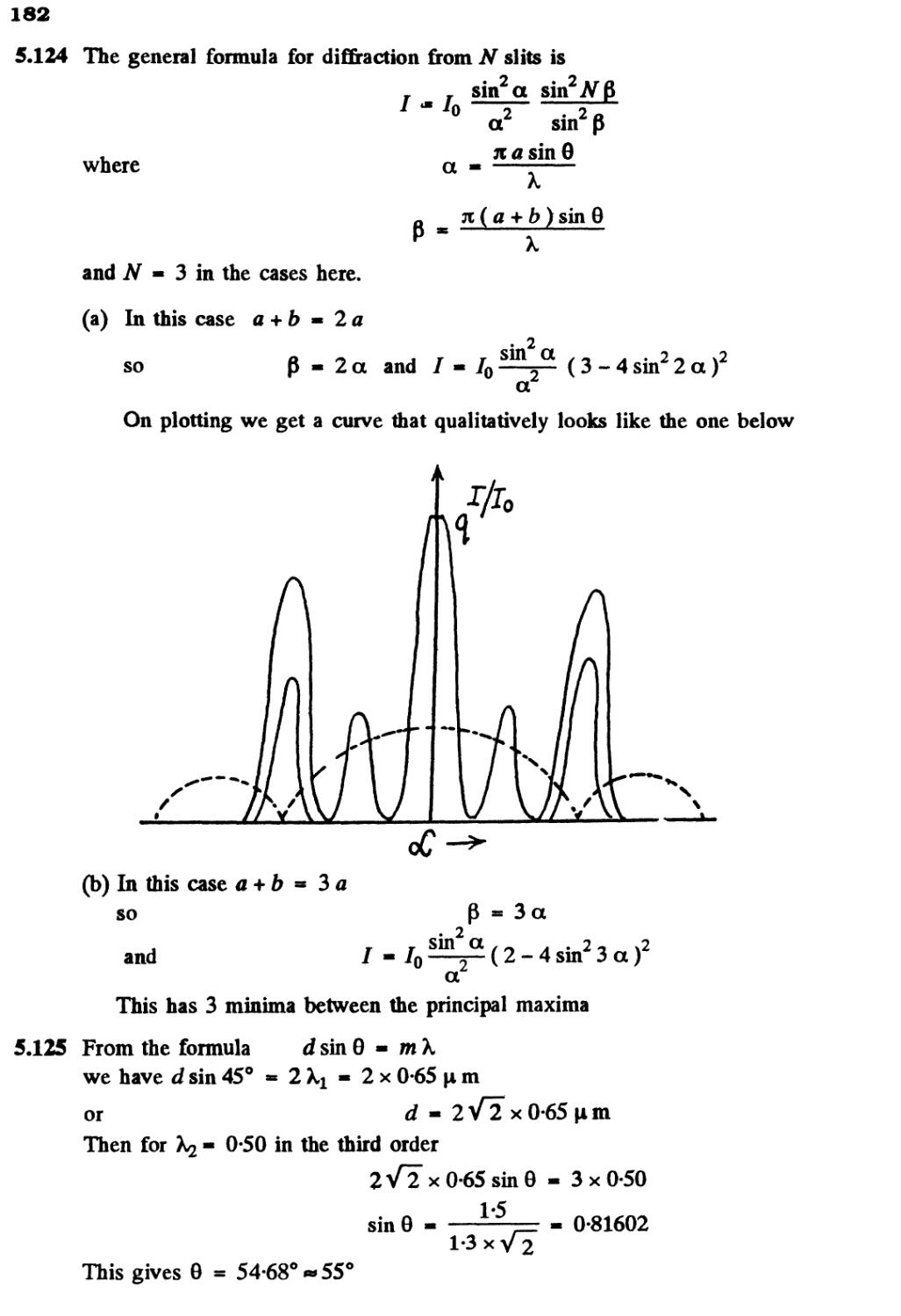
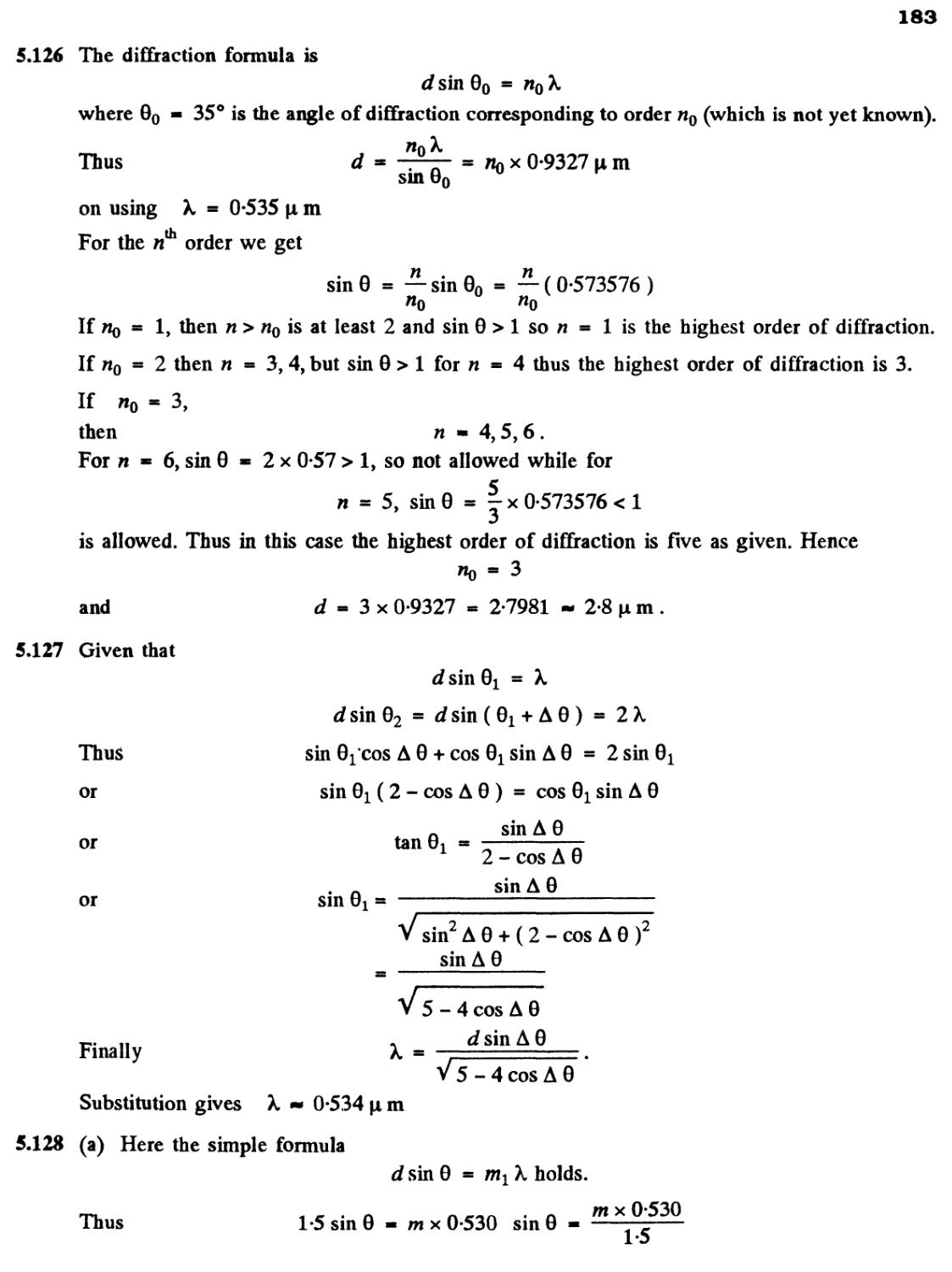
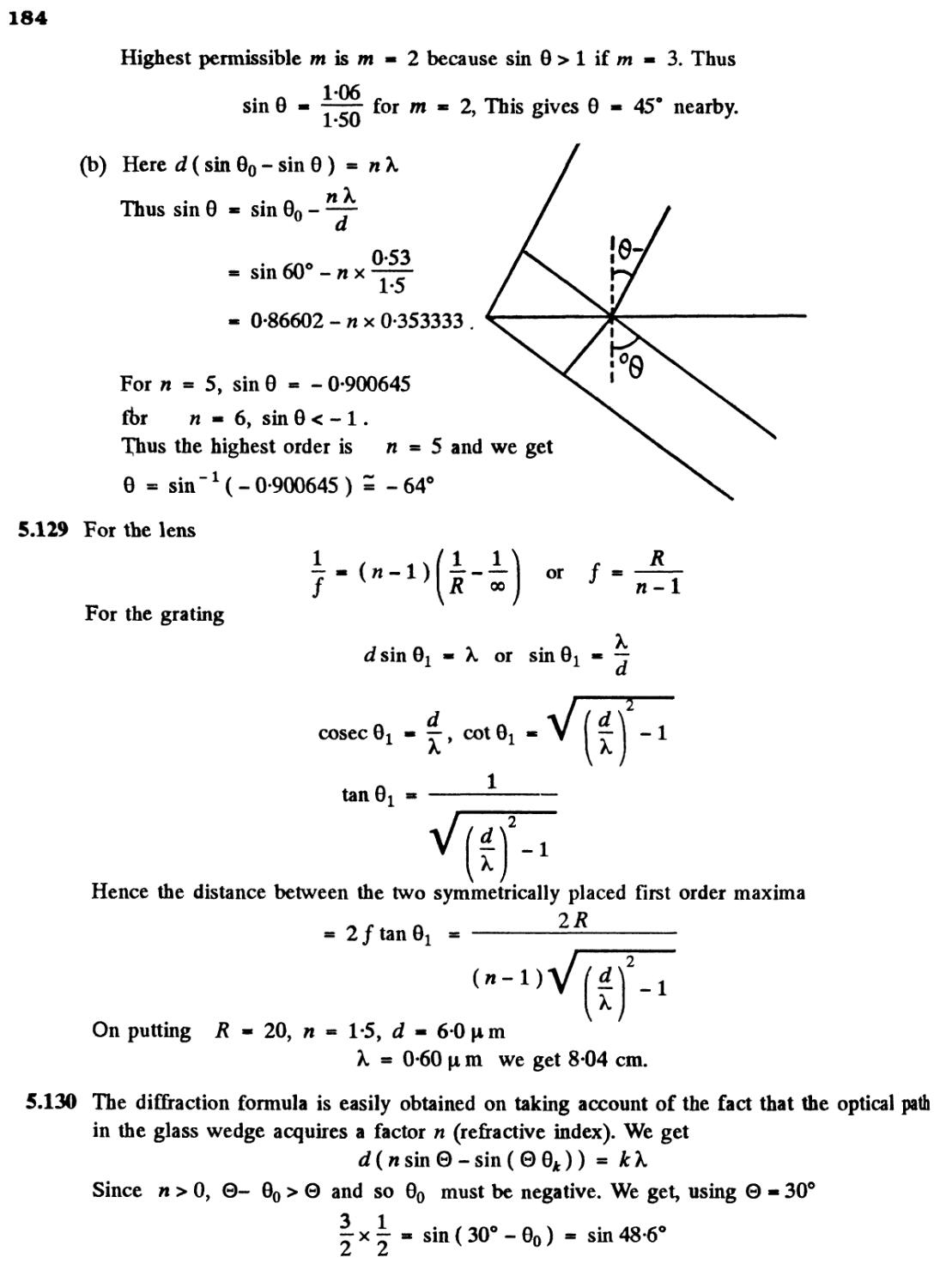
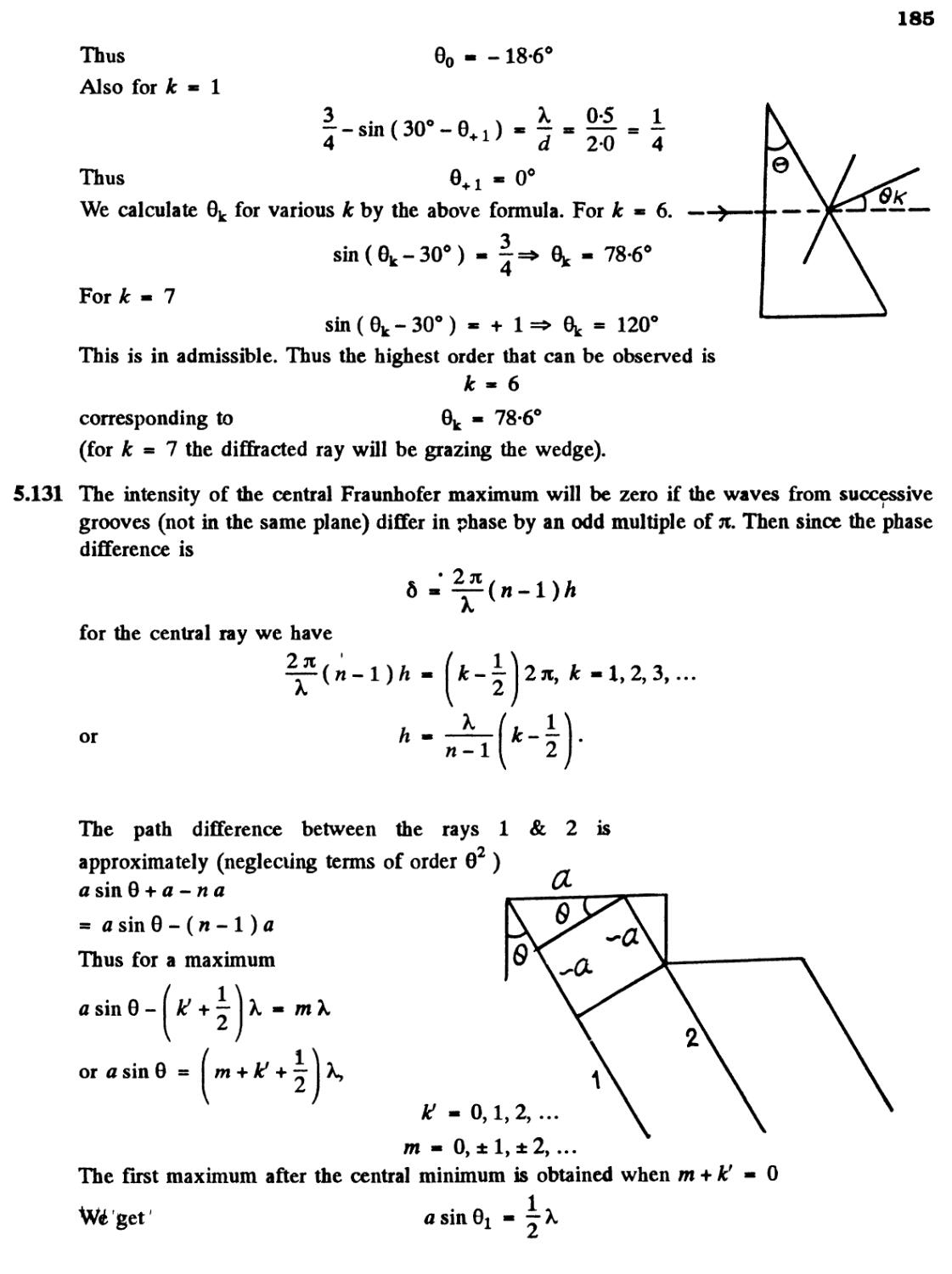
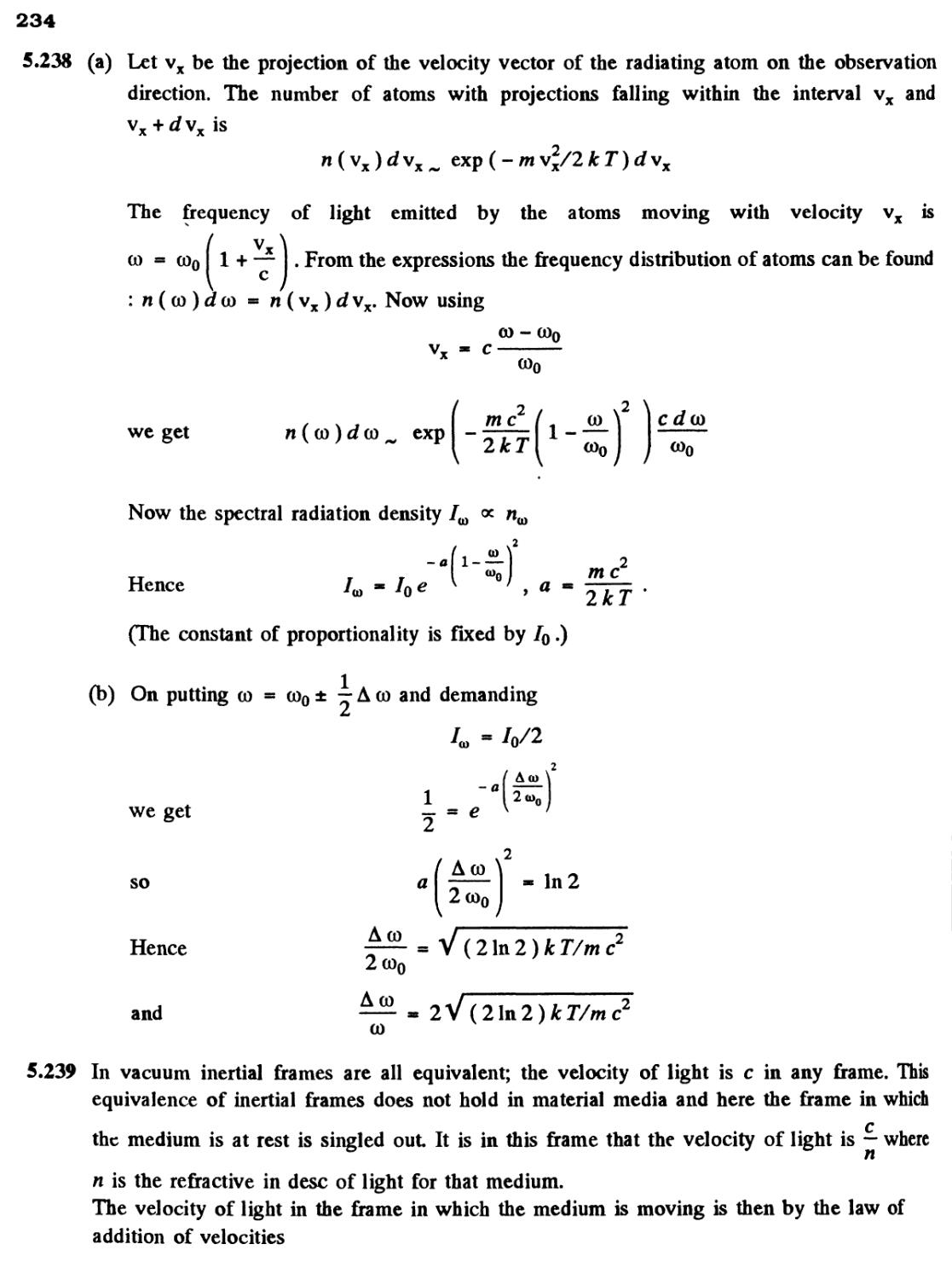
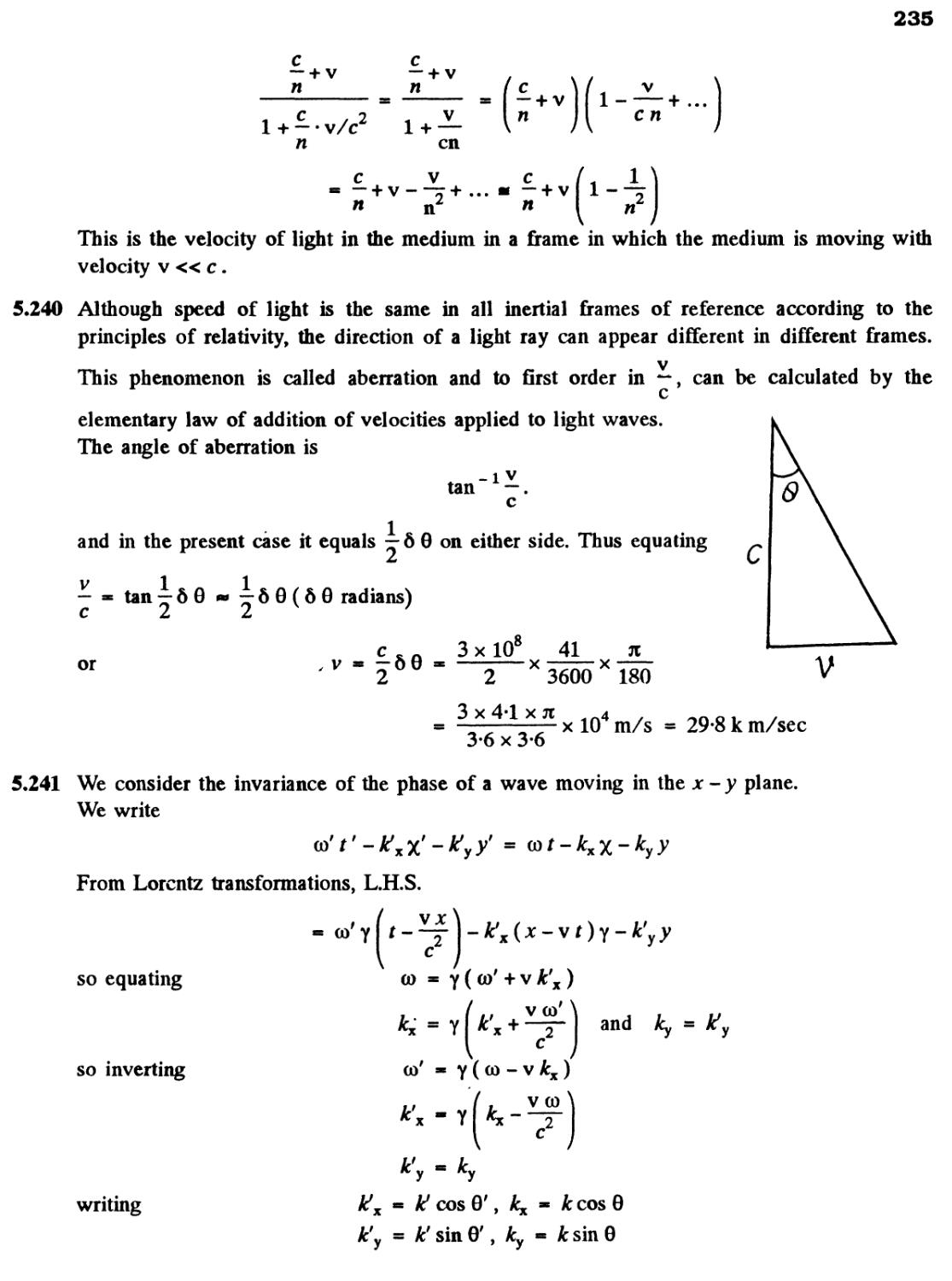
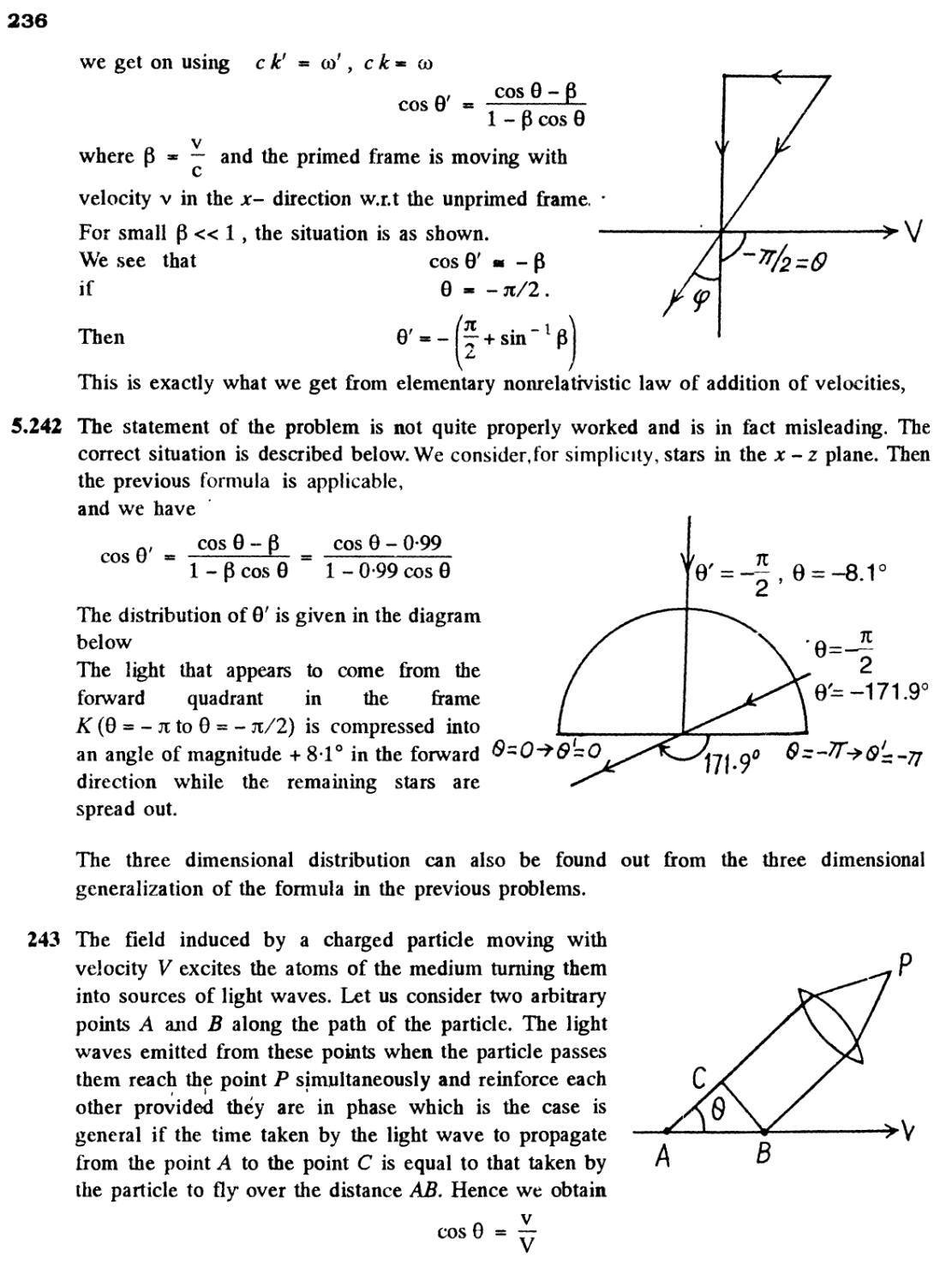
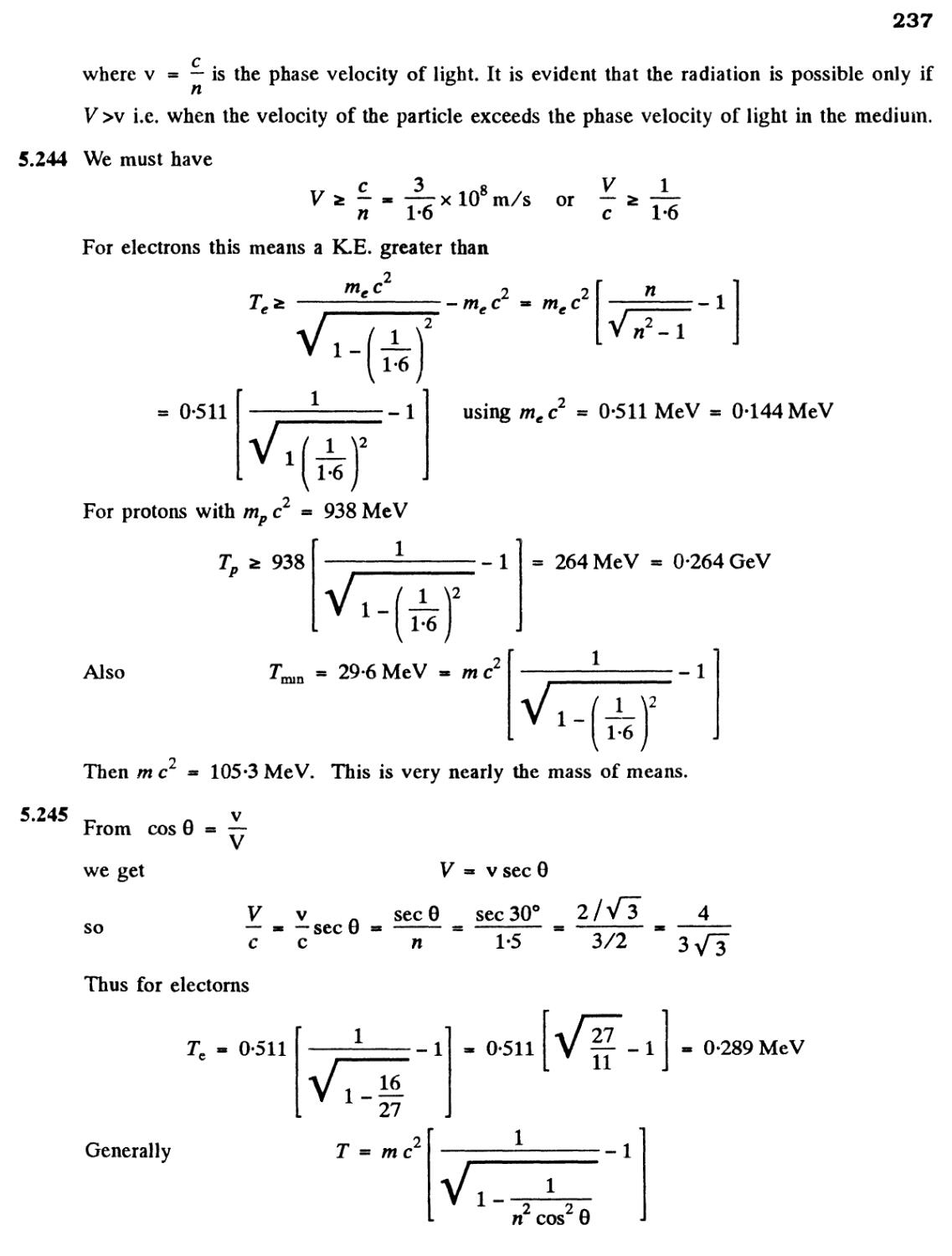
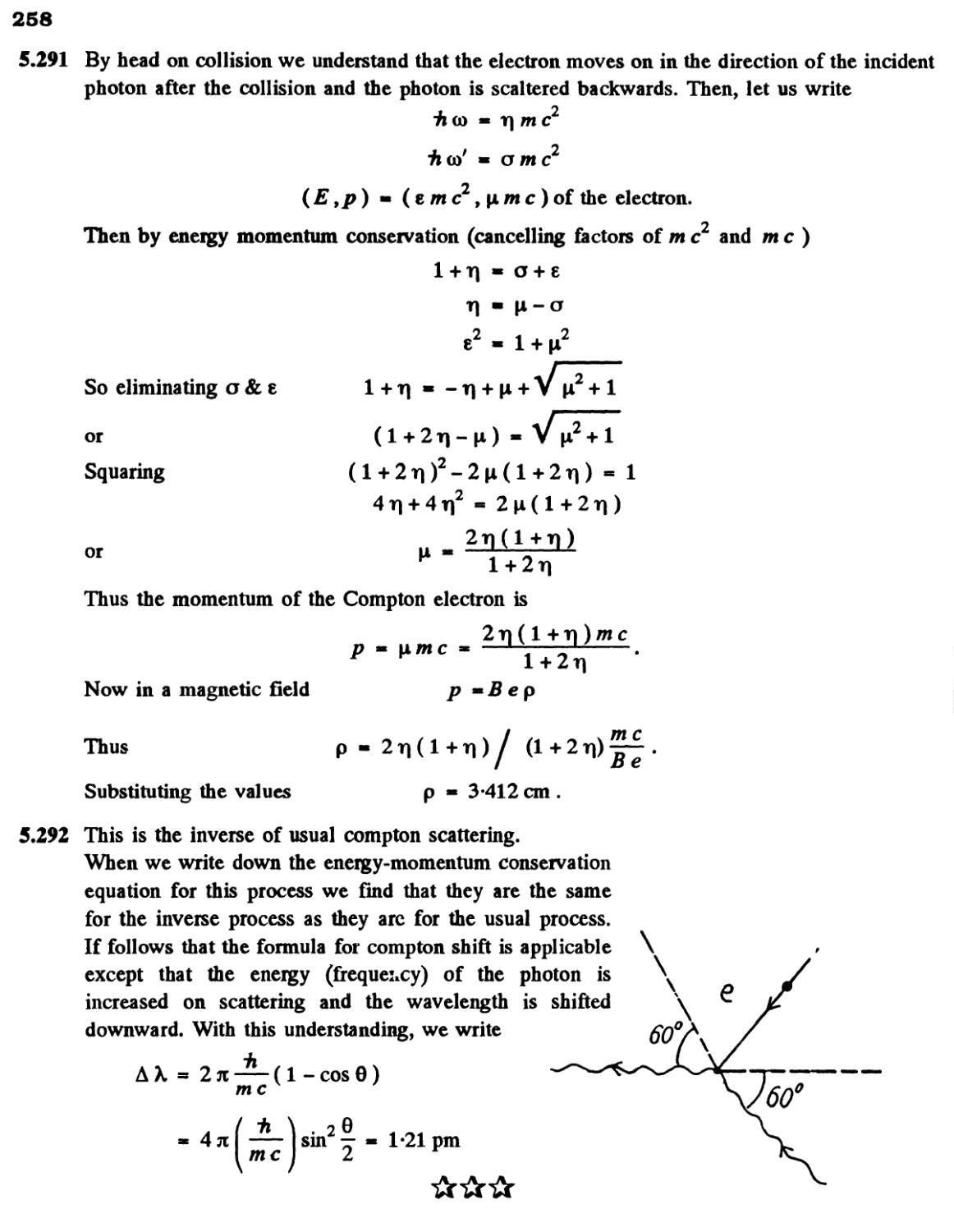
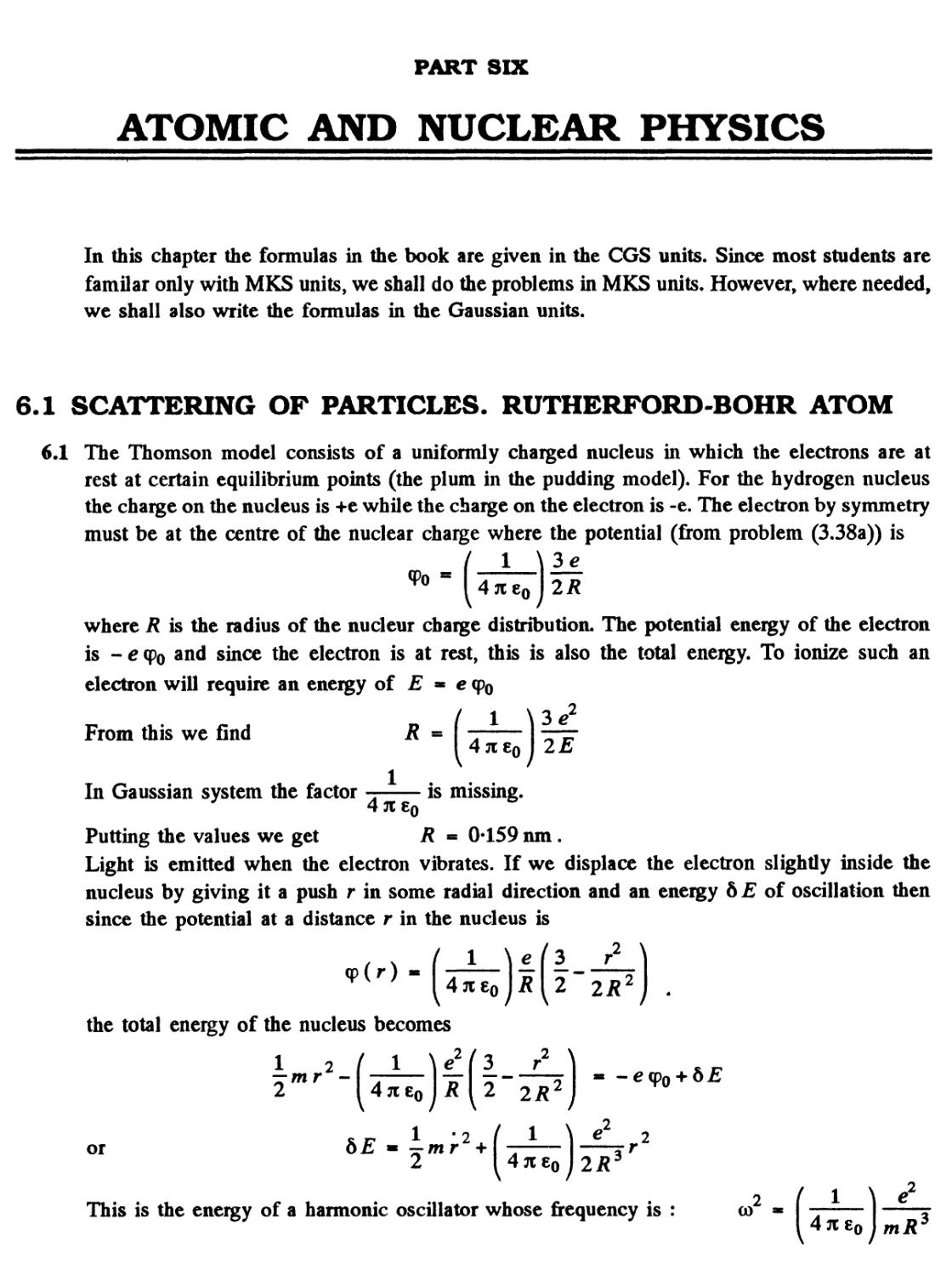
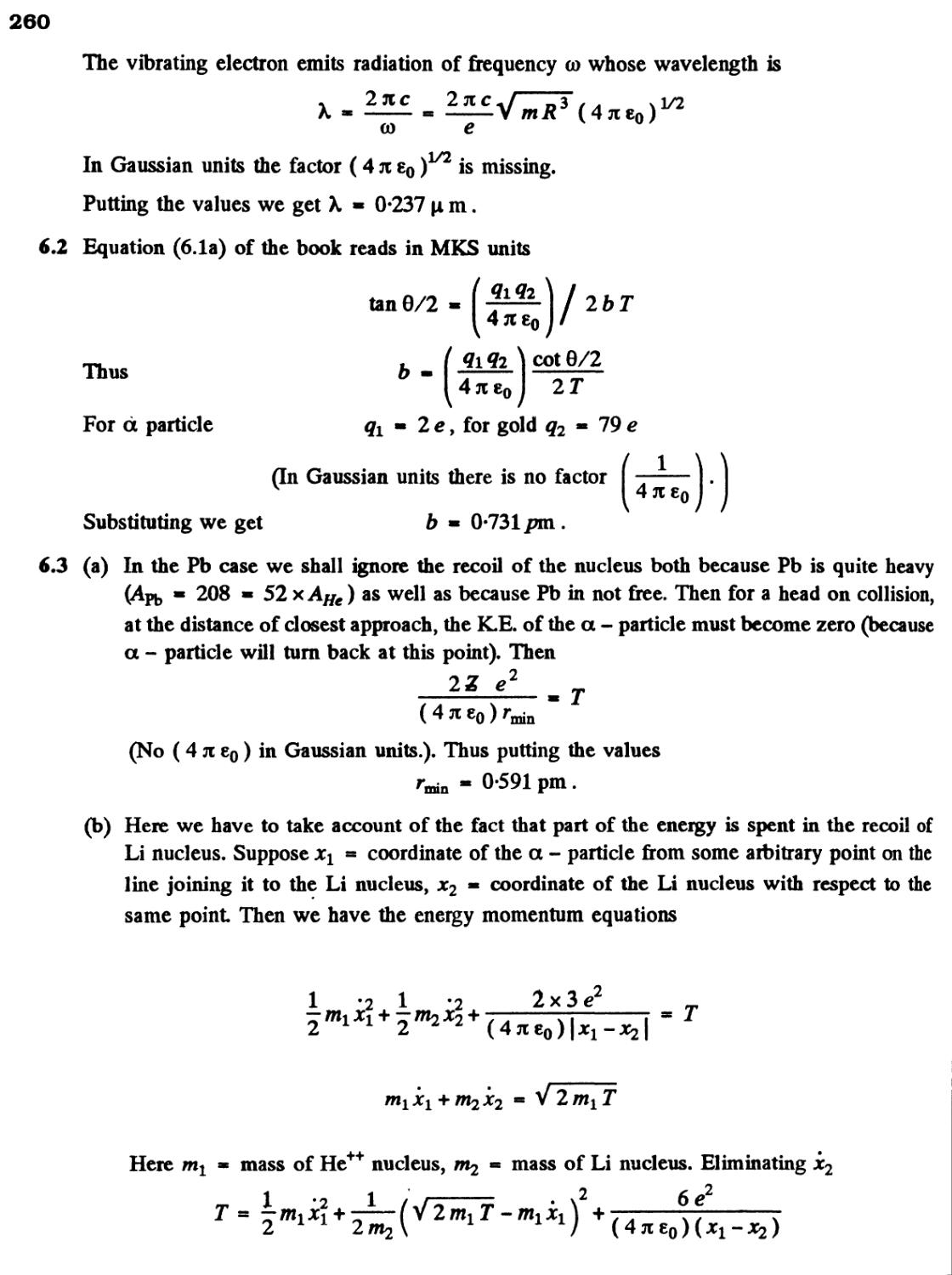
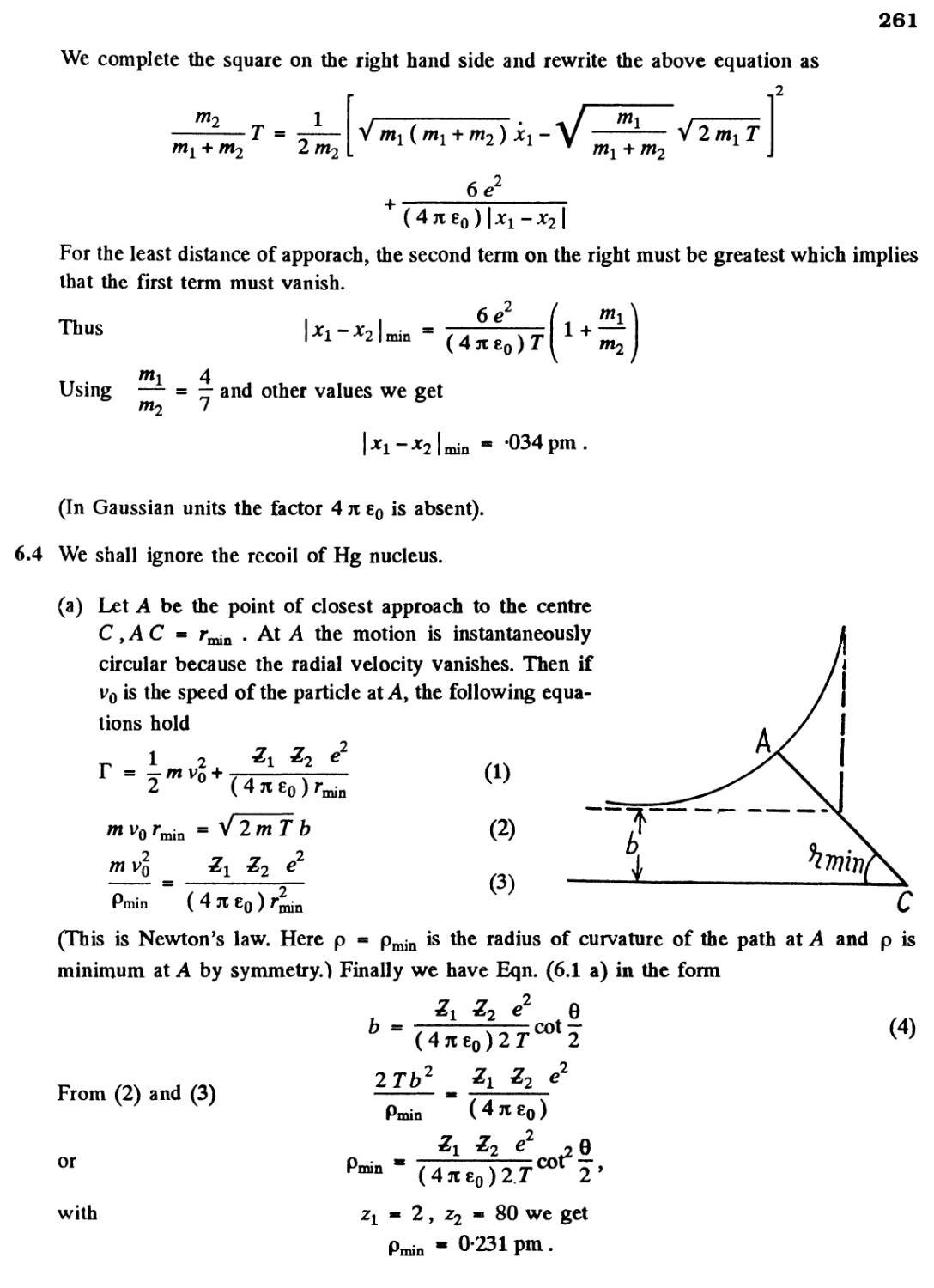
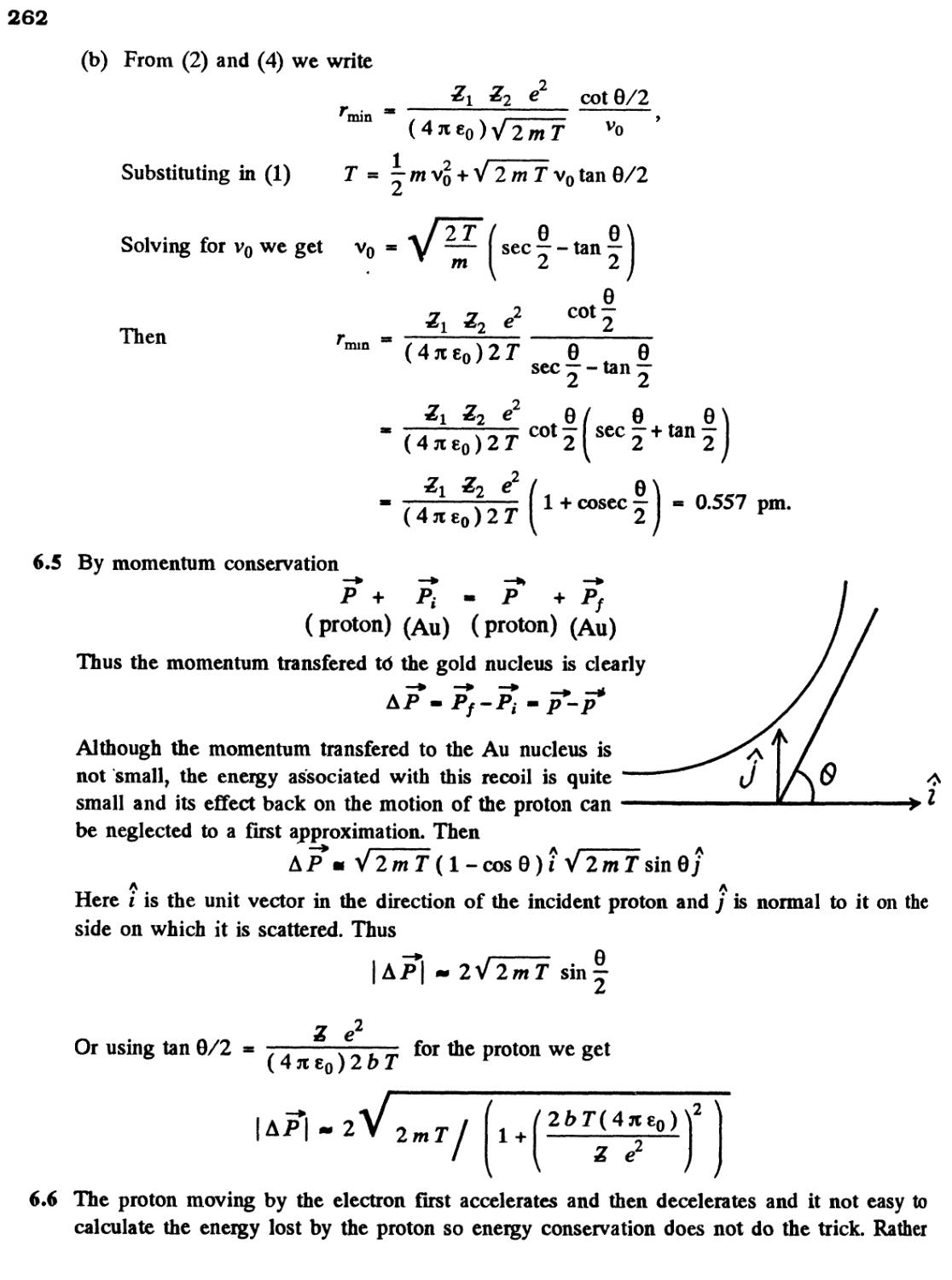
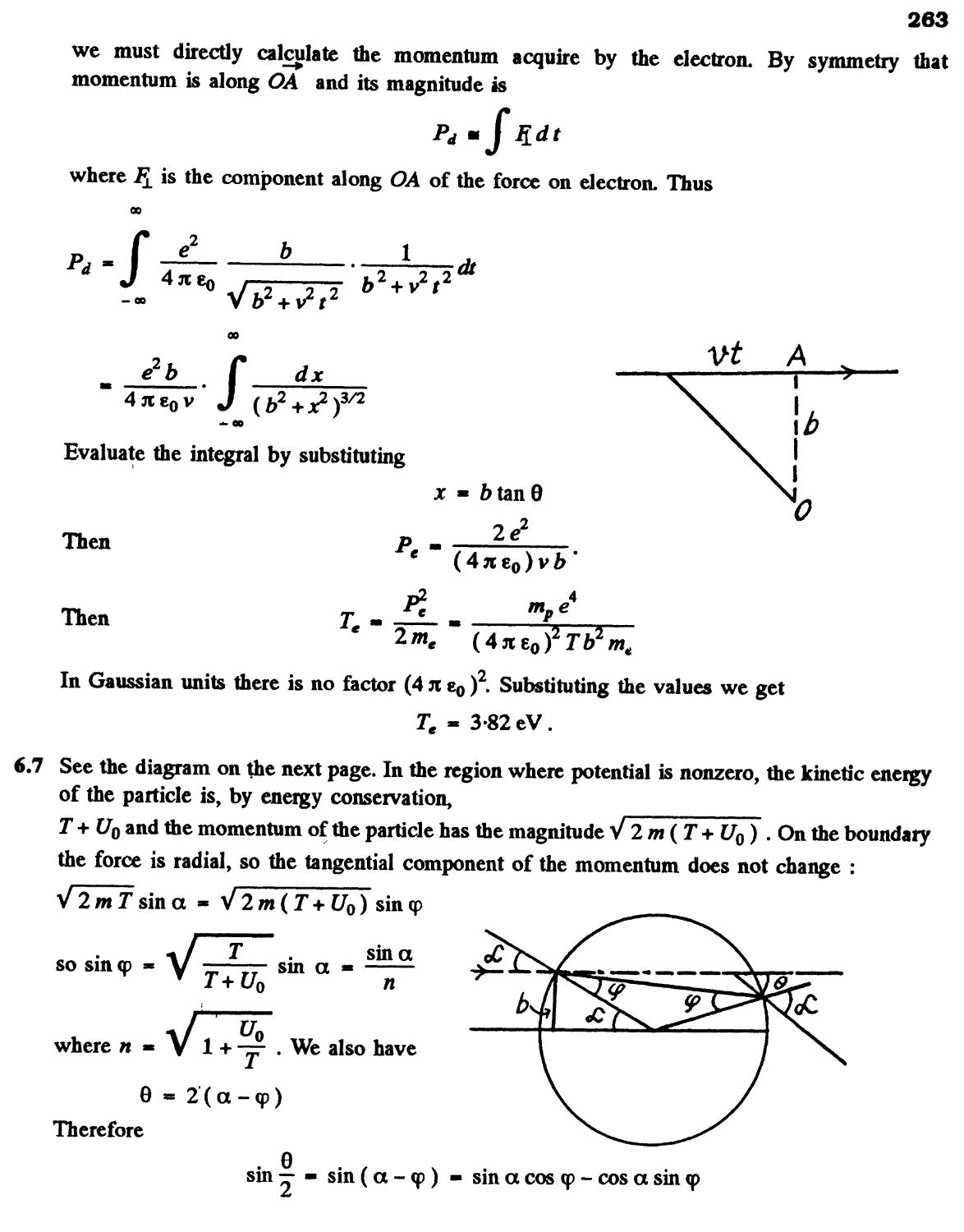
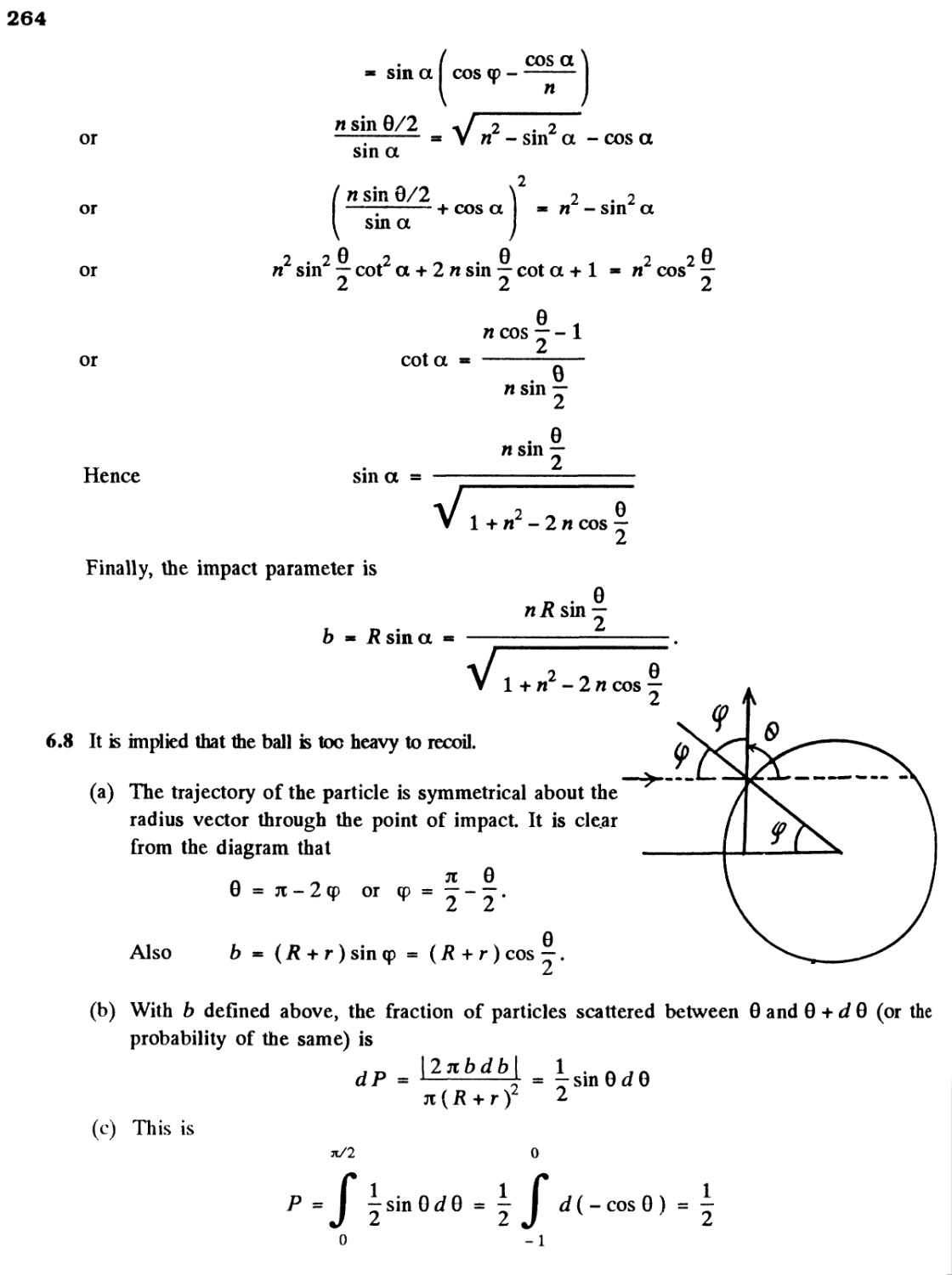
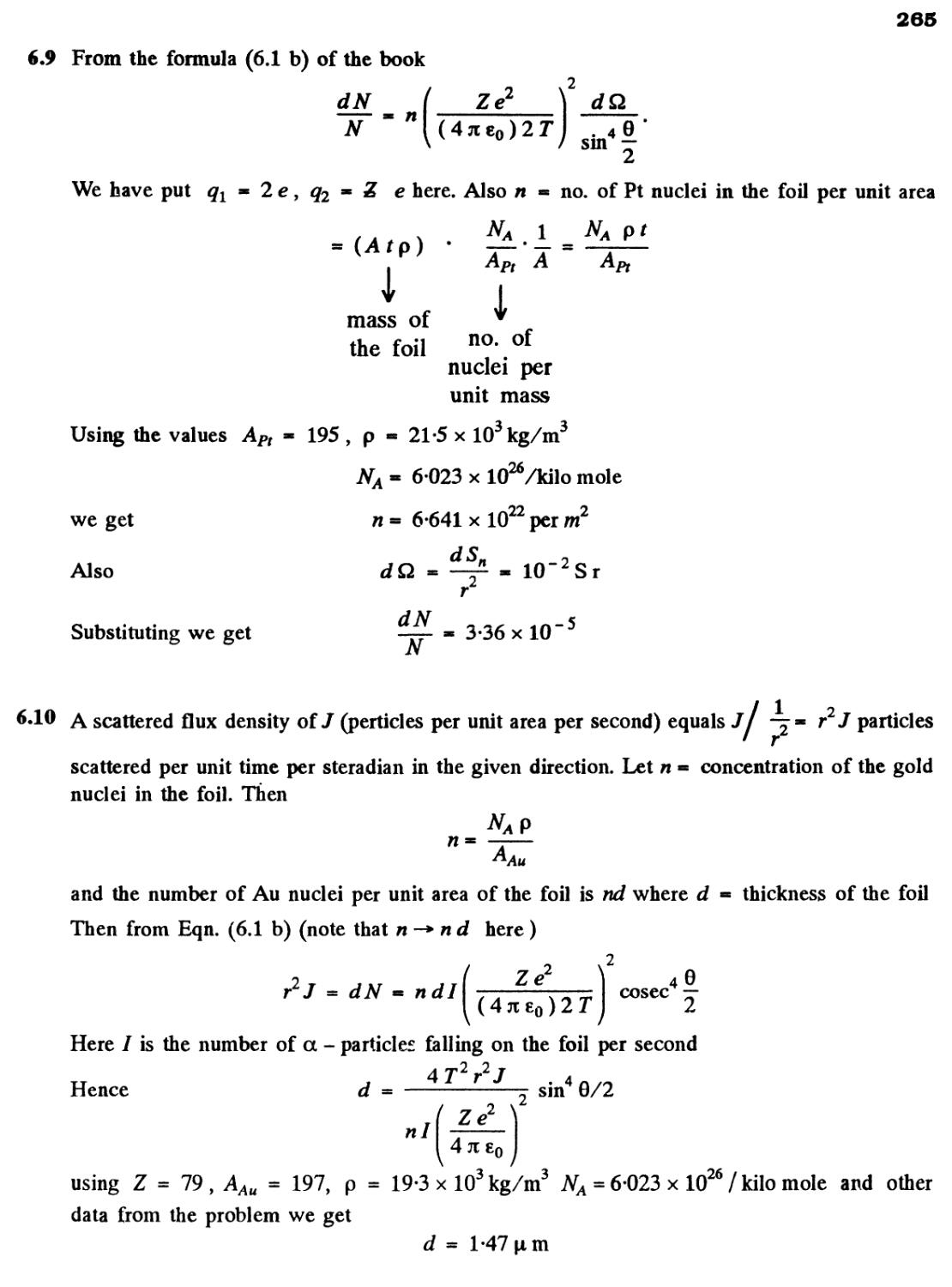
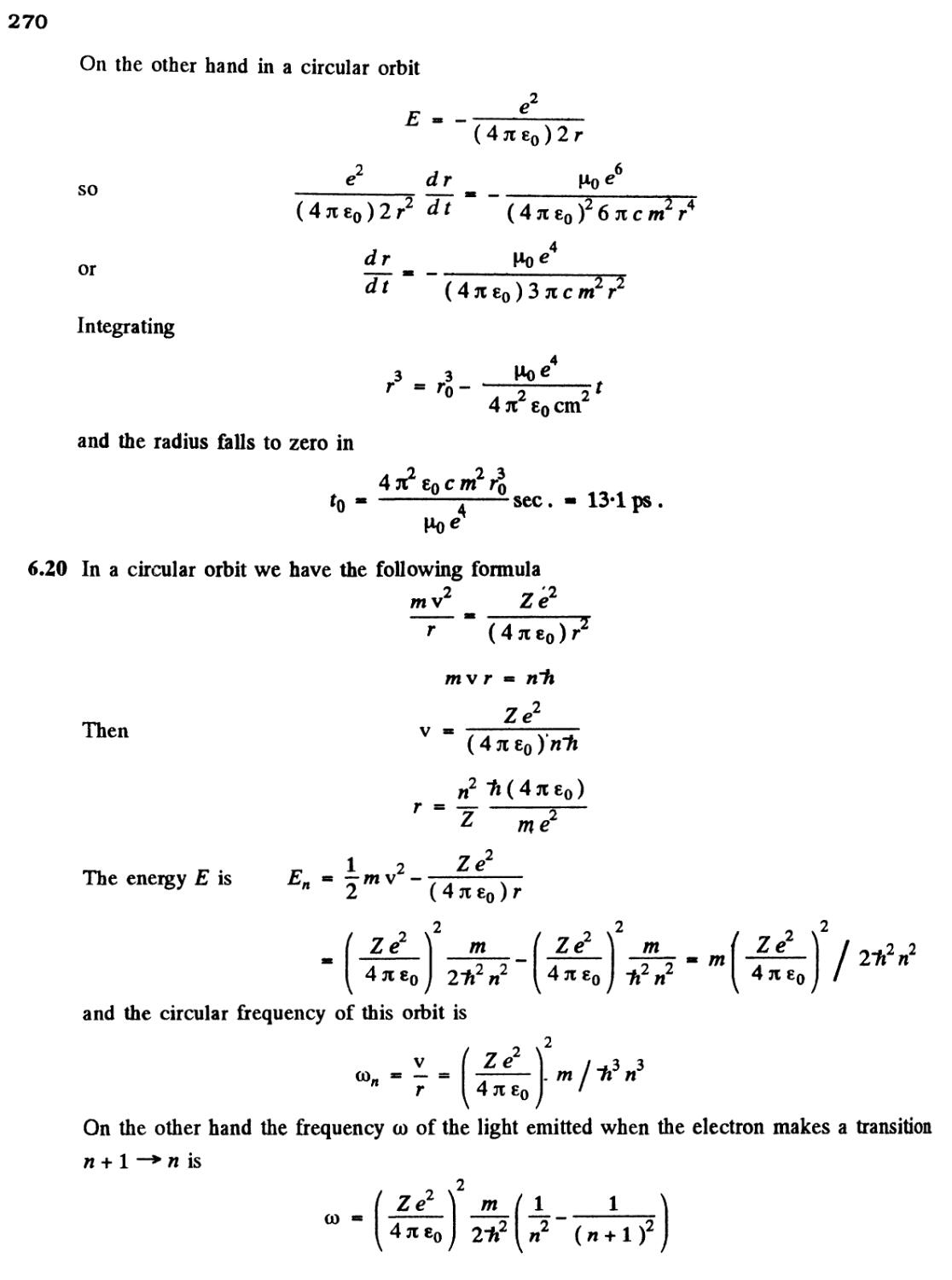
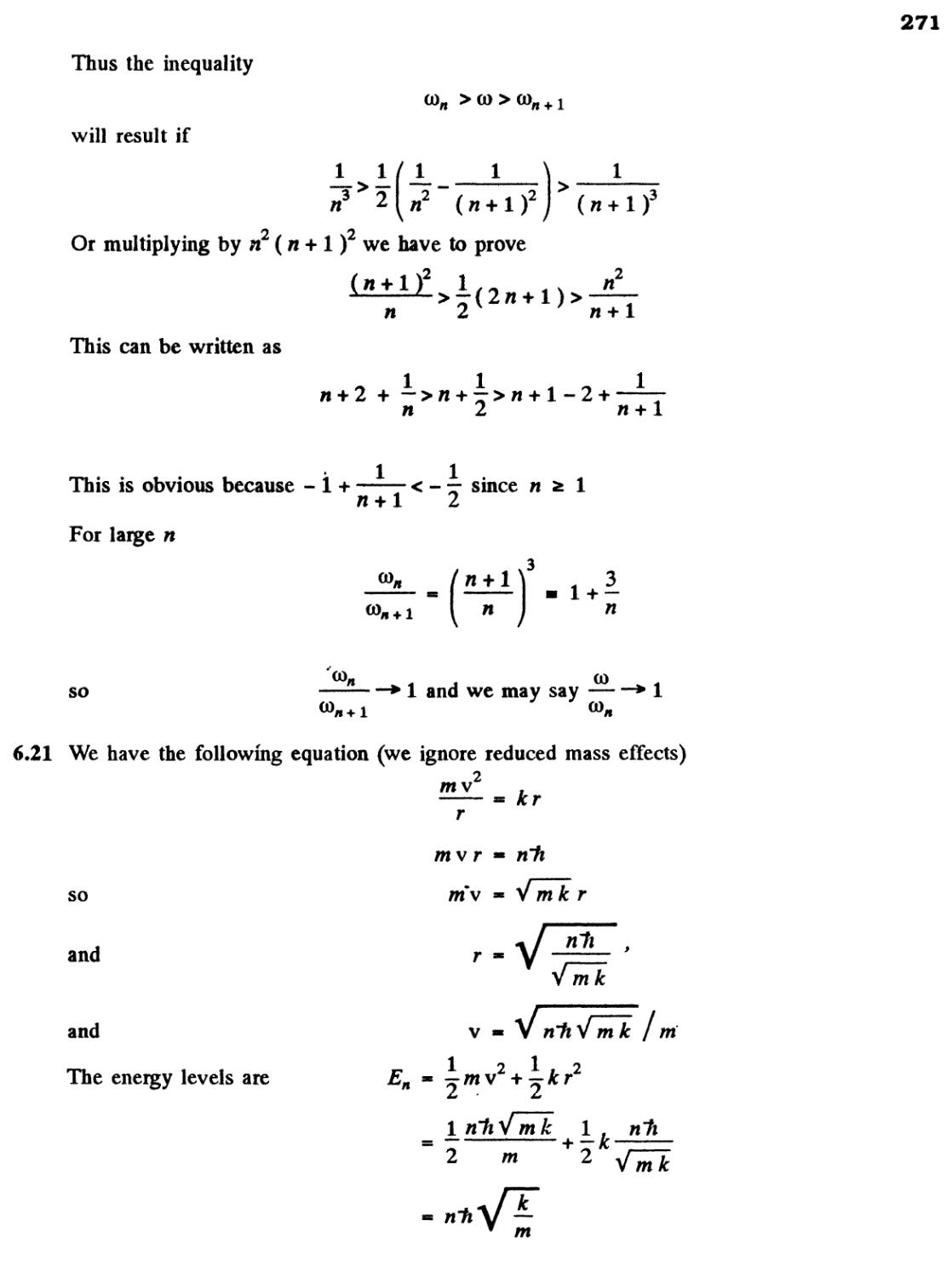
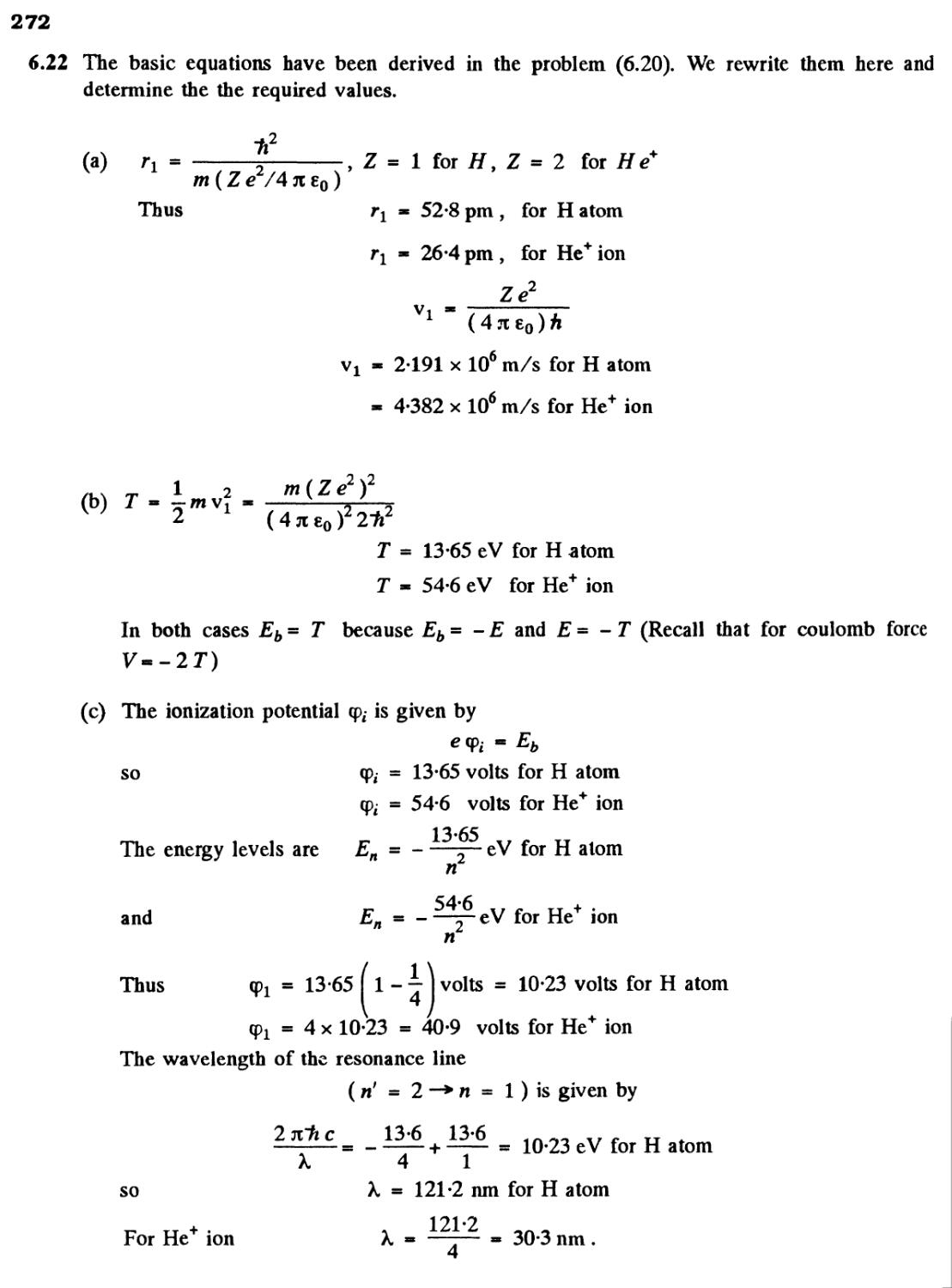
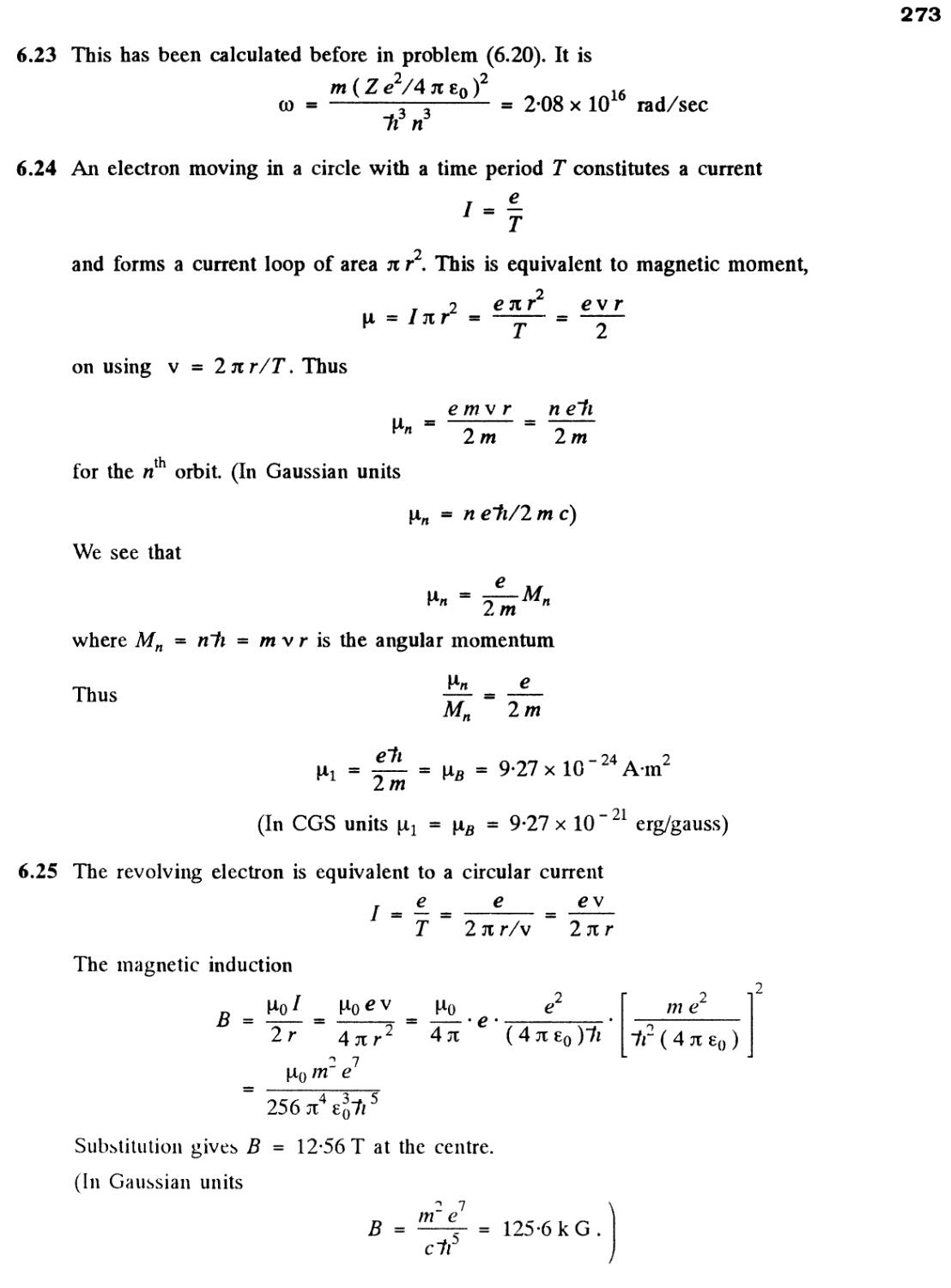
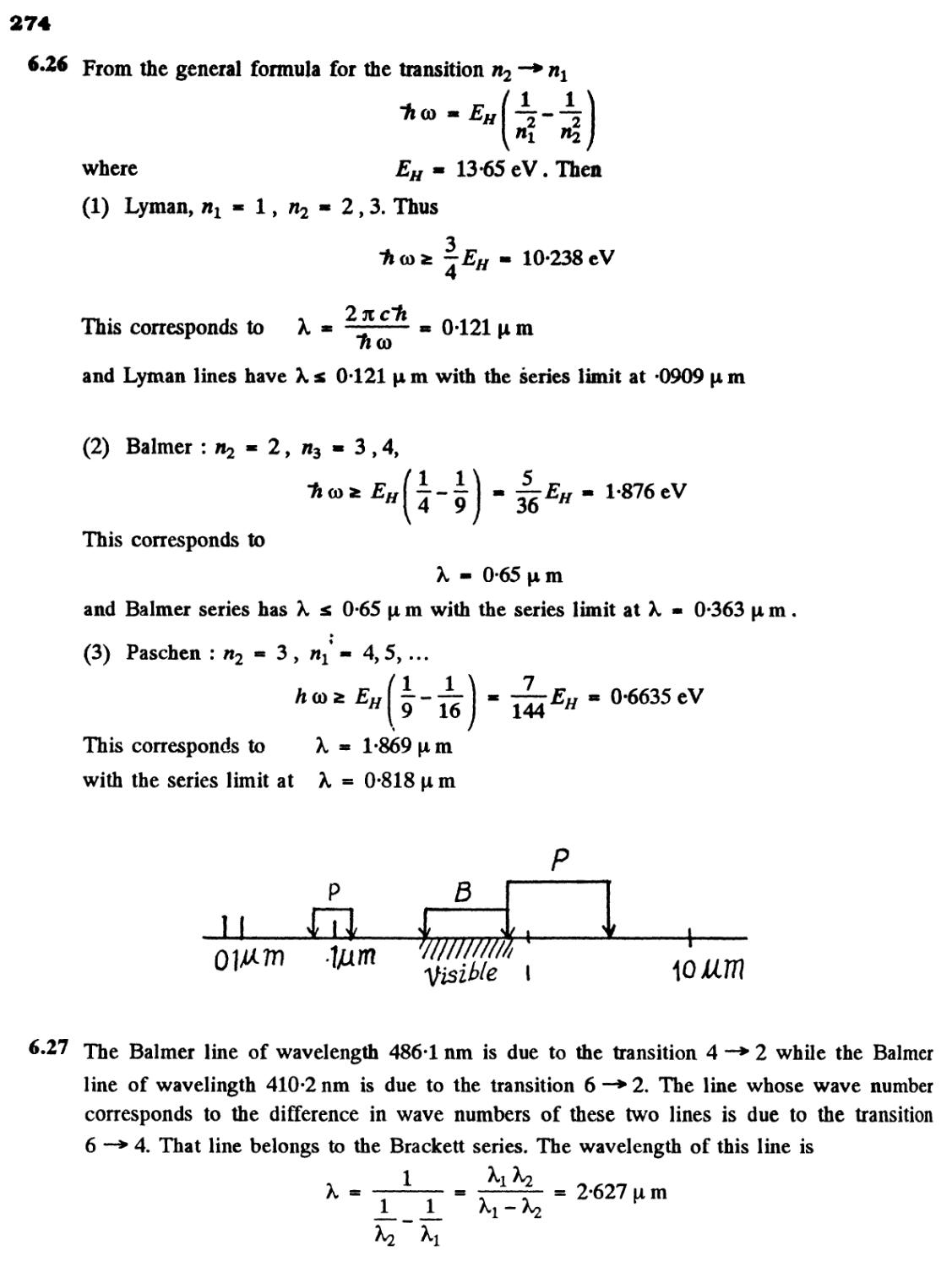
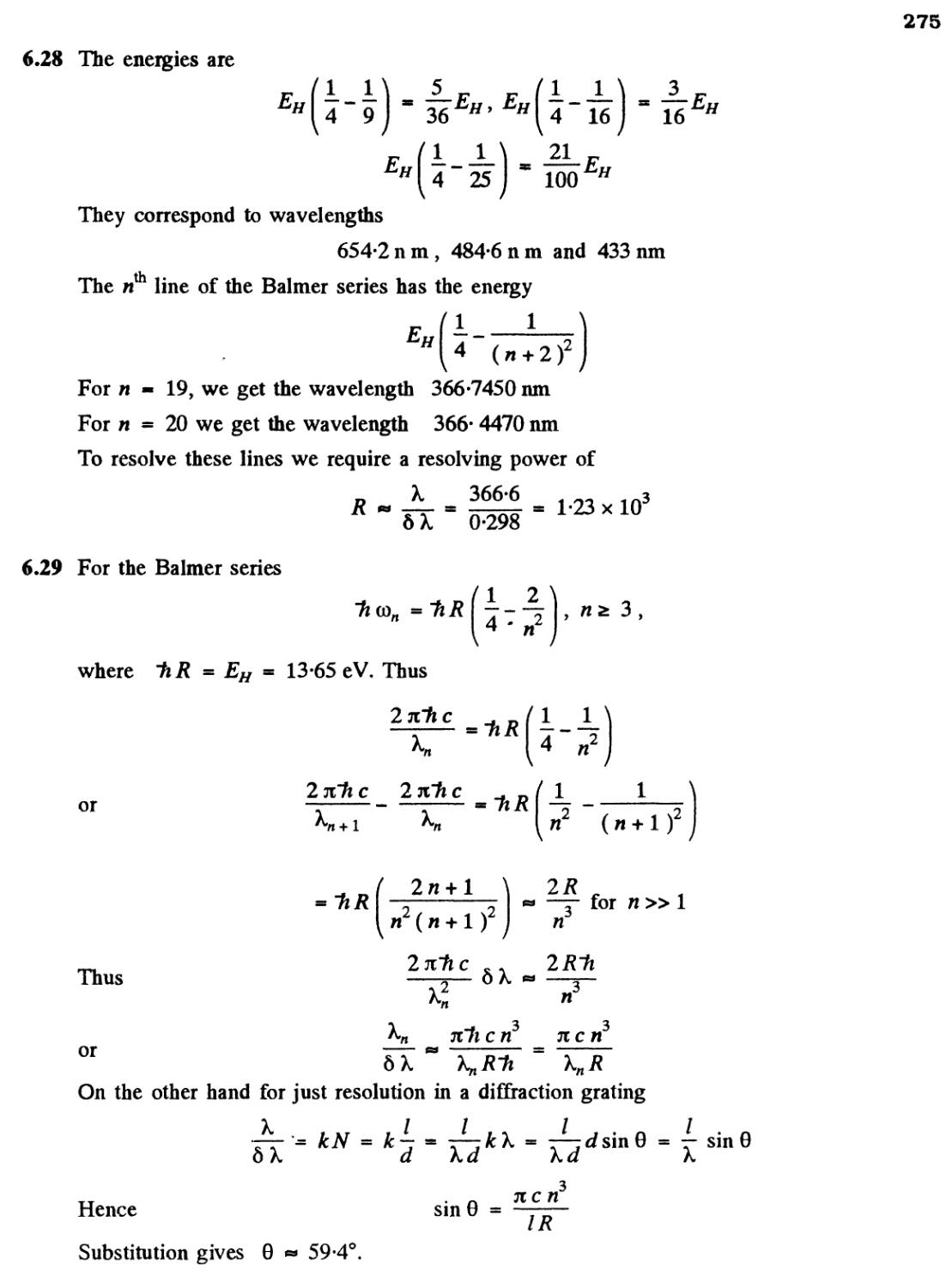
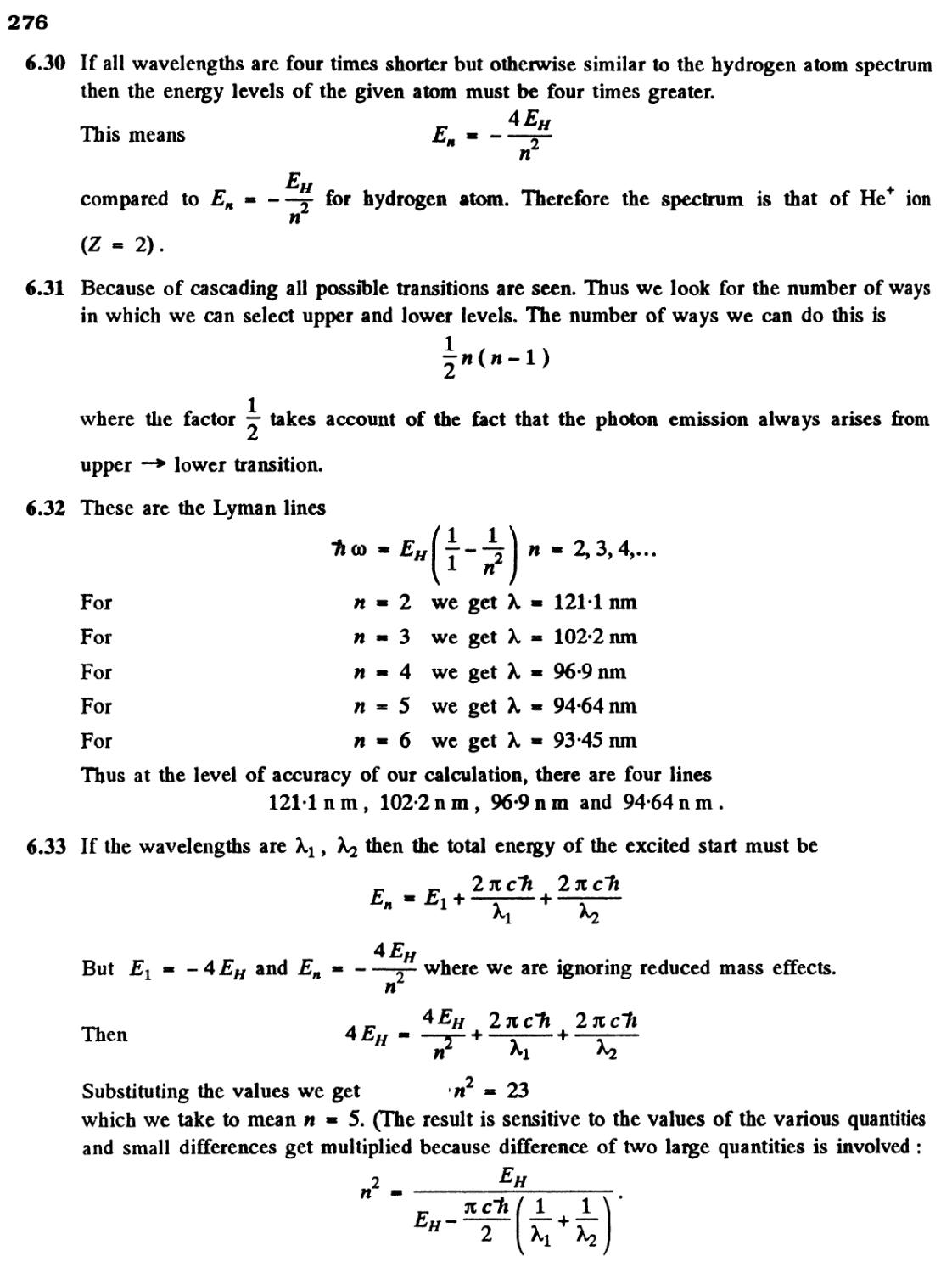
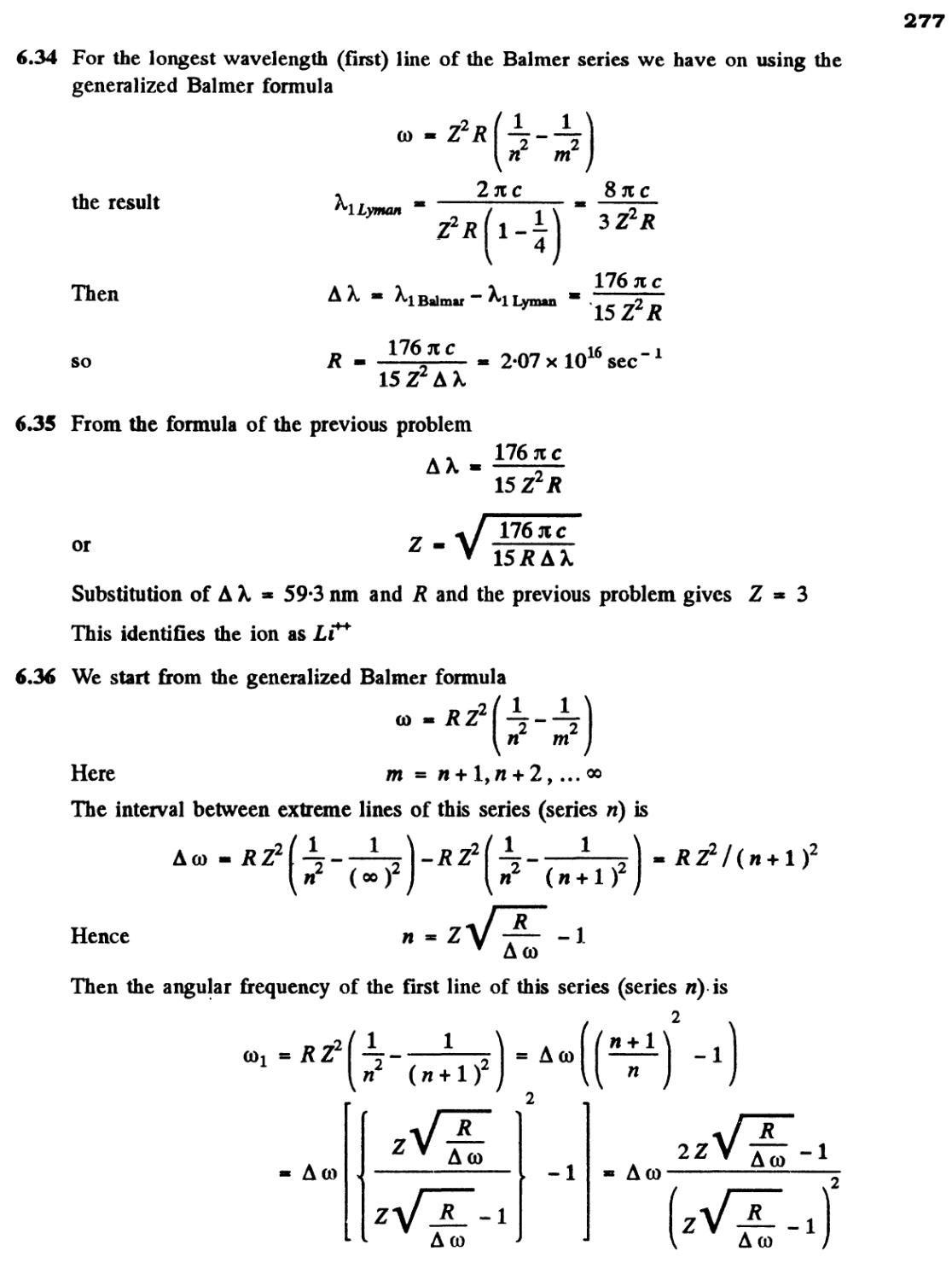
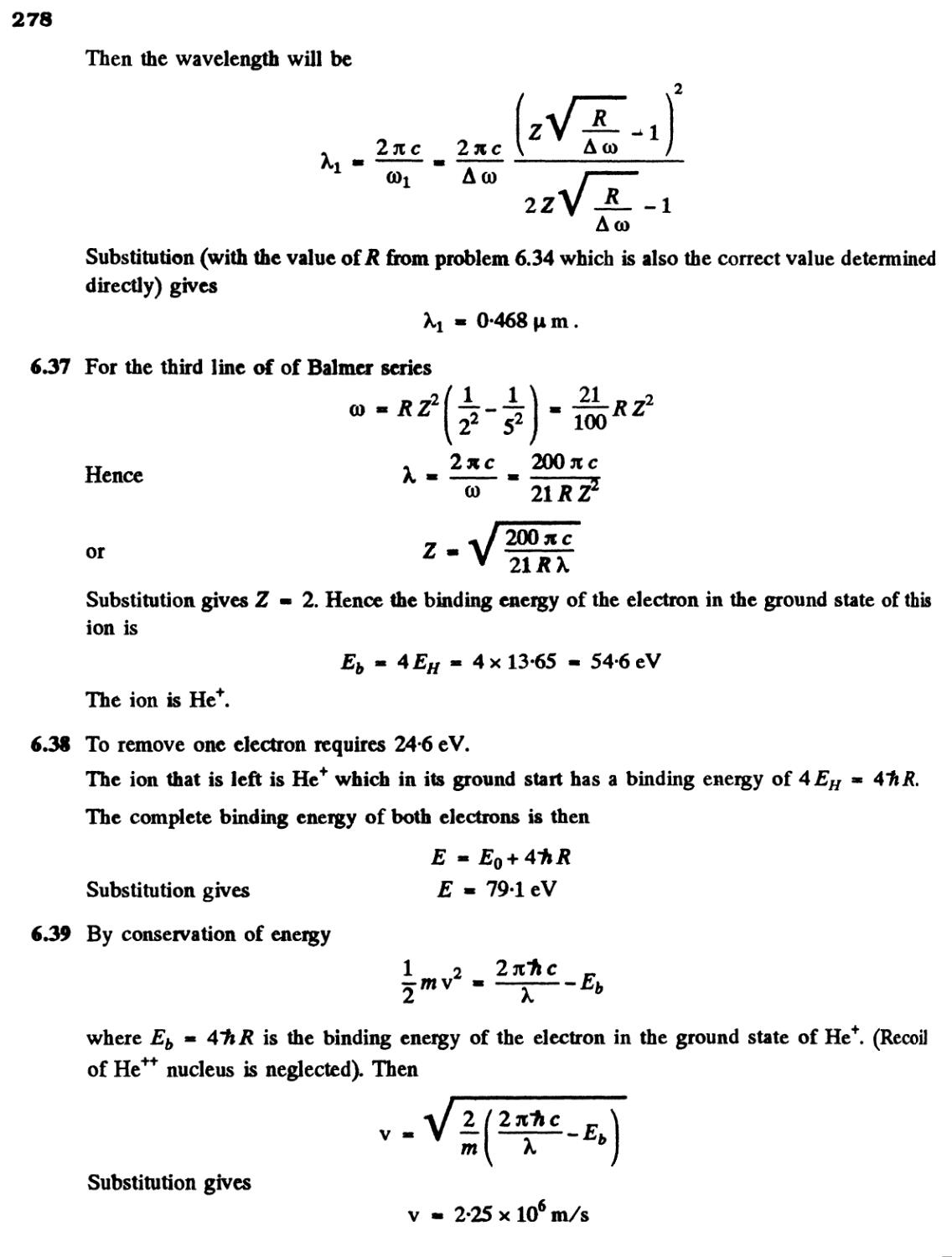
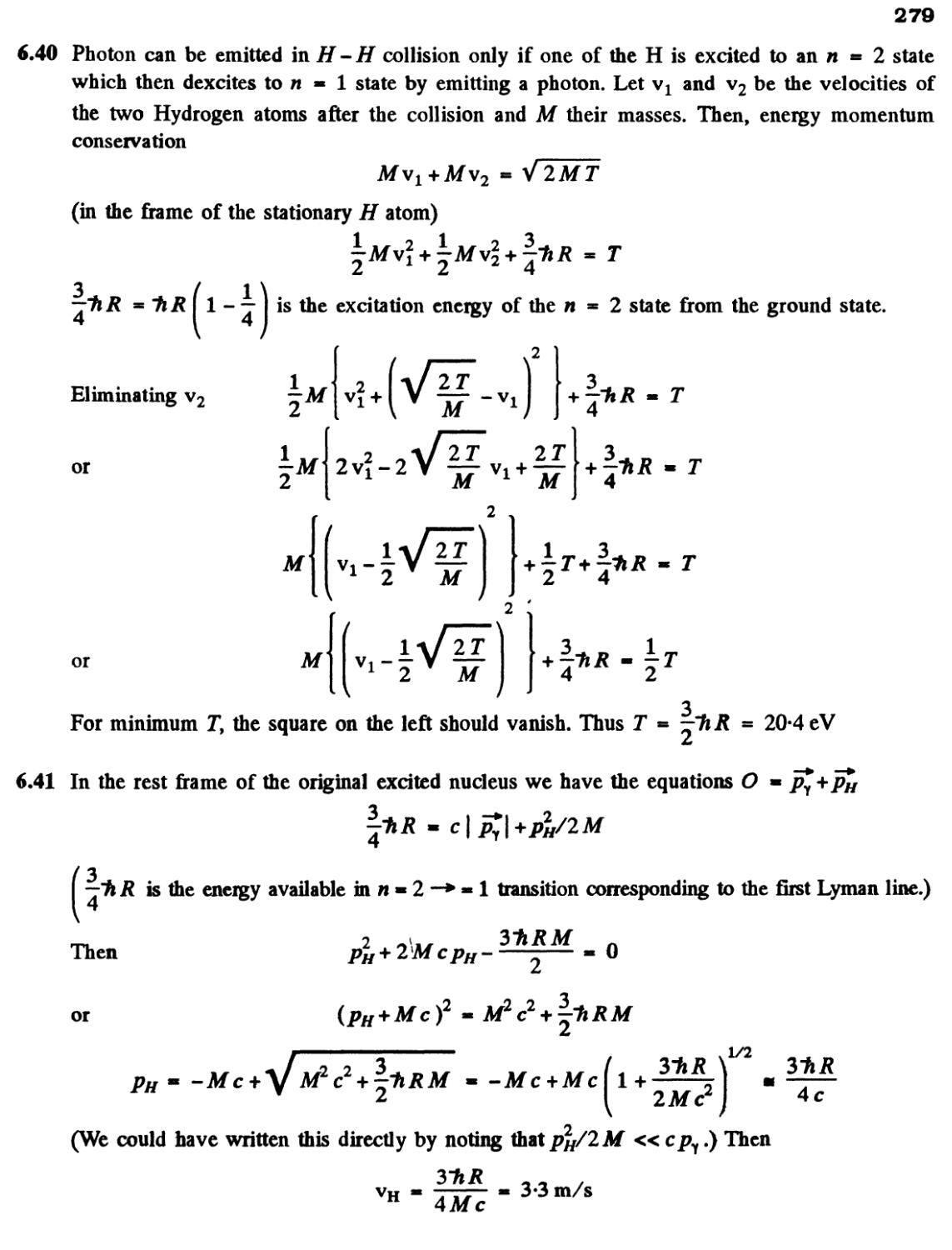
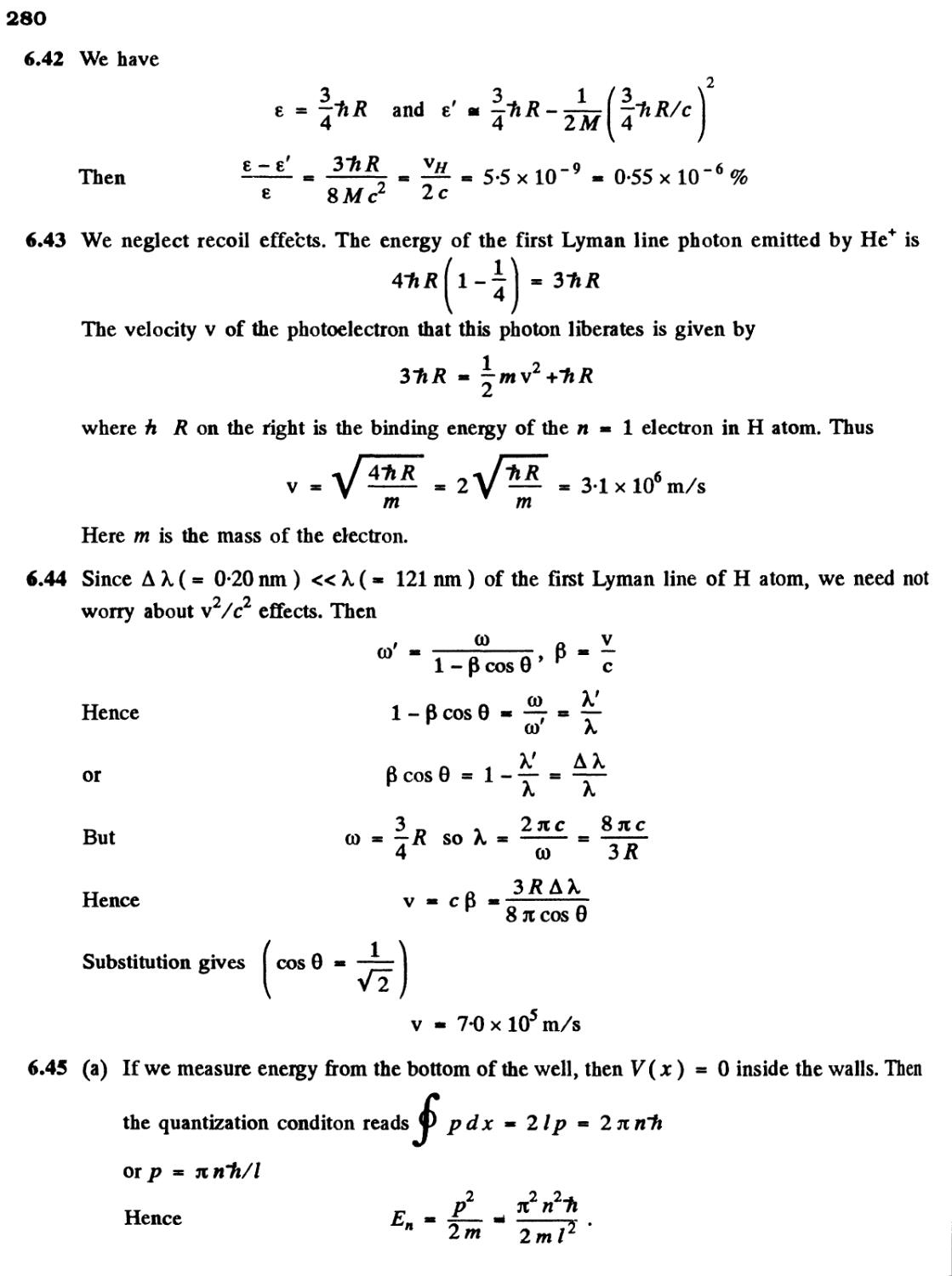
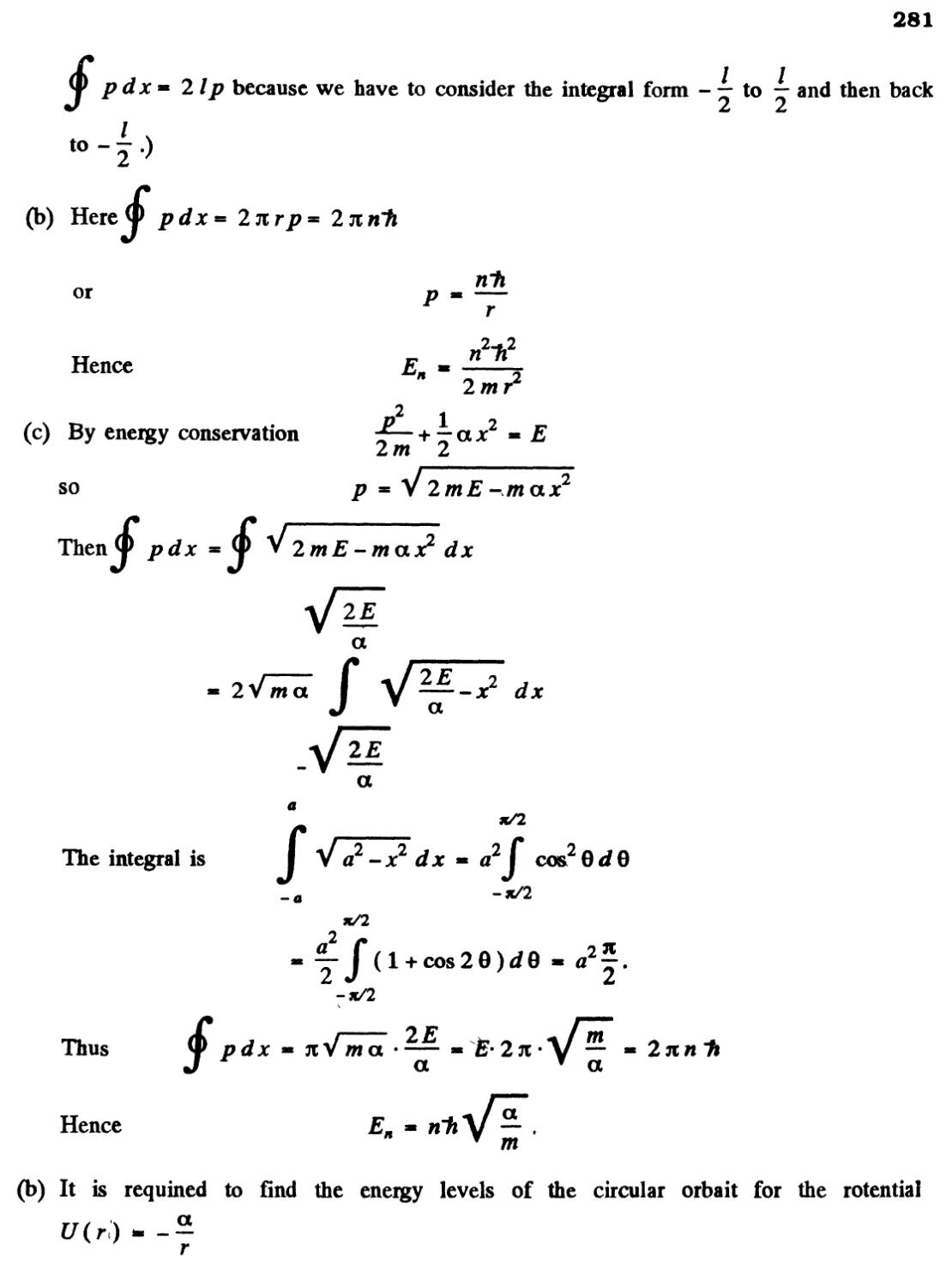

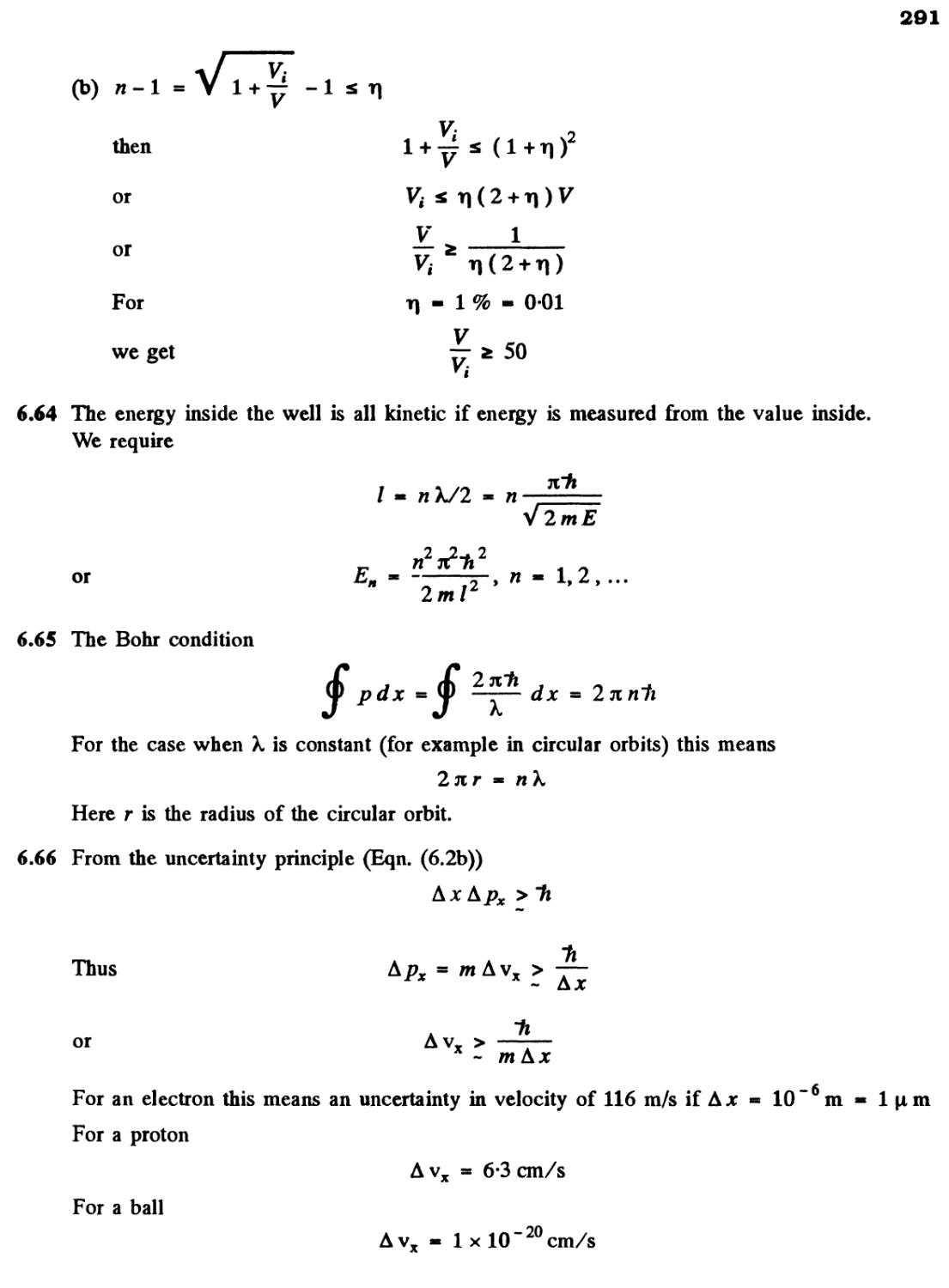
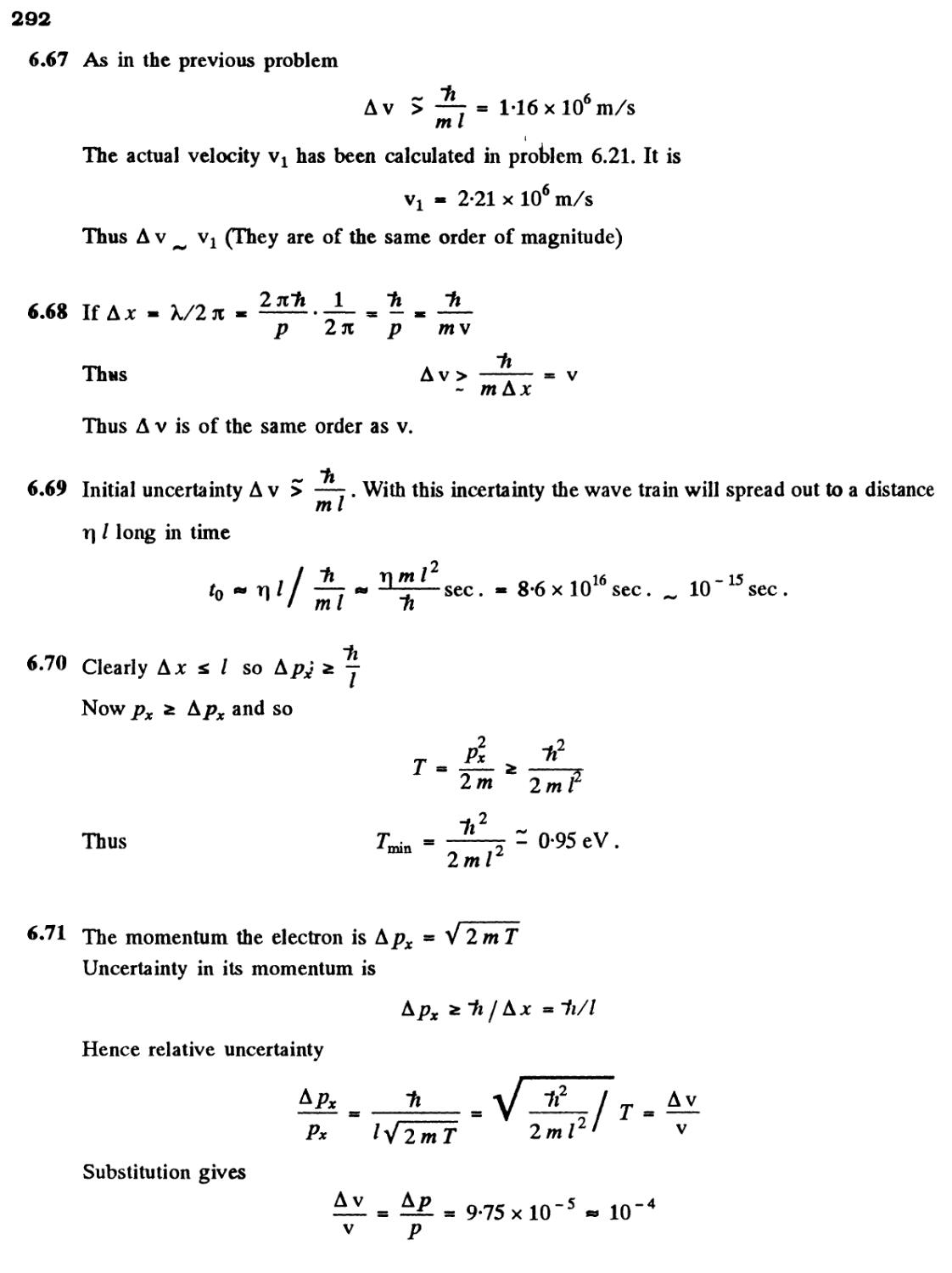
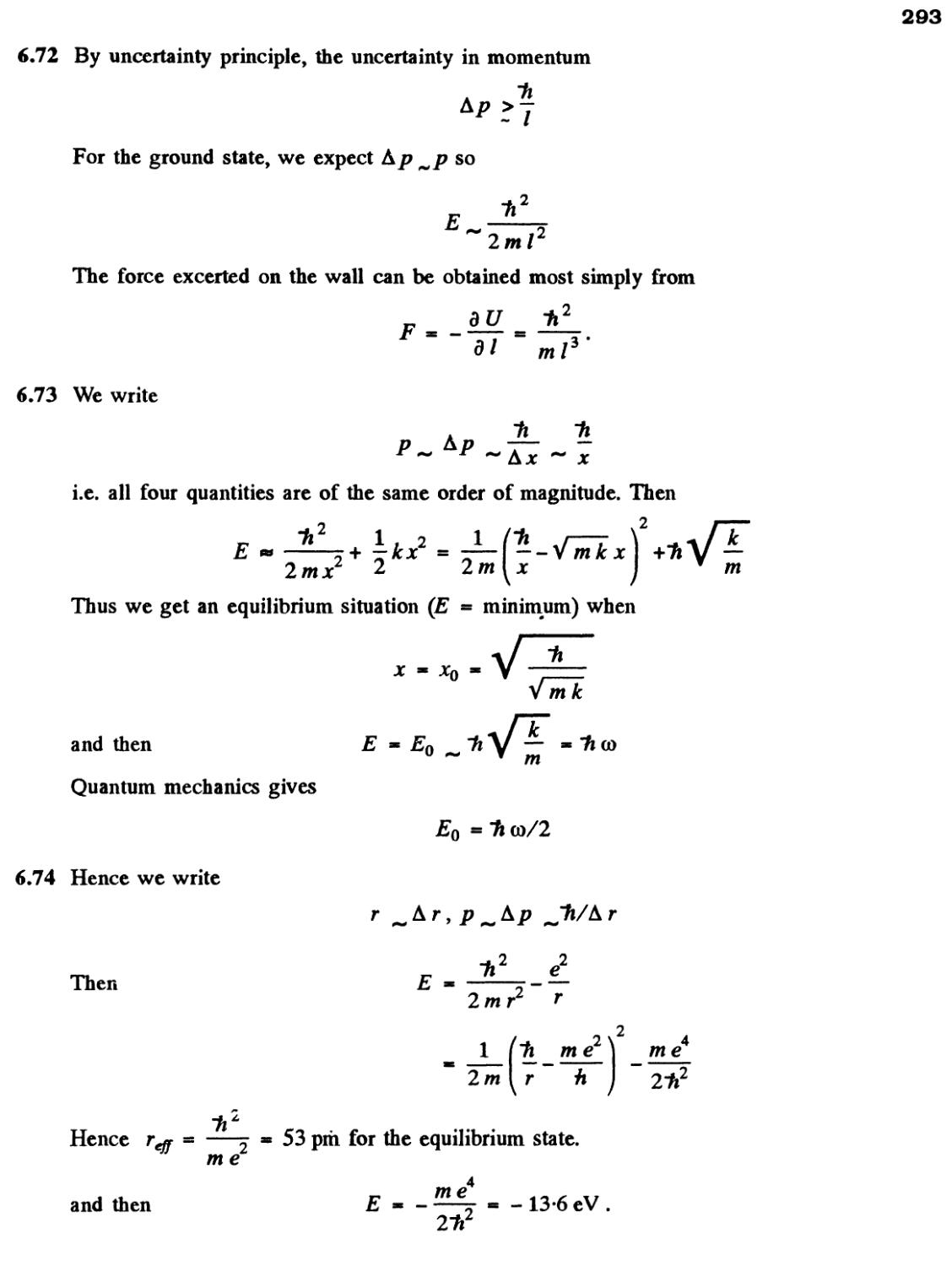
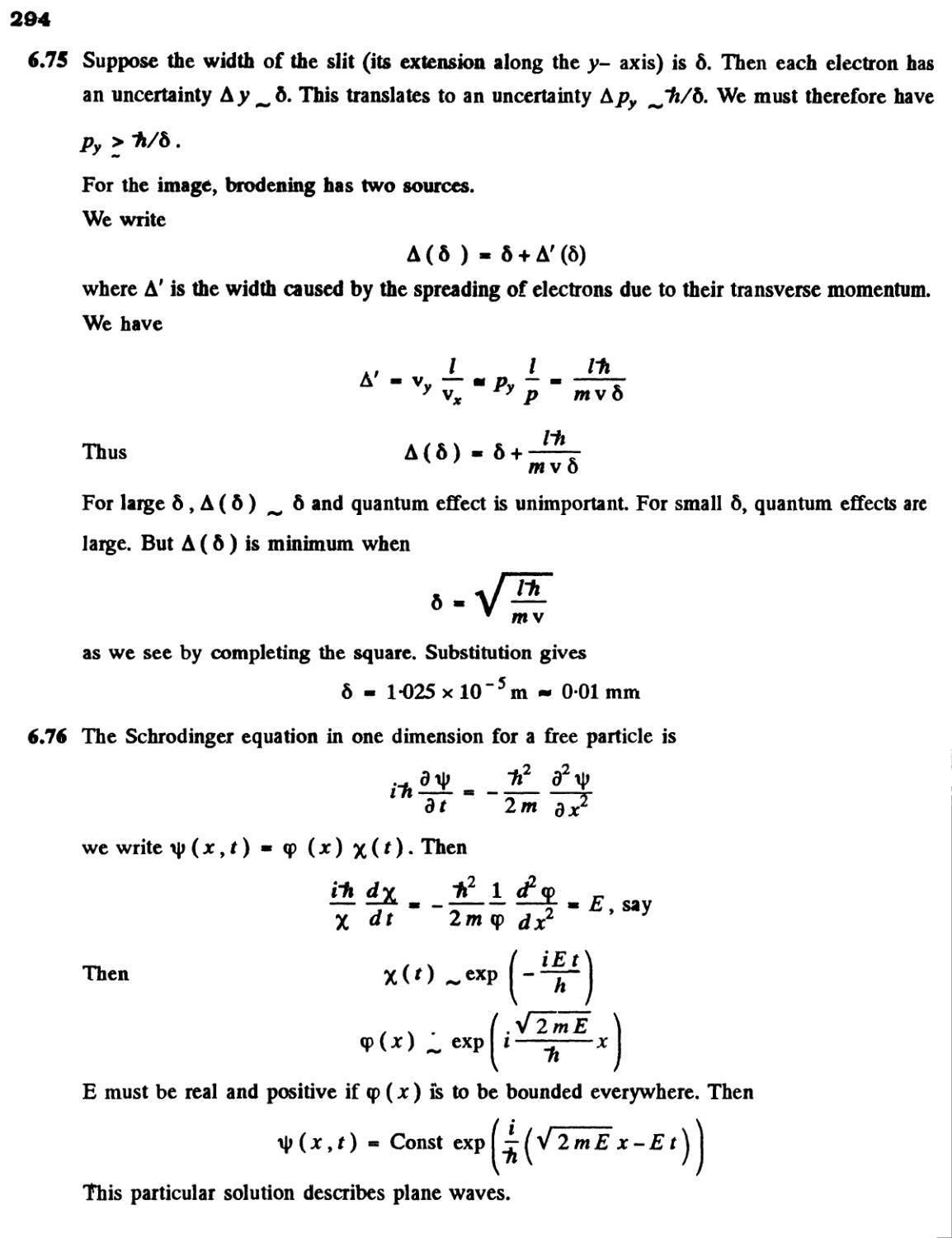
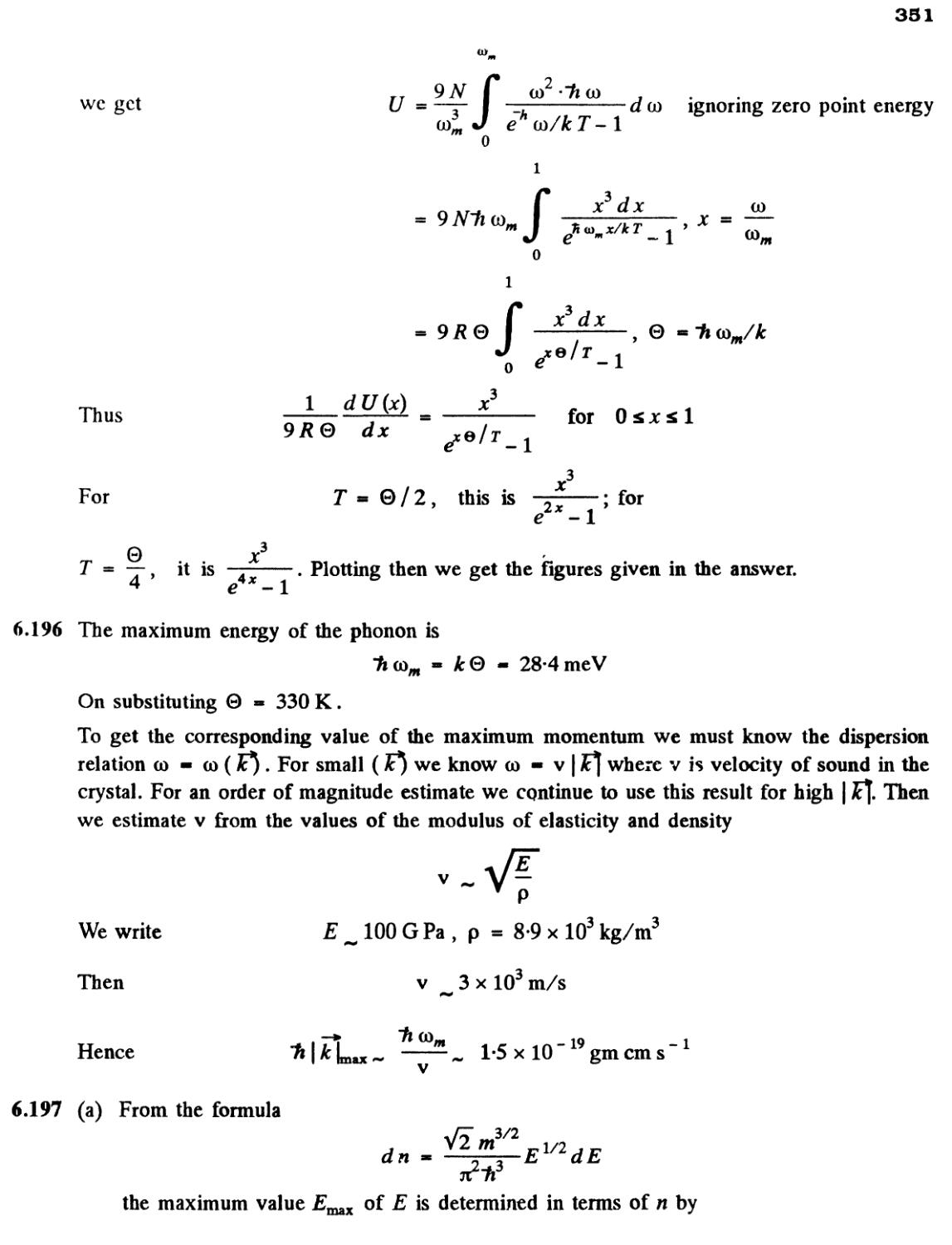
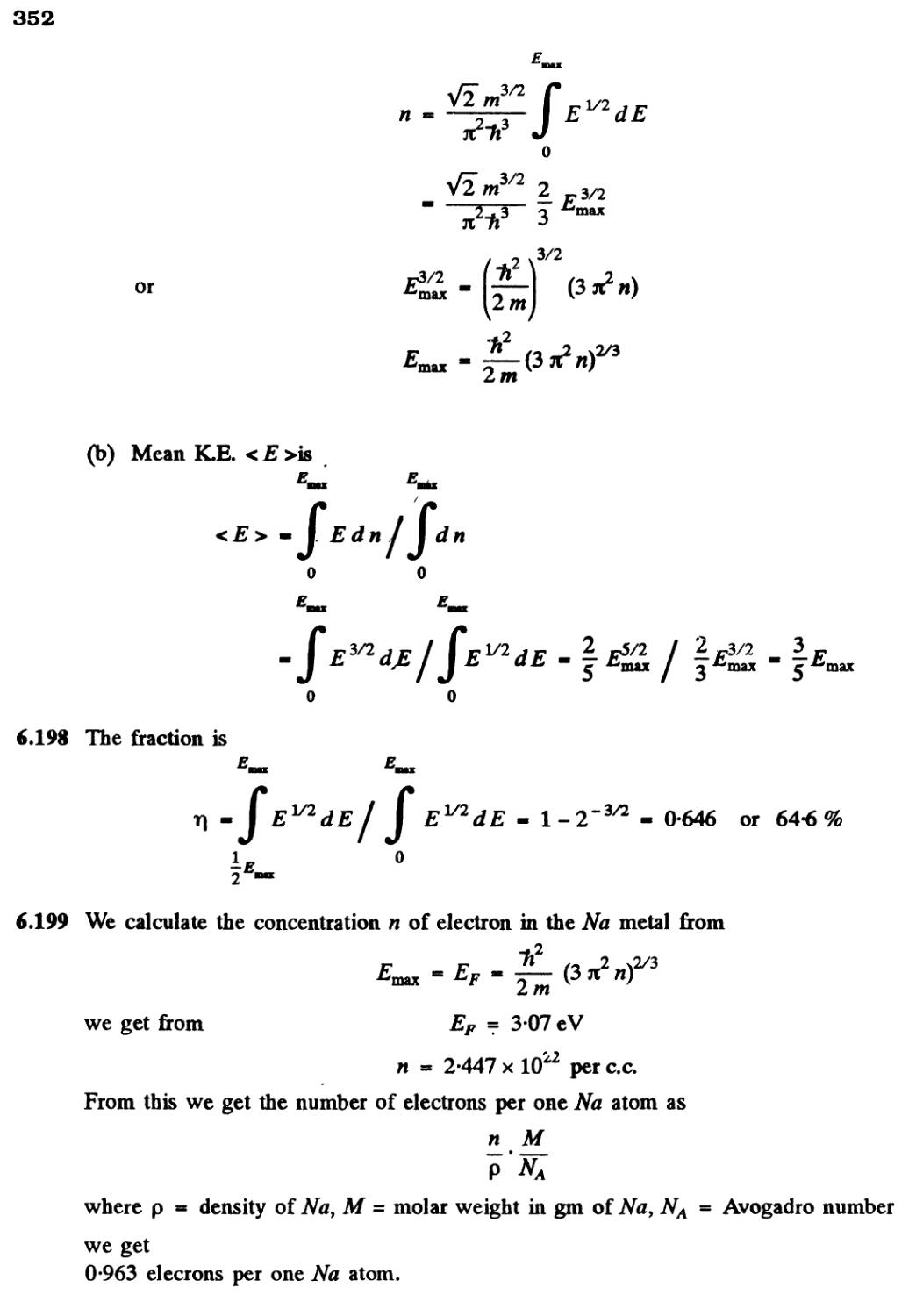
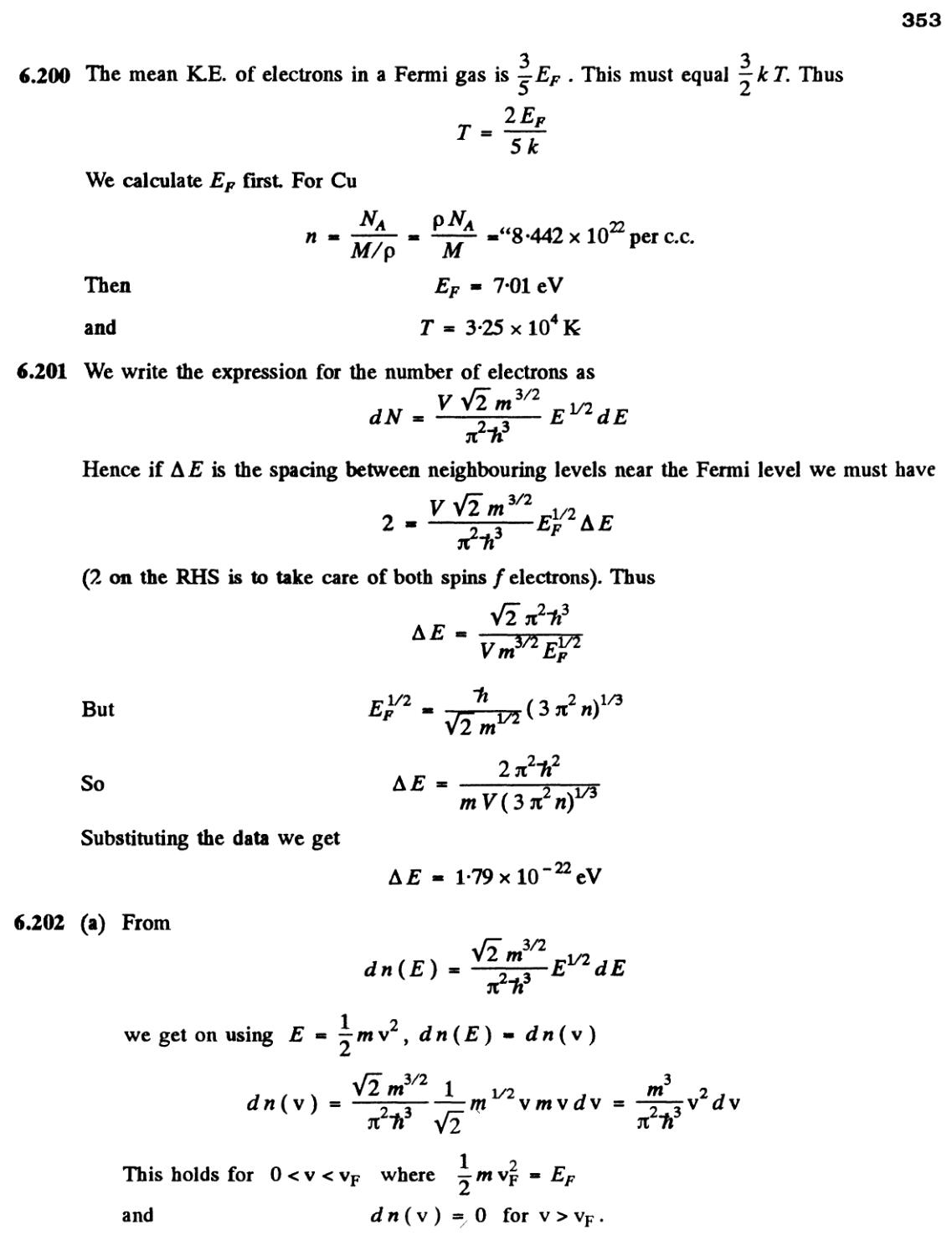
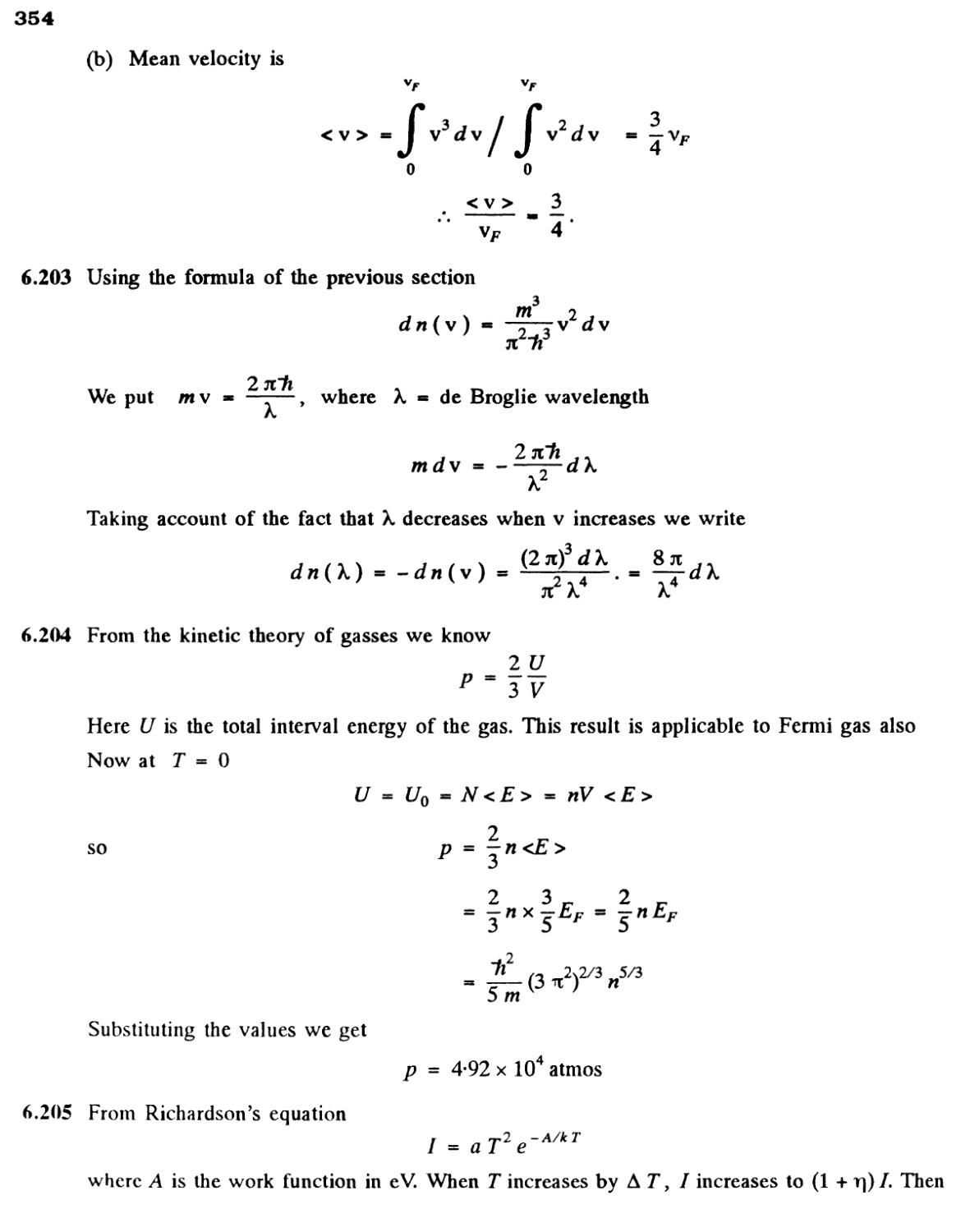
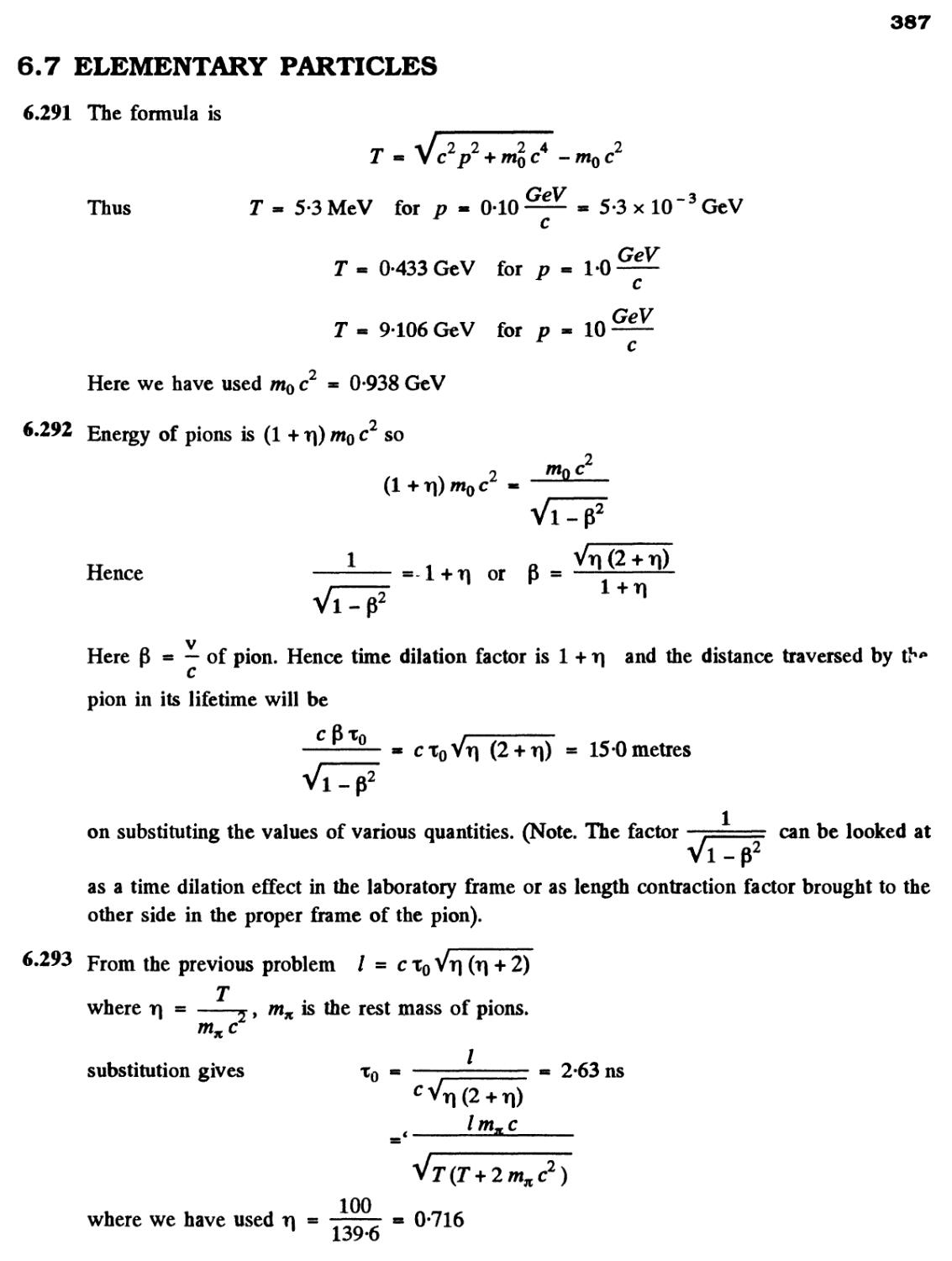
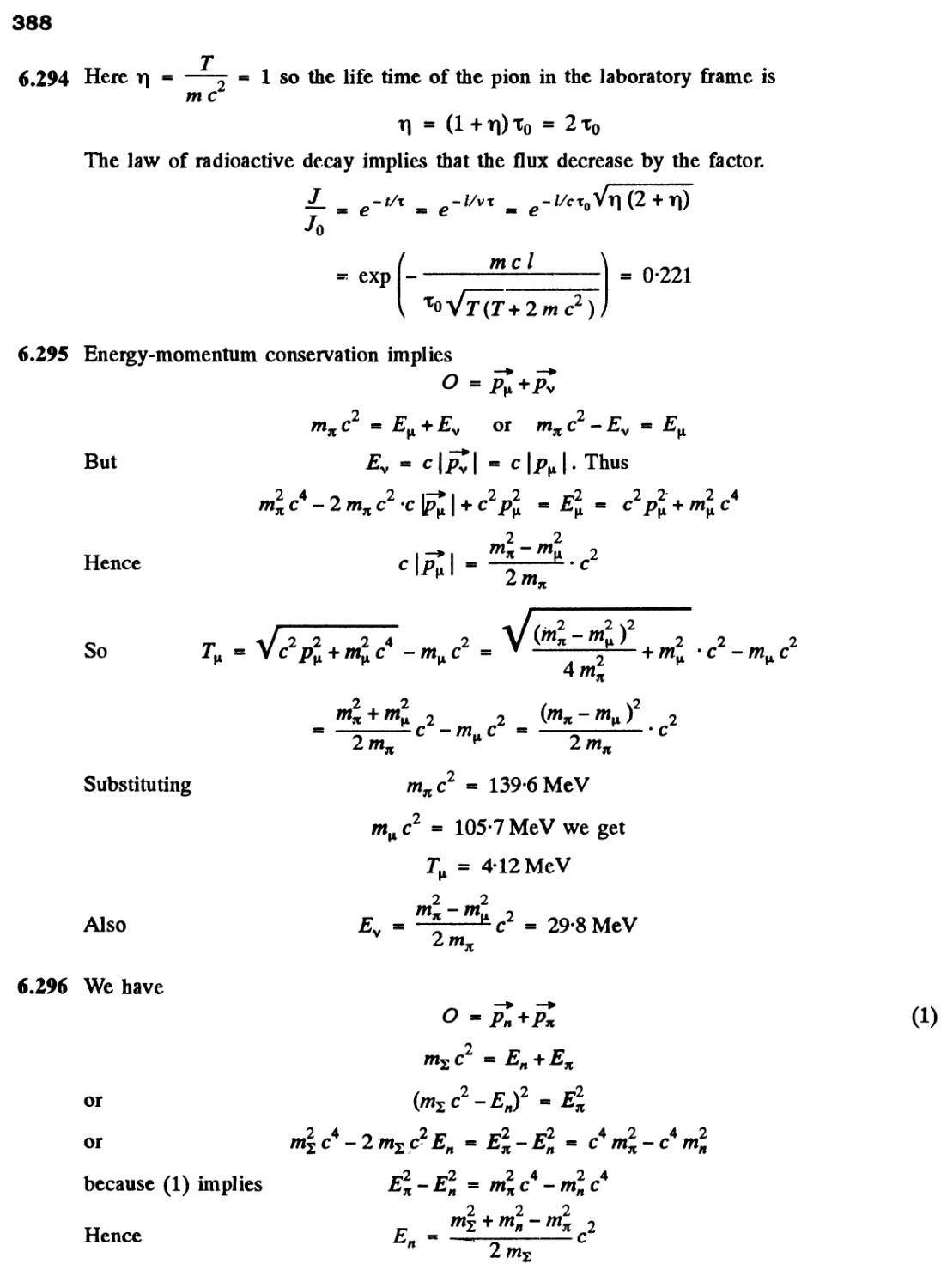
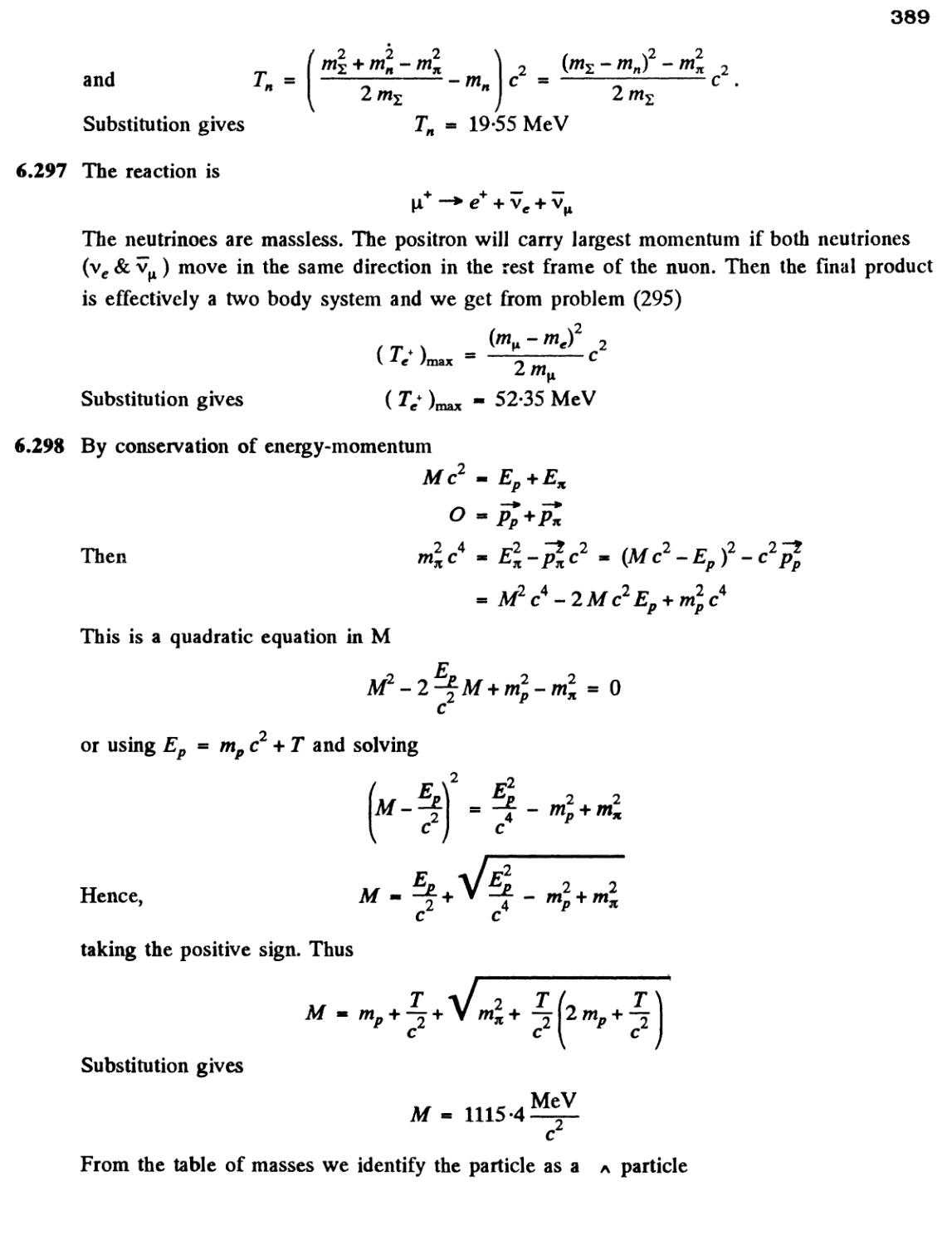
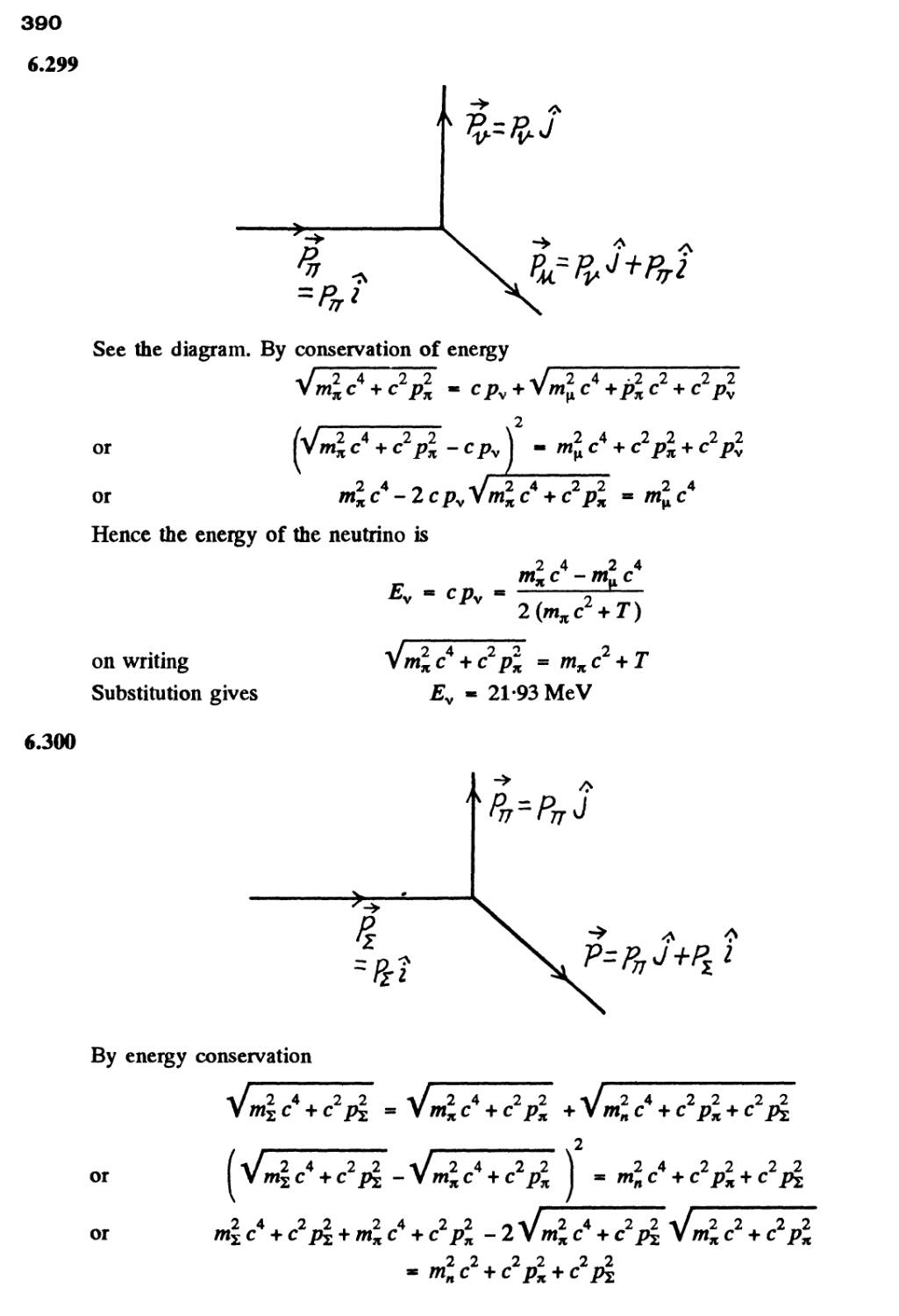
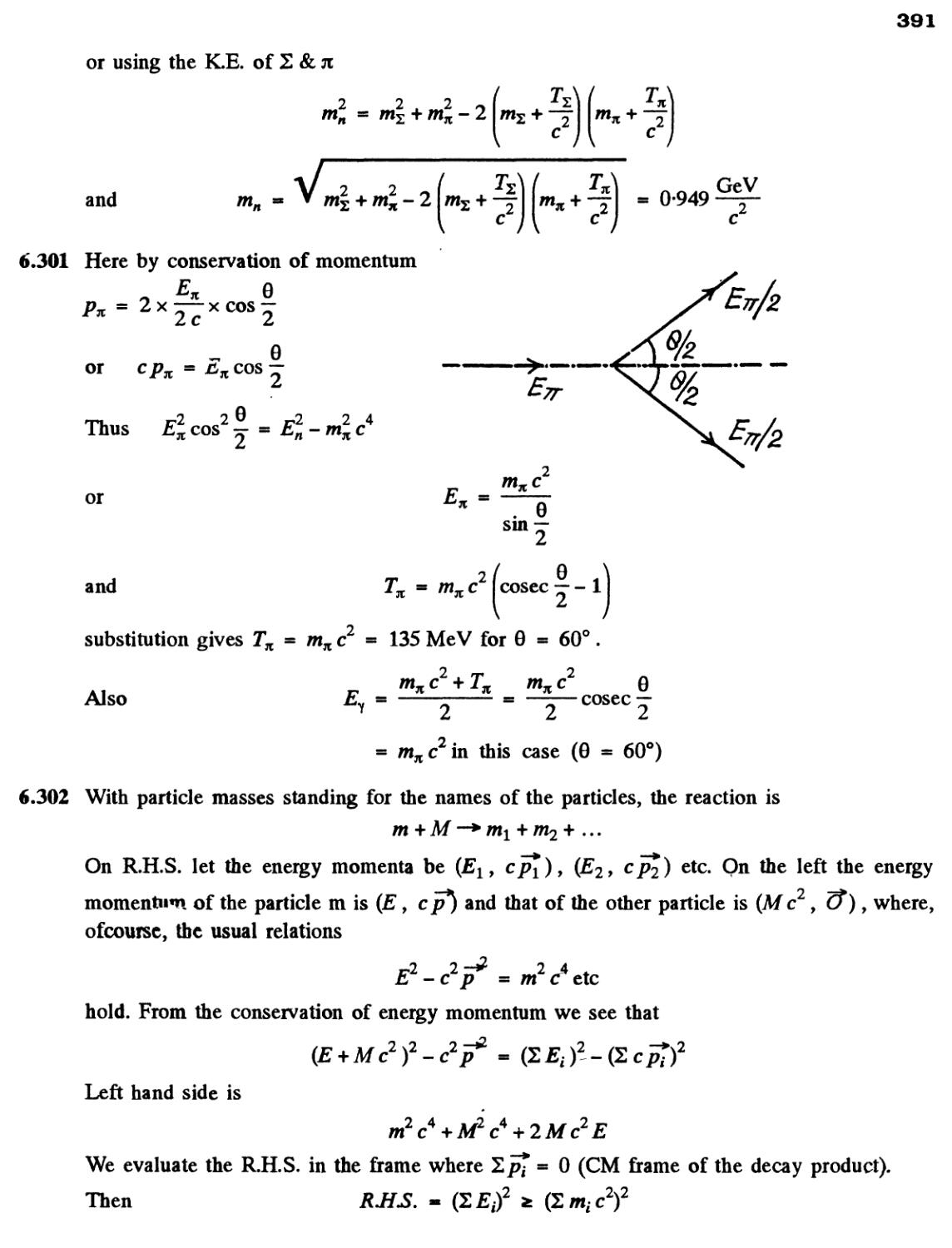
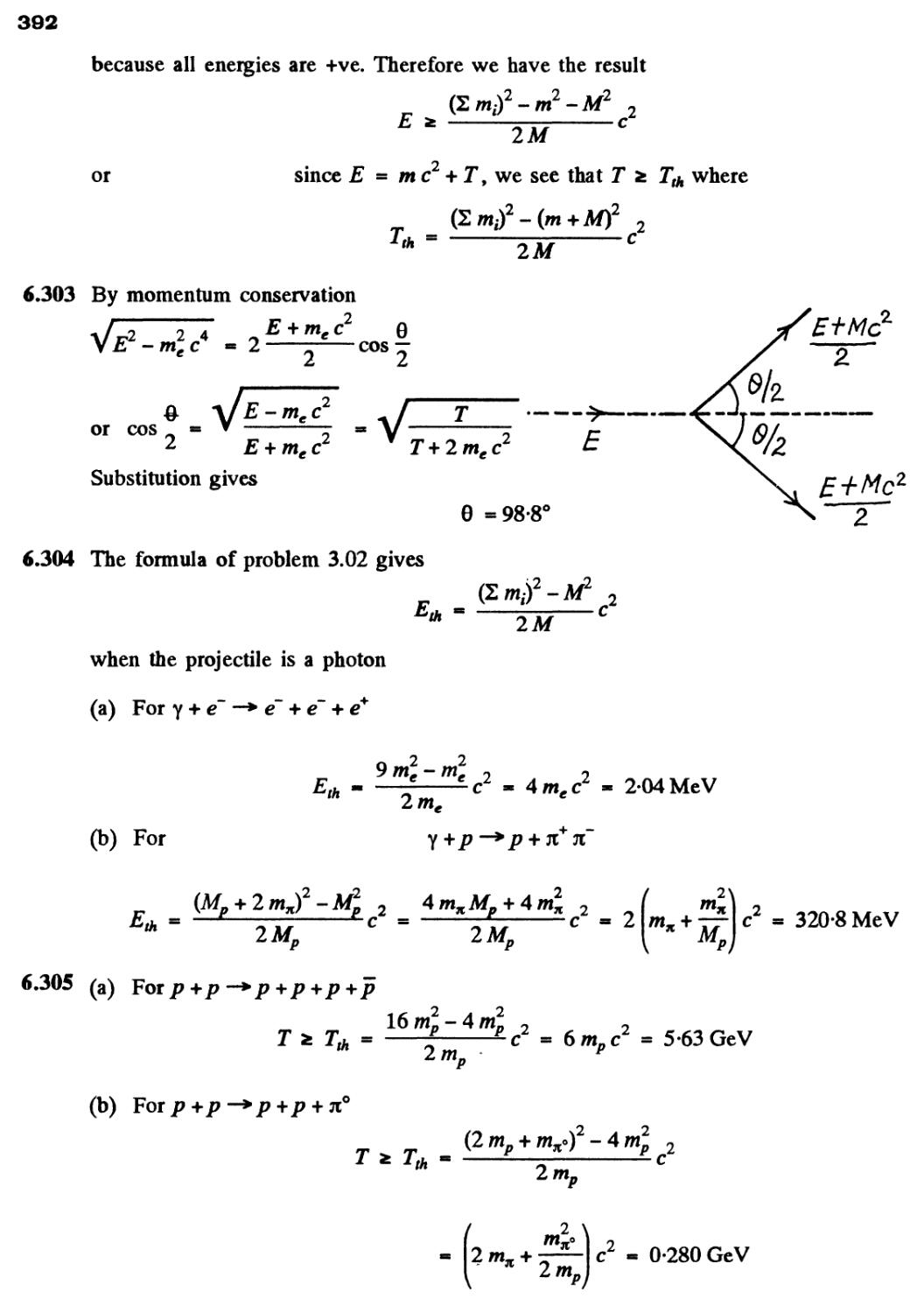
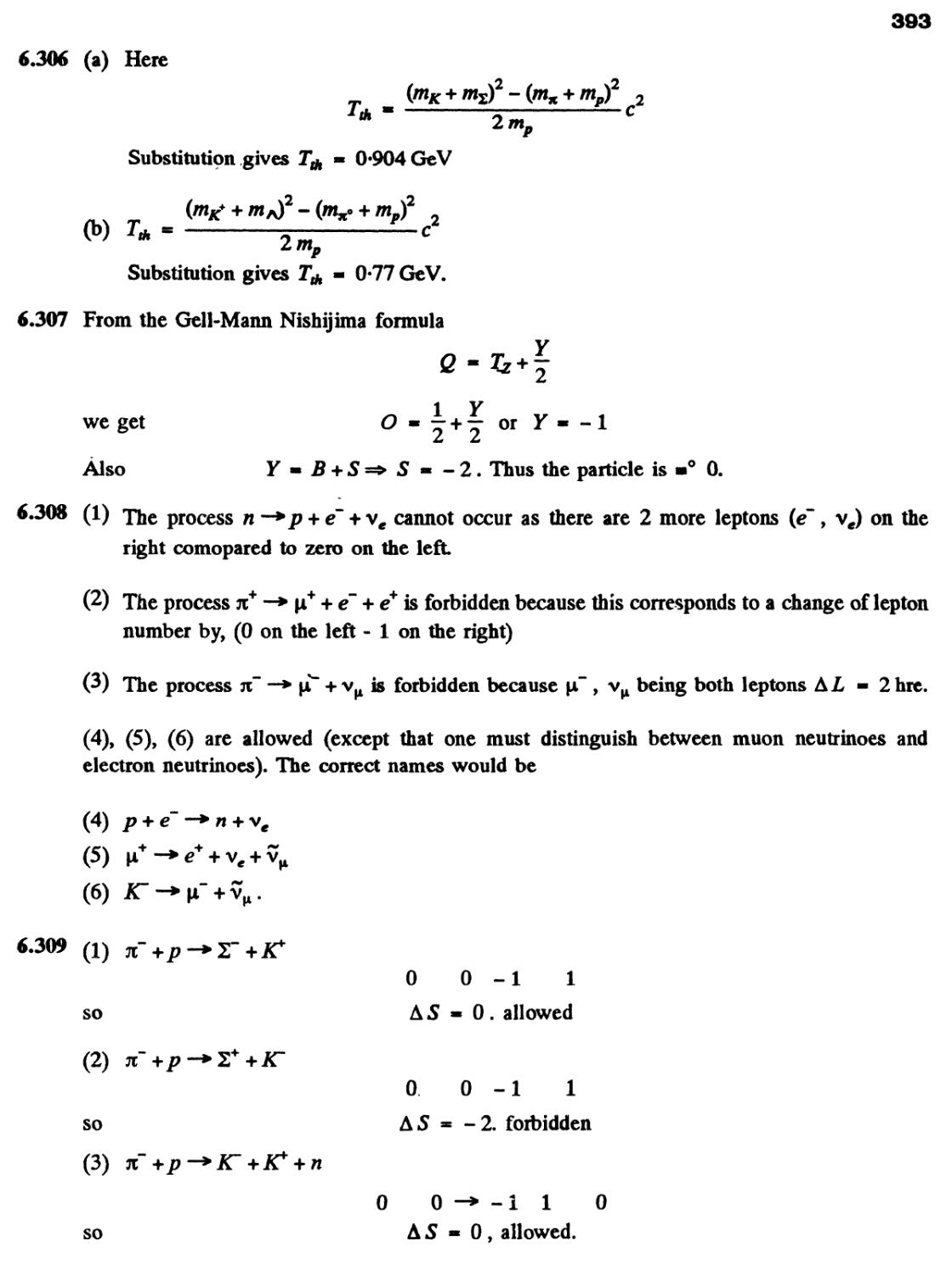
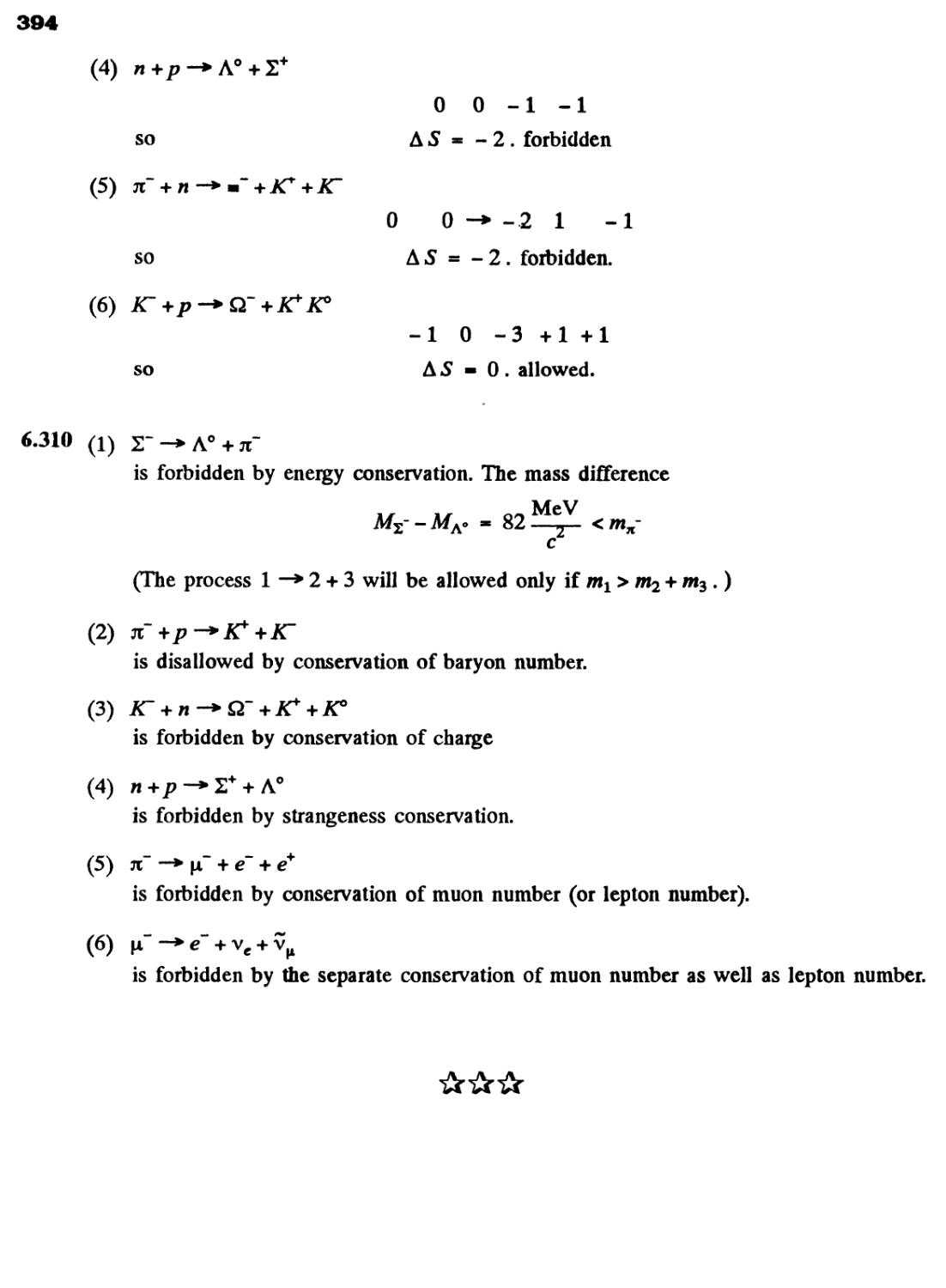
Текст
                    Solutions to
'. Irodov 's
Problems in
General Physics
Volume II
Waves # Optics # Modern Physics
Second Edition
ABHAY KUMAR SINGH
Director
Abhay's I.I.T. Physics Teaching Centre
Patna-6
CBS
CBS PUBLISHERS & DISTRIBUTORS
4596/1 A, 11 DARYAGANJ, NEW DELHI -110 002 (INDIA)

ISBN:81-239-0486-X
First Edition: 1996
Reprint: 1997
Second Edition : 1998
Reprint: 2000
Reprint: 2002
Reprint: 2004
Copyright © Author & Publisher
All rights reserved. No part of this book may be reproduced or
transmitted in any form or by any means, electronic or mechanical,
including photocopying, recording, or any information storage and
retrieval system without permission, in writing, from the publisher.
Published by S.K. Jain for CBS Publishers & Distributors,
4596/1 A, 11 Darya Ganj, New Delhi - 110 002 (India).
Printed at :
J.S. Offset Printers, Delhi - 110 051

In the memory of
Late Shri Arvind Kumar
(Ex-Director, The Premier Institute, Patna)
The man who taught me how to teach.

FOREWORD
Science, in general, and physics, in particular, have evolved out of man's quest to know beyond
unknowns. Matter, radiation and their mutual interactions are basically studied in physics.
Essentially, this is an experimental science. By observing appropriate phenomena in nature one
arrives at a set of rules which goes to establish some basic fundamental concepts. Entire physics
rests on them. Mere knowledge of them is however not enough. Ability to apply them to real
day-to-day problems is required. Prof Irodov's book contains one such set of numerical
exercises spread over a wide spectrum of physical disciplines. Some of the problems of the book
long appeared to be notorious to pose serious challenges to students as well as to their teachers.
This book by Prof. Singh on the solutions of problems of Irodov's book, at the outset, seems
to remove the sense of awe which at one time prevailed. Traditionally a difficult exercise to
solve continues to draw the attention of concerned persons over a sufficiently long time. Once
a logical solution for it becomes available, the difficulties associated with its solutions are
forgotten very soon. This statement is not only valid for the solutions of simple physical problems
but also to various physical phenomena.
Nevertheless, Prof Singh's attempt to write a book of this magnitude deserves an all out
praise. His ways of solving problems are elegant, straight forward, simple and direct. By writing
this book he has definitely contributed to the cause of physics education. A word of advice to
its users is hov/ever necessary. The solution to a particular problem as given in this book is
never to be consulted unless an all out effort in solving it independently has been already made.
Only by such judicious uses of this book one would be able to reap better benefits out of it.
As a teacher who has taught physics and who has been in touch with physics curricula
at I.I.T., Delhi for over thirty years, I earnestly feel that this book will certainly be of benefit
to younger students in their formative years.
Dr. Dilip Kumar Roy
Professor of Physics
Indian Institute of Technology, Delhi
New Delhi-110016.

FOREWORD
A proper understanding of the physical laws and principles that govern nature require
solutions of related problems which exemplify the principle in question and leads to a
better grasp of the principles involved. It is only through experiments or through solutions
of multifarious problem-oriented questions can a student master the intricacies and fall
outs of a physical law. According to Ira M. Freeman, professor of physics of the state
university of new Jersy at Rutgers and author of c'physic—principles and Insights" —
"In certain situations mathematical formulation actually promotes intuitive understand-
understanding Sometimes a mathematical formulation is not feasible, so that ordinary language
must take the place of mathematics in both roles. However, Mathematics is far more
rigorous and its concepts more precise than those of language. Any science that is able
to make extensive use of mathematical symbolism and procedures is justly called an exact
science". I.E. Irodov's problems in General Physics fulfills such a need. This book
originally published in Russia contains about 1900 problems on mechanics, thermody-
thermodynamics, molecular physics, electrodynamics, waves and oscillations, optics, atomic and
nuclear physics. The book has survived the test of class room for many years as is evident
from its number of reprint editions, which have appeared since the first English edition
of 1981, including an Indian Edition at affordable price for Indian students.
Abhay Kumar Singh's present book containing solutions to Dr. I.E. Irodov's Problems
in General Physics is a welcome attempt to develop a student's problem solving skills.
The book should be very useful for the students studying a general course in physics and
also in developing their skills to answer questions normally encountered in national level
entrance examinations conducted each year by various bodies for admissions to profes-
professional colleges in science and technology.
B.P. PAL
Professor of Physics
LIT., Delhi

Preface to the Second Edition
Perhaps nothing could be more gratifying for an author than seeing his
'brainchild' attain wide acclaim. Fortunately, it happes so with 'Solutions to I. E.
Irodov's Problems in General Physics (Volume-II) authored by me. Since
inception, it showed signs of excellence amidst its 'peer-group', so much so that it
fell victim to Piracy-syndrome. The reported on rush of spurious copies of this
volume in the market accelerated the pace of our contemplation for this second
edition. Taking advantage of this occassion the book has almost been comptelely
vetted to cater to the needs of aspiring students.
My heart felt thanks are due to all those who have directly or indirectly
engineered the cause of its existing status in the book-world.
Patna
June 1997 Abhay Kumar Singh

Preface
This is the second volume of my "Solutions to I.E. Irodov's Problems in General
Physics." It contains solutions to the last three chapters of the problem book "Problems
in General Physics". As in the first volume, in this second one also only standard
methods have been used to solve the problems, befitting the standard of the problems
solved.
Nothing succeeds like success, they say. From the way my earlier books have been
received by physics loving people all over the country, I can only hope that my present
attempt too will be appreciated and made use of at a large scale by the physics fraternity.
My special thanks are due to my teacher Dr. (Prof.) J. Thakur, Department of
Physics, Patna University, who has been my source of energy and inspiration throughout
the preparation of this book. I am also thankful to computer operator Mr. S. Shahab
Ahmad and artist Rajeshwar Prasad of my institute (Abhay's I.I.T. Physics Teaching
Centre, Mahendru, Patna-6) for their pains-taking efforts. I am also thankful to all my
well-wishers, friends and family members for their emotional support.
Abhay Kumar Singh
Patna
July, 1996

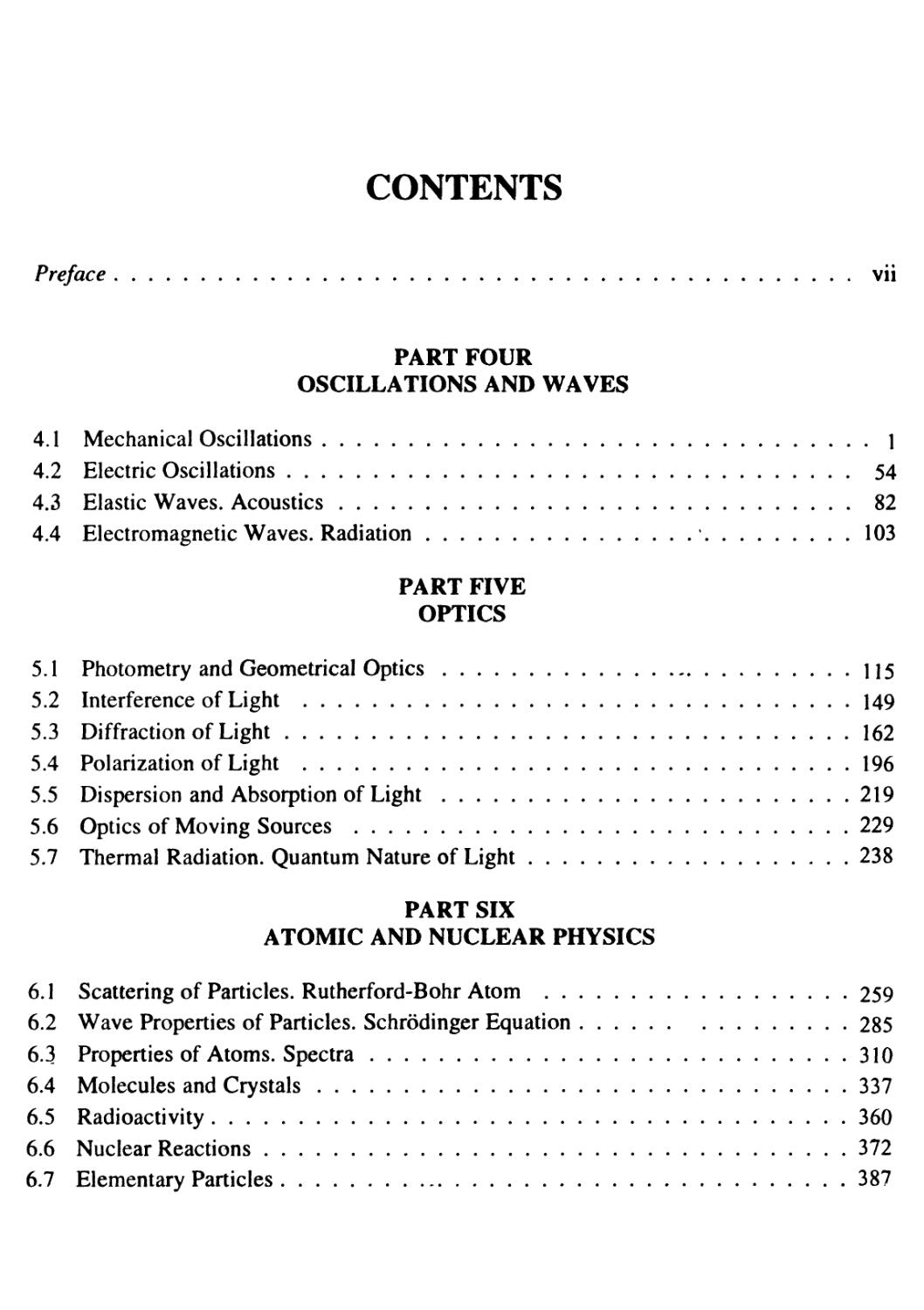
CONTENTS
Preface vii
PART FOUR
OSCILLATIONS AND WAVES
4.1 Mechanical Oscillations 1
4.2 Electric Oscillations 54
4.3 Elastic Waves. Acoustics 82
4.4 Electromagnetic Waves. Radiation 103
PART FIVE
OPTICS
5.1 Photometry and Geometrical Optics 115
5.2 Interference of Light 149
5.3 Diffraction of Light 162
5.4 Polarization of Light 196
5.5 Dispersion and Absorption of Light 219
5.6 Optics of Moving Sources 229
5.7 Thermal Radiation. Quantum Nature of Light 238
PART SIX
ATOMIC AND NUCLEAR PHYSICS
6.1 Scattering of Particles. Rutherford-Bohr Atom 259
6.2 Wave Properties of Particles. Schrodinger Equation 285
6.3 Properties of Atoms. Spectra 310
6.4 Molecules and Crystals 337
6.5 Radioactivity 360
6.6 Nuclear Reactions 372
6.7 Elementary Particles 387

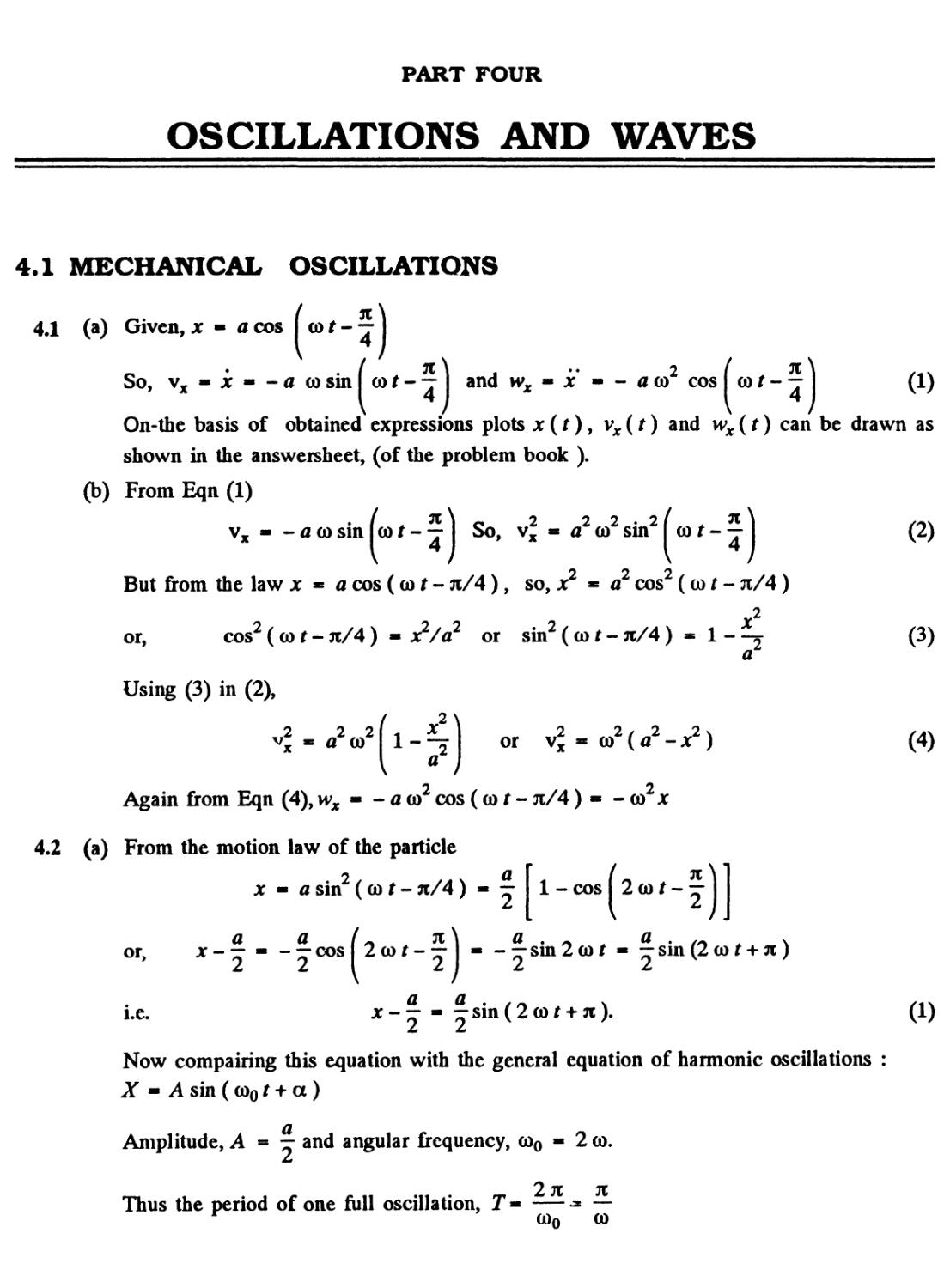
PART FOUR
OSCILLATIONS AND WAVES
4.1 MECHANICAL OSCILLATIONS
4.1
(a) Given. x ■ a cos I to t - — I
\ 4)
So, vx - x - - a co sin co t - — and wx « jc - - a co cos co f - —
On-the basis of obtained expressions plots x (t), vx(t) and wx(t) can be drawn as
shown in the answersheet, (of the problem book ).
(b) From Eqn A)
/ If \ n *\ r* *\ I Tf \
B)
vx « - a co sin [ co t - ~ So, vx«a co sin co f - —
But from the law x ■ acos(cof- ji/4), so, jc2 ■ a2cos2(a>t- ji/4)
or.
cos
*7 0 *? JC
(co t - jc/4 ) - xt/a or sin (co t - rc/4 ) * 1 —«
C)
Using C) in B),
a>
2 \
1-
a
or v2 ■ co2 (a2 - jc2 )
D)
Again from Eqn D), wx - - a co2 cos (co t - ji/4 ) « - co2 jc
4.2 (a) From the motion law of the particle
. 2
jc - a sin (co t - rc/4) - x
1-cos 2co/-t-
a
2cor-~
-— sin2cor - ~si
i.e.
jc~~ - —sinBcor■»-jc).
A)
Now compairing this equation with the general equation of harmonic oscillations
X - Asin(co0f + a
Amplitude, A = — and angular frequency, co0 - 2 co.
2k n
OH CO
Thus the period of one full oscillation, T

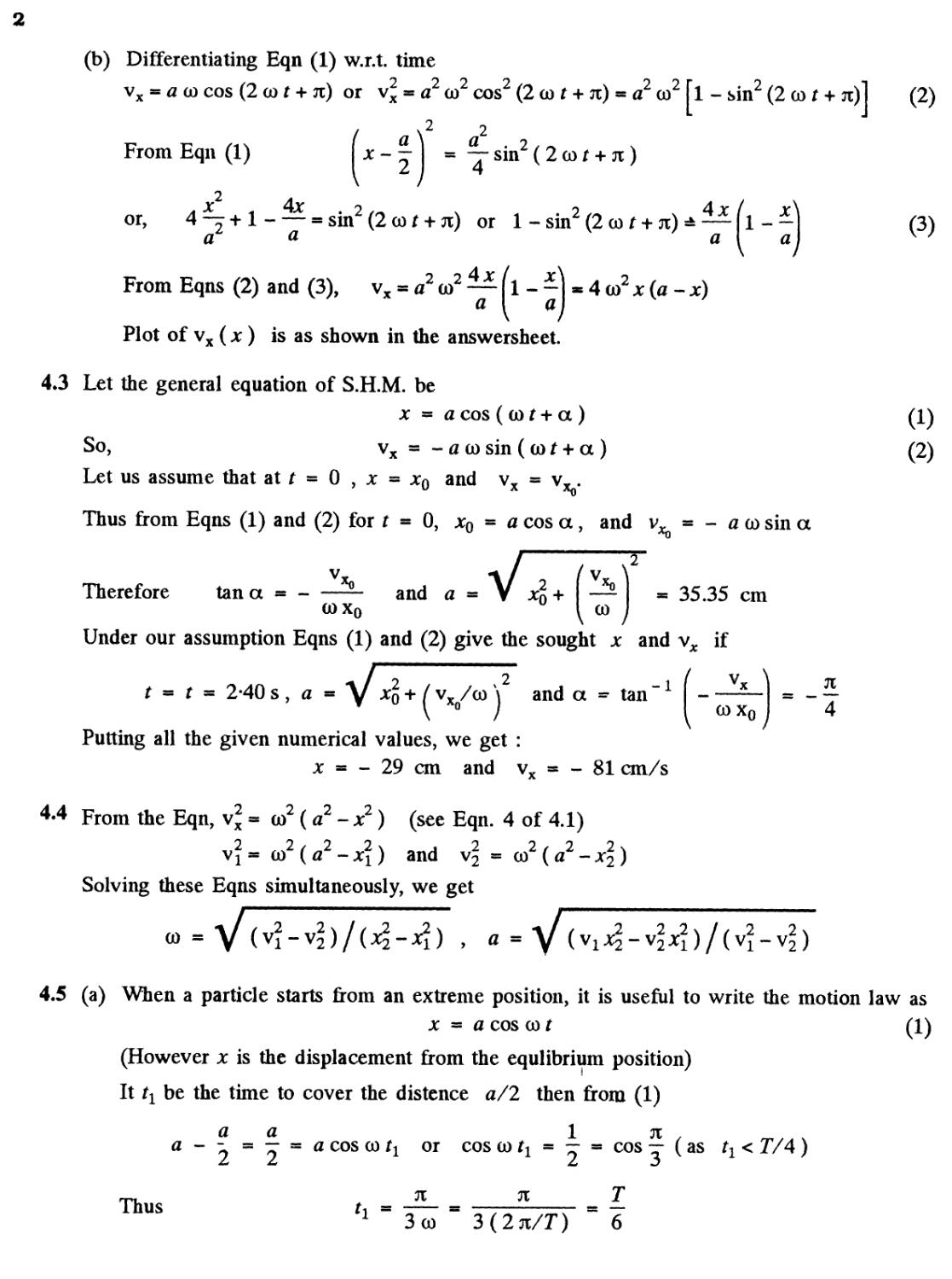
(b) Differentiating Eqn A) w.r.t. time
n ry ry ry "JOT 0 "\
vx = a co cos B (o t + n) or vx = a co cos B co t + jt) = a co 1 - sin B co t + jr.)
B)
From Eqn A)
2
2 2
.2
— sin2 ( 2 co t + 3t
4
•2
or, 4 -j + 1 - — = sin B co t + jr) or 1 - sin B co f + n) ±
a
a
a
1-
From Eqns B) and C), vx = a2 co2 — (l - -) « 4 co2 x (a - jc)
Plot of vx ( jc ) is as shown in the answersheet.
43 Let the general equation of S.H.M. be
x = a cos (to f + a )
So, vx = - a co sin (co t + a )
Let us assume that at t = 0 , x = jc0 and vx = v^..
Thus from Eqns A) and B) for t = 0, x0 = a cos a, and
Therefore
tana = -
O)X0
and
a-\4 +
v,
Under our assumption Eqns A) and B) give the sought x and
t
V2 2 -1
x0 + / vXq/co \ and a =■ tan
a
35.35
v* if
( V
co:
co sin
cm
X
Kn
a
4
Putting all the given numerical values, we get :
x = - 29 cm and v.
- 81 cm/s
4-4 From the Eqn, v2 = co2 ( a2 - x2) (see Eqn. 4 of 4.1)
v? - co2 (a2 - jc2 ) and
Solving these Eqns simultaneously, we get
= co2 (a2 -
C)
A)
B)
CO =
4.5 (a) When a particle starts from an extreme position, it is useful to write the motion law as
x = a cos co t A)
(However x is the displacement from the equlibrium position)
It tx be the time to cover the distence a/2 then from A)
a a In, _.. v
a - - = — = a cos co fj or cos co tx = — = cos ~ ( as tx < T/4 )
Thus
3 co 3Bn/T)

As
Thus
x - a cos co t, so , vx - - a co sin co t
- - vx - a co sin co t, for t s tx - 776
Hence sought mean velocity
3a
< v > - —^— - J a B Jt/7) sin astdt I 776
(b) In this case, it is easier to write the motion law in the form :
x - a sin co t
If t2 be the time to cover the distance a/2, then from Eqn B)
- 0-5 m/s
/<* • 2 ji . 2 3i
a/2 ■ a sin — u or sin -=r
i i
Thus
Differentiating Eqn B) w.r.t time, we get
~ « sin 7 (as t2 < 774)
Z o
X
* 12
2ji 2ji
vx * a co cos co t * a -=- cos —=-1
So,
9 it  it
|vx| - a— cos — t, for rs
T/12
Hence the sought mean velocity
/v dt t r/12
< V >
^zr" cos -=-1 at
6a
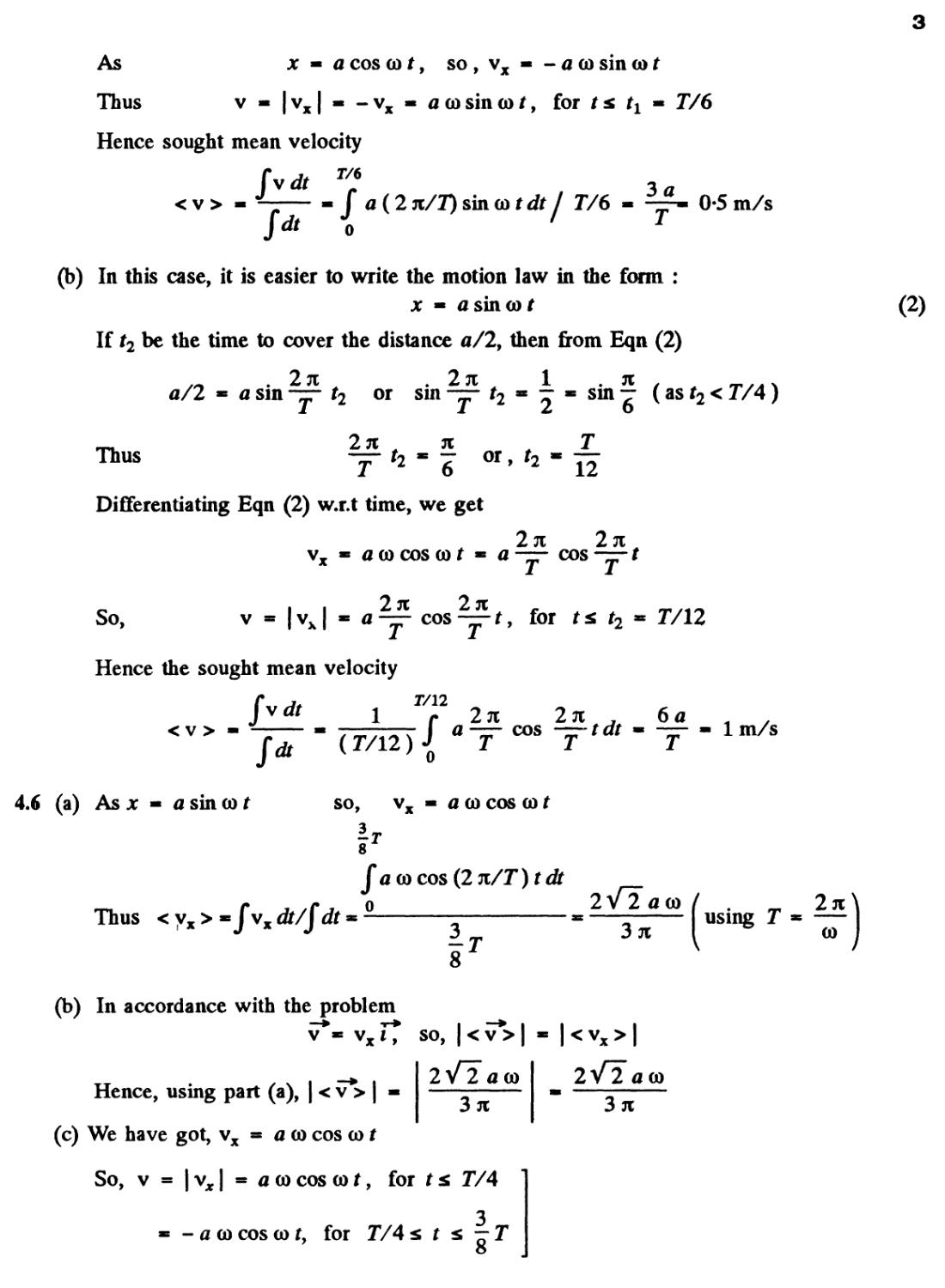
4.6 (a) As x - a sin co t
so, vx - a co cos co
B)
J*a co cos B ji
Thus <yx>«/vxdr//A«5 —
(b) In accordance with the problem
v*« vx FT so, | < v*>
Hence, using part (a), | < v > |
(c) We have got, vx « a co cos co t
So, v = | Vy I = a co cos co t, for f £ 774
3 .
co
using J
co
2VTa
co
-a co cos cor, for 774 * f
o

r/4
3J/8
Hence,
< V > =
dt
f a
J
co cos co
*# + f - a
J
co cos co
o
r/4
3J/8
Using co = 2 k/T , and on evaluating the integral we get
2 D - VI) a co
< v > =
3 JT
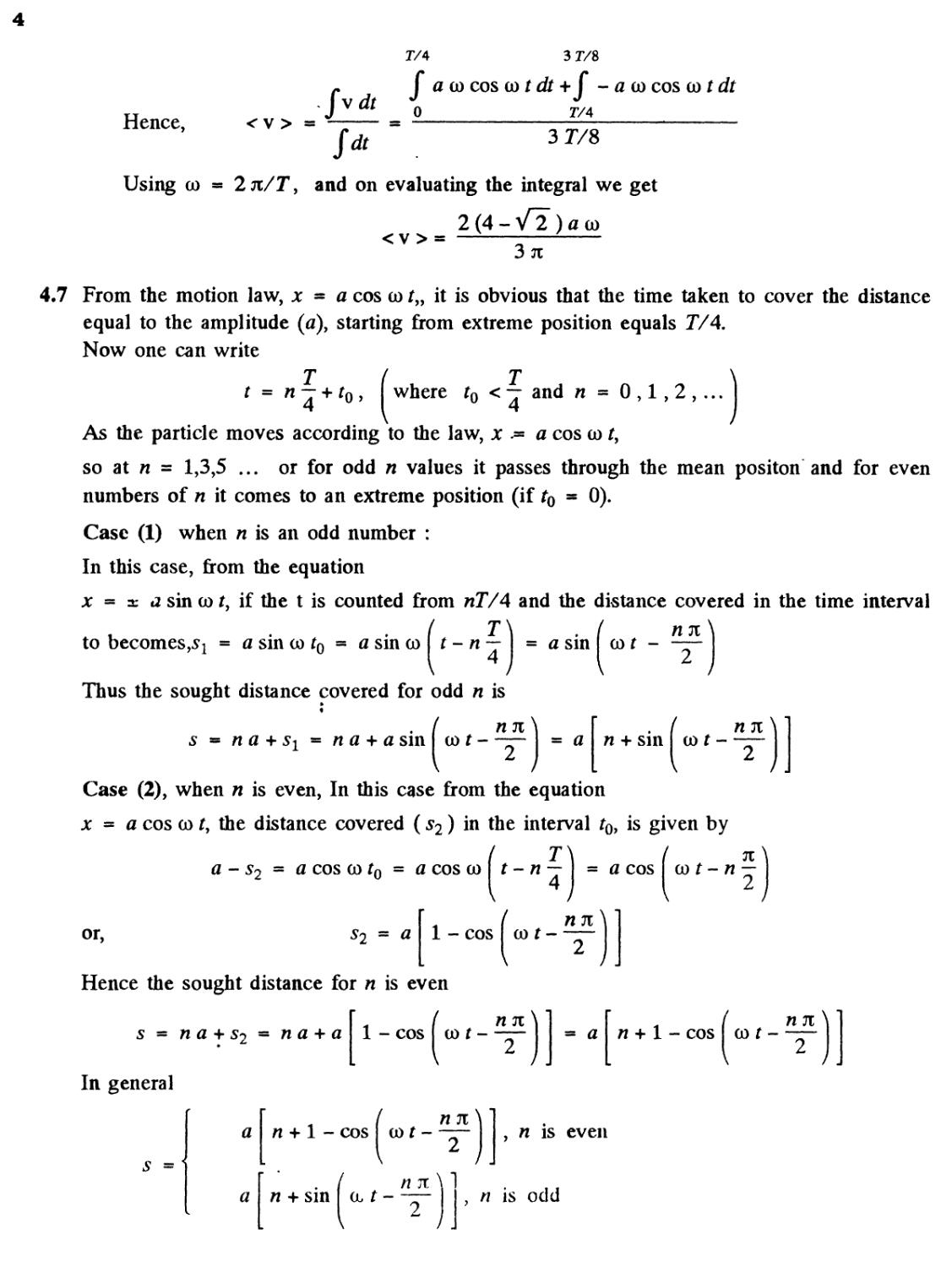
4.7 From the motion law, x - a cos co f,, it is obvious that the time taken to cover the distance
equal to the amplitude (a), starting from extreme position equals J/4.
Now one can write
= n 7 + 'o >
where r0 < ■- and w = 0,1,2,...
As the particle moves according to the law, x = a cos co t,
so at n = 1,3,5 ... or for odd n values it passes through the mean positon and for even
numbers of n it comes to an extreme position (if t0 * 0).
Case A) when n is an odd number :
In this case, from the equation
x = x a sin co r, if the t is counted from nT/4 and the distance covered in the time interval
T\
to becomes,.^ = a sin co t0 = a sin co I t - n —
/
= a sin co t -
Thus the sought distance covered for odd n is
«
n n
s = na + s1 = na + a sin
cor-
n + sin
cor-
Case B), when « is even, In this case from the equation
x = a cos co ty the distance covered (s2) in the interval r0, is given by
a - s2 = a cos co t0 = a cos co r - w
= a cos
JT
co t- n —
or,
= a
1 - cos co r -
/ ^
Hence the sought distance for n is even
s =
- na + a
- cos co t -
n n
= a
n + 1 - cos co t -
n
In general
a
a
n + 1 - cos
cor-
+ sin
t -
, n is even
is odd
/ J

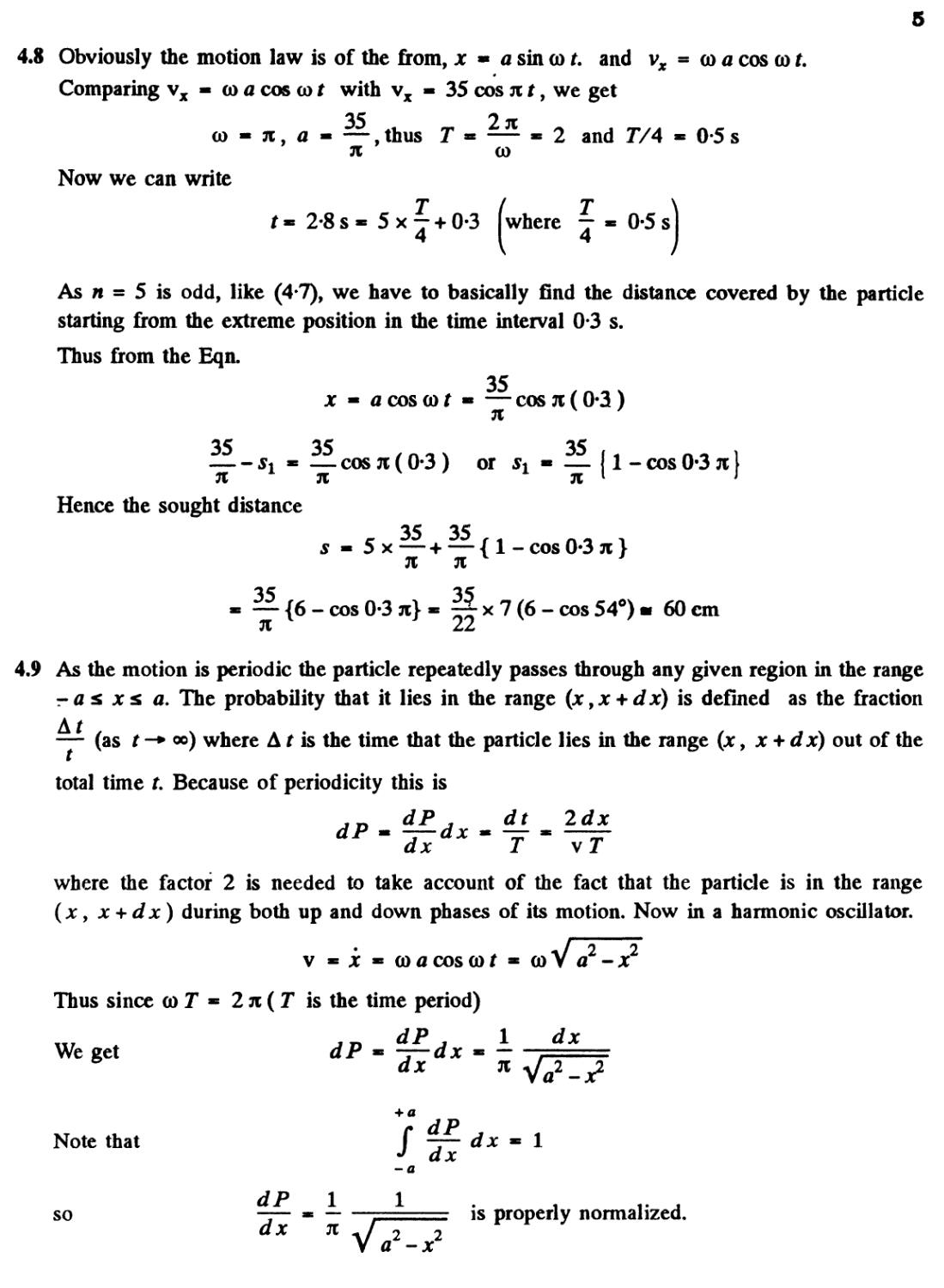
4.8 Obviously the motion law is of the from, x » a sin co t. and vx = co a cos co t.
0
Comparing vx - co a cos co t with vx - 35 cos ft t, we get
a> - ft, a - —,thus 7 - — « 2 and 7/4 - 0-5s
ft CO
Now we can write
TIT
2-8 s « 5 x - + 0-3 where -7 « 0-5 s
4 4
As n = 5 is odd, like D*7), we have to basically find the distance covered by the particle
starting from the extreme position in the time interval 0-3 s.
Thus from the Eqn.
35
x - a cos co t « — cos ft @*3)
— - Si ■ — cos ft @-3 ) or Si « — 11 - cos 0*3 ft}
ft ft ft l J
Hence the sought distance
e 35 35 f, n„ 1
s - 5x — + — {1- cos 0o ft }
ft ft J
« —{6-cosO-3ft}« !|x7F-cos540)- 6Ocm
4.9 As the motion is periodic the particle repeatedly passes through any given region in the range
-a* x* a. The probability that it lies in the range (jc,jc + dx) is defined as the fraction
— (as t -* 00) where A t is the time that the particle lies in the range (jc , x + dx) out of the
total time f. Because of periodicity this is
.„ dP , dt 2dx
dP " d7dx ' Y " VF
where the factor 2 is needed to take account of the fact that the particle is in the range
(x, x + dx) during both up and down phases of its motion. Now in a harmonic oscillator.
v «i ■ coacoscor ■ coVa2-*2
Thus since co 7 ■ 2 ft G is the time period)
We get dP = ^dx = - dX
ax ft
r dP ,
Note that I -7— dx
J dx
-a
dP 1 1 . . r ,
so -:— * . is properly normalized.
dx x TJZJ

6
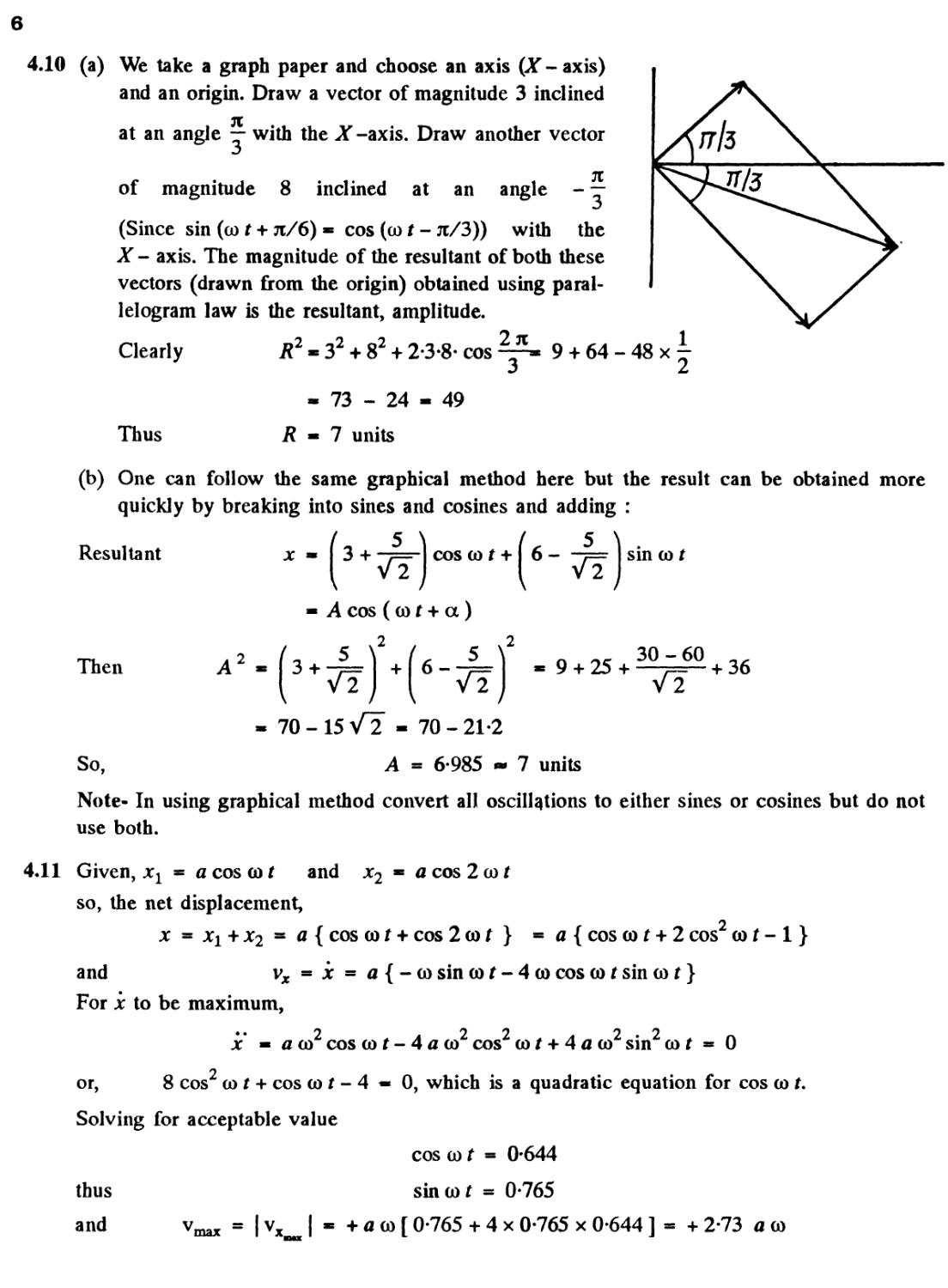
4.10 (a) We take a graph paper and choose an axis (X - axis)
and an origin. Draw a vector of magnitude 3 inclined
at an angle — with the .Y-axis. Draw another vector
of magnitude 8 inclined at an angle - —
(Since sin (co t + ji/6) * cos (co t - jc/3)) with the
X - axis. The magnitude of the resultant of both these
vectors (drawn from the origin) obtained using paral-
parallelogram law is the resultant, amplitude.
Clearly
R2 « 32 + 82 + 2-3-8- cos tt5- 9 + 64
Thus
- 73 - 24 - 49
R - 7 units
(b) One can follow the same graphical method here but the result can be obtained more
quickly by breaking into sines and cosines and adding :
Resultant
3 +
COS CO/ +
6-
J_
V2
sin co t
A cos (cor + a)
Then
3 +
6-
9 + 25 + —7=— + 36
T
70 - 15 VT - 70 - 21-2
So,
A = 6-985 - 7 units
Note- In using graphical method convert all oscillations to either sines or cosines but do not
use both.
4,11 Given, jcj_ * a cos co t and x2 * a cos 2 co t
so, the net displacement,
x = jq + x2 - a { cos co t + cos 2 co t } * a { cos co f + 2 cos2 co t - 1}
vx =
a{-cosincof-4co cos co t sin co t}
and
For x to be maximum,
• • 1 2 2 2 2
x « a co cos co f - 4 a co cos cof + 4aco sin cot » 0
or, 8 cos co t + cos co f - 4 * 0, which is a quadratic equation for cos co t.
Solving for acceptable value
thus
and
vmax = I vx
cos co t = 0-644
sin co r = 0-765
a co [ 0765 + 4 x 0-765 x 0-644 ] = + 2-73 a co

4.12 We write :
a cos 211cos5001 - j {cos52-1 f + cos 47-91\
Thus the angular frequencies of constituent oscillations are
521 s and 47-9 s~1
To get the beat period note that the variable amplitude a cos 2*11 becomes maximum
(positive or negative), when
211 « n n
Thus the interval between two maxima is
ft AC 1
—- « lo s nearly.
4.13 If the frequency of A with respect to K is v0 and K oscillates with frequency v with respect
to Ky the beat frequency of the point A in the .K-frame will be v when
v = v0 ± v
In the present case v = 20 or 24. This means
v0 - 22. & v - 2
Thus beats of 2 v - 4 will be heard when v = 26 or 18.
4.14 (a) From the Eqn : x * a sin co t
2
0 0 0 0 X
sin co t - xr/a or cos co t - 1 y A)
a
And from the equation : y = b cos co t
cos2 co t = y2/b2 B)
From Eqns A) and B), we get :
1 - r ■ ^r or -r + ^r*l
a2 b2 a2 b2
which is the standard equation of the ellipse shown in the figure,
we observe that,
at t ■ 0, x « 0 and y ■ b
and at f = -—, jc = + a and y = 0
2co' J
Thus we observe that at t = 0, the point is at point 1 (Fig.) and at the following moments,
the co-ordinate y diminishes and x becomes positive. Consequently the motion is clock-
clockwise.
(b) As x * a sin co t and y * b cos co t
So we may write r = a sin co f i + b cos co t j
fhus r * w -\ - co r

8
4.15 (a) From the Eqn. : x = a sin co t, we have
cos cor - V 1 - (x2/a2)
and from the Eqn. :y * a sin 2 co t
y = 2<isincof coscof « 2xV 1 ~(x*/a2)
or
4*'
(b) From the Eqn. : x - a sin co /;
Fromy = a cos 2 co t
sin2
= jc2/a2
1-2
For toe plots see the plots of answersheet of th,e problem book.
4.16 As U(x) = C70(l-cosajc)
So,
x ~ dx
-Uo a sin ax
A)
or, Fx = - Uoaax (because for small angle of oscillations sin ax m ax)
or,
Fx - - U0a2x
A)
But we know Fx * - m co0 jc , for small oscillation
Thus
COq =
m
or co0
m
Hence the sought time period
co0
4.17 If
then the equilibrium position is x = x0 when U' (x0) = 0
la
or
Now write :
Then
2 - ° =* ~v b
x = x0 +
But
U"(x0) =
x0
\
So finally :
U(x) =
8a;

9
We neglect remaining terms for small oscillations and compare with the P.E. for a harmonic,
oscillator :
.2 2
4 \
2
SO CO =
m
Thus
2 jc
ma
Note : Equilibrium position is generally a minimum of the potential energy. Then
W ( xo ) " 0 , U" ( jc0 ) > 0 . The equilibrium position can in principle be a maximum but then
U" (x0) <0 and the frequency of oscillations about this equilibrium position will be imaginary.
The answer given in the book is incorrect both numerically and dimensionally.
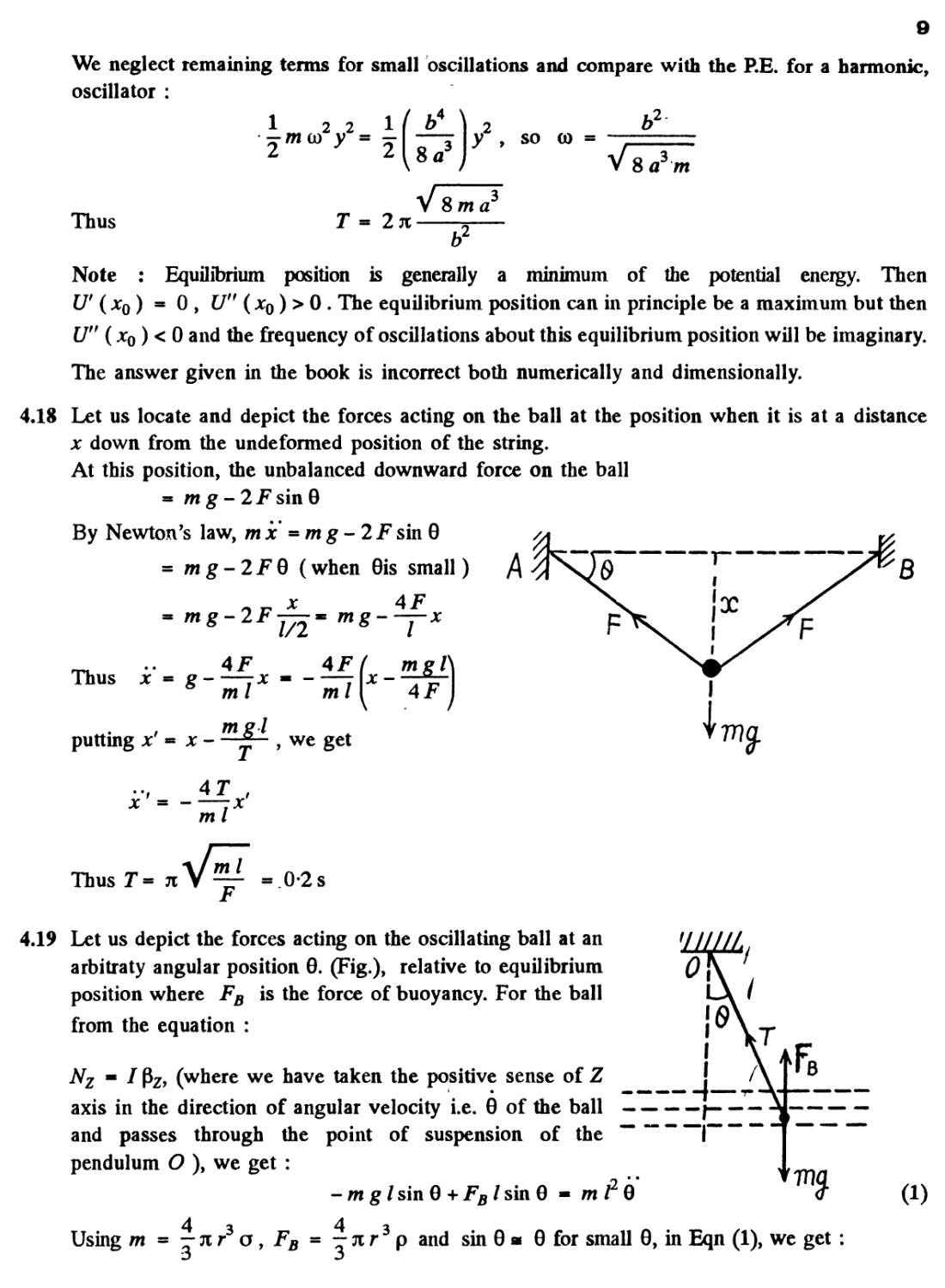
4.18 Let us locate and depict the forces acting on the ball at the position when it is at a distance
x down from the undeformed position of the string.
At this position, the unbalanced downward force on the ball
- mg-2Fsin&
By Newton's law, m x = m g - 2 F sin 0
= m g-2FQ (when 9is small)
Thus
mg-2F
AF
8~mlX
1/2
AF
mg-—x
AF
mgV
AF
putting x' = x £- , we get
AT ,
x = - —-x
m I
Thus T
0-2 s
7/////
4.19 Let us depict the forces acting on the oscillating ball at an
arbitraty angular position 0. (Fig.), relative to equilibrium
position where FB is the force of buoyancy. For the ball
from the equation :
Nz - / pz, (where we have taken the positive sense of Z
axis in the direction of angular velocity i.e. 0 of the ball J -^
and passes through the point of suspension of the "" f
pendulum O ), we get :
-mglsin Q +FBlsin 0 - m r 0
A ^ A ^
Using m ** —nr o , FB = —nr p and sin 0 a 0 for small 0, in Eqn A), we get :
A)

10
e
o
e
Thus the sought time period
2a
Hence
g(r|-l)
lls
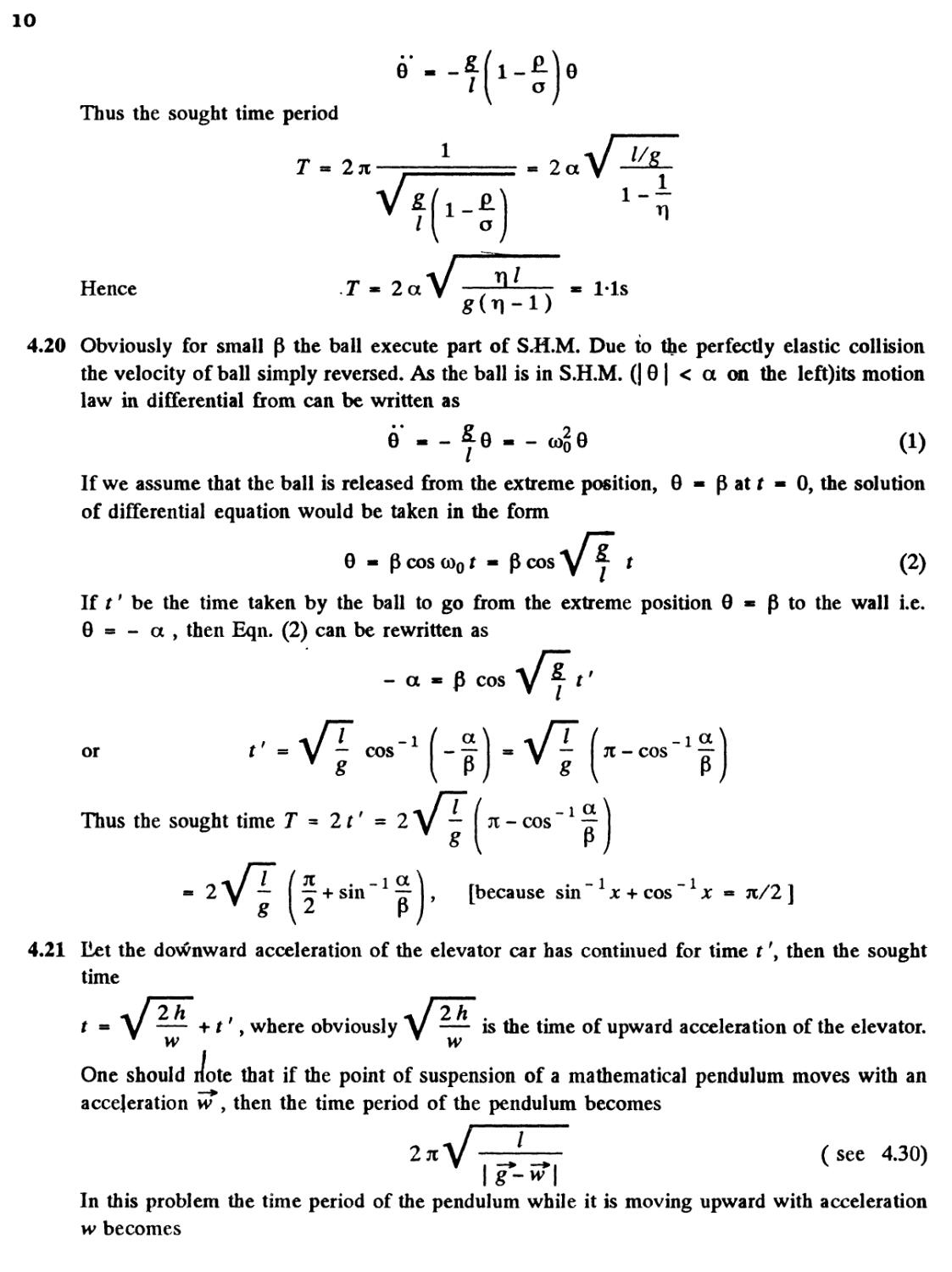
4.20 Obviously for small p the ball execute part of S.H.M. Due to the perfectly elastic collision
the velocity of ball simply reversed. As the ball is in S.H.M. (] 6 | < a on the left)its motion
law in differential from can be written as
a)
P at t - 0, the solution
6 - -
If we assume that the ball is released from the extreme position, 8
of differential equation would be taken in the form
0 - p cos (o01 - p cos
If t' be the time taken by the ball to go from the extreme position 9
8 = - a , then Eqn. B) can be rewritten as
to the wall i.e.
- a
cos
or
— cos
g
-1
a
VI
Thus the sought time T = It' =
S
g
_i a
jc-cos —
«. fl ( k . _ i a \
Jt - COS
\
I
-1
p
ecause sin ~ 1 x + cos ~l x - n/2 1
J
4.21 Eet the downward acceleration of the elevator car has continued for time t', then the sought
time
+ t', where obviously "V r~~~ is the time of upward acceleration of the elevator.
One should note that if the point of suspension of a mathematical pendulum moves with an
acceleration w , then the time period of the pendulum becomes
I
( see 4.30)
In this problem the time period of the pendulum while it is moving upward with acceleration
w becomes

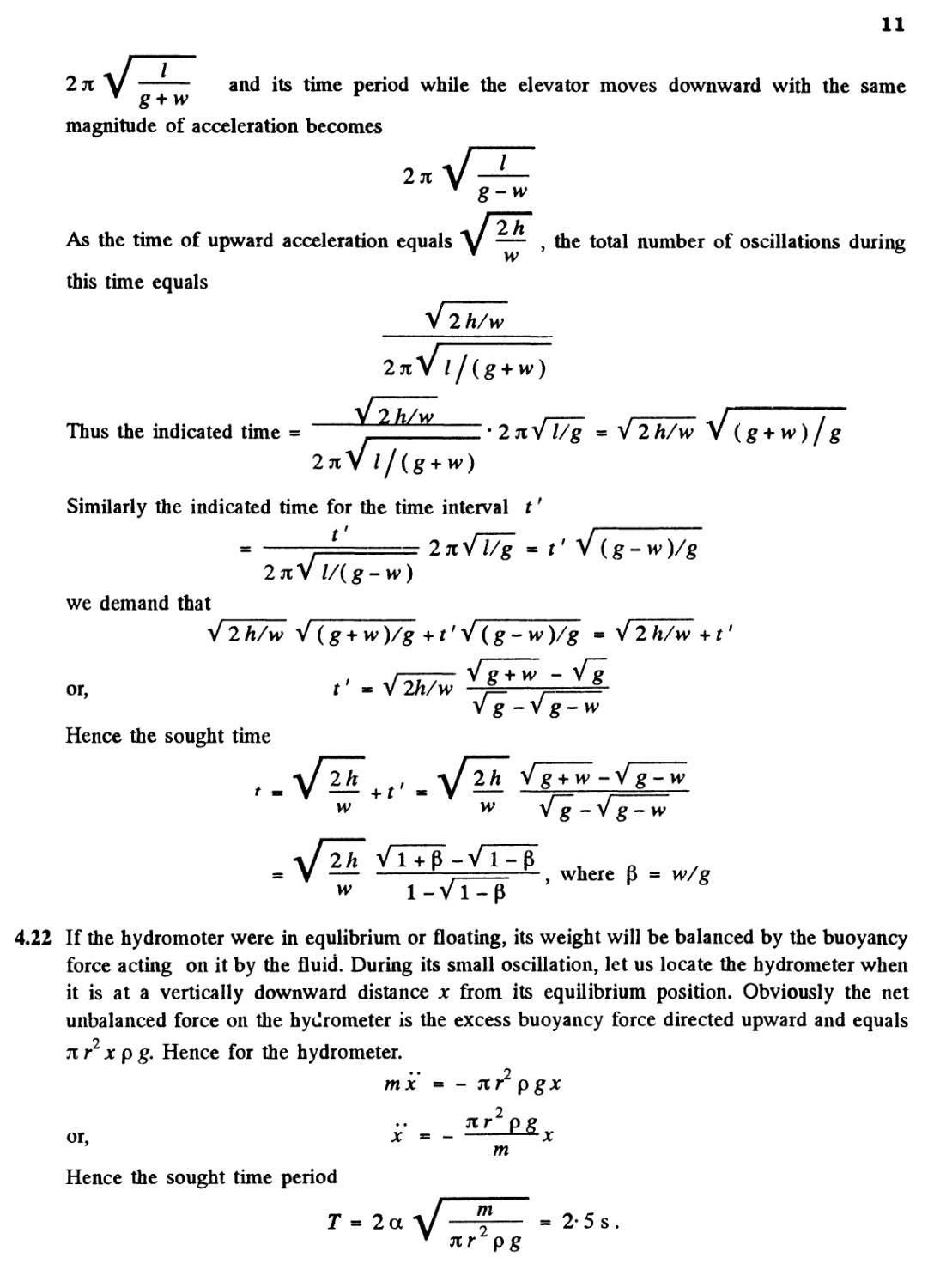
11
2ji v aftd its time period while the elevator moves downward with the same
Y g + vv r
magnitude of acceleration becomes
g-w
V?,
this time equals
As the time of upward acceleration equals y — , the total number of oscillations during
Thus the indicated time =
Similarly the indicated time for the time interval t'
t'
• 2 n V l/g = V2/t/w V (g+w)/g
t'
jiV//(g-w)
we demand that
2h/w V (g + w )/g +1' V (g - w )/g = V 2
g -Vg-w
Hence the sought time
, where p = w/g
4.22 If the hydromoter were in equlibrium or floating, its weight will be balanced by the buoyancy
force acting on it by the fluid. During its small oscillation, let us locate the hydrometer when
it is at a vertically downward distance x from its equilibrium position. Obviously the net
unbalanced force on the hydrometer is the excess buoyancy force directed upward and equals
n r2 x p g. Hence for the hydrometer.
mx = - nr pgx
or, x = -
m
Hence the sought time period
f= 2-5s
jtr2pg

12
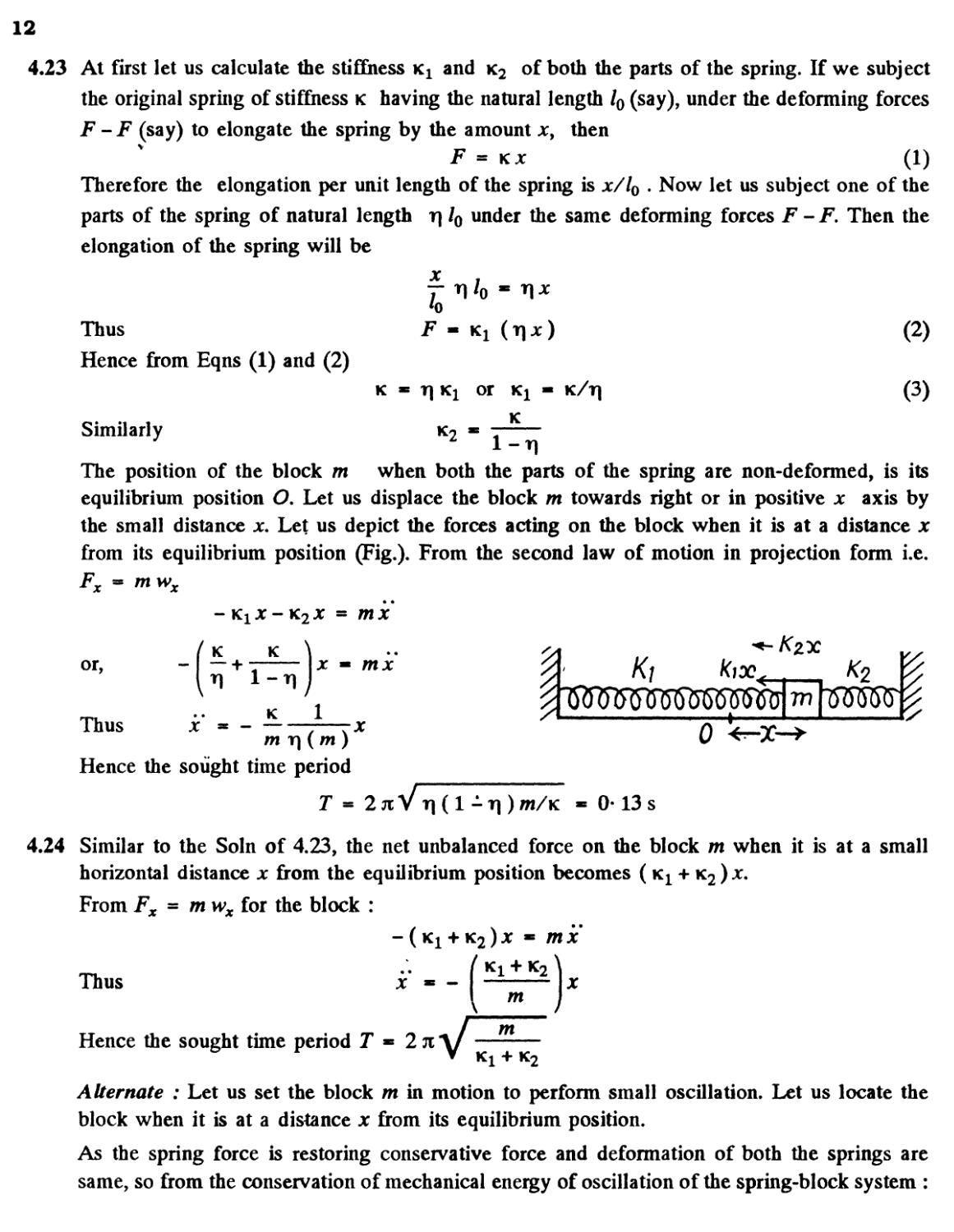
4.23 At first let us calculate the stiffness iq and k2 of both the parts of the spring. If we subject
the original spring of stiffness k having the natural length l0 (say), under the deforming forces
F -F (say) to elongate the spring by the amount x, then
F = kx A)
Therefore the elongation per unit length of the spring is x/l0 . Now let us subject one of the
parts of the spring of natural length r\ l0 under the same deforming forces F -F. Then the
elongation of the spring will be
x
r\x
Thus
Hence from Eqns A) and B)
Similarly
r\
or
B)
C)
K
1-T]
The position of the block m when both the parts of the spring are non-deformed, is its
equilibrium position O. Let us displace the block m towards right or in positive x axis by
the small distance x. Let us depict the forces acting on the block when it is at a distance x
from its equilibrium position (Fig.). From the second law of motion in projection form i.e.
m
or,
K
K
1-
= mx
mx
I
Thus x = ;—■
m r\ ( m )
Hence the sought time period
*-Kzx
— K2
rn
0
T = 2jtVTi(l-Ti)m/K « 013 s
4.24 Similar to the Soln of 4.23, the net unbalanced force on the block m when it is at a small
horizontal distance x from the equilibrium position becomes ( kx + k2 ) x.
From Fx = mwx for the block :
- ( kx + k2 )x
mx
Thus
K2
m
Hence the sought time period T * 2 n \l
Alternate : Let us set the block m in motion to perform small oscillation. Let us locate the
block when it is at a distance x from its equilibrium position.
As the spring force is restoring conservative force and deformation of both the springs are
same, so from the conservation of mechanical energy of oscillation of the spring-block system :

13
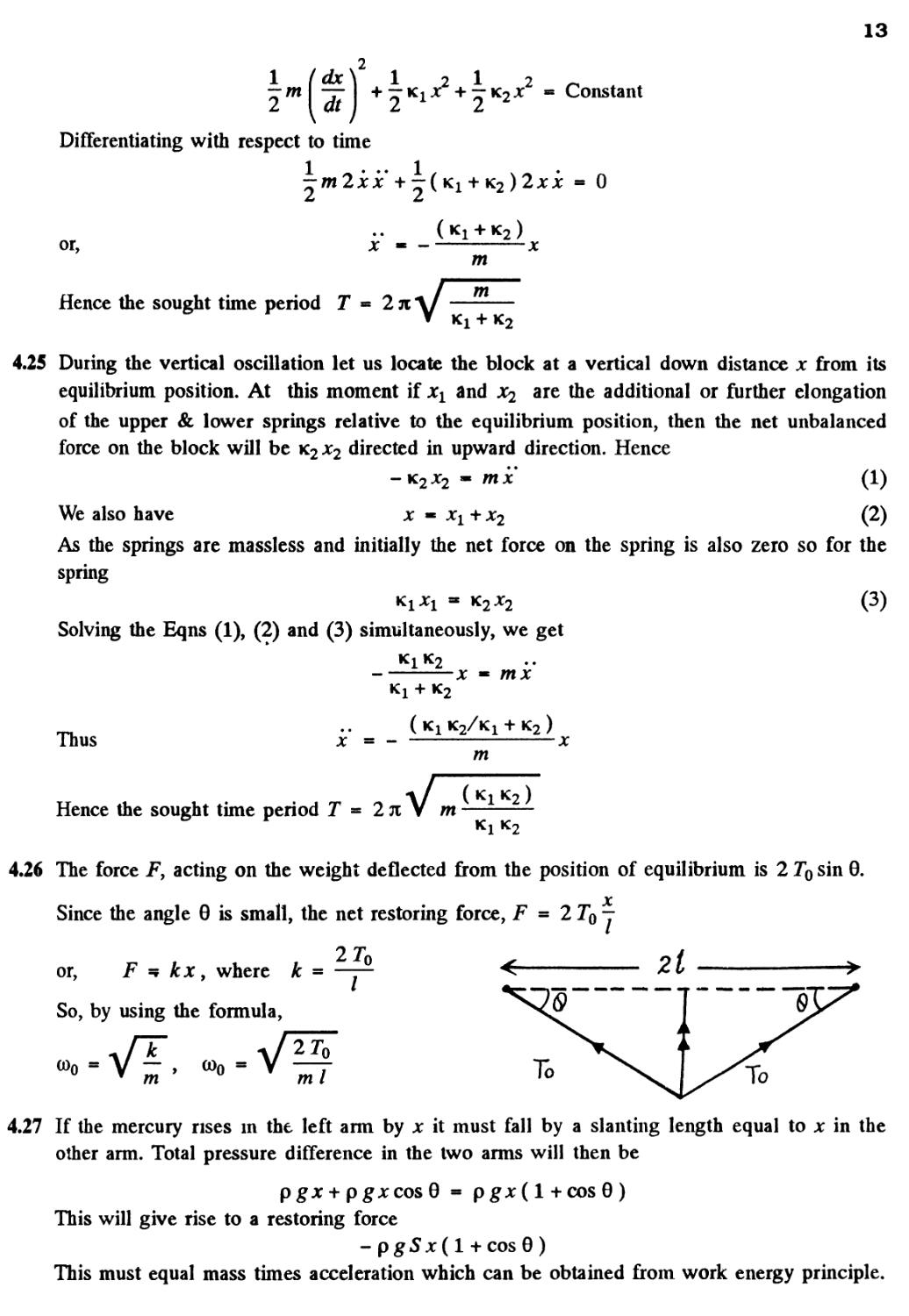
2
k2x ■ Constant
Differentiating with respect to time
— mlkx +~(Ki + k2Jjcjc = 0
or,
m
flertce the sought time period T - 2 jc " '
4.25 During the vertical oscillation let us locate the block at a vertical down distance x from its
equilibrium position. At this moment if jq and X2 are the additional or further elongation
of the upper & lower springs relative to the equilibrium position, then the net unbalanced
force on the block will be k2 x2 directed in upward direction. Hence
- k2x2 * mx A)
We also have x « jq + x2 B)
As the springs are massless and initially the net force on the spring is also zero so for the
spring
K1 Jtj ** K2 X2 \^)
Solving the Eqns A), B) and C) simultaneously, we get
mx
Thus x = - jc
m
m
Ki K2
4.26 The force F> acting on the weight deflected from the position of equilibrium is 2 Jo sin 0.
Since the angle 0 is small, the net restoring force, F = 2 To y
2 7" /
or, F =i kxy where Jfc = ^ 21 —>
So, by using the formula,
HT \/2To
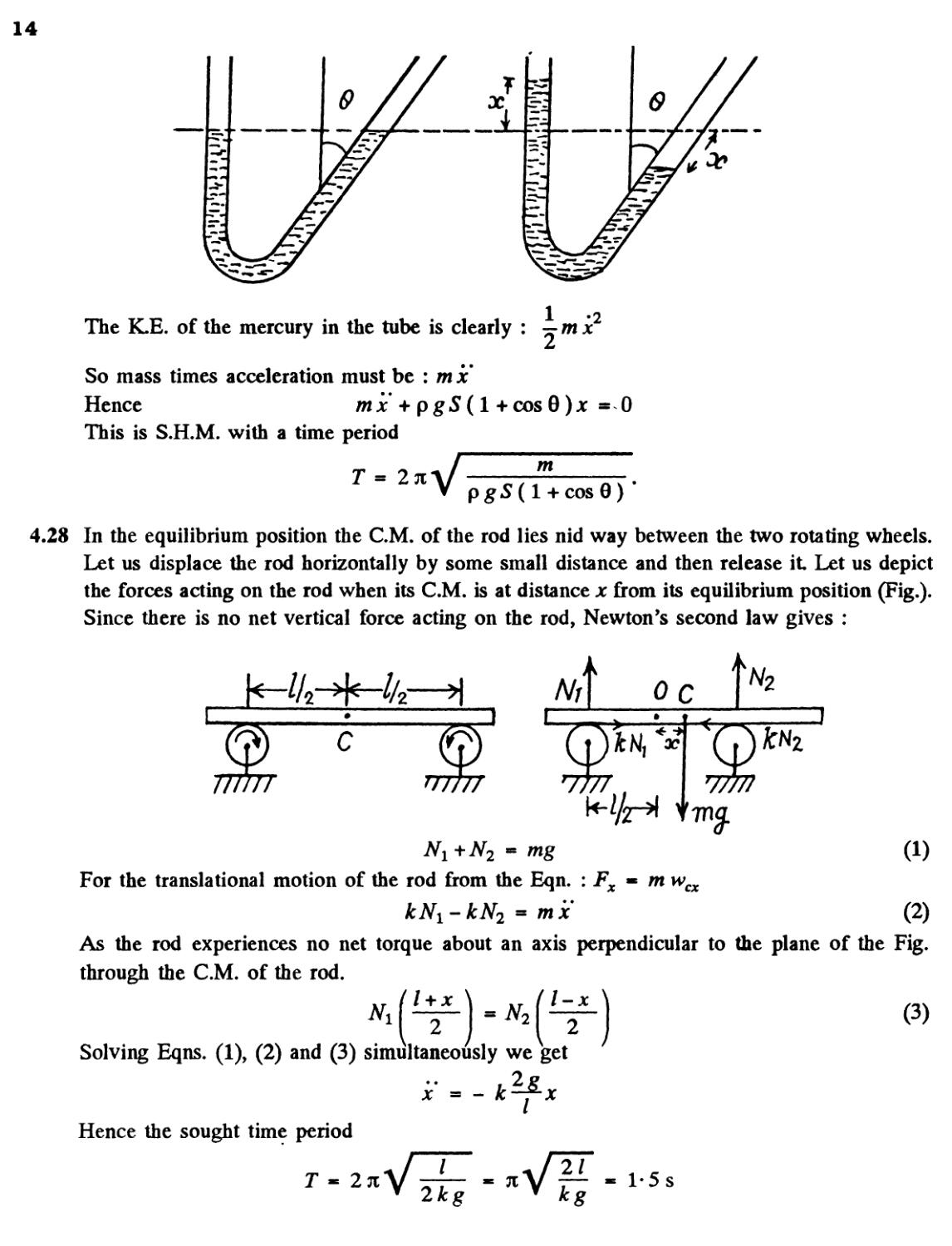
4.27 If the mercury rises in the left arm by x it must fall by a slanting length equal to x in the
other arm. Total pressure difference in the two arms will then be
pgx + pgxcosQ = pgjt(l+cos0)
This will give rise to a restoring force
-pgSjt(l + cos0)
This must equal mass times acceleration which can be obtained from work energy principle.

14
The K.E. of the mercury in the tube is clearly : -mi2
So mass times acceleration must be : m x
Hence mx + pgS( 1 + cos 0) jc » 0
This is S.H.M. with a time period
m
4.28 In the equilibrium position the CM. of the rod lies nid way between the two rotating wheels.
Let us displace the rod horizontally by some small distance and then release it Let us depict
the forces acting on the rod when its CM. is at distance x from its equilibrium position (Fig.).
Since there is no net vertical force acting on the rod, Newton's second law gives :
N,
t o
777/77
Jfctt*
WT/7
777/7
A)
ex
m+N2 - mg
For the translational motion of the rod from the Eqn. : Fx « m wi
kNi-kfy-mx B)
As the rod experiences no net torque about an axis perpendicular to the plane of the Fig.
through the CM. of the rod.
C)
Solving Eqns. A), B) and C) simultaneously we get
Hence the sought time period
T - 2
Y 2kg
l-5s

15
4.29 (a) The only force acting on the ball is the gravitational force Fy of magnitude y — ji p m r,
where y is the gravitational constant p, the density of the Earth and r is the distance of
the body from the centre of the Earth.
An -*
But, g - y -T- p R , so the expression for F can be written as,
—* r
F = - mg— , here /? is the radius of the Earth and the equation of motion in projection
R
form has the form, or, mx + ~~~* - 0
R
(b) The equation, obtained above has the form of an equation of S.H.M. having the time
period, T - 2 n V - ,
g
Hence the body will reach the other end of the shaft in the time,
n V — =42 min .
T
2
g
(c) From the conditions of S.H.M., the speed of the body at the centre of the Earth will be
maximum, having the magnitude,
T =1-9 km/s .
v = R a) = R Vg/R =
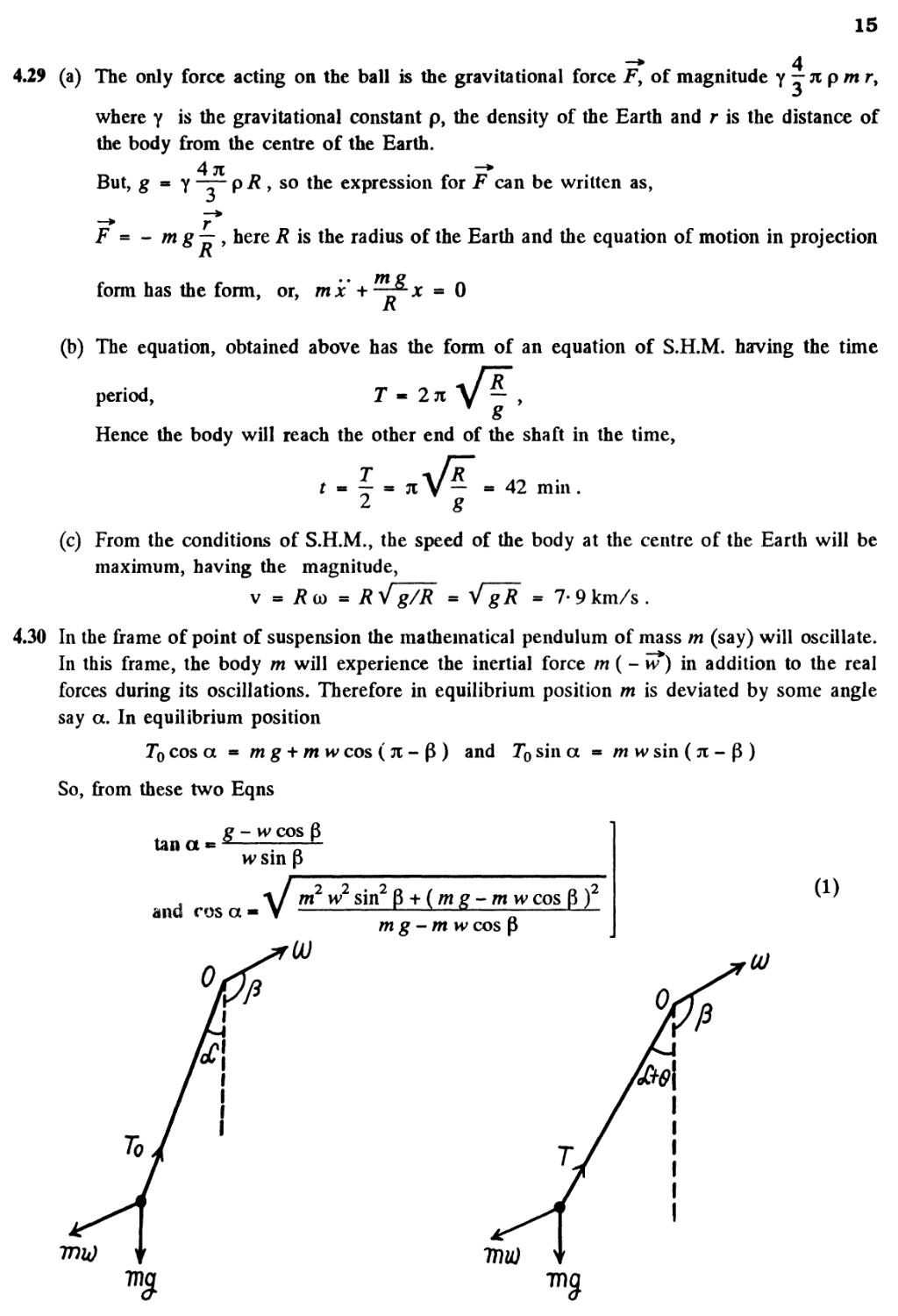
4.30 In the frame of point of suspension the mathematical pendulum of mass m (say) will oscillate.
In this frame, the body m will experience the inertia] force m ( - vT) in addition to the real
forces during its oscillations. Therefore in equilibrium position m is deviated by some angle
say a. In equilibrium position
Tq cos a - m g + mw cos ( n - P ) and Jo sin a - m w sin ( ji -
So, from these two Eqns
tana
g - wcos
wsin
and cos
o
Vm w sin 6 + (m g - m w cos B )
H * Q I^Z
m g -mw cos p
60
A)
imo
TTUi)

16
Let us displace the bob m from its equilibrium position by some small angle and then release
it Now locate the ball at an angular position (a + 0) from vertical as shown in the figure.
From the Eqn. : N& - / pz
- m g I sin (a + 0) - m w cos (ji - P) / sin (a + 9) + m w sin (ji - P) / cos (a + 0) = m I2 0
or,- g (sin a cos 0 + cos a sin 0) - w cos (ji - P) (sin a cos 0 + cos a sin 9) + w sin p
(cos a cos 0 - sin a sin 0)
= /£>'
But for small 9, sin 9 « 0 cos 9 » 1
So, - g (sin a + cos a 0) - w cos (ji - P) (sin a + cos a 0) + w sin P (cos a - sin a 0)
« /0
or,
(tan a + 0 ) ( w cos P-g) + wsinP(l- tan a 0 )
cos a
0
B)
Solving Eqns A) and B) simultaneously we get
0
Thus
Hence the sought time period T
0
/
0
co0
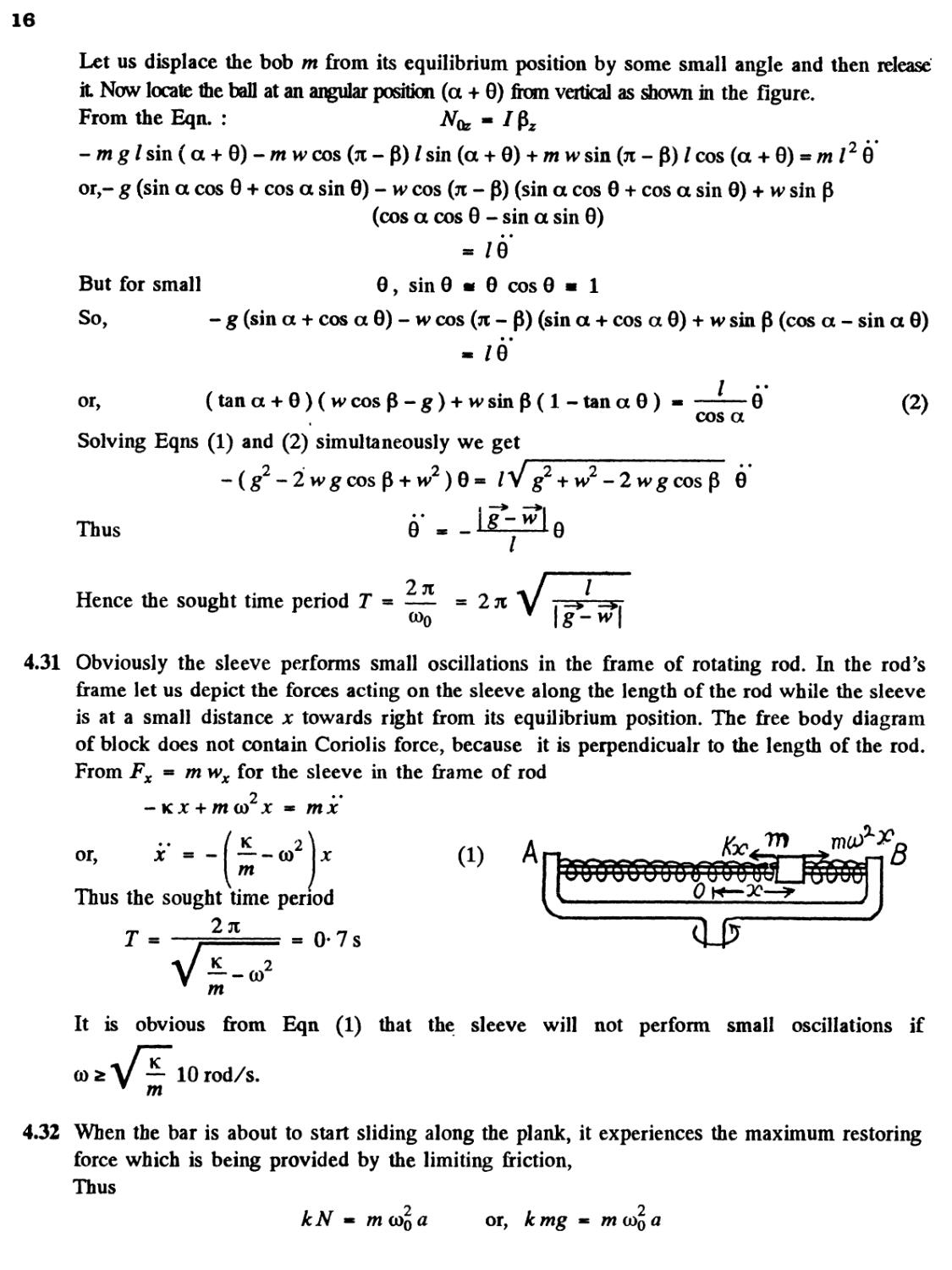
4.31 Obviously the sleeve perfonns small oscillations in the frame of rotating rod. In the rod's
frame let us depict the forces acting on the sleeve along the length of the rod while the sleeve
is at a small distance x towards right from its equilibrium position. The free body diagram
of block does not contain Coriolis force, because it is perpendicualr to the length of the rod.
From Fx
mwx for the sleeve in the frame of rod
or,
x = - I —-co
m
2
mx
\
Thus the sought time period
T = Ji! = 0- 7 s
m
-co
It is obvious from Eqn A) that the sleeve will not perform small oscillations if
CO
~ lOrod/s.
m
4.32 When the bar is about to start sliding along the plank, it experiences the maximum restoring
force which is being provided by the limiting friction,
Thus
kN « m co0 a or, k mg « m odo a

17
or,
k =
8
a I 2k
8
- 4s.
4J3 The natural angular frequency of a mathematical pendulum equals co0 = Vg77
(a) We have the solution of S.H.M. equation in angular form :
0 = Qm cos (coo t + a )
If at the initial moment i.e. at t = 0, 0 = 0m than a = 0.
Thus the above equation takes the form
0 * 0OT cos
Thus
0 - 3° cos 3-5 t
(b) The S.H.M. equation in angular form :
0 = 0m sin (co01 + a)
If at the initial moment t = 0 , 0 « 0, then a = 0 .Then the above equation takes the
form
0 = 0msincoor
Let v0 be the velocity of the lower end of pendulam at 0 = 0, then from conserved of
mechanical energy of oscillaton
or,
E = E or T = U
*"mean Xj extreme "* * mean w extrem
1 2
-mv0 = mgl( 1- cos 0W )
Thus
* COS
1-
2
v0
2gl)
cos
-1
1-
@ • 22
2x9-8x0-8
= 4-5
c-
Ihc sought equation becomes
0 - 0m sin co0 / - 4-5° sin 3-5 t
(c) Let 0O and v0 be the angular deviation and linear velocity at t = 0.
As the mechanical energy of oscillation of the mathematical pendulum is conservation
1 i
- mv
mg/( 1 -cos 0O) - mg/(l-cos0m)
or,
Thus 0m = cos
— = g/(cos0o-cos0m)
'
= cos
-1
00 "
@-22
2x9-8x0-8
5-4

18
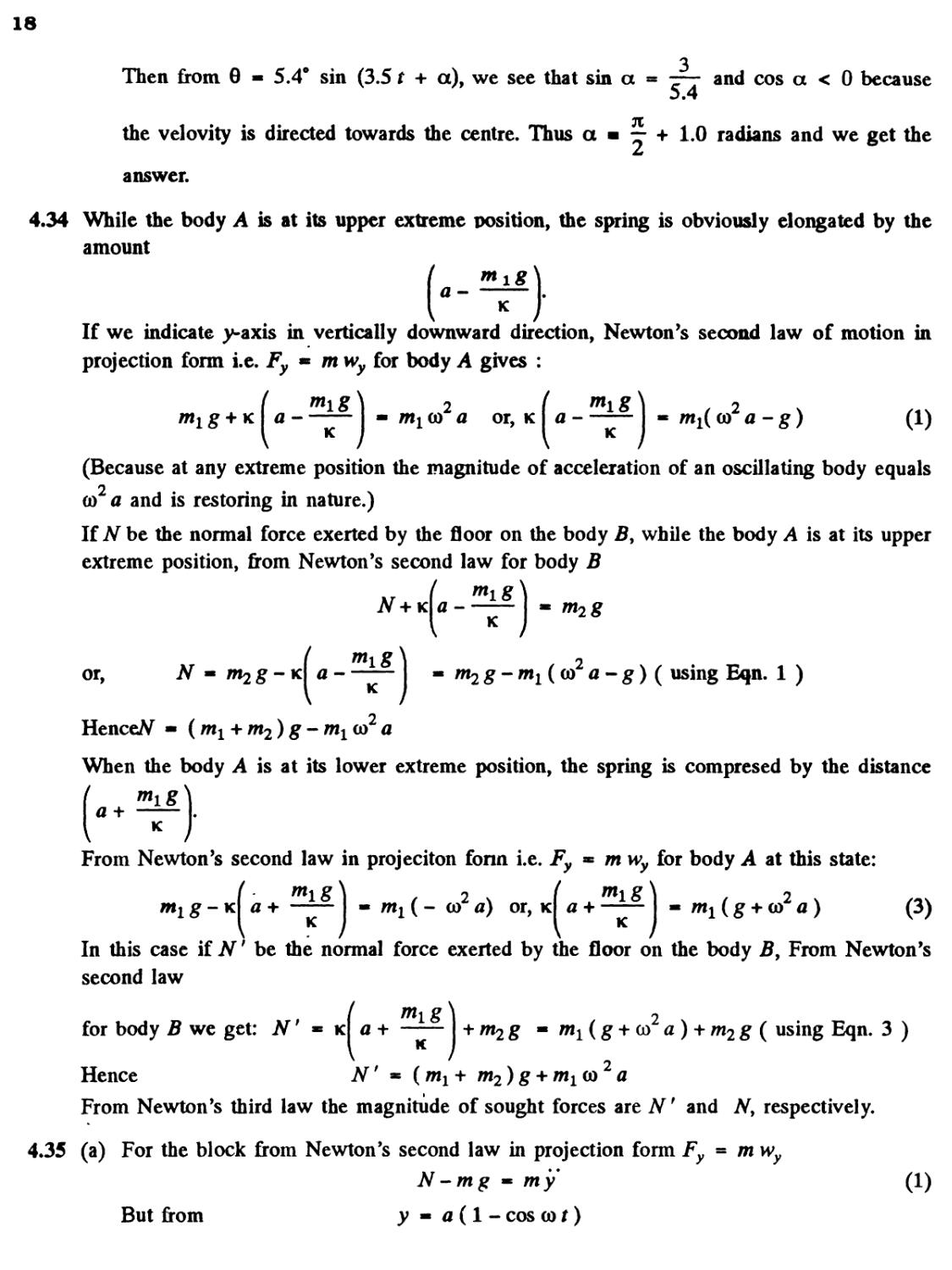
Then from G - 5.4° sin C.5 t + a), we see that sin a = -— and cos a < 0 because
5.4
the velovity is directed towards the centre. Thus a ■ — + 1.0 radians and we get the
answer.
4.34 While the body A is at its upper extreme position, the spring is obviously elongated by the
amount
a -
If we indicate y-axis in vertically downward direction, Newton's second law of motion in
projection form i.e. Fy ■ mwy for body A gives :
mi g + * \a -
a or, k
a -
rn^to a-g)
A)
(Because at any extreme position the magnitude of acceleration of an oscillating body equals
to a and is restoring in nature.)
If N be the normal force exerted by the floor on the body B> while the body A is at its upper
extreme position, from Newton's second law for body B
mig
JV+K
a -
1*2 g
or,
N
a -
K
2
HenceW - (m1 + m2) g - m1 co a
When the body A is at its lower extreme position, the spring is compresed by the distance
a +
From Newton's second law in projeciton form i.e. Fy * mwy for body A at this state:
mlg-K
a
( - co a) or, kI a +
"*lg
co2 a)
C)
In this case if N' be the normal force exerted by the floor on the body B, From Newton's
second law
/ _ V
for body B we get: N * ■ k
m2g
using Eqn. 3 )
Hence
N' m (mi+ m2)g
to
From Newton's third law the magnitude of sought forces are N' and N> respectively.
4.35 (a) For the block from Newton's second law in projection form Fy = mwy
N-mg « my
But from y - a(l-costof)

19
2
We get y « co a cos co t B
From Eqns A) and B)
0Ja
N * m g I 1 + cos a)
C)
From Newtons's third law the force by which the body m exerts on the block is directed
2
vertically downward and equls_// ■ m g | 1 + cos co t
(b) When the body m starts, falling behind the plank or loosing contact, N ■ 0, (because the
normal reaction is the contact force). Thus from Eqn. C)
m g I 1 + cos ca t I * 0 for some t
Hence armn * g/ca « 8 cm.
(c) We observe that the motion takes place about the mean position y = a. At the initial
instant y - 0. As shown in (b) the normal reaction vanishes at a height (g/ca ) above
the position of equilibrium and the body flies off as a free body. The speed of the body
at a distance (g/ca2) from the equilibrium position is co V a2 - (g/ca2J, so that the
condition of the problem gives
[q>Vq2-(g/q>2J]2+ g +j = ft
Hence solving the resulting quadratic equation and taking the positive roof,
. 20cm.
CO2 <»
4*36 (a) Let y (t) - displacement of the body from the end of the unstreched position of the
spring (not the equilibrium position). Then
my «-Ky+mg
This equation has the solution of the form
y «A+2? cos (cor + a)
if -mco2Z?cos (caf + a ) - - k [A +5cos (cor + a)] + mg
Then co2 = - and A =
m K
we have y « 0 and y * 0 at t « 0. So
- ca 5 sin a « 0
A + B cos a = 0
Since 5 > 0 and A > 0 we must have a * ji
m
A
K

20
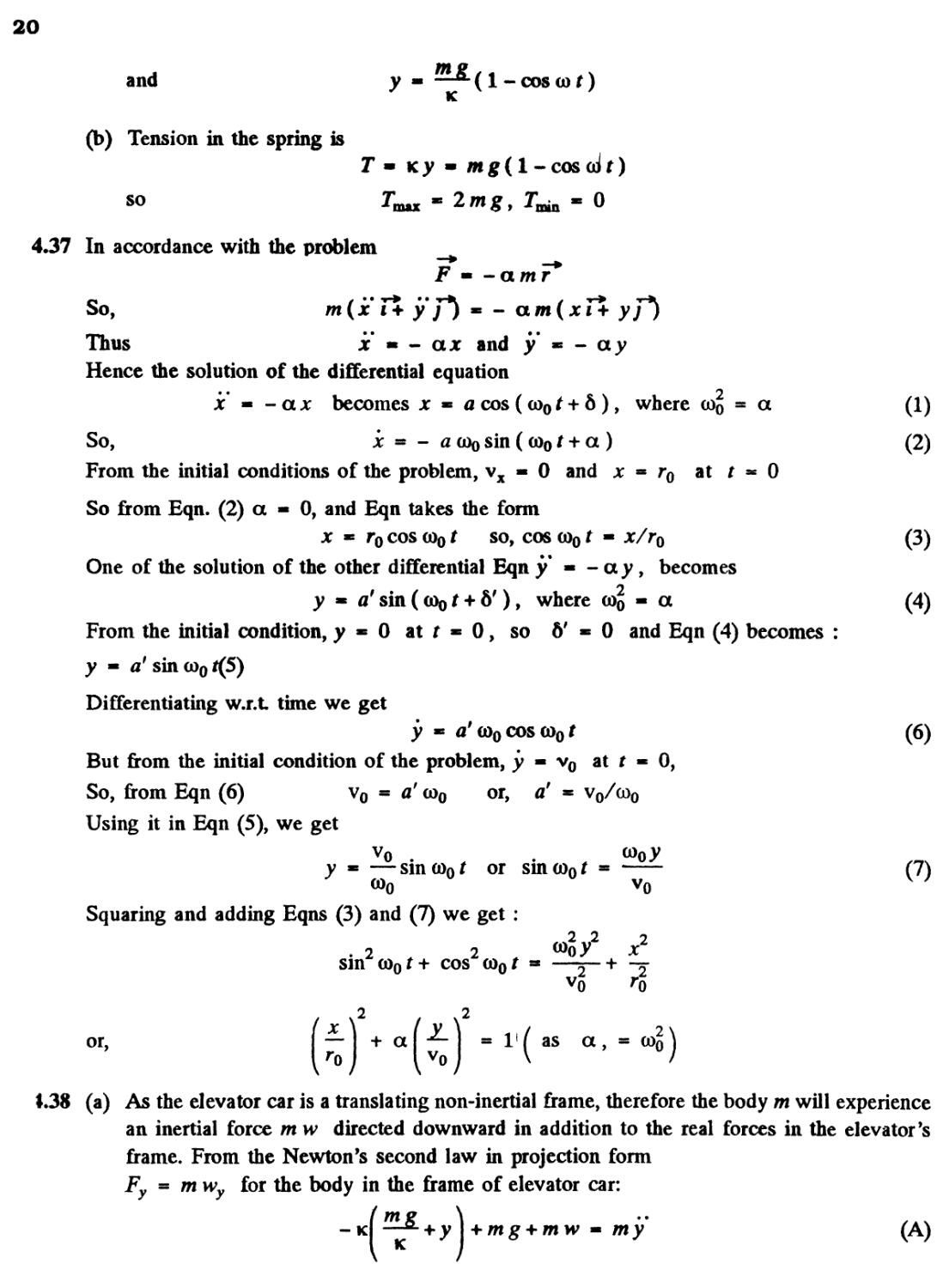
and y - —*• ( 1 - cos co t)
K
(b) Tension in the spring is
7 ■ icy m mg(l-cosair)
- 2mg, J^ « 0
4.37 In accordance with the problem
F--amr
So, m(i# F+ y/^ * - am( xt+
Thus i" • - ax and y * - ay
Hence the solution of the differential equation
x - - a x becomes x ■ a cos (ca0 f + 5 ), where <o0 = a A)
So, i » - a a)o sin (coo t + a ) B)
From the initial conditions of the problem, vx - 0 and x - r0 at r * 0
So from Eqn. B) a - 0, and Eqn takes the form
x * r0 cos co0 f so, cos co01 - jc/r0 C)
One of the solution of the other differential Eqn y - - ay, becomes
y * a' sin ( o>o t + 6'), where co0 - a D)
From the initial condition, y ■ 0 at t ■ 0, so 6' ■ 0 and Eqn D) becomes :
y - a1 sin ca0 fE)
Differentiating w.r.t time we get
y * a'(o0cosco0r F)
But from the initial condition of the problem, y - v0 at t « 0,
So, from Eqn F) v0 = a1 (o0 or, a! * v0/co0
Using it in Eqn E), we get
v0 co0y
y ■ —sincon^ or sino)^
v0
Squaring and adding Eqns C) and G) we get :
2 2 2
. 2 2 ^oy x
sin co0f+ cos co0f a —5— +
2
/ V )
1*38 (a) As the elevator car is a translating non-inertial frame, therefore the body m will experience
an inertial force m w directed downward in addition to the real forces in the elevator's
frame. From the Newton's second law in projection form
Fy = m wy for the body in the frame of elevator car:
-i
+ y|+mg + mw - my (A)

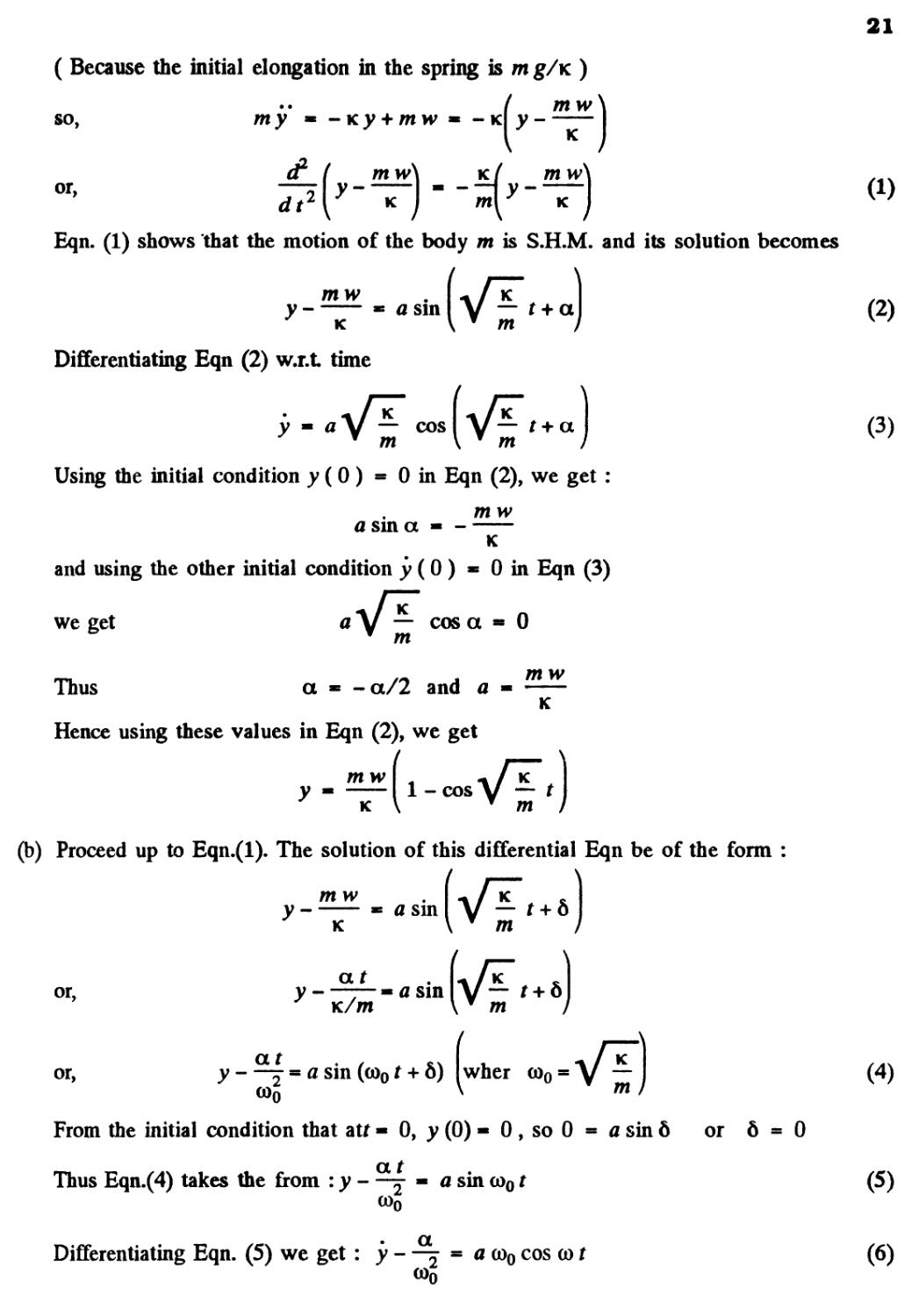
21
( Because the initial elongation in the spring is m g/K )
mw
so,
or,
my
-k y-
^mmmmmmmi
dtl
mw}
K
m
mm—
K
(i)
Eqn. A) shows that the motion of the body m is S.H.M. and its solution becomes
mw
y * a sin
K
B)
Differentiating Eqn B) w.r.t time
aV7
v m
cos
C)
Using the initial condition y @ ) =* 0 in Eqn B), we get :
m w
a sin a -
K
and using the other initial condition y @ ) * 0 in Eqn C)
we get
Thus
V — cos a = 0
a * -a/2 and a
mw
«■■■
K
Hence using these values in Eqn B), we get
mw
1 - cos A/ — i
T m
(b) Proceed up to Eqn.(l). The solution of this differential Eqn be of the form
m w
y * a sin
K
V — r +
or,
y-
at
K/m
sin
or,
at
y - —y ~ a s*n (^o ^ + 8)
co0
wher co0 = V ~
D)
From the initial condition that att - 0, y @) - 0 , so 0 = a sin 6 or 6
Thus Eqn.D) takes the from : y - —j - a sin ca0 r
co0
a
Differentiating Eqn. E) we get : y - —^ = a co0 cos co t
co0
E)
F)

22
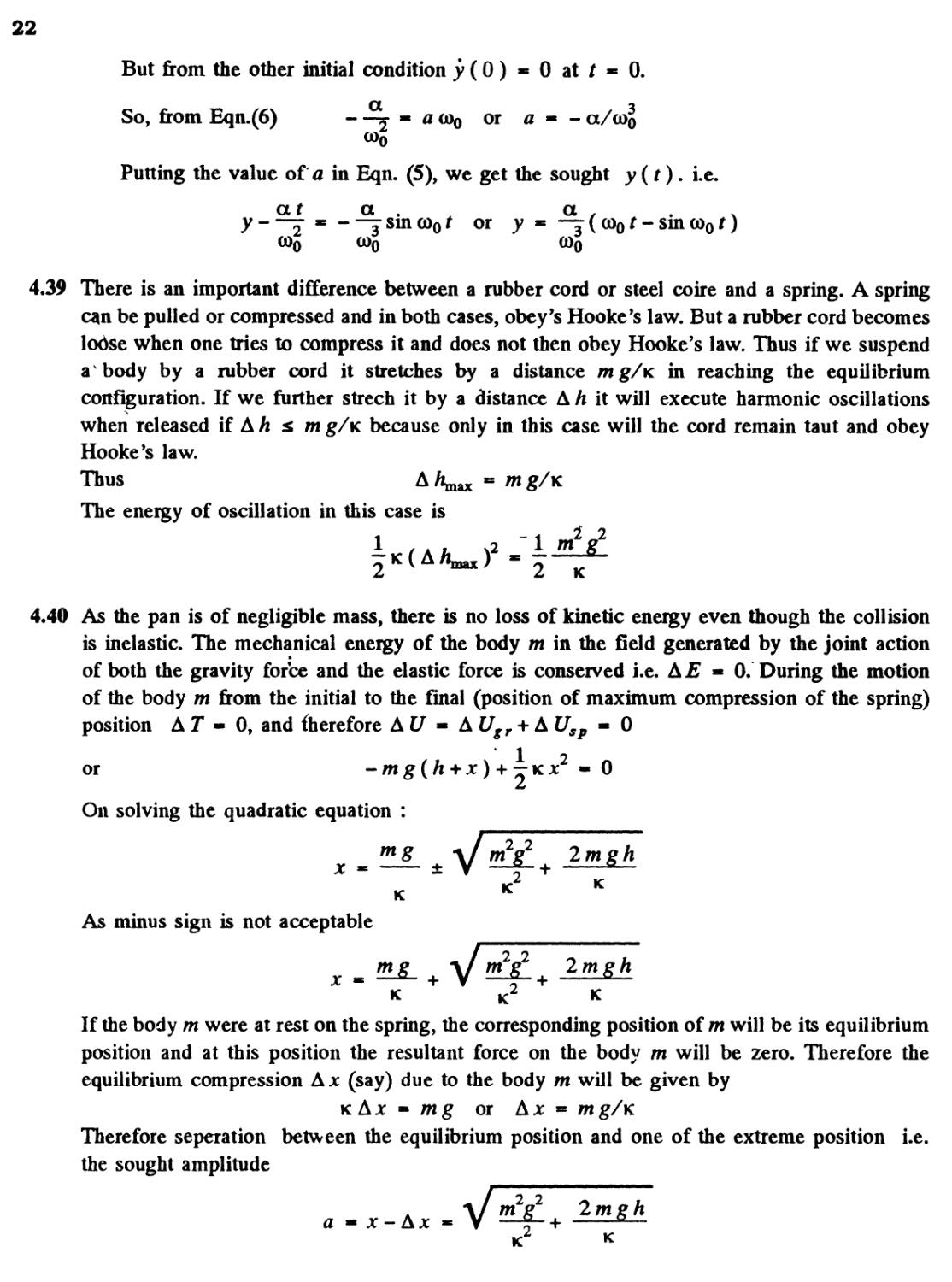
But from the other initial condition y(O)«Oatf«O.
So, from £qn.F) *• « a tt>0 or a-- a/caj)
Putting the value of a in Eqn. E), we get the sought y (t). i.e.
af a . a t .
y-— ■ - — sin(Dof or y ■ — (co0r-sinco0f)
4*39 There is an important difference between a rubber cord or steel coire and a spring. A spring
can be pulled or compressed and in both cases, obey's Hooke's law. But a rubber cord becomes
loose when one tries to compress it and does not then obey Hooke's law. Thus if we suspend
a body by a rubber cord it stretches by a distance mg/K in reaching the equilibrium
configuration. If we further strech it by a distance A h it will execute harmonic oscillations
when released if Ah £ mg/K because only in this case will the cord remain taut and obey
Hooke's law.
Thus &hmui « mg/K
The energy of oscillation in this case is
g2
4.40 As the pan is of negligible mass, there is no loss of kinetic energy even though the collision
is inelastic. The mechanical energy of the body m in the field generated by the joint action
»
of both the gravity force and the elastic force is conserved i.e. AE - 0. During the motion
of the body m from the initial to the final (position of maximum compression of the spring)
f 0
or -wg
On solving the quadratic equation :
mg
K
As minus sign is not acceptable
x «■ —
- ±
+
V
~gr ' —
' 1
1 1 -_ ^m ^
2
2mgh
K
2mgh
K
If the body m were at rest on the spring, the corresponding position of m will be its equilibrium
position and at this position the resultant force on the body m will be zero. Therefore the
equilibrium compression A x (say) due to the body m will be given by
kAjc = wg or Ax = mg/K
Therefore seperation between the equilibrium position and one of the extreme position i.e.
the sought amplitude
%/ •" o 2mgh
a - x-Ax - w —°- • Q—

23
The mechanical energy of oscillation which te conserved equals E - Uextreme because at the
extreme position kinetic energy becomes zero.
Although the weight of body m is a conservative force , it is not restoring in this problem,
hence Uextreme is only concerned wjth the spring force. Therefore
tt 1 2 , m2 g2
- ^extreme m ^ a * m g H +
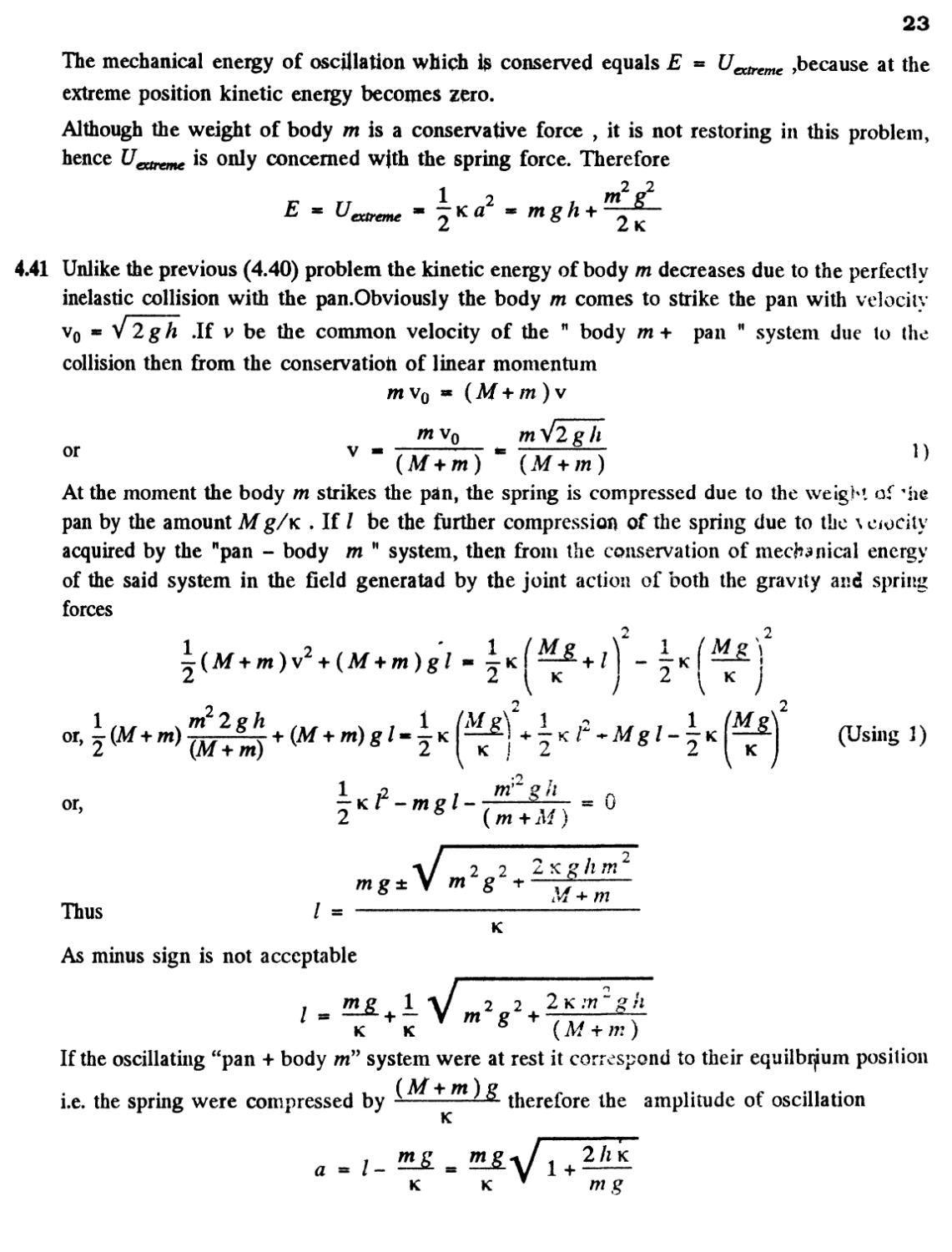
4.41 Unlike the previous D.40) problem the kinetic energy of body m decreases due to the perfectly
inelastic collision with the pan.Obviously the body m comes to strike the pan with velocity
v0 - V 2gh .If v be the common velocity of the " body m + pan " system due to the
collision then from the conservation of linear momentum
mv0 * (A/+/n)v
rnvp my/lgh
°r V " (Af + m) ^ (M + m) ])
At the moment the body m strikes the pdn, the spring is compressed due to the weight of "he
pan by the amount Mg/K . If / be the further compression of the spring due to the \ ejocity
acquired by the "pan - body m " system, then from the conservation of mechanical energy
of the said system in the Geld generatad by the joint action of both the gravity ar.d spring
forces
1 1 (Mg X 1 (Mg\2
I y K I « K J
L
' i
«v K J
2 2 2
28h 1 (Mg\ 1 ,2 1 (M\
K J
i2
2 , ni'2gh
V2 2 tXg
Thus / =
As minus sign is not acceptable

k k ° (M + m)
If the oscillating "pan + body m" system were at rest it correspond to their equilbijium position
i.e. the spring were compressed by -^- therefore the amplitude of oscillation
IV
m g

24
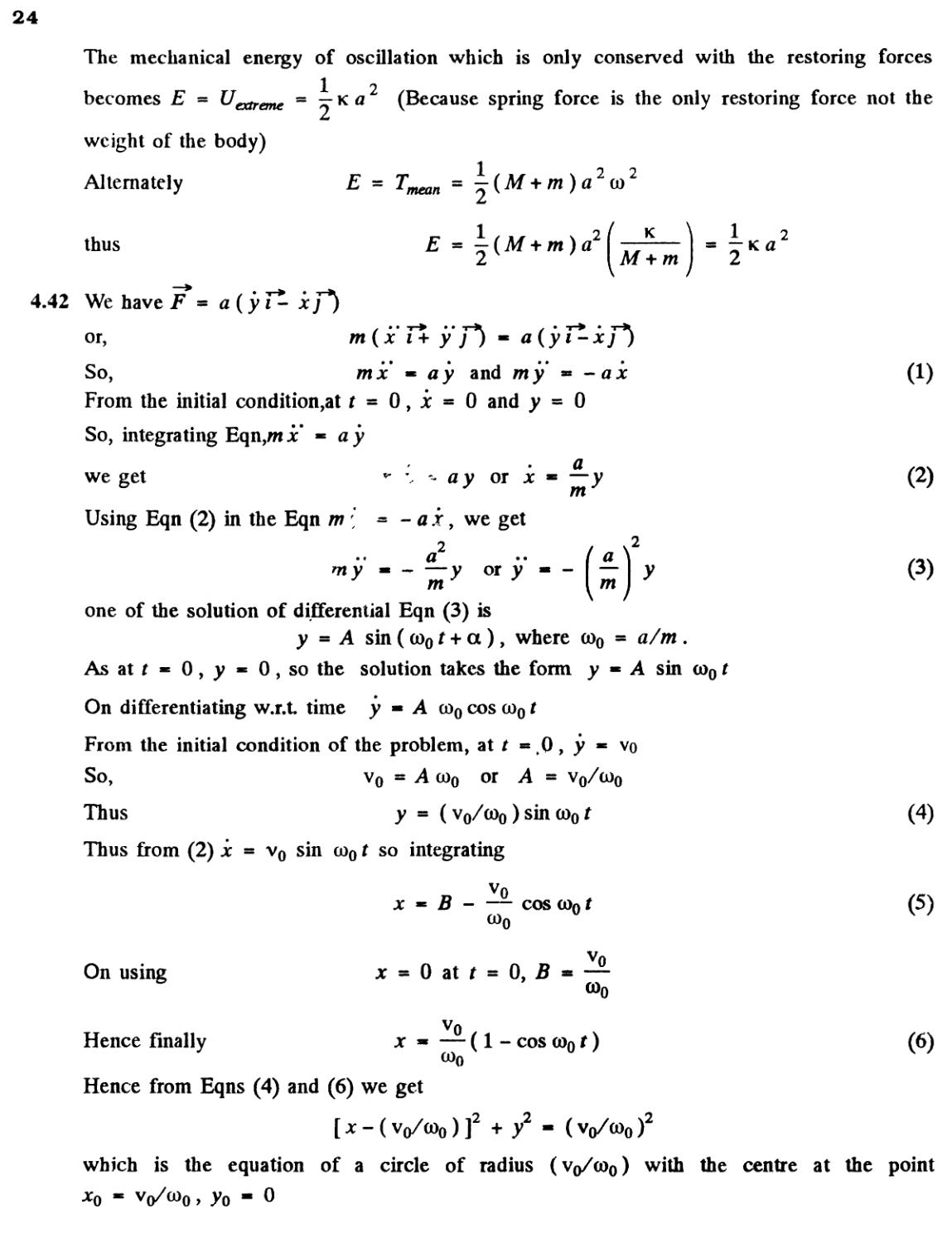
The mechanical energy of oscillation which is only conserved with the restoring forces
becomes E = U(
weight of the body)
Alternately
thus
1 2
extreme = — k a (Because spring force is the only restoring force not the
E = T
mam
2
m)a2to2
E = ^(M + m)a
M
4.42 We have F = a(yT^- xf*)
jc i+ y /) - a(yi-x/j
So, mx « ay and my ■ -ax
From the initial condition,at r = 0, i = 0 and y = 0
So, integrating Eqn,mx = ay
we get *• '.
a
ay or x
Using Eqn B) in the Eqn m ; = -«j, we get
2
m
2 /
a .. / a
j?iy - - —y or y - - —
m Im
one of the solution of differential Eqn C) is
y = A sin((o0f + a), where co0 = a/m.
As at t « 0, y « 0, so the solution takes the form y « A sin (o0 f
On differentiating w.r.t time y - A co0 cos co0 r
From the initial condition of the problem, at t ■ ,0 , y * vo
So, v0 = A co0 or A = vo/a)o
Thus y = (vo/a)o) sin co01
Thus from B) x = v0 sin co0 r so integrating
vo
—
co0
cos (o0
On using
= O, B = —
ca0
v0
0
jc » — A - cos co01)
co0
A)
B)
C)
D)
E)
F)
Hence finally
Hence from Eqns D) and F) we get
[*-(vo/a)o)]2 + y
which is the equation of a circle of radius (vq/(o0) with the centre at the point
x0
y0 - 0

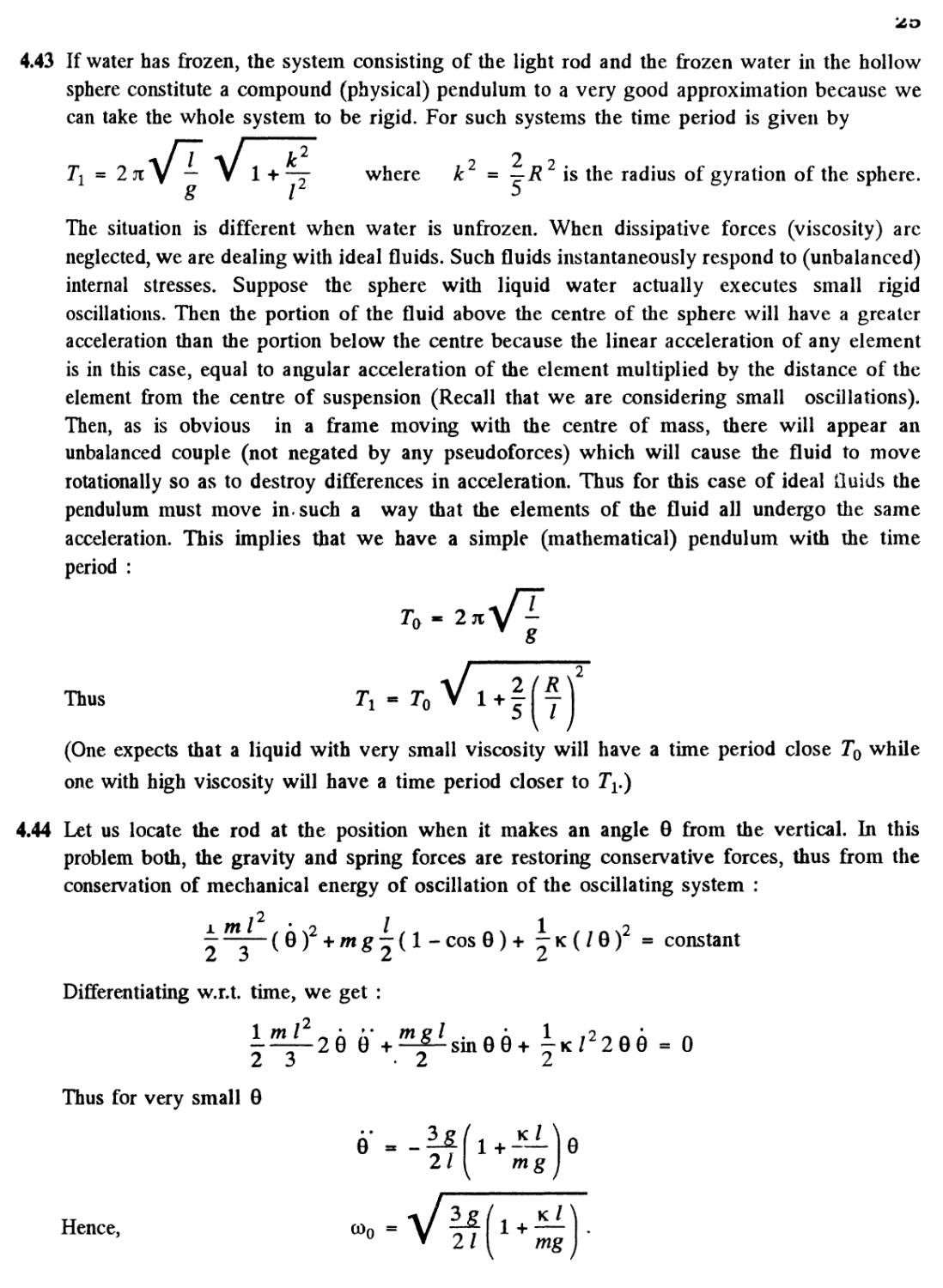
4.43 If water has frozen, the system consisting of the light rod and the frozen water in the hollow
sphere constitute a compound (physical) pendulum to a very good approximation because we
can take the whole system to be rigid. For such systems the time period is given by
T1 = 2k\— Vl + — where k = — R is the radius of gyration of the sphere.
The situation is different when water is unfrozen. When dissipative forces (viscosity) arc
neglected, we are dealing with ideal fluids. Such fluids instantaneously respond to (unbalanced)
internal stresses. Suppose the sphere with liquid water actually executes small rigid
oscillations. Then the portion of the fluid above the centre of the sphere will have a greater
acceleration than the portion below the centre because the linear acceleration of any element
is in this case, equal to angular acceleration of the element multiplied by the distance of the
element from the centre of suspension (Recall that we are considering small oscillations).
Then, as is obvious in a frame moving with the centre of mass, there will appear an
unbalanced couple (not negated by any pseudoforces) which will cause the fluid to move
rotationally so as to destroy differences in acceleration. Thus for this case of ideal iluids the
pendulum must move in. such a way that the elements of the fluid all undergo the same
acceleration. This implies that we have a simple (mathematical) pendulum with the time
period :
k\ -
o
Thus ^-
(One expects that a liquid with very small viscosity will have a time period close Jo while
one with high viscosity will have a time period closer to 7\.)
4.44 Let us locate the rod at the position when it makes an angle 8 from the vertical. In this
problem both, the gravity and spring forces are restoring conservative forces, thus from the
conservation of mechanical energy of oscillation of the oscillating system :
mil
—r— ( 8) + m g — A - cos 8) + t-k(ZGJ = constant
Differentiating w.r.t. time, we get :
Thus for very small 8
e
mg
Hence, co0 =

26
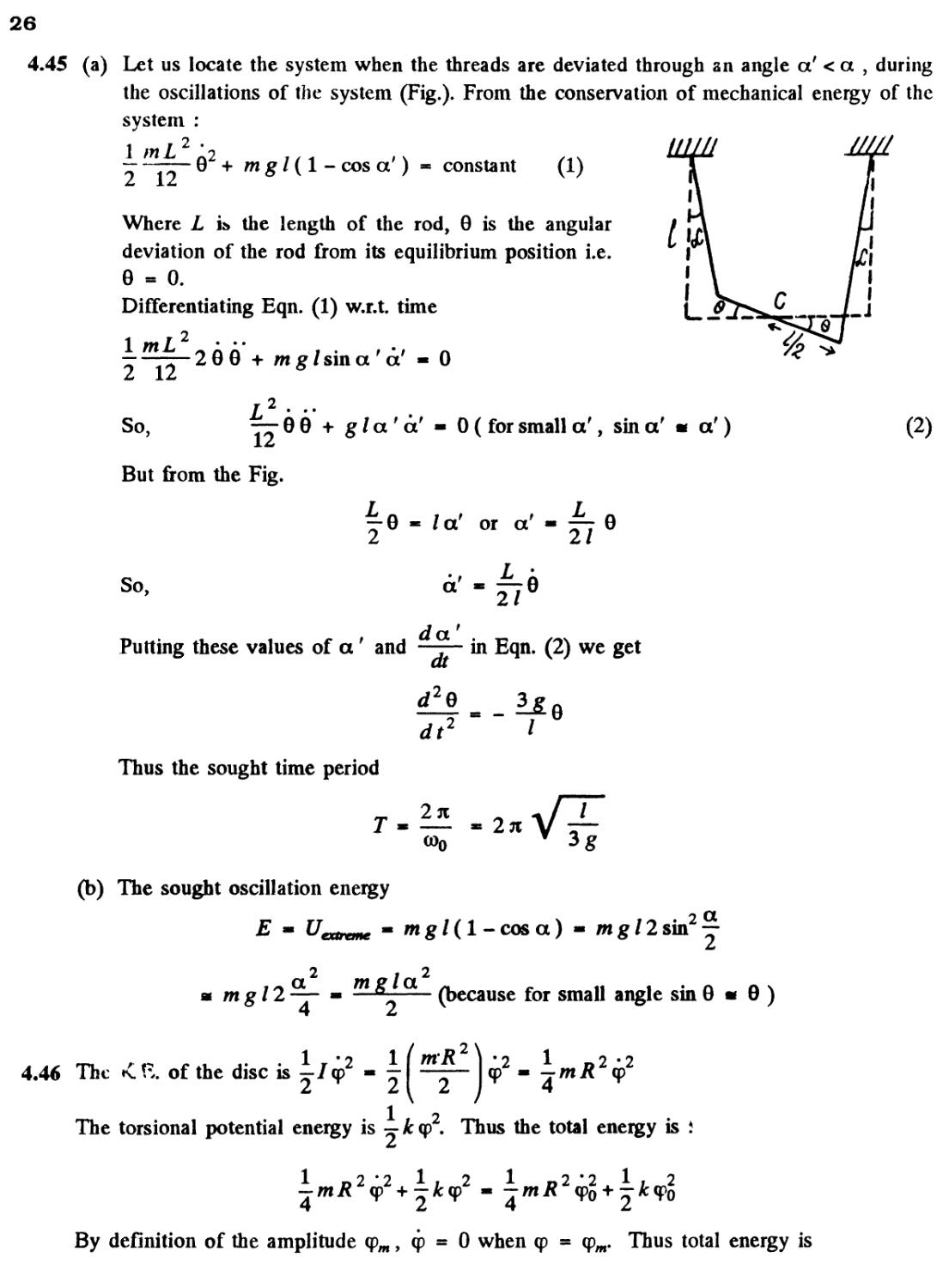
4.45 (a) Let us locate the system when the threads are deviated through an angle a' < a , during
the oscillations of the system (Fig.). From the conservation of mechanical energy of the
system :
ml2 '2
m
" cos
constant
Where L i& the length of the rod, 6 is the angular
deviation of the rod from its equilibrium position i.e.
6 = 0.
Differentiating Eqn. A) w.r.t. time
1 ml
2 12
2 0 G + mg/sina'a' - 0
L-?J
So> Ti
But from the Fig.
GG + g/a'a' - 0 ( for small a', sin a' « a')
fe-la' or a'-^
So,
a'
Putting these values of a' and —— in Eqn. B) we get
d20
dt2
Thus the sought time period
1 ■ * Z 71
co0
(b) The sought oscillation energy
- mg/(l-cosa) - mgllsin2—
2 i 2
m mgll — - —*r (because for small angle sin 6
9 )
B)
4.46 The «CF.. of the disc is -/cpz - -
. 1
cp2- \
4
The torsional potential energy is y i qp . Thus the total energy is i
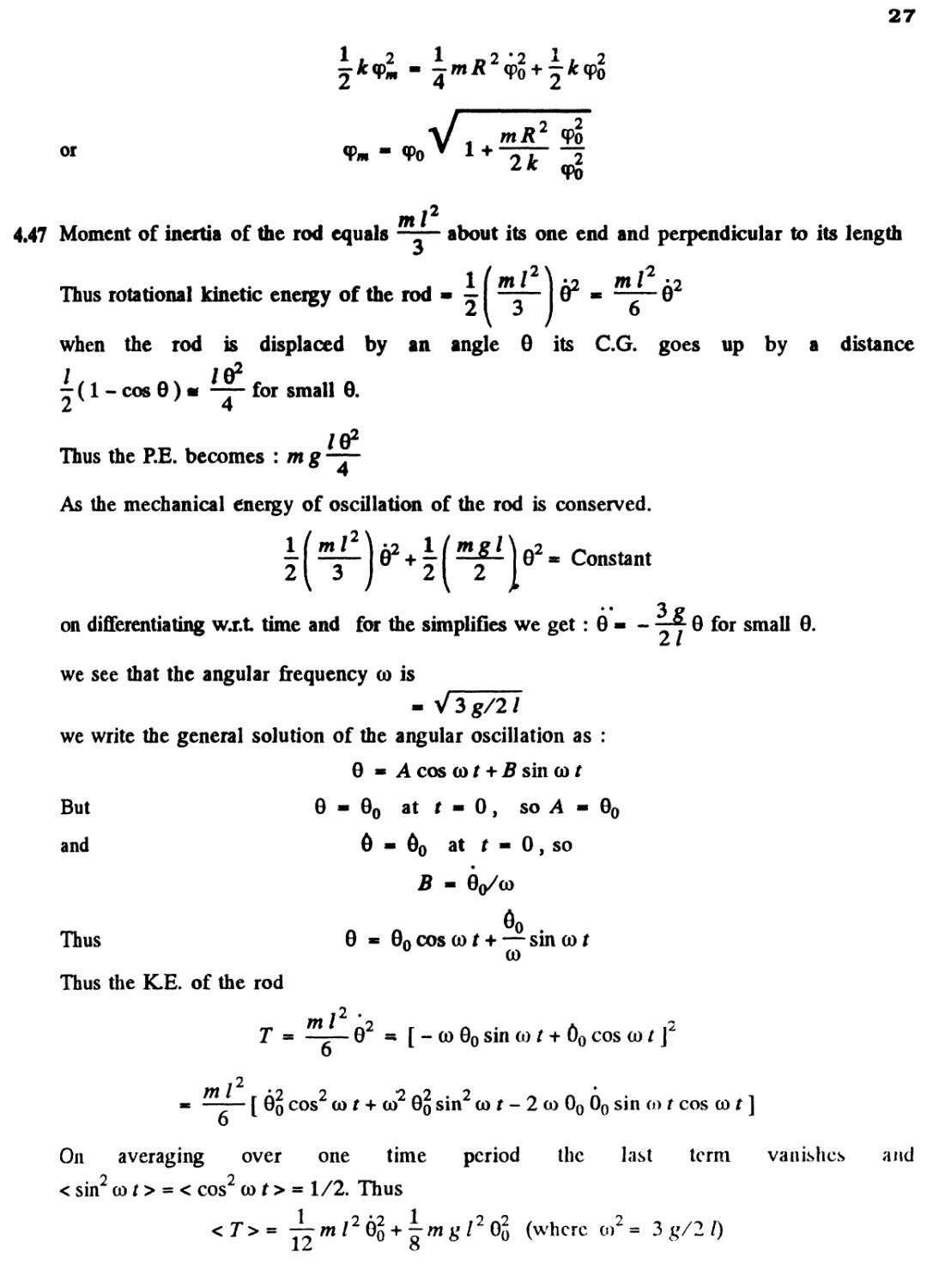
1 *J * *J 1 ^ 1 '5*'5l *5
~Wli? qP+"T"£cp m ~rMtR cpo + rrkCpn
4 2 4 2
By definition of the amplitude qpm, cp = 0 when qp = qpm. Thus total energy is

27
or
'M
<Po
mR
ml
4.47 Moment of inertia of the rod equals about its one end and perpendicular to its length
Thus rotational kinetic energy of the rod * ~
ml
2>
e2
when the rod is displaced by an angle 6 its C.G. goes up by a distance
— A - cos 6 ) * —— for small 8.
Thus the RE. becomes : m g
/G2
As the mechanical energy of oscillation of the rod is conserved.
2 3
8 * Constant
on differentiating w.r.t time and for the simpliGes we get: 8 - - -r~r 8 for small 8.
we see that the angular frequency to is
- V3g/2/
we write the general solution of the angular oscillation as :
8 « A cos co t + B sin co t
But 8 - 80 at t - 8, so A - 80
and 6 - 60 at t - 8, so
B -
Thus
Thus the K.E. of the rod
T =
o
8 ■ 80cos(or + —sincor
ml2 '
—-— 92 - [ - co 80 sin co t + 0o cos co t \
,2
1*00 '000 *
[ 8q cos co r + co 9q sin co r - 2 co 00 80 sin co t cos co t ]
On averaging over one time period the last term vanishes
< sin co t > = < cos co t > = 1/2. Thus
and
^ (where co2 = 3 g/2/)

28
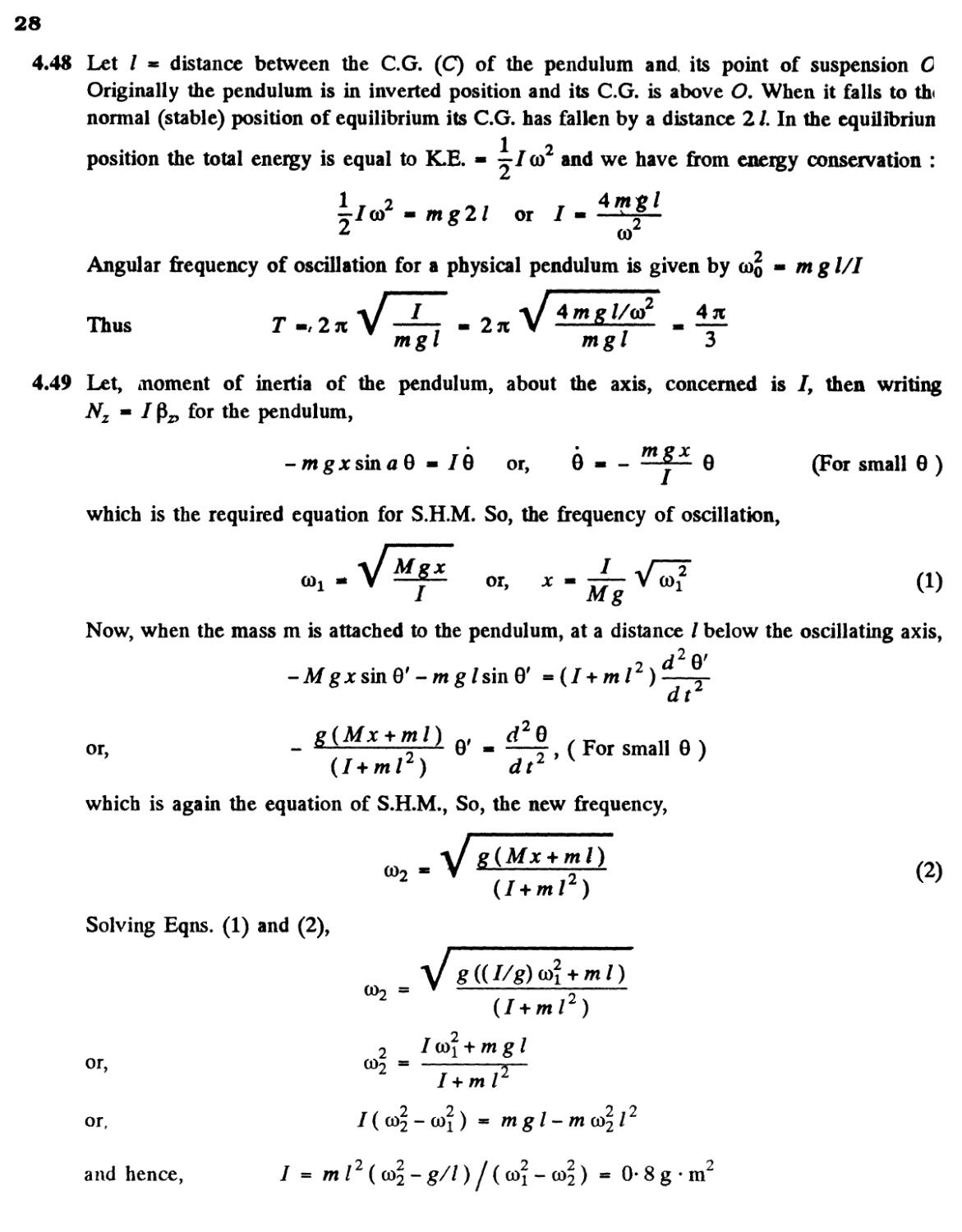
4.48 Let / * distance between the C.G. (C) of the pendulum and, its point of suspension C
Originally the pendulum is in inverted position and its C.G. is above O. When it falls to th<
normal (stable) position of equilibrium its C.G. has fallen by a distance 2 /. In the equilibriun
•1 i.
position the total energy is equal to KJ2. » — 7co and we have from energy conservation :
T7oT - mgll or 7 ■ * *
Angular frequency of oscillation for a physical pendulum is given by a><) - m g I/I
Tlius
.2reV
mgl mgl
g g
4.49 Let, moment of inertia of the pendulum, about the axis, concerned is /, then writing
Nz - / p^, for the pendulum,
-mgxsinaQ - IB or, 8 - - ^j^ G (For small G )
which is the required equation for S.H.M. So, the frequency of oscillation,
or, x.ji-Vctf A)
Now, when the mass m is attached to the pendulum, at a distance / below the oscillating axis,
dt
g(Mx + ml) Q, d2Q , - o
or, - s-* =—L 6 - —r, ( For small 6
G+m/2) dt2 V
which is again the equation of S.H.M., So, the new frequency,
B)
Solving Eqns. A) and B),
(D2
.V
G + m/2)
2 / co2 + m g I
or, co2 = — -2_
7 + m /
or, 7(co2 - co2 ) * mg/-m co2/2
and hence, 7 - m I2 (coj - g/l) / (co2 - co2 ) = 0- 8 g •
m2

29
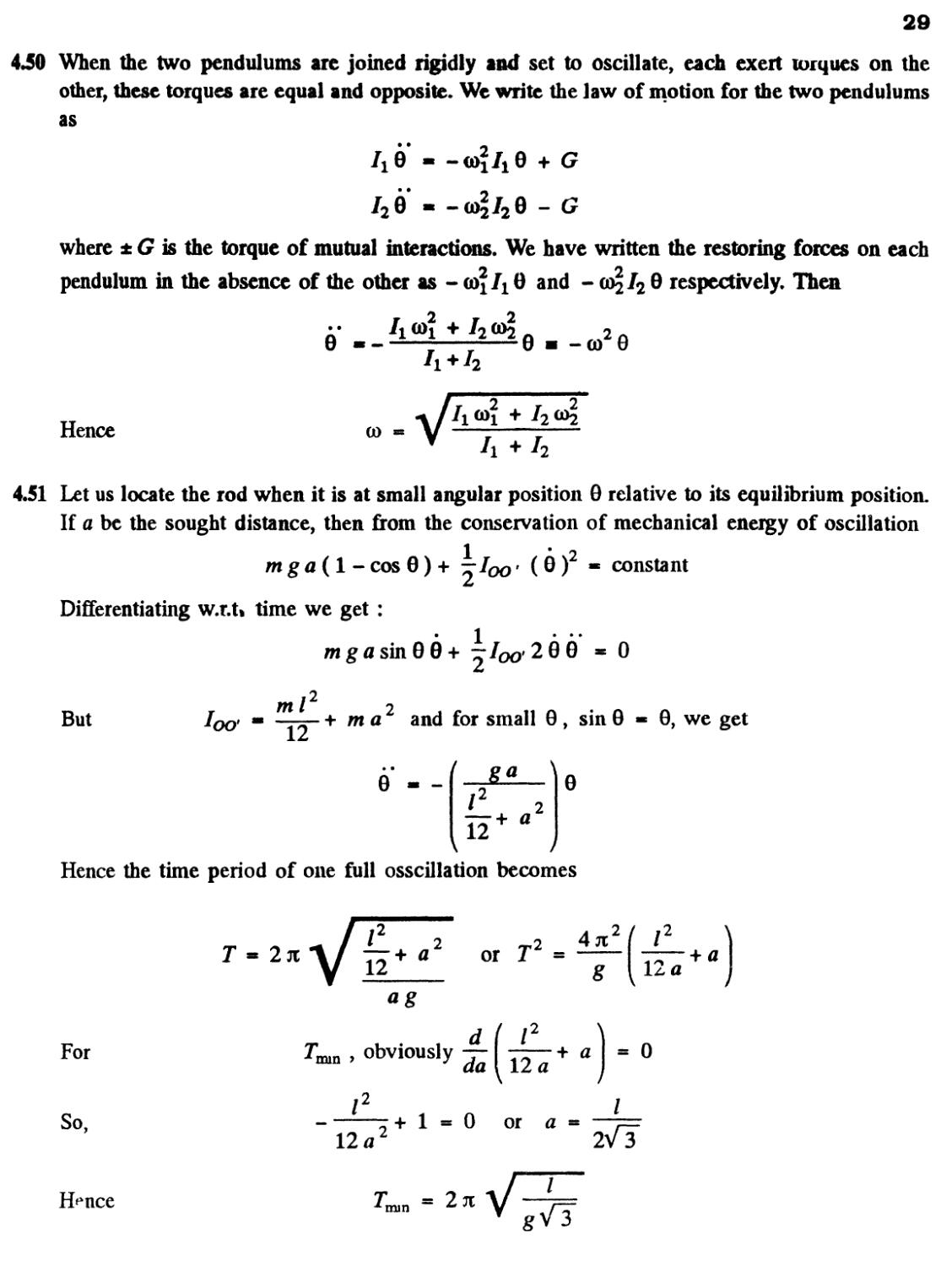
4.50 When the two pendulums are joined rigidly and set to oscillate, eadh exert lorques on the
other, these torques are equal and opposite. We write the law of motion for the two pendulums
as
+ G
7x6 -
where ± G is the torque of mutual interactions. We have written the restoring forces on each
pendulum in the absence of the other as - a)| 7X 8 and - co^ 72 0 respectively. Then
h+h
Hence
CD
V A + /
4.51 Let us locate the rod when it is at small angular position 6 relative to its equilibrium position.
If a be the sought distance, then from the conservation of mechanical energy of oscillation
1
mga(l-cos0)+ -
" 2
@)
constant
Differentiating w.r.t* time we get :
mgflsinG6+ ~
0
But
ml
12
+ ma and for small 6, sin8 « 6, we get
6
I
0
Hence the time period of one full osscillation becomes
For
r
T - 2k \l tz
or J2 =
g
1 I2
12 a
+ a
rmn , obviously
d I i
a
= 0
So,
H^nce
12 a
+ 1 = 0 or a

30
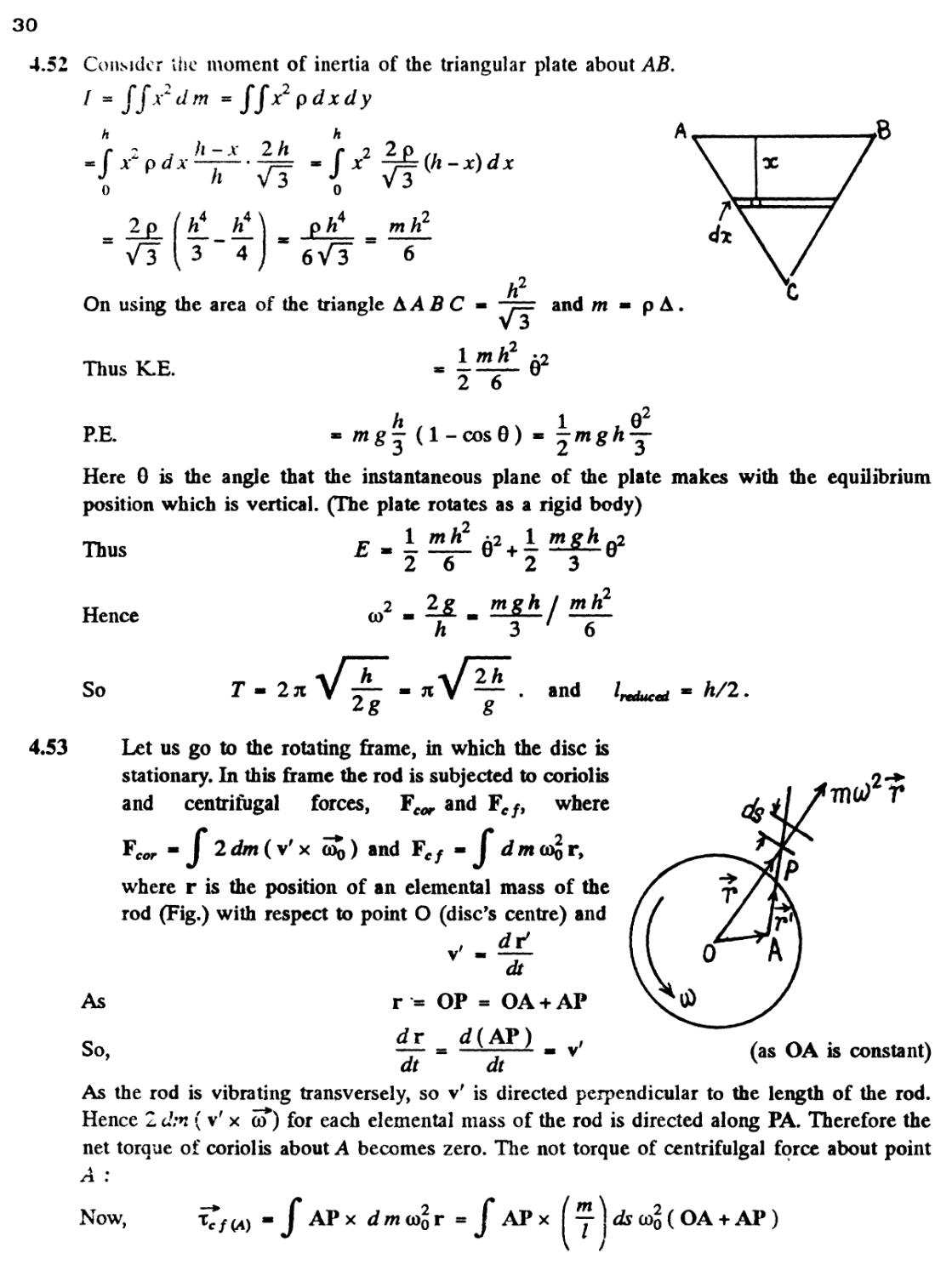
4.52 Consider the moment of inertia of the triangular plate about AB.
/ = J j x*dm = J j x pdxdy
h h A
h - x
o
yfl
fhA h4'
0
p/»4
6VT
On using the area of the triangle AA B C
and m ■ pA.
Thus K.E.
2 6
e2
mgj(l-cosG) « 2mgT
RE.
Here 6 is the angle that the instantaneous plane of the plate makes with the equilibrium
position which is vertical. (The plate rotates as a rigid body)
Thus
e -i
2
Hence
CO
So
mgh I mH
" 3 7 6
and /
reduced
A/2.
4.53
Let us go to the rotating frame, in which the disc is
stationary. In this frame the rod is subjected to coriolis
and centrifugal forces, ¥cor and Fc/, where
Fc*r - I 2dm(v'x coJi) and Fcf - f dmaftr,
J J J
where r is the position of an elemental mass of the
rod (Fig.) with respect to point O (disc's centre) and
As
So,
V dt
OP = OA + AP
(as OA is constant)
dt dt
As the rod is vibrating transversely, so v' is directed perpendicular to the length of the rod.
Hence 2 dm ( v' x ocT) for each elemental mass of the rod is directed along PA. Therefore the
net torque of coriolis about A becomes zero. The not torque of centrifulgal force about point
A :
Now> C/ca) - J*APx dnnolr = J AP x j j)ds a>o( OA + AP )

31
= J
aPx (j
f jds(olsasinQ(-k)
2 / .
y (Oq a sin 8 ( - k ) J s ds - m coq a ~r sin 9 ( - k)
o
So,
According to the equation of rotational dynamics : xA (Z) » /A az
or,
or,
2
ml
6
6
smG
Thus, for small 6,
This implies that the frequency co0
e'-fTf6
r H ♦• • \/3(i>2a
of oscillation is oH * V —ry~-
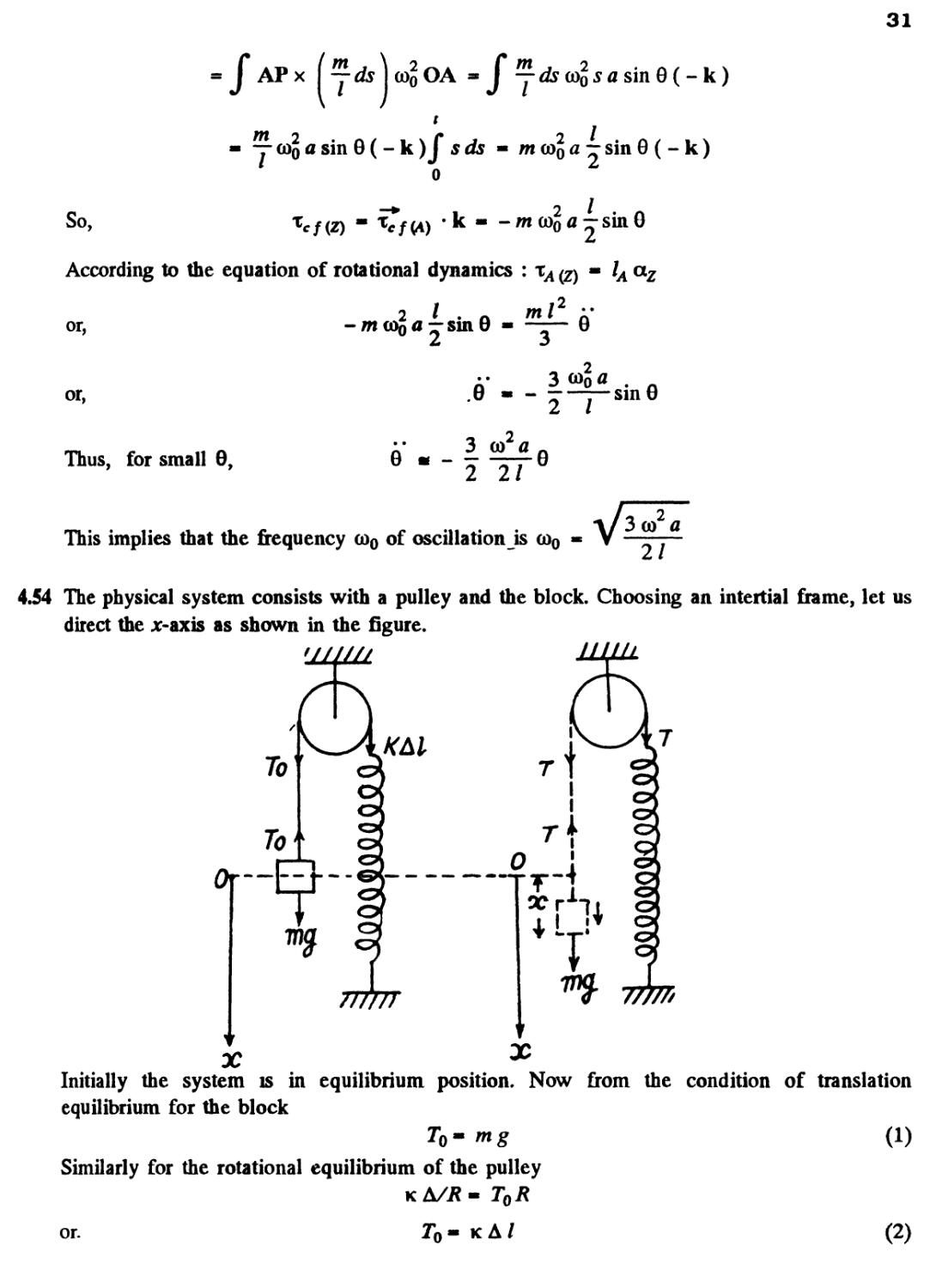
4.54 The physical system consists with a pulley and the block. Choosing an intertial frame, let us
direct the x-axis as shown in the figure.
To
To<
1
|
I
777777
I
Initially the system is in equilibrium position. Now from the condition of translation
equilibrium for the block
To- *ig A)
Similarly for the rotational equilibrium of the pulley
kA/jR« ToR
or. Jo- kA/ B)

32
from Eqns. A) and B)
A/
C)
Now let us disturb the equilibrium of the system no matter in which way to analyse its motion.
At an arbitrary position shown in the figure, from Newton's second law of motion for the
block
mg-T
mi
D)
Similarly for the pulley
Nz- Jfc
tr-k(ai+x)r- ie
w= pj? or, i"« RQ
^ x
K
But
from E) and F)
Solving D) and G) using the initial condition of the problem
-kRx
E)
F)
G)
mR +--r
K
or,
x - -
m
R
Hence the sought time period, T
m + l/K
@0 K
Note : we may solve this problem by using the conservation of mechanical energy also
4.55 At the equilbrium position, Noz - 0 (Net torque about 0)
So, mAgR-mgR sin a - 0 or mA - msina A)
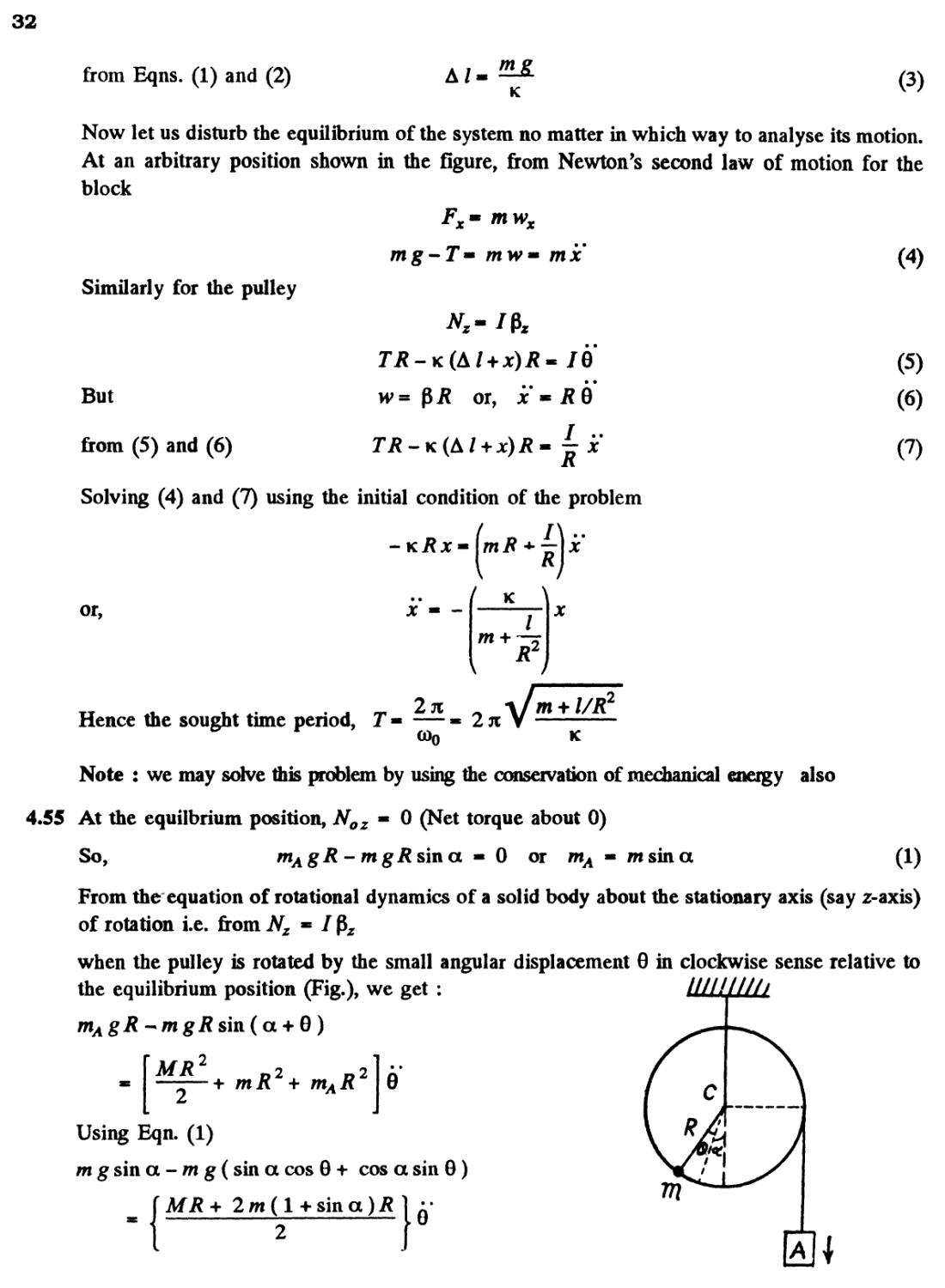
From the equation of rotational dynamics of a solid body about the stationary axis (say z-axis)
of rotation i.e. from Nz ■ / fiz
when the pulley is rotated by the small angular displacement 6 in clockwise sense relative to
the equilibrium position (Fig.), we get :
mA8& -mgi?sin(a + 6)
"d2 2 2
tn R + ntA R 8
IlllllUh
MR
Using Eqn. A)
m g sin a - m g ( sin a cos 8 + cos a sin 8)
MR + 2 m A + sin a) R 1 • •
77?

33
But for small 0, we may write cos 0 « 1 and sin 0 * 0
Thus we have
• /■ . f\ v 1 .Ar-3. xi I A* rr» lit dill (Jt I xt. f *»
wgsina-mg(sina + cosa0) * J ^ -—L0
tt A' 2 m g cos a n
Hence, 0 - - 7-777:—^—T^ : T1TT 0
r "" 2m 1+ sin a)/?]
u 4L l* i r * I 2mgcos a
Hence the sought angular frequency coo - V T77i—z—^rr* :
v Af/? + 2m/?(l+ sin a
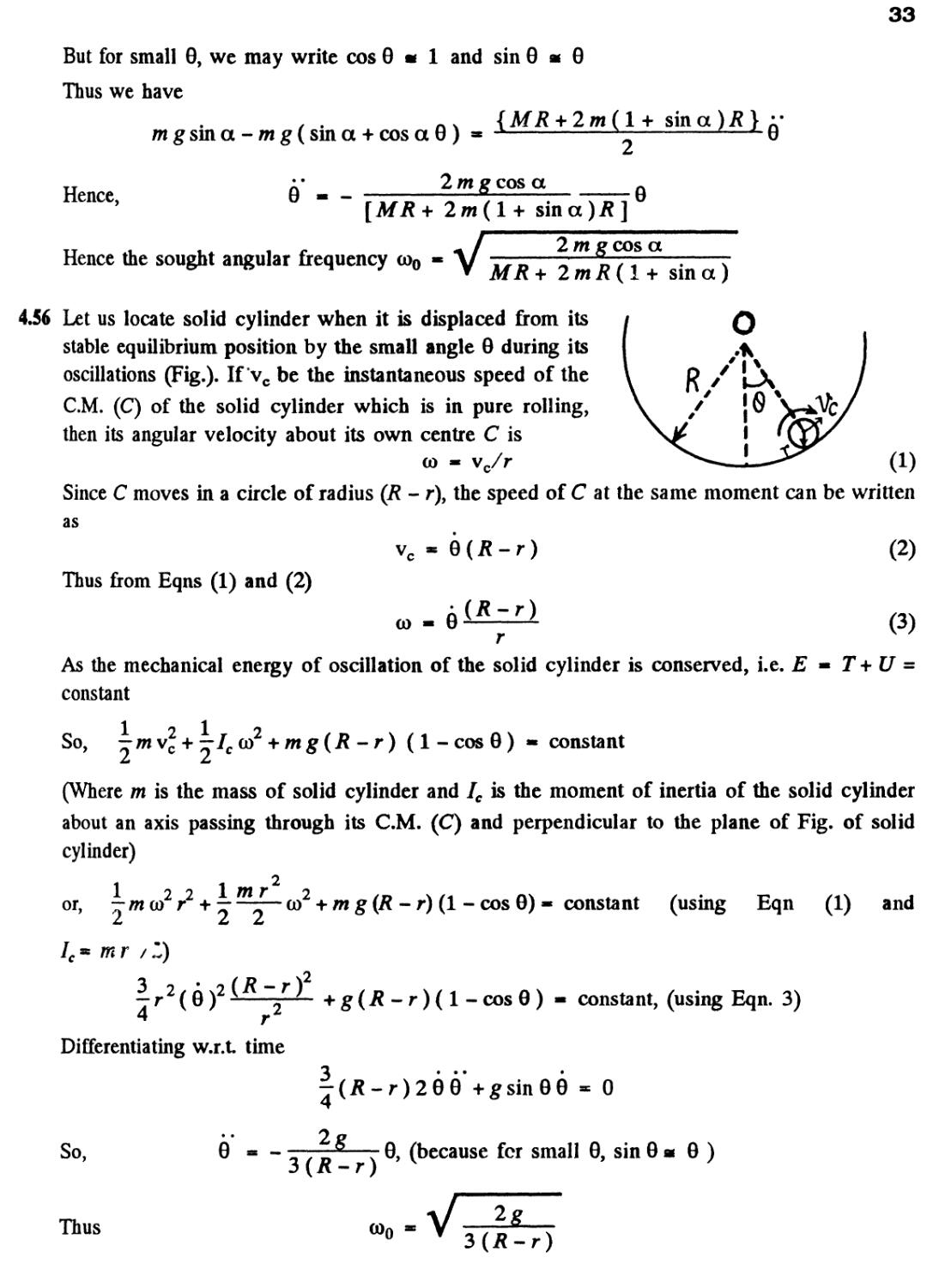
4.56 Let us locate solid cylinder when it is displaced from its
stable equilibrium position by the small angle 0 during its
oscillations (Fig.). If Vc be the instantaneous speed of the
CM. (C) of the solid cylinder which is in pure rolling,
then its angular velocity about its own centre C is
co « vc/r ^ ! ^ A)
Since C moves in a circle of radius (R - r), the speed of C at the same moment can be written
as
vc « 9<Jl-r) B)
Thus from Eqns A) and B)
ft f C\\
r K }
As the mechanical energy of oscillation of the solid cylinder is conserved, i.e. E - T+ U =
constant
1 2 1 2
So, — m vc + ~/c co+mg(i?-r) (l-cos0) * constant
(Where m is the mass of solid cylinder and Ic is the moment of inertia of the solid cylinder
about an axis passing through its CM. (C) and perpendicular to the plane of Fig. of solid
cylinder)
1 2 2 1 fit T 2
or, ~wco r fr- co +/n g(R - r) A - cos 0) - constant (using Eqn A) and
/c= mr /)
^Y^ +g(*-r)(l-cos9) - constant, (using Eqn. 3)
Differentiating w.r.t time
4 v -r) +gsm
2 2
So, 0 - - 5—- 0, (because fcr small 0, sin 0 m 0 )
Thus a,0

34
Hence the sought time period
2jt
co0
4.57 Let kx and k2 be the spring constant of left and right sides springs. As the rolling of th<
solid cylinder is pure its lowest point becomes the instanteneous centre of rotation. If 9 be
the small angular displacement of its upper most point relative to its equilibrium position,
the deformation of each spring becomes BR 9 ). Since the mechanical energy of oscillation
of the solid cylinder is conserved, E * 7*+ U « constant
1 ^ T i rt \^ , ^. f *y n Q \ *> , / *y n /j \ *>
/% o \ / <•% 1 v J^ ) <^ 2 v J^ ^
2^2 2
Differentianting w.r.t time
«= 0
or,
constant
'mR2
mR
/
+4R2kQ « 0
(Because /P «/c + wK2« —^— + m
Hence
Thus co0
8k
3m
9
and sought time period
3 m
co0
^-#3/w ~ f 3 m
2nV_ -^27
4.58 In the CM. frame (which is rigidly attached with the centre of mass of the two cubes) the
Jl 2
cubes oscillates. We know that the kinetic energy of two body system equals y nv^j , where
I* is the reduced mass and v^ is the modulus of velocity of any one body particle relative
to other. From the conservation of mechanical energy of oscillation :
. , . .2
1 2 1
~KX +~J4,
2 2
dt
constant
Here l0 is the natural length of the spring.
Differenting the above equation w.r.t time, we get :
~
**
-\i2ix - 9
becomes
dt
r«i K
Thusr - -— x
■ ■
where \i -
H»c «,« Mtol ^e-c, of ««- :^.yfl^.

35
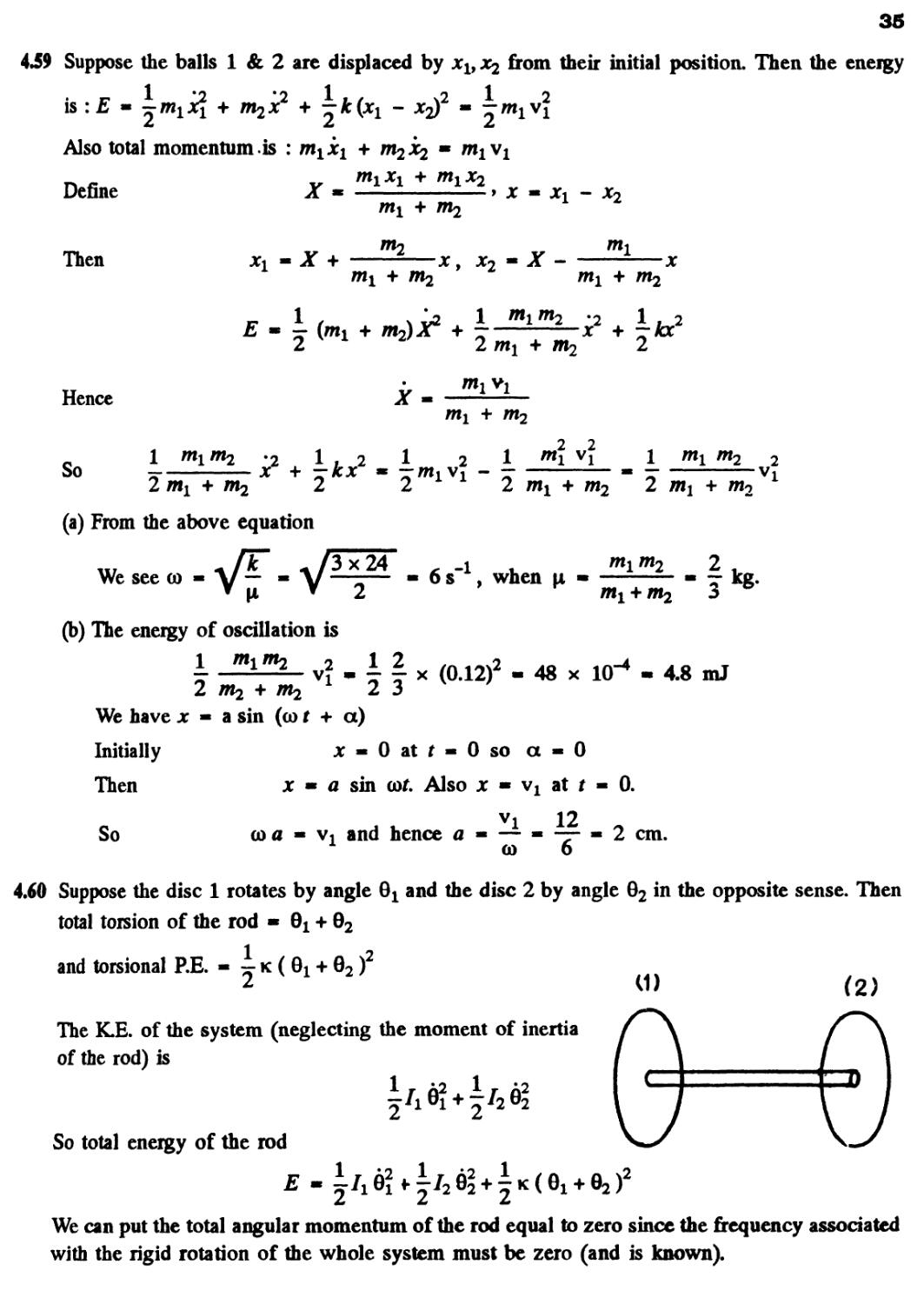
4.59 Suppose the balls 1 & 2 are displaced by xh x2 from their initial position. Then the energy
+ l^k(x x$ mv
is :E - ^
Also total momentum is : mlx1 -^ m2X2
Define X - "^ + "^, x - x, - x2
nt + ftt
Then xt - JT + ———jc , x2
I
2
Hence
1 m1/«2 *2 1 , 2 1
So — jc + — kx * T
2 2 2
2 1 "*1 ^1 1 "*1
"*i ^ "*2 L L L ifl\ + /«2 ^ /Wj + /W2
(a) From the above equation
xxi + fi^ * /3x24 - -i . wii m2 2 .
We see co - a/ — "V —z— - 6 s , when \x ■■ - — kg.
(b) The energy of oscillation is
v? . 1 2 (Q 12J . ^ x 10-4
2 ^ ^
We have x - a sin (co t + a)
Initially jc - 0 at r - 0 so a - 0
Then x * a sin cor. Also x • Vi at r - 0.
vi 12
So co a - Vi and hence a - — - -7- - 2 cm.
co 6
4.60 Suppose the disc 1 rotates by angle 6X and the disc 2 by angle 62 in the opposite sense. Then
total torsion of the rod ■ 6X + 62
and torsional RE. - - k ( Bx + 62 J
The ICE. of the system (neglecting the moment of inertia
of the rod) is
I f fi2
2 2
2 2 2 2
So total energy of the rod
We can put the total angular momentum of the rod equal to zero since the frequency associated
with the rigid rotation of the whole system must be zero (and is known).

36
I2 G2 or
02
T7f2
and e2 -
Thus
So
and
The angular oscillation, frequency corresponding to this is
v^ + 02
go
' and T - 2
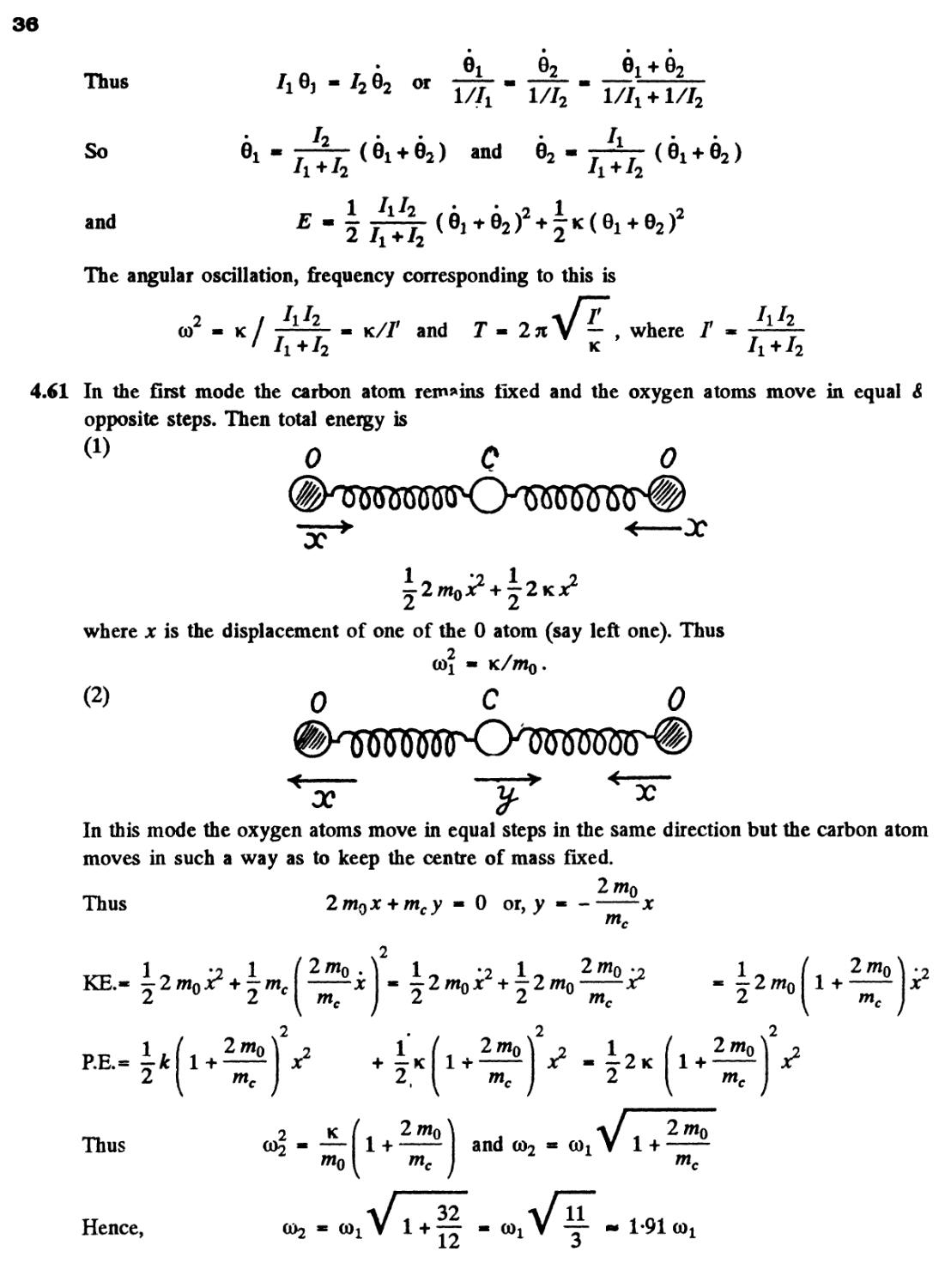
4.61 In the first mode the carbon atom remains fixed and the oxygen atoms move in equal &
opposite steps. Then total energy is
A) 0 0 0
where x is the displacement of one of the 0 atom (say left one). Thus
2
B)
In this mode the oxygen atoms move in equal steps in the same direction but the carbon atom
moves in such a way as to keep the centre of mass fixed.
Thus
KE. ~ 2 /Wq x + ~ /n^
' 2 m0 .>
^ 2mo
0 or, y « x
;2+l
2
m.
f,,2ai
x2
1 / 2 m0 >
RE.= !*|l +
Thus
— K
^ 2 m0'
1 +
m.
1^
2
2m0'
m,
and co2
Hence,
0J
32
- 1-91

37
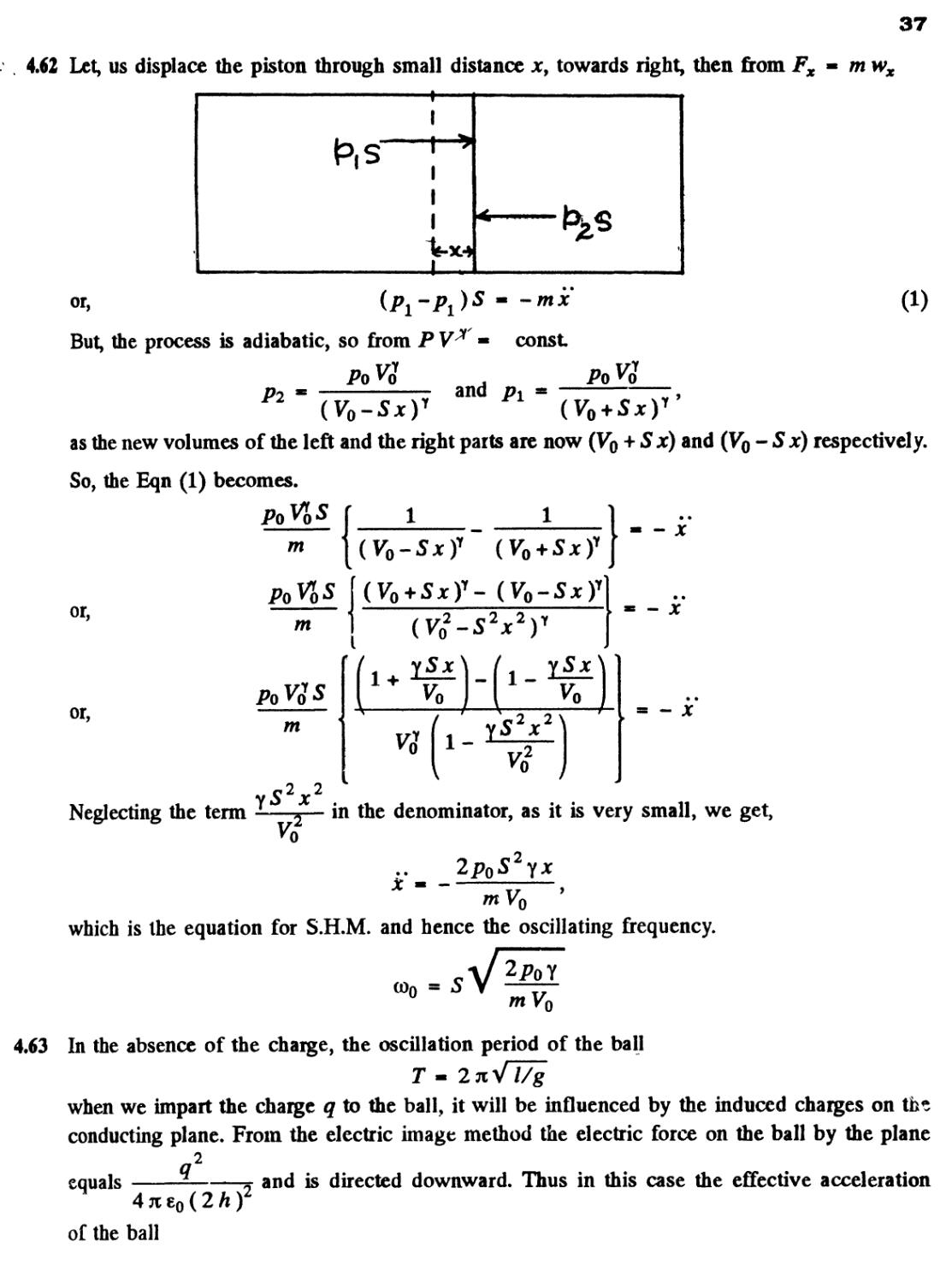
4.62 Let, us displace the piston through small distance x, towards right, then from Fx - mwx
or, 1
But, the process is adiabatic, so from
Po
-mx
const
A)
Po
and
as the new volumes of the left and the right parts are now (Vo + S x) and (Vo -Sx) respectively.
So, the Eqn A) becomes.
1 1
m
or,
m
- X
or,
PoVjS
m
o
-fi-^1
l-
vi
- X
vS2x2
Neglecting the term -—j— in the denominator, as it is very small, we get,
o
x - -
2p0S2yx
mV<
o
which is the equation for S.H.M. and hence the oscillating frequency.
(O0 -
mV
0
4.63 In the absence of the charge, the oscillation period of the ball
T - 2
when we impart the charge q to the ball, it will be influenced by the induced charges on tbz
conducting plane. From the electric image method the electric force on the ball by the plane
2
equals
4 k e0 ( 2 h
of the ball
and is directed downward. Thus in this
the effective acceleration

38
g
and the corresponding time period
16 n torn h
16 n £0 m h
From the conditon of the problem
So,
T2 - rJT'2 or - -
g
Thus on solving
16?C£0m/t
- 4/t Vjceomg('n2- 1) - 2jiC
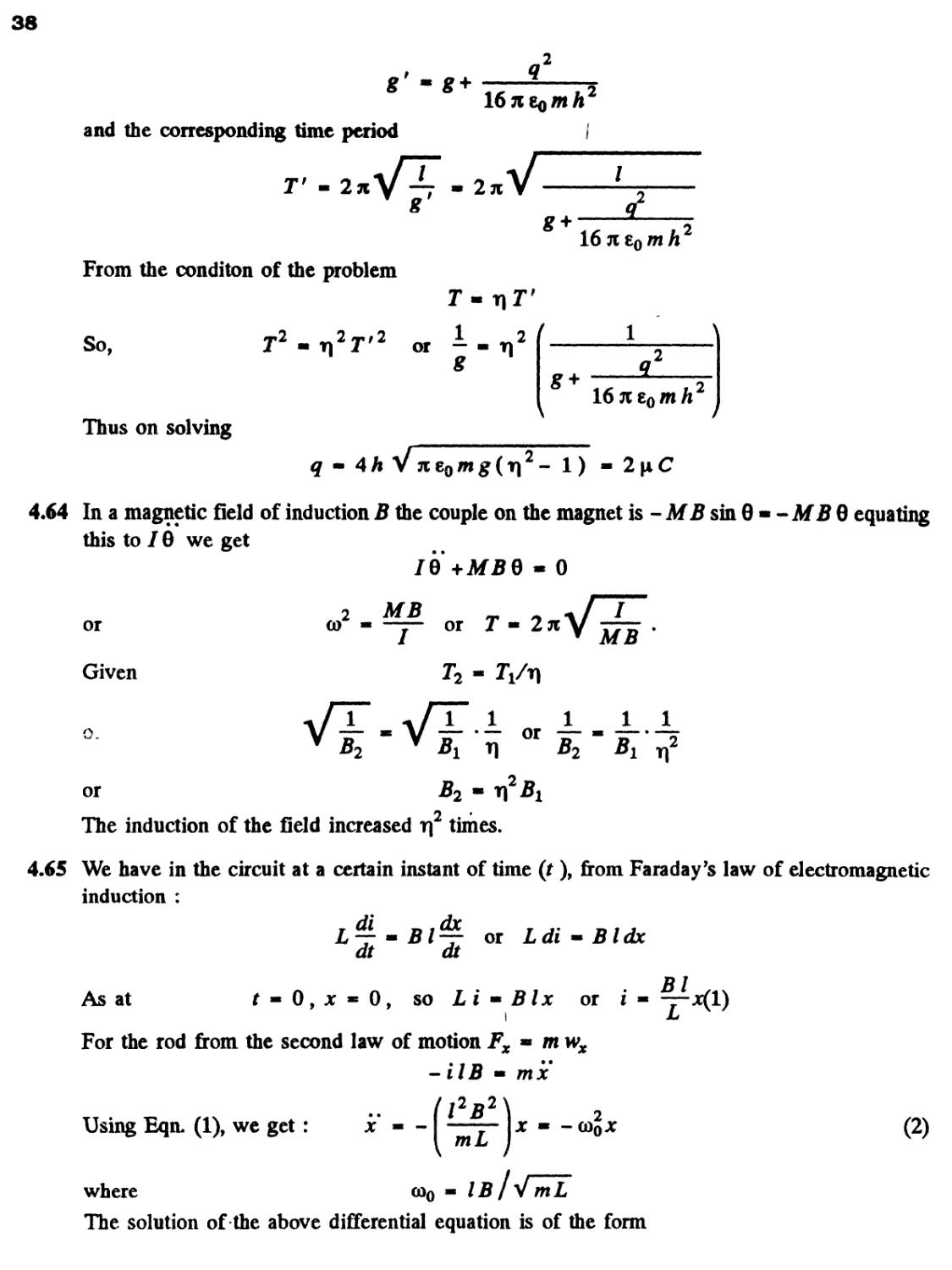
4.64 In a magnetic field of induction B the couple on the magnet is - MB sin 8 - - MB 6 equating
this to / 8 we get
IB +MJ9 8 « 8
or
Given
o.
or
CO
MB
/
or T - 2 jc
T|
or
- T125,
2 ■*•_!.
The induction of the field increased r\ times.
4.65 We have in the circuit at a certain instant of time (t ), from Faraday's law of electromagnetic
induction :
dt
~- or Ldi-Bldx
dt
As at r - 8 , x ■ 8, so 1 i - i? / x or i
i
For the rod from the second law of motion Fx ** mwx
-HB - mx
Using Eqn. A), we get :
fl2B2
TtlL
-OHJC
B)
where co0 - IB/VmL
The solution of the above differential equation is of the form

39
x « a sin (co0 f + a)
From the initial condition, at*«0,x*0,soa«0
Hence, x - asintoo*
Differentiating w.r.t time, x * a coo cos coo t
But from the initial condition of the problem at t * 0, x - v0
Thus v0 - a co0 or a - Vq/coq
Putting the value of a from Eqn. D) into Eqn. C), we obtained
C)
D)
where co0
IB
VmL
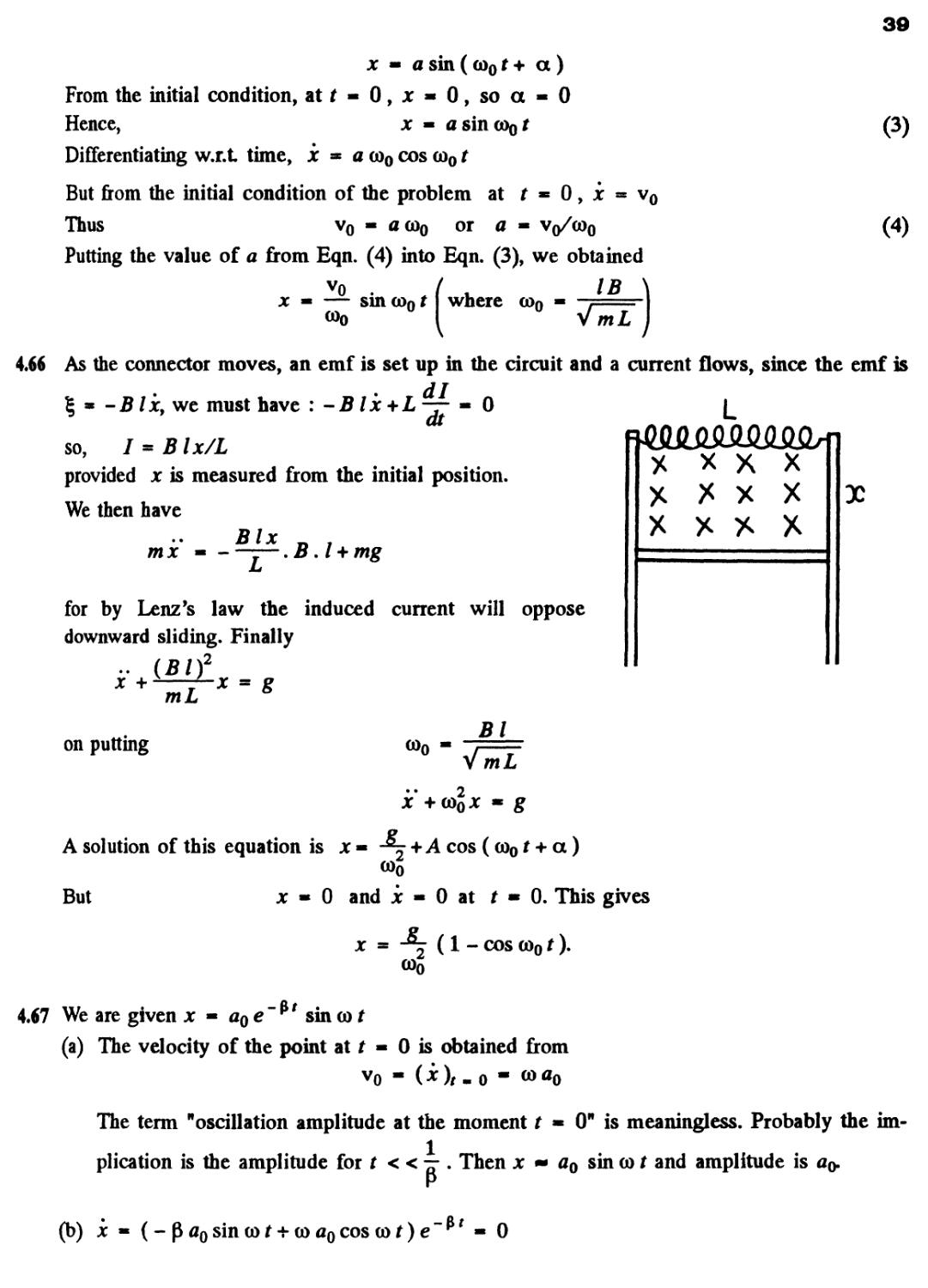
4.66 As the connector moves, an emf is set up in the circuit and a current flows, since the emf is
-B lx, we must have : -B Ix +L
—
0
so, 7 = 5 Ix/L
provided x is measured from the initial position.
We then have
Blx
mx
.B.l + mg
for by Lenz's law the induced current will oppose
downward sliding. Finally
.. (Blf
x +-—j-x = g
mL
X X X X
X X X X
X X * X
on putting
co0
Bl
mL
x +co0* * g
A solution of this equation is x
co0
cos (coo t + a)
But
x - 0 and i - 0 at f ■ 0. This gives
X =
( 1 - COS @0 ^ ).
-fit
4.67 We are given x - a0 e *" sin co
(a) The velocity of the point at t - 0 is obtained from
v0 - (x)im0 - coa0
The term "oscillation amplitude at the moment t « 0" is meaningless. Probably the im-
implication is the amplitude for t < < ~ . Then jc - a0 sin co f and amplitude is
(b) x « ( - p a0 sin to t + to a0 cos to^)e~Pf - 0

40
when the displacement is an extremum. Then
<°
tan co t * -r-
P
or
cof
tan" -t-+hjc, n « 0,1,2,
P
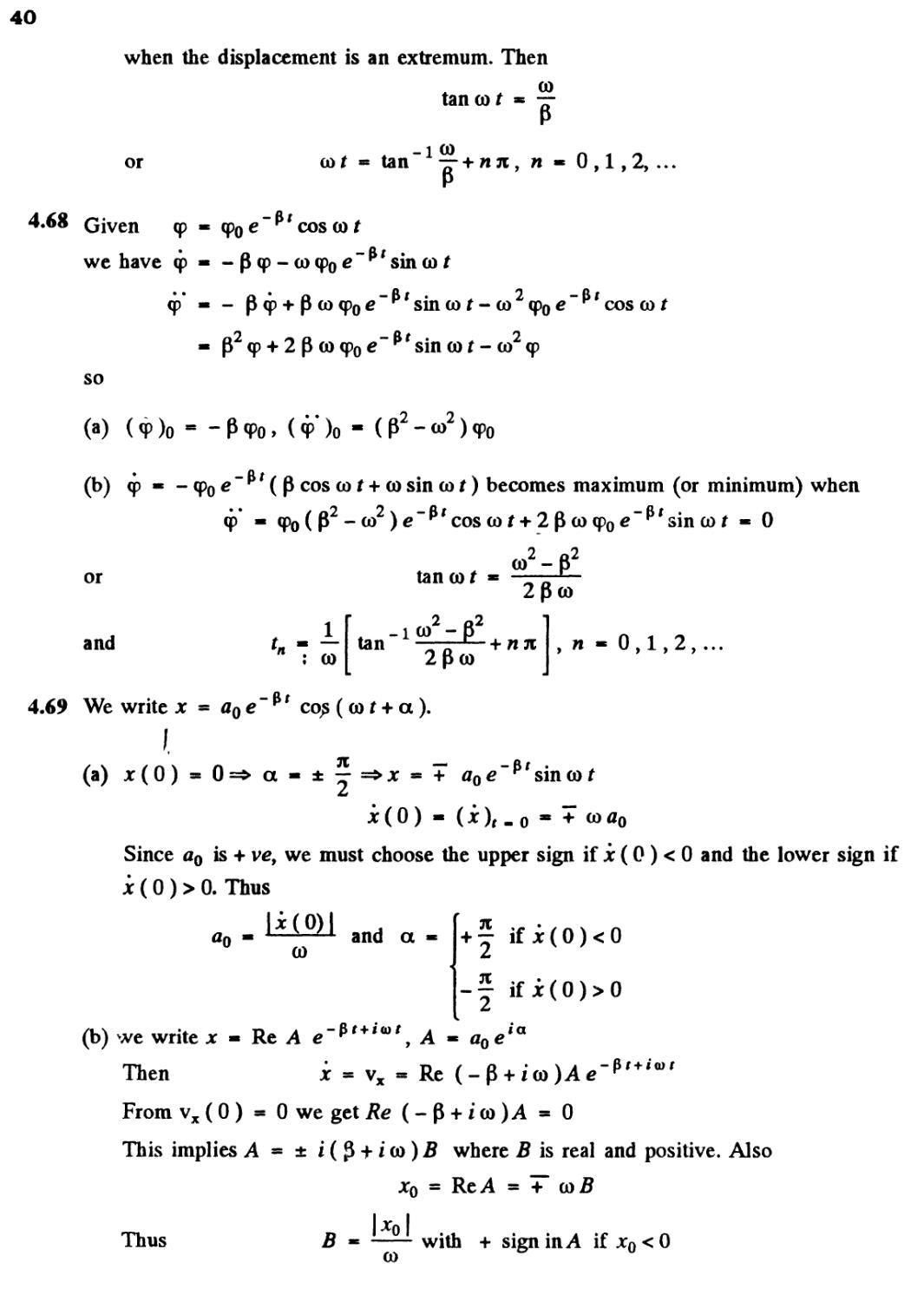
4.68 Given cp «
we have cp - -
<P
-co2cp0
cos co
P cp + 2 p cocp0e~p sincof-co cp
so
(a) (9 )o - - P <Po > (<P* )o
<Po
(b) cp « - cp0 e " ^ * ( p cos co t + co sin co t) becomes maximum (or minimum) when
cp0(p2-co
cor « 0
or
and
4.69 We write x
tan cor
co2-p2
n : co
,3- ft2
A -1 CO - p
tan ^ , r + n jc
2Pco
0,1,2,
( cd r + a).
i.
(a) Jt(O) = 0=> a - ±
Since a0 is + ve, we must choose the upper sign if x @ ) < 0 and the lower sign if
x @ ) > 0. Thus
CO
and a
+ ^ ifi@)<0
-^ ifi@)>0
(b) >^e write x - Re A e-pr+la)/, A - aoeia
Then i = vx - Re ( - P + i co
From vx @ ) » 0 we get Re ( - P + i co) A = 0
This implies A = ± i(p + ico)B where 5 is real and positive. Also
jc0 = Re A = +~ toB
Thus
B
CO
with + sign in A if xQ < 0

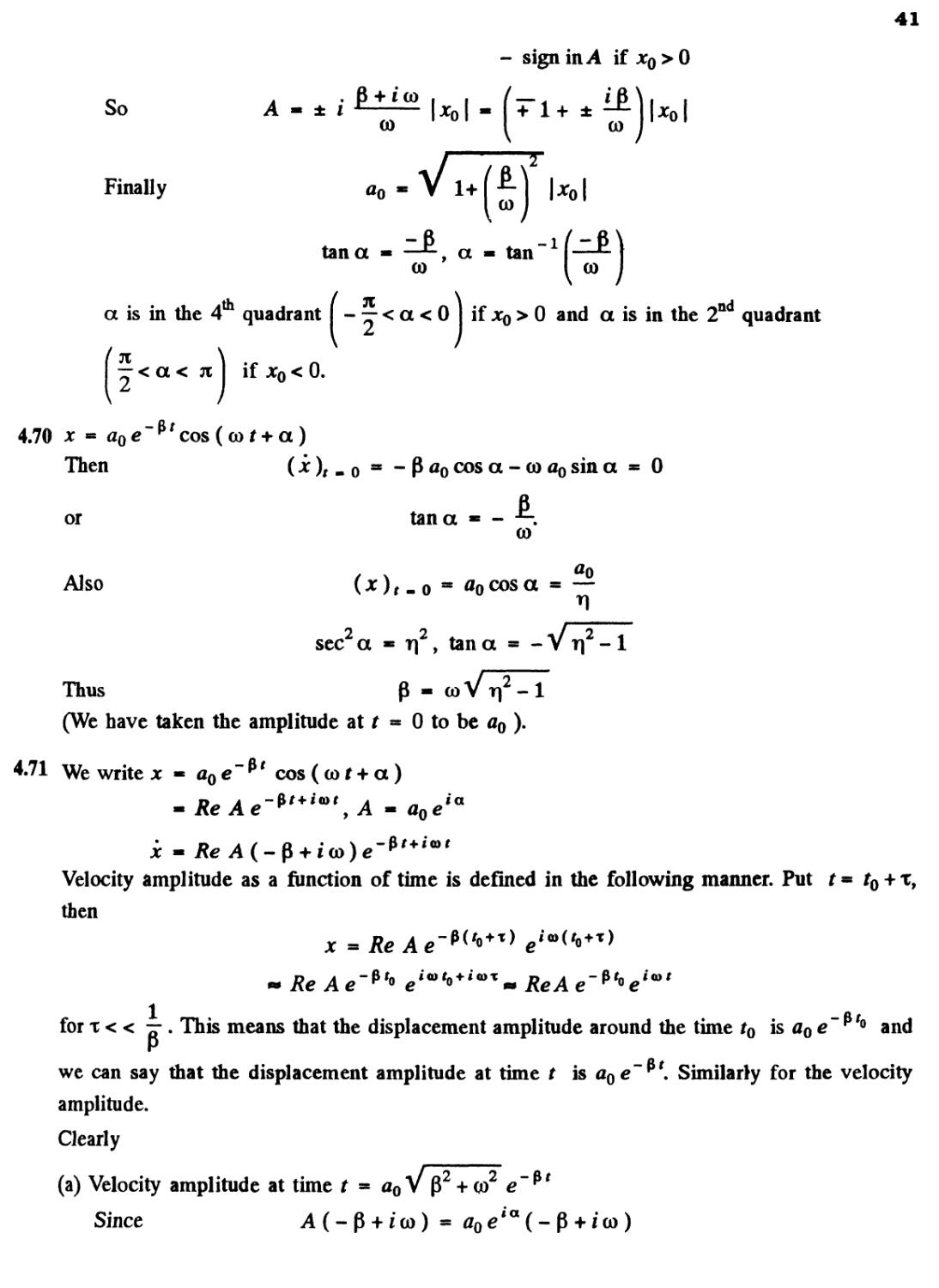
41
- sign in A if jco>O
A J. F S.-k
So
2
Finally a0 - V 1+ I *- \ \x0
I co '
-P
tana - —c-, a - tan
co I co
a is in the 4 quadrant |-~<a<O|ifjco>O and a is in the 2nd quadrant
\
— < a < ji | if x0 < 0.
4.70 x - a0e~^rcos (cof + a
Then (•*)*- o " - P <*o °°s a - co a0 sin a * 0
or tana * -
co
Also (*)r-o -
sec2 a ■ r\2, tan a ■ - V r\2 - 1
Thus p - toVV-1
(We have taken the amplitude at t - 0 to be <z0 ).
4.71 We write x « a0 e~ ^r cos (to r + a )
aoeia
Velocity amplitude as a function of time is defined in the following manner. Put t ■ f0 + x,
then
1 6,
for t < < — . This means that the displacement amplitude around the time tQ is a0 e p ° and
we can say that the displacement amplitude at time t is aoe~ . Similarly for the velocity
amplitude.
Clearly
(a) Velocity amplitude at time t = a0 V p2 + co2 e~pr
Since A(-P + ia>) = flo c*° ( - P +1 cd )

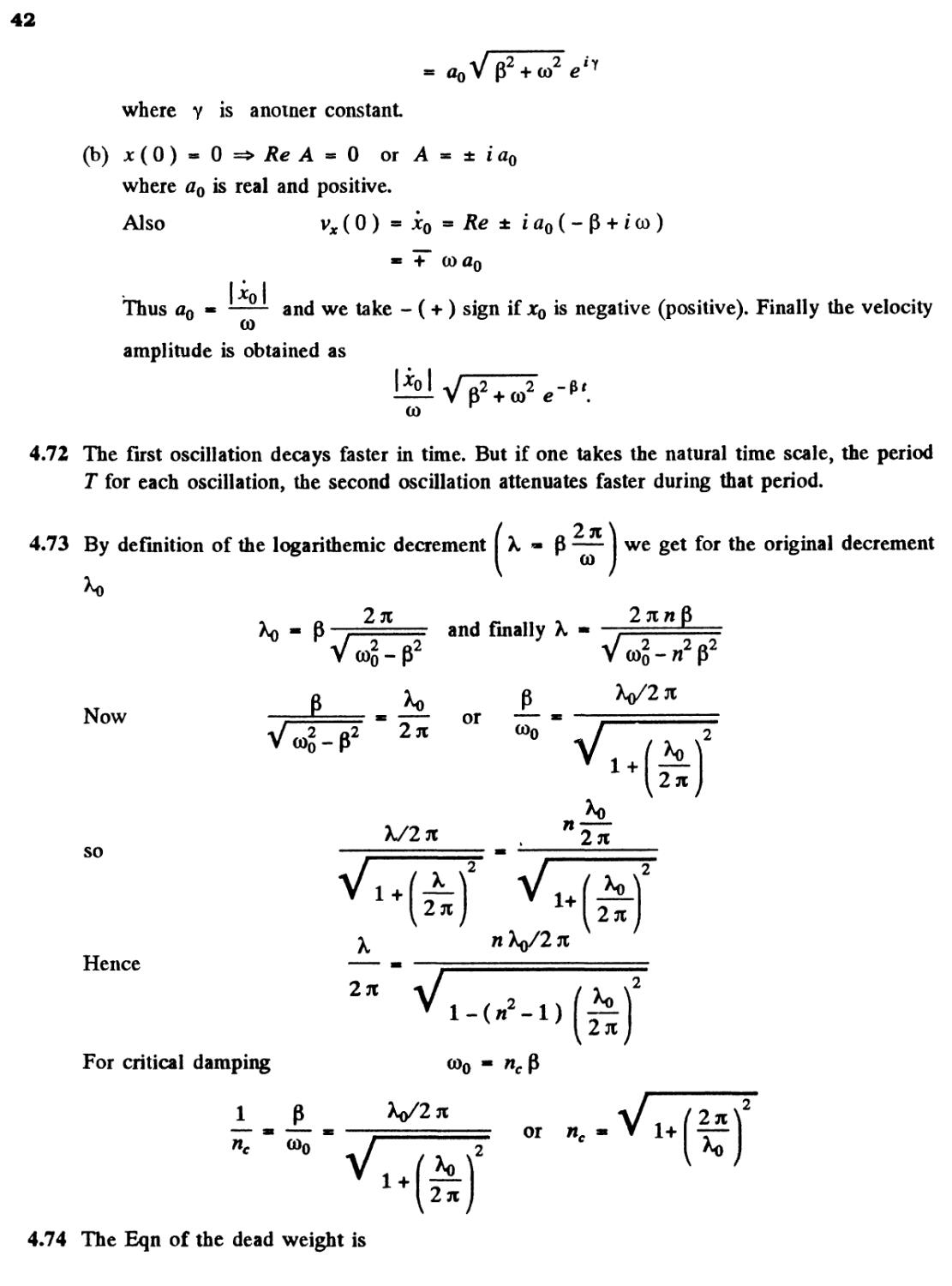
42
where y is anotner constant
(b) x @) « 0 => Re A =* 0 or A = ± i aQ
where aQ is real and positive.
Also vx @ ) = i0 = /te ± f a0 ( - P + / co )
Thus a0 « and we take - ( + ) sign if x0 is negative (positive). Finally the velocity
CO
amplitude is obtained as
CO
4.72 The first oscillation decays faster in time. But if one takes the natural time scale, the period
T for each oscillation, the second oscillation attenuates faster during that period.
4.73 By definition of the logarithemic decrement [ k - P | we get for the original decrement
a 231 j *. ii -* Inn
P . r and finally A, *
VcoW
Kq/2k
Now
so
Hence
2k
For critical damping co0 - nc
1 P
« — — or
co0
4.74 The Eqn of the dead weight is

43
mx
mg
so
Ax - —
g
COq
or
2
g
Ax
Now
<° V«2 - °2
or
co0
Thus
T =
**
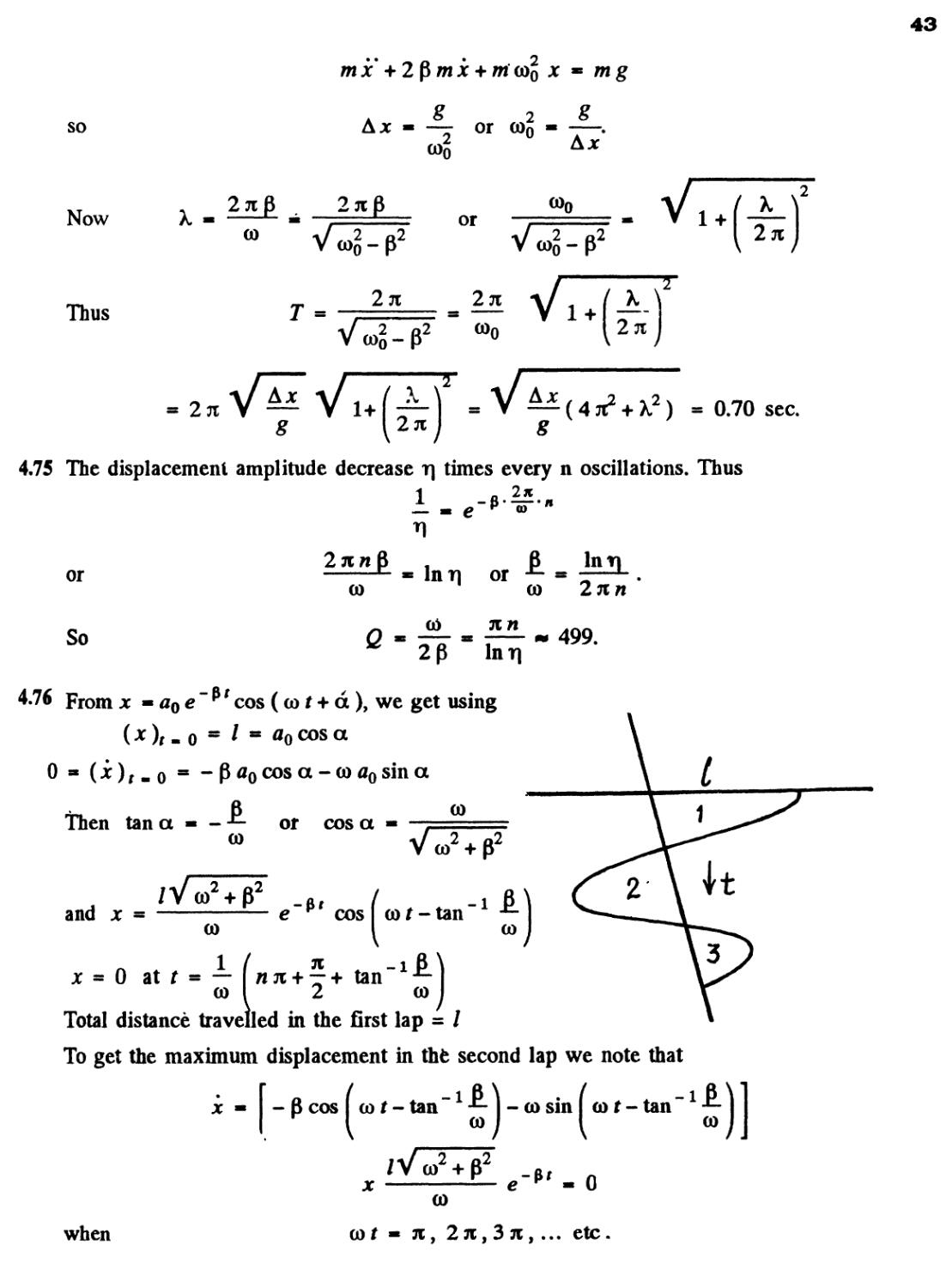
D Jt2 + X2) = 0.70 sec.
4.75 The displacement amplitude decrease r\ times every n oscillations. Thus
i
0)
or
So
ji h 8 , 6 In ti
^ ■ In ri or -^ « -—L .
co co 2^n
^ oi Jin >lftft
4.76 Fromx -a0e~^rcos (cof + d ), we get using
(x)( m o - / s «o cos a
0 ■ (^)r-o " ""Pflo c08 ex - co fl0 sin a
co
Then tan a - - -1- or cos a
co
and x
cos co t - tan
co
m — ( -
co I 2 co
Total distance travelled in the first lap = /
To get the maximum displacement in thfe second lap we note that
- B cos I co t - tan A -^ I - co sin I co t - tan
co
to
0
when
cor- it, 2ft,3ft,... etc.

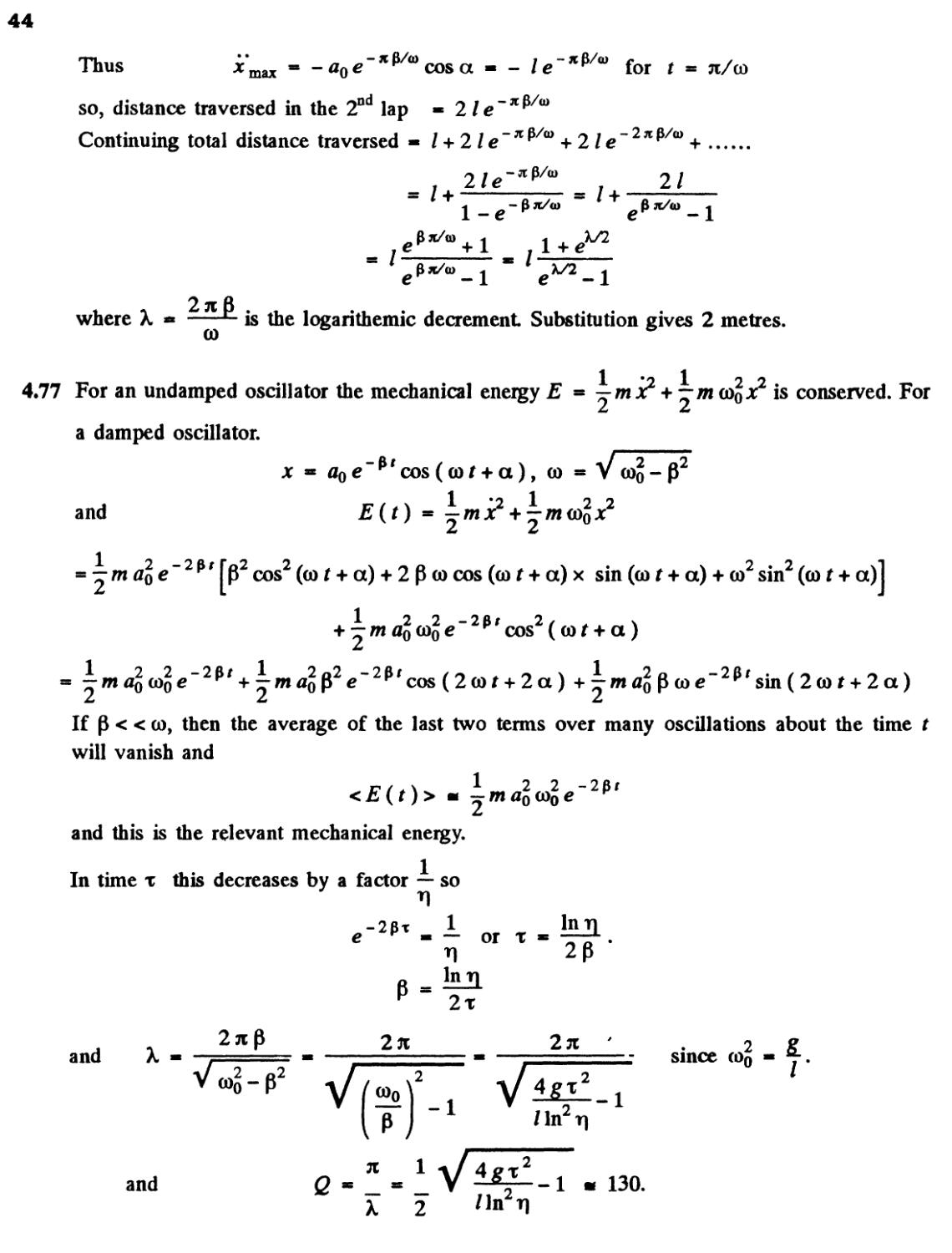
44
i'max - -V'^cwa - - le'**'" for t = ji/co
max
so, distance traversed in the 2nd lap - 2
Continuing total distance traversed - / + 2 U'x^m + 2 /e~2*p/a) +
+ 7TT7- « / + —;
±1
2 3t fl
where X * ° is the loganthemic decrement Substitution gives 2 metres.
4.77 For an undamped oscillator the mechanical energy E « —mXl + —m<tilxlis conserved. For
a damped oscillator.
, co
and E(t) = — m? + -
(co r + a) + 2 P co cos (a) r + a) x sin (co f + a) + co2 sin2 (co t + a)l
+ — m al coq e" 2p' cos2 (co r + a)
oe^f sin(
If p < < co, then the average of the last two terms over many oscillations about the time t
will vanish and
<E(t)> m I
and this is the relevant mechanical energy.
In time x this decreases by a factor — so
e p - - or t f
T] 2P
lnYl

and X - j r - — — - —m since @0 - **-.
and C - _ - _ V -liY-- 1 • 130.
X 2 /]n

45
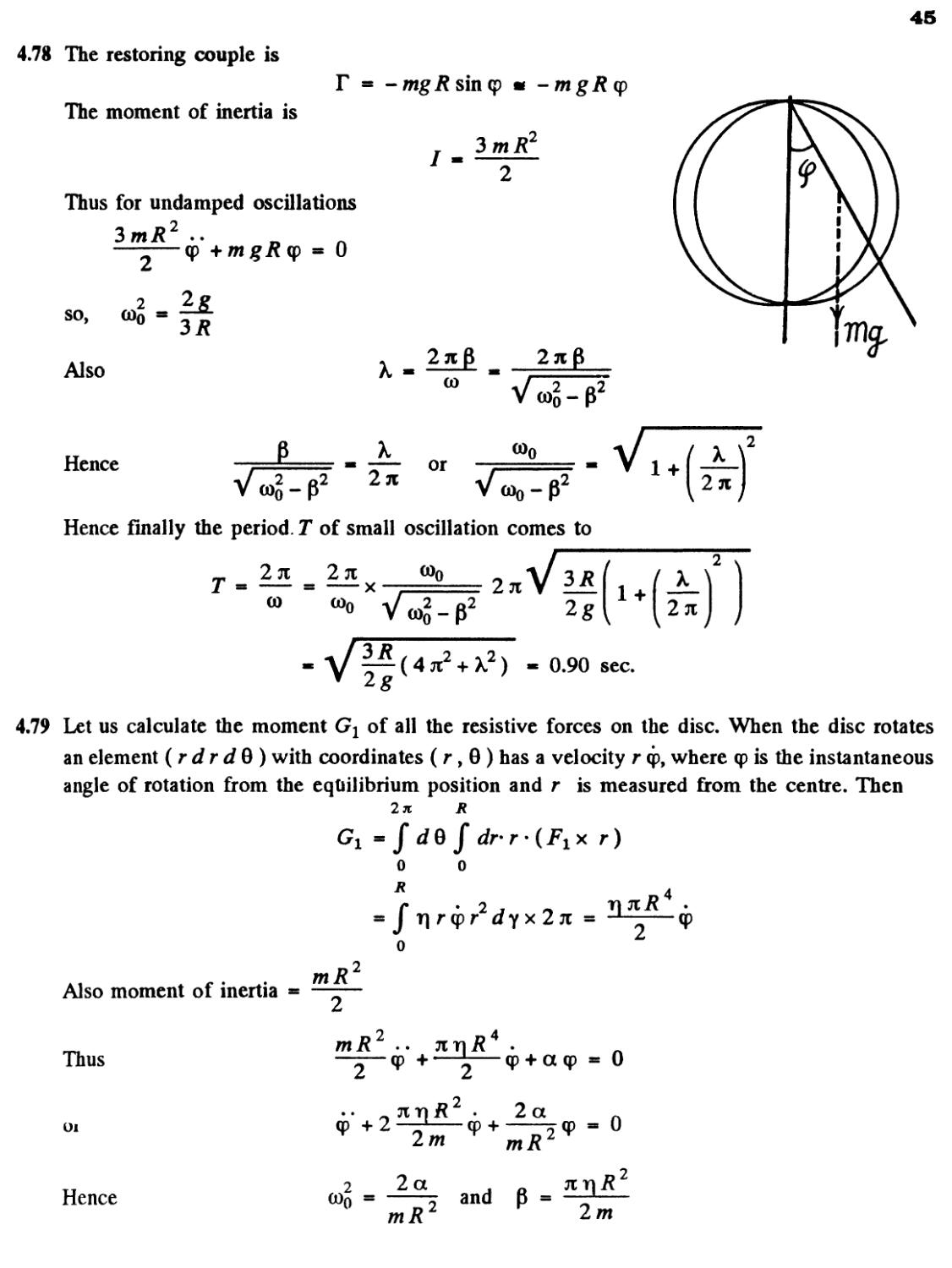
4.78 The restoring couple is
The moment of inertia is
F « - mgR sin qp « -mgRy
3mR4
Thus for undamped oscillations
3mR
0
so,
Also
Hence
or
7[2 ^
co0-p
co0
Hence finally the period. T of small oscillation comes to
_ 2 ji 2 ji
2jc
v
3R_
2g
( 4 Jt2 + X2) - 0.90 sec.
4.79 Let us calculate the moment G1 of all the resistive forces on the disc. When the disc rotates
an element (rdrdQ) with coordinates ( r, 8 ) has a velocity r cp, where cp is the instantaneous
angle of rotation from the equilibrium position and r is measured from the centre. Then
2k
Gi
/
r)
Also moment of inertia
Thus
Ol
Hence
mR2
2
mR2
2
COo -
0
R
0
(Jl
2
ji
+
T,tf
2 m
a
0
4>r2d
^4
2
<P +
and
fTx2«
^acp
2a
mR2
2
= 0
= 0
9
VI A?
^
qp
mR

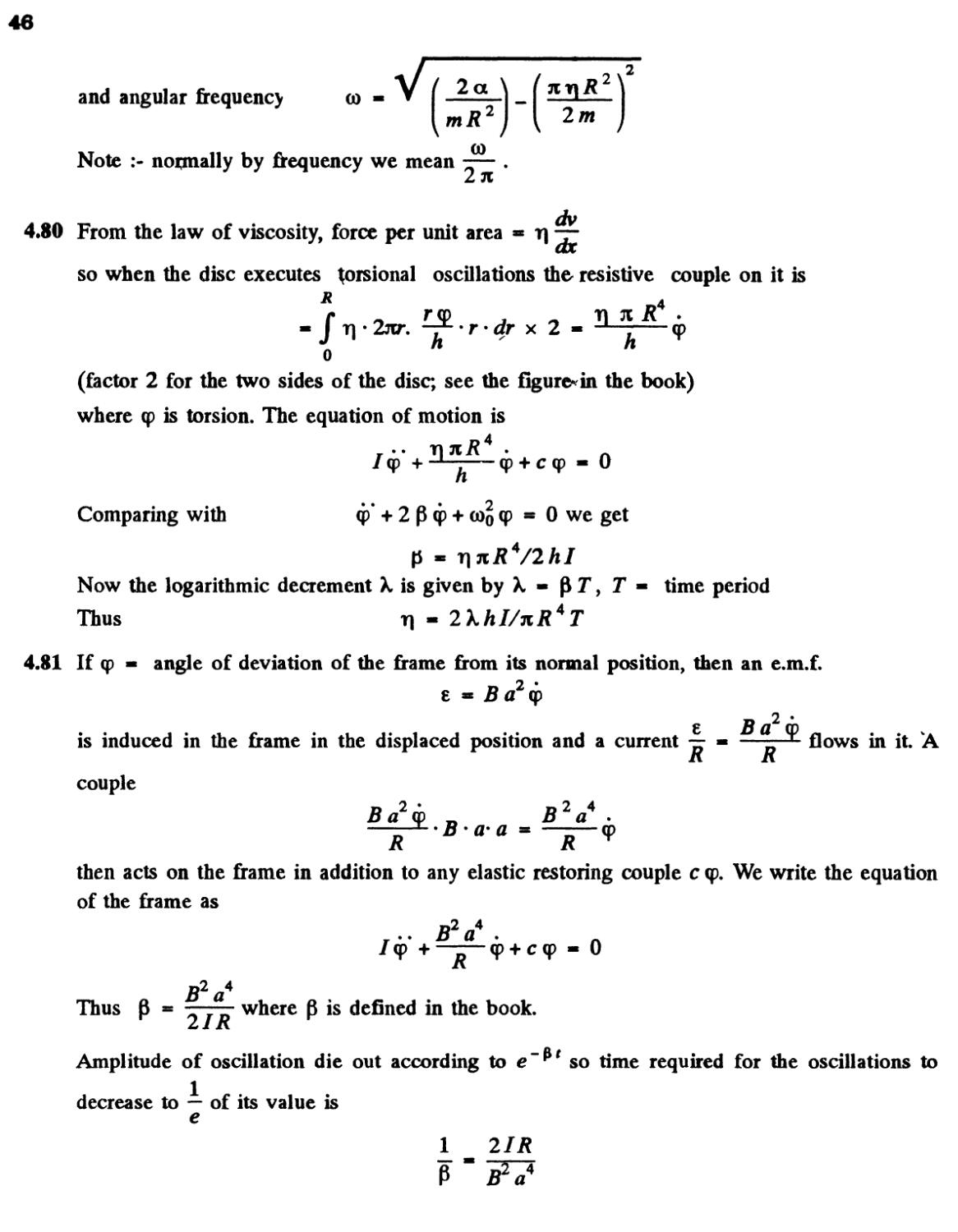
46
and angular frequency to
2a \ '— d2X
mR
2
i
2m
Note :- nornially by frequency we mean -—
2 J
4.80 From the law of viscosity, force per unit area ■ r\ —
so when the disc executes torsional oscillations the resistive couple on it is
* »4
Jr<P j *n * R •
ri • ZJir. -7*- • r • ar x 2 - -1—: cp
o h h
(factor 2 for the two sides of the disc; see the figure- in the book)
where cp is torsion. The equation of motion is
r .. ti jcR . rt
/cp +-"l~t—cp + ccp - 0
Comparing with <p* + 2 P (p + coq (p « 0 we get
p « r\jcR4/2hI
Now the logarithmic decrement X is given by X - p J, T - time period
Thus T] - 2khI/jcR4T
4.81 If cp - angle of deviation of the frame from its normal position, then an e.m.f.
£ - Ba2q>
B a2 m
is induced in the frame in the displaced position and a current — - —_—-"- flows in it. A
K R
couple
R cp
then acts on the frame in addition to any elastic restoring couple c cp. We write the equation
of the frame as
... bV.
/cp +—-—cp + ccp - 0
R
B2 a4
^°us P = o rp wnere P ^s defined in the book.
21R
Amplitude of oscillation die out according to e~^r so time required for the oscillations to
decrease to — of its value is
e
I 2IR

47
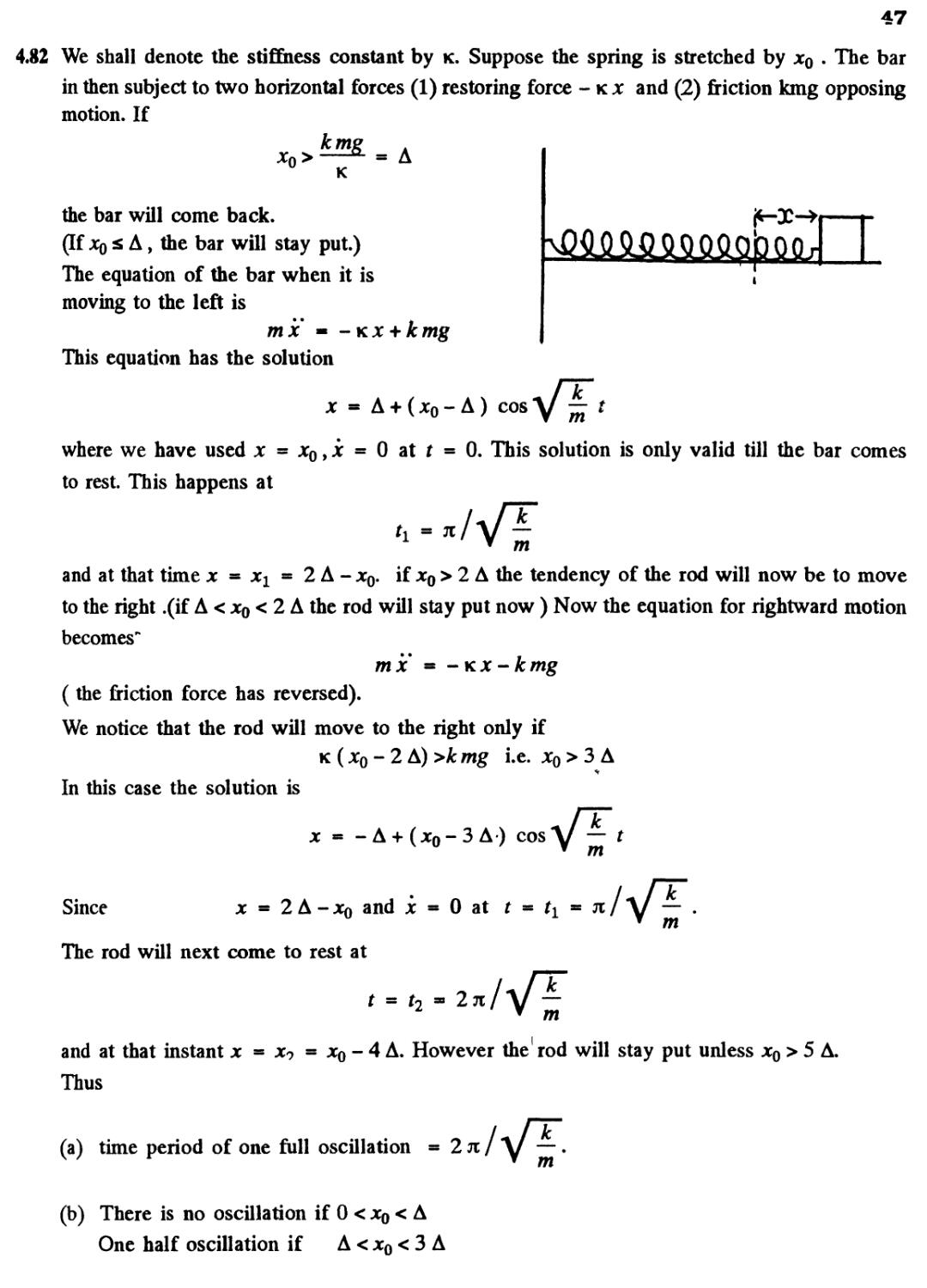
4.82 We shall denote the stiffness constant by tc. Suppose the spring is stretched by xQ . The bar
in then subject to two horizontal forces A) restoring force -kx and B) friction kmg opposing
motion. If
xo>^&- = A
K
the bar will come back.
(If x0 £ A, the bar will stay put.)
The equation of the bar when it is
moving to the left is
mx - -KX + Jfcmg
This equation has the solution
FT
x « A + (x0 - A ) cos y — t
where we have used x = x0, x = 0 at t = 0. This solution is only valid till the bar comes
to rest. This happens at
m
and at that time x = xx = 2 A - x0. if x0 > 2 A the tendency of the rod will now be to move
to the right .(if A < x0 < 2 A the rod will stay put now ) Now the equation for rightward motion
becomes"
mx «-KX-kmg
(the friction force has reversed).
We notice that the rod will move to the right only if
k(jco-2A) >lemg i.e. x0 > 3 A
In this case the solution is
cos
V1-
v m
Since
The rod will next come to rest at
x = 2 A - x0 and x = 0 at t
m
t =
and at that instant x = x? = x0 - 4 A. However the rod will stay put unless x0 > 5 A.
Thus
/ A"
(a) time period of one full oscillation = 2k/ y —.
(b) There is no oscillation if 0 < x0 < A
One half oscillation if A < x0 < 3 A

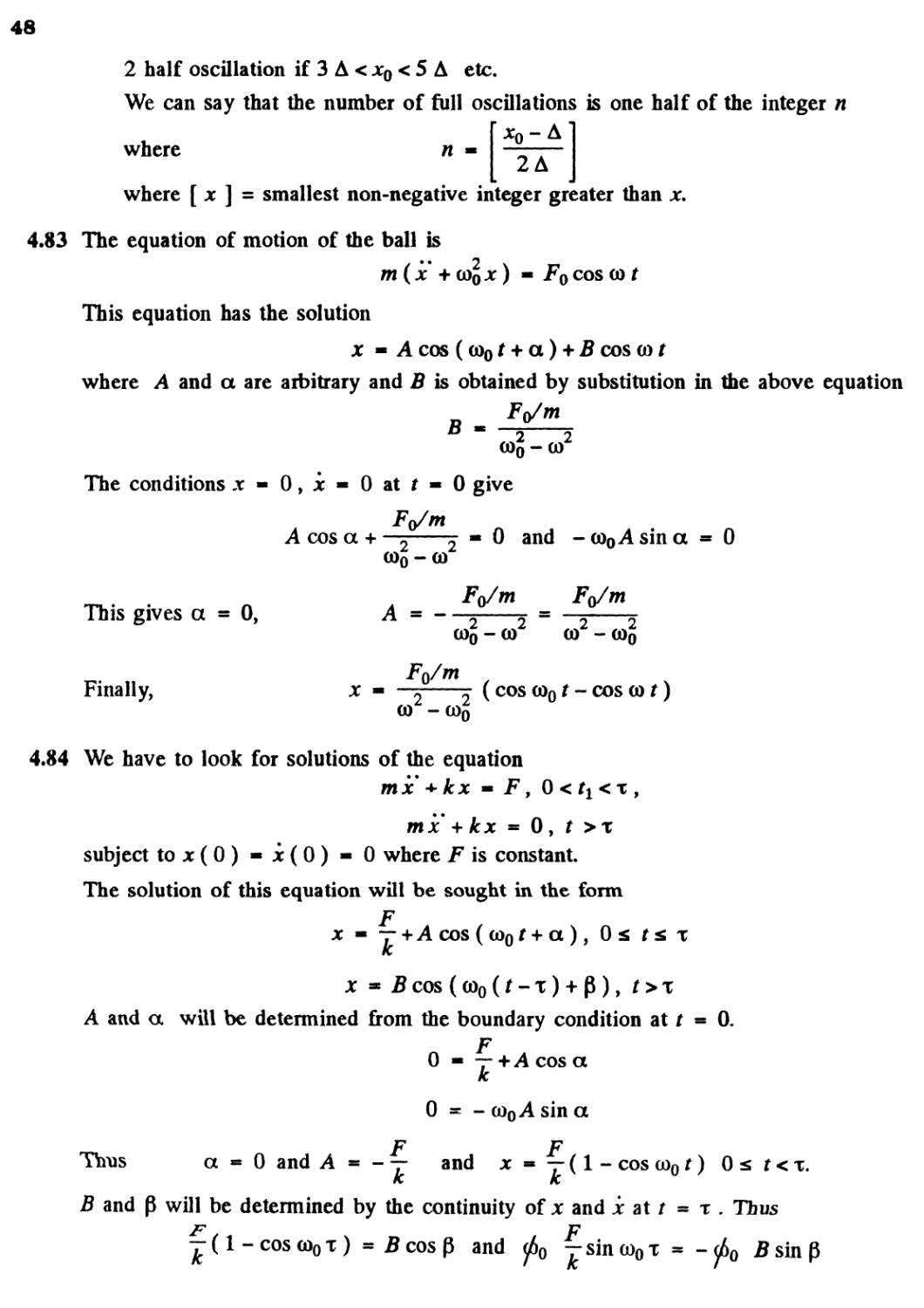
48
2 half oscillation if 3 A < x0 < 5 A etc.
We can say that the number of full oscillations is one half of the integer n
where n
2 A
where [ x ] = smallest non-negative integer greater than x.
4.83 The equation of motion of the ball is
m (x + co0x) - Fo cos co t
This equation has the solution
x
where A and a are arbitrary and B is obtained by substitution in the above equation
B « —
co0-co
The conditions x-0,i«0atf«0 give
Ff/
A cos a + —« 2 " ® and -cooAsina « 0
CO0-(O
This gives a = 0, A =s2 = 2 2
co0 - co co - co0
F0/m
Finally, x - —5 r (cos co0 r - cos co
co -co0
4.84 We have to look for solutions of the equation
mx +kx - F,
mi +fcx = 0, t >x
subject tox@) -i@) - 0 where F is constant.
The solution of this equation will be sought in the form
x - ~+A cos
x * ficos(co0(r-x)
A and a will be determined from the boundary condition at t = 0.
F
0 - 7- + A cos a
k
0 = - aH A sin a
-F i7
Thus a - 0 and A = - -7- and x = -7- A - cos co01) 0 ^ t < x.
and P will be determined by the continuity of x and x at / = x . Thus
A-coscoqx) =5cos0 and y60 -sinco0x = -

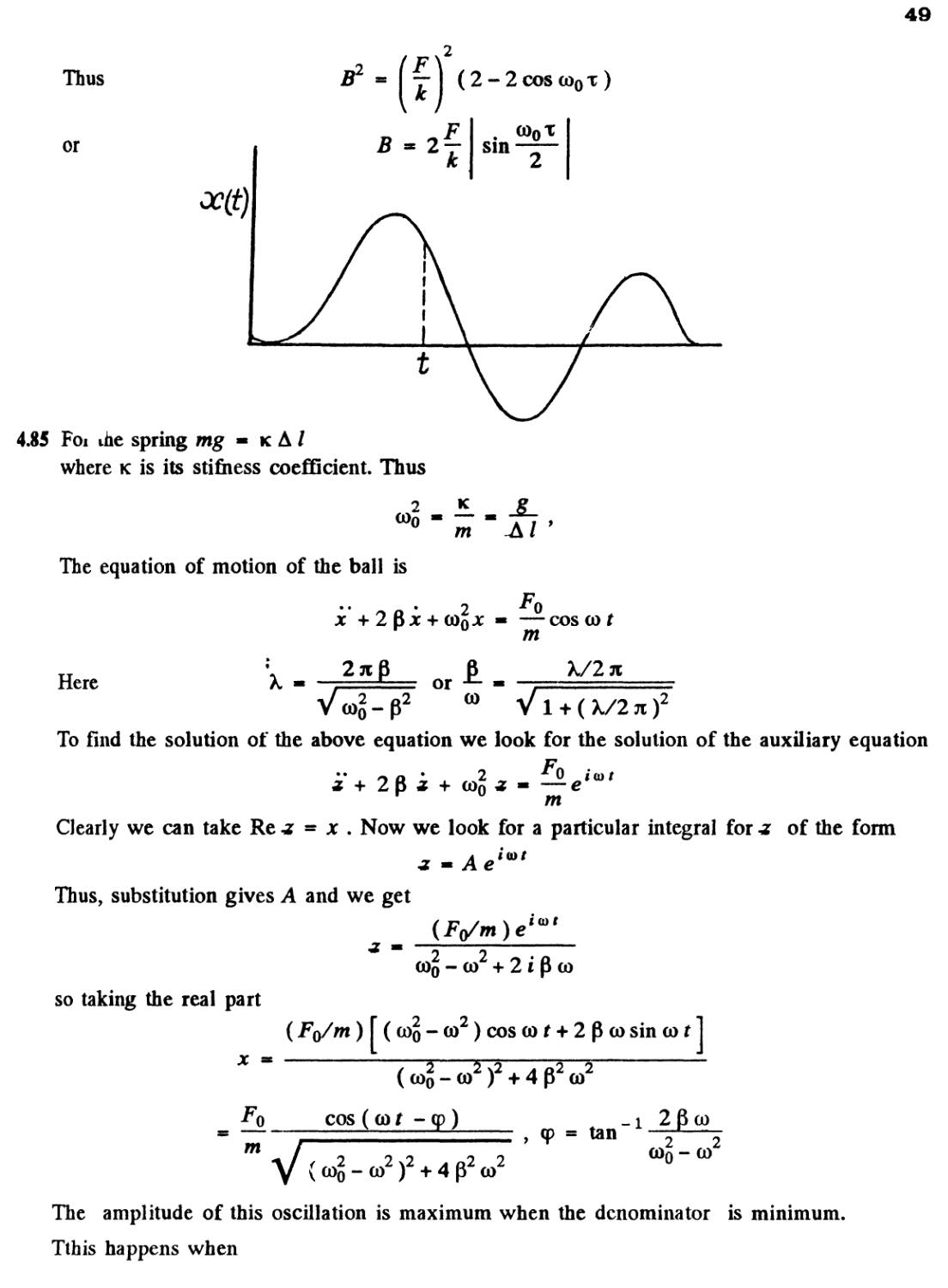
49
Thus
or
B2 = \j\ B-2cosco0x)
OC(t)
B * 27
k
sin
4.85 F01 the spring mg - k A /
where k is its stifness coefficient. Thus
.A/ '
The equation of motion of the ball is
0
—
m
cos car
Here
2ji6 p
r or J-
2 CO
- p
To find the solution of the above equation we look for the solution of the auxiliary equation
i'+2pi + coo*« —elfOt
m
Clearly we can take Re -z = x . Now we look for a particular integral for z of the form
Thus, substitution gives A and we get
(F0/m)e
i«t
- <o + 2 i p 00
so taking the real part
(F(/m
£0
m
cos (co t - qp )
(cog - co2 f + 4 p2 co2
, qp = tan
2fico
2 2
COq- CO
The amplitude of this oscillation is maximum when the denominator is minimum.
Tthis happens when

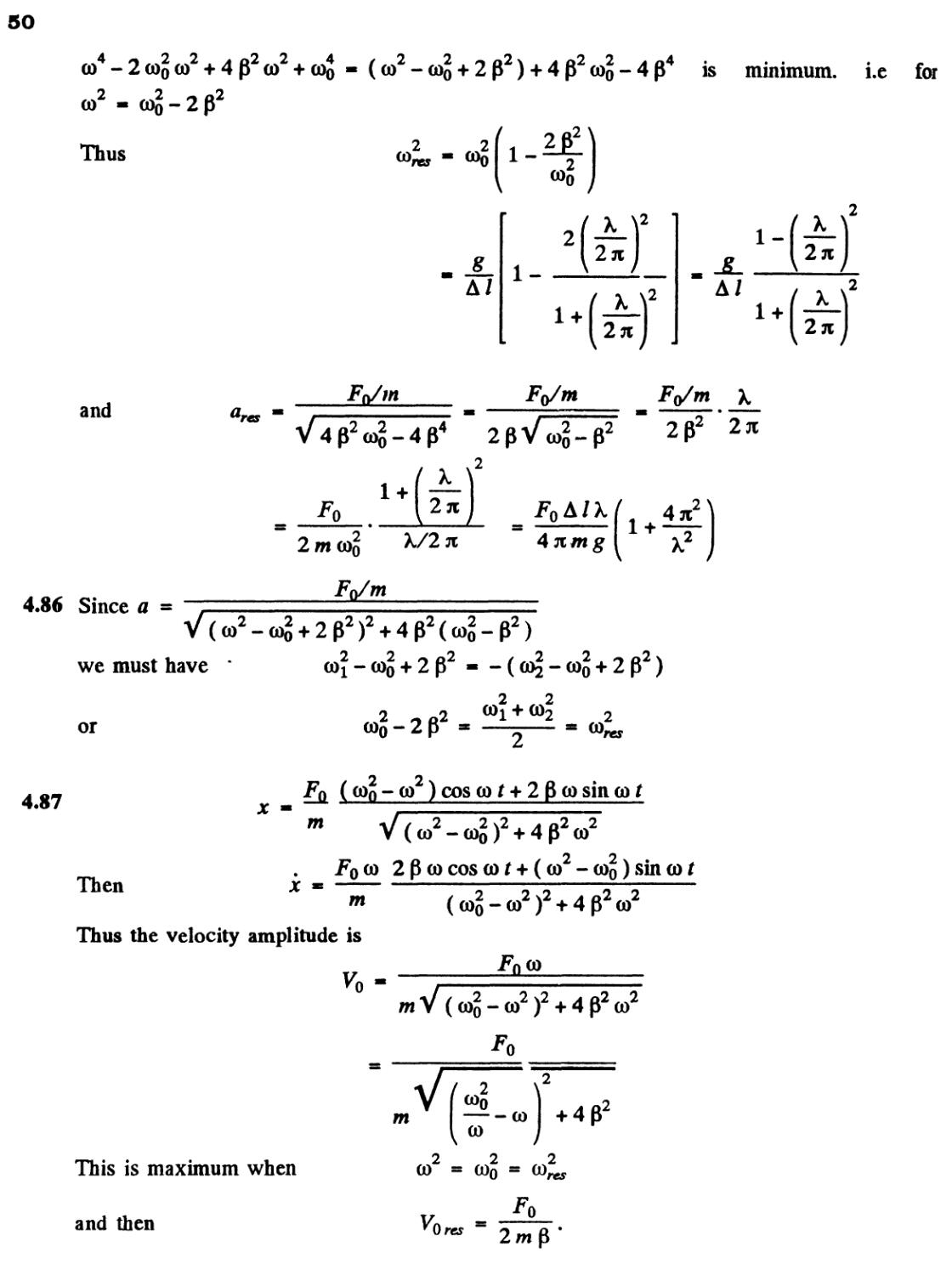
50
co2 - cog - 2 P2
Thus
-4p4 is minimum, i.e for
CO
res
A/
k2 1
1-
1 +
1-
2jc
A/
1 +
and
a
res
ro
1 +
2jc
4.86 Since a =
we must have
coj - cog + 2 p2 - - (<*% - <°o + 2 p2)
or
co;
res
4.87
Then
(coq-co ) cos co r -h 2 P co sin co
m
2 2
i*o co 2 P co cos co t + (co - co0) sin co t
(cog-co2J + 4p2co2
m
Thus the velocity amplitude is
This is maximum when
and then
V
m
2
CO
\7
f 2
2
= co0
CO
Fo
2
+
2
Ores
4
o2
p
Ores

51
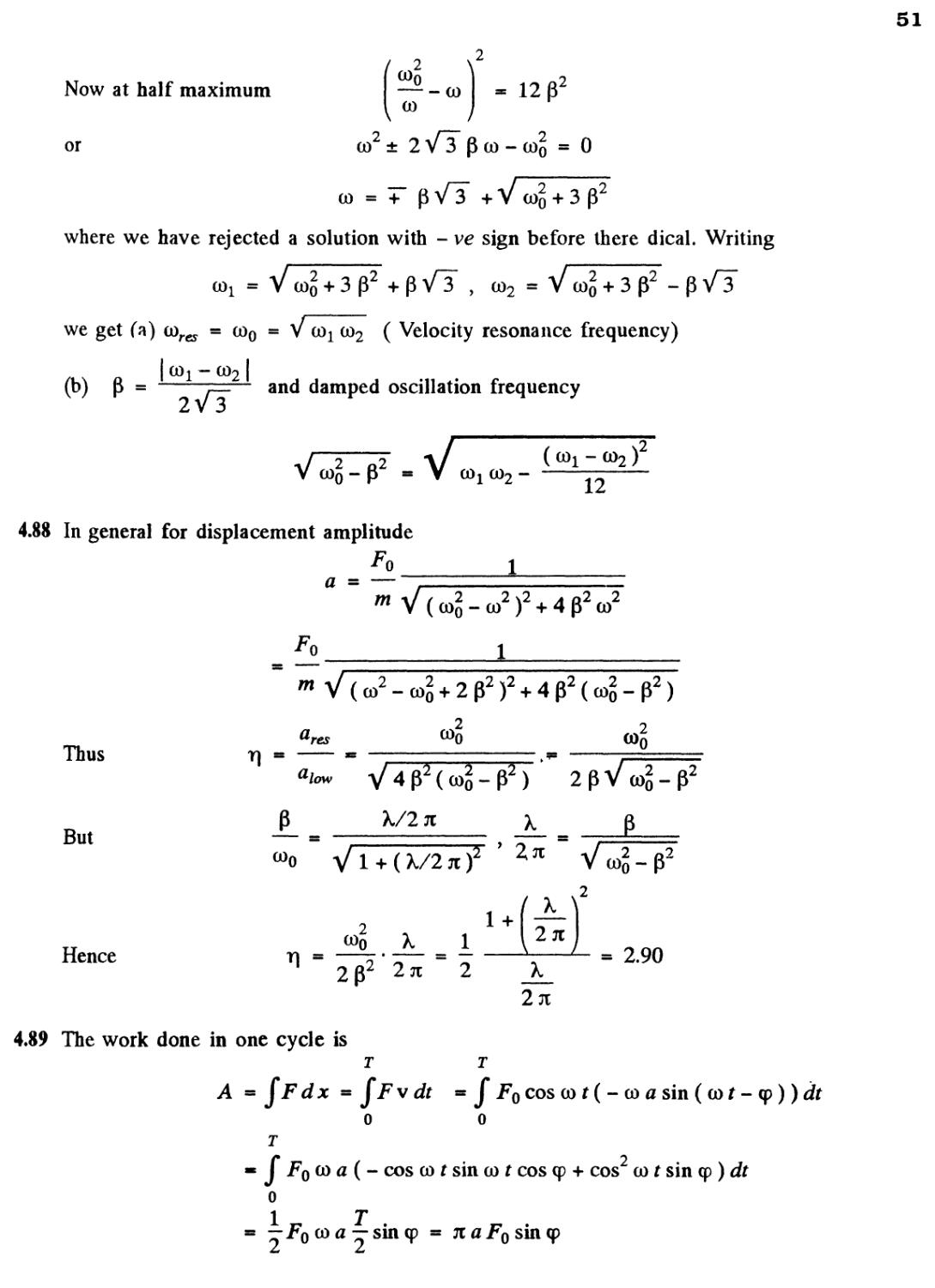
Now at half maximum
/ 2
co0
\
CO
- CO
or
co2± 2
12
co - cog = 0
where we have rejected a solution with - ve sign before there dical. Writing
, co2 = Vcog + 3P2 -f
= V COn + 3 B2 +
we get fa) cores = co0 = V oc^ to2 ( Velocity resonance frequency)
(b)
- co2
and damped oscillation frequency
2 a2
CO0 - p
= V COi
C02 -
4.88 In genera] for displacement amplitude
a =
m
o
m V (co2 - cog + 2 P2 J + 4 P2 (cog - p2 )
Thus
vres
cog
cog
But
2pVcog-p2
p
Vcogp2
cog-
Hence
cog
1 +
2 jc
2 p2 2 jt " 2
= 2.90
4.89 The work done in one cycle is
A =
= fFvdt « J Fq cos co t ( - co a sin ( co t - cp )) dt
o
0
J Fo co a ( - cos co r sin co r cos cp + cos co t sin cp ) dt
o
1 T
= t-Fq co a —sincp = JtaFosincp

52
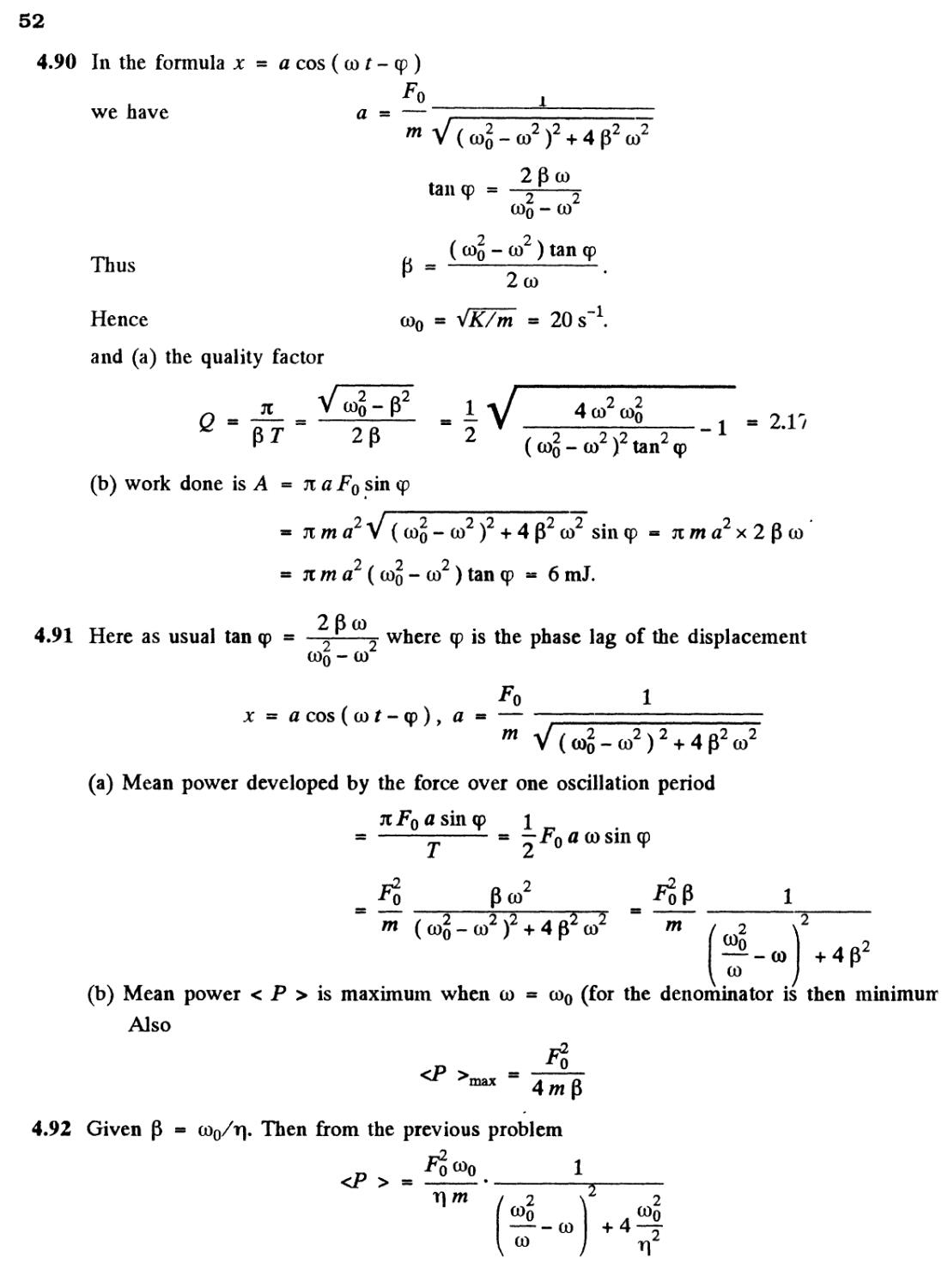
4.90 In the formula x = a cos (co t - qp)
we have
a =
m
2
tancp =
200)
—y~—
CO0- CO
Thus
Hence
and (a) the quality factor
(co0 - co ) tan cp
2co
co0 = VA/m = 20 s
-l
£ =
Jt
pT
2 2 \2 2
- co ) tan cp
_ 1 = 2.11
(b) work done is A = Jt a Fo sin <p
r\ I 0 0 0 0 0 0
nma V(co0-co ) + 4 P co sin cp = jt m a x2Pco
2 9 2
= jtma (co0-co )tany *= 6mJ.
4.91 Here as usual tan cp = —y~—« where cp is the phase lag of the displacement
co0- co
x = a cos (cof-cp), a = —
m
(a) Mean power developed by the force over one oscillation period
tn
( ,.2 \
■- co
CO
(b) Mean power < P > is maximum when co = coq (for the denominator is then minimuir
Also
<P >
PI
max
4mp
4.92 Given P = co0/t]. Then from the previous problem
<P
m
/ 2
CO0
CO
- CO
+ 4
COq

53
At displacement resonance a> « V (jOq - 2 P
<p >
1
res
r\m
2
co0 -
0
Jl
COq
ti2-2
1-
4 ?} m aH 1 4 m to0 y.2 _
while
Thus
T]2-2
<P >
max
>max -
100
max
2
The equation of the disc is cp+2Pcp + coo(p
cos
Then as before
where
cp ■ cpm cos ((o t - a )
N.
m
'm
1/2
2 7
(a) Work performed by frictional forces
T
- -jNrd<p where tfr - -2/pcp - -J*2p/(p2dr - -2ji
co2Jf 4p2a>2]1/2 si
(coo-co2J-f 4p2a>2]1/2 sin a « - 7iA^ cpm sin a
(b) The quality factor
X = pT
CD
2 - co2) tan a 2 tan a
4co2a>o
COq
2 tan a
4aJ(og/2(p2 2
^ 2 ~ te!1 a
cos a
1/2
1 2 tn
since co0 * co + -r— cos a
2 sin a
4aJa)g/2(p2 . 2
^ sin a
N:
1/2
2 sin a
2
m
1 2 Nm cos a N
CO -f-
2 sin a
2cp2
4/2cp2 4 41<pm 2
co + :co
n:
4
co +
m
N,
co cos a + cos a - 1
m
m
1/2
I
+ 1 - cos a
1/2
2 sin a
'2/cpmCD:
2
m
4p2co2
1/2
,1/2
+ cos a
m

54
4.2 ELECTRIC OSCILLATIONS
4.94 If the electron (charge of each electron ■ - e ) are shifted by a sman distance jc, a net + ve
charge density (per unit area) is induced on the surface. This will result in an electric field
E - n ex/z0 in the direction of jc and a restoring force on an electron of
ne2x
Thus mx ■
or jc + jc * o
me0
This gives a), = V — 1.645 x 10¹⁶ s.
* me0
as the plasma frequency for the problem.
4.95 Since there are no sources of emf in the circuit, Ohm's 1 law reads
c dt
where q = change on the capacitor, / = -^ = current through the coil. Then
—^ + (o0q = 0, OH « 7
The solution fo this equation is
q - qm cos ((o0 r + a )
From the problem Vm ■ — . Then
/ = - cd0 C Vm sin ( cd0 r + a )
and V = Vm cos (co0 r - a)
r2
(o0C
x/2 LI 2
or k + -=- - v
m
1 2 Q2
By energy conservation 9^* +ir " constant
When the P.D. across the capacitor takes its maximum value Vm, the current / must be zero.
1
Thus "constant" = -C
LI2
Hence -pr- + V2 - V^ once again.

56
4.96 After the switch was closed, the circuit satisfies
dt C
or =~f" + Wo0 * 0 ss> Q m C VL cos (On r
dt2
where we have used the fact that when the switch is closed we must have
V I - —^ m 0 at t - 0
Thus (a) / « ^ ^ - C Vj, coq sin coo
T" sin
(b) The electrical energy of the capacitor is r~7 ex cos coo t and of the inductor is
1 r r2 .2
~L / a sin
The two are equal when
(On, t — ~T
4
At that instant the emf of the self-inductance is
di . i—
* IW w. www
dt
4.97 In the oscillating circuit, let
q = ?mcosa>f
be the change on the condenser where
co2«-r— and C is the instantaneous capacity of the condenser E = area of plates)
y = distance between the plates. Since the oscillation frequency increases r\ fold, the quantity
changes r\ fold and so does y i.e. changes from y0 initially to r\ y0 finally. Now the P.D.
across the condenser is
cos (o t * —— cos co t
C S
and hence the electric field between the plates is
cos oaf

Thus, the chaige on the plate being qm cos co f, the force on the plate is
qm
F ^
Since this force is always positive and the plate is pulled slowly we can use the average force
and work done is
But
m
2eo5 " 2C
2eo5
a -F(iiVo-yo) - (i2-
W the initial stored eneigy. Thus
c0 s
o
A - (Tt2-l)W.
4.98 The equations of the L - C circuit are
C2V-fl2dt
±
DilBferentiating again L (I± +12) * -
Then h m
v*2
sp
or
- 0
a)
(Hence T * — - 0.7 ms)
At r-0,/-0soa-0
7 - /Osinco0r
The peak value of the current is 70 and it is related to the voltage V by the first equation
t
or
V-
(The P.D. across the inductance is V at t
1
0)
h
Hence
.„ .,.„
(D0
V
( COS (O0 f - 1)
V
8-05

57
4.99 Initially qx * C Vo and q2 - 0. After the switch is closed change flows and we get
- C Vo
dt" C
Also / = q^ = - q2- Thus
2/
 2
Hence / + co0/ « 0 co0 «
The soloution of this equation subject to
/ = 0 at t = 0
4
"I.
is / = /0 sin co0 r .
Integrating
cr o
A- — cos co01
(Oq
cos co0
Finally substituting in A)
A-B 2/0
oHC
Thus
cos co01 + LIQ (d0 cos ca0 r - 0
and
so
+-o
2 oH
(l+cosaHO
( 1 - COS G)o
4100 The flux in the coil is
0
The equation of the current is
This mean that
or with a>o * ——
"** JLj
dt
2
dt
t <0
t >0
jldt
o
c
+ / = 0
70 sin ( cd0 / + a )
A)
^2
A)

58
Putting in A) -L Io co0 cos (co01 + a) = - —— [cos(co0f + a)- cos a ]
COqC
This implies cos a « 0 .". / * ± /0 cos co01. From Faraday's law
dl
or integrating from f = - e to - e where e -* 0
= LI0 with + sign in /
r
so, / * y- cos (o0
4.101 Given V = Vm e'^ cos cor
(a) The phrase "peak values' is not clear. The answer is obtained on taking | cos co t
Tin
i.e r — —.
co
dV
(b) For extreme -j- « 0
- p cos uar- co sin co r = 0
or tan co* « - p/co
- P\
i.e. cor « mt+ tan x '—n~
4.102 The equation of the circuit is
dt2
where Q = charge on the capacitor,
This has the solution Q * Qm e~^rsin(cof+ a)
R I 2 2* 2 1
where P = —>a)«Vco0-P ,co0 = — .
Now
/ - -*■ - 0 at r - 0
so, Qm e~^' (- Psin(cor+ a) + co cos
Thus co cos a = Psina or a = tan -
P
Now Vm = ~f and Vo = RD. at t = 0 = ^ sin a
= sin a
co -/-—rjTT v\ R2c
= VI- B /con = V 1 - 2
V (o2 + 62 "o 4L

59
4.103 We write
dQ T T ^ 6/ .
—T~ « / - IM e K sin co t
lmt
* gm IM e~p (gm means imaginary part)
Then
- gm
- P + i co
ptsin(cor+6) _„
(An arbitrary constant of integration has been put equal to zero.)
Thus
V'C
j_V
C A +
4.104 »
2L
charge on the capacitor
f - p / sin(coJ+6) x co
Then a ~ Im e ¥ —/ -, tan 6 -
V(o2 +
Thus HV - \ L Im e~ 2P' sin2 to t
2O * 1
2C „?*-' ^ e " (<°'+8)

60
Current is maximum when
Thus
or
i.e.
and hence
d
It1
e~ ^r sin
- Psincor-f co
tan
sin2( i
sin2 (co
1
4 pVcog
CO
tor--
cor « ni
cor)
r+6)
COq
" 4P2
cor « 0
cos co r *
« tan 6
c+ 6
sin2 6
sin226
1 L
r sv
m m 1^
0
4
2
2 "
1
cos2 6
L
CR2
5.
(WM is the magnetic energy of the inductance coil and WE is the electric eneigy ot tl
capacitor.)
4.105 Clearly
L m jLj + Zr2 9 R m
4.106 Q -
Now
n
or
QT
i . In ti
r - In n so r - L
n
QT
JCV
0.5 ms
4.107 Current decreases e fold in time
2L ... t.
— sec - -^-r osallations
2L
In
kR
R
LC 4L
In
-4A-1
15.9 oscillations
4.108 Q
n
CO
2P
/. co - 2PC,
CO
2Q-
Now
COq - CO
vt:
or co •
co0
so
CO0- 0)
<00
xlOO%
x 100 %

4.109
c
At t = 0 current through the coil
P.D. across the condenser *
(a) At t ■ 0, energy stored
2
U+ r
b>
•
(b) The current and the change stored decrease as e
-tR/2L
_ 2.0
so energy decreases as e
-tR/L
b e"tR/L = 0.10 mJ.
4.110 Q
n
pr
nv
p
@
2P
2p
or
— - Vl+42
or
(O0
V1+ Q
Now
W
Thus energy decreases T) times in —£- sec.
2P
lnr|
2to0
sec. - 1.033 ms.
4.111 In a leaky condenser
dt
Now
/- /' where /' - — - leak current
V)
+ R
or
. 1 dQ 1
q RC dt LC
0
Then
+ a)

62
00
Yrc '
LC '
CO
v^
CO C
@
2P
RC
LC 4R2C
2C2
ACR
- 1
4.112 Given V • Vme~ *' $,in.<at,
power
Eneigy loss per cycle
(energy decreases as WQe~ pr so loss per cycle is Wox 2 P T)
Thus
or
2<P> L
Hence
A Y C v I
2<P>
100 on putting the vales.
4.113 Eneigy is lost across the resistance and the mean power lass is
<P> - R<I2> - J R I2 - 0.2 mW.
This power should be fed to the circuit to maintain undamped oscillations
4.114 <P>
RC V
as in D.112). We get <P> - 5 mW.
4.115 Given 9 = ?i + 92
A - -
77*12
Thus
RC q2
Putting
.
0
0
' q2 = Be + uot
A- co LC)A+

63
A solution exists only if
or
or
i<aRC)B * 0
A- co2Z,C)(l+ icoi?C) « 1
ico/JC- <o2LC-iu>3LRC2 = 0
I/? C2co2- ico LC-RC « 0
CO
1
co0
Thus
- fw
etc.
oH is the oscillation frequency. Oscillations are possible only if co0 > 0
i.e.
4.116 We have
1 C
—^-< — .
- L
Ij
fldt
Then differentiating we have the equations
LXC /*!+ RiCIx + (/1+ 72) = 0
I2C/2+il2C/2 + (A+/2) = 0
Look for a solution
at
at
Then
A + 01 Lx C + a/?x C ) Ax +
0
Ax + A+ a2 L2C+ aR2C) A2 = 0
This set of simultaneous equations has a nontrivial solution only if
A+ a2LxC^ a/?xC)(l+ a2L2C+ aR2C)
or
a3+a2
= 0
This cubic equation has one real root which we ignore and two complex conjugate roots. We
require the condition that this pair of complex conjugate roots is identical with the roots of
the equation
2 = 0

64
The general solution of this problem is not easy.We look for special cases. If Rx -R2 - 0, thei
R - 0 and L
L\ +L2
. If
L = 0 and R ±RiR2/ (Ri+R2) .These are the quoted solution but they are misleading.
We shall give the solution for small Ri,R2 . Then we put a - - p + ico when p is small
We get A - co2!,! C - 2 i p coli C -
(l-co2I2C- 2ipcoI2C-
(we neglect p2 & P Rx, P R2 ). Then
icoi?2C)
A-
co
This is identical with
also B
This gives
tfi
LC
- co2L2C) +
2 n r 2
21
2x I? T2
4.117 o
For the critical case
Thus LC q + 2 vTc ^ + ^ - 0
Look for a solution with q a. eat
C L
||—
Sw
3W/
<7 <>■
a = -
vTc '
at
An independent solution is t e . Thus
At
Also at
t - 0
--t/VZc
thus A - C Vq
• 7-0
0 = 5-
vTc"
VnV~
0
fl

65
Thus finally
- V0 V?
Vlc
L
The current has been defined to increase the charge. .Hence the minus sign.
The current is maximum when
XT j
This gives t - VTcT and the magnitude of the maximum current is
L "
4.118 The equation of the circuit is ( / is the current)
H
dt +
From the theory of differential equations
V^costor
where IP is a particular integral and /c is the complementary function (Solution of the
differential equation with the RHS = 0 ). Now
* / p'tR/L
Aco
and for IP we write IP - /„, cos (co t - <p )
Substituting we get
Thus
/ 22
Now in an inductive circuit 7-0 at f « 0
because a current cannot change suddenly.
Vm
Thus Irn * - / = cos cp
rT7ZE7
and so
T7
cos(cof-cp)-cosqpe

66
4.119 Here the equation is (Q is charge on the capacitor)
- V^coscor
A solution subject to Q * 0 at t ■ 0 is of the form (as in the previous problem)
Q -
Substituting back
Qm
cos (cor- <p)- a>RQmsm(cor- cp)
- Vm cos co r
Vm{cos<pcos(cor- cp) - sincp sin (cor- ip)}
so
This leads to
Qm
CV.
m
Vl+ (co RCJ
, tan <p - co/? C
Hence
m
dt
CD
. / * —\ COS CD -t/RC
- sin (co r - cp ) + . -I e
sin (p
coC
The solution given in the book satisfies / - 0 at t ■ 0. Then g * 0 at t * 0 but this
will not satisfy the equation at t - 0. Thus /*(),( Equation will be satisfied with 7-0
only if g * 0 at r * 0)
With our /,
I(t - 0)
m
4.120 The current lags behind the voltage by the phase angle
-l (oL
R
qp - tan
Now L
n2 na21, / = length of the solenoid
2b = diameter of the wire
But
Then
2bn
cp = tan
1
In
,
tan
t Ina • 2jiv
p-lnanl
2
4 pn
ji

67
4.121 HereV » Vm cos co t
I - Im cos (co r + <p)
where
Now
vm
, tanqp
to.RC
-V
&RC
Thus the current is ahead of the voltage by
Iff
Iff
- 1
'1*
f V )
v m
RI,
m
-1
- 60
4.122
Here V -
o
or
11/ + ^
c
- OO0sincor
OIF
Ignoring transients, a solution has the form
/ = Io sin (co t - a )
co/?/o cos (cor- a) + ~sin(cor-a) - - co Vj) sin cor
- coVoJsin(cor- a) cos a + cos (co t - a ) sin a}
so
0
h
■■■■Ml
coC
-1
c
tan" (co/?C)
coC
-1
-1
70sin(cor- tan" col?C-Ji) = - /Osin(cor- tan" col*C)
Then
It satisfies
o
CO

(cor-tan co/?C)
Vb(l+ cos cor)

68
if
Vo( 1 + cos cor)
Thus
and
[2.
coC
Vo/vT7
Voa>RC
- RIosin(a>t
+ TT+ ——
C co C
Go-
. checks
tanco/?C)
(cor- tan"*a>i?C)
Hence
r
V 1+ (co/?
cos (co r - a )
or
or
- 1 « co2(i?CJ
RC - Vr]2- 1 /co - 22 ms.
4.123
V^o current
current
Voltage V
coJL -
(b)
as
4.124 (a) /,
tanqp
coC
- ve
2 1
<
vm
m
- 4-48 A
col -
coC
CO I, -
(b) tan cp
coC
R
, cp ■ - 60c
Current lags behind the voltage V by cp

69
coC
0- 65 kV
fL/R
co2!2 = 0-5kV
4.125
(a)
1
to"C
col, -
coC
v.
m
V(coi?CJ + (to2IC-lJ W
2
CO0
+ 4
m
v
COq
2
co0
2 4
co0 co0
7 2 2 1
This is maximum when co' - co0 - 2 p - j-r^ -
JU V/
Ay
2Z
(b)
(x)L
m
to I, -
a>C
VmL
VmL
co
L-
(O
2 c
to4C2
VmL
V
o>2C
- U-
"» f> 2
This is maximum when
or
co
1 2
LC- ^C R
4
co0
co0
or co - —;
co0
2
co0
V cog - 2

70
4.126.
vL «/,
m
R
coC
for a given u>yL yR y this is maximum when
1 t n
- coL or C
co2l
28.2
For that C, VL
At this C
/ r
V V 1 + (col//? J - 0.540 kV
1 Vm
R
m
.509 kV
4.127
OOOO
o c o o
o Poor Condo
o o o o
OOOO
1
I"
7
f
We use the complex voltage V • 7m c'* . Then the voltage across the capacitor is
and that across the resistance RI' and both equal V. Thus
m imt
e"°', I- I' - iwCVm e
10} t
Hence
I = -£■ A+ iwRC) eiut
The actual voltage is obtained by taking the real part Then
7»-~Vl+(coi?CJ cos(cof+(p)
XV
Where tancp - coRC
Note —* A condenser with poorly conducting material (dielectric of high resistance) be
the plates is equvalent to an an ideal condenser with a high resistance joined in p
between its plates.

71
4.128
Ll~7t+
dl2 x
LlT~t = ~Ll2~dT
from the second equation
Then
Li-
2 \
'12
§-°
Thus the current oscillates with frequency
CD
v,
2 \
'12
4.129 Given V - Vmcos<ot
I - Im cos (co t - qp)
where
m
QQQQQQQCL 1 I 1
■o V o-
col -
coC
Then,
coC
L- co2LCJ+ (co/tCJ
As resonance the voltage amplitude across the capacitor
sin (co f - cp)
RC
CR
LC
So
CR
n
Now
Q
CR
4*130 For maximum current amplitude
m
K2+ (wL- -^ri

72
Now
L - —— and then Im0
r m
R
co C
So
,-V7^
co
- 1
Now Q -
4.131 At resonance
' L
CR
-i-V
[coi?
C 4
l V n2- 1 1
" " (n- 1J
cool
and
Now
or coo
Vm
VIC'
res
m
m
m
1 >
C02C
Then
Vv-Ti?
a^C
Vn2-1
(assuming CO2 > co1)
or
G>2
R
- lr
I
or
and
C02 =
CO2)
C02-
P
co2-
21
and
Q -
4?
5^2_ I
2 4

73
CO COa
4.132 Q « —- m —■ for low damping.
Now
m
RI.
m
, /m= current amplitude at resouance
or
Thus
So
4.133 At resonance co - co0
coC
co- — -± — -±26
a) L
co ■ co0 ±
A co - 2p and Q
COp
Aco '
m
Then /m(r]coo)
CO0I-
T]CO0C
m
^HR V-
4.134 The a.c. current must be
/ « 70 VT sin co t
Then D.C. component of the rectified current is
7/2
<I'> - ~ J 70V2 sincd
o
Since the charge deposited must be the same
or
The answer is incorrect.
m
T," C

74
4.135 (a) 7@ - hj Ost<T
r± J) - /(O
Now mean current
J2/2
o
Then /x * 2/0 since </ > * Jo
Now mean square current <I > %
T
4/» r/^*
so effective current * —p= .
VT
(b) In this case / = I± \ sin co t \
T
0
2/1,
and 70 - — I 7X | sin co t \ dt
o
2x x
^A f |sin
finGJe
7i J 71 J Jv
0 0
So Ix
Then, mean square current - < I > - I sin co f
2
T
o
2ff
2 2 2 2
7 1 f ^ 7
4 2jcJ 8
o
so effective current - 7= .
V8
4.136 rj
d.c.
p Vi> ■«
'''' '
2!2 y/R2+ <*>2L2
aJ!2 y/R2+ <*>2L

75
Thus
or
4.137 Z .
The
So
or
coZ
R
CO =
R
Vri-1
Vrj-1
Vtj - 1 - 2 kH of on putting the values.
tanO
V22 -
cos
\fi2 y2 I 7x7
V Z -XL W i&l_
cp = -z - V i. z
cp * cos
The current lags by qp behind the voltage.
1-
also
P * VI cos cp
VZ2 -
-77 - 37°.
.160 kW.
+ rJ+ co2!2
This is maximum when R + r - <oL for
Thus i? = co L - r for maximum power and
Substituting the values, we get R = 200 Q and
4.139 P
r -
col
V R+ r
tt2
* .114 kW.
2coL
Varying the capacitor does not change R so if P increases n times
Z - v R2 + (XL- XcJ must decreases vn times
Thus
cos cp - — increases V n times
increase in cos (p = / V^T - 1 \ x 100 % = 30.4%.

76
4.140 P
V2R
R2+(XL-XCJ
At resonance XL - Xc => coq ■ » •
V Jlj C*
Power generated will decrease n times when
{XL-XC? « Ll-
1 >
coC
(»- 1)/?
or
Thus
CO- » ±
CO
2 -r-
R
Lm±
ca+2 V«- 1 P a) - o>o - 0
co
Vn-
or
— « Vl + (n- 1) pVcojj ± V»- 1 p/co0
co0
CO
(taking only the positive sign in the first term to ensure positive value for — .)
co0
Now
co
-i
Thus
For large Q
- 1
CO - CO0
co0
Ven- 1 Ve«- 1
x 100% « 0.5%
4.141 We have
so
VR^
\ /
Hence
or

Heat generated in the coil
2
L
2
( y * - Vi - V<
77
2
V2-
- V2
4.142 Here I2
h
2R
9 V ■ effective voltage
30 W
and I =
f +
0
o
R
R
<ff
Now
is the impedance of the coil & the resistance in parallel.
R + 2/v /vj
72-/22
/,
i2 -
-1
2RRt
R2+X?
Now mean power consumed in the coil
= I
i «i ■
14 R.
2 T2 T2
21?
i/fU2-/;2-/:2) = 2.5 W.
4.143 1
Z
icoC
1
1+ ico/tC
40 Q
4.144 (a) For the resistance, the voltage and the current are in phase. For the coil the voltage is
ahead of the current by less than 90°. The current is obtained by addition because the elements
are in parallel.
R - > axis of
Voltage

78
(b) Ic is ahead of the voltage by 90°.
(c) The coil has no resistance so IL is 90° behind the voltage.
Tc
Ir
Jo
h
4.145 When the coil and the condenser are in parallel, the equation is
f h dt
Vm COS CO t
I
Using complex voltages y-y^ Curr^
1 = -= : r- . 7o ■ ICOCV. C
=R+iwL '
m
and
/
R
i(oC)Vme
1"'
R- icol^ i(oC(R2 +
\ a>2L2
Thus, taking real parts
where
COS ( CO t - Cp )
2
-col}2]
71
and
tancp =
col-
R
V e
imt
(a) To get the frequency of resonance we must deGne what we mean by resouance. One
definition requires the extremum (maximum or minimum) of current amplitude. The other
definition requires rapid change of phase with cp passing through zero at resonance. For
the series circuit.
1
coi -
m
/r+ coi-
coC
coC
R

79
both definitions give co
at resonance. In the present case the two definitions do
not agree (except when R * 0 ). The definition that has been adopted in the answer given
in the book is the vanishing of phase. This requires
C(R2+ to2!2) - L
or
co
1 R_
LC~ L
2 * ^res >
31.6 x 10³ rad/s.
Note that for small R, qp rapidly changes from » - — to + — as co passes through
from < a>w to > (ores.
(b) At resonance
m
L/C
m
CR
so / = effective value of total current = V —j— « 3.1 mA.
similarly
1 " >?l7c
.98 A.
0.98 A.
Note :- The vanishing of phase (its passing through zero) is considered a more basic
definition of resonance.
4.146 We use the method of complex voltage
Then Ic =
Voe
imt
1
lL,R
ia>L
2..2,2
R2+<»2L2
Then taking the real part
Vo VR2 + { o)C (/J2 + aJ!2) - col |
cos (co r - cp)
where
tanqp =

80
4.147 From the previous problem
VR2+ {coC(/t 2 + oJ!2)- col}
co2L 2
2Z2)(l 2(o2IC)+ a>2C2(/?2 + co2/2J
a>2Z,2)(l- 2(o2IC)+ a>2C2(/?2 + co2/,2)
V A- 2co2LC) + co2C2(/?2 + oJ!2) V (I" co2LCJ+ (co/?C)
4.148 (a) We have
- « co <3>n sin co t ■ Z, / +
Put / = /m sin (co t - cp ) . Then
co <$0 sin co t = co <l>0 {sin (co r - cp) cos cp + cos (co t - cp ) sin cp
- L Im co cos (cor- cp)+jR/msin(cof- cp)
so R Im = o <f>0 cos cp and L Im = O0 sin cp
w^o , col
or /m = . and tancp = —-.
VPT^J1 r
(b) Mean mechanical power required to maintain rotation = energy loss per unit time
To 2 2
4.149 We consider the force F12 that a circuit 1 exerts on another closed circuit 2 :-
Here 512 - magnetic field at the site of the current element d l2 due to the current Ix flowing
in 1.
Mo I -/i«*ix
" 4~jt J ~^~
where r^2 = rj- r^ = vector, from current element d lx to the current element d l2
Now _^ _^ _^ _»
dl2 x(dlxx r^2) \i0 r r dlx{dl2- r12) - (dlX' dl2) rn
Mo ff ,
In the first term, we carry out the integration over d lx first. Then

81
dlx (dl2
dl2
dl2 • V2 f- = 0
l2 • V2
f
12
because
Thus
/
y- = f
dT2 curl |V
= 0
The integral involved will depend on the vector o*that defines the separation of the (suitably
chosen )centre of the coils. Let C1 and C2 be the centres of the two coil suitably defined.
Write
where p^ ( p^) is the distance of d lx (d /2) from Cx (C2) and a*stands for the vector Cx C2
Then
ri2
and
*12 " V,
i i **0 f C d ll '
dl:
The bracket defines the mutual inductance L12. Thus noting the definition of x
dL12
<FX> - ~r—
x dx
where < > denotes time average. Now
The cunent in the coil 2 satisfies jR/2+
70 cos cd t - Real part of 70 e
dl2
10) t
dt
or
f? - t;—:—t~ ^o ^ (in. the complex case )
taking the real part
( a) Z,2 cos CDt-jRsincDr)=-
12
70 cos ((o r + qp )
Where tan qp = —r~ . Taking time average, we get
(x) L
(x)
<F
12
CO
51
12
dx
The repulsive nature of the force is also consistent with Lenz's law, assuming, of comse, that
L12 decreases with x.

82
4.3 ELASTIC WAVES. ACOUSTICS
4.150 Since the temperature varies linearly we can write the temperature as a function of x, which
is, the distance from the point A towards B.
-J,
i.e.,
hence,
I
dx
A)
In order to travel an elemental distance of dx which is at a distance of x from A it will take
a time
dx
dt
From Eqns A) and B), expressing dx in terms of dT, we get
B)
dt
/
idT
aVT
Which on integration gives
dT
t
or,
Hence the sought time t
4.151 Equation of plane wave is given by
21
(T2-Tt)
2/
CO
\(r,t) = <icos(cor-JE^r*), where I** — n called the wave vector
A
and n is the unit vector normal to the wave surface in the direction of the propagation of
wave.

83
or, |(x,y,z) -
- a cos (co t - kx cos a - ky cos P - kz cos y)
Thus % (*!, y1, zx, r) = 0 cos (co f - itXi cos a - Jfcjyx cos p - JfcZi cos y)
and ?(*2>.y2>z2>0 - flcos(cor-itx2cosa-ity2cos P-^^2 cosy)
Hence the sought wave phase difference
or A<p - |<p2-
co
v
[ cos P + (zi ~Z2
I" (Xi - x2) cos a + (yi - y2) cos p + (z1-z2)cosy
4*152 The phase of the oscillation can be written as
<$ * cof-JE^r
When the wave moves along the jc-axis
3> - co t - kxx (On putting
Since the velocity associated with this wave is
We have
0).
k.-±
Similarly
Thus
L, « — and
^ v2
CO
CO A
CO
—
V2
co a
V3
4.153 The wave equation propagating in the direction of +ve x axis in medium K is give as
- a cos (cof-ifcjt)
So,
CO
a cosk(vt-x), where fc * — and, v is the wave velocity
In the refrence frame K! , the wave velocity will be ( v - V) propagating in the direction of
+ve x axis and x will be jc\ Thus the sought wave equation.
- acosk[(v-V)t-xf]
or.
a cos
(OT/, , ,
to- — V\t-kx'
v
a cos
7
V
4.154 This follows on actually putting
in the wave equation
(We have written the one dimensional form of the wave equation.) Then

84
so the wave equation is satisfied if
1
a - ± -7
v
That is the physical meaning of the constant a .
4*155 The given wave equation
- 60cosA8001- 5-3jc)
is of the type
I = acos((ot- kx)y where a = 60xl0m
a) » 1800 per sec and k - 5-3 per metre
As k - ~T~~> so A»
A
and also k » —, so v » 7 ■ 340 m/s
v A:
(a) Sought ratio = ^ = ^ « 5-1 x 10
(b) Since | ■ acos((ot-kx)
dt
So velocity oscillation amplitude
—^ 1 or vm - a a) - 0-11 m/s A)
and the sought ratio of velocity oscillation amplitude to the wave propagation velocity
vm 0-11 „ in_4
= — = -r^r = 3-2 x 10
v 340
(c) Relative deformation * -~ - ak sin(tor-A:jc)
So, relative deformation amplitude
. ak - F0xl0x5-3)m - 3-2xlO m B)
I
m
From Eqns A) and B)
viaH
I
Thus I -r3- » —I -r3- | , where v - 340 m/s is the wave velocity.
m
4.156 (a) The given equation is,

85
So at t * o,
- acoskx
Now, -r^. » - a o> sin (co f - it Jt)
a/
and —r^- - acasin&x, at t - 0.
Also, -7^ - +aksm (v)t-kx)
ax
and at t ■ 0,
- -a
Hence all the graphs are similar having different amplitudes, as shown in the answer-
sheet of the problem book.
(b) At the points, where \ ~ 0, the velocity direction is positive, i.e., along + ve x - axis in
the case of longitudinal and + ve y- axis in the case of transverse waves, where -p is
positive and vice versa.
For sought plots see the answer-sheet of the problem book.
-Y*
4.157 In the given wave equation the particle's displacement amplitude * ae~y
Let two points x1 and x2 , between which the displacement amplitude differ by r\ - 1 %
So, ae~yXl - ae
~yX2
or eYXl(l-T|) = e~yXi
or In A-ti)-
In A-T))
or, xx - —^-—u-
So path difference = -
and phase difference* "T"x
2jcln(l-Ti) 2jcti n<5
« . ~ i U. u — L . Q.3 ra(J
4.158 Let 5 be the source whose position vector relative to the reference point O is r.
Since intensities are inversely proportional to the square of distances,

86
Intensity at P (/x)
Intensity at Q(I2) f
where 4i - PS and d2 = QS.
But intensity is proportional to the square of amplitude.
So> T "  or
a2 j
Thus di ■ — and d^ ■ —
A
Let n be the unit vector along PQ directed from P to Q.
A: a
PS
Then
and
From the triangle law of vector addition.
OP + PS =
—*
or
Similarly
Adding A) and B),
or ri+ — n ■ r
flir
r + — n * r£ or (^r^-kn = a2r
<*2
al * a2
(i)
B)
Hence
4.159 (a) We know that the equation of a spherical wave in a homogeneous absorbing medium
of wave damping coefficient y is :
t m cos (co r - A: r)
Thus particle's displacement amplitude equals
According to the conditions of the problem,
at
y a0 =
'0
and when
r - r
r]
A)
B)

87
Thus from Eqns A) and B)
or,
or,
eT<r-r,>
Y =
Y(r-r0) = ln(rjro)-lnr
In i\ + In r0 - In r _ In 3 + In 5 - In 10
r-r0 5
0-08 m
-l
(b)
cos (a) t - k r)
So,
dt
cosin(cof-ifcr)
31
dt
0)
But at point A,
So,
dr
r
aoa>
50xl0 o 22 t A. in3 1C ,
x 2 x — x 1-45 x 10 =15 m/s
4.160 (a) Equation of the resultant wave,
I = li + Iz - 2 a cos A:
cos,
a cos,
cor-
. , where a! - 2 a cos
-x
■Mam
2
Now, the equation of wave pattern is,
x + y - k, (a Const.)
For sought plots see the answer-sheet of the problem book.
For antinodes, i.e. maximum intensity
cos
± 1 - COS^JC
2nft .
"" — /I A.
or,
or,
or,
Hence, the particles of the medium at the points, lying on the solid straight lines
(y = jt±rtX), oscillate with maximum amplitude.
For nodes, i.e. minimum intensity,
cos-^—
, k(y-x)
2
0
jc

88
or, y - x ± B n + 1) X/2,
and hence the particles at the points, lying on dotted lines do not oscillate.
(b) When the waves are longitudinal,
For sought plots see the answer-sheet of the problem book.
k(y-x) - cos — - cos —
a
a
or,
— - cos
a
«./ \ -1 §2
* (y " x) + °°s —
— cosifc(y-Jt)-sinifc(y-Jt )sin I cos
from A),
if
- — cos k(y-x)-&ink(y -x
sin^(y-x) - 0 sin ( « ji )
§1 - h (- if
2
2
2
A)
thus, the particles of the medium at the points lying on the straight lines, y - x ±
will oscillate along those lines (even n), or at right angles to them (odd n).
Also from A),
if
cosifc(y-jt) * 0 * cosBn
1 -
> a circle.
a
Thus the particles, at the points, where y - x ± (n ± 1/4) X, will oscillate along circles.
In general, all other particles will move along ellipses.
4.161 The displacement of oscillations is given by \ - a cos (co t - kx)
Without loss of generality, we confine ourselves to x - 0. Then the displacement maxima
occur at a) t * n n . Concentrate at co t ■ 0. Now the energy density is given by
w » p a2.co2 sin2 a) f at x * 0
J/6 time later (where T - is the time period) than t - 0.
co
2 2 • 2 fl 3 22
w > p a co sin - -~paco -w0
Thus
1 22
<h>>.« -pa co
2wo

89
4.162 The power output of the source much be
4jc/2/0 - Q Watt.
The required flux of accoustic power is then : Q
4jc
Where Si is the solid angle subtended by the disc enclosed
by the ring at S. This solid angle is
£2 - 2 re A - cos a)
So flux
$-/«/„ 1 -
Substitution gives <$ * 2II x 30
o 'o
1-
231/2
1.99
Eqn. A) is a well known result stich is derived as follows; Let SO be the polar axis. Then
the required solid angle is the area of that part of the surface a sphere of much radius whose
colatitude is s a.
a
Thus
I 2 7i si
sin 0^0 - In A - cos a).
0
4.163 From the result of 4.162 power flowing out through anyone of the opening
1-
h/2
P
2
1-
As total power output equals P> so the power reaching the lateral surface must be.
P-2-
1-
h
ph
V4R2+h2
- 0- 07W
4.164 We are given
so
Thus
- a coskxcor
t - a k sin k x cos cor and -r* - -acocosifcjtsintor
bx dt
)r - o * acoskx, (? )r .
aksinkx,
- 0
dx
- a cos kx
- -aksinkx
U - r/2

90
(a) The graphs of ( ^) and I ~^ I are as shown in Fig. C5) of the book (p.332).
[dx)
(b) We can calculate the density as follows :
Take a parallelopiped of cross section unity and length dx with its edges at x and
X + dx.
After the oscillation the edge at x goes to
and the edge at x + dx goes to
d x
dx. Thus the volume of the element (originally dx) becomes
and hence the density becomes p
)
Po
' On substituting we get for the density p (x) the curves shown in Fig.C5). referred to
above.
(c) The velocity v (x ) at time t = 774 is
* -acocoskx
It - r/4
On plotting we get the figure C6).
4.165 Given \ = a cos kx cos co t
(a) The potential energy density (per unit volume) is the energy of longitudinal strain. This
is
— stress x strain - —E
dx
dx
is the longitudinal strain
w
1 i. i. i. i.
zrEa Ar sin kxcos (at
z
But
Thus
1 2 2 1.
wp - — p a co sin fcxcos
(b) The kinetic energy density is
(d
dt
— pa2 w2 cos2 A: jc sin2 co t.

91
On plotting we get Fig. 37 given in the book (p. 332). For example at t - 0
w
£*
71
and the displacement nodes are at jc » ± —-r so we do get the figure.
4*166 Let us denote the displacement of the elements of the string by
% - a sin kx cos cof
since the string is 120 cm long we must have £420 « n it
If x1 is the distance at which the displacement amplitude first equals 3*5 mm then
a sin kxi - 3*5 » a sin (kxi + 15 fc)
ji-15*
Then
15it
or kx1
One can convince ourself that the string has the form shown below
75 \5
It shows that k x 120 -
Thus we are dealing with the third overtone
so A: * —cm
-1
Also
¥Jr so a
■• 4-949mm.
1 tT 1 IT \
4*167 We have n -— y~ "T/V7
Af - total mass of the wire. When the wire
is stretched, total mass of the wire remains constant. For the first wire the new length
« / + % / and for the record wire, the length is / + r|2/. Also 7\ - a ( % /) where a is a
constant and T2 * a (r\21). Substituting in the above formula.
M
1+%
V2
vl
A +
A + ^2)
0- 04 A + 0- 02)
0- 02 A+ 0- 04)
-1-4

02
4.168 Let initial length and tension be / and 7 respectively.
So- Vl'Ti * Pl
In accordance with the problem, the new length
7x70
and new tension, 7' - 7 + *™ - 1-7 7
Thus the new frequency
# r—
77
±-\/ll 1 v/l'7
/' V Pl * 2 x 0- 65 / V px
Hence
2
v2 Vl-7 1- 3
0-65 0-65
4.169 Obviously in this case the velocityof sound propagation
v-2v(l2-li)
where l2 and /t are consecutive lengths at which resonance occur
In our problem, ( ^ - h) ■ /
So v-2v/-2x 2000 x 8- 5 cm/s - 0- 34 km/s.
4.170 (a) When the tube is closed at one end
v
v = — Bn + l), where n = 0,1,2,...
340 '~ '^ - 100B/1 +
4 x 0- 85
Thus for n - 0,1,2,3 ,4,5 , 6 ,..., we get
- 100 1H2> /t2 - 300 l#z, /i3 - 500 l#z, *4 - 7001i/z,
- 900 l#z, /i6 - 1100 l#r, n7 - 1300 11TZ
Since v should be < v0 * 1250 1 H& we need not go beyond /!$.
Thus 6 natural oscillations are possible.
(b) Organ pipe opened from both ends vibrateb with all harmonics of the fundamental
frequency. Now, the fundamental mode frequency is given as
v- v/X
or, v - v/2 /
Here, also, end correction has been neglected. So, the frequencies of higher modes of
vibrations are given by
v - n (v/2 0 A)

93
or, Vi- v/2/, v2= 2(v/2/)> v3 - 3 (v/2 Q
It may be checked by putting the values of n in the equation A) that below 1285 Hz,
there are a total of six possible natural oscillation frequencies of air column in the open
pipe.
4.171 Since the copper rod is clamped at mid point, it becomes a mode and the two free ends will
be anitinodes. Thus the fundamental mode formed in the rod is as shown in the Fig. (a).
4.171 (a)
4.171 (b)
In this case,
S°' TU 2/ 2/ p - e
where E = Young's modules and p is the density of the copper
Similarly the second mode or the first overtone in the rod is as shown above in Fig. (b).
2
Here
Hence
21 2/
v =
2n+l
———
— where n = 0,1,2 ...
Putting the given values of E and p in the general equation
v = 3-8Bn + l)kHz
Hence v0 - 3 • 8 k.Hz, vx = ( 3-8 x 3 ) k Hz, v2 - ( 3-8 ) x 5 = 19 k Hz,
v3 = C-8x7) = 26-6 kHz, v4 = C-8x9) = 34-2 kHz,
v5 - C-8x11) = 41-8kHz, v6 = C-8)xl3kHz = 49-4kHz and
v7 = C-8)xl4kHz>50kHz.
Hence the sought number of frequencies between 20 to 50 k Hz equals 4.
4.172 Let two waves %i = a cos (co t -
we have a standing wave
% = 2 a cos kx cos co t .
According to the problem 2a =
kx) and \2 = a cos (co t + kx ), superpose and as a result,
(the resultant wave ) in the string of the form
am-

94
Hence the standing wave excited in the string is
* am cos kx cos co r A)
or, -7^ * -coa^cosifcjt sin cor B)
a t
So the kinetic energy confined in the string element of length dxy is given by :
or, d T - t- I ~r dx \ am of cos'' kx sin'' to t
or, a 1 = ———sin cor cos 7
Hence the kinetic energy confined in the string corresponding to the fundamental tone
X/2
t C ^r mfl*(°2 2 , f 22JI .
J - I dT - ———sm cor I cos -r— xdx
J 21 J \
0
Because, for the fundamental tone, length of the string / - —
1 222
Integrating we get, t T * — m am co sin cor
1 22
Hence the sought maximum kinetic energy equals, T^^ = — m am co ,
because for 7,,^, sin2 cm = 1
(ii) Mean kinetic energy averaged over one oscillation period
2x/a>
/f sin2(otdt
Tdt ! J
J*
*- ' 8
0
.2 2
4.173 We have a standing wave given by the equation
- asmkx cos cor
So, —^ = - a co sin k x sin cor A)
and —^ - a k cos £x cos co t B)

95
The kinetic energy confined in an element of length dx of the rod
dT - \(pSdx)(^\ - ^ p S a2 co2 sin2 cor sin2 kx dx
L \ }
So total kinetic energy confined into rod
t f jt 1 C22.2 ^ I . 2 2 Jl ,
r«lai-~pSfl(osin cof I sin -r— jc dfc
o
Jt>yg2aJpsin2
4k
The potential energy in the above rod element
dU m \ dU - - \ FidlE, where F*
or, i^i « - (pSdx)<x>2%
so, ^[7 - a>2
1
pSdx \
o
Jrr p co25£2 , p co2Sa2cos2cor sin2A:jc
or, dU - r ^ dx - *
Thus the total potential energy stored in the rod U = J dU
X/2
or, U - p co;2 S a2 cos2 cor I sin2-r— ^^
o
rr jc p S a 2 co2 cos2 co t
So, 0- - Tk
To find the potential energy stored in the rod element we may adopt an easier way. We know
that the potential energy density confined in a rod under elastic force equals :
d - ;t(stress x strain ) s rO£ = -v-2
n 2 2
2
1 DOO2 /3£\ 1 22 2

96
Hence the total potential energy stored in the rod
UDdV = J - pa a) cos a) t cos &Jt 5
2
o
2 2 2
_ KpSa co cos cof
4k
Hence the sought mechanical energy confined in the rod between the two adjacent nodes
D)
E = T+U =
2 2
jt p co a S
4k
4.174 Receiver Ry registers the beating, due to the sound waves
reaching directly to it from source and the other due to
the reflection from the wall.
Frequency of sound reaching directly from S to Rx
v
v^D = vn when S moves towards R,
* Ki °V-U 1
and yfs-*R - vo when S moves towards the wall
Now frequency reaching to R1 after reflection from wall Vl
V * j
Vw-*r ■ v0 , when S moves towards R* A
w Ki V + U 4
4
V f
and v'W-+d = v0 , when 5 moves towards the wall /
1 v - u y
Thus the sought beat frequency
4.175
Av
or
2 v0 v u 2uv0
v -u
v + u v2- u2
= lHz
Let the velocity of tuning fork is u. Thus frequency reaching to the observer due to the
tuning fork that approaches the observer
v' = vn
fv = velocity of sound 1
V -U
Frequency reaching the observer due to the tunning fork that recedes from the observer
v
v = v0
V + U
So, Beat frequency v - v
or,
n
v = vov
2v0v u
V - U V + U
So,
m2 + Bvv0)m- v

97
Hence
u
-2vv0 ±
2v
Hence the sought value of uy on simplifying and noting that u > 0
u
vv0
V
— -1
4.176 Obviously the maximum, frequency will be heard when the source is moving with maximum
velocity towards the receiver and minimum frequency will be heard when the source recedes
with maximum velocity. As the source swing harmonically its maximum velocity equals
a co. Hence
vmax - v0
v - a co
and v
min
So the frequency band width Av - vmax-
max Tmin
V0V
v + a co
2flQ)
2
v -
2 2
or,
So,
(Ava2)co2 + Bv0v<i)co- Aw2 - 0
CO
-2vovfl±
a2+ Av2fl2v2
On simplifying (and taking + sign as co -* 0 if Av
vv0
0)
CO
Avfl
V.*
- 1
4.177 It should be noted that the frequency emitted by the source at time t could not be received
at the same moment by the receiver, becouse till that time the source will cover the distance
1 2 1 2
~ w t and the sound wave will take the further time — w t /v to reach the receiver. Therefore
the frequency noted by the receiver at time t should be emitted by the source at the time
ti< t . Therefore
A)
and the frequency noted by the receiver
v - v0
B)
Solving Eqns A) and B), we get
Vi+2-£
1-35 kHz.

98
4.178 (a) When the observer receives the sound, the source is
closest to him. It means, that frequency is emitted by
the source sometimes before (Fig.) Figure shows that
the source approaches the stationary observer with
velocity vs cos 8.
Hence the frequency noted by the observer
\
v -
vs cos 8
V - T| V COS 8 1 1 - T] COS 8
A)
But
or,
, So,
COS 8 » TJ
Hence from Eqns. A) and B) the sought frequency
5 kHz
1-rj
B)
(b) When the source is right in front of O, the sound emitted by it will not be Doppler shifted
because 8 = 90°. This sound will be received at O at time t = - after the source has
v
passed it. The source will by then have moved ahead by a distance vst = / tj. The distance
between the source and the observer at this time will be / V1 + rj = 0.32 km.
4.179 Frequency of sound when it reaches the wall
v
wall will reflect the sound with same frequency v\ Thus frequency noticed by a stationary
observer after reflection from wall
v" _ v' ^ smce wajj behaves as a source of frequency v'.
v - u
Thus,
or,
So,
v = v
V + U
V + U
k"
V -U
V + U
V -U
or
v - a
v + a v + a
V
V -
V -
V H
2a
u
-u
h a
Hence the sought percentage change in wavelength
x 100
x 100 % = 0.2% decrease.

99
4.180 Frequency of sound reaching the wall.
Now for the observer the wall becomes a source of frequency v receding from it with velocity u
Thus, the frequency reaching the observer
v \ [v -u
V - V
V+Ul IV+M
Hence the beat frequency registered by the receiver (observer)
vo T-T [Using A)]
Av.vo-v'- —— - 0.6 Hz.
V + U
4.181 Intensity of a spherical sound wave emitted from a point source in a homogeneous absorbing
medium of wave damping coefficient y is given by
/-ip«V2Yr@2V
So, Intensity of sound at a distance rx from the source
h l/2pa2eTr»oJv
*pr = p
pr = -p.
and intensity of sound at a distance r2 from the source
. . 2 l/2pa2e'2irr»(o2v
= l2/r2 ■ 2
'2
1 h h
But according to the problem
So, ^•- ."<'.-*> or
In ( ti ^/ri2) 3 _!
or, v = -—-; r— = 6 x 10 m
2(r2-r1)
4.182 (a)Loudness icvel in bells = log —. G0 is the theshold of audibility.)
So, loudness level in decibells, L « 10 log -=-
U
Thus loudness level at x = xx » Lx * 10 log -j-
Similarly L. - 10 log -?-
Thus LH - L
^ - 10 log ZL
Xl

100
or,
Hence
1/ =
^ ^ loge
L - 20 y jc log e [ since (x2 - *i) = jc ]
20 rf£ - 20 x 0- 23 x 50 x 0- 4343 dB
50 dB
(b) The point at which the sound is not heard any more, the loudness level should be zero.
Thus
L 60
0 = L - 20 y x log e or x
4.183 (a) As there is no damping, so
20 y log e 20 x 0- 23 x 0- 4343
300 m
/
Lro = 101ogr « 10 log
0 A)
1/2 pa2co2 v/rl
1/2 p a 2 co2 v
20 logr0
Similarly Lr = - 20 log r
So,
or,
0
L, + 20 log I —•
Lr - LrQ = 20 log ( ro/r)
20
- 30 + 20 x log jr = 36 d B
(b) Let r be the sought distance at which the sound is not heard.
So, Lr
0 or, LVq = 201og^
or 30 = 20 log ^
^ = 3/2 or 10C/2) = r/20
So,
Thus r = 200Vli3 = 0-63 Km.
Thus for r > 0- 63 km no sound will be heard.
4.184 We treat the fork as a point source. In the absence of damping the oscillation has the form
Const. , . x
cos (co t - k r)
r
Because of the damping of the fork the amplitude of oscillation decreases exponentially with
the retarded time (i.e. the time at which the wave started from the source.). Thus we write
for the wave amplitude.
Const.
t + x
This means that
rB
x+dv

101
1 rB
In —
Thus e~PK ' ' « — or p = • -— = 0.12. s
B rB~rA
4.185 (a) Let us consider the motion of an element of the medium of thickness dx and unit area
of cross-section. Let % = displacement of the particles of the medium at location x. Then
by the equation of motion
pdx% * -dp
where dp is the pressure increment over the length dx
Recalling the wave equation
2
= v
dx
we can write the foregoing equation as
pv2^—:Zdx = -dp
dx2
Integrating this equation, we get
Ap * surplus pressure = -pvz~-^+ Const.
In the absence of a deformation (a wave), the surplus pressure is A/? = 0. So 'Const* =
0 and
A/? = -pV'
OX
(b) We have found earlier that
w = wk + wp ** total energy density
It is easy ?^i see that the space-time average of both densities is the same and the space time
average of total energy density is then
The intensity of the wave is
pv
Using < (A^J> = \{*p?m we get /

102
4.186 The intensity of the sound wave is
(Apt _ (Apt
2pv * 2pvX
Using v « v X, p is the density of air.
Thus the mean energy flow reaching the ball is
i(Apt
n R being the effective area (area of cross section) of the ball.
Substitution gives 10.9 mW.
4.187 We have
or
r - intensity - ^
4jcr2 2pv
2
m
2n
1-293 kg/m3 x 340 m/s x 0-80 w
2jtxl-5xl-5m2
1-293 x 340 x -8
2jix1-5x1-5
2-3
kgkgm s~ ms
1
\2
m
4-9877 /kgm
(Ap)
5 Pa.
'm
(b) We have
P
Ap
5xlO
~5
-pv
dx
2jcpvv 2jix 1-293 x 340 x 600
-6
3 \im
3xlO
340/600 340
5x10
-6
4.188 Express L in bels. (i.e. L ■ 5 bels).
Then the intensity at the relevant point (at a distance r from the source) is : /q'101
Had there been no damping the intensity would have been : e yr Iq'
Now this must equal the quantity
P
Anr
Thus
, where P ■ sonic power of the source.
or
P - 4jir2e2Yr/0-10L - 1.39 W.

103
4.4 ELECTROMAGNETIC WAVES. RADIATION
4.189 The velocity of light in a medium of relative permittivity e is -= . Thus the change in
V 6
wavelength of light (from its value in vaccum to its value in the medium) is
Ak = ^^- - -« - f -^-1 1 = -50 m.
v v v I Ve
4.190 From the data of the problem the relative permittivity of the medium varies as
e(x) - txe
Hence the local velocity of light
X
v(x) - i—— - -7= e
Thus the required time t - I —;—r - I e 2l **
^ J v(jc) c J
0 0
- e 2 ** +
dx
l e2
~ In — In
2 / e2
— ^
4.191 Conduction current density * oE
Displacement current density - ■—— - e e0 —- - i a) e e0 E
at at
Ratio of magnitudes » -~- - 2, on puting the values.
«e e Jdis
4.192 =* t* bit dH
VX E - - - - On
dt ™ dt
= V cos((or-Jc**r}x Em -
At r*= 0
sin
So integrating (ignoring a constant) and using c
Mo
1
. 1 A/e7 T£w
cos chx-r =V — —;— cos ckt
ck * k

104
4.193 As in the previous problem
—> kx Lm ^ __* Em a
if - cos (co t - k - r ) = £. cos ( kx - co t)
-VF
me COS (A: JC-Cot)
Ho
Thus
(a) at t = 0 H = V — Em e* cos kx
at t = 0 H = V ~
t = to,H = y^-
(b)at r = r0, if = V — £w ^cos(h-(or0)
4.194 %ind - <p E • JT- £w I ( cos w t - cos (<a f - k I)
~ r r . co / . / co/
= - 2Eml sin —— sui cof-—-
2c I 2c
Putting the values £M = 50m V/m,7 = —metre
co/ 2jiv/ jixIO8
50 m VI - sin 7-1 sin co f - -r
6 1 I 6;
- 25 sin I co t + ^ - ^1 = 25 cos co t - —
4.195
and Curl E = k = - = - Jc
dx dr dt
dE dB
5jc dt
Also Curl 5 = e0 m-o ~£J - — ^y
and Curl B = - j — so
4.196 E = Em cos (co r - JE** r^ then as before
*% / eo ^x ^m , ^ t^ —*
= y — —-— cos (co r - k • r )

105
so S - E x
H-^
Y — Em -cos (cof-FF)
2
Mo £"
4.197 £ = EmcosBxvt-kx)
B D
(?) Jdis - -J7 - - 2jie0v£msin(cof-fcx)
Thus
0.20 mA/m2.
<Sx> = Iy —
2 jx0
(b)<Sx> = Iy — £m as in A96). Thus <SX> = 3.3 pt
2 jx
4.198 For the Poynting vector we can derive as in A96)
1 / e e0 2
< 5 > = — Y £/* along the direction of propagation.
Hence in time t (which is much longer than the time period T of the wave), the energy
reaching the ball is
» x / - 5 u.
4.199 Here E = Em cos lex cos co t
From div E = 0 we get £mJC = 0 so £m is in the y - z plane.
Also
d B
r = - Vx£ ■ - Vcos£*x£mcos
o t
so B - sin A:ac sin co f - Bmsin
co m
Where r^m = — an^ ^« J-^m i11 thc^-z plane.
At t - 0 , B - 0 , E - £m cos kx
At f - T/4 £^- 0,

106
4.200 if- E^ coskx<x>t
H » sin A: jc sin co r (exactly as in 199)
7 7 £mx(rx£m) i .
ExH 7 sinz&Jt sin2cor
o 4
1 2 /1s
Thus Sx - -t eoc£m sin 2 ^jc sin 2 co r as « eoc
<• ^| w /r» I ...» v
<5X> = 0
1 2
4.201 Inside the condenser the peak electrical energy We « — C Vm
= separation between the plates, nR * area of each plate.).
V - Vm sin co t, Vm is the maximum voltage
Changing electric field causes a displacement current
cos co t
a
This gives rise to a magnetic Held B (r) ( at a radial distance r from the centre of the plate)
2 2 e0
cos co
Energy associated with this Held is
■■■ J2. .. CO /• 2 t „ t „ t/- 2 2
2 2 R
2n J r2rdrxdxV^cos"co
o
1 2 OJ1*4 Tr2 2
-- ■- cos
Thus the maximum magnetic energy
xt ml /D\2l(C0i?\ ct n-l5
Hence -^^- = -80|i0(a)^) sol ""— » = 5 x 10
The approximation ate valid only if co R « c .

107
4.202 Here / « Im cos co t, then the peak magnetic energy is
Changing magnetic field induces an electric field which by Faraday's law is given by
E-2nr - - — J BdS - n r2 \IqnIm co sin co t
The associated peak electric energy is
e - J -e0
We - J -e0E2d3r - - eon^w2/^ to2sin2to
Hence _ . _ e0^((OjR ) . _
Again we expect the results to be valid if and only if
wR
c
4.203 If the charge on the capacitor is Q, the rate of increase of the capacitor's energy
f
dt\2 C
Now electric field between the plates (inside it) is, E = %
nR e0
So displacement current - --— - ^
This will lead to a magnetic field, (circuital) inside the plates. At a radial distance r
2nrHQ(r) - jir2-^ or Q
R2 2nR
Hence HQ (R) - -^r- at the edge.
2 ji/
Thus inward Poynting vector = S - x
2ji/(
Total flow = 2nRdxS - ^^ Proved
4.204 Suppose the radius of the conductor is Ro. Then the conduction current density is
?' - *• - oE or E - —
where p • — is the resistivity,
a

108
Inside the conductor there is a magnetic field given by
H-271 Ro - / or H « -—— at the edge
2 71 Kq
.\ Energy flowing in per second in a section of length / is
EHx2nR0l
But the resistance R « P ^
Thus the energy flowing into the conductor = I2R .
4.205 Here ne v - I/nR2
where R = radius of cross section of the conductor and n = charge density (per unit volume)
ai 1 2 r,
Also -wv - eu orv
2
wv eu orvv
2 v m
Thus, the moving protons have a charge per unit length
nenR2 - /
2eU '
This gives rise to an electric field at a distance r given by
e0 V 2 e U
The magnetic field is H = (for r
Thus
■2
/ /m
—2~~2 v o ^ rr radially outward from the axis
This is the Poynting vector.
4.206 Within the solenoid B = \J^nI and the rate of change of magnetic energy
^ iiQn2nR2lli
where R = radius of cross section of the solenoid / = length.
Also H - B/\Iq « nl along the axis within the solenoid.
By Faraday's law, the induced electric Held is
Eq 2nr = nr B « %r \IqhI
or

109
so at the edge EQ (R)
Then
(circuital)
Sr « EB Hz (radially inward)
and
m
y^n2nR2UI as before.
4.2W1 Given q>2 ><Pi
The electric field is as shown by
the dashed lines (——* ).
The magnetic field is as shown
(O) emerging out of the paper.
S - E x H is parallel to the wires
and towards right.
Hence source must be on the left.
4.208 The electric field (—-->) and the magnetic field (H -^) are as shown.
The electric field by Gauss's theorem is like
Integrating
r2
cp » A In —
r
so
A -
In —
Then
1 ^
rln —
Magnetic field is jjq
The Poynting vector S is along the Z axis and non zero between the two wires
(r1< r < r2) . The total power flux is
IV
r2
Inrdr
4.209 As in the previous problem
Vn COS @ f
rln
and
Iq COS ( CO t -
2nr
Hence time averaged power flux ( along the z axis ) = —70/Ocos cp

110
On using
< cos co t cos (co f - cp) > - — cos <p
4.210 Let n be along the z axis. Then
and S^ - E2x H2y-E2y H2x
Using the boundary condition Elt - E2t ,HU - H2tatthc boundary (t - x or y ) we see
that
4-211 p • a \p] when
mi
m
if
But
Hence
— - fixed
m
dt
0 for a closed system
P - 0 .
1.212 P
^K2
4 Jt e0 3 c3
Thus < P >
? co2 a J cos2 @ r
2 X2 1 e2oLa2
5.1 x 10⁵ W.
1.213 Here
6 6
- —x force -
m
m/i
Thus
mR
3c
.214 Most of the radiation occurs when the moving particle is closest to the stationary particle. In
that region, we can write
2 1 n ri
and apply the previous problem's formula
00
Thus
Aiy-
2>
m
dt
(the integral can be taken between ± oo with little enor.)

00
00
Now
/dt I C dx
(fc2 + v2*2J " vj (fc2 + JC
— 00
— 00
Hence,
4.215 For the semicircular path on the right
mv2 D BeR
„ = B e v or v =
Thus
2
m
B2e2R2
2m
2>
Power radiated
4ji 80
Hence eneigy radiated *
2v6
nq2eA
2 _ » 3 *
4jte0
m
nR
BeR
m
B3e5R2
6 eom c
So
X X
X X
X X
3eoc3m2
2.06 x 10⁸.
(neglecting the change in v due to radiation, correct if A W/T « 1 ).
Ill
X X X X
4.216 R
mv
eB'
Then
ev
2\
3c
80 3 C
3jie0c
This is the radiated power so
OT"
fl2e4
Integrating, T = To e
-t/x
3 3i e0 m c
B2e4
x is A836) « 101 times less for an electron than for a proton so electrons radiate away
their energy much faster in a magnetic field.

112
4.217 P is a fixed point at a distance / from the equilibrium position of the particle. Because
/ > a , to first order in y the distance between P and the instantaneous position of the particle
is still /. For the first case y * 0 so t * T/4
T I
The corresponding retarded time is t' - -7 - —
4 c
Now
(/') = - co a cos co
4 c
2 . co/
- co asm —
c
For the second case y - a at f - 0 so at the retarded time t'
Thus
y(f')«-coa cos
CO/
The radiation fluxes in the two cases are proportional to (y (t' ) J so
— - tan — - 3.06 on substitution.
«J2 £
Note : The radiation received at P at time t depends on the acceleration of the charge at the
retarded time.
4.218 Along the circle jc-/?sincor,y-i? cos co t
where co = zr . If t is the parameter in x(t) ,y(t) and
t' is the observer time then
+ l-x(t)
c
t' =
where we have neglected the effect of the y— cordinate
which is of second order. The observed cordinate are
x'(t') -x{t),y'(t') =y(O
dy dt dy - co R sin co t
" dt'
Then
cos co t
- COJC
coy
MM*
c
-vx/R
1-
cR
and
dt d
dt'1 dt'dt
(-vx/R
ci?
VJC
R
\ ^
cR
cR
cR
_
c R
i-
This is the observed acceleration.

113
(b) Energy flow density of EM radiation S is proportional to the square of the y- projection
of the observed acceleration of the particle
i.e.
d2yf
dt'
Thus
i
4 '
4.219 We know that So(r)oc —
r
At other angles S (r, G ) « sin 0
Thus S (r, 0) - So (r) sin2 0 ■ So sin2 0
Average power radiated
Src 2
3 Ts°r
•2
x4nr2xl
1
I Average of sin2 0 over whole sphere is —
4.220 From the previous problem.
SnSor
or
Thus
o
o
(Poynting flux vector is the eneigy contained is a box of unit cross section and length c).
4.221 The rotating dispole has moments
Px * P cos
1
, py ■ p sin a) r
Thus
2 4 2
CD p
3c
P2OL
4.222 If the electric field of the wave is
E * Eo cos (o r
then this induces a dipole moment whose second derivative is
2 77
m
cos
1 2
Hence radiated mean power < P > - r
4jc£03c3
X2

114
On the other hand the mean Poynting flux of the incident radiation is
Thus
1 2 ( .3/2
^^'3(eo^)
^0
* 6n
4.223 For the elastically bound electron
fit r
\
e
m
m
r*=
cos co t
This equation has the particular integral
(i.e. neglecting the part which does not have the frequency of the impressed force)
-» cEq cos cor
™ co02 - co2
so and
1 ~""^ 1
e £nco
o
-co )m
cos co t
Hence P = mean radiated power
1 2
4rte0 3 c3
e2co2
m (co0 - co )
2
The mean incident poynting flux is
Thus
4.224 Letr
R
<Sinc>
A
6 71
\
e
m
2N
co
radius of the ball
distance between the ball & the Sun (r « R )
M = mass of the Sun
Then
y * gravitational constant
4jt 3 P
2 irP",i__D
2 1
jcr • —
( the factor — converts the energy received on the right into momentum received. Then the
right hand side is the momentum received per unit time and must equal tLe negative of the
impressed force for equilibrium).
3P
Thus r « -77 77 * 0.606 u m.
16 nyMc p

PART FIVE
OPTICS
5.1 PHOTOMETRY AND GEOMETRICAL OPTICS
5.1 (a) The relative spectral response V(k) shown in Fig. E.11) of the book is so defined that
A/V(k) is the energy flux of light of wave length X needed to produce a unit luminous
flux at that wavelength. (A is the conversion factor defined in the book.)
At X = 0-51 \i m, we read from the figure
V (X) - 0-50 so
1-6
energy flux corresponding to a luminous flux of 1 lumen = j-zt = 3-2 mW
At X » 0-64 \i m , we read
V(X) - 047
1-6
and energy flux corresponding to a luminous flux of 1 lumen = —z - 9-4 mW
<E
(b) Here d<Pe(\) « -—e—d\,
K2-K1
since energy is distributed uniformly. Then
/
since V(K) is assumed to vary linearly in the interval Xl^X^X2>wt have
*1- --
Thus
Using V @-58 \i m) « 0-85
7@-63 urn) - 0-25
Thus <l> « -—7-7 x 14 - 1-55 lumen.
2x1-6

116
5.2 We have
But
. = tV— Elx4xr
or
'm
area
1
For
mean energy
flux vector
0-59
Also
5.3 (a) Mean illuminance
Total luminous flux incident
Total area illuminated
Now, to calculate the total luminous flux incident
on the sphere, we note that the illuminance at the
point of normal incidence is Eo. Thus the incident
flux is Eo • jc R2. Thus
Mean illuminance =
or
V(K) - 0-74 Thus
114V/m
— E» = 3-02 mA/m
2nR
2
(b) The sphere subtends a solid angle
V
2 jc A - cos a) ■ 2 jc
at the point source and therefore receives a total flux of
2jc/
\
12-R2
1- ;
90-a
The area irradiated is
nR2 \ si
sinGJG - 2jt/C(l-sina) =
0
Thus
Substituting we get <E> = 50 lux.
j i-Vi-(*//J
2 B
R
1-
/

117
5.4 Luminance L is the light energy emitted per unit area of the emitting surface in a given
direction per unit solid angle divided by cos 0. Luminosity M is simply energy emitted per
unit area.
Thus
M
s
L • cos 0 • d Q
where the integration must be in the forward hemisphere of the emitting surface (assuming
light is being emitted in only one direction say outward direction of the surface.) But
L = Lo cos 0
n/2
Thus
M ■ I Locos20 • dQ = 2ji I Io
cos2 0sin 0d0 = — nL0
o
5.5 (a) For a Lambert source L * Const
The flux emitted into the cone is
LAScosadQ
= L A 5 I 2 Jt cos a sin a d a
o
• 2
- L ASjiA-cos20) * nL
(b) The luminosity is obtained from the previous formula for 0
@ = 90°)
90(
A/f
M
AS
5.6 The equivalent luminous intensity in the direction OP is
L S cos 0 q
and the illuminance at P is
15 cos 0
(R2 + /f2)
cos 0
2J
/i2)
-Va

L18
This is maximum when
and the maximum illuminance is
R - h
LS 1-6x10'
5.7 The illuminance at P is
cos 0
4R'
I @) cos3 6
- 40 lux
since this is constant at all xy we must have
/ @) cos3 0 * const = Io
or/ @) = 70/cos3 0
The luminous flux reaching the table is
2 0
3> = n R x — = 314 lumen
h2
5.8 The illuminated area acts as a Lambert source of luminosity M = nL where
MS « pES - total reflected light
Thus, the luminance
Jl
The equivalent luminous intensity in the direction
making an angle 6 from the vertical is
LScosG -
and the illuminance at the point P is
cos 9 sin 8/jR cosec 8
JC
cos 6 sin 0
This is maximum when
•4
JG
(cos 0 sin 0) - - sin* G + 3 shr 0 cosz 0 = 0
or tan20 - 3
Then the maximum illuminance is
tan
0 - V3
pES
16 JC
This illuminance is obtained at a distance /? cot 0
gives the value
0-21 lux
R/V3 from the ceiling. Substitution

119
5.9 From the definition of luminance, the energy emitted in
the radial direction by an element dS of the surface of the
dome is
d<P = LdSdQ
Here L - constant The solid angle d Q is given by
dA cos 0
R2 0
where dA is the area of an element on the plane illuminated by the radial light. Then
LdSdA
d <P
cps 8
The illuminance at 0 is then
a/2
dA J r
o
5.10 Consider an element of area dS at point P.
It emits light of flux
LdSdQcos B
dA
LdS
h2 sec2 6
cos20
LdSdA 4n
~ cos 0
h2
in the direction of the surface element dA at O.
The total illuminance at O is then
/LdS
h2
cos 6
f
J
But
dS
Inrdr - 2 nh tan 0d(h tan 6)
2 jc /i2 sec2 0 tan 9 J 0
Substitution gives
S
E = 2nL I sin0cos0d0
o
5.11 Consider an angular element of area
Inxdx = 2 jc A2 tan 0 sec2 0 dQ
Light emitted from this ring is
d <1> = I d Q B jt /i2 tan 0 sec2 0 d 0) • cos 0

120
Now
dQ
dA cos 0
h2 sec2 6
where dA = an element of area of the table just below the untre of the illuminant
Then the illuminance at the element dA will be
6 - a
where
sin a =
R
Eo " I 2nL sin 0 cos
e - o
— . Finally using luminosity M = nL
o
R
^
or
M - JE
o
R
= 7001m/m2 • llx - 1
2 dimensionally I.
m )
5.12 See the figure below. The light emitted by an element of the illuminant towards the point 0
under consideration is
The element dS has the area
The distance
OA = r/i2+/?2-2/i/*cosal
we also have
OA h R
dS
1/2
sin a sin (a + P) sin P
From the diagram
cos (a + P) =
cos p =
h cos a - R
OA
h-R cos a
yv a
It" we imagine a small area J2 at O then
OA2
Hence, the illuminance at 0 is
J dH J
(OA)

121
The limit of a is a = 0 to that value for which a +
tangentially. Thus
90°, for then light is emitted
COS —.
cos
Thus
we put
So,
L'lnR sin a da
(h - R cos a) (h cos a - R)
0
(h2+R2-2hRcosaf
y - h2 + /?2 - 2 h R cos a
J)? - 2/*/? sin a da
/*-
L-2nR
2 dy
ihR
2h
h2+R2-y
2R
-R
(h-R)
m L2nR2 C
Sh2R2 J
y)(h2-R2-y)
(h-R)
nL
Ah2
I
(h-R)
nL
= Ah2
.*
2
-l
dy
71?
-R2y
-y
(h-R)
[ (h +/*J -
-/?2) - (h2 -R2)
tiLR2
Substitution gives :
254 lux
5.13 We see from the diagram that because of the law
of reflection, the component of the incident unit
vector £*along- /Tchanges sign on reflection while
the component || to the mirror remains unchanged.
Writing e = l
where e£ =
en = e - n ie-n
we see that the reflected unit vector is
T/77///////////////

L22
5.14 We choose the unit vectors perpendicular to the mirror as the xy yy-z axes in space. Then after
reflection from the mirror with normal along x axis
e = e - 2 i ( ve) = - ex i + ey j + ez k
A A A
where i, J , £ are the basic unit vectors. After a second reflection from the 2nd mirror say
along y axis.
A A ^' A A
- 2 j (j-e ) = - ex i - ey h
Finally after the third reflection
—>'" \ \ f\ —>
e =-exi-ey)-ezk=-e.
5.15 Let PQ be the surface of water and n be the R.I. of water. Let AO is the shaft of light with
incident angle 6X and O B and O C are the reflected and refracted light rays at angles
jt
and 92 respectively (Fig.). From the figure 82 = — -
From the law of refraction at the interface PQ
sin 0} sin 6}
n
sin 0
sin
or, n =
Hence
cos
sin I - - 0i
tan0x
\
I
tan n
5.16 Let two optical mediums of R.I. nx and n2 respectively be
such that nl >n2 . In the case when angle of incidence is
9lcr (Fig.), from the law of refraction
sin
cr
In the case , when the angle of incidence is 0l9 from the
law of refraction at the interface of mediums 1 and 2 .
«! sin B1 = n2 sin 82
But in accordance with the problem 82 = ( jt/2 - 8
so, nx sin 8X = n2 cos
Dividing Eqn A) by B)
sin 0
lcr
sin 0i
cos 01
or,
But
T) =
1
1
cos
so cos 0i = — and sin
COS
sin
r*_ _ __ q
N
7J
P 77
f
B)
C)

123
So,
«2
(Using 3)
Thus
"* Vt,2-!
5.17 From the Fig. the sought lateral shift
x = OMsin(G-p)
-dsec psin(G-p)
- d sec P (sin G cos P - cos G sin P)
= J ( sin 9 - cos 9 tan P )
But from the law of refraction
sin 9 - n sin P or, sin
sin 9
n
So,
Thus
cos
n - sin2 9
n
and tan P =
sin 9
x = ^ ( sin 9 - cos 9 tan P ) = d
sin 9 - cos 9
V*2-Sin29
sin 9
V«2-sin20
dsinG
. 2
0
5.18 From the Fig.
sin
MP
MN cos a
OM h sec (a + do)
As da is very small, so
MN cos a MN cos a
da
n sec a
Similarly
MAT cos2 9
A)
dO =
h'
B)
From Eqns A) and B)
do.
cos2 a
/icos2G
or,
cos 0 da
cos a
From the law of refraction
n sin a
sin 9
C)
(A)

124
sin 9
sin a - , so , cos
n
V ft2-sin28
Differentiating Eqn.(A)
ncosaJa - cos0^9 or,
n
da cos 0
(B)
d 0 n cos a
D)
Using D) in C), we get
h cos 6
n cos a
E)
Hence h!
Acos3G
3/2
ft
ft2 h cos3 8
(ft2-sin20)
[ Using Eqn.(B) ]
5.19 The figure shows the passage of a monochromatic ray through the given prism, placed in air
medium.
From the figure, we have
- Pi + p2 (A)
and a*(ai+cto)-( 61 + 60)
a - (ax-f 02)-9
From the Snell's law
sin o^ - n sin
or
and
A)
ft px (for small angles)
sin
n sin
or, 02 m n p2 (for small angles)
From Eqns A), B) and C), we get
a
So,
B)
C)
a-n(e)-8-(n-l)e [Using EqnA]
5.20 (a) In the general case, for the passage of a monochromatic ray through a prism as shown
in the figure of the soln. of 5.19,
ot «■ (a^-fo^) — 0 A)
And from the Snell's law,
sin
rising or ax - sin
"
Similarly a2 - sin "l (n sin p2) ■ sin""x [ft sin @ - px) ] (As 0 - px + p2)
Using B) in A)
B)
a

125
For a to be minimum, -t-t- ■ 0
«Pi
ft COS
or,
ft COS ( 0 -
0
-^sin2?! Vl- ft2sin2(e-p!)
or,
cos
or,
cos
l-ft2sin2@-p1)
2p1(l-ft2sin2(9-p1)\ - cos2^-^) (l-ft2sin2p1)
or, A - sin2 Pi) A - w2sin2 @ - Pi) \ - A - sin2 ( 9 - px) \ A - n
1 - ft 2 sin2 @ - p!) - sin2 p i + sin2 px ft 2 sin2 ( 0 - p
2sin2
or,
l-ft2sin2p1-sin2@-p1)
or,
or,
or,
But
in2
2sin2
sin2@-pl)-ft2sin2(9-p1)
sin2(9-p1)(l-ft2) -
- Pi - Pi or Pi " e/2
P2 - 0 , so, Ps - 0/2
which is the case of symmetric passage of ray.
In the case of symmetric passage of ray
ax - 02 « a' (say)
and Pi - P2 « p - 0/2
Thus the total deviation
a
a ■ 2a'-8 or a'
a + 9
But from the Snell's law sin a * ft sin
So,
. a + 0
sin—-—
. 0
nsm2
5.21 In this case we have
sin —i— - ft sin — (see soln. of 5.20)
2 2
In our problem a * 0
So, sin 9 - ft sin (9/2) or 2 sin (9/2) cos (9/2) - n sin @/2)
ft
-l
Hence cos (9/2) - jr or 9 - 2 cos" (ft/2) - 83°, where n - 1-5
A)

126
5.22 In the case of minimum deviation
. a + G
sin
So, a « 2 sin
• -l
. e
nsm2
/isin —
. - 9 - 37° , for n - 1-5
Passage of ray for grazing incidence and grazing imergence
is the condition for maximum deviation (Fig.). From Fig.
a - rt-8= rt-2 6cr
(where 0^. is the critical angle)
So, a - jt - 2 sin A/n) - 58° ,
for n = 1-5 » R.I. of glass.
5.23 The least deflection angle is given by the formula,
6 = 2 a - G, where a is the angle of incidence at first surface and 0 is the prism angle.
Also from Snell's law, nx sin a ■ r^sin F/2) , as the angle of refraction at first surface is
equal to half the angle of prism for least deflection
SO,
n2 . /n/Ox 1*5
sin a - — sin (8/2) ■
sin 30*
•5639
1-33
or, a - sin (-5639) - 34-3259°
Substituting in the above A), we get, 6 ■ 8*65°
5.24 From the Cauchy's formula, and also experimentally the R.I. of a medium depends upon the
wavelength of the mochromatic ray i.e. n * / (\). In the case of least deviation of a
monochromatic ray the passage a prism, we have: »
. 8
n sin-
sin
The above equation tales us that we have n * n ( a), so we may write
dn
An
da
Aa
B)
From Eqn. A)
or,
6
2
dji
da
1 a + 6 3
xcos—-—da
cos
a + G
2sin|
From Eqns B) and C)
cos
a + 0
C)
Aa
2 sin |

127
V7-
sin
a + 0
or,
2 sin -
A a
A a ( Using Eqn. 1. )
2 sin |
2 sin |
Thus
Aa
An « 0-44
5.25 Fermat's principle : " The actual path of propagation of light (trajectory of a light ray ) is
the path which can be followed by light with in the lest time, in comparison with all other
hypothetical paths between the same two points. "
"Above statement is the original wordings of Fermat ( A famous French scientist of 17th
century)"
Deduction of the law of refraction from Fermat's principle :
Let the plane S be the interface between medium 1 and medium 2 with the refractive indices
nx - c/v1 and n2 - c/v2 Fig. (a). Assume, as usual, that rii < «2 . Two points are given- one
above the plane S (point A ), the other under plane S (point B ). The various distances are :
A Ai = Ai, BBi « /*2, A1 Bx ■ /. We must find the path from A to B which can be covered
by light faster than it can cover any other hypothetical path. Clearly, this path must consist
of two straight lines, viz, AO in medium 1 and OB in medium 2; the point O in the plane
S has to be found.
First of all, it follows from Fermat's priniciple that the point O must lie on the intersection
of S and a plane P, which is perpendicular to S and passes through A and B.
A
.A
O't
l-x1
B^
P
(a) (b) (c)
Indeed, let us assume that this point does not lie in the plane P\ let this be point Ox in Fig. (b).
Drop the perpendicular O^ O2 from Ox onto P. Since A O2 < A O1 and B O2<B Ol9 it is clear
that the time required to traverse A O2 B is less than that needed to cover the path A O1B.
Thus, using Fermat's principle, we see that the first law of refraction is observed : the incident
and the refracted rays lie in the same plane as the perpendicular to the interface at the point

where the ray is refracted. This plane is the plane P in Fig. (b); it is called the plane of
incidence.
Now let us consider light rays in the plane of incidence Fig. (c). Designate
A1 O as x and OBx = l-x. The time it takes a ray to travel from A to O and then from
O to B is
OB
V2
vl V2 vl V2
The time depends on the value of x. According to Fermat's principle, the value of x must
minimize the time T. At this value of x the derivative dT/dx equals zero :
dx
= 0.
B)
Now,
sin a, and
l-x
sin
Consequently,
sin
or
sin a
in a sin 6 rt
= 0, or rx
V v2 sin p v2
9
sin a
sin
c/nx
c/n2
n2
Note : Fermat himself could not use Eqn. 2. as mathematical analysis was developed later
by Newton and Leibniz. To deduce the law of the refraction of light, Fermat used his own
maximum and minimum method of calculus, which, in fact, corresponded to the subsequently
developed method of finding the minimum (maximum) of a function by differentiating it and
equating the derivative to zero.
5.26 (a) Look for a point O' on the axis such that O' F and O' P make equal angles with O' O.
This determines the position of the mirror. Draw a ray from P parallel to the axis. This
must on reflection pass through Pr. The intersection of the reflected ray with principal
axis determines the focus.
(a)
(b)

129
(b) Suppose P is the object and P is the image. Then the mirror is convex because the image
is virtual, erect & diminished. Look for a point X (between P & F) on the axis such that
PX and F X make equal angle with the axis.
P
5.27 (a) From the mirror formula,
s's
111 , ,
-r + — - t we get / =
s' s f 6 ' s +s
A)
In accordance with the problem s - s' = / —* = P ,
From these two relations, we get : s
Substituting it in the Eqn. A),
= -10 cm
(b) Again we bavc,
111
7 + 7 = 7 or>
s .
—+1
s
or.
or,
Pi /
Pi
^^ ■
s -
'"■"■
/
B)
Now, it is clear from the above equation, that for smaller (i, s must be large, so the
object is displaced away from the mirror in second position.
i.e.
s + l-f
C)
Eliminating 5 from the Eqn. B) and C), we get,

130
5.28 For a concave mirror as usual -7 + — =» — so s' = —~.
s s f s - /
(In coordinate convention 5 = -s is negative & / = -1/| is also negative.)
If A is the area of the mirror (assumed small) and the object is on the principal axis, then
the light incident on the mirror per second is /0 -y.
s
This follows from the definition of luminous intensity as light emitted per second per unit
solid angle in a given direction and the fact that -^ is the solid angle subtended by the mirror
r
at the source. Of this a fraction p is reflected so if / is the luminous intensity of the image,
then / —=• =
Hence
I/I 1
'°{\f\si
(Because our convention makes/-ve for a concave mirror, we have to write |/|.)
Substitution gives
/ = 2.0 x 1(T cd.
5.29 For Ol to be the image, the optical paths of all rays
OAOX must be equal upto terms of leading order in h. Thus
nxOA + n2AOl = constant
But, OP = I s I, O1P = I s' I and so
OA
OXA
= \s
2
' I - 6J = \s'\ - 6
(neglecting products h2 6). Then
+ 1* I +
Now (r - 6J + h2 = r2
- ^6 + —
or
Here r = CP.
= 2ro or o = —
2r
Hence nl\s\ + n2 \s' \ +
Since this must hold for all /*, we have
n
2
s'\
s
- = Constant
n2 -
0'

From our sign convention, s' > 0, s < 0 so we get
131
5.30 All rays focusing at a point must have traversed the same optical path. Thus
x +
nf or (n/-JtJ = n2r2
or,
n2r2 = (nf- xJ -[n(f- x)]2 = (nf-x+.nf-nx)(nf-x-nf+nx)
Thus,
so,
2«(«- 1)/jc - (n + 1) (n - 1) x
= 0
(n - 1)/ ± Vn2(n-1J/2 - n2 r2 (n + 1) (n - 1)
n + iL n -1 yz
Ray must move forward so x < /, for + sign x >f for small r, so -sign.
(Also x -+ 0 as r -* 0)
(x >f means ray turning back in the direction of incidence, (see Fig.)
nf
n+1
Hence
For the maximum value of r,
(A)
because the expression under the radical sign must be non-negative, which gives the maximum
value of r.
Hence from Eqn. (A), rmikX = / V (n - !)/(« + 1)

132
5.31 As the given lense has significant thickness, the thin lense, formula cannote be used.
II' «f
For refraction at the front surface from the formula -7 - —
s s
1-5 1 1-5-1
s' " - 20 * 5
On simplifying we get, s' - 30 cm.
Thus the image /' produced by the front surface behaves
as a virtual source for the rear surface at distance 25 cm
from it, because the thickness of the lense is 5 cm. Again
from the refraction formula at cerve surface
R
s'
s
n' ~~n
R
s' 25 -5
On simplifying, sf * + 6- 25 cm
Thus we get a real image / at a distance 6* 25 cm beyond the rear surface (Fig.).
5.32 (a) The formation of the image of a source S, placed at
a distance u from the pole of the convex surface of
plano-convex lens of thickness d is shown in the fig-
figure.
On applying the formula for refraction through spheri-
spherical surface, we get
Yi 1
-7 -—-(«- 1)/R , (here n2 * n and nx - 1)
s s
or,
or,
n 1 , 1WI? 1 n (ji-1) 0
— - — = (n - \)/R or, — - — - n
d s ' s d R
d
n - 1I
But in this case optical path of the light, corresponding to the distance v in the medium
is v/n, so the magnification produced will be,
p =
ns
n
n (n -1)]
R
n
\n (n - 1)]
R
>- 1-
<*(*-!)
Substituting the values, we get magnification P = - 0*20.
If the transverse area of the object is A (assumed small), the area of the image is E A.
We shall assume that —— > A. Then light falling on the Jens is : LA 5—

133
from the definition of luminance (See Eqn. E.1c) of the book; here
cos
~ 2
6 - 1 if Lr « s and d Q
)• The** the illuminance of the image is
LA
Substitution gives 42 lx.
5.33 (a) Optical power of a thin lens of R.I. n in a medium with RI. n0 is given by :
/ 1 J_
1 ^2
From Eqn.(A), when the lens is placed in air :
/ 1 J_\
~R2
Similarly from Eqn.(A), when the lens is placed in liquid :
R-\ Ri
Thus from Eqns A) and B)
n-1
The second focal length, is given by
2D
f
, where ri is the R.I. of the medium in which it is placed.
85 cm
(b) Optical power of a thin lens of R.I. n placed in a medium of RI. i% is given by
(n-no)\ J^-J^
For a biconvex lens placed in air medium from Eqn. (A)
1 1 \_ 2(*-l)
R
(n-1)
0 V" ~'ID —J?
where R is the radius of each curve surface of the lens
Optical power of a spherical refractive surface is given by :
ri - n
R
For the rear surface of the lens which divides air and glass medium
n-1
o
R
(Here n is the R.I. B) of glass)
(A)
A)
B)
(A)
A)
(B)

134
Similarly for the front surface which divides watt nd glass medium
-R R
Hence the optical power of the given optical system
2n-«o
C)
-l
R
D)
From Eqns A) and D)
So
Focal length in air, /«-=-« 15 cm
and focal length in water = — * 20 cm for n0 = —
5.34 (a) Clearly the media on the sides are different. The front focus F is the position of the
object (virtual or real) for which the image is formated at infinity. The rear focus F' is
the position of the image (virtual or real) of the object at infinity, (a) Figures 5.7 (a) &
(b). This geometrical construction ensines that the second of the equations E.1g) is
obeyed.
o
(a) Convex lens
(b) Figure 5.5 (a) & (b) with lens
(b) Concave lens
(a) Convex lens
(P is the object)
(b) Concave lens

135
(c) Figure E.8) (a) & (b).
Clearly, the important case is that when the rays
A) & B) are not symmetric about the principal
axis, otherwise the figure can be completed by
reflection in the principal axis. Knowing one path
we know the path of all rays connecting the two
points. For a different object. We proceed as
shown below, we use the fact tbat a ray incident
at a given height above the optic centre suffers a
definite deviation.
The concave lens can be discussed similarly.
5.35 Since the image is formed on the screen, it is real, so for a conversing lens object is in the
incident side.
Let Si and s2 be the magnitudes of the object distance in the first and second case respectively.
We have the lens formula
In the first case from Eqn. A)
i i i =im = 26.3icm.
Similarly from Eqn.(l) in the second case
1 11
(I'M)
Thus the sought distance Ax
or, s2
26- 36 cm
0*5mm - A// /(/-/)
5.36 The distance between the object and the image is /. Let x = distance between the object and
the lens. Then, since the image is real, we have in our convention, a ■ -x, v = /-jc
1
so
11
— +
x l-x f
or x(l-x) = If or x2 - xl + // = 0
Solving we get the roots
x « | [/ ± V/2 - 4//1
(We must have / > 4/ for real roots.)
(a) If the distance between the two positions of the lens is A /, then clearly
A / = x2 - Xi to difference between roots - Vr - 4//
.2 a ,2
so f =* —— — 20 cm.
4/

136
(b) The two roots are conjugate in the sense that if one gives the object distance the other
gives the corresponding image distance (in both cases). Thus the magnifications are
/ + Vf , 4// , _ .. . / - yJl1 - 4// ...
(enlarged) and - , n (dimniished).
/ V/2 4//
(g) , n
- 4// / + V/2 - 4//
The ratio of these magnification being i\ we have
/ - V? - 4// ,_ Vf - 4// vrf - 1
= Vri or :—- = t=±
/ / f
= Vri or :—- = t=±
- 4// ' Vrf + 1
! _ £ . f^lf . x _ 4
A +
Hence / = / ^ , - 20 an.
A + V^J
5.37 We know from the previous problem that the two magnifications are reciprocals of each other
' P" = 1). If h is the size of the object then K = P' h and
h" =
Hence h = \hf
5.38 Refer to problem 5.32 (b). If A is the area of the object, then provided the angular diameter
D
of the object at the lens is much smaller than other relevant angles like -j we calculate the
light falling on the lens as LA —^
where u is the object distance squared. If p is the transverse magnification I p ■ — then
the area of the image is p2A. Hence the illuminance of the image (also taking account of
the light lost in the lens)
E =
4 s2 p2A 4/2
since s* = /for a distant object Substitution gives E * 15 lx.
5.39 (a) If s = object distance, s' * average distance, L =
luminance of the sounce, A S * area of the source as-
assumed to be a plane surface held normal to the prin-
principal axis, then we find for the flux A <fr incident on
the lens
AScosBdQ
00
LAS fcos8 2jtsin0de - L AS resin2 a a LA S
i

137
Here we are assuming D « s, and ignoring the variation of L since a is small
fs'\2
Then if 1/ is the luminance of the image, and AS' = —) A 5 is the area of the image
then similarly
2 D2 2
L
4 s'
4 s
4 s
or
L' = L irrespective of D.
(b) In this case the image on the white screen from a Lambert source. Then if its luminance
is Lo its luminosity will be the kL0 and
s'2 ^2
nL(\—z- AS = LAS
or Lo oc Dz
since s' depends on /, s but not on D.
SAO Focal length of the converging lens, when it is submerged in water of R.I. n0 (say) :
~l '~ RV n0R
Simillarly, the focal length of diverging lens in water.
A)
h
n2
—-1
l\~2(n2-n0)
-R R
n0R
B)
Now, when they are put together in the water, the focal length of the system,
I I I
2 (nx - n2) 2 (n2 - n0) 2
or,
n0R
f-
n0R
= 35 cm
5.41 C is the centre of curvature of the silvered surface and
O is the effective centre of the equivalent mirror in the
sence that an object at O forms a coincident image. From
the figure, using the formula for refraction at a spherical
surface, we have
c
_n J_ n - 1 , -R
-R 2f =
or
R " ' 2B« - 1)
(In our convention /is - ve).
Substitution gives / = - 10 cm.

138
5.42 (a) Path of a ray, as it passes through
the lens system is as shown below.
Focal length of all the three lenses,
f = — m = 10 cm, neglecting their signs.
10
Applying lens formula for the first lens,
considering a ray coming from infinity,
-7 - — = - or, sf = / = 10 cm,
or,
and so the position of the image is 5 cm to the right of the second lens, when only the
first one is present, but the ray again gets refracted while passing through the second, so,
I-I I - —
s' 5 " / " -10
or, s' = 10 cm, which is now 5 cm left to the third lens so for this lens,
JL_L _ JL JL = i_
s" 5 " 10 °r s" 10
s" = 10/3 = 3-33 cm. from the last lens.
(b) This means that if the object is x cm to be
left of the first lens on the axis OO' then the image
is x on to the right of the 3rd (last) lens. Call the
lenses 1,2,3 from the left and let O be the object,
Ol its image by the first lens, O2 the image of
O1 by the 2nd lens and O3, the image of O2 by
the third lens.
O1 and O2 must be symmetrically located with
respect to the lens L2 and since this lens is
concave, O1 must be at a distance 2 |/21 to be the
right of L2 and O2 must be 2 |/21 to be the left
of L2. One can check that this satisfies lens
equation for the third lens £5
Hence
h - -B I/a I + 5) - -25 cm.
sf = x, /3 = 10 cm.
11
rr = —
10
1
x 25
= 16.67 cm.
5.43 (a) Angular magnification for Galilean telescope in normal adjustment is given as.
r = fo/fe
or, 10 = fo/fe or fo = 10 fe A)

139
The length of the telescope in this case.
/ = fo -fe = 45 cm. given,
So, using A), we get,
fe = + 5 and fo - + 50 cm.
(b) Using lens formula for the objective,
cm
h
1 1 1 ,
— t — = — or, s o =
s s f
s o so fo
fo
From the figure, it is clear that,
s'o = V + fa where /' is the new tube length.
or, /' - vo -fe = 50-5 - 5 - 45-5 cm.
So, the displacement of ocular is,
A /-/'-/- 45-5 - 45 - 0-5 cm
5.44 In the Keplerian telescope, in normal adjustment, the distance between the objective and
eyepiece is /0 + fe. The image of the mounting produced by the eyepiece is formed at a
distance v to the right where
But
1-1 = 1
S' J Je
s = - (f0 + A),
I !/o
so -7 ••
The linear magnification produced by the eyepiece of the mounting is, in magnitude,
This equals ■— according to the problem so
5.45 It is clear from the figure that a parallel beam
of light, originally of intensity /0 has, on
emerging from the telescope, an intensity.
/ = I
o
because it is concentrated over a section whose
diameter is /^//q of the diameter of the cross
section of the incident beam.

140
Thus
So
Now
Hence W
fe
/o
r = f - tff
Je
tan
tan
W/Vrf « 0.6' on substitution.
5.46 When a glass lens is immersed in water its focal length increases approximately four times.
We check this as follows as :
II 1\
n - n0
n - 1 fa no(n -
Now back to the problem. Originally in air
/o
In water,
= j = 15 so / - /o + /«-/« (T + 1)
_
 (" - 1)
n -
and the focal length of the replaced objective is given by the condition
/o' +/;-/- (r +1) /€
or /</ - (r + 1) /e - /;
Hence
r -
rr
-1
Substitution gives (n = 1.5, n0 = 1.33), V = 3.09
5.47 If L is the luminance of the object, A is its area, s = distance of the object then light falling
on the objective is
LnD2 A
4s2
The area of the image formed by the telescope (assuming that the image coincides with
the object) is F2 A and the area of the final image on the retina is
2
T2A
Where / = focal length of the eye lens. Thus the illuminance of the image on the retin
(when the object is observed through the telescope) is

141
LnD2A LkD2
4W
2 4f
T2A
When the object is viewed directly, the illuminance is, similarly,
We want
LkD2
4f2T2
4/
D
So, F £ — = 20 on substitution of the values.
5.48 Obviously, fo « + 1 cm and fe - + 5 cm
Now, we know that, magnification of a microscope,
D
or,
F -
50 =
, for distinct vision
^-1
25
or, vo = 11 cm.
Since distance between objective and ocular has increased by 2 cm, hence it will cause the
increase of tube length by 2cm.
so, s'o = s'o + 2 = 13
and hence, :
r
(S'
f-1
60
5.49 It is implied in the problem that final image of the object is at infinity (otherwise light coming
out of the eyepiece will not have a definite diameter).
(a) We see that s'o 2 p = | s0 \ 2 a , then
a «50'
Then, from the figure
But when the final image is at infinity, the magnification F in a microscope is given by
s'o I
F = ;—r * t (/ = least distance of distinct vision) So d = 2 / a/F
ho! /, ;
2/a
So d
when F = Fo = —-
di
15 on putting the values.
o

(b) If F is the magnification produced by the microscope, then the area of the image produced
on the retina (when we observe an object through a microscope) is : F
Where u « distance of the image produced by the microscope from the eye lens, / - focal
length of the eye lens and A « area of the object If <J> = luminous flux reaching the
objective from the object and d £ d$ so that the entire flux is admitted into the eye),
then the illuminance of the final image on the retina
r2 (f/sJA
s
But if d ^ (%, then only a fraction (d0 \ d) of light is admitted into the eye and the
illuminance becomes
do\2
independent of F. The condition for this is then
d s d0 or T s To - 15.
5.50 The primary and secondary focal length of a thick lens are given as,
/ - - (»/*) {1 - (d/ri)
and /' - + (*"/*) {1 - (d/ri)
where <D is the lens power n, ri and n" are the refractive indices of first medium, lens
material and the second medium beyond the lens. ^ and 3>2 are the powers of first and
second spherical surface of the lens.
Here, n - 1, for lens, ri « n, for air
and ri' = n0 , for water.
So, / = - l/0>
and / - +
Now, power of a thin lens,
, as d « 0,
where,
and 3>2 = °_R
So, 3> - Bn-no-l)/R B)
From equations A) and B), we get,
-R
B*-n-l)
-11.2 cm

143
and
rtpR
14.y cm.
Bn-no-l)
Since the distance between the primary principal point and primary nodal point is given as,
x ■ / \\n — it)/it \
(»o - l)/«o - (»0 -
"° 1 " "-37 cm.
So, in this case,
5.51 See the answersheet of problem book.
5.52 (a) Draw F X parallel to the axis 00' and let PF interest
it at X. That determines the principal point H. As the-
medium on both sides of the system is the same, the-
principal point coincides with the nodal point Draw
a ray parallel to PH through F. That determines H\
Draw a ray PX parallel to the axis and join FX,
That gives F.
(b) We let H stand for the principal point (on the axis).
Determine H' by drawing a ray F H' passing through
F and parallel to PH. One ray (conjugate to SH) can
be obtained from this. To get the other ray one needs
to know F or JF". This is easy because P and F are
known. Finally we get S'.
(c) From the incident ray we determine Q. A line parallel
to 00' through Q determines Q and hence H'.
H and H' are then also the nodal points. A ray parallel
to the incident ray through H will emerge parallel to
itself through H'. That determines F. Similarly a ray
parallel to the emergent xay through H determines F.
(b)
CC)
5.53 Here we do not assume that the media on the two sides of the system are the same.
C0L)
W <i^» mK^m ^^w
7T
id)

144
5.54 (a) Optical power of the system of combination of two lenses,
on putting the values,
= 4D
/ - ■—- - 25 cm
or,
Now, the position of primary principal plane with respect to the vertex of conveiging
lens,
1- 10 cm
Similarly, the distance of secondary principal plane with respect to the vertex of diverging
lens.
'X
<P
- - 10 cm , i.e. 10 cm left to it.
(b) The distance between the rear principal focal point F and the vertex of converging lens,
and
///- i
(i)/
, as /- —
Now, if /// is maximum for certain value of d then /// will be minimum for the same
value of d. And for minimum ///,
d(l/f)/dd- ^-Id^<J>2« 0
or,
or,
1/2 4>! - 5 cm
So, the required maximum ratio of/// - 4/3.
5.55 The optical power of first convex surface is,
P (* " ^ - 5 D, as /?! - 10 cm
and the optical power of second concave surface is,
So, the optical power of the system,

145
- 4 D
Now, the distance of the primary principal plane from the vertex of convex surface is given
as,
X " I ¥ I \n)
5 cm
and the distance of secondary principal plane from the vertex of second concave surface,
X' = -
= 2-5 cm
5.56 The optical power of the system of two thin lenses placed in air is given as,
or,
So,
or,
— - — + — - 7-7-, where / is the equivalent focal length
/ h h hh
/
/
h+A-d
hh
hh
A)
h+h-d
This equivalent focal length of the system of two lenses is measured from the primary principal
plane.
As clear from the figure, the distance of the primary principal plane from the optical centre
of the first is
O1H^ x = + (n/®) (d/ri) ®x
Li
, as «-«' = !, for air.
A
d\(hh )
l/ij [A <
dh
h+h-d
Now, if we place the equivalent lens at the primary principal plane of the lens system, it will
provide the same transverse magnification as the system. So, the distance of equivalent lens
from the Vertex of the first lens is,
df2
X

146
5.57 The plane mirror forms the image of the lens, and water,
filled in the space between the two, behind the mirror, as
shown in the figure. L|
So, the whole optical system is equivalent to two similar
lenses, seperated by a distance 2/ and thus, the power of
this system,
—, where
= optical power of individual lens and n0 = R.I. of water.
Now, <!>' = optical power of first convex surface + optical power of second concave surface.
(n -
1) 0
' + —r—, n is the refractive index of glass.
R
A)
and so, the optical power of whole system,
<X> = 2 ^>f
nQ
3-0 D, substituting the values.
538 (a) A telescope in normal adjustment is a zero power conbination of lenses. Thus we require
But
Power of the convex surface
Power of the concave surface - -
n - 1
n - 1
Thus,
So
(n - l)Ai?
+ —
in - IX
lo(Ro + AR) n Ro (RQ + AR)
n&R
(b) Here,* - -1 - j -
n - 1
.5 .5
4.5 cm. on putting the values.
d .5 x .5
+ T-Z- X
20 <*x2 5x20
200<f
| or d - C/100) m - 3 on.
5.59 (a) The power of the lens is (as in the previous problem)
n-1 n-1 d In - \\ I n - 1
n ~ 1)'
ntf2
> 0.

147
The principal planes are located on the side of the convex surface at a distance d from
each other, with the front principal plane being removed from the convex surface of the
lens by a distance R/(n - 1).
(b) Here
(n - 1) (R2 -
R2
n - 1
n - 1 n + 1
^2
- 1
(n - I)
w - 1
1 ^2
'4--4-K0
Both principal planes pass through the common centre
of curvature of the surfaces of the lens.
5.60 Let the optical powers of the first and second surfaces of the ball of radius R± be
9[ and <^f, then
<&[ ■ (n - 1)/Ri and
This ball may be treated as a thick spherical lens of thickness 2 R^ So the optical power of
this sphere is,
//
n
= 2 (» - l)/«
A)
Similarly, the optical power of second ball,
3>2 = 2(n-l)/nR2
If the distance between the centres of these balls be d. Then the optical power of whole
system,
4> - &i + <S>2 - d <$
^ 2 (n - 1) 2(w-
Now, since this system serves as telescope, the optical power of the system must be equal to
zero.
n
, as
n
U.
or,
d =
9cm.
2 (n -1)
Since the diameter D of the objective is 2Ri and that of the eye-piece is d = 2/?2
So, the magnification,
2 J?
r " D/d ' Tr ' Rl
5.

148
5.61 Optical powers of the two surfaces of the lens are
and
R
So, the power of the lens of thickness df
n-l n-1 d{n-lf/R2 n2 -
- —=— + —„ - 7r »
n R R n2 nR
and optical power of the combination of these two thick lenses,
<X> 2 (n2 - 1)
, power of this system in air is, 3>0 « — * ——; ^ 37 D.
5.62 We consider a ray QPR in a medium of gradually varying refractive index n. At P, the
gradient of n is a vector with the given direction while is nearly the same at neighbouring
points Q, R. The arc length QR is ds. We apply^ SnelFs formula n sin 8 = constant
where 0 is to be measured from the direction Vn. The refractive indices at QJR whose mid
point is P are r\ ± — \ V r\ \ dQ cos 0
so Cn - \ I V n | <*0 cos 0) (sin 8 + \r cos 6
+ ^ |Vn|d0cos0) (sin8 - - cos 0 dQ) or n cos 0 d0 = | Vn |& cos 0 sinG
»
«
(we have used here sin @ ± — dQ) - sin 0 ± — cos 0 dQ)
Now using the definition of the radius of curvature — - —
p as
- - - IV n I sin 9
p V
The quantity | V n \ sin 0 can be called —- i.e. the derivative of n along the normal N to
i
the ray. Then — ■ t-ttInn.
p oN
5.63 From the above problem
I n-Vn « p-Vn m IVwl = 3xlO"8m
p
p n
( since p \ \ V n both being vertical ). So p = 3-3 x 10 m
For the ray of light to propagate all the way round the
earth we must have
p = R = 6400 km = 6-4xl06m
Thus |Vw| - 1-6 xlO!!!

149
5.2 INTERFERENCE OP LIGHT
5.64 (a) In this case the net vibration is given by
x ■ ax cos co t + a2 cos (co t + 5 )
where 6 is the phase difference between the two vibrations which varies rapidly and
randomly in the interval @,2 n). (This is what is meant by incoherence.)
Then , x - (a± + a2 cos 6 ) cos co f + a2 sin 5 sin co t
The total energy will be taken to be proportional to the time average of the square of
the displacement
s*n2 ° ^ fl + a
Thus E ■ < (ax + a2 cos 6 J + fl2 s*n2 ° ^ ■ fli + a2
as < cos 6 > - 0 and we have put < cos cof> ■ <sin co^> - — and has been absorbed
in the overall constant of proportionality.
2 2
In the same units the energies of the two oscillations are a± and a2 respectively so the
proposition is proved.
(b) Here r - at cos co f i + a2 cos (co t + 6 )j
2 2
and the mean square displacement is aa1 + a2
if 6 is fixed but arbitrary. Then as in (a) we see that E =
5.65 It is easier to do it analytically.
- a cos cor, \2 - 2 a sin co r
T a cos — cos co r - sin — sm co
Resultant vibration is
la
cos co t + a
r. 3/3V,
2' I •
- —:— sin co t
I
This has in amplitude - | V 49 + (8 - 3 VT J - 1-89 a
5.66 We use the method of complex amplitudes. Then the amplitudes are
Aj - a, A2 - a
and the resultant complex amplitude is
A - A1+A2+...+AJf - a

150
The corresponding ordinary amplitude is
JA|
a
1-
1-
2-2cosiY<p
2-2 cos cp
-e
-**•
1-e
l<f
1/2
1/2
. Nw
sm 2
sin
£
5.67 (a) With dipole moment Xr to plane there is no variation
with 6 of individual radiation amplitude. Then the in-
intensity variation is due to interference only.
In the direction given by angle 9 the phase difference
is !
(dcos 6) + cp«2A:Ji for maxima
Thus d cos 8 =
0 , ± 1, ± 2 ,
P
IT
7 IT
We have added <p to -r— ^ cos G because the extra path that the wave from 2 has to travel
in going to P (as compared to 1) makes it lag more than it already is (due to <p).
(b) Maximum for 8 = n gives - d = I k -
Minimum for 9 = 0 gives d =
Adding we get
This can be true only if
since 0 < (p < n
Then
-ky
-d
*-}
Here Jk«0,-l,-2,
(Otherwise R.H.S. will become +ve ).
Putting k - -IE, X - 0, + l, + 2,+3,...
X

151
5.68 If A qp is the phase diflference between neighbouring radiators then for a maximum in the
direction 8 we must have
-t— dec* 6 + Aip - 2jcJk
For scanning 9 • co t +
Thus
or
A<p * 2ft
Jt-r-cos(a)f
To get the answer of the book, put P - a - a/2.
5.69 From the general formula
Ax
we find that
[k
d
Jk
since d increases tod + 2 Ah when the source is moved away from the mirror plane by Ah.
Thus r\d » d + 2Ah or d - 2Ah/(r)-l)
Finally
. 2AhAx AiC
5.70 We can think of the two coherent plane waves as emitted from two coherent point sources
very far away. Then
Ik X,
d/l
But
so
Ax -
y - til ( if til « 1 )
ThenAjc
5.71 (a) Here 5'S" - d - 2ra
(b+r)k
2a
Putting b « 1-3 metre, r « *1 metre
k « 0-55 |im, a
12'
we get Ax - 1-1 mm
5x57
radian
Number of possible maxima •
2ba
Ax
- 8-3 + 1 - 9

152
B b a is the length of the spot on the screen which gets light after reflection from both
minor. We add 1 above to take account of the fact that in a distance Ajc there are two
maxima).
(b) When the silt moves by 6 I along the arc of radius r the incident ray on the mirror rotates
by — ; this is the also the rotation of the reflected ray. There is then a shift of the fringe
of magnitude.
b — - 13 mm.
r
(c) If the width of the slit is 5 then we can imagine the slit to consist of two narrow slits
with separation 6. The fringe pattern due to the wide slit is the superposition of the pattern
due to these two narrow slits. The full pattern will not be sharp at all if the pattern due
1
to the two narrow slits are —Ax apart because then the maxima due to one will fill the
minima due to the other. Thus we demand that
2 4rct
or 6ffiax« [l + £l—«42j4m
5.72 To get this case we must let r -* oo in the formula for A x of the last example.
CkX .
2<xr 2a
(A plane wave is like light emitted from a point source at
Then X - 2a Ax « 0-64 Jim.
5.73
-~ ('_^ i '_!,
(a) We show the upper half 01 the lens. The emergent light is at an angle — from the axis.
Thus the divergence angle of the two incident light beams is
a

153
When they interfere the fringes produced have a width
Ax ■ — ■ ^— = 0-15 mm.
\\> a
The patch on the screen illuminated by both light has a width b \p and this contains
ba2
~2—
fringes = 13 fringes
—-*-■ (i
(if we ignore 1 in comparis on to —-*- (if 5.71 (a) )
(b) We follow the logic of E.71 c). From one edge of the slit to the other edge the distance
is of magnitude 6 I i.e. ~ to ~ + 6 I.
If we imagine the edge to shift by this distance, the angle \J>/2 will increase by
and the light will shift ± b —
4
The fringe pattern will therefore shift by
Equating this to
Ax
2a
we get 6
max
37-5 n m.
2/
5.74 Ajc
d
= a + b
d = 2(n-lHa
6= (n-lH
d=* 2 6*a
n = R.I. of glass
Thus
. 2(n-l)8aAjc n CA
X * —* ~ . - 0-64 \i m .
a + b
5.75 It will be assumed that the space between the biprism and
the glass plate filled with benzene constitutes
complementary prisms as shown.
Then the two prisms being oppositely placed, the net
deviation produced by them is
Hence as in the previous problem
So
2 a 9 ( n - nf )

154
For plane incident wave we let a-+ <»
so Ax ■ T-77 r- - 0-2mm.
2 0 (n - ri )
5.76 Extra phase difference introduced by the glass plate is
2 ft
This will cause a shift equal to (« - 1) — fringe widths
A
. . , .J /X (yt-l)ftf -
i.e. by (n-l)T-x—« "^ j— « 2mm.
K a a
The fringes move down if the lower slit is covered by the plate to compensate for the extra
phase shift introduced by the plate.
5.77 No. of fringes shifted « (ri - n ) f - N
ATI
so ri - n*-1— - 1-000377.
5*78 (a) Suppose the vector E, E , 2?" correspond to the incident, reflected and the transmitted
wave. Due to the continuity of the tangential component of the electric field across the
interface, it follows that
Ex+E'x-E"x A)
where the subscript x means tangential.
The energy flux density is E x H - S .
Since i/V \i ^ - 2sV
e e0
Mo
Now S „ nE and since the light is incident normally
B)
or /»!(£?-£*) -n^
so »!(£,-£,')-112 V C)
so £ ' - Ex
nt + «2
Since £T" and £T have the same sign, there is no phase change involved in this case.
(b) From(l)&C)
0
Ex'

155
If H2>rti, *hen Exf &EX have opposite signs. Thus the reflected wave has an abrupt
change of phase by jc if 1*2 > »i i.e. on reflection from the interface between two media
when light is incident from the rarer to denser medium.
5.79
^ -.
Path difference between A) & B) is
2 n d sec 92 - 2 d tan 92 sin 01
- Id
n
X ""
sin2
n
For bright fringes this must equal fit-f —1 X where -r comes from the phase change of n for
\ 2) 2
Here k * 0,1,2,...
Thus
or d *
4dV»2-sin291 - Bk+l)k
0-14 A + 2 A:) \i m..
5.80 Given
2dV»2-l/4 - I it + J I x 0-64 |im ( bright fringe)
2dVn2 -1/4 - if x 0-40 n m ( dark fringe)
where k, if are integers.
Thus 64^* + !] « 40*' or 4B*+l)
This means, for the smallest integer solutions
k - 2, if - 4
4 x 0-40
Hence
2 V*2-1/4
0-65 n m.

156
5.81 When the glass surface is coated with a material of R.I. n' - ^Tri ( n = R.I. of glass) of
appropriate thickness, reflection is zero because of interference between various multiply
reflected waves. We show this below.
Let a wave of unit amplitude be normally incident from
the left. The reflected amplitude is -r where
Incident-]
Its phase is -ve so we write the reflected wave as - r.
The transmitted wave has amplitude t
This wave is reflected at the second face and has amplitude
-tr
because
The emergent wave has amplitude -tt'r.
We prove below that -11' = 1 - r . There is also a reflected part of emplitude
trr' = -tr , where r' is the reflection coefficient for a ray incident from the coating towards
air. After reflection from the second face a wave of amplitude
+ ff'r3 = +(l-r2)r3
emerges. Let b be the phase of the wave after traversing the coating both ways.
Then the complete reflected wave is
-(l-r2)r5e3ib
ib
1+rV
ib
= - r
1+rV*
This vanishes if 6 « BJfc+l)ji;. But
In
X
X
SO
B*+ 1)

157
We now deduce 11 - 1 - r2 and r' - + r. This follows
from the principle of reversibility of light path as shown
in the figure below.
ff' + r2 - 1
-rt + r*t - 0
.\ tt' « 1-r2
r' - +r.
(- r is the reflection ratio for the wave entering a denser
medium V
5.82 We have the condition for maxima
This must hold for angle 0 ± -r- with successive values of L Thus
Thus
* ^ > ^
= 2d{ V n2 - sin2 6 + 6 9 sin 0 cos 0
- V n2 - sin2 0 - 5 0 sin 0 cos 0 }
6 0 sin 0 cos 0
Id
V*2-sin20
Thus
sin 2 0 6 0
15-2
5.83 For small angles 0 we write for dark fringes
= Id n-
In
For the first dark fringe 0*0 and
For the ith cfark fringe
2dn
sin2 0;N
or
Tl

158
Finally
r2
so
d(r?-rk2)
5.S4 V/c have the usual equation for maxima
2/ijtaV*2-sin2e1
Here hk ■ distance of the fringe from top
hka m dk « thickness of the film
Thus on the screen placed at right angles to the reflected
light
A* «
COS 81
5.85 (a) For normal incidence we have using the above formula
Ax
X
SO
a
2nAx
2na
' on putting the values
(b) In a distance / on the wedge there are N » r— fringes.
If the fringes disappear there, it must be due to the fact that the maxima due to the
component of wavelength X coincide with the mainima due to the component of
wavelength X + A X. Thus
hAX) or AX
so
J_ Ax
IN ~ 2/
X 2N 2/ 30
The answer given in the book is off by a factor 2.
2N
0-007.

159
5.86 We have
r2 - ±
So for k differing by 1 ( A Jfc - 1)
2rAr - ±
or
4r'
5.87 The path traveresed in air film of the wave constituting the k ring is
R
when the lens is moved a distance A h the ring radius changes to r' and the path length
becomes
Thus
r' « Vr2-2/?A/i - 1-5mm.
5.88 In this case the path difference is
for r>r0 and zero for rs r0
..th
This must equals (k- 1/2)X ( where ifc « 6 for the six bright ring.)
-r XJ? ■ 3-8 mm
Thus
5.89 From the formula for Newton's rings we derive for dark rings
2
.fi
SO
2
Substituting the values, X - 0*5 |i m.
5.90 Path difference between waves reflected by the two convex
surfaces is
Taking account of the phase change at the 2nd surface we
write the condition of bright rings as
2( 1
r \ — +
2**1
k ■ 4 for the fifth bright ring.

160
Thus
*i *2 2 d2 d
2
Now 1 (n-l)i-,l.-(M-i) 1
so 7 - 7 + 7- (n-l)^F- * - 2-40D
/ h h
Here n - R.I. of glass • 1-5.
5.91 Here * - (» -1)
1 1
so ir-zr
Kl K2
As in the previous example, for the dark rings we have
A: - 0 is dark spot; excluding it, we take k - 10 hre.
Then r - V 1" 7 - 3-49mm
(b) Path difference in water film will be
n°r I /? R
where F = new radius of the ring. Thus
n0T2 - r2
or 7 - r/v«o - 3-03mm.
Where n0 - R.I. of water = 1-33.
5.92 The condition for minima are
(There occur phase changes at both surfaces on reflection, hence minima when path difference
is half integer multiple of X).
In this case k - 4 for the fifth dark ring
(Counting from k * 0 for the first dark ring).
Thus, we can write
r - y/BK-l)KR/2n2 , K - 5
Substituting we get r ■ 117 mm.
5.93 Sharpness of the fringe pattern is the worst when the maxima and minima intermingle :-

161
or putting
we get
X,, X2 ■ X + A X
A X m —
or
2A
140.
5.94 Interference pattern vanishes wnen the maxima due to one wavelength mingle with the minima
due to the other. Thus
2AA « JfcXj « (Jt+l)^
where A h * displacement of the mirror between the sharpest patterns of rings
Thus
or
So
A/t
2 (X2 - Xt) 2 A
- -29mm.
5.95 The path difference between A) & B) can be seen to be
A - 2dsec6-2dtan0sin8
for maxima. Here k » half-integer.
The order of interference decreases as 6 increases i.e. as
the radius of the rings increases.
(b) Differentiating
on putting 6 k ■ - 1. Thus
2</sin96
69
6 9 decreases as 0 increases.
2 d sinO
596
(a) We have
(b) We must have
• for 6 « 0.« 105.
Thus
Id
X
and A X - —
k
X
—
k
2d
5 pm. on putting the values.

162
5.3 DIFFRACTION OF LIGHT
5.97 The radius of the periphery of the N* Fresnel zone is
rN -
Then by conservation of energy
J 2nrdrl(r)
o
Here r is the distance from the point P.
CO
Thus Jo - ^TT"/ rdrl(r).
o
5.98 By definition
0&X
for the periphery of the k* zone. Then
\ \ - kabk
So b * 2 * 2 * ^ metre •
ka\-rk kaX-r
on putting the values. (It is given that r - rk) for it * 3 ).
5.99 Suppose maximum intensity is obtained when the aperture contains k zones. Then a minimum
will be obtained for k + 1 zones. Another maximum will be obtained for k + 2 zones. Hence
ah
r? - k\
a + b
ab
Trnu,
On putting the values.
5.100 (a) When the aperture is equal to the first Fresnel Zone :-
The amplitude is A1 and should be compared with the amplitude ~ when the aperture is
very wide. If /0 is the intensity in the second case the intensity in the first case will be
When the aperture is equal to the internal half of the first zone :- Suppose A^ and
are the amplitudes due to the two halves of the first Fresnel zone. Clearly A^ and
differ in phase by — because only half the Fresnel zone in involved. Also in magnitude

163
2
Hence following the argument of the first case. 4t = 2 /0
(b) The aperture was made equal to the first Fresnel zone and then half of it was closed
along a diameter. In this case the amplitude of vibration is -A Thus
4*
5.101 (a) Suppose the disc does not obstruct light at all. Then
A. ± A . _ __ A ..
disc '^^wimutaO' <•% ^^disc
Z
(because the disc covers the first Fresnel zone only).
2
Hence the amplitude when half of the disc is removed along a diameter
1 . ' 1 . 1
Hence / * 0.
(b) In this case
A - TjAagte
We write A^^ - Am 4- i
where A*, (A^) stands for AinUTnai(Aextenud). The factor i takes account of the — phase
difference between two halves of the first Fresnel zone. Thus
A - - ~ Am and / « ~ AJL
On the other hand Jo « -(A^+aLt) - ^
SO / - j/0.
When the screen is fully transparent, the amplitude of vibrations is —A1 (with intensity
3 /1 \ 9
(a) A) In this case A = —I ~AX so squaring / ■

164
B) In this case — of the plane is blacked out so
and / - -r/0
C) In this case A
D) In this case A
2^2 ■
i(Ai/2) and/- ^
2 2 * I agaJn a " 4~ ° s° 4 ' 2
In general we get /((p) = 701 1 -
where qp is the total angle blocked out by the screen.
(b)
being the contribution of the first Fresnel zone.
5. . , 25
-A, and / - -
Thus
a 1A
2 2
A - —Ax and / - —/0
lo
3 9
+ T^Ai - -7A1 and / - --/0
2 x 4 l 4 °
1 /1
3 7 49
4Al = 8 ! = 16 °
G)
(8) A-i fAx UiAi-fAx and/- f/0(/8 -/6)
^/ \ aC J aC f *T
In 5 to 8 the first term in the expression for the amplitude is the contribution of the plane
part and the second term gives the expression for the Fresnel zone part. In general in E) to
2
f r ~, \ \
(8I
Iq\ 1 + 1 ^f- ] ) when cp is the angle covered by the screen.
5.103 We would require the contribution to the amplitude of a
wave at a point from half a Fresnel zone. For this we
proceed directly from the Fresnel Huyghens principle. The
complex amplitude is written as
E-
~ikrdS
Here K (cp) is a factor which depends on the angle cp
between a normal n to the area d S and the direction from
dS to the point P and r is the distance from the element
dS to P.
We see that for the first Fresnal zone

using r m b + -jpr f for V p2 + b2 1
J
o
For the first Fresnel zone r ■» 6 + X/2 so r * 6 + 6 X and p'
2
Thus
£ • -r
2ji J e b dx
ne
-ikb
0
-ikX/2
-ik/b
^-2xie-ikb(-2)
For the next half zone
E m ^
dxx
165
2 it i
.3*^
4 - e
-ikK/2
If we calculate the contribution of the fiill 2n Fresnel zone we will get - A±. If we take
account of the factors K (cp) and — which decrease monotonically we expect the contribution
to change to - A2. Thus we write for the contribution of the half zones in the 2nd Fresnel
zone as
2 K
The part lying in the recess has an extra phase difference equal to - 6 - - -r— (n - l)h. Thus
the full amplitude is (note that the correct form is e
e - —
-ik
A2
\
\
/
-A4+ ..

166
A -i)
The corresponding intensity is
A
i— (as A2 - A3 ~ A1) and A3-A4+A5
-ib
- 70 [ 3 - 2 cos 5 + 2 sin 5 ] - 7a
(a) For maximum intensity sin
•-?
6 -
+ 1
0,1,2,.
so
(b) For minimum intensity
im J-t -1
4i
2 "
31 1
or — «2A:jc + —- or 0 - 2A:Jt + —
so
(c) For / - /0, cos 5-0
sin 6 ■ -1
or
Thus
or
0
sin 6 - 0
cos 6 ■ +1
6 « 2it3i A -
3*
3 k
4
5.104 The contribution to the wave amplitude of the inner half-zone is
2na0e
-ikb
,-f*p72fr
pjp
0

167
-ikb
2%ia0e-ikb . A,
(-1-1) - +y(l+O
A o it
With phase factor this becomes -^ A + i) el b where 6 ■ — (n - 1) h. The contribution of
the remaining aperture is — A - i)
(so that the sum of the two parts when 6 * 0 is A1 )
Thus the complete amplitude is
\ A-\ ;jt A-\
^-(l + i)e'* +
and the intensity is
70 [ 2 + 2 + A - i J e -'6 + A + i f ei
'6 V6 - /0D-4sin6)
A2
Here 70 - — is the intensity of the incident light which is the same as the intensity due to
an aperture of infinite extent (and no recess). Now
/ is maximum when sin 6 * - 1
or o - 2 k k +
so
5.105 We follow the argument of 5.103. we find that the contribution of the first Fresnel zone is
A2
For the next half zone it is - — ( 1 + i)
nd
(The contribution of the remaining part of the 2n Fresnel zone will be - — A - i))
If the disc has a thickness hy the extra phase difference suffered by the light wave in passing
through the disc will be
6 =
Thus the amplitude at P will be
E
p
An _ \ _ib A2
e °-y(l-O+A3-A4-A5+...

168
The corresponding intensity will be
70C-2cos6-2sin6) -
inf 6+ -
The intensity will be a maximum when
sin
^1 - 1
4 ' 1
or
i.e.
so
T " 2 k ji
3*
5
8
h -
- 0,1,2,...
Note :- It is not clear why k ■ 2 for A^.The normal choice will be k
H: a Owe get ha^tt - 0-59 \i m.
5.106 Here the focal point acts as a virtual source of light. This
means that we can take spherical waves converging
towards F. Let us divide these waves into Fresnel zones
just after they emerge from the stop. We write
0. If we take
Here r is the radius of the m**1 fresnel zone and h is the
distance to the left of the foot of the perpendicular. Thus
r2 • 2fh « -bm\ + 2bh
So h - bmk/2(b-f)
and r2 - fbmk/(b-f).
The intensity maxima are observed when an odd number of Fresnel zones are exposed by the
stop. Thus
TbfT
rk - Y ^ " where k - 1, 3,5, ...
th
5.107 For the radius of the periphery of the k zone we have
r* -
ab
a + b
if a = oo.
If the aperture diameter is reduced r\ times it will produce a similar deffraction pattern (reduced
times) if the radii of the Fresnel zones are also r\ times less. Thus
This requires V - 6/r| .
5.108 (a) If a point source is placecd before an opaque ball, the diffraction pattern consists of a
bright spot inside a dark disc followed by fringes. The bright spot is on the line joining
the point source and the centre of the ball. When the object is a finite source of transverse

169
diamension yy every point of the source has its corresponding image on the line joining
that point and the centre of the ball. Thus the transverse dimension of the image is given
by
' = — y = 9 mm.
(b) The minimum height of the irregularities covering the surface of the ball at random, at
which the ball obstructs light is^according to the note at the end of the problem, com-
comparable with the width of the Fresnel zone along which the edge of opaque screen passes.
So hnfr ~ A r
To find A r we note that
2 kXab
r " T
a + b
or 2rAr «Z)Ar « -rAk
a + b
Where D * diameter of the disc (= diameter of the last Fresnel zone) and A k * 1
5*109 In a zone plate an undarkened circular disc is followed by a number of alteinately undarkened
and darkened rings. For the proper case, these correspond to
lrt, 2nd, 3rd Fresnel zones.
Let r1 * radius of the central undarkened circle. Then for
this to be first Fresnel zone in the present case, we must
have
SL+LI-SI - X/2
Thus if ri is the radius of the periphery of the first zone
ri(l 1\ K 11
or Ti+T"T or- + T-
2[a b) 2 a b
It is dear that the plate is acting as a lens of focal length
fi m — = — = «6 metre.
This is the principle focal length.
Other maxima are obtained when
SL+LI-SI-
A A
These focal lengths are also r-r-, -z-r ,

17O
5.110 Just below the edge the amplitude of the wave is given by I I If I I
2
+ 2 (^i " A2 + A3 - A4 + ... )
Here the quantity in the brackets is the contribution of various Fresnel zones; the factor — is
to take account of the division of the plate into two parts by the ledge; the phase factor 5 is
given by
6 -
and takes into account the extra length traversed by the waves on the left.
Using A1A2^A3A4^ ... «
z
we get A - -j
and the corresponding intensity is
r 1 + cos 6 « T f At
- /0 2 ' wbcrc/oa y
(a) This is minimum when
cos 6 - - 1
So
and /i « B*:-f 1) ^ Jfc = 0,1,2,
using n - 1-5 , X, « 0-60 ^ m
/i « 0-60BJfc+l)|im .
(b) / - /q/2 when cos 6 - 0
or 6ifc Bifc l)
Thus in this case /t « 0-30 ( 2 Jfc + 1)
5.111 (a) From the Cornu's spiral, the intensity of 1jhe first maximum is given as
and the intensity of the first minimum is given by
/^ - 0-78/0
so the required ratio is
^ - 1-76
min

171
(b) The value of the distance x is related to the parameter v in FresneFs integral by
v = x
b\ *
For the first two maxima the distances xx, x2 are related to the parameters vx, v2 by
Thus
v2 -
or
2/ A*
At * ~T~
v2 -
From the Cornu's spiral the positions of the maxima are
1-22, v2 - 2-34, v3 - 3-08 etc
2
Thus k - f l^^rl - 0-63 urn.
5.112 We shall use the equation written down in 5.103, the Fresnel-Huyghens formula.
-Xl
Suppose we want to find the intensity at P which is such that the coordinates of the edges
(jc-coordinates) with respect to P are x^ and - x\. Then, the amplitude at P is
We write dS * dxdy yy is to integrated from - oo + 0*+ <» .We write
rub
A)
(r is the distance of the element of surface on / from P. It is V 6 + or +y and hence
approximately A)). We then get

172
00
-x,
iK
dx
•J
— 00
oo
- v.
1 2 du +
e-'*u/2du
— 00
where
V £x
The intensity is the square of the amplitude. In our case, at the centre
= v2 =
bk 2
2bX
0-64
(a = width of the strip - 0-7 mm, b ■ 100 cm, X - 0*60 |im)
At, say, the lower edge vx - 0, v2 - 1-28
Thus
2
'centre
[edge
00
-0-64
e-ixu/2du
0*64
— en
oo
/
1-28
-ixu/2
du+ f
0 2
e-"u/2du
— 00
where
S
nu
(■■MM*
2
5(v) -/sin
nu
m
o
Rough evaluation of the integrals using cornu's spiral gives
'centre
m 24
00
'edge
Till
oo
(We have used J cos —— du - J sin —r~ d u
C @-64) - 0-62, S @-64) - 015
C(l-28)- 0-65 5A-28)- 0-67

173
5.113 If the aperture has width h then the parameters (v, - v)
associated with f A/2, - — ] are given by
h
2
h/VlbX
i
The intensity of light at O on the screen is obtained as the
square of the amplitude A of the wave at O which is t>
b
A ^ const j e
-IKU/2
du
- v
0
Thus /-2/0((C(v)J + E-(v)J)
where C (v) and 5 ( v) have been defined above and Io is the intensity at O due to an
infinitety wide (v - » ) aperture for then
1
x —
By definition v corresponds to the first minimum of the intensity. This means
v *
when we increase h to /i + A/i, the corresponding v2
minimum of intensity. From the cormTs spiral v2 - 2-75
Thus
relates to the second
Ah
v2-
0-85
or
AhY 1
0-85 J 26
0-70 y
5.114 Let a - width of the recess and
OSS) 2x0-6
0-6
0-565
0-60
V26X, V 2 x 0-77 x 0-65
be the parameter along Cornu's spiral corresponding to the half-width of the recess.
The amplitude of the diffracted wave is given by
const
i ft C itcu
J e~
en
-iKu/2
du+Je-iK"Z/2du
- V
where
is the extra phase due to the recess. (Actually an extra
phase e~l appears outside the recess. When we take it
out and absorb it in the constant we get the expression
written).
Thus the amplitude is
a
>\
0

174
const
1
2
A
2
From the Cornu's spiral, the coordinates corresponding to the parameter v
C(v) - 0-57, S(v) - 013
so the intensity at O is proportional to
I [ ( 0-57 - 0-13 i) eih - 0-07 - i0-37 ] |2
« @-572 + 0-132 ) + 0072 + 0-372
+ @-57-0-13i)(-0-07^ "^ x ib
0-60 are
043i)(-007-i0-37i)e
-it
We write
0-57 T 013 i- 0-585 e + ta a - 12-8°
-0-07± 0-37 i- 0-377 e*ifi 8 - 100-7°
Thus the cross term is
2 x 0-585 x 0-377 cos F + 88°)
- 2 x 0-585 x 0-377 cos f 6 + ^
For maximum intensity
~ = 2k'n, kf = 1,2,3,4,...
or
so
6 =
= 0,1,2,3,...
3 Jt
2
n- 1
4
5.115
i
61 !
I I
I I
i I
777777777777777777^7771/7/ screen
1
Using the method of problem 5.103 we can immediately write down the amplitudes at 1 and
2. We get :
At 1
amplitude Ax ^ const
o
-UlU
du
- 00

176
At 2
amplitude A2 ^ const
where
- V
-00
v - a
00
is the parameter of Cornu's spiral and constant factor is common to 1 and 2.
With the usual notation
v 2
C « C(V) J^
0
v
S « S(v) * f
00
o
00
and the result J
o
We find the ratio of intensities as
cos —r-du ■
o 2 o
2
1
2
(The constants in Ax and A2 must be the same by symmetry)
In our case, a ■ 0-30mm, X = 0-65 |imy 6 - Mm
v = 0-30 x
14x0-65
0-50
h
C @-50 ) - 0-48 S @-50) - 006
2
002 - 0-44 i + e
-,•6A-0
002 -0-44 i
@02- 0-44
@02 -0-44
But 002 - 0-44i = 0-44e, a « 1-525 rad(- 87-4°)
2
So-^
72 is maximum when
Thus in that case —•
1 + 2 @-44 f + 2 VT x 0-44 cos F - 0-740)
1 + 2 @-44 J + 2 VT x 0-44 cos F + 0-740)
6 - 0-740 - 0 (modulo 2 rt )
1-387 +1-245 2-632
1-387 + 1 -245 cos A -48 )
1-5
- 1-75

176
5.116 We apply the formula of problem 5.103 and calculate
^■e-ikrdS
!*!
aperture Semicircle Slit
The contribution of the foil 1st Fresnel zone has been evaluated in 5.103. The contribution of
the semi-circle is one half of it and is
iaoe
The contribution of the slit is
0
oo
Now
- iaohe
— 00
00
Thus the contribution of the slit is
0-9 x
1-27
/
-in/A
0
Thus the intensity at the observation point P on the screen is
2
(C( 1-27)-iS A-27))
(on using C A-27) - 0-67 and S A-27 ) - 0-65 )
- i + 001 -0-66 i
001- 1-66 i
. A -i) @-67-0-65 i)
= 2-76
Now a0 X. is the intensity due to half of 1 Fresnel zone and is therefore equal to Iq. (It can
also be obtained by doing the Jt-integral over- «to + oo ).
Thus / = 2-76 Io.

177
5.117 From the statement of the problem we know that the width of the slit = diameter of the first
Fresnel zone * 2VbX where & is the distance of the observation point from the slit
We calculate the amplitudes by
evaluating the integral of problem 5.103
We get
(ti °Z
00
fo
b
-ikb ■
e e
ikJb dx J e'ik2b dy
o
y/1
00
-ixu /2 j
du
-y/1
o
VTx
00
e-ikh e-ik-bdx I e-iky'/2b
-VTx
J
— 00
dy
-ikb
where the contribution of the 1st half Fresnel zone (in A3, first term) has been obtained from
the last problem.
A - i) @-53 - 0-72 i)
2
Thus
/on using chfl\ = 0-53, S Nl\ = 0-72 \
\2 | -0095 -0-625 /
0-3996
2^2
- 0-095 - 0-625 i - i \
-0-095- 1-625 i\2
2-6496 a© X2
So
Thus
/3
I2 :

178
5.118 The radius of the first half Fresnel zone is VfcX/2 and
the amplitude at P is obtained using problem 5.103.
bk/2
/♦/
— 00
tiVbX/2
00
ViX/2
— 00
We use
Thus
where we have used
Thus the intensity is
0
-00
oo
00
e-ikx/2bdx - I e-TZdx
00
du m
oo
s-s
o o
2
+ a0 k A -1) e
-ikb
111 u e + .v ZJCO^.^ .N

179
From CorniTs Spiral,
As before
C(t|) - C(l-07) ■
S(y\) « SA07) =
alX2x2x( 0-74 f =
2 2
■*i0 m a0 X SO / ••
. 0-76
0-50
1-09 alX2
In.
5.119 If a plane wave is incident normally from the left on a slit
of width b and the diffracted wave is observed at a large
distance, the resulting pattern is called Fraunhofer
diffraction. The condition for this is b <c IX where / is
the distance between the slit and the screen. In practice
light may be focussed on the screen with the help of a
lens (or a telescope).
Consider an element of the slit which is an infinite strip
of width dx. We use the formula of problem 5.103 with
the following modifications.
The factor — characteristic of spherical waves will be omitted. The factor K (cp) will also be
dropped if we confine overselves to not too large (p. In the direction defined by the angle
<p the extra path difference of the wave emitted from the element at x relative to the wave
emitted from the centre is
A - -xsinqp
Thus the amplitude of the wave is given by
a I eik™*dx
-b/2
.1,. . .1
I / i k sin cp
sin X
sincp
Thus
where
nb .
-r-sin(p
sin2 a
a
jib
sinqp and
/0 is a constant
Minima are observed for sin a - 0 but a * 0
Thus we find minima at angles given by
b sin cp ■■ k X, k - ± 1, ± 2, ± 3,...

180
5.120 Since / (a) is +ve and vanishes for b sin qp - & X i.e for a - k ft, we expect maxima of
/ ( a ) between a«+ft&a«+2ft, etc. We can get these values by.
sin a n
d , T, x. r .sina
— (/(tx)) - /02 -
da a da a
a cos a - sin a
a
0 or tan a
a
Solutions of this transcendental equation can be obtained graphically.
The first three solutions are
ax = 1-43 ft, a2 * 2-46 ft, a3 = 3-47 ji
on the +ve side. (On the negative side ti\c solution are - o^, - a^ - 013,
Thus
b sin
1-43 X
2-46 X
3-47 X
Asymptotically the solutions are
b sin qpm
5.121 The relation b sin G = k
for minima (when light is incident normally on the slit) has a simple interpretation
path difference between extreme wave normals emitted at angle 6
: b sin 8 is the
When light is incident at an angle 0O the path difference is
b ( sin 8 - sin 80 )
and the condition of minima is
b (sin 8 - sin 80) - k X
For the first minima
6(sinG-sinG0) « ± X or sin 6 = sinG0± ~
b
Putting in numbers Go - 30°, X - 0-50 \i m b - 10 \i m
" 2 ± 15 " °'55
6+! - 33° - 20' and
26° 44

181
5.122 (a) This case is analogous to the previous one except that
the incident wave moves in glass of RI w. Thus the
expression for the path difference for light diffracted
at angle 6 from the normal to the hypotenuse of the
wedge is
b ( sin 0 - n sin 0)
we write 8 - 0 + A 8
Then for the direction of principal Fraunhofer maximum
b ( sin ( 0 + A 8 ) -n sin 0 ) = 0
or A6 = sin~1(rtsin0)-0
Using 0 - 15°, n - 1-5 we get
A 8 - 7-84°
(b) The width of the central maximum is obtained from (X ■ 0*60 \i m, b
b (sin Qx - n sin 0) - ± X
10 \im)
Thus
0+
sin"* J nsin 0 + —
. -i / . ~X \
sin \n sin 0 —
68
smwr
b
7-4T
26-63'
19-16'
5.123
A d B
The path difference between waves reflected at A and B is
d (cos Oq - cos a)
and for maxima
d (cos olq - cos a)-A:X, Jfc-0, ±1, ±2,.
In our case, k - 2 and Oq, a are small in radiaus. Then
Thus
for
2X - d
X -
a -
0-61 (i m
180
, d

182
5.124 The general formula for diffraction from N slits is
r sin a sin NfL
m I 5 5—
n 5
a2
where
a
sin
KasinO
and N - 3 in the cases here.
(a) In this case a + b « 2 a
so 6 - 2 a and I
•-2
a
C-4sin22aJ
On plotting we get a curve that qualitatively looks like the one below
(b) In this case a + 6 = 3 a
so
and
•2
r r
/ - /
0
= 3a
B - 4 sin2 3 a):
a
This has 3 minima between the principal maxima
5.125 From the formula d sin G - m X
we have d sin 45° « 2 ^ - 2 x 0-65 \i m
or d - 2V^2 x0-65iim
Then for >^ - 0-50 in the third order
2 VTx 0-65 sinG - 3x0-50
1-5
sin 6
1-3
0-81602
This gives 6 = 54-68° «55'

183
5.126 The diffraction formula is
d sin 0q — hq a.
where 0O - 35° is the angle of diffraction corresponding to order n0 (which is not yet known).
Thus d - -—- = Wo x 0-9327 [i m
sin 0O
on using X = 0-535 \i m
For the wA order we get
sin 0 = — sin 0O = — ( 0-573576 )
If «o = 1, then n > n0 is at least 2 and sin 0 > 1 so n = 1 is the highest order of diffraction.
If n0 = 2 then n = 3, 4, but sin 0 > 1 for n - 4 thus the highest order of diffraction is 3.
If n0 « 3,
then n m 4,5,6 .
For n * 6, sin 0 ■ 2 x 0-57 > 1, so not allowed while for
* = 5, sin0 « |x 0-573576 <1
is allowed. Thus in this case the highest order of diffraction is five as given. Hence
= 3
and d - 3 x 0-9327 - 2-7981 - 2-8 \x m .
5.127 Given that
"sin
( Oi "f* Z\ 0 ) =s ^ A»
Thus sin 01cos A 0 + cos 0! sin A 0 = 2 sin 0!
or sin 0X B - cos A 0 ) = cos 0! sin A 0
sin A 0
or
or
Finally
Substitution gives
5.128 (a) Here the simple formula
sin 9X
- 0-5341
urn
—
V
V
im
2 - cos A 0
sin A 0
sin2 A 0 +
sin A0
5-4 cos
<isin
Vs-4.
B - cos A 9 J
A6
AG
cos A0
^ sin 0 = m1X holds.
m x 0-530
Thus 1-5 sin 0 - m x 0-530 sin 0
1-5

184
Highest permissible mis m ■ 2 because sin 8 > 1 if m « 3. Thus
sin6
106
1-50
for m ■ 2, This gives 0 - 45° nearby.
(b) Here d (sin 60 - sin 0 ) ■ n
nX
Thus sin 0 * sin 0O -
sin60° -wx
0-53
1-5
0-86602 - n x 0-353333 .
For n = 5, sin 0 = - 0-900645
fbr n - 6, sin 0 < - 1.
Thus the highest order is n = 5 and we get
0 = sin ( - 0-900645 ) = - 64°
5.129 For the lens
For the grating
d sin
i-l) or
R oo \
A. or sin 0! « —
cosec
d - -v/M\2 1
t- , cot 0X - V r- - 1
J
tan 0i
Hence the distance between the two symmetrically placed first order maxima
= 2/tanOi = —
On putting R - 20, n - 1-5, d - 60 |im
X = 0-60 ^ m we get 8-04 cm.
5.130 The dif&action formula is easily obtained on taking account of the fact that the optical path
in the glass wedge acquires a factor n (refractive index). We get
Since n > 0, 0- 0O > 0 and so 0O must be negative. We get, using 0 - 30c
x \ » sin C0° - 0O) = sin 48-6°

185
Thus 0O - - 18-6°
Also for k * 1
3_ * _ * _ 21
4 SUU + 1' ' d * 20
Thus 6+1 « 0°
We calculate 0k for various k by the above formula. For k
4
6.
sin@k-3O°)
78-6
For k - 7
sin@k-3O°) « + 1=> Gt - 120°
This is in admissible. Thus the highest order that can be observed is
k « 6
corresponding to 0k - 78-6°
(for k = 1 the diffracted ray will be grazing the wedge).
5.131 The intensity of the central Fraunhofer maximum will be zero if the waves from successive
grooves (not in the same plane) differ in phase by an odd multiple of n. Then since the phase
difference is
for the central ray we have
-(n-l)h
k — ~ 12 jc, k ■■ 1, 2, 3,
or
h
n-llk 2
The path difference between the rays 1 & 2 is
approximately (neglecting terms of order 6 )
a sin 8 + a - n a
Thus for a maximum
1^
+ 2
/
or a sin 0 =
k - 0,1,2, ...
m - 0, ± 1, ±2,...
The first maximum after the central minimum is obtained when m + k' - 0
We get
sin 01 - -r

186
5.132 When standing ultra sonic waves are sustained in the tank it behaves like a grating whose
grating element is
v
d m — = wavelength of the ultrasonic
v
v- * velocity of ultrasonic. Thus for maxima
v
sin 0m - m A.
On the other hand
/ tan 0m * m A x
Assuming 8m to be small because A.« —
/tanGm /tanG
we get
Ajc
m
Xvf
v
or
Putting the values K
/ * 0-35 m and Ajc
Xvf
V * A
Ajc
0-55 ji m , v « 4-7 MHz
0-60 x 10 " m we easily get
v - 1-51 km/sec
5.133 Each star produces its own diffraction pattern in the focal
plane of the objective and these patterns are separated by
angle \|>. As the distance d decreases the angle 6 between
the neighbouring maxima in either diffraction pattern
increases (sin 8 - "k/d). When 8 becomes equal to 21|> the
first deterioration of visibility occurs because the maxima
of one system of fringes coincide with the minima of the
other system.
from
the condition
Thus
0 - 2 \p and sin 0 - — we get
^ * 2 6 m Yd (radians)
Putting the values we get \\> m 0-06"
5.134 (a) For normal incidence, the maxima are given by
d sin 8 - nX
so
0-530
Clearly n £ 2 as sin 0 > 1 for n - 3 .
Thus the highest order is n ■ 2. Then

D -
187
k
d\ d cos 6 d
Putting k = 2, \ - 0-53 ji m, rf « 1-5 ji m = 1500 n m
we get D - — ,. x x 60 ■ 6*47 ang . min/nm
15U0 / ji
1
(b) We write the diffraction formula as
d(sin0O + sin0) - k\
so sin 00 + sin 0 ■ k —
Here 00 - 45° and sinOo - 0-707
so sin6o + sin0 ^ 1-707. Since
— ■ tt~ * 0-353333, we see that
a 1-5
k * 4
Thus highest order corresponds to it * 4.
Now as before D - -77- so
ah
k k/d
duos 6
V2
d -sin0o
= 12*948 ang. min/n m,
5.135 We have d sin 0 - k k
dO k tanG
so — = D m = ——
dk d cos 0 K
5.136 For the second order principal maximum
d sin 02 = 2 X. * k X
or -7— asin92 * 2^Jt
minima adjacent to this maximum occur at
= BN±l)n
or d cos 89 A 0 - 77

188
ind
Finally angular width of the 2 principal maximum is
IX 2X tana
2A9
Nd cos Q2 \tj I 1 7 N
2 NdVl-(kX/dJ
On putting the values we get 11-019" of arc
5.137 Using
D X . XT WdsinO
R " T " kN " ~
/sin8 £
X * X'
5.138 For the just resolved waves the frequency difference
* cb "k c c
Ov * —:
X XR XkN
NdsinQ 6t
since Nd sin 6 is the path difference between waves emitted by the extremities of the grating.
5.139 6 X - 050 nm
X 600
* - 6T " If " 12000 <ncarly>
On the other hand
dsinO = kX
Thus t-tt sin 0 - X
kN
where / » 10 metre is the width of the grating
Hence sinB « 12000 x-
- 12000 x 600 x 10 " 7 - 0-72
or 0 - 46° .
5.140 (a) We see that
N = 6-5 x 10 x 200 = 13000
Now to resolve lines with 6 X - 0-015 nm and X ~ 670-8 nm we must have
Since 3N<R < 4N one must go to the fourth order to resolve the said components.
(b) we have d - —- mm - 5 |i m
. n fcX. k x 0-670
so sin 6 - —r- - -—3
a 5

189
since | sin 0 | £ 1 we must have k £ 7-46
so
Thus
7 - -
N = 91000
where / = 6-5 cm is the grating width.
FinaHy
g . .007nm . 7pm .
5.141 Here
*
589-3
5N
m - 0509mm
(b) To resolve a doublet with A. = 460-0 nm and 6 k - 0-13 nm in the third order we must
have
£ ™ 1179
3 3x0-13
This means that the grating is
Nd - 1179x00509 - 60-03 mm
wide - 6 cm wide.
5.142 (a) From d sin 6 - k X
we get
6 8
On the other hand
so
For
Jcos 8
x = / sin 0
6 x « f cos 8 6 8
k f
6 X
/ = 0-80m, 6 X = 003 nmf and
6 jim if * ■ 1
12 ^irn if k - 2
310-169
we get
(b) Here N = 25 x 250 = 6250
and
and so to resolve we need k ■ 2 For k = 1 gives an R.P. of only 6250.

190
5.143
D
Suppose the incident light consists of two wavelengths X and X + 6 X which are just resolved
by the prism. Then by Rayleigh's criterion, the maximum of the line of wavelength X must
coincide with the first minimum of the line of wavelength X + 6 X. Let us write both conditions
in terms of the optical path differences for the extreme rays :
For the light of wavelength X
bn-(DC + CE) - 0
For the light of wavelength X + 6 X
fr(n + 6*)-(DC + C£)- X + bX
because the path difference between extreme rays equals X for the first minimum in a single
slit diffraction (from the formula a sin 9 - X ) .
Hence bbn « X
and
5.144 (a)
R
bX
« b
bn
bX
b
dn
dX
For
R
b
dn
dX
5 cm, B
2 B b/K
for
001 jam2 Xx - 0-434 \im
Rx - 1-223 x 104
7^2 - 0-656 \i m
R2 - 0-3542 x 104
(b) To resolve the D-lines we require
R
Thus
982 x @-5893 )
7TF&
982
3
5893
6
0-02
982
xfr
@-5893 f
- 1-005 x 104
m - 1-005 cm
5.145
kN - 2 x 10,000
6x0-10
2xl04
2 x 10⁵ \k m - 0-2 m - 20 cm

191
5.146 Resolving power of the objective
D 5xlO~2
7-45 x 104
1-22 X i-22 x 0-55 x 10
Let (Ay )min be the minimum distance between two points at a distance of 3-0 km which the
telescope can resolve. Then
1-22 X m 1
' 7-45 x 104
0-04026m - 403 cm .
3xlO3
or
mm
3x10*
7-45 x 104
5.147 The limit of resolution of a reflecting telescope is determined by diffraction from the minor
and obeys a formula similar to that from a refracting telescope. The limit of resolution is
1 1-22 X (^y)rmn
R " D L
where L * distance between the earth and the moon = 384000 km
Then putting the values X - 0*55 \i m, D ■ 5 m
we get
nun
51-6 metre
5.148 By definition, the magnification
r angle subtended by the image at the eye \£_
angle subtended by the object at the eye J
1-22 X
At the limit of resolution
where D « diameter of the objective
On the other hand to be visible to the eye \Jj'
D
1-22 X
do
where d0 - diameter of the pupil
Thus to avail of the resolution offered by the telescope we must have
1-22 X
do
Hence
nun
0
D
50 mm
4 mm
D
12-5
5.149
B
D

192
Let A and B be two points in the field of a microscope which is represented by the lens C
D. Let A' ,2T be their image points which are at equal distances from the axis of the lens
CD. Then all paths from A to A' are equal and the extreme difference of paths from
A to B' is equal to
ADB' -ACB1
- AD+DB' -(AC + CB')
- AD + DB'-BD-DB'
+ BC + CB' -AC-CB'
(as BD+DB' = BC + CB')
= AD-BD+BC-AC
- 2A£cos(90°-a) - 2 A i? sin a
From the theory of diffraction by circular apertures this distance must be equal to
1-22 k
when Bl coincides with the minimum of the diffraction due to A and A1 with the minimum
of the diffraction due to B. Thus
a d 1*22 X, n _ X
AB = -—: = 0*61
2 sin a sin a
Here 2 a is the angle subtended by the objective of the microscope at the object.
Substituting the values
0-61 x 0-55
0*24
1 .n
[im - 1-40 |itn.
5.150 Suppose dmn = minimum separation resolved by the microscope
\|> = angle subtended at the eye by this object when the object is at the least distance of
distinct vision /0 ( = 25 cm ).
1
= minimum angular separation resolved by the eye =
Yrom the previous problem
sin a
— 061X
and ty • ? ~" i
dnu v lQ /osma
Now
angle subtended at the eye by the image
" magnifying power = anglc subtCnded at the eye by the object
when the object is at the least distance of distinct vision
- 2 -r I sin a
Thus Fmtn - 2f^]sina - 2x^x0-24 - 30
mn " \ d«\ 0-4

193
5.151 Path difference
= BC-AD
= a (cos 60° - cos a)
For diffraction maxima
a ( cos 60° - cos a ) = k X,
since X = — a , we get
A a
and we get
-1, cosa= t + f - 0-9, a - 26°
= 0, cos a = — = 0-5, a = 60°
2
1 2
= 1, cosa=~-—=01,a = 84°
A:- 2, cos a = |-1 = - 0-3 , a
ifc=3,cosa=|-|--0-7,a =
107-5°
134-4°
Other values of k are not allowed as they lead to | cos a | >1.
5.152 We give here a simple derivation of the condition for diffraction maxima, known as Laue
equations. It is easy to see form the above figure that the path difference between waves
scattered by nearby scattering centres P^ and P2 is
P2A-P1B = r^^^*
Here r* is the radius vector PiP2 • For
maxima this path difference must be an
integer multiple of X for any two
neighbouring atoms. In the present case of
two dimensional lattice with X'- rays
incident normally r^?*= 0. Taking r*0
successively • nearest neighbours in the
x - & y - directions
We get the equations
a cos a = h X
b cos p = k X
Here cos a and cos p are the direction cosines of the ray with respect to the x & y axes of
the two dimensional crystal.
Ajc
11
cosa
= 0-28735
V(Ajc)

194
so using
a
h = k ■ 2 we get
40x2
•28735
Similarly
cos
Av
pm = 0-278 nm
sin tan
2/
049612
80
cos
pm = 0-408 nm
5.153 Suppose a , P , and y are the angles between the direction to the diffraction maximum and
the directions of the array along the periods a, b, and c respectively ( call them x, y, & z
axes). Then the value of these angles can be found from the following familiar conditions
a A - cos a) = ki X
b cos p = k2 X and c cos y ■ k$ X
where kl9 k^, k$ are whole numbers (+ , - , or 0 )
(These formulas are, in effect, Laue equations, see any text book on modern physics). Squaring
0 O
and adding we get on using cos a + cos P + cos y * 1
2-2 cos a * —
■
ft
——
a
\ )
2
+
u b
i
2
+
f ^3 ^
C
\ l
2 ■
a
2kxja
Thus
Knowing a, b, c and the integer kl9 k^, ^3we can find a , P , y as well as
5.154 The unit cell oiNaCl is shown below. In an
infinite crystal, there are four N ct and four
Cr ions per unit cell. (Each ion on the
middle of the edge is shared by four unit
cells; each ion on the face centre by two unit
cells, the ion in the middle of the cell by
one cell only and finally each ion on the
corner by eight unit cells.) Thus
AM 3
4--P-*
where M - molecular weight of NaCl in
gms ■ 58-5 gms
NA ■» Avogadro number = 6-023 x 10
111118
M
2NAp
2-822 A
The natural facet of the crystal is one of the faces of the unit cell. The interplanar distance
d - \a - 2-822A

195
Thus
So
2 d sin a - 2 X
k = dsina - 2-822Ax— = 244 pm.
5.155 When the crystal is rotated, the incident monochromatic beam is dif&acted from a given
crystal plane of interplanar spacing d whenever in the coursVof rotation the value of 0 satisfies
the Bragg equation.
We have the equations 2 d sin 0X - kx k and 2 d sin 02 * k2
But n-2Q1 - rt-2 02 + a or 2 0X - 2 02-a
so
02 =
Thus Id,
sin
ct
2'
a o . a
cos —• + cos 0X sin -—
a
Hence 2 d sin — cos 0!
also
2 d sin -— sin
~ ^lcos T
sin
1/2
Squaring and adding 2 d sin —
Hence
a
-2k1k2 cos —
i
2 sin
a
cos-
1/2
Substituting
we get
a - 60°, kx - 2, *2 - 3, ^ - I74 P
^ = 281 p m - 2-81 A
(and not 0-281 p m as given in the book.)
(Lattice parameters are typically in A; s and not in fractions of a pm.)
5.156 In a polycrystalline specimen, microcrystals are oriented at various angles with respect to one
another. The microcrystals which are oriented at certain special angles with respect to the
incident beam produce diffraction maxima that appear as rings.
The radial of these rings are given by
r = / tan 2 a
where the Bragg's law gives
2 d sin a = k X
In our case k = 2, d = 155 pm, X = 17*8 p m
so a = sin
155
= 6-6° and r = 3-52 cm.

196
5.4 POLARIZATION OP LIGHT
5.157 Natural light can be considered to be an incoherent mixture
of two plane polarized light of intensity Jo/ 2 with
mutually perpendicular planes of vibration. The screen
consisting of the two polaroid half-planes acts as an opaque
half-screen for one or the' other of these light waves. The
resulting diffraction pattern has the alterations in intensity
(in the illuminated region) characteristic of a straight edge
on both sides of the boundary.
At the boundary the intensity due to either component is
boundary
if
and the total intensity is — . (Recall that when light of intensity 70 is incident on a straight
edge, the illuminance in front of the edge is 70 / 4 ) .
5.158 (a) Assume first that there is no polaroid and the
amplitude due to the entire hole which extends over
the first Fresnel zone is Ax
A2
Then, we know, as usual, Jo « —,
When the polaroid is introduced as shown above, each
half transmits only the corresponding polarized light.
If the full hole were covered by one polaroid the
amplitude transmitted will be
V2 ).
Therefore the amplitude transmitted in the present case will be
through either half.
Since these transmitted waves are polarized in mutually perpendicular planes, the total
intensity will be
/n.
2V2
(b) We interpret the problem to mean that the two polaroid pieces are separated along the
circumference of the circle limiting the Grst half of the Fresnel zone. (This however is
inconsistent with the polaroids being identical in shape; however no other interpretation
makes sense.)
From E.103) and the previous problems we see that the amplitudes of the waves trans-
transmitted through the two parts is

197
2V7
and the intensity is
2V2"
A
2 VI
2/.
o
5.159 When the polarizer rotates with angular velocity co its instantaneous principal direction makes
angle co t from a reference direction which we choose to be along the direction of vibration
of the plane polarized incident light The transmitted flux at this instant is
<I>o cos cor
and the total energy passing through the polarizer per revolution is
T
<£0cos2tof<i/ , r*2ji/to
0)
0-6mJ.
5.160 Let Jo « intensity of the incident beam.
Then the intensity of the beam transmitted through the first Nicol prism is
1
2
h - *
nd
and through the 2 prism is
Through the J^ prism it will be
<P
\
Hence fraction transmitted
and
i cosB^"x)(p
2
12 for AT - 6.
cp.« 30*
1
5.161 When natural light is incident on the first polaroid, the fraction transmitted will be — x (only
the component polarized parallel to the principal direction of the polaroid will go).

198
The emergent light will be plane polarized and on passing through the second polaroid will
be polarized in a different direction (corresponding to the principal direction of the 2nd
polaroid) and the intensity will have decreased further by x cos2 cp.
In the third polaroid the direction of polarization will again have to change by <p thus only a
fraction x cos2 cp will go through.
Finally / = /0 x - x3 cos4 cp
Thus the intensity will have decreased
/ 9
o +*
I x3 cos4 cp
60-2 times
for x » 0-81, <p - 60°.
5.162 Suppose the partially polarized light consists of natural light of intensity IY and plane polarized
light of intensity I2 with direction of vibration parallel to, say, x - axis.
Then when a polaroid is used to transmit it, the light transmitted will have a maximum
intensity
when the principal direction of the polaroid is parallel to x - axis, and will have a minimum
1
intensity ^Ix when the principal direction is 1 to x- axis.
rpri n -"max -*min
Thus P ■
SO
■■max "'"■'mm -*1
h P 025 1_
Ix " l-P * 0-75 " 3
5.163 If, as above,
11 « intensity of natural component
12 * intensity of plane polarized component
1
2
then 4,3, - t/j+/2
and / - ^ - ~h+hcos2<p
SO I2 - /ma, I 1 - — I COSeC2 <p
2/,
max
1
2
1 - I 1 - — I cosec cp
21
max
sin2cp
ri
-cos (p
Then P * 7— = —— l
J1 2 \ i 1 1-T]cos2cp
2 — - cos cp + 1 - —
1 T] Y T]

199
On putting r) - 3-0, <p - 60°
2 4
we get P * - - * 0-8
f
5.164 Let us represent the natural light as a sum of two mutually perpendicular components, both
with intensity Jo . Suppose that each polarizer transmits a fraction ax of the light with
oscillation plane parallel to the prinicipal direction of the polarizer and a fraction o2 with
oscillation plane perpendicular to the principal direction of the polaizer. Then the intensity of
light transmitted through the two polarizers is equal to
when their principal direction are parallel and
IL m a1a2I0 + o^c^/a = 20402/0
when they are crossed. But
2 04 a2 1
ai-p2
so
«■ a2
(a) Now the degree of polarization produced by either polarizer when used singly is
m /max ~ /min _ al ~ a2
(assuming, of course, 04 > a2 )
Thus Po - V^j - V^ - 0-905

(b) When both polarizer are used with their principal directions parallel, the transmitted light,
when analysed, has
maximum intensity, Z,^ ■ 04 /0 and minimum intensity, /^n = a2 Iq
2 2
D «1 " «2
so P ■ —^ ^
a7+a2
/
1 +
2 2
+ a2

200
5.165 If the principal direction N of the Nicol is along A or B,
the intensity of light transmitted is the same whether the
light incident is one with oscillation plane Nx or one with
N2. If N makes an angle 5 cp with A as shown then the
fractional difference in intensity transmitted (when the
light incident is Ni or N2 ) is
AI)
I
COS
90° - ^ - 6 cp] - cos2 J90° + ^ - 6 <p
cos2 90°-
sin
-6cp
sin
2 sin ^ • 2 cos ^ 6 cp
sin
= 4 cot ^- 6 cp
If ^ makes an angle 6 <p ( «<p ) with 5 then
f A/
/
s
Thus
cos (cp/2 - 6 cp ) - cos (cp/2 + 6 cp)
cos2 cp/2
2 cos ^ • 2 sin cp/2 6 cp
cos2 cp/2
4 tan cp/2 6 cp
or
—1 / f-
111 \'
cp = 2 tan
cot2 cp/2
B
-i 1
Vrj"
This gives cp - 11-4° for
5.166 Fresnel equations read
100.
-62) • , tanz(G!-G2)
— and /',, = /, V
At the boundary between vacuum and a dielectric Gx * G2 since by Snell's law
sin Q1 - n sin G2
Thus 7[ //x cannot be zero. However, if Gx + G2 - 90°, /,| = 0 and the reflected light is
polarized in this case. The condition for this is
sin Gx - n sin G2 , * n sin ( 90° - 0X)
or tanGx » n Q1 is called Brewsta's angle.
The angle between reflected light and refracted light is 90° in this case.

201
5.167 (a) From FresneFs equations
Jt
sin2 ( Gi - 02 )
X i2
sin
0
II
0
at Brewste's angle
Now
1
-zl (sin 0j cos 02 - cos 0X sin 02 )
tan 0} « n, sin
COS 01
V72+
n
, sin 02 * cos
cos-Go ■ sin 0i
li.
ccemcen, - p -^
on putting n « 1-5
(b) For the refracted light
1_
2
= 0074
i_
2
1-
n2+l
4/
4n4
at the Brewster's angle.
Thus the degree of polarization of the refracted light is
U2-!J
2(n2 + lJ-(n2
On putting p = 0-074 we get P = 0080 .
- 1 )
- P

202
5.168 The energy transmitted is, by conservation
of energy, the difference between incident
energy and the reflected energy. However
the intensity is affected by the change of the
cross section of the beam by refraction. Let
Ai, Ar, At be the cross sections of the
incident, reflected and transmitted beams.
Then
Af ■ Ar
A A cos r
COS I
But at Brewster's angle r = 90 - i
so At
Thus
nAt
n
5.169 The amplitude of the incident component whose oscillation vector is perpendicular to the
plane of incidence is
i. = Ao sin
and similarly
Then
| | - Ao cos cp
in2
; sin2(81-e2) . 2
Asin
r0"T~2
sin
0
. 2
sin <p
= I
o
sin Ql cos 02 - cos Q1 sin 02
sin 0X cos 92 + cos 0X sin 02
• 2
sin qp
- '0
n2-l
sin2
Hence
P =
n2-!
sin2q?
Putting n = 1-33 for water we get p = 0-0386
*
5.170 Since natural light is incident at the Brewster's angle, the
reflected light 1 is completely polarized and Px = 1.
Similarly the ray 2 is incident on glass air surface at
Brewster's angle
polarized. Thus P3 = 1
Now as in 5.167 (b)
tan — I sc 3 is also completely
P-, =
1-p
0-087 if p - 0080

203
Finally as shown in the figure
2p(l-p)
0-173
5.171 (a) In this case from Fresnel's equations
we get Ix m
then
sin2
- e
sin2
e
70 - p/osay
h - (i-p)/0,/3
( p is invariant under the substitution n —* — )
v n '
finally
(« +1)
47<>
(b) Suppose p' * coefficient of reflection for the component of light whose electric vector
oscillates at right angles to the incidence plane.
.2
From Fresnel's equations
P' -
Then in the transmitted beam we have a partially polarized beam which is a superposition
of two A1 & JL ) components with intensities
i/0&i/0(l-p'J
£* Z*
Thus
m 1 - A - p' J m (n2 + 1 L - 16 n4 m 1 - 0-726
0-726
- 0-158

204
5.172 (a) When natural light is incident on a glass plate at Brewster's angle, the transmitted light
has
7f[ - 7(/2and7i.'
where 70 is the incident intensity (see 5.171 a)
After passing through the 2nd plate we find
/„"" -|/0 and 7,"" ■
1
CL4\2±-
Thus after N plates
trans
Hence
trans
1-a
1 +a
4JV
where a
In
l+ri
(b) a4 = 0-726 for n
Thus 1
- 1) - 0-158, P (N = 2) = 0-310
- 5) - 0-663, P(N * 10) - 0-922.
5.173 (a) We decompose the natural light into two components with intensity 7j | = — Jo « I± where
11 has its electric vector oscillating parallel to the plane of incidence and _L has the same
1r to it.
By Fresnel's equations for normal incidence
sin
- 0
similarly
Thus
lim
3^0 sinz@1 + 02)
7'
T
7'
T - P -
lim
0! + 02
2
n-1
- P
- p -
2-5
n-1
n + 1
= - = 0-04
(b) The reflected light at the first surface has the intensity
Then the transmitted light has the intensity
i2 - (i-p)/0
At the second surface where light emerges from glass
into air, the reflection coefficient is again p because
p is invariant under the substitution «->•—.
n
Thus 73 = p A - p) 70 and 74 = A - p) 70.

205
For N lenses the loss in luminous flux is then
0335 for N - 5
5.174 Suppose the incident light can be decomposed into waves
with intensity 7j| & IL with oscillations of the electric
vectors parallel and perpendicular to the plane of
incidence.
For normal incidence we have from Fresnel equations
f f\
0
-Q2)
+ 8
)
2
n + l
where we have used sin 8 • 8 for small 8.
Similarly
Then the refracted wave will be
/'l
n'-l
n' + l
At the interface with glass
777777777777777777777.
/".. = /■■ 4n and //' = /,. ,
" = 4" I
, similarly for Vj|'"
we see that
— « —7 if ri « Vn, similarly for 11 component.
This shows that the light reflected as a fraction of the incident light is the same on the two
surfaces if n' - Vn .
Note:- The statement of the problem given in the book is incorrect. Actual amplitudes are not
equal; only the reflectance is equal.
5.175 Here
45"
sin 80 =
ft
3/2"
= 0-4714
sin 0-4714 - 28-1°
Hence
= i±
sin2 F! - 62)
sin2 Fi + 0
sin 16-9° )
2J°I sin 73-1°
|/0 x 0-0923

206
1. /tan 16-9 V i^^
Thus
(a) Degree of polarization P of the reflected light
00838
0-1008
- 0-831
(b) By conservation of energy
I' = ±-/ox 0-9077
in
|/0 x 0-9915
Thus
0-0838
1-8982
0044
5.176 The wave surface of a uniaxial crystal consists of two sheets of which one is a sphere while
the other is an ellipsoid of revolution.
The optic axis is the line joining the points of contact.
To makes the appropriate Huyghen's construction we must draw the relevant section of the
wave surface inside the crystal and determine the directions of the ordinary and extraordinary
rays. The result is as shown in Fig. 42 (a, b & c) of the answers
5.177 In a uniaxial crystal, an unpolarized beam of light (or even
a polarized one) splits up into O (for ordinary) and E (for
extraordinary) light waves. The direction of vibration in
the O and E waves are most easily specified in terms of
the O and E principal planes. The principal plane of the
ordinary wave is defined as the plane containing the O ray
and the optic axis. Similarly the principal plane of the E
wave is the plane containing the E ray and the optic axis.
In terms of these planes the following is true : The O
vibrations are perpendicular to the principal plane of the
O ray while the £ vibrations are in the principal plane of
the E ray.
When we apply this definition to the wollaston prism we
find the following : (exaggerated.)

207
When unpolarized light enters from the left the O and E waves travel in the same direction
but with different speeds. The O ray on the left has its vibrations nonnal to the plane of the
paper and it becomes E ray on crossing the diagonal boundary of the two prism similarly the
E ray on the left becomes O ray on the right In this case Snell's law is applicable only
approximately. The two rays are incident on the boundary at an angle 0 and in the right prism
the ray which we have called O ray on the right emerges at
. -ine . n . -i 1*658 1 --n-o
sin —sm0 - sin . AC%r x — * 33-91
no 1'486 L
where we have used
ne « 11658, n0 « 1-486 and G - 30°.
Similarly the E ray on the right emerges within the prism at
sin— sin 0 = 26-62°
This means that the O ray is incident at the boundary between the prism and air at
33-91 - 30° = 3-91°
and will emerge into air with a deviation of
sin

sin 3*91
= sin" * A-658 sin 3-91° ) - 6-49
The E ray will emerge with an opposite deviation of
sin («esin( 30° -26-62°))
"l
- sin A-486 sin3-38° ) - 5-03°
Hence 6 « 6-49°+ 503° = 11-52°
This result is accurate to first order in (ne - n0 ) because Snell's law holds when ne
n0
5.178 The wave is moving in the direction of z- axis
(a) Here Ex = E cos (to t - kz), Ey = E sin (to t
-kz)
so the xlp of the electric vector moves along a circle. For the right handed coordinate
system this represents circular anticlockwise polarization when observed towards the in-
incoming wave.
(b) Ex * E cos (tor - kz), Ey * E cos | to t - kz + ^
so
cos (<nt -kz) - sin (co t - kz)
V2
or
2>
1-
or
L
2

208
This is clearly an ellipse. By comparing with the previous case (compare the phase of
Ey in the two cases) we see this represents elliptical clockwise polarization when viewed
towards the incoming wave.
We write the equations as
2£cos tof-
- +2£sin
— I cos —
8
Sin8
Thus
2£cos
8
r
o
Since cos — > sin —, the major axis is in the direction of the straight line y = x.
(c) Ex = E cos (tot-kz)
Ey = £cos(o)f-ifcz + n) = -Ecos (<nt-kz)
Thus the top of the electric vector traces the curve
F = -F
&y ■ - Ejx
which is a straight line ( y - - x ). It corresponds to plane polarization.
5.179 For quartz
ne - 1-553
nQ = 1-544
► for X, = 589 n m .
In a quartz plate cut parallel to its optic axis, plane polarized light incident normally from
the left divides itself into O and E waves which move in the same direction with different
speeds and as a result acquire a phase difference. This phase difference is
6
where d = thickness of the plate. In general this makes the emergent light elliptically
polarized.
(a) For emergent light to experience only rotation of polarization plane
6 - B£+1)jc, k - 0,1, 2, 3 ...
Forthis d = B*+l)
2(ne-n0)
•589
2 x -009
jim - B£+ 1
-589
18
The maximum value of B k + 1) for which this is
less than 0-50 is obtained from
0-50 x 18
0-589
= 15-28
Then we must take k - 1 and d - 15 x
-589
18
= 0-4908 mm

(b) For circular polarization 6 =
modulo 2 n i.e. 6 = ( 4 k + 1) ^
209
xt °-50 x 36
N°W
The nearest integer less than this which is of the form 4 Ic + 1 is 29 for k = 7. For this
j = 0-4749 mm
5.180 As in the previous problem the quartz plate introduces a phase difference 6 between the
O &E components. When 6 = Jt/2 (modulo Jt ) the resultant wave is circularly polarized.
In this case intensity is independent of the rotation of the rear prism. Now
6 =
^0-009 x 0-5 x 10~3m
-, X in it m
A.
For X - 0-50 \i m. 6 * 18 n. The relevant values of 6 have to be chosen in the form
1 \
k . For k ■ 17,16,15 we get
2
X, = 0-5143 ^ m , 0-5435 *i m and 0-5806 *i m
These are the values of X which lie between 0-50 \x m and 0-60 \i m .
5.181 As in the previous two problems the quartz plate will introduce a phase difference 6. The light on
passing through the plate will remain plane polarized only for 6 = 2 & Jt or ( 2 £ + 1) Jt. In
the latter case the plane of polarization of the light incident on the plate will be rotated by
90° by it so light passing through the analyser (which was originally crossed) will be a
maximum. Thus dark bands will be observed only for those X for which
5 - 2kn
Now 6 - ^r(nc-no)d - ^x-009 x 1-5 x 10m
A. A
(X. in [im)
For X, - 0-55 we get 8 - 49-09 n
Choosing 6 = 48 ji, 46 jc, 44 ji, 42 jc we get X. = 0-5625 fi m, X = 0-5870 \i m, X = 0-6136 \x m
and X * 0-6429 \i m . These are the only values between 0*55 \i m and 0-66 \i m. Thus there
are four bands.

210
5.182 Here
x 0009 x 0-25m
4-5 jc
in )im.
We check that for
k « 428-6 nm 6 = 10-5 jc
X. « 529-4 nm 6 = 8-5 n
X, m 692-3 nm 6 - 6-5 n
These are the only values of X. for which the plate acts as a quarter wave plate.
5.183 Between crossed Nicols, a quartz plate, whose optic axis makes 45° with the principal
directions of the Nicols, must introduce a phase difference of B k + 1) ji so as to transmit the
incident light ( of that wavelength) with maximum intensity. For in this case the plane of
polarization of the light emerging from the polarizer will be rotated by 90° and will go through
the analyser undiminished. Thus we write for light of wavelengths 643 nm
2 ji x 0-009
3-jr x d (mm) x 10
-3
0-643 x 10
= ¥64T-Bi+1)jl
To nearly block light of wavelength 564 nm we require
18*d '2k')n
A)
0-564
We must have 2 k' > 2 k + 1 . For the smallest value of d we take 2 k* « 2 k + 2.
Thus 0-643Bfc+l) = 0-564 x ( 2Jfc + 2 )
so 0-079 x 2 k m 0-564 x 2 - 0-643
or 2 k - 6139
This is not quite an integer but is close to one. This means that if we take 2 k = 6 equations
A) can be satisfied exactly while equation B) will hold approximately. Thus
, 7 x 0-643
18
0-250 mm
5.184 If a ray traverses the wedge at a distance x below the joint,
then the distance that the ray moves in the wedge is
■ Ml
2x\ar\ — and this cause a phase difference
4br
(ne-n0) 2x tany
between the E and O wave components of the ray. For a
general x the resulting light is elliptically polarized and is
not completely quenched by the analyser polaroid. The
condition for complete quenching is
6 = 2kn—dark fringe

211
That for maximum brightness is
6 * B£+1)ji- bright fringe.
The fringe width is given by
2 (ne - n0) tan y
Hence
using
(ne-n0) =
2 A x tan 0/2
tan ( 0/2) - tan 175° - 0-03055 ,
X m 0-55 n m and A x - lmm, we get
9-001 x 10
-3
5.185 Light emerging from the first polaroid is plane polarized
with amplitude A where Ni is the principal direction of the
polaroid and a vibration of amplitude can be resolved into
two vibration : E wave with vibration along the optic axis
of amplitude A cos <p and the O wave with vibration
perpendicular to the optic axis and having an amplitude
A sin <p. These acquire a phase difference 6 on passing
through the plate. The second polaroid transmits the
components
A cos q> cos q>'
and A sin cp sin (p'
What emerges from the second polaroid is a set of two plane polarized waves in the same
direction and same plane of polarization but phase difference 5. They interfere and produce
a wave of amplitude squared
R = A \ cos «p cos <p' + sin <p sin «p' + 2 cos <p cos «p' sin cp sin <p' cos 6 L
cos («p - «p') = (cos <p cos <p' + sin <p sin <p')
using
we easily find
= cos «p cos cp' + sin <p sin cp' + 2 cos <p cos cp' sin cp sin <p'
R
Now
cos (<p - <p') - sin 2 <p sin 2 <p' sin ~
A2 = /q/2 and R2 = / so the result is
/- T-
0
Special cases :- Crossec
2 <p' - 2 <p - 180°
Thus in this case
cos (<p - cp') - sin 2 <p sin 2 <p' sin2 —
polaroids : Here cp - cp' = 90° or cp' = cp - 90° and
2(psm -

212
Parallel polaroids : Here <p = cp' and
With 6 = -7— A , the conditions for the maximum and minimum are easily found to be that
A.
shown in the answer.
5.186 Let the circularly polarized light be resolved into plane
polarized components of amplitude Ao with a phase
difference — between then.
On passing through the crystal the phase difference
becomes 6 + y and the components of the E and O wave
in the direction N are respectively
Ao cos <p and Ao sin cp
They interfere to produce the amplitude squared
wave
R
1 2 2 2 2
0 cos q> + Ao sin <p + 2A0 cos <p sin <p cos
6+2!
+ sin 2 <p sin 6
Hence / = /0(l + sin2<psin6)
Here 70 is the intensity of the light transmitted by the polaroid when there is no crystal plate.
5.187 (a) The light with right circular polarization (viewed against the oncoming light, this means
that the light vector is moving clock wise.) becomes plane polarized on passing through
a quarter-wave plate. In this case the direction of oscillations of the electric vector of the
electromagnetic wave forms an angle of + 45° with the axis of the crystal OO' (see Fig
(a) below). In the case of left hand circular polarizations, this angle will be - 45° (
Fig (b)).
0
(b) If for any position of the plate the rotation of the polaroid (located behind the plate) does
not bring about any variation in the intensity of the transmitted light, the incident light

213
.1.1.1.
is unpolarized (i.e. natural). If the intensity of the transmitted light can drop to zero on
rotating the analyzer polaroid for some position of the quarter wave plate, the incident
light is circularly polarized. If it varies but does not drop to zero, it must be a mixture
of natural and circularly polarized light.
5.188 The light from P is plane polarized with its
electric vector vibrating at 45° with the plane of
the paper. At first the sample S is absent Light
from P can be resolved into components vibrating
in and perpendicular to the plane of the paper.
The former is the E ray in the left half of the
Babinet compensator and the latter is the O ray.
In the right half the nomenclature is the opposite.
In the compensator the two components acquire
a pahse difference which depends on the relative
position of the ray. If the ray is incident at a
distance x above the central line through the
compensator then the E ray acquires a phase
2 jt
— / nE (/ - x) + wo (/ + x) \ tan 0
while the O ray acquires
p s
A
— / no (/ - x) + nE (/ + x ) \ tan 0
so the phase difference between the two reays is
2 Jt
-y-(no-nEJxtan0 = 6
we get dark fringes when ever 6 = 2 k n
because then the emergent light is the same as that coming from the polarizer and is quenched
by the analyser. {If 6 = B k + 1) Jt , we get bright fringes because in this case, the plane
of polarizaton of the emergent hight has rotated by 90° and is therefore fully transmitted by
the analyser.}
If follows that the fringe width A x is given by
Ax =
2 I n0 - nE I tan 0
(b) If the fringes are displaced upwards by 6 xy then the path difference introduced by the
sample between the O and the E rays must be such as to be exactly cancelled by the
compensator. Thus
— rd(n/o-n'E) + (nE-noJ6xtan0l = 0
or d(rio-riE) = -2(nE-no)bxG
using tan 0a 0.

214
5.189 Light polarized along the ^-direction (i.e. one whose electric vector has only an x component)
and propagating along the z-direction can be decomposed into left and right circularly
polarized light in, accordance with the formula
Ex- \
2jt
On passing through a distance / of an active medium these acquire the phases 6R * ~nR I
and 81 * -r— W/1 so we get for the complex amplitude
A.
E * ±
-ib/2
= e
xcos--£y sin-
, 6 = 6^ - 6L.
Apart from an over all phase ( Or + 6/ )/2 (which is irrelevant) this represents a wave whose
plane of polarization has rotated by
- -
By definition this equals a / so
a X,
An - |nR-/f/|
An =
-6
589-5x10" mm x 21-72deg/mm n
n X 180
•5895 x 21-72 lQ-3
180
= 0-71 xlO~4
5.190 Plane polarized light on entering the wedge decomposes
into right and left circularly polarized light which travel
with different speeds in P and the emergent light gets its
plane of polarization rotated by an angle which depends
on the distance travelled.
Given that A x = fringe width
A x tan 0 = difference in the path length traversed by two
rays which form successive bright or dark fringes.
2 Jt
-T— | nR - nt | A x tan 0 = 2 Jt
Thus
Thus
An
ji/A x tan 0
20-8 ang deg/m m

215
Let x = distance on the polaroid Pol as measured from a maximum. Then a ray that falls at
this distance traverses an extra distance equal to
± a: tan 0
and hence a rotation of
± cut tan 0 ■ ±
Ax
By Malus' law the intensity at this point will be cos'
5.191 If 70 - intensity of natural light then
—Io ■ intensity of light emerging from the polarizer nicol.
Suppose the quartz plate rotates this light by <p, then the
analyser will transmit
|/0cos2(90-(p)
• 2
in
1 t
of this intensity. Hence
<p
if • 2
j °sm
or
But
<p ■ sin"*1 V2t]
= ad so
a
I pot
90-?
Nz(And)
For minimum d we must take the principal, value of inverse sine. Thus using
a = 17 ang deg/m m.
= 2-99mm.
5.192 For light of wavelength 436 nm
41-5° xd = Jkxl80° = 2Jkx90°
(Light will be completely cut off when the quartz plate rotates the plane of polarization by
a multiple of 180°.) Here d = thickness of quartz plate in mm.
For natural incident light, half the light will be transmitted when the quartz rotates light by
an odd multiple of 90°. Thus
31-1° xd -
Now
Thus
41 *5 4
-^ - 1-3344 « -
311 3
k - 2 and k ■ 1 and
J 4 x 90
a = ,. , = o#o7 m m .
41-5

216
5.193 Two effects are involved here : rotation of plane of
polarizatin by sugar solution and the effect of that rotation
on the scattering of light in the transverse direction. The
latter is shown in the figure given below. It is easy to see
(rom the figure that there will be no scattering of light in
this transverse direction if the incident light has its electric
vector parallel to the line of sight. In such a situation, we
expect fringes to occur in the given experiment.
From the given data we see that in a distance of 50 cm,
the rotation of plane of polarization must be 180°. Thus
the specific rotation constant of sugar
rotation constant
concentration
180/50
500
ang/deg/cm
180
50 d m x ( -500 gm/cc )
= 72° ang deg/( dm • gm/cc) (ldm = 10 cm)
(a) in passing through the Kerr cell the two perpendicular components of the electric field
will acquire a phase difference. When this phase difference equals 90° the emergent light
will be circularly polarized because the two perpendicular components O & E have the
same magnitude since it is given that the direction of electric field E in the capacitor
forms an angle of 45° with the principal directions of then icols. In this case the intensity
of light that emerges from this system will be independent of the rotation of the analyser
prism.
Now the phase difference introduced is given by
= —
In the present case 6 - — (for minimum electric field)
Now
so
4/
BXE2
'mm
4BI '
105/ V~88 = 10-66 kV/cm.
(b) If the applied electric field is
E « Em sin co r, o) - 2 n v
than the Kerr cell introduces a time varying phase difference
in2
6 = 2xB\ E^sin (ot
= 2jtx2-2xl00xl0xE0xl03Jsin2cor
7tsin cor

217
In one half-cycle I i.e. in time — - 772 -
I to 2v
this reaches the value 2kit when
. 2 , A 2 4 6 8 10
sin co* «0, —,—,—,—,—
A A A A 19.
li' n ' n ' n ' n
i.e. 11 times. On each of these occasions light will be interrupted. Thus light will be interrupted
2 v x 11 - 2-2 x 10 8 times per second
(Light will be interrupted when the Kerr cell (placed between crossed Nicols) introduces a
phase difference of 2 k k and in no other case.)
5.195 From problem 189, we know that
An ■
n
where a is the rotation constant Thus
A 2a 2ac
An - -—— -
2 71/K @
On the other hand a^ - VH
Thus for the magnetic rotations An » .
CO
5.196 Part of the rotations is due to Faraday effect and part of it is ordinary optical rotation. The
latter does not change sign when magnetic field is reversed. Thus
q>x = al + VlH
<P2 - al-VlH-
Hence 2 VIH = ((Pi - qp2)
or V -
Putting the values
T/ 5l0angmin .A_3 . AAiC • /a
" 9—^ etc x 1Q per A = 0015 ang min/A
5.197 We write
9 = ^chemical "•" 9magncUc
We look against the transmitted beam and count the positive direction clockwise. The chemical
part of the rotation is annulled by reversal of wave vector upon reflection.
ThUS ^chemical = <* /
Since in effect there is a single transmission.

218
On the other hand
<pmag « -NHVI
To get the signs right recall that dextro rotatory compounds rotate the plane of vibration in
a clockwise direction on looking against the oncoming beam. The sense of rotation of light
vibration in Faraday effect is defined in terms of the direction of the field, positive rotation
being that of a right handed screw advancing in the direction of the field. This is the opposite
of the definition of (pchemicai f°r the present case. Finally
9 - (a-VNH)l
(Note : If plane polarized light is reflected back & forth through the same active medium in
a magnetic field, the Faraday rotation increases with each traveresal.)
5.198 There must be a Faraday rotation by 45° in the opposite direction so that light could pass
through the second polaroid. Thus
= n/4
ji/4 45x60 A
°r ***** ' VI ' 2-59x0-26 m
« 401 —
m
If the direction of magnetic field is changed then the sense of rotation will also change. Light
will be completely quenched in the above case.
5.199 Let r = radius of the disc
then its moment of inertia about its axis = —mr
In time t the disc will acquire an angular momentum
t-nr1 —
CO
when circularly polarized light of intensity / falls on it. By conservation of angular momentum
this must equal
1 2
-mr
where co0 = final angular velocity.
mcc
Equating t =
2nl '
co c me co0
But -— = v = — so t =
2 Jl
Substituting the values of the various quantities we get
t = 11-9 hours

219
5.5 DISPERSION AND ABSORPTION OP LIGHT
5.200 In a travelling plane electromagnetic wave the intensity is simply the time averaged magnitude
of the Poynting vector :-
2
ExH\> = <yf^E2> = <cz0E
on using c = t E
Veoiio
(see chapter 4.4 of the book).
Now time averaged value of E2 is E0/2 so
/ = -ceo£o or Eo
(a) Represent the electric field at any point by E « Eo sin co t . Then for the electron we
have the equation.
mi « eEo sin co t
SO X =
moo
The ampitude of the forced oscillation is
eEo e A/ 2/
r - j V
m co m co c 8o
cm
The velocity amplitude is clearly
— = 5-1 x 10 6 x 3-4 x 10¹⁵ - 1-73 cm/sec
mco
(b) For the electric force
Fe ■ amplitude of the electric force
- eE0
For the magnetic force (which we have neglected above), it is
(evB) = (ev\i0H)
writing v = - v0 cos co t
eE0
where v0 =
mco
we see that the magnetic force is apart from a sign
sin 2 co t
2c

220
Fm
Hence
Ratio of amplitudes of the two forces
This is negligible and justifies the neglect of magnetic field of the electromagnetic wave
in calculating v0.
5.201 (a) It turns out that one can neglect the spatial dependence of the electric field as well as
the magnetic field. Thus for a typical electron
so r
m (jo
sin co t (neglecting any nonsinusoidal part).
The ions, will be practically unaffected. Then
P ■ noer ■ -
noe
mco
and
D
e0
i _
noe
2 \
Hence the permittivity
e - 1-
noe
e0mo)
2'
(b) The phase velocity is given by
v = co/AT
So
c* =
2 w0^
CO
co = c k + coP
eom
Thus
-«Vw
c2k
= c
2 N
4 n2 m c2 e0
5.202 From the previous problem
1-
1-
£0mco
noe:
eom v
Thus «0 - D Jt2 v2 m e(/e2) A - n2 )
2-36xl07an~3

221
5.203 For hard x- rays, the electrons in graphite will behave as if nearly free and the formula of
previous problem can be applied. Thus
2
n2 - 1
and n « 1 -
2eoma)
on taking square root and neglecting higher order terms.
So n-1
z 2 2
2 e0 m co 8 ji e0 /w e
We calculate n0 as follows : There are 6 x 6023 x 1023 electrons in 12 gms of graphite of
density 1-6 gm/c.c. Thus
6X6-023X1023
A2/1-6) peiCC
Using the values of other constants and k = 50 x 10 2 metre we get
-1 - -5-4xlO~7
5.204 (a) The equation of the electron can (under the stated conditions) be written as
mx + yx + kx * eE
To solve this equation we shall find it convenient to use complex displacements. Consider
the equation
mz+yz + kz = eE0e~l<ot
Its solution is
z = z
- m co - /y co + k
(we ignore transients.)
Writing P - JL, cog » ~
2m m
we find z = — e'ioit/ (co2-co2- 2/pco)
Now jc = Real part of z
cos (co t + cp) .
x^ = a cos (co t ■»
W&%
where tan qp « —^—-
co - co0
sincp = -

222
(b) We calculate the power absorbed as
-coasin(cof
eEi
co
This is clearly maximum when coo * to because P can be written as
m
a
and
P can also be calculated from P
eE
to
V2
-co
for a) = (o0
yxx,
/ 2 2/o,
(Y ci) a /2)
5.205 Let us write the solutions of the wave equation in the form
A -
.2 '
where k * -r— and >c is the wavelength in the medium. If ri * n + / x >
A.
n
is the wavelength in vacuum) and the equation becomes
A =xx
where %' = T~" X an(*
• In
form,
A = Ao ex x cos (to t - k'x )
This represents a plane wave whose amplitude diminishes as it propagates to the right
(provided %' < 0).
when ri = i %, then similarly
A * Aoex cos cor
(on putting n = 0 in the above equation).
This represents a standing wave whose amplitude diminishes as one goes to the right (if
X' < 0). The wavelength of the wave is infinite (k' * 0 ).
Waves of the former type are realized inside metals as well as inside dielectrics when there
is total reflection, (penetration of wave).

223
5.206 In the plasma radio waves with wavelengths exceeding Xq are not propagated. We interpret
this to mean that the permittivity becomes negative for such waves. Thus
n , noe2 .f 2nc
0 » l if co « -
eomco
Hence
4 jc2 e0 ms
4 Jt2 e0 m c2
or
n0 =
Q
1-984 x 109 per c.c
5.207 By definition
u
Now
k =
dk
so dk
(vk)
Thus u = v -
1 Its interpretation is the following :
is the slope of the v - X curve at X = X/
rx-xf
Thus as is obvious from the diagram
v' = v (X') - X'
5.208 (a) v = a
Then
dX
is the group velocity for X = X'.
a = constant
u = v -X
a
dv
dX
-3/2
3 a _ 3
2'VT 2V
(b)
so
(c) V = —r, C
CO
SO
Thus
, b = constant
co = bk2
CO
= constant = —
A:
(o3
da)
2/ =
and
-77-
dk
2 b k = 2 v .
V3 k 3
c k or co = cV3 k
3 it 3

224
5.209 We have
Integrating we find
co
so
and
vmT
CO
k
CO
k
V
d<o
dk
A
c
c
c
i constant.
CO
m u
writing this as c/ve (co ) we get e (co) ■ 1 ^
(A can be +ve or negative)
5.210 The phase velocity of light in the vicinity of X ■ 534 n m
is obtained as
c 3x 10 g
,. v - TZXFT " 1#829 x 10 m/s
n ( X<>) 1-640
To get the group velocity we need to calculate
—— 1 . We shall use linear
(
interpolation in the two intervals. Thus
dn\ -007
L - 521-5
-5
25
55
-28x10 pernm
-18-2x10" pernm
X - 561-5
There (d n/d X ) values have been assigned to the mid-points of the two intervals.
Interpolating again we get
dn\ T 9-8
<*H-534 U +40><
Finally
x 10 " per mm * - 24*9 x 10 " 5 per n m
u = —-X
n
At X = 534
n j n
L\
(JL\
n[d\)
u
3x10
1-640
8
1-
534
1-640
x 24-9 x 10
8
m/s - 1-59 x 10° m/s

225
5.211 We write
CO
so
co
a k.
I since k = — |. Suppose a wavetrain at time t = 0 has the form
,0) » J f(k)eikxdk
Then at time t it will have the form
J f(k)eikx'iiOtdk
f(k)eikx'il2xb*ak)t « J f(k) ei
e"i2xbidk
At
- - x
so at time t« x the wave train has regained its shape though it has advanced by a x.
5.212 1
On passing through the first (polarizer) Nicol the intensity of light becomes — IQ because one
of the components has been cut off. On passing through the solution the plane of polarization
of the light beam will rotate by
<p = VIH
and its intensity will also decrease by a factor e~%\ The plane of vibraton of the light wave
wll then make an angle 90° - <p with the principal direction of the analyzer Nicol. Thus by
Malus' law the intensity of light coming out of the second Nicol will be
- ~/0«Tx/sin2<p.
5.213 (a) The multiple reflections are shown below. Transmis-
Transmission gives a factor A - p ) while reflections give fee-
tors of p. Thus the transmitted intensity assuming
incoheren light is
A- pJ/0 + A- pJ p2/0 + A- pJ p4/0+ ...
P2+P4+P6 + ...)
1-
U-pJ/o*
1-p'
(\S?Io
etc.

226
(b) When there is absorption, we pick up a factor a = e~x<t in each traversal of the plate.
Thus we get
A - p Jo/0 + A - p Jo3 p2/0 + A - p )V p4/„ + ...
- (l-pJo/0(l+oV + o4p4+-
l-a2P2
5.214 We have
where p is the reflectivity; see previous problem, multiple reflection have been ignored.
Thus
lT2
or x - , J - 0.35 cm.
5.215 On each surface we pick up a factor A - p) from reflection and a factor e"x due to absorption
in each plate.
Thus x «
1 n _ n\2N
Thus X = TT7 ln P - 0-034 cm.
TV / %
5.216 Apart from the factor A - p) on each end face of the plate, we shall get a factor due to
absorptions. This factor can be calculated by assuming the plate to consist of a large number
of very thin slab within each of which the absorption coefficient can be assumed to be constant
Thus we shall get a product like
This product is nothing but
e o
Now x @) = Xi, X (') - X2 and variation
with x is linear so x(x) - Xi + j(X2-Xi)
Thus the factor becomes
e °

227
5.217 The spectral density of the incident beam (i.e. intensity of the components whose wave length
lies in the interval k&\ + d\) is
The absorption factor for this component is
and the transmission factor due to reflection at the surface is A - p J. Thus the intensity of
the transmitted beam is
u-p):
-Z
dk e
x-x,
l _
(X2-
5.218 At the wavelength Xg, the absorption coefficient vanishes and loss in transmission is entirely
due to reflection. This factor is the same at all wavelengths and therefore cancels out in
calculating the pass band and we need not worry about it Now
T0 - (transmissivity atX.~X<))«(l-p)
T = transmissivity at A. - A - p Je~x{X)d
AX,
The edges of the passband are
± -r— and at the edge
4br
I—
Thus
AX
VR)/-
or
AX =
5.219 We have to derive the law of decrease of intensity in ah absorbing medium taking in to
account the natural geometrical fall-off (inverse sequare law) as well as absorption.
Consider a thin spherical shell of thickness dx and internal radius x. Let
I(x) and I(x + dx) be the intensities at the inner and outer surfaces of this shell.
Then 4nx2I(x) e~%dx = 4jt(x + dxJ/ (x + dx)
Except for the factor e~xdx this is the usual equation. We rewrite this as

228
T dI J '
I+-r-dx
dx
or
dx
0
Hence
so
dx
where C is a constant of integration.
In our case we apply this equation for a* x
For x ^ a the usual inverse square law gives
Hence
and
4nb
This does not take into account reflections. When we do that we get
I(b)
5.220
transmission factor is
and so the intensity will decrease
36x11.3x0-1
4 timestimes
(we have used \i = (\i/p ) x p and used the known value of density of lead).
5.221 We require \iPb dPb
VAI dAl
or
lPb
PPb
72-0 x 11-3 x dP b
Pai
3-48 x 2-7 x 2-6
mm
5.222 1^
2
or
In 2
In 2
0-80 cm
.py
5.223 We require N plates where
2 =5^ S0Ar=ln2
m 5.6

229
5.6 OPTICS OF MOVING SOURCES
5.224 In the Fizean experiment, light disappears when the wheel rotates to bring a tooth in the
position formerly occupied by a gap in the time taken by light to go from the wheel to the
mirror and back. Thusdistance travelled = 2/ Suppose the mth tooth after the gap has come
in place of the latter. Then time taken
2znx
sec. in the first case
2m
2zn2
Then
sec in the second case
8
z ( n2 -
c - 2/z(n2-n1) = 3-024 x 10° m/sec
5.225 When v « c time dilation effect of relativity can be neglected (i.e. t' » t) and we can use
time in the reference frame fixed to the observer. Suppose the source emits short pulses with
intervals To. Then in the reference frame fixed to the receiver the distance between two
seccessive pulses is X = c To - vr TQ when measured along the observation line.
Here vr = v cos 0 is the projection of the source velocity on the observation line. The frequency
of the pulses received by the observer is
Source
v
v0 1 +
1-
(The formula is accurate to first
order only)
vr v cos 9
Thus
v-vp
vo
obserber
The frequency increases when the source
is moving towards the observer.
5.226 A v v .
= — cos G from the previous problem
v c
But v X = c gives an differentiation
Av
v
AX,
So
on using
We use m c
-T COS 0 = - A,
cos 0
me
T = —mv2, m = mass of He" ion
4 x 938 MeV. Putting other values
A X = - 26 nm

230
5.227 One end of the solar disc is moving towards us while the other end is moving away from us.
The angle 0 between the direction in which the edges of the disc are moving and the line of
observation is small (cos 0 « 1). Thus
AX, 2cojR
X ■ c
where co * -=- is the angular velocity of the Sun. Thus
cAX
™~2R\
So T ' l
cAX
Putting the values (R * 6-95 x 10 8 m)
we get T * 24-85 days
5.228 Maximum splitting of the spectral lines
will occur when both of the stars are moving in the direction of line of observation as shown.
We then have the equations
AX,\ 2v_
k ) ' c
mv2 ym
~R"~" 4F
xR
obs.
From these we get
d « 2R « I ^] ct/ji - 2-97xl07km
'm
OT-|^| c3x/2ny - ^xlO^kg
1 *• )
5.229 We define the frame S (the lab frame) by the condition of the problem. In this frame the
mirror is moving with velocity v (along say x- axis) towards left and light of frequency co0
is approaching it from the left. We introduce the frame Sf whose axes are parallel to those
of S but which is moving with velocity v along x axis towards left (so that the mirror is at
rest in S '). In 5 ' the frequency of the incident light is
1 +v/c
In S.' the reflected light still has frequency a^ but it is now moving towards left. When we
transform back to S this reflected light has the frequency

231
CO • CO
1 + v/c
M 1-v/c
1/2
co0
1 +v/c
1-v/c
In the nonrelativistic limit
CO • C00 I 1 +
2v
5.230 From the previous problem, the beat j&equency is clearly
2v
Av» v0— - 2v/(c/v0) - 2V/X9
Hence
v * -XAv
10
+ 3
x 50 cm/sec ■ 900 km/hour
5.231 From the invariance of phase under Lorentz transformations we get
cof-Jt* - coV-Jfc'jc'
Here co = c k. The primed coordinates refer to the frame S' which is moving to tke right
with velocity v :-
Then xf = y (x - v t)
f = Y
t-
v x
where
V 1
"^T?")
Substituting and equating the coefficients of t & x
co * y co' + y k' v « co'
co v
V 1 - v Vc*
1 +v/c
y/T-
Vc2
1 - vVc
5.232 From the previous problem using
we get
Thus
or
v/c =
C
1 + v/c
l~v/c
V2
1 - v/c x.2
>,2 5642 - 4342
5642 + 434
0-256

232
5.233 As in the previous problem
so v - c - 5 7-1 x 10⁴ k ra/s
5.233 We go to the frame in which the observer is at rest. In this frame the velocity of the source
of light is, by relativistic velocity addition foumula,
* 5 *
if3 1 /2
1-^-c-jc/c
When this source emits light of proper frequency co0, the frequency recorded by observer
will be
Note that co < co0 as the source is moving away from the observer (red shift).
5.235 In transverse Doppler effect.
co = cooVl-p2 -
So
@ coo
1 2
Hence Ak * — p
2 v2 2J
Using p = — = 9 where J = KE of H atoms
c me
T
A X, = 2 ^ ■ tpjtt x 656-3 nm = 0-70 nm
m c °
►236 (a) If light is received by the observer at P at the moment qI ^£ q
when the source is at Oy it must have been emitted "^
\Jq
by the source when it was at O' and travelled along \ I
O'P. Then if Or P - c r, O' O - v t \ \
and cos 6 = - = 8 Ct\ j
In the frame of the observer, the frequency of the \ j
light is co while its wave vector is P

233
— (cosG, sin 9,0)
we can calculate the value of co by relating it to proper frequency co. The relation is
0H * VT^F (*"p °°s e
to
(To derive the formula is this form it is easiest to note that
V 1 - v/c2 V 1 - v2/c2
is an invariant which takes the value co0 in the rest frame of the source).
Thus co -
(b) For the light to be received at the instant observer sees the source at 0, light must be
emitted when the observer is at O at 90° ■ 9
cos 9 - 0
Then as before oH =■ or co - cdqV 1 - P - 1 #8 x 10 sec"
Vl-p2
In this case the observer will receive light along OP and he will "see" that the source is
at O even though the source will have moved ahead at the instant the light is received.
5.237 An electron moving in front of a metal mirror sees an image charge of equal and opposite
type. The two together constitute a dipole. Let us look at the problem in the rest frame of
the electron. In this frame the grating period is Lorenz contracted to
d! -
Because the metal has etchings the dipole moment of electron-image pair is periodically
disturbed with a period —
v
The corresponding frequency is — which is also the proper frequency of radiation emitted.
Due to Doppler effect the frequency observed at an angle 9 is
v
,Vl-(v/cJ ^ y/d
V V
1 - — cos 9 1 - — cos 9
c c
The corresponding wave length is \ ** — = d\ — - cos 0 I
Putting c « v , 9 - 45° , d = 2 \k m we get
\ - 0-586 \x m

234
5.238 (a) Let vx be the projection of the velocity vector of the radiating atom on the observation
direction. The number of atoms with projections falling within the interval vx and
The frequency of light emitted by the atoms moving with velocity vx is
( vx\
co = co0 1 + — . From the expressions the frequency distribution of atoms can be found
: n(co)dfco = n(vx)dvx. Now using
co-co0
vx
co0
we get n (co) d co ^ exp
me2 I. co v
v
2kT\l co0
co0
m
Now the spectral radiation density /0
Hence ' ' ' ~°' mC
9 2kT
(The constant of proportionality is fixed by /0.)
(b) On putting co = co0 ± — A co and demanding
L - V2
we get ~ « e
so a
Aco \
2co0
In 2
Hence ^- = V B1n2)kT/mc2
2co0
Aco
and ^-^- * 2VB1n2)itJ/mc2
to
5.239 In vacuum inertial frames are all equivalent; the velocity of light is c in any frame. This
equivalence of inertial frames does not hold in material media and here the frame in which
the medium is at rest is singled out It is in this frame that the velocity of light is — where
n
n is the refractive in desc of light for that medium.
The velocity of light in the frame in which the medium is moving is then by the law of
addition of velocities

235
c c
—+v —+v
n n
c
— + v
n
t
1-
cn
n en
C V
I V /%
C /, 1 ^
[ n2
This is the velocity of light in the medium in a frame in which the medium is moving with
velocity v « c.
5.240 Although speed of light is the same in all inertial frames of reference according to the
principles of relativity, the direction of a light ray can appear different in different frames.
This phenomenon is called aberration and to first order in —, can be calculated by the
elementary law of addition of velocities applied to light waves.
The angle of aberration is
-l v
tan —.
c
and in the present case it equals — 6 9 on either side. Thus equating r
2* C/
— = tan~ 6 0 » —60F0 radians)
or
3xlO
8
41
jc
3600 X 180
- 3??ml?rx iq4 m/s -29*8 k m/sec
3-6 x 3-6
5.241 We consider the invariance of the phase of a wave moving in the x - y plane.
We write
From Lorcntz transformations, L.H.S.
co y
* mmm
V X
so equating
y (to; + v k'x )
v to
and
= kf:
so inverting
co'
( «> -
* x - Y
vco
writing
K>
kfx m U cosQ', ^ - JfccosO
Ar'y = A:'sinG', A:y - Jfcsin8

236
cos 0 - p
cos 0
we get on using c k' * co', c k * co
cos0'
V
where p * — and the primed frame is moving with
velocity v in the jr- direction w.r.t the unprimed frame.
For small p « 1, the situation is as shown.
We see that cos 8' « - P
if 8 - -ji/2.
Then
sin~lp
This is exactly what we get from elementary nonrelativistic law of addition of velocities,
5.242 The statement of the problem is not quite properly worked and is in fact misleading. The
correct situation is described below. We consider,for simplicity, stars in the x - z plane. Then
the previous formula is applicable,
and we have
cosG'
cos 8 - p _ cos 8 - 0-99
l-pcos0 " 1 -0-99 cos 0
71
9'=-171.9*
The distribution of 0' is given in the diagram
below
The light that appears to come from the
forward quadrant in the frame
A'(9 = -Jito6 = -jc/2) is compressed into
an angle of magnitude + 81° in the forward
direction while the remaining stars are
spread out.
The three dimensional distribution can also be found out from the three dimensional
generalization of the formula in the previous problems.
243 The field induced by a charged particle moving with
velocity V excites the atoms of the medium turning them
into sources of light waves. Let us consider two arbitrary
points A and B along the path of the particle. The light
waves emitted from these points when the particle passes
them reach the point P simultaneously and reinforce each
other provided they are in phase which is the case is
general if the time taken by the light wave to propagate
from the point A to the point C is equal to that taken by
the particle to fly over the distance AB. Hence we obtain
v
cos 6 =
V

237
c .
where v = — is the phase velocity of light. It is evident that the radiation is possible only if
n
V>v i.e. when the velocity of the particle exceeds the phase velocity of light in the medium.
5.244 We must have
c 3 m* / VI
— - —■ x 10 m/s or — * •—
n 1-6 c 1-6
For electrons this means a K.E. greater than
2
mec
= 0-511
1
1-6
-1
n
-1
-1
using w€c2 « 0-511 MeV = 0-144 MeV
For protons with mpc = 938 MeV
938
-1
1-6
= 264 MeV = 0-264 GeV
Also
29-6MeV -me'
1
-1
Then me « 105-3 MeV. This is very nearly the mass of means.
5.245
From cos 0 = rr
we get
so
Thus for electorns
V
V
V
c
V
c
sec
6
sec
n
V
e
■ v sec (
sec 30°
1-5
2/VT
3/2
3/J
0-511
Vi-ll
-1
Generally
27
T = mc:
0-511
0-289 MeV
-1
n2 cos2 0

238
co - -
5.7 THERMAL RADIATION. QUANTUM NATURE OP LIGHT
5.246 (a) The most probable radiation frequency <xy is the frequency for which
2 + yF(co/T) - 0
The maximum frequency is the root other than co « 0 of this equation. It is
3TF (o)/D
F'(<o/T)
or coF ■ x0 T where x0 is the solution of the transcendental equation
3F(xo)+xoFf(xo) - 0
(b) The maximum spectral density is the density corresponding to most probable frequency.
It is
("coXnax ~X3OF(XO)T* (X T*
where x0 is defined above.
(c) The radiosity is
00
o
£-J x*F(x)dx
0
5.247 For the first black body
Then
Hence
I
To =
ft + rx A k
= 1-747 kK
5.248 From the radiosity we get the temperature of the black body. It is
1/4
a
3-0 x 10
1/4
852-9 K
5-67 x 10 "8
Hence the wavelength corresponding to the maximum emissive capacity of the body is
ft 0-29
T " 852-9
cm * 3-4x10" cm - 3-4 \xm
(Note that 3-0 W/cm2 - 3-0 x 104 W/m2.)
5.249 The black body temperature of the sun may be taken as
0-29
0-48 x 10
6042 K

239
Thus the radiosity is
MeQ = 5-67 x 10"8 F042 L - 0-7555 x 108 W/m2
Energy lost by sun is
4 ji F-95 f x 1016 x 0-7555 x 108 = 4-5855 x 1026 watt
This corresponds to a mass loss of
4-5855 xlO26
9xlO]
The sun loses 1 % of its mass in
kg/sec * 5-1 x 10 kg/sec
51 x 109
sec m 1-22 x 1011 years .
5.250 For an ideal gas p = nkT where n = number density of the particles and it ■ — isBoltzman
constant In a fully ionized hydrogen plasma, both H ions (protons) and electrons contribute
to pressure but since the mass of electrons is quite small (• mp/1836), only protons
contribute to mass density. Thus
2p
and p >
where mH <■ mp is the proton or hydrogen mass.
Equating this to thermal radiation pressure
2qR _ u _ ^exl m 4oT*
3 3 c 3 c
THen T3 -
2oNAmH oM
whert & * 2NA mH - molecular weight of hydrogen = 2 x 10 ~3 kg
A/3
^£^ -l-89xlO7K
M J
5.251 In time dt after the instant / when the temperature of the ball is 7, it loses
Joules of energy. As a result its temperature falls by - dT and
Kd2oT4dt - ~^
6
where p - density of copper, C ■ its sp.heat

240
-, , C p d dT
Thus dt « ---£ 2-
6 a j4
Cpdf dT Cod , 3 1X OO/IU
or f0 - / I - —7 - c—r ( ti - 1) - 2-94 hours .
0 60 J j4 18or3 ■
5.252 Taking account of cosine low of emission we write for the energy radiated per second by the
hole in cavity # 1 as
dl(Q) - AcosQdQ
where A is an constant, d Q is an element of solid angle around some direciton defined by
the symbol Q . Integrating over the whole forward hemisphere we get
31/2
/ = A j cos8 2ftsin8rf8 = ft A
0
nd2
We find A by equating this to the quantity o T1 • —— a is stefan-Boltzman constant and d
is the diameter of th hole.
Then A = ^od2?
Now energy reaching 2 from 1 is (cos 8 m 1)
2
where A Q = j—- is the solid angle subtended by the hole of 2 at 1. {We are assuming
d « / so A Q - area of hole / ( distance ) }.
This must equal oT2 nd /4
which is the energy emitted by 2. Thus equating
l~^2T4ftd _ ^n
-rod Tx 7T - a J2
4 x 4/2 z
or J2 - ^
Substituting we get T2 - 0-380 & i£ - 380 K.

241
5*253 (a) The total internal energy of the cavity is
Hence
r (dU\ 16ctt3v
Cv - ^ —J^ - —T V
3x10*
1-6 x 5-67
n J/K - 3 024 n J/K
(b) From first law
so
Hence
5.254 We are given
(a) Then
TdS - dU+pdV
VdU+UdV + jdV lp
j
16
k i a T +
/ a V
3C
1-008 n J/K.
du
—
aco
u (co, T) m A co3 exp ( - a co/J)
0
6000
3 a
co il
a
y
3 7
i2 -
s
(b) We determine the spectral distribution in wavelength.
But
so
-u(X, T)d"k » m (co, T)dio
2jcc . 2jcc C
- —r— or X = « —
A. co co
C
co2
C
(we have put a minus sign before d X to subsume just this fact d "k is -ve where d co is
+ve.)

242
This is maximum when
or
5.255 From Planek's formula
du
* u
aC
Xs tXP\'XT
aC
aC 2nca
um
-1
(a) In a range % co « k T (long wavelength or high temperature).
u
co3 1
0)
CO
k T, using ex m 1 + x for small x.
(b) In the range ~h co » J (high frequency or low temperature) :
-h<o
and
5.256 We write
Then
Also
"h co
» 1 so e kT » 1
co
ji c
J co
where co * 2 ji v
16
liChWkT__ -.
T)d\ - u
where X
c e
2nc
CO
-1
aco - -
2jic
2xc I2nc
2jcc/2jcc\ *
16jc2c*
2af*c/XJtr -i
e -1
^ .

243
5.257 We write the required power in terms of the radiosity by considering 6nly the energy radiated
in the given range. Then from the previous problem
AP- JS^, T)AX
4x2c2-h Ak
23t<rh/k\mT
m -
But \mT - b
4.9643
S0
Using the data
Inch 2jtx3xl08xl-05x0~34
k*> " 1-38 xlO'^x 2-9 xlO
g2,^,1 -7>03xl0-3
and AP = 0-312 W/cm2
5.258 (a) From the curve of the function y (x) we see Jthat v « 0-5 when x * 1-41
0-29
Thus X, * 1-41 x —— cm - 1105 \x m.
(b) At 5000 K
0-29 a
X - ^xlOm - 0-58 \im
•5 •
So the visible range @-40 to 0-70) ^i m corresponds to a range @-69 to 1-31) of x.
From the curve
y @-69 ) = 0-07
j>A-31) = 0-44
so the fraction is 0-37
(c) The value of x corresponding to 0-76 are
0-29
/0'29
^^ - 0-786 at 3000 K
/0-29
^ff - 1-31 at 5000 K
0*5

244
The requisite fraction is then
t
ratio of ratio of the
total power fraction of
required wavelengths
in the radiated power
LL i - Q44
/
5.259 we use the formula e « it co
Then the number of photons in the spectral interval (co, co +
n(<o)d
CO
co )is
— dco
using
we get
n(co)dco « -n
^,.v / 2 Jtc \ 2 Jtc
n(K)
BjicK
71 C K e
2 3^4 2nhc/k\T
C K e
-1
Sn _
X,4 e
c/X. Jt T
1
— 1
5.260 (a) The mean density of the flow of photons at a distance r is
- P I
47tr2'
Iniic
8 tcH c r2
10 x -589 x 10
8ji:2x1-054x10~34x108x4
m
10 x -589
xl016cm"s
8 jiT x 1-054 x 12
= 5-9xl013cms
(b) If n ( r ) is the mean concentration (number per unit volume) of photons at a distance r
form the source, then, since all photons are moving outwards with a velocity c, there is
an outward flux of en which is balanced by the flux from the source. In steady state, the
two are equal and so

245
n(r) = -z— = r r-r = «
CO .—»*• -L. _^ —^
\J J\t ft \* I
so r =
2jic
1 *J lOx-SSPxlO
6jix108 2xlO54xlO4xlQ2xlO6
102 yj 5-89
5.261 The statement made in the question is not always correct. However it is correct in certain
cases, for example, when light is incident on a perfect reflector or perfect absorber.
Consider the former case. If light is incident at an angle
0 and reflected at the angle 6, then momentum transfered
by each photon is
2^ cos9
C
If there are n(v)dv photons in frequency interval
, then total momentum transfered is
00
f2«(v) —cos0Jv
•/ c
0
- cos 0
5.262 The mean pressure <p> is related to the force Fexerted by the beam by
nd2 „
<p> x —— = F
4
The force F equals momentum transfered per second. This is (assuming that photons, not
reflected, are absorbed)
The first term is the momentum transfered on reflection (see problem B61)); the second on
absorption.
4(l+p)£
nd ex
Substituting the values we get
<p> - 48*3 atmosphere.

246
5.263 The momentum transfered to the plate is
= — A - p ) {sin 9 i - cos 9 ; J
(momentum transfered
on absorption)
|P{-2cos0/}
(momentum transtered
on reflection)
== -A-P)sin9;--A+P)cos9; (j)
c
c
Its magnitude is
-V
(l-pJsin29
p J cos2 9 = -
c
Substitution gives 35 n N.s as the answer.
5.264 Suppose the mirror has a surtace area A.
The incident bean then has a cross section of A cos 9 and
the incident energy is IA cos 9: Then the momentum
transfered per second ( = Force) is from the last problem
IA cos 9 t o a IA cos 9 t . . Q ^
A + p ) cos 9 / + A - p ) sm 9 i
c c
J 2
The normal pressure is then p = — A + p ) cos 9
( ; is the unit vector -L to the plane mirror.)
Putting in the values
0-20 xl94 1 .2
p =» — xl-8x— = 0-oHNcm
3x10
8
5.265 We consider a strip defined by the angular
range (9 , 9 + d 9). From the previous
problem the normal pressure exerted on this
strip is
2/ 2a
— cos 9
c
This pressure gives rise to a force whose
resultant, by symmetry is in the direction of
the incident light. Thus
31/2
F =
2/
J cos2 9
cos9-2jcfl2sin9rf9
o

247
Putting in the values
ic ^-4 0'70 x IP4,,
jix 25x10 r—N
3x10
8
0183 *i N
5.266 Consider a ring of radius x on the plate. The normal pressure on this ring is, by problem B64),
2 P 2Q
o ' o—r-*cos G
2 22
r\2R2J
The total force is then
R
P n
s
o
2 nxdx
Pt]2R2
2c
2c
1
R2(l+xJ)
5.267 (a) In the reference frame fixed to the mirror, the frequency of the photon is, by the Doppler
shift formula
co * co
1-P
co
V i - p2'
1-P J
(see Eqn. E.6b) of the book.)
Tn this frame momentum imparted to the mirrof is
2*
1-p '
0>) In the K frame, the incident particle carries a momentum of ii co/c and returns with
momentum
-h co 1 •♦
c 1-P
(see problem 229). The momentum imparted to the mirror, then, has the magnitude
c
2-ftto 1
c 1-P
Here

248
5.268 When light falls on a small mirror and is reflected by it, the mirror recoils. The energy of
recoil is obtained from the incident beam photon and the frequency of reflected photons is
less than the frequency of the incident photons. This shift of frequency can however be
neglected in calculating quantities related to recoil (to a first approximation.)
Thus, the momentum acquired by the mirror as a result of the laser pulse is
. -* -». IE
\Pf-Pi\ - ~
Or assuming p* = 0, we get
Hence the kinetic energy of the mirror is
Pf g IE1
2 m mc2
Suppose the mirror is deflected by an angle 9. Then by conservation of energy
final RE. = mg 1A - cos 0 ) = Initial K. E.
IE2
mc
to • 20 2£2
or mg 12 sin — = *■
2 , we
. 9
or sin — =
Using the data. sin — = ? * , * 4-377 x 10 ~
2 10x3xl08V9-8x-l
This gives 9 = 0*502 degrees .
5.269 We shall only consider stars which are not too compact so that the gravitational field at their
surface is weak :
IK 1
-h—« 1
c2R
We shall also clarify the problem by making clear the meaning of the (slightly changed)
notation.
Suppose the photon is emitted by some atom whose total rclativistic energies (including the
rest mass) are Ex & E2 with E1<E2- These energies are defined in the absence of
gravitational field and we have
E2-E1
as the frequency at infinity of the photon that is emitted in 2 -♦ 1 transition. On the surface
of the star, the energies have the values

249
E,
E\ « Ey
c2 R
Thus, from * a) ■ ^'2 "^'2 we
CO ■ (Oq
c'R
Here to is the frequency of the photon emitted in the transition 2 —* 1 when the atom is on
the surface of the star. In shows that the frequency of spectral lines emitted by atoms on the
surface of some star is less than the frequency of lines emitted by atoms here on earth
(where the gravitational effect is quite small).
A co yM
Finally
co0
c2R
The answer given in/the book is incorrect in general though it agrees with the above result
for -*-=— « 1.
c2R
5.270 The general formula is
2xiic
eV
Thus
Now
Hence
2 niic
eV
V
15-9 kV
5.271 We have as in the above problem
Iniic
eV
On the other hand, from Bragg's law
2 J sin a
since k = I when a takes its smallest value.
Thus
y m n-hc = 3Q,974kV m 31kV#
e d sin a

250
5.272 The wavelength of X- rays is the least when all the K.E. of the electrons approaching the
anticathode is converted into the eneigy of X- rays.
But the ICE. of electron is
Tm - m &
(me « rest mass eneigy of electrons^ 0*511 McV)
Thus
or
Iniic
m
m c
V 1 - v2/c2
-1
-1
2 nil
2-70 pm
-19
5.273 The work function of zinc is
A m 3-74 romane = 3-74 x 1-602 x 10 "x* Joule
The threshold wavelength for photoelectric effect is given by
2n-hc
or
2 Jfhc
331-6 nm
The maximum velocity of photoelectrons liberated by light of wavelength X is given by
So
max
V
4 Tfhc
m
6-55 x 103 m/s
5.274 From the last equation of the previous problem, we find
(vi)
Thus
or
^ ^

251
and
al-L
/ (I2 - 1)
c~ a 2nitc 2nitc --± oo ..
So A « —r * —- 2 " 1"~ e^
Aq ^2 T] - 1
5.275 When light of sufficiently short wavelength falls on the ball, photoelectrons are ejected and
the copper ball gains positive change. The charged ball tends to resist further emission of
electrons by attracting them. When the copper ball has enough charge even the most energetic
electrons are unable to leave it We can calculate this final maximum potential of the copper
ball. It is obviously equal in magnitude (in volt) to the maximum K.E of electrons (in electron
volts) initially emitted. Hence
2 niic
* 8-86 - 4-47 * 4-39 volts
(Acu is the work function of copper.)
5.276 We write
E = a A + cos co t) cos coo t
a cos co01 + — I" cos (co0 - co ) t + cos (co0 + co ) t j
It is obvious that light has three frequencies and the maximum ICE. of photo electrons ejected
is
where ALi - 2-39 eV. Substituting we get 0-37eV.
5.277 Suppose N photons fall on the photocell per sec. Then the power incident is
4r2 niic
N~r~
2 jrh c
This will give rise to a photocurrent of N — J
which means that N : J
eX
electrons have been emitted. Thus the number of photoelectrons produced by each photon is
w = ln\cJ = 00198 « 002
eh
5.278 A simple application of Einstein's equation
1 2 * i 2 niic A
o-mvmax - hv-hv0 - — An
L h

252
gives incorrect result in this case because the photoelectrons emitted by the Cesium electrode
are retarded by the small electric Geld that exists between the cesium electrode and the Copper
electrode even in the absence of external emf. This small electric field is caused by the contact
potential difference whose magnitude equals the difference of work functions
~(ACU-ACS) volts.
e
Its physical origin is explained below.
The maximum velocity of the photoelectrons reaching the copper electrode is then
1 2 1
2mvm - 2
In-hc
-A
cu
Here v0 is the maximum velocity of the photoelectrons immediately after emission. Putting
the values we get, on using Acu « 4-47 eV, X, « 0-22 ^i m ,
rm
6-41 x 10 5 m/s
The origin of contact potential difference is the following. Inside the metals free electrons
can be thought of as a Fermi gas which occupy energy levels upto a maximum called the
Fermi energy EP . The work function A measures the depth of the Fermi level.
Outside
'///////////A
1
1
1
1
!
f
A
> f
i k
IT
> t
(I
f
Af
i
F7
*
*
1
Inside metal
When two metals 1 & 2 are in contact, electrons flow from one to the other till their Fermi
levels are the same. This requires the appearance of contact potential difference of A± -A2
between the two metals externally.
5.279 The maximum K.E. of the photoelectrons emitted by the Zn cathode is
In-hc
'max
271
On calculating this comes out to be 0*993 eV -* 1-0 eV
Since an external decelerating voltage of 1-5 V is required to cancel this current, we infer that
a contact potential difference of 1-5 - 1-0 « 0-5 V exists in the circuit whose polarity is
opposite of the decelerating voltage.

253
5.280 xhe unit of it is Joule-sec. Since me is the rest mass energy, « ^as ^c dimension of time
me
and multiplying by c we get a quantity
me
whose dimension is length. This quantity is called reduced compton wavelength.
(The name compton wavelength is traditionally reserved for
5.281 We consider the collision in the rest frame of the initial electron. Then the reaction
is
Y + e (rest) ^ e (moving )
Energy momentum conservation gives
to tf*ocP
—— SB ——————
c
where co is the angular frequency of the photon.
Eliminating h to we get
2 2 1 - ft 2a/ 1 "" ft
This gives ft ■ 0 which implies * to * 0.
But a zero energy photon means no photon.
5.282 (a) Compton scattering is the scattering of light by free electrons. (The free electrons are the
electrons whose binding is much smaller than the typical energy transfer to the electrons).
For this reason the increase in wavelength A X is independent of the nature of the scattered
substance.
(b) This is because the effective number of free electrons increases in both cases. With in-
increasing angle of scattering, the energy transferee! to electrons increases. With diminishing
atomic number of the substance the binding energy of the electrons decreases.
(c) The presence of a non-displaced component in the scattered radiation is due to scattering
from strongy bound (inner) electrons as well as nuclei. For scattering by these the atom
essentially recoils as a whole and there is very little energy transfer.

254
5.283 Let X<> - wavelength of the incident radiation.
Then
wavelength of the radiation scattened at 0x ■ 60
i - \n + 2 ji-h. A - cos 9i ) where
-ft
me
and similarly
From the data 0x - 60°, 82 - 120° and
Thus
-cos 82)
23t*>cri-cos92-ii(l-cos81)l
- 2 ji\ I" 1 - tj +
Hence
m 2 ji "Kc
cos 9X - cos
' r\ cos 9i - cos 80
J ^-r --1
921
r sin2 82/2 - T) sin2 8x72
1-21 pm.
The expression Xo given in the book contains misprints.
5.284 The wave lengths of the photon has increased by a fraction r\ so its final wavelength
is
and its energy is
The K.E. of the compton electron is the energy lost by the photon and is
1 +11
5.285 (a) From the Compton formula
X' - 2ji*.cA-cos90)
2kc 2kc
Thus
CO -
where 2
me
Substituting the values, we get co; - 2*24 x 10 rad/sec
(b) The kinetic eneigy of the scattered electron (in the frame in which the initial electron
was stationary) is simply
T = "ft co-

255
2niic 2niic
59-5 kV
5.286 The wave length of the incident photon is
2 jic
@
Then the wavelength of the final photon is
2 n c
@
2jc\A-cos0)
and the energy of the final photon is
■ha>'
2 jcc
CO
+ 2jcXcA-cos9) 1 + ^=r A - cos 9)
/too
1+2
me
144-2 kV
me
sin2 (9/2)
5,287 We use the equation k = — = .
P P
Then from Compton formula
2 nil 2 nil
so
Hence
+ 2n — A - cos 6 )
me
^ = - + — -2 sin2 6/2
p p me
. 2 9 me I 1 1
— jjg ———— i —— _ —
P P\
or
mc(p-p')
2pp'
sm- =
Substituting from the data
.9 \l me (cp-cp )
sin— = V ^ r r11-^
2 2c pep'
v
0-511 A-02 - 0-255 )
2x1-02x0-255
This gives 6 = 120-2 degrees .

256
5.288 From the Compton formula
From conservation of energy
2irhc 2irhc
or
. 20
sin —
me 2
2 nit
mc
( 1 - cos 9 )
me
or introducing it co0 « 2
Hence
2 sin2 0/2
me
2
.20
sin -
co0
co0 m c
2 sin -
e2 J
- 0
. 20N
1 Sm2
+ :r-
*co0
mc
mc2T
< . 20
sm 2
me
. 2e
sm-
m
2mc
T sin2 0/2
-1
or
m cVsin2 0/2
v
1 +
2 m c2 - 1
«* . 2 0
Tsin —
2 me4
T sin2 0/2
+ 1
Substituting we get
* to0 = 0-677 MeV

257
5.289 We see from the previous problem that the electron gains the maximum KE. when the photon
is scattered backwards 0 - 180°. Then
mc2fh
g>o - ——ZZZZHZ
max
Hence
2jcc
me
2mcd
max
-1
Substituting the values we get
3-695 pm.
5.290 Refer to the diagram. Energy momentum conservation gives
"h to' iua> .
cos 6 - p cos <p
sin 6 - p sin cp
where
tan<p =
c2p2 + m2c4. we see
co' sin 0
- to' cos 0 1 1
X,sin0
sin 0
where
Hence
But
Thus
sin0 * 2
tanqp
4 k K sin —
c 2
tanqp
. . 0 0
2 sin — cos —
! aT~
X, 2jcXc
AX,
v
me AX
-1
V
me AX
-1
-1
1 +
mck
1 +
31-3'
m c

258
5.291 By head on collision we understand that the electron moves on in the direction of the incident
photon after the collision and the photon is scattered backwards. Then, let us write
m c
omc
(E9p) - (erne ,\imc)of the electron.
Then by energy momentum conservation (cancelling factors of m c2 and me)
1+T) ■ O + 8
So eliminating a & e
or
Squaring
4 T] + 4 tj
or
Thus the momentum of the Compton electron is
2yi(
)mc
Now in a magnetic field
p « B e p
Thus p - 2^A+1])/
Substituting the values p » 3-412 cm .
5.292 This is the inverse of usual compton scattering.
When we write down the energy-momentum conservation
equation for this process we find that they are the same
for the inverse process as they arc for the usual process.
If follows that the formula for compton shift is applicable
except that the energy (frequency) of the photon is
increased on scattering and the wavelength is shifted
downward. With this understanding, we write
AX =* 2jc —A-cosG)
me
4 ji I I sin2 — « 1-21 pm
me I 2 r
\
\
\
\

PART SIX
ATOMIC AND NUCLEAR PHYSICS
In this chapter the formulas in the book are given in the CGS units. Since most students are
familar only with MKS units, we shall do the problems in MKS units. However, where needed,
we shall also write the formulas in the Gaussian units.
6.1 SCATTERING OP PARTICLES. RUTHERFORD-BOHR ATOM
6.1 The Thomson model consists of a uniformly charged nucleus in which the electrons are at
rest at certain equilibrium points (the plum in the pudding model). For the hydrogen nucleus
the charge on the nucleus is +e while the charge on the electron is -e. The electron by symmetry
must be at the centre of the nuclear charge where the potential (from problem C.38a)) is
1 \3e
where R is the radius of the nucleur charge distribution. The potential energy of the electron
is - e cpo and since the electron is at rest, this is also the total energy. To ionize such an
electron will require an energy of E * e <p0
1
From this we find
In Gaussian system the factor
R
\3e2
Te
4jce0
is missing.
Putting the values we get R - 0459 nm.
Light is emitted when the electron vibrates. If we displace the electron slightly inside the
nucleus by giving it a push r in some radial direction and an energy bE of oscillation then
since the potential at a distance r in the nucleus is
4 n e0 IR
2 2R
the total energy of the nucleus becomes
1 2
-mr -
4 jie0
R
2 >
2 2R
or
6£«i-
4jce0
2R
This is the energy of a harmonic oscillator whose frequency is :
@
4jce0
mR

260
The vibrating electron emits radiation of frequency to whose wavelength is
2nc 2nc
Djieo)
1/2
In Gaussian units the factor ( 4 Jt e0) is missing.
Putting the values we get X ■ 0-237 \i m.
6.2 Equation F.1a) of the book reads in MKS units
Thus
For a particle
tan 9/2
b -
4jie0
2bT
4 Jt e0
cote/2
2J
« 2 e, for gold q2 = 79e
(In Gaussian units there is no factor
Substituting we get
b « 0-731/mi.
4jce0
6.3 (a) In the Pb case we shall ignore the recoil of the nucleus both because Pb is quite heavy
(Apt, « 208 « 52 *AHe ) as well as because Pb in not free. Then for a head on collision,
at the distance of closest approach, the K.E. of the a - particle must become zero (because
a - particle will turn back at this point). Then
2Z e2
(No ( 4 ji e0) in Gaussian units.). Thus putting the values
r^n - 0-591 pm.
(b) Here we have to take account of the fact that part of the energy is spent in the recoil of
Li nucleus. Suppose xx = coordinate of the a - particle from some arbitrary point on the
line joining it to the Li nucleus, x2 » coordinate of the Li nucleus with respect to the
same point Then we have the energy momentum equations
1», ;2xx
2 2
2x3e2
Djieo)|x1-X2|
tfll JCj
++
Here m1 » mass of He nucleus,
T S l
mass of Li nucleus. Eliminating x2

261
We complete the square on the right hand side and rewrite the above equation as
2
m2
ffl-t + /W-
T =
2m2
V ftii (nti + m2 ) Xi — ^y
V2mi J
Dji£0)|jc1-jc2|
For the least distance of apporach, the second term on the right must be greatest which implies
that the first term must vanish.
I xl " X2 I mi
min
4 ji e0) T[ m2
i 4
Using — = — and other values we get
m2 1
min
•034 pm .
(In Gaussian units the factor 4 ji e0 is absent).
6.4 We shall ignore the recoil of Hg nucleus.
(a) Let A be the point of closest approach to the centre
C yAC = rmin . At A the motion is instantaneously
circular because the radial velocity vanishes. Then if
v0 is the speed of the particle at A, the following equa-
equations hold
1 Z, Z, e2
m v0
( 4 ji £0 )
V2mT
A)
B)
C)
Pmin ( 4 Jt e0 )
(This is Newton's law. Here p - p^n is the radius of curvature of the path at A and p is
minimum at A by symmetry.) Finally we have Eqn. F.1 a) in the form
b =
e2 0
cot —
From B) and C)
2Tb
DjceoJJ
2 ^7^-2
2
D)
min
( 4 JI e0 )
or
with
DjieoJT 2'
2, z2 » 80 we get
« 0-231 pm .

262
(b) From B) and D) we write
cot 0/2
min
Substituting in A) T ■ - m Vq + V 2mT v0 tan 0/2
Solving for v0 we get v0
27/ 0 , _
sec — - tan —
m \ 2 2
Then
Zi %2
0
COt-
min
DjteoJJ 6 9
sec--tan-
e/ e „ e
T sec- + tan-
21 2 2
l *2 c /. 8
-—r~ 1 + cosec ~
Jieojzi I 2
- 0.557 pm.
6.5 By momentum conservation
? + ^ - P* +
(proton) (Au) (proton) (Au)
Thus the momentum transfered X6 the gold nucleus is clearly
Although the momentum transfered to the Au nucleus is
not small, the energy associated with this recoil is quite
small and its effect back on the motion of the proton can
be neglected to a first approximation. Then
AP m V2mT(l-cos0)/ V2mTsin8;
A
Here i is the unit vector in the direction of the incident proton and j is normal to it on the
side on which it is scattered. Thus
. 0
AP| - 2V2mT sin^-
Or using tan 8/2
for the proton we get
API -
2mT
i
<2bTDnt0))
2 y
6.6 The proton moving by the electron first accelerates and then decelerates and it not easy to
calculate the energy lost by the proton so energy conservation does not do the trick. Rather

263
we must directly calculate the momentum acquire by the electron. By symmetry that
momentum is along OA and its magnitude is
where 1£ is the component along OA of the force on electron. Thus
00
jce0
dt
— 00
00
2 /•
~^' J —~-
— 00
Evaluate the integral by substituting
Then
Then
x - fetanS
3.
( 4 w e0 ) v b '
T€-
mpe
In Gaussian units there is no factor D n e0 J. Substituting the values we get
Te - 3-82 eV.
6,7 See the diagram on the next page. In the region where potential is nonzero, the kinetic energy
of the particle is, by eneigy conservation,
T + Uo and the momentum of the particle has the magnitude V2w( J+ Uo) . On the boundary
the force is radial, so the tangential component of the momentum does not change :
V 2m T sin a - V2m(J+ Uo) sinq>
so sin
sin a
where
. We also have
9 * 2'(a-<p)
Therefore
sin — - sin (a - <p ) - sin a cos cp - cos a sin

264
sin a cos cp -
cos a
n
or
n sin 8/2 \/2 ~2
—: ■ Y n - sin a - cos a
sin a
or
or
n sin 9/2
sin a
+ cos a
- sin a
n sin — cot2 a + 2 n sin — cot a +1 * n2 cos2 —
or
cot a
Hence
sin a =
n cos — - 1
TIT
nsin-
. e
nsln2
V 1 + n -2n cos —
Finally, the impact parameter is
b - R sin a
i~
V l+n2-2«cos!
6.8 It is implied that the ball is toe heavy to recoil.
(a) The trajectory of the particle is symmetrical about the
radius vector through the point of impact. It is clear
from the diagram that
= ji-2cp or (P =
Q
cos —.
Also
(b) With b defined above, the fraction of particles scattered between 0 and 0 + d 0 (or the
probability of the same) is
ci P =
1 .
= — sin 0 d
2
(c) This is
0
p =
J I
sin9J9 =
d ( - cos 9 ) = -
o
-l

265
6.9 From the formula F.1 b) of the book
dN
N
n
DjieoJJ
dQ.
4
sin -
We have put qx « 2 e, q2
I
mass of
e here. Also n » no. of Pt nuclei in the foil per unit area
1
the foil
no. of
nuclei per
unit mass
Using the values APt - 195 , p - 21-5 x 10³kg/m3
we get
Also
Substituting we get
NA » 6023 x lO^/kilomole
n m 6-641 x 1022 per m2
dQ
dS.
10Sr
6.10 a scattered flux density of/ (perticles per unit area per second) equals // -j- r2J particles
scattered per unit time per steradian in the given direction. Let n - concentration of the gold
nuclei in the foil. Then
n
and the number of Au nuclei per unit area of the foil is nd where d - thickness of the foil
Then from Eqn. F.1 b) (note that n-+ nd here)
r2/ = dN m ndl
Ze4
DjieoJT
cosec
0
Here / is the number of a - particles falling on the foil per second
Hence d =
4T2r2J
sin4 0/2
nl
( Ze
2 \
4jce0
using Z = 79, AAu = 197, p = 19-3 x 10³ kg/m3 NA = 6-023 x 1026 / kilo mole and other
data from the problem we get
d = 1-47 [

266
6.11 From the formula F.1 b) of the book, we find
dNp, nPt Z]
nAg Z2Ag
But since the foils have the same mass thickness ( - pd ) , we have
nPt A
see the problem F.9). Hence
p,
Substituting ZAg * 47,
6.12 (a) From Eqn. F.1 b) we get
108, APt * 195 and r\ = 1-52 we get
ZPt - 77-86 - 78
dN - Tox
vAu
D Jt e0 ) 2 J
sin4 8/2
From the data
(we have used dQ * 2 ji sin 0 <i 0 and A^ * /0/ )
2° - -^—radian
Also ZAw * 79 , AAu « 197 . Putting the values we get
dN - 1-63 x 1(T
(b) This number is
/0x
DjreoJr
cos — dB
'. smJ
The integral is
/
i
2 ' 2
2*2
" cot T
Thus
N(B0) m nnd
/0 T COt'
where n is the concentration of nuclei in the foil, (n - pNi/AAu)
Substitution gives
N(Q0) - 2-02xlO7

267
6.13 The requisite probability can be written easily by analogy with (b) of the previous problem.
It is
X
.2
o
Ze'
D n e0 ) 2 m v'
4jc
cos 9/2 rf 6
The integral is unity. Thus
Ze'
Substitution gives using
n
r
D jc e0) tn v4
10-5 x 103 x 6.023 x 1026
108
, P - -006
0
6.14 Because of the cosec4 — dependence of the scattering, the number of particles (or firaction)
scattered through 8 < 80 cannot be calculated directly. But we can write this fraction as
P{%) - l-C(Qo)
where Q(%) is the fraction of particles scattered through 8 & 80 . This fraction has been
calculated before and is (see the results of 6.12 (b))
j2(80) - nn
Djteo)T
2 0
cot2y
where n here is number of nuclei/cm . Using the data we get
Q « 0-4
Thus P(%) - 0-6
6.15 The relevant fraction can be immediately written down (see 6.12 (b)) (Note that the projectiles
are protons)
N
D x e0) 2 T
jicot
e0
Here n± (n2) is the number of Zn(Cu) nuclei per cm of the foil and Zi(Z2) is the atomic
number of Zn ( Cu ). Now
pdNA
t
pdNA
Here Mx, M2 are the mass numbers of Zn and Cu.
Then, substituting the values Zx - 30, Z2 - 29, Mx « 65-4, M2 - 63-5, we get
N

268
6.16 From the Rutherford scattering formula
do
or
do
Zed
DjteoJrj 4£
2
ZeA
D jc e0) 2 T
2 ft sin 0 rf 0
. 40
sm -
cos 0/2 d 0
sin3 0/2
Dj*eo)r
Then integrating firom 0 « 0O to 0 « jc we get the required cross section
cos 0/2 d 0
. 30
sm -
Ze \ **o
DjceoJjJ 2 '
For U nucleus Z - 92 and we get on putting the values
Ao = 737b = 0-737 kb.
(lb - 1 barn = 108 m2).
6.17 (a) From the previous formula
Ao =
or
DJteoJJ
Ze
4 JC80
Substituting the values with Z - 79 we get @O » 90° )
T = 0-903 MeV
(b) The differential scattering cross section is
do 40
where
Aa(Q>90)
^
Thus from the given data
b = 39-79 b/sr

269
So 3~- (9 - 60° ) - 39-79 x 16 b/sr = 0-637 kb/sr.
all
6.18 The formula in MKS units is
6 jcc
For an electron performing (linear) harmonic vibration? \vi& in some definite directions with
wx - -co x say.
6 jic
If the radiation loss is small (i.e. if to is not too large), then the motion of the electron is
always close to simple harmonic with slowly decreasing amplitude. Then we can write
it 1 2 2
E * j ma) a
and jc » a cos co t
and average the above equation ignoring the variation of a in any cycle. Thus we get the
equation, on using < jc2 > « — a2
dE
6jic2
since £ ■ ^- m to2 a2 for a harmonic oscillator.
This equation integrates to
E'Eoe-l/T
2 2
where T « 6 ji m c/e co
It is then seen that energy decreases r\ times in
_. 6jc/wc, * * ~
t0 = J In r| = -5—5— In r| = 14-7 ns.
e co
6.19 Moving around the nucleus, the electron radiates and its energy decreases. This means that
the electron gets nearer the nucleus. By the statement of the problem we can assume that the
electron is always moving in a circular orbit and the radial acceleration by Newton's law is
e2
w
D jc e0) m
directed inwards. Thus
dE 6
dt 6jic DjieoJm2r4

270
On the other hand in a circular orbit
E
_2
DjteoJr
so
dr
or
DjteoJr'
dr
D jt e0 J 6 Jt c m r4
4
13.
dt D jt e0) 3 jtcm2r
Integrating
3 3
T2
4jc eocm
and the radius falls to zero in
# . 13*1 ps.
6.20 In a circular orbit we have the following formula
mv
Ze2
4 jt 60) r
2
Then
mv r ** n"h
Ze2
4 jt e0)'
r =
n2 -ft D Jt e0)
me
The energy E is
F 1 2 Ze
En = 2
( 4 jt e0) r
2
m
-h2n2
m
Z^
/ 2-h2n
and the circular frequency of this orbit is
r
. m
On the other hand the frequency to of the light emitted when the electron makes a transition
n + 1 —* n is
co -
Ze
2 \
4 jt e
0
m
l
i2 (»

Thus the inequality
271
will result if
1 1
7*2
f 1
Kn2 (n + lfj
Or multiplying by n2 (n + 1 J we have to prove
(n + 1 J 1,.
2V
it
This can be written as
n + 2 + -
it
2
n
n
-2
n + 1
This is obvious because - 1 + < - r- since n
n + 1 2
For large n
co.
n
n
so
1 and we may say
co,
6.21 We have the following equation (we ignore reduced mass effects)
.2
mv
Arr
so
and
and
The energy levels are
mv r = nit
mv * V/nfc r
V mk
W rfh'/
E. - ^
v« V n7i\ mk Irri
1 2.1,2
1 n"hV mk 1 w'ft
2 m 2 "^
m

272
6.22 The basic equations have been derived in the problem F.20). We rewrite them here and
determine the the required values.
(a) rx = ~ , Z = 1 for Hf Z = 2 for H e+
m(Ze2/4xt0)
Thus rx - 52-8 pm , for H atom
* 26-4 pm , for He* ion
Ze2
2-191 x 106 m/s for H atom
4-382 x 106 m/s for He+ ion
2 lit2
T = 13-65 eV for H atom
T * 54-6 eV for He+ ion
In both cases Eb= T because Eb= -E and E= -T (Recall that for coulomb force
F--2T)
(c) The ionization potential qpt- is given by
e q>i ■ Eb
so (p, = 13-65 volts for H atom
qp^ = 54-6 volts for He* ion
The energy levels are En = - —^— eV for H atom
n
, -. 54-6 ,. tt + .
and En = - —5— eV for He ion
n
Thus ©1 = 13-65 f 1 - - I volts = 10-23 volts for H atom
qpx = 4 x 10-23 = 40-9 volts for He* ion
The wavelength of the resonance line
(ri = 2 —> n = 1 ) is given by
2n~hc 13-6 13-6 <rt^ A, r „ ,
— = + = 10-23 eV for H atom
X, 4 1
so X = 121-2 nm for H atom
For He* ion X - —:— - 30*3 nm .

273
6.23 This has been calculated before in problem F.20). It is
m(Ze2/4 JiE0J 1*
co = — r-i—— = 2-08 x 1016 rad/sec
V
6.24 An electron moving in a circle with a time period T constitutes a current
and forms a current loop of area ji r . This is equivalent to magnetic moment,
J2
T 2
= Inr =
evr
on using v = 2nr/T. Thus
th
for the n orbit. (In Gaussian units
emv r _ n e~fi
2m 2m
\in = n e"fi/2 m c)
We see that
where Mn = n"/j = mvr is the angular momentum
Thus
2/n
2m
(In CGS units
9-27 x 104 Am2
9-27 x 10 " 21 erg/gauss)
6.25 The revolving electron is equivalent to a circular current
€ € g v
2 ji r/v 2 Jt r
The magnetic induction
in
4 Jt r
2 1
• e -
4 Jt ( 4 Jt e0
( 4 jt e0 )
256 Jt
Substitution gives 5 = 12-56 T at the centre.
(In Gaussian units
2 7 \
B = ^-A- = 125-6 k G .

274
6.26 From the general formula for the transition n2 -♦ nx
/I 1 ^
"fcco « E,
H
«S A
where EH - 13-65 eV. Then
A) Lyman, «i - 1, «2 - 2,3. Thus
3 " - - 10-238 eV
This corresponds to X * — « 0-121 u m
and Lyman lines have X £ 0-121 \x m with the series limit at -0909 \i m
B) Balmer : n2 - 2, /i3 « 3,4,
co*
1-876cV
This corresponds to
X - 0-65 n m
and Balmer series has X ^ 0-65 |x m with the series limit at X
C) Paschen : n2 - 3 , nx* - 4,5, ...
0*363 \i m
This corresponds to X * 1-869 ^i m
with the series limit at X = 0-818 |x m
11
3
I
6.27 xhe Balmer line of wavelength 486-1 nm is due to the transition 4 —* 2 while the Balmer
line of wavelingth 410-2 nm is due to the transition 6 —* 2. The line whose wave number
corresponds to the difference in wave numbers of these two lines is due to the transition
6 —* 4. That line belongs to the Brackett series. The wavelength of this line is
1 i ^ = 2-627 u m

275
6.28 The energies are
1 1\ 5
4 16
2i
x 4 25" I * 100
They correspond to wavelengths
654-2 n m , 484-6 n m and 433 nm
The n line of the Balmer series has the energy
_ (I 1 x
For n - 19, we get the wavelength 366-7450 nm
For n » 20 we get the wavelength 366- 4470 nm
To resolve these lines we require a resolving power of
R
6 X, 0-298
366'6 = 123 x 103
6.29 For the Balmer series
= "hR
, nz 3,
where ~hR = E
H
13-65 eV. Thus
2n'hc
= 1iR
or
2 Ji~h c 2 TCh c
-HR\ -% -
Thus
or
n2(n + l
2n~hc
2R
for n » 1
6X.
it'll c n
bX
n
2R1x
ncn~
On the other hand for just resolution in a diffraction grating
T-r-'- kN = Ic— = r—r
o A. a ha
Hence
Substitution gives 6 « 59-4°.
sinG =
ncn'
IR
Xd
3
^sinG = — sin 0
h

276
6.30 If all wavelengths are four times shorter but otherwise similar to the hydrogen atom spectrum
then the energy levels of the given atom must be four times greater.
4EH
This means Em ■ r
n2
EH .
compared to En « =- *°r hydrogen atom. Therefore the spectrum is that of He ion
n
<Z- 2).
6.31 Because of cascading all possible transitions are seen. Thus we look for the number of ways
in which we can select upper and lower levels. The number of ways we can do this is
where the factor — takes account of the fact that the photon emission always arises from
upper —* lower transition.
6.32 These are the Lyman lines
Eu I t -
1 1 >
n ■ 2, 3,4,...
"(In2
For n ■ 2 we get X ■ 121-1 nm
For n - 3 we get k « 102*2 nm
For n - 4 we get X ■ 96*9 nm
For n ■ 5 we get X ■ 94-64 nm
For n ■ 6 we get X. ■ 93-45 nm
Thus at the level of accuracy of our calculation, there are four lines
1211 nm, 102-2nm, 96-9nm and 94-64nm.
6.33 If the wavelengths are Xx, X^ ^en ^e tota^ energy of the excited start must be
2jcc7i Inch
4EH
But E1 « - 4EH and En « »- where we are ignoring reduced mass effects.
n
_. AgP .1 2 Jt cfi
Then 4EH - —*- +—r +
n M
Substituting the values we get n « 23
which we take to mean n ■ 5. (The result is sensitive to the values of the various quantities
and small differences get multiplied because difference of two large quantities is involved :
«2- —
nc-h( 1

277
6.34 For the longest wavelength (first) line of the Balmer series we have on using the
generalized Balmer formula
/I 1 \
2
co
n2 m
the result
2jcc
'ILyman
Z2R
8jcc
3Z2R
Then
so
A A, « hi Balmar
176 jcc
" 15Z2AX
Lyman
R
16sec
2»07xl016sec
6*35 From the formula of the previous problem
AX -
176 jcc
15 Z2R
V176JC
or
Substitution of A X =* 59*3 nm and R and the previous problem gives Z « 3
This identifies the ion as Li
6.36 We start from the generalized Balmer formula
Here
co - R?
m =
f L J_
n2'm2
oo
The interval between extreme lines of this series (series n) is
Aco - RZ2
f 1
f 1
RZ2/(n
Hence
Then the angular frequency of the first line of this series (series n) is
/ 2
/ 1 1
A a)
= Aco
2
-1
Aco
Aco
-1
2Z
Aco
Aco
-1
Aco
-1

278
Then the wavelength will be
2nc
A co
R
Substitution (with the value of R firom problem 6.34 which is also the correct value determined
directly) gives
- 0-468 n m.
6.37 For the third line of of Balmcr series
22 52
H i 2*c 200 jic
w 21RZ2
Substitution gives Z - 2. Hence the binding energy of the electron in the ground state of this
ion is
Eh - AEH - 4 x 13-65 - 54-6 eV
The ion is He*.
6.38 To remove one electron requires 24-6 eV.
The ion that is left is He+ which in its ground start has a binding energy of 4EH » 4~hR.
The complete binding energy of both electrons is then
E - Eo + 4-hR
Substitution gives E ■ 79-1 eV
6.39 By conservation of energy
1 2 liChc -,
_mv --j—-Eb
where Eb » 4~hR is the binding energy of the electron in the ground state of He*. (Recoil
of He** nucleus is neglected). Then
m
Substitution gives
I2ic%c
h~ -
v - 2-25 x 106 m/s

279
6.40 Photon can be emitted in H - H collision only if one of the H is excited to an « = 2 state
which then dexcites to n « 1 state by emitting a photon. Let vx and v2 be the velocities of
the two Hydrogen atoms after the collision and M their masses. Then, energy momentum
conservation
Mv1+Mv2 = V2MJ
(in the frame of the stationary H atom)
"hR
1 - — I is the excitation energy of the n ■ 2 state from the ground state.
Eliminating v2
or
or
For minimum T, the square on the left should vanish. Thus T
\-HR
= 20-4 eV
6.41 In the rest frame of the original excited nucleus we have the equations O
-c\p*\+pl/2M
—~hR is the eneigy available in n ■ 2 —* « 1 transition corresponding to the first Lyman line.)
Then
or
2 vlli#
Ph+2McPh-
0
pH - -
-Mc+Mc
4c
(We could have written this directly by noting fhatpH/2M « cpy.) Then
3-hR
4Mc
3*3 m/s

280
6.42 We have
3 3 1
e = ^rfiR and e' « ^HR^ — l^
4 4 2Afl4
Then ^-^ - -^^r -~-5-5x 10"9 - 0-55 x 10 %
e SMc2 2c
6.43 We neglect recoil effects. The energy of the first Lyman line photon emitted by He* is
= 37tR
\
The velocity v of the photoelectron that this photon liberates is given by
3fiR - ^2
where h R on the right is the binding energy of the n « 1 electron in H atom. Thus
yjA-hR ^/-hR „, <rt6
2 V— - 31x10* m/s
m w m
Here m is the mass of the electron.
6.44 Since A X, ( - 0-20 nm ) « X, ( * 121 nm) of the first Lyman line of H atom, we need not
worry about v2/c2 effects. Then
t
1
1
-p
CO
L -£c
COS0
os0>
P
V
c
Hence
or P cos 0 = 1 - — = -t
But CO ■ -tR SO A,
4
4 co 3R
Hence v - c (J _
8 Jt cos 0
Substitution gives I cos 0 «
\ **,
v - 7-0 x 105 m/s
6.45 (a) If we measure energy from the bottom of the well, then V( x) = 0 inside the walls. Then
the quantization conditon reads V pdx * 21 p - Inrrh
or p ■ ji
Hence ^M — -^— — »- .
2m 2m/2

281
(y pdx = 21p because we have to consider the integral form - — to — and then back
2 2
(b) Here 9 pdx= 2nrp= 2jtn"ft
or p «
r
Hence En ■ 5
2mr
2 i
(c) By energy conservation ;£—+ —ajc2 « ^
2 m 2
so
/
p ■ V 2mE-jnax2
pdx = <f ^2mE-max1 dx
f
dx
The integral is I Va2-jc2 rfx - a2J co&2G<*G
a2
-.
2
Thus
/pdx - nVrn^— -1S-2n\- - 2nrfh
r a T a
Hence
(b) It is requined to find the energy levels of the circular orbait for the rotential

282
In a circular orbit, the particle only has tangential velocity and the quantization condition
reads vp pdx - mv-lnr = 2nnh
so m v r = M
The energy of the particle is
E =
n2ti2 a
2 m r2
Equilibrium requires that the energy as a function of r be minimum. Thus
nW a nH2
r- = — or r =
mr r ma
Hence
2 n n
6.46 The total energy of the H-atom in an arbitrary frame is
e2
Here V\ - r^, F2 = r2 > r > ^ r2 are the coordinates of the electron and protons.
We define
1^
Then V -
m +M
7T 7T M -h
or Vi = V + v
m +M
T7V
m +M
and we get E = — (m + M) V + — — v -
6 2V ' 2m+M 4jte0r
In the frame V = 0, this reduces to the energy of a particle of mass
\i is called the reduced mass.
4
Then Eb = ^r and
2

283
Since
m
m
m
these values differ by — ( « 0-54 % ) from the values obtained without considering nuclear
M
motion. (M - 1837 m)
6*47 The difference between the binding energies is
AEb -Eb(D)-Eb(H)
m
2-h
mem
Substitution gives AEb = 3-7 meV.
For the first line of the Lyman series
•• 2%-hc
or
Hence
8jcc 8it~hc
~ "TIT
m
Snfic
D
Eb(H) Eb(D)
SKtlC
me
4\
-l
2h'
— 1
M"
8n~hc m
' 2M
me
m
" 2M*
(where Xx is the wavelength of the first line of Lyman series without considering nuclear
motion).
Substitution gives (see 6.21 for Xj) using Xx = 121 nm
AX - 33pm

284
6.48 (a) In the mesonic system, the reduced mass of the system is related to the masses of the
meson ( m^ ) and proton ( mp ) by
m+M
Then,
"ft2
separation between the particles in the ground state « —
- 0-284 pm
£fr(meson) - ^j - 186 x 13-65 eV
- 2-54 keV
(Hydrogen)
(meson ) 186
(on using \l (Hydrogen ) ■ 121 nm).
nm
(b) In the positronium
e tne
^ 2me 2
Thus separation between the particles is the ground state
2
-j - 105-8 pm
mee
Eb (positronium ) - -~ j * ^^b(^) m 6-8 eV
^(positronium) « 2 ^ (Hydrogen ) - 0-243 nm

285
6.2 WAVE PROPERTIES OF PARTICLES.
SCHRODINGER EQUATION
6*49 The kinetic energy is nonrelativistic in all three cases. Now
In'h 2jfft
V2mJ
using T - 1-602 x 107 Joules, we get
Xe - 122-6 pm
\p « 2-86 pm
\a » ---*— - 0185 pm.
V238
(where we have used a mass number of 238 for the U nucleus).
6.50 From
P V2mT
we find T
Thus Jo -
2/wX
m
Substitution gives A T - 451 eV - 0-451 keV.
6.51 We shall use Mo » 2Mn. The CM is moving with velocity
y/2MnT
3Mn * 9Mn
with respect to the Lab frame. In the CM frame the velocity of neutron is
v' « v - V
v n vn v
2 n~h 3 n~h
and
Substitution gives k'n * 8-6 pm
Since the momenta are equal in the CM frame the de Broglie wavelengths will also be equal.
If we do not assume Md » 2Mrtwe shall get
(l+Mn/MJ
V2M.J

286
6.52 If pi, p2 are the momenta of the two particles then their momenta in the CM frame will be
± (P1-P2 )/2 as the particle are identical.
Hence their de Broglie wavelength will be
2 nil
4 nil
(because /^ JL/?2 )
V
A
6.53 In thermodynamic equilibrium, Maxwell's velocity distribution law holds :
dN(v) ■■ 3>(v)<iv * A v e~
<l> (v ) is maximum when
r 2 m v
*' (v ) - * (v )
The difines the most probable velocity.
v" kT
0.
',-V
m
The de Broglie wavelength of H molecules with the most probable velocity is
2 nit
2n"h
mv
pr
Substituting the appropriate value especially
m = mH = 2 mH, T « 300 iT, we get
- 126 pm
6.54 To find the most probable de Broglie wavelength of a gas in thermodynamic equilibrium we
determine the distribution is X, corresponding to Maxwellian velocity distribution.
It is given by
(where - sign takes account of the fact that X decreaes as v increases). Now
2 nil
. 2 nil
K = or v
m v
m X
flV =
2 nil
Thus
.2 -mv/2*r
rfX

287
2iCh
1
r 2JZJI
m
Const •Xe"aA
where
This is maximum when
a -
F-4 la
or
- Va/2 -
Using the result of the previous problem it is
126
V2
pm « 89-1 pm
6.55 For a relativistic particle
T + mc « total eneigy * V
Squaring
VrG+2/nc2)
Hence
V2«r(i +
2 me"
If we use nonrelativistic formula,
yflmf
so
AX,
If 772me « 1, we can write
-1/2
1 +
T >
Thus J
i
if the error is less than A X
1-
4m c4
For electron the error is not more than 1 % if

288
T s 4 x 0-511 x 01 MeV
s 20-4 keV
For a proton, the error is not more than 1 % if
T £ 4x 938 x 001 MeV
i.e. T * 37-5 MeV.
6.56 The de Broglie wavelength is
B
and the Compton wavelength is
K
2 nil
MqC
The two are equal if p « V 1 - p2 , where p - -
or
The corresponding kinetic eneigy is
mnC
T
Here m0 is th rest mass of the particle (here an electron).
6.57 For relativistic electrons, the formula for the short wavelength limit of X- rays will be
Inrhc
moc
-1
V2 2 2 2
n +m c -me
or
or
me
2 Kit \ 12 jc* . ^ \ 2
2mc\-p
BiTh\(
Kh
or
JC~h
Hence
- X,,
sh
/VT7
mcX
sh
TCh
3-29 pm

289
6.58 The first minimum in a Fraunhofer diffraction is given by (b is the width of the slit)
b sin 6 = X
Here
sin 6
Ax/2
Ax
2/
Thus
2/
mv
so
mb Ax
2-02 x 106 m/s
6.59 From the Young slit formula
Ax
Ik I
2nh
Substitution gives
Ax - 4-90
6.60 From Bragg's law, for the first case
no
\flmeV0
where no is an unknown integer/For the next higher voltage
2 J sin 9 - (no +
Thus
or
or
Going bade we get
0450 keV
Note :- In the Bragg's formula, 8 is the glancing angle and not the angle of incidence. We
have obtained correct result by taking 9 to be the glancing angle. If 9 is the angle of incidence,
then the glancing angle will be 90 - 8. Then the final answer will be smaller by a factor
tan2 8 - i

290
6.61 Path difference is
2 0
d + d cos 9 * 2 d cos —.
Thus for reflection maximum of the
, 2x~h
order
Hence
i-*x
knfi
yimf
Sec —.
yflmf
Substitution with k « 4 gives
0-232 nm
6.62 See the analogous problem with X- rays E.156)
The glancing angle is obtained from
tan29«2/
where D « diameter of the ring, / « distance from the foil to the screen.
Then for the third order Bragg reflection
. 2 nil
2<?sin6
Thus
ifhk
0-232 nm
6.63 Inside the metal, there is a negative potential eneigy of - e Vt. (This potential eneigy prevents
electrons from leaking out and can be measured in photoelectric effect etc.) An electron whose
K.E. is eV outside the metal will find its KE. increased to e ( V+ Vt) in the metal. Then
(a) de Broglie wavelength in the metal
Also de Broglie wavelength in vacuum
SlmVe
Hence refractive index n
Substituting we get
h
= 105

201
V
then
or
or
For
we get
6.64 The energy inside the well is all kinetic if energy is measured from the value inside.
We require
/ - n X/2 - n
l + -
ViS
V
Vi '
*1 -
7
Tl
2
t
l
v_
n(
%
(i+»i)
l + i\)V
l
2 + T,)
- 001
50
or EM * 5—, n « 1. 2 , ...
2m/2
6.65 The Bohr condition
2n"h
dx = 2 unit
For the case when k is constant (for example in circular orbits) this means
2 ji t « /t K
Here r is the radius of the circular orbit.
6.66 From the uncertainty principle (Eqn. F.2b))
AxAp¥ > ~h
Thus A vx = m A v. > -—
" x - Ax
or Av. >
For an electron this means an uncertainty in velocity of 116 m/s if Ax - 10" m » 1 [x m
For a proton
A vx = 6-3 cm/s
For a ball
Avx - lxl0~20cm/s

292
6.67 As in the previous problem
Av >^:= M6xl06m/s
m I
The actual velocity vx has been calculated in problem 6.21. It is
2-21 x 106 m/s
Thus Av^ Vj (They are of the same order of magnitude)
6/TO Tr- a -v /~ 2 Jltl 1 tl
.68 If A x m X/2 jc * t— - — *
p In p mv
it
Thus A v >
- mAx
Thus A v is of the same order as v.
"ft
6.69 Initial uncertainty A v > —-. With this incertainty the wave train will spread out to a distance
r| / long in time
/~h yi nt /^
— w _L_— sec « g-6x 10¹⁶ sec. ^ 10 " * sec .
ml "h
Clearly Ax & I so Apj £ —
Now px 2t A/>x and so
2 m 2mf
2
Thus Tmin = * „ - 0-95 eV
6.71 xhe momentum the electron is Apx = V2mT
Uncertainty in its momentum is
Apx ^ "ft I Ax = ii/l
Hence relative uncertainty
— 1" - AV
Substitution gives
?/'
^= AZ=9-75xl0-5-10-4
v />

6.72 By uncertainty principle, the uncertainty in momentum
>y
For the ground state, we expect Ap ^p so
2mlz
The force excerted on the wall can be obtained most simply from
F = -
BU
ml
3 '
6.73 We write
Jl. ~\l
~ Ax ~ x
i.e. all four quantities are of the same order of magnitude. Then
2 /^ -2
£» -+ — A:jc = -—I— -ymkx
mx 2 2/n^ac
Thus we get an equilibrium situation (E = minimum) when
VmT
and then
Quantum mechanics gives
'0
- * co/2
6.74 Hence we write
r Ar, p Ap "ft/Ar
293
m
Then
Hence
2m
2m
(ft
m e
me
2-h2
m e
S3 pm for the equilibrium state.
and then
E - -
2-h
- - 13-6 eV .

204
6.75 Suppose the width of the slit (its extension along the y- axis) is 6. Then each electron has
an uncertainty Ay ^6. This translates to an uncertainty Apy Jh/b. We must therefore have
py > "h/b.
For the image, brodening has two sources.
We write
AF ) - 6 + A'F)
where A' is the width caused by the spreading of electrons due to their transverse momentum.
We have
A' - Vy — m p■ — - -
v* P mvb
Thus AF) - 6+ **
mvb
For laige 5, A F) ^ 6 and quantum effect is unimportant. For small 5, quantum effects are
large. But A F ) is minimum when
as we see by completing the square. Substitution gives
6 - 1-025 x 10m - 001 mm
6.76 The Schrodinger equation in one dimension for a free particle is
dt 2m
we write tp(x,f) « cp (x) X ( 0 • Then
IT " ^1 - E, say
X dt 2m cp d2
Then X(O ^
(-*?)
... . .y/TmE )
fp(x) ^ exp i— x
£ must be real and positive if cp (x) is to be bounded everywhere. Then
\J>(jt,f) - Const exp|^/V2m£ x-Et\
This particular solution describes plane waves.

205
6.77 We look for the solution of Schrodinger eqn. with
-Eyf0sxsl
The boundary condition of impenetrable walls means
tl>(jt)-Oforjt-0 and x ■ /
(as ip(x) ■ 0 fotx < 0 and x > /,)
The solution of A) is
\1mjc) « Asm— jc.+ 2?cos— x
Then \J>(O)»O=>J?»O
- 0 => Asin- ' / - 0
A * 0 so
: / ■ nx
Hence En - j- , n - 1,2,3,..
Thus the ground state wave function is
\b (x) -A sin -7-.
We evaluate A by nomalization
A2 ( sm22£ dx - A2± [ sinHdB - A2!-%
J I K J Jt 2
0 0
Thus A -
/ 2/
Finally, the probability P for the particle to lie in — s x s — is
2J/3
/ 2/\ 2 f . 2%x
2jc/3 2x/3
2 f 2 if
— I sin 9d6 - — I
kJ kJ
nn> x/3

206
- O-^si
1 . 431 1
k^L i
3*2 2+22
6.78 Here - — s x s —. Again we have
VT
+
3 2jc
0-609
„ ylmEx . . ylmEx
- 5cos — +Asin —
Then the boundary condition t|> I ± — 1 « 0
gives
There are
A) A-
gives
and
two cases.
y/2mEl
°' 2-h ■
y/2mEl
BcO6 2*
n
even solution. Here
V2m£
» -
This solution is even under x —* - x
B) B-
y/2mEl
2ft
""
M « M r# Jl •&
tin ,
±
-
..
mmmm
o,
•
Asin-
Bn + l
+ 1J J
2
'2mE I
2-h "
L) ^J-
cV
m/1
/^ ^ \ KX
cos Bn + 1) —
12 3
X, £*y Jy
« nn, n
n
-1,2,
. . •
" i> A •••
-h2
ml2
... This soli
0
n\
6.79 The wave function is given in 6.77. We see that
// x / x V 2 f . n jcjc . n' jcjc ,
\bn(jc) \bn' (jc)ajc ■ — I sm—■—sin—:—ax

297
0
. , v jcjc , , v nx
cos ( n - n ) —r- - cos ( w + n ) —p
dx
I
sin ( n - ri ) k x/l
n - n' ) y
. f , v Jt JC
sin (n + n ) —
/
e.
If n * n;, this is zero as n and n; are integers.
6.80 We have found that
£- =
n
n - ^ ,2
2ml
Let N (E) = number of states upto £. This number is n. The number of states upto
E + dEisN(E*dE) - N(E) + dN(E). Then dN (E) - land
dN(E) J_
<f£ * AE
where A E - difference in energies between the n & ( n + 1 ) level
2m/
2m/
2ml
2 n, (neglecting 1 « n)
2m/
m
Thus
dN(E)
dE
For the given case this gives — ' ' - 0-816 x 107 levels per eV
dE
6.81 (a) Here the schrodinger equation is
2m
a \
dx2 dy2
we take the origin at one of the corners of the rectangle where the particle can lie. Then
the wave function must vanish for
x « 0 or x *

298
or y « 0 or y « /2
we look for a solution in the form
cosines are not permitted by the boundary condition. Then
7
l
and
2m
ti2 =
2m
f -2
Here n1, ^ are nonzero integers.
(b) If /t - /2 - / then
l8t level :
9-87
2
nd
level :
or tt\ — 2, /i^ = 1
i»2
2
24-7
3rt level :
4nd level :
2, = n2 = 2
= 3
- 1
39-5
5 Jt2 « 49-3
6.82 The wave function for the ground state is
/ \ A . nx . ny
( jc , y) - A sin —sin -jp
we find A by normalization
A2fdXfdyshi2?f&in2^-A
0 0
Thus
Then the requisite probability is
a/3 b
A =
Vab
P ** \ dx \ ay -TT- sin — sin
J J ab a
o o
a/3
— I dx sin2— on doing the y integral
a J a
o

299
a/3
-If
" a)
d I 1 - cos
2nx\
a
sin
3 In/a
o
0196 - 19-6 % .
6.83 We proceed axactly as in F.81). The wave function is chosen in the form
ip ( x,y, z) = A sin kxx sin k^y sin k3z.
(The origin is at one corner of the box and the axes of coordinates are along the edges.) The
boundary conditions are that ij> * 0 for
jc*O, jc*a, y«0, y*a, z*0, z ^ a
This gives
ill K
1 a '
The eneigy eigenvalues are
- -*.2
2 . .2
2
2/na
The first level is A, 1, 1). The second has A, 1, 2), A, 2, 1) & B, 1, 1). The third level is
A, 2, 2) or B, 1, 2) or B, 2, 1). Its eneigy is
The fourth eneigy level is A, 1, 3) or A, 3, 1) or C, 1, 1)
Its energy is E ■
2 ma
IT '
(b) Thus
ma
(c) The fifth level is B, 2, 2). The sixth level is A, 2, 3), A, 3, 2), B, 1, 3), B, 3, 1), C,
1, 2), C, 2, 1)
Its eneigy is
ma
and its degree of degeneracy is 6 (six).

300
6.84 We can for definiteness assume that the discontinuity occurs at the point x « 0. Now the
schrodinger equation is
_
We integrate this equation around x * 0 i.e., from * » - ex to * « + e2 where Ex, e2 are small
positive numbers. Then
2m
mJ
-e,
or
dx
dx
"ft
- c,
Since the potential and the energy E are finite and t|i ( jc ) is bounded by assumption, the
integral on the right exists and -* 0 as z1, e2 """* 0
Thus
as
0
So
is continuous at x = 0 (the point where U(x) has a finite jump discontinuity.)
6.85
I
T
E
1
V////////////7
(a) Starting from the Schrodinger equation in the regions I & II
2mE
= 0 a: in/
2mE(U0-E)
= 0
in //
where t/0 > £ > 0 , we easily derive the solutions in / & //
(x) = A sin kx + B cos kx
-ax
(i)
B)
C)
D)

301
where
2mE 2 2m(U0-E)
— y a -
The boundary conditions are
0
and *¥ & I -r^- I are continuous at x « /, and *¥ must vanish at x
E)
+ 00.
Then
and
so
From this we get
A sin kx
De
-ax
A sin*/ « De"a/
*Acos*/ = -aZ)e"a/
or
sin kl
tank
± A:/
± A:/
/ - -
/ V*
/V
a
2
2 2
m[/0/
/2
2
k l~\/-h2/2 m UQ I2
b
F)
Plotting the left and right sides of this equation we can find the points at which the straight
lines cross the sine curve. The roots of the equation corresponding to the eigen values of
energy Et and found from the inter section points (kl)iy for which tan ( k I)/ < 0 (i.e. 2n &
4th and other even quadrants). It ii seen that bound states do not always exist. For the first
bound state to appear (refer to the line (b) above)
, mm

302
(b) Substituting, we get (Z2 U0IMn - ~
8m
as the condition for the appearance of the first bound state. The second bound state will
appear when kJ is in the fourth quadrant The magnitude of the slope of the straight line
must then be less than
1
3 n/2
Corresponding to (Jel)^
mm
f
f-<2x2-l)f
For n bound states, it is easy to convince one self that the slope of the appropriate straight
line (upper or lower) must be less than
(«>.. min " B« " 1) f
Then
Do not forget to note that for large n both + and - signs in the Eq. F) contribute to
solutions.
Uol2 = ( J
and
or
m
3
4*) 2m
3
* 4
It is easy to check that the condition of the boud state is satisfied. Also
*
Then from the previous problem
By normalization
= A
sin kxdx
o
-Ck/2)x/1
dx

303
00
jf(l-co&2kx)dx + lj |
o o
3»
sin2/fc/l
2k
m
1 Fit
+ 2 2
■
-A2/
1
2
J_
1+ 2
1 J Jl
+ 2 2
■
A2/
n 2 i
or A
-1/2
2 3jc
The probability of the particle to be located in the region x > I is
00
00
00
1 +
6.87 The Schrodinger equation is
3 jc 3 jc + 4
14-9
-o
when ty depends on r only,
dr
J
If we put
and
x
r y dr
y"
^ . Thus we get
2m
+
0
The solution is
X » Asinir, r<rQ
2mE
IF
and x ■ ° r >ro
(For r < r0 we have rejected a term B cos ifc r as it does not vanish at r = 0). Continuity of
the wavefunction at r - r0 requires
kr0 m nn
Hence
" 2m-2 '

304
6.88 (a) The nomalized wave functions are obtained from the normalization
I = f\q\2dV = J\q\247ir2dr
'o 'o
- J A24xx2dr « 4jiA2 J sin2 ^^ d
°
r
0 °
^- f si
nn J
2
nn 2
o
n 7t r
sin
Hence A * —zzzzr and j
V2jtr0 V 2 Jt • r0
(b) The radial probability distribution function is
Pn(r)« 4jtr(l)
'0 r0
For the ground state w « 1
n / \ 2 . 2
so Pi ( r) * — sin
By inspection this is maximum for r = —. Thus r^r »
The probability for the particle to be found in the region r < rpr is clearly 50 % as one
can immediately see from a graph of sin2*.
6.89 If we put \p m
the equation for x ( T) has the form
( = 0
which can be written as x" + ^ % * ^ , 0 s; r < r0
and X ' - a X = 0 ro < r < °°
,2 2mE 2
where A: - —^—, a =
h2
The boundary condition is
X@)-0
and x, x' are continuous at r -
These are exactly same as in the one dimensional problem in problem F.85)
We therefore omit further details

305
6.90 The Schrodinger equation is —-j- + —j (E - t-
We are given
Then
0
-ocje/2
fe*/2
Substituting we find that following equation must hold
22 \ 2m /E, 1
- a) + TT (£ - 2
0
since ^ * 0, the bracket must vanish identical!. This means that the coefficient of jc as well
the term independent of x must vanish. We get
2 mifc 2m£
and a =
Putting k/m = co2, this leads to « ■ —— and
CO
6.91 The Schrodinger equation for the problem in Gaussian units
0
In MKS units we should read ( e /4 ji e0) for e2.
2m
we put ^ - "^ — r¥^—- "" '
We are given that
so X'
X * rip - Ar(l + a
r
- ar
- ar
X" - a
Substitution in A) gives the condition
■ - 'i
Equating the coefficients of r , r, and constant term to zero we get
2
2a-2a + ^ - 0
-h
From C) either a = 0,
a-4aa
or
2 2m
2m
0
0
2m
A)
=0
B)
C)
D)

306
In the first case
This state is the ground state.
In the second case
me
me
a
E = -
me
•• <x - x
1 me2
2 -2
m e
and a ■ - -=-
lmed
This state is one with n = 2 Bs).
6.92 We first find A by normalization
00
1 =
r2dr
o
CO
/
o
x2dx
nA2r\
since the integral has the value 2.
Thus
nr\
or A
r\n
(a) The most probable distance r^ is that value of r for which
P(r) = 43tr2|M>(r)|2= 4
is maximum. This requires
2r-
er/'i - 0
or
(b) The coulomb force being given by - e /r , the mean value of its modulus is
00
o
00
n
e~'dx
o
o
2£
In MKS units we should read ( e /4 n e0) for e
00
00
(c)
0
e2 e2 f
—dr = -— I
r ri J
o
-x
d* = -^
^1
In MKS units we should read (e2/4 jt e0) for e2.

307
6.93 We find A by normalization as above. We get
1
Then the electronic charge density is
r\
e-2r/rt
The potential ip (F} due to this charge density is
f
J
00
so at the origin <p@) - —— I B1LJ. 4nradr' » -f-^- I ^~" e'2r'/r^dr
4 ji e0 J r' 4 n e0 J rj
p
IF
r'2
(^
♦ 1
dr'
-e
4 Jl E
e
00
(
,J
) ^
0
o
-x _ __
4jie0
6.94 (a) We start from the Schrodinger equation —-jf- + —j-(E-U(x))ty - 0
dx 7i
which we write as ¥/' + *? % = 0 , x < 0
and qy + crWir -0x5
a2 = ^-fJ5-C/n) > 0
"ft
It is convenient to look for solutions in the form
ff ~iax x>0
In region /(x < 0), the amplitude of e1** is written as unity by convention. In // we
expect only a transmitted wave to the right, B * 0 then. So
tF7/ = Aeikx x>0
The boundary conditions follow from the continuity of W & -p- at x - 0.
Then -—- - T or R
1/? A:

308
The reflection coefficient is the absolute square of R :
2
R
9 9
(b) In this case E<U0, a « - p < 0. Then W7 is unchanged in form but
k-a
we must have B ■ 0 since otherwise ty (x) will become unbounded as x —> »
Finally
Inside the barrier, the particle then has a probability density equal to
» deceases „ I rffc vij
e
6.95 The formula is
Here
Z) - exp
and Vr(jc)>£ in the region x2>x>x1
(a) For the problem, the integral is trivial
Z) •• exp - —
71
(b) We can without loss of generality take x - 0 at the point the potential begins to climb.
Then
0 x <0
£/0y0 <*<
Then
0 x
D ■• exp
ti J
dx
- exp
2 \/2mU0 r
-^ V —-— J

309
exp
2mU0 2
/ 3
3/2
exp
_ _4_y2w^/ r
3/2
exp
4/
3/2
V2
6.96 The potential is £7 (x ) - {70
1-
/
v /
. The turning points are
Then
7
or jc - ±
D « exp
-4- r
2m«
0
0
2 \
1-
-E
dx
exp
4
-h
I
V2
l
0
The integral is
Thus
= exp
;
xl-x2 dx
0
= VI -
0
D m
-
exp
exp
71 / -
•
f0 1 COS
0
QdQ = J
a

310
6.3 PROPERTIES OF ATOMS. SPECTRA
6.97 From ihe Rydberg formula we write
tiR
we use -ft R - 13-6 eV. Then for n
5-39 - -
2 state
13-6
+ a0J
a0 * - 0-41
, / = 0 (S ) state
for p state
3-54 - -
13-6
ax m - 0039
6,98 The energy of the 3p state must be - (Eo - e cp) where - Eo is the energy of the 3 S state.
Then
so
V
ax)'
-3 - - 0-885
6.99 For the first line of the sharp series C5—*2P) in ali atom
2nttc ~HR fiR
Ai C + a0J B + aj
For the short wave cut-off wave-length of the same series
2nfic
fiR
From these two equations we get on subtraction
VtiR I
3+a0
y/ R
2nc AX.
, A
Thus in the ground state, the binding energy of the electron is
/
2nc AX.
-1
5-32 eV

311
6.100 The energy of the 3 S state is
ft R
£C5) - - —^—^ = - 203 eV
C - 0-41J
The energy of a 2 5 state is
EBS) - - —** , - - 5-39eV
B - 0-41J
The energy of a 2 P state is
EBP) = - *R , = - 3-55 eV
B - -04J
We see that
EBS)<EBP)< ECS)
The transitions are 3 5 -* 2 i> and 2 i> -* 2 5.
Direct 3 5 —* 2 5 transition is forbidden by selection rules. The wavelengths are determined
by
E2-E1 - A£
Substitution gives
and \ = 0-674 |imBJP-» 25)
6.101 The splitting of the Na lines is due to the fine structure splitting of 3 p lines (The 3 s state
is nearly single except for possible hyperfine effects.) The splitting of the 3 p level then equals
the energy difference
A r 2iChc 2nfic 27tttc(h2-'k1)
Here A X, = wavelength difference & X. « average wavelength. Substitution gives
A£ = 20meV
6.102 xhe sharp series arise from the transitions n s -* mp. The s lines are unsplit so the splitting
A£
is due entirely to the p level. The frequency difference between sequent lines is ~-r- and is
the same for all lines of the sharp series. It is
ft
Evaluation gives
1-645 x 1014rad/s

312
6.103 We shall ignore hyperfine interaction. The state with principal quantum number n - 3 has
* *
orbital angular momentum quantum number
/-0,1,2
The levels with these terms are 3 S, 3 P, 3 D. The total angular momentum is obtained by
combining spin and angular momentum. For a single electron this leads to
/ - I' if L - 0
/ « L - | andl + i if 1*0
We then get the final designations
3 5^, 3 Pi, 3 P3/2, 3 ZK/2, 3 D5/2 .
2 2
6.104 The rule is that if J = L +S then / takes the values
\L-S\ to 1+5
in step of 1. Thus :
(a) The values are 1, 2, 3, 4, 5
(b) The values are 0, 1, 2, 3, 4, 5, 6
13 5 7 9
(c) The values are -, -, -, -, -.
3
6.105 For the state 4/7,1 = 1,5 = — (since 2s + 1 = 4). For the state 5d, 1 = 2,5* 2.
The possible values of/ are
r 5 3 1
J-2'2'2
J : 4,3, 2,1,0 for 5
The value of the magnitude of angular momentum is"ftv/(/+l) . Substitution gives the
values
4P :
3 -ftVT .-/3 5

2 2
5D : 0,-hVl9"hVlb ,-tiyfn yii

313
6.106 (a) For the Na atoms the valence electron has principal quantem number n « 4, and the
possible values of orbital angular momentum are / « 0, 1, 2, 3 so /max « 3. The state
is F, maximum value of 7 is —.
Thus the state with maximum angular momentum will be
r7/2
For this state
For the atom with electronic configuration 1 s 2p 3 d. There are two inequivalent valence
electrons. The total orbital angular moments will be 1, 2, 3 so we pick / = 3. *The total
spin angular momentum will be s - 0,1 so we pick up s - 1. Finally / will be 2, 3, 4
so we pick up 4. Thus maximum angular momentum state is
For this state Mm» - "AV4x5 - 27iVT.
max
6.107 For the /state 1 = 3, For the d state 1 = 2. Now if the state has spin s the possible angular
momentum are
\L-S\ toL+S
The number of / angular momentum values is25 + lifl*5 and 2L + 1 if L < S. Since
the number of states is 5, we must have S &L - 2 for D state while 5^3 and 25 + 1 - 5
in ply 5 ■ 2 for F state. Thus for the F state total spin angular momentum
while for D state Aff
6.108 Multiplicity is 25 + 1 so 5-1.
Total angular momentum is~h V/(/+ 1) so / « 4. Then
L must equal 3, 4, 5
in order that 7 = 4 may be included in
IZ, - 51 to L + 5 .
6.109 (a) Here J - 2, 1 - 2. Then 5 - 0,1, 2, 3, 4
and the multiplicities( 25 - 1) are
1, 3, 5, 7, 9.
(b) Here 7 = 3/2,1 = 1 Then 5 = |, |,
and the multiplicities are 6, 4, 2
(c) Here 7 = 1, L = 3. Then 5 = 2,3,4
and the multiplicities are 5, 7, 9

314 ,
6.110 The total angular momentum is greatest when L, S are both greatest and add to form /. Now
for a triplet of s, p, d electrons
3
Maximum spin —♦ S - — corresponding to
Maximum orbital angular momentum —*
L - 3
ML - "h y — ••- -
corresponding to
9
Maximum total angular momentum J « —
corresponding to M - — v99
In vector model L « / - S
or in magnitude squared
TTus
Substitution gives <(J\ 5*) - 311°.
••Ill fota| angular momentum ~h ^/~6 means / ■ 2. It is gives that S - 1.
This means that Z, - 1,2, or 3 . From vector model relation
L (L +1 )it2 - 6*2 + 2*2 - 21i2V~6Vl cos 73-2°
5-998^2 - 6-ft2
Thus L = 2 and the spectral symbol of the state i
6.112 In a system containing a p electron and a <2 electron
5 - 0,1
L - 1, 2,3
For 5-0 we have the terms
For S - 1 we have the terms
, 3D2, 3£>3, %, %, 3F4

315
6.113 The atom has $x - 1/2, lx - 1, j, - |
The electron has $2 = ~, /2 = 2 so the total angular momentum quantum number must be
3 5
hm2 °r 2
Iii L - 5 compling we get S - 0,1. L - 1, 2, 3 and the terms that can be formed are the
same as written in the problem above. The possible values of angular momentum are consistant
3 3 5
with the addition jx - — to j2 - — or —.
The latter gives us / - 0, 1, 2, 3 ; 1, 2, 3, 4
All these values are reached above.
6.114 Selection rules are
AS ■ 0
LL m ± 1
= 0,±l(noO-»0).
Thus
3/2
JP1/2 >s allowed
2Si/2 not allowed
3P2 is not allowed ( AI - 2)
is allowed
6.115 For a 3 d state of a Li atom, S - — because there is only one electron and L = 2.
The total degeneracy is
g - BI + 1)B5
5x2 « 10.
The states axe 2D3 and 2ZM/2 and we check that
g- 4 + 6 -
6.116 The state with greatest possible total angular momentum are
For a
state
Its degeneracy is 4.
For a 3Z) state
Its degeneracy is 2x3
For a AF state
2 2 3/2
1 + 2 - 3 i.e. 3D
/ « ~ + 3 « — i.e. 4F4 .
2 - 2
Its degeneracy is
9
2x—+l-10.

316
6,117 The degeneracy is 2 J + 1. So we must have / - 3. From L - 3 5, we see that 5 must be
an integer since L is integral and S can be either integral or half integral. If
5-0 then L ■ 0 but this is consistent with / « 3. For
5 2 2, Z, 2 6 and then J + 3. Thus the state is
6.118 The order of filling is
Ky Ly M shells, then 4 s2, 3 rf10 then 4p3. The electronic configuration of the element will
be
(There must be three 4p electrons)
The number of electrons is Z =33 and the element is As. (The 3d subshell must be filled
before 4p fills up.)
6.119 (a) when the partially filled shell contains three p electrons, the total spin S must equal
13 3
S - — or —. The slate $ - — has maximum spin and is totally symmetric under ex-
change of spin lables. By Pauli's exclusion principle this implies that the angular part of
the wavefunction must be totally anti symmetric. Since the angular part of the wave
function a p electron is vector r^the total wavefunction of three p electrons is the totally
antisymmetric combination of r\, r%, and r^. The only such combination is
*1*2
This combination is a scalar and hence has L ■ 0. The spectral term of the ground state
is then
S3 since J - — .
2
(b) We can think of four p electrons as consisting of a full p shell with two p holes. The
state of maximum spin S is then S - 1. By Pauli's principle the orbital angular momen-
momentum part must be antisymmetric and can only have the form
where rl, r2 are the coordinates of holes. The result is harder to see if we do not use
the concept of holes. Four p electrons can tave S = 0, 1, 2 but the S = 2 state is totally
symmetric. The corresponding angular wavefunction must be totally antisymmetric. But
this is impossible : there is no quantity which is amtisymmetric in four vectors. Thus the
maximum allowed S is S * 1. We can construct such a state by coupling the spins of
electrons 1 & 2 to S - 1 and of electrons 3 & 4 to 5 = 1 and then coupling the resultant
spin states to 5 * 1. Such a state is symmetric under the exchange of spins of 1 & 2nd
3 and 4 but antisymmetric under the simultaneous exchange of A, 2) & C, 4). the con-

317
jugate angular wavefiinction must be antisymmetric under the exchange of A, 2) and
under the exchange of C, 4) by Pauli principle. It must also be antisymmetric under the
simultaneous exchange of A, 2) and C, 4). (This is because two exchanges of electrons
are involved.) The required angular wavefiinction then has the form
and is a vector, 1 = 1. Thus, using also the fact that the shell is more than half full, we
find the spectral term 3P2
(J «1+S).
3
6.120 (a) The maximum spin angular momentum of three electrons can be S - — . This state is
totally symmetric and hence the conjugate angular wavefiinction must be antisymmetric
By Pauli's exclusion principle the totally antisymmetric state must have different magnetic
quantum numbers. It is easy to see that for d electrons the maximum value of the magnetic
quantum number for orbital angular momentum | Mj^ | - 3 (from 2+1 + 0). Higher
values violate Pauli's principle. Thus the state of highest orbital angular momentum con-
consistent with Pauli's principle is L = 3.
The state of the atom is then 4Fj where / - L -5 by Hund's rule. Thus we get
4,
The magnitude of the angular momentum is
•h v =-•=- - ■=■
3
(b) Seven d electrons mean three holes. Then 5 * — and L * 3 as before. But
9
7=L+5 = — by Hund's rule for more than half filled shell. Thus the state is
2 J
4,
Total angular momentum has the magnitude
-f/ir.
6.121 (a) sj?2 : The maximum value of spin is S - 1 here. This means there are 2 electrons.
L - 3 so s and p electrons are ruled out. Thus the simplest possibility is d electrons.
This is the correct choice for if we were considering / electrons, the maximum value of
L allowed by Pauli principle will be I, - 5 (maximum value of the magnitude of magnetic
quantum number will be 3 + 2 - 5 .)
Thus the atom has two d electrons in the unfilled shell.
(b) 2P3/2 Here I - 1, 5 - | and / - =■

318
Since / = L +Sy Hund's rule implies the shell is more than half full. This means one
electron less than a full shell. On the basis of hole picture it is easy to see that we have
p electrons. Thus the atom has 5 p electrons.
(c) 655/2 Here S « —, L « 0. We either have five electrons or five holes. The angular
part is antisymmetric. For five d electrons, the maximum value of the quantum number
consistent with Pauli exclusion principle is B + 1+0-1-2) * 0 so L - 0. For / or
g electrons L > 0 whether the shell has five electrons or five holes. Thus the atom has
five d electrons.
6.122 (a) If S = 1 is the maximum spin then there must be two electrons (If there are two holes
then the shell will be more than half full.). This means that there are 6 electrons in the
full shell so it is a p shell. By Paul's principle the only antisymmetric combination of
two electrons has L « 1 Also / ■ L - S as the shell is less than half full. Thus the term
is 3P0
3
(b) 5 = — means either 3 electrons or 3 holes. As the shell is more than half full the former
possibility is ruled out. Thus we must have seven d electrons. Then as in problem 6.120
we get the term AF9/2
3
6.123 With three electrons S « — and the spin part is totally symmetric. It is given that the basic
term has L - 3 soL - 3 is the state of highest orbital angular momentum. This is not possible
with p electron so we must have d electrons for which L • 3 for 3 electrons. For three
/, g electrons L > 3. Thus we have 3 d electrons. Then as in F.120) the ground state is
6.124 We have 5d electrons in the only unfilled shell. Then 5 » —. Maximum value of L consistent
with Pauli's principle is L - 0. Then J = —.
So by Lande's formula
§(!)♦!(!■-
g
2 2
- 2
i V3F i—
Thus *i « gV/(/+l) |ij - 2-^—^= 2V35 \iB
The ground state is 6Ss/2 .

319
6.125 By Boltzmann formula
^ 8l -AE/KT
Here A 2s - energy difference between n - 1 and n - 2 states
- 13-6^1-MeV- 10-22eV
- 2 and g2 - 8 (counting 2s & 2P states.) Thus
^2 _ ^ -10-22xl-«Q2xl0'W/l-38xl0'1*x3000 _ 2'7xlO~17
Explicitly r\ - rp - i?e'KE^Tt AEH - %R A -^
Nl \ n )
for the nth excited state because the degeneracy of the state with principal quantum number
n is 2 n2.
6.126 We have
AT o - o
No go go
Here g = degeneracy ofthe 3JP sate = 6, g0 = degeneracy of the 35 state = 2 and
X m wavelength of the 3 P —* 3 5 line I ^-r— - energy difference between 3P & 35
V *
levels.
N 4
Substitution gives — « 1-13 x 10"
6.127 Let T - mean life time of the excited atoms. Then the number of excited atoms will decrease
with time as e~ . In time / the atom travels a distance v / so / = —. Thus the number of
v
excited atoms in a beam that has traversed a distance / has decreased by
e-l/vT
The intensity of the line is proportional to the number of excited atoms in the, beam. Thus
e~l/yx = - or x - —/— - 1-29 x 10 second.
r\ v \nr\
6.128 As a result of the lighting by the mercury lamp a number of aloms are pumped to the excited
state. In equilibrium the number of such atoms is N. Since the mean life time of the atom is
J, the number decaying per unit time is — . Since a photon of energy —-— results from
X A
each decay, the total radiated power will be — . This must equal P. Thus
A» X
N - P%
2**

320
6.129 The number of excited atoms per unit volume of the gas in IP state is
gs
Here gp - degeneracy of the 2p state = 6, g, - degeneacy of the 2s state = 2 and
N
X m wavelength of the resonant line 2p —* 2 s. The rate of decay of these atoms is — per
sec. per unit volume. Since each such atom emits light of wavelength X, we must have
1 2x~hc gp -2*hc/kkT m
gs
Thus x « Ll&Znb-e'2****** - 65-4x10"^ - 65.4ns
P *• gs
6.130 (a) We know that
21
Thus
-1
1
psp -h*/*T_1
3
For the transition 2P ~> 15 7i co - -r
4
pirn
we get
substitution gives 7 x 10 "l
(b) The two rates become equal when eh<o/ T - 2
or T = ("ft co/iln 2) = 1-71 x 105 K
6.131 Because of the resonant nature of the processes we can ignore nonresonant processes. We
also ignore spontaneous emission since it does not contribute to the absorption coefficient and
is a small term if the beam is intense enough.
Suppose / is the intensity of the beam at some point. The decrease in the value of this intensity
on passing through the layer of the substance of thickness dx is equal to
-dl - XIdx = {NlB12-N2B2l)[^)h^ dx
Here N± = No. of atoms in lower level
N2 = No of atoms in the upper level per unit volume.
B12, B2i are Einstein coefficients and Ic - energy density in the beam, c * velocity of
light

321
A factor -h co arises because each transition result in a loss or gain of energy ~h co
#2^21
Hence
But
CO
c
1-
NiBn
so
X -
CO
c
1-
2 §2 --h*/kT
' ft
By Boltzman factor
When ft (o »kT we can put A^ ■ No the total number of atoms per unit volume.
Then x « xo( 1 -e~htti/kT)
\ J
where jc0 = ^—N0B12 is the absorption coefficient for 7*—> 0.
c
6.132 A short lived state of mean life T has an uncertainty in energy of A£ ^ — which is transmitted
to the photon it emits as natural broadening. Then
- j, so t
The Doppler broadening on the other hand arises from the thermal motion of radiating atoms.
The effect is non-relativistic and the maximum broadening can be written as
Thus
Substitution gives using v.
V
2RT
M
- 157 m/s,
Note :- Our formula is an order of magnitude estimate.
6.133 From Moseley's law
or
Thus
(
'25V
28]

322
Substitution gives
XAw(Cm) - 153-9 pm
6.134 (a) From Moseley's law
Site
or X
3* (Z-oJ
We shall take o - 1. For Aluminium (Z « 13 )
X* (Al)'- 843-2pm
01
and for cobalt (Z - 27)
- 179-6 pm
(b) This difference is nearly equal to the energy of the Ka line which by Moseley's law is
equal to (Z = 23 for vanadium)
AE --ha* - Tx 13-62x22x22- 4-94keV
«• 4
6.135 We calculate the Z values corresponding to the given wavelengths using Moseley's law. See
problem A34).
Substitution gives that
Z - 23 corresponding to X, - 2S0 pm
and Z « 27 corresponding to X, « 179 pm
There are thus three elements in a row between those whose wavelengths of Ka lines are
equal to 250 pm and 179 pm.
6.136 From Moseley's law
8 Jt C 1
where Z = 28 for Ni. Substitution gives
kKa(Ni) = 166-5 pm
Now the short wave cut of off the continuous spectrum must be more energetic (smaller
wavelength) otherwise Ka lines will not emerge. Then since AX,«^-A0-84 pm we get
- 82-5 pm
This corresponds to a voltage of
v liChc
Substitution gives V « 15-0 JfcV

323
6.137 Since the short wavelength cut off of the continuous spectrum is
Xo * 0-50 itfn
the voltage applied must be
since this is greater than the excitation potential of the K series of the characteristic spectrum
(which is only 1-56 k V) the latter will be observed.
2%^c_ m 2.4gA:V
6.138 Suppose Xo = wavelength of the characteristic X-ray line. Then using the formula for short
wavelength limit of continuous radiation
2 K"hc
2K"hc n
eV>,
Hence
Using also Moseley's law, we get
2 nhc
n -
eV,
n-\
Z -
'1 '
Yi
29 .
n -
v-,
6.139 The difference in frequencies of the K and L
absorption edges is equal, according to the Bohr
picture, to the frequency of the Ka line (see the
diagram below). Thus by Moseley's formule
a
A(U - i
K
or
z » i +
The metal is titanium.
4 Ao)
3R
- 22
L edge
Continium
n=4
n=4
t
x <
Eb m
6.140 From the diagram above we see that the binding energy Eb of a K electron is the sum of the
energy of a Ka line and the energy corresponding to the L edge of absorption spectrum
2 JC*ft c 3
+
For vanadium Z ■ 23 and the energy of Ka line of vanadium has been calculated in problem
134 (b). Using
we get
0-51 k eV for XL - 2-4 nm
Eb - 5-46JfceV

324
6.141 By Moseley's law
0 -rffic 3
— EK-EL m —
where - EK is the energy of the K electron and - EL of the L electron. Also the energy of the
line corresponding to the short wave cut off of the K series is
2n~h c
K " X-AX " 2jcc a .
A A,
@
"h
AX (o AX
a) 2 n c 2kc
Hence Ei - rr--«a)
(o A X 2 jic t
1 — "t —r~r~ — 1
2 jic a) AX
Substitution gives for titanium (Z ■ 22)
a) - 6-85
and hence EL * 0*47 k eV
6.142 The energy of the Ka radiation of Zn is
where 2 = atomic number of Zinc = 30. The binding energy of the K electrons in iron is
obtained from the wavelength of K absorption edge as EK - 2 iCh c/kK
Hence by Einstein equation
4
Substitution gives
T m 1463 k eV
This corresponds to a velocity of the photo electrons of
v - 2-27 x 106 m/s
6.143 From the Lande formula
g ' *
(a) For S states L - 0. This implies J - S. Then, if S * 0
g = 2
(For singlet states g is not defined if L = 0)

325
(b) For singlet states, / » L
6.144 (a) 'Fj Here
^ + ^ 12
44 , 38-48 2
3 +— 3
X4
(b) *D1/2: Here 5-|,Z-2,/-|
- — -a
i 4+ 4 , 18-24 .
g - 1+ — - 1 + —-— - 0
£ 6
(c) 5F2 Here
6 + 6-12
(d) *PX Here 5-2,Z-l,/-l
, 2->-6-2 5
* 2x2 2
(e) 3P0. For states with / - 0, L =.$ the g gactor is indeterminate.
6.145 (a) For *e lp statc 5-0, 1 = 3=/
. 3x4-3x4
l
8l+ 2x3x4
Hence 14 * V3x4 |iB ■ 2v3 \iB
n 1 3
(b) For the ^Z>3/2 state 5 = -,I = 2,/--
— -
4+4" , 18-24 4
. 15 -1 + ---
2xT
= |/l5 ^B= 2 V |
Hence n = jVl^T? nB = |/l5 ^B= 2 V | \iB

326
(c) We have
4 /(/+Q + 2-6
3 +
or
or /(/ + 1) = 12 =>/ - 3
Hence ^i * -^f\2\xB - —r \kb.
3 V3
6.146 The expression for the projection of the magnetic moment is
Ms - gnj
where ntj is the projection of J on the Z-axis.
Maximum value of the ntj is /. Thus
g/« 4
Since / « 2, we get g ■ Z Now
. !
12
Hence 5E + 1) - 12 or 5
Thus Af5 = ^>A3x4 -
6.147 The angle between the angular momentum vector and the field direction is the least when the
angular mommentum projection is maximum i.e. J~h.
Thus Jti m V/(/+l) -ftcos30°
V J7T - T
Hence / - 3
3x4 + 1x2-2x3 , 8
1
4 rz 7 8
and li = — V 3 x 4 \xB -
6.148 For a state with n « 3 , / ■ 2. Thus the state with maximum angular momentum is
2D

327
5 7 13
Then g - 1+
, 35 + 3-24 , 1 6
1+ - 1 + j - j.
Hence — c ▼ 9 ~ ^ r*/> " v c
6.149 To get the greatest possible angular momentum we must have S = Sm^ = 1
■^ ** -^max ** 1 + 2 = 3 and 7 = 1+5 = 4
4x5 + 1x2-3x4 . 10 5
and ^ - - V 4 x 5 \iB -
V 4 x 5 \iB - y
6.150 Since n = 0 we must have either 7 = 0 or g - 0. But 7 - 0 is incompatible with
3
Z, - 2 and 5 - — . Hence g - 0. Thus
7G+l)+|x|-2x3
+ ^ ^ / ^—rr
27G+1)
%
or -37G+1) = ^--6 %
4 4
Hence 7 ■ —
Thus
6.151 From M _ ^ V7+1 -
we find 7=1. From the zero value of the magnetic moment we find
1 + 1x2X1^11+2x3
or 12 =1A
Hence 1=3. The state is

328
6.152 If M is the total angular momentum vector of the atom then there is a magnetic moment
associated with it; here g is the Lande factor. In a magnetic field of induction B, an energy
H' * -g[iBM'B/h
is associated with it. This interaction term corresponds to a presession of the angular
momentum vector because if leads to an equation of motion of the angular momentum vector
of the form
—-— = Q x
dt
u
where
Using Gaussian unit expression of \xB \iB ■ 0*927 x 10 erg/gauss, B = 10 gauss
■h = 1-054 x 10 ~27 erg sec and for the 2P3/2 state
3 5 1 3
1+ , 3 51 +
2X2X2
and Q = 117 x 1010rad/s
The same formula is valid in MKS units also But \iB - 0-927 x 10 " 23 Am2 , B = 10 "l T and
-h - 1-054 x 10" Joule sec. The answer is the same.
6.153 The force on an atom with magnetic moment \x in a magnetic field of induction B is given
JF « (jT- V ) £
In the present case, the maximum force arise when \i is along the axis or close to it.
Then F^ = ( ^ )jm —
Here (\ig )nax = g \iBJ. The Lande factor g is for Pj/2
1 3 1 3 , „
f" .13 =13/2
22X2
and / - - so ( ^ )mM - -
The magnetic field is given by
2Inr2

329
or
Thus
dZ
AT
OiJir
(r2+Z2)
Mo 3/ji
2 '
Thus the maximum force is
1 Mo 3* /
Substitution gives (using data in MKS units)
F « 41xlO7N
6.154 The magnetic field at a distance r from a long current carrying wire is mostly tangential and
given by
Mo/ _ Mo 2/
4jc r
B
<p
2xr
The force on a magnetic dipole of moment \i due to this magnetic field is also tangential and
has a magnitude
This force is nonvanishing only when the component of \\ along r non zero. Then
2/
Now the maximum value of \ir = ± \iB. Thus the force is
max
An r2
6.155 In the homogeneous magnetic Held the atom experinces a force
dB
—
Depending on the sign of /, this can be either upward or downward. Suppose the latter is
true. The atom then traverses first along a parabola inside the field and, once outside, in a
straight line. The total distance between extreme lines on the screen will be
6 = 2gJ\iB
dZ
n \
I
\ I
k h
v v
Here mv is the mass of the vanadium atom. (The first term is the displacement within the
field and the second term is the displacement due to the transverse velocity acquired in the
magnetic field).
Thus using —
2
l *"* "—"

330
dB 2T6
wp t
For vanadium atom in the ground state *
3x5 3x5
" 30-48 , 18
/ - —, using other data, and substituting
4br
we get |^ - 1-45 x 1013 G/cm
n
This value differs from the answer given in the book by almost a factor of 10 . For neutral
atoms in stern Gerlach experiments, the value T ■ 22 MeV is much too laige. A more
appropriate value will be T - 22 meV i.e. 109 times smaller. Then one gets the right answer.
6.156 (a) The term 3P0 does not split in weak magnetic field as it has zero total angular momentum.
2 5
(b) The term F5/2 will split into 2 x — + 1 - 6 sublevels. The shift in each sublevel is given
by
AE m -g\iBMzB
where Mj * - /(/- 1), ..., J and g is the Landi factor
5x7 1x3 - .
~ + ~~3x4 ,38-48 6
11
8
, 5x7 70 7
2x——
(c) In this case for the *D1/2 term
1x3 3x5
x3 t3±i^24 „,_,.„
1x3
4
Thus the energy differences vanish and the level does not split.
6.157 (a) For the XD2 term
. 2x3+0-2x3
x 2 x 3
and AE ■ - \igMj
Mj - - 2, - 1, 0, + 1, + 2 . Thus the splitting is
Substitution gives 6 E ■ 57-9 ^

331
(b) For the 3F4 term g * 1 +
and
where
4x5 + 1x2-3x4
2x4x5
1 +
10
40
5
4'
- 4 to + 4. Thus
bE - ^
Substitution gives 6 E * 144*7 pi eV
6.158 (a) The term lPx splits into 3 lines with M^ » ± 1, 0 in accordance with the formula
where
g
. 1x2+0-1x2 i
1 + 1—:—r 1
2x1x2
The term XSO does not split in weak magnetic field. Thus the transitions between
xPi & X5O will result in 3 lines i.e. a normal £eeman triplet.
(b) The term D5/2 will split ot in 6 terms in
accordance with the formula
AE = -
±2'±2'±2'and
5x7+1 x3-4x2x3
* 2x5x7
Ther term P3/2 will also split into 4 lines in accordance
with the above formula with
1 I d _i 3x5+1x3-4x1x2
"±2>±2an 8" + 2x3x5
It is seen that the Z eeman splitting is auomalous as g
factors are different
4
3
(c)
The term 3DX splits into 3 levels (g = 5/2)
The term Po does not split. Thus the Z eeman
spectrum is normal.
(d) For the 5/5 term
5x6+2x3-6x7
g- 1 +
1 +
2x5x6
36-42 m
60
10 10

332
For the H4 term
4x5 + 2x3-5x6 26-30 _9_
g" 2x4x5 - 40; "lO
We see that the splitting in the two levels given by AE - -g \iBBM% is the same though
the number of levels is different A1 and 9). It is then easy to see that only the lines with
following energies occur
~h coq , ~h coq ± g \iB B .
The Z eeman pattern is normal
6.159 For a singlet term 5 = 0,1,=/, g=l
Then the total splitting is 6E ** 2J\iBB
Substitution gives / - 3 ( - 6 E/2 \iB B )
The term is F$.
6.160 As the spectral line is caused by transition between singlet terms, the Z eeman effect will be
normal (since g = 1 for both terms). The energy difference between extreme components of
the line will be 2\xBB .This must equal
'2n~hc\ 2nhcAX
A
"
?
\xBB\
Thus A X - — - 35 pm .
nfic
6.161 From the previous problem, if the components are X > X ± A X, then
X 2n~hc
AX \iBBX
For resolution —r £ R = t-t- of the instrument
A K ok
_, 2n~hc 2ntic
Thus — * R or B fe ——-
\xBBX \iBXR
Hence the minimum megnetic induction is
6.162 The 3^o term ^oes not SP^ The 3^i term sP^te ^to ^ ^*nes corresponding to the shift
AE = -
with A^ = ± 1,0. The interval between neighbouring components is then given by
"ft A co - g\kBB
Hence
g\>>B

333
Now for the 3DX term
1x2+1x2-2x3
4-6 1
Substitution gives B - 3.00 kG. - 0.3 T.
6.163 (a) For the 2P}/2 term
I I L l.i
2X2 + 2X2
T1
1+
10 4
30 * 3
and the energy of the 2P^/2 sublevels will be
= Eq--
where
3 1
± —, ± y. Thus, between neighbouring sublevels.
For the P1/2 terms
13 13
X2X2
ml + mlm
6 3 3
and the separation between the two sublevels into which the P1/2 term will split is
The ratio of the two splittings is 2 : 1.
2 4
(b) The interval between neighbouring Zeeman sublevels of the P^/2 term is — \iB B. The
energy separation between Di and ZP2 lines is
2
i
X. (this is the natural separation
of the 2Pthem)
Thus
c A X,
or
3 Jt"ft c A X.
Substitution gives
B = 5-46 k G

334
6.164 For the P3/2 level g ■ 4/3 (see above) and the energies of sublevels are
'
E'
3 1
± — ± — for the four sublevels
where
For the 2S1 level, g - 2 (since X - 0) and
2
where
Permitted transitions must have
Thus only the following transitions occur
0, ± 1
2
3/2
-1/2
10
Aco = ± \iBB/h - 3-96 x 1010 rad/s
I
2
± zr
l-32xl010rad/s
2 2
These six lines are shown below
L A co - ± |
3
3 n
1010rad/s
+ i
-3
2
_ x
2.
1
~2
2UBB
2/3MB&
MeS
^68
I I I I I f I

335
6.165 The difference arises because of different selection rules in the two cases. In A) the line is
emitted perpendicular to the field. The selection rules are then
AA4e - 0, ± 1
In B) the light is emitted along the direction of the field. Then the selection rules are
« ± 1
0 is forbidden.
(a) In the transition
This has been considered above. In A) we get all the six lines shown in the problem
above
In B) the line corresponding to — —* — and - — ""** --is forbidden.
z* z* & &
Then we get four lines
(b) 3P2 —35t
_ . 3_ , , , 2x3+1x2-1x2 3
Forthe P2 level, g - 1 + ^773 2
so the energies of the sublevels are
where Af* « ± 2, ± 1, 0
For the 3SX line, g - 2 and the energies of the sublevels are
E(Mz) - E0-2\iBBMz
where M^ « ± 1, 0. The lines are
+1 : -2-*-l, -l-*0 and 0
All eneigy differences are unequal because the two g values are unequal. There are then
nine lines if viewed along A) and Six lines if viewed along B).
6.166 For the two levels
Eo «
and hence the shift of the component is the value of
■a
subject to the selection rule A M% = 0, ± 1. For D3

336
For 3P2,
g"
3x4 + 1x2-2x3
2x3x4
24
4
3
g
2x3 + 1x2-1x2
2x2x3
Thus
A co
■ft
For the different transition we have the following table
g
2
1
1
1
1
2
1
0
0-»0
There are 15 lines in all.
The lines farthest out are 1 —* 2 and - 1 -* - 2.
The splitting between them is the total splitting. It is
Aco = —\iBB/h
0
7/6 \iB B
-5/3 \iBB
-l/6[iBB
4/3 [iB B
0-
-1
-1
-1
-2
-2
-3
»-l
-*o
-*-l
-*-2-*
-*-l-*
> _ 2 ►
-*-2-*
3/2 \iB B
-4/3\iBB
1/6 \iBB
5/3 ifs 5
-7/6nflJ5
l/3\iBB
-\iBB
10
Substitution gives A co = 7-8 x 10 rad/sec .

337
6.4 MOLECULES AND CRYSTALS
6.167 In the first excited rotational level / - 1
it2 1 2
so £7 ■ Ix2yr ■ y/co classically
Thus co - V2 -
xt r-2mamda
Now /-Zm.r, - JT + TT"mT
whef e m is the mass of the mole cub and ri is the distance of the atom from the axis.
Thus co « r- - 1-56 x 1011 rad/s
ma
6.168 The axis of rotation passes through the centre of mass of the HCl molecule. The distances of
the two atoms from the centre of mass are
mHCl - mHCl
Thus / » moment of inertia about the axis
mHma
4 J2 a
7y mH <rH + mcl <rCi
»
The energy difference *between two neighbouring levels whose quantum numbers are
2
= 7-86meV
Hence / - 3 and the levels have quantum numbers 2 & 3.
6.169 The angular momentum is V 2IE « M
Now / « —— (m - mass of O2 molecule) « 1-9584 x 10" gm c
So Af = 3-68 x 10 " 27 erg sec. * 3-49"/i
(This corresponds to / - 3)
6.170 From Ej - |j/ (/ ■»-1)
and the selection rule A/=l or /-*/-lfora pure rotational spectrum we get
Thus transition lines are equispaced in frequency A co ■ —.

338
In the case of CH molecule
Also
ntc
~8
so d « 1-117 xlO~8cm = 1117pm
6.171 if uje vibrational frequency is co0 the excitation energy of the first vibrational level will
Thus if there are / rotational levels contained in the band between the ground state and the
first vibrational excitation, then
2/
where as stated in the problem we have ignored any coupling between the two. For HF
molecule
mm - 1-336 xlOgmcm2
ntp
2/coa
Then /(/+ 1) ^ - 197-4
For / - 14, /(/+1) - 210. For / - 13,/(/+l) - 182. Thus there lie 13 levels
between the ground state and the first vibrational excitation.
2/co0
6.172 We proceed as above. Calculating —— we get
n
2/oH
Now this must equal / (/ + 1) m I / + :r
Taking the square root we get / — 33 .
6.173 From the formula
T
71
2
2
- E we get /(/+1) - 2IE/H2
Ir f 21E
lJ+ )
XT 7 1 A/1 2IE
Hence /
writing /+1 « -^ + V T + H(E + *E)

we find
2/
4
2/
•ft2
339
"ft2
1 +
2/£
.2
A£ 1
8/
1/2
The quantity -y= is -r-=r. For large £ it is
dE
2"ft2£
For an iodine molecule
I - mjd2/! - 7-57 x
Thus for / - 10
-1
Substitution gives
dN
dE
- 1-04 x 104 levels per eV
6.174 For the first rotational level
2 -.2
for the first vibrational level
Thus
"H co
/co
Here co = frequency of vibration. Now

340
-41
(a) For H2 molecule / - 4-58 x 10 ~ ** gm cm^ and | - 36
(b) For.fi/molecule,
(c) For I2 molecule
4-247 x lO'^gmcm2 and § - 175
7-57xl0~38gmcm2 and g « 2872
•ft2
6.175 Hie energy of the molecule in the first rotational level will be — .The ratio of the number
of molecules at the first excited vibrational Jevel to the number of molecules at the first
excited rotational level is
BJ+l)e~*JiJ+iy2rkT
where B - "h/21
For the hydrogen molecule /
4-58xlO~41gmcm2
Substitution gives 3O4 x 10 " 4
6.176 By definition
d
V E e~E«/kT 1
<E> m
00
00
txp(-Ev/kT)
v-0
00
1
kT
v-0
ap
tuo
— 1

341
Thus for one gm mole of diatomic gas
2
Nd<E> mR[kf
Km/kT
where R ■ N k is the gas constant
In the present case
and
2*7088
0-56/?
6.177 In the rotation vibration band the main transition is due to diange in vibrational quantum
number v —* v - 1. Together with this rotational quantum number may change. The "Zcroeth
line" 0 —»0 is forbidden in this case so the neighbouring lines arise due to
-* 0 or 0 -* 1 in the rotational quantum number. Now
Thus
Hence
co0 + — (± 2)
a
so
Aco
Substitution gives d » 0-128 nm.
6.178 If X.^ = wavelength of the red satellite
and kv » wavelength of the violet satellite
then
and
2x"hc liChc
2n~hc
+7ia)
Substitution gives
\R « 424-3 nm
\v - 386-8 nm
The two formulas can be combined to give
2nc
2 KC
+ 0)
_ XnO)
2jcc

342
6.179 As in the previous problem
T""i I " \\— " i-368 x 1014 rad/s
The force constant x is defined by
x « |ico2
where jx « reduced mass of the S2 molecule.
Substitution gives x « 5-01 N/cm
6.180 The violet satellite arises from the transition 1 -* 0 in the vibrational state of the scattering
molecule while the red satellite arises from the transition 0 —* 1. The intensities of these two
transitions are in the ratio of initial populations of the two states i.e. in the ratio
Thus
If the temperature is doubled, the rato increases to 0*259, an increase of 3*9 times.
6.181 (a)C02(<9-C-0)
The molecule has 9 degrees of freedom 3 for each atom. This means that it can have up
to nine frequencies. 3 degrees of freedom correspond to rigid translation, the frequency
associated with this is zero as the potential eneigy of the system can not change under
rigid translation. The RE. will not change under rotations about axes passing through the
C-atom and perpendicular to the O - C - O line. Thus there can be at most four non zero
frequencies. We must look for modes different from the above.
One mode is Q g|| Q : o)y
Another mode is
a
These are the only collinear modes.
A third mode is doubly degenerate : (t)j
(vibration in & L to the plane of paper).
(b) C2H2(H-C-C-H)
There are 4x3-3-2 « 7 different vibrations. There are three collinear modes.

343
** O
o
O
o
Two other doubly degenerate frequencies are
@5
O
together with their counterparts in the plane lr to the paper.
6.182 Suppose the string is stretched along the x axis from x « 0 to x « / with the end points
fixed. Suppose y(x,t) is the transverse displacement of the element at x at time t. Then
y (x, t) obeys
d2y m y2 d2y
We look for a stationary wave solution of this equation
y(x^t) « A sin —x sin (to t + 5)
where A & 6 are constants.. In this from y « 0 at x « 0. The further condition
y « 0 at * « /
to / M
v
/
implies
, #>0
or
N
JCV
TV is the number of modes of frequency £ to.
Thus
dN - — dec
JCV

344
6.183 Let £5 ( jc,y, t) be the displacement of the element at (x ,y) at time t. Then it obeys the
equation
2 c /
d e 2
2 " V
dt2
where § « 0 atjc «O,jc«/,^«O and y « /.
We look for a solution in the form
I ■ A sin ki x sin A^y sin (co t + 5)
Then co - 1
nit . nut
we write this as
2 2
I jcv
Here n,m>0. Each pair (n,m) determines a mode. The total mumber of modes whose
frequency is s co is the area of the quadrant of a circle of radius — i.e.
? —
4 1 jcv
/
Then dN ■ rtorfto ■r
iv2 2jcv2
where 5 « /2 is the area of the membrane.
6.184 For transverse vibrations of a 3-dimensional continuum (in the form of a cube say) we have
the equation
2
v2 ^ |^ div I- 0
Here \ - \ (x, y, z, t). We look for solutions in the form
I * Asin&x* ,sin/^>\sin/:3-z,sin(cof+ 6 )
This requires co2 - v2 (it? + *£ + A|)
From the boundary condition that | - 0 for jc- O,jc« /,y« '0,y- /,a- 0, a- /, we get
ki ■
where «t; /t2, «3 are nonzero positive integers.
We then get
//co\
«2 + W3 " 1 1

345
Each triplet (nl9 n2, n3) determines a possible mode and the number of such modes whose
frequency £ to is the volume of the all positive octant of a sphere of radius . Considering
also the fact that the subsidiary condition div % - 0 implies two independent values of A for
each choice of the wave vector (kl9 k^y k3 )
we find
3
4jc//co\ _
8 3 [nvj
Thus dN - -^t- d<o.
6.185 To determine the Debye temperature we cut off the high frequency modes in such a way as
to get the total number of modes correctly.
(a) In a linear crystal with Hq 1 atoms, the number of modes of transverse vibrations in any
given plane cannot exceed Hq /. Then
1 l C A l
KV J KV
0
The cut off frequency co0 is related to the Debye temperature 6) by
Thus 0 - I—I jinov
W
(b) In a square lattice, the number of modes of transverse oscillations cannot exceed
Thus
S 2
CO ■
S C
n0S ■ -z I
2jcv j_
o 4jcy2
or 0 - - co0 -
(c) In a cubic crystal, the maximum number of transverse waves must tje 2n0V (two for
each atom). Thus
2n0V = -r-sf w2dto =
3
Thus © - f|] v F n2 «o) ^

346
6.186 We proceed as in the previous example. The total number of modes must be 3 n0 v (total
transverse and one longitudinal per atom). On the other hand the number of transverse modes
per unit frequency interval is given by
CO
while the number of longitudinal modes *>er unit frequency tnterval is given by
dN
I
Via4
2k2 vf
dco
The total number per unit frequency interval is
, V<o2 B 1 >
If the high frequency cut off is at co0 » ~r—, the total number of modes will be
n
V B 1\
Here n0 is the number of iron atoms per unit volume. Thus
For iron
18 ji2 n0
1/3
M
p " M
(p = density, M = atomic weight of iron NA = Avogadro number).
= 8-389 x
22
per cc
Substituting the data we get
4691 K
6.187 We apply the same formula but assume vy « v±. Then
or
For Al
n0
22
M
6023 x 1022 per cc

347
Thus v - 3-39km/s.
The tabulated values are vm * 6-3 km/s
and vx - 3-1 km/s .
6.188 In the Debye approximation the number of modes per unit frequency interval is given by
dN - —da) 0* 0)*^
jiv ~n
But
Jl«ov
Thus
The energy per mode is
dN
JCV
dco,
-1
Then the total interval energy of the chain is
jiv J 2
17 ■ -1- I —"ftcorfco
o
*nov
e/r
JIV J
"fcco
c*«/jcr_1-w 4jlv
l //-^v2 f Xdx
jivTi J e -1
o
o
/r
lnok
(nnov"h/k)
/xdx
ex-l
o
We put / n0 k = R for 1 mole of the chain.
Then
U = RQ
It
4* 0 J ^-i
o
Hence the molar heat capacity is by differentiation
e/r
n i jcrfx e/r
ex-l~
o
ee/r-l
when
J»0, C

348
6.189 If the chain has N atoms, we can assume atom number 0 and N +1 held ficed. Then the
displacement of the n atom has the form
\sin—n
I sin —— • n a I sin to t
Here k - —— . Allowed frequencies then have the form
i
. ka
sin-
In our form only +ve k values are allowed.
The number of modes in a wave number range dk is
..r Ldk L dk .
dN m s —-—a co
jc Jt a co
But a co - — cOn,^ cos -r— a it
«> a\l .3 ..Jl
tt d co a * / 2 :
Hence — - - V comax - co
c , fcr 21 ^CO
So
(b) The total number of modes is
CO.
2L n L
0
i.e. the number of atoms in the chain.
9 9 R ©
6.190 Molar zero point energy is —R 0. The zero point energy per gm of copper is , MCu
8 o^Ca
is the atomic weight of the copper.
Substitution gives 48-6 J/gm.
6.191 (a) By Dulong and Petit's law, the classical heat capacity is 3 R - 24-94 J/K - mole. Thus
77- = 0-6014
From the graph we see that this
C T
value of -pr— corresponds to — - 0-29
Ccl 0
Hence 0 - —- « 224 K

349
(b) 22-4J/mole-K
22-4
3 x 8-314
- 0*898. From the graph this
-* 0-65. This gives
250
0-65
- 385 K
Then 80 K corresponds to ~ - 0-208
€
The corresponding value of -^— is 0-42. Hence C - 10-5 J/mole-K.
(c) We calculate 0 ficom the datum that
0-75 at J- 125K.
The jc-coordinate corresponding to 0*75 is 0-40. Hence
125
0-4
3125 K
Now
So
6.192 We use the formula F.4d)
"fcco,
max
13
409 x 1013 rad/sec
£/ = 9i? e
9R
e/T
LJLL fill
00
00
f lA*..(I\* JL\* f ill
J s-i lej lei J j-i
In the limit T« ©, the third term in tne bracket is exponentially small together wi
derivatives.
Then we can drop the last term
hits
00
/
e? - 1
Thus
Cy
dT^v {dTje
o
36 R
00
iy f **dx
o
Now from the table in the book
00
x3dx ?S
ex-l
o

350
Note :
Call the 3rd term in the bracket above - U3. Then
00
2 sin h (x/2)
e/T
The maximum value of
2sin/t —
is a finite +ve quantity Co for 0 £ x < ». Thus
-e/2r
we see that U3 is exponentially small as T —* 0. So is
dT '
6.193 At low temperatures C « T3. This is also a test of the "lowness" of the temperature
We see that
.1/3 _
-2
1-4982 - 1-5 - ■+ - |2.
Thus T law is obeyed and Jx , J2 c*11 wc regarded low.
6.194
9
The total zero point energy of 1 mole of the solid is — R 0. Dividing this by the number of
o
modes 3N we get the average zero point energy per mode. It is
3
8
6.195 In the Debye model
- A co , 0 £ co £ to
m
Then
3JV-
0
Thus
A co
m
o>
. (Total no. of modes is 3N)
co
m

331
rT 9 AT I to2 "ft to j
we get u = —— I — d co ignoring zero point energy
3 J eh<*/kT-\
o
i
x3 dx to
/
= 9 jv n com I -r jrz, , x =
'm
0
1
;
9^0 " X'dX
0
3
^ 9^"^r = -^— for
For J . 0/2, this is -^ ; for
0 x3
T = —-, it is —^ . Plotting then we get the figures given in the answer.
6.196 The maximum energy of the phonon is
■fccom - JeO - 28*4 meV
On substituting 0 - 330 K.
To get the corresponding value of the maximum momentum we must know the dispersion
relation co - co (£^ . For small (Jc*) we know co - v 11c] where v is velocity of sound in the
crystal. For an order of magnitude estimate we continue to use this result for high | Jc]. Then
we estimate v from the values of the modulus of elasticity and density
We write E _ 100 G Pa , p = 8-9 x 10³ kg/m
Then v 3 x 10³ m/s
* ~h COm iq ■•
Hence "h \k^^„ _ 1-5 x 10" gmcms"
6.197 (a) From the formula
dn »
the maximum value Emax of E is determined in terms of n by

352
E.
3/2
m
n
o
V2 m3/2 2
/ 2 \3/2
(b) Mean K.E. < E >is
E.
£> -J Ednf \dn
/ J " 5 ^"^ / J
3 -j,
" 5 max
0 0
6.198 The fraction is
^ "J £l/2dE/ J £l/2dE - 1-2/2 - 0-646 or 64-6%
6.199 We calculate the concentration n of electron in the Na metal from
£max " EF " y^ C rt2 W
we get Ifrom EP = 307eV
n - 2-447 x 1022 per c.c.
From this we get the number of electrons per one Na atom as
1
where p ■ density of Na, M = molar weight in gm of Na, NA = Avogadro number
we get
0-963 elecrons per one Na atom.

353
3 3
6.200 The mean KE. of electrons in a Fermi gas is — EF . This must equal — k T. Thus
Sk
We calculate Ep first For Cu
n - —7- - £-r- -"8-442 xlO22 per c.c.
Af/p M
Then EF - 7-01 eV
and T = 3-25 x 104 K
6.201 We write the expression for the number of electrons as
dN- Vyf\m EmdE
23
Hence if A £ is the spacing between neighbouring levels near the Fermi level we must have
vV2m3/2 1/2
2 » =—r Jbp at
B on the RHS is to take care of both spins / electrons). Thus
3/2
So
Substituting the data we get
AE - 1-79
6.202 (a) From
dn(E) = ™ E*"dE
1 2
we get on using E « x»»v , dn(E) • rfn(v)
Vzm l 1/2 _, m 2.
_. j_. ^ fl V
1 2
This holds for 0 < v < vF where — m vF ■ EF
and i/n(v) = 0 for v > vF .

354
(b) Mean velocity is
<v> ■ I v3dv I I v2dv - -vF
o o
< v > 3
vF 4
6.203 Using the formula of the previous section
dn(v) - -t-tv
We put m v - —-—, where X, - de Broglie wavelength
mdv = - —-z-dh
K2
Taking account of the fact that X. decreases when v increases we write
6.204 From the kinetic theory of gasses we know
2 U
Here U is the total interval energy of the gas. This result is applicable to Fermi gas also
Now at T = 0
U = UQ = N<E> =
so
Substituting the values we get
2
P=3
_ 2
" 3
n<E>
nx3E
nX5 F~
I /** 2\2/3
— C % )
m
p = 4-92 x 104 atmos
/ = aT
2 -A/kT
2
5'
n5/3
6.205 From Richardson's equation
where A is the work function in eV. When T increases by A T, I increases to A + r\) I. Then

*1
+AJY
—
/iT
Expanding and neglecting higher powers of -=- we get
Thus
Substituting we get
6.206
A =4-48eV
AT
T+AT
355
t
A
inside
outside
o
Uo
inside
The potential energy inside the metal is - Uo for the electron and it related to the work
function A by
Uo m EF+A
If T is the K.E. of electrons outside the metal, its KE. inside the metal will be (E + Uo). On
entering the metal electron connot experience any tangential force so the tangential component
of momentum is unchanged. Then
V2mTsin a - V2m (J+ Uo) sin
Hence
sin
'o
n by definition of refractive index.
sin p T
In sodium with one free electron per Na atom
22
n = 2*54 x 1022 per c.c.
EF = 3-15 eV
A = 2-27 eV (from table)
Uo m 5-42 eV
n = 1-02

356
6.207 In a pure (intrinsic) semiconductor the conductivity is related to the temperature by the
following formula very closely :
a - aoe-At/2kT
where A e is the energy gap between the top of valence band and the bottom of conduction
band; it is also the minimum energy required for the formation of electron-hole pair. The
conductivity increases with temperature and we have
2k \T~Tj
r] « e vx 2f
A e T2 - 7\
or -
2k
2kTxT2
Hence A 8
Substitution gives
A e = 0-333 eV = £,
min
6.208 The photoelectric threshold determines the band gap A 8 by
irChc
On the other hand the temperature coefficient of resistance is defined by (p is resistivity)
1 dp d , d
where a is the conductivity. But
Ae
In a = lna0-
2kT
Then a = --^~ - - "'" - -0-047K
2kT2
6.209 At hi8^ temperatures (small values of T"x) most of the conductivity is intrinsic i.e. it is due
to the transition of electrons from the upper levels of the valance band into the lower levels
of conduction vands.
For this we can apply approximately the formula
F \
a - aoexp —*■
2kT
E
or In a - In a0 -
From this we get the band gap
E.--2k Aln°

357
The slope must be calculated at small —. Evaluation gives - ——
A (k
7000 K
Hence
1-21 eV
At low temperatures (high values of — j the conductance is mostly due to impurities. If Eo
is the ionization energy of donor levels then we can write the approximate formula (valid at
low temperature)
a' - a'o exp | -
2kT
So
Eo - -2kT
A In a'
The slope must be calculated at low temperatures. Evaluation gives the slope
Then
Eo _ 0-057 eV
6.210 We write the conductivity of the sample as a * a,- + oy
where a,- * intrinsic conductivity and oy is the photo conductivity. At t
saturation we have
0, assuming
Pi
a¥ or av ■ — - —
To Yo p1 p
Time t after light source is switched off
we have because of recombination of electron and holes in the sample
a =
~t/T
TO
where T = mean lifetime of electrons and holes.
1 1/11
Thus
or
P2
P2 P
Pi P
-t/T
-t/T
or
t/T
Pi P m P2 ( P " Pi)
JL_I " Pi(P-P2>
P2 P
Hence
Substitution gives T
T
9-87 ms
/ In ,
>2(P-Pi)
Pi(p-P2)
0-01 sec

358
6.211
We shall ignore minority carriers.
Drifting holes experience a sideways force in the magnetic field and react by setting up a
Hall electric field Ey to counterbalance it Thus
vxB - Ey
h
If the concentration of carriers is n then
Jx
nev*
Jx
Hence
Also using
we get
n
eVH JxhB
hB " eVH
V
Jx - oEx - £*/p -
p/
n
VhB
eplVH
Substituting the data (note that in MKS units B = 50kG
p - 2-5 x 10 ohm-m
n - 4-99xl021rn~3
0-5 T)
we get
4-99 x 1015 per cm3
Also the mobility is
Substitution gives
u0 =
Yil L
nBXV
hBV
u0 * 005mVV-s
6.212
If an electric field Ex is present in a sample containing equal amounts of both electrons and
holes, the two drift in opposite directions.
In the presence of a magnetic field B^ ■ B they set up Hall voltages in opposite directions.

359
The net Hall electric field is given by
But
Substitution gives | Uq -
6.213
- 0-2m;
+
'/volt -
• Hence
i
sec
B
When the sample contains unequal number of carriers of both types whose mobilities are
different, static equilibrium (i.e. no transverse movement of either electron or holes) is
impossible in a magnetic Geld. The transverse electric Geld acts differently on electrons and
holes. If the Ey that is set up is as shown, the net Lorentz force per unit charge (effective
transverse electric field) on electrons is
and on holes
(we are assuming B « 2Q. There is then a transverse drift of electrons and holes and the net
transverse current must vanish in equilibrium. Using mobility
& l - 0
or
On the other hand
EXB
Jx =
Thus, the Hall coefficient is
R _ Ey
"" J
We see that RH - 0 when
«o
V /
2 4

360
6.5 RADIOACTIVITY
6.214 (a) Tfo probability of survival (i.e. not decaying) in time t is e~Xt. Hence the probability of
decay is 1 -e~Xt
(b) The probability that the particle decays in time dt around time t is the difference
X = ~^- » 9-722 x 10 per day
Hence
fraction decaying in a month ■ 1 - e~x* ■ 0*253
6.216 Here AT0 « ^M x 6-023 x 1023 - 2-51 x 1016
In 2,
Also X « ■=— « 0-04621 per hour
M/2
So the number of P rays emitted in one hour is
= 143 xlO15
6.217 If Nq is the number of radionuclei present initially, then
where r\ * 2-66 and t2 * 3 rx. Then
1-e
or T] - T] e l -
Substituting the values
1-66 « 2-66 e
Put e" « jc. Then
x3 - 2-66 jc + 1-66 - 0
(jt2-l)x-l-66(jc-l) = 0
Therefore the mean life time is
00 00 00 00
e"xrfjc= ~
0 0 0 0
6.215 We calculate X first

361
or (jc-1) (** + *-1-66) - 0
Now Jt*l soj^+jc- 1-66 * 0
-1±V 1+4x1-66
X = 2
Negative sign has to be rejected as jc>0 .
Thus x - 0-882
ITiis gives x - j^J^ - 15-9 sec .
6.218 If the half-life is T days
n\-1/T . -i-
B) 2-5
„ 7 In 2-5
Hence - « —
6.219 The activity is proportional to the number of parent nuclei (assuming that the daughter is not
radioactive). In half its half-life period, the number of parent nucli decreases by a factor
B)"
V2
So activity decreases to « 460 particles per minute.
V2
6.220 if the decay constant An (hour)" x \ is X, then the activity after one hour will decrease by a
factor e"\ Hence
0-96 - e"x
or X « 111 x 10s = 00408 per hour
The mean life time is 24-5 hour
6.221 Here #0 - ^ x 6-023 x 1023
- 2-531 x 1021
The activity is A = 1-24 x 104dis/sec .
Then X - ~- - 4-90 x 108 per sec
Hence the half life is
4-49 x 109 years

362
6.222 in ojd wooden atoms the number of C14 nuclei steadily decreases because of radioactive decay.
(In live trees biological processes keep replenishing C1 nuclei maintaining a balance. This
balance starts getting disrupted as soon as the tree is felled.)
If TU2 is the half life of C14 then e *T»* « ~
Hence t « Tx/2 - * 4105 years • 41 x 103 years
Tl T^Jl
6.223 What this implies is that in the time since the ore was formed, -—■— U nuclei have remained
1 +T]
undecayed. Thus
, ln2
1 +r\
ln
or
i , !?
i In2
2
Substituting Jx - 4-5 x 10⁹ years, r\ » 2-8
2
we get t « 1-98 x 109 years.
6.224 xhe specific activity of Na24is
%^ - 3-22 x 1017 dis/(gm.sec)
%^ 322 x 1017 di
Here M * molar weight of N£ * 24 gm, NA is Avogadro number & Tx is the half-life of
7ac
Similarly the specific activity of U is
6-023 x 1023 x ln 2
235 x 108 x 365 x 86400
- 0-793 x 105 dis/(gm-s)
6.225 Let V = volume of blood in the body of the human being. Then the total activity of the blood
is A* V. Assuming all this activity is due to the injected Na u and taking account of the decay
of this radionuclide, we get
VAf - kt
Now X = -—i- per hour, t - 5 hour
Thus V = ^e-lD2/3 = ^M^e-iD2/3cc = 5-95 litre

363
6.226 We see that
Specific activity of the sample
——— {Activity of M gm of Co58 in the sample}
.58 _. x, 59 ,
Here M and AT are the masses of Co and Co in the sample. Now activity of M gm of
Co*
x 6-023x10 x 713 8640Q dis/sec
- 1168 x 1015 M
Thus from the problem
1168 x 1015 -rr^rTr - 2-2 x 10¹²
M + M'
or TT^nr - 1*88 x 10  i.e. 0488%
M
6.227 Suppose Nl, A^2 are the initial number of component nuclei whose decay constants are
>4 , X<2 An (hour)" *\
Then the activity at any instant is
A »
The activity so defined is in units dis/hour. We assume that data In A given is of its natural
logarithm. The daughter nuclei are assumed nonradioactive.
We see from the data that at large t the change in In A per hour of elapsed time is constant
and equal to -007. Thus
X2 - 0-07 per hour
We can then see that the best fit to data is obtained by
A(t) - 51-1 <?~a66l+10-01?*7'
[To get the fit we calculate A (f)^07'. We see that it reaches the constant value 10*0 at
t = 7,10,14, 20 very nearly. This fixes the second term. The first term is then obtained by
subtracting out the constant value 10-0 from each value of A (t) e° ' in the data for small
Thus we get >c1 - 0-66 per hour
7\ - 105 hour
t nnu - half-lives
T2 = 9-9 hours
The answer given in the book is misleading.

364
6.228 Production of the nucleus is governed by the equation
dN
a u-* decay
supply
We see that N will approach a constant value ~ . This can also be proved directly. Multiply
A
by ek' and write
Te +he N - ge
Then
or Ne"" - fe"" + const
At t « 0 when the production is starteed, N * 0
0 ■ *■ + constant
Hence
Now the activity is
A
From the problem
This gives X t * 0-463
0-463 0-463 x T . c .
r = ^ ___ = 9.5days.
J
Algebraically r « - -—— In
In 2
1-
A
8
6.229 (a) Suppose Ni and N2 are the number of two radionuclides A1, A2 at time t. Then
(i)
dt
dN2
dt
From A)
B)
where N10 is the initial number of nuclides A1 at time / = 0
From B)

365
or (N2e^') - const h
since N2 « 0 at t - 0
Constant
Thus
(b) The activity of nuclide A2 is )^N2 . This is maximum when A2 is maximum. That hap-
dN2
pens when —— - 0
This requires >^ e~^tm =
In
6.230 (a) This case can be obtained from the previous one on putting
where e is very small and letting e —> 0 at the end. Then
1^10 ,*t
e
or dropping the subscript 1 as the two values are equal
JV2 - Ny0Kte
(b) This is maximum when
dN* n . 1
-—- = 0 or r = -
dt \
6.231 Here we have the equations
dt
dNo ...... . dN*
From problem 229
Then

366
or
Ns - Const -
since N$ - 0 initially
So
6.232 We have the chain
210
Const
N
10
210
10
206
of the previous problem initially
-3
x 6-023 x 10 H - 2-87 x 1018
A month after preparation
N1 - 4-54 x 10
16
N2 - 2-52 x 10
using the results of the previous problem.
Then Aa - Xi #1 - 0-725 x
18
dis/sec
a - }^ N2 » 1-46 x 1011 dis/sec
6.233 (a) Ra has Z - 88, A - 226
After S a emission and 4 0 (electron) emission
A - 206
The product is 82pfe206
(b) We require
Here
Thus
+ 4-5x2 - 82
-AZ - 10 - 2«-m
-AA - 32 - nx4
n - no. of a emissions
m « no. of p emissions
n - 8, m ■ 6

367
6.234 The momentum of the a-particle is
y/2MaT . This is also the recoil momentum of the daughter nuclear in opposite direction.
The recoil velocity of the daughter nucleus is
196 * Mi
3-39x10 m/s
The energy of the daughter nucleus is -rf- T and this represents a fraction
MJMd Ma
1 +
M.
a
Ma+Md 200 50
h - 002
of total energy. Here Md is the mass of the daughter nucleus.
6.235 The number of nuclei initially present is
x 6-023 x 1023 - 2-87 x 1018
In the mean life time of these nuclei the number decaying is the fraction 1 - — ■ 0*632. Thus
e
the eneigy released is
2-87 x 1018 x 0-632 x 5-3 x 1-602 x 10 " * J.- 1-54 M J
6.236 We neglect all recoil effects. Then the following diagram gives the energy of the gamma ray
P02W
Excited state
V 0.80 Mev )
2<*
6.237 (a) For an alpha particle with initial ICE. 7-0 MeV, the initial velocity is
2x7xl-602xl0
4 x 1-672 x 10
1-83 x 109 cm/sec
-24
Thus
R m 6-02 cm

368
(b) Over the whole path the number of ion pairs is
Over the first half of the path :- We write the formula for the mean path as R <xE3/2
where E is the initial eneigy. Thus if the eneigy of the a-particle after traversing the
first half of the path is E± then
RqEi ■ —R0E0 or Ei ■ 2 JEo
Hence number of ion pairs formed in the first half of the path length is
^ - (l-2-^)x2-06xl05« 0-76X105
6.238 in p~ decay
Q - (Mx-My-me)c
since Mp, Md are the masses of the atoms. The binding energy of the electrons in ignored.
In K capture
Q "
* +Zmec2)-(MYc2 + (Z-1)mec2)
In p+decay JC* ^*Z-iYA + e*+ Q
Then Q - {Mx - My - me) c2
(Z-l)me]c2-2mec2
(M,-Md-2me)c
6-239 The reaction is Be10 -* B10 + e + ve
For maximum K.E. of electrons we can put the eneigy of ve to be zero. The atomic masses
are
Be10 « 10-016711 amu
B10 - 10016114amu
So the KE. of electrons is (see previous problem)
597 x 10 amu x c2 - 0-56MeV

The momentum of electrons with this K.E. is 0-941
369
MeV
c
and the recoil energy of the daughter is
@-941J @-941J
1 ; 9 = „ ,n Lo McV - 47-2 eV
2xi^c2 2x10x938
6.240 The masses are
Na 24 = 24 - 000903 amu and Mg24 = 24 - 001496 amu
The reaction is
Na24 -* Mg24
The maximum K.E. of electrons is
0-00593 x 93 MeV - 5-52 MeV
5-52
Average K.E. according to the problem is then —— = 1-84 MeV
The initial number of Na is
10-3x6-023x10* m
The fraction decaying in a day is
l-B)4/15- 0-67
Hence the heat produced in a day is
0-67 x 2-51 x 1019 x 1-84 x 1-602 x 10 " * Joul - 4:05 MJ
6.241 We assume that the parent nucleus is at rest Then since the daughter nucleus does not recoil,
we have
i.e. positron & v mometum are equal and opposite. On the other hand
+ mlcA +cp * Q = total energy released. (Here we have used the fact that energy
of the neutrino is c \pv \ - cp)
Now Q - [ ( Mass of C" nucleus) - (Mass of B ''nucleus) ] c2
II I 2
= [ Mass of C" atom - Mass of B* atom -me] c
« 000213amu xc2-mec2
- @00213 x 931 -0-511)MeV - 1-47MeV
Then c2p2 + @-511J - A-47 - cpJ - A-47J - 2-94 cp + c2p2
Thus cp - 0-646 MeV - energy of neutrino
Also K.E. of electron * 1-47 - 0-646 - 0-511 - 0-313 MeV

((•242 The K.E. of the positron is maximum when the energy of neutrino is zero. Since the recoil
energy of the nucleus is quite small, it can be calculated by successive approximation.
The reaction is
The maximum energy available to the positron (including its rest energy) is
c2 (Mass of ^13nucleus - Mass of C13 nucleus)
= c2(Mass of N13 atom - Mass of C13 atom -me)
- 000239c2-mec2
= @-00239 x 931 - 0-511) MeV
- 1-71 MeV
The momentum corresponding to this energy is 1-636 MeV/c .
The recoil energy of the nucleus is then
)L - 0111 keV
2M 2x13x931
on using Me2 - 13 x 931 MeV
6.243 The process is
7
—*Li +v
The energy available in the process is
7 7 7
Q-c (Mass of Be atom - Mass of Li atom)
= 000092x 931 MeV - 0-86MeV
The momentum of a AT electron is negligible. So in the rest frame of the Be1 atom, most of
the energy is taken by neutrino whose momentum is very nearly 0*86 MeV/c
The momentum of the recoiling nucleus is equal and opposite. The velocity of recoil is
0-86 MeV/c 0-86 _. in6 ,
—JT cx^9iT - 3-96xl° cm/s
6.244 In internal conversion, the total energy is used to knock out K electrons. The KE. of these
electrons is energy available-B.E. of K electrons
- F1 - 26) - 61 keV
The total energy including rest mass of electrons is 0*511 + 0-061 - 0*572 MeV
The momentum corresponding to this total energy is
V@*572J-@*511J/c - 0257MeV/c
c2p 0*257
The velocity is then ~jr- -ex - 0-449 c
E Uo72

371
6.245 With recoil neglected, the y-quantrum will have 129 keV energy. To a first approximation,
its momentrum will be 129 keV/c and the energy of recoil will be
@-129J
MeV - 418 x 10 ~8 MeV
2 x 191 x 931
""8
In the next approximation we therefore write Ey - -129 - 8-2 x 10""8 MeV
62L
Therefore —1 « 3-63 x 10
Ey
6.246 For maximum (resonant) absorption, the absorbing nucleus must be moving with enough speed
to cancel the momentum of the oncoming photon and have just right energy
(e = 129 keV) available for transition to the excited state.
recoil ">n^ e%-6E* V
energy 6E
Sincc bEyZ _£, and momcntum of the photon is i . these condition can be satisfied if
Y 2Mc2 c
the velocity of the nucleus is
rr- - c -~ - 218 m/s « 0-218 k m/s
Me Me2
6.247 Because of the gravitational shift the frequency of the gamma ray at the location of the
absorber is increased by
6co gh
For this to be compensated by the Doppler shift (assuming that resonant absorption is possible
in the absence of gravitational field) we must have
c
6.248 The natural life time is
2 h v 2 h
°-z- - — or v - a— ■ 0-65 \i m/s
2 c c
- - 47xl00eV
x
oh V ^
Thus the condition 6 £Y ^ T implies £=- ^ — ■
Y c2 e x
1 C "h A ^ A
or n*. —— - 4*64 metre
XEg
(h here is height of the place, not planck's constant.)

372
6.6 NUCLEAR REACTIONS
6.249 Initial momentum of the a particle is V2 mTa i (where i is a unit vector in the incident
direction). Final momenta are respectively p^ and pLi . Conservation of momentum reads
A)
Squaring
where 0 is the angle between pa and pLi .
P2a +Pli + ZPaPu cos 0 = 2 m Ta
Also by energy conservation
2m 2M a
(m 8c M are respectively the masses of a particle and Li .) So
2 9ft 2 /-* f.
+ jgPi. = 2 TO Ja
B)
Substracting B) from A) we see that
PLi
1-
m
A/
= 0
Thus if
Pu * 0
Since /7a , /^ are both positive number (being magnitudes of vectors) we must have
-Is; cos 0 < 0 if m < M.
This being understood, we write
2M
M
^—
4m
m
sec fc)
= J,
Hence the recoil energy of the Li nucleus is
2
PLi =
2M
a
(M-mf
— rj
sec 0
1 + Arj
As we pointed out above 0 * 60° . If we take 0 = 120° , we get
recoil energy of Li = 6MeV
6.250 (a) In a head on collision
pd+pn
2M* 2m
Where pd and pn are the momenta of deuteron and neutron after the collision. Squaring
2 = 2mT

373
or sincepd* 0 in a head on collisions
1'
2
m
Going back to energy conservation
A
2M
= T
So
4mM
2M (m+MJ
This is the energy lost by neutron. So the fraction of energy lost is
4mM m 8
9
T] =
(b) In this case neutron is scattered by 90°. Then
we have from the diagram
Pd
Then by energy conservation
2M
A
2m
= T
or
or
A'
2m
A
1+M
T\l-—
111 M
—\
Mj
—O
M-m
2m M + m
The energy lost by neutron in then
T-
or fraction of energy lost is T]
6.251 From conservation of momentum
A
2m
2
M
m
+ m
2
M
m
+ m
3
or^ = 2MT+^-2 V2MJ pd cos 0
From energy conservation
2M 2m
o
?
A

374
(M « mass of denteron, m « mass of proton)
So P2p-2mT-£p2d
M
21. m
Hence pd 1 + 7; -2V2MT pdcosB + 2(M-m )T = 0
1
For real roots 4 BAf T) cos2 9 - 4 x 2 (M- m) Hi + j^j 2 0
4
M2
Hence sin2 0 s —*■
M2
i.e. 0 s sin —
For deuteron-proton scattering 0max - 30°.
6.252 This problem has a misprint. Actually the radius R of a nucleus is given by
R * 1-3 v7! /m
where /m * 1(F m .
Then the number of nucleous per unit volume is
A 3 x A-3)" 3 x 10+ 39 cm - 109 x 1038 per cc
4 ji 3 4
The corresponding mass density is
A-09 x 10 x mass of a nucleon) per cc - 1*82 x 101 kg/cc
6.253 (a) The particle x must carry two nucleons and a unit of positive charge.
The reaction is
The particle x must contain a proton in addition to the constituents of O . Thus the
reaction is
O17(d>n)F1&
(c) The particle x must carry nucleon number 4 and two units of +ve charge. Thus the particle
must be x * a and the reaction is
No23 (p, a) Ne™
(d) The particle x must carry mass number 37 and have one unit less of positive charge.
37
Thus x * Cl and the reaction is
Cl31(p,n)Ar37

375
6.254 From the basic formula
Eh - ZmH+(A-Z)mn-M
We define AH - mH - 1 amu
Art ■ mH - 1 amu
A ■ Af-Aamu
Then clearly Eb - Z AH+ (A -Z) An - A
6.255 The mass number of the given nucleus must be
3
27 / It! - 8
o
Thus the nucleus is Be . Then the binding eneigy is
Eb - 4 x 0-00867 + 4 + x 000783 -0-00531 amu
- 0-06069 amu - 56-5 MeV
On using 1 amu = 931 MeV.
6.256 (a) Total binding eneigy of the O1 nucleus is
Eh « 8 x -00867 + 8 x -00783 + 000509amu
« 0-13709 amu « 127-6 MeV
So B.E. per nucleon is 7-98 Mev/nucleon
(b) B.E. of neutron in B unudeus
- B.E. of B n - B.E. of B10
(since on removing a neutron from B11 we get B )
= An - A* + A* = -00867 - -00930 + 01294
- 0-01231 amu - 11-46 MeV
B.E. of ( an a-particle in B11)
= B.E. of Bl - B.E. of Li7 - B.E. of a
(since on removing an a from B11 we get Li7 )
- -0-00930 + 001601 + 0-00260
- 0-00931 amu - 8-67 MeV
(c) This eneigy is
[B.E. of O16 + 4 (B.E. of a particles)]
4 x 0-00260 + 0-00509
001549 amu * 14-42MeV

376
6.257 B.E. of a neutron in Bn - B.E. of a proton in Bn
- (A» - V1 + V) -(A, ^
- Art - A, + AB" - A^° - 0-00867 - 0-00783
+ 0-01294 - 0-01354 - 0-00024 amu - 0-223 MeV
The difference in binding energy is essentially due to the coulomb repulsion between the
proton and the residual nucleus Be10 which together constitute Bn.
6.258 Required energy is simply the difference in total binding energies-
= B.E. of Ne20 - 2 (RJ3. of He4 ) - B.E. of C12
- 20 tNe - 8 ea - 12 ec
(e is binding energy per unit nucleon.)
Substitution gives 11 -88 MeV.
6.259 (a) We have for 8
41-3 MeV - 0-044361 amu « 3 A^ + 5 Art - A
Hence A - 3 x 0-00783 + 5 x 0-00867 -0-09436 - 002248amu
(b) For C10 10 x 604 = 60-4MeV
- 0-06488 amu
- 6 AH + 4 An - A
Hence A - 6 x 0-00783 + 4x 000867 - 0-06488 - 001678 amu
Hence the mass of C10 is 10-01678 amu
6.260 Suppose Mi, M2, M3 , M4 are the rest masses of the nuclei Ax, A2, A3 and A4 perticipating
in the reaction
Ax + A2 -* A3 +A4 + Q
Here Q is the energy released. Then by conservation of energy.
Q - c2(M1+M2-M3-M4)
Now Mi c m c (Zi mH^(Al-Z) mn) -Ex etc. and
Zi + Z2 - Z3 + Z4(conservation of change)
Ai + A2 m A3 + A4 (conservation of heavy particles)
Hence Q **(E3+ E4) - (E1 + E2)
6.261 (a) the energy liberated in the fission of 1 kg of C/235 is
x 6-023 x 1023 x 200 MeV = 8-21 x 1010 kJ
The mass of coal with equivalent calorific value is
8-21 x 1010 , ^nA in6l
30000 ^S- 2-74x10 kg

377
(b) The required mass'is
30 x 109 x 4-1 x 10³ 235
200xl602xl0-13x6-023xl023X1000kg" g
6.262 The reaction is (in effect).
Then Q - 2 A^ - A^ + Q
= 0-02820 - 0-00260
- 0-02560 amu - 23-8 MeV
Hence the energy released in 1 gm of He4 is
6023 x 1(P 23 8 x 6Q2 1Q -13
4
This energy can be derived from
5-75 x 108
30000
6.263 The energy released in the reaction
kg « 1-9 x 10⁴ kg of Coal.
is At/+ V - 2
- 001513 + 0-01410-2x000260amu
= 002403amu - 22-37MeV
(This result for change in B.E. is correct because the contribution of An & A# cancels out by
conservation law for protons & neutrons. )-
Energy per nucleon is then
22-37
8
2-796 MeV/nudeon.
200
This should be compared with the value ttt" - 0-85 MeV/nudeon
6.264 The energy of reaction
is, 2 x B.E. of HeA - B.E. of Li1
= 8 ea -7 tLi = 8 x 706 - 7 x 5-60 * 17-3MeV
6.265 The reaction is N14 (a ,p) O11.
It is given that (in the Lab frame where #14 is at rest) Ta * 4-0 MeV
The momentum of incident a particle is
V2 ma Ta Ai - V2 T]a m0 Ta *i

378
The momentum of outgoing proton is
V2 mp Tp (cos 0 i + sin 0 /
= V2 y\p m0 Tp (cos 0 i + sin 0 ; )
where r\p =
m0
m0
17
and m0 is the mass of O .
The momentum of O11 is
(y/2r]amQTa -^2r)pm0Tp cos 0) i
- V2
m0
sin 0 ;
By energy conservation (conservation of energy including rest mass energy and kinetic energy)
M14 c
9
c + T
a
2
(Vila ra - Vti, J^ cos 8) + ti, Tp sin2 9 + r\p Tp sin2 9
Hence by definition of the Q of reaction
Muc2+Mac2-M.c2-Mnc2
+ rja Ta +
-2
x cos 8 - Ta
6.266
, T]a Ja ^ cos 8 - -119MeV
reaction is Li7 (p, n)Be1 and the eneigy of reaction is
Q - (M^+Mrf)c2 + (Mp -Mn )c2
- (Aii7 - A^') c2 + A, - Afl
- [0-01601 + 000783 -001693 -0-00867]amu xc2
- -l-64MeV
(b) The reaction is Be9 (n, y)Be10.
Mass of y is taken zero. Then
+ 4, -
) c
- @01219 + 0-00867-001354)(amu xc2
= 6-81 MeV

379
(c) The reaction is Li7 (a, n) B10. The energy is
Q = (AL,7 + Aa-An-A^)c2
= @01601 + 000260-000867- -01294)amu x c2
= -2-79 MeV
(d) The reaction is O (d, a ) N 4. The energy of reaction is
Q = #2
- (-000509 + 0-01410 -000260 -000307)amu x c2
= 3 11 MeV
6.267 The reaction is B10 (n , ct )Li . The energy of the reaction is
Q = 2
= @01294 + 0-00867 - 0-00260 - 001601)amu x c
= 2-79 MeV
Since the incident neutron is very slow and B10 is stationary, the final total momentum must
also be zero. So the reaction products must emeige in opposite directions. If their speeds are,
repectively, va and v^,-
then 4va- 7vL<
and I D v2 + 1 v2Li) x 1-672 x 104 - 2-79 x 1 -602 x 10
4br
So I x 4 v2 A + j\ = 2-70 x 1018 cm2/s2
or va - 9-27 x 106 m/s
Then vLi - 5-3 x 10⁶ m/s
6.268 q of this reaction (Li7 {p, n)Be7) was calculated in problem 266 (a). If is - 1-64 MeV.
We have by conservation of momentum and energy/^ « p^ (since initial Li and Gnal neutron
are both at rest)
2 mp 2 mLi
Then
2 m.
1-
m^
m
Be
1-64
A 7
Hence T0 = -p- = ^x 1-64 MeV = 1-91 MeV
* 2mp 6
6.269 it is understood that Be9 is initially at rest. The moment of the outgoing neutron is
V2 mn Tn ). The momentum! of C12 is

380
Then by energy conservation
T + Q -Tn
2 ma T + 2 tnn Tn
12
(mc is the mass of C )
Thus Tm - —
(me - ma) T + me Q
8-52 MeV
6.270 The jg value of the reaction Li7 (p, a)ffe4 is
- @-01601 ■»-000783 -0-00520)amu x c2
- 0-01864 amu x c2 - 17-35 MeV
Since the direction of He4 nuclei is symmetrical, their momenta must also be equal. Let T
be the K.E. of each He \ Then
6
pp * 2 V2m^e J cos -
is the momentum of proton). Also
A
2 m,
- 27
2©
Hence
2
8m
2e
2
Hence
Substitution gives
Also
cos
s-V
1
9 = 170^53'
Q) - 9-18 MeV.

381
6.271 Eneigy required is minimum when the reaction products all move in the direction of the
incident particle with the same velocity (so that the combination is at rest in the centre of
mass frame). We then have
/Tfo * (rn+M)v
(Total mass is constant in the nonrelativistic limit).
M
or
Hence
6.272 The result of the previous problem applies and we find that eneigy required to split a deuteron
/ MA
is
1 +
Eh - 3-3 MeV
6.273 Since the reaction Li1 (p, n) Be1 (Q « - 1-65 MeV) is initiated, the incident proton eneigy
must be
/ MA
9 /_ _.v r»9
x 1-65 = 1-89 MeV
since the reaction Be (p ,n)B (Q - - 1-85 MeV) is not initiated,
M
6.274 We have 40
1 +
Ve
m.
x 1-85 = 206MeV Thus 1-89MeV * Tp * 2-06MeV
Q
or
o--£
- 3-67 MeV
6.275 The Q of the reaction Li1 (p , n)Be7 was calculated in problem 266 (a). It is - 1-64 MeV
Hence, the threshold K.E. of protons for initiating this reaction is
th
m
i
| x 1-64 - 1-87 MeV
0m
For the reaction Li (p ,d)Li
we find
Q =
@01601 + 000783 - 001410 - 001513) amu x c:
-5-02 MeV
The threshold proton energy for initiating this reaction is
th
5-73 MeV

382
£.276 The Q of Li1 (ay n)B10 was calculated in problem 266 (c). It is Q - 2-79 MeV
Then the threshold energy of a-particle is
th
;rl 2-79
4-38MeV
,10 .
The velocity of B in this case is simply the volocity of centre of mass :-
m
a
ftlr;
m
27
th
m
a
a
This is because both B and n are at rest in the CM frame at theshold.
Substituting the values of various quantities
we get
5-27xl0bm/s
6.277 xhe momentum of incident neutron is V2mnJ iy that of a particle is V2 ma Ta j and of
Be9 is
- V2
m
a
By conservation of energy
7*
7=7
♦ICI
77
(M is the mass of Be ). Thus
a
m.
M
Af
a
Using
we get
M
r =
a
a
■try
M' is the mass of C nucleus.
1
M
M
or
a
a
MM
2-21 MeV
6.278 The formula of problem 6.271 does not apply here because the photon is always reletivistic.
At threshold, the eneigy of the photon Ey implies a momentum —-. The velocity of centre of
2 •
mass with respect to the rest frame of initial H is
(mn + mp) c
Since both n&p are at rest in CM frame at threshold, we write

by conservation of eneigy. Since the first term is a small correction, we have
383
Thus
bE
2 (mn + mp) c2
2-2
B 2x2x938
5-9 x 10
-4
or nearly 0-06 % .
6.279 The reaction is
d-*He
3 .
Excitation eneigy of He is just the energy available in centre of mass. The velocity of the
centre of mass is
V2 mp Tp x
m
m,
In the CM frame, the kinetic energy available is (md — 2 mp)
2 7.
IT
m,
IT
3
The total energy available is then Q +
where
Finally
6.280 The reaction is
- c2 x @-00783 + 0-01410 - 0-01603) amu
- 5-49 MeV
E - 6-49 MeV .
15*
Maxima of yields determine the energy levels of N . As in the previous problem the
excitation energy is
where EK = available kinetic energy. This is found is as in the previous problem. The velocity
of the centre of mass is
md
tnc
tnc

384
So EK m —md
1-
tn
t
md
2
md \ 2 Ti mc
md + tnc I md md + mc
Q is the Q value for the ground state ofN15 : We have
c2x @01410 + 000335 -000011)amu
- 1614 MeV
The excitation energies then are
16-66 MeV, 16-92 MeV
17-49 MeV and 17-70 MeV.
6.281 We have the relation
-nad
I « e
Here — ■ attenuation factor
n - no. of Cd nuclei per unit volume
a = effective cross section
d s thickness of the plate
Now n «■ ..
M
(p = density, M = Molar weight of Cd, NA ■ Avogadro number.)
M
Thus a - -_ Jlmri - 2-53 kb
pNAd
6.282 Here
where 1 refers to O1 and 2 to D nuclei
Using w2 = 2n,n1 = n« concentration of O nuclei in heavy water we get
Now using the data for heavy water
1-1 x 6-023 x 1023 in22
n m — = 3-313 x 10 per cc
Thus substituting the values
20-4 = j.

385
6.283 In traversing a distance d the fraction which is either scattered or absorbed is clearly
by the usual definition of the attenuation factor. Of this, the fraction scattered is (by definition
of scattering and absorption cross section)
os + oa
p^A 22
In iron n « ——— * 8-39 x 10 per cc
M
Substitution gives w - 0-352
6.284 (a) Assuming of course, that each reaction produces a radio nudide of the same type, the
decay constant a of the radionuclide is k/w. Hence T - -r— - -r~\n 2
X k
(b) number of bombarding particles is : —
It
(e - charge on proton). Then the number of Be produced is : — w
If "k m decay constant of Be1 - —zr, then the activity is A - —w • —=r
pA T -x
Hence w = i^~ = 1-98 x 10~3
6.285 (a) Suppose Nq * no. of Am nuclei in the foil. Then the number of Aw nuclei trans-
transformed in time t is
N0-J-a*t
For this to equal r\ N$ , we must have
t . t] / (/> a) =323 years
(b) Rate of formation of the Aux nuclei is No-J- o per sec
and rate of decay is "kn, where /t is the number of Aw198 at any instant
m dn T .
Thus — ~n0-J-o-\n
The maximum number of Am is clearly
\ In 2
because if n is smaller, -r->0 and n will increase further and if n is larger
at
-T- < 0 and n will decrease. (Actually n^^ is approached steadily as t —* °°)
Substitution gives using No = 3-057 x 1019, n^ = 1-01 x 1013

386
6.286 Rate of formation of the radionudide is n-J-o per unit area per-sec Rate of decay is \N.
Thus
- n-J-a - XN per unit area per second
Then ^ + Xtf]ex'«/i-/-oex' or ^(Vex') « ir/-o-e
Hence NeXt « Const + ^
The number of radionudide at f « 0 when the process starts is zero. So constant
Then
6.287 We apply the formula of the previous problem except that have
N ■ no. of radio nuclide and no. of host nuclei originally.
20
Here n - ^ x 6-023 x 1023 - 6115 x 10
Then after time t N = nJ'°'T(l - e~ T
In 2 V
T - half life of the radionudide.
After the source of neutrons is cut off the activity after time T will be
-Tln2/T
In 2
Thus / = Aex]n2/T/no(l-e't]n2/T) = 5-92 x 109part/cm2-s
6.288 No. of nuclei in the Grst generation = No. of nuclei initially = No
NQ in the second generation ** Nox multiplication factor =N0- k
No in the the 3rd generation * No- k- k = N0k2
NQ in the nth generation
Substitution gives 1-25 x 105 neutrons
6.289 Nq. of fissions per unit time is clearly P/E. Henc^ no. of neutrons produced per unit time to
VP ig
-7T-. Substitution gives 7-80 x 10 neutrons/sec
E
6.290 (a) This number is it" where n - no. of generations in time t = t/T
Substitution gives 388.
(b) We write A; = eV > - e
or --1 = -!- and T - xfl + -^-1 = 10-15sec
x In A: In a:

387
6.7 ELEMENTARY PARTICLES
6.291 The formula is
T m \c2p2 + ml c4 - m0 c2
Thus T - 5-3 MeV for p - 010 — - 5-3 x 10 GeV
T = 0-433 GeV for p = 1
GeV
T m 9106 GeV for p * 10 ^
c
Here we have used m0 c ■ 0-938 GeV
6.292 Energy of pions is A + r\) ntQ c2 so
C
2
A+T])moc
Hence = 1+ri or P ^^
I T
Vi-p:
I T 1+T1
VI - p2
Here P = — of pion. Hence time dilation factor is 1 + r\ and the distance traversed by
c
pion in its lifetime will be
cT0VrjB + rj) = 15 0 metres
on substituting the values of various quantities. (Note. The factor . can be looked at
VI-p2
as a time dilation effect in the laboratory frame or as length contraction factor brought to the
other side in the proper frame of the pion).
6.293 From the previous problem / = c xQ Vtj (rj + 2)
T
where t\ = ^, mK is the rest mass of pions.
substitution gives x0 - - 2-63 ns
100
where we have used r\ = = 0-716

388
6.294 Herer]
me
1 so the life time of the pion in the laboratory frame is
K) = A+T])TO = 2XO
The law of radioactive decay implies that the flux decrease by the factor.
't/x
- exp
6.295 Energy-momentum conservation implies
me I
= 0-221
mnc2 m
or mnc2-Ev
But
c|pJ.Thus
2 A
- 2
c2 -c
2 2
CD
c2pl +
Hence
m
,
So
« r*
+ ^
c2 =
2 2
c -m^c
4m
2 2 2
+ TYI * (* — Wl /*
m
m,
Substituting
Also
6.296 We have
mncz m 139-6MeV
c - 105-7 MeV we get
= 412 MeV
29-8 McV
2 2
m~ — mt.
pH
or
or
because A) implies
Hence
E2
En = mnc
mnV
2 2 2

389
and
Substitution gives
2 . _2 2 \
2m2
2
c =
~mit 2
c
Jn = 19-55 MeV
6.297 The reaction is
pi+ —* e+ + ve + v^
The neutrinoes are massless. The positron will carry largest momentum if both neutriones
(ve & v^) move in the same direction in the rest frame of the nuon. Then the final product
is effectively a two body system and we get from problem B95)
Substitution gives
6.298 By conservation of energy-momentum
(tn — m
2 m..
- 52-35 MeV
Me
Ep+E%
p
Then
(Mc2-Epf-c2g
This is a quadratic equation in M
- 0
or using Ep = mpc + J and solving
Hence, M
taking the positive sign. Thus
A/Ed
+ V 4
2 2
M ** m
c
p c2
T)
Substitution gives
M - 1115-4
MeV
From the table of masses we identify the particle as a a particle

390
6.299
f
«
See the diagram. By conservation of energy
^mlc\cV,
+ Vm2 c4
2 2 2
or
or
Vmff
V2
J -
+c
2
n
Hence the energy of the neutrino is
on writing
Substitution gives
Ey m Cpy
c mc
Ev * 21-93 MeV
6.300
»=—*■
» <v <>
P=PnJ+P I
By energy conservation
C + C /7
or
or
:4 + c2 -2
»*,» c + c ^ + c
2c4 + c2i4 + m2c4 + c2P! -2\Wc4 + c2J
2 2 2 2
c2 + c2pl
2 2 2 2 2 2
mnc +c p + c p

391
or using the K.E. of 2 & ji
m
and
m.
vz
-2
T >
•MM
c
2
2
= 0-949
GeV
6.301 Here by conservation of momentum
* e
— xcos-
or cpK = ^
e
Thus
cos2 y = ^ - ml c4
or
sm-
2/ e .
mwc |cosec--l
and
substitution gives TK = mKc: = 135 MeV for 0 = 60° .
Also
mn c
2
.2 .
*c 6
— cosec-
= m^c in this case @ = 60°)
6.302 With particle masses standing for the names of the particles, the reaction is
On R.H.S. let the energy momenta be (E1, cp1)9 (E29 cp2) etc. Qn the left the energy
momentum of the particle m is (E, cp*) and that of the other particle is (Me2 , £?), where,
ofcourse, the usual relations
E2-c2p = m2c4etc
hold. From the conservation of energy momentum we see that
Left hand side is
We evaluate the R.H.S. in the frame where 2]% = 0 (CM frame of the decay product).
Then R US. - B EtJ * B mt c2J

392
because all energies are +ve. Therefore we have the result
or
2M
since E = m c2 + T, we see that T fe JfA where
6.303 By momentum conservation
£2-m^c4 - 2
0
cos —
or cos
v
T+2mec'
Substitution gives
9 =98-8'
6.304 The formula of problem 3.02 gives
J M2
(Z m,J - M2 2
2M C
when the projectile is a photon
(a) For y + e
+ e~ +
(b) For
2me
4mec2 - 204MeV
2M,
c2 =
2M.
c2-2
2\
c2 = 320-8 MeV
6.305
2 2
16 /wn — 4 /wn
* L
2/n ■
c2 = 6mDc2 = 5-63 GeV
(b) Forp+p
B
- 4 m
2
2 N
'31 **
2 m,
c2 m 0-280 GeV

393
6.306 (a) Here
tution gives
2
m.
- 0-904 GeV
** + >«,?
\2
2
v2
• ltln) *>
p r
Substitution gives T& - 0-77 GeV.
6.307 From the Gell-Mann Nishijima formula
1 Y
we get O - ~ + ~ or Y - -1
Also F«£ + S=>.S'«-2. Thus the particle is m° 0.
6.308 A) The process n —>/> + e" + ve cannot occur as there are 2 more leptons (e~, ve) on the
right comopared to zero on the left
B) The process jc+ —> [i+ + e~ + e+ is forbidden because this corresponds to a change of lepton
number by, @ on the left - 1 on the right)
C) The process ji" -* \x" + v^ is forbidden because ji" , v^ being both leptons AL - 2 hre.
D), E), F) are allowed (except that one must distinguish between muon neutrinoes and
electron neutrinoes). The correct names would be
D)
E)
F)
p + e~ —♦
n + ve
f vtf + v
+ v
^•3^ A) jc"
0 0-11
so A S - 0 . allowed
B) ;T
0 0-1 1
so A 5 - - 2. forbidden
C) jf
0 0 -* -1 1 0
so A S « 0 , allowed.

394
D) n
0 0-1-1
so A S - - 2 . forbidden
E) jT+ n-*■""+JT+iT
0 0 -> -2 1 -1
so A 5 - - 2. forbidden.
F)
-1 0 -3 +1 +1
so A S - 0 . allowed.
6.310 (i) 5T-*A°+jr
is forbidden by energy conservation. The mass difference
I*- w ^ MeV
M2--MAo « 82—2- </*„-
c
(The process 1 —> 2 + 3 will be allowed only if m1 > m2 + nt3 .)
B) ji"
is disallowed by conservation of baryon number.
C)
is forbidden by conservation of charge
D) n +p -* 2+ + A°
is forbidden by strangeness conservation.
is forbidden by conservation of muon number (or lepton number).
F) |T -> e~ + ve + v,,
is forbidden by the separate conservation of muon number as well as lepton number.