/
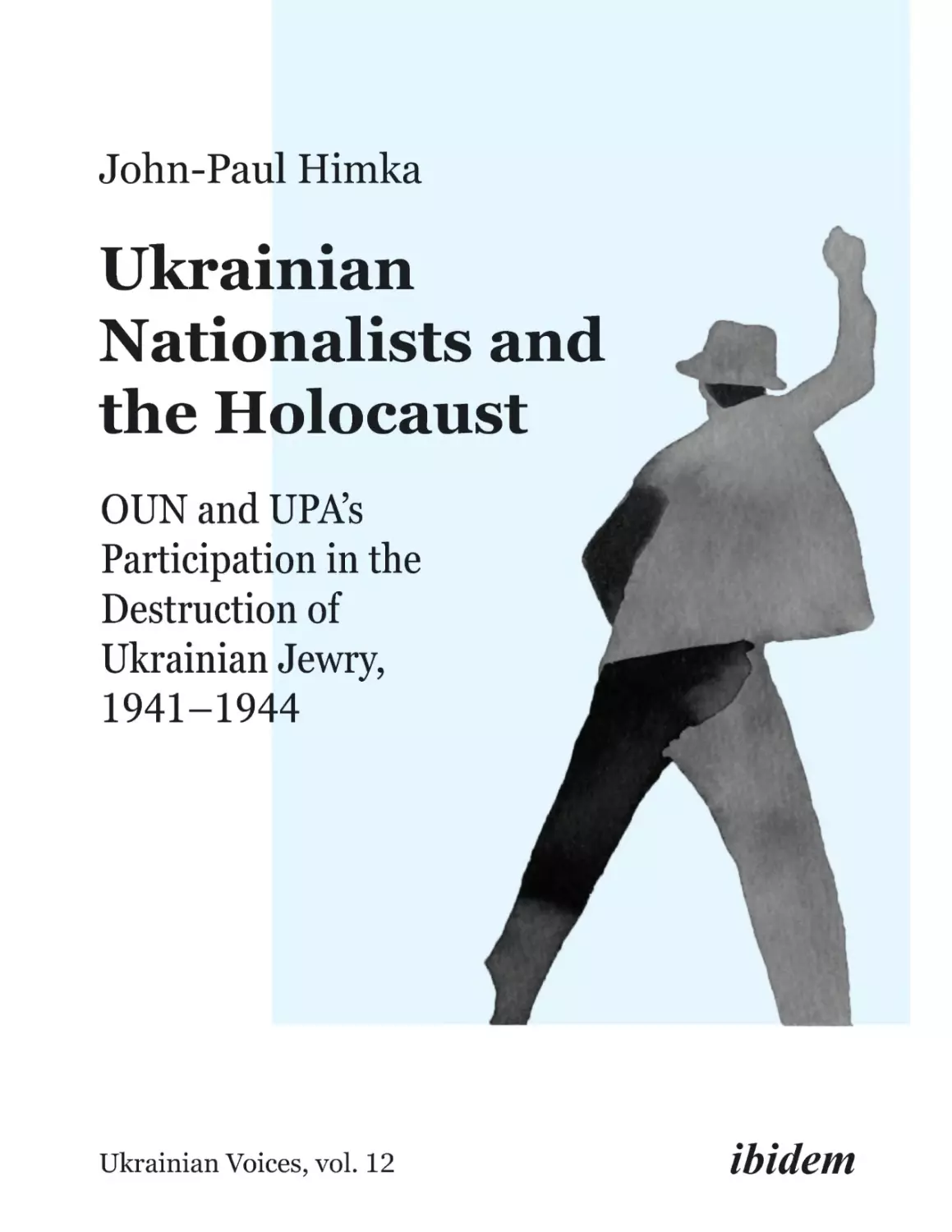


Автор: Himka J.-P.
Теги: world war ii genocide history of ukraine holocaust occupation
ISBN: 978-3-8382-7548-2
Год: 2021

Текст
                    ibidem-Press, Stuttgart

For Chrystia
who stood beside me

Contents
Acknowledgments
Abbreviations
Introduction
1. Historiography
2. Sources
3. The Organization of Ukrainian Nationalists
4. The First Soviets, 1939–41
5. Anti-Jewish Violence in the Summer of 1941
6. The Organization of Ukrainian Nationalists and the
Ukrainian Police in German Service
7. The Fate of Jews in the Ukrainian Nationalist Insurgency
8. Conclusions
Bibliography

Acknowledgments
I have received support for the research that went into this book from the
Social Sciences and Humanities Research Council of Canada; Pinchas and
Mark Wisen Fellowship at the Center for Advanced Holocaust Studies,
United States Holocaust Memorial Museum; Killam Fund, University of
Alberta; Support for the Advancement of Scholarship, Faculty of Arts,
University of Alberta. I am very grateful for their generosity.
It has been a pleasure working with ibidem-Verlag, particularly with
Jana Dävers, Valerie Lange, and Andreas Umland. I appreciate their
guidance and respect for an author’s vision of a book.
I have many people to thank. Although I am responsible for all the
views put forward in this volume, I have had a great deal of help along the
way. Persons who need to be singled out for their contribution to the
appearance of this study are Vadim Altskan, Tarik Cyril Amar, Omer
Bartov, Andriy Bolianovsky, Jeffrey Burds, Marco Carynnyk, Martin Dean,
Sofia Dyak, Ernest Gyidel, Wendy Lower, Jared McBride, Oleksandr
Melnyk, Ada Ogonowska, Dieter Pohl, Antony Polonsky, David Lee
Preston, Per Anders Rudling, Roman Solchanyk, Wiesław Tokarczuk, and
Larry Warwaruk. The following scholars worked at one point or another as
research assistants for this book: Eduard Baidaus, Natalka Cmoc, Eva
Himka, Rylan Kafara, Taras Kurylo, Mariya Melentyeva, Michal Mlynarz,
Oksana Mykhed, Iaroslav Pankovskyi, and Grzegorz Rossoliński-Liebe.
Those who read and helped me rework chapters were Raisa Ostapenko,
Alan Rutkowski, the East Europeanist Circle at the University of Alberta
led by Heather Coleman, and participants in the Danyliw Seminar in 2018. I
wish I had the words I need to express the depth of my gratitude.

Abbreviations
AŻIH Archiwum Żydowskiego Instytutu Historycznego
BA-MA Bundesarchiv/Militärarchiv, Freiburg
CPSU Communist Party of the Soviet Union
DALO Derzhavnyi arkhiv L’vivs’koi oblasti
DAIFO Derzhavnyi arkhiv Ivano-Frankivs’koi oblasti
DARO Derzhavnyi arkhiv Rivnens’koi oblasti
DAZhO Derzhavnyi arkhiv Zhytomyrs’koi oblasti
EM Ereignismeldungen UdSSR des Chefs der Sicherheits-polizei und SD
(title varies)
f. folio
HDA SBU Haluzevyi derzhavnyi arkhiv Sluzhby bezpeky Ukrainy
KGB Komitet gosudarstvennoi bezopasnosti
KPZU Komunistychna partiia Zakhidn’oi Ukrainy
NANU Natsional’na Akademia nauk Ukrainy
NKGB Narodnyi komissariat gosudarstvennoi bezopasnosti
NKVD Narodnyi komissariat vnutrennikh del
NTSh Naukove tovarystvo im. Shevchenka
op. opys
OUN Organization of Ukrainian Nationalists
OUN-B Organization of Ukrainian Nationalists (Bandera faction)
OUN-M Organization of Ukrainian Nationalists (Melnyk faction)
P Polish
PUN Provid ukrains’kykh natsionalistiv
r.g. record group
Ro Romanian
RSHA Reichssicherheitshauptamt
SB OUN Sluzhba Bezpeky Orhanizatsii ukrains’kykh natsionalistiv
SBU Sluzhba Bezpeky Ukrainy
SD Sicherheitsdienst
spr. sprava
TsDAHO Tsentral’nyi derzhavnyi arkhiv hromads’kykh ob ”iednan’
Ukrainy

TsDAVO Tsentral’nyi derzhavnyi arkhiv vyshchykh orhaniv vlady ta
upravlinnia Ukrainy
TsDIAL Tsentral’nyi derzhavnyi istorychnyi arkhiv Ukrainy, m. L’viv
TsGAOR Tsentral’nyi gosudarstvennyi arkhiv Oktiabr’skoi revoliutsii,
vysshikh organov gosudarstvennoi vlasti i organov
gosudarstvennogo upravleniia SSSR
UCRDC Ukrainian Canadian Research and Documentation Centre
UHVR Ukrains’ka holovna vyzvol’na rada (Ukrainian Supreme Liberation
Council)
UNDO Ukrains’ke natsional’ne demokratychne ob”iednannia (Ukrainian
National Democratic Union)
UPA Ukrains’ka povstans’ka armiia (Ukrainian Insurgent Army)
USHMM United States Holocaust Memorial Museum
UVO Ukrains’ka viis’kova orhanizatsiia (Ukrainian Military Organization)
V verso
YIUN Yahad-in Unum Testimony
YVA Yad Vashem Archives

Introduction
The Theme and Plan of the Book
This study concerns the participation of the Organization of Ukrainian
Nationalists (OUN) and its armed force, the Ukrainian Insurgent Army
(Ukrains’ka povstans’ka armiia, UPA), in the destruction of the Jewish
population in Ukraine under German occupation, 1941-44. There were three
major phases in which the nationalists contributed to the mass murder.
(Since I do not use the definite article before OUN and UPA, readers would
be advised to pronounce these terms as acronyms: o-OON, oo-PA.)
First, militias organized by OUN were key actors in the anti-Jewish
violence of the summer of 1941, in the immediate aftermath of the German
invasion of the Soviet Union. The militias arrested Jews in order to subject
them to forced labor, humiliation, and murder; thousands of those arrested
were executed by German units, mainly Einsatzgruppe C and Waffen-SS
Division “Wiking.” The Ukrainian nationalist militias assembled the Jews
for the Germans’ violence, since they could identify Jews more easily than
the invaders and knew the localities, including Jewish neighborhoods in the
cities. Sometimes the violence was accompanied by bloody public
spectacles, as in the pogroms unleashed in Lviv and Zolochiv in early July
1941; sometimes the OUN militias murdered selected Jews and their
families more discreetly, and sometimes they just murdered all the Jews in a
village.
Second, OUN recruited for and infiltrated the Ukrainian Auxiliary
Police in Galicia and the stationary Schutzmannschaften in Volhynia. These
police units provided the indispensable manpower for the Holocaust. They
rounded up Jews for deportation to the death camp at Bełżec or for
execution by shooting; although most of the actual killing was done by the
Germans, the Ukrainian policemen also killed in certain circumstances.
These liquidation actions took place primarily from early 1942 through the
middle of 1943.
Third, early in 1943 thousands of these Ukrainian policemen deserted
from German service to join the OUN-led nationalist insurgency. Possessed
of some military training and familiarity with both weapons and killing,

they took leadership positions in UPA. As soon as the former policemen
joined them, UPA launched a massive ethnic cleansing project, at first in
Volhynia and later in Galicia. Although it was primarily directed against
Poles, there were other non-Ukrainian victims, including Jews. In the winter
of 1943-44, as the Red Army moved westward, UPA lured surviving Jews
out of their hiding places in the forests, temporarily placed them in labor
camps, and then murdered them.
In each of these three phases of anti-Jewish violence, the responsibility
of OUN was different. In the first phase, the militias, and the OUN
leadership which established them, were primarily responsible for rounding
up Jews for the Germans, although the militias did some killing themselves.
Altogether the militias were accomplices in the murder of thousands of
Jews and shooters in the murder of many hundreds. In the second phase,
OUN cannot be held responsible for all that Ukrainian policemen did in
Galicia and Volhynia, since police structures were primarily under German
control and by no means were all the policemen nationalists, at least
initially. OUN's responsibility here lay in its strategy of deliberately
infiltrating the police, which drew its members and sympathizers into the
eye of the genocidal storm. For the most part, Ukrainian policemen rounded
Jews up for others to kill, but sometimes they themselves killed Jews.
Altogether the death toll from police roundups was in the hundreds of
thousands. In the third phase, OUN's responsibility was direct. Here, the
organization was killing Jews primarily on its own initiative, as part of a
far-reaching ethnic cleansing project; it was not only finding the Jews for
murder, but its forces were perpetrating the killings themselves. The Jewish
victims of OUN in this phase probably numbered in the thousands.
I have structured the book as follows. After this brief introduction, there
are several chapters that provide context. The first is a rather extensive
examination of the historiography. One factor contributing to the
controversy surrounding the role of OUN and UPA in the murder of Jews
stems from the peculiar way the historiography developed. For almost half
a century after World War II, neither Holocaust scholars nor historians of
the nationalists researched the topic. In this scholarly vacuum, accusations
and denials were as if weightless, unanchored by evidence. Since about
1990, however, more and more information has come to light and many
more scholars have examined the issues. But also since then, there has been

a polarization of views over the issue of nationalist collaboration in the
Holocaust, determined more by politics, specifically in the form of memory
politics, than by contradictory evidence. The second chapter concerns
sources. Here I outline the evidentiary record as we know it today and also
discuss the particular problems the various kinds of source materials
present.
After these two chapters, which present the epistemological context, I
turn to the historical context for our problem. In the third chapter I look at
OUN before Germany's invasion of the Soviet Union, with special attention
to three issues: why it emerged and proved attractive to Ukrainian youth in
Galicia, its relationship to fascism, and the place and nature of antisemitism
in its ideology. In chapter four I turn to the first Soviet occupation of
Western Ukraine (Galicia, Volhynia, Bukovina), in 1939-41. Some scholars
argue that this historical interlude is crucial to understanding how the
destruction of the Jews played out in these territories; I present my own
understanding of how it affected perceptions and outcomes during the
Holocaust.
The final three chapters are devoted to the phases of OUN's
participation in the Holocaust: the anti-Jewish violence of the summer of
1941; the police's role in the systematic destruction of Jews in Galicia,
Volhynia, and—to a lesser extent—elsewhere on Ukrainian lands in 194243, with special reference, of course, to the connections between the police
and OUN; and, finally, UPA's murder of Jews in 1943 and 1944. The book
ends with the presentation of the conclusions I have come to.
This book is not a study of how “Ukrainians” behaved during the
Holocaust. It does not generalize about an entire national community but
concentrates on a particular political movement. Al-though at the time this
study is being written, powerful forces in Ukraine and in the Ukrainian
diaspora aim to identify the entire Ukrainian nation with the heritage of
OUN and UPA, this is at the very least an intellectual error, especially in
relation to the war period itself. Also, this is not a study of the whole range
of collaboration of Ukrainians with the German wartime authorities. That is
a much larger and much more complicated topic. Nor is this even a study of
those Ukrainians who actively participated in the Holocaust. For example,
the notorious “Ukrainian guards” of German camps, perhaps more properly
known as Trawniki men after the camp at which they were trained, do not

figure in this book. For the most part these were captured Red Army
soldiers rather than ideological allies of the Nazis, and their work in
German death and labor camps had no relation to OUN structures.

Geography
There is no consensus regarding the proper geographical nomenclature for
borderland territories and localities, in which much of the events recounted
in this study took place. For example, in this book I will frequently refer to
“Galicia,” a region that produced a very specific Ukrainian political and
intellectual culture. Andrzej Zięba argues, however, that historians should
abandon this term unless it is in relation to the Austrian crownland that
existed from 1772 to 1918 or to the Distrikt Galizien established by the
Germans that existed from August 1941 to July 1944. In his view, historians
should use only the official state nomenclature of the Second Polish
Republic; in the case of what I call Galicia, he would refer rather to the
palatinates (województwa, voyvodships) of Lwów, Stanisławów, and
Tarnopol. For certain studies, this is, I think, not only justified, but is a good
practical choice.1 But for this study, the regional specificity of what I call
Galicia is important. It is the region where OUN emerged and achieved its
greatest influence, and although UPA was active first in another region,
Volhynia, its leadership was to a large degree of Galician origin. So by
using this term, I mean to call attention to the regional specificity. Zięba
also points out that Ukrainian historians, even when they use the term
“Galicia,” are really referring to Eastern Galicia, that is, the eastern part of
the Austrian crownland, in which Ukrainians formed a majority of the
population.2 “Eastern Galicia” was also a geographical concept that
demanded much attention from the diplomats who were working out the
post-World-War-I settlements from 1918 through 1923. Martha
Bohachevsky-Chomiak, who had used the term Eastern Galicia and Galicia
in her earlier work, has lately been arguing that historians should designate
what I call Galicia by its transliterated Ukrainian equivalent, Halychyna.3
But as a linguistic conservative by inclination, I will retain the usage
Galicia, which appears in my earlier publications and which is common
practice in English-language studies of Ukraine. Today Galicia, as I am

using it, comprises roughly the oblasts of Ivano-Frankivsk, Lviv, and
Ternopil in Ukraine.
Just north of Galicia is a region I will refer to as Volhynia, although it
does not encompass all of the territory to which that name has referred
historically. Some scholars now employ the distinction Western Volhynia to
refer to what I will be calling Volhynia. For this study, I mean the parts of
historical Volhynia that were incorporated into Poland from 1921 to 1939.
In 1941, under German occupation, Galicia became Distrikt Galizien within
the General Government while Volhynia was incorporated into the
Reichskommissariat Ukraine.4 Volhynia had comprised the Volhynia
palatinate in interwar Poland, which had its capital in Łuck, and comprises
today Rivne oblast, a small part of Ternopil oblast, and Volhynia oblast
(with its capital in Lutsk) in Ukraine. Galicia and Volhynia together
comprised “Western Ukraine,” a term used by the Soviet administration in
1939-41.
There are a few other territories I will refer to. When I write of
Bukovina, I mean what is more accurately referred to as Northern
Bukovina, that is, the territory which Soviet Ukraine annexed from
Romania in 1940 and which today comprises most of Chernivtsi oblast in
independent Ukraine. By Transcarpathia, I mean the region which since
1945 has been Transcarpathia oblast, first in Soviet Ukraine and then in
independent Ukraine.
It is always difficult to make choices about place names. In the period
with which this book is concerned, borders and administrations shifted.
What started out as the southeastern palatinates of the Second Polish
Republic came under Soviet rule in September 1939, then passed to
German rule from summer 1941 until summer 1944, and then returned
under Soviet rule. Thus Lwów became Lviv, then Lemberg, and then Lviv
again. Some scholars use the Polish names for all localities that existed in
interwar Poland. I considered this same practice, but did not adopt it. My
concern was that readers should be able to find the localities I mention on
modern-day maps and geographic applications. Thus I use the Ukrainian
name for all places within the boundaries of today's Ukraine. It would be
cumbersome, even for a specialist, to find a present-day locality with only
its Polish name. I had thought of using the names as they are found in

Google Maps, but resigned from this idea after realizing that there were
problems with consistency in that application. So I am rendering place
names from Ukrainian, with modified Library of Congress transliteration
(soft signs omitted; use of Y in place of I for the initial letter when followed
by a vowel, so Yabloniv instead of Iabloniv). I think this method will most
easily allow readers to search place names on the Internet and ascertain
their location. Upon first mention in the text of localities that were in
Poland between the wars, I will give the place name in Polish in
parentheses. Localities that are in today's Poland rather than in Ukraine,
such as Przemyśl, will only appear in their Polish forms. I will also provide
the Romanian name for localities in Bukovina, which belonged to Romania
between the wars. In some cases, the Polish or Romanian names are
identical with the Ukrainian names. Cities and places that are well known in
English by names that would violate the practices set out here, such as
Warsaw (instead of Warszawa) and Babi Yar (instead of Babyn Yar), will be
referred to by these common names. I think that the capital of Ukraine,
Kyiv, is now becoming better known by its Ukrainian name, even though
Kiev had once been more common. Many place names in Ukraine have
changed since World War II. I will use both the modern and historical
names as seems best for the context.
In sum, my choice of place name usage has not been guided by any
considerations of historical correctness but rather by what I think will make
geographic orientation easier for the reader.

Technical and Terminological Matters
In transliterating bibliographical data from the Cyrillic and Yiddish
alphabets, I am using the Library of Congress systems without diacriticals.
For Ukrainian and Russian names in the text, I am using the modified
Library of Congress system devised by the Canadian Institute of Ukrainian
studies; its main features are the elimination of soft and hard signs, the
simplification of certain last-name endings to -sky, and the use of “Y”
instead of “I” to transliterate the initial letters of certain names (e.g., Yuliian
instead of Iuliian).
In this study I am using the term “nationalists” as shorthand for
members and sympathizers of OUN and UPA. I do not mean to include all

those who championed Ukrainian cultural and political independence.
When I am using the word “nationalist” in a wider sense, I will signal that I
am doing so.
I will be referring to folios of testimonies from the archive of the Jewish
Historical Institute in Warsaw (AŻIH). Many individual testimonies are
comprised of both a handwritten and typed copy, each with its separate
pagination. I will be citing the folio numbers of the typed copies.
All translations are my own unless otherwise noted.

1

This procedure is used, for example, by Kopstein and Wittenberg, Intimate
Violence.
2
Zięba, “Ukraińcy, Polacy i niemiecka zagłada Żydów,” xxvi-xxvii.
3
Bohachevsky-Chomiak, Ukrainian Bishop, American Church, xvi.
4
There is an excellent study of the Reichskommissariat Ukraine: Berkhoff,
Harvest of Despair.

1. Historiography
It is a standard practice among historians to include in their monographs a
survey of the existing historiography. Normally this does not constitute an
entire chapter, but just a few pages. In this monograph, however, I consider
it necessary to spend more time on the intellectual history of our problem,
Ukrainian nationalist participation in the Holocaust. The topic has been a
controversial one, and it needs to be placed in its complicated contexts. The
historiography has emerged from different sources: Jewish survivors of the
Holocaust, primarily in Israel; Ukrainian nationalist emigrés in North
America and Western Europe; scholars in communist Poland; Soviet
propagandists; scholars at universities in the West, primarily in Germany
and North America; and scholars and activists in independent Ukraine. It
has been impacted by major historical developments: the Holocaust itself,
the establishment of communism in Eastern Europe, and the fall of that
communism.

Pioneer Historiography of the Holocaust in Western Ukraine
A central figure in the early development of the historiography of the entire
Jewish catastrophe survived the war in Western Ukraine, in Lviv (P Lwów).
This was Philip Friedman, who had already made a name for himself in the
interwar period as a historian of the Jewish population of Galicia. His
doctoral dissertation from the University of Vienna, which was published in
1929, concerned the emancipation of Galicia’s Jews in 1848-68.1 He was an
impeccably professional historian, who began to gather information on the
Holocaust during the Holocaust itself. He survived the mass murder by
hiding outside the ghetto, i.e., on the Aryan side, but his wife and daughter
both perished. After the war, Friedman played a major role in collecting
survivor testimony for the Central Jewish Historical Commission in Poland
and was later active in many of the early projects to gather sources for
writing Holocaust history. He spent the last years of his life in the United
States, mainly associated with Jewish scholarly institutions such as YIVO
in New York and Yad Vashem in Israel, but he also lectured at Columbia
University.2

Friedman wrote two short studies of particular relevance to this
monograph. One was an account of the destruction of the Jews of his native
Lviv; the first edition came out in 1945 and several expanded editions
appeared later, the last in 1956.3 He also wrote a survey, very careful and
balanced, of Ukrainian-Jewish relations during the period of German rule,
focusing almost exclusively on Galicia and Volhynia. Friedman was attuned
to the problem of OUN-UPA participation in the mass murder of the Jews in
the latter regions, but he was unable to arrive at the clarity made possible by
later developments and later research. He usually did not make a
distinction, which we shall see is important, between the Ukrainian
National Militia and the Ukrainian Auxiliary Police.4 He never realized the
connection between the militia and the OUN, writing that the Ukrainian
militia was “organized by the Germans in a hurry”5 and consisted “of local
volunteers.”6 He wrote about the UPA murder of Jews, but felt uncertain as
to what had happened and wanted to learn more about it.7 Like many
historians of his era, he considered “authentic, official documents” to be the
gold standard for Holocaust research;8 yet so few of such documents had
been collected that he perforce relied heavily on testimonies and memoirs.
Although Friedman was one of the first professional historians to engage
with the Holocaust, his work was situated in the field of Jewish studies
rather than within the scholarly discourse of modern European history.
The scholar who found study of the Holocaust at the margins of the
historical discipline and, through the publication of his book The
Destruction of the European Jews, pushed it almost to the center was Raul
Hilberg. When Hilberg began to work on the murder of the Jews, he
received some encouragement from his doctoral supervisor Franz
Neumann, but there were also many nay-sayers. “During those days,” he
wrote a few decades later, “the academic world was oblivious to the subject,
and publishers found it unwelcome. In fact, I was advised much more often
not to pursue this topic than to persist in it.”9 His work had a tremendous
impact on the way that scholars who came after him researched and wrote
about the Holocaust. He is one of those rare figures of whom it is no cliché
to say that he shaped a field. Some of his ideas were resisted almost
immediately. He, like Hannah Arendt, whose essays in the New Yorker on
the Eichmann trial appeared at the same time as Hilberg’s Destruction

(1961),10 emphasized the passivity of the Jews during their slaughter and
indicted the Jewish councils (Judenräte) for collaborationism. Their views
provoked new research and publication on Jewish resistance11 as well as a
more nuanced investigation into the difficult situation of Jewish leaders in
the Judenräte.12
Hilberg’s great achievement was a cog-by-cog analysis of the
machinery of destruction. While Friedman had lamented a lack of the
official documentary sources he so highly prized, Hilberg had plenty of
them, all emanating from the Germans themselves. The influential 1961
edition of his book could not yet make use of German sources in Soviet
archives, but the third edition of 2003 was able to incorporate some of that
source material. Hilberg’s reliance almost exclusively on sources generated
by the German perpetrators themselves established the methodology that
dominated American and European scholarship on the Holocaust for
decades thereafter. German sources became the main informants about what
happened. The testimonies and memoirs of victims and eyewitnesses were
relegated to the background if consulted at all. This produced a distorted
picture. A one-sided source base was largely responsible for the
exaggeration of Jewish passivity and for a one-sided emphasis on the
complicity of the Judenräte. I believe it also resulted in an underestimation
of help and rescue efforts on the part of non-Jews, to whom Hilberg also
ascribed passivity.13 The documents the Germans had produced tended to
emphasize the successes of their extermination program and public
cooperation with it. Also, the German documents noted instances of Jewish
resistance and non-Jewish aid to Jews only when they were or threatened to
be effective. But in the concrete circumstances of the Holocaust in Eastern
Europe, neither resistance nor aid could be very effective, even if impulses
and actions in these directions were more widespread than the German
documents indicate. Both resistance and aid are much more evident in the
documents and oral testimonies left by survivors.
Israeli scholars had objections to Hilberg’s approach right from the
start. Friedman, who had served on Hilberg’s examining committee at
Columbia, suggested to him that Yad Vashem in Jerusalem might co-publish
his dissertation, but it refused: “Your book rests almost entirely on the
authority of German sources and does not utilize primary sources in the

languages of the occupied states, or in Yiddish and Hebrew....The Jewish
historians here make reservations...in respect of your appraisal of the Jewish
resistance (active and passive during the Nazi occupation).”14 Hilberg’s
work would always have a larger impact on scholarship in North America
and in Western Europe than in Israel, except for provoking Israeli scholars
to polemicize with his views on the lack of Jewish resistance and the
complicity of the Judenräte.
Concentrated too narrowly on the narrative of Germans and Jews,
Hilberg paid little attention to the “microbiota” of the Holocaust, the other,
smaller actors, neither Jews nor Germans, who played significant roles.
Unlike Friedman, Hilberg was not curious about OUN or UPA and their role
in the Holocaust. In fact, he only once mentioned OUN, which he defined
simply as “a pro-German organization of Ukrainians.”15 Evidently, he did
not even care to inquire what the letters OUN stood for, since it appears in
the index only as OUN, not as the Organization of Ukrainian Nationalists.
So although Hilberg’s Destruction of the European Jews remains an
indispensable orientation text for studying the Holocaust, it has blind spots;
and these blind spots have long dogged Western historiography on the topic.
Jewish historiography in Israel continued along a different path, more like
Friedman’s.
A major contribution to the study of a territory where OUN and UPA
were especially powerful was Shmuel Spector’s history of the Holocaust in
Volhynia, eleven editions of which were published in English and Hebrew
between 1982 and 1990. Spector himself was born in Volhynia in 1922, in
Kostopil (P Kostopol), Rivne oblast. When Germany attacked the Soviet
Union, he fled to the Soviet interior. After the war he lived in Israel and
worked at Yad Vashem. His book is interesting and very rich, with many
details that make the wartime situation come alive. Spector possessed a
deep knowledge of Volhynia’s Jewish communities as well as its geography
and terrain. Readers of his text can actually feel how highly motivated he
was to figure out what had transpired in his home region during his
absence. He made use of some German documentation, particularly the
Einsatzgruppen reports, but his main sources were Jewish survivor
testimonies, primarily those collected by Yad Vashem and those published
in memorial (yizkor) books. Since most of these testimonies were in

Hebrew and Yiddish, his book is very useful to authors, such as me, who do
not read Hebrew and have limited Yiddish. Spector’s foremost interest was
in the Jewish communities themselves, and his perspective is naturally
somewhat Judeocentric. He was not as interested in the Germans as Hilberg
was. But he was interested in the Polish and, especially, Ukrainian
populations and their relation to the Holocaust. He lamented that there were
not enough studies of the Ukrainian nationalist movement,16 although he
seems to have been unaware of John A. Armstrong’s influential monograph
on the subject (to be discussed below). Nonetheless, Spector managed to
piece together a decent sketch of the history of OUN and UPA.17 His book
also frequently mentions UPA’s murder of Volhynian Jews.
There is a short but (considering the paucity of available sources) well
executed study of Ukrainian-Jewish relations in Galicia during the war
written by the Israeli scholar Aharon Weiss.18 Weiss had survived the war in
Boryslav (P Borysław), where he was hidden by a Ukrainian woman whose
son served in the Ukrainian Auxiliary Police.19 Afterwards he emigrated to
Israel and worked on Holocaust history at Yad Vashem. He understood in a
general way that OUN was involved in the anti-Jewish violence of 1941
and mentioned explicitly the role of the “Ukrainian militia.”20 He was able
to work with documents of the Ukrainian Auxiliary Police in Lviv but not
able to connect OUN and the police.21 He noted that few Jews who had
been hiding in the Volhynian forests managed to survive and linked this fact
to the control of the forests by UPA units, but he was unable to be more
specific. He misidentified the Babii partisans who saved Jews as connected
with the Ukrainian nationalists, although in fact they were a pro-Soviet
formation.22 The general thrust of his study is exemplified in its concluding
sentence: “Full responsibility for these crimes falls on the Nazis, but if the
attitude of the Ukrainian national movement and a great part of the
Ukrainian population toward the Jews had been different, the number of
survivors might well have been much larger.”23
A book that is somewhat transitional in the historiography is Eliyahu
Yones’ study of “the Jews of Lviv in the years of the Second World War and
the catastrophe of European Jewry, 1939-1944.” It is transitional in the
sense that it made limited use of newly opened Soviet archival materials
that had been copied by Yad Vashem, but the text primarily relied on

testimonies and memoirs, particularly Hebrew-language testimonies
collected also by Yad Vashem. The text was originally presented as a
doctoral dissertation at the Hebrew University of Jerusalem in 1993, at
which time Yones was already advanced in years. He had been born in 1915
in Vilnius, but during the war he found himself in a labor camp in Lviv,
hence his interest in the Holocaust in that city. His book was published in
Hebrew as well as in German, English, Polish, and Russian translations. I
primarily used the Russian-language version.24 Although the primary focus
of the book was Lviv, it also contained a great deal of material on the
experience of Jews in other localities in Galicia. Yones devoted
considerable attention to the persecution of Jews by the Bandera faction of
OUN. His knowledge of OUN was incomplete; for example, he made the
common error of conflating the militia and the police.25 But the issue of
Ukrainian nationalism and the Holocaust was very much on his mind, and
his study provided much information on the topic.
Thus in this early stage of the historiography of Ukrainian nationalism
and the Holocaust, the relevant studies were produced by Jewish scholars
who were intimately familiar, from personal experience, with the terrain,
languages, and societies of the regions where OUN and UPA had been
active. They also relied extensively on the accounts of Jews who survived
the mass murder. Where they all came up short, in terms of the project
undertaken by this book, is that, although keenly interested in OUN and
UPA, they did not have access to the kind of sources that would have given
them more insight into the workings of the Ukrainian nationalist movement.
They needed more definite and more extensive information, which would
only become accessible after the collapse of communism. As to studies of
the Holocaust in North American and European scholarship, the
historiographical protocols established by Hilberg effectively prevented any
focus on the role of OUN and UPA. If Western studies strayed into occupied
Eastern Europe, they relied on German sources, neglected eyewitness
testimony, and concentrated exclusively on the actions of Germans.

Histories of OUN and UPA Written prior to the Opening of
Soviet Archives
The most detailed and solidly researched history of the pre-World-War-II
OUN to appear in the period 1945-90 was written by Petro Mirchuk and
published in 1968. Mirchuk had been a member of OUN since secondary
school and was being entrusted with important assignments in the OUN
propaganda apparatus by his early twenties (the mid-1930s). Like many in
the nationalist underground, he was no stranger to Polish prisons. When war
broke out in September 1939, he was in jail, but was released with all the
other prisoners when the Polish forces in Lviv capitulated to the Germans.
The insider knowledge he acquired in the movement contributed to a wellinformed book. In addition, while writing his history, Mirchuk was able to
consult a large number of original OUN documents as well as the interwar
press, and his book reproduced many important texts of the era. He wrote
from a thoroughly nationalist perspective.
Though rich in information, his book had its biases. One was that it
sanitized OUN’s record regarding its statements and actions against Jews in
the 1930s as well as its relations with Nazi Germany. Mirchuk achieved this
sanitization by avoiding these themes entirely. His omissions undoubtedly
reflected OUN’s postwar sensitivity about accusations of collaboration with
the Nazis, especially with regard to participating in the Holocaust. But to be
fair to Mirchuk, he had had a different experience with these issues than did
most other OUN members. He only spent one month on Ukrainian ethnic
territory during the entire war, namely mid-August to mid-September 1941.
Then, at a low ebb of German-OUN relations, he was arrested by the
Germans and spent the rest of the war in prisons and concentrations camps,
mainly Auschwitz. He was only released when the Americans liberated the
concentration camp at Ebensee on 6 May 1945.26 Thus Mirchuk was not
present to participate in the anti-Jewish violence of July 1941 and the ethnic
cleansing campaign of 1943-44, and he had no love for the Germans.
Another notable bias was that Mirchuk was a Bandera loyalist. When OUN
split in 1940, he sided with Stepan Bandera against Andrii Melnyk; and
when the Bandera faction split again after World War II, he remained with
Bandera. His book, thus, presented the history of OUN from a partisan
perspective. His depiction of the succession struggle after the assassination

of OUN leader Yevhen Konovalets in 1938 was constructed so as to make
the Bandera group’s split from the emigré leadership seem reasonable and
necessary. He also blamed Melnyk and his allies for turning OUN policy
around and “betting on the German Hitlerite card.” Until Melnyk assumed
leadership, according to Mirchuk, there were “some contacts” with
Wehrmacht circles, who like OUN wanted a revision of the Versailles
settlement, but OUN had had reservations about Hitlerite ideology and
politics, which viewed Eastern Europe as a territory for colonization.27
Nowhere near as well researched, but even more partisan was Polikarp
Herasymenko’s short book on “the Organization of Ukrainian Nationalists
during the Second World War.” Herasymenko was neither a historian nor
politically active for long; instead he was a metallurgist who made a good
career in the United Kingdom and the United States after 1948. Born in
Odessa, he fled Soviet Ukraine to avoid arrest in 1921, living mainly in
Prague until the end of World War II. He was a member of the Melnyk
faction of OUN during the war years and for a short time thereafter.28
Herasymenko’s history was first published as a mimeographed text in 1947
and went through several editions over the following years. The work made
use of the interwar and wartime periodical press as well as documents of
both the united OUN and the Melnyk faction. But overall, it was marred by
one-sidedness. A major target of its criticism was the Bandera faction.
Herasymenko attributed its split from the rest of OUN to foreign intrigue.
Fearful of the power of OUN, both the Germans and the Soviets had
engineered the rift, preying on the Bandera group’s “political blindness,
ambition, primitiveness, moral indifference.”29 He condemned the rebellion
they led: “provoked by the enemy, they pushed the masses on the path of a
negative, in every respect unprepared, and therefore needlessly bloody
‘insurgency.’“30 Herasymenko quoted many OUN documents critical of
Nazi Germany and made no mention of pro-German attitudes or
cooperation with Nazi Germany on the part of OUN. He made an
exception, of course, for the Banderites, who, he wrote, were both ignorant
of Germany’s plans for Ukraine and ready to help the Germans by
supplying them with hundreds of interpreters. The many interpreters from
the Melnyk faction working for the Germans were passed over in silence.
There was also no mention at all of the Melnykites’ support for the Waffen-

SS Division Galizien. The Ukrainian police in German service, with whom
both factions of OUN were deeply involved, were almost completely absent
from Herasymenko’s account; there was a single passing mention in a
wartime document calling upon Ukrainians in all stations of life to
remember that they were members of the “Ukrainian Nation, once free,
glorious, and powerful, but today enslaved and marked by blood and
ruin.”31 Jews and the Holocaust were completely missing from
Herasymenko’s book.
Another veteran of the movement who wrote about OUN during World
War II was Lev Shankovsky. Shankovsky had, as an adolescent, served in
the armed forces fighting for an independent Ukraine during the
revolutionary period that followed World War I. His military experience
later proved useful both for his activity in OUN and UPA during World War
II and for his postwar work as a military historian of Ukraine. He was
associated with the Bandera wing of OUN during the war, but after the war
he joined a faction that broke with Bandera, the UHVR group32 or so-called
dviikari. Led by Mykola Lebed and Lev Rebet, the dviikari adopted a more
democratic program than either the Banderites or Melnykites and benefited
from generous funding by the United States’ Central Intelligence Agency.33
Shankovsky’s book on OUN-B’s expeditionary groups (pokhidni hrupy) in
southern Ukraine34 and Romanian-occuped Transnistria created a picture of
the past that fit well with the postwar ideology of the UHVR. Shankovsky
had fine narrative skills and wrote with some verve, although his prose was
not free of jargon. I will spend more time analyzing this work, since it
presented a narrative that has been very influential in the postwar Ukrainian
diaspora, especially among historians and other intellectuals. It also offered
a full enough account to serve here as a prominent example of a more
general trend in OUN and UPA historiography.
The expeditionary groups were small OUN units that fanned out from
Kraków and then across Ukraine, following the German advance. They
were instrumental in establishing local civil administrations and militias
wherever they went. In his account of them, Shankovsky emphasized that
they fought against two enemies, both the Soviets and the Germans. He also
described fierce persecution of members of OUN, especially OUN-B (the
Bandera faction), by the Germans. While writing at length about the

conflict between OUN and the Germans, Shankovsky completely omitted to
mention moments of cooperation.
The main point of Shankovsky’s book was to show that the more
tolerant and democratic position adopted by the UHVR had its basis in the
encounter between the Western Ukrainian nationalists and the population of
Soviet Ukraine in its pre-1939 borders. His story is that the Western
Ukrainian activists came into the rest of the Ukraine and discovered that the
ideological baggage they had brought with them was unacceptable to the
population there. The inhabitants of central, southern, and eastern Ukraine
rejected the OUN’s Führerprinzip and its intended single-party rule and
wanted a democratic parliamentary system instead. They did not like
OUN’s voluntarism, amorality, exclusivity, and hunger for power,
preferring ethical politics, toleration, and humaneness. They were not
satisfied with the slogan of an independent Ukraine: they wanted to know
the content of the envisaged state, its political structure and social policies.
They were against imperialism and exploitation and wanted national
minorities to have the rights of other citizens of the Ukrainian state. They
did not accept OUN’s slogan of “Ukraine above all.” The Western
Ukrainian activists, challenged by this encounter with the majority of
Ukrainians, had to rethink their program, resulting in the more liberal OUN
program of August 1943 and the establishment of the UHVR.35 Here is how
Shankovsky put it in his conclusions:
...I set myself a clearly defined goal that my work was supposed to achieve. I wanted—as
extensively as possible—to present the ideological and political evolution that the proindependence OUN underwent as a result of the direct encounter of the mass of its membership
with the Ukrainian mainland and Ukrainian population in the Central Eastern Ukrainian Lands
and Eastern Ukrainian Lands. The epic tale of the expeditionary groups in central and eastern
Ukraine, the discussion of ideas conducted by the members of the expeditionary groups with the
Ukrainian people of the Central Ukrainian Lands and Eastern Ukrainian Lands, and the
integration (usobornennia) of the Organization of Ukrainian Nationalists through the mass
entrance into it of Ukrainians from the Central Ukrainian Lands and the Eastern Ukrainian Lands
were the reasons that much was thrown out from the political-programmatic decisions and
directives of OUN, [the elimination of] which had been considered taboo in the conditions of
Polish occupation. In particular, very decisively thrown out were all sorts of “isms” introduced
onto Ukrainian soil from a foreign field: authoritarianism, elitism, totalitarianism, dogmatism,
exclusivism, voluntaristic nationalism, and so on. Socioeconomic and political issues decisively
took precedence over issues of worldview and philosophy; mysticism had to make way for a
realistic strategy and tactics of liberation, and the despised leader system capitulated before
democracy and parliamentarism, with its accompanying human freedoms.36

In addition to arguing for a fundamental shift in perspective within the
OUN expeditionary groups as a result of the encounter with the east and
south, Shankovsky also contended that under the impact of the encounter
OUN began to shed its ethnocentrism and to develop a new openness to the
national minority populations in Ukraine. He stated that the national
minorities of southern Ukraine—“Russians, Greeks, Moldavians, and
Tatars”37—warmed to the idea of an independent Ukraine, with equal rights
for the minorities.38 “The broad masses of the Central and Eastern
Ukrainian Lands most decisively rejected any possibility of an
exterminatory or even discriminatory policy with regard to any national
minority in Ukraine. Non-Ukrainians who live in Ukraine and are Ukrainian
citizens should enjoy all the rights of Ukrainian citizens. It has to be
recognized and emphasized that the leaders of the frontline expeditionary
groups quickly oriented themselves in the situation and were able to
conduct their propaganda in the direction of winning over non-Ukrainians
for the Ukrainian liberation movement.”39 In Shankovsky’s narrative, OUN
in the Donbas reached out to Russians as full-fledged Ukrainian citizens.40
As to OUN’s relations with the national minority with which this
monograph is particularly concerned, i.e., the Jews, Shankovsky explained:
“In this place we wish to underline that neither the Ukrainian population
nor the members of the Ukrainian underground who came to the Central
and Eastern Ukrainian Lands were in any way involved in anti-Jewish
actions.”41 By contrast, Shankovsky wrote that the White Russian emigrés,
who also came to Transnistria, were rabid antisemites who killed Jews on
their own initiative, without prodding from the Romanian authorities.42
Shankovsky also noted that the Jews in Transnistria were pro-Bolshevik.43
The heroic tale of OUN’s transformation under the impact of this
encounter could well contain some grains of truth, but to determine how
many requires new and in-depth research. For the purposes of this
monograph, though, it is necessary to point out some dubious claims, halftruths, and falsehoods in Shankovsky’s narrative.
To begin with, I wonder how true is the claim that the young workers of
the Donbas and indeed the general population of the south were insisting on
parliamentary democracy. Where would their knowledge of this political
system have originated? Surely not from any personal experience, nor from

anything they read in Soviet publications. And many years later, after
parliamentary democracy was finally introduced in independent Ukraine,
the Donbas stood out as the region of origin and the primary political base
of the most authoritarian president and politicians in Ukraine’s post-Soviet
history (President Viktor Yanukovych and the Party of Regions). Thus I am
skeptical of the assertion that a population molded by tsarism and Stalinism
and later subject to Nazi occupation would have had a clear enough picture
of representative democracy to summon it up as an ideal with which to
challenge OUN. Much recent research in the history of Stalinism has shown
that it was exceedingly difficult for Soviet citizens to think outside the
communist box.44 This is borne out by some of the original slogans the
Donbas workers came up with during the German occupation, such as
“Ukrainian Soviet power without the Bolsheviks” and “Soviet Ukraine
without the Bolsheviks and without the dictatorship of the Communist
party.”45
And the picture of OUN being so open to non-Ukrainians, particularly
Russians, is—at best—overdrawn. This is clear from a volume of
documents published much later, in 2013, on OUN in the Donbas. The
collection is decidedly pro-OUN; in fact, its editor conceived it as literature
first and foremost for “radical youth and participants of Ukrainian
paramilitary organizations.”46 The documents do show that some ethnic
Russians participated in the nationalist movement, particularly a woman
from Kramatorsk, Donetsk oblast, by the name of Serafima Petrovna
Kutieva, who also figured in Shankovsky’s book.47 By Kutieva’s own
account to her NKGB interrogator in 1944, at first her Russian nationality
did cause her OUN recruiter a moment’s hesitation, but then she was
accepted into the movement. It turned out that her Russian nationality
worked out well for the OUN underground; her home could more
effectively serve as a safe house for the movement. “...My apartment for
them was above all suspicions since I am a Russian....”48 In the course of
her recruitment she discovered that not all OUN members were open to
Russian ethnicity. One of her former husbands was her first recruiter, and he
described the goal of the nationalist movement as the establishment of “an
independent Ukrainian state which would be run exclusively by
Ukrainians.”49 She described a fellow OUN activist from Vinnytsia as

“stridently chauvinistically...inclined.”50 OUN members in the civil
administration in Kostiantynivka, Donetsk oblast, advocated the
replacement of ethnic Russians by ethnic Ukrainians.51 OUN also promoted
restrictions on the use of the Russian language in administration, the courts,
signage, and education.52
The documentary collection also shows that OUN in the Donbas
consistently propagated antisemitism while the Holocaust was proceeding.
Several OUN proclamations are included as photoreproductions at the back
of the book. The newspaper Ukrains’kyi Donbas, which was under OUN
control, wrote in a front-page editorial on 18 December 1941:
Under the powerful blows of the victorious German and Allied armies the bonds with which for
twenty-three years day and night the Jewish-Bolshevik henchmen bound the freedom-loving
Ukrainian people have burst asunder....[As the German and Italian forces approached,] for fifteen
whole days Jewish commissars, Asiatic barbarians...destroyed the national property built by the
sweat and blood of the Ukrainian people....We must accept the slogan “Ukraine for Ukrainians”
as the fundamental principle in the work of a newly constructed state apparatus and take it as the
starting point for orientation in solving all problems which every day of work on the construction
of a new life brings.53

On the next page of the same issue appeared a proclamation to
Ukrainian youth issued by OUN:
The Jews forced us to call our dearest people enemies. They forced us to love alien Moscow and
not our native Ukraine. In our country those who married Jewesses, and thereby contributed to
the degeneration of the Ukrainian nation, were held in esteem. Jewboys were called Ukrainian
musicians—all those Buses, Goldsteins, Davids, Oistrakhs. They gave them prizes, titled them
Stalin laureates, but the truly talented Ukrainian youth was trampled and then withered on the
vine. The institutes and schools swarmed with Jews because they had money....In the Komsomol
and Pioneers the Jewish-Muscovite politicians tried to raise janissaries, champions of Red
Moscow, haters of the Ukrainian people....Ukraine for Ukrainians!54

And on the next page was yet another OUN proclamation, this one
addressed to teachers:
They forced us to poison the minds of children with Jewish internationalism....Jews wrote the
grammar of the Ukrainian language....In the theaters and cinema they showed us performances
and films directed by Jews, in which the best sons of the Ukrainian land were reviled and
ridiculed....Schools for Ukrainians! Down with lying Jewish-communist education. In a
Ukrainian school—Ukrainian children....Let us welcome the German army, the most cultured
army in the world, which is driving from our lands the Jewish-communist scum. Let us help the
Organization of Ukrainian Nationalists under the leadership of Stepan Bandera build a great
Independent Ukrainian State. Ukraine for Ukrainians!55

OUN members in the civil administration also promoted antisemitism.
OUN member Anton Yastremsky was raion head in Olhynka, Donetsk

oblast. On 17 September 1942 he issued an order to introduce the OUN
greeting “Glory to Ukraine” in his raion. This was intended to restore polite
and respectful behavior after years of “hostile Jewish-Bolshevik”
interpersonal relations, of “Bolshevik-Jewish barbarity.”56 The OUNcontrolled city administration of Mariupol in Donetsk oblast ordered that
civil servants take Ukrainian language courses since “as a consequence of
Muscovite-Jewish rule in Ukraine our people lost their language, customs,
and so on.”57
The works on the history of OUN and UPA produced by veterans of the
movement, such as those by Mirchuk, Herasymenko, and Shankovsky, but
also by others (e.g., Mykola Lebed, Borys Lewytzkyj58), were marked by
partisan perspectives. Their writings not only defended the positions of
OUN but of their particular faction of OUN. They emphasized OUN’s
persecution at the hands of the German occupiers but downplayed the
extent to which OUN collaborated with Germany. All of them avoided
disclosure about the extent to which OUN and UPA were involved in ethnic
cleansing, including participation in the Holocaust. Already in 1946, a
prominent Ukrainian émigré from eastern Ukraine, Ivan Bahriany,
accurately diagnosed the problem with the self-presentation of the emigrés
associated with OUN: the nationalist camp, he wrote, was trying to
repudiate its heritage of xenophobia, antisemitism, voluntarism, leaderism
[vozhdyzm], and antidemocratism, but “not by overcoming these things, but
by assuring us that they had not existed.”59
In addition to the veterans’ writings, a scholarly study of OUN and UPA
appeared already in 1955 and went through three editions, the last
appearing in 1990. John Armstrong’s Ukrainian Nationalism relied
primarily on three kinds of sources: German documentation, the wartime
Ukrainian press, and interviews. The interviews were conducted almost
exclusively with prominent Ukrainian activists and politicians, and not just
from the OUN camp. He had great sympathy for these men, although he
was not uncritical in his admiration.60 He did not interview Polish or Jewish
survivors of OUN-UPA violence nor consult their testimonies and memoirs.
The only book on the Holocaust listed in the bibliography of the 1990
edition is Hilberg’s classic, in which, as we have seen, there was no room
for a discussion of OUN. No works in Polish were cited. The result was a

study that had very little to say about OUN operations against Poles and
Jews.61 The ethnic cleansing of the Poles was given cursory treatment,
based entirely on German sources, on a few pages.62 The question of OUN
involvement in the pogroms of 1941 was discussed in one paragraph.63 Like
most scholars at that time, Armstrong did not understand the distinction
between the militias organized by OUN and the later Ukrainian Auxiliary
Police. He did, however, make mention of some anti-Jewish rhetoric
employed by OUN.64
Armstrong wrote a rather sympathetic narrative of the nationalists,
emphasizing their valor in fighting against two such powerful enemies as
the Germans and the Soviets. He did not go far enough to please all the
nationalist veterans, who felt, particularly, that he underestimated their
success outside Western Ukrainian lands. Yevhen Stakhiv, a leading figure
in the OUN-B expeditionary movement in the south and one of the major
proponents of the UHVR, made this objection,65 as did Shankovsky in his
history of the expeditionary groups. In fact, Shankovsky decided to write
his history in the first place as a corrective to Armstrong’s narrative.66
Another noteworthy study of Ukrainian nationalism from this period
was Alexander J. Motyl’s The Turn to the Right. It only covered the story up
through the founding of OUN in 1929, so it was more of a prehistory than a
history in relation to the theme of my own book. But it was important for its
exploration of the ideological sources of Ukrainian nationalism and its
interpretation of where Ukrainian nationalism stood in relation to the fascist
movements emerging in Europe at that time. Turn to the Right was based on
wide-ranging consultation of contemporary Ukrainian-language press and
brochures as well as scholarly works on Ukrainian history and on rightwing and fascist ideology outside Ukraine. Its appearance in 1980, at a time
when academic Ukrainian studies were just taking off in North America,
meant that it gained considerable attention. Although later in life Motyl
became an apologist for OUN, this first work was quite balanced.
Polish scholars contributed well informed works on OUN in wartime.
In 1972 Ryszard Torzecki wrote a monograph on the Ukrainian policy of
the Third Reich which, of course, devoted considerable attention to
Ukrainian nationalism. Antoni Szcześniak and Wiesław Szota’s Droga do
nikąd (The Road to Nowhere) of 1973, which covered OUN and UPA from

the 1920s into the postwar period, had an interesting, and rather sad,
history. It was primarily based on Szcześniak’s doctoral dissertation, but
Szota wrote the introductory section on the interwar period. The text tried to
work within the constraints of what could be said and what could not be
said when Poland was a communist country within the Soviet orbit.67 The
reason this was tricky is that parts of what used to be Poland were now in
the Ukrainian SSR, and the text had to avoid any suggestion that these
territories were in some sense Polish. Thus, the events of 1939 were
presented from a Soviet perspective: the alliance between Nazi Germany
and the Soviet Union was glossed over and the population of western
Ukraine was depicted as fervently desiring to be joined with Soviet
Ukraine. But try as they did, the authors were unable to construct a
narrative of OUN and UPA that the Soviets found acceptable. After the
direct intervention of the Soviet embassy, the book was withdrawn from
circulation as “harmful for current party propaganda”; the Soviets feared
that “the book can be used propagandistically by the Ukrainian emigration
in its fight against the Soviet system.” The authors suffered for their
mistakes, being pushed to the margins of the Polish scholarly
establishment.68 (Not many years later I heard that Szota committed
suicide, but I cannot confirm this.) Aside from its ideological contortions,
which of course included a less than even-handed and objective treatment
of OUN and UPA, the work had value. It made use of abundant materials in
Polish archives, materials that at that time Western scholars had no access
to. The Ukrainian journalist and memoirist Ivan Kedryn Rudnytsky
characterized the volume thus: “Although the tendency of this book is bad
because—as the authors themselves declare in the introduction—they
examined the problem ‘through the prism of Marxism-Leninism,’
nonetheless in it was gathered a mass of factual documentary-informational
material—more than can be found in all the nationalist literature.”69 Kedryn
did not explicitly mention it, but Szcześniak and Szota were very well
aware of how Poles and Jews suffered at the hands of the Ukrainian
nationalists and wrote about these matters in some detail.
As is clear from the case of Droga do nikąd, the Soviets had many
sensitivities around the history of OUN and UPA, and it is not surprising
that no real scholarship on the nationalists appeared in the Soviet Union.

Aside from other considerations, the Soviets did not want to disturb the
myth of a united Soviet people in struggle against the fascist occupiers by
writing about collaboration with the Germans and about a powerful antiSoviet movement. The Soviets cloaked OUN and UPA under the term
“Ukrainian-German fascists” and were silent about their influence on the
Ukrainian population during the war. And in addition, the Soviet authorities
did not permit scholarship on the Holocaust. In fact, the subject of the
Holocaust made them uncomfortable.70 It singled out the suffering of the
Jews instead of the whole Soviet people, and this particular narrative of
suffering could feed into Jewish nationalism, i.e., Zionism. In the postwar
period Soviet anti-Zionism could be quite shrill and antisemitic.
But there was an exception to the Soviet reticence on our topic.
Beginning in the 1970s, the Soviets published tracts on Ukrainian
nationalist participation in the Holocaust and other war crimes. Several
were published under the name Valerii Styrkul in the 1980s, after the airing
of the influential television miniseries, Holocaust (NBC, 1978), which
heightened American interest in Nazi atrocities.71 Styrkul concentrated on
the Waffen-SS Division Galizien rather than on OUN. But the earliest and
most influential of these tracts was Lest We Forget, signed by the
Ukrainian-American communist Michael Hanusiak (first edition 1973).72
Lest We Forget did publish documentary evidence of OUN antisemitism,
notably extracts from the autobiography of OUN leader Yaroslav Stetsko
from July 1941, in which Stetsko endorsed German methods of annihilating
Jews.73 The book also contained documents and testimony on crimes
committed by both OUN and Ukrainian police units in German service with
OUN connections. However, these documents were unverifiable by
scholars, since the archives they were housed in were closed to researchers.
And the presentation was so heavy-handed and one-sided that scholars
treated his revelations with scepticism or outright rejection.74
In fact, the brochure Lest We Forget was the product of a KGB
operation. The head of the Ukrainian KGB, Vitalii Fedorchuk, wrote about
it to the first secretary of the Ukrainian party, Volodymyr Shcherbytsky, in a
memorandum dated 27 December 1973. It is worth quoting in extenso:
Earlier the KGB of the Council of Ministers of the Ukrainian SSR reported that in order to incite
enmity between Ukrainian nationalists and Zionists in the USA the brochure Lest We Forget was
published in English; the publication exposes, on the basis of documents, the participation of

OUNites during the Second World War in the mass destruction of the peaceful population,
including in so-called “Jewish actions”....
As “author” and publisher of the brochure figured one of the leaders of the progressive Ukrainian
organizations, the League of American Ukrainians.75 In recent years he has visited Ukraine and
can thus explain how he obtained the materials utilized in the brochure.
In order to popularize the brochure, the “author,” at our recommendation, engaged one of the
progressive Jewish activists of New York in the capacity of “copublisher.”76 The joint action of
progressive Ukrainian and Jewish organizations in the USA against the OUNites as war criminals
has had a certain political effect....
Since the demand for the brochure has exceeded the number printed, the Ukrainian and Jewish
progressive organizations are preparing a second edition....
Given the interest in the brochure shown in the USA and Canada, measures are being taken by us
to collect additional materials on the participation of nationalists in the eradication of the Jewish
population for publication abroad.77

As the letter indicates, propaganda publications of this sort were
intended for export and were published in the English language.
After surveying the state of the historiography before the 1990s, it
should become apparent that it was very difficult at that time to arrive at a
clear understanding of the behavior of OUN and UPA during the Holocaust.
The Jewish scholars who came from the Western Ukrainian territories were
aware of the nationalists’ violence against the Jewish population, but they
had too little knowledge of the nationalist movement to flesh out what had
happened. They could not rely on the histories written by nationalist
veterans, since the latter completely denied any responsibility for the
persecution and murder of the Jewish population. Nor was Armstrong’s
scholarly study any help in this regard. Mainstream Holocaust history, as
exemplified by Hilberg, did not have the conceptual framework and an
inclusive enough source base to even consider investigating the role of
OUN and UPA. Publications emanating from or inspired by the communist
bloc were discounted by Western scholars; and in addition, the best
informed of them, Szcześniak and Szota’s Droga do nikąd, was very
difficult to obtain.78

The Collapse of Communism in Europe
A decisive turn in the historiography resulted from the fall of communism
in Eastern Europe and the dissolution of the Soviet Union in 1989-91. The
opening of the Polish, Romanian, Slovak, and Soviet archives made

available to scholars a vast amount of fresh material to understand the
Holocaust in the east of Europe, including the activities of Ukrainian
nationalists.79 Moreover, the political restraints on research were removed.
Scholars in the postcommunist sphere could now write whatever they
wished, free from censorship and communist party control. Polish scholars
no longer had to refrain from writing about the fate of Poles in territories
that were once in the Soviet Union but now formed parts of independent
Lithuania, Belarus, and Ukraine.80 Even Ukrainian nationalists had been
worried about writing their own history as long as Ukraine was communist,
since revealing too much could lead to reprisals against nationalists and
their families still residing in Soviet Ukraine.81 Now those fears were gone.
The result of these new sources and new freedoms was the blossoming of a
diverse historiography on the question of the Ukrainian nationalists and the
Jews during the Holocaust.
The first to professionally mine the new sources were two German
scholars, Thomas Sandkühler and Dieter Pohl, who each produced a
German-sized monograph on the Holocaust in Galicia, in 1996 and 1997
respectively. Both followed the practice of what was then mainstream
Holocaust historiography: they paid relatively little attention to victims and
their testimony and relied heavily on documents emanating from German
structures. Pohl argued that the attitudes of the autochthonous, non-Jewish
population were relatively unimportant in determining the general course
and final outcome of the mass murder in Galicia: essentially the German
occupation authorities made the decisions and executed them themselves.
Whether resisting or aiding the Germans in the murder, the actions of what
Pohl called “the Christian population” were of secondary importance in
influencing events.82 Pohl characterized the Bandera faction of OUN as
antisemitic for much of the war, particularly in the spring and summer of
1941 and again in 1944, as the Soviets closed in, stating also that in 194243 OUN distanced itself from the Germans’ murder of the Jews.83 (During
the latter period Ukrainian opinion in general had cooled towards the
Germans and their “final solution.”)84 Pohl was not able to link OUN
directly to any concrete war crimes. His treatment of the Ukrainian
Insurgent Army in relation to the Holocaust reached no clear conclusion.85
In my own review of Pohl’s book, I characterized it as follows: “This is an

ambitious and pioneering work. It is not a synthesis based on a corpus of
pre-existing monographs; instead, it attempts a comprehensive portrayal of
the Holocaust in Galicia largely on the basis of primary sources. It opens
the field for further, in-depth monographic research of specific problems
and incidents.”86
It was in this period too that Jeffrey Burds began to lecture and write
about OUN and UPA in an entirely new vein. Although the texts he
published then did not directly concern the Holocaust but rather focused on
the immediate postwar period,87 they demonstrated that sources in the
newly opened post-Soviet archives could provide a much deeper knowledge
of the nationalists’ actions than other historians had ever imagined. Also, his
revelations about the ruthlessness of OUN and UPA helped break the spell
of the nationalists’ own historiography.
Directly related to wartime OUN’s Jewish politics was a documentary
publication by Karel C. Berkhoff and Marco Carynnyk: the full text, or
rather texts, of the July 1941 autobiography of nationalist leader Yaroslav
Stetsko, mentioned above in connection with Michael Hanusiak and to be
discussed in some detail below.88 In their introduction to the autobiography
Berkhoff and Carynnyk surveyed some of OUN’s anti-Jewish
pronouncements, which they found to be written in “vicious language” and
to be encouraging “a deadly antisemitism.”89
Martin Dean’s Collaboration in the Holocaust investigated the actions
of local police in certain regions of Belarus and Ukraine during the Nazi
occupation. Although a very valuable study, it exemplified a trend that was
still strong in the 1990s: Dean studied the Holocaust in Eastern Europe
without knowledge of the relevant East European languages. Dean was
trained in history (his first book was on Austrian policy during the lateeighteenth century wars with revolutionary France) and was then employed
in the war crimes unit in Scotland Yard. He moved from there to the Center
for Advanced Holocaust Studies at the United States Holocaust Memorial
Museum (USHMM) in Washington, DC, where he has continued to write
and compile impressive works on Holocaust history. Collaboration in the
Holocaust was based on archival sources and eyewitness testimonies. It
outlined the influence of OUN on the local Ukrainian police in German
service and the role of those policemen later in UPA. But his work focused

on areas outside the center of OUN and UPA activity, which was Galicia
and Volhynia.
With the weakening and then total collapse of the Soviet system, OUN
and UPA came under reexamination in Ukraine. After decades of
condemnation of the nationalist organizations, calls for rehabilitation
emerged in the public discourse, particularly in the Lviv newspaper Za
vil’nu Ukrainu.90 Already in March 1990, the foremost proponent of reform
in Soviet Ukraine, Rukh (Narodnyi Rukh Ukrainy—People’s Movement of
Ukraine), raised the issue of the nationalists’ political rehabilitation.91
Before long, the government began to turn to Ukraine’s scholarly
establishment to advise on the issue. On 12 June 1991 the head of the
commission on defense and state security of the Verkhovna Rada of the
Ukrainian SSR, Vasyl Durdynets, wrote to the Ukrainian academy of
sciences with the request to find someone to prepare a background paper on
OUN, UPA, and the Waffen-SS Division Galizien. The task was entrusted
to Viktor Koval, a historian in his mid-seventies specializing in the Second
World War. Koval had studied in his native Kyiv and worked there in the
academy’s Institute of the History of Ukraine. The text he speedily
produced, by 1 July, argued that “OUN and UPA conducted a nationalliberation struggle for the construction of a sovereign and democratic
Ukraine, in which people of all nationalities would enjoy the same political
and social rights.” Durdynets, who had long been an official in the
Communist Party of Ukraine, repudiated the report and demanded that the
academy withdraw it and replace it with another. The academy complied
immediately, formally withdrawing Koval’s report on 3 July.92 But the
OUN-UPA issue would not go away for the Ukrainian public, government,
or academia. In particular, veterans’ groups—Red Army veterans and UPA
veterans—were confronting one another, especially on the occasion of the
fiftieth anniversary of UPA celebrated in 1992. In 1993 the parliament
(Verkhovna Rada) again decided that there was a need to investigate the
legacy of OUN-UPA, but the efforts of a parliamentary committee proved
insufficient to the task. Finally, in 1997 a working group of historians,
under the leadership of Stanislav Kulchytsky, was charged with unearthing
the true history of OUN-UPA and evaluating its heritage. The task proved

more complicated than anyone expected, and the commission made no
concrete progress until the early 2000s.
A few studies related to our topic did appear in Ukraine in the 1990s.
Yakov Khonigsman’s short book on the Catastrophe of Lviv Jewry, which
came out in 1993, built on earlier studies, especially on the works of Philip
Friedman and Tatiana Berenstein (the latter unavailable to me), as well as
on a modest selection of documentation from Lviv archives. It made little
use of memoirs and testimonies. In fact, in the foreword to the book,
Bogdan Semenov stated that the volume “is not written from the words of
eyewitnesses, where in the main the element of subjectivity or emotionality
figures,” but “according to the materials of archival documents.”93
Khonigsman avoided the topic of any OUN involvement in the events he
described. Later, in 1998, Khonigsman published a book that looked at the
Holocaust across Western Ukraine, encompassing the Ukrainian historical
regions of Galicia, Volhynia, Bukovina, and Transcarpathia, but primarily
concentrating on Galicia. This book made more use of survivor testimonies
and was more deeply researched in archives, principally in the Lviv
archives, but also in those of Kyiv and elsewhere. In this book Khonigsman
pointed out how antisemitic OUN was.94 Like many other historians before
him, he did not differentiate the militia established by OUN from the
Ukrainian auxiliary police established later by the Germans; hence he
ascribed crimes of the militia to the auxiliary police.95 Khonigsman had
nothing to say about UPA and the Jews.
More interesting was a book on “the behavior of the local population of
Eastern Galicia in the years of the ‘final solution of the Jewish question’“—
Zhanna Kovba’s Liudianist’ u bezodni pekla (Humaneness in the Abyss of
Hell) published in 1998 by the Judaica Institute in Kyiv. Kovba conducted
extensive archival research, consulting in particular the records of the
Ukrainian Auxiliary Police in the State Archive of Lviv Oblast (DALO) and
OUN documents in the Central State Archives of Supreme Bodies of Power
and Government of Ukraine (TsDAVO). She consulted Jewish, Polish, and
Ukrainian memoirs and also interviewed many people from throughout
Galicia who had lived through the events of World War II. It was a book
with an openly declared agenda: to destroy “the two fundamental deceitful
myths which impede objective perception of the relations among peoples in

these difficult times: that Ukrainians were almost the instigators of German
crimes against the Jews...; that Jews were guilty of annihilating Ukrainians
under Soviet rule.”96 And although Kovba had a tendency to make
generalizations and prefer evidence that showed both Ukrainians and Jews
in a favorable light,97 she also included information that went against the
grain of her overall interpretation. She was unwilling to hazard an
evaluation of OUN’s stance and actions during the Jewish tragedy because
she found the evidence too contradictory; more research was required in
order to make sense of things.98 What comes through most clearly in
Kovba’s book is the mixed feelings of the 1990s: with the collapse of
communism, both Jewish suffering and Ukrainian suffering were being
articulated, and it was difficult to afford recognition to and reconcile them
both.99
The emergence of a cult of OUN and UPA in Ukraine provoked a
reaction from a maverick within the Ukrainian diaspora in North America,
Viktor Polishchuk. Polishchuk had been born into an Orthodox family in
Volhynia, but in 1940, during the first period of Soviet rule in the region, he
and his mother and siblings were deported to Kazakhstan. (His father had
been arrested by the Soviets in 1939 and was never seen again.) They were
allowed to return to Ukraine after the Soviet reconquest in 1944, but to
Dnipro oblast rather than Volhynia. In 1946 the family moved to Poland
(Polishchuk’s mother was Polish). Polishchuk studied law there and worked
as a lawyer and a prosecutor; but after he openly declared his Ukrainian
nationality in 1956 he was fired from the prosecutor’s office and endured
other instances of discrimination. In 1981 he emigrated to Canada, where,
being very particular about proper Ukrainian usage, he worked as an editor
in Ukrainian-language media. Based in Toronto and well informed through
the circumstances of his employment about Ukrainian diaspora life, he
came into contact with nationalist circles; he had not been acquainted with
nationalists in Ukraine or Poland. Although he had no personal experience
of what OUN-UPA had done in Volhynia during the war, he knew from
friends and relatives that the nationalists had slaughtered many of its former
Polish inhabitants, including members of his own extended family.100
A follower of the debates in Ukraine after the fall of communism, he
was upset by prominent political and cultural figures calling for the

rehabilitation of OUN and UPA and blamed the Ukrainian diaspora for
reintroducing nationalism to Ukraine.101 This is what provoked him to write
Hirka pravda (Bitter Truth), published at his own cost in 1995. (The book
appeared in Polish in the same year and later in an English translation.) The
text was an indictment of OUN and UPA for the mass murder of the Polish
inhabitants of Volhynia. At this time, by his own admission, Polishchuk did
not have enough material to write about UPA’s murder of Jews and
others.102 Later on he found plenty of relevant documentation,103 but his
documentary publications remained focused primarily on the murder of
Poles.104 His 1995 text did not yet use archival material, although he hoped
that soon such material would become available.105 Later Polishchuk did
gain access to the relevant archival documents and cited and reproduced
them in his publications. But the 1995 text was based entirely on published
sources as well as some personal communications.
Polishchuk’s book was not well received by Western, Ukrainian, or
Polish historians, even though Polishchuk wrote from an anti-Soviet
perspective and was careful to make a distinction between Ukrainians as
such and OUN.106 The prolific Canadian historian of modern Ukraine
David Marples categorized the book as differing little from the Soviet
perspective “in terms of the one-sidedness of the outline.”107 Volodymyr
Serhiichuk, a pro-nationalist Ukrainian scholar best known for numerous
documentary compilations on modern Ukrainian history, devoted a short
book to a refutation of Polishchuk’s Hirka pravda.108 Polishchuk himself he
called a “supposed Ukrainian” (nibyto ukrainets’). Yurii Shapoval, one of
the first Ukrainian historians to work with NKVD documents, rejected
Polishchuk’s work as anti-Ukrainian.109 The dean of Lviv’s Ukrainian
historians, the late Yaroslav Isaievych, labeled Polishchuk “a ‘professional’
of anti-Ukrainian hysteria.”110 Polish specialists in modern Ukrainian
history were of a similar opinion. Ryszard Torzecki called him a former
prosecutor for the NKVD (which he was not) and felt that he “was not
worth talking about.”111 His views were also criticized by Rafał Wnuk,
although not as vehemently: “W. Poliszczuk holds a special place among
the non-scientists. As a Ukrainian political scientist who deals, so to speak,
‘scientifically’ with the problem of Ukrainian nationalism, he is sometimes

seen as a credible person.”112 Both Shapoval and Torzecki equated
Polishchuk with a much less credible writer, the propagandist Edward
Prus.113
In my opinion, this was not a fair equation. There are one-sided authors,
and there are unbalanced authors. Prus, unfortunately, belonged to the latter
category. In communist Poland he specialized in propaganda against the
Ukrainian Greek Catholic church and Ukrainian nationalists and continued
in the same vein after communism’s collapse; in both eras he was closely
associated with the Polish nationalist right. Prus had been born in and
survived the war in Galicia. As a teenager he joined in the defence of Poles
threatened by UPA and later fought UPA in the “destruction battalions”
(istrebitel’nye batal’ony).114 He later emigrated to Poland, earned a
doctorate at the University of Warsaw, held various academic posts—none
of any prominence, and wrote prolifically.
The book most relevant to the concerns of this monograph is Prus’s
Holocaust po banderowsku (Holocaust Banderite-Style), published in 1995.
Among much else, the book included an account of a meeting Prus claimed
he had in London with Karl Popper, whom he described as “undoubtedly
one of the most outstanding Jewish thinkers of the twentieth century.”
According to Prus, Popper called him, i.e., Prus, “the most outstanding
expert in this area [the history of UPA] in Poland, and not only in Poland.”
Also, Popper supposedly expressed amazement that the president of
Ukraine at that time, Leonid Kravchuk, had not condemned the murders
perpetrated by Ukrainian nationalists against Jews and Poles. “And he
warned the Jews that they should stop playing together with Ukrainian
nationalists at the expense of the Poles, because this fraternization with
criminals under the flag of totalitarianism is a blind alley, a road to
nowhere.”115 To me, this account sounds like a fantasy or at least a hearty
embellishment. (Popper passed away shortly before Holocaust po
banderowsku was published.)
I think there was also a strong dose of fantasy in the “evidence” he
brought to bear. Much of what he had to say was based on personal
communications in his possession and was therefore unverifiable.
Sometimes he gave proper citations for material he quoted, but in other
cases he offered no citations whatsoever. For example, Holocaust po

banderowsku contained a long quotation very relevant to the theme of this
study attributed to Mykhailo Stepaniak, a member of the central OUN
leadership captured by the Soviets; the quotation concerned the Third
Extraordinary Assembly of OUN (August 1943).116 Prus offered no
citation, although presumably the text would have been taken from the
record of one of Stepaniak’s interrogations. I have not, however, been able
to find the passage Prus quoted in the archival record of Stepaniak’s
interrogation of 25 August 1944117 nor in published versions of his
interrogations.118 Moreover, the quoted passage refers to the presence of
Ivan Mitrynga at the congress, which seems highly unlikely, given that
Mitrynga had broken with the Banderites in September 1941 and had joined
forces with their rival Taras Bulba-Borovets. I suspect that the passage was
the product of a vivid imagination rather than an excerpt from a genuinely
existing document.
Moreover, he wrote in a style that had more in common with biblical
prophecy than with historical scholarship. Referring to Stella Krenzbach, an
alleged Jewish veteran of UPA to whom is attributed a memoir praising the
Ukrainian nationalists,119 Prus stated that she acted “undoubtedly from a
whisper from Satan, because Satan directed the hand of the genocidaire of
Polish and Jewish children,” and that she was guilty of “blaspheming
against Yahweh.”120 He also speculated that the apocalypse predicted by St.
John the Revelator was not a once and final confrontation between good
and evil but would be arriving in installments, one of which was the era of
UPA. It was a time “of three clearly apocalyptic figures, as Hitler, Stalin,
and [UPA commander Roman] Shukhevych-’Chuprynka,’ and of three hells
let loose in the cause of and with the active permission of those who
supported them: Nazis, Bolsheviks, and Ukrainian chauvinists.”121 In sum,
Prus’s texts are untrustworthy and will not be cited in the narrative that
follows. To equate Polishchuk with him is, I feel, a serious error.

A Conceptual Turn: Jan Gross’s Neighbors
The publication of Jan Gross’s short but explosive book Neighbors in 200001122 transformed the historiography of the Holocaust as it transpired in
Eastern Europe, including in Ukraine. The book described vividly,

graphically how Poles in Jedwabne murdered the town’s Jewish inhabitants
in July 1941. It generated immense commentary and controversy, but the
primary matters of contention (the number of victims and the presence or
absence of Germans) have little bearing on how it affected historiography.
There were three aspects of Neighbors that were revolutionary, even if they
were not without some antecedents. The first was the focus on non-German
participation in the extermination of the Jewish population. One might say
that this turned the spotlight on the “microbiota” of the world war and the
Holocaust, that is, on non-state actors following their own agendas, which
sometimes involved the murder of Jews. In particular, Gross directed
attention to the anti-Jewish violence of the summer of 1941, shortly after
the German invasion of the Soviet Union but before the German leadership
made the decision to kill all of European Jewry. One result of Gross’s work
was that in the early twenty-first century a large literature on the pogroms
and related anti-Jewish violence in Western Ukraine appeared.123
Particularly noteworthy was Kai Struve’s detailed historical account of the
violence across Galicia, which brought many new sources to bear and
revealed the important role of German actors in the pogroms, especially the
soldiers of Waffen-SS Wiking.124 The interest in the pogroms also led to
renewed research on one of their contextual factors, the mass murder of
thousands of political prisoners by the NKVD, which occurred at different
sites in western areas of Ukraine between the launch of the German
invasion and the evacuation of Soviet forces.125
The second way in which Gross’s little volume was revolutionary was
that it placed the history of the Holocaust in Eastern Europe firmly within
East European studies. Gross was an East Europeanist. Until Neighbors he
was best known for two studies of Polish territories under German and
Soviet occupation. He knew the languages, historical context, social
relations, and culture of Poland before he embarked on his studies of the
Holocaust and postwar antisemitism. He had earned his doctorate at Yale in
1975, and his book on Polish society under German occupation appeared
four years later. He had behind him a quarter century of publications on
Polish sociology and modern history before he published Neighbors. He
had not dealt with the Holocaust in his earlier work, and when he finally
came to that theme he brought a wealth of training and scholarly experience

to it. Until Neighbors, East European studies and Holocaust studies had
been on separate tracks. Friedman and Spector were Holocaust specialists;
they came from Eastern Europe and so knew the languages and cultures, but
their scholarly interests did not extend beyond Jewish history. Armstrong
was an East Europeanist, but he avoided dealing with the Holocaust.
Hilberg wrote his great work without much knowledge of Eastern Europe
and sometimes operated with stereotypes.126 After Neighbors a number of
persons trained in East European studies undertook work on the Holocaust.
Aside from myself, examples include Kai Struve, who wrote an excellent
study of peasant and nation in late nineteenth-century Galicia before he
turned to an examination of the pogroms of 1941, and Per Anders Rudling,
whose doctoral dissertation concerned the development of Belarusian
nationalism but who has also worked on OUN-UPA and the Holocaust.
What had occurred as a result of Gross’s intervention was that the
Holocaust in Eastern Europe had begun to be treated as a part of East
European history. One could no longer just parachute intellectually into an
East European locality and follow what the Germans did there—one had to
have deeper contextual knowledge. In 1992 Christopher Browning
published his pathbreaking study of Holocaust perpetrators, Ordinary Men.
It followed a German reserve police battalion as it murdered its way
through Poland but did not cite any sources in Polish. No scholar in the
West in the 1990s thought this unusual. But when, at the end of the 1990s,
Omer Bartov decided to write a history of interethnic relations and the
Holocaust in the small Galician town of Buchach, the demands of
scholarship were different. The immersion in the languages and cultures
and physical space of Galicia required a large investment of time. In the
end, it took this prolific author two decades to write his microhistory,
Anatomy of a Genocide.
The third revolutionary feature of Gross’s book was that it reintegrated
victims’ testimony into mainstream Holocaust scholarship, after decades of
marginalization. His particular views on survivors’ testimony will be
discussed in the next chapter, on sources, but the overall point is that he
demonstrated the crucial importance of moving beyond what perpetrators
had to say and listening also to the victims. Christopher Browning
exemplifies the change of attitude. When he wrote Ordinary Men back in

the early 1990s, he did not use any testimonies or other first-person
documents other than those of the perpetrators, except to establish
chronology.127 But in the twenty-first century he has become an advocate of
reintegrating victim narratives into Holocaust studies. In a lecture he
delivered at the USC Shoah Foundation in March 2018, he said:
Using survivor testimony has difficulties....It is problematic evidence. But all historical evidence
is problematic in one way or another. Anybody who relies on uncomplicated evidence isn’t going
to be able to write history. But the issue is not do we use it, but how do we use it. To not use
survivor memories is to lose whole areas of the Holocaust that we have no other set of evidence
for.128

The present monograph comes out of the post-Neighbors consensus: it
examines non-German perpetrators, it proceeds from immersion in regional
history and culture, and it makes copious use of testimonies and related ego
documents. This is now becoming, at least in the West, the main stream of
scholarship on the Holocaust in Ukraine and is represented by many, and
diverse, practitioners, including Tarik Cyril Amar, Omer Bartov, Delphine
Bechtel, Franziska Bruder, Jeffrey Burds, Marco Carynnyk, Simon
Geissbühler, Taras Kurylo, Jared McBride, Grzegorz Rossoliński-Liebe,129
Per Anders Rudling, and Kai Struve. Scholars sharing the same consensus
have also been studying the Holocaust on territories adjacent to Ukraine,
notably Diana Dumitru, Jan Grabowski, and Vladimir Solonari. A few other
traits of this scholarly trend need to be mentioned. One is that it is in
constant dialogue with Western scholarship on the Holocaust as well as with
the historiography on twentieth-century Ukraine—in Western academia, the
Ukrainian diaspora, and in Ukraine itself. The main languages of its
publications are English and German, but many of its texts have been
translated into Ukrainian as well as Polish and Russian. The representatives
of this historiographical tendency are critical of both the nationalists and
their interpretation of the past.
Close to the group described above are other Western historians who
have made important contributions to the history of the Holocaust in
Ukraine. Wendy Lower has written on German perpetrators, co-edited a
collective monograph on the Shoah in Ukraine as well as edited an English
translation of one of the few diaries of a Jewish victim of the Holocaust in
Galicia; she has also written on the bloody summer of 1941 in Ukraine.
Vladimir Melamed, originally from Lviv and the author of a Russian-

language history of Lviv’s Jewish community, has written an original study
of Ukrainian collaboration in the Holocaust based on the oral histories
collected by the USC Shoah Foundation. Frank Golczewski has published a
number of important studies that relate to OUN and to the Holocaust in
Ukraine.
In the past few decades Polish historiography on OUN and UPA has
been extensive and has been mainly concerned, of course, with the
nationalists’ slaughter of the Polish population in Volhynia and Galicia in
1943-44. One of the most important Polish historians working in this area is
Grzegorz Motyka. His major study Ukraińska partyzantka (The Ukrainian
Partisan Movement) contains a chapter on UPA and the Holocaust, but like
Dieter Pohl a decade earlier he was unable to arrive at clear conclusions.
Contemporary Polish historiography remains divided over the scholarly
contributions of Jan Gross. Neighbors has had, and continues to have, a
controversial reception in Poland. Some prominent Polish historians and
intellectuals reject Gross’s work,130 but mostly in consideration of what it
says or implies about Polish society. Worth singling out is Bogdan Musial’s
“Konterrevolutionäre Elemente sind zu erschießen,” an informative study
of the violence—Soviet, Nazi, and Ukrainian nationalist—in the summer of
1941. It originally appeared in August 2000 and was less antagonistic to
Gross’s scholarship than Musial’s later texts and those of other Polish
historians in his camp (such as Marek Jan Chodakiewicz). But
“Konterrevolutionäre Elemente sind zu erschießen” has been criticized by
Western scholars for exaggerating the role of Jews in the Soviet apparatus
in Eastern Poland/Western Ukraine in 1939-41 and thus implying a certain
justification for the pogroms that broke out in the wake of the German
invasion.131

The Rehabilitation of OUN and UPA in Ukraine
An even more important division has been created by the recrudescence of
a pro-OUN historiography, this time in Ukraine rather than in the diaspora.
It is a historiography that takes little notice of Western scholarship, except
occasionally as an irritant. It also neglects or rejects the use of
contemporary testimony by persons of non-Ukrainian ethnicity, particularly
Poles and Jews. It does not conceal its political purpose, the exposition of a

heroic national myth. Although it is not without genuine achievements,
from the point of view of historical scholarship it is a historiographical silo.
As mentioned earlier, in the 1990s, as a response to calls to rehabilitate
OUN-UPA as well as to protests of Red Army veterans and others against
such rehabilitation, the Ukrainian parliament looked to Ukraine’s historians
to investigate the historical role of the nationalists and to provide
information on which a decision could be based. In 1997 a working group
was set up, headed by Stanislav Kulchytsky. In the mid-1980s Kulchytsky
had been part of a Soviet Ukrainian commission to refute allegations that
there had been a manmade famine in Ukraine in 1932-33. Later, when
Ukraine became independent, and especially when President Viktor
Yushchenko (2005-10) made the famine, the “Holodomor,” a central
component of his historical and identity politics, Kulchytsky changed his
views and became the chief historian of the famine and a strong proponent
of the idea that the Holodomor was a genocide.132
The working group produced two key texts in 2000-05 that were meant
to clarify the history of OUN and UPA and provide expert guidance on the
evaluation of the nationalists.133 The first of these texts, Problema OUNUPA, was produced in 2000 and intended as a preliminary outline of the
issues.134 A not unsimilar document was produced in 2005, which bore the
subtitle “expert conclusion” (fakhovyi vysnovok) but actually made no overt
recommendations.135 In addition to these more programmatic documents,
the working group published a collective monograph on the history of OUN
and UPA.136 Much of the text of the two shorter, programmatic publications
was drawn word for word from the collective monograph. The collective
monograph in turn was drawn from more extensive studies by workinggroup members that preceded the collective monograph. Particularly useful
for this book were the substantive treatments of OUN and UPA by Anatolii
Kentii and Ivan Patryliak. Although the oeuvre of members of the working
group tended to have a generally positive attitude toward the nationalists
and played down their dark sides, it harvested much rich material from
post-Soviet Ukrainian archives.
The working group did not explicitly call for the rehabilitation of OUN
and UPA, but that was clearly the direction in which their endeavors
pointed. They were academics drafted to provide historical answers to a

political question that has divided Ukrainian public discourse ever since it
became possible to freely discuss the nationalist heritage. Their work had
nothing at all to say about antisemitism as a component of OUN ideology or
about OUN-UPA participation in the Holocaust. In fact, the Holocaust itself
is scarcely mentioned in their texts, although these texts all focus on World
War II and on Ukraine, where a million and a half Jewish people were
murdered. This omission can partly be explained by the working group’s
overall tendency to whitewash the nationalists’ record. For example, it
treated UPA’s mass murder of the Polish population as a tragedy rather than
a crime. It saw both Poles and Ukrainian nationalists as culpable in the
violence, denying that the mass murder had anything to do with a
nationalist ethnic cleansing project.137
But perhaps at least equally important was another factor, namely the
terms of the political debate into which the historians were asked to
intervene. The “expert conclusion” divided the parties privy to the dispute
into “adherents to and opponents of the nationalists, veterans of OUN and
the CPSU, of UPA and the Soviet army.”138 European norms, including
European concerns about the Holocaust, were absent from the context. The
working group was responding to the critique of the nationalists developed
by the Soviets, who were not concerned with the Holocaust at all, nor with
antisemitism, nor even—considering Stalinism’s own record—with mass
murder and ethnic cleansing. The working group was simply not thinking in
a wider context. Most of the members of the working group were
themselves products of the Soviet educational system and socialization.
Kulchytsky and Kentii, perhaps the most influential individuals within the
group, were both born in 1937. Four other historians who contributed to the
collective monograph were born between 1955 and 1967, and thus were
products of the Soviet higher educational system (Volodymyr Dziobak, Ihor
Iliushyn, Heorhii Kasianov, Oleksandr Lysenko). The only member whose
formative period was post-Soviet was Patryliak, who was born in 1976.
Thus, the questions with which the working group wrestled were mainly
those previosuly posed within Soviet discourse. As a result, issues of
treason to the motherland and collaboration with the enemy were much
more important for them at that time than whether OUN and UPA
participated in the destruction of Ukraine’s Jewish population.

Political developments in Ukraine affirmed the working group’s attitude
to OUN and UPA. The Orange Revolution of November 2004 brought
Viktor Yushchenko to the presidency of Ukraine. He bestowed the honorific
title “Heroes of Ukraine” upon both Roman Shukhevych, the commander of
UPA, and Stepan Bandera, the leader of the most important faction of OUN.
As he was leaving office in 2010, Yushchenko urged Ukrainians to name
streets and public places after the heroes of OUN-UPA.139 His successor as
president, Viktor Yanukovych, rolled back the cult of OUN, but it returned
with new energy after the Euromaidan in 2014.140
The working group was based in the Institute of the History of Ukraine
in the National Academy of Sciences of Ukraine in Kyiv. Another, younger
group of historians, based in the academy’s Institute of Ukrainian Studies in
Lviv, embraced OUN and UPA even more forthrightly. The leader of the
Lviv group was Volodymyr Viatrovych, who was just twenty-five when he
founded the Center for the Study of the Liberation Movement in 2002.
Viatrovych remained director of the Center until 2008 when he was
appointed head of the archive section of the Ukrainian Institute of National
Memory, established by President Yushchenko. Shortly thereafter
Viatrovych was also appointed head of the SBU archives. He became even
more influential after the Euromaidan and headed the Ukrainian Institute of
National Memory from 2014 to 2019. He consistently promoted the cult of
OUN and UPA, downplaying their wartime crimes.141 He and his associate
Ruslan Zabily, who directs the pro-OUN Lontsky prison museum in
Lviv,142 have excellent connections with the Ukrainian diaspora in North
America. They have spoken a number of times at the Harvard Ukrainian
Research Institute and the Canadian Institute of Ukrainian Studies; both of
these institutes have partnerships with the Center for the Study of the
Liberation Movement.143
Of the publications of the Lviv group, the most relevant to our topic is
Viatrovych’s book on OUN’s attitude toward Jews, which came out in
2006.144 It sought to exonerate OUN and UPA from accusations of
antisemitism and participation in the Holocaust, but it had serious flaws as a
scholarly monograph. It handled sources in a one-sided manner, rejecting
the authenticity or relevance of those that confirmed OUN’s hostility to
Jews while accepting as valid a fabricated memoir by an alleged Jewish

member of UPA.145 The latter was the only alleged Jewish survivor
testimony that the book cited. It cited no sources or scholarly literature in
German or English, nor did it take into account contextual or comparative
factors that would have helped illuminate the issues. Also, it was apparent
that Viatrovych could not recognize antisemitism when it appeared in OUN
texts.146 Viatrovych’s book did, however, contribute to initiating a larger
discussion about OUN and the Jews, and it published as an appendix two
OUN texts on the subject.
Other historians working within a generally nationalist paradigm were
more careful scholars than Viatrovych. In particular, Andrii Bolianovsky,
also based in Lviv, published a number of useful, well researched articles
on Galicia under German occupation and—most important—two detailed
monographs on Ukrainian military and police units in German service.147
Moreover, other Lviv-based historians have written quite critically of OUN,
including Marta Havryshko, who has published on the situation of women
in UPA, and the prominent historians, essayists, and bloggers Yaroslav
Hrytsak148 and Vasyl Rasevych.149 Oleksandr Zaitsev, at this writing head
of the history department at the Ukrainian Catholic University in Lviv, has
done particularly valuable work on OUN prior to 1941, including a detailed
survey of integral nationalist ideology150 and the publication of a text by a
leading member of OUN advocating the ethnic cleansing of Ukraine.151
At present, some of the best researched and frankest discussion of OUN
and Holocaust perpetration is being conducted in Ukraine by scholars
younger than all the other Ukrainian scholars mentioned so far. An
outstanding figure is Yuri Radchenko of Kharkiv, who knows all the
languages necessary for Holocaust research, not only Slavic and Western
languages but Hebrew and Yiddish as well. He has researched the
Holocaust in Kharkiv and the Donbas and the memory politics surrounding
the nationalists and their collaboration in the Holocaust, and he has broken
new ground by working on the Melnyk wing of OUN in relation to the
Holocaust.152 Other younger, up-and-coming scholars are doing exciting
work too, though much of what they have discovered has so far been
presented only in unpublished papers. Andrii Usach started his scholarly
career in the pro-OUN Center for the Study of the Liberation Movement in
Lviv, but left that organization and now is assembling the most intimate

portraits yet of Ukrainian Holocaust perpetrators.153 Roman Shliakhtych of
Kryvyi Rih has also been working on local perpetrators, particularly
Ukrainian policemen in German service.154 These excellent young
historians—and I am sure there are more of whom I am unaware—are
certain to redefine the contours of Ukrainian historiography on OUN and
UPA and their relation to the Holocaust. But it is not just young historians
who are making breakthroughs. Two older historians from Ternopil, Oleh
Klymenko and Serhii Tkachov, have done tremendous work in the archives
of their city, producing two detailed monographs on the Ukrainian police in
the Ternopil and Kremenets regions; both monographs treat both police
involvement in the Holocaust and OUN involvement with the police in an
open and balanced manner.
Finally, it is necessary to mention that the rehabilitation of OUN and
UPA attracted criticism from political circles in Ukraine that took a more
positive view of Russia and the Soviet past, notably the former Party of
Regions. One of that party’s deputies to the Ukrainian parliament, Vadym
Kolesnichenko, proposed a law in May 2013 to ban the glorification and
rehabilitation of the nationalists, whom he identified as fascists and
Nazis.155 Kolesnichenko and his “International Antifascist Front”
contributed nothing to the scholarship on OUN and UPA, but in 2012 and
2013 they published Russian and Ukrainian translations of articles written
by Western historians John-Paul Himka (i.e., this author), Grzegorz
Rossoliński-Liebe, Per Anders Rudling, and Timothy Snyder. None of these
scholars had agreed to have their articles published by Kolesnichenko and
had in fact specifically declined to be published by him.156 This was a clear
case of the political instrumentalization of critical scholarship on the
Ukrainian nationalists.
Russian propaganda has also instrumentalized the scholarship of what I
have termed the post-Neighbors consensus. Even before, but particularly
since 2014, when Russia invaded Ukraine, seized Crimea, and began a
hybrid war in the eastern Donbas, the Russian state under Putin has tried to
link contemporary Ukrainian aspirations for independence from Russian
tutelage with fascism. Yet serious scholarly monographs relevant to our
theme have appeared in Russia within the framework of Russian historical
politics, notably Aleksandr Diukov’s study of OUN’s attitude to Jews, its

“second-rank enemy,”157 and Aleksei Bakanov’s more nuanced study of the
national question in OUN ideology.158

1

Friedman, Die galizischen Juden.
Aleksiun, “Invisible Web.” Aleksiun, “Philip Friedman.”
3
I have used the second, expanded edition of 1947 (Friedman, Zagłada) as
well as the English translation of the 1956 Hebrew version (Friedman,
“Destruction”).
4
He noted correctly at one point that the Ukrainian militia was disbanded
“and in its place was organized the Ukrainian auxiliary police under
German direction,” but otherwise used the terms militia and auxiliary police
interchangeably. Quotation from Friedman, “Ukrainian-Jewish Relations,”
181.
5
Friedman, Zagłada, 7.
6
Friedman, “Ukrainian-Jewish Relations,” 181.
7
“In letters exchanged with fellow Jewish historians, Friedman expressed particular interest in
2

exploring the attitudes of the Ukrainian leadership and military organisations, especially The
Ukrainian Insurgent Army (Ukrayins’ka Povstans’ka Armiya, UPA) and their collaboration in the
mass murder of the Jews.” Aleksiun, “Invisible Web,” 158. Aleksiun specifically cites a letter of
Friedman to Szymon Datner, 30 April 1958.
8

Ibid., 152.
9
Hilberg, Destruction, xiii (quotation from the preface to the revised
edition, written in 1984). “Neumann said yes [to Hilberg’s proposal to write
a dissertation on “The Destruction of the European Jews”], but he knew that
at this moment I was separating myself from the mainstream of academic
research to tread in territory that had been avoided by the academic world
and the public alike. What he said to me in three words was, ‘It’s your
funeral.’“ Hilberg, Politics of Memory, 66.
10
They formed the basis for her book Eichmann in Jerusalem.
11
For example, Ainsztein, Jewish Resistance, and Krakowski, War of the
Doomed.
12
Trunk, Judenrat.

13

“In fact the behavior of the population during the killing operations was
characterized by a tendency toward passivity. This inertness was the
product of conflicting emotions and opposing restraints. The Slavs had no
particular liking for their Jewish neighbors, and they felt no overpowering
urge to help the Jews in their hour of need. In so far as there were such
inclinations, they were effectively curbed by fear of reprisals from the
Germans.” Hilberg, Destruction, 316.
14
Hilberg, Politics of Memory, 110.
15
Hilberg, Destruction, 312 n. 79.
16
Spector, Holocaust of Volhynian Jews, 4-5.
17
Ibid., 233-38.
18
Weiss, “Jewish-Ukrainian Relations.” I should disclose that in 1983 I
thought quite differently and accused Weiss of a “nationalist view of
history.” “Roundtable,” 493.
19
His very moving story is captured in an excellent documentary by Sarah
Farhat and Olha Onyshko, Three Stories of Galicia (2010).
20
Weiss, “Jewish-Ukrainian Relations,” 413.
21
Weiss presented his paper at the conference on Ukrainian-Jewish
relations held at McMaster University in Hamilton, ON, from 17 to 20
October 1983. It is not recorded in the proceedings of that conference
(Potichnyj and Aster, Ukrainian-Jewish Relations), but I recall a dramatic
moment when Weiss was challenged by a man who claimed to have served
in the Ukrainian Auxiliary Police and denied that the police had been
involved in anti-Jewish actions during the war. Weiss countered by reading
aloud from authentic police documents in the Ukrainian language that
recorded how many Jews policemen had killed during an action.
22
See below, 431.
23
Weiss, “Jewish-Ukrainian Relations,” 418.
24
Yones, Evrei L’vova. Other translations I consulted: Yones, Smoke in the
Sand; Yones, Die Strasse nach Lemberg; Yones, Die Juden in Lemberg. In
some earlier writings, I mistakenly stated that Yones first wrote and
published his book in the 1950s.
25
He also mistakenly identified Taras Bulba-Borovets as an OUN leader.
Yones, Evrei L’vova, 383 n. 6.

26

Mirchuk, In the German Mills of Death.
Mirchuk, Narys, 582-83.
28
Kovaliv, “Herasymenko.” I am grateful to Marco Carynnyk for first
informing me that the pseudonymous H. Polikarpenko under whose name
the history appeared was actually P. Herasymenko.
29
Herasymenko, Orhanizatsiia Ukrains’kykh Natsionalistiv, 43; see also
40-44, 50-51.
30
Ibid., 8.
31
Ibid., 131.
32
The UHVR or Ukrainian Supreme Liberation Council is discussed below,
375-76. Shankovsky was a founding member.
33
Yurkevich, “Ukrainian Nationalists and DP Politics.” Rudling, “‘Not
Quite Klaus Barbie.’“
34
By southern Ukraine Shankovsky meant the Dnipropetrovsk, Kirovohrad,
Mykolaiv, Odessa, Stalino (now Donetsk), Voroshylovhrad (now Luhansk),
and Zaporizhzhia oblasts in their wartime boundaries as well as Crimea.
Shankovs’kyi, Pokhidni hrupy, 27.
35
This narrative permeates the book, but this particular summary is based
on ibid., 21-22. On workers wanting free and fair elections and democracy
and on their opposition to the leader principle, see 107. On the August 1943
program, see below, 368-70, 377.
36
Shankovs’kyi, Pokhidni hrupy, 317-18.
37
Ibid., 19.
38
Ibid., 20, 56.
39
Ibid., 110.
40
Ibid., 163-64, 175.
41
Ibid., 66 n. 27.
42
Ibid., 237, 249.
43
Ibid., 249.
44
A well known example of this subjectivist scholarship is Hellbeck,
“Fashioning the Stalinist Soul.”
45
Kuromiya, Freedom and Terror in the Donbas, 281.
46
Dobrovol’s’kyi, OUN na Donechchyni, 3-4.
27

47

Shankovs’kyi, Pokhidni hrupy, 169, 172.
Dobrovol’s’kyi, OUN na Donechchyni, 226. In addition, she continued,
her husband enjoyed the trust of the German authorities.
49
Ibid., 218, 231.
50
Ibid., 221.
51
Ibid., 247.
52
Ibid., 265, 270-71, 273, 275-77, 291, 293.
53
“Ukraintsi do pratsi!” Reproduced in Dobrovol’s’kyi, OUN na
Donechchyni, 342. Ukrains’kyi Donbas came out in Horlivka in Donetsk
oblast.
54
“Ukrains’ka molod’!” Reproduced in Dobrovol’s’kyi, OUN na
Donechchyni, 343.
55
“Uchyteli ukraintsi!” Reproduced in Dobrovol’s’kyi, OUN na
Donechchyni, 344. A similar proclamation appeared in Ukrains’kyi Donbas
on 18 January 1942: “Do napolehlyvoi pratsi!” Reproduced in
Dobrovol’s’kyi, OUN na Donechchyni, 346.
56
Dobrovol’s’kyi, OUN na Donechchyni, 273-74; photoreproduction of
first page of the order, 339. Olhynka is no longer a raion capital.
57
Ibid., 268. For other indications of anti-Jewish sentiment among OUN
members in the Donbas see 135, 215. On truth and legend about OUN in
the Donbas, see also Radchenko, “‘Two Policemen Came.’“
58
Lewytzkyj, “Natsional’nyi rukh pid chas Druhoi svitovoi viiny,” is an
interview, but to my knowledge it is the only attempt to sketch the history
of the Mitrynga faction of OUN during World War II.
59
Bahrianyi, “Natsional’na ideia i ‘natsionalizm,’“ in Bahrianyi,
Publitsystyka, 63.
60
Armstrong, “Heroes and Human.”
61
As I wrote in 2010: “In the mid-1980s the Solidarity underground in
Poland wanted to publish texts about Ukrainian nationalism and requested
through an intermediary, the late Janusz Radziejowski, that I convey to
them copies of Armstrong’s book as well as Alex Motyl’s Turn to the Right.
After reading them in Polish translation, Janusz wrote to me in 1988 that for
all the scholarly value of these books, he was very disappointed that they
took no cognizance of the tremendous tragedy of the Jews.” Himka,
48

“Organization of Ukrainian Nationalists,” 87. Radziejowski’s criticism was
unfair in relation to Motyl’s book, which only encompassed the period
through 1929. For more on Armstrong’s position, see Berkhoff and
Carynnyk, “The Organization of Ukrainian Nationalists,” 175 n. 22.
62
Armstrong, Ukrainian Nationalism, 110-12.
63
Ibid., 54, 56 (a map appears on p. 55). See below, 225-303.
64
Ibid., 79 n. 28, 118.
65
Dobrovol’s’kyi, OUN na Donechchyni, 294 (reprint of excerpts from
Stakhiv’s memoir of 1956).
66
Shankovs’kyi, Pokhidni hrupy, 85-86, 94, 101-02, 147.
67
“...The authors have been guided, and this needs to be strongly
emphasized, by Marxist-Leninist criteria in the national question and in the
evaluation of social problems.” Szcześniak and Szota. Droga do nikąd, 6.
68
Nowak, “‘Droga do nikąd.” This is a review of a reprint of Droga do
nikąd in 2013.
69
Kedryn Rudnyts’kyi, Zhytiia—podii—liudy, 356.
70
Gitelman, “Politics and the Historiography of the Holocaust in the Soviet
Union.” Amar, “Disturbed Silence.”
71
On developments in America, see the classic study by Peter Novick, The
Holocaust in American Life.
72
There is an obituary of Hanusiak in the communist newspaper People’s
World: “Michael Hanusiak.”
73
To be discussed below, 105-10.
74
“Hanusiak’s publication is utterly tendentious, and I refer to it with great
caution.” Weiss, “Jewish-Ukrainian Relations,” 420 n. 36. Weiss’s article
cited here was originally delivered as a paper at a conference on UkrainianJewish relations in 1983. At the same conference, during the roundtable
discussion, I am recorded as having said: “...no matter how one claims that
one is careful about this source, Hanushchak [sic] being a Ukrainian
communist front, cannot be believed and one shouldn’t even mention it in a
text.” “Round-Table Discussion [first edition],” 494. For the second edition
of the conference proceedings I was permitted to clean up the language of
my intervention and phrased the same thought somewhat differently, saying
that Hanusiak was “a Ukrainian-American Communist with a political axe

to grind; he is not a source to be cited in a scholarly text.” “Round-Table
Discussion [second edition],” 494. Somehow Taras Hunczak managed to
misread this entirely: “I understand that when Aharon Weiss called
Hanusiak’s work ‘utterly tendentious,’ John-Paul Himka came to
Hanusiak’s defense.” Hunczak, “Problems of Historiography,” 136.
75
The organization was originally founded as the United Ukrainian Toilers
Organization in 1924 and renamed the Union of Ukrainian Toilers in 1938
and the League of American Ukrainians in 1940. Kuropas, The Ukrainian
Americans, 184, 196.
76
This was Sam Pevzner, a writer who contributed to such communist
publications as The Daily Worker and Jewish Life. He had been subpoenaed
by the House Committee on Un-American Activities as a communist
propagandist in 1958.
77
HDA SBU, fond 16, op. 4, spr. 2, tom 2, ff. 275-76.
78
Szcześniak and Szota’s book came out while I was a graduate student at
the University of Michigan. Our library had a publication exchange with
Poland and received a copy of the book before it was removed from
circulation.
79
The kinds of sources made available by the momentous changes of 198991 will be described in the next chapter.
80
The fact that “today” (the mid-1980s) Volhynia “lies outside the Polish
territory poses delicate political problems for Polish authors.” Spector,
Holocaust of Volhynian Jews, 4.
81
Mirchuk, Narys, 9. Herasymenko, Orhanizatsiia Ukrains’kykh
Natsionalistiv, 4. Shankovs’kyi, Pokhidni hrupy, 184, 198, 266, 291, 302
nn. 100-01, 329. Shtul’, V im”ia pravdy, 7.
82
Pohl, Nationalsozialistische Judenverfolgung, 316.
83
Ibid., 40, 48-49, 375, 382.
84
Ibid., 316-17.
85
Ibid., 374-75.
86
Himka, Review of Pohl, Nationalsozialistische Judenverfolgung, 99.
87
Burds, “AGENTURA.” Burds, Early Cold War. Burds, “Gender and
Policing.”
88
See 42, 105-10.

89

Berkhoff and Carynnyk, “The Organization of Ukrainian Nationalists,”
152-56; quotations 156.
90
Marples, Heroes and Villains, 79-165.
91
Kul’chyts’kyi, Orhanizatsiia ukrains’kykh natsionalistiv i Ukrains’ka
povstans’ka armiia. Fakhovyi vysnovok, 40.
92
Koval’, “Za shcho i z kym borolysia OUN-UPA.” Quotation, 92. Koval’s
original report is reprinted in this article, 95-116. An entire section of
Koval’s report, “What Did UPA Fight for?” (112-14), is simply a long
extract from the OUN program of August 1943.
93
Khonigsman, Katastrofa l’vovskogo evreistva, 2.
94
Khonigsman, Katastrofa evreistva Zapadnoi Ukrainy, 76, 122.
95
Ibid., 113, 125.
96
Kovba, Liudianist’ u bezodni pekla, 203.
97
For example, Kovba sometimes suggested that the Poles, not the
Ukrainians, were the real antisemites (e.g., 116). In her opinion, while the
Polish and Jewish press printed tendentious accounts of the pogroms of
1917-20, Ukrainian publications offered “objective information” (29-30).
She stated (29) that the “educated, tolerant Greek Catholic clergy was in its
large majority free of antisemitic superstitions,” but see the attempt in 1930
to prove the reality of the blood libel by the young Basilian monk Irynei
Nazarko, “Piznaimo zhydiv!” (After World War II Nazarko became an
influential church historian in the Ukrainian diaspora.)
98
Kovba, Liudianist’ u bezodni pekla, 224, 228-29.
99
I have explored this theme also in “Debates in Ukraine,” 354, 356.
100
Polishchuk, Hirka pravda, 30-39, 215-16.
101
Ibid., 20-22, 25-26, 57, 245, 437-38.
102
Ibid., 10.
103
Kulińska, “Dowody zbrodni.”
104
Polishchuk, Integralny nacjonalizm ukraiński, vols. 3-5 (these volumes
bear an additional title: Nacjonalizm ukraiński w dokumentach).
105
Polishchuk, Hirka pravda, 12, 26.
106
E.g., ibid., 22. His insistence on the innocence of the local Volhynian
population and the guilt of the Galician nationalists led him to state
categorically, and unfortunately incorrectly, that the local population of

Volhynia took no part in the mass murder of the Jews, only the auxiliary
police set up by OUN. Ibid., 342.
107
Marples, Heroes and Villains, 208. I also had been dismissive of
Polishchuk’s publications until I began my own research on the role of
OUN and UPA in the Holocaust; before then I had absorbed the negative
opinions of colleagues in Ukrainian studies and had only consulted his
works superficially. I changed my thinking about Polishchuk when I read
him carefully and with an open mind.
108
Serhiichuk, Nasha krov—na svoii zemli, 4.
109
Shapoval, “Chy podolano ‘volyns’kyi syndrom’?”
110
Isaievych, “1943 rik.”
111
Torzecki, “Mav ia do dila z endets’kym murom.”
112
Wnuk, “Recent Polish Historiography,” 10.
113
Polishchuk in fact criticized Prus more than once in his publications. For
example, he wrote that Prus was wrong to seek the reasons for Ukrainian
nationalist atrocities “in genetic or cultural factors of the Ukrainian people.”
Polishchuk, Integralny nacjonalizm ukraiński, 2:486.
114
The destruction battalions were militias that the Soviets organized to
fight the nationalist insurgency after the reconquest of Western Ukraine.
Many of the fighters were recruited from the Polish minority. On the
battalions, see Statiev, Soviet Counterinsurgency, 209-29. Although these
units are usually referred to as destruction battalions in the Englishlanguage literature, a more literal translation from the Russian would be
exterminatory battalions.
115
Prus, Holocaust po banderowsku, 186-87.
116
Ibid., 156.
117
HDA SBU, fond 13, spr. 372, vol. 1, ff. 21-59.
118
“Vytiah z protokolu dopytu chlena tsentral’noho provodu OUN M.
Stepaniaka,” Pol’shcha ta Ukraina u trydsiatykh-sorokovykh rokakh XX
stolittlia, 220-72, 442-44.
119
As we will see below, 112-15, Stella Krenzbach and her memoir were
Ukrainian nationalist fabrications.
120
Prus, Holocaust po banderowsku, 164.
121
Ibid., 189.

122

The Polish version appeared first, in 2000, the English version a year
later.
123
Boll, “Złoczów” (2002); Bechtel, “De Jedwabne à Zolotchiv” (2005);
Carynnyk, “Zolochiv movchyt’” (2005); Struve, “Ritual und Gewalt”
(2005); Pohl, “Anti-Jewish Pogroms in Western Ukraine” (2007); Himka,
“Dostovirnist’ svidchennia” (2008); Kopstein and Wittenberg, “Deadly
Communities” (2010); Kruglov “Pogromy v Vostochnoi Galitsii” (2010);
Himka, “The Lviv Pogrom of 1941” (2011); Lower, “Pogroms” (2011);
Struve, “Rites of Violence?” (2012); Prusin, “A ‘Zone of Violence’“ (2013);
Rossoliński-Liebe, “Der Verlauf und die Täter” (2013); Struve, “Tremors in
the Shatter-Zone of Empires” (2013); Kopstein and Wittenberg, Intimate
Violence (2018).
124
Struve, Deutsche Herrschaft (2015).
125
Himka, “Ethnicity and the Reporting of Mass Murder” (2013);
Kiebuzinski and Motyl, The Great West Ukrainian Prison Massacre (2017);
Struve, “Masovi vbyvstva v”iazniv.” Among earlier works on the same
subject are Gross, Revolution from Abroad (1988), 144-86, and Romaniv
and Fedushchak, Zakhidnoukrains’ka trahediia (2002).
126
“The Ukrainians had never been considered pro-Jewish. Ukraine had
been the scene of intermittent pogroms and oppression for 300 years. On
the other hand, these people had no stamina for the long-range systematic
German destruction process. Short violence followed by confession and
absolution was one thing, organized killing was quite another.” Hilberg,
Destruction, 545. Aside from the essentialism here, Hilberg seemed
unaware that some Ukrainians had proven quite capable of long-range
systematic and organized killing—of the Polish population of Volhynia and
Galicia.
127
Shortly after Ordinary Men was published, Browning visited Yad
Vashem in Jerusalem, where Israeli scholars questioned his neglect of
survivor testimony. Browning’s arguments in defense of his approach are
well laid out in Browning, Collected Memories, 40-42.
128
“Christopher Browning Talks.”
129
Rossoliński-Liebe has also himself written several surveys of the
historiography: “Debating, Obfuscating and Disciplining the Holocaust”;
“Die anti-jüdische Massengewalt”; and “Survivor Testimonies.”

130

See Polonsky and Michlic, The Neighbors Respond; Forum on Jan
Gross’s Neighbors; Michlic, “Coming to Terms with the ‘Dark Past’”;
Törnquist-Plewa, “The Jedwabne Killings.” The government of the rightist,
nationalist Law and Justice Party in Poland initiated libel proceedings
against Gross in 2015 and attempted to strip him of his Order of Merit in
2016, but backed down in the face of protests. At issue was not Neighbors
alone, but two other books by Gross, Fear and Golden Harvest.
131
Pohl, review of “Konterrevolutionäre Elemente sind zu erschießen,” and
Rudling, “Bogdan Musial and the Question of Jewish Responsibility.”
132
There is a sympathetic account of Kulchytsky’s career and the evolution
of his views on the Holodomor which does not mention his contribution to
the rehabilitation of OUN: Klid, “Stanislav Kulchytsky.”
133
There is an excellent study of the working group within the context of a
wider discussion of the effectiveness, or lack thereof, of historical
commissions to resolve conflicts based on historical memory: Myshlovska,
“Establishing the ‘Irrefutable Facts.’“
134
Kul’chyts’kyi, Problem OUN-UPA.
135
Kul’chyts’kyi, Orhanizatsiia ukrains’kykh natsionalistiv i Ukrains’ka
povstans’ka armiia. Fakhovyi vysnovok.
136
Kul’chyts’kyi, Orhanizatsiia ukrains’kykh natsionalistiv i Ukrains’ka
povstans’ka armiia. Istorychni narysy.
137
“Thus, the struggle of OUN-UPA was not about the destruction of the
Poles as an ethnic minority on the territory of Ukraine, but about the
removal of the ‘Polish factor’ as a weapon in the hands of the enemies of
the Ukrainian liberation movement,” i.e., the Germans and the Soviet
partisans. Kentii in Kul’chyts’kyi, Problem OUN-UPA, 89-90.
138
Kul’chyts’kyi, Orhanizatsiia ukrains’kykh natsionalistiv i Ukrains’ka
povstans’ka armiia. Fakhovyi vysnovok, 3.
139
140

Amar et al., Strasti za Banderoiu. Arel, Ukraine List, nos. 441 and 442.

On historical politics in independent Ukraine, see Kasianov, “History,
Politics and Memory.”
141
See McBride, “How Ukraine’s New Memory Commissar Is Controlling
the Nation’s Past”; McBride, “Who’s Afraid of Ukrainian Nationalism?”
657-62; Himka, “Legislating Historical Truth.”

142

Himka, “The Lontsky Street Prison Memorial Museum.”
The partnerships are featured on the Center’s website, www.cdvr.org.ua
(accessed 12 October 2018).
144
V”iatrovych, Stavlennia OUN do ievreiv.
145
This is discussed in the next chapter, 112-15.
146
Kurylo and Himka, “Iak OUN stavylasia do ievreiv?”
147
Bolianovs’kyi, Dyviziia “Halychyna”; Bolianovs’kyi, Ukrains’ki
viis’kovi formuvannia.
148
Hrytsak, Strasti za natsionalizmom.
149
E.g., Rasevych, “L’vivs’kyi pohrom”; Rasevych, “Vyverty propahandy.”
150
Zaitsev, Ukrains’kyi integral’nyi natsionalizm.
151
Zaitsev, “Defiliada v Moskvi ta Varshavi”; Zaitsev, “Voienna doktryna.”
152
He has also written his own account of the historiography. Radchenko,
“Ukrainian Historiography.”
153
Usach, “Chy mozhemo pochuty holos.”
154
Shliakhtych, “Arkhivno-slidchi spravy politsaiv”; Shliakhtych,
“Stvorennia ta funktsionuvannia”; Shliakhtych, “Uchast’ mistsevoi
dopomizhnoi politsii.”
155
Kolesnichenko, “Reabilitatsiia ta heroizatsiia.”
156
“Kolesnichenko vydav zbirnyk.” Solod’ko, “Iak Kolesnichenko
oskandalyvsia.” “Kolesnichenko znovu potsupyv chuzhu pratsiu.”
157
Diukov, Vtorostepennyi vrag (two editions).
158
Bakanov, “Ni katsapa.”
143

2. Sources
The Increased Availability of Primary Sources
When I began my work as a historian in the early 1970s, conducting
research was very different from what it is now. I wrote all my notes by
hand on half-sheets of paper and all my bibliographic data on three-by-five
index cards. I could photocopy texts and documents if I was working in the
West, but photocopiers were not available in the communist bloc, where my
most substantial research was undertaken. Microfilm and microfiche
seemed to be the wave of the future, though now they seem mainly to take
up valuable storage space in libraries and other repositories. I mention all
this to underline just how different the world of research has become for
scholars today. Had I been able to write this book, say, in the 1980s, my
discussion of sources would have advanced from archive to archive,
pointing out the relevant material that could be found in each.1 But now the
physical location of documents is not as determinative as it once was.
This is especially true for Holocaust studies. Much of the
documentation most relevant to the history of the Holocaust in Ukraine was
first microfilmed and later scanned by the United States Holocaust
Memorial Museum (USHMM) in Washington, DC, and by Yad Vashem in
Jerusalem. It is particularly easy to work with the materials at USHMM. On
a trip there in spring 2018, it took me just a few hours to put thirteen thick
volumes of Soviet Ukrainian war crimes trials on a USB drive.
Digitization has made a great difference to the work of a modern
scholar. While tackling this project, I had vast source collections at my beck
and call, including all the inestimably valuable survivor testimonies
collected in Poland immediately after the war (the AŻIH collection) and the
documentation on the wartime activities of OUN and UPA in Volhynia
collected by Viktor Polishchuk. Both fit easily on an external hard drive.
Colleagues in the field have also usually been generous in sharing
documents among themselves, giving us all the opportunity to develop
rather large personal collections of documentary material. Furthermore, an
abundance of sources is available on the Internet: vast electronic libraries of
Ukrainian and Polish periodicals and books (such as a collection of

publications from the Ukrainian diaspora, http://diasporiana.org.ua/) and
specialized document collections (such as the electronic archive of the
Ukrainian liberation movement, which comprised about 25,000 documents
in autumn 2018, http://avr.org.ua/).
There are now also numerous printed collections of documents. In the
mid-1950s Roman Ilnytzkyj, who was associated with the dviikari,
published a collection of primarily German documents concerning relations
between OUN and the Third Reich. While the title of his work promised
that the compilation would encompass events from 1934 to 1945, the two
volumes that appeared extended only into early 1942.2 As John A.
Armstrong noted, the collection was “highly partisan.”3 Philip Friedman
pointed out a telling selective omission in Ilnytzkyj’s collection. Ilnytzkyj
cited a German police summary of a letter sent from the Bandera faction of
OUN to the Gestapo in Lviv in October 1941. The part Ilnytzkyj cited
indicated that the Banderites were breaking with the Germans, but omitted
the phrase: “Long live greater independent Ukraine without Jews, Poles,
and Germans. Poles behind the San, Germans to Berlin, Jews to the
gallows.”4 This was typical of other source collections that emanated from
the dviikari: they simply omitted or modified embarrassing passages and
documents. For example, a collection of official OUN documents published
in 19555 included portions of a text from May 1941, “Borot’ba i diial’nist’
OUN pidchas viiny” (The Struggle and Activities of OUN during the War).
As we will see below,6 this document contained explicit instructions for
OUN militants and security agents to “liquidate” and “neutralize” Jews in
certain positions and to incite Red Army soldiers to murder Jews and
Russians. But in the dviikari collection, “the passages about minorities were
purged, without ellipses to mark the cuts.”7 Another example: in 1960 the
dviikari published a small volume of documents about the NKVD murders
of summer 1941.8 Some of the documents were taken from the wartime
newspaper Krakivs’ki visti. I carefully compared all the texts that were
reprinted in the said volume with the originals published in the newspaper.
Several of the original articles were vehemently antisemitic, but the
offending passages were all eliminated or modified in the compilation of
reprinted pieces.9 Similar problems have dogged the documentary
publications of OUN veteran Volodymyr Kosyk,10 although the four

volumes that came out in Lviv at the end of the 1990s and early 2000s do
not omit or modify particular passages as they include photoreproductions
of the German originals.
Another documentary and monographic series important for its sheer
size is the Litopys UPA, which issued fifty volumes in its “main series” and
another twenty-four (as of 2014) in its “new series.” The volumes of the
new series, which are academically superior to their predecessors, are all
available online in the electronic library of the Institute of History of
Ukraine of the National Academy of Sciences of Ukraine (NANU).11 The
series was initiated following a resolution of a congress of UPA veterans in
1973 to publish source materials on the nationalist army, and the first
volume appeared in 1977 under the editorship of two UPA veterans, Peter J.
Potichnyj and Yevhen Shtendera. Potichnyj had joined UPA as a fifteenyear-old child soldier; he cooperated with the dviikari in emigration and
made an illustrious career in Ukrainian studies (he was a professor of
political science at McMaster University in Canada). As one might expect
of a veterans’ publication, it tended to paint events with extra glory on its
palette and was reticent or apologetic when it came to matters of ethnic
cleansing and participation in the Holocaust. Litopys UPA has also been
caught out omitting material that showed the nationalist army releasing
German soldiers and murdering national minorities.12
On the whole, the best collections of OUN-UPA documents have been
published in independent Ukraine since the mid-1990s, using material from
archives that were not open under communism. Though they vary
somewhat in quality, they are reliable on the whole. They might alter
orthography or transcribe incorrectly, but they are freer of the ideological
interference that sullied collections published by OUNites in the diaspora.
Even collections put together by nationalists in Ukraine have not exhibited
squeamishness about antisemitism, xenophobia, and ethnic cleansing. We
saw an instance of this in the previous chapter, in the confrontation of Lev
Shankovsky’s idealized history of OUN-B in the Donbas with a post-Soviet
documentary collection on the same topic.13 Even Volodymyr Serhiichuk,
whom we have already met as an UPA apologist polemicizing with Viktor
Polishchuk,14 included in his documentary collection on OUN-UPA a report
from 1943 that frankly recounted that UPA had burned down a Polish

village of eighty-six households, murdering all its inhabitants, and that it
had completely cleansed another region in Volhynia of ethnic Germans
(Volksdeutsche).15 Among the best of the post-Soviet Ukrainian source
collections are Ukrains’ke derzhavotvorennia edited by Orest Dziuban and
a series on OUN during the years of World War II edited by Oleksandra
Veselova and others. There is also a two-volume source collection
published in Moscow on OUN and UPA during World War II containing
documents from archives in the Russian Federation, Ukraine, and
elsewhere.16
In summary, today documents relevant for research on OUN-UPA and
the Holocaust are not as profoundly bound up with repositories in specific
locations as they once were. A document that is in an archive in Ukraine
might also be in Washington or Jerusalem, or in a scholar’s personal
collection of digitized literature and sources, or available on the Internet, or
reprinted in a source publication. For this reason, this chapter on sources is
not organized by particular repositories, as once was traditional in East
European studies, but rather by types of sources. And for our study, in
which cognizance of the individual perspectives of any given source is
mandatory, this procedure makes the most sense.

Documents
German Documents
As already explained in the previous chapter, documents emanating from
various offices and military units of the Third Reich have enjoyed primacy
in Holocaust studies since the early 1960s. Though an undue reliance on
them had a distorting influence on the field, they are nonetheless
indispensable, since it was nationalist socialist Germany that initiated and
bore most responsibility for the genocide of the Jewish people. Also, the
Germans documented their murderous activities in great detail. They felt
they were undertaking, to use a Hegelian phrase, a deed of world-historical
significance. They employed euphemisms, such as “Final Solution,”
“special handling,” and “resettlement,” but they wrote clearly enough about
the plans and progress of their project to destroy what they considered to be
“the Jewish race.” They left a huge legacy of frank documentation,

probably the most voluminous and transparent record of any genocidal
operation in world history.
Particularly valuable for our purposes are reports from the Eastern
front. Immediately after the invasion of the USSR, Nazi mobile killing
units, the Einsatzgruppen, began to issue reports to the Reich Security Main
Office (RSHA) on their activities.17 The first report, which was dated 23
June 1941, bore the title Sammelmeldung “UdSSR,” no. 1; but no. 2, which
had the same date, was renamed Ereignismeldungen UdSSR (EM).
Altogether 195 EMs were prepared, the last of which was dated 27
February 1942. Another set of similar reports was also submitted to the
RSHA by the Security Police (Sicherheitspolizei) and the Security Service
(SD) in the occupied Soviet territories. These Meldungen aus den besetzten
Ostgebieten began to appear on 5 January 1942; fifty-five were submitted,
the last of which was dated 23 May 1943.18 These reports, in addition to
documenting the progress of the Holocaust across Ukraine, also provided
copious information on the activities of the Bandera movement.
The records of the Ukrainian Auxiliary Police in Lviv have been
especially useful, since they document the participation of the Ukrainian
police in the major actions that destroyed the city’s Jewish population.
There is a related, but rather scanty set of records on the militia that existed
prior to the formation of the auxiliary police force. Both sets of records are
housed in the State Archives of Lviv Oblast in Lviv19 but are difficult to
access there; in spring 2011, a research assistant for this monograph was
denied access to both sets of records.20 Fortunately, the most important
police records, selected by Dieter Pohl, were microfilmed by USHMM,21
and the militia records were microfilmed in their entirety by the United
States Office of Special Investigations; thus, I have been able to study
them.22
Kai Struve made excellent use of German military records to shed light
on the anti-Jewish violence in Galicia in summer 1941. In this monograph I
rely extensively on his research in these records, although I occasionally
cite original documents. I also make occasional use of the records of
German trials of Nazi war criminals, again relying more on Struve’s
research.

As was mentioned in the previous chapter, German documentation
tended to emphasize the successes of the Reich’s policies in the occupied
Soviet Union and thus understated such irritating phenomena as Jewish
resistance and non-Jewish aid to Jews, especially in survey reports like the
EMs and Meldungen.
It is important to be aware that all the German documentation from the
national socialist era reflects events through a highly racialized, ruthlessly
imperialist prism. Many of the German documents incorporate the mindset
of mass murderers and have to be used with care; the documents themselves
exclude the perspectives of victims, but historians using them should keep
those victims in mind.
Soviet Documents
The most important Soviet sources for this monograph are the interrogation
and trials of members of OUN and UPA, housed in the archives of the
Security Service of Ukraine (SBU) in Kyiv (HDA SBU).23 These are
problematic sources and require some care in interpretation. The minutes of
the interrogations do not record the actual words used by the accused.
Instead, they record summaries of each interrogation, translated into
“Bolshevik speak,” using phrases the nationalists themselves would never
employ.24 These minutes, however, were signed by the accused, who
thereby assented to the correctness of the information provided by the
summary. More problematic, however, is that the Soviet interrogators often
extracted information under duress, in particular through sleep deprivation
and beatings, but also through even more vicious means. In his study of the
Soviet counterinsurgency in Western Ukraine, Alexander Statiev wrote:
A party inspector described how policemen connected electrical wires from a field telephone to
the hands of an interrogated man and produced electric shocks by rotating the handle. Some
interrogators burned suspects’ skin with cigarettes. In March 1945, two police officers arrested
without a warrant a Ukrainian woman they suspected of connection with the resistance and then
interrogated her by placing her barefoot on a heated stove, severely burning her feet. When
questioned by party inspectors, the policemen admitted that “grilling arrested persons on a
stove...is a mediaeval method that should not be employed.” The interrogators received 10-year
jail terms, but torture remained among the major means of investigation until the end of Stalinism
despite numerous directives ordering the police to observe the law.25

Thus these sources, i.e., the Soviet interrogation records—like the
German documents discussed above and some of the films and photos to be

discussed below—carry the moral taint of criminality, and in using them, I
feel, we have to retain some cognizance of the circumstances surrounding
their production.
But can they be relied upon at all? I think so. In the 1930s, as is well
known, Stalinist interrogators extorted all manner of nonsense from their
intimidated victims. In those days the secret police worked with the
assumption that anyone who was arrested must be guilty and they felt it
their duty to extract confessions by whatever means necessary.26 As a
result, they forced people to confess to nonexistent conspiracies, to falsely
admit to espionage for various foreign countries, and to name names of the
confederates they worked with in these nefarious but fictitious antistate
activities. How were the interrogations of the late-war and postwar period
any different? As I read the situation, the fundamental difference between
the 1930s and the period from 1943 into the 1950s is that in the former time
truth did not matter at all, but in the latter time truth was of paramount
importance.
The Soviets knew very little of what was going on in Western Ukraine
during the German occupation. This became very clear to me when
studying a volume on the Greek Catholic metropolitan Andrei Sheptytsky
as he was reflected in the documents of Soviet security organs.27 The
volume contains detailed reports on the churchman from the period of the
“first Soviets,” i.e., the period from September 1939 until the end of June
1941, when Lviv was under Soviet rule. And again, there are many
informative documents from the period after the Soviets regained Lviv in
late July 1943 until Sheptytsky’s death in early November 1944. But there
is very little material on the period of the German occupation, i.e., the time
period in between, and what there is from that period is full of inaccuracies.
To me this signals a breakdown of the Soviet intelligence network in
Western Ukraine. The Soviets were unable to follow events there. And no
other documents I have encountered elsewhere indicate otherwise. Yet, as
the Red partisans moved westward in spring 1943, they found themselves
engaging in battle with Banderite forces (UPA), armed guerrillas who
enjoyed more support than did the former from the local Ukrainian
population. And once the Red Army reconquered Galicia and Volhynia, they
faced the eruption of a dangerous insurgency led by UPA and the OUN

underground. As a result, when SMERSH and other Soviet security and
counterintelligence units were interrogating captured Ukrainian nationalists,
they were not interested in fake conspiracies and false confederates: they
wanted to understand exactly what they were coming up against. And
overall, the interrogators had no incentive to fabricate information about the
murder of Jews, since the particular suffering of the Jewish population was
not of interest to their superiors.
Furthermore, I have sometimes been able to corroborate information
from the Soviet interrogations by comparing them with other, non-Soviet
sources. I have also not run across any patently evident falsehoods in the
interrogations. Diana Dumitru too accepts the general reliability of Soviet
Moldavian interrogations from the same period based on her own
triangulation with other sources.28 Vladimir Solonari, who worked with
Soviet interrogations and trials from Moldavia and Bukovina, pointed to
“plausible details of local life and death, such as the pillows that a killer
brought from the killing site, a particular phrase that a Jew said before the
execution of himself and his family, or what a perpetrator retorted to his
neighbor when the latter rebuked him for his cruelty. It is highly unlikely
that investigators would invent those details....”29 Alexander Prusin, who
examined interrogations and trials from Ukraine and the Baltic area,
concurred: “While the testimonies...do not give exact dates or numbers of
victims, they provide relatively accurate descriptions of the Holocaust in
various localities. These descriptions are corroborated by archival
documents and modern studies. Hence, there is no reason why the
interrogation and trial records—if combined with other available materials
—should not be used as historical sources relating to the sites and instances
of genocide.”30 Another analyst of these same records, Tanja Penter,
essentially agreed. In spite of problems which she carefully identified, “trial
records represent an extremely valuable resource for the study of Nazi
occupation and crimes in occupied Soviet territories. They contain detailed
descriptions of the Holocaust in different local settings, towns and villages,
and of life in ghettos and camps.”31
The general validity of the information in Soviet interrogations was also
accepted by the historical working group in Ukraine that provided the
ammunition to rehabilitate OUN and UPA in the 1990s and early 2000s.

Anatolii Kentii in particular used them for his work on OUN and UPA.
Large extracts of these interrogations have also been published by the proUPA documentary series Litopys UPA.
Much of what has been said about interrogations also applies to Soviet
trial records, but there are a few additional nuances. The records of trials, or
simply of military tribunals, from the mid-1940s indicate to me that Soviet
authorities in this era proceeded from some rough notions of justice—the
courts and tribunals do not strike me as totally arbitrary. I was surprised, for
instance, to discover in my research that accused war criminals, even
members of OUN and UPA, were not convicted of murder on the basis of
circumstantial evidence. There had to be eyewitness testimony or other
evidence to convict. Thus, if an OUN militia executed a group of Jews in
the summer of 1941, a participant in that execution could state that he was
present at the execution but did not shoot; if none of his comrades betrayed
him, he was likely to be convicted not of murder but of belonging to an
anti-Soviet organization. A conviction of murder could result in execution,
but participating in an anti-Soviet organization generally brought a sentence
of ten years in a labor camp. Also, after the end of the Great Terror, i.e.,
from 1938 onwards, Soviet judicial proceedings became more professional
and less arbitrary.32
The other point to make about trials is that the records of the 1940s tend
to be fairly brief. But sometimes cases were reopened later with an eye
towards a deeper investigation of instances of mass murder, and these
reopened cases produced quite voluminous files. An example is the case of
Yakiv Ostrovsky a former Ukrainian policeman (Schutzmann) in Volhynia
who deserted German service to join UPA. In July 1944 he turned himself
into the NKVD and was interrogated by a famous Soviet partisan leader,
Aleksandr Saburov. Over the course of his interrogation, Ostrovsky freely
admitted to killing people as a policeman, but “not many—twenty-five to
thirty people.” Yet when sentenced to twenty years of hard labor in 1945, he
was convicted not of murder, but of treason (as a policeman working for the
Germans) and of membership in a counterrevolutionary organization
(UPA). The case, however, was reopened in 1981. I suspect this happened
in the context of growing global interest in the Holocaust and the Soviets’
realization at that time of the propaganda value of linking Ukrainian

nationalism to the murder of Jews.33 In any case, new evidence came to
light that allowed Ostrovsky’s case to be reopened. It turned out that there
had been an eyewitness after all to Ostrovsky killing Jews in an
extermination action of 1942. The testimony had been recorded in July
1944, actually a day before Ostrovsky had turned himself in to the NKVD.
But this testimony had been given not to the NKVD, but instead to the
Extraordinary State Commission, the procedures and documents of which
will be discussed immediately below. The lack of communication between
the two Soviet investigative units meant that the relevant eyewitness
testimony had not been considered at Ostrovsky’s original trial. The
eyewitness was a non-Jew who had been forced to bury the victims of the
execution action, some of whom were still alive as he buried them. He had
named Ostrovsky as one of the shooters. Ostrovsky was put on trial again in
1982, and much more evidence was brought to bear; this time Ostrovsky
was convicted of murder and executed in the following year.34
Aside from investigation and trial records, another large collection of
Soviet documentation relevant to our study are the documents of the
Extraordinary State Commission for the Establishment and Investigation of
the Crimes of the Fascist German Invaders and Their Accomplices, and of
the Damage They Caused to Citizens, Collective Farms, Public
Organizations, State Enterprises, and Institutions of the USSR. Established
in 1942, its purpose was “to conduct investigations of Hitler’s war crimes
and to determine the material damage suffered by the USSR, to coordinate
the activities of all Soviet organizations in this field, to reveal the names of
war criminals, and to publish official reports on their findings.”35
There were two tendencies in the work of the Extraordinary State
Commission that affected how OUN and UPA were represented in its
documentation. First, the Commission was interested in ascribing as much
destruction and murder to the Germans as possible, with the aim of
receiving large reparations. Second, the Commission avoided disturbing the
image of a united Soviet people that resisted the fascist onslaught. Both of
these factors led to downplaying the role of local, non-German
accomplices. For example, the Commission compiled a list of persons
responsible for war crimes committed in Lviv. Of the 69 persons on the list,
only 3 were non-Germans,36 although we know that the Ukrainian National

Militia and later the Ukrainian Auxiliary Police were deeply involved in
mass murder in the city. However, the Commission’s investigations at the
local, i.e., raion, levels were more open to information about local
collaborators in Nazi crimes. But when summaries of these reports were
drafted at the oblast level, the activities of non-German accomplices were
often edited out. The higher the level of summary, the lower the profile of
non-German perpetrators.
Moreover, the Commission’s work was, as Solonari noted, “very
uneven: in some districts it worked thoroughly, in others less so. Sometimes
it could rely on relatively qualified personnel, but quite often barely literate
party activists performed the entire task.”37 An example of the unreliability
that Solonari describes appeared in the Commission’s investigation of a
horrendous pogrom in Hrymailiv (P Grzymałów), north of Husiatyn in
Ternopil oblast, in which many young Ukrainian men of the town
participated. Relying on local witnesses, the Commission stated that SS
officer Daniel Nerling participated in the pogrom, which occurred on 5 July
1941.38 However, as we know from Nerling’s trial in Lübeck in 1969, he
did not arrive in Hrymailiv until late October 1941.39
On the more positive side, as Solonari also noted, the Commission
would sometimes “collect handwritten accounts of the survivors or
eyewitnesses and attach them to their minutes or would transcribe verbal
testimony that contained vivid descriptions of the killing operations.”40 As
we have seen, one of the eyewitness accounts in a Commission report led to
the reopening of the trial of the policeman Ostrovsky in 1981.
One aspect of testimonies recorded by the Extraordinary Commission
and similar bodies was always marred by outright falsification, namely
testimony that concerned crimes against humanity committed by the Soviets
themselves. A disturbing case of this involved the historian Friedman. In
1946 he testified to both the Extraordinary Commission and the
Commission for the Study of the History of the Great Patriotic War that the
Germans had rounded up Jews when they took Lviv on 30 June 1941, shot
them in prisons, disguised their nationality, and blamed the episode on the
NKVD. Here are his exact words: “The destruction of the Jews in the city
of Lviv began from the first day of the arrival of the Germans, that is, on 30
June 1941. Moreover, at the very beginning the Germans conducted this

destruction as a provocation. Taking advantage of the withdrawal of Soviet
forces, the Germans led a portion of the Jewish population to the prisons
and shot them there....At the same time they pursued a second aim: to
present this as an example of the ‘bestial crimes’ of the NKVD, which
before its departure from Lviv was allegedly shooting political prisoners.”41
In his subsequent published scholarly work Friedman did not repeat the
falsehood of a German provocation and correctly indicated that the corpses
in the prisons were victims of the Soviets.42 Similarly, the Soviets recorded
testimony of a captured German Wehrmacht officer, Erwin Bingle, that
blamed the Soviet mass murders at Vinnytsia from 1936-38 on the German
SS and Ukrainian police.43 Again, the murdered political prisoners were
presented as murdered Jews. Bingle called the “frame-up” “baseless and
utterly ridiculous.”44 Of course, the Soviets were unwilling to wash their
bloody laundry in public but quite willing to add their own murders to the
Germans’ account, so they induced testimony that served their purposes.
This was part of a general policy, the most notorious incident of which was
blaming the Germans for the mass murder of Polish officers and
intellectuals in 1940 at Katyń.
I found of particular value to my research a set of documents that were
sent to the highest echelons of the Soviet Ukrainian communist party in the
years 1943-44, as the Soviets entered and reconquered Western Ukrainian
territory. These documents had various provenances, but what united them
was that they contained information considered worthy of the notice of the
top Soviet Ukrainian leadership. Many of these documents concerned OUN
and UPA. Like the interrogation documents, these materials were also
aimed at trying to understand what was happening. Of course, reports and
analyses understood events through a Soviet ideological prism, but
materials in this collection also included captured OUN and UPA
documents, copies of the Meldungen aus den besetzten Ostgebieten, and
even the fascinating diary of a young man drafted into UPA.45
Information on UPA can also be found in the reports of the Soviet
partisans who encountered them.

OUN Documents
There is a great variety of OUN and UPA documentation. Wartime OUN
and UPA had well developed administrative structures that generated
masses of documents. Some have been preserved by OUN members in the
diaspora and have ended up in published collections as well as in archives,
libraries, and museums across North America and Europe. But the richest
trove is in archives in Ukraine, comprised primarily of documentation
captured by the Soviets. Occasionally, too, OUN-UPA archives buried in
containers for more than half a century have been unearthed.46
The most official of the OUN documents are the resolutions of the
organization’s congresses and conferences as well as various programmatic
documents. But aside from these, there are many other kinds of documents,
including:47
drafts of programmatic documents;
transcripts of meetings;
orders and instructions to units of UPA and OUN’s security service
(SB OUN);
field reports from units of UPA and SB OUN;
SB OUN interrogation records;
materials from OUN-UPA training courses;
memoranda of both factions of OUN to various German offices;
proclamations and announcements to the population.
In using OUN-UPA documents, an important factor to consider is to
whom a particular document is addressed. Leader Stepan Bandera himself
stated: “One program should be addressed to the members and
sympathizers of nationalism, and the second for external factors. The first
should be the main credo for members and sympathizers. The second
program should exist for external consumption. It can change according to
the circumstances and external situation.”48 Particularly with regard to
documents aimed for external audiences, it is necessary to consider the time
and context in which documents emerged. There were moments when OUN

was close to the Germans, other moments when they were enemies, yet
other moments when OUN hoped to court the Western allies. In 1941 OUN
was optimistic that the Germans would be victorious, but this ceased to be
the case by 1943. Earlier, OUN competed ideologically with the Germans;
later it did so with the Soviets. After it became clear that Germany would
lose the war and that OUN’s participation in the mass murder of Jews
would blemish its reputation with the Western allies, OUN-B undertook to
revise the historical record. On 27 October 1943, the OUN leadership in
Ukraine issued an order to compile
c. Lists that would confirm that the Germans carried out anti-Jewish pogroms and liquidations by
themselves, without the participation or help of the Ukrainian police, and instead, before carrying
out executions, urged the Jewish committee or the rogues themselves to confirm with their
signatures the presence of the Ukrainian police and its involvement in the actions.
d. Material that would clearly confirm that Poles had initiated and taken part in anti-Jewish
pogroms....49

The order was sent “in strictest confidence” to “the oblast, circle, and
county leaders” of OUN.
Also, we know that not every order was written down, and sometimes
we have to interpret the course and meanings of actions without
documentation from OUN-UPA itself.
Yet in spite of efforts to dissemble and to doctor history, OUN produced
written documents that testify to antisemitism, the pursuit of ethnic
cleansing, and the murder of Jews.
Other Documentation
The USHMM has the stenographer’s minutes of denaturalization hearings
conducted by the United States Department of Justice, Office of Special
Investigations in the 1980s of persons accused of having served as
Ukrainian policemen under the Nazi occupation.50 Useful in these
documents is the witness testimony. Among those who testified are former
Ukrainian policemen, their relatives, and Jewish survivors. They provide
information that helps us better understand not only the Ukrainian Auxiliary
Police in German service, but also the Ukrainian National Militia connected
with OUN-B.
The Eastern Bureau of the Polish underground government reported on
the situation in Galicia (“Eastern Little Poland” in its terminology) and

Volhynia in 1943-44.51
Documentation of armed forces and governments other than those of
the Germans and the Soviets who were active on Ukrainian territory during
World War II has not been consulted for this study. But other scholars have
made use of Hungarian, Romanian, and Slovak documentation; where
relevant I cite it from their work.

Memoirs, Testimonies, Diaries
Jewish Testimony
Before his demise in Majdanek death camp, the Jewish historian Ignacy
Schiper stated: “What we know about murdered peoples is only what their
murderers vaingloriously cared to say about them. Should our murderers be
victorious, should they write the history of the war, our destruction will be
presented as one of the most beautiful pages of world history, and future
generations will pay tribute to them as dauntless crusaders.”52 The defeat of
Nazi Germany prevented the scenario that Schiper feared, but the decadeslong hegemony of Nazi documentaton in Holocaust research in the West has
occluded for too long the input of the targeted victims. The memoirs,
testimonies, and diaries of Jews who experienced the Holocaust comprise a
huge and informative body of source material that needs to be taken into
consideration by historians. As is the case for all the other sources discussed
so far, the understanding and use of these particular sources require an
awareness of their specific biases and limitations.
Jan Gross, as already explained, has been a champion of testimony, and
his book Neighbors sparked a growing interest in the use of testimony in
Holocaust studies in the West and in postcommunist Europe. In Neighbors
he made a bold and controversial statement on the subject:
...I suggest that we should modify our approach to sources for this period. When considering
survivors’ testimonies, we would be well advised to change the starting premise in appraisal of
their evidentiary contribution from a priori critical to in principle affirmative. By accepting what
we read in a particular account as fact until we find persuasive arguments to the contrary, we
would avoid more mistakes than we are likely to commit by adopting the opposite approach,
which calls for cautious skepticism toward any testimony until an independent confirmation of its
content has been found.53 The greater the catastrophe, the fewer the survivors. We must be
capable of listening to lonely voices reaching us from the abyss....54

Clearly this passage was carefully formulated, and so it has to be as
carefully read. I am not sure that critics have been doing that. Gross was
writing about historical likelihood, not proof. I therefore would disagree
with the way Christopher R. Browning has criticized it. He wrote that in
cases in which “there is only a handful of survivors, this [Gross’s approach]
is a tempting proposition. But however tempting, this default position still
strikes me as too low an evidentiary threshold.”55 My own view is identical
with that of Omer Bartov: “From the point of view of the historian, the
single most important benefit of using testimonies is that they bring into
history events that would otherwise remain completely unknown, since they
are missing from more conventional documentation found in archives and
mostly written by the perpetrators or organizers of genocide. Hence
personal accounts can at times save events from oblivion.”56 In this book I
will, as far as possible, triangulate sources, so that testimonies do not stand
alone.
One persistent problem of victim narrative is how pervaded it is by
trauma. Jewish testimony on the Holocaust expresses a traumatic
subjectivity, reflecting deeply disturbing personal experience. The
“subjectivity or emotionality” of eyewitness testimony has been one of the
factors leading to the preference for putatively objective archival
documents.57 The main concern about horror and anger influencing
survivor accounts seems to be the possibility that they might embellish or
exaggerate. In my view, these same possibilities affect all sources, and I
cannot agree with the proposition that what a murderer had to say is
automatically more reliable than what a victim said. In this study I will
frequently cite victim testimony and will leave it to the reader to judge
whether it makes sense or not.
Another problem with victim accounts is that they express perspectives
from a limited field of vision. Raul Hilberg and his successors in Holocaust
studies preferred to work with German sources, among other reasons
because the Germans had an overall, bird’s-eye view of the operations that
constituted their plan to kill all Jews. Such a viewpoint lent authority to the
German documentation. Survivor testimony, by contrast, was fragmented
into individual personal experiences in numerous localities. Moreover,
victims occupied a particular perspectival niche in the Holocaust. As

Shmuel Spector put it: “...testimonies, their proximity to the events
notwithstanding, are grounded in subjective perceptions; regardless of how
much the witnesses strain to adhere to the truth, their field of vision
remains, by necessity, narrow and restricted. Confined in the ghettoes and
isolated from the society at large, Jews were in no position to obtain
information about the outside world in general and the backrooms of the
decision makers in particular.”58 In an earlier publication I analyzed a
testimony taken shortly after the war by comparing what it said about
events in the Lviv pogrom to photographic evidence of these same events. I
did not find any contradiction between the testimony and the pictures and
films. The testimony, I concluded, accurately described what the woman
who wrote it experienced. I did note, however, that she was unable to learn
much about the pogromists who attacked her.59 Similarly, Alexander Prusin,
writing of witnesses in Soviet war crimes trials, recorded that “only a few
were able to identify the defendants or the units that carried out the
murders.”60
One result of this lack of knowledge about specific perpetrators was a
tendency in testimony and memoirs to generalize. In the cases Prusin
examined, a number of witnesses “identified the perpetrators merely as
‘Germans,’ or ‘the Gestapo.’“61 Many of the testimonies describing events
in Ukrainian-inhabited territories refer to the perpetrators simply as
“Ukrainians.” Part of the task of this study is to sort out the actions of a
particular group of perpetrators, OUN and its armed forces, from that of the
general population of Ukrainians. Frank Golczewski, who wrote an
important study of collaboration in the Holocaust on the territory of
Ukraine, has emphasized the need for scholars to avoid generalization:
“Who were these Ukrainians? If we here, as if it were something so
apparently obvious, write about the behavior of an entire ethnic group, then
it is from the outset problematic.”62 But for some survivors, such
distinctions have been difficult to make, and there is concern on the part of
some Holocaust scholars that testimony “may be affected by antipathy
toward members of other groups.”63 As a result of traumatic experience,
some survivors even have a physical aversion to the German, Lithuanian, or
Ukrainian language. The cognitive psychologist Robert Kraft explained this
phenomenon as follows:

These responses are not the result of thoughtful resentment. They arise from implicit connections
in core memory between the survivors’ specific memories of trauma and the language of their
tormentors. Prolonged trauma splits the self-concept, creating two separate selves, each
supported by different memories that remain irreconcilable. When events in the world bring
together these two sets of memories—Holocaust and post-Holocaust—this connection threatens
the survivor’s current self-concept, creating a powerful emotional response.64

There is also the issue of accuracy. In another publication I compared
three testimonies about the same incident, the mass execution of Jews in
Tovste (P Tłuste), north of Zalishchyky in Ternopil oblast. These were two
testimonies from Jewish survivors a few years after the war and an
interview I had taken myself in 2008 with a Ukrainian eyewitness.
Numerous details were remembered differently—the number of Jews that
were shot at one time, whether they stood on a plank or walked directly into
the pit, the total number of victims, and so on. But all agreed on the main
points: at least a thousand Jews were marched in groups through the town to
the cemetery and shot there by the Germans.65 I think that this is what we
may expect of testimonies and memoirs—that they record the main points
but cannot be relied upon for exact detail. Working with testimonies and
memoirs, and not just Jewish ones or those related to the Holocaust, I have
found that not infrequently specific dates and even years are incorrect.
For this study, I have relied most of all on three sets of Jewish survivor
testimonies, each with its own virtues: the Archive of the Jewish Historical
Institute (AŻIH), videotaped testimonies collected by the USC Shoah
Foundation, and published memoirs.
The Archive of the Jewish Historical Institute (AŻIH) has two fonds of
relevance. Fond (Zespół) 301 has about seventy-two hundred testimonies in
Polish, Yiddish, and other languages from Jews who survived the Holocaust
on Polish or formerly Polish territory. Most of the testimonies I will be
citing from this collection were taken within a few years of the end of the
war, and this temporal proximity to the events described is one of the major
strengths of this set of sources. The testimonies are short, averaging about
ten pages.66 A noteworthy feature of them is that most were recorded by
staff from the Central Jewish Historical Commission,67 who summarized
what the survivors said and put their accounts into narrative form,
sometimes endowing them with a genuine literary appeal. The Jewish
Historical Institute in Warsaw has published a guide to these testimonies,

with a most helpful geographical index.68 There is also another fond, 302,
which comprises just over three hundred and thirty longer, essentially booklength memoirs.
The testimonies collected by the USC Shoah Foundation Institute for
Visual History and Education (abbreviated as Shoah Foundation in
footnotes) are quite different. If there is a certain distance between the
survivor and his or her testimony in the AŻIH collection, this disappears in
the Shoah Foundations testimonies, which take the form of videos of the
survivors themselves telling their stories in their own words. These
personally narrated accounts often make a powerful impact on viewers.
This is a vast collection of over fifty thousand survivor testimonies that are
generously indexed: one can search by name and place, of course, but also
by keywords (e.g., Ukrainians, UPA). The testimonies are in many
languages and come from all over the globe. Each Shoah Foundation
interview has been divided into numbered segments, which I refer to in the
notes. Almost all these interviews were conducted between 1994 and 1999,
which has its disadvantages but also a certain advantage.
The advantage is that the 1990s was when the former Soviet Union was
just opening up, and many survivors were telling their stories for the first
time. Recording their experiences would simply not have been possible
earlier. The disadvantage, of course, is the distance in time from the
Holocaust, a half century or more. As we know, these old memories could
have been influenced by subsequent experience, books written by other
survivors, and by films about the Holocaust. Certainly these kinds of
problems plagued German memory in the same period.69 Moreover,
videotaping Holocaust testimony was intimately connected with television
and film. Thus another major collection that began collecting earlier than
the Shoah Foundation, namely the Fortunoff Video Archive for Holocaust
Testimonies, was inspired by the television miniseries The Holocaust,
which was aired in 1978, a year before the inception of what became the
Fortunoff Archive. And the sponsor of the Shoah Foundation was Steven
Spielberg, the director of the blockbuster film Schindler’s List. Annette
Wieviorka found this “troubling”: “Two fictional films dealing with the
genocide, viewed by dozens, even hundreds, of millions throughout the

world, were also at the origin of the two most important testimony
archives.”70
My own experience has been that these later testimonies are generally
as reliable as the early testimonies collected by the Central Jewish
Historical Commission. When I have had the opportunity to compare
testimony from the same person over several decades, I have found much
more consistency than discrepancy.71 Browning, when he began using
testimonies for his project on the Starachowice slave labor camp, was
surprised to discover that over time testimonies revealed “a firm core of
shared memory” and that his expectations for greater change “were not
realized.”72 Shmuel Spector has argued that later testimonies can be
superior to their earlier versions: “A comparison of the different versions of
the testimony given by the same witness, who related his or her story at
different stages of evidence collection, reveals that the testimony given
soon after the events it pertained to is not always the most reliable one. The
main reason for this is that at that time some of the witnesses had not yet
recovered from the horrors they had lived through; only later...they
managed to leave them behind and their testimony became more objective
and orderly.”73
Kraft, the cognitive psychologist who studied the videotaped
testimonies in the Fortunoff Archive, stated that “those survivors who
returned to the [Fortunoff] archive a second time—in most cases, eight
years after their first extended recall—gave testimony that was remarkably
consistent in structure and content with the earlier testimony.”74 He
explained this consistency from the perspective of his discipline:
In the study of Holocaust testimony, the most pervasive finding about memory for atrocity is its
extraordinary persistence. Specific memories can remain vivid and powerful for more than fifty
years, causing people to cry suddenly, to break down uncontrollably, to become angry. Core
memories can remain unchanged over very long periods of time, and memories can intrude
forcefully into the consciousness of the individual....One consensus among cognitive theorists is
that “memory is always dual.” That is, the present self is aware of the past self experiencing the
world....With survivors of atrocity, however, the subjective experience of memory is not always
dual. Sometimes, when describing a scene, survivors may be drawn into core memory, losing
contact with narrative memory and becoming immersed in visualizing the events of the
past....When a person is fully visualizing, or ‘back there,’ as the survivors often say, the past self
becomes the present self.

The third body of testimonies used in this study consists of Jewish
memoirs produced independently of AŻIH and the Shoah Foundation. I

systematically examined the memoir collection in the library of the United
States Holocaust Memorial Museum, which I was able to also supplement
with additional items. I found that these memoirs, emanating from different
people in different countries for over half a century, told the same basic
story. There are also many testimonies contained in the memorial, yizkor
books, many of which are also cited in the pages that follow.
Survivors’ testimonies are somewhat unusual, since most Jews who
remained on Ukrainian territory during World War II did not survive. We
are fortunate that a few diaries of persons who perished in the Holocaust
have been preserved and published.75
Ukrainian historians with a nationalist perspective discount or deny the
evidential value of Jewish, and also Polish, testimonies about OUN and
UPA. This is not surprising, but it is necessary to note that these same
historians give great weight to Ukrainian testimonies about the manmade
famine of 1932-33, the Holodomor, which took about four million lives in
Ukraine. In fact, until the last days of communism and the opening of the
archives, oral testimony was the only source that documented that terrible
event. And even today, testimony remains a crucial source in understanding
the famine. There exists then within Ukrainian studies a double stan-dard
with regard to testimony for which there is no intellectual justification.
Polish Accounts
Many Poles had been living in Galicia and Volhynia when war broke out in
September 1939. The Soviets deported some of them, particularly persons
associated with the former government and the economic elite, to the
interior of the Soviet Union. Then, in 1943, UPA began to kill Polish
civilians in mass operations, at first throughout Volhynia, then later in
Galicia. Most of the Poles who survived in Ukraine after the war were
resettled to Poland over the next few years by the Soviet authorities. During
the ethnic cleansing campaign, Poles formed self-defense units that fought
UPA, sometimes independently, but sometimes in cooperation with the
Germans and the Soviets. During the Soviet counterinsurgency in Western
Ukraine, many ethnic Poles were recruited for the destruction battalions that
were engaged against UPA. (As noted in the previous chapter, the
propagandist Edward Prus had served in such a battalion.) Within the

territory of People’s Poland, campaigns against UPA were also conducted,
and in 1947 the Ukrainian population of southeastern Poland was resettled
to the west, to the former German territories annexed to the new Polish state
(the Vistula Operation, Akcja Wisła). Thus many Poles were witnesses to
what transpired in Galicia and Volhynia during the war, and they have
preserved many written records and produced a large number of testimonies
referring to the eastern borderlands (Kresy Wschodnie). As one would
expect, these records and testimonies are hostile to OUN-UPA, but they are
not particularly Judeophilic either. They constitute an additional body of
sources relevant to Ukrainian nationalist participation in the Holocaust.
Unfortunately, I was not able personally to work in the largest
repository of these Polish materials, namely the Eastern Archive (Archiwum
Wschodnie) of the Karta Center in Warsaw, with branches in Poznań,
Wrocław, and abroad. So I have had to confine myself to secondary
literature which does make use of these materials (e.g., works by Bogdan
Musiał and Timothy Snyder). But I have carefully gone through the twovolume collection of summarized testimonies compiled by Władysław
Siemaszko and Ewa Siemaszko on “the genocide committed by Ukrainian
nationalists on the Polish population of Volhynia 1939-45.”76 There are
many references in it to the fate of the Jews. I also had the opportunity to
read the wartime diary of Tadeusz Zaderecki, a Pole who had published a
number of short, popular books on Judaism in the 1930s and who lived in
Lviv during the war years.77 Zaderecki’s diary was edited by David Kahane
and Aharon Weiss and published in a Hebrew translation in 1982, but I have
used the Polish original at Yad Vashem.78 Yad Vashem also recently
published an English translation.79 The diary is permeated with an antiUkrainian animus, but it remains an important source on the Holocaust in
Lviv.
Ukrainian Accounts
I have made every effort to consult as many relevant accounts by
Ukrainians as I could, but for the most part, Ukrainian memoirs avoid the
topic of the Holocaust. Shmuel Spector wrote of them: “...quite a few of the
Ukrainians who after the war fled to the countries of Western Europe had
collaborated with the Nazis, including active participation in the murder of

Jews, either as policemen or as officials of the Nazi administration. Their
memoirs and articles written after the war ignore completely the Jewish
issue. There are even individuals seeking to present the authors of these
memoirs as those who had saved Jews or helped them in their
predicament.”80 This is too all-encompassing a generalization, but it does
represent the bulk of what the historian finds in Ukrainian memoirs.
The Oseredok Ukrainian Cultural and Education Centre in Winnipeg
held a memoir contest in 1947, which resulted in the submission of 64
memoirs. Not all are extant, but of those that are, 25 concerned the WorldWar-II period; of these, 14 mentioned, at least briefly, the Holocaust. As I
wrote in the abstract to my published analysis of them:
This body of memoirs is the earliest collection of Ukrainian memoirs of World War II that I am
aware of, the closest in time to the events of the Holocaust. Already then, however, Ukrainians
had become quite defensive about their behaviour towards the Jews; this perhaps explains why
close to half the memoirs about the war omitted the fate of the Jews altogether and why the
memoirs that do mention the Holocaust say almost nothing about Ukrainian involvement. The
memoirists did, however, reproduce the image of Jews as agents of communism, particularly
active in the organs of repression. The majority of the 1947 memoirs nonetheless indicated horror
at and disapproval of the murder of the Jews by the Germans. Perhaps characteristically, the
account expressing the strongest such feelings was written by an older man from outside Western
Ukraine. Conversely, the most outright expression of lack of sympathy with the Jews came from
a man twelve years younger and from Galicia.81

I have examined carefully many of the memoirs of World War II
collected by the Ukrainian Canadian Research and Documentation Centre
(UCRDC) in Toronto.82 This is an institution with a generally nationalist
perspective, emphasizing Ukrainian victimhood and Ukrainian rescue
efforts during the Holocaust and maintaining silence about Ukrainian
perpetration.83 Among items to be found here are the memoirs of a member
of the Ukrainian Auxiliary Police; they are several hundred pages long and
do not once mention the Holocaust.84 Still, the memoirs provide
information and context that have been useful for this study.
In May and June 2009 my daughter Eva Himka conducted interviews
for me with twenty elderly nationalists in Lviv. They denied any Ukrainian
involvement in the Holocaust at all, saying that Ukrainians uniformly
sympathized with the Jews and only Germans and Poles killed Jews. The
Ukrainian police were harmless and patriotic. UPA did not kill Jews and
only fought a defensive war against the Poles. In their view, their own
suffering, personal and national, at the hands of the Soviets was a more

important story than what happened to the Jews. They still viewed Jews as
communists and exploiters who inflicted the famine of 1932-33, the
Holodomor, on the Ukrainian people.85
A major project of gathering Ukrainian testimonies has been undertaken
by Father Patrick Desbois and his institution Yahad-In Unum founded in
2004. His team has been crisscrossing Ukraine to videotape eyewitnesses to
the murder of the Jews. In Galicia the eyewitnesses they contacted were
sometimes nationalists, e.g., one was a member of the Melnyk faction in
Lviv,86 another was a member of the Bandera group and had been his
village’s liaison with OUN,87 and another was a member of the village
administration set up by OUN (he ran the post office).88 But there were also
testimonies from Galicia and Volhynia that described events from a more
neutral perspective and sometimes mentioned Ukrainian participation in
killings. Testimonies from the territory of pre-1939 Soviet Ukraine are
much more forthcoming about how the local population was drawn into the
killing process. The USC Shoah Foundation also took some testimony from
Ukrainian rescuers.89
Interesting texts that described the Holocaust in Lviv were written by
Mariia Strutynska during and just after the war. One was the diary she
began on 10 August 1941 and continued until 22 December 1949,90 and
another was a novel that she wrote in 1947 that was set during the first
Soviet occupation of Galicia in 1939-41 and the first days of the German
occupation.91
Unique among the Ukrainian ego-documents on the Holocaust is
Yevhen Nakonechny’s memoir of the “Shoah in Lviv.”92 Beautifully
written, it described the destruction of Lviv’s Jews from the point of view
of a child, which Nakonechny had been at the time. His childhood friends
and neighbors, who were Jewish, perished in the Holocaust. He wrote with
great sympathy for the victims. At the same time, he denied Ukrainian
participation in these murders and excoriated “Ukrainophobes,” such as the
historian Eliyahu Yones, who thought otherwise. Nakonechny himself had
been arrested as a member of an OUN youth group in 1949, at the age of
seventeen, and he spent the next six years in the gulag. In his memoir he
defended the innocence of OUN, even denying its antisemitism. It is a
strange, but captivating book.93

Photographs and Films
Before the outbreak of the Second World War amateur photographers in
Germany owned seven million cameras, and when the war broke out many
German soldiers brought their cameras with them. It has been estimated that
they took several million pictures in the occupied territories of the Soviet
Union.94 Like many soldiers, they were interested in atrocity photos; often,
they made multiple copies to share, sell, or trade. In addition, official film
crews, attached to particular military units or working for the propaganda
ministry, made stills and movies of what they saw. One result of this is that
historians have access to many photos and films that document the antiJewish violence of the summer of 1941, including on Ukrainian territories.
Major repositories of photos and films related to the Holocaust are the Yad
Vashem Archives (YVA) and the USHMM. A famous series of photos
documenting the Lviv pogrom of 1 July 1941 is held by the Wiener Library
in London. The prominent Philadelphia journalist David Lee Preston is a
collector of materials, including photos, relating to Lviv during the
Holocaust. Preston’s mother survived the war in the sewers of Lviv;95 and
he has been very generous in allowing me to peruse and use his collection.
A former master’s student of mine, Arianna Selecky, discovered previously
unknown footage of the Lviv pogrom in 2008 at the UCRDC in Toronto; it
was taken by a photographer attached to the First Alpine Division (1.
Gebirgs-Division). The original celluloid film has disappeared, but a digital
copy is available at USHMM.96
Although these films and photos are of historical importance, they have
to be used carefully and respectfully. As Georgii Shepelev has noted:
“Practically speaking, every photograph is not only a document but the
photographer’s choice of subject, point of view, and often—staging.” And:
“taking a photograph often turns out to be an act of demonstrating
domination.”97 This is very much the case with pogrom photos. The
prurient interests of some photographers come through clearly in images of
sexual assault and forced nakedness, especially during the Lviv pogrom. In
the words of Marianne Hirsch, “one might well argue that pedagogy
demands that the worst be shown, one might also worry about the violation
inherent in such displays: these women are doomed in perpetuity to be

displayed in the most humiliating, demeaning, dehumanizing position.”98 In
my opinion, the act of photographing sexual violence constituted
participation in the violence. This view resonates with the testimony of one
of the victims of the violence, Róża Wagner: The Germans “walked around
with the faces of rulers and photographed the tormented naked women:
‘This will be in Der Stürmer’; they were happy that their compatriots would
have the opportunity to look at the feats of their husbands and sons.”99 So
in using these photographs—and this applies to photographs also of
humiliation, physical assault, and murder—we must be cognizant of the
tainted circumstances of their production and of the perspective that they
convey to the viewer.
The photographs discussed above are useful for establishing and
interpreting the role of OUN militiamen in the anti-Jewish violence of
1941. It is important to note that all these photographs were taken by the
Germans, not by members of OUN themselves; later, when relations
between OUN and the Germans became strained, there were no German
photographers to record atrocities committed by the nationalists. This may
well be one of the reasons why I have been unable to find photographs of
OUN’s activities in 1943-44 of direct utility to this study. Hundreds of
photos of UPA are available for viewing online, but almost all of them are
posed individual and mostly collective portraits, souvenirs for comrades-inarms. There are also photographs of Polish victims of UPA, but I know of
no photographic evidence of any Jewish actions undertaken by UPA.

Periodical Press
I have consulted many newspapers and periodicals of the 1930s and 1940s:
OUN publications from the entire period, the legal Ukrainian press under
Nazi occupation, and postwar periodicals from displaced persons’ camps in
Germany and the POW camp in Rimini (where soldiers of the Waffen-SS
Division Galizien were interned). Much of this research was conducted in
the Stefanyk library in Lviv and at Oseredok in Winnipeg. Many Ukrainian
periodicals are available online at libraria.ua.
Most useful for this study was the OUN press. The party organ
Rozbudova natsii came out legally in Prague in 1928-34 and was smuggled
into Ukrainian territories in Poland and Romania. It was a venue for open

debate and fresh ideas, within, of course, the limits of nationalist discourse.
Though it provides many insights into the evolution of OUN thinking, it
represented the émigré leadership more than the activists and militants in
Galicia and Volhynia. I think one gets a better feel for the latter reading the
OUN popular press that came out of Galicia. Nove Selo was a weekly
newspaper that came out in Lviv in 1930-39; aimed at the peasantry, it
contained much practical advice related to agriculture but also carried
articles of a more ideological nature. OUN also briefly managed to publish
a fortnightly newspaper aimed at workers. Homin baseinu, intended for
workers in the Boryslav oil basin, came out in Drohobych (P Drohobycz) in
1937 and was renamed Homin kraiu in December of that year; it lasted until
the beginning of June 1938. The workers’ paper featured many articles
aimed against communism and the Soviet Union. Analysis of the Soviet
Union was the specialty of the monthly Het’ z bol’shevyzmom edited by Ivan
Mitrynga. Only three issues of the journal came out, but it shows how
seriously the Mitrynga group followed events in Soviet Ukraine and in the
Soviet Union as a whole; Het’ z bol’shevyzmom published academic
Sovietology from a nationalist perspective. In 1942-46 OUN-B published
an illegal, underground periodical, Ideia i chyn. It contained ideological
articles, nationalist propaganda, and news.
The legal Ukrainian-language press that came out during the German
occupation of Ukraine was often at least loosely affiliated with nationalist
circles and sometimes, especially at the beginning of the occupation, served
essentially as OUN organs. We have already seen an example of the latter
from the Donbas in the previous chapter.100 Volyn’, which came out in
Rivne (P Równe) under the editorship of Ulas Samchuk, and Ukrains’ke
Slovo, which came out in Kyiv under the editorship of Ivan Rohach, were
both initially under the control of the Melnyk faction of OUN. But in
February 1942 much stricter German censorship was introduced and
leading nationalists in the press were repressed. Samchuk was arrested and
Rohach executed; Olena Teliha, a major Ukrainian poet who contributed to
both newspapers, was also executed.101 Krakivs’ki visti, which appeared
under the auspices of the Ukrainian Central Committee headed by
Volodymyr Kubijovyč, was a cut above the other legal papers culturally and
intellectually; it was loosely affiliated with the Melnyk faction as well and,

like all the occupation papers, published antisemitic propaganda in
abundance.102 The Banderites initially controlled a weekly newspaper in
Zboriv (P Zborów), Ternopil oblast, Zborivs’ki visti, which published for
the first time the text of the declaration of 30 June 1941 proclaiming the
renewal of Ukrainian statehood.
I examined numerous Ukrainian newspapers and periodicals published
in displaced persons’ camps and the POW camp in Rimini (1945-49). The
general tone in this press was quite depressing. The Ukrainians who had
followed the Germans out of Ukraine before the Red Army’s advance saw
their world collapsing. Not only had the Soviets returned to Ukraine and so
many conscious Ukrainians become displaced to the West, but there was
plenty of other bad news: communists coming to power throughout Eastern
Europe, the suppression of the Greek Catholic church, the famine of 1946,
the resettlement of the Ukrainian population in Poland, and the suppression
of UPA in Poland and repression of its adherents. The Ukrainians in the
camps were overwhelmed by their own memories of suffering and struggle
and the bleak prospects for the future. The Ukrainians positioned
themselves now as virulently anti-German, their initial flirtation with the
Germans being presented as an honest error. And they remained anti-Soviet.
I was curious if the immediately postwar Ukrainian press continued to
publish antisemitic articles and discovered that overt antisemitic statements
had almost disappeared, even though many of the same journalists
continued to work in the new environment. Although occasionally
concerned with Polish-Ukrainian relations, Jewish-Ukrainian relations and
the issue of the Holocaust and Ukrainian participation in it were hardly
mentioned at all. What was developing, however, was a defense of
Ukrainian behavior with regard to the Jews, although, as I’ve said, the issue
was rarely treated at all.
There may well be more, but I found only two articles that confronted
the stance of Ukrainians in the Holocaust. One was written in 1947 by
Volodymyr Yaniv, an OUN activist who had been arrested several times by
the Polish authorities. He published an article in defense of “the good name
of the Ukrainian people,” which was a response to generalizations about
Ukrainians made by Eugen Kogon in his seminal work on the Nazi
concentration camp system.103 Yaniv did not deny that some Ukrainians

took part in the Holocaust, but he said that certain things had to be taken
into account: What was the extent of these Ukrainians’ guilt? “Were they
the initiators, or only the executors,” and were they not acting under
“bestial duress”? Kogon had also accused Latvians, Lithuanians, and Poles
of antisemitism, “thus more or less all the nations on whose lands the mass
liquidations of Jews occurred; this then is proof of an action coordinated
from above rather than an expression of the genuine feelings of the abovementioned nations. The ‘antisemitism’ of these nations was only a result of
the pressure of the occupier.” Yaniv considered participation in the
Holocaust the responsibility of “criminal individuals” and omitted mention
of any group that bore political responsibility. Yaniv blamed the robbery of
Jews during their transit to the Lviv ghetto on “the Lviv rabble (motlokh)—
in equal measure Ukrainian and Polish.” One cannot, he admonished,
generalize about the behavior of entire nations from such incidents. “It is
well known: the rabble. The law of the mob.”104
The other article, which also appeared in 1947 but in a different
newspaper, was anonymous and simply entitled “Ukrainians and Jews.” It
reported that a Yiddish periodical, Ibergang, in discussing children rescued
during the Holocaust had mentioned the efforts of the Greek Catholic
metropolitan of Halych and archbishop of Lviv, Andrei Sheptytsky.105 The
article mentioned Sheptytsky’s letter to Himmler condemning the murder of
defenseless and innocent people. It concluded: “These facts most obviously
contradict the malicious and baseless inventions of the enemies of
Ukrainians about ‘antisemitism’ and ‘pogromism’ of the Ukrainian
people.”106
Thus just a few years after the war we see expressions of the kind of
argumentation that would be used in subsequent years to defend the record
of OUN and UPA during the war. The Germans forced people to participate
in anti-Jewish actions (which was indeed sometimes the case). The major
offenders were not the Ukrainian educated elite but the lower classes, the
rabble. Collaboration in the Holocaust was a matter of individual
responsibility and guilt, and Ukrainians cannot be held collectively
responsible for what happened. What is important about this formulation is
that it excludes from consideration any intermediate actors between
individuals and the national community as a whole, such as the occupation

press, the local Ukrainian civil adminstration, OUN, UPA, and police and
military units in German service. Also, Metropolitan Sheptytsky’s
condemnation of the Holocaust and rescue of Jewish children are
understood to exonerate Ukrainians as a whole from charges of
antisemitism and participation in the Holocaust.
Before leaving this general survey of the source base for understanding
the connection between OUN-UPA and the Holocaust, I should explicitly
state the obvious: I have not identified all the possible sources that a
resourceful and imaginative historian can unearth. Some of the recent
historiography has been quite impressive in bringing new and new types of
documentation to light.107

Disputed Sources
Critics and defenders of OUN have argued over the authenticity and
meaning of some sources, and in what follows I will look at three major
controversies that have arisen.
Yaroslav Stetsko’s Autobiography of July 1941
As we will describe in more detail later,108 one of the most prominent
leaders of OUN-B, Yaroslav Stetsko, declared the renewal of Ukrainian
statehood in Lviv on 30 June 1941. OUN-B was hoping to present the
Germans with a fait accompli, but they miscalculated, and over the course
of July a number of OUN-B leaders were arrested. Stetsko was arrested by
the Security Police on 9 July and taken to Berlin; there on 12 July or within
a day or two thereafter he wrote an autobiography in two languages,
Ukrainian and German. A passage in the Ukrainian version reads:
I consider Marxism to be a product of the Jewish mind, which, however, has been applied in
practice in the Muscovite prison of peoples by the Muscovite-Asiatic people with the assistance
of Jews. Moscow and Jewry are Ukraine’s greatest enemies and bearers of corruptive Bolshevik
international ideas.
Although I consider Moscow, which in fact held Ukraine in captivity, and not Jewry, to be the
main and decisive enemy, I nonetheless fully appreciate the undeniably harmful and hostile role
of the Jews, who are helping Moscow to enslave Ukraine. I therefore support the destruction of
the Jews and the expedience of bringing German methods of exterminating Jewry to Ukraine,
barring their assimilation and the like.109

The corresponding passage in the German version is:

Marxism is indeed to be considered as a creation of the Jewish brain, but its practical realization
(also with Jewish help) was and is in the Muscovite prison of peoples, brought about by the
Muscovite people. Moscow and Jewry are the greatest enemies of Ukraine and the carriers of
disintegrative Bolshevik international Ideas.
The main enemy of Ukraine is not Jewry, but Moscow, which has subjugated Ukraine; Muscovite
imperialism is not to be confused with the disintegrative assistance of the Jews. Nevertheless the
role of the Jews is not to be underestimated. I am of the opinion that in the struggle against Jewry
in Ukraine German methods are to be employed.110

These passages were first published in the KGB-produced book Lest We
Forget “authored” by Michael Hanusiak, and Western scholars were
reluctant to rely on them.111 But after the archives were opened in the
1990s, Karel C. Berkhoff and Marco Carynnyk published the full texts of
Stetsko’s autobiography with extensive commentary in Harvard Ukrainian
Studies. In a subsequent issue of that journal, Taras Hunczak cast doubt on
the autobiography’s authenticity.112 Hunczak was a professor at Rutgers
Newark who had made some solid contributions to the study of modern
Ukrainian history, mainly of an editorial and compilatory nature. As a child
during World War II, he had served as a courier for OUN, and later in the
emigration he was associated with the Lebed group, the dviikari. He was
also a passionate defender of Ukrainians against accusations of
antisemitism; for example, he wrote an article exonerating Symon Petliura
of responsibility for the pogroms that raged in Ukraine in 1919113 and an
account of Ukrainian-Jewish relations during World War II intended as a
response to Judge Jules Deschênes’ Commission of Inquiry on War
Criminals in Canada.114 So it is not unusual that he would take up the issue
of the Stetsko memoirs and conclude that they were forgeries.
I will examine Hunczak’s major arguments and then offer some
additional considerations. First, he wondered why the memoirs were found
in Ukraine rather than in Germany; he raised the question in order to
buttress his final conclusion, which was that the autobiography “was written
in the offices of KGB functionaries.” At present, there is no precise answer
to Hunczak’s question. But there is a general answer: the Soviets took
German records that interested them. Thus records of the RSHA are in
Moscow and the records of the Einsatzstab Reichsleiter Rosenberg are in
Kyiv; the Soviets also took records of the secret police and intelligence
units. The best informed specialist on Soviet archives, Patricia Grimsted,
explained:

The seizure of Nazi records was specifically ordered by Allied Control Commission laws and
paralleled similar seizures by the Western Allies. The only difference was that the Western Allies
worked together with seized Nazi records, while Soviet authorities refused to cooperate....[B]y
the 1960s, the Western Allies had agreed to return to West Germany almost all the Nazi records
they had seized (with the exception of some military and intelligence files), following analysis
and microfilming. Soviet authorities, by contrast, never even made known which Nazi records
they had retrieved.115

His second argument was that Lest We Forget was untrustworthy and
outright deceitful. This was an accurate assessment, but it does not follow
logically that therefore everything in the book was manufactured. Hunczak
was able to show that “Hanusiak” deliberately distorted and misrepresented
sources, but not that he used fake evidence. For example, he analyzed a
photograph of Metropolitan Andrei Sheptytsky that Hanusiak claimed was a
picture of the churchman receiving a swastika during a military exercise in
1939; in fact, Hunczak had found the original of the photo in the Lviv
archives and determined that Sheptytsky was receiving a scout (Plast)
badge at a scouting camp in 1930. Thus the photo was real, but the meaning
the KGB wanted viewers to derive from it was not. As the saying goes,
even the devil can quote scripture.
The third argument he brought to bear was linguistic. He maintained
that the spelling of the adjective pidpol’nyi was “a transparent Russian
variation of the Ukrainian pidpillia.” But if he had checked the spelling
used by Lviv’s major newspaper, Dilo, in the 1930s, he would have found
the supposed “transparent Russian variant” pidpol’nyi employed
frequently.116 Hunczak’s major linguistic argument was that the spelling in
the autobiography uses an h (г) “where an individual from western Ukraine,
particularly in 1941, would have used the letter g” (ґ). An example he cites
is “propahanda instead of propaganda.” But the legal newspaper under the
German occupation, L’vivs’ki visti, used the spelling propahanda in 1941,
and Stetsko himself used the spelling propahanda.117 The linguistic
arguments, in sum, fail.118
In Hunczak’s opinion, “the ultimate fraud” was a statement in the
autobiography that Stetsko edited the journal Ideia i chyn in 1939-40.
Again, Hunczak made an error, confusing the Ideia i chyn of 1942-46, in
which Stetsko indeed had no role, with a periodical that bore the same title,
but came out earlier and was in fact edited by Stetsko.119 Thus none of
Hunczak’s proofs of fabrication hold up.

On the other hand, there are solid arguments in favor of the authenticity
of the autobiography. For one thing, we know of no other example of the
KGB seeding secret archives with false documents. We certainly know of
Soviet falsifications, but not of falsifications that they secreted in archives
that were basically closed to researchers. Moreover, the autobiography is an
oddly preserved document. There is no full text of the German version;
instead, there is a draft of the first page and then a fair copy of the rest of
the pages, but some text missing in between. And there are also some
discrepancies between the German and Ukrainian texts; for example, the
German version notes that Stetsko was born in a priest’s family, but the
Ukrainian version omits that information. Would the KGB have put together
such a sloppy document? These odd features smack of the irregularity of a
genuine archival document.
Moreover, there was nothing unusual in the substance of the anti-Jewish
passage of the document. As Berkhoff and Carynnyk pointed out when they
published it,120 and as we will see for ourselves in the next chapter, what
Stetsko had to say in his autobiography of July 1941 was very similar to
what other OUN leaders were saying at the same time and what Stetsko
himself had been saying about Jews in previous years. In fact, the
autobiography uses verbal formulations quite characteristic of Stetsko, as
we can see by comparing it to an antisemitic article he published in 1939 in
a Ukrainian nationalist newspaper in Canada, “Zhydivstvo i my” (Jewry
and Us). The short article of 1939 uses the same vocabulary as the two
paragraphs on Jews in the autobiography of 1941. (See Table 1.)
Table 1
“Жидівство і ми” 1939
Москва є головним ворогом
закріплювач (грали ролю
закріплювача ворожого стану
посідання)
виключення всякої асиміляції
московський азіят

Життєпис 1941
головним ворогом—Москву
закріповувати (помагають
Москві закріпо[ву]вати Україну)
виключаючи її асиміляції
московсько-азіятський народ

In conclusion, there is no reason to doubt the authenticity of the 1941
Stetsko autobiography.121
The Book of Facts
In 2008 the SBU released with great fanfare a document, The Book of
Facts,122 that it said exonerated OUN, and specifically its battalion
Nachtigall, from participation in the anti-Jewish pogroms of the summer of
1941. As presented at that time, the Book of Facts was “essentially a
chronicle of the activities of OUN during March-September 1941.”123 The
relevant passage on the pogroms is interesting and short enough to present
in full:
4-7 July 1941
Representatives of Gestapo units, who came to Lviv in great number, by various paths
approached Ukrainian circles that the Ukrainians should organize a three-day pogrom of the
Jews. “Instead of organizing demonstrative funerals for political prisoners murdered by the
Bolsheviks,” they said, “it is better to execute a major revenge action against the Jews. Neither
German police nor military authorities will interfere in this.”
The leading personnel of OUN, when they learned of this, informed all members that this was a
German provocation in order to compromise the Ukrainians by pogroms, in order to provide a
pretext for the German police to intervene and “restore order,” and—most important—to divert
the attention and energy of the Ukrainians in general from political problems and the struggle for
independent statehood towards the slippery road of anarchy, crimes, and plunder.
Already the Second Great Assembly of OUN expressed itself decisively against any Jewish
pogroms,124 condemning such tendencies as the attempts of occupiers to divert attention of the
popular masses from the root problems of the liberation struggle. Now, in the first days of the
German occupation, these decisions were realized in practice, prohibiting participation in the
pogroms of Jews and counteracting German provocations. Only thanks to the decisive attitude of
the OUN cadres there did not result in the first days after the retreat of the Bolsheviks a massive
slaughter of Jews in Lviv and in other Ukrainian cities, in spite of the tremendous wave of
indignation called forth by the Bolsheviks’ murder of 80 thousand Ukrainian political prisoners
and in spite of the numerous provocations of the German Gestapo to incite Ukrainians to
slaughter Jews.

After the publication of the text, both Marco Carynnyk and I raised
questions about the status of the document. Both of us pointed out that it
was no contemporary chronicle of 1941 but was in fact a chronological
compilation put together some time after World War II was over.125 We did
not claim that The Book of Facts was a falsification, but rather that its
presentation as a chronicle proving that OUN did not participate in the
pogroms of July 1941 was a deception. Since our initial articles, the entire
text of The Book of Facts has become available, and a well-researched

study confirms that the book was compiled after the war, namely by OUNUPA in Poland (Zakerzonnia) in 1946-47.126
Thus The Book of Facts was prepared after the Germans lost the war
and after the crimes of the Holocaust had come to public attention
throughout the world as a result of the Nuremberg trials. It belongs in the
same category as the postwar OUN publications of the diaspora: it proves
nothing about 1941, only about the postwar self-presentation of OUN. A
good indication of how factual The Book of Facts is its assertion that
“thanks to the decisive attitude of the OUN cadres there did not result in the
first days after the retreat of the Bolsheviks a massive slaughter of Jews in
Lviv and in other Ukrainian cities....”
Although patently unreliable, The Book of Facts served as a primary
source for an exhibition on the Shoah in Lviv at the Lontsky Street Prison
Memorial Museum in Lviv in 2013.127
The Stella Krenzbach Memoirs
In 1954 Ukrainian publications in Toronto and Buenos Aires published the
memoirs of a Jewish woman, Stella Krenzbach (Krentsbakh), who had
served as a nurse in UPA, both near the end of World War II and after the
war, during the anti-Soviet insurgency. Her memoir said she was brought up
in a small Galician town, in a family that spoke only perfect Hebrew among
themselves, and her closest girlfriends were Ukrainian. She did not look
like a typical Jewish girl of the region: in fact, she was a natural blond with
cornflower blue eyes. Later she moved to Lviv to study. She hoped to go to
medical school, but her application, along with the applications of thirtyeight Ukrainians, was rejected; she was the only Jewish girl not accepted.
She studied philosophy instead, earning a doctorate. But that was in 1939,
when war broke out.
Her experiences with the Bolsheviks were negative. She was arrested
by the Soviet militia, who, she said, had orders to send all Jews to Siberia,
but she managed to escape from them through a bathroom window. She
claimed to be the only Jew who welcomed the Germans, since she thought
they would build Ukraine. She was quickly disabused, obtained false papers
with a Ukrainian last name, and worked in Ukrainian homes as a
seamstress. She hated the passivity with which other Jews marched to their

death. Having finished with the Jews, the Germans began to arrest the
Ukrainians, shooting some, sending others to concentration camps. “But the
Ukrainians were not meek, like the Jews: they repaid blood with blood,
death with death.” She heard rumors about UPA in Volhynia and suspected
that one of her friends had connections with them. Her friend arranged for
her to join the insurgent army. She said not to worry about her Jewishness,
since the soldiers of UPA “do not divide people by races but by whether
they are honest or not.” She was given a six-month nursing course and
served in an UPA hospital. Eventually the Bolsheviks decimated her unit,
and the remainder fought their way into the American zone of Austria in the
fall of 1946. From there she went to Israel.128
Only a few years passed before this beautiful tale was exposed as a
fabrication. Friedman made an investigation into the memoir. When it was
republished in Buenos Aires in 1957, a prominent Melnykite, Dmytro
Andriievsky, filled in a bit more of Stella Krenzbach’s life story. In Israel,
he wrote, she went to work as a secretary in the ministry of foreign
affairs.129 She first published her memoirs in the Washington Post, and a
few weeks later she was murdered. Here is what Friedman discovered: “I
checked the Washington Post of that period and did not find the memoirs.
At my request, Dr. N.M. Gelber of Jerusalem made inquiry in the foreign
ministry there; the reply was that the ministry had never had an employee
by that name and that such a case of homicide was entirely unknown.
Moreover, a careful analysis of the text of the ‘memoirs’ has led me to the
conclusion that the entire story is a hoax.”130 One of the dviikari, Bohdan
Kordiuk, also looked into the Stella Krenzbach question. His conclusion
was very similar. He asked the UPA veterans he knew if they had known or
heard of her; none had. In his opinion, “the tale of Dr. Stella Krenzbach has
to be considered a mystification.”131
But decades passed, Ukraine became independent, connections with the
Ukrainian diaspora intensified, and some Western Ukrainians were calling
for the rehabilitation of OUN and UPA. Not surprisingly, then, in 1993, a
periodical connected with the Vasyl Stus Memorial Society in Lviv, Poklyk
sumlinnia, reanimated Stella Krenzbach by republishing her memoir. The
memoir fit perfectly with Zhanna Kovba’s goal to give the lie to stereotypes
of antisemitic Ukrainians and communist Jews, and she accepted it as good

coin.132 Volodymyr Viatrovych also cited her memoir in his 2006 book on
OUN and the Jews to demonstrate the presence and acceptance of Jews in
UPA.133 Then as the controversies around OUN and UPA heated up near the
end of Viktor Yushchenko’s presidency, the Ukrainian-language Jewish poet
Moishe Fishbein did a great deal to publicize the Krenzbach story. He gave
a conference paper, frequently reprinted/reposted at the time, entitled “The
Jewish Card in Russian Operations against Ukraine,” which used the
Krenzbach memoir to counter Russian claims that UPA was antisemitic. He
also put the Krenzbach memoirs on his website in Ukrainian and in English
translation.134 Fishbein’s efforts took in many people.135
**
*
The controversies over the legitimacy of sources reaffirm the need to treat
sources with care. In our survey, we saw the limitations and problems with
every kind of source we looked at. The German documents do not
constitute, as earlier Holocaust scholars believed, the touchstone of truth;
instead they are marred by deep biases. Soviet documents are formulated
using an ideological vocabulary and, more important, sometimes tailored
information to serve the needs of the state. Internal OUN documents are
much more reliable than documents produced for external consumption.
Moreover, the researcher has to be careful about deliberate
misrepresentation and even falsifications by OUN. Crucially, official
documents of every provenance need to be triangulated, whenever possible,
with other evidence, primarily eyewitness testimony, but also when relevant
with photographs, films, and the periodical press. Jewish testimony is often
marked by trauma and Ukrainian testimony by evasion. All sources need to
be treated with care. Some sources, moreover, have imbedded problems as
products of criminal practices: German documents and photographs are
components of the atrocities they report on, and Soviet interrogations have
their origins in torture. Questions around sources are not simple, but it is
hoped that this survey has armed the reader with sufficient understanding to
make reasonable judgments about the utility and reliability of the various
sources and about the historical processes which they reflect.

1

There is actually a wonderful finding aid prepared along these lines:
Berkhoff, “Ukraine under Nazi Rule.”
2
Ilnytzkyj, Deutschland und die Ukraine 1934-1945.
3
Armstrong, Ukrainian Nationalism, 39 n. 29.
4
Friedman, Philip. “Ukrainian-Jewish Relations,” 181, 196 n. 15. EM, no.
126, 27 October 1941; translation from Einsatzgruppen Reports, 210.
5
OUN v svitli postanov.
6
See below, 163, 165, 170-71, 225-26.
7
Berkhoff and Carynnyk, “The Organization of Ukrainian Nationalists,”
177 n. 30.
8
Zlochyny komunistychnoi Moskvy.
9
Yevhen Stakhiv has related that in December 1941 he passed on a letter
from the leader of one faction of OUN, Stepan Bandera, who was then
imprisoned by the Gestapo in Berlin, to the underground head of OUN-B in
the Homeland, Mykola Lebed, instructing OUN not to antagonize the
Germans and to try to repair relations with Germany. About forty years
later, Stakhiv reminded Lebed, who was then the leader of the dviikari, of
Bandera’s instructions, but Lebed claimed not to remember them. Again
about five years later Stakhiv raised the subject with Lebed, and this time
he allegedly answered: “Yes, I remember. But I didn’t want you to tell
people about it. It is not necessary for history to know the truth.” Stakhiv,
Kriz’ tiurmy, 99-100. Although this story does seem to characterize the
dviikari’s attitude to history, I lack faith in Stakhiv’s reliability as a
memoirist. The incident has been accepted as genuine, however, by
Grzegorz Rossoliński-Liebe, “Ukrainian National Revolution,” 106; Stepan
Bandera, 41.
10
Kurylo and Himka, “Iak OUN stavylasia do ievreiv,” 259.
11
http://resource.history.org.ua/cgi-bin/eiu/history.exe?
&I21DBN=ELIB&P21DBN=ELIB&S21STN=1&S21REF=10&S21FMT=
elib_all&C21COM=S&S21CNR=20&S21P01=0&S21P02=0&S21P03=ID
=&S21STR=0013098, accessed 23 October 2018.
12
Berkhoff, Harvest of Despair, 287 and 428 n. 63.

13

See above, 31-38.
See above, 52.
15
Serhiichuk, OUN-UPA v roky viiny, 311-12.
16
Artizov, Ukrainskie natsionalisticheskie organizatsii.
17
There is a very interesting book on the RHSA: Wildt, An
Uncompromising Generation.
18
Headland, Messages of Murder.
19
DALO, fond R12, op. 1.
20
For more context on this, see Himka, “Legislating Historical Truth.”
21
USHMM, Acc. 1995.A.1086, RG-31.001M.
22
I am grateful to David Alan Rich for sharing a copy of the militia files
with me.
23
There are also regional SBU archives that I have not consulted, but the
younger generation of Ukrainian historians (e.g., Marta Havryshko, Roman
Shliakhtych, and Andrii Usach) has been making good use of them in their
publications.
24
This problem is fleshed out more fully in Solonari, “Patterns of
Violence,” 54-55.
25
Statiev, The Soviet Counterinsurgency, 247-48. We now have an
excellent account of the methods used by the NKVD during the late 1930s
in Soviet Ukraine based on NKVD interrogators’ own admissions of
“violations of socialist legality”: Viola, Stalinist Perpetrators on Trial. See
also a wrenching study of Stalinist interrogations in postwar Poland that
was able to explore the issue more from prisoners’ perspectives:
Chodakiewicz, “The Dialectics of Pain.”
26
This comes out very clearly in Viola, Stalinist Perpetrators on Trial.
27
Bohunov, Mytropolyt Andrei Sheptyts’kyi.
28
Dumitru, “Analysis.”
29
Solonari, “Patterns of Violence,” 54-55.
30
Prusin, “‘Fascist Criminals to the Gallows!’” 18.
31
Penter, “Local Collaborators on Trial,” 21. See also Penter,
“Collaboration on Trial.”
32
Comments of Tanja Penter in Coleman, “Roundtable,” 235-37.
14

33

This is the same period in which the Soviets published the Englishlanguage tracts that appeared under the name Valerii Styrkul. See above, 42.
34
Himka, “‘Skazhite, mnogo liudei vy rasstreliali?’”
35
Sorokina, “People and Procedures,” 118, 121.
36
YVA, r.g. M.52, file 245.1 (6412889), frames 86-88; originally from
DALO, 3/1/278. Extraordinary Commission documents.
37
Solonari, “Patterns of Violence,” 55.
38
The Commission’s investigation of Hrymailiv is found in GARF, fond
7021, opis 75, delo 94, ff. 1-4, 14-34v; USHMM RG-22.002M, reel 17.
39
Justiz und NS-Verbrechen, Lfd. Nr. 698, Lübeck 2 Ks 1/67 (vol. 31 of the
printed edition), 483.
40
Solonari, “Patterns of Violence,” 55.
41

Kovba, Liudianist’ u bezodni pekla, 213. A photocopy of the complete testimony is online:

https://training.ehri-project.eu/a10-1946-philip-friedman-recalls-pogrom-lviv (accessed 15 January
2019). Kovba gives a different archival location and says the testimony was to the Extraordinary
Commission. But the online testimony, which seems to be an identical text, was to the Commission
for the Study of the History of the Great Patriotic War. I assume the same testimony was used for
both commissions. I want to thank Alexander Melnyk for first turning my attention to this and
providing me with information on the Commission for the Study of the History of the Great Patriotic
War.
42

Philip Friedman, “The Destruction of the Jews of Lwów,” 246. Friedman,
“Ukrainian-Jewish Relations,” 183, 198 n. 24.
43
On the Vinnytsia mass murders, see Paperno, “Exhuming the Bodies of
Soviet Terror.”
44
Korzen, “The Extermination of Two Ukrainian Jewish Communities,”
311 (quote). Yad Vashem Studies, which published Bingle’s testimony in
1959, apparently accepted this as good coin. Unfortunately, the publication
of the testimony did not specify to which Soviet body the testimony was
given.
45
The title of the collection is “Selected Records from Former Archives of
the Communist Party of Ukraine, 1919-1937; 1941-1962; and 1965.”
USHMM RG-31.026 Acc. 2003.260; the documents are originally from
TsDAHO. I would like to thank Vadim Altskan at USHMM for directing me
to this collection.

46

For example, in 2017 an aluminum milk can full of well preserved OUNUPA documents was found in the Yaniv woods near Lviv. The can had been
buried in mid-1951. “Vidkopaly arkhiv UPA.” Even more recently, in
autumn 2019, OUN-UPA documents from 1945-46 were found in woods
near Rohatyn in Ivano-Frankivsk oblast. Prystans’ka, “U lisakh IvanoFrankivshchyny.”
47
The OUN periodical press is discussed below, 101-02.
48
Cited in Patryliak, Viis’kova diial’nist OUN (B), 322.
49
Translation by Marco Carynnyk. Carynnyk, “Foes of Our Rebirth,” 345
(translation), 346 (photoreproduction of the original document).
50
USHMM RG-06.029.
51
Adamczyk, Ziemie Wschodnie.
52
Cited in Wieviorka, “The Witness in History,” 386.
53
Emphases in original.
54
Gross, Neighbors, 92.
55
Browning, Collected Memories, 43.
56
Bartov, “Wartime Lies,” 487; more generally on the importance of
testimony as a source for the Holocaust, see 487-90 and 506-08.
57
See above, 49.
58
Spector, Holocaust of Volhynian Jews, 1.
59
Himka, “Dostovirnist’ svidchennia.”
60
Prusin, “‘Fascist Criminals to the Gallows!’” 20.
61
Ibid., 20.
62
Golczewski, “Die Kollaboration in der Ukraine,” 156.
63
Kopstein and Wittenberg, Intimate Violence, 44. I have explored the
problem of antipathy and ethnic stereotypes in survivor memory in Himka,
Ukrainians, Jews and the Holocaust, and Himka, “How to Think about
Difficult Things.”
64
Kraft, “Archival Memory,” 321.
65
Himka, Ukrainians, Jews and the Holocaust, 12-21.
66
This estimate is taken from Kopstein and Wittenberg, Intimate Violence,
145 n. 2.
67
See Aleksiun, “The Central Jewish Historical Commission.”

68

Relacje z czasów Zagłady.
Welzer, ”Opa war kein Nazi.”
70
Wieviorka, “The Witness in History,” 392.
71
For example, these two texts, in spite of the name change, are by the
same person: Lejb Wieliczker, AŻIH 302/26; Wells, The Janowska Road.
They provide substantially the same information. The same is true of Kurt
Lewin’s memoir of 1946 and his testimony for the Shoah Foundation:
Lewin, Przeżyłem; Shoah Foundation 25423 Kurt Lewin.
72
Browning, Collected Memories, 46-47.
73
Spector, Holocaust of Volhynian Jews, 2.
74
Kraft, “Archival Memory,” 316 n. 3.
75
Lower, The Diary of Samuel Golfard. I was not able to consult A.
Klonicki-Klonymus, The Diary of Adam's Father (Jerusalem, 1973).
76
Siemaszko and Siemaszko, Ludobójstwo. I would like to thank Michal
Mlynarz for his invaluable help with this.
77
Andrzej, “Tadeusz Zaderecki.” This article provides links to some of
Zaderecki’s publications of the 1930s.
78
Zaderecki, “Gdy swastyka Lwowem władała.”
79
Tadeusz Zaderecki, Lwów under the Swastika: The Destruction of the
Jewish Community through the Eyes of a Polish Writer (Jerusalem: Yad
Vashem, 2018). I have been unable to consult this volume myself.
80
Spector, Holocaust of Volhynian Jews, 2-3.
81
Himka, “Ukrainian Memories of the Holocaust,” 427.
82
The memoir section is called “Spomyny.”
83
See my analysis of a documentary put out by the Centre on Ukraine
during World War II: Himka, “Victim Cinema.”
84
UCRDC, “Spomyny,” no. 33 (Ivan P”iatka). In 2014 the Lviv historian
Andrii Bolianovsky brought to my attention that there is another memoir of
a Ukrainian policeman in the UCRDC: B., “Ukrains’ka politsiia. Spomyn.
Burlington, Ontario, 1988.” When I made a request to see it in 2018, I was
informed that access was “still restricted.” Emails Andrii Bolianovsky to
John-Paul Himka, 1 October 2014, UCRDC Office to John-Paul Himka, 28
May 2018. Subsequently Bolianovsky sent me photos of pages from the
memoir, which he had clearly had access to.
69

85

Himka and Himka, “Absence and Presence,” 19-20.
Yahad-in Unum Testimony no. 737.
87
Ibid. no. 802.
88
Ibid. no. 827.
89
E.g., Shoah Foundation 36160 Dmitrii Omelianiuk; see also the film
based on Ukrainian interviews for the Shoah Foundation: Spell Your Name
(Nazvy svoie im”ia) (2006) directed by Sergei Bukovsky and presented by
Steven Spielberg and Viktor Pinchuk.
90
Strutyns’ka, Daleke zblyz’ka, 145-246.
91
Strutyns’ka, Buria nad L’vovom.
92
Nakonechnyi, “Shoa” u L’vovi.
93
For a more extended analysis, see Himka, “Debates in Ukraine,” 353-56.
94
Shepelev, “Fotografii,” 431 n. 12.
95
See his beautiful and moving remembrance of her: Preston, “A Bird in
the Wind.”
96
It is in the Steven Spielberg Film and Video Archive, acc. no.
2013.himka, RG-60.1414, film ID 2983. I also have a copy in my
possession.
97
Shepelev, “Fotografii,” 435, 441.
98
Hirsch, “Surviving Images,” 37 n. 32.
99
AŻIH, 301/442, Róża Wagner, 3-4.
100
See above, 36-37.
101
On the successes and repression of the Melnykites in Kyiv, see Kurylo,
“Syla ta slabkist’.” On the antisemitism of the Melnykite milieus in light of
contemporary Ukrainian historico-political controversies, see Radchenko,
“‘I todi braty.’“ Myroslav Shkandrij wrote that after the repressions in
Ukrains’ke Slovo, its replacement, Nove ukrains’ke slovo, was “antiUkrainian and antisemitic.” Shkandrij, Ukrainian Nationalism, 176. This is
true, but it implies that the Melnykite paper was not antisemitic beforehand,
which was, as Radchenko shows, not the case.
102
Himka, “Krakivski visti and the Jews.” Himka, “Ethnicity and the
Reporting of Mass Murder.”
86

103

Kogon was a Christian who opposed the Nazis and paid for this with six
years in Buchenwald. After the war he wrote the first major analysis of the
concentration camp system, Der SS Staat (1946), published in English as
The Theory and Practice of Hell.
104
Ianiv, “Za dobre im”ia ukrains’koho narodu.”
105
The last major review of the metropolitan’s thoughts and actions during
the Holocaust was my own: Himka, “Metropolitan Andrei Sheptytsky and
the Holocaust.”
106
“Ukraintsi i zhydy.”
107
See, for example, Radchenko, “‘Niemcy znaleźli.’“
108
See below, 208-10.
109
Translation taken from Berkhoff and Carynnyk, “The Organization of
Ukrainian Nationalists,” 170-71; Ukrainian text: 153, 162. Underlining in
the original.
110
Author’s translation. German text: Berkhoff and Carynnyk, “The
Organization of Ukrainian Nationalists,” 167. Underlining in the original.
111
See above, 42-44.
112
Hunczak, “Problems of Historiography,” 136-38.
113
Hunczak, “A Reappraisal.” See also the response: Szajkowski, “‘A
Reappraisal.’“
114
Hunczak, “Ukrainian-Jewish Relations.” The Deschênes Commission
was active in 1985-86 investigating alleged war criminals among the
Ukrainian and Baltic communities in Canada. Conflicts arose between these
communities and some Jewish organizations over the use of Soviet
evidence.
115
Grimsted, “‘Trophy’ Archives,” 6.
116
This is easily checkable in the searchable files of Dilo at libraria.ua.
117
There is a document from 1938 in which Stetsko added in his own hand
the words “Pryntsypy ukrains’koi propahandy.” Reproduced in Carynnyk,
“‘A Knife in the Back,’“ 7 (point 8a). This document has extensive
additions in Stetsko’s handwriting, and they can be compared to the
handwritten additions in the small photoreproduction of a passage from the
autobiography in Berkhoff and Carynnyk, “The Organization of Ukrainian
Nationalists,” 153. To me the handwriting and method of making insertions

look the same, but I am not a specialist in analyzing handwriting and I have
seen too little of the original of the Ukrainian autobiography. Stetsko’s
widow, Slava Stetsko, shown a copy of the autobiography by Zhanna
Kovba, denied that it was her late husband’s writing. Kovba, Liudianist’ u
bezodni pekla, 225.
118
On a more abstruse point, Hunczak was exercised about the typewriter,
which at first he thought had no g (some Ukrainian keyboards lack them),
but then he found examples of g in the autobiography. Thus, he argued,
there was no reason for a Western Ukrainian not to be using a g where
expected in the ortho-graphy and in the transcription of foreign words and
place names. But I myself have used different Ukrainian keyboards, and
more than once it has taken me a long time to discover whether the
keyboard had a g as well as an h, since the placement of g on the keyboard
was not and still has not been standardized. Stetsko was using an unfamiliar
typewriter in Berlin and may not have found the g until near the end of his
typescript, where the g’s in fact appear.
119
Herasymenko, Orhanizatsiia Ukrains’kykh Natsionalistiv, 28.
120
Berkhoff and Carynnyk, “The Organization of Ukrainian Nationalists,”
153-56.
121
The pro-OUN historian Volodymyr Kosyk also accepted the
autobiography as genuine. See Berkhoff, “A Power Terrible for Its
Opponents,” 199 n. 10.
122
Only three pages of The Book of Facts (Knyha faktiv) were made public
at that time. But the whole 60-page text is available on line
http://avr.org.ua/index.php/viewDoc/3188/ (accessed 10 December 2018).
123
“U Sluzhbi bezpeky Ukrainy vidbulys’ Hromads’ki istorychni
slukhannia.” “Iak tvorylasia lehenda pro Nachtigall” (source of quotation).
“Dokumenty SBU.”
124
See below, 169-70.
125
Rybakov, “Marko Tsarynnyk.” Himka, “Be Wary.”
126
Riabenko, “‘Knyha faktiv,’“ 103-08. Riabenko’s study is well
researched and at the same time a one-sided polemic.
127
Himka, “The Lontsky Street Prison Memorial Museum,” 146-52.
128
Krentsbakh, “Zhyvu shche zavdiaky UPA.”

129

This was also indicated in her published memoir: Ibid., 349.
Friedman, “Ukrainian-Jewish Relations,” 203-04 n. 57.
131
Kordiuk, “Pro liudei.” Kordiuk was one of the Banderites who was
arrested and survived Auschwitz.
132
Kovba, Liudianist’ u bezodni pekla, 113-14. She mistakenly wrote that
the memoirs had been first published in Israel.
133
V”iatrovych, Stavlennia OUN do ievreiv, 79.
134
http://mosesfishbein.blogspot.com/2009/10/memoirs-of-stellakrenzbach-i-am-alive.html (accessed 11 December 2018). The English
translation was by Marta D. Olynyk. Apparently, Fishbein also had no luck
in finding an original publication in the Washington Post.
135
Among those who fell for the Krenzbach fabrication was the wellknown Sovietologist Paul Goble. Rudling, The OUN, the UPA and the
Holocaust, 31-32.
130

3. The Organization of Ukrainian Nationalists
The intent of this chapter is to introduce the Organization of Ukrainian
Nationalists as it existed before the German invasion of the USSR on 22
June 1941. The chapter looks at the historical circumstances attendant upon
the birth and development of OUN, i.e., the local and international factors
that led to the emergence of radical Ukrainian nationalism. It then sketches
the history of the organization from its intellectual and organizational
origins until the middle of 1941. Three sections then analyze particular
aspects of OUN’s thinking that appear relevant to understanding its
subsequent participation in the Holocaust: its relationship to fascism, its
ideas about creating a monoethnic Ukraine, and its antisemitism.

Contextual Origins of OUN
In this section I want to sketch the historical circumstances and political
climate out of which OUN and its radical nationalist doctrines and practices
emerged.
The formulation of a modern Ukrainian identity, one consciously
separate from a Polish or Russian identity, occurred during the nineteenth
century. A thin stratum of educated activists followed the typical program of
that century’s national revivals: the collection of folk songs, tales, and
proverbs; the codification of the language; the invention of “national”
instruments, costumes, and dances; the compilation of a history; the
exaltation of a national poet; the delineation of national territory; and the
imagination of an independent state.
The Ukrainian movement developed in two very different polities. Most
people of Ukrainian nationality lived in the Russian empire, which
produced the giants of the revival: the historians Mykola Kostomarov and
Mykhailo Hrushevsky, the poet Taras Shevchenko, and the political thinker
Mykhailo Drahomanov. But the movement here was top heavy, consisting
of educated visionaries with little popular reach. Russian tsarism did all it
could to stifle the nascent Ukrainian movement, including through a
complete ban of education in Ukrainian and severe restrictions on
publication in the Ukrainian language. Education in any language was also

relatively neglected in Russia, which impeded the recruitment of peasants,
who formed the vast majority of the ethnic Ukrainian population, into the
national movement. Strict censorship of the press and autocratic
government also stunted the propagation of the national revival among the
mass of the population. The situation improved during the 1905 revolution,
but the autocracy chipped away at the revolutionary gains in the years
before World War I. Thus when tsarism collapsed in 1917, Ukrainian
consciousness was weaker than demanded by the challenges of the time,
and networks of pre-existing national organizations were absent. These
structural flaws would make the Ukrainian revolution of 1917-20 chaotic
and feeble in the former Russian empire.
The circumstances of national development were much more favorable
in the Austrian crownland of Galicia, where Ukrainians also lived. From the
very moment when this region was taken by the Habsburgs during the first
partition of Poland in 1772, the absolutist emperors undertook a number of
reforms that benefited the Ruthenians, as Ukrainians were then called, of
Galicia. The most consequential of these reforms was the education of the
Ruthenian clergy. Within a few decades, the clergy became an army of
national awakeners, and later their children filled the ranks of a secular
intelligentsia. When the Habsburg monarchy became a constitutional state
in the 1860s, opportunities for the national movement expanded
tremendously. Universal education was introduced, so that the vast majority
of younger male peasants were literate by the outbreak of World War I.
Moreover, in eastern Galicia Ukrainian was the language of instruction in
most schools. The clergy and teachers founded numerous organizations in
villages: reading clubs, which promoted both adult education and the
national movement; cooperatives and credit unions; gymnastic societies,
choirs, and fire brigades. In joining one of these organizations, peasants
joined the nation that was under construction by the intelligentsia. Omer
Bartov has reminded us that “before nationalism began to hate, it was also
about education and enlightenment, material improvement, collective
responsibility, and group identity. The path toward violence was neither
foreseen nor inevitable.”1
The peasants who benefited from the national movement were the
children and grandchildren of serfs. Serfdom in Galicia and also in Right-

Bank Ukraine was extremely oppressive. Serfs were forced to work without
recompense on the landlord’s land, at least several days a week, and
resistance and shirking were punished corporally, generally by beating.
They also paid rents in kind: eggs, cloth, honey, sheep, or whatever else the
local peasant economy produced. The serfs fed and clothed themselves
from their own small plots. The system of serfdom was abolished in the
Habsburg monarchy in 1848, as a result of the revolution of that year, and
in the Ukrainian-inhabited regions of the Russian empire between 1861 and
1864. Serfdom generated a long-lasting resentment among the peasant
population.2
Before World War I, Ukrainian politics was generally on the left side of
the political spectrum because the movement looked for its mass base in the
peasantry. Drahomanov, the most important Ukrainian political thinker of
the nineteenth century and a major influence on Galicia, defined himself as
an anarchist and a socialist. The first Ukrainian political party in the
Russian empire was the Revolutionary Ukrainian Party, which was
generally socialist (and also a bit nationalist); activists from this party went
on to found Ukrainian social democratic and social revolutionary parties.
The latter were the major political parties during the Ukrainian revolution
of 1917-20. In Galicia, the Ukrainian political party with the most influence
was the national populist Ukrainian National Democratic Party, which had
many socialists and former socialists in its leadership. There was also a
smaller socialist peasant party, the Radical Party, and an even smaller
Ukrainian Social Democratic party, since there were very few Ukrainian
workers. The Ukrainian parties in Galicia organized and supported
agricultural laborer strikes in the early twentieth century; they championed
their nation and its peasant constituents.
As it did throughout Europe, the Great War that broke out in 1914, and
even more the civil wars it unleashed, transformed the political
constellation in Ukrainian lands. Ukraine experienced six years of
uninterrupted warfare. Millions of young Ukrainian men underwent military
training, learned to handle weapons, and participated in combat. They
fought on both sides of World War I, in the Russian as well as the Austrian
army. During the war the front crossed over Ukraine; the Russians were in

Lviv for about ten months in 1914-15, and the Germans and Austrians were
in Kyiv for about the same length of time in 1918.
A major result of the war was the collapse of empires. It started with
Russia in February/March 1917. After Tsar Nicholas II abdicated, power
was there for the taking. Leaders of the Ukrainian national movement
initiated the Central Rada in Kyiv within days after the abdication. It was
one of many local councils that emerged across Russia at that time (the
Ukrainian word rada corresponded to the Russian soviet). The Rada was
still very much in the tradition of prewar Ukrainian politics—democratic
and headed by social revolutionaries and social democrats; the historian
Hrushevsky presided over it. It called a number of congresses that were
well attended by throngs of Ukrainians, but in essence it was a
conglomeration of self-appointed leaders from the intelligentsia who were
able to generate enthusiasm but unable to organize or retain the loyalty of
the soldiers and peasants whom they saw as their base of support. By the
end of 1917 they confronted an enemy that was better organized, better
disciplined, and utterly ruthless in the pursuit of its aims—the Bolsheviks.
The events of 1918 came rapid-fire: the Rada declared the
independence of the Ukrainian People’s Republic; the Bolsheviks drove
them out of Kyiv; then the Germans drove the Bolsheviks out and put the
Rada back in charge; finding the Rada too difficult to work with, the
Germans replaced it with the Hetmanate of Pavlo Skoropadsky; massive
peasant insurrections exploded across the steppe led by charismatic
warlords, mostly veterans of World War I; the Germans were defeated on
the Western front; and forces of the Ukrainian People’s Republic
temporarily seized control of Kyiv. The next year, 1919, was even more
chaotic. Vying for power in Ukraine were the Bolsheviks, the Russian
Whites under General Anton Denikin, the Ukrainian forces under Supreme
Otaman Symon Petliura, and various peasant warlords, including the
famous anarchist Nestor Makhno. In 1920 the Poles under Commander-inChief Józef Piłsudski entered the fray. The low ebb of the Ukrainian
national forces was the first half of 1919. They managed to hold Kyiv
through the Christmas holidays, but the Bolsheviks drove them out by early
February. They retreated to the southeast, to Podillia, where Petliura’s
undisciplined and poorly provisioned soldiers engaged in deadly pogroms
against the Jewish population. In fact, during this period, forces allied with

the Ukrainian movement were responsible for killing over fifty thousand
Jews. Nearer the end of that year the forces of the Ukrainian People’s
Republic were ravaged by typhus and a freezing early winter. When major
fighting came to an end in mid-1920, the Ukrainian revolution had been
soundly defeated and its leaders went into exile, mainly to Warsaw and
Prague, but also to Paris, Berlin, and Vienna.
There was a Ukrainian revolution in Galicia as well. While the
Habsburg monarchy was collapsing under the impact of war, Ukrainian
soldiers seized the city administration of Lviv and proclaimed the Western
Ukrainian People’s Republic on 1 November 1918. Ukrainians were a
minority in the city, so Poles were able to seize control after a few weeks of
fighting. But the Ukrainian republic continued to control most of the rest of
eastern Galicia and was able to establish in the seven months of its
existence a relatively viable governmental infrastructure. Had the
Ukrainians been fighting only the local Poles, they would have won the
Polish-Ukrainian war. In the end they were defeated largely thanks to the
army of General Józef Haller, which had been trained and equipped by the
French to fight against the Bolsheviks. The Ukrainian Galician Army
moved east in June 1919 and joined with Petliura’s forces. Previously, in
January 1919, the western Ukrainian republic had formally joined the
Ukrainian People’s Republic, which at that time was still in control of Kyiv.
The Galicians were generally horrified by the chaotic condition of Petliura’s
army and government. The Ukrainian Galician Army effectively
disintegrated in September 1919.
After the Polish-Soviet war of 1919-21, the territories inhabited by
Ukrainians were divided among four countries: Poland (Galicia and
Volhynia), Czechoslovakia (Transcarpathia and the Prešov region),
Romania (Bukovina), and the Ukrainian SSR (all the rest). Thus at a time
when hitherto unknown states were founded in east central Europe
(Yugoslavia, Czechoslovakia, Finland, Latvia, Estonia) and long-dead states
were revived (Lithuania, Poland), Ukrainians failed in their struggle to
establish a state of their own. This was a source of great bitterness, and one
of the factors that fueled radical Ukrainian nationalism. The “Decalogue” or
“Ten Commandments of a Ukrainian Nationalist,” composed by Stepan
Lenkavsky for OUN in 1929, had as its first commandment: “You will

attain a Ukrainian State or die in the struggle for it.”3 Numerous copies of
the decalogue are among OUN and UPA documents captured by the Soviets
in the latter part of World War II. A Ukrainian state was the nationalists’
lodestar.
OUN was to envision and position itself as the direct continuation of
the national-liberation struggle. Yevhen Konovalets was OUN’s leader from
its foundation in 1929 until his assassination in 1938. He was replaced by
Andrii Melnyk, who led OUN until it split in 1940; he remained the head of
his faction of OUN, OUN-M, until his death in 1964. These men were close
friends and had been prominent in the struggle for Ukrainian statehood in
1917-19. Both were Galicians who had served in the Austrian army during
World War I. Both had been captured by the Russians and escaped from
their POW camps late in 1917. Instead of returning to their native region,
however, they decided to aid the Ukrainian People’s Republic in its struggle
against the Bolsheviks and the Whites. In Kyiv they and other escaped
Galician officers formed the Sich Riflemen4 and served as colonels in that
unit. After suffering defeat in the revolution and being released from Polish
POW camps, both returned to Galicia and were among the founders of the
Ukrainian Military Organization, perhaps better known by its Ukrainian
initials, UVO. This organization waged an underground struggle against the
Polish state. It was headed by Konovalets and was one of the predecessors
of OUN. From the same milieu as Konovalets and Melnyk came others who
were to be prominent in OUN, including Roman Sushko, who was also in
the organization’s leadership and formed nationalist military and police
units in German service during World War II.
It is important to realize, however, that many prominent veterans of the
Ukrainian struggle for independence later joined other political camps,
ranging from communism to Catholic monarchism—OUN was not the only
child of the failed revolution.
But feeding into the rise of nationalism was the conviction of some
Ukrainians that the leaders of the Ukrainian movement had not been up to
the task that history set for them. They were too democratic, too socialistic,
too weak and accommodating. Certainly this criticism rings true with regard
to the Central Rada, which misapprehended the moment entirely. Under the
Rada’s leadership, a number of Ukrainian military units were created.

However, under pressure from the Russian Provisional Government of
Aleksandr Kerensky, the Rada sent these units to the front to fight the
Germans. At the very same time, Lenin and the Bolsheviks were urging
soldiers to desert, bring their weapons home, and make a new revolution.
While the Bolsheviks supported peasant seizures of landlords’ land, the
Rada insisted on waiting for a land reform to be worked out by a future
Ukrainian constituent assembly, which, because of the defeat of the
Ukrainian revolution, never convened. Instead of taking power on its own
initiative and expropriating what it needed to function, the Rada constantly
negotiated with the Russian Provisional Government for recognition and
funding. Even as the Bolshevik coup was proceeding successfully in
Petrograd, a three-man delegation arrived there from the Rada to negotiate
with the Provisional Government. Moreover, the Rada’s commitment to
independent statehood was minimal. When the Rada created the Ukrainian
People’s Republic in June 1917, it may have been in defiance of the
Provisional Goverment, but it stopped short of creating an independent state
—the republic was envisioned as an autonomous member of a democratic
Russian federation. And the only reason that the Rada created an
independent state in January 1918 was so that the Ukrainian People’s
Republic could sign a peace treaty with Germany; the Rada needed German
military aid to repulse the Bolsheviks. The declaration of independence
came at the last minute before the Rada was expelled from Kyiv—members
of the Rada could hear Bolshevik artillery as they passed the Fourth
Universal declaring Ukraine independent. And soon after the declaration,
the president of the Rada, the historian Hrushevsky, published texts stating
that the Rada preferred federation with a non-Bolshevik Russia to full
independence.5
The nationalists had no intention of repeating these mistakes. As we
will see, in 1941, as soon as it had the opportunity, OUN formed military
and police units, set up a civil administration, and declared independent
statehood. The nationalists’ critique of the weakness of the democratic and
socialist leadership of the Ukrainian movement in 1917-18 was somewhat
analogous to the view of the German right, which considered that Germany
had been betrayed by its politicians in 1918.

The conservative Ukrainian
summarized the situation well:

historian

Ivan

Lysiak-Rudnytsky

In their search for causes of the failure of the Ukrainian revolution of 1917-21 nationalists
became convinced that the masses had sought an independent state but had been frustrated and
disillusioned by weak governmental leadership. Criticism of individual failings grew into a
systematic rejection of the democratic and socialist principles that had been the hallmark of the
Ukrainian movement in the late 19th and early 20th centuries. The humanist traditions of the
prerevolutionary Ukrainian leadership were characterized as naive and lacking in national
conviction. Nationalists believed that their era demanded new forms of revolutionary action that
could match the ruthlessness and determination shown by Ukraine’s enemies.6

The nationality policies of the interwar Polish state, which incorporated
Galicia and Volhynia, also contributed to the national frustration that many
Ukrainians felt. The state used the jobs and licenses it had at its disposal to
favor Poles over national minorities. Opportunities for Ukrainians in
education were also greatly reduced. Under Austria, Galician Ukrainians
had enjoyed a flourishing Ukrainian-language school system. Much of this
survived in Poland until 1924, at which time there existed 2151 Ukrainianlanguage schools. In that year the so-called “lex Grabski” rolled back
minority-language education to the point where by 1929 only 716
Ukrainian-language schools remained in existence; the remainder were
converted to bilingual schools. Though Poland had promised the Western
powers it would open a Ukrainian university, it reneged; instead, it closed
down the three existing chairs of Ukrainian studies at Jan Kazimierz
University in Lviv and placed certain restrictions on Ukrainian admissions
in the 1920s. An underground Ukrainian university flourished in the earlier
1920s but was repressed by the state. Ukrainians who managed to acquire a
secondary or higher education faced discrimination in the workplace after
graduation, resulting in a large body of unemployed or severely
underemployed, yet well educated Ukrainian youth. This surplus
intelligentsia was essentially limited to whatever livelihoods Ukrainian
civic organizations could provide. The Ukrainian cooperative movement
was the major source of funds for Ukrainian community life in Galicia.
In many other respects too, Ukrainians were second-class citizens in
Poland. Land reform in Ukrainian-inhabited territories discriminated
against them in favor of Polish large landowners and colonists from
elsewhere in Poland. From 1920 onwards, the government pursued a policy
of granting Polish veterans land holdings in the “eastern borderlands”

(kresy). The idea was to reward the men who had fought for Poland, all the
while establishing a forepost for the Polonization of territories largely
inhabited by Ukrainians. The government’s grandiose plans, however,
required more resources than it had at its disposal. In the mid-1930s there
were under six thousand of these colonists in the mainly Ukrainian
palatinates of Volhynia and Polissia; altogether, colonists and their families
made up only about 0.5 percent of the population of the kresy. But at the
same time, rural overpopulation and land hunger were acute: in Galicia well
over half of peasant holdings measured less than two hectares. A Polish
expert on the colonization program, Janina Stobniak-Smogorzewska, wrote:
The cardinal sin was the neglect of the interests of the local population in the division of the
land....Giving the land to soldiers coming from other parts of Poland, without at the same time
improving the economic situation of the local peasantry, provided trump cards to Ukrainian and
Belarusian politicians in their anti-Polish endeavors throughout the existence of the Second
Polish Republic. This situation contributed to the creation of the stereotype of the military
colonization as aimed against the national aspirations of the non-Polish population there.7

Restrictions on Ukrainian church life were also galling, particularly the
massive destruction and expropriation by Roman Catholics of hundreds of
Ukrainian Orthodox churches in the Chełm region, Polissia, and Volhynia.
The various assimilationist and repressive measures of the Polish state
against its Ukrainian minority were not effective in reducing Ukrainian
resistance to Polish rule; they simply increased Ukrainian contumacy and
contributed to an atmosphere that fostered nationalist extremism. As
Machiavelli pointed out: “Men must either be caressed or else annihilated;
they will revenge themselves for small injuries, but cannot do so for great
ones; the injury therefore that we do to a man must be such that we need not
fear his vengeance.”8
If Poland did the Ukrainians small injuries, then great injuries were
inflicted by the Soviet Union in the 1930s. But before then, in the 1920s
sovietofil’stvo (Sovietophilism) was rampant among the disgruntled
Ukrainian intelligentsia in Galicia. In the mid-late 1920s Soviet Ukraine
was undergoing a state-sponsored Ukrainization. Cultural life was vibrant:
Ukrainian literature, theater, and visual arts were exciting and innovative;
many periodicals, books, and films were produced in the Ukrainian
language; civil servants took courses in Ukrainian so that the administration
could function in that language; ethnic Ukrainians played major roles in

state and party leadership; a Ukrainian-language educational system,
encompassing all levels, was built from scratch. Many Galician Ukrainian
intellectuals looked at Soviet Ukraine as a land of opportunity, a place
where they could find dignified employment and at the same time serve the
development of the Ukrainian nation. Too many of them made the fatal
mistake of emigrating to Soviet Ukraine.9 In addition to cultural
Sovietophilism, communism as such was also a force in political life. In
Galicia, the Communist Party of Western Ukraine (KPZU), which could
boast some brilliant and dedicated leaders in the 1920s, called for the union
of Galicia and Volhynia with the Ukrainian Soviet Socialist Republic. Until
the late 1920s, the party was very much a western Ukrainian variant of the
national communism that existed in Soviet Ukraine. But by 1928 the
policies of Ukrainization in the Ukrainian SSR began to be reversed, and in
the following year the leaders of the KPZU were expelled from the
Comintern. The KPZU continued to exist, but without Ukrainian leadership,
until it was dissolved by Stalin, along with the entire Polish communist
party, in 1938. The communists had a front organization, Sel-Rob, that
retained adherents among the economically distressed Ukrainian peasantry,
but by the 1930s it had grown very weak in Galicia, while remaining strong
in Volhynia. An indication of the relative strength of communism as a mass
movement in those two territories is given by an analysis of the last largely
free Polish election, that of 1928: communist front parties received 13
percent of the vote in Galicia and 48 percent in Volhynia.10 Many Western
Ukrainian intellectuals who had been Sovietophiles or even communists
later moved to the nationalist camp, including the writer and painter
Sviatoslav Hordynsky; the writer Yurii Kosach, who continued to move
back and forth later in life; the anthropologist and later racial theorist
Rostyslav Yendyk; and the KPZU and Sel-Rob activist Mykhailo Stepaniak,
who later advanced to the top leadership of OUN.
What happened in the 1930s in Soviet Ukraine was a bloodbath. Those
Galicians who moved there to build a brighter future for themselves and for
their nation were arrested and executed.11 Major figures of the Soviet
Ukrainian cultural renaissance, the party leader Mykola Skrypnyk and the
celebrated writer Mykola Khvyliovy, committed suicide in 1933 in protest
of Stalin’s policies. Most of the rest of the Soviet Ukrainian cultural and

political elite of the 1920s was exiled to the gulag, and many were shot
during the great terror of 1937. A manmade famine, a direct result of central
Soviet policy, killed four million people in Ukraine in 1932-33. Shortages
of goods in 1930s Soviet Ukraine made impoverished Galicia and Volhynia
look rich by comparison. Stalin had done great injuries to the Ukrainians
who found themselves under his rule in the 1930s. One byproduct of this
was an explosion of anticommunist sentiment among Ukrainians
everywhere else, particularly in Galicia.
Stalinism essentially closed off the far-left option in Western Ukrainian
politics. At the same time, the popularity of even liberalism and democracy
was declining. The democratic countries of Europe and the United States
were precisely the powers that had established the status quo that left
Ukrainians stateless and at the mercy of the Polish authorities. (In 1923 the
Conference of Ambassadors of the victorious powers awarded Eastern
Galicia to Poland.) This undermined the Western Ukrainians’ respect for
democratic governance and liberal values. Moreover, there was a general
trend towards authoritarianism in the 1930s across the continent, from
Spain and Portugal, to Germany and Austria, to Italy, Stalinist Russia, and
all East Central European states with the exception of Czechoslovakia.12
Poland too participated in this authoritarian trend, which seemed to be the
wave of the future. The great depression of the 1930s also made moderate
progress within the limits of the law seem less attractive than radical
political solutions. The loss of faith in communism and democracy worked
in favor of nationalist recruitment in the dirty thirties.
In my own lifetime, I have lived through what I think of as political
waves that engulf large populations, and especially youth. When I was a
young man in the late 1960s and early 1970s, leftism was all the rage, and I
was certainly affected. Then in the late 1980s and 1990s, as communism
collapsed in Europe and apartheid disappeared in South Africa, faith in the
unstoppable progress of democracy and human rights gripped much of
Western society. Since the Iranian revolution of 1979 and the Soviet
invasion of Afghanistan that same year, a wave of Islamism and jihadism
has spread over the Middle East and other Muslim regions. At the time I am
writing, a wave of right-wing populism has captured hearts and voters
across the globe, from the United States to the United Kingdom to France to

Brazil to the Philippines. I bring all this up because, given the outcome of
the Second World War, it is often difficult for postwar generations to
imagine how popular fascism actually was in Europe in the 1930s. Fascism
was one of those political waves that washed over large territories and
populations, just like leftism, unblinking faith in democratic progress,
jihadism, and populism in more recent decades. The attractiveness of
fascism and related ideologies in the 1930s is demonstrated by its
widespread influence on European youth of the time, not just in Italy and
Germany, but in Austria, Portugal, Spain, Romania, Czechoslovakia, and
Yugoslavia. It would have been extraordinary had Ukrainian youth in
Poland and Romania remained immune.
The attraction of Ukrainian radicals to fascistic ideologies became more
compelling when Hitler and the national socialists came to power in
Germany in 1933. Ukrainian nationalists welcomed a leader who wanted to
destroy the Versailles system and redivide Europe according to the ethnic
principle: the annexation of Austria in 1938, i.e. the Anschluss, and of
Czechoslovakia’s Sudetenland later that year represented the unification of
Germans in a single state. Moreover, Hitler was both anti-Soviet and antiPolish; he was the enemy of the Ukrainian nationalists’ enemies, and a
powerful one. The orientation on Nazi Germany seemed to make
geopolitical sense to radical Ukrainian nationalists, who preferred not to
focus on Hitler’s concept of Lebensraum, which had already been fully
elaborated in his book Mein Kampf of 1925-26.

OUN: Historical Signposts
In this section my intention is to provide a chronological overview of the
history of OUN before the German attack on the Soviet Union in June
1941, highlighting the major moments in its development, providing a
temporal map for orientation.
A few words first about the movement’s ideological origins. The first
exponent of radical nationalism was the lawyer Mykola Mikhnovsky. An
activist in student circles in Kyiv in the 1890s and then a lawyer in Kharkiv,
he was one of the earliest explicit advocates of Ukrainian statehood. His
brochure Samostiina Ukraina (Independent Ukraine) of 1900 was originally
written as the program of the heterogeneous Revolutionary Ukrainian Party,

but he went on to establish his own party, the Ukrainian People’s Party
(Ukrains’ka narodnia partiia) in 1902. Like other splinter groups from the
Revolutionary Ukrainian Party, it positioned itself on the left as “a party of
the working mass of the Ukrainian people, a party of the urban and rural
proletariat.” But unlike the other splinter groups, it held fast to the program
of Ukrainian statehood and considered its task to include raising the
national as well as the social consciousness of workers and peasants.13
Perhaps the document of Mikhnovsky and his party that most influenced the
nationalism of OUN was the 1903 “Ten Commandments” or “Code of
Honor of a Conscious Ukrainian.” As we have mentioned above,14 the same
ten-commandment structure was to be adopted just over a quarter of a
century later by OUN ideologue Lenkavsky. Mikhnovsky’s first
commandment was: “One, Unified, Indivisible, Independent, Free,
Democratic Ukraine, a Republic of working people—this is the ideal of the
Ukrainian person, for the realization of which you must struggle, not
sparing your own life.” Other commandments concerned creating a Ukraine
for Ukrainians, using the Ukrainian language at all times and places,
honoring Ukrainian activists and despising renegades, supporting fellow
Ukrainians, and eschewing non-Ukrainian wives (otherwise “your children
will be your enemies”) and anti-Ukrainian friends.15 Mikhnovsky still used
the language and phraseology of the socialistically inclined and democratic
Ukrainian movement of the early twentieth century, but the content also
contained a new message of national exclusivity and enmity.
A more proximate influence on the thinking of OUN was Dmytro
Dontsov, an émigré from what was once Russian Ukraine who settled in
Lviv in the early 1920s.16 Before World War I Dontsov had been a Marxist,
but after the war and revolutions he espoused an extreme form of
nationalism. He published a book entitled Natsionalizm in 1926 which laid
out many of his ideas. More important than his book was his work as an
essayist and editor. In 1922 he assumed editorship of the most prestigious
Galician cultural journal, Literaturno-naukovyi vistnyk (renamed Vistnyk in
1933). His numerous essays on literature and politics—flashy, emotional,
provocative—attracted the youth, and a whole school of nationalist poets
gathered around him. As Lev Shankovsky remarked, Dontsov “was the
unofficial bible” of the 1930s.17 In his articles, Dontsov demolished the

enlightenment idols of reason, brotherhood, and tolerance. He championed
amorality, might, the aggressive warrior spirit. He reversed many of the old
values, championing conflict over peace, hatred over love, hierarchy over
equality, and will over logic. He despised weakness and passivity. He
became a great admirer of Hitler and Mussolini and published both of their
biographies. In his preface to the Hitler biography (written by Yendyk),
Dontsov praised Hitlerism in the first place for its anticommunism and antiMarxism but also for its antisemitism.18 He believed in the regeneration or
palingenesis of the Ukrainian nation in a new postliberal society based on
the rule of strong races and nations.19 Dontsov never himself became a
member of OUN, but his thinking inspired many young people, particularly
in Galicia.
We might think of three primary populations from which OUN was to
be recruited. One was participants of the failed national revolution scattered
across Europe: future leaders of OUN included Konovalets in
Czechoslovakia, Italy, and Switzerland; Yevhen Onatsky in Rome; Mykola
Stsiborsky in Prague and Paris; Dmytro Andriievsky in Belgium; Mykhailo
Seleshko in Berlin. A second was Galician POWs interned in camps in
Poland and Czechoslovakia after the defeat of Ukrainian forces. These
camps became hothouses for the growth of radical nationalism, and after
their release the internees brought their ideas back home with them to
Galicia.
The third population was students. Because of restrictions, many young
Ukrainians studied abroad, particularly in Czechoslovakia, but there was
still a critical mass of higher-education students in Galicia. In the early
1930s, about 1500 Ukrainians were enrolled in higher education programs
in Lviv (out of over 11,000 students in total).20 The future leaders of OUNB had been too young to participate in the struggle for national
independence in 1917-20 but they shared an educational background at Jan
Kazimierz University in Lviv or at other institutions of higher education in
Galicia: Stepan Bandera, Yaroslav Stetsko, Roman Shukhevych, Stepan
Lenkavsky, Ivan Klymiv, Yaroslav Starukh, Borys Lewytzkyj (Levytsky),21
and Ivan Mitrynga (OUN-B historian Petro Mirchuk was also a student at
the university in Lviv). In fact, one of the major organizational progenitors
of OUN was the Union of Ukrainian Nationalist Youth, founded in 1926

and headquartered in the Ukrainian university student dormitory in Lviv.22
Nationalists also recruited in the gymnasia and other institutions of
secondary education in Galicia. Veterans returning from incarceration in
POW camps sometimes enrolled in the gymnasia themselves to complete
their interrupted education, inspiring in their younger classmates a passion
to fight to the death for a Ukrainian state.23 The younger students were
organized in OUN’s Youth (Iunatstvo), the organization for fifteen- to
twenty-one-year olds. In 1929-30, this was the most developed membership
structure in OUN, and by 1931, when OUN held it first homeland
conference, there were only a few schools in Galicia with which the
nationalists lacked contacts.24
The most direct forerunner of OUN was the Ukrainian Military
Organization (UVO), founded by veterans in 1920 with the purpose of
continuing the struggle for independence. There was a direct continuity
between the leadership of UVO and of OUN. For most of its existence,
UVO was headed by Konovalets, who was also to head OUN in 1929-38.
His successor as leader of OUN was Melnyk, who had headed UVO in the
homeland in 1922-24 (Konovalets was then in emigration). Subsequent
homeland commanders of UVO were also to become prominent in the
leadership of the united OUN and of the Melnyk faction: Sushko and
Omelian Senyk. Like OUN later on, UVO engaged in terrorist activities:25
robbing post offices, burning Polish estates, and assassinating Polish civil
servants and policemen as well as Ukrainians who cooperated with the
Polish authorities. More notorious UVO actions included an attempt to kill
Piłsudski in 1921; the successful murder in the following year of the
Ukrainian editor and politician Sydir Tverdokhlib, who violated the UVOenforced boycott of the 1922 Polish elections; the attempted execution of
the Polish president Stanisław Wojciechowski in 1924; and the successful
murder of the Lviv school inspector Jan Sobiński, in which future UPA
commander Shukhevych, then nineteen years old, took part. UVO received
support from Germany and Lithuania, both of which had territorial disputes
with Poland. They supplied UVO with funding, some weapons, a place to
print the organization’s journal Surma, and military training. Among UVO
members trained in Germany were Yevhen Vretsiona, who was to play a

major role in the OUN militia in 1941, and Shukhevych.26 UVO, as OUN
later, also spied on behalf of its foreign benefactors.
OUN was founded at a congress held in Vienna over 28 January–3
February 1929 at which various nationalist groups as well as UVO were
represented. Essentially, OUN was to adopt the practices of UVO and the
doctrines of the nationalist organizations. Its first programmatic documents
offered a vision of the future Ukrainian state that the nationalists wanted to
achieve. Politically, the fledgling OUN envisioned the establishment of a
dictatorship until the Ukrainian state got on its feet, and then some kind of
representative government with a strong executive. Economically, the state
would have a mixed economy, basically capitalism with some state
monopolies. There would be a radical land reform, expropriating landlords
without compensation. Landholding would be private, but commerce would
exist in various forms: state, cooperative, and private. Socially, workers
would have the right to strike and would enjoy an eight-hour day, with the
perspective of further reduction. The state would provide unemployment
insurance as well as social security for all citizens over sixty. In spite of
relatively progressive social intentions, this could not be considered a
liberal program, since it foresaw control of society in the hands of OUN and
then of the new state it created. This early program never explicitly
mentioned the place of national minorities in the envisioned state. There
was no mention of Poles or Jews or of struggle against hostile nations, as
opposed to hostile states. But the program was clearly written from the
perspective of the dominance of the Ukrainian nation over all Ukrainian
ethnic territory.27
The first major operation of OUN was the “sabotage action” of summer
and early fall 1930. This was an initiative from the lower structures of OUN
in Galicia, students on summer vacation, and it was not undertaken in
understanding with the leadership of OUN, either in emigration or in the
homeland. The leadership had been unsure whether OUN should maintain a
legal presence, like the traditional Ukrainian political parties, or exist
underground as a terrorist movement on the order of UVO. The youth’s
sabotage action decided the issue in favor of the latter. They burned down
farm buildings and stacks of hay and grain belonging mainly to Polish
manors; the government recorded 155 incidents of political arson in the

three Galician palatinates of Lviv, Stanyslaviv (P Stanisławów; now IvanoFrankivsk), and Ternopil (P Tarnopol).28 The OUN youth also cut telegraph
and telephone wires. There seems to have been a minimum of central
planning, but the sabotage action spread through Galicia like wildfire.
While the main thrust of these actions was anti-Polish, it is important to
note for our study that the sabotage action was also directed against Jews. A
circular found by the Polish authorities contained an order to the nationalist
youth “to destroy the buildings of Jews, Poles, and Polish colonists.”29 In
the period from August through October 1930, 131 Poles suffered from the
sabotage action, but also 5 Ukrainians and 18 Jews.30
The Polish state responded with massive repression, known to
historians as “the pacification of 1930.” The government sent punitive
expeditions into the Ukrainian countryside. Peasants were forced to quarter
the troops sent to punish them. Polish soldiers beat and lashed Ukrainian
activists, not just nationalists. They requisitioned property. In addition to
hundreds of arrests on the local level, about twenty OUN and UVO leaders
were arrested. Ukrainian community property, such as halls and libraries,
were destroyed. The repressions did not selectively target nationalists but
were aimed at the Ukrainian movement as a whole. While the beating and
arrest of activists and the destruction of community infrastructure
constituted a serious setback for the Ukrainian inhabitants of Galicia, the
more important long-term result of the pacification was an even more
profound alienation from the Polish state and all things Polish. This, of
course, was to boost the attractiveness of the nationalists.
OUN engaged in terror throughout the 1930s. The nationalists
undertook “expropriations,” or eksy in the parlance of OUN militants,
which frequently took the form of robbing post offices. They also attacked
police stations. But their most effective propaganda of the deed was a series
of sensational assassinations that brought OUN squarely into the public
spotlight. In August 1931 they killed a prominent Polish politician, a
member of the Sejm, Tadeusz Hołówko. Hołówko was a proponent of
Ukrainian-Polish reconciliation and worked with members of the Ukrainian
People’s Republic in exile in Warsaw (the Promethean movement). OUN
killed him because it felt that his influence could weaken the resolve of
Ukrainians to overthrow Polish rule and establish their own state. In

October 1933, Mykola Lemyk, a law student at Jan Kazimierz University
who had joined the OUN Youth, murdered a Soviet consular official,
Aleksei Mailov; he had intended to kill the consul himself, but mistook
Mailov for the consul. The murder was in retaliation for the mass manmade
famine of 1932-33 in Soviet Ukraine. This assassination and those
subsequent were ordered and organized by the OUN homeland leadership,
in which Bandera, Shukhevych, and Mykola Lebed played major roles. In
June 1934 OUN killed the Polish minister of the interior, Bronisław
Pieracki, and in the following month, the Ukrainian pedagogue Ivan Babii,
the rector of the Lviv Academic Gymnasium who opposed OUN’s influence
among students.31
The assassination of Pieracki provoked Polish security organs to launch
a major offensive against OUN. In June 1934 they arrested eight hundred
suspected members of the organization.32 The homeland leadership was
devastated. Bandera and Lebed were condemned to death, a sentence
commuted to life imprisonment; Shukhevych was sentenced to two years
imprisonment. The repressions were a setback for OUN. Filling the vacuum
in the leadership naturally produced tensions among the OUN activists at
liberty. The new leadership steered OUN onto a somewhat different path.
Spectacular assassinations gave way to a focus on organizational
consolidation, the ideological formation and education of the membership,
the expansion of underground periodicals, and the development of a legal
press controlled by OUN.33 OUN was able to restore its structures and to
expand. The behavior of the defendants at their trials in Warsaw and Lviv in
1935 and 1936 elevated the OUN leaders, particularly Bandera, to the status
of symbols of the national struggle and models for Ukrainian youth. The
members of OUN in Western Ukraine developed “the typical elite
consciousness of underground fighters.”34 Or, in the words of Kost
Pankivsky, who knew the nationalists personally and well, “on the peaceful
Galician soil was born in the ranks of OUN a new type of professional
revolutionary, blindly obedient to the leadership, with dedication unto
death, with a singular faith in the nation and the revolution, whose motto
was: ‘The nation above all!’”35
In the mid-1930s OUN also began to expand more beyond Galicia and
into Volhynia. Volhynia had been a hotbed of communist activism in the

1920s, but the nationalists were winning more and more recruits among the
youth. Altogether, according to a Polish scholar working with Polish
military and security records, there were about 4500-5000 OUN members
on the territory of Poland in 1935, about a fifth of them in Volhynia.36 Ivan
Patryliak, a specialist in the history of OUN, has estimated the strength of
the organization to have been about eight or nine thousand members in
1939, up to twelve thousand if one were to include the most active
sympathizers. But the total number of members and sympathizers, in his
opinion, may have exceeded forty thousand.37 OUN veteran Stefan
Petelycky wrote about the strength of OUN in villages near Zolochiv in the
late 1930s: “Most of the seventy Ukrainian families in the immediate area
were sympathetic to the OUN.... Some Ukrainians did not want to get
involved in our politics, of course, but I would estimate that no less than 75
per cent of the local community supported us.”38
The next major, and fateful, event in the history of the OUN was the
assassination of its leader, Konovalets, in Rotterdam on 23 May 1938. This
was to lead over the next two years to a battle for the overall OUN
leadership between the homeland and the emigration, between the youth
and their elders. Tensions between the two centers of OUN and between
generations had existed from the start, but Konovalets had the right skills
and credentials to keep the organization together. Whether he would have
been able to maintain the unity of OUN in the longer term is uncertain,
since the homeland leaders were developing their own charisma and
authority. Konovalets’s old comrade, Melnyk, stepped in as successor. For
the while, his position was secure, since the most prestigious and
experienced homeland leaders were in prison and the new leadership was
concentrating on infrastructural work that did not challenge the authority of
the emigration.
The year 1938 was also important in OUN history because of the
emergence of Carpatho-Ukraine. This was the year that Hitler concentrated
on the unification of ethnic Germans into a single Reich. In March 1938 he
annexed Austria and in early autumn turned his attention to the Germans of
Bohemia, the so-called Sudetenland Germans. Incorporating the latter into
the Reich led to the restructuring of the Czechoslovak state. In October
1938, the western territories of Czechoslovakia, containing a large ethnic

German population, were incorporated into Germany. At the same time,
Czechoslovakia was reinvented as the hyphenated Czecho-Slovakia,
composed of three territories: Bohemia and Moravia; autonomous Slovakia;
and autonomous Subcarpathian Ruthenia, which was soon to call itself
Carpatho-Ukraine. This territory in eastern Czecho-Slovakia was inhabited
by Greek Catholics who spoke eastern Slavic dialects closely related to
western Ukrainian dialects. However, they had adopted a Ukrainian identity
only very late and never completely. Some of them regarded themselves as
Rusyn-speaking Hungarians, others as a separate nationality of Rusyns, and
still others as the westernmost branch of the Russian nation.39 But the
Ukrainophiles under the political leadership of the priest Avhustyn
Voloshyn were able to assume power by the end of October.
The formation of Carpatho-Ukraine as a result of Hitler’s revisionist
policies electrified OUN. In November the Voloshyn government
established the Carpathian Sich to defend its territory against Polish and
Hungarian raids. At its height, the Carpathian Sich numbered about six
thousand soldiers. About two thousand of these were Ukrainian volunteers
from Galicia, mainly members of OUN. Leaders of OUN from Galicia also
assumed leadership positions in the Sich: Mykhailo Kolodzinsky, who was
to die in the struggle for an independent Carpatho-Ukraine, was chief of the
general staff; Vretsiona was in charge of security; and Shukhevych was
entrusted with important responsibilities in the general staff (recruitment,
finances, and communications).
However, Carpatho-Ukraine did not last long. On 15 March 1939 Hitler
invaded Bohemia and Moravia; on the previous day Slovakia had
proclaimed its independence. The diet of Carpatho-Ukraine declared
independence as well on 14 March and confirmed the declaration on the
following day. But, with Hitler’s permission, Hungary annexed CarpathoUkraine. Forty thousand Hungarian troops invaded on 15 March and
subdued the vastly outnumbered Carpathian Sich. According to Mirchuk,
five thousand members of Carpathian Sich, mostly locals from the region,
perished in the struggle against the Hungarians.40
OUN’s ideological fervor on the eve of the outbreak of World War II
was palpable from the proceedings and resolutions of the Second Great
Assembly of OUN, which was held on 27 August 1939 in Rome. The

organization had been in existence for ten years, and this congress
constituted the first major revision of its program. Unlike the initial
congress at which OUN was founded, there was no discussion at the 1939
Assembly. The entire plenary session lasted only three hours. All it did was
approve documents prepared in advance by an OUN committee consisting
of Stsiborsky, who had become a leading ideologue of OUN, particularly
after the publication of his treatise Natsiokratiia in 1935; Orest
Chemerynsky; Senyk; and Stetsko. These documents were a “political
program”41 and an outline of the “structure” of OUN.42 Striking elements
of the program were a full-fledged corporatist view of society, which
reflected Stsiborsky’s influence, and the formulation of the leader principle.
The political program stated that the future Ukrainian state would be
based on the principles of “natiocracy” (natsiokratsiia), which it defined as
“the authority of the nation in the state, which is based on the organized and
solidaristic cooperation of all socially useful strata, united—according to
their social functions—in representative organs of state direction.”43 In line
with this corporatist system, strikes and lockouts were to be prohibited in
the future Ukraine, since they were “incompatible with the concept of a
natiocratic state and contradictory to the principles of social solidarity.”44 In
the name of the “solidaristic cooperation of all social-productive strata,” the
program explicitly rejected both capitalism and Marxism.45
The 1939 Assembly introduced a new term to OUN’s political
vocabulary: vozhd’, i.e. leader, by analogy to the Italian duce, German
Führer, and Russian Vozhd’. During the war of liberation for a Ukrainian
state, there was to be “a dictatorship of the Leader of the Nation.” Then
once the state was achieved, the Leader of the Nation would be head of
state, “summoned [to this position] by the organized will of the nation.”46
The Leader of the Nation was also to be the commander-in-chief of
Ukraine’s armed forces.47 “The head of the Leadership of the Ukrainian
Nationalists (PUN)—as the helmsman and representative of the liberation
efforts of the Ukrainian Nation—is its Leader.”48 The Rome Assembly
confirmed that Melnyk was this Leader.
There were a number of other points in the new program that pointed to
alignment with the rightward drift in Europe. “The existence of political
parties will be prohibited by law. The only form of political organization for

the population of the State will be OUN....”49 Militarism was to be
embraced.50 There would be state control of cultural production. The state
would plan the distribution of cultural goods; private production of the
same would be controlled by the state. The state would control “all forms of
publishing activity, especially the press....”51 The program also contained a
nod to the eugenic concerns so popular in that era: “The state will take
measures to increase the population; it will prohibit matrimonial relations to
those ill with certain diseases....”52
Of special relevance to the subject of our study is the position taken by
the 1939 Assembly on the question of national minorities within the future
Ukrainian state, an issue that the program of 1929 had omitted entirely. The
1939 program promised to take a differential approach to non-Ukrainians
based on “their attitude towards the liberation efforts of Ukraine and its
statehood.”53 Non-Ukrainians were to be prohibited from “material
participation,” i.e. ownership or investment, in publishing.54 Commercial
enterprises owned by “non-Ukrainians [chuzhyntsi] disloyal to the
Ukrainian State will be confiscated without compensation.” NonUkrainians would only be allowed to engage in commercial activities by
special licenses issued by the government.55 A similar spirit infused the
nationalists’ policy on minority religious groups. The 1939 program
promised “freedom of conscience,” but only “in so far as it does not go
against the welfare and morality of the Ukrainian Nation.” The state would
favor the development of “both Ukrainian churches: Orthodox and Greek
Catholic” and ban the propagation of atheism and “those religious cults that
manifest antinational and immoral tendencies.”56
Just a few days after the Rome Assembly, on 1 September 1939,
Germany invaded Poland, thus launching World War II. On 17 September
the USSR invaded eastern Poland (Western Ukraine and Western Belarus)
and in June 1940 forced Romania to cede northern Bukovina. Thus Galicia,
Volhynia, and Bukovina were to remain part of the Ukrainian Soviet
Socialist Republic until the German and Romanian invasion of the USSR
on 22 June 1941 began to push them out. With the destruction of Poland
and incorporation of Western Ukraine into the Ukrainian SSR, OUN could
concentrate its efforts on a single front, against what it considered its
primary enemy, the Soviet Union.

Another consequence of the outbreak of war was the release of the
OUN homeland leadership that had been arrested in 1934. Some of the
leaders had already been at liberty, namely Stetsko and Shukhevych, but
Bandera, Lebed, and others were released or allowed to escape as the
Germans closed in.57 The liberation of the young Galician leaders from
Polish prisons was the “catalytic element”58 that led to a split in OUN in
early 1940 between the older, émigré and the younger, homeland
nationalists.59 The released leaders gathered in Kraków, in the German zone
of occupied Poland, where several thousand other OUN members had
transferred their activities after the Red Army occupied Galicia. In January
the Galicians began to formally challenge Melnyk and the existing OUN
leadership, and on 10 February 1940 they formed a new, “revolutionary”
leadership headed by Bandera. Thereafter, OUN was divided into two
factions: the Banderites or OUN-B and the Melnykites or OUN-M. The
Ukrainian historian Ivan Patryliak has aptly encapsulated the
“psychological” dimensions behind the split: “The majority of the people
who for decades had lived in peaceful, secure, and comfortable conditions,
‘overgrown’ with families and material prosperity, did not understand the
desperadoes who called to go under the bullets, who were not afraid to end
up in prisons and camps.”60 The followers of Bandera and those of Melnyk
did not much differ in ideology, but their primary bases of support were
geographically distinct. The Bandera group was strongest in Galicia and
Volhynia; the Melnyk group was strongest in emigation, particularly in the
Reich and the Protectorate of Bohemia and Moravia, as well as in
Bukovina. Here we will briefly look at the Bandera group’s development in
emigration, in Kraków. An account of OUN members who remained behind
in Galicia and Volhynia under the Soviets will be offered in the next
chapter.
The Banderites held their own Second Great Assembly of OUN in
Kraków in early April 1941.61 Its programmatic documents differed
considerably from those produced at the Rome Assembly of 1939. They
entirely repudiated the validity of the latter Assembly as well as Melnyk’s
leadership, whom they expelled from OUN altogether.62 Corporatism was
only briefly mentioned.63 The resolutions referred to the late Konovalets as
Leader (Vozhd’) but, unlike the 1939 program, did not have anything to say

about the role of the Leader in OUN; however, supplementary documents of
the 1941 Assembly did refer to a Leader, now called Providnyk in
Ukrainian.64 (The new Leader was, of course, Bandera.) The 1941
resolutions were less concerned with outlining the future state and more
concerned with military issues and propaganda. Noteworthy in the 1941
resolutions was a declaration that was to guide the Banderites during and
long after World War II: “OUN fights for the freedom of all nations
enslaved by Moscow and for their right to their own state life.”65 Certain
aspects of the 1941 resolutions will be discussed below, in the sections on
OUN and fascism66 and on OUN and Jews.67 Soon after the Kraków
Assembly of 1941, Bandera, Lenkavsky, Shukhevych, and Stetsko began to
work on a detailed plan of action entitled “The Struggle and Activities of
OUN in Wartime,”68 which will also be discussed below in connection with
OUN and antisemitism and in chapter 5 in connection with the formation of
the Ukrainian National Militia.69

Were They Fascists?
The question of whether OUN was fascist has exercised a number of
scholars, particularly since the rehabilitation of the nationalists in
independent Ukraine.70 OUN certainly looked fascist. At the trials of the
OUN leaders in 1935-36, OUN defendants and witnesses shocked the
courtroom by giving what a Polish newspaper called “the Hitlerite
greeting.”71 This was a salute typical of the fascist movements of the time.
Although widespread earlier in OUN, the form of the salute was defined for
the first time in a programmatic document at the Banderite Assembly of
1941: “The organizational greeting has the form of raising the extended
right arm to the right, higher than the crown of the head. The mandatory
words of the full greeting: ‘Glory to Ukraine!’ with the answer ‘Glory to the
heroes.’”72 The same document stipulated that the (Banderite) OUN was to
have its own flag, in red and black,73 which alluded to the German
nationalist and national socialist concept of blood and soil (Blut und
Boden). Especially in the late 1930s, the vocabulary and ideology of the
nationalists contained much that reflected the fascist zeitgeist, such as the

authority of the Leader, the suppression of political parties, and the
organization of society along corporatist lines.
OUN also aligned itself politically with the fascist great powers, Italy
and Germany. For instance, OUN’s legal newspaper for the peasantry, Nove
selo, printed the following statement in April 1938: “Today we, the
Ukrainians, take pleasure in the victories of the nationalist states, we
take pleasure in the victories of Germany, Italy, and Japan. Every one of
their successes we receive with great joy. But we are always aware...that the
total victory of nationalist states will only come about when the state
ideal of the Ukrainian people is realized.”74 And on 2 May 1939 Melnyk,
as Leader of OUN, assured German Foreign Minister Joachim von
Ribbentrop that his organization was “related in world outlook to the same
type of movements of Europe, in particular to National Socialism in
Germany and fascism in Italy.”75 The fascist alignment was evident to
Ukrainian observers outside OUN. In his memoirs of the German
occupation, Kost Pankivsky, who himself collaborated with the Germans
and took OUN to task for breaking with the Germans in the fall of 1941,
identified the members of OUN as “people who for years had had contacts
with the Germans, who were ideologically linked with fascism and Nazism,
who in word and in print and in deed had for years been preaching
totalitarianism and an orientation on Berlin and Rome.”76
After World War II, OUN’s own historians took pains to deny any
connection with fascism. They doctored documents to eliminate overt
expressions of that aspect of their past.77 The Melnykite Polikarp
Herasymenko devoted several pages of his short book on OUN in wartime
to reproducing extracts critical of Italian fascism and German national
socialism from prewar OUN publications, omitting reference to the
abundant OUN texts in praise of those political movements.78 Dviikar Lev
Shankovsky wrote: “Uncritical and politically illiterate people long
considered, and perhaps someone even today considers, that Ukrainian
nationalism is a movement identical with fascism or national socialism and
that Ukrainian nationalists preached messianism, the superiority and
chosenness of the Ukrainian people, the negation of all achievements of
non-Ukrainian, especially Russian, culture, and a zoological intolerance
toward national minorities. Of course, the absurdity of such ideas is not

hard to prove. At the time Mikhnovsky created Ukrainian nationalism..., the
creators of fascism and national socialism were still little children.”79 Of
course, such distancing from past association with fascism was a result of
the movement’s defeat and disgrace in the world war.
Since the rehabilitation of OUN in Ukraine, pro-OUN forces in that
country, in both politics and academia, have also endeavored to deny
OUN’s alignment with national socialism and fascism. As the Ukrainian
political scientist Ivan Gomza has noted: “...fascist studies suffer from a
memorial hindrance. Due to the trauma of World War II, fascism was
branded as ‘the Evil’; for this reason national communities (and,
consequently, national scientific communities) aimed to prove that they had
not been touched by the mal du siècle, or—in case of incriminating
evidence—[that] there had been some extenuating circumstances.”80
But what did the Ukrainian nationalists themselves think? Did they
identify themselves as fascists? Some certainly did, but they were relatively
marginal. There were two self-proclaimed fascists in the initial OUN
leadership; they were gone by 1933 (although they had not been expelled
for their fascist views).81 For the most part, OUN thought of itself as a sui
generis nationalist movement produced by the history and situation of the
Ukrainian nation. It tended to think of Italian fascism and German national
socialism not as sharing a common denominator as “fascist movements” but
as individual manifestations of nationalism, produced by the specific
circumstances and genii of the Italian and German nations.82 Stsiborsky put
it thus in his Natsiokratiia of 1935: “...Ukrainian nationalism, while
recognizing the great historical service rendered by fascism and genuinely
moving close to it in its ideological content, is at the same time a
completely original movement and independent from anyone else. It orients
itself only on the tasks of its own nation.”83 In his view, the future
Ukrainian state would take into account the ideas and experience of fascism
and national socialism, but it would be based on the aspirations of
Ukrainian nationalism and would be, as he wrote, “neither fascist, nor
national-socialist, nor ‘primo-de-riverist.’”84 The same idea was also
expressed in an article in the OUN organ Rozbudova natsii in 1933: “...there
is no universal doctrine of fascism, ...fascism is an exclusively Italian
phenomenon, it is solely a manifestation of Italian nationalism, in Italian

conditions, in conformity with the Italian national character and Italian
historical tradition, it is the political movement of the Italian state nation
(and not the liberation movement of an enslaved nation). Another
manifestation of the active nationalism of a state people is the movement of
the German ‘Hakenkreuzlers,’ which is absolutely distinct in its spirit from
Italian fascism....One cannot equate both movements, and there is even less
of a right and basis to call every active nationalism of various nations, and
including even of enslaved nations, fascism.” Our socialist opponents, he
wrote, call us fascists, but we ourselves do not identify as such.85
Based in Rome and greatly impressed with Mussolini and fascist theory
and practice, Onatsky also considered fascism as something peculiarly
Italian and distinct from Ukrainian nationalism. In an article that appeared
in Rozbudova natsii a year before the founding of OUN, he made a point
that was later to be picked up by some scholars (notably Alexander J. Motyl
and Oleksandr Zaitsev): that the crucial differentiating point between
fascism and Ukrainian nationalism was that Italian fascism was the
movement of a nation with a state, while Ukrainian nationalism was the
movement of a nation without one.
Italian fascism always had its own state, which it was necessary only to support, renovate, lay
new foundations, replace broken windows, paint the walls, and spruce up. Before young
Ukrainian nationalism stands an entirely different task: it has to invent its state, facilitate its
quickest and happiest possible birth, and support it with a firm hand when it begins to rise on its
still feeble legs.
The difference is one of tremendous, fundamental importance.
Fascism is the nationalism of a state nation, which is inimical to any irredentas, which is ready to
sacrifice absolutely anything for the cult of its already created state.
Ukrainian nationalism is, on the contrary, the nationalism of a stateless nation, for which
irredentism is its very life and which is ready to sacrifice absolutely anything in order to destroy
the cult of those states which make its life impossible.86

To sum up the prevailing opinion among members of OUN in the
1930s: Ukrainian nationalism was not part of a larger collection of political
entities called fascism, which included fascism in Italy and national
socialism in Germany, but rather Italian fascism and German national
socialism were part of a larger collection of entities called nationalism,
which included Ukrainian nationalism.
Let us now look at the scholarship on the question of OUN’s
relationship to fascism. The first and very influential scholar of OUN, John

A. Armstrong, classified the movement as “integral nationalist” rather than
strictly fascist,87 an idea that appealed to later defenders of OUN’s legacy.88
However, Armstrong also noted OUN’s ideological proximity to fascism:
“The theory and teachings of the Nationalists were very close to Fascism,
and in some respects, such as the insistence on ‘racial purity,’ even went
beyond the original Fascist doctrines.”89 And: “For many years the OUN
had been closely tied to German policy. This alignment was furthered by
the semi-Fascist nature of its ideology, and in turn the dependence on
Germany tended to intensify Fascist trends in the organization.”90 Ukraine’s
working group in 2000-05 took a very similar position on the issue: it
differentiated OUN’s “integral nationalism” from both fascism and national
socialism while admitting some ideological overlap.91
Much of contemporary scholarship now sees OUN as a typically fascist
organization. This result derives mainly from the procedure of comparing
OUN to some definition of fascism. For example, Per Anders Rudling wrote
that “there are a number of definitions of fascism, and the OUN(b) fits
rather neatly within most.” He noted that OUN-B fulfilled “the six points of
a ‘fascist minimum’ which Nolte regarded as the criteria for categorizing an
organization as fascist: anti-Communism, anti-liberalism, anticonservatism, the leadership principle, a party army, and the aim of
totalitarianism.”92 Grzegorz Rossoliński-Liebe, who I think has made the
most convincing case for OUN’s fascism, relied primarily on the definition
worked out by Roger Griffin which emphasizes ultranationalism and belief
in palinogenesis (rebirth).93 Gomza, inspired by the work of Roger Eatwell,
used this three-point test for fascism: “(1) the rebirth of national
community; (2) the search for some new form of political and economic
organization, which transcends liberal democracy and collectivistic
communism; (3) the use of threat and violence during its political
struggle.”94 Gomza concluded, after exploring these factors, that OUN was
indeed fascist and that only the “memorial hindrance” stood in the way of
recognizing this fact.95
However, with a different definition of fascism, one can come to a
different conclusion. Motyl took his cue from Onatsky’s differentiation
between state fascism and the nationalism of a nation still striving for
statehood. For Motyl, fascism was only possible within an existing national

state, and the state-nation relationship was at the core of what distinguished
fascism from the nationalism of a stateless nation.96 The most serious
student of OUN’s ideology, the Ukrainian historian Oleksandr Zaitsev,
developed these ideas and proposed a new terminology. He named the
nationalism of the stateless nations “Ustashism,” after the Croatian
movement, and classified it as something different from fascism.97
There is yet another way of proceeding. One can leave definitions aside
and instead look for “family resemblances”98 among various movements in
a particular epoch. One can imagine 1930s Europe as a continent divided
among three political camps: 1) communist, with its base in the Soviet
Union, but uniting adherents in every country of Europe (and worldwide);
2) democratic, with Britain and France its most representative exponents;
and 3) fascist, a congeries of movements and parties that extended across
Europe, including the Falange in Spain, fascism in Italy, national socialism
in Germany, the Legion of the Archangel Michael in Romania, the Arrow
Cross in Hungary, the Ustaše in Croatia, and OUN in Galicia and Volhynia.
Although this family resemblance makes a great deal of sense, it should not
obscure the fact that there were substantial differences among the
movements in the third camp.99 Moreover, as Martin Broszat has pointed
out, sorting out the movements in east central Europe is complicated by the
need to distinguish “autochthonous fascism” from “the opportunistic
adaptation of fascist models.”100
My own position on this question is that it is not a mistake to label
OUN as fascist, if one proceeds from an appropriate definition or from the
family resemblance classification. But I have some caveats. “Fascism” is a
constructed concept, and as we have seen, different constructions produce
different results in regard to OUN (e.g., Rudling and Rossoliński-Liebe
versus Motyl and Zaitsev). Also, “fascist” is not used solely as a scholarly
term, but it also and perhaps more commonly figures as a pejorative term.
As Gomza has written, there is a “memorial hindrance” to the investigation
of OUN’s relation to fascism, because since World War II fascism has been
regarded as the evil; but in a highly polarized historiography there can also
arise a desire to affix the label “fascist” on OUN precisely because it is so
pejorative. I fear that labels can obscure substance: OUN needs to be judged
in light of its own ideological visage and practices. Certainly OUN

borrowed heavily from Italian fascism and, particularly in the second half
of the 1930s, from German national socialism. It believed in dictatorship,
an authoritarian leader, corporatism, censorship, and political violence
against opponents. During World War II it engaged in the mass murder of
non-Ukrainians. These beliefs and acts should serve as the basis of
evaluation of the movement, not some classification or categorization. In
general I am skeptical of definitions and constructions imposed on concrete
historical phenomena,101 and I am also a linguistic conservative. The
members of OUN self-identified not as fascists, but as nationalists, so that
is the term I am using in this study.

Visions of Monoethnicity: Resettlement and Ethnic Cleansing
An impulse towards creating an essentially monoethnic Ukraine can first be
discerned in Mikhnovsky’s ten commandments of 1903, although it was
still formulated foggily. The second and third commandments read:
2. All people are your brothers. But the Muscovites, Poles, Hungarians, and Jews are the enemies
of our nation, as long as they rule over us and exploit us.
3. Ukraine for Ukrainians! Therefore, drive out all her enemies-oppressors.102

Some ideologues of OUN expressed clearer visions of creating a
Ukrainian state and removing non-Ukrainians by resettlement, expulsion, or
murder. Some of this was linked with imperialist ambitions. There were
prominent nationalists who envisioned a Ukrainian empire ruling over
peoples to the east. Mykhailo Kolodzinsky, one of OUN’s experts on
military affairs, wrote a treatise in the late 1930s titled “the military
doctrine of Ukrainian nationalists.”103 In it he wrote of a very large
Ukrainian state that would include Moldavia, parts of Romania, Poland,
Belarus, Russia, the northern Caucasus, and Baku and its nearby oil fields.
Uzbeks, Tajiks, and Turkmens would be liberated from Russian dominance
and come instead under Ukrainian influence. To the Kazakhs, however, he
allotted another fate. They were “to perish or be reduced to the role that
Indians play in America.”104 Ivan Mitrynga, often fantasized as a leftist
within OUN, wrote a brochure sometime between mid-1940 and mid-1941
that saw Ukraine’s geopolitical mission in expansion toward the
Mediterranean Sea and Indian Ocean.105

A memorandum from the Leadership of the Ukrainian Nationalists
(Melnyk group), dated 14 April 1941, was circulated to various German
offices. It stated as a goal the creation of a large Ukrainian state extending
into the north Caucasus, i.e., including the Kuban region and Kalmykia
(both today in the Russian Federation). By the Melnykites’ calculations, this
Ukraine would have a population that would be over 70 percent ethnic
Ukrainian. “But the Ukrainian nationalists’ program intends to implement a
very far-reaching population resettlement modelled on the Turkish-Greek
population exchange or the recent repatriation of Volksdeutsche from which
should emerge over the next few decades after liberation in place of a
Ukrainian population majority in the future state a unitary Ukrainian-ethnic
state (eine ukrainische Volkseinheit).” The memorandum specified how it
would bring more ethnic Ukrainians into the large territory it claimed: they
would be brought in from overpopulated rural districts of Galicia, from
special settlements for exiles in northern Russia, and from Ukrainianpopulated settlements in far eastern Siberia.106
The removal of non-Ukrainians from traditional Ukrainian ethnic
territory was also something the ideologues thought about, and not as a
peaceful process. Kolodzinsky, who was enamored with the idea of atrocity
and violence, wrote: “Every insurrection is cruel and bloody, and even more
so ours, a nationalist one....The idea, in whose name the uprising is made,
justifies and sanctifies extreme vandalisms and the most ugly cruelties.”107
The struggle with hostile elements must be “merciless, cruel, and
zoological.”108 Mitrynga, in a work written weeks or perhaps a few months
before his brochure cited above, did not express himself so violently, but
did note that “‘ethical’ prejudices” had no relevance for those who
understood “the current wave.”109
Kolodzinsky wrote: “Our insurrection does not just have the task of
changing the political system. It must purge Ukraine from the alien, hostile
element and from what is not good in our own people. Only during the
insurrection will it be possible to sweep away literally to the last man the
Polish element from the Western Ukrainian Lands and thus to end Polish
pretensions with regard to the Polish character of these lands. The Polish
element that actively resists must fall in battle, and the rest must be
terrorized and forced to flee beyond the Vistula....The more of the hostile

element that perishes during the insurrection, the easier it will be to rebuild
the Ukrainian state, and the stronger it will be.”110 Mitrynga thought along
the same lines: Certain nations have vitality, and they are the grave-diggers
of parasite nations. They cleanse the earth of rotting nations.111 “Our goal in
Ukraine,” he wrote, “which we will always be realizing, is to cleanse our
nation of the non-Ukrainian element.”112 “The task of the Ukrainian
revolution is to fundamentally pick the weeds from the Ukrainian national
field, both the non-Ukrainian and Ukrainian degenerative element.”113
Stsiborsky wrote in 1938 that the post-revolutionary Ukrainian state would
face “the burning issue of unloading alien national elements (almost all of
them hostile to us) from the urban and industrial centers”; this would
require being “as resolute as possible...because until our centers are
thoroughly cleansed the internal order in the country will be constantly
threatened.” In the following year he wrote that the revolution itself would
kill a “large part of the Russian, Polish, and other immigrants,” while the
rest would be removed administratively.114
In particular, OUN considered it necessary to expel Polish colonists, as
the political program of the 1939 Rome Assembly made clear: “The lands
and property of colonists, settled on our lands by the occupiers, will be
confiscated, and the colonists themselves will be subject to forcible
expulsion from the boundaries of the Ukrainian State.” However, “an
exception to this principle can be applied only to those colonists who have
been settled in Ukraine for a very long time [z davnykh chasiv].” The
language of this statement suggests that all Poles who lived on Ukrainianinhabited territories were to be considered “colonists.”115 The actions of the
local OUN in the Radekhiv area in 1937 provided a foretaste of what was to
come during the war. Hundreds of Ukrainian peasants surrounded a Polish
colony, dragged the inhabitants from their houses, and burned the colony
down.116 One of the hot-headed youth who participated in this action,
Bohdan Kazanivsky, recalled in his memoirs: “One of the fellows got a
group of people together, and they made their way to the Polish colony near
the village of Dmytriv. There they told all the colonists to pack their things
onto wagons and leave for the west before sunrise, to go to their Polish
land. If not, they will perish. It was a decree as harsh as the fate of an
enslaved nation. The alien people felt the threat and loaded up their goods,

and our boys helped them pack, to get them on the road faster....By sunrise
there were no more colonists. Their houses were gone too, all dismantled.
There was no nest left to which an alien bird could return.”117 This was an
initiative of local OUN leaders rather than of the Homeland Executive.
Kazanivsky identified Ivan Klymiv as the spiritus movens of the
decolonizations in the Radekhiv region (Lviv oblast).118 Klymiv, whom
Armstrong characterized as “one of the most fanatical supporters which this
fanatical movement of the younger generation could boast,”119 was at that
time head of OUN in the Sokal region. (Sokal was a somewhat larger town
near Radekhiv.)
It is not clear to what extent these visions of monoethnicity were shared
by the wider membership of OUN. In his airbrushed, but still informative
memoirs, OUN activist Stefan Petelycky claimed to have opposed the
enthusiasm for ethnic cleansing that was evident in the movement in the
later 1930s: “Still, even at the time, I remember that I quarrelled with those
nationalists (they were not a majority, but they were influential) who spoke
of building a Ukraine that would be only for Ukrainians. I argued against
that. If we ever tried to set up a state that excluded Poles, Jews, or the other
minorities who lived among us, all of them would have no choice but to
band together and try to liquidate us. And they might well succeed. We had
to build a free Ukraine, I said, but a country that would be a home for
everyone prepared to be a loyal citizen.”120

Attitudes toward Jews
Earlier studies touching on OUN and its attitudes toward Jews generally did
not consider OUN to be particularly antisemitic. Even historians not
associated with or sympathetic to OUN thought this way. For example,
Lysiak-Rudnytsky wrote in the 1980s: “Racist theory, in particular antiSemitism, was not an intrinsic part of Ukrainian integral nationalism,
although in the 1930s some publicists touched on anti-Semitic themes, and
others began to examine the issue of the ‘Ukrainian race.’”121 And I myself
wrote in the early 1990s: “Anti-Semitism in Ukraine is a poorly researched
topic. It is clear, however, that anti-Semitism was never prominent in the
platform of OUN or Ukrainian nationalism generally. In this respect rightwing Ukrainian nationalism differed profoundly from its Hungarian, Polish

and Romanian counterparts.”122 Both of us were, it turned out, wrong. We
were limited by the difficulty of gaining access to enough and sufficiently
diverse sources and, to a lesser extent, by the modification of some sources
by the OUN members who published them.
Now, there is a consensus among researchers that antisemitism was an
important component of OUN ideology by the mid-1930s, particularly after
Hitler came to power in Germany.123 Perhaps it did not have to be that way.
There is a remarkable article written by Mykola Stsiborsky (in his
characteristic ponderous style) and published in the party organ, Rozbudova
natsii, in 1930 that outlined a different pattern of thought concerning the
Jewish-Ukrainian relationship.124 He believed that most Ukrainians had a
negative attitude towards Jews and that this stemmed primarily from Jewish
clannishness and materialism and from the socio-economic role that history
had constructed for Jews. Also, during the Russian revolution, Jews favored
Moscow over Ukrainian aspirations. Negative feelings were exacerbated by
the assassination of Ukrainian revolutionary leader Symon Petliura in 1926
by a Jew who wanted to avenge the pogroms which Petliura’s soldiers had
perpetrated during the civil war. Registering all this, Stsiborsky went much
further than was common in Ukrainian, let alone Ukrainian nationalist,
reflections on their Jewish neighbors. He examined the historical factors
that produced the traits that Ukrainians did not like and argued against
essentializing them. A different historical turn would allow for the
modification of those features of Jews that Ukrainians had objected to. The
petty Jewish trader, so common and despised on Ukrainian territories, was
the product of legal restrictions on Jewish participation in other economic
spheres. Where these restrictions did not exist, as in France, the United
States, or England, Jews entered other productive occupations. There was
also a sound logic to Jews’ preference for a centralized, democratic Russia
over the young Ukrainian movement. Stsiborsky asked rhetorically: “And
was there anything unusual in this indifference of the Jews to the Ukrainian
movement when in the first period of the liberation struggle not only our
masses, but also the Ukrainian leadership strata were unable to properly
understand the spirit of the time and the genuine content of our national
problem?!”

Of particular interest are Stsiborsky’s views on the extent of Jewish
support for Bolshevism:
...It would be a great mistake to accept without reservation the view of those who are inclined to
see all of Jewry guilty of supporting the Bolsheviks. Actively joining the Bolshevik action were
only a portion of the doctrinaire intelligentsia and the urban riff-raff (shumovynnia), some
workers, artisanal apprentices, journeymen, etc. Most of the intelligentsia and the masses, in
cities and on the periphery, took a stance of neutrality or opposition to communism. For Jewry as
a whole the Bolshevik revolution, which brought the destruction of property, a change of the
foundations of national-economic life and religious-customary ways, and so forth, was
contradictory to its interests, tendencies, and psychology.125

This approach differed remarkably from what was soon to become the
prevailing line in OUN. Its newspaper for the peasantry, Nove selo,
reflected the kinds of ideas OUN members and sympathizers entertained
about Jews in the countryside: that the struggle against Jews was identical
with the struggle against communism,126 that Jewish-socialist agitation had
to be driven out from the villages,127 and that Yids (zhydky) were luring
susceptible young men into internationalism and communism.128 An article
in the paper stated that “Russian Jews killed many millions of Ukrainians in
their own country through famine and forced labor.”129 The chorus to a
popular OUN song called for “Death to the Muscovite-Jewish
commune!”130 Ideologue Yaroslav Stetsko wrote a text in 1938 identifying
the Communist Party of Western Ukraine with Jews and identifying both
Jews and Muscovites as secret police agents, informers, and political
commissars who persecute Ukrainian activists in Soviet Ukraine.131 Stetsko
was probably also the person who drafted a resolution for the April 1941
Assembly in Kraków which stated that “the Jews in the USSR are the most
devoted support of the ruling Bolshevik regime and the advance guard of
Muscovite imperialism in Ukraine.”132
Even when Judeocommunism became a commonplace in OUN
thinking, there were those who did not share the view. OUN member
Mykola Nitskevych sent a letter to Stetsko on 6 May 1938 that rejected
Stetsko’s identification of communism with Jews: “It is clear to everyone
even a bit acquainted with Russian ‘culture’ that Bolshevism is by origin
absolutely Muscovite.... Jews simply had nothing to do with it. They
wheedled their way into the Bolshevik revolution just as they did into
European capitalism.”133 Also, even though the Mitrynga group in OUN

was by no means free of antisemitism, it seems to have felt that blaming the
Jews had no explanatory value when it came to understanding Soviet
communism.134
Stsiborsky’s article of 1930 also took a different tack in its ideas about
the Jewish economic role in the future Ukrainian state. While a few years
later the OUN consensus was to be that Jews were exploiters and that their
role in the economy needed to be severely restricted, Stsiborsky felt that
Jews could make a major contribution to the revival of Ukrainian economic
life after the overthrow of communism:
...Jews with their active character and entrepeneurship will be able both to find for themselves a
favorable situation and to benefit the general process of state-building. In particular Jews can be
very beneficial to themselves and to society in reviving free commodity-commercial circulation
in Ukraine after Bolshevik rule, on condition of the regulation of their activities by a firm
economic-state policy. The large stratum of Jewish artisans, whose social role is far from
finished, can also provide much that is positive in the process of normalizing economicproductive relations in Ukraine, even considering the unfavorable conditions in which that
stratum exists at present, especially in the Ukrainian SSR.135

Stsiborsky also argued that Jews could prove loyal to a future Ukrainian
state and develop a conscious state patriotism. “Therefore, it will be the
duty of the state authority to create for Jewry such conditions that they,
preserving their organic racial, cultural, religious characteristics, would at
the same time be drawn, as a factor with equal rights, into the circle of
general social-state interests and positive creativity.”136
Given the pressures of the historical environment, Stsiborsky was not
able to hold these views over the long term. When he drafted a constitution
for a future Ukrainian state, probably in 1940, he stipulated that “persons of
Jewish nationality” were to be excluded from the provisions on citizenship
and would be subject to “a special law.”137 As Kai Struve has noted,
Stsiborsky’s model here was likely the Nuremberg Laws.138 A sentiment
similar to Stsiborsky’s was expressed by Mitrynga around the same time:
“The Ukrainian revolution will not bring freedom to the non-Ukrainian
individual in Ukraine. The freedom that the Ukrainian revolution will bring
to the Ukrainian land is a gift exclusively reserved for the Ukrainian
individual.”139 Already in the early 1930s OUN correspondents to the
newspaper Novyi shliakh in Canada had proposed that in the future
Ukrainian state, Jews should be denied citizenship rights.140

I have mentioned that the Stsiborsky of 1930, with his vision of the
utility of Jewish economic activity for the future Ukrainian state, was an
outlier. He was not just an outlier in OUN but within the broader context of
the Ukrainian national movement. Since the late nineteenth century, there
had been two points of friction between Ukrainians and Jews in the
economic sphere. One was the antagonism between Ukrainian peasants and
Jewish tavernkeepers and merchants. It is difficult to sort out how much of
this antagonism was due to actual economic relations and how much to an
interpretation of these relations by the educated Ukrainians who led the
national movement, but I am disposed to believe it was a bit of both.141
There was a feeling widespread among Ukrainians that Jews exploited
them, and this feeling was to play a part in the Holocaust: Ukrainian
activists argued that the expropriation of Jews was justified in light of the
ill-gotten nature of their property.142
OUN was an active purveyor of the stereotype of Jews as exploiters. In
his 1938 text Stetsko wrote that Jews had taken over all trade in Ukrainian
lands and lived “by deceit, exploitation, and serving the enemies of
Ukraine.”143 Another 1938 text by another OUN ideologue, Volodymyr
Martynets, said that parasitic Jews used taverns and usury to acquire
peasant land.144 In the same year OUN’s Radio Vienna claimed that Jews
had reduced the Ukrainian population of Carpatho-Ukraine to total
economic dependence; they lent money at exorbitant interest and opposed
Ukrainian private business in any way they could, including illegally.145
The popular press of the nationalists disseminated the same message. In
Nove selo, “a worker” informed the paper’s peasant readers: “In our
FOOTHILLS, live thousands of all kinds of alien freeloaders, and mostly
Jewish ones, who exploit our peasants without mercy....Should we permit
even now that with our money they built Palestine, organized the commune
(komuna), while our children do not see a piece of bread?”146 In the same
issue, a peasant correspondent wrote: “The Poles have the government
offices, the Jews everything else, and we nothing.”147 The workers’ paper
Homin Kraiu reported on a strike of brick workers in Jewish-owned brick
factories in Przemyśl. “The Jews for this reason made a terrible cry....They
are afraid that the ‘goy’ has at last seen clearly and does not want to be
exploited any longer.”148 Economic distrust of Jews achieved an extreme

formulation in “The Struggle and Activities of OUN in Wartime” of spring
1941, which stated: “If there should be an insurmountable need to leave a
Jew in the economic administration [of postrevolutionary Ukraine], place
one of our militiamen over him and liquidate him for the slightest
offense.”149
The second economic issue that separated Ukrainians and Jews was a
conflict over commercial interests. In the disproportionate ethnic
stratification of economic sectors in Galicia and Volhynia, Jews were
overrepresented and Ukrainians underrepresented in commerce. Ukrainian
activists promoted cooperative stores as well as stores privately owned by
Ukrainians and urged the boycott of Jewish-owned stores. A popular
Ukrainian byword of the time was svii do svoho po svoie, which meant: our
own people should go to our own people for our own people’s products.
This was also a conflict that would play a role in the Holocaust. In 1939-41,
the Soviets nationalized all stores and commercial enterprises in Western
Ukraine, and these were mainly rather small and Jewish-owned. When the
Germans came in, ownership was not, of course, restored to Jews, and
many stores went into the hands of Ukrainians, as part of the network of
Ukrainian cooperatives or else privately. An official of the civil
administration in the Przemyśl region under the German occupation wrote
in his memoirs in 1947: “In the cities, towns, and villages tens of thousands
of Ukrainian stores appeared, cities took on a Ukrainian character.”150
Martynets argued for the complete isolation of Ukraine’s Jews. They
could live among Ukrainians, but had to remain radically separate. “Do they
want to engage in trade?” he asked. “Let them, but only among
themselves.”151 The OUN newspaper for the peasantry published a call by
the worker already cited for the total boycott of Jewish enterprises.152 A
peasant, also urging boycott, commented in the paper: “We have among us
some people (liudtsi) who find it hard to live without the Jew.” Some
Ukrainian businesses even buy their hay from Jews. “When the peasants
ask why these gentlemen do not buy their hay from them, the gentlemen
answer that the merchandise is not good. I am curious to know where Jewry
does its purchasing. Do they perhaps import the hay from Palestine?”153 An
OUN leaflet from a village in Volhynia from 1936 urged: “Let’s not let the

Jews rob us. Do not buy from a Jew. Do not sell to Jews. Drive Jews from
the village. Let our watchword be: Away with the Jews.”154
The nationalists accused Jews of supporting the dominant nations that
oppressed Ukrainians, particularly the Russians and Poles but also the
Czechs (in Carpatho-Ukraine),155 and of being opposed to Ukrainian
national aspirations. There was some truth to this claim (and a number of
exceptions as well). As a vulnerable minority, Jews tended to assimilate
culturally and politically to the stronger majorities; moreover, the largely
peasant-based, stateless, and marginalized Ukrainian nation had little to
attract outsiders. But the nationalists absolutized and essentialized the
tendencies of Jews to ally with the powers-that-be rather than the
Ukrainians. As early as 1929 Yurii Mylianych wrote an article in Rozbudova
natsii, OUN’s official organ, that stated: “In our struggle with Poland they
reinforce the Polish front; in our struggle with Bolshevism, they support the
Bolsheviks; in our battle with Russophilism (rusotiapstvo), they are the
most consistent sowers of Muscovitism.”156 In his article, “Jewry and Us,”
Stetsko wrote that Jews helped enemies keep control of Ukraine
“throughout all history.” And of course now, he maintained, they served
Bolshevism. Just as in the past Jewish leaseholders and taverners, who often
held the keys to churches, exploited the Ukrainian people in their service to
the alien lords, so now, according to Stetsko, they opposed the liberation
movement of the Ukrainian people and helped Moscow and Bolshevism.
Martynets put it thus: “For centuries [Jewry] has been the support of our
national enemies, the bulwark of their regimes, a denationalizing factor and
declared enemy of Ukrainian statehood, and moreover an enemy of
Ukrainianism as a national phenomenon.”157
At the same time the nationalists complained about the Jews’ failure to
support Ukrainian aspirations, they also closed the door on Jewish
assimilation. Stetsko, who had responsibility for drafting policy in
preparation for the 1939 Rome Assembly, wrote in his drafts: “All national
minorities, except for the Jews, for whom there will be ghettos, will be
denationalized and assimilated.”158 The spring 1941 “Struggle and
Activities” stated: “Assimilation of Jews is excluded.”159 The ideologue
Volodymyr Martynets, in a publication from 1938, agreed that Jews could
not be assimilated: “from the racial point of view, this is an element

unsuitable for mixture and assimilation.”160 He felt that attempting to
assimilate the Jews would lead to a degeneration of the state-building
instinct in Ukrainians; “the result would be not the liquidation of Jewry but
the Jewification of our nation.”161 He was therefore against mixed
marriages and for the total segregation of Jews. “Let the Jews live, but let
them live for themselves, and—more importantly from themselves, and not
off of us.... Do they want to live among us? Let them, but not in symbiosis
with us.”162
Not surprisingly, given this mental context, OUN’s popular newspapers
praised contemporary antisemitic movements and governments. Nove selo
reported sympathetically on Nazi attacks on Jews in Germany in November
1938 (the November pogrom or Kristallnacht).163 Both Nove selo and
Homin kraiu also welcomed the antisemitic Goga-Cuza government, which
came to power briefly in Romania at the end of 1937:
Jewry screams that Hitler instigated Goga and the Romanians against the Jews. In reality the
Jews themselves did the instigating with their arrogance. They’re living like lords in Romania, so
much so that they have taken into their hands all the industry and trade there. The Romanian
peasant lives in great poverty in his own state, and the Jews are experiencing prosperity. But the
Jews were not satisfied with this. They began to want to take power in the state. They began to
organize socialist-communist organizations, purchased many periodicals, and began to spread
communist propaganda....World Jewry has mobilized all the international powers [England,
France, America] against the Romanian authorities.... And today, when the Romanian authorities
have decided to take from the Jews only their right to exploit, i.e., tavernkeeping and commerce
in the villages, then in their defense have stood all the “democratic” (read: Jewish) powers of the
world.164

OUN did not limit itself to propagating anti-Jewish attitudes, but also
engaged in the destruction of Jewish property. A leaflet from the Homeland
Executive of OUN in 1931 incited its rural activists: “Let us break the
windows of taverns, let us crush bottles of vodka, and we will chase the
Jews from the village.”165 Indeed there was a major campaign of window
breaking in Kalush, Stanyslaviv, Stryi, and Zhydachiv counties in Galicia in
1935.166 OUN meetings in 1935 discussed ways to pressure Jews to leave
Ukrainian villages, and among the proposals was setting fire to Jewish
buildings.167 OUN was responsible for a number of instances of arson
against Jews in Kostopil county in Volhynia in 1936, including one which
engendered such a fire that forty-one households were burned down, along

with what they had harvested.168 Although OUN destroyed the property of
Jews, it rarely murdered them in the interwar era.169
A very interesting, and for this study particularly relevant, issue is
OUN’s attitude toward pogroms, which has not been examined in any depth
in the existing literature. Particularly the older, émigré leadership of OUN
strongly condemned pogroms. Konovalets had been horrified by what he
witnessed in the aftermath of a murderous anti-Jewish pogrom committed
by Petliura’s troops in the town of Proskuriv (today the oblast capital
Khmelnytskyi) in February 1919.170 About 1500 Jews were killed on the
pretext that they were behind a Bolshevik rebellion that broke out against
the Ukrainian forces. Recalling this in his memoirs, Konovalets wrote: “In
Proskuriv the Sich Sharpshooters encountered face to face the horrible
phenomenon of the Jewish pogroms. We came to Proskuriv just about three
days after the slaughter that was executed there.” He set up an investigative
committee to determine “the causes of the pogrom, the main offenders and
perpetrators, the actual course of the pogrom, and the losses borne by the
city and by the Jewish population.”171 On 13 January 1919, Melnyk, who at
the time held the rank of otaman in the armed forces of the Ukrainian
People’s Republic, severely prohibited pogroms:
The Ukrainian National Republic is engaged in a serious struggle for its independence and
freedom, and therefore can deeply identify...with the freedom of other peoples. Therefore I will
prosecute decisively any provocateurs who argue that it is permissible to undertake Jewish
pogroms and similar agitation. They will be given over to courts-martial, all criminals of the
Ukrainian National Republic....For pogrom-agitation [the following] were shot: Stanyslav
Polianskyi and Nikanor Savel’ev.

And in April 1919 he issued another strong prohibition:
Anarchy is more dangerous than the armed enemy who moves upon us from all sides.
Remember, Cossacks, that through the pogroms may our power perish, for the death of innocent
victims will provoke wrath against us and the numbers of our enemies will multiply. The
Cossack’s task is to conquer the enemy, whosoever he may be, not to fight women, children, old
men, against whom you are being incited by our enemies, in order that our people and our
sovereignty may be besmirched in the eyes of the world. Henceforth, I command you to arrest all
persons who will be discovered conducting pogrom agitation among the Cossacks, and to bring
them before the Extraordinary Tribunal. Suppress on the spot all attempts at pogrom agitation in
the military detachments.172

In his 1930 article Stsiborsky, himself a veteran of the armed forces of
the Ukrainian People’s Republic, also condemned “the profoundly mistaken
and thoughtless pogrom operation that took place in Ukraine in the period

1919-20.” The victims of the pogroms were not actually pro-Bolshevik,
since those Jews had retreated with the Red Army; the victims were the
peaceful people left behind—storekeepers, tailors, shoemakers, and
watchmakers. The pogroms “erected against us a whole wall of Jewish
hostility, and that on a global scale.” The pogroms also had a negative
influence on the prospects of the Ukrainian cause in the international
arena.173
The rejection of pogroms remained a part of mainstream OUN thinking
even when antisemitism within the movement intensified in the late 1930s.
Martynets’ otherwise intensely antisemitic brochure of 1938 specified that
to reduce the number of Jews on Ukrainian territory, “there is no need for
pogroms nor forcible expulsion. It will be enough to separate completely
from them.”174 This view was also reflected in an article published in Nove
selo in 1939. Reporting on Czech fascists who stole bombs from a military
arsenal and threw them into Jewish stores, the paper admonished: “But this
kind of struggle, which the young Czech nationalists want to make use of,
will lead to nothing. It is necessary to fight with the Jews by developing
one’s own industry and trade, propagating the slogan ‘our people go to our
people’ and boycotting Jewish stores. Bombs are no help at all.”175 In his
drafts for the 1939 Rome Assembly, Stetsko wrote: “The Jewish issue is
important, but we have nothing cheerful to tell them (except perhaps that in
the regulated Ukrainian State there will not be physical anti-Jewish
pogroms).”176 This position was codified in a resolution of the Banderite
Assembly held in Kraków in April 1941 (partially cited earlier):
The Jews in the USSR are the most devoted support of the ruling Bolshevik regime and the
advance guard of Muscovite imperialism in Ukraine. The Muscovite-Bolshevik government
exploits the anti-Jewish moods of the Ukrainian masses in order to divert their attention from the
real source of evil and in order to direct them during the time of uprising into pogroms against
Jews. The Organization of Ukrainian Nationalists struggles against the Jews as the support of the
Muscovite-Bolshevik regime, at the same time making the popular masses aware that Moscow is
the main enemy.177

Nonetheless, the proponents of violent ethnic cleansing within OUN
imagined the mass killing of Jews in the course of the national revolution.
When Mitrynga wrote about the need to cleanse Ukraine of the nonUkrainian element, he mentioned the Jews specifically. “The Jews, the
Khazars, and all kinds of ‘merchants’ and ‘wise men’ from Asia Minor and

the south have soiled our political thought, spoiled our will.”178 Jews were a
dangerous internal enemy of the Ukrainian revolution and, he noted with
consternation, there were almost four million of them in Ukraine.179
Kolodzinsky did not mince words: “Without doubt, the anger of the
Ukrainian people towards the Jews will be especially terrible. We have no
need to restrain this anger, but on the contrary—increase it. The more Jews
who die during the insurrection the better it will be for the Ukrainian state,
because Jews will be the single minority which we do not dare include in
our denationalization policy. All other minorities who come out alive from
the insurrection we will denationalize.” He considered his stance to be
relatively moderate, since “some of the nationalists” preached the slaughter
of all Ukraine’s three and a half million Jews. He also thought that since
every uprising inevitably involves cruelty, “then at least we have to be able
to use it for the consolidation of our victory.” Also, although he felt the
insurrection would be marked by atrocities, with time fronts would
stabilize, the insurgency would become a war, “and the cruelty will be
alleviated.”180
The spring 1941 “Struggle and Activities” also envisioned violence
against Jews, calling for OUN security services to neutralize “Jews, both
individually and as a national group.”181 All Jews were obliged to report to
a militia command post. In order to entice Red Army soldiers to the side of
the Ukrainian revolution, OUN members were to encourage the soldiers to
kill “Russians, Jews, NKVD agents, commissars, and everyone who wants
war and death for us.” In order to win over the workers, OUN was to issue
them this instruction: “Don’t allow the Red Army to destroy your factories
while it is retreating. Kill the enemies among you—Jews and secret
informers.”182
Finally, though OUN had clearly become an antisemitic organization by
the late 1930s, it would be a mistake to exaggerate this feature of its
ideology before mid-1941 and the German attack on the USSR. The corpus
of antisemitic writings published by OUN in this period would not fill a
small book. OUN was not obsessed with Jews in the way the German
national socialists or Romanian legionnaires were. Russians and Poles were
considered the major national enemies in OUN’s understanding. Jews were
of secondary importance.

**
*
OUN emerged as one of the responses to Ukrainians’ failure to establish a
state during the late phases and aftermath of World War I, a time when
empires collapsed and new states emerged elsewhere in East Central
Europe. OUN rejected the democratic and leftist politics of the leadership
that proved inadequate to achieve Ukrainian statehood and embraced a
more militant and aggressive platform. Veterans of the revolutionary era
headed OUN and were actively involved in its founding. A transitional
organization that bridged the revolutionary era and the appearance of OUN
in 1929 was the underground terrorist formation UVO, whose head, veteran
officer Yevhen Konovalets, would become the head of OUN. OUN also
attracted many younger students in Galicia, who were imbued with
nationalistic ideas and eager to revive the revolutionary struggle they had
missed out on. The policies of the states in which most Ukrainians found
themselves after 1920 nurtured nationalist resentment. Ukrainians in the
Soviet Union in the 1930s suffered the loss of millions during the famine of
1932-33, and a great part of their intellectual elite was murdered by the
regime. This made communism, which had enjoyed some serious support in
Galicia in the 1920s, unacceptable to many politically conscious Ukrainians
and pushed them to the right. Moreover, this occurred at a time when
Europe was polarized between a fascist right and communist left. The
Ukrainians in Poland, where OUN was primarily based, experienced
discrimination in education and employment; this fanned discontent as early
as the 1920s but became particularly exacerbated during the Great
Depression.
OUN was heavily influenced by the fascist wave passing through
Europe. At first OUN was enamored of fascist Italy, where Mussolini had
been in power since 1922. The Italian influence was particularly evident in
the writings of two prominent OUN thinkers, Yevhen Onatsky and Mykola
Stsiborsky. But when Hitler came to power in 1933, OUN’s attention was
diverted to nationalist socialist Germany. Even before the Nazi seizure of
power, OUN had developed close ties with Germany, and knowledge of the
German language was widespread in Galicia. When Hitler began redrawing

the boundaries of Europe in 1938, OUN became positively enthusiastic.
One result of the adulation of national socialist Germany was an
intensification of antisemitism in OUN.

1

Bartov, Anatomy of a Genocide, 25.
2
I first learned of serfdom as a child from my grandmother, who was an
illiterate peasant from Galicia. She learned of serfdom from her
grandparents. My grandmother did not have an English word for serfdom,
so I first learned of it as panshchyna. Grandma would always get upset
when I volunteered for anything. She insisted that this was wrong, because
vzhe pomer davno toi, shcho robyv darmo (long ago died the one who
worked for free). In order to earn money to migrate to America, she worked
as an agricultural laborer on her landlord’s estate. Al-though a half century
had passed since the abolition of serfdom, she was still regularly whipped to
encourage her in her work. She told me she wished she could see her
landlord suffering in hell. I do not know how exceptional she was in her
rage.
3
Mirchuk, Narys, 126.
4
Not to be confused with the Ukrainian Sich Riflemen, a unit in the
Austrian army that evolved into the Ukrainian Galician Army. However, the
Sich Riflemen of the Ukrainian People’s Republic was named after the
Galician unit.
5
Hrushevs’kyi, Vybrani pratsi, 35, 37, 39.
6
Encyclopedia of Ukraine, s.v. “nationalism.”
7
Stobniak-Smogorzewska, Kresowe osadnictwo wojskowe, 63, 103
(number of colonists).
8
This account of Poland’s Ukrainian policy is based on Himka, “Western
Ukraine between the Wars.” For a more granular description of how this
discrimination looked at the local level (Buchach and environs), see Bartov,
Anatomy of a Genocide, 117-20.
9
Gilley, “Reconciling the Irreconcilable,” 348-51.
10
Radziejowski, The Communist Party of Western Ukraine. Solchanyk,
“The Communist Party of Western Ukraine.”

11

Vividly described in Bertelsen and Shkandrij, “The Secret Police.”
Czechoslovakia might perhaps be better classified as a partial exception
since the two largest political parties were the communists and the Nazis.
13
Mirchuk, Mykola Mikhnovs’kyi, 33.
14
See 122.
15
Mirchuk, Mykola Mikhnovs’kyi, 46.
16
On Dontsov, see Erlacher, “The Furies of Nationalism”; and Zaitsev,
Ukrains’kyi integral’nyi natsionalizm, 157-237.
17
Shankovs’kyi, Pokhidni hrupy, 36.
18
Zaitsev, Ukrains’kyi integral’nyi natsionalizm, 196. On Dontsov’s
antisemitism, see Kurylo, “The ‘Jewish Question,’” 243-53.
19
Zaitsev, Ukrains’kyi integral’nyi natsionalizm, 206.
20
More detailed figures can be found in Zaitsev, Natsionalizm i relihiia,
112-13; this portion of the collective monograph was written by Oleh
Behen.
21
After the war Lewytzkyj moved to the left and became a prominent
analyst of Soviet affairs in Germany; he used the transliteration Lewytzkyj
for his writings in German and English.
22
Motyl, Turn to the Right, 140.
23
Golczewski, Deutsche und Ukrainer, 434 (point about veterans enrolling
in gymnasia).
24
Skakun, “Patsyfikatsiia,” 24.
25
In using the term “terror” in reference to the activities of OUN and UPA I
have in mind the technical meaning of violence and property destruction
perpetrated by non-state actors.
26
Golczewski, Deutsche und Ukrainer, 450 (training of Vretsiona and
Shukhevych).
27
Mirchuk, Narys, 93-99.
28
Skakun, “Patsyfikatsiia,” 39.
29
Ibid., 26.
30
Ibid., 39.
31
On the assassinations of Pieracki and Babii and the trials of the OUN
perpetrators, see the well researched account in Rossoliński-Liebe, Stepan
12

Bandera, 117-66.
32
Wysocki, Organizacja, 299.
33
Ibid., 308.
34
Plum, Report, 8.
35
Pan’kivs’kyi, Roky nimets’koi okupatsii, 138.
36
Wysocki, Organizacja, 332-36.
37
Patryliak, Viis’kova diial’nist OUN (B), 136 n.
38
Petelycky, Into Auschwitz, 4.
39
The best account of identity issues in this region is Magocsi, With Their
Backs to the Mountains.
40
Mirchuk, Narys, 559.
41
“Politychna prohrama,” in Provid ukrains’kykh natsionalistiv, Politychna
prohrama i ustrii, 23-51; also in Hunczak and Solchanyk, Ukrains’ka
suspil’no-politychna dumka, 2:399-410.
42
“Ustrii,” in Provid ukrains’kykh natsionalistiv, Politychna prohrama i
ustrii, 54-64; also in Hunczak and Solchanyk, Ukrains’ka suspil’nopolitychna dumka, 411-16, and Mirchuk, Narys, 577-81.
43
Provid ukrains’kykh natsionalistiv, Politychna prohrama i ustrii, 28.
44
Ibid., 38.
45
Ibid., 40.
46
Ibid., 29.
47
Ibid., 32.
48
Ibid., 55.
49
Ibid., 29.
50
Ibid., 31.
51
Ibid., 34-35.
52
Ibid., 39.
53
Ibid., 30.
54
Ibid., 35.
55
Ibid., 49.
56
Ibid., 35.
57
“The Polish police opened the doors of all prisons, concentration camps,
with the result that dozens of leading activists of OUN were set free.”

Ishchuk and Ohorodnik, Heneral Mykola Arsenych, 52. This action stands
in stark contrast to what the Soviets did when the Germans invaded in June
1941—they murdered thousands of prisoners. See below, 194-97.
58
Armstrong, Ukrainian Nationalism, 36.
59
A classic account of the generational rift is Rud’ko, Rozlam v OUN.
60
Patryliak, Viis’kova diial’nist OUN (B), 142.
61
The text of the resolutions of the 1941 Assembly has been bowdlerized in
OUN v svitli postanov, 24-47, and in other source collections that derive
from it, such as Hunczak and Solchanyk, Ukrains’ka suspil’no-politychna
dumka, 3:7-22, and Veselova, OUN v 1941 rotsi, 35-50. I rely on a
publication from 1941 that is available on line: Postanovy II. Velykoho
zboru.
62
Ibid., 6, 24-26.
63
Ibid., 7.
64
Ibid., 27, 29.
65
Ibid., 9; see also 21.
66
See below, 145.
67
See below, 169-70.
68
Carynnyk, “Foes of Our Rebirth,” 329. The text of this document,
“Borot’ba i diial’nist’ OUN pid chas viiny,” has been repeatedly
republished since the opening of the Soviet archives: Patryliak, Viis’kova
diial’nist OUN (B), 426-596; Dziuban, Ukrains’ke derzhavotvorennia, 1556; Veselova, OUN v 1941 rotsi, 58-176
69
See below, 163, 165, 170, 219-21, 224-26.
70
Golczewski, Deutsche und Ukrainer, 571-92 (“Die Faschismus-Frage”).
Gomza, “Elusive Proteus.” Himka, “The Importance of the Situational
Element.” Kurylo, “Shche raz pro OUN ta faszyzm.” Motyl, Turn to the
Right, 163-69. Rossoliński-Liebe, Fascist Kernel. Rossoliński-Liebe,
Stepan Bandera, passim. Statiev, “The Organization of Ukrainian
Nationalists.” Zaitsev, “Chy isnuvav ukrains’kyi natsional’no-vyzvol’nyi
faszhyzm?” Zaitsev, “Fascism or Ustashism?” Zaitsev, “OUN i avtorytarnonatsionalistychni rukhy.” Zaitsev, “OUN i fashyzm.”
71
Rossoliński-Liebe, Stepan Bandera, 139-40, 152; for the term “Hitlerite
greeting,” see 152 nn. 189-90.

72

Postanovy II. Velykoho zboru, 23. This passage was expurgated from the
resolutions as published in OUN v svitli postanov, 24-47, and in source
collections derivative from it. The raising of the arm in the fascist style was
prohibited after it became certain that Germany would lose the war. See,
e.g., the order of the raion commandant of Kostopil raion of 1 September
1943; point 11 read: “To prohibit the outstretched arm when giving the
salute, as was the case previously, but to give the salute to the cap as in the
army, [if] without a cap, to stand at attention.” DARO, fond R-30, op. 2,
spr. 64, f. 40. I am grateful to Wiesław Tokarczuk for providing me with a
photo of this document.
73
Postanovy II. Velykoho zboru, 23.
74
“Povna peremoha natsionalistychnykh derzhav, ale koly?” Nove selo 9,
no. 15 (416) (17 April 1938): 4. Bold and emphasis in the original.
75
Auswärtiges Amt, Politisches Archiv, AA, R 104430, Po. 26, No. 1m Pol.
V. 4784, f. 2. This source was made available to me by Ray Brandon.
76
Pan’kivs’kyi, Roky nimets’koi okupatsii, 13.
77
See above, 70-71, 144.
78
Herasymenko, Orhanizatsiia Ukrains’kykh Natsionalistiv, 29-32.
79
Shankovs’kyi, Pokhidni hrupy, 20.
80
Gomza, “Elusive Proteus,” 196.
81
Golczewski, Deutsche und Ukrainer, 571-73.
82
E. Onats’kyi, “Ideol’ogichni i taktychni rozkhodzhennia mizh
fashyzmom i natsional-sotsiializmom,” Rozbudova natsii 7, no. 5-6 (76-77)
(May-June 1934): 142-49. This article is also notable because of its
criticism of national socialist racism, esp. 142-48.
83
Stsibors’kyi, Natsiiokratiia, 73.
84
Ibid., 65; by “primo-de-riverist” Stsiborsky was referring to the Falangist
movement in Spain, founded by José Antonio Primo de Rivera.
85
“Ot khto ie ukrains’kymy fashystamy!” Rozbudova natsii 6, no. 1-2 (6061) (January-February 1933): 53.
86
Evhen Onats’kyi, “Lysty z Italii, I. Deshcho pro fashyzm,” Rozbudova
natsii 1, no. 3 (March 1928): 93-96.
87
Armstrong, Ukrainian Nationalism, 12-15, 212.

88

See for example, Zenon Kohut, “Ukrains’kyi natsionalizm. Lyst do
redaktora Edmonton Journal, 10 liutoho 2010 r.,” in Amar, Strasti za
Banderoiu, 145-46.
89
Armstrong, Ukrainian Nationalism, 212.
90
Ibid., 28.
91
Kulchyts’kyi, Problema, 11.
92
Rudling, “Yushchenko’s Fascist,” 132.
93
Rossoliński-Liebe, Fascist Kernel. The same arguments also appear in a
more dispersed form in his biography of Stepan Bandera.
94
Gomza, “Elusive Proteus,” 197-98.
95
Ibid., 201.
96
Motyl, Turn to the Right, 163-69 (see esp. 164).
97
Zaitsev, “Chy isnuvav ukrains’kyi natsional’no-vyzvol’nyi faszhyzm?”
Zaitsev, “Fascism or Ustashism?” Zaitsev, “OUN i avtorytarnonatsionalistychni rukhy.” Zaitsev, “OUN i fashyzm.”
98
See Gomza, “Elusive Proteus,” 197.
99
See Himka, “The Importance of the Situational Element.”
100
Cited in Golczewski, Deutsche und Ukrainer, 579.
101
Himka, “Problems with the Category of Genocide.”
102
Mirchuk, Mykola Mikhnovs’kyi, 46.
103
For background on this text, see Zaitsev, “Voienna doktryna Mykhaila
Kolodzins’koho.”
104
Zaitsev, Ukrains’kyi integral’nyi natsionalizm, 271.
105
Mitrynga, Nash shliakh borot’by, 1:42.
106
Kosyk, Ukraina v Druhii svitovii viini, 1:24-25.
107
Kolodzins’kyi, “Natsionalistychne povstannia,” 260-61.
108
Ibid., 266.
109
Mitrynga, Borot’ba za novyi lad, 15. This work shares the imperialist
longings of Nash shliakh borot’by (see 14-15).
110
Kolodzins’kyi, “Natsionalistychne povstannia,” 266-67.
111
Mitrynga, Nash shliakh borot’by, 1:9.
112
Ibid., 1:79.

113

Ibid., 1:84. “All visions of society-as-garden define parts of the social
habitat as human weeds. Like all other weeds, they must be segregated,
contained, prevented from spreading, removed and kept outside the society
boundaries; if all these means prove insufficient, they must be killed.”
Bauman, Modernity and the Holocaust, 92.
114
Carynnyk, “Foes of Our Rebirth,” 326. Carynnyk’s translation.
115
Provid ukrains’kykh natsionalistiv, Politychna prohrama i ustrii, 43.
116
Mirchuk, Narys, 464.
117
Kazanivs’kyi, Shliakhom Legendy, 25.
118
Ibid., 23.
119
Armstrong, Ukrainian Nationalism, 48. For a portrait of Klymiv as a
nasty xenophobe, see Carynnyk, “‘Jews, Poles, and Other Scum.’”
120
Petelycky, Into Auschwitz, 4.
121
Encyclopedia of Ukraine, s.v. “nationalism.”
122
Himka, “Western Ukraine between the Wars,” 411 n. 50.
123
In Oleksandr Zaitsev’s delicate phrasing, the orientation on national
socialist Germany was primarily a “marriage of convenience” for OUN,
“but it did not remain infertile in an ideological sense.” Zaitsev, Ukrains’kyi
integral’nyi natsionalizm, 319. The literature on OUN’s antisemitism:
Bakanov, “Ni katsapa,” 92-113. Carynnyk, “Foes of Our Rebirth.” Diukov,
Vtorostepennyi vrag (two editions). Himka, “What Were They Thinking?”
Redlich, “Jewish-Ukrainian Relations.” The outliers are: Motyl, “The
Ukrainian Nationalist Movement and the Jews.” V”iatrovych, Stavlennia
OUN do ievreiv. Both of these publications provoked detailed responses
backed by abundant evidence (respectively): Carynnyk, “‘A Knife in the
Back.’” Kurylo and Himka, “Iak OUN stavylasia do ievreiv?” In addition,
see Kurylo, “The ‘Jewish Question’,” which focuses on Dontsov.
124
M. Stsibors’kyi, “Ukrains’kyi natsionalizm i zhydivstvo,” Rozbudova
natsii 3, no. 11-12 (November-December 1930): 266-73. It has been
republished as an appendix to V”iatrovych, Stavlennia OUN do ievreiv,
115-29.
125
Stsibors’kyi, “Ukrains’kyi natsionalizm i zhydivstvo,” 271.
126
“322 roky tiurmy za O.U.N.,”Nove selo 8, no. 51 (402) (2 January
1938): 2-3.

127

Svidoma molod’ Ilynets’, “Het’ zhydivs’kyi dukh z ukrains’kykh sil,”
Nove selo 9, no. 29 (430) (31 July 1938): 7.
128
Petro Sahaidak, “Zaiava,” Nove selo 10, no. 25 (476) (25 June 1939): 7.
129
“Rumuniia prystala do fashystivs’koho taboru,” Nove selo 9, no. 3 (404)
(23 January 1938): 4.
130
“My zrodylys’...,” Homin voli, unpaginated. A late in-law of mine, John
(Ivan) Lahola, told me that this was a song he and his comrades sang in the
summer of 1941 when they emerged from the underground. The text of the
song is also in a handwritten UPA song collection from Volhynia. DARO,
fond R30, op. spr. 108, f. 65v. OUN militiamen in Volhynia also sang the
song in the summer of 1941. Siemaszko and Siemaszko, Ludobójstwo,
1:657, 1:720, 1:783, 2:1114, 2:1253.
131
The text was read over the OUN radio station “Radio Vienna” on New
Year’s eve 1938 and published in a Canadian Ukrainian-language
newspaper in May 1939. Shkandrij, “Radio Vena,” 211. Stets’ko,
“Zhydivstvo i my.”
132
Veselova, OUN v 1941 rotsi, 43.
133
The entire letter is reproduced as a photograph in Carynnyk, “Knife,”
11-12.
134
Mitrynga put out three issues of a Sovietological journal, Het’ z
bol’shevyzmom, in 1937-38; it had nothing to say about Judeocommunism.
Mitrynga’s comrade Borys Lewytzkyj served for a short time in 1938 as the
editor of Nove selo; al-though some antisemitic materials appeared in the
paper under his editorship, these did not mention Jewish involvement in
communism.
135
Stsibors’kyi, “Ukrains’kyi natsionalizm i zhydivstvo,” 272.
136
Ibid., 273.
137
Veselova, OUN v 1941 rotsi, 216. See also Carynnyk, “Foes of Our
Rebirth,” 324.
138
Struve, Deutsche Herrschaft, 86.
139
Mitrynga, Nash shliakh borot’by, 2:56.
140
Martynowych, “Sympathy for the Devil,” 181.
141
Even an outline of this topic, which certainly requires revisiting by
scholars, would take us too far afield. Works worth consulting include:

Struve, Bauern und Nation. Himka, “Ukrainian-Jewish Antagonism.”
Tokarski, Ethnic Conflict. Although it has defects, I found fruitful for my
own thinking Lehmann, Symbiosis and Ambivalence.
142
For example, the head of the Ukrainian Central Committee, Volodymyr
Kubijovyč (Kubiiovych) wrote to Governor-General Hans Frank on 29
August 1941: “Considering that all Jewish property originally belonged for
the most part to the Ukrainian people and only through ruthless lawbreaking on the part of the Jews and through their exploitation of members
of the Ukrainian people did it pass into Jewish possession, we deem it a
requirement of justice, in order to make restitution to the Ukrainian people
for moral and material damages, that a very considerable portion of
confiscated Jewish property be returned to the Ukrainian people. In
particular, all Jewish land holdings should be given to Ukrainian peasants.”
Veryha, Correspondence of the Ukrainian Central Committee, 1:342.
143
Stets’ko, “Zhydivstvo i my.”
144
Martynets’, Zhydivs’ka probliema, 4-6.
145
Shkandrij, “Radio Vena,” 211. Shkandrij refers here to a broadcast dated
9 October 1938.
146
Robitnyk, “Do borot’by z vyzyskom,” Nove selo 9, no. 2 (403) (9
January 1938): 15.
147
A. Voloshyn, “Po Boikivshchyni,” Nove selo 9, no. 2 (403) (9 January
1938): 15.
148
“Proty zhydivs’koho vyzysku,” Homin Kraiu 1, no. 11 (1 May 1938): 6.
149
Carynnyk, “Foes of Our Rebirth,” 330. Carynnyk’s translation.
150
Dmytro Duchyns’kyi, “Moi spomyny,” “Konkurs na spohady,”
Oseredok, 16-17.
151
Martynets’, Zhydivs’ka probliema, 14.
152
Robitnyk, “Do borot’by z vyzyskom,” Nove Selo 9, no. 2 (403) (9
January 1938): 15.
153
“Zhydivs’ki Ivany,” Nove Selo 9, no. 14 (415) (10 April 1938): 9.
154
The leaflet is reproduced in Hon, Iz kryvdoiu na samoti, 76.
155
Shkandrij, “Radio Vena,” 210.
156
Iur Mylianych, “Zhydy, sionism i Ukraina,” Rozbudova natsii 2, no. 8-9
(20-21) (August-September 1929): 271.

157

Martynets’, Zhydivs’ka probliema, 6.
Zaitsev, Ukrains’kyi integral’nyi natsionalizm, 280.
159
Carynnyk, “Foes of Our Rebirth,” 330. Carynnyk’s translation.
160
Martynets’, Zhydivs’ka probliema, 10. Kai Struve notes that Martynets
took points made earlier in the OUN organ Rozbudova natsiia by Oleksandr
Mytsiuk and radicalized them in a racist sense. On Mytsiuk’s antisemitic
publications, see Kurylo and Himka, “Iak OUN stavylasia do ievreiv?” 25557.
161
Martynets’, Zhydivs’ka probliema, 11.
162
Ibid., 43.
163
“Pohrom zhydiv u Nimechchyni,” Nove Selo 9, no. 45 (446) (20
November 1938): 6. “V kooperatyvi (Rozmovy na aktual’ni temy),” Nove
Selo 9, no. 46 (447) (27 November 1938): 9.
164
“Rumuniia prystala do fashystivs’koho taboru,” Nove Selo 9, no. 3 (404)
(23 January 1938): 4. See also “Fashystivs’ka vlada Rumunii,” Nove Selo 9,
no 2 (403) (9 January 1938): 11. Protyzhydivs’ka aktsiia v sviti,” Homin
Kraiu 1, no. 5 (1 February 1938): 2.
165
Posivnych, “Vydannia Kraiovoi Ekzekutyvy OUN 1931 r.,” 14.
166
Hon, Iz kryvdoiu na samoti, 152.
167
Ibid., 149.
168
Police report from 16 September 1936, reproduced in Hon, Iz kryvdoiu
na samoti, 153; and see also 79-80. The trial of the arsonists was covered in
Nove selo: “322 roky tiurmy za O.U.N.,” Nove selo 8, no. 51 (402) (2
January 1938): 2-3.
169
Maksym Hon identified three cases in which OUN murdered Jews. In
none of these cases, however, were the victims killed because they were
Jews, but for some other reason. Hon, Iz kryvdoiu na samoti, 154.
170
There is an account of the pogrom in Abramson, A Prayer for the
Government, 122, 126-31. The pogrom was ordered by Otaman Ivan
Semesenko, “commander of the Petliura brigade of the Zaporozhian
Cossacks, 3rd Haidamak Regiment.”
171
Konovalets’, Prychynky do istorii ukrains’koi revoliutsii, 28 n. I cite the
1928 edition, but it was republished in 1938 after Konovalets was
assassinated. It would be worthwhile to examine the materials of the
158

investigative committee in Proskuriv. I am grateful to Oleh Pavlyshyn for
suggesting to me that they might be preserved in the archives of the
Shevchenko Scientific Society at the National Library in Warsaw. See
Svarnyk, Arkhivni ta rukopysni zbirky, 237-38.
172
Abramson, A Prayer for the Government, 145, 147-48.
173
Stsibors’kyi, “Ukrains’kyi natsionalizm i zhydivstvo,” 269, 271.
174
Martynets’, Zhydivs’ka probliema, 22.
175
“Vzhe i chekhy napadaiut’ na zhydivs’ki kramnytsi,” Nove Selo 10, no
10 (461) (12 March 1939): 6.
176
Zaitsev, Ukrains’kyi integral’nyi natsionalizm, 280.
177
Veselova, OUN v 1941 rotsi, 43.
178
Mitrynga, Nash shliakh borot’by, 1:79.
179
Ibid., 2:11. Perhaps there were close to four million Jews in the borders
of the large Ukrainian state Mitrynga was imagining, but there were only
two and a half million of them when World War II broke out within the
borders of the independent Ukrainian state that was to emerge in 1991.
180
Kolodzins’kyi, “Natsionalistychne povstannia,” 290. On the actual
number of Jews in Ukraine, see the previous footnote.
181
Carynnyk, “Foes of Our Rebirth,” 330. Carynnyk’s translation.
182
Ibid., 332. Carynnyk’s translation.

4. The First Soviets, 1939–41
Several western Ukrainian territories came under Soviet rule as a result of
the secret protocol of the German-Soviet Non-Aggression Pact of August
1939. The months spent under Soviet communism had consequences for
further developments, including for the way the Holocaust was to play out
in those territories. In this chapter I want to do four things: 1) survey in
brief this first period of Soviet rule in Western Ukraine, often called “the
first Soviets” by older Western Ukrainians; 2) examine the impact of Soviet
rule on OUN; 3) look at how Jews responded to and were affected by Soviet
rule; and 4) discuss the mass murder of political prisoners by the NKVD,
the last act of the Soviets before retreating from the German advance.

The First Period of Soviet Rule in Western Ukraine
The German-Soviet Non-Aggression Pact, also commonly called the
Molotov-Ribbentrop Pact, was signed on 23 August 1939. Though not
explicitly stated in the pact, the point of this agreement was to facilitate a
joint attack on Poland. The pact contained a secret protocol that divided
Eastern Europe between Germany and the Soviet Union and foresaw the
Soviets’ incorporation of the eastern Polish territories largely inhabited by
Ukrainians and Belarusians. The Germans attacked Poland on 1 September,
quickly routing the Poles and reaching the outskirts of Lviv on 12
September. The Soviets launched their attack on 17 September, facing little
resistance. According to figures released by Soviet foreign minister
Viacheslav Molotov at the end of October of that year, the Red Army
suffered fewer than three thousand casualties: 739 killed and 1862
wounded.1 The Soviets took Rivne immediately, on 17 September; Lutsk (P
Łuck) on the day after; and Lviv on 22 September. On 1 November Galicia
and Volhynia were formally incorporated into the Ukrainian SSR,
remaining Soviet until the German invasion. Less than two years later, in
1941, Lutsk would fall to the Germans on 25 June, Rivne on 28 June, and
Lviv on 30 June.
Though not actually envisioned in the initial agreement between
Germany and the USSR, Northern Bukovina also became Soviet in this

period. Molotov demanded Northern Bukovina and Bessarabia from
Romania on 26 June 1940. Two days later the Red Army took Bukovina’s
capital, Chernivtsi. On 2 September 1940 Northern Bukovina was
incorporated into Soviet Ukraine. Chernivtsi was to be retaken by the
Romanians, with German support, on 6 July 1941.
As the Soviets presented their actions domestically and abroad, they
were not so much attacking Poland in 1939 as liberating2 Western Ukraine
and Western Belarus. Therefore the brunt of Soviet repressions, especially
at first, fell on the Polish political and economic elites. The primarily Polish
landlords were all expropriated. The Soviets dismantled as much as they
could of the former Polish state and gave Galicia and Volhynia a new,
Soviet Ukrainian aspect. Jan Kazimierz University in Lviv was rechristened
Ivan Franko University, after the most prominent Galician Ukrainian writer
and scholar of the turn of the twentieth century. The language of instruction
was officially changed from Polish to Ukrainian. Some local Ukrainians
were recruited to the professoriate and Ukrainians imported from the older
Soviet territories were given key posts in the university administration. The
Polonization of the elementary school system was reversed. As early as in
1939 most schools in Galicia became Ukrainian; specifically, there were
5596 Ukrainian schools versus 922 Polish schools.3 Many of the teachers
were Ukrainians brought from the old Soviet territories to the east. It should
be noted that local Ukrainians and Ukrainians from the east, “Easterners”
(skhidniaky) as the Galicians called them, not only had very different
political attitudes but also different cultural values.4
Life, including everyday habits, changed radically under the new
regime. Prior to 1939 the eastern regions of Poland were poor by European
standards, but they seemed bountiful to the Red Army soldiers. There had
been some malnutrition, but no famine in Galicia and Volhynia. Myriad
household items, such as thimbles and soap, had been commonplace
commodities in the former Poland, but were hard to obtain in the Soviet
Union. Red Army soldiers were eager to obtain the riches they saw in
stores. The Soviet authorities, perhaps fearing that otherwise undisciplined
looting would erupt, prohibited the closure of shops and set the exchange
rate between the Polish złoty and the Soviet ruble at a great advantage to
the latter. As a result, soldiers bought up all they could and shipped many

goods home.5 The empty shops were soon to be nationalized in any case
and then as scantily supplied with consumer goods as stores throughout the
Soviet Union.
People also began to dress differently. While before September 1939,
urbanites in eastern Poland/Western Ukraine took their fashion cues from
the central European capitals, this could not be the case under Soviet rule. A
Polish housewife from Baranavichy (now in Brest oblast, Belarus) wrote
that “every passerby who was better dressed—and all of us Poles like to
dress up—was taken in for interrogation.”6 Ivan Nimchuk, the last editor of
the leading Ukrainian newspaper Dilo, recalled in his memoirs of 1950:
It was interesting to observe at that time the conduct and attitude of Lviv’s population, which
from the moment of the arrival of the Bolsheviks in Lviv began to ratchet themselves not up, as
had always been the case until then, but down. This became especially evident already before
noon on the first Sunday: in the Ukrainian and Polish churches and on the streets you could
rarely now see a woman in a hat—almost all Lviv ladies had ordinary babushkas on their heads;
and many respectable citizens went about without ties and in old clothes.7

The drabness of clothing was complemented by the drabness of the new
Soviet newspapers. Dilo was replaced by Vil’na Ukraina (Free Ukraine), of
which Nimchuk remarked: “...In Galicia no one up till then had ever read
such a boring newspaper as Vil’na Ukraina.”8 With all the prewar press
closed down, fifty-three newspapers came out in the western oblasts at the
start of 1940. “And all these publications were, in terms of content, like
twins, similar one to another and to their Kyivan and Muscovite ‘sisters.’
Not a trace was left of...the variegated information and polemics in the
columns of the periodical publications of the previous period.”9 The closure
of all previously existing sport, cultural, religious, and youth organizations
also made life more monotonous.10
The face of the cities changed as Soviet monuments were erected and
Soviet posters were pasted on walls and buildings.11 Streets were renamed
as well. In Lviv, the street that used to honor Haller’s army, which defeated
the Western Ukrainian People’s Republic in 1919, was changed to honor the
Budyonny cavalrymen, Bolshevik heroes who had helped defeat Petliura’s
forces. Piłsudski street became Red Army street; Sobieski street became
Komsomol street; and Sapieha street was renamed Stalin street. All streets
and squares with religious names were changed: St. Martin street became

Decembrists street and Church street—Klara Zetkin street. The only partial
exception was that St. George square became simply George square.12
Such transformations permeated life under the Soviets. Most disturbing
to the populace, however, was the fury of repressions visited upon them.
Altogether no less than 315,000 persons from eastern Poland, including
Western Belarus as well as Western Ukraine, were deported to Kazakhstan,
Siberia, and the far north. Of these, about 57.5 percent were Poles, 21.9
percent Jews, 10.4 percent Ukrainians, and 7.6 percent Belarusians.13
According to the Polish historian Grzegorz Hryciuk, from September 1939
until May 1941, 109,400 persons were arrested in the western oblasts of
Ukraine and Belarus:
Of the approximately 110,000 arrested persons, 9,465 persons were released in the course of
investigations; 612 inmates died as a result of torture, harsh living conditions and illness; and 43
prisoners escaped. By May 1941, 1,208 death sentences had been issued. Part of these were
carried out by 22 June 1941, another part immediately after the German invasion of the Soviet
Union. To this number, it is necessary to add 7,305 persons murdered on the basis of a decision
made by a special “troika” of the NKVD leadership in spring 1940.14

It was a brutal twenty-one months.

The OUN Underground
The repressions did not bypass OUN. While the first task of Soviet security
was to neutralize the personnel of former Poland, the NKVD also turned its
attention to Ukrainian nationalist counterrevolutionaries. On the night of
18-19 December 1939 OUN members in Zbarazh raion, Ternopil oblast,
obviously hotheads, launched an armed insurrection, which, of course,
failed; the NKVD arrested sixty-two persons.15 In March-April 1940 the
NKVD arrested 658 OUN members. They also arrested the entire homeland
executive of OUN, but a new executive was reconstituted by early May. In
September, however, this new executive was arrested as well, with the
exception of its head, Dmytro Myron. In the September operation, the
NKVD arrested 107 members.16 And in another operation in December
1940 and January 1941, the NKVD managed to arrest another 996
members.17
Several large trials of OUN members took place in 1941. In January
fifty-nine OUN members were tried in Lviv, and all were found guilty of
counterrevolutionary activities. Forty-two defendants were sentenced to

death and the rest to ten years in distant labor camps; however, the women
who were sentenced to death later had their punishment commuted to ten
years in the camps.18 Two trials of OUN members also took place in
Drohobych in May, with a total of 101 defendants, about half of whom were
also sentenced to death.19 Altogether, 276 members of OUN were sentenced
to death in Western Ukraine in January-May 1941.20 The authorities also
exiled the “bandits’ accomplices,” mainly the families of OUN members; in
January-June 1941 over three thousand families (about 11,300 persons)
were deported from the Western oblasts of Ukraine.21
In spite of these harsh repressions, the OUN underground survived
Soviet rule and recruited new members, especially among youth. Ivan
Patryliak, who estimated that on the eve of the Soviet invasion of Poland
there were about eight or nine thousand members,22 estimated that in the
spring of 1941, on the eve of the German invasion of the Soviet Union,
there were about twelve thousand members of OUN and seven thousand
members of its Youth.23 A more detailed recent study by Taras Hryvul
estimated 7000-7500 members in the Soviet sector at the start of 1940 and
about 20,000 members and an additional 30,000 sympathizers by June
1941.24 Clearly, although its homeland leaders and many of its militants
were arrested and executed, OUN had grown. The blood of the martyrs was
the seed of the nationalist church.
Although an OUN-B brochure from July-August 1941 boasted that the
cadres in the underground just before the outbreak of the German-Soviet
war were “an army of organized militants,”25 it stands to reason that many
of the new members of OUN were raw recruits and quite young.
OUN was able to survive because it drew on twenty years of experience
in conspiracy. Some of its older members had belonged to the underground
terrorist organization UVO, founded in 1920. When OUN emerged in 1929,
it maintained an underground existence in Poland and, as we have seen, was
capable of organizing many successful robberies and assassinations. OUN
under the Poles, and even more so under the Soviets, could count on help
from fellow Ukrainians. Underground OUN was able to “move amongst the
people as a fish swims in the sea,” as Mao was to put it. That OUN was so
effective under the First Soviets becomes less surprising when one reflects
on its resiliency under the Second Soviets, i.e., those who came in 1944.

OUN was able to conduct guerilla warfare against the Soviet authorities for
at least five years after the war was over, again recruiting effectively among
the youth.
In addition to the underground in Galicia and Volhynia, several
thousand leading cadres of OUN-B had gathered in Kraków, only three
hundred kilometers to the west. There was, of course, a border between
Kraków in the German zone and Lviv in the Soviet zone, but it was quite
permeable at first. On 25 September 1939, the Germans closed the border to
everyone but ethnic Germans (Volksdeutsche) and Ukrainian activists.
Perhaps twenty to thirty thousand Ukrainian activists crossed the border
into the German zone.26 Later the border hardened, but OUN members
continued crossing back and forth illegally, since they knew the terrain well
and had sympathizers in the population. Crossing was risky, and sometimes
the NKVD caught the activists and extracted information from them,
sometimes even written information. OUN had a well-developed, if not
one-hundred-percent effective system of couriers. This is clear from the
results of the NKVD’s anti-OUN operation of September 1940, when
NKVD agents arrested eight couriers of the homeland executive, three
oblast couriers, eleven circle and raion couriers, and nine persons who ran
safe houses for OUN.27 OUN used its communication across the border to
pass on information to the Abwehr, i.e. German military intelligence,28 but
the border crossing mainly served OUN’s own purposes of coordination and
intelligence.
Of great importance for the near future was that, thanks to the Soviets,
OUN became the only Ukrainian political organization to survive into 1941.
Even before the invasion of Poland, in 1938, the Soviets strengthened the
political right in Galicia and Volhynia by dissolving the Communist Party
of Poland, including the Communist Party of Western Ukraine. Within days
of taking Lviv, the Soviets began to look for and execute dissident
communists, national communists and/or Trotskyists.29 More important, all
previously existing Ukrainian parties, including the centrist Ukrainian
National Democratic Union (UNDO) and the leftist social democrats and
socialist radicals, preemptively dissolved themselves before the end of
September 1939.30 Furthermore, they did not regroup in Kraków as did
OUN-B. The result was that when the Germans invaded the Soviet Union

on 22 June 1941, OUN was to face no rival Ukrainian political party: it had
a clear field for action.
The situation favored OUN not only politically but militarily. OUN was
able to collect weapons in September 1939 from Polish military units,31 not
only in Galicia and Volhynia, but also as they retreated from the Germans
through Romanian Bukovina.32 Stockpiling weapons was explicitly ordered
by OUN-B in March 1940, along with setting up a “military section” in
each OUN cell.33 NKVD documents occasionally make reference to
weapons confiscated from OUN; a document from December 1940 referred
to 1 rifle, 4 revolvers, 4 grenades, and 94 rounds of ammunition (December
1940).34 Another NKVD report mentioned that aside from having gathered
weapons during the invasion of Poland, OUN used other methods to acquire
weaponry, including the illegal importation of arms from Germany, the
confiscation of weapons from the population (sometimes by posing as
NKVD agents or militiamen), and the purchase of weapons.35 According to
an OUN document intercepted by the NKVD, the homeland executive had
at its disposal in December 1940:
1859 rifles
147,797 rounds of rifle ammunition
897 pistols
14,026 rounds of pistol ammunition
21 machine guns
759 grenades
65 mines
211 kilograms of explosive materials
105 compasses
39 gas masks
53 pairs of binoculars
242 topographical maps36

OUN was, thus, modestly armed when it emerged from the
underground in late June 1941.
It was also to emerge with some experience in insurrection, which
helped inform “The Struggle and Activities of OUN in Wartime” of May
1941. As Poland was falling in September 1939, OUN considered whether
to launch a full-scale insurrection or not. In the end, it decided that such a

move was premature. Nevertheless, there were still many attacks on Poles
and Polish property and institutions.37 OUN undertook these armed forays
both when the Germans initially encroached into parts of eastern Poland
and after the Germans withdrew and left all of eastern Poland to the
Soviets. OUN was able to operate in a context of lawlessness and violence
as the Polish state collapsed and the Soviets encouraged class war in the
countryside (Ukrainian peasants v. Polish landowners).38
The situation provided a favorable opportunity for OUN to infiltrate the
Soviet militia. Jan Gross wrote that “whoever greeted the entering Soviets
and cared to step forward in September 1939 was accepted and put in
charge—as a militiaman or a committee member—in his village or town or
gmina.”39 A former Polish policeman complained that “whoever took up
weapons became a militiaman.”40 Nimchuk noted in his memoirs that at
first almost all the Ukrainians who signed up for the Soviet militia were
undercover OUN activists; later, he wrote, the Soviet authorities replaced
them.41 Other evidence shows that some of the militiamen from OUN
survived in their posts.42 While Bukovina was under Soviet rule in 1940-41,
OUN ordered its members to infiltrate the Soviet militia.43 Other sources
confirm that OUN successfully infiltrated local militias in Galicia.44 The
NKVD itself was concerned about the infiltration.45
The period of the first Soviet regime in Western Ukraine also brought
OUN into direct contact with Soviet reality and Soviet Ukrainians, which
would prove useful when they later followed the Germans into pre-1939
Soviet Ukraine. The nationalist military historian Lev Shankovsky stated
that when the OUN expeditionary groups went into southern Ukraine in the
summer and fall of 1941, they made use of contacts they had made
previously to facilitate their work.46 In September 1940 the head of the
Ukrainian NKVD reported to the top leadership of the all-Union NKVD
that OUN-B had plans underway to spread its influence to the eastern
oblasts of Soviet Ukraine.47
In sum, the OUN underground survived severe repressions at the hands
of the Soviet authorities in Western Ukraine, yet all the while growing in
numbers and experience. It managed to accumulate a modest collection of
weapons and military equipment and to make some contacts with

Ukrainians from the oblasts that originally constituted Soviet Ukraine. A
major gain for OUN from the first period of Soviet rule was the elimination
of all its political rivals in Galicia and Volhynia.

Jews under the First Soviets
In his microhistory of the Holocaust in Buchach (P Buczcacz), Omer Bartov
noted that “many Jews had an ambivalent response to Soviet rule” in 193941.48 This is because the Stalinist system had aspects that hurt some Jews
and other aspects that gave advantages to other Jews. Sometimes individual
Jews or Jewish families experienced both benefits and harm, and much
depended on particular circumstances, such as an individual’s occupation,
age, political views, or place of residence. Before parsing these issues more
systematically, I would like to give voice to Jews from Lviv who survived
the Holocaust and looked back to the period of 1939-41 in recollections
recorded by the USC Shoah Foundation. Their testimonies reflect the
complex human experience of Jews under the First Soviets.
Ana Merdinger, whose family was considered bourgeois, was hard hit
by the Soviets’ nationalization of property: her father’s store in Lviv was
expropriated and the family was left penniless; much the same happened to
her husband’s family in Zalishchyky (P Zaleszczyki), Ternopil oblast.49
However, she appreciated that there was no killing under Soviet rule; “they
were nice people,” she said—“they would share their last crumbs with
you.” But towards the end of 1940, they began to send people away to
camps.50
Edward Spicer’s father owned a factory in Lviv. He gave it up
immediately when the Soviets came in, but the workers themselves elected
him to be the manager of the factory because he was the type of boss, his
son said, who worked together with the people. For the young Spicer,
Soviet rule brought the possibility of higher education. Under Poland there
had been a quota for how many Jews could enroll in the polytechnicum; but
when the Russians came in, he said, admissions were open, and before you
knew it, about half the students were Jewish. They passed their exams, and
the school was very good. He studied there in 1939-41, with aspirations to
become an engineer. He was quite happy about his new situation. But then
the Germans invaded.51

Bill Koenig said that he did not fare badly “under the Russians.” His
father was angry at them because they took everything away from him. But
his employees said he was a good man, so he was allowed to manage his
foreign business. There were no pogroms under the Russians, said Koenig.
“I worked, minded my own business; I made a good living during the
Russians. I even had money enough to go to cabarets and enjoy life.”52
Lidia Mayer was just in first grade when “the Russians came.” They
immediately took over part of her family’s apartment and put another
family in there. Under the Russians, in her opinion, it was not so bad for
Jewish people, and later many of them fled with the Russians into Russia.53
Artur Weiser said that the Russians nationalized his father’s store, but
his father befriended a high-ranking officer who set him up with a good job
in the main post office. But that did not prevent them from having to take a
Russian officer and his wife into their home. The apartment became
crowded, but the Russians who lived with them were cultured and polite,
not a burden. They probably had instructions, he remarked. Life was much
easier for Jews than it had been before the war. Antisemites did not want to
reveal themselves: the Poles were afraid of repressions and the Ukrainians
too kept quiet because they saw that many Jews occupied high positions in
the Soviet apparatus, in the police, and in the NKVD. Life became more
peaceful, and he was able to study at the Institute of Fine Arts in Lviv.54
Ann Speier, born in Lviv in 1922, said that the Soviets expropriated her
father’s business, thereby severing the family’s means of support. It became
very hard to buy anything and to make a living, “but at least they let us
live,” she said.55 Rosa Sirota, born in Lviv in 1933, maintained that her life
did not change much when the Soviets came; it changed after the Germans
came.56 Maria Gesiola put it thus: the Russians had taken our property, so
we were initially hopeful about the Germans; but the Russians took
property, while the Germans took lives.57 Alexander Orlowski, who was a
child of eleven when the Soviets entered his native Lviv, remembered that
his family lived better under the Soviets than it did in prewar Poland. (He
also noted that after the Soviets retreated in 1941, his father would no
longer sleep at home.)58
Matylda Wyszynska had nothing good to say about the Soviet regime:
life was very hard, they requisitioned apartments, and they fired her father.

The Soviets who requisitioned her family’s apartment denounced them to
the authorities.59
Anna Zaryn, a teenager in Lviv under the Soviets, also remembered that
period as being very difficult. The Russians nationalized her father’s
factory, and he had to find other employment. The Soviets also appropriated
two rooms in their flat. The Russians in the apartment were NKVD, so at
least the family was protected from deportations. But when these Russians
were sent back to Moscow, they took the furniture with them. When
Matylda’s mother asked them why they were taking the furniture, they
responded: if you have any complaints, you will find yourselves where the
polar bears live. Then another NKVD man moved in with his wife and
mother. These Soviets took three rooms, including hers; she had to sleep in
the dining room. But again the family was protected. This was important,
because the Russians were making lists for deportation. Almost all the
refugees from the west of Poland, i.e., from the German zone of occupation,
were deported. At night the Russians used to come and take people away in
large trucks. Medicine for her sick father had to be bought on the black
market.60
After the Russians came to Lviv, recalled Zygfryd Atlas, everyone was
trying to hide their wealth. Talking to people was risky because everybody
was reporting everybody else. The Soviets were deporting people to
Siberia; people were disappearing. Everyone had a twenty-kilogram bag
packed for Siberia. The Soviets tried to force him to join the NKVD, to be a
spy. A Georgian commissar took him aside and said he must report any antiSoviet activities. His code name was “Football.” “I nearly died,” Atlas said:
“I could never report a mouse.” But this was in 1941, just a few months
before the end of Russian rule. He was not willing to report on anyone, so
he tried to join the Komsomol to show that he was a patriot. But the war
broke out and nothing came of it.61
The wealthy Hornstein family had a difficult time under the Soviets.
Lusia (Lisa) Hornstein, who was born in Lviv in 1925, recalled (the
testimony here is somewhat abridged and edited):
Our family owned the whole apartment building. My father had a wood business, selling wood
for pencils (including to Faber in Germany), matches, etc. He exported specialized wood
products all over Europe. He bought up forests and cut the wood to specifications. It was a very
profitable business. The Soviets nationalized my father’s business. They took it all. We had all

the papers from my father’s office. It was a cold winter, and we actually burned those papers to
keep warm. About three weeks after the Russians came, NKVD officers searched our whole
apartment and then told us to get out. It was early in the morning. My mother and I were still in
nightgowns. They told us to get out and put a lock on the door. My father had connections, so he
managed after about three weeks to get the apartment reopened. But the caretaker and his family
moved up into one room of our apartment. And the same person who had locked our apartment
moved into another room. At that point we still had four or five rooms, and we were quite
happy....
But we went to school, and my father went to work, so things settled down. But then the
Russians started taking people away to Siberia. First they took the politically suspect, then the
rich, then the refugees from the German zone. I knew many who were taken away to Siberia—
they were in school with me. The Russians worked from a list and usually came at night. If you
were not there, that was it, until the next time. We were hiding out every time there was a rumor
that something was going to happen, hiding out in locked stores, basements, other peoples’
houses. So it was tough. But between those times we lived relatively peaceful lives.
In the second year of the Soviet occupation, the caretaker living with us denounced my father for
hoarding silver and valuables. He was arrested and taken to Brygidky. He returned two days later
with a large man, some kind of police officer. My father looked horrible. My father was showing
this guy our rooms; then they left. He came back a few hours later. Then the officer and his wife
and two children moved into two rooms of the apartment, so we were reduced to two rooms. My
father was very intelligent and resourceful and in this way bought his freedom. But that
arrangement was fine by us. It was crowded. This woman was cooking in our kitchen. She would
sometimes whisper to us that she thought we better not sleep at home tonight. We became
friendly with them. She and the other Russians did not cook kosher, and they would cook lobster.
My grandmother almost died....
As the Germans were approaching, the Soviet officer who lived with us offered to take us away
in a taxi. To go to Russia was the last thing my father wanted. We stayed behind.62

In summary, the Jewish survivor testimonies collected by the Shoah
Foundation reveal attitudes to the Soviet occupation that generally ranged
from positive to mixed, though some were thoroughly negative. The Soviets
expropriated their businesses, but often the Jewish owners could be hired
back as the managers of their enterprises or be appointed to another good
position.63 Many Jewish families had to share their apartments with Soviet
officials, sometimes as part of a quid pro quo. Some Jews were in danger of
arrest and deportation, while others, particularly younger Jews, saw
opportunities open up for them that were not available in interwar Poland.
And a number of Jewish survivors stressed that Jews as Jews were safe
under the Soviets, especially compared to the German regime that followed.
The testimonies cited above have already touched upon many of the
issues that belong in a systematic presentation of those aspects of Soviet
rule in 1939-41 that affected the Jewish population. The expropriation of

Jewish businesses affected all the territories that the Soviets acquired in
1939-40. Shmuel Spector has described the situation in Volhynia:
Due to the nationalization of all commercial activities, store owners became the largest single
group in the Jewish community which suffered economically. Gradually, Jewish merchants in
Volhynia (as we recall, they made up 44% of all Jewish breadwinners) were forced to abandon
their trade....The end of 1939 was set as the deadline for retail merchants to liquidate their
businesses. In the first days of the Soviet occupation they were ordered to open their businesses
and sell merchandise at old prices in Polish currency, the zloty, for which a nominal rate of
exchange was set: one zloty for one ruble. Army officers, soldiers and officials who arrived from
the east were paid generous salaries in zlotys, thus creating a huge demand for goods.
Unavoidably, stores were inundated with buyers. As there was no replenishing of stock, the locals
joined the buying panic.64

As we have seen, Jewish businesspeople were sometimes able to regain
control of their businesses as managers. Of course, there was a practical
aspect to this—no one knew better than they how to run their businesses.
Jews (and others, of course) could also bribe their way into lucrative
positions.65 While these circumstances mitigated Jewish economic losses,
the Soviet nationalizations left the Jewish population economically weaker
than they had been prior to 1939. This, combined with the destruction of
Jewish political and public life, left the Jews in a weakened position—and
this at a time, as Spector noted, that “they faced the prospect of physical
extermination which was not late in coming.”66
The Soviets persecuted and liquidated the preexisting Jewish political
parties, arresting Zionists and Bundists in particular.67 Zionists, especially
members of Betar and Hashomer Hatzair,68 went underground, but the
NKVD succeeded in greatly diminishing their influence.69 The Zionists
were more vulnerable to Soviet persecution than was OUN, since OUN had
had years of underground experience before the advent of Soviet rule; the
Zionists, by contrast, had not only operated legally in Poland, but they were
favored by the Polish authorities. The Soviets restricted Jewish religious life
and closed Jewish civic organizations, such as sports clubs and cultural and
youth organizations.70 As the testimonies mention, many Jews fell victim to
the massive Soviet deportations,71 though those affected were mainly
refugees from the German sector.72
The situation for Jews in Bukovina under Soviet rule was not much
different. Activists in Jewish political parties such as the Zionists and social
democrats of the Arbeiterbund were arrested and deported, along with

prominent Jewish journalists. Some Jewish petty bourgeois (“craftsmen and
merchants”) were also deported. The shops and workshops of Jews were
confiscated or nationalized, just as they were in Galicia. Jews who had been
in the underground communist movement before 1940 were not generally
given positions in the administration, since most positions went to
personnel from Eastern Ukraine.73
Antisemitism was prohibited in the Soviet Union, which came as a
relief to Jews who suffered from the frequent attacks of Polish and
Ukrainian nationalists and antisemites. However, there is also evidence of
increasing resentment towards Jews just under the surface of Soviet
society,74 especially in the Soviet military. In August 1939, for example, a
drunken Soviet Red Army soldier was arrested for disturbing the peace. As
he was being detained he shouted: “If Kolchak and Denikin didn’t finish off
the Jews, then the time is not far off when machine guns will mow the Jews
down along with the commissars who are with them! Down with the
revolution, with the blood-sucking commissars and politruki [political
officers]; before long machine guns will mow down the Jews and
commissars.”75 It seems likely that awareness of these moods influenced
the authors of OUN’s manual on “The Struggle and Activities of OUN in
Wartime” of May 1941; the manual instructed OUN activists to incite Red
Army soldiers to murder “Russians, Jews, NKVD agents, commissars,”
since “Stalinist and Jewish commissars are the archenemies of the
people.”76
Because official Soviet policy did not discriminate against Jews, as had
been the case in the former Poland, the First Soviets opened up hitherto
impossible opportunities for some, especially for youth. Jewish quotas in
higher education disappeared, and Jewish youth flocked to study medicine,
engineering, and other subjects. Jews could also enter state service under
the Soviets. As Spector has noted with regard to Volhynia: “The expansion
of public services and state bureaucracy made possible the employment of
many professional Jews....Jews found new prospects of employment which
previously had been closed to them such as militia, rail service and
others.”77 Jeffrey S. Kopstein and Jason Wittenberg pointed out with acuity
that Jews were hired primarily at the lower levels of the administration, and
precisely low-level state bureaucrats would have had “the most contact with

the local non-Jewish populations.”78 Jewish entrance into the apparatus of
repression, the militia and NKVD, further fed into the stereotype of
Judeocommunism, which was to prove so deadly in the immediate
aftermath of the first period of Soviet rule.
A very typical accusation, found in many Ukrainian and Polish
memoirs, is that Jews denounced Ukrainians and Poles to the NKVD. A full
and well-articulated example can be found in the memoirs of OUN member
Stefan Petelycky:
Many Jews, and not just poor ones, also welcomed the Soviets at first. They had seen the Poles as
their oppressors, and more than a few of them were communist sympathizers. Lots of the poorer
folk were given positions of authority in the new Soviet administration, as were many Jews. I
also noticed that a lot of Jews served in the Red Army and as political propagandists. It must be
said that some of the local Jews, people who had lived beside us for years, who knew us and who
could at least guess where our political sympathies lay, betrayed us to the Soviets. Whether they
did so out of pro-communist convictions or in order to ingratiate themselves to their new masters
I can’t say. But that some Jews betrayed Ukrainian nationalists to the Soviet secret police is
something I know happened, for I was there. And the Poles experienced the same thing. They
remembered the names of those Jews and others who they felt, with some justification, had
betrayed them and their state to the Soviets. Later they, too, would take their revenge.... Jews
may not wish to remember this today, but in those days many of them were given preferential
treatment by the Soviet regime. It wasn’t just a question of being afforded equality with Poles or
Ukrainians. Many Jews willingly took part in the Soviet administration of Western Ukraine. And,
since the Soviet regime eventually began taking ever more active measures to root out Ukrainian
and Polish nationalists, to do away with the priests and intelligentsia, and to liquidate the betteroff classes, Jews were seen as the principal beneficiaries of the communist regime.... We all
suffered. We also all remembered who had done what and to whom. Poles saw Ukrainians as
insurgents and Jews as communists and traitors. Ukrainians felt little remorse at the collapse of
interwar Poland and witnessed the greeting that many Jews gave to the Soviet forces. When,
shortly thereafter, NKVD units began hunting down Ukrainian nationalists and Polish patriots,
sometimes with Jewish collusion, the stage was set for future tragedies.79

The Jewish historian and memoirist Eliyahu Yones, who survived the
Holocaust in Lviv and had been a Bundist activist, also recalled that young
Jewish communists denounced leaders of other Jewish parties to the
NKVD, with arrests in consequence.80
But even many Ukrainian memoirists remarked on the ambivalence of
the Jewish response to the communist authorities. Immediately after the
passages just quoted from his memoir, Petelycky added this sentence:
“Some Jews certainly saw the Soviets as liberators and welcomed them, but
others saw in them only new oppressors.”81 A Galician teacher, Ivan
Bodnaruk, stated in memoirs written only a few years after the war: “Justice
requires me to state that many Galician Jewish intelligentsia, even those

who once dreamed about the Bolshevik paradise, had a critical or even
hostile attitude toward the Bolshevik regime....Perhaps it will not be an
exaggeration to say that almost the entire Jewish intelligentsia in Galicia
was hostile to bolshevism and communism.”82 Ivan Nimchuk also noted:
“One can state with complete confidence that with the exception of those
who benefited directly from the ‘blessings’ of the new regime (and these
were only a few percent [of the population]), the overall population of
Galicia—Ukrainians, Poles, and even Jews—adopted a clearly hostile
stance to the Bolshevik regime and dreamed only about how to rid our land
of this hated enemy.”83
In sum, Jews in Soviet Western Ukraine on the immediate eve of the
Holocaust found themselves, as did all inhabitants of the region, in a totally
new situation. Many Jews were ambivalent about their experience of
communist rule. They may have lost their business or part of their home or
lost a friend or relative to the gulag, but they were no longer exposed to
antisemitic attacks, whether physical or verbal, and perhaps they were able
to pursue a new career or educational opportunity or otherwise climb the
social hierarchy. Some lay as low as possible during this dangerous period;
others cooperated with the Soviet authorities, to a greater or lesser extent,
with more or less enthusiasm. Some denounced their neighbors to the
NKVD or even joined its ranks. What happened was complicated, and
different individual experiences and actions should not be reduced to
generalizations or stereotypes, certainly not by scholars.84 But in the actual
historical situation of 1939-41, generalizations and stereotypes arose and
solidified in the public imagination, and the approaching period of Nazi rule
was to exploit them to lethal effect.

The NKVD Murders
On 22 June 1941, Germany launched its surprise attack on the Soviet
Union. At that moment, as was the case throughout the first period of Soviet
rule in 1939-41, the NKVD prisons in Galicia and Volhynia were massively
overcrowded. At first Poles constituted the majority of the inmates, since
the Soviets began by arresting representatives of the previous regime and
Polish political activists. But as Polish political prisoners were shipped east
and NKVD attention shifted more to the Ukrainian nationalist underground,

the demographics of the prison population changed. In June 1941,
Ukrainians formed the largest proportion of political prisoners, though
many Poles and Jews were still imprisoned alongside them, especially in
larger cities like Lviv. Aware of OUN’s orientation towards Germany, the
NKVD rounded up many more suspected Ukrainian nationalists as soon as
they learned of the German attack. In those same days, OUN launched
armed attacks on the prisons to free their comrades. Moreover, the German
advance was rapid, and initial plans to evacuate the prisoners to the east
proved impossible to fulfill. Too many trains and other forms of transport
were already being used for the Soviet retreat. In this tense situation, the
NKVD chose to execute political prisoners throughout Galicia and
Volhynia, perhaps at the direct orders of Lavrentii Beria.85
Altogether, as per Kai Struve’s careful estimate, between 7500 and
10,000 prisoners were murdered in Galicia alone.86 Probably a somewhat
smaller number were murdered in Volhynia, potentially bringing the total
number of victims to about 15,000.87 The deliberate massacre of so many
civilians was still shocking in June and July 1941.
The murders were committed in the heat of summer, and the victims’
bodies decomposed rapidly. Skin would fall off the corpses as they were
exhumed from prisons and mass graves. Rumors began to spread that the
prisoners had been cruelly tortured before death and even that a priest had
been crucified. I agree with Kai Struve that it is unlikely that the NKVD
executioners had the time to perform the refined tortures on the prisoners
that rumor ascribed to them. Moreover, the rumors imagined practices that
have not been documented elsewhere as part of the NKVD repertoire of
torture and execution. Struve therefore ascribes the origin of the rumors
about torture and mutilation to the advanced stage of decomposition of the
victims.88 But other scholars, including Ksenya Kiebuzinski and Alexander
Motyl89 as well as Jan T. Gross,90 have accepted the rumors as accurate. A
third camp, represented by Bogdan Musial91 and Hannes Heer,92 argued
that OUN members deliberately mutilated the corpses of the victims before
revealing them to the public in order to heighten hatred of the Bolsheviks.93
Such and similar views circulated in Jewish and communist circles already
at the time of the exhumations in summer 1941.94

Regardless of what actually occurred, the popular imagination at the
time leaned towards the view that the NKVD had indeed orchestrated orgies
of torture while killing the prisoners. Yevhen Nakonechny described what
he heard from a family acquaintance, a Polish thief. The thief had been
confined to Brygidky prison for six months when he became aware that
Lviv was being bombed and that prisoners were being executed. He feared
for his own life, but, as a mere criminal, he was eventually released instead
of shot. He told the Nakonechny family that on his way out of the prison,
NKVD men invited him to a little party they were having in the midst of the
murders. They offered him vodka, sausage, bread, and pork fat (salo), an
offer he simply pounced upon, having not eaten for a couple of days, as
prison personnel were too busy with the killings to feed their charges. The
NKVD men remarked on his appetite and wondered if abstention had also
aroused his sexual appetite. One of them took him to a “room like a torture
chamber. There on the tables lay absolutely naked young girls, with their
hands tied to some hooks on the walls.” The NKVD man urged him to take
one of them, explaining that they were Polish girl scouts (harcerki), “crazy
fascists” who were going to be killed soon in any case.95 Such were the
lurid tales circulating.
Press reports fanned the flames. The Nazi organ Völkischer Beobachter
reported that “animals in human form,” i.e. the NKVD operatives, ripped
open the wombs of pregnant women and nailed the embryos to the wall.
This article was translated into Ukrainian and appeared in the daily
Krakivs’ki visti. The same Ukrainian newspaper also reported on victims
burned alive or subjected to the “red glove” torture, in which prisoners’
arms and legs were plunged into boiling water and the skin flayed from the
joints to the digits. The NKVD cut off noses and women’s breasts, carved
crosses on the chests of priests, and even crucified some of the priests. As is
typical in such traumatic circumstances, the number of victims was greatly
exaggerated.96
What happened in the NKVD prisons stoked a blind rage for revenge in
some and also created a political opportunity for others, as we will see in
the next chapter.
**
*

Overall, the first period of Soviet rule in Western Ukraine partially directed
the course of the Holocaust there. The deportations and repressions
solidified anti-Bolshevik sentiment among those—and they were the
overwhelming majority—who did not directly benefit from the new regime.
Moderate Ukrainian political parties were swept away, leaving the direction
of Ukrainian politics to OUN. Soviet repressions hurt the OUN
underground, but also seem to have spurred recruitment, so that OUN
actually increased in size during the Soviet interlude. It also came out of
this period with more weapons than it had acquired previously and with
greater military experience among its militants. Jews suffered economically,
and their social institutions were destroyed or damaged under the Soviets;
these circumstances undermined their chances of survival under German
occupation. Many Ukrainians and Poles blamed Jews for denunciations to
the NKVD and for collaboration with the Soviet state. As the Soviets
retreated from Western Ukraine after the German attack, they murdered
thousands of political prisoners. The decomposing and malodorous corpses
were exhumed as soon as the Germans arrived, giving rise to nightmarish
emotions.

1

The figures were published in Izvestiia on 31 October 1939. Bilas,
Represyvno-karal’na systema, 1:112.
2
Older inhabitants of Lviv are fond of citing a witticism attributed to the
composer Stanislav Liudkevych: Nas vyzvolyly, i nema na to rady (They
liberated us, and there’s nothing we can do about it).
3
Kovaliuk, “Kul’turolohichni ta dukhovni aspekty,” 5.
4
Rich information on this theme can be found in Amar, The Paradox of
Ukrainian Lviv.
5
Gross, Revolution from Abroad, 46-48. Hrynevch, Nepryborkane
riznoholossia, 213-14.
6
Cited in Gross, Revolution from Abroad, 147. Gross notes that the
statement is somewhat exaggerated.
7
Nimchuk, 595 dniv soviets’kym viaznem, 24-25. See also Hrynevch,
Nepryborkane riznoholossia, 248.

8

Nimchuk, 595 dniv soviets’kym viaznem, 31.
Kovaliuk, “Kul’turolohichni ta dukhovni aspekty,” 9.
10
Hrynevch, Nepryborkane riznoholossia, 240.
11
Ibid., 248.
12
“Spisok ulits goroda L’vova, 1939,” DALO, fond R-6, op. 1, spr. 48.
13
Hryciuk, “Victims 1939-1941,” 195. According to an NKVD document,
there were a total of 210,271 persons from the western oblasts in the gulag
as of August 1941: 117,800 Poles (including 8567 refugees from the
German zone of occupation), 64,533 Jews (all refugees from the German
zone), and 13,448 Ukrainians. Slyvka, Deportatsii, 1:154.
14
Hryciuk, “Victims 1939-1941,” 182-83 (quotation from 183). On the
abysmal conditions of detention in Soviet prisons and on torture of the
prisoners, see Gross, Revolution from Abroad, 157-78. Severe beatings of
prisoners are also mentioned in Nimchuk, 595 dniv soviets’kym viaznem,
49-50, 57.
15
Danylenko and Kokin, Radians’ki orhany, 1:289-92.
16
Ibid., 1:314-15. Patryliak, Viis’kova diial’nist OUN (B), 147-48.
17
Patryliak, Viis’kova diial’nist OUN (B), 151. Danylenko and Kokin,
Radians’ki orhany, 1:329.
18
Baran and Tokars’kyi. “Zachystka,” 201-02. Patryliak, Viis’kova
diial’nist OUN (B), 152.
19
Baran and Tokars’kyi. “Zachystka,” 202. Patryliak, Viis’kova diial’nist
OUN (B), 152.
20
Baran and Tokars’kyi. “Zachystka,” 205.
21
Ibid., 205.
22
See above, 138.
23
Patryliak, Viis’kova diial’nist OUN (B), 171.
24
Hryvul, “Chysel’nist’.” The idea that OUN’s numbers were “severely
depleted by Soviet repression” is mistaken. Kopstein and Wittenberg,
Intimate Violence, 97.
25
Hryvul, “Chysel’nist’,” 267.
26
Hrynevch, Nepryborkane riznoholossia, 297.
27
Danylenko and Kokin, Radians’ki orhany, 1:315.
9

28

Il’iushyn, Ukrains’a povstans’ka armiia i Armiia kraiova, 143.
Ivan Nimchuk, who was arrested within the first week of the Soviet
occupation of Lviv, recalled in his memoirs that at his very first
interrogation, he was asked about the whereabouts of Liudvyk “Chornyi”
Rozenberg. Rozenberg and another prominent dissident communist, Stepan
Rudyk, “disappeared without a trace in the Bolshevik thickets.” Nimchuk,
595 dniv soviets’kym viaznem, 35-36. Rozenberg and Rudyk, together with
Roman Rosdolsky, had edited the journal Zhyttia i slovo in 1937-38, which,
in addition to its criticism of fascism and Ukrainian nationalism, criticized
Stalinism from Ukrainian national communist and Trotskyist positions.
Rosdolsky managed to escape the Soviets by moving, like so many other
Ukrainian activists, to Kraków; but here he was arrested for helping Jews
who had escaped the ghetto and spent the rest of the war years in German
camps, including Auschwitz.
30
Nimchuk, 595 dniv soviets’kym viaznem, 25-26.
31
Patryliak, Viis’kova diial’nist OUN (B), 202. Moroz, Zynovii
Tershakovets’-”Fedir,” 14.
32
Fostii, “Diial’nist’ OUN na Bukovyni,” 7.
33
Patryliak, Viis’kova diial’nist OUN (B), 108-09.
34
Danylenko and Kokin, Radians’ki orhany, 1:329.
35
Dated 17 May 1940. Ibid., 1:116.
36
Ibid., 1:338.
37
There is a fairly large literature on OUN’s activities in September 1939,
including: Patryliak, “Zbroini vystupy,” and Rukkas, “Zbroini zahony.”
Ewa Siemaszko counted at least 2242 Poles killed by OUN in Galicia and
1036 in Volhynia. Siemaszko, “Bilans zbrodni,” 80-81.
38
See the description of the brutality of September 1939 in Gross,
Revolution from Abroad, 35-45. Gross did not mention OUN.
39
Ibid., 52.
40
Ibid., 67.
41
Nimchuk, 595 dniv soviets’kym viaznem, 21, 38.
42
See below, 220.
43
Fostii, “Diial’nist’ OUN,” 6.
29

44

Struve, Deutsche Herrschaft, 144-45, 182 n. 164. Radchenko,
“Stavlennia OUN do ievreiv....Chastyna persha” (information on Sloviatyn
[P Słowiatyn], south of Berezhany in Ternopil oblast, September 1939).
45
Danylenko and Kokin, Radians’ki orhany, 1:114-15; report of 17 May
1940.
46
Shankovs’kyi, Pokhidni hrupy, 32.
47
Danylenko and Kokin, Radians’ki orhany, 1:317.
48
Bartov, Anatomy of a Genocide, 150; 150-54 discuss the situation of the
Buchach Jews under the Soviets.
49
Shoah Foundation, 9640 Ana Merdinger, 14-16, 19. Soviet authorities,
shortly after taking Lviv in 1939, compiled lists of store owners. The
majority of names are recognizably Jewish. DALO, R-221/1/151.
50
Shoah Foundation, 9640 Ana Merdinger, 23-24.
51
Shoah Foundation, 12729 Edward Spicer, 16-18.
52
Shoah Foundation, 12664 Bill Koenig, 37.
53
Shoah Foundation, 13265 Lidia Mayer, 16-17.
54
Shoah Foundation, 15611 Artur Weiser, 12-16.
55
Shoah Foundation, 14670 Ann Speier, 3-4.
56
Shoah Foundation, 12493 Rosa Sirota, 14.
57
Shoah Foundation, 29911 Maria Gesiola, 9.
58
Shoah Foundation, 43777 Alexander Orlowski, 36.
59
Shoah Foundation, 22876 Matylda Wyszynska, 29-32.
60
Shoah Foundation, 26130 Anna Zaryn, 25-36.
61
Shoah Foundation, 20357 Zygfryd Atlas, 44-49.
62
Shoah Foundation, 14797 Lusia “Lisa” Hornstein, 1-2, 9-11, 13.
63

Among many such examples, Valerie Schatzker wrote to me about her husband’s father, who lived

in Liubyntsi (P Lubieńce), near Stryi (P Stryj) in Lviv oblast: “During the ‘39-’41 period, after the
Soviets had confiscated their homes and businesses in Lubience, Henryk, who had graduated from
the Polytechnic in L’viv as a forestry engineer, had a position running the state lumber enterprise in
Stryj, that probably included his former business.” Email of Valerie Schatzker to the author, 7 April
2011.
64

Spector, Holocaust of Volhynian Jews, 30.
65
Hrynevch, Nepryborkane riznoholossia, 253.

66

Spector, Holocaust of Volhynian Jews, 42-43.
Hrynevch, Nepryborkane riznoholossia, 239. Spector, Holocaust of
Volhynian Jews, 37. Yones, Evrei L’vova, 58.
68
Betar was the youth movement of the Revisionist Zionists founded by
Vladimir Jabotinsky. Hashomer Hatzair, which was founded in Galicia, was
the youth movement of the secular Socialist-Zionists.
69
Hrynevch, Nepryborkane riznoholossia, 293-97.
70
Ibid., 240. Spector, Holocaust of Volhynian Jews, 33-43.
71
And see above, 176.
72
Struve, Deutsche Herrschaft, 155.
73
Solonari, “Stavlennia do ievreiv Bukovyny,” 123.
74
Hrynevch, Nepryborkane riznoholossia, 228-30. Himka, “Ukrainian
Memories of the Holocaust,” 435-36. Barber, “Popular Reactions,” 13-14.
75
Hrynevch, Nepryborkane riznoholossia, 203-05 (quotation 204).
76
Carynnyk, “Foes of Our Rebirth,” 332. Carynnyk’s translation. For fuller
context, see Patryliak, Viis’kova diial’nist OUN (B), 566.
77
Spector, Holocaust of Volhynian Jews, 32.
78
Kopstein and Wittenberg, Intimate Violence, 4; see also the illuminating
statistics cited on p. 6 for Białystok palatinate.
79
Petelycky, Into Auschwitz, 7-9. Struve notes that the practice of
denunciation afforded Jews “new power resources against those who had
hitherto harassed them, namely Polish and Ukrainian nationalists, who
under Soviet rule belonged to the most endangered groups.” Struve,
Deutsche Herrschaft, 161; for an excellent account of the situation and
activities of Jews in 1939-41, see 145-61.
80
Yones, Evrei L’vova, 82.
81
Petelycky, Into Auschwitz, 9.
82
Himka, “Ukrainian Memories of the Holocaust,” 436.
83
Nimchuk, 595 dniv soviets’kym viaznem, 59.
84
The need to avoid collective stereotypes and to consider differentiating
factors also applies to Ukrainians under the German occupation. Wendy
Lower has made the point well in reference to the Zhytomyr region:
“Ukrainians who were still haunted by the terrors of 1930s Stalinism did
67

not uniformly embrace the Nazis as ‘liberators.’ While all Ukrainians
viewed Germans as outsiders or foreigners, as individuals they experienced
the occupation differently depending on where they lived, the character of
the local German rulers, the type of work they obtained, whether they were
male of female, old or young, and whether they could speak or read
German.” Lower, Nazi Empire-Building, 10.
85
Struve, Deutsche Herrschaft, 210-691, weaves a well researched account
of these atrocities into his discussion of anti-Jewish violence in individual
localities in the summer of 1941; see especially 212-21, 247-53, 271-88. A
useful collection of excerpted sources and scholarly literature on the
murders is Kiebuzinski and Motyl, The Great West Ukrainian Prison
Massacre. The extraordinary microstudy of the Dubno prison executions by
Marco Carynnyk deserves to be singled out. It is very deeply researched
and reconstructs events with the literary flair of a Truman Capote:
Carynnyk, “Palace on the Ikva.”
86
Struve, Deutsche Herrschaft, 216.
87
There are, however, estimates as high as 40,000, a total that seems highly
unlikely. Kiebuzinski and Motyl, The Great West Ukrainian Prison
Massacre, 31.
88
Struve, Deutsche Herrschaft, 219-21, 278-88.
89
Kiebuzinski and Motyl, The Great West Ukrainian Prison Massacre, 3133, 61-63. These are views expressed by Kiebuzinski and Motyl in their
introduction, but material they include within their collection contradict
their understanding of the issue; see 137, 139-40, 253, 287, 291, 323, 357,
368.
90
Gross, Revolution from Abroad, 181-82.
91
Musial, “Konterrevolutionäre Elemente sind zu erschießen,” 262-69.
92
Heer, ”Lemberg 1941,” 168-70.
93
This view was also shared by Prusin, “A ‘Zone of Violence,’“ 372.
94

A Jewish survivor, Roma Tcharnabroda, interviewed by David Broder in 1946, had been studying

to be a nurse, and her husband was a military doctor. Both she and her husband were in Lviv when
the corpses were discovered in Brygidky prison. She said that the commission of doctors that
performed a forensic examination noted that there was no blood around legs that had been chopped
off. This indicated to her that the legs had been severed after the victims were already dead. In her

opinion, the Germans themselves probably killed the prisoners. Voices of the Holocaust,
http://voices.iit.edu/interview?doc=tcharnabrodaR&display=tcharnabrodaR_de (accessed 26 June
2019). Marian Tyrowicz was a teenager in Lviv in 1941 from a Jewish communist family. He
recalled that there were various rumors about who had killed the prisoners—Ukrainians had killed
Russians, Germans had killed the prisoners, and the guards had killed the prisoners. His family
believed that either the Germans or the Ukrainians had been responsible. Shoah Foundation, 25867
Marian Tyrowicz, 67-68. See also AŻIH, 301/1096, Erna Klinger, 1; AŻIH, 302/201, Rachela
Kleiner, 23.
95
96

Nakonechnyi, “Shoa” u L’vovi, 85.
Himka, “Ethnicity and Reporting,” 381.

5. Anti-Jewish Violence in the Summer of 1941
The Wave of Pogroms
In the summer of 1941, beginning immediately after Germany’s attack on
the Soviet Union on 22 June, numerous incidents of anti-Jewish violence
took place in a swath of territory roughly three hundred kilometers wide
from west to east and stretching over a thousand kilometers from Riga in
the north to Iași in the south. Almost all these incidents occurred on
territory that had been acquired by the Soviets in 1939-40 as a result of their
alliance with Nazi Germany but that had now come under occupation by the
Wehrmacht.1 Some of the incidents have become notorious, such as the
murder of the Jews by their neighbors in Jedwabne and the horrific
pogroms perpetrated in Kaunas (25-29 June) and Lviv (1 July). In Galicia
and Volhynia alone, 153 pogroms have been counted for that summer.2
The number of victims across the Baltic states, eastern Poland, and
Romania ran into the tens of thousands. This, however, was just a fraction
of the million and a half Jews estimated to have been killed during the
entire Holocaust, but primarily in 1942-43, across the territory of what is
now Ukraine. But in the summer of 1941 in the westernmost fringes of the
Soviet Union patterns were established that were soon refined into effective
methods to murder almost all the Jews of Eastern Europe. The culmination
of this wave of mass murder was the shooting of thirty-three thousand Jews
at Babi Yar in Kyiv at the end of September 1941. Notably, these mass
killings occurred before the Wannsee Conference (January 1942) and before
the first death camp, Bełżec, became operational (March 1942).
Wherever the Nazis went, they orchestrated pogroms. When they took
Vienna in March 1938, they forced Jews to clean the sidewalks with
toothbrushes or their bare hands and pulled the beards of older Jewish men.
These and other humiliating rituals became stock features of pogroms over
the next few years. Eight months after taking Vienna, the Nazis organized
pogroms across Germany and the former Austria, known collectively as the
November pogrom or Kristallnacht. Tomasz Szarota has written an
excellent account of Nazi-sponsored pogroms in occupied Warsaw, Paris,
Amsterdam, Antwerp, and Kaunas.3 Kraków also experienced a pogrom in

December 1939, as the Jewish population was moving from their former
homes to the newly established ghetto. On the eve of the attack on the
Soviet Union, Nazi leaders envisioned a wave of pogroms accompanying
the German advance. The director of the Reich Security Main Office
(RSHA), Reinhard Heydrich, invited dozens of SS and police personnel to
Berlin on 17 June 1941 to a special meeting to receive instructions about
encouraging “self-cleansing” actions in occupied Soviet territory.4 The main
points were summarized in a telegram he sent to Einsatzgruppe leaders on
29 June 1941, a week after the invason was launched:
One should not put any obstacle in the way of efforts at self-cleansing arising in anticommunist
and anti-Jewish circles on the territories to be newly occupied. On the contrary, one should
provoke these, leaving no traces, intensify them if necessary, and direct them on the right track,
but in such a way that local “self-defence groups” would not later be able to cite orders or
political promises made.5

Holocaust historians have long been aware of a report to Heydrich
submitted by the commander of Einsatzgruppe A, Franz Walther Stahlecker:
“In the first hours after the entry of the forces [into Lithuania] we also
persuaded, not without considerable difficulties, local antisemitic elements
to start pogroms against the Jews....It was desirable, outwardly, to show that
the first steps were made by the local population on its own initiative, as a
natural reaction to the subjugation at the hands of the Jews for decades, to
the recent communist terror.”6
The Germans created the context for the anti-Jewish violence and, in
fact, they and their Romanian allies were directly responsible for most of
the murders themselves, but, as Szarota has demonstrated, the Germans
normally relied on local collaborators to instigate and orchestrate pogroms.7
As we shall see in this chapter, the primary local accomplice of the
Germans in such anti-Jewish violence in Galicia and Volhynia in the
summer of 1941 was the Ukrainian National Militia established by OUN.
Elsewhere in the former Poland the fascist Falanga served as the Nazis’
instrument. In Lithuania the Germans worked with the Lithuanian Activist
Front.
The utility of preexisting fascist movements was limited once the
Germans crossed into the old, pre-1939 Soviet Union. Here, massive
repressions, deportations, and executions had prevented the formation of
any political entities outside the communist party, hence there were no local

antisemitic organizations to rely upon. True, as we shall see in the next
chapter, the Germans could draw on Russian and Ukrainian fascists and
antisemites from elsewhere to staff the police forces they used to implement
their murderous aims: both factions of OUN organized police in many
localities in occupied Soviet Ukraine, and Russian fascists associated with
the National Alliance of Russian Solidarists (perhaps better known by its
Russian abbreviation NTS) were active in the police in eastern and southern
Ukraine as well as in occupied Russia. But these imported fascists had little
rooting in the local populace. As a result, on old Soviet territory, a wave of
pogroms, such as affected the territories garnered by the Soviets in 1939-40,
was absent.8 There was the occasional pogrom, to be sure,9 but no cluster of
such incidents. A report of Einsatzkommando 6 of Einsatzgruppe C from
pre-1939 Soviet Ukraine dated 12 September 1941 stated: “Almost nowhere
can the population be persuaded to take active steps against the Jews. This
may be explained by the fear of many people that the Red Army may
return.”10
The concentration of the pogroms on the territories that had been
acquired by the Soviet Union in 1939-40 certainly had other sources than
the availability of local collaborationist groups.11 Diana Dumitru and Carter
Johnson have marshalled a compelling case that the population of the old
Soviet territories had been socialized into a more open attitude to their
Jewish compatriots, not the more hostile them-and-us way of thinking
prevalent in countries like Poland and Romania. They arrived at this
conclusion through a comparison of the behavior of local non-Jews in
Bessarabia, which had been under Romanian rule since the end of World
War I until 1940, to the behavior in Transnistria, which had been Soviet
since the end of the Russian civil war and only came under Romanian rule
in 1941. They argued that three factors made the pre-1939/40 territories less
likely to produce pogroms: the Soviet state granted full equality to Jews,
suppressed antisemitism, and integrated Jews into society.12 I have myself
observed in an investigation of memoirs of Ukrainian emigrants collected in
1947 that Ukrainians from the old Soviet territories were much more
horrified by the mass killing of Jews and Roma than Galician Ukrainians,
who often ignored the Holocaust altogether in memoirs of the Nazi
occupation or even implied that the Jews deserved their treatment.13

Nonetheless, the Germans were able to recruit and train professional killers
from these same old-Soviet populations. They took ethnic Germans in
Transnistria and formed them into “self-defense” units which killed about
fifty thousand Jews in late December 1941 and for a few months in early
1942.14 Beginning in September 1941 the German SS and police took
Soviet POWs, trained them at a special camp, Trawniki, and used them as
guards in labor, concentration, and death camps. So it was possible, in the
right circumstances, to overcome the effects of Soviet socialization.
The territories acquired by the Soviets in 1939-40 were particularly
fertile ground for the incitement of anti-Jewish violence. These were areas
where anti-Soviet sentiment was extraordinarily high. Eastern Poland spent
less than two years under the Soviets, the Baltic states and northern
Bukovina just about one year. This was not long enough to create the
mentality of homo sovieticus. But it was long enough for the population of
these territories to experience mass deportations, mass arrests, and instant
impoverishment. In particular, just on the eve of German occupation and the
outbreak of the pogroms, the NKVD murdered tens of thousands of
political prisoners from Estonia in the north to Galicia in the south. When
the Germans entered, they ordered the corpses exhumed and laid out for the
population to witness and identify. The stink of decomposing bodies
polluted the air in cities such as Lviv. The perpetrators of these murders and
of the earlier repressions had already retreated to the east. The anger of the
population turned on “the Jews,” who were widely, though inaccurately as
we have seen, perceived to have been the main support of the Soviet
regime. The German authorities and the German and collaborationist press
repeatedly emphasized that “the Jews” should be held responsible.15
We do not know why the Germans were interested in fostering popular
violence against the Jews. Was this just an emanation of Nazi antisemitism
or the inert continuation of practices that had been developing since the
seizure of Vienna in March 1938? Raul Hilberg reflected on their
motivations as follows:
The reasons that prompted the killing units [Einsatzgruppen] to activate anti-Jewish outbursts
were partly administrative, partly psychological. The administrative principle was very simple:
every Jew killed in a pogrom was one less burden for the Einsatzgruppen. A pogrom brought
them, as they expressed it, that much closer to the “cleanup goal” (Säuberungsziel). The
psychological consideration was more weighty. The Einsatzgruppen wanted the population to
take a part, and a major part at that, of the responsibility for the killing operations. “It was not

less important, for future purposes,” wrote Brigadeführer Dr. Stahlecker, “to establish as an
unquestionable fact that the liberated population had resorted to the most severe measures against
the Bolshevist and Jewish enemy, on its own initiative and without instructions from German
authorities.” In short, the pogroms were to become a defensive weapon with which to confront an
accuser, or an element of blackmail that could be used against the local population.16

Szarota too thought that blackmail was an element in the Germans’
intentions and considered that to be the reason they often photographed the
pogroms.17
Szarota additionally suggested that the Germans provoked pogroms to
facilitate ghettoization: after the pogroms, Jews would welcome separation
from the neighbors who robbed and attacked them.18 This hypothesis finds
some reflection in the sources. According to the Stanyslaviv oblast branch
of the Extraordinary State Commission, Hans Krüger, a captain in the
Gestapo, held a speech to the Jews of Stanyslaviv on 1 August 1941, in
which he said: “Hitler...is a very good person, and during the war he is
isolating the Jews from other nationalities so that they can live and work in
peace.”19 Jewish survivor Rose Moskowitz recalled a relative calm
descending upon the Jewish community in Lviv after the Germans put an
end to the pogrom.20 Historian Shmuel Spector also noted that “in this
initial phase, the Jews [of Volhynia] regarded the German military
administration as the power capable of defending them from the harassment
of their neighbors.”21 After pogroms in Szczuczyn, northwest of Białystok,
some Jews sought, and found, protection from German soldiers.22 In the
Baltic region (then “Ostland”) the Germans began to issue instructions
about ghettoization in mid-August, in the aftermath of the pogroms.23 Of
course, the Germans need not have had a plan to use the pogroms to lull and
isolate the Jewish population; indeed, I think it more probable that they
opportunistically made use of the pogroms when and where they could.
I also think it likely that the Germans had mixed motives in instigating
pogroms in the western Soviet Union and above all that they were
improvising, rather than following a particular strategy. Moreover, it seems
to me that when they did begin to formulate the goal of killing all Jews,
which occurred only after they entered old Soviet territory and could not
rely on local organizations to spearhead pogroms, they realized that public
participation in violence only slowed the killing process down. The latter
notion is reflected in a report of Einsatzkommando 5 of Einsatzgruppe C of

21 July 1941: it stated that a pogrom perpetrated by Ukrainians and German
soldiers in Uman, in Cherkasy oblast on old Soviet territory, hampered them
in the murder of the Jews of that city.24
Jeffrey S. Kopstein and Jason Wittenberg have advanced a novel
explanation of the pogrom wave: “In occupied Poland pogroms were most
likely to occur where there were lots of Jews, where those Jews sought
national equality with Poles and Ukrainians, and where there was some
non-Jewish support for parties advocating tolerance of minorities. In those
areas local Poles and Ukrainians seized the opportunity provided by the
German invasion to rid themselves once and for all of future political
rivals.”25 They used a quantitative, statistical approach, comparing localities
in which pogroms occurred (153 in Galicia and Volhynia) to localities in
which Jews and non-Jews lived together but no pogrom occurred (1943 in
the same regions). To test hypotheses, they used the Polish census of 1921
and results of the elections of 1928. They found a weak correlation between
the strength of a communist movement in a locality and the outbreak of a
pogrom. On the other hand, where the Zionists were strong, pogroms were
more likely. Perhaps because Kopstein and Wittenberg come from a
different discipline than I do, political science as opposed to history, I have
my doubts. As a historian, I would have liked to have found some reflection
in the sources of a resentment towards Zionist aspirations or to Jews as
political rivals. Instead, I found the most popular justification of the
pogromists to be that Jews had been instruments of the hated Soviet regime,
and also that they were exploiters and (although this was expressed more
rarely) Christ killers.
I am also not entirely sure about the suitability of using the 1928
election results as a proxy for the political configuration of individual
localities in 1941. Much happened in the intervening years: the great
depression; Stalinist repressions and famine in the USSR; Nazi rule in
Germany; the descent of Poland into dictatorship; the emergence of OUN;
the pacification of 1930 in Galicia and Volhynia; and the Soviet interlude of
1939/40-41. Kopstein and Wittenberg defended their use of the 1928
electoral data by citing evidence that regional political attitudes persist over
the long term.26 I agree that there is often a historical basis for certain
regional voting patterns. But I wonder if the Soviets’ deportation of the

Polish political and economic elite and suppression of the Zionists would
not have changed precisely the political circumstances that Kopstein and
Wittenberg were attempting to measure. Moreover, it is possible for
historically based regional voting patterns to persist but for their content to
change (e.g., formerly communist East Germany is, as I write, the
stronghold of the right-wing, xenophobic Alternative für Deutschland).
Kopstein and Wittenberg’s argument necessarily ascribes the initiative
of the pogroms primarily to local civilians. But we have ample evidence
that many of the incidents that they count as pogroms were the work of
armed forces: the Wehrmacht, the Waffen-SS, the Einsatzgruppen, and
OUN units such as the Ukrainian National Militia and Sich. Some incidents
were hybrid, as we shall see clearly in the case of the Lviv pogrom, in
which the Ukrainian National Militia rounded up the Jews, the urban crowd
abused them, and a unit of Einsatzgruppe C shot hundreds of them during
and shortly after the pogrom.27 Kai Struve’s careful study of anti-Jewish
violence in the summer of 1941 in Galicia establishes that German soldiers
or police played a significant role in the deadly pogroms in Berezhany (P
Brzeżany) in Ternopil oblast), Boryslav in Lviv oblast, and Chortkiv (P
Czortków) in Ternopil oblast, which also figure in Kopstein and
Wittenberg’s list of pogroms.28 Struve also brought to attention the
bloodthirsty rampages of Waffen-SS Wiking in Hrymailiv in Ternopil
oblast, Skalat (P Skałat) in Ternopil oblast, Ternopil, Zboriv in Ternopil
oblast, and Zolochiv (P Złoczów) in Lviv oblast, all of which localities also
figure in the Kopstein-Wittenberg list.29
But it is not the task of this monograph to unearth and weigh the
ultimate causes of the wave of anti-Jewish violence in the weeks after the
Germans and Romanians occupied the Soviet western territories. Our goal
instead is to ascertain the extent to which OUN participated in the violence,
and this is the subject of the following sections.

Building the Nationalist Ukrainian State
The Germans arrived in Lviv on the morning of 30 June 1941. Along with
them came the Nachtigall battalion, a unit in German service linked with
OUN-B and led by Roman Shukhevych, the future commander of UPA.
Stepan Bandera’s chief lieutenant, Yaroslav Stetsko, also arrived in Lviv in

the company of an OUN-B expeditionary group. That evening Stetsko held
a meeting in the Prosvita building at which he proclaimed the renewal of
Ukrainian statehood. The news spread quickly by radio, newspapers,
posters, and word of mouth. OUN also organized public meetings in many
localities to announce independence.30
The proclamation of statehood declared that “the renewed Ukrainian
State will collaborate closely with National Socialist Greater Germany,
which under the leadership of Adolf Hitler is creating a new order in Europe
and the world and is helping the Ukrainian people liberate themselves from
Muscovite occupation....”31 On 3 and 4 July Stetsko sent letters to the
fascist leaders of Europe—Hitler, Mussolini, Franco, and Pavelić32—
announcing the new state.33 But neither Stetsko nor Bandera had cleared the
establishment of a Ukrainian republic with the Germans, and the latter were
not at all happy about the attempt at a fait accompli.34 Not only did the
Germans refuse to recognize the Ukrainian state, they arrested both
Bandera, on 5 July, and Stetsko, on 9 July. Stetsko was released on 12 July
and Bandera two days later, but neither was allowed to leave Berlin (at least
officially)35 and both had to report regularly to the police.36 Other leaders
of OUN-B were also detained, interrogated, and released at this time.
In July 1941 the Germans were finding certain services of OUN useful:
in particular OUN was able to set up a relatively loyal local civil
administration to replace what the Soviets had established, and the OUN
militias helped them implement their anti-Jewish policies. The Germans
were wary of OUN, particularly of OUN-B, because it had its own political
agenda. But more substantive and harsher repressions were not visited on
the nationalists until the second half of August and in September 1941.
During the preceding, more tolerant period, OUN-B continued to hope for
German recognition of an independent Ukrainian state as a part of the New
Europe. Even after the arrest of Bandera and Stetsko, OUN-B organized
public meetings to proclaim the Ukrainian state and to appeal for German
recognition.37
The state that the Banderites proclaimed was being built without delay.
They set up a government, the Ukrainian State Administration (Ukrains’ke
Derzhavne Pravlinnia), which was composed of leading OUN personnel as
well as prominent Ukrainians from outside the organization. For example,

from OUN they appointed, among others, Mykola Lebed, Lev Rebet,
Roman Shukhevych, and Yaroslav Starukh—all of whom had played and
would continue to play major roles in the nationalist project. They were
given portfolios in the executive, security, the military, and propaganda.
From outside were appointed: the physician Oleksandr Barvinsky; the
agronomist Yevhen Khraplyvy; the historian Ivan Krypiakevych, who
declined his post; and Kost Pankivsky, a lawyer who had defended OUN
members on trial for assassinations and robberies. They were generally
awarded posts in the areas of their expertise.38 But all these appointments
remained essentially on paper owing to the Germans’ refusal to recognize
the state and their arrest of the head of the government, Stetsko.
The Banderites had much more success in constructing the lower levels
of their state. One of the consequences of the Soviet interlude of 1939-41
was a vacuum in local power. The Soviets dismissed and often deported
Poles who had served in all levels of government of the Second Polish
Republic, unless they were indispensable experts. They set up their own
administration organized along the same lines as in the rest of the Soviet
Union, with oblast, raion, municipal and village soviets. They imported
cadres from eastern Ukraine to facilitate the sovietization of Western
Ukraine. When the Germans invaded, many of the easterners and some
locals who had cooperated closely with the communist regime fled to the
Soviet Union.39 This was not a situation as in the rest of the General
Government, where the Germans themselves replaced some mayors and
village elders, often with local ethnic Germans, but left the majority of local
officials in place, even forcing them to remain in place or face charges of
sabotage.40
With the entrance of the Germans, it was not only OUN that was
thinking about staffing the local administration. The head of the Greek
Catholic church, Metropolitan Andrei Sheptytsky, issued a letter to his
clergy on 10 July 1941, urging pastors and elders in the community to form
local governments. “Where there is not yet an administration and local
militia,” he wrote, “it is necessary to organize the election of a community
council, mayor, and chief of the militia.” He instructed pastors to pick, on
their own or after consulting with respected villagers, three farmers to serve
as justices of the peace to settle disputes. His letter came a little late in the

day, and his instructions were not backed by any effective measures of
implementation. His purely moral admonition failed miserably.41
The Banderites were able to do much better. For one thing, they started
much earlier. Ivan Klymiv reported to Bandera on 23 July 1941 that he had
made appointments to local revolutionary committees and the civil
administration already in early May; by the twentieth of that month he had
appointed the commandants of militias in the villages and cities of the
Western Ukrainian Lands.42 Klymiv surely exaggerated his successes, but it
is clear that the underground OUN-B had been preparing personnel in
advance of the German invasion.
Once the invasion was underway, both factions of OUN dispatched
expeditionary groups (pokhidni hrupy) from the German sector into the
Homeland. When they arrived on the spot in Western Ukraine, these
expeditionary groups set up local governments. An example of how this
was done is contained in a fairly detailed report of Starukh to Bandera of 29
June 1941. Starukh’s expeditionary group, which included among its
members Stetsko, who was very soon to become head of state in Lviv,
arrived in Yavoriv (P Jaworów) in Lviv oblast on 28 June. The first thing it
did was to hold a meeting of OUN members and sympathizers. Then it
appointed local government officials. It made Ivan Paslavsky head of the
county administration. Paslavsky, as a member of UVO, had taken part in a
robbery near Kalush (P Kałusz) in Ivano-Frankivsk oblast in 1925, during
the course of which he was wounded in a shoot-out with the Polish police;
he was sentenced to five years imprisonment in 1926.43 At the head of the
city administration the expeditionary group placed a certain Professor
Kmetyk, who apparently taught in the Yavoriv gymnasium. As head of the
militia it appointed Yevhen Smuk, who joined OUN in 1935, was arrested
under the Poles and sent to the Bereza Kartuska concentration camp in
1939, and was killed in 1948 as a local leader of UPA during its anti-Soviet
insurrection.44 More appointments were made than just to these three key
positions, but who were chosen as deputies and the like was not specified in
Starukh’s report.
The newly appointed leaders then swore an oath before Stetsko,
“according to the text of the instructions.” Starukh here was referring to the
May 1941 text, which we have cited many times before, “The Struggle and

Activities of OUN in Wartime.” The text contained detailed instructions on
how to set up the envisioned Ukrainian state at all levels, including the local
level. The oath read as follows: “I swear to Ukraine that I will execute
loyally [and] conscientiously all the obligations to the Ukrainian State
entrusted to me by the Organization of Ukrainian Nationalists under the
leadership of Stepan Bandera and that I will serve with all my strength and
with my life the completely independent Ukrainian state and strive for its
power and glory.”45 Although the oath referred to the “completely
independent Ukrainian state” (vid nikoho nezalezhnii Ukrains’kii derzhavi),
realities dictated that the next step was to send a small delegation, headed
by Stetsko, to the German commandant of the city for approval of the
appointments to the city administration. The commandant granted his
approval without delay, but stipulated that a Pole be appointed as second
deputy.
By evening a grandiose arc of triumph was erected in Yavoriv, decked
out with the Ukrainian and German flags and with a sign saying “Glory to
Ukraine—Glory to Bandera” in large letters. OUN called a meeting of the
“entire community,” but meaning only the Ukrainian community. “The
beautifully decorated city hall was bathed in flowers. The hall was filled to
overflowing, the mood upbeat, enthusiastic.” Starukh called the new local
leaders, Paslavsky and Kmetyk, to the podium and delivered a speech. The
two leaders also briefly spoke. After shouts of glory to Ukraine and to the
leader Bandera and the singing of the Ukrainian national anthem, the
meeting concluded. “Then—meetings with the two leaders. Instructions on
the organization of the militia. The entire machinery is in motion that
should put the county on its feet.”46 Variations of this scenario were played
out throughout Galicia and Volhynia in the first half of the summer of 1941.
Although OUN-B did not control the entire civil administration in Galicia
and Volhynia, it was the dominant force. Kai Struve has calculated that
OUN controlled 187 of 200 raion administrations in Galicia.47
Both factions of OUN also sent their expeditionary forces to pre-1939
Soviet Ukraine and were able temporarily to control local administrations in
a number of localities. OUN-M set up the governments in Kyiv,48 Mykolaiv
(the oblast capital), Poltava, Proskuriv (today Khmelnytskyi), and a number
of smaller localities.49 OUN-B had influence in Kherson50 and in a number

of localities in the Donbas.51 Sometimes influence on local administration
passed from OUN-B to OUN-M, as happened in Zhytomyr.52 Members of
OUN served as mayor of Krasnopillia raion, Sumy oblast, and deputy
mayor of Sumy.53 A comprehensive study of OUN influence on the civil
administration, including in the old Soviet territories, is still lacking.54
The Germans were growing increasingly suspicious of the nationalists,
who displayed a mind and goals of their own. Already in October 1941, an
Einsatzgruppe report stated: “At the beginning of the campaign Bandera’s
adherents were assembled in small groups and received brief training. They
were furthermore provided with money and propaganda material. Under the
cover of carrying out tasks to establish order, such as appointing mayors,
establishing a militia, and combatting Jews and communists, political work
was being carried out.”55 The Germans began reining in and repressing
OUN-B, primarily in Galicia and Volhynia, in mid-August and September
1941. The Banderite mayor of Kherson was apparently executed by the
German Security Police before the end of 1941. The Germans tolerated
OUN-M somewhat longer. The Melnykites were more active in the old
Soviet territories, especially in Kyiv, rather than in Western Ukraine, but
there they were exposed and easier to purge: they stood out from the rest of
the population by their language and attitudes, they did not possess the level
of popular support that the Banderites enjoyed in Western Ukraine, and they
had to compete with Russian émigrés for influence with the Germans. The
Germans began murdering them in late November 1941 but intensified their
repressions in January and February 1942.56 They arrested the editors of the
newspaper Ukrains’ke slovo in Kyiv on 12 December 1941 and later killed
a number of prominent Melnykites associated with the paper, including the
nationalist poet Olena Teliha (executed 21 February 1942). They also turned
their attention to members of OUN in the civil administration; in December
1941 they arrested and in February 1942 executed the Melnykite mayor of
Kyiv, Volodymyr Bahazii.57 Also in 1942 German police shot the Melnykite
mayor of Poltava.58 In Vinnytsia, the Germans at first relied on emissaries
from Western Ukraine, but “very few were able to conceal their nationalist
sympathies and remain in the administration beyond the spring of 1942.”59
Although OUN influence in the civil administration of the old Soviet
territories was spotty and temporary, OUN-B was able to retain control of

most of the local administration in Galicia and Volhynia. When OUN-B
launched an anti-German insurrection and an anti-Polish ethnic cleansing
project in spring 1943, parts of Volhynia were completely controlled by its
armed force, UPA. As Timothy Snyder has noted: “Poles found little reason
to distinguish UPA domination from German rule, since locally the same
people with the same guns were in control.”60
Whatever the motivation of locals entering the civil administration
under the occupation, they were inevitably drawn into the machinery of the
Holocaust. This was not just the case in Ukraine, but wherever the Nazis
held power and influence in Europe.61 The murder of millions of Jews
required a huge bureaucratic apparatus, as Raul Hilberg’s major work has
demonstrated. The Germans depended on local administrations for the local
knowledge necessary to implement their plans. These administrations were
involved in the identification and registration of Jews, their economic
exploitation,62 and—particularly in the formerly Polish territories—their
isolation from the non-Jewish population.
As the Germans were preparing to kill all the Jews in Galicia in 1942,
mayors and community officials were ordered to submit Jewish birth
records (so-called metrical books) and various genealogical information.63
So, for example, the mayor of Rudky, just outside Lviv, Andrii
Tershakovets, brother of prominent OUN-UPA leader Zynovii
Tershakovets, provided the Germans with a list of 1349 Jews by name and
year of birth.64 Sometimes the local administration was charged with
providing lists of Jews who had been activists under the Soviets;65 the local
officials of Otyniia (P Ottynia), northwest of Kolomyia in Ivano-Frankivsk
oblast, for example, provided such a list to the OUN militia, who then
murdered eighty-nine Jews in the summer of 1941.66 The Germans asked
the Ukrainian administration in Radyvyliv in Volhynia to compile a list of
“dangerous Jews.”67 In Vinnytsia, one of the first tasks of the newly
installed local administration was, according to Lower, “providing the
locations of Jews, Roma, POWs, and other targeted groups.”68
In August 1941 in Kamianets-Podilskyi in Khmelnytsky oblast, the SS
killed 23,600 Jews—most of the town’s Jewish inhabitants.
On August 30, immediately after most Jews had been shot, the city administration asked all Jews
still hiding in the Old Town to register with the local police. The city mayor distributed fifty

copies of an announcement to the local police chief, specifying that all Jews in hiding had to
register with the police office at the central square before 6 a.m. on August 31. The local
administration and local police thereby helped the occupying authorities to complete the murder
of the local Jewish population in as comprehensive a manner as possible.69

After the mass murder of Jewish communities, the local government
was often tasked with processing and distributing the Jewish clothing and
personal items left at the scenes of execution as well as belongings found in
vacated Jewish homes.70 Such was the case in Kamianets-Podilskyi, in
Kyiv after the murder of over 33,000 Jews at Babi Yar, and in Bila Tserkva
in Kyiv oblast.71 Local governments also disposed of houses and
apartments where Jews had lived before their murder.72 In Volhynia, local
officials “demanded that the Judenräte furnish the offices of the German
and Ukrainian administration, as well as their living quarters, with the finest
Jewish furniture and household utensils.”73 Civil administrations freely
pressed Jews into forced labor on local projects.74 In Lutsk, the capital of
Volhynia oblast, the civil administration even succeeded in acquiring a
forced labor camp in January 1942; previously it had been run by the SS
“with particular severity and brutality,” but conditions improved once the
camp was transferred to the local administration.75 In Kamianets-Podilskyi
the Ukrainian mayor sought to protect some Jewish tailors and craftsmen
because they were skilled and useful, and Ukrainians had not yet been
sufficiently trained to replace them.76
Local administrations were active in establishing ghettos.77 They had
the knowledge of the local topography, and they also had an economic
incentive to confiscate vacated Jewish housing for distribution. They
determined the time line and rules for the transfer of Jews from their former
homes into the ghetto.78 They also had a major influence on the formation
and composition of the Judenräte; again, they had local knowledge useful
for this purpose.79
I repeat that OUN did not set up these civil administrations for the
purpose of expediting the Germans’ murder of the Jewish population;
participation in the genocide was rather a result of the particular situation of
local governments under Nazi occupation. The administration had many
other matters to attend to in the wake of the Soviet retreat, which was often
accompanied by the destruction of infrastructure. For example, in Vinnytsia,

the new administration had to grapple with restoring electricity, running
water, the post and telegraph, transport, and food supplies, all of which
were urgent necessities.80

The Ukrainian National Militia
Instructions on the formation and duty of the National Militia, or Ukrainian
National Militia, took up about a fifth of the planning document “The
Struggle and Activities of OUN in Wartime,” which, it may be recalled, was
composed in May 1941 by the most authoritative figures in the Bandera
faction of OUN: Bandera himself, Stepan Lenkavsky, Shukhevych, and
Stetsko.81 These were detailed instructions, specifying even the inscriptions
on signs at militia posts and the size and design of the militia’s rubber
stamps.
The militiamen were to be identified primarily by their armbands: “All
members of the Militia wear on their left arm yellow and blue armbands,
and if these are unavailable then white armbands with the inscription
‘National Militia.’“82 If possible, the militia was to wear temporary
uniforms, even Red Army or NKVD uniforms, but even so, militiamen had
to wear the armband.83 Even later, when the militia would be furnished with
its own special uniform (a point never actually reached), they were still to
wear the armband “as the sign of belonging to the National Militia.”84
Many Jewish survivors were to remember these armbands as they recalled
the violence of the summer of 1941, even when they did not understand
their significance.85
Although a few passages in “Struggle and Activities” called for all male
ethnic Ukrainians between the ages of eighteen and fifty to report for the
militia,86 this was an overly ambitious aspiration and it did not come to
pass. The idea was that there would be permanent members of the militia,
who were armed at all times, and a reserve force that was furnished with
weapons only when required.87 It seems that only permanent members of
the militia were active in the summer of 1941. The instructions indicated
who was to be recruited for regular service. Among the preferred recruits
were ethnic Ukrainians who had served in the Soviet militia or even the
NKVD, particularly officers, provided they were willing to support the

nationalist revolution. OUN placed a high value on their professional
training.88 As indicated earlier, OUN had been infiltrating the militia during
the Soviet occupation of 1939-40,89 but almost none of these remained in
service when the Germans invaded.90 There were also a few cases in which
militiamen changed allegiance from the Soviets to the nationalists.91 In any
case, the Holocaust survivor Leopold Iwanier remembered some

militiamen in Lviv who served under both the Soviets and OUN:
“These were the same Ukrainians who were in the Soviet militia. They
replaced the stars on their caps with tryzubs [stylized tridents—Ukrainian
national symbols]. We knew them because we lived on their beat.”92 It was
probably the former Soviet militiamen who were wearing uniforms during
the Lviv pogrom of 1 July 1941. Uniforms were remembered by at least one
pogrom survivor and appear in several photographs of the pogrom.93
In oblast centers and other large cities, where Ukrainians formed only a
minority of the population, “Struggle and Activities” recommended
recruiting for the militia among “workers, which is best, Red Army soldiers
and Ukrainian militiamen, [and] persons brought in from the
countryside.”94 About two-thirds of the militiamen in Lviv were born in
villages.95 The visibility of the young peasant men in the militia lowered its
status in the eyes of their often more cosmopolitan victims. Jewish survivor
Fanya Gottesfeld Heller, who spent her girlhood years in Skala-Podilska (P
Skała), northeast of Borshchiv in Ternopil oblast, characterized them as
follows: “The militiamen were all peasant boys who found it glamorous to
carry a rifle, put on an armband, lord it over the Jews, and loot at will—and
then get drunk and sleep it off.”96
The leadership of the militia in Lviv was composed of OUN-B activists
and sympathizers. Two of the leading figures in forming the militia there
were survivors of the NKVD murders, Bohdan Kazanivsky and Omelian
Matla. Also involved in the initial stage was Shukhevych himself.97 OUN-B
organized most of the militias in Galicia and Volhynia, but OUN-M
controlled the militia in Rohatyn in Ivano-Frankivsk oblast.98 The
Ukrainian National Militia was organized by OUN, but not all militiamen
were actual members of OUN. Serhii Riabenko, who studied the
organization of the militia in Lviv in detail, has concluded that only a

minority of the militiamen in that city were OUN members.99 This was
certainly true of the militias elsewhere as well.
I will now present two cases of the formation of militias by OUN, one
in Galicia and the other in Volhynia, to illustrate how militias were set up.
The first case concerns the general area of Krakovets (P Krakowiec), west
of Yavoriv in Lviv oblast, in the week after the German attack. Militias
were established in a number of localities. In Kobylnica Ruska, a village
near Krakovets but now in Poland, The expeditionary group under the
command of Starukh, which we have already mentioned,100 entrusted the
Greek Catholic pastor, Father Lev Sohor to set up the militia, providing him
with written authorization to do so. As Stetsko himself noted, “the village
accepted it.”101 Another report from Kobylnica Ruska to the OUN
leadership, dated 29 June, identified Father Sohor as “a very active priest
and our sympathizer.” The report stated that the militia in Kobylnica Ruska
was sixteen men strong.102 On 25 June Starukh’s expeditionary group
formed a militia in Mlyny (P Młyny), north of Nadvirna in Ivano-Frankivsk
oblast. Twenty young men volunteered for the militia, all already wearing
the required armbands. One had come from Kobylnica Ruska and two from
the neighboring Kobylnica Wołoska. The entire afternoon was devoted to
training the militia. They were given basic military training by Ivan Ravlyk,
whom Stetsko was soon to entrust with the organization of the militia
throughout Ukraine.103 The recruits were then apprised of OUN’s view of
the situation and the tasks that lay ahead. The author of the report stated:
“The guys were enthusiastic. [They constitute] very good material.”104 On
26 June, at a meeting chaired by Starukh, the head of the militia in
Krakovets was appointed.105 On that same day, according to another report,
from the village of Łazy, now in Poland in Gmina Radymno, “there came to
us 6 people, who rode out to villages to create groups and create a militia
under the leadership of Stepan Bandera.” Through their efforts militias were
established in Łazy and neighboring villages.106
The second case took place in the town of Rafalivka (P Rafałówka),
southwest of Volodymyrets in Rivne oblast. We know about its formation
from the testimony of a member of the militia, Volodymyr Panasiuk, who
spoke about it at his first trial in 1944 and more extensively at his second in
1971. Two Galician nationalists came to Rafalivka in July 1941 to organize

the Ukrainian National Militia. They said it was necessary to help the
Germans in their battle with the Bolsheviks, Poles, and Jews, and urged all
the Ukrainian men born in 1920-25 to join. Panasiuk, who had been born in
1921, did so. Two Galicians came and trained them in warfare and the use
of firearms. The militiamen were told that Bandera had proclaimed an
independent Ukraine, and they had to swear an oath to it. After swearing,
they sang the Ukrainian national anthem “Shche ne vmerla.” Then they
celebrated with drinks. The militiamen wore the blue-and-yellow
armbands.107
OUN expeditionary groups set up national militias in pre-1939 Soviet
Ukraine as they followed the front eastward,108 but these were short-lived,
since in the autumn of 1941, the Germans were replacing the Ukrainian
militias with a police force under their own control.
Nationalist politics aside, in the circumstance of the rapidity of the
Soviet retreat, it was rational for communities to set up militias. Amateur
historian George Moshinsky described the context for the formation of
militias to the court at a deportation trial:
As Soviets left and there was a vacuum of power, the population started immediately to organize
a kind of self-defense group, which so often are being called by Germans as militia,
militz....Those groups were organized solely by the population because the problem was very big.
There were deserters from the army, Soviet deserters. There were people that couldn’t retreat
with their units, there were ordinary bandits, there were provocateurs, and in this case for the
population it was very dangerous to live without any kind of power taking care. Usually in every
country which it happens. So that Ukrainians, just like everywhere else, formed those militia
units.109

Joseph Adler, a Jewish survivor from Bolekhiv recalled:
A few days before the Soviet forces left Bolechow several Ukrainian activists approached the
Soviet military command with the purpose of allowing them to organize a neutral militia force.
This, they said, would ensure the safeguarding of the inhabitant’s lives [sic] and property during
the expected period of chaos resulting from the withdrawal of the Red Army. Permission was
granted and soon one could see groups of 2-3 Ukrainian militiamen patrolling, bearing rifles, in
plainclothes and wearing armbands.110

“Struggle and Activities” assigned a number of security tasks to the
militia. They were to prevent looting and guard communication facilities
(post and telegraph offices), train stations, bridges, industrial plant, and so
forth.111 They were to seek out NKVD records,112 which they would use to
identify collaborators with the Soviet organs of repression.113 The raion
commandant was responsible for drawing up lists of those who persecuted

Ukrainians, especially non-Ukrainians—Jews, Muscovites, and Poles.114
The militia was to enforce curfews and issue passes to leave villages.115
In OUN’s understanding, non-Ukrainians were security risks, and it was
the militia’s job to deal with them. This was clearly laid out in “Struggle
and Activities.” “We must remember,” it said,
that there exist factors, which as the main support of the power of the NKVD and Soviet
authorities in Ukraine, must, in the creation of a new revolutionary order in Ukraine, be rendered
harmless. These factors are:
Muscovites, sent to Ukrainian lands to make Moscow’s power in Ukraine secure.
Jews, both individually, and as a national group.
Foreigners, primarily various Asiatics, through whom Moscow colonizes Ukraine with the
intention of creating in Ukraine a chessboard of nationalities.
Poles in the western Ukrainian lands, who have not renounced their dreams of rebuilding a
Greater Poland, precisely at the cost of Ukrainian lands, even if Poland had to be red [i.e.,
communist].116

The militia commandant of a particular locality, collective farm, or
factory was to make sure that “all Jews” immediately report to the
command post. Moreover, all inhabitants were obliged to report to the
command post any “hidden Red Army personnel, NKVD operatives, Jews,
informers....”117
The militia on collective farms was responsible for excluding from the
farms the following categories of people: foreigners who enforced the
exploitation of Ukrainian peasants; Jews employed on the collective farms
as facilitators of Bolshevik power; and all representatives of Bolshevik
power, including informers, persons associated with the NKVD, NKGB,
and prosecutor’s office, as well as correspondents of Bolshevik newspapers.
“All non-members of the collective must be interned and locked under
guard.”118 The commandant of the militia of industrial enterprises was to
“arrange for the internment and the placement under guard of all elements
hostile to the nationalist revolution and all uncertain elements. In particular,
all Jews and collaborators with the NKVD and NKGB must be interned.”119
The raion militia was charged with responsibility for “the internment camp,
designated for Jews, asocial elements, and prisoners of war.”120 In the
actual course of events, the militia did not develop to the extent envisioned
by “Struggles and Activities” and therefore never established internment

camps. As we shall see, those who the instructions indicated should be
interned were usually, in practice, shot or otherwise executed.
The xenophobia and antisemitism of “Struggles and Activities” marked
the earliest actions of the militias. When the Starukh expeditionary group
was setting up militias in Kobylnica Ruska and Mlyny, Stetsko reported
directly to Bandera that the purpose of the militias was to “remove the
Jews.” He mentioned this twice in the same report, the whole of which was
permeated with an antisemitic mindset.121
OUN never developed the centralized militia it had hoped for, but it did
draw many men into the militia and thus into the movement and national
revolution. German sources mention over thirty thousand militiamen by
mid-August in 1941 in Galicia (at that time formally incorporated into the
General Government as Distrikt Galizien).122 Although I suspect that this
number is inflated, the Germans in August 1941 were about to dissolve the
militia and replace it with a police force under their direct control, and
therefore they might well have tried to produce an accurate estimate.
“Struggle and Activities” had instructed the militia to be useful to the
Germans: “The attitude and work of the National Militia must be such that
the allied army and organs see also their own benefit in the existence of the
National Militia.”123 However, given OUN’s goal of establishing an
independent state and the Nazis’ goal of exploiting Ukrainian territory as a
crucial part of Germany’s Lebensraum, the working relationship between
the Germans and OUN, especially OUN-B, was bound to be fragile and
situational. OUN-B’s disappointment with the Germans became greater
after 1 August 1941 when Galicia was incorporated into the General
Government, thus breaking up the unity of Ukrainian territories; Volhynia
and much of the rest of Ukraine was about to become part of the
Reichskommissariat Ukraine, officially created on 1 September 1941. For
their part, the Germans were to arrest hundreds of adherents of the Bandera
group in the latter part of August and in September 1941,124 and dozens of
them ended up in Auschwitz in 1942.125 On 15 August, Stetsko and
Bandera were imprisoned in Berlin and in the following year sent to
Sachsenhausen concentration camp.126
The militias did prove useful to the Germans in the initial stage of antiJewish violence in Galicia and Volhynia, but almost from the outset the

Germans were deeply suspicious of these armed formations in the service of
a Ukrainian state they did not want to recognize. Already on 2 July 1941,
Einsatzgruppe B reported: “Elements of the Bandera group under the
leadership of Stetsko and Ravlyk have organized and brought to life a
magistrate’s office. The Einsatzgruppe has created a Ukrainian and political
self-administration of the city [Lviv] as a counterweight to the Bandera
group. Further measures against the Bandera-group, especially against
Bandera himself, are in preparation. They will be carried out most
expeditiously.”127 On that same day, according to Nazi Professor Hans
Joachim Beyer, who was serving then as a high SD official in Lviv, the
city’s militia was subordinated to the SS.128
By early August the Germans were expressing deep dissatisfaction with
the Ukrainian National Militia. A report from the Security Police and SD in
Kraków characterized it as undisciplined and unpopular: “In several places
it was necessary to take action against the Ukrainian militia and its leaders,
since plunderings and assaults were daily occurrences. In Ternopil and
Rivne Polish families were murdered by them. In many places the local and
field commandants had to disarm and dissolve the militias, arrest their
leaders. The behavior of the militias is to some extent such that even the
Ukrainian peasants call them ‘Bolshevik hordes.’“129 A few days later, a
report from the same source stated that “Ukrainian militia commanders
continue to shoot people they don’t like.”130 In mid-August 1941 the
Germans dissolved the Ukrainian militias and partially disarmed them. The
militia was replaced by the Ukrainian Auxiliary Police in Galicia and by the
stationary Schutzmannschaft in Volhynia, both of which were to be under
direct German control. (These police formations will be the subject of the
next chapter.)
The larger context of the replacement of the Ukrainian National Militia
by police forces is that by late July Himmler was seeking to build up
personnel for the systematic mass murder of East European Jews. On 1
August 1941 volunteer Lithuanian auxiliary police formations were
subordinated to the German order police and renamed as
Schutzmannschaften.131

Lviv in July 1941
The day after the proclamation of Stetsko’s state, i.e. on 1 July 1941, OUN
pasted posters around Lviv with Mykola Mikhnovsky’s slogan “Ukraine for
Ukrainians” printed in white letters against a red background.132 On the
same day in Lviv and in many other localities of Galicia and Volhynia,133
another poster appeared, authored by Klymiv sometime earlier; it instructed
Ukrainians: “People! Know! Moscow, Poland, the Hungarians, the Jews are
your enemies! Destroy them!”134 And another placard was posted, in which
Klymiv, styling himself as “the Chief Commandant of the Ukrainian
National Revolutionary Army,” told “the citizens of the Ukrainian State”: “I
am introducing collective responsibility (family and national) for all
offences against the Ukrainian State, the Ukrainian Army, and OUN.”135
These posters issued a clear signal as to what non-Ukrainians in Lviv could
expect. And in the conditions of Nazi occupation, the only non-Ukrainians
that could be targeted with impunity were Jews.
But much more incendiary than any posters of the new nationalist state
was the discovery of the hundreds of prisoners murdered in Lviv by the
NKVD in the last days of Soviet rule.136 Emotions ran high—rage, outrage,
grief. Some people went inside the prisons to look for missing relatives.
Famously, Roman Shukhevych discovered his brother Yurii’s body in a
mass grave in the NKVD prison on Lontsky Street.137 When the corpses
were exhumed and laid out in courtyards so that the public could search for
relatives among the victims, a strong stench of rotting flesh permeated areas
near the prisons. Photographs from the time show people with kerchiefs
over their mouths and noses to blunt the stomach-churning smell.138
Isolated incidents of anti-Jewish violence escalated into the Lviv pogrom of
1 July 1941.
The word “pogrom” has a number of meanings. The term originated
with the incidents of anti-Jewish violence that erupted in cities on Ukrainian
territories within the Russian empire in the early 1880s. These pogroms
included much looting of Jewish businesses, beatings and rapes of Jews,
and some murders. The pogroms of 1903-06 on the same territories were
similar. But the pogroms in Ukraine of the civil war period, largely
perpetrated by soldiers, were marked by great numbers of murders.

Pogroms initiated by the Nazis, as when they seized Vienna in March 1938
and throughout the Reich in November 1938 (the November pogrom, often
called Kristallnacht), primarily involved the destruction of Jewish property,
the humiliation of Jews, and assaults, although there were also some
murders. The Lviv pogrom of 1941 combined many features of the
preceding pogroms: there were beatings, sexual assaults and humiliations,
murders by the urban crowd, shooting by soldiers, and ritual humiliations;
Jewish apartments were robbed,139 but not their businesses, if we can speak
of the businesses nationalized by the Soviets as in some sense still
Jewish.140
The main stages of the pogrom were three prisons in Lviv where bodies
of the NKVD victims were exhumed, although anti-Jewish violence and
humiliations also occurred in other areas of the city, particularly in the
central town square (rynok), but also near the opera house141 and near the
seat of the Greek Catholic metropolitan’s residence, St. George’s hill. Two
of the prisons were close to largely Jewish neighborhoods: the Brygidky
prison and the prison on Zamarstyniv street. As numerous Jewish survivors’
accounts make clear, members of the Ukrainian National Militia entered
nearby apartment buildings and rounded up Jews, men and women, and
took them to the prisons. The other prison, the NKVD prison on Lontsky
Street (now a museum)142 was closer to the center of the city, outside the
Jewish neighborhood. For this prison Jews were rounded up off the street
by militiamen and volunteers from the urban crowd. They were marched
with their hands up, sometimes on all fours, to the prison.143
How did the pogrom start? It grew out of a general policy of the
Wehrmacht to force Jews to do repairs and cleanup after war-related
damage.144 German troops made Jews repair streets in Lviv that had been
damaged by bombardment.145 Not infrequently, the impressment into labor
was accompanied by physical harm or even death. On 30 June 1941
Czeslawa Budynska, her sister, and a neighbor girl were put to cleaning up
battle sites in the city. The women were beaten and pushed as they carried
out their tasks. Men were also drafted to the work, but according to
Budynska, they were drowned later in the day.146
When the Germans entered Lviv, they discovered many hundreds of
corpses in the prisons, heaped up or hastily buried in mass graves. Someone

had to exhume the bodies, and it was not surprising that the Germans
assigned Jews to this task, a nasty one, since the bodies fell apart as they
were retrieved and the stench was unbearable. Outside Lviv too, Jews were
routinely assigned to exhumation work in localities where NKVD victims
were found.147 Thus Jews, whom both the Nazis and Ukrainian nationalists
identified as carriers and beneficiaries of Bolshevism, were placed at the
forefront of the NKVD crime, in a position that appeared to be punishment
for their own criminal responsibility. Moreover, this was in a context in
which Ukrainian public opinion was being influenced to regard the Jews as
the main perpetrators of the refined tortures and mass killings that the
numerous decomposing corpses indicated.148
Impressing Jews into work at the prisons posed a problem: finding and
assembling Jews. As Dieter Pohl correctly noted:
One should not underestimate the practical problems these SS men faced when they entered the
Western Ukrainian towns. They did not know the population, the topography, and of course
neither did they know the language. Thus, they were totally dependent on interpreters, local
administrations or the militias that surfaced in June 1941.149

In Lviv, it was the Ukrainian National Militia that rounded up the Jews
and participated in the violence against them. There is a photo from the time
showing a uniformed militiaman pulling the hair of a half-undressed
woman at the gate to the prison on Zamarstyniv St.150 There is a film that
shows a militiaman with his armband beating a Jew with a truncheon inside
one of the Lviv prisons.151 And numerous survivor testimonies and
memoirs describe the arrests and brutality of the militiamen.152 The militia
rounded up many more Jews than could be put to use in the exhumation
project. Jewish women were rounded up primarily for misogynist sport.153
The extra men just huddled in the courtyards of the prisons, trying to avoid
additional assault (see figure 1).154

Figure 1: Wounded Jewish men in the courtyard of the NKVD prison on Lontsky St. On the other
side of the photograph is written “Juden warten” (Jews are waiting). Collection of David Lee Preston,
Philadelphia.

Although the militia played a major role in the pogrom of 1 July, it was not
the only OUN contributor to the anti-Jewish violence on that day. Some part
in the pogrom activities was also taken by a military unit in German service
commanded by Shukhevych. This was the Nachtigall battalion, one of two
battalions of what the nationalists called the Legion of Ukrainian
Nationalists, although contemporaries also called it the Ukrainian Bandera
legion.155 The place of Nachtigall in the pogrom has been confused by a
campaign launched in 1959-60 by the German Democratic Republic and the
Soviet Union aimed at taking down the government of Konrad Adenauer in
the Federal Republic of Germany. Because Adenauer’s Minister for
Displaced Persons, Refugees, and Victims of War Theodor Oberländer had
been a liaison with Nachtigall back in 1941, the East Germans and Soviets
tried to blame the Lviv pogrom entirely on the nationalist unit. Many
manufactured testimonies were collected to prove the case, and although the
evidence was flimsy, Oberländer was forced to resign from Adenauer’s
cabinet. In February 2008 the Security Service of Ukraine (the SBU)
released a number of documents that showed how the KGB had concocted
the evidence against Oberländer, leaving no doubt about the falsity of their
accusations against Nachtigall.156
However, there were a few survivor testimonies from the 1940s, thus
written before the Oberländer campaign and its falsifications, that did point
to the participation of some soldiers from Nachtigall in the violence at the

prisons.157 Struve, working with German records, established that at all
three Lviv prisons where the major pogrom activities took place,
detachments from Nachtigall were serving as guards until at least the
evening of 1 July. He concluded that the soldiers of Nachtigall were one of
several perpetrator groups at the prison and “were only responsible for a
small part of the acts of violence.”158 However, we know a bit more about
Nachtigall’s participation in the killing of Jews from an autobiographical
document prepared in 1946 for OUN’s Security Service by a former soldier
of Nachtigall who wrote under his nom de guerre Khmara. As historian Ivan
Patryliak has noted, “the value of the document lies in that it was not
intended for publication, and in it the author writes about the events of his
life as they, of course, truly unfolded.”159 Khmara described Nachtigall’s
march from Lviv to Vinnytsia:
At the time of our march we saw with our own eyes the victims of the Jewish-Bolshevik terror;
this sight so intensified our hatred towards Jews that in two villages we shot all the Jews we
encountered. I recall one fragment. During our march we saw many people wandering before one
village. When questioned, they replied that the Jews are threatening them and they are afraid to
sleep in their own houses. As a result of this we shot all the Jews we encountered.160

It is not possible to ascertain whom Khmara was referring to in
speaking of Jews who threatened the villagers. Perhaps these were Jewish
communists who frightened them with the return of the Red Army. But
whoever did what, all the Jews whom Nachtigall laid hands on paid with
their lives.
OUN may have been even more deeply involved in the Lviv pogrom.
Jeffrey Burds identified a certain Ivan Kovalyshyn as a participant in the
pogrom. Among the photographs of the pogrom taken by a German photo
crew in the vicinity of the Zamarstyniv St. prison and held now by the
Wiener Library in London, two show a man in a flat cap whose facial
features seem to match the photograph in a militia ID card belonging to
Kovalyshyn. Both photos show pogromists, among whom stands
Kovalyshyn, mocking a naked Jewish woman, who also appears to have
been physically assaulted.161 Burds’ discovery had indicated that some
militiamen, without armbands or uniforms and dressed like the city’s
ruffians (batiari), took a leading role in guiding the pogrom. But Serhii
Riabenko has argued against this view, on two grounds. He questioned
whether the pogrom photos showed the same person as the militia ID card,

remarking that the photo on the ID card was of poor quality. Also, he
pointed out that, according to the ID card, Kovalyshyn only joined the
militia on 21 July, almost three weeks after the pogrom took place.162 But
Struve found that Kovalyshyn had actually joined the investigative unit of
the militia, which seems to have been a branch of the OUN Security Service
(SB), already on 3 July.163 In my own view, the photo on the militia ID card
and the two photos of the pogrom show the same individual, i.e. Ivan
Kovalyshyn; perhaps at some point sophisticated facial recognition
technology can help resolve the issue. Also, I continue to think that
Kovalyshyn’s presence in the thick of the violence was no accident but
rather indicates that there were certain OUN operatives active in the
pogrom in mufti. There are only ten militia ID cards with photographs that
have been preserved to the present, and that one of the ten men pictured was
where he was on 1 July seems to indicate the tip of an iceberg. There is also
German evidence that plainsclothes OUN-B militants were active in the
Zolochiv pogrom a few days later.164 Moreover, from the very beginning of
the formation of OUN SB, it was charged with “the organization of
diversions (dyversii).”165 In today’s language, “diversions” might best be
translated as “special ops.” Perhaps future discoveries will throw more light
on the issue.
The Lviv pogrom did great damage to the Jews of the city. Many men
suffered wounds, especially head wounds, and many women suffered forms
of sexual assault. All who were taken to the prisons suffered trauma, and the
Jewish community of Lviv at large was put into a precarious position. It is
hard to estimate the number of fatalities from the Lviv pogrom. For one
thing, no one was keeping count. Also, many estimates of the number of
victims of the pogrom are including in their tally the much more systematic
violence that was to follow over the course of the rest of July. Struve,
whose estimates of the number of victims tend to be conservative, argued
that at most several hundred Jews perished during the pogrom.166 A major
portion of the murders were committed by members of Einsatzgruppe C,
who shot about a hundred Jews at Brygidky prison.167 The rest were killed
as a result of beatings with thick sticks, paving stones, shovels, and other
objects by the remaining perpetrators: Nachtigall, German police battalions,
the Ukrainian National Militia, the urban crowd, and the Wehrmacht.168

The lull in anti-Jewish violence in Lviv after the pogrom was very brief.
Already on 3 July thousands of Jewish men were being detained and
brought to a sports arena not far from the Citadel, where the NKVD had
recently had its headquarters. The militia once again made most of the
arrests, but they had some help from Einsatzgruppe C. Some of the men
were picked up because they were on a list of Jews who had cooperated
with the Soviet organs of repression; but many others were just grabbed at
random because they were Jewish.169 In the sports arena the Jews were
tortured by the Germans; they were made to go up and down on the ground
repeatedly and then to run around the arena while they were beaten with
thick sticks. Most of them were taken by truck to woods outside the city and
shot by the Einsatzgruppe. Altogether, about two thousand or more were
executed in this way.170 However, for reasons that are not certain, some of
the assembled Jews were released. One of the killers active on 5 July, Felix
Landau, ran across a group of these released Jews and described in his diary
what they looked like after their experience in the arena:
There were hundreds of Jews walking along the street with blood pouring down their faces, holes
in their heads, their hands broken and their eyes hanging out of their sockets. They were covered
in blood. Some of them were carrying others who had collapsed. We went to the citadel; there we
saw things that few people have ever seen. At the entrance of the citadel there were soldiers
standing guard. They were holding clubs as thick as a man’s wrist and were lashing out and
hitting anyone who crossed their path. The Jews were pouring out of the entrance. There were
rows of Jews lying one on top of the other like pigs, whimpering horribly. The Jews kept
streaming out of the citadel completely covered in blood.171

The role of the militia in this particular incident of torment and mass
killing had been to arrest the Jews. Isolated recollections of the militia’s
presence within the arena or at the gate as the Jews were being released are
most likely, as Struve suggests, failures of memory.172
Thus by the end of the first week of July, OUN was well aware of what
its alliance with the Germans entailed with regard to the Jewish population:
its militia was to help them by rounding up Jews for torment and mass
murder. At this time the Germans had not yet determined to kill all Jews,
but they were clearly aiming to kill a great many of them. How did the
leadership of OUN-B react to the Germans’ Jewish policy? We can answer
that question with authoritative evidence.
First, we have the evidence from the head of the unrecognized
Ukrainian state, one of the most influential figures in OUN, Yaroslav

Stetsko. Arrested by the Germans on 9 July 1941 and taken from Lviv to
Berlin, Stetsko composed an autobiography in both Ukrainian and German
about a week later.173 In it, he stated his position on the Jewish question in
general and the Germans’ Jewish policy in particular. He reiterated his long
held view that Moscow, not the Jews, was the primary enemy of Ukraine,
but that the Jews played an important role in helping Moscow to keep
Ukraine enslaved. He therefore supported “the destruction of the Jews and
the expedience of bringing German methods of exterminating Jewry to
Ukraine, barring their assimilation and the like.”174 Thus he approved of the
anti-Jewish violence in which his militia participated.
Only a few days later, on 18-19 July, OUN-B held a meeting of its
propaganda sector in Lviv.175 Among the topics discussed was national
minorities, and in particular the Jewish minority. The first to raise the matter
of Jews was Oles Hai-Holovko, a writer from pre-1939 Soviet Ukraine who
had moved to Lviv during the first period of Soviet rule. Stetsko had named
Hai-Holovko to head the propaganda section of his government.176 In the
course of delivering a report on Ukrainians in Kuban (then and now in the
Russian republic), he noted: “There are a lot of Jews there who have
trampled upon Ukrainian culture.” The discussion continued about
Ukrainians in areas outside Ukraine’s territory, including Ukrainian
settlements in Siberia. A certain Hupalo177 said: “It would be good if they
[the Germans] gave us the regions inhabited by Ukrainians. The main thing
is that there are a lot of Jews everywhere. Especially in the centers. They
shouldn’t be allowed to live there. There should be a policy of expulsion.
They will flee themselves. Or maybe we should assign them some cities, for
example, Berdychiv [in Zhytomyr oblast].” Stepan Lenkavsky, then head of
OUN-B’s propaganda sector, addressed Hai-Holovko: “Characterize the
Jews for me.” The latter replied: “The Jews are very arrogant. One couldn’t
even use the word zhyd.178 It is necessary to treat them very harshly. They
cannot be kept in the center, absolutely. We must put an end to them.” Then
Borys Lewytzkyj, former editor of OUN’s newspaper for the peasantry
Nove Slovo and briefly of Krakivs’ki visti,179 spoke:
In Germany, the Jews have the Aryan paragraph.180 More interesting for us is the issue of the
General Government. There every Jew is marked (naznacheno). Every Jew had to be registered
in a religious community. They were removed from some cities, for example from Kraków, and
resettled to others, for example to Warsaw, with walled-off ghettos assigned to them. They have

cinemas and theatres, but nothing to eat. The young who are fit for work go to work. A portion
has to be destroyed. Although already some have been destroyed...181 It is a fact that some have
crept into Ukrainian blood; many married with Ukrainian women. In Germany there are various
half-Jews, quarter-Jews, but this isn’t possible for us. A German who marries a Jewish woman
becomes a Jew.

Hai-Holovko added: “In Ukraine married couples with a Jewish woman
are mainly in the cities. Jewish women married Ukrainians for a
comfortable life; when Ukrainians went bankrupt, they divorced. Jews with
Ukrainian women even lived well. I like the German attitude very much.”
When Hupalo noted that “we have a lot of workers who are Jews, who
are even respected, including some who converted to Christianity before the
revolution,” Lenkavsky conceded: “This has to be reviewed on an
individual basis.” Lewytzkyj added: “The Germans use specialists. In
Kraków there are five Jews who do not wear armbands because they are
positive forces (dobri syly). In my opinion, the German approach to the
Jewish issue does not work well for us. We have to examine individual
cases on their own merits.” Lenkavsky ended the discussion on Jews with
the following pronouncement: “With regard to the Jews we will accept all
methods that lead to their destruction.”182
I have quoted the entire discussion of the propaganda sector on Jews,
without interpretation. The conclusions that I see emerging from the
discussion are: OUN’s attitude remained anti-Jewish; OUN wanted to
exempt some Jewish individuals from persecution; it also wanted to
segregate Jews from the rest of the population and to kill many of them.
The Ukrainian National Militia in Lviv was to take part in one more
major anti-Jewish action, the so-called Petliura days. This action clustered
on the days 25-26 July, although some of the violence began a bit earlier
and also continued for a few days after. It seems that it was the Germans,
and specifically their security police, who named this action after Symon
Petliura. Petliura, of course, was the leader of the Ukrainian People’s
Republic whose troops had unleashed numerous pogroms with tens of
thousands of fatalities in 1919.183 Kai Struve makes a convincing case that
the security police were staging a “self-cleansing action” by Ukrainians
such as Heydrich had called for about a month previously.184 Struve links
the action with a visit to Lviv by Himmler,185 probably accompanied by the
mass killer and SS commander Friedrich Jeckeln, on 21 July. The Petliura

days differed from the Lviv pogrom that had occurred at the beginning of
the month; there was very little public participation. The Ukrainians who
took part were almost exclusively members of the militia.
Let us first see how Jewish survivors remembered the event.
Janina Hescheles, who was at the time ten years old, remembered going
out with her mother to visit her uncle. The streets seemed to be calm, but
this was deceptive. At the entrance to their apartment building a man was
lying on the ground, groaning and covered with blood. His shoes were
missing. Suddenly “two boys with yellow-blue armbands” came up. They
said, addressing first Janina’s mother: “To work, please ma’am, and you,
little one, go home.” Janina went home, and her mother was taken to scrub
floors in a school. Her mother returned home after an hour. The next day
there was also unrest. That evening a neighbor appeared at the door with
Janina’s twelve-year old cousin Gustek, who was unconscious. His face was
black and blue and swollen, his arm was bloody, his whole body bruised.
When he came to, he said that he and others were taken by Ukrainians to
the prison on Lontsky St. where they were beaten; he managed to escape.
One of her uncles had also been seized from his apartment on ul. Staszica
(today vul. Ye. Malaniuka), outside the Jewish quarter in the vicinity of the
citadel, and did not return home for some days.186
Izak Weiser wrote that during the Petliura days he saw a group of men
and women marched down ul. Pełczyńska (today vul. Dmytra Vyhovskoho)
to the Lontsky St. prison. On Saturday, i.e. 26 July, a hundred seventy
Gestapo men systematically beat the Jews at the prison all day long; no
trace of these people was found later.187 Henryk Baldinger was arrested on
25 July and taken to the Lontsky St. prison, where he and other Jewish men,
women, and children over ten were systematically beaten by Germans and
Ukrainians; when one group of beaters was tired, they were replaced by a
fresh batch. Ukrainians armed with rifles maintained order. The Germans
and Ukrainians confiscated all money, watches, pens, and other useful
goods that their victims had on their persons. Physicians, including
Baldinger, were released, but others were taken away in trucks. Baldinger
said that later he found out from the Ukrainian who arrested him that the
majority of the victims were transported to “the Sands” outside Lviv and
shot.188 Salomon Goldman lost his brother to the violence of the Petliura

days. He heard that people were being beaten in the Ukrainian police
precincts, some to death, and others were taken out to “the Sands” and
shot.189 Lucyna Halbergsberg lost her husband. He was taken to Lontsky St.
prison; she tried to get him released but failed. After three days the
prisoners were taken to “the Sands” and, she heard, shot.190
Jan Badian was arrested on 25 July by “a Ukrainian from the civil
militia” and taken, with the other Jewish men from his apartment building,
to the nearest precinct station, that of the sixth commissariat on ul.
Kurkowa (now vul. Lysenka). In a group of about a thousand Jews, he was
marched to the prison on Lontsky St. As the Jews entered the prison
courtyard, a broad-shouldered German beat each of them with a cudgel,
bent as a saber from extensive use. He saw several other Germans and
Ukrainians with such bent cudgels. There were women standing against a
wall, but the men inside were in constant motion. The Germans and
Ukrainians would drive them with beatings against one wall, then beat them
again until they went to the other wall, back and forth. There were now,
Badian estimated, about ten thousand people in the courtyard. There was a
group of about sixty black-and-blue Jews who were made to hold their arms
up and chant: “We Jews are to blame for the war.” Trucks in the meantime
were pulling up to the courtyard. Prisoners tried to escape from the beating
and get on the trucks, which perhaps might be taking them to work. “It is
unbelievable how many men can fit into a truck,” wrote Badian later. The
intensity of the torture in the courtyard did not let up. Zealous Ukrainians
held wooden cudgels in one hand and iron bars in another. One of them told
Badian that the Jews there were condemned to death. After 2:00 pm in the
afternoon on 26 July, Badian and some others were made to run the gauntlet
between some Germans and then released into the street.191
Wolf Lichter did not use the term “Petliura days,” but he recounted an
incident that he said happened a few weeks after the German occupation
began: Going with his mother to a non-Jewish neighborhood, where she
thought he would be safer (he was then eleven years old), they saw a
disheveled, screaming, pleading woman running and a band, mainly of men
but including a few women, chasing after her. The “hoodlums” shouted:
Kill the Jewess! Kill the Jewess! They caught up with her and beat and

trampled her. She was pleading and begging until no more sounds came
from her.192
Testimony given at the denaturalization proceedings of an alleged
Ukrainian policeman also seems to refer to the so-called Petliura days,
although the dating is off and the term was not used. A Jewish survivor,
Joseph Romanski, described events that happened after Jews were forced to
wear armbands with the Star of David, yet still in July 1941. This fits the
chronology. He said that he was arrested by a Ukrainian militiaman and
taken to the nearest precinct station. As he approached the station he saw a
truck loaded with people leaving the building. In the lobby of the police
station were seven or eight Jewish people. There were not enough of them
to be loaded on the truck, and a heavy rain broke out which prevented
militiamen from bringing in more Jews to fill a truck. While waiting there,
he managed to bribe one of the militiamen with a Swiss watch and make his
escape.193
When the various accounts are compared, the story that emerges is that
the Ukrainian militia, together with members of Einsatzkommando
Lemberg, first arrested a great number of Jews, mainly men but some
women. They took the apprehended Jews to the closest militia station, and
when enough were assembled, they marched them through the streets or
drove them to the Lontsky St. prison. There the men were subjected to
brutal beatings by both the militiamen and the Germans. As the beatings
proceeded, trucks drove up; the Jewish men were crammed into the cargo
beds and taken outside the city to be shot. The shooters were the Germans,
not the militia.194
The involvement of the militia in the violence of the Petliura days is
confirmed by a report from OUN’s Main Propaganda Center in Lviv to the
OUN Security Service, dated 28 July 1941:
Protopriest Father [Petro] Tabinsky informs us of the following: Our militia is at present
conducting, together with German organs, numerous arrests of Jews. The Jews defend themselves
against liquidation in all kinds of ways, primarily with money. According to reports that
Protopriest Father Tabinsky received, among our militiamen are supposedly people who for
money or gold release Jews who are supposed to be arrested. We, unfortunately, have received no
concrete facts regarding this matter, but nonetheless we provide you with this information to
make use of.
Glory to Ukraine!195

Clearly the concern here was not that masses of Jews were being
arrested by the militia and liquidated, but that some militiamen were
accepting bribes to neglect their duty.
The number of victims during the Petliura days has been estimated at
1500,196 6000,197 10,000,198 15,000,199 and 18,000-20,000.200 Struve
inclines toward the lowest of these figures as most probable.201

Militia Violence Elsewhere in Galicia
Kai Struve has, in over two hundred dense pages, examined case by case
almost every incident of anti-Jewish violence that took place in Galicia
outside Lviv.202 For a number of reasons, I am not going to go over these
same incidents. I have no disagreements with Struve’s narrative and
interpretation, so to repeat what has already been done well does not make
sense, especially given the length of such an exercise. Also, we will see
plenty of concrete examples of what the Ukrainian National Militia did in
the next sections of this chapter, dealing with Volhynia and Bukovina. In
Volhynia, the same OUN-B structures were in place as in Galicia, so those
who have not read Struve’s study will gain a good idea of the kind of things
that went on also in Galicia. In this section I just want to do two things: 1)
to present a summary of Struve’s findings, complemented by some material
from my own research, and 2) to afford an insight into how OUN members
understood their violence through a lengthy quotation from a former
activist’s memoir.
Essentially, there were two patterns of militia violence: 1) rounding up
Jews for the Germans to execute and 2) killing communists and Jews on the
militia’s own initiative, usually just outside a town or village.
We saw in the case of Lviv that the militia was employed to round up
Jews for Einsatzgruppe C to murder, and this was repeated in other
localities in Galicia. As Struve has pointed out, the Ukrainian militia, unlike
its counterparts that summer in the former Baltic states, was not usually
involved in the actual shooting. Among the reasons Struve suggested might
account for the different role of militiamen in Western Ukraine and the
Baltics was that the Germans, and the Einsatzgruppen in particular,
mistrusted the well organized OUN-B and its state-buiding agenda.203

One of Struve’s most important discoveries was the role played by a
single unit attached to the Wehrmacht, the Waffen-SS division Wiking. With
its bloody work in just six localities, Wiking managed to be responsible for
the majority of murders that occurred throughout Galicia, even including
Lviv. In Ternopil, where Wiking was able to incite a pogrom, this division
and its accomplices killed between 2300 and 4000 Jews—more than
anywhere else in Galicia. In Zolochiv, Wiking killed between 600 and 1000.
Wiking accomplished what it did with the help of the Ukrainian militia as
well as civilians.
A horrific example is the town of Hrymailiv, where about 350-500 of its
approximately 2200 Jews were killed on 5 July 1941.204 The participation
of OUN militia in the murders has been well documented. For example,
Mykola Kubishyn had joined OUN in 1940 (although he told his Soviet
interrogator in April 1944 that he had only joined in 1943). At the time of
the German invasion he held the post of stanychnyi in Paivka (P Pajówka),
a village not far from Hrymailiv.205 Kubishyn appeared in Hrymailiv on the
day of the murders, a sure sign that OUN was consciously prepared to take
part in the violence. On that day, a witness said, Kubishyn shot six Red
Army soldiers, although Kubishyn denied he did any killing at all.206 Also
on that day, a Ukrainian communist in Hrymailiv told his SMERSH
interrogator, certain individuals who took part in the mass killing wore the
insignia “Ukrainian Army” on their cuffs. As noted earlier, “Ukrainian
Army” was a term employed by Ivan Klymiv in one of his incendiary
leaflets of 1 July.207
One of those wearing the insignia was Osyp Velychuk. A Jewish
survivor, Markus Bliaikh [Bleich], told his SMERSH interrogator that he
first encountered Velychuk on the day of the murders, 5 July. He was
drafted to repair the highway under Velychuk’s supervision. He said that
Velychyuk appeared in the town with a rifle after the Germans arrived.
Velychuk tormented Bliaikh and the seven other Jews who were impressed
into highway work. He made them carry rocks from one place to another
and also carry water from one well to another. He made them crawl on all
fours. He would hit them with his rifle butt and make them kiss the ground.
“Whose land is this?” Velychuk would ask. They were to answer that this is
the land of free Ukraine. Similar mistreatment was reported elsewhere in

Galicia during that violent summer.208 Velychuk killed six of the Jews by
beating them with his rifle butt. At one point Velychuk’s attention was
distracted, and Bliaikh made his escape. He returned home and was told
that Velychuk had murdered seventy-two people. Velychuk eventually told
his interrogators: “I beat Bliaikh with the butt of my rifle simply because he
was a Jew.” Another Jewish survivor from Hrymailiv, Volf Bernshtein,
confirmed that when the Germans arrived, Velychuk began to walk around
armed with insignia on his cuffs. He said he witnessed Velychuk murdering
twenty-five to thirty Jews by the Hrymailiv bridge. Among his victims were
a Jewish woman who had been in the Komsomol (communist youth
league), as well as a mother and her child. On the next day he shot about
twenty Red Army soldiers and took their boots; he also shot over thirty
Jews that day. These shootings took place at the cemetery. Velychuk was
also identified as one of the killers by witnesses to the Extraordinary State
Commission.209
A Jewish survivor who was just passing through Hrymailiv told the
Central Jewish Historical Commission that she was detained by “some
Ukrainian boy with the armband of a militiaman.”210
But the main motor behind the mass killings in Hrymailiv was WaffenSS Wiking. And the men of Wiking were not content to simply work in a
systematic fashion with the Ukrainian militia. They wanted to draw in as
many perpetrators from the civilian population as they could. There is an
illuminating interview about what happened that Fr. Patrick Desbois and his
team captured on film in May 2009.211 A haggard-faced old man named
Stanyslav, born in 1913, delivered his shocking testimony in a dramatic
manner. He told his interviewers that when the Germans, i.e. Wiking, came,
they encouraged the “Catholics,” i.e. the non-Jewish population, to shoot
Jews. The Germans rounded up the Jews, gave rifles to local boys, and
encouraged them to shoot. A German shot a Jew to get the massacre going,
and then the Catholics began to shoot. Many people joined in, including
boys in eighth and ninth grade. If someone refused to shoot, the German got
angry. This happened right in the center of Hrymailiv. They rounded up
Jews from their houses. “Hutsuls”212 and others from villages outside the
town had been warned in advance of the anti-Jewish action (actually they
were OUN operatives). About forty of them came and, together with the

inhabitants of Hrymailiv, killed the Jews. Jews were brought to the river
and shot there. The shooters would execute one group, then make the next
group stack their bodies on the shore. Soon the whole area began to stink
from the corpses. (The old man wrinkled up his nose as he remembered the
smell.)213 Eventually the Jews were buried in the Jewish cemetery. Jews
transported the bodies to the cemetery and dug the graves. Jews were also
shot and thrown into a well. The shooting lasted a day, he said, and about
two hundred Jews were killed.
As pointed out earlier,214 OUN did not approve of pogroms, understood
as mob actions, with considerable elements of spontaneity and public
involvement. The April 1941 resolution prohibiting participation in
pogroms215 had to be reconsidered in late June and early July, since the
Germans wanted precisely such spectacles for their own purposes, which
may not have been clearly defined; and OUN was hoping to please the
Germans as they erected their own state. But the OUN antipathy to pogroms
persisted. An article that appeared on 12 July 1941 in an OUN-controlled
newspaper in Kolomyia (P Kołomyja), Volia Pokuttia, stressed that it was
time to return to “normal life,” to obey the laws of the Ukrainian state in an
organized and disciplined fashion. The looting that had broken out in
Kolomyia on 4 July, in which state and cooperative stores were robbed as
well as Jewish stores, was caused by hostile elements who wanted to disrupt
Ukrainian state building—members of the Komsomol who were taking
orders from Moscow. They were interested in pogroms because they wanted
people to think that it was the Jews, not the Muscovites, who were
responsible for all the failures on the front and inside the USSR as well.
They wanted to divert the struggle of the non-Muscovite nations against the
Muscovite-Bolshevik empire into anti-Jewish pogroms.
We declare that we do not want by this to defend the Jews, because we felt on our own skin the
role that a part of this nation played, their heads turned by communist doctrines that were
advantageous to them, standing in the advance guard of Muscovite Bolshevism, and also the role
which almost the whole Jewish nation now plays in the camp of Anglo-American parasitesplutocrats. We simply want to point out to our citizenry the current goals of dying Moscow and to
warn the Ukrainian population against provocations of this type, which have as their goal to
discredit our Ukrainian state-building movement, displacing their criminal, anarchistic actions to
the account of the Ukrainian citizenry.216

There were a few other instances in which OUN-B scuttled pogroms.
The Ukrainian militia in the small town of Obertyn prohibited excesses

against the Jews as well as their execution.217 There was also the
ambiguous case of Bibrka (P Bóbrka). According to Zhanna Kovba, in
Bibrka, “the order of the circle (okruzhnyi) leader Yaroslav Diakun to
maintain order in the locality was executed. The closed Jewish stores were
protected (many of their owners had fled) as well as the property of those
who had been evacuated. There were no actions of the local population
against the Jews, neither as the Wehrmacht forces entered nor during the
erection of the occupation administration.”218 Her source for this was Slava
Stetsko, Yaroslav Stetsko’s widow. But in his own investigation of Bibrka,
Struve quoted a German report from the town, dated 3 July 1941, that said:
“The rage of the Ukrainian population was directed against the local as well
as the recently arrived Jews [i.e., those who fled from the former German
sector of Poland into the Soviet sector before the German invasion]. These
[expressions of rage] were by men armed with Russian infantry rifles and
wearing blue and yellow armbands with the insignia “Ukrainian Army,”
who fetched [the Jews] from their houses and brought them to the prison,”
where the NKVD had massacred the inmates. Although the Jews were
insulted and wounded, there is no evidence of fatalities at the prison site.
However, a pogrom in the center of town resulted in 42-63 deaths. But there
is no evidence that OUN took part in this.219
Kovba also identified, on the basis of private communications, two
other localities in which OUN-B was said to have prevented pogroms:
Krakovets and Hlyniany (P Gliniany).220 Neither of these two localities
figure in the list of pogroms compiled by Aleksandr Kruglov.221 But
Hlyniany figures in both the list compiled by Jeffrey S. Kopstein and Jason
Wittenberg for Intimate Violence222 and in Struve’s list of localities he did
not study in detail.223 Jewish survivor testimony confirms that Jews were
murdered in Hlyniany by Ukrainians, and from the modus operandi it is
clear that the shooters were militiamen. Janina Landau-Hescheles told the
Central Jewish Historical Commission in April 1946 that after the Germans
took Hlyniany on 1 July 1941, the Ukrainian authorities arrested ten Jews.
The latter were taken out of town, allegedly for work, but in reality they
were forced to dig their own graves and shot.224 In a contribution to a
Hlyniany yizkor book, Jonah Mehlman recalled: “In 1941 the local
Ruthenians [Ukrainians] staged a mock trial and condemned 9 innocent

Jews to be dragged to the forests and shot.”225 Salomon Speiser
remembered something similar: “In the fall of 1941 the Ruthenians staged a
people’s court on the Gestapo style. The presiding judge was Fashkiewitz.
They condemned 11 people to die, took them to the woods and shot them
all.”226
What seems to have happened in Hlyniany was fairly typical. Aside
from killing Jews as accomplices of the Germans, the OUN militia executed
dozens of Jews in dozens of localities, usually working from lists. We know
that sometimes the militia was able to seize records of the former Soviet
security organs to find out who had collaborated.227 Otherwise, names were
gathered on the basis of suspicion and denunciations from various
individuals. In addition to Jews, Red Army soldiers and Ukrainians who
held positions in the Soviet apparatus were also apprehended. The soldiers
were usually killed, but local Ukrainians associated with the former Soviet
regime were sometimes tortured and released228 or forced to serve the
nationalists or simply released; many, of course, were murdered outright.
The Jews on the list were not spared, and in many cases entire families were
executed, this in keeping with Ivan Klymiv’s instructions to impose
“collective responsibility (family and national).”229 In a minority of cases,
the entire Jewish population of a particular locality was murdered by the
militia. The murders were often committed at night, the victims taken from
their homes to a place on the outskirts, often in or near a forest. The victims
were usually forced to dig their own graves.
When estimating the number of Jewish victims in Galicia, Struve
distinguished three zones: localities under the control of the Wehrmacht,
localities visited by Waffen-SS Wiking, and localities under Hungarian
occupation.230 In the Wehrmacht zone, the militia worked with both the
Wehrmacht and Einsatzgruppe C as well as undertook systematic
executions. In this zone, only ten cases, generally but not exclusively in
larger centers, resulted in or may have resulted in more than a hundred
fatalities: Lviv (500-700), Skhidnytsia (P Schodnica) (200), Boryslav (160350) Chortkiv (110-300), Berezhany (100-300), Yasenka Stetsiova (P
Jasionka Steciowa) and nearby Isai (P Isaje) (100), Kosiv (P Kosów) (80110), Sambir (P Sambor) (50-150), Drohobych (47-200), Stari Petlykivtsi (P
Petlikowce Stare) and nearby Zaryvyntsi (P Żurawińce) (1-100). In the

thirty-seven other localities that Struve investigated in this zone, there were
662-789 Jewish victims, so on average 18-21 victims per locality.
Altogether in the Wehrmacht zone, there were from 2065 to 3354 victims.
In the second zone, i.e. in the six localities where Wiking was operating,
there were from 4280 to 6950 Jewish victims, so from 713 to 1158 per
locality.
In the third zone, occupied by the Hungarians, there were fewer Jewish
fatalities than elsewhere in Galicia, since the Hungarians actively
discouraged pogroms. Most of the murders here were the systematic
executions from lists. Altogether, in the twelve localities where Jews were
killed, there were 396-426 victims, i.e. 33-36 per locality.
In addition to these three zones, Struve made estimates for another
twelve localities which he was unable to research in depth: altogether 554579 victims.
When we add all these figures together, we get a total number of Jewish
fatalities of 7295-11,309. Struve points out that as horrible as these
atrocities were in specific localities, the anti-Jewish violence of the summer
of 1941 claimed the lives of a relatively small proportion of Galicia’s
Jewish population, from 1.35 to 2.1 percent.231 Another way to
contextualize these murders is to consider in how many localities they
occurred. In his study, Struve counted 77, obviously only a fraction of the
localities in Galicia. In their monograph Intimate Violence, Kopstein and
Wittenberg studied 1943 localities in Galicia and Volhynia inhabited by
both Jews and non-Jews and determined that pogroms occurred in 153 of
them.232 Their larger number of pogroms not only reflects the inclusion of
Volhynia but also their wider definition of a pogrom. Struve counted only
localities where there were Jewish fatalities. Kruglov counted a total of 143
pogroms in Galicia, again including incidents without fatalities.233
OUN veterans have generally denied their involvement in anti-Jewish
actions, so it is difficult to ascertain their view of what happened. But there
is a memoir by a former OUN member, Stefan Petelycky, that gives us
some insight into their attitudes. I need to state that there is no reason to
believe that Petelycky himself was involved in the murders, but he was
certainly a witness to one of the bloodiest moments in the bloody summer
of 1941: the murder of hundreds of Jews by Wiking, the Ukrainian militia,

and locals in Zolochiv. For Petelycky, the murder by the NKVD of about
650 political prisoners was an extremely traumatic moment. There are
certainly silences in his account,234 but it is nonetheless as close as we get
to some kind of explanation:
One of the local Jews, whom we called Shmulko and who had worked in the flour mill before the
war, had joined the NKVD and worked at this prison [in Zolochiv]. He was captured near Sasiv
and forced to show people the corpses of their family members, relatives, and friends. Then he
was tied to a stake and stoned to death. He who lives by the sword dies by the sword. He was a
strong man and so took a long time to die. I couldn’t look at what was left of him. But I also
couldn’t feel sorry for him. Before he died, he confessed to a second burial pit that people had
suspected but had not been able to find.
The Germans forced many of the local Jews to dig up and clean the corpses and then place them
outside for identification. After that SS troops executed these Jews. No Ukrainians participated in
that massacre, but when we saw what was happening to them we did nothing. We remembered all
the Jews who had participated in the Soviet administration and had betrayed Ukrainian
nationalists to the NKVD. We also held some of the Jews partly responsible for what had
happened in that prison in the final weeks of the Soviet occupation. Local Jewish collaborators
had helped the Soviets.
It was not fair to blame all the Jews for what had happened to our people. But you cannot
imagine today what we saw in that prison yard.....
We buried our victims together in a mass grave on the following Sunday at the Ukrainian
cemetery. We paid no heed to the deaths of their murderers or to the murder of the innocent Jews
who were killed alongside the guilty ones. Some of them had been our neighbours, even friends.
But now they were consigned to the ranks of our enemies. It was not entirely rational. It was not
just or fair. But war was already hardening us, stripping away such basic human instincts as
empathy, understanding, and forgiveness.235

Volhynia
Shmuel Spector listed 26 localities in Volhynia in which his research
showed that pogroms had occurred in July 1941.236 Kopstein and
Wittenberg listed 28 pogrom localities in Volhynia palatinate in Intimate
Violence.237 For his 2014 dissertation on the violence in Nazi-occupied
Volhynia, Jared McBride compiled a database of pogroms in the region.
According to his data, there were 42 confirmed pogroms in Volhynia, but he
estimated that there were at least twice as many, perhaps a hundred. In
smaller localities there could well have been no survivors at all to bear
witness after the retreat of the Germans. Also, the Extraordinary State
Commission in Volhynia oblast, with its capital in Lutsk, was less interested
in recording anti-Jewish violence than the commission that functioned in
Rivne oblast, thus making it difficult to reconstruct what happened there.238

McBride, who has provided the most detailed account to date of the
anti-Jewish violence in Volhynia in summer 1941,239 pointed out that many
local actors were involved in the violence in addition to the two factions of
OUN: ordinary Ukrainians and Poles, criminal gangs, and smaller antiSoviet and antisemitic forces that emerged that summer. He also explained
that it is by no means easy to sort out who was responsible for what in this
violence and especially the extent of OUN’s culpability.240 In his view,
“participation of nationalist organizations can be confirmed in at least seven
locations.”241
In what follows I will look at a dozen localities where I believe the
evidence points to OUN militia violence. Since in August and September
the original militias were partly absorbed into and replaced by Germandirected police units, to be discussed in the next chapter, I am confining my
examples to a period when the militias definitely existed and remained
ultimately under the command of OUN, i.e., late June, July, and the first
few days of August 1941. There are a number of other localities in which I
think OUN militias were likely to have been involved in this period, but I
hesitate to confirm this view without more evidence.242 As we will see in
the next chapter, the dismantling of the Ukrainian National Militia and
related OUN units actually continued into September. Thus, what I will be
describing in relation to Volhynia considerably underreports instances of the
militia’s anti-Jewish violence. But even with this restriction, the nature of
the violence in this region should emerge clearly.
Rivne and Lutsk
I will start with the two oblast capitals, Rivne and Lutsk. The Soviets
carved Rivne and Volhynia oblasts out of the former Volhynia palatinate in
1939. OUN-B considered the two cities to be the capitals of their circle
administration, with authority over their entire oblasts.243
Several high-powered expeditionary groups went through Rivne early
on. The German Sixth Army took the city on 28 June 1941,244 and OUN-B
emissaries arrived less than a week later. According to Yuliia Lutska, the
wife of a leading OUN-B activist, Oleksandr Lutsky, her expeditionary
group left Chełm at the end of June and arrived in Rivne a few days later.245
Mykola Klymyshyn arrived in Rivne in the first week of July 1941. There

were already twenty members of his expeditionary group that had arrived
on the previous day. “Rivne was very well organized.” he wrote. “The OUN
network there was very strong.” As a result OUN-B was able to take over
the city the day after the Bolsheviks retreated. “I found the city, raion, and
oblast administration completely staffed and working intensely.”246 A
militia was active no later than 8 July, since OUN-B activists on their way
to Kyiv, including Starukh, were able to stay at the militia headquarters
overnight on that date.247 Starukh wrote in a report dated 15 July 1941 that
in Rivne “the cause is positioned beautifully. Everything is going fine. The
militia is functioning, the rest of the administration as well. There are three
hundred underground members and a rather strong organizational
network....We have a strong center here; no one even mentions
Melnykism.”248 There is no room for doubt about who controlled the militia
in Rivne.
Also in Rivne in July 1941 was Sonderkommando 4a of Einsatzgruppe
C, commanded by Paul Blobel. This Sonderkom-mando was to be
responsible for many murders in Volhynia. In two reports, Einsatzgruppe C
informed Berlin that Sonderkommando 4a executed 240 Bolshevik and
NKVD functionaries and agents, “primarily Jewish.”249 One report
provided a laconic description of a mass execution that took place on 9 July,
that is after the OUN-B militia was well in place: “So we were able in
Rivne on 9 July 1941 at nightfall and with the aid of the militia to arrest 130
Bolsheviks, among them NKVD functionaries and informers, who in the
meantime have been liquidated.”250 According to the Ukrainian Holocaust
scholar Alexander Kruglov, Sonderkommando 4a and the Ukrainian militia
“forced the victims to spend the night in the courtyard of the building of the
State Bank.” They were shot the next morning on the outskirts of the
city.251
Rivne had a large Jewish population at the time, about 23,000 people,
so a number of survivor accounts exist that give voice to their experience.
Abraham Kirschner and his family fled to Rivne after surviving a massacre
at Klevan (P Klewań), a village twenty kilometers north of Rivne.252 As
soon as Kirschner arrived in the oblast capital, he came upon a street
roundup. Over 250 Jewish men were assembled, supposedly for work.
Although at first no one knew what happened to these people, it was

learned later from some people who lived at the edge of town that they
could hear shooting the entire night. The sound was coming from the square
at Biała St.253 Another survivor’s narrative was as follows: Many people
fled as the Germans entered. When these returned, the Germans caught
them, mainly Jewish men and former communists of different religions.
They took them to Biała St. and shot them all there. The families of the
murdered continued for some time to get news and greetings from them.
“The Germans wanted in this perfidious manner to deceive the rest of the
Jews.”254
A fuller account was written by a Jewish woman who, like many other
Jews in Rivne, was impressed into labor by the Ukrainian militia. The latter
apprehended Jews on the streets and in their apartments. Tasks for Jewish
laborers included digging ditches, carrying rocks and steel, and cleaning
buildings after repair. Workdays lasted twelve hours, from 6:00 am to 6:00
pm, with a break for lunch between 12:00 and 1:00. Ukrainians supervised
the work, though sometimes Germans did. During work they treated the
workers inhumanely, beating and torturing them. Recounting the action of
8-9 July, she said that the Ukrainian militia and German gendarmerie
rounded up Jewish men off the streets and from their homes, taking them
also from the attics and cellars in which they hid. They loaded them all into
cars and took them away in an unknown direction. They were told it was for
work, but none of the arrested men returned. Such roundups of men
occurred with some regularity. Each time they took several hundred
persons.255
As to Lutsk, the Wehrmacht arrived there on 26 June 1941. As in some
other localities in Western Ukraine, the Germans found in Lutsk a large
number of corpses in the prison, victims of the NKVD. A study specifically
devoted to the NKVD murders in Lutsk estimated that 1000-1400 prisoners
were executed,256 but Einsatz-gruppe C reported finding 2800 victims.257
This enormous crime became a pretext for mass reprisals against the Jewish
inhabitants of Lutsk. The Einsatzgruppe’s report stated, citing the testimony
of nineteen Ukrainians who had managed to survive the massacre, that
“once again the Jews were prominent participants in the arrests and
shootings.”258 An advance unit from Sonderkommando 4a arrived in Lutsk
on 27 June259 and the rest came in the first day or two of July.260 Members

of the Sonderkommando searched the Soviet offices and looked for “the
Jews and communists” who were responsible for fires and pillage in the
city. They were able to arrest three hundred Jews and twenty plunderers
whom they executed on 30 June. Later on 2 July, the bodies of ten
Wehrmacht soldiers were discovered. In reprisal for the murder of these
German soldiers and of the Ukrainians, Sonderkommando 4a, aided by a
unit of the order police and a Wehrmacht unit, shot 1160 Jews. On 6 July
they executed fifty Polish “agents and spies.”261
This Einsatzgruppe report did not mention any aid from Ukrainians and
limited itself to listing those German units that participated in the actual
shooting. However, the Germans would not have been able on their own to
identify the hundreds of Jews they killed in an unfamiliar city—they needed
local assistance.262 As Jürgen Matthäus has observed: “Since the early
stages of the war against the Soviet Union, non-Germans—in a kind of tacit
division of labor—participated in anti-Jewish violence to a significant
extent,” including by identifying Jews.263 A German soldier who was in
Lutsk in the first week of the occupation, clearly recalled that Ukrainians
helped round up the Jews.264 And as we shall see, Jewish survivors also
remembered Ukrainian participation in these early anti-Jewish actions. In
Galicia, as Struve has demonstrated, the preferred partners for Germans in
the roundup of Jews for execution were the OUN militias. And as we have
seen in the case of Rivne and will see in a number of other localities, the
Germans made use of OUN militias in Volhynia as well as in Galicia. Thus
we have to look at how strong was the presence of OUN in Lutsk and
whether and when it established militias.
Activists from the Melnyk faction of OUN followed the Germans from
Chełm to Lutsk. And local OUN members, who would have aligned
themselves with the Bandera faction, emerged from the underground.265
According to the research of Ivan Katchanovski, the Volhynia oblast militia
was headed by the local Banderite activist Oleksandr Kohut, who had been
fortunate enough to survive the NKVD shootings in Lutsk. The city police
were commanded by one of the leaders of the OUN-B in Volhynia oblast,
Mykola Yakymchuk. In Katchanovski’s view, there is sufficient evidence,
from OUN, German, and Jewish survivor sources, to indicate that the OUN
militia was formed before the mass execution of 30 June.266 Stepan

Mechnyk, an OUN-B activist who had served as a courier between Ivan
Klymiv and Bandera, arrived in Lutsk at the end of June,267 and, it seems,
found that five squads (roi) of OUN militants (about fifty men altogether)
had preceded him there.268 Even before he arrived, OUN-B activists had
found the NKVD archive in Lutsk largely intact,269 and Klymyshyn learned
of this later (he arrived in Lutsk on 7 July).270 Einsatzgruppe C also
reported this discovery to their Berlin headquarters.271 As Katchanovski
noted, the circumstance that the OUN-B network in Lutsk and the
Einsatzgruppe shared these records indicates that they were working
together.272
The mass executions were described in the testimony of Jewish
survivors. As Tatiana Kunica recalled the murder on 30 June, the Germans
took several hundred Jewish men from their apartments on the pretext that
they were being impressed for labor. But none of them returned from this
work. A few days later, the Germans posted a notice that all Jewish men
from 16 to 60 had to report to Lubart’s Castle, originally built in the
fourteenth century, with food for one day and with shovels to repair the
sewage system. Four thousand men appeared. At 6:00 pm the whole city
could hear rifle shots every 10-15 minutes. This lasted for several hours.
Kunica at that time was working in the hospital as a doctor and had a boy in
her section who recounted to her the whole course of the massacre. The
Germans divided everyone into professionals and nonprofessionals. Then
everyone had to turn over their cash, watches, and fountain pens. They had
to dig their graves themselves. They shot them in groups. The boy fell after
a salvo, but he was only wounded and was able to escape under cover of
night. He was being treated for mental illness.273
Estera Bajdman-Ettinger remembered much the same. All of Lutsk was
covered with announcements that the entire adult Jewish population was to
report for work with shovels and pickaxes to Lubart’s Castle. Those who
did not show up were threatened with death. She herself and her family did
not appear. After a few hours on the empty Jewish streets, one could see
silhouettes with a frightened aspect running in the direction of their homes.
These were either elderly persons or persons who had documentation that
they were professionals. These were released from the castle. The vast
majority of people who went there never returned. They were all shot. “In

the roundup of Jews the Ukrainians were most active; they had excellent
circumstances for their activities and became the vampire of the Jewish
population of Lutsk.”274 Yoysef Retseptor’s narrative was similar. “...White
posters announced that men aged 16 to 60 had to volunteer for work. They
had to bring their own axes, shovels, pickaxes, hammers, crowbars, etc.
They were to assemble at [Lubart’s Castle]. About 3000 men presented
themselves ‘for work.’ Alas, none of them was ever seen again. The
Ukrainian and German murderers killed them with the very tools the
victims had themselves brought.”275 Jankiel Baran also remembered that a
week after the entrance of the Germans they took a number of Jews to the
castle, with the very energetic help of the Ukrainians, and shot them
there.276
Jewish survivors also remember Ukrainian attacks that took place
outside the framework of helping the Germans in their executions.
Retseptor recalled: “In the streets they chased Jews and beat them to death.
Their dogs literally tore chunks of flesh from Jewish bodies. Jews were spit
at and insulted. It became impossible to appear on the streets. Jews were
forbidden to do business or to assemble; they were left to the mercy of
murderous Germans and Ukrainians.”277
Estera Bajdman-Ettinger remembered assaults on Jews by Ukrainian
youth:
Our recent peers from the same school bench, from the same street, sometimes from the same
apartment building became our most fervent enemies. A day did not pass without these
Ukrainians storming into our homes, driving us onto the streets, beating and bullying old people
and children. We had to stay in hiding all the time. One day at dawn, armed with revolvers and
sticks, the gang of Ukrainian youth, headed by my good acquaintance from before the war,
Drobitko (he lived on Shevchenko St.) closed off both sides of Ułańska St., positioning teenagers
with sticks on both sides. Then with a loud shout of “Death to the Jews,” they systematically
broke into every apartment, driving all the Jewish youth out into the street and making them lie
down in a giant puddle that covered the whole unpaved street, all to the accompaniment of the
most horrible insults and beating with rifle butts. The [Jewish] boys started to flee. Shots were
fired.

During this battle Bajdman-Ettinger was hiding in an attic and could see
the street. She saw Jewish boys ripping up fencing and mounting a defense.
Some were able to escape, but the Ukrainians pursued them. One Jewish
boy was pushed into the machinery of a water pump and was crushed. This
all happened in the last days of June 1941.278 The presence of rifles and

revolvers in this action suggest that these Ukrainian youth had some
connection with the OUN militia.
Tuchyn, Horynhrad, and Kostopil
Next, I will look at a cluster of localities close to Rivne: Tuchyn (P
Tuczyn); Horynhrad (P Horyńgród) I279; and Kostopil—all in Rivne oblast.
The German Sixth Army arrived in Tuchyn on 6 July. Alexander
Kruglov and Martin Dean researched what happened in the town and
summarized events as follows: “In the first days of the German occupation,
antisemites from among the town’s Ukrainian population organized a
pogrom. In the course of the violence, about 60 or 70 Jews were killed and
many homes looted. The next day, an Einsatzkommando of the Security
Police (Sipo) and Security Service (SD), drawing on lists prepared by
Ukrainians, arrested and shot 20 Jews and 5 Ukrainians as Soviet activists
and Communists.”280
A great deal of documentation identifies the “antisemites from among
the town’s Ukrainian population” as the OUN militia. Early in 1942, Stepan
Trofymchuk, an OUN-B activist who later became an UPA commander
under the nom de guerre “Nedolia” (Misfortune), returned to Tuchyn, his
home town, and met with his old comrades there from the organization.
Tuchyn at that time had a large number of militants, who met regularly.281
A Tatar woman who lived in Tuchyn during the war told the Extraordinary
State Commission that when the Germans came to Tuchyn they formed a
Ukrainian militia commanded by a Ukrainian nationalist. This militia began
to maltreat the Jews and also shoot them.282 Jewish survivors also explicitly
identified Ukrainian nationalists and the Ukrainian national militia as
perpetrators of anti-Jewish violence in Tuchyn in July 1941.283
A number of descriptions are extant of the first action against the Jews,
which was perpetrated by the militia without German participation, about 6
or 7 July. Yosyf Zaltsman told the Extraordinary State Commission that
Ukrainian nationalists prepared sticks with nails at their ends and went
around the houses to kill the Jewish population. More than seventy persons
were killed and tortured in this way. Those who were wounded but still
alive went to the paramedic, a Ukrainian, who refused to help them. “Your
authorities are finished,” he said, and it’s time for you to perish. But he

treated the injuries of the Ukrainian nationalists, to whom he was quite
respectful. The Jewish dead were buried in a mass grave in the Jewish
cemetery. After the pogrom, the Ukrainian nationalists, headed by Prokop
Polishchuk, imposed a contribution on the Jewish population, to deliver
eight days’ supply of food.284 We know for certain that Polishchuk was a
member of the local OUN-B network.285
Golda Rezelman told the Commission that the Ukrainian national
militia proceeded from home to home among the Jewish population and
killed families of Jews with axes, staves, shovels, and the like. She
personally did not know how many people they killed, but heard from
others of fifty murdered adults as well as many wounded. At this time there
were no Germans present at all. It was the work of the Ukrainian
administration that took over after the Red Army withdrew.286
Malka Elbert told the Extraordinary State Commission that the
Ukrainians organized what they called a Ukrainian national militia and
orchestrated a pogrom against the Jewish population. They killed up to 75
children and adults of the Jewish nation.287
The testimony of two Jewish families to the Central Jewish Historical
Commission told a similar story. In the night, about 6 July, a group of
Ukrainian policemen armed themselves with knives, axes, and boards with
big nails and perpetrated a pogrom. They went from house to house, beating
people’s bodies with the nails, cutting out tongues, plucking out eyes,
cutting bodies into pieces. The next morning they began to cart the corpses
to the cemetery and the wounded to the hospital or to physicians. These
same policemen who took part in the pogrom performed their service in the
city in the morning, dispatched the wounded to their homes, and pretended
to be amazed that so many corpses and wounded ended up in the city. In
this pogrom sixty Jews were killed; ten died after longer or shorter
sufferings, and a few dozen recovered. The Ukrainian doctor (the same
person as the “paramedic” of Yosyf Zaltsman’s testimony) did not want to
treat the wounded, saying that the Jews had lived long enough. A few days
after the pogrom the Ukrainian police told the Jews to bring them
bedclothes, bowls, cups, plates, and other household wares. Every house
was allowed only one plate and a spoon.288

Ivan Stadnyk, one of those whom witnesses identified as a leading
personage in the militia violence, denied to the Commission that he had
taken part in these murders, although in the end, he was convicted of doing
so.289 He essentially confirmed the story of Jewish survivors: the Ukrainian
national militia perpetrated the first pogrom against the Jewish population,
using sticks with nails protruding; very many were killed.290
In the second major action, Germans played the leading role. Again, we
have a number of eyewitness accounts. Yosyf Zaltsman recounted that after
the first action, the Ukrainian nationalists ordered the Jewish population,
under pain of death, to assemble at the raion administration building
(Tuchyn was then a raion capital). About two thousand Jews gathered there.
They took thirty Jews, including Zaltsman himself, whom they had put on a
list as communists and forced them to sign the list. After they signed, the
nationalists force-marched the Jews into the nearby village of Shubkiv (P
Szubków) and added another ten persons. They locked them in a building
there and tortured them, forcing them to beat each other. Whoever would
not beat another Jew was beaten to death by the Ukrainian nationalists. But
then the nationalists just dispersed the Jews. After a while “the Gestapo,” as
survivors’ testimony often referred to units of the Einsatzgruppen, came
from Rivne and under threat of death gathered twenty persons from the
Jewish population. They shot the twenty Jews and buried them in the
garden behind the leather-goods factory. (Leather had been produced in
Tuchyn since tsarist times.) And they also shot and buried here five
Ukrainians who had worked for the Soviets.291
Golda Rezelman also remembered the arrival of “the Gestapo.” After
inquiries, the Germans compiled a list of twenty, several Ukrainians and
fifteen Jews. Ukrainian militiamen both provided the information and
rounded up the listed persons by force of arms, delivering them to the
Gestapo. The Gestapo shot them by the leather factory in Tuchyn and
buried them. The victims dug their own grave.292 Malka Elbert said much
the same: the Gestapo came to Tuchyn, summoned twenty Jews and five
Ukrainians who took leading roles in the work of the Soviet authorities, and
shot them by the leather factory in Tuchyn.293 And Bella Shpilman told the
Extraordinary State Commission that the Gestapo from Rivne came, and the
Germans turned to the Ukrainian nationalists to hand over the communists

and Soviet workers. The Ukrainian nationalists gave them the names of the
leading Soviet activists. Altogether they handed over eighteen people; all
were shot by the leather factory.294 Stadnyk, who may well have been
involved in this action, told the Commission that he remembered the
murder of the Soviet aktiv by the leather factory, but did not know the
details.295
Horynhrad I is located just ten kilometers southwest of Tuchyn, and it
seems that essentially the same militia that was active in Tuchyn arrested
and killed Jews in Horynhrad. We have two testimonies about what
happened here in early July. One was given to the Extraordinary State
Commission by the former head of the village soviet, Mykola Pokhyliuk.
He stated that shortly after the Germans arrived, about 5 July according to
his recollection, “there appeared in [Tuchyn] raion ‘the blue-and-yellow
men,’ the Ukrainian police.” They called a meeting by the church in
Horynhrad, sang the anthem “Shche ne vmerla Ukraina,” and demanded the
population to turn over all Soviet functionaries. The militiamen said at the
meeting that all Jews had to wear a white band with a six-pointed star on
their left arm. About five or six days later, the Germans assembled the
Jewish population and marched them northwest in the direction of Babyn (P
Babin), allegedly for work. They only took men, but no one ever saw them
again. One of these, however, was only wounded and escaped. But the
militiamen caught him, shot him, and threw him down the well in
Jazłowce.296 The Jews who were shot in Babyn were buried in a place
called Lysa Hora (P Łysa Góra), about four kilometers southwest of
Horynhrad.297
The Mełamed family told the Jewish Historical Commission about their
experience in Horynhrad, where they had lived when the war broke out. At
that time, they said, there were about fifty Jewish families in the town. On 5
or 6 July, a taxi came to the town and five Ukrainians got out, peasants from
the neighboring area. They were dressed as civilians but wore blue and
yellow armbands. They said they had come for workers to help pull out a
car that had gotten stuck by the river. They gathered twenty-five Jewish
men, took them outside the city, told them to dig pits, and then shot them.
These same Ukrainians on the next day put the corpses into the pits and
covered them with earth. One of the Jews, badly wounded, managed to

crawl home at night. After this incident, men began to flee from Horynhrad
to other towns, such as Rivne, Tuchyn, and Hoshcha (P Hoszcza). The
Ukrainian police told the men to report for forced labor every day or their
families would be shot. Then entire families began to leave Horynhrad. The
Christian neighbors immediately robbed the abandoned Jewish homes. The
police watched the roads and robbed and killed fleeing Jews. Only the old
and infirm remained, about thirty persons. When the Mełamed family left
Horynhrad, there were still no German authorities there.298
Kostopil, a town about thirty kilometers northeast of Rivne, was
occupied by the German Sixth Army in early July. Within the first days of
the occupation, “local Ukrainians” organized a pogrom, during which
Jewish property was plundered and Jews were beaten. In addition, six Jews
suspected of being Soviet activists were executed.299 The murder of proSoviet Jews indicates a militia action, and it is certain that OUN-B
controlled the militia. An OUN-B press release informed readers that on 6
July the national militia was organized in Kostopil, which from the first day
of its existence began to disarm Soviet forces. On 8 July the independence
of the Ukrainian state was formally proclaimed in Kostopil; the Ukrainian
national administration was established as well as the command structure of
the Ukrainian national militia. “Twenty-seven villages belong to Kostopil
raion. In these villages the Ukrainian national administration, the Ukrainian
national militia, and commercial sectors have been established....With the
help of the Ukrainian national militia a decisive battle is being waged with
the vestiges of Soviet forces as well as with the element hostile to the
Ukrainian state.”300
Rafalivka, Volodymyrets, Olyka, Kremenets, and Vyshnivets
Between Lutsk and Rivne are four localities in which OUN perpetrated
anti-Jewish violence. On the map, they form a fairly straight line running
north-south. They are, from north to south: Rafalivka; Volodymyrets (P
Włodzimierzec) in Rivne oblast; Olyka (P Ołyka) in Volhynia oblast;
Kremenets (P Krzemieniec), now in Ternopil oblast; and Vyshnivets.
There were few fatalities in Rafalivka, but Jews were beaten and
robbed. The Soviets began to withdraw from the town on 4 July, but the
Germans, units of the Sixth Army, did not occupy it until mid-July. In the

meantime, a Ukrainian administration and its militia took charge.301 We
have already seen that in July Banderites came up here from Galicia and
organized a militia to help the Germans against Bolsheviks, Poles, and
Jews.302 The robbery of Jews by the Ukrainian nationalist militia is
mentioned in the Soviet investigation of Oleksandr Sydorchuk, who
deserted from the Red Army and joined the militia in Rafalivka in July
1941. Sydorchuk told his interrogator on 3 September 1948: “Yes, I am
aware that Ukrainian nationalist bandits at that time robbed citizens of the
Jewish nationality in the village of Stara Rafalivka. I did not take part in the
robbery. This was in July 1941.”303
The memoirs of Rafalivka Jews in the town’s yizkor book depict the
painful trauma they underwent during the Ukrainian nationalist
interregnum. Fanya Bas recalled that after the Soviets left and before the
Germans arrived, Ukrainians began robbing the Jewish population. “There
were Ukrainians who hit Jews and tore babies out of their mothers’ arms
and threw them around. We waited for the Germans to come, thinking we
would be better off, that there would be some order.”304 Leah Tziger
recalled that “riots broke out when the Russians withdrew” from Rafalivka.
“Murderers” broke into Jewish homes at night and stole and looted. She
specifically recalled the Panasiuk brothers, one of whom we have met
earlier, when he joined the militia.305 They broke into some homes and
killed a Jewish couple as well as a Jewish man. They also came for her
uncle, but he ran away. They chased him but were unsuccessful in their
pursuit. “It was a long difficult night. We sat in the dark in utter terror the
entire night.”306 Another survivor, Meir Goldverin, wrote:
During the interim, when the Russians left Rafalovka and the Germans had not yet arrived, the
Ukrainians took the power in their hands. They started to rob the Jews of Rafalovka, took
whatever came to their hands and slowly began to carry out a pogrom....A large mob of
Ukrainians came to a Jew’s house to steal. There was no passage to the house due to the large
number of Ukrainians who crowded there. An oil lamp stood on the windowsill. The thug
smashed the window panes from the outside and took the lamp. A Jew approached him and
asked: “Mikita, what are you doing, are not you ashamed of your actions?” The Ukrainian replied
—“Shut up dirty Jew.”307

The pharmacist Yaakov Bas wrote a longer account. He explained that
the Germans had already occupied the large cities in the area, but small
towns like Rafalivka and Volodymyrets, about twenty-two kilometers to the
northeast, were left without any authorities. The Ukrainians seized the

opportunity to declare self-rule. Soon afterwards, Bas was visiting a teacher,
a certain Mikolski, to express his misgivings about the new Ukrainian
administration. While he was there he heard gunshots coming from town.
He ran home to his family and found them huddled in a corner, paralyzed
with fear. Shots as well as explosions continued to be heard, but they also
heard someone banging on the door.
The door was soon beaten down and a bunch of armed peasants walked in. They went into all the
rooms and began searching. Some of them were acquaintances of mine who I had helped more
than once. These men appeared uneasy about what they were doing, but one of them had no
qualms at all. He came up to me and grabbed my hand. When he saw my wedding ring he started
pulling at it forcefully and was about to break my finger. I started to scream from the pain. My
wife handed them her wedding ring, pleading with them to take everything and spare our lives.
And, indeed, they took whatever they pleased, threatening us and reminding us that our good
years were over and that now we would be made to pay for all those years. The rest of our
acquaintances, whom I had helped when they were sick or in need, took pity on us. The
destruction and our helplessness no doubt made them feel contrite and they ordered the rioters to
leave the house. They told us to shut the doors and not let anyone in the house. They crept away
like thieves, but did not let go of their loot. We thanked God for this mercy they showed us. We
closed the doors and the shutters and peeked out through the cracks. We heard the cries of women
and children, gunshots, and the savage screams of the plunderers. We saw many peasant wagons
full of Jewish property—bed linen and the like—leaving town. And in the streets, broken
household utensils and feathers flying all around.
After the peasants quenched their first thirst for blood and left the town, it got quiet. I slowly
opened the door and carefully went out to the street to see what they had done. I first went into
the home of our neighbor, Mr. Rosenfeld. What I saw was a terrible sight. All the furniture was
smashed and mixed in with the other household items. It was all in a pile—a heap of broken
pieces. The Rosenfelds, pale and quietly weeping, were sitting among the wreckage. They were
in shock, speechless, unable to utter a word.

The Jews of Rafalivka hoped that this would be the end of the
persecutions, but on another day, Bas was conversing with Yona Rosenfeld
when they heard “a horrifying cry of distress.” Outside they saw a crowd of
frightened Jews running. The fleeing Jews told Bas and Rosenfeld that a
“large gang of thugs” was crossing the river Styr and heading towards town.
The friends barely managed to get to their homes and families. But swept
along by the rushing crowd, they were separated from most of their family
members; Bas managed to hold on to his son and Rosenfeld his daughter.
They could see, when they looked back, “many goyim, armed with all sorts
of weapons.” They were able to escape with the help of some local
herdsmen. Hiding in a cowshed, they saw smoke and flames rising from
Rafalivka. They feared for the other members of their families, but stayed in
hiding until morning. Then they took a chance and, “hearts trembling,”

made their way back home. Fortunately, their families were intact. “We
were extremely upset and swore to stay together in the future and never to
leave each other again. We experienced days of terror and sleepless nights.
We were always on guard, ready for trouble.... Rafalovka suffered the
horrors of riots and bloodshed for three weeks. We were abandoned and
humiliated.”308
Olyka is about halfway between Rivne and Lutsk and seventy-five
kilometers south of Rafalivka. The Sixth Army entered it on 27 or 28 June,
but fighting continued here for several days.309 A report from the head of
the raion administration in the town of Olyka stated that the creation of the
administration and militia was proclaimed at a meeting on 6 July 1941, but
its leadership was formally approved “from above” ten days later. The
militia was organized with the active participation of a representative from
OUN “from the circle” (z okruhy). On 1 August it helped the Germans in
Olyka shoot about 700 Jews, forced to the place of execution on the pretext
of labor.310
About eight kilometers south of Olyka is Kremenets. Before the
Germans succeeded in taking this city, the NKVD killed about a hundred
fifty political prisoners.311 As elsewhere in Western Ukraine, rumors
immediately surfaced about the Soviets’ extreme sadism.312 Einsatzgruppe
C reported to headquarters: “In part these Ukrainians were, it is said,
thrown into a kettle of boiling water; the reason for this opinion is that
during their exhumation the corpses were found without skin.”313 A
Ukrainian newspaper reported that the victims included eight priests and a
bishop. The Bolsheviks led the latter, whose name was said to be Symon,
naked through the streets to the prison. There they set fire to his beard, cut
off his heels, nose, and tongue, and plucked out his eyes.314 Although the
story of the bishop has been repeated in Ukrainian and Ukrainian-diaspora
publications,315 it has no discernible basis in fact.316 But of course, the ugly
rumors fed an ugly and angry mood, and anti-Jewish violence exploded in
Kremenets.
A large number of Jews were beaten to death. Einsatzgruppe C reported
that “the Ukrainians took matters into their own hands and in retaliation
clubbed 130 Jews to death.”317 Jewish survivors spoke of 300,318 400-

500,319 or 800320 victims. The highest of these numbers has been accepted
in the literature,321 but this strikes me as arbitrary. If the pogrom lasted for a
few days, as survivors indicated, then it is likely that the Einsatzgruppe
report referred to the victims of a single incident, but did not include the
fatalities that occurred in the days that followed. Given too the propensity
of survivors to increase the number of victims as an expression of the
trauma of the experience, I think we are safest to think of hundreds of
victims rather than of eight hundred.
It appears that here too, as in Rafalivka, Ukrainian nationalists were
able to set up an administration and militias before the Germans arrived.
Ester-Basya Vaisman, in the usually authoritative Encyclopedia of Camps
and Ghettos published by the USHMM, states that the Germans arrived 3
July. However, Oleh Klymenko and Serhii Tkachov, working with detailed
local records, concluded that Ukrainians took over the civil administration
by 9 July 1941 and that this was days before the Germans arrived. The
administration of the city, raion, and circle, they wrote, took orders from
OUN.322 Mykola Mostovych, deputy member of Stetsko’s Ukrainian State
Administration, reported to the OUN leadership in Lviv that OUN militias
helped the Germans liquidate bands of diversionaries and, in localities with
no German military, rounded up Bolshevik captives and turned them over to
the Germans; he named Kremenets as one of those localities with no
German military.323 According to a Ukrainian Baptist memoirist, a
Ukrainian militia was set up in Kremenets the day after the Soviets
retreated,324 and thus before the Germans installed themselves there. And
although two Jewish survivor testimonies conflated the emergence of the
Ukrainian administration and militia with the arrival of the Germans,325
another stated that “before the Germans arrived, the Ukrainians were the
police and the bosses of the city and attacked the retreating Russians from
behind.”326 But the actual situation remains unclear. The head of Kremenets
county, Mykhailo Redkyn, informed the population of Kremenets, city and
county, that the “county Ukrainian government” had taken power as of 9
July; he said that its authority had been established by order of OUN-B and
in understanding with the German military authorities.327
Both branches of OUN were involved in the Kremenets militias. An
OUN-B press release stated that as of 9 July, “a section (viddil) of the

Ukrainian army has been employed to cleanse the city of Bolsheviks, to
find and gather weapons, and to cooperate with S. Bandera.”328 There were
about eighty city militiamen in Kremenets in July. The city militia was
headed by the Banderite Lev Yaskevych and came into frequent conflict
with the circle militia headed by the Melnykite Mykola Niedzvedsky. Other
members of the militia have also been identified as belonging to either
OUN-M or OUN-B.329
Betsalel Shvarts, a survivor from Kremenets, recalled that the sudden
outbreak of war left people unprepared and without provisions. Long bread
lines formed at the bakeries. But Jews in the lines were unable to purchase
loaves, because “the recently established Ukrainian militia attacked them
and forced them out of the lines.” Then, suddenly, the militia began to
apprehend Jews, including women, children, and the elderly. “With cries of
‘You have sucked our blood long enough!’ the bandits began their killing
spree. They caught everyone, old and young, arranged them in rows, and
led them, beaten and bleeding,” to the NKVD prison. There, as elsewhere in
Western Ukraine, Jews had to “dig the corpses out with their bare hands and
wash the bodies. They were beaten, and some died from the blows alone.”
Also, “bands of Ukrainian murderers assembled from the surrounding
villages, clubs in hands. They ganged up on the Jews, forced them from
their homes, and beat and killed them.”330 As Struve has shown for Galicia,
such bands of peasants convening on a scene of anti-Jewish violence turned
out to be, upon closer inspection, “well organized groups of OUN-B
militants.”331 This was also likely the case in Kremenets.
Shvarts’s own wife was taken to the prison and barely survived: “My
wife told me that she had been kidnapped from the bread line. She survived
because the corpses covering her stopped the bullets fired toward her. She
fainted, sleeping until nightfall, and at night crawled out of the pit, almost
unconscious, and returned home via back roads.” Other escapees went to
surrounding settlements, where they took their chances, since some were
caught, tortured, and “killed in all kinds of bizarre ways” by locals.
“Women were raped.” The violence continued for a few days until the
German commander put a stop to it.332
Tova Teper-Kaplan recounted something similar, but noted the
participation of German shooters: “A gathering of gentiles from the area’s

villages entered the town through the Dubna suburb,333 armed with iron
bars and assorted tools of destruction. They went from house to house,
robbing and looting, and herded hundreds of people to the large jail, beating
and wounding them without pity. Inside the jail, they were forced to wash
the corpses of the murdered Ukrainians, then to dig pits near the jail and lie
inside. German soldiers went from pit to pit and shot them to death.”334
Another Kremenets survivor, Chayke Kiperman, recalled that “the
Ukrainians flew into a rage and began to ‘seize Jews for labor.’ At the same
time, they beat up and murdered many Jews.”335
Another well documented incident of OUN’s anti-Jewish violence
occurred in Vyshnivets, about 25 kilometers south of Kremenets. It is a
town situated on the left bank of the Horyn River; across the river, on the
right bank, is a village known as Staryi Vyshnivets (Old Vyshnivets, P
Wiśniowiec Stary). The Germans arrived in Vyshnivets on 2 July.336 Three
larger anti-Jewish actions took place in that month. Around 10-12 July the
Ukrainian militia murdered thirty-five to forty Jews in the former NKVD
headquarters.337 The second action was recorded by only a single survivor,
who mentioned sixty-five Jews as victims and the date as 23 July. In the
third action, perpetrated a week later, on 30 July, there were, according to
different sources, 100,338 300,339 or 400340 victims. These murders occurred
in Vyshnivets proper, but there was also a smaller action in July across the
river in Staryi Vyshnivets, in which the militia brought eight to ten Jews for
the Germans to shoot.341
The local militia called itself “Sich,” as was often the case also in
southern Galicia. It was commanded by a member of OUN-M, Anatolii
Badasiuk.342 A Soviet war crimes trial described the militiamen as armed
with rifles, sporting blue and yellow armbands, and wearing caps with
tridents on them.343
The first larger action has been described by several Jewish survivors.
Mikhail Bulchak testified to SMERSH that “forty persons from the Jewish
population were taken ‘for labor’; they were taken into the basement of the
NKVD building and shot there. Only the ‘police’ composed of Ukrainians
of ‘Independent Ukraine’ took part in this.”344 An anonymous survivor who
fled from the NKVD prison in Berdychiv as the Germans approached and

returned to his residence in Vyshnivets, arrived in the town just as this
action was underway. The victims, he said,
weren’t murdered with the usual tools of murder or in the usual way. It was strange, but the fact
is that the way they [the thirty-five hostages] were murdered added more misery to the whole
event. The Ukrainians received permission and orders from the Germans to kill them. They
stormed the cellar, with the two Ostrovskis in the lead. Full of blood lust and the desire to kill,
they tore down the entry door and threw heavy rocks and other heavy objects into the narrow
room, pushing and shoving the prisoners into a corner and suffocating them little by little.
The men died while watching death approaching them, step by step, centimeter by centimeter,
with each stone thrown at them and with no means of escape.
Alter, Makhtsi Ruach’s son, was the only prisoner to survive. He was saved in a horrifying and
amazing way. He was a small, skinny man. When the prisoners were pushed into the corner, he
was covered up by a pile of human bodies twisting in the last moments of their lives and slowly
dying in agonizing spasms. Underneath the bodies, he succeeded in digging himself a hole,
where he hid his head and survived.
In the evening, the Ukrainians left the murder site only after they had checked and found not a
single sound of life coming from the bodies. Only then was Alter able to release himself from the
pile of humans. He left his hiding place and found shelter in my house.345

Another survivor said that this first action was undertaken to avenge the
murder of four men (three Ukrainians and a Jewish refugee from Germany)
whom the Soviets executed before their retreat. For each NKVD victim
they decided to kill ten Jews. “The Ukrainian police abducted the victims,
and 40 Jews were murdered in a cellar in a town building.”346
All the information about the second action is contained in the
following passage from a survivor’s account: “Early in the morning, we saw
the Ukrainians running wildly. Suddenly, I saw them stop and pick up every
person they came across in the Jewish streets. Shouting and laughing, they
pulled them violently to one location. In all, they picked up 65 people.
Later, they were all led to an unknown location. None of them came back.
For many days, we tried to find out their fate and burial place, but all our
inquiries came to nothing. Even now, nobody knows their fate.”
The same survivor, in the lead-up to his account of the third action
wrote: “A week passed without any special incidents. The Ukrainians and
their German commanders were somewhat shaken by their own doings;
they were frightened and tired.” But on 30 July they returned to the work of
killing the Jewish population. “The Ukrainians executed the same operation
again, but on a larger scale. This time, they developed a new method for
their killing. They collected almost 400 Jews, gathered them on the
Boulevard in the center of town, and laid each one facing the ground. Then

they walked over their backs with their spiky boots, holding heavy clubs in
their hands. When a person raised his head to see what was happening or to
see if it was over, a Ukrainian would jump on his back and beat him badly
with the club he held. The Jews remained on the ground, wounded and
bleeding, for a very long time, waiting for their fate or for the time when the
Ukrainian animals would be satisfied with the groans and blood and let
them go.” Among the victims here were the author’s oldest brother and the
town rabbi. The militia accompanied them out of town and none of them
were heard from again. The Ukrainians kept their secrets. “Even now [the
account was published in 1970] there are no witnesses to or hints of where
the 400 were murdered or how they disappeared. After each operation, the
number of widows, orphans, and bereaved parents, whose world darkened,
increased. Their lives entered a passage where everyone was thirsty to know
the fate of their loved ones, who had been taken away from them to an
unknown location.”347
Another survivor, a teenager who told his story to an adult in Israel,
recalled that one day hundreds of Jews, mostly women and teenagers, were
rounded up and taken about five kilometers out of town to the estate of a
Polish landowner named Rumel. Rumel had been exiled to Siberia by the
Soviets. The abducted Jews were forced to dig a ditch 2 meters wide and
100 meters long and were told they would be buried in it. “The digging was
done with heartbreaking wailing and crying. The Jews were kept under
threat of execution by gunfire until late at night, and then they were allowed
to go home....A few days later, Ukrainian policemen and the Gestapo
conducted a house-to-house search and abducted around 300 Jewish men.
The women were told they were taking the men to work.” The men were all
brought to the ravine near Rumel’s estate, where they were shot and
buried.348
A Soviet investigation of the incident said that the Ukrainian militia
drove about one hundred persons of Jewish nationality into the center of
Vyshnivets. Among them were two former Soviet activists (such
investigations were particularly concerned with the murder of Red Army
soldiers and activists). All the Jews were made to kneel down while the
militiamen beat them with sticks. Towards evening, they conveyed them to
a ravine outside the town, Rumeliv Yar [Rumel’s Ravine], and the Germans

shot them. The militiamen surrounded the victims so that none of them
escaped.349
Torchyn
The next locality we will look at is a large village about 25 kilometers west
of Lutsk: Torchyn (P Torczyn) in Volhynia oblast. On 2 August 1941
German security forces arrested 284 people accused of collaborating with
the Soviet authorities. These were mainly Jewish and Ukrainian directors of
state enterprises and schools as well as local communists and members of
the Komsomol. They were taken to woods near a small village, Buiany (P
Bujanie), which was just a few kilometers east of Torchyn. Here they were
shot, probably by the Security Police deployed at that time in Lutsk.350 The
German shooters were assisted by the raion militia, headed by the Banderite
Panas Kovalchuk.351 Mykola P. Kudelia, an OUN-M activist, was in
Torchyn when the militia was being formed. He had a low opinion of
Kovalchuk and the militia under his command. He saw how the militia
“tortured (molotyly) the Jews so that they would admit where they hid gold
and much else....I spat on all this.”352
Jewish survivors depicted the action. On the Sabbath, the 9th day of Av,
i.e., 2 August in 1941, the Torchyn Jews were told to assemble on the
square near the Orthodox church. Forty able-bodied men were chosen and,
with shovels on their shoulders, were marched to Buiany. “About two hours
later, after checking names, 210 persons, among them six young women, all
capable, young, the brains and brawn of the town, were forced into trucks
that carried them into the woods” near Buiany.” All of the 210 persons were
shot and thrown into the pit previously dug by the former forty selectees
who were killed in the same manner.”353
Matsiiv
Finally, we will look at events in a locality in the northwest of Volhynia, not
far from Kovel: Matsiiv (P Maciejów, later renamed Lukiv) northwest of
Turiisk in Volhynia oblast.
The Wehrmacht took Matsiiv on 26 June. A few hours later OUN
members arrived. They immediately set up a Ukrainian administration and
militia. On 28 June the Germans gave the administration to the Poles,

headed by the former mayor, but two days later OUN was able to restore
these institutions into its own hands.354
On 18 July, the Ukrainian militia assisted a detachment of the Security
Police and SD from Kovel, twenty-five kilometers to the east of Matsiiv,
and the 1st and 4th Platoons of the 1st Company of Police Battalion 314.
Together they rounded up about four hundred Jewish men on the pretext of
registration and marched them to German headquarters, which was a
Catholic nunnery beside the church. The Germans separated out Jews
whose skills they considered useful, “while the larger group was attacked
with dogs, beaten, and then shot....” The mass killing claimed 325
victims.355

Bukovina
As in Volhynia, a number of actors took part in the murder of Jews in
Bukovina in July 1941: Romanian soldiers, Romanian antisemites,
criminals, ordinary villagers, and militiamen of both OUN-M and OUNB.356 Our focus, of course, remains only on the Ukrainian nationalists.
OUN took off in Bukovina in 1934, when a number of independent
nationalist organizations joined together as OUN of the Southwestern
Ukrainian Lands. During the First Soviets, which in Bukovina lasted from
June 1940 until early July 1941, the organization went underground. It
suffered massive repressions—the NKVD arrested nearly 270 members and
sympathizers357—but it was not crushed. A report, dated 23 July 1941, sent
by Ivan Klymiv to Bandera claimed that there were eighty stanytsi in
Chernivtsi oblast and up to five hundred OUN members.358 In my opinion,
Klymiv had a tendency to exaggerate, and even if he did not in this
particular case, it is unlikely that the five hundred members were aligned
with the faction of Klymiv and Bandera. The strength of the Bandera
faction was on the territory of the former Poland, and the Melnykites were
dominant in both the emigration and in Bukovina. Although most OUN
members in Bukovina supported Melnyk, some went over to Bandera in
1941.
Some of the incidents of anti-Jewish violence in Bukovina have
produced both rich documentary evidence and even some excellent
scholarly literature, but for other incidents information is scant. Again, as in

the case of Volhynia, I will proceed to examine a number of localities
grouped into geographic clusters.
Borivtsi, Kyseliv, and Shyshkivtsi
I will start with two villages situated close to the Galician-Polish border.
Borivtsi (Ro Borăuți) is only four kilometers west of that border. Closely
neighboring it, to the southeast, is Kyseliv (Ro Chisălău). The case of
Borivtsi is one of those that is exceptionally well documented. Most of what
we know about it is based on what eyewitnesses recounted during Soviet
investigations of war criminals, both the testimony of survivors and the
confessions of perpetrators.359 But one of the survivors who testified in
1944, Etti Preminger, recounted her experiences many times during
subsequent decades, even as late as 2001.360 The various accounts, from
both perpetrator and victim perspectives, tell the same story with only
minor variations. The most frequent variants arise from perpetrators trying
to minimize their own personal guilt by shifting it to others among their
comrades. For the Soviet investigators, the question of who did exactly
what was of importance, but for our purposes it is the general picture of
what the group of perpetrators did that is key. There is also some
information about the events here in the records of the Extraordinary State
Commission.361
Borivtsi was a major center of OUN activity. A native of the village,
Vasyl Peleshaty, was arrested by the Romanian authorities in 1936 for
participating in a demonstration in which the demonstrators employed
Ukrainian national symbols. Peleshaty and his fellows spent four months in
prison in Chernivtsi (Ro Cernăuți). After release, Peleshaty made contact
with OUN and rose to be raion leader of OUN in the Zastavna region by the
end of 1939. He spread OUN’s message and recruited members in both
Borivtsi and neighboring Kyseliv; he also had local members stockpile
weapons. He was arrested by the Soviets in January 1941 and was one of
the 222 prisoners shot by the NKVD in their prison in Chernivtsi after the
German attack on the Soviet Union.362
In the interregnum between the Soviet retreat and the arrival of
Romanian troops, in early July, the local OUN took power in the village. As
soon as it did so, it killed four or five Soviet functionaries of Ukrainian

nationality. After an interval of a day or two, the leader of the group, Stepan
Karbashevsky, ordered the annihilation of all the Jews in Borivtsi;363 all the
Jews in Kyseliv were also sentenced to death. In both places, OUN militias
of about fifteen or more persons rounded up all the Jews in the two villages
and marched them to a nearby lake. With rifles and sticks, the Jews were
chased into the water, where, in the words of the Chernivtsi oblast deputy
prosecutor, “it was proposed to them mockingly that they end their life by
suicide.”364 The militiamen beat and drowned the Jews, and those whom
they could not drown they shot. A few days later, the killers held in Borivtsi
one of the celebrations of Ukrainian independent statehood that were
widespread at that time also in Galicia and Volhynia; in fact, OUN activists
came down from Stanyslaviv in Galicia to take part in the event.365
As usual, there are various estimates of the number of Jews murdered in
this action. According to the Extraordinary State Commission, 41 Jews
were killed in Borivtsi.366 One of the perpetrators, Ivan Karbashevsky,
spoke of 12-13 Jewish families.367 Others mentioned 40 or 50-60.368 In
1959, Soviet authorities worked with the figure of 44 for Borivtsi and 91 for
Borivtsi and Kyseliv combined (thus 47 for Kyseliv).369 Alti Rodal, citing
handwritten lists in the State Archive of the Russian Federation, wrote of
“approximately 150 Jews” from Borivtsi and Kyseliv combined.370
There can be no doubt that the perpetrators were OUN men. A number
of them are listed as OUN members in an annotated list of adherents of “the
anti-Soviet resistance movement” in Chernivtsi oblast.371 The connection
with OUN is also confirmed in Soviet records.372 Men from both factions
of OUN worked together in the execution. By the time of the murders most
had become associated with the Bandera faction instead of the Melnyk
faction, which had firmer roots in Bukovina;373 the proximity of Borivtsi
and Kyseliv to Galicia probably accounts for this particular allegiance.
The killing operations of the OUN activists were events of extreme
brutality. Because of the detailed investigation of what happened in
Borivtsi, we are in a position to describe the kind of things that went on.
Dmytro Skoreiko confessed that when he and Oleksandr Skoreiko374 were
arresting Jews, they picked up, among others, two small children and an
eighty-year-old woman. The latter was unable to walk, so they dragged her

out of her home and placed her and others on a cart.375 Heorhii Voliansky,
who was active in Kyseliv, confessed that when he went to arrest the wife
of Shulim Prostak, she grabbed the barrel of his rifle and began to yell. He
ripped the rifle from her grasp and beat her with the butt. She fell on the
ground and dropped her two-year-old child. Voliansky hit the baby once
with his rifle butt. The toddler of course began to cry, and Mykola Kovalsky
grabbed a stake and killed both the woman and her child.376 Dmytro
Kovalsky admitted that he drowned a half-dead child with his feet.377
As was the practice that summer in much of Eastern Europe, “the same
people who had organized the pogrom afterward took charge of Jewish
property as well.”378 Ivan Karbashevsky, who had been appointed elder of
the village a few days before the violence, testified: “I did not take part in
their execution but remained in the village, where I placed guards by the
homes and property of the Jews who were shot....When the Ukrainian
nationalists returned from the shooting, I began to distribute the property of
the executed Jews....For myself I took two one-horse wagons.”379 Yurii
Skoreiko got one of the victims’ cows.380 It seems that in spite of Ivan
Karbashevsky’s placement of guards at the Jewish homes, there was an
outbreak of plundering. At least that is what the inhabitants of Borivtsi told
Rodal when she visited it in 2001: “They were surprisingly open in sharing
accounts of the horrors they witnessed and the disturbing scenes, such as
villagers rushing into a Jewish home right after its occupants were taken
away in order to take hold of what they could of the meager possessions
inside.”381
About five kilometers south of these two villages is Shyshkivtsi (Ro
Șișcăuți). Fostii, working with local records, said that OUN murdered Jews
here as well.382 One of the perpetrators of Borivtsi, Todor Bakhur,
organized the OUN cell in Shyshkivtsi.383 The Association of Jewish
Organizations and Communities of Ukraine (VAAD) has included it on a
list mass graves in Bukovina.384
Luzhany, Drachyntsi and Nepolokivtsi
Next I will look at three villages that are about 30 kilometers south of
Borivtsi and Kyseliv and northwest of Chernivtsi: Luzhany (Ro Lujeni),

Drachyntsi (Ro Dracinți), and Nepolokivtsi (Ro Nepolocăuți). These are
localities where Fostii has also identified OUN violence against Jews.385
The massacre at Luzhany is confirmed in a survivor testimony collected by
Yad Vashem. Local Ukrainians robbed and killed Jews, shouting “Heil,
Hitler! Now we will have a free Ukraine.”386 As to Drachyntsi, we know
there were at least eleven fatalities.387
We have more information about the nature of the violence in
Nepolokivtsi in the first days of July, but less clarity about OUN
involvement. Vladimir Solonari, who studied the case, wrote that the Soviet
investigators suspected that the group of perpetrators constituted “a nucleus
of the Ukrainian nationalist organization. They pressed the issue with every
eyewitness and defendant but invariably received a negative answer. The
Chekists finally gave up their quest for the Ukrainian nationalist
underground, though one may suspect that they were in fact misled by the
villagers.”388 Aside from Fostii’s attestation, the only link I have been able
to discover between the perpetrators and OUN is that one of the
perpetrators named by one of his comrades during interrogation was Vasyl
Oliinyk, who was indeed a member of OUN.389
The course of the violence, however, which has been well documented,
bears a marked similarity to other instances of OUN-led actions in
Bukovina. Once again, this incident occurred after the Soviet retreat but
before the arrival of the Romanians. Illia Oliinyk confessed that after the
Soviets withdrew from Nepolokivtsi two members of an organized group
came to his house at 10 in the evening and requested he join them in
rounding up Jews and killing them. After all the Jews have done to us, they
said, we have to destroy them. Oliinyk agreed. During his interrogation he
named members of the band, eleven altogether. The men were armed
primarily with stakes and pitchforks, but one of them had a rifle. They
rounded up, according to Oliinyk, about 18-20 Jews, men, women, and
children and took them to a bridge above the Prut River.390 They beat all the
Jews and pushed them from the bridge into the river.391
A Jewish woman managed to survive this action. She gave an identical
account of the killing. After the Red Army left Kitsman raion and before the
German-Romanian forces arrived, she and her family heard a clamor and
crying on the streets. Together with her husband and daughter, she went out

to see what the noise was about. They saw that Ukrainians were marching
Jews towards the river Prut. Then Illia Oliinyk and another of the band ran
up to them, armed with stakes and pitchforks. They took the family to the
bridge above the Prut. They beat the Jews with stakes and killed some with
pitchforks; they pushed them into the river.392
Nyzhni and Verkhni Stanivtsi
About fifteen kilometers south of Nepolokivtsi are two neighboring
villages, Verkhni Stanivtsi (Ro Stănești de Sus) and Nyzhni Stanivtsi (Ro
Stănești de Jos) (Upper and Lower Stanivtsi).393 Before examining what
happened in these localities in early July 1941, I want to point out an appeal
by one of the convicted perpetrators, Hryhorii Vyzyr, to the Supreme Court
of the USSR in 1955, when many political prisoners were being amnestied.
He still had about fifteen years to go in the gulag. Three points are of
interest. First, the appeal confirmed what I noted earlier in the chapter on
sources: that the NKVD often tortured suspects to elicit information.394
Vyzyr protested that during his interrogation, he was beaten to the point of
losing consciousness and was forced to sign the testimony which his
interrogators composed. Second, as was common among almost all the
accused, he denied that he personally was guilty. He said he was forced to
accompany the group that killed Jews in Nyzhni Stanivtsi, but that he
himself was innocent: he neither robbed nor killed Jews. He claimed that
the witnesses who testified that they saw him beat a Jewish woman to death
were not reliable because they bore a grudge against him. Third, he did not
cast doubt on the general account of what happened. In fact, he wrote in his
appeal that he saw a murdered Jewish woman and he saw others robbing
Jews. Whether Vyzyr was innocent or not is not of concern for this study; it
is not interested in personal responsibility, but only in group responsibility,
OUN responsibility.
There can be no doubt of OUN responsibility in Nyzhni and Verkhni
Stanivtsi. Jewish survivors understood it. One told the Shoah Foundation
that “Ukrainian nationalists” killed Jews here in the interregnum after the
Soviet withdrawal.395 Two Jewish survivors told the Extraordinary State
Commission in 1944 that the killers belonged to the “organization ‘For an
independent Ukraine.’“396 At her interrogation as a witness by a

representative of the Ukrainian Ministry of State Security (UMGB), a
Ukrainian woman also blamed the murders on Ukrainian nationalists who
took power in Nyzhni Stanivtsi in the name of an independent Ukraine.397
The above-mentioned Hryhorii Vyzir stated that he was visited by the OUN
leader, who asked him to participate in shooting Soviet citizens.398 Two of
the accused referred to the group that went to kill Jews as an “OUN
band.”399 Finally, quite a few of the perpetrators named in the course of the
investigation were members or sympathizers of OUN, as listed in the
annotated handbook of the anti-Soviet resistance movement. These included
Dmytro Hulia, startosta of Nyzhni Stanivtsi, who had been an OUN
member since 1937 and a functionary in the nadraion leadership of OUN
since 1939.400
Things proceeded in the usual way. The band leader gathered the others
to kill the Jews. Vyzyr was approached and was asked to go “into the
village to kill Jews, since the latter kill our Ukrainians.” At first he didn’t
want to go, he testified, but they began to yell at him and he joined the
group.401 Stepan Oleniuk said that one of the band members recruited him,
saying: “Let’s arrest the Jews and kill them. We’re done being subordinated
to them.”402 Then they went to the homes of village Jews and rounded them
up, armed with a few rifles, a sawed-off shotgun or two, thick sticks about a
meter and a half in length,403 and axes.404 Roundups were always messy.
The militia went to the home of a certain Zisman. The OUN band threw
stones through the window to break it, and then threw stones at the family.
The Zismans fled from the house and the OUN group chased after them,
continuing to throw stones. The only one they could apprehend at first was
Zisman’s wife Ida. They beat her to death with staves. Eventually they
caught Zisman’s son and were about to kill him when a neighbor intervened
and saved his life.405
The Jews rounded up were taken to the Nyzhni Stanivtsi courthouse and
locked in for a day or so. They were taken out in small groups of four to six
and killed at a location about a kilometer from the village.406 According to
the two Jewish women who offered their accounts to the Extraordinary
State Commission, before killing some of them, the OUN band ripped out
their arms and legs, cut off women’s arms and breasts, and in general

tortured them; but others were just shot.407 However, this part of their
testimony strikes me as questionable. Neither woman witnessed the actual
murders. It is likely that they did not see the bodies until two weeks later
and that they extrapolated their account of the torments on the basis of the
condition of the corpses. One of the women noted that dogs had scattered
the remains. It is also unlikely that all the victims were shot. It was normal
practice to kill with staves and farm implements in order to save
ammunition. Also, if the bodies were lying in the hot July sun for two
weeks, decomposition could well have presented as traces of torture, as
Struve argued was the case in Lviv.408 One of the women, Zhenia Rybker,
lost her father, an uncle, a grandmother, and a female cousin in this
execution.409
Aside from the Jews killed at this location, others were killed at a
sawmill in Nyzhni Stanivtsi.410 While that was happening the Romanian
military arrived and, according to the research of both Vladimir Solonari
and Simon Geissbühler, the killings intensified.411 At one point, a number
of Jews were brought from Verkhni Stanivtsi to Nyzhni Stanivtsi to be
murdered, but then they were marched back to Verkhni Stanivtsi and killed
there.412 One of the OUN band, Makovei Khodan, told his interrogator that
he was ordered to convey nine arrested Jews from the hamlet of Vyviz,
about ten kilometers south of Nyzhni Stanivtsi, to the latter village’s
startosta, Dmytro Hulia. Khodan said he brought the Jews into Nyzhni
Stanivtsi, and let them go. Then he corrected himself and added, rather
enigmatically, that he did not turn them over to the village administration as
directed.413
And, as usual, the killers appropriated property of the dead Jewish
families.414 Stepan Oleniuk described how he had arrested an elderly
Jewish man, by the name of Irsh, and Makovei Khodan took him to the
sawmill for execution; Oleniuk said that he later heard from other villagers
that Khodan himself had killed Irsh. Oleniuk went to the sawmill as well.
As he was returning home from there, he passed Irsh’s home and saw that
people were taking things. He went into the house to take a look and saw
Ivan Hulia with a bag of items he had taken. Hulia asked Oleniuk to help
him carry the things across the river, which he did. They took the items to
Khodan’s home and then went back to Irsh’s. There Oleniuk took a couple

of packs of cigarettes and matches for himself. At that very time advance
troops of the Romanian army arrived. When Hulia became aware of this, he
gave Oleniuk his sawed-off shotgun and said to turn it over to the
Romanian soldiers, because he himself did not want to be interrupted but
wanted to continue to take things from Irsh’s home. Oleniuk claimed he did
as he was asked and then went home.415
The number of Jews killed in Nyzhni Stanivtsi has been variously given
as over 30 or 35,416 54,417 65,418 80,419 more than 80,420 and 85.421 The
number of Jews killed in Verkhni Stanivtsi was said to be 50.422
Banyliv and Miliieve
About twenty-five kilometers west of Nyzhni Stanivtsi are two villages,
Banyliv (Ro Bănila pe Ceremuș), and about five kilometers to the
southeast, Miliieve (Ro Milie). Both localities have been identified by
Fostii as sites of anti-Jewish violence organized by OUN.423
Aside from Fostii’s indication that the murders in Banyliv were
committed by an OUN band, the only additional confirmation I have found
of OUN involvement was the testimony to the Extraordinary State
Commission of a Jewish survivor who designated the killers as “so-called
OUNites.” That survivor lost her husband, her 10-year old son, and two of
her brothers in the massacre. Some of the victims, she said, were killed in
their homes or in their yards or in their farm buildings, but most were shot a
kilometer away from the village.424
A Ukrainian woman told the Commission that after the withdrawal of
the Red Army, at the end of June or beginning of July, she was an
eyewitness to how a band shot her Jewish neighbors: three families,
including two women, a boy of thirteen, two elderly women, one of whom
was about eighty years old, and two old men of about seventy. The murders
took place near their houses in the yard. She was lying behind potato plants
in the garden and overheard the killers’ conversations. They said: “Thank
Hitler who helped us kill the Jews, or else they would have killed us.”425
On 16 August 1944 a Soviet medical examiner inspected the remains of
the victims. They were in a state of advanced decomposition and, naturally
enough, stank. There were marks of bullets on various parts of the bodies,
so it was clear they were shot. It was also clear that the victims were killed

at the same time, in the course of two or three days, and that the victims had
been lying in the grave for no more than three years.426 However, the
examiner did not provide the number of bodies in the grave.
The Jewish witness to the Extraordinary State Commission spoke of
200 murders.427 A Jewish survivor, in testimony to Yad Vashem, spoke of
more than 170.428 A “list of victims Soviet citizens shot and tortured by the
German-Romanian invaders” in what was then Vashkivtsi raion named 64
from Banyliv, all of them Jews, men and women, born between 1861 and
1931.429
Fostii himself described, on the basis of local records, what occurred in
Miliieve. OUN-M leader Petro Voinovsky planned in advance a series of
anti-Jewish actions to take place immediately after the withdrawal of Soviet
troops. He also issued orders to execute all communists and active
collaborators with the Soviet administration. He started in Milieive. On 5
July an OUN unit under his command, and an additional twenty or so
volunteers, attacked the village with rifles, pistols, sawed-off shotguns, and
agricultural implements. Dividing into groups of five to seven, they
attacked the buildings in which Jewish families lived. Voinovsky personally
took part and finished off wounded Jews with his revolver. Altogether,
according to the testimony of the participants, they executed about 120
people that day.430 According to other sources, 175 people were murdered.
A Jew who arrived immediately afterwards found no Jewish person alive in
the village.431 Voinovsky formed a Bukovinian Battalion (Bukovyns’kyi
kurin’) that marched on to Kyiv; some members of the Battalion are likely
to have arrived in time for the mass murders at Babi Yar, but we do not
know whether they took part in the killing.432
Karapchiv
The final locality Fostii identified as a site of OUN violence against Jews
was the village of Karapchiv (Ro Carapciu pe Ceremuș), located about
halfway between Nyzhni Stanivtsi and Banyliv.433 I have an account by the
political geographer Ladis K.D. Kristof, written in a letter to the historian
Fred Stambrook. Kristof had read Stambrook’s working paper on
Bukovina’s Jewish population in the Habsburg monarchy published by the

Center for Austrian Studies in Minneapolis and was moved to share the
history of his own village in Bukovina. The letter is worth quoting in full:
I just read your paper “The Golden Age of the Jews of Bukowina, 1880-1914.” Excellent
historically and very interesting, especially for a person like me, born and raised in Bukowina. Of
course, being born in 1918 my Bukowina was already different in various ways, that is, it was
adapting to the fact that it was part of a national state where national interests, perspectives,
policies, etc. were dominant or at least tried to be dominant. But the principle of “Leben und
leben lassen” was in day-in-day-out respected until the nineteen-thirties when a hard core
nationalism (fascism) began to seep in primarily from Iași and affecting mainly southern
Bucovina but hardly the northern part where I was living in the village Carapciu pe Ceremuș,
where half of the village declared themselves Romanians and the other half Ucrainians [sic] (or
Ruthenians) but nobody spoke at home Romanian. There were also a few scattered families of
Poles and at least two families of German origin who lost already their language.
My family was of Armenian origin, an old immigration, who lost the language long time ago but
kept the religion.
Out of the population of 6000 a hundred families were Jewish, spread throughout the village.
They had a synagogue, and until 1941 there were never any conflicts. In 1941 there was a
pogrom (30 Jews killed) organized primarily by Ukrainians from the neighboring Galicja after
the Soviets withdrew and before the Romanian authorities came back but then the Romanians
evacuated and deported all Jews.
Our families did not witness these turbulent events because we fled in June 1940 before the
Soviets came in, and we came back only after the Romanian authorities were back. One Jew who
was a very old employee of ours was killed by the Ukrainians in June 1941 before we came back.
I visited my village in recent years. There are no Jews in the village or in the little town Vășcăuți
(Waschkoutz) [Vaskhivtsi]. Only in Czernowitz [Chernivtsi] there are a few.
I thought you may be interested in the above reminiscences.434

**
*
For OUN’s participation in the July bloodshed, I see two outstanding
causes, though I recognize that no historical event has simple causalities.
First, one can easily see how OUN’s intensified antisemitism in the late
1930s led to the May 1941 instructions to the militias to arrest and intern
Jews. But during the German and Romanian attack on the USSR, the OUN
leadership went further and ordered the murder of Jews, especially those
who had been associated in some way with the Soviet authorities.
Generally, in these executions, OUN militias killed a few dozen Jews, but
sometimes they killed over a hundred. They often killed entire families,
men and women, little children and elderly persons.

The second circumstance that facilitated the murders was the German
and Romanian invasion. As we have seen, the militias often enough started
killing the Jewish population in the interval between the withdrawal of the
Soviets and the arrival of the invaders; but without the invasion, Soviet
power would have remained in place. The Germans and Romanians,
moreover, strongly encouraged the murder of Jews. When German units
were rounding up Jews for execution, they frequently relied on the OUN
militias. In these instances, in which the German military and mobile killing
units were involved, the death toll tended to be much higher.
As Struve has pointed out, the July murders were responsible for only a
small fraction of the victims of the Holocaust in Galicia.435 Adding up the
estimates, low and high, of OUN murder victims in the nine localities in
Bukovina for which I have numbers, I arrive at a minimum of 411 and a
maximum of 566. But the total number of Jews murdered that summer,
mostly by Romanian soldiers, came to 45,000-60,000 (figures for Bukovina
and Bessarabia together). More than 90,000 surviving Bukovinian Jews
were deported that fall to the Odessa region (Transnistria), where they were
placed in camps and ghettos.436 Thus, the numerical contribution of the
OUN militias’ activities to the Holocaust was marginal. However, what the
militias did, in the name of Ukraine, the Ukrainian state, and the Ukrainian
nation, did its part to poison relations between Ukrainians and Jews for the
rest of the period of occupation by Germany and its allies and for many
years afterwards.
Zygmunt Bauman’s brilliant essay on Modernity and the Holocaust,
which emphasized bureaucratic, industrial killing, depicted a deathful but
bloodless process. What we have seen in Galicia, Volhynia, and Bukovina
was nothing like this. People were killed with stones, thick sticks, axes, and
boards with protruding nails in addition to rifles and sawed-off shotguns.
They were pushed off bridges, drowned. The perpetrators and the victims
knew each other. This was intimate and therefore treacherous killing. I wish
to make two points about the cruelty and brutality that I have described.
First, there was nothing particularly “Ukrainian” about what happened in
the summer of 1941. Nor was there, in spite of the notoriety of the events
that summer in Jedwabne or Iași, anything particularly “Eastern European”
about this. The Germans were certainly no better. Omer Bartov’s study of

Buchach in Galicia has a chapter on the capricious cruelty of the Germans
in that occupied town. It is difficult to read. But even more difficult, more
wrenching is Bartov’s following chapter, which looks at how the German
occupation was experienced by the living, breathing people who had
happened to be born Jewish.437 My second point is that the kinds of scenes
I have sketched above are common in genocidal situations. I am very much
impressed by Jacques Semelin’s astute observation:
Even though the enemy is depicted by propaganda as having frightening, hideous features, he
retains a dreadfully human face. This being the case, it could be why perpetrators of massacre
feel a need to “disfigure” this fellow human as quickly as possible to prevent any risk of
identification. To be able to kill him involves dehumanising him, not “just” in the imaginary
constructs conveyed by propaganda, but now in one’s acts....Cruelty is truly a mental operation
on the body of the other, intended to destroy his humanity....Seen in this way, the perpetration of
atrocities is the means by which perpetrators establish their own radical psychological distance
from the victims, and convince themselves that these are in no way, and no longer, human
beings.438

I offer these perspectives not to mitigate the crimes of the militiamen of
1941 but to aid our understanding of how they happened. Ordinary men439
drawn into mass killing projects will do all the kinds of things that the OUN
militias did.

1

There is a useful map: Gilbert, Atlas of the Holocaust, 67.
Kopstein and Wittenberg, Intimate Violence, 84.
3
Szarota, U progu Zagłady.
4
Ibid., 210-14.
5
Longereich and Pohl, Die Ermordung der europäischen Juden, 118-19.
2

6

Cited in Bauer, A History of the Holocaust, 184 (Bauer’s translation). Hilberg also cited the

Stahlecker report (Hilberg, Destruction of the European Jews, 319; it appeared on p. 203 of the
original 1961 edition). A pdf of the original report, which covered the activities of Einsatzgruppe A
up to 15 October 1941, is available on the internet: https://alles-ueberlitauen.de/images/Litauen/Geschichte/Holocaust/Stahlecker_Report.pdf (accessed 26 August 2019).
7

Szarota, U progu Zagłady, passim.
For example, according to the research of Diana Dumitru and Carter
Johnson, in Transnistria, the region around Odessa occupied by Romania,
there is no evidence of any pogrom occurring in 1941. Dumitru and
8

Johnson, “Constructing Interethnic Conflict and Cooperation,” 24-25. They
are not counting the murder of several ten thousand Jews in Odessa in
October 1941 carried out primarily by Romanian and German soldiery.
9

Mel’nyk, “Stalins’ka iustytsiia.” Wendy Lower has observed: “But one cannot state with certainty

that ‘no Jedwabnes occurred in central and eastern Ukraine; this is because we have no sources for
many smaller Jewish communities that were destroyed, and because after the war Soviet
investigations and war-crimes trials played up the role of Ukrainian nationalists as collaborators but
minimized the popular antisemitism of ordinary ‘peaceful Soviet citizens.’” Lower, “Pogroms,” 238.
10

Cited in Hilberg, Destruction, 317. A very similar report about eastern,
formerly Soviet Belarus is cited in Dumitru and Johnson, “Constructing
Interethnic Conflict and Cooperation,” 30.
11
For valuable reflections on the “historical and theoretical explanations of
the violence,” see Lower, “Pogroms,” 231-39.
12
Dumitru and Johnson, “Constructing Interethnic Conflict and
Cooperation.”
13
Himka, “Ukrainian Memories of the Holocaust.”
14
Steinhart, The Holocaust and the Germanization of Ukraine.
15
Himka, “Ethnicity and the Reporting of Mass Murder.” A Ukrainian
eyewitness from Lviv remembered: “The press published reports and
photographs. The cinemas showed newsreels with the horrific scenes [of the
NKVD’s victims]. Placards and leaflets on the subject were issued. It was
emphasized that precisely the Jews were guilty of the crimes.”
Nakonechnyi, “Shoa” u L’vovi, 100. Those who lived in North America
during the terrorist attacks on 11 September 2001 might recall that the
immediate reaction was an immense grief. The mood soon, however, turned
to anger, and Americans began looking for someone to punish; the result
was the invasions and wars in Afghanistan and Iraq.
16
Hilberg, Destruction, 318.
17
Szarota, U progu Zagłady, 32.
18
Ibid., 67, 272.
19
YVA, r.g. M.52, file no. 558; microfilm no. 99.2698, frame 505; DAIFO.
Two days later, according to the same source, Krüger began to extort,
torture, and murder the leaders of the Jewish community. Krüger was the
key figure in the “Bloody Sunday” massacre of about 10,000 Jews in

Stanyslaviv on 12 October 1941. Pohl, Nationalsozialistische
Judenverfolgung, 144-47.
20
Shoah Foundation, 9851 Rose Moskowitz, 20.
21
Spector, Holocaust of Volhynian Jews, 71.
22
Kopstein and Wittenberg, Intimate Violence, 76.
23
Matthäus, “Operation Barbarossa,” 260.
24
Snyder, Bloodlands, 198, citing “USHMM-SBU 4/1747/19-20.”
25
Kopstein and Wittenberg, Intimate Violence, 129.
26
Ibid., 54-55.
27
Ibid., 104-08, deals with the Lviv pogrom. It places the major onus of
responsibility for the pogrom on the crowd and does not discuss the mass
shootings perpetrated by the Germans.
28
Struve, Deutsche Herrschaft, 668. Kopstein and Wittenberg, Intimate
Violence, 137.
29
Struve, Deutsche Herrschaft, 561-630. Kopstein and Wittenberg,
Intimate Violence, 138-42.
30

Early in July OUN leaders and militiamen in Perevoloka (P Przewłoka), near Buchach in Ternopil

oblast, rang the church bells at 6:00 or 7:00 in the morning, and about fifty people attended the
meeting, according to an OUN militiaman later arrested by the Soviets. USHMM RG-31.018M, reel
60, frames 1062-63; GDA SBU Ternopil’, spr. 4280, vol. 3. An OUN member and subsequently
Ukrainian auxiliary policeman recalled at his deportation hearing in West Palm Beach, Florida a
meeting in Halych (P Halicz) in Ivano-Frankivsk oblast: “Everybody, almost 95 percent of every
village, the towns, all the people went there. That was the larger city and that took place of
proclamation of our small region, so in my life, I had chance to see in one place tough fighters,
crying in one place from happiness. I will always remember that....The church bells were ringing. It
was very, very happy occasion.” Testimony of Bohdan Koziy, USHMM RG-06.09.01*21, Box 21,
case of Bohdan Koziy, 2 October 1981, 46. A Jewish survivor from Bolekhiv (P Bolechów) in IvanoFrankivsk oblast also remembered that “a regional meeting was convened with the participation of
representatives from nearby villages. They gathered at the ‘Magistrate.’ the town hall....There they
proclaimed an autonomous Ukraine.” Adler, “Chapters,” 196. For more on such meetings, see
Rossoliński-Liebe, “Ukrainian National Revolution.”
31

Dziuban, Ukrains’ke derzhavotvorennia, 123.
32
The letter to Poglavnik Ante Pavelić probably reflects the importance
OUN-B attributed to Hitler and Mussolini’s creation of an independent

Croatia. Borys Lewytzkyj, who was a member of Ivan Mitrynga’s faction in
OUN, recalled the tremendous excitement that the announcement of the
formation of an independent Croatia in April 1941 produced in the
Banderite milieu in Kraków: “The Banderite leadership spontaneously
decided to send a congratulatory telegram with a greeting, and the
formation of this ‘state’ was treated as proof that there would be a similar
‘independent Ukraine.’ Mitrynga and comrades protested against such a
telegram. Two of the main leaders at the time responded to our protest with
a scene that cannot be forgotten: they marched around the room with their
arms on each other’s shoulders, shouting: ‘We have never made a mistake,
we will never make a mistake.’” Lewytzkyj, “Natsional’nyi rukh,” 15.
33
The letters are published in Ukrainian translation in Dziuban, Ukrains’ke
derzhavotvorennia, 137-39, 144-45.
34
EM 11, 3 July 1941.
35
Stetsko, however, managed to travel to Kraków, where he met with
Mykola Lebed and turned over the Homeland command to him. Armstrong,
Ukrainian Nationalism, 59-60.
36
Rossoliński-Liebe, Stepan Bandera, 247.
37
Rossoliński-Liebe, “Ukrainian National Revolution,” 106-13.
38
A full list of the composition of the Ukrainian State Administration can
be found in Veselova, OUN v 1941 rotsi, 253-55.
39
“...The evacuation of the Soviet administrative agencies created a power
vacuum, mainly on the level of the local civilian and police administration.
Local initiative quickly seized the opportunity to fill up the vacuum with
Ukrainians, members or sympathizers of the Organization of Ukrainian
Nationalists, whose various factions joined together for the purpose.”
Spector, Holocaust of Volhynian Jews, 62.
40
Grabowski, Hunt for the Jews, 64-65.
41
Himka, “Christianity and Radical Nationalism,” 99-100.
42
Veselova, OUN v 1941 rotsi, 367.
43
The footnote in ibid., 246, mistakenly identifies Paslavsky as one of the
defendants at a Soviet trial of twelve OUN members held on 29 October
1940. The source of the confusion is that Starukh referred to Paslavsky as
“from the trial of the twelve.” But the number of UVO militants who were

tried for the armed robbery in Kalush was also twelve, and UVO even put
out an effective propaganda brochure entitled “Twelve Ukrainians before
the Court in Lviv.” Mirchuk, Istoriia OUN, 31-32.
44
“Ievhen Smuk.”
45
Patryliak, Viis’kova diial’nist OUN (B), 490.
46
The report is printed in Veselova, OUN v 1941 rotsi, 245-47, and in
Dziuban, Ukrains’ke derzhavotvorennia, 94-95.
47
Struve, Deutsche Herrschaft, 383.
48
Kurylo, “Syla ta slabkist’,” 116-17.
49
Armstrong, Ukrainian Nationalism, 195-96, 200, 206.
50
Ibid., 206.
51
Dobrovol’s’kyi, OUN na Donechchyni, 9-10.
52
Armstrong, Ukrainian Nationalism, 65-66.
53
Ivanushchenko, OUN-UPA na Sumshchyni, 9, 30.
54
In general, only the first steps are being taken in studying the civil
administration of Ukraine under the German occupation. See Eikel and
Sivaieva, “City Mayors,” 407-08. A disappointing article from 2006 by an
otherwise excellent historian demonstrates how little research has been
conducted on the subject: Golczewski, “Local Government.” The Ukrainian
civil administration in the Kremenets region of Volhynia has been described
in some detail in Klymenko and Tkachov, Ukraintsi v politsii v
reikhskomisariati “Ukraina,” 17-33. The same authors have also treated the
Ukrainian civil administration of the area around Ternopil in Galicia:
Klymenko and Tkachov, Ukraintsi v politsii v dystrykti “Halychyna,” 3052.
55
International Military Tribunal [Nuremburg trial]–102- R (Sechster
Tätigkeits- und Lagebericht der Einsatzgruppen in der Sowjetunion vom
1.-31.10.1941). Ilnytzkyj, Deutschland und die Ukraine, 2:144.
56
Armstrong, Ukrainian Nationalism, 77-78, 206.
57
Kurylo, “Syla ta slabkist’,”119-21. Berkhoff, Harvest of Despair, 52.
Eikel and Sivaieva, “City Mayors,” 415. Shkandrij, Ukrainian Nationalism,
61-62. Kentii, Narysy, 106.
58
Armstrong, Ukrainian Nationalism, 200.
59
Lower, Nazi Empire-Building, 46.

60

Snyder, Reconstruction of Nations, 171.
The role of the local government in the Holocaust in Dąbrowa Tarnowska
county (about a third of the way from Kraków to Lviv) is well treated in
Grabowski, Hunt for the Jews, 63-78.
61

62

In Radyvyliv in October 1941, “the Ukrainian committee issued a decree forbidding Jews to own

any animals, horses, or sheep, under penalty of death; but they could sell their animals to the
Ukrainians, although it was perfectly clear from the start that the exchange would be at half the
price.” Yitschak Vaynshteyn, “The Destruction of Radzivilov,”
https://www.jewishgen.org/yizkor/Radzivilov/rad199.html (accessed 30 March 2020).
63

A number of German documents ordering these materials are available on
microfilm in Yad Vashem: YVA, r.g. M.52, file no. 261 (mf no. 99.2693,
frames 942-1160; DALO, 24/1/252): “Perepiska s nachal’nikami sel’skikh i
gorodskikh volosnykh sovetov o sostavlenii spiskov evreiskogo naseleniia
prozhivaiushchego na territorii distrikta Galitsii”; file no. 262, frames 116598; DALO, 24/1/253. “Korespondentsiia nachal’nikov sel’sovetov...s
otdelom naseleniia i...po voprosu personal’nykh knig” (the photo of the
page did not encompass the right edge; the requests for documents came
from the Lemberg-Land Amt für Innere Verwaltung, Bevölkerungswesen
und Fürsorge); file no. 266; frames 1286-1382; DALO, 24/1/389. “Prikazy i
perepiska po voprosu organi[zatsii]...prav evreiskogo naseleniia. Vedomosti
o evreiskikh knigakh grazhdanskogo sostoianiia.”
64
YVA, r.g. M.52, file no. 261 (mf no. 99.2693, frame 1010; DALO,
24/1/252). Andrii Tershakovets was an activist in the Ukrainian scouting
organization Plast both in Ukraine and after the war in Canada. He died in
Toronto in 1979. Kostiuk, “Pam”iati Andriia Tershakivtsia.”
65
Spector, Holocaust of Volhynian Jews, 72.
66
Struve, Deutsche Herrschaft, 641-42.
67
“The Ukrainians immediately drew up a list of a few Jews who fit that
description and also provided an additional list of a few wealthy Jews. For
some reason, they later reduced the first list to approximately 18 persons.
These were the ones the Ukrainians wanted to destroy because of personal
vendettas. These Jews hid money and various precious personal objects
because they saw this as a pretext for confiscating and stealing their
property.” Yitschak Vaynshteyn, “The Destruction of Radzivilov,”
https://www.jewishgen.org/yizkor/Radzivilov/rad199.html (accessed 30

March 2020). See also “From the Memories of Jechiel Porochovnik,”
https://www.jewishgen.org/yizkor/Radzivilov/rad231.html (accessed 30
March 2020).
68
Lower, Nazi Empire-Building, 49.
69
Eikel and Sivaieva, “City Mayors,” 421.
70

“On that day of liquidation Ukrainian police moved through the town and marked all the Jewish

homes. Notices were put up in town warning that anyone found looting Jewish property—would be
shot. For several weeks collections were carried out and all the belongings sorted out in special storerooms. Part of the items were allotted to the Municipality, part to the Ukrainian institutions or the
needy families among the population who had applied for assistance and part, especially jewelry and
expensive clothing, was sent by rail in special wagons to Germany (I witnessed with my own eyes
these transports).” Ephrain Fishman, “As an Aryan in the Kovel Ghetto,” Kovel: Testimony and
Memorial Book of Our Destroyed Community https://www.jewishgen.org/yizkor/kovel1/kov442.html
(accessed 21 March 2020).
71

Eikel and Sivaieva, “City Mayors,” 415, 418, 420.
72
Ibid., “City Mayors,” 419-20.
73
Spector, Holocaust of Volhynian Jews, 97.
74
Eikel and Sivaieva, “City Mayors,” 421, 423-24. In Radyvyliv (P
Radziwiłłów), the local administration impressed Jews to dig trenches to lay
cable for the Lviv-Kyiv telephone line. Yitschak Vaynshteyn, “The
Destruction of Radzivilov,”
https://www.jewishgen.org/yizkor/Radzivilov/rad199.html (accessed 30
March 2020).
75
Spector, Holocaust of Volhynian Jews, 125.
76
Eikel and Sivaieva, “City Mayors,” 423.
77

A survivor from Kovel (P Kowel) recalled that about a year after the Germans occupied the city,

“the Ukrainians” asked the Germans to establish a ghetto, since all other Volhynian towns already
had ghettos. Ben-Zion Sher, “Thus the City Was Destroyed,” Kovel: Testimony and Memorial Book
of Our Destroyed Community https://www.jewishgen.org/yizkor/kovel1/kov407.html#Page411
(accessed 21 March 2020).
78

Spector, Holocaust of Volhynian Jews, 120-21.
Ibid., 151-53, 171. Eikel and Sivaieva, “City Mayors,” 417, 421. AŻIH,
301/397, Mełamed and Zylberberg families, 4.
80
Lower, Nazi Empire-Building, 47.
79

81

Veselova, OUN v 1941 rotsi, 130-54
Ibid., 130.
83
Ibid., 135.
84
Ibid., 140-41.
85
Himka, “Lviv Pogrom,” 230.
86
Veselova, OUN v 1941 rotsi, 130, 148.
87
Ibid., 145.
88
Ibid., 130, 147, 150.
89
See above, 182.
90
Serhii Riabenko could only find once case in which a member of OUN
served in the Soviet militia in Lviv and then entered the Ukrainian National
Militia and, subsequently, the Ukrainian Auxiliary Police. Riabenko,
“Ukrains’ka militsiia L’vova.”
91
Apparently not many, however. Riabenko only found four Lviv
militiamen born in Dnieper Ukraine and the Donbas and altogether just five
former Soviet militiamen in the ranks of Lviv’s militia. Riabenko,
“Ukrains’ka militsiia L’vova.”
92
Shoah Foundation, 48148, 45-47.
93
Himka, “Lviv Pogrom,” 218, 229, 232.
94
Veselova, OUN v 1941 rotsi, 147-48.
95
Riabenko, “Ukrains’ka militsiia L’vova.”
96
Heller, Strange and Unexpected Love, 54.
97
Himka, “Lviv Pogrom,” 228.
98
Struve, Deutsche Herrschaft, 503.
99
Riabenko, “Do pytannia stvorennia militsii,” 57, 65. Riabenko,
“Ukrains’ka militsiia L’vova.”
100
See above, 212-31.
101
Report of Stetsko to Bandera, 25 June 1941 in Dziuban, Ukrains’ke
derzhavotvorennia, 78.
102
Ibid., 93.
103
Stets’ko, 30 chervnia 1941, 181-82.
104
The author of this report, dated 26 June, is unidentified. Dziuban,
Ukrains’ke derzhavotvorennia, 82.
82

105

Report of Kosak, 26 June 1941 in ibid., 85.
Report of Kruk, 27 June 1941 in ibid., 85-86.
107
USHMM RG 31.018M, reel 20; HDA SBU, spr. 19090, vol. 1, ff. 9, 16,
16v, 17; vol. 3, ff. 3, 3v, 100, 101. When the militia was disbanded by the
Germans, Panasiuk joined up in the stationary Schutzmannschaft, as the
police in German service was called, and his duties included guarding the
ghetto. He denied that he executed Jews, but admitted in 1971 that he
escorted Jews to their execution. Later he was in a Sonderkommando under
the command of the SS and SD. In an SS Sonderkommando he fought
against Polish partisans in the Warsaw uprising. He wore a tryzub on his
uniform.
108
Shankovs’kyi, Pokhidni hrupy, 45, 60, 160.
109
Testimony of George Moshinsky at deportation hearing, USHMM RG06.09.01*43, Box 45, case of George Theodorovich, 11 March 1985, 837.
110
Adler, “Chapters,” 196.
111
Veselova, OUN v 1941 rotsi, 132-33, 148.
112
Ibid., 131.
113
See, for example, Himka, “‘Skazhite.’“
114
Veselova, OUN v 1941 rotsi, 145.
115
Ibid., 131, 136, 146, 150.
116
Ibid., 129.
117
Ibid., 131.
118
Ibid., 138.
119
Ibid., 139.
120
Ibid., 143.
121
Stetsko’s report of 25 June 1941 is in Dziuban, Ukrains’ke
derzhavotvorennia, 77-78. And see the analysis of the antisemitism in the
report in Struve, Deutsche Herrschaft, 266-68.
122
Pohl, Nationalsozialistische Judenverfolgung, 92. Plum, Report, 17.
123
Veselova, OUN v 1941 rotsi, 154.
124
German and OUN documents on these repressions can be found,
respectively, in Kosyk, Ukraina v Druhii svitovii viini, 1:243-44, 279-82,
298-300, and Veselova, OUN v 1941 rotsi, 444-46, 504-05, 515. OUN-B
106

blamed the arrests on the intrigues of OUN-M, and the intervention of the
Melnykites was indeed a factor, but the contradictory visions of the Nazis
and OUN about the future of Ukraine lay at the root of the repressions. For
more on the context, see Armstrong, Ukrainian Nationalism, 69-70.
125
Bruder, “‘Der Gerechtigkeit zu dienen.’” Among those who were
imprisoned in Auschwitz were Bandera’s two brothers, Oleksa and Vasyl, as
well as Mykola Klymyshyn, Bohdan Kordiuk, and Petro Mirchuk. My inlaw John Lahola, mentioned above (159), was also sent to Auschwitz.
Lahola and Andrusiak, Spohady.
126
Kentii, Narysy, 74.
127
EM 10, 2 July 1941. Also in Kosyk, Ukraina v Druhii svitovii viini,
1:92-94.
128
Dziuban, Ukrains’ke derzhavotvorennia, 153; this document is a reprint
of “Podii na zakhidn’o-ukrains’kykh zemliakh (Interviu z dots. d-rom H. I.
Baierom),” Krakivs’ki visti, 6 July 1941. On Beyer, see Roth, “Heydrichs
Professor.”
129
EM 43, 5 August 1941. Similar accusations can be found in EM 54, 16
August 1941, and 56, 18 August 1941.
130
EM 47, 9 August 1941.
131
Breitman, “Himmler’s Police Auxiliaries.” Büchler, “Local Police
Force.”
132
Nakonechnyi, “Shoa” u L’vovi, 118. There is a memoir of the printing
operations conducted on 1 July 1941 by the man in charge of the printing
press. Dmytro Honta, “Drukarstvo Zakhidnoi Ukrainy pidchas okupatsii,”
“Konkurs na spohady,” Oseredok.
133
Struve, Deutsche Herrschaft, 295, 523, 653, 657. Shoah Foundation,
51758 Mark Tukan, 124-27. Siemaszko and Siemaszko, Ludobójstwo,
1:233, 1:526, 1:818, 1:976.
134
Carynnyk, “Foes of Our Rebirth,” 332-33; this is Carynnyk’s
translation. Carynnyk published here a photocopy of the poster. It is also
reprinted in Dziuban, Ukrains’ke derzhavotvorennia, 126-29.
135
My translation. Carynnyk, “Foes of Our Rebirth,” 332, 334-35.
Dziuban, Ukrains’ke derzhavotvorennia, 129-31.

136

On the course of the NKVD murders in Lviv, see Struve, Deutsche
Herrschaft, 248-52.
137
Ibid., 181, 360. See also a contemporary newspaper report reprinted in
Dziuban, Ukrains’ke derzhavotvorennia, 102-03; according to this report,
Yurii Shukhevych was crucified, nailed to the prison wall while still alive.
138
Such photographs are reproduced in Himka, “The Lviv Pogrom,” 239,
and Kiebuzinski and Motyl, The Great West Ukrainian Prison Massacre,
402.
139
Struve, Deutsche Herrschaft, 308-09. Nakonechnyi, “Shoa” u L’vovi,
115.
140
The best account of the Lviv pogrom is to be found in Struve, Deutsche
Herrschaft, 304-79. In this monograph I have revised a number of the views
advanced in Himka, “The Lviv Pogrom,” but that article is still useful for
the numerous quotations from Jewish survivors’ testimonies and memoirs
and for its photographs.
141
Jews were made to clean a street near the opera, much to the delight of
onlookers. See the photograph in Himka, “The Lviv Pogrom,” 212.
142
Himka, “The Lontsky Street Prison.”
143
See the photographs in Struve, Deutsche Herrschaft, 327-28, 331.
144
Ibid., 276-77. Drafting Jews for labor often accompanied pogroms in
Nazi-occupied Europe. Szarota, U progu Zagłady, 21.
145
Pan’kivs’kyi, Vid derzhavy do komitetu, 35.
146
Shoah Foundation, 21303 Czeslawa Budynska, 31-42.
147
For example, in Ternopil. But in Berezhany, Ukrainians exhumed the
bodies of NKVD victims. Struve, Deutsche Herrschaft, 609, 509-10.
148
See Himka, “Ethnicity and the Reporting of Mass Murder.” The reports
cited in this article were published after the Lviv pogrom but they indicate
how perpetrators were ethnicized as Jews and Russians, and victims as
Ukrainians. A notation in the war diary of the 49th German army corps in
Lviv, dated 30 June 1941 at 3:00 pm stated: “Among the population a
furious embitterment over the vile deeds of the Bolsheviks is being vented
on the Jews who live in the city, who always collaborated with the
Bolsheviks.” Struve, Deutsche Herrschaft, 304-05.
149
Pohl, “Anti-Jewish Pogroms,” 308.

150

Reproduced in Himka, “The Lviv Pogrom,” 232; the same photo is in
Struve, Deutsche Herrschaft, 342.
151
USHMM Film Archive, tape 202B, story RG-60.0328. The time code
for the start of this film of the prison is 5:07:11; the beating by the
militiaman occurs at 5:08:18–24.
152
Himka, “The Lviv Pogrom.” Struve, Deutsche Herrschaft, 304-79.
Melamed, “Organized and Unsolicited Collaboration.”
153
A German military photographer (or photographers) took a number of
shots of women being physically and sexually assaulted during the Lviv
pogrom. Some of these pictures have been reproduced in Himka,
“Dostovirnist’ svidchennia,” 53-56, 58; the photographers are pictured on
60. See also Struve, Deutsche Herrschaft, 3, 343-44.
154
They can be seen in the background of figure 22 in Struve, Deutsche
Herrschaft, 334.
155
That is how Jewish survivor Kurt Lewin referred to it in Przeżyłem, 61.
On the formation and activities of Nachtigall, see Bolianovs’kyi, Ukrains’ki
viis’kovi formuvannia, 41-74.
156
Unfortunately, the SBU later removed the materials from their website.
But the most relevant materials are contained in the SBU press release of
from February 2008 on the website of Memorial: “SBU: Zvynuvachennia
proty ‘Nakhtihaliu.’“ See also Himka, “The Lviv Pogrom,” 225-26.
157
Lewin, Przeżyłem, 61 (Brygidky). AŻIH, 301/2242, Zygmunt Tune, 1
(Zamarstyniv St. prison).
158
Struve, Deutsche Herrschaft, 354-60 (quotation 360).
159
Patryliak, Viis’kova diial’nist’, 361-62.
160
Ibid., 362.
161
The photos of the pogrom scenes are WL 1645 and WL 1648. The ID
card with photo are in DALO fond R12, op. 1, ff. 6-6v. A composite of the
three photos has been published in Himka, “Dostovirnist’ svidchennia,” 61;
Struve, Deutsche Herrschaft, 304; Riabenko, “Slidamy ‘L’vivs’koho
pohromu.’“
162
Riabenko, “Slidamy ‘L’vivs’koho pohromu.’“
163
Struve, Deutsche Herrschaft, 303-04.
164
Ibid., 583.

165

Ishchuk and Ohorodnik, Heneral Mykola Arsenych, 53.
Struve, Deutsche Herrschaft, 376-79.
167
Ibid., 360-66, 429.
168
Ibid., 353-76.
169
Ibid., 396.
170
Ibid., 402.
171
Klee et al., “The Good Old Days,” 91.
172
Himka, “Lviv Pogrom,” 219-20. Struve, Deutsche Herrschaft, 398.
173
Berkhoff and Carynnyk, “The Organization of Ukrainian Nationalists,”
150. See the discussion above, 150-10, on the genuineness of this
document; along with the discussion on these pages are the full extracts in
which Stetsko presented his views on Jews.
174
This sentence is from the Ukrainian version. The German version ended
similarly: “I am of the opinion that in the struggle against the Jewry in
Ukraine German methods are to be employed.” Berkhoff and Carynnyk,
“The Organization of Ukrainian Nationalists,” 162-63, 167, 170-71. The
translation from the Ukrainian version is taken from Berkhoff and
Carynnyk; the translation from German is the author’s.
175
The beginning of the transcript of this meeting has been lost, so for
several years after it began to be cited in the literature it was incorrectly
thought that the meeting in question was a meeting of the Council of
Seniors, an advisory body of Stetsko’s government composed of such
notables as Metropolitan Andrei Sheptytsky and the elder Galician
statesman Kost Levytsky. See for example Pohl, Nationalsozialistische
Judenverfolgung, 49, and Berkhoff and Carynnyk, “The Organization of
Ukrainian Nationalists,” 154, 178-79 n. 37. Berkhoff later acknowledged
the error and accepted that the document in question was more likely an
OUN meeting to plan propaganda. Berkhoff, “A Power Terrible for Its
Opponents,” 203, n. 14. The issue is treated in Struve, Deutsche Herrschaft,
414-15 n. 546. As we will see, the participants in the meeting included key
figures involved in propaganda work and associated with OUN-B.
176
“Sklad Ukrains’koho derzhavnoho pravlinnia,” in Veselova, OUN v
1941 rotsi, 253.
166

177

A Kostiantyn Hupalo was a writer active in OUN. He was murdered by
the Germans with the rest of the editorial staff of Kyiv’s Ukrains’ke slovo
newspaper in February 1942. But he belonged to the Melnyk faction, at
least at the time of his death.
178
In Western Ukraine zhyd was the common word to use for “Jew;” Polish
uses the same word (Żyd). In Russia and in Soviet and post-Soviet Ukraine,
the word zhid/zhyd is considered derogatory and the politically correct term
is ievrei.
179
Krakivs’ki visti was published by the Ukrainian Central Committee
based in Kraków. The committee started out as a charity organization under
the German occupation and evolved to become the chief liaison between the
Germans and the Ukrainian population of the General Government. It was
loosely affiliated with the Melnyk faction of OUN. On Krakvis’ki visti, see
Gyidel, “The Ukrainian Legal Press”; Himka, “Krakivs’ki visti and the
Jews”; Himka, “Ethnicity and the Reporting of Mass Murder.”
180
A reference to the Nuremberg laws.
181
Ellipsis in original.
182
The discussion on Jews is in Dziuban, Ukrains’ke derzhavotvorennia,
189-90.
183
See above, 121, 167-68.
184
Struve, Deutsche Herrschaft, 418-19, 426. On Heydrich and selfcleansing actions, see above, 200.
185
A visit by Himmler to Kryvyi Rih, in central Ukraine, seems also to
have stimulated the largest massacre of Jews in that city in mid-October
1941. Twenty-five hundred Jews from Kryvyi Rih and eight hundred Jewish
POWs were shot near one of the city’s iron-ore mines. Shliakhtych,
“Uchast’ mistsevoi dopomizhnoi politsii,” 82.
186
Hescheles, Oczyma dwunastoletniej dziewczyny, 21-22.
187
AŻIH, 301/1584, Izak Weiser, 1.
188
AŻIH, 301/1801, Henryk Baldinger, 1-4.Pet
189
AŻIH, 301/1864, Salomon Goldman, 5.
190
AŻIH, 301/2278, Lucyna Hallensberg, 1.
191
AŻIH, 301/4944, Jan Badian, 1-4.
192
Shoah Foundation, 29342 Wolf Lichter, 11.

193

USHMM RG-06.09.01*43, Box 45, case of George Theodorovich, 6
March 1985, 515-17.
194
See the detailed treatment in Struve, Deutsche Herrschaft, 418-28.
195
Veselova, OUN v 1941 rotsi, 389. There are also a number of militia
documents, including some signed by the head of the Lviv militia, Yevhen
Vretsiona, that confirm the militia’s participation in the Petliura Days. See
Struve, Deutsche Herrschaft, 427.
196
Tadeusz Zaderecki, “Gdy swastyka Lwowem władała...(Wycinek z
dziejów okupacji hitlerowskiej),” Yad Vashem Archives, 06/28, 63.
197
AŻIH, 301/1181, Lilith Stern, 3.
198
AŻIH, 301/4944, Jan Badian, 5.
199
AŻIH, 301/18, Ryszard Ryndner, 1. The same estimate is provided by
the Soviet Extraordinary State Commission, “Akt, 1944 goda, noiabria, 1-6
dnia, gorod L’vov,” Yad Vashem Archives, M 33/ 731, 5.
200
Gerstenfeld-Maltiel, My Private War, 61. The author worked for the
Lviv Juden-rat and uses their numbers.
201
Struve, Deutsche Herrschaft, 424-25.
202
Ibid., 432-667.
203
Ibid., 690. And see above, 227-28.
204
Struve, Deutsche Herrschaft, 626-28.
205
A stanychnyi was the head of a stanytsia. A stanytsia was defined in the
May 1941 instructions as “the lowest territorial-organizational unit. It
encompasses in its activity a single village, usually, but in larger settlements
it encompasses one large street, a neighborhood, a factory, or other not
overly large concentration of people.” Patryliak, Viis’kova diial’nist OUN
(B), 514.
206
References to the Soviet war crime trials come from: USHMM RG31.018M, reel 28; HDA SB, arkh. no. 4889, ugolovnoe delo no. 970, ff. 88v, 10-10v, 24-24v, 26-26v, 81-81v. Zaplitnyi, Za tebe, kraiu mii, 188-89.
207
See above, 229.
208
Borys Arsen, of Jewish origin, had joined the Komsomol and worked as
a teacher under the Soviets. After the Germans invaded, he was in his native
village of Chesnyky (P Cześniki), east of Rohatyn in Ivano-Frankivsk
oblast. Soon he was arrested by the OUN militia (identifiable by their blue-

and-yellow armbands and weaponry) and beaten and interrogated. They
beat him as he lay on the ground and repeated continually: “Tell us what
this soil smells like, Jew.” He was supposed to answer: “Ukraine.” Arsen,
Moia hirka pravda, 53-54. Arsen also provided his testimony to the Shoah
Foundation. Melamed, “Organized and Unsolicited Collaboration,” 222.
209
USHMM RG-22.002M, reel 17; GARF, fond 7021, op. 75, spr. 94, ff. 14, 14-34v
210
AŻIH, 302/201, Rachaela Kleiner, 10-11.
211

USHMM RG-50.589*0246; Yahad-in Unum Testimony no. 796. Information on this interview is

available online: https://www.yahadmap.org/#village/hrymailiv-grymailiv-ternopil-ukraine.85.
(accessed 24 April 2020).
212

Hutsuls are a subethnic Ukrainian group of the Carpathian mountains
with a distinct culture and dialect.
213
The horrible smell was also recorded in the diary of a Dutch perpetrator
attached to Wiking. Struve, Deutsche Herrschaft, 627.
214
See above, 167-70.
215
See above, 169-70.
216
Dziuban, Ukrains’ke derzhavotvorennia, 262. The article also blamed
Poles for the pogrom of 4 July.
217
Struve, Deutsche Herrschaft, 661.
218
Kovba, Liudianist’ u bezodni pekla, 224.
219
Struve, Deutsche Herrschaft, 497-99 (quotation 497).
220
Kovba, Liudianist’ u bezodni pekla, 224.
221
Kruglov, “Pogromy v Vostochnoi Galitsii.”
222
Kopstein and Wittenberg, Intimate Violence, 138.
223
Struve, Deutsche Herrschaft, 670.
224
AŻIH, 302/1702, 1.
225

Jonah Mehlman, “Three Years of Nazi Rule in Gliniany,”

https://www.jewishgen.org/yizkor/Glinyany1/gli001.html#Page5 (accessed 27 April 2020).
226

“Letters from the Survivors of Gliniany and Vicinity,”
https://www.jewishgen.org/yizkor/Glinyany1/gli001.html#Page5 (accessed
27 April 2020).

227

For example, Yakiv Ostrovsky had informed on the nationalists in
Vyshnivets (P Wiśniowiec), now in Ternopil oblast but formerly in
Volhynia. When the Soviets retreated, this came to light, and he was
advised to join the nationalist militia to expiate his guilt. Himka,
“‘Skazhite’” According to a Ukrainian Baptist memoirist from Volhynia, the
militia seized NKVD records to find out who the informers were in order to
arrest them. Podvorniak, Viter z Volyni, 126.
228
Collective farm activists in Perevoloka were forced to hold burning
Soviet propaganda material in their hands until the material was entirely
consumed by fire. Although they suffered burns, they were allowed to live.
Struve, Deutsche Herrschaft, 526-27.
229
See above, 229.
230
The estimates are presented in tabular form in Struve, Deutsche
Herrschaft, 668-70.
231
Ibid., 671.
232
Kopstein and Wittenberg, Intimate Violence, 84.
233
Kruglov, “Pogromy v Vostochnoi Galitsii,” 335-40.
234
See the brilliant essay by Marco Carynnyk, “Zolochiv movchyt’.”
235
Petelycky, Into Auschwitz, 12-13.
236
Spector, Holocaust of Volhynian Jews, 66-67.
237
Kopstein and Wittenberg, Intimate Violence, 137-42.
238
McBride, “‘A Sea of Blood and Tears,’“ 128.
239
Ibid., 87-149.
240
Ibid., 107-08, 130.
241
Ibid., 106.
242
These localities are: 1) Krymne (P Krymno), northwest of Kovel in
Volhynia oblast. In July 1941 Ukrainian militiamen, who—at least later—
had demonstrable connections with OUN, killed about ten Jews. Before
killing them, they locked them in a small house for several days and
deprived them of water. They also beat the Jews before shooting them near
the village cemetery. Investigations of Volodymyr Kondrenko and Oleksii
Hrysiuk, USHMM RG-31018M, reel 72, frames 346-53, 360-62, 382, 39091, 408, 414, 429; HDA SBU, spr. 8650, vol. 1, ff. 36, 38-48, 75, 78-79,
111, 131. There is plenty of evidence that the militia on the raion level was

controlled by OUN-B. USHMM RG-31018M, reel 32; HDA SBU, spr. 70,
vols. 28-32. 2) Volodymyr-Volynskyi (P Włodzimierz Wołyński) in
Volhynia oblast. See USHMM, Encyclopedia of Camps and Ghettos, s.v.
“Włodzimerz Wołyński,” by Ray Brandon; Katchanovski, “OUN(b) ta
natsysts’ki masovi vbyvstva,” 226; AŻIH, 301/2014, Józef Opatowski, 2-3;
AŻIH, 301/1477, Ela Borenstein, 1. 3) Rozhyshche (P Rożyszcze) in
Volhynia oblast. See USHMM, Encyclopedia of Camps and Ghettos, s.v.
“Rożyszcze,” by Alexander Kruglov and Martin Dean; Zvi Roiter, “A Child
Watches the Germans Enter Rozhishch,”
https://www.jewishgen.org/yizkor/Rozyszcze/roz031.html (accessed 1 April
2020). 4) Radyvyliv. See USHMM, Encyclopedia of Camps and Ghettos,
s.v. “Radziwiłłów,” by Alexander Kruglov and Martin Dean; Yitschak
Vaynshteyn, “Testimony,”
https://www.jewishgen.org/yizkor/Radzivilov/rad199.html (accessed 30
March 2020); Yitschak Vaynshteyn, “The Destruction of Radzivilov,”
https://www.jewishgen.org/yizkor/Radzivilov/rad199.html (accessed 30
March 2020); Jechiel Porochovnik,”
https://www.jewishgen.org/yizkor/Radzivilov/rad231.html (accessed 30
March 2020); Shifra Poltorak, “A Daughter of Radzilov on Her Town,”
https://www.jewishgen.org/yizkor/Radzivilov/rad251.html (accessed 30
March 2020). 5) Dubno in Rivne oblast. See USHMM, Encyclopedia of
Camps and Ghettos, s.v. “Dubno,” by Helen Segall; Klymyshyn, V pokhodi
do voli, 319-21; AŻIH, 301/4918, Herman Guński, 1; AŻIH, 301/2168,
Pinches Fingerhut, 1.
243
Report of the deputy member of the Ukrainian State Administration
Mykola Mostovych to the OUN leadership in Lviv on the activities of the
local administration in Volhynia and Polissia, 31 August 1941, in Dziuban,
Ukrains’ke derzhavotvorennia, 346.
244
USHMM, Encyclopedia of Camps and Ghettos, s.v. “Równe,” by
Alexander Kruglov. See also Burds, Holocaust in Rovno, 31.
245
Katchanovski, “OUN(b) ta natsysts’ki masovi vbyvstva,” 227. (Her
husband was at the time serving in Nachtigall.)
246
Klymyshyn, V pokhodi do voli, 321.
247
Katchanovski, “OUN(b) ta natsysts’ki masovi vbyvstva,” 228.
Testimony of Yurii Stelmashchuk in USHMM RG-31.026, reel 37, frames

180-84; TsDAHO, fond 1, op. 22, spr. 861, f. 22. Katchanovski cited the
same testimony from a different repository. See also Dziuban, Ukrains’ke
derzhavotvorennia, xvi.
248
Veselova, OUN v 1941 rotsi, 315.
249
EM 19, 11 July 1941 and EM 28, 20 July 1941. Einsatzgruppe C
reported that Einsatzkommando Brest was also stationed in Rivne in midJuly. EM 25, 17 July 1941.
250
EM 28, 20 July 1941.
251
USHMM, Encyclopedia of Camps and Ghettos, s.v. “Równe,” by
Alexander Kruglov.
252
On the killings in Klevan, aside from Kirschner’s testimony, see
USHMM, Encyclopedia of Camps and Ghettos, s.v. “Klewań,” by
Alexander Kruglov and Martin Dean; Burds, Holocaust in Rovno, 31-32
(includes a translation of much of Kirschner’s wrenching testimony on
Klevan); Al’tman, Kholokost na territorii SSSR: entsyklopediia, s.v.
“Klevan’,” by A.I. Kruglov.
253
AŻIH, 301/1190, Abraham Kirschner, 2-3.
254
AŻIH, 301/2519, Lusia Jawec, 1.
255

AŻIH, 301/872, Adela and Inda Lieberman, 1. Kruglov confirms the recurrence of such actions:

Einsatzgruppe C shot about 100 more Jews on the grounds of a brickyard about two kilometers from
Rivne. “Several hundred more Jews were killed by a Sipo and SD squad of the Einsatzgruppe Special
Duty (z.b.V).” As noted above, Einsatzgruppe C reported that they had altogether performed 240
executions in Rivne by 11 July.
256

I was unable to consult the study: Mykola Kots and Volodymyr
Zasiekin, Rozstril v”iazniv luts’koi tiurmy 23 chervnia 1941 roku (Lutsk:
Volyns’ka oblasna drukarnia, 2010). But the estimate is cited in
Katchanovski, “OUN(b) ta natsysts’ki masovi vbyvstva,” 223; the estimate
was based on memoirs of inmates who survived and Soviet documentation
on the number of prisoners before the outbreak of war with Germany and
on the execution itself.
257
A Banderite activist in his memoirs reported “over three thousand.”
Mechnyk, Pid trioma okupantamy, 106.
258
EM 24, 16 July 1941. The newspaper Krakivs’ki visti published an
interview with a survivor of the prison murders in Lutsk. The article

referred to “Muscovite-Jewish executioners.” M.K., “Peklo
bol’shevyts’kykh viaznyts’. Ochevydets’ pro kryvavu masakru ukraintsiv u
Luts’ku,” Krakivs’ki visti, 15 July 1941. Even years after the war,
Banderites continued to maintain Jewish culpability for participation in the
murders. Someone who signed himself with the initials S.D. and who also
survived the NKVD killings published a memoir in 1960 in the OUN-B
newspaper Shliakh peremohy. He explained how, goaded on by machinegun fire, prisoners broke through the barbed wire and jumped into the river
Styr. “But no one managed to be saved, because the ‘people’s militia’
(composed exclusively of Jews), which had been stationed in advance
above the Styr, shot all the prisoners in the water. Although a few managed
to break through this Jewish encirclement and swam on, [the Jews] caught
up with them in boats and shot them too.” Reprinted in Kiebuzinski and
Motyl, The Great West Ukrainian Prison Massacre, 349.
259
EM 24, 16 July 1941.
260
EM 8, 30 June 1941; EM 9, 1 July 1941; 6 July 1941.
261
EM 24, 16 July 1941.
262
See above, 232.
263 Matthäus
, “Operation Barbarossa,” 268.
264
Struve, Deutsche Herrschaft, 244.
265
Klymenko and Tkachov, Ukraintsi v politsii v reikhskomisariati
“Ukraina,” 56.
266
Katchanovski, “OUN(b) ta natsysts’ki masovi vbyvstva,” 223-24.
267
In a documentary novel, Mechnyk stated that he heard the radio
announcement of the proclamation of the Ukrainian state in Lviv on 30
June. Mechnyk, Neskoreni, 164. In a memoir, Mechnyk dated the radio
announcement to 30 June, and he was already in Lutsk. Mechnyk, Pid
trioma okupantamy, 108.
268
Mechnyk, Neskoreni, 161.
269
Mechnyk, Pid trioma okupantamy, 106.
270
Klymyshyn, V pokhodi do voli, 322.
271
EM 24, 16 July 1941.
272
Katchanovski, “OUN(b) ta natsysts’ki masovi vbyvstva,” 225.
273
AŻIH, 301/2565, Tatiana Kunica, 1-2.

274

AŻIH, 301/5657, Estera Bajdman-Ettinger, 1.
Yoysef Retseptor, “Once There Was a Town Named Lutsk and It Was
Destroyed,” https://www.jewishgen.org/yizkor/lutsk/lutsk.html (accessed 28
March 2020).
276
AŻIH, 301/4941, Jankiel Baran, 1-2.
277
Yoysef Retseptor, “Once There Was a Town Named Lutsk and It Was
Destroyed,” https://www.jewishgen.org/yizkor/lutsk/lutsk.html (accessed 28
March 2020).
278
AŻIH, 301/5657, Estera Bajdman-Ettinger, 2-4.
279
There was also a Horynhrad II.
280
USHMM, Encyclopedia of Camps and Ghettos, s.v. “Tuczyn,” by
Alexander Kruglov and Martin Dean.
281
Marchuk and Perekhod’ko, Kurinnyi UPA Stepan Trofymchuk, 20.
282
Testimony of Halyna Tselminska to Extraordinary State Commission, 22
November 1944, USHMM RG-22.002M, reel 25; TsGAOR, fond 7021, op.
71, spr. 68, ff. 44-45v.
283
Yosyf Zaltsman testimony to the Extraordinary State Commission,
USHMM RG-22.002M, reel 25; TsGAOR, fond 7021, op. 71, spr. 68, ff.
24-25. Testimony of Golda Rezelman to the Extraordinary State
Commission, November 1944, USHMM RG-22.002M, reel 25; TsGAOR,
fond 7021, op. 71, spr. 68, ff. 48-49. Testimony of Malka Elbert to the
Extraordinary Commission, November 1944, USHMM RG-22.002M, reel
25; TsGAOR, fond 7021, op. 71, spr. 68, ff. 56-57. Testimony of Bella
Shpilman to the Extraordinary Commision, 25 November 1944, USHMM
RG-22.002M, reel 25; TsGAOR, fond 7021, op. 71, spr. 68, ff. 71-72.
284
Yosyf Zaltsman testimony.
285
Marchuk and Perekhod’ko, Kurinnyi UPA Stepan Trofymchuk, 20.
286
Golda Rezelman testimony.
287
Malka Elbert testimony.
288
AŻIH, 301/397, Mełamed and Zylberberg families, 2-3.
289
USHMM RG-22.002M, reel 25; TsGAOR, fond 7021, op. 71, spr. 68, ff.
73-73v.
290
Testimony of Ivan Stadnyk to the Extraordinary Committee, 24
November 1944, USHMM RG-22.002M, reel 25; TsGAOR, fond 7021, op.
275

71, spr. 68, ff. 58-60.
291
Yosyf Zaltsman testimony.
292
Golda Rezelman testimony.
293
Malka Elbert testimony.
294
Testimony of Bella Shpilman to the Extraordinary State Commission, 25
November 1944, USHMM RG-22.002M, reel 25; TsGAOR, fond 7021, op.
71, spr. 68, ff. 71-72.
295
Ivan Stadnyk testimony.
296
Jazłowce (or Osada Jazłowiecka) was one of several Polish veterans’
colonies established not far from Horynhrad in 1921 and no longer on the
map; the inhabitants were sent to Siberia by the Soviets in 1941. “Osada
wojskowa Krechowiecka,” http://wolyn.freehost.pl/miejscak/krechowiecka-08.html (accessed 15 April 2020).
297
Testimony of Mykola Pokhyliuk to the Extraordinary State Commission,
20 November 1944, USHMM RG-22.002M, reel 25; TsGAOR, fond 7021,
op. 71, spr. 68, ff. 28-29.
298
AŻIH, 301/397, 1-2.
299

USHMM, Encyclopedia of Camps and Ghettos, s.v. “Kostopol,” by Alexander Kruglov and

Martin Dean. “Translation of ‘Kostopol’ Chapter from Pinkas Hakehillot Polin,”
https://www.jewishgen.org/yizkor/pinkas_poland/pol5_00168.html. (accessed 25 March 2020).
300

Press release on establishment of Ukrainian authorities in Kostopil
raion, 8 July 1941, in Dziuban, Ukrains’ke derzhavotvorennia, 253.
Delegations from the Kostopil region attended the celebration of Ukrainian
statehood held at Lubart’s Castle in Rivne on 27 July. Ibid., 301.
301
USHMM, Encyclopedia of Camps and Ghettos, s.v. “Rafałówka,” by
Alexander Kruglov and Samuel Fishman.
302
See above, 223.
303
The investigation concluded that Sydorchuk, in spite of his denial, did
take part. USHMM RG-31018M, reel 17; HDA SBU, [unfortunately, the
title page with the number of the sprava was not microfilmed], 16a-v, 91.
304
Fanya Bas née Rosenfeld, “Grandma Fanya Tells Her Grandchildren,”
https://www.jewishgen.org/yizkor/rafalovka/raf139.html (accessed 31
March 2020).
305
See above, 223.

306

“Leah Tziger [née Pinchuk],”
https://www.jewishgen.org/yizkor/rafalovka/raf139.html (accessed 31
March 2020).
307
Meir Goldverin, “We Didn’t Find a Survivor,”
https://www.jewishgen.org/yizkor/rafalovka/raf093.html (accessed 31
March 2020).
308
Yaakov Bas, “Bereavement and Wandering,”
https://www.jewishgen.org/yizkor/rafalovka/raf063.html (accessed 31
March 2020).
309
USHMM, Encyclopedia of Camps and Ghettos, s.v. “Ołyka,” by
Alexander Kruglov and Andrew Koss.
310

Katchanovski, “OUN(b) ta natsysts’ki masovi vbyvstva,” 232. “682 Jewish men were caught

and collected in the Radziwiłł Castle, where they were told they would perform forced labor. But
instead they were escorted to the Jewish cemetery and shot.” USHMM, Encyclopedia of Camps and
Ghettos, s.v. “Ołyka,” by Alexander Kruglov and Andrew Koss.
311

NKVD reports stated that there 350 prisoners in Kremenets at the time
of the German attack on the USSR, but that 191 were able to escape.
Kiebuzinski and Motyl, The Great Ukrainian Prison Massacre, 222, 231.
Einsatzgruppe C reported that they found 100-150 victims in the prison.
EM 28, 20 July 1941. The extract relating to Kremenets is reprinted in
Kiebuzinski and Motyl, The Great Ukrainian Prison Massacre, 238. The
Ukrainian newspaper Krakivs’ki visti reported 1500 murdered prisoners:
“1500 ukraintsiv zamorduvaly bol’shevyky u Kremiantsi,” Krakivs’ki visti,
6 August 1941.
312
See above, 195.
313
EM 28, 20 July 1941.
314
“1500 ukraintsiv zamorduvaly bol’shevyky u Kremiantsi,” Krakivs’ki
visti, 6 August 1941.
315
Zlochyny komunistychnoi Moskvy, 42 (1960); Shevchuk et al.,
Reabilitovani istoriieiu, 44, 108 (2008).
316
Tymofii Minenko listed Volhynian clerics repressed by the Soviets in
1939-41; the list included no bishops, and no mention of anything like the
scene described in Krakiv’ski visti. Minenko, Pravoslavna tserkva, 163-64.
Nor is anything like this mentioned in the well informed book of Friedrich

Heyer, who was in Ukraine during the Nazi occupation. He named Aleksii
(Hromadsky) as bishop in Kremenets; the only Symon in the Volhynian
episcopate under the Soviets was Symon (Ivanovsky), titular bishop of
Ostroh. Both Aleksii and Symon survived the first Soviets. Heyer,
Kirchengeschichte, 235-36. Aleksii went on to head up the Ukrainian
Autonomous Orthodox Church during the Nazi occupation. This was a
church oriented on the Moscow patriarchate, while its rival, the Ukrainian
Autocephalous Orthodox Church, was associated with Ukrainian
nationalists. In 1943, the nationalists, most likely members of the Melnyk
faction, murdered Aleksii. Symon decided to remain in Ukraine after the
Germans withdrew and served for short periods as a bishop under the
Soviets, but he spent more time in the gulag than on an episcopal throne. He
died in 1966.
317
EM 28, 20 July 1941.
318
Chayke Kiperman, “I Escaped the Germans and Bandera Gangs,”
https://www.jewishgen.org/yizkor/kremenets3/kre339.html#Page366
(accessed 27 March 2020).
319
Tova Teper-Kaplan, “The Story of the Extermination,”
https://www.jewishgen.org/yizkor/kremenets/kre251.html (accessed 26
March 2020).
320
“Translation of ‘Krzeminiec’ Chapter from Pinkas Hakehillot Polin,”
https://www.jewishgen.org/yizkor/pinkas_poland/pol5_00179e.html
(accessed 25 March 2020). B. Shvarts, “Ghetto Martyrology and the
Destruction of Kremenets,”
https://www.jewishgen.org/yizkor/kremenets/kre413.html (accessed 27
March 2020).
321
Spector, Holocaust of Volhynian Jews, 66. USHMM, Encyclopedia of
Camps and Ghettos, s.v. “Krzemieniec,” by Ester-Basya Vaisman.
Vaisman’s article also accepts the Einsatzgruppe’s report that the NKVD
apparently threw prisoners into cauldrons of boiling water. The article also
errs in stating that the report dated the murder of 130 Jews to 3 July; no date
was mentioned.
322
Klymenko and Tkachov, Ukraintsi v politsii v reikhskomisariati
“Ukraina,” 18, 27.

323

Report on the activities of the local administration in Volhynia and
Polissia, 31 August 1941, in Dziuban, Ukrains’ke derzhavotvorennia, 346.
324
Podvorniak, Viter z Volyni, 126.
325
Betsalel Shvarts, “The Holocaust,”
https://www.jewishgen.org/yizkor/kremenets/kre231.html (accessed 26
March 2020); Tova Teper-Kaplan, “The Story of the Extermination,”
https://www.jewishgen.org/yizkor/kremenets/kre251.html (accessed 26
March 2020).
326
Chayke Kiperman, “I Escaped the Germans and Bandera Gangs,”
https://www.jewishgen.org/yizkor/kremenets3/kre339.html#Page366
(accessed 27 March 2020).
327
Dziuban, Ukrains’ke derzhavotvorennia, 255-56.
328
Press release, 14 July 1941, in ibid., 268.
329
Klymenko and Tkachov, Ukraintsi v politsii v reikhskomisariati
“Ukraina,” 60, 91-93, 99, 102.
330
Betsalel Shvarts, “The Holocaust,”
https://www.jewishgen.org/yizkor/kremenets/kre231.html (accessed 26
March 2020); B. Shvarts, “Ghetto Martyrology and the Destruction of
Kremenets,” https://www.jewishgen.org/yizkor/kremenets/kre413.html
(accessed 27 March 2020).
331
Struve, Deutsche Herrschaft, 678.
332
Betsalel Shvarts, “The Holocaust,”
https://www.jewishgen.org/yizkor/kremenets/kre231.html (accessed 26
March 2020); B. Shvarts, “Ghetto Martyrology and the Destruction of
Kremenets,” https://www.jewishgen.org/yizkor/kremenets/kre413.html
(accessed 27 March 2020).
333
The Dubno suburb refers to an area on the north of the city, by the
Dubno gate, where many Jews lived. According to Shvarts, “about 75
percent of residents of the Dubna suburb were killed and thrown into mass
graves at that time.” Betsalel Shvarts, “The Holocaust,”
https://www.jewishgen.org/yizkor/kremenets/kre231.html (accessed 26
March 2020).
334
Tova Teper-Kaplan, “The Story of the Extermination,”
https://www.jewishgen.org/yizkor/kremenets/kre251.html (accessed 26

March 2020).
335
Chayke Kiperman, “I Escaped the Germans and Bandera Gangs,”
https://www.jewishgen.org/yizkor/kremenets3/kre339.html#Page366
(accessed 27 March 2020).
336
USHMM, Encyclopedia of Camps and Ghettos, s.v. “Wiśniowiec,” by
Martin Dean and Andrew Koss.
337
A Survivor, “Nazi Atrocities in Vishnevets,”
https://www.jewishgen.org/yizkor/Vishnevets/vis049.html (accessed 19
June 2020); Mendel Zinger, “The Destruction of Vishnevets, Volin (As Told
by Shaul Shvarts),”
https://www.jewishgen.org/yizkor/Vishnevets/vis049.html (accessed 19
June 2020); Testimony of Mikhail Bulchak, of Jewish nationality, and a
native of Vyshnivets, interrogated by SMERSH on 11 May 1944, USHMM,
RG-31.018M, reel 60, frame 1690; HDA SBU Ternopil oblast, spr. 31882, f.
137v.
338
USHMM, RG-31.018M, reel 24; HDA SBU Ternopil oblast, spr. 33533,
vol. 4, ff. 121-22, 126; vol. 7, f. 92. This is also the number accepted by
Spector, Holocaust of Volhynian Jews, 67.
339
Mendel Zinger, “The Destruction of Vishnevets, Volin (As Told by
Shaul Shvarts),” https://www.jewishgen.org/yizkor/Vishnevets/vis049.html
(accessed 19 June 2020).
340
A Survivor, “Nazi Atrocities in Vishnevets,”
https://www.jewishgen.org/yizkor/Vishnevets/vis049.html (accessed 19
June 2020).
341
USHMM RG-31.018M, reel 61, frames 136-622; HDA SBU Ternopil
oblast, 27414 (case of Oleksandr Khomytsky).
342
Klymenko and Tkachov, Ukraintsi v politsii v reikhskomisariati
“Ukraina,” 165.
343
USHMM, RG-31.018M, reel 24; HDA SBU Ternopil oblast, spr. 33533,
vol. 4, ff. 121-22, 126; vol. 7, f. 92.
344
USHMM, RG-31.018M, reel 60, frame 1690; HDA SBU Ternopil
oblast, spr. 31882, f. 137v.
345
A Survivor, “Nazi Atrocities in Vishnevets,”
https://www.jewishgen.org/yizkor/Vishnevets/vis049.html (accessed 19

June 2020).
346

Mendel Zinger, “The Destruction of Vishnevets, Volin (As Told by Shaul Shvarts),”

https://www.jewishgen.org/yizkor/Vishnevets/vis049.html (accessed 19 June 2020).
347

A Survivor, “Nazi Atrocities in Vishnevets,”
https://www.jewishgen.org/yizkor/Vishnevets/vis049.html (accessed 19
June 2020).
348
Mendel Zinger, “The Destruction of Vishnevets, Volin (As Told by
Shaul Shvarts),” https://www.jewishgen.org/yizkor/Vishnevets/vis049.html
(accessed 19 June 2020).
349
USHMM, RG-31.018M, reel 24; HDA SBU Ternopil oblast, spr. 33533,
vol. 4, ff. 121-22, 126; vol. 7, f. 92.
350
USHMM, Encyclopedia of Camps and Ghettos, s.v. “Torczyn,” by
Alexander Kruglov and Martin Dean; Katchanovski, “OUN(b) ta
natsysts’ki masovi vbyvstva,” 227.
351
Katchanovski, “OUN(b) ta natsysts’ki masovi vbyvstva,” 227;
Antoniuk, Diial’nist SB OUN na Volyni, 160. Referring to this mass killing,
a Jewish survivor wrote that “the Ukrainian police were assisting the
Germans in all their bloody acts.” Jack Kolnick and Aaron Katz, “The
Extermination of Our People in Torchin,”
https://www.jewishgen.org/yizkor/Torchin/tor013.html#Page15 (accessed
20 June 2020).
352
Kudelia, Kriz’ buri lykholit’, 26-28 (quotation 28).
353
Jack Kolnick and Aaron Katz, “The Extermination of Our People in
Torchin,” https://www.jewishgen.org/yizkor/Torchin/tor013.html#Page15
(accessed 20 June 2020).
354
Antoniuk, Diial’nist SB OUN na Volyni, 20.
355

USHMM, Encyclopedia of Camps and Ghettos, s.v. “ Maciejów,” by Alexander Kruglov and

Martin Dean. See also Katchanovski, “OUN(b) ta natsysts’ki masovi vbyvstva,” 226-27; “The
Untold Stories...Maciejów,” https://www.yadvashem.org/untoldstories/database/index.asp?cid=938
(accessed 22 June 2020).
356

See these valuable surveys: Geissbühler, Blutiger Juli, 61-71;
Geissbühler, “‘He Spoke Yiddish Like a Jew’“; Solonari, “Patterns of
Violence.”
357
Fostii, “Diial’nist’ OUN,” 1-9.

358

Veselova, OUN v 1941 r., 365.
USHMM RG-31018M, reel 85; HDA SBU, Chernivtsi.
360
Rodal, “A Village Massacre,” 59-60.
361
USHMM RG-22.002M, reel 15; TsGAOR, fond 7021, op. 79, spr. 76.
362
Virna, “Do rokovyn.” Fostii, “Diial’nist’ OUN,” 7, dates Peleshaty’s
arrest to 23 February 1941, which must be an error, since on the next page
he discusses Peleshaty’s interrogation already on 8 February. Reviewing the
Borivtsi case in 1959, the deputy prosecutor of Chernivtsi oblast also
highlighted Peleshaty’s role in fostering OUN in the region, saying that in
Borivtsi he organized the raion and nadraion (the level above raion)
nationalist organization in three cells of the Melnyk faction. But the deputy
prosecutor erroneously ascribed Peleshaty’s activities to the spring of 1941,
when, of course, he was in the NKVD prison in Chernivtsi. Decision of
deputy prosecutor of Chernivtsi oblast, 13 January 1959, USHMM RG31018M, reel 86; HDA SBU, Chernivtsi, spr. 5681, vol. 4, f. 365. See also
the section on the OUN network in Borivtsi in Rodal, “A Village
Massacre,” 73-77.
363
A number of the perpetrators stated that they were following the orders
of a Hungarian army commander, who also provided them with weapons.
But Hungarian troops did not pass through Bukovina. I find Alti Rodal’s
suggestion quite plausible, that the Hungarian story was made up by
Karbashevsky, who told it to his OUN comrades. Rodal, “A Village
Massacre,” 77.
364
Decision of deputy prosecutor of Chernivtsi oblast, 13 January 1959,
USHMM RG-31018M, reel 86; HDA SBU, Chernivtsi, spr. 5681, vol. 4, f.
366.
365
Ibid., f. 369.
366
USHMM RG-22.002M, reel 15; TsGAOR, fond 7021, op. 79, spr. 76, ff.
39-45v.
367
Decision of prosecutor’s office of Chernivtsi oblast, 12 May 1992.
USHMM RG-31018M, reel 85; HDA SBU, Chernivtsi, spr. 9930, vol. 1, f.
140.
368
Ibid., ff. 97-99.
359

369

Decision of deputy prosecutor of Chernivtsi oblast, 13 January 1959,
USHMM RG-31018M, reel 86; HDA SBU, Chernivtsi, spr. 5681, vol. 4, f.
368.
370
Rodal, “A Village Massacre,” 64.
371
Oleksandr Babiak (19), Petro Bakhur (21), Todor Fedoriak (143),
Dmytro Skoreiko (217), Oleksandr Skoreiko (218), and Yurii Skoreiko
(218). The figures in parentheses refer to page numbers in Anotovanyi
dovidnyk.
372
See especially the decision of deputy prosecutor of Chernivtsi oblast, 13
January 1959, USHMM RG-31018M, reel 86; HDA SBU, Chernivtsi, spr.
5681, vol. 4, ff. 368-74.
373
Todor Bakhur joined OUN in 1939 and became a leader, at first of the
Melnyk faction, but as of 1941 of the Bandera faction. Dmytro Hordei
joined OUN in 1939 and switched from the Melnyk faction to OUN-B in
1941. Other killers joined OUN-B in early 1941: Stepan Farus, Mykola
Fedoriak, Ivan Hrevul, and Vasyl Mykytiuk (Borivtsi). In Kyseliv the
following members of OUN-B took part: Mykola Babiak, Oleksandr
Babiak, Heorhii Voliansky, and Heorhii Yakivchuk. Decision of deputy
prosecutor of Chernivtsi oblast, 13 January 1959, USHMM RG-31018M,
reel 86; HDA SBU, Chernivtsi, spr. 5681, vol. 4, ff. 369-74. Fostii identifies
Stepan Karbashevsky as the nadraion leader of the Melnykites at the time of
the murders. Fostii, “Diial’nist’ OUN,” 13.
374
Rodal, “A Village Massacre,” 76, mistakenly identifies them as brothers.
But Dmytro was the son of Mykhailo Skoreiko and Oleksandr the son of
Ivan Skoreiko.
375
Decision of prosecutor’s office of Chernivtsi oblast, 12 May 1992.
USHMM RG-31018M, reel 85; HDA SBU, Chernivtsi, spr. 9930, vol. 1, f.
142. Dmytro Skoreiko added, as was typical in such cases: “...I did not
shoot them....I stood nearby and looked on.”
376
Decision of deputy prosecutor of Chernivtsi oblast, 13 January 1959,
USHMM RG-31018M, reel 86; HDA SBU, Chernivtsi, spr. 5681, vol. 4, f.
367.
377
Ibid., f. 375.
378
Gross, Neighbors, 67.

379

Decision of prosecutor’s office of Chernivtsi oblast, 12 May 1992.
USHMM RG-31018M, reel 85; HDA SBU, Chernivtsi, spr. 9930, vol. 1, ff.
140-41.
380
Decision of prosecutor’s office of Chernivtsi oblast, 12 June 1992,
USHMM RG-31018M, reel 86; HDA SBU, Chernivtsi, spr. 5648, vol. 1, f.
98.
381
Rodal, “A Village Massacre,” 86.
382
Fostii, “Diial’nist’ OUN u Bukovyni,” 13.
383
Decision of deputy prosecutor of Chernivtsi oblast, 13 January 1959,
USHMM RG-31018M, reel 86; HDA SBU, Chernivtsi, spr. 5681, vol. 4, f.
368.
384
Geissbühler, Blutiger Juli, 68-69.
385
Fostii, “Diial’nist’ OUN u Bukovyni,” 13.
386
Geissbühler, “What We Now Know,” 256.
387
Geissbühler, Blutiger Juli, 62.
388
Solonari, “Patterns of Violence,” 64.
389
Anotovanyi dovidnyk, 176. He was named by Illia Oliinyk. Interrogation
of Illia Oliinyk, date illegible, USHMM RG-31018M, reel 12; HDA SBU,
spr. 7833, folio number illegible.
390
Solonari, “Patterns of Violence,” 64, and Geissbühler, “‘He Spoke
Yiddish Like a Jew,’“ 435, mistakenly state that the bridge was above the
Cheremosh River.
391
Interrogation of Illia Oliinyk, date illegible, USHMM RG-31018M, reel
12; HDA SBU, spr. 7833, folio number illegible.
392
Interrogation of a female Jewish survivor, name illegible, 1 November
1944, USHMM RG-31018M, reel 12; HDA SBU, spr. 7833, f. 105v.
393
The mass killing of Jews here has also been discussed by Solonari,
“Patterns of Violence,” 61-63, and Geissbühler, “‘He Spoke Yiddish Like a
Jew,’“ 434.
394
See above, 76.
395
Shoah Foundation, 27158 Matias Tsvilling, 42-46.
396
Interrogations of Zhenia Rybker and Zhenia Rosenberg, 7 August 1944,
to the Extraordinary State Commission, USHMM RG-22.002M, reel 15;
TsGAOR, fond 7021, op. 79, spr. 70, ff. 40-41v.

397

Interrogation of Fevroniia Popadiuk, 26 August 1948, USHMM RG31018M, reel 12; HDA SBU, spr. 1897, f. 171.
398
Vyzyr interrogation, 5 August 1948, USHMM RG-31018M, reel 12;
HDA SBU, spr. 1897, f. 16v.
399
Interrogation of Mykola Kharena, 16 September 1948, and of Stepan
Oleniuk, 29 August 1948USHMM RG-31018M, reel 12; HDA SBU, spr.
1897, f. 64v, 96.
400
Anotovanyi dovidnyk, 276. The other individuals are: Vasyl Floresku
(member of OUN, ibid., 245), Heorhii Havdun (OUN sympathizer, ibid.,
48), Stepan Kushnyriuk (OUN member, ibid., 137), Mykola Maksymiuk
(OUN member, ibid., 152).
401
Vyzyr interrogation, 13 August 1948, USHMM RG-31018M, reel 12;
HDA SBU, spr. 1897, f. 25.
402
Interrogation of Stepan Oleniuk, 8 September 1948, USHMM RG31018M, reel 12; HDA SBU, spr. 1897, f. 97v.
403
USHMM RG-31018M, reel 12; HDA SBU, spr. 1897, ff. 25-25v, 98,
119v, 172.
404 Translation of the chapter “Unter Stanestie,” Geschichte der Juden in
der Bukowina, edited by Hugo Gold,
https://www.jewishgen.org/yizkor/Bukowinabook/buk2_118b.html
(accessed 4 July 2020).
405
Vyzyr interrogation 13 August 1948, Vyzyr interrogation, 13 August
1948, USHMM RG-31018M, reel 12; HDA SBU, spr. 1897, ff. 24v-25v.
Interrogation of Mykola Kharena, 16 September 1948, USHMM RG31018M, reel 12; HDA SBU, spr. 1897, ff. 62v-63v. Interrogation of
Fevroniia Popadiuk, 26 August 1948, 172-73.
406
Interrogation of Zhenia Rybker, 7 August 1944, to the Extraordinary
State Commission, USHMM RG-22.002M, reel 15; TsGAOR, fond 7021,
op. 79, spr. 70, ff. 40-40v. Interrogation of Zhenia Rozenberg, 7 August
1944, to the Extraordinary State Commission, USHMM RG-22.002M, reel
15; TsGAOR, fond 7021, op. 79, spr. 70, ff. 41-41v. Apparently, this place
of execution was “the hill overlooking the Fischer estate.” Translation of
the chapter “Unter Stanestie,” Geschichte der Juden in der Bukowina,
edited by Hugo Gold,

https://www.jewishgen.org/yizkor/Bukowinabook/buk2_118b.html
(accessed 4 July 2020).
407
Interrogation of Zhenia Rybker, 7 August 1944, to the Extraordinary
State Commission, USHMM RG-22.002M, reel 15; TsGAOR, fond 7021,
op. 79, spr. 70, ff. 40-40v. Interrogation of Zhenia Rozenberg, 7 August
1944, to the Extraordinary State Commission, USHMM RG-22.002M, reel
15; TsGAOR, fond 7021, op. 79, spr. 70, ff. 41-41v.
408
See above, 195.
409
Interrogation of Zhenia Rybker, 7 August 1944, to the Extraordinary
State Commission, USHMM RG-22.002M, reel 15; TsGAOR, fond 7021,
op. 79, spr. 70, ff. 40-40v.
410
Interrogation of Mykola Kharena, 16 September 1948, USHMM RG31018M, reel 12; HDA SBU, spr. 1897, f. 64v. Interrogation of Stepan
Oleniuk, 8 September 1948, USHMM RG-31018M, reel 12; HDA SBU,
spr. 1897, f. 97v. Interrogation of Khodan Makovei, 8 September 1948,
USHMM RG-31018M, reel 12; HDA SBU, spr. 1897, f. 119v. Interrogation
of Samson Huchok, 8 September 1948, USHMM RG-31018M, reel 12;
HDA SBU, spr. 1897, f. 140v. Hugo Gold names the second site as “the saw
mill on the Vivos.” If this is meant to be a river, then there is no river in
Chernivtsi oblast with a remotely similar name. I wonder if the reference is
rather to the hamlet of Vyviz, which will be mentioned shortly.
411
Solonari, “Patterns of Violence,” 62, and Geissbühler, “‘He Spoke
Yiddish Like a Jew,’“ 434.
412
Interrogation of Zhenia Rybker, 7 August 1944, to the Extraordinary
State Commission, USHMM RG-22.002M, reel 15; TsGAOR, fond 7021,
op. 79, spr. 70, ff. 40-40v. Interrogation of Zhenia Rozenberg, 7 August
1944, to the Extraordinary State Commission, USHMM RG-22.002M, reel
15; TsGAOR, fond 7021, op. 79, spr. 70, ff. 41-41v.
413
Interrogation of Makovei Khodan, 8 September 1948, USHMM RG31018M, reel 12; HDA SBU, spr. 1897, f. 119v. Vyviz is absent from most
maps, but I visited it in June 2005 in connection with another project. I do
not know what it was called in Romanian.
414
The killers “divided among themselves the property of the Jews they
had shot.” Interrogation of Zhenia Rozenberg, 7 August 1944, to the
Extraordinary State Commission, USHMM RG-22.002M, reel 15;

TsGAOR, fond 7021, op. 79, spr. 70, ff. 41-41v. In these days more than
thirty Jewish homes were robbed, according to a Ukrainian witness.
Interrogation of Fevroniia Popadiuk, 26 August 1948, USHMM RG31018M, reel 12; HDA SBU, spr. 1897, f. 173.
415
Interrogation of Stepan Oleniuk, 8 September 1948, USHMM RG31018M, reel 12; HDA SBU, spr. 1897, ff. 97v-98.
416
Interrogation of Fevroniia Popadiuk, 26 August 1948, USHMM RG31018M, reel 12; HDA SBU, spr. 1897, f. 171, 173.
417
A “list of victims Soviet citizens shot and tortured by the GermanRomanian invaders” in what was then Vashkivtsi raion names fifty-four
victims from Nyzhni Stanivtsi, all Jews, men and women, born between
1871 and 1929. USHMM RG-22.002M, reel 15; TsGAOR, fond 7021, op.
79, spr. 70, ff. 68-69. Lists of victims tend to undercount, while numbers of
victims as provided by survivors tend to overestimate.
418
Translation of the chapter “Unter Stanestie,” Geschichte der Juden in
der Bukowina, edited by Hugo Gold,
https://www.jewishgen.org/yizkor/Bukowinabook/buk2_118b.html
(accessed 4 July 2020).
419
Interrogation of Zhenia Rybker, 7 August 1944, to the Extraordinary
State Commission, USHMM RG-22.002M, reel 15; TsGAOR, fond 7021,
op. 79, spr. 70, ff. 40-40v.
420
Recollection of a survivor interviewed for the Shoah Foundation cited in
Geissbühler, “‘He Spoke Yiddish Like a Jew,’“ 434.
421
Interrogation of Zhenia Rozenberg, 7 August 1944, to the Extraordinary
State Commission, USHMM RG-22.002M, reel 15; TsGAOR, fond 7021,
op. 79, spr. 70, ff. 41-41v.
422
Interrogation of Zhenia Rybker, 7 August 1944, to the Extraordinary
State Commission, USHMM RG-22.002M, reel 15; TsGAOR, fond 7021,
op. 79, spr. 70, ff. 40-40v. Interrogation of Zhenia Rozenberg, 7 August
1944, to the Extraordinary State Commission, USHMM RG-22.002M, reel
15; TsGAOR, fond 7021, op. 79, spr. 70, ff. 41-41v.
423
Fostii, “Diial’nist’ OUN u Bukovyni,” 13.
424
Testimony of Iryna Hyrsh to the Extraordinary State Commission, 8
August 1944, USHMM RG-22.002M, reel 15; TsGAOR, fond 7021, op. 79,

spr. 70, ff. 58-59.
425
Testimony of Anna Pasishnyk (b. 1914 in Banyliv) to the Extraordinary
State Commission, 8 August 1944, USHMM RG-22.002M, reel 15;
TsGAOR, fond 7021, op. 79, spr. 70, ff. 60-60v.
426
USHMM RG-22.002M, reel 15; TsGAOR, fond 7021, op. 79, spr. 70, ff.
62-62v.
427
Testimony of Iryna Hyrsh to the Extraordinary State Commission, 8
August 1944, USHMM RG-22.002M, reel 15; TsGAOR, fond 7021, op. 79,
spr. 70, ff. 58-59.
428
Geissbühler, “‘He Spoke Yiddish Like a Jew,’“ 435.
429
USHMM RG-22.002M, reel 15; TsGAOR, fond 7021, op. 79, spr. 70, ff.
69-70.
430
Fostii, “Diial’nist’ OUN u Bukovyni,” 13. Voinovsky was in contact
with the German SD in Chernivtsi and agreed to help the German army to
seize hostile elements. Angrick, “Power Games,” 117.
431
Geissbühler, “‘He Spoke Yiddish Like a Jew,’“ 435.
432
Nakhmanovych, “Bukovyns’kyi kurin’,” argued that the Bukovinian
Battalion had not yet entered Kyiv when the shooting occurred. Evidence
subsequently provided by Karel Berkhoff undermines this case. Berkhoff,
“Babi Yar.” For the current state of the debate, see Radchenko, “Nashi
‘sukyni deti.’“
433
Fostii, “Diial’nist’ OUN u Bukovyni,” 13.
434
Letter of Ladis K.D. Kristof to Fred Stambrook, 15 April 2007, in the
author’s possession. Underlining in the original. Professor Stambrook had
already passed away when this letter was sent; however, his long-time
companion, the historian Stella Hryniuk, sent me a copy of the letter
because she knew I was working on the Holocaust in Ukraine.
435
See above, 254.
436
Solonari, “Patterns of Violence,” 56.
437
Bartov, Anatomy of a Genocide, “Chapter 5: German Order,” 158-231;
“Chapter 6: The Daily Life of Genocide,” 232-64.
438
Semelin, Purify and Destroy, 296-97.
439
According to “The Struggle and Activities of OUN in Wartime,” the
OUN militias were to be composed exclusively of men. However, one

Jewish survivor mentioned a woman among the leadership of the
perpetrators in Banyliv in Bukovina. Testimony of Iryna Hyrsh to the
Extraordinary State Commission, 8 August 1944, USHMM RG-22.002M,
reel 15; TsGAOR, fond 7021, op. 79, spr. 70, ff. 58-59. Women took an
active part in looting the homes of murdered Jewish families. Survivors’
testimonies contain information on the role of women in anti-Jewish
violence and robbery, and this is a subject that should be looked into by
future researchers. There is an excellent model in Wendy Lower’s often
hair-raising study of German women as perpetrators: Lower, Hitler’s
Furies.

6. The Organization of Ukrainian Nationalists and
the Ukrainian Police in German Service
This chapter discusses the Ukrainian police in German service, their role in
the Holocaust, and connections between the police and the Organization of
Ukrainian Nationalists. The service of OUN members and sympathizers in
the Ukrainian police was an important transitional stage in the nationalists’
involvement in the Holocaust, bridging the anti-Jewish violence perpetrated
by the Ukrainian National Militia in the summer of 1941 and the ethnic
cleansing and murder of Jewish survivors by UPA from the spring of 1943
and into 1944. Although the auxiliary police were a different institution
from the militia and were under the ultimate authority of Heinrich Himmler
rather than Yaroslav Stetsko and Stepan Bandera, there were some notable
continuities in personnel and tasks.

Ukrainian Police Structures in Distrikt Galizien and in
Reichskommissariat Ukraine
In the late summer of 1941, the administrative structure of Western Ukraine
changed fundamentally. Galicia and Volhynia—Western Ukraine—had
shared the same governments since 1918, first under Poland, then under the
Soviet Union. Much to the disappointment of most Ukrainians in these
territories, the Germans decided to place Galicia and Volhynia in separate
jurisdictions. On 1 August 1941, Galicia was incorporated, as Distrikt
Galizien, into the General Government. To Ukrainians there it seemed that
they were being reincorporated into Poland, even if under German rule. On
1 September the Reichskommissariat Ukraine was created, and Volhynia
became part of it. Ukrainians in Distrikt Galizien were much better off than
Ukrainians in the Reichskommissariat, even though the latter had the word
“Ukraine” in its title. The nationalists perceived this division of
jurisdictions as a hefty blow to their plans to create an integral (soborna)
Ukrainian state, and the Germans’ decision further soured relations between
OUN and the Germans.

The Ukrainian Auxiliary Police in Distrikt Galizien
The origin of the Ukrainian police in German service can be traced to 17
December 1939, when Hans Frank ordered the formation of police forces in
the General Government recruited from the local population, namely the
Polish (“Blue”) police and the Ukrainian police. These forces were funded
by local administrations and were subordinate to the German order police.
The Ukrainian Central Committee in Kraków lobbied for the creation of a
police school for Ukrainians, and in December 1939 the Germans created a
police academy in the resort town of Zakopane, directed by Hans Krüger of
the Gestapo. The school later moved to Rabka, a resort town located
between Zakopane and Kraków. By mid-1940 similar academies were
established in Kraków and Chełm. After the invasion of the USSR, many of
the graduates of these police schools served as the basis for the formation of
the Ukrainian Auxiliary Police.1 After the invasion of the USSR, police
academies were also established in Lviv2 and Rivne.
But as we know, prior to the formation of the Ukrainian Auxiliary
Police, OUN’s Ukrainian National Militia provided local police services in
Western Ukraine. The Germans decided to dissolve the latter in order to
create the former. There were two main reasons motivating the Germans to
replace the militia with the police. One we have already encountered: the
Germans’ growing distrust of OUN-B, and particularly the
Einsatzgruppen’s distrust of the Ukrainian militias.3 The second reason for
the creation of local police forces was the Germans’ intent to escalate the
Holocaust. From late July 1941, Himmler urged the formation of local
forces under firm German control to help with the expanded program of
mass killing. Such forces were created not only in Ukraine, but also in the
Nazi-occupied Baltic states and Belarus.4 The Ukrainian police units in the
General Government differed in some respects from the units in the Baltics
and Belarus and in the Reichskommissariat Ukraine. One difference was
that the Ukrainian police in Galicia and elsewhere in the General
Government were almost exclusively Ukrainian by nationality, while the
police units outside the General Government were purely territorial, and
Russians and Poles could also enter them.5
As of 2 August 1941, the day after Galicia was incorporated into the
General Government, the OUN militias officially passed under German

command. On 12 August the commandant of the German order police in
Kraków ordered the dissolution of the Ukrainian National Militia, “and it
was suggested to its members that they enter the units of the Ukrainian
Auxiliary Police.”6 But the transformation was not instant. Although as of
mid-August the Germans began purging OUN members from the militia,
the process took time. In Ternopil circle, for which we have more detailed
information, the Germans ordered the dissolution of the Ukrainian National
Militia in September, but disarming of the militias continued at least into
early October.7
During the course of the war the number of Ukrainian policemen grew,
reaching its maximum during the period of the total liquidations of the
Jewish population. In July 1943, just after the major killing operations
concluded in Distrikt Galizien, there were 4047 Ukrainian policemen in the
district.8 After that, numbers declined owing to desertions as the Soviets
closed in. Thus in the Lviv Ukrainian Auxiliary Police there were 13
officers and 465 policemen in October 1942; in July 1943 there were 19
officers and 841 policemen. In the 5th commissariat on 17 May 1944, 9 of
59 policemen deserted.9 An OUN-B report from 20 July 1944 described the
panicked flight from Lviv as the Red Army approached the city. The report
stated that the Ukrainian Auxiliary Police had been partially dissolved on 14
July and a few days later were evacuated in trucks to Sambir.10
Policemen in Lviv were armed with wooden batons, pistols, or rifles.11
The Schutzmannschaften in the Reichskommissariat Ukraine
The Germans began the dissolution of the Ukrainian National Militia in the
Kremenets region of Volhynia at the end of August and beginning of
September 1941. At first they subordinated some of the militias to the
German gendarmerie and others to the German military command.
Ukrainian officers were still in charge, but German officers were assigned
to the former militias as well.12 By Himmler’s order of 6 November 1941
the auxiliary police were created in the Reichskommissariat under the name
Schutzmannschaft der Ordnungspolizei (Schuma for short).13 In December
the police were put under direct German control—the Germans distrusted
some of the local commanders and were trying to limit the influence of

OUN.14 The replacement of the Ukrainian militias with
Schutzmannschaften was completed in November and December 1941.15
In addition to Schutzmannschaften that functioned as local police, there
were also mobile Schutzmannschaft battalions that served the Germans.
Some of these battalions were continuations of previous OUN military
formations from outside the Reichskommissariat. The Nachtigall battalion
commanded by Roman Shukhevych became Schutzmannschaft battalion
201 and put down partisan activity in Belarus.16 Petro Voinovsky’s
Bukovinian Battalion became Schutzmannschaft battalion 118 and also
engaged in antipartisan operations in Belarus.17 But Schutzmannschaft
battalions were also recruited in the Reichskommissariat as territorial
defensive units.18 Schutzbattalions 102 and 105 originated, for example,
from the Kremenets region.19 In this monograph, these mobile
Schutzmannschaften are not explored in any depth. This is mainly because
there is no documentation available at present that shows that they took a
significant part in the Holocaust, although the Germans’ understanding of
antipartisan warfare included the murder of Jews as a matter of course. In
this study the focus is trained on local police Schutzmannschaften in
Volhynia and elsewhere in the Reichskommissariat.
At least at first, there were about 40-50 policemen in a city,20 but the
number grew in response to the massive killing operations of 1942 and
early 1943. The Kremenets city police started with 50 policemen, but later
grew to over 120.21 In villages there would be from 3 to 15 policemen.
Each raion would have from 70 to 250.22 By the end of November 1942
there were about 8700 Ukrainian policemen in the cities of the
Reichskommissariat and about 2800 German policemen; in the countryside
the ratio of Ukrainian to German policemen was much higher: 42,600
Ukrainians to 3700 Germans.23 Earlier, in the spring of 1942, there had
been only 14,452 policemen in rural localities.24 Again, this reflected the
expansion of manpower for the Holocaust. In the General Circle VolhyniaPodillia25 in early 1943, there were 11,870 Ukrainian and 1407 German
policemen, and 3500 Ukrainians and 1300 Germans in the mobile
Schutzbattalions.26

The primary arms of the Schutzmannschaften were the standard Soviet
Mosin rifles. Ammunition was limited to five to ten rounds. As to uniforms,
the first were makeshift—Soviet army uniforms with armbands. During the
winter and spring of 1941-42 regular uniforms took their place, generally
black uniforms modelled after or modified from those of the SS. The
uniforms gave rise to some vernacular names for the police: the “black
police,” the “ravens,” and “the storks.”27 But in the Kremenets region, in
addition to the black uniforms with yellow trimming, in common use was a
uniform consisting of a grey greatcoat, a green shirt, a cap with a tryzub,
and an armband with the word “Schutzpolizei.” The police often just forced
Jews to sew their uniforms, whether black or gray and green, with their own
material. A frequent recompense for these Jewish tailors was a beating.28 A
Jewish survivor from Rokytne, a raion capital in Rivne oblast, recalled: “In
mid-September 1941, we were forced to make uniforms for the Ukrainian
policemen. Their uniforms were made out of black gabardine and if there
wasn’t enough material provided we had to cut up our own holiday
clothing.”29

Profile of the Ukrainian Police Personnel
In Distrikt Galizien aspiring Ukrainian policemen were obliged to meet the
following requirements: Ukrainian nationality; good knowledge of the
Ukrainian language, both oral and written; age 26-38; height over 165 cm;
military training; doctor’s certificate of health; and absence of a criminal
record. No one who had belonged to communist organizations was to be
allowed to join.30
The average age of a Ukrainian policeman in Lviv in May 1943 was 27.
Officers and NCOs were on average five years older, i.e., 33. Forty percent
were in their early twenties (born 1919-23),31 although originally, as
already noted, the minimum age to become a policeman was set at 26.
Obviously, the rules had to be adjusted to fit the circumstances. Policemen
elsewhere tended to be even younger than those in Lviv. Martin Dean, using
more fragmentary information than I had access to, worked out that in Mir,
in Hrodna oblast, Belarus, about half the police force, including officers,
were men under 25.32 In Volhynia, in the Kremenets circle and city police,

the average age of rank-and-file policemen and officers in 1943 was only
20.33
Most Lviv policemen had finished four to seven grades of elementary
school, although some had gone to gymnasium and university. There were
even individuals with specialized training, for example, in economics or
theology. The men with higher education occupied positions of higher and
middle rank. The autobiographies of 53 policemen of the third commissariat
of the Lviv police in 1941-42 show that the great majority, 33, were of rural
origin, 16 were craftsmen, and only 4 from the civil service. Most
policemen, especially in 1943-44, came from poorer families and had
worked in jobs with lower prestige, such as day laborers, janitors, building
custodians, cloakroom attendants, and the like.34 The Lviv police were
undoubtedly the best educated and socially most diverse force of the
Ukrainian police in German service. In rural localities and in the towns of
Volhynia the police would have been overwhelmingly peasant by social
origin and less educated.
Motivations for Joining the Police under the Nazi Occupation
Police work attracted many men. There was, especially at first, no lack of
volunteers for the Ukrainian Auxiliary Police. The Ukrainian Central
Committee was inundated with requests to join, which it forwarded to the
police command in Lviv.35 This was also true of the Jewish police
(Ordnungsdienst)—it had more volunteers than places available.36
Historian Taras Martynenko, referring to the Ukrainian police in Lviv
specifically, although his observations have wider application, noted that
some of the better educated men entered the police out of idealistic (or
ideological) motives. They saw service in the Ukrainian police as an
opportunity for military training and for strengthening Ukrainian influence
in the city and region. Some of the rural cadres in the force had the same
motivation. These were mainly individuals associated with Ukrainian
organizations, such as Prosvita, Sich, Luh, Sokil, the radical nationalist
Front of National Unity (Front Natsional’noi Iednosti), and OUN. (We will
examine OUN’s interest and influence in the police in the final section of
this chapter.) These men joined not just because of their personal
convictions but because their leaderships urged them to join in order to

increase the influence of their members inside the police. The same tactic
was used by Polish organizations with regard to the Blue police. There were
also many cases of Revisionist Zionists joining the Jewish police in Lviv
and elsewhere in the General Government.37 On the whole, those who
served in the Ukrainian police out of idealistic motives occupied positions
of higher and middle rank and did not constitute the majority of the rankand-file policemen.38
Sometimes these idealists were horrified by what they had to do in the
force and found ways to quit. Oleh Klymenko and Serhii Tkachov, in their
study of the police in the Kremenets region of Volhynia, wrote: “A certain
part of the Ukrainian policemen, raised on solid national and moral
principles, abandoned service in the police after a few weeks. This was the
case with the former policeman from Pochaiv [P Poczajów] Vasyl
Synkovsky. After what he saw, he expressed his opinion as: ‘I thought the
Germans were good people, that they are bringing us all better conditions of
life, but they started to just laze about and do injury to the population; so I
did not want to serve in the police any longer...to work in the German police
you have to be a nonhuman, worse than any animal.’“39 The same
phenomenon has been noted in reference to the Jewish police. At first the
young intelligentsia went into the police, especially lawyers (who were now
out of work because of Nazi laws); their commanders were former military
men. But as the police increasingly became a German instrument, they left
and were replaced by “representatives of the urban lower classes, criminals,
hooligans, pathologically greedy persons.” The Ordnungsdienst became “a
criminal organization in service to a criminal regime.”40
Perhaps overlapping to some extent with the above category of the
ideologically motivated were those who joined the police out of hatred
towards the former Soviet regime. Ivan Dereiko collected information, not
very systematically, however, about 119 members of the Schutzbattalions as
well as 30 policemen, Ukrainian workers in the German Security Service
(SD), and firemen in the Reichskommissariat. Of the Schutzbattalion men,
13 had been repressed by the Soviet authorities and 15 had lost relatives in
the regime-generated famine of 1932-33. Among the 30 policemen, 3 came
from families repressed for participation in the Ukrainian national forces
during the civil war of 1917-20, 2 lost members of their family during the

famine, and 6 had been “dekulakized.” Some of the men in both groups lost
family members to attacks by Soviet partisans during the occupation.41
Eliyahu Yones observed the same about the Jewish police. Some of them
were motivated by hatred of the Soviets, a hatred as strong as the Poles and
Ukrainians felt to those who had imprisoned, exiled, and killed their
relatives, friends, and neighbors; these Jewish policemen considered any
instance of attempting to organize flight to the partisans to be aid to the
Soviets.42
In the ranks of the police throughout the Reichskommissariat were
former NKVD militiamen, officers of the Red Army, and Soviet
functionaries.43 The former head of the village soviet in Katerynivka (P
Katerburg; now in Ternopil oblast, then in Volhynia) was forced to join the
police in order to avoid persecution by the occupiers.44 Probably in the
majority of cases, however, former party functionaries and members of the
Soviet apparatus of repression entered the occupation police for other
reasons; after all, they had formed a kind of management and security elite
and may not have relished social demotion.45
A reason frequently cited for joining the police was to avoid deportation
for forced labor to Germany.46 This reason kicked in about the middle of
1942. At first there were volunteers who went to Germany, but as word
seeped back about the living conditions of the laborers (Ostarbeiter),
volunteers dried up. At that point the Germans organized roundups of young
Ukrainians and sent them to Germany whether they wanted to go or not.
Policemen had to help with the roundups, but they themselves and their
families were exempt. The loss of laboring hands in an agricultural
environment, especially during the difficult wartime situation, was a
disaster that families tried to avoid. Service in the police was some
protection of policemen’s families from other arbitrary injustices of the
occupation authorities as well.47 One of the motivations young Jews had for
joining the Ordnungsdienst was also to gain protection for their families.48
Of course, in their case, the catastrophe that otherwise would befall their
families was much worse than forced labor, and the protection proved in the
end to be flimsy.
There were also strong material incentives to enter the police. In Lviv
the monthly salary of a rank-and-file Ukrainian policeman was about 230

złoty, of a decurion (desiatnyk) 300, of an officer 500. Although these
salaries were half those of German policemen of equivalent rank, they were
generous in comparison to civilian salaries. For example, an unskilled
worker received 156-180 złoty, a skilled worker 264-300, and a professor
650. Policemen and their families were also eligible for social assistance.
They enjoyed a discount on public transit, lower taxes, and, for a small
monthly sum, meals in the police cafeteria. They also received a half liter of
vodka and pack of cigarettes every month.49 A policeman in the Ternopil
region received the modest salary of 150 złoty a month, 100 cigarettes, a
liter of 95 percent alcohol, 3 kilograms of groats, 3 kilograms of flour,
butter, and eggs. This was certainly more than was available to an ordinary
peasant, and it drew young villagers into the police force.50 Police in the
Kremenets region in the Reichskommissariat were paid 240 rubles a month
if they were single and 540 if they had a family. They ate for free, received
uniforms, footwear, underwear, fuel, and sometimes electricity.51 In the
words of Klymenko and Tkachov: “Under the influence of Hitlerite
propaganda, the youth, especially rural youth who were sick and tired of
village life with its pitchforks, hoes, and shovels, romanticized service in
the police and SS units and regarded it through rose-colored glasses. A
handsome uniform, weapons, power, money, food rations, a satisfied life,
instead of hard work in the field, became an irresistable stimulus drawing
seekers after an easy fortune which you just had to reach out and grasp.”52
Jews too were recruited to their police in German service on account of
extra rations and better accommodations as well as more freedom of
movement; they could eat better, dress better, and reduce exposure to illness
and lice.53
The Nazi occupation in the East was notoriously corrupt, and the police
forces in its service shared its reputation. For example, one of the routine
tasks of the police was to eliminate the production of moonshine. Usually
the police confiscated the entire apparatus of production. But sometimes
they just turned the equipment over to other moonshiners, who made vodka
specifically for the police.54 Work with the doomed Jews was often turned
to profit by policemen. Some of the latter sold food to the ghetto population
at astronomical prices. Some were able to enrich themselves considerably,
acquiring gold coins and gold watches, jewelry and cash.55 The historian of

the Holocaust in Volhynia, Shmuel Spector, remarked: “Various
detachments of the Ukrainian police, as well as single policemen, engaged
in blackmail, or simply robbed the Jews of money and property.”56 Bribery
was commonplace.57 It is important to realize that extorting bribes from the
Jewish population amounted to stealing the wealth on which Jews often
depended for survival. Stefan Petelycky, the OUN activist whose memoirs
we have cited before to get an insight into the nationalists’ thinking, had
harsh words to say about corrupt police: “At this point I must say that
among our people, as among the Jews, Poles, and Volksdeutsche (ethnic
Germans), there were elements that I can only refer to as human garbage.
These people were prepared to take advantage of the suffering and misery
of others for their own gain.”58 Jews also remembered some of their own
Ordnungsdienst as “individuals from the underworld, criminals” and “the
dregs of society.”59 When the Gestapo wanted more contingents of Jews for
forced labor, Jewish policemen also used the opportunity to collect bribes.60
Some men were just drawn into the police by the nature of the work, by
the exercise of power and violence, by the authority to choose who would
live and who would die. This was true of individuals in both the Ukrainian
and Jewish police forces.61
I have presented the motivations of both Ukrainian and Jewish men
who joined the police during the occupation. I have done so for the purpose
of comparison, a comparison which, I think, reveals a kind of template for
the police forces in German service. I do not wish to suggest that
Ukrainians and Jews were in a very similar situation, since the Jews,
including Jews who were serving in the police, were earmarked for
annihilation.
Evaluations of the Ukrainian Police
Ukrainian memory of the Ukrainian police is conflicted, which is not
surprising considering the uneasy conjuncture of service to the Germans,
simultaneous service to the Ukrainian movement, and notorious
involvement in repressions and atrocities. Bohdan Koziy, who denied he
was a Ukrainian policeman but faced deportation from the United States on
the grounds that he was, told the court that the Ukrainian police were a
normal force like any other:

Q Do you know what the Ukrainian Police did in Stanislau?
A What they did in Stanislau?
Q What were their functions in Stanislau?
A Just normal police in any country.
Q What does that mean?
A Keep the order, keep the hospitals, watch the banks, just like American police.62

A bit later in the hearing he was asked directly about the police’s
involvement in the persecution of Galician Jews:
Q Mr. Koziy, didn’t the Ukrainian Police assist in leading Jews to the Ghetto in Stanislau and
other big cities?
A I don’t know that. I never saw myself.
Q You don’t know anything about that?
A No, sir.63

The sister of another individual accused of being a Ukrainian policeman
also told a deportation hearing in Baltimore that the Ukrainian police were
just a normal force:
Q At the time what was your understanding of what Ukrainian policemen had for duties?...
A I understood like in any other country police duties is to keep law and order.64

Similar benign presentations of the Ukrainian police as simply a normal
police force and even a rather pro-Ukrainian police force can be found in
the Galician testimonies collected by the Yahad-In Unum project under the
direction of Fr. Patrick Desbois65 as well as in the interviews with elderly
nationalists in Lviv conducted by Eva Himka,66 although in both cases there
were also dissenting opinions. A former policeman who appeared at the
Ukrainian-Jewish conference held in Canada in 1983 denied emphatically
that the Ukrainian police had anything to do with the Holocaust.67 On the
other hand, there have been nationalist memoirists who have written frankly
about Ukrainian police atrocities against Jews, notably Yevhen
Nakonechny.68
Kost Pankivsky, who worked in the Ukrainian civil administration,
generally thought that the Ukrainian police were a positive factor. “From
our point of view, it was a serious plus; it was ‘our police’; the fact of its
existence raised our prestige both in our own community and among the
other inhabitants of Galicia.” He dealt delicately with its involvement in the
roundup of Jews for destruction: “...The German command used it to carry

out certain orders which did not enter into the compass of its activities and
which the police were unable to decline.”69 The Ukrainian writer Arkadii
Liubchenko was pleasantly surprised by the quality of the Ukrainian police
(he was normally not well disposed to any kind of police). According to his
diary entry of 7 April 1943 he had been drinking with a Ukrainian
policeman and found him to be “a cultured man and a conscious
Ukrainian.” “It turns out that the bulk of the Ukrainian policemen in Galicia
are people with secondary or higher education. Many engineers, teachers,
scholars joined the police to keep it at the appropriate high level. Moreover,
here people see in it the new seed of a Ukrainian army. The Poles hate it,
and the yellow and blue police insignia with its trident is a knife in the heart
of every Pole.”70
Jewish memory of the Ukrainian police was, of course, very different.
Philip Friedman’s opinion was: “The active pro-Nazi collaborationists
included elements that would probably not have attained a position of
power in Ukrainian society in normal times. The Ukrainian police was
recruited mainly from among the rabble and criminals.”71

Sundry Duties of the Ukrainian Police in Relation to the Jewish
Population
A principal task of the Ukrainian police (and of all other police forces in
Eastern Europe at that time) was to enforce the Germans’ Jewish policies.
One of the first uses of police manpower in Galicia and Volhynia was to
implement the transfer of the Jewish population from their homes into the
newly created ghettos. During the hasty transfers in Volhynia, Ukrainian
(and German) policemen helped themselves to Jewish goods.72 We can get
an idea how these transfers were carried out from what we know about the
transfer in Lviv. Jews were forced to move into the Lviv ghetto between 16
November and 15 December 1941. They had to pass an inspection station
staffed by Ukrainian police, SS men, and Jewish police—“a few Jewish
outcasts,” in the words of Philip Friedman. Friedman went on:
The guards fastidiously inspected the never-ending stream of Jews carrying the pitiable remnants
of their property....Whoever could not show a certificate of work, or seemed hungry, sick, or
elderly, was immediately dragged over the fence to the old barracks. There they were slapped and
beaten, often fatally, by the supervisors and gate keepers....Anyone who did not please the
inspectors was arrested and was later transferred to the prison on Łąckiego [Lontsky] Street. The

course from there was well known. Victims were thrown onto trucks which would take them to
the forest for execution. The lives of thousands of Jews, many of them women, were lost in this
“bridge of death” action [the inspection station was located under a railroad bridge]. This was the
first major “action” in Lwów against Jewish women.73

It has been estimated that there were five thousand victims of this
“bridge action.” Eliyahu Yones suggested that these murders were
committed in order to reduce the number of Jews to be crowded into the
small space allowed for the ghetto. A supplementary action was taken a
short time later in which SS and Ukrainian police went house to house
taking out the elderly, the infirm, and persons with disabilities. Ukrainian
police then continued the action on their own initiative as a way to obtain
bribes.74
Once ghettos were established, Ukrainian police guarded its perimeter
to make sure no one left without authorization. Inside the ghetto, the Jewish
police were in charge. It was possible to bribe the Ukrainian police in order
to leave the ghetto without arrest, but generally Jews were arrested if found
outside the boundaries.75 A survivor of the Stanyslaviv ghetto recalled that
his father tried to leave, first dressing himself up in several suits so he
would have something to sell. His attempt was unsuccessful, and he was
beaten up by the Ukrainian police. They might have shot him, but instead
they took his money and the suits and pushed him back into the ghetto.76 A
child from Olyka who used to sneak into villages to barter for food wrote:
“Many children like us were caught and killed by the Ukrainian police.”77
In general, the Ukrainian police were a terror to the Jews. In Volhynia
there were restrictions on what Jews could buy in the markets, and if they
purchased butter, eggs, ham, chicken, or sugar, the items were immediately
confiscated by the police.78 Beatings were common currency. Yosef Laufer
recalled that his maternal grandmother lost her only son after he was cruelly
beaten by the Ukrainian police in Zhuravno (P Żurawno), southeast of
Zhydachiv in Lviv oblast. He survived a few weeks after the beating and
then died.79 Sexual violence was also not unknown. Pavlo Khvesiuk, of the
Shumsk (P Szumsk) raion police, robbed the Jews in the ghetto mercilessly,
and he also raped an underage Jewish girl.80 In Kamianka Strumylova (P
Kamionka Strumiłowa, now Kamianka Buzka in Lviv oblast), Jews were

held in a stable before execution in November 1941. According to one
survivor from that town, Ukrainian policemen raped young girls there.81
Among the common duties assigned to Ukrainian policemen was to
guard Jewish forced laborers. They escorted laborers to and from their place
of work; testimonies state that the Jews were brutally maltreated by the
police.82 Policemen were also frequently seconded to guard labor camps.83
Based on their study of the Ternopil area police, Klymenko and Tkachuk
estimated that about 80 to 85 percent of the Ukrainian Auxiliary Police
served at some point or other in forced labor camps.84 In Lviv’s
commissariat no. 2 in the second half of 1942, 5-6 policemen out of a total
staff of 36 were seconded to guarding the ghetto and labor and
concentration camps.85
The guards at the Jewish labor camp in Lutsk were recruited from the
Ukrainian police.86 A Ukrainian police contingent supervised the work at a
labor camp set up in Sokilnyky (P Sokolniki), a suburban village south of
Lviv. The laborers had to wade in swamps and perform exhausting work
twelve hours a day. “From 70 to 80 percent of the workers were felled by
illness, cold, lack of food, and inhuman housing conditions. Many died
from wounds or from the blows that the Ukrainians inflicted on the
‘lazy.’“87 Later in the war, Ukrainian police served as guards at the
notorious Janowska camp, replacing SS personnel called to the front.88
Some Ukrainian policemen became particularly notorious. The Jewish
Historical Commission collected several testimonies about a Ukrainian
policeman by the name of Skhab, perhaps as a prelude to a trial:
Skhab killed on his own hundeds of Jews in Tovste and in the camps around Tovste, namely:
Lysivtsi (P Lisowce), Holovchyntsi (P Hołowczyńce), Rozhanivka (P Rożanówka), Kozigóra,
and Shershenivka (P Szerszeniowce).89
In the Lysivtsi camp I myself saw how Skhab shot a young Jew by the name of Ałter Grill. That
same day he shot seven Jews in the camp in Lysivtsi. Among those he shot at the threshhold of
the house was Grill’s fiancée, named Małka Hertman, who was ill.
Skhab shot at Grill and hit him in the hand. Grill fell and then got up. Skhab noticed this, went up
to him, and shot him three times in the head so that he massacred him.
I was standing nearby on a hillock and saw it.
There was another time that Skhab came to the village and again shot a few people.
Skhab took part in roundups of Jews.
I was also taken with a group of twenty-some persons to Chortkiv, where they were supposed to
kill us. But for some unknown reason they let us go. Those who were taken a day earlier to

Chortkiv were also shot.
On the way to Chortkiv, Skhab beat and tortured us. He hit me with his truncheon on the thigh so
hard that for several weeks I could neither lie nor sit on that side. On the way he shot a young
Jewish boy. I saw it myself.
Skhab was the greatest criminal in Tovste during the German occupation.
...While in the Lysivtsi camp, Skhab hit me so hard with his rifle butt under the heart that I
almost died.90

Of course, as the German occupation continued and the project of the
total annihilation of the Jewish population developed, the manifold of these
anti-Jewish activities expanded and became more systematically lethal.

The Ukrainian Police and the Total Liquidations of 1942–43
Beginning in the fall of 1941, intensifying in 1942, and winding up in early
summer 1943, the Einsatzgruppen and other German units engaged in a
systematic campaign to completely eliminate the Jewish population in
Distrikt Galizien and the Reichskommissariat Ukraine.91 Jews had already
been concentrated in ghettos and camps, and one by one these population
clusters were either murdered on the spot (more frequently) or dispatched
by train to a death camp (generally only in Galicia, usually to the death
camp in Bełżec). In both Galicia92 and Volhynia93 Ukrainian police rounded
up and conveyed Jews to their execution spots. This can be considered the
most important function that the policemen performed in the
implementation of the Final Solution.
Although in smaller localities, these liquidations involved a partnership
of German punitive and police units with Ukrainian police, in Lviv the
Jewish police also played a prominent role. Roundups during the March
1942 action in Lviv usually involved German, Ukrainian, and Jewish
policemen, and this list is in the order of ascending magnitude of
participation. The report of the sixth commissariat of the Lviv Ukrainian
police, dated 25 March 1942, noted that the roundup of 160 Jews was
conducted by 12 German policemen, 22 Ukrainian policemen, and 40
Jewish policemen.94 A report the same day from the first commissariat
recorded 10 German, 20 Ukrainian, and 30 Jewish policemen who rounded
up 512 Jews.95 On 27 March the sixth commissariat supplied 23 Ukrainian
policemen, who worked with 12 German and 39 Jewish police.96 On 28

March, 16 German, 31 Ukrainian, and 38 Jewish policemen took part in the
roundup in the fourth commissariat.97 The same commissariat recorded 15
German Schupo, 31 Ukrainian policemen, and 38 Jewish Ordnungsdienst in
the roundup on 30 March.98 No Jewish policemen worked on the roundup
on 30 March in the sixth commissariat, just 14 German and 39 Ukrainian
policemen.99 On 2 April 1942, 21 German, 30 Ukrainian, and 40 Jewish
policemen rounded up 285 Jews in the first commissariat.100 Averaging
these figures, we see that about 13 Germans worked with 26 Ukrainian and
37 Jewish policeman on each day in a single commissariat. The
participation of Ukrainian together with Jewish policemen in the liquidation
of the Lviv ghetto was noted by the Eastern Bureau of the Polish
underground government101 and in the memoirs of a Jewish policeman as
well.102
On a roundup in the second commissariat on 24 June 1942, no Jewish
policemen were employed. Instead, “the Ukrainian police assigned people
to the action who were to undertake guard duties in the number of 11
people; the police school assigned 10 persons, the Sonderdienst 5 persons,
and also the Schutzpolizei 5 persons.”103 The roundup in the third
commissariat on the same day also took place in the absence of Jewish
policemen. Instead, the personnel involved were 23 Ukrainian policemen
from the third commissariat, 20 policemen from the Ukrainian police
academy, 10 members of the Sonderdienst, 3 Schupo men, and 1 Ukrainian
and 1 German officer.104 In the fourth commissariat on that day, during
which 52 Jews and 8 beggars were delivered to the assembly point, 36 men
carried out the action: 17 Ukrainian policemen from the commissariat, 10
from the police school, 5 members of the Sonderdienst, 2 members of the
Nationalist Socialist Motor Corps, and 2 members of the Schupo. Twelve
others directed the action: 2 members of the German security police, 3
members of the Motor Corps, 1 Schupo officer, and 6 Ukrainian
policemen.105
Jewish policemen were not directly involved in the August action.106
An order to the Ukrainian police dated 9 August 1942 called for the
commissariats to supply 82 Ukrainian policemen to help 88 Germans.107 In

the fifth commissariat on 20 August, 24 Ukrainian policemen and 30
Schupo from Ternopil executed the roundup.108
The preserved records of the Lviv Ukrainian police indicate that the
March action took about five working days.109 On each of those days, on
average, 26 Ukrainian policemen in each of six commissariats took part in
the roundups, at a time when the total Ukrainian police force in Lviv was
under five hundred.110 This suggests that the vast majority of Ukrainian
policemen were involved at one point or another in the actions. In the
course of the roundups, Ukrainian policemen sometimes shot Jews (they
had to report the number of bullets they used to their superiors).111 A report
from the fifth commissariat, dated 21 August 1942, stated that on the
previous day’s action Ukrainian police fired 49 bullets. Altogether 14 Jews
who attempted to escape or offered resistance were shot to death and
another 6 were wounded. It is likely that some of the shootings should be
laid to the account of the Schupo men who accompanied the Ukrainian
police on this action and made up a slight majority of the personnel
involved.112 An acquaintance told Yosef Laufer that when the police were
rounding up Jews in Zhuravno, one of them shot a Jewish woman known to
the acquaintance who was not moving fast enough, who in fact was still
lying in bed.113 In fact, as the roundups progressed over time, it became
standard practice for German and Ukrainian policemen to shoot persons
with disabilities and the elderly.114
At the end of the roundups, at least before the final liquidation actions,
the detained Jews were checked to make sure they were not protected from
deportation. Laufer remembered that in Zhuravno detained members of the
families of the Judenrat were allowed to return home.115 A report dated 25
March 1942 from Major Volodymyr Pitulei, commander of the Ukrainian
police in Lviv, stated that 2254 Jews had been rounded up and held in the
Sobieski school, but during the action about 1200 were released because
they had appropriate documentation.116 On 30 March, the sixth
commissariat of the Ukrainian police checked a total of 400 Jews, but only
delivered 208 to the assembly point.117 The Ukrainian police of the second
commissariat brought 127 Jews to the assembly point on 24 June 1942;
after the Schupo vetted them, only 68 Jews remained in custody.118 In the

third commissariat on that same day 300 Jews were rounded up, but only
171 were retained for deportation.119
The Ukrainian police’s participation in these actions deeply disturbed
the head of the Greek Catholic church in Galicia, Metropolitan Andrei
Sheptytsky. He protested directly to Himmler in February 1942 after
Ukrainian policemen were used in the execution of the Jews of Rohatyn.
From the March 1942 action in Lviv through the complete liquidation of
Galicia’s Jews in June 1943, Sheptytsky became almost obsessed with the
role Ukrainian policemen played in the Holocaust. Numerous pastoral
letters and other writings, including letters to the Vatican, testify to the great
depth of his concern.120
The Ukrainian police severely mishandled the Jews during the
roundups. Survivor testimony frequently mentions beatings with whips,
rifle butts, and iron bars.121 The Germans sometimes also noted that the
Ukrainian police applied unnecessary brutality during the roundups. The
Schupo commander in Lviv, Major Fritz Weise, wrote to the Ukrainian
police commander that “during the roundup of Jews on 27 March 1942
there were violations that must under all circumstances be avoided....There
are ever more frequent complaints that Jews are mistreated without
grounds.”122 At other times, Germans stood up for their Ukrainian
colleagues. A Jewish woman complained that her leg was damaged from a
beating by the Ukrainian police. The investigation of the matter was
entrusted to representatives of the Schupo and SD, who determined that the
woman had injured herself while escaping from a balcony.123
Jewish survivor testimonies often mention that the Ukrainian policemen
were quite susceptible to bribes.124 However, the archives of the Lviv
police contain many slips of paper from policemen that indicate that they
handed in to their superiors cash or goods from attempted bribes during
ghetto roundups. An example:
To: the command of the Ukrainian Police in Lviv
Re: Bribes during the Jewish action on 27 March 1942
I attach 20 (twenty) zlotys with which the Jew Khama Shyfer, who resides at Ilkevych St. 22
wanted to bribe the policeman Roman Borukh.125

The existence of such documentation would seem to contradict the
image of the policemen portrayed in testimonies and memoirs, that is, as

quite ready to take bribes. Is survivor testimony wrong on this point? It
seems not. A monthly report from Ukrainian policeman Mykhailo
Petruniak, dated 30 March 1942, stated: “During the Jewish action it is
noteworthy that mainly poor Jews were rounded up.”126 Moreover, since
the slips of paper document massive attempts at bribing the Ukrainian
policemen, what does it mean when a report from the sixth commissariat of
the Lviv police (27 March 1942) states that “there were no attempts at
bribery”? Most likely it means that the rule against bribery was not
enforced at all in this particular action.127
Ukrainian police were often assigned the job of stripping corpses of
their valuables after a mass shooting. In Kryvyi Rih in the
Reichskommissariat, 2500 Jews and 800 POWs, mainly of Jewish
nationality, were shot at a mine pit on 14 October 1941. The police
collected the valuables and turned them over to the German officers who
commanded the operation.128 But some policemen also helped themselves
to the loot. At least several policemen involved in the action managed to
steal for themselves about 4000-5000 rubles each, a huge sum at the time.
Earlier that morning, before the mass killing, policemen also collected
watches, jewelry, and other personal items from the Jews who had been
assembled in the synagogue. Some of what they took from them they
delivered to their officers, and some items they were allowed to keep and
sell.129 After the liquidation of ghettos in Volhynia, the Germans frequently
gave Jewish property, especially furniture, to the Ukrainian policemen.130
Oksana Surmach, author of a book on the Greek Catholic church under
the Nazi occupation, said that for the Final Solution of the Jewish Question
in Galicia, the Germans relied on the Jewish police, the kripo (criminal
police), and Silesians (Polish-speaking Volks- and Reichsdeutsche). She
then added: “Here and there they forced the local Ukrainian police
subordinate to them to take part in their actions; the police were forced
against their will to participate in Nazi roundups of the Jews and became a
blind tool of the occupational regime.”131 Bohdan Kazanivsky had stated
something similar in his memoirs: “The Germans began to destroy in mass
the Jewish population and frequently took Ukrainian policemen to guard a
camp or ghetto. This was a function that the policemen did not at all want to
perform, but they did so under explicit orders.”132

The notion that the Ukrainian police were reluctant to engage in antiJewish actions and did so only under duress is not supported by anything I
have found in police records themselves—quite the contrary. The archival
legacy of the Ukrainian Auxiliary Police in Lviv contains documents that
comment on the Jewish police from the point of view of the Ukrainian
police. Thus, a report from the March action (sixth commissariat, 25 March
1942), contained this passage: “The action was carried out listlessly on the
part of the Jewish Ordnungsdienst. There was recorded an incident when a
Jewish member of the Ordnungsdienst, no. 494, took correspondence from
the escorted Jews and went away with the goal of delivering it.”133 A report
from the same commissariat of 27 March complained that “the action did
not give the successful results that were expected” because the Jewish
police warned people in advance and released “without grounds” certain
Jews who had been rounded up.134 On 30 March, the sixth commissariat
worked without the Jewish police, just with some Germans. It was pleased
with the results obtained without the Jewish police placing obstacles in its
way.135 According to the Polish underground government’s Eastern Bureau,
the Ukrainian police took part in the liquidation of Jewish policemen in
Lviv: “On 13 February [1943] 170 Jewish policemen were taken away to
the camp and their families were shot. Ukrainian militiamen executed this
action, having first been made drunk on vodka by the Germans.”136
However, I have found no other source confirming this allegation. After the
final liquidation of the Lviv ghetto in June 1943, a report from the Polish
Home Army said that the Ukrainian police helped in the murders “with
zeal.”137
Sometimes Ukrainian police took part in mass executions, al-though my
impression is that this was less common in Galicia than in Volhynia or
elsewhere in the Reichskommissariat Ukraine.138 Sometimes the Germans
took turns with the Ukrainians in murdering the Jews they had rounded
up.139 Jeffrey Burds has found and published in English translation an
account of a Polish man, Jurek Nowakowski, who was a friend of a
Ukrainian policeman in Rivne, Heorhii Datsiuk. Datsiuk related to
Nowakowski his experience of killing Jews:
Datsiuk told me that at first it was “uncomfortable” for him to shoot defenseless people,
moreover ones that were naked and lying on the ground face down. Among those whom he,

Datsiuk, shot were several of his acquaintances, Jewish girls with whom he had met earlier on
social occasions (vecherinki), some with whom he had even studied at school. But, Datsiuk said,
he had to shoot even them. It was the norm, Datsiuk continued, to develop a taste for blood, for
murder.140 An older policeman—I do not now recall his name—showed him by example how to
do it, and then Datsiuk began to fire next: to shoot into the backs of their heads, and then to throw
the bodies into the pit. They did not shoot the children—they didn’t want to waste the bullets—
and instead just hurled them live directly into the pit. I have survived [horrors], said Datsiuk,
even Neron never faced.141

After these systematic liquidations, total by intent, there were still some
Jews hiding, with their Ukrainian or Polish neighbors, in sewers and hideyholes, and in the forests. One of the jobs of Ukrainian police after the
liquidations was to hunt these Jews down and either turn them over to the
Germans or kill them themselves.142 For example, there are Ukrainian- and
German-language reports from the Lviv Ukrainian police, dating from 4
February 1943, of a house search in which they found two Jews hiding.143
Marian Bernacki, a Volhynian Pole and blacksmith, recalled: “Jews who
escaped from the ghettos in various places, generally hid in the woods
located near Polish villages, because Poles helped them. The Germans, and
especially the nationalistic Ukrainian police, were well aware of this fact;
[the Ukrainian police] would from time to time carry out roundups in these
villages and would capture and shoot Jews who were hiding there.” He
went on to describe his personal encounter with a Jewish livestock dealer he
knew who was being chased by the Ukrainian police.144 In 1942 Juda
Kneidel and her family fled to the woods to escape the roundups in
Khodoriv (P Chodorów), east of Zhydachiv in Lviv oblast. One night she
went out looking for food. A Ukrainian policeman caught her and was
taking her to the Gestapo, but she managed to break away. The policeman
shot at her and missed, so she escaped.145 Ukrainian police in Sanok, which
was outside Distrikt Galizien in the General Government’s Krakau district,
also took part in Jew hunts (Judenjagden). They rounded up hidden Jews
and turned them over to the Germans to shoot. A Blue, i.e., Polish
policeman who also participated in these hunts in Sanok testified that
“every week there were very many such executions.”146 When policemen
found Jews in hiding places and discovered caches of money or valuables,
they were rewarded with monetary bonuses.147
A recurring scenario was when Jews were found hiding in a village and
were brought to the mayor. The village authorities would be hesitant to

report this to the Germans, lest there be negative repercussions for the
locals who had hid them and indeed for the whole village. The prudent
thing to do was to have a local Ukrainian policeman, who was in the
employ of the local community, solve the problem.148 According to a Polish
witness, this is what happened in the village of Kusnyshcha (P Kuśniszcze),
north of Liuboml in Volhynia oblast. One day in early June 1942, a
Ukrainian farmer armed with an axe brought three Jews into the village
administration: a couple and their five-year-old daughter. The mayor was
upset. He could neither release them nor hide them, so he called the local
Ukrainian police. Two policemen came. One, a local boy, beat the husband
unmercifully. The policemen ordered the mayor to find some men to dig a
hole in a sandy area near the local cemetery. Later they took the Jews there
and shot them.149
Sometimes the executions were not so discreet and served as warnings
to the local population not to hide Jews. In September 1943 survivor Henry
Friedman, who was hiding with a Ukrainian family, the Symchuks,
overheard a conversation between the man and wife:
A [Jewish] couple with a child were caught hiding in an underground grotto in a forest. A
Ukrainian family who had previously hidden them reported them to the Ukrainian police in [P]
Suchowola [Sukhovolia near Brody in Lviv oblast]. The Jews had run out of ransom money and
had fled to a hiding place in the woods. Their “friends” promised to supply them with food but
instead betrayed them, never letting on that they had once hidden them. The villagers of
Suchowola were called out to witness the Jews’ execution.
“Now watch this,” one of the Ukrainian policemen said. “Any Jews, or anyone hiding a Jew, will
meet with a similar fate.”
First they undressed the woman and asked if anyone wanted her. Mrs. Symchuck said she was
very pretty. Since no one would lower himself to have sex in public with a Jew, not one person
stepped forward. Her eight-year-old daughter stood by her mothers’ side. “The child screamed
hysterically,” Mrs. Symchuck said. “Most of the people laughed. The police shot the husband
first, then the wife, and, in the end, the poor child.”

The violent spectacle had the desired effect on the Symchucks: “That
same night, after witnessing the execution, Mr. Symchuck got very drunk. I
heard the argument from above [in the attic]. ‘Let’s get rid of them,’ he
yelled. ‘I can’t stand them and I am not going to have my family killed
because of these damned Jews.’”150

Mercy and Rescue
People who commit monstrous acts are not monsters. They remain people.
SS men in Germany became respectable professors after the war. A
Schutzmann who helped herd Belarusian villagers into a building and then
manned a machine gun outside that building when it was set on fire could
become a peaceful beekeeper in rural Quebec. A guard at a Nazi death camp
could become a law-abiding auto worker in Cleveland. In other words,
people who did horrible things at a certain time in their lives, in a certain
place, and in a certain political conjuncture could be removed from that
time, place, and conjuncture and function as ordinary citizens in a
peacetime environment. They no longer robbed or killed. It turns out they
were ordinary men after all.151
Repentance for the kind of crimes the Ukrainian police committed has
rarely been expressed publicly, but sometimes it has. Consider the case of
the Volhynian policeman Mykola Dufanets. He was put on trial for a second
time in 1980 after new evidence against him was discovered. In his opening
statement he confessed to crimes he had committed. After a major shooting
in Krymne in September 1942, he said, it was learned that there was still a
Jewish physician alive in the village of Liubokhyny (P Lubochiny), about
seven kilometers to the southeast. Dufanets went with a couple of other
policeman to pick the doctor up, and Dufanets personally shot him. Soon
afterwards Dufanets killed two or three families of “Gypsies.” He testified
that a fellow policeman “shot the Livak family; I only shot the two-year-old
child.” “Almost the entire police after such actions was drunk. I got drunk
until I passed out and for me it meant nothing at that time to kill a
person....I do not know where all this came from in me. I was a beast, that’s
all. I know that if I were to say that I repent, that I regret that I entered such
a path, no one would believe me; and I myself would not believe it after all
that happened.” With regard to Jews, he said: “I did not have hostile
feelings towards them; I felt sorry for the Jews, in my soul I felt sorry. I
now feel that the highest court is the court of conscience. My conscience
has gnawed at me my whole life; I knew I would have to answer for it. Do
you think it is pleasant to fight with your conscience?”152
One can feel the humanity behind this statement. I do not know if
Dufanets ever spared anyone, but perpetrators were occasionally moved to

mercy, although, of course, this had to be a marginal phenomenon given
their duties and the historical circumstances. Actually, perpetrators, who
had the power to do harm, could be among the most effective rescuers.153
An OUN militiaman during the Lviv pogrom saved the sister of one of his
school friends.154 Jewish policeman Ben Z. Redner helped send many of the
inhabitants of the Lviv ghetto to the gas chambers at Bełżec. But on one day
during the March action he was sent to arrest “Rabbi Greenberg, father of
the famous Hebrew-Revisionist poet Uri Zvi Greenberg.” Redner was
himself a Revisionist. The old rabbi had legs so swollen that he could not
even put his shoes on. Moved by pity and a feeling of connection, Redner
decided to do everything in his power to save the rabbi and his wife and
daughter. His intention seemed thwarted when two German officers burst
into the apartment. But Redner found a way to get the family to safety, not
without serious risk to himself.155
It should not, then, be surprising that Ukrainian policemen sometimes
chose to rescue Jews. Jewish survivor Adam Landesberg, who was then
twelve, was caught twice by the same Ukrainian policeman. Each time he
cried and was released.156 A senior officer in the Ukrainian police helped a
Jewish friend when his daughter was arrested by a young policeman; the
daughter was released.157 A policeman in Vyshnivets told his Soviet
interrogators that, although he had been involved in the murder of other
Jews, he also let six Jews go free from the jail where they were being held
for execution.158 In a diary entry of 11 August 1941, Mariia Strutynska,
then in Lviv, said she saw a Gestapo patrol accompanied by an auxiliary
Ukrainian policeman. She saw a Jew quickly disappear behind the corner
and also saw the policeman urgently point the Germans in another direction.
“I am almost certain that he saw the Jew and did this deliberately, though I
cannot swear to it.”159 There is evidence that some Ukrainian policemen
made little effort to take aim and kill Jews escaping from Aktionen.160
Shmuel Spector noted that sometimes the Ukrainian police let Jews know in
advance about an impending Aktion.161 This happened in Vyshnivets. The
head of the town’s police, Oleksii Voloshyn, in August 1942 warned the
inhabitants of the ghetto about the preparation of an action; this led to the
escape of over two hundred Jews.162 Spector wrote that bribed Ukrainian

policemen facilitated a mass escape of hundreds of Dubrovytsia Jews from
an Aktion in May 1942.163

OUN and the Ukrainian Police
From late 1941 through early 1943, the years in which the Ukrainian police
played such a significant role in the Holocaust, OUN was in difficult straits.
The Melnyk wing of the organization had virtually disappeared in Galicia
and had never taken root in Volhynia,164 except in Kremenets. The Bandera
movement, which was now effectively the sole representative of OUN on
Western Ukrainian territory, was also at a loss. The German alliance had not
worked out well, and the Bandera movement had made no plans on what to
do if that happened. Originally, both factions of OUN had placed their
hopes on the expeditionary groups that would follow the German invasion
and transplant their nationalist movement into pre-1939 Soviet Ukraine.
These efforts, however, failed to ignite the national revolution in that very
different society.165 This failure was among the factors inclining OUN to
put more emphasis on the police. Moreover, the one activity in which the
expeditionary groups in Soviet Ukraine did enjoy relative success was
setting up police units in German service.
Usefulness of Infiltrating the Police
In their joint article on the Ukrainian police in Galicia, Alexander Prusin
and Gabriel Finder concentrated on the ideological underpinnings of
Ukrainian police activity.166 They considered the Ukrainian police to be
“the institutional epicentre of Ukrainian collusion with the Nazis in this
region in the destruction of the Jews,”167 a finding that this monograph does
not challenge. They also considered the Ukrainian police to be a
cornerstone of Ukrainian nationalists’ policy of creating a “Ukraine for
Ukrainians.” They killed “in the name of the reconstruction of society.”168
This too is a finding that is not directly challenged here. But their view
needs to be supplemented with more context. The relationship between the
existence of certain ideas and the existence of certain practices is not often
straightforward. There is usually a great deal of mediation. While not
denying the role played by nationalist ideology, I consider it necessary to

look also beyond OUN’s strategies and aspirations for ethnic cleansing. The
ideological underpinnings were only one factor explaining OUN’s interest
in the police; OUN also used the police to pursue various practical
objectives. As Wendy Lower has perceptively noted, the “events that
comprise ‘the Holocaust’ represent an intersection of German history and
the varied local and regional histories of Europe.”169
OUN was not the only movement interested in infiltrating the police in
German service. So too were the Polish Home Army and the Soviet
partisans.170 Having one’s own men in the police was very useful.
For OUN, the main point was that service in the police provided
training and weapons for men who could later defect and serve the national
revolution. According to Bohdan Kazanivsky, Ivan Klymiv early on was
thinking that “the Ukrainian police will in future serve Ukraine.”171 The
Germans feared precisely such an outcome. An Einsatzgruppe report from
10 April 1942 said that OUN was trying to gain influence in the stationary
Schutzmannschaften. It was trying to make the police units as strong as
possible while German forces were overextended. “There is a telling
saying: ‘If one day fifty militiamen face five Germans, who will hold power
then?’”172
The police were able to issue false identity papers. OUN-B issued such
papers to its own people and sometimes even to Jews.173 Arranging for false
documentation was not simple, but it could be done. An OUN-B activist
explained at his deportation hearing how it was accomplished:
The Kennkartes—issue of the Kennkartes was performed by the German police with a Ukrainian
assistance, Ukrainian policemen, so say, they come to Lisets [Staryi Lysets, a suburban village
just southwest of Stanyslaviv, P Łysiec] once a month, or once in two months for issuing, for the
population, the Kennkarte. So Marko, he was himself a member of our resistance movement. The
only thing, he was policeman. So I deliver Marko only photography, ten, fifteen people, working
with the German, exchanged. The main thing was the stamp. Kennkarte was easy to get for him
than a stamp, so took me sometime long time, four, five, six weeks, but I always got it from him
the Kennkartes....Each were very valuable to us.174

Police also helped transport weapons and a radio transmitter for
OUN.175 Some members of the police worked closely with intelligence and
counterintelligence services of OUN and UPA, providing essential inside
information.176 Police working in labor camps could also inform UPA of
valuable skilled personnel, Jews, who might work for the insurgent army.177

The police were able to exempt certain Ukrainians from the roundups for
forced labor to Germany and could even free people who were already in
Germany and bring them back home;178 the utility of this power for an
underground movement should be obvious. Police could also help OUN
members evade arrest. A veteran of the Waffen-SS Division Galizien
recalled: “There was a Ukrainian Police [in Galicia], but it was more
subordinated to UPA than to the Germans. The police would go out to arrest
a member of OUN, but they almost never arrested him, because he would
not be home when they came to arrest him. Someone had given him notice
in advance. There were cases in which they transferred those arrested from
Rohatyn to Berezhany, but on the way they were ‘attacked’ and freed.
Someone just had to inform someone else in advance.”179 OUN-M control
of a police district in Kyiv allowed Oleh Kandyba (pseudonym Oleh
Olzhych) to escape arrest in December 1941, when other OUN-M leaders
were taken into custody by the Germans.180
Grzegorz Motyka has reasonably suggested that some of the valuables
and bribes that policemen collected from the Jews were deposited into
OUN’s war chest.181
Militiamen in the Police
There was a certain continuity between the OUN militias and the police.
Their tasks were essentially the same and some of the personnel of the
Ukrainian National Militia also continued to serve in the Ukrainian
Auxiliary Police and the Schutzmannschaften. As noted earlier, the order
that was issued on 12 August 1941 to dissolve the Ukrainian militia also
invited the militiamen to apply to the new police force.182
Preserved in the Lviv oblast archives are 101 applications with
autobiographies from men aspiring to join the newly formed Ukrainian
Auxiliary Police. Fifty-eight of these applications came from former
militiamen.183 David Alan Rich has written that at least a third of the Lviv
militiamen (110 of 330) were incorporated into the auxiliary police, but
over half of them (58) had left by autumn 1941.184 Prusin and Finder wrote
that in March 1942, according to a contemporary estimate, there were still
122 former OUN militiamen in the Ukrainian police force in Lviv,185 of a
total of under five hundred policemen. Bohdan Kazanivsky, who played an

important role in the formation of the militia in Lviv,186 saw a large
measure of continuity between the militia and police in the city: “The
Ukrainian militia was renamed as the police, over which the German
Schutzpolizei gradually took complete control.”187 The Ukrainian police
force in Stanyslaviv is said to have been “seamlessly recruited” from the
pre-existing force of three hundred OUN militiamen.188 Militiamen also
remained in the police in Sokal, in the north of Lviv Oblast.189 After the
dissolution of the militia in Nove Selo (P Nowesioło), east of Zbarazh in
Ternopil oblast, the militia’s commandant, who was also a kushch leader of
OUN,190 ordered OUN members to go underground and infiltrate the new
police force.191
Only 31 militiamen from the Ternopil circle militia joined the police,
but most of them left in October and November 1941.192 When I counted
up all the militiamen listed by name in Klymenko and Tkachov’s study of
the Ternopil region police, I came up with a total of 815.193 Clearly, only a
small fraction of the militiamen found work in the new police force. But the
small fraction may have loomed larger within the smaller numbers of the
Ukrainian Auxiliary Police. In September 1941, there were 110 policemen
in the circle police, and in October—122. Many of the Ternopil region
militiamen went on to serve the Germans in other capacities. About twenty
militiamen from the Skalat region joined Schutzbattalion 109. Others joined
the railroad police in Lviv, Ternopil, Chełm, and Kraków. Still others joined
various SS units.194
In Volhynia, too, many of the original Ukrainian militiamen joined the
Schutzmannschaft after the Ukrainian state was suppressed. A memoirist
said that many militiamen simply returned home to their parents. But some
“ignorant and [nationally] unconscious” elements entered the police from
the militia in order to drink moonshine, rob the Jews, and run rampant in
the villages. “Truth be told, there also remained in the police good lads as
well, because the Germans punished those families whose sons returned.
They were still in the police, but their souls were tortured and they awaited
an opportunity to escape from there.”195 Thus, a certain number of the
militiamen—good and bad—remained subsequently in the police. A
member of the propaganda apparatus of the OUN leadership told his Soviet

captors during interrogation that the Banderites had set up the original
Ukrainian police force in Volhynia, but that the Germans dissolved it in the
fall of 1941. “Yet at the start of 1942 almost all the Ukrainian auxiliary
units with the German police were once again filled with those same
Banderites who had been expelled in the fall.”196 When the militias were
dissolved and the Schutzmannschaft formed in the Kremenets region, 35-37
percent of the new force was composed of former militiamen, and some
former militias were incorporated into the mobile Schutzmannschaft
battalions.197
What the evidence points to is that about a third of the new police force
in Galicia and Volhynia was, at least at first, composed of former
militiamen. Some then left the service, others were purged by the Germans,
but later other former militiamen joined or rejoined the police.
OUN in the Police
The first head of the Ukrainian Auxiliary Police in Lviv was long-time
OUN activist Omelian Matla, until he was replaced by Volodymyr
Pitulei,198 an officer of the former Polish force. Pitulei personally knew
some of the leading OUN figures in the police, such as Yevhen
Kachmarsky, deputy commander of the fifth commissariat, but he never
revealed them to the Germans in spite of their insistence that he do so. The
OUN members served in the force on orders from the OUN leadership. As a
result of the efforts of Ivan Klymiv, an OUN network was set up within the
police in Lviv and environs, subordinate to its own leader, who held the
rank of a raion leader.199 When an OUN-B member from Volhynia arrived
in Lviv in the first half of August 1941 and had no place to sleep, he turned
for help to the Lviv police, which he characterized as “at that time
‘Banderite.’” They did indeed find a place for him to stay.200
In Volhynia, the links between OUN-B and the police appear to have
been quite strong. An Einsatzgruppe report stated that the police academy in
Rivne had to be dissolved, because the police trained there were
“considered to be a Banderite fighting organization.” The Banderites also
used their positions of authority in the academy to remove Melnykites from
the teaching staff.201 A police school in Trostianets (P Trościaniec),
northeast of Kivertsi in Volhynia oblast, was also under OUN-B control, as

evidenced by its transformation into a center for training UPA officers in
1943.202
Mykola Dufanets, whose penitent opening statement has been cited
above, was appointed commandant of the raion police by the local OUN
leadership.203 OUN-B controlled the police in the Sarny region.204
Oleksandr Danylevych, commandant of the Ratne (P Ratno) raion police in
summer 1941 and until May 1942, had been a member of OUN since
1931.205 A certain Chmyr, who recruited a Jewish doctor to serve as a
physician for the insurgent army, was himself simultaneously both the
commandant of the police in Koniukhy (P Koniuchy) northeast of
Berezhany in Ternopil oblast and a member of UPA.206 According to Polish
testimony, the deputy commandant of the police in Boremel, northwest of
Demydivka in Rivne oblast, a certain Volochaiv, was a member of OUN.207
The Germans were well aware of the Volhynian police’s pro-OUN
proclivities. After OUN-B launched an insurgency aimed against the
German occupation, the Einsatzgruppen felt that the police were more loyal
to OUN-UPA than to the Germans: “The Ukrainian Schutzmannschaften are
in large part excluded from combating the Bandera group because they are
in part strongly infiltrated by the Bandera people and at various times their
members have gone over to the Bandera bandits. In the Ukrainian police
school in Lviv the Ukrainian training officers engage in propaganda that is
openly hostile to the Reich. The Ukrainian police sabotages the recruitment
of labor [i.e., Ostarbeiter] in the most gross manner.”208 In summer 1942,
German security services, after studying captured OUN documents,
summarized the nationalists’ tactics with regard to Germany: “to infiltrate
organs of authority, to wait, to preserve their forces, no unnecessary,
thoughtless actions, but to conduct internal and organizational preparation,
expand OUN’s network, in order in the end to be able at the specified time
to have ‘the final say.’”209 The Eastern Bureau of the Polish underground
government, describing the situation in Volhynia in early 1943, said that
OUN was trying to base itself on the local government and on the police. It
assessed its influence on the police as “rather significant,” adding: “One
gets the impression that the main organizational core in Volhynia are the c.
200 police stations which exist on that territory.”210 Anecdotal confirmation
of this assessment is the bizarre case in which a Jew using false identity

papers was recruited into UPA as a result of taking his meals in the police
cafeteria in Korets (P Korzec), east of Rivne.211 A young teacher from
Pyriatyn (P Piratyn), sothwest of Dubno in Rivne oblast, wrote in his diary
on 30 April 1943: “The police, whom the Germans kept as their dogs and
fed, who shot parents, who drove out their brothers and sisters [to be forced
laborers in Germany], have now become patriots of their nation (partisans,
of whom many are in the forests).”212
Aside from the mass transfer of Volhynian police to UPA, Ukrainian
policemen from Galicia also joined UPA. Like many young nationalists
from Galicia Ivan Stebelsky joined the Carpathian Sich to defend CarpathoUkraine in 1939. One of his friends there went by the pseudonym Mizerny.
Mizerny, like Stebelsky, went on to join one of the nationalist legions in
German service. He served as commandant of the Ukrainian police in
Sanok (now in Poland) before losing his life as the commander of a
company (sotnia) of UPA in 1947.213 Individuals in Galicia joined the
police even without prior involvement in OUN and then went from the
police into OUN and UPA; examples of this can be found in the records of
Soviet prosecutions of policemen. According to an NKVD military tribunal,
Yaroslav Melnychenko joined the Ukrainian police in the spring of 1943
and served in the town of Skala-Podilska. The NKVD accused him of
involvement in the execution of Jews in the Skala woods. He denied it,
admitting he was present, but stating that other policemen did the shooting.
He did not seem to have any OUN background, at least none that the
NKVD was able to uncover, but he joined UPA in December 1944 or
earlier. Taking the pseudonym “Izhak,” he served under “Kamin” in the
Borshchiv region and was wounded in battle and captured in an NKVD
operation in April 1945.214 Petro Chaika really made the rounds. He started
his career in the Soviet militia in 1939. Nineteen forty-one found him in the
Red Army. He was wounded and captured by the Germans, but managed to
escape. He joined the Ukrainian police in Lviv to avoid being sent to
Germany as a forced laborer and also to avoid persecution for his past as a
Soviet militiaman. As a Ukrainian policeman he took part in anti-Jewish
actions, of course, and he confessed to his SMERSH interrogators that he
had personally killed a Jewish woman and wounded a Jewish man and
woman. He fell afoul of the Germans for not handing in keys from

apartments in the ghetto. He escaped from a camp near Kraków in
December 1943. He denied any OUN involvement, but it seems that in
1944 he joined an SB OUN unit headed by Dmytro Kupiak (“Klei”). Other
members of the unit testified in 1965 that he had indeed been one of
them.215 Other sources also confirm the importance of former policemen in
Galicia. A Jewish survivor related that his Ukrainian wife’s antisemitic
uncle had helped the SS exterminate the Jews of Pinsk (P Pińsk). Although
in 1945 he served briefly with the Red Army, he then led a Banderite
underground unit near Sambir in Lviv oblast.216 Oleksandr Lutsky and
Vasyl Sydor, who served as commanders of UPA-West, based mainly in
Galicia, were both veterans of Schutzmannschaft Battalion 201.217
Both factions of OUN deliberately infiltrated the police in the old
Soviet territories, i.e., outside Western Ukraine. They were particularly
interested in penetrating the police force in eastern Ukraine, where their
movement was almost nonexistent. The OUN-B leadership issued
instructions in March 1942 that said: “Ukrainian nationally conscious youth
should volunteer in mass to join the Ukrainian Police” in the Eastern
Ukrainian Lands. The instructions also called upon each stanytsia in Galicia
to send ten men to join the police in Ukraine’s eastern territories.218
Although these instructions proved overly ambitious, they did bear some
fruit. OUN had influence on the police in a number of eastern and southern
localities.
OUN-M controlled police forces in cities just east of Western Ukraine,
in Proskuriv (now Khmelnytskyi), Vinnytsia, and Zhytomyr. OUN-M also
controlled “most of the Ukrainian police” in Kyiv.219 In fall 1941 there
were significant numbers of members of both OUN factions in the police
forces of Kyiv, Vasylkiv, Fastiv, Uman, and Bila Tserkva, but their numbers
were later reduced by arrests.220 The chief of police in Fastiv was Ivan
Lanovyi, who had arrived with an OUN-B expeditionary group in July
1941.221 According to the report of a Soviet partisan leader, nationalists
from Galicia also staffed the police force in the Uman region.222 After
organizing a series of pogroms in Bukovina, OUN-M leader Petro
Voinovsky left twenty-five of his men to work as police in Kamianets
Podilskyi.223 In Kharkiv, OUN-M emissaries headed by Bohdan Konyk

organized the police force.224 Nationalists from Galicia organized meetings
to elect the police in Kirovohrad oblast as well.225
Kryvyi Rih, a center of the steel industry in south-central Ukraine, was
occupied by the Germans in August 1941. OUN-B expeditionary groups
controlled the local administration for the first four months of the
occupation; the Banderite civil administration took part in the creation of
the local police, and Banderites occupied leading positions until purges in
January 1942.226 OUN also had a significant influence on the Ukrainian
police in the industrial Donbas. OUN-M organized the first police force in
Stalino (now Donetsk, an oblast capital). OUN-B acquired leadership
positions in the Ukrainian police of other centers in Donetsk oblast:
Horlivka, Kostiantynivka, Mariupol, and Olhynka.227
Yevhen Stakhiv, one of the most active and effective members of OUNB sent from Galicia to work in the Donbas, also noted in his memoirs of
1956 that OUN-M had set up the police in Stalino. “Their work ended with
forcing the policemen to wear tridents on their uniforms as well as blue and
yellow....Under the brand of the Ukrainian national emblem they executed
the most brutal orders of the German authorities.”228 A Banderite report on
the situation in July-August 1942 in the Southern Ukrainian Lands, which
included the Donbas, offered a similar assessment of the police there: “The
Germans have deprived the Ukrainian auxiliary police of their national
visage and use the force in its predatory activity among the Ukrainian
population, assigning it the most vexatious tasks, e.g., robbing bread, taking
produce from the population, hunting in the bazaars and on the streets for
workers for Germany, etc....Especially cruel are the so-called Ukrainian
police in the Donbas, which still wear armbands of blue and yellow, even
though they cannot explain [the meaning of] these colors.”229
A Banderite leaflet, probably also from the second half of 1942 or from
early 1943, criticized both the stationary and mobile Schutzmannschaften in
the Reichskommissariat. “Police and battalions—they were supposed to be
the nucleus of a Ukrainian army, but [are instead] camps in which the
Germans strive to produce the type of a pogromist. What’s being made is a
colonial army, which will have, and here and there already has had, the task
of destroying Ukrainian villages, shooting its own population, and also
becoming a terror and dealer of death for other nations conquered by the

Germans.” The document also warned the Ukrainian police: “Do not take
part in actions to hunt for Jews; leave this ‘honorable work’ to the
Germans.”230 The Banderite disenchantment with the police did not escape
the attention of the occupiers. A German document from July 1942
affirmed: “...the Banderite organizations ordered their members no matter
what not to join the police, and if a member of the Bandera movement joins
the police, then he is automatically excluded from the Bandera
movement....”231
I doubt that OUN-B as a whole had completely given up on the police.
As we will soon see, it was able to entice thousands of policemen to desert
German service, with their weapons, and join its newly created armed force,
the Ukrainian Insurgent Army (UPA). The disenchantment with the police
seems to have been greatest among Banderite activists in pre-1939 Soviet
Ukraine, perhaps partly because it lost ground there to the Melnykites. Also,
the activists in the Donbas and elsewhere in southern Ukraine were moving
toward the new ideological postures that resulted in what has often been
considered a programmatic turn: the program adopted at the Third
Extraordinary Congress of OUN-B in August 1943 and the “Universal” and
“Platform” of the Ukrainian Supreme Liberation Council of July 1944
offered the population, including national minorities, basic civil rights.232
But we will examine this ideological turn more closely in the next chapter.
Desertions from German Service
Grzegorz Motyka, one of the first scholars to study UPA in considerable
detail, estimated that four or five thousand policemen in Volhynia deserted
German service to join OUN-B’s insurgent army.233 Some scholars have
written that “virtually all”234 or “the absolute majority”235 of the Volhynian
Schutzmänner deserted to UPA in spring 1943, but local studies indicate
that this view requires modification.
A little context is in order. As we have seen, at least a faction within
OUN-B was dissatisfied with the Schutzmannschaften, since they served
the interests of the Germans against the interests of the Ukrainian
population. And indeed, Ukrainian policemen in Volhynia, who might have
considered the murder of the Jews justified, were increasingly disturbed
with the tasks they were assigned in regard to their own, Ukrainian

population. Volunteers for labor in the Reich had virtually dried up, and the
authorities in the Reichskommissariat demanded from the police ever
harsher methods to fill ever increasing quotas for forced labor. The police
were expected to round up young Ukrainians as if they were stray cattle and
to shoot them if they were noncompliant.236 And since the forests of
Volhynia served as a good base for Soviet partisan activity, police were
expected to implement draconian antipartisan measures, such as killing the
families of suspected partisans and burning down villages suspected of
harboring partisans.237 During the course of the occupation, ninety-seven
localities in Volhynia oblast were set on fire and destroyed.238
But also, as the war progressed, and particularly after the battles of
Stalingrad (February 1943) and Kursk (July 1943), it became clear that the
Germans were on the run in the face of the Soviet advance. For the
policemen, the previous advantages of German service were about to turn
into severe liabilities, so they looked for opportunities elsewhere. Some did
indeed join UPA, but others joined Waffen-SS Division Galizien or the
nationalist force commanded by Taras Bulba-Borovets or independent
nationalist partisan formations or the Soviet partisans or the Red Army.
Thanks to the researches of Klymenko and Tkachov on the somewhat
exceptional Kremenets region of Volhynia, we have a better idea about
whom these policemen were deserting to. Few Kremenets-region policemen
went over to the Soviet partisans—only 6. But 97 former policemen and
Schutzbattalion men joined the Red Army. And over 20 served in the
American army and French Foreign Legion.239 By late summer 1942,
policemen were already considering participating in a Ukrainian national
resistance to the German occupation. In August 1942, the leadership of the
Dederkaly raion240 police established an OUN group of eighteen
policemen. In September 1942 seven policemen of the Dederkaly raion
police, to avoid repression by the Germans, fled to the forest, where
insurgent groups were being formed by the Melnykites, but other policemen
deserted to other Ukrainian partisan formations independent of OUN.
The largest mass desertion of Ukrainian police to Banderite and
Melnykite armed units in the Kremenets region occurred in the second half
of March 1943. At that time a Kremenets policeman intercepted a
telephonogram from the German authorities ordering the arrest and

disarming of “the untrustworthy element” in the police. The interceptor
reported what he found to Mykhailo Danyliuk, responsible for military
affairs in the Kremenets circle for OUN-M. Danyliuk and fellow Melnykite
Mykola Niedzvedsky (“Khrin”) organized the transfer of weapons and
ammunition to the forest during the night of 22 March. Over a hundred
policemen deserted, forty-five of whom joined Niedzvedsky’s insurgent
unit. In that same month UPA units attacked Shumsk, and the entire Shumsk
raion police deserted to the insurgents with their weapons. In early 1944
dozens of policemen from Sumy oblast, in the far northeast of Ukraine, who
had been evacuated to Kremenets, also joined UPA.241
As UPA gained in strength and the Germans grew ever more distrustful
of the Ukrainians in their police force, policemen were put in a very
difficult situation. On the one hand, UPA could kill them for serving the
Germans too slavishly, and on the other, the Germans could arrest them on
suspicion of contacts with UPA.242 UPA killed five Kremenets-region
policemen who preferred ser-ving the Germans to cooperating with
themselves.243
Although the issue of desertions requires further research, the massive
presence of former policemen in UPA and other nationalist formations is
not in question. Numerous Soviet trials of former policemen record their
defection to UPA.244 Dozens of Ukrainian members of Schutzmannschaft
Battalion 118 joined UPA in Vohynia,245 and the supreme commander of
UPA, Roman Shukhevych, had been an officer in Schutzmannschaft
Battalion 201. Mykola Kovtoniuk (Yakymchuk), the commandant of the
Lutsk city police in 1941 and an OUN-B leader in Volhynia, became first
commander of the Turiv military district of UPA. Stepan Yanishevsky,
deputy police commander in Vinnytsia in 1941-43, was acting head of the
Zahrava military district in 1944. Omelian Hrabets, head of the regional
police in Rivne in 1941 and OUN-B leader in the Rivne region in 1941-42,
was commander of UPA-South in 1943-44.246
The strong presence of police in nationalist guerrilla units is reflected in
Jewish survivor testimony. Aron Babouch, who was hiding in the vicinity of
Volodymyr-Volynskyi, thought that the Germans had deliberately left the
Banderite policemen behind to fight the Soviets.247 Jacob Biber had been
working as a tanner for a Ukrainian in Siomaky (P Siomaki), not far from

Lutsk, when a nationalist guerrilla unit was formed.248 He and his
Ukrainian employer had rather different feelings about the significance of
the new armed force. His employer, Zachar, returned from town and ran
into the barn where Biber and his wife were staying. He excitedly told
them: “The militz has split from the Germans....Our boys have run off on
orders from the nationalist underground. They grabbed a lot of ammunition
from the Germans and spread throughout the village. They are preparing for
a battle that will be decisive in our struggle for independence....We are a
force under the name of Taras Bulba.” Biber said that he and his wife were
not sure how good that news was, but they were glad that the Germans were
losing ground. Zachar was sure that this was good news for the Bibers. That
night as the nationalist unit marched through the village, Zachar told them:
“From now on, you are free people.” But Biber wrote in his memoirs: “We
did not feel free. We had mixed emotions about the force going by. We
knew how many killers there were in those lines of marching men to whom
independence meant a chance to fill their own pockets.” One of the
“Bulbas” they encountered walking on the road one day was Ivan Riszhey
[Ryzhy], whom they had known since childhood. Earlier he had volunteered
for the militia under the Germans and once took a German soldier’s place
so that he could shoot Jews all day.249
**
*
Certain things are very clear about the police. They supplied manpower for
the persecution and then systematic liquidation of the Jewish population
throughout Distrikt Galizien and Reichskommissariat Ukraine; given the
overextension of the German military and administration and the police’s
wealth of local knowledge, their aid in the Final Solution was
indispensable. The Holocaust was a policy driven by the Germans, not by
the Ukrainian nationalists, although the nationalists did not object to the
murder of the Jews—it fit their vision of a monolithic Ukrainian nation
state, a Ukraine for Ukrainians. We also know that, initially, both factions of
OUN hoped to control the police force, seeing it as the nucleus of a
Ukrainian army and as a vehicle for spreading their movement in pre-1939
Soviet Ukraine. The Germans did what they could to eliminate OUN

influence, but OUN was always able to retain a foothold in the police. As
German occupation policy became more desperate and ruthless, as
manifested, for example, in the roundup of Ukrainian youth off the streets
for forced labor in the Reich, the population’s disenchantment with the
Germans and the nationalists’ disappointment in the police increased. The
policemen’s own situation grew more precarious as the German occupation
faltered and the prospect of a return to Soviet rule became imminent. Police
began to desert to nationalist formations already by late summer 1942, but
after spring 1943 the desertions intensified. The Ukrainian nationalist
insurgency was not the beneficiary of all desertions, but several thousand
men—armed, trained in the use of their weapons, and experienced in killing
—rallied to the insurgency. Some of them became commanders and officers
in UPA. Thus OUN welcomed into its army and placed in leadership
positions many men who had killed many innocent people.
1

Martynenko, “Ukrains’ka Dopomizhna Politsiia,” 154. Finder and Prusin,
“Collaboration in Eastern Galicia,” 103. Rudling, “‘Not Quite Klaus
Barbie.’” The Zakopane school achieved notoriety in the American leftliberal press. See Conason, “To Catch a Nazi.”
2
Pan’kivs’kyi, Roky nimets’koi okupatsii, 401.
3
See above, 227-28.
4
Büchler, “Local Police Force Participation,” esp. 84-85. See also
Breitman, “Himmler’s Police Auxiliaries.”
5
Martynenko, “Ukrains’ka Dopomizhna Politsiia,” 154.
6
Ibid., 155-56.
7
Klymenko and Tkachov, Ukraintsi v politsii v dystrykti “Halychyna,”
266-67.
8
Finder and Prusin, “Collaboration in Eastern Galicia,” 106.
9
Martynenko, “Ukrains’ka Dopomizhna Politsiia,” 157.
10
Cited in Mick, Kriegserfahrungen, 539.
11
Martynenko, “Ukrains’ka Dopomizhna Politsiia,” 156.
12
Klymenko and Tkachov, Ukraintsi v politsii v reikhskomisariati
“Ukraina,” 65.
13
Ibid., 65. Dereiko, Mistsevi formuvannia, 65.

14

Klymenko and Tkachov, Ukraintsi v politsii v reikhskomisariati
“Ukraina,” 65. Dereiko, Mistsevi formuvannia, 66.
15
Klymenko and Tkachov, Ukraintsi v politsii v reikhskomisariati
“Ukraina,” 66.
16
Rudling, “Rehearsal for Volhynia.”
17
Rudling, “Terror and Local Collaboration.” Rudling, “Khatyn Massacre.”
18
Dereiko, Mistsevi formuvannia, 71-72.
19
Klymenko and Tkachov, Ukraintsi v politsii v reikhskomisariati
“Ukraina,” 171-235.
20
Dereiko, Mistsevi formuvannia, 66.
21
Klymenko and Tkachov, Ukraintsi v politsii v reikhskomisariati
“Ukraina,” 65.
22
Dereiko, Mistsevi formuvannia, 66.
23
Berkhoff, Harvest of Despair, 42.
24
Dereiko, Mistsevi formuvannia, 67.
25
Generalbezirk Wolhynien-Podolien was larger than Volhynia proper,
extending from Brest in the north to Kamianets-Podilskyi in the south.
26
Spector, Holocaust of Volhynian Jews, 175 n. 145.
27
Dereiko, Mistsevi formuvannia, 66.
28
Klymenko and Tkachov, Ukraintsi v politsii v reikhskomisariati
“Ukraina,” 67.
29
Levin, Under the Yellow & Red Stars, 18.
30
Pan’kivs’kyi, Roky nimets’koi okupatsii, 401.
31
Calculated from the years of birth in lists of 336 policemen and 20
officers from May 1943 in USHMM RG Acc 1995 A 1086, reel 2; DALO,
fond R12, op. 1, od. zb. 66a, ff. 1-22.
32
Dean, Collaboration during the Holocaust, 73-74.
33
Klymenko and Tkachov, Ukraintsi v politsii v reikhskomisariati
“Ukraina,” 91-106, lists the personnel of the Kremenets police. Of 187
policemen listed, dates of birth are provided for 100 of them; their average
year of birth was 1913.
34
Martynenko, “Ukrains’ka Dopomizhna Politsiia,” 159-60.

35

“Sprava pryiniattia do Ukrains’koi Politsii v Halychyni,” Krakivs’ki visti,
11 September 1941 (repeated 13 September). See also: “Zi L’vova i z kraiu.
Ukrains’ka politsiia,” Krakivs’ki visti, 28 August 1941.
36
Yones, Evrei L’vova, 135. At a time when only a remnant of Lviv’s
Jewish population was still alive, in the fall and winter of 1942, men who
wanted to land a job with the Jewish police had to pay very large bribes to
get on staff. Redner, A Jewish Policeman in Lwów, 238, 254.
37

Ben Z. Redner, in his memoirs written in 1944, recalled “Szulim Goldberg, a young Revisonist

from Stryj, shapely and agile, with his burning eyes under black eyebrows. In the early days of the
police force, he represented Jewish-Revisionist idealism and honor. In general, the top positions in
the force were staffed by Revisionists from Jabotinsky’s Zionist paramilitary force, who nursed plans
of armed resistance against the Germans.” Redner, A Jewish Policeman in Lwów, 88. Yones, Evrei
L’vova, 390 n. 59, cites a testimony in Hebrew—of Fishko Kravets (Tenenboim)—about Zionist
youth serving in the Jewish police in Lviv; see also 145. Redner himself was a Revisionist Zionist,
but he did not join the force out of ideological principles; he was simply looking for work. Redner, A
Jewish Policeman in Lwów, 87, 137. Calel Perechodnik was a member of the Revisionist youth
group Betar, but he too did not join the Jewish police in Otwock (near Warsaw) from ideological
motivations. Perechodnik, Czy ja jestem mordercą? 6, 28. “Young Jewish men from Betar, who had
been trained in the use of weapons by the Polish state, also showed a certain inclination to join the
Jewish police.” Snyder, Black Earth, 111; see also 266. In Żarki, about eighty kilometers northwest
of Kraków, a Zionist served concurrently as chair of the Judenrat and commander of the
Ordnungsdienst. A survivor remembered: “...His nationalist education and Zionist spirit stood him in
good stead, and aided him in preserving a high moral level of behaviour at all times, and his actions
revealed a great dedication to others, trying as he did in each instance to save Jewish lives.” Weiss,
“The Relations between the Judenrat and the Jewish Police,” 5.
38

Martynenko, “Ukrains’ka Dopomizhna Politsiia,” 160.
Klymenko and Tkachov, Ukraintsi v politsii v reikhskomisariati
“Ukraina,” 70.
40
Yones, Evrei L’vova, 135-36.
41
Dereiko, Mistsevi formuvannia, 85.
42
Yones, Evrei L’vova, 143-44.
43
Dereiko, Mistsevi formuvannia, 85.
44
Klymenko and Tkachov, Ukraintsi v politsii v reikhskomisariati
“Ukraina,” 68.
39

45

Such behavior was known elsewhere in the Soviet Union during World
War II: “The North Caucasian rebels had no common strategy. Many of
their leaders were not ideological enemies of communism but opportunists
who had attained lucrative positions in the Soviet administration, party, and
police apparatus and strove to preserve power in the new conditions that
emerged with the approach of the Germans.” Statiev, “The Nature of AntiSoviet Armed Resistance,” 300.
46
Martynenko, “Ukrains’ka Dopomizhna Politsiia,” 161. Dereiko, Mistsevi
formuvannia, 86. In 1965, Petro Chaika told his KGB interrogator that he
joined the Lviv police in February or March 1942 in order to avoid
deportation to Germany. USHMM RG-31.018M, reel 99; HDA SBU, spr.
30853, vol. 2, ff. 6-7. Explaining to his NKGB interrogator on 13
November 1944 why he had joined the police in autumn 1941, Oleksii
Slepchuk said that he did so because the village starosta was sending young
people to Germany for work and he did not want to be sent. USHMM, RG31.018M, reel 70, frame 2311; HDA SBU, spr. 21115, vol. 1, f. 13.
47
Martynenko, “Ukrains’ka Dopomizhna Politsiia,” 161.
48
Yones, Evrei L’vova, 134. Redner, A Jewish Policeman in Lwów, 96, 176,
246-48. A famous Jewish boxer became a policeman in the Warsaw ghetto
in 1941. One of his primary motivations was to protect his family. Finder,
“Trial of Szepsl Rotholc,”66.
49
Martynenko, “Ukrains’ka Dopomizhna Politsiia,” 161.
50
Klymenko and Tkachov, Ukraintsi v politsii v dystrykti “Halychyna,”
274.
51
Klymenko and Tkachov, Ukraintsi v politsii v reikhskomisariati
“Ukraina,” 74.
52
Klymenko and Tkachov, Ukraintsi v politsii v dystrykti “Halychyna,”
274.
53
Yones, Evrei L’vova, 134, 143. Thanks to his Ordnungsdienst cap and
armband, a Jewish policeman was able to carry on a rather lively business
of selling items on commission from Jews in the ghetto to non-Jews in the
Aryan sections of the city. Among his customers was the prominent
Ukrainian agronomist and appointee to Stetsko’s Ukrainian State
Administration Yevhen Khraplyvy. Redner, A Jewish Policeman in Lwów,
128-29, 149.

54

Klymenko and Tkachov, Ukraintsi v politsii v reikhskomisariati
“Ukraina,” 69.
55
Ibid., 74-75.
56
Spector, Holocaust of Volhynian Jews, 239. Police robbing the property
of Jewish families in Volhynia is also recorded in Siemaszko and
Siemaszko, Ludobójstwo, 1:218, 1:371.
57
Prusin, “Ukrainskaia politsiia,” 52. AŻIH, 301/305, Jakub Grinsberg, 2.
AŻIH, 301/327, Izaak Szwarc, 1. AŻIH, 301/583, 1. AŻIH, 301/1181, Lilith
Stern, 2. Sonia Orbuch’s mother successfully bribed a policeman with her
wedding ring to let her and her family escape. Shoah Foundation, 41647
Sonia Orbuch. Sometimes, of course, bribes were taken, but lives were not
spared. Bartov, “Wartime Lies,” 494. A Jewish policeman wrote that
Ukrainian policemen were bribed by black marketeers. Redner, A Jewish
Policeman in Lwów, 143.
58
Petelycky, Into Auschwitz, 14.
59
Spector, Holocaust of Volhynian Jews, 156.
60
Yones, Evrei L’vova, 180. Redner, A Jewish Policeman in Lwów, 132-33.
61
Martynenko, “Ukrains’ka Dopomizhna Politsiia,” 161-62. Yones, Evrei
L’vova, 143-44.
62
Testimony of Bohdan Koziy at deportation hearing, USHMM RG06.029.01*21, Box 21, case of Bohdan Koziy, 2 October 1981, 164.
63
Ibid., 172.
64
Testimony of Irene Rodd at deportation hearing, USHMM RG06.029.01*43, Box 45, case of George Theodorovich, 11 March 1985, 1190.
65
YIUN, no. 764, Khlopivka [Khloptitsy in Yahad-in-Unum records],
Ternopil oblast, USHMM RG-50.589*0214. YIUN, no. 785, Skalat,
USHMM RG-50.589*0235. Ternopil oblast A member of OUN-M
registered a negative opinion of the Ukrainian police, however, who, he
said, behaved as badly as the Germans. YIUN, no. 737, Lviv, USHMM RG50.589*0187. Another man commented that the original militia was
composed of patriots but the Ukrainian police in German service was not.
YIUN, no. 827, Ozerna, Zboriv raion, Ternopil oblast, USHMM RG50.589*0276.
66
Himka and Himka, “Absence and Presence.”

67

I was present.
Nakonechnyi, “Shoa” u L’vovi, 244-46; see also 188 and 266.
69
Pan’kivs’kyi, Roky nimets’koi okupatsii, 395.
70
Liubchenko, Shchodennyk, 140.
71
Friedman, “Ukrainian-Jewish Relations,” 187.
72
Spector, Holocaust of Volhynian Jews, 121. Siemaszko and Siemaszko,
Ludobójstwo, 1:771.
73
Friedman, “Destruction,” 263.
74
Yones, Evrei L’vova, 179-80, 206. See also Redner, A Jewish Policeman
in Lwów, 103-06, 114.
75
USHMM RG-31.018M, reel 60, fr. 1509; HDA SBU Ternopil, spr. 147.
Testimony of former policeman Konstantyn Lubenetsky: “After the ghetto
was organized [in Vyshnivets], we received an order to guard the ghetto. It
was the duty of the police to guard the ghetto, not allowing anyone to leave.
We did not have the right to enter the ghetto; it had its own Jewish police
there.” USHMM RG-31.018M, reel 60, frame 1509; HDA SBU, Ternopil
oblast, spr. 18738, f. 312. Spector, Holocaust of Volhynian Jews, 122, 134
AŻIH, 301/3118, Juda Kneidel, 1.
76
USHMM, RG-50.030*0198, interview with Amalie Petranker Salsitz, 15
May 1990. Jews who broke the rules in the Vyshnivets ghetto were usually
shot by the police. Klymenko and Tkachov, Ukraintsi v politsii v
reikhskomisariati “Ukraina,” 72.
77
Spector, Holocaust of Volhynian Jews, 103.
78
Klymenko and Tkachov, Ukraintsi v politsii v reikhskomisariati
“Ukraina,” 71.
79
Tal, The Fields of Ukraine, 15.
80
Klymenko and Tkachov, Ukraintsi v politsii v reikhskomisariati
“Ukraina,” 74.
81
AŻIH, 301/45, Alojzy Jazienicki. Members of the Belarusian police in
Mir district Hrodna oblast, were said to have raped Jewish girls. Dean,
Collaboration during the Holocaust, 70.
82
Spector, Holocaust of Volhynian Jews, 102.
83
As were Jewish police, who were paid extra for camp duty. Redner, A
Jewish Policeman in Lwów, 177-78, 180, 183.
68

84

Klymenko and Tkachov, Ukraintsi v politsii v dystrykti “Halychyna,”
283-84.
85
Martynenko, “Ukrains’ka Dopomizhna Politsiia,” 156, 163-64.
86
Spector, Holocaust of Volhynian Jews, 125 n. 25.
87
Friedman, “Destruction,” 261-62.
88
Ibid., 304. Friedman, Zagłada, 33.
89
I have not been able to identify Kozigóra (“na Kozigórze” in the
original). It is most likely a local toponym; the translation is Goat Hill.
90
AŻIH, 301/3882, Chana Fiderer, 1. See also AŻIH, 301/3883, Cyla
Herman; 301/3384, Pepa Schwitzer; 301/3888, Maria Kenigsberg;
301/3889, Berł Glick; 301/3890, Hilary Kenigsberg; 301/3891, Mojżesz
Szpigiel. An unnamed Ukrainian policeman in Tovste volunteered to shoot
Jews after a roundup—could this have been the same individual? AŻIH,
301/327, Izaak Szwarc.
91

For a concise and authoritative chronology of the mass liquidations in Ukraine, see Internet

Encyclopedia of Ukraine, s.v. “Holocaust” by Dieter Pohl,
http://www.encyclopediaofukraine.com/display.asp?linkpath=pages%5CH%5CO%5CHolocaust.htm
(accessed 26 August 2020).
92

AŻIH, 301/3108, Edmund Mateusz Kessler. In his final report on “The
Solution of the Jewish Question in Galicia,” the head of the local SS and
police, Fritz Katzmann, mentioned those who made it possible to create a
judenfrei Galicia, namely “the Security and Order Police, the Gendarmerie,
the Sonderdienst, and the Ukrainian Police.” YVA, 06/28-1—originally
USA. Exhibit 277, L-18, dated 30 June 1943, International Military
Tribunal in Nuremberg. “My cousin said that between January and April
1944, Ukrainian Militia working for the Germans rounded up the 15 Jewish
families in Volkivtsi [Vovkivtsi, P Wołkowce], and took them to Borschiv
where they were shot and buried along with 2,000 other Jews from the
surrounding villages. I saw the burial mound in the outskirts of Borschiv.”
Letter of Larry Warwaruk to the author, 5 February 2010.
93
Podvorniak, Viter z Volyni, 152-53. YIUN, no. 570 & 571, Kalynivka,
Sarny raion, Rivne oblast, USHMM RG-50.589*0168.
94
USHMM RG Acc 1995 A 1086, reel 3; DALO, fond R12, op. 1, od. zb.
37, f. 3.

95

Ibid., f. 8.
Ibid., f. 34.
97
Ibid., f. 42.
98
Ibid., f. 76.
99
Ibid., f. 57.
100
USHMM RG Acc 1995 A 1086, reel 3; DALO, fond R12, op. 1, od. zb.
38, f. 9.
101
E.g., Adamczyk, Ziemie Wschodnie, 32.
102
Redner, A Jewish Policeman in Lwów, 160-61; an entire chapter of this
memoir concerns the March action: 153-67.
96

103

USHMM RG Acc 1995 A 1086, reel 3; DALO, fond R12, op. 1, od. zb. 38, f. 41.

104

Ibid., f. 44.
Ibid., f. 50.
106
On the August action: “The Jewish police played an auxiliary role in
transporting the victims to the Janowski camp, from where those
condemned to the gas chambers at Bełżec were led in groups to the nearby
Kleparów train station, where they were loaded onto freight cars. The
Jewish police did not take part in the actual Aktion and the policemen and
their families were spared.” Redner, A Jewish Policeman in Lwów, 196. A
survivor’s testimony remembered the August action differently: “Three
policemen—usually one German, one Ukrainian, and one from the Jewish
police—came by to search all the houses for potential hiding places and
then to inspect the occupants’ cards.” Rosenfeld, From Lwów to Parma, 32.
From the records of the Ukrainian police and Redner’s first-hand testimony,
I am inclined to believe that this survivor conflated the August action with
other, probably earlier, actions. Errors about time are fairly frequent in
survivor testimonies.
105

107

USHMM RG Acc 1995 A 1086, reel 3; DALO, fond R12, op. 1, od. zb. 40, f. 2. There were

problems with absenteeism during this action. Report of the centurion (sotnyk) Liubomyr Ohonovsky
to commander Volodymyr Pitulei, 10 August 1942. Ibid., f. 4.
108

USHMM RG Acc 1995 A 1086, reel 3; DALO, fond R12, op. 1, od. zb.
39, f. 31.
109
Perhaps only the records for five days have survived or were
microfilmed. According to the memoir of a Jewish policeman, the action

started on 13 March and ended on 3 April. Redner, A Jewish Policeman in
Lwów, 153, 161.
110
The largest manpower contingent in March 1942 was actually supplied
by the Jewish police—37 per day per commissariat. There were 13
Germans per day as well. Information on the March actions comes from
USHMM RG Acc 1995 A 1086, reel 3; DALO, fond R12, op. 1.
111
USHMM RG Acc 1995 A 1086, reel 3; DALO, fond R12, op. 1, od. zb.
39, f. 31. Tal, The Fields of Ukraine, 30.
112
USHMM RG Acc 1995 A 1086, reel 3; DALO, fond R12, op. 1, od. zb.
39, f. 31.
113
Tal, The Fields of Ukraine, 30.
114
Redner, A Jewish Policeman in Lwów, 247-48. Spector, Holocaust of
Volhynian Jews, 176.
115
Tal, The Fields of Ukraine, 29.
116
USHMM RG Acc 1995 A 1086, reel 3; DALO, fond R12, op. 1, od. zb.
37, f. 9.
117
Ibid., f. 57.
118
USHMM RG Acc 1995 A 1086, reel 3; DALO, fond R12, op. 1, od. zb.
38, f. 41.
119
Ibid., f. 44.
120
Himka, “Metropolitan Andrei Sheptytsky and the Holocaust,” 346-47.
121
For example, AŻIH, 301/3109, Bronisław Teichholz, 1.
122
USHMM RG Acc 1995 A 1086, reel 3; DALO, fond R12, op. 1, od. zb.
37, f. 43. Emphasis in the original.
123
Report of sixth commissariat of the Ukrainian police, 30 March 1942,
ibid., f. 57
124
Jewish police also took bribes during roundups. Redner, A Jewish
Policeman in Lwów, 33.
125
This and many other such documents can be found in USHMM RG Acc
1995 A 1086, reel 2; DALO, fond R12, op. 1, od. zb. 41. Unfortunately, it is
not possible to identify the folio numbers for many documents on this reel.
Such slips of paper can also be found in USHMM RG Acc 1995 A 1086,
reel 3; DALO, fond R12, op. 1, od. zb. 37.

126

USHMM RG Acc 1995 A 1086, reel 2; DALO, fond R12, op. 1, od. zb.

41.
127

USHMM RG Acc 1995 A 1086, reel 3; DALO, fond R12, op. 1, od. zb.
37, f. 35.
128
Shliakhtych, “Arkhivno-slidchi spravy politsaiv.”
129
Shliakhtych, “Uchast’ mistsevoi dopomizhnoi politsii,” 83-84.
130
Klymenko and Tkachov, Ukraintsi v politsii v reikhskomisariati
“Ukraina,” 74-75.
131
Surmach, Dni kryvavykh svastyk, 100.
132
Kazanivs’kyi, Shliakhom Legendy, 264. He also wrote here that Ivan
Klymiv opposed having OUN members in the police take part in antiJewish actions. He is the only source for the latter contention.
133
USHMM RG Acc 1995 A 1086, reel 3; DALO, fond R12, op. 1, od. zb.
37, f. 3.
134
Ibid., f. 35. The Jewish police did, in fact, sometimes attempt to
sabotage or at least slow down actions. Redner, A Jewish Policeman in
Lwów, 161.
135
USHMM RG Acc 1995 A 1086, reel 3; DALO, fond R12, op. 1, od. zb.
37, f. 57.
136
Adamczyk, Ziemie Wschodnie, 32.
137
Cited in Mick, Kriegserfahrungen, 518.
138
Livneh, Pinkas hak’hilah Trisk, 327. Martin Dean provided me with this
source and an accompanying abridged translation into English. Zhulyns’kyi
and Zhulyns’kyi, “To tvii, synu, bat’ko,” 107. YIUN, no. 841, Vyshnivets,
Zbarazh raion, Ternopil oblast, USHMM RG-50.589*0290. Rothenberg,
List o zagładzie Żydów, 12. USHMM RG-31.018M, reel 61, frames 57-135;
HDA SBU Ternopil, spr. 7719/7788 (case of Kirill Filyk). Berkhoff, “‘Total
Annihilation,’” 87. Spector, Holocaust of Volhynian Jews, 183. Kovba,
Liudianist’ u bezodni pekla, 84. Siemaszko and Siemaszko, Ludobójstwo,
1:293-94, 1:402, 1:595.
139
Kovba, Liudianist’ u bezodni pekla, 84. Klymenko and Tkachov,
Ukraintsi v politsii v reikhskomisariati “Ukraina,” 72-73.
140
The Greek Catholic metropolitan of Galicia, Andrei Sheptytsky,
observed in his pastoral letter “Thou Shalt Not Kill” of November 1942:

“The sight of spilled blood calls forth in a person’s soul a sensual desire,
bound up with cruelty, which seeks satisfaction in dealing out suffering and
death to its victims. The thirst for blood can become an uncontrollable
passion, which finds the greatest delight in torturing and killing
people....Crime becomes a necessary daily nourishment, without which [the
killer] suffers torment, as though he suffered from some sickness of thirst
and hunger which must be quenched.” Sheptyts’kyi, Pys’ma-poslannia,
226. (I have read prokliatoi here as a typo for proliatoi.)
141
Burds, Holocaust in Rovno, 61. The translation is Burds’. I believe that
“Neron” is actually the Roman emperor Nero. Neron in Russian is Nero,
just as Platon is Plato.
142
Biber, Survivors, 128, 137. YIUN, no. 841, Vyshnivets, Zbarazh raion,
Ternopil oblast, USHMM RG-50.589*0290. Klymenko and Tkachov,
Ukraintsi v politsii v dystrykti “Halychyna,” 284-87. On the Polish Blue
police’s Jew hunts, see Grabowski, Hunt, esp. 101-20.
143
The Jews managed in this case to escape. YVA, r.g. M.52, file no. 259,
mf 99.2693, frames771-72; DALO, R-16/1/28, ff. 2-3.
144
Wroński and Zwolakowa, Polacy Żydzi, 387.
145
AŻIH, 301/3118, Juda Kneidel, 1.
146
Grabowski, Hunt, 98.
147
Martynenko, “Ukrains’ka Dopomizhna Politsiia,” 163.
148
This is well explained, but with reference to the Blue police, in
Grabowski, Hunt, 106, 110.
149
Łukasz Kuźmicz, “Oświadczenie świadka w sprawie zabójstwa Żydów
przez ukraińską policję na Wołyniu”; I came into possession of a copy
thanks to the generosity of Wiesław Tokarczuk.
150
Friedman, I’m No Hero, 31-32.
151
In 2008 I had the pleasure of meeting Sima Samar, then the UN’s special
rapporteur on the situation of human rights in Sudan, an Afghani by birth.
When she arrived in Edmonton, she was horrified to recognize the taxi
driver who picked her up at the airport: he had served in the Afghan
Security Service during the communist period (1978-92) and had been
responsible for the murder of over a dozen members of her extended family.
He offered, as a kind of recompense, to drive her around the city gratis.

152

Minutes of the trial of Mykola Dufanets and others, 5-25 August 1980.
USHMM RG-31018M, reel 32; HDA SBU, spr. 70, vol. 32, ff. 69, 71v, 72v,
74v, 75v. Dufanets was sentenced to execution by firing squad after the trial
in 1980. A review of his case in 1997 concluded that his crimes were such
that he could not be rehabilitated. USHMM RG-31018M, reel 33; HDA
SBU, spr. 70, vol. 32, ff. 324-38.
153
See the insightful dissertation of Nina Paulovicova, “Rescue of Jews in
the Slovak State.”
154
Himka, “Lviv Pogrom,” 219.
155
Redner, A Jewish Policeman in Lwów, 157.
156
AŻIH, 301/199, Adam Landesberg, 5.
157
Rosenfeld From Lwów to Parma, 19-20.
158
USHMM RG-31.018M, reel 60, fr. 1510; HDA SBU Ternopil, spr. 147,
f. 313.
159
Strutyns’ka, Daleke zblyz’ka, 173.
160
Spector, Holocaust of Volhynian Jews, 193. Kovba, Liudianist’ u bezodni
pekla, 104.
161
Spector, Holocaust of Volhynian Jews, 189.
162
Klymenko and Tkachov, Ukraintsi v politsii v reikhskomisariati
“Ukraina,” 70, citing HDA SBU, Ternopil, spr. 33526, vol. 2, f. 152.
163
Spector, Holocaust of Volhynian Jews, 194.
164
Adamczyk, Ziemie Wschodnie, 50.
165
Kurylo, “Syla ta slabkist’.” Armstrong, Ukrainian Nationalism, 84-86.
Berkhoff, Harvest of Despair, 208-10, 218, 222, 226, 228-29. Weiner,
Making Sense of War, 239-71, 314, 331-36.
166
Finder and Prusin, “Collaboration in Eastern Galicia.”
167
Ibid., 96.
168
Ibid., 97.
169
Lower, “Pogroms,” 218.
170
Dean, Collaboration during the Holocaust, 74-75. Hempel, Pogrobowcy
klęski, 211-62. Dereiko, Mistsevi formuvannia, 100. Kentii, Narysy, 123.
171
Kazanivs’kyi, Shliakhom Legendy, 266.
172
EM 191, 10 April 1942.

173

EM 187, 30 March 1942.
Testimony of Bohdan Koziy at deportation hearing, USHMM RG06.029.01*21, Box 21, case of Bohdan Koziy, 2 October 1981, 56.
175
Kazanivs’kyi, Shliakhom Legendy, 266-67.
176
Klymenko and Tkachov, Ukraintsi v politsii v reikhskomisariati
“Ukraina,” 77-78.
177
Yones, Evrei L’vova, 298. Yones does not specifically mention the police
as intermediaries, but that seems to be the most likely scenario.
178
Vasyl’ Onufryk, “Ukrains’ka politsiia. Spomyn,” 54-57. This memoir
was written in Burlington, ON in 1988. Andrii Bolianovskyi originally told
me of its existence in an email of 1 October 2014, saying that he had
consulted it at the UCRDC in Toronto. On 1 June 2018, he wrote that he
had consulted the memoir about fifteen years earlier, and on 5 June 2018 he
sent me photos of pp. 54-57 of the typescript. I corresponded with the
UCRDC about the memoir. On 28 May 2018 the UCRDC Office informed
me that the memoir “is still restricted.” Another query to the UCRDC on 23
July 2020 resulted in the response that there was no record at all of the
memoir.
179
Letter of P. Maslij to UCRDC, 29 January 1991. UCRDC, “Spomyny,”
no. 51.
180
Armstrong, Ukrainian Nationalism, 80.
181
Motyka, Ukraińska partyzantka, 289-90.
182
See above, 307.
183
Riabenko, “Ukrains’ka militsiia L’vova.” Numerous such petitions,
dated 13 August 1941, can be found in USHMM RG Acc 1995 A 1086, reel
1; DALO, fond R12, op. 1, od. zb. 4.
184
Rich, “Armed Ukrainians in L’viv,” 283.
185
Finder and Prusin, “Collaboration in Eastern Galicia,” 105.
186
Kazanivs’kyi, Shliakhom Legendy, 212-14.
187
Ibid., 263-65.
188
Finder and Prusin, “Collaboration in Eastern Galicia,” 105.
189
Struve, Deutsche Herrschaft, 243.
190
A kushch united five to seven villages or stanytsi.
174

191

Klymenko and Tkachov, Ukraintsi v politsii v dystrykti “Halychyna,”
268.
192
Ibid., 267.
193
Ibid., 324-411.
194
Ibid., 267.
195
Podvorniak, Viter z Volyni, 138.
196
Interrogation of Volodymyr Porendovsky, 15 February 1948. HDA SBU,
fond 13, spr. 372, vol. 2, f. 197. Available online at
http://avr.org.ua/viewDoc/21800/ (accessed 5 August 2020).
197
Klymenko and Tkachov, Ukraintsi v politsii v reikhskomisariati
“Ukraina,” 65-66.
198
Martynenko, “Ukrains’ka Dopomizhna Politsiia,” 156.
199
Kazanivsky, Shliakhom Legendy, 263-65.
200
Petrenko, Za Ukrainu, 45.
201
Meldungen aus den besetzten Ostgebieten, 22 May 1942, cited in
Russian translation in Serhiichuk, OUN-UPA v roky viiny, 175-76.
202
Siemaszko and Siemaszko, Ludobójstwo, 1:655.
203
USHMM RG-31018M, reel 32; HDA SBU, spr. 70, vol. 29, f. 213.
Indictment by Volhynia oblast prosecutor of Mykola Dufanets and others,
25 June 1980: USHMM RG-31018M, reel 32; HDA SBU, spr. 70, vol. 32,
f. 4. Minutes of the trial of Mykola Dufanets and others, 5-25 August 1980:
USHMM RG-31018M, reel 32; HDA SBU, spr. 70, vol. 32, ff. 68, 70-70v.
204
Petrenko, Za Ukrainu, 35-36, 56, 115.
205
Antoniuk, Ukrains’kyi vyzvol’nyi rukh, 238-39.
206
Redlich, Together and Apart, 127.
207
He was accused in the testimony of using living Jews as target practice
for the men under his command. Siemaszko and Siemaszko, Ludobójstwo,
1:54.
208
EM 46, 19 March 1943.
209
Meldungen aus den besetzten Ostgebieten, 10 July 1942, cited in
Ukrainian translation in Kentii, “Perekhid OUN(B),” 103.
210
Adamczyk, Ziemie Wschodnie, 22.
211
See below, 430.

212

Himka, “Refleksje żołnierza,” 183. As we will see in the next chapter
(377-78), this diarist changed his views after he was forcibly drafted into
UPA later in the summer of 1943.
213
Stebel’s’kyi, Shliakhamy molodosti i borot’by, 47.
214
USHMM RG-31.018M, reel 84; GDA SBU Ternopil’, spr. 19710, vol. 1,
Mel’nychenko Ia.V.
215
USHMM RG-31.018M, reel 99; GDA SBU Lviv, spr. 30853, vols. 1-2,
Chaika P.F.
216
AŻIH, 301/2238, 6, 8.
217
Katchanovski, “Terrorists or National Heroes,” 14.
218

“Instruktsii Providnomu aktyvovi OUN,” 29 March 1942, TsDAVO, fond 3833, op. 1, spr. 46, f.

1. Patryliak, Viis’kova diial’nist OUN (B), 240. Kentii, Narysy, 95-96.
219

Armstrong, Ukrainian Nationalism, 65, 67, 84, 195.
220
OUN’s control of the Kyiv police did not survive the Germans’ purges
during the winter of 1942. Hence when Alexander Prusin studied Soviet
trials of 82 former Ukrainian policemen of the general district of Kyiv
(Kyiv and Poltava oblasts), only 4 were members of OUN. Prusin,
“Ukrainskaia politsiia,” 43.
221
Ibid., 44. Mondzelevs’kyi, “Pochatok viiny na Fastivshchyni.”
222
TsDAHO, fond 166, op. 2, spr. 58, f. 5. I am grateful to Oleksandr
Melnyk for a transcript of this document.
223
Fostii, Pivnichna Bukovyna i Khotynshchyna, 130-34.
224
Radchenko, “‘Ioho choboty ta esesivs’ka forma,” 60. See also
Skorobohatov, “OUN u Kharkovi,” 83-87.
225
TsDAHO, fond 166, op. 2, spr. 88, f. 5.
226
Shliakhtych, “Stvorennia ta funktsionuvannia mistsevoi dopomizhnoi
politsii na Kryvorizhzhi,” 11-14.
227
Dobrovol’s’kyi, OUN na Donechchyni, 6, 10, 79-80, 115, 163, 169-70.
228
Ibid., 291-92.
229
Peter Potichnyj Collection on Insurgency and Counter-Insurgency in
Ukraine, University of Toronto, box 76, file “Povstans’kyi rukh. Pivden’
Ukrainy”; TsDAHO, fond 57, op. 4, spr. 348. I am grateful to Yuri
Radchenko for providing me with a transcript of this document.

230

Peter Potichnyj Collection on Insurgency and Counter-Insurgency in
Ukraine, University of Toronto, box 76, file “Lystivky 1943”; TsDAHO,
fond 57 op. 4, spr. 342. I am grateful to Yuri Radchenko for providing me
with a transcript of this document. UPA in Galicia in February 1944 issued
a similar admonition to Ukrainian police not to take part in “the German
pogroms.” Pohl, Natio-nalsozialistische Judenverfolgung in Ostgalizien, p.
375.
231
Meldungen aus den besetzten Ostgebieten, 3 July 1942, cited in Russian
translation in Serhiichuk, OUN-UPA v roky viiny, 182.
232
Armstrong, Ukrainian Nationalism, 118-23. The documents referred to
are reprinted in Hunczak and Solchanyk, Ukrains’ka suspil’no-politychna
dumka, 3:65-73, 97-103.
233
Motyka, Ukraińska partyzantka, 194-97. Jared McBride, in his
dissertation on the violence in Volhynia, found that the number of deserters
to UPA mentioned in the literature ranged from three to six thousand.
McBride, “‘A Sea of Blood and Tears,’” 292.
234
Snyder, Reconstruction of Nations, 162.
235
Dereiko, Mistsevi formuvannia, 99.
236
Kentii, Narysy, 142.
237
These activities are described with reference to southern Belarus in
Dean, Collaboration in the Holocaust, 127-34.
238
Kentii, Narysy, 139n.
239
Klymenko and Tkachov, Ukraintsi v politsii v reikhskomisariati
“Ukraina,” 266. Lev Hloba, who served in the militia in Kremenets, then in
the police, and then in Schutzbattalion 102, ended up deserting to the
French Resistance. He was awarded the Croix de Guerre 1939-1945.
“Hloba, Lev (Leon),” Traces of War,
https://www.tracesofwar.com/persons/66692/Hloba-Lev-Leon.htm
(accessed 3 October 2020). Zorian Stech delivered a talk about Hloba in the
Toronto center of the Shevchenko Scientific Society of Canada on 18
September 2020 (I was able to attend the talk remotely).
240
Velyki Dederkaly (P Dederkały Wielkie) is east of Kremenets.
241
Klymenko and Tkachov, Ukraintsi v politsii v reikhskomisariati
“Ukraina,” 76-78, 265.

242

Vasyl Yashan, who was deputy head of the civil administration of
Stanyslaviv oblast, tried to protect the police in his jurisdiction and to this
end held a discussion with local UPA commander Vasyl Andrusiak
(“Rizun”) on 3 May 1944. Iashan, Pid brunatnym chobotom, 145-46; see
also 120, where he laments the “unenviable situation” of the police, caught
between the Germans and UPA.
243
Klymenko and Tkachov, Ukraintsi v politsii v reikhskomisariati
“Ukraina,” 78, 265.
244

Yakiv Ostrovsky, whom we met earlier as a militiaman and policeman (see above, 79-80, 252),

joined UPA in July 1943. USHMM, RG-31.018M, reel 29; HDA SBU Ternopil oblast, spr. 33531,
vol. 5, f. 35. From the Extraordinary State Commission: USHMM RG-22.002M; TsGAOR (now
GARF), fond 7021, op. 71, spr. 52, “Zakliuchenie,” 30 November 1944, f. 37. The document just
cited lists former policemen in Klesiv (P Klesów), east of Sarny in Rivne oblast, who were now in
“bands of ‘UPA.’” Oleksii Senchyshyn served in the police in the area of Vyshnivets and went for
training at the police school in Kremenets. He joined UPA May 1943, at first as a rank-and-file
soldier, but was then promoted to chotovyi, with thirty men under his command. Later, in 1944, he
deserted to the Soviet partisans, and UPA murdered his wife in retaliation. USHMM RG-31.018M,
reel 60, frames 2340-42, 2346, 2353-54; HDA SBU Ternopil, spr. 18474, ff. 54-56, 59v-60, 84-85.
Oleksandr Drobatiuk of Staryi Vyshnivets joined the militia in July 1941, then served in the police,
then deserted to UPA and was arrested by SMERSH in 1944. RG-31.018M, reel 61, frame 531; HDA
SBU Ternopil oblast, spr. 27414, f. 169.
245

Rudling, “Terror and Local Collaboration,” 205.
Katchanovski, “Terrorists or National Heroes,” 11-12.
247
Shoah Foundation, 26557 Aron Baboukh, 86.
248
Biber, Survivors, 137-38. Biber referred to the forces of Taras BulbaBorovets in his memoirs. Bulba-Borovets commanded a conglomerate of
different nationalist forces; among those under his command were
insurgents associated with OUN-M as well as the Mitrynga group of OUNB. However, it is not certain whether Biber was referring to the Bulba
forces, as distinct from the Banderite UPA, since these formations were
often conflated in Jewish survivor testimony. See below, 363-64. Although
Siomaky was located in territory that was mainly controlled by OUN-B,
scattered Melnykite formations were also active in the vicinity. Armstrong,
Ukrainian Nationalism, 108.
249
Biber, Survivors, 135-38.
246

7. The Fate of Jews in the Ukrainian Nationalist
Insurgency
The Nationalist Insurgency
In 1942, at the same time that they were systematically murdering Jewish
communities across Ukraine, the Germans ratcheted up the severity of their
occupation policies, demanding ever more forced laborers for the Reich and
repressing ever more ruthlessly any real or suspected activity by Soviet
partisans. German policies in the Reichskommissariat Ukraine, including
Volhynia, were excessively brutal and provoked acts of spontaneous
resistance by ordinary Ukrainians. Soviet partisan activity was well
underway by spring 1942, and the heavily forested region of Polissia,
stretching across northern Ukraine from Volhynia to Chernihiv, furnished
excellent terrain for partisan warfare.
The nationalists had originally hoped that the Germans would allow
them to create their own Ukrainian state, allied to the New Order in Europe.
That hope was slow to die, even after the Germans arrested the Banderite
leadership in July 1941 and repressed the Melnykites in Kyiv in the winter
of 1941-42. There was always hope that the Germans would come to their
senses and harness the nationalism of the non-Russian peoples of the
USSR. Partially generating that hope was the relatively pro-Ukrainian
stance of Alfred Rosenberg, Reich Minister for the Occupied Eastern
Territories. But Rosenberg did not actually exercise much influence, and
men full of contempt for the Slavic populations, notably Himmler and
Reichskommissar Erich Koch, determined policy in the occupied territories.
Now Ukrainian nationalists faced a situation in which their association with
the Germans was compromising them in the eyes of the population of
Volhynia and the only organized resistance to the Germans came from
Soviet partisans. Moreover, communism had enjoyed considerable
popularity in Volhynia in the interwar era,1 before the policies of the First
Soviets discredited it and before the nationalist militias killed pro-Soviet
elements in the summer of 1941; but by the next summer communism, or at
least the pro-Soviet resistance movement, could tap into the sentiments and

personnel of the interwar movement. Could the nationalists afford to just
step aside and watch the Volhynian population’s loyalties shift from
themselves to the Soviets?
The situation in Galicia was quite different. Ukrainian national
consciousness had always been strongest here, and anti-Soviet attitudes
remained intense. There was no Soviet partisan activity in Galicia until
Sydir Kovpak made a raid across Polissia and then entered Galicia south of
Ternopil in early July 1943. These Soviet guerillas could survive in Galicia
only for a matter of weeks. According to John A. Armstrong, “it appears
that a decisive factor in the rapid destruction of the band was the hostile
attitude of the Galician population.”2 Ukrainians in Distrikt Galizien had
less reason to be dissatisfied with the German occupation than Ukrainians
in the Reichskommissariat. Although Galician Ukrainians also experienced
the roundups of youth for labor, the regime here was generally less
repressive, and Ukrainians were favored over their archrivals, the Poles.
The differences in attitude between Galicia and Volhynia are illustrated by
developments in the spring and summer of 1943. At that time, the Ukrainian
Insurgent Army (UPA) was at its military height in Volhynia, while in
Galicia tens of thousands of young men volunteered to serve in a German
unit, the Waffen-SS Division Galizien. UPA largely dissolved in Volhynia
after the Soviets drove out the Germans. It moved its main base of
operations to Galicia, where the Carpathian mountains provided suitable
terrain for guerilla forces. UPA flourished in Galicia for several years and
received considerable support from the Ukrainian population, but it was not
fighting the Germans, who were already defeated, but the Soviets.
The anti-German resistance of Ukrainian nationalist forces in Volhynia
was constrained by several factors. Obviously, this was a classic case of
asymmetrical warfare: the Wehrmacht was a mighty, modern army with
tanks, planes, and artillery, while the nationalist forces consisted of
scattered bands in the woods, armed mainly with rifles and cold weapons.
Like all guerillas, the nationalist insurgents avoided pitched battles and
instead organized smaller operations, such as ambushing a German patrol,
interrupting the deportation of Ukrainian youth for forced labor in
Germany, assassinating representatives of German authority, and freeing
prisoners. Unlike the Soviet partisans, however, the nationalists had no

interest in sabotage operations that would have undermined the German war
effort against the Soviets, such as derailing supply trains destined for the
Eastern front.3 They were quite happy to have the Germans and the Soviets
destroy each other. Also constraining the anti-German resistance was that
the nationalists had more than the Germans to reckon with. They fought
Soviet partisans, sometimes in small pitched battles. UPA, moreover, started
killing the Polish population of Volhynia. The ethnic cleansing resulted in
clashes with the underground Polish Home Army (AK), spontaneously
formed Polish self-defense units, and largely Polish detachments serving
either with the Soviet partisans or in the Schutzmannschaften (replacing
Ukrainian policemen who had been deserting in mass). In addition to
fighting against several enemies, the Ukrainian nationalist insurgents had a
pragmatic reason why they could not concentrate on anti-German
resistance: it did not make sense to squander military resources on an
enemy that was already being pummeled by another of its enemies, the
Soviets. Thus the anti-German resistance was calibrated to do two things: to
demonstrate that the nationalists had turned against the hated occupiers to
defend the local Ukrainian population and to draw the discontented to their
own forces rather than to the Soviet partisans. A sign that OUN-B had
turned against the Germans was a change in vocabulary. Instead of calling
the Germans nimtsi, the normal Ukrainian word, the Banderites began
calling them nimaky, intended to be as derogatory as moskali for Russians
and liakhy for Poles.
The first to offer resistance to the Germans, albeit in a very limited way,
was Taras Bulba-Borovets. In 1941 he had commanded a fairly large militia
force in Polissia called Polis’ka Sich. Based in Volhynia and eventually
establishing headquarters in Olevsk, in northern Zhytomyr oblast, Polis’ka
Sich engaged in the same kind of activities as the OUN militias, that is,
cooperating with the Germans, disarming or executing Red Army
stragglers, and killing communists and Jews.4 As in the case of the OUN
militias, the Germans dissolved Polis’ka Sich in November 1941 in favor of
the Schutzmannschaften under direct German control. But Bulba-Borovets
reactivated his forces in the spring of 1942, now with an anti-German
orientation and with a new name: the Ukrainian Insurgent Army (UPA). The
Bulbaite forces were not under the control of OUN. Instead, Bulba-

Borovets oriented himself on the leadership of the Ukrainian People’s
Republic in exile, headed by Andrii Livytsky in Warsaw. Soon, though,
Bulba-Borovets was able to attract volunteers from OUN, both from the
Melnyk faction and from the dissident Mitrynga faction that had formerly
been aligned with OUN-B. His movement grew over the course of 1942 and
early 1943 and so did its resistance to the Germans.
Meanwhile, OUN-B gathered its forces but was hesitant to engage in
anti-German activities. In May 1943 OUN-B undertook negotiations with
Bulba-Borovets and the Melnykites to form a united movement, but the
negotiations failed because OUN-B was unwilling to subordinate itself to
any leadership it did not itself control. After the failure of the talks, the
leader of OUN-B in Volhynia, Dmytro Kliachkivsky, appropriated the name
UPA for his own Banderite forces, and in July and August the Banderites in
Volhynia successfully attacked both the various Melnykite units and then
those of Bulba-Borovets. After these encounters, the Banderites were able
to incorporate many of the fighters from the units they defeated;5 they also
thus became the primary force for nationalistically inclined policemen to
desert to. They even became powerful enough to institute a draft, and many
young Volhynian Ukrainians were forced to enter their ranks. Before long
the Banderite UPA had a force of perhaps forty thousand men.
In discussing these events, Armstrong remarked that Kliachkivsky had
adopted the name UPA “to secure the prestige attached to it by ‘Bul’ba’s’
earlier start.”6 One of the consequences of this decision was to create
confusion in the Volhynian population about terminology. This confusion
has affected Jewish survivor testimony, as we have already briefly noted in
the previous chapter,7 and as we shall see again as we proceed in this
chapter. A Jewish survivor blamed Bulbaites for killing three Jews in the
woods near Krutyliv (P Kręciłów), north of Husiatyn in Ternopil oblast.8
However, the Bulba forces had never entered that region, which was quite
far south of their base of operations. On the other hand, an eyewitness of a
pogrom organized by the genuine Bulbaites, interviewed in Olevsk in 2011
or 2012 by Jared McBride, referred to the Bulbaites as “banderovtsy.”9 A
report of Rivne oblast partisan commander Vasyl Behma, dated 11 April
1943, stated: “The nationalists are conducting mass terror against the Polish
population. In villages in the raion centers of Stepan [P Stepań], Derazhne

[P Derażne], Rafalivka, and Klevan the Bulbaites do not kill, but butcher
each and every one, old and small, and completely burn down Polish
settlements.”10 Yet this was surely the Banderite UPA, which was then
several weeks into its massacre of Volhynian Poles, a project that BulbaBorovets roundly condemned.11 Jewish survivor Moshe Vaysberg tried to
explain the taxonomy of the murderous nationalist bands in Volhynia. He
identified them as “1) the UNRA (Ukrain’ska Narodova Revoliutsiina
Armiia), headed by Bandera..., and 2) UPA (Ukrains’ka Povstancha
Armiia), headed by Bulba.”12 In fact, though, Vaysberg had matters
backward: the UNRA was what Bulba renamed his forces after the
Banderites had appropriated the name UPA. In these cases just cited, it has
been possible to spot the confusion and clarify the situation. But in a
number of other accounts it is not clear, in spite of the terminology
employed, whether the Banderites or Bulbaites were responsible for the
murders ascribed to them. For that reason, I will also reference testimonies
that refer to the Bulbaites, even though this was not an OUN formation.
Local studies should eventually be able to sort things out.
Before proceeding to the fate of the Jews in the insurgency, I have to
sketch some context that helps clarify why they became particularly
endangered as the Red Army closed in. That is when the Banderite UPA
launched a paranoid cleansing of its own ranks and of various elements in
the general population. In the words of Anatol Kentii:
An intensification of the struggle between Ukrainian insurgents and Red partisans at the end of
1943 was objectively inevitable. Because the front line was rapidly approaching Western
Ukrainian lands, which constituted the rear of the liberation movement, the attempts of the
partisans to consolidate themselves in the western region mortally endangered UPA. After the
partisans came the Red Army, and after it Soviet power with its punitive-repressive apparatus. In
order to properly oppose this threat, the Ukrainian nationalists had to dismantle the anti-German
front and, even before the arrival of Soviet forces, cleanse their territories of Red partisans and
those elements who were considered to be “agents of Moscow.”13

In the course of its growth, UPA had drawn Eastern Ukrainians and
even Russians into its ranks, mainly deserters from German service. OUNB marked them for liquidation as the Soviets approached. Yurii
Stelmashchuk, an UPA officer under the command of Dmytro Kliachkivsky,
testified during interrogation that Kliachkivsky had orally ordered the
“physical liquidation of all members of UPA of Russian nationality. The
directive suggested to carry out the eradication [istreblenie] under the

pretext of members of UPA being transferred to special ‘Russian legions.’”
Still another secret order “suggested to physically destroy all family
members of persons suspected of anti-OUN attitudes, not excluding breastfeeding children nor women nor old people.” All these secret orders,
according to Stelmashchuk, emanated from “the central leadership of
OUN.”14
Danylo Shumuk, a native Volhynian serving as a political instructor in
UPA, was shocked by the murder of sixteen Ukrainian families, including
children, by SB OUN in January 1944. In his memoirs he recalled
conversations he had had about this incident with representatives of the
middle OUN leadership, specifically with Oleksandr Prysiazhniuk
(“Mitla”), SB referent for the land leadership of the Northwest Ukrainian
Lands, and Panas Matviichuk (“Krylach”), commander of the rear
(komendant zapillia) in the Turiv region of UPA’s Army North—Shumuk
designated him as “oblast leader.” The OUN-UPA leadership justified the
atrocities that disturbed Shumuk as the preemptive murder of potential
Soviet agents:
“Soon the Soviet forces will occupy all Volhynia. Do you want us to leave a network of Soviet
agents behind to await their arrival?” Krylach asked.
“We should root out everyone the Soviet authorities can rely on while we still can,” added
Mitla....
“Do you know what the Bolsheviks did in prisons when they retreated before the German
advance?” Krylach asked. “Were you in Lutsk, and did you see how many young people were
shot there without any investigation or trial?”15

Krylach, of course, was reminding Shumuk that preemptive murder had
become the norm from the moment the German-Soviet war broke out.
Stelmashchuk also testified during interrogation that Kliachkivsky had
given him an oral order to physically liquidate “all Soviet POWs located on
the territory of the western oblasts of Ukraine as facilitating the spread of
Bolshevism.”16 Ukrainian memoirs bear this out. A Melnykite remembered
that “there came an order to destroy the undependable element.” The most
tragic result of this, he felt, was the Banderites’ murder of Ukrainian POWs
who had been released from the camps and were living in the villages of
Volhynia.17 A Ukrainian Baptist remembered the same: UPA murdered
Soviet POWs working for farmers out of fear they would join the Soviet
partisans.18

Such a paranoid mood would not bode well for Jewish survivors hiding
in the forests of Volhynia.

UPA Attitudes towards the Jewish Minority
In the year preceding the formation of the Banderite UPA, OUN-B realized
that its association with the Germans’ mass murder of the Jews was
becoming a liability in the international arena. Having at least tentatively
broken with the Germans by the beginning of 1942, it now had to work on
presenting itself as a movement more appealing to the Western Allies. In
April 1942, the second conference of OUN resolved: “Notwithstanding the
negative attitude to Jews as an instrument of Muscovite-Bolshevik
imperialism, we consider it inexpedient at the present moment in the
international situation to take part in anti-Jewish activity, in order not to
become a blind tool in foreign hands and to not turn the attention of the
masses away from the main enemies.”19 Nonetheless, on the first
anniversary of the proclamation of the renewal of Ukrainian statehood, in
the summer of 1942, OUN-B distributed a leaflet throughout Western
Ukraine that took pride in the “partisan actions” the organization had
engaged in during the previous summer and its participation in the physical
liquidation of “the Muscovite-Jewish occupier.”20
In October 1942 in Lviv, OUN-B held its first military conference. No
documents emanating directly from that conference have survived, but an
account of its decisions was passed on to Soviet security organs by a
member of OUN who was an informant. The conference decided that all
Poles should be resettled from Ukrainian territory, with the right to take
some of their property. Those who refused to leave should be destroyed.
This was the prelude to a major ethnic cleansing action against the Poles,
which was to claim tens of thousands of victims. The conference also made
a decision with regard to the Jewish population: “The Jews should not be
destroyed, but resettled from Ukraine, after having granted them the
possibility to take out some of their property. It is necessary to be careful
with them in as much as they have great influence in England and
America.”21 OUN had long believed that Jews had disproportionate control
over the foreign policies of the democratic countries,22 and this conviction
was to persist for a long time after the war.23

It is in this context of looking to America and Britain that we should
understand the programmatic changes that OUN-B adopted at its Third
Extraordinary Great Assembly of OUN, held in Zolota Sloboda (P Słoboda
Złota), a village southwest of Ternopil in Galicia, on 21-25 August 1943.
By this time the Germans had been defeated at Stalingrad as well as at
Kursk, the latter city not even 150 kilometers from the border of the
Ukrainian SSR. The Western Allies were the nationalists’ only hope, and to
actualize the possibility of American and British aid for their cause required
some programmatic window dressing. The materials and decisions of the
Third Extraordinary Great Assembly broke from OUN’s past positions by
espousing equal rights for national minorities in the Ukrainian State,
although it also included a contemptuous reference to Jewish passivity in
the Holocaust:
The Ukrainian nation, which does not want to allow itself to be slaughtered without defending
themselves in the manner of the Jews, must oppose in an organized way and with arms the
pretensions of the Bolshevik imperialists....
I. Programmatic decisions....In the ranks of OUN, Ukrainian peasants, workers, and intelligentsia
struggle....for a new state order and a new social structure....
11. For the full right of national minorities to develop their own national culture, individual in
form and content.
12. For the equality of all citizens of Ukraine, regardless of their nationality, in state and civic
rights and responsibilities, for the equal right to work, wages, and rest.
Political decisions....
14. The national minorities of Ukraine, conscious of their common fate with the Ukrainian
nation, fight together with it for the Ukrainian State.24

Declarations and deeds did not match. At the same time as OUN-B was
proclaiming equal rights for national minorities, it was also killing Polish
civilians en masse in Volhynia. UPA officer Yurii Stelmashchuk confessed
to the following during his interrogation by the Rivne NKVD on 20
February 1945:
On 29 and 30 August 1943 [not even a week after the Third Great Assembly] I with my unit,
which numbered seven hundred armed bandits, at the order of the Commander of the Military
Circle “Oleh,”25 slaughtered, with no exceptions, the entire Polish population on the territory of
Holoby (P Hołoby), Kovel, Sedlyshche (P Siedliszcze), Matsiiv, and Liuboml (P Luboml) raions,
robbing all their movable property and burning all their real estate.
Altogether in those raions on 29 and 30 August 1943, I slaughtered and shot over fifteen
thousand civilians, among them old people, women, and children.
We did this as follows:

After we drove the entire Polish population, each and every one of them, into one place, we
would surround them and start the slaughter. When there was no longer a single one of them left
alive, we dug large pits, threw the corpses into them, covered them with earth to hide traces of
the horrific mass grave, started huge fires on top of it, and went further on our way.
In this way we travelled from village to village until we had destroyed the entire population, over
fifteen thousand people.
We took all the livestock, valuables, property, and food, but set fire to the buildings and the rest
of the property.26

July and August 1943 were, in fact, the months of the most intense
ethnic cleansing of the Poles in Volhynia, probably accounting for well over
half of the mass killings in that year.27 OUN-UPA’s treatment of the Poles is
indicative of how little the August 1943 statements on the rights of national
minorities were implemented in practice.
Before turning to UPA’s expressed attitudes to the Jewish minority, two
absences should be noted. The first absence was delineated by the most
conceptually-oriented historian of Ukraine, Ivan Lysiak-Rudnytsky. He was
responding to statements by OUN veteran Myroslav Prokop that in 1943
and later OUN-B was not xenophobic and chauvinistic. Rudnytsky
countered:
As we all know, there occurred in Ukraine during the Nazi occupation an unprecedented tragedy:
the total genocide of the Jewish population. Responsibility for this terrible crime falls upon the
German Nazi regime, although one cannot deny that some Ukrainians (the organs of the local
administration, the “Ukrainian” police) also played an auxiliary role. Who was called upon to
protest in the name of the Ukrainian people against Hitlerite criminality? Given the situation at
that time, only the nationalist underground operated independently of the occupying authorities.
After all, OUN, especially the Banderite OUN, held illegal conferences, promulgated various
declarations, published an uncensored press, and so forth. Therefore, there was no objective
obstacle to OUN-R [OUN-B] condemning the genocide of the Jews and warning Ukrainians not
to take part in Nazi bestalities. There are situations when it is impermissible to remain silent,
because whoever has the ability to protest and does not do so shows by this that they are in
agreement. The silence of the OUN camp in the face of the tragedy of Ukrainian Jewry is very
eloquent.28

The second absence to note is that OUN-UPA never established an
organization like Żegota, which the Polish underground set up to aid the
Jewish population.
Antisemitic statements continued to appear in various texts associated
with OUN-B. In August 1943 the Banderites issued a leaflet to Ukrainians
of the Chełm region and Podlachia that stated: “...The eternal enemy of
Ukraine, Moscow, sends bands of Gypsies, Muscovites, Jews, and other
rabble, the so-called ‘red partisans’ for the destruction of the Ukrainian

nation.”29 A one-page, typewritten leaflet dated 31 December 1943
appealed to the youth of Volhynia not to treat Eastern Ukrainians with
suspicion any more, because they too are taking part in the national
struggle. One of the reasons that the East possesses less national
consciousness, the leaflet said, is that it has spent a quarter of a century “in
Jewish-Bolshevik slavery.” The leaflet does not seem to have been official,
but rather to have been authored by an Eastern Ukrainian serving in UPA.30
(At this time OUN-B, and especially its Youth organization, were killing
many Eastern Ukrainian POWs.) Antisemitic songs continued to be created.
The following song, sung to the tune of the popular folk song I shumyt’, i
hude, was entered into a notebook of songs and verses on 20 May 1944:
І шумить і гуде ось повстанець іде
Тікай, тікай вражий жиду [sic], бо загинеш як найде.
Озирається жидяк і не знає що то є,
А повстанець український вже по спині його б’є.
Україна не для вас утікайте жидяки
В Україні нашій славній запанують козаки.
Чи то лях, чи москаль, чи румун, чи німак
Всі покинуть Україну, як скоштують наш кулак.31

UPA kept count of the Jews surviving on territory it controlled. Reports
from the commandant of the Iskra region noted “about one hundred” Jews
in mid-September 1943 and “about two hundred” at the end of the month. A
report from the Zahrava military district from mid-October noted: “A band
of locals and Jews numbering about sixty persons, mainly poorly armed, are
circulating in the regions of Ozersk [P Jeziersk] and Svarytsevychi [P
Swarycewicze]” (north of Sarny, up against the Belarusian border).32
A number of sources, of varied provenance, attest to an oral order for
SB OUN and UPA to kill Jews they found. In early August 1943 all
members of the SB OUN were summoned to a conference in the village of
Diadkovychi (P Diatkowicze), about fifteen kilometers west of Rivne.
According to Mykola Slobodiuk, testifying to the Soviet authorities on 13
April 1944, the security personnel were told “to annihilate all ‘enemies of
UPA,’ which was to be understood as all Poles, Czechs, Jews, Komsomol
members, Red Army officers, workers of the militia, and all Ukrainians who
have even the slightest sympathy for Soviet power.”33 Another UPA

member told his NKVD interrogator that in the spring of 1943 his unit was
instructed “to kill and rob all Poles and Jews on the territory of Dederkaly
raion.”34 A Polish testimony also spoke about an order to kill all the Poles,
Jews, and communists in the region of Kysylyn (P Kisielin), east of
Volodymyr-Volynskyi, and throughout Ukraine. The author of the testimony
heard about this from a Ukrainian friend who fed them while he and his
family hid in the forest.35 Some documentation emanating from OUN-UPA
itself told the same story. An entry in an SB OUN operative’s notebook
dated 12 July 1943 read: “We liquidate all units which are not subordinated
to UPA as opportunists. All national minorities.”36 The notes appear to be
from a training session for new recruits to OUN’s security service. An order
from the OUN leadership to the SB OUN, undated, but probably from the
end of 1943, told security personnel to get rid of their uniforms, tridents,
“all their bright ornaments. The SB is now underground....8. Return to
conspiracy. 9. Persons against whom there are [compromising] materials,
cannot be shot without informing the acting superior, except for Jews,
Poles, and Germans.”37 A report of Timofei Strokach, chief of staff of the
Ukrainian partisan movement, dated 21 January 1944, stated that the
partisans had captured a report from an SB UPA agent with the code name
Zhburt (no date given). Zhburt’s report said: “Earlier the SB issued an order
to annihilate all Jews who are not specialists, this to be done
conspiratorially, so that Jews and even our own people would not know;
and that they put out propaganda that he went [sic] to the Bolsheviks.”38 On
11 March 1944, by which time both Lutsk and Rivne, but not all of
Volhynia, had been taken by Soviet forces, the OUN SB in Volhynia issued
an order “to liquidate without delay communists and Jews.”39 Yet another
order said “to destroy NKVD personnel, informers, Jews, and Poles.”40
There was also an order to kill anyone who hid Jews. In the notebook of
the SB OUN operative we have already cited, another entry read: “For
hiding Jews or Poles, everyone will be shot.”41 A Jewish survivor recalled
what happened in the village of Staryky (P Staryki) southeast of Radyvyliv
in Rivne oblast:
The Banderovtzis threatened the villagers that they would kill them if they helped Jews. Landau
and I stayed with a kind-hearted peasant. We sewed hats and earned our keep.... At Easter 1943
there was a big conference of Banderovtzis in the village of Tinna [Tynne, southeast of Sarny in
Rivne oblast]. Our host also attended the conference even though he was not one of the

Banderovtzis. Yakov and I went to the village to watch the Easter festivities. We felt that many of
the young people were lying in wait for us. We took a roundabout route back to our shelter. Late
in the evening our host returned full of fear. He told us that at the conference an officer of the
Banderovtzis gave a speech warning everyone that anyone who hid Jews would suffer the
consequences.42

Two Jewish survivor memoirs mention that the Banderites in the
Kremenets region killed Ukrainians, including a priest, who gave shelter to
Jews.43
There are a few, but very few, indications of countervailing tendencies,
which may have been connected more with the political leadership of OUNB in Galicia (Mykola Lebed and others) than with the military and security
leadership in Volhynia (Dmytro Kliachkivsky and others). I mentioned in
the previous chapter that some Banderites had called for the Ukrainian
police to refrain from participation in anti-Jewish actions.44 An order from
the Supreme Leadership of UPA on 1 November 1943 told its propagandists
to spread the word that in the future Ukrainian state Jews will be treated as
citizens with full rights. It recommended that discussions on this topic be
initiated with Jews who worked with UPA as physicians or in other
professional capacities. Grzegorz Motyka saw this as the beginning of a
change in attitude towards Jews, but I suspect the change in this case was
limited to the sphere of propaganda.45 We have the notebook of a course
conspectus written by a certain Mykhailo Smenchak, who was undergoing
political training with OUN or UPA in 1943 in Volhynia. Lesson twelve
concerned “our relations towards national minorities.” About Jews he wrote
down: “We consider them agents of Muscovite imperialism, formerly tsarist
but now proletarian. Still, we have to first beat the Muscovites and then the
surviving Jews (zhydiv nedobytkiv).”46 A letter of instruction the OUN-B
leadership addressed to political referents of larger districts [nadraiony],
dated 8 January 1944, said simply: “We do not attack [ne vystupaiemo
proty] the Jews.”47 This was a document addressed internally.
In early July 1944, just a few weeks before Galicia was reconquered by
the Soviets, OUN-B held a conference establishing the Ukrainian Supreme
Liberation Council (UHVR). Armstrong called the program of the UHVR a
“mixture of social egalitarianism and romantic authoritarianism which
characterized the new OUN-B ideology.”48 The new organization’s
“Universal” stated: “We call upon all national minorities that live on

Ukrainian lands to join in the Ukrainian liberation struggle. We guarantee
them full civil rights in the Ukrainian state.” Its “Platform” also promised
“the guarantee of all civil rights to all national minorities in Ukraine.”49
Yurii Stelmashchuk, a high-ranking officer in UPA and simultaneously
deputy of the Land Leader of OUN in Volhynia, told his Soviet captors that
UHVR was simply invented to deceive public opinion in the democratic
countries. “...No such organization as the UHVR exists....UHVR exists only
on paper, in OUN’s printed propaganda.”50 As noted earlier in this book,
some of the figures associated with UHVR broke with the Bandera faction
in emigration and were able to use their democratic program to find favor
with the American CIA, which supported their publications.51 There were
also some OUN-UPA propagandists in the underground in Ukraine who,
after the Soviet reconquest, publicized the more democratic and socially
conscious line of the UHVR.52
A unique source that sheds light on the attitude towards national
minorities is the diary of an UPA soldier by the name of Oleksandr
Povshuk.53 He started his diary on 17 September 1939, when the Soviets
took Volhynia, and he continued it until 3 August 1944, which must have
been shortly before his death. He was seventeen when he started the diary.
Under the Soviets he acquired a secondary education, and under the Nazis
he became a teacher in Pyriatyn. When UPA first appeared on his horizon,
he was not at all impressed. He wrote in his diary on 30 April 1943:
I sit and my heart aches when it looks at our people....Instead of fighting with its open and
dangerous enemy, they fight the Poles. At first in 1941 they worked for the Germans—they made
trouble for the Bolsheviks, went with the Germans against the world, e.g., America, where there
are Ukrainian millionaires who could have helped. Now the world press has covered the
Ukrainians in shame, and the German is suffocating [us].54

Two weeks later, on 15 May, he wrote:
All the Poles are leaving their homes for the cities and are enrolling in the police; the German
takes the rest to his own country. At present you do not see a single Pole who’s living in the
village. Our partisan movement hunts and destroys them....There are cases when the partisans
pass through and the Germans don’t touch them. These politics amaze me, and I am against this
tactic of struggle. You will not win your independence by [taking] the life of the peaceful Polish
population, when the enemy stands untouched; instead, two enslaved nations perish. If they want
to destroy [the Poles], then at least not now. People in the villages do not sleep and fear one
another.55

And again on 20 June, he wrote: “In the evening outside the village
they set Polish houses on fire. Everywhere they burn them. In the village
you do not see a single Pole.”56
But later that summer, like many other young Volhynians, he was
drafted into UPA. He felt that the rich peasants in his village drafted him to
get rid of him, because he thought too independently. Once drafted,
Povshuk began to exhibit different attitudes. His vocabulary changed: he no
longer wrote about “the German” as a nimets’ but, using the recently
adopted OUN-B term, nimak. In August 1944, by which time the Germans
had gone and the Soviets had arrived in Volhynia, he read the text of the
program adopted at the Third Extraordinary Great Assembly of OUN-B a
year earlier. Evidently, it took time for such official programmatic
documents to reach the rank-and-file soldiers of UPA. Povshuk was in
ecstasy. He wrote in his diary on 5 August 1944: “Generally I will say that
after all my spiritual dissatisfactions and spontaneous reactions against
injustice, the wonderful program of OUN, worked out through life, relieves
me. Here there is no chauvinism, as the Bolsheviks call it. All minorities
have equal rights in the Ukrainian state.” Then he listed all the social
benefits for women, workers, and peasants promised by the program. “I
only realized that to fight and die for such aims is a holy thing....[The local
nationalists] thought that Ukraine was for Ukrainians, which I
opposed....And the program written at the third congress of OUN I consider
sacred, something worth dying for.”57
In this same entry, however, he wrote that, while there should be no
discrimination by nation, it was something altogether different “when a
nation tries to rule us and enslave us, e.g., the Poles live on our land and
create organizations and at their assemblies demean us and trade us like
cattle, like livestock to pull the yoke.” Not only had his attitude towards the
local Polish population turned 180 degrees, but he also began writing about
Jews, something he had not done previously in his diary. On 1 August 1944
he wrote about how workers and collective farm workers in the USSR were
starving. “These are the results of Jewish politics.” Terrified into silence
and passivity, Ukrainian peasants can offer no resistance to state grain
requisitions. “...And Moishe will take as much as he can, leaving only as
much to prevent the collective farm worker from dying.” It was Jews who

found suckers to participate in the Stakhanovite movement. A Jew thought
up the idea of infantrymen attacking German Tiger tanks. Formerly a
Darwinist and atheist, battle taught Povshuk to rethink his attitude towards
religion. But “I do not believe and will not believe in the Old Testament,
since it is a Jewish lie.” The God of the Old Testament sent Joshua into
battle to kill two thousand non-Jews. “But this is not evidence that there is
no God. The Jews did not necessarily know or not know whether there was
a God. And if they knew, then they were unable to understand it like we do,
but imagined and adjusted [the deity] as they needed him and for what they
needed him.”58 Clearly, a year in UPA had wrought a profound change of
perspective in the young teacher-soldier.

Murders
Numerous testimonies from Jewish and Polish survivors of OUN-UPA
violence, from Soviet investigations, and from reports generated by UPA
and SB OUN themselves confirm that OUN-UPA was killing Jews in the
period between the liquidations of the ghettos, primarily in 1942 and early
1943, and the reconquest of Ukraine by the Soviets in the summer and fall
of 1944. I will present a number of such cases, but hardly an exhaustive
account. I remind the reader that until August 1943, when the Bulbaites for
the most part exited the scene, it is possible that some of the violence
attributed to the Banderites in Volhynia was actually perpetrated by the
Bulbaites, and vice versa. This is the first set of murders that I will recount.
Shalom Segal lost his wife Idis to a Banderite band, who discovered her
hiding with a Ukrainian. Her host was forced to ask her to leave the house.
“These Ukrainian murderers found her in a field, on her way back to
Lanowitz [Lanivtsi, P Łanowce]. They buried her alive together with
Shmuel and Aaron Mehlman, Misha Grisham, and the daughter of Sarah
Weissman, the daughter of Shalom Weissman.”59 Lea Rog was in Rafalivka
when, after the German defeat at Stalingrad, some of the Ukrainian police
escaped to the forest and joined the Banderites who fought for an
independent Ukraine. “They murdered every Jew who crossed their path or
had found a hiding place from the threat of death at the farms of friendly
people who believed in righteousness, the Righteous Gentiles of the
Nations.”60 Also in the vicinity of Rafalivka at the time, Meir Goldverin

remembered that “there was danger to the Jews from the ‘Bandérivtis,’
Ukrainian Nationalists who murdered Jews.”61
Max Grosblat was hiding with a group of about a hundred Jewish, but
not Soviet, partisans somewhere in the woods of Volhynia. He remembered
that both the Banderites and the Bulbaites attacked them continually,
wanting to clear the woods of Jews.62 Another Jewish survivor, Laizer Blitt
wrote, in his memoir:
Conditions for the Jewish community of Kortiless [Kortelisy, about twenty-five kilometers south
of Ratne] went from bad to worse. They began to suffer casualties, not so much at the hands of
Germans in the forced labor details, but mainly at the hands of various armed marauding
Ukrainian groups. Some of these called themselves Partisans, who favored Russia; others went
by the name of Bulbovtsi, who were Ukrainian nationalists; and there were those who were plain
criminals. These groups fought among themselves, and the only thing they had in common was
that they robbed from farmers and killed Jews.63

Survivor Baruch Goldman wrote in the Rokytne yizkor book:
We were in the marshland between the villages of Chabel [P Czabel, southeast of Sarny, Rivne
oblast] and Lenchin [Linchyn, P Łęczyn, southwest of Rokytne, Rivne oblast] when two Baptists,
acquaintances of my father, passed by. One of them, Afanas, told us he was returning from a
large gathering of Banderovtzis in the village of Tinna [Tynne]. It had been decided there that
night they would go to Berdocha [U Berdukha, P Berducha], an agricultural farm near Tinna, to
kill 21 Polish families. The following night they would go to kill the Jews hiding in the forests in
the area. The Banderovtzis even knew the names of those Jews....When my father and Aharon
Lifshitz heard about the fate awaiting these Jews, they decided not to waste a minute and to save
them immediately. They hurried to the site and told them they must escape or else they would not
remain alive. At first, they refused to leave. Firstly, they did not believe the situation was so
drastic and secondly, they did not want to abandon their belongings. However, the pleas of
Lifshitz and my father finally opened their eyes and they joined us. We went together to the
village of Bober [U Rudnia Bobrovska, P Rudnia Bobrowska]64 where [Soviet partisan leader
Dmitrii] Medvedev’s regiment was camped.
On the way my father and Lifshitz wanted to save two young women hidden by a peasant, but
they were too late. The Banderovtzis had, in the meantime, killed Batya Grinshpan. Rachel
Hammer managed to run out of the house. She hid in a barrel in the yard and was spared.
Our acquaintances, area peasants, reported that the Banderovtzis did come at night to kill all the
Jews. When they did not find them, they became angry and burned all the shelters where they had
hidden.65

A Jewish partisan in Volhynia recalled: “A large group of Jews, over
thirty persons, were hiding in a bunker in the woods of Count Plater. These
were refugees from Dubrovytsia [P Dąbrowica], Berezhnytsia [P
Bereżnica], and Vysotsk [P Wysock]. The Banderites found their hiding
place and ‘liquidated’ the whole group, applying torture and torment. Only
a few of the Jews managed to escape to us in the Svarytsevychi forest.”66

Another Jewish partisan recalled:
...the Ukrainians and the Poles had started to fight. At first, the Ukrainians had helped the
Germans, so the Germans kept them as “favorites” for a year or a year and a half. While the
Ukrainian were with the Germans, they had hit the Poles. Then the Ukrainians saw that the
Germans were exploiting them, so they started to take to the woods and form assassin bands,
nationalist terrorist bands. These were not decent, partisan groups; these Ukrainian nationalist
bands were out to make the area clean of Jews, clean of everybody except themselves.67

The Jewish partisan Yitzhak Geller wrote: “The Ukrainian peasants
admired the [“Bulbaite”] gang members and saw them as national heroes.
Church pastors would bless their weapons, machine guns, and even their
throats. Eighty-five percent of Jewish refugees in the forests were killed by
Ukrainian nationalists who abused the Jews. They cut their limbs off and
pierced their eyes. They would torture a captive Jew while he was alive and
continue abusing his corpse after he died.”68
Shmuel Spector has also recorded several cases of UPA’s murder of
Jews. Young Jews Dubina and Levkovich of [P] Ludwipol (Liudvypil, since
1946 Sosnove) were being marched to the Gestapo offices in Kostopil when
they turned on their escorts and seized their weapons. They fled to the
forest. “Unfortunately, they came upon Ukrainian partisans, who murdered
them.”69 Five brothers by the last name of Spasov “ran into a UPA unit by
mistake” and were murdered.70
According to Polish testimonies, in the second half of June 1943, UPA
shot a Jew hiding in the colony Jeziorany Czeskie (near today’s Ozeriany,
south of Lutsk). Nine other Jews hiding there managed to escape.71 A
Jewish survivor remembered that Jews hiding in the woods near Osova (P
Osowa, between Rivne and Rafalivka) in 1943 were systematically hunted
and murdered by UPA.72
Policeman Ivan Fedoruk, who was tried by the Soviets, had participated
in the murder of Jews in Ostrozhets (P Ostrożec), north of Dubno in Rivne
oblast, in spring 1942. In spring 1943 he joined UPA and was assigned to
the SB OUN under the pseudonym “Chornyi.” He and three other
Banderites took two Jewish adolescents who had been in hiding at the edge
of the village, near the forest, and executed them.73 Yosyf Zaltsman testified
before the Extraordinary Commission. During the murder of two thousand
Jews in Tuchyn, some managed to escape into the forest, including

Zaltsman. “They began to catch us and shoot us in the forest. All this was
done by Ukrainian nationalists.”74
We now turn to Volhynia in the fall of 1943 and winter 1944. By this
time the Bulbaites were out of the picture, and UPA was the primary
nationalist force in the region. It was in this period too that the Soviets
reconquered much of Volhynia. As the Red Army closed in, the murder of
Jews accelerated.
Jakub Grinsburg, a boy of fifteen who was hiding in and around
Radyvyliv, in the second half of 1943 and early 1944, had known two Jews
whom the Banderites killed in the nearby village of Sytne (P Sitno). He
himself was caught by a “Ukrainian-Banderite.” The Banderite was taking
him to a field in order to kill him, but Grinsburg managed to escape.75
Osada Osowa, Kostopil county, was a Jewish settlement with a prewar
population of about nine hundred. By 1943 Jewish survivors of Osowa were
hiding in the nearby woods, which were systematically searched by UPA.
When UPA found these survivors, they murdered them.76 In the Czech
village of Novyny (P Nowiny Czeskie), northeast of Mlyniv in Rivne
oblast, about twenty Jews were still alive at some point in 1943 when an
UPA soldier pretending to be a Soviet partisan lured them to the forest,
supposedly to the partisans. Instead, they were murdered there.77
Jewish survivor Emil Goldbarten related that there were many Jews
hiding in woods in the vicinity of Mizoch (P Mizocz), southwest of
Zdolbuniv in Rivne oblast. The Germans were afraid to go into the woods
because of UPA activity there. (UPA had its headquarters not far away in
Derman monastery.) Although UPA kept the Germans out, they killed the
Jews in the woods themselves. In January 1944 Goldbarten was captured by
three Ukrainian partisans, who took him to a house and gave him a bed.
They said, You are an intelligent man, you are going to work for us. But this
was a lie, Goldbarten said in his testimony: they killed all the Jews whom
they caught. In the house where he was supposed to stay was a young girl
who used to work for Goldbarten before the war. She asked one of the UPA
partisans what they were going to do with him. He answered, What are we
going to do? We’re going to kill him. And she said, He was such a nice
man, I used to work for him, he was so nice to me. Goldbarten overheard
this conversation and managed to escape. He was hiding in a barn in the

straw and heard the partisans searching for him, asking, Did you see a Jew
here? The housewife said, No. They took a pitchfork and stuck it in the
straw. Goldbarten had not had time to dig a proper cavity in the straw and
was all cramped up. The partisan stood above him, sticking and sticking his
pitchfork into the straw, but never striking his hidden target. What the hell,
he said. Where did he disappear to? Two or three weeks later Goldbarten
was liberated.78
Aron Baboukh was surviving in villages in the vicinity of VolodymyrVolynskyi and was kept alive primarily through the efforts of Ukrainian
rescuers who hid him from the Banderites. In February 1944 many
Banderites suddenly appeared in the village where he and his friend were
hiding in a bunker, and the village became dangerous for them. One day,
searching for fuel, he and his friend stumbled upon some Banderites who
tried to capture them and shot at them. The Banderites found the bunker
with more Jewish refugees and shot every one of them. Baboukh claimed
that the Banderites killed hundreds of Jews, and that he was an eyewitness
to their atrocities.79
Near the end of the German occupation, Sonyah Sherer was hiding in in
Khorokhoryn (P Chorochoryń), west of Lutsk, with a man, Lionyk
Pavlovsky, whose father was Polish and mother Ukrainian. Pavlovsky had
Banderite connections. Since Pavlovsky’s home was a bit distant from the
front at the time, Banderites, including Pavlovsky’s uncle, visited the home.
Pavlovsky’s uncle “had killed my uncle, and I had to sit next to him at the
table. Banderites came and related how they killed Jews, and I had to listen
to all this.”80
According to a Polish testimony, in the fall of 1943 UPA killed a Jew
named Moszek in the village of Bubniv (P Bubnów), west of Lutsk.81
In confirmation of the eyewitness testimonies regarding UPA’s murders
of the Jewish population in Volhynia in 1943 we can adduce evidence from
the Book of Reports (Knyha zvitiv) of the Mykhailo Kolodzinsky division
(zahin) of UPA. The division operated in the forests of Volhynia; it
routinely killed any surviving Jews it encountered and reported on this to its
superiors. “On 14 November [1943] the platoon..., following up a
denunciation, attacked Jews who had settled in the forest near Ostrivtsi.
Having shot four Jews, two escaped, and they caught two alive.” Ostrivtsi

(P Ostrowce) is a village about half way between Rafalivka and
Volodymyrets in Rivne oblast. “On 15 December [1943] the [unit’s] cavalry
in the village of Selets caught ten Hungarian Jews who had left a work
battalion. That very day they were dispatched to ‘the bosom of Abraham.’”
Selets (P Sielec) is immediately north of Dubrovytsia, Rivne oblast.82 The
Kolodzinsky division was part of UPA Army-North. Based near
Dubrovytsia, it reported to the commander of the Zahrava military
district.83
Historian Franziska Bruder also found an OUN-UPA report from 20
September 1943 that said: “[The Jews,] almost completely liquidated, in
small groups or as individuals hide in the woods and wait for a change in
the political situation. We ourselves liquidated in the Horyn [River] region
seven Jewish men and a Jewish woman.”84 A report from Stolin nadraion of
UPA (Stolin is now in Brest oblast, Belarus) noted that in the first half of
December 1943 “a local unit captured four Jews, whom they killed.”85
As the Red Army was about to take over Volhynia, many UPA units
crossed into Galicia, spreading the murder of Poles and Jews to this region
as well.
Murray Burgman was in a forced labor camp in a Carpathian village
which he referred to as Limanova.86 Jews from the labor camp worked in
the mountain forests and used the opportunity to dig bunkers. Some later
hid in these bunkers in the woods, including Burgman. The Banderites,
however, came looking for them and killed many. Burgman said he had
heard rumors that the Banderites were killing Jews, but he did not want to
believe it. But he and his brother had to flee their bunker when the
Banderites did come. When they returned to the bunker later, they saw that
the food that they had left there was doused with gasoline. This was to spoil
the food so that they would have nothing to eat.87
Meir Chameides was hiding with his father in the attic of a building in
Boryslav. “The news arriving from the outside world were [sic] depressing.
A new term was added to the lexicon of murderers of Jews, ‘Banderowcy.’
Those were bands of Ukrainian nationalists who were gathering in the
forests and preparing for a confrontation with the Red Army. In the
meanwhile, they were spending their time hunting for bunkers of Jews,
seizing their possessions and murdering them.”88

Leon Knebel was hiding in the woods near the village of Opaka, near
Boryslav in Lviv oblast, from mid-April until the Soviets came in early
August. Of the group of twelve Jews he was hiding with, three were killed
by the Banderites. “The Banderites were cruel,” he wrote. “They also lived
in the woods and simply hunted the Jews.” They did not merely kill those
they caught but tortured them. One day twenty-four victims were murdered.
“Later we found the corpse of a young Jewish woman, Mala Ehrenfeld;
both of her hands were cut off and strips of skin had been cut out of her
body.”89 Ignacy Goldwasser was hiding in the same forest. In the two
months preceding the return of the Soviets, he had to hide from the
Banderites, who were destroying Jewish bunkers and killing Jews.90 Also in
the same forest was Edzia Szpeicher. She said that Banderites posed as proSoviet partisans and invited the Jews in her bunkers to join them.
Suspicious, she and some others managed to escape, but the Banderites
caught over twenty others, forced them to undress, and murdered them.91
An eleven-year-old girl described the murderers in the Opaka woods as
Germans and Ukrainian policemen.92
Near Peremyshliany (P Przemyślany), in the Ostałowiecki forest,93
there was a group of a hundred Jews hiding. Unfortunately, their footprints
in the snow revealed the location of the bunkers. The woods were searched
a number of times before several hundred Ukrainians launched a major
attack on the morning of 2 March 1944. Of the hundred Jews mentioned in
the testimony of Lipa Stricker, only ten survived. He himself managed to
hide in the bushes. The slaughter lasted an hour. All the Jews were killed
with knives. Stricker’s son had ten knife wounds, six in his chest, four in his
back. Stricker’s wife lay murdered and naked. Her sister and her two adult
daughters were also murdered there.94
The Friedman family was hiding in the countryside near Brody, Lviv
oblast, in the fall of 1943. They feared the Banderites because, they
believed, “they did not simply kill—they would cut off the penis or breasts
of a Jew, torture their victim endlessly, then torch and bury the corpse.”95
“One evening Father heard the Banderas marching toward our hiding place
and he assumed we had been discovered. He took out his razor blade and
prepared to slit our throats. ‘We will not be tortured,’ he whispered to Isaac
and me. ‘Otherwise, we will give away your mother and Sarah.’” Referring

to December 1943, he recalled hiding from German patrols and Bandera
bandits. “Both groups wanted to kill us.” Referring to early 1944, he wrote:
“The retreat of the Germans had left a clear field for the Banderas. They
went about their business of murdering Poles....The Banderas seemed to
have gone berserk, killing every Pole they got their hands on. I had never
heard or seen such wailing, and I hope to God I never do again....The
Banderas were now desperate to find Jacob Friedman [the author’s father].
Nearly every prominent Jewish man in the area around Brody had been
accounted for, except Father.”96
In March 1944 a thirteen-year old boy was given shelter by a Ukrainian
family in the village of Berlyn (P Berlin) near Brody. He tried to convince
the family he was Christian by reciting prayers. The woman of the
household insisted he take a bath, and when he took off his clothes, she saw
he was Jewish. She said she was afraid because there were so many
Banderites in the area and asked him to move to a village closer to the
front.97 Also near Brody a friend of Szyja Rajzer perished at the hands of
the Banderites.98
Berl Lieblein was being hidden by a Ukrainian in the village of
Korostiv (P Korostów), just southwest of Skole in Lviv oblast. The
Ukrainian who hid them was very afraid of being discovered by the
Banderites. “The Banderites in particular maltreated Jews in a cruel way.
The bandit Suslynets,99 who had a mass of murders on his conscience, was
famous for his cruelties throughout the region. He lured twelve Jews to his
bunker, promising them he would hide them, and then with the help of his
band he murdered all of them. Another time he got in his clutches two
Jewish girls, whom he hanged on a branch upside down. Under them he
placed a pile of branches which he set on fire and thus burned both
victims.”100
A survivor who hid in the woods between Horodenka and Borshchiv (P
Borszczów) wrote: “These bloody outfits [“Banderowtzes” who turned
against the Germans in 1943] always killed Jews who had managed to
survive by hiding in the woods, whenever they found them.”101 Basically
the same was said by another survivor from the Horodenka area.102
A teenage girl hiding in Skala-Podilska, Ternopil oblast, also
remembered the Banderites, whom she defined as “the roaming ‘partisan’

gangs that had arrived in the region from the forest.” “I was convinced,” she
wrote, “[that] I would be just as vulnerable in the house as on the road.
Banderowtzi swooped down on village or town and took what they wanted.
No sport short of obliterating a German division would give them more
pleasure than to roister through this place and kill Jews.”103 Mendel
Rosenkranz was working on a folwark, an agricultural labor camp in
Korolivka (P Korolówka), southeast of Borschiv. In early 1944 “the
Banderites, who were Ukrainian nationalists, became active. They
murdered Jews in all the camps. Then we went our separate ways and into
hiding.”104
The Soviets liberated the Jewish labor camp in Tovste at the end of
March 1944. They learned that in a neighboring village, Banderites had
come and lured Jews as if to the pro-Soviet partisans, but in reality they
took them into the woods and killed them all.105 The intense persecution of
Jews in this area by the Banderites finds corroboration in the testimony of
Hilary Kenigsberg. He was working in the same labor camp system in
Tovste. He said that beginning in early 1944 the Banderites began to comb
the nearby woods for Jewish bunkers, and when they found Jews they killed
them in a horrible way. Their terror in the woods was so great that Jews
were actually fleeing from the woods to the Germans for protection.106
There exists another account of murders of dozens of Jews by Banderites in
these woods in the first three months of 1944, with particular intensity in
March. The narrator witnessed many of the fresh corpses himself and
helped gather up the survivors. He lost many relatives, including his own
father, in these killings.107
Many Jews were hiding in forests north of Rohatyn. According to one
of them, Jack Glotzer, numerous Banderites appeared in the vicinity in
1944, and they were particularly dangerous because they knew every inch
of the woods. They stayed for about five or six months. As the Red Army
approached, the Bandera movement searched for the Jews in order to kill
them. They said that when the Russians came the Jews would inform on
them.108 In Glotzer’s opinion, if it were not for the Ukrainians, many more
Jews would have survived. The Soviets stopped about sixty kilometers from
where Glotzer was hiding. If they had gone further, many more Jews would
also have survived.109 This is corroborated by the fate of Natan Arsen.

Local Ukrainians told his older brother Borys that Natan managed to
survive in a bunker in the environs of Rohatyn until April 1944. At that time
a unit of SB OUN was ethnically cleansing the territory of Jews and Poles.
They found Natan’s hideout, tied him to the tail of a horse, and drove the
horse across the frozen fields. The Ukrainians did not know where the
remains were, nor could they name the individuals responsible for the
murder.110
A Jewish partisan witnessed Banderites torturing a Jewish family of
four that had been hiding in a bunker near Oleshiv (P Oleszów) just east of
Stanyslaviv. The Banderites subsequently put them on a cart and took them
to the woods to kill them.111
Mozes Ehrlich escaped to the forest from the Janowska camp on the
outskirts of Lviv some time after mid-April 1943. He ended up in a family
camp of thirty-four Jews. “We were most vexed by the Banderites,
Ukrainian German nationalists. I will describe the following fact. In one
forest there were about eighty Jews, so they surrounded the forest and killed
every single one of them. They quartered their victims and hung the
quarters on trees with a notice that said ‘This is Jewish meat.’”112
Survivor Joseph Adler wrote: “The Ukrainian nationalist bands policy
[sic] was the murdering of Jews. So, for example, when Bandera’s people
got information about Rozia Adler hiding in the village of Hoszow [Hoshiv,
P Hoszów, south of Stryi], they requested that she be handed over. After
robbing her, she was was murdered. This happened in early summer of
1944.”113
Frank Golczewski has found German documentation that supports what
the Jewish eyewitness accounts say was happening in Galicia. In May 1944,
the Germans and UPA were negotiating a tactical alliance. The German 1st
Armored High Command noted that “in the event of an agreement,” UPA
would be expected, among other things, to provide “active help against
Soviet paratroopers, Red Army stragglers, Bolshevik, Polish and Jewish
gangs.” In April 1944 Wehrmacht intelligence reported: “By our own
reconnaissance, a gang of Jews was observed east of Bibrka, the planned
destruction of which could not ensue due to use of the intended troops in
another operation. The UPA has successfully taken up pursuit of the Jewish
gangsters and up to now shot almost 100.”114 Dieter Pohl also quotes a

German document: In March or April 1944 UPA leaders told German
officials that they were going to cleanse the Chełm-Rava Ruska (P Rawa
Ruska) region of “Poles, bandits, and Jews.”115
In summary, all evidence points to the routine murder of Jews by OUNB during the course of its national insurgency. Except for moments of
Banderite-German rapprochement in the spring of 1944, the murders
occurred while OUN-B had broken with the Germans and was even
conducting a desultory resistance against them.

Poles
The primary target of ethnic cleansing in both Volhynia and Galicia was the
Polish population. UPA’s murder of Poles resulted in tens of thousands of
deaths.116 UPA also massacred other national minorities.117 These murders
were in line with the slogan “Ukraine for Ukrainians” that OUN had been
pursuing since the outbreak of the war. The campaign against the Poles was
particularly important, however. This was UPA’s baptism of fire. The
murders of Polish civilians in Volhynia set off a vast conflagration of
violence, as Poles retaliated and collaborated with their other enemies, the
Germans and the Soviets, in order to acquire weapons and military backing.
In the fierce war between Poles and Ukrainians, many Jews chose the
Polish side, or had that side chosen for them.118 As the Jewish survivor
Seweryn Dobroszklanka said, the emergence of UPA improved relations
between Jews and Poles in Volhynia, since they were both in danger from
the same source.119 The same held true in Galicia.120 Polish testimonies
note that Jews joined Polish self-defence units. A self-defence unit in the
military colony Bortnytsia (P Bortnica), less than ten kilometers south of
Dubno, consisted of fifteen Poles and eight Jews. When Ukrainians attacked
the colony on Roman Catholic Christmas day 1943, eight Poles and three
Jews fell in battle. The colony was burned down.121 The Polish colony of
Ziniówka, Dubno county, which no longer exists, had a self-defence unit
which included Jews who were being hid. Attacked by UPA on 14 July
1943, the self-defence unit evacuated to the Polish-Czech colony of
Kurdybań Warkowicki, which was also in Dubno county and also no longer
exists.122 Twenty-five Jews served in Kurdybań Warkowicki’s self-defence

unit (of sixty Jews who had found refuge in that colony).123 There is firsthand testimony of a Jewish partisan who sided with the Poles against
Ukrainian bands around Tovste and Buchach in Ternopil oblast.124 Many
OUN and UPA documents from 1943 and 1944 show that the Ukrainian
nationalists considered the Jews and Poles to be allies against the
Ukrainians.125 Working with a different source base, the Fortunoff Video
Archive of Holocaust Testimonies at Yale, Timothy Snyder came to the
same conclusion as I did: “As the UPA brought much of the countryside
under its control, Jews who were staying with Poles were killed along with
their rescuers, sometimes as Poles and sometimes as Jews.”126
Thus the logic of the situation was that the Jews were identified with
the Poles during the ethnic cleansing of Volhynia, which lasted from the
spring through the fall of 1943, by which time most of the Poles had left,
and during the ethnic cleansing of Galicia, which began in earnest in
January 1944. Just as UPA killed Poles in this period, it also killed Jews in
Polish self-defence units, Jews whom Poles sheltered, and, in fact, as we
have seen, Jews in general. As a Banderite insurgent told a Ukrainian
Baptist in Volhynia in January 1944, the future Ukraine was to have neither
Poles nor Jews.127
There was a widespread view among Ukrainian nationalists in Volhynia
that once the Jews had been killed, it was time to proceed to the Poles.
Polish testimonies noted that UPA units in Volhynia were heard to be
singing: Vyrizaly my zhydiv, vyrizhemo i liakhiv, i staroho, i maloho do
iednoho; Poliakiv vyrizhem, Ukrainu zbuduiem.128
Jewish testimonies also state that UPA killed Jews at the same time it
was killing Poles. The Poles who had been hiding Vera Shchetinkova and
her brother in 1943 were killed by the Banderites, and the Banderites also
killed Jews.129 Polish testimonies corroborate that UPA killed Jews together
with Poles. On 23 July 1943 UPA soldiers tried to kill a Jew in the largely
Ukrainian village of Okhnivka (P Ochnówka), about ten kilometers north of
Volodymyr-Volynskyi, but the man managed to escape. They killed his son
and severely beat and wounded his wife, who was Polish.130 An UPA attack
in July or August 1943 on the village of Medwedówka,131 near Liudvypil,
left fifty-seven dead, mainly Poles, but also four Jews who were hiding

among them.132 In late August 1943 an UPA unit killed Jews who were
hiding with Poles in the colony of Głęboczyca, Volodymyr-Volynskyi
county.133 On 30 August 1943 Ukrainian detachments headed by Fedir
Halushko and recruited from local nationalists and communists burned the
Polish village of Myslyna (P Myślina), just over ten kilometers north of
Kovel, and murdered the inhabitants, mainly Poles, but also four Jewish
families, including three children.134 When UPA attacked the Polish village
of Rudnia Potasznia, about fifty kilometers east of Kostopil, in October
1943, they also killed a Jewish couple.135
Then about twelve years old, Seweryn Dobrszklanka, remembered the
emergence of the Banderite UPA in Volhynia. He was Jewish and staying
with a Polish family in a forested area near Berezne in Rivne oblast. His
situation there was good, and the family would have let him stay beyond the
spring of 1943 if UPA had not started killing Poles and Jews in the area. He
fled to the forest, but one day the Banderites surrounded the forest and
searched it. They found three Jewish bunkers and killed over two hundred
Jews with grenades and rifles. They also killed dozens of other Jews at
different times. Later the boy went to work for a Ukrainian farmer. The
Banderites saw him, but did not touch him. They said that they were no
longer going to kill Jews, but it turned out, according to Dobroszlanka, that
this was a trap. Many Jews were deceived and came out of the forest,
settling in the homes of Poles who had fled or been killed. His mother was
in a house with both Jews and Poles. Ukrainians came to the door, and most
of the house’s inhabitants did not expect that they were in danger, since the
killing seemed to have stopped. His mother, however, and some others
managed to escape. The Banderites told those who remained in the house to
lie on the floor. They proceeded to kill a dozen Jews and ten Poles using a
machine gun. His mother went to another house in the predawn hours to
check on her other son, Seweryn’s brother, and found his corpse and that of
a little girl. The mother then took Seweryn away from the Ukrainian farmer,
whom they no longer trusted. This could have been in mid-October 1943.
His mother and he went deep into the forest where about a hundred Jews
were living in bunkers. Some Polish partisans were also nearby. In late
December UPA attacked the forest. They caught about twenty Jews and let

them go, saying that this was now Ukrainian territory. But Seweryn and his
mother did not trust them, sure that this was another trap.136
Polish testimonies also speak of UPA denouncing Polish settlements to
the Germans for harboring Jews. On 16 June 1943 a German battalion
surrounded the Polish village of Huta (P Huta Stepańska), about forty
kilometers north of Kostopil, as a result of UPA denunciations that the
villagers had organized a well armed partisan unit that received drops from
aircraft, had a short-wave radio and artillery, printed and distributed antiGerman leaflets, cooperated with Soviet partisans, and hid Jews. After
investigating and finding the claims exaggerated, the Germans left the
village.137 In fact, though, young Jewish refugees, the brothers Waks, had
come to Huta precisely because it was a well armed camp. At first the Poles
did not trust them, suspecting them of being Ukrainians or spies from the
Ukrainians, and threatened to kill them.138 But a man on horseback told the
Polish police to let them go. In late spring 1943, according to Mordechai
Waks, but more likely in July, “the Ukrainian bandit army” attacked the
village to kill the Poles, and the Waks brothers fled together with the Poles
to Rafalivka.139
Another survivor’s account also discussed the situation in and around
Huta:
My uncle escaped to the forest, but was caught by the Ukrainian nationalists and killed....
The situation in the village [Velyke Verbche, P Werbcze Duże, near Sarny] got worse. The
Germans along with their partners, the Ukrainians, increased the searching from house to house,
from threshing floor to threshing floor, and we were forced to wander and hide all the time in
inhumane conditions. My brother Sheptel was caught by the Ukrainians and the Germans, and
was tortured in order that he would reveal our hiding place. But he withstood the inhumane
torturing for four days, and didn’t reveal to them anything, and in the end he died.
I got sick of life, and at midnight I turned to the head of the Ukrainian nationalist gang in the
village by the name of Helkon Zinka, who had studied with me in school in the past, and I said to
him: “I have come so you can kill me.” He responded: “No, I don’t want to kill you. But I
command you and your brothers hiding in the village to leave today, because in the end you will
be caught by my friends and they will kill you.” At this period of time, the nationalist Ukrainians
began to attack Polish towns, and thus most of the Poles were centralized in the area of the
village, Hota-Stepanseka [Huta], and they organized themselves for defense. We fled from
Vervecha [Velyke Verbche] to Hota-Stepanseka. Here we were taken in willingly by the Poles as
an additional work force and for defending ourselves together.140

The Polish colony of Ludwikówka, Dubno county, had been attacked
unsuccessfully several times by UPA. UPA denounced the colony to the SS
for harboring Jews and Soviet partisans. On the night of 13 July 1943, a

large unit of SS, Vlasovites, and Ukrainian police attacked the village and
burned most of the colony’s inhabitants in a barn.141
For Jews hiding in the woods near Svirzh (P Swirz), about ten
kilometers west of Peremyshliany, it became “very dangerous,” because the
Banderites were attacking.142 A young girl who was living in these same
woods said that her group was protected by both Polish and Soviet partisans
and that they fought against the Banderites.143 There is another testimony
from this same area with more details. It says that the Banderites conducted
a search of the woods in March 1944. One of the Banderites warned the
Jews hiding in the bunkers of the upcoming attack, and five hundred Jews
then fled to the nearby Polish village of Hanaczów.144 The next morning at
7:00 the Banderites attacked the rest of the Jews, burning any structures
they had above ground and throwing grenades into their bunkers. Later the
Banderites attacked Hanaczów, which was defended by a self-defence unit
composed of Poles and Jews. Two Jewish families perished in that attack.
The Banderites attacked the village again on Roman Catholic Easter
Sunday 1944 and killed both Poles and Jews, but again met combined
Polish and Jewish resistance.145
In Reklynets (P Rekliniec), about thirty kilometers south of Sokal, in
the winter of 1943-44 “the Ukrainians-Banderites began to organize. They
began to attack the Poles. They murdered some Polish families in the
village. They burned Jewish houses.” Jews who were hiding in the village
feared for their lives. The Ukrainian who was sheltering the narrator, Szyja
Rajzer, and other Jews also began to fear for his life and told the Jews to
leave. This had become very dangerous now, because the peasants had set
up a guard around the village “organized especially against Jews and
Poles.”146 A Polish testimony said that in September 1943 UPA murdered
two Jewish boys, Abram and Berko, hiding in the Polish colony of
Piłsudszczyzna, near Svyniukhy (P Świniuchy, now called Pryvitne), about
fifty kilometers southwest of Lutsk.147
In fall 1943 dozens of Jews were hiding in bunkers in forests near
Naraiv (P Narajów), about fifteen kilometers northwest of Berezhany. When
five went out to obtain some potatoes, they were attacked by Banderites,
and one was badly wounded. In March 1944 the Banderites terrorized a
Pole who they knew was helping to feed these Jews and made him lead

them to the Jews’ hideout. The Banderites tried to lure the Jews out,
speaking in Russian and telling them that they were looking to employ
chauffeurs and mechanics. When the Jews refused to come above ground,
they threatened to suffocate them in the bunkers. Then all went out except
the narrator and his two cousins. The Banderites shot all the Jews who came
out, a total of fifty-one people, including the narrator’s father and both of
his brothers. After UPA left, the survivors went out. Accompanied by one of
their Polish protectors, they found the corpses stacked in a huge pile. The
Pole who was with them told them that the Banderites first shot the
children, then the adults. Not long afterwards, the Pole who protected them
had to flee, because the Banderites were burning down all the Poles’ houses.
In the intervening months before the Red Army arrived, the Jews in this
group were still endangered by Banderites patrolling the area, but managed
to keep out of their sight.148
A similar story concerned the vicinity of Bytkiv (P Bitków), west of
Nadvirna in Ivano-Frankivsk oblast. Nuchim Werner was, with other Jews,
hiding in a bunker in the forest. One day Banderites surrounded the bunker
and, pretending they were Soviets, spoke Russian to the Jews. When the
Jews left the bunker and saw Banderites they began to flee. The Banderites
shot at the Jews, killing about twenty. Fourteen remained alive, however,
including a wounded boy. While these survivors were hiding in the woods,
a Jewish boy joined them. He told them he had been captured by the
Banderites and tied up in a barn. The next day they were planning to torture
him to make him reveal the location of bunkers where Jews were hiding,
but at night the boy cut through his bonds and fled to the group in the
woods.149
There is second-hand testimony about the murder of Jews and Poles
together from a Ukrainian memoirist from the Rohatyn area in Galicia.
Petro Maslii, a veteran of the Waffen-SS Division Galizien who ended up in
Britain, wrote in an unpublished memoir about two young Jewish women
who were hiding near his village, Luchyntsi (P Łuczyńce). As to their
ultimate fate, he first wrote that he would not say, since he left the village in
June 1944. Then a little later in his memoir he wrote: “I heard that at the
time Polish colonists were being murdered, those who ignored the request
to leave Ukrainian lands and return to indigenous Poland, these [two Jewish

women] were also murdered and buried in the fields where there was once a
wonderful meadow. I cannot guarantee this, because I only heard about
it.”150

Partisans
UPA veteran and Canadian political scientist Peter J. Potichnyj, responding
to accusations that UPA killed Jews, told a Washington Post correspondent
that most Ukrainian Jews were dead in 1943, when the insurgent army
gained strength. “‘But there were some remnants, and the remnants were
either working with the Ukrainian underground or they were working with
the Soviets.’ Those allied with the Red partisans were obviously enemies of
the underground, he said.”151 Indeed, in addition to killing Jews because
they were Jews and because they were allies with the Poles, UPA killed
Jews who were associated with or protected by the Soviet partisan
movement.
Postwar Western Ukrainian testimonies always refer to the Soviets as
the “liberators” in quotation marks, that is, ironically. Jewish testimonies,
however, use the word liberators with genuine appreciation for their
deliverance. The crux of the matter was that for Ukrainian nationalists, the
Soviet Union was the ultimate evil, the Germans a lesser evil; for the Jews,
the Germans were the ultimate evil, and the Soviets either a lesser evil or,
for some, a positive good. The Soviets brought life to surviving Jews, but
death to Ukrainian nationalists.
Thousands of Jews joined the pro-Soviet partisans, mortal enemies of
UPA. For example, Szlojme Katz showed his interviewers from the Jewish
Historical Commission a certificate from his commander that he had killed
twelve Germans and six Banderites. He had joined pro-Soviet partisans in
the Zhytomyr region in late May 1943, one of about twenty-five Jews in a
unit comprised of about a thousand partisans. (The rest, he said, were
Russians and Poles.) In his testimony he listed a number of battles in the
environs of Rivne in which his unit, though outnumbered, killed many
Banderites and took their horses.152 Other Jewish testimonies also confirm
that Jews in pro-Soviet partisan units were at war with Ukrainian nationalist
partisans.153

Paula Last joined Dmitrii Medvedev’s partisan unit. She felt lucky to
have encountered Russian partisans; Ukrainian partisans (she mentions
“Banderovtses”) would often kill Jews, and actively looked for them.154
At the age of twelve, Mordekhai Kleinman fled from the Liudvypil
ghetto to the woods. He was in a small group of armed Jews, about twenty
in all, who were associated with the Soviet partisans. The Germans did not
attempt to round up the Jews in these woods because all kinds of partisans
ruled the forest including Ukrainian partisans. “The Ukrainian nationalist
partisan group shot at the Jews.”155
An armed Jewish group from Horodenka attacked Banderites and both
joined the Soviet partisan movement and cooperated with Poles.156 A
Jewish partisan band from Stanyslaviv, connected with the Soviets, engaged
in a tough battle with the Banderites and were defeated. Fifteen Jewish
partisans died in the encounter, and thirty-three were taken prisoner. The
Banderites forced the prisoners to dig their own graves with their hands and
then hanged them from trees.157
Jewish survivor Zelda Baller-Lior survived in a family camp protected
by Soviet partisans in the vicinity of Manevychi (P Maniewicze), about
forty kilometers east of Rafalivka. She remembered that in the summer of
1943 bands of armed Ukrainians, the Banderites and Bulbaites, appeared in
the region. “Members of these gangs were local people and knew the forests
and all the roads and tracks. Our situation grew worse daily. Any Jew found
in the forest or hiding in the farms was killed by them.”158
In 1943 UPA destroyed a Jewish civilian camp located in the woods
south of Sernyky (P Serniki), in Rivne oblast near the Belarusian border;
the camp was associated with Soviet partisans under the command of
Maksim Misiura. One of the partisans, himself Jewish, came to the camp to
recruit one of his two cousins living there. But the next morning UPA
attacked the camp and killed just under fifty Jews, including both of the
partisan’s cousins.159 Other Jewish survivor accounts confirm UPA’s
destruction of the civilian camp. Lazar Bromberg joined the Misiura
partisans in early 1943. Of the original group of eight with which he left
Sernyky, only two survived; the rest died in battles with the “Bulbaites.” At
one point he quarrelled with the partisan leadership and left his unit
together with some other Jewish partisans. They went to the Jewish civilian

camp, which was about ten kilometers distant. They stayed there four days,
but the Bulbaites attacked and slaughtered all the civilians, including the
children. He and his Jewish partisans managed to fight their way out, but
were unable to save any of the civilians.160
In the same area in mid-1943, in the villages and forests between
Stepanhorod (P Stepangród) and the Udrytsk-Sarny railway line, there was
a Banderite gang led by a priest’s son, Sashko, reputed to be a cruel killer.
Sashko had first started working for the Germans as a translator and then as
a judicial investigator (sudebnyi sledovatel’). In the hamlet of Verba (P
Werba), which helped the partisans, Jews would come for shelter and food.
There were some partisans in Verba when Sashko’s band attacked. They had
no chance, since Sashko had two hundred men under his command. The
Jews fled to the forest. The Banderites cut off two villagers’ heads until a
third one agreed to lead them to the Jews in the woods. The Banderites
slaughtered the Jews.161
Also in the north, in Rivne oblast near the Belarusian border, “Banderite
and Bulbaite gangs fell on the villages and fields. Near the village of
Vychivka [P Wiczówka] not far from the Jewish partisan base stood the
Jewish family camp. Murderous gangs attacked this camp at night and
killed seventy five Jews. The battle that ensued between the Jewish
partisans and the Ukrainian murderers after this slaughter lasted all that
night and only in the morning did the partisans force the Banderites to
retreat.”162 Further north, across the Belarusian border, near Pinsk “a large
gang of Bulbaites who were searching for Jews in the woods attacked the
[partisan] camp and set up ambushes for partisans when they left. Under the
pressure of the gangs, the partisans were forced to retreat and temporarily
abandon the forest. The refugee [i.e. family] camp fell victim to the
Ukrainians’ murderous lust. Sixty Jews were massacred by the Bulbaites,
while the rest went barefoot and worn out into the wetlands toward the
Polish village of Stara Huta [P Huta Stara, northwest of Kovel], which the
Germans had set on fire. The forest refugees tried to flee toward Rafalivka,
but the Jews were also persecuted there by Bulbaite and Banderite
thugs.”163
Attempts to join the partisans were dangerous in areas where UPA was
active. About three hundred Jews from Ustyluh (P Uściług), near

Volodymyr-Volynskyi, escaped during the liquidation action. “Only a few
found hiding places with Poles or joined the partisans. Five youths of the
Sepasow family armed themselves with weapons and attempted to join the
partisans through the intermediation of a Ukrainian acquaintance. The
acquaintance brought them to the units of the U.P.A. who murdered them
all.”164 Two Jewish girls and five Poles in the Sarny-Kostopil area went
towards the forest to join Soviet partisans. “On the way, they ran into
shooting by the Ukrainian nationalists and most of the group was killed.”165

Labor Camps
The Holocaust had a devastating effect on branches of the economy
involving craftsmen. Over two-thirds of the craftsmen in Volhynia before
World War II were Jewish. Even the Germans recognized that the mass
murder of Jews would have serious consequences for their armed forces
because of the lack of leather workers of all sorts, tailors, metal workers,
and the like.166 This is the context that led OUN-UPA to institute labor
camps in which Jewish craftsmen and professionals could work for the
Ukrainian cause. Unfortunately, the vast majority of Jews who worked in
the Banderite camps were executed as the Soviets closed in in the winter of
1943-44.
Vera Shchetinkova recalled how she was hiding with about eighty-five
other Jews in the general vicinity of the county capital Sarny in midJanuary 1944. The Banderites discovered their bunkers and decided to
destroy all the Jews who lived in them. In her view, this was so that there
would be no witnesses left when the Soviets came. Their goal was to round
up all the Jews, take them to the village of Stepan (P Stepań), about thirty or
so kilometers north of Kostopil, and there shoot them. They had surrounded
the bunkers and were setting up a machine gun, but the Jews rushed out of
the bunkers and ran in all directions before they finished setting up the gun.
The young fled, and the Banderites ended up only with the elderly and
invalids. They told the Jews they did catch that they should go to Stepan,
where they would not be shot but given work. A few of the Jews who
escaped decided to go to that village. However, they met a woodcutter, a
Stundist167 from (P) Kazimierka (now Kuzmivka), who told them not to go
there. He said that graves had already been dug for them and advised them

to wait a few days until the Soviets arrived.168 Several other Jewish
survivor memoirs also recount that Banderites encouraged Jews hiding in
the forest to come to Stepan to work but killed them all as the Soviets
approached.169 A memoir of an UPA veteran confirms that Jews worked in a
labor camp near Stepan, set up by Ivan Lytvynchuk, commander of the
Zahrava military district. In a footnote the veteran wrote: “Unfortunately, in
the postwar memories of Jews perhaps there are no mentions [of the camp].
And certainly someone must have survived. But it is possible that with the
arrival of the Soviets in 1944 they could have been repressed for
collaboration with UPA.”170
Pola Jasphy related her experience to the Shoah Foundation. She was
hiding with some other Jews in the forests near Antonivka (P Antonówka),
about half way between Rafalivka and Sarny, where armed Ukrainians had
murdered and driven out the Polish population. Many Jews found refuge in
the houses abandoned by the Poles, while others hid nearby in the forest.
She estimated that there were several hundred Jewish refugees in the area in
the fall of 1943. They made contact with the Banderites, who said that they
were not going to kill Jews, and the surviving Jews of the area went to work
for them. This lasted until early January 1944. On the 4th of the month she
learned that all the Jews who were living near the formerly Polish houses
(she in the meantime had moved to another part of the forest) had been
killed by the Ukrainians. She and a few others managed to hide in the hay
in a barn. The next day some Ukrainians came searching for them with
pitchforks, but missed them by a meter. She stayed in that barn for eight
days. In her opinion, the Banderites had deliberately gathered the Jews
together in order to kill them.171
Doba Mełamed, a Jew who fled to the forest with her family from the
Tuchyn ghetto, told much the same story in relation to the labor camp near
Antonivka: “In the summer of 1943 the Banderites began to kill the
Poles....We found out that near the town of Antonivka in the village of
Rezyca,172 Jews were living in liberty, that the Banderites had announced
that they will not kill the Jews because they are fighting against a common
enemy. We went to Rezyca. In fact there were two hundred Jews living at
liberty, working for the peasants as tanners, tailors, cobblers, and the like.”
The Mełameds were suspicious and fled further. “The houses of the Poles

stood empty. Then the Banderites announced that England and America, as
countries with which they were allied, had forbidden them to kill Jews, that
they will allow Jews to take over the homes abandoned by the Poles....In
December 1943 the Banderites again began to register the Jews. After
registration they announced that if one Jew escaped, the rest would be
killed....In December 1943 a certain Jew knocked on our window pane and
shouted: ‘Run for it, the Banderites have killed the Antonivka Jews.’ We
fled to the forest. We sent the forester to investigate. He came back with the
news that the Banderites had killed all the Jews, with axes and knives.”173
The memoirs of Jacob Biber resonate with the previous two
testimonies. Biber’s cousin had been invited by the “Bulbas” to set up a
tannery in the Stubicki forest, southeast of Lutsk, near Siomaky. Siomaky is
very close to Antonivka, only ten kilometers distant, so it is likely that Biber
is also referring to the same labor camp or labor camp complex as Jasphy
and Mełamed. Biber’s Ukrainian employer and protector told him:
“See...they are not touching any Jews.”174 Biber went to visit his cousin,
who said: “The Bulbas are treating me well,...but...I don’t trust the Bulbas,
because there are too many killers among them who do not need witnesses
around with the times changing the way they are. The Soviets are winning
the war and getting nearer.” His cousin also told him about a Jewish girl
who went to work for the Bulbas in Stubicki forest and was later found shot
to death in the forest.175 In mid-December 1943 Biber visited his cousin
again. He “told us he was working with a whole crew at the Bulbas’ tannery
and had acquired an assistant. He advised us again to be extremely careful,
as some of the Bulbas were still killing any Jews they could find.”176
Yet another such tale, probably describing events in the vicinity of
Radyvyliv, Rivne oblast, at the beginning of 1944, was told by Mina
Grinzajd. She was in a group of 376 Jews who reached an agreement with
the Banderites to work for them as tailors, cobblers, and leather workers.
From time to time the Banderites “resettled” some of the workers in groups
of twenty to thirty, in reality shooting them. At the end of three months, the
original group was reduced to thirty-four.177
From another locality, forests near Kupychiv (P Kupiczów), about
twenty-five kilometers south of Kovel, comes yet another such description.
The Banderites set up a labor camp in which seventy Jews were working.

They gave Jews in nearby bunkers an equivalent of the Germans’
Kennkarte, which would allow the Jews to leave their bunkers for work
without being harmed. In fact, though, the Banderites attacked the bunkers
three times, killing seventeen of the inhabitants. All seventy Jews who
worked in the labor camp were murdered.178
Sonyah Sherer was hiding with a Ukrainian farmer in Khorokhoryn.
Nearby was a small wooded area where about half a dozen Jews were
hiding. According to her testimony, Banderites were in the vicinity and
“pasted announcements up on the trees—let all the Jews come to them, and
they will do them no harm. It was winter, it was cold—they went to those
Ukrainians, to the Banderites, and they shot them all.”179
There was another camp near Mizoch. In 1943 survivor Volf Oks was
taken to “the leader of the Bandera Gangs” by the latter’s son. The
Banderites were “then fighting only for an independent Ukraine, not against
the Jews, and he led me and a group of Jews to a camp, a pit on an island.”
Oks fled the camp after eight days, so we do not know the fate of the Jews
who worked there.180
From the region of Ratne and Kamin-Kashirskyi (P Kamień Koszyrski)
in Volhynia oblast comes this survivor narrative:
A change took place with the Ukrainians who had collaborated with the Germans. They decided
to sever their covenant with the Germans and begin to struggle to establish an independent
Ukrainian state. These people were headed by a Ukrainian general named Bulba, and they were
called “Bulbovchi” after his name. They fought against the retreating Germans as well as the
advancing Russians....One day two representatives of the Ukrainian organization suddenly
appeared accompanied by the farmer who had saved us. They had a unanimous announcement:
since my father had a trade and knew how to fix weapons, our entire family had to move to their
camp near Khoteshov [Khoteshiv, P Chocieszów], where they would protect us. My father would
work at fixing weapons, I would help him, and my mother and sister would weave scarves and
socks for their fighters. We could not refuse, and we moved to their base, where a small house
was put at our disposal. They treated us well in accordance with the explicit directive of their
commander....
Everything had now changed with our way of life. We slept on a bench rather than a pile of straw
and fodder. We ate at a table rather than in a barn or sheep pen. We felt that the “Bulbovchi”
Camp was like a royal palace...181 We lived with them and enjoyed our freedom for seven
months. Indeed, this was a very forced freedom, for we knew very well what these Ukrainians
had perpetrated against the Jews in the past. We also knew that they did not maintain us out of
love, and if they reached the conclusion that we were no longer of benefit to them, they would
not spare our lives....My father became friendly with one of the captains, a member of the staff
that was responsible for us. He greatly valued our work at repairing the weapons and weaving the
scarves. His nickname was “Stochka” and he had been a policeman in his time. He revealed a
secret to my father: they had decided in their group that in the event that the partisans were to

advance to us and attempt to conquer the area, they would kill us. He swore that he would save
us if such a time came.
One evening, I visited the house of one of the farmers along with the friendly captain. The host
brought refreshments and liquor. Our friend became drunk, and “when wine enters, secrets come
out.” He said that the situation had become serious, the partisans were pressing from all sides,
there would be a need to retreat, and they would be forced to carry out the plan that he had told
my father secretly. Before we returned home, the captain tapped my shoulders and said, “Do not
worry, as long as I am alive, no harm will befall you.”....
Toward the next evening, the Ukrainians retreated from the area due to the pressure of the
partisans who had begun to clear the area to prepare for the advancing Russian Army.... Our
friend Stochka returned to us toward morning. He was tired and unshaven. He told us that they
wanted to come at night to kill us, but he convinced his friends to refrain from carrying out their
plan, and promised them to turn us over to them. He advised us to flee in the direction of the
partisans, and asked that we remember him positively. Tears flowed from his eyes, and, from the
appearance of his face, we sensed that he was speaking the truth. We felt sorry for him, and we
advised him to escape together with us, but he did not want to betray his friends. We parted from
him in great agony.182

By the winter of 1943-44 there were few Poles left in Volhynia, and
none in unprotected settlements, so they have left no accounts of UPA’s
labor camps in the forests.
It is, in my opinion, difficult to doubt that the Jewish survivor
testimonies, collected over a span of fifty years in different countries and
converging in so many details, reflect a genuine OUN-UPA policy, one that
the nationalists learned while they cooperated with the Germans: they
assembled Jews in forced labor camps, occasionally issued registration
papers that would protect them temporarily, and then executed them when
no longer required. With the imminent arrival of the Soviets, the Jewish
laborers were not simply no longer required but posed, in OUN-B’s
opinion, a security concern.
However, there is one survivor memoir, that of Zelig Broiderman, that
credits UPA with saving a Jewish family camp. This memoir appeared not
in any of the collections of Jewish survivor testimonies, but in an article
compiled by the Israeli journalist Leo Heiman for the Ukrainian Quarterly.
I do not doubt that this is a genuine memoir, since other materials included
in Heiman’s compilations183 are surely genuine.184 Broiderman wrote that
the family camp he was in, near Kovel in Volhynia, had appealed for
protection to the Polish Home Army, the Polish People’s Army (Armia
Ludowa), and Soviet partisans. None of these partisan formations were
willing to help and, in fact, threatened the camp. UPA, however, and

notably a certain Roman Polishchuk,185 set up a special labor camp not far
from the local UPA headquarters. “One of our people was a precision-tool
mechanic, and we soon opened small workshops to manufacture bombfuses and explosive mechanisms for the UPA saboteurs. Two tailors and a
shoemaker helped take care of UPA uniforms.” The Soviet approach
endangered the Jewish family/labor camp: “If we came out into the open,
the Soviets would consider us as enemies, because of our association with
the UPA. This meant death, or at least deportation to Siberia.” The Jews
were saved by Polishchuk and his family, who placed them in hiding with
local Ukrainian families. At least twenty survivors of this group ended up in
Israel. However, Broiderman included a number of qualifiers in his memoir:
“Smaller unarmed Jewish groups were murdered by pro-Nazi ‘pseudopartisans’ who posed as UPA guerrillas....The Polish AK units shot us on
sight, as did the bands of ‘independent’ Ukrainian renegades headed by
various ‘ataman’ chieftans, who posed as UPA formations to kill and loot
for personal gain....the real UPA, as distinct from the bandits who misused
the UPA’s name and reputation, never harmed us....To be quite objective, I
cannot say today whether the kind treatment we received was the general
policy in all UPA units, or only in the unit commanded by Roman
Polishchuk.”186 My own interpretation of this memoir is that Broiderman
was at pains to express his gratitude to an UPA commander and unit that
saved him and his companions, but he knew that this was not UPA’s normal
policy. He therefore made a distinction between a genuine UPA that saved
Jews and an imposter UPA that killed Jews.
To prepare for the arrival of the Soviets, the OUN-B leadership called
for a reduction of the front against the Poles. In January 1944 it issued these
instructions: “The following should be destroyed:....Active sympathizers of
the Bolsheviks....In places where military strongholds are planned
[plianovanykh osidok] to undertake a complete purge of elements that could
be threatening in the reality under the Soviets....To create on the circle and
county levels execution units—militant units. Their task will
be:....Conducting mass liquidation actions....” The document also prohibited
the local population from entering the forests on pain of death. It continued:
To use the chaos at the front for the mass liquidation of hostile elements, who are, in the first
place:
a) organized members of the Bolshevik underground

b) partisan units,
c) active sympathizers of the Bolsheviks,
d) Russian POWs who are politically activated,
e) the Polish element capable of leadership and military action, who will become the servant of
the new Soviet occupation.
To execute all the liquidation actions as discreetly as possible.187

Although this document makes no specific mention of Jews, it does
imply the kind of operations against the Jews that we have examined above.
Other sources state unequivocally that the military wing of OUN-B
included Jews in these mass liquidation actions. Jewish survivor Borys
Arsen linked his brother’s murder with an order issued by Roman
Shukhevych, supreme commander of UPA “to annihilate all potential
adversaries of Ukraine.”188 Mykola Todorovych Slobodiuk,189 a subraion
commander of SB OUN, was interrogated by the Soviets on 13 April 1944.
He related that in early August 1943 he was summoned to a meeting of the
local SB OUN leadership. The commander of the Rivne raion SB OUN,
whose pseudonym was “Makar,” instructed the subraion officers as follows:
“To destroy all ‘the enemies of UPA,’ understood to be all Poles, Czechs,
Jews, Komsomol members, officers of the Red Army, militia personnel, and
any Ukrainians who even in the least measure sympathized with Soviet
authority.”190 Oleksii Kyryliuk, who was the personal adjutant of “Makar,”
told his interrogators on 27 June 1944: “Generally the leadership of OUN
placed the following obligations on its security service: 1. Destroy all
‘enemies’ of UPA and OUN, who are the Poles, Czechs, Jews, komsomol
members, communists, officers and soldiers of the Red Army, militia
personnel, and persons from the local population expressing their
sympathies for Soviet authority.”191

After Liberation
In this section I will look at how the relationship between OUN-UPA and
the surviving Jewish population developed in the immediate aftermath of
the Soviet reconquest of Western Ukraine. Soviet authority took years to
take firm hold there, since the Red Army was still marching to Berlin many
months after Lutsk, Rivne, and Lviv were liberated (2 February, 5 February,
27 July 1944, respectively). The Soviets found themselves overextended for

a considerable period after World War II came to an end. I am not aiming
here at a comprehensive survey, just a sketch of the trends that can be easily
observed in this chaotic period.
The tentative attempts to revise OUN’s position on the Jews that we
noticed earlier192 continued after the Germans were gone. An indication of
this was a response to an antisemitic article written by the nationalist
ideologue Dmytro Dontsov in 1944. A young member of OUN’s supreme
council, Osyp Pozychaniuk, called for a complete renunciation of
antisemitism and of any other form of xenophobia. His response still,
however, bore the marks of its origin in the antisemitic environment of the
nationalists. He wrote that the Ukrainian people were not going to be
attracted to the movement by an antisemitic line, but “not because the
people sympathizes with the Jews.” Rather, “the people has endured at the
hands of the universal carriers of this antisemitism—the Hitlerite hordes—
an even greater tragedy than the Jews.”193 A change in official policy is
indicated by a secret order from the Buh military region of UPA in Galicia,
dated 5 September 1944, which called for restoring relations with the Poles
and for treating the Jews as a national minority.194 An OUN-UPA
instruction issued two days later said, under the heading “Jewish Question”:
“Take no actions against the Jews. The Jewish issue is no longer a problem,
there are so few of them left.”195
There was at least one case in which UPA spared Jewish lives in the
aftermath of the war. The story only came out in 2001, when a
representative of a Jewish relief agency met two Jewish women in Starunia,
south of Bohorodchany in Ivano-Frankivsk oblast. Fellow villagers,
Ukrainians, had written to the agency to request help for the two old Jewish
women, who were sisters. When the representative met the women, they
were still afraid to be recognized as Jews. They had managed to survive the
war by successfully posing as poor Ukrainian women; a wealthy individual
in Ternopil had given them jobs. After liberation they had difficulties
legalizing themselves, since they had no documents. They returned
therefore to Starunia, where their house, robbed entirely of its belongings,
was occupied by another family. A local farmer gave them shelter, but
people began to demand they leave the village. This was in 1945-46, when
“the boys from the forest” called the tune. Eventually the sisters had to hide

in their host’s attic whenever anyone came over. Then one day two men
from the forest came to the farmer who was sheltering them and demanded
he bring out the two Jewish women. The sisters thought they had met their
end. But the senior of the two men told them: “Girls, don’t be afraid, and
remember that as long as we are in charge of your region no one will dare to
lay a finger on you.” From then on they were greeted on the street, even
with smiles.196
However, antisemitism was so deeply rooted in OUN attitudes,
experience, and practices that it did not disappear. Interrogated by his
Soviet captors, Volodymyr Porendovsky told them that in 1941-42 OUN
openly preached a racist ideology, called for the annihilation of the Jews,
and took part in their murder. Later OUN began to be ashamed of this and
repudiated participation in such actions, “but in reality until the very end the
‘leadership’ of OUN stood on antisemitic positions.” He related that in 1945
the director of the political section (referentura) of the central OUN
leadership, Dmytro Maievsky, told him: “It was a good thing that the
Germans annihilated the Jews, because in this way OUN got rid of some of
its enemies.” Another important figure in the OUN leadership, Yaroslav
Starukh, had told him much the same thing in fall 1946.197 Starukh at that
time was leading UPA troops on the territory of Poland (Zakerzonnia).198
Antisemitic formulations—“Jewish commissars,”199 “Jewish-Bolshevik
dictatorship”200—remained embedded in texts issued by the OUN-UPA
underground.201 A memorial monument to Holocaust victims at Sosenky
forest near Rivne, erected in 1945 by a dozen Jewish survivors from the
area, was destroyed several times by Banderites.202
The murder of Jews wound down but did not cease. In every region
where OUN-B and UPA remained active, there are reports that they killed
Jews. Neta Kiperman was in a hospital in Sverdlovsk when he received
news he could return home to Kozyn (P Kozin) in Volhynia. This was after
the Soviets had recaptured Rivne. But “along the roads were bands of
‘Banderas’ (Ukrainian fascists) who killed Russians and, above all,
Jews.”203 Similarly, after Sarny was liberated, recalled another survivor,
“life was tense. We heard shooting at frequent intervals. With the onset of
darkness, everyone closeted themselves in their houses for fear of the

Banderovtsy that roamed through the streets at that time.”204 Yet another
survivor returned to Lanivtsi after 1945. He recalled:
There was no transportation. The Ukrainians walked everywhere but I was afraid to join them
because the roads were full of Bandarovtze who murdered Jews. Their fellow Ukrainians would
inform the Bandarovtze of every Jew or person suspected of being Jewish....
There [the Christian cemetery in Shumsk] I was shown two graves and was told that these were
of Jews from Shumsk who had returned here to their pitiful homes after the war. One of them
was Bryk and the name of the other was not known. Banderovtze stabbed them to death on the
road. On their tombstones Russian stars were carved but no names were inscribed.
Near these graves were also the graves of Banderovtze leaders whom the Soviets had caught and
buried like dogs, in their clothing.205

Murders were also reported in Galicia. Le’ah Rozentsvayg, a survivor
from Rava Ruska, was asked by her interviewer from the USC Shoah
Foundation if she returned to the town after the war. She answered: “In
Vienna I met my girlfriends who also fled from Rava Ruska and returned.
They told me: ‘There is nothing there for you to look for, no one is alive.
Moreover, there is mortal danger there, there are Banderites there, i.e.,
Ukrainians....’” The interviewer asked: “This was after the war?” She
answered in the affirmative: “After the war. There were Ukrainian
nationalists who killed those who returned.”206 After the liberation of Skole
in November 1944, Berl Lieblein and his uncle returned there. A few days
later Banderites attacked the city, and a Jewish boy was killed in battle.
Banderites searched Lieblein’s uncle’s home. Lieblein and his uncle were
hiding in some nearby ruins, and they could hear the Banderites asking each
other if they’d seen the uncle. Clearly, Lieblein thought, someone had hired
them to kill the uncle. The uncle suspected it was a Ukrainian teacher with
whom he and other Jews had left many things for safekeeping.207 A tenyear-old boy, Munio Inslicht, told the Central Jewish Historical
Commission with tears in his eyes that his father, along with another Jewish
man, had been murdered by Banderites just two months previously while he
was travelling on business between Tlumach (P Tłumacz) and Stanyslaviv.
This was in 1945, already after Soviet rule had returned.208 A Jewish
survivor and his wife made their way to Stanyslaviv shortly after the
Soviets reoccupied it (27 July 1944). They had left their baby girl with a
family in the village of Puzhnyky (P Puźniki). After a few weeks in
Stanyslaviv, they wanted to go after their daughter, but felt it was unsafe:
“At that time...the area was infested with banderowcy (Ukrainian nationalist

guerillas) who were killing Jews.”209 In May 1945 the Jews of Zhuravno
moved to the larger nearby town of Stryi. According to a Jewish survivor
from Zhuravno, “they were afraid of the gangs of Ukrainian
Nationalists.”210 Banderites killed a Jewish woman as well as about twenty
Poles in the village of Piątkowa, Przemyśl county, in 1944-45, according to
a Polish testimony.211
Murder and terror continued also in Bukovina. After the Germans were
driven out by the Soviets, the Wiesenfeld family wanted to return to Nyzhni
Stanivtsi, which had been the scene of a bloody pogrom in 1941.212 It was
now 1945. But there were Banderites in the woods, whom Chana
Wiesenfeld characterized as left-over Germans in combination with
Ukrainian fascists. When the nationalists discovered that Jews were coming
back to Nyzhni Stanivtsi, they started to shoot at the house they were in.
They killed several people, including a doctor. The rest, who were lying on
the floor, survived. They also left a letter saying, “We don’t need you dirty
Jews; if you do not leave this town, you will be killed in the morning.” So
the Wiesenfelds asked a Russian officer to put them on a tank, which took
them to Vashkivtsi, not far from Galicia. The Banderites were there too, and
they were also shooting Jews. But in this bigger town the Soviets had the
upper hand and were able to keep the Banderites under control.213 Leizer
Roll was from Berehomet (Ro Berehomet pe Siret), east of Storozhynets. In
the spring of 1944, after most of Bukovina was reoccupied by the Soviets,
he and some other Jews arrived in Storozhynets (Ro Storojineț) but could
not go back to the village of Berehomet. The Banderites were in charge
there and killed Jews who dared to return. A friend of his who returned was
killed the first night with axes, cut in half, together with his wife and small
child. The dismembered corpses were piled on a table. They also took a
Jewish doctor to the woods and tied him between two bent trees. When they
let go of the trees, the doctor was ripped in half.214
UPA also killed Jews in other Ukrainian- or Rusyn-inhabited territories.
There is a report that UPA killed a Jewish woman in the Lemko region (Faja
Dym in Kalnica, Lesko county) on 13 February 1945.215 In December 1945
an UPA unit killed and robbed eleven Jews in Kolbasov in Eastern
Slovakia.216

With the arrival of the Red Army and Soviet partisans, surviving Jews
could take revenge on the Ukrainian police, OUN militias, and UPA.
Revenge, in fact, had played a major role in motivating Jewish partisans.217
Around the time of the Soviet reconquest, a Soviet partisan unit captured
Velyki Mezhyrichi (P Międzyrzec), east of Korets in Rivne oblast. One of
the Jewish partisans identified twenty-eight Ukrainian policemen to the
commander, who had them summarily executed. Another Jewish partisan
helped with the execution, killing the policemen with his knife. “I want to
see them bleeding like they bled my parents,” he told his friend; “I feel
good when I see their blood.”218
Some Jews volunteered for the Soviet militia, NKVD, and destruction
battalions in order to eradicate Ukrainian nationalist insurgents and former
policemen.219 A Jewish commander within a Soviet partisan subunit,
Yitzhak Zakuska joined an “NKVD battalion fighting the UPA
remnants.”220 Jewish survivors Chaim and Yakov Waks joined the NKVD
after the Soviets returned in order to “take care of the Ukrainian Nazis.”
Chaim was killed by UPA in 1944 in the village of Malynsk (P Małyńsk),
north of Kostopil. His brother Yakov afterwards went on a drunken shooting
spree in the village, which resulted in fatalities.221 A Jewish doctor who
survived the war in Galicia wrote in his memoirs: “We were also co-opted
onto the Russian army draft board for participation in operations against the
Ukrainian nationalists. I took part in this activity willingly and showed
them no mercy: I drafted them into the army or sent them to the Donbass
coal mines for hard labor....I sat on medical committees with Soviet army
personnel and Communist Party officials who regularly got falling-down
drunk. Sometimes I joined in, to forget or to harden my heart toward the
Ukrainian population which, here too, had collaborated with the
Germans.”222 Yosef Laufer of Zhuravno in Galicia also volunteered for
Soviet police auxiliaries to fight the Banderites.223 Survivor Lew Akiwa,
from near Sambir reported two Banderites to the NKVD, one of whom
killed his father as well as hundreds of other Jews.224 When the Red Army
took over Khorokhoryn in Volhynia oblast, Sonyah Sherer had been hiding
with a half-Ukrainian, half-Polish villager. “Suddenly in the morning a
Russian came, a Jew it seems....and he said: ‘We will pay back all the
Ukrainians and all the Poles for killing Jews.’....Then more Russians came

to us. Well, I immediately went around the villages to find out when some
gentile exposed Jews, and when some gentile in some manner helped the
Jews.”225

Jews in UPA
Just as the mass murder of Jews caused a shortage of craftsmen and
professionals, it also devastated personnel in the health professions.
Surviving Jewish physicians, paramedics, and dentists were in great
demand in various partisan formations, including Soviet partisans,226 the
Polish Home Army,227 and UPA.
Numerous sources document the presence of Jewish medical personnel
serving with UPA, including Soviet interrogations. Prominent UPA officer
Yevhen Basiuk told his interrogator the names of two Jewish paramedics
who worked with UPA.228 A Ukrainian policeman, Osyp Velychuk, was
asked by his NKVD interrogators in Hrymailiv, if he knew anyone who
joined UPA. He replied: “I know that Gudz Nikolai took Markevich
Miacheslav [sic], a Jew, into an ‘UPA’ band in the fall of 1943. In the winter
of 1944 my mother Velichuk Ekaterina received a letter from him with a
cancellation from the city of Ternopil; he wrote that he was living well, but
where he was living he did not write.”229 Shaia Varm had survived on false
papers and maintained a medical practice in Sviichiv (P Swojczów) near
Volodymyr-Volynskyi until May 1943. At that time he was drafted as a
physician for UPA and served the insurgents until he was arrested by the
Soviet authorities in September 1944. During his interrogation, he described
his recruitment to UPA:
One night in May 1943 two armed Banderites came to my home. One of them, who had the
pseudonym “Sokil,” was the commandant of the police. He stated: “We need a physician, come
with us.” They put my modest belongings on a cart and took me and my wife Bronislava. They
took us to the village of Vovchok [Urochyshche Vovchak, P Wowczak] in Turiisk raion and gave
us an apartment. From that time on I worked as a doctor in UPA. About a week later fighting
started and wounded appeared. At that time I worked in the hospital in Vovchok, but in July we
transferred our base to the forest.230

Jewish survivors also mentioned fellow Jews who worked in health care
for UPA. Borys Arsen, whose brother was killed by UPA near Rohatyn, had
a cousin, Moisei Zilber, who served for a long time as a dentist for UPA.
Arsen did not know what happened to him in the end.231 According to

Shmuel Spector, “Dr. Elbirt of Lutsk, who carried papers attesting to his
being a Karaite, joined the UPA by mistake and was murdered by his
comrades-in-arms on the eve of liberation. A similar fate befell two
physicians and their wives from Lvov who were brought to the Ludvipol
[Liudvypil] area.”232 Basing himself on two Hebrew-language testimonies,
Eliyahu Yones recounted that in the summer of 1943, in the Kurovychi [P
Kurowice] labor camp about thirty kilometers southeast of Lviv, Ukrainian
partisans convinced two physicians, Drs. Staropolsky and Kalfus, as well as
a dentist to join them in the forest and treat their sick and wounded. The
partisans promised the Jews that they would be spared and not liquidated.
“The Jews agreed and joined their units, but as the front got closer, the
Ukrainians killed them all.”233 Yones also wrote that before the liquidation
of the Ternopil ghetto (thus before June 1943), Ukrainian partisans
convinced some Jewish physicians to join them, but killed them later as the
Red Army approached.234
Ukrainian sources say that many Jews served in UPA as physicians.235
Mykola Omeliusik wrote about UPA’s lack of doctors and how Jews filled
that gap:
In the situation, the OUN organization proposed to Jewish doctors that they join UPA. Many of
them joined and were secretly transported to their assigned place. Many of them were stolen out
of the ghettos with their families, where they were under police guard. I did not hear of a case in
which the Jewish doctors tried to go over to the side of the Red partisans. There were instances
when a unit had to disperse when confronted with a more powerful enemy, and without exception
the doctors would reappear in their unit. In one case a Jewish doctor had to hide from the Red
partisans up to his neck in mud for a whole day before he could get back to his unit.236

One of the elderly nationalists whom Eva Himka interviewed in Lviv in
2009 also stated that Jewish doctors who served in UPA never betrayed it
and that most of these Jews died in battle.237 UPA veteran Roman Petrenko
recalled:
In the Zahrava military district, two Jewish doctors worked for “Dubovyi” [Ivan Lytvynchuk]. In
the UPA hospital in the city of Kolky [P Kołki] the Jewish doctor “Bilyi” worked together with
his wife. When it was necessary to transfer this hospital to the medical center in the Kovel region,
I personally transported Dr. “Bilyi” and his wife there. We met accidentally after the war in 1946
in Germany, in the city of Ingolstadt. This was at the railroad station. In our brief conversation he
spoke about the past and said that he was off to Israel. Unfortunately, we parted without thinking
about further contact. I met another two Jewish doctors, husband and wife, in the “Sich” in the
region of Volodymyr-Volynskyi.238

Other physicians who worked for UPA include: Dr. Margosh
(“Havrysh”), chief of medical services of the Western Division of UPA;
Samuel Neuman (“Maksymovych”), who was taken from the ghetto
together with his mother and then served at a training school for UPA
officers in Verkhnia Rozhanka (P Rożanka Wyżna) in the Carpathians; Dr.
“Kum,” chief of an underground UPA hospital in Trukhaniv (P Truchanów),
near Skole in the Carpathians (he was killed in a battle against Soviet
forces); and Roman Vynnytsky (“Sam”).239
Philip Friedman asked: “Ukrainian sources speak of a considerable
number of Jewish physicians, dentists, and hospital attendants who served
in the ranks of the UPA. The question is: Why did only a small number of
them remain alive?”240 I do not know whether this is a question that can be
answered by citing evidence. We do not know how many health workers of
Jewish nationality served with UPA, and we only have anecdotal
information about their fates. All that can be said with certainty is that UPA
killed some, some escaped to liberated areas, some survived because of
UPA, and some were victims of the Soviet reconquista. Without more
information—and I do not see how we will get it—we cannot determine the
proportion between the various outcomes.
Before leaving the topic of Jewish medical personnel in UPA, we
should look at three very different accounts by Jewish survivors of their
service in UPA.
Collecting oral history on the town of Berezhany, the Israeli scholar
Shimon Redlich interviewed a Jew who had been a physician with UPA. He
granted the interview on the condition that his real name not be revealed,
which, he felt, might endanger him. Poldek, as he called himself for the
interview, had become friends with a man who was the chief of police in a
village and a member of UPA. This man suggested he serve with the
nationalist partisans, and Poldek agreed. “I was asked to translate books of
basic medicine from Polish and German into Ukrainian and to teach young
Ukrainian women to be nurses for the underground.” He refused some tasks
that UPA assigned him. One was to perform surgical experiments on a
Soviet partisan they had captured in battle; another was to save the life of a
wounded SS man. He escaped from the unit in summer 1944 and returned
to Berezhany, then in Soviet hands.241

A memoir that was much more favorable to UPA was published by Leo
Heiman in the Ukrainian Quarterly.242 It was so favorable that I was
initially concerned that it might have been a fake, like the Stella Krenzbach
memoir.243 However, thanks to the investigation of Israeli journalist Fredi
Gruber, I was able to confirm that the author of the memoir, Dr. Abraham
Sterzer, had indeed existed and that various personal details included in his
account were true.244 Moreover, Sterzer was also mentioned, though not by
name, in Philip Friedman’s study of Ukrainian-Jewish relations during the
Second World War.245 Although very interesting, Sterzer’s memoir is,
unfortunately, too long to quote in full. It opens with a lengthy exposition of
Ukrainian-Jewish relations, contextualizing the outbreaks of antisemitism
among Ukrainians. “Now, nothing I have said so far justifies the excesses
and brutalities committed during the war. Nothing justifies the murder of
women and children, the physical annihilation of entire communities. And
this brings us to the UPA. To me, my brother Arieh, and some other Jews,
the UPA freedom fighters were saviour-angels sent by Heaven. The UPA
was a legitimate national-liberation resistance movement, which had to
operate under complicated and very difficult conditions of a three-cornered
fight.” Sterzer then outlined UPA’s activities, differentiating UPA from the
“dregs, scum, and criminal elements from the slums and villages, [who]
joined the Nazi auxiliary militia to kill Jews.” Given the fierce repression of
the Germans towards those who harbored fugitive Jews, the protection of
UPA commanders was “a miracle of good will.” Sterzer described how
before the war he had close contacts in Ukrainian circles:
I flirted with Ukrainian girls, danced with them, nearly married one of them....I made sincere
efforts to learn their language, make lasting friendships and integrate myself in their cultural and
social lives as much as possible. Both of our national groups—the Jews and the Ukrainians—
were oppressed minorities in reactionary Poland. We were natural allies. I understood that. I wish
I could say as much about other Jews. They were blind and they were stupid.

He was recruited into the nationalist insurgency even before the
formation of UPA:
I escaped from the [Lviv] ghetto in 1942, and made my way on foot in the southeastern direction,
towards my village where I had friends and acquaintances. About 40 kilometers east of Lviv, I
was intercepted on a field track by a group of armed men. At first I thought they were one of the
pro-Nazi outfits set up by the Gestapo to catch fugitive Jews, partisans and freedom fighters....In
fact, they were Ukrainian Nationalist guerrillas. The UPA was not born yet at that time, but
various Nationalist resistance units were organized in the rural districts, to protect the populace

against German slave-labor round-ups, abduction of Ukrainian girls for Nazi military brothels
and the depredations of Polish and Russian guerrillas.

Sterzer admitted to being a Jew (at first the nationalists suspected he
was connected with the communist underground). When he told them that
he was a doctor, they asked if he would tend to their wounded. He agreed
and “served as a doctor with the UPA for the next 12 months.” One day he
learned that his brother and other Jews were hiding in a family camp in a
forest near Stanyslaviv. His UPA commander released him from duty and
arranged for an underground agent to accompany him to the UPA command
in the Stanyslaviv region.
Now I have heard and read evidence that some Ukrainian “independent” bands led by anarchistic
“atamans” massacred Jews whom they found hiding in the forest. But the UPA was a disciplined
force. In my case, the people in charge of UPA operations in our district were friends of mine, or
friends of friends. They authorized the establishment of an independent Jewish guerrilla unit
under my command, and the UPA’s protection, in the famous Black Forest near Stanislaviv. The
local peasants were encouraged by the UPA to bring us food and clothes. We also received some
arms and ammunition. If the situation demanded it, I visited the underground UPA hospital to
help the Ukrainian medical personnel treat the casualties. I also gave free medical treatment to
the local populace, insofar as I could leave my forest hideout without getting caught by Gestapo
agents or Nazi police. But my brother and I, our wives and relatives, and other Jews I know,
survived the bestial Nazi holocaust only thanks to the friendly attitude of Ukrainian freedomfighters.246

In evaluating Sterzer’s memoir, two things should be pointed out. First,
his story concerns Galicia and not Volhynia, which was the scene of the
greatest carnage and where UPA was most active. In fact, I wonder how he
could have been serving with UPA for twelve months in 1942-43, since
UPA during that entire period was based in Volhynia and moved operations
to Galicia only in 1944. This said, I do not doubt his story. Second, Sterzer
blamed all the violence against Jews on socially marginal elements. We
know, however, that the “dregs, scum and criminal elements” who entered
the auxiliary militias were often OUN militants. Elsewhere in the memoir
he blames “dregs from the slums and underworld elements, Polish
elements” for “the notorious Lviv pogroms and bloody massacres.” We
know that this was not the whole story either.
A completely different narrative, reflecting a completely different
experience, comes from a Jewish woman who served as a nurse with UPA
in Volhynia. Lea Goldberg was hiding with some Stundists in the village of
Polytsi (P Police) outside her native Rafalivka. She was about fourteen
when UPA attacked the Stundist community.247 The UPA men had little

ammunition248 and apparently did not want to waste it, so they started
beating her to death with clubs. She protested that she was a Ukrainian girl
who believed in independent Ukraine, and one of the UPA partisans ordered
the others to stop. He said that they could always kill her later, but in the
meantime she could be of some use. She was taken to their camp to serve as
a nurse. One of the first things she heard in the camp was someone
declaring that the hated Jews had to be killed for the sake of Ukraine. She
witnessed many atrocities committed by these partisans, including knife
murders of Jewish babies. After she had served for about six months, one of
the Banderites, drunk, forced his way into her room and tried to kill her. She
managed to wound him with his own gun, and that night she escaped from
the camp. Her closest friend among the Stundists led her to some Soviet
partisans, and thus she survived the war.249 (On the shooting of nurses,
Jacob Biber heard the following from a fellow Jew in hiding who worked in
an UPA tannery: “Just recently one of them killed the nurse, Elka Berelson,
who survived for a long time on one of the farms. They had been happy at
headquarters to get Elka to come and work for them, because she had been
the head nurse of the hospital and they needed someone like her very badly.
Yet, she too, was shot secretly by one of them.”250)
Other Jews could be found in UPA outside the medical service. Joseph
Grossman told his interesting story to the USC Shoah Foundation. He was
ten years old in the spring and summer of 1943 and hiding in the forest with
some Poles near Huta. He explained to his interviewer that the Ukrainian
nationalists in the Bandera movement were fighting for an independent
Ukraine but a Ukraine without other nationalities—no Jews, no Poles, just
Ukrainians. But at one point he and a friend left the woods and went to a
peasant acquaintance to ask if rumors he had heard were true, whether the
Banderites had stopped killing the Jews and were now fighting the
Germans. The Ukrainian acquaintance told him that this was a trap and not
to believe the propaganda. Later, he and other Jews in his group were
attacked by a band whom he believed were probably Banderites. His
attackers did not want to waste a bullet and therefore beat him until he
showed no signs of life. But he did not die, and a Ukrainian peasant took
the boy to his home, nursed him back to health, and put him to work
helping with farm chores. The peasant lived alone with his wife, because his

three sons were gone: one had been murdered, another had been taken for
forced labor to Germany, and the third had joined UPA. The local peasants
were illiterate, and the local UPA unit needed a person who could read and
write. The young Grossman was recruited to help them. He wrote their
confidential missives and sometimes even delivered them himself. It
reached a point that UPA taught him how to disable land mines and work
with explosives. They knew he was a Jew but never caused him trouble on
that account. After the Soviets took over, he continued to work for UPA for
a while, then managed to legalize himself in Stepan. Over fifty years after
these events, he expressed amazement to his interviewers that he remained
alive and that UPA did not kill him, since UPA normally killed all the Jews
it encountered.251
The memoir of an UPA veteran mentioned that it used a Jewish woman
to translate for them in the Matsiiv area because so few Ukrainians in
Volhynia knew German. But the local Gebietskommissar ordered them to
replace her.252
In Leo Heiman’s compilation on UPA for the Ukrainian Quarterly there
is the memoir of a Jewish soldier who fought in the ranks of UPA. The
memoir was signed simply Lt. Col. Gershon K.; as Heiman explained, “his
full name may not be disclosed as he is on active service with the Israeli
Army.” He was fourteen when the Germans took his native Ternopil. The
rest of his family was killed by, in Heiman’s words, “German storm troops
and local pro-Nazi auxiliaries.” Gershon managed to escape from a truck
and was taken in by a Ukrainian farmer, Ivan Hordiichuk. When young
Gershon went swimming with some other boys, without their clothes, it was
discovered he was Jewish. Hordiichuk took him to a friend in UPA for
protection. Hordiichuk himself was killed for harboring a Jew: “he was
tortured by Ukrainian renegades who worked for the Gestapo.” As to
Gershon: “Two UPA agents took me to the forest....In the UPA unit, the
commanding officer, his deputy, and all platoon and squad leaders knew I
was a Jew. Some of the men who learned about it teased me good-naturedly,
but I never had to suffer because of it. I was a scout with the reconnaisance
platoon till the summer of 1944.” Gershon K. went on to detail the antiGerman actions of his unit. As the front closed in, his commander advised
him to find other Jewish survivors and use the skills he had acquired to

fight for the establishment of a Jewish state in Palestine. He went through
Lviv, Kraków, Prague, and Vienna, to Austria, where he met up with the
Palestine Jewish Brigade. He was smuggled to Palestine in British Army
vehicles.253
Largely due to the efforts of pro-OUN circles in Ukraine, a few other
Jews who served in UPA have been discovered in recent years. Mandyk
Khasman, a native of Drohobych, was twelve years old in the summer of
1942 when the Germans killed his parents. Taken in by a Ukrainian family,
he received a new identity as Volodymyr Dmytrenko. When his guardian
signed him up for forced labor in Germany, he fled to the woods. There he
met up with Ukrainian nationalist partisans and became part of their unit. In
battle with NKVD forces in 1945, he lost both his legs. He was repressed
but survived at least until 2012, when he was interviewed by an OUN youth
group. He did not reveal his true identity, as Mandyk Khasman and not
Volodymyr Dmytrenko, until 1949 when he was drafted into the Red Army.
But in 2013 Khasman claimed that the Banderites in whose unit he served
knew that he was Jewish.254
The Security Service of Ukraine published documents on its website
about Leiba-Itsyk Dobrovsky, a Jew who served as a political consultant
and propagandist for UPA Army-North.255 A brief biography posted on the
internet informs us that Dobrovsky served in the Red Army and was
captured by the Germans. He was able to obtain false papers that changed
his nationality from “Jew” to “Ukrainian” and Ukrainianized his name and
patronymic. He escaped from the camp and went to the town of Korets in
Rivne oblast. There he found work in the local gymnasium and took his
meals at the cafeteria of the Ukrainian police. He made friends with some
members of OUN, who directed him to UPA in July 1943. He was a welleducated individual—he had finished the law faculty at Kyiv University
and was well versed in history—so UPA entrusted him with propaganda
work. Dobrovsky concealed his Jewish identity from his comrades in UPA.
SMERSH apprehended him on 1 February 1944 and learned his real
identity and nationality.256
It remains to correct one error that has crept into the literature. Yakiv
Suslensky was a former Soviet political prisoner who devoted great effort to
fostering good relations between Ukrainians and Jews. He wrote a book

about Ukrainians who helped Jews during the Holocaust. In it he cited the
testimony of Shave (Isiah) Litwak who had joined Hryn Babii’s partisan
group in the Dolyna forest; he made no mention of the politics of the Babii
group.257 Both Aharon Weiss and Dieter Pohl mistakenly understood the
Babii group to be an UPA unit.258 In fact it was communist.259 This proSoviet unit was led by Stakh (Hryn) Babii.260 But there was also an Oleksii
Babii, who led a partisan group affiliated with OUN-M. This Babii had
killed Jews before he led a partisan unit, which was mainly engaged on the
anti-Polish front.261

Mercy and Rescue
We have already encountered a number of examples of nationalist partisans
sparing or rescuing Jews.262 Here I will look at other cases that I am aware
of.
When the Security Service of Ukraine was promoting a positive image
of UPA supreme commander Roman Shukhevych, it stated that Shukhevych
helped his wife rescue a Jewish girl named Iryna Raikhenberh in 194243.263 The Security Service did not release information on the
circumstances and motivation of the rescue. In the Ukrainian village of
Hodovychi (P Godowicze), west of Kovel, the Omelianiuk family rescued a
Jew and has been recognized for this by Yad Vashem. They had two
relatives in UPA who passed on information to them that helped them keep
their refugee from harm.264
Genya Finkelstein told the story of a compassionate man who saved her
as a child, but who at the same time was an antisemite, a Banderite
nationalist who later fought with UPA. She lived with a Ukrainian family in
Babyn from summer 1942 through summer 1944. At first she claimed to be
a Ukrainian orphan from Kyiv, but they discovered she was Jewish when
she talked Yiddish in her sleep. The woman maltreated her, but the husband
was relatively kind. He felt compassion for her and kept his wife from
reporting her to the Gestapo. Also, he promised to marry her to his younger
brother when she got older. “Her husband, Petro, was a good-hearted man
but a Jew-hater since the days when he had worked as chief butcher in a

restaurant owned by a Jewish family in the city of Lvov....Petro belonged to
a group of Ukrainians who were fighting for Ukrainian independence.”265
One of the more unusual tales to come out of the Holocaust in Volhynia
is that of Oleksii Melnychuk of the village of Tumyn (P Tumin), east of
Volodymyr-Volynskyi in Volhynia oblast. From mid-1943 he had been
helping a group of Jews living in the forest near his village. According to
materials housed at Yad Vashem, one of the Jews convinced Melnychuk to
join the Banderites in order to find out in advance about pogroms or forest
searches. When the Red Army came, Melnychuk was arrested for his
association with OUN, but the testimony of the Jews he saved resulted in
his release.266
Most often, OUN-UPA militants spared Jews because of a personal
connection. In the course of the January 1944 UPA murders described by
Vera Shchetinkova, a Banderite recognized one of the Jewish women as a
former classmate and friend; he shot in the air, let her and her sister and her
daughter go, and told them that Rivne was already in Soviet hands.267 Jacob
Biber reported on his meeting with Ivan Ryzhy, who had been a notorious
killer as a policeman, who later became a leader of the “Bulbas,” and who
in the end was hanged by the Bulbas for extorting pigs from Ukrainian
villagers. He told Biber and his wife that he was their friend, that he and his
men would do them no harm, that he had grown up with Jews and played
soccer with them, that he had even saved some Jews from the Germans.268
Another “Bulba,” Volodia Masliuk, was leading a large unit on horseback.
But he broke away from his unit, and told the Biber family, who were
genuinely personal friends: “I’m glad you have survived until now. Watch
yourself. We have many bad boys among us.”269 Fedir Vovk, a native of the
Poltava region, was the principal of a school in Nikopol in Dnipropetrovsk
oblast when the Germans invaded. He joined OUN-B in 1941 after the
arrival of an expeditionary group and proceeded to organize the OUN
underground in the Nikopol region. As the Soviets pushed westward in
1943, he moved to Galicia, where he was appointed vice-president of the
UHVR. In 1998 Yad Vashem recognized him and his wife as Righteous
among the Nations because they had saved a Jewish friend, the school
teacher Sara Bakst, and her family.270 Faina Liakher, who accepted

Christianity and eventually became a nun, was protected by a member of
the OUN underground—her former boyfriend, Volodymyr Zaplatynsky.271
A moving tale originates from the vicinity of Shumsk in Volhynia:
Snow was already everywhere. We made ourselves a hut from wooden shingles. Both of us, my
daughter Freida, who was 22 years old, and I, worked energetically. We sat in the hut for a few
nights, and when we went out it was as if we were hunted animals. When we went out we met a
robber, a leader of a gang of Banderovtze. I recognized him immediately. He was the son of
Olsko, a longtime acquaintance and customer. I had once given Olsko 80 zloty and he was
supposed to bring me wood, which he didn’t deliver. His son had a pistol on him, and my
daughter was shaking with fear. For some reason I felt he would not harm us. He asked me in
Ukrainian, “What are you doing here?” I said to him, “Olsko, I’m very hungry. Give me
something to eat.” He answered, “I would invite you to our home, but they are searching us every
evening for weapons, and so I can’t invite you.” From him I learned that there were Russian
partisans in the area. I said to him, “You know me.” He didn’t ask any more questions, just said,
“Stay here. I’ll bring you some straw and you will stay here.” My daughter didn’t believe him
and wanted to run away, but I said, “If he comes accompanied by someone else, I’ll grapple with
him and take his pistol and we’ll escape. But if he comes alone it’s a sign that he doesn’t intend
to harm us.”
After a quarter of an hour we saw him skipping and running in our direction with baskets of food
in hand, and I knew that his intentions were good. The basket had hot soup and bread. He said,
“During the day you can come to my house, but don’t come at night.”
And then he added, “You know, I have an account to settle with you.” I was so frightened my
stomach turned. In spite of this, I summoned up my courage and said, “I haven’t come to settle
accounts.” But he said, decisively, “This can’t be,” and he told me that his father had passed
away, and before his death he had commanded his children to pay me 80 zloty. “It isn’t fitting to
die owing money,” he had said. I said that I would forgo the money, of course. But he ordered us
to remain there. “Tomorrow I’ll come and bring you previk [pervak],” which was a kind of
whiskey that he made himself. We agreed that he would knock twice on a tree as a signal that it
was he who had come to us.272

Kalman Shmirgold, a Jewish survivor from the small Volhynian town of
Berestechko (P Beresteczko), had to leave his hiding place near a small
village. With no place to go, he simply started walking down the road. A
sled with Banderites passed him by. They stopped to check his papers.
Kalman’s fake identification as Mykola Konopka did not convince them:
they recognized him personally.
Banderites: Hey, we know you, we used to go to school together.
Kalman: Yes, you know me, we went to school together. You can kill me. I was kicked out of my
hiding place. There is nowhere I can go to.

Kalman broke into tears and asked for his life to be spared: “Help me,
maybe tomorrow I will be of some use to you.” The Ukrainians discussed
this between themselves, then ordered Kalman on the sled. He thought they
were taking him to a nearby police precinct, and that would mean eventual

death. When the sled passed by the hill, the Ukrainians ordered him out. He
started climbing up the hill, not daring to turn back, expecting a shot at
every minute. No shots were fired. They had set him free.273
These personal acts of rescue and mercy do not exonerate OUN and
UPA. Nazis and Wehrmacht personnel performed similar acts. Examples
well known from popular films include Nazi-party member Oskar
Schindler’s rescue of twelve hundred Jews in his employ and Captain Wilm
Hosenfeld’s protection of the Polish-Jewish pianist and composer
Władysław Szpilman. But there are numerous more obscure examples,
including the Wehrmacht officers who protected surviving Jews of the
Buchach area from Ukrainian mobs as the Germans retreated.274 These acts
of mercy and rescue do not change the fact that the Nazi party and the
Wehrmacht were chiefly responsible for the murder of the great majority of
Europe’s Jews.
**
*
Numerous testimonies of Jewish survivors indicate that for UPA, killing
Jews was standard procedure. This conclusion is also borne out by field
reports of UPA units, confessions of UPA and SB OUN officers to the
NKVD, the testimonies of Polish witnesses, and the existence of orders—
particularly to units of the SB OUN—to kill Jews and those hiding them.
This evidence is hardly startling given the nature of UPA. Many of its
officers were former Ukrainian policemen who already had the blood of
many Jews on their hands. UPA was also the armed force of OUN-B,
which, like both factions of OUN, strove not just for an independent
Ukrainian state, but one that was cleansed of other nationalities, a “Ukraine
for Ukrainians.” The latter goal found expression not only in the murder of
Jews, but also in the murder of Poles, primarily civilians, and other
minorities, almost all of whom were civilians. Jews who fled to the Poles
were also killed as allies of the Poles. Jews hiding in the forest who found
protection in nearby Soviet partisan formations were also considered
condemned to death by UPA. They were the embodiment of
Judeocommunism. In the winter of 1943-44, UPA assembled surviving
Jews in labor camps in Volhynia; when the Soviets came too close, UPA or

SB OUN liquidated the camps and their Jewish workers. In that whole
episode of the camps and their liquidation, patterns introduced by the
Germans and internalized by the Ukrainian policemen are clearly evident.
There is also a mythology, spread by the OUN itself and perpetuated by
the movement’s defenders for decades afterwards, that UPA represented a
departure from the “integral nationalism” of OUN. A key moment in the
mythos are the resolutions of the Third Extraordinary Assembly of August
1943. The declaration of equal rights for minorities did not prevent UPA
from engaging in an intense slaughter of Poles at the same time. From the
diary of Oleksandr Povshuk we can understand that the fine declarations of
August 1943 were not promulgated to rank-and-file UPA soldiers until quite
late, if at all. We also see from Povshuk’s diary that the embrace of minority
rights did not prevent a young man who had been in UPA for a year from
developing an image of Poles as the arrogant enemies of Ukrainians and of
Jews as the backbone of the Soviet regime. We have also seen that the
propaganda turn of 1943 vis-à-vis Jews was often conceptualized in
antisemitic ways: Jews control the Western Allies, so we need to be careful
with them; the Germans have killed most of the Jews, so they are not such a
problem now; and Muscovites are the priority, Jewish survivors are for
later. Clearly, UPA wanted to dissociate itself from the murder of the Jews,
even trying to alter the historical record,275 but it did not actually decide to
stop murdering Jews.
OUN-UPA apologists have often pointed to the service of Jews as
medical personnel in UPA as though it were a proof that UPA was not antiJewish. But the fate and stories of some of these Jewish physicians and
nurses confirm that some were murdered by UPA and others deliberately
escaped. I can imagine that doctors and nurses, by saving soldiers’ lives,
could win the personal loyalty of the units they served and thus be spared
liquidation. Occasionally, other Jews could be saved by UPA, generally also
for personal reasons. Jews who served in other capacities in UPA had to
hide their origins. Pro-OUN figures in the government of Ukraine managed
to find two Jews who served in UPA outside the medical sphere, namely
Leiba Dobrovsky and Mandyk Khasman, but we know that UPA had no
idea that Dobrovsky was Jewish. The memoir of Gershon K., who was
fourteen or fifteen when he was taken into UPA, makes it clear that only

platoon and squad leaders were informed that he was Jewish. In short, the
kind of evidence marshalled by apologists of OUN-UPA is both meager and
feeble.
How many Jews did UPA and SB OUN kill in the period 1943-44?
Numerical estimates provided by testimonies usually reflect perceptions
rather than offer reliable data. A Jewish survivor and resistance fighter
estimated that three thousand Jews had fled to the woods and the
neighboring steppe from the Tuchyn ghetto, but only several dozen survived
the war. The rest died “in partisan battles and during the attacks of fascistbandit murderers.”276
The testimonies consulted by the Siemaszkos attest to 1210 plus an
additional unknown quantity of Jews killed by Ukrainian nationalists in
Volhynia in 1941-45; seventy-nine of these Jews have been identified by
name. However, the Siemaszkos argue that many more were killed. They
cite estimates by Shmuel Spector that there were 200,000 Jews in Volhynia;
that 150,000 of these were killed during the liquidation of the ghettos; and
that 3500 Volhynian Jews survived the war. Thus there is a remainder of
46,000 Jews who were murdered by Ukrainians or else died of hunger,
exposure, disease, or exhaustion during the time they were hiding.277 I am
uncomfortable with calculations based on such global estimates. Spector
himself spoke of “thousands of survivors...slaughtered by the Ukrainian
nationalist partisans.”278 A Polish historian of UPA, Grzegorz Motyka, has
also estimated that UPA killed one or two thousand Jews, mainly in
Volhynia.279
Furthermore, there is a consensus developing among scholars that
Ukrainians killed about sixty thousand Poles in 1943-45. UPA bears the
most responsibility for this crime. UPA was able to surround whole villages
and herd the inhabitants into churches which they burned to the ground. If
they only succeeded in killing tens of thousands of a population
concentrated in entire settlements, it is difficult to imagine that they could
have killed anywhere near as many Jews, who had already been greatly
reduced in number and who were dispersed, hiding underground, and
seeking out remote places.
An estimate in the lower thousands is far from certain, however.
Consider the case of the Jews in the forests near Svirzh, described above, in

which five hundred Jews were able to escape certain death at the hands of
the Banderites by what amounted to a fluke.280 Jews in the woods tended to
cluster together for safety. If the survivor populations were concentrated
enough, it may prove necessary to ascribe a larger death toll to UPA and to
the OUN SB. In any case, UPA made the survivor experience in Western
Ukraine even more hellish.

1

Himka, “Western Ukraine between the Wars,” 407.
2
Armstrong, Ukrainian Nationalism, 110.
3
A Jew who ended up in an UPA unit wrote in his memoir: “Our policy was
not to blow up trains or sabotage German supply lines. This would have
helped the Red Army on the Eastern Front, and why should we aid our
mortal enemies?” Heiman, “We Fought for Ukraine,” 42. Heiman was not
the author of the memoir. See below, 429.
4
The best work on the Bulba forces is that of Jared McBride. Aside from
his dissertation (“‘A Sea of Blood and Tears’”), see McBride, “‘To Be
Stored Forever,’” which discusses some of the recent Ukrainian
historiography on Borovets, and USHMM, Encyclopedia of Camps and
Ghettos, s.v. “Olevsk,” by Jared McBride and Alexander Kruglov. Although
silent on many of the issues that relate to the present monograph, Borovets’
autobiography is quite interesting: Bul’ba-Borovets’, Armiia bez derzhavy.
5
Bulba and OUN-M forces were severely weakened in Volhynia as of midAugust 1943 and for the most part vacated the region in November 1943.
Armstrong, Ukrainian Nationalism, 113.
6
Ibid., 112.
7
See above, 355.
8
Weissbrod, Death of a Shtetl, 65.
9
McBride, “Ukrainian Holocaust Perpetrators.”
10
Cited, almost surely in Ukrainian translation from Russian, in Il’iushyn,
“Boiovi dii,” 250.
11
In an open letter to the OUN-B leadership, Bulba-Borovets deplored the
opening of a “Polish front”: “The axe and the flail have gone into motion.
Whole families are butchered and hanged, and Polish settlements are set on

fire. The ‘hatchet men,’ to their shame, butcher and hang defenseless
women and children....By such work Ukrainians not only do a favor for the
[German] SD, but also present themselves in the eyes of the world as
barbarians.” Polishchuk, Rik 1943, 14.
12
YVA, RG 104, folder 441, Moshe Vaysberg.
13
Kentii, “‘Dvofrontova’ borot’ba,” 205.
14
USHMM RG-31.026, reel 37, frames 204-05; TsDAHO, fond 1, op. 22,
spr. 861, ff. 47-48.
15
Shumuk, Life Sentence, 116-17.
16
USHMM RG-31.026, reel 37, frames 204-05; TsDAHO, fond 1, op. 22,
spr. 861, ff. 47-48.
17
Shtul’, V im”ia pravdy, 30.
18
Podvorniak, Viter z Volyni, 143, 186. See also Polishchuk, Rik 1943, 28,
and Biber, Survivors, 146.
19
Polishchuk, Integralny nacjonalizm ukraiński, 3:220, citing DARO, fond
R-30, opys 1, spr. 10; opys 2, spr. 1. Polishchuk wrote that Hunczak and
Solchanyk, Ukrains’ka suspil’no-politychna dumka, omits this passage;
however, the documentation of this particular conference is not included in
the collection, so the passage could not have been omitted. The passage can
also be found in the Banderite organ Ideia i chyn 1, no. 1 (1 November
1942): 14; however, the periodical did not register the date of the
conference.
20
Kentii, Narysy, 135.
21
Shapoval, “Pro vyznannia I znannia,” 18, citing HDA SBU, Kyiv, fond
13, spr. 372, vol. 5, ff. 37-38. See also Carynnyk, “Knife in the Back,” 2526.
22
See above, 166. For further exploration of this topic, see Himka, “What
Were They Thinking,” esp. the section on “Other Stereotypes.”
23
The Melnykite Mykola P. Kudelia wrote in his memoirs in 1997 that the
nationalists hoped, especially after Churchill’s “Iron Curtain” speech in
Fulton, MO, that the democratic Allies would soon begin a war against
Bolshevism, “but world Jewry, headed by the American President
Roosevelt, and the Jewish directors of the Muscovite Kremlin did not allow
this to happen.” Kudelia, Kriz’ buri lykholit’, 72.

24

Hunczak and Solchanyk, Ukrains’ka suspil’no-politychna dumka, 3:6471. The materials of the Third Extraordinary Great Assembly have been
published in English translation in Potichnyj and Shtendera, Political
Thought, 333-53.
25
“Oleh” was the pseudonym of Mykola Yakymchuk, who was commander
of UPA’s Turiv Military Circle.
26
USHMM RG-31.026, reel 37, frames 199-200; TsDAHO, fond 1, op. 22,
spr. 861, ff. 42-43. The same is in Polishchuk, Integralny nacjonalizm
ukraiński, 4:457, citing acts of spr. 1647 of the NKVD of Rivne oblast,
from a microfilm in DARO. Stelmashchuk later, at his trial, stated that his
unit killed only five thousand, not fifteen thousand Poles. Ibid., 4:464. Later
in the trial he said that “Savur” (Dmytro Kliachkivsky) and “Oleh” (Mykola
Yakymchuk) had summoned him and demanded that he destroy the Poles.
The murders were supposed to take place 25-30 August and to be conducted
by both UPA and SB OUN units. Ibid., 4:467. And again in October,
Kliachkivsky ordered him to murder the Poles who could not be killed in
August because of well armed resistance. Ibid., 4:468.
27
Władysław Siemaszko and Ewa Siemaszko put the total number of Poles
murdered in Volhynia in 1943 at 33,347-33,454 (of whom 18,186-18,208
were known by name); July accounted for 10,473-10,527 (5595-5597
known by name) and August for 8280-8298 (5441-5447 known by name).
These numbers refer to Poles murdered in 1943 “by OUN-UPA and
Ukrainian policemen.” Siemaszko and Siemaszko, Ludobójstwo, 2:1045.
By July and August so many Ukrainian policemen had deserted German
service that the Germans recruited Poles to replace them.
28
Rudnytsky, “Natsionalizm i totalitaryzm,” 85.
29
Serhiichuk, OUN-UPA v roky viiny, 366.
30
Voron, “Druzi ukraintsi.” USHMM RG-31.017M, reel 1; DARO, fond
30, op. 1, spr. 16, f. 52.
31
There’s a murmur and a buzz, see the insurgent on the move. / Flee, flee
evil Jew, because you will perish if he finds you. / The kike looks around
and doesn’t know what’s happening, / And the Ukrainian insurgent is
beating him on the back. / Ukraine is not for you; run away, you kikes. / In
our glorious Ukraine the Cossacks are in charge. / Whether a Pole or a

Russian or a Romanian or a German, / all of them will leave Ukraine when
they get a taste of our fist. DARO, fond R30, opys 2, spr. 108, f. 57.
32

“Zvit komandanta voiennoho terenu ‘Iskra’ Nevmyrushchoho za chas vid 12.08. po 12.09.1943,”

DARO, fond R30, opys 2, spr. 34, f. 94. “Zvit komandanta terenu ‘Iskra’ Nevmyrushchoho,
30.09.1943,” DARO, fond R30, opys 2, spr. 34, f. 99. “Zvit ch. 1 hrupy UPA ‘Zahrava’ z nadraionu
Stolyn, 17.10.1943,” DARO, fond R30, opys 2, spr. 35, f. 100. Also published in Polishchuk,
Integralny nacjonalizm ukraiński, 4:355.
33

Rosov, “Chem zanimalas’ SB OUN.” See also McBride, Contesting the
Malyn Massacre, 18.
34
“Protokol doprosa Vozniuka Fedora Iradionovicha,”
https://szturman.livejournal.com/270073.html (accessed 14 November
2020), citing HDA SBU, fond 13, spr. 1020, ff. 221-29.
35
Siemaszko and Siemaszko, Ludobójstwo, 1:150.
36
DARO, fond R30, opys 2, spr. 15, f. 127.
37
Polishchuk, Integralny nacjonalizm ukraiński, 4:420, citing DARO, fond
R30, opys 2, spr. 15, ff. 53-54.
38
Kentii, Borot’ba proty UPA i natsionalistychnoho pidpillia, book 1, 126.
Zhburt’s original report has not surfaced.
39
Motyka, Ukraińska partyzantka, 293-94, citing TsDAVO, fond 3838, op.
1, spr. 57, f. 6. The order was signed by “Berkut.”
40
Motyka, Ukraińska partyzantka, 294, citing TsDAHO, fond 1, op. 23,
spr. 928, f. 190.
41
DARO, fond R30, opys 2, spr. 15, f. 126.
42 Aharon Lifshitz, “The Struggle for Life,”
https://www.jewishgen.org/yizkor/rokitnoye/rok317.html (accessed 1 April
2020).
43
Betsalel Shvarts, “The Holocaust,”
https://www.jewishgen.org/yizkor/kremenets/kre231.html (accessed 26
March 2020). Chayke Kiperman, “I Escaped the Germans and Bandera
Gangs,”
https://www.jewishgen.org/yizkor/kremenets3/kre339.html#Page366
(accessed 27 March 2020).
44
See above, 351.

45

Motyka, Ukraińska partyzantka, 295-96. When interrogated by the
Soviets, UPA homeland leader (kraiovyi providnyk) Fedir Vorobets claimed
to have recruited a Jew from Korosten, Zhytomyr oblast, to spread rumors
that the Ukrainian nationalists considered Jews to be an “equal nation.”
“Vytiah z protokolu dopytu F. Vorobtsia,” 691.
46
USHMM RG-31.017M, reel 1; DARO, f. 30, op. 2, spr. 82, ff. 36v-37.
There is a handwritten transcript of the same text in DARO, fond R30, op.
1, spr. 9, f. 3; I am grateful to Wiesław Tokarczuk for a photocopy.
47
Serhiichuk, OUN-UPA v roky viiny, 379.
48
Armstrong, Ukrainian Nationalism, 119.
49
Hunczak and Solchanyk, Ukrains’ka suspil’no-politychna dumka, 3:99,
102. An English translation of the materials of the UHVR are in Potichnyj
and Shtendera, Political Thought, 355-76.
50
USHMM RG-31.026, reel 37, frame 205; TsDAHO, fond 1, op. 22, spr.
861, f. 48.
51
See above, 31.
52
Their writings were the ones selected for inclusion in Potichnyj and
Shtendera, Political Thought.
53
USHMM RG-31.026, reel 1; TsDAHO, fond 7, op. 4, spr. 344. I have
published a large selection of the diary entries in Himka, “Refleksje.”
54
Himka, “Refleksje,” 183. And see above, 347.
55
Himka, “Refleksje,” 184.
56
Ibid.
57
Ibid., 186-87.
58
Ibid.
59
Shalom Segal, “How My Daughter Was Saved,”
https://www.jewishgen.org/yizkor/Lanovtsy/lan076.html (accessed 28
March 2020).
60
Lea Rog, “In the Footsteps of the Ukrainian Murderers,”
https://www.jewishgen.org/yizkor/Melnitsa/mele047.html (accessed 28
March 2020).
61
Meir Goldverin, “We Didn’t Find a Survivor,”
https://www.jewishgen.org/yizkor/rafalovka/raf093.html (accessed 31
March 2020).

62

Shoah Foundation, 11957 Max Grosblat, 40-41.
Blitt, No Strength to Forget, 45.
64
The village no longer exists.
65
Baruch Goldman, “The Great Rescue,”
https://www.jewishgen.org/yizkor/rokitnoye/rok317.html (accessed 1 April
2020).
66
Bakal’chuk-Felyn, Vospominaniia, 95.
67
Kohn and Roiter, Voice from the Forest, 93.
68
Sefer ha-partizanim ha-Yehudim, 1:681. Translation by Alan Rutkowski.
69
Spector, Holocaust of Volhynian Jews, 209, citing Ludwipol memorial
book.
70
Spector, Holocaust of Volhynian Jews, 271.
71
Siemaszko and Siemaszko, Ludobójstwo, 1:597.
72
Cited in ibid., 1:313.
73
HDA SBU, spr. 7843, ff. 252, 258.
74
USHMM RG-22.002M, reel 25; TsGAOR, fond 7021, op. 71, spr. 68, ff.
25v.
75
AŻIH, 301/305, 2.
76
Siemaszko and Siemaszko, Ludobójstwo, 1:313, citing memoirs of
Daniel Kac. does not seem to have survived the war.
63

77

Siemaszko and Siemaszko, Ludobójstwo, 1:91-92. Spector, Holocaust of Volhynian Jews, 271. A

Jewish woman who joined the Soviet partisans also noted a case in which nationalist partisans
successfully posed as Red Army men and inflicted many casualties. USC Shoah Foundation Institute
for Visual History and Education, 41647 Sonia Orbuch.
78

Shoah Foundation, 7722 Emil Goldbarten, 62-69.
Shoah Foundation, 26557 Aron Baboukh, 114-25.
80
Shoah Foundation, 17221 Sonyah Sherer. This testimony was in Hebrew;
I am grateful to Mykhailo Tiahlyi for providing me with a Ukrainian
translation.
81
Siemaszko and Siemaszko, Ludobójstwo, 1:189.
79

82

USHMM RG-31.017M, reel 1; DARO, fond 30, op. 2, spr. 89, 7v, 11v. The microfilm copy at

USHMM is hard to read. I thank Wiesław Tokarczuk for providing me with a more legible scan from
the DARO original. Germans also liked the “bosom of Abraham” witticism. A soldier in a

Schutzkommando in Poland wrote to his wife on 12 November 1942: “For a couple of weeks we
have been sending the Jews to the bosom of Abraham.” Grabowski, Hunt, 40-41.
83

Petro Sodol’, “Orhanizatsiina struktura UPA,” http://forum.ottawalitopys.org/documents/dos0301_u.htm (accessed 26 October 2009).
84
Bruder, “Den ukrainischen Staat erkämpfen oder sterben!” 219. Bruder
thought there was a typographical error in the report because it said “na
tereni Horyni.” She thought it must have been referring to the locality
Horynka. The Horyn River, however, runs through territory that figures in
Jewish testimonies as the home of hiding survivors and the site of UPA
massacres.
85
DARO, fond R30, op. 1, spr. 21, f. 29. I am grateful to Wiesław
Tokarczuk for a photocopy of this document.
86
The Limanova referred to here is not the Limanowa which is today in
southeastern Poland. Rather, it was a labor camp near Boryslav in Distrikt
Galizien. It has also been referred to as Limanowska. The camp is listed
neither in Dubyk, Dovidnyk pro tabory, nor in USHMM, Encyclopedia of
Camps and Ghettos. Its existence is confirmed, however, in Kysla,
“Vyzhyvannia za ekstremal’nykh umov,” 15, 22, 24, 31.
87
Shoah Foundation, 15542 Murray Bergman, 105-12.
88
Chameides, That War and Me, 100.
89
AŻIH, 301/679, 6-7.
90
AŻIH, 301/2193, 10-11.
91
AŻIH, 301/3359, 5.
92
AŻIH, 301/1205, 8-9.
93
The Ostałowiecki family had been large landowners in the
Peremyshliany region. There is a village called Ostalovychi (P Ostałowice)
about ten kilometers south of Peremyshliany.
94
AŻIH, 301/1136, Lipa Stricker, 4. Perhaps the incident described here is
connected with the series of incidents described below with regard to
Svirzh; see 397-98. A Polish researcher listed by name eight Jews killed by
UPA in 1944 in Peremyshliany county. Wyspiański, Osoby zamordowane,
35, 41, 48, 50, 55.
95
Friedman, I’m no Hero, 23
96
Ibid, 33-37.

97

AŻIH, 301/198, Leon Knebel, 5.
AŻIH, 301/2986, 14.
99
This is likely a reference to Dmytro Suslynets, who commanded a
company (sotnia) in the Hoverla military district.
100
Hochberg-Mariańska and Grüss, Dzieci oskarżają, 139.
101
Bernard, In the Eye of the Storm, 141-42.
102
AŻIH, 301/3647, 3.
103
Heller, Strange and Unexpected Love, 211, 213.
104
Hochberg-Mariańska and Grüss, Dzieci oskarżają, 38.
105
Shoah Foundation, 18287 Benno Noskovich, 100-02. The testimony
refers to the camp in Rozhanivka, which is very close to Tovste. That the
camp was in Tovste and liberated by the Soviets in late March 1944 is
confirmed in USHMM, Encyclopedia of Camps and Ghettos, s.v. “Tłuste,”
by Alexander Kruglov and Martin Dean.
106
AŻIH, 301/3337, 14.
107
AŻIH, 301/6012, Leon Hejnysz, 2-4.
108
An UPA report from “Bilhorod” (apparently a cryptonym) in Galicia
from December 1943 noted that two Jews were executed for knowing
everything that was happening in the stanytsia and also for spying on a
training course. Rusnachenko, Narod zburenyi, 136, citing TsDAVO, fond
3836, op. 1, spr. 64, f. 97. Motyka, Ukraińska partyzantka, 294.
109
Shoah Foundation, 20586 Jack Glotzer, 12-15.
110
Arsen, Moia hirka pravda, 316.
111
AŻIH, 301/4680, 14.
112
AŻIH, 301/1247, 2.
113
Adler, “Chapters,” 222.
114
Golczewski, “Shades of Grey,” 143.
115
Pohl, Nationalsozialistische Judenverfolgung in Ostgalizien, 376.
116
There is a huge literature on this subject, but in my opinion it requires
renewed study using updated methodology, new sources, and a more
objective approach. Valuable contributions to the literature include:
Il’iushyn, Volyns’ka trahediia; Motyka, Ukraińska partyzantka;
Rossoliński-Liebe, “Der polnisch-ukrainische Historikerdiskurs”; Snyder,
98

Reconstruction of Nations, 154-78; Snyder, “To Resolve the Ukrainian
Question Once and for All”; Siemaszko and Siemaszko, Ludobójstwo.
117
The destruction of ethnic German villages is recorded in Serhiichuk,
OUN-UPA v roky viiny, 312. The Siemazkos tallied the number of murders
by Ukrainian nationalists in Volhynia in 1941-45 as mentioned in the many,
mainly Polish testimonies they examined. By their calculations and
estimates, the testimonies attest also to the murder of 342 Czechs, at least
135 Russians, and dozens of Roma. Siemaszko and Siemaszko,
Ludobójstwo, 2:19. There are also reports that UPA killed a family of Roma
in Smerek, Lesko county, in the Lemko region on 21 October 1945.
Dalecki, Zbrodnie nacjonalistów ukraińskich, 164. On OUN hostility to
“Gypsies” as a people that “does not even have the right to life,” see
Diukov, Vtorostepennyi vrag, 78.
118
For example, after attacks by Ukrainian police and local inhabitants,
Jews in Mlyniv (P Młynów), northwest of Dubno, fled for protection to the
Poles and Czechs who lived in the village. Siemaszko and Siemaszko,
Ludobójstwo, 1:90.
119
AŻIH, 301/1222, 6.
120
Shoah Foundation, 6347 Samuel Drix, 22.
121
Siemaszko and Siemaszko, Ludobójstwo, 1:60.
122
Ibid., 1:109.
123
Ibid., 1:107.
124
Wermuth, “The Jewish Partisans of Horodenka.”
125
They are cited in Bruder, “Den ukrainischen Staat erkämpfen,” 168.
126
Snyder, Sketches from a Secret War, 190.
127
Podvorniak, Viter z Volyni, 206.
128
Translation: We slaughtered the Jews, we’ll slaughter the Poles, old and
young, every one; we’ll slaughter the Poles, we’ll build Ukraine. Siemaszko
and Siemaszko, Ludobójstwo, 1:872, 2:1269. The message that the Poles
would be next after the Jews was spread throughout Volhynia. Ibid., 1:285,
1:309, 1:571, 1:737, 1:747, 1:7842:1269.
129
Shoah Foundation, 45238 Vera Shchetinkova, 140-43.
130
Siemaszko and Siemaszko, Ludobójstwo, 1:929.

131

I have been unable to locate this village on present-day maps; it
probably did not survive the war.
132
Siemaszko and Siemaszko, Ludobójstwo, 1:270.
133
Ibid., 1:872, 874. Głęboczyca no longer exists. According to Polish
testimonies, in August 1943 UPA killed a Jew in Głeboczyca by the name of
Aron who had owned an oil press. The Pole who hid him was also
murdered. Ibid., 1:872.
134
Ibid., 1:367.
135
Ibid., 1:277. It seems that a cemetery is all that is left of Rudnia
Potasznia.
136
AŻIH, 301/1222, 5-9.
137
Siemaszko and Siemaszko, Ludobójstwo, 1:287.
138
Battles with the Banderites and the Poles’ distrust of Jewish partisans
also figure in the account of survivor Gitla Szwarcblatt. AŻIH, 301/1237,
2v-3v.
139
Shoah Foundation, 13213 Mike Walsh (Mordechai Waks), 55-60.
Another memoirist from the Rafalivka region noted: “Ukrainian nationalists
attacked the small Polish villages and, of course, the Jews were the first
victims.” Reuven and Lea Portnoy, “Wanderings, Separation and Reunion,”
https://www.jewishgen.org/yizkor/rafalovka/raf098.html (accessed 31
March 2020).
140
Yitzhak Wachs, “Between Life and Death,”
https://www.jewishgen.org/yizkor/stepan/stee274.html (accessed 3 April
2020).
141
Siemaszko and Siemaszko, Ludobójstwo, 1:88. Ludwikówka no longer
exists.
142
AŻIH, 301/790, 3.
143
AŻIH, 301/843, 11.
144
Called Hanaki in the testimony. I am grateful to Krzysztof Janiga for
identifying the correct locality and for pointing me to sources on what
transpired there. There is a good map of Hanaczów and environs on line:
http://www.hanaczow.pl/images/maps/mapa.jpg (accessed 17 October
2012). Hanaczów no longer exists.

145

AŻIH, 301/808, Edmund Adler, 2-3. The attack on Hanaczów is
described in Węgierski, W lwowskiej Armii Krajowej, 105-08, and in Yones,
Evrei L’vova, 309-11. Various armed forces roamed the Hanaczów region in
addition to UPA: German units, the Polish Home Army (AK), Ukrainian
auxiliary police, and Soviet partisans.
146
AŻIH, 301/2986, 22-23. Elderly nationalists interviewed in Lviv in 2009
recounted how their fathers joined the village guard, armed with axes,
scythes, and pitchforks. Himka and Himka, “Absence and Presence.”
147
Siemaszko and Siemaszko, Ludobójstwo, 1:191. Piłsudszczyzna no
longer exists.
148
AŻIH, 301/879, Mojżesz Kin, 2-4.
149
Hochberg-Mariańska and Grüss, Dzieci oskarżają, 150.
150
Letter of P. Maslij to the Ukrainian Canadian Documentation Centre
(Toronto), 29 January 1991, UCRDC, “Spomyny,” no. 51.
151
Pancake, “In Ukraine.”
152
AŻIH, 301/589, 1-2.
153
For example, AŻIH, 301/926, 4; AŻIH, 301/1488, 2; AŻIH, 301/4680,
12-14.
154
Shoah Foundation, 44158 Paula Last.
155
YIVO, RG 104, folder 145, Mordekhai Kleinman. AŻIH, 301/75, 1.
156
Yones, Evrei L’vova, 302.
157
Ibid., 304.
158
Zelda (Zoya) Baller-Lior, “A Child without a Childhood,”
https://www.jewishgen.org/yizkor/Melnitsa/mele047.html (accessed 28
March 2020).
159
Shoah Foundation, 1979 Milton Turk, 64-68. Another interview
concerning the Misiura group in the same woods mentions reports that
Ukrainian partisans were killing Poles, Jews, and “Gypsies.” Shoah
Foundation, 46178 Nathan Dinerman.
160
AŻIH, 301/1046, 1-2. Milton Turkienicz, also a Misiura partisan,
recalled that Ukrainian nationalist partisans killed forty Jews in the forest.
“Ukrainians knew the forest as well as we did.” Shoah Foundation, 1979
Milton Turkienicz, 66. The massacre of the family camp by UPA was also

remembered by another Misiura partisan: Shoah Foundation, 35697
Benjamin Dubowski.
161
Bakal’chuk-Felyn, Vospominaniia, 133-35.
162
Sefer ha-partizanim ha-Yehudim, 1:629. Translation by Alan Rutkowski.
163
Ibid., 1:680. Translation by Alan Rutkowski.
164

“Translation of ‘Uscilug’ Chapter from Pinkas Hakehillot Polin,”

https://www.jewishgen.org/yizkor/pinkas_poland/pol5_00032.html (accessed 24 March 2020).
165 Batya Scheinboim, “Escape from the Murderers,”

https://www.jewishgen.org/yizkor/stepan/stee274.html (accessed 3 April
2020).
166
Spector, Holocaust of Volhynian Jews, 92, 109-10. Armstrong,
Ukrainian Nationalism, 170.
167
A type of Evangelical Protestant.
168
Shoah Foundation, 45238 Vera Shchetinkova, 152-59.
169
J. Peri, “Death and Sorrow,”
https://www.jewishgen.org/yizkor/stepan/stee214.html (accessed 2 April
2020); also J. Peri, “Stories of Escapes,”
https://www.jewishgen.org/yizkor/stepan/stee274.html (accessed 3 April
2020). Aaron Grossman, “Among the Gentiles,”
https://www.jewishgen.org/yizkor/stepan/stee274.html (accessed 3 April
2020). Fredel Maggid, “The Struggle for Life,”
https://www.jewishgen.org/yizkor/stepan/stee274.html (accessed 3 April
2020). “...Three dressmakers from Ostrozhets and Olyka, as well as several
artisans from Stepan, were murdered; all of them were employed by the
UPA.” Spector, Holocaust of Volhynian Jews, 271.
170
Petrenko, Za Ukrainu, 173. Lev Shankovsky has denied that OUN killed
the Jews in labor camps, ascribing the death of these Jews to a major
offensive of the Germans against UPA in July-August 1943. In this
monograph, however, the labor camps discussed existed in a later period,
the winter of 1943-44. Shankovs’kyi, “Initsiiatyvnyi komitet,” 59-60 n. 26.
171
Shoah Foundation, 37150 Pola Jasphy, 230-39; also 150-63.
172
I have been unable to identify this locality.
173
AŻIH, 301/397, 12-14.
174
Biber, Survivors, 137.

175

Ibid., 139.
Ibid., 145.
177
AŻIH, 301/2888. I have relied on S. Arm’s Polish translation and
Franziska Bruder’s German translation of this Yiddish-language testimony.
Bruder, “Den ukrainischen Staat erkämpfen,” 218-19. The place name
mentioned in the testimony is “Kritniv,” rendered by both Arm and Bruder
as Krytyniw. I suspect this is Korytne, about twenty-five kilometers north of
Radyvyliv. Mina Grinzajd wrote that the agreement with the Banderites was
reached in January 1943. This would have been too early for the
establishment of a work camp associated with the Ukrainian nationalists; all
the other examples we know of come much later in the year, after the
emergence of UPA. I suspect she meant January 1944. That timing fits
perfectly with the many other cases.
178
AŻIH, 301/1510, Fefer Bajla, 2-3.
179
Shoah Foundation, 17221 Sonyah Sherer. This testimony was in
Hebrew; I am grateful to Mykhailo Tiahlyi for providing me with a
Ukrainian translation.
180
Volf Oks, “The Destruction of the Jewish Village of Mizoch,”
https://www.jewishgen.org/yizkor/kremenets3/kre339.html#Page366
(accessed 27 March 2020).
181
Ellipsis in the original.
182
Ben-Zion Kamintzky, “Sorrowful Memories,” Translation of Ratne;
sipura shel kehila yehudit she-hushmeda, ed. Nachman Tamir (Tel Aviv:
Ratno Society in Israel, 1983),
https://www.jewishgen.org/yizkor/Ratno/rat159.html#f170-1r (accessed 23
March 2020).
183
He also produced a related compilation for the Ukrainian Quarterly:
Heiman, “They Saved Jews.”
184
The veracity of Broiderman’s memoir is also accepted by Spector,
Holocaust of Volhynian Jews, 272.
185
A Roman Polishchuk was a notorious killer of Jews in the Tuchyn
region. He killed Jews as an OUN militiaman, as a policeman, and as a
nationalist insurgent. Testimony of Bella Shpilman, 25 November 1944:
USHMM RG-22.002M, reel 25; TsGAOR, fond 7021, op. 71, spr. 68, ff.
176

71-72. But Polishchuk is a very common Ukrainian last name, and Tuchyn
is quite some distance from Kovel. Moreover, Broiderman’s Roman
Polishchuk was killed in combat by Soviet forces, while the other Roman
Polishchuk was working at the mill in Tuchyn at least until late November
1944.
186
Heiman, “We Fought for Ukraine,” 35-36.
187
Polishchuk, Integralny nacjonalizm ukraiński, 5:19-21, citing DARO,
fond R-30, opys 2, spr. 16, ff. 112-14.
188
Melamed, “Organized and Unsolicited Collaboration,” 222.
189
There was another Mykola Slobodiuk with a different patronymic in the
same subraion SB OUN unit.
190
Polishchuk, Integralny nacjonalizm ukraiński, 5:100, citing DARO, acts
of case no. 10012, vol. 2, ff. 406-13.
191
Polishchuk, Integralny nacjonalizm ukraiński, 5:153, citing DARO, acts
of case no. 10012, vol. 2, ff. 327-36.
192
See above, 351.
193
V”iatrovych, Stavlennia OUN do ievreiv, 84-85. See also Radchenko,
“From Staryi Uhryniv to Munich,” 442-45.
194
TsDAVO 3833-2-3, http://io.ua.1532331p (accessed 28 May 2009).
Motyka, Ukraińska partyzantka, 296.
195
USHMM RG-31.026, reel 9; TsDAHO, fond 1, op. 23, spr. 931, f. 169.
Also cited in Bruder, “Den ukrainischen Staat erkämpfen,” 223, and
Motyka, Ukraińska partyzantka, 296.
196
This story is told in Arsen, Moia hirka pravda, 351-53.
197
HDA SBU, fond 13, spr. 372, vol. 2, f. 198 (15 February 1948).
198
Encyclopedia of Ukraine, s.v. “Starukh, Yaroslav.”
199
Peter Potichnyj Collection on Insurgency and Counter-Insurgency in
Ukraine, University of Toronto, box 81, file “1947,” lystivka
“Chervonoarmiitsi,” December 1944. I am grateful to Yuri Radchenko for
transcripts of materials from the Potichnyj Collection.
200
Armstrong, Ukrainian Nationalism, 118.
201
See also Peter Potichnyj Collection on Insurgency and CounterInsurgency in Ukraine, University of Toronto, box 75, file “1944,” letter of
I.P. Ivaniuk, 6 December 1944; TsDAHO, fond 1, op. 23, spr. 929.

202

Burds, Holocaust in Rovno, 103.
Neta Kiperman, “My Wanderings,”
https://www.jewishgen.org/yizkor/kremenets3/kre339.html#Page366
(accessed 27 March 2020).
204
Meir Walkin, “After the Victory,”
https://www.jewishgen.org/yizkor/sarny/sar370.html (accessed 2 April
2020).
205
Munya (Nathan) Fuks, “Wanderings of a Boy from Shumsk,”
https://www.jewishgen.org/yizkor/szumsk/szu110.html (accessed 2 April
2020).
206
Shoah Foundation, 34376 Le´ah Rozentsvayg. This testimony was in
Hebrew; I am grateful to Mykhailo Tiahlyi for providing me with a
Ukrainian translation.
207
Hochberg-Mariańska and Grüss, Dzieci oskarżają, 141.
208
AŻIH, 301/803.
209
Tannenzapf, Memories from the Abyss, 47.
210
Tal, The Fields of Ukraine, 155.
211
Dalecki, Zbrodnie nacjonalistów ukraińskich, 184.
212
See above, 292-97.
213
Shoah Foundation, 15665 Chana Wiesenfeld, 11.
214
Shoah Foundation, 11289 Leizer Roll, 39-41. The murder of the doctor
is modeled on the fate of the Rus’ Prince Igor, a story the nationalists would
have been familiar with. Igor’s legs were tied to two bent birch trees, and
when the trees were released, the prince’s body was torn in two.
215
Dalecki, Zbrodnie nacjonalistów ukraińskich, 113.
216
This has been carefully documented in Tokarczuk, Medzi troma
hranicami, esp. 18-24.
217
On the importance of revenge for Jewish partisans, see Ejack, “The
Jewish Soviet Partisan,” 46-50.
218
Shoah Foundation, 1222, Samuel Honigman, 27.
219
Bruder, “Den ukrainischen Staat erkämpfen,” 239, cites many examples
of OUN-UPA documents referring to Jews collaborating with the organs of
repression in the aftermath of the return of Soviet power.
203

220

Spector, Holocaust of Volhynian Jews, 311.
Ejack, ““The Jewish Soviet Partisan,” 51.
222
Milch, Can Heaven Be Void? 245-46.
223
Tal, The Fields of Ukraine, 150.
224
AŻIH, 301/2238, 7.
225
Shoah Foundation, 17221 Sonyah Sherer. This testimony was in
Hebrew; I am grateful to Mykhailo Tiahlyi for providing me with a
Ukrainian translation.
226
Spector, Holocaust of Volhynian Jews, 326. Shoah Foundation, 35697
Benjamin Dubowski. Shoah Foundation, 9245 Manya Feldman. Shoah
Foundation, 24104 Nina Merrick. Shoah Foundation, 46178 Nathan
Dinerman.
227
Spector, Holocaust of Volhynian Jews, 263-64.
228
“Vytiah z protokolu dopytu Ie. Basiuka,” 128.
229
USHMM RG-31.018M, reel 83; GDA SBU Ternopil’, spr. 31025, vol. 1,
Herman H.M., Velychuk, O.Z., f. 57.
230
Litopys neskorenoi Ukrainy, 413. Varm’s fate has not been established
with certainty. A woman who knew Varm (her mother supervised UPA
hospitals) said that he was sentenced to twenty years in a labor camp, but
that supposedly the Jewish community intervened on his behalf. Ibid., 415.
Eliyahu Yakira, a doctor serving with the Polish Home Army, said that after
the Soviets arrested Varm, he was sentenced to death with the entire
captured UPA unit. Dr. Yakira intervened on his behalf and an appeal was
made to Stalin himself. As a result, his sentence was first commuted to life
imprisonment and then reduced to fifteen years; in the end, he was
pardoned. Spector, Holocaust of Volhynian Jews, 263-66, 271. Medychna
opika v UPA, 363-64, reprints the decision of a military tribunal sentencing
Varm to twenty years hard labor on 16 September 1944.
231
Arsen, Moia hirka pravda, 12.
232
Spector, Holocaust of Volhynian Jews, 271.
233
Yones, Evrei L’vova, 298. Three to four hundred Jews worked in the
Kurovychi camp. Among the main tasks of the forced laborers were
roadwork and breaking rocks for gravel. On the camp, see ibid., 227-28.
234
Ibid., 302 (based on testimonies).
221

235

For example, Potichnyj, My Journey, 55.
Omeliusik, “UPA na Volyni v 1943 rotsi,” no. 2: 20-21. This article is a
very one-sided account of UPA’s treatment of the Polish population of
Volhynia in 1943.
237
Himka and Himka, “Absence and Presence.”
238
Petrenko, Za Ukrainu, 173. It is most likely that the last-mentioned
husband and wife team were Shaia and Bronislava Varm. In his
interrogation, Varm mentioned “the Sich in the Svynaryn forest. This was
near the village of Vovchok, Turiisk raion, where the Sich officer staff was
located.” Litopys neskorenoi Ukrainy, 414. Danylo Shumuk remembered
three Jewish doctors working in the Sich. Shumuk, Life Sentence, 77.
239
Motyka, Ukraińska partyzantka, 291. Friedman, “Ukrainian Jewish
Relations,” 204 n. 59. Medychna opika v UPA, 349-58.
240
Friedman, “Ukrainian Jewish Relations,” 188-89.
241
Redlich, Together and Apart in Brzezany, 23, 127.
242
Heiman, “We Fought for Ukraine,” 37-41. Reprinted as Abraham
Sterzer, “We Fought for Ukraine!” in Medychna opika v UPA, 341-45.
243
See above, 112-15.
244
Email from Fredi Gruber to the author, 8 October 2017. Dr. Sterzer was
born in 1902 and died in 2004.
245
“Another Jewish physician who served in the Bandera group and was
thus saved, together with his brother, lives now in a village near Tel Aviv.”
This was clearly Sterzer. Friedman, “Ukrainian Jewish Relations,” 204 n.
59.
246
Heiman, “We Fought for Ukraine,” 37-41. Medychna opika v UPA, 34145.
247
The Banderites’ deep antipathy to Ukrainian evangelical Christians
comes out clearly in the memoirs of a Ukrainian Baptist in Volhynia:
Podvorniak, Viter z Volyni, 137, 156-59, 181, 184, 187-88, 191, 206. The
same memoirs also attest to Baptist rescue of Jews. Ibid., 156-59. Kost
Pankivsky mentioned an incident of a Banderite speaking against Baptists
in a village, calling them “of the German faith.” Pan’kivs’kyi, Roky
nimets’koi okupatsii, 332.
236

248

A Ukrainian Baptist was forcibly recruited into UPA in 1944. He was
given an old rifle, which he suspected to be of tsarist Russian provenance.
All the recruits in his group were given several bullets each and told to hold
on to them because there were no more. Podvorniak, Viter z Volyni, 206-07.
249
AŻIH, 301/1011. This testimony is in Yiddish. I read it in an English
translation in a manuscript in preparation at Florida Atlantic University
entitled “First Reports: An Anthology of Early Holocaust Testimonies
Taken from Record Group 301 of the Jewish Historical Institute of Poland,”
ed. Felix Tych et al.
250
Biber, Survivors, 145.
251
Radchenko, “Stavlennia UPA do ievreiv,” part 2, citing Shoah
Foundation, 40428 Joseph Grossman.
252
Lebid’, “Chasy nimets’koi okupatsii,” 201.
253
Heiman, “We Fought for Ukraine,” 41-44.
254
V”iatrovych, “Povstans’kyi Havrosh Mandyk Khasman.” “Mandyk
Khasman—ievrei v UPA,” https://www.youtube.com/watch?
v=qKm_aySS80Y&list=PLQul8lc-DWlz_zJCr1njx64Ftx-4zcXMP
(accessed 10 December 2020). Nataliia Zubryts'ka, “Na Volyni zhyve
ievrei-voin UPA,” zaxid.net, 12 February 2013,
https://zaxid.net/na_volini_zhive_yevreyvoyin_upa_n1277630 (accessed 22
April 2021).
255
“U Sluzhbi bezpeky Ukrainy vidbulys’ Hromads’ki istorychni
slukhannia ‘Ievrei v Ukrains’komu vyzvol’nomu rusi,’” press release of the
Security Service of Ukraine, 14 April 2008. This used to be found on the
Service’s website at http://www.sbu.gov.ua/sbu/control/uk/index (accessed
24 October 2009).
256

McBride, “Ukraine’s Invented a ‘Jewish-Ukrainian Nationalist.’” Oleksandr Namozov,

“Ukrains’kyi povstanets’ Leiba Dobrovs’kyi?” Viche Kostopil’shchyny, 20 June 2009,
http://www.kostopilpost.com/index.php?option=com_content&task=view&id=109&Itemid=26
(accessed 26 October 2009). Oleksandr Nechytailo, “Neimovirna odisseia kyivs’koho ievreia, iakyi
borovsia za nezalezhnist’ Ukrainy v lavakh UPA,” Vector News, 6 June 2018,
https://www.vectornews.net/exclusive/63399-neymovrna-odsseya-kiyivskogo-yevreya-yakiyborovsya-za-nezalezhnst-ukrayini-v-lavah-upa.html (accessed 12 December 2020).
257

Suslensky, They Were True Heroes, 142-43.

258

Weiss, “Jewish-Ukrainian Relations,” 417. Pohl, Nationalsozialistische
Judenverfolgung, 375.
259
Friedman, “Ukrainian-Jewish Relations,” 189.
260
AŻIH, 301/510, Widman Baruch.
261
Radchenko, “The Biography of the OUN(m) Activist Oleksa Babii.”
262
See above, 397, 409-10.
263
“U Sluzhbi bezpeky Ukrainy.”
264
Shoah Foundation, 36160 Dmitrii Omelianiuk, 203-04. Stepan
Omelianiuk and Mariya Omelianiuk, Dmitrii’s parents, were recognized as
Righteous among the Nations on 27 January 1982. The Righteous among
the Nations Database, https://righteous.yadvashem.org/?
search=Omelyanyuk&searchType=righteous_only&language=en&itemId=4
035711&ind=0 (accessed 17 December 2020).
265
Finkelstein, Genya, 77-97; quote 77-78.
266
Yad Vashem recognized Aleksey Melnichuk as Righteous among the
Nations on 22 December 1993. The Righteous among the Nations
Database, https://righteous.yadvashem.org/?
search=aleksey%20melnichuk&searchType=righteous_only&language=en
&itemId=4016382&ind=0 (accessed 18 December 2020).
267
Shoah Foundation, 45238 Vera Shchetinkova, 153-55. And see above,
404.
268
Biber, Survivors, 138, 151.
269
Ibid., 144.
270
The Righteous among the Nations Database,
https://righteous.yadvashem.org/?
searchType=righteous_only&language=en&itemId=4045141&ind=0
(accessed 16 December 2020). Although vice-president of the UHVR, Vovk
did not join the dviikari in emigration. After the war he changed his name to
Ivan Vovchuk and remained loyal to the Bandera movement until his death
in 1979. “Pravednyk narodiv svitu rodom z Poltavshchyny: urodzhenets’
Semenivshchyny Fedir Vovk,” Novyny Poltavshchyny, 7 May 2020,
https://np.pl.ua/2020/05/pravednyk-narodiv-svitu-rodom-z-poltavshchynyurodzhenets-semenivshchyny-fedir-vovk/ (accessed 16 December 2020). I
am grateful to Raisa Ostapenko for bringing Vovk/Vovchuk to my attention.

271

Nina Polishchuk, “Faina Liakher.” Shoah Foundation, 45446 Faina
Liakher.
272
Wolf Berensztejn, “This Is How It Began,”
https://www.jewishgen.org/yizkor/szumsk/szu021.html (accessed 2 April
2020).
273
Melamed, “Organized and Unsolicited Collaboration,” 224.
274
Bartov, Anatomy of a Genocide, 261-62.
275
276

See above, 85.

AŻIH, 301/652, Bakalczuk Melech, 5.
277
Siemaszko and Siemaszko, Ludobójstwo, 2:1079-80.
278
Spector, The Holocaust of Volhynian Jews, 256.
279
Motyka, Ukraińska partyzantka, 295-97.
280
See above, 397.

8. Conclusions
Defenders of the reputation of OUN and UPA have dealt with the
nationalists’ perpetration during the Holocaust in several ways. One has
been to point to the declarations of equality for national minorities issued
by the Third Extraordinary Great Assembly in August 1943 and by the
Ukrainian Supreme Liberation Council (UHVR) in July 1944. I think this
monograph has shown clearly that these declarations reflected OUN’s
realization that Germany had lost the war on the Eastern front and that the
organization had to present itself as more democratic if it wished to gain
support from the Western Allies. The timing of these programmatic “turns”
are one indication of this. Before the Third Extraordinary Great Assembly
concluded, the Soviets had already taken Kharkiv. UHVR was founded on
the eve of the Soviet reconquest of Galicia. In this same period and in the
same situation, Hitler’s allies in Hungary and Romania were sending out
feelers to the West. Hitler felt he had to invade his Hungarian ally in March
1944 to prevent defection from the Axis cause, and Romania completely
switched sides in August 1944. Moreover, at the same time as OUN
proclaimed the equality of nationalities, its internal reports and orders
demonstrate that it was killing Poles, Jews, and other national minorities in
great numbers. The evidence of OUN’s internal documents is also
confirmed by what OUN-UPA militants confessed to their Soviet
interrogators. I remind the reader that the arrested nationalists never
challenged accounts that their units engaged in the murder of communists,
Jews, and others; what they denied was their own personal participation in
the killings. Evidence from Jewish and Polish survivors, Soviet partisans,
and the Germans also confirms that the declarations were more than
meaningless: they were a subterfuge. This study also demolishes the myth
that it was OUN’s experience in the eastern and southern Ukrainian lands
that led to an ideological revolution, jettisoning fascism in favor of
democracy.
Another way OUN’s defenders have responded to the movement’s
Holocaust history has been to simply leave Jews and their destruction out of
memoirs and histories published in the post-World-War-II diaspora. This

also entailed doctoring documents they published and even creating the
fiction of the Stella Krenzbach memoir. The working group in independent
Ukraine that rehabilitated OUN-UPA also avoided writing about OUN’s
antisemitism and mass murder of Jews, because for them this was not an
issue of importance. Later, other historians, notably those gathered around
Volodymyr Viatrovych and his institutions (the Center for the Study of the
Liberation Movement, the Ukrainian Institute of National Memory), did
engage not so much with the Holocaust itself as with accusations that OUN
and UPA participated actively in it. They produced one-sided polemics,
sometimes backed with better scholarship (e.g., Serhii Riabenko),
sometimes with extremely poor scholarship (e.g., Viatrovych). They also
disseminated a deceptive document, the Book of Facts, which was the
precise opposite of what its title indicated.
The OUN defenders have also tried to hide the organization’s wartime
crimes by blaming these on criminal and lumpen elements. It was the latter,
they say, who carried out pogroms, who as policemen took part in antiJewish actions, and who killed Jews during the national insurgency. Andriy
Zayarnyuk put it well in reference to the Lviv pogrom of 1941: “Soon after
the pogrom, educated Ukrainians in conversations with their Jewish
colleagues blamed the pogrom on the proverbial ‘city scum.’ Later, it
became a standard explanation Ukrainian patriots used to exonerate the
Ukrainian community....Lviv’s underclass was blamed for the crimes
instigated by more ‘respectable’ patriots.”1
Defenders also point to some cases of Jews who served in UPA. The
presence of Jewish medical staff in UPA is held up as evidence that UPA
could not have been antisemitic. But the urgent need for doctors in the
conditions of warfare diminishes the force of this argument, as does the
murder of some of the physicians and nurses who served. It was rare, but it
happened that some Jews ended up in UPA as soldiers or scouts. I have
been able to learn of only four such cases. In two of them, these were young
teens, boys, whom UPA units adopted; and in one of these two cases, only
the officers were supposed to know that their young recruit was Jewish. In
another case, which has been trumpeted by the Viatrovych group, that of the
propagandist Dobrovsky, he hid his Jewish identity altogether.

Finally, these defenders of OUN-UPA argue that various acts of mercy
and rescue prove that the nationalists were not involved in the Holocaust.
But this argument conflates individuals and an organization. Neither OUN
nor UPA as organizations attempted to rescue Jews; as organizations they
killed Jews. But individuals within these organizations were sometimes
moved to spare people they knew or who awakened their sympathy.
Nationalist historians prefer to operate as if there were no middle ground
between individual Ukrainians and the Ukrainian nation. In order to save
the good name of the Ukrainian nation, they often insist that war crimes and
genocide were the work of criminal individuals and cannot reflect on the
nation as a whole. But the framing of the argument is all wrong. Nations
exist, especially as concepts, but nations are not homogeneous; they consist
of all kinds of people, good and bad. Particular organizations can claim to
speak on behalf of the entire nation, but this remains merely a claim, since
nations are too amorphous to appoint spokespersons. States and their
institutions can do so, but not nations conceived as ethnicities, as separate
from states. This is especially true of the stateless Ukrainian nation. In this
study, I have not been interested in the reputation of the nation nor in the
guilt or innocence of particular individuals, but rather in the evaluation of
OUN and its armed forces, the Ukrainian National Militia and UPA. In the
Holocaust, individuals’ actions were less important than those of
organizational actors: the Wehrmacht, the SS and SD, the local civil
administrations, the occupation press, and OUN and UPA. Nationalists who
argue that Holocaust perpetration was entirely the work of individuals
should also be ready to accept that acts of mercy and rescue were the work
of individuals too.
Once we dismiss these deliberate mystifications, we can examine
OUN’s record during the Holocaust in its proper light. What we see is that
in the second half of the 1930s, before the war broke out, OUN expressed
its solidarity with Nazi Germany, fascist Italy, and antisemitic Romania; it
propagated antisemitism and particularly the concept of Judeocommunism;
and its ideologues began to envision a Ukrainian state that was both
imperialist and cleansed of non-Ukrainian minorities. Then, as Germany
was preparing to attack the Soviet Union in the spring of 1941, the very top
leadership of the Bandera faction of OUN collectively authored the text
“The Struggle and Activities of OUN in Wartime.” The document was

permeated with antisemitism, and it devoted many pages to instructions for
the formation of a militia, one of whose primary tasks was to deal with the
Jewish population. The document instructed the militias to register Jews
and put them in internment camps; this proved impossible to achieve when
the German-Soviet war, and the accompanying “Ukrainian national
revolution,” actually broke out. “The Struggle and Activities of OUN in
Wartime” had already specified certain categories of Jews to be killed, but
the absence of internment camps meant that many more Jews were killed
instead of being imprisoned. From late June and at least into early August
1941, OUN militias killed Jews throughout Galicia, Bukovina, and
Volhynia, sometimes helping the Germans or Romanians, and sometimes
just on their own leadership’s initiative. When the Germans dissolved the
militias, OUN militants entered the police forces the Germans set up, the
Ukrainian Auxiliary Police in Galicia and the Schutzmannschaften in
Volhynia. The police were involved in the persecution of Jews in ghettos
and labor camps, the robbery of the Jewish population, the roundup of Jews
for the Germans to kill by poison gas or bullets, the murder of Jews in the
course of and sometimes immediately after the roundups, and the murder of
Jews who were hiding with local families or in the forests after the
liquidation of the ghettos. Then in spring 1943 thousands of these
policemen deserted to UPA. They continued to kill Jews all during the
nationalist insurgency. They routinely killed Jews they discovered in hiding,
they killed Jews who were associated with the Poles or the Red partisans,
they killed Ukrainians who rescued Jews, and they lured Jews from their
forest bunkers, placed them in labor camps, and then liquidated them as the
Soviets closed in. They also killed Jews who tried to return to their villages
after the Soviets reconquered Western Ukraine. I think all this has been
solidly established in this monograph.
I have tried to give voice to the members of OUN through their own
documents, memoirs, and confessions. But their reticence about the
Holocaust and denial of participation in it have been a hindrance to gaining
a fuller understanding of what made young patriots think that killing their
neighbors was the right thing to do. Perpetrators of a crime are less willing
to be forthcoming about it than the victims are.
I have adduced the voices of many Jewish survivors of the Holocaust in
Western Ukraine. I think it is important to convey what Jewish men,

women, and children experienced at the hands of OUN and UPA. Although
many details of these testimonies must be incorrect, given the fragility of
human memory, the overall chorus of voices sings the same sad and
frightening song. The survivors’ stories fit together almost seamlessly, even
though they have been collected over a period of over half a century, in
different historical and political environments, and from several continents.
I have often been able to corroborate their accounts with other evidence,
from German and OUN documentation, from Soviet sources, and from
Polish testimonies.
I need to say a few words about the creation of a murderous mental
environment. I do not think OUN and UPA would have been so willing to
kill Jews and others if it were not for the influence of Hitler and the Nazi
leadership. It was their propaganda and example that radicalized the
thinking of OUN in the 1930s. Just as many anticolonial struggles in the
1960s and 1970s drew inspiration, support, and ideological direction from
the Soviet Union, Cuba, and the People’s Republic of China, so too did
OUN look for guidance and funding to Nazi Germany. Then, with the
invasion of the USSR, the Germans embarked on the mass slaughter of
Jews throughout Eastern Europe. And OUN joined in. The Germans created
a poisonous atmosphere and taught genocide by example. But it also needs
to be understood that OUN itself did much to spread anti-Jewish sentiment
and to encourage anti-Jewish violence in the general population of Galicia,
Volhynia, and Bukovina. OUN was instrumental in the establishment of the
local civil administration, which aided both the Germans and OUN in the
murder of Jews. OUN identified the struggle for Ukrainian statehood with
the policy of liquidating national minorities in the name of “Ukraine for
Ukrainians.” OUN militias and UPA openly killed Jews, demonstrating how
patriots should act. After the ghettos and most camps were liquidated by the
Germans and the police, OUN and UPA spread the word in Ukrainian
villages that anyone who protected Jews would be killed. In these
circumstances, rescue on the part of the Ukrainian civilian population was
difficult.
Yet when we read survivor accounts, time and again we come across aid
Jews received—food, shelter, information—from ordinary Ukrainian

households and individuals. These individual acts, courageous and
honorable, have yet to find their historian.2
Finally, I want to state that I do not believe in definitive monographs.
All I hope for is that I have cleared some ground for future historians to
work. The history of the destruction of the Jews in Ukraine, the country
which accounted for a quarter of all Holocaust deaths, has many
uninvestigated and underinvestigated questions that need to be addressed.

1

Zayarnuk, Lviv’s Uncertain Destination, 167.
But research on this topic is underway. Raisa Ostapenko at the Sorbonne
is writing her doctoral dissertation on rescue in Ukraine.
2

Bibliography
Abramson, Henry. A Prayer for the Government: Ukrainians and Jews in Revolutionary Times, 19171920 (Cambridge, Mass.: Distributed by Harvard University Press for the Ukrainian Research
Institute and Center for Jewish Studies, Harvard University, 1999).
Adamczyk, Mieczysław, Janusz Gmitruk, and Adam Koseski, eds. Ziemie Wschodnie. Raporty Biura
Wschodniego Delegatury Rządu na Kraj 1943-1944. Warsaw and Pułtusk: Muzeum Historii
Polskiego Ruchu Ludowego, Wyższa Szkoła Humanistyczna im. Aleksandra Gieysztora, 2005.
Adler, Joseph. “Chapters of Annihilation.” In Memorial Book of Bolekhov (Bolechów), Ukraine,
edited by Y. Eshel, 196-224. New York: JewishGen, [2015].
Ainsztein, Reuben. Jewish Resistance in Nazi-Occupied Eastern Europe with a Historical Survey of
the Jew as Fighter and Soldier in the Diaspora. London: Paul Elek, 1974.
Aleksiun, Natalia. “The Central Jewish Historical Commission in Poland 1944-1947.” Polin 20
(2008): 74-97.
Aleksiun, Natalia. “An Invisible Web: Philip Friedman and the Network of Holocaust Research.” In
Als der Holocaust noch keinen Namen hatte: Zur frühen Aufarbeitung des NS-Massenmordes an
den Juden / Before the Holocaust Had Its Name: Early Confrontations of the Nazi Mass Murder
of the Jews, edited by Regina Fritz, Éva Kovács, and Béla Rásky, Beitrage zur
Holocaustforschung des Wiener Wiesenthal Instituts für Holocaust-Studien, 149-65. 2. Vienna:
new academic press, 2016.
Aleksiun, Natalia. “Philip Friedman and the Emergence of Holocaust Scholarship: A Reappraisal.”
Jahrbuch des Simon-Dubnow-Instituts 11 (2012): 333-46.
Al’tman, I.A., ed. Kholokost na territorii SSSR: entsyklopediia. 2nd ed. Moscow: Rosspen, 2011.
Amar, Tarik Cyril. “A Disturbed Silence: Discourse on the Holocaust in the Soviet West as an AntiSite of Memory.” In The Holocaust in the East: Local Perpetrators and Soviet Responses, edited
by Michael David-Fox et al., 158-84. Pittsburgh: University of Pittsburgh Press, 2014.
Amar, Tarik Cyril. The Paradox of Ukrainian Lviv: A Borderland City between Stalinists, Nazis, and
Nationalists. Ithaca, NY, Cornell University Press, 2015.
Amar, Tarik Cyril [Syril], Ihor Balyns’kyi, and Iaroslav Hrytsak, eds. Strasti za Banderoiu. Kyiv:
Hrani-T, 2010.
Andrzej. “Tadeusz Zaderecki, postać nieznana.” modlitwa.pl, 28 July 2018, http://modlitwa.pl/nowytestament/tadeusz-zaderecki/ (accessed 26 November 2018).
Angrick, Andrej. “Power Games: The German Nationality Policy (Volkstumpolitik) in Czernowitz
before and during the Barbarrosa Campaign.” Dapim: Studies on the Holocaust 24, no. 1 (2010):
89-135.
Angrick, Andrej [Andriei Anhrik]. “U vzaiemodii syl. Do pytannia pro nimets’kyi vplyv na
natsional’nu polityku v Chernivtsiakh do pochatku ta pid chas realizatsii planu ‘Barbarossa.’”
Holokost i suchasnist’ , no. 1 (7) (2010): 9-61.
Anotovanyi dovidnyk antyradians’koho rukhu oporu: struktura, kerivnyi ta dopomizhnyi sklad
pidpillia OUN i UPA (1940-1954 rr.). Chastyna 1. Chernivets’ka oblast’. Chastyna 2.
Zakarpats’ka oblast’. Kyiv: Haluzevyi derzhavnyi arkhiv Sluzhby bezpeky Ukrainy, Ukrains’kyi
instytut natsional’nyi pam”iati, 2019.
Antoniuk, Iaroslav. Diial’nist SB OUN na Volyni. Lutsk: Volyns’ka knyha, 2007.

Antoniuk, Iaroslav. Ukrains’kyi vyzvol’nyi rukh u postatiakh kerivnykiv. Volyns’ka ta brests’ka
oblasti (1935-1955). Litopys UPA Biblioteka, 13. Toronto and Lviv: Litopys UPA, 2014.
Arel, Dominique, comp. The Ukraine List, no. 441, 16 February 2010.
Arel, Dominique, comp. The Ukraine List, no. 442, 15 March 2010.
Arendt, Hannah. Eichmann in Jerusalem: A Report on the Banality of Evil. Rev. and enlarged ed.
Harmondsworth: Penguin, 1994.
Armstrong, John A. “Heroes and Human: Reminiscences concerning Ukrainian National Leaders
during 1941-1944.” Ukrainian Quarterly 51, no. 2-3 (summer-fall 1995): 213-27.
Armstrong, John A. Ukrainian Nationalism. 2nd ed. Littleton, CO.: Ukrainian Academic Press, 1980.
Arsen, B.S. Moia hirka pravda. Ia i Kholokost na Prykarpatti. Nadvirna: Nadvirnians’ka drukarnia,
2004.
Artizov, A.N., et al., eds. Ukrainskie natsionalisticheskie organizatsii v gody Vtoroi mirovoi voiny.
Dokumenty. 2 vols. Moscow: Rosspen, 2012.
Atlas, Zygfryd. Just One Life. Caulfield North, UK: Rocham Pty Ltd, 1999.
Bahrianyi, Ivan. Publitsystyka. Dopovidi, statti, pamflety, refleksii, ese. Edited by Oleksii Konoval.
Kyiv: Vydavnytstvo “Smoloskyp,” Fundatsiia im. Ivana Bahrianoho, 1996.
Bakal’chuk-Felyn, Meilakh. Vospominaniia evreia-partizana. Moscow: Vozvrashchenie, 2003.
Bakanov, Aleksei. “Ni katsapa, ni zhida, ni liakha.” Natsional’nyi vopros v ideologii Organizatsii
ukrainskikh natsionalistov, 1929-1945 gg. Vostochnaia Evropa. XX vek, 5. Moscow: Fond
“Istoricheskaia pam”iat’,” 2014.
Baran, Volodymyr, and Vasyl’ Tokars’kyi. “Zachystka”: politychni represii v zakhidnykh oblastiakh
Ukrainy, 1939-1941. Lviv: Instytut ukrainoznavstva im. I. Kryp”iakevycha NAN Ukrainy, 2014.
Barber, John. “Popular Reactions in Moscow to the German Invasion of June 22, 1941.” Soviet
Union/Union Sovietique 18, no. 1-3 (1991): 5-18.
Bartov, Omer. Anatomy of a Genocide: The Life and Death of a Town Called Buczacz. New York:
Simon & Schuster, 2018.
Bartov, Omer. “Eastern Europe as the Site of Genocide.” Journal of Modern History 80 (September
2008): 557-93.
Bartov, Omer. “Wartime Lies and Other Testimonies: Jewish-Christian Relations in Buczacz, 19391944.” East European Politics and Societies 25, no. 3 (August 2011): 486-511.
Bauer, Yehuda. A History of the Holocaust. New York, London, Toronto, Sydney: Franklin Watts,
1982.
Bauman, Zygmunt. Modernity and the Holocaust. Ithaca, N.Y.: Cornell University Press, 2000.
Bechtel, Delphine. “De Jedwabne à Zolotchiv: Pogromes locaux en Galicie, juin-juillet 1941.” In
Cultures d’Europe Centrale, 5: La destruction des confins, 69-92. Paris: CIRCE, 2005.
Berkhoff, Karel. “Babi Yar: A Summary of the Current State of Knowledge.” Paper presented at the
Experts Roundtable of the Ukrainian Jewish Encounter Initiative, Potsdam and Berlin, 27-30
June 2011.
Berkhoff, Karel C. Harvest of Despair: Life and Death in Ukraine under Nazi Rule. Cambridge, MA,
and London: The Belknap Press of Harvard University Press, 2003.
Berkhoff, Karel C., and Marco Carynnyk. “The Organization of Ukrainian Nationalists and Its
Attitude toward Germans and Jews: Iaroslav Stets’ko’s 1941 Zhyttiepys.” Harvard Ukrainian
Studies 23, no. 3-4 (1999): 149-84.

Berkhoff, Karel. C. “A Power Terrible for Its Opponents.” Yad Vashem Studies 43, no. 2 (2015): 191207.
Berkhoff, Karel. C. “‘Total Annihilation of the Jewish Population’: The Holocaust in the Soviet
Media, 1941-45.” In The Holocaust in the East: Local Perpetrators and Soviet Responses, edited
by Michael David-Fox et al., 84-117. Pittsburgh: University of Pittsburgh Press, 2014.
Berkhoff, Karel C. “Ukraine under Nazi Rule (1941-1944): Sources and Finding Aids.” Jahrbücher
für Geschichte Osteuropas 45, no. 1 (1997): 85-103; no. 2 (1997): 273-309.
Bernard, Frederic L. In the Eye of the Storm: Surviving in Nazi-Occupied Poland. Sarasota, FL,
1995.
Bertelsen, Olga, and Myroslav Shkandrij. “The Secret Police and the Campaign against Galicians in
Soviet Ukraine, 1929-1934.” Nationalities Papers (2013): 1-26.
Biber, Jacob. Survivors: A Personal Story of the Holocaust. Studies in Judaica and the Holocaust, 2.
San Bernardino: R. Reginald, The Borgo Press, 1989.
Bilas, Ivan. Represyvno-karal’na systema v Ukraini 1917-1953. Suspil’no-politychnyi ta istorykopravovyi analiz. 2 vols. Kyiv: Lybid’, Viis’ko Ukrainy, 1994.
Blitt, Laizer. No Strength to Forget: Survival in the Ukraine, 1941-44. London and Portland, OR:
Vallentine Mitchell, 2007.
Bohachevsky-Chomiak, Martha. Ukrainian Bishop, American Church: Constantine Bohachevsky and
the Ukrainian Catholic Church. Washington, DC: The Catholic University of America Press,
2018.
Bohunov, Serhii, et al., eds. Mytropolyt Andrei Sheptyts’kyi u dokumentakh radians’kykh orhaniv
derzhavnoi bezpeky (1939-1944 rr.). Kyiv: Kyivs’kyi natsional’nyi universytet imeni Tarasa
Shevchenka, Tsentr ukrainoznavstva; Derzhavnyi arkhiv Sluzhby bezpeky Ukrainy, 2005.
Bolianovs’kyi, Andrii. Dyviziia “Halychyna”. Istoriia. Lviv: Instytut ukrainoznavstva im I.
Kryp”iakevycha NANU, 2000.
Bolianovs’kyi, Andrii. “Natsional’na polityka natsysts’koi Nimechchyny v Halychyni u 1941-1944
rr.” Visnyk L’vivs’koho universytetu. Seriia istorychna 32 (1997): 226-35.
Bolianovs’kyi, Andrii. “Polityko-pravovyi status Halychyny v systemi okupovanykh nimechchynoiu
terytorii: Poshuk al’ternatyv natsysts’koi skhidnoi polityky u 1941-1944 rr.” In Materialy
zasidan’ Istorychnoi ta Arkheohrafichnoi komisii NTSh v Ukraini, vyp. 2: (1995-1997 rr.), edited
by Iaroslav Hrytsak, 3-14. Lviv, 2000.
Bolianovs’kyi, Andrii. “Sotsial’nyi aspekt hitlerivs’koho ‘novoho poriadku’ v Halychyni u 19411944 rokakh.” Visnyk L’vivs’koho universytetu. Seriia istorychna 33 (1998): 186-94.
Bolianovs’kyi, Andrii. Ukrains’ki viis’kovi formuvannia v zbroinykh sylakh Nimechchyny (19391945). Lviv: L’vivs’kyi Natsional’nyi Universytet im. I.Franka, Kanads’kyi instytut ukrains’kykh
studii Al’berts’koho universytetu. 2003.
Boll, Bernd. “Złoczów. July 1941: The Wehrmacht and the Beginning of the Holocaust in Galicia:
From a Criticism of Photographs to a Revision of the Past.” In Crimes of War: Guilt and Denial
in the Twentieth Century, edited by Omer Bartov, Atina Grossmann, and Mary Nolan, 61-99,
275-83. New York: The New Press, 2002.
Brandon, Ray, and Wendy Lower, eds. The Shoah in Ukraine: History, Testimony, Memorialization.
Bloomington and Indianapolis: Indiana University Press, 2008.
Breitman, Richard. “Himmler’s Police Auxiliaries in the Occupied Soviet Territories.” Simon
Wiesenthal Center Annual 7 (1990): 23-39.

Browning, Christopher R. Collected Memories: Holocaust History and Postwar Testimony. Madison:
University of Wisconsin Press, 2003.
Browning, Christopher R. Ordinary Men: Reserve Police Battalion 101 and the Final Solution in
Poland. New York: HarperCollins, 1992.
Bruder, Franziska. “‘Der Gerechtigkeit zu dienen’: Die ukrainischen Nationalisten als Zeugen im
Auschwitz-Prozess.” In Im Labyrinth der Schuld: Täter—Opfer—Ankläger, ed. Irmtrud Wojak
and Susanne Meinl, 133-62. Frankfurt and New York: Campus Verlag, 2003.
Bruder, Franziska. “Den ukrainischen Staat erkämpfen oder sterben!” Die Organisation
Ukrainischer Nationalisten (OUN) 1929-1948. Berlin: Metropol, 2007.
Büchler, Yehoshua R. “Local Police Force Participation in the Extermination of Jews in Occupied
Soviet Territory 1941-1942.” Shevut 20 (1996): 79-98.
Bul’ba-Borovets’, Taras. Armiia bez derzhavy. Slava i trahediia ukrains’koho povstans’koho rukhu:
spohady. Winnipeg: Volyn’, 1981.
Burds, Jeffrey. “AGENTURA: Soviet Informants’ Networks and the Ukrainian Rebel Underground
in Galicia, 1944-1948.” East European Politics and Societies 11, no. 1 (winter 1997): 89-130.
Burds, Jeffrey. The Early Cold War in Soviet West Ukraine, 1944-1948. The Carl Beck Papers in
Russian and East European Studies, 1505. Pittsburgh: The Center for Russian and East European
Studies, University of Pittsburgh, 2001.
Burds, Jeffrey. “Gender and Policing in Soviet West Ukraine, 1944-1948.” Cahiers du Monde russe
42/2, no. 3-4 (April-December 2001): 279-319.
Burds, Jeffrey. Holocaust in Rovno: The Massacre at Sosenki Forest, November 1941. New York:
Palgrave Macmillan, 2013.
Carynnyk, Marco. “Foes of Our Rebirth: Ukrainian Nationalist Discussions about Jews, 1929-1947.”
Nationalities Papers 39, no. 3 (May 2011): 315-52.
Carynnyk, Marco. “‘Jews, Poles, and Other Scum’: Ruda Różaniecka, Monday, 30 June 1941.” Paper
presented at the Fourth Annual Danyliw Research Seminar on Contemporary Ukrainian Studies,
Chair of Ukrainian Studies, University of Ottawa, 23-25 October 2008.
Carynnyk, Marco. “‘A Knife in the Back of Our Revolution’: A Reply to Alexander J. Motyl’s ‘The
Ukrainian Nationalist Movement and the Jews: Theoretical Reflections on Nationalism, Fascism,
Rationality,
Primordialism,
and
History.’“
http://www.aapjstudies.org/manager/external/ckfinder/userfiles/files/Carynnyk
Reply
to
Motyl.pdf (accessed 17 June 2014).
Carynnyk, Marco. “The Palace on the Ikva—Dubne, September 18th, 1939 and June 24th, 1941.” In
Shared History—Divided Memory: Jews and Others in Soviet-Occupied Poland, 1939-1941,
edited by Elazar Barkan, Elizabeth A. Cole, and Kai Struve, 263-301. Leipzig: Leipziger
Universitätsverlag, 2007.
Carynnyk, Marco [Marko Tsarynnyk]. “Zolochiv movchyt’.” Krytyka 9, no.10 (2005): 14-17.
Chameides, Meir. That War and Me: Growing up in the Shadow of the Holocaust. N.p., 2001.
Chodakiewicz, Marek Jan. “The Dialectics of Pain: The Interrogation Methods of the Communist
Secret Police in Poland, 1944-1955.” Glaukopis 2/3 (2004-05): 1-54.
“Christopher Browning Talks about the Changing Attitudes of Witness Testimony in Genocide
Studies.” USC Shoah Foundation, https://sfi.usc.edu/news/2018/03/21626-christopher-browningtalks-about-changing-attitudes-witness-testimony-genocide (accessed 26 September 2018).

Coleman, Heather J., et al. “A Roundtable on Lynne Viola’s Stalinist Perpetrators on Trial: Scenes
from the Great Terror in Soviet Ukraine.” Canadian Slavonic Papers 61, no. 2 (2019): 225-43.
Conason, Joe. “To Catch a Nazi.” The Village Voice, 11 February 1986.
Dalecki, Maciej, et al. Zbrodnie nacjonalistów ukraińskich na ludności cywilnej w południowowschodniej Polsce (1942-1947). Przemyśl: Polski Związek Wschodni w Przemyślu, 2001
Danylenko, Vasyl’, and Serhii Kokin, eds. Radians’ki orhany derzhavnoi bezpeky u 1939-chervni
1941 r. Dokumenty HDA SB Ukrainy. 2nd rev. ed. 2 parts. [Kyiv:] Vydavnychyi dim “KyievoMohylians’ka akademiia,” 2013.
Dean, Martin. Collaboration during the Holocaust: Crimes of the Local Police in Belorussia and
Ukraine, 1941-44. New York: St. Martin’s Press, published in association with the United States
Holocaust Memorial Museum, 2000.
Dean, Martin. “German Ghettoization in Occupied Ukraine: Regional Patterns and Sources.” Paper
prepared for the Experts Roundtable of the Ukrainian Jewish Encounter Initiative, Potstdam, 2730 June 2011.
Desbois, Patrick. The Holocaust by Bullets: A Priest’s Journey to Uncover the Truth behind the
Murder of 1.5 Million Jews. New York: Palgrave Macmillan, 2008.
Diukov, A.R. Vtorostepennyi vrag. OUN, UPA i reshenie “evreiskogo voprosa.” Moscow: Fond
“Istoricheskaia pamiat’,” 2008.
Diukov, A.R. Vtorostepennyi vrag. OUN, UPA i reshenie “evreiskogo voprosa.” 2nd rev. ed.
Moscow: Fond “Istoricheskaia pamiat’,” 2009.
Dobrovol’s’kyi, O.B. OUN na Donechchyni (zbirnyk dokumentiv ta materialiv). Vol. 1. Donetsk:
Skhidnoukrains’kyi doslidnyts’kyi tsentr “Spadshchyna,” 2013.
“Dokumenty SBU sprostovuiut’ zvynuvachennia proty batal’ionu ‘Nakhtihal’,” press release of the
Embassy of Ukraine in Canada, 22 March 2008.
Dubyk, M., ed. Dovidnyk pro tabory, tiurmy ta hetto na okupovanii terytorii Ukrainy (1941-1944).
Handbuch der Lager, Gefängnisse und Ghettos auf dem besetzten Territorium der Ukraine (19411944). Kyiv: Derzhavnyi komitet arkhiviv Ukrainy, Ukrains’kyi natsional’nyi fond
“Vzaiemorozuminnia i prymyrennia” pry kabineti ministriv Ukrainy, 2000.
Dumitru, Diana. “An Analysis of Soviet Postwar Investigation and Trial Documents and Their
Relevance for Holocaust Studies.” In The Holocaust in the East: Local Perpetrators and Soviet
Responses, edited by Michael David-Fox et al., 142-57. Pittsburgh: University of Pittsburgh
Press, 2014.
Dumitru, Diana, and Carter Johnson. “Constructing Interethnic Conflict and Cooperation: Why Some
People Harmed Jews and Others Helped Them during the Holocaust in Romania.” World Politics
63, no. 1 (January 2011): 1-42.
Dziuban, Orest, ed. Ukrains’ke derzhavotvorennia. Akt 30 chervnia 1941. Zbirnyk dokumentiv i
materialiv. L’viv-Kyiv: Piramida, 2001.
Eikel, Marcus, and Valentina Sivaieva. “City Mayors, Raion Chiefs and Village Elders in Ukraine,
1941-4: How Local Administrators Co-operated with the German Occupation Authorities.”
Contemporary European History 23, no. 3 (2014): 405-28.
The Einsatzgruppen Reports: Selections from the Dispatches of the Nazi Death Squads’ Campaign
against the Jews July 1941-January 1943. Edited by Yitzak Arad, Shmuel Krakowski and
Shmuel Spector. New York: Holocaust Library, 1989.

Ejack, Stephen. “The Jewish Soviet Partisan as an Identity Construct.” Honors thesis, Department of
History and Classics, University of Alberta, 2011.
Encyclopedia of Ukraine. 5 vols. Edited by Volodymyr Kubijovyč and Danylo Husar Struk. Toronto:
University of Toronto Press, 1984-93.
Erlacher, Trevor. “The Furies of Nationalism: Dmytro Dontsov, the Ukrainian Idea, and Europe’s
Twentieth Century.” PhD dissertation: University of North Carolina at Chapel Hill, 2017.
Finder, Gabriel N., and Prusin, Alexander V. “Collaboration in Eastern Galicia: The Ukrainian Police
and the Holocaust,” East European Jewish Affairs 34, no. 2 (Winter 2004): 95-118.
Finder, Gabriel N. “The Trial of Szepsl Rotholc and the Politics of Retribution in the Aftermath of the
Holocaust.” Gal-Ed: On the History & Culture of Polish Jewry 20 (2006): 63-89.
Finkelstein, Genya. Genya. N.p., 1998.
Forum on Jan Gross’s Neighbors in Slavic Review 61, no. 3 (Fall 2002): 453-89.
Fostii,
Ivan.
“Diial’nist’
OUN
na
Bukovyni
u
1940-1941
rr.”
http://www.sbu.gov.ua/sbu/doccatalog%5Cdocument?id=42164 (accessed 24 May 2011).
Fostii, Ivan. Pivnichna Bukovyna i Khotynshchyna u Druhii svitovii viini 1939-1945 rr. Chernivtsi:
Oblasne viddilennia Poshukovo-vydavnychoho ahenstva “Knyha pam”iati Ukrainy,” 2005.
Friedman, Henry. I’m no Hero: Journeys of a Holocaust Survivor. Seattle and London: University of
Washington Press, 1999.
Friedman, Philip. “The Destruction of the Jews of Lwów.” In Philip Friedman, Roads to Extinction:
Essays on the Holocaust, edited by Ada June Friedman, 244-321. New York: Conference on
Jewish Social Studies, Jewish Publication Society of America, 1980.
Friedman, Philip [Filip Friedmann]. Die galizischen Juden im Kampfe um ihre Gleichberechtigung
(1848-1868). Veröffentlichungen der Dr. S.A. Bettelheim Memorial Foundation, 3. Frankfurt
a.M.: J. Kauffmann Verlag, 1929.
Friedman, Philip. “Ukrainian-Jewish Relations during the Nazi Occupation.” In Philip Friedman,
Roads to Extinction: Essays on the Holocaust, edited by Ada June Friedman, 176-208. New
York: Conference on Jewish Social Studies, Jewish Publication Society of America, 1980.
Friedman, Philip [Filip]. Zagłada Żydów lwowskich w okresie okupacji niemieckiej. 2nd, expanded
ed. Munich, 1947.
Geissbühler, Simon. Blutiger Juli: Rumäniens Vernichtungskrieg und der ver-gessene Massenmord
an den Juden 1941. Paderborn: Ferdinand Schöningh, 2013.
Geissbühler, Simon. “‘He Spoke Yiddish Like a Jew’: Neighbors’ Contribution to the Mass Killing of
Jews in Northern Bukovina and Bessarabia, July 1941.” Holocaust and Genocide Studies 28, no.
3 (Winter 2014): 430-49.
Geissbühler, Simon. “What We Now Know about Romania and the Holocaust—and Why It Matters.”
In Romania and the Holocaust: Events—Contexts—Aftermath, edited by Simon Geissbühler,
241-66. Stuttgart: ibidem-Verlag, 2016.
Gerstenfeld-Maltiel, Jacob. My Private War: One Man’s Struggle to Survive the Soviets and the
Nazis. London: Vallentine Mitchell & Co. Ltd., 1993.
Gilbert, Martin. Atlas of the Holocaust. London: Michael Joseph, 1982.
Gilley, Christopher. “Reconciling the Irreconcilable? Left-Wing Ukrainian Nationalism and the
Soviet Regime.” Nationalities Papers 47, no. 3 (May 2019): 341-54.
Gitelman, Zvi. “Politics and the Historiography of the Holocaust in the Soviet Union.” In Bitter
Legacy: Confronting the Holocaust in the USSR, edited by Zvi Gitelman, 14-42. Bloomington

and Indianapolis: Indiana University Press, 1997.
Golczewski, Frank. Deutsche und Ukrainer 1914-1939. Paderborn: Ferdinand Schöningh, 2010.
Golczewski, Frank. “Die Kollaboration in der Ukraine.” In Beiträge zur Ge-schichte des
Nationalsozialismus, vol. 19: Kooperation und Verbrechen: Formen der “Kollaboration” im
östlichen Europa 1939-1945, ed. Christoph Dieckmann, Babette Quinkert, and Tatjana
Tönsmeyer, 151-82. Göttingen: Wallstein Verlag, 2003.
Golczewski, Frank. “Local Government in German Occupied Ukraine.” In Local Government in
Occupied Europe (1939-1945), ed. Bruno De Wever, Herman Van Goethem, and Nico Wouters,
241-57. Gent: Academia Press, 2006.
Golczewski, Frank. “Shades of Grey: Reflections on Jewish-Ukrainian and German-Ukrainian
Relations in Galicia.” In The Shoah in Ukraine: History, Testimony, Memorialization, edited by
Ray Brandon and Wendy Lower, 114-55. Bloomington and Indianapolis: Indiana University
Press, 2008.
Gomza, Ivan. “Elusive Proteus: A Study in the Ideological Morphology of the Organization of
Ukrainian Nationalists.” Communist and Post-Communist Studies 48 (2015): 195-207.
Grabowski, Jan. Hunt for the Jews: Betrayal and Murder in German-Occupied Poland. Bloomington
and Indianapolis: Indiana University Press, 2013.
Grimsted, Patricia Kennedy. “‘Trophy’ Archives and Non-Restitution: Russia’s Cultural ‘Cold War’
with the European Community.” Problems of Post-Communism 45, no. 3 (May-June 1998): 3-16.
Gross, Jan T. Fear: Anti-Semitism in Poland after Auschwitz: An Essay in Historical Interpretation.
New York: Random House, 2006.
Gross, Jan Tomasz, with Irena Grudzińska Gross. Golden Harvest: Events at the Periphery of the
Holocaust. Oxford: Oxford University Press, 2012.
Gross, Jan T. Neighbors: The Destruction of the Jewish Community in Jedwabne, Poland. Princeton:
Princeton University Press, 2001.
Gross, Jan T. Revolution from Abroad: The Soviet Conquest of Poland’s Western Ukraine and
Western Belorussia. Princeton: Princeton University Press, 1988.
Gyidel, Ernest. “The Ukrainian Legal Press of the General Government: The Case of Krakivs’ki visti,
1940-1944.” PhD dissertation: University of Alberta, 2019.
Hanusiak, Michael. Lest We Forget. Greatly enlarged ed. New York, 1975.
Havryshko, M.I. “Choloviky, zhinky i nasyl’stvo v OUN ta UPA v 1940-1950-kh rr.” Ukrains’kyi
istorychnyi zhurnal, no. 4 (2016): 89-107.
Havryshko, Marta. “Illegitimate Sexual Practices in the OUN Underground and UPA in Western
Ukraine in the 1940s and 1950s.” The Journal of Power Institutions in Post Soviet Societies 17
(2016). https://journals.openedition.org/pipss/4214 (accessed 12 October 2018).
Headland, Ronald. Messages of Murder: A Study of the Reports of the Ein-satzgruppen of the
Security Police and the Security Service, 1941-1943. Rutherford, Madison, Teaneck: Fairleigh
Dickinson University Press; London and Toronto: Associated University Presses, 1992.
Heer, Hannes. “Lemberg 1941: Die Instrumentalisierung der NKVD-Verbrechen für Judenmord.” In
Kriegsverbrechen im 20. Jahrhundert, ed. Wolfram Wette and Gerd R. Ueberschär), 165-77.
Darmstadt: Primus Verlag, 2001.
Heiman, Leo. “They Saved Jews: Ukrainian Patriots Defied Nazis.” Ukrainian Quarterly 17, no. 4
(Winter 1961): 320-32.

Heiman, Leo. “We Fought for Ukraine! The Story of Jews with the UPA.” Ukrainian Quaterly 20,
no. 1 (Spring 1964): 33-44.
Hellbeck, Jochen. “Fashioning the Stalinist Soul: The Diary of Stepan Podlubnyi, 1931-9.” In Sheila
Fitzpatrick, ed., Stalinism: New Directions, 77-116. Rewriting Histories. London and New York:
Routledge, 2000.
Heller, Fanya Gottesfeld. Strange and Unexpected Love: A Teenage Girl’s Holocaust Memoirs.
Hoboken: KTAV Publishing House, 1993.
Hempel, Adam. Pogrobowcy klęski: Rzecz o policji “granatowej” w Generalnym Gubernatorstwie
1939-1945. Warsaw: Państwowe Wydawnictwo Naukowe, 1990.
Herasymenko, P. [H. Polikarpenko]. Orhanizatsiia Ukrains’kykh Natsionalistiv pidchas Druhoi
svitovoi viiny. 4th ed., ed. B. Mykhailiuk. Canada, 1951.
[Hescheles, Janina.] Oczyma dwunastoletniej dziewczyny. Kraków: Centralny Komitet Żydów
Polskich, 1946.
Heyer, Friedrich. Kirchengeschichte der Ukraine im 20. Jahrhundert: Von der Epochenwende des
ersten Weltkrieges bis zu den Anfängen in einem unabhängigen ukrainischen Staat. Göttingen:
Vandenhoeck & Ruprecht, 2003.
Hilberg, Raul. The Destruction of the European Jews. 3rd ed. 3 vols (with continuous pagination).
New Haven and London: Yale University Press, 2003.
Hilberg, Raul. The Politics of Memory: The Journey of a Holocaust Historian. Chicago: Ivan R. Dee,
1996.
Himka, Eva, and John-Paul Himka. “Absence and Presence of Genocide and Memory: The
Holocaust and the Holodomor in Interviews with Elderly Ukrainian Nationalists in Lviv.” Paper
presented at the Fifth Annual Danyliw Research Seminar in Contemporary Ukrainian Studies,
sponsored by the Chair of Ukrainian Studies, University of Ottawa, 29-31 October 2009.
Himka, John-Paul. “Be Wary of Faulty Nachtigall Lessons.” Kyiv Post, 27 March 2008.
Himka, John-Paul. “Christianity and Radical Nationalism: Metropolitan Andrei Sheptytsky and the
Bandera Movement.” In State Secularism and Lived Religion in Soviet Russia and Ukraine,
edited by Catherine Wanner, 93-116. Washington and New York: Woodrow Wilson Center Press
and Oxford University Press, 2012.
Himka, John-Paul. “Debates in Ukraine over Nationalist Involvement in the Holocaust, 2004-2008.”
Nationalities Papers 39, no. 3 (May 2011): 353-70.
Himka, John-Paul [Ivan Khymka]. “Dostovirnist’ svidchennia: reliatsiia Ruzi Vagner pro l’vivs’kyi
pohrom vlitku 1941 r.” Holokost i suchasnist’ no. 2 (4) (2008): 43-79.
Himka, John-Paul. “Ethnicity and the Reporting of Mass Murder: Krakivs’ki visti, the NKVD
Murders of 1941, and the Vinnytsia Exhumation.” In Shatterzone of Empires: Coexistence and
Violence in the German, Habsburg, Russian, and Ottoman Borderlands, edited by Omer Bartov
and Eric D. Weitz, 378-98. Bloomington: Indiana University Press, 2013.
Himka, John-Paul. “How to Think about Difficult Things: Daniel Mendelsohn’s The Lost.” Harvard
Ukrainian Studies 32-33 (2011-14): 315-24.
Himka, John-Paul. “The Importance of the Situational Element in East Central European Fascism.”
East Central Europe 37 (2010): 353-58.
Himka, John-Paul. “Krakivski visti and the Jews, 1943: A Contribution to the History of UkrainianJewish Relations during the Second World War.” Journal of Ukrainian Studies 21, no. 1-2
(Summer-Winter 1996): 81-95.

Himka, John-Paul. “Legislating Historical Truth: Ukraine’s Laws of 9 April 2015.” Ab imperio, 21
April 2015, http://net.abimperio.net/node/3442.
Himka, John-Paul. “The Lontsky Street Prison Memorial Museum: An Example of Post-Communist
Holocaust Negationism.” In Perspectives on the Entangled History of Communism and
Nationalism: A Comnaz Analysis, ed. Klas-Göran Karlsson, Johan Stenfeldt, and Ulf Zander,
137-66. Lanham, MD: Lexington Books, 2015.
Himka, John-Paul. “The Lviv Pogrom of 1941: The Germans, Ukrainian Nationalists, and the
Carnival Crowd.” Canadian Slavonic Papers 53, no. 2-3-4 (June-September-December 2011):
209-43.
Himka, John-Paul. “Metropolitan Andrei Sheptytsky and the Holocaust.” Polin 26 (2013): 337-59.
Himka, John-Paul. “The Organization of Ukrainian Nationalists and the Ukrainian Insurgent Army:
Unwelcome Elements of an Identity Project.” Ab Imperio 4 (2010): 83-101.
Himka, John-Paul. “Problems with the Category of Genocide and with Classifying the Ukrainian
Famine of 1932-33 as a Genocide.” In Holodomor 1932-1933 rokiv v Ukraini: prychyny,
demohrafichni naslidky, pravova otsinka (Kyiv: Vydavnychyi dim “Kyievo-Mohylians’ka
Akademiia,” 2009), 413-20.
Himka, John-Paul. “Refleksje żołnierza Ukraińskiej Powstańczej Armii. Pamiętnik Ołeksandra
Powszuka (1943–1944).” In Prawda historyczna a prawda polityczna w badaniach naukowych.
Przykład ludobójstwa na Kresach południowo-wschodniej Polski w latach 1939-1946, ed.
Bogusław Paź, 179-90. Wrocław: Wydawnictwo Uniwersytetu Wrocławskiego, 2011.
Himka, John-Paul. Review of Dieter Pohl, Nationalsozialistische Judenverfolgung in Ostgalizien
1941-1944: Organisation und Durchführung eines staatlichen Massenverbrechens. Journal of
Ukrainian Studies 24, no. 1 (summer 1999): 97-99.
Himka, John-Paul [Ivan-Pavlo Khymka]. “‘Skazhite, mnogo liudei vy rasstreliali?’ ‘Net, ne mnogo—
chelovek 25-30.’” Ukraina moderna, 4 July 2012, http://www.uamoderna.com/md/173 (accessed
19 June 2020).
Himka, John-Paul. “Ukrainian Collaboration in the Extermination of the Jews during the Second
World War: Sorting Out the Long-Term and Conjunctural Factors.” In The Fate of the European
Jews, 1939-1945: Continuity or Contingency, ed. Jonathan Frankel (New York, Oxford: Oxford
University Press, 1997), Studies in Contemporary Jewry 13 (1997): 170-89.
Himka, John-Paul. “Ukrainian-Jewish Antagonism in the Galician Countryside during the Late
Nineteenth Century.” In Ukrainian-Jewish Relations in Historical Perspective, ed. Peter J.
Potichnyj and Howard Aster (Edmonton: Canadian Institute of Ukrainian Studies, 1988), 111-58.
Himka, John-Paul. “Ukrainian Memories of the Holocaust: The Destruction of Jews as Reflected in
Memoirs Collected in 1947.” Canadian Slavonic Papers 54, no. 3-4 (September-December
2012): 427-42.
Himka, John-Paul. Ukrainians, Jews and the Holocaust: Divergent Memories. Saskatoon: Heritage
Press, 2009.
Himka, John-Paul. “Western Ukraine between the Wars.” Canadian Slavonic Papers 34, no. 4
(December 1992): 391-412.
Himka, John-Paul. “What Were They Thinking? The Organization of Ukrainian Nationalists: Its
Attitudes toward Jews on the Eve of the Holocaust.” In Jews and Non-Jews during the Holocaust
in the USSR: The Perspective of Interethnic Relations, edited by Arkadi Zeltser. Jerusalem: Yad
Vashem, forthcoming.

Hirsch, Marianne. “Surviving Images: Holocaust Photographs and the Work of Postmemory.” Yale
Journal of Criticism 14, no. 1 (Spring 2001): 5-33.
Hochberg-Mariańska, Maria, and Noe Grüss, eds. Dzieci oskarżają. Kraków: Centralna Żydowska
Komisja Historyczna, 1947.
Homin voli: Spivanyk natsionalistychnykh pisen’. Part 1. N.p., 1940.
Hon, Maksym. “Ievreis’ke pytannia v Zakhidnii Ukraini naperedodni Druhoi svitovoi viiny (za
materialamy hromads’ko-politychnoi periodyky kraiu).” Holokost i suchasnist’ 1 (2005): 9-27.
Hon, Maksym. Iz kryvdoiu na samoti. Ukrains’ko-ievreis’ki vzaiemyny na zakhidnoukrains’kykh
zemliakh u skladi Pol’shchi (1935-1939). Monohrafiia. Rivne: Volyns’ki oberehy, 2005.
Hrushevs’kyi, Mykhailo. Vybrani pratsi. Vydano z nahody 25-richchia z dnia ioho smerty (19341959), edited by Mykola Halii. New York, 1960.
Hryciuk, Grzegorz. “Victims 1939-1941: The Soviet Repressions in Eastern Poland.” In Shared
History—Divided Memory: Jews and Others in Soviet-Occupied Poland, 1939-1941, edited by
Elazar Barkan, Elizabeth A. Cole, and Kai Struve, 173-200. Leipzig: Leipziger
Universitätsverlag, 2007.
Hrynevch, Vladyslav. Nepryborkane riznoholossia: Druha svitova viina i suspi’lno-politychni nastroi
v Ukraini, 1939—cherven’ 1941 rr. Kyiv-Dnipropetrovsk: Vydavnytstvo “Lira,” 2012.
Hrytsak, Iaroslav. Strasti za natsionalizmom: istorychni esei. Kyiv: Krytyka, 2004.
Hryvul, Taras. “Chysel’nist’ pidpil’noi merezhi OUN na terytoriï URSR v 1940-1941 rokakh.”
Ukraina: kul’turna spadshchyna, natsional’na svidomist’, derzhavnist’ 52 (2012): 260-68.
Hunczak, Taras. “Problems of Historiography: History and Its Sources.” Harvard Ukrainian Studies
25, no. 1-2 (2001): 129-42.
Hunczak, Taras. “A Reappraisal of Symon Petliura and Ukrainian-Jewish Relations, 1917-1921.”
Jewish Social Studies 31 (1969): 163-83.
Hunczak, Taras. “Ukrainian-Jewish Relations during the Soviet and Nazi Occupations.” In Ukraine
during World War II: History and Its Aftermath: A Symposium, edited by Yury Boshyk, 39-57.
Edmonton: Canadian Institute of Ukrainian Studies, 1986.
Hunczak [Hunchak], Taras, and Roman Solchanyk [Sol’chanyk], eds. Ukrains’ka suspil’nopolitychna dumka v 20 stolitti. Dokumenty i materialy. 3 vols. N.p.: Suchasnist’, 1983.
“Iak tvorylasia lehenda pro Nachtigall”, Dzerkalo tyzhnia, 16 February 2008, website of the Security
Service
of
Ukraine:
http://www.ssu.gov.ua/sbu/control/uk/publish/article?
art_id=74855&cat_id=74589 (accessed 6 April 2013).
Ianiv, Volodymyr. “Za dobre im”ia ukrains’koho narodu (Do zlobnoi kharakterystyky Kogona v ioho
knyzhtsi pro nimets’ki kontstabory).” Chas (Fürth), 18 May 1947.
Iashan, Vasyl. Pid brunatnym chobotom. Nimets’ka okupatsiia Stanyslavivshchyny v Druhii svitovii
viini, 1941-1944. Toronto: New Pathway Publishers, 1989.
“Ievhen Smuk....” Iavorivs’ka raionna derzhavna admynistratsiia. Istorychni podii, 6 January 2019,
http://javoriv-rda.gov.ua/istorychni-podiji/6-sichnya-1915-roku-narodyvsya-providnyk-oun-upayavorivschyny-evhena-smuka/ (accessed 20 September 2019).
Il’iushyn, I.I. “Boiovi dii OUN i UPA na antypol’s’komu fronti.” In Orhanizatsiia ukrains’kykh
natsionalistiv i Ukrains’ka povstans’ka armiia. Istorychni narysy, edited by Stanislav
Kul’chyts’kyi, 222-302. Kyiv: Naukova dumka, 2005.
Il’iushyn, Ihor. Ukrainsk’a povstans’ka armiia i Armiia kraiova. Protystoiannia v Zakhidnii Ukraini
(1939-1945 rr.). Kyiv: Vydavnychyi dim “Kyievo-Mohylians’ka Akademiia,” 2009.

Il’iushyn, I.I. Volyns’ka trahediia 1943-1944 rr. Kyiv: Natsional’na akademiia nauk Ukrainy, Instytut
istorii Ukrainy; Kyivs’kyi slavistychnyi universytet, 2003.
Ilnytzkyj, Roman. Deutschland und die Ukraine 1934-1945: Tatsachen europäischer Ostpolitik: Ein
Vorbericht. 2 vols. 2nd ed. Munich: Osteu-ropa-Institut, 1958.
Isaievych, Iaroslav. “1943 rik u pam”iati poliakiv i ukraintsiv.” Den’, 15 March 2003. http://www.jimagazine.lviv.ua/dyskusija/volyn/day15-03.htm (accessed 3 September 2018).
Ishchuk, Oleksandr, and Valerii Ohorodnik. Heneral Mykola Arsenych: zhyttia ta dial’nist’ shefa SB
OUN. Kolomyia: Vik, 2010.
Ivanushchenko, Hennadii, ed. OUN-UPA na Sumshchyni. Vol. 1. Vinnytsia: Vydavnytstvo DP DKF,
2007.
Justiz und NS-Verbrechen: Sammlung deutscher Strafurteile wegen nationalsozialistischer
Tötungsverbrechen, edited by D.W. de Mildt and C.F. Rüter. Amsterdam: University Press
Amsterdam, 1968- . Online edition, https://www.junsv.nl/ (accessed 30 October 2018).
Kasianov, Georgiy. “History, Politics and Memory (Ukraine 1990s-2000s).” In Memory and Change
in Europe: Eastern Perspectives, edited by Małgorzata Pakier and Joanna Wawrzyniak, 193-211.
New York and Oxford: Berghahn Books, 2015.
Katchanovski [Kachanovs’kyi], Ivan. “OUN(b) ta natsysts’ki masovi vbyvstva vlitku 1941 roku na
istorychnii Volyni.” Ukraina Moderna 20 (2014): 215-45.
Katchanovski, Ivan. “Terrorists or National Heroes? Politics of the OUN and the UPA in Ukraine.”
Paper presented at the Fifteenth Annual World Convention of the Association for the Study of
Nationalities, New York, 15-17 April 2010.
Katzmann, Friedrich. Rozwiązanie kwestii żydowskiej w Dystrykcie Galicja. Lösung der Judenfrage
im Distrikt Galizien. Edited by Andrzej Żbikowski. Dokumenty, 5. Warsaw: Instytut Pamięci
Narodowej, 2001.
Kazanivs’kyi, Bohdan. Shliakhom Legendy. Spomyny. London: Ukrains’ka vydavnycha spilka, 1975.
Kedryn Rudnyts’kyi, Ivan. Zhytiia—podii—liudy. Spomyny i komentari. New York: Chervona
Kalyna, 1976.
Kentii, A., et al. Borot’ba proty UPA i natsionalistychnoho pidpillia: informatsiini dokumenty TsK
KP(b)U, obkomiv partii, NKVS-MVS, MDB-KDB 1943-1959, book 1: 1943-1945 Litopys UPA,
new series, 4. Kyiv and Toronto: Natsional’na Akademiia nauk Ukrainy, 2002.
Kentii, A.V. “‘Dvofrontova’ borot’ba UPA (1943–persha polovyna 1944 rr.” In Orhanizatsiia
ukrains’kykh natsionalistiv i Ukrains’ka povstans’ka armiia. Istorychni narysy, edited by
Stanislav Kul’chyts’kyi, 160-221. Kyiv: Naukova dumka, 2005.
Kentii, A.V. Narysy istorii Orhanizatsii ukrains’kykh natsionalistiv v 1941-1942 rr. Kyiv, 1999.
Kentii, A.V. “Perekhid OUN(B) na antynimets’ki pozytsii (1941-1942).” In Orhanizatsiia
ukrains’kykh natsionalistiv i Ukrains’ka povstans’ka armiia. Istorychni narysy, edited by
Stanislav Kul’chyts’kyi, 88-113. Kyiv: Naukova dumka, 2005.
Kentii, A.V. Ukrains’ka povstans’ka armiia v 1942-1943 rr. Kyiv, 1999.
Kentii, A.V. Ukrains’ka povstans’ka armiia v 1944-1945 rr. Kyiv, 1999.
Khonigsman, Ia.S. Katastrofa evreistva Zapadnoi Ukrainy. Evrei Vostochnoi Galitsii, Zapadnoi
Volyni, Bukoviny i Zakarpat’ia v 1933-1945 gg. Lviv, 1998.
Khonigsman, Iakov. Katastrofa l’vovskogo evreistva. Lviv: L’vovskoe obshchestvo evreiskoi kul’tury
im. Sholom Aleikhema, 1993.

Kiebuzinski, Ksenya, and Alexander Motyl, eds. The Great West Ukrainian Prison Massacre of
1941: A Sourcebook. Amsterdam: Amsterdam University Press, 2017.
Klee, Ernst; Willi Dressen; and Volker Riess, eds. “The Good Old Days”: The Holocaust as Seen by
Its Perpetrators and Bystanders. New York: The Free Press, 1991.
Klid, Bohdan. “Stanislav Kulchytsky: A Historian and His Writings in Changing Times.” In Stanislav
Kulchytsky, The Famine of 1932-1933 in Ukraine: An Anatomy of the Holodomor, xi-xvii.
Edmonton and Toronto: Canadian Institute of Ukrainian Studies Press, 2018.
Klymenko, Oleh, and Serhii Tkachov. Ukraintsi v politsii v dystrykti “Halychyna” (Ternopil’s’kyi
okruh). Nimets’kyi okupatsiinyi rezhym v Ternopoli ta okolytsiakh u 1941-1944 rr. Kharkiv:
Ranok-NT, 2013.
Klymenko, Oleh, and Serhii Tkachov. Ukraintsi v politsii v reikhskomisariati “Ukraina” (Pivdenna
Volyn’). Nimets’kyi okupatsiinyi rezhym na Kremenechchyni u 1941-1944 rr. Kharkiv: RanokNT, 2012.
Klymyshyn, Mykola. V pokhodi do voli. Spomyny. 2nd ed. Vol.1. Detroit: Peredruk Ukrains’koi
knyharni, 1987.
Knyha faktiv teroru nimets’kykh i bol’shevyts’kykh okupantiv ta borot’by proty nykh Orhanizatsii
ukrains’kykh natsionalistiv i Ukrains’koi povstans’koi armii, iak tezh inshykh, zviazanykh z tsym
podii. Part 1: 1941-1943 r.r. N.p.: Vydannia Ukrains’koi povstans’koi armii, 1947.
Kohn, Nahum, and Howard Roiter. A Voice from the Forest: Memoirs of a Jewish Partisan. New
York: Holocaust Library, 1980.
Kolesnichenko, Vadym. “Reabilitatsiia ta heroizatsiia usikh, khto borovsia proty antyhitlerivs’koi
koalitsii bude zaboronena v Ukraini (zakonoproekt).” Ukrains’ka pravda, Blohy, 8 May 2013,
https://blogs.pravda.com.ua/authors/kolesnichenko/518a35535beb4/ (accessed 24 October 2018).
“Kolesnichenko vydav zbirnyk pro UPA ta OUN.” Istorychna pravda, 23 May 2012,
http://www.istpravda.com.ua/short/2012/05/23/86770/ (accessed 24 October 2018).
“Kolesnichenko znovu potsupyv chuzhu pratsiu.” Istorychna pravda, 9 April 2013,
http://www.istpravda.com.ua/short/2013/04/9/120043/?
fbclid=IwAR0EnbG3GMoJ8IMlge7fMn9K8Ns5L7oTcw_tcqwTbSdimydSW4kjEQp2KLU
(accessed 24 October 2018).
Kolodzins’kyi, Mykhailo. “Natsionalistychne povstannia. Rozdil iz pratsi ‘Voienna doktryna
ukrains’kykh natsionalistiv.’” Ukraina Moderna 20 (2013): 257-95.
Konovalets’, Evhen. Prychynky do istorii ukrains’koi revoliutsii. Prague: Nakladom Provodu
Ukrains’kykh Natsionalistiv, 1928.
Kopstein, Jeffrey S., and Jason Wittenberg. “Deadly Communities: Local Political Milieus and the
Persecution of Jews in Occupied Poland.” Comparative Political Studies 20 (10) (2010): 1-25.
Kopstein, Jeffrey S., and Jason Wittenberg. Intimate Violence: Anti-Jewish Pogroms on the Eve of the
Holocaust. Ithaca and London: Cornell University Press, 2018.
Kordiuk, B. “Pro liudei, spovnenykh samoposviaty.” Suchasna Ukraina, 20 July 1958.
Korzen, Meir. “The Extermination of Two Ukrainian Jewish Communities: Testimony of a German
Army Officer.” Yad Vashem Studies (1959): 303-20.
Kostiuk, Ivan R. “Pam”iati Andriia Tershakivtsia.” Svoboda (Jersey City), 27 July 1979.
Kosyk, Volodymyr [Wolodymyr], ed. Das Dritte Reich und die ukrainische Frage: Dokumente 19341944. Munich: Ukrainisches Institut, [1985].

Kosyk, Volodymyr, ed. Ukraina v Druhii svitovii viini u dokumentakh. Zbirnyk nimets’kykh
arkhivnykh materialiv. Vol. 1. Lviv, 1997.
Kosyk, Volodymyr, ed. Ukraina v Druhii svitovii viini u dokumentakh. Vol. 2: Zbirnyk nimets’kykh
arkhivnykh materialiv (1941-1942). Lviv: L’vivsk’kyi derzhavnyi universytet im. I. Franka,
Instytut ukrains’koi arkheohrafii ta dzhereloznavstva im. M. Hrushevs’koho NAN Ukrainy,
Instytut ukrainoznavstva im. I. Kryp”iakevycha NAN Ukrainy, 1998.
Koval’, V.S. “Za shcho i z kym borolysia OUN-UPA.” in Ukraina XX st. Problemy natsional’noho
vidrodzhennia. Zbirnyk naukovykh prats’, ed. I.S. Khmil’ et al., 91-116. Kyiv: Naukova dumka,
1993.
Kovaliuk, V.R. “Kul’turolohichni ta dukhovni aspekty ‘radianyzatsii’ Zakhidnoi Ukrainy (veresen’
1939 r.–cherven’ 1941 r.).” Ukrains’kyi Istorychnyi Zhurnal, no. 2-3 (1993): 3-17.
Kovaliv, Yuriy B. “Herasymenko (Herasymenko-Volkovinsky), Polykarp.” Ukrainians in the United
Kingdom: Online Encyclopaedia, http://www.ukrainiansintheuk.info/eng/02/herasymenko-e.htm
(accessed 31 March 2018).
Kovba, Zhanna. Liudianist’ u bezodni pekla. Povedinka mistsevoho naselennia Skhidnoi Halychyny v
roky “ostatochnoho rozv”iazannia ievreis’koho pytannia.” Biblioteka Instytutu iudaiky. Kyiv:
Instytut iudaiky, 1998.
Kraft, Robert N. “Archival Memory: Representations of the Holocaust in Oral Testimony.” Poetics
Today 27, no. 2 (Summer 2006): 311-30.
Krakowski, Shmuel. The War of the Doomed: Jewish Armed Resistance in Poland, 1942-44.
Translated by Orah Blaustein. New York, London: Holmes & Meier Publishers, Inc., 1984.
Krentsbakh, Stella. “Zhyvu shche zavdiaky UPA.” In V riadakh UPA. Zbirka spomyniv buv. voiakiv
Ukrains’koi povstans’koi armii, edited by Petro Mirchuk and V. Davydenko, 342-49. New York:
T[ovarystvo] b. Voiakiv UPA v ZDA i Kanadi, 1957.
Kruglov, Aleksandr. “Pogromy v Vostochnoi Galitsii letom 1941 g.: organizatory, uchastniki,
masshtaby i posledstviia.” In Voina na unichtozhenie. Natsistskaia politika genotsida na territorii
Vostochnoi Evropy. Materialy mezhdunarodnoi nauchnoi konferentsii (Moskva, 26-28 aprelia
2010 goda), edited by A.R. Diukov and O.E. Orlenko, 324-41. Moscow: Fond “Istoricheskaia
pamiat’,” 2010.
Kruglov, A. Sbornik dokumentov i materialov ob unichtozhenii natsistami evreev Ukrainy v 19411944 godakh. Kyiv: Institut iudaiki, 2002.
Kudelia, Mykola P. Kriz’ buri lykholit’. Minneapolis: “STYR” Publishing Co., 1999.
Kul’chyts’kyi, Stanislav. Orhanizatsiia ukrains’kykh natsionalistiv i Ukrains’ka povstans’ka armiia.
Fakhovyi vysnovok robochoi hrupy istorykiv pry Uriadovii komisii z vyvchennia diial’nosti OUN
i UPA. Kyiv, 2005.
Kul’chyts’kyi, Stanislav, ed. Orhanizatsiia ukrains’kykh natsionalistiv i Ukrains’ka povstans’ka
armiia. Istorychni narysy. Kyiv: Naukova dumka, 2005.
Kul’chyts’kyi, Stanislav, ed. Problema OUN-UPA. Poperednia istorychna dovidka. Kyiv:
Natsional’na Akademiia Nauk Ukrainy, Instytut istorii Ukrainy, 2000.
Kulińska, Lucyna. “Dowody zbrodni popełnionych przez nacjonalistów ukraińskich z formacji OUNUPA na ludności żydowskiej w świetle ukraińskich dokumentów archiwalnych zgromadzonych
przez Wiktora Poliszczuka.” In OUN, UPA i zagłada Żydów, edited by Andrzej A. Zięba, 67-103.
Kraków: Księgarnia Akademicka, [2017].
Kuromiya, Hiroaki. Freedom and Terror in the Donbas: A Ukrainian-Russian Borderland, 1870s1990s. Cambridge Russian, Soviet and Post-Soviet Studies, 104. Cambridge and New York:

Cambridge University Press, 1998.
Kuropas, Myron B. The Ukrainian Americans: Roots and Aspirations 1884-1954. Toronto:
University of Toronto Press, 1991.
Kurylo, Taras, and John-Paul Himka [Ivan Khymka]. “Iak OUN stavylasia do ievreiv? Rozdumy nad
knyzhkoiu Volodymyra V”iatrovycha.” Ukraina Moderna 13 (2008): 252-65.
Kurylo, Taras. “The ‘Jewish Question’ in the Ukrainian Nationalist Discourse of the Inter-War
Period.” Polin 26 (2014): 233-73.
Kurylo, Taras. “Shche raz pro OUN ta faszyzm.” zaxid.net, 15 March 2012,
https://zaxid.net/shhe_raz_pro_oun_ta_fashizm_n1250264 (accessed 19 March 2019).
Kurylo, Taras. “Syla ta slabkist’ ukrains’koho natsionalizmu v Kyievi pid chas nimets’koi okupatsii
(1941-1943).” Ukraina moderna 13 (2) (2008): 115-30.
Kysla, Iuliia. “Vyzhyvannia za ekstremal’nykh umov: Holokost u Boryslavi (1941-1944).” Holokost i
suchasnist’ 1 (11) (2012): 9-33.
Lahola, Ivan, and Stepan Andrusiak. Spohady politychnoho v”iaznia no. 154820 fashysts’kykh
taboriv smerti. Lviv: NVF “Ukrains’ki tekhnolohii,” 2002.
Lebed’, Mykola. UPA. Part 1: Nimets’ka okupatsiia Ukrainy. N.p.: Vydannia Presovoho B”iura
UHVR, 1946.
Lebid’, Mykhailo. “Chasy nimets’koi okupatsii v Matiivs’kim raioni na Volyni. (Spohady kol. holovy
raionovoi upravy.” In Volyn’ i Polissia. Nimets’ka okupatsiia. Book 3: Spomyny uchasnykiv z
anhliis’kymy reziume, edited by Ievhen Shtendera, 197-222. Litopys UPA, 5. Toronto:
Vydavnytstvo “Litopys UPA,” 1984.
Lehmann, Rosa. Symbiosis and Ambivalence: Poles and Jews in a Small Galician Town. New York
and Oxford: Berghahn Books, 2001.
Levin, Alex. Under the Yellow and Red Stars. Azrieli Series of Holocaust Survivor Memoirs, Series
2. Toronto: The Azrieli Foundation, 2009.
Lewin, Kurt I. Przeżyłem. Saga Świętego Jura spisana w roku 1946 przez syna rabina Lwowa.
Warsaw: Fundacja Zeszytów Literackich, 2006.
Lewytzkyj [Levyts’kyi], Borys. “Natsional’nyi rukh pid chas Druhoi svitovoi viiny: Interv”iu z B.
Levyts’kym.” Diialoh 2 (1979): 4-31.
Litopys neskorenoi Ukrainy. Dokumenty, materialy, spohady. Edited by Petro Maksymuk et al. Book
1. Lviv: Prosvita, 1993.
Liubchenko, Arkadii. Shchodennyk Arkadiia Liubchenka. Edited by George Luckyj [Iurii Luts’kyi].
Lviv-New York, Vydavnytstvo M.P. Kots’, 1999.
Livneh, Nathan, ed. Pinkas hak’hilah Trisk: sefer isskor. Israel: Trisk-Committe [sic] in Israel, 1975.
Longereich, Peter, with Dieter Pohl, eds. Die Ermordung der europäischen Juden: Eine umfassende
Dokumentation des Holokaust 1941-1945. Munich and Zürich: Piper, 1989.
Lower, Wendy. The Diary of Samuel Golfard and the Holocaust in Galicia. Documenting Life and
Destruction, Holocaust Sources in Context. Lanham, MD: AltaMira Press in association with the
United States Holocaust Memorial Museum, 2011.
Lower, Wendy. Hitler’s Furies: German Women in the Nazi Killing Fields. Boston: Houghton Mifflin
Harcourt, 2013.
Lower, Wendy. Nazi Empire-Building and the Holocaust in Ukraine. Chapel Hill: The University of
North Carolina Press in association with the United States Holocaust Memorial Museum, 2005.

Lower, Wendy. “Pogroms, Mob Violence and Genocide in Western Ukraine, Summer 1941: Varied
Histories, Explanations and Comparisons.” Journal of Genocide Research 13, no. 3 (September
2011): 217-46.
Magocsi, Paul Robert. With Their Backs to the Mountains: A History of Carpathian Rus’ and
Carpatho-Rusyns. Budapest and New York: Central European University Press, 2015.
Marchuk, Ihor, and Iaroslav Perekhod’ko. Kurinnyi UPA Stepan Trofymchuk-”Nedolia.” Litopys
UPA, Seriia “Podii i Liudy,” 31. Toronto-Lviv: Vydavnytstvo “Litopys UPA,” 2015.
Marples, David R. Heroes and Villains: Creating National History in Contemporary Ukraine.
Budapest and New York: Central European University Press, 2007.
Martynenko, Taras. “Ukrains’ka Dopomizhna Politsiia v okruzi L’viv-misto: shtrykhy do
sotsial’noho portreta.” Visnyk L’vivs’koho universytetu. Seriia istorychna 48 (2013): 152-67.
Martynets’, V. Zhydivs’ka probliema v Ukraini. London: Williams, Lea & Co., 1938.
Martynowych, Orest T. “Sympathy for the Devil: The Attitude of Ukrainian War Veterans in Canada
to Nazi Germany and the Jews, 1933-1939.” In Re-imagining Ukrainian Canadians: History,
Politics, and Identity, edited by Rhonda L. Hinther and Jim Mochoruk, 173-220. Toronto:
University of Toronto Press, 2011.
Matthäus, Jürgen. “Operation Barbarossa and the Onset of the Holocaust, June-December 1941.” In
Christopher R. Browning, with contributions by Jürgen Matthäus, The Origins of the Final
Solution: The Evolution of Nazi Jewish Policy, September 1939-March 1942, 244-308. Lincoln,
NE, and Jerusalem: University of Nebraska Press and Yad Vashem, 2004.
McBride, Jared. Contesting the Malyn Massacre: The Legacy of Inter-Ethnic Violence and the
Second World War in Eastern Europe. Carl Beck Papers, 2405. Pittsburgh: University Library
System, University of Pittsburgh, 2016.
McBride, Jared. “How Ukraine’s New Memory Commissar Is Controlling the Nation’s Past.” The
Nation, 13 August 2015. https://www.thenation.com/article/how-ukraines-new-memorycommissar-is-controlling-the-nations-past/ (accessed 12 October 2018).
McBride, Jared Graham. “‘A Sea of Blood and Tears’: Ethnic Diversity and Mass Violence in NaziOccupied Volhynia, Ukraine, 1941-44.” PhD dissertation: University of California, Los Angeles,
2014.
McBride, Jared. “‘To Be Stored Forever.” Ab Imperio, no. 1 (2012): 434-45.
McBride, Jared. “Ukraine’s Invented a ‘Jewish-Ukrainian Nationalist’ to Whitewash Its Nazi-era
Past.” Haaretz, 9 November 2017. https://www.haaretz.com/opinion/ukraine-nationalists-areusing-a-jew-to-whitewash-their-nazi-era-past-1.5464194?v=1603208641337
(accessed
12
December 2020).
McBride, Jared. “Ukrainian Holocaust Perpetrators Are Being Honored in Place of Their Victims.”
Tablet, 20 July 2016. http://www.tabletmag.com/jewish-news-and-politics/208439/holocaustperpetrators-honored?utm_source=tabletmagazinelist&utm_campaign=2f2e517c76July_21_20167_21_2016&utm_medium=email&utm_term=0_c308bf8edb-2f2e517c76207199705 (accessed 11 August 2016).
McBride, Jared. “Who’s Afraid of Ukrainian Nationalism?” Kritika: Explorations in Russian and
Eurasian History 17, no. 3 (2016): 647-63.
Mechnyk, S.M. Neskoreni. Dokumental’na povist’ pro herois’ku borot’bu chleniv revoliutsiinoi OUN.
London: Ukrains’ka vydavnycha spilka, 1965.
Mechnyk, S. Pid trioma okupantamy. Spohady revoliutsionera-pidpil’nyka. London: Ukrains’ka
vydavnycha spilka, 1958.

Medychna opika v UPA. Edited by Modest Ripets’kyi. Litopys UPA, 23. Toronto-Lviv: Litopys UPA,
1992-93.
Mędykowski, Witold. W cieniu gigantów. Pogromy 1941 r. w byłej sowieckiej strefie okupacyjnej.
Kontekst historyczny, społeczny i kulturowy. Warsaw: Instytut Studiów Politycznych Polskiej
Akademii Nauk, 2012.
Melamed, Vladimir. “Organized and Unsolicited Collaboration in the Holocaust: The Multifaceted
Ukrainian Context.” East European Jewish Affairs 37, no. 2 (August 2007): 217-48.
Mel’nyk, Oleksandr. “Stalins’ka iustytsiia iak mistse pam”iati: anty-ievreis’ke nasyllia v Kyievi u
veresni 1941 roku kriz’ pryzmu rad-ians’kykh slidchykh materialiv.” 2 parts. Historians.in.UA,
14-15 February 2013, http://www.historians.in.ua/index.php/en/doslidzhennya/582-oleksandrmelnyk-stalinska-iustytsiia-iak-mistse-pamiati-anty-ievreiske-nasyllia-v-kyievi-u-veresni-1941roku-kriz-pryzmu-radianskykh-slidchykh-materialiv-chastyna-1
and
http://www.historians.in.ua/index.php/en/doslidzhennya/584-oleksandr-melnyk-stalinskaiustytsiia-iak-mistse-pamiati-anty-ievreiske-nasyllia-v-kyievi-u-veresni-1941-roku-kriz-pryzmuradianskykh-slidchykh-materialiv-chastyna-2 (accessed 27 August 2019).
“Michael Hanusiak, Activist and Journalist, 93.” People’s World, 21 September 2007.
http://www.peoplesworld.org/article/michael-hanusiak-activist-and-journalist-93/ (accessed 17
May 2018).
Michlic, Joanna. “Coming to Terms with the ‘Dark Past’: The Polish Debate about the Jedwabne
Massacre.” Analysis of Current Trends in Antisemitism, no. 21. The Vidal Sassoon International
Center for the Study of Antisemitism. 2002.
Mick, Christoph. Kriegserfahrungen in einer multiethnischen Stadt: Lemberg 1914-1947.
Wiesbaden: Harrassowitz Verlag, 2010.
Milch, Baruch. Can Heaven Be Void? Jerusalem: Yad Vashem, 2003.
Minenko, Tymofii. Pravoslavna tserkva v Ukraini pid chas Druhoi svitovoi viiny 1939-1945
(Volyns’kyi period). Vol. 1. Winnipeg-Lviv: Vydavnytstvo L’vivs’koho muzeiu istorii relihii
“Lohos,” 2000.
Mirchuk, Petro. In the German Mills of Death 1941-1945. 2nd ed. Rochester, NY: The Survivors of
the Holocaust and the Ukrainian American Freedom Foundation, Inc., 1985.
Mirchuk, Petro. Mykola Mikhnovs’kyi. Apostol ukrain’koi derzhavnosty. Philadelphia: T-vo
Ukrains’koi Studiiuiuchoi Molodi im. M. Mikhnovs’koho, 1960.
Mirchuk, Petro. Narys istorii Orhanizatsii Ukrains’kykh Natsionalistiv. Vol. 1: 1920-1939. Edited by
Stepan Lenkavs’kyi. Munich: Ukrains’ke vydavnytstvo, 1968.
Mirchuk, Petro. Ukrains’ka Povstans’ka Armiia 1942-1952. Munich: Cicero, 1953.
Mitrynga, Ivan [Serhii Oreliuk]. Nash shliakh borot’by. 2 parts. ([Kraków, 1940-41]).
Mondzelevs’kyi, Eduard. “Pochatok viiny na Fastivshchyni.” Borovaia, http://borova.org/?
page_id=149 (accessed 30 September 2011).
Moroz, Volodymyr. Zynovii Tershakovets’-”Fedir.” Litopys Ukrains’koi povstans’koi armii, Seriia
“Podii I liudy,” 12. Toronto and Lviv: Vydavnytstvo “Litopys UPA,” 2011.
Motyka, Grzegorz. Ukraińska partyzantka 1942-1960: działalność Organizacji Ukraińskich
Nacjonalistów i Ukraińskiej Powstańczej Armii. Warsaw: Instytut Studiów Politycznych PAN;
RYTM, 2006.
Motyl, Alexander J. The Turn to the Right: The Ideological Origins and Development of Ukrainian
Nationalism, 1919-1929. Boulder: East European Monographs, 1980.

Motyl, Alexander J. “The Ukrainian Nationalist Movement and the Jews: Theoretical Reflections on
Nationalism, Fascism, Rationality, Primordialism, and History.” Polin: Studies in Polish Jewry,
26 (2014): Jews and Ukrainians, ed. Yohanan Petrovsky-Shtern and Antony Polonsky, 275-95.
Musial, Bogdan. “Konterrevolutionäre Elemente sind zu erschießen”: Die Brutalisierung des
deutsch-sowjetischen Krieges im Sommer 1941. Berlin: Propyläen, 2000.
Myshlovska, Oksana. “Establishing the ‘Irrefutable Facts’ about OUN and UPA: The Role of the
Working Group of Historians on OUN-UPA Activities in Mediating Memory-based Conflict in
Ukraine.” Ab Imperio, no. 1 (2018): 223-54.
Nakhmanovych, V.R. “Bukovyns’kyi kurin’ i masovi rozstrily ievreiv Kyieva voseny 1941 r.”
Ukrains’kyi istorychnyi zhurnal, 2007, no. 3 (474): 76-97.
Nakonechnyi, Ievhen. “Shoa” u L’vovi. 2nd ed. Lviv: Piramida, 2006.
Nazarko, Ir[ynei]. “Piznaimo zhydiv!” Kaliendar Misionaria 27 (1930): 54-60.
Nimchuk, Ivan. 595 dniv soviets’kym viaznem. Toronto: Drukarnia OO. Vasyliian, 1950.
Novick, Peter. The Holocaust in American Life. Boston and New York: Houghton Mifflin, 1999.
Nowak, Szymon. “‘Droga do nikąd. Wojna polska z UPA’ A.B. Szcześniak, W.Z. Szota–recenzja.”
Historia. org.pl, 28 August 2013. https://historia.org.pl/2013/08/28/droga-do-nikad-wojnapolska-z-upa-a-b-szczesniak-w-z-szota-recenzja/ (accessed 16 May 2018).
Omeliusik, Mykola. “UPA na Volyni v 1943 rotsi.” Visti kombatanta, no. 1 (22) (1966): 10-17; no. 2
(23) (1966): 16-25.
OUN v svitli postanov Velykykh zboriv, konferentsii ta inshykh dokumentiv z borot’by 1929-1955 r.
Zbirka dokumentiv. [Munich:] Vyd. Zakordonnykh chastyn Orhanizatsii ukrains’kykh
natsionalistiv, 1955.
Pan’kivs’kyi, Kost’. Roky nimets’koi okupatsii. New York and Toronto: Zhyttia i mysli, 1965.
Pan’kivs’kyi, Kost’. Vid derzhavy do komitetu. New York and Toronto: Zhyttia i mysli, 1957.
Paperno, Irina. “Exhuming the Bodies of Soviet Terror.” Representations 75 (Summer 2001): 89-118.
Patryliak, I.K. Viis’kova diial’nist OUN (B) u 1940-1942 rokakh. Kyiv: Kyivs’kyi natsional’nyi
universytet imeni Tarasa Shevchenka Instytut istorii Ukrainy NAN Ukrainy, 2004.
Patryliak, Ivan. “Zbroini vystupy OUN proty pol’s’koi derzhavy na pochatku Druhoi svitovoi viiny.”
Voienna istoriia, no. 5 (47) (2009). http://warhistory.ukrlife.org/5_09_6.html (accessed 19
January 2021).
Paulovicova, Nina. “Rescue of Jews in the Slovak State (1939-1943).” PhD dissertation: University
of Alberta, 2012.
Penter, Tanja. “Collaboration on Trial: New Source Material on Soviet Postwar Trials against
Collaborators.” Slavic Review 64, no. 4 (Winter 2005): 782-90.
Penter, Tanja. “Local Collaborators on Trial: Soviet War Crimes Trials under Stalin (1943-1953).”
Cahiers du Monde russe 49, no. 2-3 (April-September 2008): 1-24.
Perechodnik, Calel. Czy ja jestem mordercą? Edited by Paweł Szapiro. Warsaw: Karta, 1995.
Petelycky, Stefan. Into Auschwitz, for Ukraine. Kingston and Kyiv: The Kashtan Press, 1999.
http://www.uccla.ca/InAuschwitz-Petelycky.pdf (accessed 9 April 2015).
Petrenko, Roman. Za Ukrainu, za ii voliu (Spohady). Litopys UPA, 27. Toronto: Vydavnytstvo
Litopys UPA, 1997.
Plum, Günter. [Report on OUN involvement in 1941 pogroms.] Munich: Institut für Zeitgeschichte,
1965. Institut für Zeitgeschichte, Gutachten 3547 (ID 50, 191). Typescript also in Mykola Lebed

archives, consulted at Harvard Ukrainian Research Institute, box 1, file 3.
Podvorniak, Mykhailo. Viter z Volyni. Spohady. Winnipeg: Tovarystvo “Volyn’,” 1981.
Pohl, Dieter. “Anti-Jewish Pogroms in Western Ukraine—A Research Agenda.” In Shared History—
Divided Memory: Jews and Others in Soviet-Occupied Poland, 1939-1941, edited by Elazar
Barkan, Elizabeth A. Cole, and Kai Struve, 305-13. Leipzig: Leipziger Universitätsverlag, 2007.
Pohl, Dieter. Nationalsozialistische Judenverfolgung in Ostgalizien 1941-1944: Organisation und
Durchführung eines staatlichen Massenverbrechens. Munich: R. Oldenbourg Verlag, 1997.
Pohl, Dieter. Review of “Konterrevolutionäre Elemente sind zu erschießen”: Die Brutalisierung des
deutsch-sowjetischen Krieges im Sommer 1941 in H-Soz-Kult, 30 April 2001,
https://www.hsozkult.de/publicationreview/id/rezbuecher-546 (accessed 24 September 2018).
Polishchuk, Nina. “Faina Liakher—khrystyianka Anna i monakhynia Mariia. Istoriia z pidpillia i
hlybyn dushi.” Khrystyianyn i svit, http://xic.com.ua/z-istoriji-duhu/14-molytva/364-fajina-ljaherhrystyjanka-anna-j-monahynja-marija-istorija-z-pidpillja-i-glybyn-dushi (accessed 17 December
2020).
Polishchuk [Poliszczuk], Viktor [Wiktor]. Bitter Truth: The Criminality of the Organization of
Ukrainian Nationalists (OUN) and the Ukrainian Insurgent Army (UPA) (The Testimony of a
Ukrainian). Toronto, 1999.
Polishchuk, Viktor. Hirka pravda. Zlochynnist’ OUN-UPA (spovid’ ukraintsia). Toronto, 1995.
Polishchuk [Poliszczuk], Viktor [Wiktor]. Integralny nacjonalizm ukraiński jako odmiana faszyzmu.
5 vols. Toronto, 1998-2003.
Polishchuk, Viktor. Rik 1943: OUN Bandery na Volyni. Diial’nist’ OUN Bandery u svitli ‘Vidkrytykh
lystiv do Orhanizatsii Ukrains’kykh Natsionalistiv Stepana Bandery’ avtorstva Tarasa Bul’byBorovtsia. Prychynok do politychnoi i iurydychnoi otsinky OUN Bandery. Toronto, 1943.
Polonsky, Antony, and Joanna B. Michlic, eds. The Neighbors Respond: The Controversy over the
Jedwabne Massacre in Poland. Princeton and Oxford: Princeton University Press, 2004.
Pol’shcha ta Ukraina u trydsiatykh-sorokovykh rokakh XX stolittlia: Nevidomi dokumenty z arkhiviv
spetsial’nykh sluzhb, vol. 4: Poliaky i Ukraintsi mizh dvoma totalitarnymy systemamy 1942-44.
Vol. 4, part 1. Warsaw-Kyiv: Derzhavnyi arkhiv Sluzhby bezpeky Ukrainy et al., 2005.
Posivnych, Mykola. “Vydannia K[r]aiovoi Ekzekutyvy OUN 1931 r.” Ukrains’kyi vyzvol’nyi rukh,
no. 2 (2003): 7-14.
Postanovy II. Velykoho zboru Orhanizatsii ukrains’kykh natsionalistiv. N.p., 1941.
http://avr.org.ua/index.php/viewDoc/11977/ (accessed 12 March 2019).
Potichnyj, Peter J. My Journey. Litopys UPA, Series “Events and People,” 4. Toronto-Lviv:
Vydavnytstvo “Litopys UPA,” 2008.
Potichnyj, Peter J., and Yevhen Shtendera, eds. Political Thought of the Ukrainian Underground
1943-1951. Edmonton: Canadian Institute of Ukrainian Studies, 1986.
Potichnyj, Peter J., and Howard Aster, eds. Ukrainian-Jewish Relations in Historical Perspective.
Edmonton: Canadian Institute of Ukrainian Studies, 1988.
Potichnyj, Peter J., and Howard Aster, eds. Ukrainian-Jewish Relations in Historical Perspective.
2nd ed. Edmonton: Canadian Institute of Ukrainian Studies, 1990.
Preston, David Lee. “A Bird in the Wind.” The Philadelphia Inquirer Magazine (8 May 1983): 12-16,
28-30.
Provid ukrains’kykh natsionalistiv. Politychna prohrama i ustrii Orhanizatsii ukrains’kykh
natsionalistiv. Argentina (?), 1940.

Prus, Edward. Holocaust po banderowsku: czy Żydzi byli w UPA? Wrocław: Wydawnictwo
“Nortom,” 1995.
Prusin, Alexander Victor. “‘Fascist Criminals to the Gallows!’: The Holocaust and Soviet War
Crimes Trials, December 1945-February 1946.” Holocaust and Genocide Studies 17, no. 1
(Spring 2003): 1-30.
Prusin, Alexander [Aleksandr]. “Ukrainskaia politsiia i Kholokost v general’nom okruge Kiev, 19411943: deistviia i motivatsii.” Holokost i suchasnist’ 1 (2007): 31-59.
Prusin, Alexander V. “A ‘Zone of Violence’: The Anti-Jewish Pogroms in Eastern Galicia in 19141915 and 1941.” In Shatterzone of Empires: Coexistence and Violence in the German, Habsburg,
Russian, and Ottoman Borderlands, edited by Omer Bartov and Eric D. Weitz, 362-77.
Bloomington: Indiana University Press, 2013.
Prystans’ka, Nataliia. “U lisakh Ivano-Frankivshchyny znaishly dva dosi nevidomi arkhivy OUN ta
UPA.”
Zaxid.net,
8
October
2019,
https://zaxid.net/u_lisah_ivano_frankivshhini_znayshli_dva_dosi_nevidomi_arhivi_oun_ta_upa_
n1490624 (accessed 8 October 2019).
Radchenko, Iurii [Yuri]. “The Biography of the OUN(m) Activist Oleksa Babii in the Light of His
‘Memoirs on Escaping Execution’ (1942).” Journal of Soviet and Post-Soviet Politics and Society
6, no. 1 (2020): 237-67.
Radchenko, Iurii [Yuri]. “From Staryi Uhryniv to Munich: The First Scholarly Biography of Stepan
Bandera.” Journal of Soviet and Post-Soviet Politics and Society 1, no. 2 (2015): 429-58.
Radchenko, Iurii. “‘Ioho choboty ta esesivs’ka forma buly zabryzkani krov”iu...’: Taiemna pol’ova
politsiia, politsiia bezpeky ta SD, dopomizhna politsiia u terorii shchodo ievreiv Kharkova (19411943 rr.).” Holokost i suchasnist’ 2 (10) (2011): 46-86.
Radchenko, Iurii. “‘I todi braty z Moskvy i braty-zhydy prykhodyly i obbyraly brativ ukraintsiv do
nytky’: Olena Teliha, Babyn Yar ta ievrei.” uamoderna, 27 March 2017,
http://uamoderna.com/blogy/yurij-radchenko/teliha (accessed 3 December 2018).
Radchenko,
Iurii.
“Nashi
‘sukyni
deti’.
Zashchishchat’
ili....”
Khadashot,
http://hadashot.kiev.ua/content/istorik-yuriy-radchenko-boycy-bukovinskogo-kurenyasotrudnichali-s-nacistami (accessed 12 July 2020).
Radchenko [Radczenko], Iurii [Jurij]. “‘Niemcy znaleźli u nich zrabowane żydowskie rzeczy i
dlatego ich rozstrzelali’: Kureń Bukowiński, Holokaust w Kijowie i świadectwo Marty
Zybaczynskiej.” Zagłada Żydów. Studia i Materiały 14 (2018): 580-617.
Radchenko, Iurii. “Stavlennia OUN do ievreiv: dyskusiia bez ‘spil’nykh deklaratsii’. Chastyna 1.”
Historians.in.ua, 3 July 2016, http://historians.in.ua/index.php/en/dyskusiya/1932-yuriiradchenko-stavlennia-oun-do-ievreiv-dyskusiia-bez-spilnykh-deklaratsii-chastyna-1 (accessed 5
August 2016).
Radchenko, Iurii. “Stavlennia OUN do ievreiv: dyskusiia bez ‘spil’nykh deklaratsii’. Chastyna 2.”
Historians.in.ua, 5 July 2016, http://historians.in.ua/index.php/en/dyskusiya/1935-yuriiradchenko-stavlennia-oun-do-ievreiv-dyskusiia-bez-spilnykh-deklaratsii-chastyna-2 (accessed 20
August 2016).
Radchenko, Iurii [Yuri]. “‘Two Policemen Came...’: The Auxiliary Police, the Local Administration,
and the Holocaust in the Recollections of Non-Jewish Residents of the Donbas.” Yad Vashem
Studies 45, no. 1: 61-100.
Radchenko, Iurii [Yuri]. “Ukrainian Historiography of the Holocaust through the Prism of Modern
Discourse on Collaboration on the Territory of Ukraine.” Dapim: Studies on the Holocaust 31,

no. 3 (2017): 313-21.
Radziejowski, Janusz. The Communist Party of Western Ukraine 1919-1929. Edmonton: Canadian
Institute of Ukrainian Studies, 1983.
Rasevych,
Vasyl’.
“L’vivs’kyi
pohrom.”
zaxid.net,
14
August
2008,
https://zaxid.net/lvivskiy_pogrom_n1058971 (accessed 12 October 2018).
Rasevych,
Vasyl’.
“Vyverty
propahandy.”
zaxid.net,
30
September
2015,
https://zaxid.net/viverti_propagandi_n1367592 (accessed 12 October 2018).
Redlich, Shimon. “Jewish-Ukrainian Relations in Inter-War Poland as Reflected in Some Ukrainian
Publications,” Polin 11 (1998): 232-46.
Redlich, Shimon. Together and Apart in Brzezany: Poles, Jews, and Ukrainians, 1919-1945.
Bloomington and Indianapolis: Indiana University Press, 2002.
Redner, Ben Z. A Jewish Policeman in Lwów: An Early Account, 1941-1943. Jerusalem: Yad
Vashem, 2015.
Relacje z czasów Zagłady. Inwentarz. Archiwum ZIH-INB, zespół 301. 7 vols. Warsaw: Żydowski
Instytut Historyczny, Instytut Naukowo-Badawczy, 1998-2005.
Riabenko, Serhii. “Do pytannia stvorennia militsii u L’vovi ulitku 1941 r.”
https://www.academia.edu/1500597/%D0%94%D0%BE_%D0%BF%D0%B8%D1%82%D0%B
0%D0%BD%D0%BD%D1%8F_%D1%81%D1%82%D0%B2%D0%BE%D1%80%D0%B5%D
0%BD%D0%BD%D1%8F_%D1%83%D0%BA%D1%80%D0%B0%D1%97%D0%BD%D1%8
1%D1%8C%D0%BA%D0%BE%D1%97_%D0%BC%D1%96%D0%BB%D1%96%D1%86%D
1%96%D1%97_%D1%83_%D0%9B%D1%8C%D0%B2%D0%BE%D0%B2%D1%96_%D1%
83%D0%BB%D1%96%D1%82%D0%BA%D1%83_1941_%D1%80 (accessed 12 July 2019).
Riabenko, Serhii. “‘Knyha faktiv.’ Istoriia dzherela.” Ukrains’kyi vyzvol’nyi rukh 19 (2014): 89-120.
Riabenko, Serhii. “Slidamy ‘L’vivs’koho pohromu’ Dzhona-Pola Khymky.” Istorychna pravda, 20
February 2013, http://www.istpravda.com.ua/articles/2013/02/20/112766/ (accessed 17
December 2019).
Riabenko, Serhii. “Ukrains’ka militsiia L’vova: ‘banderivs’ka’ chy robitnycha-selians’ka’?”
Istorychna pravda, 30 June 2018, http://www.istpravda.com.ua/articles/2018/06/30/152654/
(accessed 16 November 2019).
Rich, David Alan. “Armed Ukrainians in L’viv: Ukrainian Militia, Ukrainian Police, 1941-1942.”
Canadian-American Slavic Studies 48 (2014): 271-87.
Rodal, Alti. “A Village Massacre: The Particular and the Context.” In Romania and the Holocaust:
Events—Contexts—Aftermath, edited by Simon Geissbühler, 59-88. Stuttgart: ibidem-Verlag,
2016.
Romaniv, Oleh, and Inna Fedushchak. Zakhidnoukrains’ka trahediia 1941. Lviv and New York:
Naukove tovarystvo im. Shevchenka, 2002.
Rosenfeld, Klara. From Lwów to Parma: A Young Woman’s Escape from Nazi-Occupied Poland.
Vallentine Mitchell: London and Portland, OR, 2005.
Rosov, Oleg. “Chem zanimalas’ SB OUN. Sovetnik predsedatelia SBU vnov’ otzhigaet.” Live
Journal, 15 February 2008, https://novoross-73.livejournal.com/23549.html (accessed 12
November 2020).
Rossoliński-Liebe, Grzegorz. “Die antijüdische Massengewalt ukrainischer Nationalisten in der
antikommunistischen, deutschen, jüdischen, polnischen, ukrainischen und sowjetischen
Historiographie.” In Gewalt—Gedächtnis—Erkenntnis. Nationale und transnationale

Erinnerungsräume im östlichen Europa, edited by Kerstin Schoor, Stefanie Schüler-Springorum,
206-226. Göttingen: Wallstein, 2016.
Rossoliński-Liebe, Grzegorz. “Debating, Obfuscating and Disciplining the Holocaust: Post-Soviet
Historical Discourses on the OUN-UPA and Other Nationalist Movements.” East European
Jewish Affairs 42, no. 3 (December 2012): 199-241.
Rossoliński-Liebe, Grzegorz. “Erinnerungslücke Holocaust: Die ukrainische Diaspora und der
Genozid an den Juden.” Vierteljahrshefte für Zeitgeschichte 62, no. 3 (July 2014): 397-430.
Rossoliński-Liebe, Grzegorz. The Fascist Kernel of Ukrainian Genocidal Nationalism. Carl Beck
Papers, 2042. Pittsburgh: University Library System, University of Pittsburgh, 2015.
Rossoliński-Liebe, Grzegorz. “Der polnisch-ukrainische Historikerdiskurs über den polnischukrainischen Konflikt 1943-1947.” Jahrbücher für Geschichte Osteuropas 57 (2009): 54-84.
Rossoliński-Liebe, Grzegorz. Stepan Bandera: The Life and Afterlife of a Ukrainian Nationalist:
Fascism, Genocide, and Cult. Stuttgart: ibidem-Verlag, 2014.
Rossoliński-Liebe, Grzegorz. “Survivor Testimonies and the Coming to Terms with the Holocaust in
Volhynia and Eastern Galicia: The Case of the Ukrainian Nationalists.” East European Politics
and Societies and Cultures 34, no. 1 (February 2020): 221-40.
Rossoliński-Liebe, Grzegorz. “The ‘Ukrainian National Revolution’ of 1941: Discourse and Practice
of a Fascist Movement.” Kritika: Explorations in Russian and Eurasian History 12, no. 1 (Winter
2011): 83-114.
Rossoliński-Liebe, Grzegorz. “Ukraińska policja, nacjonalizm i zagłada Żydów w Galicji
Wschodniej i na Wołyniu,” Zagłada Żydów. Studia i Materiały 13 (2017): 57-79.
Rossoliński-Liebe, Grzegorz. “Der Verlauf und die Täter des Lemberger Pogroms vom Sommer
1941: Zum aktuellen Stand der Forschung.” Jahrbuch für Antisemitismusforschung 22 (2013):
207-43.
Roth, Karl Heinz. “Heydrichs Professor: Historiographie des ‘Volkstums’ und der
Massenvernichtungen: Der Fall Hans Joachim Beyer.” In Geschichtsschreibung als
Legitimationswissenschaft 1918-1945, edited by Peter Schöttler, 262-342. Frankfurt am Main:
Suhrkamp, 1997.
Rothenberg, Samuel. List o zagładzie Żydów w Drohobyczu. Edited by Edmund Silberner. London:
Poets and Painters Press, 1984.
“Round-Table Discussion.” In Ukrainian-Jewish Relations in Historical Perspective, edited by Peter
J. Potichnyj and Howard Aster, 479-12. Edmonton: Canadian Institute of Ukrainian Studies,
1988.
Rud’ko, Vasyl’ [R. Lisovyi]. Rozlam v OUN. Krytychni narysy z nahody dvad-tsiatylittia zasnuvannia
OUN. N.p.: Vyd-vo Ukraina, 1949.
Rudling, Per Anders. “Bogdan Musial and the Question of Jewish Responsibility for the Pogroms in
Lviv in the Summer of 1941.” East European Jewish Affairs 35, no. 1 (June 2005): 69-89.
Rudling, Per Anders. “The Khatyn Massacre in Belorussia: A Historical Controversy Revisited.”
Holocaust and Genocide Studies 26, no. 1 (spring 2012): 29-58.
Rudling, Per Anders. “‘Not Quite Klaus Barbie, but in That Category’: Mykola Lebed, the CIA, and
the Airbrushing of the Past.” In Rethinking Holocaust Justice: Essays across Disciplines, edited
by Norman J. W. Goda, 158-187. New York: Berghahn Books, 2018.
Rudling, Per Anders. The OUN, the UPA and the Holocaust: A Study in the Manufacturing of
Historical Myths. Carl Beck Papers in Russian & East European Studies, 2107. Pittsburgh:

Center for Russian & East European Studies, University Center for International Studies,
University of Pittsburgh, 2011.
Rudling, Per Anders. “Rehearsal for Volhynia: Schutzmannschaft Battalion 201 and Hauptmann
Roman Shukhevych in Occupied Belorussia, 1942.” East European Politics and Societies and
Cultures 34, no. 1 (February 2020): 158-93.
Rudling, Per Anders. “Terror and Local Collaboration in Occupied Belarus: The Case of the
Schutzmannschaft Battalion 118.” Historical Yearbook, Romanian Academy “Nicolae Iorga”
History Institute, 8 (2011): 195-214; 9 (2012): 99-121.
Rudling, Per Anders. “Yushchenko’s Fascist: The Bandera Cult in Ukraine and Canada.” Journal of
Soviet and Post-Soviet Politics and Society 3, no. 2 (2017): 129-78.
Rudnytsky [Rudnyts’kyi], Ivan Lysiak-. “Natsionalizm i totalitaryzm (Vidpovid’ M. Prokopovi).”
Journal of Ukrainian Studies 7, no. 2 (13) (fall 1982): 80-86.
Rukkas, Andrii. “Zbroini zahony Orhanizatsii ukrains’kykh natsionalistiv na Berezhanshchyni
(veresen’ 1939 r.).” Ukrains’kyi vyzvol’nyi rukh 3:145-59.
Rusnachenko, Anatolii. Narod zburenyi: natsional’no-vyzvol’nyi rukh v Ukraini i natsional’ni rukhy
oporu v Bilorusii, Lytvi, Latvii, Estonii u 1940-50-kh rokakh. Kyiv: Pul’sary, 2002.
Rybakov, Dmitrii. “Marko Tsarynnyk: Istorychna napivpravda hirsha za odvertu brekhniu.” LB.ua, 5
November 2009, http://lb.ua/news/2009/11/05/13147_marko_tsarinnik_istorichna.html (accessed
17 June 2014).
Sandkühler, Thomas. “Endlösung” in Galizien: Der Judenmord in Ostpolen und die
Rettungsinitiativen von Berthold Beitz, 1941-1944. Bonn: Dietz, 1996.
“SBU: Zvynuvachennia proty ‘Nakhtihaliu’—istorychna pravda chy politychni tekhnolohii.”
Memorial, 8 February 2008, http://www.memorial.kiev.ua/novyny/612-sbu-zvynuvachennjaproty-nahtigalju-istorychna-pravda-chy-politychni-tehnologiji.html (accessed 16 December
2019).
Sefer ha-partizanim ha-Yehudim. 2 vols. Merhavia: Sifriyat Po’alim, 1958.
Segal, Raz. “Beyond Holocaust Studies: Rethinking the Holocaust in Hungary.” Journal of Genocide
Research 16, no. 1 (2014): 1-23.
Semelin, Jacques. Purify and Destroy: The Political Uses of Massacre and Genocide. New York:
Columbia University Press, 2007.
Serhiichuk, Volodymyr. Nasha krov—na svoii zemli. Kyiv: Ukrains’ka Vydavnycha Spilka, 2000.
Serhiichuk, Volodymyr. OUN-UPA v roky viiny. Novi dokumenty i materialy. Kyiv: Dnipro, 1996.
Shankovs’kyi, Lev. “Initsiiatyvnyi komitet dlia stvorennia Ukrains’koi Holovnoi Vyzvol’noi Rady.
Postannia i diia v 1943-1944 rr. Spohad i komentar.” In Ukrains’ka Holovna Vyzvol’na Rada.
Dokumenty, ofitsiini publikatsii, materialy. Book 4: Dokumenty i spohady, compiled by Yevhen
Shtendera and edited by Peter J. Potichnyj, 28-71. Litopys UPA, 26. Toronto: Vydavnytstvo
Litopys UPA, 2000.
Shankovs’kyi, Lev. Pokhidni hrupy OUN (Prychynky do istorii pokhidnykh hrup OUN na
tsentral’nykh i skhidnikh zemliakh Ukrainy v 1941-1943 rr.). Munich: Ukrains’kyi samostiinyk,
1958.
Shapoval, Iurii. “Chy podolano ‘volyns’kyi syndrom’?” Den’, 15 March 2003. http://www.jimagazine.lviv.ua/dyskusija/volyn/day15-03.htm (accessed 3 September 2018).
Shapoval, Iurii. “Pro vyznannia i znannia.” Krytyka 15, no. 1-2 (2011): 17-20.

Shepelev, Georgii. “Fotografii, sdelannye nemetskimi soldatami na territorii SSSR (1941-1944 gg.),
kak istochnik po natsitskoi istrebitel’noi politike.” In Voina na unichtozhenie. Natsistskaia
politika genotsida na territorii Vostochnoi Evropy. Materialy mezhdunarodnoi nauchnoi
konferentsii (Moskva, 26-28 aprelia 2010 goda), edited by A.R. Diukov and O.E. Orlenko, 42947. Moscow: Fond “Istoricheskaia pamiat’,” 2010.
[Sheptyts’kyi, Andrei.] Pys’ma-poslannia Mytropolyta Andreia Sheptyts’koho ChSVV. z chasiv
nimets’koi okupatsii. Biblioteka Lohosu, 30. Yorkton, SK.: 1969.
Shevchuk F.N., et al., eds. Reabilitovani istoriieiu u dvatdtsiaty semy tomakh. Book 1: Ternopil’s’ka
oblast’. Ternopil: Zbruch, 2008.
Shkandrij, Myroslav [Miroslav Shkandrii]. “Radio Vena: radioperedachi Organizatsii Ukrainskikh
Natsionalistov (1938-1939 gg.).” Forum noveishei vostochnoevropeiskoi istorii i kul’tury 2
(2014), 195-213.
Shkandrij, Myroslav. Ukrainian Nationalism: Politics, Ideology, and Literature, 1929-1956. New
Haven and London: Yale University Press, 2015.
Shliakhtych, Roman. “Arkhivno-slidchi spravy politsaiv iak dzherelo shchodo vyvchennia Holokostu
na terytorii Kryvoho Rohu v roky nimets’koi okupatsii.” Paper presented at the conference on
“Genocides, Mass Murders and Deportations on Ukrainian Lands during World War II: How to
Work with Sources.” Center for Interethnic Relations Research in Eastern Europe, Kharkiv,
Ukraine, 17-19 April 2018.
Shliakhtych, Roman. “Stvorennia ta funktsionuvannia mistsevoi dopomizhnoi politsii na
Kryvorizhzhi v roky nimets’koi okupatsii.” Problemy istorii Holokostu: ukrains’kyi vymir, no. 9
(2017): 10-26.
Shliakhtych, Roman. “Uchast’ mistsevoi dopomizhnoi politsii u Holokosti na Kryvorizhzhi.”
Holokost i suchasnist’ 1 (14) (2016): 75-88.
Shtul’, Oleh [O. Shuliak]. V im”ia pravdy (do istorii povstanchoho rukhu v Ukraini). Rotterdam,
1947.
Shumuk, Danylo. Life Sentence: Memoirs of a Ukrainian Political Prisoner. Edited by Ivan
Jaworsky. Edmonton: Canadian Institute of Ukrainian Studies, 1984.
Siemaszko, Ewa. “Bilans zbrodni.” Biuletyń Instytut Pamięci Narodowej, no. 7-8 (116-17) (JulyAugust 2010): 77-94.
Siemaszko, Władysław, and Ewa Siemaszko. Ludobójstwo dokonane przez nacjonalistów
ukraińskich na ludności polskiej Wołynia, 1939-1945. 2 vols. Warsaw: Wydawnictwo von
borowiecky, 2000.
Skakun, Roman. “Patsyfikatsiia”: Pol’s’ki represii 1930 roku v Halychyni. Lviv: Vydavnytstvo
Ukrains’koho katolyts’koho universytetu, 2012.
Skorobohatov, A.V. “OUN u Kharkovi za chasiv okupatsii (1941-1943 rr.).” Ukrains’kyi istorychnyi
zhurnal, no. 6 (1999): 81-89.
Slyvka, Iurii, ed. Deportatsii. Zakhidni zemli Ukrainy kintsia 30-kh–pochatku 50-kh rr. Dokumenty,
materialy, spohady u tr’okh tomakh. Vol. 1: 1939-1945 rr. Lviv: Natsional’na akademiia nauk
Ukrainy, Instytut ukrainoznavstva im. I. Kryp”iakevycha, 1996. Vol. 2: 1946-1947 rr. 1998.
Snyder, Timothy. Black Earth: The Holocaust as History and Warning. New York: Tim Duggan
Books, 2015.
Snyder, Timothy. The Reconstruction of Nations: Poland, Ukraine, Lithuania, Belarus, 1569-1999.
New Haven & London: Yale University Press, 2003.

Snyder, Timothy. Sketches from a Secret War: A Polish Artist’s Mission to Liberate Soviet Ukraine.
New Haven and London: Yale University Press, 2005.
Snyder, Timothy. “To Resolve the Ukrainian Question Once and for All: The Ethnic Cleansing of
Ukrainians in Poland, 1943-1947.” Journal of Cold War Studies 1, no. 2 (Spring 1999): 86-120.
Solchanyk, Roman. “The Communist Party of Western Ukraine, 1919-1938.” PhD dissertation:
University of Michigan, 1973.
Solod’ko, Pavlo. “Iak Kolesnichenko oskandalyvsia pered zakhidnymy istorykamy.” Istorychna
pravda, 5 June 2012, http://www.istpravda.com.ua/columns/2012/06/5/87087/ (accessed 24
October 2018).
Solonari, Vladimir. “Patterns of Violence: The Local Population and the Mass Murder of Jews in
Bessarabia and Northern Bukovina, July-August 1941.” In The Holocaust in the East: Local
Perpetrators and Soviet Responses, edited by Michael David-Fox et al., 51-82. Pittsburgh:
University of Pittsburgh Press, 2014.
Solonari, Vladimir. Purifying the Nation: Population Exchange and Ethnic Cleansing in Nazi-Allied
Romania. Washington, DC, and Baltimore: Woodrow Wilson Center Press and The Johns
Hopkins University Press, 2010.
Solonari [Solonar’], Vladimir. “Stavlennia do ievreiv Bukovyny z boku radians’koi ta rumuns’koi
administratsii u 1940-1944 r.” Holokost i suchasnist’ no. 2 (8) (2010): 117-48.
Sorokina, Marina. “People and Procedures: Toward a History of the Investigation of Nazi Crimes in
the USSR.” In The Holocaust in the East: Local Perpetrators and Soviet Responses, edited by
Michael David-Fox et al., 118-41. Pittsburgh: University of Pittsburgh Press, 2014.
Spector, Shmuel. The Holocaust of Volhynian Jews 1941-1944. Jerusalem: Yad Vashem, The
Federation of Volhynian Jews, 1990.
Stakhiv, Ievhen. Kriz’ tiurmy, pidpillia i kordony. Povist’ moho zhyttia. Kyiv: Rada, 1995.
Statiev, Alexander. “The Nature of Anti-Soviet Armed Resistance, 1942-44: The North Caucasus, the
Kalmyk Autonomous Republic, and Crimea.” Kritika: Explorations in Russian and Eurasian
History 6, no. 2 (spring 2005): 285-318.
Statiev, Alexander. “The Organization of Ukrainian Nationalists as the Leader of a Unique Fascist
Armed Resistance.” In Violent Resistance: From the Baltics to Central, Eastern and Southeastern
Europe 1944-1956, edited by Michael Gehler and David Schriffl, 143-71. Leiden: Ferdinand
Schöningh, 2020.
Statiev, Alexander. The Soviet Counterinsurgency in the Western Borderlands. Cambridge:
Cambridge University Press, 2010.
Stebel’s’kyi, Ivan. Shliakhamy molodosti i borot’by. Spohady, statti, lystuvannia. Kyiv: Smoloskyp,
1999.
Steinhart, Eric C. The Holocaust and the Germanization of Ukraine. New York: United States
Holocaust Memorial Museum, German Historical Institute, and Cambridge University Press,
2015.
Stets’ko, Iaroslav S. 30 chervnia 1941. Proholoshennia vidnovlennia derzhavnosty Ukrainy. Toronto:
Liga vyzvolennia Ukrainy, 1967.
Stets’ko, Iaroslav [Zynovii Karbovych]. “Zhydivstvo i my.” Novyi shliakh (Winnipeg), 8 May 1939.
Stobniak-Smogorzewska, Janina. Kresowe osadnictwo wojskowe 1920-1945. Warsaw: Instytut
Studiów Politycznych PAN, Oficyna wydawnicza RYTM, 2003.

Strutyns’ka, Mariia [V. Mars’ka]. Buria nad L’vovom. Povist’ u dvokh chastynakh. Philadelphia:
Kyiv, 1952.
Strutyns’ka, Mariia. Daleke zblyz’ka. Winnipeg: Tryzub, 1975.
Struve, Kai. Bauern und Nation in Galizien: Über Zugehörigkeit und soziale Emanzipation im 19.
Jahrhundert. Göttingen: Vandenhoek & Ruprecht, 2005.
Struve, Kai. Deutsche Herrschaft, ukrainischer Nationalismus, antijüdische Gewalt: Der Sommer
1941 in der Westukraine. Berlin and Boston: De Gruyter Oldenbourg, 2015.
Struve, Kai. “Masovi vbyvstva v”iazniv l’vivs’kykh tiurem: shcho vidomo pro mistsia ta kil’kist’
zhertv?” Ukraina moderna, 9 September 2018, http://uamoderna.com/md/struve-lonckoho
(accessed 24 September 2018).
Struve, Kai. “Rites of Violence? The Pogroms of Summer 1941.” Polin 24 (2012): 257-74.
Struve, Kai. “Ritual und Gewalt—Die Pogrome des Sommers 1941.” In Synchrone Welten:
Zeitenräume jüdischer Geschichte, ed. Dan Diner, 225-50. Göttingen: Vandenhoeck & Ruprecht,
2005.
Struve, Kai. “Tremors in the Shatter-Zone of Empires: Eastern Galicia in Summer 1941.” In
Shatterzone of Empires: Coexistence and Violence in the German, Habsburg, Russian, and
Ottoman Borderlands, ed. Omer Bartov and Eric D. Weitz, 463-84. Bloomington and
Indianapolis: Indiana University Press, 2013.
Stsibors’kyi, Mykola. Natsiokratiia. Vinnytsia: Derzhavna kartohrafichna fabryka, 2007.
Styrkul, Valery. We Accuse: Documentary Sketch. Kyiv: Dnipro, 1984.
Surmach, Oksana. Dni kryvavykh svastyk. Hreko-katolyts’ka tserkva v period nimets’koho
okupatsiinoho rezhymu v Ukraini (1941-1944 rr.). Lviv: Spolom, 2005.
Suslensky, Yakov. They Were True Heroes: Citizens of Ukraine, Righteous among the Nations. Kyiv:
Society “Ukraine,” 1995.
Svarnyk, Halyna. Arkhivni ta rukopysni zbirky Naukovoho tovarystva im. Shevchenka v Natsional’nii
bibliotetsi u Varshavi: kataloh-informator. Warsaw: Ukrains’kyi arkhiv, 2005.
Szajkowski, Zosa. “‘A Reappraisal of Symon Petliura and Ukrainian-Jewish Relations, 1917-1921’:
A Rebuttal.” Jewish Social Studies 31 (1969): 184-213.
Szarota, Tomasz. U progu Zagłady: zajście antyżydowskie i pogromy w okupowanej Europie:
Warszawa, Paryż, Amsterdam, Antwerpia, Kowno. Warsaw: Wydawnictwo Sic!, 2000.
Szcześniak, Antoni B., and Wiesław Z. Szota. Droga do nikąd. Działalność Organizacji Ukraińskich
Nacjonalistów i jej likwidacja w Polsce. Warsaw: Wydawnictwo Ministerstwa Obrony
Narodowej, 1973.
Tal, Haim. The Fields of Ukraine: A 17-Year-Old’s Survival of Nazi Occupation: The Story of Yosef
Laufer written by Haim Tal. Denver: Dallci Press, 2009.
Tannenzapf, William. Memories from the Abyss. Toronto: Azrieli Foundation, 2009.
Tokarczuk, Wiesław. Medzi troma hranicami: Vampír z Bieščad v Uličskej doline. Snina, Slovakia:
Edícia Retrospektíva, 2019.
Tokarski, Sławomir. Ethnic Conflict and Economic Development: Jews in Galician Agriculture 18681914. Warsaw: Wydawnictwo “Trio”, 2003.
Törnquist-Plewa, Barbara. “The Jedwabne Killings—A Challenge for Polish Collective Memory:
The Polish Debate on Neighbours.” In Klas-Göran Karlsson and Ulf Zander, eds., Echoes of the
Holocaust: Historical Cultures in Contemporary Europe (Lund: Nordic Academic Press, 2003),
141-76.

Torzecki, Ryszard. Kwestia ukraińska w polityce III Rzeszy. Warsaw: Książka i Wiedza, 1972.
Torzecki, Ryszard. “Mav ia do dila z endets’kym murom.” Svoboda, 23 March 2001.
Trunk, Isaiah. Judenrat: The Jewish Councils in Eastern Europe under Nazi Occupation. New York:
Macmillan / London: Collier-Macmillan, 1972.
“Ukraintsi i zhydy.” Ukrains’ka trybuna (Munich), 1 May 1947.
Usach, Andrii. “Chy mozhemo pochuty holos mistsevoho vynuvattisa natsysts’koho nasyl’stva v
Ukraini?” Paper presented at the conference on “Genocides, Mass Murders and Deportations on
Ukrainian Lands during World War II: How to Work with Sources.” Center for Interethnic
Relations Research in Eastern Europe, Kharkiv, Ukraine, 17-19 April 2018.
“U Sluzhbi bezpeky Ukrainy vidbulys’ Hromads’ki istorychni slukhannia ‘Zvynuvachennia proty
“Nakhtihaliu”—istorychna pravda chy politychni tekhnolohii,’” press release of the Security
Service of Ukraine, 6 February 2008, http://www.ssu.gov.ua/sbu/control/uk/publish/article?
art_id=74369&cat_id=74549 (accessed 6 April 2013; now a dead link).
Veryha, Wasyl, comp. The Correspondence of the Ukrainian Central Committee in Cracow and L’viv
with the German Authorities 1939-1944. 2 pts. Research Report No. 61. Edmonton: Canadian
Institute of Ukrainian Studies Press, 2000.
Veselova, O., et al., eds. OUN i UPA v 1943 rotsi. Dokumenty. Kyiv: Instytut istorii Ukrainy NAN
Ukrainy, 2008.
Veselova, O., et al., eds. OUN v 1941 rotsi. Dokumenty. 2 parts. Kyiv: Instytut istorii Ukrainy NAN
Ukrainy, 2006.
Veselova, O., et al., eds. OUN v 1942 rotsi. Dokumenty. Kyiv: Instytut istorii Ukrainy NAN Ukrainy,
2006.
V”iatrovych, Volodymyr. “Povstans’kyi Havrosh Mandyk Khasman.” Istorychna pravda, 8 June
2011, http://www.istpravda.com.ua/articles/2011/06/8/41955/ (accessed 12 December 2020).
V”iatrovych, Volodymyr. Stavlennia OUN do ievreiv: formuvannia pozytsii na tli katastrofy. Lviv:
Vydavnytstvo Ms, 2006.
“Vidkopaly arkhiv UPA zi spyskamy represovanykh radians’koiu vladoiu ukraintsiv.” Gazeta.ua, 5
September
2017,
https://gazeta.ua/articles/history/_vidkopali-arhiv-upa-zi-spiskamirepresovanih-radyanskoyu-vladoyu-ukrayinciv/791416 (accessed 30 October 2018).
Viola, Lynne. Stalinist Perpetrators on Trial: Scenes from the Great Terror in Soviet Ukraine. New
York: Oxford University Press, 2017.
Virna, Nadiia. “Do rokovyn nyshchennia bukovyntsiv sovietamy.” Chas, 14 June 2013,
https://chas.cv.ua/history/11272-do-rokovin-nischennya-bukovincv-sovyetami.html (accessed 29
June 2020).
“Vytiah z protokolu dopytu F. Vorobtsia.” In Borot’ba proty povstans’koho rukhu i
natsionalistychnoho pidpillia: Protokoly dopytiv zaareshtovanykh radians’kymy orhanamy
derzhavnoi bezpeky kerivnykiv OUN i UPA: 1944-1945, edited by O. Ishchuk and S. Kokin, 651700. Litopys UPA, new series, 9. Kyiv-Toronto: Litopys UPA, 2007.
“Vytiah z protokolu dopytu Ie. Basiuka.” In Borot’ba proty povstans’koho rukhu i
natsionalistychnoho pidpillia: Protokoly dopytiv zaareshtovanykh radians’kymy orhanamy
derzhavnoi bezpeky kerivnykiv OUN i UPA: 1944-1945, edited by O. Ishchuk and S. Kokin, 11136. Litopys UPA, new series, 9. Kyiv-Toronto: Litopys UPA, 2007.
Ward, James Mace. Priest, Politician, Collaborator: Jozef Tiso and the Making of Fascist Slovakia.
Ithaca and London: Cornell University Press, 2013.

Węgierski, Jerzy. W lwowskiej Armii Krajowej. Warsaw: Instytut Wydawniczy PAX, 1989.
Weiner, Amir. Making Sense of War: The Second World War and the Fate of the Bolshevik
Revolution. Princeton and Oxford: Princeton University Press, 2001.
Weiss, Aharon. “Jewish-Ukrainian Relations in Western Ukraine during the Holocaust.” In
Ukrainian-Jewish Relations in Historical Perspective, edited by Peter J. Potichnyj and Howard
Aster, 409-20. Edmonton: Canadian Institute of Ukrainian Studies, 1988.
Weiss, Aharon. “The Relations between the Judenrat and the Jewish Police.” Yad Vashem Shoah
Research Center, https://www.yadvashem.org/odot_pdf/Microsoft%20Word%20-%203224.pdf
(accessed 30 July 2020). Originally published in Patterns of Jewish Leadership in Nazi Europe
1933-1945: Proceedings of the Third Yad Vashem International Historical Conference, April 4-7
1977 (Jerusalem: Yad Vashem, 1979), 201-18.
Weissbrod, Abraham. Death of a Shtetl. N.p., 1995.
Wells, Leon Weliczker. The Janowska Road. New York: Macmillan, 1963.
Welzer, Harald, Sabine Moller, and Karoline Tschuggnall. “Opa war kein Nazi”: Nationalsozialismus
und Holocaust im Familiengedächtnis. Frankfurt am Main: Fischer Taschenbuch Verlag, 2002.
Wermuth, Joshua. “The Jewish Partisans of Horodenka.” In They Fought Back: The Story of the
Jewish Resistance in Nazi Europe, edited by Yuri Shul, 2nd ed., 226-30. New York: Schocken
Books, 1975.
Wieviorka, Annette. “The Witness in History.” Poetics Today 27, no. 2 (Summer 2006): 385-97.
Wildt, Michael. An Uncompromising Generation: The Nazi Leadership of the Reich Security Main
Office. Translated by Tom Lampert. Madison: The University of Wisconsin Press, 2009.
Wnuk, Rafał. “Recent Polish Historiography on Polish-Ukrainian Relations during World War II and
Its
Aftermath.”
InterMarium
7,
no.
1
(2004),
https://web.archive.org/web/20100604234037/http://ece.columbia.edu/research/intermarium/vol7
no1/wnuk.pdf (accessed 3 September 2018).
Wroński, Stanisław, and Maria Zwolakowa, eds. Polacy Żydzi 1939-1945. Warsaw: Książka i
Wiedza, 1971.
Wysocki, Roman. Organizacja Ukraińskickh Nacjonalistów w Polsce w latach 1929-1939. Geneza,
struktura, program, ideologia. Lublin: Wydawnictwo Uniwersytetu Marii Curie-Skłodowskiej,
2003.
Wyspiański, Józef. Osoby zamordowane przez nacjonalistów ukraińskich w pow. Przemyślany w
latach 1939-1945. Lublin, 2012.
Yones, Eliyahu [Eliiakhu Iones]. Evrei L’vova v gody Vtoroi Mirovoi Voiny i Katastrofy evropeiskogo
evreistva, 1939-1944. Moscow and Jerusalem: Rossiiskaia biblioteka Kholokosta, 1999.
Yones, Eliyahu. Die Juden in Lemberg während des Zweiten Weltkriegs und im Holocaust 19391944. Edited by Susanne Heim and Grzegorz Rossoliński Liebe. Stuttgart: ibidem-Verlag, 2018.
Yones, Eliyahu. Smoke in the Sand: The Jews of Lvov in the War Years 1939-1944. Jerusalem and
New York: Gefen, 2004.
Yones, Eliyahu. Die Strasse nach Lemberg: Zwangsarbeit und Widerstand in Ostgalizien 1941-1944.
Frankfurt am Main: Fischer Taschenbuch Verlag, 1999.
Yurkevich, Myroslav. “Ukrainian Nationalists and DP Politics, 1945-50.” In The Refugee Experience:
Ukrainian Displaced Persons after World War II, edited by Wsevolod W. Isajiw, Yury Boshyk,
and Roman Senkus, 125-43. Edmonton: Canadian Institute of Ukrainian Studies Press, 1992.

Zaderecki, Tadeusz. “Gdy swastyka Lwowem władała...(Wycinek z dziejów okupacji hitlerowskiej).”
YVA, 06/28.
Zaitsev, Oleksandr. “Chy isnuvav ukrains’kyi natsional’no-vyzvol’nyi faszhyzm?” zaxid.net, 12
March
2012,
https://zaxid.net/chi_isnuvav_ukrayinskiy_natsionalnovizvolniy_fashizm_n1249957 (accessed
19 March 2019).
Zaitsev, Oleksandr. “Defiliada v Moskvi ta Varshavi: ‘Voienna doktryna ukrains’kykh natsionalistiv’
Mykhaila
Kolodzins’koho.”
uamoderna,
27
November
2013,
http://www.uamoderna.com/event/186 (accessed 12 October 2018).
Zaitsev, Oleksandr. “Fascism or Ustashism? Ukrainian Integral Nationalism in Comparative
Perspective, 1920s-1930s.” Communist and Post-Communist Studies 30 (2015): 1-11.
Zaitsev, Oleksandr, et al. Natsionalizm i relihiia: Hreko-Katolyts’ka Tserkva ta ukrains’kyi
natsionalistychnyi rukh u Halychyni (1920–1930-ti roky). Lviv: Vydavnytstvo Ukrains’koho
Katolyts’koho Universytetu, 2011.
Zaitsev, O.Iu. “OUN i avtorytarno-natsionalistychni rukhy mizhvoiennoi Ievropy.” Ukrains’kyi
istorychnyi zhurnal, no. 1 (2012): 89-101.
Zaitsev, Oleksandr. “OUN i fashyzm. Sim tez do dyskusii.” zaxid.net, 30 March 2012,
https://zaxid.net/oun_i_fashizm_sim_tez_do_diskusiyi_n1251429 (accessed 20 March 2019).
Zaitsev, Oleksandr. Ukrains’kyi integral’nyi natsionalizm (1920–1930-ti) roky. Narysy intelektual’noi
istorii. Kyiv: Krytyka, 2013.
Zaitsev, Oleksandr. “Voienna doktryna Mykhaila Kolodzins’koho.” Ukraina Moderna 20 (2013):
245-56.
Zaplitnyi, Ievhen. Za tebe, kraiu mii. Natsional’no-vyzvol’nyi rukh na Hrymailivshchyni v 30-50
rokakh XX stolittia. Ternopil: Dzhura, 2002.
Zayarnyuk, Andriy. Lviv’s Uncertain Destination: A City and Its Train Terminal from Franz Joseph I
to Brezhnev. Toronto: University of Toronto Press, 2020.
Zhulyns’kyi, Hryhorii, and Mykola Zhulyns’kyi. “To tvii, synu, bat’ko.” Ukrains’ka dusha—na
Holhofi XX stolittia. Montazh svidchen’, dokumentiv ta komentari Volodymyra Drozda. Kyiv:
Iaroslaviv Val, 2005.
Zięba Andrzej A., ed. OUN, UPA i zagłada Żydów. Kraków: Księgarnia Akademicka, [2017].
Zięba Andrzej A. “Ukraińcy, Polacy i niemiecka zagłada Żydów.” In OUN, UPA i zagłada Żydów,
edited by Andrzej A. Zięba, xix-lii. Kraków: Księgarnia Akademicka, [2017].
Zlochyny komunistychnoi Moskvy v Ukraini v liti 1941 roku. New York: Proloh, 1960.

Ukrainian Voices
Collected by Andreas Umland
Volume 12

Bibliografische Information der Deutschen
Nationalbibliothek
Die Deutsche Nationalbibliothek verzeichnet diese
Publikation in der Deutschen Nationalbibliografie;
detaillierte bibliografische Daten sind im Internet
über http://dnb.d-nb.de abrufbar.
Bibliographic information published by the Deutsche
Nationalbibliothek
Die Deutsche Nationalbibliothek lists this publication in the
Deutsche Nationalbibliografie; detailed bibliographic data are
available in the Internet at http://dnb.d-nb.de.
Cover graphic: "The Pogromist Who Looks Like a Revolutionary"
by Nikita Kadan. In the collection of the Arsenał Gallery in
Białystok.
ISBN-13: 978-3-8382-7548-2
© ibidem-Verlag

Stuttgart 2021
Alle Rechte vorbehalten
Das Werk einschließlich aller seiner Teile ist urheberrechtlich
geschützt. Jede Verwertung außerhalb der engen Grenzen des
Urheberrechtsgesetzes ist ohne Zustimmung des Verlages
unzulässig und strafbar. Dies gilt insbesondere für
Vervielfältigungen, Übersetzungen, Mikroverfilmungen und

elektronische Speicherformen sowie die Einspeicherung und
Verarbeitung in elektronischen Systemen.
All rights reserved. No part of this publication may be reproduced,
stored in or introduced into a retrieval system, or transmitted, in
any form, or by any means (electronical, mechanical,
photocopying, recording or otherwise) without the prior written
permission of the publisher. Any person who does any
unauthorized act in relation to this publication may be liable to
criminal prosecution and civil claims for damages.

ibidem-Verlag
Melchiorstr. 15
D-70439 Stuttgart
info@ibidem-verlag.de
www.ibidem-verlag.de
www.ibidem.eu
www.edition-noema.de
www.autorenbetreuung.de