/
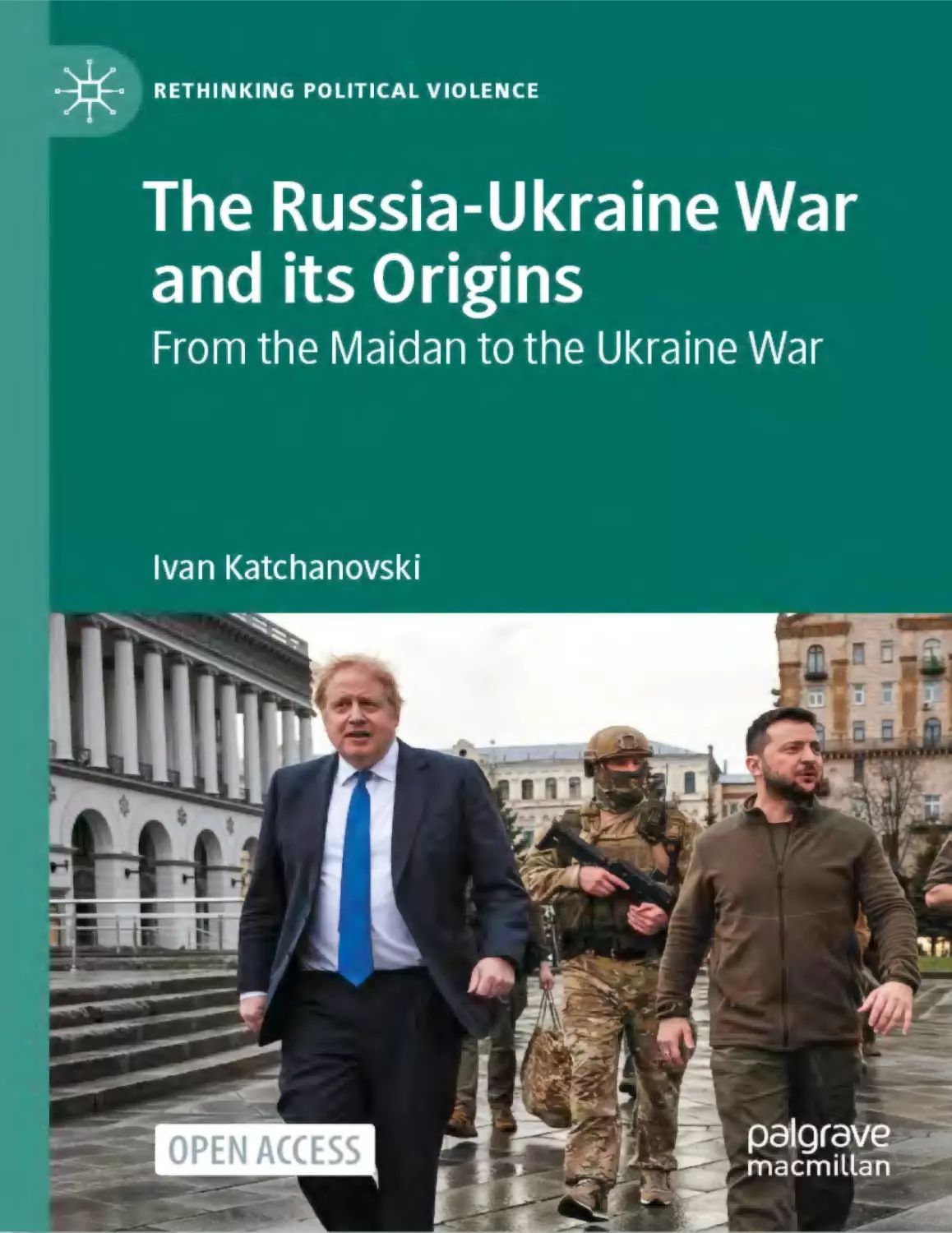


Автор: Katchanovski I.
Теги: military history international relations history of ukraine politics of ukraine modern and contemporary history russian-ukrainian war
ISBN: 978-3-031-98723-6
Год: 2026

Текст
                    Rethinking Political Violence

Series Editor
Roger Mac Ginty
School of Government and International Affairs, Durham University,
Durham, UK

This series provides a new space in which to interrogate and challenge
much of the conventional wisdom of political violence. International
and multidisciplinary in scope, this series explores the causes, types
and effects of contemporary violence connecting key debates on
terrorism, insurgency, civil war and peace-making. The timely
Rethinking Political Violence offers a sustained and refreshing analysis
reappraising some of the fundamental questions facing societies in
con lict today and understanding attempts to ameliorate the effects of
political violence.
This series is indexed by Scopus.

2026. Springer Nature Switzerland.
All rights reserved. May not be reproduced in any form without permission from the publisher,
except fair uses permitted under U.S. or applicable copyright law.
EBSCO Publishing: eBook Collection (EBSCOhost) printed on 12/27/2025 8:45:50 PM UTC via
HERZEN STATE PEDAGOGICAL UNIVERSITY OF RUSSIA 4324534; Ivan Katchanovski; The
Russia-Ukraine War and Its Origins Account:ehost.

Ivan Katchanovski

The Russia-Ukraine War and its Origins
From the Maidan to the Ukraine War

EBSCOhost: eBook Collection (EBSCOhost) printed on 12/27/2025 8:45:50 PM UTC via
HERZEN STATE PEDAGOGICAL UNIVERSITY OF RUSSIA. All use subject to
https://www.ebsco.com/terms-of-use.

Ivan Katchanovski
School of Political Studies & Con lict Studies and Human Rights
Program, University of Ottawa, Ottawa, ON, Canada

ISSN 2752-8588
e-ISSN 2752-8596
Rethinking Political Violence
ISBN 978-3-031-98723-6
e-ISBN 978-3-031-98724-3
https://doi.org/10.1007/978-3-031-98724-3
This work was supported by The University of Ottawa .
© The Editor(s) (if applicable) and The Author(s) 2026.
This book is an open access publication.
Open Access This book is licensed under the terms of the Creative
Commons Attribution 4.0 International License (http://
creativecommons.org/licenses/by/4.0/), which permits use, sharing,
adaptation, distribution and reproduction in any medium or format, as
long as you give appropriate credit to the original author(s) and the
source, provide a link to the Creative Commons license and indicate if
changes were made.
The images or other third party material in this book are included
in the book's Creative Commons license, unless indicated otherwise in
a credit line to the material. If material is not included in the book's
Creative Commons license and your intended use is not permitted by
statutory regulation or exceeds the permitted use, you will need to
obtain permission directly from the copyright holder.
The use of general descriptive names, registered names, trademarks,
service marks, etc. in this publication does not imply, even in the
absence of a speci ic statement, that such names are exempt from the

relevant protective laws and regulations and therefore free for general
use.
The publisher, the authors and the editors are safe to assume that the
advice and information in this book are believed to be true and
accurate at the date of publication. Neither the publisher nor the
authors or the editors give a warranty, expressed or implied, with
respect to the material contained herein or for any errors or omissions
that may have been made. The publisher remains neutral with regard
to jurisdictional claims in published maps and institutional af iliations.
Cover credit: American Photo Archive/Alamy Stock Photo
This Palgrave Macmillan imprint is published by the registered
company Springer Nature Switzerland AG
The registered company address is: Gewerbestrasse 11, 6330 Cham,
Switzerland
EBSCOhost: eBook Collection (EBSCOhost) printed on 12/27/2025 8:45:50 PM UTC via
HERZEN STATE PEDAGOGICAL UNIVERSITY OF RUSSIA. All use subject to
https://www.ebsco.com/terms-of-use.

To my mother
EBSCOhost: eBook Collection (EBSCOhost) printed on 12/27/2025 8:45:50 PM UTC via
HERZEN STATE PEDAGOGICAL UNIVERSITY OF RUSSIA. All use subject to
https://www.ebsco.com/terms-of-use.

Preface
When I submitted in 2002 my book manuscript on regional political
divisions and separatist con licts in Ukraine and Moldova to Cambridge
University Press, I got a response from its editor saying that they could
not publish it because few people would be interested is this topic. This
book, which was based on my doctoral dissertation, was published by
another academic press after Ukraine came close to a Moldova-like
violent break-up and a civil war during the “Orange Revolution” in
2004.1
My academic publications, which primarily concern con licts and
politics in Ukraine, have reached over 2,000,000 reads and downloads
just on my academic websites and the publisher sites. My researchbased Twitter and Facebook posts and YouTube videos reached over
125,000,000 views. I am one of the most cited political scientists who
specialize primarily in politics and con licts in Ukraine.2
My research-based publications, interviews, and comments
appeared in more than 4,000 media reports in more than 80 countries.
They include such major Western media as ABC News, BBC Ukrainian,
Associated Press, Canadian Press, CBC News, CTV News, France 24,
France Té lé visions, Daily Beast, Euronews, Global TV, Globe and Mail,
Guardian, Hill TV, La Presse, Le Figaro, La Razó n, La Stampa, National
Post, Reuters, Sky News Australia, Times Higher Education, Vice, and
Washington Post. They also include such major media from other
countries as Al-Jazeera, China Newsweek, CNN Brazil, Mail & Guardian,
Metro World News, Moscow Times, TRT World, and WION TV. My
research-based publications, interviews, and comments also appeared
in many Ukrainian media, such as 112 Ukraine TV, 24 Channel,
Apostrophe, Avers TV, First National Channel, ICTV, Holos Ukrainy,
Kommentarii, Kyiv Post, NewsOne, Priamyi Kanal, RBC Ukraine, Strana,
STB, Volyn TV, and Ukrainska pravda.
I am the author of The Maidan Massacre in Ukraine: The Mass Killing
that Changed the World (Palgrave Macmillan) and Cleft Countries:
Regional Political Divisions and Cultures in Post-Soviet Ukraine and
Moldova(Ibidem Verlag), the lead author of Historical Dictionary of
Ukraine, second edition (Rowman & Little ield), and co-author of The

Paradox of American Unionism: Why Americans Like Unions More Than
Canadians Do, But Join Much Less (Cornell University Press). My articles
were published in such peer-reviewed journals as Canadian Journal of
Higher Education, Cogent Social Sciences, Communist and PostCommunist Studies, Econ Journal Watch, Europe-Asia Studies,
European Politics and Society, International Journal of Public
Administration, Journal of Comparative Policy Analysis, Journal of
Labor Research, Journal of Labor and Society, Journal of Public Policy,
Journal of Slavic Military Studies, Nationalities Papers, Post-Soviet
Affairs, Perspectives on Terrorism, Problems of Post-Communism,
Relations industrielles/Industrial Relations, Russian Politics, and
Ukraina moderna.
I am one of a few political scientists in the Western academia, who
specialize in researching con licts in Ukraine and know both Ukrainian
and Russian. I also specialize in researching the politics and policy in
the US, in particular, the politics of NATO and EU enlargement of
Ukraine and other European post-communist countries, the politics of
the US and Canadian media coverage of Ukraine, Russia, and other
post-communist countries, public opinion concerning Ukraine and
Russia in the US, and the politics of the representation of Ukraine in
American, Canadian, and British movies and the academia. To the best
of my knowledge, there are no other established political scientists in
the Western academia, who specialize in researching both Ukraine and
the United States or other major Western countries.
I was one of a few scholars who predicted in my scholarly studies
and my-research-based popular publications, studies, interviews, and
social media posts, the collapse of the Soviet communism and real
possibilities of the civil war, a break-up of Ukraine, and the RussiaUkraine war.3 Contrary to prevailing views at the time, I predicted in
the early 1990s that Russia would likely become undemocratic.4
Contrary to the dominant narratives, I also predicted that economic
sanctions would be ineffective in preventing the Russian invasion of
Ukraine in February 2022 and ending the Russia-Ukraine war.5 The
same concerns my research-based predictions that Ukraine could not
defeat Russia and could not win this war.6 Such evidence-based
scholarly research is much more dif icult, time-consuming, and

challenging than following politically convenient narratives propagated
by the governments and the media.
I am a life-long supporter of liberal democracy, human rights, and
peace in Ukraine. I attended the Ukrainian opposition demonstrations
and rallies in 1988–1991 in Kyiv and my native Lutsk in Western
Ukraine, including the irst Ukrainian opposition rally in Kyiv since
Ukraine became Soviet some 70 years before. I faced expulsion from
the Kyiv National Economic University in 1990 and was prevented
from pursuing graduate education in the Soviet Union because I wrote
my undergraduate thesis based on theories of Max Weber and Western
economists. My inal thesis, which in contrast to typical practice at the
time in Ukraine was written in Ukrainian and not Russian, concluded
that the Soviet system was bound to collapse.7 I was one of the irst to
publicly call for the European Union accession of Ukraine.8
While my book stands on its own in terms of its major indings and
evidence, such track-record and background in terms of researching
the con licts in Ukraine is also important. This differentiates my book
from nearly all other books concerning the Russia-Ukraine war and
preceding con licts in Ukraine.
Notes
1.
Katchanovski, I, (2006). Cleft Countries: Regional Political Divisions
and Cultures in Post Soviet Ukraine and Moldova. Ibidem-Verlag.
2.
See Ivan Katchanovski, Google Scholar, https://scholar.google.com/
citations?user=PtRnfFQAAAAJ&hl=en
3. Katchanovski (2006); Katchanovski, I. (2018). Krigen i Ostukraine
er en borgekrig. In Ny kold krig, Marie Krarup (Ed.). Hovedland;
Katchanovski, I. (2013, 3 December). Sizing up Ukraine's
Euromaidan, OpenDemocracy, https://www.opendemocracy.net/
en/odr/sizing-up-ukraines-euromaidan/
Katchanovski, I. (2022, 22 January). The hidden origin of the
escalating Ukraine-Russia con lict. Canadian Dimension. https://
canadiandimension.com/articles/view/the-hidden-origin-of-theescalating-ukraine-russia-con lict; Katchanovski, I. (2022, 18
February). Lies about Ukraine con lict are standing in the way of a
peaceful resolution. Truthout.

4.

p
Katchanovski, I. (1995). Budushcheye liberalnoi democratii v
Rossii. Obschestvennye nauki i sovremennost, 2, 52–56.

5.

6.

7.
8.

Aziz, S. (2022, 24 February). Russia faces new sanctions amid
Ukraine tensions. What will this achieve? Global News. https://
globalnews.ca/news/8641871/russia-new-sanctions-ukrainetensions/
See, for example, Katchanovski, I. (2022, September 15–18). The
Russia-Ukraine War and the Maidan in Ukraine, Annual Meeting of
the American Political Science Association, Montreal. https://
preprints.apsanet.org/engage/apsa/article-details/
63477c201f323d8be3581c4e
See Katchanovski (2018).
Katchanovski, I, (2007, 21 March). EU integration needed, not
secession, KyivPost, https://archive.kyivpost.com/article/opinion/
op-ed/eu-integration-needed-not-secession-26335.html
Ivan Katchanovski
Ottawa, ON, Canada

EBSCOhost: eBook Collection (EBSCOhost) printed on 12/27/2025 8:45:50 PM UTC via
HERZEN STATE PEDAGOGICAL UNIVERSITY OF RUSSIA. All use subject to
https://www.ebsco.com/terms-of-use.

Acknowledgments
Many scholars provided valuable advice, help, and suggestions during
more than 10 years of research for this book. It would be impossible to
acknowledge all of them. I would like to thank two anonymous peerreviewers, who provided very favorable reviews of the book, and
Anatol Lieven, Volodymyr Ishchenko, Jack Matlock, and Richard Sakwa
for providing great book endorsements.
The University of Ottawa provided a grant supporting open access
publication of this book. I am thankful to more than 325 contributors
for ongoing GoFundMe and PayPal crowdfunding to make this book
open access.1 These contributions and grants had no impact on its
content. Responsibility for the book and all its content remains solely
my own.
Note
1.
See Ivan Katchanovski (2025). Open Access Book: Russia-Ukraine
War & Its Origin. GoFundMe, https://www.gofundme.com/f/
openaccess-book-russiaukraine-war-its-origin
EBSCOhost: eBook Collection (EBSCOhost) printed on 12/27/2025 8:45:50 PM UTC via
HERZEN STATE PEDAGOGICAL UNIVERSITY OF RUSSIA. All use subject to
https://www.ebsco.com/terms-of-use.

Competing Interests The author has no competing interests to
declare that are relevant to the content of this manuscript.
EBSCOhost: eBook Collection (EBSCOhost) printed on 12/27/2025 8:45:50 PM UTC via
HERZEN STATE PEDAGOGICAL UNIVERSITY OF RUSSIA. All use subject to
https://www.ebsco.com/terms-of-use.

Praise for The Russia-Ukraine War and its Origins
“Ivan Katchanovski’s book is a thorough and honest exploration of
some of the most complex and mythologized issues in Ukraine’s recent
history, the issues that many are simply afraid to tackle, even though
they have had a crucial impact on the ongoing war with Russia and
current politics far beyond Ukraine.”
—Dr. Volodymyr Ishchenko, Research Associate at the Institute for
East European Studies, Freie Universität Berlin
“Ivan Katchanovski’s book is an absolutely essential contribution to
study of the recent history of Ukraine—a subject that has all too often
been hopelessly muddied by propaganda and emotion.”
—Dr. Anatol Lieven, Director, Eurasia Program, Quincy Institute for
Responsible Statecraft
EBSCOhost: eBook Collection (EBSCOhost) printed on 12/27/2025 8:45:50 PM UTC via
HERZEN STATE PEDAGOGICAL UNIVERSITY OF RUSSIA. All use subject to
https://www.ebsco.com/terms-of-use.

Contents
1 Introduction: From the Maidan to the Russia-Ukraine War
References
2 Euromaidan
2.1 Con licting Narratives of Euromaidan
2.2 Euromaidan Protests and Violence
2.3 Public Opinion Concerning Euromaidan
2.4 Mass Protest, Revolution, Coup, or Regime Change?
References
3 The Maidan Massacre
3.1 Maidan Massacre Narratives and Studies
3.2 Video Reconstruction of the Maidan Massacre on February 20,
2014
3.3 Testimonies by Witnesses, Wounded Protesters, and SelfAdmitted Maidan Snipers
3.4 Forensic Examinations
3.5 Cover-Up, Stonewalling, and Evidence Tampering
3.6 The Maidan Massacre Trial Verdict
References
4 The Russian Annexation of Crimea
4.1 Russian, Ukrainian, and Western Narratives of the 2014
Crimean Con lict
4.2 Crimea Before the Secession and the Russian Annexation
4.3 The Secession and the Russian Annexation of Crimea in 2014
References

5 The Civil War and the Russian Military Interventions in Donbas
5.1 Disparate Narratives Regarding the War in Donbas
5.2 Major Actors in the Con lict in Donbas
5.3 Support for Separatism
References
6 The Far-Right Involvement in Euromaidan, the Maidan and Odesa
Massacres, and the Donbas War
6.1 Con licting Narratives Concerning the Far Right in Ukraine
6.2 The Far-Right Involvement in Euromaidan
6.3 The Far-Right Involvement in the Maidan Massacre
6.4 The Far-Right Involvement in the War in Donbas
6.5 The Far-Right Involvement in the Odesa Massacre
References
7 Regional Political Divisions in Ukraine Since Euromaidan
7.1 Con licting Narratives and Previous Studies
7.2 Regional Support for Presidential Candidates and Political
Parties
7.3 Support for Separatism in Regions of Ukraine
7.4 Attitudes Towards Joining NATO, the EU, and the Russia-Led
Customs Union
References
8 The Origins of the Russia-Ukraine War
8.1 Clashing Narratives and Previous Studies of the Russia-Ukraine
War Origins
8.2 Ukraine’s NATO Accession and the West
8.3 Russian Imperialism

8.4 Neo-Nazis in Ukraine
8.5 Democracy
8.6 The Escalation Spiral of the Maidan, Donbas, and Crimea
Con licts
References
9 The Russia-Ukraine War and Its Nature
9.1 Con licting Narratives, Previous Studies, and Sources
9.2 The Russian Invasion of Ukraine and the Interstate RussiaUkraine War
9.3 The Proxy Russia-NATO War in Ukraine
9.4 The Civil War
References
10 Genocide or War Crimes During the Russia-Ukraine War?
10.1 Con licting Narratives
10.2 Civilian Casualties
References
11 The Far-Right Involvement in the Russia-Ukraine War
11.1 Con licting Narratives
11.2 The Far-Right Involvement in the War
11.3 Mainstreaming of the Far Right During the Russia-Ukraine
War
References
12 The Russia-Ukraine War or Peace?
12.1 The War Outcome
12.2 The Blocked Istanbul Peace Deal in Spring 2022
12.3 Peaceful Con lict Resolution?

References
13 Conclusion: Battle ields Ukraine Between Russia and the West
Index
EBSCOhost: eBook Collection (EBSCOhost) printed on 12/27/2025 8:45:50 PM UTC via
HERZEN STATE PEDAGOGICAL UNIVERSITY OF RUSSIA. All use subject to
https://www.ebsco.com/terms-of-use.

List of Figures
Map 3.1 The Maidan massacre on February 20, 2014
Fig. 3.1 The music conservatory and the main post of ice on the
Maidan. Photo by the author
Fig. 3.2 The main Maidan massacre spot in front of the Hotel Ukraina.
Photo by the author
Fig. 6.1 The “Glory to Ukraine. The Glory to Heroes” sign on the Trade
Union building burned by the far right during the Maidan massacre.
Photo by the author
Fig. 6.2 Far-right symbols on the Maidan. Photo by the author
Fig. 7.1 Regional support for Ukraine’s membership in the European
Union, Razumkov Center polls, % (Note “Don’t know” and “not sure” are
excluded. Excludes Crimea since April 2014 and separatist-controlled
Donbas since summer 2014. Source Calculated from Informatsiina
(2008) and Razumkov Center polls, http://www.uceps.org and
https://razumkov.org.ua)
Fig. 7.2 Regional vote for Ukraine’s membership in NATO if a
referendum was held at the time of the poll, Razumkov Center polls, %
(Note “Don’t know” and non-voters are excluded. Excludes Crimea
since April 2014 and separatist-controlled Donbas since summer 2014.
Source Calculated from Informatsiina (2008) and Razumkov Center
polls, http://www.uceps.org and https://razumkov.org.ua)

Fig. 7.3 Regional vote for Ukraine joining the Customs Union with
Russia, Belarus and Kazakhstan if a referendum was held at the time of
the poll, KIIS polls, % (Note “Don’t know” and non-voters are excluded.
Excludes Crimea and separatist-controlled Donbas since 2015. Source
Calculated from KIIS polls, http://kiis.com.ua)
Fig. 9.1 President Zelenskyy meeting with the US Secretary of Defense
in Kyiv. Public domain photo. https://www. lickr.com/photos/
president_of_ukraine/53345105656
Fig. 10.1 The destroyed Russian military equipment in Bucha. (Public
domain photo, https://www. lickr.com/photos/president_of_ukraine/
51987935513/)
Fig. 12.1 Ukrainian President Zelensky meeting with British Prime
Minister Boris Johnson on April 9, 2022. https://www. lickr.com/
photos/president_of_ukraine/51995264914/

EBSCOhost: eBook Collection (EBSCOhost) printed on 12/27/2025 8:45:50 PM UTC via
HERZEN STATE PEDAGOGICAL UNIVERSITY OF RUSSIA. All use subject to
https://www.ebsco.com/terms-of-use.

List of Tables
Table 5.1 Support for separatism in different regions of Ukraine, the
2014 KIIS Survey, %
Table 5.2 Support for separatism by major ethnic groups in Ukraine, the
2014 KIIS Survey, %
Table 5.3 Support for separatism by major languages in Ukraine, the
2014 KIIS Survey, %
Table 7.1 Regional vote for presidential candidates in the irst rounds
of the presidential elections in 2004–2019, %
Table 7.2 Vote for pro-nationalist/pro-Western and pro-Russian/procommunist political parties and blocs in the parliamentary elections in
2002–2019, %
Table 7.3 Support for separatism in regions of Ukraine, the April–May
2014 KIIS Survey, %
Table 7.4 Regional differences in views of preferred relations between
Ukraine and Russia in Ukraine in 1996–2022 (KIIS Surveys), %
Table 13.1 Dominant narratives by Ukrainian, Western, and Russian
governments and media vs. primary sources-based academic analysis
of the Russia-Ukraine war and its origins

EBSCOhost: eBook Collection (EBSCOhost) printed on 12/27/2025 8:45:50 PM UTC via
HERZEN STATE PEDAGOGICAL UNIVERSITY OF RUSSIA. All use subject to
https://www.ebsco.com/terms-of-use.

© The Author(s) 2026
I. Katchanovski, The Russia-Ukraine War and its Origins, Rethinking Political
Violence
https://doi.org/10.1007/978-3-031-98724-3_1

1. Introduction: From the Maidan to the
Russia-Ukraine War
Ivan Katchanovski1
(1) School of Political Studies & Con lict Studies and Human Rights
Program, University of Ottawa, Ottawa, ON, Canada

Ivan Katchanovski
Email: ikatchan@uottawa.ca
It is often said that truth is the irst casualty of war. The Russia-Ukraine
war and the preceding con licts in Ukraine, such as Euromaidan, the
Maidan massacre, the Odesa massacre, the Russian annexation of
Crimea, and the war in Donbas, produced divergent narratives by
governments and the media in Ukraine, Russia, and the West. However,
politicians and the media are often unreliable sources. They often
disseminate propaganda and disinformation during such armed
con licts. The task of scholarly studies is not to rely on such
propaganda and disinformation produced by the governments and
frequently repeated by the media but on reliable evidence to examine
wars and other con licts in non-partisan ways.
This applies to this book, which examines the Russia-Ukraine war
and its origins. It analyzes the involvement of different con lict parties,
such as the Ukrainian, Russian, and Western governments, Donbas
separatists, and the far right, in this crucial war and in Euromaidan, the
Maidan massacre, the Russian annexation of Crimea, the war in
Donbas, and the nature of these con licts. This book also examines
support for pro-nationalist/pro-Western and pro-Russian political

parties and presidential candidates and attitudes towards separatism
and joining the European Union, NATO, and the union with Russia in
regions of Ukraine in parliamentary and presidential elections and
surveys since Euromaidan.
This open-access book is one of the irst books examining
comprehensively the Russia-Ukraine war and its origins in the
preceding con licts in Ukraine, namely Euromaidan, the Maidan
massacre, the Russian annexation of Crimea, the Odesa massacre, and
the civil war and Russian military interventions in Donbas. It traces
how these con licts, which started with Euromaidan, along with NATO
accession, the far right, and Russian imperialism contributed to the
Russia-Ukraine war.
The Russia-Ukraine war is the most important war in the twentyirst century in the entire world, and it at least matches the Korean War
and the Vietnam War as the most important armed con licts since
World War Two. The Russia-Ukraine war is also the most signi icant
armed con lict in Europe since World War Two (Correlates of War
Project; Uppsala Con lict Data Program, 2024). Russia and Ukraine, the
two largest countries in Europe, are involved in this war directly, while
the United States, other NATO countries, and EU members are involved
in the war indirectly in various ways. The war is the most signi icant
con lict involving main nuclear powers in the world, speci ically Russia,
the United States, the United Kingdom, and France, as well as nuclear
North Korea possibility of this war escalating into a nuclear war is the
highest since at least the Cuban missile crisis in 1962. In addition, the
war has major political, economic, and inancial impact on Ukraine and
Russia, and many other countries of the world, in particular the EU
members. The outcome of the Russia-Ukraine war will affect the world
order (Hill & Stent, 2022).
Most of the previous studies concerning the Russia-Ukraine war,
Euromaidan, and the war in Donbas largely relied on secondary
sources, primarily by the Ukrainian and Western media and
governments. Such secondary sources include interpretative
statements by government of icials and politicians, interpretative
media reports, articles, books, other publications, and blogs produced
by people who were not present or not involved in speci ic events.

They were often uncritically taken at face value without determining
their validity and reliability and without corroborating them.
For instance, a book written by a leading historian of Ukraine
focuses on history of Ukraine and Russia since 1991, including the
initial part of the war (Plokhy, 2023). However, its examination of the
war is based on secondary sources, primarily the Ukrainian and
Western media, and the author declares that he is openly partisan.
Another book on the same subject is written by a fellow from the
Atlantic Council, a NATO-linked partisan think tank, who also provided
PR service for Serhii Liovochkin, who headed the presidential
administration of Viktor Yanukovych at the start of Euromaidan. It also
uncritically relies on such secondary sources and often lacks any
sources at all for many of its claims (Karatnycky, 2024; Katchanovski,
2025a).
The Western media coverage of con licts in foreign countries,
including Ukraine, often follows or indexes the narratives of their own
governments and the political elite (Bennett, 1990; Boyd-Barrett, 2016;
Katchanovski & Morley, 2012). The media representation of Ukraine,
Russia, and other countries is also often biased for political reasons or
factually incorrect. For instance, post-communist countries with proUS/pro-Western governments generally received relatively much more
favorable coverage compared to countries which are adversaries of the
United States or the West or are neutral. Ukraine and Georgia received
relatively more positive coverage by the US TV networks after
respectively the “Orange Revolution” and the “Rose Revolution” then
before (Katchanovski & Morley, 2012).
The US media with some exceptions followed the narrative
propagated by the US administration and the US Congress that Russia
started the war with Georgia over separatist region of South Ossetia in
2008, contrary to primary evidence and an EU-appointed commission
report on this war (Bahador & Katchanovski, 2010; European Union,
2009). Conversely, the Russian media generally followed the Russian
government’s false narrative that Russia stopped the genocide of South
Ossetians by Georgia. With limited exceptions, the media and
governments in the United States, other Western countries, and postMaidan Ukraine continued to propagate the fake news or
disinformation about the start of this war even after admissions by the

EU-appointed commission report in 2009 and by Georgian leaders in
2024 that Saakashvili started the war in South Ossetia in 2008 (see
Georgia Today, 2024).
Similarly, the US media with some exceptions falsely reported
Russiagate or the non-existent collusion of Donald Trump with the
Russian government and the existence of non-existent weapons of
mass destruction in Iraq (See Bennett & Livingston, 2007; Sakwa,
2022).
Like the Russian media, the Ukrainian media is largely not
independent. It is mostly directly or indirectly controlled either by the
government or oligarchs, and generally follows the Ukrainian
government or political elite narratives. Nearly 90 percent of the
Ukrainian media since the Russian invasion were funded by the USAID,
the European Union, and other Western agencies, organizations, and
foundations (Oksana, 2025).
Representation of Ukraine and the con licts in Ukraine was also
often biased for political reasons. Many Western and Ukrainian
politicians, journalists, and researchers openly expressed their
partisan support of the pro-Western Maidan opposition in Ukraine
during Euromaidan, and pro-Western Ukrainian governments during
the Russian annexation of Crimea, the civil war in Donbas, and the
Russia-Ukraine war. Such partisan support of political forces and
governments and their policies and actions was presented as support
of Ukraine, while any contrary evidence or deviation from such
partisan stance was ignored, dismissed, censored, and falsely branded
as pro-Russian.
Such partisan approach was politically convenient and equated
political forces and governments with Ukraine and Ukrainians and
involved witting or unwitting support of the violent overthrow of the
Ukrainian government during Euromaidan, civil war in Donbas, and the
war in Ukraine to the last Ukrainian, and opposition to prevention and
peaceful resolution of these con licts. As this book shows, these actions
and policies in fact had extremely negative consequences to Ukraine
and Ukrainians and ultimately resulted in devastating consequences to
Ukraine and most of Ukrainians because these con licts escalated to
separatist con licts in Crimea and Donbas and military interventions
by Russia in Crimea and Donbas and the Russian invasion of Ukraine.

Such devastating consequences included loss of very large number of
lives of Ukrainians during Euromaidan, the civil war in Donbas, and the
Russia-Ukraine war, de facto break up of Ukraine and annexation of
large parts of Eastern and Southern Ukraine by Russia, millions of
people permanently leaving Ukraine, and economic decline and
destruction in Ukraine. Possibility of such devastating consequences to
Ukraine and Ukrainians was dismissed or ignored by such selfproclaimed supporters of Ukraine, even though such consequences and
outcomes were predicted by the author and small number of other
scholars and experts.
Such partisan approach and uncritical acceptance of narratives
propagated by government of icials and politicians also violated
professional principles of journalism and scienti ic research. The
equivalent was like judges issuing verdicts based on media reports
concerning speci ic crimes and based on claims by either prosecution
or defense without examining and evaluating all evidence and its
reliability and validity. Another equivalent would be medical doctors
issuing diagnoses outside of their specialization based on their
political preferences and based on reports of patients and media
reports without doing any physical examination or tests.
These examples and studies show that the Western, Russian, and
Ukrainian governments and the media are often unreliable sources
when it comes to wars and other con licts and that they often
propagate politically convenient fake news or disinformation.
Wikipedia basically reproduces such partisan sources and
narratives concerning the con licts in Ukraine and is also generally
unreliable source concerning this issue. Wikipedia editors edit
anonymously and typically lack appropriate expertise and knowledge
concerning the articles that they edit. They often push political points
of view by selectively using and omitting sources. Wikipedia articles
can be either edited by anyone or they can be blocked and only be
edited by a small number of the most proli ic editors.
This its “the garbage in, garbage out” model. Unreliable, partisan,
and biased sources concerning the con licts in Ukraine produce
unreliable, partisan, and biased output. Scholarly research needs to be
based on reliable sources, be non-partisan, and avoid biases (See
Weber, 2017). This especially concerns the Russia-Ukraine war and

preceding con licts in Ukraine which are highly politically charged
issues.
However, Seymour Martin Lipset, who held chair positions at
Stanford University and Harvard University and was one of the most
cited political scientists and political sociologists in history, stated in a
personal conversation that most research in the social sciences is
“fraud” because research results are made to it personal or political
views of researchers. He said that if research results it the
researcher’s personal views, they need to be thrown in garbage.
Research concerning the Russia-Ukraine war and other highly
politicized con licts in Ukraine is even more prone to this when politics
trumps evidence and research results are made to it personal and
political views and biases.
There are just few political scientists, who specialize primarily in
researching con licts in Ukraine and are luent in both Ukrainian and
Russian, in the Western academia. For instance, there is only one
established male Ukrainian political scientist, who was born in
Ukraine, knows both Ukrainian and Russian, and specializes primarily
in the politics and con licts in Ukraine, in permanent faculty positions
in the Western universities (See Katchanovski, 2025b). As a native
speaker of Ukrainian and luent speaker of Russian, the author is one of
few political scientists in Western academia conducting scholarly
research on con licts in Ukraine based mostly on primary sources in
both these languages.
In contrast to already published and most other books that are
likely to be published concerning the Russia-Ukraine war, this book
provides comprehensive analysis of the Ukraine-Russia war and its
origins based on the analysis of tens of thousands of primary sources
in both Ukrainian and Russian and based on political science theories
and concepts. Such primary or original sources include videos, photos,
audio recordings, interviews, testimonies, surveys, trial broadcasts,
and the texts of the verdicts and other court decisions containing
original data or evidence. The authenticity, validity, and reliability of
these sources are veri ied and corroborated based on scienti ic
methodology and use of multiple independent sources. While most of
the analyzed primary and secondary sources cannot be cited for space

reasons in the book, it cites the most important and relevant sources
and their examples.
This book also uses a large number of secondary sources, such as
previous studies and government, NGO, international organizations,
and media reports. However, it does not rely on interpretation
provided by these sources concerning speci ic issues of the con licts in
Ukraine.
Most chapters examine major aspects of the Russia-Ukraine war.
The remaining chapters examine the con lict escalation ladder that
culminated in this war. The book traces a violent con lict escalation
spiral which started with Euromaidan and the Maidan massacre,
escalated to the Russian annexation of Crimea and the civil war and
Russian military interventions in Donbas, and culminated in the
Russian invasion of Ukraine on February 24, 2022 and the RussiaUkraine war which also became the NATO-Russia proxy war.
The current chapter provides an introduction. The second chapter
of the book examines Euromaidan in 2013–2014. The next chapter
investigates which party of the con lict was involved in the crucial
Maidan massacre of the protesters and the police in Ukraine during
Euromaidan in February 2014. The Russian annexation of Crimea in
2014 is the subject of the following chapter. Chapter 5 analyzes the civil
war and the Russian military interventions in Donbas in 2014–2022.
The sixth chapter analyzes the far-right involvement in Euromaidan,
the Maidan and Odesa massacres, and the Donbas war. The next
chapter provides an examination of the regional political divisions in
Ukraine in terms of support for pro-Western/pro-nationalist and proRussian/pro-communist political parties and presidential candidates
in presidential and parliamentary elections and attitudes towards
separatism, joining the EU, NATO, and the Russia-led Customs Union in
regions of Ukraine. Chapter 8 analyzes the causes and the origins of the
Russia-Ukraine war. The next chapter examines the Russia-Ukraine
war and its nature. Chapter 10 analyzes whether there have been
genocides or war crimes during the Russia-Ukraine war. The following
chapter examines the likely outcome of the Russia-Ukraine war and
whether this war could have been prevented or could have been
resolved peacefully. The far-right involvement in the Russia-Ukraine is
the subject of Chapter 12. The concluding chapter 13 summarizes the

main indings of the book and discusses their implications and
prospects for the con lict resolution in Ukraine. The book also includes
online video appendixes which are available on the author’s YouTube
channel.
The target audience for this open-access book includes scholars,
undergraduate and graduate students, professionals, journalists, and
the general public interested in the Russia-Ukraine war and its origins,
in particular, the Maidan, Crimea, and Donbas con licts, the far right,
elections, and public opinion in Ukraine. The Russia-Ukraine war and
the preceding con licts in Ukraine became one of the top issues of
interest in the United States, Canada, the UK, and other Western
countries as well as many other countries of the world.
Parts of my articles from the European Politics and Society journal
and Econ Journal Watch journal and parts of the “Crimea: People and
Territory before and after Annexation” chapter from the open access
book, Ukraine and Russia: People, Politics, Propaganda and Perspectives
are republished with permissions. Republished parts of these
publications, the open access book, The Maidan Massacre in Ukraine:
The Mass Killing that Changed the World, and open-access articles in
Cogent Social Sciences, Journal of Labor and Society, Perspectives on
Terrorism, and Russian Politics journals were updated, revised, and
expanded in this book (Katchanovski & Abrahms, 2024; Katchanovski,
2015, 2016, 2020, 2023a, 2023b, 2024, 2025a).
Open Access This chapter is licensed under the terms of the
Creative Commons Attribution 4.0 International License (http://
creativecommons.org/licenses/by/4.0/), which permits use, sharing,
adaptation, distribution and reproduction in any medium or format, as long as you
give appropriate credit to the original author(s) and the source, provide a link to the
Creative Commons license and indicate if changes were made.
The images or other third party material in this chapter are included in the
chapter's Creative Commons license, unless indicated otherwise in a credit line to
the material. If material is not included in the chapter's Creative Commons license
and your intended use is not permitted by statutory regulation or exceeds the
permitted use, you will need to obtain permission directly from the copyright holder.

References
Bahador, B., & Katchanovski, I. (2010, February 24). Politics of the Russian-Georgian

war coverage by US television. Comparative Economics Seminar, The Davis Center
for Russian and Eurasian Studies, Harvard University, Cambridge, MA. https://www.
researchgate.net/publication/326904744_Politics_of_the_Russian-Georgian_War_
Coverage_by_US_Television
Bennett, W. L. (1990). Toward a theory of press-state relations in the United States.
Journal of Communication, 40(2), 103–125. https://doi.org/10.1111/j.1460-2466.
1990.tb02265.x
[Crossref]
Bennett, W. L., Lawrence, R. G., & Livingston, S. (2007). When the press fails: Political
power and the news media from Iraq to Katrina. University of Chicago Press.
Boyd-Barrett, O. (2016). Western Mainstream Media and the Ukraine Crisis: A Study
in Con lict Propaganda. Routledge.
Correlates of War Project. (2022). Correlates of War. https://correlatesofwar.org
European Union. (2009). Independent international fact- inding mission on the
con lict in Georgia: Report (Vols. 1–3). http://www.ceiig.ch/Report.html
Georgia Today. (2024, September 27). Kobakhidze: Saakashvili’s regime started the
war in 2008; Yes, we saved Georgia. https://georgiatoday.ge/kobakhidzesaakashvilis-regime-started-the-war-in-2008-yes-we-saved-georgia
Hill, F., & Stent, A. (2022). The world Putin wants. Foreign Affairs, 101(5). https://
www.foreignaffairs.com/russian-federation/world-putin-wants- iona-hill-angelastent
Karatnycky, A. (2024). Battleground Ukraine: From independence to the war with
Russia. Yale University Press.
Katchanovski, I., & Abrahms, M. (2024). Far-right political violence in Ukraine:
Assessment of the Donbas war and the Odesa massacre. Perspectives on Terrorism,
18(3), 90–113.
[Crossref]
Katchanovski, I. & A. Morley. (2012). Politics of US television coverage of postcommunist countries. Problems of Post-Communism, 59(1), 15–30. https://doi.org/
10.2753/PPC1075-8216590102
Katchanovski, I. (2015). Crimea: People and territory before and after annexation. In
A. Pikulicka-Wilczewska & R. Sakwa (Eds.), Ukraine and Russia: People, politics,
propaganda and perspectives (pp. 80–89). E-International Relations.

Katchanovski, I. (2016). The separatist war in Donbas: A violent break-up of Ukraine?
European Politics and Society, 17(4), 473–489. https://doi.org/10.1080/23745118.
2016.1154131
[Crossref]
Katchanovski, I. (2020). The far right, the Euromaidan, and the Maidan massacre in
Ukraine. Journal of Labor and Society, 23(1), 5–29. https://doi.org/10.1111/wusa.
12457
[Crossref]
Katchanovski, I. (2023a). The Maidan massacre trial and investigation revelations
and their implications for the Ukraine-Russia war and relations. Russian Politics,
8(2), 181–205. https://doi.org/10.30965/24518921-00802005
Katchanovski, I. (2023b). The “snipers’ massacre” on the Maidan in Ukraine. Cogent
Social Sciences, 9(2), https://doi.org/10.1080/23311886.2023.2269685
Katchanovski, I. (2024). The Maidan massacre in Ukraine: The mass killing that
changed the world. Palgrave Macmillan.
Katchanovski, I. (2025a). Who perpetrated the Maidan massacre? Who overthrew
the Ukrainian government in 2014? A critique of battleground Ukraine. Econ Journal
Watch, 22(1), https://econjwatch.org/File+download/1340/KatchanovskiMar2025.
pdf?mimetype=pdf
Katchanovski, I. (2025b). Academic job placement in post-communist studies:
Politics and meritocracy. In P. Blunt, C. Escobar & V. Missos (Eds.), The political
economy of dissent: A research companion. Routledge.
Plokhy, S. (2023). The Russo-Ukrainian war: The return of history. Norton.
Oksana Romaniuk: 90% of Ukrainian media survived thanks to grants. (2025, January
28). Institute of mass information. https://imi.org.ua/en/news/oksana-romaniuk-90of-ukrainian-media-survived-thanks-to-grants-i66314
Sakwa, R. (2022). Deception: Russiagate and the new Cold War. Rowman & Little ield.
Uppsala Con lict Data Program. (2024). UCDP. https://ucdp.uu.se/
Weber, M. (2017). Methodology of social sciences. Routledge.
[Crossref]
EBSCOhost: eBook Collection (EBSCOhost) printed on 12/27/2025 8:45:50 PM UTC via
HERZEN STATE PEDAGOGICAL UNIVERSITY OF RUSSIA. All use subject to

https://www.ebsco.com/terms-of-use.

© The Author(s) 2026
I. Katchanovski, The Russia-Ukraine War and its Origins, Rethinking Political
Violence
https://doi.org/10.1007/978-3-031-98724-3_2

2. Euromaidan
Ivan Katchanovski1
(1) School of Political Studies & Con lict Studies and Human Rights
Program, University of Ottawa, Ottawa, ON, Canada

Ivan Katchanovski
Email: ikatchan@uottawa.ca

2.1 Con licting Narratives of Euromaidan
This chapter examines the role of the Yanukovych government, the
Maidan opposition, Russia, and the West in Euromaidan (Maidan) in
Ukraine in November 2013-February 2014. The analysis focuses on the
mass protests and key cases of violence before the Maidan massacre,
which is analyzed in the next chapter. This study uses political science
theories of mass protest, coups, revolution, and regime change and
empirical analysis to examine the nature of Euromaidan and the
political transition in Ukraine during the Maidan.
The chapter is based on the analysis of numerous sources, such as
online live streams and TV broadcasts during the entire Euromaidan,
videos, interviews, court decisions, and media reports in Ukrainian,
Russian, and English. The analysis includes thousands of videos,
interviews, and statements by key political actors involved in the
Maidan; testimonies and reports by hundreds of participants,
journalists, and witnesses in the media; and the social media. For space
reasons, the absolute majority of such primary and secondary sources
cannot be cited in this chapter.
The governments and the mainstream media in Ukraine and the
West, with some exceptions, as well as many scholars presented

Euromaidan as a popular, peaceful, grassroots, and democratic mass
protest movement and a revolution in favor of the EU integration and
against the undemocratic, corrupt, pro-Russian government of
President Viktor Yanukovych. They attributed major cases of violence
during Euromaidan to the Yanukovych government, the government
forces, government-hired “titushki,” or agent’s provocateurs working
for Yanukovych or the Russian government. Speci ically, they almost
universally attributed the violent dispersal of Euromaidan protesters
on November 30, 2013, to a Yanukovych order and presented it as onesided violence by the Berkut special police force against peaceful
student protesters. Similarly, the killings of 3 Maidan protesters in
January 2014 were almost universally attributed to the orders of
Yanukovych, his internal affairs and security ministers, government
snipers, and/or Berkut special police force.
The same concerns the beating of a female Maidan activist Tetiana
Chornovol and disappearance of one of AutoMaidan leaders, Dmytro
Bulatov, who was presented as being kidnapped and cruci ied. Other
major cases of violence, such as attacks on the presidential
administration on December 1, 2013, the parliament at the end of
January 2014, and the parliament and the headquarters of the Party of
Regions on February 18, 2014 were blamed on agent’s provocateurs or
far-right organizations acting as agent’s provocateurs for the
Yanukovych government or the Russian government.
The governments and the mainstream media in Ukraine and the
West, with some exceptions, as well as many scholars attributed the
removal of President Yanukovych to the mass protests during
Euromaidan or the Maidan. They stated that Yanukovych led Ukraine
because of these protests and because of his responsibility for the
violence against the protesters, including the Maidan massacre. They
called his removal by a vote of the parliament democratic and legal and
referred to the mass Euromaidan protests and the political transition
as the “Revolution of Dignity.” However, Oleh Tiahnybok, the leader of
the far-right Svoboda party, stated that the term “Revolution of
Dignity” was invented by a deputy of his party (see Tiagnybok, 2015).
English-language, Russian-language, and Ukrainian-language
Wikipedia largely copied Euromaidan narrative presented by the
governments and the mainstream media in Ukraine and the West and

omitted many scholarly studies whose indings and classi ication of
Euromaidan differed from such narratives (See, for example,
Euromaidan (2025) and Revolution of Dignity (2025).
In contrast, Russian and separatist politicians and the media in
Crimea and Donbas, former president Yanukovych and members of his
government after Euromaidan often labeled Euromaidan as a “fascist
coup” and the Maidan government as a “fascist junta.” They stated that
the removal of Yanukovych was a coup d’etat with the US government
involvement.
Similarly, and in part based on the narratives by the governments
and the mainstream media in Ukraine and the West some previous
studies presented Euromaidan as a popular, peaceful, grassroot-based,
and democratic mass protest movement and a revolution, in particular
“the Revolution of Dignity,” in favor of the EU integration and against
the undemocratic, corrupt, pro-Russian government of President
Viktor Yanukovych which resorted to violence against the protesters
(See, for example, Marples & Mills, 2015; Onuch & Sasse, 2016; Wilson,
2014).
Other scholars highlighted the crucial role of the far right and their
violence during Euromaidan (See Ishchenko, 2016, 2020;
Katchanovski, 2016a, 2020, 2023a, 2023b, 2024; Kudelia, 2018). Many
scholarly studies classify the Maidan transition as a violent overthrow
of the government (See, for example, Bandeira, 2019; Black & Jones,
2015; Cohen, 2018; Hahn, 2018; Katchanovski, 2016a, 2016b, 2017,
2020, 2023a, 2023b, 2024; Lane, 2016; Mandel, 2016; Sakwa, 2015).
Some previous studies classify the Maidan speci ically as a coup (See,
for example, Black & Jones, 2015; Mearsheimer, 2014).
Coups are de ined as violent overthrow of the government by a
small group of people, typically by the military or other members of the
state (See Chin et al., 2021). In contrast, revolutions involve profound
and comprehensive political and social transformation as result of
typically violent overthrow of an old regime with mass participation
(See Katchanovski, 2008; Skocpol, 1995).
Some previous studies also show escalation of the con licts in
Ukraine during Euromaidan into the Maidan massacre (Katchanovski,
2020; Kudelia, 2018; Myshlovska, 2024; Sakwa, 2015). Some studies
also pointed the contribution of Euromaidan to the con licts in Crimea,

Donbas, and ultimately the Russia-Ukraine war (Baysha, 2015;
Katchanovski, 2015, 2016b, 2022).

2.2 Euromaidan Protests and Violence
Euromaidan protests started at the end of November 2013 following a
decision by the Viktor Yanukovych government to postpone the signing
of the association and free trade agreement with the European Union.
This agreement did not envision the EU accession of Ukraine since the
EU refused then to recognize Ukraine even as a potential member (See
Katchanovski, 2011). However, the pro-Western opposition parties and
leaders and much of the Ukrainian media backed these protests and
presented this agreement as Ukraine joining the EU. Russia provided
the Yanukovych government with $15 billion loan and reduction in gas
prices in order to entice him to drop this EU agreement and join the
Russia-led Customs Union.
These protests in downtown Kyiv, in particular on the
Independence Square which is called the Maidan in Ukrainian, were
largely peaceful at irst and relatively small. The violence during the
protests was also relatively small. For instance, a group of protesters
with Svoboda lags and other far-right symbols attacked the police in
front of the Cabinet of Ministers building (Shturm, 2013). But they
escalated into large-scale protests and violent clashes between the
police and the protesters that culminated into the Maidan massacre of
the protesters and the police on February 18–20, 2014.
The turning point came with a highly publicized violent dispersal of
a few hundred protesters by the anti-riot Berkut special police force on
the Maidan on November 30, 2013. Videos, photos, and later
admissions by Right Sector leaders and other Maidan protesters
showed that the Right Sector activists occupied a part of the Maidan
square near a monument to mythical Kyiv founders at the time of the
dispersal. This far-right alliance along with its banners appeared on the
Maidan on November 29, 2013, i.e., one day before (see Kotsaba, 2013).
The Right Sector was organized right before the November 30s
dispersal from radical nationalist and neo-Nazi organizations and
footballs ultras (See Katchanovski, 2020; Chapter 6). The analysis also
showed that during the initial police dispersal of other protesters by

force nearby Right Sector area-based protesters threw burning wood
chunks and various other things at the Berkut special police force,
which then beat other protesters in the Maidan square and
surrounding streets (See Vypusk, 2013; Interviu, 2013; Zverskoe,
2014).
Ihor Mazur, a Ukrainian National Assembly—Ukrainian People’s
Self-Defense (UNA-UNSO) leader, admitted that Right Sector members
were present in the Maidan during this dispersal on November 30,
2013 and that they then retreated after a confrontation with the police
(Іgor, 2014). The website of Tryzub named after Bandera admitted the
Right Sector involvement in the clashes with the police on November
30, 2013 on the Maidan, but it was later taken down.
The lists of injured and detained protesters revealed that the
absolute majority of them were much older than typical age of students
in Ukraine. At the Maidan massacre trial, the Prosecutor General Of ice
(GPU) revealed that 18 policemen were also injured on that day (see
Zasіdannia, 2018).
There is various evidence that the Maidan opposition leaders,
including the far-right ones, had advance information about this
dispersal but did not inform the protesters in order to use this violent
dispersal to greatly galvanize the mass protests, which were coming to
the end on that night. Anatolii Hrytsenko, one of the Maidan politicians,
stated that the Maidan leaders knew in advance about this dispersal,
because the opposition was able to intercept radio communications of
Berkut concerning their deployment for this operation (see Hritsenko,
2014). There are other Maidan protesters who said from the start that
Maidan leaders knew in advance about the Berkut dispersal of the
Maidan protests on November 30. A leader of neo-Nazi White Hammer
made such public warning from the Maidan stage.
The unusual presence of Inter TV crews along with a number of
other TV crews at the time of the dispersal around 4:00 am local time
and the Inter broadcast of this dispersal also indicate advance
knowledge of the police dispersal. A Maidan protester on Facebook
reported that she witnessed that an Inter TV operator wanted to leave
this square before this dispersal happened at 4:00am, but an Inter TV
journalist insisted on staying. A Poroshenko party member of the
parliament stated in a live TV program on the Inter TV a few hours

before this dispersal that Berkut “was beating students” on the Maidan.
Inter TV and other Ukrainian media along with Maidan politicians
misrepresented this dispersal of Maidan protesters as an unprovoked
and unexpected beating of students and children by the Berkut police
on the Yanukovych government order. They generally ignored or
omitted the presence of the Right Sector activists and their violence
against the police. The Inter television channel was owned by Dmytro
Firtash and Serhii Liovochkin. Firtash was an oligarch who supported
Yanukovych during the 2010 presidential campaign but then switched
to covert backing of Viktor Volodymyr Klitschko, who headed
Ukrainian Democratic Alliance for Reform (UDAR) party and became
one of Euromaidan leaders. Liovochkin then headed the Yanukovych’s
presidential administration, but he belonged to the Firtash oligarchic
clan.
After Yanukovych and several members of the Yanukovych
government and the Kyiv police chief led to Russia, they stated or
suggested that Liovochkin ordered to disperse the protesters, but they
did not provide any speci ic direct evidence. Avakov, the Minister of
Internal Affairs of Ukraine, in all post-Maidan governments made a
similar statement concerning the involvement of Liovochkin (see
Avakov, 2016). In a leaked telephone conversation, Ihor Kolomoisky
said that Liovochkin was aware of the dispersal order because he was
the patron of Oleksander Popov, the head of the Kyiv City
administration, who was involved in implementing the dispersal order
(see Kolomoisky, 2015). The of icial investigation accused and charged
Popov and other members of the Yanukovych government for issuing
this order and supervising the dispersal. Liovochkin was the most
senior Yanukovych of icial, who did not lee Ukraine and who was not
prosecuted, in contrast to many other Yanukovych associates. The
prosecution at the Maidan massacre trial in Ukraine revealed that its
investigation has evidence of Liovochkin’s “incorrect actions” in
“orienting” these Ukrainian of icials, who were charged with ordering
the dispersal of the Maidan protesters on November 30, concerning
this dispersal (Zasіdannia vіd 17.12.2019 2019).
In a TV interview, an eyewitness reportedly stated that shortly
before November 30, 2013 she accidentally overheard a discussion

among senior Maidan leaders about the planned police dispersal of the
Maidan protesters and possibility that it would lead to violence.
She identi ied Andrii Ilienko, Andrii Parubiy, and Serhii Pashynsky
as the Maidan leaders who were involved in this discussion
(Pіdsluhala, 2014). They were not well-known names at the time but
would be linked to other cases of violence later during Euromaidan.
Ilienko was a member of the parliament from Svoboda party. Parubiy
was a former leader of the neo-Nazi Patriot of Ukraine, a paramilitary
wing of the Social National Party of Ukraine, before this party was
rebranded as Svoboda in 2004 and before the Patriot of Ukraine
became a paramilitary wing of the SNA, which was formed by the
Kharkiv organization of the SNPU. Parubiy and Pashynsky were
members of the Ukrainian parliament from the oligarchic Fatherland
Party at the time of the Maidan protests.
Mass protests against the Yanukovych government and its decision
to suspend the free trade and association agreement with the EU in
November 2013-February 2014 were the most visible part of
Euromaidan. There were an estimated few hundred thousand
protesters in Kyiv and other regions of Ukraine on December 1, 2013.
They assembled largely in response to the violent dispersal of
protesters by the Berkut a day before and were spurred as a result of
the deliberately one-sided and misleading media coverage of this
dispersal.
Videos and photos show that protesters according to Google Earth
maps occupied some 40,000 square meters on Kyiv’s Independence
Square (Maidan) and the main street, Khreshchatyk on December 1.
With the approximate average density of more than two people per
square meter, the peak number estimate is at least 100,000. While the
Ukrainian Interior Ministry under Yanukovych de lated the number of
demonstrators in Kyiv, estimating it at 40,000, the Maidan opposition
leaders and many leading Ukrainian and Western mass media outlets
in lated the number in the several hundred thousand range, and in
cases, of the New York Times and Inter TV channel, at more than a
million (Katchanovski, 2013).
The footage and live streams and admissions by the Right Sector
leaders and activists showed the violent attack on presidential
administration on December 1, 2013 during a massive protest rally

against the violent police dispersal of the demonstrators on November
30. These videos and footage showed some of the attackers with neoNazi symbols of the Patriot of Ukraine (Massovye, 2013). The footage
also showed other groups of attackers shouting “Ukraine above all”
slogans used by far-right organizations and obscene chants used by
Ukrainian ultras. There are recordings of Andrii Dzyndzia hijacking a
bulldozer and then trying to ram into the Interior Troops line
protecting the presidential administration (see Dzyndzia, 2013).
Although Svoboda publicly distanced itself from violent attacks of
the presidential administration and the parliament, the evidence, such
as presence of some Svoboda lags and activists, live streams, and
social media posts, clearly indicated that at least some Svoboda and
C14 members and activists linked to them were involved in these
violent attacks. There was similar evidence of Svoboda’s participation
in seizures of regional administrations, primarily, in Western Ukraine
and storming and occupying Kyiv City administration on December 1,
2013. Svoboda and its C14 af iliate also formed some paramilitary selfdefense companies during Euromaidan. C14, a Neo-Nazi youth
organization af iliated with Svoboda, led a paramilitary Self-Defense
unit, which helped Svoboda to forcibly occupy the Kyiv city
administration during the mass protests against the Yanukovych
government and the police violence.
The tent city on the Independence Square and the stage there
became permanent centers of the mass protest which was televised
and streamed live over the entire Ukraine. The Berkut police tried to
disperse the Maidan protesters in the tent city on December 10, but
then stopped as result of the resistance by the protesters and the
reported order from the Yanukovych government as a result of the
pressure from the United States and the EU during the visit by Viktoria
Nuland to Ukraine.
Live Internet video streams showed that the largely peaceful
protests turned much more violent following calls by radical Maidan
activists to advance towards the Ukrainian parliament in the middle of
January 2014 after the adoption by the Yanukovych Party of Regions
dominated parliament of the laws aimed at curtailing the Maidan
protests. These laws restricted to certain extent the freedoms of
assembly and protest and were called “dictatorial laws” by the Maidan

opposition and much of the Ukrainian media. But there were many
similar laws in Western democracies.
The advance towards the parliament was stopped by the Berkut
police and the Internal Troops on Hrushevskyi Street and violent
clashes with the activists, including the far-right Right Sector and
football ultras, turned into a violent standoff between the law
enforcement and the Maidan protesters. Live Internet streams and
videos showed that the Maidan activists attacked the Berkut police and
Internal Troops with Molotov cocktails, stones, salutes, and burning
tires. The Berkut police and the Internal Troops shot at the activists
with rubber bullets and beat them with rubber batons. Many police and
Internal Troops members and Maidan activists were injured. The
protesters who resorted to violence were in a minority, but they were
the most active part of Euromaidan. The Maidan opposition leaders,
such as Volodymyr Klitschko and Petro Poroshenko, initially publicly
condemned the December 1st attack of the presidential administration
and the January attack of the Ukrainian parliament as “provocations.”
However, videos, testimonies, admissions by some Maidan leaders,
and other evidence show that the Maidan opposition leaders mobilized
mass protests and promoted their violent radicalization with help of
staged violence. The killings of the irst three protesters at the end of
January 2014 were attributed by the Maidan opposition and the media
in Ukraine and the West to the government forces, despite the evidence
that these were false- lag killings. These killings greatly escalated the
con lict by turning it into con lict with fatalities.
However, unreported Pechersk court decisions suggested that the
Prosecutor General Of ice investigated members and leaders of UNAUNSO, one of the founding organizations in the Right Sector, for
shooting these protesters (Ukhvala, 2015). The of icial investigation
determined that these three protesters were killed from a few meters
distance in the Maidan-controlled areas, while the police lines were
several dozen meters away from the Maidan positions.
A Kyiv prosecutor said in 2019 that he spoke with the forensic
expert who examined the body of Sergey Nigoyan, the Armenian
protester, and that “there everything is unambiguous,” “the shot was
from behind at a maximum distance of three– ive meters and gun wads
were found,” and “that is it de initely was not policemen who killed

him.” (Gubin, 2019). A popular Ukrainian blogger reported that the
Security Service of Ukraine knows who in fact shot dead this Armenian
protester on the Maidan in January 2014 because it has a video
recording of a group of people in the Maidan-controlled Trade Union
building hiding a irearm and discussing his killing right after it
happened. The Trade Union building was the headquarters of the
Maidan leadership and the Right Sector during the Maidan. He revealed
a Security Service of Ukraine report concerning its covert video
surveillance of a Right Sector chemical explosions lab in the Trade
Union building during the Maidan (See Kak, 2019).
Another evidence that these were false- lag killings is the absence
of the moments and exact locations of killings of two of these
protesters in livestreams, videos, photos, and con irmed eyewitnesses
of these killings in the heavily covered area of a violent confrontation
between the protesters and the police. A video published by a
Ukrainian media outlet ive years after these killings also provided
evidence that a Belarusian far-right protester was killed from a
Maidan-controlled area and not by the Berkut police. The video shows
that he was shot while he was behind a barricade from burned buses
that covered him from the Berkut police (Gubin, 2019).
The investigation con irmed that the Armenian protester was shot
by pellets used in hunting. The killed Belarusian protester was a
member of the UNA-UNSO. The ethnicities of these killed protesters
also suggest that they were not random victims but were selected in
order to propagate Euromaidan as ethnically inclusive and diverse and
to garner support for Euromaidan among people from Armenia and
Belarus. A Ukrainian reporter wrote on her Facebook page that a leader
of the neo-Nazi White Hammer told her off the record that these two
protesters were killed by their own and that this was one of the
reasons for the subsequent split of the White Hammer from the Right
Sector (Melnikova, 2015).
Like in the case of the Maidan massacre, the prosecution stated that
forensic examinations four years after the massacre reversed the
previous examination indings without any explanation and claimed
that these three protesters were killed from a distance between 7 and
21 meters. But the same investigation stated before that the police was

then further from the protesters (4 goda, 2018). The live streams and
videos showed the same.
Nobody is charged with the killings of these Armenian, Belarusian,
and Western Ukrainian protesters for 10 years since their murders,
which were used by the Maidan leaders and the far right to mobilize
mass protests and justify their violence. The evidence suggests that
they were killed in a false- lag operation with possible involvement of
the far right and that the investigation of their killings after the Maidan
was stonewalled and fabricated for this reason and the actual killers
were covered-up. The Ukrainian and Western media with a few notable
exceptions did not report such evidence and continued to propagate
fake news about killings of these and other Maidan protesters by the
Berkut police or government snipers.
Similarly, the analysis of the evidence and the Ukrainian
government investigation show that highly publicized kidnapping of
Dmytro Bulatov, the Automaidan leader, was staged. The Ukrainian
police closed on March 27, 2020, its investigation of kidnapping,
torture, and cruci ixion of Dmytro Bulatov during the Maidan because
the investigation determined that the crime “was absent” and could
have been “staged.” The documents from his investigative criminal
case show that associates of Bulatov in the Automaidan testi ied in
2014 after the Maidan and in 2019 that he staged his own abduction,
torture, and cruci ixion. One of them testi ied that Bulatov told him
shortly before his disappearance that he planned to stage his own
abduction. Another testi ied that she heard from Bulatov and other
Maidan activists about need for some “ iery information” in order to
regain popularity of the Automaidan and that his staged abduction
accomplished this. Other Automaidan leaders testi ied that there was
no rationale for Bulatov’s kidnapping and torture because he was
removed from the Automaidan leadership a couple of days prior, and
they regarded his staging his own kidnapping as a real possibility. Two
of them also testi ied that the light wounds and his appearance did not
match his statements about being kidnapped and tortured for a week
without food.
A government forensic expert determined in his expert report for
the investigation after the Maidan that Bulatov’s wounds, including a
cut off a piece of his ear, could have been in licted by himself or by

someone else with his agreement using sterile materials and
disinfecting wounds, because they did not have any signs of infection.
The government forensic expert also determined that there was no
damage on his hands that would be consistent with Bulatov being
handcuffed (Skrepy, 2020). This is consistent with a testimony by
Davyd Zhvania, who was a member of the Maidan leadership during
Euromaidan and headed the election campaign of the Petro
Poroshenko party in 2014 and the parliamentary committee during
and after the Maidan. He stated that Maidan leaders, whom he named,
staged the abduction and cruci ixion of Bulatov and most other highpro ile cases of violence, such as the Maidan massacre (Otkrytoe,
2020).
Zhvania stated that her beating was staged by the Maidan leaders,
similarly to the abduction of Bulatov. The Ukrainian trial sentence of
the men who beat a female Maidan activist Tetiana Chornovol at the
end of December 2013 stated that this was a traf ic-related con lict.
Zhvania also stated that the abduction of two other protesters, one of
whom perished, was also staged by the Maidan leaders (See Otkrytoe,
2020).

2.3 Public Opinion Concerning Euromaidan
Polls show that Ukrainians were almost evenly split on the issue of
support of the Maidan, in particular, there was strong regional divide
between majority support in Western and Central Ukraine and
opposition in Eastern and Southern Ukraine. A poll by the Democratic
Initiative Foundation (DIF) and the Razumkov Center during
Euromaidan in the end of December 2013 found that half (50%) of
Ukrainians supported Euromaidan protests, while 42% opposed them.
Similarly, 46% of Ukrainians preferred the EU membership path, while
36% favored the Customs Union led by Russia. Yanukovych was
favored by 30% of the potential voters in the irst round of the
presidential elections (Hromadska, 2013).
The poll by the Kiev International Institute of Sociology (KIIS) and
Socis on January 24-February 1, 2014 showed that 47% of Ukrainians
supported Euromaidan, while almost similar percentage of
respondents (46%) did not support it. The difference was within the

statistical margin of error. The KIIS poll on February 8–18, 2014
showed that Euromaidan was supported by the absolute majorities of
the respondents in the West (80%) and in the Center (51%) of Ukraine.
In contrast, a minority, 20% of residents of the South and 8% of
respondents in the East supported Euromaidan (Attitude, 2014).
The Razumkov Center survey in December 2020 showed that 34%
of the respondents in Ukraine would have supported the “Euromaidan”
if it would happen at the time of the survey. Conversely, 11% would
have supported “Antimaidan,” while 40% would have backed neither of
them (see Ukrayina-2020 2020). The majority of respondents in
Western Ukraine (71%) and plurality in the Center (46%) in the
Razumkov Center survey in 2015 would have supported the Maidan,
while the majorities in the East, the central government-controlled
Donbas, and the South stated that they would have backed neither. The
difference between the percentage of Maidan supporters and the
combined percentage of the Maidan opponents would be signi icantly
higher if the Russian-annexed Crimea and separatist-controlled
Donbas were included in the survey sample.
The analysis of polls, videos, and photos shows that protesters
were primarily from Western Ukraine and Kyiv City and other parts of
Central Ukraine. The DIF/KIIS poll of Euromaidan protesters in Kyiv
during large weekend rallies on December 7 and 8 found that about half
of them were from Kyiv, while another half arrived from other regions.
The reason for participation of the absolute majority (70%) of the
respondents was the beating of the protesters on November 30, while
54% were driven by the non-signing of the EU association agreement,
while 39% wanted to change the government (Maidan-2013 2013).
The DIF/KIIS poll of the protesters stationed on the Maidan in Kyiv on
February 3, 2014 showed that they were getting more radical and more
dominated by Western Ukrainians. Close to half (48%) of the
protesters stationed on the Maidan were from Western Ukraine,
compared to 20% from the Center, 18% from the East and the South,
and 12% from Kyiv City (Vid, 2014).
The KIIS poll on February 8–18, 2014 showed that 43% of Ukrainian
residents named the “outrage with the corrupted regime of
Yanukovych” as the main reason for the majority of people to
participate in protests. Nearly a third of respondents (30%) selected

“the West in luence that aims to include Ukraine in its sphere of
political interests” as the main reason for Euromaidan protests. The
absolute majority in the East (57%) and close to half of the residents of
the South (44%) regarded the West in luence as the main reason, in
contrast to 17% in the Center and 5% in Western Ukraine (Attitude,
2014).
The Razumkov Centre Poll in December 2019 found that 46% of the
respondents in Ukraine regarded Euromaidan events as “the
Revolution of Dignity,” 23% as a coup, and 18% as change of
government by not entirely legitimate means. 38% of the residents of
Ukraine would have supported the Maidan if it were to happen then,
while 10% would have backed the Antimaidan and 39% supported the
neither. The poll did not include the most anti Maidan regions of
Ukraine, the Russian-annexed Crimea and separatist-controlled
Donbas (Stavlennia, 2019).

2.4 Mass Protest, Revolution, Coup, or Regime
Change?
The popular violent mass protests during the Maidan would be
consistent with de initions of mass protests and political but not social
revolution. However, the mass Maidan protests failed to bring down
the Yanukovych government. He was overthrown by means of the
Maidan massacre of the Maidan protesters and the police and
assassination attempts that were perpetrated with covert involvement
of small number of the Maidan oligarchic leadership and the far-right
members with backing of elements of the state. Such kind of political
transition its the de initions of a coup.
Analyzes of synchronized videos and audio recordings of the
massacre, witness testimonies, admissions by Maidan snipers and
activists in the media and social media, and Maidan massacre trials
and investigations revealed various evidence that four killed and
several dozen wounded policemen and at least the absolute majority of
49 killed and 172 wounded Maidan protesters were massacred on
February 20, 2014 by snipers in Maidan-controlled buildings and areas
in a false- lag operation organized and perpetrated with involvement
of the elements of the Maidan oligarchic and far-right opposition

alliance. The Maidan massacre trial verdict con irmed that many
protesters were shot by snipers in the Hotel Ukraina, and this hotel
was “activist controlled.” (See Chapter 3; Katchanovski, 2025b).
The commander of the far-right-linked group of the Maidan snipers
right after the massacre issued an ultimatum for Yanukovych from the
Maidan stage to resign by the next morning and threatened the use of
force if he would not resign. Parubiy, the head of the Maidan SelfDefense said that his ultimatum was a decision made by “the
institutional bodies of the Maidan,” and it was adopted by a military
council set up by the Maidan Self-Defense and the far-right Right Sector
(see Kalnysh, 2015).
The Yanukovych treason trial revealed various witness testimonies
and other evidence that he led from Kyiv and then Ukraine not because
of his responsibility for the Maidan massacre but because of a number
of assassination attempts by the Maidan forces, in particular the far
right, and after their attempts to capture him and his residence near
Kyiv and likely execute him (Katchanovski, 2020, 2023a).
Witnesses testi ied at the Yanukovych treason trial that right after
the Maidan massacre the presidential motorcade was shot at a
checkpoint, which was manned by activists with Right Sector and
Svoboda lags and that the bullets hit one of the cars and a gun of one of
the Yanukovych bodyguards. Helicopter pilots, who lew Yanukovych in
Ukraine after the massacre, testi ied that the air traf ic controllers
relayed them an order from Maidan leaders to land the helicopter with
Yanukovych under threat of its being shot-down by military planes. The
witness testimonies also referred to information received by his
security personnel about a plan involving Svoboda activists to
assassinate him during a congress in Kharkiv where he lew after the
Maidan massacre, and then on the road near Melitopol (See Eksokhoronets’, 2018; Katchanovski, 2020, 2023a).
Leonid Kravchuk, the irst president of Ukraine, revealed that he
received information about a plot to assassinate Yanukovych around
the time of the Maidan massacre. He stated that this plan was called
“Ceausescu” after the last name of the last communist leader of
Romania, who was assassinated by soldiers soon after snipers
massacred the anti-government protesters in a false- lag operation (U
Kravchuka, 2018). The former Romanian president, prime minister,

and a number of other leaders of the “Romanian revolution” were
charged by the Romanian prosecutors in 2018 and 2019 with crimes
against humanity for using deliberate disinformation and diversion
right after they seized power in 1989 to provoke false- lag mass killings
(Romanian, 2018).
The parliament vote to oust Yanukovych for “abandoning
presidency” was unconstitutional, did not follow impeachment
procedures speci ied in the Ukrainian Constitution, and lacked the
required 338 constitutional vote majority. The vote was done under
duress, and its 328 “yes” result was fabricated. According to the of icial
parliament record, 248 deputies out of 450 were registered at the
opening (O itsiinyi, 2014). Many Yanukovych party deputies switched
loyalty, but many others voted under threat of violence by the far-right
group of Maidan snipers, the Maidan Self-Defense, and a mob which
surrounded the parliament. The commander of the far-right-linked
Maidan company of snipers admitted that his group impelled, by force,
deputies from the Yanukovych Party of Regions to vote for his removal
(see Kovalenko, 2014). The number of present deputies in various
videos of this vote was about 262 (See, for example, Al Jazeera, 2014). A
member of Maidan leadership, who headed then a parliamentary
committee, stated that Maidan opposition leaders seized duplicate
cards of absent deputies and used them to fraudulently in late this vote
as well as other votes that put leaders of Fatherland and Svoboda,
which were involved in the false- lag Maidan massacre, in top
government positions (see Katchanovski, 2024).
There is also various evidence of the US-led regime change during
the Maidan in Ukraine. The Ukrainian foreign minister during
Euromaidan testi ied at the Maidan massacre rial in Ukraine in 2019
that a senior US State Department of icial Victoria Nuland in her
meeting with him and Yanukovych at the very start of Euromaidan on
December 5, 2013, proposed to sack the Mykola Azarov cabinet, restore
the constitution of 2004, and to conduct early parliamentary and
presidential elections (see Zasіdannia vіd 3.12.2019 2019). This de
facto meant a peaceful regime change and the same points as were the
demands of the Maidan opposition. Yanukovych eventually accepted all
these US administration demands and irst ired Azarov and his
Cabinet of Ministers and then signed the agreement with the Maidan

opposition leaders and French, German, and Polish foreign ministers
on February 21, 2014 (Katchanovski, 2025a).
An intercepted telephone call between Victoria Nuland and the US
ambassador in Ukraine prior to February 20, 2014 shows them
discussing which speci ic Maidan opposition leaders, speci ically
Arseniy Yatseniuk, can be in the Ukrainian government after
Yanukovych offered the positions in his government to the opposition
leaders following the sacking of the Azarov and the Cabinet of Ministers
(Marionetki, 2014). John McCain, the in luential US Senator, stated in
his CNN interview during his and other US politicians visit to Kyiv in
December 2013 that they were trying to “bring about a peaceful
transition” in Ukraine (i.e., the government change) (see McCain,
2013).
Similarly, US Senator Chris Murphy, who also backed the Maidan
anti-government protests during his visit to Ukraine, stated shortly
after the Maidan:
I think it was our role, including sanctions and threats of
sanctions, that forced, in part, Yanukovych from of ice… We have
not sat on the sidelines. We have been very much involved.
Members of the Senate have been there. Members of the State
Department have been on the Square. The Obama
administration passed sanctions. The Senate was prepared to
pass its own set of sanctions, and as I've said, I think that the
clear position of the United States has, in part, been what has
helped lead to this change in regime… If, ultimately, this is a
peaceful transition to a new government in Ukraine, it will be
the U.S. on the streets of Ukraine who will be seen as a great
friend in helping make that transition happen. (Murphy, 2014)
Nuland and various other senior US and EU of icials and politicians
also publicly supported Euromaidan by visiting the Maidan. US and EU
leaders also publicly condemned use of force by the Yanukovych
government against the Maidan protesters and threatened to impose
sanctions. Yanukovych ordered to stop such attempts by the police and
the Internal Troops to clear the Maidan on December 10, in late January,

and on February 18 in part because of such pressure from the Western
leaders (Katchanovski, 2025a).
US President Barack Obama stated that “we had brokered a deal to
transition power in Ukraine” after the massacre and before
Yanukovych led, but the US president or other American government
of icials did not release any speci ic information about the nature of
this involvement (PRES, 2015). Yanukovych and Putin stated that right
after the Maidan massacre there was an agreement with Obama but
that the US president broken it. Mykhailo Dobkin, the former governor
of Kharkiv Region, con irmed this. He said that when they met in
Kharkiv in February 2014, Yanukovych told him that he had guarantees
from Obama and Putin concerning the implementation of the
agreement which he signed (Dobkin, 2017). Putin and the Russian
Foreign Minister Lavrov suggested that Obama pushed for signing a
deal between Yanukovych and the Maidan leaders but that the Maidan
opposition broke the deal and seized the power the next day (see
Obama, 2019). The deal signed on February 21, 2014 stipulated that
the Yanukovych government would not use force against the Maidan
and that the Maidan forces would disarm.
Then US Vice President Biden revealed in his memoirs that during
the Maidan massacre he called Yanukovych and told him that “it was
over; time for him to call off his gunmen and walk away” and “he
shouldn’t expect his Russian friends to rescue him from this disaster,”
that “Yanukovych had lost the con idence of the Ukrainian people, I
said, and he was going to be judged harshly by history if he kept killing
them.” Biden wrote that “the disgraced president led Ukraine the next
day—owing to the courage and determination of the demonstrators—
and control of the government ended up temporarily in the hands of a
young patriot named Arseniy Yatsenyuk.” The US vice president also
revealed that he “had been warning him for months to exercise
restraint in dealing with his citizens.” (Biden, 2017).
The far-right Svoboda party leader and the deputy head of the
Ukrainian parliament from Svoboda stated in their separate interviews
that a Western government representative during their and other
Maidan leaders meeting told them a few weeks before the Maidan
massacre that the Western governments would turn on Yanukovych
after casualties among protesters would reach 100 (Braty, 2017, p. 94).

The Maidan opposition right after the massacre called the killed
Maidan protesters the “Heavenly Hundred.” Some Maidan protesters
and other people, who were not on the Maidan and died from illnesses
and other causes were included in the “Heavenly Hundred” to bring the
number of the victims to 100. The US and other Western governments
blamed the Yanukovych government and his forces for the massacre of
the Maidan protesters. They also immediately recognized the new
Maidan government after the seizure of the presidential
administration and the parliament by the Maidan Self-Defense and the
parliament vote to remove Yanukovych even though such actions
violated the agreement signed on February 21, 2014 by Yanukovych,
the Maidan opposition leaders, and representatives of France,
Germany, and Poland which stipulated withdrawal of the government
forces from downtown Kyiv, disarmament of the Maidan activists, early
presidential elections, and the investigation of the Maidan massacre
with involvement of the Council of Europe.
There is no publicly available evidence of the direct involvement of
the US or other Western governments and forces in the Maidan
massacre. But these governments de facto backed the overthrow of the
Ukrainian government in spite of evidence that this overthrow was
perpetrated by the elements of the Maidan oligarchic and far-right
opposition by means of the false- lag mass killing of the Maidan
protesters and assassination attempts against Yanukovych.
Ukraine becoming a US client state right after the Maidan is indirect
evidence of the US-led regime change. The Ukrainian media, Ukrainian
and US of icials, and a declassi ied transcript of a meeting of the
National Security and Defense Council of Ukraine also revealed that the
US and other Western governments told the Maidan government
leaders not to use military force during the Russian annexation of
Crimea in order to avoid a war with Russia (See Chapter 4;
Katchanovski, 2015; U.S., 2015). The nearly perfect alignment of the
Ukrainian and US government policies after the Maidan is also
consistent with Ukraine becoming a US client state and remaining
during the Russia-Ukraine war. The US administration was involved in
the Maidan government decision to use force in the separatist con lict
in Donbas (Chapter 5). The use of Ukraine as a proxy for a proxy war
with Russia after the Russian invasion of Ukraine on February 24, 2022

and the US and UK blocking of a peace deal to end the war in April 2022
also show that Ukraine was a client state.
Then a member of the Ukrainian parliament from the Poroshenko’s
ruling party and the current adviser to President of Ukraine Zelenskyy
stated in 2015 that “Pyatt and the U.S. administration have more
in luence than ever in the history of independent Ukraine.” A rare
report in the US media noted that “Americans are highly visible in the
Ukrainian political process. The U.S. embassy in Kiev is a center of
power, and Ukrainian politicians openly talk of appointments and
dismissals being vetted by U.S. Ambassador Geoffrey Pyatt and even
U.S. Vice President Joe Biden.” (See Bershidsky, 2015).
Jeffrey Sachs, a world-renowned American economist who was
invited to serve as an economic advisor to new prime minister Arsenii
Yatseniuk right after the Yanukovych government overthrow, stated
that the US government “de initely contributed to the overthrow of
Yanukovych… I know this from inside, not just from outside. I know
from top people involved in these issues.” (Jeffrey, 2023). Renowned
American investigative journalist Seymour Hersh said based on his
insider sources in the US intelligence and the government: “We
certainly did overthrow [of the Ukrainian government] with a lot more
American involvement than the press knows about right now.” (CN,
2023).
Various evidence shows US administration involvement in
appointments and dismissals of top Ukrainian government of icials
and in key policy decisions in Ukraine since the Maidan. For example,
the Ukrainian media reported that then US Vice President Joe Biden
requested to put Arsenii Yatseniuk, Valentyn Nalyvaichenko, and
foreigners in the Ukrainian government (Mostovaia, 2015). Yatseniuk
became the prime minister, Nalyvaichenko the head of the Security
Service of Ukraine, and the former president of Georgia and his former
Georgian government of icials occupied various positions in the
Ukrainian state. Ukrainian media reports and tapes of phone calls
between then US Vice President Joe Biden and President of Ukraine
Petro Poroshenko revealed that he had say in Poroshenko’s decision to
dismiss Yatseniuk as prime minister and in appointing his successor.
The tapes, Ukrainian media reports, and public admission by Biden
showed that he was involved in dismissal of the Prosecutor General of

Ukraine and approval of his successor’s appointment (See FLASHBACK,
2019; Listen, 2020; Mostovaia, 2015, 2016).
The declassi ied transcript of the Trump and Zelenskyy phone call
shows the same client-patron relationship between Ukraine and the
United States (Read, 2019). The client-patron relationship between
Ukraine and the US enabled the use of Ukraine as a US proxy during the
Russia-Ukraine war (See Chapter 9).
Open Access This chapter is licensed under the terms of the
Creative Commons Attribution 4.0 International License (http://
creativecommons.org/licenses/by/4.0/), which permits use, sharing,
adaptation, distribution and reproduction in any medium or format, as long as you
give appropriate credit to the original author(s) and the source, provide a link to the
Creative Commons license and indicate if changes were made.
The images or other third party material in this chapter are included in the
chapter's Creative Commons license, unless indicated otherwise in a credit line to
the material. If material is not included in the chapter's Creative Commons license
and your intended use is not permitted by statutory regulation or exceeds the
permitted use, you will need to obtain permission directly from the copyright holder.

References
4 goda bez Nigoiana i Zhiznevskogo. (2018, January 23). Hromadske. https://ru.
hromadske.ua/posts/4-hoda-bez-nyhoiana-y-zhyznevskoho-chto-yzvestno-opervykh-ubyistva-na-maidane
Al Jazeera English. (2014, February 22). [Video]. YouTube. https://www.youtube.
com/watch?v=Ndf_L-Owpi4
Attitude of Ukrainians and Russians towards protests in Ukraine. (2014). KIIS.
https://www.kiis.com.ua/?lang=eng& cat=reports& id=231& page=1& y=2014& m=2
Avakov nazval Levochkina avtorom razgona Majdana. (2016, November 23). 112.
https://112.ua/politika/avakov-zayavil-chto-levochkin-organizoval-razgonstudentov-vo-vremya-evromaydana-354751.html
Bandeira, L. (2019). The world disorder: US hegemony, proxy wars, terrorism and
humanitarian catastrophes. Springer.
[Crossref]
Baysha, O. (2015). Ukrainian Euromaidan: The exclusion of otherness in the name of
progress. European Journal of Cultural Studies, 18(1), 3–18. https://doi.org/10.1177/

1367549414557806
[Crossref]
Bershidsky, L. (2015, November 6). Ukraine is in danger of becoming a failed state.
Bloomberg. https://www.bloomberg.com/opinion/articles/2015-11-06/
unreformed-ukraine-is-self-destructing
Biden, J. (2017). Promise Me, Dad. Flatiron Book.
Black, J. L., & Johns, M. (Eds.). (2015). The return of the Cold War: Ukraine, the West
and Russia. Routledge.
Braty K. (2017). Maidan. Taiemni faily. Nora-Druk.
Chin, J. J., Carter, D. B., & Wright, J. G. (2021). The varieties of coups d’é tat: Introducing
the Colpus dataset. International Studies Quarterly, 65(4), 1040–1105. https://doi.
org/10.1093/isq/sqab058
[Crossref]
CN LIVE! S5E3 SY HERSH: AMERICAN SABOTAGE [Video]. (2023, February 17).
Consortium News. https://www.youtube.com/watch?v=4wI38E9bJzk& t=1851s
Cohen, S. (2018). War with Russia: From Putin & Ukraine to Trump & Russiagate. Hot
Books.
Dobkin: Yanukovich skazal mne, chto u nego est garantii ot Putina i Obamy, chto
soglashenie po Majdanu budet vypolneno. (2017, August 8). Gordon. https://
gordonua.com/news/maidan/dobkin-yanukovich-skazal-mne-chto-u-nego-estgarantii-ot-putina-i-obamy-chto-soglashenie-po-maydanu-budet-vypolneno-201589.
html
Dzyndzia i buldozer [Video]. (2013, December 6). YouTube. https://www.youtube.
com/watch?v=zdQO-3C0XAI
Eks-okhoronets’ Yanukovycha: Pershyi napad buv 19 liutoho 2014 roku. (2018, May
4). Ukrainska Pravda. https://www.pravda.com.ua/news/2018/05/4/7179458
Euromaidan. (2025). Wikipedia. https://en.wikipedia.org/wiki/Euromaidan
FLASHBACK, 2018: Joe Biden brags at CFR meeting about withholding aid to Ukraine
to force iring of prosecutor. (2019, September 27). RealClearPolitics. https://www.
realclearpolitic s.com/video/2019/09/27/ lashback_2018_joe_biden_brags_at_cfr_
meeting_about_withholding_aid_to_ukraine_to_force_ iring_of_prosecutor.html
Gubin, V. (2019, January 19). Mertvaia zona. “Strana” vpervye publikuet video

momenta ubijstva na Grushevskogo v ianvare 2014 goda. Strana. https://strana.
news/articles/analysis/181933-mertvaja-zona-strana-vpervye-publikuet-videomomenta-ubijstva-na-hrushevskoho-v-janvare-2014-hoda.html
Hahn, G. M. (2018). Ukraine over the edge: Russia, the West and the “new Cold War”.
McFarland Books.
Hritsenko: liudi Yacenjuka kontrolirovali peregovory “Berkuta” v noch’ razgona
studentov. (2014, January 14). Ukrainska Pravda. http://www.pravda.com.ua/rus/
news/2014/01/14/7009570
Hromadska dumka: pidsumky 2013 roku. (2013, December 27). DIF. https://dif.org.
ua/article/gromadska-dumka-pidsumki-2013-roku
Іgor Mazur. (2014, April 4). LB. http://lb.ua/news/2014/04/04/261907_igor_mazur_
bilogo_odnoznachno.html
Interviu komandira Berkuta o zachistke Evromaidana. (2013, December 12). Bigmir.
http://news.bigmir.net/ukraine/780708-Interv-ju-komandira-Berkuta-o-zachistkeEvromajdana
Ishchenko, V. (2016). Far right participation in the Ukrainian Maidan protests: An
attempt of systematic estimation. European Politics and Society, 17(4), 453–472.
https://doi.org/10.1080/23745118.2016.1154131
[Crossref]
Ishchenko, V. (2020). Insuf iciently diverse: The problem of nonviolent leverage and
radicalization of Ukraine’s Maidan uprising, 2013–2014. Journal of Eurasian Studies,
11(2), 201–215. https://doi.org/10.1177/1879366520928363
[Crossref]
Jeffrey Sachs: The war in Ukraine and the missing context & perspective [Video].
(2023). YouTube. https://www.youtube.com/watch?v=C1EwmYbK7QA& t=1257s
Kak priatali pravdu o mirnom proteste. [Video]. (2019, December 10). Anatoly Sharij.
https://www.youtube.com/watch?v=P8ySM3aJ0Yo
Kalnysh, V. (2015, February 2). Andrei Parubiy. RBK-Ukraina. http://www.rbc.ua/rus/
interview/andrey-parubiy-na-maydane-i-po-nam-i-po-berkutu-rabotal-17022015132900
Katchanovski, I. (2008). The orange evolution? The “Orange Revolution” and political
changes in Ukraine. Post-Soviet Affairs, 24(4), 351–382. https://doi.org/10.2747/
1060-586X.24.4.351
[Crossref]

Katchanovski, I. (2011). Puzzles of EU and NATO accession of post-communist
countries. Perspectives on European Politics and Society, 12(3), 304–319. https://doi.
org/10.1080/15705854.2011.596308
[Crossref]
Katchanovski, I. (2013, December 3). Sizing up Ukraine’s Euromaidan.
OpenDemocracy. https://www.opendemocracy.net/en/odr/sizing-up-ukraineseuromaidan/
Katchanovski, I. (2015). Crimea: People and territory before and after annexation. In
A. Pikulicka-Wilczewska & R. Sakwa (Eds.), Ukraine and Russia: People, politics,
propaganda and perspectives (pp. 80–89). E-International Relations.
Katchanovski, I. (2016a). The Maidan massacre in Ukraine: A summary of analysis,
evidence, and indings. In J. L. Black & M. Johns (Eds.), The return of the Cold War:
Ukraine, the West and Russia (pp. 220–224). Routledge.
[Crossref]
Katchanovski, I. (2016b). The separatist war in Donbas: A violent break-up of
Ukraine? European Politics and Society, 17(4), 473–489. https://doi.org/10.1080/
23745118.2016.1154131
[Crossref]
Katchanovski, I. (2017). The “Euromaidan”, democracy, and political values in
Ukraine. In B. Axford, D. Buhari-Gulmez, & S. B. Gulmez (Eds.), Bridging divides:
Rethinking ideology in the age of global discontent (pp. 122–142). Routledge.
[Crossref]
Katchanovski, I. (2020). The far right, Euromaidan, and the Maidan massacre in
Ukraine. Journal of Labor and Society, 23(1), 5–29. https://doi.org/10.1111/wusa.
12457
[Crossref]
Katchanovski, I. (2022, September 15–18). The Russia-Ukraine war and the Maidan
in Ukraine. Annual Meeting of the American Political Science Association, Montreal,
Canada. https://preprints.apsanet.org/engage/apsa/article-details/
63477c201f323d8be3581c4e
Katchanovski, I. (2023a). The Maidan massacre trial and investigation revelations
and their implications for the Ukraine-Russia war and relations. Russian Politics,
8(2), 181–205. https://doi.org/10.30965/24518921-00802005
Katchanovski, I. (2023b). The “snipers’ massacre” on the Maidan in Ukraine. Cogent
Social Sciences, 9(2), https://doi.org/10.1080/23311886.2023.2269685

Katchanovski, I. (2024). The Maidan massacre in Ukraine: The mass killing that
changed the world. Palgrave Macmillan.
Katchanovski, I. (2025a). Who perpetrated the Maidan massacre? Who overthrew
the Ukrainian government in 2014? A critique of Battleground Ukraine. Econ Journal
Watch, 22(1), https://econjwatch.org/File+download/1340/KatchanovskiMar2025.
pdf?mimetype=pdf
Katchanovski, I. (2025b, March 2–5). The Maidan massacre trial verdict: What does
the verdict of the trial of the century reveal about the Maidan massacre in Ukraine?
66th Annual Convention of the International Studies Association, Chicago, IL, United
States. https://www.researchgate.net/publication/389909187
Kolomoisky – Naiemu [Video]. (2015, December 14). Oligarch. https://web.archive.
org/web/20220729094416/https://www.youtube.com/watch?v=t3jKGo3nT_8
Kotsaba, R. (2013, November 29). [Video]. YouTube. https://www.youtube.com/
watch?v=yvvC1g7YYM8
Kovalenko, O. (2014, February 24). Sotnyk, yakyj perelomyv khid istoriyi: Treba bulo
dotyskaty. Ukrainska Pravda. http://www.pravda.com.ua/articles/2014/02/24/
7016048
Kudelia, S. (2018). When numbers are not enough: The strategic use of violence in
Ukraine’s 2014 revolution. Comparative Politics, 50(4), 501–521. https://doi.org/10.
5129/001041518823565623
[Crossref]
Lane, D. (2016). The international context: Russia, Ukraine and the drift to East-West
confrontation. International Critical Thought, 6(4), 623–644. https://doi.org/10.
1080/21598282.2016.1242084
[Crossref]
Listen to the leaked tapes between Joe Biden and President Poroshenko of Ukraine
[Video]. (2020, May 20). YouTube. https://www.youtube.com/watch?v=suSyqAmiPi8
Maidan-2013: khto stoyit, chomu i za shho? (2013). DIF. https://dif.org.ua/en/
article/maydan-2013-khto-stoit-chomu-i-za-shcho
Mandel, D. (2016). The con lict in Ukraine. Journal of Contemporary Central and
Eastern Europe, 24(1), 83–88. https://doi.org/10.1080/0965156X.2016.1171011
[Crossref]
Marionetki Maidana [Video]. (2014). YouTube. https://www.youtube.com/watch?v=
MSxaa-67yGM

Marples, D. R., & Mills, F. V. (Eds.). (2015). Ukraine’s Euromaidan: Analyses of a civil
revolution. Ibidem.
Massovye besporiadki na Bankovoi 01.12.13 [Video]. (2013, December 7). YouTube.
https://www.youtube.com/watch?v=3bsm36TDPhk
McCain backs Ukrainian protesters [Video]. (2013, December 15). CNN. https://www.
cnn.com/videos/bestoftv/2013/12/15/exp-sotu-mccain-ukraine-part-one.cnn
Mearsheimer, J. J. (2014). Why the Ukraine crisis is the West’s fault: The liberal
delusions that provoked Putin. Foreign Affairs, 93(5), 77–89.
Melnikova, L. (2015, November 18). Facebook. https://www.facebook.com/mlnkv?
fref=ts
Mostovaia, J. (2015, June 19). Shpion, vyjdi von! [Spy, get out!]. Dzerkalo tyzhnia.
http://gazeta.zn.ua/internal/shpion-vyydi-von-_.html
Mostovaia, J. (2016, February 19). My delili apel’sin... [We divided an orange...].
Dzerkalo tyzhnia. https://zn.ua/internal/my-delili-apelsin-_.html
Murphy, C. (2014, February 25). Chris Murphy on U.S. policy toward Ukraine [Video].
C-SPAN.org. https://www.c-span.org/video/?c5155827/user-clip-chris-murphy-uspolicy-ukraine
Myshlovska, O. (2024). Providing meaning to violence: Multiple mobilizations and
dynamics of con lict escalation from November 2013 until February 2014 in
Ukraine. Nationalities Papers, 52(4), 735–760. https://doi.org/10.1017/nps.2023.5
[Crossref]
Obama obmanul? Putin rasskazal o dogovorennostjah s SShA. (2019, July 10). Gazeta.
https://www.gazeta.ru/politics/2019/07/10_a_12489475.shtml
O itsiinyi portal Verkhovnoi Rady Ukrainy. (2014a, February 20). https://www.rada.
gov.ua/meeting/stenogr/show/5164.html
Onuch, O., & Sasse, G. (2016). The Maidan in movement: Diversity and the cycles of
protest. Europe-Asia Studies, 68(4), 556–587. https://doi.org/10.1080/09668136.
2016.1159665
[Crossref]
Otkrytoe obrashhenie k prezidentu Ukrainy Vladimiru [Video]. (2020). YouTube.
https://www.youtube.com/watch?v=l2UhRc_uoUI
PRES OBAMA on Fareed Zakaria GPS [Video]. (2015, February 1). CNN. http://

cnnpressroom.blogs.cnn.com/2015/02/01/pres-obama-on-fareed-zakaria-gps-cnnexclusive/
Pіdsluhala opozytsіiu [Video]. (2014, February 8). Grom TV. https://www.youtube.
com/watch?v=sPmFbJdaB6A
Read the Trump-Ukraine phone call readout. (2019, September 25). Politico. https://
www.politico.com/story/2019/09/25/trump-ukraine-phone-call-transcript-textpdf-1510770
Revolution of Dignity. (2025). Wikipedia. https://en.wikipedia.org/wiki/Revolution_
of_Dignity
Romanian Ex-President Iliescu indicted for ‘crimes against humanity’. (2018,
December 21). RFE/RL. https://www.rferl.org/a/romanian-ex-president-iliescuindicted-for-crimes-against-humanity-/29669414.html
Sakwa, R. (2015). Frontline Ukraine: Crisis in the borderlands. I.B. Tauris.
Shturm Kabіnetu Mіnіstrіv Ukrainy [Video]. (2013, November 24). YouTube. https://
www.youtube.com/watch?v=cp2PAVQm2iI
Skocpol, T. (1995). Revolutions. In S. M. Lipset (Ed.), Encyclopedia of democracy (Vol.
3). Routledge.
Skrepy Majdana. Raspiatyi malchik [Video]. (2020, April 11). Anatoly Sharij. https://
youtu.be/02ML-MzAy0M
Stavlennia ukraintsiv do podii na Maidani naprykintsi 2013 — na pochatku 2014
roku. (2019). Razumkov Centre. https://razumkov.org.ua/napriamky/sotsiologichnidoslidzhennia/stavlennia-ukraintsiv-do-podii-na-maidani-naprykintsi-2013-napochatku-2014-roku
Stenohrama zasidannia RNBO Ukrainy u zviazku z pochatkom rosiiskoi ahresii v
Krymu. (2016, February 22). Ukrainska Pravda. https://www.pravda.com.ua/
articles/2016/02/22/7099911
Tiagnybok, O. (2015, September 11). Vbyvtsі Nebesnoı̈ Sotnі na volі [The killers of
the heavenly hundred are free]. Ukrainska Pravda. http://blogs.pravda.com.ua/
authors/tiahnybok/55f32401d1093/
U Kravchuka byla informaciija ob ubiistve Yanukovicha – advokat. (2018, August 3).
Vesti. https://vesti-ukr.com/politika/297639-u-kravchuka-byla-informatsija-obubijstve-janukovicha-advokat

U.S. told Ukraine to stand down as Putin invaded. (2015, August 21). Bloomberg.
https://www.bloomberg.com/opinion/articles/2015-08-21/u-s-told-ukraine-tostand-down-as-putin-invaded
Ukhvala. Sprava № 757/37002/15-k. (2015). Pechersk District Court. http://reyestr.
court.gov.ua/Review/52580748
Ukrayina-2020: nevypravdani ochikuvannya, neochikuvani vyklyky (2020).
Razumkov Centre. https://razumkov.org.ua/napriamky/sotsiologichnidoslidzhennia/ukraina2020-nevypravdani-ochikuvannia-neochikuvani-vyklykypidsumky-roku-u-dzerkali-gromadskoi-dumky-gruden-2020r
Vid Maidanu-taboru do Maidanu-sichi: shho zminylosya? (2014, February 6). DIF.
https://dif.org.ua/article/vid-maydanu-taboru-do-maydanu-sichi-shcho-zminilosya
Vypusk TSN. (2013, November 30). TSN. http://ru.tsn.ua/vypusky/tsn/vypusk-tsn19-30-za-30-noyabrya-2013-goda-336686.html
Wilson, A. (2014). Ukraine crisis: What it means for the West. Yale University Press.
Zasіdannia vіd 17.12.2019 u spravі pro «Vbyvstva liudei 20.02.2014 pіd chas
Evromaidanu» [Video]. (2019). Sudova vlada Ukrainy. https://www.youtube.com/
live/XY4fvYq-EO4?si=rWsK0ANRp7VzVSGd& t=11211
Zasіdannia vіd 27.12.2018 u spravі pro «Vbyvstva liudei 20.02.2014 pіd chas
Evromaidanu» [Video]. (2018). Sudova vlada Ukrainy. https://www.youtube.com/
watch?v=jewewl6k0ug
Zasіdannia vіd 3.12.2019 u spravі pro «Vbyvstva liudei 20.02.2014 pіd chas
Evromaidanu» [Video]. (2019). Sudova vlada Ukrainy. https://www.youtube.com/
live/EgRzIgJCkgs?si=YI5MMTBNtGFNVWSr& t=1454
Zverskoe Izbienie Studentov na Maidane [Video]. (2014, March 23). YouTube. https://
www.youtube.com/watch?v=KYMr1qaN9OM
EBSCOhost: eBook Collection (EBSCOhost) printed on 12/27/2025 8:45:50 PM UTC via
HERZEN STATE PEDAGOGICAL UNIVERSITY OF RUSSIA. All use subject to
https://www.ebsco.com/terms-of-use.

© The Author(s) 2026
I. Katchanovski, The Russia-Ukraine War and its Origins, Rethinking Political
Violence
https://doi.org/10.1007/978-3-031-98724-3_3

3. The Maidan Massacre
Ivan Katchanovski1
(1) School of Political Studies & Con lict Studies and Human Rights
Program, University of Ottawa, Ottawa, ON, Canada

Ivan Katchanovski
Email: ikatchan@uottawa.ca

3.1 Maidan Massacre Narratives and Studies
The massacre of Maidan protesters and policemen during the mass
“Euromaidan” protests on February 20, 2014, in Ukraine is a crucial
case of political violence. This mass killing of the protesters and the
police led to the overthrow of the democratically elected and proRussian government of Viktor Yanukovych and gave the start of a civil
war in Donbas, Russia’s military intervention in Crimea and Donbas,
the Russian annexation of Crimea, and an interstate con lict between
the West and Russia and between Ukraine and Russia. Russia
drastically escalated these con licts by launching its illegal invasion of
Ukraine on February 24, 2022. The Russia-Ukraine war also escalated
into a proxy war between the West and Russia (See Black & Johns,
2015; Hahn, 2018; Katchanovski, 2015a, 2015b, 2016a, 2016b, 2022,
2023a, 2024; Kudelia, 2016; Sakwa, 2015).
This chapter analyzes a very large amount of various evidence to
determine whether the Yanukovych government, the Maidan
opposition, or any “third force” was involved in the mass killing of
protesters and the police.
The dominant narrative promoted by the governments and with
certain exceptions the mainstream media in Ukraine and the West

attributed the Maidan massacre of the protesters on February 18–20,
2014, to the Yanukovych government and his security and police forces
and generally disregarded killings of the police on the same day and in
the same place (See Boyd-Barrett, 2016). For instance, Ursula von der
Leyen, the EU Commission President, stated in 2023 that “Today, war is
back in Europe. But for many Ukrainians, this con lict began already ten
years ago. It began when peaceful protesters, just waving the European
lags in Maidan Square, were shot dead by snipers” (Von der Leyen,
2023).
The of icial investigation by the Prosecutor General Of ice of
Ukraine (GPU) charged the Berkut police with the massacre of the
Maidan protesters on February 20 on the orders of President Viktor
Yanukovych and his heads of the Security Service of Ukraine and the
Ministry of Internal Affairs. The GPU arrested and charged two Berkut
commanders and three members of this police unit with terrorism and
the murder of 48 out of 49 killed Maidan protesters and attempted
murder of 80 out of 172 wounded protesters on February 20 on
Yanukovych’s orders.
The Ukrainian media and with a few exceptions Western media
presented at face value the Maidan massacre trial verdict in October
2023 and the conviction in absentia of three Berkut policemen for the
murder of 31 out of 49 of the Maidan protesters as a de inite proof that
they massacred all protesters. Many media misrepresented the Maidan
massacre verdict as a de inite proof that there were no Maidan snipers
and did not report testimonies by the absolute majority of wounded
Maidan protesters, videos, and forensic ballistic examinations at the
Maidan massacre trial in Ukraine concerning the snipers in the
Maidan-controlled buildings. Similarly, they did not report parts of this
trial verdict concerning the shooting of many protesters and Western
journalists by snipers in the Maidan-controlled buildings and areas and
the lack of evidence of the massacre order by the Yanukovych
government and Russian involvement.
In contrast to the dominant narrative, Monitor, a German TV
program, presented evidence of its investigation, showing that snipers
were based in Hotel Ukraina and that the Ukrainian government
investigation was manipulated (ARD, 2014). The BBC investigation

produced similar indings and reported that snipers located in the
Music Conservatory shot the police (Gatehouse, 2015).
Yanukovych along with his heads of the Ministry of Internal Affairs,
Internal Troops, and the Security Service of Ukraine, and Berkut
commanders were charged in absentia for ordering the Maidan
massacre of the protesters, but no such orders were revealed.
Yanukovych, his ministers, and Berkut commanders denied that they
had ordered the massacre and stated that the protesters and the police
were shot by Maidan snipers. However, they did not produce speci ic
evidence in support of their claims (Katchanovski, 2023a, 2023b).
The Russian government and with some exceptions the media
made similar claims based primarily on statements of Yanukovych, his
government ministers, and self-admitted Georgian snipers. With
exceptions of interviews with these Georgians, they in general did not
produce speci ic evidence in support of their claims.
The dominant representation of the Maidan massacre in Englishlanguage, Russian-language, and Ukrainian-language Wikipedia is
generally based on the dominant narrative by the Western and
Ukrainian media and the Ukrainian government investigation that the
Berkut police and government snipers massacred the Maidan
protesters on the Yanukovych government orders. They generally
excluded academic studies of the Maidan massacre (See Euromaidan,
2025; Maidan, 2025). It is revealing that there are no speci ic articles
concerning the Maidan massacre in English-language, Russianlanguage, and Ukrainian-language Wikipedia.
The same Wikipedia editors, who deliberately misrepresented the
Maidan massacre and whitewashed the involvement of the far right in
this massacre, also smeared scholars who researched this massacre
and whitewashed in various Wikipedia articles the contemporary and
historical far right in Ukraine, including open neo-Nazi organizations
and the Organization of Ukrainian Nationalists and the Ukrainian
Insurgent Army, their collaboration with Nazi Germany, their ideology
and leaders, their “Glory to Ukraine. Glory to the Heroes” greeting, and
their involvement in the mass murder of Jews, Poles, and Ukrainians
(See Chapter 11).
Such Wikipedia editors included Nangaf, Wise2 (Prohoshka,
Slav70), Bobfrombrockley, Lute88, My Very Best Wishes, and Volunteer

Marek. The last ive were identi ied in various publications and online
sources, respectively, as far-right Svoboda-linked activist Svyatoslav
Gut, Ben Gidley, Tsetsilia Cecilia Tsypina, Andrei Lomize, and Radek
Szulga. The last two were also identi ied as involved in the Wikipedia’s
intentional distortion of the Holocaust in Poland (See Grabowski &
Klein, 2023). For example, Wise2 (Prohoshka, Slav70) attributed the
Lviv pogrom by the OUN during the Nazi occupation to “Jewish
collaboration” and justi ied antisemitism, in particular, by using
“scienti ic antisemitism.”
Despite its intrinsic signi icance and major consequences, the
Maidan massacre has been the central subject of only a few academic
studies. Most of them found that the far-right and oligarchic elements
of the Maidan opposition, in particular the Right Sector and Svoboda,
were involved in the false- lag Maidan massacre of the protesters and
the police (See Hahn, 2018; Katchanovski, 2015a, 2015b, 2016a, 2020,
2023a, 2023b, 2024, 2025a, 2025b).
Ishchenko (2016, 2020), based on an analysis of a database of
major protest events during Euromaidan, found signi icant
involvement of the far right in violence but did not speci ically examine
the Maidan massacre. Several other academic studies have suggested
that the Maidan massacre was perpetrated with the involvement of the
far right (see, for example, Bandeira, 2019, 206–207; Cohen, 2018;
Lane, 2016; Mandel, 2016; Sakwa, 2015, 90–92). Another study
corroborated the indings of the far-right involvement in the massacre
of the police and argued that the violence was initiated by the Maidan
protesters, who killed and wounded many policemen and maintained,
based on secondary sources, that the Berkut police then in response
massacred the protesters (Kudelia, 2018).
In contrast, some studies of the “Euromaidan” attributed the
massacre of the protesters to the Berkut anti-riot police or snipers
from the Security Service of Ukraine and Internal Troops (See, for
example, Marples & Mills, 2015). However, they were not based on a
comprehensive analysis of this crucial case of political violence and
uncritically accepted claims by the Maidan politicians and the
Ukrainian and Western media that the government snipers from SBU
Alfa and Internal Troops Omega units and/or the special Berkut

company perpetrated the massacre of the protesters on the
Yanukovych orders.
Some other studies, which brie ly examined the Maidan massacre,
relied on a model of killing three Maidan protesters. The SITU model
was produced by a New York architecture company for Maidan lawyers,
but the Maidan massacre trial refused to admit it as evidence. This
model misrepresented the directions of the gunshots by
misrepresenting the locations of wounds of these three protesters
compared to their wound locations in forensic medical examinations
by Ukrainian government experts for the Maidan massacre
investigation and the trial (See Katchanovski, 2023a, 2023b, 2024).
This chapter combines content analysis of all publicly available
videos, photos, and audio recordings of the Maidan massacre on
February 20, 2014 in English, Ukrainian, Russian, Polish, and other
languages with an analysis of several hundred testimonies concerning
this massacre based on qualitative interview methodology. The
manifest and latent content analysis covers over 2000 videos and
recordings of live Internet and TV broadcasts of the massacre in nearly
50 countries, news reports, and social media posts by 120 journalists
covering the massacre from Kyiv, more than 6000 photos, and close to
30 gigabytes of publicly available radio intercepts of snipers and
commanders of the Security Service of Ukraine and Internal Troops.
The analysis is also based on nearly 1000 hours of of icial video
recordings of the Maidan massacre trial and the Yanukovych treason
trial, the nearly 1,000,000 word text of the Maidan massacre trial
verdict and information concerning investigations of this massacre in
over 2500 court decisions in the of icial online Ukrainian court
decisions database.
Several online video appendixes include brief relevant compilations
of segments of videos of the February 20 massacre and the Maidan
massacre trial. They are available on YouTube. (Video A, 2023), Video
B, 2023, Video C, 2023, Video D, 2023, Video E, 2023, Video F, 2023,
Video H, 2023). Numerous videos of the massacre were synchronized
based on the matching visual and audio content of videos, in particular,
speeches from the Maidan stage, and on time-stamped video
recordings, such as recordings of live TV broadcasts, Internet
streaming, and security cameras. These video appendixes also contain

maps that show the locations of the government forces and buildings
with snipers, locations, and times of killing and wounding of speci ic
Maidan protesters and policemen. The locations and positions of the
snipers are determined based on their videos, photos, and testimonies
of wounded protesters and witnesses.
This study analyzed interviews and statements by several hundred
witnesses in media and social media. Most of these testimonies are by
eyewitnesses, mostly Maidan protesters, and Western and Ukrainian
journalists. Since it would be in rational self-interest for Berkut of icers
and the Yanukovych government of icials, who are charged with the
Maidan massacre, to deny their responsibility whether they are guilty
or not, the analysis does not rely on their testimonies.
The analysis also employs ield research and photos by the author
at the site of the Maidan massacre in downtown Kyiv in July 2014, and
numerous visits before the massacre to the Maidan and most
surrounding buildings, such as Hotel Ukraina, the Main Post Of ice,
Zhovtnevyi Palace, Dnipro Hotel, and Kozatsky Hotel. A multimethod
methodology combining content analysis of videos, audio recordings,
and photos of the massacre with analysis of qualitative interviews with
witnesses makes the case study and its indings much more reliable
than typical scholarly studies. Speci ic testimonies concerning speci ic
events, in particular, killings and wounding of speci ic protesters and
locations of the shooters, were corroborated by other evidence, such as
other testimonies, video and audio recordings of these events, and
results of forensic medical and ballistic examinations by government
experts of the same speci ic events. The same concerns other types of
evidence such as videos. In addition, the evidence is evaluated using
other standard criteria in scholarly methodology, such as validity,
speci ically, face validity and replication.

3.2 Video Reconstruction of the Maidan Massacre
on February 20, 2014
The content analysis of synchronized videos, photos, audio recordings,
and media and social media reports shows that the cease- ire
agreement was signed by then President Yanukovych and leaders of the
Maidan opposition parties around midnight on February 20, 2014, was

broken early in the morning of the day. The Berkut and Internal Troops
units were then in standoff with the protesters on the Maidan (the
Independence Square) in downtown Kyiv (Video A).
STB and 112 Ukraina TV videos show snipers covertly shooting
from the Music Conservatory shortly before 8:00. A BBC investigation
included photos by a Ukrainian photographer showing several Maidan
snipers armed with hunting ri les and either a Kalashnikov assault ri le
or its hunting version inside the Music Conservatory shortly after
8:00am. A recording of a live 112 Ukraina TV broadcast at 8:00am
referred to shooters at the conservatory. Another live report at 8:37am
states that shooters from the conservatory wounded at least ive
policemen on the Maidan. A video shows a Berkut policeman facing the
conservatory and shouting of pellets hitting the Berkut police on the
Maidan, and that the deadly gun ire is from above (See Video A)
(Map 3.1 and Fig. 3.1).

Map 3.1 The Maidan massacre on February 20, 2014

Fig. 3.1 The music conservatory and the main post of ice on the Maidan. Photo by
the author

A statement from the Fatherland Party on February 20, 2014, said
that the Maidan protesters were shot from the roof of the Music
Conservatory by government forces and that the shooting stopped
after the Maidan activists climbed to the roof (“Batkivshhyna”, 2014).
Videos also show that the conservatory was located in Maidancontrolled territory, with many protesters ilmed near its entrance and
the Maidan-facing parts of the building. A Maidan stage speaker asked
about 8:00 am “dear friends” in the conservatory to suppress the ire
on its balcony. A special Maidan company commander and three of its
members admitted in their Ukrainian media and BBC interviews and
during interrogation that their unit was based on the conservatory
building at the time of the massacre and shot at the police (See, for
example, Bird In Flight, 2016; Gatehouse, 2015; Gordon, 2020;
Katchanovski, 2015b).
A GPU investigation and the Maidan massacre trial verdict
con irmed these public admissions (Katchanovski, 2024; Maidan,

2023; Vyrok, 2023). The commander and many of its members, whose
list was leaked from the investigation, were members or had other
links to far-right organizations, such as the Congress of Ukrainian
Nationalists, the Right Sector, and Svoboda, and were primarily from
Galicia in Western Ukraine (Strana, 2020).
A not-broadcast CNN video footage shows approximately 8:20 am,
the commander and members of the special armed Maidan company
moving with their irearms to the Maidan barricade, taking positions
behind the Maidan barricade facing the police and the Internal Troops
on the Maidan while using unarmed Maidan protesters as human
shields. Their appearance was followed by sounds of many gunshots. At
the same exact place and around the same time, members of the
special armed Maidan company were ilmed, then shooting from
hunting ri les in the direction of the Berkut police and Internal Troops
facing them on the Maidan. A recording of a live broadcast also showed
one member of the special armed Maidan company giving then to
another on the same barricade a Kalashnikov-type irearm (Video A,
05:03).
Similarly, 24 TV channels reported shortly before 8:00am that there
was shooting from Hotel Ukraina, that there were shots by pellets and
snipers, and that three shot protesters had been evacuated. A video by
a Maidan protester shows one of the casualties among protesters being
evacuated from Maidan, and this is followed by a warning from the
Maidan stage about a sniper in Hotel Ukraina. At a similar time, a
speaker on the Maidan stage said that someone was shooting from
Hotel Ukraina. He asked “our guys, who had been in the hotel until
recently,” to check this (Video A, 00:01:19). These videos provide
evidence that snipers in Hotel Ukraina shot the Maidan protesters and
that the Maidan forces controlled the inside of this hotel and had the
ability to report or neutralize any snipers there if they were from
government forces or any third force.
The synchronized videos show how Internal Troops and the Berkut
were shot, fell to the ground, and evacuated in the same area of the
Independence Square (Maidan). The Berkut anti-riot police and
internal troop units, which were besieging, storming, and blocking the
Maidan for almost three months, hastily abandoned their positions on
the Maidan and led between 8:50am and 9:00am. Videos and radio

communications by the internal troop units contain urgent retreat
orders at 8:49am and 8:50am. Large numbers of Berkut and Internal
Troops servicemen leeing the Maidan area at haste minutes before
and after 9:00am. A Berkut of icer stated during this retreat that the
police came under live ammunition ire from Maidan “snipers” and that
then snipers appeared on the third loor from the top of Hotel Ukraina.
Several other leeing Berkut and Internal Troop members and TV
correspondents on the ground made similar statements (See Video A).
The content analysis suggests that both the police and the Maidan
protesters on the Maidan were shot in the early morning by snipers in
the Maidan-controlled buildings and areas, such as Hotel Ukraina and
the Music Conservatory, and that the police and Internal Troops then
retreated and led from the Maidan as a result of the casualties among
their units. These indings are corroborated by numerous testimonies
of wounded Maidan protesters and Berkut policemen, commanders of
government sniper units, eyewitnesses among the Maidan protesters
and journalists, government investigations, forensic examinations by
government experts, and the Maidan massacre trial verdict.
The Prosecutor General Of ice of Ukraine investigation determined
that one Berkut of icer was killed on the Maidan from a Music
Conservatory direction and two from Maidan barricades direction
between 8:00am and 9:10am, two of which were shot from a
Kalashnikov-based Saiga hunting carbine by a member of a special
Maidan company. He earlier admitted in Ukrainian media interviews
shooting the police from the Music Conservatory and Maidan
barricades, and killing two policemen from such a irearm (Bird In
Flight, 2016; Katchanovski, 2015b). In addition, the government
investigation determined that 39 policemen were wounded by
irearms on the Maidan from 5:30am until the police retreat, and that
10 Maidan protesters were wounded on the Maidan by live
ammunition in the morning of February 20 before 9:00am from sectors
other than government-controlled, but nobody was charged for their
wounding.
The synchronized video compilation shows that, following the
retreat of the police unit crowds of protesters, the absolute majority of
whom were unarmed, started around 8:50 a.m. to advance from their
positions on the Maidan up Instytutska and Hrushevsky streets. Their

advancement was guided by commands announced from the Maidan
stage over loudspeakers. They relayed orders by Maidan leaders and
company commanders of Maidan Self-Defense. Speci ically, a Maidan
announcer relayed orders for protesters to advance to Zhovtnevyi
Palace heights and stay at these positions (See Video A).
The synchronized and time-stamped videos show that three
protesters were killed before about two dozen police of icers from the
special Berkut company irst appeared from a bus and started shooting
with Kalashnikovs and pump ri les a few minutes after 9:00am. This
means that the special Berkut company policemen, who were charged
with killing these three protesters, could not physically shoot them and
that they were killed by someone else.
In contrast, the videos suggest that Maidan snipers were shooting
protesters there at around the same time. A Polish TVP TV
correspondent reported at 9:01am right after these three protesters
were killed near him that a sniper shooting both the police and
protesters appeared. He pointed to Maidan in the Music Conservatory
direction. A warning was made from the Maidan stage at 9:04am for
protesters not to shoot other protesters in the back, several minutes
after these three protesters were killed (See Video A, 13:05).
The content analysis of synchronized videos shows that about 15–
20 members of the special Berkut company appeared on Instytutska
Street near Maidan from a bus at 9:02am and started shooting with
pump ri les and AKMS (modi ied Kalashnikov assault ri les). The
videos show that many Maidan protesters fall to the ground with bullet
wounds in the same area within the same general timeframe. These
videos were presented by the media, the prosecution, and the Maidan
lawyers as de inite proof that these Berkut policemen massacred
Maidan protesters.
However, the content analysis shows that the purpose of the Berkut
company’s brief advance was to enable a retreat of internal troop
soldiers remaining in Zhovtnevyi Palace, whose main entrance was
seized by the protesters a few minutes after 9:00am. The limited
advance of two dozen members of the Berkut special company to
Zhovtnevyi Palace and their swift retreat along with a large number of
policemen can be seen in various videos. Synchronized videos show
that Berkut gunshots from Kalashnikovs and their direction coincide

with visible impacts on the ground or pavement before the protesters
(See Video A).
The content analysis shows that speci ic times and directions of
shooting by members of a Berkut unit of about 20 policemen, who are
charged with their killings and attempted killing, and speci ic times of
killings and wounding of speci ic Maidan protesters did not coincide in
the videos, which ilmed both simultaneously, for example, in a long
German ARD TV video and in synchronized videos (TyzhdenUA, 2017).
This crucial long ARD video, which like synchronized videos
demonstrates visually that the Berkut policemen did not shoot at least
the absolute majority of killed and wounded protesters, was not shown
by this German public TV broadcaster. The Berkut policemen at the
exact times of the killings and wounding of the absolute majority of
these protesters are ilmed standing, moving, and taking cover behind
barricades, not aiming their AKMs towards these protesters, and there
is no visible gunshot smoke or recoil of their irearms. It was physically
impossible to shoot them without aiming at their Kalashnikovs in the
speci ic protesters and making gunshots at the same time when the
protesters were seen falling to the ground when there were sounds of
speci ic gunshots (See Video H).
For example, the content analysis of synchronized videos of killings
of Ihor Dmytriv and Andrii Dyhdalovych and wounding of Sviatoslav
Kolesnikov and Roman Kotliarevsky visually illustrates that the
speci ic times of their shooting did not match the speci ic times of
Berkut shooting in the same and/or other synchronized videos. The
synchronized videos in both this study and the SITU model show no
policemen or their irearms visible from behind the Berkut-manned
barricade at the time of killing Dmytriv. They also show the same
concerning the Berkut police and no signs of a gunshot, such as lash
and recoil, of an Omega sniper behind the same barricade at the time of
killing Dyhdalovych. A time-stamped video showed that Berkut
policemen behind a Berkut barricade were not shooting at all during
Kolesnikov’s wounding (See Video H).
Similarly, there are no Berkut policemen or any signs of a gunshot
visible from the Maidan protesters facing the side of the truck
barricade at the time of the wounding of Roman Kotrilarevsky, a
Maidan medic, in a German ARD TV video at 10:16am. A National Bank

security camera video, which is precisely synchronized with the
German and CNN videos of his wounding based on the matching
content and timestamps of the security camera video, shows that the
Berkut police were hiding behind the truck barricade and did not even
aim their Kalashnikovs in the direction of Kotliarevsky. The
prosecution and Maidan victims lawyers claimed during the trial that
this Maidan medic was wounded by a Berkut policeman from this
barricade. Kotliarevsky testi ied during an investigative experiment
that he was wounded from the Bank Arkada because of the top to
bottom direction of his wound and its location on the back of his right
thigh. A wound X-ray showed that the bullet was at a steep angle. A
government ballistic expert also determined that the ire sector was
from Hotel Ukraina to Bank Arkada (See Video D).
The prosecution, Maidan victims’ lawyers, and numerous media
reports showed videos of Berkut shooting from the truck barricade as
evidence that they killed almost half of the 49 protesters in front of
them. However, the content analysis shows that Berkut physically could
not shoot protesters from behind a truck barricade because there were
blind spots below the Berkut line of ire from over the top of the truck
body. Because the height and width of the MAZ truck were
approximately three meters, it was physically impossible for Berkut
policemen, who were entirely behind this truck or standing on the
concrete pieces with only their heads and hands visible from the
behind the truck barricade to shoot protesters below in front of this
truck The latter could only shoot parallel to the top of the truck or
above (See Video A & D). This is consistent with bullet hole locations.
Similarly, the videos visually show that it was physically impossible
to kill Roman Ushnevych from the Berkut barricade because he took
along with several other protesters behind a concrete wall that
shielded them from the Berkut barricade (Video A, 33:06).
Videos and photos show bullet holes that appeared in shields of
Dmytriv and a protester right in front of Dyhdalovych, and helmets of
Parashchuk and Roman Huryk match locations and top to bottom
directions of wounds. They all point to shooting from the top part of
the Bank Arkada and not the Berkut barricade. A protester, who was
ilmed approaching Dyhdalovych during his killing, said that he saw a
sniper on the roof of Bank Arkada and that Dyhdalovych was killed by a

sniper from this building. During the massacre, other Maidan
protesters also pointed to snipers on Bank Arkada (See Video A and D).
The SITU model of shooting of the irst three protesters claimed
that they were shot from the Berkut barricade shifted the wound
locations from sides and back to front and made their steep directions
practically horizontal, contrary to the exact locations of the wounds in
the forensic medical examinations and videos. The Berkut lawyer at
the Maidan massacre trial stated that the on-site investigative
experiment, which was conducted by government forensic experts
with the participation of a Maidan victims’ lawyer, determined that the
gunshot direction was from Bank Arkada. He said that Parashchuk was
in a blind zone of the Berkut barricade, and that the on-site
investigative experiment did not consider this gunshot direction. The
same Maidan victims’ lawyer commissioned the SITU architectural
company model with the fabricated results (Video H, 05:09).
In contrast, Berkut lawyers and the government investigation
determined that the time and direction of killing a Berkut special
company member at 9:16am match shooting by a protester from a
hunting ri le in photos and in a video that shows him running away to
cover behind the protesters (Video A, 18:27). This investigation found
that the Berkut policeman was killed by buckshot from a similar
Maidan direction.
In some cases, the speci ic time of a gunshot from the Berkut
policemen coincided with the killing or wounding of a speci ic
protester. However, in all these cases, the Berkut Kalashnikovs were
aimed above, below, or beside these protesters, and these gunshots
coincided with the sounds of other gunshots of different volumes and
kinds. This means that while unintentional shooting of some
protesters by the Berkut police from ricochets cannot be completely
excluded based only on videos, there is also evidence of their shooting
by snipers from other locations.
For example, content analysis shows that the killing of Bohdan
Solchanyk coincides with a gunshot by a Berkut policeman in the
ground direction several meters in front of this protester, but it also
coincides with another quieter gunshot. A steep wound direction in the
forensic medical examination and various evidences that snipers in the
Maidan-controlled Hotel Ukraina and Zhovtnevyi Palace were shooting

and killing protesters near Solchanyk around the same time, such as
Sayenko, suggest that he could have been shot by such a sniper (Video
A, 15:52).
Various videos and photos show snipers and spotters in Hotel
Ukraina and Zhovtnevyi Palace during the massacre of the protesters,
and there are more than 80 testimonies about such snipers during the
massacre itself. They also showed that these buildings were controlled
by Maidan forces at that time. There were protesters, including armed
ones from the far-right-linked special Maidan company, inside and
outside of these buildings within or around the same time, and on the
same loors and the roof that snipers were ilmed or reported by
several hundreds of protesters and journalists during and after the
massacre (See Video A).
For instance, a Ukrainian ICTV video showed at 10:25am a sniper
hiding behind the curtains of a window on the 11th loor of Hotel
Ukraina and iring in the direction of Maidan protesters. An ICTV
reporter stated in this video that snipers from Hotel Ukraina were
shooting the advancing protesters on the back. A BBC video showed a
sniper iring at 10:28am in the direction of the BBC television crew and
the protesters there from an open window on the same 11th loor of
the hotel, and the protesters running for cover and shouting “snipers”
while pointing towards the hotel. The BBC correspondent in his news
report and in his tweet identi ied the shooter as having a green helmet
worn by Maidan protesters. The government investigation revealed
that one of the far-right Svoboda leaders lived in a hotel room at the
time of the massacre (See Video C, 06:23). A Maidan protester from
this BBC video testi ied at the trial that he was told by other protesters
that this was “our sniper.” He said that he saw a sniper in another Hotel
Ukraina room window, giving visual signs to the protesters to avoid
revealing these snipers (Video C; Katchanovski, 2024).
Just a few minutes before this, CNN and Spilno TV videos were
recorded on the same 11th loor voices of a group of Maidan protesters
talking about searching for positions to shoot (See Video A, 52:14) The
Spilno TV reporter said in his online stream that these were armed
Maidan protesters, in particular, with Kalashnikovs. He testi ied that
the same armed Maidan group was entering the same hotel room on
the same 11th loor around the time when he streamed from this room

around 9:35am (Katchanovski, 2024). This is evidence that the Maidan
group members either included snipers who shot the Maidan
protesters, or that they regarded snipers who shot the protesters,
speci ically during the same time and from the same Hotel Ukraina
loor, as not hostile and therefore did not stop them from massacring
the protesters.
At 9:10–9:11am, a few minutes after the killing of several
protesters, an announcer on the Maidan stage publicly warned the
protesters about two to three snipers on the pendulum loor of Hotel
Ukraina. This matches the 11th loor facing the massacre area shortly
before, during, and shortly after that time. Similar warnings concerning
snipers in this hotel, in particular that they kill protesters, were relayed
from the Maidan stage several times during the massacre. Such
warnings were also made about snipers in Zhovtnevyi Palace when it
was under the control of Maidan protesters (Video A, 26:10).
Unbroadcast segments of the most famous video of the Maidan
massacre, which was ilmed by the Belgian VRT News TV and revealed
at the Maidan massacre trial, show two Maidan protesters luring a
group of other protesters to advance towards Berkut shortly before
they would be massacred there. There was no other rational reason to
lead protesters there after dozen protesters were killed and many
more were wounded in the same area minutes before. A protester is
heard shouting to the other protesters in this group not to go ahead
because snipers from the hotel were shooting [take down] all
protesters together and that there were gunshots visible from there.
This video then shows a bullet hitting a tree in the direction of this
group of Maidan protesters at 9:38. They looked back towards Hotel
Ukraina after this shot. One of them pointed his hand towards the hotel
and shouted about gunshots from the hotel and that they shot to take
down the protesters and asked the shooters there not to shoot. Several
minutes later, almost all of the dozen protesters in this group, including
Ushnevych, were killed or wounded (See Video C). Six wounded
protesters from this group testi ied to the Maidan massacre trial and
the investigation that they were shot from this hotel and other Maidancontrolled buildings, witnessed snipers there, or were told by other
protesters about them (See Katchanovski, 2023a).

Protesters were ilmed wondering whether the shots were ired
from this hotel during a shooting spree that left 10 protesters killed
there shortly before 9:30am. One protester said that it was necessary
to go with a Kalashnikov assault ri le to check the hotel. Several
wounded protesters, who identi ied themselves in the Maidan
massacre trial in the videos in this area during this shooting spree,
testi ied that they and other protesters were shot by snipers in Hotel
Ukraina and/or witnessed them there (Video A, 26:10).
Videos show that the Maidan forces not only controlled the
entrances and exits to Hotel Ukraina before, during, and after the
massacre of the protesters, but also that armed Maidan groups were on
the same loors that protesters and journalists identi ied as locations
of snipers around the same time. In particular, they were ilmed by BBC,
CNN, and Spilne TV on the 11th loor, particularly in the room by one of
the Svoboda party leaders. Snipers were reported in the room of
another Svoboda leader and in another room on the same hotel loor.
Many other Svoboda deputies lived on this loor, and videos showed
that they stayed in the hotel during the massacre. The far-right
Svoboda party, a Maidan Self-Defense commander in the hotel, and the
hotel staff stated that Hotel Ukraina was seized and guarded by the
Maidan forces since the end of January 2014 (Video B). In its of icial
statement, Svoboda stated that its activists took Hotel Ukraina under
their control and guard on January 25, 2014 (VO Svoboda, 2014). A
similar statement was made by the Svoboda leader on the Maidan
stage (Maidan, 2014). A BBC video showed a leading Svoboda activist
along with a few Maidan protesters guarding the entrance to the
stairways and elevators in the hotel shortly after 9:51am (Video A,
36:50).
Video A (37:52) shows a group of Maidan protesters with at least
one handgun, an axe, and a long tennis bag, which is a convenient way
to hide and carry weapons, breaking into a hotel room on the 14th loor
of the hotel around 10:12am. French Itele, AFP, and Ukraina TV videos
showed the commander and members of the far right of the special
Maidan company a group of Maidan protesters who were armed with a
Kalashnikov-type irearm and hunting ri les running into the hotel at
10:18am and then taking an elevator to the 10th loor. Among them,
running was the same protester in a gas mask, who shortly before was

ilmed luring the group of protesters, and then returning to the hotel
unharmed after they were massacred (Video A, 44:27).
The commander and a few members of this group were ilmed in
Ruptly and German TV videos when one of them was shooting from a
hunting ri le from the 14th loor of Hotel Ukraina at 10:20–10:22am.
Ruptly and ZDF videos showed the commander and members of the
special Maidan company accompanied by one of the Svoboda leaders
when at least one of them was shooting in the direction of the
protesters from the same 14th loor of Hotel Ukraina and then moved
to a lower loor because of the presence of journalists (Video A, 45:33).
A time-stamped Facebook post by a Spilno.tv reporter at 12:40 pm
stated that there were snipers on the 14th loor who were shooting
protesters on the Maidan. Protesters also testi ied that there were
“snipers” on the 14th loor of the hotel (See Katchanovski, 2024).
Video A, media and witness reports, and statements from the
Maidan stage show that there were several searches for snipers in
Hotel Ukraina by groups of Maidan protesters during the massacre
from around noon until the evening of February 20. They reported that
no snipers were found, but the positions of snipers were found, and
witness reports about snipers in the hotel continued despite these
comprehensive searches. Video compilation A shows only members of
the armed group of snipers from the special armed Maidan company
not only entering the hotel at 10:16am, but also exiting it without any
interference at around 11:00am and in the late afternoon. It was
rational for protesters who searched the hotel to assume that snipers
were not from the Maidan units.
Similarly, Video A and photos showed Maidan protesters inside,
near entrances, on the roof, and in the roof window of Zhovtnevyi
Palace during the same time as announcers on the Maidan stage
relayed warnings about snipers there, particularly massacring
protesters. Three “snipers” on the roof of Zhovtnevyi Palace were
ilmed and identi ied as such from the Maidan stage during a wave of
killing protesters at 9:59–10:00am. The ICTV showed and called the
same two people on the roof “snipers.”
A Polish journalist’s video showed snipers on the roofs of the Main
Post Of ice, which was then the Right Sector Headquarters, and the
directly adjacent Finbank building shortly after Smolensky was killed,

and a female Maidan medic was photographed and ilmed as wounded
in the same area of the Maidan. A protester stated that he witnessed
both of them being shot from the Main Post Of ice building (See Video
A, 01:11:16).
Similarly, the Kozatsky Hotel was the headquarters of the Neo-Nazi
Patriot of Ukraine, which joined the Right Sector during the Maidan.
The Patriot of Ukraine organized and led the Azov battalion during the
war in Donbas. Maidan protesters reported that there were snipers in
this hotel, which was located on Maidan, for almost the entire duration
of the massacre. Videos and photos show Maidan protesters inside the
hotel searching for snipers (See Video A).
Videos and photos also showed that Maidan protesters were near
the Bank Arkada, Horodetskt Street, and Muzeinyi Lane buildings when
protesters pointed to the snipers there (See Video A). This means that
it was possible for protesters, in particular armed ones, to enter these
buildings and neutralize these snipers, and that it was not possible for
snipers to exit the buildings without being noticed by the protesters.
Video A shows more than 80 testimonies during the massacre
itself, primarily by the Maidan protesters and journalists from Ukraine
and many other countries, about snipers in the Maidan-controlled
buildings and areas. For instance, French TV and Belgian TV showed
one protester near the hotel entrance and other protesters in the hotel
lobby shouting to protesters, Svoboda deputies, journalists, and
Maidan medics there about snipers in Hotel Ukraina circa 9:46–9:50am
when the lured group of the protesters was massacred nearby. Oleksii
Butorin said in a 1 + 1 interview during the massacre that eight
protesters were killed from Hotel Ukraina in half an hour. He witnessed
one shot from the hotel. Another protester said that he witnessed a
protester next to him being killed at 10:31am from Hotel Ukraina.
Protesters at 10:25 a.m. pointed to shooting by snipers from the
pendulum loor of Hotel Ukraina. This indicates either the 11th loor in
the hotel wings or the 13th loor in its central part (Fig. 3.2).

Fig. 3.2 The main Maidan massacre spot in front of the Hotel Ukraina. Photo by the
author

A female Maidan medic in a BBC video and a protester in a French
photographer video pointed out the roof of the Bank Arkada as the
location of snipers within 30 minutes of the killings of Dmytriv,
Dyhdalovych, Huryk, and Parashchuk (Video H).
A video operator from the 5 Kanal said that there was a sniper in
Hotel Ukraina window. A protester at 10:30 a.m. pointed to a “sniper”
shooting from the 9th loor of the hotel. One protester said that
another protester was killed from Hotel Ukraina when he stood near
him. Two protesters stated that “snipers” on Hotel Ukraina shot
protesters in the back and also pointed out snipers in the buildings on
Horodetsky Street or the Bank Arkada. The news report of the 1 + 1 TV
channel stated that Maidan Self-Defense reported that snipers were
shooting protesters from Kostelna Street and Hotel Ukraina roof. An
announcement from the Maidan stage reported “con irmed
information” from the Maidan Self-Defense about three snipers on the
Bank Arkada (See Video A).
When Serhiy Melnychuk was killed at 4:51 pm, several protesters
and a Bildt journalist near him all stated that he was shot from Hotel
Ukraina. A female Maidan medic on the Maidan and Spilno TV
journalists inside the hotel stated the same: (Video A. 01:16:55). His
wife, who was near Melnychuk during his death, testi ied at the trial

and BBC and Hromadkse TV interviews that the gunshot was from this
hotel. A forensic expert, based on the position of Melnychuk and his
wound locations and directions in forensic medical examinations,
made the same determination (Katchanovski, 2023b).
In their intercepted radio communications, the SBU Alfa
commanders reported that hostile snipers were moving to Hotel
Ukraina (Video A, 46:24). Their intercepted radio communications
show that SBU Alfa snipers were deployed in the Cabmin building only
after 10:30am, attempted to locate snipers in Hotel Ukraina and other
Maidan-controlled buildings and did not massacre the protesters. SBU
Alfa snipers radio communications reported suspected snipers or
spotters on the roofs of Kinopalats and Horodetsky seven buildings.
A government sniper was only ilmed on the Cabmin building
around noon after all but one protester were already killed. The
synchronized videos show that the Omega unit of snipers arrived at the
Berkut barricade area and received permission to use live ammunition
against snipers in Maidan-controlled buildings circa 10:37am after all
but three protesters were already killed. Omega snipers then aimed
their ri les not at the protesters but at Hotel Ukraina windows far
above the protesters (Video A, 58:56).
The killings and wounding of protesters in the Instytutska Street
area facing the Berkut, Alfa, and Omega positions practically stopped
after the arrival of government snipers. The only exception was the
killing of Oleksander Khrapachenko at 11:27 (See Video A, 01:08:17).
The prosecution initially found that he was killed from Hotel Ukraina,
but then charged special Berkut company members on their barricade
and, in 2020, an Omega sniper in the Cabmin Club with his killing. Video
A shows that it was physically impossible because forensic medical and
ballistic examinations revealed that he was shot by a rusted expanding
hunting bullet in the back at a steep top to bottom direction when he
faced Berkut and Omega in front of him. Black smoke covered him from
the Cabmin Club and Berkut barricade. Two protesters testi ied that he
was shot from Hotel Ukraina and other Maidan-controlled buildings
(Katchanovski, 2024).
A salvo of gunshots at 11:32–11:33am matched sounds of
coordinated shooting by a group of snipers in their intercepted
radiocommunication that was recorded by a Maidan protester on the

Maidan. One of these snipers talked about an apparent Transcaucasian
accent (Video A, 01:09:19). Their open communication about shooting,
in contrast to the use of code terms by the SBU Alfa snipers in their
radio communication, and the Maidan Self-Defense and GPU refusals to
locate and identify these snipers suggests that they were from the
Maidan side.
Videos show that during the massacre, several Maidan leaders,
particularly leaders of the Fatherland and Svoboda parties, spoke from
the Maidan stage, which faced Hotel Ukraina and other buildings from
which snipers shot Maidan protesters, in particular, killing two
protesters within dozens of meters from the stages before and after
speeches by the Maidan leaders from the stage (See Video A).
Similarly, many members of parliament from Svoboda were inside
and near the hotel during the entire massacre. In particular, a video by
a Maidan activist and their own statements revealed that the Svoboda
deputies were on the 11th loor, including in their own rooms at the
very time when snipers were located on this loor, including in the
room of one of the Svoboda deputies, shot Maidan protesters (Kogda,
2014). For example, the GPU investigation revealed in 2015 that two
Svoboda deputies lived in hotel rooms located next to another Svoboda
deputy room, from which, as the BBC and ICTV videos and testimonies
of the BBC journalist and Maidan protesters show, snipers shot at the
BBC television crew and Maidan protesters. One of the Svoboda leaders
was admitted in 2015 that he was ilming the massacre from a room
located next to the Svoboda deputy room with the snipers (Daily,
2015). Svoboda deputies did not warn Maidan protesters and foreign
journalists, in particular, those who were shot by snipers located in this
hotel, including on their loor and their neighboring rooms, or were in
the lobby of the hotel at that time. Such actions by these Maidan
leaders and Svoboda deputies suggest that they did not fear snipers
and that they knew that these snipers were not from a government or
any other hostile force but from the Maidan or other friendly covert
force and would not shoot the Maidan leaders on the stage and
Svoboda deputies in Hotel Ukraina.
The analysis of videos, photos, forensic examinations by
government investigators, and reports by journalists in the media and
social media concerning the locations of these Hotel Ukraina rooms

and timing of the shooting by journalists from ABC News (US), ABC
(Australia), ARD (Germany) twice, the Associated Press (US), BBC, TVP
(Poland), RT (Russia), and Sky News (UK) shows that they were also
shot at by snipers from Maidan-controlled buildings and areas, in
particular, the Right Sector headquarters, the Music Conservatory, and
the Bank Arkada. In contrast, such evidence suggests that a ricochet
that hit a Ruptly reporter on the top loor of Hotel Ukraina was from
Berkut police shooting that targeted snipers in Hotel Ukraina (See
Video E).
The Maidan massacre was immediately attributed to government
snipers and the Berkut police by the Maidan opposition, Western
leaders, and the media in Ukraine and the West. The far-right
commander of the same special Maidan company, whose snipers shot
at the police from the Music Conservatory building and then at both the
police and the protesters from Hotel Ukraina, called from the Maidan
stage on the evening of February 21, 2014, to reject a signed
agreement, which was mediated by foreign ministers of France,
Germany, and Poland and a representative of the Russian president. A
video of his speech shows that he issued a public ultimatum for
President Yanukovych to resign at 10:00am the next day, justi ied it by
blaming Yanukovych and his forces for the massacre, stated that his
Maidan company was responsible for the turning point of Euromaidan,
and threatened an armed assault if Yanukovych would not resign
(Yakshho, 2014). The commander of the Maidan Self-Defense said that
this ultimatum was a decision by “institutional bodies of the Maidan”
and that it was adopted by a military council set up by the Maidan SelfDefense and the Right Sector on February 21, 2014 (Kalnysh, 2015).
The Maidan massacre undermined the legitimacy of Yanukovych as
president of Ukraine and the legitimacy of the incumbent government,
police, and security forces and their monopoly on the use of force. The
massacre prompted a part of the Party of Regions deputies to leave
their faction and support the Maidan opposition and the parliament
vote on February 20 to withdraw government forces from downtown
Kyiv and subsequent votes to dismiss then President Yanukovych and
his government, even though this was unconstitutional.

3.3 Testimonies by Witnesses, Wounded
Protesters, and Self-Admitted Maidan Snipers
The videos of snipers in the Maidan-controlled buildings shooting the
police and protesters are generally consistent with testimonies in the
media and social media about such snipers by over 300 witnesses,
including over 100 video testimonies in Video B.
Two leaders of the far-right Svoboda party stated in their separate
interviews that a Western government representative told them and
other Maidan leaders a few weeks before the massacre that Western
governments would turn on the Yanukovych government after
casualties among protesters would reach 100 (Braty, 2017, 94). Such
speci ic conditionality created rational incentives to “sacri ice” 100
protesters and attributed their killing to the government forces. The
protesters killed were called Heavenly Hundred immediately after the
massacre. Protesters and people who were not even on the Maidan and
died from illnesses or other causes were included to bring the number
of victims to 100.
Moreover, 14 self-admitted members of Maidan sniper groups
testi ied that the massacre of the police or protesters was perpetrated
by the Maidan snipers. They include testimonies by seven selfadmitted Georgian members of Maidan sniper groups for the Maidan
massacre trial and investigation, and their interviews in American,
Italian, and Israeli TV documentaries and Macedonian and Russian
media. These Georgians stated that they, along with others from
Georgia, the Baltic States, and Ukraine, were members of the Maidan
sniper groups. They testi ied that speci ic Maidan leaders, in particular,
from the Fatherland Party and the Maidan Self-Defense, and former
Georgian government leaders and commanders gave them orders and
irearms to massacre both protesters and the police to stop a peace
deal agreed upon by Yanukovych and the Maidan leaders. They said
that they then saw on February 20, 2024, Maidan snipers from Georgia,
the Baltic States, and the far-right Sector-linked Ukrainian group
shooting from the Music Conservatory and Hotel Ukraina. One of them
stated in a US documentary that he shot protesters from Hotel Ukraina
(The hidden, 2016a, 2016n; Anna, 2018; MichaelRCaputo, 2023;
Ukrainski, 2019).

Various self-styled “fact-checking” websites, the Prosecutor General
Of ice of Ukraine, Maidan victim lawyers, and with some exceptions,
the Ukrainian media claimed that these Georgians were fake or actors.
They did not produce any evidence in support of such claims, apart
from the absence of Ukrainian border-crossing records by these
Georgians during the Maidan, or certain inconsistencies, such as a
spelling error in a document. Most of these Georgians provided their
names, passport numbers, Ukrainian border stamps, copies of their
plane tickets to Ukraine, their photos in Ukraine or the Georgian
military, and other speci ic evidence in support of their testimonies.
They said that they had entered Ukraine before the massacre with
forged passports using false names and without border control
(Katchanovski, 2023a, 2023b). The head of the Georgian Legion
admitted that the Georgian, with a spelling error in his Ministry of
Defense, served as an adviser in this ministry (Myth, 2018).
The Maidan massacre trial in November 2021 admitted and
showed evidence of a testimony of one of these Georgians who
confessed to being a member of a group of Maidan snipers (Zasidannia,
2021). Ukrainian border guards con irmed his identity and crossed the
border into Ukraine and back shortly before the start of Euromaidan.
This disproves claims by the prosecution, Maidan lawyers, BBC
Monitoring, and German TV fact-checking that he was fake and never in
Ukraine. He and two other Georgians testi ied before the Russian
invasion of Ukraine at the Prosecutor General Of ice of Belarus upon
the request of the Prosecutor General Of ice of Ukraine following the
appeal of Berkut lawyers in the case of the killings and wounding of the
police during the Maidan massacre. Three self-admitted Georgian
snipers also gave written depositions to Berkut lawyers for the Maidan
massacre trial, two provided notarized letters to Ukrainian courts, and
offered to testify via a video link. The Armenian, Belarusian, and
Ukrainian authorities con irmed the identities of four of these
Georgians for trial and investigation in Ukraine (Katchanovski, 2024).
One of these Georgians was ilmed on May 2, 2014, during the
Odesa massacre in the Trade Union building, along with far-right-led
pro-Maidan activists (Anna, 2018). The ex-commander of the special
armed Maidan Self-Defense Company, who was named along with his
father as snipers by these Georgian ex-military, and two members of

his company admitted in Ukrainian media interviews, and one in a BBC
interview that they shot the police from the Music Conservatory and
the Maidan barricades on the morning of February 20.
Another Georgian confessed in a protocol of his interrogation by
some of the Right Sector leaders that he was hired and deployed in an
abandoned building near Maidan to shoot during the massacre. He was
captured after the massacre, interrogated by the Right Sector, and
released by one of the Maidan leaders (Zavorotnyi, 2016). This is
consistent with testimonies by several Maidan activists that some
snipers were captured during and immediately after the massacre,
particularly in Hotel Ukraina, but then released by Maidan leaders (See
Video B).
There are a few hundred testimonies by witnesses, primarily
Maidan protesters, in the media, social media, and the Maidan
massacre trial and investigation concerning snipers in Maidancontrolled buildings and areas during the Maidan massacre. The
majority of testimonies are by direct eyewitnesses. They testi ied that
Maidan leaders knew in advance about the massacre that snipers were
located in the Music Conservatory, Hotel Ukraina, and at least 18 other
buildings in the Maidan-controlled areas and that they shot protesters
and police from there. Several Maidan protesters testi ied that some of
the snipers were captured by Maidan protesters, but then released by
Maidan leaders (Video B).
Video B contains the testimonies of over 100 witnesses concerning
Maidan snipers. At least 12 Maidan politicians and activists publicly
testi ied that they witnessed the involvement of speci ic top Maidan
leaders from oligarchic parties and far-right organizations in the
massacre, such as their advance knowledge of the massacre,
deployment of snipers, and evacuation of snipers who were captured
by Maidan protesters. They include members of the Maidan and Right
Sector leadership, Maidan Self-Defense and Right Sector activists, and
many Maidan protesters and Ukrainian and foreign journalists.
For example, David Zhvania, who headed a parliamentary
committee at the time of the massacre and was a member of the
Maidan leadership, stated that the Maidan leaders, whom he names in
his video, “arranged” the Maidan massacre that they wanted to seize
power in Ukraine. He said that the Maidan opposition leaders knew in

advance about the Maidan massacre and called their members of the
parliament before the massacre not to go to the Maidan so that they
won’t be killed (Video B, 01:07).
Nadia Savchenko, a member of the parliament from one of the
Maidan parties, stated that she witnessed in the morning of February
20th an arrival of a group of Maidan protesters armed with hunting
ri les near the Maidan stage and that they became members of the
Ukrainian parliament after the Maidan. She also said that she
witnessed as one of the Maidan leaders brought the snipers to Hotel
Ukraina and that she saw gunshots from Hotel Ukraina. A right-sector
sponsor and a leader during the Maidan massacre stated that he and
other right-sector activists found and photographed three positions of
“snipers” found that they were released by Maidan leaders. He said that
these positions of the snipers were located in a building in the rear of
the Music Conservatory, in an abandoned building between the Dnipro
Hotel and Ukrkoopspilka buildings, and on the roof of the Ukrainian
House (Video B, 11:04, 48:09).
Many Maidan protesters, medics, and journalists who were ilmed
in the massacre areas during this mass killing also testi ied about
witnessing snipers in Hotel Ukraina and other Maidan-controlled
buildings and areas. For example, a wounded protester stated that he
and other protesters in his group did not expect that they would be
shot back. He said that he saw lashes in a hotel window on the fourth
loor when he fell on the ground and pointed towards a Hotel Ukraina
room there. Another wounded protester said that when he was
wounded, he heard a gunshot behind, and that shots came not from the
front but from the back. A different Maidan protester testi ied that he
and other protesters came under ire from Hotel Ukraina when they
were evacuating the wounded protesters. He showed that the snipers
shot at them from the top-left part of the hotel. Another Maidan
protester showed the locations of sharpshooters in the Bank Arkada,
Hotel Ukraina, and Muzeinyi Lane buildings. Another protester showed
that a sniper in Hotel Ukraina shot at his group of protesters and stated
that there was also a gun ire from Zhovtnevyi Palace. A Maidan medic
stated that “snipers” on the roof of Hotel Ukraina shot at the protesters
in front of Zhovtnevyi Palace (See Video A and B).

A Maidan protester stated that he, along with other protesters,
captured ive snipers in room 211 on the second loor of Hotel Ukraina.
He says that they were paid money, ordered to kill protesters, and shot
from that room. He tells in the video that these snipers surrendered
and laid their weapons when his group of Maidan protesters came and
that they were transferred to a Maidan leader, but since then, the
Maidan leaders have refused to disclose any information about them. A
Maidan protester and Afghanistan war veteran said that one sniper
was captured in Hotel Ukraina, but another continued to shoot
afterward. He also said that another sniper was captured in the
Zhovtnevyi Palace, along with his ri le and ammunition (Video B).
A Maidan Self-Defense Commander stated that 15 “snipers” were
captured on the roofs of buildings by the Maidan Self-Defense and
other protesters during the entire Maidan. He said that he helped to
carry one of the captured snipers to the Trade Union building for
medical help. He stated that he, along with other protesters, tried to
block a bus with the remaining snipers, who were evacuated along with
internal troop members captured by Maidan leaders. The former
district leader of the Right Sector in Kyiv suggested that the leadership
of this far-right organization and one of its paramilitary units helped to
remove snipers along with captured internal troop members from the
Maidan in a bus. Their testimonies were corroborated by videos that
showed such events (See Video B, 1:00:27 and Video A, 01:22:38).
The commanders and snipers of the Alfa SBU and the Omega
Internal Troops units of snipers con irmed that they were ordered to
locate snipers who shot the police and protesters and that they were
deployed to their positions in the government quarter near the Maidan
after the massacre was long underway. They also stated that the
snipers, who shot the police and the protesters and also shot at them
were located in Hotel Ukraina, the Music Conservatory, and Zhovtnevyi
Palace, and other Maidan-controlled buildings and areas (See Video B).
In contrast, there were no such testimonies by the Berkut
policemen, ex-police, and SBU commanders, and ex-Yanukovych
government of icials admitting their own involvement or other
government and government sources involved in the massacre of the
protesters, witnessing such involvement, or getting such speci ic
information from others. This includes both those charged with the

massacre in Ukraine or in absentia and those who were not charged
and continued to serve under the new Maidan government. Berkut
policemen, Omega servicemen, and Kyiv SBU head, who were arrested
and charged with the massacre, denied that they had massacred the
Maidan protesters.
The absolute majority of the testimonies of wounded Maidan
protesters about being shot by the Berkut police or snipers in
government-controlled buildings or snipers in these buildings are not
corroborated by videos, forensic medical examinations, or other
evidence.
In a small minority of the remaining cases, such evidence is either
absent or contradictory.
In a leaked intercepted telephone call with the EU foreign affairs
head, the Estonian Minister of Foreign Affairs referred to one of the
Maidan doctors, in particular Olha Bohomolets, pointing to the
similarity of the wounds among the protesters and police, which
served as an indication that the massacre was organized by some
elements of the Maidan opposition (Video B).
Several dozens of journalists from more than dozen countries
reported in the media or the social media about witnessing snipers in
Hotel Ukraina and other Maidan-controlled buildings and areas,
including shooting of Maidan protesters by these snipers, cited
eyewitnesses among Maidan protesters about such snipers, or based
their reports on such testimonies. For example, journalists from such
major Western and Ukrainian media as ABC, CNN, New York Times,
BBC, Guardian, ARD, Bild, Spiegel, La7, TT News Agency, TVP, 1 + 1, 5
Kanal, ICTV, Novyi Kanal, and Kyiv Post reported about witnessing
snipers in Hotel Ukraina, cited Maidan protesters about snipers there,
or based their reports on such testimonies. Journalists from ITV, TVP,
Spiegel, 1 + 1, ICTV, and other Western and Ukrainian media similarly
reported witnessing themselves or cited Maidan protesters about
witnessing snipers in other Maidan-controlled buildings and areas,
such as the Bank Arkada, Zhovtnevyi Palace, the Main Post Of ice, and
Muzeinyi Lane and Horodetsky Street buildings (See, for example, ARD,
2014; Chivers, 2014; Traynor & Salem, 2014; Video A, B, C, F). With just
some exceptions, these reports presented these snipers in the Maidancontrolled buildings or areas as Ukrainian government snipers or

implied that they were the government snipers. But soon after the
massacre, with some partial exceptions, these and other major media
outlets referred to snipers in these Maidan-controlled locations as “a
conspiracy theory,” denied their existence, or omitted this and other
evidence of such snipers.
At least 51 out of 72 wounded Maidan protesters, with whose
shooting on February 20 Berkut policemen are charged and whose
testimonies were revealed, testi ied at the trial that they had been shot
by snipers from Maidan-controlled buildings or areas, had themselves
witnessed snipers there, or had been told by other Maidan protesters
about such snipers. 31 of these wounded protesters testi ied at the
trial and/or the investigation that they had been shot from Hotel
Ukraina, the Bank Arkada, and Zhovtnevyi Palace; the buildings on
Muzeinyi Lane and Horodetskyi Street; or other Maidan-controlled
buildings or areas. At least 33 wounded protesters testi ied that they
had either witnessed snipers there and/or were told about snipers in
these Maidan-controlled locations, mostly in Hotel Ukraina, by other
protesters (Video D).
The absolute majority of the wounded protesters stated at the trial
and investigation that they were shot from Hotel Ukraina or witnessed
snipers there. Other protesters testi ied at the trial that the snipers in
Hotel Ukraina who massacred the protesters were Maidan snipers. One
protester, who was ilmed by BBC running for cover along with other
protesters and the BBC journalists after they saw a sniper from the
hotel shooting at them, revealed that he was told then by other
protesters that this was “our sniper.” He saw that after this shooting a
sniper on another loor of Hotel Ukraina made visual signs to
protesters not to reveal the snipers in the hotel. The GPU investigation
revealed that one of far-right Svoboda leaders lived in that hotel room
at the time of the massacre. Another protester testi ied that other
protesters during the massacre told him about snipers in Hotel
Ukraina and were wondering why “our own were shooting our own.”
(See Video E). He was featured in the “Winter on Fire” documentary,
but this revelation was not shown in that Oscar-nominated
documentary.
A female Maidan medic, who was reported in the numerous
Western media as wounded on the Maidan, testi ied at the trial not as a

wounded but as a witness. She admitted in an interview with a
Ukrainian journalist that she had not been wounded. This journalist
reported that the wounding of this Maidan medic had been staged by
the Maidan Self-Defense leadership and that surgery she had
undergone shortly before the massacre was misrepresented as fresh
wounds (tk.media 2020).
Another protester testi ied that he saw a sniper shooting from the
Main Post Of ice roof and killing a person matching the description of
Viktor Smolensky, who was shot next to this female medic. This
building was then the headquarters of the Right Sector (Video E).
The testimonies by the absolute majority of wounded protesters
generally agree with the videos of snipers in these buildings, and the
indings of forensic medical examinations that protesters were shot
from steep directions from the sides or the back. They are also
consistent with several hundred witness testimonies in social media
about such snipers. A video compilation of over 80 such witness
testimonies was shown at the trial (Katchanovski, 2019; Zasidannia,
2021).
These testimonies concerning snipers in Maidan-controlled
locations are consistent with the testimony of several dozen
prosecution witnesses and relatives of those killed. These witnesses
for the prosecution were supposed to provide supporting testimony
for the prosecution, but they testi ied instead to the existence of
snipers in the Maidan-controlled buildings and areas massacring
protesters and the police (Video E).
The commanders of Alfa, Omega, and UDO sniper units testi ied
that government snipers were deployed only after the massacre was
underway and that they had orders to locate the snipers who were
shooting at the police and protesters. They too con irmed that snipers
were located in the Maidan-controlled buildings and that those snipers
shot not only at the protesters but also at the police and snipers from
their units (Video E). Dozens of defense witnesses also testi ied about
Maidan snipers or snipers in the Maidan-controlled buildings and
areas, in particular, shooting the police and the protesters.
By contrast, the Berkut policemen and two Omega servicemen, who
were arrested and charged with the massacre, denied that they had
shot at the protesters. The absolute majority of testimonies of

wounded Maidan protesters about being shot by the Berkut on the
ground, or by snipers in government-controlled buildings are not
corroborated by videos, forensic medical examinations, or other
evidence. In the remaining cases, the evidence of their involvement is
either absent or contradictory.
Nor did the government investigations and subsequent trials reveal
any evidence of an order to shoot at the Maidan protesters by then
President Yanukovych, or the commanders of Internal Affairs troops,
police, or the Ukrainian Security Forces. The same concerns “titushki”
hired by the Yanukovych government or any “third force.” The
Prosecutor General of Ukraine and the head of its department in charge
of the Maidan massacre investigation stated that they did not have
evidence about involvement of the Russian government and Russian
snipers in the Maidan massacre (112 Ukraina, 2015).

3.4 Forensic Examinations
The indings of forensic medical examinations done by government
experts for the prosecution were irst made public during the Maidan
massacre trial and revealed that the absolute majority of protesters
were shot from the side or back and from top to bottom. Most videos
and photos, however, show that the absolute majority of those killed
and wounded had the Berkut police in front of them and at ground
level, whereas that the Maidan-controlled buildings were generally
behind them and on the left and right side.
Forensic medical examinations indicate that 40 out of the 48
protesters killed were shot from a high angle. At least 36 of them were
killed at a time when the Berkut policemen were ilmed on the ground.
Just one protester was killed from a bullet that entered and exited his
body horizontally, but he was shot from the side. Of 7 protesters killed
who had no forensic information about their wounds, four were shot
by hunting pellets before the Berkut appeared on the Maidan. 48 out of
51 wounded protesters had steep entry wounds, consistent with the
theory that they were shot by snipers in Maidan-controlled buildings,
or on the roofs of these buildings.
The forensic ballistic examinations presented at the trial found that
19 protesters were killed on February 20 by bullets which match the

calibers not only of AKM Kalashnikov assault ri les, but also of hunting
versions of Kalashnikovs, and other weapons. They found that Ivan
Bliok was killed from a hunting version of Kalashnikov machine gun.
Videos showed protesters with hunting irearms in Hotel Ukraina
during the massacre. Four protesters were killed by pellets that are
used in hunting; two were killed by expanding hunting bullets whose
calibers differed from those used by Berkut (Zasidannia, 2016a,
2016b).
A forensic ballistic examination conducted by government with the
use of an automatic computer-based IBIS-TAIS system, found that the
bullets extracted from killed protesters, trees, and Hotel Ukraina rooms
did not match police database for Kalashnikov assault ri les of
members of either the e Kyiv Berkut regiment, or the special Berkut
unit deployed (Zasidannia, 2016c).
Instead, government ballistic experts found that six Maidan
protesters had been killed and at least ten wounded from the Hotel
Ukraina and other Maidan-controlled buildings or areas. The
prosecution did not use forensic ballistic experts to determine
trajectories of bullets and locations of shooters of the absolute
majority of the Maidan protesters. The investigation also determined
based on their testimonies, investigative experiments, and forensic
examinations that most of the 172 protesters were wounded from
sectors where no Berkut police were located, and did not charge
anyone with these shooting (GPU, 2016; Katchanovski, 2024). This
evidence con irming that the protesters were wounded by snipers in
the Maidan-controlled areas was not made public.
The bullet holes identi ied in the government’s forensic reports
showed that the Berkut police generally shot above protesters at the
second loor and above loors of Hotel Ukraina, and into electric poles,
and trees. Forensic examinations by government investigators did not
report a single bullet hole in the hotel’s ground loor, which is located at
the height of the protesters.

3.5 Cover-Up, Stonewalling, and Evidence
Tampering

It is striking that, more than 11 years after one of the best documented
cases of the mass murder in history, there is not a single person
imprisoned for the Maidan massacre of the protesters and the police.
The prosecution did not charge anyone for wounding of more than half
of 172 wounded protesters on February 20, after the investigation
determined that they had not been shot from Berkut positions but
from elsewhere, i.e., from Maidan-controlled areas. Similarly, nobody
was charged with killing of a Georgian Maidan activist from the party of
the former Georgian president Mikheil Saakashvili. Circumstances of
his death were not revealed. His body was reportedly found in the
Maidan-controlled area shortly after the massacre.
A likely reason for this is that the Prosecutor General’s Of ice has
been headed by either politicians from the Svoboda and Peoples Front
parties, or close allies of presidents Poroshenko and Zelensky. The fact
that leading members of Svoboda and Peoples Front parties were
selected to head the Prosecutor General Of ice, even though these
parties were accused by other Maidan activists and self-admitted
Georgian members of the Maidan sniper groups of having been directly
involved in the massacre suggests a cover-up and stonewalling. Maidan
victims lawyers, who were themselves Maidan activists, supported the
government investigation and the prosecution after initial criticism.
One Ukrainian journalist who headed the civic council of the
Prosecutor General Of ice of Ukraine after the Maidan stated that the
heads of the GPU investigation of the Maidan massacre had been
selected by one of the Maidan leaders (Naspravdi.Today, 2020). Selfadmitted Georgian snipers, as well as members of the Yanukovych
government alleged that this member of the Maidan leadership was
one of the organizers of the Maidan massacre. He was ilmed by a
Ukrainian TV evacuating a Maidan protester with a ri le and a scope on
February 18, when mass shooting of the police and the protesters
started. The person who helped him became an aide to the Minister of
Internal Affairs very soon after the “Euromaidan.” (Zubritsky, 2015).
Similarly, the main pro-Maidan parties blocked the creation of a
parliamentary commission concerning Maidan massacre during Petro
Poroshenko’s presidency (112 Ukraina, 2017). An amnesty law adopted
by the Ukrainian parliament on February 21, 2014, granted blanket
immunity from prosecution for Maidan participants for a variety of

serious crimes, including murder, terrorism, and seizure of power. The
law also prohibited the investigation of any Maidan participant for
such crimes and speci ied that any evidence that had already been
collected had to be destroyed.
The release from a prison to house arrest and escape from Ukraine
of the Berkut company commander charged with the massacre is
consistent with the cover-up theory. A Ukrainian journalist who headed
in 2014 the Civic Council of the GPU, stated that the Minister of Internal
Affairs of Ukraine was involved in transferring this Berkut special
company commander from Ukraine to Russia (Vilna, 2020). By order of
President Zelensky, all ive Berkut policemen, who were tried for the
Maidan massacre, were released in exchange for Donbas separatists
within months of the expected verdict in 2019. This decision stopped
the Maidan massacre trial, which resumed only after two of these
Berkut members returned voluntarily from separatist-controlled
Donbas in order to prove their innocence.
The GPU investigators simply denied apriori that there were any
snipers in Maidan-controlled buildings and did not investigate them.
Likewise, public statements by eight different Maidan politicians and
activists and several self-admitted Georgian snipers about the
involvement of Maidan snipers and Maidan leaders in the massacre
were never investigated. Statements by two Svoboda members that a
Western government representative had told them before the
massacre that the Western governments would turn on Yanukovych if
casualties among the protesters reached 100 were also not
investigated, although the victims were quickly dubbed the “Heavenly
hundred.”
The GPU initially stated, in March 2014, that it had identi ied the
snipers, their locations, and even seized their weapons (Glavred, 2014).
In April 2014, the GPU issued a statement saying that the protesters
had been shot with a Simonov “sniper ri le” from Hotel Ukraina
(UNIAN, 2014).1 Very soon afterward, however, the heads of the
Prosecutor General Of ice, the Security Service of Ukraine, and the
Ministry of Internal Affairs all reversed their inding about Hotel
Ukraina, and instead insisted that a special Berkut unit had massacred
the Maidan protesters.

An International Advisory Panel of the Council of Europe reported
in 2015 that, contrary to public statements, the of icial investigation in
Ukraine had evidence of the killing of at least three Maidan protesters
from Hotel Ukraina or the Music Conservatory, and that at least 10
other protesters had been killed by snipers from nearby rooftops. The
report also asserted that the investigation was being stalled, in
particular, by the Ministry of Internal Affairs and the GPU (Council of
Europe, 2015). The Prosecutor General Of ice reversed without any
explanations their own previous investigation indings that at least
three protesters were killed from Hotel Ukraina and 10 others were
also killed from signi icant heights and charged the Berkut policemen
with killings of all these protesters, The GPU did not initially charge the
Berkut police company members with killings of 10 of the protesters.
Its investigation also failed to conduct a ballistic determination of
the bullet trajectories by forensic ballistic experts, even after the
Maidan massacre trial judge ordered such examinations, speci ically to
determine if these trajectories were from the Maidan-controlled
buildings. A Berkut lawyer stated that these trial-ordered investigative
experiments ceased after government forensic experts determined
that the irst few Maidan protesters were shot from the Maidancontrolled Hotel Ukraina and Music Conservatory (Zasidannia, 2022a).
Many unexplained reversals of testimonies by wounded protesters
at the trial, compared to their statements during the investigation, also
suggest either a cover-up or evidence tampering. The same concerns
the unexplained reversal of the forensic examinations of bullets just a
few weeks before the prosecution submitted its the case to court and
then again in 2019. These new indings that bullets ired from Berkut
Kalashnikovs had killed the protesters, reversed, without explanation,
the indings of nearly 40 previous forensic ballistic examinations,
including those conducted by the same experts using the same
methods and conducted by the automatic computer-based IBIS-TAIS
system.
The Maidan massacre trial also revealed examples of evidence
tampering. Bullets, allegedly of those killed and wounded protesters,
appeared without any chain of custody documentation or disappeared,
changed size, shape and packaging. For example, the Maxym Shymko
autopsy report listed three gray and one yellow bullet fragment, but in

the forensic ballistic examinations, a new yellow bullet piece of much
larger size replaced one of gray pieces. This new bullet piece was then
matched to a Berkut Kalashnikov, reversing multiple previous forensic
examinations, without any explanation. This newfound bullet was the
only piece of evidence linking a Berkut policeman, who was exchanged
to Donbas separatists and has been tried in absentia, to the shootings
(Zasidannia, 2022b). The forensic medical examination, meanwhile,
showed that the protester involved had been shot from a steep angle.
A lengthy video by German state television (ARD), was introduced
at the trial by the Maidan victims’ lawyers, but it had no soundtrack
during the most important part of the massacre (see TyzhdenUA,
2017). A Ukrainian journalist, writing on social media, said that he had
ilmed this video for ARD, and that the video shown at the trial had
been cut. The video content and his statements both indicate that the
video was ilmed from the same Hotel Ukraina room rented by German
television channel ZDF, and in which snipers from the far-right-linked
Maidan company were ilmed shooting at the Maidan protesters. Since
this video simultaneously captured the killing and wounding of the
protesters and the position of the Berkut police, had the missing audio
of the gunshots been available, it could have demonstrated that the
speci ic times of the shooting of speci ic protesters coincided with loud
sound of gunshots from this Maidan-controlled hotel and not with
more distant sound of Berkut gunshots from their barricade.
In addition, key pieces of evidence of the massacre on February 20,
2014 have simply disappeared while they were under the Maidan
opposition or Maidan government control or in the possession of the
GPU. This includes almost all shields and helmets of killed and
wounded protesters (bullet holes in them could have helped to identify
the locations of shooters), several bullets extracted from the bodies of
protesters and police, and bullets from the trees, soil, and lower box at
the Maidan buildings that have disappeared. Some trees with bullets
and/or bullet holes in the area were cut down, including at the request
of the prosecution. Many online streams and web camera recordings of
the Maidan from the early morning of February 20 also disappeared
immediately after the massacre, along with security camera recordings
from Hotel Ukraina, the Bank Arkada, and other Maidan-controlled
buildings.

The evidence of sniper positions, as reported by the head of the
Maidan Self-Defense Andrii Parubii, found in Hotel Ukraina are also
missing, as are the Kalashnikov bullet boxes, shown by Svoboda
activists to Guardian journalists during their investigation of Hotel
Ukraina (Traynor & Salem, 2014). The irst Prosecutor General of
Ukraine appointed by President Zelensky, Ruslan Ryaboshapka,
admitted that the investigation of the Maidan massacre and other
Maidan crimes had been sabotaged, and that a signi icant part of the
evidence had disappeared during prior investigations (24 kanal, 2020).
Investigations of the massacres of the police and the protesters
were separated even though they happened on the same days and in
the same places. There were no forensic examinations or comparisons
of bullets extracted from bodies of the police and the protesters in
spite of various evidence that they were shot by same groups of
snipers. Nobody is convicted or arrested for killing and wounding the
police despite confessions in the media and social media by several
snipers and forensic ballistic examinations con irming them.
The Maidan massacre memorial proposed by the Government
would completely change the landscape and the street. The site of the
massacre is to become a park with a new Maidan massacre museum.
The construction of this memorial will erase any remaining evidence
and make it physically impossible to conduct any more on-site
investigative experiments to determine bullet trajectories.
Arkhitekturnyi (ND).
The government investigation, the Maidan massacre trial, the
Yanukovych state treason trial, and the media did not reveal any
evidence of an order to massacre the Maidan protesters by then
President Yanukovych and his Internal Affairs, police, and SBU heads
and commanders. The same concerns “titushki” hired by the
Yanukovych government or any “third force.” A former adviser to the
Prosecutor General of Ukraine after Maidan stated that he saw in the
Maidan investigative case no real evidence of the Yanukovych
involvement in the massacre of the protesters. He said that the
government-provided bodyguards testi ied for the investigation that
they were with Yanukovych in his car motorcade during the massacre
and that he was “not understanding this whole situation at all.” (Video
B, 58:23).

3.6 The Maidan Massacre Trial Verdict
The nearly 1,000,000 word Maidan massacre trial verdict in Ukraine
con irms that many Maidan activists were killed and wounded and BBC
and ARD TV journalists were shot at not by Berkut or other law
enforcement but by snipers in the Hotel Ukraina and other Maidancontrolled locations (See Katchanovski, 2025b; Vyrok, 2023; Maidan,
2023). It also con irms that this hotel was “activists-controlled” and
that there was a far-right-linked special armed Maidan company in this
hotel and the Music Conservatory. The verdict states there were no
Russian snipers involved in the massacre and that there were no
massacre orders by the Yanukovych government. The trial verdict
stated that Maidan then was not a peaceful protest but “a rebellion”
which involved the massacre of the Berkut and other police members
(See Katchanovski, 2024, 2025b).
The verdict stated that “based, even only on the testimony of the
victims themselves, there was enough data to make a categorical
conclusion that on the morning of February 20, 2014, persons with
weapons, from which the shots were ired, were in the premises of
Hotel Ukraina.” The trial decision speci ied that 9 Maidan protesters
were killed and 23 wounded by “unknown persons,” who were not “law
enforcement of icers” or that there is lack of evidence of the
involvement of the Berkut police, whose 5 members were charged for
their massacre, in their killing or wounding (See Maidan, 2023).
The trial decision explicitly stated that at least 6 speci ic protesters
were killed, and many others wounded from the side of the Hotel
Ukraina, the Music Conservatory, and from other Maidan-controlled
locations and that this was “the territory that was not controlled by law
enforcement agencies at that time.” This means that they were shot by
the Maidan snipers shooting from these Maidan-controlled buildings
since there were no evidence whatsoever that any snipers were located
in between these buildings and the protesters, who were shot. And the
verdict speci ied that Russian agents “did not have any participation”
in the Maidan massacre. The judges and the jury explicitly stated in the
trial verdict that during the massacre of the protesters the building of
Hotel Ukraina was “controlled by the activists,” that these Maidan
activists in the hotel were armed with hunting ri les and a Kalashnikov-

like assault ri le, and that the Maidan activists shot from the hotel in
targeted shooting, in particular, at the BBC TV crew, and that at least 3
Maidan activists were deliberately killed from Hotel Ukraina (See
Katchanovski, 2025b; Maidan, 2023; Vyrok, 2023).
The verdict con irms that a former member of the Ukrainian
parliament and far-right activist was ilmed by a French TV in Hotel
Ukraina as he “provides passage for activists” who are holding
irearms that look like “a Kalashnikov assault ri le and a hunting ri le.”
The verdict stated that a BBC video “captures the shelling from the
side of the Ukraina Hotel building of the camera crew of BBC journalists
(a single shot is heard)… and in the premises of the Ukraina Hotel, an
activist is recorded with an apparent ‘pistol-type irearm.’” The
decision by the judges and the jury evaluated this BBC video “as
documented data from the activist-controlled building of the Ukraina
Hotel in Kyiv about the targeted use by the activists of objects that, by
their external features, are clearly similar to irearms, weapons of the
type of hunting weapons.” (Vyrok, 2023; Maidan, 2023).
The verdict stated that a gunshot from this hotel hit a tree behind a
group of Maidan activists and that two of them were killed and one
wounded from Hotel Ukraina. An edited video of their massacre and
luring by two Maidan activists to the site where they would be
massacred was presented by major TV networks in the Western
countries and Ukraine as their massacre by the government snipers or
the Berkut police.
The verdict also stated that the victim, “who was also in the
mentioned group of activists” “was wounded in the back from the
hotel,” as he testi ied himself, and that another victim from the same
group was fatally wounded “from the upper loors of the ‘Ukraine’
hotel.” It speci ied that “within the scope of this court proceeding, data
on the involvement of law enforcement of icers in such an injury to the
victim, and even more so the accused, have not been established” and
that “the gunshot wound was in licted on PERSON_1852 [Volodymyr
Zherebnyi] from the direction of the ‘Ukraine’ hotel, that is, from the
territory that was not controlled by law enforcement agencies at that
time.” It stated that “this shot was aimed at a crowd of people.” The
verdict also said “fatal gunshot wounds to the body (chest and
abdomen) were received by PERSON_1770 [Roman Ushnevych] from

the side of the hotel ‘INFORMATION_161’[Ukraina] and the area in front
of it, which were not under the control of law enforcement agencies,
and hence the involvement of the accused and RSP [Berkut company]
ighters in them, and as a result, the victim's death, is excluded.” (See
Maidan, 2023; Vyrok, 2023).
The verdict also con irmed that the Maidan massacre on February
20 started from the killing of three and wounding of 39 Berkut and
Internal troops of icers, who were not armed. The judges and the jury
noted that the presence of the armed Maidan activists and the killings
of the police represented evidence of the armed rebellion.
The verdict speci ied that there is evidence of killing of at least
three other Maidan activists from the Maidan-controlled locations,
while the involvement of Berkut and other law enforcement is excluded
or has not been proven. It cited evidence of killing of one activist from
the Music Conservatory, which was the headquarters of the far-right
Right Sector-linked Maidan group of snipers, who included Svoboda
activists. The trial decision con irmed that the Music Conservatory was
then occupied by Maidan “activists” led by the far-right commander of
this group who became the member of the Ukrainian parliament after
the Maidan.
The verdict also stated that two rooms in Hotel Ukraina were shot
at from “the territory controlled by ‘Maidan,’” speci ically, the
Conservatory and the neighboring Main Post Of ice. But it omitted that
these rooms were occupied by German ARD TV journalists and that the
Main Post Of ice was then the headquarters of the Right Sector (See
(Katchanovski, 2025b; Maidan, 2023; Vyrok, 2023; Video F).
The trial decision also speci ied evidence that Ihor Kostenko was
killed not by Berkut or other law enforcement but from a Maidancontrolled location. It notes that he “a few seconds before his fatal
wound, together with other bystanders, watched the windows of Hotel
Ukraina.., and this attention, united by joint observation of the source
of possible danger, did not stop on the part of all observers even after
the injury of PERSON_1708, when he was already lying on the asphalt.”
(See Katchanovski, 2025b; Maidan, 2023; Vyrok, 2023).
The verdict con irmed that the irst three activists were shot by
buckshot used in hunting before the Berkut company, whose 5
members were falsely charged with their killings, was even deployed

there. It explicitly states that at least one of these activists was shot
from the Maidan-controlled area by one of the Maidan shooters from a
hunting ri le.
The trial verdict also con irmed that there is no evidence of an
order by Yanukovych or his government to massacre the Maidan
protesters. This is crucial of icial acknowledgment since Yanukovych
and his government were overthrown based on false blame for
ordering the massacre. In addition to acquitting two Berkut policemen
for killing and wounding the Maidan activists, it states that all 5
accused Berkut members were baselessly blamed for killing 13 and
wounding 29 Maidan protesters. This is another evidence of trumped
up and politically motivated charges.
The decision to convict in absentia three Berkut of icers, who were
exchanged by Zelensky to Donbas separatists in 2019, was political.
The Ukrainian courts lack independence, especially in high-pro ile and
highly politicized cases, and often issue their decisions in such cases
on directives from the presidential administration. Impartiality was
especially dif icult for the three Berkut policemen, who were convicted
in absentia for the Maidan massacre, because they were in Russianannexed Donbas during the Russia-Ukraine war.
The verdict decision that these 3 Berkut of icers were responsible
for murder of 31 Maidan protesters out of 48 and attempted murder of
44 out of 80 protesters with whose killing and wounding the Berkut
members are charged was based on a single fabricated forensic
examination. As noted, this forensic examination of bullets 5 years
after the massacre reversed results of some 40 previous forensic
bullets examinations, including a computer-based examination which
showed that bullets of Berkut Kalashnikovs did not match bullets from
bodies of killed Maidan protesters. The verdict dismissed a single
bullet match of the convicted Berkut to the killed protester in this
forensic examination because it was based on a bullet piece that
appeared without any trace in place of another bullet piece in a sign of
evidence tampering. But it nevertheless based its decision to convict
Berkut on such forensic examination.
These 3 Berkut policemen were convicted in absentia not only
based on this single fabricated forensic examination but also based on
collective responsibility for murder of 31 and attempted murder of 44

protesters. On the same basis and contrary to all other evidence, a
Berkut commander is also convicted of manslaughter of 4 irst
protesters and wounding 8 others for giving a supposed order to ire
indiscriminately during the evacuation of Internal Troops by the
Berkut company and its subsequent retreat after one Berkut was killed
and another wounded. The decision attributed killing and wounding of
most of these protesters, even in cases without any allegedly matching
bullets, to Berkut or unidenti ied police members simply because these
protesters were killed in the group in about the same time and place.
This was done even though the trial verdict admitted that protesters in
the same groups were killed and wounded at about the same time and
place not by law enforcement but by “unknown persons,” who were
located in Hotel Ukraina and other Maidan-controlled buildings and
areas.
This forensic bullet examination also contradicts synchronized
videos showing that Berkut members were not shooting at speci ic
times when almost all Maidan activists were killed and on-site
investigative experiments by government ballistic experts pointing to
bullet trajectories from Maidan-controlled areas. It contradicts results
of forensic medical examinations showing wounds directions from top,
back, and side, and testimonies of the absolute majority of wounded
Maidan protesters and several hundreds of prosecution and defense
witnesses and other witnesses concerning snipers in Hotel Ukraina
and other Maidan-controlled locations. This demonstrates that the
Berkut policemen could not physically shoot these protesters. As
noted, these Berkut policemen were ilmed not shooting at the speci ic
time and at the speci ic direction that these protesters were killed.
Bullet holes locations and wound directions show that protesters were
shot not from the front and ground directions of the Berkut barricade
positions in front of them but from steep directions from sides or the
back that match Maidan-controlled buildings or buildings in Maidancontrolled areas.
Synchronized videos show that single match in this forensic
examination of a bullet from a wounded Maidan activist to a
Kalashnikov of a convicted Berkut member is clearly fabricated since
this policeman (Abroskin) was ilmed not shooting during wounding of
this protester (Kolesnikov), who testi ied himself that he was shot

from Hotel Ukraina. A government ballistic expert determined that this
protester was shot from the top of this hotel based on bullet holes in
chair that this protester was shielding himself from Hotel Ukraina
snipers and his steep wound. Synchronized video shows that at the
very time of his wounding on bridge, protesters hiding beneath bridge
pointed to snipers in Hotel Ukraina shooting protesters on this bridge
(See Video H).
The verdict also revealed that the Maidan lawyers did not present
the SITU 3D model during the trial after, as it noted, wasting court and
jury time by introducing it. This is another con irmation that this
model misrepresented wound locations, which match gunshot
directions from Maidan-controlled buildings, to it them to Berkut
positions on the ground. This model, which was produced by a New
York architecture company on the Maidan lawyers order for the trial for
nearly $100,000 dollars, was used instead to propagate disinformation
in the New York Times and other Western and Ukrainian media. This
model, like Maidan lawyers salaries themselves and even prosecutors
visits, was paid for by the Soros foundation in Ukraine.
Since the government investigation admitted that 77 out of 157
wounded Maidan activists were shot not from Berkut-controlled
sectors and did not charge anyone with the attempted murder, this also
means that they were shot by the Maidan snipers. The verdict along
with this Prosecutor General Of ice investigation indings means the de
facto of icial admissions that at least 10 out of 49 killed and 115 out of
172 wounded Maidan activists were shot on February 20, 2014, not by
Berkut or other law enforcement agencies from the government forcescontrolled territory but by Maidan snipers from the Maidan-controlled
locations. The of icial admission that the absolute majority of Maidan
activists were wounded not by the government forces is another
evidence suggesting that at least the absolute majority of the
protesters were also killed by Maidan snipers since they were shot at
the same time and place. But it is easy to falsely blame the Berkut for
their killings because murdered people cannot testify, in contrast to the
wounded, the overwhelming majority of whom testi ied about being
shot by snipers in the Maidan-controlled buildings and areas and/or
about witnessing snipers there (See Katchanovski, 2024, 2025b).
Academic studies, declassi ied text of the verdict, which was issued by

the Khmelnytsky court in March 2025 following a several-year long
closed trial, and SBU and Military Prosecutor Of ice investigations de
facto also con irmed, based on such evidence as videos, forensic
ballistic and medical examinations, on-site investigative experiments,
and witness testimonies, that an elderly female Maidan protester was
killed and three others wounded not by the SBU of icers but by Maidan
activists with far-right involvement from the Maidan-controlled
entrance to the SBU building in Khmelnytsky on February 19,
2014 (Katchanovski, 2024; Vyrok, 2025).
The false- lag Maidan massacre led to the overthrow of the
Yanukovych government. He and his forces were falsely blamed for the
mass killing of the Maidan protesters. He led Kyiv and then Ukraine
because he was falsely blamed for this massacre and because of
assassination attempts against him (See Chapter 2). This massacre
also triggered subsequent con licts in Ukraine and between Russia and
Ukraine that are examined in the following chapters.
Open Access This chapter is licensed under the terms of the
Creative Commons Attribution 4.0 International License (http://
creativecommons.org/licenses/by/4.0/), which permits use, sharing,
adaptation, distribution and reproduction in any medium or format, as long as you
give appropriate credit to the original author(s) and the source, provide a link to the
Creative Commons license and indicate if changes were made.
The images or other third party material in this chapter are included in the
chapter's Creative Commons license, unless indicated otherwise in a credit line to
the material. If material is not included in the chapter's Creative Commons license
and your intended use is not permitted by statutory regulation or exceeds the
permitted use, you will need to obtain permission directly from the copyright holder.

References
“Batkivshhyna”: Snajpery obstrilyuyut mitynhuvalnykiv z dakhiv Zhovtnevoho
palacu i konsevatorii. (2014, February 20). Ukrainski novyny. https://ukranews.com/
ua/news/232789-batkivshhyna-snaypery-obstrilyuyut-mitynguvalnykiv-z-dakhivzhovtnevogo-palacu-y-konsevatorii
112 Ukraina. (2015, May 27). SBU ne peredala GPU dokazatel'stva uchastiia Surkova
v rasstrele Evromaidana, - Shokin. http://112.ua/politika/sbu-ne-peredala-gpudokazatelstva-uchastiya-surkova-v-rasstrele-evromaydana--shokin-232196.html

112 Ukraina. (2017, February 18). Syroid dopuskaet prichastnost’ predstavitelej
segodnjashnej vlasti k sobytijam, proishodivshim na Evromaidane. http://112.ua/
politika/syroid-dopuskaet-prichastnost-predstaviteley-segodnyashney-vlasti-ksobytiyam-proishodivshim-na-evromaydana-372879.html
24 kanal. (2020, January 30). Chastyna materialiv znykla, ne xotily vyjty na
zamovnykiv. https://24tv.ua/chastina_materialiv_znikla_ne_hotili_viyti_na_
zamovnikiv__ryaboshapka_pro_spravi_maydanu_n1272252
Anna Stephan. (2018). Ploshhad Razbityh Nadezhd (polnaja versija). https://www.
youtube.com/watch?v=C-7xjDxFSQc
ARD. (2014, April 10). Monitor, No 660. https://www.youtube.com/watch?v=
xriJ3x4IeD0
Bandeira, L. A. M. (2019). The world disorder: US hegemony, proxy wars, terrorism
and humanitarian catastrophes. Springer.
[Crossref]
Bird In Flight. (2016, February 19). Ivan Bubenchik: «Ya ubil ih v zatylok, eto
pravda». https://birdin light.com/ru/mir/ivan-bubenchik-ya-ubil-ih-v-zatylok-etopravda.html
Black, J. L., & Johns, M. (Eds.). (2015). The return of the cold war: Ukraine, the West
and Russia. Routledge.
Boyd-Barrett, O. (2016). Western mainstream media and the Ukraine crisis: A study in
con lict propaganda. Routledge.
Braty Kapranovy. (2017). Maidan. Taiemni faily. Nora-Druk.
Chivers, C. J. (2014, March 6). [Tweet]. Twitter. https://twitter.com/cjchivers/status/
441534777305600000
Cohen, S. (2018). War with Russia: From Putin & Ukraine to Trump & Russiagate. Hot
Books.
Council of Europe. (2015, March 31). Report of the international advisory panel on
its review of the Maidan investigations. https://rm.coe.int/CoERMPublicCommo
nSearchServices/DisplayDCTMContent?documentId=09000016802f038b
Daily Lviv. (2015, October 12). Svobodivtsi zvynuvatyly vladu u politychnykh
represiiakh (video). https://dailylviv.com/news/polityka/svobodivtsi-zvynuvatylyvladu-u-politychnykh-represiyakh-video-24018

Euromaidan. (2025). Wikipedia. https://en.wikipedia.org/wiki/Euromaidan
Gatehouse, G. (2015, February 11). The untold story of the Maidan massacre. BBC
News. http://www.bbc.com/news/magazine-31359021
Glavred. (2014, March 18). Siloviki ustanovili lichnosti snajperov, kotorye
rasstrelivali ljudej na Maidane. http://glavred.info/politika/siloviki-ustanovililichnosti-snayperov-kotorye-rasstrelivali-lyudey-na-maydane-274477.html
Gordon. (2020, April 12). Parasyuk. https://www.youtube.com/watch?v=
2Z5NoQsdvo4
GPU: Slidstvom identy ikovano 24 kuli, vylucheni z til poranennykh i zahyblykh na
Maidani. (2016). YouTube. https://www.youtube.com/watch?v=PCxT2q2dnyc
Grabowski, J., & Klein, S. (2023). Wikipedia’s intentional distortion of the history of
the Holocaust. Journal of Holocaust Research, 37(2), 133–190.
[Crossref]
Hahn, G. M. (2018). Ukraine over the edge: Russia, the West and the “new Cold War”.
McFarland Books.
Ishchenko, V. (2016). Far right participation in the Ukrainian Maidan protests: An
attempt of systematic estimation. European Politics and Society, 17(4), 453–472.
[Crossref]
Ishchenko, V. (2020). Insuf iciently diverse: The problem of nonviolent leverage and
radicalization of Ukraine’s Maidan uprising, 2013–2014. Journal of Eurasian Studies,
11(2), 201–215.
[Crossref]
Kalnysh, V. (2015, February 2). Andrey Parubiy: Na Majdane i po nam, i po “Berkutu”
“rabotal” rossijskij specnaz. RBK - Ukraina. http://www.rbc.ua/rus/interview/
andrey-parubiy-na-maydane-i-po-nam-i-po-berkutu-rabotal--17022015132900
Katchanovski, I. (2015a). Crimea: People and territory before and after annexation.
In A. Pikulicka-Wilczewska & R. Sakwa (Eds.), Ukraine and Russia: People, politics,
propaganda and perspectives (pp. 80–89). E-International Relations.
Katchanovski, I. (2015b, September 3–6). The “snipers’ massacre” on the Maidan in
Ukraine. Annual Meeting of the American Political Science Association, San
Francisco, CA, United States. https://papers.ssrn.com/sol3/papers.cfm?abstract_id=
2658245
Katchanovski, I. (2016a). The Maidan massacre in Ukraine: A summary of analysis,

evidence, and indings. In J. L. Black & M. Johns (Eds.), The return of the cold war:
Ukraine, the West and Russia (pp. 220–224). Routledge.
[Crossref]
Katchanovski, I. (2016b). The separatist war in Donbas: A violent break-up of
Ukraine? European Politics and Society, 17(4), 473–489.
[Crossref]
Katchanovski, I. (2019). Over 80 witness testimonies concerning snipers in Maidancontrolled buildings and areas. https://www.youtube.com/watch?v=gMyWOaNhIbM
Katchanovski, I. (2020). The far right, the Euromaidan, and the Maidan massacre in
Ukraine. Journal of Labor and Society, 23(1), 5–29.
[Crossref]
Katchanovski, I. (2022, September 15–18). The Russia-Ukraine war and the Maidan in
Ukraine. Annual Meeting of the American Political Science Association, Montreal,
QC. https://www.researchgate.net/publication/364049047_The_Russia-Ukraine_
War_and_the_Maidan_in_Ukraine
Katchanovski, I. (2023a). The Maidan massacre trial and investigation revelations
and their implications for the Ukraine-Russia war and relations. Russian Politics,
8(2), 181–205.
[Crossref]
Katchanovski, I. (2023b). The “snipers’ massacre” on the Maidan in Ukraine. Cogent
Social Sciences, 9(2).
Katchanovski, I. (2024). The Maidan massacre in Ukraine: The mass killing that
changed the world. Palgrave Macmillan.
Katchanovski, I. (2025a). Who perpetrated the Maidan massacre? Who overthrew
the Ukrainian government in 2014? A critique of battleground Ukraine. Econ Journal
Watch, 22(1).
Katchanovski, I. (2025b, March 2–5). The Maidan massacre trial verdict: What does
the verdict of the trial of the century reveal about the Maidan massacre in Ukraine?
66th Annual Convention of the International Studies Association, Chicago, IL, United
States. https://www.researchgate.net/publication/389909187
Kogda ubivali liudei svobodovtsy priatalis v nomerakh gotelia Ukraina. YouTube.
(2014). https://youtu.be/lSoGsR304rk
Kudelia, S. (2016). The Donbas rift. Russian Politics & Law, 54(1), 5–27.
[Crossref]

Kudelia, S. (2018). When numbers are not enough: The strategic use of violence in
Ukraine’s 2014 revolution. Comparative Politics, 50(4), 501–521.
[Crossref]
Lane, D. (2016). The international context: Russia, Ukraine and the drift to East-West
confrontation. International Critical Thought, 6(4), 623–644.
[Crossref]
Maidan 25 sichnya / Oleh Tyahnybok: Borot"ba tryvaye! (2014). YouTube. https://
www.youtube.com/watch?v=JUwoaANSX5Y
Maidan casualties. (2025). Wikipedia. https://en.wikipedia.org/wiki/Maidan_
casualties
Maidan massacre trial verdict selected excerpts con irming false- lag massacre
(English Google translation). (2023). Academia. https://www.academia.edu/
109357708/Maidan_Massacre_Trial_Verdict_Selected_Excerpts_Con irming_False_
Flag_Massacre_English_Google_Translation_
Mandel, D. (2016). The con lict in Ukraine. Journal of Contemporary Central and
Eastern Europe, 24(1), 83–88.
[Crossref]
Marples, D. R., & Mills, F. V. (Eds.). (2015). Ukraine's Euromaidan: Analyses of a civil
revolution. Ibidem.
MichaelRCaputo. (2023). The Ukraine hoax. https://rumble.com/v1e6fr9-theukraine-hoax.html
Myth Detector. (2018, February 22). Four inaccuracies in disinformation about
Georgian snipers allegedly opening ire on protesters rallying on Maidan. https://
mythdetector.ge/en/four-inaccuracies-in-disinformation-about-georgian-snipersallegedly-opening- ire-on-protesters-rallying-on-maidan/
Naspravdi.Today. (2020, January 4). Yak Horbatyuk pleminnyka na robotu v DBR
vlashtovuvav. https://naspravdi.today/uk/2020/01/04/yak-horbatiuk-pleminnykana-robotu-v-dbr-vlashtovuvav
National Memorial to the Heavenly Hundred Heroes and Revolution of Dignity
Museum. (ND). Arkhitekturnyi proiekt Natsionalnoho memorialu Heroiv Nebesnoi
Sotni. https://www.maidanmuseum.org/uk/node/1291
Sakwa, R. (2015). Frontline Ukraine: Crisis in the borderlands. I.B. Tauris.
Shershen, A. (2015, May 19). Glavnyi sledovatel po delu Maidana: Udivliaius, kak oni

ostaiutsia na dolzhnostiah. Ukrinform. http://www.ukrinform.ua/rus/news/glavniy_
sledovatel_po_delu_maydana_ya_udivlyayus_kak_oni_mogut_rabotat_na_svoih__
dolgnostyah_1746015
Strana. (2020, February 18). Kto nachal boiniu na Majdane. https://strana.today/
news/250376-kto-ubival-ljudej-na-majdane-20-fevralja-2014-hoda-dokumentysledstvija.html
The hidden truth about Ukraine - Part 1. YouTube. (2016a). https://www.youtube.
com/watch?v=wR1NFI6TBH0
The hidden truth about Ukraine - Part 2. YouTube. (2016b). https://www.youtube.
com/watch?v=V0rR2Fh1
tk.media. (2020, February 3). Zhurnalist poobshhalsja s devushkoj-medikom, jakoby
«ranennoj v sheju» snajperom vo vremja Evromajdana. https://tk.media/news/
zhurnalist-razoblachil-devushku-medika-yakoby-ranennuyu-v-sheyu-snayperomvo-vremya-evromaydana-okazalos-ranenie-bylo-instsenirovkoy-2020-02-03
Traynor, I., & Salem, H. (2014, February 20). Snipers stalk protesters in Ukraine as
Kiev hotel becomes makeshift morgue. The Guardian. https://www.theguardian.
com/world/2014/feb/20/ukraine-snipers-kiev-hotel-makeshift-morgue
TyzhdenUA. (2017). Nove video rozstriliv na Maidani. https://www.youtube.com/
watch?v=gquj-Gf7cVQ
Ukrainski Novyny. (2019, October 31). Advokat berkutovcev Aleksandr Goroshinskij.
https://ukranews.com/interview/2245-aleksandr-goroshinskij-esli-by-gruzinskiesnajpery-byli-fejkom-sud-uzhe-davno-by-ih-razvenchal
UNIAN. (2014, April 2). Prikaz rasstrelivat’ mitinguiushhih otdaval Yanukovich –
GPU. https://www.unian.net/politics/903462-prikaz-rasstrelivat-mitinguyuschihotdaval-yanukovich-gpu.html
Video A. (2023, October 13). [Video]. YouTube. https://www.youtube.com/watch?v=
1RNCNQpeTqI
Video B. (2023, October 18). [Video]. YouTube. https://www.youtube.com/watch?v=
PA3UCJ_5e90
Video C. (2023, October 18). [Video]. YouTube. https://www.youtube.com/watch?v=
epCZkgUIZ2A
Video D. (2023, October 18). [Video]. YouTube. https://www.youtube.com/watch?v=
zKMmUeMbRGo

Video E. (2023, October 13). [Video]. YouTube. https://www.youtube.com/watch?v=BP6ONQ8gmk
Video F. (2023, October 13). [Video]. YouTube. https://www.youtube.com/watch?v=
StVvfxxcUPg;
Video H. (2023, October 18). [Video]. YouTube. https://www.youtube.com/watch?v=
Nh-J50hJXV8
Vilna terytoriia. Shist’ rokiv trahichnykh podii na Maidani. YouTube. (2020, February
21). https://www.youtube.com/watch?v=NBLawMNBuD0
VO Svoboda. (2014, January 25). VO “Svoboda” uzyala pid kontrol “Ukrayinu”.
https://web.archive.org/web/20140128082552/http://www.svoboda.org.ua/
diyalnist/novyny/046864/
Von der Leyen, U. (2023, May 16). Keynote speech by President von der Leyen at the
opening session of the Council of Europe Summit ‘United around our values’.
European Commission. https://ec.europa.eu/commission/presscorner/detail/en/
speech_23_2786
Yakshho ne bude vymohy vidstavky, my pidem na shturm — sotnyk. YouTube.
(2014). https://youtu.be/4ys0FDfXQak
Vyrok. (2023). Yedynyi reyestr sudovykh rishen. https://reyestr.court.gov.ua/
Review/114304164
Vyrok. (2025). Yedynyi reyestr sudovykh rishen. https://reyestr.court.gov.ua/
Review/126543286
Zasidannia vid 05.07.2016 u spravi pro «Vbyvstva lyudei 20.02.2014 pid chas
Evromaidanu». (2016b, July 5). Sudova vlada Ukrainy. https://www.youtube.com/
watch?v=RL5zSVAB5FM
Zasidannia vid 14.12.2021 u spravi pro «Vbyvstva lyudei 20.02.2014 pid chas
Evromaidanu». (2021a, December 14). Sudova vlada Ukrainy. https://youtu.be/
iwaXGtd1Pe8?t=6026
Zasidannia vid 18.10.2022 u spravi pro «Vbyvstva lyudei 20.02.2014 pid chas
Evromaidanu». (2022a, October 18). Sudova vlada Ukrainy. YouTube. https://www.
youtube.com/watch?v=csHxh6BYqzg
Zasidannia vid 26.10.2022 u spravi pro «Vbyvstva lyudei 20.02.2014 pid chas
Evromaidanu». (2022b, October 26). Sudova vlada Ukrainy. YouTube. https://www.
youtube.com/watch?v=nRZMn1eO_pM& t=1654s

Zasidannia vid 30.06.2016 u spravi pro «Vbyvstva lyudei 20.02.2014 pid chas
Evromaidanu». (2016a, June 30). Sudova vlada Ukrainy. https://www.youtube.com/
watch?v=1iFGip3tB3k
Zasidannia vid 21.06.2016 u spravi pro «Vbyvstva lyudei 20.02.2014 pid chas
Evromaidanu». (2016c, June 21). Sudova vlada Ukrainy. https://www.youtube.com/
watch?v=KfHQLOp5PlE
Zasidannia vid 5.10.2021 u spravi pro «Vbyvstva lyudei 20.02.2014 pid chas
Evromaidanu». (2021, October 5). Sudova vlada Ukrainy. https://www.youtube.com/
watch?v=mmXrx2SKBWw& t=1469s
Zavorotnyi, S. (2016, November 30). Razrushat li pokazanija Janukovicha mifologiju
maidana? Antifashist. https://antifashist.com/item/razrushat-li-pokazaniyayanukovicha-mifologiyu-majdana.html
Zubritsky, V. (2015, January 27). Taina so snajperskoj vintovkoj Sergeja Pashinskogo
uhodit kornjami k Arsenu Avakovu. [Video]. YouTube. https://www.youtube.com/
watch?v=Wd3YXGD57Yw

Footnotes
1 The Simonov ri le is not a sniper ri le but a semi-automatic carbine of the same
caliber bullets as the AKM; the Simonov was generally removed from military and
police service in Ukraine and was available as a hunting ri le.

EBSCOhost: eBook Collection (EBSCOhost) printed on 12/27/2025 8:45:50 PM UTC via
HERZEN STATE PEDAGOGICAL UNIVERSITY OF RUSSIA. All use subject to
https://www.ebsco.com/terms-of-use.

© The Author(s) 2026
I. Katchanovski, The Russia-Ukraine War and its Origins, Rethinking Political
Violence
https://doi.org/10.1007/978-3-031-98724-3_4

4. The Russian Annexation of Crimea
Ivan Katchanovski1
(1) School of Political Studies & Con lict Studies and Human Rights
Program, University of Ottawa, Ottawa, ON, Canada

Ivan Katchanovski
Email: ikatchan@uottawa.ca
This is an updated and expanded version of Katchanovski (2015)
chapter, entitled “Crimea: People and Territory before and after
Annexation,” In Ukraine and Russia: People, Politics, Propaganda and
Perspectives, Agnieszka Pikulicka-Wilczewska and Richard Sakwa
(Eds.), E-International Relations, Bristol, 2015, pp. 80–89, https://
www.e-ir.info/2015/03/24/crimea-people-and-territory-before-andafter-annexation/

4.1 Russian, Ukrainian, and Western Narratives of
the 2014 Crimean Con lict
Like in the case of the Russia-Ukraine war, the war in Donbas,
Euromaidan, and the Maidan massacre in Ukraine, there are con licting
narratives concerning the con lict in Crimea in 2014. The Western and
Ukrainian governments and the media present it as an illegal Russian
annexation of the Ukrainian territory by means of the military force.
These countries, like the absolute majority of members of the United
Nations condemned this annexation as a violation of the international
law by Russia. They stated that the Crimean referendum, which backed
the annexation, was illegal and conducted under the barrel of the gun,

and that its results were falsi ied and did not represent the public
opinion of the Crimea residents.
The Ukrainian government and the media and to a large extent
their Western counterparts characterized separatism in Crimea as
having a minority support. They also often claimed that the Russian
annexation of Crimea was result of the Russian imperialism and was
planned by the Russian government before the overthrow of the proRussian Yanukovych government.
They often used the February 20, 2014, start date of “reuni ication”
of Crimea on a Russian medal as key evidence in support of such claims
that the Russian annexation of Crimea was planned before the
overthrow of Yanukovych. However, this date is used in Russia and in
Crimea to designate the start of the Crimea con lict because the
Sevastopol Berkut and the Internal Troops from Crimea were shot at by
snipers in Maidan-controlled buildings in Kyiv during the Maidan
massacre of the protesters and the police on February 20, 2014, and
returning anti-Maidan protesters from Crimea were intercepted and
assaulted at a checkpoint of Maidan activists near Korsun during their
return to Crimea on the same day. There are videos, photos, and
testimonies of the Korsun attack and Ukrainian police admission that
two buses were burned there, but no such corroboration of claims that
several Crimea residents were killed there.
The English, Ukrainian, and Russian-language Wikipedia generally
follow the same narrative and the Western and Ukrainian governments
and the mainstream media. But Wikipedia also claims that the Russian
annexation of Crimea in spring 2014 was the start of the RussiaUkraine war (see Annexation, 2025).
In contrast, the Russian government and the media present the
con lict in Crimea in spring 2014 as a peaceful and legal “return” or
“reuni ication” of Crimea with Russia with the overwhelming popular
support of the Crimean residents as a result of a legal and democratic
referendum in this region, which they state was illegally given to Soviet
Ukraine by the Soviet Union communist leader in 1954. The Russian
government and with few exceptions the Russian media initially
denied any Russian military involvement in the con lict in Crimea and
claimed that “green men” who seized the Crimean parliament, airports,

military bases, the Ukrainian Navy ships, and other key civilian and
military infrastructure were local pro-Russian paramilitary units.
There are debates among scholars concerning the con lict in
Crimea, in particular the issue of popular support for the secession and
the annexation before and during the referendum and the future of
Crimea as result of the Russia-Ukraine war. Some, such as (Sasse,
2007) argued before 2014 that the pro-Russian secessionist
movement in Crimea failed, that a potential con lict in Crimea was
successfully prevented, and that this autonomous region became
integrated into the Ukrainian polity. In contrast, other studies showed
strong pro-Russian separatist orientations in this region and a
possibility of a violent con lict and secession of Crimea (Katchanovski,
2005, 2006, 2010).

4.2 Crimea Before the Secession and the Russian
Annexation
Crimea became a major lashpoint of a domestic con lict in Ukraine and
an international con lict between Russia and Ukraine with involvement
of the West after Euromaidan ended with a violent overthrow of the
Viktor Yanukovych government on February 21, 2014 (see Chapters 2
and 3; Katchanovski, 2020, 2023a, 2023b, 2024; Sakwa, 2015). The
Crimean Peninsula was historically populated by different people, and
it was a place of many wars and con licts. Its early inhabitants included
the Cimmerians, the Scythians, and ancient Greeks, whose colonies
were located on the Black Sea. The Goths, the Huns, Kievan Rus,
Genoese and Venetian merchants, and the Mongol-led Golden Horde
controlled various parts of the Crimean Peninsula over different
historical periods in the end of the irst millennium and the beginning
of the second millennium. The Crimean Khanate emerged from the
Golden Horde in the ifteenth century, and it later became a vassal state
of the Ottoman Turkey. The Crimean Tatars often raided the Ukrainian,
Polish, and Russian territories as a part of military campaigns and to
capture large numbers of slaves. As a result of Russian-Turkish wars,
Crimea was seized by the Russian Empire in 1783, and a signi icant
part of the Crimean Tatar population resettled or was forced to move to
the Ottoman Empire. The Crimean War in 1853–1856 brought a

military defeat of Russia from an alliance led by Great Britain, France,
and the Ottoman Empire, but the peninsula remained in the Russian
Empire (Magocsi, 2014).
During and in the aftermath of World War I, the Bolshevik
Revolution, the Civil War, and Ukraine’ brief independence from the
Russian Empire, control over Crimea was seized by the Ukrainian
government, German military, the Russian White Armies, and then by
the Bolshevik Red Army in 1920. In 1921, the Crimean Autonomous
Soviet Socialist Republic was established as a Crimean Tatar autonomy
in Soviet Russia and then as part of the Russian republic in the Soviet
Union. However, the Soviet policy of Tartarization was ended by Joseph
Stalin. The arti icial famine of 1932–1933 affected Crimea much less
than neighboring agricultural regions in Soviet Ukraine and Kuban in
Russia. But mass political terror in the mid-1930s claimed large
numbers of Crimea residents arrested and executed or exiled to Gulag.
Crimea became a major battle ield and a killing ield during World War
II and the German occupation in 1941–1944. In 1944, Stalin imposed a
collective punishment on the Crimean Tatars, charging the entire
ethnic group with collaboration with Nazi Germany. The Soviet
government deported all Crimean Tatar population and other smaller
ethnic minorities to Central Asia in 1944, and the formal Crimean
autonomy was eliminated. A signi icant proportion of the Crimean
Tatars perished during this ethnic cleansing and in its aftermath,
primarily as a result of lack of food and medical care. A large number of
migrants from Russia and Ukraine were settled in the region. In 1954,
Nikita Khrushchev, the new Communist leader of the Soviet Union,
transferred Crimea from Russia to the Ukrainian republic
(Katchanovski et al., 2013, 115–116; Magocsi, 2014).
Crimea had a history of separatism in Ukraine preceding the
con lict in spring 2014. But this region avoided a violent con lict during
the break-up of the Soviet Union, in contrast to Transnistria in
Moldova, Abkhazia and South Ossetia in Georgia, Nagorno Karabakh in
Azerbaijan, and Chechnya in Russia. Separatism in Crimea started to
manifest itself during the political liberalization of perestroika and
glasnost initiated by Mikhail Gorbachev, a reformist Communist leader
of the Soviet Union. In January 1991, 93% of the Crimean voters
supported granting their region the status of the Crimean Autonomous

Soviet Socialist Republic within the Soviet Union (Sasse, 2007, 138). At
the same time, in the Ukrainian referendum on 1 December 1991, 54
percent of the voters in Crimea backed the independence of Ukraine,
much less than the national average of 91%. However, the pro-Russian
separatist movement grew popular during the irst several years of
independent Ukraine. The Russia Bloc, which favored an independent
Crimea or the region’s reuni ication with Russia, received 67% of the
votes in the 1994 parliamentary election. Yury Meshkov, its candidate,
won 73% of the votes in the second round of the 1994 presidential
election in Crimea.
Major differences along ethnic lines concerning support for
separatism in Crimea became evident in the 1990s. Crimea was the
only region of Ukraine with a majority ethnic Russian population. The
2001 census recorded 58% of the population of Crimea, including
Sevastopol, as ethnic Russian and 24% as ethnic Ukrainians. The
Crimean Tatars constituted 10% of the population (calculated from
Vseukrainskyi, 2014). The 1996 USIA/SOCIS-Gallup survey showed that
59% of ethnic Russians in Crimea supported their region joining
Russia. A signi icant percentage of ethnic Ukrainians (41%) and a
much lower percentage of the Crimean Tatars (8%) expressed the
same preference. Conversely, 13% of Russians and 29% of Ukrainians
in Crimea, and more than half of the Crimean Tatars (54%) favored
their region remaining a part of Ukraine (USIA, 1996).
The absolute majority of the Crimean Tatars returned to Crimea in
the end of the 1980s and the beginning of the 1990s (Allworth, 1998).
They established and overwhelmingly supported their own ethnically
based political organizations, such as the Mejlis. Crimean Tatar leaders
and organizations opposed pro-Russian separatism, and they allied
with nationalist Ukrainian parties and politicians (Drohobycky, 1995;
Katchanovski, 2005; Sasse, 2007).
Internal divisions and policies of the Ukrainian government led to
the disintegration of the Russia Bloc in the middle of the 1990s. In
1995, the Ukrainian President Leonid Kuchma temporarily suspended
the Crimean constitution and abolished its presidency. While Crimea
retained its status as an autonomous republic in Ukraine, in luence of
the central Ukrainian government in the region increased signi icantly
both de jure and de facto. The Communist Party of Crimea and then the

Party of Regions, which formed an electoral alliance with the Russian
Bloc, became the most popular political forces in the region. However,
overtly separatist pro-Russian organizations did not receive strong
support in the regional elections since the mid-1990s (Sasse, 2007).
However, some other studies argued that separatism retained a
signi icant popularity in Crimea and that its potential secession
remained a possibility (Katchanovski, 2006, 2010). For example, the
2001 Razumkov Center survey showed that 50% of the respondents in
Crimea favored their region becoming a part of Russia, and additional
9% preferred to see their region as an independent state (calculated
from Krym, 2001). The separatist preferences in Crimea increased
signi icantly after the “Orange Revolution” in 2004 brought a proWestern and nationalist president, Viktor Yushchenko, to power. Viktor
Yanukovych, a relatively pro-Russian presidential candidate, failed to
gain power in Ukraine through the falsi ication of the election results,
but he received overwhelming backing in the region.
In the 2008 Razumkov Center survey, conducted soon after the
Russian-Georgian war following an attempt by the Georgian
government to seize the de facto independent secessionist region of
South Ossetia, 73% of the Crimeans, who made up their minds on this
issue, backed the secession of Crimea from Ukraine with a goal of
joining Russia (calculated from AR Krym, 2008). In this survey, 85% of
ethnic Russians, 65% of ethnic Ukrainians, and 17% of the Crimean
Tatars wanted their region to secede from Ukraine (calculated from AR
Krym, 2008). When asked separately in the same survey, 47% of the
respondents in Crimea, including 49% of ethnic Russians, 45% of
ethnic Ukrainians, and 39% of the Crimean Tatars, favored the
independence of Crimea. The 2008 Razumkov Center survey showed
that 59% of the Crimean Tatars supported Crimea becoming a Crimean
Tatar national autonomy in Ukraine. Separately, 33% of the Crimean
Tatars backed the uni ication of Crimea with Turkey.
However, the outright secessionist preferences in Crimea declined
afterward, and they were expressed by 38% of the respondents in the
2009 Razumkov Center poll. Thirty percent voiced such views in the
2011 Razumkov Center poll after Yanukovych won the 2010
presidential election with promises of closer political and economic
cooperation with Russia and making Russian the second state language

in Ukraine. The 2011 Razumkov Center survey showed that combined
support for joining Russia and independence of Crimea decreased
among ethnic Ukrainians to 25% from 35% in 2009. Attitudes of ethnic
Russians demonstrated a similar decline of separatist preferences to
35% from 43%. Such separatist attitudes among the Crimean Tatars
remained the same in 2011 (28%), compared to 2009 (27%), but their
support for joining Turkey increased from 4% in 2009 to 21% in 2011
(Iakist 2011, 27).
Polls indicated that pro-Russian separatism in Crimea had a
signi icant but minority support during Euromaidan. The absolute
majority of Crimeans backed the Yanukovych government and opposed
Euromaidan, which started as a mass protest against backtracking by
the Yanukovych government on the association and free trade
agreement with the European Union, and then turned into the antigovernment protest and a rebellion in western and a number of central
regions.
Yanukovych during his presidency and his semi-oligarchic Party of
Regions opposed separatism in Crimea, while receiving the support of
the majority of voters in this region in various parliamentary and
presidential elections. Yanukovych regarded Crimea as another source
of enrichment for his personal network of family, politicians, and
oligarchs, and he appointed a number of his associates from Donbas to
senior positions in Crimea.
Top Russian leaders, such as President Boris Yeltsin in the 1990s
and President Vladimir Putin prior to the overthrow of the Yanukovych
government in February 2014, did not openly support separatism in
Crimea. However, the Russian government declared that the NATO
membership of Ukraine was an unacceptable threat to security of
Russia. Putin stated during the NATO summit in Romania in April 2008
that such a move could result in a break-up of Ukraine along regional
lines, and he reportedly claimed that Ukraine was an arti icial country,
which included historically Russian regions along with other regions
(To shcho, 2008).
Some other Russian leaders, such as Yury Luzhkov, the mayor of
Moscow, and various nationalist and communist opposition
politicians, publicly refused to recognize Crimea or Sevastopol City as
parts of Ukraine, and they expressed their backing for reuni ication of

entire Crimea or Sevastopol with Russia. A VTSIOM-Valdai Club poll in
September 2013 showed that the majority, 56% of Russians, viewed
Crimea as “essentially Russian” (Contemporary, 2014).
In spite of differences and tensions, the Russian and Ukrainian
governments managed in the 1990s to peacefully divide the Black Sea
Fleet after the collapse of the Soviet Union, but Russia was able to
maintain its navy presence in Sevastopol. In 1997, the two countries
signed an agreement granting the Russian Black Sea Fleet a 20-year
lease of the Sevastopol navy base. In 2010, President Yanukovych
signed another agreement with Russia that extended the lease of the
Sevastopol navy base by the Russian Black Sea Fleet for 25 years after
the original lease was supposed to expire in 2017 in return for a
discount for natural gas imported by Ukraine from Russia.

4.3 The Secession and the Russian Annexation of
Crimea in 2014
The violent overthrow of the pro-Russian Yanukovych government in
February 2014 gave a signi icant boost to separatism in Crimea. The
Russian government used this overthrow to reverse its previous policy
and start to back both separatists and the annexation of Crimea.
Yanukovych led from eastern Ukraine to Crimea on February 22, 2014,
and the Russian military there on instructions from the Russian
government helped him to escape to Russia.
The new government and the media in Ukraine and their
counterparts in Western countries presented the change of the
government as a result of peaceful mass protests during Euromaidan.
They maintained that Yanukovych abandoned his presidential position
and led from Ukraine because of his responsibility for the massacre of
the Maidan protesters on 20 February 2014. However, analysis of
various evidence indicates that elements of the far right and oligarchic
organizations were involved in the mass killing of both Maidan
protesters and the police and that this massacre, assassination
attempts, and the US-led regime change played the decisive role in the
overthrow of the Yanukovych government (see Chapters 2 and 3;
Katchanovski, 2020, 2023a, 2023b, 2024; 2025).

The Russian leaders and the media often characterized the
overthrow of Yanukovych as a fascist coup, and they justi ied support
of separatism and annexation of Crimea by protection of ethnic
Russians from the Ukrainian “fascists” and by the Russian national
security interests to prevent it from losing control of the main Black
Sea naval base and its falling under control of NATO.
Not only Russian President Putin but also then US President Barak
Obama stated that the Russian annexation of Crimea was a reaction to
the violent overthrow of the Yanukovych government with the US
involvement. Obama said that “Mr. Putin made this decision around
Crimea and Ukraine, not because of some grand strategy, but
essentially because he was caught off balance by the protests in the
Maidan, and Yanukovych then leeing after we’d brokered a deal to
transition power in Ukraine” (CNN, 2015). Putin admitted in his 2015
documentary interview that he proposed his plan to “return” Crimea
and authorized the covert Russian military intervention on February
23, 2014, following the overthrow of Yanukovych.
Videos, eyewitness accounts, and various reports show a violent
attack against Crimean anti-Maidan activists, who were returning from
Kyiv on February 20, 2014 and were stopped and attacked by proMaidan activists near the town of Korsun. This attack, which was
presented by the Russian and much of the Crimean media as a pogrom
or even in lated as a massacre, fueled separatism in the region.
Similarly, the Crimean Berkut unit that returned from the Maidan and
suffered casualties during the Maidan massacre rebelled and blocked
the narrow strip connecting the peninsula with the rest of Ukraine.
However, the Russian government’s annexation with the covert use
of its military force had more decisive role than Crimean separatism.
The Russian special forces without insignia seized control over the
Crimean parliament building on February 27, 2014. They with support
of separatist “self-defense” formations and Russian nationalist
volunteer formations also seized other government buildings, and
Ukrainian military installations, and the Ukrainian Navy ships in the
peninsula. However, the Russian government initially denied its direct
military intervention in Crimea, in spite of evidence that Russian
military units (“little green men”) were operating along with separatist
armed units in Crimea beyond the Russian naval base in Sevastopol

and that they were seizing Ukrainian military units and the
government headquarters.
Vladimir Konstantinov, the head of the Crimean parliament from
the Party of Regions, refused to recognize the Maidan government of
Ukraine after the overthrow of Yanukovych. After the parliament
seizure by the Russian special forces on February 27, 2014, the
Crimean parliament elected Serhii Aksyonov, a pro-separatist leader of
the Russian Unity party, as the new prime minister of the Crimean
autonomy (Aksyonov was reportedly involved in organized crime in
the past). The parliament of the Crimean autonomy and the Sevastopol
city council unilaterally declared their independence from Ukraine and
set up a referendum on this issue.
The of icial results of the referendum held on 16 March 2014
reported that 97% of the voters in Crimea supported joining Russia.
Major Crimean Tatar organizations, in particular the Mejlis, were the
most vocal opponents of the secession and annexation of Crimea, and
they boycotted the 16 March referendum.
Such referendum result was in lated compared to public opinion
polls, and the referendum itself was illegal under the Ukrainian
constitution. However, the analysis of various survey data indicates
that support for separatism in Crimea increased signi icantly after
Euromaidan and violent and illegal overthrow of the relatively proRussian government of Ukraine. There is no directly comparable and
publicly available reliable survey data concerning popular support for
separatism and joining Russia in Crimea during the referendum.
However, in a Pew Center survey in April 2014, 91% of the respondents
in Crimea stated that the referendum was free and fair (Pew, 2014).
The Levada Center survey commissioned in Crimea by a research
team of Western scholars con irms that, contrary to opinions
expressed by the governments and the media in Ukraine and the West
and many scholars, the absolute majority of Crimeans supported
secession of their region and joining Russia. The Crimean Tatars are
the exception, with about half of them supporting this option. “These
responses indicate that had a legal referendum that met international
standards been permitted in Crimea (as Scotland held in September
2014), there would likely have been a majority in favor of leaving
Ukraine and joining Russia” (Toal & O’Loughlin, 2015).

In contrast to Donbas, a separatist region in eastern Ukraine,
Crimea avoided a violent con lict. Large sections of Ukrainian military,
security service, and police forces on the peninsula switched their
allegiance to the separatists and then to Russia, while others were
blockaded and disarmed without ight by the Russian military and the
Crimean self-defense and returned to Ukraine. Wars involve armed
ighting between con lict parties, and 1,000 casualty threshold is often
used in political science and con lict studies to classify armed con licts
as wars. A few people were killed in Crimea during the annexation and
the Russian military intervention in Crimea. Therefore, contrary to
Wikipedia, the Crimea con lict cannot be classi ied as the start of the
Russia-Ukraine war.
There was a real possibility that the Russian annexation and
military intervention in Crimea could have escalated then into the war
between Russia and Ukraine if the Ukrainian government had ordered
the use of military force. However, senior Ukrainian and US of icials,
such as Oleksander Turchynov, who was “acting” president of Ukraine
during this con lict, a declassi ied transcript of a meeting of the
National Security and Defense Council of Ukraine, and the Ukrainian
and Western media reports revealed that the US and other Western
governments told the Maidan government leaders in Ukraine not to use
military force during the Russian annexation of Crimea in order to
avoid a war with Russia (Bloomberg, 2015; Stenohrama, 2016).
Over several days following this referendum, the former Crimean
autonomous republic and the city of Sevastopol were formally
incorporated into the Russian Federation. Contrary to the Russian
government’s claims, the secession and the annexation of Crimea were
illegal. It violated the norms not only of the Ukrainian but also
international law. The international law generally does not recognize
rights of regions to secede unilaterally and considers annexation
illegal. The new Ukrainian government, the US and other Western
governments and most members of the United Nations rejected the
unilateral secession and annexation of Crimea as illegal under the
international law.
The unilateral independence of Kosovo from Serbia with Western
governments backing and recognition following the NATO-Serbia war
in 1999 created the precedent which was used to certain extent by the

Russian government. However, Russia did not recognize the Kosovo
independence and waged two wars in Chechnya to stop a unilateral
session of this Russian region. Russia justi ied its annexation of Crimea
by humanitarian intervention to save Crimeans from the violence by
the Ukrainian far right.
However, the analysis of various evidence shows that such far-right
threat in Crimea was in lated by Russia in terms of scope and
immediacy. Contrary to the Russian government and media claims, the
Ukrainian government in Ukraine after the Maidan was not fascist or
neo-Nazi (See Katchanovski, 2020; Chapters 6 and 11). While there was
a possibility of a civil war in this region with far-right involvement,
similarly to Donbas, there was extremely marginal presence of the
Ukrainian ultranationalist and neo-Nazi organizations in Crimea in
spring 2014. Threats by the far-right organizations to deploy to Crimea
after Euromaidan were not realized. Violent attacks by the Right Sector
and other far-right organizations and their local supporters, such as
Oleh Sentsov, in Crimea to prevent its Russian annexation were
extremely limited in terms of their quantity and scale.
By the end of 2014, the Ukrainian government moved to impose a
limited blockade of Crimea by suspending train and bus links, and then
electricity and water supply were also blocked. The Ukrainian
government’s of icial stance, expressed, for example, by Presidents
Petro Poroshenko and Volodymyr Zelensky, is to reunite Crimea with
Ukraine. The use of military force to take back control over Crimea was
raised as a possibility initially by some Ukrainian of icials, and it
became the of icial government policy and military goal during the
Russia-Ukraine war in 2022. But this is very unlikely to happen because
Russia has a military advantage of Ukraine and threatened a possibility
of use of nuclear weapons when in such a case.
The Western governments rejected the possibility of using their
military forces in Crimea. The US government and governments of the
European Union members and other Western countries imposed
economic and travel sanctions against separatist leaders of Crimea and
Russian government of icials for the annexation of the region. The
sanctions also prohibited or severely restricted work of US and other
Western businesses in Crimea. For example, following a new round of

the US sanctions, Visa and MasterCard blocked the use of their credit
cards in this region in December 2014.
However, the Russian government refused before the Russian
invasion of Ukraine in February 2022 to reverse its annexation of
Crimea and to negotiate any deal that would change the status of this
region. In the September 2014 elections, the United Russia party of
President Putin won 71% of the votes in Crimea. Ukrainian and
Crimean Tatar parties and organizations were generally limited or
curtailed in their ability to continue functioning; and some of their
local leaders and activists were subjected to violence, threats of
violence, detention, or expulsion from Crimea.
The Crimea separation and annexation contributed to the
escalation of con licts in Donbas and con licts between Russia and
Ukraine that culminated in the Russia-Ukraine war (see Chapter 5;
Katchanovski, 2016). Crimea became affected by the Russia-Ukraine
war. The Ukrainian forces attacked with missiles and drone the
Russian Black Sea leet, the Crimean Bridge, Russian military air ields,
and various other critical military and civilian infrastructure in this
region. The peace deal framework which was negotiated in Istanbul
between Ukraine and Russia in spring 2022 involved a provisional
status of Crimea, which meant preservation of its de facto annexation
by Russia (see Chapter 12).
Open Access This chapter is licensed under the terms of the
Creative Commons Attribution 4.0 International License (http://
creativecommons.org/licenses/by/4.0/), which permits use, sharing,
adaptation, distribution and reproduction in any medium or format, as long as you
give appropriate credit to the original author(s) and the source, provide a link to the
Creative Commons license and indicate if changes were made.
The images or other third party material in this chapter are included in the
chapter's Creative Commons license, unless indicated otherwise in a credit line to
the material. If material is not included in the chapter's Creative Commons license
and your intended use is not permitted by statutory regulation or exceeds the
permitted use, you will need to obtain permission directly from the copyright holder.

References
Allworth, E. E. (1998). The Tatars of Crimea: Return to the homeland (2nd ed.). Duke
University Press.

Annexation of Crimea by the Russian Federation. (2025). Wikipedia. https://en.
wikipedia.org/wiki/Annexation_of_Crimea_by_the_Russian_Federation
Krym, A. R. (2008). Liudy, problemy, perspektyvy. Natsionalna Bezpeka i Oborona,
10, 2–72.
Bloomberg. (2015, August 21). U.S. told Ukraine to stand down as Putin invaded.
https://www.bloomberg.com/opinion/articles/2015-08-21/u-s-told-ukraine-tostand-down-as-putin-invaded
CNN. (2015, February 1). Pres Obama on Fareed Zakaria GPS. http://cnnpressroom.
blogs.cnn.com/2015/02/01/pres-obama-on-fareed-zakaria-gps-cnn-exclusive/
Contemporary Russian identity: Measurements, challenges, answers. (2014). Valdai
Discussion Club. https://valdaiclub.com/ iles/11458
Drohobycky, M. (Ed.). (1995). Crimea: Dynamics, challenges, and prospects. Rowman
& Little ield.
Iakist zhyttia zhyteliv Krymu ta perspektyvy ii pokrashchennia v konteksti stratehii
realizatsii kontseptsii ekonomichnoho ta sotsialnoho rozvytku AR Krym na 2011–
2020rr. (2011). Razumkov Center. http://www.uceps.org/upload/Prz_Krym_2011_
Yakymenko.pdf
Katchanovski, I. (2005). Small nations but great differences: Political orientations
and cultures of the Crimean Tatars and the Gagauz. Europe-Asia Studies, 57(6), 877–
894.
[Crossref]
Katchanovski, I. (2006). Cleft countries: Regional political divisions and cultures in
post-Soviet Ukraine and Moldova. Ibidem-Verlag.
Katchanovski, I. (2010). Political regionalism in “Orange” Ukraine. Harvard
Ukrainian Research Institute Seminar. https://www.researchgate.net/publication/
259311022_Political_Regionalism_in_Orange_Ukraine
Katchanovski, I. (2015). Crimea: People and territory before and after annexation. In
A. Pikulicka-Wilczewska & R. Sakwa (Eds.), Ukraine and Russia: People, politics,
propaganda and perspectives (pp. 80–89). E-International Relations.
Katchanovski, I. (2016). The separatist war in Donbas: A violent break-up of Ukraine?
European Politics and Society, 17(4), 473–489.
[Crossref]
Katchanovski, I. (2020). The far right, the Euromaidan, and the Maidan massacre in

Ukraine. Journal of Labor and Society, 23(1), 5–29.
[Crossref]
Katchanovski, I. (2023a). The Maidan massacre trial and investigation revelations
and their implications for the Ukraine-Russia war and relations. Russian Politics,
8(2), 181–205.
[Crossref]
Katchanovski, I. (2023b). The “snipers’ massacre” on the Maidan in Ukraine. Cogent
Social Sciences, 9(2).
Katchanovski, I. (2024). The Maidan massacre in Ukraine: The mass killing that
changed the world. Palgrave.
Katchanovski, I. (2025). Who perpetrated the Maidan massacre? Who overthrew the
Ukrainian government in 2014? A critique of Battleground Ukraine. Econ Journal
Watch, 22(1).
Katchanovski, I., Kohut, Z. E., Nebesio, B. Y., & Yurkevich, M. (2013). Historical
dictionary of Ukraine (2nd ed.). Scarecrow Press.
Krym na politychnii karti Ukrainy. (2001). Natsionalna bezpeka i oborona, 4, 2–39.
Magocsi, P. R. (2014). This blessed land: Crimea and the Crimean Tatars. University of
Toronto Press.
Pew Research Center’s Global Attitudes Project. (2014). Ukrainians want unity amid
worries about political leadership and ethnic con lict. http://www.pewglobal.org/
2014/05/08/chapter-1-ukraine-desire-for-unity-amid-worries-about-politicalleadership-ethnic-con lict
Sakwa, R. (2015). Frontline Ukraine: Crisis in the borderlands. I.B. Tauris.
Sasse, G. (2007). The Crimea question: Identity, transition, and con lict. Harvard
Ukrainian Research Institute.
Stenohrama zasidannia RNBO Ukrainy u zviazku z pochatkom rosiiskoi ahresii v
Krymu. (2016, February 22). Ukrainska Pravda. https://www.pravda.com.ua/articles/
2016/02/22/7099911
To shcho skazav Volodymyr Putin u Bukharesti. (2008, April 19). Dzerkalo tyzhnia.
Toal, G., & O’Loughlin, J. (2015, March 3). The Crimean conundrum. openDemocracy.
https://www.opendemocracy.net/en/odr/crimean-conundrum/
USIA. (1996, March 15). Crimean views differ sharply from Ukrainian opinion on key

issues. Opinion Analysis.
Vseukrainskyi perepys naselennya 2001. (2014). Derzhavnyi komitet statystyky
Ukrainy. http://2001.ukrcensus.gov.ua
EBSCOhost: eBook Collection (EBSCOhost) printed on 12/27/2025 8:45:50 PM UTC via
HERZEN STATE PEDAGOGICAL UNIVERSITY OF RUSSIA. All use subject to
https://www.ebsco.com/terms-of-use.

© The Author(s) 2026
I. Katchanovski, The Russia-Ukraine War and its Origins, Rethinking Political Violence
https://doi.org/10.1007/978-3-031-98724-3_5

5. The Civil War and the Russian Military
Interventions in Donbas
Ivan Katchanovski1
(1) School of Political Studies & Con lict Studies and Human Rights Program,
University of Ottawa, Ottawa, ON, Canada

Ivan Katchanovski
Email: ikatchan@uottawa.ca

5.1 Disparate Narratives Regarding the War in Donbas
Since its independence from the Soviet Union in 1991, Ukraine has experienced
signi icant regional divisions concerning major domestic politics and foreign
orientation issues. These include electoral support for major presidential
candidates and political parties, the status of the Russian language, Ukraine’s
membership in the European Union and NATO, and its relations with Russia (see
Katchanovski, 2006a, 2006b, 2014a, 2014b). In terms of political values, the
Donetsk and Luhansk Regions, along with Crimea, were the most pro-Russian and
pro-Communist regions in Ukraine since its independence in 1991, as measured
by vote for political parties and presidential candidates, foreign policy
orientations, and support for Russian as the second state language in Ukraine
(Katchanovski, 2006a, 2006b, 2014a, 2014b).
Many previous academic studies have shown the existence of strong regional
divisions concerning such political issues and historical con licts in Ukraine.
However, most of the previous studies examined such divisions before the
“Orange Revolution” and Euromaidan and did not analyze the war in Donbas and
separatism in Ukraine (see Barrington & Herron, 2004; Katchanovski, 2006a,
2006b, 2014a, 2014b).
The Russian invasion of Ukraine in 2022 and the violent con lict in Donbas,
along with Euromaidan and the secession and the Russian annexation of Crimea in
March 2014, have brought new attention to the issue of regional divisions and
separatism in Ukraine. Following the violent overthrow of the Yanukovych
government during Euromaidan in February 2014, and the secessions and Russia’s
annexations of the Crimean autonomy and Sevastopol city in March 2014 with
help of Russian military intervention, a con lict emerged in Donbas. Pro-Russian

separatists—with the direct involvement of groups of armed Russian nationalist
volunteers—seized power in most of Donbas (the Donetsk and Luhansk Regions)
and proclaimed the Donetsk People’s Republic (DNR) and the Luhansk People’s
Republic (LNR) in early April 2014. The con lict in Donbas quickly turned into a
war in this region.
The Donbas war is not only a major political development that affects the
future of Ukraine. It has signi icance beyond Ukraine. The con lict became a major
international con lict and the biggest con lict between the Russia and the West
since the end of the Cold War and before the Russia-Ukraine war in 2022 turned
into a proxy war between Russia and the West. The war in Donbas involved a
direct and indirect Russian military intervention. The Donbas war escalated into
the Russia-Ukraine war in February 2022 as a result of the Russian invasion of
Ukraine.
The war in Donbas is also very relevant to the EU because Ukraine is one of the
largest European countries, borders several EU member states, and is a major
transit country for Russian natural gas to many EU members. The direct
participation of German chancellor Angela Merkel, French president Francois
Hollande, as well as Russian president Vladimir Putin in the Minsk negotiations
concerning this con lict highlights the international signi icance of this war. The
direct involvement of the Organization for Security and Co-operation in Europe
(OSCE) in negotiating the Minsk agreements and in monitoring their
implementation also shows the signi icance of the war to European countries
beyond Ukraine.
The chapter seeks to determine why Ukraine has experienced a violent con lict
in Donbas. This study analyzes the role of different actors and factors in this
situation in the emergence of this con lict and its escalation into a war. The
analysis relies primarily on careful examination of Ukrainian, separatist, Russian,
and Western media and government reports, as well as social media, live
broadcasts, videos, and other sources concerning the con lict in Ukrainian,
Russian, and English. The analysis is based mainly on primary sources. This study
also uses a brief survey, commissioned by the author and conducted by the Kyiv
International Institute of Sociology (KIIS) at the end of April and the beginning of
May 2014, which analyzes support for separatism in Donbas compared to other
regions of Ukraine and the major factors that affect pro-separatist attitudes.
There are con licting narratives about the con lict in Donbas. The Ukrainian
government, the national media, and, to a large extent, their counterparts in the
West present the violent con lict in Donbas as led, from its beginning in the Spring
of 2014, by regular armed Russian military units and Russian military intelligence
agents who therefore lack popular backing in this region. They presented the war
in Donbas as a conventional or a hybrid war between Ukraine and Russia and
attributed its start to a Russian invasion (or Russian “green men”) operating in
Donbas without insignia, along with their local assistants. The governments of
Ukraine and the United States, top NATO of icials, and the mainstream Western

media typically claim that Russian military and intelligence units were leading the
separatist ight in Donbas from the beginning, similar to Russian military units
without insignia in Crimea. For example, they present Igor Strelkov (Girkin) as a
Russian military intelligence (GRU) of icer and his unit, which seized control over
Sloviansk town, as a GRU unit (US Department of State, 2014). Both NATO and
Petro Poroshenko, after he became president of Ukraine, stated that there were
some 9,000 Russian regular troops ighting in Donbas.
However, some of the leading Western media outlets, like the BBC and The New
York Times, have referred later in 2015 to the war in Donbas as a civil war. Such
references are nearly absent in the major media in Ukraine, which is mostly
controlled by the oligarchs or the government, and in one noted incident, Ruslan
Kotsaba, a Western Ukrainian journalist, was arrested and charged with treason
for opposing the draft and calling the war in Donbas a civil war. Public opinion
concerning the war has thus been affected to a signi icant extent by the
government propaganda and media coverage which generally follows the
respective government positions on the con lict lines of the con lict.
For instance, the Ministry of Information Policy was created in Ukraine
speci ically to disseminate the government propaganda and shape coverage of the
war in Donbas in the media and social media. The 2015 Razumkov Center poll
shows that 32% of Ukrainians believe that the war in Donbas is a separatist
rebellion supported by Russia, 28% that this is a war between Russia and Ukraine,
16% that this is a civil war, 8% that this is a war between Russia and the United
States, and 7% that this is a ight for independence of DNR and LNR. This suggests
that while a signi icant minority of Ukrainians share the Ukrainian government
and media propagated view that the war in Donbas is a war between Ukraine and
Russia, the majority of the respondents viewed the war in Donbas as an intrastate
con lict, mostly with Russian involvement (Pochti, 2015). The difference would be
much more signi icant if the separatist-controlled part of Donbas and annexed
Crimea had been included in the poll.
In contrast, polls by the Levada Center show that in Russia minorities of the
respondents (less than 30% in 2014–2015) believed that this is a war between
Russia and Ukraine or that regular Russian troops were in Donbas. The majority of
Russians back pro-Russian separatism in Donbas, mainly in the form of
independence from Ukraine or the incorporation of these regions into Russia. A
2015 TNS/Institute of World Policy poll of 16- to 54-year-olds showed that the
armed con lict in Eastern Ukraine was perceived as a civil war and a war with
Russia, respectively, by 61% and 50% of Germans, 59% and 58% of Italians, 58%
and 59% of Dutch, 56% and 59% of Spanish, 55% and 64% of Poles, 47% and 58%
of Swedes, 42% and 38% of British, and 42% and 38% of French respondents
(Institute, 2015).
The Ukrainian and Western governments and the mainstream media generally
characterize separatism in Donbas as having a minor support and present the
results of a referendum held by separatists after they seized power there as not

re lecting public preferences. They maintain that the Ukrainian government came
to power as a result of peaceful mass protests after then President Yanukovych
and many members of his government led Ukraine to avoid responsibility for
ordering the massacre of protesters on 20 February 2014. They also emphasize
that the Ukrainian government has the legal power to suppress separatism by
force.
The post-Yanukovych governments of Ukraine characterize the separatists as
“terrorists” and the military operation in Donbas as “the anti-terrorist operation”
(ATO). Two-thirds (64%) of the respondents in a 2015 Razumkov Center poll
agreed with the classi ication of the DNR and the LNR as terrorist organizations
(Interfax-Ukraine, 2015). The central government denies responsibility for civilian
casualties during a war there, claiming that the separatists themselves are killing
residents of the cities and villages in which they were based. The United States and
other Western governments generally ignore civilian casualty igures, claim a lack
of evidence to determine responsibility for deadly attacks on civilians (while
attributing them largely to Russian military actions), and argue that the Ukrainian
forces are showing restraint in their use of force.
For its part, the Russian government and the media present the war in Donbas
as a civil war that followed an attempt by the Ukrainian government forces and
far-right paramilitary formations to suppress, by military force, a popular uprising
of the Donbas residents against the Maidan-led government which was installed
and controlled by the United States. Russian and separatist politicians and the proseparatist and Russian media claim that a “fascist junta” seized power in Ukraine
as a result of a US-led coup d’é tat and that separatists, including Russian
volunteers, defended the people of Donbas from Ukrainian “fascists.”
They argue that separatism has widespread popular support in all of Eastern
and Southern Ukraine. Russian President Vladimir Putin referred to this part of
Ukraine as “Novorossiya” (New Russia), the region’s historical name when it
belonged to the Russian Empire. Some separatist leaders and commanders stated
that they intended to expand their control to other regions of “Novorossiya” and
even to overthrow the central government of Ukraine. The Russian government
has consistently denied that its regular military forces were involved in the
Donbas con lict. The Russian government and media and separatist leaders have
attributed civilian casualties in Donbas, including a shot-down of a Malaysian
passenger plane, to the Ukrainian forces. A Russian government investigative
agency has launched an investigation into the “genocide of the Russian-speaking
population” in Donbas. Putin claimed that there was a genocide in Donbas and
used this claim to justify the Russian invasion of Ukraine on February 24, 2022.
Academic studies show similar differences in de ining the nature of the Donbas
con lict and its main factors. Some Western scholars characterize the war in
Donbas as a Russian invasion, irst by special units of “green men” and then by
regular Russian troops (see, for example, Hauter, 2021; Wilson, 2014). They
generally relied uncritically on Ukrainian and Western media and government and

other secondary sources, and their claims that mostly the Russian regular forces
were ighting in Donbas before the Russian invasion in February 2022, that Igor
Girkin was active Russian GRU or DSB of icer, and that there was no signi icant
support for separatism in Donbas. They also argued that dependence of the
Donbas separatists on Russian weapons, military advisers, economic aid, and
client-patron relationship with Russia meant that this was the Russia-Ukraine war
and not a civil war (see, for example, Hauter, 2021).
In contrast, some scholars emphasize the expansion of NATO towards Russian
borders and Western support for the regime change in Ukraine, as triggering the
Russian annexation of Crimea and its support for separatists in Donbas
(Mearsheimer, 2014; Sakwa, 2015).
Katchanovski (2014a) was one of the irst scholarly studies to classify the war
in Donbas as a civil war with Russian military intervention (see also Katchanovski,
2014b). The Uppsala Con lict Data Program (2015) also classi ied the con lict in
Donbas as intrastate.
Previous studies conclude that the con lict in Donbas started primarily
because of domestic factors, such as ethnicity, language, economic links to Russia,
and the vacuum of power in the Donetsk and Luhansk regions following the
overthrow of the Yanukovych government and seizures of local administrations by
separatists and Russian paramilitary units who copied similar seizures by the
Maidan opposition activists in Western and Central Ukraine during Euromaidan.
Differences persist, however, on which of these factors were of primary
importance in the start of the war and support for separatism (see Arel & Driscoll,
2023; Giuliano, 2015; Katchanovski, 2014a, 2016a; Katchanovski & Abrahms,
2024; Kudelia, 2014, 2016, 2022, 2025; Robinson, 2016; Zhukov, 2016).
By the time of the Russian invasion of Ukraine in 2022, the majority of
scholars, who published or presented their studies of the con lict in Donbas in
academic venues in the West classi ied it as a civil war or intrastate con lict while
also referring in various terms to Russian military intervention in Donbas. In
addition to the author, they include the following scholars: Dominique Arel, Oliver
Boyd-Barrett, Jessica Trisko Darden, Keith Trisko Darden, Jesse Driscoll,
Volodymyr Ishchenko, Gordon Hahn, Alexis Henshaw, Serhiy Kudelia, David Lane,
Anatol Lieven, Kimitaka Matsuzato, David Mandel, Anna Matveeva, John
Mearsheimer, Paul Finlay Robinson, Gerard Toal, Richard Sakwa, Matt Sienkiewicz,
Ora Szekely, Richard Wade, Ilaria Zavoli, Yuri Zhukov, the Correlates of War Project,
and the Uppsala Con lict Data Program (see, for example, Arel & Driscoll, 2023;
Hahn, 2018; Katchanovski, 2014a, 2016a, 2016b; Kudelia, 2016, 2022; Petro, 2023;
Sakwa, 2015).
In contrast to his previous studies, Kudelia (2025) classi ied the war in Donbas
not as a civil war but as a foreign-led insurgency. Many other scholars referred to
this con lict as simply “war” or “con lict.” A minority denied the civil war and called
the armed con lict in Donbas a war between Ukraine and Russia or used similar
terms (see, for example, Hauter, 2021).

However, English-, Russian-, and Ukrainian-language Wikipedia all call the war
in Donbas a part of the “Russo-Ukrainian War.” The Wikipedia editors selectively
and in politically biased ways relied on narratives promoted by the Western and
Ukrainian governments and the media and a view of the minority of scholars, who
denied the civil war in Donbas and called it the Russia-Ukraine war (see War,
2025).
Separatism in various forms in independent Ukraine has persistently
manifested itself in Crimea, in Donbas, and to a lesser extent in some neighboring
regions (Katchanovski, 2005, 2006a, 2015). Pro-Russian separatist leaders and
parties were in power in Crimea in the irst half of the 1990s. There was a real
possibility of secession in Crimea at that time. Separatism also emerged in Donbas
during the same time period, but it always had weaker support there than in
Crimea. In the end of 2004, the Party of Regions attempted to proclaim an
autonomous republic in the East and the South during the Orange Revolution,
when Yanukovych’s fraudulent victory in the presidential elections was
overturned as a result of mass protests. At the time, Ukraine also came close to a
violent con lict and a possible break-up (Katchanovski, 2006a).
In spite of such manifestations of separatism and persistent regional divisions,
however, just a few scholars considered a break-up and a violent regional con lict
in Ukraine as signi icant possibilities (Colton, 2010; Darden, 2010; Katchanovski,
2006a). Most either ignored such issues as insigni icant or argued that even
though Ukraine was divided along regional lines, it was unlikely to experience a
violent regional con lict leading to secession. For instance, the attempt to proclaim
an autonomous republic in the East and the South during the “Orange Revolution”
was seen as thoroughly contrived.
With a few exceptions, separatism in Donbas received no scholarly treatment
before the start of the con lict in this region (Katchanovski, 2006a, 99–100). A
comprehensive study of regional political divisions and cultures in Ukraine,
including separatism in Crimea and Donbas, predicted a possibility of a violent
break-up of Ukraine and a civil war similarly to the de facto break-up of
neighboring Moldova following a civil war there and secession of pro-Russian
Transdniestria region with Russian military backing (Katchanovski, 2006a).
However, until the beginning of 2014 and in contrast to other post-communist
countries, such as Azerbaijan, Georgia, Moldova, and the former Yugoslavia,
Ukraine was able to avoid a violent con lict and break-up.

5.2 Major Actors in the Con lict in Donbas
The con lict in Donbas emerged following Euromaidan, which both preceded and
affected this con lict by producing a spiral of escalating violence and overthrowing
Viktor Yanukovych and his Party of Regions-led government. Mass antigovernment protests started in Ukraine at the end of November 2013 after the
Yanukovych government abruptly changed its decision to sign an association and

free trade agreement with the European Union. The con lict escalated and turned
violent on November 30 after special police units (Berkut) violently dispersed a
relatively small group of protesters on the Maidan. The evidence shows that this
police violence was provoked and exploited because Maidan leaders and the Inter
TV channel, which broadcast it live, knew in advance about the planned police
assault, and the far-right Right Sector attacked the police during the dispersal (see
Katchanovski, 2020, 2024; Chapter 2).
The publicly available evidence suggests that the government of Viktor
Yanukovych was overthrown as a result of mass killings of the police and
protesters on 18–20 February and that elements of Euromaidan oppositional farright and oligarchic parties, speci ically the Right Sector, Svoboda, and Fatherland,
were involved in this violence in order to gain power after the mostly peaceful
mass protests had failed to achieve such an outcome. Such evidence includes
publicly available videos and photos of Maidan snipers, live statements by the
Maidan announcers, radio intercepts of the Maidan snipers, and snipers and
commanders from the special Alfa unit of the Security Service of Ukraine (SBU),
testimonies by the absolute majority of wounded Maidan activists and some 500
witnesses, public statements by the government of icials, similar ammunition and
weapons used against the police and the protesters, and similar types of wounds
among both protesters and the police, and partially the Maidan massacre trial
verdict (Hahn, 2018; Katchanovski, 2016c, 2020, 2023a, 2023b, 2024, 2025;
Chapter 3).
If Yanukovych had implemented initial plans to use force, including live
ammunition and military units to suppress Euromaidan, this would likely have
resulted in a large number of casualties among the protesters, and a full- ledged
uprising in the opposition stronghold in Western Ukraine, and likely civil war. But
in order to preserve his power after the “snipers’ massacre” had severely
undermined his legitimacy among his supporters—even in his party’s strongholds
in Eastern and Southern Ukraine—he agreed to a compromise deal with the
opposition, negotiated with the participation of the foreign ministers of France,
Germany, Poland, and a Russian government representative on 21 February 2014.
However, the far right and the oligarchic Euromaidan opposition organizations
and parties reneged on the compromise agreement and threatened violence if he
did not resign. Yanukovych led from Kyiv and then from Ukraine after several
assassination attempts against him by the Maidan opposition, including the far
right (see Katchanovski, 2024; Chapter 2).
The US government and major EU countries de facto backed this violent
overthrow of the relatively pro-Russian government by reneging on 21 February
deal and immediately recognizing the new government of Ukraine. There is
evidence that the US administration engaged in regime change in Ukraine during
Euromaidan (see Katchanovski, 2025; Chapter 2).
The violent overthrow of the relatively pro-Russian government, speci ically by
means of mass killings of the police and protesters, was a tipping point in the

con licts in Ukraine and between the West and Russia over Ukraine. President
Putin used this overthrow and its backing by the governments of the United States
and EU countries to radically change his policy towards Ukraine. The Russian
government started to pursue secession of Crimea with the help of direct military
intervention since the end of February 2014 and the annexation of Crimea by
Russia in March 2014 in a violation of international law (see Katchanovski, 2015;
Chapter 4). Such direct Russian backing of separatism in Crimea and the
annexation of this region by Russia also encouraged separatists in other regions
with signi icant ethnic Russian populations, such as Donbas, Kharkiv, and Odesa.
The false- lag mass killing of the protesters and the police that resulted in the
overthrow of the Yanukovych government was also a critical juncture in the
separatist rebellion in Donbas in Eastern Ukraine. The overthrow of the
government led to a power vacuum in the Donetsk and Luhansk Regions, which
were—until then—strongholds of Yanukovych and his Party of Regions. Starting in
March 2014, unarmed and armed separatists seized and occupied regional
administrations, security service (SBU), and police headquarters in Donetsk,
Luhansk, and other cities and towns in the regions. Igor Girkin (Strelkov) and
other members of his armed group of Russian nationalists arrived from Russia via
Crimea and seized police headquarters in the towns of Sloviansk and Kramatorsk
in the Donetsk Region on 12 April 2014. The local police and security services
either refused to offer armed resistance to the separatists and the Girkin unit of
Russian nationalist volunteers or sided with them to various degrees.
A careful review suggests that much of the evidence regarding direct Russian
military intervention during this initial period was misrepresented or even
fabricated. This concerns Ukrainian and Western governments’ claims that
Russian military and intelligence units or “green men” were leading the separatist
ight in Donbas since it started in Spring 2014. For example, Girkin and members
of his armed group in Sloviansk and Kramatorsk were identi ied by the Ukrainian
and US governments as a Russian military intelligence (GRU) unit. However, the
publicly available evidence indicates that Girkin was a retired of icer of the Federal
Security Service. There is no evidence of his active service in FSB or GRU at the
time of the war in Donbas. Moreover, he publicly criticized Putin and the Russian
military leadership, and he was convicted for such criticism during the RussiaUkraine war in 2024. A “bearded man” from the Strelkov group had been falsely
identi ied as a commander of a Chechen GRU battalion solely on the basis of
super icial similarities of their facial features, while he was a Russian Cossack
(Shuster, 2014).
Various evidence, such as Glaziev tapes and the Surkov-linked hacked emails,
also suggests that after the Yanukovych overthrow some Russian nationalist and
communist organizations and networks directly and the Russian government at
least indirectly initially and then directly started to back separatists in Donbas and
other Southern and Eastern regions. These regions were called by separatists,
Vladimir Putin, and Russian nationalists as “Novorossiya.” For example,

intercepted telephone calls segments made public by the Prosecutor General
Of ice of Ukraine in 2016 indicate that Sergey Glaziev told some leaders of proRussian separatist organizations and activists to seize regional councils in such
regions beyond Donbas and Crimea as Kharkiv, Odesa, and Zaporizhzhia and to
request Russian military intervention. Glaziev was an adviser to Russia’s President
Putin concerning the Customs Union since 2012. But he was also linked via the
Katehon Think Tank to Konstantin Malofeev, a Russian oligarch who backed
separatism in Crimea and Donbas after Euromaidan. Igor Girkin (Strelkov), who
led an armed Russian nationalist group to seize Sloviansk in Donbas, worked in the
Malofeev’s security.
There is various evidence of the direct participation of the Russian Wagner
mercenary company in the war in Donbas. This mercenary company was headed
by Evgeni Prigozhin, a Russian businessman. However, it was de facto organized
with Russian military intelligence involvement for the war in Donbas, and it was
armed and inanced primarily by the Russian government.
The Russian government initially denied direct military involvement in Crimea
in March 2014, despite evidence that Russian military units without insignia
(“green men”) were operating there along with separatist self-defense units,
which included many Berkut members, and were seizing Ukrainian military units
and government headquarters there (see Chapter 4; Katchanovski, 2015).
Evidence indicates that, in contrast to its direct military intervention in
Crimea, Russia initially supported separatists in Donbas by allowing volunteers
and weapons to cross the border from Russia and by providing weapons,
recruitment, training, and safe haven to separatists. The Russian government also
threatened to use military force in Ukraine and deployed large numbers of its
military personnel near the border with the Donetsk and Luhansk Regions and
other regions of Ukraine in Spring and Summer 2014. There was a real possibility
of a direct Russian military intervention in spring 2014 in Donbas and other
regions of Eastern and Southern Ukraine besides Crimea and a real possibility of a
war between Russia and Ukraine.
The new Maidan-led government refused to consider a peaceful resolution of
the Donbas separatist con lict and launched the “ATO” (anti-terrorist operation)
on 13 April 2014. It attempted to neutralize the separatists through the use of
military force and special police and security units.
An SBU of icer was killed during an attempt by an SBU special Alfa unit to seize
the separatist leaders in Sloviansk, which was then controlled by the Girkin-led
armed group of Russians and local separatists. The Girkin-led Russian nationalist
unit and the local Donbas separatists also tried to seize control over local airport
and telecommunication infrastructure and nearby towns. These attacks lead to
counterattacks by the government forces.
However, many of the central government forces were initially reluctant to
follow the orders to use force against the separatists in Donbas. As a result,
paramilitary units and special police battalions, organized by the radical

nationalist and neo-Nazi organizations with help of the government and oligarchs,
were much more ideologically motivated and willing to use force. Various
evidence indicates that the Right Sector was involved in a deadly attack of a
separatist checkpoint in Sloviansk on 20 April 2014. The evidence includes his
business card found there, a later admission by Dmytro Yarosh, the Right Sector
leader, that this was his irst battle, and a court ruling revealing that the same
exact weapon was used by the attackers and killers of the Internal Troops
servicemen on the Maidan (Dmytro 2015; Ukhvala 2015). This attack by the
paramilitary alliance of radical nationalist and neo-Nazi organizations constituted
a major escalation of the con lict in Donbas because it broke the Geneva
agreement, which was signed on 17 April 2014 by Ukraine, Russia, the EU, and the
United States concerning a peaceful resolution of the con lict, and the Orthodox
Easter cease ire between the Ukrainian government and separatists.
Similarly, the special police battalion Azov, organized by the neo-Nazi SocialNational Assembly with help of the Radical Party, was involved in an attack of a
district police headquarters in Mariupol on 9 May 2014, which resulted in
casualties among the police and civilians. The special police battalion Dnipro,
organized with the participation of the Right Sector and the oligarch-governor of
the Dnipropetrovsk Region, Ihor Kolomoisky, was involved in this attack and in
another deadly assault in Krasnoarmiisk in the Donetsk Region in early May 2014.
An analysis of live broadcasts, videos, and media reports indicates that the Right
Sector, which was dominated in Odessa and Kharkiv by the Social-National
Assembly, football ultras from these cities, and Maidan Self-Defense units,
massacred 42 pro-Russian separatists and employees there on 2 May 2014 by
setting ire to the Trade Union building in Odessa in the south of Ukraine after
deadly clashes with local separatists (see Katchanovski, 2016b; Chapter 6).
Special police battalions, the Azov battalion/regiment, and paramilitary
formations, such as the Volunteer Ukrainian Corps, organized and led since Spring
and Summer 2014 by far-right organizations, such as the Right Sector, the SocialNational Assembly, and Svoboda, have constituted a minority of the Ukrainian
forces during the war in Donbas, but these far-right formations were
disproportionally involved in the violent con lict, speci ically violence against
civilians and prisoners of war. Small numbers of volunteers and mercenaries,
citizens of Belarus, Canada, France, Italy, Russia, Sweden, and the United States,
including neo-Nazis, served in Ukrainian far-right-led units. They mainly joined
the Azov battalion, which was later transformed into a regiment (see
Katchanovski 2015; Katchanovski & Abrahms, 2024; Chapter 6).
The violence by separatists and the central government also had major roles in
escalation of the con lict into a full-scale war. A separatist attack on 22 May 2014
resulted in the death of 16 Ukrainian army soldiers near Volnovakha. On 1 July
2014, the Poroshenko government broke a brief truce and launched a large-scale
military operation against separatists.

A daily examination of various live broadcasts, videos, and media reports
shows that the separatist leaders, commanders, and members of their armed units
were mostly residents of Donbas and, to a lesser extent, other regions of Ukraine.
They included ethnic Russian nationalists, anti-Maidan activists, splinter
Communist Party and Party of Regions activists, and former members of Berkut
and SBU. But a signi icant number of volunteers and mercenaries also came to
Donbas directly from or via Russia or Crimea. The analysis of the same numerous
sources indicates that these included mostly Russian nationalists, Russian
Cossacks, Chechens, Ingushes, and Ossetians and relatively small numbers of
Communists and neo-Nazis and citizens of other post-Soviet states, Serbia, and
Western countries.
A list of 1572 people who joined armed formations of the Donetsk Peoples
Republic (DNR) in summer of 2014, included 78% Ukrainian citizens, 19% Russian
citizens, and 3% citizens of other countries. This DNR list was hacked and
published by the Ukrainian government linked Myrotvorets website. The
Ukrainian government’s list of 188 sanctioned DNR, LNR, and Crimea leaders,
of icials, commanders, and combatants includes 64% Ukrainian citizens, 8%
Russian citizens, 4% citizens of other countries, and 24% people with no
citizenship information (see Katchanovski, 2017).
Analysis of numerous Ukrainian, Russian, and separatist governments and
media reports concerning about 1.2 thousand people, who were exchanged or
listed for the exchange by the central government of Ukraine with separatist
republics and Russia in 2014–2021, shows that 1% of them were identi ied as
regular Russian military members and about 4% were identi ied as other Russian
citizens, some of whom also had Ukrainian citizenship. The absolute majority of
them were prisoners of war (POWs), while a minority were arrested on various
political charges after the Maidan, including Odesa separatists. This suggests that
the overwhelming majority of about one thousand POWs, who were exchanged to
Donbas separatists and Russia before the Ukraine-Russia war in 2022, or about
95% were Ukrainian citizens, 1.5% were regular Russian military members, and
3.5% were Russian volunteers and mercenaries.
Various sources show that, in spite of continuing denial by the Russian
government, direct Russian military intervention in Donbas began at the end of
August 2014. It took the form of incursions by several battalion-size units in order
to prevent a defeat of separatist forces and taking Donetsk and Luhansk cities by
the Ukrainian forces. These include a report by the Ministry of Defense of Ukraine
in 2015, as well as reports by separatists, videos of Russian military convoys,
videos of captured Russian soldiers and equipment, irst-hand reports by Western
media and eyewitnesses, and released satellite images of Russian military vehicles
on the Ukrainian side of the border.
They all suggest that the Russian forces, along with the separatist units, took
part in combat with the Ukrainian forces and far-right-led battalions in the
Illovaisk area, encircled many of the Ukrainian units, and killed around 400 of them

during their attempt to leave the encirclement. Similar evidence shows that some
regular Russian units also took part in the Debaltseve battle in February 2015. The
Russian forces were usually involved in the combat from a distance, such as
shelling the Ukrainian positions from artillery, multiple rockets, and tanks. There
are videos and other evidence that they started shelling of the Ukrainian positions
from the Russian territory near the border in July 2014 (Sky, 2014). There were
also reports from different sources about incursions of regular Russian units in
Donbas in Fall 2014 and August 2015 (see Ministry, 2015).
In addition, such evidence indicates that since the end of summer 2014 and
until the Russian invasion of Ukraine on February 24, 2022, regular Russian troops
in Donbas included, military advisers, operators of advanced weapon systems, and
military reconnaissance and intelligence personnel. There was no evidence of
permanent presence of Russian regular military units in Donbas during the civil
war there. OSCE monitoring mission reports and a British Ministry of Defense map
of the Russian forces’ deployment before the invasion of Ukraine on February 23,
2022 showed no Russian troops in Donbas (Ministry, 2022).
Indirect evidence of direct Russian military interventions in August 2014 and
January–February 2015 includes a relatively rapid change in the military situation
in Donbas in August 2014 and January–February 2015. Before the end of August
2014, separatists were under attack by Ukrainian forces and had been retreating
from Sloviansk and Kramatorsk to the more densely populated parts of Donbas,
particularly the cities of Donetsk and Luhansk. However, following direct Russian
military interventions in Donbas during battles at the end of August 2014 and in
February 2015, the Ukrainian regular units and special police and far-right-led
volunteer battalions suffered encirclements, retreats, and losses in the Illovaisk
and Debaltseve areas, respectively.
In addition, changes in the top leadership of DNR and LNR in mid-August 2014
preceded the Russian military intervention in Donbas. These include the
replacements of Alexander Borodai, the prime minister of DNR, and Girkin
(Strelkov), the defense minister of DNR, with local separatist leaders. In contrast, a
similar direct military intervention by regular Russian forces before August 2014
and permanent presence and continuing direct involvement in combat of
signi icant regular Russian military forces have not been corroborated directly
and indirectly by the analysis of the various sources.
In contrast to their condemnation of the use of the government forces during
Euromaidan, the United States administration and governments of other Western
countries supported the Ukrainian government’s policy of using force against the
Donbas separatists. A former Ukrainian of icial stated that he witnessed that the
CIA director during his secret visit to Ukraine in April 2014 pressed the Ukrainian
government leaders to use force in Donbas (Maté , 2024). Oleksander Turchynov,
who became the leader of Ukraine after Euromaidan, ordered the use of force in
Donbas in April 2014 and declared “the anti-terrorist operation” there right after
the visit of the CIA director.

There was nearly perfect alignment of Ukrainian and US government positions
concerning major foreign policy issues, including the war in Donbas. Speci ically,
top US government of icials generally expressed unconditional backing of the
Ukrainian government policies concerning the con lict in Donbas, and the United
States provided free of charge military training and military equipment to the
Ukrainian forces. But the US government and other Western countries have
excluded the possibility of direct military intervention in the war in Donbas. They
also ignored the Ukrainian far-right involvement in the con lict in Donbas and
their human rights violations. The United States and other Western governments
denied that separatists in Donbas had any agency and misrepresented the con lict
in Donbas as a war between Ukraine and Russia or a “hybrid war.”
The evidence suggests a US-led regime change in Ukraine during Euromaidan.
Analysis of various sources, in particular statements by then the US President
Barak Obama and the US Vice President Joe Biden, leaked recordings of phone calls
between then President Poroshenko and Biden, and Ukrainian media reports,
shows that Ukraine became a US “client state” after Euromaidan and during the
con lict in Donbas. The US government had obtained in luence over appointments
of top of icials, for instance, Prime Minister Arseniy Yatseniuk, and over policies of
the Ukrainian government, in particular, concerning the con licts in Crimea and
Donbas (see Chapter 2; Mostovaia, 2015).
Similarly, there is evidence, including separatist sources, that shows that the
separatist republics in Donbas became de facto client states of Russia at the end of
summer 2014. Soon after the direct Russian military intervention in August 2014,
almost all separatist units in Donbas were brought under the de facto overall
command of Russian military “curators” or advisers. Most of the original
separatist commanders in charge of such units, including Girkin, were forced to
leave Donbas for Russia. The remaining commanders were partly incorporated
into the new military-style units, which were equipped and trained by the Russian
military. Some of the original separatist commanders were arrested or killed, like
Oleksii Mozhovoi, for resisting such incorporation (Colonel 2015). The Ukrainian
military intelligence and SBU claimed responsibility for killings of other separatist
leaders and commanders, such as Aleksandr Zakharchenko, “Givi,” and “Motorola.”
As result of both direct Russian military intervention, President Poroshenko
rapidly reversed his reliance on military force against separatists and he
negotiated the Minsk cease ire agreements. This means that the Ukrainian
government was forced to negotiate with Russia and sign the Minsk agreements
by means of the direct Russian military interventions and in order to avoid a war
with Russia.
After the Russian invasion of Ukraine in 2022, Poroshenko and German
Chancellor Angela Merkel and French President Francois Hollande, who mediated
the Minsk agreements, stated that respectively the Ukrainian and Western
governments used the Minsk agreements to postpone the Russia-Ukraine war
(Angela, 2022; Pandey, 2022; Prouvost, 2022).

Volodymyr Zelenskyy, who was elected as president of Ukraine in 2019
promising to end the war in Donbas by negotiating a peace deal, stated after the
Russian invasion in 2022 that he treated Minsk agreements only as the of icial
avenue for negotiations where it was possible to “solve at least some problems, so
he started using it for prisoners of war swaps.” At the 2019 Normandy summit that
included Vladimir Putin, Zelenskyy stated that “the agreement, as it stands, cannot
be ful illed” (Esch et al., 2023).
Shortly before the Russian invasion of Ukraine in 2022, Zelensky and other top
government of icials in Ukraine proclaimed a strategy of taking back Donbas by
means of military force. There was increased shelling by the Ukrainian forces.
However, there is no direct evidence that such military operation was imminent
before the Russia-Ukraine war.
The violent con lict in Donbas before the start of the Russia-Ukraine war in
2022 can thus be de ined as a civil war with both direct and indirect military
intervention of a foreign state, i.e., Russia. The predominant involvement of local
separatists at the start of the con lict, along with the prevalence of local residents
along with residents of other Ukrainian regions among the leadership and in the
armed formations points to these origins of this con lict as a civil war. Currently
available evidence indicates that the Russian government’s indirect support for
separatists, and subsequent direct military intervention, came after the start of
the con lict in Donbas. However, this intervention also proved decisive in enabling
the separatists to turn the tide of the war, prevent the Ukrainian forces from
recapturing all of Donbas, and force the Poroshenko government to sign the Minsk
agreements.
The separatist con lict in Donbas is thus in many ways similar to violent
con licts and secessions in other post-Soviet states, such as Transdniestria in
Moldova, Abkhazia and South Ossetia in Georgia, and Nagorno-Karabakh in
Azerbaijan. Like in Donbas, separatist movements in these countries emerged in
regions populated by ethnic minorities. The central governments of these
countries also refused to offer autonomy to these regions and relied on military or
police forces and paramilitary units to suppress separatism. These attempts failed
largely because of military interventions by Russia in the form of the Russian 14th
army in Transdniestria, and Russian military intervention in Abkhazia and South
Ossetia following an attack by Georgia in 2008. Similarly, Armenia intervened
militarily and directly in the Nagorno-Karabakh con lict.
The estimate of the total direct military and civilian casualties of the war in
Donbas is approximately 15,000 people killed. This estimate is based on the UN
report of 14,200–14,400 killed in Donbas from 14 April 2014 to 31 December 2021
(OHCHR, 2022). The UN casualty igure is adjusted by an estimate of presumed
casualties among the missing, presumed undercounting of casualties among
Russian volunteers and mercenaries, and Russian regular troops, and casualties
reported by the UN for 2022 before the Russian invasion on February 24.

The estimated number of killed members of the Ukrainian military, National
Guard, police, Security Service, border guards, and paramilitary units is around
5000. This estimate is based on the UN report of 4400 killed Ukrainian forces
members and identi ication of 4,850 killed Ukrainian forces members by name
(OHCHR 2022; Ukraine’s 2024). They are adjusted for casualties in 2022 before the
Russian invasion on February 24 and missing in action who are presumed to be
killed (OHCHR, 2022). The majority of the of icially reported 283–800 missing
soldiers are presumed killed.
The casualties among armed separatist units, including Russian volunteers, are
estimated by the UN to be 6500 (OHCHR, 2022). A rough estimate of killed Russian
regular troops, primarily involved in ighting in August 2014 and February 2015, is
close to 100. This estimate is derived from reported and corroborated cases of
individual casualties, and it is consistent with a compilation of about 80 cases of
the Russian military personnel killed in undisclosed circumstances and locations
in 2014 and 2015 (Voennaia, 2016). The number of civilian casualties is estimated
by the UN at around 3500 (OHCHR, 2022). They include 298 passengers and crew
of the Malaysian Boeing airliner.
In addition, thousands or tens of thousands of people in this region, and in the
government-controlled part of Ukraine are likely to be indirect casualties of the
war as a result of higher mortality rates e.g., due to inadequate medical care,
heating, and food linked to the war, but their numbers are dif icult to estimate
more precisely because of lack of data.
The analysis of various sources, such as the UN and OSCE mission reports,
videos of the attacks, and Western journalists on-site reports, suggests that the
majority of civilian casualties during the Ukrainian attack stage and positional
stages of the war resulted from shelling by the Ukrainian forces of cities, towns,
and villages used by armed separatists as their bases (see, for example, OHCHR
2015a, 2015b). Attacks on Luhansk, Stanytsia Luhanska, Horlivka, and Donetsk
involved multiple civilian casualties stemming from both collateral casualties
from shelling by the Ukrainian regular forces and volunteer far-right battalions of
both rebels and civilians. However, the separatists or Russian forces were
responsible for most of the major deadly attacks during their advance in January
and February 2015, such as shelling of Volnovakha and Mariupol that resulted in
multiple civilian casualties.
The evidence shows that a separatist or Russian Buk crew shot-down in July
2014 the Malaysian Boeing passenger plane (the MH17 light on a route from the
Netherlands to Malaysia), likely by mistaking it for a Ukrainian military plane. Such
evidence includes the investigation and the trial in the Netherlands, intercepted
cell phone calls of separatist commanders, eyewitness testimonies, videos and
photos of the Buk on the separatist-controlled territory and its apparent launch
site. Such evidence, like the intercepted phone call by a top separatist commander
in Donbas, suggests that the Buk was brought from Russia and that its crew shot-

down the Malaysian MH17 passenger Boeing plane unintentionally by mistaking it
for a Ukrainian military aircraft.
The total number of refugees chie ly as a result of the con lict in Donbas is
estimated on the basis of of icial statistics of respective countries at about 3
million, including 1.7 million internally displaced people registered in Ukraine and
more than one million refugees from Donbas in neighboring countries, primarily
Russia.

5.3 Support for Separatism
A national survey, excepting Crimea, commissioned by the author and conducted
by the KIIS in April/May 2014, indicates much higher levels of popular support for
separatism in Donbas compared to other regions of Ukraine. It shows that the
majority of Donbas residents backed various forms of separatism (54% overall or
61%, excluding undecideds) in April/May 2014. Support for separatism in Donbas
far exceeded separatist support in the three Eastern regions neighboring Donbas
and in the South (Table 5.1). But it was signi icantly lower than indicated by other
surveys in Crimea (Katchanovski, 2015).
Table 5.1 Support for separatism in different regions of Ukraine, the 2014 KIIS Survey, %
Donbas Other Southa Center Bukovyna Galicia Transcarpathia Volhynia
East
Secession
23
from
Ukraine and
joining
another
state

3

2

1

0

0

0

0

Secession
8
from
Ukraine and
formation
of
independent
state

2

1

0

0

0

0

0

Autonomy
as a part of
federal
Ukraine

10

7

2

0

0

0

0

23

Donbas Other Southa Center Bukovyna Galicia Transcarpathia Volhynia
East
Preserving
current
status
within
unitary
Ukraine
with
expanded
powers

26

55

59

54

69

68

84

59

Preserving 9
current
status
within
unitary
Ukraine
with current
powers

18

23

31

13

22

11

40

Don’t
know/not
sure

11

12

8

12

18

10

5

1

Total, %

100

100

100

100

100

100

100

100

N

311

377

214

704

39

224

55

94

Note Excludes Crimea
The KIIS survey asked about attitudes towards different forms of separatism,
which includes not only outright secessionism but also unilateral demands of
greater autonomy or federalism (Cabestan & Pavković 2013; Katchanovski,
2006a). Statements by top leaders, including President Poroshenko, and actions by
the Security Service of Ukraine show that the Ukrainian government after
Euromaidan has de facto made illegal public support not only for secession but
also for a regional autonomy and federalism (Poroshenko, 2016). Prior to April
2014, many separatist leaders, speci ically in Donbas, called for federalism and
regional autonomy in Ukraine. The Russian government also pressed for
federalism and de facto confederation, which would have given Donbas the power
to block decisions of the central government, including those regarding matters of
foreign policy.
In the 2014 KIIS survey, 23% of the respondents in Donbas favored autonomy
as a part of federal Ukraine, compared to 8% supporting independence of their
region, while 23% favored the region joining Russia. Conversely, preserving the
pre-war status of their regions within a unitary Ukraine, but with expanded
powers, had support of 9%. These survey results also show that views expressed

by the Russian government and the media concerning widespread popular
support for separatism in all of Eastern and Southern Ukraine were unfounded
(see Table 5.1).
A 2015 KIIS survey produced similar results in separatist-controlled Donbas.
The option of joining Russia was favored by 16% of the respondents,
independence from Ukraine by 26%, autonomy within a federal Ukraine by 18%,
extended powers in a unitary Ukraine by 20%, and a return to the pre-war status
of the Donetsk and Luhansk regions was supported by 12% (Iakym, 2015).
The 2019 telephone survey by the German ZOiS showed that 77% percent of
residents of separatist-controlled Donbas expressed support for various forms of
separatism, while 24% of the respondents favor the regional status that was
before the civil war in 2014. Some 46% of the respondents preferred Donbas
incorporation into Russia, while 31% supported its special autonomous status in
Ukraine (Sasse & Lackner, 2019).
The 2014 KIIS Survey also shows that ethnic Russians in Ukraine, with the
exception of Crimea, were split on the issue of separatism. Similar percentages of
ethnic Russians supported preservation of the existing unitary system (43%),
mostly with expanded powers, and different separatist options (42%), including
16% who preferred their region to join Russia. Interestingly, people of mixed
Russian and Ukrainian descent showed stronger support for separatism, not only
compared to ethnic Ukrainians but also to ethnic Russians (Table 5.2). By contrast,
only 24% of Russian speakers, including many ethnic Ukrainians, favored
secession from Ukraine or regional autonomy in a federal Ukraine (see Table 5.3).
Table 5.2 Support for separatism by major ethnic groups in Ukraine, the 2014 KIIS Survey, %
Ukrainians Russians Both
Russian

Other

and
Ukrainian
Secession from Ukraine and joining another
state

2

16

25

14

Secession from Ukraine and formation of
independent state

1

6

9

3

Autonomy as a part of federal Ukraine

5

20

18

14

Preserving current status within unitary Ukraine 57
with expanded powers

35

23

29

Preserving current status within unitary Ukraine 25
with current powers

8

9

23

Don’t know/not sure

10

16

18

17

Total, %

100

100

100

100

Ukrainians Russians Both
Russian

Other

and
Ukrainian
N

1693

229

57

35

Note Excludes Crimea
Table 5.3 Support for separatism by major languages in Ukraine, the 2014 KIIS Survey, %
Ukrainian Russian Mixture of
Russian and
Ukrainian
Secession from Ukraine and joining another state

1

9

3

Secession from Ukraine and formation of
independent state

1

3

2

Autonomy as a part of federal Ukraine

1

12

5

Preserving current status within unitary Ukraine
with expanded powers

61

45

57

Preserving current status within unitary Ukraine
with current powers

28

18

24

Don’t know/not sure

8

13

10

Total, %

100

100

100

N

802

934

284

Note Excludes Crimea
No major national political party in Ukraine openly supported the separatists
in Donbas. The Ukrainian government not only prohibits separatist parties and
organizations in Ukraine, but it also has disbanded the Communist Party on
separatism charges and launched criminal cases against some leaders of the Party
of Regions on similar charges. Indeed, signi icant numbers of supporters of the
Party of Regions and the Communist Party back the separatists contrary to of icial
positions of these parties. The 2014 KIIS Survey shows that 20% of those who
intend to vote for the Party of Regions and 15% of those who intend to vote for the
Communist Party favored regional secession from Ukraine and joining another
state, which means in almost all cases Russia, or forming an independent state.
Autonomy for their regions as a part of federal Ukraine was preferred by 18%
of likely Party of Regions voters and 19% of likely Communist voters. But 22% of
the respondents, who did not intend to vote, also expressed secessionist views,
while 12% supported regional autonomy as a part of a federal state in Ukraine.

Multiple regression analysis of the 2014 KIIS Survey data shows that, when
other factors are held constant, the residents of Donbas expressed much stronger
support for separatism than other regions. Pro-separatist views there were also
stronger than in the neighboring regions of Dnipropetrovsk, Kharkiv, and
Zaporizhzhia. Ethnic Russians, other ethnic minorities, Communist Party likely
voters, younger people, adherents to the Ukrainian Orthodox Church (the Moscow
Patriarchate), and men all expressed stronger, statistically signi icant support for
separatism. Standardized regression coef icients show that the residence in
Donbas was the biggest determinant of pro-separatist views, while selfidenti ication as an ethnic Russian has the second strongest effect. Residence in
other major historic and geographic regions, other political party af iliation, other
religious confession, being a Russian speaker, education level, and settlement type
did not have any signi icant positive impact on support for separatism.
Open Access This chapter is licensed under the terms of the Creative Commons
Attribution 4.0 International License (http://creativecommons.org/licenses/by/
4.0/), which permits use, sharing, adaptation, distribution and reproduction in any
medium or format, as long as you give appropriate credit to the original author(s) and the source,
provide a link to the Creative Commons license and indicate if changes were made.
The images or other third party material in this chapter are included in the chapter's Creative
Commons license, unless indicated otherwise in a credit line to the material. If material is not
included in the chapter's Creative Commons license and your intended use is not permitted by
statutory regulation or exceeds the permitted use, you will need to obtain permission directly
from the copyright holder.

References
Arel, D., & Driscoll, J. (2023). Ukraine’s unnamed war: Before the Russian invasion of 2022.
Cambridge University Press.
[Crossref]
Barrington, L., & Herron, E. (2004). One Ukraine or many? Regionalism in Ukraine and its political
consequences. Nationalities Papers, 32(1), 53–86.
[Crossref]
Cabestan, J.-P., & Pavković , A. (Eds.). (2013). Secessionism and separatism in Europe and Asia: To
have a state of one’s own. Routledge.
Colonel Cassad. (2015, May 23). Ubiistvo Mozgovogo – Kto i zachem? Chast 1. http://
colonelcassad.livejournal.com/2198800.html
Colton, T. J. (2010, October). Thinking the unthinkable: Is the breakup of the Ukrainian state a real
threat? Sixth Annual Danyliw Research Seminar, University of Ottawa, Ottawa.
Darden, K. A. (2010). Conditional property and regional political cultures: Challenges for U.S.
foreign policy in the post-Soviet space. In T. Colton, T. Frye, & R. Legvold (Eds.), The policy world
meets academia: Designing U.S. policy toward Russia (pp. 70–78). American Academy of Arts &
Sciences.

Dmytro Yarosh: Nam shche Krym povertaty. (2015, February 11). BBC Ukrainian. http://www.bbc.
com/ukrainian/politics/2015/02/150211_yarosh_interview_vs
Esch, C., Klusmann, S., & Schrö der, T. (2023, February 9). »Putin ist ein Drache, der fressen muss«.
Spiegel. https://www.spiegel.de/ausland/wolodymyr-selenskyj-im-interview-putin-ist-eindrache-der-fressen-muss-a-458b7fe2-e15a-49a9-a38e-4b ba834f27b
Giuliano, E. (2015). The social bases of support for self-determination in East Ukraine.
Ethnopolitics, 14(5), 513–522.
[Crossref]
Hahn, G. M. (2018). Ukraine over the edge: Russia, the West and the new Cold War. McFarland.
Hauter, J. (Ed.). (2021). Civil war? Interstate war? Hybrid war? Dimensions and interpretations of
the Donbas con lict in 2014–2020. Ibidem Verlag.
Iakym ie riven pidtrymky mesedzhiv rosiiskoi propagandy u zoni kon liktu:Sotsiolohichne
opytuvannia. (2015, May 18). Telekrytyka. http://osvita.mediasapiens.ua/mediaprosvita/
research/yakim_e_riven_pidtrimki_mesedzhiv_rosiyskoi_propagandi_u_zoni_kon liktu_
sotsiologichne_opituvannya
Institute of World Policy. (2015). IWP opinion poll: How do EU citizens perceive the war in Eastern
Ukraine? http://iwp.org.ua/eng/public/1784.html
Katchanovski, I. (2005). Small nations but great differences: Political orientations and cultures of
the Crimean Tatars and the Gagauz. Europe-Asia Studies, 57(6), 877–894.
[Crossref]
Katchanovski, I. (2006a). Cleft countries: Regional political divisions and cultures in post-Soviet
Ukraine and Moldova. Ibidem.
Katchanovski, I. (2006b). Regional political divisions in Ukraine in 1991–2006. Nationalities
Papers, 34(5), 507–532.
[Crossref]
Katchanovski, I. (2014a). East or West? Regional political divisions in Ukraine since the ‘Orange
Revolution’ and the ‘Euromaidan.’ Annual Meeting of the American Political Science Association,
Washington, DC. https://papers.ssrn.com/sol3/papers.cfm?abstract_id=2454203
Katchanovski, I. (2014b, July 20). What do citizens of Ukraine actually think about secession?
Washington Post. https://www.washingtonpost.com/news/monkey-cage/wp/2014/07/20/whatdo-citizens-of-ukraine-actually-think-about-secession/
Katchanovski, I. (2015). Crimea: People and territory before and after annexation. In A. PikulickaWilczewska & R. Sakwa (Eds.), Ukraine and Russia: People, politics, propaganda and perspectives
(pp. 80–89). E-International Relations.
Katchanovski, I. (2016a). The separatist war in Donbas: A violent break-up of Ukraine? European
Politics and Society, 17(4), 473–489.
[Crossref]
Katchanovski, I. (2016b, September 1–4). The far right in Ukraine during the “Euromaidan” and

the war in Donbas. Annual Meeting of the American Political Science Association, Philadelphia.
https://papers.ssrn.com/sol3/papers.cfm?abstract_id=2832203
Katchanovski, I. (2016c). The Maidan massacre in Ukraine: A summary of analysis, evidence, and
indings. In J. L. Black & M. Johns (Eds.), The return of the Cold War: Ukraine, the West and Russia
(pp. 220–224). Routledge.
[Crossref]
Katchanovski, I. (2017). The “Euromaidan”, democracy, and political values in Ukraine. In B.
Axford, D. Buhari-Gulmez, & S. B. Gulmez (Eds.), Bridging divides: Rethinking ideology in the age of
global discontent (pp. 122–142). Routledge.
[Crossref]
Katchanovski, I. (2020). The far right, the Euromaidan, and the Maidan massacre in Ukraine.
Journal of Labor and Society, 23(1), 5–29.
[Crossref]
Katchanovski, I. (2023a). The Maidan massacre trial and investigation revelations and their
implications for the Ukraine-Russia war and relations. Russian Politics, 8(2), 181–205.
[Crossref]
Katchanovski, I. (2023b). The “snipers’ massacre” on the Maidan in Ukraine. Cogent Social Sciences,
9(2), 2269685.
Katchanovski, I. (2024). The Maidan massacre in Ukraine: The mass killing that changed the world.
Palgrave Macmillan.
Katchanovski, I. (2025). Who perpetrated the Maidan massacre? Who overthrew the Ukrainian
government in 2014? A critique of Battleground Ukraine. Econ Journal Watch, 22(1), 18–68.
Katchanovski, I., & Abrahms, M. (2024). Far-right political violence in Ukraine: Assessment of the
Donbas War and the Odesa Massacre. Perspectives on Terrorism, 18(3), 90–113.
[Crossref]
Kudelia, S. (2014). Domestic sources of the Donbas insurgency (PONARS Eurasia Policy Memo,
351). http://www.ponarseurasia.org/memo/domestic-sources-donbasinsurgency
Kudelia, S. (2016). The Donbas rift. Russian Politics & Law, 54(1), 5–27.
[Crossref]
Kudelia, S. (2022). Civil war settlements and con lict resolution in the Donbas. In D. Marples (Ed.),
The war in Ukraine’s Donbas: Origins, contexts, and the future (pp. 205–226). Central European
University Press.
Kudelia, S. (2025). Seize the city, undo the state: The inception of Russia’s war on Ukraine. Oxford
University Press.
[Crossref]
Maté , A. (2024, April 30). What 10 years of U.S. meddling in Ukraine have wrought (spoiler alert:
Not democracy). RealClearInvestigations. https://www.realclearinvestigations.com/articles/
2024/04/30/what_10_years_of_us_meddling_in_ukraine_have_wrought_spoiler_alert_it_wasnt_
democracy_1027411.html

Mearsheimer, J. (2014). Why the Ukraine crisis is the West’s fault. Foreign Affairs, 93(5), 77–89.
Merkel, Angela “Hatten Sie gedacht, ich komme mit Pferdeschwanz?” (2022, December 7). ZEIT
Online. https://www.zeit.de/2022/51/angela-merkel-russland- luechtlingskrise-bundeskanzler
Ministry of Defence of Ukraine. (2015). Analiz vedennia antyterorystychnoi operatsii ta naslidkiv
vtorhnennia Rosiiskoi Federatsii v Ukrainu u serpni-veresni 2014 roku. http://www.mil.gov.ua/
content/other/anliz_rf.pdf
Ministry of Defence. (2022, February 17). Intelligence update: Feb 17, 2022. https://x.com/
DefenceHQ/status/1494315294382297091?s=20
Mostovaia, I. (2015, June 19). Shpion, vyidi von! Dzerkalo tyzhnia. http://gazeta.zn.ua/internal/
shpion-vyydi-von-_.html
OHCHR. (2015a). Report on the human rights situation in Ukraine 15 August to 15 November
2015. http://www.ohchr.org/Documents/Countries/UA/12thOHCHRreportUkraine.pdf
OHCHR. (2015b). Report on the human rights situation in Ukraine 16 May to 15 August 2015.
http://www.ohchr.org/Documents/Countries/UA/11thOHCHRrepotUkraine.pdf
OHCHR. (2022). Con lict-related civilian casualties in Ukraine. https://ukraine.un.org/sites/
default/ iles/2022-02/Con lict-related%20civilian%20casualties%20as%20of%2031%20
December%202021%20%28rev%2027%20January%202022%29%20corr%20EN_0.pdf
Pandey, A. (2022, June 20). Ukraine’s new masterstroke against Russia is actually Ukraine’s biggest
pro-Russia move. TFIGlobal. https://t iglobalnews.com/2022/06/20/ukraines-new-masterstrokeagainst-russia-is-actually-ukraines-biggest-pro-russia-move/
Petro, N. (2023). The tragedy of Ukraine: What classical Greek tragedy can teach us about con lict
resolution. De Gruyter.
Pochti tret ukraintsev schitayut chto na vostoke strany proiskhodit voina mezhdu Ukrainoi i
Rossiei – opros. (2015, November 24). Interfax-Ukraine. http://interfax.com.ua/news/political/
308022.html
Poroshenko napoliahaie na zaboroni nepryiniatnykh dlia Ukrainy idei federalism. (2016, January
30). UNIAN. http://www.unian.ua/politics/1244658-poroshenko-napolyagae-na-zaboroninepriynyatnih-dlya-ukrajini-idey-federalizmu.html
Prouvost, T. (2022, December 28). Hollande: ‘There will only be a way out of the con lict when
Russia fails on the ground.’ Kyiv Independent. https://kyivindependent.com/national/hollandethere-will-only-be-a-way-out-of-the-con lict-when-russia-fails-on-the-ground
Robinson, P. (2016). Explaining the Ukrainian army’s defeat in Donbass in 2014. In J. L. Black & M.
Johns (Eds.), The return of the Cold War: Ukraine, the West and Russia (pp. 108–125). Routledge.
[Crossref]
Sakwa, R. (2015). Frontline Ukraine: Crisis in the borderlands. I.B. Tauris.
Sasse, G., & Lackner, A. (2019). Attitudes and identities across the Donbas front line: What has
changed from 2016 to 2019? ZOiS Report. https://www.zois-berlin.de/ ileadmin/media/Dateien/

ZOiS_Reports/S_Report_3_2019.pdf
Shuster, S. (2014, April 23). Exclusive: Meet the pro-Russian separatists of Eastern Ukraine. Time.
http://time.com/74405/exclusive-pro-russian-separatists-eastern-ukraine/
Sky ilms troops ‘in Russian gear’ in Ukraine. (2014, September 3). Sky News. http://news.sky.com/
story/1329691/sky- ilms-troops-in-russian-gear-in-ukraine
Ukhvala. Sprava 757/42824/15-k. (2015). Pechersk District Court. http://reyestr.court.gov.ua/
Review/54278484
Ukraine's losses in the war. (2024). UALosses. https://ualosses.org/en/soldiers/?dod_start=23.11.
2013& dod_end=23.02.2022& search=Search
Uppsala Con lict Data Program. (2015). UCDP con lict encyclopedia. Uppsala University,
Department of Peace and Con lict Research. www.ucdp.uu.se/database
US Department of State. (2014). Russian iction the sequel: 10 more false claims about Ukraine.
http://www.state.gov/r/pa/prs/ps/2014/04/224759.htm
Voennaia prokuratura RF otkazala v povtornoi proverke gibeli 159 soldat. (2016, January 26). BBC
Russian. http://www.bbc.com/russian/news/2016/01/160126_russia_solders_death_check
War in Donbas. (2025). Wikipedia. https://en.wikipedia.org/wiki/War_in_Donbas
Wilson, A. (2014). Ukraine crisis: What it means for the West. Yale University Press.
Zhukov, Y. M. (2016). Trading hard hats for combat helmets: The economics of rebellion in eastern
Ukraine. Journal of Comparative Economics, 44(1), 1–15.
[Crossref]
EBSCOhost: eBook Collection (EBSCOhost) printed on 12/27/2025 8:45:50 PM UTC via HERZEN STATE
PEDAGOGICAL UNIVERSITY OF RUSSIA. All use subject to https://www.ebsco.com/terms-of-use.

© The Author(s) 2026
I. Katchanovski, The Russia-Ukraine War and its Origins, Rethinking Political
Violence
https://doi.org/10.1007/978-3-031-98724-3_6

6. The Far-Right Involvement in
Euromaidan, the Maidan and Odesa
Massacres, and the Donbas War
Ivan Katchanovski1
(1) School of Political Studies & Con lict Studies and Human Rights
Program, University of Ottawa, Ottawa, ON, Canada

Ivan Katchanovski
Email: ikatchan@uottawa.ca

6.1 Con licting Narratives Concerning the Far
Right in Ukraine
There are contrasting narratives concerning the involvement of the far
right in in Euromaidan, the Maidan and Odesa massacres, and the war
in Donbas. These con licts were the most signi icant and the most
contested and politicized cases of political violence in Ukraine since its
independence in 1991 and until the Russia-Ukraine war in 2022.
Russian and Donbas separatist leaders and the media often labeled
Euromaidan as a “fascist coup” and the Maidan government as a
“fascist junta” organized by the US government. Russian and separatist
politicians and the media often represented the war in Donbas as ight
against “fascists “or “Nazis” and compared the Odesa massacre to the
Nazi-led mass killing of residents of Khatyn village in Belarus during
World War Two. Russian President Vladimir Putin, other Russian
government leaders, and the Russian media justi ied the Russian

invasion of Ukraine in February 2022 by claiming that the Ukrainian
state after the Maidan is Nazi or neo-Nazi.
In contrast, the government and the media in Ukraine and the
governments and much of the mainstream media in Western countries
generally presented the involvement of radical nationalists and neoNazis in Euromaidan and the war in Donbas as marginal, denied, or
omitted such involvement (see Ishchenko, 2018a, 2018b;
Katchanovski, 2020). The Ukrainian media and politicians, and also to
a signi icant extent the Western governments and the mainstream
media before the Russian invasion denied that the extremist radical
nationalist and neo-Nazi ideology of the far right and their involvement
in the Maidan and Odesa massacres. For example, the Foreign Ministry
of Ukraine blamed, contrary to overwhelming evidence, the Odesa
massacre on May 2, 2014 on provocateurs “paid generously by the
Russian special services.” The New York Times immediately adopted the
same line that pro-Russia groups may have been responsible for
torching the building (Smale & Kramer, 2014).
The Western governments, which covertly used the far-right OUN
and UPA during the Cold War with the Soviet Union, were largely silent
concerning the Ukrainian far right in Ukraine and their violence during
Euromaidan and the war in Donbas. There were a few exceptions. A
defense appropriations bill amendment, which was adopted by the US
Congress in 2015 and 2018 and banned US government funding and
training of the neo-Nazi-led Azov regiment, was one of the few
exceptions (H.Amdt., 2016). In its 2018 Human Rights report, the US
State Department called the political wing of the Azov Regiment “a hate
group” (Ukraine, 2019). In 2019, ambassadors from G7 countries
warned in their joint letter against “extreme political movements in
Ukraine, whose violent actions are worrying in themselves.” The
warnings referred speci ically to the Azov movement and its violence
during the 2019 presidential elections (Miller, 2019). Some major
Western media, such as the New York Times and the Guardian, before
the Russian invasion called the Azov Battalion neo-Nazi.
The representation of the far right in Ukraine in English-language
Wikipedia largely re lected the dominant narratives of the Western
media. There was systematic whitewashing of the Ukrainian
contemporary and historical far right in the Ukrainian-language

Wikipedia. This concerned in particular contemporary neo-Nazi and
other far-right parties, organizations, and their leaders, such as Patriot
of Ukraine, the National Corps, the Azov Battalion and the Azov
Regiment, Svoboda, and the far-right involvement in the Maidan and
Odesa massacres. There was similar whitewashing of the historical
predecessors of the contemporary far right in Ukraine, in particular, the
Organization of Ukrainian Nationalists (OUN), the Ukrainian Insurgent
Army (UPA), the OUN leader Stepan Bandera, the UPA commander
Roman Shukhevych, and the fascist origins of the “Glory to Ukraine.
Glory to the Heroes” greeting, Nazi collaboration of the OUN and the
UPA, and their involvement of the Nazi genocide of Jews, Ukrainians,
Poles, Byelorussians, and Russians, and the ethnic cleansing of the
Poles in Volhynia by the OUN and the UPA (see Katchanovski, 2015a).
In contrast to their historical antecedents, the Organization of
Ukrainian Nationalists and the Ukrainian Insurgent Army, the far right
in contemporary Ukraine has not been well researched. The number of
academic studies examining the contemporary Ukrainian far right,
especially their involvements in the Maidan and the Odesa massacres,
and the Donbas war is limited (see Ishchenko, 2018a, 2018b;
Katchanovski & Abrahms, 2024; Katchanovski, 2020).
The politicization of the issue of the far right in Ukraine during the
“Euromaidan” and the war in Donbas affected researchers of the far
right. Many academic and especially non-academic researchers of the
far right instead of being neutral observers propagated partisan
narratives and even endorsed the far-right violence. For example,
Anton Shekhovtsov compared the mass killing of people by a ire in the
Trade Union building in Odesa to his killing of Colorado potato beetles
by collecting them in a box and then burning them” (Anton, 2014). He
was earlier a leader of the Crimean branch of the pro-Russian far-right
Eurasian Youth Union led by Aleksandr Dugin (AntiNATOvskii, 2006).
Most studies of the far right in Ukraine have been produced by
researchers outside academe in partisan think tanks or nongovernment organizations as well as by journalists who did not subject
their work to peer-review. Such assessments are more likely to be
politically driven and less likely to exhibit methodological rigor or even
professionalism. Such analyzes have tended to uncritically rely on

Ukrainian and Western government narratives, accepting their claims
at face value.
Some researchers, especially from partisan think tanks, regarded
the role of the far-right organizations and formations in Ukraine in
Euromaidan, and the war in Donbas as insigni icant or marginal. They
focused on numerical strength of far-right organizations and electoral
support for the far-right parties and ignored or denied the far-right
involvement in political violence, such as the Odesa massacre and the
civil war in Donbas. They claimed that the presence of Russianspeakers in the Azov regiment and other neo-Nazi-led armed
formations is evidence of their relative tolerance and asserted that the
Azov regiment moderated by abandoning its far-right roots (see, for
example, Umland, 2019, 2020).
Previous studies generally ignored or denied the far-right
involvement in the Odesa massacre. Only two academic studies
speci ically examined the Odesa massacre (Katchanovski, 2016c;
Katchanovski & Abrahms, 2024). Another study examined its public
perceptions, did not analyze the massacre per se, and referred to the
massacre as a “tragedy” (Hale et al., 2018). A poll commissioned for
that study found that 44% of Ukrainians believed that this mass killing
was committed by provocateurs from Russia, while 11% blamed proRussian residents of Odesa. Ten percent of the respondents said that
the Odesa massacre was perpetrated by “Ukrainian nationalists from
Odessa” and 3% by “pro-Ukrainian” residents of Odesa (Hale et al.,
2018).
Other scholarly studies of the far right in Ukraine reached different
conclusions. Comprehensive studies found that the far-right
organizations, such as the Right Sector and Svoboda, were involved in
the Maidan massacre of the protesters and the police (Hahn, 2018;
Katchanovski, 2015b, 2016b, 2020, 2023a, 2023b, 2024). Quantitative
analysis found that such far-right organizations as Svoboda party, the
Right Sector, and Azov were the most active organizations in mass
protests, in particular, violent ones, during and after Euromaidan
(Ishchenko, 2016, 2018a).
This chapter relies on political science theories and de initions of
the far-right organizations. The term “far right” denotes
ultranationalists and both racial and ethnic supremacists. The far-right

ideology includes various forms, such as radical nationalism and neoNazism. The term “neo-Nazi” refers to far-right organizations that
revamp elements of Nazi ideology, particularly its racial and ethnic
supremacism, and use symbols associated with Nazi Germany or their
stylized versions. As with Nazis, neo-Nazi organizations represent a
form of fascism (see Grif in & Feldman, 2003; Lipset & Raab, 1970).
The analysis is based on thousands of primary and secondary
sources of data, such as online recordings of live broadcasts and
videos, the Maidan massacre trial and its verdict, websites and social
media groups of far-right organizations and their armed units, and
media reports in Ukrainian, Russian, and English languages. Since all
used sources could not be cited for space reasons, it cites the most
relevant sources.

6.2 The Far-Right Involvement in Euromaidan
The analysis shows that all major far-right organizations in Ukraine,
participated in Euromaidan. Their common goal was a national
revolution which would overthrow the pro-Russian Yanukovych
government and forge the Ukrainian nation. Svoboda party was the
most signi icant and popular of such organizations. Svoboda was
founded as the Social National Party of Ukraine (SNPU) around the
time when Ukraine became independent in 1991. It combined radical
nationalist and neo-Nazi features, which were exempli ied by its name
and its use of modi ied Wolfsangel resembling swastika as the party
symbol. However, the party changed its name in 2004 to Svoboda,
which means Freedom in Ukrainian. It tried to moderate publicly its
ideology in order to increase its popularity beyond the far-right
supporters and beyond its base in Galicia (Bustikova, 2015;
Katchanovski, 2012; Rudling, 2013). Svoboda reported that between 2
to 5 thousand out of some 15 thousand party members during this
time were permanently present on the Maidan (Svoboda, 2016). While
this number of Svoboda protesters is likely to be exaggerated, videos
and livestreams of protests often showed that there are large numbers
of Svoboda lags representing a signi icant proportion of the lags in
many protest actions.

The Right Sector was formed by smaller far-right political
organizations and groups of football (soccer) ultras in the early stages
of the Maidan protests. It was an alliance of radical nationalist
Organizations, such as Tryzub (Trident) named after Bandera and the
UNA-UNSO, and neo-Nazi organizations, such as the Social National
Assembly (SNA), Patriot of Ukraine (the paramilitary wing of the SNA),
and the White Hammer, and groups of ultras who mostly had similar
ultranationalist and neo-Nazi orientation. The Right Sector can
therefore be classi ied as a partially radical nationalist and partially
fascist or semi-fascist organization based on the de inition of political
science.
The Right Sector reached several hundred members by the end of
Euromaidan. Members of Svoboda and the Right Sector combined with
members of other relatively small far-right organizations, such as the
Congress of Ukrainian Nationalists, the Organization of Ukrainian
Nationalists, Bratstvo, and ultras constituted a minority of the Maidan
protesters during Euromaidan in Kyiv.
However, the analysis of various evidence shows that the role of the
far right in violent attacks and other cases of political violence during
Euromaidan was outsize. Videos, interviews of Right Sector leaders,
eyewitnesses, and websites and social media pages of Tryzub, revealed
that the Right Sector attacked the Berkut police during the highly
publicized violent dispersal of a few hundred protesters on the Maidan
on November 30, 2013. There is various evidence that the far-right
leaders had advance information about this dispersal and used it to
galvanize Euromaidan protests, which were coming to an end on that
night (see Katchanovski, 2020; Chapter 2).
The live streams, video recordings, and statements of the Right
Sector leaders and activists showed that the Right Sector and football
ultras had a key role in violent clashes with the Berkut police and the
Internal Troops and in the violent attacks on presidential
administration on December 1, 2013, and the Ukrainian parliament at
the end of January 2014 and on February 18, 2014. Various evidence,
such as court decisions and admissions by the neo-Nazi White
Hammer leader, suggesting the far-right involvement in the false- lag
murders of the irst three Maidan protesters on January 22, 2014 (see
Katchanovski, 2020; Chapter 2).

For example, live video streams, symbols of certain groups of neoNazi attackers, and later admissions of their involvement by the Right
Sector leaders and activists, in particular Dmytro Yarosh, showed that
the far-right organizations played a key role in the attack attempt on
the parliament in January 2014 (Nayem & Kovalenko, 2014). Although
Svoboda publicly distanced itself from violent attacks of the
presidential administration and the parliament, the evidence, such as
presence of some Svoboda lags and activists, live streams, and social
media posts, clearly indicated that at least some Svoboda and C14
members and activists linked to them were involved in these violent
attacks. There was similar evidence of Svoboda’s participation in
seizures of regional administrations, primarily, in Western Ukraine and
storming and occupying Kyiv City administration on December 1, 2013.
Svoboda and its C14 af iliate also formed some paramilitary selfdefense companies during Euromaidan. C14, a Neo-Nazi youth
organization af iliated with Svoboda, led a paramilitary Self-Defense
unit, which helped Svoboda to forcibly occupy the Kyiv city
administration during the mass protests against the Yanukovych
government and the police violence. Yevhen Karas, the C14 leader, was
photographed with a fascist salute, and the group used neo-Nazi
symbols (Ukraine, 2014).
Displays by a part of Maidan protesters of neo-Nazi symbols, such
as swastika, SS signs, the Celtic cross, and 14/88 sign, referring to a
White supremacist statement and “Heil Hitler,” in different Maidancontrolled areas also indicated presence and toleration of members of
neo-Nazi organizations, groups, or their sympathizers among the
protesters. Field research and photos taken by the author in the
Maidan soon after Euromaidan showed many such far-right symbols in
the area (see, for example, Figs. 6.1 and 6.2).

Fig. 6.1 The “Glory to Ukraine. The Glory to Heroes” sign on the Trade Union
building burned by the far right during the Maidan massacre. Photo by the author

Fig. 6.2 Far-right symbols on the Maidan. Photo by the author

Many far-right organizations in the Maidan regarded themselves to
various extent as the ideological heirs of the OUN and the UPA and used
symbols adopted from the OUN and the UPA, their historical
predecessors, such as a red and black lag, and salutes and chants of
“Glory to Ukraine - Glory to Heroes,” “Glory to the Nation,” and “Ukraine
above all.” For instance, Tryzub was named after Bandera, the OUN
leader, and it was created shortly after the independence of Ukraine as
a paramilitary branch of the Congress of Ukrainian Nationalists, which
was organized in Ukraine by the Bandera faction of the OUN active in
the Ukrainian diaspora in North America. The Right Sector used the red

and black lag of the Bandera faction of the OUN (OUN-B) and along
with other far-right organizations, such as Svoboda, the OUN-B “Glory
to Ukraine” greetings. The Bandera faction of the OUN adopted this lag
and the greeting at the time of its collaboration with Nazi Germany at
the beginning of 1941. They were modeled after symbols and greetings
of other fascist or semi-fascist parties, including the Nazi party. Red
and black colors of the OUN-B lag symbolized Blood and Soil that
resembled Blut und Boden concepts in Nazi ideology and symbols.
“Glory to Ukraine. Glory to the heroes!” greeting was adopted by a
1941 OUN-B congress and accompanied by a fascist-style hand salute.
In this form it resembled greetings and the hand salutes used by the
Nazi Party in Germany, the National Fascist Party in Italy, and Ustasha
in Croatia (see Katchanovski, 2014, 214; 2015a). “Ukraine above all”
resembled “Germany above all,” a German anthem reference
emphasized during the Nazi rule. The non-far-right Maidan leaders,
parties, and protesters also started to use the “Glory to Ukraine. Glory
to the heroes” greeting during Euromaidan by borrowing it from the
far-right parties, but they ignored or denied the fascist origins of this
greeting.
Oleh Tiahnybok, the far-right Svoboda party leader, stated that the
term “Revolution of Dignity” was coined by a deputy of his party
(Tiagnybok, 2015). Like the far right “Glory to Ukraine” (Slava Ukraini)
greeting, this term was adopted by the entire Maidan opposition
during Euromaidan and by the Ukrainian governments after
Euromaidan.
The in luence of such far-right organizations, as the Right Sector,
and its members, such as Tryzub, UNA-UNSO, and Patriot of Ukraine,
far exceeded their relatively small membership during Euromaidan
because they were paramilitary organizations and relied on violence.
Many of their leaders and members had training in use of violence,
including weapons, and experience of participation in violence in
Ukraine and other post-Soviet states. The UNA-UNSO, for example,
participated in the war in Chechnya on the side of the Chechen
separatists and Islamists and in the civil war in Moldova on the side of
the pro-Russian separatists in Transdniestria.
Tiahnybok, the leader of the far-right Svoboda party, became one of
three members of the Maidan leadership. Andrii Parubiy, a former

leader of the Social National Party of Ukraine and neo-Nazi Patriot of
Ukraine, its paramilitary wing, became the commander of the Maidan
Self-Defense. The Maidan Self-Defense was a paramilitary organization,
which was organized during Euromaidan and consisted of more than
dozen paramilitary companies, including the Right Sector company,
and it was involved in violent clashes with the Berkut police and the
Internal Troops. In an article published in a SNPU publication in 1999,
Parubiy referred to both the United States and Russia as barbarians
ighting against the “white race spirit” and approvingly quoted a
French National Front representative statement that France and
Ukraine were stopping the “Asian hordes,” Western Europe and the
East, respectively (Parubiy, 1999). After leaving Patriot of Ukraine and
the SNPU in 2004, He projected a more moderate image, but he never
publicly renounced his neo-Nazi background. In an interview with a
Ukrainian newspaper published in 2008, Parubiy publicly stated that
his political orientation and ideological foundations have not changed
since he left the Social National Party of Ukraine, which became
Svoboda party (Chat, 2008).

6.3 The Far-Right Involvement in the Maidan
Massacre
The violent clashes of protesters with the police and “titushki” and the
mass killing started when the protesters tried to break police barricade
and tried to attack the parliament on February 18, 2014. These clashes
and mass killing happened during a “peaceful march,” organized by the
Maidan opposition leaders, including the far right. They included
Oleksander Turchynov, a leader of the oligarchic Fatherland party,
Andrii Parubiy, the commander of the Maidan Self-Defense and the
former leader of neo-Nazi Patriot of Ukraine, and Dmytro Yarosh, the
leader of the Right Sector (Personal observation of live online
streams). Personal observations via live online streams of this march
and violence that followed showed that the protesters included the
Maidan Self-Defense companies, in particular the Right Sector
company. At the Maidan massacre investigation, some Maidan SelfDefense company commanders testi ied that Parubiy had ordered to

start “a bloodshed” during this “peaceful march” towards the
parliament around noon on February 18, 2014 (Dopros, 2018).
The live streams recordings of the rally showed that the protesters
led by Svoboda deputies tried to break through and attacked police
barricades near the parliament. Footage disclosed that another group
of the Maidan protesters attacked and set the Party of Regions
headquarters on ire nearby (Shturm, 2014). The head of the Kyiv
branch of the SNA later stated that they burned this building (Chimiris
& Bratkova, 2014). Footage from the scene also revealed that Tetiana
Chornovol, a former activist of the far-right UNA-UNSO, was among the
attackers. During this attack and during the burning of the
headquarters of the Party of Regions, a Party of Regions computer
specialist was killed, becoming the irst casualty of the Maidan
massacre.
Various evidence, such as videos, eyewitnesses, the Maidan
massacre trial and its verdict, and admissions of the far-right activists
and Maidan snipers shows involvement of the far-right Svoboda, the
Right Sector, and the far-right-linked special Maidan armed company of
snipers in the Maidan massacre of the police and Maidan protesters
(see Katchanovski, 2020, 2024; Chapter 3).
In addition to such evidence, court rulings revealed that GPU
investigated use of weapons, which were seized by the Right Sector
during an attack on the SBU regional headquarters in Ivano-Frankivsk,
in shooting the police on the Maidan (Pechersk, 2016a). A Maidan
activist said that the Right Sector had its own armed group among
several covert Maidan groups of shooters, who were armed primarily
with hunting ri les. He also said that on February 18–20, 2014, two
such covert armed groups, in particular, from the Trade Union building
and from the Music Conservatory, shot 20 Berkut special police force
of icers and Internal Troops servicemen (Herasymchuk, 2014).
Tiahnybok and Ruslan Koshulynsky, the deputy head of the
parliament from the far-right Svoboda party, stated that a Western
government representative during their meeting told them that the
Western governments would turn on Yanukovych after casualties
among protesters would reach 100 (Braty, 2017, 94).
Dmytro Yarosh, the leader of the Right Sector, issued a statement
shortly after the midnight on February 20 announcing that the Right

Sector did not accept the truce agreement and would undertake
decisive actions against the government forces to “force them into
peace” («Pravyi sektor» 2014). The analysis of numerous footage,
recordings of live streams, intercepts of radio communications of the
Internal Troops and SBU Alfa unit commanders, and testimonies by the
Maidan protesters and the police of icers show that four Berkut special
police force members were killed and nearly 40 Berkut special police
force of icers and Internal Troops were wounded by concealed
shooters when they were besieging the Maidan, speci ically from the
Music Conservatory building in the early morning of February 20.
Berkut of icers said that they noticed protesters with the Right Sector
insignia in this building on February 19 and that the armed protesters
took positions there (Maidan, 2015). It is unlikely that the presence of
such an armed unit in the Maidan square building, which was located
next to the Maidan stage, could have been possible without the
knowledge of the Maidan Self-Defense commanders and the Maidan
leadership.
Volodymyr Parasiuk stated that he organized his special armed
Maidan company, which included armed protesters with experience
ighting in armed con licts, following negotiations with the Right Sector
and that this company was based in the Music Conservatory building at
the time of the massacre Parasiuk admitted that he had been a member
of the far-right Congress of Ukrainian Nationalists in the past and
trained to shoot in its camps (Kovalenko, 2014). He and three
members of his company admitted in Ukrainian media and BBC
interviews that they or their company members shot the police
(Kovalenko, 2014; Schuller, 2015).. Berkut policemen testi ied that they
saw Maidan protesters with Right Sector symbols in the Music
Conservatory after it was seized by the Parasiuk company (Maidan,
2015).
Videos showed that he and members of his company armed with
Kalashnikov-type irearms and hunting ri les arrived to the Hotel
Ukraina and were shooting and changing positions there during the
massacre of the Maidan protesters by snipers from this hotel. There is
various evidence that Svoboda controlled the Hotel Ukraine before and
during the Maidan massacre, speci ically at the time when snipers
there massacred the Maidan protesters and the police. In an of icial

statement, Svoboda stated that its activists took the Hotel Ukraine
under their control and guard on January 25, 2014 (VO “Svoboda”,
2014). Similar statement was made by the Svoboda leader from the
Maidan stage. The BBC and other videos and testimony of a Maidan
commander show that the hotel’s main entrance was guarded by
Svoboda deputies and activists during the massacre of protesters by
snipers in this hotel (see Katchanovski, 2024; Chapter 3).
On February 21, 2014, Parasiuk gave an ultimatum for Yanukovych
from the Maidan stage to resign by the next morning and threatened
the use of force if he would not resign. Parubiy said this ultimatum was
a decision made by “the institutional bodies of the Maidan” and it was
adopted by a military council set up by the Maidan Self-Defense and the
Right Sector on February 21 (Kalnysh, 2015). After playing a key role in
the violent overthrow of the Yanukovych government, Parasiuk served
as a company commander in the Dnipro battalion, which was
organized with the direct involvement of the Right Sector. Dmytro
Yarosh issued a similar ultimatum from the Maidan stage and a threat
of use arms by the Right Sector.
Ivan Bubenchyk also admitted in his Lviv TV interview in 2014 and
then in other Ukrainian media interviews in 2016 that he opened ire
from the Music Conservatory building, acknowledging that he killed
two policemen with his AK assault ri le (see Katchanovski, 2016c;
Siiak, 2016). His shooting from this building and his joint photos and
interviews with Parasiuk in the Conservatory building suggest that
Bubenchyk was a member of the Parasiuk led special company based
there. Another link of this company to the far right is Bubenchyk’s
statement that the Right Sector promised him more ammunition
during the Maidan massacre of the protesters after he spent his
ammunition shooting into the police from the Conservatory building.
He also said that Yanukovych was supposed to be killed on February 20
(Brantsі, 2016). The GPU charged him with felony of killing two police
of icers but then after intervention of the Prosecutor General of
Ukraine, who was one of the Maidan leaders, his charges were changed
to a lesser crime, and he was released. The new charges were covered
by a law that gave amnesty to the Maidan protesters.
This Maidan “sniper” also joined the Dnipro battalion and became
the commander of Zakhid-2 battalion, which was formed by a part of

the Right Sector activists and Voluntary Ukrainian Corps (DUK)
commanders during a split in these far-right organization and its
paramilitary wing in fall 2016. Bubenchyk became one of the leaders of
Radical Right Forces—the UPA, formed in February 2016 by a part of
the Right Sector activists and DUK commanders, attempting to launch
a new Maidan protest (14.02.16., 2016). Another Maidan protester
initially said in his Vesti newspaper interview and then in his BBC
interview that he also shot at the police from the Conservatory building
(Chimiris, 2014). He noted that their guns came from the main post
of ice building. This building was then used as the Right Sector
headquarters.
The testimonies of ive Georgian ex-military members in Italian and
Israeli TV documentaries, Macedonian TV, and Russian media
interviews, and their depositions to Berkut lawyers for the trial
revealed that their groups of snipers allegedly received weapons,
payments, and orders from speci ic Maidan and Georgian politicians, in
particular, Parubiy, to massacre both police and protesters. They stated
that they received instructions from an ex-US Army sniper, who was
linked to the Right Sector. They reported that they saw snipers from
Georgia and the Baltic States and speci ic far-right Right Sector-linked
special Maidan armed company shooting from the Music Conservatory
and the Hotel Ukraine after receiving such an order (Anna, 2018; The
hidden, 2016a, b).
An SBU Alfa of icer, who led one of the SBU groups during storming
of the Trade Union Building in the Maidan on February 18, stated that
their task was to seize the 5th loor, which contained a lot of weapons
(Okrema, 2014). The Right Sector then occupied this entire loor which
served as both the headquarter and a base of the Right Sector company
of the Maidan Self-Defense before the burning of this building by the
Maidan protesters later on February 18 to stop its seizure by the SBU
Alfa.
Various footage and photos also proved that the Maidan protesters
controlled the Kozatsky Hotel area on February 20, when protesters
pointed out that there were snipers there. A police report noted that
this hotel was used as one of the bases by the Right Sector, speci ically
by the White Hammer and the Patriot of Ukraine (Nayem, 2014).

Moreover, there is evidence that the Maidan “snipers” were
shooting, speci ically at the protesters and a BBC crew or taking cover
in at least three or four Hotel Ukraine rooms on the 11th loor, which
were occupied by the Svoboda deputies of parliament or their aids.
More than 30 Svoboda deputies of parliament stayed on this loor at
the time of the Maidan massacre. The footage proved that many of the
MPs were in the Hotel Ukraine soon after the start of the massacre of
the protesters (Persha, 2014). The Prosecutor General Of ice
investigation disclosed that at least three Svoboda deputies stayed on
the 11th loor in this hotel, and one of them occupied the same hotel
room from which the BBC and ICTV ilmed “snipers” iring at the BBC
television crew and at the protesters (Chernyi, 2014; Under, 2014).
A Ukrainian publication, based on its own investigation and a
reported BBC correspondent statement, suggested that there was a
sniper in a different Hotel Ukraine suite, in which another Svoboda
deputy stayed at that time. The BBC correspondent reportedly said that
after his crew was shot from the 11th loor of the hotel he went to this
loor and saw a warning note to not enter the suite number 1109
because of a request from the Security Service of Ukraine (SBU). This
was the same suite searched by the Maidan activists. One of the
Svoboda leaders admitted that a female member of the Ukrainian
parliament from this far-right party stayed at the time of the Maidan
massacre in this suite (Istoriia, 2016). An English-speaking foreign
reporter said in the same Spilne TV broadcast that he saw a shooter
hiding in the Hotel Ukraine and iring shots from an open and moving
window. The open and moving window that is visible in this video
matches a room on the 7th loor which was used to record a widely
publicized video of the Maidan massacre. This video was recorded by a
former press-secretary of the Lviv Regional Council, which was then
headed by a Svoboda deputy who occupied one of the hotel rooms on
the 11th loor at the time of the massacre. A break in this video, which
was used as evidence of the massacre of the protesters by the Berkut,
matches the time when the sniper was spotted there (Іnstytutska,
2014).
A leader of the Patriot of Ukraine branch in Kyiv stated that he
personally witnessed that “a sniper” was located in one of the hotel
rooms booked by some Svoboda deputies, and this room was on one of

the top loors of the hotel. Recordings of Spilne TV livestream referred
to two other rooms on the same 11th loor from which snipers were
shooting during the massacre of the protesters (see Chapter 4).
The analysis and synchronization of videos ilmed by French,
German, Russian, and Ukrainian television journalists showed an
armed group of the Maidan protesters under the command of Parasiuk
arriving to the hotel, shooting from a 14th loor room, and then moving
to other loors during the massacre of the protesters. Videos also
showed Svoboda deputies, in particular the deputy speaker of the
Ukrainian parliament, armed with handgun, accompanying armed
members of this special Maidan company in the Hotel Ukraine or
guarding entrances to the hotel elevators. Svoboda deputies also went
to negotiate with snipers, whom the Maidan protesters spotted
shooting at them from the roof of this hotel. Bubenchyk stated that he
was in Hotel Ukraine and Zhovtnevyi Palace during the massacre, but
denied that there were any snipers there in spite of the testimonies of
the Maidan protesters, public announcements from the Maidan stage,
videos and photos pointing to snipers in both these locations at the
time when they were under the Maidan control (Brantsі, 2016).
A defense lawyer revealed at the Maidan massacre trial that a
Maidan protester, in his testimony to the investigation, said that he
saw a sniper shooting from the roof of the Main Post Of ice, killing a
person on the Maidan behind the Maidan stage (Zasіdannia, 2018). His
testimony matched the killing of a protester, who was shot along with a
female medic in the same area of the Maidan. This building was then
used as the headquarters of the Right Sector. Berkut lawyers referred
to testimonies of protesters to the government investigation about
armed people in the Right Sector headquarters building during the
Maidan massacre. Government forensic experts determined that a
Hotel Ukraine room of a female producer working for German ARD was
shot at from the Main Post Of ice direction, and shooter narrowly
missed her (see Katchanovski, 2024).
A former Berkut of icer said that a sniper accompanying the Berkut
special police force had a task to look for a Right Sector sniper in the
Hotel Ukraine (Serhienko, 2014). Footage showed the Right Sector
members evacuating the Hotel Dnipro several weeks after the
massacre with weapons in such cases, and Yarosh, the leader of the

Right Sector, later admitted this (Tak, 2014). Their evacuation was
supervised by Parubiy, and their weapons were not examined by the
police to check whether they were used during the massacre of the
protesters and the police. A Berkut of icer reported during the Maidan
trial that a Mosin ri le was found by his group in the Hotel Dnipro
around that time and that the investigation was not interested in
checking whether this ri le was used during the massacre even though
forensic ballistic examinations determined that at least two protesters
were shot with a 7.62 × 51 caliber bullet designed for this 1908 model
ri le. Government units were not equipped with the Mosin ri les. In
contrast, the Spilne TV recording, which was later removed from the
web, referred to protesters, who were in the Hotel Ukraine at the time
of the massacre, claiming that they were not only armed with hunting
ri les and AKMS but also with Mosin ri les.
Videos, testimonies by several hundred witnesses, confessions by
14 self-admitted members of Maidan sniper groups, and bullet hole
locations, testimonies by the absolute majority of wounded protesters
and some 100 witnesses, and forensic examinations by ballistic and
medical experts for the Maidan massacre trial and investigation show
that both the police and protesters were massacred from the far-rightcontrolled Hotel Ukraina, Music Conservatory, the Main Post Of ice, and
Kozatsky Hotel (Chapter 3; Katchanovski, 2023a, 2023b, 2024). The
Maidan massacre trial verdict in Ukraine con irmed that many Maidan
activists and BBC journalists were shot not by Berkut or other law
enforcement but by snipers in the Hotel Ukraina and other Maidancontrolled locations. It speci ically stated that this hotel was controlled
by Maidan activists that a far-right-linked armed Maidan group led by
Parasiuk was in the hotel and in the Music Conservatory and shot from
there (see Katchanovski, 2025).
A court ruling revealed that a Maidan protester was killed by
slashing his throat with a knife on February 18 soon after he took a
knife from a UNA-UNSO tent in the Maidan. The decision cited
witnesses who provided evidence that the knife owner was involved in
this killing, and that he used a pseudo, like UNA-UNSO members, and
that the body of this killed protester was found in the same tent soon
afterward (Pechersk, 2016b). The description of the killed protester as
a former policeman and the mode and the date of his killing matched

Viktor Prokhorchuk, one of the victims who was found with his throat
cut. But his killing was attributed to the police by the Ukrainian media,
and President Poroshenko posthumously awarded him the Hero of
Ukraine title along with other killed Ukrainian protesters included in
the “Heavenly Hundred.”
Academic studies, the declassi ied text of the Khmelnytsky court
verdict in March 2025, and SBU and Military Prosecutor Of ice
investigations also de facto con irmed a false- lag killing of an elderly
female Maidan protester and wounding of three other Maidan
protesters in Khmelnytsky on February 19, 2014, with involvement of
far-right Maidan activists (Katchanovski, 2024; Vyrok, 2025).
Investigation by the Military Prosecutor Of ice in Lviv in Western
Ukraine determined that the Maidan protesters in Khmelnytskyi were
killed and wounded in a false- lag shooting by an unidenti ied Maidan
shooter from the Security Service of Ukraine (SBU) regional
headquarter porch that was occupied by the Maidan protesters. This is
consistent with content analysis of the videos of this massacre (see
Chapter 4; Katchanovski, 2023a, 2023b). The SBU there received
information that “radicals,” i.e., far-right activists, arrived there prior to
this to seize their building, which contained a lot of weapons, after
similar seizures of the SBU and Berkut headquarters and their weapons
in neighboring regions of Western Ukraine. After this result was
revealed, the investigation was transferred to special department of
Prosecutor General Of ice in charge of Maidan massacre investigation
which again charged the SBU head and also a SBU alfa of icer
(Khmel'nyts'kyi, 2017). However, a Ukrainian court after several years
of closed hearings acquitted in 2025 the ex-head of the Khmelnytskyi
SBU and an SBU Alfa of icer for this killing of the elderly female Maidan
protester and wounding 4 other Maidan protesters because of lack of
evidence that they shot them and because of the evidence that these
Maidan protesters were shot by a Maidan activist from the Maidancontrolled area (The court, 2024; Vyrok, 2025).
There was also “dog that didn’t bark” evidence indicating either
involvement of the Right Sector and C14 in this mass killing of the
Maidan protesters or their prior knowledge about the massacre. In
contrast to its leading role in previous violent attacks during
Euromaidan, the Right Sector did not appear during the massacre on

February 20, and none of members of this far-right organization was
reported among killed or wounded protesters on that day. A Maidan
protester said that he learned that the Right Sector members were
absent during the massacre because they received advance warning
from their leadership (Novyk, 2014). The former leader of the Right
Sector in the Sviatoshyn District in Kyiv also suggested that there was
such a Right Sector order.
The leader of the Svoboda-af iliated C14 admitted that his C14based Maidan Self-Defense company took refuge in the Canadian
embassy in Kyiv on February 18 and stayed there during the Maidan
massacre (Vse, 2014). A leading member of C14 stated that the C14
leader told his company that he received advance information about
the impending Maidan massacre, and therefore he and his company
took refuge at the Canadian Embassy and stayed there during the
Maidan massacre (Lidera, 2017). Similarly, no single member of C14 or
its company was killed or wounded by “snipers” during the massacre
on February 20. But the killed and wounded Maidan protesters
included Svoboda members or sympathizers.
A prominent Ukrainian pro-Maidan journalist publicly requested
the Prosecutor General of Ukraine to meet with him because he wanted
to reveal who hid weapons and from where Maidan protesters and
policemen were massacred. He identi ied them on a Ukrainian TV
program in 2019 and said that a witness testi ied that they took
weapons from the Kyiv City Administration. They were Svoboda
activists during Euromaidan and commandants of the Kyiv City
Administration when it was occupied by Svoboda. They became aides
of a Svoboda deputy and were detained by the SBU on May 2014 with a
large stash of Kalashnikov ri les (AK47) and other weapons in their
apartment in Kyiv. Both continued to be publicly supported by the far
right after the Maidan and were not investigated by the SBU under the
Maidan governments for their involvement in the Maidan massacre
(Novі, 2019).
There is also evidence of cover-up of the captured Maidan snipers
by the far right and other Maidan leaders. The former leader of the
Right Sector in Sviatoshyn District in Kyiv publicly stated that Yarosh
along with Petro Poroshenko evacuated captured snipers following the
Maidan massacre. He said that his Zahrava unit of the Right Sector was

given an order to protect the evacuated snipers from the protesters
(Yarosh, 2015). One of the leaders of the neo-Nazi White Hammer,
which was in the Right Sector during Euromaidan, stated in media
interviews and on social media that he knew about three groups of the
Maidan snipers. He said that he was involved in the seizure of the
Ukrainian House in order to enable establishing sniper positions there
for them and that such groups of Maidan snipers in the Kozatsky Hotel
and the Ukrainian House shot at the police. A Right Sector sponsor
during the Maidan massacre stated in the Ukrainian media that he and
other Right Sector activists found and photographed three positions of
snipers and their exit routes, and one of the “snipers” found there was
released by the Maidan leaders. He said that these snipers’ positions
were located in a building behind the Music Conservatory, on the sixth
loor of an abandoned building between the Dnipro Hotel and
Ukrkoopspilka building, and on the roof of the Ukrainian House (see
Chapter 4).
The head of the Kyiv branch of the Patriot of Ukraine stated that
snipers captured by the protesters, in particular the one captured with
his involvement in a Svoboda-booked room in the Hotel Ukraine, were
evacuated by Poroshenko along with the captured Internal Troops
(Katchanovski, 2016c). A Maidan Self-Defense activist separately
stated that he tried to stop this evacuation of snipers who were
captured in the Hotel Ukraine and other locations along with other
protesters (Poroshenko, 2015).
Videos showed a confrontation between the protesters and the
Maidan leaders, such as Yarosh, Parubiy, Svoboda deputies,
Poroshenko, and Pashynsky, who protected and tried to evacuate a few
dozen of men around 2:00 am on February 21, 2014. All of them,
including captured Internal Troops soldiers and of icers, were all
dressed in civilian clothing, and some of them had different haircuts
than military-style short haircuts of captured Internal Troops soldiers
and of icers (Aktyvіsty, 2014). While speci ic Maidan leaders might
have been unaware that there were purported snipers in this group,
the lack of any investigations of these claims independently made by
three Maidan activists its the pattern of the cover-up and falsi ication
of the Maidan massacre investigation from the top of the Ukrainian
government.

The Yanukovych treason trial revealed various testimonies and
other evidence con irming that he led from Kyiv and then Ukraine not
because of his assumed responsibility for the Maidan massacre but
because of a number of assassination attempts by the Maidan forces, in
particular, the far-right Right Sector and Svoboda activists, and after
their attempts to capture him and his residence near Kyiv and execute
him.
Parasiuk stated that members of his special Maidan company,
organized with the Right Sector involvement, forced certain members
of the parliament to participate in the votes to dismiss Yanukovych and
his government from power and to elect the former Maidan leaders in
their place (see Kovalenko, 2014). The far-right force factor also
prompted a part of members of the Party of Regions faction in the
parliament to support his dismissal and approval of the new Maidanled government.
The far-right organizations activists did not have signi icant
positions in the national governments and the law enforcement
agencies of Ukraine prior to Euromaidan. Several of them after
Euromaidan occupied senior government positions. This is another
indirect evidence of the involvement of the far-right organizations in
the violent overthrow of the Yanukovnych government in alliance with
elements of oligarchic parties. Svoboda had four ministers in the irst
post-Yanukovych government, including the Minister of Defense, and a
member of Svoboda was appointed as the Prosecutor General, and his
of ice investigated the Maidan massacre.
Right after Euromaidan, Parubiy offered Yarosh and Parasiuk the
positions of the irst deputy head and the deputy head of the National
Security and Defense Council, respectively (Mne, 2016). Yarosh was
later appointed as an advisor to the Chief of General Staff of Ukraine.
Vadym Troian, who was a member of the neo-Nazi Patriot of Ukraine
and one of the commanders of the Azov battalion, became the irst
deputy head of the National Police. Yuri Mykhalchyshyn, a Svoboda
deputy, who expressed his neo-Nazi views, stated that he held a senior
position in an SBU department in charge of information. Parubiy
became the head of the National Security and Defense Council after
Euromaidan. He was elected as the speaker of the parliament of
Ukraine in 2016.

6.4 The Far-Right Involvement in the War in
Donbas
Paramilitary formations, special police and National Guard units,
organized and led by far-right organizations, such as the Right Sector,
the Social National Assembly, Patriot of Ukraine, Svoboda, C14, and
Bratstvo, constituted a small minority of the Ukrainian forces during
the war in Donbas. The combined number of members of radical
nationalist and neo-Nazi organizations who served in various farright-led, regular, and other armed formations and participated in the
war in Donbas is estimated at around ive thousand. This equals about
1% of approximately 400,000 people, who participated in this war on
the central government side by the beginning of 2020 (Estimated from
V Ukraini, 2019). This rough estimate is derived by the author from
reported numbers of members of individual far-right organizations
and their armed units.
However, the daily analysis of numerous Ukrainian and other media
reports, internet streams, videos, and posts on the far-right social
media groups and websites shows that the radical nationalist and neoNazi organizations and their armed formations had much greater role
in the start and the initial stages of this armed con lict in Donbas
before the irst direct Russian military intervention in August 2014.
The Right Sector played a key role along with Ihor Kolomoisky, an
oligarch who became the head of the Dnipropetrovsk regional
administration after Euromaidan, in the formation of Dnipro battalion
in spring of 2014 (see Katchanovski, 2015c).
The Azov battalion was organized in spring 2014 and led by the SNA
and the Patriot of Ukraine with involvement of the Radical Party. Arsen
Avakov, the Minister of Internal Affairs, also was involved in the Azov
battalion formation and its later expansion to a regiment. The Azov
battalion used neo-Nazi symbols as its of icial insignia. Andrii Biletsky,
a Patriot of Ukraine leader, who was called the “White Leader,” was the
irst commander of Azov (see, for example, Dorell, 2015). He called the
ideology of Patriot of Ukraine and SNA “Social Nationalism.” In a
collection of his articles published in 2013, he described that social
nationalism, as the name suggests, combines elements of
ultranationalism of the Organization of Ukrainian Nationalists with

elements of National Socialism and called both such radical
nationalism and national socialism “great ideas.” Biletsky wrote that
social nationalism is based on “Sociality, Racism, Great Power”
(Biletsky, 2013). Speci ically, it is based on the ideas that the “White
race” is “superior” to other races and is the foundation of the Aryan
Ukrainian nation; the Ukrainian nation is a “blood-racial community”;
and that “the historical mission of our Nation… is to head and lead the
White Peoples of the world in the last crusade for their existence, a
march against the Semitic-led subhumans” (Biletsky, 2013, 2018). He
made openly anti-Semitic and racist statements, such as his claim that
the Jew is “an economic and political parasite.” He saw “a serious clash
of native European peoples with foreign colonizers, mainly of African
and Muslim origin” and believed that “an ethnic civil war can be won by
the native Europeans only under the banner of the New Right National
revolutions” (Biletsky, 2008, 2013).
Svoboda and C14, a neo-Nazi group af iliated with Svoboda until the
summer 2014, organized and led the battalion Sich (see, for example,
Partiia, 2014). The St. Mary’s battalion was organized and led by the
far-right Bratstvo party headed by Dmytro Korchynsky (Khalel &
Vickery, 2015). The UNA-UNSO formed a special intelligence company.
There were far-right members or sympathizers in other special police
units and other such formations created during the con lict in Donbas.
For instance, the Aidar battalion, nominally subordinated to the
Ministry of Defense of Ukraine, was formed by the Maidan Self-Defense.
But one of its platoons was led by the White Hammer, a neo-Nazi
organization which belonged to the Right Sector during Euromaidan. A
previously convicted criminal with a swastika tattoo became the
commander of the Tornado company, a special police unit. He along
with 7 other members of his company were arrested and convicted for
various crimes in the warzone, such as torturing detainees. A Nazistyle lag with swastika was found in their prison cell (V kamere, 2018).
Ilia Kiva, a Right Sector member, was a commander of another
volunteer police battalion.
All these units were under formal jurisdiction of the Ministry of
Internal Affairs, the National Guard, or the Ministry of Defense. But
from the start of their formation they remained under de facto
command of radical nationalist or neo-Nazi organizations. All these

armed formations were organized after the start of the con lict in
Donbas and stationed there in an attempt to suppress pro-Russian
separatism in this region by force.
The Right Sector and the Organization of Ukrainian Nationalists
organized militia or paramilitary units but without such formal
subordination to the central government of Ukraine. The Volunteer
Ukrainian Corps, the largest paramilitary formation, was formed and
led by the Right Sector speci ically for the war in Donbas, but it also
included battalions in other regions of Ukraine, in particular, in
Western Ukraine (Dobrovolchyi ND).
The violent overthrow of the Yanukovych government by means of
the Maidan massacre with the involvement of the far right was a
trigger for the resurgence of separatism in Donbas and for a signi icant
rise of support for various forms of separatism in this region. These
far-right-led armed units were disproportionally involved in the
violence, speci ically violence against civilians and prisoners of war, in
particular, killings of civilians in Mariupol and Krasnoarmiisk that are
examined in this study. The radical nationalist and neo-Nazi-led armed
formations were much more ideologically motivated and willing to
ight and to use force, compared to the regular Ukrainian forces, which
suffered from low morale and signi icant desertion rates in the
beginning of the con lict.
Various evidence shows that the far-right organizations and the farright-linked battalions had a crucial role in the escalation of the con lict
in Donbas into a war. The Right Sector carried out a deadly attack on a
separatist checkpoint in Sloviansk on 20 April 2014. Such evidence as
the Yarosh business card found after the attack was corroborated by
Ukrainian court decisions, which authorized investigations of
unidenti ied Right Sector members and leaders because the same
weapons were found to be used by the checkpoint attackers and the
snipers who killed and wounded the police during the Maidan
massacre. Two years after this attack of the separatist checkpoint,
Dmytro Yarosh admitted the Right Sector and his personal involvement
in this attack. Turchynov, then acting president of Ukraine, and a
Kolomoisky’s deputy in the Dnipropetrovsk regional administration,
authorized this Right Sector operation, which was aimed at seizing and
destroying a TV transmitter near Sloviansk several days after this area

was seized by the Strelkov-led armed group of Russian nationalists and
Ukrainian separatists (Dmytro, 2016). This attack by the Right Sector
constituted a major escalation of the con lict in Donbas because it
broke the Geneva agreement, signed on 17 April 2014 by Ukraine,
Russia, the EU, and the United States concerning a peaceful resolution
of the con lict, and the Orthodox Easter truce between the Ukrainian
government and separatists in Donbas.
Similarly, the far-right-led armed formations were involved in two
other violent attacks which escalated the con lict and helped to turn it
into a civil war. Videos, media reports, and their commanders and
members’ admissions indicate that the Azov and Dnipro battalions
along with other units took part in storming of the district police
headquarters in Mariupol on May 9, 2014. About 10 persons, including
at least one protester, were killed and many wounded when local proseparatist protesters tried to prevent deployment of these units and
during a storming of the police building (Batalion, 2014). The analysis
of online video streams, videos, media reports, and Ukrainian
government reports shows that the number of casualties in the
Mariupol massacre was much higher than casualties on both sides
during clashes of Azov and other formations with separatists in June
2014 in Mariupol which were presented by this neo-Nazi-led armed
formation and the Ukrainian media as a liberation of the city. In fact,
these clashes were relatively minor since there were no large armed
separatist formations in this city, which was separated from main
separatist strongholds in Donbas.
The Dnipro battalion along with other units seized civilians in the
Donetsk Region to prevent the separatist referendum there on May 11,
2014. Videos show them shooting unarmed pro-separatist protesters
with Kalashnikovs. Two local people were killed during this
confrontation. The Dnipro battalion presence there was denied by the
Ukrainian government, but it was con irmed by other sources including
admissions by battalion members in videos and Volodymyr Parasiuk’s
statement on social media (Krasnoarmeisk, 2014).
The role of the far-right-led armed formations in the escalation of
the con lict in Donbas was crucial also because the regular Ukrainian
Armed forces, the Security Service of Ukraine, and police and National
Guard units, with relatively limited exceptions, refused or were

reluctant to use force against the separatists in Donbas in the irst few
months of this con lict. This was because their commanders and
members were publicly blamed by the new government for the Maidan
massacre and attempts to suppress by force the Maidan protests,
including violent ones.
The new Maidan government, which seized power by means of the
Maidan massacre of the police and Maidan protesters, also lacked
legitimacy in Donbas, including among many military, police, and SBU
members in the region. They mostly abandoned their duties or, like the
Donetsk SBU Alfa commander and Luhansk Berkut members, joined the
separatist armed formations. The relative role of the far right in the
violence in Donbas and casualties among civilians declined after the
Ukrainian military, SBU, police, and the National Guard started to use
armed force and lethal weapons systematically following the election
of Petro Poroshenko as the new president of Ukraine in the early
presidential elections on May 25, 2014 and his order in June 2014 to
end the cease ire and attack the separatists. For example, the irst
signi icant air strikes with signi icant casualties took place on May 26
and June 2, 2014 when, respectively, the separatist-controlled part of
the Donetsk airport and the Luhansk regional administration building
were targeted.
The various far-right armed units also participated in numerous
combat operations against separatists during the war, for instance,
during the Donetsk airport battle. But their role was much less
signi icant than the role of the regular forces. The Ukrainian
government justi ied the creation and use of far-right-led volunteer
battalions and other such armed formations during the con lict in
Donbas by claiming that Ukraine has been ighting from the start of
this con lict a defensive war against Russia and that there was no civil
war. However, the government did not of icially declare a war with
Russia but justi ied the use of force by declaring the Anti-Terrorist
Operation (ATO).
The far-right formations were also involved in ighting with regular
Russian military forces in Donbas in August 2014 and January–
February 2015 during direct Russian military interventions in support
of separatists. Some of them along with regular Ukrainian forces
suffered encirclements and defeats from combined regular Russian

military units and separatist units in the Illovaisk area in August of
2014 and in the Debaltsevo area in February 2015, when the Russian
military directly and covertly intervened in the con lict in support of
separatists.
However, the power and in luence of the far-right-led armed
formations and radical nationalist and neo-Nazi organizations far
exceed their relatively small membership and electoral support.
Because of their reliance on violence, de facto control over armed
formations, integration in the Ukrainian police, military, and the
Security Service, and de facto alliances with oligarchic parties and
politicians, the far right has attained power to overthrow the Ukrainian
government by force or threat of force (see Katchanovski & Abrahms,
2024).
Dmytro Yarosh, the Tryzub and Right Sector founder and the
commander of the Ukrainian Volunteer Army, which was organized by
the Right Sector during the war in Donbas, publicly threatened in 2019
that President Zelenskyy would hang on a tree if he would ful ill his
election promise of the peaceful resolution of the war in Donbas
(Ragutskaia, 2019). In 2021, Yarosh was appointed Adviser to the
Commander-in-Chief of the Armed Forces of Ukraine, Valerii Zaluzhnyi
(Henshtab, 2021).
Zelenskyy went to a frontline in Donbas in October 2019 to
personally convince members of the civilian wing of the Azov regiment
to stop blocking implementation of the Minsk agreement to withdraw
along with separatist troops further from the frontline. But video of the
encounter shows that Zelensky was taunted by activists of this neoNazi organization who louted his appeal (Zelenskyy, 2019). Videos,
photos, and Ukrainian media reports show police standing down while
neo-Nazi and other far-right protesters attacked in 2021 the Of ice of
President of Ukraine and painted swastikas on its walls (see, for
example, Strana, 2021).
Zelenskyy and his presidential administration and the government
treated the far right, including neo-Nazis, as mainstream and met with
representatives of the Azov’s civilian wing and C14 in the presidential
administration. He signed a law, which gave status of war participants
to members of volunteer units, which included the paramilitary armed

formations of the far-right organizations, such as the Right Sector, C14,
and Bratstvo, which are illegal according to the Ukrainian Constitution.
Another law signed by Zelenskyy gave Ukrainian citizenship right to
foreign citizens who participated in the war in Donbas, including neoNazis from Russia and Belarus. This suggested that President Zelensky
was concerned of the possibility of his overthrow by the far right and
that the Ukrainian state had lost the monopoly on violence. In spite of
winning the presidential elections with 73% of the popular vote, he had
to placate or negotiate with such relatively small and relatively
unpopular radical nationalist and neo-Nazi organizations instead of
resorting to force and punishing them for their illegal actions (see also
Ishchenko, 2018a; Katchanovski, 2020).
Zelenskyy’s Prime Minister Oleksii Honcharuk spoke at a “veterans
party” organized by a front organization of the neo-Nazi C14 with a
stylized swastika of a neo-Nazi rock band behind him (Premier, 2019).
The ministry in charge of the veteran affairs under Zelensky included
activists of this neo-Nazi group, including those who were charged
with an assassination of a prominent opposition writer and a journalist
Oles Buzyna, in its advisory council.
Similar policies of integration of the far right and acceptance as
mainstream were promoted by Poroshenko and Turchynov during
their presidencies. For example, an activist of the neo-Nazi Patriot of
Ukraine and one of commanders of the Azov regiment was appointed
the acting head of the National Police of Ukraine during the
Poroshenko presidency, and he became a deputy minister of Internal
Affairs during the Zelensky presidency. An adviser of then President
Poroshenko and the defense minister of Ukraine posted on his
Facebook page “1.4.8.8,” which is a code for the “14 words” of a White
supremacist statement and the “Heil Hitler greeting” (1.4.8.8, 2018).
Then President Poroshenko made “Glory to Ukraine” greeting of the
OUN-B and UPA, which was also used by the far-right organizations,
into the of icial greeting of the Ukrainian military and the National
Guard. He also made the OUN anthem into the of icial song of the
Ukrainian Army. Zelenskyy during his presidency did not reverse these
decisions. Radical nationalist and neo-Nazi activists and/or veterans of
far-right-led formations in the Donbas war were charged or named as
suspects in Ukraine and the United States in at least 16 high-pro ile

assassinations and other murders after the Maidan, excluding the war
in Donbas and the Odesa and Maidan massacres. In addition to the
Buzyna assassination, these killings include assassinations by a car
bomb in Kyiv of Pavlo Sheremet, a prominent Belarusian exile
journalist; an assassination of an exile ex-member of the Russian
parliament in Kyiv; assassination of radical nationalist Svoboda
politician and professor Iryna Farion; a deadly acid attack against a
local female activist Kateryna Handzyuk in the Kherson Region; and
shooting of a child during a contact assassination attempt of a
businessman in Kyiv. A grenade thrown during a violent protest led by
the Right Sector, Svoboda, and the Radical Party in front of the
Ukrainian parliament killed several and wounded dozens of policemen
and National Guard troops. The Internal Affairs minister stated that a
grenade thrower was a Svoboda member from its Sich battalion, which
was formally subordinated to the Ministry of Internal Affairs. The farright activists and war veterans were likely involved in many more
political assassinations and contract killings that remained unsolved,
or their involvement was not disclosed publicly.
The US media reported in 2021 that the Department of Justice and
the FBI were investigating seven American citizens for war crimes
committed against residents of Donbas while ighting with far-right
extremists from the Right Sector and the Neo-Nazi-led Azov Regiment
during the war in Donbas in Eastern Ukraine (The DOJ, 2021). The
Ukrainian courts under pressure from the far-right denied extradition
of one of these Americans, who was also charged with murder of two
people in Florida, to the United States (Army, 2022).
The involvement of the Ukrainian far right in the war in Donbas and
other cases of political violence, the integration of the far right by the
Poroshenko and Zelenskyy governments, and the failure of the
Ukrainian governments to use force and law against them for their
involvement in the Mariupol massacre, other war crimes, political
assassinations, and other illegal actions show the signi icant power of
the far right, compared to their relative numerical strength and popular
support.
There was also involvement of the far right on the separatist side of
the con lict in Donbas, but their numbers and the role were much less
signi icant. Pavlo Gubarev, who became the “People’s Governor” of the

Donetsk Region for a relatively short time soon after the start of the
con lict, admitted that he was a member of the neo-Nazi Russian
National Unity organization in Russia 12 years earlier and obtained a
military training from them (Gubarev, 2014).
Some relatively small units of separatist armed formations were
comprised of radical nationalist and neo-Nazi volunteers from Russia.
For instance, they included neo-Nazi Rusichi armed group. Members of
the Eurasian Youth Union, which was founded by Aleksandr Dugin, and
other Russian far-right organizations also fought in the Donbas war in
the separatist formations (Delo, 2014). Russian neo-Nazis in Donbas
used such neo-Nazi symbols as variations of swastika (see Laruelle,
2016).
Like in the case of the government-controlled part of Ukraine, the
far right had relatively more signi icant role in the war and the relative
size in the separatist formations in Donbas in the initial stage of the
con lict, in particular, before the Russian direct military intervention in
August 2014. However, the number of the far-right members who
fought for the Donbas separatist and the size of their armed formations
were much smaller compared to their counterparts in Ukraine. In
contrast to the government-controlled Ukraine, the far-right
formations and most members of far-right organizations, such as the
Rusichi group, were forced to leave Donbas by summer 2015 because
of the policy by the new separatist leaders and commanders. They
replaced the original ones as a result of the direct Russian military
interventions and campaign by the separatist leadership and their
Russian military, security, and political “curators” to integrate and
purge separatist formations under the central command.
Many Russian neo-Nazis joined the Ukrainian far-right-led
formations, such as the Azov battalion and then Azov regiment (Delo,
2014). There were also the neo-Nazi volunteers from other countries,
such as Belarus, France, Serbia, Sweden, and the United States, on both
sides of the war in Donbas. But their numbers in both separatist and
Ukrainian armed formations were much smaller than the numbers of
the Ukrainian and Russian far-right members.
The in luence of the far right in Ukraine after the Maidan far
exceeded its electoral support and membership. Svoboda and Right
Sector leaders each won only 1% of the vote in the snap presidential

elections in May 2014. In the October 2014 parliamentary elections,
Svoboda narrowly failed to clear the 5% threshold, receiving 4.7%. The
Right Sector fared even worse, receiving only 2% of the votes in 2014.
Ruslan Koshulynsky, one of Svoboda leaders, who was backed by the
Right Sector, OUN, and C14, received only 1.7% of the votes in the 2019
presidential elections, while Svoboda won 2.2% of the votes in the
2019 parliamentary elections.

6.5 The Far-Right Involvement in the Odesa
Massacre
The Odesa massacre of separatist protesters on May 2, 2014, was the
most signi icant and deadly case of political violence after the Maidan
massacre not only in Odesa but also in Ukraine, with the exception of
the Donbas war and the Russia-Ukraine war (see Katchanovski &
Abrahms, 2024). There were various violent incidents in Odesa, in
particular, involving the far right before and after this mass killing, but
they were not comparable in terms of their casualties and political
consequences to this massacre.
The analysis of various videos and recordings of live broadcasts of
the Odesa massacre, special parliamentary commission and May 2
group reports, media and social media in Ukrainian, Russian, and
English, and interviews by participants and eyewitnesses from both
sides and by the police commanders shows the unfolding and key
elements of this case of the political violence. A special parliamentary
commission report suggested that the Ukrainian and regional
government of icials planned to use far-right activists and the Maidan
Self-Defense to suppress the separatist movement in the Odesa Region
and to disperse a separatist tent camp near the Trade Union building
before the May 9 Victory Day in 2014 (Zvit, 2014).
Testimonies, which were reported by the parliamentary
commission and the media, concerning arrivals of Andriy Parubiy and
500 Maidan Self-Defense members from Kyiv to Odesa on the eve of the
massacre suggested that the violent dispersal of the separatist camp
was planned with involvement of the top government leaders, the far
right, and the Maidan Self-Defense (Zvit, 2014). One of the Georgian exmilitary members stated in the Israeli documentary that he

participated in “provocations” in Odesa that resulted in the massacre
there and that Andriy Parubiy commanded this operation and issued
orders to disperse the separatists and destroy their tent camp and
“burn everything.” This Georgian was ilmed along with Maidan
activists inside of the left wing of the Trade Union building in Odesa
shortly after the start of the deadly ire in the central entrance (Anna,
2018).. He and four other Georgian ex-military members testi ied in
Italian and Israeli TV documentaries, Macedonian TV, and Russian
media interviews, and their depositions to Berkut lawyers for the
Maidan massacre trial and testimonies at the Prosecutor General Of ice
of Belarus for the Prosecutor General Of ice of Ukraine investigation
that their groups of Georgian, Baltic, and far-right-linked Ukrainian
snipers received weapons, payments, and orders from speci ic Maidan
and Georgian politicians, in particular, Parubiy, to massacre both police
and protesters and that they witnessed this mass killing. The Maidan
massacre trial in November 2021 con irmed their identities and
admitted and showed as evidence a testimony of one of these
Georgians who confessed of being a member of a group of Maidan
snipers (see Katchanovski, 2024).
As noted, Parubiy was a founder and a leader of the neo-Nazi
Patriot of Ukraine, a paramilitary wing of the Social National Party of
Ukraine in the 1990s. He was the head of the Maidan Self-Defense
during Euromaidan and headed the National Security and Defense
Council at the time of the Odesa massacre. The State Bureau of
Investigations of Ukraine launched a criminal investigation of Parubiy
for the Odesa massacre soon after he was replaced as the ex-head of
the Ukrainian parliament following the early parliamentary elections in
2019 (Ukraine’s, 2019).
A march, led by the Right Sector and football ultras on May 2, 2014,
was used to implement this plan to destroy and burn the separatist
tent camp, but it is not certain if the mass killing was planned in
advance. The SBU in the Odesa Region received advanced information
about planned “provocations” and violent clashes between football
ultras and pro-Russian separatists on the day of a game between the
Odesa and Kharkiv teams on May 2. A special train brought several
hundred football ultras from Kharkiv to Odesa (Zvit, 2014). Football
ultras in Ukraine generally openly displayed neo-Nazi views and

symbols during football games and during the Maidan protests and
violent attacks, and they joined the Right Sector and other far-right
organizations.
Analysis of internet streams, videos, testimonies of participants
and eyewitnesses, and the May 2 Group and the special parliamentary
commission reports shows that Odeska druzhyna, a small separatist
organization in Odesa, tried to counter and attack this march (15.26,
2015). They used red tape labels and were not Right Sector agent
provocateurs, as the Russian media and separatists often claimed. Use
of the same red tape by some of policemen in a police cordon took
place later during the clashes, and it was not an organized collusion
with the separatists, as the Ukrainian government and the media
claimed. The groups of numerically superior activists of the Right
Sector from Odesa and Kharkiv, where this far-right organization was
led by the neo-Nazi Social National Assembly/Patriot of Ukraine, farright football ultras, and Maidan Self-Defense units from Odesa and
other regions attacked Odeska druzhyna activists. The pro-separatist
activists took cover behind the police cordon, and some of them
started to shoot at the direction of attackers (Khronologiya, 2015;
1523 Napadenie, 2015).
The analysis of the same sources shows that a small mobile group
of separatists arrived at that time in the area of the clashes to provide
reinforcement. One of its members was ilmed shooting at the
direction of the far-right-led protesters with an AK-74 type assault ri le
(Khronologiya, 2015). The irst casualty was a Right Sector activist.
The of icial investigation and the May 2 Group maintained that he was
killed by this separatist mobile group member by a 5.45 mm caliber
bullet (Tkachov, 2017). However, leaked forensic medical expert
reports referred to a 5.65 mm caliber bullet extracted from the body of
this Right Sector activist (“SOROK (ND)”). This bullet reportedly
disappeared and reappeared during the investigation. The fact that it
did not match bullet samples of all legally registered irearms and weak
sound of the gunshots and the lack of a recoil from shooting in the
video of the shooting also suggest that this far-right protester
apparently was not killed by this separatist (Odessa, 2014a). Since the
killed Right Sector activist was not identi ied in various videos of
clashes and the shooting from the AK-type weapon on the same street,

this suggests the same. The investigation and various videos did not
reveal the exact time and the location of his killing and the direction of
a gunshot. An Odesa deputy police chief, who was ilmed there around
the time of this killing before he himself was wounded, stated that he
saw snipers in camou lage shooting from the second loor of a hotel
there. He believed that they killed this Right Sector activist and the
second protester in order to blame the separatists for their killing and
provoke a violent response against the separatists (2 Maia 2016).
Videos ilmed before and after his shooting suggest that the second
pro-Maidan activist was killed around the same time in the same area
during the violent clashes with separatists and shooting from a
Kalashnikov-type weapon by one of the separatists (2 Maia 2016). But
the government forensic examination determined that he was killed by
a bullet from a pneumatic sport-type weapon (“SOROK (ND)”). Nobody
was charged with his killing, and the moment and other circumstances
of his killing are not publicly known. Like in the case of the killing of the
Right Sector activist, this suggests a possibility of his killing not only by
separatists but also as a false- lag shooting similar to the Maidan
massacre of the Maidan protesters by snipers in Maidan-controlled
buildings and to similar killings of the irst three Maidan protesters in
January 2014.
In the clashes that followed the killings of these two progovernment protesters, four separatist protesters were killed, and
many other separatist protesters and policemen and at least one local
journalist were wounded. A pro-government protester was ilmed
shooting with a hunting ri le at the direction of the separatists around
the time (Svidetelstvo, 2014). The forensic examination determined
that three of these separatists were killed with hunting ammunition
(“SOROK (ND)”). This pro-government protester was later identi ied
by the Minister of Internal Affairs as a Right Sector activist (Avakov,
2015). The government investigation charged him with killing of at
least one of the separatists. But he was released from the arrest, and
his trial was delayed because of threats by the Right Sector and other
far-right activists against judges during his trial (Deputat, 2015).
His recorded phone call and the various other evidence show that
after the Odesa regional administration of icial in charge of law
enforcement agencies communicated such a directive to a Maidan Self-

Defense commander and after public calls from local Maidan leaders,
Right Sector activists, football ultras, and the Maidan Self-Defense units
moved to the Trade Union area (Igor, 2014). They attacked and burned
the tent camp of various separatist organizations, whose activists and
supporters then escaped to the Trade Union building right next to this
camp and tried to barricade the main entrance doors.
Videos, internet streams, and testimonies of eyewitnesses show
that some groups of the attackers threw Molotov cocktails and burning
tires into the main entrance and set the entrance doors and the makeshift barricade there on ire, while other groups blocked other exits.
Videos, recorded calls to the ire ighters, and eyewitness reports show
that the ire and thick smoke started and rapidly spread after Molotov
cocktails and car tires were thrown by attackers at the main entrance
doors (Odessa, 2014b; 19 49., 2015; 19 50., 2015; Ukraine, 2016). After
previous denials, the of icial investigation and May 2 Group admitted
that the deadly ire started at the main entrance. But this group still
claimed that it was impossible to determine who started the ire
because both sides were throwing Molotov cocktails. However, no
evidence of the Molotov cocktails been thrown there by separatists at
the time of the start of the ire has been made public, in contrast to
such evidence concerning the far-right dominated protesters.
Similar tactics of using tires or Molotov cocktails to burn or
threaten to burn various public buildings with people inside was used
by far-right activists, in particular from the Right Sector and the SNA.
Forensic examinations for the government investigation and an
academic study determined that the Trade Union building was burned
by Maidan activists, including far right, in order to stop its takeover by
the Security Service of Ukraine Alfa unit (Katchanovski, 2015a). Farright protesters also started ires with help of burning tires in the Inter
TV channel building and threatened to burn down the parliament of
Ukraine, the Lutsk city council, the Sviatoshyn District Court that heard
the Maidan massacre case, and the 112 Ukraina TV channel buildings
by putting tires next to their entrances.
The analysis of online video streams, government investigation
indings, May 2d Group reports, forensic medical examinations,
eyewitness testimonies, and various other evidence shows that 42
people perished as a result of ire, smoke and trying to jump from the

upper loors of the Trade Union building in Odesa. The victims were
unarmed and included mainly separatists, their supporters, and several
employees who were at the building at the time. Six women and one
minor were also killed at the Trade Union building (“SOROK (ND)”).
Statements posted by the Right Sector, the SNA, and the neo-Nazi
Misanthropic Division on their websites and social media sites
admitted in various forms involvement of their organizations or the
far-right-led attackers in the massacre of the separatists (Bіitsі, 2014;
Siohodni, 2014). However, with the exception of the arrested but
released Right Sector shooter, only separatists were among those
arrested and tried for the Odesa massacre. The Odesa massacre trial of
separatists resulted in their acquittal by a local court. The Ukrainian
court based its decision on the failure of the investigation and the lack
of evidence in support of prosecution charges. The verdict also noted
lack of investigation of perpetrators of the Odesa massacre and the role
of Parubiy and other government of icials (Sud, 2017).
There is various evidence that the police and ire ighters were
ordered by their superiors to stand by and not interfere during this ire
attack and earlier deadly clashes. For instance, a special plan to deal
with mass disturbances launched by the Odesa regional police was not
authorized, most likely because of decisions at the Ministry of Internal
Affairs level (Chto, 2014). Similarly, top regional of icials of the police
and other law enforcement agencies were ordered to attend a meeting
with their national counterpart before and during the start of the
clashes (Zvit, 2014).
The Council of Europe and the UN special commission reports
noted the failures of the investigation and destruction of evidence. A
report by the special commission of the Council of Europe found that
the Ukrainian government investigation of the Odesa massacre was
ineffective, politically selective, and involved falsi ication of the
evidence. It noted that “as to the ire in the Trade Union Building, noone has been noti ied of suspicion of causing the ire, including the
throwing of Molotov cocktails towards or into the building. Although
the faces of some of those who prepared and threw Molotov cocktails
are visible on video footage, the authorities claim not to have
established their identities” (Report, 2015).

The Ukrainian media reported citing SBU sources that a far-right
activist, who headed the Right Sector in Odesa during the Odesa
massacre, was a secret agent of the Security Service of Ukraine (SBU)
and that he and his far-right associates were paid by SBU to attack
opposition politicians, threaten judges, and conduct other illegal
actions (“Strana”, 2019). This would be consistent with the fact that he
was not investigated for the involvement in the Odesa massacre even
though the Right Sector publicly admitted such involvement. His secret
collaboration with SBU would also be consistent with the fact that SBU
and the Prosecutor General Of ice refused to charge him for killing
another person in Odesa in 2018. Moreover, this far-right activist was
given by SBU in 2020 a status of a victim in this case even though he
streamed this killing on his social media account, de facto admitted
himself in his video stream that he stabbed to death this person with
his own knife, and the police investigation determined that he was the
killer (Natsionalista, 2020). However, the murder case against him in
2023 was closed by a court without examining evidence.
Such evidence suggests that the of icial investigation of the
massacre of the separatists in the Trade Union building in Odesa was
falsi ied and stonewalled in order to cover-up perpetrators of this mass
killing. Such falsi ication, stonewalling, and cover-up would be
consistent with other evidence indicating an involvement in this
violence of not only the far-right organizations and ultras but also the
Maidan Self-Defense and top government of icials (SEE Katchanovski &
Abrahms, 2024).
The European Court of Human Rights decision in 2025 in the case
of the Odesa massacre corroborated to a large extent these research
indings. It ruled that the Ukrainian authorities failed “to do everything
that could reasonably be expected of them to prevent the violence in
Odessa,” “to stop that violence after its outbreak, to ensure timely
rescue measures for people trapped in the ire, and to institute and
conduct an effective investigation into the events,” including killings of
both separatists and two Maidan activists (see European, 2025).
Open Access This chapter is licensed under the terms of the
Creative Commons Attribution 4.0 International License (http://
creativecommons.org/licenses/by/4.0/), which permits use, sharing,
adaptation, distribution and reproduction in any medium or format, as long as you

give appropriate credit to the original author(s) and the source, provide a link to the
Creative Commons license and indicate if changes were made.
The images or other third party material in this chapter are included in the
chapter's Creative Commons license, unless indicated otherwise in a credit line to
the material. If material is not included in the chapter's Creative Commons license
and your intended use is not permitted by statutory regulation or exceeds the
permitted use, you will need to obtain permission directly from the copyright holder.

References
“1.4.8.8”: sovetnika Poroshenko podlovili na ispolzovanii neonatsistskoi simvoliki.
(2018, July 6). Glavred. https://glavred.info/politics/514848-1-4-8-8-sovetnikaporoshenko-podlovili-na-ispolzovanii-neonacistskoy-simvoliki-foto.html
“Henshtab ne ziznayetsia pro rol Yarosha. Toj proinspektuvav svoiu dobrovolchu
armiiu.” (2021, December 13). Ukrainska pravda. https://www.pravda.com.ua/news/
2021/12/13/7317209
Maia 2014 goda. Odessa. (2016). Vladimir Sarkisian. https://www.youtube.com/
watch?v=NZNQQ9vXclQ
«Pravyi sektor» vіdpovіv SBU. (2014, February 20). Ukrainska Pravda. http://www.
pravda.com.ua/ukr/news/2014/02/20/7014989
“SOROK VOSEM.” Zakliucheniia sudebno-medicinskoi ekspertizy po faktam gibeli
liudei v hode Odesskoi boini 2 maia 2014 g. (n.d.). IGCP. https://vk.com/doc4683615_
387082531?hash=50ef6fd55f4f5a7c 71& dl=1ad9e60aff875593d8
“Strana” uznala familiyu kuratora radikala Sternenko iz SBU. (2019, May 24). Strana.
https://strana.today/news/202834-stala-izvestna-familija-sotrudnika-sbu-kotoryjkuriruet-radikalov-odessy.html
“Zelenskyy: Ia ne loh kakoi-to.” (2019). YouTube. https://www.youtube.com/watch?
v=3zNLrZXTZsA
14.02.16. Konferentsіia PS - DUK PS-RPS po vіdrodzhenniu UPA. (2016). YouTube.
https://www.youtube.com/watch?v=Pjl5xpv-R0M
15.26;15.28 Odessa 2 Maia 2014 goda. (2015). Gruppa 2 Maia. https://www.youtube.
com/watch?v=gicl3WFn6fw
1523 Napadenie 2 Maia 2014, Odessa. (2015). Gruppa 2 Maia. https://www.youtube.
com/watch?v=Vj_NehDtSrA

19 49. (2015, July 16). Gruppa 2 Maia. https://www.youtube.com/watch?v=ZT-e_
QGhHNI
19 50. (2015, July 16). Gruppa 2 Maia. https://www.youtube.com/watch?v=
1dIqF4C1E8A
Aktyvіsty і deputaty vzialy sylovykіv u polon. (2014, February 21). 5 kanal. https://
www.youtube.com/watch?v=8YddO4rayik
Anna Stephan. (2018). Ploshchad Razbityh Nadezhd (polnaja versija). https://www.
youtube.com/watch?v=C-7xjDxFSQc
AntiNATOvskii weekend v Sevastopole. (2006, May 30). Evraziiskii soyuz molodezhi.
http://rossia3.ru/Regions/san
Anton Shekhovtsov (2014, May 2). [Facebook post]. https://www.facebook.com/
photo.php? bid=10100399733883920
Army vet charged in Florida double murder may remain at large in Ukraine. (2022,
February 28). ABC News. https://abcnews.go.com/International/us-army-vetcharged- lorida-double-murder-remains/story?id=83066233
Avakov: u spravi “2 travnia v Odesi igure chlen “Pravoho sektora.” (2015, December
18). Ukrainska Pravda. https://www.pravda.com.ua/news/2015/12/18/7092946
Batalion AZOV zatrymav terorysta Tiulenia. (2014). YouTube. https://www.youtube.
com/watch?v=681hBNGeVUM
Biletsky, A. (2008). Nedochytanyi Franko. Patriot Ukrainy. https://web.archive.org/
web/20101120085407/http://patriotukr.org.ua/index.php?rub=stat& id=409
Biletsky, A. (2013). Slovo Biloho Vozhdia. Sotsial-Natsionalna Asambleia. https://
web.archive.org/web/20140924041340/http://rid.org.ua/knigarnya/AB/slovo.pdf
Biletsky, A. (2018, March). Ukrainskyi racovyi Sotsial-Natsionalism v ideologii
organizatsii “Patriot Ukrainy.” Slovo Oriiv, 35. https://web.archive.org/web/
20180924065537/http://slovoor.runvira.in.ua/SO35/St35Vid.htm
Brantsі Veb Serіal, chetverta chastyna. (2016). #BABYLON'13. https://www.youtube.
com/watch?v=9b6BiN7Eo3s
Braty Kapranovy. (2017). Maidan. Taiemni faily. Nora-Druk.
Bustikova, L. (2015). Voting, identity and security threats in Ukraine: Who supports
the radical “freedom” party? Communist and Post-Communist Studies, 48(2–3), 239–

256.
[Crossref]
Bіitsі “Pravoho sektora” ta aktyvіsty Odesy vіdbyly napad prorosіiskykh
naimantsіv.” (2014, May 2). Pravyi sektor. http://old.pravyysektor.info/news/bijtsipravoho-sektora-ta-aktyvisty-odesy-vidbyly-napad-prorosijskyh-najmantsiv/
Chat z Andrіem Parubіem. (2008, August 15). Vgolos. http://vgolos.com.ua/chat/35
Chernyi vtornik i krovavyi chetverg. (2014, February 23). ICTV. http://www.youtube.
com/watch?v=JjR3FlvRdsk
Chimiris, M. (2014, November 20). Kto i kak skryvaet pravdu o rasstrelakh na
Maidane. Vesti. http://vesti-ukr.com/strana/78265-kto-i-kak-skryvaet-pravdu-orasstrelah-na-majdane
Chimiris, M., & Bratkova, A. (2014). Kto shagaet s pravoj. Vesti-Reporter, 12. http://
reporter.vesti-ukr.com/art/y2014/n12/8845-kto-shagaet-s-pravoj.html
Chto takoe operativnyi plan “Volna”? Chast 3. (2014). Gruppa 2 Maia. https://
2maygroup.blogspot.com/2014/08/blog-post.html
Delo pravoe. Za kogo voyuyut rossiiskie neonatsisty na Donbasse. (2014, August 29).
Snob. https://snob.ru/selected/entry/80241
Deputat Mosiichuk zastavliaet sudiiu Primorskogo suda Odessy Poprevicha vziat
samootvod. (2015). YouTube. https://www.youtube.com/watch?v=ueHHestJUgk
Dmytro Yarosh: “Pershyi nastupalnyi bіi vіiny vіdbuvsia 20 kvіtnia 2014-ho Dobrovol'tsі atakuvaly blokpost pіd Slovianskom.” (2016, April 22). Censor.net.
http://censor.net.ua/resonance/385673/dmitro_yarosh_pershiyi_nastupalniyi_byi_
vyini_vdbuvsya_20_kvtnya_2014go_dobrovolts_atakuvali_blokpost
Dobrovolchyi Ukrainskyi Korpus “Pravyi Sektor.” (n.d.). Pravyi Sektor. https://
pravyysektor.info/dobrovolchyy-ukrayinskyy-korpus-pravyy-sektor
Dopros Parubiia po delu o gosizmene Yanukovicha, 24.01.2018. (2018, January 24).
112. https://www.youtube.com/watch?v=aKGhWnKLMok
Dorell, O. (2015, March 10). Volunteer Ukrainian unit includes Nazis. USA TODAY.
https://www.usatoday.com/story/news/world/2015/03/10/ukraine-azov-brigadenazis-abuses-separatists/24664937
European Court of Human Rights. (2025). Judgment concerning Ukraine. https://
www.echr.coe.int/w/judgment-concerning-ukraine-2

Gatehouse, G. (2015, February 11). The untold story of the Maidan massacre. BBC
News. http://www.bbc.com/news/magazine-31359021
Grif in, R., & Feldman, M. (Eds.). (2003). Fascism: Critical concepts in political science.
Routledge.
Gubarev otvetil po povodu RNE: Nazyvaiu sebia russkim natsionalistom, odnako, s
ogovorkoi.... (2014, June 9). Nakanune. http://www.nakanune.ru/news/2014/6/9/
22356023/
H.Amdt. 492 - 114th Congress. (2016). Congress. https://www.congress.gov/
amendment/114th-congress/house-amendment/492?q=
%7B%22search%22%3A%5B%22azov%22%5D%7D& resultIndex=1
Hahn, G. M. (2018). Ukraine over the edge: Russia, the West and the “new Cold War”.
McFarland Books.
Hale, H. E., Shevel, O., & Onuch, O. (2018). Believing facts in the fog of war: Identity,
media and hot cognition in Ukraine’s 2014 Odesa tragedy. Geopolitics, 23(4), 851–
881.
[Crossref]
Herasymchuk, V. (2014, March 8). Ostannіi smertnyi bіi. LB. http://society.lb.ua/life/
2014/03/08/258619_ostanniy_smertniy_biy.html
Igor Bolianskii zvonit Dmitriiu Gumeniuku i daet prikaz “zachistit” Kulikovo pole.
(2014, December 2). Sergei Rulev. https://www.youtube.com/watch?v=tern1-ro9YU
Іnstytutska 20 liutoho. (2014). YouTube. https://www.youtube.com/watch?v=
IsE7lYVa5kk
Ishchenko, V. (2016). Far right participation in the Ukrainian Maidan protests: An
attempt of systematic estimation. European Politics and Society, 17(4), 453–472.
[Crossref]
Ishchenko, V. (2018a). Nationalist radicalization trends in post-Euromaidan Ukraine
(Policy Memo 529). Ponars Eurasia. http://www.ponarseurasia.org/memo/
nationalist-radicalization-trends-post-euromaidan-ukraine
Ishchenko, V. (2018b). Denial of the obvious: Far right in Maidan protests and their
danger today. VoxUkraine. https://voxukraine.org/en/denial-of-the-obvious-farright-in-maidan-protestsand-their-danger-today
Istoriia odnogo okna. (2016, February 19). Strana. http://strana.today/articles/
analysis/1967-istoriya-odnogo-okna.html

Іstorіa VO “Svoboda”. (2016, November 19). Svoboda. http://international.svoboda.
org.ua/party/history
Kalnysh, V. (2015, February 2). Andrei Parubiy. RBK-Ukraina. http://www.rbc.ua/rus/
interview/andrey-parubiy-na-maydane-i-po-nam-i-po-berkutu-rabotal-17022015132900
Katchanovski, I. (2012, March 21). Ukrainian ‘Freedom’ party should be ringing
alarm bells. OpenDemocracy. https://www.opendemocracy.net/en/odr/ukrainianfreedom-party-should-be-ringing-alarm-bells/
Katchanovski, I. (2014). The politics of World War II in contemporary Ukraine.
Journal of Slavic Military Studies, 27(2), 210–233.
[Crossref]
Katchanovski, I. (2015a). Terrorists or national heroes? Politics and perceptions of
the OUN and the UPA in Ukraine. Communist and Post-Communist Studies, 48(2–3),
217–228.
[Crossref]
Katchanovski, I. (2015b, September 3–6). The “snipers’ massacre” on the Maidan in
Ukraine. Annual Meeting of the American Political Science Association, San
Francisco. https://papers.ssrn.com/sol3/papers.cfm?abstract_id=2658245
Katchanovski, I. (2015c). An interview with Al Jazeera concerning far right militia
and paramilitary battalions and other formations in Ukraine. https://www.
academia.edu/11815497/An_Interview_with_Al_Jazeera_Concerning_Far_Right_
Militia_and_Paramilitary_Battalions_and_Other_Formations_in_Ukraine
Katchanovski, I. (2016a). The separatist war in Donbas: A violent break-up of
Ukraine? European Politics and Society, 17(4), 473–489.
[Crossref]
Katchanovski, I. (2016b). The Maidan massacre in Ukraine: A summary of analysis,
evidence, and indings. In J. L. Black & M. Johns (Eds.), The return of the Cold War:
Ukraine, the West and Russia (pp. 220–224). Routledge.
Katchanovski, I. (2016c, September 1–4). The far right in Ukraine during the
“Euromaidan” and the war in Donbas. Annual Meeting of the American Political
Science Association, Philadelphia. https://papers.ssrn.com/sol3/papers.cfm?
abstract_id=2832203
Katchanovski, I. (2020). The far right, the Euromaidan, and the Maidan massacre in
Ukraine. Journal of Labor and Society, 23(1), 5–29.

[Crossref]
Katchanovski, I. (2023a). The Maidan massacre trial and investigation revelations
and their implications for the Ukraine-Russia war and relations. Russian Politics,
8(2), 181–205.
[Crossref]
Katchanovski, I. (2023b). The “snipers’ massacre” on the Maidan in Ukraine. Cogent
Social Sciences, 9(2).
Katchanovski, I. (2024). The Maidan massacre in Ukraine: The mass killing that
changed the world. Palgrave.
Katchanovski, I. (2025, March 2–5). The Maidan massacre trial verdict: What does
the verdict of the trial of the century reveal about the Maidan massacre in Ukraine?
66th Annual Convention of the International Studies Association, Chicago. https://
www.researchgate.net/publication/389909187
Katchanovski, I., & Abrahms, M. (2024). Far-right political violence in Ukraine:
Assessment of the Donbas War and the Odesa Massacre. Perspectives on Terrorism,
18(3), 90–113.
[Crossref]
Khalel, S., & Vickery, M. (2015, April 15). ’Christian Taliban’s’ crusade on Ukraine’s
front lines. Al Jazeera. https://www.aljazeera.com/indepth/features/2015/04/
taliban-crusade-ukraine-front-lines-150414125522623.html
Khmel'nyts'kyi Maidan. (2017, August 9). ZIK. https://www.youtube.com/watch?v=
Nl5_cZtOg5M
Khronologiya sobytiy v Odesse 2 Maia 2014 goda (ch.1). (2015). Gruppa 2 Maia.
http://2mayodessa.org/
Kovalenko, O. (2014, February 24). Sotnyk, iakyi perelomyv hіd іstorіi. Ukrainska
Pravda. http://www.pravda.com.ua/articles/2014/02/24/7016048
Krasnoarmeisk. Rasstrel mirnykh zhitelei 11.05.2014. (2014, May 11).
Krasnoarmeiskaia pravda. https://www.youtube.com/watch?v=W4joK6D_-Wc
Laruelle, M. (2016). The three colors of Novorossiya, or the Russian nationalist
mythmaking of the Ukrainian crisis. Post-Soviet Affairs, 32(1), 55–74.
[Crossref]
Lidera radikalnykh natsionalistov iz C14 obvinili v sotrudnichestve s SBU. (2017,
November 2). Strana. https://strana.today/news/102502-lidera-s14-obvinili-v-

sotrudnichestve-s-sbu.html
Lipset, S. M., & Raab, E. (1970). The politics of unreason: Right wing extremism in
America, 1790–1970. Harper & Row.
Maidan massacre. (2015). John Beck-Hofmann. https://www.youtube.com/watch?v=
Ary_l4vn5ZA
Miller, C. (2019, March 22). G7 letter takes aim at role of violent extremists in
Ukrainian society, election. Radio Free Europe/Radio Liberty. https://www.rferl.org/
a/g7-takes-aim-at-role-of-violent-extremists-in-ukrainian-society-election/
29836811.html
Mne govorili: “Ezzhai vo Lvov, kupaisia v luchah slavy, ty – supersotnik.” (2016, July
25). 112. http://112.ua/interview/mne-govorili-ezzhay-vo-lvov-kupaysya-v-luchahslavy-ty--supersotnik-327266.html
Natsionalista Sternenko, zarezavshego cheloveka v Odesse, priznali poterpevshim.
(2020, May 18). Strana. https://strana.today/news/267850-sbu-priznala-sternenkopoterpevshim-nesmotrja-na-smet-ivana-kuznetsova.html
Nayem, M. (2014, April 1). Za kulisami Pravogo sektora. Ukrainska pravda. http://
www.pravda.com.ua/rus/articles/2014/04/1/7020952
Nayem, M., & Kovalenko, O. (2014, February 4). Lіder Pravoho sektoru Dmytro
Yarosh. Ukrainska pravda. http://www.pravda.com.ua/articles/2014/02/4/
7012683/
Novyk, A. (2014, April 17). Іstorіia luchnyka, iakyi riatuvav liudei na Іnstytuts'kіi.
Galinfo. http://galinfo.com.ua/news/160224.html
Novі vybory, starі problemy. (2019, June 14). ZIK. https://youtu.be/zIyXxh12ehM?
Odessa strelok s AK-47 na Deribasovskoi. (2014a). Poslednie sobytiya. https://www.
youtube.com/watch?v=LWI6s89srvw
Odessa marsh za edinstvo 02.05.2014. (2014b, May 2). sergiydibrov. http://bambuser.
com/v/4585430
Odessa: tri goda. (2017, April 24). Rossia 24. https://www.youtube.com/watch?v=
yayhe4wXcWQ
Okrema dumka. (2014, February 25). TVI. http://tvi.ua/program/2014/02/25/pavlo_
osychanskyy_i_andriy_suprun_u_okremiy_dumci

Partiia Svoboda stvoriue vlasnyi battalion. (2014, June 13). Korrespondent.net.
https://ua.korrespondent.net/ukraine/politics/3377514-partiia-svoboda-stvoruiievlasnyi-batalion
Parubiy, A. (1999). Evropa vіl’nykh natsii. Orientyry, 2, 20–22.
Pechersk District Court. (2016a). Ukhvala. Sprava № 757/26156/16-k. http://www.
reyestr.court.gov.ua/Review/58062418
Pechersk District Court. (2016b). Ukhvala. Sprava № 757/36892/14-k. http://www.
reyestr.court.gov.ua/Review/54850889
Persha nezalezhna zhіnocha sotnia. (2014). Kogda ubivali ljudej svobodovcy
prjatalis’ v nomerah gotelja Ukraina. https://www.youtube.com/watch?v=
lSoGsR304rk
Poroshenko prodolzhaet otstrelivat’ aktivistov Maidana. (2015). YouTube. https://
www.youtube.com/watch?v=Hx5ytpefvp8
Premier Goncharuk blagodarit uchastnikov kontserta ultrapravoi gruppy “Sokira
Peruna”. (2019, October 14). Strana. https://www.youtube.com/watch?v=
D3WuiYje3eA
Ragutskaia, L. (2019, May 27). Yarosh: esli Zelenskyy predast Ukrainu — poteriaet ne
dolzhnost, a zhizn. Oboz.UA. https://incident.obozrevatel.com/crime/dmitrijyarosh-esli-zelenskij-predast-ukrainu-poteryaet-ne-dolzhnost-a-zhizn.htm
Report of the International Advisory Panel on its review of the investigations into
the events in Odesa on 2 May 2014. (2015, November 4). Council of Europe. https://
rm.coe.int/CoERMPublicCommonSearchServices/DisplayDCTMContent?
documentId=090000168048610f
Rudling, P. A. (2013). The return of the Ukrainian far right: The case of VO Svoboda.
In R. Wodak & J. E. Richardson (Eds.), Analyzing fascist discourse: European fascism
in talk and text (pp. 228–255). Routledge.
Sakwa, R. (2015). Frontline Ukraine: Crisis in the borderlands. I.B.Tauris.
Schuller, K. (2015, February 8). Wie kam es zum Blutbad auf dem Majdan?
Frankfurter Allgemeine Zeitung. http://www.faz.net/aktuell/politik/ausland/
europa/ukraine-die-hundertschaften-und-die-dritte-kraft-13414018.html
Serhienko, V. (2014, April 11). «Osnovnaja rabota u nas vperedi». Vesti-Reporter.
http://reporter.vesti-ukr.com/art/y2014/n13/8864-osnovnaja-rabota-u-nasvperedi.html

Shturm o isa partii regionov v Kieve Evromaidan 18 02 14. (2014, February 23).
YouTube. https://www.youtube.com/watch?v=MkRftMqFhvg
Siiak, I. (2016, February 19). Maidan activist Ivan Bubenchyk. Bird in Flight. https://
birdin light.com/world/maidan-activist-ivan-bubenchyk-it-s-true-i-shot-them-inthe-back-of-the-head.html
Siohodni v Odesi vidbulysia kryvavi boi za Ukrainu. (2014, May 2). SotsialNatsionalna Assambleia. http://snaua.info/sogodni-v-odesi-vidbulisya-krivavi-boyiza-ukrayinu/
Smale, A., & Kramer, A. E. (2014, May 3). Ukraine presses pro-Russia militants after
ighting spreads to a port city. New York Times. https://www.nytimes.com/2014/05/
04/world/europe/ukraine.html
Strana. (2021 March 20). Telegram. https://t.me/stranaua/12696
Sud opravdal prorossiiskikh uchastnikov odesskoi tragedii 2 maia, no ikh
sobiraiutsia snova zaderzhat. (2017, September 18). Dumskaya. http://dumskaya.
net/news/sud-prigovor-077120
Svidetelstvo ochevidtsa /1612. (2014). Informatsionnyi kanal “16/12.” https://www.
youtube.com/watch?v=0ZdT1mspt70
Tak kto zhe ubival. (2014). YouTube. https://www.youtube.com/watch?v=
LgCkNEma6Xg
The court acquitted those accused of killing Maidan protesters near Khmelnytskyi
SBU in 2014. (2024, February 15). Babel. https://babel.ua/en/news/116150-thecourt-acquitted-those-accused-of-killing-maidan-protesters-near-khmelnytskyisbu-in-2014
The DOJ is investigating Americans for war crimes allegedly committed while
ighting with far-right extremists in Ukraine. (2021, October 8). Buzzfeed News.
https://www.buzzfeednews.com/article/christopherm51/craig-lang-ukraine-warcrimes-alleged
The hidden truth about Ukraine - Part 1. (2016a). YouTube. https://www.youtube.
com/watch?v=wR1NFI6TBH0
The hidden truth about Ukraine - Part 2. (2016b). YouTube. https://www.youtube.
com/watch?v=V0rR2Fh1
Tiagnybok, O. (2015, September 11). Vbyvtsі Nebesnoı̈ Sotnі na volі. Ukrainska
pravda. http://blogs.pravda.com.ua/authors/tiahnybok/55f32401d1093/

Tkachov, Y. (2017, April 27). Tragedia 2 Maia v Odesse. Rekonstruktsiia. Strana.
https://strana.ua/articles/analysis/67438-tragediya-2-maya-v-voprosah-i-otvetah.
html
Ukraine. (2014, March 1). BBC News. http://www.bbc.com/news/world-europe26394980
Ukraine: Investigate Odessa deaths. (2014, May 8). Human Rights Watch. https://
www.hrw.org/news/2014/05/08/ukraine-investigate-odessa-deaths
Ukraine 2018 human rights report. (2019). State Department. https://www.state.
gov/wp-content/uploads/2019/03/UKRAINE-2018-HUMAN-RIGHTS-REPORT.pdf
Ukraine: Masks of the revolution. (2016, February 16). Java Films PRO. https://
vimeo.com/ondemand/masksofukrainepl
Ukraine’s SBI opens case against ex-Parliament Speaker over Odesa events of May 2,
2014. (2019, September 23). UNIAN. https://www.unian.info/society/10695003ukraine-s-sbi-opens-case-against-ex-parliament-speaker-over-odesa-events-of-may2-2014.html
Umland, A. (2019). Irregular militias and radical nationalism in post-Euromaydan
Ukraine: The prehistory and emergence of the “Azov” Battalion in 2014. Terrorism
and Political Violence, 31(1), 105–131.
[Crossref]
Umland, A. (2020). The far right in pre- and post-Euromaidan Ukraine: From ultranationalist party politics to ethno-centric uncivil society. Demokratizatsiya, 28(2),
247–268.
Under sniper ire - the unseen footage from Kiev. (2014, February 28). BBC
Newsnight. http://www.youtube.com/watch?v=Qg3R_BSz0Cc
V kamere eks-boitsov Tornado nashli nozhi i lag so svastikoi: foto. (2018, August
14). Liga. https://news.liga.net/incidents/news/v-kamere-eks-boytsov-tornadonashli-noji-i- lag-so-svastikoy-foto
V Ukraini na obliku maizhe 370 tysiach uchansykiv boiovykh dii. (2019, September
18). Ukrinform. https://www.ukrinform.ua/rubric-ato/2782328-v-ukraini-majze370-tisac-ucasnikiv-bojovih-dij.html
VO “Svoboda” uziala pіd kontrol “Ukraı̈nu”. (2014, January 25). Svoboda. http://www.
old.svoboda.org.ua/diyalnist/novyny/046864
Vse tіlky pochynaetsia. (2014). YouTube. https://www.youtube.com/watch?v=

L8WHzVEYpxs
Vyrok. (2025). Yedynyi reyestr sudovykh rishen. https://reyestr.court.gov.ua/
Review/126543286
Yarosh, Allo! eto Kii. (2015). YouTube. https://www.youtube.com/watch?v=9lxz9_
Mh4V8
Zasіdannia vіd 05.06.2018 u spravі pro «Vbyvstva liudei 20.02.2014 pіd chas
Evromaidanu». (2018). Sudova Vlada Ukrainy. https://www.youtube.com/watch?v=
sxLWJGQJWXg
Zvit tymchasovoi slidchoi komisii Verkhovnoi Rady Ukrainy z pytan rozsliduvannia
faktiv zahybeli hromadian u mistakh Odesi, Nariupoli, a takozh inshykh mistakh
Donetskoi ta Luhanskoi oblastei Ukrainy. (2014, September 5). Verkhovna Rada
Ukrainy. http://w1.c1.rada.gov.ua/pls/zweb2/webproc4_1?pf3511=52134
EBSCOhost: eBook Collection (EBSCOhost) printed on 12/27/2025 8:45:50 PM UTC via
HERZEN STATE PEDAGOGICAL UNIVERSITY OF RUSSIA. All use subject to
https://www.ebsco.com/terms-of-use.

© The Author(s) 2026
I. Katchanovski, The Russia-Ukraine War and its Origins, Rethinking Political Violence
https://doi.org/10.1007/978-3-031-98724-3_7

7. Regional Political Divisions in Ukraine Since
Euromaidan
Ivan Katchanovski1
(1) School of Political Studies & Con lict Studies and Human Rights Program, University of
Ottawa, Ottawa, ON, Canada

Ivan Katchanovski
Email: ikatchan@uottawa.ca

7.1 Con licting Narratives and Previous Studies
This chapter analyzes changes in regional electoral behavior and attitudes towards
separatism and foreign policy orientation in Ukraine after the “Orange Revolution” and
Euromaidan, which turned into a violent internal con lict and one of the biggest international
con licts involving Western countries and Russia. It examines changes in regional support for
pro-nationalist/pro-Western and pro-Russian/pro-communist political parties and
presidential candidates, separatism, and attitudes towards membership in the EU, NATO,
and the Customs Union of Russia, Belarus, and Kazakhstan, and preferred relations with
Russia before and after Euromaidan in 2014.
While many previous academic studies have shown existence of strong regional political
divisions in independent Ukraine, most of them focused on such divisions before the “Orange
Revolution” and Euromaidan. They identi ied signi icant regional divisions concerning
support for nationalist and pro-Western parties and politicians vs. pro-Russian and procommunist parties and politicians in parliamentary and presidential elections held since the
independence of Ukraine in 1991. Surveys of public opinion conducted since 1991 also
demonstrated regional divides between on many major domestic politics and foreign
orientation issues, such as status of Russian language, Ukraine’s membership in NATO, and
its relations with Russia (see, for example, Barrington & Herron, 2004; Colton, 2011;
Katchanovski, 2006a, 2006b, 2007, 2014; Petro, 2023). However, the majority of previous
studies focused on analysis of a single election or survey, and most of them did not examine
changes in regional divisions, in particular, in support for political parties, presidential
candidates, separatism, and attitudes towards foreign policy orientations of Ukraine after
Euromaidan in 2014.
However, in spite of such signi icant and persistent regional divisions, only a few scholars
before Euromaidan considered a territorial break-up or violent regional con lict in Ukraine
as signi icant possibilities (Colton, 2011; Darden, 2010; Katchanovski, 2006a, 2007). For
instance, a book-length study of regional cleavages and con licts in Ukraine and Moldova
argued that Ukraine came close to a violent break-up during the “Orange Revolution,” and
that a possibility of such a violent break-up of Ukraine similar to Moldova remained and that
it dependent on political leaders in Ukraine and Russia (Katchanovski, 2006a).

The Ukrainian government and the media and to a large extent their Western
counterparts characterized separatism in Ukraine as having a marginal support, including in
Crimea and Donbas. They presented the results of referendums in these regions by
separatists after they seized power there as not re lecting public preferences. The rise of
separatism in both regions was attributed mostly to direct military intervention by Russia.
The Ukrainian and Western governments and the media presented the separatist rebellion in
Donbas as started and led from its beginning in Spring of 2014 by armed Russian military
units and Russian military intelligence agents, who lacked popular backing. In contrast, the
Russian government and media presented separatism in all of Eastern and Southern Ukraine
as having widespread popular support. Russian President Putin called this part of Ukraine
Novorossiya (New Russia), a name of a historical region when it belonged to the Russian
Empire.
Effects of Euromaidan on changes in regionalism were expected to be more signi icant
compared to the “Orange Revolution.” In contrast to peaceful and relatively gradual and
evolutionary changes after the “Orange Revolution,” Euromaidan produced more radical
changes in the government, the political system, political parties, and foreign relations. The
pro-Western government came to power after Euromaidan as a result of a violent overthrow
of the relatively pro-Russian government.
Similarly, in contrast to a move towards a comparatively more democratic but still semidemocratic political system and relatively free and fair elections after the “Orange
RevolutionE “Revolution”,” Euromaidan produced the change of the government not through
democratic elections but with help of a violent overthrow of democratically elected
government which was moving into a more authoritarian direction.
The political system after Euromaidan shifted signi icantly towards a more authoritarian
spectrum. For example, the leaders and many leading members of the main opposition
parties, such as the Party of Regions and the Communist Party were targets of politically
motivated selective prosecutions, both on founded to a various degree charges, such as
corruption, but also on trumped-up charges of the mass killing of the Maidan protesters and
separatism. The scale of such prosecutions far exceeded similar politically motivated
selective prosecutions of the opposition leaders and activists, such as Yulia Tymoshenko, on
various criminal charges during the Yanukovych government. In addition, many Party of
Regions and Communist leaders and activists and their and their parties’ of ices and houses
were subjected to violent attacks and assaults by the far-right organizations and groups, such
as the Right Sector, Svoboda, its C14 neo-Nazi af iliate, and the Maidan Self-Defense. Such
violence and threat of violence were also directed at many members of the parliament from
these opposition parties. For the irst time since perestroika in Soviet Ukraine in the end of
the 1980s, the absolute majority of parliamentary votes involved no votes cast against
approved legislation. The irst round of the 2014 presidential elections was the least free and
fair in post-Soviet Ukraine in terms of the opposition participation. For instance, all three
pro-Russian and Communist Party candidates were publicly assaulted by the far right and
other Maidan activists during the election campaign, and two of them dropped from the race.
All major television channels, including those controlled by formerly pro-Yanukovych
oligarchs, presented pro-government positions after Euromaidan and during the civil war in
Donbas. Russian Television channels were of icially prohibited in Ukraine, and formerly proYanukovych TV channels and pro-Russian, pro-communist, or pro-separatist media were
often targeted by the far right or the central authorities to force them to change or stop their
coverage.

Euromaidan government prohibited separatist parties and organizations in Ukraine,
initiated a prohibition of the Communist Party on mostly spurious separatism charges,
attempted to suppress the separatist rebellion in Donbas with help of military force, the
National Guard and paramilitary formations, many of which were led or involved
participation of far-right parties and organizations. Armed separatists were branded as
terrorists. Many separatist leaders and activists were arrested. Some 40 pro-Russian
separatist protesters and employees in a trade union building were killed in a ire in Odesa in
Southern Ukraine on May 2, 2014 as a result of an attack led by far-right activists and
protesters from the Right Sector, in particular, the Social-National Assembly, football ultras,
and members of the Maidan Self-Defense with the police ordered not to intervene during this
massacre (see Chapter 6).
Similarly, pro-Russian separatists seized power with help of violence or threat of violence
in Crimea and the Donetsk and Luhansk Region after Euromaidan. They offered an armed
resistance to the Ukrainian forces. A signi icant number of separatist leaders and activists
were members of or associated with pro-Russian or Russian radical nationalist
organizations based in Eastern and Southern Ukraine and in Russia. In separatist-held areas
of Crimea and Donbas, pro-government Ukrainian parties and organizations were generally
limited or prevented in their ability to continue functioning, and many of their local leaders
and activists were subjected to violence, threats of violence, or detention. Broadcasts of most
major Ukrainian television channels were stopped by separatists in Crimea and areas of
Donbas that they controlled.
This study follows previous studies in de ining separatism as including both an outright
secession and a greater regional autonomy, which are not supported by the central
government (see, for example, Cabestan & Pavković 2013; Katchanovski, 2005, 2006a). In
Ukraine, separatism includes not only unilateral secession but also a unilateral regional
autonomy, speci ically, a move from an existing unitary state towards federalism (see
Chapter 5; Katchanovski, 2006a, 2014).
Previous surveys and studies showed that Western Ukrainians were signi icantly
overrepresented in mass anti-government protests during both the “Orange Revolution” and
Euromaidan. Such overrepresentation involved more widespread and more numerous
protests in regions of Western Ukraine, compared to the East and the South, and to lesser
extent, the Center. Western Ukrainians were also signi icantly overrepresented among
protesters in Kyiv City, which is located in the Center of Ukraine. Conversely, residents of
Eastern and Southern regions were signi icantly underrepresented in the pro-Maidan
protests in Kyiv, and such mass protest actions against the Yanukovych government were
much less numerous and less attended in these regions (see Chapter 2; Katchanovski,
2006a).
Previous studies show that Crimea and Donbas were two main regions with history of
signi icant pro-Russian separatism in independent Ukraine. Separatist attitudes in these
regions rapidly grew during or in the aftermath of major political crises, which resulted in
victory of pro-Western and nationalist forces, and thus were perceived as negatively
affecting these regions (Katchanovski, 2006a, 2010). Such crises included the collapse of the
Soviet Union in 1991 and the “Orange Revolution” in 2004. Since Euromaidan represented
another such major political crisis, separatist preferences were likely to rise in both these
regions.
Political culture or values theories attribute regional divisions in Ukraine to different
political values that are unlikely to change radically over short period of time. Distinct
regional political cultures emerged as a result of different historical experiences before

World War I and World War II. Seven Western Ukrainian regions experienced Polish,
Czechoslovak, and Romanian rule between the World Wars. The political culture in most of
these regions was also in luenced by the legacy of Austro-Hungarian rule before World War I
and by the Greek Catholic Church. Nationalist and pro-Western values developed in the
regions of historical Western Ukraine, i.e., regions that became part of Soviet Ukraine as a
result of World War II. In contrast, a pro-Russian and pro-communist political culture evolved
in Eastern and Southern regions as a result of long periods of irst Russian and then Soviet
rule. However, there were also signi icant differences among regions of Western Ukraine,
such as Galicia, Bukovyna, Transcarpathia, and Volhynia, and among regions of the Center,
the East, and the South (see Katchanovski, 2006a, 2006b, 2007).
Shared regional historical experiences before World War I and World War II shaped
political values and norms of Ukrainians living in the same region in similar directions. These
historical periods represented crucial junctures in the evolution of distinct regional political
cultures. They coincided with the formation of national identities and mass education of the
population. These political values were transferred from one generation to another, including
the post-Soviet generation in independent Ukraine.
Political values change gradually over a long period of time, in contrast to political
attitudes which are much more volatile. Changes in voting behavior and attitudes over a
signi icant period of time can indicate a trend in political values. For this reason, frequently
analyzed results of a single election or a poll, for example, the 2004 or 2014 presidential
elections, cannot be regarded as a reliable indicator of the political culture of Ukrainians.
Previous studies also identi ied other factors that can affect electoral behavior, foreign
policy orientation, and support for separatism including ethnicity, language, religion, age, and
economic well-being. Many previous studies attributed political regionalism in Ukraine to
the role of ethnic, linguistic, economic, or geographic factors. For example, geographically
western regions have much higher proportions of ethnic Ukrainians and Ukrainian speakers
and much lower proportions of ethnic Russians and Russian speakers compared to the South
and the East.Speci ically, ethnic Russian form the majority of the population in Crimea and
close to half of the population in the Donetsk and Luhansk Region (Donbas). Eastern regions
are generally more economically developed, industrialized, and urbanized compared to the
West.
This study classi ies regional support for political parties and presidential candidates
according to their ideological and foreign policy orientations. It groups parties or
presidential candidates into two broad categories: pro-Western/pro-nationalist and proRussian/pro-communist. The pro-nationalist/pro-Western category includes political
parties, electoral blocs, and presidential candidates publicly emphasizing pro-Western
foreign policy orientation, in particular, both EU and NATO memberships or advocating
nationalist ideas, such as Ukrainization of all levels of government, secondary and higher
education, and mass media. For example, in the 2014 presidential elections this group
included the following presidential candidates: Yulia Tymoshenko, Oleh Liashko, Anatolii
Hrytsenko, Oleh Tiahnybok, and Dmytro Yarosh.
The pro-Russian/pro-Communist category is comprised of parties, blocs, and
presidential candidates who publicly advocated granting Russian language a status of an
of icial language, joining the Russian-led Customs Union, and/or are regarded as successors
of the Ukrainian republican branch of the Communist Party of the Soviet Union. The inclusion
of pro-Russian and pro-communist parties or candidates in the single category re lects the
fact that the pro-communist parties and presidential candidates tended to support of icial
status of Russian language and pro-Russian foreign policy orientation. In the 2014

presidential elections, the pro-Russian/pro-communist candidates included the following
candidates: Mykhailo Dobkin, Petro Symonenko, and Oleh Tsariov. Yuri Boiko is classi ied as
the sole such candidate in the 2019 presidential elections.
The pro-Russian/pro-Communist position of parties and presidential candidates is a
relative position on the continuous political spectrum and does not imply the extreme
position on this spectrum. No major party or presidential candidate in Ukraine publicly
supported during their election campaigns secession of regions of Ukraine or joining Russia.
All major pro-Russian parties in Ukraine publicly opposed the Donbas separatists, the
Russian annexation of Crimea, and the Russian invasion of Ukraine in 2022.
Such classi ication is intended mainly to represent perceptions of the ideological and
foreign policy orientations of parties and presidential candidates by voters. Many political
leaders and political parties in Ukraine serve their own business interests or interests of
oligarchs, and they often change their ideological positions on key issues. For instance,
Volodymyr Zelensky won the 2019 presidential elections on a centrist and populist platform,
promising peaceful resolution of the armed con lict in Donbas. He ran against incumbent
president and oligarch Petro Poroshenko, who after winning the 2014 presidential elections,
turned towards nationalism and ran on a platform of the army, faith, and language and
emphasized the NATO and EU memberships goals, by making them parts of the Constitution.
Poroshenko even labeled Zelensky, who was a Russian-speaker, as pro-Russian during his
election campaign. However, Zelensky also abandoned since 2020 his main election promises
following pressure from the far right and the West and turned towards similar pro-Western
and pro-nationalistic policy as Poroshenko.
A brief national survey conducted for the author by the KIIS in April/May 2014 provides
data concerning support for separatism in Ukraine. This survey did not include Crimea,
because it was annexed by Russia by then.

7.2 Regional Support for Presidential Candidates and Political
Parties
Vote for pro-Western/pro-nationalist candidates jumped signi icantly in all regions of
Ukraine, with the exceptions of Lviv and Ivano-Frankivsk, in the 2014 and 2019 presidential
elections compared to the 2010 elections. In contrast, the combined level of support for
Viktor Yushchenko and other pro-nationalist/pro-Western candidates in the irst round of
the 2010 presidential elections declined signi icantly compared to 2004. Conversely, the vote
for pro-Russian/pro-communist presidential candidates dropped across all regions in 2014,
and the vote also declined in the irst round of the 2010 elections compared to 2004.
However, the vote for the sole pro-Russian candidate increased signi icantly in most regions,
most notably in the East. There were similar regional changes in the vote for pro-Russian and
pro-communist parties (see Table 7.1).
Table 7.1 Regional vote for presidential candidates in the irst rounds of the
presidential elections in 2004–2019, %
Region

Pro-Western/pro-nationalist Pro-Russian/pro-communist
2004

2010

2014

2019

2004

2010

2014

2019

67

10

34

53

25

21

1

9

West
Chernivtsi

Region

Pro-Western/pro-nationalist Pro-Russian/pro-communist
2004

2010

2014

2019

2004

2010

2014

2019

Ivano-Frankivsk 89

31

31

74

7

6

0

1

Lviv

87

38

26

82

9

6

0

1

Rivne

69

11

37

65

25

15

1

4

Ternopil

88

33

35

79

9

11

0

2

Transcarpathia

47

8

26

44

44

32

3

7

Volyn

77

9

40

68

17

12

1

4

Dnipropetrovsk 19

3

24

28

70

46

8

12

Donetsk

3

1

16

23

93

80

11

37

Kharkiv

15

3

17

26

74

55

29

27

Luhansk

5

1

20

19

90

76

13

44

Zaporizhzhia

17

2

22

29

74

56

10

19

Crimea

12

2

-

-

81

66

-

-

Kherson

32

4

25

38

58

48

6

16

Mykolaiv

18

3

20

32

71

57

8

17

Odesa

17

3

18

27

72

54

8

22

Cherkassy

58

8

37

59

36

22

1

6

Chernihiv

43

5

44

60

49

25

2

7

Khmelnytsky

58

6

36

64

35

18

1

5

Kyiv City

62

9

25

60

24

19

1

6

Kyiv Region

60

6

30

58

32

18

1

5

Kirovohrad

39

3

35

50

53

32

3

9

Poltava

44

5

32

48

49

31

3

9

Sumy

53

7

31

50

39

25

4

11

Vinnytsia

60

5

26

65

34

19

1

5

Zhytomyr

44

5

31

58

48

28

2

7

East

South

Center

Source Calculated from Central Electoral Commission election results, http://www.cvk.gov.ua
Table 7.1 shows that signi icant regional differences in the vote for both groups of
presidential candidates remained in 2004, 2010, 2014, and 2019 elections. Pro-Western/pronationalist candidates received much more support in Western Ukraine and to a lesser
extent in the Center than in the East and the South. However, the magnitude of the regional
differences signi icantly declined since Euromaidan.

Similarly, support for pro-Western/pro-nationalist/parties in Western Ukraine and to a
lesser extent the Center remained in all parliamentary elections in 2002–2019 much higher
than in the South and the East. The vote for the pro-Russian/pro-communist parties was
much higher in all elections in Southern and Eastern regions than in Western and to a lesser
extent Central Ukraine. There were changes similar to the changes in the presidential
elections in terms of regional differences (see Table 7.2).
Table 7.2 Vote for pro-nationalist/pro-Western and pro-Russian/pro-communist political parties and blocs in
the parliamentary elections in 2002–2019, %
Region

Pro-Western/pro-nationalist

Pro-Russian/pro-communist

2002 2006 2007 2012 2014 2019 2002 2006 2007 2012 2014 2019
West
Chernivtsi

46

31

21

50

66

36

20

21

23

26

4

11

Ivano-Frankivsk

75

55

40

75

77

61

6

5

5

7

1

2

Lviv

64

49

39

76

76

73

9

6

6

7

1

2

Rivne

55

36

22

56

66

51

21

17

15

22

3

6

Ternopil

69

49

39

74

75

67

5

7

5

8

1

3

Transcarpathia

37

30

32

38

55

33

21

25

26

36

4

13

Volyn

58

30

21

59

73

50

17

11

12

20

3

5

Dnipro
(Dnipropetrovsk)

6

7

7

24

41

19

56

58

59

55

30

19

Donetsk

3

2

2

7

19

12

76

88

89

84

49

53

Kharkiv

6

7

8

20

32

17

59

64

63

62

41

36

Luhansk

4

2

2

7

22

12

67

85

86

83

48

51

Zaporizhzhia

8

7

5

19

36

19

54

66

68

62

32

28

Crimea

9

8

7

13

-

-

55

71

77

74

-

-

Kherson

12

11

9

27

46

27

55

54

57

53

19

19

Mykolaiv

6

7

6

22

41

22

57

64

66

60

25

20

Odesa

7

8

7

19

33

19

56

61

67

60

27

30

Cherkassy

27

16

16

49

65

40

42

29

25

28

5

7

Chernihiv

25

14

15

38

59

49

46

36

32

33

7

8

Khmelnytsky

35

23

19

51

63

43

35

23

20

28

4

7

Kropyvnytsky
(Kirovohrad)

10

11

12

39

60

39

56

37

37

40

10

12

Kyiv

28

20

17

49

64

50

23

22

22

20

6

8

Kyiv Region

26

16

16

48

65

48

38

23

19

27

4

7

East

South

Center

Region

Pro-Western/pro-nationalist

Pro-Russian/pro-communist

2002 2006 2007 2012 2014 2019 2002 2006 2007 2012 2014 2019
Poltava

21

16

15

39

59

33

51

40

35

36

9

13

Sumy

19

22

21

44

57

31

56

29

25

33

9

14

Vinnytsia

29

23

19

55

51

55

43

28

21

26

4

9

Zhytomyr

22

20

16

45

61

40

48

33

31

35

6

11

Source Calculated from Central Electoral Commission election results, http://www.cvk.gov.ua
These signi icant changes in regional popularity of nationalist/pro-Western and proRussian/pro-communist candidates and parties after Euromaidan re lected a number of
factors. They included the violent overthrow of President Yanukovych, who was blamed for
the massacre of the Maidan protesters and led from Ukraine to Russia, and the con lict with
Russia over the Russian annexation of Crimea and Russian support, including direct military
interventions, for separatists in Donbas. There was also a move to the pro-Western/pronationalist position by Yulia Tymoshenko, whose position shifted to publicly advocating not
only EU but also NATO membership, and many other politicians and parties. Furthermore,
the 2014 and 2019 presidential and parliamentary elections were not held in Crimea and
most of the Donetsk and Luhansk Regions, which in the presidential and parliamentary
elections showed the strongest support for pro-Russian/pro-communist candidates (see
Tables 7.1 and 7.2). In addition, the 2014 and 2019 elections were considerably less free and
fair than the previous elections.
A small minority of voters in Donbas participated in the 2014 presidential elections,
where separatists seized de facto power and boycotted these elections. The April/May 2014
KIIS survey shows that that the lack of central government legitimacy in Donbas was a key
reason for a single digit voter turnout in the presidential elections on May 25, 2014. Some
70% of the respondents in the Donetsk and Luhansk Regions said that they either would not
vote or did not know which candidate to support.

7.3 Support for Separatism in Regions of Ukraine
Surveys revealed a signi icant rise in separatist attitudes in many Southern and Eastern
regions after the “Orange Revolution.” These attitudes mostly manifested themselves in the
form of support for federalism, speci ically in the wake of a Party of Regions-led move to
declare an autonomous republic in the South and the East during the “Orange Revolution”
(Katchanovski, 2006a). For example, in the joint KIIS and the Razumkov Center survey in May
2005, 61% of the respondents in the East (Donetsk, Luhansk, and Kharkiv Regions) and 42%
in the South, compared to 31% in the Center and 26% in the West supported the
federalization of Ukraine. This data excludes undecided (see Otsinka, 2005).
The 2013 Razumkov Center survey conducted during Euromaidan in December showed
signi icant decline in regional differences concerning support for federal Ukraine, even when
disparities in regional classi ication with the 2005 survey are taken into account. Twentynine percent of the respondents in the East, which was de ined in this survey as including
Donetsk, Luhansk, Kharkiv, Dnipropetrovsk, and Zaporizzhia Regions, and 23% in the South,
compared to 15% in both the Center and the West, favored the federalization of Ukraine
(Stavlennia, 2014). In the December 2013 Razumkov Center poll, 10% of the residents in the
East and 16% in the South, compared to 5% in Western Ukraine and 2% in the Center, backed

secession of their region from Ukraine and joining another state. Independence of their
regions was supported by 5% of the respondents in the East, 13% in the South, 3% in the
West, and 1% in the Center.1
The KIIS survey, which was commissioned by the author and conducted from April 29 to
May 11, 2014, in all regions of Ukraine with exception of Crimea, showed that the regional
differences in terms of the levels and the forms of separatist preferences, including
federalism, signi icantly increased compared to December 2013. Support for different forms
of separatism, in particular federalism, dropped to zero in all but one region of Western
Ukraine and to 3% in the Center (see Table 7.3).
Table 7.3 Support for separatism in regions of Ukraine, the April–May 2014 KIIS Survey, %
Preserving
current
status
within
unitary
Ukraine
with
current
powers

Preserving
current
status
within
unitary
Ukraine
with
expanded
powers

Autonomy
as a part
of federal
Ukraine

Secession
from
Ukraine and
formation
of
independent
state

Secession Don’t
Total, N
from
know/not %
Ukraine sure
and
joining
another
state

Chernivtsi

13

69

0

0

0

18

100

39

Ivano-Frankivsk

28

52

0

0

2

18

100

60

Lviv

16

76

0

0

0

9

100

115

Rivne

50

50

0

0

0

0

100

52

Volyn

26

71

0

0

0

2

100

42

Ternopil

28

68

0

0

0

4

100

50

Transcarpathia

11

84

0

0

0

6

100

55

Dnipro
16
(Dnipropetrovsk)

65

3

0

1

15

100

160

Donetsk

14

22

23

12

16

15

100

198

Kharkiv

20

47

14

5

7

8

100

131

Luhansk

2

33

25

4

34

4

100

114

Zaporizhzhia

17

50

16

2

1

13

100

86

Kherson

10

79

8

0

0

2

100

48

Mykolaiv

5

75

2

0

7

11

100

56

Odesa

38

42

9

1

1

9

100

109

Cherkassy

27

55

0

2

0

17

100

64

Khmelnytsky

35

41

6

4

2

12

100

68

West

East

South

Center

Preserving
current
status
within
unitary
Ukraine
with
current
powers

Preserving
current
status
within
unitary
Ukraine
with
expanded
powers

Autonomy
as a part
of federal
Ukraine

Secession
from
Ukraine and
formation
of
independent
state

Secession Don’t
Total, N
from
know/not %
Ukraine sure
and
joining
another
state

Kropyvnytsky
(Kirovohrad)

2

83

4

0

0

11

100

47

Kyiv

13

67

3

0

0

17

100

119

Kyiv Region

44

55

0

0

0

1

100

80

Poltava

32

63

3

0

3

0

100

73

Sumy

40

32

0

0

3

25

100

60

Vinnytsia

29

57

4

0

0

10

100

79

Zhytomyr

37

48

2

0

0

13

100

62

Note Excludes Crimea
Source KIIS survey commissioned by the author
However, this survey shows that the majority of residents of Donbas in April/May 2014
backed different forms of separatism (51% in Donetsk Region and 63% in Luhansk Region,
or respectively, 60% and 66% excluding undecided). There were also signi icant but varying
levels of separatist support in three Eastern regions neighboring Donbas (26% in Kharkiv
Region and 19% in Zaporizhzhia Region) and in the South (11% in Odesa Region). However,
minorities in all these regions favored independence of their region or their region joining
Russia. In Donbas, 23% of the respondents favored autonomy as a part of federal Ukraine,
compared to 8% supporting independence of their region and 23% favoring their region
joining Russia (see Table 7.3).
There was marginal support for independence or joining Russia in Dnipropetrovsk,
Zaporizhzhia, Odesa, and Kherson Regions (Table 7.3). The 2014 KISS survey suggests that
the results of the referendums, which were conducted by Russia during the annexation of the
occupied parts of the Kherson and Zaporizhzhia Regions in October 2022 and showed
overwhelming support for joining Russia, were falsi ied.
With the exceptions of Crimea, many separatist leaders in Donbas and other Eastern and
Southern regions, such as Kharkiv and Odesa, at the time of the 2014 KIIS survey called for
federalism and regional autonomy in Ukraine. The Russian government also then pressed for
a similar form of separatism, while the central government of Ukraine rejected federalism by
associating it with separatism and persecuting separatism as a criminal offense. Conversely,
the KIIS survey shows that preserving current status of their regions within a unitary
Ukraine but with expanded powers had a majority support in all regions except Donbas
(Katchanovski, 2014b).
The 2001 Razumkov Center survey in Crimea showed that 50% of the respondents
favored this region of Ukraine becoming a part of Russia, and 9% preferred to see their
region as an independent state (Krym, 2001). In the 2008 Razumkov Center poll taken soon
after the Russian-Georgian war following an attempt by the Georgian government to seize

the de facto independent secessionist region of South Ossetia, 73% of the Crimeans, who
made up their minds on this issue, backed a secession of Crimea from Ukraine with a goal of
joining Russia (AR, 2008). However, the outright secessionist preferences in Crimea declined
to 38% in the 2009 Razumkov Center poll and to 30% in the 2011 poll after the Yanukovych
victory in the 2010 presidential election (Yakist, 2011).
The 97% level of support for joining Russia in a March 2014 referendum in Crimea was
likely in lated to a certain extent. However, in a Pew Center survey in April 2014, 91% of the
respondents in Crimea stated that the referendum was free and fair (Ukrainians, 2014). This
poll result indicates that support for the separatism in Crimea increased signi icantly after
Euromaidan in 2014 (see Chapter 4).

7.4 Attitudes Towards Joining NATO, the EU, and the Russia-Led
Customs Union
A comparative analysis of Razumkov Center polls show that regional differences concerning
the European Union membership of Ukraine decreased after the “Euromaidan,” in contrast to
increase after the “Orange Revolution” in 2004. The level of support for joining the EU in
2002–2021 remained overwhelming in Western Ukraine (80–95%, excluding undecided) and
the Center (59–82%). However, public backing for Ukraine joining the EU declined
signi icantly in the East and the South since the “Orange Revolution.” While the majority of
the respondents in these two regions (around 60–80%) backed the EU membership prior to
the 2004 presidential elections, the level of support, generally, dropped below 50% after the
“Orange Revolution.” Right after the “Euromaidan,” the EU membership backing declined
further in April 2014 in the South and the East. Regional support for joining the EU increased
to 53% in the South and 43% in the East in November–December 2021, but it remained
much smaller than in Western Ukraine and to a lesser extent the Center. The poll results since
the 2014 poll excluded the annexed Crimea from the South and separatist-controlled Donbas
since the 2020 poll (see Fig. 7.1).

Fig. 7.1 Regional support for Ukraine’s membership in the European Union, Razumkov Center polls, %

(Note “Don’t know” and “not sure” are excluded. Excludes Crimea since April 2014 and separatistcontrolled Donbas since summer 2014. Source Calculated from Informatsiina (2008) and Razumkov Center
polls, http://www.uceps.org and https://razumkov.org.ua)

Razumkov Center polls show that regional disparities concerning support for Ukraine
joining NATO increased somewhat after the “Orange Revolution.” The differences between
Western Ukraine, Center, and the East and the South on this issue decreased after the
“Euromaidan” but remained signi icant. Regional backing for joining NATO in November–
December 2021, excluding undecided, ranged from the overwhelming 90% support in the
West and 64% in the Center to minority support in the South (39%) and in the East (36%)
(see Fig. 7.2).

Fig. 7.2 Regional vote for Ukraine’s membership in NATO if a referendum was held at the time of the poll,
Razumkov Center polls, %
(Note “Don’t know” and non-voters are excluded. Excludes Crimea since April 2014 and separatistcontrolled Donbas since summer 2014. Source Calculated from Informatsiina (2008) and Razumkov Center
polls, http://www.uceps.org and https://razumkov.org.ua)

KIIS polls show the opposite reginal pattern for joining the Customs Union of Russia,
Belarus, and Kazakhstan. They also show decline of such support in all regions of Ukraine
after the “Euromaidan.” The majorities in the East (86%) and the South (68%) in November
2013 right before the start of Euromaidan backed Ukraine joining the Russia-led Customs
Union. In comparison, minorities of the respondents, 23% in the West and 43% in the Center,
favored such option then. In November–December 2021 right before the Russian invasion,
the smaller majorities in the East (62%) and the South (51%), compared to smaller
minorities in the West (12%) and the Center (26%), supported joining the Russia-led
Customs Union. However, the 2021 poll results excluded Crimea and separatist-controlled
Donbas, the two most pro-Russian regions, respectively, in the South and East of Ukraine
(Fig. 7.3).

Fig. 7.3 Regional vote for Ukraine joining the Customs Union with Russia, Belarus and Kazakhstan if a
referendum was held at the time of the poll, KIIS polls, %
(Note “Don’t know” and non-voters are excluded. Excludes Crimea and separatist-controlled Donbas since
2015. Source Calculated from KIIS polls, http://kiis.com.ua)

KIIS polls show signi icant regional changes in preferred relations of Ukraine with Russia
after the “Euromaidan,” in contrast to relatively modest changes after the “Orange
Revolution.” In particular, support for Ukraine and Russia uniting into one state declined in all
four regions in all polls since April 2014. However, the regional differences concerning
relations with Russia remained signi icant in many instances. For example, 11% of the
respondents in the East and 8% in the South, compared to 1% in the West and 3% in the
Center preferred uni ication of Ukraine with Russia in the irst half of February 2022. Such
support in 1996 ranged from 6% in the West to half (49%) of the respondents in the East
(Table 7.4). It is noteworthy that the Razumkov Center poll in April 2014 showed that 70% of
the respondents in the West, 66% in the Center, 53% in the South, and 40% in the East
believed that there was a war between Ukraine and Russia.
Table 7.4 Regional differences in views of preferred relations between Ukraine and Russia in Ukraine in
1996–2022 (KIIS Surveys), %
1996

2008

West Center South East

West Center South East West Center South* East

Like other
50
independent
countries with
closed borders,
visas and
customs

10

5

6

33

April 2014
11

7

4

55

44

21

11

1996

2008

West Center South East

West Center South East West Center South* East

Independent
but friendly
countries with
open borders
(no visas and
customs)

43

75

55

45

62

69

60

49

45

53

72

62

Uni ication into
one state

6

15

40

49

5

20

33

47

0

3

7

27

Total (percent)

100

100

100

100

100

100

100

100 100

100

100

100

September 2014

April 2014

2021

February 5–13, 2022

West Center South* East** West Center South East West Center South* East**
Like other
75
independent
countries with
closed borders,
visas and
customs

62

41

8

54

44

30

27

57

51

36

24

Independent
but friendly
countries with
open borders
(no visas and
customs)

24

36

54

78

40

47

63

64

42

47

56

65

Uni ication into
one state

0

2

6

13

4

7

7

7

1

3

8

11

Total (percent)

100

100

100

100

100

100

100

100 100

100

100

100

Note Excludes “Not sure.” *Does not include Crimea. **Does not include separatist-controlled
Donbas
Source Calculated from KIIS surveys, http://kiis.com.ua
The Eastern and Southern regions also had higher levels of support for friendly but
independent relations between Ukraine and Russia with open borders, without visas or
customs in different KIIS polls. For example, in February 2022 right before the Russian
invasion, the majorities, 65% of the respondents in the East and 56% in the South, compared
with 42% in the West and 47% in the Center, favored such relations with Russia. Conversely,
a much higher proportion of the respondents in the West and the Center than in other
regions continued to embrace a view that Ukraine and Russia should be like other
independent countries with closed borders and with visas (see Table 7.4).
The analysis of different polls and other evidence since the Russian invasion of Ukraine
on February 24, 2022, suggests that there was a dramatic decline in pro-Russian attitudes
and signi icant increase in pro-Western orientation, such as joining NATO and the EU in all
regions of Ukraine, with the exceptions of the Russian-annexed Crimea and separatistcontrolled and then Russian-annexed part of Donbas. However, speci ic poll results since the
Russian invasion are unreliable to a signi icant extent and therefore directly incomparable to

the polls prior to the invasion. Signi icant population changes as result of the Russian
annexations of parts of the East and the South and the move of about one quarter of the prewar population to other countries during the war, social desirability bias, and fear to express
opinions critical of the current Ukrainian government policies signi icantly affected validity
and reliability of the polls during the war.
Open Access This chapter is licensed under the terms of the Creative Commons Attribution
4.0 International License (http://creativecommons.org/licenses/by/4.0/), which permits use,
sharing, adaptation, distribution and reproduction in any medium or format, as long as you
give appropriate credit to the original author(s) and the source, provide a link to the Creative Commons
license and indicate if changes were made.
The images or other third party material in this chapter are included in the chapter's Creative Commons
license, unless indicated otherwise in a credit line to the material. If material is not included in the chapter's
Creative Commons license and your intended use is not permitted by statutory regulation or exceeds the
permitted use, you will need to obtain permission directly from the copyright holder.

References
Barrington, L., & Herron, E. (2004). One Ukraine or many? Regionalism in Ukraine and its political
consequences. Nationalities Papers, 32(1), 53–86.
[Crossref]
Cabestan, J.-P., & Pavković , A. (Eds.). (2013). Secessionism and separatism in Europe and Asia: To have a state of
one's own. Routledge.
Colton, T. J. (2010, October). Thinking the unthinkable: Is the breakup of the Ukrainian state a real threat?
[Paper presentation]. Sixth Annual Danyliw Research Seminar, University of Ottawa, Ottawa, Canada.
Colton, T. J. (2011). An aligning election and the Ukrainian political community. East European Politics and
Societies, 25(1), 4–27.
[Crossref]
Darden, K. A. (2010). Conditional property and regional political cultures: Challenges for U.S. foreign policy in
the post-Soviet space. In T. Colton, T. Frye, & R. Legvold (Eds.), The policy world meets academia: Designing U.S.
policy toward Russia (pp. 70–78). American Academy of Arts & Sciences.
Informatsiina skladova evropeiskoi ta evroatlantychnoi integratsii:hromadska dumka. (2008). Natsionalna
bezpeka i oborona, 1, 37–60.
Katchanovski, I. (2005). Small nations but great differences: Political orientations and cultures of the Crimean
Tatars and the Gagauz. Europe-Asia Studies, 57(6), 877–894.
Katchanovski, I. (2006a). Cleft countries: Regional political divisions and cultures in post-Soviet Ukraine and
Moldova. Ibidem.
Katchanovski, I. (2006b). Regional political divisions in Ukraine in 1991–2006. Nationalities Papers, 34(5),
507–532.
[Crossref]
Katchanovski, I. (2007). Regional political cleavages, electoral behavior, and historical legacies in Ukraine. In I.
Bredies, A. Umland, & V. Yakushik (Eds.), Aspects of the Orange Revolution III (pp. 55–77). Ibidem.
Katchanovski, I. (2010). Political regionalism in “Orange” Ukraine. Harvard Ukrainian Research Institute
Seminar. https://www.researchgate.net/publication/259311022_Political_Regionalism_in_Orange_Ukraine
Katchanovski, I. (2014a, August). East or West? Regional political divisions in Ukraine since the ‘Orange
Revolution’ and the ‘Euromaidan’. Annual Meeting of the American Political Science Association, Washington,

DC. https://papers.ssrn.com/sol3/papers.cfm?abstract_id=2454203
Katchanovski, I. (2014b, July 20). What do citizens of Ukraine actually think about secession? The Washington
Post. https://www.washingtonpost.com/news/monkey-cage/wp/2014/07/20/what-do-citizens-of-ukraineactually-think-about-secession/
Krym, A. R. (2008). Liudy, problemy, perspektyvy. Natsionalna bezpeka i oborona, 10, 2–72.
Krym na politychnii karti Ukrainy. (2001). Natsionalna bezpeka i oborona, 4, 2–39.
Otsinka dii vlady, suspilno-politychni ta elektoralni orientatsii hromadian. (2005). Razumkov Center.
Petro, N. (2023). The tragedy of Ukraine: What classical Greek tragedy can teach us about con lict resolution.
De Gruyter.
Stavlennia hromadian Ukrainy do riznykh variantiiv ii terytolialnoho rozvytku. (2014). Razumkov Center.
Ukrainians want unity amid worries about political leadership and ethnic con lict. (2014). Pew Research
Center's Global Attitudes Project. http://www.pewglobal.org/2014/05/08/chapter-1-ukraine-desire-forunity-amid-worries-about-political-leadership-ethnic-con lict
Yakist zhyttia zhyteliv Krymu ta perspektyvy ii pokrashchennia v konteksti stratehii realizatsii kontseptsii
ekonomichnoho ta sotsialnoho rozvytku AR Krym na 2011–2020rr. (2011). Razumkov Center. http://www.
uceps.org/upload/Prz_Krym_2011_Yakymenko.pdf

Footnotes
1 Undecided are excluded.

EBSCOhost: eBook Collection (EBSCOhost) printed on 12/27/2025 8:45:50 PM UTC via HERZEN STATE PEDAGOGICAL
UNIVERSITY OF RUSSIA. All use subject to https://www.ebsco.com/terms-of-use.

© The Author(s) 2026
I. Katchanovski, The Russia-Ukraine War and its Origins, Rethinking Political
Violence
https://doi.org/10.1007/978-3-031-98724-3_8

8. The Origins of the Russia-Ukraine
War
Ivan Katchanovski1
(1) School of Political Studies & Con lict Studies and Human Rights
Program, University of Ottawa, Ottawa, ON, Canada

Ivan Katchanovski
Email: ikatchan@uottawa.ca

8.1 Clashing Narratives and Previous Studies of
the Russia-Ukraine War Origins
The Ukrainian and Western governments and the media, with some
exceptions, presented the war as an unprovoked illegal Russian
invasion and aggression against democratic and sovereign state by the
authoritarian Russian government aiming to restore a key part of the
Russian Empire and the Soviet Union by occupying and annexing
Ukraine. For example, US President Joe Biden stated that “Hamas and
Putin represent different threats, but they share this in common: They
both want to completely annihilate a neighboring democracy—
completely annihilate it” (The White House, 2023). Both Biden and
Zelenskyy also stated that Russia could also invade other countries
(VOA News, 2022).
The Russian government and the media justi ied the Russian
invasion by security threats from Ukraine, such as possibility of
joining NATO and possibility of deployment of US/NATO missiles and
or the weapons or military in Ukraine which borders Russia. They also
justi ied the invasion by claiming that the Ukrainian government is

Nazi or partially-Nazi, that there was a Western-backed fascist coup in
2014, and that one of main goals of the invasion was to “denazify”
Ukraine. The Russian government and the media presented Ukraine as
a US colony after the Maidan. They called the Russia-Ukraine war a war
with the United States and NATO and called the United States and
NATO direct participants of the war.
Some previous studies argued that the West was mainly
responsible for the war, speci ically by provoking it with NATO
enlargement that was going to include Ukraine (see, for example,
Abelow, 2022; Gö tz & Staun, 2022; Haslam, 2025; Horton, 2024;
Mearsheimer, 2014; Roberts, 2022). For instance, Mearsheimer (2014)
argued that the NATO expansion and integration of Ukraine could
trigger a war with Russia and that the Western governments use
Ukraine as a bulwark against Russia, which can “wreck” Ukraine.
Haslam (2025) and Horton (2024) traced origins of the Russia-Ukraine
war to the US policy towards Russia in the aftermath of the Cold War.
Roberts (2022) maintained that the Russian invasion of Ukraine
was a preventive war aimed at preventing the anti-Russian
government in Ukraine from making Ukraine a NATO bridgehead on
the Russian border, taking back Crimea and separatist-controlled
Donbas, and acquiring nuclear weapons. Gö tz and Staun (2022) stated
that Russia attacked Ukraine because it perceived the Western drift of
Ukraine as a security threat.
Most previous studies state that the Russian invasion of Ukraine
was unprovoked aggression against a democratic Ukrainian state and
was driven by Russian imperialism (see Baysha & Chukasheva, 2024).
Many studies claim that the Russian invasion of Ukraine on February
24, 2022, was continuation of the Russia-Ukraine war and turned this
war which was started by Russia in 2014, into a full-scale war. They
often uncritically rely on the dominant narratives by the Western and
Ukrainian governments and the media concerning the war (See, for
example, Kimmage, 2024; Magyar, 2023; Plokhy, 2023).
Previous studies show that con licts between Russia and Ukraine
and Russia and the West started with the violent overthrow of the
relatively pro-Russian government in Ukraine by means of the Maidan
massacre and assassination attempts against then President Viktor
Yanukovych (see Bandeira, 2019; Black & Jones, 2015; Boyd-Barrett,

2016; Hahn, 2018; Ishchenko, 2016, 2020; Katchanovski, 2016b, 2020,
2023a, 2023b, 2024, 2025; Lane, 2016; Mandel, 2016; Sakwa, 2015).
The United States and other Western governments de facto backed the
violent undemocratic and illegal overthrow of the Yanukovych
government for geopolitical reasons, in particular, to contain Russia,
and blamed him and his forces for the massacre of the Maidan
protesters. They immediately recognized the new Maidan government
after the seizure of the presidential administration and the parliament
by the Maidan forces and the parliament vote to remove Yanukovych
even though such actions violated the agreement signed on February
21, 2014, by Yanukovych, the Maidan opposition leaders, and
representatives of France, Germany, and Poland as well as the
Constitution of Ukraine.
The violent overthrow of the Yanukovych government escalated
into the civil war in Donbas with pro-Russian separatists and an
international con lict between Russia and Ukraine and the West and
Russia. Russia escalated the con lict by conducting military
interventions in Crimea and Donbas and annexing in the violation of
the international law Crimea, which was populated by ethnic Russians
(see Hahn, 2018; Katchanovski, 2015, 2016a; Kudelia, 2016; Sakwa,
2015).
Political systems are generally classi ied as democracies, semidemocracies, and autocracies. Scholarly de initions of democracy
generally refer to a political system with free and fair elections,
multiparty system, and free media. Autocracies lack all this, while
semi-democracies are partially democratic (see Lipset & Lakin, 2004).
Ukraine before and after Euromaidan and during the Zelenskyy
presidency was classi ied in most studies and democracy indexes, such
as the Polity index, as semi-democracy or hybrid regime combining
elements of democracy and autocracy. Some scholars argued that
Ukraine was democracy after the Euromaidan However, they presented
the violent overthrow of the government during EuroMaidan as a
transition towards democracy and openly declared that their studies
as partisan (Plokhy, 2023; Popova & Shevel, 2023). However, under
common de initions of democracy and considering the undemocratic
overthrow of the democratically elected government during

Euromaidan, Ukraine, like Russia, has largely had an undemocratic
system since (see Katchanovski, 2017a, 2017b).

8.2 Ukraine’s NATO Accession and the West
The NATO summit in Bucharest in 2018 declared that “NATO welcomes
Ukraine’s and Georgia’s Euro-Atlantic aspirations for membership in
NATO. We agreed today that these countries will become members of
NATO.” (Bucharest, 2008). After the Western-backed violent overthrow
of the pro-Russian government during Euromaidan in Ukraine, the
Ukrainian government declared joining NATO its priority. The goal of
the NATO and EU membership was included on the initiative of then
President Poroshenko into the Ukrainian Constitution, which since its
adoption by the Ukrainian parliament in 1996 declared non-bloc,
neutral status of Ukraine.
The NATO enlargement to include post-communist countries after
the collapse of the Soviet Union violated promises given by the United
States and other Western leaders and senior of icials to their Soviet
counterparts (see, for example, Sakwa, 2023, 47–50). Declassi ied
documents “show security assurances against NATO expansion to
Soviet leaders from Baker, Bush, Genscher, Kohl, Gates, Mitterrand,
Thatcher, Hurd, Major, and Woerner.” (NATO, 2017). However, they were
not formal written agreements. The US leaders opposed giving such
formal guarantees (see Sarotte, 2021).
Putin publicly opposed the NATO accession of Ukraine, stated that
the United States can deploy missiles in Ukraine which can threaten
Russian nuclear deterrence, and declared that this was one of the
principal reasons for the Russian invasion of Ukraine on February 24,
2022. The Russian government before the Russian invasion demanded
that the United States and Ukraine formally renounced the NATO
accession of Ukraine and warned that Russia would use military force
to prevent it.
There was increasing United States and other NATO countries
military involvement in Ukraine after the Western-backed violent
overthrow of the Yanukovych government and during the civil war and
Russian military intervention in Donbas. Ukraine became a US client
state and was increasingly used as US/NATO bulwark to contain Russia

without Ukraine formally joining NATO and without NATO having
obligation to defend Ukraine in case of a Russian invasion under Article
5 of the NATO treaty. The United States and NATO countries trained
Ukrainian military forces during the war in Donbas, put Ukrainian
military intelligence and SBU under the US and British tutelage,
supplied primarily defensive weapons and other military aid, and
conducted military exercises in Ukraine.
Various evidence shows that the NATO accession of Ukraine and
military involvement by the United States and other NATO countries in
Ukraine after the Western-backed violent overthrow of the pro-Russian
government of Ukraine during Euromaidan was a major factor for the
Russian invasion of Ukraine in 2022 but that the Russian government
in lated the security risk and its immediacy.
For example, NATO Secretary General Jens Stoltenberg stated that
Putin “went to war to prevent NATO, more NATO, close to his
borders….” “and it demonstrates that when President Putin invaded a
European country to prevent more NATO, he's getting the exact
opposite.” (Remarks, 2023). Arakhamia, the head of the Ukrainian
delegation at the peace talks stated that that Ukrainian neutrality was
main Russian condition for the peace deal and that the war could have
ended in spring of 2022 if Ukraine had agreed to neutrality:
Russia’s goal was to put pressure on us so that we would accept
neutrality. This was the main thing for them: they were ready to
end the war if we accepted neutrality, like Finland once did. And
we would give an obligation that we would not join NATO. This
is the main thing… (Moseichuk, 2023).
Donald Trump during his election campaign in 2024 and after the
inauguration as a US president in 2025 publicly stated that the NATO
accession of Ukraine provoked the Russia-Ukraine war. For example,
he said in the All-In Podcast during his new presidential campaign in
2024 the following:
So for twenty years, I heard that if Ukraine goes into NATO, it's a
real problem for Russia. I've heard that for a long time. And I
think that's really why this war started. I'm not sure that this

war would have started. Biden was saying all of the wrong
things. And one of the wrong things he was saying, “no, Ukraine
will go into NATO.” … It's always been understood. And that's
even before Putin. It's always been understood that that was a
no-no. And now you can go against their wishes, and it doesn't
mean they're right when they say that. But that was very
provocative, and now it's even more provocative (David Sacks,
2024).
Neutrality of Ukraine, which included not joining any military
coalitions, including NATO, not hosting foreign military bases or
troops, and not developing nuclear weapons, was a key point of the
Istanbul communique agreed by Ukraine and the Ukraine-Russia peace
deal draft in spring 2022 (see Chapter 12).
However, while NATO refused Russian demands and continued to
publicly af irm that Ukraine would become a NATO member in the
future, there was no real prospect of Ukraine joining NATO before the
Russian invasion in 2022 (see Katchanovski, 2011). In addition to the
Russian opposition, there was also opposition from various NATO
members, such as France, Germany, and Hungary to the accession of
Ukraine into this US-led military alliance. Possibility of Ukraine joining
NATO during the war or even after the war is into real because Ukraine
has no real chance of defeating Russia and because concern by the
United States and some other NATO members that Ukraine’s accession
can lead to a war between NATO and Russia. Zelenskyy stated that he
was told privately by Biden and other NATO leaders before the Russian
invasion that “you’re not going to be a NATO member, but publicly, the
doors will remain open” (Zelensky, 2022).
Similarly, the NATO summit in Vilnius in 2023 stated that Ukraine
would join NATO in the future but refused Zelenskyy’s demand to
specify speedy accession of Ukraine because of the opposition by US
and Germany:
Ukraine’s future is in NATO. We reaf irm the commitment we
made at the 2008 Summit in Bucharest that Ukraine will
become a member of NATO, and today we recognise that
Ukraine’s path to full Euro-Atlantic integration has moved

beyond the need for the Membership Action Plan. Ukraine has
become increasingly interoperable and politically integrated
with the Alliance, and has made substantial progress on its
reform path… The Alliance will support Ukraine in making these
reforms on its path towards future membership. We will be in a
position to extend an invitation to Ukraine to join the Alliance
when Allies agree and conditions are met (Vilnius, 2023).
The Biden’s White House stated in 2023 that “Ukraine joining NATO
in the immediate future isn't likely… NATO membership in the
immediate future isn't likely because that would put NATO at war with
Russia.” (2023—Russia-Ukraine News, 2023). Trump made similar
statements after his election as the US president in 2024. For example,
he stated in March 2025 that Zelensky “wants to be a member of NATO,
but he's never going to be a member of NATO. He understands that.”
(see Trump, 2025). Similarly, the NATO Secretary General emphasized
that “because unless Ukraine wins this war, there's no membership
issue to be discussed at all.” (Pre-Summit, 2023).
Russia in lated the prospects of NATO membership of Ukraine and
NATO countries military involvement in Ukraine, such as deployment
of US missiles, and the imminent nature of such security threats to
justify the illegal invasion of Ukraine. Contrary to the Russian
government claim, this war cannot be classi ied as a preventive war
under the international law because there were no such imminent
security threats. While the Ukrainian government proclaimed plans to
join NATO and NATO publicly stated during the Bucharest summit and
before and during the war that Ukraine would become NATO member
in the future, there was no immediate likelihood of NATO membership
of Ukraine or deployment of long-range missiles or nuclear weapons by
NATO there.
Zelenskyy could have prevented the Russian invasion of Ukraine
and devastating consequences of the Russia-Ukraine war to Ukraine if
he agreed before the war to renounce the NATO membership goal,
return to neutral status of Ukraine, and agreed to implement the Minsk
agreements.
Ukraine became a US client state sui generis after the Maidan and
was used by the United States to contain and weaken Russia. There is

various evidence of the US-led regime change policy during the Maidan
in Ukraine. Various evidence shows US administration involvement in
appointments and dismissals of top Ukrainian government of icials
and in key policy and military decisions in Ukraine since the Maidan.
The Ukrainian media, Ukrainian and US of icials, and a declassi ied
transcript of a meeting of the National Security and Defense Council of
Ukraine also revealed that the United States and other Western
governments told the Maidan government leaders not to use military
force during the Russian annexation of Crimea in order to avoid a war
with Russia (see Chapter 4). Similarly, the Maidan leader of Ukraine
Oleksander Turchynov declared in April 2014 “anti-terrorist operation”
in Donbas and ordered the use of force against separatists and the Igor
Girkin-led unit right after a secret visit of the CIA director. A former
Ukrainian of icial stated that he witnessed that the CIA director during
his secret visit to Ukraine in April 2014 pressed the Maidan-led
Ukrainian government leaders to use force in Donbas (Maté , 2024).
The Western governments and foundations, such as Soros
foundation, funded all but one of about two dozen Ukrainian NGOs,
which initially issued in 2019 a collective statement that any talks with
Donbas separatists were impermissible after the head of the
Zelenskyy’s presidential administration supported creation of a
consulting group with representatives of the separatist-controlled
Donbas during the Minsk negotiations (Priamyi, 2020). The nearly
perfect alignment of the Ukrainian and US government policies after
the Maidan is also consistent with Ukraine becoming a US client state
and remaining during the Ukraine-Russia war.
The US and British patronage over the Ukrainian security service
(SBU), military intelligence (GUR), and the special forces after
Euromaidan also shows that Ukraine is US client state sui generis and
is used as a proxy in the war with Russia. US and Ukrainian of icials
revealed the following:
Since 2015, the CIA has spent tens of millions of dollars to
transform Ukraine’s Soviet-formed services into potent allies
against Moscow… The agency has provided Ukraine with
advanced surveillance systems, trained recruits at sites in
Ukraine as well as the United States, built new headquarters for

departments in Ukraine’s military intelligence agency, and
shared intelligence on a scale that would have been
unimaginable before... The CIA worked with the SBU to create an
entirely new directorate, of icials said, one that would focus on
so-called “active measures” operations against Russia and be
insulated from other SBU departments. A sixth directorate has
since been added, of icials said, to work with Britain’s MI6 spy
agency… “From 2015 on, the CIA embarked on such an extensive
transformation of the GUR that within several years we had kind
of rebuilt it from scratch,” the former U.S. intelligence of icial
said The CIA helped the GUR acquire state-of-the-art
surveillance and electronic eavesdropping systems... (Miller &
Khurshudyan, 2023).
CIA-provided surveillance equipment and software collected for
Ukrainian and US intelligence information from phone calls in Ukraine,
separatist-controlled Donbas, and cellphones of Russian of icials. The
CIA had “direct contact with agents recruited and run by Ukrainian
intelligence.”

8.3 Russian Imperialism
As noted, Russian imperialism is presented by the Ukrainian and
Western governments and the media as the main reason for the
Russian invasion of Ukraine. They regarded occupation and annexation
of entire Ukraine as the goal of the Russian invasion of Ukraine in
February 2022.
Russian President Vladimir Putin often in various statements and
interviews called Ukrainians and Russians as one people. He published
an entire article in 2021, entitled “On the Historical Unity of Russians
and Ukrainians,” elaborating such views (Article, 2021). In his speech
prior to the Russian invasion of Ukraine in 2022, Putin stated “that
modern Ukraine was entirely created by Russia or, to be more precise,
by Bolshevik, Communist Russia” and that “Lenin and his associates
did it in a way that was extremely harsh on Russia – by separating,
severing what is historically Russian land.”(Address, 2022). However, a
VTSIOM-Valdai Club poll in September 2013 showed that while the

majority, 56% of Russians, viewed Crimea as “essentially Russian,” a
minority, 29% of the Russian respondents, considered Ukraine as
“essentially Russian.” (Contemporary, 2014).
Putin also stated just prior to the invasion that “in 1954,
Khrushchev took Crimea away from Russia for some reason and also
gave it to Ukraine.” (Address, 2022).As noted, many Russian politicians
and the absolute majority of Russians regarded Crimea as historically
Russian and supported pro-Russian separatism and the Russian
annexation of Crimea in spring 2014. Russian imperialism was a
signi icant factor in the illegal annexation of Crimea by Russia, but this
annexation was mainly a disproportionate escalation of the con lict as
a reaction to the Western-backed violent overthrow of the pro-Russian
government in Ukraine during Euromaidan (see Chapter 4).
Similarly, Putin called South and East of Ukraine Novorossia (New
Russia). Russia supported separatists in Donbas. But such support also
started after the Yanukovych government overthrow. Direct Russian
military interventions in support of separatists in Donbas in August
2014 and January–February 2015 followed after the start of civil war
there (see Katchanovski, 2016a; Chapter 5).
Russian newspaper Kommersant citing a source in the delegation
of one of the NATO countries reported that the Russian president in his
speech at the meeting of the Russia-NATO Council in 2008 stated
addressing US President George Bush that “Ukraine is not even a
state!” and “part of its territories is Eastern Europe, and part, and a
signi icant one, was donated by us!” Putin “very transparently hinted
that if Ukraine was nevertheless accepted into NATO, this state would
simply cease to exist” and “that is, in fact, he threatened that Russia
could start the annexation of Crimea and Eastern Ukraine.” This
statement also shows that Russian imperialism was a signi icant factor
in Putin’s policy towards Ukraine, but it was secondary to the NATO
membership of Ukraine (Blok, 2008).
While various military and political commentators argued that the
Russia planned from the start of the invasion to occupy and annex
Ukraine, in particular Kyiv, the South, and the East, and to create the
land bridge between Crimea and Donbas, there is no primary evidence
in support of such inferences which are contradicted by the evidence.
The analysis of various evidence suggests that the initial goal of the

Russian invasion of Ukraine did not include occupation and annexation
of entire Ukraine. The size of the initial invasion force was insuf icient
for such purposes.
Similarly, the size of the original invasion force was insuf icient to
seize Kyiv unless there was no signi icant resistance, like in the case of
Kherson. There are no signs that the Russian forces deployed near Kyiv
tried to seize it by force. Such seizure of Kyiv was possible only in case
of absence of a signi icant military resistance by the Ukrainian forces
or in case of the Russia-led regime change in Ukraine. The analysis of
the evidence suggests that the apparent initial goal of the Russian
invasion was such regime change or forcing the Zelenskyy government
to accept a peace deal on Russian terms (see Chapter 12).
Similarly, there was no Russian military or civilian administration
organized in occupied regions of Ukraine in the irst month of the war,
with exceptions of separatist administrations in captured parts of
Donbas. Ukrainian local governments and Ukrainian lags remained in
occupied cities and other settlements in Kherson and Zaporizhzhia
regions for several weeks after their Russian occupation. While these
regions provided the land bridge and reopening of the water channel to
Crimea, the peace agreement draft in spring 2022 included withdrawal
of the Russian forces from Kherson and Zaporizhzhia regions (see
Chapter 12). The invasion from Crimea via Kherson and Zaporizhzhia
regions also provided a way to advance from less defended side and
encircle and capture of Mariupol and other parts of Donbas as part of
the major Russian goal to seize entire Donbas.
As noted, Russia agreed in spring 2022 to a peace deal framework
which envisioned withdrawal of the Russian forces from the occupied
parts of Ukraine, with exceptions of Donbas and the annexed Crimea.
Russia withdrew its forces from Kyiv area and the entire Northern
Ukraine primarily as result of the peace deal talks. Contrary to
statements by Biden, other NATO countries leaders, and Zelenskyy and
in contrast to evidence of the planned Russian invasion of Ukraine in
2022, there is no evidence of Russian plans to invade other post-Soviet
countries or NATO members.
However, Russia moved to annex the occupied territories following
Zelenskyy’s reversal of his course and ending the peace deal talks after
the United States along with other Western countries blocked such

peace deal in April 2022. Putin’s “Victory Day” speech on May 9, 2022
suggested that Russia planned to annex occupied parts of Ukraine in
the East and the South because he stated that the Russian and Donbas
separatist forces were ighting on the territory which he claimed was
their own territory (Putin’s, 2022). The Russian government declared
such annexation of the Kherson and Zaporizhzhia regions and the
Donetsk and Luhansk regions of Donbas in September 2022 after its
organized referendums on joining Russia. The analysis of public
opinion polls indicates that nearly universal vote in favor of joining
Russia in these regions was falsi ied in the Kherson and Zaporizhzhia
regions and in lated in Donbas. For example, a KMIS survey in Spring
2014 showed marginal support for joining Russia in Southern and
Eastern Ukraine, with the exceptions of Crimea and Donbas (see
Katchanovski, 2016a).
Putin’s statement in 2023 suggested that Russia might intend to
annex more South and East Ukraine:
The whole southeast of Ukraine has always been pro-Russian,
because these are historically Russian territories... What does
Ukraine have to do with this? It has nothing to do with it.
Neither Crimea, nor the entire Black Sea coast in general,
Odessa is a Russian city. We know this. Everyone knows this.
(Putin, 2023)
Deputy Chairman of the Russian Security Council Dmitry Medvedev
also threatened in 2013 to seize more Ukrainian territories. He claimed
that “Odesa, Mykolaiv, Kyiv, and almost everything else are not Ukraine
at all,” that “Ukraine is not a country but arti icially collected
territories” and that “Ukrainian is not a language but surzhyk.”
(Medvedev, 2023). Medvedev called Odesa, Dnipro (Dnipropetrovsk),
Kharkiv, Mykolaiv, and Kyiv “Russian cities” and suggested that they
might be annexed by Russia (Dmitry Medvedev, 2023a). He called
Ukraine an “arti icial country” and also suggested that Russia would
not accept independent Ukraine and might incorporate it into a
“common state.” (Dmitry Medvedev, 2023b).

8.4 Neo-Nazis in Ukraine

Contrary to the Russian government and media claims used to justify
the Russian invasion, the Ukrainian government and the military are
not Nazi or neo-Nazi. The Ukrainian government and the Ukrainian
parliament do not include any neo-Nazis. The author’s estimate based
on the membership of neo-Nazi organizations and neo-Nazi-led units,
such as the Azov regiment, shows that members of neo-Nazi
organizations constituted approximately 1% of the Ukrainian forces
during the war (see Chapters 7 and 11).
However, contrary to the Ukrainian and Western governments and
media claims, the far right, including neo-Nazis, in particular in the
neo-Nazi-led Azov regiment and other neo-Nazi-led formations and
members of neo-Nazi organizations, are integrated in the National
Guard, the police, the Armed Forces of Ukraine, and the Security Service
of Ukraine. They have outsize power relative to their numbers, in
particular power to overthrow Zelenskyy if he were to agree to a peace
deal to stop the civil war in Donbas or the Russia-Ukraine war
(Katchanovski & Abrahms, 2024). In particular, the Chief of Staff of the
Azov brigade and the leader of the neo-Nazi Azov movement, which
included the Azov units and the National Corps party, threatened
Zelenskyy against making a peace deal at the beginning of the war and
in June 2024, after he expressed willingness to negotiate the war end
(Kuzmenko, 2022; Taran, 2024).
The Azov regiment played a leading role in the Mariupol battle in
Spring 2022, but its members surrendered to the Russian and Donbas
separatist forces in May 2022 after the siege of Azovstal steel plant.
The far right, which included neo-Nazi organizations, such as C14 and
Patriot of Ukraine, was involved in the violent overthrow of the
Yanukovych government by means of the false- lag Maidan massacre of
the police and the protesters and assassination attempts (see Chapter
7; Katchanovski, 2020, 2023a, 2023b, 2024).

8.5 Democracy
Contrary to the Western and Ukrainian governments and media
narratives, Ukraine at the time of the Russian invasion in 2022 and
during the Russia-Ukraine war was not a democracy. While Ukraine
was a semi-democracy or largely democratic since its independence in

1991, it became largely undemocratic since the violent overthrow of
the government during Euromaidan in 2014. Under the common
scholarly de initions of democracy as a political system based on free
and fair elections, multiparty system, and media freedom, Ukraine, like
Russia, had largely undemocratic system since the violent, illegal, and
undemocratic overthrow of the democratically elected government
during Euromaidan. The Polity index of democracy, a widely used
comparative scholarly measure of democracy in the world, classi ied
Ukraine since 2014 as the least democratic since the Ukrainian
independence in 1991, including under Presidents Leonid Kuchma and
Viktor Yanukovych, and similar to Russia (see Katchanovski, 2017a,
2017b).
After a brief period of relative democratization and semidemocracy following a victory of Zelenskyy in the presidential
elections in 2019, he moved to institute a largely authoritarian rule, for
instance by blocking the Constitutional Court of Ukraine and by
imposing sanctions against some opposition leaders on state treason
charges that appeared trumped-up. Zelenskyy used the Russian
invasion and the war as a pretext to eliminate most of the political
opposition and potential rivals for power and to consolidate his largely
undemocratic rule in Ukraine. Seventeen opposition parties were
banned by a court in Lviv in Western Ukraine after hasty proceedings
and without any lawyers present. They were banned even though these
parties condemned the Russian invasion or did not endorse it. Six
leaders of major Ukrainian political parties, including ex-president
Petro Poroshenko and Kyiv mayor Vitali Klitschko, were charged with
state treason or were reportedly investigated on state treason charges
that appear to be trumped-up. Opinion polls show that half of voters in
Ukraine before the Russia-Ukraine war expressed intention to vote for
the political parties, whose leaders are charged with or are reportedly
investigated for state treason. This was three times more than for the
Zelenskyy’s ruling party (KIIS, 2022).
For example, the Party of Sharij was banned after the Russian
invasion, and Anatolii Sharij was charged with state treason on
trumped-up charges before the invasion. However, this Ukrainian
journalist and popular blogger was previously granted political asylum
in the EU. A court in Spain, where he lives, refused to extradite him on

the request of the Zelenskyy government after the start of the RussiaUkraine war.
The remaining opposition parties and politicians in Ukraine after
the Russian invasion generally supported the Zelenskyy’s war-centric
policies. This concerns not only the Poroshenko, Tymoshenko, and
their parties, but also most leaders and parliament members from the
banned Opposition Platform party. The head of the Security and
Defense Council of Ukraine stated that “we do not have any
opposition.” (Romanenko, 2024).
There were many Ukrainians imprisoned, killed, or “disappeared”
because of their political views. For example, grandmother received
5 years in prison for 3 likes on the banned “Odnoklassniki” social
media network. The elderly woman was convicted by a court in the
Chernihiv region for “glori ication of armed aggression of the Russian
Federation.” (“Nadyvylasya”, 2023). There were many other similar
cases.
The Ukrainian Orthodox Church and many of its priests were
subjected to political persecution or trumped-up charges of state
treason because of its religious links to Russia. Zelenskyy and the
parliament under control of his party and with support of the
Poroshenko party, moved towards banning this largest church in
Ukraine. This was done even though the Ukrainian Orthodox Church
did not support Russia during the war and declared its separation from
the Russian Orthodox Church following the Russian invasion. The
Ukrainian parliament on August 20, 2024, passed a law banning
Ukrainian churches with ties to Russia. This law would de facto ban the
Ukrainian Orthodox Church. This law was adopted speci ically to ban
this church even though the Ukrainian Orthodox Church publicly
condemned the Russian invasion of Ukraine on February 24, 2022, and
declared its separation from the Russian Orthodox Church following
the Russian invasion (Violating, 2024).
According to the Security Service of Ukraine, it opened since the
Russian invasion criminal cases against more than 100 members of
clergy of the Ukrainian Orthodox Church, 50 of them were noti ied of
suspicion, and 26 received court sentences (SBU, 2024). They were
charged, arrested, or convicted in the absolute majority of cases for
collaboration, state treason, or promoting religious enmity (2023

Report, 2024). The analysis of the statements of the Security Service of
Ukraine and reports by the Ukrainian media as well as other sources,
such as the UN report, suggests that these charges in most cases were
trumped-up and politically motivated. The Security Service of Ukraine
typically presented Russian religious books, newspapers, passports,
and insignia found during its searchers of churches, monasteries, and
priests of the Ukrainian Orthodox Church as evidence of collaboration,
state treason, etc. The Of ice of the United Nations High Commissioner
for Human Rights (OHCHR) stated that in the absolute majority of
cases that it monitored involving Ukrainian Orthodox Church clergy
members, OHCHR identi ied “concerns regarding the fairness of the
criminal proceedings.” (Freedom, 2023).
The Zelenskyy government also closed ive opposition TV news
channels, and after the start of the Russian invasion, it required all
remaining TV news channels to broadcast the single television news
marathon program. The closure of the four opposition TV channels,
which were owned by the pro-Russian leader of the Opposition
Platform Viktor Medvedchuk, before the war and the arrest of
Medvedchuk before the Russian invasion was also contributed to the
start of the war. It signaled to Putin that pro-Russian parties or
presidential candidates won’t be able to win the elections in Ukraine.
There are reports that Putin deployed the Russian military near the
borders of Ukraine for the irst time in 2021 as a reaction to the
Medvedchuk’s TV channels ban and state treason charges in Ukraine
(Shuster, 2022).
Zelenskyy stated that rights and freedoms speci ied in the
Constitution are put on pause and that Ukraine is de facto presidentialparliamentary system, while the Constitution speci ies the
parliamentary-presidential system (Shhodnya, 2022). He canceled the
presidential elections in 2024 even though the Constitution only
prohibits the parliamentary elections during martial law. The
parliament is controlled by the Of ice of President. Andrii Yermak, the
head of the presidential of ice under Zelenskyy, became at least the
second most powerful of icial in Ukraine even though the existence of
the presidential of ice and such power of its head are not speci ied in
the Ukrainian Constitution.

Such actions as canceling the presidential elections, suppression of
media and religious freedom, banning of opposition parties, and
politically motivated prosecution of the opposition leaders signify a
move towards undemocratic rule. Kyiv mayor Vitali Klitschko, former
president Poroshenko, and ex-Zelenskyy adviser Oleksiy Arestovych,
accused Zelensky of authoritarianism during the Russia-Ukraine war
(Segura, 2023). Many Ukrainian journalists and other intellectuals
admitted the media censorship, political persecution, and suppression
of freedom of expression after the Russian invasion (Kramer et al.,
2024; Vlahos, 2023).
The Ukrainian and Western governments and the media justi ied
the ban of the opposition parties, TV channels, and the media, and
prosecution of opposition politicians, the Ukrainian Orthodox Church,
and many other Ukrainians by the Russia-Ukraine war and maintained
that they worked for Russia or were linked to Russia. However, such
claims and charges in most cases lacked evidence and were trumpedup and politically motivated. Undemocratic measures of the Zelenskyy
government were supported by the leading NGOs which were
presented as vibrant civil society in Ukraine. However, civil society is
shallow and clientelist. The absolute majority of the leading Ukrainian
NGOs depend on Western governments and Western foundations
funding (See Katchanovski, 2017a; Ishchenko, 2024).

8.6 The Escalation Spiral of the Maidan, Donbas,
and Crimea Con licts
The Russian invasion was illegal and extreme escalation of con licts of
Russia with Ukraine and the West and the civil war in Donbas that
followed the Western-backed violent and illegal overthrow with
involvement of the oligarchic and far-right elements of the Maidan
opposition of the pro-Russian government in Ukraine by means of the
Maidan massacre and assassination attempts against Viktor
Yanukovych in 2014 (See Katchanovski, 2020, 2023a, 2023b, 2024,
2025). As result, Ukraine became a US client state, made the NATO
membership the principal policy goal and a part of the Constitution,
and was increasingly used by the United States and other NATO
members as a bulwark to contain Russia. As previous chapters show,

the Maidan massacre and the violent government overthrow during
Euromaidan had a key role of in launching the con lict spiral that
escalated into the Russian annexation of Crimea, the civil war and
Russian military interventions in Donbas, and ultimately the RussiaUkraine war.
Volodymyr Zelenskyy reversed his election promises of peaceful
resolution of the Donbas con lict, did not ful ill the Minsk agreements
concerning the peaceful resolution of the con lict in Donbas, and
proclaimed his intention to return separatist-controlled Donbas and
the Russian-annexed Crimea under the control of the central
government before the Russian invasion. However, there was
no con irmed evidence of imminent attack of the Ukrainian forces to
take back separatist-controlled Donbas and Russian-annexed Crimea.
Similarly, contrary to the Russian government and media claim that the
Russian invasion of Ukraine aimed at stopping genocide of ethnic
Russians or Russian speakers, there was no evidence of such genocide
in Ukraine, including Donbas. While Zelenskyy suggested during the
Munich conference shortly before the Russian invasion that Ukraine
might seek to become a nuclear power, there was no immediate
prospect of Ukraine building nuclear or biological weapons.
Open Access This chapter is licensed under the terms of the
Creative Commons Attribution 4.0 International License (http://
creativecommons.org/licenses/by/4.0/), which permits use, sharing,
adaptation, distribution and reproduction in any medium or format, as long as you
give appropriate credit to the original author(s) and the source, provide a link to the
Creative Commons license and indicate if changes were made.
The images or other third party material in this chapter are included in the
chapter's Creative Commons license, unless indicated otherwise in a credit line to
the material. If material is not included in the chapter's Creative Commons license
and your intended use is not permitted by statutory regulation or exceeds the
permitted use, you will need to obtain permission directly from the copyright holder.

References
“Nadyvylasya politychnyx shou”: babusia otrymala 5 rokiv tyurmy za lajky v
“Odnoklassnykax. (2023, 8 September). Ukrainska Pravda, https://www.pravda.com.
ua/news/2023/09/8/7418956

2023—Russia-Ukraine news. (2023 12 July). CNN, https://edition.cnn.com/europe/
live-news/russia-ukraine-war-news-07-11-23#h_7860f1d2a3eda4d8
03856bede621ceb7.
Abelow, B. (2022). How the West brought war to Ukraine: Understanding how U.S.
and NATO policies led to crisis, war, and the risk of nuclear catastrophe. Siland Press.
Address by the President of the Russian Federation. (2022). Kremlin. http://en.
kremlin.ru/events/president/news/67828.
Article by Vladimir Putin ”On the Historical unity of Russians and
Ukrainians“. (2021). Kremlin. http://en.kremlin.ru/events/president/news/66181.
Bandeira, M. (2019). The world disorder: US hegemony, proxy wars, terrorism and
humanitarian catastrophes. Springer.
[Crossref]
Baysha, O., & Chukasheva, K. (2024). Russia’s radical othering in the global academic
discourse. Russia in Global Affairs, 22(4), 136–154.
[Crossref]
Black, J. L., & Johns, M. (Eds.). (2015). The return of the Cold War: Ukraine, the West
and Russia. Routledge.
Blok NATO razoshelsja na blokpakety. (2008, April 7). Kommersant, https://www.
kommersant.ru/doc/877224
Boyd-Barrett, O. (2016). Western mainstream media and the Ukraine crisis: A study in
con lict propaganda. Routledge.
Bucharest Summit Declaration issued by NATO Heads of State and Government.
(2008). NATO. https://www.nato.int/cps/en/natolive/of icial_texts_8443.htm.
Contemporary Russian identity: Measurements, challenges, answers. (2014). Valdai
Discussion Club. https://valdaiclub.com/ iles/11458/
David Sacks. (2024). X, https://x.com/DavidSacks/status/1803929896361820195
Dmitry Medvedev. (2023a). Telegram. https://t.me/s/medvedev_telegram/424
Dmitry Medvedev. (2023b). Telegram. https://t.me/medvedev_telegram/437
Freedom of religion must prevail in Ukraine, even as war drags on, senior UN human
rights of icial tells Security Council. (2023). United Nations. https://press.un.org/en/
2023/sc15500.doc.htm

Gö tz, E., & Staun, J. (2022). Why Russia attacked Ukraine: Strategic culture and
radicalized narratives. Contemporary Security Policy, 43(3), 482–497.
[Crossref]
Hahn, G. M. (2018). Ukraine over the edge: Russia, the West and the “new Cold War”.
McFarland Books.
Haslam, J. (2025). Hubris: The American origins of Russia’s war against Ukraine.
Harvard University Press.
[Crossref]
Horton, S. (2024). Provoked: How Washington started the new Cold War with Russia
and the catastrophe in Ukraine. Libertarian Institute.
Ishchenko, V. (2016). Far right participation in the Ukrainian Maidan protests: An
attempt of systematic estimation. European Politics and Society, 17(4), 453–472.
[Crossref]
Ishchenko, V. (2020). Insuf iciently diverse: The problem of nonviolent leverage and
radicalization of Ukraine’s Maidan uprising, 2013–2014. Journal of Eurasian Studies,
11(2), 201–215.
[Crossref]
Ishchenko, V. (2024). Towards the Abyss: Ukraine from Maidan to War. Verso.
Katchanovski, I. (2011). Puzzles of EU and NATO accession of post-communist
countries. Perspectives on European Politics and Society, 12(3), 304–319.
[Crossref]
Katchanovski, I. (2015). Crimea: People and territory before and after annexation. In
A. Pikulicka-Wilczewska & R. Sakwa (Eds.), Ukraine and Russia: People, politics,
propaganda and perspectives (pp. 80–89). E-International Relations.
Katchanovski, I. (2016a). The separatist war in Donbas: A violent break-up of
Ukraine? European Politics and Society, 17(4), 473–489.
[Crossref]
Katchanovski, I. (2016b). The Maidan massacre in Ukraine: A summary of analysis,
evidence, and indings. In J. L. Black & M. Johns (Eds.), The return of the Cold War:
Ukraine, the West and Russia (pp. 220–224). Routledge.
[Crossref]
Katchanovski, I. (2017a, August 23–24). Democracy in Ukraine and its current
struggles [Paper presentation]. “Reimagining Diaspora and Democracy at The
Margins of Europe” workshop, The WZB Berlin Social Science Center.

Katchanovski, I. (2017b). The “Euromaidan”, democracy, and political values in
Ukraine. In B. Axford, D. Buhari-Gulmez, & S. B. Gulmez (Eds.), Bridging divides:
Rethinking ideology in the age of global discontent (pp. 122–142). Routledge.
[Crossref]
Katchanovski, I. (2020). The far right, the Euromaidan, and the Maidan massacre in
Ukraine. Journal of Labor and Society, 23(1), 5–29.
[Crossref]
Katchanovski, I. (2023a). The Maidan massacre trial and investigation revelations
and their implications for the Ukraine-Russia war and relations. Russian Politics,
8(2), 181–205.
[Crossref]
Katchanovski, I. (2023b). The “snipers’ massacre” on the Maidan in Ukraine. Cogent
Social Sciences, 9(2).
Katchanovski, I. (2024). The Maidan massacre in Ukraine: The mass killing that
changed the world. Palgrave Macmillan.
Katchanovski, I. (2025). Who perpetrated the Maidan massacre? Who overthrew the
Ukrainian government in 2014? A critique of Battleground Ukraine. Econ Journal
Watch, 22(1), https://econjwatch.org/File+download/1340/KatchanovskiMar2025.
pdf?mimetype=pdf
Katchanovski, I., & Abrahms, M. (2024). Far-right political violence in Ukraine:
Assessment of the Donbas war and the Odesa massacre. Perspectives on Terrorism,
18(3), 90–113.
[Crossref]
KIIS. (2022, 16 February). Dynamika reitynhu, Kiev International Institute of
Sociology. https://www.kiis.com.ua/?lang=ukr& cat=reports& id=1100& page=1& t=2
Kimmage, M. (2024). Collisions: The origins of the war in Ukraine and the new global
instability. Oxford University Press.
Kramer, A. E., Varenikova, M., & Mé heut, C. (2024, June, 18). “A big step back”: In
Ukraine, concerns mount over narrowing press freedoms. New York Times, https://
www.nytimes.com/2024/06/18/world/europe/ukraine-press-freedom.html;
Kudelia, S. (2016). The Donbas rift. Russian Politics & Law, 54(1), 5–27.
[Crossref]
Kuzmenko, Oleksiy (2022). Twitter. https://x.com/kooleksiy/status/
1497335619135152138?s=20

Lane, D. (2016). The international context: Russia, Ukraine and the drift to East-West
confrontation. International Critical Thought, 6(4), 623–644.
[Crossref]
Lipset, S. M., & Lakin, J. (2004). The democratic century. University of Oklahoma
Press.
Magyar, B. (2023). Russia’s imperial endeavor and its geopolitical consequences: The
Russia-Ukraine war (Vol. 2). Central European University Press.
Mandel, D. (2016). The con lict in Ukraine. Journal of Contemporary Central and
Eastern Europe, 24(1), 83–88.
[Crossref]
Maté , Aaron. (2024, 30 April). What 10 years of U.S. meddling in Ukraine have
wrought (Spoiler Alert: Not Democracy). RealClearInvestigations. https://www.
realclearinvestigations.com/articles/2024/04/30/what_10_years_of_us_meddling_
in_ukraine_have_wrought_spoiler_alert_it_wasnt_democracy_1027411.html
Mearsheimer, J. J. (2014). Why the Ukraine crisis is the West’s fault: The liberal
delusions that provoked Putin. Foreign Affairs, 93(5), 77–89.
Medvedev vnov ugrozhaet zahvatit’ eshhe bolshe ukrainskih territorii (2023, 12
November). Strana, https://strana.today/news/450285-medvedev-zajavil-chtorossija-ne-sobiraetsja-ostanavlivatsja-i-nachnjot-nastupat-na-kiev.html
Miller, G., & Khurshudyan, I. (2023, October 23). Ukrainian spies with deep ties to CIA
wage shadow war against Russia. Washington Post, https://www.washingtonpost.
com/world/2023/10/23/ukraine-cia-shadow-war-russia
Moseichuk + Davyd Araxamiia. (2023, November 23) YouTube, https://www.
youtube.com/watch?v=6lt4E0DiJts& t=1480s
NATO expansion: What Gorbachev heard. (2017). https://nsarchive.gwu.edu/
brie ing-book/russia-programs/2017-12-12/nato-expansion-what-gorbachev-heardwestern-leaders-early
Plokhy, S. (2023). The Russo-Ukrainian war: The return of history. Norton.
Popova, M., & Shevel, O. (2023). Russia and Ukraine: Entangled histories, diverging
states. Polity.
Pre-Summit press conference by Secretary General Jens Stoltenberg ahead of the
NATO Summit in Vilnius (2023). NATO. https://www.nato.int/cps/en/natohq/

opinions_216939.htm.
Priamyi dіalog Ukrainy z predstavnikami ORDLO—nepripustimij. Zajava
gromads'kih organіzacіi. (2020). UACrisis. https://uacrisis.org/uk/75229-pryamijdialog-ordlo
Putin proclaims Odessa Russian city, challenges Ukraine’s historical narrative. (2023,
December 14). TASS, https://tass.com/politics/1721001
Putin’s victory day speech suggests Russia plans to Annex parts of Ukraine. (2022,
May 9). Sky News Australia. https://youtu.be/sehuAOw0-NI?si=UVKgjxEVeZm2a9bj
Remarks by NATO Secretary General Jens Stoltenberg at joint committee meeting at
the European Parliament. (2023). NATO. https://www.nato.int/cps/en/natohq/
opinions_218172.htm.
Roberts, G. (2022). ‘Now or never’: The immediate origins of Putin’s preventative
war on Ukraine. Journal of Military and Strategic Studies, 22(2), 3–27.
Romanenko, V. (2024, January 18). Ukraine’s National Security Council Secretary:
There is no opposition in Ukraine. Ukrainska pravda, https://www.pravda.com.ua/
eng/news/2024/01/18/7437833/
Sakwa, R. (2015). Frontline Ukraine: Crisis in the borderlands. I.B. Tauris.
Sakwa, R. (2023). The lost peace: How the West failed to prevent a second Cold War.
Yale University Press.
Sarotte, M. E. (2021). Not one inch: America, Russia, and the making of post-Cold War
stalemate. Yale University Press.
[Crossref]
SBU: Cases opened against more than 100 UOC (MP) clergymen, 26 convicted—SBU.
(2024, August 20). UNN. https://unn.ua/en/news/sbu-cases-opened-against-morethan-100-uoc-mp-clergymen-26-convicted-sbu
Segura, C. (2023, December 4). Kyiv mayor accuses Zelenskiy of authoritarianism,
ending Ukraine’s political truce. El Pais, https://english.elpais.com/international/
2023-12-04/kyiv-mayor-accuses-zelenskiy-of-authoritarianism-ending-ukrainespolitical-truce.html
Shhodnya vy mayete vidchuvaty, shho vid vashoyi roboty zalezhyt” zhyttya lyudej i
sytuaciya v nashij krayini—vystup Prezydenta na Konferenciyi posliv Ukrayiny.
(2022, December 23). President of Ukraine, https://www.president.gov.ua/news/
shodnya-vi-mayete-vidchuvati-sho-vid-vashoyi-roboti-zalezhit-80041

Shuster, S. (2022, February 2). The untold story of the Ukraine crisis. Time. https://
time.com/6144109/russia-ukraine-vladimir-putin-viktor-medvedchuk/.
Taran, S. (2024, July 1). Viiskovi ne zhodni: chomu bijci vystupaiut proty
domovlenostej Ukrainy z RF. Focus, https://focus.ua/uk/eksklyuzivy/655194viyskovi-proti-mozhlivih-peregovoriv-ukrajini-z-rosiyeyu
Trump says Zelenskiy wants to back out of critical minerals deal. (2025, March 30).
Reuters. https://www.reuters.com/world/trump-says-zelenskiy-wants-back-outcritical-minerals-deal-2025-03-30/
The White House. (2023, 20 October). Remarks by President Biden on the United
States’ response to Hamas’s terrorist attacks against Israel and Russia’s ongoing
brutal war against Ukraine. https://www.whitehouse.gov/brie ing-room/speechesremarks/2023/10/20/remarks-by-president-biden-on-the-unites-states-responseto-hamass-terrorist-attacks-against-israel-and-russias-ongoing-brutal-war-againstukraine/
United States Department of State. (2024). 2023 report on international religious
freedom: Ukraine. https://www.state.gov/reports/2023-report-on-internationalreligious-freedom/ukraine
Vilnius Summit Communiqué issued by NATO Heads of State and Government.
(2023). NATO. https://www.nato.int/cps/en/natolive/of icial_texts_217320.htm.
Violating Religious Freedom, Ukraine is on the verge of banning Ukrainian Orthodox
Church. (2024, August 20). National Review, https://www.nationalreview.com/
corner/violating-religious-freedom-ukraine-is-on-the-verge-of-banning-ukrainianorthodox-church
Vlahos, K. B. (2023, April 17). Lieven inside Ukraine: Some real breaks, and insights.
Responsible Statecraft. https://responsiblestatecraft.org/2023/04/17/lieven-insideukraine-some-real-breaks-and-insights/
VOA News. (2022, April 23). Russia might want to invade other countries, Ukraine’s
Zelenskyy warns. Voice of America. https://www.voanews.com/a/russia-mightwant-to-invade-other-countries-ukraine-s-zelenskyy-warns-/6541798.html
Zelensky: ‘If we were a NATO member, a war wouldn't have started.’ (2022, March
20). CNN. https://www.cnn.com/europe/live-news/ukraine-russia-putin-news-0320-22/h_7c08d64201fdd9d3a141e63e606a62e4
EBSCOhost: eBook Collection (EBSCOhost) printed on 12/27/2025 8:45:50 PM UTC via
HERZEN STATE PEDAGOGICAL UNIVERSITY OF RUSSIA. All use subject to

https://www.ebsco.com/terms-of-use.

© The Author(s) 2026
I. Katchanovski, The Russia-Ukraine War and its Origins, Rethinking Political
Violence
https://doi.org/10.1007/978-3-031-98724-3_9

9. The Russia-Ukraine War and Its
Nature
Ivan Katchanovski1
(1) School of Political Studies & Con lict Studies and Human Rights
Program, University of Ottawa, Ottawa, ON, Canada

Ivan Katchanovski
Email: ikatchan@uottawa.ca

9.1 Con licting Narratives, Previous Studies, and
Sources
As noted in Chapter 1, truth is the irst casualty of the war, but the task
of scholarly studies is not to rely on propaganda disseminated by the
governments and often repeated by the media but on reliable evidence,
academic concepts, and theories to research wars in professional,
honest, and non-partisan manner.
This applies to the Russia-Ukraine war. For example, the head of the
military intelligence of Ukraine (HUR) Kyrylo Budanov stated in 2025
that Ukrainians do not need to know the harsh truth about the war
during the war and that people will learn it later (Anna, 2025).
This chapter examines the war in Ukraine since the Russian
invasion on February 24, 2022. It analyzes the nature and classi ication
of this most important armed con lict of the twenty- irst century and
military casualties. These are crucial issues of the war. The chapter
starts with the section examining con licting narratives, previous
studies, and sources and then analyzes whether the war is an
interstate, proxy, or civil war and its military casualties.

This chapter uses political science theories of con licts, wars, and
empirical analysis to examine the nature of war in Ukraine. The
evidence-based and theory-based academic analysis of the UkraineRussia war is needed to determine the nature of this highly
politicized political con lict which affected not only Ukraine and Russia
but the entire world. This would also be helpful in con lict resolution.
This study examines large amounts of primary and secondary
sources in Ukrainian, Russian, Polish, and English. The chapter is based
on analysis of videos, interviews, and statements by key political actors
involved in this war; testimonies and reports of participants,
journalists, and eyewitnesses in these languages in the media and
social media. On average, the data analysis included over 100 videos
and other primary sources in the social media and media concerning
the war in Ukraine daily for over three and half years of the war since
its start on February 24, 2022. The absolute majority of such primary
sources cannot be cited for space reasons, and the most relevant
sources are cited.
The analyzed sources include reports, statements, interviews, and
statistical data by the American, British, Canadian, Polish, Russian,
Ukrainian, and other countries governments and government of icials
and by international organizations, such as NATO, the EU, and the
United Nations. The study uses American, British, Canadian, Polish,
Russian, Ukrainian, and other countries media reports, videos,
statements, and interviews along with videos and other information
concerning the war from various Telegram channels and other social
media in Ukrainian, English, and Russian.
The research includes determination of reliability, validity, and
authenticity of the information and its corroboration by other
independent sources. This study does not accept at face value any
claims by any governments, the media, social media, or any other
sources, unless they are corroborated by independent and reliable
sources or if they go against their own interest.
The Ukraine war produced con licting narratives by the
governments and the media in Ukraine, Russia, and the West. The
Ukrainian government and media presented the war in 2022 as a fullscale Russian invasion and aggressive illegal war that was started by

Russia in 2014 with the annexation of Crimea and the interstate war in
Donbas.
The Western governments and the media also presented the war as
a full-scale illegal Russian aggression and invasion of Ukraine and as
continuation of the Russia-Ukraine war or a hybrid Russia-led war in
Donbas and the Russian annexation of Crimea. The Ukrainian and
Western governments and the media called Ukraine and the West allies
during the Russia-Ukraine war. They presented the Western military
and economic support of Ukraine during the Russia-Ukraine war as
support for a fellow liberal democracy against the unprovoked Russian
invasion.
Ukrainian-language Wikipedia and to large extent the English- and
Russian-language Wikipedia followed the dominant narratives of the
Western and Ukrainian media concerning the Russia-Ukraine war, its
classi ication, and casualties. The Wikipedia editors pushed their
political points of view on this con lict and omitted, censored, and
attacked scholars and other experts who deviated from these
narratives (see, for example, Russo-Ukrainian War, 2025).
In contrast, the Russian government and the media called the war
“special military operation” in Ukraine and not a “war.” The Russian
government and the media presented the Ukraine-Russia war as a war
with the United States and NATO and called the United States and
NATO direct participants of the war.
However, governments and the media are often unreliable sources.
Governments often resort to full-scale propaganda and disinformation
campaigns and censorship during wars in which they are involved.
They vilify their adversaries and in late their military casualties, while
minimizing their own military casualties and in lating their civilian
casualties. They censor information that is damaging to them. The
Ukrainian and Russian media during the war are largely not
independent, subjected to censorship, and have to follow the
government propaganda. Studies show that the Western media
coverage, in particular of con licts in foreign countries, such as Ukraine,
often indexes the narratives of their own governments and the political
elite (Boyd-Barrett, 2016; Katchanovski & Morley, 2012).
With a few exceptions, Western journalists, who covered the war in
Ukraine, had none or little prior knowledge of con licts and politics in

Ukraine and lacked knowledge of Ukrainian and Russian languages.
They were restricted by the Ukrainian government in their coverage of
military matters and often reported its claims at face value without
veri ication.
Similarly, military and political commentators, who dominated the
United States and much of the other Western media coverage of the
war in Ukraine, with some exceptions did not specialize in Ukraine
prior to the Russian invasion and also became overnight experts on
con licts and politics in Ukraine. In addition, overwhelming majority of
them worked in partisan think tanks, which were funded by defense
companies, or were retired military commanders and government
of icials (Freeman, 2024). Such partisan think tanks, which were
funded by the defense companies and included retires the United
States and other Western military commanders and government
of icials, included the Institute for the Study of the War and the Atlantic
Council.
They had incentives to provide commentary biased towards
interests of the United States and other Western countries defense
industry, the military, and governments. Commentators from such
think tanks reinforced propaganda narratives about the RussiaUkraine war, its nature, and outcome, and opposed peaceful resolution
of this con lict (Freeman, 2024).
For this reason, scholarly research cannot accept any claims by the
governments, the media, and military and political commentators at
face value, unless they are corroborated by independent and reliable
sources or if they go against their own interest.
There is rapidly growing number of books, scholarly articles, and
other studies concerning the Russia-Ukraine war (see, for example,
Asada & Tamada, 2024; Cox, 2023; Diesen, 2024; Edele, 2023;
Fedorchak, 2024; Forsberg & Patomä ki, 2022; Haslam, 2025; Jakupec,
2024; Kasiń ska-Metryka & Pałka-Suchojad, 2023; Katchanovski, 2022a,
2025; Kimmage, 2024; Leist & Zimmermann, 2024; Magyar, 2023;
Plokhy, 2023; Rothman et al., 2024; Sasse, 2023; Shevtsova, 2024;
Vicente et al., 2023; Wanner, 2023). They generally examined speci ic
aspects of the Russia-Ukraine war and related issues.
Previous studies mostly uncritically relied on secondary sources
and the Western and Ukrainian media and government narratives and

were mainly produced by scholars who did not specialize in
researching in con licts in Ukraine. There is a lack of comprehensive
academic studies of the Ukraine war because it started relatively
recently and is still ongoing.
A few studies predicted the real possibility of the war between
Russia and Ukraine (see, for example, Katchanovski, 2016;
Mearsheimer, 2014). There were denials that Russia would invade
Ukraine and the failure to predict the war by many scholars even
before the invasion despite concentration of large numbers of Russian
troops near the Ukrainian borders and other evidence showing a real
possibility of the con lict escalating into a war between Russia and
Ukraine (CTV, 2022; Katchanovski, 2022b, 2022c).
War is commonly de ined in political science and con lict studies as
an armed con lict with at least 1000 battle-related casualties. For
example, such de inition is used by the Uppsala Con lict Data Program
(UCDP, 2024). Wars can be classi ied as interstate, civil, and proxy wars
depending on the nature of involvement of con lict parties. As the term
suggests, intrastate wars are wars between two or more states or
countries. World War One, World War Two, the Iraq-Iran war, and the
China-Vietnam war are examples of interstate wars.
In contrast, civil or intrastate wars are wars between armed con lict
parties within a single state or a country. However, many civil wars also
include direct or indirect involvement of foreign states in various
forms, such as military interventions, weapons supplies, and economic
and political support or patronage. Such civil wars are called
internationalized civil wars. Their examples included the civil wars in
the United States, Russia, Spain, Syria, and Bosnia (see, for example,
Cederman & Vogt, 2017; Kalyvas, 2006; Newman, 2014; Newman &
DeRouen, Jr. 2014).
Like civil war, proxy war is a term and concept used in political
science and con lict studies. Proxy wars are wars in which one or more
of the parties of the armed con lict is used as a proxy or proxies by
other parties which are not involved directly in the warfare. Both
intrastate and civil wars can also be proxy wars in such a case. Various
wars in many countries are classi ied as proxy wars by previous
studies. The wars in Vietnam and Angola are examples of proxy wars,
primarily, between the United States and the Soviet Union (see Groh,

2019; Moghadam et al., 2024; Mumford, 2013). Many wars, such as the
wars in Vietnam, Angola, Afghanistan, Syria, Iraq, and Yemen, combine
elements of intrastate, civil, and/or proxy wars (see, for example,
Kaussler et al., 2022).
Proxy wars often involve client-patron relationships with a patron
using a con lict party as a proxy against another con lict party. The
de initions of client state emphasize its military, political, and
economic dependence on the patron; asymmetric relationship
between a client state and a patron; and various degrees of autonomy
of client states in their actions. Client state is a political science
concept, and it is applied by scholars to many different countries.
Examples of US client states included Southern Vietnam during the
Vietnam War and in Iran during the Shah rule after the CIA and MI6directed coup. Declassi ied CIA documents con irmed this, in particular,
use of false- lag violence to stage the coup in Iran (see Gasiorowski,
1991; Ladwig, 2017; Sylvan & Majeski, 2009).

9.2 The Russian Invasion of Ukraine and the
Interstate Russia-Ukraine War
The war in Ukraine is an interstate war between Russia and Ukraine
since the Russian invasion of Ukraine on February 24, 2022. The
Russian forces invaded on the Putin’s order from Belarus, Crimea and
bordering Russian regions directions and captured large parts of
Eastern, Southern, and Northern Ukraine. Russia started this war
against Ukraine and attacked the Ukrainian forces irst.
The Putin government justi ied it as a preventive war to defend the
separatist DNR and LRN republics which the Russia recognized a few
days before the invasion. After Zelenskyy abandoned his election
promises of peaceful resolution of the war in Donbas, he emphasized
policy of returning Crimea and Donbas under the Ukrainian control, in
particular, by military force. However, there is no reliable evidence that
that taking back these regions by means of the Ukrainian military force
was imminent before the Russian invasion on February 24, 2022. OSCE
reports, videos, and the media showed that there was increased
shelling by the Ukrainian forces in Donbas shortly before the Russian
invasion. However, they show that this shelling was much less

intensive than during the civil war and Russian military interventions
in 2014–15.
Therefore, the Russian government claims of the right of selfdefense and preventive war under the UN Charter are not supported by
evidence. This makes the Russian invasion of Ukraine illegal under the
international law.
Russia invaded Eastern, Southern, and Northern Ukraine on
February 24, 2022, after Russian president Vladimir Putin declared
what he called a “special military operation” in Ukraine. A new law
made it illegal in Russia to refer to the Russian military actions in
Ukraine as a war. Contrary to the Russian government and media, the
Russia-Ukraine armed con lict is clearly classi ied as a war since the
number of battle-related casualties far exceeds the 1000-casualty
threshold, which is typically used by scholars to de ine a war.
Ukrainian forces casualties for three and half years of the war since
February 24, 2022 are estimated at around 180,000 killed and about
7200,000 wounded. These numbers include casualties in all branches
of the Ukrainian military, the police, border guards, the National Guard,
Security Service of Ukraine, and foreign volunteers. The estimate of the
killed is based on about 160,000 killed and missing Ukrainian forces
members identi ied by name by the Ukrainian losses site and adjusted
for undercounting from certain regions and lack of data
from cemeteries, and excluding nearly 4500 POWs identi ied by name
(Ukrainian, 2025). Ukrainian media report in December 2024 cited
General Staff of the Armed Forces of Ukraine source that the con irmed
number of killed Ukrainian soldiers was 70 thousand, and 35 thousand
were missing. The estimate isclose to the admission by US of icials in
the middle of August 2023 of close to 70,000 killed Ukrainian forces
members and to reported “con idential Ukrainian estimate earlier in
2024 of 80,000 Ukrainian troops killed and 400,000 wounded.”
(Cooper et al., 2023; Pancevski, 2024). These numbers are adjusted by
estimates of the killed since those time based on a rough monthly rate
of casualties and by adding rough estimates of casualties among the
National Guard, the police, border guards, the Security Service of
Ukraine, and foreign mercenaries and volunteers and missing in action,
who were killed. Deputy Minister of Internal Affairs of Ukraine reported
in the end of September 2024 that military personnel comprised most

of the 55,000 missing persons in the Uni ied Register of Missing
Persons under Special Circumstances (U Reiestri, 2024). Since the
Ukrainian and Russian governments reported that there were
remaining about 6500 Ukrainian POWs in 2024, and since the identity
of most of them was reported to the Ukrainian authorities via the Red
Cross, this suggests overwhelming majority of the Ukrainian forces
members, who are recorded as missing in action, were killed in action
(Ponad, 2024; Korzhova, 2024). Numerous videos on different
Telegram channels showed large numbers of bodies of killed Ukrainian
soldiers on territories captured by the Russian and separatist forces.
The number of wounded Ukrainian forces members is estimated
based on the ratio of about 4 wounded for 1 killed in a typical ratio of
killed to wounded during the modern wars. For, example, such ratio is
also used by experts and BBC Russian to estimate Russian casualties
(Ivshina, 2024).
Oleksiy Arestovych, the Zelenskyy presidential of ice adviser, stated
on June 11, 2022 that circa 10 thousand military members killed.
Another adviser of Zelenskyy stated that about 100–200 killed per day
in June 2022 and about 30–50 in August 2022. The Minister of Defense
of Ukraine stated that 50–60 killed per day in mid-January 2023 (Defakto, 2023; Khomenko, 2022; U vijni, 2022; Za vremja, 2022).
A statement by Zelenskyy that 31,000 Ukrainian troops were killed
during the irst two years of the war was a fake news or disinformation
since the number of killed Ukrainian forces members identi ied by
name was then at about 42,000 and reached almost 56,000 by the end
of September 2024 and almost 83,000 by September 2025. However,
the identi ication signi icantly undercounted the Ukrainian casualties
compared to the identi ication of the Russian casualties by
BBC because it was based only on obituaries and other public data
available online and limited data from many cities and regions of
Ukraine and did not include data from cemeteries. (Armstrong, 2024;
Ukrainian, 2025).
Similarly, claims of 1.7 million, 500,000 or similar numbers of
Ukrainian forces members killed lack any reliable sources and such
casualties are physically impossible because they imply that all
members Ukrainian forces were killed or wounded during the war. The
same concerns claims of similar magnitude of the Russian forces

casualties. Various of icial casualties of the adversaries and supposedly
leaked or unsourced military casualty numbers have all features of
fakes because they lack validity and reliability. The Russian, Ukrainian,
and Western governments in late the military casualties of their
respective adversary for propaganda and disinformation purposes.
The minimal Russian forces casualties during three and half years
of the war are estimated to be at least 130,000 killed and 520,000
wounded based on the ratio of about 4 wounded for 1 killed. The
estimate is based on identi ication by name by BBC Russian and
Mediazona of over 128,000 killed Russian military, National Guard,
FSB, police, border guard members, and Wagner mercenaries by
September 5, 2025 (BBC, 2025). The number is adjusted by a rough
estimate of missing in action who were killed and prorated. The
identi ied casualties include over 18,000 recruited Russian prisoners
who were killed during the war in Ukraine. The BBC Russian reported
that much larger numbers of Russian forces members could have been
killed as identi ied by name. But this estimate lacks speci ic evidence
and corroboration (BBC, 2025).
The casualties of Donbas separatist formations, which were since
the Russian annexation formally incorporated into the Russian forces,
are estimated at about 25,000 killed and 100,000 wounded. The
casualties are derived from the BBC Russian estimate based on
obituaries and messages about search for missing, of 21,000–23,500
killed members of Donbas separatist forces and the 4 to 1 wounded to
killed ratio (BBC, 2025). The ombudsperson of the separatist DNR
admitted 4133 killed and over 17,379 wounded members of all DNR
forces during 2022 until December 16, 2022 (Upolnomochennyi, 2022).
This book estimates the combined Russian and separatist forces
casualties of at least 155,000 killed and 400,000 wounded during the
irst three and half years of the war. A US of icial stated at the end of
September 2024 that “100,000 Russians have been killed and 430,000
injured since the start of the war.” (Ukraine, 2024). The United States
and other Western of icials included casualties among the Donbas
separatist forces in casualties of the Russian forces, which formally
incorporated the separatist formations since fall of 2022.
The highly in lated reports of the Russian forces casualties and
omission or de lation of the Ukrainian forces casualties were used by

the Ukrainian and Western governments and the media and partisan
commentators to claim that Ukraine was winning the war of attrition
with Russia. They were backed by numerous reports of human wave
attacks by the Russian forces. However, such reports were not
corroborated by any of the videos and therefore appear to be fake news
or disinformation. There is also no such evidence of human wave
attacks by the Ukrainian forces. However, the analysis of thousands of
videos from various Telegram channels, Twitter/X and other social
media showed many Russian and Ukrainian attacks ending with large
casualties.
The Ukrainian forces were mostly on defensive and the Russian and
separatist forces were on the offensive for most of the war. And offense
is generally associated with signi icantly greater casualties than
defense in peer or near peer con licts. However, Zelenskyy for political
and propaganda reasons ordered the Ukrainian forces to continue
defending Mariupol, Lysychansk, Sieverodonetsk, Bakhmut, Avdiivka,
Vuhledar, Kurakhove , and other cities and towns in spite of heavy
casualties and danger of encirclement by the Russian forces.
The same concerns his decision to launch the invasion of the Kursk
Region of Russia in August 2024 and delay with retreat order when the
Ukrainian forces faced encirclement there in March 2025 after the
Russian forces advanced and put all supply roads under ire control.
Both Ukrainian and Russian videos and reports showed large numbers
of Ukrainian military vehicles hit and destroyed by Russian drones on
these roads, and resupply of the Ukrainian troops had become
signi icantly limited.
The Ukrainian forces had to pull out from the Kursk Region because
they otherwise would have been completely encircled by the Russian
forces. Zelensky wanted to use the Ukrainian-controlled part of the
Kursk region as his trump card during peace deal negotiations. The
Kursk offensive was a PR or propaganda-driven move by Zelensky with
predictable and avoidable outcome.
Except for the size of its military force in Ukraine until 2023, Russia
maintained signi icant military advantage over Ukraine in terms of
artillery, missiles, aviation, and electronic warfare. The Russian forces
had between severalfold and more than tenfold advantage in the
numbers of artillery shells ired (NATO, 2024). The analysis of

Ukrainian and Russian of icial and media and social media reports
shows that the Russian forces also had more than 100-fold advantage
in the number of the missiles launched. In addition, they had air
dominance and air defense dominance over the Ukrainian forces even
after the supply of small numbers of F-16 military jets and Patriot and
other air-defense systems by the Western governments to Ukraine.
Russian military planes launched from safe distances large numbers of
large glide bombs.
The Ukraine war already resulted in the largest military casualties
of a war in Europe since World War Two. It signi icantly exceeded
military casualties of the civil war and Russian military interventions
in Donbas and other wars in Europe, such as the Kosovo war, the civil
war in Bosnia, the wars in Slovenia and Croatia during the break-up of
Yugoslavia, the Russia-Georgia war, and two wars in Chechnya.
Contrary to claims by the Russian leaders and the media, the
Ukraine war cannot be classi ied as a conventional war of Russia with
the United States and other NATO countries. The US and British media
reports revealed deployments of their special forces and intelligence
personnel in Ukraine numbering in hundreds. However, the regular
military forces of the United States, the UK, and other NATO members
do not participate directly in the war with Russia in Ukraine, with some
relatively limited exceptions. A British general reported that British
Royal Marine commandos took part in covert operations in Ukraine
and supported “discreet operations” in a “hugely sensitive
environment.” (Grylls, 2022).
A secret online communication of German air force commanders,
which was intercepted and made public by Russia and admitted as
genuine by the German of icials, suggested that the British military was
“on the ground” in Ukraine to help the Ukrainian forces ire Storm
Shadow missiles, which were supplied by the UK (Connolly & Sabbagh,
2024). Olaf Scholz, the German Chancellor, suggested that British and
French military personnel in Ukraine help to program and target such
long-range missiles and said that he opposed the supply of similar
Taurus missiles to Ukraine by Germany because this would mean a
direct involvement in the war with Russia (Barnes & Rothwell, 2024).
The Biden administration refused in 2024 to authorize the use by the
Ukrainian forces of the US-supplied ATACMS long-range missiles and

British-supplied Storm Shadow missiles to strike targets in
internationally-recognized territory of Russia after Putin stated that
“this will mean that NATO countries – the United States and European
countries – are at war with Russia.” (Holmes, 2024). However, both
these American and British long-range missiles were used by the
Ukrainian forces to strike Russian military targets in Russian-annexed
territory of Ukraine, in particular, in Crimea and Donbas.
Various evidence suggests involvement of North Korean army
soldiers in the Russia-Ukraine war on the Russian side. Videos showed
deployment of North Korean soldiers in the Russian military training
facility in the Russian Far East. Videos and Ukrainian government and
media reports showed two POWs, who spoke Korean and did not speak
Russian but had Russian military documents. They were reportedly
captured in the Kursk Region of Russia during combat there with the
Ukrainian forces, which seized a part of this region in 2024 (Video,
2025). There is no evidence of the involvement of the North Korean
soldiers in the war on the territory of Ukraine. There is also no
corroborated evidence of the scale of the North Korean direct
involvement in the war and the North Korean casualties. Both Russian
and North Korean governments admitted direct participation of North
Korean troops in combat in the Kursk Region after this territory was
recaptured from the Ukrainian forces in spring 2025. North Korea also
supplied large amounts of artillery shells and other weapons to the
Russian forces during the war. Iran was another country which
supplied Russia with strike drones “Shakhed.” Russia copied and
modi ied these Iranian drones and produced such drones under the
name of “Geran” in large quantities and used them to strike military
targets and critical infrastructure in Ukraine.

9.3 The Proxy Russia-NATO War in Ukraine
The war in Ukraine is also a proxy war between NATO and Russia. The
United States and NATO use Ukraine, in particular, the Ukrainian
government and the forces, as a proxy. Various senior US and UK
of icials and politicians admitted the proxy war. For example, Secretary
of Defense Lloyd Austin stated that “we want to see Russia weakened
to the degree that it can’t do the kinds of things that it has done in

invading Ukraine.” (Baker & Sanger, 2022). Former US Secretary of
Defense Leon Panetta said in March 2022 that the United States is in a
proxy war with Russia in Ukraine (U.S., 2022).
Similarly, Philip Breedlove, the former commander of the US
European Command and the ex-Supreme Allied Commander of NATO’s
armed forces stated: “I think we are in a proxy war with Russia. We are
using the Ukrainians as our proxy forces.” (Argument, 2022). The
former British Prime Minister Boris Johnson also admitted that the
West/NATO is waging a proxy war in Ukraine & that the Ukrainian
military and leadership is a proxy: “We're waging a proxy war! We're
waging a proxy war but we're not giving our proxies the ability to do
the job.” (Boris, 2024). Similarly, Marco Rubio, the US State Department
head, said explicitly that “frankly, it’s a proxy war between nuclear
powers – the United States, helping Ukraine, and Russia – and it needs
to come to an end” (Secretary, 2025).
Zelenskyy also de facto admitted the proxy war. He stated that “the
U.S. Army now does not have to ight protecting NATO countries.
Ukrainians are doing that.” (Marquez, 2024). Minister of Defense of
Ukraine Oleksiy Reznikov in an interview with the 1 + 1 TV channel said
that “we are ful illing NATO’s mission today without them shedding
their blood but with shedding our blood.” (Velyke, 2023). Minister of
Foreign Affairs of Ukraine Dmytro Kuleba also de facto admitted the
proxy war and its bene its to the United States, while omitting the
costs to Ukraine, in particular, the loss of Ukrainian lives. He stated that
the Zelenskyy government “offers the best deal” to the United States
because in exchange to weapons and money to “ inish the job” the US
saves “the most important,” lives of the American soldiers (Ukraine,
2024).
US of icials pressed the Ukrainian government to adopt a law on
forced mobilization. Such law was adopted in April 2024. It required
Ukrainian men 18 to 60 years old to register for military service,
imposed heavy ines and other penalties for the failure to register,
lowered the draft age to 25, and eliminated or limited categories
eligible for exemption on medical and other grounds. The forced
mobilization law also included Ukrainian citizens abroad, including
permanent residents and dual citizens (see O'Grady, 2024; Varenikova,
2024).

The proxy war in Ukraine, like other proxy wars, such as the wars in
Vietnam and Angola, prolonged the war. The massive supplies of
weapons by the US-led NATO members and EU member countries,
intelligence, advisers, military planning and training, and large scale
economic and humanitarian aid to Ukraine allowed Ukraine to
continue resistance against the Russian and Donbas separatist forces.
Ukraine could have lost the war much sooner without such support.
But such military supplies and other aid also made Ukraine heavily
dependent on support of NATO and EU countries.
The New York Times reported that “according to of icials from
multiple governments” soon after the Russian invasion. The United
States and US-allied governments discussed “how to secure the line of
succession in Ukraine in the event President Volodymyr Zelenskyy is
captured or killed by Russian forces.” (Russia-Ukraine, 2022).
The Ukrainian forces and the government becoming largely
depended after the Russian invasion on supplies of weapons and
inancial aid by the United States and other NATO members and the EU
also its the classi ications of a client state and a proxy war. The
amount of the military, inancial, and humanitarian aid, mostly in the
form of loans, by these countries to Ukraine in 2022 exceeded the size
of the state budget of Ukraine.
The inance minister of Ukraine noted that Ukraine received $42.5
billion in 2023 and $31.1 billion in 2022 in the form of grants, loans,
and loan guarantees for its state budget from the EU, the United States,
the IMF, Japan, Canada, the UK, and other countries and organizations.
International aid was the most important source of state budget
revenues in January-October 2023 accounting for 29% of the state
budget revenues (U Min ini, 2023). The foreign funding was used to
pay pensions to retired people and social bene its to internally
displaced people, persons with disabilities, low-income families,
housing and communal subsidies, payments to employees of the State
Emergency Service, and wages for Ukrainian government of icials,
public servants, and teachers. Such foreign funding was critical to the
state budget, functioning of the government, and social welfare
payments of Ukraine.
The Western military and inancial aid, provision of intelligence,
training, and war planning enabled the Ukrainian forces to rearm

themselves with mostly Western-supplied weapons and to continue
the war with Russia for a long time. Ukraine received from NATO and
US-allied countries, such as South Korea, large amounts of Westerntype and Soviet type artillery shells, tanks, missiles, multiple rocket
launchers, armed ighting vehicles, air defense systems, drones, and
other weapons. Thousands of videos on the social media and in the
media showed since the second half of 2023 mostly artillery, armed
ighting vehicles, and personnel carries of models produced by NATO
countries. A large number of the Ukrainian troops were trained in
NATO countries, in particular, for the counteroffensive in summer
2023.
Without massive Western military, inancial, and humanitarian aid,
Ukraine would have lost the war much sooner and would have been
forced to reach a peace deal with Russia largely on Russian terms.
Zelenskyy admitted during his US visit in September 2023 in the US
Congress that “if we don’t get the aid, we will lose the war.” (Harris,
2023). Josep Borrell, the EU chief for Foreign Affairs and Security Policy
also stated in October 2024 that “if we stop supporting Ukraine, the
war will be over in ifteen days and Putin will achieve his goals.” (Ordiz,
2024). The prolongation of the war without real prospects of Ukraine
winning the war also meant large military and civilian casualties,
economic and other damage, and much worse onditions for Ukraine for
any future peace deal (Fig. 9.1).

Fig. 9.1 President Zelenskyy meeting with the US Secretary of Defense in Kyiv.
Public domain photo. https://www. lickr.com/photos/president_of_ukraine/
53345105656

Various evidence of US and UK direct involvement in planning,
training, intelligence gathering, arming, and inancing of the Ukrainian
forces, in particular, for the Kherson and Kharkiv counter-offensives in
2022 and the summer 2023 counteroffensive, is also consistent with
the proxy war and Ukraine as a US client state (Barnes et al., 2022). The
United States provided real-time intelligence to the Ukrainian forces to
identify, precisely locate, and target the Russian and separatist forces,
military equipment and weapons, Russian generals, and the Black Sea
lagship Moskva (Dilanian et al., 2022).
For example, a Pentagon of icial and Zaluzhnyi aides revealed that
the US “pushed” Ukraine’s Zelenskyy and Valerii Zaluzhnyi, the
Commander-in-Chief of the Armed Forces of Ukraine, to undertake
counter-offensive in the Kherson Region in 2022, even though the
highest Ukrainian political and military leaders wanted then to conduct
the counteroffensive in the Zaporizhzhia Region (Panella & Pickrell,

2024). US and Ukrainian of icials also revealed to the Washington Post
“America’s deep involvement in the military planning behind the
counteroffensive” in summer 2024, in particular, that “Ukrainian, U.S.
and British military of icers held eight major tabletop war games to
build a campaign plan.” (In Ukraine, 2023). This failed counteroffensive
with large Ukrainian military casualties in summer 2023 in the South
of Ukraine was planned and undertaken with US involvement as a
patron and Ukraine as a client state and a proxy even though it had no
real chance of success because of the Russian military advantage and
heavily forti ied defensive lines built by the Russian forces. Ukrainian
media reported that the failed Krynky bridgehead operation was
planned with British involvement and resulted in over 1,000 missing in
action Ukrainian forces members, who were presumably killed.
However, Zelenskyy and Zaluzhnyi did not always follow the US
plans in Ukraine. For example, contrary to the US war plan to focus the
Ukrainian forces on the counteroffensive in the South of Ukraine and to
withdraw from Bakhmut. Zelenskyy for political and propaganda
reasons ordered the Ukrainian forces to defend Bakhmut in spite of
heavy casualties and danger of encirclement by the Russian forces.
Similarly, Zaluzhnyi soon after the start of the counteroffensive in
summer of 2023 abandoned the US-preferred counteroffensive plan
after the loss of many Leopard German tanks and US Bradley ighting
vehicles and chose to attack the Russian forces with small infantry
units (In Ukraine, 2023). This demonstrates that contrary to the
Russian government and media narrative Ukraine is not a US colony
and the Ukrainian leader is not a US puppet.
The SBU used “naval drones that were developed as part of a topsecret operation involving the CIA and other Western intelligence
services” to strike the Crimean bridge and Russian Black Sea Navy
ships (In Ukraine, 2023). Senior Ukrainian and US intelligence of icials
revealed that
The C.I.A. and other American intelligence agencies provide
intelligence for targeted missile strikes, track Russian troop
movements and help support spy networks... A secret nerve
center of Ukraine’s military... is almost fully inanced, and partly
equipped, by the C.I.A. The listening post in the Ukrainian forest

is part of a C.I.A.-supported network of spy bases constructed in
the past eight years that includes 12 secret locations along the
Russian border... And the C.I.A. also helped train a new
generation of Ukrainian spies who operated inside Russia,
across Europe, and in Cuba and other places where the Russians
have a large presence. The relationship is so ingrained that C.I.A.
of icers remained at a remote location in western Ukraine when
the Biden administration evacuated U.S. personnel in the weeks
before Russia invaded in February 2022. (Entous & Schwirtz,
2024)
The British special forces trained and “guided” the Ukrainian
special forces, in particular, in “the ‘deep battlespace’ ight against
Russia during the Russia-Ukraine war.” (Rogan, 2022). Since the violent
overthrow of the Ukrainian government in 2014, the US Special
Operations forces have planned and trained the Ukrainian forces for
“partisan campaign.” (Ignatius, 2022).
After denying and covering up the proxy war in Ukraine, the New
York Times published “untold story of America’s hidden role in
Ukrainian military operations against Russia’s invading armies” and
con irmed in detail based on over 300 interviews that the US and NATO
military were directly and closely involved in the war planning,
intelligence provision, strategy, and technology supply and
development for the Ukraine. The United States provided to the
Ukrainian military speci ic locations of Russian military targets and
authorization of Ukrainian HIMARS missile strikes and ATACMS missile
strikes against the Russian forces and other military targets in Ukraine
and Russia (Entous, 2025).
However, the NATO weapons, military and inancial aid,
intelligence, training, advise, planning, guidance, and other
involvement short of direct military involvement would not be able to
win the proxy war because Russia maintains a signi icant military
advantage over Ukraine even with Western weapons and other aid in
terms of weapons, ammunition, and manpower potential. The
possibility of the direct military participation in the war by NATO or
individual NATO countries is not real since such military confrontation

would sharply raise the possibility of a nuclear war between the West
and Russia.
There are reports of deployment of US and British special forces in
Ukraine during the war. For example, a senior British general admitted
that 350 British marine commandos took part in covert operations in
Ukraine, speci ically, supported “discreet operations” that carried “a
high level of political and military risk” in a “hugely sensitive
environment.” (Grylls, 2022). However, there is no evidence of their
direct involvement in the combat with the Russian forces.
However, the proxy war and such deployment of the American and
British forces increased a possibility that the Ukraine war could
escalate into a war between NATO and Russia, including potentially a
nuclear war. Possibility of this war escalating into a nuclear war is the
most signi icant since at least the Cuban missile crisis 60 years ago.
However, such signi icant escalation is not very likely because
consequences of such a nuclear war would be devastating to both the
United States and Russia.
The United States and other NATO members publicly promised
before and during the war that Ukraine would become a member of
NATO in the future. Zelenskyy before the NATO Vilnius summit in 2023
and in his “Victory Plan” in 2024 called for NATO to issue an invitation
for Ukraine to join. However, there has been no real possibility of NATO
membership for Ukraine, especially during the war with Russia,
because this could have led to a war between NATO and Russia since
Russian President Vladimir Putin cited the NATO accession of Ukraine
as a major reason for the invasion and in lated the NATO threat. For the
same reason, the United States, German, and Hungarian leaders and
leaders of some other NATO countries opposed admitting Ukraine into
NATO during the war or direct participation of NATO in the RussiaUkraine war, such as sending large military units for participation in
combat or instituting a no- ly zone in Ukraine (Pavliuk & Kizilov, 2024).
Likewise, the NATO membership of Ukraine is unlikely in the
foreseeable future for the same reason (see Chapter 8).
After refusing to recognize Ukraine as even a potential EU member
before the Russian invasion, the EU opened accession process for
Ukraine during the war and offered Ukraine a candidate status. In
contrast to the NATO membership in Ukraine, Russia did not oppose

the EU membership. However, the EU accession process for Ukraine is
made by the EU de facto dependent on the proxy war in Ukraine, and
the EU membership can be signi icantly delayed or stalled after the end
of the war in Ukraine.
The United States and the UK blocked a peace deal, which was close
to being inalized during the talks between Ukraine and Russia in
spring 2022. This is con irmed by overwhelming evidence. Such
evidence includes statements or suggestions by the ex-Israeli prime
minister, the head and two members of the Ukrainian peace talks
delegation, the Ukrainian of icials close to Zelensky, the ex-chancellor
of Germany, the Turkish president and foreign minister, a Swiss
ambassador in Turkey, the US president-elect Donald Trump, and then
senior US State Department of icial Victoria Nuland (see Chapter 12;
Alexei, 2024; Arestovich, 2024a, 2024b, 2024c; Bennett, 2023; Geneva,
2023; GeoInsider, 2025; Kurianowicz & Eichhorn, 2023; Mikhail, 2024;
Moseichuk, 2023; Presidential, 2024; Putin, 2024; Romaniuk, 2022;
Schrö der, 2024; Some, 2022; Vladimir, 2023).

9.4 The Civil War
The war in Ukraine since the Russian invasion in February 2022 also
has elements of the civil war which began in Donbas in 2014. Most
political scientists, who published or presented in Western academic
venues their studies concerning the war in Donbas before the Russian
invasion in 2022, classi ied it as a civil war with Russian military
interventions or internationalized civil war (see, for example, Arel &
Driscoll, 2023; Hahn, 2018; Katchanovski, 2016; Kudelia, 2016; Petro,
2023; Sakwa, 2015).
The contestation or denials of the civil war in Donbas were based
on uncritical acceptance of statements by the Ukrainian and Western
governments and the media that primarily Russian regular forces and
not Donbas separatist forces along with Russian nationalist volunteers
and mercenaries were ighting with the Ukrainian forces in Donbas
before the Russian invasion in February 2022. They also argued that
dependence of the Donbas separatist forces on Russian weapons,
military advisers, training economic, and political backing and clientpatron status classi ied as the Russia-Ukraine war in Donbas since

2014 contrary to common academic de initions of interstate wars and
civil wars. The denials of the civil war were also based on claims that
there was no signi icant separatism in Donbas (see, for example,
Hauter, 2021).
However, there were no video, satellite, or other veri iable evidence
of regular Russian military units in Donbas at the time of the Russian
invasion of Ukraine on February 24, 2022 in contrast to such evidence
during the Russian military interventions in Donbas in August 2014
and January–February 2015. The British Ministry of Defense map of the
deployment of the Russian forces on the eve of the invasion also did
not show any regular Russian military units in Donbas. Similarly to the
involvement of the NATO members in the war in Ukraine, the Russian
involvement in the war in Donbas in the form of weapons supplies and
economic aid to Donbas separatists, the covert deployment of the
Russian military intelligence units and military advisers, the relatively
limited in time and place direct military participation in the war, and de
facto client state status of self-proclaimed separatists republics do not
make the Donbas war an interstate war before the Russian invasion of
Ukraine in 2022.
In contrast to the brief direct Russian military interventions in
Donbas in support of pro-Russian separatist in August 2014 and
January–February 2015, the Russian forces numbers, casualties, and
POWs since February 24, 2022, far outnumbered those of the Donbas
separatist forces. As noted, estimated 25,000 residents of Donbas in
separatist forces and later Russian forces were killed since February
24, 2022. In contrast, the Donbas separatist forces casualties before the
invasion were estimated based on the UN reports at a few thousand
killed, while Russian forces casualties in Donbas were estimated at
couple hundred based on identi ication of speci ic killed Russian forces
members in the media reports, videos, and social media (see
Katchanovski, 2016; Chapter 5).
Similarly, the examination of government of icials, media, and
social media reports and various videos of POWs that were exchanged
from the Ukrainian captivity since the Russian invasion in 2022,
showed that the absolute majority of them were Russian forces
members and a signi icant minority were members of the Donbas
separatist forces. In contrast, the analysis of similar sources identi ied

that POWs exchanged from the Ukrainian captivity in 2014–2021
included only about 1.5 percent of identi ied Russian forces members
and 3.5% Russian volunteers and mercenaries. Furthermore, the
Russian invasion in 2022 involved not only Donbas but also other
regions in the Eastern, Southern, and Central Ukraine.
Out of more than 8 million Ukrainian refugees recorded by the UN
in January 2023, 2.9 million were reported in Russia before October
2022, compared to 1.6 million in Poland and 1.0 million in Germany
(Operational, 2023). Such large number of Ukrainian refugees in Russia
during the Russian invasion of Ukraine is another evidence of the civil
war in Ukraine. Various UN, government, and media reports, videos,
and testimonies showed that many Ukrainian refugees were forced to
move to Russia during the war. However, the analysis of similar sources
shows that absolute majority of the Ukrainian refugees moved to
Russia voluntarily and remained in Russia long after their arrival and
did not move to other countries despite better economic bene its and
opportunities for Ukrainian refugees in EU member states, Canada, and
the United States.
A poll, which was commissioned by the author and conducted by
the Kiev International Institute of Sociology in April–May 2014 before
the armed con lict in Donbas turned into a war, showed the majority
support in Donbas for various forms of separatism (see Chapter 5;
Katchanovski, 2016). Other polls during the Orange Revolution in 2004
showed similar results (Katchanovski, 2006).
The Russian government recognized the self-proclaimed Donetsk
and Luhansk separatist republics as independent states a few days
before the Russian invasion of Ukraine in February 2022. But they de
facto remained client states of Russia before their annexation. For
instance, Russian of icials were appointed to the top positions in the
DNR and LNR governments, and the separatist forces under de facto
Russian command were deployed beyond Donbas to the Kherson,
Zaporizhzhia, and Kharkiv Regions. Following the Russian invasion of
Ukraine, estimated over 200,000 residents of Donbas and Crimea were
ighting in the Donbas separatist forces and the Russian forces against
the Ukrainian forces.
Open Access This chapter is licensed under the terms of the
Creative Commons Attribution 4.0 International License (http://

creativecommons.org/licenses/by/4.0/), which permits use, sharing, adaptation,
distribution and reproduction in any medium or format, as long as you give
appropriate credit to the original author(s) and the source, provide a link to the
Creative Commons license and indicate if changes were made.
The images or other third party material in this chapter are included in the
chapter's Creative Commons license, unless indicated otherwise in a credit line to
the material. If material is not included in the chapter's Creative Commons license
and your intended use is not permitted by statutory regulation or exceeds the
permitted use, you will need to obtain permission directly from the copyright holder.

References
“De-fakto Ukraina stala chlenom NATO”: Interviu Bi-bi-si s ministrom oborony
Alekseem Reznikovym. (2023, January 13). BBC Russian. https://www.bbc.com/
russian/features-64252211
«Wir sollten uns nicht auf die Amerikaner verlassen»: Gerhard Schrö der ü ber den
Krieg und sein Leben [Video]. (2024). YouTube. https://youtu.be/Hr3UaTz6YO0?si=
B3Mm6ZMAaTPPojvP & t=4332
Anna Maksymchuk. (2025, April 5). Pravda—Chy Hotove Suspilstvo yii Znaty?
[Video]. YouTube. https://www.youtube.com/watch?v=5tdxhOtuDxc
Arel, D., & Driscoll, J. (2023). Ukraine’s unnamed war: Before the Russian invasion of
2022. Cambridge University Press.
[Crossref]
Arestovich Rasskazal Pochemu Hovoril o Skorom Zavershenii Vojny. (2024a, January
24). Strana. https://strana.today/news/456005-arestovich-rasskazal-pochemuhovoril-o-skorom-zavershenii-vojny.html
Arestovich: Ukraina platit zhiznjami za skazku pro ES i NATO? [Video]. (2024b,
January 16). YouTube. https://www.youtube.com/live/ol8ghTYphCY?si=
NKOcn6VzyQzU8oGL& t=3699
Arestovych: Itogi 2-kh polovin'y let voiny [Video]. (2024c). YouTube. https://youtu.
be/HgeiTKe7WqY?si=nqqQyld1WjRUyVKO& t=6631
Argument. (2022, 6 April). Why Russian sanctions won’t stop Putin. New York Times.
https://www.nytimes.com/2022/04/06/opinion/why-russian-sanctions-wont-stopputin.html
Armstrong, K. (2024, February 25). Ukraine war: Zelensky says 31,000 troops killed
since Russia’s full-scale invasion. BBC News. https://www.bbc.com/news/world-

europe-68397525
Asada, M., & Tamada, D. (Eds.). (2024). The war in Ukraine and international law.
Springer.
Baker, P., & Sanger, D. (2022, July 9). How the U.S. and its allies continue to shape the
war in Ukraine. New York Times. https://www.nytimes.com/2022/07/09/us/
politics/ukraine-strategy-biden.html
Barnes, J., & Rothwell, J. (2024, February 29). British soldiers helping ire Ukrainian
missiles, Olaf Scholz reveals. Telegraph. https://www.telegraph.co.uk/world-news/
2024/02/28/british-soldiers-help-ukraine- ire-missiles-olaf-scholz/
Barnes, J., Schmitt, E., & Cooper, H. (2022, September 13). The critical moment behind
Ukraine’s rapid advance. New York Times. https://www.nytimes.com/2022/09/13/
us/politics/ukraine-russia-pentagon.html
Bennett speaks out [Video]. (2023, February 4). YouTube. https://www.youtube.com/
watch?v=qK9tLDeWBzs
Bez posrednikov. Alexei Venediktov* 11.09.24 [Video]. (2024, September 11).
YouTube. https://youtube.com/live/J0A8ZgNMIUQ?si=XuePzPg6ut6aq3P8& t=780
Boris Johnson: British troops should help defend Ukraine’s border as part of any
peace deal [Video]. (2024). YouTube. https://www.youtube.com/watch?v=
01DdfMqP4-g& t=1672s
Boyd-Barrett, O. (2016). Western mainstream media and the Ukraine crisis: A study in
con lict propaganda. Routledge.
Cederman, L.-E., & Vogt, M. (2017). Dynamics and logics of civil war. Journal of
Con lict Resolution, 61(9), 1992–2016.
[Crossref]
Connolly, K., & Sabbagh, D. (2024, March 5). British soldiers ‘on the ground’ in
Ukraine, says German military leak. Guardian. https://www.theguardian.com/uknews/2024/mar/04/british-soldiers-on-ground-ukraine-german-military-leak
Cooper, H., Barnes, J. E., & Schmitt, E. (2023, August 18). Ukraine war casualties near
half a million, U.S. of icials say. New York Times. https://www.nytimes.com/2023/
08/18/us/politics/ukraine-russia-war-casualties.html
Cox, M. (Ed.). (2023). Ukraine: Russia’s war and the future of the global order. LSE
Press.

CTV News interview regarding possibility of Russia-Ukraine war [Video]. (2022,
January 30). Academia. https://www.academia.edu/video/jKB6Ak
Diesen, G. (2024). The Ukraine war & the Eurasian world order. Clarity Press.
Dilanian, K., Kube, C., & Lee, C. (2022, May 5). U.S. intel helped Ukraine sink Russian
lagship Moskva, of icials say. NBC News. https://www.nbcnews.com/politics/
national-security/us-intel-helped-ukraine-sink-russian- lagship-moskva-of icialssay-rcna27559
Edele, M. (2023). Russia’s war against Ukraine: The whole story. Melbourne
University Publishing.
Entous, A., & Schwirtz, M. (2024, February 25). The spy war: How the C.I.A. secretly
helps Ukraine ight Putin. New York Times. https://www.nytimes.com/2024/02/25/
world/europe/cia-ukraine-intelligence-russia-war.html
Entous, A. (2025, March 29). The partnership: The secret history of the war in
Ukraine. New York Times. https://www.nytimes.com/interactive/2025/03/29/
world/europe/us-ukraine-military-war-wiesbaden.html
Fedorchak, V. (2024). The Russia-Ukraine war: Towards resilient ighting power.
Routledge.
Forsberg, T., & Patomä ki, H. (2022). Debating the war in Ukraine: Counterfactual
histories and future possibilities. Routledge.
Freeman, B. (2024). Defense contractor funded think tanks dominate Ukraine debate.
QI Brief. https://quincyinst.org/research/defense-contractor-funded-think-tanksdominate-ukraine-debate
Gasiorowski, M. J. (1991). U.S. foreign policy and the Shah: Building a client state in
Iran. Cornell University Press.
Geneva Centre for Security Policy (GCSP). (2023, December 22). Breaking the
stalemate to ind peace: The Russia-Ukraine war—A Geneva security debate [Video].
YouTube. https://www.youtube.com/watch?v=t2zpV35fvHw
GeoInsider. (2025). X. https://x.com/InsiderGeo/status/1876686588437987519/
video/1
Groh, T. L. (2019). Proxy war: The least bad option. Stanford University Press.
Grylls, G. (2022, December 14). Royal Marines deployed on ‘high-risk covert
operations’ in Ukraine. The Times. https://www.thetimes.co.uk/article/royal-

marines-deployed-on-high-risk-covert-operations-in-ukraine-r7b50gv3p
Hahn, G. M. (2018). Ukraine over the edge: Russia, the West and the new Cold War.
McFarland.
Harris, B. (2023, September 21). Zelenskyy warns Congress, DoD that Kyiv will lose
without aid. Defense News. https://www.defensenews.com/congress/2023/09/21/
zelenskyy-warns-congress-dod-that-kyiv-will-lose-without-aid/
Haslam, J. (2025). Hubris: The American origins of Russia’s war against Ukraine.
Harvard University Press.
[Crossref]
Hauter, J. (Ed.). (2021). Civil war? Interstate war? Hybrid war? Dimensions and
interpretations of the Donbas con lict in 2014–2020. Ibidem Verlag.
Holmes, O. (2024, September 12). Putin warns NATO against deploying missiles near
Russia. CNN. https://www.cnn.com/2024/09/12/europe/putin-warns-nato-missileshnk-latam-intl/index.html
Ignatius, D. (2022, August 31). Ukraine’s counteroffensive is more than just bravado.
Washington Post. https://www.washingtonpost.com/opinions/2022/08/31/
zelensky-ukraine-southern-counter-offensive/
In Ukraine, a war of incremental gains as counteroffensive stalls. (2023, December
11). Washington Post. https://www.washingtonpost.com/world/2023/12/04/
ukraine-counteroffensive-stalled-russia-war-defenses
Ivshina, O. (2024, September 20). 70 000 pohyblykh: shcho vidomo pro poteryakh
Rosiyi v Ukrayini k kontsu syetembra. BBC Russian. https://www.bbc.com/russian/
articles/cvg36d1d04qo
BBC (2025, September 5). 23 000 nekrologov za leto: chto my znaem o poteriah
Rossii v Ukraine k sentiabrju. BBC Russian. https://www.bbc.com/russian/articles/
cd9ydpexlvyo
Jakupec, V. (2024). Dynamics of the Ukraine war: Diplomatic challenges and
geopolitical uncertainties. Springer.
Kalyvas, S. (2006). The logic of violence in civil war. Cambridge University Press.
[Crossref]
Kasiń ska-Metryka, A., & Pałka-Suchojad, K. (Eds.). (2023). The Russia-Ukraine war of
2022: Faces of modern con lict. Routledge.

Katchanovski, I. (2006). Cleft countries: Regional political divisions and cultures in
post-Soviet Ukraine and Moldova. Ibidem-Verlag.
Katchanovski, I. (2016). The separatist war in Donbas: A violent break-up of Ukraine?
European Politics and Society, 17(4), 473–489.
[Crossref]
Katchanovski, I. (2022a, September 15–18). The Russia-Ukraine war and the Maidan
in Ukraine. Annual Meeting of the American Political Science Association, Montreal,
Canada. https://preprints.apsanet.org/engage/apsa/article-details/
63477c201f323d8be3581c4e
Katchanovski, I. (2022b, January 22). The hidden origin of the escalating UkraineRussia con lict. Canadian Dimension. https://canadiandimension.com/articles/
view/the-hidden-origin-of-the-escalating-ukraine-russia-con lict
Katchanovski, I. (2022c, February 18). Lies about Ukraine con lict are standing in the
way of a peaceful resolution. Truthout. https://truthout.org/articles/lies-aboutukraine-con lict-are-standing-in-the-way-of-a-peaceful-resolution/
Katchanovski, I. (2025, March 2–5). The Russia-Ukraine War, its nature, and origins.
66th Annual Convention of the International Studies Association.
Katchanovski, I., & Morley, A. (2012). Politics of US television coverage of postcommunist countries. Problems of Post-Communism, 59(1), 15–30.
[Crossref]
Kaussler, B., & Grant, K. A. (2022). Proxy war in Yemen. Routledge.
[Crossref]
Khomenko, S. (2022, August 9). Podolyak: “Voyuvaty my budemo do ostann"oho
rosiyanyna na terytoriyi Ukrayiny.“ BBC Ukrainian. https://www.bbc.com/
ukrainian/features-62468750
Kimmage, M. (2024). Collisions: The origins of the war in Ukraine and the new global
instability. Oxford University Press.
Korzhova, D. (2024, June 5). Putin nazval tsifrovoe chislo rossiyskikh i ukrainskikh
plennykh voennosluzhashchikh. Forbes Russia. https://www.forbes.ru/society/
514120-putin-nazval-cislo-rossijskih-i-ukrainskih-plennyh-voennosluzasih
Kudelia, S. (2016). The Donbas Rift. Russian Politics & Law, 54(1), 5–27.
Kurianowicz, T., & Eichhorn, M. (2023, October 31). Gerhard Schrö der im Interview:
So scheiterten die Friedensverhandlungen zwischen Ukraine und Russland. Berliner

Zeitung. https://berliner-zeitung.de/politik-gesellschaft/gerhard-schroeder-imexklusiv-interview-was-merkel-2015-gemacht-hat-war-politisch-falsch-li.2151196
Ladwig, W. C. (2017). The forgotten front: Patron-client relationships in
counterinsurgency. Cambridge University Press.
Leist, A., & Zimmermann, R. (2024). After the war? How the Ukraine war challenges
political theories. De Gruyter.
Magyar, B. (2023). Russia’s imperial endeavor and its geopolitical consequences: The
Russia-Ukraine war (Vol. 2). Central European University Press.
Marquez, A. (2024, April 21). President Zelenskyy: With continued aid, Ukraine ‘will
have a chance for victory’. NBC News. https://www.nbcnews.com/politics/congress/
ukrainian-president-volodymyr-zelenskyy-will-chance-victory-thaks-weaprcna148684
Mearsheimer, J. (2014). Why the Ukraine Crisis Is the West's Fault: The Liberal
Delusions That Provoked Putin. Foreign Affairs, 93(5), 77–89.
Mikhail Zygar. (2024, September 3). Victoria Nuland on Russia-NATO relations, peace
negotiations with Ukraine, and the U.S. elections [Video]. YouTube. https://youtu.be/
HiS2dg_atfc?si=4L5Aqe0GEbKoQAFu& t=3192
Moghadam, A., Wyss, M., & Rauta, V. (Eds.). (2024). Routledge handbook of proxy
wars. Routledge.
Moseichuk + Davyd Araxamiia [Video]. (2023, November 23). YouTube. https://www.
youtube.com/watch?v=6lt4E0DiJts& t=1479s
Mumford, A. (2013). Proxy warfare. Polity.
NATO signs key artillery ammunition contract to replenish allied supplies and help
Ukraine. (2024, January 23). AP News. https://apnews.com/article/russia-ukrainewar-nato-artillery-shells-59663a6a14ad180be86bc79a86cea07b
Newman, E. (2014). Understanding civil wars: Continuity and change in intrastate
con lict. Routledge.
Newman, E., & DeRouen, K., Jr. (Eds.). (2014). Routledge handbook of civil wars.
Routledge.
O’Grady, S. (2024, March 18). Lindsey Graham visits Kyiv, urges Ukraine to pass
mobilization law. Washington Post. https://www.washingtonpost.com/world/2024/
03/18/lindsey-graham-visiting-kyiv-urges-ukraine-pass-mobilization-law/

Operational data portal. (2023). UNHCR. https://data.unhcr.org/en/situations/
ukraine
Ordiz, E. (2024, October 7). Entrevista | Josep Borrell: “Sin los dos Estados no habrá
nunca paz ni seguridad en Oriente Medio, sobre todo para el propio Israel.”
20minutos. https://www.20minutos.es/noticia/5639878/0/entrevista-josep-borrellalto-representante-ue-israel-ucrania-palestina-futuro-europa/
Pancevski, B. (2024, September 17). One million are now dead or injured in the
Russia-Ukraine war. Wall Street Journal. https://www.wsj.com/world/one-millionare-now-dead-or-injured-in-the-russia-ukraine-war-b09d04e5
Panella, C., & Pickrell, R. (2024, January 9). Ukraine’s top general wanted a bold
counteroffensive a year earlier that the US thought was too risky. It might have
reshaped the war. Business Insider. https://www.businessinsider.com/ukrainewanted-a-bold-counteroffensive-but-us-disagreed-book-2024-1
Pavliuk, O., & Kizilov, Y. (2024, October 16). US says Ukraine will not be invited to
join NATO “in short term.” Ukrainska Pravda. https://www.pravda.com.ua/eng/
news/2024/10/16/7480006/
Petro, N. (2023). The tragedy of Ukraine: What classical Greek tragedy can teach us
about con lict resolution. De Gruyter.
Plokhy, S. (2023). The Russo-Ukrainian war: The return of history. WW Norton.
Ponad 8000 ukrayintsiv perebuvayut u rosiys'komu poloni, vkljuchno z tsyvil'nymy.
(2024, January 24). Interfax-Ukraine. https://interfax.com.ua/news/general/962624.
html
Presidential Communications Directorate. (2024). President Erdoğ an speaks to
journalists on plane as he returns from his tour to UAE and Egypt. https://www.
iletisim.gov.tr/ENGLISH/haberler/detay/president-erdogan-speaks-to-journalistson-plane-as-he-returns-from-his-tour-to-uae-and-egypt
Putin claims war would have ended long ago if it hadn’t been for Ukraine. (2024,
January 16). Ukrainska Pravda. https://www.pravda.com.ua/eng/news/2024/01/16/
7437505
Robinson, P. (2016). Explaining the Ukrainian army’s defeat in Donbass in 2014. In J.
L. Black & M. Johns (Eds.), The return of the Cold War: Ukraine, the West and Russia
(pp. 108–125). Routledge.
[Crossref]
Rogan, T. (2022, August 19). Guided by British special forces, Ukraine is escalating

the ‘deep battlespace’ ight against Russia. Washington Examiner. https://www.
washingtonexaminer.com/opinion/1841208/guided-by-british-special-forcesukraine-is-escalating-the-deep-battlespace- ight-against-russia/
Romaniuk, R. (2022, May 5). Possibility of talks between Zelenskyy and Putin came
to a halt after Johnson’s visit—UP sources. Ukrainska Pravda. https://www.pravda.
com.ua/eng/news/2022/05/5/7344206/
Rothman, M., Peperkamp, L., & Rietjens, S. J. H. (2024). Re lections on the RussiaUkraine war. Amsterdam University Press.
Russia-Ukraine succession: Zelensky’s approach. (2022, March 5). New York Times.
https://www.nytimes.com/2022/03/05/us/politics/russia-ukraine-successionzelensky.html
Russo-Ukrainian War. (2025). Wikipedia. Retrieved April 3, 2025, from https://en.
wikipedia.org/wiki/Russo-Ukrainian_War
Sakwa, R. (2015). Frontline Ukraine: Crisis in the borderlands. I.B. Tauris.
Sasse, G. (2023). Russia’s war against Ukraine. Polity.
Secretary of State Marco Rubio with Sean Hannity of Fox News. (2025, March 5). U.S.
Department of State. https://www.state.gov/secretary-of-state-marco-rubio-withsean-hannity-of-fox-news
Shevtsova, M. (Ed.). (2024). Feminist perspective on Russia’s war in Ukraine: Hear our
voices. Lexington Books.
Some NATO states want war in Ukraine to continue: Turkiye. (2022, April 21).
Anadolu. https://www.aa.com.tr/en/russia-ukraine-war/some-nato-states-wantwar-in-ukraine-to-continue-turkiye/2568852
Sylvan, D., & Majeski, S. (2009). U.S. foreign policy in perspective: Clients, enemies and
empire. Routledge.
U Min ini pokazaly osnovni dzherela napovnennya byudzhetu v zhovtni: najbilshe—
dopomoha SShA. (2023, November 2). Ukrainska Pravda. https://www.epravda.com.
ua/news/2023/11/2/706156
U Reiestri znyklykh bezvisty narazi nalichuietsia 55 tysiach liudei—MVS. (2024,
September 26). Ukrinform. https://www.ukrinform.ua/rubric-society/3909925-ureestri-zniklih-bezvisti-narazi-nalicuetsa-55-tisac-ludej-mvs.html
U vijni hyne 100–200 ukrayins"kyx vijs"kovyx shhodnya—O is prezydenta. (2022,

June 9). BBC Ukrainian. https://www.bbc.com/ukrainian/news-61752749
U.S. is in a proxy war with Russia: Panetta [Video]. (2022, March 17). Bloomberg.
https://www.bloomberg.com/news/videos/2022-03-17/u-s-is-in-a-proxy-warwith-russia-panetta-video
Ukraine assured aid from US is coming, Kuleba says [Video]. (2024, January 18).
Bloomberg. https://www.bloomberg.com/news/videos/2024-01-18/ukraineassured-aid-from-us-is-coming-kuleba-says-video
Ukraine is on the defensive, militarily, economically and diplomatically. (2024,
September 26). Economist. https://www.economist.com/brie ing/2024/09/26/
ukraine-is-on-the-defensive-militarily-economically-and-diplomatically
Ukrainian losses: Memorializing Ukrainian soldiers. (2025). https://ualosses.org/
soldiers
Upolnomochennyi. (2022, December 16). Obzor social'no-gumanitarnoj situacii,
slozhivshejsja na territorii Doneckoj Narodnoj Respublike vsledstvie voennyh
dejstvij v period s 10 po 16 dekabrja 2022 g. Upolnomochennyi po pravam cheloveka
v Doneckoj Narodnoj Respublike. https://ombudsman-dnr.ru/obzor-soczialnogumanitarnoj-situaczii-slozhivshejsya-na-territorii-doneczkoj-narodnoj-respublikivsledstvie-voennyh-dejstvij-v-period-s-10-po-16-dekabrya-2022-g/
Uppsala Con lict Data Program. (2022). https://ucdp.uu.se/
Uppsala Con lict Data Program. (2024). UCDP de initions. Department of Peace and
Con lict Research—Uppsala University. https://www.pcr.uu.se/research/ucdp/
de initions
Varenikova, M. (2024, April 26). Ukraine is denying consular services to men outside
the country. New York Times. https://www.nytimes.com/2024/04/26/world/
europe/ukraine-draft-consulate.html
Velyke interviyu z Oleksiiem Reznikovym: Vony tupi i tak ne zrozumily, shho nas ne
skoryty! [Video]. (2023, January 5). TSN. https://www.youtube.com/watch?v=
9Oqi0oIprFg& t=673s& ab_channel=%D0%A2%D0%A1%D0%9D
Vicente, A., Sinovets, P. A., & Thé ron, J. (Eds.). (2023). Russia’s war on Ukraine: The
implications for the global nuclear order. Springer.
Video released by Ukrainian military shows capture of alleged North Korean soldiers
[Video]. (2025, January 13). CNN. https://www.youtube.com/watch?v=fesOMBsnE_g
Vladimir Putin na vstreche s liderami afrikanskih stran: prjamaja transljacija

[Video]. (2023, June 23). YouTube. https://www.youtube.com/live/B9VQYYzOzvU?
si=IgvkEj0GiLOjfqeQ& t=7950
Wanner, C. (Ed.). (2023). Dispossession: Anthropological perspectives on Russia’s war
against Ukraine. Routledge.
Za vremja vtorzhenija RF pogiblo do 10 tysjach ukrainskih voennyh—Arestovich
(video). (2022, June 11). Focus. https://focus.ua/voennye-novosti/518675-zavremya-vtorzheniya-rf-pogiblo-do-10-tysyach-ukrainskih-voennyh-arestovichvideo
EBSCOhost: eBook Collection (EBSCOhost) printed on 12/27/2025 8:45:50 PM UTC via
HERZEN STATE PEDAGOGICAL UNIVERSITY OF RUSSIA. All use subject to
https://www.ebsco.com/terms-of-use.

© The Author(s) 2026
I. Katchanovski, The Russia-Ukraine War and its Origins, Rethinking Political
Violence
https://doi.org/10.1007/978-3-031-98724-3_10

10. Genocide or War Crimes During the
Russia-Ukraine War?
Ivan Katchanovski1
(1) School of Political Studies & Con lict Studies and Human Rights
Program, University of Ottawa, Ottawa, ON, Canada

Ivan Katchanovski
Email: ikatchan@uottawa.ca

10.1 Con licting Narratives
The Ukrainian government and media stated that Russia conducted
genocide of Ukrainians during the Russian invasion. The Ukrainian
government and the Ukrainian and many Western media attributed
civilian casualties in separatist-controlled Donbas and occupied
regions of Ukraine to false- lag shelling by the Russian forces.
In contrast, the Russian government and media presented the
invasion as a humanitarian intervention aimed at stopping a genocide
of ethnic Russians and Russian speakers in Donbas during the civil war
there. They denied Russian war crimes or claimed that they were
staged.
US President Joe Biden and many other top Western government
of icials and politicians and media outlets, and some parliaments,
classi ied the war as Russian genocide of Ukrainians and war crimes
(Hutzler et al., 2024). Donald Trump, before he was reelected as US
president in November 2024 also called the Russian invasion of
Ukraine a genocide. He claimed in September 2024 that Ukraine is
“absolutely obliterated” and “millions and millions people,” including

soldiers are dead. Trump stated that the war could have been
prevented if he were the US president instead of Biden and that he
would end this war within 24 hours after being elected the US
president again (Cochran, 2022).
Some Western commentators state that the Russian actions during
the war in Ukraine can be classi ied as a genocide. However, they either
take at face value claims by the Ukrainian and Western governments or
refer to “cultural” genocide, i.e., assimilation of Ukrainians and
elimination of the Ukrainian language. Dudko (2022, 133) states that
“few scholars and lawyers believe it would be legally possible to prove
Russia’s genocide in Ukraine.” The genocide proponents claim that the
aim of the Russian invasion is physical or cultural destruction of the
Ukrainian nation.
Genocide is commonly de ined in political science and con lict
studies as mass murder and other similar acts committed with the
intent to destroy in whole or in part an ethnic, racial, religious, or social
group. A similar de inition was adopted by the UN Genocide
Convention:
In the present Convention, genocide means any of the following
acts committed with intent to destroy, in whole or in part, a
national, ethnical, racial or religious group, as such: (a) Killing
members of the group; (b) Causing serious bodily or mental
harm to members of the group; (c) Deliberately in licting on the
group conditions of life calculated to bring about its physical
destruction in whole or in part; (d) Imposing measures
intended to prevent births within the group; (e) Forcibly
transferring children of the group to another group.
(Convention 1948)
The Genocide Convention was adopted by the UN in 1948 based
speci ically on all such actions and plans by Nazi Germany during World
War Two. They included, intended, and implemented to various extents
in occupied countries or territories, the physical annihilation of Jews as
a whole and signi icant parts of other groups, which were declared by
the Nazis as also racially inferior, in particular, Belarusians, Poles,

Roma, Russians, and Ukrainians (See, for example, Katchanovski, 2010,
2014, 2019, 2020).
War crimes are violations of the laws concerning wars, such as the
Geneva Conventions. War crimes can be committed against civilians
and prisoners of war during the war. There is a large variety of war
crimes (See Henckaerts et al., 2005). Genocide is the most signi icant
and severe crime. Wars can be used to perpetrate genocide, like in the
case of the genocides perpetrated by Nazi Germany during World War
Two.
The Zelensky government and the Ukrainian media claimed that the
bombing of the Nord Stream natural gas pipelines was a false- lag
Russian bombing. After initial claims by the Western of icials and much
of the media of false- lag Russian bombing of the Nord Stream natural
gas pipelines in the Baltic Sea, German and US media reported citing
the German investigation and their own investigations that the Nord
Stream pipeline was blown up with involvement of the Ukrainian
special forces and that Poland refused to disclose the information
about the perpetrators and allowed a Ukrainian suspect to escape to
Ukraine after Germany informed the Polish authorities about him
(Harris & Khurshudyan, 2023; Pancevski, 2024a). Senior Ukrainian
defense and security of icials, cited by the Wall Street Journal, stated
that Valeri Zaluzhny, the Commander-in-Chief of the Armed Forces of
Ukraine, and at least initially President Volodymyr Zelenskyy approved
the Nord Stream gas pipelines sabotage operation in the Baltic Sea
near Germany (Diehl et al., 2024; Pancevski, 2024b).
The investigation by a leading American investigative journalist
Seymour Hersh based on insider information from the US intelligence
reported that the US Navy and intelligence with involvement of the
Norwegian forces on the Biden’s order blew up in September 2022 the
Nord Stream gas pipelines that supplied natural gas from Russia to
Germany. As reported by a Danish newspaper in September 2024, the
harbor master of Christiansø island said that a few days before the
Nord Stream pipelines explosions nearby, he noticed US Navy ships in
the area. They had their transponders switched off and told him to turn
back when he approached them. He believes that this suggested the US
Navy involvement in the Nord Stream sabotage and said that he was
not allowed to talk about it (Frandsen, 2024). Such evidence of the

possible direct US involvement is consistent with the public promise of
Biden to end the Nord Stream 2 pipeline in case of the Russian invasion
of Ukraine (Hersh, 2023).
Both versions of the US and Ukrainian involvement in the Nord
Stream pipelines bombing might also be consistent since, as the next
section shows, Ukraine is used as a proxy during the war with Russia,
and its special services are under the tutelage of their American and
British counterparts. The leaked Pentagon documents and other
sources reported by German and US media revealed that the US and
Dutch intelligence agencies had information about at least the initial
Ukrainian plan to blow up the Nord Stream gas pipelines. A former
deputy of the Ukrainian parliament and a former of icer of the Security
Service of Ukraine, both of whom defected to Russia, identi ied along
with purported Ukrainian deep divers and some other purported
participants, the same SBU of icer and the same Andromeda yacht as
were identi ied by the US and German media as carrying the Nord
Stream sabotage. But they stated that the Ukrainian team was
prepared and used as a cover for the United States. They also identi ied
the same former SBU of icer, who was arrested in August 2025 in Italy
on German charges of leading the special Ukrainian task group which
blew up the Nord Stream. (BelTA, 2024; Prozorov, 2024).
The Washington Post reported that the Dutch military intelligence
and the US intelligence agencies also knew about a planned bombing
on the TurkStream natural gas pipeline in the Black Sea by Ukraine.
Putin and the Russian media stated that the Russian security services
prevented a bombing of the TurkStream by the Ukrainian special
services (Harris & Mekhennet, 2023).
In contrast to various such sources of evidence and admissions
against interest, there is lack of comparable evidence that Russia blew
up the Nord Stream pipelines. Claims by various Ukrainian and
Western government of icials and media about the Russian false- lag
bombing of the Nord Stream pipeline lack any supporting evidence
(See for example, Economist, 2022; Cooper, 2023). Such conspiracy
theory also implied that such false- lag bombing would have been an
irrational act since the Nord Stream pipelines were built and owned
mostly by Russia, and they were the main suppliers of natural gas from
Russia to Germany via the Baltic Sea. It is also noteworthy that

pipelines that supplied via Ukraine natural gas and oil from Russia to
some of EU countries, such as Austria, Hungary, and Slovakia,
continued to operate in such transit capacity during the RussiaUkraine war.

10.2 Civilian Casualties
The analysis of the evidence shows no evidence of Ukrainian genocide
in separatist-controlled Donbas and Russian genocide in Ukraine. The
UN and the US intelligence also did not ind evidence of the genocide in
Ukraine corroborating the analysis of this study (Lee et al., 2022). False
genocide claims were used by Russian President Vladimir Putin to
justify the invasion of Ukraine, which resulted in many more civilian
casualties than the war in Donbas prior to the invasion. False claims of
genocide and in lated Russian war crimes in Bucha were also used by
the Zelenskyy government and the United States and some other
Western governments to justify ending the peace talks to stop the war.
There have been many more additional civilian casualties as a result of
the ongoing war versus a possible peace deal that was close to
agreement in the beginning of April 2022.
Estimated 4000 civilians were killed in Donbas during the civil war
since 2014. These estimates are based on at least 3404 con irmed
civilian casualties by the UN during the Donbas civil war in 2014–2022.
The UN data are adjusted by rough estimates of missing persons who
were killed. UN and OSCE reports and the analysis of thousands of
videos and media and social media reports show that the absolute
majority of the civilian casualties were in separatist-controlled parts of
Donbas, primarily as result of shelling by the Ukrainian forces aimed at
military targets or indiscriminate shelling (See Chapter 5). The UN
documented at least 808 killed civilians in separatist-controlled
Donbas and 1349 in other Russian-controlled parts of Ukraine from the
start of the Russian invasion in 2022 until October 2023 (UN 2024).
The civilian casualties in the separatist-controlled Donbas
constituted about 0.2% of the population of the self-proclaimed
separatist republics in Donbas and were much smaller than the
separatist and Russian military casualties. The UN estimated that
about 4400 members of the Ukrainian forces and about 6500 members

of separatist forces were killed in 2014–2021 (UN 2022). As noted, the
Russian and separatist military casualties since the Russian invasion in
2022 were much higher. The head of the Russian Investigative
Committee said in May 2025 that at least 621 civilians, including 38
children, were killed during the Russia-Ukraine war in Russian regions,
primarily Kursk, Bryansk, Belgorod, and Krasnodar, and in Russianannexed Crimea.
This is consistent with other evidence that civilians in separatistcontrolled Donbas were not systematically targeted by the Ukrainian
forces as a matter of policy as a part of the group, and their killings did
not constitute genocide of Donbas residents, ethnic Russians, or
Russian speakers. However, there is various evidence of war crimes,
such as killings of civilians and POWs, and indiscriminate shelling, by
both the separatist forces and the Ukrainian forces, in particular, the
far-right armed formations.
Estimated 20,000 civilians were killed in Ukraine, including about
4000 in Donbas separatist and Russian-controlled territories of
Ukraine, and about 80,000 were injured during the three and half years
of the war since the Russian invasion in February 2022. This estimate
is based on the UN data of 14,116 con irmed killed civilians in Ukraine
during that time period. The UN con irmed casualties include 733
children killed and 2,734 (19%) civilians killed in Russian- and
separatist-controlled territories of Ukraine from the start of the
Russian invasion in 2022 until the end of August 2025 (UN 2025).
This con irmed casualty number is close to the one provided by
Prosecutor General of Ukraine in April 2024. He stated that based on
their investigations, over 12,000 civilians, including 543 children, were
killed in Ukraine as a result of the Russian invasion (Genprokuror,
2024).
The UN documented casualties are adjusted by adding estimated
unaccounted casualties in Mariupol and other cities and towns in
Donbas and other regions and missing persons who were killed and by
using the 4 wounded to 1 killed ratio. The UN veri ied 1348 civilians
killed during the siege of Mariupol, and a UN senior representative
stated that the actual number of killed civilians in Mariupol “is likely
thousands higher” (OHCHR 2022a). The Human Right Watch/SITU
report estimated, based on the number of new burials, about 8000

excess deaths in Mariupol during the entire irst year of war (Counting,
2024). This includes killed civilians and military members and civilians
who died as result of lack of medical care, medicine, heating, clean
water, and sanitation during and after the siege. The head of the
Investigative Committee of Russia admitted that over 3000 bodies of
dead civilians had been found in Mariupol (Roshchina, 2022). This is
close to the UN and Human Rights Watch/SITU estimates of civilian
casualties there.
The of icial number of civilians identi ied as missing in the
Ukrainian government database of missing “under special
circumstances,” primarily the war, was about 11,000 as of October
2023 (MVS, 2023). In addition to civilians who were killed but
identi ied as missing, this number included missing civilians in
Ukraine due to the Russian occupation of their locations, civilians in
Russian captivity, and up to about 300 civilians missing during the war
in Donbas. Along with the UN reports of documented civilian
casualties, the Ukrainian government number of missing civilians due
mainly to the war shows that claims of hundreds of thousands or
dozens of thousands of killed civilians in Ukraine, including 25,000 in
Mariupol alone, are in lated and false.
The UN identi ied 36,481 injured civilians in Ukraine from the start
of the Russian invasion in 2022 until the end of August 2025. The UN
con irmed casualties include 4486 wounded civilians in Russian and
separatist-controlled territories of Ukraine. However, the number of
wounded civilians was undercounted by the UN in the irst few months
of the war. For example, the wounded to killed ratio ranged each month
since June 2022 from about 2.5 to 6 vs. the 0.7 to 1 ratio in March 2022,
when it con irmed 4206 killed civilians (UN 2025).
The civilian casualties in Ukraine constituted about 0.05% of the
pre-war population of Ukraine on the territories controlled by the
Ukrainian government and were about 11 times smaller than the
estimated Ukrainian forces casualties during the Russia-Ukraine war.
Similarly, the civilian casualties in separatist- and Russian-controlled
Donbas during the Russia-Ukraine war constituted about 0.08% of its
pre-war population and were about 38 times smaller than the
estimated Russian and separatist forces casualties during the RussiaUkraine war. This is consistent with other evidence that civilians in

Ukraine were not systematically targeted by the Ukrainian, Russian,
and Donbas separatist forces as a matter of policy in order to
exterminate a large part of, respectively, Ukrainians and Russianspeaking Donbas residents as a group and that their killings did not
constitute genocide.
Civilian casualties in Ukraine were often in lated or misrepresented
for political reasons by the Russian, DNR, LNR, and Western
governments and the media. For instance, the claim that more than
100,000 Mariupol residents were killed during the siege and the
capture of this Donbas city by the Russian and separatist forces is
beyond the realm of possibility since it implies that all city residents
were killed or wounded, based on typical ratio of 1 killed to 4 wounded
during the modern wars. The same concerns the reports of at least
25,000 killed civilians in Mariupol. They are based on an evidence-free
statement by a Mariupol city of icial in evacuation in other region of
Ukraine with no access to sources to determine the casualty number
(Hinnant et al., 2022).
The estimated civilian casualty ratio of 1 killed civilian to about 17
killed combatants during three and half years of the Russia-Ukraine
war is one of the lowest in modern wars and the lowest in wars of such
scale, intensity, and duration in modern times. The number of civilian
casualties during the Russia-Ukraine war exceeded signi icantly the
number of civilian casualties during the civil war in Donbas in 2014–
2022 but was signi icantly lower than in nearly all other modern wars,
such as wars in Bosnia, Georgia, Chechnya, and Gaza. The civilian
casualties of the Russia-Ukraine war are much lower compared to the
civilian casualties of the civil war and ethnic cleansing in Bosnia, ethnic
cleansing and terrorism by the OUN and the UPA in Ukraine, and
especially the Nazi genocide during World War Two in Ukraine.
For example, there were about 38,000 killed civilians identi ied by
name among about 100,000 identi ied killed persons during the civil
war and ethnic cleansing in Bosnia in the 1990s (Bosnia’s, 2007). There
were identi ied about 35,000 Polish civilians killed in Volhynia in
Western Ukraine during World War Two in the ethnic cleansing by the
OUN and the UPA (See Katchanovski, 2015, 2020; Siemaszko &
Siemaszko, 2000). There were 19.1 thousand identi ied civilians killed
by the OUN and the UPA during the Soviet rule in Western Ukraine, 3.2

thousand Soviet, Communist Party, and Komsomol of icials, and 7.3
thousand military, police, security forces, and paramilitary yastrubky
members (Politychnyi 2002, 771).
Civilian victims of the Nazi genocidal policy in Ukraine included
close to 1.5 million Jews and more than 3.5 million Ukrainians and
other civilians and POWs from estimated 6.7% loss of the population of
Ukraine (See Katchanovski, 2010, 2014, 2019). The arti icial famine
that resulted from Stalin’s genocidal policy towards peasants led to 3
million deaths in Soviet Ukraine in 1932–1933 (Katchanovski, 2010).
The UN reported that 90% of killed civilians in Ukraine, including
separatist and Russian-controlled territories of Ukraine, were killed
from February 24, 2022 till the end of August 2025 by shells, bombs,
missiles, mines, and explosives, while 10% or 1351 civilians were
killed by other weapons, i.e., by small arms and light weapons
(handguns, automatic assault ri les, machine guns, grenades, grenade
launchers, etc.) in cross ire, indiscriminate ire, willful killing, and in
road accidents involving military (UN 2025). The analysis of various
videos, photos, media and social media reports, and the UN reports
shows that the absolute majority of civilian casualties were in the
Ukrainian government-controlled territory and in licted by the Russian
and separatist forces.
Various evidence, such as thousands of videos, media and social
media reports, along with indings of UN and Amnesty International
reports and US intelligence and military experts, shows that the
overwhelming majority of civilians in the Ukrainian-controlled
territories and in separatist-controlled Donbas were killed by
explosive weapons with wide area effect or not-precise weapons
during, respectively, Russian and separatist and to a much lesser extent
Ukrainian military strikes. The analysis of the evidence suggests that
such civilians were killed by strikes against military targets or during
apparent indiscriminate shelling/bombing, overwhelmingly by the
Russian forces, in populated urban and rural settlements. Videos,
photos, and Amnesty International’s (2022a) report show that
populated civilian areas and facilities, such as cities, towns, villages,
apartment buildings, schools, universities, hospitals, hotels, etc. were
often used for military purposes, primarily by the Ukrainian forces.

For example, the analysis of videos, media and social media reports,
eyewitness testimonies, and geolocations suggests that almost all
strikes with largest Ukrainian and Russian civilian casualties either
happened near military targets as result of missed or deviated for
various reasons strikes, such as missiles inaccuracy, guidance, shotdowns by air defense or jamming and from indiscriminate shelling,
bombing, or resulted from indiscriminate targeted missile strikes of
buildings with both civilians and military personnel and indiscriminate
use of unguided and inaccurate weapons with large areas of impact in
cities, or in cities and towns or premises with both civilians and
military personnel. Such indiscriminate strikes are violations of
international law.
Such cases include Russian shelling, bombing, and rocket and
missile strikes with the largest numbers of Ukrainian civilian
casualties in Mariupol, Kyiv, Vinnytsia, Kremenchuk, Kramatorsk
restaurant, Kryvyi Rih, Chernihiv, Chasiv Yar, Izium, Chaplino,
Bilohorivka, Mykolaiv, Kharkiv, Hroza, and Dnipro. For example, both
civilian and military casualties of the Russian missile strikes in such
locations as Vinnytsia, Chasiv Yar, Chaplino, Bilohorivka, and
Kramatorsk restaurant, were identi ied by various Ukrainian media
after initial government and media reports of only civilian casualties.
These indings are corroborated by assessments made by US military
and intelligence experts, a Newsweek investigation, which was partly
based on the US intelligence, of Russian missile strikes with the largest
number of reported civilian casualties, and by the Amnesty
International reports (Arkin, 2022a; War, 2022).
Such strikes were misrepresented by the Russian, Donbas
separatist, Ukrainian, and Western governments and media and by the
Wikipedia as evidence of respectively, Ukrainian and Russian policy of
deliberate targeting of civilians, while the analysis of primary evidence
shows that such strikes can be classi ied as indiscriminate. The
government and media reports concerning such strikes, with few
exceptions omitted military casualties during such strikes and their
location near military targets or critical infrastructure.
For example, Ukrainian and Western government statements and
media reports stated as a matter of fact that a Russian missile strike
targeted the Okhmadyt children’s hospital in Kyiv, while the Russian

government and media stated that a Ukrainian NASAMS air defense
system hit the hospital. They omitted that two transformer substations
on the territory of the hospital were hit by the missile. Videos and
photos of the missile strike and its aftermath suggest that this was a
Russian Kh 101 missile because of its distinct engine in the back and
that it hit about 1 kilometer from the missile-producing Artem factory,
which was hit by at least 6 other Russian cruise missiles. The videos
and photos show that the missile hit within meters from two electric
substations in the children’s hospital territory and partially destroyed
a nearby small two-story hospital building killing two adults there,
while the blast impact damaged one of the large main hospital
buildings. The Rinat Akhmetov’s energy company stated that its three
transformer substations in Kyiv, including two on the hospital
territory, were destroyed by Russian missiles during this strike (See
Ivan, 2024). Claims by Zelenskyy and other Ukrainian senior of icials
that children were deliberately targeted were reported by the
Ukrainian and Western media at face value and taken even by many
academics at face value. The same concerns the Russian media
propagating the Russian government claim that this missile was from a
Ukrainian NASAMS air defense system. Such Russian missile strike of
the critical electrical infrastructure located on the children’s hospital
territory can be classi ied as an indiscriminate strike and a violation of
international law.
Similarly, the analysis of various videos, eyewitness testimonies,
and experts used in Amnesty International reports suggests that
explosions in Mariupol maternity hospital and the Mariupol theater
were likely from large Russian unguided aviation bombs, which lack
precision and can strike far from targets (Amnesty International
2022b). There is similar evidence of large Russian unguided aviation
bombs killing several dozen residents in an apartment building in
Izium and in a street queue in Chernihiv (Amnesty International
2022c). Such bombings by inaccurate aviation bombs with wide
impact area in populated areas during combat it de initions of
indiscriminate attacks in the international humanitarian law (See
Henckaerts et al., 2005).
Contrary to claims by the Russian Defense Ministry and Donbas
separatists and contrary to overwhelming evidence of the false- lag

Maidan massacre, there is no con irmed evidence of false- lag
bombings of the Mariupol maternity hospital and the Mariupol theater
by the neo-Nazi-led Azov Regiment or by other Ukrainian forces
(Katchanovski, 2024a, 2024b). Contrary to the claims by the Ukrainian
government of icials and the Ukrainian and Western media, there is no
corroborating evidence of several hundred casualties of the Mariupol
theater bombing.
The same concerns indiscriminate shelling and rocket and missile
strikes by the Ukrainian forces with the largest numbers of civilian
casualties in Donetsk, Horlivka, and Belgorod and a June 23, 2024
missile strike that killed 4 people, including two children on a beach in
Sevastopol in Crimea. For example, the analysis of videos and
testimonies suggests that a shot-down Ukrainian Tochka-U missile,
which killed about two dozen civilians in Donetsk, apparently aimed at
the nearby separatist DNR government headquarters.
The number, the nature, and the location of such strikes with large
civilian casualties do not show Ukrainian or Russian government
policies of speci ically targeting civilians in order to perpetrate
genocide. However, deliberate targeting of civilians in some of such
cases by individual military commanders and units, which is a war
crime, cannot be excluded. The evidence suggests that a few strikes
with large Ukrainian civilian casualties, such as in Kostiantynivka and
Vuhledar, resulted from hits by the Ukrainian missiles (Ismay, 2023;
War, 2022). The evidence concerning the Tochka-U missile strike that
killed 60 civilians in the Kramatorsk train station is contradictory.
There is no corroborated evidence of systematic false- lag
shelling/bombing of civilians by the Russian, separatist, and Ukrainian
forces. This concerns, for example, claims by the Russian and
separatist governments that the bombing of the maternity hospital and
a theater in Mariupol were false- lag attacks and claims by the
Ukrainian government that the shelling of Donetsk and the
Zaporizhzhia nuclear plant were false- lags. But there is clear evidence
of Russian missile and Iranian drone strikes of thermal and hydro
power plants and electrical substations in Ukrainian governmentcontrolled regions in September-December 2022 and in spring
2024. These strikes destroyed or damaged almost all thermal and
hydroelectric power stations in Ukraine and resulted in signi icant

power, heating, water, and internet outages in Ukraine. There is lack of
evidence to determine with suf icient certainty which party of the
con lict destroyed in June 2023 the large Kakhovka dam that resulted
in signi icant looding and civilian casualties on both sides of the
frontline.
However, there is various evidence of war crimes by individual
soldiers, commanders, or units during the Russia-Ukraine war,
primarily by the Russian forces. Contrary to the Russian government
claims of staged killings in Bucha, analysis of UN and Amnesty
International reports, forensic expert reports, videos, satellite images,
eyewitness reports, media investigative reports, and other sources
suggests that a few dozen civilians and territorial defense members
were likely shot deliberately or indiscriminately or summarily
executed by individual Russian soldiers or Russian units during the
Russian occupation of Bucha. Such summary executions and
killings are classi ied as war crimes.
The UN human rights mission report documented unlawful killing,
including by summary executions and indiscriminate shootings, of 73
civilians in the town Bucha and 441 civilians in the Kyiv, Chernihiv, and
Sumy regions of Ukraine from 24 February until 6 April 2022, in
particular during searches and detention of suspected supporters of
the Ukrainian forces (OHCHR, 2022b). Videos, satellite images, and
eyewitness testimonies con irmed indiscriminate shooting or
summary executions of at least several civilian residents and at least 8
unarmed territorial defense members in Bucha by the Russian forces
(Berehulak & Gall, 2022; The Man, 2022). However, circumstances of
the killings of most of the victims in Bucha have not been made public
by the Ukrainian and Western investigations and the media.
Contrary to the claims by the Ukrainian and Western governments
and the media, there is no documented evidence of Srebrenica-like
mass execution (massacre) of a large proportion of the Bucha town
residents by the Russian forces. The total 458 victims identi ied in
Bucha after the Russian force’s withdrawal included some non-civilians
and 39 who “appeared to have died of natural causes.” (Sly & Khudov,
2022). Forensic experts con irmed that many victims were shot in the
head or by automatic gun ire but did not reveal their speci ic number
(Guardian, 2022). The other victims or the absolute majority of them

were likely killed by shelling since videos, photos, and eyewitnesses
showed shelling in Bucha by Russian and Ukrainian forces during
ighting for control of this town. A US military intelligence of icial
expressed a similar view (Arkin, 2022b). Forensic experts revealed that
dozens of Bucha residents were “killed by tiny metal arrows from
shells” ( lechettes) (Tondo, 2022).
The UN mission report found that in 100 civilians’ killings, which it
examined in detail out of con irmed killings of 441 civilians during the
Russian invasion in the Kyiv, Chernihiv and Sumy regions of Ukraine
from February 24 until April 6 2022, 57 victims were summarily
executed. Thirty of them were killed in places of their detention by the
Russian forces, and 27 persons were killed on the spot after coming
under the Russian forces control. The executed Ukrainian civilians
were primarily accused or suspected of providing assistance to the
Ukrainian forces (OHCHR 2022b).
There are videos and eyewitness testimonies suggesting that neoNazi-led Azov Regiment members killed many Mariupol residents
during the battle for Mariupol and used apartment buildings, schools,
and other civilian facilities during the ighting with the Russian and
separatist forces (See, for example, Anatoly, 2022). Videos and
eyewitness testimonies revealed executions of Russian POWs by the
Georgian Legion and by the neo-Nazi-led Kraken unit, which was
formed by the civilian wing of the neo-Nazi-led Azov regiment (see BBC
2022). There were also admissions, photos, and videos posted on
Telegram channels by Azov leaders of killing of Ukrainian civilians
accused of collaboration with Russians. Such killings are classi ied as
war crimes (Fig. 10.1).

Fig. 10.1 The destroyed Russian military equipment in Bucha. (Public domain
photo, https://www. lickr.com/photos/president_of_ukraine/51987935513/)

The evidence concerning mass killing of Azov POWs in the Olenivka
prison in separatist-controlled Donbas is lacking or contradictory.
Various publicly available evidence suggests that a Russian IL-76
military transport plane was shot-down in January 2024 by the
Ukrainian air defense and that some 65 Ukrainian POWs, including at
least 12 from neo-Nazi-led Azov Regiment, who were being
transported to exchange, were killed. However, there is no reliable
evidence that this was intentional killing of Ukrainian POWs by the
Ukrainian forces. Videos show fragments of many bodies on the crash
site, multiple fuselage holes consistent with missiles impact and the
plane explosion that looks like typical plane fuel explosion and not like
S-300 missile explosion. The General Staff of the Armed Forces of
Ukraine initially claimed responsibility for the shot-down in the
Ukrainian media and then de facto of icially con irmed the shot-down
of the Russian Il-76 in its statement that it will continue shooting down
such planes transporting S-300 missiles.

Open Access This chapter is licensed under the terms of the
Creative Commons Attribution 4.0 International License (http://
creativecommons.org/licenses/by/4.0/), which permits use, sharing,
adaptation, distribution and reproduction in any medium or format, as long as you
give appropriate credit to the original author(s) and the source, provide a link to the
Creative Commons license and indicate if changes were made.
The images or other third party material in this chapter are included in the
chapter's Creative Commons license, unless indicated otherwise in a credit line to
the material. If material is not included in the chapter's Creative Commons license
and your intended use is not permitted by statutory regulation or exceeds the
permitted use, you will need to obtain permission directly from the copyright holder.

References
Amnesty International. (2022a). Ukraine: Military endangering civilians by locating
forces in residential areas - New research. https://www.amnesty.org.uk/pressreleases/ukraine-military-endangering-civilians-locating-forces-residential-areasnew
Amnesty International. (2022b). Ukraine: “Children”: The attack on the Donetsk
Regional Academic Drama Theatre in Mariupol, Ukraine. https://www.amnesty.org/
en/documents/eur50/5713/2022/en/
Amnesty International. (2022c). Ukraine: Russian ‘dumb bomb’ air strike killed
civilians in Chernihiv – New investigation and testimony. https://www.amnesty.org/
en/latest/news/2022/03/ukraine-russian-dumb-bomb-air-strike-kills-civilians-inchernihiv-new-investigation-and-testimony/
Anatoly Sharij. (2022, June 15). Mariupol. Posle ada [Video]. YouTube. https://www.
youtube.com/watch?v=_og5i17W_po
Arkin, W. M. (2022a, March 25). Putin’s bombers could devastate Ukraine but he’s
holding back. Here’s why. Newsweek. https://www.newsweek.com/putins-bomberscould-devastate-ukraine-hes-holding-back-heres-why-1690494
Arkin, W. M. (2022b, April 13). How U.S. intelligence sees Russia’s behavior after
Bucha. Newsweek. https://www.newsweek.com/how-us-intel-sees-russias-behaviorafter-bucha-1697074
BBC News. (2022, March 30). Does video show Russian prisoners being shot? BBC
News. https://www.bbc.com/news/60907259
BelTA. (2024, May 14). DERKACH: My ustanovili VSYU gruppu! // Kto vzorval

“Severnye potoki”? // Bayden, razvedka. https://belta.by/video/getRecord/11643/
Berehulak, D., & Gall, C. (2022, April 13). Bucha’s month of terror. New York Times.
https://www.nytimes.com/interactive/2022/04/11/world/europe/bucha-terror.
html
Bosnia’s Book of the Dead. (2007). IWPR. https://iwpr.net/global-voices/bosniasbook-dead
Cochran, L. L. (2022, April 13). Trump joins Biden in calling Russia’s war on Ukraine
‘genocide.’ The Hill. https://thehill.com/blogs/blog-brie ing-room/3267118-trumpjoins-biden-in-calling-russias-war-on-ukraine-genocide/
Convention on the Prevention and Punishment of the Crime of Genocide. (1948).
United Nations. https://www.un.org/en/genocideprevention/documents/atrocitycrimes/Doc.1_Convention%20on%20the%20Prevention%20and%20
Punishment%20of%20the%20Crime%20of%20Genocide.pdf
Cooper, C. (2023, March 9). Who blew up Nord Stream? POLITICO. https://www.
politico.eu/article/vladimir-putin-kremlin-russia-who-blew-up-nord-stream-2/
Counting the Dead: Documenting loss in Mariupol, a Ukrainian city besieged and
devastated. (2024). HRW/SITU. https://www.hrw.org/feature/russia-ukraine-warmariupol/counting-the-dead
Diehl, J., Großekemper, T., Hö fner, R., Lehberger, R., Schmid, F., & Wiedmann-Schmidt,
W. (2024, August 29). Der Spiegel. https://www.spiegel.de/politik/nord-streamanschlag-wie-der-mutmassliche-pipeline-sprenger-der-polizei-entwischte-aecc235ff-2703-483e-bf19-c47badd28918
Dudko, O. (2022). A conceptual limbo of genocide: Russian rhetoric, mass atrocities
in Ukraine, and the current de inition’s limits. Canadian Slavonic Papers, 64(2–3),
133–145.
[Crossref]
Economist. (2022, September 29). How does underwater sabotage work? The
Economist. https://www.economist.com/the-economist-explains/2022/09/29/howdoes-underwater-sabotage-work
Frandsen, F. (2024, September 26). De første dage må tte havnefogeden på Christiansø
»ikke sige en dyt«. Men i dag kan han godt afsløre en smule. Politiken. https://
politiken.dk/danmark/art10057566/De-f%C3%B8rste-dage-m%C3%A5ttehavnefogeden-p%C3%A5-Christians%C3%B8-%C2%BBikke-sige-en-dyt%C2%AB.Men-i-dag-kan-han-godt-afsl%C3%B8re-en-smule

Genprokuror. (2024, April 16). Interfax Ukraine. https://interfax.com.ua/news/
general/980871.html
Harris, S., & Khurshudyan, I. (2023, November 13). Ukrainian military of icer
coordinated Nord Stream pipeline attack. Washington Post. https://www.
washingtonpost.com/national-security/2023/11/11/nordstream-bombing-ukrainechervinsky/
Harris, S., & Mekhennet, S. (2023, June 7). U.S. had intelligence of detailed Ukrainian
plan to attack Nord Stream pipeline. Washington Post. https://www.washingtonpost.
com/national-security/2023/06/06/nord-stream-pipeline-explosion-ukrainerussia/
Henckaerts, J.-M., Doswald-Beck, L., Alvermann, C., Dö rmann, K., & Rolle, B. (2005).
Customary international humanitarian law: (Vol. 1). Cambridge University Press.
[Crossref]
Hersh, S. (2023, February 8). How America took out the Nord Stream pipeline.
Substack. https://seymourhersh.substack.com/p/how-america-took-out-the-nordstream
Hinnant, L., Tilna, E., Stepanenko, V., & Deeb, S. E. (2022, December 23). Russia scrubs
Mariupol’s Ukraine identity, builds on death. AP News. https://apnews.com/article/
russia-ukraine-war-erasing-mariupol-499dceae43ed77f2ebfe750ea99b9ad9
Hutzler, A., Walsh, K., Ibssa, L., & Kim, S. R. (2024, September 25). Trump lashes out at
Zelenskyy after Ukraine’s leader questioned his claim he could end war. ABC News.
https://abcnews.go.com/Politics/trump-lashes-zelenskyy-after-ukraines-leaderquestioned-claim/story?id=114115473
Ismay, J., et al. (2023, September 18). Evidence suggests Ukrainian missile caused
market tragedy. New York Times. https://www.nytimes.com/2023/09/18/world/
europe/ukraine-missile-kostiantynivka-market.html
Ivan Katchanovski. (2024, July 9). X. https://x.com/I_Katchanovski/status/
1810751979452325978
Katchanovski, I. (2010). The politics of Soviet and Nazi genocides in Orange Ukraine.
Europe-Asia Studies, 62(6), 973–999.
[Crossref]
Katchanovski, I. (2014). The politics of World War II in contemporary Ukraine.
Journal of Slavic Military Studies, 27(2), 210–233.
[Crossref]

Katchanovski, I. (2015). Terrorists or national heroes? Politics and perceptions of the
OUN and the UPA in Ukraine. Communist and Post-Communist Studies, 48(2–3), 217–
228.
[Crossref]
Katchanovski, I. (2019). The OUN, the UPA, and the Nazi genocide in Ukraine. In P.
Black, B. Rá sky, & M. Windsperger (Eds.), Mittäterschaft in Osteuropa im Zweiten
Weltkrieg und im Holocaust / Collaboration in Eastern Europe during World War II
and the Holocaust (pp. 67–93). New Academic Press.
Katchanovski, I. (2020, September 10–13). Ethnic cleansing, genocide or UkrainianPolish war in Volhynia. Virtual Annual Meeting of the American Political Science
Association. https://preprints.apsanet.org/engage/apsa/article-details/
5f472470d33b37001274b73b
Katchanovski, I. (2024). The Maidan massacre in Ukraine: The mass killing that
changed the world. Palgrave Macmillan.
Lee, C., Lederman, J., Kube, C., De Luce, D., & Williams, A. (2022, April 15). With
genocide accusation against Russia, Biden is again willing to get ahead of his own
government. NBC News. https://www.nbcnews.com/politics/national-security/
genocide-accusation-russia-biden-willing-get-ahead-government-rcna24601
MVS. (2023, October 5). Interfax Ukraine. https://interfax.com.ua/news/general/
939216.htm
Of ice of the United Nations High Commissioner for Human Rights. (2022a). High
Commissioner updates the Human Rights Council on Mariupol, Ukraine. https://
www.ohchr.org/en/statements/2022/06/high-commissioner-updates-human-rightscouncil-mariupol-ukraine
Of ice of the United Nations High Commissioner for Human Rights. (2022b). UN
report details summary executions of civilians by Russian troops in northern Ukraine.
https://www.ohchr.org/en/press-releases/2022/12/un-report-details-summaryexecutions-civilians-russian-troops-northern
Pancevski, B. (2024a, January 8). Nord Stream probe faces resistance from Poland.
Wall Street Journal. https://www.wsj.com/world/europe/nord-stream-probe-facesresistance-from-poland-962aa5f9
Pancevski, B. (2024b, August 14). Real story of the Nord Stream pipeline sabotage.
Wall Street Journal. https://www.wsj.com/world/europe/nord-stream-pipelineexplosion-real-story-da24839c
Politychnyi teror i teroryzm v Ukraini: XIX-XX st. Istorychni narysy. (2002). Naukova

dumka.
Prozorov, V. (2024, May 17). Vzryvnye tayny severnykh potokov: Kto stoit za
teraktami? Golos EU. https://golos.eu/vasilij-prozorov-vzryvnye-tajny-severnyhpotokov-kto-stoit-za-teraktami/
Roshchina, O. (2022, December 30). Head of Investigative Committee of Russia
claims 3000 civilian victims in Mariupol, accuses Ukraine's military. Ukrainska
Pravda. https://www.pravda.com.ua/eng/news/2022/12/30/7382990/
Siemaszko, W., & Siemaszko, E. (2000). Ludobojstwo dokonane przez nacjonalistow
ukrainskich na ludnosci polskiej Wołynia, 1939–1945. Borowiecky.
Sly, L., & Khudov, K. (2022, August 9). Accounting of bodies in Bucha nears
completion. Washington Post. https://www.washingtonpost.com/world/2022/08/
08/ukraine-bucha-bodies
The man who came back from the dead. (2022, August 30). BBC. https://www.bbc.co.
uk/sounds/play/m001bkz7
Tondo, L. (2022, April 26). Dozens of Bucha civilians were killed by metal darts from
Russian artillery. The Guardian. https://www.theguardian.com/world/2022/apr/24/
dozens-bucha-civilians-killed- lechettes-metal-darts-russian-artillery
U.N. rights of ice cites growing evidence of war crimes in Ukraine. (2022, April 22).
Reuters. https://www.reuters.com/world/un-rights-of ice-cites-growing-evidencewar-crimes-ukraine-2022-04-22/
United Nations. (2022). Con lict-related civilian casualties in Ukraine. https://
ukraine.un.org/sites/default/ iles/2022-02/Con lict-related%20civilian%20
casualties%20as%20of%2031%20December%202021%20%28rev%2027%20
January%202022%29%20corr%20EN_0.pdf
United Nations. (2024). Ukraine: December 2023 update. https://ukraine.un.org/
sites/default/ iles/2024-01/Ukraine%20-%20protection%20of%20civilians%20
in%20armed%20con lict%20%28December%202023%29_ENG_0.pdf
United Nations. (2025). Ukraine: August 2025 update. https://ukraine.ohchr.org/en/
Protection-of-Civilians-in-Armed-Con lict-August-2025
War crimes investigation: Is Putin targeting civilians in Ukraine? (2022, August 2).
Newsweek. https://www.newsweek.com/2022/08/12/putin-targeting-civiliansukraine-what-evidence-shows-1729463.html

EBSCOhost: eBook Collection (EBSCOhost) printed on 12/27/2025 8:45:50 PM UTC via
HERZEN STATE PEDAGOGICAL UNIVERSITY OF RUSSIA. All use subject to
https://www.ebsco.com/terms-of-use.

© The Author(s) 2026
I. Katchanovski, The Russia-Ukraine War and its Origins, Rethinking Political
Violence
https://doi.org/10.1007/978-3-031-98724-3_11

11. The Far-Right Involvement in the
Russia-Ukraine War
Ivan Katchanovski1
(1) School of Political Studies & Con lict Studies and Human Rights
Program, University of Ottawa, Ottawa, ON, Canada

Ivan Katchanovski
Email: ikatchan@uottawa.ca

11.1 Con licting Narratives
The Russian government and the media justi ied the Russian invasion
of Ukraine in February 2022 by claiming that the Ukrainian state is
Nazi or partially Nazi/neo-Nazi and that one of the main goals of the
invasion was to “denazify” Ukraine. Russian leader Vladimir Putin
stated that “Russia’s confrontation with the Neo-Nazi regime that
emerged on the territory of Ukraine was inevitable” (Clash, 2022).
Putin stated in 2025 that neo-Nazi formations, such as Azov, have
de facto power in Ukraine:
So, under these circumstances of de facto illegitimacy, neo-Nazi
formations receive additional weapons and recruit new
personnel. What does this lead to, what could it lead to? It
results in de facto power being in their hands… The issue is not
just this uncertainty; it is that these neo-Nazi formations, such
as Azov, among others, are effectively beginning to run the
country. (Vladimir, 2025)

In sharp contrast, since the Russian invasion of Ukraine on
February 24, 2022, many Ukrainian and Western government of icials,
politicians, media outlets, and academics adopted a stance that Azov
and other neo-Nazi and far-right-led armed formations had not only
abandoned extremist elements but were heroes against Russia’s illegal
invasion (See Katchanovski & Abrahms, 2024). For example, Ukrainian
President Volodymyr Zelenskyy made similar claim and awarded “Hero
of Ukraine” titles to Azov Regiment Commander Denys Prokopenko,
the deputy commander Sviatoslav Palamar, and the senior of icer Oleh
Khomenko. He denied that the Azov brigade is neo-Nazi (Zelensky
2023).
Zelensky, Ukrainska Pravda, and other Ukrainian and Western
media whitewashed and glori ied a couple from the Azov brigade even
though this couple openly admired Adolf Hitler, Nazi SS, and white
supremacism (Robeson, 2024a). Ukrainska Pravda and other Ukrainian
media, which glori ied and propagated neo-Nazi-led Azov brigades and
their commanders and other members, was funded by the USAID, the
EU, NATO, the US Embassy, the National Endowment for Democracy,
and other Western governments and organizations.
Similarly, former British Prime Minister Boris Johnson called neoNazi-led Azov “heroes” and personally greeted and honored the Azov
delegation that visited the UK. He openly embraced the Azov’s lag with
its symbol, which was based on Wolfsangel used by Nazis and neoNazis (Boris, 2024).
There was standing ovation given during a public event in the
Danish parliament in 2025 to a member of Misanthropic Division, an
open neo-Nazi organization that joined neo-Nazi-led Azov. Neo-Nazi
Azov members were photographed with Canadian Prime Minister
Justin Trudeau and British Prince Harry at “Invictus Games” in
Vancouver. Former CIA director David Petraeus visited an Azov base in
Ukraine and was photographed with one of commanders of Azov 3rd
Assault brigade. These Azov members openly brandished 88 (Heil
Hitler), racial supremacist and other neo-Nazi symbols (See Moss,
2025).
Azov delegations visited during the Russia-Ukraine war the US
Congress, the Pentagon, the British parliament, and the NATO
headquarters. They included neo-Nazi Azov commanders and other

representatives who previously openly displayed neo-Nazi symbols
(Robeson, 2025).
Following the Russian invasion of Ukraine on February 24, 2022,
the Western governments and media increasingly whitewashed the
empirical record to present the Ukrainian neo-Nazi and other far-right
formations as categorically moderate in order to boost international
support. In June 2024, the US State Department stated that the Azov
brigade was eligible to receive US weapons under the “Leahy Law”
because it was clear from human rights violations. It made such
determination by claiming that the Azov brigade is a new unit and that
the separate US Congress ban does not apply for the same reason even
though this brigade was created on the basis of the Azov regiment,
celebrated the 10th anniversary of the Azov battalion creation as its
own anniversary, and is led by original Azov battalion commanders
(Birnbaum et al., 2024). However, an amendment, which was
subsequently included in the US defence bill under consideration by
the US House of Representatives, speci ically stated that “none of the
funds appropriated or otherwise made available by this Act may be
used to provide arms, training, intelligence, or other assistance to the
Azov Battalion, the Third Separate Assault Brigade, or any successor
organization” (Congressional, 2024; Katchanovski & Abrahms, 2024).
However, videos, photos, and social media reports showed that the
Azov’s 3rd Assault brigade received Western weapons and training
without any hindrance. For example, recruits from this brigade were
training in England under the supervision of British Army instructors
and were iring from British armored self-propelled artillery AS-90s.
While a number of major Western media, such as the New York
Times and the Guardian, called the Azov Battalion/Regiment neo-Nazi
before the Russian invasion, they and other Western mainstream
media after the Russian invasion dropped such identi ications and
claimed that the Azov Regiment and other far-right-led units
abandoned their neo-Nazi or radical nationalist ideology and became
ordinary units of the Ukrainian forces during the Russia-Ukraine war
(See Golinkin, 2023).
For example, The Times denied that Azov brigades were neo-Naziled and called the Azov brigade “heroes of Mariupol” (Loyd, 2024). The
Times illustrated its article by a photo of Azov member who was

photographed previously with swastika and 14/88 (Heil Hitler) sign.
Similarly, such major Western media as The Economist, the Guardian,
the Wall Street Journal, the Washington Post, the Reuters, Bild, and the
New York Times, after the Russian invasion omitted or denied that the
neo-Nazi or far-right background of Azov and other neo-Nazi-led and
far-right-led formations in Ukraine and glori ied them or their
members (Birnbaum et al., 2024; Ukraine’s, 2023; Santora, 2023).
The number of the academic studies examining the far-right
involvement in the Russia-Ukraine war is very limited. Previous
studies found signi icant far-right involvement in the Maidan massacre
of the protesters and the police, the Odesa massacre, and the war in
Donbas (Hahn, 2018; Katchanovski & Abrahms, 2024; Katchanovski,
2015, 2016a, 2016b, 2020a, 2020b, ). Far-right organizations had a
leading role in violent mass protests during and after Euromaidan (See
Ishchenko, 2016, 2018a, 2018b). Some other studies, in particular, by
researchers from partisan think tanks, called the far-right role in
Ukraine marginal, maintained that the Azov brigades became
depoliticized and were not neo-Nazi became and denied or omitted the
far-right involvement in these cases of political violence (see Chapter
6). However, these studies did not examine comprehensively the issue
of the far-right involvement in the Russia-Ukraine war in Ukraine.

11.2 The Far-Right Involvement in the War
The Russia-Ukraine war has not contained but increased far-right
power in Ukraine. Because the far-right organizations and their
members were highly ideologically motivated and had military
experience, they took active part in the war with Russia. The Azov
regiment played a leading role in the Mariupol battle in Spring 2022,
but its members surrendered to the Russian and Donbas separatist
forces in May 2022 after the siege of Azovstal steel plant. During the
Russia-Ukraine war, the number of far-right-led units and their
strength signi icantly increased. While armed formations of the neoNazi other far-right organizations were formally integrated in the
Ukrainian Armed Forces, the National Guard, the Security Service of
Ukraine, and the Military Intelligence, the far-right organizations

maintained political and ideological in luence and commanding
positions in these units.
For example, the neo-Nazi Azov movement expanded from the one
Azov Regiment to two brigades and one special unit during this war
and then to two corps and the Kraken special unit of the military
intelligence of Ukraine (HUR). In 2025, the neo-Nazi led Azov brigade of
the National Guard of Ukraine became the 1st National Guard Azov
Corps. This corps incorporated three other brigades. It is commanded
by the Azov brigade commander Prokopenko and retained the
modi ied neo-Nazi symbol of this brigade.
Similarly, the 3rd Assault brigade was expanded into an army corps,
which was commanded by Andrii Biletsky. He was the founder and the
irst commander of the Azov battalion in May 2014 and the leader of
neo-Nazi Patriot of Ukraine, which was transformed into the neo-Nazi
National Corps party. He became the commander of 3rd Separate
Assault Brigade of the Ukrainian Ground Forces. This brigade was
created from veterans of Azov battalion and the Azov regiment.
Biletsky stated in his video message that his Azov brigade “created
the best recruiting in the country” and “large-scale cultural and
educational projects” and “it is time to broaden our horizons” (Protz,
2025). He noted in October 2023 that the Azov movement was united
and included two brigades and the Kraken unit:
There is no separation.... So the entire National Corps is either in
the Third Assault Force, or in the DSH somewhere, or in special
forces, in the same “Kraken” and so on.... And now 90% of the
National Corps is serving somewhere. (Andrii, 2023)
The Kraken unit, which was organized by the neo-Nazi National
Corps party from Azov veterans, became formally integrated in military
intelligence of Ukraine. But it is commanded by the neo-Nazi leaders of
the National Corps in Kharkiv. The Kraken insignia includes Tyr
symbol, which is classi ied as neo-Nazi and hate symbol by the ADL and
researchers of the far right (Tyr ND).
Commanders and absolute majority of the members of the original
neo-Nazi-led Azov Regiment surrendered to the Russian forces during
the siege of Mariupol in May 2022. However, after the exchange of the

Azov commanders and many members by Russia for the Medvedchuk
under the condition of the stay of the Azov commanders in Turkey,
they were personally brought to Ukraine by Zelenskyy. Denys
Prokopenko, the Azov regiment commander became the commander of
the Azov Brigade of the National Guard of Ukraine in 2023. He belonged
to the neo-Nazi White Boys Club of ultras of the Dynamo Kyiv football
team, and his unit in the neo-Nazi-led Azov battalion used Totenkopf
insignia which was used by the Nazi SS (Golinkin, 2023). Svyatoslav
Palamar, the deputy commander of the Azov Regiment during the
Russia-Ukraine war and the siege of Mariupol, was a member of the
neo-Nazi Patriot of Ukraine and also served in the Azov battalion from
the start (Golinkin, 2023).
Neo-Nazi-led Azov corps and the Kraken unit, which was integrated
into one of the Azov corps, included at least 5% of the Ukrainian forces
members by September 2025. But they had outsize power because
they were elite units, ideologically motivated, and promoted by
Zelensky and the media. The Canadian directorate of NATO policy
stated that the Azov Regiment continued to be “fanatics” despite their
integration into the National Guard of Ukraine (Cosh, 2024). Videos
show that the Azov Brigade continued to held torch-lit ceremonies and
used “Glory to the nation, death to the enemies,” and “Ukraine above
all,” far-right chants (Leonid, 2023).
Azov commanders never publicly renounced their neo-Nazi views,
symbols, and organizations. In fact, Azov leaders routinely denied in
media interviews that they, their units, and organizations were neoNazi, claiming that the well-documented Nazi symbols were fakes or
Russian propaganda. Scholarly research by the author and other
researchers of the far right in Ukraine, such as Nejc Eber, Marta
Havryshko Jean Kerney, Oleksiy Kuzmenko, Moss Robeson, and Leonid
Ragozin, identi ied in the social media and the media hundreds of cases
of displays of Nazi and neo-Nazi symbols by Azov movement members
during the Russia-Ukraine war. This number includes displays by
commanders and members of different Azov units and civilian wings of
Azov movement on their uniforms, patches, photographs, lags, videos,
and tattoos of neo-Nazi and Nazi symbols such as the swastika, SS sign,
88 (Heil Hitler code), Hitler images, Nazi lags, and Totenkopf, and a
fascist hand salute. (See, for example, Moss, 2024). Many of them were

hidden or scrapped after the Russian invasion in 2022, but they were
never renounced and still used by many members and commanders.
This does not include their of icial neo-Nazi symbols of Wolfsangel and
Black Sun (See Golinkin, 2023; Katchanovski & Abrahms, 2024; Ivan
2022–2025; Moss 2022–2025; NAFO 2022–2025; Oleksiy 2022–2025;
Dreznica 2022–2025; Marta 2024–2025; Leonid 2022–2025).
Similarly, the far-right Right Sector-led Ukrainian Volunteer Corps
after the Russian invasion was transformed into the 67th Separate
Mechanized Brigade of the Ukrainian Armed Forces. But despite of its
formal integration into the Ukrainian military, Andriy Stempitsky, the
commander of the Ukrainian Volunteer Corps, remained initially the
commander of the brigade. He afterward identi ied this 67th brigade as
a brigade of the Ukrainian Volunteer Corps (DUK) under his command,
and DUK as a part of the Right Sector movement (Andrii, 2024).
The Bratstvo (Brotherhood) battalion was organized during the
Russia-Ukraine war based on the far-right Bratstvo party and veterans
of its St Mary’s battalion, which they called the “Christian Taliban.”
(Khalel & Vickery, 2015). The Bratstvo battalion members were used
by the Ukrainian military intelligence during their raid missions in
Russia and in the Russian-annexed Crimea (Shoaib, 2023). Oleksiy
Serediuk, “Borghese,” who commanded the St Mary’s battalion, became
the commander of the Bratstvo (Brotherhood) battalion.
The same concerns the Sich battalion of the far-right Svoboda and
the Svoboda commanded Carpathian Sich battalion. They retained
their far-right Svoboda links after the integration into the government
forces. The German investigation of the Nord Stream bombing
identi ied an involvement of a member of Sokil, neo-Nazi youth wing of
Svoboda, who served in the Ukrainian military during the bombing
(Botnariuc et al., 2023).
The leader of the neo-Nazi C14 became deputy commander of the
14th Regiment of Unmanned Aviation Systems of the Unmanned
Systems Forces. Nachtigall battalion is in this regiment. One of
battalions of this regiment was named Nachtigall after the Nachtigall
battalion, which was organized by Nazi Germany's Abwehr and the
Bandera faction of the OUN under Roman Shukhevych command. Its
members participated in a pogrom of Jews after the Nazi occupation of
Lviv and massacred Jews in Vinnytsia during the Nazi invasion of the

Soviet Union in 1941 (See Himka, 2011; Katchanovski, 2019). The
commander of current Nachtigall battalion fought in the OUN battalion
during the civil war in Donbas and posted on his Telegram a billboard
with a photo of SS Galicia division and the Nazi SS commander
Himmler as recruiting ad for the Ukrainian armed forces (Marta, 2024).
Neo-Nazi led Russian Volunteer Corps was organized during the
war from Russian volunteers in Ukraine. This unit, which was backed
by the Ukrainian military intelligence, raided two villages in Belgorod
Region in Russia near border with Ukraine. Denis Kapustin, aka Denis
Nikitin, a Russian neo-Nazi, commanded the Russian Volunteer Corps
(Kilner, 2023).
An Azov brigade of icer organized in 2024 in Lviv a conference of
Ukrainian, Russian, and other European neo-Nazi organizations in Lviv
in Ukraine in 2024. It included participants from Azov brigades, the
Kraken unit, C14, the Right Sector-led Ukrainian Volunteer Corps and
other far-right-led units, the Russian Volunteer Corps, Wotanjugend,
German Der Dritte Weg, Italian Casa Pound, and other neo-Nazi and farright organizations.
There were also Russian neo-Nazi and other far-right-led units
ighting for Russia. But they were much smaller compared to their
counterparts on the other side of the frontline. Small Russian neo-Nazi
Rusich unit was af iliated with the Wagner mercenary company. The
special Rusich unit was led by Alexei Milchakov, a Russian neo-Nazi.
Dmitry Utkin, the Wagner military commander, used Nazi SS symbols
as his signature and the name of the Hitler’s favorite composer as his
nom de guerre, which became the name of the Wagner mercenary
company.
This mercenary company recruited Russian prisoners and captured
the towns of Popasna, Soledar, and Bakhmut in Donbas. However, the
Wagner company was disbanded after the failed mutiny attempt which
was led by its owner Yevgeny Prigozhin and Utkin, both of whom were
killed soon afterward in their private plane explosion in Russia.
Other Russian far-right-led units ighting for Russia included the
Russian Imperial Legion and Espanola. The Russian Imperial Legion
was an arm of the Russian Imperial Movement. Espanola unit was
organized by Russian football ultras (Pigni, 2024).

Contrary to the Russian government and media claims used to
justify the Russian invasion, President Zelensky, the Ukrainian
government and the military are not Nazi or neo-Nazi. Zelensky is of
Jewish descent. The Ukrainian government and the Ukrainian
parliament at the time of the Russian invasion and since did not
include any neo-Nazis.
The author’s estimate based on the membership of neo-Nazi
organizations and neo-Nazi-led units shows that members of neo-Nazi
organizations constituted approximately 1% of the Ukrainian forces
during the war. The members of the far-right organizations, such as the
Right Sector, Bratstvo, and UNSO, comprised also about 1% of the
Ukrainian armed forces.
Contrary to the Ukrainian and Western governments and media
claims, the far right, including neo-Nazis have outsize power relative to
their numbers. Their power was much stronger than their numbers
suggest. The neo-Nazi and other far-right organizations led during the
Russia-Ukraine war three brigades and at least four separate
battalions.
As noted, Zelensky is not neo-Nazi. However, he mainstreamed,
glori ied, and placated the neo-Nazi-led Azov and its commanders.
Zelensky replaced in June 2014 the commander of the Ukrainian Joint
Forces right after the same Chief of Staff of the Azov brigade iled a
statement with the State Bureau of Investigation calling for his
investigation, in particular, for “collaboration with Russia.” (Oliynyk,
2024). Zelenskyy visited the Azov’s 3rd assault brigade, met and
thanked its commander Biletsky, and praised the Kraken unit on
Twitter (Volodymyr, 2023). Zelenskyy awarded Heroes of Ukraine titles
to Azov regiment commanders, who surrendered to the Russian and
separatist forces during the siege of Mariupol in 2022, He greeted as
heroes and personally brought from Turkey to Ukraine commanders of
the neo-Nazi-led Azov.

11.3 Mainstreaming of the Far Right During the
Russia-Ukraine War
Zelensky gave a battalion of the Ukrainian Armed Forces honorary
name in honor of the far-right OUN founder Yevhen Konovalets

(President, 2023). This battalion was organized by the far-Right UNSO.
Neo-Nazi-led Azov brigade also named its military school after
Konovalets. Zelenskyy also wear military style clothing brand made by
a Ukrainian company with neo-Nazi links (Robeson, 2023). He
frequently used the “Glory to Ukraine. Glory to the Heroes” (Slava
Ukraini) greeting. This greeting, which was modeled by the OUN in
1941 on the basis of similar greetings of the Nazi and other parties and
was used by the far-right parties and organizations before and after the
Maidan in 2014, was also used during the Russia-Ukraine war and by
the Ukrainian military, senior government of icials.
This greeting also became mainstream in the West after the
Russian invasion of Ukraine in February 2022. It was widely used by
Western government of icials and politicians, for example, by Justin
Trudeau and other leaders of G7 countries (see, for example, CTV,
2024).
They overlooked the OUN origins of this greeting. Non-academic
sources, such as Wikipedia, falsely claimed that the “Glory to Ukraine!
Glory to the Heroes!” and similar greetings preceded its use by the
Bandera faction of the OUN and the UPA and was used by some
Ukrainian military formations after Ukraine proclaimed independence
from the Russian Empire in 1918 (See Slava 2022–2025). However,
such claims are not con irmed by archival and other documentary
sources, and there is no other contemporaneous evidence of use of the
greeting in such form and as a formal greeting and not just as the
“Glory to Ukraine” phrase or slogan. These claims are based primarily
on a ictional novel published in the 1930s, i.e., after similar greetings
were adopted by the Nazi party and other fascist and semi-fascist
parties, by a Ukrainian refugee, who would become a Nazi collaborator
during World War Two. Archival documents and scholarly studies show
that the “Glory to Ukraine! Glory to the Heroes!” greeting along with a
fascist style hand salute were modeled by the OUN-B on a basis of
similar greetings and salutes by other fascist and semi-fascist parties,
such as the National Socialist German Workers Party in Germany, the
National Fascist Party in Italy, and Ustasha party in Croatia. The OUN-B
greeting, which was adopted during its congress in Nazi-occupied
Poland in 1941 after the OUN split, was a modi ied form of the greeting
that was adopted by the OUN during its second congress in fascist Italy

in August 1939. The of icial OUN greeting used “Glory to the Leader!”
instead of “Glory to the Heroes!” as a response to “Glory to Ukraine!”
(See Katchanovski, 2014, 2015, 2020a, 2020b; Sprava 376; RossolinskiLiebe, 2011; Rudling, 2011).
In contrast to Anthony Rota, the speaker of the Canadian
parliament, and Justin Trudeau, the Canadian prime minister, Zelensky
did not apologize for giving standing ovations to a veteran of the SS
Galicia Division in the Canadian parliament during his visit in 2023
(See CTV, 2023; Ivan, 2023). An SD police battalion and an SS police
regiment, which were subsequently incorporated in the SS Galicia
division, committed mass killings of Poles, Jews, and Ukrainians in
Ukraine and Poland. The 31st SD battalion executed about 100 Jews,
Poles, and Ukrainians in Pidhaitsi near Lutsk and massacred residents
of several Polish villages and participated in the suppression of the
Warsaw uprising in 1944 (See Katchanovski, 2019). The SS police
regiment massacred close to 1000 Polish civilians in the village of Huta
Peniatska in Galicia and participated in other massacres of Polish
civilians and suppression of the anti-Nazi uprisings in Slovakia and
Yugoslavia (See Rudling, 2012).
Centuria, which is a part of the neo-Nazi Azov movement, neo-Naziled Karpatska Sich Battalion also glori ied SS Galicia Division on the
80th anniversary of its creation in 1943. Members of Azov and various
other neo-Nazi-led and far-right-led units also wear the symbol of the
SS Galicia Division, which was created by the Nazis from volunteers in
Galicia.
There is also mainstreaming of far right, including open Neo-Nazis.
Such mainstreaming concerns not only integration of the neo-Nazi-led
and other far-right armed formations and members of neo-Nazi
organizations into the National Guard, the military, the police, and the
Security Service of Ukraine, but also mainstreaming of the far-right
symbols and leaders.
The same concerns mainstreaming, whitewashing, and glori ication
of the historical far-right organizations, their leaders, such as the OUN,
the UPA, Bandera, and Shukhevych, and their symbols, such as “Glory to
Ukraine. Glory to the Heroes” (Slava Ukraini) greeting and the red and
black lag of the OUN and the UPA. Their Nazi collaboration and

involvement in mass murder of Jews, Poles, and Ukrainians was denied
or omitted.
For example, Valerii Zaluzhny, the Commander-in-Chief of the
Armed Forces of Ukraine, was photographed with Right Sector leaders
Yarosh and Stempitsky, and portraits of Stepan Bandera and red and
black lag of the Bandera faction of the OUN and the UPA (Andrii, 2024).
His tweet mentioning World War Two, included a photo of Zaluzhny
wearing a “Viking” bracelet with stylized swastika (Commander-inChief, 2022). However, Zaluzhnyi himself is not a neo-Nazi or far right.
Two founders of NAFO, respectively from Poland and the United
States, were identi ied as neo-Nazis. This international troll group
became active on X (Twitter) during the Russia-Ukraine war. NAFO
trolls systematically whitewashed Azov, other neo-Nazis in Ukraine,
and far-right involvement in political violence and war crimes (See
Moss, 2022; Robeson, 2024a, 2024b).
Neo-Nazi-led Azov brigades and other far-right-led armed
formations can overthrow Zelenskyy if he were to agree to a peace
deal. Biletsky, the neo-Nazi Azov movement leader, threatened
Zelenskyy against making a peace deal at the beginning of the war. This
neo-Nazi National Corps party leader before he became the Azov
assault brigade commander called Zelenskyy and his Servant of People
party “servant of Russian people” after Zelenskyy offered to negotiate
with Russia following the Russian invasion (Oleksiy, 2022). The Chief of
Staff of the Azov brigade of the National Guard issued a similar threat
in June 2024 after Zelensky and others expressed willingness to
negotiate to end the war:
No peace without victory. There is only one victory – not a single
Russian soldier on Ukrainian territory. We will not leave this war
to our descendants, and you won’t either because if you try, it
will be bad. For you and for them. If this is a test, don’t even
think about it. Wrote discreetly. (Taran, 2024)
Former British Prime Minister Boris Johnson stated that “Ukrainian
nationalists couldn't accept the compromise” to end the RussiaUkraine war. Since he stated that they vetoed in 2019 a peace that
Zelensky promised during his elections, this means that Johnson refers

to the far right, in particular, the neo-Nazi Azov movement, which
vetoed a peaceful resolution of the war in Donbas (Boris, 2025).
Similarly, Oleksandr Merezhko, the head of the foreign affairs
committee of the Ukrainian parliament from Zelensky’s Servant of the
People party, said the following:
There will always be a radical segment of Ukrainian society that
will call any negotiation capitulation. The far right in Ukraine is
growing. The right wing is a danger to democracy. (Hall et al.,
2024)
Open Access This chapter is licensed under the terms of the
Creative Commons Attribution 4.0 International License (http://
creativecommons.org/licenses/by/4.0/), which permits use, sharing,
adaptation, distribution and reproduction in any medium or format, as long as you
give appropriate credit to the original author(s) and the source, provide a link to the
Creative Commons license and indicate if changes were made.
The images or other third party material in this chapter are included in the
chapter's Creative Commons license, unless indicated otherwise in a credit line to
the material. If material is not included in the chapter's Creative Commons license
and your intended use is not permitted by statutory regulation or exceeds the
permitted use, you will need to obtain permission directly from the copyright holder.

References
Andrii Biletsky: Rosiiany sterly svoi kadrovi chastyny v Ukrayini v nul. (2023,
October 17). Ukrainska Pravda. https://www.pravda.com.ua/articles/2023/10/17/
7424397
Andriy Stempitsky. (2024). Facebook. https://www.facebook.com/story.php?story_
bid=6792963534146905& id=100002999784832& mibextid=qi2Omg
Birnbaum, M., S. O’Grady, & A. Horton. (2024, June 12). U.S. Lifts Weapons Ban on
Ukrainian Military Unit. Washington Post. https://www.washingtonpost.com/
national-security/2024/06/10/azov-brigade-ukraine-us-weapons
Boris Johnson: “I Talked to Putin...” (2025, March 16). [Video]. YouTube. https://www.
youtube.com/watch?v=vxKy1r9quyE
Boris Johnson Praises Nazi Azov Battalion. (2024, May 23). [Video]. YouTube.
https://www.youtube.com/watch?v=_6g7i-4wswk

Botnariuc, L., & Others. (2023, August 26). Investigating the attack on Nord Stream:
All the clues point toward Kyiv. Der Spiegel. https://www.spiegel.de/international/
europe/investigating-the-attack-on-nord-stream-all-the-clues-point-toward-kyiv-a124838c7-992a-4d0e-9894-942d4a665778
Clash with Neo-Nazis in Ukraine was inevitable, says Putin. (2022, 4 November).
TASS. https://tass.com/politics/1532573.
Commander-in-Chief of the Armed Forces of Ukraine. (2022, October 6). X (Twitter).
https://x.com/CinC_AFU/status/1578083916296192000?s=20
Congressional Record. (2024, June 27). https://www.congress.gov/118/crec/2024/
06/27/170/108/CREC-2024-06-27.pdf
Cosh, A. (2024, January 4). NATO directorate warned Azov remained ‘fanatics.’ The
Maple. https://www.readthemaple.com/nato-directorate-warned-ukraines-azovremained-fanatics-photos-showed-recruits-with-canadian-made-ri les
CTV News. (2023, September 25). House Speaker Anthony Rota apologizes after
inviting man who fought for Nazis to Parliament [Video]. YouTube. https://www.
youtube.com/watch?v=Wvf1ZtEmw9M
CTV News. (2024, June 18). Trudeau Shouts “Glory to Ukraine” at Peace Summit.
YouTube, www.youtube.com/watch?v=p0a0F4Til48
Dreznica goat (2022–2025). X (Twitter). https://x.com/Dreznicagoat/
Dreznica goat (2024). X (Twitter). https://x.com/Dreznicagoat/status/
1831987879100178545
Golinkin, Lev. (2023, 13 June.). The Western Media Is Whitewashing the Azov
Battalion. Nation. https://www.thenation.com/article/world/azov-battalion-neonazi/
Hahn, G. M. (2018). Ukraine over the edge: Russia, the West and the “New Cold War.”
McFarland Books.
Hall, B., Miller, C., & Foy, H. (2024, October 1). Ukraine faces its darkest hour.
Financial Times. https://www.ft.com/content/2bb20587-9680-40f0-ac2d5e7312486c75
Himka, J. P. (2011). The Lviv pogrom of 1941: The Germans, Ukrainian nationalists,
and the carnival crowd. Canadian Slavonic Papers, 53(2–4), 209–243.
[Crossref]

Ishchenko, V. (2016). Far right participation in the Ukrainian Maidan protests: An
attempt of systematic estimation. European Politics and Society, 17(4), 453–472.
[Crossref]
Ishchenko, V. (2018a). Nationalist radicalization trends in post-Euromaidan Ukraine.
Ponars Eurasia, Policy Memo 529. http://www.ponarseurasia.org/memo/nationalistradicalization-trends-post-euromaidan-ukraine
Ishchenko, V. (2018b). Denial of the obvious: Far right in Maidan protests and their
danger today. VoxUkraine. https://voxukraine.org/en/denial-of-the-obvious-farright-in-maidan-protestsand-their-danger-today
Ivan Katchanovski. [I_Katchanovski]. (2022–2025). [Tweets]. X (Twitter). https://x.
com/I_Katchanovski
Ivan Katchanovski. (2023, September 23). X. https://x.com/I_Katchanovski/status/
1705739708683128836
Katchanovski, I. (2014). The politics of World War II in contemporary Ukraine.
Journal of Slavic Military Studies, 27(2), 210–233.
[Crossref]
Katchanovski, I. (2015). Terrorists or national heroes? Politics and perceptions of the
OUN and the UPA in Ukraine. Communist and Post-Communist Studies, 48(2–3).
Katchanovski, I. (2016a). The separatist war in Donbas: A violent break-up of
Ukraine? European Politics and Society, 17(4), 473–489.
[Crossref]
Katchanovski, I. (2016b, September 1–4). The far right in Ukraine during the
“Euromaidan” and the war in Donbas. Annual Meeting of the American Political
Science Association, Philadelphia, PA, United States. https://papers.ssrn.com/sol3/
papers.cfm?abstract_id=2832203
Katchanovski, I. (2019). The OUN, the UPA, and the Nazi genocide in Ukraine. In P.
Black, B. Rá sky, & M. Windsperger (Eds.), Mittäterschaft in Osteuropa im Zweiten
Weltkrieg und im Holocaust / Collaboration in Eastern Europe during World War II
and the Holocaust (pp. 67–93). New Academic Press.
Katchanovski, I. (2020a). The far right, the Euromaidan, and the Maidan massacre in
Ukraine. Journal of Labor and Society, 23(1), 5–29.
[Crossref]
Katchanovski, I. (2020b, September 10–13). Ethnic cleansing, genocide or UkrainianPolish war in Volhynia. Virtual Annual Meeting of the American Political Science

Association.
Katchanovski, I. (2023b). The Maidan massacre trial and investigation revelations
and their implications for the Ukraine-Russia war and relations. Russian Politics,
8(2), 181–205.
[Crossref]
Katchanovski, I. (2023b). The “snipers’ massacre” on the Maidan in Ukraine. Cogent
Social Sciences, 9(2).
Katchanovski, I. (2024). The Maidan massacre in Ukraine: The mass killing that
changed the world. Palgrave Macmillan.
Katchanovski, I. (2025). Who perpetrated the Maidan massacre? Who overthrew the
Ukrainian government in 2014? A critique of Battleground Ukraine. Econ Journal
Watch, 22(1). https://econjwatch.org/File+download/1340/KatchanovskiMar2025.
pdf?mimetype=pdf
Katchanovski, I., & Abrahms, M. (2024). Far-right political violence in Ukraine:
Assessment of the Donbas War and the Odesa massacre. Perspectives on Terrorism,
18(3), 90–113.
[Crossref]
Khalel, S., & Vickery, M. (2015, April 15). ‘Christian Taliban’s’ crusade on Ukraine’s
front lines. Al Jazeera. https://www.aljazeera.com/features/2015/4/15/christiantalibans-crusade-on-ukraines-front-lines
Kilner, J. (2023, March 4). The Russian neo-Nazi hooligan who led an anti-Putin
militia across the border. The Telegraph. https://www.telegraph.co.uk/world-news/
2023/03/04/russian-neo-nazi-hooligan-who-led-anti-putin-militia-across/
Leonid Ragozin, [leonidragozin]. (2022–2025). X (Twitter). https://x.com/
leonidragozin/
Leonid Ragozin. (2023, September 24). X (Twitter). https://x.com/leonidragozin/
status/1706274019580825676?s=20
Loyd, A. (2024, May 2). ‘Nonsense’: Heroes of Mariupol Denied US Weapons Over
neo-Nazi Past. Times. https://www.thetimes.com/world/russia-ukraine-war/
article/nonsense-heroes-of-mariupol-denied-us-weapons-over-neo-nazi-pastkwnr0r0pw
Marta Havryshko. (2024, August 8). Facebook. https://www.facebook.com/photo/?
bid=122171815868219118& set=a.122109970802219118

Marta Havryshko. (2024–2025). X(Twitter), https://x.com/HavryshkoMarta
Moss Robeson. (2022). X. https://threadreaderapp.com/thread/1581069641945784
320
Moss Robeson. (2024, June 13). X (Twitter). https://x.com/mossrobeson__/status/
1801415521608327584
Moss Robeson. [mossrobeson__]. (2022–2025). X (Twitter). https://x.com/
mossrobeson__
Moss Robeson. (2025, February 22). X (Twitter). https://x.com/mossrobeson__/
status/1893384797927432232
NAFO is PEPE 2.0 [lingerence]. (2022–2025). [Tweets]. X (Twitter). https://x.com/
lingerence
Oleksiy Kuzmenko. [kooleksiy]. (2022, February 25). X (Twitter). https://x.com/
kooleksiy/status/1497335619135152138?s=20
Oleksiy Kuzmenko. [kooleksiy]. (2022–2025). [Tweets]. X (Twitter). https://x.com/
kooleksiy
Oliynyk, T. (2024, June 24). Zelenskyy replaces Ukrainian Joint Forces Commander
Sodol with Brigadier General Hnatov. Ukrainska Pravda. https://www.pravda.com.
ua/eng/news/2024/06/24/7462380/
Pigni, G. (2024, February 5). Explainer: Which Russian far-right groups are ighting in
Ukraine? The Moscow Times. https://www.themoscowtimes.com/2023/03/24/
explainer-which-russian-far-right-groups-are- ighting-in-ukraine-a80543
President of Ukraine. (2023, October 1). U Den “zakhysnykiv i zakhysnyts” Ukrainy
Prezydent vruchyv derzhavni nahorody ta vziav uchast u skladanni prysiahy
viiskovymy liceistamy. https://www.president.gov.ua/news/u-den-zahisnikiv-izahisnic-ukrayini-prezident-vruchiv-derzh-86009
Protz, A. (2025, March 14). Ukraine’s 3rd Separate Assault Brigade reorganised into
3rd Army Corps. Ukrainska Pravda. https://www.pravda.com.ua/eng/news/2025/
03/14/7502925/
Robeson, M. (2024, September 6). How to make SpaghettiNazi. Bandera Lobby Blog.
https://banderalobby.substack.com/p/how-to-make-spaghettinazi
Robeson, M. (2023, January 17). Zelensky branded by fascists? Medium. https://
mossrobeson.medium.com/zelensky-branded-by-fascists-94a996d63193

Robeson, M. (2025). Winter 2025: Azov is Coming. Azov Lobby Blog. https://
azovlobby.substack.com/p/winter-2025-azov-is-coming
Rossolinski-Liebe, G. (2011). Stepan Bandera : The Life and Afterlife of a Ukrainian
Nationalist : Fascism, Genocide and Cult. Ibidem-Verlag.
Rudling, P. A. (2011). The OUN, the UPA and the Holocaust: A study in the
manufacturing of historical myths. Carl Beck Papers in Russian and East European
Studies, 2107. Center for Russian and East European Studies, Pittsburgh University.
Rudling, P. A. (2012). ‘They defended Ukraine’: The 14. Waffen-Grenadier-Division der
SS (Galizische Nr. 1) revisited. Journal of Slavic Military Studies, 25(3), 329–368.
Santora, M. (2023, December 24). He Was Ready to Die, but Not to Surrender. The
New York Times https://www.nytimes.com/2023/12/24/world/europe/ukrainemariupol-azpvstal.html
Shoaib, A. (2023, September 30). Elite Ukrainian commandos on jet skis conducted a
daring raid on a Russian electronic warfare station in Crimea, report says. Business
Insider. https://www.businessinsider.com/ukrainian-commandos-on-jet-skisconducted-daring-crimea-mission-times-2023-9
Slava Ukraini. (2022–2025). Wikipedia. https://en.wikipedia.org/wiki/Slava_Ukraini
Sprava 376, Vol. 4, Fond 13. HAD SBU, Kyiv.
Taran, S. (2024, July 1). Viiskovi ne zhodni: Chomu bijci vystupaiut proty
domovlenostej Ukrainy z RF. Focus. https://focus.ua/uk/eksklyuzivy/655194viyskovi-proti-mozhlivih-peregovoriv-ukrajini-z-rosiyeyu
Tyr rune. (n.d.). Anti-Defamation League. https://www.adl.org/resources/hatesymbol/tyr-rune
Volodymyr Zelenskyy. (2023, October 20). X (Twitter). https://x.com/ZelenskyyUa/
status/1715698527068705034?s=20
EBSCOhost: eBook Collection (EBSCOhost) printed on 12/27/2025 8:45:50 PM UTC via
HERZEN STATE PEDAGOGICAL UNIVERSITY OF RUSSIA. All use subject to
https://www.ebsco.com/terms-of-use.

© The Author(s) 2026
I. Katchanovski, The Russia-Ukraine War and its Origins, Rethinking Political
Violence
https://doi.org/10.1007/978-3-031-98724-3_12

12. The Russia-Ukraine War or Peace?
Ivan Katchanovski1
(1) School of Political Studies & Con lict Studies and Human Rights
Program, University of Ottawa, Ottawa, ON, Canada

Ivan Katchanovski
Email: ikatchan@uottawa.ca

12.1 The War Outcome
The Ukrainian and Western governments and the media called this war
the war of aggression aimed since the 2022 invasion at occupying
entire Ukraine. Until the failure of the Ukrainian counteroffensive in
summer 2023, the governments and the mainstream media in Ukraine
and the West claimed that Ukraine was winning the war and would win
the war with Russia and restore its control over all regions, including
Donbas and Crimea. Ukraine’s President Volodymyr Zelensky, US
President Joe Biden, and other Ukrainian and Western leaders as well
as other politicians, media, commentators, and various academics
publicly stated that Ukraine would win the war or was winning the war
with Russia (Dupuis, 2024).
For example, Volodymyr Zelensky after banning the peace talks
with Russia stated that Ukraine would restore control over entire
territory in the 1991 borders, including Crimea and Donbas. In
September 2024, he proposed to the United States “The Victory Plan.”
(Zelenskyy 2024; Yaffa, 2024). Zelensky and much of the Ukrainian
media and many Western leaders since the failed counteroffensive
continued to propagate such narrative until Donald Trump was elected
as the US president in 2024 and called for ending the war.

Commentators from partisan think tanks reinforced propaganda
narratives about the Russia-Ukraine war and its outcome and opposed
peaceful resolution of this con lict.
Some researchers have drawn similar conclusions (See, for
example, Plokhy, 2023). However, they often were based on uncritical
reliance on such government and media sources.
The scholars who publicly argued that the war could have been
avoided or minimized with a peaceful resolution of the con lict and
that there was no real possibility of Ukraine defeating Russia even with
Western countries backing were in a minority. In addition to the
author, they included John Mearsheimer, Jeffrey Sachs, Richard Sakwa,
Glenn Diesen, and some other scholars (see Katchanovski, ). Contrary
to the dominant narrative, Katchanovski (2023a, 2023b) predicted that
the Ukrainian counteroffensive in 2023 would fail to reach its stated
goals and that the continuation of the war would, in addition to many
more casualties and devastation of Ukraine, lead to worse position and
terms for Ukraine in case of any peace deal with Russia.
Following the failed Ukrainian counteroffensive in 2023 many
Western politicians, media outlets, and commentators started to argue
that the war had reached a stalemate and could end in a draw or in
better position for Ukraine in case of a peace deal with Russia. They
maintained that Ukraine has to continue ighting to reach better terms
of any peace deal with Russia, even though the balance of military
power was against Ukraine in the war of attrition.
Narratives the Ukrainian and Western governments and the media
that Ukraine winning the war with Russia and could defeat Russia and
return its control over all Russian-annexed parts of Ukraine, including
Crimea and Donbas, were propaganda, and have been disproved by the
war. This was a massive folly which could have been avoided or
minimized with a peaceful resolution of the con lict.
Oleksiy Arestovych, who became the main promoter of Zelensky’s
narrative about the war during the irst stage of the war as a Zelensky
presidential of ice advisor, later admitted that he himself was
misleading Ukrainians about the imminent Ukrainian victory and other
key aspects. However, his such false statements were then reported at
face value by the Ukrainian and much of the Western media even
though they lacked evidence and were in his interest and Zelensky’s

interest. After Arestovych left his adviser’s position and Ukraine,
stayed in the United States, and faced prosecution in Ukraine, his
admissions against his interest concerning the war and the peace deal
were not reported by the same media, even though they were
corroborated by various other sources.
The analysis of various evidence and the size and deployment of the
Russian forces in Ukraine suggest that Russian invasion plans did not
envision occupation or annexation of entire Ukraine, in particular
Western and Central Ukraine. The US intelligence reported that Russia
amassed 190,000 troops in Russia and Belarus near borders with
Ukraine before the invasion. The size of initial invasion force was
estimated by Pentagon of icials at 75% of this force (Wintour, 2022).
Such size of the Russian force was insuf icient to occupy the entire
Ukraine and capture Kyiv.
The apparent initial goal of the Russian invasion was to do the
regime change in Ukraine or to quickly force the Zelensky government
to accept a peace deal on Russian terms. Putin demands of neutrality,
demilitarization, denazi ication of Ukraine and recognition of
separatist republics in Donbas in borders of Donetsk and Luhansk
Regions suggested such invasion goals. This is con irmed by other
sources.
The peace deal negotiations started just a few days after the
invasion. The Russian delegation head at the irst peace talk meeting in
Belarus on February 28, 2022, reportedly demanded replacement of
Zelensky and his government. He “recited a long list of the Kremlin’s
demands,” which included “the replacement of Zelensky’s
administration with a puppet regime, Ukrainian troops handing over
all their tanks and artillery, the arrest and trial of ‘Nazis’… and the
restoration of Russian as Ukraine’s of icial language.” (Tro imov,
2024).The Deputy Head of the Security Council of Russia, Dmitry
Medvedev, stated that the undeclared goal of Russian invasion is
regime change in Ukraine (Medvedev 2023).
The Russian initial advance close to Kyiv without suf icient military
force to capture it, unless there was no signi icant resistance, suggests
that it was primarily aimed at not seizing and occupying or annexing
Kyiv but at conducting a regime change or forcing the Zelensky
government to sign a peace deal on Russian terms. Negotiations with

the Zelensky representatives that started in Belarus within days after
the invasion are consistent with such a goal.
In contrast, the claims that Russia planned to capture Kyiv in two or
three days lacked any corroborated primary sources. CIA director Bill
Burns stated without providing any evidence or sources that Putin
thought that he could capture Kyiv in two days (Epstein & Davis, 2022).
But such a statement could also have been in his vested interest. Mark
Milley, Chairman of the Joint Chiefs of Staff told US Congress members
three weeks before the Russian invasion that Kyiv could fall within 72hours (Heinrich & Sabes, 2022).
The only real possibility of capture of Kyiv by the Russian forces
within 3 days was absence of any signi icant resistance by the
Ukrainian forces, like was the case during the Russian annexation of
Crimea in 2014, or if Zelensky and his government led from Kyiv or
were overthrown and replaced by a pro-Russian government. Such
contingency was also likely considered by the Russian leaders in the
invasion planning. While the Russian forces seized large parts of the
South, the East, and the North of Ukraine within days of the invasion
with limited resistance offered by the Ukrainian forces there, the
Ukrainian forces resistance concentrated around Kyiv and other large
cities, such as Kharkiv and Mariupol, and Zelensky and his government
remained in Kyiv.
Similarly, statements by Zelensky about dozen assassination
attempts against him by Russia were reported at face value by the
Western and Ukrainian media but lacked reliable evidence, and he and
his of icials also had the vested interest. Former Israeli Prime Minister
Naftali Bennett stated that during his meeting on March 5, 2022 with
Putin as a peace talks mediator the Russian leader provided assurances
that Russia would not kill Zelensky. The ex-leader of Israel said that
right after he informed Zelensky concerning this, president of Ukraine
left the bunker and stated that he was not afraid to be in his of ice
(Bennett 2023). There were no Russian missile strikes of the Of ice of
President or other exact locations during appearances of Zelensky
there.
The same concerns withdrawal of the Russian force from the Kyiv
area and entire North Ukraine as a part of the peace deal talks. The
daily analysis of hundreds of videos and reports shows that the

Russian forces basically retreated from Kyiv and Northern Ukraine
areas in spring 2022 largely as result of peace talks and then from
thinly defended Kharkiv area and from vulnerable right-bank Kherson
area in fall 2022 following Ukrainian counteroffensives there. Such
retreats were misrepresented by Zelensky and other Ukrainian and
Western politicians and many military experts as evidence that
Ukraine was winning the war, and that Ukraine could take back Crimea
and Donbas in a new counteroffensive in 2023 (Brennan, 2023).
However, Russia launched a partial mobilization in fall 2022, and the
Russian forces before the Ukrainian counteroffensive erected forti ied
defensive lines in the South and did not retreat during the summer
2023 counteroffensive by the Western-trained and Western weaponsequipped Ukrainian forces. This counteroffensive by the Ukrainian
forces failed.
The representation of Ukrainians as nearly unanimous since the
Russian invasion in supporting the war policies of Zelensky, opposing
any peace deal short of the Russian defeat, and willing to ight Russia
until its defeat and until Ukraine would take back Crimea and Donbas
were based on unreliable public opinion polls, a rally around the lag
effect, and on selective and unrepresentative “Ukrainian voices” in the
Western media. Polls conducted during the war showed relatively
mixed results on these issues and signi icantly in lated pro-war
attitudes because of systematic biases.
For example, US National Democratic Institute polls in Ukraine
showed that 59% of the respondents in May 2022 and 57% in May
2024 supported peace talks with Russia. In comparison, 44% of the
responds in August 2022, 29% in January 2023, and 33% in May 2023,
and 42% in November 2023 supported such talks (NDI, 2024).
However, a minority of the respondents in the polls agreed with
territorial concession as a part of a peace deal. For example, depending
on the framing of the survey question, between 34% to no more than
10% supported such territorial concessions in a 2024 poll (Toal,
O’Loughlin & Bakke, 2024).
In the WSJ-NORC poll in Ukraine in June 2022, 85% of the
respondents said that Russia bears great deal or some responsibility
for the ongoing con lict in Ukraine. However, 70% named the Ukrainian
government responsible, while 58% of the respondents surveyed in

Ukraine held the United States responsible for the Russia-Ukraine war,
55% NATO, 35% the Ukraine’s far right (Wall, 2022). In a 2023 VOX
Ukraine poll, 26% of respondents in Ukraine and 29% of Ukrainians
sampled in the EU and the UK agreed that “Russia is ighting against
the West/NATO in Ukraine.” And 25% of respondents in Ukraine and
29% abroad agreed that “The West is using Ukraine for its own
purposes in the war against Russia.” (Tropynina, 2023).
Polls in Ukraine were unreliable during the war and during
criminalization of political dissent by the undemocratic Zelensky
government. Exclusion from the polls of Russian-occupied or annexed
parts of the East and the South with about one ifth of the pre-2014
population of Ukraine and the move of 6.8 million Ukrainians to other
countries as refugees as refuges (over 15% of the pre-war population)
made polls during the Russia-Ukraine war unrepresentative of the
entire Ukrainian population because over third of the Ukrainian
population was excluded from the polls. Social (political) desirability
bias and fear to express opinions critical of the Ukrainian government
policies during the war also signi icantly affected validity and
reliability of the polls during the war, especially on politically sensitive
questions concerning the war. All these factors signi icantly skewed
polls in the same direction. Such polls during the war were also
conducted by telephone, and telephone polls were regarded by the
KMIS as less reliable than the face-to-face polls even prior to the war
(See Chapter 7).
Similarly, Kost Bondarenko, a noted Ukrainian political expert,
stated during the war that he “does not trust polls that are conducted
today at all,” “they cannot be objective,” and “the polls, which are
published now, cannot re lect real attitude that exists” (Katastrofa,
2024). Volodymyr Ishchenko, a leading Ukrainian political sociologist,
also noted that “Ukraine war-time polls were used to manipulate the
perception of the war, perhaps no less than the ‘voices’” and that a
polling experiment conducted by Western scholars in Ukraine “shows
how nuances in framing can signi icantly change support for
essentially the same very sensitive proposal” concerning support for
territorial concessions as a part of a peace deal to end the war
(Ishchenko, 2024).

The laws adopted after the Russian invasion criminalized “public
denial of armed aggression against Ukraine; public denial of the
establishment and formation of the temporary occupation of part of
the territory of Ukraine; public appeals to support the decisions and/or
actions of the aggressor state, armed formations and/or occupation
administration of the aggressor state; public appeals for cooperation
with the aggressor state, armed formations and/or occupation
administration of the aggressor state; public calls for non-recognition
of the extension of the state sovereignty of Ukraine to the temporarily
occupied territories of Ukraine.” (ZAKON, 2022). Public denial of
territorial integrity of Ukraine and support for separatism were also
criminal offenses.
Criminalization of expression of such views and other dissenting
views concerning the Russia-Ukraine war made people afraid to
express them in public opinion polls. Telephone calls, conversations
between people, and social media posts and likes were treated as
“public” venues, and many people were charged and prosecuted for
such actions. For example, a resident of Irpin in the Kyiv region was
informed of a suspicion for “denying the military aggression of the
Russian Federation” in telephone conversations because she denied
violence by Russian troops against civilians (Zhytelnitse, 2022). A
female pensioner was sentenced by a Lviv court to 4 years in prison but
released from serving the sentence with a three-year probationary
period for her one “like” of a social media post that Russians who are
“victims for the future of Russia” are being killed in Ukraine
(Lazurkevych, 2024). A female blogger was charged by the Kyiv City
Prosecutor’s Of ice and faced 5 years in prison for saying in her TikTok
video that there is a hybrid war going on in Ukraine that needs to be
stopped (Strana, 2023). Some of the most popular Ukrainian nonpolitical bloggers after they called for ending the war in July 2024 were
interrogated by the Security Service of Ukraine, put on the Myrotvorets
blacklist of “criminals,” subjected to threats in the media and social
media, and one of them had to escape from Ukraine to Spain
(Kalnichenko, 2024; Kovalinska, 2024).
While there was close to 0% volunteers to join the Ukrainian
military by that time, according to a KIIS(KMIS) survey in September
2025, 63% of Ukrainian men, including 60–64% of men under 60 years

of age, and 46% of women responded that they were personally ready
“if necessary or if the situation develops” “to become part of the
Defense Forces to defend Ukraine with weapons in hand.” (Results,
2025). In the Institute of Sociology/KIIS polls, percent of Ukrainians
who said that the current economic situation in Ukraine was bad
dropped from 58% in November 2021 before the Russia-Ukraine war
to 28% in December 2022 in spite of the GDP drop of over 30%, jumps
in unemployment and in lation, and massive power cuts because of the
war. In the December 2022 poll, Ukrainians said that on average they
needed to receive about 14,200 hryvnias ($340) per month in order to
live normally, compared to 16,400 ($630) in November 2021 (Public,
2023). Such illogical poll results during the war show social desirability
bias.
The analysis of various sources suggests that over 100,000
Ukrainians voluntarily joined the territorial defense and the Ukrainian
military soon after the Russian invasion. But joining the territorial
defense was also a way to avoid mobilization at the beginning of the
war.
However, mobilization, including forced mobilization, was the main
source of the military personnel, especially since the beginning of
2023. For example, the head of the territorial recruitment center in the
Lviv Region, the most nationalist region in Ukraine, stated in June 2023
that only 20% of conscripts for mobilization plan in the Lviv Region
voluntarily come to military commissariats and half of these 20%
come to enlist under contract (Do, 2023).
A draft of the new mobilization law in 2024 proposed to mobilize
even men with disabilities and Ukrainian citizens in foreign countries
and contained severe penalties for dodging the draft or registration for
military service. More than 1,500 videos on Telegram, X/Twitter, and in
the Ukrainian media that the author examined show use of force by
military draft of icers to mobilize men in different locations in Ukraine
by grabbing them on the streets, in stores, buses, parks, workplaces,
etc. Numerous Western and Ukrainian media reports show that after
being snatched by force, men are then driven to military mobilization
centers, forcefully con ined there for days with their cell phones
con iscated. They are then made to pass medical commission without
any real examination of their health and itness and are sent to a brief

and insuf icient military training and then are sent to ight in the war.
There are numerous videos and reports that they are often beaten, in
some cases to death, by the military draft of icers during the forced
mobilization (See for example, Conscription, 2024, Ivan, 2024;
Khurshudyan, 2024; Lvivych, 2024a, 2024b; MacFarquhar, 2023;
Polytsi, 2024; Strana, 2024a, 2024b). A term “busi ication” was coined
and widely used in Ukraine during the war to describe such forced
mobilization.
The Zelensky government almost immediately after the Russian
invasion banned men 18 to 60 years old from leaving Ukraine, with
limited exceptions. However, despite the ban, Eurostat data showed
that 650,000 Ukrainian men of military age led to the EU countries,
Switzerland, Liechtenstein, and Norway. The German Ministry of the
Interior data showed that 221,571 Ukrainian men between the ages of
18 and 60 have come to Germany since the start of the war and that
189,484 men have remained in Germany, and that the ministry
estimated that 100,000 more Ukrainian men were in Germany illegally
(Eurostat-Zahlen, 2023).
Oleksiy Arestovych said that 4.5 million Ukrainian men avoided
going to military recruitment centers not even for mobilization but for
check of their personal data. He said that he learned this when he
worked in the Of ice of President of Ukraine as an adviser during the
war (UnHerd, 2024). Based on the of icial data, there were 265,843
criminal cases opened in Ukraine for desertion and AWOL since the
Russian invasion in 2022 until the end of August 2025, including
142,711 for the eight months of 2025. Ukrainian journalists, such as
Volodymyr Boiko, reported that the actual number of deserters was
much higher since many such cases were not reported by military
commanders and criminal proceedings were not opened in many cases
(Zapysky, 2025).
The war could have been avoided by Russia in 2022 by not
launching the invasion of Ukraine. It was a war of choice for Russia. The
war also could have been prevented by the Ukrainian government and
the United States, NATO, and the EU, for instance, by providing
implementation of the Minsk agreements and neutrality and EU
membership of Ukraine. The Minsk agreements were signed as result
of covert Russian military interventions in Donbas in August 2014 and

January–February 2015. The Ukrainian and Western governments did
not implement the agreements. The former president Petro
Poroshenko, the former German chancellor Angela Merkel, and the
former French president Francois Hollande stated after the Russian
invasion in 2022 that they signed the Minsk agreements to buy time
and strengthen the Ukrainian forces (Merkel, 2022; Prouvost, 2022).
Zelensky also admitted that he did not intend to implement the Minsk
agreements.
Compared to Ukraine, Russia also had larger potential military
manpower. The size of the Russian population was more than ive
times larger than the size of the population in the Ukrainian
government-controlled territory. The Ukraine’s population was 45.4
million in the beginning of 2014 (Esch et al., 2023). However, it
dropped according to reported Ukrainian government estimates to
between 25 and 27 million by 2024, following the annexation of almost
20% of the territory of Ukraine and about 7 million Ukrainians leaving
Ukraine during the Russia-Ukraine war (Pancevski, 2024; Population
2014).
Russia also has nuclear weapons, in contrast to Ukraine. Ukraine at
the beginning of the 1990s gave up nuclear weapons which remained
on its territory after the collapse of the Soviet Union but were not
controlled by the Ukrainian military. The Budapest Memorandum
which was signed by Ukraine with the US, the UK, and Russia as a part
of a deal to give up the nuclear weapons on its territory provided only
security assurances but not binding security guarantees in case of
invasion of Ukraine and was not legally binding.
Putin and other Russian leaders, such as Medvedev, suggested
during the Russia-Ukraine war that Russia would resort to use of
nuclear weapons if Russia would face a threat of defeat. The Russian
nuclear doctrine was of icially modi ied in September 2024 to expand
the use of nuclear weapons to such cases (Mao, 2024).
This meant that odds of winning the war, speci ically the war of
attrition, were heavily weighted in favor of Russia since the Russian
invasion. The uncertainty involved the scale of the defeat of Ukraine
and loss of its territory, which could only be reduced by a peaceful
settlement.

Following the inauguration of Trump as US President in January
2025, the continuation of the war for some time is much less likely than
a peace deal with a partial defeat of Ukraine but still possible. The
continuation of the war, in addition to many more casualties and
devastation of Ukraine, would lead to Ukraine losing more territory to
Russia and to worse position and terms for Ukraine in case of a peace
deal with Russia. Even with support of the UK and the EU countries,
such as France and Germany, Ukraine would not be able to continue the
war for a long time without the US supply of weapons, intelligence, and
economic and inancial support. In such a case, Ukraine can face a real
possibility of front collapsing, a complete defeat, and capitulation (See
Katchanovski, 2022; 2025).

12.2 The Blocked Istanbul Peace Deal in Spring
2022
Ukrainian of icials close to Zelensky revealed, according to the
Ukrainian media, that the British Prime Minister Boris Johnson visited
Kyiv on April 9, 2022, to block a peace deal with Russia after the
Ukrainian government delegation in peace talks with Russia in its
written peace plan proposal agreed to neutrality of Ukraine, no bases
and troops from foreign countries, and no nuclear weapons and other
weapons of mass destruction (Romaniuk, 2022). Ukrainska Pravda
explicitly stated citing “sources close to Zelensky” that “possibility of
talks between Zelensky and Putin came to a halt” after the Johnson’s
visit, that he delivered a message on behalf of the Western countries,
including refusal to provide guarantees for the peace agreement:
Boris Johnson, who appeared in the capital almost without
warning, brought two simple messages. The irst is that Putin is
a war criminal, he should be pressured, not negotiated with. And
the second is that even if Ukraine is ready to sign some
agreements on guarantees with Putin, they are not. Johnson’s
position was that the collective West, which back in February
had suggested Zelensky should surrender and lee, now felt that
Putin was not really as powerful as they had previously
imagined, and that here was a chance to ‘press him.’” Three days

after Johnson left for Britain, Putin went public and said talks
with Ukraine “had turned into a dead end. (Romaniuk, 2022)
Naftali Bennett also said that the United States and other Western
leaders blocked the Ukraine-Russia peace deal, which he negotiated
with Putin on Zelensky’s request in March 2022 when he was prime
minister of Israel, and which according to him had about 50% chance
of being reached, because they wanted to “continue to strike Putin.”
Bennett speci ically stated concerning this peace deal and its blocking
that “anything I did was coordinated down to the last detail with the
United States, Germany and France… They blocked it and I thought
they’re wrong.” He said that after Putin promised him not to kill
Zelensky and dropped demilitarization of Ukraine demand during his
meeting on March 5, 2022, Zelensky dropped the NATO membership of
Ukraine goal (Bennett 2023) (Fig. 12.1).

Fig. 12.1 Ukrainian President Zelensky meeting with British Prime Minister Boris
Johnson on April 9, 2022. https://www. lickr.com/photos/president_of_ukraine/
51995264914/

Davyd Arakhamia, the head of the Zelensky’s party faction in the
Ukrainian parliament and the head of the Ukrainian delegation in the
Ukraine-Russia talks independently con irmed that the peace deal
could had been reached in spring 2022 if Ukraine agreed to neutrality
and that the British prime minister blocked it. Arakhamia said that
Russia was ready to end the war in such a case and that Ukrainian
neutrality was the main Russian condition. He also said that Western
countries knew everything concerning peace talks and told Zelensky
not to sign the peace deal. Arakhamia speci ically said that British
Prime Minister Boris Johnson during his visit told his Ukrainian
counterparts to continue ighting. The head of the Ukrainian delegation
at the Ukraine-Russia talks stated the following:
They [Russia] really hoped almost to the last moment that they
would force us to sign such an agreement so that we would take
neutrality. It was the most important thing for them. They were
prepared to end the war if we agreed to, – as Finland once did, –
neutrality, and committed that we would not join NATO. In fact,
this was the key point... Moreover, when we returned from
Istanbul, Boris Johnson came to Kyiv and said that we would not
sign anything with them at all, and let’s just ight. (Moseichuk,
2023)
Mevlut Cavusoglu, the foreign minister of Turkey, which hosted the
peace talks in Istanbul, said on April 20, 2022 that Turkey “did not think
that the Russia-Ukraine war would last that long after the peace talks in
Istanbul” “but following the NATO foreign ministers’ meeting, it was
the impression that… there are those within the NATO member states
that want the war to continue, let the war continue and Russia get
weaker.” (Some, 2022).
Turkish President Tayyip Erdogan corroborated in 2024 the
involvement of Boris Johnson in blocking the possible peace deal in
spring 2022. Erdogan noted in his response to Putin’s Tucker Carlson’s
interview, in which the Russian leader cited the statement by
Arakhamia, the head of the Ukrainian delegation at the peace talks:

There is sincerity in these statements of Mr Putin, to put it
bluntly. We have taken all sincere steps in these talks, which we
will call the Istanbul process. My ministerial colleagues have
held talks with the Russian side on this issue. We worked in a
result-oriented way, but somehow, peace could not be
established... We worked together before former Prime Minister
Boris Johnson of the UK withdrew his hand from the peace
efforts, we continued our efforts, but to no avail. (Presidential,
2024)
Gerhard Schrö der, the ex-leader of Germany, made similar
statement in 2023, which is consistent with cited statements or
suggestions of the three Ukrainian participants of the talks, Nuland, the
former Israeli prime minister, and Turkish leaders:
At the peace negotiations in Istanbul in March 2022 with
Rustem Umerov, the Ukrainians did not agree on peace because
they were not allowed to. For everything they discussed, they
irst had to ask the Americans. I had two talks with Umerov, then
a one-on-one meeting with Putin, and then with Putin’s envoy.
Umerov opened the conversation with greetings from Zelensky.
As a compromise for Ukraine’s security guarantees, the Austrian
model or the 5+1 model was proposed. Umerov thought that
was a good thing. He also showed willingness on the other
points. He also said that Ukraine does not want NATO
membership. He also said that Ukraine wants to reintroduce
Russian in the Donbass. But in the end, nothing happened. My
impression was that nothing could happen, because everything
else was decided in Washington. That was fatal. Because the
result will now be that Russia will be tied more closely to China,
which the West should not want. (Kurianowicz & Eichhorn,
2023)
In his 2024 interview, the ex-leader of Germany stated that the
Ukrainian side was not entirely free in making decision concerning the
peace deal because they had to ask concerning this the United States,
the main supporter of Ukraine, and the UK. He said that the peace talks

ended because there were “problems” with the United States and the
UK («Wir» 2024).
Schrö der said that it was he who proposed Turkey as the peace
talks venue («Wir» 2024). He stated that he received a request from
Ukraine to “mediate between Russia and Ukraine” and to “convey a
message to Putin” and that he met with Rustem Umerov, who had “a
very close relationship with the Ukrainian president himself” and
became in 2023 the Minister of Defense of Ukraine, concerning “how to
end the war.” (Kurianowicz & Eichhorn, 2023). The New York Times
report in April 2022 con irmed this (Bennhold, 2022).
Victoria Nuland, who was at that time one of the top US State
Department of icials, stated in her interview in September 2024 that
the Ukraine-Russia peace deal, which was close to being inalized in
spring 2022, “fell apart” because the United States, the UK, and other
Western governments “advised” the Zelensky government that it was
not “a good deal.” She said the following when asked by the Russian
opposition journalist Mikhail Zygar about statements by the former
Israeli prime minister and the head of the Ukrainian delegation at the
peace talks:
But relatively late in the game, the Ukrainians began asking for
advice on where this thing was going, and it became clear to us,
clear to the Brits, clear to others that Putin’s main condition was
buried in an Annex to this document that they were working on.
And it included limits on the precise kinds of weapons systems
that Ukraine could have after the deal, such that Ukraine would
basically be neutered as a military force. And there were no
similar constraints on Russia. Russia wasn’t required to pull
back. Russia wasn’t required to have a buffer zone from the
Ukrainian border, wasn’t required to have the same constraints
on its military facing Ukraine. And so, people inside Ukraine and
people outside Ukraine started asking questions about whether
this was a good deal, and it was at that point that it fell apart… .
(Zygar, 2024)
Nuland basically con irmed statements or suggestions by the exIsraeli prime minister, the head and two members of the Ukrainian

delegation, the Ukrainian of icials close to Zelensky, the ex-chancellor
of Germany, and the Turkish president and foreign minister that the
United States and the UK blocked this peace deal, which was close to
being inalized. With a partial exception of Gerhard Schrö der, who
served on the boards of Russian state-owned companies, such as Nord
Stream, Rosneft, and Gazprom, all these statements were against
interest. The United States, UK, and other Western governments had de
facto power to block such as peace deal by refusing to be its
guarantors, as was speci ied in the drafts of the deal, and because
Ukraine was a US client state which was heavily dependent of the
United States and other Western military, economic, and political
support.
Arestovych, who was a member of the Ukrainian delegation at the
peace talks in spring 2022, said after leaving his position as an adviser
of Zelensky that this was the most advantageous “draft of agreement”
that Ukraine could have. He stated that the last round of the peace talks
in Istanbul was “completely successful negotiation” and that the
Ukrainian delegation even opened a bottle of champagne afterward.
Arestovych also said that “the Istanbul agreement was a protocol of
intentions and was completely/90% prepared for a direct meeting of
Putin and Zelensky.” Zelensky told them that he could decide the
undecided issue of the size of the Ukrainian forces in peacetime
question directly with Putin during their meeting (UnHerd, 2024).
Arestovych stated that heads of the Ukrainian and Russian
delegations signed a peace plan in spring 2022 and that only meeting of
Zelensky and Putin remained (Arestovych 2024a). He said that the
head of the Russian delegation at peace talks frequently called Putin
during the talks. Arestovych also stated that he “knew that in two or
three weeks there would be a meeting in Istanbul, and it should end the
war altogether. And then the meeting between Zelensky and Putin. All
this was decided, there was a calendar… I knew exactly the calendar of
Istanbul meetings, everything was moving towards reconciliation.”
(Arestovych 2024b). He elaborated that Russian representatives
offered the talks on the irst day of the invasion, that the Istanbul
agreements were “fully acceptable,” and that a meeting between
Zelensky and Putin was supposed to be on April 9, 2022. The former
Zelensky’s adviser and a member of the Ukrainian delegation at the

peace talks stated that the talks ended because the West decided to use
Ukraine as a trap to ight Putin’s Russia (Arestovych 2024c).
Russian President Putin made similar statements concerning the
peace deal. He also said that the peace deal was initiated or signed: “In
Istanbul they agreed on everything… Moreover, the head of the
negotiating group from Ukraine even put his signature under this. The
signature is there, we have the document.” (Putin 2024). Putin along
with the head of the Russian delegation at the peace talks and the
Russian foreign minister Sergei Lavrov, also blamed the United States
and the West for blocking this peace deal (Vladimir, 2023).
Alexei Venediktov, the well-connected former editor of the proWestern Ekho Moskvy radio station, which was banned following the
Russian invasion of Ukraine, commenting on the Nuland’s admission in
September 2024 con irmed that the peace treaty “was already initialed
by the head of the Ukrainian delegation” and said that “he saw this
signature.” (Bez, 2024).
Ukraine’s Ambassador Oleksandr Chalyi, who participated in the
peace talks with Russia in Spring 2022, stated that “we concluded” the
“Istanbul Communique” and “were very close in… April to inalize our
war with some peaceful settlement.” He said that Putin “tried
everything possible to conclude agreement with Ukraine.” He noted
that it was Putin’s “personal decision to accept the text of this
communique” (Geneva, 2023).
Chalyi (2023) also stated the following concerning the peace talks
ending:
In mid-April 2022, after the whole world learned about the
massive war crimes of the Russian army in Bucha, Irpen and
Borodianka, the leaders of the United States and Great Britain
declared that it was unacceptable for their states to participate
in the multilateral Treaty on Security Guarantees for Ukraine
together with the Russian Federation. At the same time, they
assured that they were ready to give security guarantees to
Ukraine.
Independently or in a multilateral format without the
participation of the Russian Federation. In this situation, when
the provision of joint security guarantees to Ukraine.

By All ive permanent members of the UN Security Council
became fundamentally impossible, the relevant negotiations
with the Russian Federation were terminated.
However, Chalyi (2023) noted the following, which was consistent with
refusal by the United States, the UK, Germany, and other NATO
members to provide the NATO-style guarantees to Ukraine or admit
Ukraine into NATO during the war in Ukraine in order to avoid a direct
war between NATO and Russia:
So, immediately at the end of April - beginning of May 2022,
Ukraine held a series of consultations in a multilateral format
with high representatives of the United States, Great Britain,
France and Germany, submitting for their consideration a draft
‘Treaty on Guarantees of Ukraine’s Security,’ in which the
mechanism for providing security guarantees to Ukraine was
regulated similarly to Article 5 of the NATO Charter. Their
reaction to the Ukrainian proposals was extremely cautious and
restrained. It became obvious that they were not ready to
provide Ukraine with security guarantees close in content to
NATO Article 5, which would include ‘the use of armed force, to
restore and maintain the security of Ukraine’ and which would
be enshrined in an international multilateral treaty.
Zelensky stated before the last round of the Istanbul peace talks that
“security guarantees and neutrality, non-nuclear status of our state —
we are ready to go for it” and that the peace agreement and said that
his meeting with Putin could end the war. He said that Ukraine can
declare its neutrality and “offer security guarantees to Russia to secure
peace ‘without delay’” (Ukraine’s, 2022). His statement is consistent
with the text of the peace plan outline proposed by the Ukrainian
delegation and statements about the talks by 12 other sources, who
either participated in the peace talks or had access to information
about them.
Johnson (2024) in his memoirs denied his involvement in blocking
the peace agreement which was close to inalizing in spring 2024.
However, his denial is contradicted by statements, suggestions, or de

facto admissions against interest that he or the United States and the
UK blocked such deal by Nuland, then Israeli prime minister, head and
two members of the Ukrainian delegation at the Istanbul peace talks,
Ukrainian of icials close to Zelensky, and the Turkish president and
foreign minister. This also contradicts a statement by a senior UK
government source in Times on March 31, 2022, that the Johnson
government “urged” Ukraine not to “back down” by accepting such
peace deal under the terms negotiated in Istanbul and that the British
prime minister “warned” Zelensky in a phone call (Swinford et al.,
2022).
The “Istanbul Communiqué ” was the 10-point plan proposed in
writing by Ukraine during the talks and “pre-agreed by the parties” as
“the basis for a negotiated settlement.” (Fischer, 2022). It included
Ukraine’s proposal of “proclaiming itself a neutral state, promising to
remain nonaligned with any blocs and refrain from developing nuclear
weapons — in exchange for international legal guarantees” which
“would not extend to Crimea, Sevastopol, or certain areas of the
Donbas.” It speci ied that “possible guarantor states include Russia,
Great Britain, China, the United States, France, Turkey, Germany,
Canada, Italy, Poland, and Israel, and other states would also be
welcome to join the treaty.” The Ukrainian peace plan stated that
“Ukraine vows not to join any military coalitions or host any foreign
military bases or troop contingents” and “any international military
exercises would be possible only with the consent of the guarantorstates.” In exchange, the “guarantors con irm their intention to
promote Ukraine’s membership in the European Union.” (Rustamova,
2022; Troianovski et al., 2024).
The proposed plan of agreement also speci ied that “the parties’
desire to resolve issues related to Crimea and Sevastopol shall be
committed to bilateral negotiations between Ukraine and Russia for a
period of 15 years. Ukraine and Russia also pledge not to resolve these
issues by military means and to continue diplomatic resolution
efforts.” “The treaty” was to “provisionally apply from the date it is
signed by Ukraine and all or most guarantor-states,” and it was to enter
into force “after (1) Ukraine’s permanently neutral status is approved
in a nationwide referendum, (2) the introduction of the appropriate
amendments in Ukraine’s Constitution, and (3) rati ication in the

parliaments of Ukraine and the guarantor-states.” The inal Ukrainian
proposal stated that “the parties consider it possible to hold a meeting
between the presidents of Ukraine and Russia for the purpose of
signing a treaty and/or adopting political decisions regarding other
remaining unresolved issues.” (Rustamova, 2022; Troianovski et al.,
2024).
Fiona Hill, the ex-deputy assistant to the US president and the
senior director for Europe and Russian affairs in the National Security
Council and Angela Stent, the former US of icial in charge of Russia and
Ukraine in National Intelligence Council and the State Department, and
multiple former senior US of icials whom they referred to also
con irmed such peace deal framework agreement: “According to
multiple former senior US of icials we spoke with, in April 2022,
Russian and Ukrainian negotiators appeared to have tentatively agreed
on the outlines of a negotiated interim settlement: Russia would
withdraw to its position on February 23, when it controlled part of the
Donbas region and all of Crimea, and in exchange, Ukraine would
promise not to seek NATO membership and instead receive security
guarantees from a number of countries.” (Hill & Stent, 2022).
There is overwhelming evidence of such a peace deal framework
agreement. It was independently con irmed by the head of the
Ukrainian delegation at the peace talks, of icials close to Zelensky, the
ex-Israeli prime minister, the ex-German chancellor, the deputy head of
the US State Department, the Turkish foreign minister, the Russian
president, the head of the Russian delegation at the peace talks, the
Russian foreign minister, the multiple former senior US of icials, the
Zelensky’s ex-adviser, and the Ukrainian ambassador who all
participated in the peace talks or had insider knowledge about them.
The irst nine of these sources emanating from Ukraine, Israel, the
United States, Germany, Turkey, and Russia independently either
explicitly stated or suggested that the peace deal was blocked by the
United States and or the UK. The evidence of this is overwhelming.
The Western governments and the mainstream media with a few
exceptions did not report or deny sources that a peace deal was close
to inalizing but was blocked by the West even though the authors
tweets with quoted and cited statements by various abovementioned
sources became viral on Twitter with over 30,000,000 views (See, for

instance, Ivan (). They were not reported by the media even after
statements by Robert Fico, a leader of an EU and NATO country, who
condemned the illegal Russian invasion of Ukraine but supported
peaceful resolution of this con lict, and the US senator JD Vance, who
later became the US vice president.
Robert Fico, the Prime Minister of Slovakia, stated publicly that the
West blocked a peace deal to end the Ukraine war in spring 2022 and
used Ukraine for a proxy war with Russia in a failed strategy:
It is proven that right at the beginning of the war in Ukraine in
2022, on at least two very promising occasions, the West did not
allow the Ukrainians to conclude a cease ire with fair
conditions. Because a painfully wrong decision has already been
made. The West will take advantage of Russia’s violation of
international law, supplying Ukraine with heaps of weapons,
billions of dollars, burdening Russia with massive sanctions,
attacking Russia’s main mineral wealth revenues, and expecting
a Ukrainian soldier, until the last one, to bring him the head of a
Russian bear on a platter in the form of a militarily exhausted,
economically ruined, internationally isolated and internally
subverted Russia. This was, and unfortunately still is, a Western
strategy that I say openly at home and abroad is not working,
that it has failed. (Fico 2024)
Vance made a similar statement:
Indeed, as multiple people, both critics of Vladimir Putin and
supporters of Ukraine have pointed out, there was a peace deal
on the table approximately 18 months ago. And what happened
to it? The Biden administration pushed Zelensky to set aside the
peace agreement and to engage in a disastrous counteroffensive, a counter offensive that killed thousands, tens of
thousands of Ukrainians, and depleted a decades worth of
military stock and left us where we are now, where every
observer of the war acknowledges that the war is worse for
Ukraine than it was 18 months ago. Could we have avoided it,
yes, we could and we should have avoided it. We would have

saved a lot of lives and American weapons and we would have
had this country in a better and more stable place if we had. (CSPAN, 2024).
Only in June 2024 the New York Times published drafts of the peace
agreement dated March 17 and April 15, 2022, and the Istanbul
Communique. The peace deal draft on April 15 included such
withdrawal of the Russian forces from Ukraine with the exceptions of
Crimea and Donbas. It also included disagreements by both the
Ukrainian and Russian delegations, in particular, concerning countries
guarantors of the deal and the size of the Ukrainian military. This draft
was one of numerous drafts and was issued after the peace deal was
already de facto abandoned following the visit by the British prime
minister on April 9 (Troianovski et al., 2024).
The withdrawal of the Russian forces from the areas near Kyiv and
Northern Ukraine overall in the beginning of April 2022 is consistent
with this peace deal agreement framework which speci ied withdrawal
of the Russian forces from the occupied territory of Ukraine with the
exceptions of Crimea and Donbas. The Russian delegation announced
such withdrawal as a “goodwill gesture” right after the last round of the
peace talks in Istanbul. Arakhamia, the head of Ukrainian delegation at
peace talks appeared to independently con irm that Russia withdrew
its forces from the Kyiv area and other large areas of Northern Ukraine
as a part of peace deal talks. He evaluated results of the peace deal talks
as 8 out of 10 and said that “we made it so that they went” (Moseichuk,
2023). Putin also stated that in Istanbul “they just told us that we need
to show a sign that Russia really intends to resolve these issues
peacefully, that we need to withdraw troops from Kyiv, which we have
done.” (Putin 2024).
The Western and Ukrainian governments and the media also
claimed that the negotiations ended because of the Bucha massacre
and that the Russian forces left the area near Kyiv as a result of the
military defeat (Tro imov, 2024). However, Victoria Nuland did not
mention at all the Russian war crimes in Bucha as the reason that the
peace deal “fell through” (Zygar, 2024). The various evidence, such as
her interview and the peace deal draft, which was dated by April 15,
2022, shows that the peace talks continued online for weeks after the

Russian war crimes in Bucha were publicized and in lated. As noted,
while the Ukrainian forces resistance largely stopped the Russian
advance near Kyiv, the Russian forces were not defeated there.
Zelensky abandoned the peace deal right after the visit by the
British prime minister on April 9, 2022, and not after the revelations of
the Russian war crimes in Bucha several days before. Zelensky
explicitly stated after visiting Bucha on April 4 his willingness to
continue the negotiations with Russia (Strana, 2022). He stated in his
Indian TV interview on April 7, 2022: “We are ready to conduct
negotiations with the leader of the Russian Federation despite how
dif icult it might be after Bucha…” He said that he “is ready to meet
with Putin, and that faster we will meet the less would be amount of
casualties on both sides.” (Republic, 2022).
Zelensky reiterated in his Associated Press interview on April 9,
2022 that despite many civilian casualties in Bucha and in the
Kramatorsk train station “he is committed to pressing for peace,” “we
don’t want to lose opportunities, if we have them, for a diplomatic
solution,” and that “he is con ident Ukrainians would accept peace
despite the horrors they have witnessed in the more than six-weeklong war.” (Chernov & Schreck, 2022). Peace talk participants
con irmed that the negotiations continued online afterward in April
(Troianovski et al., 2024). The former Zelensky’s adviser and a member
of the Ukrainian delegation at peace talks stated that the Bucha was not
the basis of the stopping the talks because they continued afterward in
April (Arestovych 2024c).
But right after the Boris Johnson’s visit, Zelensky and other senior
government of icials of Ukraine did the complete turnaround and
rejected the peace deal. Zelensky and the Defense Minister of Ukraine
stated that the war would only end with taking back all lost territory of
Ukraine, i.e., not only territories occupied during the Russian invasion
but also separatist-controlled Donbas and Russian-annexed Crimea,
and that such outcome would constitute the Ukrainian victory. Such
policy reversal happened even though the odds of such outcome
remained close to zero because of the Russian military advantage over
Ukraine in terms of weapons and manpower.
Many Western and Ukrainian senior of icials, politicians,
journalists, commentators, and various academics in non-scholarly

publications argued that any peace deal to end the war short of the
Russian defeat was either unrealistic or that the Russia could invade
Ukraine again. They often called such a peace deal appeasement and
equated it with the Munich Agreement signed by the British Prime
Minister Neville Chamberlain in 1938 with Nazi Germany and Italy.
However, the Russia-Ukraine war is not comparable to World War Two.
It is most comparable to other modern wars, like the Russia-Georgia
war, the Iraq war, and the Kosovo war.
The Istanbul peace talks showed that reaching such a deal was a
real possibility. The EU-brokered cease ire agreement, which ended
Georgia-Russia war in 2008 with a withdrawal of the Russian forces
from Georgia with the exceptions of South Ossetia and Abkhazia,
whose independence was recognized then by Russia but not the
absolute majority of other countries, also demonstrated that a lasting
peace deal to end the Russia-Ukraine war was a real possibility.
The analysis shows that a peace deal was the best option for
Ukraine as a whole prior and after the Russian invasion in February
2022, since chances of Ukraine defeating Russia were close to zero
because of the noted Russian military advantage in various key areas.
Such peaceful resolution of the con lict could have avoided or
minimized devastating consequences of the war to Ukraine, in
particular, a large number of casualties, loss of territories, destruction
of energy generation, and signi icant economic losses. The longer the
war continues, the worse the conditions of any peace deal to Ukraine
would be.
The narrative that Ukraine would defeat Russia was a war
propaganda and a major folly for Ukraine and the West. US of icials
privately admitted even soon after the US and the UK de facto blocked
in spring 2022 a peace deal, which was close to being inalized, that
Ukraine winning the war with Russia and taking back all territories in
the 1991 borders was highly unlikely (Dilanian, 2022; Parker, 2022).
Donald Trump stated shortly before the 2024 US presidential
election that Zelensky “should never have let that war start; that war is
a loser.” (“Our” 2024). A Financial Times report stated in fall 2024 that
Ukraine “is losing on the battle ield,” “the Biden administration is
aware that its present strategy is not sustainable” because “we are
losing the war,” and that “US of icials were unimpressed by Zelensky’s

‘victory plan,’” while Ukraine’s new foreign minister “struck a more
pragmatic tone on the possibility of land-for-security negotiations.”
(Hall et al., 2024).
A senior Ukrainian of icial admitted in October 2024:
We believed that victory must be the unconditional surrender of
Putin’s Russia. But it cannot be done without concessions. A
deal must also be advantageous for Russia… Whether it’s Trump
or Harris, the Americans will slowly but surely withdraw… The
prognosis is poor. People don’t really want to ight anymore. The
injustices of war could tear society apart. (Boy et al., 2024)

12.3 Peaceful Con lict Resolution?
Since the election of Donald Trump as US president in November 2024,
Western and “increasingly Ukrainian of icials” admitted a possibility of
“a negotiated settlement in which Russian retains de facto, but not de
jure, control of all or part of the Ukrainian territory it currently
occupies.” Zelensky suggested that such peace deal can only be
accepted in exchange for Ukraine becoming a NATO member or similar
security guarantees which would provide deployment of peacekeepers
from the United States and other NATO countries in Ukraine (Boy et al.,
2024; Hall, 2024). However, such security guarantees to Ukraine by the
US and other NATO countries are very unlikely because they mean a
real danger of a war with nuclear Russia.
However, such security guarantees to Ukraine by the United States
and other NATO countries were very unlikely. The Russian leaders prior
to the war and during the war stated that NATO membership of
Ukraine would never be accepted by Russia and it is the red line. They
also stated that Russia would not accept any peacekeepers from NATO
countries in Ukraine and would target them in case of their
deployment. Trump and other members of his administration after his
inauguration as the US president stated that Ukraine would not join
NATO and that Ukraine would have to make territorial concessions as a
part of a peace deal with Russia.
There is a real possibility of a peaceful resolution of the war in
Ukraine following the inauguration of Trump as US president in 2024

since Trump made this his priority and Ukraine is heavily dependent
on the United States. Trump made the ending the Russia-Ukraine war a
key element of his election campaign and repeated this goal often since
his inauguration. Peace talks between the United States and Russia and
between the United States and Ukraine started in February 2025.
After the failed Istanbul peace deal in spring 2022, Zelensky banned
any peace talks with Russia. However, after Trump became the US
president, Zelensky signi icantly changed his rhetoric and said that he
was ready for peace talks with Russia on his terms. Trump has
signi icant leverage over Ukraine and can force Zelensky to make a
peace deal. Zelensky’s power and possible even freedom and life
depend on the continuation of the war. He would likely lose any
relatively free and fair elections which he postponed and might be
prosecuted by his successor or targeted by the far right, which opposes
such a peace deal.
However, there are signi icant disagreements on some key
conditions of a potential peace deal among Ukraine, the United States,
and Russia. They include speci ic territories of Ukraine that Russia
claims, the size of the Ukrainian military, the security guarantees, and
the status of Zelensky. Putin’s peace conditions include major terms of
the peace deal, which was negotiated in Istanbul and was close to being
inalized in spring 2022, such as a neutrality, no NATO membership,
and demilitarization of Ukraine plus annexation of entire territories of
Donetsk and Luhansk regions and those parts of Kherson, and
Zaporizhzhia regions, which are occupied by Russia Western media
reports suggested that Putin agreed in August 2025 to renounce the
Russian claims to the parts of Kherson and Zaporizhzhia regions,
which were not occupied by Russia, in exchange for a peace deal that
included withdrawal of the Ukrainian forces from Ukrainian-controlled
part of Donbas.
Trump basically conceded Putin’s demand of no NATO membership
for Ukraine and stated that Ukraine would have to give up its
territories as a part of a peace deal. He also supports the peacekeepers
from the UK and the EU countries. Trump also wanted a cease ire
before a peace deal would be reached. But Putin stated that Russia was
advancing on the front and would accept such cease ire only with
conditions that US military aid and mobilization in Ukraine would stop.

Zelensky stated that Ukraine would not de jure recognize Russian
control of any Ukrainian territory, would not accept reduction of the
Ukrainian military, and would require military security guarantees
from the West.
Putin also stated that Zelensky’s presidential power expired and
that he could not sign a peace deal. Putin raised a possibility of
temporary international administration in Ukraine, but this was
rejected by Trump. However, Trump and his administration’s top
of icials, in particular, Elon Musk also suggested that the US can stop
supply of weapons to Ukraine and that Zelensky could be removed via
the elections if he continued to refuse a peace deal to stop the RussiaUkraine war. Trump leverage over Putin is limited. Trump imposed
secondary sanctions on Russia by imposing additional tariffs on India
and threatening to impose them on China for buying Russian oil. But
such sanctions are ineffective, and both India and China refused to stop
buying Russian oil.
The analysis shows that a peace deal has been the best option for
Ukraine prior and after the Russian invasion in February 2022 since
chances of Ukraine defeating Russia were close to zero because of
the Russian military advantage in various key areas. Such peaceful
resolution of the con lict could have avoided or minimized devastating
consequences of the war to Ukraine, in particular, a large number of
casualties, loss of territories, destruction of energy generation and
other critical infrastructure, and signi icant economic losses. The
longer war continues, the more casualties and damage to Ukraine
would be, while conditions of a peace deal would likely to become
worse for Ukraine.
Open Access This chapter is licensed under the terms of the
Creative Commons Attribution 4.0 International License (http://
creativecommons.org/licenses/by/4.0/), which permits use, sharing,
adaptation, distribution and reproduction in any medium or format, as long as you
give appropriate credit to the original author(s) and the source, provide a link to the
Creative Commons license and indicate if changes were made.
The images or other third party material in this chapter are included in the
chapter's Creative Commons license, unless indicated otherwise in a credit line to
the material. If material is not included in the chapter's Creative Commons license
and your intended use is not permitted by statutory regulation or exceeds the
permitted use, you will need to obtain permission directly from the copyright holder.

References
Arestovych rasskazal pochemu hovoril o skorom zavershenii vojny. (2024a, January
24). Strana. https://strana.today/news/456005-arestovich-rasskazal-pochemuhovoril-o-skorom-zavershenii-vojny.html
Arestovych: Ukraina platit zhiznjami za skazku pro ES i NATO? (2024b, January 16).
[Video]. YouTube. https://www.youtube.com/live/ol8ghTYphCY?si=
NKOcn6VzyQzU8oGL& t=3699
Arestovych: Itogi 2-kh polovin’y let voiny. (2024c). [Video]. YouTube. https://youtu.
be/HgeiTKe7WqY?si=nqqQyld1WjRUyVKO& t=6631
Bennett speaks out. (2023, February 4). [Video]. YouTube. https://www.youtube.
com/watch?v=qK9tLDeWBzs
Bennhold, K. (2022, April 23). How the ex-Chancellor Gerhard Schrö der became
Putin’s man in Germany. New York Times. https://www.nytimes.com/2022/04/23/
world/europe/schroder-germany-russia-gas-ukraine-war-energy.html
Bez posrednikov. Alexei Venediktov* 11.09.24. (2024, September 11). [Video].
YouTube. https://youtube.com/live/J0A8ZgNMIUQ?si=XuePzPg6ut6aq3P8& t=780
Boy, A., Petrov, F., & Sarovic, A. (2024, October 14). Ein Land blutet aus. DER SPIEGEL.
https://www.spiegel.de/ausland/ukraine-krieg-ein-land-vor-der-zerreissprobekiew-erwaegt-erstmals-kompromisse-mit-russland-a-e405617b-47aa-4d9b-942ec9181f63e80c
Brennan, D. (2023, April 24). How Ukraine can retake Crimea, per ex-U.S. General Ben
Hodges. Newsweek. https://www.newsweek.com/how-ukraine-retake-crimea-usgeneral-ben-hodges-russia-counteroffensive-1796264
Chalyi, O. (2023). Vilnius NATO Summit and security guarantees for Ukraine. Geneva
Centre for Security Policy Brief No. 8. https://dam.gcsp.ch/ iles/misc/pb-8-chalyi
Chernov, M., & Schreck, A. (2022, April 10). The AP interview: Zelenskyy seeks peace
despite atrocities. Associated Press. https://apnews.com/article/russia-ukrainezelenskyy-kyiv-boris-johnson-business-24cd8742435251d9dd46bcc29302bd13
Conscription squads send Ukrainian men into hiding. (2024, June 17). BBC News.
https://www.bbc.com/news/articles/cz994d6vqe5o
C-SPAN. (2024, April 23). Senator J.D. Vance on Ukraine aid bill [Video]. https://www.
c-span.org/video/?535093-11/senator-jd-vance-ukraine-aid-bill

Dilanian, K. (2022, June 28). White House projections show Ukraine con lict could
last years. CNN. https://www.cnn.com/2022/06/28/politics/white-house-ukraineprojection/index.html
Do Ttsk na Lvivshchyni Prykhodyt Dobrovilno Lyshe Kozhnyj P’yatyj. (2023, June
28). InLviv. https://inlviv.in.ua/lviv/do-ttsk-na-lvivshhyni-pryhodyt-dobrovilnolyshe-kozhnyj-p-yatyj
Dupuis, O. (2024, September 27). Open letter: President Biden, this is how you can
uphold your legacy by supporting Ukraine. Kyiv Independent. https://
kyivindependent.com/open-letter-president-biden-this-is-how-you-can-upholdyour-legacy-by-supporting-ukraine/
Epstein, J., & Davis, C. R. (2022, March 17). Putin thought Russia’s military could
capture Kyiv in 2 days, but it still hasn’t in 20. Business Insider. https://www.
businessinsider.com/vladimir-putin-russian-forces-could-take-kyiv-ukraine-twodays-2022-3
Esch, C., Klusmann, S., & Schrö der, T. (2023, February 9). Putin ist ein Drache, der
fressen muss. Spiegel. https://www.spiegel.de/ausland/wolodymyr-selenskyj-iminterview-putin-ist-ein-drache-der-fressen-muss-a-458b7fe2-e15a-49a9-a38e4b ba834f27b
Eurostat-Zahlen: 650.000 wehrfä hige Ukrainer lü chteten in die EU. (2023,
November 20). Exxpress. https://exxpress.at/eurostat-zahlen-650-000-wehrfaehigeukrainer- luechteten-in-die-eu/
Fico, R. (2024, January 9). Straté gia Zá padu na Ukrajine jednoducho nefunguje.
Pravda. https://nazory.pravda.sk/analyzy-a-postrehy/clanok/695354-robert- icostrategia-zapadu-na-ukrajine-jednoducho-nefunguje/
Fischer, S. (2022, November 8). Peace talks between Russia and Ukraine: Mission
impossible. SWP Comment 2022/C 65. https://www.swp-berlin.org/10.18449/
2022C65/
Geneva Centre for Security Policy (GCSP). (2023, December 22). Breaking the
stalemate to ind peace: The Russia-Ukraine war—A Geneva security debate [Video].
YouTube. https://www.youtube.com/watch?v=t2zpV35fvHw
Hall, B. (2024, October 5). Ukraine, NATO membership and the West Germany model.
Financial Times. https://www.ft.com/content/b70972d6-3e7f-4a87-8bc5ac0699f6e7fc
Hall, M., Miller, C., & Foy, H. (2024, October 1). Ukraine faces its darkest hour.
Financial Times. https://www.ft.com/content/2bb20587-9680-40f0-ac2d-

5e7312486c75
Heinrich, J., & Sabes, A. (2022, February 6). Gen. Milley says Kyiv could fall within 72
hours if Russia decides to invade Ukraine: Sources. Fox News. https://www.foxnews.
com/us/gen-milley-says-kyiv-could-fall-within-72-hours-if-russia-decides-toinvade-ukraine-sources
Hill, F., & Stent, A. (2022). The world Putin wants. Foreign Affairs,
September/October. https://www.foreignaffairs.com/russian-federation/worldputin-wants- iona-hill-angela-stent
Ishchenko, V. (2024, September 21). [X post]. https://x.com/Volod_Ishchenko/status/
1837369261485867187
Johnson, B. (2024). Unleashed. Harper Collins.
Kalnichenko, A. (2024, July 11). “Nikomu ne potribni kordony 1991 roku”: Bloherku
Nastiu Umku zaprosyly na besidu v SBU. Focus Ukraine. https://focus.ua/uk/
voennye-novosti/657203-nikomu-ne-potribni-kordoni-1991-roku-blogerku-nastyuumku-zaprosili-na-besidu-v-sbu-video
Katastrofa vsyo blizhe: Bondarenko! Illyuzii Podolyaka. Plan Ze i kod Dzharreda
Leto! (2024). [Video]. YouTube. https://youtu.be/8vhYcYLeiJ8?si=
PZsqXpSeAt1F6YXx& t=209
Katchanovski, I. (2022a, September 15–18). The Russia-Ukraine war and the Maidan
in Ukraine. Annual Meeting of the American Political Science Association, Montreal,
Canada. https://preprints.apsanet.org/engage/apsa/article-details/
63477c201f323d8be3581c4e
Katchanovski, I. (2022b, May 5). X. https://x.com/I_Katchanovski/status/
1522213905203744769
Katchanovski, I. (2023a, February 5). X. https://x.com/I_Katchanovski/status/
1622270833421946880
Katchanovski, I. (2023b, May 3). La Razon interview concerning Ukrainian counteroffensive & possibility of peace deal: English-language text. Academia. https://www.
academia.edu/101360506/La_Razon_Interview_Concerning_Ukrainian_Counter_
Offensive_and_Possibility_of_Peace_Deal_English_Language_Text
Katchanovski, I. (2024). X. https://x.com/I_Katchanovski/status/1832460655573471
494
Katchanovski, I. (2025, March 2–5). The Russia-Ukraine War, its Nature, and Origins.

66th Annual Convention of the International Studies Association, Chicago.
Khurshudyan, I. (2024, March 16). In this Ukrainian village, almost no men are left.
Washington Post. https://www.washingtonpost.com/world/2024/03/15/ukrainevillage-mobilized-men-war/
Kovalinska, V. (2024, July 20). Ukrainski blohery vliapalysia v huchnyi skandal:
Povtoryly pid kopirku naratyvy Putina pro “myr”. TSN. https://tsn.ua/exclusive/
ukrayinski-blogeri-vlyapalisya-v-guchniy-skandal-povtorili-pid-kopirku-narativiputina-pro-mir-2624631.html
Kurianowicz, T., & Eichhorn, M. (2023, October 31). Gerhard Schrö der im Interview:
So scheiterten die Friedensverhandlungen zwischen Ukraine und Russland. Berliner
Zeitung. https://berliner-zeitung.de/politik-gesellschaft/gerhard-schroeder-imexklusiv-interview-was-merkel-2015-gemacht-hat-war-politisch-falsch-li.2151196
Lazurkevych, S. (2024, October 1). U Stryiu v pensionerky kon iskuvaly komputer za
dopys v Odnoklasnykakh. Zaxid.net. https://zaxid.net/u_striyu_v_pensionerki_
kon iskuvali_kompyuter_za_dopis_v_odnoklasnikah_n1594870
Lvivych News. (2024a, October 12). Telegram. https://t.me/lvivych_news/43285
Lvivych News. (2024b, October 12). Telegram. https://t.me/lvivych_news/43303
MacFarquhar, N. (2023, December 15). People snatchers: Ukraine’s recruiters use
harsh tactics to ill ranks. New York Times. https://www.nytimes.com/2023/12/15/
world/europe/ukraine-military-recruitment.html
Mao, F. (2024, September 26). Putin proposes new rules for Russia using nuclear
weapons. BBC News. https://www.bbc.com/news/articles/c5yjej0rvw0o
Medvedev, D. (2023). Telegram post. https://t.me/s/medvedev_telegram/424
Merkel, A. “Hatten Sie gedacht, ich komme mit Pferdeschwanz?” (2022, December 7).
ZEIT Online. https://www.zeit.de/2022/51/angela-merkel-russland- luechtlingskris
e-bundeskanzler
Moseichuk + Davyd Araxamiia. (2023, November 23). [Video]. YouTube. https://
www.youtube.com/watch?v=6lt4E0DiJts& t=1479s
NDI. (2024). Opportunities and challenges facing Ukraine’s democratic transition.
National Democratic Institute. https://www.ndi.org/sites/default/ iles/May%20
2024%20Opportunities%20and%20Challenges%20Facing%20
Ukraine%E2%80%99s%20Democratic%20Transition%20%28English%29.pdf

Operational data portal. (2024). UNHCR. https://data.unhcr.org/en/situations/
ukraine
“Our Country Has Been Poisoned”—Donald Trump on Putin, Obama, tariffs & Iran |
PBD Podcast | 489. (2024). [Video]. YouTube. https://youtu.be/-dmwG54QsKc?si=
4wv2JVvU_xex7ZI0& t=5038
Pancevski, B. (2024, September 17). One million are now dead or injured in the
Russia-Ukraine war. Wall Street Journal. https://www.wsj.com/world/one-millionare-now-dead-or-injured-in-the-russia-ukraine-war-b09d04e5
Parker, C. (2022, December 22). Behind Zelensky’s dramatic D.C. trip. Washington
Post. https://www.washingtonpost.com/politics/2022/12/22/behind-zelenskydramatic-dc-trip/
Plokhy, S. (2023). The Russo-Ukrainian war: The return of history. WW Norton.
Polytsi: TSK ta politsiia “pakuiut’ bat’ka viys’kovoho. (2024). [Video]. YouTube.
https://www.youtube.com/watch?v=VEb77T5QtBs
Population as of January 1, 2014. Average annual populations 2013. State Statistics
Service of Ukraine. https://ukrstat.gov.ua/operativ/operativ2014/ds/kn/kn_e/
kn0114_e.html
Presidential Communications Directorate. (2024). President Erdoğ an speaks to
journalists on plane as he returns from his tour to UAE and Egypt. https://www.
iletisim.gov.tr/ENGLISH/haberler/detay/president-erdogan-speaks-to-journalistson-plane-as-he-returns-from-his-tour-to-uae-and-egypt
Prouvost, T. (2022, December 28). Hollande: ‘There will only be a way out of the
con lict when Russia fails on the ground’. Kyiv Independent. https://kyivindependent.
com/national/hollande-there-will-only-be-a-way-out-of-the-con lict-when-russiafails-on-the-ground
Public opinion in Ukraine after 10 months of war. (2023). KIIS. https://kiis.com.ua/?
lang=ukr& cat=reports& id=1175& page=1
Putin claims war would have ended long ago if it hadn’t been for Ukraine. (2024,
January 16). Ukrainska Pravda. https://www.pravda.com.ua/eng/news/2024/01/16/
7437505
Republic World. (2022). Ukraine’s President Zelenskyy speaks to Arnab Goswami
about Russia’s invasion [Video]. YouTube. https://www.youtube.com/watch?v=
kKXoLqbP3NY

Results of the all-Ukrainian KIIS survey on war and peace issues. (2025). KIIS.
https://www.kiis.com.ua/?lang=eng& cat=reports& id=1551& page=1
Romaniuk, R. (2022, May 5). Possibility of talks between Zelenskyy and Putin came
to a halt after Johnson’s visit - UP sources. Ukrainska Pravda. https://www.pravda.
com.ua/eng/news/2022/05/5/7344206
Russian invasion of Ukraine (2025). Wikipedia, https://en.wikipedia.org/wiki/
Russian_invasion_of_Ukraine#/media/File:2022_Russian_invasion_of_Ukraine.svg
Rustamova, F. (2022, March 29). Ukraine’s 10-point plan. Journalist Farida
Rustamova obtained the full list of Kyiv’s proposals to Moscow on March 29.
Meduza. https://meduza.io/en/slides/ukraine-s-10-point-plan
Some NATO states want war in Ukraine to continue: Turkiye. (2022, April 21).
Anadolu. https://www.aa.com.tr/en/russia-ukraine-war/some-nato-states-wantwar-in-ukraine-to-continue-turkiye/2568852
Strana. (2022, April 4). Zelenskij posetil Buchu i zajavil, chto Ukraina prodolzhit
peregovory s Rossiej. Strana. https://strana.news/news/384811-zelenskij-posetilbuchu-i-zajavil-chto-prodolzhit-perehovory-s-rossiej.html
Strana. (2023, March 8). V Kieve soobshchyly o podozrenii byuti-bloheru, kotoraya
nazyvala voinu v Ukraine hibrydnoi. Strana.ua. https://strana.today/news/459561v-kieve-soobshchili-o-podozrenii-bjuti-bloheru-kotoraja-nazyvala-vojnu-v-ukrainehibridnoj.html
Strana. (2024a, August 15). Telegram. https://t.me/stranaua/164605
Strana. (2024b, September 27). Telegram. https://t.me/stranaua/170890
Swinford, S., Brown, L., & Water ield, B. (2022, March 31). Don’t back down, Britain
urges Ukraine. The Times. https://www.thetimes.com/article/23d68918-b133-11ec8b8c-0207c0fd6104
Toal, G., O’Loughlin, J., & Bakke, K. M. (2024, September 18). Growing number of warweary Ukrainians would reluctantly give up territory to save lives, suggests recent
survey. Conversation. https://theconversation.com/growing-number-of-war-wearyukrainians-would-reluctantly-give-up-territory-to-save-lives-suggests-recentsurvey-238285
Tro imov, Y. (2024, January 16). The inside story of Russia and Ukraine’s ‘peace’ talks.
Sunday Times. https://www.thetimes.co.uk/article/the-inside-story-of-russia-andukraines-peace-talks-nhbq0fn6k

Troianovski, A., Entous, A., & Schwirtz, M. (2024, June 15). Ukraine-Russia peace is as
elusive as ever. But in 2022 they were talking. New York Times. https://www.
nytimes.com/interactive/2024/06/15/world/europe/ukraine-russia-cease ire-deal.
html
Tropynina, A. (2023). The ability of Ukrainians to distinguish messages of Russian
propaganda: Results of public opinion research. VoxUkraine. https://voxukraine.org/
en/the-ability-of-ukrainians-to-distinguish-messages-of-russian-propagandaresults-of-public-opinion-research
Ukraine’s Zelensky to offer neutrality declaration to Russia for peace ‘without delay’.
(2022, March 28). PBS. https://www.pbs.org/newshour/world/ukraines-zelensky-tooffer-neutrality-declaration-to-russia-for-peace-without-delay
UnHerd. (2024). Oleksiy Arestovych: Zelenskyy’s challenger [Video]. YouTube.
https://www.youtube.com/watch?v=sehuAOw0-NI
Vladimir Putin na vstreche s liderami afrikanskih stran: Prjamaja transljacija. (2023,
June 23). [Video]. YouTube. https://www.youtube.com/live/B9VQYYzOzvU?si=
IgvkEj0GiLOjfqeQ& t=7950
Wall Street Journal. (2022). WSJ/NORC Ukraine poll: June 2022. https://s.wsj.net/
public/resources/documents/WSJ_NORC_Ukraine_Poll_June_2022.pdf
Wintour, P. (2022, February 18). Russia has amassed up to 190,000 troops on Ukraine
borders, US warns. Guardian. https://www.theguardian.com/world/2022/feb/18/
russia-has-amassed-up-to-190000-troops-on-ukraine-borders-us-warns
«Wir sollten uns nicht auf die Amerikaner verlassen»: Gerhard Schrö der ü ber den
Krieg und sein Leben. (2024). [Video]. YouTube. https://youtu.be/Hr3UaTz6YO0?si=
B3Mm6ZMAaTPPojvP & t=4332
Yaffa, J. (2024, September 22). Volodymyr Zelensky has a plan for Ukraine’s victory.
New Yorker. https://www.newyorker.com/news/the-new-yorker-interview/
volodymyr-zelensky-has-a-plan-for-ukraines-victory
ZAKON UKRAINY Pro vnesennya zmin do statti 1111 Kryminal’noho kodeksu
Ukraı̈ny shchodo rozshyrennya pereliku kryminal’nykh pravoporushen’ za
zdijsnennya kolaboratsiynoyi diyal’nosti. (2022). Liga Zakon. https://ips.ligazakon.
net/document/JI07198A?an=5
Zapysky paskvilianta. (2025, September 6). [Telegram post]. https://t.me/
volodymyrboyko/7215
Zelenskyy on possibility of Biden rejecting his Victory Plan: That’s a horrible

thought. (2024, September 22). Ukrainska Pravda. https://www.pravda.com.ua/eng/
news/2024/09/22/7476272/
Zhytelnitse Irpenia soobshchyly o podozrenii za otrytsaniie nasiliia so storony
voennykh RF. (2022, August 17). Strana News. https://strana.news/news/403929zhitelnitse-irpenja-soobshchili-o-podozrenii-za-otritsanie-nasilija-so-storonyvoennykh-rf.html
Zygar, M. (2024, September 3). Victoria Nuland on Russia-NATO relations, peace
negotiations with Ukraine, and the U.S. elections [Video]. YouTube. https://youtu.be/
HiS2dg_atfc?si=4L5Aqe0GEbKoQAFu& t=3192
EBSCOhost: eBook Collection (EBSCOhost) printed on 12/27/2025 8:45:50 PM UTC via
HERZEN STATE PEDAGOGICAL UNIVERSITY OF RUSSIA. All use subject to
https://www.ebsco.com/terms-of-use.

© The Author(s) 2026
I. Katchanovski, The Russia-Ukraine War and its Origins, Rethinking Political Violence
https://doi.org/10.1007/978-3-031-98724-3_13

13. Conclusion: Battle ields Ukraine Between
Russia and the West
Ivan Katchanovski1
(1) School of Political Studies & Con lict Studies and Human Rights Program, University
of Ottawa, Ottawa, ON, Canada

Ivan Katchanovski
Email: ikatchan@uottawa.ca
This book has examined the Russia-Ukraine war and its origins. In contrast to the
overwhelming majority of other studies, it is based on the analysis of tens of thousands
of primary and secondary sources in Ukrainian, Russian, and English. It shows that the
Russian, Ukrainian, and Western governments and the media often misrepresented to
various extents different aspects of this most signi icant con lict of the twenty- irst
century and the preceding con licts, such as Euromaidan, the Maidan massacre, the war
in Donbas, the Russian annexation of Crimea, and the Russia-West con licts that Russia
drastically escalated with the illegal invasion of Ukraine in 2022. Many studies
uncritically rely on such narratives and unreliable sources. Wikipedia is even more
unreliable. Table 10.1 summarizes how the dominant narratives propagated by the
Russian, Ukrainian, and Western governments and often repeated by their media differ
from the academic analysis based on such primary sources.
The Russian invasion of Ukraine on February 24, 2022, contrary to the denials by the
Russian government and the media, is a war because the number of combat casualties
far exceeds the 1000 casualty threshold, which is typically used by scholars to de ine a
war. The war combines elements of an interstate war between Russia and Ukraine, a
proxy war between the West and Russia, and a civil war in Ukraine. Interstate war
between Russia and Ukraine and, especially since the Western governments blocked in
spring 2022 a peace deal, the proxy war between the West/NATO and Russia are much
more dominant than the civil war, which continued in Donbas since 2014. Contrary to
the claims of the Russian government leaders and the media, the war in Ukraine is not a
war between NATO and Russia (Table 13.1).
Table 13.1 Dominant narratives by Ukrainian, Western, and Russian governments and media vs. primary
sources-based academic analysis of the Russia-Ukraine war and its origins

Western governments and
media

Russian and
Donbas separatist
governments and
media

Ukrainian
government and
media

Primary
sourcesbased
academic
analysis

Illegal

Legal

Illegal

Illegal

RussiaFull-scale interstate RussiaUkraine war Ukraine war
classi ication

Special military
operation in
Ukraine; NATORussia war

Full-scale
interstate RussiaUkraine war

Interstate
RussiaUkraine war
and proxy
NATO-Russia
war with
elements of
continuing
civil war

RussiaUnprovoked aggression,
Ukraine war Russian imperialism-driven
origins
occupation of Ukraine

Threat of NATO
accession of Ukraine
and US missiles
deployment; Nazi
regime in Ukraine
since Maidan coup;
preventative special
military operation
to stop Ukrainian
attack in Donbas;
humanitarian
intervention to stop
genocide in Donbas

Unprovoked
aggression, Russian
imperialismdriven occupation
of Ukraine

Extreme
escalation by
Russia of
Euromaidan,
Donbas, and
Crimea
con licts and
con licts with
the West since
the Westernbacked
violent
overthrow of
the proRussian
government in
Ukraine
during
Euromaidan;
NATO
accession of
Ukraine a
major factor
but, like the
far-right role,
in lated by
Russia;
Russian
imperialism
signi icant but
secondary
factor

Russian
invasion in
2022

Western governments and
media

Russian and
Donbas separatist
governments and
media

Ukrainian
government and
media

Primary
sourcesbased
academic
analysis

RussiaUkraine victory; peace on
Ukraine war Ukraine and West
outcome
terms/stalemate since 2023
counteroffensive and frozen
con lict

Ukraine
defeat/peace on
Russian terms of
neutrality,
denazi ication and
demilitarization of
Ukraine

Ukraine victory
with restoration of
1991 borders;
peace on
Zelenskyy’s terms

Limited defeat
of Ukraine
with Russian
annexation of
parts of East
and South of
Ukraine

Genocide

Russian genocide of
Ukrainians

Genocide of ethnic
Russians/ Russian
speakers in Donbas

Russian genocide
of Ukrainians

No Ukrainian
or Russian
genocides

War crimes

Russian war crimes

Ukrainian war
crimes

Russian war
crimes

War crimes
primarily by
Russian forces

Bucha

Russian massacre of several
hundred civilians

False- lag killings by Russian massacre
Ukrainian
of several hundred
forces/Westerncivilians
organized
provocation

Videos and
testimonies
con irming
shooting of
several
identi ied
civilians and 8
territorial
defense
members by
the Russian
forces;
indiscriminate
shootings and
summary
executions of
several dozen
civilians; most
of about 400
documented
victims killed
by shelling.
No evidence
of false- lag
killings

US and UK

Ukrainian
forces and US
involvement

Nord Stream Russian false- lag; Ukrainian
bombing
forces

Russian false- lag

Western governments and
media

Russian and
Donbas separatist
governments and
media

Ukrainian
government and
media

Primary
sourcesbased
academic
analysis

Political
system in
Ukraine

Democracy

Junta/Nazi regime

Democracy

From semidemocratic to
largely
undemocratic;
undemocratic
rule

Ukraine
relations
with United
States/West

Allies

US colony

Allies

Client state

Euromaidan Peaceful revolution and
popular mass protest

US organized coup
by Maidan
opposition and neoNazis/fascist coup

Revolution of
Dignity, peaceful
revolution, and
popular mass
protest

Combination
of popular
protest,
revolution/
rebellion,
coup, and USled regime
change

Maidan
massacre

Massacre of Maidan activists
by government
snipers/Berkut police on
Yanukovych government
orders

Violent provocation
by Maidan
opposition/Georgian
snipers/Ukrainian
neo-Nazis with US
involvement

Massacre of
Maidan activists
by Berkut
police/government
snipers on
Yanukovych
government orders

False- lag
massacre of
Maidan
activists and
police by
Maidan
snipers with
involvement
of elements of
Maidan
oligarchic and
far-right
opposition

Crimea
con lict

Illegal annexation without
majority support of Crimea
population

Legal reuni ication
with overwhelming
support in a
referendum

Illegal annexation
without majority
support of Crimea
population

Illegal
annexation
with majority
support of the
population of
Crimea

Odesa
massacre

Clashes and ire

Massacre by Maidan Killings and ire
leaders and neostarted by
Nazis
separatists

Massacre by
far right with
Maidan
government
involvement

Donbas War

Western governments and
media

Russian and
Donbas separatist
governments and
media

Ukrainian
government and
media

Primary
sourcesbased
academic
analysis

Russia-Ukraine war/Hybrid
war

Civil war/No
Russian military
interventions

Russia-Ukraine
war/no civil war

Civil war and
Russian
military
interventions
in August
2014 and
January 2015

False- lag shot-down Deliberate shotby Ukrainian
down by Russian
military plane or
forces
Buk

Unintended
shot-down by
Russian
Buk/Donbas
separatists

Malaysian
Deliberate shot-down by
MH17
Russian forces
Boeing shotdown
Far right

None/Marginal/Deradicalized Nazi regime in
Ukraine

None

Outsize power

The Russian invasion of Ukraine is illegal under international law. It cannot be
classi ied as a preventive war because security threats, such as policies of the Zelenskyy
government of taking back Crimea and Donbas, and potential NATO membership of
Ukraine or Ukraine developing nuclear weapons, were not imminent and were in lated
by the Russian government.
Russia drastically escalated con licts with Ukraine and the West and the civil war in
Donbas in February 2022 by launching the invasion of Ukraine. These con licts started
with the Western-backed illegal and undemocratic violent overthrow of the pro-Russian
Ukrainian government by means of the false- lag Maidan massacre and assassination
attempts against Yanukovych that were perpetrated by the elements of the Maidan
oligarchic and the far-right opposition in February 2014. In response, Russia escalated
the con licts by annexing pro-Russian and pro-separatist Crimea and supporting proRussian separatists in Donbas, including by means of the direct military interventions.
However, contrary to the Ukrainian and Western governments and much of the media
and Wikipedia, the Russia-Ukraine war started with the Russian invasion of Ukraine on
February 24, 2022, and not in 2014.
As result of the overthrow of the Yanukovych government during Euromaidan,
Ukraine became a US client state, made the NATO membership the principal policy goal
and a part of the Constitution, and was used by the United States and other NATO
members as a bulwark to contain Russia. Various evidence shows that the NATO
accession of Ukraine and using Ukraine as a bulwark by NATO countries was a major
factor in the Ukraine war. However, the Putin government in lated the imminency of
these security threats.
Russian imperialism was a signi icant but a secondary factor in the Russian invasion
of Ukraine. The analysis of various evidence suggests that the initial goal of the Russian
invasion was not to occupy or annex entire Ukraine but to undertake a regime change or
to force a peace deal on Russian terms, such as neutrality and demilitarization of

Ukraine, and giving up control over Donbas. The peace deal framework that included
Russian withdrawal, with exceptions of Crimea and Donbas, and lack of creation of the
Russian or separatist military-civilian administrations in the occupied regions of
Ukraine, with the exceptions of Donbas, in the irst month of the war suggested that the
annexation or long-term occupation of these regions of Ukraine was not initially
planned. However, creation of such administrations since April 2022, Putin’s Victory Day
speech on May 9, 2022, and various subsequent statements by other Russian and
separatist of icials and Russian-appointed of icials in Kherson and Zaporizhzhia regions
suggested Russian policy shift and plans to annex these regions in Southern and Eastern
Ukraine. Russia annexed Donbas and Kherson and Zaporizhzhia Regions in September
2022.
While neo-Nazis and other far right have outsize in luence in Ukraine since
Euromaidan, Russia also in lated their in luence to justify the invasion by
misrepresenting Ukraine as a Nazi or a Neo-Nazi state. The claims that Russia invaded
Ukraine because Ukraine is a democracy are not supported by evidence since Ukraine is
largely undemocratic.
Contrary to the claims of, respectively, the Ukrainian and Western governments and
much of the media and the Russian government and the media, there is no evidence of
the Ukrainian genocide of ethnic Russians in separatist-controlled Donbas and the
Russian genocide of Ukrainians in Ukraine. But there is various evidence of war crimes,
such as summary executions of civilians and POWs by individual soldiers or units of the
Russian forces and the neo-Nazi-led Azov and the Georgian Legion. The publicly
available evidence suggests that the Russian forces committed most such war crimes, in
particular, shooting dozens of civilians and territorial defense members in Bucha,
Similarly, various evidence shows that the absolute majority of civilian casualties
resulted from indiscriminate shelling or bombing, overwhelmingly by the Russian
forces, typically, in populated areas that were often used for military purposes, primarily
by the Ukrainian forces.
The Russia-Ukraine war resulted in the largest military casualties of a war in Europe
since World War Two. It exceeded casualties of the civil war and Russian military
interventions in Donbas and other wars in Europe, such as the Kosovo war, the civil war
in Bosnia, the Russia-Georgia war, and two wars in Chechnya. However, civilian
casualties far exceeded the civilian casualties of the civil war in Donbas. But their
number, and especially civilian-military casualties’s ratio were smaller than in most
modern wars, in particular, the wars in Bosnia and Gaza.
Truth also became a casualty of the war in Ukraine. Many claims promoted by the
Russian, Donbas separatist, Ukrainian, and Western governments and the media, and
Wikipedia are not supported by evidence. This includes claims that there have been
Ukrainian genocide of Russian speakers in Donbas, the Russian genocide of Ukrainians,
the neo-Nazi regime in Ukraine, and false- lag killings or attacks in Bucha, Mariupol, the
Zaporizhzhia nuclear station, Nord Stream pipelines, and separatist- and Russiancontrolled Donbas. Because of systematic biases, polls in Ukraine since the Russian
invasion were generally unreliable and signi icantly in lated pro-war attitudes, popular
support for the war policies of Zelenskyy and opposition to peace talks to end the
Russia-Ukraine war.

The outcome of the Ukraine war would determine the future not only of Ukraine but
also of the world order. Based on Russian military superiority over Ukraine in terms of
the number of weapons and military personnel potential, the most likely outcome of the
war ceteris paribus would be a military defeat of Ukraine and annexation of signi icant
parts of Eastern and Southern Ukraine by Russia. The chances of the Ukrainian victory
are close to zero. Such victory would have to involve taking back not only parts of
Ukraine annexed by Russia since February 24, 2022, but also Russian-annexed Crimea
and Donbas and it was improbable since the war started.
The United States, the UK, and other NATO countries used Ukraine as a client state or
a proxy in a proxy war with Russia and blocked a possibility of a peace deal in spring
2022 to end the war. Their military, economic, and humanitarian aid, military
intelligence, target selection, military advise, and planning of military operations
enabled Ukraine to prolong the war. However, NATO is unlikely to intervene directly in
the Russia-Ukraine war because it would involve a war with a nuclear Russia with a real
possibility of a nuclear war.
Contrary to claims by Zelensky, the Western governments and with some exceptions
the media, there is overwhelming evidence of a peace deal framework agreement
between Ukraine and Russia in spring 2022 to end the war. Such peace deal framework
was independently con irmed by the head of the Ukrainian delegation at the peace, two
delegation members, one of whom was then a Zelenskyy’s adviser and a propaganda
chief, Ukrainian of icials close to Zelenskyy, then prime minister of Israel, top of icial of
the US State Department, the ex-German chancellor, president of Turkey, and the Turkish
foreign minister, Russian president Putin, the head of the Russian delegation at the
peace talks, the Russian foreign minister, and the multiple former senior US of icials.
They all participated in the peace talks or had insider knowledge about them. The irst
12 of these sources emanating from Ukraine, Israel, Germany, Turkey, and Russia
independently either explicitly stated or suggested that the peace deal was blocked by
the United States and or the UK.
The Russian invasion of Ukraine, which in lated security threats and falsely claimed
genocide to justify the illegal invasion, and the Zelenskyy and Western governments folly
of failing to prevent the war and respectively abandoning and blocking the peace deal,
which was close to being inalized in Spring 2022, had disastrous consequences to
Ukraine and Ukrainians, including estimated 180,000 Ukrainian forces members killed
and 720,000 wounded, about 20,000 civilians killed, including on the Donbas separatist
and Russian-controlled territory, about seven million refugees, and destruction of half of
the energy generation, many other critical infrastructure, and much of the housing in
Mariupol, Bakhmut, and several other cities in Donbas. Large parts of Eastern and
Southern Ukraine were annexed by Russia.
The war was unwinnable for Ukraine because of the Russian military and manpower
advantages. The Ukraine war outcome would also affect Russia, the West, NATO, the EU,
and other countries, their position in the world, and the future of the US-led world order.
The defeat of Ukraine would also mean the defeat of the United States and NATO in a
proxy war. Because of such high stakes of the war for Ukraine, Russia, and the United
States, the Ukraine war contains a possibility of a dangerous escalation.
The analysis shows that Euromaidan combined elements of mass protest, political
revolution, coup, and US-led regime change. The last two were dominant in political

transition from the Yanukovych government to the Maidan government. The
Yanukovych government was overthrown not by peaceful mass protests which started
after his decision to suspend signing of the EU free trade and association agreement but
by means of the false- lag Maidan massacre of the Maidan protesters and the police and
assassination attempts against Yanukovych. There is overwhelming evidence that the
massacre and assassination attempts were perpetrated with covert involvement of
small number of the Maidan oligarchic leadership and the far-right members. Various
evidence shows that the US government was involved in the political transition in
Ukraine during the Maidan in order to replace the pro-Russian government with the
pro-Western government and turn Ukraine into a client state in order to use it to contain
Russia.
The various evidence shows that the violent dispersal of Maidan protesters by the
Berkut police on November 30, 2013, was orchestrated and publicized by oligarchic
politicians from the Yanukovych government and by the Maidan opposition with
involvement of the far-right Right Sector, which attacked the police during this
dispersal.
The mass protests against the police violence on November 30 followed on
December 1 in Kyiv City. In addition to peaceful rallies, they included seizures of the Kyiv
City Hall and the Trade Union Building by a radical wing of the opposition and a violent
attack led by radical nationalist and neo-Nazi organizations and football ultras, which
formed the Right Sector, on the presidential administration. Yanukovych attempted
again to disperse protesters on the Maidan by force and adopted laws restricting the
freedoms of assembly and protest. At the end of January, the far-right elements of the
opposition, led by the Right Sector and football ultras, led an attack on the parliament.
The attack escalated the con lict, and it resulted in a violent confrontation and a standoff with the special police and interior troops units.
Videos, testimonies, admissions by some Maidan leaders, and other evidence show
that the Maidan opposition leaders mobilized mass protests with help of staged
violence. The violent dispersal of protesters on the Maidan on November 30 by the
Berkut was known to the Maidan opposition leaders in advance, and the far-right Right
Sector attacked the police during this dispersal. This violent dispersal by the Berkut
police was highly publicized and misrepresented by the Ukrainian and Western media
and by the Maidan opposition as unprovoked beating of peaceful students on an order of
Yanukovych. The violence by the Right Sector against the Berkut police during this
dispersal was omitted. This highly publicized and misrepresented violent dispersal
became a turning point of Euromaidan.
Similarly, the forensic examinations and videos revealed that the killings of the irst
three protesters at the end of January 2014 was deliberately attributed by the Maidan
opposition and the media to the police. The investigation under both the Yanukovych
and Maidan governments determined that these three protesters were killed from a
distance of a few meters in the Maidan-controlled area, while the live streams and
videos showed that the police and the protesters were separated by several dozen
meters. Similarly, the Ukrainian government investigation in 2019 indicated that
kidnapping and “cruci ixion” of Dmytro Bulatov was staged with his involvement. The
Prosecutor General Of ice of Ukraine since the end of 2014 has been investigating
leaders and members of UNA-UNSO, one of the founding organizations of the Right

Sector, as suspects in the killings of these three Armenian, Belarusian, and Western
Ukrainian protesters and another protester who was killed on February 18, 2014.
Public opinion polls show that public opinion concerning Euromaidan in Ukraine
was split and regionally divided. Most residents of Western and Central Ukraine backed
Euromaidan, while the majority of the residents of the East and South opposed
Euromaidan.
The Maidan opposition, the Maidan government, and the Western governments and,
with some exceptions, the media in Ukraine and the West propagated narratives that
the Maidan protests were peaceful, democratic, grassroots, and representative of all
Ukrainians. Contrary to the evidence, they claimed that all the violence was perpetrated
by the Yanukovych government and its forces.
The Maidan opposition leaders falsely claimed that the government forces killed the
irst three protesters in January 2021 and kidnapped and cruci ied the Automaidan
leader. The Ukrainian and Western media widely reported about the killings of these
Maidan activists and the Bulatov abduction and immediately attributed them to the
government forces. The same concerns Wikipedia. In contrast, the Russian and Donbas
separatist governments and the media misrepresented Euromaidan as a “fascist coup”
or “Nazi coup.”
The analysis found that the Maidan massacre of the protestors and the police on
February 20, 2014, was a successful false- lag operation that was rationally organized
and conducted by elements of the Maidan leadership and concealed groups of Maidan
snipers in Maidan-controlled buildings in order to win the asymmetric con lict during
the “Euromaidan” and seize power in Ukraine. This massacre was a key element in the
violent overthrow of the semi-democratic government in Ukraine.
The various types of evidence analyzed indicate that elements of far-right
organizations, such as the Right Sector and Svoboda, and oligarchic Maidan parties, such
as Fatherland, were directly or indirectly involved in various capacities in this massacre
of the protesters and the police. Such a false- lag massacre by its nature could have been
covertly organized and successfully carried out by only a small number of Maidan
leaders and snipers.
The study shows that concealed armed groups of Maidan snipers, based in particular
in the Music Conservatory and Hotel Ukraina, started the massacre in the early morning
on February 20 by targeting Berkut and internal troop units on the Maidan itself with
live ammunition ire, in licting their mass casualties, and forcing them to retreat. The
armed Maidan groups, in particular the same ones, massacred the unsuspecting Maidan
protesters from concealed positions in more than 20 Maidan-controlled buildings and
areas, in particular Hotel Ukraine, Zhovtnevyi Palace, and Bank Arkada.
Content analysis of synchronized videos, audio recordings, and photos, and analysis
of various publicly available evidence showed that killed and wounded policemen and at
least the absolute majority of 49 killed and 172 wounded Maidan protesters were
massacred on February 20, 2014 by snipers in Maidan-controlled buildings and areas.
The content analysis shows that at least eight videos ilmed snipers in Maidancontrolled buildings and areas aiming or shooting at the Berkut police during the
Maidan massacre. Their and other Maidan snipers’ admissions, witness testimonies,
and content analysis revealed that six of these videos show Maidan snipers, in
particular, from the far-right-linked special armed Maidan company. Snipers in Maidan-

controlled buildings aimed at or shooting Maidan protesters are ilmed in at least 14
videos. They included 10 videos in which these snipers were identi ied as Maidan
snipers by Maidan protesters, journalists, content analysis, and other evidence. At least
26 videos show groups of armed Maidan snipers and spotters moving into, looking for,
changing, or leaving shooting positions in Maidan-controlled buildings and areas. There
were also more than 80 videos of protesters, journalists, and policemen during the
Maidan massacre, pointing to or testifying about Maidan snipers or snipers in the
Maidan-controlled buildings. This is consistent with the audio recordings of a group of
such snipers shooting on commands.
The statement by the far-right Svoboda party, videos, and testimonies by the Maidan
self-defense commander, Maidan protesters, Ukrainian journalists, and Hotel Ukraina
staff show that this hotel was guarded and controlled by the Maidan opposition,
speci ically Svoboda, before, during, and immediately after the massacre of the
protesters and the police by snipers located in this hotel. Similar evidence shows control
by the Maidan opposition of other buildings and areas from which snipers shot
protesters and police.
Several hundred witnesses were also reported in the media and social media snipers
in Hotel Ukraina and other Maidan-controlled buildings during the massacre. Eight
Maidan politicians and activists publicly stated that they witnessed the involvement of
speci ic top Maidan leaders from oligarchic parties and far-right organizations in the
massacre, such as their advance knowledge about the massacre, deployment of snipers,
and evacuation of snipers who were captured by Maidan protesters. This is consistent
with other evidence, such as testimonies by 14 self-admitted members of Maidan sniper
groups, particularly from a far-right-linked covert Maidan company and Georgia.
Synchronized videos show that speci ic times and directions of shooting by the
Berkut policemen did not coincide with the speci ic times and directions of shooting of
speci ic protesters. A long German ARD TV video, which simultaneously captured the
killings and wounding of protesters and the positions of the Berkut Police, also shows
this. This visual evidence alone shows that the Berkut policemen, who were charged
with the massacre of the protesters, did not massacre at least the absolute majority of
killed and wounded Maidan protesters.
The videos reveal snipers in the Maidan-controlled buildings and show that Maidan
protesters were lured and then massacred by snipers from such Maidan-controlled
buildings as Hotel Ukraina. The study also showed that Western, Polish, and Russian
journalists during the Maidan massacre were shot by snipers located in Maidancontrolled buildings.
There is no speci ic evidence that Yanukovych or his ministers and commanders
ordered or were involved in other ways in the massacre of Maidan protesters. Bullet
hole locations showed that Berkut policemen were mostly shooting above and in front
of the Maidan protesters, particularly above the protesters on the second and higher
loors of Hotel Ukraina, which was the main location of the snipers, and in trees, poles,
walls, and the ground. Evidence, such as videos and testimonies, also shows that
American, British, German, Polish, and Russian journalists were shot at by snipers
located in Maidan-controlled buildings.
There was no evidence of any “third-force snipers. Several Georgian self-admitted
members of sniper groups testi ied in the media and for the Ukrainian trial and

investigation that they and other Georgian and foreign snipers received orders from the
Maidan opposition and ex-Georgian leaders.”
The indings are corroborated by evidence from the Maidan massacre trial and
investigation in Ukraine. Such evidence includes testimonies of the absolute majority of
wounded Maidan protesters that they and other protesters were shot by snipers in
Hotel Ukraina and other Maidan-controlled buildings, and testimonies by nearly 100
prosecution and defense witnesses concerning such snipers. The evidence also includes
videos presented at the trial, indings of forensic medical examinations that almost all
the protesters were shot from steep directions from the sides or the back,
determinations by government ballistic experts that many protesters were shot from
Hotel Ukraina and other Maidan-controlled buildings, and initial ballistic examinations
that did not match bullets extracted from the bodies of killed protesters to the Berkut
Kalashnikovs. The cover-up of the snipers and the key evidence and stonewalling of the
investigations and trials by the Maidan governments and the far right, the denial of the
prosecution that there were any snipers in the Maidan-controlled buildings, and the
failure to convict anyone for the massacre of the protesters and the police for almost
10 years after one of the most documented mass killings in history also corroborate this
study.
Even the Ukrainian Prosecutor General’s investigation determined that about half of
Maidan protesters were wounded from locations other than the Berkut police positions
and did not charge anyone with their attempted murder. The GPU investigation also
initially found that the snipers in the Hotel Ukraina massacred the protesters.
The absolute majority of wounded Maidan protesters, with whose shooting Berkut
policemen are charged and whose testimonies were revealed at the trial, testi ied at the
trial and the investigation that they were shot by snipers from the Hotel Ukraina and
other Maidan-controlled buildings or witnessed snipers there. Nearly 200 witnesses,
including dozens of the prosecution witnesses, also testi ied about snipers in these
Maidan-controlled locations, in particular, massacring the police and the protesters.
Synchronized videos presented at the trial show that the times and directions of the
shots by the Berkut policemen did not coincide with the times and directions at which
speci ic protesters were killed. Other videos showed Maidan protesters being lured into
positions that were exposed to snipers from such Maidan-controlled buildings as the
Hotel Ukraina.
Forensic medical examinations by government experts determined that the majority
of the protesters were shot from a steep angle from either the side or back. This is
consistent with locations of the Maidan-controlled buildings, and inconsistent with the
locations of the Berkut police on the ground. Also, the initial ballistic examinations did
not match the bullets extracted from the bodies of killed and wounded to the
Kalashnikov ri les used by Berkut.
Nor did the trials and investigations reveal any evidence that President Yanukovych
or his law enforcement ministers and commanders ordered the massacre. Forensic
examinations of the bullet holes by the government experts and the videos they
presented showed that the Berkut policemen were mostly shooting above the Maidan
protesters, and in particular into the Hotel Ukraina, which was the main location of the
snipers.

The accidental killing and wounding of a small number of protesters by the Berkut
police by ricochet bullets, or in a cross ire with snipers in the Maidan-controlled
buildings, cannot be completely excluded because of the lack of publicly available data or
because of contradictory data. But their killing and wounding together with other
protesters suggests that they were also likely shot by the Maidan snipers.
There are various indications of stonewalling and cover-up of key evidence. It is
noteworthy that the government investigation denied presence of any snipers in the
Maidan-controlled buildings, in spite of its own initial indings that no fewer than 13
protesters were killed from shots ired from the Maidan-controlled buildings and areas.
When bullet trajectories, as determined by government ballistic experts and lasers in
on-site-investigative experiments, showed that many Maidan protesters had been shot
at from the Hotel Ukraina and other Maidan-controlled buildings, this result was
covered-up and ballistic experts were no longer used. The GPU did not use ballistic
experts to determine the bullet trajectories and locations of shooters even after being
ordered to do so by the judge and the jury.
Unexplained reversals of results of some 40 forensic ballistic examinations,
including computer-based examination which showed that bullets of Berkut
Kalashnikovs did not match bullets from bodies of killed Maidan protesters, also suggest
a cover-up and evidence tampering. Synchronized content analysis of the videos of the
Berkut police and killed and wounded protesters along with locations and directions of
wounds in forensic medical examination, testimonies of eyewitnesses among Maidan
protesters, and on-site investigative experiments by government ballistic experts show
that Maidan protesters could not have been physically shot from the Berkut positions.
The Maidan massacre trial verdict, which was issued by a Kyiv court in October 2023
shortly before the 10th anniversary of Euromaidan, con irmed that many Maidan
protesters were killed and wounded and BBC and ARD TV journalists were shot at not by
Berkut or other law enforcement of icers but by snipers in Hotel Ukraina and other
locations and that this hotel and these locations were not controlled by the government
forces but were Maidan “activists-controlled.” The verdict also con irmed that there
were no Russian snipers involved in the massacre and that there were no massacre
orders from Yanukovych or his ministers. The verdict means that almost 12 years since
this crucial massacre, which is one of the most documented cases of mass killings in
history, nobody is in prison for the murder and attempted murder of the Maidan
activists and the police in Ukraine and shooting at foreign journalists.
The Prosecutor General Of ice investigation admitted that about half of 172
wounded Maidan activists were shot not from Berkut-controlled locations and did not
charge anyone with the attempted murder; this also means that they were shot by the
Maidan snipers. The trial verdict along with this government investigation indings
means de facto of icial admissions that at least 10 out of 49 killed and 115 out of 172
wounded Maidan activists were shot on February 20, 2014, not by Berkut or other law
enforcement agencies but by Maidan snipers from the Maidan-controlled locations.
The verdict decision to convict in absentia 3 Berkut policemen, who were exchanged
by Zelensky to Donbas separatists, for the murder of 31 protesters was politically
motivated. It was based on a single forensic examination of bullets, which reversed
results of some 40 previous forensic examinations of bullets. This forensic examination
also contradicted synchronized videos, forensic medical and ballistic examinations by

government experts, and testimonies of the absolute majority of wounded Maidan
protesters and several hundred witnesses.
This book also shows visually, based on synchronized videos, bullet hole locations in
shields and helmets, wound locations and directions in forensic medical examinations,
an on-site investigative experiment by government experts, and testimonies of
eyewitnesses among Maidan protesters, that the SITU architecture model produced for
the Maidan victims’ lawyers misrepresented locations of the wounds and directions of
the gunshots that killed three protesters.
The evidence also suggests that there were armed Maidan shooters linked to the far
right and to the oligarchic Fatherland Party and that they killed and wounded both the
police and the protesters on February 18 and 19, 2024. The Maidan leaders initiated the
violent storming of the parliament on February 18. The irst casualty was the computer
technician in the Party of Regions of ice, who was killed during the arson of the building
by Maidan activists, including the far right. The Trade Union Building on the Maidan was
set on ire by the far-right activists during the attempt by the Security Service of Ukraine
Alfa unit to storm this building.
This false- lag mass killing on February 18–20, 2014, produced public backlash
against the incumbent Yanukovych government and its forces, which were immediately
blamed by the Maidan opposition, Western governments, a part of the ruling party, and
Ukrainian and Western media for ordering and perpetrating this massacre. The
condition reported by Maidan leaders, including the far-right Svoboda party leaders and
a Western government representative before the massacre that the Western
governments would turn on the Yanukovych government after casualties among
protesters would reach 100, created rational incentives to the Maidan leaders to
“sacri ice” 100 Maidan protesters and attribute their killing to the government forces.
The killed protesters were called Heavenly Hundred immediately after the massacre,
and protesters who died from illnesses and people who were not on the Maidan were
included to bring the number of victims to 100.
Such information on Western involvement and the de facto backing of the violent
undemocratic overthrow of the Ukrainian government by means of the Maidan
massacre and the misrepresentation of this massacre by the Western governments,
despite the evidence, including in the phone call between the Estonian foreign minister
and the EU foreign affairs chief, that this mass killing was perpetrated by the
involvement of the elements of the oligarchic and far-right Maidan opposition, requires
further research and analysis of evidence which is not made public by these
governments. But this and the overwhelming publicly available evidence concerning
involvement of the oligarchic and far-right elements of the Maidan leadership and
Maidan snipers suggests that the United States and other Western governments at least
knew about the actual perpetrators of this false- lag massacre.
The book shows that the Maidan massacre narrative that was propagated by the
governments and the mainstream media in the West and Ukraine, as well as Wikipedia
was false. They called the Maidan a peaceful protest and presented the massacre of the
Maidan protesters as perpetrated by the government snipers on the orders of
Yanukovych and his government. The prosecution, Maidan victims, lawyers, and the
mainstream media with some notable exceptions denied presence of snipers in Hotel
Ukraina and other Maidan-controlled buildings, their shooting of the Maidan protesters,

and the far-right involvement in this mass killing and claimed that this was “a
conspiracy theory” and “propaganda.”
This false- lag killing of the protesters and police, along with several assassination
attempts that followed, led to Yanukovych leeing Kyiv and then Ukraine and to the
violent overthrow of the Ukrainian government. The false- lag massacre was a key part
of the violent undemocratic overthrow of the government in Ukraine and a major human
rights violation and crime.
The massacre of Maidan protesters and the police on February 20, 2014, was a
tipping point in the con lict that spiraled into other major con licts in Ukraine and
con licts between Ukraine and Russia and between the West and Russia, in particular,
the Russian annexation of Crimea, the war in Donbas, the illegal and devastating Russian
invasion, and the war with Ukraine, which also became a dangerous proxy war between
the West and Russia. The Maidan massacre does not justify the illegal Russian invasion
of Ukraine. Conversely, the Russian invasion does not justify the Maidan massacre of the
police and the protesters
The Russian annexation of pro-Russian Crimea, which had the majority ethnic
Russian population and was the base of the Russian Black Sea Fleet, represented in
spring 2014 drastic and illegal escalation of the con lict that involved the violent and
illegal overthrow of the pro-Russian government in Ukraine in February 2014. The
Crimean separatism and Russian imperialism were relatively less important factors.
The analysis of various evidence, such as interviews, videos, public opinion polls, and
media reports, shows that the con lict in Crimea in spring 2014 involved both secession
of this predominantly ethnically Russian region of Ukraine with support of the majority
of Crimean residents and its illegal annexation by Russia with help of covert military
intervention. But the Russian annexation and covert direct military intervention were
more decisive. Contrary to the claims of the Russian government the unilateral
secession and annexation of Crimea are illegal under the international law.
The secession and the Russian annexation of Crimea with help of the direct Russian
military intervention represented a major turning point in the political history of the
region, which experienced many con licts in the past and was controlled by different
powers during various historical periods. There was a signi icant rise in separatist
orientations in Crimea after Euromaidan. The analysis shows that a return of Crimea
from Russia to Ukraine is virtually impossible, in particular, during the Russia-Ukraine
war. Crimea remains a major point of con lict between Ukraine and Russia and between
the West and Russia. Ukrainian, English, and Russian. Narratives concerning the 2014
con lict in Crimea by the Russian, Ukrainian, and Western governments and the media
and especially Wikipedia misrepresent many of its key elements.
Separatists, the Yanukovych government, the Maidan opposition, the Maidan
government, far-right organizations, Russia, the United States, and the EU contributed
to the start and escalation of violent separatist con lict in Donbas, and the de facto
break-up of Ukraine, in different ways, but their actions did not all have an equal impact.
The study links the start of the separatist con lict in Donbas to the violent overthrow of
the Yanukovych government by means of the Maidan massacre and the US-led regime
change in Ukraine.
The evidence shows that the narratives of pure civil war in Donbas propagated by
the Russian and separatist governments and the media and their denials of the direct

Russian military interventions in support of separatists in Donbas in August 2014 and
January–February 2014 are propaganda, disinformation, or fake news. The study
demonstrates the same concerning claims of the Ukrainian and Western governments
and, with some exceptions, the media as well as English, Russian, and Ukrainianlanguage Wikipedia that there was no civil war in Donbas but a war of Russia with
Ukraine. The analysis of the exchange lists of POWs along with various other evidence
also suggests that Ukrainian and Western governments and media reports of captures of
numerous Russian intelligence groups in Ukraine in spring 2014 and permanent
presence and permanent participation in combat of at least several thousand regular
Russian troops in Donbas are fake.
The study found that the absolute majority of the casualties on both sides of the
frontline in Donbas were Ukrainian citizens. The evidence shows that, contrary to the
narratives propagated by the Russian and separatist governments and the media, a
separatist or Russian Buk crew shot-down Malaysian passenger Boeing plane MH17 in
July 2014, likely by mistaking it for a Ukrainian military plane.
This study based on the analysis of a large volume of primary sources and common
political science de initions shows that interstate war, genocide, fascist junta, and
terrorism are not appropriate terms to de ine the con lict in Donbas before the Russian
invasion. The book shows that the Russian, Ukrainian and Western governments, the
media, and the Wikipedia misrepresented the nature and the origins of the con lict in
Ukraine.
The presumed covert involvement of the United States and Russia, the former in the
violent regime change during Euromaidan, the latter in the start of the con lict in
Donbas requires further research because of lack of publicly available data concerning
these events. Regional political culture in Donbas and Russian ethnicity were strongest
determinants of support for separatism in Ukraine after the Russian annexation of
Crimea. A survey commissioned by the author and conducted by Kiev International
Institute of Sociology in Spring 2014 shows that Donbas was the only region besides the
annexed Crimea with the majority support for various forms of separatism.
The civil war in Donbas, with Russian military interventions in August 2014 and
January–February 2015, has led to the de facto independence of the DNR and the LNR,
which controlled the most populated parts of the Donetsk and Luhansk Regions.
Alongside the annexation of Crimea, this meant the de facto break-up of Ukraine,
similarly to the violent secessions of pro-Russian regions of Transdniestria in Moldova
and Abkhasiza and South Ossetia in Georgia with Russian military backing. As this book
shows, the civil war and Russian military interventions in Donbas were elements of the
chain of con licts that started with Euromaidan and the Maidan massacre and escalated
into the Russia-Ukraine war in February 2022.
This book shows that Ukraine after Euromaidan remained divided along regional
lines in terms of support for pro-Western/pro-nationalist and pro-Russian/procommunist and political parties and presidential candidates and attitudes concerning
such principal foreign policy issues as Ukraine’s membership in NATO, the European
Union, the Russia-led Customs Union, and relations of Ukraine with Russia. However,
regional divides concerning EU, NATO, and Customs Union membership and concerning
Ukraine and Russia uniting into one state decreased after Euromaidan.

The analysis of various survey data indicates that support for separatism in Crimea
and Donbas increased signi icantly after Euromaidan that resulted in a violent
overthrow of the relatively pro-Russian government. A civil war in Donbas by proRussian and Russian backed separatists and the Russian military interventions in
Crimea and Donbas in support of separatists signi ied a de facto break-up of Ukraine.
The 2014 KIIS survey commissioned by the author and other surveys results show
that views expressed by the Russian government and media concerning widespread
popular support for separatism or joining Russia in all of Eastern and Southern Ukraine,
referred by President Putin and pro-Russian separatists as Novorossia, were unfounded.
However, the analysis of the survey data shows that, contrary to the Ukrainian and
Western governments narratives, there was majority support for different forms of
separatism in Crimea and Donbas after Euromaidan.
This book shows that the far-right organizations had signi icant but minority
representation among the Maidan leadership and protesters. However, the analysis also
shows that the far-right organizations and football ultras played a key role during
violent attacks. They include violent attempts to seize the presidential administration
on December 1, 2013 and the parliament of Ukraine in January and on February 18,
2014, and involvement in clashes with the Berkut police during its dispersal of
protesters on November 30, 2013.
The results of the analysis show that the Right Sector and Svoboda had crucial roles
in the violent overthrow of the Viktor Yanukovych government, in particular, in the
Maidan massacre of the protesters and the police on February 18–20, 2014. Such mass
killings aimed at overthrowing the government are consistent with their illiberal
ideology of a national revolution. The far-right organizations and members were
involved in the Maidan massacre of the protesters and the police and covering up of the
Maidan snipers.
These indings indicate that as a result of the far-right involvement in the violent
overthrow of the Yanukovych government by means of the Maidan massacre the farright organizations achieved their strongest in luence in Ukraine since its independence
in 1991. Because of their involvement in Euromaidan violence, in particular, the Maidan
massacre that led to the overthrow of Yanukovych government and because of their
reliance on violence, the far right radically increased their power and in luence in
Ukraine and attained the ability to overthrow the Ukrainian governments, including the
newly elected president Volodymyr Zelensky.
This study shows that the far-right organizations and their armed units had
signi icant but not dominant role in the civil war in Donbas. Because of their
involvement in the war in Donbas and the Maidan and Odesa massacres, creation of
their own armed formations, and reliance on use of force and threat of force, the
in luence of the far-right organizations in Ukraine since 2014 became one of the
greatest among countries in Europe and the world.
In spite of their relatively small numbers and relatively weak electoral support, the
far-right-led armed formations and radical nationalist and neo-Nazi organizations have
achieved signi icant political in luence and became integrated in the government, the
police, military, and security services during the war in Donbas. This study implies that
radical nationalist and neo-Nazi organizations and their armed units had attained
power to overthrow by force the government of the one of the largest European

countries because of their involvement in the war in Donbas and the Odesa massacre,
their possession of arms and war experience, and their reliance on violence.
This study also suggests that the narratives of Euromaidan and the Maidan massacre
by the governments and the media in Ukraine, the West, and Russia, as well as Wikipedia
have been inaccurate to various extent. The governments and the media in Ukraine and
the West and even many researchers examining the Ukrainian far right either ignored,
minimized, or denied the far-right involvement in the violent overthrow of the
government, the Maidan massacre of the protesters and the police and other signi icant
cases of violence during Euromaidan. Similarly, a small group of editors systematically
whitewashed the far right in Ukraine, the far-right involvement in the Maidan and Odesa
massacres, as well as Nazi collaboration of the OUN and the UPA and their involvement
of the Nazi genocide and in the ethnic cleansing.
Contrary to the narrative by Russian and separatist politicians and the media, and
the Yanukovych government, Euromaidan was not a “fascist coup” and the Maidan
government was not a “fascist junta” because the neo-Nazi organizations did not have
dominant roles among the Ukrainian far right. The far-right organizations were involved
in the violent overthrow of the Yanukovych government and in the Maidan governments
in the alliance with oligarchic Maidan parties and leaders.
This study also suggests that the predominant narratives propagated by the
governments and the mainstream media in Ukraine, the West, Russia, and separatistcontrolled Donbas and by Wikipedia concerning the role of the far right in the war in
Donbas, the Odesa massacre, and the Russia-Ukraine war have been inaccurate to a
various extent or fake. The governments and the media in Ukraine and the West and
even many researchers of the Ukrainian far right either ignored or denied the power of
the far right in Ukraine and their involvement in the start of the war in Donbas and the
Odesa massacre. Contrary to the narratives by Russian and separatist politicians and
the media, the neo-Nazi organizations did not have decisive in luence in the Ukrainian
forces in the war in Donbas.
This study shows that contrary to the Ukrainian and Western governments and
media claims, the far right had outsize power relative to their numbers. The far-right
organizations and volunteer battalions and paramilitary units organized and led by
them had a signi icant role in the start and escalation of war in Donbas. The Right Sector,
the Social-National Assembly, Patriot of Ukraine, and groups of far-right football ultras
were involved in the Odesa massacre of separatist protesters on May 2, 2014.
However, contrary to the Russian government and media claims used to justify the
illegal Russian invasion in February 2022, the Ukrainian government and the military
are not Nazi or neo-Nazi. There were no neo-Nazis among the Ukrainian government
leaders and ministers and among parliament members. The Ukrainian governments
since the Maidan and Zelenskyy are not neo-Nazi. Neo-Nazis constituted about 1% of
the Ukrainian forces during the civil war in Donbas in 2014–2022 and at the start of the
Russian invasion in 2022.
While Russia justi ied its invasion of Ukraine by “denazi ication,” this study shows
that the power of the far right, in particular, neo-Nazi Azov movement, signi icantly
increased in Ukraine during the Russia-Ukraine war. The far-right-led units increased
their numbers and membership. They, their symbols, and the “Glory to Ukraine. Glory to

Heroes” greeting became mainstream. Zelenskyy praised the far-right-led units. The far
right have the power to overthrow him.
This book shows whether and how the Russian, Ukrainian, and Western
governments, the Maidan forces, the Ukrainian far right, and Crimean and Donbas
separatists contributed to Euromaidan, the Maidan massacre, the Crimea and Donbas
con licts, and the Russia-Ukraine war. The claims of supporting Ukraine by the Western
governments, the media, and various info-warriors in fact meant supporting the proxy
war in Ukraine, the civil war in Donbas, and the violent illegal overthrow of the
Ukrainian government during Euromaidan. Along with the Russian invasion of Ukraine
in 2022, Russian backing of separatists in Donbas in 2014, and the illegal annexation of
Crimea, all these had devastating consequences to Ukraine.
Peaceful resolution of these con licts by the Russian, Ukrainian, and Western
governments could have stopped the con lict escalation ladder and prevented or
minimized such consequences to Ukraine. However, this does not imply that they all are
equally responsible for the Russia-Ukraine war and the preceding con licts which
contributed to it.
After the election and the inauguration of Donald Trump as a US president in 2025, a
real possibility to end the war in Ukraine via a peace deal has appeared. However, there
are major differences in positions of Russia, the United States, and Ukraine. Ukraine
faces a possibility of a “bad” peace deal on the terms of a partial defeat or continuing the
unwinnable war with prospect of total defeat and capitulation. “Bad” peace was better
for Ukraine than the “good” war since the start of the Russian invasion and even before.
The outcome of this most important war since World War Two will shape the future not
only of Ukraine and Russia but also the world order.
Open Access This chapter is licensed under the terms of the Creative Commons
Attribution 4.0 International License (http://creativecommons.org/licenses/by/4.0/),
which permits use, sharing, adaptation, distribution and reproduction in any medium or
format, as long as you give appropriate credit to the original author(s) and the source, provide a link to
the Creative Commons license and indicate if changes were made.
The images or other third party material in this chapter are included in the chapter's Creative
Commons license, unless indicated otherwise in a credit line to the material. If material is not included in
the chapter's Creative Commons license and your intended use is not permitted by statutory regulation
or exceeds the permitted use, you will need to obtain permission directly from the copyright holder.
EBSCOhost: eBook Collection (EBSCOhost) printed on 12/27/2025 8:45:50 PM UTC via HERZEN STATE
PEDAGOGICAL UNIVERSITY OF RUSSIA. All use subject to https://www.ebsco.com/terms-of-use.

Index
A
Activists 14, 15, 17, 18, 23, 24, 39, 52, 60, 68, 70, 72–74, 96, 104, 108,
111, 132, 136, 138, 139, 143–145, 151–153, 155–158, 160, 173, 174,
321, 324, 325
Advisors 28, 146, 278
Aid 103, 140, 196, 227, 228, 231, 233, 300, 316
Aidar battalion 147
Air defense 224, 227, 251, 252, 255
Alfa unit 106, 109, 137, 158, 325
Amnesty International 250–253
Angola 219, 226
Annexation 1, 2, 4, 6, 7, 28, 37, 85, 86, 91–96, 99, 100, 104, 107, 177,
178, 185, 189, 199–203, 208, 216, 222, 234, 279, 280, 285, 309, 312,
313, 315, 316, 326–328, 332
Anti-Terrorist Operation (ATO) 102, 109, 150
Arakhamia, Davyd 197, 287, 288, 296
ARD 38, 47, 57, 63, 70, 71, 74, 141, 321, 324
Armenia 19, 115
Artillery 112, 224, 227, 228, 263, 279
Assassination 23, 24, 27, 77, 92, 107, 145, 152, 153, 194, 204, 208, 280,
310, 318, 326
3rd assault brigade 262–264, 268
Atlantic Council 218
Atlantic Council 2
Attack 12, 17, 18, 86, 92, 95, 102, 109, 110, 112, 115, 116, 131, 132, 136,
143, 148–150, 152, 156, 159, 160, 173, 174, 208, 223, 229, 252, 253,
311, 316, 318, 329
Austin, Lloyd 226
Austria 246
Automaidan 12, 20, 319
Autonomy 87, 88, 90, 93, 100, 115, 117–121, 174, 183–185, 219
Avdiivka 223
Aviation 224, 252, 267
Azarov, Mykola 25

Azov battalion 53, 110, 128, 146, 147, 154, 263–265
Azov brigade 262–265, 267–269, 271
See also 3rd assault brigade
Azov corps 264

B
Bakhmut 223, 229, 268, 317
Baltic Sea 244–246
Baltic States 58, 139
Bandera, Stepan 14, 128, 131, 133, 267, 269–271
Bank Arkada 48, 49, 53–55, 57, 61, 63, 70, 320
BBC 38, 42, 50–52, 54–57, 59, 63, 71–73, 101, 137–140, 142, 221, 222,
255, 324
Belarus 19, 59, 110, 127, 151, 154, 155, 171, 186, 189, 220, 279
Belgorod 253, 267
Bennett, Naftali 3, 232, 280, 287
Berkut 12, 14, 15, 17–20, 38–42, 44–49, 51, 55–57, 59, 62, 63, 65–77,
86, 92, 106, 109, 111, 131, 132, 135, 137–143, 150, 155, 313, 318–324,
329
Biden, Joe 26–29, 113, 114, 193, 197, 198, 202, 225, 230, 243, 245, 277,
295, 298
Biletsky, Andrii 147, 264, 268, 271
Black Sea 87, 91, 92, 96, 203, 228, 230, 246, 326
Blogger 19, 205, 283
Border guards 59, 116, 220–222
Borodai, Alexander 113
Bosnia 219, 224, 249, 250, 316
Bratstvo 131, 146, 147, 151, 266, 268
Breedlove, Philip 226
Bucha 246, 253–255, 292, 296, 297, 312, 315, 316
Budanov, Kyrylo 215
Budapest Memorandum 285
Bukovyna 118, 175
Bullet 18, 24, 46, 48, 51, 55, 65, 66, 68–71, 75, 76, 142, 157, 321–325

C
C14 17, 132, 143, 144, 146, 147, 151, 152, 154, 173, 204, 267

Canada 7, 110, 227, 234, 293
Carpathian Sich battalion 267
Casualties 1, 27, 44, 45, 58, 68, 92, 94, 102, 103, 106, 110, 115, 116, 136,
137, 149, 150, 155, 157, 215, 217, 218, 220–225, 228, 229, 233, 243,
246–253, 278, 286, 296, 298, 310, 315–317, 320, 325, 328
Cease ire 110, 114, 150, 295, 297, 300
Censorship 207, 217
Center 18, 22, 23, 28, 93, 102, 118, 174, 175, 178–180, 182, 183, 185–
188, 190, 230, 283, 284
Central Ukraine 21, 22, 104, 178, 234, 279, 319
Chasiv Yar 251
Chechnya 88, 95, 135, 224, 249, 316
Chernihiv 205, 251, 252, 254
China 289, 293
China-Vietnam war 219
CIA 113, 199, 200, 219, 230, 262, 279
Civilians 86, 96, 102, 103, 110, 115, 116, 145, 148–151, 202, 217, 228,
243, 244, 246–251, 253–255, 266, 270, 282, 296, 312, 315–317
Civil war 2, 4, 6, 37, 87, 95, 101–106, 112, 115, 119, 129, 135, 147, 149,
150, 173, 195, 196, 201, 204, 208, 215, 219, 220, 224, 232–234, 243,
247, 249, 250, 267, 310, 311, 313, 316, 327–332
Client state 27, 28, 114, 196, 199, 208, 219, 227–229, 233, 234, 290,
310, 313, 316, 318
Commander 23, 25, 38, 41–46, 52, 55, 57–59, 61, 62, 64, 65, 68, 71, 74,
75, 103, 106, 108, 111, 114, 117, 128, 135–139, 146–152, 154, 155, 158,
217, 218, 224, 226, 228, 245, 253, 262–268, 271, 284, 321, 323
Communist Party 89, 111, 119, 121, 171, 173, 176, 178, 250
Congress 3, 24, 128, 134, 228, 262, 269, 270, 279
Congress of Ukrainian Nationalists 43, 131, 133, 137
Constitution 24, 25, 89, 93, 151, 177, 195, 207, 208, 294, 315
Constitutional Court of Ukraine 205
Council of Europe 27, 69, 159
Counter-offensive 228, 295
Coup 11–13, 23, 92, 103, 127, 193, 219, 311, 313, 317, 319, 330
Court 6, 11, 19, 41, 59, 69, 73, 74, 76, 110, 132, 136, 142, 143, 148, 153,
159, 160, 205, 206, 282, 324

Crimea 1, 2, 4, 6, 7, 12, 13, 22, 23, 28, 37, 85–96, 99, 101, 102, 104, 105,
107–109, 111, 114, 117–120, 172, 174–180, 182, 184–190, 194, 195,
199, 201–203, 208, 216, 220, 225, 253, 266, 277, 278, 280, 281, 293–
297, 309–311, 313, 315, 316, 326–329, 332
Crimean Bridge 96, 230
Crimean Tatars 87–90, 93, 94, 96
Cuban missile crisis 2, 231
Customs Union 7, 14, 21, 108, 171, 176, 186, 187, 189, 329

D
Debaltsevo 151
Democracy 18, 193, 195, 204, 205, 217, 262, 272, 313, 315
Department of Justice 153
Disinformation 1, 3, 5, 24, 76, 217, 222, 223, 327
Dnipro battalion 138, 139, 147, 149
Dnipropetrovsk (Dnipro) 41, 61, 110, 121, 141, 142, 145, 147, 149, 179,
180, 182, 183, 185, 203, 251
Donbas 1, 2, 4, 6, 7, 12, 13, 22, 23, 28, 37, 53, 68, 70, 74, 75, 85, 91, 94–
96, 99–115, 117–119, 121, 127–129, 146–154, 172–179, 182, 185–190,
194–196, 199–204, 208, 216, 220, 222–225, 227, 232–234, 243, 246–
252, 255, 263, 264, 267, 268, 271, 277–281, 285, 293–297, 309–317,
319, 324, 326–332
Donetsk 99, 100, 104, 107, 109, 110, 112, 116, 119, 149, 150, 153, 174,
176, 178–180, 182, 183, 203, 234, 253, 279, 299, 328
Donetsk Peoples Republic (DNR) 100, 102, 111, 113, 220, 222, 223,
234, 249, 253, 328
Drones 96, 223, 227, 230, 253
Dugin, Aleksandr 129, 153

E
East 22, 105, 118, 135, 174–176, 178–180, 182, 183, 186–190, 201–
203, 225, 280, 281, 312, 319
Eastern Ukraine 91, 94, 102, 107, 153, 201, 203, 315
Economic sanctions ix
Election 1, 7, 21, 25, 27, 88–90, 96, 105, 128, 150–152, 154, 156, 171–
173, 175–181, 185, 186, 195, 197, 198, 204, 205, 207, 208, 220, 271,
298–300, 332

Embassy 28, 143, 144, 262
Encirclement 112, 113, 151, 223, 229
Energy 252, 298, 317
Erdogan, Tayyip 288
Espanola 268
Ethnic Russians 88–90, 92, 107, 111, 119, 121, 176, 195, 208, 243, 247,
312, 315, 326
Ethnic Ukrainians 89, 90, 119, 176
Eurasian Youth Union 129, 153
EuroMaidan 195
Euromaidan 1, 2, 4, 6, 11–13, 15–19, 21–23, 25, 26, 37, 39, 40, 57, 59,
67, 85, 87, 90, 92, 93, 95, 99, 100, 104, 106–108, 113, 114, 117, 127–132,
134, 135, 143, 144, 146–148, 156, 171–175, 178, 182, 185–187, 195,
196, 199, 201, 204, 208, 309–311, 313, 315, 317, 319, 320, 324, 327–
330, 332
See also Maidan
European Court of Human Rights 160
European Union (EU) 1–3, 7, 11, 13, 14, 16, 18, 21, 22, 26, 38, 62, 90, 95,
99, 100, 106, 107, 110, 149, 171, 176–178, 186, 187, 189, 195, 205, 216,
227, 228, 232, 234, 246, 262, 281, 284–286, 293, 294, 297, 300, 317,
318, 325, 327, 329

F
Facebook 15, 19, 52, 152
Fact-checking 58, 59
False- lag 18–20, 23–25, 27, 40, 77, 107, 132, 143, 157, 204, 219, 243,
244, 246, 252, 253, 310, 312, 316, 318–320, 325, 326
Far right 1, 2, 7, 13, 20, 24, 39, 40, 52, 92, 95, 107, 127–131, 133, 135,
136, 138, 144, 148, 150–155, 158, 173, 177, 204, 265, 266, 268, 270–
272, 281, 299, 313, 315, 322, 325, 330, 331
See also neo-Nazi
FBI 153
Female 12, 21, 53–55, 64, 140, 141, 143, 152, 282, 283
Fico, Robert 294, 295
Forensic 19–21, 38, 40, 42, 45, 49, 55, 57, 62, 64–66, 69–71, 75, 76, 141,
142, 157–159, 253, 254, 319, 322–325
France 2, 27, 57, 87, 107, 110, 135, 154, 195, 197, 286, 287, 292, 293

FSB 108, 222

G
Galicia 43, 118, 131, 175, 270
Gaza 249, 316
Genocide 3, 7, 103, 128, 208, 243, 244, 246, 247, 249, 253, 311, 312,
315–317, 328, 330
Georgia 3, 28, 58, 88, 105, 115, 139, 195, 249, 297, 321, 328
Germany 27, 39, 57, 88, 107, 130, 133, 134, 195, 197, 198, 225, 232,
234, 244–246, 267, 269, 284, 286, 287, 289, 290, 292–294, 297, 317
Girkin, Igor (Strelkov) 101, 103, 107–109, 113, 114, 149, 199
Glory to Ukraine 39, 133, 135, 269, 270, 331
Glory to Ukraine 128, 133, 134, 152
Government 1–6, 11–18, 20–28, 37–42, 45, 46, 48–50, 55–58, 62–77,
85–96, 100–111, 113–117, 119, 127–130, 132, 135, 137, 138, 141, 142,
144–146, 148–151, 153–160, 172–174, 176, 179, 185, 189, 193–196,
198–208, 215–218, 220–227, 230, 232–234, 243, 244, 246, 248–254,
261, 262, 267–269, 277–281, 284–286, 289, 290, 293, 294, 296, 297,
309–320, 322–332

H
Hollande, Francois 100, 114, 285
Horlivka 116, 253
Hotel Ukraina 23, 38, 41, 44, 45, 48–52, 54–58, 60–64, 66, 68–76, 138,
142, 320–324, 326
Hungary 197, 246

I
Ideology 39, 128, 130, 131, 134, 147, 263, 329
Illovaisk 112, 113, 151
Imperialism 2, 86, 194, 200, 201, 311, 315, 326
Infrastructure 86, 96, 109, 251, 252, 317
Institute for the Study of the War 218
Intelligence 28, 101, 108, 112, 114, 147, 172, 196, 199, 200, 224, 227,
228, 230, 231, 233, 245, 246, 250, 251, 254, 263, 264, 266, 267, 279,
286, 294, 316, 327
Internal Troops 18, 26, 38, 40–42, 44–46, 62, 73, 75, 86, 110, 132, 135,
137, 145, 320

Interstate war 216, 219, 220, 233, 310, 328
Iran 219
Iraq 3, 219, 297
Iraq-Iran war 219
Israel 280, 287, 293, 294, 317
Istanbul 96, 288–293, 296, 297, 299
Istanbul communique 197, 291, 295
Italy 110, 134, 269, 270, 293, 297
Izium 251, 252

J
Johnson, Boris 226, 262, 271, 286–288, 293, 297

K
Kakhovka dam 253
Kharkiv 16, 24, 26, 107, 108, 110, 121, 156, 179, 180, 182, 183, 185,
203, 228, 234, 251, 265, 280
Kherson 152, 179, 180, 183, 185, 202, 203, 228, 234, 280, 299, 315
Khmelnytsky 77, 143
Khrushchev, Nikita 88, 201
Kiev International Institute of Sociology (KIIS; KMIS) 21, 22, 100, 117–
121, 177, 179, 182–190, 203, 205, 234, 282, 328, 329
Killed 19, 20, 23, 27, 38, 40, 45–49, 51, 53–55, 58, 60, 64–66, 69–77, 86,
94, 109, 112, 114–116, 136–138, 142–144, 149, 153, 157, 159, 174, 205,
220–223, 227, 233, 247–250, 253–255, 268, 283, 295, 312, 319–325
Klitschko, Vitali 205, 207
Koshulynsky, Ruslan 137, 154
Kosovo 95
Kosovo war 224, 297, 316
Kraken 255, 264, 265, 267, 268
Kramatorsk 107, 108, 112, 251, 253, 296
Kravchuk, Leonid 24
Kremenchuk 251
Kryvyi Rih 251
Kuleba, Dmytro 226
Kurakhove 223
Kursk Region 223–225

Kyiv 14, 16, 17, 19, 22, 24, 25, 27, 41, 42, 57, 62, 63, 66, 73, 77, 86, 92,
100, 107, 131, 132, 136, 140, 143–145, 152, 153, 155, 174, 179, 181,
184, 201–203, 205, 207, 229, 251, 252, 254, 265, 279, 280, 282, 283,
286, 288, 296, 318, 324, 326

L
Lavrov, Sergei 26, 291
Lawyers 40, 46, 48, 49, 58, 59, 67, 69, 70, 76, 139, 141, 155, 205, 244,
325, 326
Liovochkin, Serhii 2, 15, 16
Luhansk 99, 100, 104, 107, 109, 112, 116, 119, 150, 174, 176, 178–180,
182, 183, 203, 234, 279, 299, 328
Luhansk Peoples Republic (LNR) 100, 102, 111, 113, 234, 249, 328
Lutsk 159, 270
Lviv 39, 138, 140, 143, 177, 179, 180, 183, 205, 267, 282, 283
Lysychansk 223

M
Maidan activists 12, 18, 20, 21, 27, 42, 56, 59, 60, 67, 71–77, 86, 92, 106,
137, 140, 142, 145, 155, 157, 158, 160, 173, 313, 319, 324, 325
See also protesters
Maidan massacre 1, 2, 6, 11–16, 20, 21, 23–27, 37–41, 43, 45, 49, 51, 54,
57–60, 65, 67–69, 71–73, 75, 77, 85, 86, 92, 106, 130, 133, 136, 138,
140–146, 148–150, 152, 154, 155, 157, 159, 194, 204, 208, 252, 263,
309, 310, 313, 318–322, 324–330, 332
Maidan Self-Defense 23–25, 27, 46, 52, 55–61, 64, 70, 110, 135–139,
143, 145, 148, 155, 156, 158, 160, 173, 174, 321
Maidan snipers 23, 24, 38, 39, 42, 46, 58–60, 63, 65, 67, 68, 72, 76, 77,
106, 136, 142, 144, 155, 313, 319–321, 323, 324, 326, 329
Main Post Of ice 41, 44, 53, 63, 64, 74, 139, 141, 142
Mariupol 110, 116, 148, 149, 153, 202, 204, 223, 248, 249, 251–253,
255, 263–265, 268, 280, 316, 317
McCain, John 25
Media 1–6, 11–15, 17–20, 23, 27–29, 37–42, 45, 46, 48, 52, 57–60, 62–
64, 71, 76, 85, 86, 92–95, 100–103, 105, 110–112, 114, 119, 127, 128,
130, 137–139, 142, 144, 146, 149, 151, 153, 155, 156, 160, 172, 173,
176, 193–195, 199, 200, 203, 204, 206–208, 215–218, 220, 221, 223–

225, 228, 230, 232–234, 243–247, 249–254, 256, 261–263, 266, 268,
277, 278, 280, 281, 283, 284, 286, 294, 296, 309–319, 321, 322, 325–
332
Medvedchuk, Viktor 207, 265
Medvedev, Dmitry 203, 279, 285
Mercenaries 108, 110, 111, 116, 222, 232, 233, 267, 268
Merkel, Angela 100, 114, 285
MH17 117, 314, 328
MI6 200, 219
Military intelligence of Ukraine (HUR) 215, 264, 265
Ministry of Defense 59, 112, 147, 148, 233
Minorities 18, 22, 62, 86, 88, 90, 102, 104, 105, 110, 111, 115, 121, 131,
146, 178, 185, 186, 201, 233, 278, 281, 329
Minsk agreement 100, 114, 115, 151, 199, 208, 285
Misanthropic Division 159, 262
Missile 96, 193, 196, 198, 199, 224, 225, 227, 230, 250–253, 256, 280,
311
Missing in action (MIA) 116, 221, 222
Mobilization 226, 280, 283, 284, 300
Moldova 88, 105, 115, 135, 172, 328
Moscow 91, 121, 200
Music Conservatory 38, 42, 44–46, 57–62, 69, 72, 74, 137–139, 142,
145, 320
Mykolaiv 179, 180, 183, 203, 251
Myrotvorets 111, 283

N
Nachtigall battalion 267
Narrative 1, 3–5, 12, 13, 37–39, 85, 86, 101, 105, 127–129, 194, 204,
215–218, 230, 277, 278, 298, 310, 311, 319, 326–331
National Corps 128, 204, 264, 265, 271
Nationalism 130, 147, 177
Nationalist 1, 6, 14, 39, 89, 91, 93, 100, 107–111, 127–131, 146–149,
151–153, 171, 174–181, 232, 263, 271, 283, 318, 328, 330
NATO 1, 2, 6, 7, 91, 92, 95, 99, 101, 104, 171, 176–178, 186, 188, 189,
193–199, 201, 202, 208, 216, 217, 224–228, 230–233, 262, 265, 281,
285, 287–289, 292, 294, 298–300, 310, 311, 315–317, 329

Navy 86, 91, 93, 230, 245
neo-Nazi 14–17, 19, 39, 95, 109–111, 127–129, 131, 132, 135, 136, 144,
146–149, 151–154, 156, 159, 173, 203, 204, 252, 255, 261–271, 313,
315, 316, 318, 330, 331
neo-Nazi 128, 130, 131
Netherlands 117
NGO 6
Nord Stream 244–246, 267, 290, 312, 316
North Korea 225
Novorossia 201, 329
Nuclear war 2, 231, 317
Nuclear weapons 95, 194, 197, 199, 285, 286, 293, 310
Nuland, Viktoria 18, 25, 26, 232, 289–291, 293, 296

O
Obama, Barack 26, 92, 113
Occupation 39, 88, 200, 202, 248, 254, 267, 279, 282, 311, 315
Odesa 107, 108, 111, 129, 130, 152, 154–160, 174, 179, 180, 183, 185,
203
Odesa massacre 1, 2, 6, 59, 127–130, 154–156, 159, 160, 263, 313, 330,
331
Offensive 223, 224, 295
Of ice of President 151, 207, 280, 284
Of ice of the United Nations High Commissioner for Human Rights
(OHCHR) 115, 116, 206, 248, 254
Omega unit 40, 55
Opposition Platform 205, 207
“Orange Revolution” 3, 89, 99, 105, 171, 172, 174, 175, 182, 186, 187,
234
Organizació n of Ukrainian Nationalists (OUN) 39, 128, 129, 133, 134,
152, 154, 249, 250, 267, 269–271, 330
Organization for Security and Co-operation in Europe (OSCE) 100,
112, 116, 220, 247

P
Panetta, Leon 226

Parliament 12, 15–18, 24, 25, 27, 28, 56, 57, 60, 67, 72, 74, 86, 93, 132,
136, 137, 140, 141, 145, 146, 152, 153, 156, 159, 173, 194–196, 203,
205–207, 243, 245, 262, 268, 270, 271, 287, 294, 318, 325, 329, 331
Party of Regions 12, 18, 25, 57, 89, 90, 93, 105–107, 111, 119, 121, 136,
145, 173, 182, 325
Party of Sharij 205
Parubiy, Andrii 16, 23, 135, 136, 138, 139, 141, 145, 146, 155, 156, 159
Patriot of Ukraine 16, 17, 53, 128, 131, 135, 136, 140, 145–147, 152,
156, 204, 264, 265, 331
Peace deal 28, 58, 96, 114, 197, 202, 204, 224, 228, 232, 246, 271, 278–
282, 286–291, 293–300, 310, 315–317, 332
Peace talks 197, 232, 246, 277, 279–281, 286, 288–294, 296, 297, 299,
316, 317
Pentagon 228, 245, 262, 279
Peoples Front 67
Plane 24, 59, 103, 117, 224, 255, 256, 268, 314, 328
Poland 27, 39, 57, 107, 195, 234, 245, 269–271, 293
Police 6, 12, 14–20, 23, 26, 37–40, 42–49, 57–60, 62, 64–73, 75, 86, 92,
94, 106, 107, 109, 110, 113, 115, 116, 130–132, 135–139, 141, 142, 144,
146–152, 155–157, 159, 160, 174, 204, 220–222, 250, 263, 270, 313,
318–326, 329, 330
Poll 21–23, 90, 91, 93, 101, 102, 130, 175, 182, 185–189, 201, 203, 205,
234, 281–283, 316, 319, 326
Population 87–89, 103, 107, 175, 176, 189, 247, 249, 250, 281, 285,
313, 326
Poroshenko, Petro 15, 18, 21, 28, 29, 67, 95, 101, 111, 113–115, 117,
142, 144, 145, 150, 152, 153, 177, 195, 205–207, 285
Power plant 253
Presidential administration 2, 12, 15, 17, 18, 27, 74, 132, 151, 194, 199,
318, 329
Prigozhin, Evgeni 108, 268
Prisoners 222, 268
Prisoners of War (POWs) 110, 111, 114, 148, 221, 225, 233, 244, 247,
250, 255, 256, 315, 327
Propaganda 1, 7, 101, 215, 217, 218, 222–224, 229, 266, 277, 278, 298,
317, 326, 327

Prosecution 4, 16, 20, 46, 48, 55, 59, 64–70, 76, 159, 173, 207, 278, 322,
326
Prosecutor General Of ice of Ukraine (GPU) 15, 38, 43, 45, 56, 58, 59,
64, 66–70, 108, 136, 138, 155, 319, 322, 323
Protest 11–18, 20–23, 25, 37, 40, 72, 90, 92, 102, 105, 106, 130–132,
139, 150, 153, 156, 174, 263, 313, 317–319, 326
Protesters 12–24, 26, 27, 37–42, 44–58, 60–72, 74–77, 86, 92, 102, 106,
107, 130–132, 134, 136–145, 149–151, 154–158, 173, 174, 178, 194,
204, 263, 318–326, 329–331
See also Activists
Proxy war 6, 28, 37, 100, 218, 219, 225–228, 230–232, 295, 310, 316,
317, 326, 332
Putin, Vladimir 26, 91, 92, 96, 100, 103, 107, 108, 114, 127, 172, 193,
196, 197, 200–203, 207, 220, 225, 228, 231, 232, 246, 261, 279, 280,
285–292, 295, 296, 298–300, 315, 317, 329

R
Razumkov Center 21, 22, 89, 90, 101, 102, 182, 185–188, 190
Referendum 85, 86, 88, 93, 94, 102, 149, 172, 185, 188, 189, 203, 293,
313
Refugees 117, 234, 269, 281, 317
Regime change 11, 25, 27, 92, 104, 107, 113, 199, 202, 279, 313, 315,
317, 327, 328
Retreat 45–47, 75, 113, 223, 280, 320
Revolution 3, 11, 13, 23, 24, 87, 130, 147, 186, 313, 317, 329
Revolution of Dignity 313
Revolution of Dignity”@“Revolution of Dignity” 12, 13, 23, 135
Reznikov, Oleksiy 226
Right Sector 14, 15, 17–20, 24, 39, 43, 53, 57–60, 62, 64, 74, 95, 106,
109, 110, 130–133, 135–141, 143–149, 151, 153, 154, 156–160, 173,
174, 266–268, 271, 318–320, 329, 331
Romania 24, 91
Rubio, Marco 226
Rusich 267
Russia 7
Russia 1–4, 6, 7, 11, 14, 16, 21, 28, 37, 57, 68, 77, 85–96, 99–104, 107–
111, 113–115, 117, 119, 121, 128, 130, 135, 149–151, 153, 171, 172,

174, 177, 178, 185–190, 193–208, 215–220, 223–228, 230–232, 234,
243–246, 248, 261, 264–268, 271, 277–281, 283–300, 310, 311, 315–
318, 326–332
Russia-Georgia war 185, 224, 297, 316
Russian army 292
Russian invasion 3, 4, 6, 28, 59, 96, 99–101, 103, 104, 112, 114–116,
127, 128, 177, 186, 188, 189, 193, 194, 196–200, 202–208, 215–217,
220, 227, 232–234, 243–245, 247, 248, 254, 261–263, 266, 268, 269,
271, 279, 281–285, 291, 295, 297, 310, 311, 315–317, 326, 328, 331,
332
Russian language 99, 171, 176, 217
Russian military 86, 92–94, 96, 101, 103, 105, 108, 109, 111–114, 116,
150, 151, 154, 172, 202, 207, 220, 222, 224, 225, 229, 230, 233, 247,
255, 297, 298, 316, 317, 328
Russian military intervention 2, 6, 92, 94, 100, 104, 108, 109, 111–115,
147, 150, 154, 196, 201, 208, 220, 224, 232, 233, 285, 313, 316, 327–329
Russian speakers 119, 121, 176, 208, 243, 247, 312, 316
Russian Volunteer Corps 267
Russia-Ukraine war 1, 2, 4–7, 13, 28, 29, 37, 75, 85, 86, 94–96, 100, 103,
105, 108, 114, 115, 127, 154, 193, 194, 197, 199, 204, 205, 207, 208,
215–218, 225, 230–232, 246, 249, 253, 262–266, 268, 269, 271, 277,
281–283, 285, 288, 297, 299, 300, 309–313, 316, 317, 327, 328, 331,
332

S
Saakashvili, Mikheil 3, 67
Scholz, Olaf 224
Schrö der, Gerhard 115, 232, 289, 290
Security and Defense Council of Ukraine (RNBO) 27, 94, 199, 205
Security Service of Ukraine (SBU) 19, 28, 38, 40, 41, 55, 56, 62, 68, 71,
106, 107, 109, 111, 114, 117, 136, 137, 139, 140, 143, 144, 146, 150,
156, 158, 160, 196, 199, 200, 204, 206, 220, 221, 230, 245, 264, 270,
283, 325
Separatism 1, 7, 85, 88–93, 99, 100, 102–105, 107, 108, 115, 117–121,
148, 171–177, 182, 183, 185, 201, 233, 234, 282, 326, 328, 329
Separatists 1, 3, 4, 12, 22, 23, 28, 68, 70, 74, 87–91, 93–95, 100–105,
107–117, 119, 121, 127, 135, 148–151, 153–160, 172–175, 177, 178,

182, 185–190, 194, 195, 199–204, 208, 220–223, 227, 228, 232–234,
243, 246–253, 255, 264, 268, 279, 297, 310–316, 319, 324, 327–332
Serbia 95, 111, 154
Servant of People 271
Sevastopol 86, 88, 91, 93, 94, 100, 253, 293
Sich Battalion 153, 267, 270
Sieverodonetsk 223
Slava Ukraini Glory to Ukraine
Slovakia 246, 270, 295
Sloviansk 101, 107–109, 112, 148, 149
Sniper 12, 20, 23–25, 38–42, 44–74, 76, 77, 86, 106, 136, 138–142, 144,
145, 149, 155, 157, 313, 320–324, 326
Social media 11, 17, 23, 41, 42, 57, 58, 60, 62, 64, 70, 71, 100, 101, 130–
132, 144, 146, 150, 155, 159, 160, 205, 216, 223, 224, 228, 233, 247,
250, 251, 263, 266, 282, 283, 321
Social National Assembly (SNA) 16, 131, 136, 146, 147, 156, 158, 159
Social National Party 16, 131, 135, 156
Sokil 267
Soldier 24, 46, 111, 112, 116, 145, 221, 225, 226, 243, 253, 254, 271,
295, 315
South 3, 22, 105, 110, 117, 174–176, 178–180, 182, 183, 185–190, 201,
203, 227–229, 280, 281, 312, 319
Southern Ukraine 4, 21, 103, 106, 109, 119, 172, 174, 316, 329
South Ossetia 3, 88, 90, 115, 185, 297, 328
Soviet Ukraine 86, 88, 173, 175, 250
Soviet Union 86–88, 91, 99, 128, 175, 176, 193, 196, 219, 267, 285
SS Galicia Division 267, 270
Stalin, Joseph 88, 250
State Department 25, 26, 128, 226, 232, 262, 289, 294, 317
St. Mary’s battalion 147
Sumy 179, 181, 184, 254
Svoboda 12, 14, 16, 17, 24, 25, 27, 39, 43, 50–52, 54, 56, 58, 64, 67, 68,
70, 74, 106, 110, 128, 130–133, 135–138, 140, 141, 143–147, 152–154,
173, 267, 320, 321, 325, 329
Sweden 110, 154
Syria 219

T
Telegram 216, 221, 223, 255, 267, 284
Television (TV) 3, 11, 15–17, 38, 40–42, 44–47, 50–53, 55, 56, 58, 59,
67, 70–74, 106, 138–142, 144, 149, 155, 158, 159, 173, 174, 206, 207,
226, 296, 321, 324
Territorial defense 254, 283, 312, 315
Terrorism 7, 38, 68, 249, 328
Terrorist 102, 109, 113, 150, 174, 199
Tiahnybok, Andrii 135, 137
Trade Union building 19, 59, 61, 110, 129, 133, 137, 139, 155, 158–160,
174, 318, 325
Transcarpathia 118, 175, 179, 180, 183
Transdniestria 105, 115, 135, 328
Trial 6, 15, 16, 21, 23, 24, 38, 40, 41, 43, 45, 48–51, 55, 58–60, 63–66,
68–72, 74–76, 106, 117, 130, 136, 139, 141, 142, 145, 155, 158, 159,
279, 322–324
Troops 17, 65, 101–103, 112, 116, 151, 153, 197, 218, 221–223, 228,
230, 279, 282, 286, 293, 296, 318, 328
Trump, Donald 3, 29, 197, 198, 232, 243, 277, 286, 298–300, 332
Turchynov, Oleksander 94, 113, 136, 149, 152, 199
Turkey 87, 90, 232, 265, 268, 288, 289, 293, 294, 317
TurkStream 246
Twitter (X) 48, 223, 268, 271, 284, 294
Tymoshenko, Yulia 173, 176, 178, 205

U
Ukrainian army 111, 152
Ukrainian Insurgent Army (UPA) 39, 128, 129, 133, 139, 152, 249, 250,
269–271, 330
Ukrainian language 244
Ukrainian military 93, 94, 109, 114, 116, 117, 150, 152, 196, 220, 223,
226, 228, 230, 250, 266, 267, 269, 283, 285, 295, 299, 300, 314, 328
Ukrainian Orthodox Church 121, 206, 207
Ukrainian speakers 176
Ukrainian Volunteer Corps (DUK) 139, 266, 267
Ultras 14, 17, 18, 110, 131, 132, 156, 158, 160, 174, 265, 268, 318, 329,
331

United Kingdom (UK) 2, 7, 28, 57, 224, 225, 227, 228, 232, 262, 281,
285, 286, 288–290, 292–294, 298, 300, 312, 316, 317
United Nations (UN) 85, 94, 115, 116, 159, 206, 216, 220, 233, 234,
244, 246–250, 253, 254, 292
United States (US) 2, 3, 7, 13, 18, 25–29, 57, 58, 92, 94, 95, 101–103,
107, 108, 110, 113, 114, 127, 128, 135, 139, 149, 152–154, 193, 194,
196–202, 208, 217–219, 221, 223–232, 234, 243–246, 250, 251, 254,
262, 263, 271, 277–279, 281, 285–296, 298–300, 310–313, 315–318,
326–328, 332
USAID 3, 262
Utkin, Dmitry 267, 268

V
Vance, JD 295
Verdict 4, 6, 23, 38, 41, 43, 45, 68, 71–76, 106, 130, 136, 142, 159, 324
Video 6, 7, 11, 14, 17–20, 22, 23, 25, 38, 40–42, 44–66, 70–76, 86, 92,
100, 106, 110–112, 116, 117, 130–132, 136, 138, 140–143, 145, 146,
149–151, 155–160, 216, 220, 221, 223, 225, 228, 233, 234, 247, 250–
256, 263–266, 280, 283, 284, 312, 318–326
Vietnam war 2, 219
Vinnytsia 179, 181, 184, 251, 267
Volhynia 118, 129, 175, 250
Volunteers 39, 93, 100, 103, 108–111, 113, 115, 116, 148, 150, 151,
153, 154, 220, 221, 232, 233, 267, 270, 331
Vote 12, 24, 25, 27, 57, 88, 96, 99, 121, 145, 152, 154, 173, 177–180,
188, 189, 195, 203, 205
Voters 21, 88, 90, 93, 121, 177–179, 188, 189, 205
VRT 51
Vuhledar 223, 253

W
Wagner Group 108, 222, 267, 268
War crimes 7, 153, 243, 244, 246, 247, 253–255, 271, 292, 296, 312,
315
Weapons 3, 52, 61, 66, 68, 72, 73, 103, 106, 109, 110, 112, 135, 136,
139, 141, 143, 144, 149, 150, 155, 157, 193, 196, 208, 219, 226–228,
231–233, 250, 251, 261–263, 280, 286, 290, 295, 297, 316

West 1, 3, 11–13, 18, 21, 22, 37, 57, 87, 93, 100, 101, 104, 107, 176, 177,
179, 180, 182, 183, 186–188, 190, 194, 195, 208, 216, 226, 231, 269,
277, 281, 286, 289, 291, 294, 295, 298, 300, 310–313, 317, 319, 326,
327, 330, 331
Western Ukraine 17, 22, 23, 43, 106, 132, 143, 148, 174, 175, 178, 182,
186, 205, 230, 250
Wikipedia 5, 12, 39, 86, 94, 105, 128, 217, 251, 269, 310, 316, 319, 326–
328, 330, 331
Witness 11, 23, 24, 41, 52, 53, 58, 60, 64, 65, 76, 106, 142, 144, 320–
322, 325
World War One 219
World War Two 2, 127, 219, 224, 244, 249, 250, 269, 271, 297, 316, 332
Wounded 23, 38, 40–42, 45, 47, 48, 51, 53, 61–67, 69–73, 75–77, 106,
137, 142–144, 149, 153, 157, 220–223, 248, 249, 320–325

Y
Yanukovych, Viktor 2, 11–18, 21–28, 37–42, 57, 58, 62, 65, 67, 68, 71,
72, 74, 77, 86, 87, 89–93, 100, 102, 104–108, 130, 132, 137, 138, 145,
146, 148, 173, 174, 178, 185, 194–196, 201, 204, 205, 208, 310, 313,
318, 319, 321, 323–327, 329–331
Yarosh, Dmytro 110, 132, 136–138, 141, 144–146, 148, 149, 151, 176,
271
Yatseniuk, Arseniy 25, 28, 29, 114
Yemen 219
Yermak, Andrii 207
Yushchenko, Viktor 89, 177

Z
Zaluzhnyi, Valerii 151, 228, 229, 271
Zaporizhzhia 108, 121, 179, 180, 183, 185, 202, 203, 228, 234, 253,
299, 315, 316
Zelenskyy, Volodymyr 28, 29, 67, 68, 71, 74, 95, 114, 115, 151–153, 177,
193, 195, 198, 199, 202, 204–208, 220–224, 226–229, 231, 232, 244–
246, 252, 261, 262, 265, 268–271, 277–281, 284–300, 310, 312, 316,
317, 324, 330, 331
Zhovtnevyi Palace 41, 46, 49, 51, 53, 61–63, 141, 320

EBSCOhost: eBook Collection (EBSCOhost) printed on 12/27/2025 8:45:50 PM UTC via
HERZEN STATE PEDAGOGICAL UNIVERSITY OF RUSSIA. All use subject to
https://www.ebsco.com/terms-of-use.