/



Текст
                    UNCLASSIFIED
UNITED STATES ARMY TRAINING AND DOCTRINE COMMAND
TRADOC Q
nTTTTWTKI □
DUliLXillIt w
• WEAPONS
• TACTICS
• TRAINING
30 JANUARY 1976
UNCLASSIFIED
ARMY TRAINING AND EVALUATION PROGRAM
REPORT DOCUMENTATION PAGE			Form Approved 0MB No. 0704 0188
Public reporting burden for this collection of information is estimated to average 1 hour per response, including the time for reviewing instructions, searching existing data sources, gathering and maintaining the data needed, and completing and reviewing the collection of information. Send comments regarding this burden estimate or any other aspect of this collection of information, including suggestions for reducing this burden, to Washington Headquarters Services, Directorate for Information Operations and Reports, 1215 Jefferson Davis Highway, Suite 1204, Arlington, VA 22202-4302, and to the Office of Management and Budget, Paperwork Reduction Project (0704-0188), Washington, DC 20503.
1. AGENCY USE ONLY (Leave blank/	2. REPORT DATE	3. REPORT TYPE AND DATES COVERED 30 JANUARY 1976 FINAL
4. TITLE AND SUBTITLE TRADOC BULLETIN 6. COUNTERSURVEILLANCE AND CAMOUFLAGE			5. FUNDING NUMBERS
6. AUTHOR(S)
7, PERFORMING ORGANIZATION NAME(S) ANO ADORESS(ES) HQ U.S. ARMY TRAINING AND DOCTRINE COMMAND ATTN: ATTNG-CON FORT MONROE VIRGINIA 23651			8. PERFORMING ORGANIZATION REPORT NUMBER
9. SPONSORING / MONITORING AGENCY NAME(S) ANO AOORESS(ES)			10. SPONSORING/MONITORING AGENCY REPORT NUMBER
11. SUPPLEMENTARY NOTES See TRADOC Bulletin 5 dated 30 June 1976
12a. DISTRIBUTION 1 AVAILABILITY STATEMENT APPROVED FOR PUBLIC RELEASE; DISTRIBUTION IS UNLIMITED.			12b. DISTRIBUTION CODE
13. ABSTRACT (Maximum 200 words/ To be seen is to be hit! To be hit is to be killed! These are truths of modern warfare borne out by an evaluation of weapons capabilities exhibited in the Yom Kippur War. Historical examples of the importance of camouflage abound. A classic case is the concentration of Russian troops into striking positions around Stalingrad. The large distances involved and the many routes over which the Russians could move were points in their favor. But they expanded those advantages through tight mail censorship, artful camouflage of positions and equipment, and stringent radio discipline. To the north of Stalingrad, forests were used to help conceal movement. In the south the Russian commander, by moving only at night and hiding vehicles under piles of branches or grass thatch covers during the day, was able to move his units across the open steppes undetected. The operation was so successful that after the war the German Chief of Operations stated, "We had absolutely no idea of the strength of the Russian forces in this area. Prior to this there had been nothing in the area, and suddenly a thrust of enormous force, of decisive significance.." The Russians have not forgotten this lesson. They habitually employ camouflage with a high level of discipline to the present day. A more recent occurrence shows how camouflage may be combined with deception on a large scale for effective results. In the 1973 Mid-East War, the Arab forces made extensive use of camouflage nets. Israeli pilots were able to report hitting nets, but it was not clear what was destroyed: a SAM—or an empty net. In both examples hostilities had already been in progress, but it is even more critical that we be strongly camouflage-conscious before war breaks out to insure that we win the first battle!
14. SUBJECT TERMS				15. NUMBER OF PAGES 27
				16. PRICE CODE
17. SECURITY CLASSIFICATION OF REPORT UNCLASSIFIED	18. SECURITY CLASSIFICATION OF THIS PAGE UNCLASSIFIED	19. SECURITY CLASSIFICATION OF ABSTRACT UNCLASSIFIED		20. LIMITATION OF ABSTRACT UNLIMITED
NSN 7540 01-280-5500
Standard Form 298 (Rev. 2-89}
Prescribed by ANSI Std. Z39-18 298-102
USAPPCV1.00
UNITED STATES ARMY
TRAINING AND DOCTRINE COMMAND
BULLETIN NO. 6
COUNTERSURVEILLANCE
AND CAMOUFLAGE
I	Introduction .................................2
II	The Basics....................................4
III	Threats.....................................  7
IV	Proper Siting.................................9
V	Pattern Painting.............................10
VI	Lightweight Screening System.................14
VII	Smoke......................................  18
VIII	Summary...................................  19
IX	Appendix — How to Order TRADOC Bulletins.....21
This TRADOC BULLETIN is intended to provide to commanders, and others
concerned with military training, timely information on weapons, tactics,
and training. It is not intended to supplant doctrinal publications, but to
supplement material on "how to fight" with data derived from tests,
recent intelligence, or other sources.
TRAINERS' NOTE: The format of this bulletin is designed to help trainers
identify and extract needed information. TASO's have master copies of
the diagrams and pictures in this bulletin, from which you can order slides
for use in unit schools or other training.
Comment or criticism is welcome, and should be directed to:
COMMANDER
US ARMY TRAINING AND DOCTRINE COMMAND
ATTN; ATTNG-CON (TEL: AUTOVON 680-2972/3153
FORT MONROE, VIRGINIA 23651
1
I
INTRODUCTION
To be seen is to be hit! To be hit is to be killed! These are truths of modern warfare borne out
by an evaluation of weapons capabilities exhibited in the Yom Kippur War.
CAMOUFLAGE PROTECTS
Historical examples of the importance of camouflage abound. A classic case is the
concentration of Russian troops into striking positions around Stalingrad. The large distances
involved and the many routes over which the Russians could move were points in their favor.
But they expanded those advantages through tight mail censorship, artful camouflage of
positions and equipment, and stringent radio discipline. To the north of Stalingrad, forests
were used to help conceal movement. In the south the Russian commander, General
Yeremenko, by moving only at night and hiding vehicles under piles of branches or grass thatch
covers during the day, was able to move his units across the open steppes undetected. The
operation was so successful that after the war General Jodi, the German Chief of Operations
stated, “We had absolutely no idea of the strength of the Russian forces in this area. Prior to
this there had been nothing in the area, and suddenly a thrust of enormous force, of decisive
significance.’’ The Russians have not forgotten this lesson. They habitually employ
camouflage with a high level of discipline to the present day.
A more recent occurrence shows how camouflage may be combined with deception on a large
scale for effective results. In the 1973 Mid-East War, the Arab forces made extensive use of
camouflage nets. Israeli pilots were able to report hitting nets, but it was not clear what was
destroyed: a SAM — or an empty net.
In both examples hostilities had already been in progress, but it is even more critical that we
be strongly camouflage-conscious before war breaks out to insure that we win the first battle!
Learning to hit a target is only part of a soldier’s training. Learning to avoid becoming a
target is another important part.
2
TRADOC BULLETIN NO. 6	 Chapter I _
CAMOUFLAGE MUST BE A STATE OF MIND
The leader seeks concealment. Knowing that what the enemy can see he can hit and kill, the
leader tries, by every means available, to prevent the enemy from spotting his force. He
understands that the enemy has eyes in the skies as well as on the ground. He knows that for
survival on the modern battlefield, camouflage must be a state of mind, a skill reduced to
unconscious habit—every man practicing camouflage, noise, and light discipline. The leader
seeks concealment for his unit in trees and bushes, amid grass and crops, in buildings and other
structures, and in the play of light and shadow. When natural concealment does not exist, he
creates it artificially by erecting camouflage, or using smoke. He understands that darkness
offers concealment from observation by the unaided eye, but knows that the enemy possesses
night vision devices capable of penetrating the darkness out to the range of his weapons, and
acts accordingly: cover and concealment are as important at night as in the daytime.
The leader knows that he must always wrork to minimize the vulnerability of his unit —
CAMOUFLAGE MINIMIZES VULNERABILITY. Commanders always seek cover and
concealment for their force - CAMOUFLAGE PROVIDES CONCEALMENT.
In modern warfare there are many surveillance
devices which operate throughout the spectrum—not
just in the visual range. The soldier must counter a
wide array of methods of surveillance to avoid
detection, suppression and destruction.
At the same time that the sophisticated methods are being countered, THE
FUNDAMENTALS OF CAMOUFLAGE MUST BE OBSERVED. If they are not observed,
the advantage gained by countering the elaborate devices will be overcome by the exposure
caused by basic violations.
PURPOSE
This booklet describes the advantages of camouflage techniques and materials such as
pattern painting, improved camouflage paint, and the lightweight screening system. It shows
graphically and explains why these materials and techniques give superior protection. It
discusses the principles the commander must employ to avoid detection by enemy visual
(including photographic, and image-intensifying night vision means), infrared (including
illuminated, photographic, and thermal imaging means), and radar devices. It highlights the
use of smoke as a camouflage measure and reemphasizes the importance of adhering to
camouflage fundamentals and maintaining camouflage discipline.
3
II
THE BASICS
All the advantages gained by sophisticated techniques can be offset
by one gross violation of fundamentals or one lapse in discipline.
Individuals or units without the more sophisticated counter-
surveillance equipment can still provide themselves a significant level
of protection by application of fundamental camouflage measures.
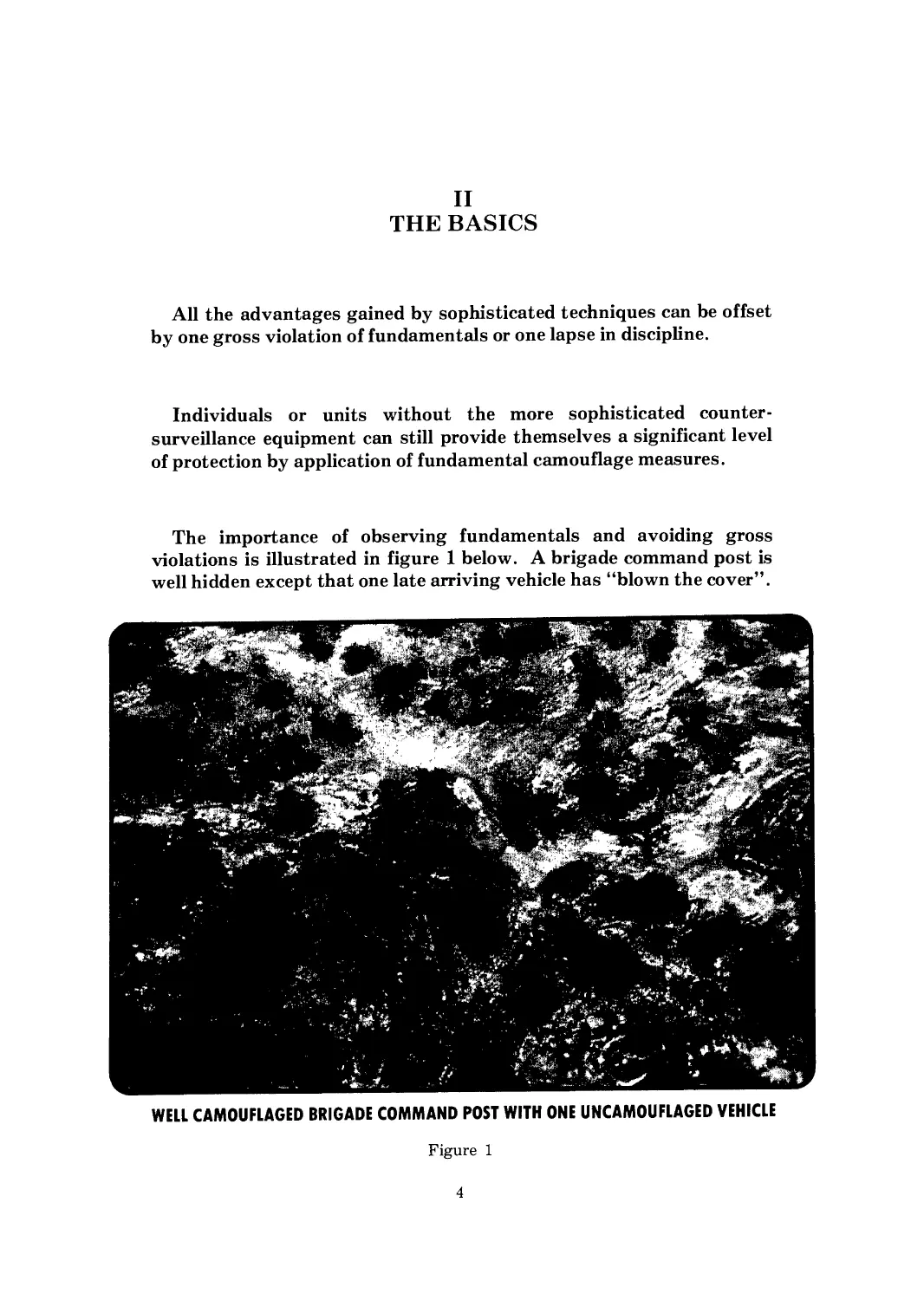
The importance of observing fundamentals and avoiding gross
violations is illustrated in figure 1 below. A brigade command post is
well hidden except that one late arriving vehicle has “blown the cover”.
WELL CAMOUFLAGED BRIGADE COMMAND POST WITH ONE UNCAMOUFLAGED VEHICLE
Figure 1
4
TRADOC BULLETIN NO. 6  Chopfer II
UNITS THAT EMPLOY THE SOPHISTICATED EQUIPMENT AND
TECHNIQUES BUT DISREGARD THE FUNDAMENTALS OF SITING
AND DISCIPLINE WILL BE DETECTED.
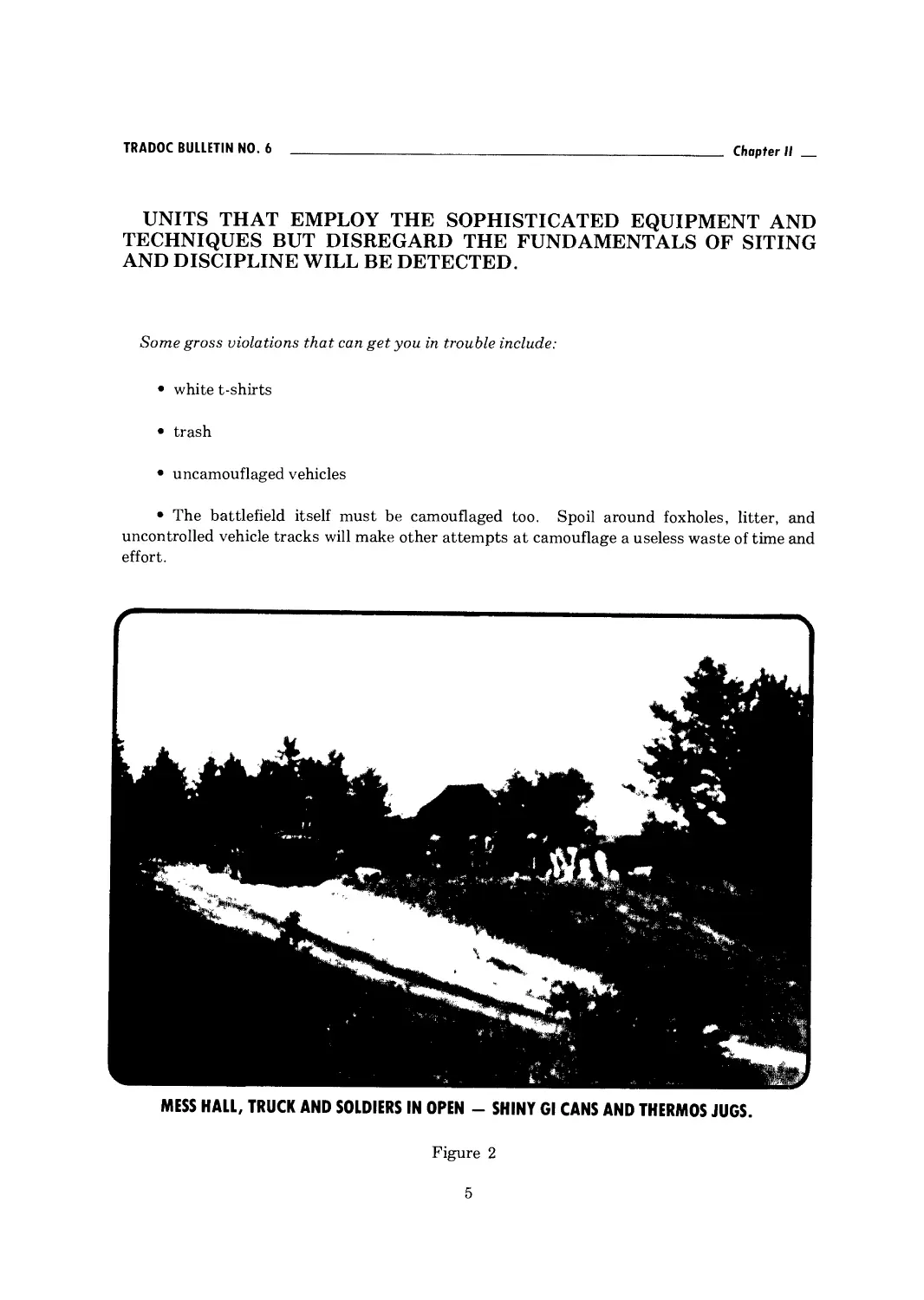
Some gross violations that can get you in trouble include:
•	white t-shirts
•	trash
•	uncamouflaged vehicles
•	The battlefield itself must be camouflaged too. Spoil around foxholes, litter, and
uncontrolled vehicle tracks will make other attempts at camouflage a useless waste of time and
effort.
MESS HALL, TRUCK AND SOLDIERS IN OPEN - SHINY Gl CANS AND THERMOS JUGS.
Figure 2
5
_ Chapter II	...... ............... TRADOC BULLETIN NO. 6
The fundamental principles of camouflage must be observed.
The eye is still the most numerous and responsive sensor on the battlefield. Therefore,
camouflage must first seek to confuse the eye.
The basic way to confuse the eye of the observer is by
countering the factors of recognition from which he
derives his information.
(1)	Color provides contrast between an object and its background. Generally lighter,
brighter shades attract more attention than darker shades. Use of colors that blend in with the
surroundings is probably the most basic of the fundamentals of camouflage.
(2)	Shape provides the distinctive outlines of well known objects. Because shapes have
become familiar through experience, the object can be identified long before all its details are
identified. Guns, tanks (even individual soldiers) all have characteristic shapes which must be
hidden or disguised as part of camouflage.
(3)	Texture is the relative smoothness or roughness of a surface and it affects how much
light an object reflects or absorbs and whether it appears light or dark. Lack of texture causes
shine, which is extremely revealing. Attainment of proper texture is critical infield camouflage
operations.
(4)	Movement is dangerous, not so much because it allows identification, but rather because
it attracts the attention of the observer. The eye responds to motion even when not looking
directly at the moving object. Obviously the unit can’t remain motionless and accomplish the
mission in many cases, but unnecessary and careless movement is a definite breach of
camouflage discipline.
(5)	Position is the relative space relation of an object to its surroundings. Generally this
applies to large objects such as a barge parallel to a river bank. In forward unit situations,
position will be countered by good siting.
(6)	Shadow is principally a projection of shape. Shadow is primarily detected by aerial
observation, and in a fast-moving tactical situation will normally be countered by those
measures which counter shape.
These identifiers are countered by proper siting, pattern painting, the lightweight screening
system and smoke, as well as by adherence to camouflage fundamentals.
6
Ill
THREATS
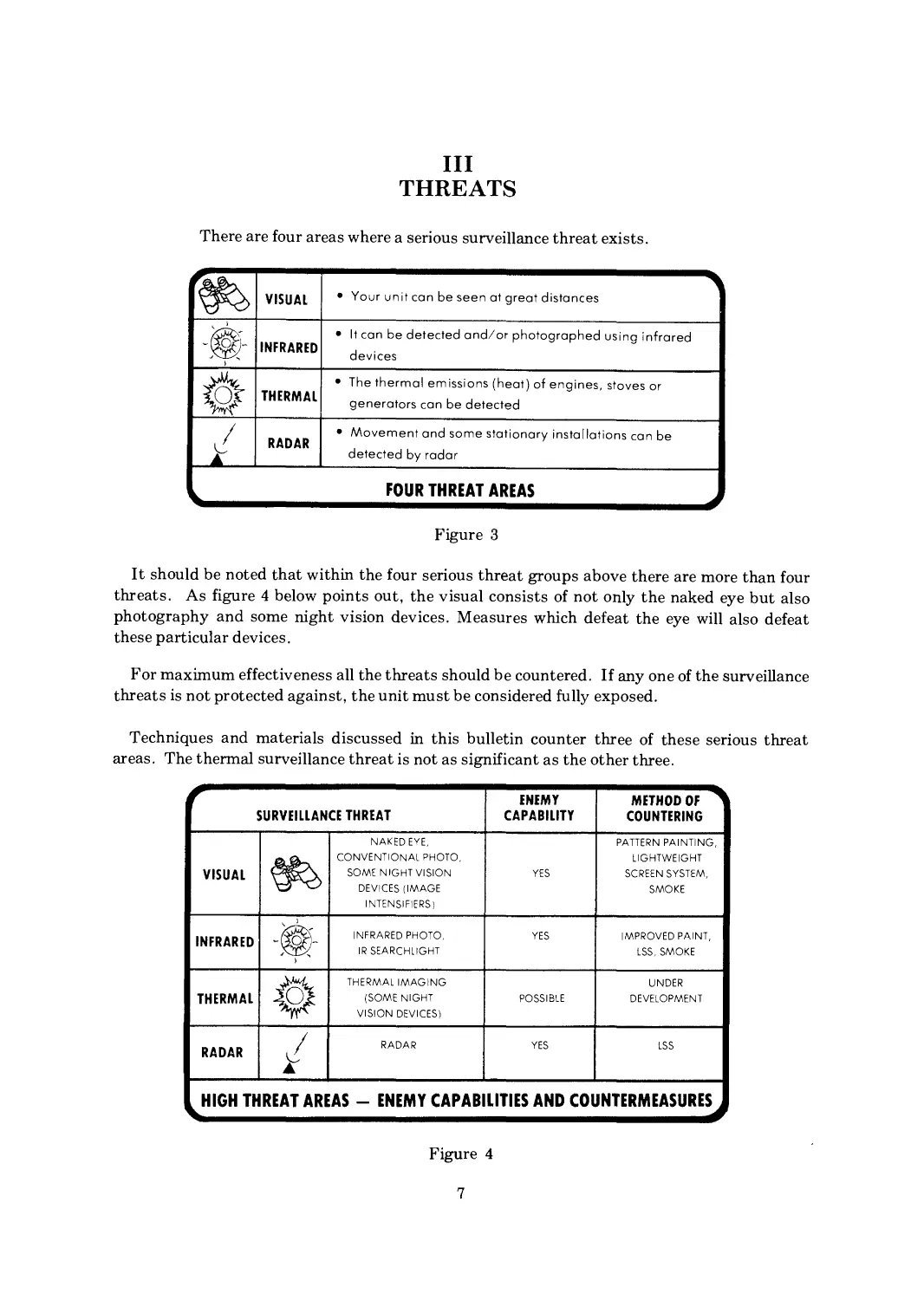
There are four areas where a serious surveillance threat exists.
VISUAL
INFRARED
THERMAL
RADAR
•	Your unit con be seen at great distances
•	It can be detected and/or photographed using infrared
devices
•	The thermal emissions (heat) of engines, stoves or
generators can be detected
•	Movement and some stationary installations can be
detected by radar
FOUR THREAT AREAS
Figure 3
It should be noted that within the four serious threat groups above there are more than four
threats. As figure 4 below points out, the visual consists of not only the naked eye but also
photography and some night vision devices. Measures which defeat the eye will also defeat
these particular devices.
For maximum effectiveness all the threats should be countered. If any one of the surveillance
threats is not protected against, the unit must be considered fully exposed.
Techniques and materials discussed in this bulletin counter three of these serious threat
areas. The thermal surveillance threat is not as significant as the other three.
SURVEILLANCE THREAT			ENEMY CAPABILITY	METHOD OF COUNTERING
VISUAL		NAKED EYE, CONVENTIONAL PHOTO, SOME NIGHT VISION DEVICES (IMAGE INTENSIFIERS)	YES	PATTERN PAINTING, LIGHTWEIGHT SCREEN SYSTEM, SMOKE
INFRARED	I	INFRARED PHOTO, IR searchlight	YES	IMPROVED PAINT, LSS. SMOKE
THERMAL		THERMAL IMAGING (SOME NIGHT VISION DEVICES)	POSSIBLE	UNDER DEVELOPMENT
RADAR		RADAR	YES	LSS
kHIGH THREAT AREAS - ENEMY CAPABILITIES AND COUNTERMEASURES^
Figure 4
7
_ Chapter III TRADOC BULLETIN NO. 6
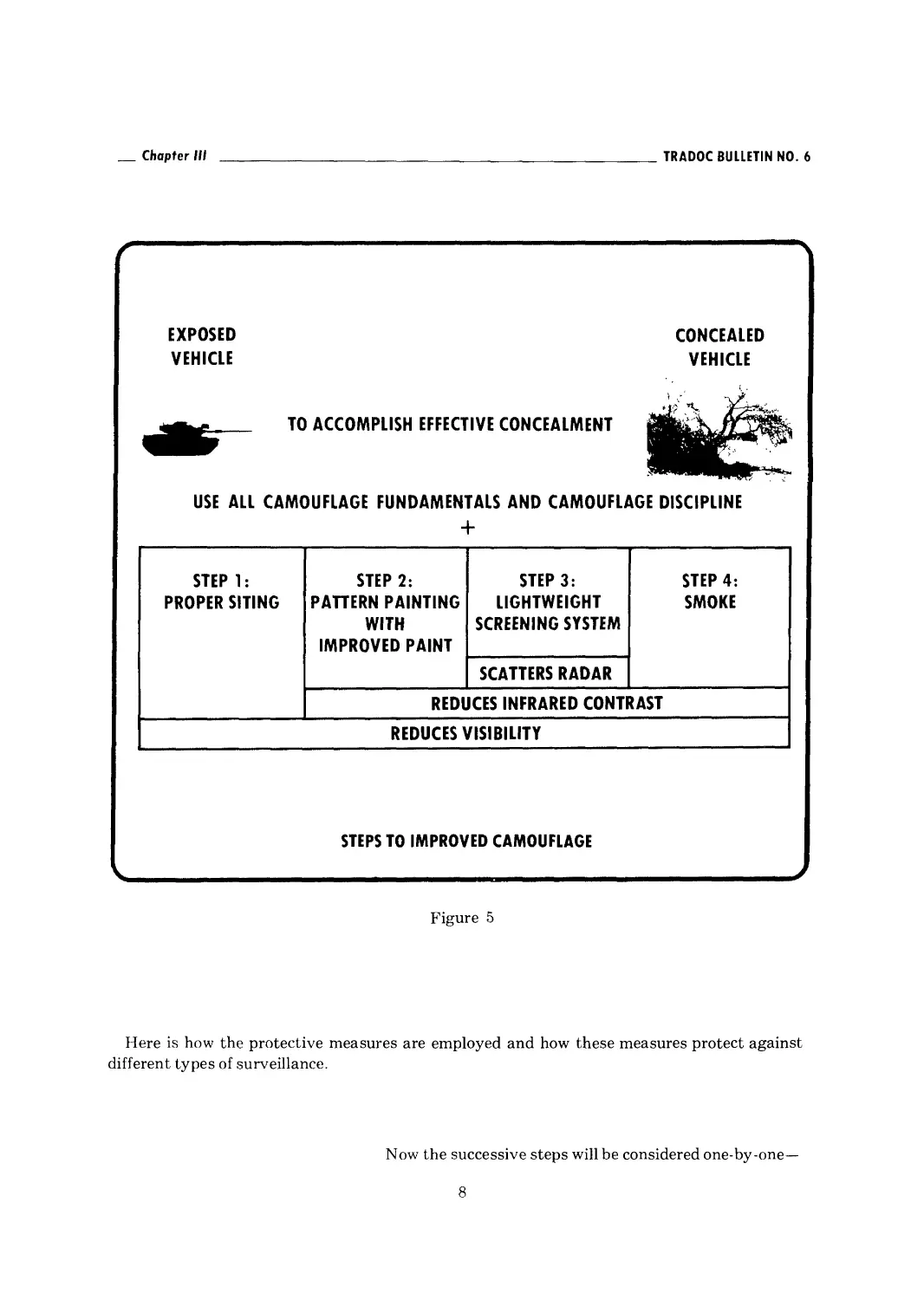
EXPOSED
VEHICLE
CONCEALED
VEHICLE
USE ALL CAMOUFLAGE FUNDAMENTALS AND CAMOUFLAGE DISCIPLINE
+
STEP 1: PROPER SITING	STEP 2: PATTERN PAINTING WITH IMPROVED PAINT	STEP3: LIGHTWEIGHT SCREENING SYSTEM SCATTERS RADAR	STEP 4: SMOKE
	REDUCES INFRARED CONTRAST
REDUCES VISIBILITY
STEPS TO IMPROVED CAMOUFLAGE
Figure 5
Here is how the protective measures are employed and how these measures protect against
different types of surveillance.
Now the successive steps will be considered one-by-one—
8
IV
PROPER SITING
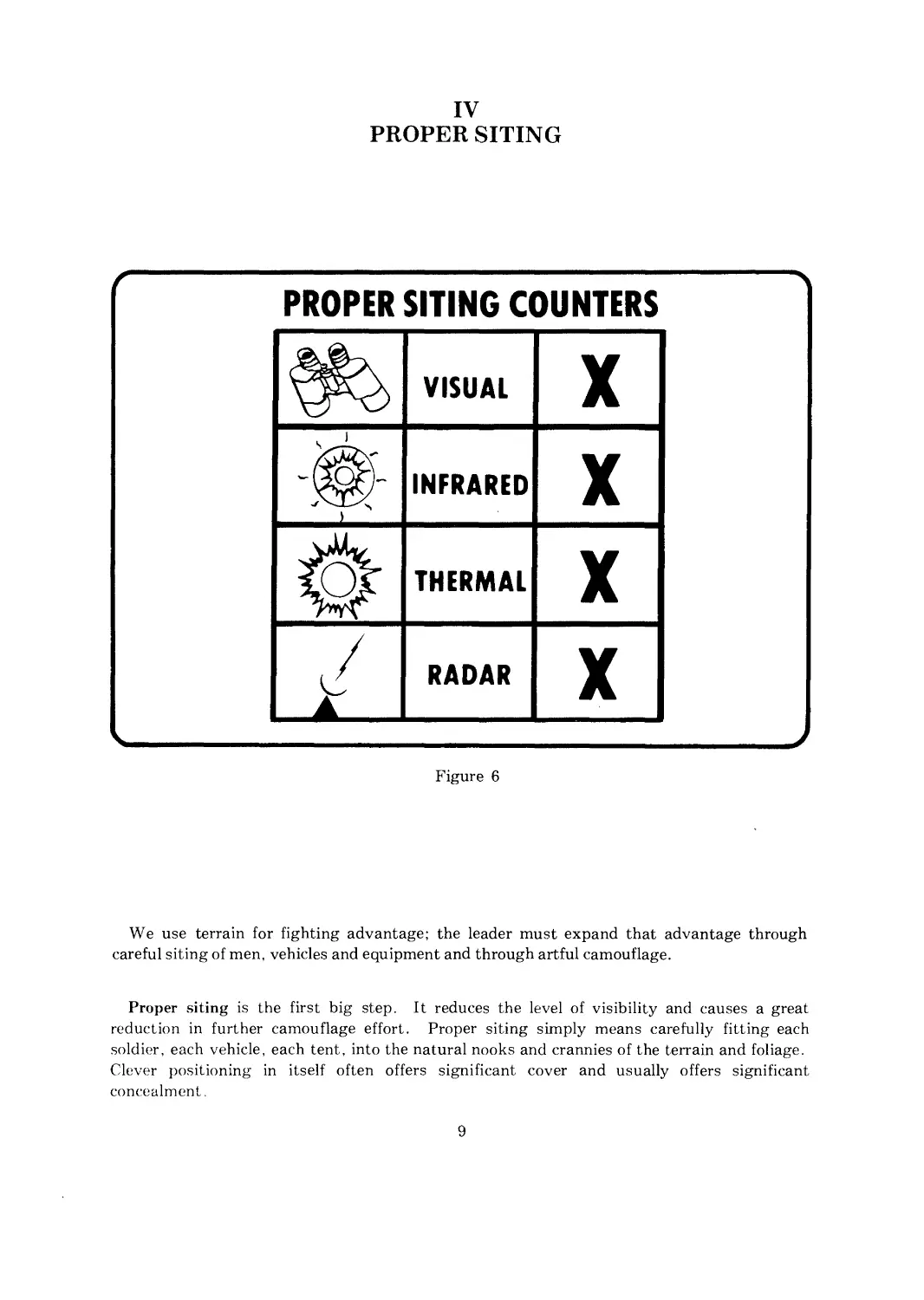
PROPER SITING COUNTERS
Figure 6
We use terrain for fighting advantage; the leader must expand that advantage through
careful siting of men, vehicles and equipment and through artful camouflage.
Proper siting is the first big step. It reduces the level of visibility and causes a great
reduction in further camouflage effort. Proper siting simply means carefully fitting each
soldier, each vehicle, each tent, into the natural nooks and crannies of the terrain and foliage.
Clever positioning in itself often offers significant cover and usually offers significant
concealment.
9
V
PATTERN PAINTING
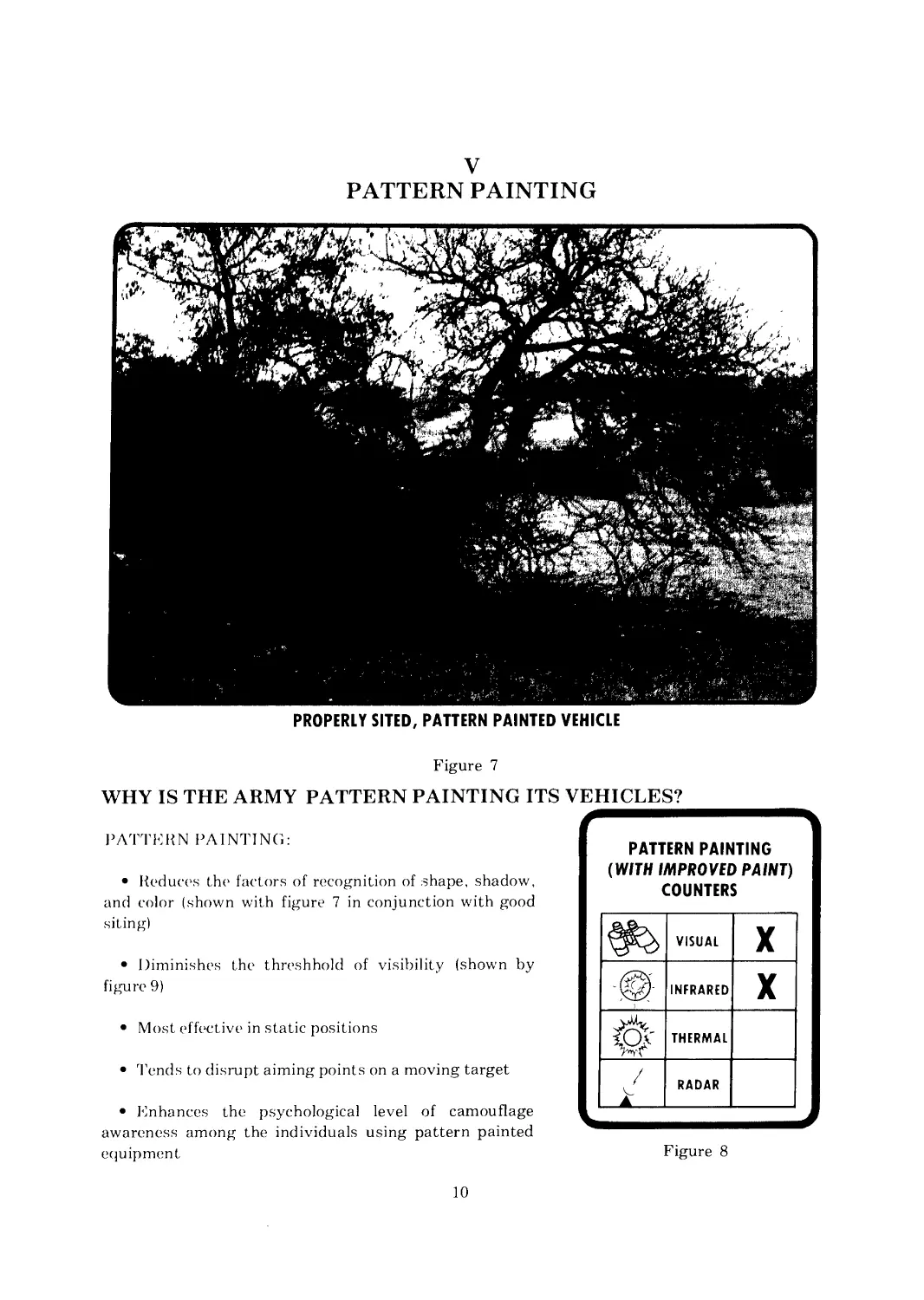
PROPERLY SITED, PATTERN PAINTED VEHICLE
Figure 7
WHY IS THE ARMY PATTERN PAINTING ITS VEHICLES?
10
TRADOC BULLETIN NO. 6  Chapter V _
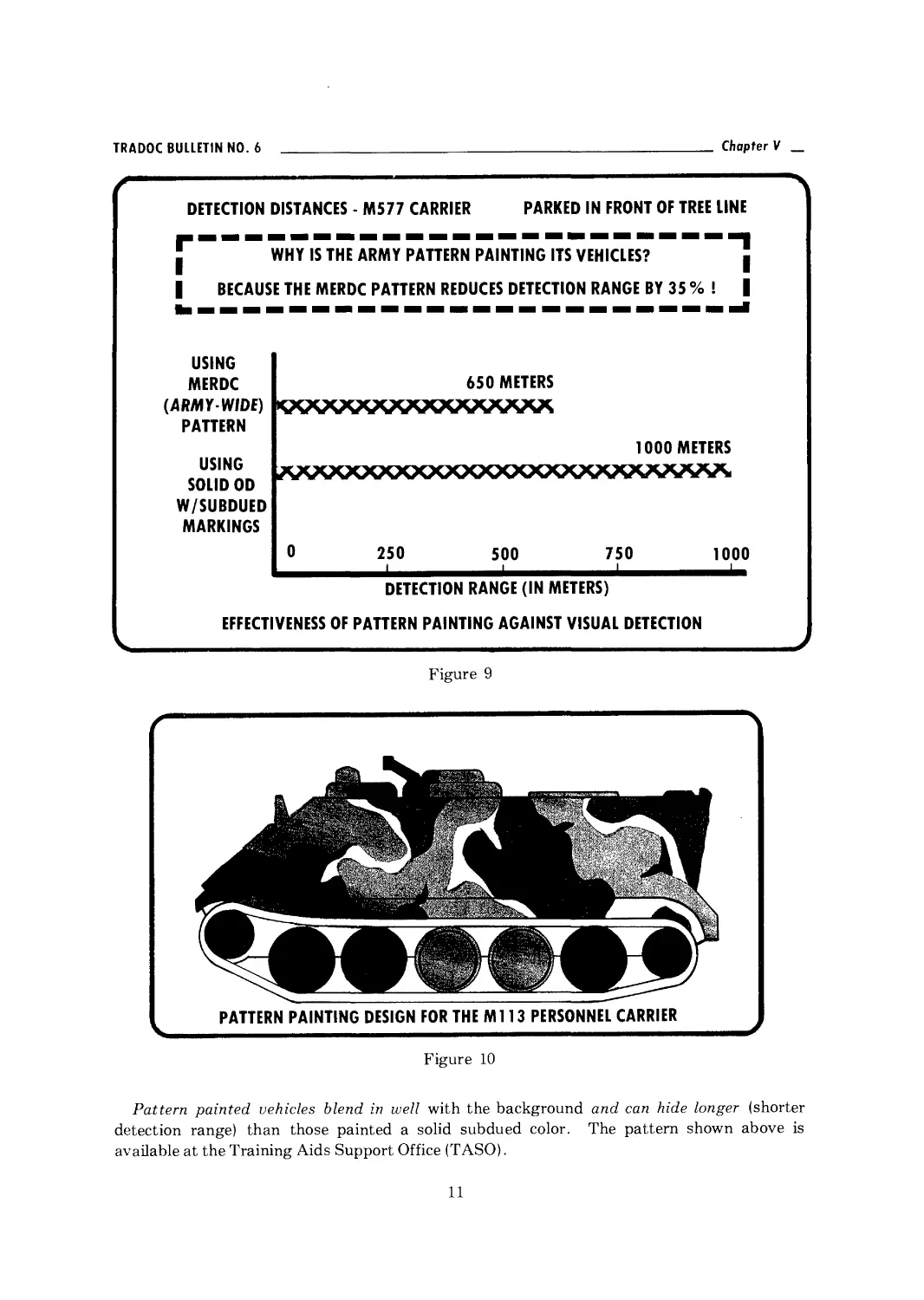
DETECTION DISTANCES - M577 CARRIER PARKED IN FRONT OF TREE LINE
Г WHY IS THE ARMY PATTERN PAINTING ITS VEHICLES?	।
| BECAUSE THE MERDC PATTERN REDUCES DETECTION RANGE BY 35 % I I
EFFECTIVENESS OF PATTERN PAINTING AGAINST VISUAL DETECTION
4_____________________________________________________________________________________/
Figure 9
Figure 10
Pattern painted vehicles blend in well with the background and can hide longer (shorter
detection range) than those painted a solid subdued color. The pattern shown above is
available at the Training Aids Support Office (TASO).
11
___ Chapter V  TRADOC BULLETIN NO. 6
IMPROVED CAMOUFLAGE PAINT
No matter how good a pattern may be, if it is applied with ordinary paint it only provides
protection against visual detection. A key point of the DA directed pattern painting program
is that the new patterns, applied with improved camouflage paint, protect against infrared
detection devices as well.
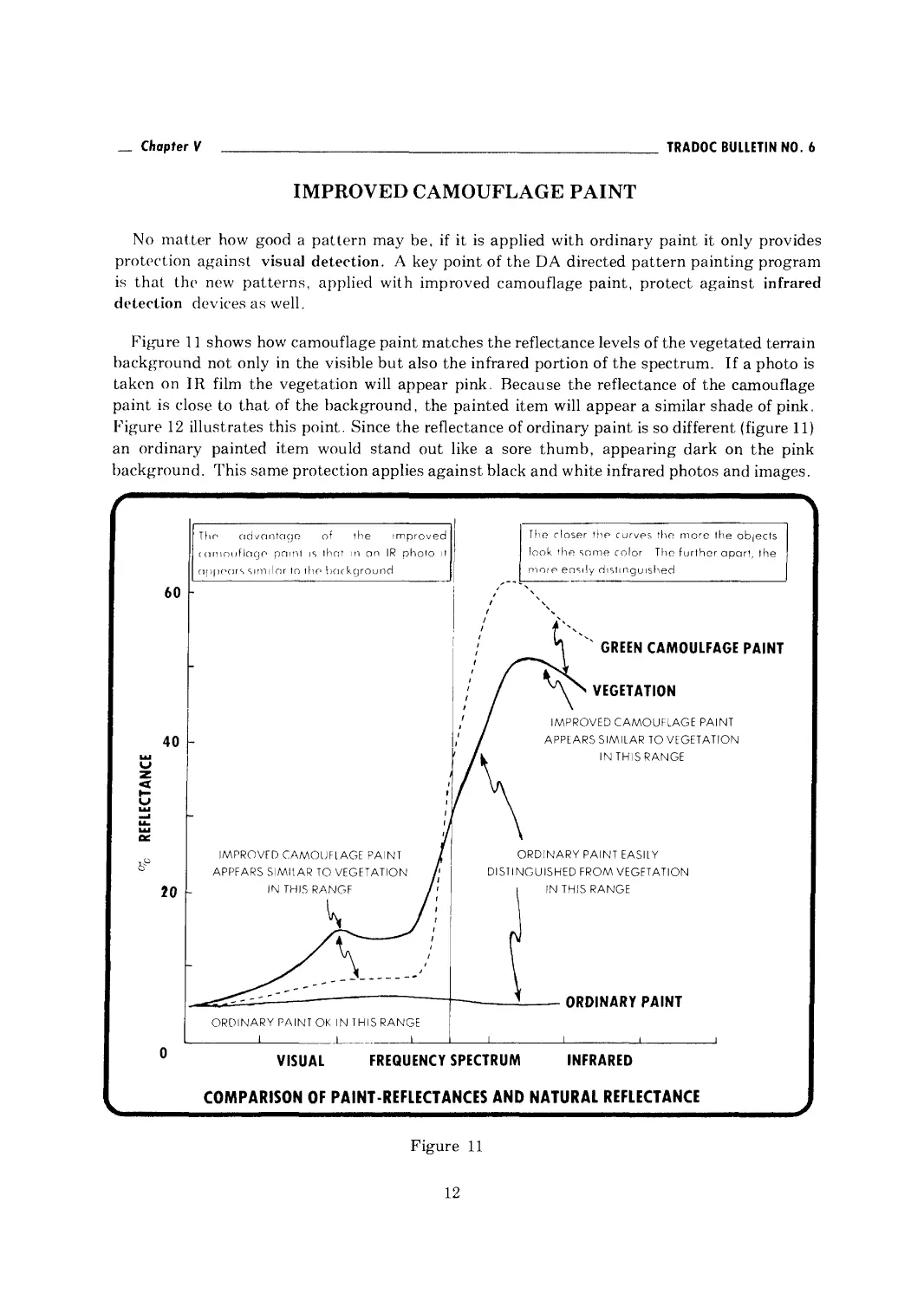
Figure 11 shows how camouflage paint matches the reflectance levels of the vegetated terrain
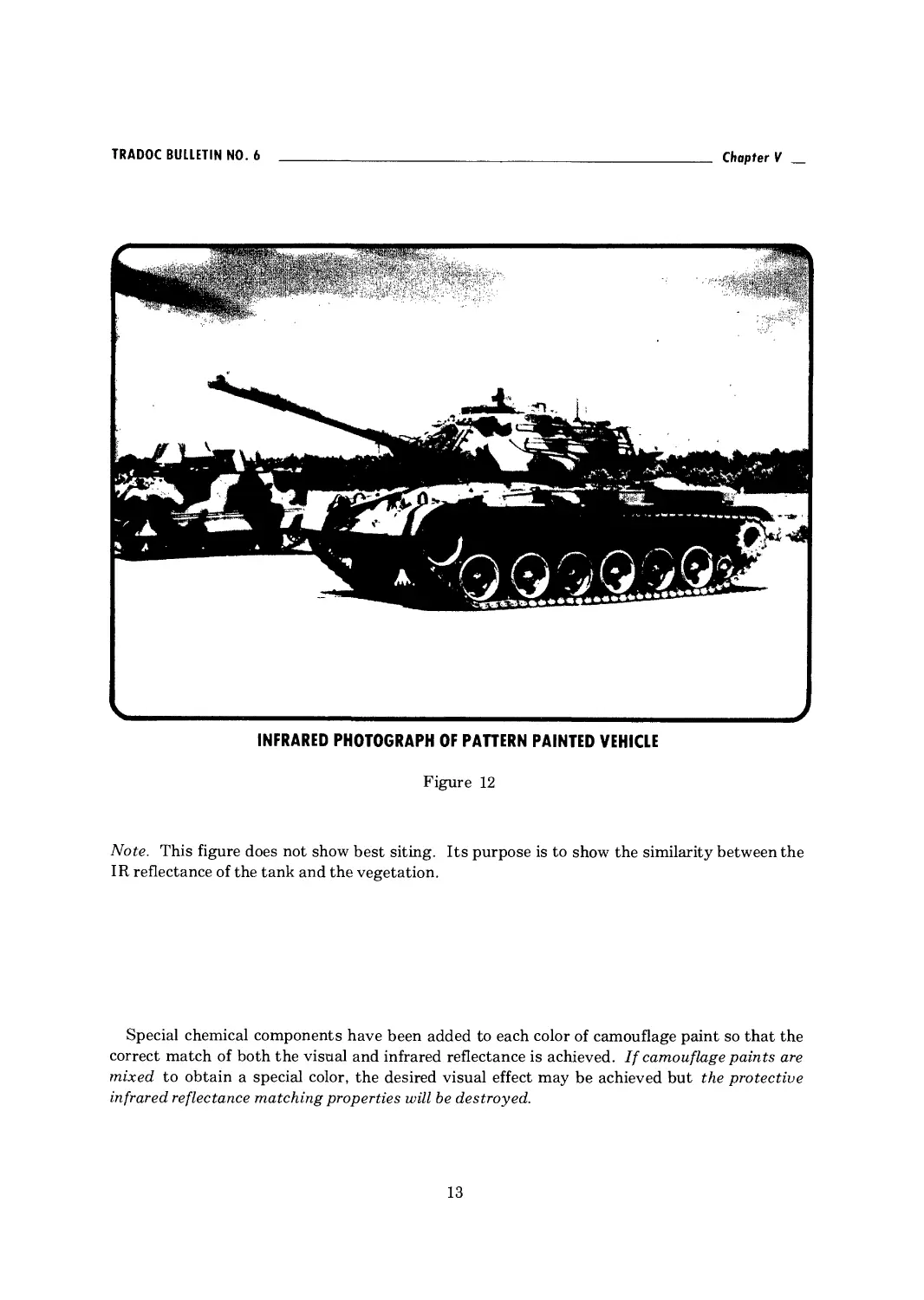
background not only in the visible but also the infrared portion of the spectrum. If a photo is
taken on IR film the vegetation will appear pink. Because the reflectance of the camouflage
paint is close to that of the background, the painted item will appear a similar shade of pink.
Figure 12 illustrates this point. Since the reflectance of ordinary paint is so different (figure 11)
an ordinary painted item would stand out like a sore thumb, appearing dark on the pink
background. This same protection applies against black and white infrared photos and images.
Figure 11
12
TRADOC BULLETIN NO. 6  Chapter V
INFRARED PHOTOGRAPH OF PATTERN PAINTED VEHICLE
Figure 12
Note. This figure does not show best siting. Its purpose is to show the similarity between the
IR reflectance of the tank and the vegetation.
Special chemical components have been added to each color of camouflage paint so that the
correct match of both the visual and infrared reflectance is achieved. If camouflage paints are
mixed to obtain a special color, the desired visual effect may be achieved but the protective
infrared reflectance matching properties will be destroyed.
13
VI
LIGHTWEIGHT SCREENING SYSTEM
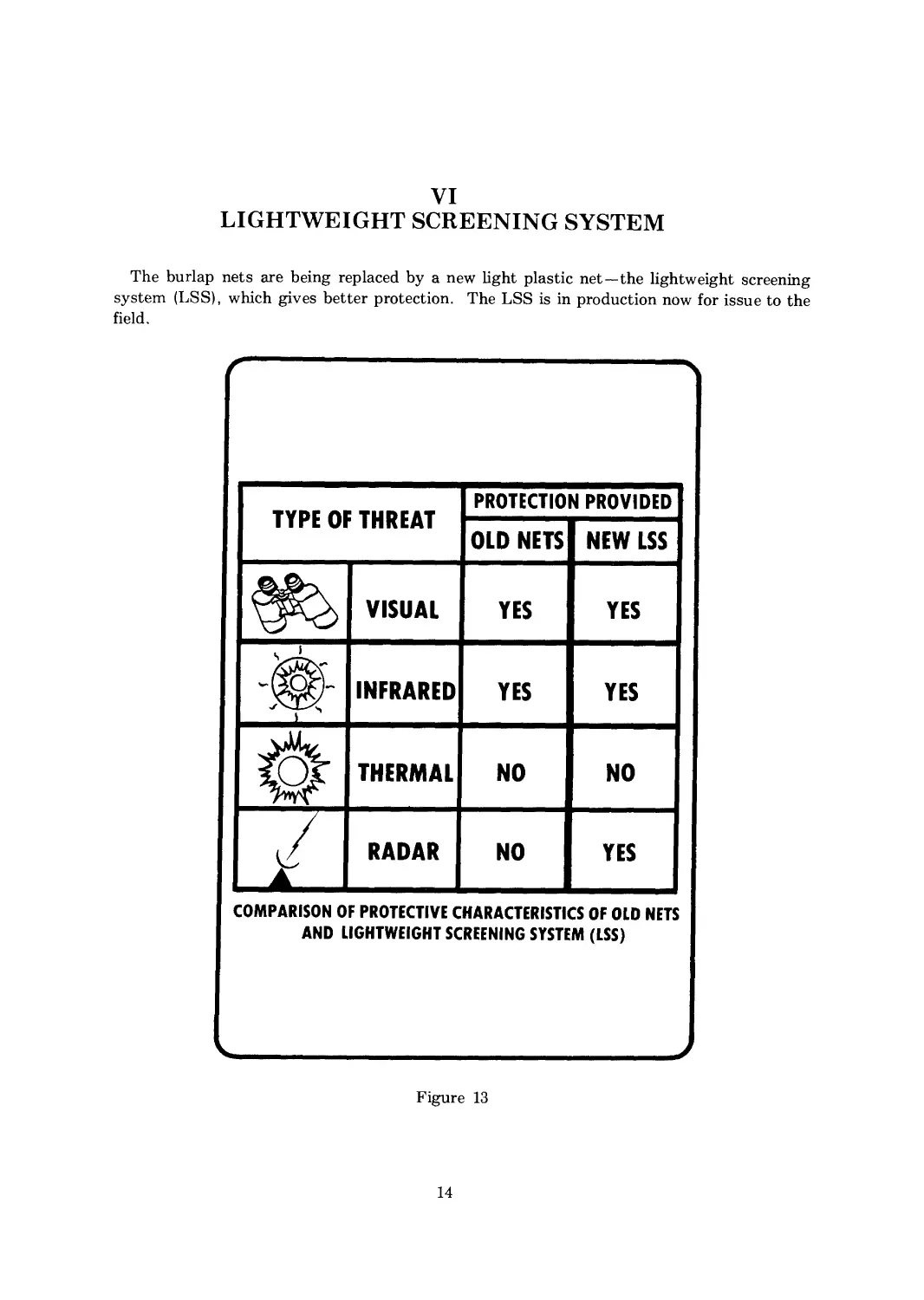
The burlap nets are being replaced by a new light plastic net—the lightweight screening
system (LSS), which gives better protection. The LSS is in production now for issue to the
field.
TYPE OF THREAT
PROTECTION PROVIDED
OLD NETS
NEW LSS
VISUAL
INFRARED
THERMAL
RADAR
YES
YES
YES
YES
NO
NO
NO
YES
COMPARISON OF PROTECTIVE CHARACTERISTICS OF OLD NETS
AND LIGHTWEIGHT SCREENING STSTEM (LSS)
Figure 13
14
TRADOC BULLETIN NO, 6  Chapter VI _
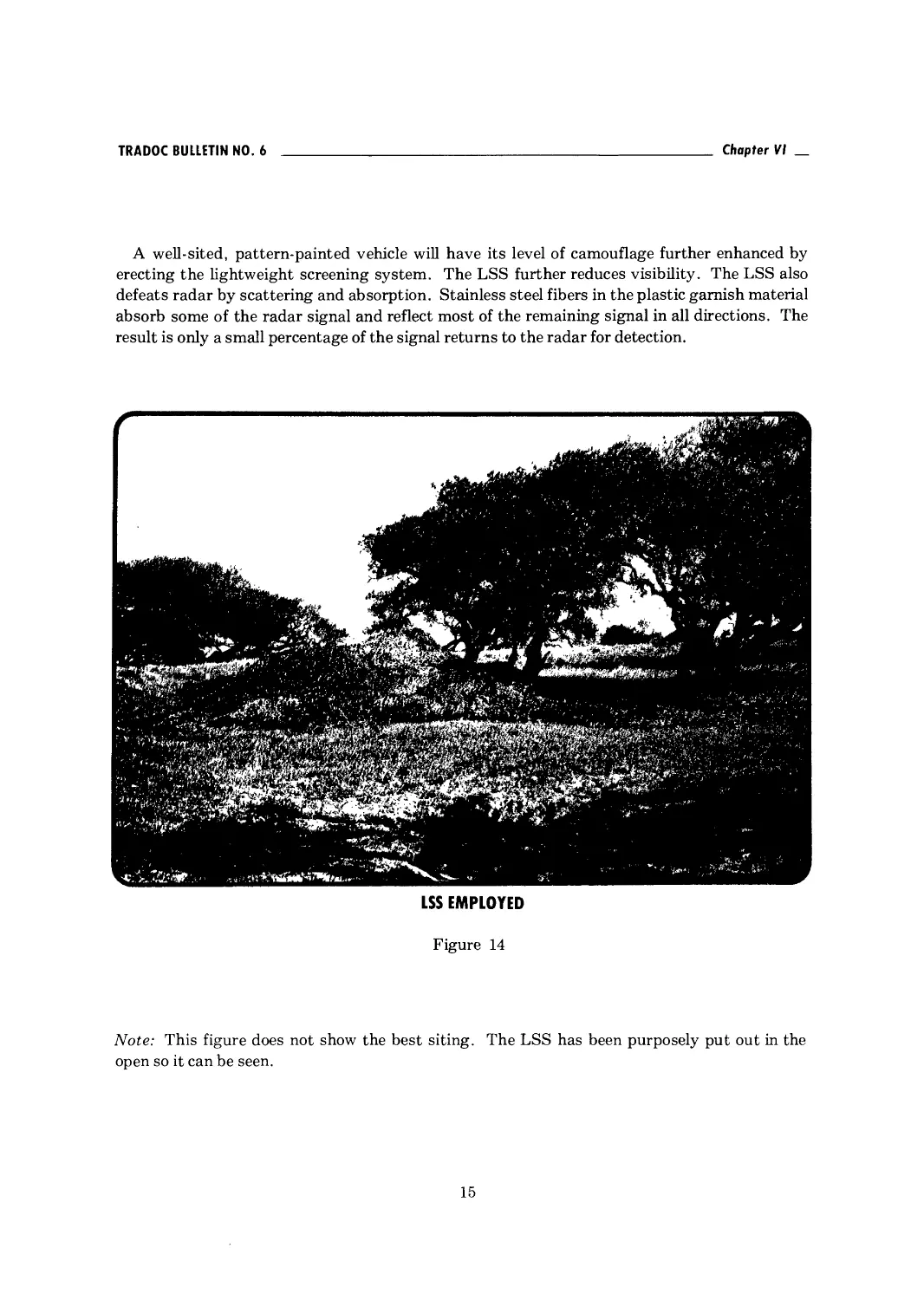
A well-sited, pattern-painted vehicle will have its level of camouflage further enhanced by
erecting the lightweight screening system. The LSS further reduces visibility. The LSS also
defeats radar by scattering and absorption. Stainless steel fibers in the plastic garnish material
absorb some of the radar signal and reflect most of the remaining signal in all directions. The
result is only a small percentage of the signal returns to the radar for detection.
LSS EMPLOYED
Figure 14
Note: This figure does not show the best siting. The LSS has been purposely put out in the
open so it can be seen.
15
— Chapter VI TRADOC BULLETIN NO. 6
Since a radar scattering net placed over a radar set would make the set useless, the LSS also
comes in a radar transparent model so that a radar set can be covered and hidden, but still
“see” through the screen.
Remember! Use the radar scattering LSS on everything except radar sets. Use the radar
transparent LSS on radar sets.
The LSS has many advantages over the “old” camouflage nets. It is:
•	lighter weight
•	more durable
•	reversable (seasonal)
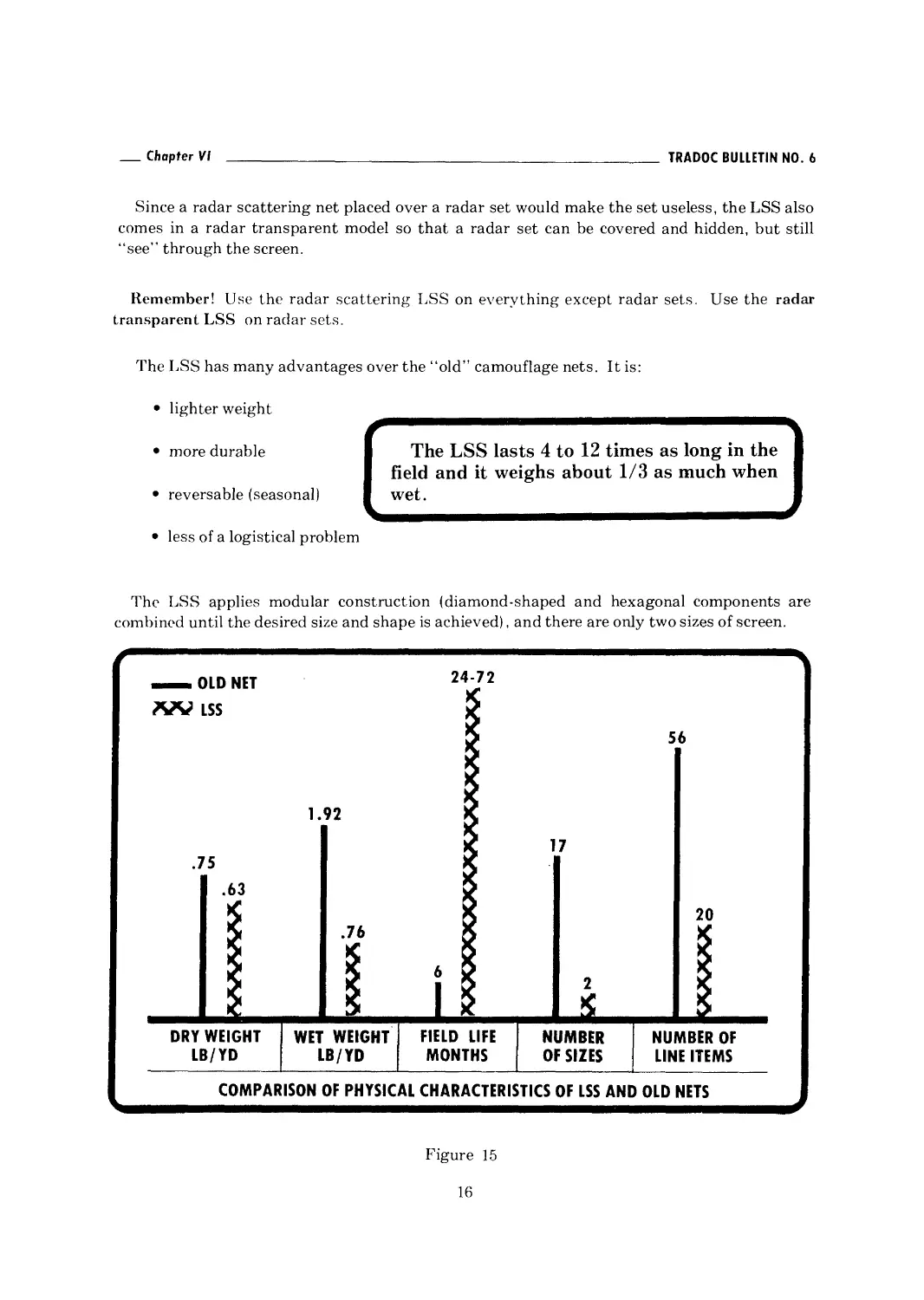
The LSS lasts 4 to 12 times as long in the
field and it weighs about 1/3 as much when
wet.
•	less of a logistical problem
The LSS applies modular construction (diamond-shaped and hexagonal components are
combined until the desired size and shape is achieved), and there are only two sizes of screen.
DRY WEIGHT WET WEIGHT FIELD LIFE
LB/YD	LB/YD MONTHS
NUMBER
OF SIZES
NUMBER OF
LINE ITEMS
COMPARISON OF PHYSICAL CHARACTERISTICS OF LSS AND OLD NETS
Figure 15
16
TRADOC BULLETIN NO. 6  Chapter VI
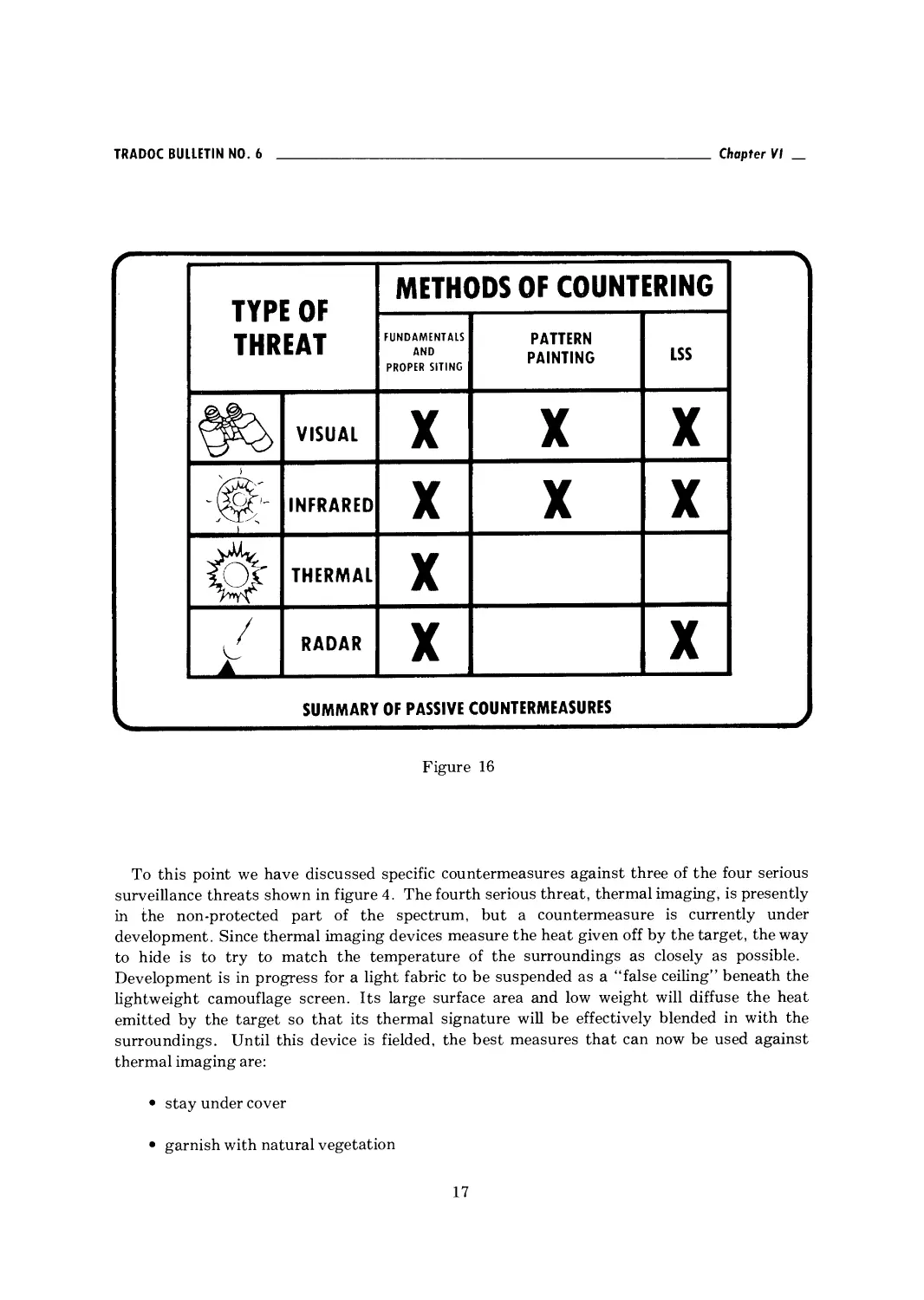
Figure 16
To this point we have discussed specific countermeasures against three of the four serious
surveillance threats shown in figure 4. The fourth serious threat, thermal imaging, is presently
in the non-protected part of the spectrum, but a countermeasure is currently under
development. Since thermal imaging devices measure the heat given off by the target, the way
to hide is to try to match the temperature of the surroundings as closely as possible.
Development is in progress for a light fabric to be suspended as a “false ceiling” beneath the
lightweight camouflage screen. Its large surface area and low weight will diffuse the heat
emitted by the target so that its thermal signature will be effectively blended in with the
surroundings. Until this device is fielded, the best measures that can now be used against
thermal imaging are:
•	stay under cover
•	garnish with natural vegetation
17
VII
SMOKE
Smoke is an ACTIVE countermeasure. Commanders should plan to use smoke to protect
their units from surveillance.
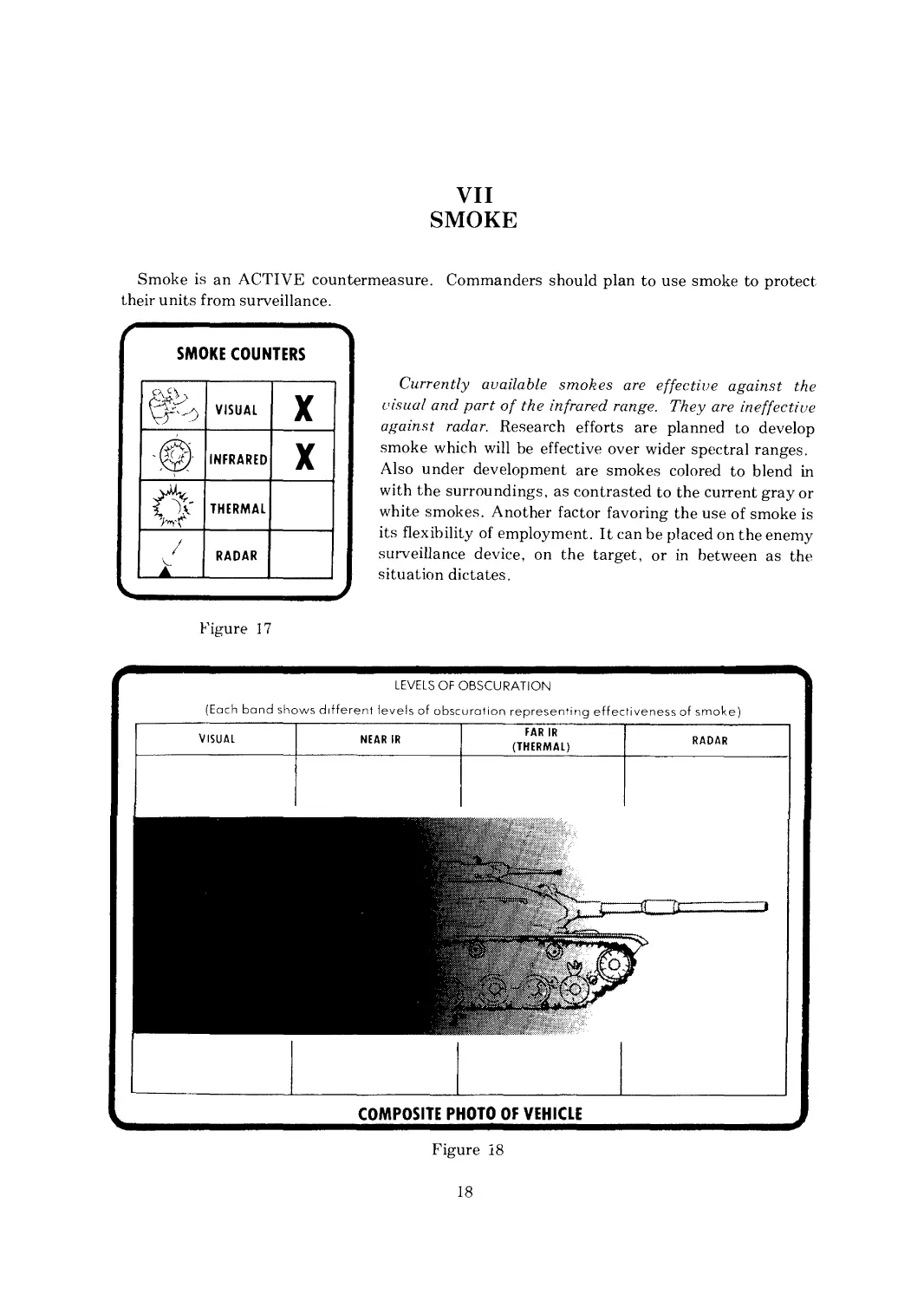
SMOKE COUNTERS
4
Currently available smokes are effective against the
visual and part of the infrared range. They are ineffective
against radar. Research efforts are planned to develop
smoke which will be effective over wider spectral ranges.
Also under development are smokes colored to blend in
with the surroundings, as contrasted to the current gray or
white smokes. Another factor favoring the use of smoke is
its flexibility of employment. It can be placed on the enemy
surveillance device, on the target, or in between as the
situation dictates.
Figure 17
Figure 18
18
VIII
SUMMARY
The 1973 Mid-East War showed the deadly power and accuracy of modern weaponry fully
engaged. The camouflage developments discussed in this bulletin, together with the
application of basic principles, and the enforcement of camouflage discipline are part of the
knowledge necessary to survive. Camouflage will help to win the first battle on the deadlier
than ever battlefield.
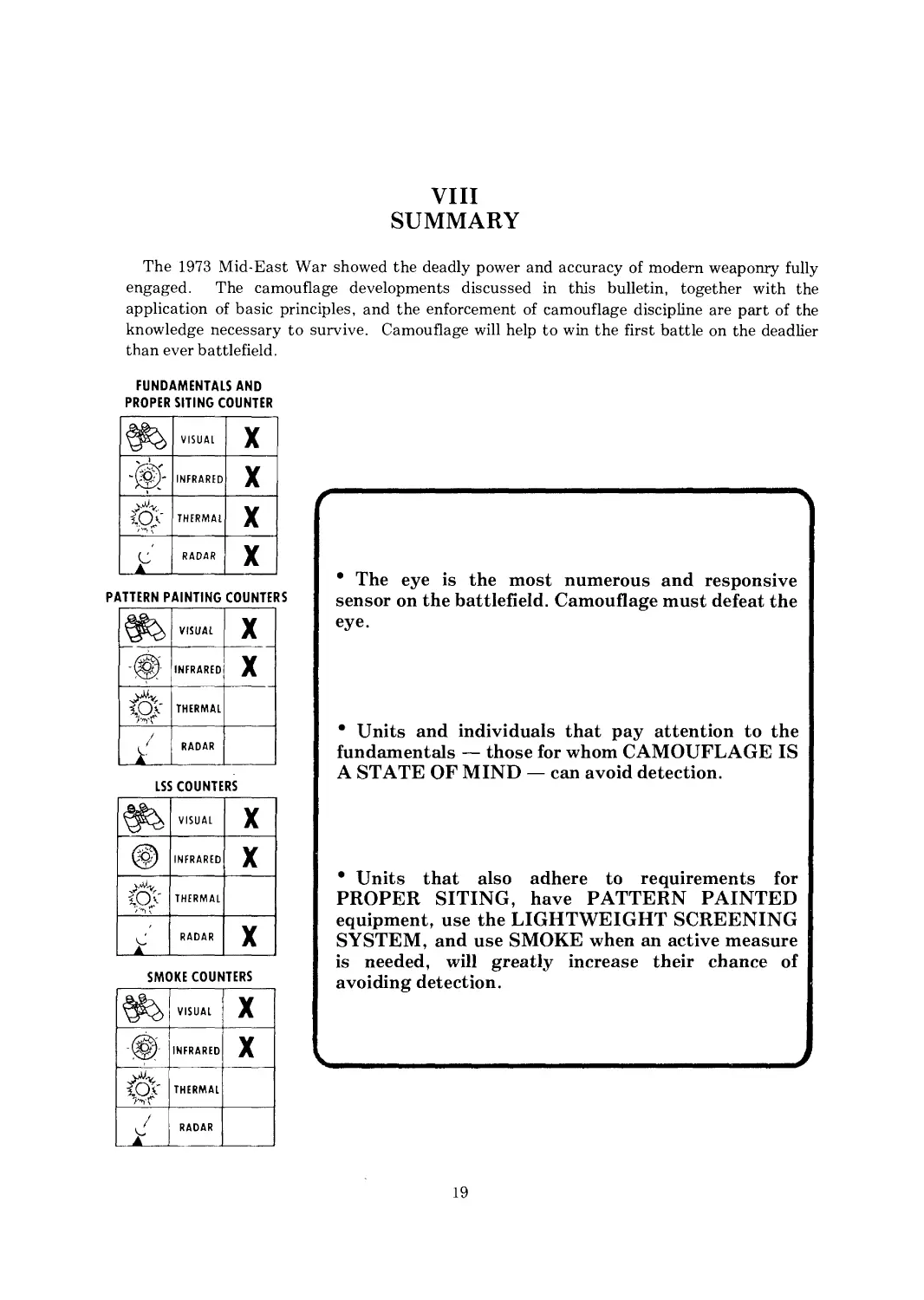
FUNDAMENTALSAND
PROPER SITING COUNTER
	VISUAL	X
	INFRARED	X
ICK-	THERMAL	X
	RADAR	X
Z
PATTERN PAINTING COUNTERS
	VISUAL	1 X
	INFRARED	X
	THERMAL
	RADAR
• The eye is the most numerous and responsive
sensor on the battlefield. Camouflage must defeat the
eye.
• Units and individuals that pay attention to the
fundamentals — those for whom CAMOUFLAGE IS
A STATE OF MIND — can avoid detection.
LSS COUNTERS
	VISUAL	X
©	INFRARED	X
<o>	THERMAL
	RADAR	X
SMOKE COUNTERS
	VISUAL	X
	INFRARED	X
Wr	THERMAL
/	RADAR
• Units that also adhere to requirements for
PROPER SITING, have PATTERN PAINTED
equipment, use the LIGHTWEIGHT SCREENING
SYSTEM, and use SMOKE when an active measure
is needed, will greatly increase their chance of
avoiding detection.
19
Chapter VIII  TRADOC BULLETIN NO. 6
Further Reading — A Guide to Camouflage Literature
As the importance of camouflage is being emphasized, the literature of camouflage is being
revitalized. FM 5-20 “CAMOUFLAGE” is being revised by the Command and General Staff
College and will be published as FM 100-25 “CAMOUFLAGE AND
COUNTERSURVEILLANCE.” This will be the basic doctrinal manual. Many of the
specific techniques of camouflage, as employed by those same front-line units for whom this
bulletin has discussed the principles, will be covered in the revision of TM 5-200,
“CAMOUFLAGE MATERIALS.” This manual will not only update material development
but will also contain discussion of larger-scale, more specialized camouflage tasks performed by
engineers rather than maneuver units. The camouflage literature is completed by TC 21-75,
“DON’T GET HIT,” a booklet for the individual soldier, recently published by the Combined
Arms Training Board, and TC 5-200, “CAMOUFLAGE PATTERN PAINTING,” which
contains the instructions for the initial pattern painting of Army vehicles.
This bulletin was prepared by the US Army Engineer School. If as a result of reading this
bulletin, there is more you’d like to know or if you have an idea to share, address your
comments to:
Commandant
US Army Engineer School
ATTN: ATSE-CTD-DT-TL
Fort Belvoir, Virginia 22060
TRAINERS NOTE:
Each TASO has master copies of the diagrams and pictures in this Bulletin, from which you
can order slides for use in schools or other training.
20
IX
APPENDIX—HOW TO ORDER TRADOC BULLETINS
(The next few pages are a reproduction of DA Cir 310-68)
CIRCULAR
No. 310-68
HEADQUARTERS
DEPARTMENT OF THE ARMY
Washington, DC, 15 October 1974
MILITARY PUBLICATIONS
TRADOC BULLETINS
1.	Introduction. Department of the Army announces a new series of publications called TRADOC Bulletins.
This circular explains the purpose, applicability and distribution of all TRADOC Bulletins and prescribes
the procedure for ordering them. TRADOC Bulletin Number 1 is now being published. Subsequent issues
are to be printed in FY 75 and following years.
2.	Purpose. A series of TRADOC
Bulletins will be published by HQ
TRADOC to provide commanders
timely technical information on
weapons, tactics and training
technique. It is not intended to
supplant doctrinal publications, but
to supplement material on “How to
fight” with data derived from tests,
recent intelligence, or other
sources, which probe “why?”
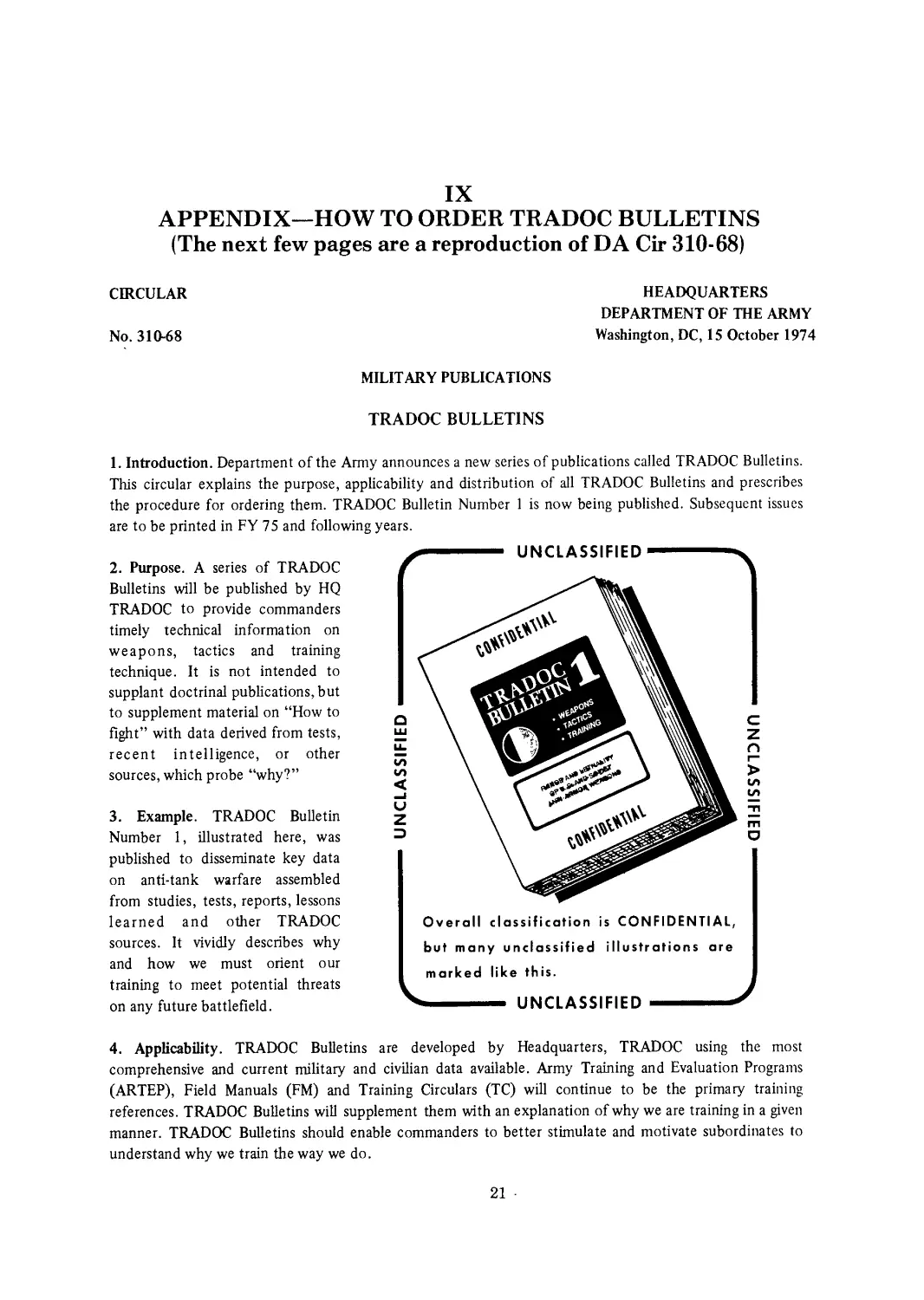
3.	Example. TRADOC Bulletin
Number 1, illustrated here, was
published to disseminate key data
on anti-tank warfare assembled
from studies, tests, reports, lessons
learned and other TRADOC
sources. It vividly describes why
and how we must orient our
training to meet potential threats
on any future battlefield.
Overall classification is CONFIDENTIAL,
but many unclassified illustrations are
marked like this.
* —....— UNCLASSIFIED —-
4.	Applicability. TRADOC Bulletins are developed by Headquarters, TRADOC using the most
comprehensive and current military and civilian data available. Army Training and Evaluation Programs
(ARTEP), Field Manuals (FM) and Training Circulars (TC) will continue to be the primary training
references. TRADOC Bulletins will supplement them with an explanation of why we are training in a given
manner. TRADOC Bulletins should enable commanders to better stimulate and motivate subordinates to
understand why we train the way we do.
21
Cir 310-68
5.	Distribution
a.	TRADOC Bulletin Number 1 The AG Publications Center will distribute TRADOC
Bulletin Number 1 to all battalion and higher level commanders. Those who have not received a
copy by 16 December 1974 should submit a DA Form 17 (Request for Publications and Blank
Forms) to the US Army AG Publications Center, 2800 Eastern Boulevard, Baltimore, MD
21220.
b.	Index of Series. TRADOC Bulletins will be cataloged in DA Pamphlet 310-3, “Index of
Doctrinal, Training and Organizational Publications.” The series will be numbered
consecutively and each TRADOC Bulletin will be announced at time of printing in the
information bulletin distributed to all pinpoint account holders by the US Army AG
Publications Center.
c.	Permanent Distribution. Pinpoint account holders receiving TRADOC Bulletin Number 1
from Baltimore will automatically receive two copies of all subsequent issues unless a DA Form
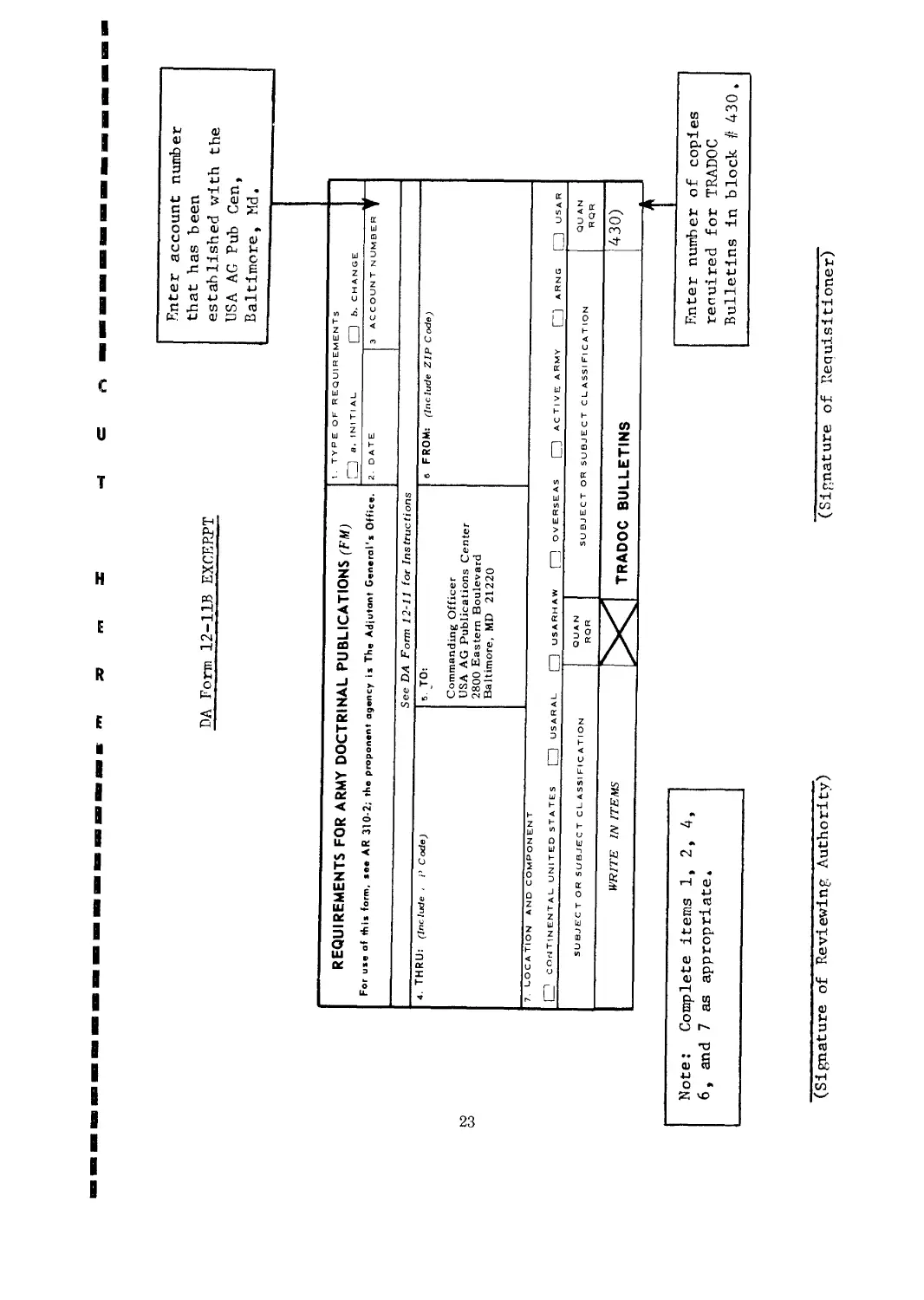
12-11 В is submitted to change that quantity. A return addressed excerpt of DA Form 12-1 IB is
provided at page 23 for use by those desiring to change that quantity and for others desiring to
be added to the permanent distribution list for TRADOC Bulletins. Units which are required to
submit publication requests through another headquarters should send the completed excerpt
through proper authority.
d.	Reference for Distribution Procedures. DA Pamphlet 310-10 explains the pinpoint
distribution system and how to establish or update an existing account at the US Army AG
Publications Center.
By Order of the Secretary of the Army:
FREDC. WEYAND
General, United States Army
Chief of Staff
Official:
VERNE E. BOWERS
Major General, United States Army
The Adjutant General
Distribution:
All accounts serviced by USA AG Publications Center, Baltimore, MD.
22
(Signature of Reviewing Authority)
(Signature of Requisitioner)
DEPARTMEHT OF THE ARMY
OFFICIAL BUSINESS
PENALTY FOR PRIVATE USE $300
Commander
US Army AG Publications Center
2800 Eastern Boulevard
Baltimore, Maryland 21220
POSTAGE AND FEES PAID
DEPARTMENT OF THE ARMY
DOD-314
I
I
I
I
I
I
I
I
I
I
I
I
I
I
c
и
T
H
(Fold and mail to above)
I
I
I
I
I
I
I
I
I
I
I
I
I
I
I
24	I
I
I
I
I
TRADOC BULLETIN 6
30 January 1976
W. E. DePUY
General, United States Army
Commanding
DISTRIBUTION:
To be distributed in accordance with DA Form 12-1 IB, requirements for TRADOC Bulletins
(Qty rqr block no. 430); plus all DA Form 12-11 accounts (2 copies each); plus DA Form
12-11 A, requirements for Camouflage (Qty rqr block no. 21). Additional copies can be
requisitioned (DA Form 17) from the US Army Adjutant General Publications Center, 2800
Eastern Boulevard, Baltimore, MD 21220.