/


Теги: fashion interview journalism the observer magazin
Год: 2024



Текст
                    Should we ban smartphones for children?
Fran Lebowitz: ‘I’m a very angry7 person* ‘My in-laws are so rightwing. Should 1 pick a fight?*
That’s why we are continuing to raise the bar on how we source our cocoa. We’ve developed an innovative programme aiming to improve the lives of cocoa-farming families and their environment.
Visit KitKat.co.uk/Break&for^Good to find out more
30 JUNE 2024
The Observer Magazine
In this
issue
Up front
5	Eva Wiseman Why the housing crisis can’t be papered over. Plus, the archive
7	This much I know American author and actor Fran T.ebowitz's life lessons

Features
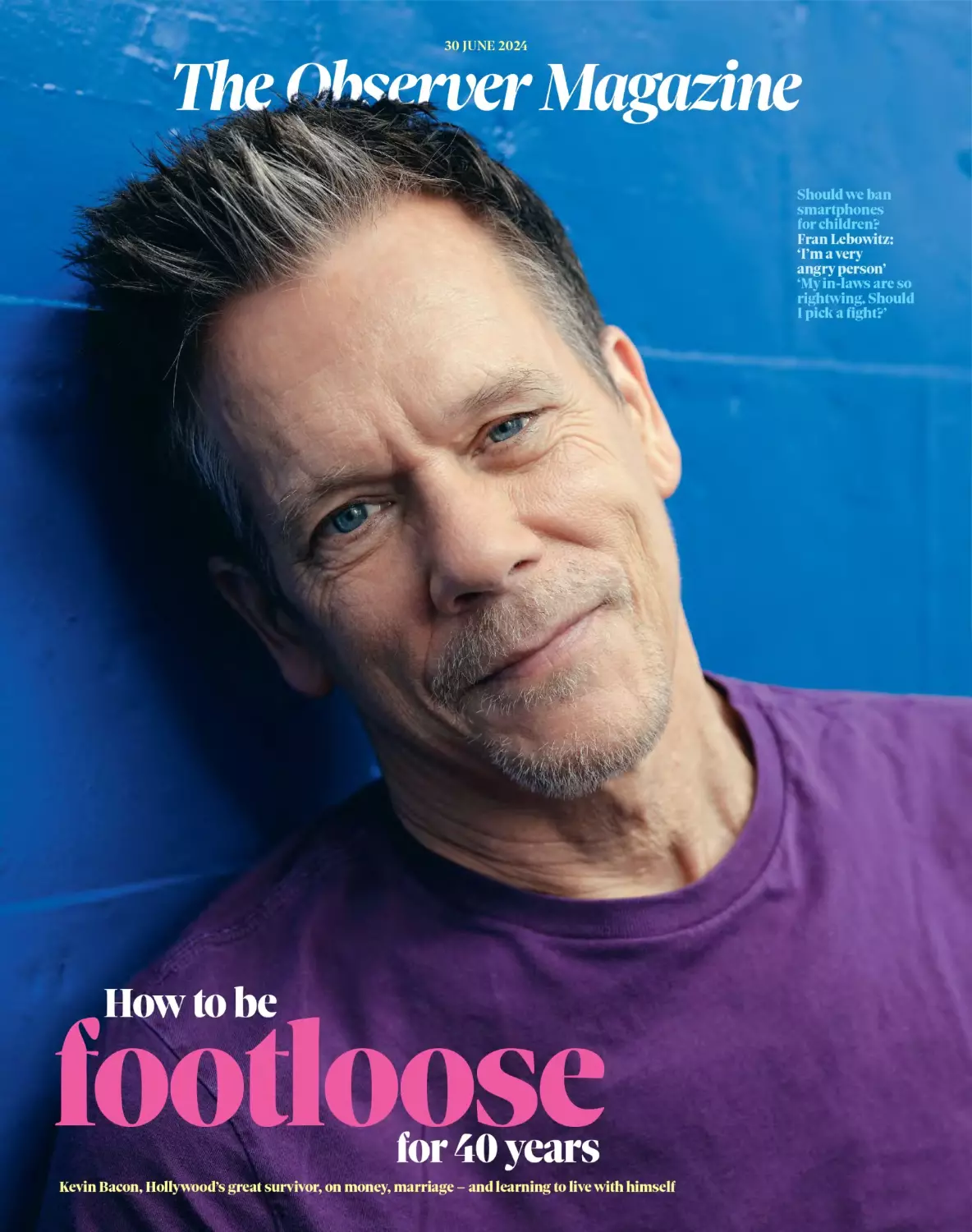
8	Six degrees Kevin Bacon on a life of making films, writing music and leaning into a more selfless way of being
12	Mixed blessings After years of prejudice and negative stereotyping, biracial people are finding pride in their mixed-race experience
16	Screen alert Meet the parents who hope to protect their young children from the tyranny of having a smartphone
Food & drink
18	Nigel Slater A sandwich-boosting pickle and a moreish gooseberry flapjack
22 Jay Rayner A west London pub that deserves a hero’s welcome. Plus, how politics affects the way wine is made
Fashion
24 Taking the plunge Swimwear to guarantee you a great day at the beach
Beauty
27 Small but perfect The best 10 travel minis to make a big impact on holiday
Interiors
28 Aussie rules A beautifully restrained art deco apartment in Sydney

Travel
31 Hit your groove Finding a 70s vibe in Paris’s bohemian quarter
Self & wellbeing
32 Going it alone How a solo retreat can recharge your batteries. Plus, tennis gear

Ask Philippa
34 “I can’t stomach my in-laws’ views on politics.” Plus, Sunday with the naturalist Steve Backshall
Contributors
Tom Lamont started out in
COVER: GROOMING KAT DRAZEN
journalism at Time Out, followed by years at the Observer.
He went freelance in 2014.
writing for numerous publications since then. His debut novel, Going Home, has just arrived in bookshops. Here, he interviews our cover star, Kevin Bacon (p8).
Novelist, beach hut dweller and fresh air enthusiast Lucy Clarke has published eight destination thrillers and her research trips have taken her
free-diving in Tasmania, sailing in the Philippines and hiking in Norway. After recently discovering the joys of a solo writing retreat, she's already plotting her next escape... Read all about it on p32.
New York-based photographer Chris Buck is known for his distinctive style: irreverent, smart and intimate. He shoots our cover star, Kevin Bacon (p8), finding him friendly, if a bit coy. Having admired his 35-year marriage with Kyra Sedgwick, the photographer asked for relationship tips. Bacon responded only with, 'Never ask celebrities for marriage advice.'
The (4™>rver Magazine
llmvio Ik
Л м Л W И M * flLfl W fl
for 40 yeiirs
Lrrta 1кав.Нл1у1Н«Г||г-а1пгтЬ«^а|	-id	tH’rthUorti
The Observer Magazine, Kings Place, 90 York Way, London N19GU (020 3353 2000) magazine^ observer.co.uk
Printed at Walstead Peterborough. Storey's Bar Road, Peterborough, PE15YS
Cover image
Chris Buck
The Observer Magazine 30.06.24
3
we have set ourselves the mission to go further with our support of cocoa farmers, their families, and the local environment.
Our Income Accelerator Programme takes an innovative family-centred approach that aims to close the living income gap and improve the livelihoods of cocoa farmers within our supply chain.
The result?
MORE 1(3 „
™ COCOA &
remwe FAMILIES
HELPING
KIDS'NTO^
SCHOOL*^
MORE TREES
PLANTED
SUSTAINABLY
or visit KitKat.co.uk/BreaksHfor-Good to find out more
Up front
PETER WILLIAMS
From the archive
A look back at the Observer Magazine’s past
‘When we set up the Common Market what was in the back of most of our minds was the COte d'Azur,’ declared the actor Robert Morley, introducing the Observer's exploration of Britons and the Med in 1976. His Riviera trips involved a regular 'ritual potter' around estate agents chasing a familiar Med fantasy: 'To wake each morning to the scent of mimosa, to breakfast outdoors...'
Morley's dream was relatable, but his holiday experiences were rarefied: inv ites to lunch at large, under-furnished, extravagantly shuttered mansions’ where esoteric mousses were served by gloved footmen.
It was the same world explored in an accompanying article on the Riviera hotels beloved of the British great and good, from Queen Victoria to Nodi Coward. Variously treated as 'a glorified wintering spa', venue for 'dissipated glamour' or the crucible of 'ennui chic', these grandes
dames that had witnessed all manner of scandal and extravagance were now mainly 'decaying slowly with an air of elegant abandon', or gone entirely.
Most people’s Med experience was closer to the 2,750,000 tourists a year who took Mallorcan package holidays. The finances made sense: a fortnight cost £95 for 'travel without tears, abroad without F
aggravation’. Courtesy of tour operator Cosmos, the journalist embedded with a group of Britons, viewed by locals as 'undemanding' but unadventurous.
According to Doris Stone of Maggie's Bar in Palma, 'The two things we sell most are beans and chips. We never stop cooking them.’
But was anything better than home? Despite the Med's magic, Morley was ambivalent: 'You have to get used to the French and, more important, they have to get used to you,' he declared: the cover picture was taken by his pool back home in Blighty. Emma Beddington
@evawiseman
Wiseman
We need more than trompc-l’oeil to fix our housing crisis
There was an interiors trend recently that saw people buying shower curtains printed with grand scenes of glamour and escape, and pinning them to their fence or bedroom walls. One was a lifesize picture of a manicured English garden, another of a winding cobbled path leading off into a lush green distance. Somebody hung a curtain printed with a window just above their bath, the window appearing to open on to a scene of blue and exquisite tranquillity. Someone else printed a huge photo of their childhood garden to hang opposite the sink in their kitchen.
I sifted through the various online responses to this trend, which ranged from outrage (at the laziness of not growing one’s own garden) to mockery, in order to work out why these shower curtains made me feel so terribly, doomily sad. On the surface, the trend should please me. Because, I am a person who loves all that stuff, all that fakery, all that razzmatazz, but it quickly hit me that the reason I felt odd about these trompe-l’oeil walls was because they expressed, on white hanging plastic, the impermanence of a home. Few people are willing to invest hours of time and cash in a garden they might have to leave at a few months’ notice simply because the landlord wants to increase the rent; far simpler to pin up a picture of one.
It made me think of the books and articles recently published that offered interior design ideas for those living in rented accommodation, suggesting clever ways with adhesive wall tiles for tenants to make their rented house feel like a home. And while I’m in awe of people who have the energy for a commitment like this, again the documents of such pursuits inspire in me a similar melancholy kind of love, seeing how much people are prepared to do to live a beautiful life, despite being morbidly aware of the increasing precariousness of their situation.
It is a horrible time to be a renter. Rents in the UK are at the highest rate on record. Over two-fifths of renters say they have no disposable income whatsoever, with private renters spending more than a third of their household income on rent (rising to 41% in London). Millions of people have no choice but to do so: in 2023, full-time workers in England could expect to pay around 8.3 times their annual earnings on buying a home. But once you find a suitable rental - a task made harder by a lack of homes built at a time when social housing stock has been sold off, or demolished and not replaced - and you hang a picture and make it lovely, you know there’s a risk your landlord might kick you out on a whim.
In London, w here renting is something of an extreme sport, there’s been a 52% rise in “no-fault” evictions in the past year. One impact of the rise in these evictions, and of the broken rental market as a whole, is that far fewer private renters are registered to vote. Dan Wilson Craw of the organisation Generation Rent says these people are at a disadvantage in the electoral system. “Short tenancies and frequent moves mean it is easy for private renters to inadvertently drop off the electoral
register between elections.’’ He calculates that around 70% of private renters have been forced to move home since 2019, and that more than 1 million renters are at risk of not having a vote in July.
Which led me to dig into what this election will mean for the housing crisis, and all its associated wounds. David Bogle in Inside Housing says: “Well, having had a look at what has been issued by the major parties in England, the answer is, ‘Don’t get your hopes up too much!”’ Only the Green party features housing and homelessness prominently in its manifesto (promising rent controls and 150,000 new social homes every year), but Labour does pledge to “overhaul the regulation of the private rented sector” and build 1.5m homes over five years.
Labour has also promised to empow er renters to “challenge unreasonable rent increases” and wants to extend “Awaab’s law7” on housing standards to include the private sector - this is legislation named after iwo-year-old Awaab Ishak, who died in 2020 due to poor housing conditions. What they’re not pledging, despite a poll for the i paper finding a significant majority of both Conservative and Labour voters support it, are rent controls.
In Scotland, where average private rents increased by 10.9% last year, the government is proposing rent control for tenants. Its benefits are regularly debated, but I find the prospect exciting - if implemented everywhere this has the potential to make renting not just more secure, but a genuine choice for the many millions who don’t own property7. It could also allow7 renters the chance to save to buy. Because at the moment, the closest many can get to a home of their own is a wipe-clean picture, pinned to next door’s fence.
One more thing...
Claire Lombardo's new novel, Some As It Ever Was, is a gorgeous, strange domestic drama that flows between timelines as we approach the wedding of our protagonist Julia's adult son. We are treated to her complicated and revelatory inner life. I loved it.
Related, I urge you to read poet Ella Frears's wild and dark new book. Goodlord, which takes the form of a stream-of-consciousness email written by a tenant to an estate agent. Here, property is a container for pain and nourishment, where hope is killed by a housing market that 'regenerates even as/ we try to pierce it'.
Naomi: In Fashion, an exhibition about Naomi Campbell, has just opened at the V&A, but perhaps because she was so involved in the show, even supplying her own captions, it seems to swerve all the interesting bits (such as her week of community service for reckless assault). I'd like more darkness included among the glamour.
The Observer Magazine 30.06.24
5
Live Happy
free kid’s place
SABTA
Travel with confidence
Final boarding call for holidays this summer.
SAVE UP TO £250 PER BOOKING*
Offers are correct at time of going to print 18/06/2024. *Free kids' place offer applies to new bookings only, or selected holidays subject to limited availability. Only 1 free kids' place is available in each selected hotel room or selected apartment type or villa with a minimum of 2 full paying adults. Other children must pay the full brochure price. You'll need to pay a deposit, but we deduct this from your final balance and will refund this when you pay for your holiday in full. If you change your booking, free child places on your new booking will depend on availability. Please see www.tui.co.uk or the relevant brochure for full booking terms and conditions that apply. ASave up to £250 per booking on TUI and First Choice package holidays. Price will automatically be applied on site and is valid for holidays with a TUI flight departing between 1st May 2024 - 31st October 2024. Saving is based on a minimum of 2 adults sharing between 1st May - 31st October 2024 for holidays that are 7,10,11 or 14 nights. No minimum spend required. Offer is valid from 1st June - 31st July 2024 across all sales channels. Offer does not apply to accommodation only, flight only solo travellers or 3rd party flight bookings. Offer is only valid for new bookings. Offer is for TUI and does not indude Crystal Ski, Marella or River Cruise. See www.tui.co.uk, www.firstchoicexo.uk or the relevant brochure for booking terms and conditions. Offer is subject to availability and may be amended or withdrawn at any time without notice. All the flights and flight-inclusive holidays are financially protected by the ATOL scheme. When you pay you will be supplied with an ATOL Certificate. Please ask for it and check to ensure that everything you booked (flights, hotels and other services) is listed on it. Please see our booking conditions for further information or for more information about financial protection and the ATOL Certificate go to: wwwcaa.co.uk. TUI is a trading name of TUI UK Limited, a member of the TUI Group. Registered office: Wigmore House, Wigmore Lane, Luton, Bedfordshire, LU2 9TN. Registered in England No: 2830117. ATOL 2524, АВГА V5126.
Interview GENEVIEVE FOX
Photograph ADRIENNE GRUNWALD
I had a very happy childhood -
I know that’s against the law. Everybody is suited to certain times of life and I was very suited to being a child. I am very suited to having no responsibilities.
I was really looking forward to my first day at kindergarten. I was only five. The day ended with me sitting in the corner with a Band-Aid over my mouth and holding up a sign saying: “I am a chatterbox.” Now I get paid for what I was punished for.
Happiness is a sensation, a fleeting thing. To me, it’s a pleasure, and there are moments of pleasure and sometimes even days of pleasure. I’m not like, “Why am 1 not happy all the time?” That’s a thing that came from Los Angeles.
I am a very angry person, i am angry almost all the time. I know my anger is disproportionate and I don’t express it. I knew from a really young age: do not act on this.
It’s imperative to me that people
I spend time with have a good sense of humour. I don’t mean that they’re funny.
I just mean that they know that things can be funny. Most things are funny.
I hate money. I hate it physically;
I hate having to earn it. But I’m also extremely materialistic, so I love things, you know? Like clothes, apartments...
People used to say, “if i was
a millionaire...” Now they say, “If I was
a billionaire...” I always say to these people: “Do you know how much a billion is?” And they really don’t. A couple of years ago I heard the word trillion. No one should ever use that word unless they are am astronomer.
Romantic relationships are some chemical response you have to someone. Friendships are the most important relationships in life, because they are the only wholly chosen relationships. I believe I am an excellent friend.
Toni Morrison was a very close friend. At her memorial service, I said: “For more than 40 years she was at least two of my four closest friends.” She had immense humanity. She once said to me, “You are always right, but never fair.” What she meant was I don’t give everybody the same credence for just being human. And that’s true, I don’t. But she did.
I find any food preparation to be immensely tedious. But, I love to eat.
I absolutely don’t care about how I’m remembered. I think people who care about this believe in life after death, which means you don’t believe in death. To me, it’s like someone asking mewhat I’d like for dinner after I die. You know what? I’m good.
An Evening with Fran Lebowitz is in selected UK venues from 28 October, fane, co.uk/fran-lebowi tz
The Observer Magazine 30.06.24
7

Interview TOM LAMONT Photographs CHRIS BUCK
Kevin Bacon has been a regular on the Hollywood circuit since he set hearts fluttering in the 1984 classic Footloose. Now 65, he’s back on the big screen once again. But before he talks about that there’s the small matter of his band, politics, his happy marriage, the grownup children, dying family pets, embracing change and, most of all, learning selflessness...
‘You have


here’s a state that veteran Hollywood actors can reach, beyond ravenous ambition, but with retirement still distant, that seems to make them contented as professionals and mellow as people. Kevin Bacon, now 65, has hit that sweet spot. Continually employed for decades, he shares a Manhattan
apartment as well as a Connecticut farm with his wife of 35 years, Kyra Sedgwick, and their two adult children, Travis and Sosie. Bacon is in a country band with his brother, Michael, and otherwise channels any musical overspill into adorable Instagram videos of the Family Bacon (barnyard animals included) covering pop songs old and new-. The hunger of the 1980s lead-actor-in-waiting, the frustration of the bit-player in mid-career who kept a wary eye on his place in the order of things... these concerns have worn away, Bacon says, with time and with reflection.
“Obviously, I’m not in this to do worse than I did last year,” he tells me, leaning right back on a camel-coloured sofa in his apartment. “But as long as I feel like it's a good part, an interesting part, something cool, I got no problem moving down a call-sheet.” At the outset of a career, he says, “you get on set and you start to see that it’s hierarchical. Who’s getting paid more? Who’s getting a bigger trailer? Who has the bigger part?” The tendency at first is to see the hierarchy and to try to climb. Bacon strived for a while. “And when I kind of rethought it, and rethought about the possibility of being number 10 on a call-sheet, or number two, or number 25, or whatever - that’s when I figured out who I was as an actor. So I no longer have a problem doing a small part. As you can clearly see.”
We’ve been brought together to talk about Beverly Hills Cops: Axel F, a sequel in which Bacon makes a very enjoyable appearance opposite Eddie Murphy, as a villain. He seems fond of the Beverly Hills Cop franchise, now 40 years old and in its fourth instalment. He also talks with ani
mation about another movie of his that’s due out soon, a slasher sequel called MaXXXine, set in the Hollywood >
‘That's the thing with doing the gig we do. Whose shoes are we gonna be walking in tomorrow?’: Bacon outside his home in Manhattan
> of 1984 - the Hollywood that Bacon came up in. That was the year he became a star thanks to Footloose, a hit movie full of immortal pop songs written by Dean Pitchford, in which Bacon starred as Ren, a punky arrival in a small American town, a town stirred to frisky rebellion by Ren’s infectious talent for dance.
The night before our conversation, Bacon performed with his brother at Pitchford’s induction into the Songwriters Hall of Fame. They sang the theme tune from Footloose, Bacon on vocals and tambourine, dancing around the stage in respectful, adrenalised homage to his younger self. He was suitably anxious about the performance, he admits, now that it’s over. “There’s always the possibility that people are gonna say, ‘This is a joke. You’re not a real musician,’ all those insecurity7 tilings. I don’t have ’em as much as I used to, just because of doing it for so long. But it still exists.”
In recent years, he has grown back into his looks. Having been ablond, spikily handsome 20-something, there were some lost years around the turn of the century when Bacon (with hanging dark hair and a tendency to wear gleaming shirts) looked a little like the kind of nightclub hustler who ends up running off with someone’s money. These days he adopts the aesthetic of a well-to-do country musician, hair cut short and left to grey as it w ill, leather boots, dark tees. He likes musicians, he says, and tends to feel awe-struck in rooms full of them.
The equivalent room full of Hollyw ood stars wouldn’t intimidate him in the least. Even so, “I find the wwld of musicians to be incredibly welcoming. I’ve played with some very, very serious cats and I never get the impression that anyone is resentful of the fact that I would wanna play, or write, or sing, or any of those things. When the song starts, you have to groove.”
Comparing that to acting, he says: “In the world of film and television what you learn pretty quickly is that, if you’re trying to protect yourself, you gotta play your moment.” That hierarchy again. “It’s even hard to remember that what we do is interactive. I can’t tell you how many times I’ve been told, because of a technical aspect of filmmaking, to act opposite a piece of tape.”
We talk about his childhood. Or, rather, we skip through it quickly at Bacon’s request. “This is a real funny thing to say. But I don’t think that much about my childhood. I really don’t. It’s as though my life kind of began when I left home, when I moved to New York.” Bacon was 17 at the time. He’d grown up in Philadelphia, the youngest of six kids born to Ruth, a teacher, and Edmund, an architect. Both Mr and Mrs Bacon had strong political convictions. “My mother used to take me as a child to rallies in Washington DC, against the Vietnam War. I remember my dad coming home and ju st raging about that war.” None of this rubbed off on him. “When I left home, I wasn’t thinking about the world. I was really just thinking about me.”
In New7 York, he lived with one of his sisters in an apartment near the 77nd and Broadway subway. He slept in an enclosed room that had to be locked with a heavy steel bar after dark. He can remember almost everything about those months, except how he went to the toilet. “I can’t imagine not having a bathroom at night. I guess I could have peed out the window. But I never did.”
He was auditioning for screen parts, appearing in plays, hungry to make it. Actually, Bacon corrects, “hungry is an understatement. I was starving for success. And for creative fulfilment. And money. And girls. And fame. All of the coolness. All those things.”
At the age of 19 he got a supporting part in 1978’s Animal House and, two years later, he was killed off quite horribly in the first Friday the 13th movie, stabbed through the throat with an arrow. He was 23 when he was cast as a high schooler with
‘I was just starving for success.
And money.
And girls.
And fame'
moves in Footloose, and to prepare himself to play someone younger he enrolled for a day as a student at Payson High in Utah, also a shooting location for the film. Locals helped out on the set. Recently, one of them sent Bacon an album of snapshots. “There were some really touching photographs. Most specifically, the ones that hit me were me and [Footloose co-star] Chris Penn, who is sadly no longer with us. We were just a couple of dudes, playing around.” Footloose was a massive hit: with complicated results for Bacon’s ego. He laughs, remembering himself in his mid-20s. “I didn’t read the newspapers. I’d read a paper if I thought there w7as maybe gonna be something about me in it.” For ages he’d ached to be a leading man and now this seemed not only possible, but inevitable. “But, yeah, there was a lot of pressure in it w’hen it finally happened. I’m not sure that I was
really ready. I continued doing leads for a lot of years, but 1 wasn’t really doing it very well. I was doing it OK. But the movies weren’t successful. My picker was off. Like, I couldn’t choose! I didn’t w-ant anybody’s advice. I was making some bad mistakes.”
He met Sedgwick in 1987 on the set of a movie called Lemon Sky. There’s a gorgeous blurry Polaroid of the two of them on sun loungers, reading magazines, tangibly aware of each other. Like him, Sedgwick was one of six siblings, an East Coast native with a pronounced work ethic, icky about certain conventions of Hollywood life. (“For a long time we sort of defined ourselves as being haters, you know? ‘We don’t like California! We’re not gonna live in California!”’) They married in 1988 and had their son Travis in 1989, follow7ed by their daughter Sosie in 1992. “Kyra was 22 or 23 when she got pregnant,” Bacon recalls. “She has always put something - the children, the world, her own self exploration in terms of her life and her heart - in front of her pursuit of fame and glory. You can’t say the same about me.”
Listening to him, you get a sense that part of the project (and the success) of the Bacon-Sedgwick marriage has been to get him to drag his head out of his own backside
GROOMING BY KAT DRAZEN. PICTURE CREDITS: ALAMY: GETTY IMAGES/SCAD: NETFLIX
10
30.06.24 The Observer Magazine
Kevin Bacon
and notice the world. “Kyra was very, very early on climate change,” he says. “Like, really early. Like, people would say to her, ‘What are you talking about? It’s just weather. Shut up. Why are you such a fucking tree-hugger?’ I remember that so clearly.”
What happened to make Bacon catch up?
“You have kids. You start looking at them. It’s a natural progression to go, ‘Maybe there needs to be a better world.’”
Bacon and Sedgwick have had their ups and downs: money made on Bacon’s years-long deal to promote the British mobile network EE, but also money lost when they fell foul of Bernie Madoff’s ponzi scheme. (In 2022, Bacon admitted to losing “most of our money” at that time). He has always said yes to a lot of movies. When a popular parlour game took off in the 1990s - you’ll have heard of Six Degrees of Kevin Bacon, the conceit being that any pair of actors can be connected via a chain of movies in which he has appeared - it touched a nerve at first, upsetting him. He thought he’d become a joke in the culture. By the 2000s, with Sedgwick’s help, Bacon took ownership of what might have been a career-crusher, founding a charity called Six Degrees that remains productive to this day. “Eventually, when you start caring about things outside yourself, you also start caring about things like reproductive rights, gun violence, personal freedoms, people not being able to vote. Eventually, you kind of have to get out of the ‘me’ thing.”
He has spoken in the past about being on the star-crowded set of A Few Good Men in the early 90s: Tom Cruise, Keifer Sutherland, Jack Nicholson. It was Nicholson, in Bacon’s memory, who looked out for his castmates as much as for himself. Bacon was also struck by Nicholson’s lack of care about being liked by the movie’s future audience. After that, Bacon settled in to one of the great Hollywood runs, playing dicks: WTade in The River Wild (1994); Jack Swigert in Apollo 13 (1995); the corrupt and abusive Sean Nokes in Sleepers (1996); an invisible creep in Hollow Man (2000); the brooding Detective Devine in Mystic River (2003); an oily spin doctor in Frost/Nixon (2008); an obstructive third-wheel in the romcom Crazy Stupid Love (2011). Amid this, Bacon did also get his moment as a leading man, winning a Best Actor award at the Golden Globes for his portrayal of an Iraq war veteran in 2009’s Taking Chance.
really hit me.” Bacon pulls a funny pose: a dancer, frozen mid-leap. “The whole marketing around the movie was, ‘I dance! I dance! The songs are good and everybody dances!’ But there’s some really good stuff in that film -messages that still apply."
Can he believe that, with another polarising election looming, the state of forgiveness and compassion in America can seem so parlous?
“Can I believe it? Yeah. I live it every day.’’ This January, Sedgwick and Bacon became spokespeople for a political organisation called Swing Left, that aims to encourage swing states to vote Democrat. Bacon says that he and his wife were moved to speak up through awareness of their good fortune. “I can’t tell you how many times, in the course of our week, we literally look at each other, me and Kyra, and say how grateful we are that our children are OK. There’s a lot of kids dies e days who aren’t. The pandemic was extremely tough on people. 9/11. Columbine. Covid. Trump. It’s one thing after another, y’know?”
He sits back on the couch. His son is a musician now. His daughter is an actor. “I’m always thinking about ’em. We kinda had this idea, both Kyra and I, that when they got to 18 we’d say to ourselves: ‘All good!”’ Bacon puts his hands on his knees. They’re in their 30 s and - he shakes his head - nope. “That’s not really what happens,” he says.
There comes a point, at the finish of yet another movie, when Bacon will sit in a screening room with Sedgwick and watch it carefully: just the two of them. This will have happened with the new Beverly Hills Cop, and 80-odd movies before it. “Like, I won’t do that with friends of mine. Even good friends of mine. I know that I need her to be there. And it’s gonna be safe.” They do it for Sedgwick’s stuff, too. After a screening has finished, they talk about the director’s choices. The other actors in the thing. They
‘I no longer have a problem doing small parts. As vou can see’
his brother. Bacon wrote a song for the album, Old Bronco, in which he compares himself to a truck that’s falling apart. I quote some of the lyrics to him: “My body has seen better days / my shocks are a little bit rusty / but before I drop this heavy load /1 roll a few more miles down the road.”
Thinking about mortality, just a bit?
Bacon smiles. “This interview notwithstanding, if you wanna learn something about me, you should listen to the lyrics of the songs I write. That being said, at this point, mortality doesn’t scare me. Check back in with me when I’m on my deathbed... but I don’t think about it that much. Only every once in a while.” The couple’s dog died last year, their fourth to come and go since they got together. “We looked at each other. And I went, ‘Let’s do the maths here. I don’t think I’m ready for another 15 years of picking up shit.’ That’s the only time I’ve thought about the mortality7 thing. Related to an animal.”
I ask for tips, his playbook, how he and Sedgwick have stayed durable as a couple.
No playbook, he says, before making an effort to explain. “We’re pretty good at leaving our work at the office. The thing about it is, Kyra’s the type of person who would be very clear if her emotional needs weren’t being met in some sort of way. If the core piece of our love and our marriage was getting short shrift, she would bring it up in a heartbeat. And we would work through it.”
He thinks it has probably also helped that the nature of their professions involves a lot of fresh scenery7, a lot of surprise, a level of open-mindedness and empathy that - after a self-centred start to his career - he now finds necessary to put in a performance on screen. “It’s slow, it’s mellow,” he says, “but things do change. Our life is full of change. That’s the thing about being self-employed, doing the kind of gig that we do. Where are we gonna be tomorrow?
go out for lunch or dinner, still gabbing.
Whose shoes are we gonna be walkin’ in?”
Recently, they sat down to watch a cut of a movie called Connescence, a two-handed romantic drama in which they both star. It’s the first movie they’ve made together since 2004. Sedgwick noted in an Instagram post that they seemed to have settled into a rhythm of making one every 20 years or so. “Maybe well join forces again in 2044,” she wrote.
Bacon will be in his mid-80s by then. Earlier	J
this year, he released a country album with
Screen idol: (from left) in Friday the 13th; with Lori Singer in Footloose; in Crazy Stupid Love; with wife Kyra Sedgwick; and in the new
Beverly Hills Cop: Axel F is released on Netflix on 3 July
He quotes some lyrics from a different song he wrote: “There’s a suitcase with vour name on it /
there’s one with my name, too /Making plans we know will change / is just something that we do... Y’know, that kinda sums it all up.”
A couple of months ago, after a campaign by fans of Foo tlo ose, he returned to Payson High for the first time in four decades. Led around, shown the old steel locker he’d used for a day, he ended the visit with a speech from the bleach -ers that praised the enduring message of Footloose: “To be forgiving of people who are not exactly the same as you... to have compassion.” Back in the 1980s, he tells me, “I don’t think all that stuff
The Observer Magazine 30.06.24
Emma Slade Edmondson and Nicole Ocran are doing what they do best: riffing. Theirs is a comfortable, freeflowing conversational volleying, the result of countless hours spent together recording their award-winning podcast, Mixed Up. Ocran is logging in to our interview from her bedroom in Croydon; fellow Londoner Slade Edmondson from Paris. After brief introductions, they quickly find their rhythm, talking - as they so often do together - about the experience of being mixed race.
“I came to the podcast totally unsure of myself,” Ocran is explaining, by way of introduction. Her co-host nods in agreement. “I was sensitive to other people’s reactions towards me and worried about what I could or should say and where. It was such a rare thing for me to open up about being mixed. So often, in the spaces I’m in, it’s met with some pushback, judgment or dismissal.”
This is a sensation, both feel, that’s common among
those who define as biracial in Britain today. It’s why they started their podcast four years ago - an exploration of mixed-race identities. Guests to date include Mel B, actor David Oyelowo, and former footballer Anton Ferdinand. Published this month, their book, The Half of It, provides further room to explore a range of subjects from dating to beauty standards, fetishisation and an examination of the phrase “white passing”. They trace anti-mixed racism across continents and centuries - a history that for most remains entirely unknown. “Through all of this writing, talking and research,” Ocran says, “I’ve found myself feeling far prouder; open to being loud about my mixed identity. At times, for us - and our guests - recordings have felt more like group therapy. It’s an intrinsic and intimate part of my life that I wasn’t sharing or speaking about... until now.”
Ocran and Slade Edmondson are both in their mid-30s. Prior to podcasting, the pair moved in similar circles: Ocran is a writer and fashion influencer; Slade Edmondson a consultant within the sustainability and ethics space.
In 2019 they briefly crossed paths at a panel event. “A few weeks later,” says Ocran, “we started talking on Instagram.” Both were then living in south London, so they arranged to meet. “We sat down for a drink in Brixton, talked for hours, and barely touched on the work project we’d agreed to discuss.”
Conversation was instantaneous and instinctive; much of it, for both, entirely uncharted territory. “The topic of being mixed race came up straight away and repeatedly,” Ocran continues. Slade Edmondson takes over: “Neither of us had previously had the opportunity to talk about the experience of being mixed race with such openness and no judgment. I’d never felt anything like it. She’s American; I’m British, but so many of the nuances of what we’d been through were the same. There was a kinship. Validation, almost, of all these things you just don’t really talk about.”
This was four years ago; pre-pandemic. They talked, semi-seriously, about the potential of a podcast focused on the mixed experience. In lockdown, they figured: “Why not give it a go?”	>
What does it really mean to be mixed race today? When Nicole Ocran met Emma Slade Edmondson they discovered an instant bond in their shared experience. Here, they reveal why it’s so important to kickstart the conversation on the many complex blessings and biases of being biracial
In terview MICHAEL SEGALOV Photographs PHIL TAYLOR
ыгы
the opportunity to talk about the experience of being mixed race with such openness and no judgment': Nicole Ocian and Emma Slade Edmondson
The
Guaraian Live
The latest in-person and livestreamed events from the Guardian
5 July
730pm~9pm
" -™n and	Guardian
Newsroom: Election results special
Join our panel of Guardian journalists, live in London and online, for an unrivalled analysis of the general election results.
Our panel will include Hugh Muir, Gaby Hinsliff, John Grace, Jonathan Freedland, and Zoe Williams. They will discuss the election results, what will shape the landscape of British politics, and how the winning party will face the daunting challenges it is set to inherit.
Online
Elif Shafak: There Are Rivers in the Sky
The Turkish-British novelist will introduce her new book, a sweeping tale spanning centuries, continents and cultures.
7 August
8pm~9pm
Online
Kate Atkinson: Death at the Sign of the Rook
Join the award-winning author, with the literary critic Alex Clark, to discuss the latest addition to Atkinson's Jackson Brodie crime series.
21 August
7pm-8pm
In person and online
Polly Toynbee and David Walker
How should the next government repair Britain after years of politic al mayhem? Join the two writers, live in London and online.
24 September
730pm~9pm
In person and online
Adrian Chiles: Live in London and online
The writer and broadcaster will take us on a bright, bemused tour of British life with his brilliant new collection of Guardian columns.
io October
730pm~9pm
Book now at theguardian.com/live-events or scan the QR code
@GuardianLive
> Booking big gu ests, they say, has never proved a problem. “When we approach celebrities or personalities, they often say: ‘I’ve been waiting forever for someone to ask me these questions. Nobody ever has before. Of course I’m coming.’ Some have said it’s one of the most important interviews they’ll do.”
“Nicole and I bonded from the outset over growing up in predominantly white environments,” Slade Edmondson says. “I was raised in Bushey, just outside Watford in Hertfordshire. Very leafy, very suburban, very white. My mum was a single mum when she had me. She’s white; my Jamaican father isn’t. Back then it was frowned upon to have a baby out of wedlock. And for a white woman having a brown baby...” Her birthparents didn’t stay together. “Then Mum met my dad - the man who bought me up - when I was three. He’s white and northern. I have two brothers, both white with blue/green eyes and blond-brown hair. Basically, I grew up in a white family in the suburbs. I went to a very white school. I had to find my own way to the cultural connections and heritage connections that I wanted to make myself.’
Ocran grew up in Alexandria, Virgina.
hours of interviews and research - it’s just not the case. Yes, we are the fastest growing demographic in both the UK and US, but actually the depth of our stories, and a serious discussion of our experiences, doesn’t exist in popular culture.”
What representation there is, both feel, is too often shallow and narrowly defined. Take, for instance, our presumption of what it means to be mixed race. “The spectrum is so broad,” says Slade Edmondson, “but in the UK we have this idea that to be mixed race is a black and white mix. Obviously, that’s a silly stereotype. An assumption. The stories that get told are so limited by that perception.”
In writing The Half of It, its authors were afforded space to research mixed histories in greater depth. “All over the world there are stories of mixed-race people and communities that have experienced displacement or brutality,” they write. “Babies orphaned from the 1920s to the 1950s, because of the UK’s policy against the adoption of mixed-heritage children; the Metis in Senegal, a people created by design by the French aristocracy; people who are called ‘coloured’ in South Africa; mulattos in Spain; creoles and mesti-
“It’s a short drive,” she clarifies, “to
Washington DC. My dad is from Ghana, my mum is from the Philippines. I was raised predominantly around my mums’s sisters who all lived close by. I’m an only child and went to a predominately white C atholic school.”
Both speak of, from an early age, having their identities interrogated and quizzed. “And when you’re young,” Slade Edmondson continues, “you don’t have the tools to handle that stuff. I’d have people ask me if I was adopted. My brothers would be questioned: ‘Why is your sister brown or black? What happened?’ You learn to steer away from these conversations, or to shut them down.” Often, she feels, inquisitors weren’t interested in a nuanced response. “People ask you the question, but don’t ask you how you’d like to be identified. Your short response sees you labelled by the asker. It’s othering. After all our episodes and conversations, we’ve found this is a common theme for mixed people. You feel you’re instantly being labelled, but rarely are you asked how you identify or describe your own identity.” Ocran is nodding in agreement: “When you’re mixed, people are always trying to suss you out, so they can explain to themselves who you are.”
Ocran is an only child. Slade Edmondson’s siblings weren’t racialised in the same way as she was. For both, navigating their mixed-ness, through their early years at least, was a solo endeavour. As is often the case, neither of their respective parents were mixed, unlike their children. There’s no shared history or identity to be easily handed down. Mixed people, meanwhile, are often diverse and disparate. It was a struggle to find sources of information and community.
In adulthood, they continued to see these dialogues muted. “There are lots of reasons why you might not feel it’s appropriate to talk about your mixed-ness,” Slade Edmondson believes. “There’s a censorship that happens. When you’re mixed, belonging to more than one community or culture - your heritage isn’t quite as simple. You have allegiances and commitments to different heritage groups. Sometimes they’re conflicting. You don’t necessarily feel you have the freedom to talk about being mixed over, say, the experience of someone who is not.”
This constant negotiation, she explains, stops you freely sharing. “And we know a lot of judgment comes with sharing experiences of being mixed. You only have to look online to see it. There’s so much scathing rhetoric about mixed people: that everything is about us. That beige tears don’t matter. That we’re only privileged. The idea that we take up too much space already. That we talk too much and are too visible. Wlien actually - we’ve done hundreds of
Mixing it up
History and hope in an extract from The Half of It
While recording Mixed Up and writing this book, we have always found ourselves circling back to the idea that we have to know the history in order to more clearly understand and discuss the present, and certainly before we can chart our future.
Having spoken on the podcast to more than 100 people from different corners of the world, we have learned details of cultural histories that we were unaware of.
We spoke about the relentless brutality suffered by mixed-race children at the hands of Mother a nd Baby Institutions in the Republic of Ireland that only shut their doors as recently as the late 1990s. We also explored what it means to have lived through two civil wars, like one listener, who fled from Liberia to Ukraine as a child, and now, again, how the Russo-Ukraine War has affected her as a Black Ukrainian — a mix some people would
find hard to believe exists.
In the 1930s, social researcher Muriel E Fletcher wrote a report on behalf of the Liverpool Association for the Welfare of Half-Caste Children, which described great moral concern over the fear of mixed-race babies being born in their hundreds and thousands just before African American servicemen arrived at Britain's ports in the following decade. It was anticipated that mixed-race children would be the scourge of Britain and eugenics theories declared our existence would be doomed because we would inherit the worst traits of our parents. It is not difficult to imagine that mixed-race babies were often thought of as monstrous.
However, we also discovered secret communities formed of people who were all known by the same ugly label, ‘half-caste', and heard stories of a dive bar called the Reno, in 1970s Moss Side, Manchester, where they hung out and mixed-race children were all but conceived when their parents met on the dancefloor. It's interesting that as we researched the history of mixed-race people, clandestine, hidden records and suppressed lived experiences cropped up again and again.
zos in the US; and the Aboriginal Stolen Generations in Australia.” Once you start to dig, they realised, the list goes on.
“I knew very little of this history,” Ocran admits. “I knew of the ‘tragic Mullatto trope’: in early-19th century American literature, a character who was mixed black and white was often presented as depressed, suicidal and reckless. And of the ‘one-drop rule’ [the notion preached by white supremacists in America’s southern states that having one Black ancestor saw you defined as Black under segregation], but that was all I knew.”
Together, Ocran and Slade Edmondson learned about the relentless brutality suffered by mixed-race children at the hands of Mother and Baby Institutions in the Republic of Ireland that only shut their doors as recently as the late-1990s; how more than 200,000 children were sent abroad to the United States, Europe and Australia in the six decades that followed the Korean war, of whom over 40,000 were mixed. During that time, Korean president Syngman Rhee reportedly referred to mixed children as “refuse” that the country needed to rid itself of. In June 1930, the Daily Telegraph printed a piece declaring mixed children to be a “social menace”.
“Most of us don’t know these stories,” says Slade Edmondson. “Stories of babies being stolen, kidnapped, abducted or forced from their families in so many places all over the world. People don’t know about the discourse dictating mixed children were the scourge of the earth, who had set society back. That they were defective. Monstrous. It’s a campaign you can trace from place to place that’s about discouraging migration, racial mixing and multiculturalism. You can see how mixed babies and children were used as pawns, a device to push that message. To discourage people from having babies who looked like us in the first place. We wanted our book to connect all these dots.”
Slade Edmondson and Ocran hope their podcast and book will help kickstart a wider reckoning with our ignorance of mixed-race histories and their modern representation. “We’re coming from a very low base level,” Ocran says. “The mixed experience is barely understood or discussed. Lots of questions in the book are left unanswered. We’re so early on here. The book is really to open a dialogue. I still don’t feel there’s a rigorous mainstream conversation that is engaging w ith the mixed-race experience. My hope is that now, at last, it can start.”
The Half of It: Exploring the Mixed-Race Experience by Emma Slade Edmondson and Nicole Ocran is published by William Collins on 4 July at £20
The Observer Magazine 30.06.24
‘We wanted to change the norm, even if it was just a small group of us'
It's awkward at the school gates; it can seem as if you're judging parenting chioces'
9 *
‘We are determined to solve this problem for good': (from left) Clare Fernyhough, Daisy Greenwell and Joe Ryrie of Smartphone Free Childhood

4 1
k1
If
. £'i : i a I И Й “b  -

9
‘We heard that kids with phones no longer wanted to hang out with their family'
ast year, Daisy Greenwell and Clare Fernyhough, longtime friends who have eight- and nine-year-old daughters, began having drawn-out conversations about smartphones. Rumours were swirling that children in their daughters’ classes were asking for their own and both Greenwell and Fernyhough
were apprehensive about the knock-on effect. If their daughters’ friends owned smartphones, wouldn’t their dau ghters eventually demand them, too? And what might happen then? Talking to the parents of children who already owned smartphones only helped to increase their concern. “They told us about kids disappearing into their screens,” Greenwell said recently. “They don’t want to hang out with family any more. They don’t want to go outside.” A local teacher told Greenwell he was able to speak with his daughter only when the wifi was turned off. “And these are the lighter problems,” she said.
Neither Greenwell nor Fernyhough wanted to buy smartphones for their children until they turned 16 (preferably they wouldn’t own them until much later), But they could feel pressure mounting. In the UK, 91% of 11-year-olds have a smartphone - it became common remarkably quickly for children to be given a phone when they began secondary school - and 20% of children own them by the time they are four. (The average age for a UK child to receive their first smartphone is around nine.) With grim acceptance, secondary school parents told Greenwell, “It’s the worst, it’s so, so bad, but there’s no choice” - they couldn’t find a way to prevent their children from having something all of their friends already owned. Both Greenwell and Fernyhough felt trapped; for their daughters, secondary7 school loomed on the horizon. “We thought, ‘What can we do about it?”’ Greenwell told me. “Shall we not get one? But what if everyone else gets one and our children are die only ones without?”
One day last February, the pair set up a WhatsApp group to support each other in their decision to delay smartphone access for their children. “We were like, ‘Let’s just invite people who really care about this,”’ Greenwell said. She lives in Suffolk; Fernyhough lives in Hampshire.WhatsApp was in part also a way to stay in touch regularly despite their geography. But soon a vague plan for action arose out of their conversations: they would agree not to buy7 smartphones for their children, while trying to gendy convince other parents to do the same. “We wanted to change die norm on smartphone use,” Fernyhough told me. “Even if it was going to be just a small group of us.”
A few days later, Greenwell posted to Instagram about the plan, while her husband, Joe Ryrie, had dinner with friends. That evening, the WhatsApp group filled with parents similarly anxious about their children’s impending smartphone use. By the next day, die group had maxed out at 1,000 participants, many of whom neither Greenwell nor Fernyhough knew personally. Within a few weeks, more than 60,000 people had joined or created similar local groups, and Greenwell, Fernyhough and Ryrie decided to transform their initial conversations into a campaign group, die Smartphone-Free Childhood (SFC).
“What we started to find out from the WhatsApp groups was that everyone felt so lost,” Fernyhough told me. “They were like, ‘What do we do? How do we cope with this? We’re so glad you’re here!”’ On the campaign website, the trio wrote, “We’re now more determined than ever not only to proride solidarity and support for parents navigating these stormy seas, but to use the voice of our community to push for far tougher regulation on tech companies - and solve this problem for good.”
I joined an SFC WhatsApp group a couple of months after the campaign first went viral. By that point, more than 100,000 people had accessed the community; some 900 other members are in the group I joined, though that number ebbs and flows. Every day, the group rumbles with tips: how to discuss a smartphone-free childhood with other parents, how to encourage head teach-
ers to implement effective smartphone bans. Nearly all the messages I read are underpinned by a parental anxiety, a feeling of hopelessness, and an upset at the relinquishing of parental control that mirror my own: I have an eight-year-old son and a three-year-old daughter and I, too, am
One in 10 children have seen pornography on their phone by the age of nine
Should we ban Ehones
>r kids?
Most UK children have their own smartphone by the age of 11. But what if we didn’t give them one? A grassroots group of parents wants their kids to enjoy a phone-free childhood - and their numbers are growing
Words ALEX MOSH AKIS Photograph SUKIDHANDA
concerned about giving them a portable device connected to the internet.
For a long time, the problems that came from children using smartphones were little understood. But over the past five years studies have shown worrying links. Smartphone use can lead to social deprivation, sleep deprivation, attention fragmentation and addiction, according to the psychologist Jonathan Haidt. That can be harmful for adults, but it can be worse for children, whose developing brains are little-guarded from apps designed by tech companies to hold and monetise their attention, who have “the least willpower and the greatest vulnerability to manipulation” online, and who, Haidt writes in The Anxious Generation, his third book, have since the advent of smartphones begun “wandering through adult spaces, consuming adult content and interacting with adults in ways that are often harmful”.
Haidt believes the smartphone, when paired with social media, is responsible for a youth mental health crisis that has been spiking multinationally since the early 2010 s. Other factors, including the Covid pandemic and the rise of mental health awareness campaigns, have also contributed. Still, the consensus remains that smartphones and social media, while offering some benefits, are broadly damaging to children, and that not enough is being done to protect them online. Haidt would like smartphones banned for children under 14 and for it to be illegal for under-16s to use social media. Similarly, Greenwell, Fernyhough and Ryrie believe children under 16 should not be allowed unrestricted smartphones.
The office of Rachel de Souza, the Children’s Commissioner for England, has found that one in 10 children have viewed pornography by the age of nine. De Souza added recently, “Girls as young as nine told my team about strategies they employ when strangers ask for their home address.” De Souza’s comments followed a 2022 inquest into the death of Molly Russell, who took her life
Head teachers in 30 schools in St Albans declared their schools smartphone free
in 2017, at 14, which concluded that viewing unsafe online content contributed “in more than a minimal way” to her death. In December last year, Murray Dowey, 16, ended his life after becoming the victim of a sextortion attempt on Instagram. A week before I met Greenwell, Fernyhough and Ryrie, the National Crime Agency sent a text to schoolteachers across the UK alerting them to a “considerable increase in global [sextortion] cases”.
Discussing the NCA message, Fernyhough shook her head. “This highlights the mad situation we’re in, the fact we have to tell our children about sextortion.”
“Wouldn’t it make more sense to not put them in that situation?” Greenwell added.
Fernyhough said: “Even if none of that awful stuff happens and for most people, of course, that’s the case, every parent is battling with this now.”
When SFC began, their WhatsApp groups offered solidarity to parents struggling within their own communities and, sometimes, within their own family units. “It’s really hard to do something on your own,” Greenwell said, “especially if you’ve got a child who is saying, all day long, T hate you, you’re making me the social outcast at school.1 That’s powerful. No one wants to make their child miserable.” Ryrie added, “And this is a really awkward conversation to have, particularly with parents at the school gates, because it can seem like you’re judging parenting choices.”
The trio has since expanded their remit to include lobbying for government legislation and tech industry regulation. Last month, head teachers in more than 30 schools in St Albans declared their schools smartphone-free and, in a letter, encouraged “all parents to delay giving children a smartphone until they reach the age of 14”. The letter suggested giving children a text/call-only phone as an alternative. Later, a group of schools across the London borough of Southwark announced similar action. SFC was not involved directly in the St Albans decision but, Greenwell told me, “it happened organically, through the momentum of the movement itself”, and “it will inspire other head teachers and towns to follow suit.”
Take-up has been less forthcoming elsewhere. In a recent meeting at the NSPCC, Greenwell was disappointed to hear that it, like some other organisations, would not support a ban. (“Young people want to be able to access the benefits of the online world safely,” Sir Peter Wanless, the chief executive, wrote in April.
“Blanket bans for teenagers would punish them for the failures of tech companies to adopt safety by design.”) The NSPCC supports the Online Safety Act (OSA), government legislation meant to regulate online speech and media. Greenwell, Fernyhough and Ryrie agree that it is the responsibility of tech companies to better regulate access to harmful content. But they also feel the OSA, “doesn't go far enough”, and that “we need to do more to protect children right now”.
More might follow the general election. Last month, the House of Commons education committee published a report that supported a total smartphone ban for under 16s as well as a statutory7 ban on mobile phone use in schools. Prior to the announcement, the SFC’s founders had been meeting with government ministers on both sides, a sure sign the group has progressed beyond WhatsApp and into grassroots campaigning. The trio have developed tools to help SFC members lobby7 for legislation, many of which have been successful. Within two weeks of creating a resource that helped campaigners send MPs a message about smartphone regulation, 20,000 letters were sent. (The House of Commons recommendations “directly reflect our policy asks,” Greenwell told me.)
Both Greenwell and Fernyhough now work full time on the campaign - they previously worked in the media - but their motivations remain the same. “Just looking at our daughters,” Fernyhough told me, “who are happy and not really painfully7 self-aware, the idea that they’re going to be fed pictures every7 day telling them they’re not good enough in whatever way...” She tailed off. Later, Greenwell added, “We hadn’t realised how much the message needed to get out. How much parents didn’t have a voice. There has been so clearly a need for guidance and resources that we feel like, ‘Well, we can’t not do this now.’”  smartp ho nefreechi Idhood.co. uk
The Observer Magazine 30.06.24
17
The essence of summer in a pickle and a pudding
Photographs JONATHAN LOVEKIN
All those laid-back summer lunches, the salads and cold cuts, smoked fish and simple tarts seem to cry out for a crisp, sharp accompaniment. The answer in this house is a tangle of bright young vegetables that has been left in a sweet and salty marinade. A pickle to bring out at will -1 keep mine in the fridge - to complement whatever else is on the plate.
I take shavings of new season carrots, chunks of cucumber and sliced, whitetipped radishes and dress them with a little sauerkraut, juniper berries, rice wine vinegar and fennel seeds. The sharpness they bring is refreshing and the crunch of raw vegetables is always welcome, but especially at a sunny summer’s lunch.
The open sandwiches I make throughout the summer (prawn and avocado, gravlax and sauerkraut, hummus and watercress) all benefit from some curls of carrot and cucumber pickle. The pickle is easy to make - you just need a vegetable peeler and small pan to warm the marinade, and it will keep for a few days in the fridge.
The vivid sourness such a pickle offers can be extended to the first of the homegrown fruits - the catch-it-if-you-can gooseberry season that is here and gone in a flash. This year, a delicious, layered biscuit of shortbread, crushed berries and a sweet, oaty topping has been a new addition - good with a jug of cream or cut into bars as a mid-afternoon treat.
Carrot and cucumber pickle
A sweet-sour accompaniment, but also something to stuff inside sandwiches, and particularly fine with thin slices of air-dried ham in a crisp-crusted baguette or adding texture to a soft, doughy wrap. Makes 1 x SOOg Kilnerjar. Ready in 2 hours
cucumber 1, small
spring onion 1, large
carrot 1, medium
radishes 4
sauerkraut 6 heaped tbsp
For the pickle: rice vinegar 6 tbsp cider vinegar 6 tbsp fennel seeds 2 tsp black peppercorns 15 juniper berries 8 caster sugar 1 tsp salt 1 tsp
Peel the cucumber, then slice it in half lengthways. Scoop out the core and its seeds with a teaspoon and discard. Cut the cucumber into Icm-thick slices and put them in a large bowl.
Peel the spring onion, slice into thin rounds and add to die cucumber. Scrub die carrot then, using a potato peeler, shave into long ribbons. Add these to the bowl, then thinly slice and add the radishes and sauerkraut.
In a small, stainless-steel saucepan mix together the vinegars, fennel seeds, peppercorns and juniper berries. Add the sugar and salt and place over a moderate heat. Bring to die boil, stirring until the sugar and salt have dissolved. Pour the hot pickling liquor over the vegetables and toss gendy together.
Let the pickle cool, then chill in the refrigerator. It will keep for a few days in a sealed jar in the fridge.
Gooseberry flap jack slice
It’s gooseberry crumble and shortbread and flap jack all rolled into one and it’s just wonderful. It is also far less trouble than it looks. We ate some of the slices still warm with a jug of cream and kept others for later, to eat more as a luxurious, fruity, crumbly biscuit. There are three stages, all very simple: a thin, shortbread base, a layer of cooked gooseberries and dien a third layer of coarse oat-flecked flap jack. Makes 10 slices. Ready in 1 hour	>
18
30.06.24 The Observer Magazine
Sandwich spread: air-dried ham with carrot and cucumber pickle on rye. Facing page: gooseberry flapjack slice
Classified
With a Quooker in your kitchen you always have instant 100°C boiling water on demand. Add a CUBE and enjoy filtered chilled and sparkling too.
DID YOU KNOW overfilled kettles waste 70 million litres of water a day in the UK every year? Britain's tea drinkers boil double the amount of water needed to make a brew and waste the energy required to heat 70 million litres of water a day - enough to fill 28 Olympic swimming pools!
With a Quooker you only ever heat and use the exact amount of water you need.
To book your own virtual appointment, scan the QR code or visit quooker.co.uk Book now to guarantee your place and get access to our special Summer offers
For the base: butter 125g caster sugar 70g plain flour 130g cornflour 25g
For the filling: gooseberries 700g water 4 tbsp caster sugar 90g
For the flapjack:
butter 140g
demerara sugar 125g rolled oats 230g sea salt flakes V2 tsp
Food & drink
Nigel Slater
The slice is good warm with a jug of cream or once cooled and cut into bars, as an afternoon treat
Preheat the oven to 18OC/gas mark 4. Line the base and sides of a deep 20cm x 20cm cake tin. Put a baking sheet in the oven to heat up. You will bake the slice on top of this.
Make the base: put the butter and sugar into the bowl of a food mixer and cream until light and smooth, then mix in the flour and cornflour. Once combined, turn the dough out on to a lightly floured board and pat into a shape almost the same size as the cake tin base. Lift carefully into the tin, then press gently to the edges.
Using a fork, prick the dough all over. Bake for 20 minutes, on top of the baking sheet, until pale biscuit coloured, then remove from the oven.
While the base bakes, top and tail the gooseberries, put them in a smallish saucepan with the water and sugar.
Bring to the boil, lower the heat and let them cook for about 5 minutes until the berries start to burst their skins. Remove from the heat, tip into a coarse sieve over a bowl and leave to drain.
Make the flapjack crust: melt the butter in a small saucepan. Tip in the demerara and then the oats and salt and stir until the oats are sticky and glossy. Set aside.
Spoon the drained gooseberries into the tin, spreading them over the shortbread crust. Scatter the surface with the flapjack mixture to cover the fruit, but don't press it down or compact it. Bake for 20 minutes, then remove and leave to settle for LO minutes. Cut into 10 rectangular pieces (5 slices along one side, 2 on the other) then leave to cool. Lift the slices out carefully using a palette knife.
Nigel’s midweek dinner Courgettes, butter beans and 'nduja
Photograph
JONATHAN LOVEKIN
The recipe
Cut a 125g piece of pancetta into small, thick pieces roughly 3cm x 2cm. Put them into a large, shallow pan with a good glug of olive oil and let them cook over a low to moderate heat. As the fat starts to melt and the pancetta becomes golden, peel and thinly slice 2 cloves of garlic and stir them into the pan. Roughly chop 2 spring onions and scatter them among the pancetta.
Thickly slice 250g of courgettes, add them to the pan and stir them among the pancetta and aromatics. Leave them to cook for about 8-10 minutes, stirring them regularly. Trim 150g of broccoli (I use the long-stemmed variety) and add to the pan. Cover with a lid and continue cooking for a few minutes until the broccoli has softened a little
and is rich, deep green in colour.
Stir in 2 tbsp of ’nduja (it will only partly melt, but will season and perfume the other ingredients). Lastly stir in 250ml of bottled or canned butter beans. Once the beans are hot and everything is juicy and sizzling, divide between 2 shallow dishes. Enough for 2. Ready in 25 minutes
<► You will need a chubby piece of pancetta, complete with its fat. Slice away the tough, darker skin.
+ A little chilli paste can be used instead of the ’nduja or, should you prefer it, without any chilli heat at all.
Noodles can be used in place of the beans. Soak them briefly in boiled water until they relax, then drain and toss them with the vegetables and pancetta.
The Observer Magazine 30.06.24
21
At heart it’s a local pub, but every thing about the Hero is dialled up to a more grandiose setting
The Hero
55 Shirland Road, London W9 2JD (theherow9.com). Snacks £6-£13 Starters £9-£14 Mains £13-£18
The Hero, a pub in London’s Maida Vale, is currently a middle-class rave fuelled by a crisp gavi and banging scotch eggs. You will hear it before you see it, as the sounds of the west London
Desserts £8	mob outside, smoking like
Wine from £32 a bottle it’s 1992, float towards you down tidy streets of wedding cake stucco. To get a sense of the place, however, let’s first pop into the gents at the back. There, standing side by side at the urinals, are two chaps who are not quite young but also not quite middle aged: tousled hair, many opinions, saggy jeans that have never seen better days because they came out of the box like this. One of them says: “I think it’s time I tried the country. I love the country.” The other says: “No, no, I’m all about the city. So many possibilities.”
Listening in from the cubicle, like some filthy Stasi agent, I become aware that these are not my people and I am not theirs. Recently, and for a few weeks to come, I have, for reasons beyond my control, been confined to the capital. My wanderings have made me acutely conscious of London’s tribes. The crowd at Peckham’s
Montpelier a few weeks ago, for example, were very much my people; they literally resembled my south-east London neighbourhood friends. The punters at Gaia were recognisable only to each other, as long as they’d met since their last visit to the cosmetic surgeon.
And then there’s this raucous west London herd. They have taken to the re-opening of the Hero like small kids to a sweetie pick-and-mix and they really are very much country7 and city. The team behind the Hero also has the Bull at Charlbury in the Cotswold s, and the Pelican in Notting Hill. They specialise in the sort of artful shabby chic that the fading gentry7 adore, only without the smell of damp dog. They haven’t met a wood panel they couldn’t sand, a wall they couldn’t rag roll. The saloon bar look is very much: “I got left this pub by a distant relative and when I get some cash together, I’ll decorate.” It takes a lot of money to make it look this make-do-and-mend.
Right now, the unflustered staff are somehow managing to make crowd control look like a normal restaurant sendee, which it isn’t. It’s bedlam. But if you manage to get a table in the ground -floor bar, what you’ll get is a menu of ven7 nice, simple things. It’s an extremely decent take on the modern pub repertoire. The snacks list includes cocktail sausages, a cheese toastie and that scotch egg, which is served warm and kept in place on the plate by a dollop of sinus-clearing Colman’s English mustard. The sausage-meat casing has the right peppery7 hit, and the yolk is at an ideal gooey state
The lemon tart is astonishingly good: cracker-crisp pastry holds a zippy lemon creme of ineffable lightness and wobble
Last orders: (from left) the excellent lemon tart; the pub's artfully shabby chic interior; whole roast quail; shepherd’s pie; cheese and onion pie; and deep-glazed lamb ribs
where it could be spreadable on toast like jam. It’s also hilariously, deeply orange, a signifier less of quality than the fact the farmer fed their chickens orange stuff, rich in beta carotene.
We have a plate of deep-glazed lamb ribs, cooked long and slow enough that they pull easily from the bone. There’s also a whole roast quail which is a pleasing redefinition of the word “snack”. Would you like a nibble? Oh yes please, I’ll have a whole game bird, but just a small one. Quails can be tricky blighters; so wee, that they can go from perfectly cooked to shoe leather in a wistful glance out the window. This one is bang on. We treat that as one of our starters alongside a salad of little gem dressed with a rubble of crisped then crumbled bacon, and soft and oily batons of smoked eel. It’s a caesar salad that’s been at the dressing-up box, and come out looking fabulous.
Mains, priced in the mid-tee ns, include fishcakes, sausage and mash, and ham, egg and chips. It’s well-heeled comfort food, which is making a virtue of
22
Photographs SOPHIA EVANS
30.06.24 The Observer Magazine
its familiarity. The nearest thing to an innovation is the shepherd’s pie, made with shredded rather than minced lamb. It is a dense, gravy-rich filling, beneath a beautifully piped, crisp potato topping. If you were looking for something to soak up the beer, arguably the point of all pub food, this would do the job.
And then there’s the humble-sounding cheese and onion pie, one of those bottom-of-the-bill dishes which comes out on to the stage and steals the show. Partly it is the filling, a mixture of Red Leicester, West Country Cheddar and Colston Bassett Stilton, merged with soft ribbons of onion. But, really, it’s the slumped, golden pastry, though we should use that term loosely. It is the shortest of shortcrusts; a gorgeous miracle of butter and flour, which holds together more out of good manners than anything to do with kitchen chemistry. On the side is a sharply dressed parsley salad, the perfect foil.
Clearly pastry is a strength because, alongside a serviceable sticky toffee pudding, there’s an astonishingly good lemon tart: exquisitely thin, crackercrisp pastry holds a zippy lemon creme of ineffable lightness and wobble. The last time I had one this good was in the early 00s at the Riverside Brasserie, a shortlived side project from Heston Blumenthal, who had gone through dozens of iterations to get it right. Really, it’s that good. And now I am raving, like a glitter-crusted Swiftie. Quite right, too. I ask who the pastry chef is and am told it’s a group effort by the kitchen, under head chef Ed Baillieu. Bravo!
I know this pub rather well, as it happens. In 2018, when it was the Hero of Maida, I held my last supper here, as the conclusion to the book I was writing on the subject. The then presiding chef was Henry Harris now of Bouchon Racine. He prepared oysters, bacon sandwiches and a terrific Mont Blanc for 40 of us in the first-floor dining room. The night we visit, this space is a comfortably appointed ghost restaurant, complete with curving leather-clad booths and linen-laid tables. This will eventually be the Grill, serving whole fish and rare-breed chops, hot off the coals. Doubtless it will be grouped with the Devonshire in Soho, as proof tliat pubs are once more a tiling, as if they ever stopped being so. For now, though, the real action here is on the ground floor, where they have made the sweetly familiar blissfully new again. Just be prepared to bundle through an awfully polite mosh pit to get to it.
Touraine Rouge Le Bdcassou, Domaine des Echardieres France 2023
Wine, ike everything else, has a political dimension, and the decisions taken by whoever takes power
c
s
! s i ?
Wines of the week
Notes on chocolate
Small and perfect bars are the ideal pick-me-up, finds Annalisa Barbieri
Years ago. my friend Charlotte posited this theory she'd come up with: when people get out-of-the-blue foot injuries (ie not from playing sport or jumping out of planes) it's their body's way of telling them to slow down, when they haven't listened to any of the cues beforehand. Ever since. I've thought about this when people have had unexpected foot injuries and, after gentle interrogation, they tell me they were stressed/ busy, etc. Highly scientific.
I was thinking of this, and all I had to do, in a fog of panic and dread, just before I took a step down into the garden to hang out the washing and turned my right ankle 90 degrees to the left. The body always wins.
Restricted movement and the correspondence of chocolate are not the best bedfellows, so thank
goodness for mini bars. I've always loved smaller versions of things anyway, because there's so much less guilt when you breach and then consume the whole packet.
Cox & Co has brought out single-origin Colombian cacao, mini versions of three of its chocolates, E10/6 bars. All are good, the Bee Pollen and Honey possibly a bit too sweet for me (no one does honey in chocolate better than В Chocolates in its honey and sea-salted caramel).
But I really liked the mint crunch - mint with cacao nibs; the latter always gives a strong cocoa hit without seeming too worthy. And the miso and caramel was just the right amount of sweetness. These are perfectly sized (25g) for a day's ration of chocolate and the lovely artwork is by the founder's mum-in-law, Dawn Ogden-White.
How politics affects the wine we drink. By David Williams
@Daveydaibach
I i j D U С T li J С И I L
^INlELOPER
£10,50, The on Thursday will affect Wine Society those who drink and make it. The most common legislative interventions involve duty. Governments have tended to view alcohol as a convenient and politically neutral place to raise tax revenues: the Office for Budget Responsibility reckons the current duty regime will bring in £16.1bn by 2028/29. Last year, the Tories added another dimension: pegging duty to alcoholic strength. In wine, that's already had the effect of increasing the number of wines coming in below the 11.5% threshold
where a higher rate kicks in — no bad thing
when they’re as fragrant and refreshing as Domaine des Echardteres' Loire Malbec.
Taste the Difference DC Chilean Semilion Chile 2023 £10.50, Sainsbury's
The problem with pegging duty to alcohol level is that it penalises conscientious producers operating in warmer regions where the combination of grape variety and climate
makes it hard to make a quality wine below 13% or 14% alcohol. The temptation is to pick the grapes too early, before they are properly ripe, and leave a few grams more sugar in the finished wine rather than converting it all into alcohol. That leads to wines that may avoid higher duty, but which are an awkward mix of sweet, hollow
and harshly green. But with thoughtful work in the vineyard and the right choice of grape variety, making a light wine is not impossible: witness Sainsbury’s incisive fresh, mineral, peachy new 12.5% white from the very warm Colchagua Valley in Chile.
Vinteloper SH19 Shiraz Australia 2019
£37.95, The Whisky Exchange
Winemakers in Chile are among those most concerned about an increasingly hot political issue ail over the world: water rights. With water scarcity now acute in many of the world's wine regions, governmental decisions about who gets access to water and who doesn't, are much on winemakers’ minds. Wine is always going to come below more essential agricultural crops and the needs of urban populations. This is, of course, just part of a more general concern about climate change. The fate of Vinteloper in Australia's Adelaide Hills, whose 2019 vintage of their gorgeously fluent, herby-spicy shiraz, is the last before they lost their vineyards to wildfires, is the sort of thing that should focus the minds of legislators everywhere on addressing what is, for everyone, by far the most consequential political issue of the day.
The Observer Magazine 30.06.24
23
Топа
One piece £40, top £28 and bottoms £26, bead packs £10, all wea rewewea r. co m
Top £80 and bottoms £55, tonathe label.com
This sustainable swimwear brand champions all body shapes and aims to achieve a flawless fit. Every piece is tried and tested on real women. The label’s contemporary designs, in a bespoke organic towelling fabric, are cut to make sure their bikinis support every single curve (sizes 8-20; C-G).
We Are We Wear
The duo behind this brand set out to challenge the culture of unrealistic body standards and to create an inclusive, eco-friendly alternative. The majority of their pieces are made from recycled materials. You can also customise your bikini using the included bead packs (sizes XS-3XL; 30A-44FF).
Sustainable, reversible, colourful, customisable and body positive, this summer’s swimwear has you all set for a great day at the beach
Edited by JO JONES & HELEN SEAMONS
I’inistcnc
Designed for a love of the water, this performance swimwear is made from durable, sustainable materials and created for comfort. Designs include sporty styles, such as a racer back for freedom of movement, reversible (right) and a range made from recycled marine plastics (sizes 6-22).
Swimsuit £95, finisterre.com
From £50, stay wildswim.com
Stay Wild
Made in London at a zero-waste factory, Stay Wild’s swimwear is created from regenerated ocean plastic. Additionally the label has beach bags, towels and a collaboration with Dryrobe for their all year round wild swimming community (sizes 6-24).
30.06.24 The Observer Magazine
Top and bottoms £96 each, swimsuit £215, alljadeswim.com
I lunza G
An Instagram favourite, from the instantly recognisable signature crinkled fabric to the renowned Pretty Woman dress worn by Julia Roberts, Hunza G’s bikinis and swimsuits in stylish shades, flattering cuts and ultra-stretchy material mean one size fits all. Its 80s roots bring a cool and contemporary7 twist to swimwear.
Swimsuit
£165, hunzag.com
From £65, uk.seafolly. com
Seaiolly
One of the OG swim brands, Seafolly is still a reliable go-to for quality' swimwear. With nearly7 50 years of know-how under its belt, this Bondi
beach brand has 15 cuts of bikini including tankinis and rash
Hush
If you’re looking for multipurpose pieces then Prism2 has you covered. Founded by Anna Laub in 2008, t swimwear line launched in 2019 as a natural extension to the sunglasses collection. The pieces are designed to be worn in the gym, at the pool or as fashion
Minimal styles in bold block colours, including failsafe black and a nautical stripe, are among Hush’s classic
collection. The swimsuits double as bodysuits when worn with jeans or shorts under a shirt - stylish swimw ear you’ll be wearing for years to
Top £49 and bottoms £45, hush-uk.com
Founded by ex-fashion editor Brittany Kozerski, Jade Swim will appeal to petite women with a minimalist aesthetic. And for every order placed, the label will plant a tree through the Eden Reforestation Projects (sizes 4-14).
Swimsuit £68.95, top £55 and bottoms £48.95, all prismlondon.com
Prism
Swimsuit
£95, deakinand blue.com
Deakin & Blue
With body positivity at its core, Deakin and Blue offers swimwear in cup sizes AA-HH. Styles that can be adapted to wear with a prosthesis after surgery; and you can return worn swimwear and receive 15% off a new purchase (sizes 8-24).
The Observer Magazine 30.06.24
25
Classified
@FunmiFetb
10 of the best
place to get these) helps. But if you can’t be bothered with all that then get yourself minis, aka travel-sized products. They make packing a breeze and won’t weigh you or your luggage down. Their benefits, however, extend beyond travel - it’s an excellent way to trial a product without committing to a full-size option. And it’s much
Many people find packing beauty products for travel a bit of a nightmare You start to realise how much stuff you use on a daily basis before you even leave the house. Perhaps it’s time to scale back because, let’s face it, does anyone really need a choice of nine lipsticks and five serums for the sake of options? Well, actually,
hence we end up carting around everything and the kitchen sink. Decanting your products into smaller
9. Hermes Oud Alezan hermes.com The L.
cremedelamer.com
_ .. £15,johnlewis.
co.uk 5. Hair By Sam McKnight Sundaze Sea Spray £14, sephora.co.uk
4. Murad Environmental Shield Essential-C Cleanser
6. Dr Barbara Drops L com 7. Fres Facial Treatment £34, fresh.com L Choice Skin 2% BHA Perfecting Liquid £12, ce.co.uk Hermessence £176 for 4, 10. LaMer
Concentrate £190,
shampoo to zhoosh up your hair when you’re going out straight from work, than to lug around its cumbersome 200ml sister.
i Sturm Glow £45, spacenk.
h Kombucha Essence 8. Paula’s
skin p
All Skin Types
ENtARGEO Рож-SMOOTHS & EVENS SKIN TONE

27
The owners of this dramatic art deco apartment in Sydney liked it so
Whiter shades of pale
Words MARZIA NICOLINI Photographs FELIX FOREST
The striking apartment where Felix Forest, his wife Edwina and their two -year-old daughter live has a calm, peaceful interior, which strikes a happy balance between elegant classicism and a more contemporary aesthetic - though that might soon change as the couple are expecting their second child.
Felix is a photographer who specialises in architecture and interiors, while Edwina runs her own women’s fashion brand, Aje. Their light and spacious home is based in an art deco building in the historic Harbourside suburb of Elizabeth Bay in Sydney. The area is a buzzy development along the water’s edge and is filled with laidback cafes and restaurants, tree-lined streets and beautiful parks.
The striking architectural styling of the
landmark building immediately captured the couple’s attention when they first saw it. “The apartment is housed in one of the three oldest art deco buildings in the area,” says Felix. “It was built in 1917. We actually bought two adjacent flats, over a five-year period, and eventually amalgamated them into one large home. Of course, the project took a long time, but we immediately fell under the charm of the early art deco styling with its sense of scale, the ornate mouldings, the huge bay windows and its relationship to natural light.”
There had been some poor renovations carried out over the years, so the couple stripped everything back and restored the original charm of the apartment - while also creating a safe and functional home for their young family. The idea was to create an airy space with a white and bright canvas on which their art, antiques
28
30.06.24 The Observer Magazine
Interiors
Seeing double: (clockwise from far left) the main sitting area; the sun room; Felix and Edwina; the kitchen with walnut veneer cabinets; the study; and the bathroom
much, they bought the one next door - and knocked them together
and furniture could be displayed, while at the same time making it an inviting home. They have long had a passion for abstract art and midcentury furniture in particular, most of it found in flea markets all over the world, and the scale of the apartment with its 3m-liigh ceilings, dark floorboards and large bay windows, is the perfect backdrop.
“We wanted to preserve the integrity of the unique design features of the art deco era, while also ensuring it had a contemporary sensitivity. The kitchen, the bathrooms and the sun rooms are the areas we spent the most time renovating,” says Felix. “However, joining the two apartments via that one large-scale, central arch was definitely pretty involved and very messy.”
The views from the huge windows make the space even more fascinating. It overlooks a row of 1890s Victorian
terraces and, because it is elevated, the view is not impeded so you can see only the rooftops and chimneys. “It’s very reminiscent of a Parisian view,” he says, before adding, “I am French.”
They chose a flat finish for the paint throughout the apartment. In the main living area, the white kidney sofa is Italian and from the 1950s. It sits opposite a brown Soriana sofa, designed by Afra & Tobia Scarpa. The chair next to the artwork is a small 1950s piece in the style of Alexandre Noll. The shelf is Staccato by Atelier О from Anibou.
One of Felix’s favourite places in the house is the study, just off the main living area. “The walls are finished in clay and it really exudes simple sophistication, a sort of warm austerity,” he says. The desk and the cabinet that stands behind it are both designed by Gunni Omann for Omann Jun, while the table lamp is the
iconic Lampe Tripod by Serge Mouille. The pieces on the cabinet include family heirlooms, recent purchases from artists and finds from markets.
Felix loves cooking, so the kitchen is one of his favourite places to spend time. Here die cabinetry is walnut crown veneer from Winchester Interiors. There is also a custom-designed, eat-in nook where die leadier banquette seat is by Edwin at Atelier Furniture.
The main bedroom, which faces east for the morning light, has a bed by Gervasoni from Anibou, while the rug was designed by Felix and Edwina, then custom made by Fyber.
While Felix finds it hard to choose between the kitchen and the study as his favourite rooms, there is only one place for Edwina: “We poured a lot of love into the bathroom - my wife loves to bathe,” he laughs.
The Observer Magazine 30.06.24
29
Two podcasts.
One election.
General election 2024
Listen to Today in Focus Election Extra every week day for a roundup of the latest election news. Plus, get expert political insights and in-depth analysis from Politics Weekly UK with Guardian political columnist John Harris, Guardian political editor Pippa Crerar and political correspondent Kiran Stacey direct from Westminster.
Apple Podcasts
© Spotify
Listen on
amazon music
Listen wherever you get your podcasts
A visit to Paris’s fifth arrondissement can make you feel unusually nostalgic in the current climate. Home to the Sorbonne, student-filled cafes and all-round Rive Gauche cool, it’s a world away from France on die brink of change. Also known as the Latin Quarter, le cinquieme has ready supplies of retro charm and specialist shops to browse and lose yourself in.
On an early-evening wander, I come across a shop on rue des Ecoles diat sells
mandolins and a rare bookshop on rue du Cardinal-Lemoine with a window display of ironic protest material, including a copy of the Watergate Cookbook. Near the Seine, you’ll find the Jardin des Plantes botanical gardens and the natural history museum, all just a stone’s throw away.
Mostly, the area is comfortingly solid and unchanging, with its graceful 19th-century buildings and Emily-in-Paris-style boulangeries - until, that is, you reach rue de Poissy, and you’re faced with the Brutalist concrete facade of the new Hotel Pilgrim. Once a garage, it is now ready to take guests on a different sort of nostalgia trip: back to the 1970s.
If you’re old enough to remember it, that particular decade comes in all shades of opinion. But most agree it was a superb era for furniture, putting the focus on domestic comfort with groovy curves rather than sharp-edged elegance - an element that the Hotel Pilgrim determinedly celebrates.
Travel
Toast the 1970s in the bohemian heart of Paris
Words SARAH TURNER
Downstairs, the sofas, including a Mario Bellini modular version in cheerfully fat blue corduroy, are squidgy rather than sleek. There are also 70s-appropriate batiks. Having grown up in this era, it feels like I’m coming home, but to an altogether more stylish version.
Naturally there’s plenty of orange. I was part of the least hip family in the universe, but even we had orange plastic Habitat kitchen chairs when I was growing up. The Pilgrim has embraced orange, but the general tone is gentler, less citrus, more like the terracotta hues of the chicken brick, which was my father’s pride and joy.
I can’t help wondering if the Pilgrim’s designers were old enough to experience the 70s in its original format but, even so, the mood is refreshing. Colourful and comfortable, it’s a welcome change from midcentury with its steady diet of tapered chair legs and geometric-minded minimalism. As hotel design goes, this is
Funky town: (clockwise from above) squishy sofas and chairs in the bar at Hotel Pilgrim; a view of the Centre Pompidou, built in 1977; the Pilgrim's basement pool; and a cafe-lined street in the fifth arrondissement's leafy Sorbonne area
altogether more relaxed and friendly.
And it seems to work. The Pilgrim is the cheeriest Paris hotel I’ve ever stayed in; the guests chat to each other while drinking cocktails and playing the board games provided. There’s no restaurant, but opposite the mandolin shop is Bonvivant, which lives up to its name as a proper neighbourhood wine bar.
Another win is in the basement - which features a swimming pool for guests that has to be reserved (at no extra cost), so it never gets crowded. There are massage beds and 70s wall tiles in familiar hues of orange and brown.
The next morning I drop in on the Centre Pompidou, built by Richard Rogers and Renzo Piano, which opened in 1977. It’s been a divisive piece of architecture ever since, but if you find the Louvre oppressive (and I do), the light and connection the Pompidou enjoys with its environment is a joy. Make the most of it now, as it’s due to close from the end of 2024 for a lengthy renovation.
The city’s other statement architecture of the 70s, Les Halles, rapidly became a rendezvous for both drug-dealing and edgy fashion shoots. Demolished in 2010, it’s now a Westfield shopping centre, which makes me feel that the Pompidou Centre - and the Pilgrim - should be cherished all the more.
The Hotel Pilgrim, 11 rue de Poissy, Paris, has double rooms from £175 (hotelpilgrim.pans)
The big sleep
Three more fabttIons European hotels rocking a 70s vibe
GETTY IMAGES; ALAMY
The Standard, London
Camden Council built this library and office building opposite King's Cross station, with its distinctive egg box design, in 1979.
Now, the ground floor Library bar celebrates the era with a glorious mix of seriously sourced furniture, overgrown houseplants and a book collection that takes in both the kitsch and the thoughtful. Room-only doubles from £192 (standardhotels.com)
Hoxton Brussels
Housed in IBM’s former headquarters, Victoria Tower's Brutalist exterior gives way to early Mike
Leigh 1970s exuberance within, with pink bathrooms, vintage furniture, velvet sofas and rotary phones. However, away from the retro rooms and suites
things get more 2020s with Peruvian-inspired food at the cool Cantina Valentina. Room-only doubles from £168 (thehoxton. com/brussels)
Hotel Oddsson, Reykjavik
Exposed ducts (installed for Iceland's geothermal heating), textured wallpaper, modular sofas by Mario Bellini, pink bathroom sinks and a belief in egalitarian and affordable hotels for all. Rooms at this Icelandic
hotel come in every configuration, all with direct access to Reykjavik's groovy Grensasvegur area. B&B doubles from £139 (oddsson.is)
The Observer Magazine 30.06.24
31
Scli& wellbeing
A solo retreat with no family to worry about felt selfish, but it helped to relight my creative fire
Words LUCY CLARKE
As the windscreen wipers cut back and forth, and my house disappeared in the rear-view mirror, I wondered if I was going to cry. I tried reminding myself that I was on my way to do something lovely: I’d booked a three-night stay at a hotel in Devon to work on my novel: my first ever solo writing retreat.
I was driving away from a world of chaos, leaving my seven-year-old weeping at the front door, my nine-year-old worrying about a science project, my mother-in-law unexpectedly in hospital, and my husband j uggling it all.
I’ve been away on my own before for book tours and literary7 festivals, but those trips have clearly been defined as “work”, because they were at my publisher’s behest. But a solo retreat felt extravagant in away that made me feel thick with guilt.
I’ve long been intrigued by the idea of a solo retreat. It sounded wonderful, but what if it didn't suit me? 1 hadn’t spent three nights alone in a decade. I’m lucky7 if I finish a thought without being interrupted by one of my children. Would I get stage-fright and not be able to write a word? Would I feel lonely and guilty and cry in the car?
Well, yes. I could have chosen to attend an organised writing retreat, such as an Arvon course, where people gather to write and learn together, but it was the solo element of this adventure that appealed. My requirements were to find a quiet hotel near the sea where I could tuck myself away, undisturbed, and write.
When I arrived at Soar Mill Cove Hotel, I knew I’d found just the place. Nestled in a picturesque valley near Salcombe, it is steps away from the Southwest Coast Path. I was shown to a room with a simple desk and a comfy-looking chair set in front of wide glass doors that opened on to a view of the sea.
I unpacked and shuffled things around the room, setting up my laptop, selecting the music I’d write to, laying out my notebook and pen. There. Ready.
I eyed my laptop. 1 was there to work on my ninth thriller and, with a deadline fast approaching, I needed to get my7 head down and write.
I hadn’t set myself a word count target, because I think 100 good words are better than 1,000 bad. Instead, my aim for the three days was to sink deep into the world of the book and write from a place of connection, because for me, that’s when the best words come.
Sitting at my new desk, I opened the Word document of my manuscript and began. I felt oddly self-conscious, as if someone were watching over my shoulder. I tried muscling out some words. They were leaden, unyielding and stiff, but I forced them on to the page nonetheless. No flow state happening over here. I made myself keep at it for an hour, wondering why I’d come all this way to write badly when I could have done that at home.
1 haven’t spent three nights alone in a decade. I can’t finish a thought without being interrupted by my kids’: Lucy Clarke
I slumped back in my chair frustrated. The guilt rushed back in. I should be with my family. I shouldn’t be gallivanting off to Devon for a doomed date with my creativity. My7 gaze strayed to die view beyond those wide, glass doors. The rain had thinned and there was the sea, wind ruffled and heaving beneath blustering clouds. Maybe I could use a walk.
Having grown up near the coast, the sea has always been the place I go to clear my head. I set out, wandering through the damp valley until I reached a secluded cove. The tide was in, waves pounding against rock and flinging foam high into the air. The fizz and energy of the sea was infectious.
I wanted a quiet hotel near the sea where I could write undisturbed
As I stood there, stilt on skin, mind clearing, I realised that, for the next three days, my time was my own. My schedule wasn’t dictated by the rhythms of family life. I could walk when I felt like walking. Eat when I wanted to eat. Write tvhen I wanted to WTite.
The freedom felt giddying. I looked up to see the first slice of blue in the sky and a rainbow7 arching above the valley, ending - rather auspiciously7 - on my hotel room.
Buoyed up by the good omen, I headed back to my room and my waiting laptop and, this time, I really wrote. I felt connected and clear-headed, the guilt of coming away finally quietening. I didn’t leave my desk until dinner time.
The following morning, I w oke early and discovered my very favourite thing about a solo writing retreat: that first cup of tea. You wake. You boil the kettle. You return to a scene you w ere writing the day before - and you haven’t had to talk to anyone. You haven’t had to sort out PE kits or brush anyone’s hair or make a packed lunch. It’s just you, the tea and y7our work in progress.
By afternoon, wdtli several hours of w ords under my belt, I was ready to feel some weather on my7 face. I set out on the coast path, alone except for wheeling sea birds and a skittish herd of deer. I paused in the shelter of some rocks and took out my notebook, jotting dow7n an idea about a plot problem I’d been w restling with. Writing outdoors, w7ith a view of endless horizon, felt like heart-soaring goodness.
A couple of hours later, I returned to the sanctuary7 of
32
30.06.24 The Observer Magazine
<u
Enduro racer back
Grand slam.
£24, bamboo clothinjq.co.uk
OjO
Ш
DryMove circle-cut skirt
Good sport. £18.99, hm.com
Head racket bag Serve and protect. £59.95, tennishq.co.uk
my room and discovered my next favourite thing about being on a solo retreat: room service. Two beautiful scones, thick with Devonshire cream and homemade raspberry jam, arrived minutes later. I’ve rarely been happier.
That evening, I opened the only book I’d brought with me on retreat, Anne Morrow Lindbergh’s Gift from the Sea, first published in 1955. The author, a mother of five, describes how she’d spend a stretch of time each year, alone at a cabin on the beach. There, she would write and think, and then return to her world and duties feeling restored. She writes: “There is a quality to being alone that is incredibly precious. Life rushes back into the void, richer, more vivid, fuller than before.”
I was starting to think she may be on to something. If, like me, you are working from home during a busy stage of family life, inspiration is often cut short by having to race off on the school run or attend to the dozens of other little tasks that make up parenting - so to have no interruptions for three days felt like I could light those flames and let them burn bright.
I chose to be offline during my retreat. No social media. No Google rabbit holes. No reaching to call a friend or turn
on the television. I was also reassured to discover that I quite liked my own company. I talked to myself, laughed at myself, and was staggered by the number of hours there are in a day when they are all your own.
The feelings of guilt I set out with receded. I knew this had been valuable time. I’d written more in three days than I had in the previous three weeks. But it was never about output. It was about creating space, being quiet, sitting with myself and seeing what happened.
A solo retreat isn’t just for writers or artists or creatives. It is for anyone and all of us. A hotel may not suit your budget. Three days may feel like an impossibility. But carving out an hour on a regular basis, in a space you love, where you can sit and be still, might just be possible, right? I wonder what you’ll discover in the silence.

The guilt receded -I knew this had been valuable time
Five ways to get the most out of a solo retreat
>• Pick a location that inspires Choose a setting for your retreat that excites or inspires you. New environments stimulate our neural pathways and aid creativity.
Pare back communication Stay in touch if you need to, but a digital detox can be valuable for reducing distractions and creating space.
> Pepper the day with pleasure This time is for you.
Try asking, “What would I like to do?” rather than “What should I do?” Run a hot bath, take a leisurely walk, or order yourself a cocktail.
Accept all the feelings A retreat is rarely wall-to-wall inspiration. There will probably be moments of frustration or loneliness or distraction or guilt, so try to accept them and allow them to pass.
<► Aim for creativity over productivity No need to be overly ambitious with your goals. Taking a solo retreat is more about having the space to go deeper with your work, rather than the physical output. Think of it as topping up the tank.
I’m a misandrist
@shockproofbeats
Lucy Clarke’s latest novel, The Hike, is published by HarperCollins at £13.99. Buy it for £12.31 from guardianbookshop, co m

Seamas O’Reilly My rather sweet Father’s Day joke got the men’s rights activists
Coco Gauff court shoes Chic япн r Ln'P and charge. £140
’ newbalance.co.uk
My phone began to buzz around 9pm. It was Father's Day and my column that morning had been about my son's thin grasp on the merits of the occasion. ‘My son is suspicious of the idea of Father's Day' began its headline. ‘Why would he want to celebrate the lesser of his two parents?’
It was -1 thought — a fairly sweet piece about my son's occasionally remarked preference for his mum, and initial reaction from readers was very positive. But, in the darker corners of the internet, r weird men were frothing over my act of unforgivable treason. They pounced upon the concept of a ‘lesser parent' - a term specifically relating to myself, as even the most cursory read of the headline or article would suggest. To them, however, I had maligned all dads, and men, as part of a sinister campaign of “misandry', a word which was soon being thrown at me with wild abandon.
One man posted a photo of me with my son, saying
Tm surprised his kids aren't black, through immaculate conception.' This was particularly disturbing in its creepiness and racism, and also its garbled approach to Marian doctrine, in which the immaculate conception is Mary being conceived without sin herself, rather than the virgin birth of Christ.
‘Hi, I wrote this article,’ I replied to the biggest of these accounts, ‘and I’d like to make it clear that this was not a very obvious joke about my son preferring his mother to me. It was a direct attack on the concept of manhood itself, and I sincerely hope it will lead to the arrest and imprisonment of every man on earth.'
Somehow, this didn’t diffuse things, so in more patient moments I explained that the headline was clearly a very mild joke at my own expense, but this was pointless. These people needed to be angry and any explanation would spoil that.
It eventually became clear that the original poster had been so unfamiliar with Irish naming conventions, he'd presumed
I was a woman. They were not interrogating social attitudes to fatherhood, but rather weaponising a wilful misreading of my words, so they could maintain the anger that lent structure to their true grievance: women. I occasionally see female colleagues getting abuse for making the very same parenting observations that I'm somehow allowed to make; victims of the broiling hatred that’s anywhere a woman has an opinion. It’s not enough to call this antisocial behaviour - it is misogyny and its force is so strong that it now had me in its cross-hairs.
There is a wider discussion to be had about how social media has created the perfect petri dish for these people to thrive but. for every freak talking like the Zodiac killer representing himself in divorce court, there were about 20 people being funny, kind and savage in my defence. My main takeaway was that normal people still outnumber the ghouls for now. As headlines go. I'll take it.
The Observer Magazine 30.06.24
Sunday with...
Pancakes and fun for naturalist Steve Backshall
a big canoe with a lovely picnic of sandwiches and hot chocolate and paddle upstream to a beach on the riverside. As we drift, well spot kingfishers and great crested grebes. The twins know the names of more waterbirds than your average adult. Sometimes it can be an expedition that lasts three or four hours.
Up early? We have three small children: our twins are four and Logan is six. I get up early every day, absolutely not on purpose. At 5.30am they climb into bed, clambering all over me. I make up a story about them being travelling adventurers until first light.
Sunday breakfast? Banana pancakes with yoghurt and fruit. I have five frying pans and I'll often make the mix the night before. Tine kids' capacity to consume pancakes, commensurate with their body weight, blows my mind.
Sunday entertainment
My wife, Helen LGlover, professional rower], and I are quite militant about TV. Screentime is something we don't do unless we absolutely have to. When we get home, well play board games or do other creative projects, or well conjure up our own games.
Any time to yourself? No.
Helen is often away — at the moment she’s training for the Olympics, so there's no respite for me from the kids. It's exhausting, but Sunday is my favourite day of the week. Donna Ferguson
Steve Backshall's Ocean tours the UK from 19 October to 3 November (steveb ackshall. com)
Morning routine'1' All three of the children, including our little girl, go to the local rugby club, where I played for 15 years. I volunteer as a kids' coach now. Every Sunday, 70 to 80 kids run around like crazy people learning the game. It's tremendous fun.
The question My partner and I recently had our first child. We live in a one-bedroom flat and money is very tight. The biggest help and support we’ve had has been from my partner’s parents, who have been fantastic. My relationship with them, which has never been bad, but always been distant, has improved and I get the feeling that they’ve grown to respect and like me, which is important to me.
The other day, regarding the upcoming election, they said they were deciding between Reform UK or the Conservatives and added: “Keir Starmer can’t be prime minister because he’s an idiot.”
I find opinions like these very hard to swallow, because I struggle seeing this point of view. It seems incredibly obvious to me that this government has made catastrophic errors and taken deliberate, self-serving decisions that have damaged this country. As for Farage, I don’t even have the words for how much I dislike him. My immediate response is to gently challenge their opinions, but when I have, I get the response that neither of them “do politics” and “they’re all liars anyway”. This just makes me want to shout more, because it directly contradicts what they’ve just said.
Our relationship is good and I’m grateful to them. I try to tell myself that the best thing to do is not talk about this. But I feel I have lost my integrity and get myself very worked up, getting angry at my partner’s parents for voting for a government that will directly harm their new grandchild due to stupidity. Am I simply a people pleaser?
Sunday outing? We live on the Thames. If it's a nice day. even in the middle of winter, well pack up
Philippa's answer I expect, whether you convince your partner’s parents or not, there will be change, because most people have tired of the present regime. So don’t fall out with these people who, apart from their political views, you really appreciate.
People pleasing does not have to mean colluding. Keep up the pleasing by trying to learn where they are coming from and trying to understand why they have the views that they do. Working with difference need not be about
People pleasing does not have to mean colluding
winning or losing, but about mutual understanding. No one will feel like understanding you if they don’t feel seen themselves.
It must be hard to listen to them, especially when you consider your young child’s future. You’ll be thinking about those 3,000 new school-based nurseries and the free breakfast clubs that Labour intends to bring in, as well as their plan to introduce specialist mental health support for children in every school, plans that will make a real difference to your child, but it’s important to put facts such as these to one side, and instead concentrate on the feelings.
A person’s voting pattern is often a part of their identity, even their heritage, so how people vote is often more of an emotional choice than a rational one. I don’t think you will change their views through debate. If they were to change the way they voted, they may feel as
though they were being disloyal to dieir own parents. Often old loyalties feel very sacred or precious and may not have words or rationale to go with them. Finding out more about their family and its history of voting might make it easier to understand where they are coming from. But don’t get over-expectant that they’ll want to have such a discussion; sometimes we prefer to leave feelings just as feelings without words.
Any talks like this need to be ongoing and undertaken slowly and calmly: remember your best use of yourself in this situation is to listen and understand rather than to convince. As a people pleaser this will come naturally to you; the moment you get worked up, they won’t be able to hear what you say anyway - they’ll just notice your emotional state. Instead, stay calm and curious. It’s natural to want to shut someone down when they espouse what you might consider to be nonsensical and it’s natural to feel some urgency to do it, but when we do that, all we achieve is to push people away, which you don’t want to do.
If you could think about having general conversations about the kinds of policies they would like to keep and what new policies they would like to see, do you think you could find some common ground and something you agree on? Keep calm and respectful and use “I statements” rather than accusatory statements; keep on with your people pleasing.
By approaching this situation with empathy and understanding, you can maintain your relationship with your partner’s parents without compromising your integrity.
Recommended reading: The Righteous Mind: Why Good People are Divided by Politics and Religion by Jonathan Haidt.
EE£> Write to us: If you have a question, send an email to askphilippa@observer.co.uk. To have your say on this week’s column, go to observer.co.uk/ask-philippa
GETTY IMAGES/ISTOCKPHOTO; KATE PETERS
34
30.06.24 The Observer Magazine
Classified
Na
Stone
USE CODE MAOB64

Linen/Cotton Trousers
£424 Now £72 or buy 2 for £62 each
Free l К Delivery & Returns
Offer Code MAOB64
• 50% linen, 48% cotton, 2% elastane • Half-elasticated waist • Side pockets & two rear pockets with button fastening • Zip fly • Machine washable at 30°C
To fit waist sizes (inches):
S 30-32 M 33-35 L 36-38 XL 39-41 XXL 42-44
All waist sizes available in Short (30") & Reg (32") leg length
ORDER NOW
Go to www.josephturnerxo.uk/trousers and use code MAOB64 at the checkout or call 01845 575 100 and quote MAOB64
Call centre open Monday to Friday 9am - 6pm and Saturday 10am - 3pm. Closed Sundays and Bank Holidays. Despatched within 2 working days of receiving your order, subject to stock. Offer ends 31/07/24.
The Etilaat Roz was once the most widely circulated newspaper in Kabul - up until the Taliban seized power in Afghanistan in 2021, and journalists were forced to flee. Three years on, the founder Zaki Daryabi and his team across the US, Europe and Afghanistan
continue to fight for the paper's future.
This remarkable video diary follows the tenacious, displaced journalists as they continue to report the news in the midst of turbulent times in Afghanistan.
Scan the QR code or watch now at theguardian.com/documentaries
„The..
Guardian
DOCUMENTARIES