/


Теги: magazine magazine juxtapoz
Год: 2023



Текст
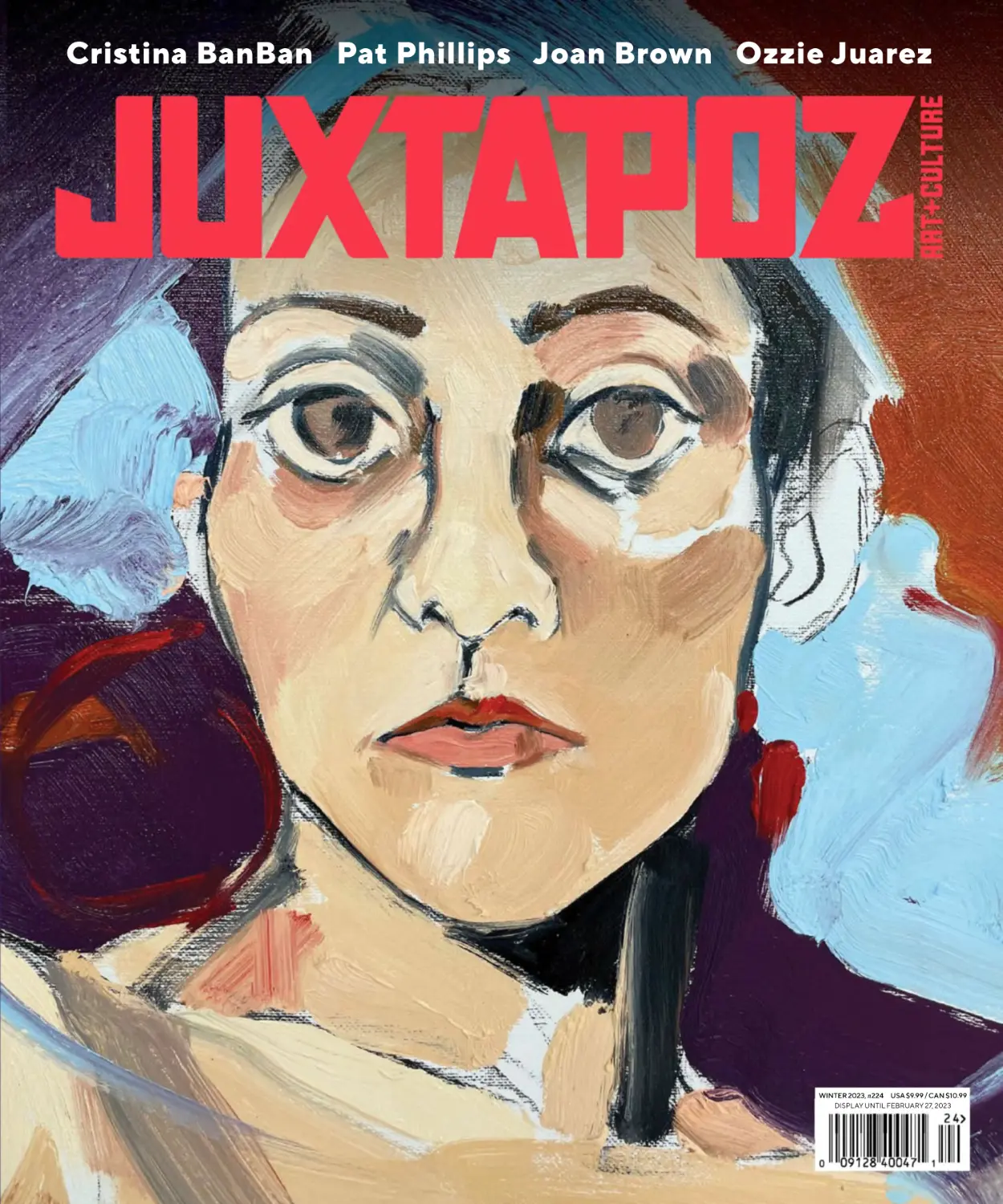
Cristina BanBan Pat Phillips Joan Brown Ozzie Juarez
WINTER 2023, n224 USA $9.99 / CAN $10.99
DISPLAY UNTIL FEBRUARY 27, 2023
Defy the
Ordinary,
Create the
Extraordinary
Visit academyart.edu/juxtapoz to learn more.
Featured student work by Jonas Yuan | jonasyuan.com
CONTENTS
Winter 2023
ISSUE
224
34
134
Nusi Quero and
Polyphia Make Armor
10
38
Jason REVOK, Gregory
Rick, Anna Park,
Samantha Rosenwald,
Loie Hollowell
Editor's Letter
14
Studio Time
Welcome to the
Doodle House
18
The Report
Joan Brown’s Blythe
Spirit at SFMOMA
24
Product
Reviews
Fashion
Grit to Glamour at
Crystal Bridges
Pat Phillips
112
Ozzie Juarez
Travel Insider
Cincinnati in a BLINK
Pop Life
88
Genevieve
Cohn
120
Mohamed
l’Ghacham
56
60
On the
Outside
NYC, LA, Seoul,
Portland, San Francisco
142
Perspective
Aaron Douglas and the
Harlem Renaissance,
Reborn
In Session
26
Sieben on Life
138
The Decades-Long
Ascent of Gil Bruvel
48
136
20 Things That Make
You Happy
Influences
Altered States at
the PNCA
Peggy Nolan’s Photos
Live Forever
80
44
Paints, Pop-Ups and
Bowling Shoes
Picture Book
Events
Design
96
Stipan Tadić
128
Alake Shilling
Ben Tolman Creates
the Unmode Project
66
Book Reviews
Barry McGee, André
Saraiva, Andrea Modica
104
Wendy Park
6 WINTER 2023
Above: Cristina BanBan, Mujeres VII, Oil and oil stick on linen, 72" x 90", 2022. © Cristina BanBan. Courtesy of the artist and Skarstedt, New York
72
Cristina
BanBan
STAFF
PRESIDENT + PUBLISHER
Gwynned Vitello
FOUNDER
ADVERTISING + SALES DIRECTOR
Mike Stalter
Robert Williams
mike@juxtapoz.com
CFO
Jeff Rafnson
EDITOR
ADVERTISING SALES
Evan Pricco
ACCOUNTING MANAGER
Eben Sterling
Kelly Ma
ART DIRECTOR
A D O P E R AT I O N S M A N A G E R
Rosemary Pinkham
C I R C U L AT I O N C O N S U LTA N T
Mike Breslin
John Morthanos
CHIEF TECHNICAL OFFICER
MARKETING
Nick Lattner
DEPUTY EDITOR
Kristin Farr
CONTRIBUTING EDITORS
Sally Vitello
Doug Gillen
Shaquille Heath
Alex Nicholson
MAIL ORDER + CUSTOMER SERVICE
CO-FOUNDER
Greg Escalante
Maddie Manson
subscriptions@hsproductions.com
415-671-2416
CONTRIBUTING WRITERS
AJ Girard
Sara Hantman
Shaquille Heath
Charles Moore
Alex Nicholson
Evan Pricco
Mike Stalter
Gwynned Vitello
CO-FOUNDER
Suzanne Williams
CONTRIBUTING PHOTOGRAPHERS
Genevieve Cohn
Bryan Derballa
Doug Gillen
Carlos Jaramillo
Max Knight
Mike Stalter
Brian Tallman
Adam Wallacavage
PRODUCT SALES MANAGER
Rick Rotsaert
415–852–4189
PRODUCT PROCUREMENT
John Dujmovic
SHIPPING
Kenny Eldyba
Maddie Manson
Charlie Pravel
Ian Seager
Adam Yim
TECHNICAL LIAISON
Santos Ely Agustin
Juxtapoz ISSN #1077-8411 Winter 2023 Volume 30, Number 01
Published quarterly by High Speed Productions, Inc., 1303 Underwood Ave, San Francisco, CA 94124–3308. © 2016 High Speed Productions, Inc. All rights reserved. Printed in USA.
Juxtapoz is a registered trademark of High Speed Productions, Inc. Reproduction in whole or in part without written permission is prohibited. Opinions expressed in articles are those of
the author. All rights reserved on entire contents. Advertising inquiries should be directed to: advertising@juxtapoz.com. Subscriptions: US, $29.99 (one year, 4 issues); Canada, $75.00;
Foreign, $80.00 per year. Single copy: US, $9.99; Canada, $10.99. Subscription rates given represent standard rate and should not be confused with special subscription offers advertised in
the magazine. Periodicals Postage Paid at San Francisco, CA, and at additional mailing offices. Canada Post Publications Mail Agreement No. 0960055. Change of address: Allow six weeks
advance notice and send old address label along with your new address. Postmaster: Send change of address to: Juxtapoz, PO Box 302, Congers, NY 10920–9714. The publishers would like
to thank everyone who has furnished information and materials for this issue. Unless otherwise noted, artists featured in Juxtapoz retain copyright to their work. Every effort has been made to
reach copyright owners or their representatives. The publisher will be pleased to correct any mistakes or omissions in our next issue. Juxtapoz welcomes editorial submissions; however, return
postage must accompany all unsolicited manuscripts, art, drawings, and photographic materials if they are to be returned. No responsibility can be assumed for unsolicited materials. All letters
will be treated as unconditionally assigned for publication and copyright purposes and subject to Juxtapoz’ right to edit and comment editorially.
Juxtapoz Is Published by High Speed Productions, Inc.
415–822–3083 email to: editor@juxtapoz.com
juxtapoz.com
STATEMENT OF OWNERSHIP, MANAGEMENT AND CIRCULATION (Required by Title 39, United States Codes 3685) Date of filing: 9/11/22 Publication Title: JUXTAPOZ. Publication Number: 1077–8411. Issue Frequency: Quarterly. Annual Subscription price: $29.99. Address of
Known Office of Publication: 1303 Underwood Avenue, San Francisco, CA 94124–3308. Headquarters of the Publishers: Same as above. Publisher: Gwynned Vitello, PO Box 884570, San Francisco, CA 94188–4570. Editor: Evan Pricco, PO Box 884570, San Francisco, CA 94188–4570.
Managing Editor: Alex Nicholson, PO Box 884570, San Francisco, CA 94188–4570. Owner: High Speed Productions, Inc., PO Box 884570, San Francisco, CA 94188–4570. Stockholders owning one percent or more of the total amount of stocks: Eric Swenson Trust, 59 Rhode Island, San
Francisco, CA 94107; Gwynned Vitello, PO Box 884570, San Francisco, CA 94188–4570; Edward Riggins @ PO Box 884570, San Francisco, CA 94188–4570; Kevin Thatcher, 14975 Los Gatos Blvd, Los Gatos, CA 95032; Greg Escalante, A-20, Surfside, CA 90743; Robert Williams, 10900
Seguro Dr., Chatsworth, CA 91311; Craig Stecyk, 2620 Armacost Ave., Los Angeles, CA 90064; Lynn Coleman, 22818 Avenito San Luis, Woodland Hills, CA 91364. Known bondholders, mortgages, and other security holders owning or holding one percent or more of the total amount
of bonds, mortgages, or other securities: None. Extent and nature of circulation: Average No. Copies Each Issue During Preceding 12 Months: Total Number of Copies: 38,791. Paid and/or Requested Circulation: (1) Paid/Requested Outside-County Mail Subscriptions: 18,661. (2) Paid
In-County Subscriptions: 197. (3) Sales Through Dealers and Carriers, Street Vendors, Counter Sales, and Other Non-USPS Paid Distribution: 74,018. (4) Other Class Mailed Through the USPS: 496. Total Paid/Requested Circulation: 93,372. Free Distribution by Mail: (1) Outside-County:
231. (2) In-County: 51. (3) Other Classes Mailed Through the USPS: 33. Free Distribution Outside the Mail: 185. Total Free Distribution: 499. Total Distribution: 93,871. Copies Not Distributed: 490. Total: 94,362. Percent Paid and/or Requested Circulation: 99%. Number of Copies of Single
Issue Published Nearest to Filing Date: Total Number of Copies: 103,039. Paid and/or Requested Circulation: (1) Paid/Requested Outside-County Mail Subscriptions: 18,890. (2) Paid In-County Subscriptions: 180. (3) Sales Through Dealers and Carriers, Street Vendors, Counter Sales,
and Other Non-USPS Paid Distribution: 82,811. (4) Other Classes Mailed Through the USPS: 513. Total Paid and/or Requested Circulation: 102,394. Free Distribution by Mail: (1) Outside-County: 176. (2) In-County: 53. (3) Other Classes Mailed Through the USPS: 16. Free Distribution
Outside the Mail: 226. Total Free Distribution: 472. Total Distribution: 102,866. Copies Not Distributed: 173. Total: 103,039. Percent Paid and/or Requested Circulation: 99%. I certify that the statements made by me are correct and complete. Gwynned Vitello, Publisher. 9/11/22
8 WINTER 2023
Cover art: Cristina BanBan, Mujeres IX, Oil, oil stick on linen, 84" x 92", 2022 © Cristina BanBan, Courtesy of the artist and Skarstedt, New York.
EDITOR’S LETTER
Issue
NO 224
“… painting Central Park is a challenge because there’s
so many paintings of it and everyone has their own
personalized visual. But I thought if I just paint it in
my own way, it’s going to be unique.” —Stipan Tadić
Even if you have never visited Central Park
in Manhattan, its space in the world is infamous.
The image of a place with skyscraping apartments
and urban density, neatly wrapped around a
rectangular frame of green and pastoral landscape,
is iconic beyond its physical presence. So you
may be wondering, why did this line stick out in
a Quarterly full of exemplary and introspective
perspectives? Often in his practice, the Croatian
artist, now NYC-based, considers icons and
concepts repeated and reimagined in art. And for
the viewer, this becomes an exercise: how many
times have we seen a still life of a bowl of fruit, how
often a seascape where the ocean meets the shore?
And how many artists have painted friends posing
in their studio, as a matter of practice or just simply
as a matter of history? We are offered tropes and
visual cues throughout our appreciation of art, and,
as Tadić says, have all seen images of Central Park
painted and photographed in myriad ways for over
a hundred years. But what a pleasure to commit
to seeing it once again with a fresh perspective,
thanks to an artist’s original take. That’s what
makes life, through the artistic lens, such a
discovery and so exhilarating.
In his seminal text, Ways of Seeing, John Berger
wrote, “The relation between what we see and
what we know is never settled. Each evening we
see the sunset. We know that the earth is turning
away from it. Yet the knowledge, the explanation,
never quite fits the sight.” We think about this often
when we put together a Quarterly, knowing what
Central Park looks like, what a sunset is, what a
portrait can be—but that it can be reinterpreted
and reconsidered because each of us has an idea
of what these things look like and represent. The
power of art is that each maker has an impulse
to challenge themselves and deftly add their
own interpretations to the collective perception,
creating a vivid and open lineage of art history.
Artists consciously, and often, subconsciously, look
to the past and to the future while occupying the
10 WINTER 2023
present, to fashion their own version of the most
familiar of places or concepts. When Tadić told me,
in his own way, “I know you have seen a Central
Park depiction before, but I want to show you how
I see it.” it was both brave and exactly in sync with
the stories we tell in this magazine. How are the
batons passed along? How do we speak to history
while making something original?
considers selfhood, social media, pandemics,
women’s rights, family, and friendship. BanBan,
Tadić, Pat Phillips, Ozzie Juarez, Genevieve Cohn,
Alake Shilling, Wendy Park, Mohamed l’Ghacham,
and all the artists in this issue, are time-travelers,
putting their unique and fresh language on the
most archetypal genres of art.
Enjoy Winter 23.
Our Winter cover story, Spanish artist Cristina
BanBan, is wonderfully vivid in this conversation
with history as well. Her classic oil paintings are
harborers of the most classic portrait styles, but
emboldened within a new era of figuration that
Above: Central Park, Oil on canvas, 78” x 60”, 2022
MIKE BEFORE THE FIRE,
HENDERSON
1965-1985
January 29–June 25, 2023
manettishrem.org
Mike Henderson, Trust, 1981. Acrylic on canvas, 63 × 59 in. Fine Arts Collection, Jan Shrem and Maria Manetti Shrem Museum of Art.
Museum purchase, Gina and John Wasson Acquisition Fund. © Mike Henderson. Courtesy of the artist and Haines Gallery.
STUDIO TIME
Mr. Doodle
Welcome to the Doodle House
I call it the “doodle house.” It’s a house full of
my doodles, from top to bottom, inside and out,
all over the place. Happy little doodle characters
everywhere. I first thought about the project when
I was about 15 and I drew all over my bedroom and
my parent’s house, all over the walls and stuff.
I went to bed each night looking at the doodles and
it’d be the first thing I saw when I woke up. Since
then I’ve dreamt of just covering an entire property
in doodles that I could live in. Really, the project
just started as an idea. But then I didn’t buy this
house until the end of 2019, which is when the
renovation began of turning the place into a blank
white canvas in order for me to create doodles over.
I started in the bedroom first, because, before
I lived in this house, I lived with my parents and
that bedroom was becoming more and more
14 WINTER 2023
covered with drawings—on the furniture, on the
ceiling and stuff. I was beginning to get more and
more used to the idea of living within a big doodle.
Then when I found this place and started drawing,
this room is where I began the doodles, the main
bedroom, and I just loved how it looked. Even
though we haven’t moved in yet and we’re moving
in a couple of weeks, we have stayed in the room a
few times, and it feels great waking up in here and
seeing the drawings everywhere. Falling asleep and
looking up and seeing just a few happy characters
makes me smile and brings me a lot of joy.
There are a few from place to place throughout
the house where I look and remember thinking,
“Oh, I was listening to this music at that time,” or,
“That was that day when I got a hot chocolate and
had a really nice afternoon." There are a few bits
like that, and some where it was the first character
I put on the actual wall of the room. Not every
character does that, but a lot of them do. They do
hold some memory or some form of trigger that
causes me to think of something.
I started with the inside of the house, so a lot of
people weren’t ever going to see that, apart from
friends and family we trust and who wouldn’t
share pictures and things like that. But outside of
the house, when I had to eventually move on to
that, and doing the front in particular, whenever
we had deliveries of things we’d ordered online or
food or whatever, people would come to the house
and be like, “What the heck is this?” —Mr. Doodle
The Doodle House is in Kent, England. This is an
excerpt from the Radio Juxtapoz podcast.
Photos by: Doug Gillen
Adam Handler - Peter Opheim
Warriors & Ghosts
December 09 - January 14
PNCA Illustration
Pacific Northwest College of Art
at Willamette University
pnca.edu/academics/bfa/illustration
@PNCAillustration
illustration by Jim Swindle, ‘23 | @radijaad
REPORT
A
Luminous
Life
Joan Brown At
SFMOMA
The pejorative only child, Joan Brown grew
up in a dark apartment and died at age 52
while installing a mural in India when a turret
above her collapsed. But in between, what a
life, an artist doing what she loved at that very
moment, who described blue as a “clear, joyous
and contemplative color with no beginning and
end.” I spoke with Janet Bishop and Nancy Lim of
the San Francisco Museum of Modern Art about
celebrating Brown and her “irrational palette” in
the upcoming retrospective.
Gwynned Vitello: I was so intrigued with
Joan Brown’s life, beginning with my surprise
that she was set to go to a Catholic women’s
liberal arts college before abruptly pivoting to
art school.
SFMOMA: Who knows what would've happened
had she not seen a flier for the California School of
Fine Arts when she was seventeen years old? She
certainly did not come from an artistic family.
She seemed to be“converted from the start with
the freedom, as well as the mentoring of her
teacher. Had she made art before?
Joan visited the local museums on her own as a
youngster, and we know she drew because she
submitted drawings of movie actresses as her
portfolio for admission to the school.
In fact, she wasn’t allowed to take painting
classes during her first year and was required to
take commercial design courses. She didn’t feel
an aptitude for that and seriously considered
leaving school. At the end of her first year, at the
encouragement of another student, Bill Brown,
who became her first husband, she decided to
enroll in a summer class with Bischoff. That was
the turning point. And yes, Edward Bishoff was
unusually important to her.
Famously, what Bischoff told her was, “Trust
your instincts.”
He was particularly able to cultivate these kinds
18 WINTER 2023
of mentoring relationships with students, and his
relationship with Joan went on for many years,
especially when they became teaching colleagues
at UC Berkeley for a number of decades.
She took her role as a teacher very seriously.
I watched a panel with three former students,
and I liked Hilda Robinson’s remembrance
that Brown gave her a sense of freedom and the
reminder that there are no boundaries when
using color.
She valued so deeply her experience as a student
and naturally carried it forward in her approach
to being an educator, which she was for virtually
her entire career. Talking about freedom, one
thing that has always impressed me was her
ability to absorb what was going on around her,
for instance, the abstract expressionism that really
dominated so much of the practice at the school.
She made it her own, and among the artists of that
period, she was one known to have forged a truly
distinct independent vocabulary.
Did she forge any special relationships with
other students at that time?
She was good friends with Jay DeFeo. They lived
in the same building, known then as Painterland.
In fact, they were so close they knocked a hole in
the wall between the apartments so they could go
back and forth.
I wouldn’t characterize her as adhering to one
style, but wasn’t she advised to choose between
figuration and abstraction?
In her early years she moved naturally between
the two, but by 1960 or so, was pretty committed
to figuration. You see the lessons of abstraction
coming through in her approach to figurative
Above: The Night Before the Alcatraz Swim, Oil enamel on canvas, 84" x 72", 1975. GUC Collection, Highland Park, Illinois.
REPORT
painting, but what resonated was a subject matter
she could connect to herself and her surrounding
world. Her work has been described as a visual
diary, similar to a point you made earlier.
Is that possibly why she was dismissed by some
critics as not substantive?
She did paint things around her, and, yes, much of
it was very gendered. She was very domestic, and
a lot of scenes in the early sixties portrayed that,
especially the number of paintings that focus on
her son.
Well, that brings me to the Thanksgiving Turkey.
Yes! It was in her first solo exhibition at the
George Street Gallery in New York, and it was
purchased by the Museum of Modern Art—
astonishing because she was 22 and not even out
of art school. I think she was in graduate school,
so her rise to success as a student and shortly
after was really extraordinary.
That reminds me of her first trip to Egypt and
being enthralled with the light, describing it as
lavender. She never claimed to have synesthesia,
but she used color in such amazing ways.!
She was so drawn to color, really vibrant color,
a rich saturated palette. Among the Bay Area
figurative painters, I would say she is associated
with the most robust handling of paint, the most
thickly built up surfaces.
She achieves popular and commercial success
very quickly, and then decides to sever ties with
her New York agent. Maybe, as advised, she went
with her instincts?
She retreated to her studio, deciding to take time
off from the artworld, but continued making
works at a slower pace, in a very intentional way,
really setting parameters for herself. The last
heavily impastoed work she made at this time was
the Green Bowl.
I thought she admitted to having trouble
with perspective, but doesn’t the Green Bowl
refute that?
You know, the composition is similar to Thanksgiving
Turkey. She acknowledges turning to this kind of
shallow, straightforward division of space, which
was a comfortable way to create scenes for her
figurative works. She learned to create perspective
in a room by looking at artists like Francis Bacon,
seeking to work flatter, scaled and in simpler
palettes. What’s interesting here is the vestiges
of crazy colors she had been working in. There’s
sparkle throughout, especially in the dark green
The turkey is fascinating, both as a subject and
in her rendering. Here's this woman who was
practically a roommate of Jay DeFeo, a certified
Beat but who is baking Christmas cookies,
organizing Easter egg hunts, and then painting
this turkey that would not make the cover of
Bon Appetit.
On one hand, it’s a corny subject, but on the
other, she’s referencing Rembrandt and his 17thcentury painting of the hanging beef carcass, as
well as navigating a world between abstraction
and figuration. Look at the piece kind of upside
down— it’s really abstract passages that coalesce
into a three-dimensional object. Look at the
positioning where the turkey is on the table, and
there’s such spatial depth, so much perspective.
It's very sophisticated, historically informed—
and deeply weird.
I was more familiar with her flat, personal
pieces, so this painting is surprising, as is The
Rat sculpture. When did she study sculpture?
She just picked it up, making sculptures with
her cohort, as well as the influence of her second
husband Manuel Meri. Joan made sculptures out
of whatever was around, which was the ethos of
the day: use what’s around you and be scrappy.
The Rat is bandages, rope and a raccoon coat she
pulled out of her closet. She was also interested
in Egypt at an early age, and that manifests in the
piece, this reference to mummification.
She did a lot of research on her own as a girl, a
lot of it at the public libraries, right?
She grew up in the Marina district, right by the
Bay, and adored swimming in the late afternoons
and early evenings. She loved the way the sunlight
hit the water.
Top left: Joan Brown and her dog Bob, 1961; collection of the Estate of Joan Brown; photo: Glen Cheriton/Impart Photography; courtesy the San Francisco Museum of Modern Art
Top right: Thanksgiving Turkey, Oil on canvas, 47.9" x 47.9", 1959. The Museum of Modern Art, New York. Larry Aldrich Foundation Fund. Bottom: Green Bowl, Oil on canvas, 22" x 36.3",
1964. San Francisco Museum of Modern Art, purchase, by exchange, through a fractional gift of Evelyn D. Haas.
JUXTAPOZ .COM 19
REPORT
background, a phosphorescence, and actually, the
bottom is sparkly too, almost like the vestiges are
leaking through, even as she tries to be constrained
in how she paints. Her goal was to simplify until
she understood what she wanted to do and move
forward. There was a sense that needed to extend
the perspective as radically as possible before getting
to that really flattened space. There’s tremendous
detail and the use of much smaller brushes.
I know most of her paintings are big, so was she
going smaller?
She’s working with a much finer touch, but the
majority are big, and I would say it’s unusual to
paint so consistently large. We talked about her
love of swimming, and she explored elements of
physicality and kinesthesia in her big paintings.
It took a lot of energy, especially given the thick
paint she was applying.
I know she collected postcards from museum
shops and visited local museums on her own,
but it was still kind of a shuttered childhood.
How did travel influence her?
She made her first visit overseas with Manuel Neri.
They visited several countries, and these were
very formative experiences. Her first husband had
20 WINTER 2023
given her a small set of art books, so she absorbed
these reproductions and was very compelled by
what she was seeing. When she saw them first
hand, as she would say, “it really knocked me out.”
She became an avid traveler and museum goer.
And an avid swimmer. I love the look of pride
and enjoyment in those paintings.
Yes, there’s a whole series of women in the water, and
regarding her interest in light, she said that she was
inspired by moonlight hitting the water, a quality
she wanted to capture. She was always interested in
transforming this immaterial light into materiality.
She also takes on self portraiture in the early ’70s,
and that remains her most frequent subject.
I’ve seen comparisons to Cindy Sherman, but
maybe that’s simply because they are two
women exploring self.
I feel Sherman is almost like an actor taking on the
guise of a character, whereas Brown sometimes
does but is always very present in hers. She
tends to be, not expressionless, but reserved in
presenting herself: there’s one where you see two
heads and she's sort of showing off her new dental
work. It’s unusual to see her present herself with
such a highly expressive face.
One of my favorites is her posing with the fish,
and “wearing” the cat head. She seemed to
revel in and appreciate life in such an earthy
way. She died too young, but it seemed to be a
very fulfilling life. What you each discover and
appreciate while putting this show together.
Janet, what did you learn?
Janet Bishop: I think most enjoyable was learning
the facets of her life, hearing vignettes from people
we talked to. One of the pleasures of organizing
this show is that her work is so narratively rich.
I could use so many descriptive adjectives after
hearing all the stories connected to her paintings
and sculptures.
Nancy Lim: Something I came to appreciate deeply
was her fearlessness and commitment to working
on whatever style best suited her concepts. She
was unafraid to respond to pressures around her.
She was comfortable following her own path, even
if friends and family didn’t feel it was the right
thing to do.
Joan Brown will be on view at SFMOMA through
March 12, 2023.
Left: Woman Preparing for a Shower, Enamel paint on canvas, 84" x 72", 1975. di Rosa Center for Contemporary Art, Napa Right: The Bicentennial Champion, Oil and enamel paint on canvas,
96" x 78", 1976. The Museum of Modern Art, New York, gift of the Women’s Committee of the Art Gallery of Toronto, and gift of Mr. and Mrs. Allan D. Emil (both by exchange).
REVIEWS
Things We Are After
Pop-Ups, Paints
and Bowling
Andy Warhol
Pop Up Pop Art Book
Andy Warhol’s artwork, shiny, bright and
larger than life, practically pulses through our popculture DNA. Now you can literally see his
work bounce into your physical space with the new
Andy Warhol: Pop Up Pop Art Book, The Silver Factory.
An interactive and engaging exploration of the
artist’s career through the playful medium of a pop-up
book, Popostion Press collaborated with The
Andy Warhol Foundation to bring the artist’s work to a
3D platform, regenerating his work with its
original brash intent —bold, bright, and literally in your
face. The book features the Campbell’s
Soup Cans, Banana, Andy’s Photo Booth,
Marilyn Monroe, Flowers, Brillo Box
Sculptures, and his famed
Self-Portrait.
Popositionpress.com
Vault by Vans x
Deaton Chris Anthony
You might be wondering if these
could actually be bowling shoes.
And the answer would be yes,
indeed, these do look like bowling
shoes. Los Angeles-based
musician, artist and designer
Deaton Chris Anthony teamed
with Vault by Vans to pay
homage to his home state of
Kansas, and in Anthony’s words,
“It is here where he thought
he was meant to do one thing in
life—bowl.” After being crowned
bowling captain of his high school team,
Anthony “unfortunately” left those parallel lanes for the life of a California artist.
Luckily, Vault by Vans gave him the chance to make blowing stylish again. The
Vault by Vans x Deaton Chris Anthony “Kansas” collection will be available on
Vans.com and select Vault by Vans retailers beginning December 9.
Vans.com
24 WINTER 2023
Golden Artist Colors High Flow Acrylic
As the weather turns cool, it's time to warm up to your studio practice. Long
winter days invite the opportunity to creatively cozy up and Golden Artist Colors
now has 37 new High Flow Acrylic colors to inspire you. The new hues include
more options in the popular iridescent and fluorescent categories, meaning more
pop for your fine detailed lines or the broadest of painterly strokes. High Flow
Acrylics are available in 1oz, 4 oz. and 16 oz sizes, so you can experiment
with something new or go big with what you know you want.
Goldenpaints.com
PICTURE BOOK
26 WINTER 2023
All images from: Juggling is Easy courtesy of the Artist and TBW Books © 2022
PICTURE BOOK
Peggy Nolan
Juggling is Easy
The first time I spoke to Peggy Nolan she read me a poem. She was
explaining how writing and photography were a marriage, and that reading
a great passage often inspired her to take pictures. I wondered if it ever
worked the other way around, if a photograph… but before I could finish she
interrupted to read aloud something she had just written. It began, “I am
compelled to rearrange things,” and that answered my unfinished question.
The compulsion to organize words on a page and moments into a frame
is one and the same, derived from the same source, an energy that Nolan
says has been with her all her life. “And everybody has it,” she maintains.
“Come on, we are creative animals.” But understanding that it’s there
and reconciling it with the other forces pushing and pulling our lives can
be difficult. As a young adult, Nolan followed these creative impulses to
Syracuse University, studying poetry and writing before other, perhaps notso-unrelated energies found her in and out of love and raising seven children
in government housing on the outskirts of Miami, Florida. “On occasion,
their father would come by and give them haircuts,” she writes in a new book
of photographs published by TBW Books. “Once, he tried to teach himself to
juggle grapefruits in my living room.”
Nolan really wanted to have a big family and devoted herself to her kids.
“I was completely at their beck and call,” she explains. “The creative energy
went into just taking care of them. I put it into cooking, into baking, but it was
still frustrating, something was still lurking in there.” In the early ’80s her
father gifted her a camera hoping for pictures of his grandchildren. Nolan’s
mother had died when she was nine and at that time, her father thought it best
to hide away any photographic evidence of those earlier memories. When she
herself became a mother, the camera quickly became a way to ensure that her
children would always be able to look back on their childhoods. She became
entranced by the process, and soon the laundry room became the photo lab,
and her kids always-available subjects. “It’s really the transformation that I’m
addicted to,” she says, “the transformation of something onto a piece of film.”
This obsession propelled her back to school where she became even more
absorbed in the history and craft, continuing to photograph her sometimes
reluctant but quickly growing family. The photographs from these years make
up her new book, Juggling is Easy, a collection of the moments of her children’s
lives that she felt most compelled to arrange within the edges of a frame.
On the phone from Florida, Nolan continued her poem, listing the items in
her home that patiently awaited rearrangement, finishing it, “Objects playing
musical chairs, not for visitors. But it takes one's breath. Mostly selfish
pleasure. Whispering to myself in the quiet, empty space.” —Alex Nicholson
“Interestingly enough, I did not reminisce about
the experiences that were described in the pictures.
I was much more interested in formal issues of how
miraculously some of them worked, almost
by accident.”
JUXTAPOZ .COM 27
PICTURE BOOK
“I didn’t have to look
for a subject, it just
flopped on the couch
in front of me, you
know, in all manner
of misbehavior.”
28 WINTER 2023
PICTURE BOOK
JUXTAPOZ .COM 29
PICTURE BOOK
“I’m in love with people at the age where they think
they’re gonna live forever. You get people at a certain
age and they’re willing to change their minds. They’re
willing to take risks. It’s a very freewheeling part of
life. There’s a certain kind of energy in that age group
that has always made me wanna pick up the camera.”
30 WINTER 2023
PICTURE BOOK
JUXTAPOZ .COM 31
DESIGN
Nusi
Quero
and
Polyphia
The Making of
Stage Armor
Stage presence is a real thing. The best bands,
the best musicians, have this aura that is hard to
describe in tangible words, but let’s just say you
know it when you see it. Björk, Lady Gaga, Beyoncé,
they have that thing that rivets you when they
perform. A lot of it has to do with what they are
wearing on stage, that mixture of fantasy and
make-believe, of mystery and impracticality, the
kind of oh-so-important fashionable art that pumps
up the music.
Nusi Quero is an artist who has waved his magic
wand over and around some of the biggest pop
stars, creating what he calls wearable art that
transforms into signature iconic uniforms.
Channeling his imagination, he has designed
otherworldly work for Grimes, powerful
pronouncements for the before-mentioned
Beyoncé, as well as a celestial closet full of fashion
shoots. But when it came to the all-instrumental
band, Polyphia, who were about to shoot the
music video”Neurotica” off their newest album,
Remember That You Will Die, Quero tried his hand
at instrument design, creating one-of-a-kind face
masks and guitar, and bass and drum”armor” for
the band. We sat down with Polyphia guitarist
Tim Henson and Scott LePage, along with Quero,
as they discussed a shared vision for visual
identity, what makes a good collaboration, and the
enhancement of a stage persona.
Evan Pricco: How did you all become aware of
each other and your individual talents? What
was the genesis of this collaboration of amazing
guitars, masks, and other visuals?
Tim Henson: I think I saw Nusi’s work on
Instagram and then again on Twitter. I saw that,
in addition to the cool body armor pieces, he had
embellishments on his instruments. He had one
for his guitar, one for his keyboard, then one for
34 WINTER 2023
a microphone, and then another one for a guitar.
I think there was just a general appreciation for
each other’s work.
used in conjunction with the music videos. So
I typed up this crazy long message and then just
hit him with a fucking novel in the DMs.
Nusi Quero: You have to understand, I was a
guitarist for ten years, but when I saw Tim and
Steve playing, it was mind-blowing to me. The way
they played was like nothing I’d ever seen. So, fuck
yeah, I was into it.
Because there are multiple people involved, there’s
sound, there’s visuals, there’s different parts of
the puzzle that need to be put together. Was the
process pretty seamless among all of you?
NQ: It was really good. I will say, Tim is an excellent
communicator and steerer of ships, a captain, you
could say. It was pretty fluid and also terrifying.
TH: And then as we were doing the artwork for
our album, I really wanted to include more than
just artwork. I wanted real, tangible pieces to be
Why terrifying?
All imagery and artwork: By Nusi Quero for Polyphia, 2022
DESIGN
NQ: Because they were in Texas, and so in order
for me to make these instrument things, I needed,
literally, exactly perfect 3D models or 3D scans of
their instruments. They’re all a little fuzzy and
there’s things like the light getting confused and
then it’ll just knock off half of the instrument.
And the scale can sometimes be peculiar. But we
talked about a lot of design elements, the aesthetic
language that Tim had envisioned for the entire
album, an ornate, almost Geiger-like feeling. And so
we landed on the
aesthetics,
and then
I generated some designs and we decided the
band all liked their versions. So then I got them
printed. They were in Texas and were going to
fly to LA the day before their music video shoot
so I could Cinderella-shoe these pieces onto their
guitars. I had a whole band here, and we were all
in the back of my shop with all my Dremels and
sanding tools. It was just chaos back there. But
yeah, I cut them down to fit, and, for the most
part, it was Cinderella. Pretty good.
TH: I think we were drinking margaritas.
The masks are amazing, too.
NQ: Yeah, thanks. They had to scan their faces too,
but some of them had facial hair, and 3D scans are
tough, man.
When you go into this kind of collaboration,
does it change the music for you at all? Did
it alter the way you were thinking about
the music you had already made, maybe
bring new life to things?
TH: I think the biggest feeling from the
pieces that Nusi made was at the music video
shoots when we were all dressed up. I had the
stuff on the guitars all fitted and everything, so
for me at least, it gave me some confidence of,”This
looks sick as fuck.” And I know it looks sick as fuck
because one of the features for that song, he came
in and saw us with the masks on and the armor
on the guitars and shit, and he was just like,”Dude,
what the fuck is that?" That was just such a sick
feeling to hear that reaction from him.
Scott LePage: And it made me feel fucking badass.
I remember we were drinking White Claws when
we were doing that video, and in just putting
all that gear on, I was like”Oh dude, I feel like a
fucking celebrity or something like that." It made
me feel special.
NQ: I mean y’all have no idea how much that
means to me to hear that. The majority of the
work I do right now is… I make women’s wear,
essentially. Not practical wear, but they’re
wearable! And for me, the big motivation is that
I want to empower these women. It’s like, they
look amazing, but they’re also wearing this crazy
alien armor. I know that for many of them it
gives them an elevated feeling. It makes them
feel like powerful characters in a video game or
JUXTAPOZ .COM 35
DESIGN
something. And to have that sort of same category
of great reaction happen with a completely
different sort of intervention or adornment is
really sick. Cause it’s, like, this is a guitar, not
body armor. That’s the shit. I want to help. I want
to make power-up items for video games, for this
video game that we’re all playing.
And it’s also, it’s a different kind of armor.
I mean the guitar on stage or the instruments,
each is a unique kind of armor and a different
kind of adornment for different kinds of
musicians and artists.
NQ: I think it’s an amazing human tradition to
embellish things, make them more than they were
given to you. It was such a trip reading all those
comments from people because I gave it a lot of
care. But also I know all the guitar heads who
follow Scott and Tim, and I was expecting that it
might be perceived as sacrilege to do this sort of
adornment on guitars.
TH: We’ve got a lot of questions in our VIP
sessions from the tour, where kids were asking if
the face-plate armor pieces would be available for
production. And I was like, dude, these pieces, if
you’ve ever seen them, they’re pretty expensive!
Nusi, how do you know a collaboration works
for the musician or the artist that you’re
working with?
NQ: We live in this sort of social media-metric
reality, and when I see the artist excited to share
that, I know it’s working. Because most of the
work that we do is made to share. It’s not in a
gallery. And when I see them excited to show the
world what we made, I know that we did a good
thing together. But also I think that when you
make something good with somebody and then
there’s this artifact, a song or an image or this
video of these really crazy embellishments for
these instruments, I think there really is sort of an
objective beauty to the product. Art that you can
just look at, nod, and be like,” Yeah, that worked.
That’s good. That’s a good mark we just left.”
And then Tim and Scott, as musicians, you’re
collaborating together, putting together songs,
putting together moments in the music. But
when it goes out to the visuals, is there a little bit
of letting go that is almost therapeutic?
TH: I would say so. I think that having trust in
who you’re working with is very, very important.
I think just that first time that we went and hung
out, as I was saying earlier, we realized we had
so many of the same ideologies, we felt the same
about so many different things just beyond what
we were going to be working on. And I think it
is very, very important to have similar mindsets
when you’re collaborating with someone.
36 WINTER 2023
NQ: I will say I wish that sort of trust that you
were able to afford me is something that I had
with other people I partner with.
TH: I think that comes from the mutual risk of
being a creator.
SL: Yeah, just going back to what you said about
every single thought going into it is just deliberate
and has intent, just that. The first thing I did when
I took Nusi’s work home was to lay it out and just
look at it for twenty minutes, and I’m thinking
to myself, I don’t think I could have ever thought
to even draw this, let alone fucking make it a
physical being.
When we interviewed Radiohead last year, they
were saying that they realized early on in their
career that their visual identity would always
mark a period of time for them, and that they put
so much effort into the visual identity because
they knew each was going to be this little historic
marker for them as a band and as collaborators. It
was very, very important to them. When did that
become important for your band?
TH: Since the inception of the band. It’s been a
learning process because we started the band
when we were sixteen, seventeen years old in high
school. And so, when you’re that age, you don’t know
anything about anything. Every year we put out
music has been an identity change, like a new era,
and as we get older we kind of figure out our tastes
and what we like and we get help from professionals
like Nusi to make us look cool because we started
this band in high school. It was a very DIY thing.
And now to be able to have incredible people to help
us with our vision makes it a really nice journey.
Polyphia’s album, Remember That You Will Die, is
out now via Rise Records.
FASHION
Fashioning America:
Grit to Glamour
Crystal Bridges Museum of Modern Art
If there’s an artform where we all actively
participate, it’s fashion. Whether yanking up
Covid sweatpants for two years or challenging a
carry-on suitcase, in Fashion we adapt, function—
and play. Sea to shining sea covers a lot of fertile
ground for creating Grit and Glamour. Visual
artist Ruben Toledo set the stage and I spoke with
guest curator Michelle Finamore about the history
hanging in my closet.
Gwynned Vitello: I’m overwhelmed, in a dazzling
way, by the history covered in this fashion
retrospective. How do you organize a show that
spans so much time and geography?
Crystal Bridges: We start off with George Washington
himself, since there’s a really wonderful portrait
from the Crystal Bridges collection. It’s paired with
a gown made by the black dressmaker Mehitabel
Primus for her daughter, Rebecca.
Then we have an 1830s piece made out of factorymilled cotton. Washington was very interested
in literally wearing his politics on his sleeve
and insisted on homespun. He wanted to wear
American-made goods, which in the 1700s was
difficult, as they were importing so much. The
three pieces make a good opening together.
And Alexander Hamilton was pushing the
production of textile manufacturing here.
The seeds of this industry are sown throughout
the 19th and 20th centuries as America seeks
to become a manufacturing powerhouse.
Washington was sending some political
messaging in his fashion choices, but we also tell
stories we tell about designers like Primus who
have not had their due for many reasons.
There’s also a corner in the introduction gallery
about the beginning of the American Textile
industry in all its glory in the presentation of a
Nudie suit, Nudie Cohn’s ultimate creation, the
rhinestone cowboy. We pair that with a piece by
Austin’s Fort Lonesome, a women-owned western
wear company that adds its own twist.
I think I saw one of their ensembles on Lil Nas.
Yes, he does have one of theirs and a Jerry Atwood
I don’t have, but there are people carrying on
that tradition. It’s challenging from a curatorial
perspective to consider what is distinctly
American because, of course, we are made up of
immigrants, oppressed and Native peoples. How
do you make decisions about what is American?
Those are very blurry lines.
So, you open with Rebecca Primus and George
Washington, and hopefully, pair other pieces
from the Crystal Bridges collection.
I thought it would be wonderful to do the exhibition
at Crystal Bridges because of the depth and richness
of its holdings as an American art museum.
Thinking about this show, I delved online, and
looked through the galleries, seeking paintings and
prints that speak to the themes.
Whenever you have a portrait, you address fashion,
so it was wonderful to think of how to tease out
some of this. We have a wonderful Charles Sheeler
38 WINTER 2023
Above: Jordan Casteel, Ourlando, Oil on canvas, 90" x 78.1" x 1.5", 2018. Crystal Bridges Museum of American Art, Bentonville, Arkansas, 2019. Photography by Edward C. Robison III.
FASHION
painting set in Manchester, New Hampshire, which
once was once a big denim producer. And we have a
pair of 1880 gold line-era Levis.
In the grid section, I address the history of denim.
There are so many things, like the iconic Rosie the
Riveter image from the World War II era where
she’s in denim overalls. This perfectly captures
the moment when women started wearing this
utilitarian garb on a regular basis because they
were working in factories.
I love Georgia O’Keefe quote on jeans, “I rather
think they are our only national uniform.”
Yes, that’s fantastic! Nudie Cohn and Fort
Lonesome are part of the introductory because
I do think of that as a uniquely American
innovation and this idea of carrying on these
traditions. Nudie is a conduit because one of
the underlying currents in the exhibition is the
impact of film, TV, and other media. He was a
rodeo tailor based in Hollywood, dressing country
stars, including Elvis, and contributed to the
rhinestone cowboy mythology. I wanted to open
with a dazzler.. The suit is beautiful, and I was,
like, ‘Oh, I would wear this, I would!’
Kudos to George Washington, but a Nudie suit will
grab attention. And I assume you start with Grit.
I feel that when you think of American
contributions to the global fashion stage it’s
denim, this utilitarian textile that has global roots
and becomes so tightly embedded in the culture
that it becomes an American icon. In addition to
the historic Levis, we have some made by Ginew,
the only indigenous denim maker in America,
as well as cowboy-inspired ensembles by Ralph
Lauren and Anna Sui.
Moving to a different landscape, the street has
hugely impacted American style.
We go from a more rural scene into the city. I have
this wonderful painting by Jordan Casteel called
Orlando, which is so spectacular and just pulled
the gallery together. It’s huge, with this wonderful
image of a shop owner in Harlem on 125th Street.
It’s so colorful and …
It’s the man standing among the pastel shirts?
I love that painting!
It’s beautiful. I went through the space over a
year ago and then, with a team, had to figure out
how it all would make sense. Some look totally
different when you get them in the galleries,
but this was perfect! There I have a capsule of
American streetwear, like a 1997 jumpsuit by
Tommy Hilfiger worn by Missy Elliott. There’s
a contemporary piece by Birmingham’s Olivia
Anthony, a young street designer following the
footsteps of April Walker.
Streetwear is not just related to the ’90s. I think
the origins really started with the zoot suit, so in
those places where I could not find pieces, I went
to film, and in that gallery, I have a projection
of Cab Calloway in suits from Stormy Weather
which are fabulous. That’s interspersed with
footage related to Dapper Dan, though it’s hard
to find his actual pieces because of the high
demand. Streetwear is everything, from sneaker
culture to hoodies, sweatpant ensembles, and
more, and these iconic American creations have
a global impact.
Virgil Abloh’s Nebraska sweat has to be in
that section.
I feel like it’s the symbol of the exhibition in many
ways, as he draws from the middle of the country
and that collegiate-type phase. Then Hollywood
is kind of drawn in, the blending of all these
different American influences.
And you have another multi-hyphenate Virgil.
From Cochiti, Pueblo, he’s just like Abloh, working
in so many different media. Virgil Ortiz started
as a potter and was discovered by Donna Karan
twenty years ago when she saw his work in Santa
Fe. He’s still involved in fashion with leather
work and streetwear. The indigenous story is so
important, one I’ve tried to weave into the show
the best I can.
Top left: Christian Siriano, Dress for Nicole Byer, Silk tulle, 2021. By Novo Studio, courtesy of Crystal Bridges. Top right: Fort Lonesome, Custom chain stitched western “Texas” suit, Silk/wool,
wool thread, rhinestones, 2020. Lent by Gordon Clark and Kate Bowman. Bottom: Lisa Perry, Roy Lichtenstein “No Thank You” Dress, Cotton twill shift dress, 2011. Lent by the designer.
JUXTAPOZ .COM 39
FASHION
It’s the original American fashion, and
I think, the most imbued with story
and symbol. And moving into accessories,
there are more stories.
It’s a cabinet of curiosities with pieces ranging
from the 1840s to the early 2000s. There’s an
early American calash bonnet that mimics the
covered wagon in that it’s collapsible and serves
as protection from wind, sun, and dust. There
is also weather protection in the fans made by
Tobias Scott, a very successful designer who
bought his freedom because of his great talent for
making and selling those fans.
You’ve got two smaller sections that proved
to be big successes for American industries.
We’re moving into two sections where
Americans became major exporters. For
Intimates, I focused primarily on women
designers because it was a space where they
could succeed in business, as well as design.
I have this teeny, tiny little corset, where the
curator was floored by the size and its need
to fit the mannequin. Compare that to one by
Emily Kilbrick, an inventor in the late 19th,
early 20th centuries who changed the straps
and made the fabric more comfortable for
a real woman, actually, a moment of dress
reform. And representing the trend to body
positivity, we have a Savage X Fenty ensemble.
For swimwear, I focused on mid-century pieces
because that was the heyday of the Hollywood
idea of California lifestyle. We have wonderful
pieces by Catalina, and by Alfred Shaheen, inventor
of the Hawaiian shirt, and a film projection of
Esther Williams in Million Dollar Mermaid!
You do address the issue of labor and work
standards, and Angela Mercado’s essay
illustrates that with prints from the Crystal
Bridges collection.
We have a wall devoted to the real price people pay
to create these garments, as well as other historical
aspects. We feature a dress by Madame Olympe
Boiss from New Orleans, a French immigrant who
created custom garments and actually signed her
work, something very rare in the 1860s.
America excelled exporting contemporary readyto-wear, and this section addresses things like
the Ebony Fashion Fairs, which inspired a young
Patrick Kelly, as well as the Battle of Versailles, where
America shook up the staid fashion world (and was
later restaged with Zendaya and Tommy Hilfiger).
I didn’t expect a Pop Art section, but it makes
sense.
We have a fabulous Roy Lichenstein painting
from the permanent collection that is pivotal, as
40 WINTER 2023
well as a beautiful 1970s Halston with an Andy
Warhol print. The Christian Francis-Roth dress
looks like a dollar wrapped around the body,
so this showcases how Pop Art is such a really
distinctive American contribution to the art world
In Refashioning America, you focus on more
contemporary designers.
Kerby Jean-Raymond of Pyer Moss comes to
mind immediately, especially when thinking
about how clothing can communicate
contemporary issues. His is the typewriter
ensemble. And of course, we have the late
Patrick Kelly. Alabama Chanin, after working
in New York, opened a practice in Alabama
where she employs local embroiderers, quilters,
and seamstresses. We also have a piece from
Jamie Okuma, a Luiseno visual artist who does
amazing beadwork and mixed media.
Grit to Glamour must end with a red carpet?
And we actually have one! There are pieces
from the 1920s to the present, all with some
Hollywood association. A funny story involves
the spectacular dress Chrisitan Siriano made for
Nicole Byer. Designers ship differently from art
museums, so we got this small box and thought
there was no way the piece could be inside. When
we opened it, the gown pretty much popped out,
exploding from the box—and it’s a LOT of dress!
The show looks beautiful, but you’re also
telling a story about adaptation, inclusion anf appropriation. I mean, how do you assess
pictures of skinny white models in feather and
beaded vests, or Ralph Lauren wearing a Navajo
jacket and cowboy hat?
It is very challenging, and I felt strongly that we
strongly represent the indigenous pieces. People
look at the various cultures as uniquely American,
yet don’t credit the richness of the different
tribes or the unknown Blacks who contributed to
our style. You have to confront the history, you
can’t whitewash it. But I think you can look at
the ensembles, question the origins, and open a
dialogue, and if that happens and people think
more deeply about where it all comes from, then
I’m doing my job as a curator.
Fashioning America: Grit to Glamour is on view at
the Crystal Bridges Museum in Bentonville, Arkansas
through January 30, 2023.
Left: Ji Won Choi, Baggage Tag Jumpsuit, 100% organic cotton gabardine and recycled polyester, 2021. Lent by the brand. Right: Ruben Toledo, Tailors Forms 8, 2022, © Ruben Toledo
ARTIST MADDIE CHRISTIAN
VANCOUVER
MADDIECHRISTIAN MYPORTFOLIO COM/WORK
SEATTLE
BOSTON
TORONTO
NEW YORK
SAN FRANCISCO
DRAW STUFF HERE
(IF YOU FEEL LIKE IT)
CHICAGO
LOS ANGELES
MONTRÉAL
PORTLAND
CALGARY
DENVER
OTTAWA
NEW ORLEANS
©
﹒
EDMONTON
VICTORIA
BROOKLYN
THE MUNSTER MAX PETUNIA
AMSTERDAM
MELBOURNE
DO YOU HAVE THE WORLD’S BEST FLUEVOG SHOES AD STUCK IN YOUR HEAD?
GET IT OUT AT FLUEVOGCREATIVE.COM
DALLAS
FLUEVOG.COM
INFLUENCES
Juxtapoz: Do you remember realizing when
you wanted to be an artist? Was it in your
childhood?
Gil Bruvel: I wanted to be an artist at nine after my
cabinet maker dad taught me sculpting at the age
of six. Since then, I have been constantly drawing.
At the age of twelve, for my birthday, I asked my
mom for a set of oil paints and started to study
oil painting. At the age of fourteen, I entered a
restoration workshop and had formal training to
learn about restoring artwork from the 12th to the
20th century. This included restoring sculptures
in addition to a three-and-a-half-year program
that included learning art history in depth.
What was the first piece of art you ever sold?
Two years after entering the restoration workshop
The
Descent
On the occasion of showing at Art Miami this
December, and the recent sale of his monumental
stainless steel sculpture, The Descent, a part of
Bruvel’s ongoing Flow series, we decided to go back
in time with the artist to speak about drawing,
meditation, and his magnum opus. So far, at least.
44 WINTER 2023
What part of the art-making process is your
favorite?
Growing up in a wood workshop with easy
access to all kinds of materials and tools made
it an ideal playground to understand how to put
things together. Even though I would lean at
the beginning toward sculpting, I also was very
much attracted to drawing and painting. Ever
since I have been oscillating between these two
ways of making artwork with the multitude of
variations and materials that can be combined
with two-and three-dimensional artwork.
Ultimately, it is the creative process itself that is
my favorite.
What is the best piece of advice you have ever
received that informs your artmaking?
My restoration teacher explained to me that
making multiple iterations or sheer attempts at
an idea or concept should not be interpreted as
failure but as part of the creative process. The
advice was to never be discouraged by it. He
even used it as a measuring tool toward progress.
Taking on ideas and concepts outside of my
comfort zone was necessary for my evolution as
an artist.
Pearls of Artistic
Wisdom
Gil Bruvel is a surrealist craftsman, he makes
fantasies by hand. Tinkering in his father’s
cabinet-making business, and later in their family
restoration workshop, might have logically taken
Bruvel into the realm of interior design, but he has
managed to carve out a unique space for himself
in the firmament of fine art. Grounded in craft
making, he has gathered perspective from his
birthplace of Australia and childhood in France,
currently honing skills in his studio in the wide
open spaces of Texas. For Bruvel, work means
constantly channeling dichotomies and exploring
different realities and possibilities. Perhaps his dive
into surrealism is the result of the kaleidoscope
of places and moods he has absorbed from each
landscape and its natural treasures.
Max Ernst that made a strong impression on
my young psyche, but also classics spanning
the different centuries. While training at the
restoration workshop, we would visit different
art institutions and galleries across Europe, and
for me at that time, Salvador Dali and Francis
Bacon had a big inspirational impact. One of
the multiple reasons these artists had such an
impression was that I could see and understand
how to express myself without any restrictions
on my very active imagination.
it became necessary to become autonomous
financially, and with a friend from the workshop,
we put together a show to sell artwork we were
creating after hours and on weekends. This is
when I started to sell my own artwork at the age of
sixteen, mostly oil paintings on canvas.
When was the last time you were moved by a
piece of art, and how did that feel?
Being moved by a piece of art has been my
artistic motivation since an early age. As a kid,
my mom would take me to art galleries and
museums in the south of France, the region
where I grew up. Being exposed to a large array
of artwork from different periods and styles
only increased my desire to be an artist. It was
not only the artwork of Picasso, Matisse, and
Top left: Mask #263, Stacked and painted wood sticks, 20" x 14" x 10" Middle: Mask #256, Stacked and painted wood sticks, 21" x 16" x 9"
Bottom right: Mask #264, Stacked and painted wood sticks, 41" x 40" x 20"
INFLUENCES
Above: Building A World, Stacked and painted wood sticks, 25" x 20" x 22"
JUXTAPOZ .COM 45
INFLUENCES
When you are in a creative rut, what is
something you do to break out of it?
Meditation has been a go-to for boosting a
creative mindset. The goal of meditation is to
expand our capacity to experience moments
of full presence. Throughout this practice,
exploring the different layers of states of mind
induced by meditation can be an endless
source of ideas and feelings to keep pushing
the creative boundaries.
Having lived in Australia, France, and now,
America, what have you learned from each place?
For France, it’s the easy access to an incredible
amount of artwork, culture, ideas, styles, and a
very long tradition of experimentation in the
creative domain. In America, this exists as well,
but additionally, I came to the realization
I could create my own market without necessarily
belonging to an art movement or an “ism,”
meaning my own personal expression could find
its own public.
Do you consider something like Descent to be
your magnum opus to date?
The Descent piece is part of the Flow series which
evokes the flow of emotion and sensation of life
force energy that holds us together and sometimes
pulls us apart in expressing the human need for
beauty and reflection. It was also an attempt to
find a balance between deeply researched and
highly crafted technical forms with accessible
invitations into deeper meaning.
If you were to invite three artists to dinner, who
would they be?
Michelangelo, Francis Bacon, Pablo Atchugarry
and so many others, but what would be cool is to
have dinner with a major architect from Egyptian
antiquity like Imhotep. I’ve always pondered
the significance of artists and architects whose
influences were from a society infused and bound
by mythologies created to give meaning to the
day-to-day life of a population, as well as a major
propaganda machine for the rulers. In this regard,
I assume artists and architects were forming
the collective unconscious of the population.
Ironically, we now view these ancient beliefs as
pure mythologies.
After all these years, how do you most want to be
remembered as an artist?
I am not sure of the necessity to be remembered
as an artist but maybe to remember the pearls
discovered along the way of these continuous
explorations in the creative fields.
Gil Bruvel will be showing with Oliver Cole Gallery at
Art Miami in December 2022.
46 WINTER 2023
Top: The Descent, Stainless Steel or Bronze, Edition 1 of 5, 60" x 50" x 73" Bottom right and left: Breathe (front view and side view), Stacked and painted wood sticks, 61" x 41" x 51"
Illustration by: Sol Salinas, ’21
CHANGE THE WORLD WITH
YOUR DESIGNS
Experience collaborative hands-on practice under the
guidance of industry leaders as you prepare for success
in the rapidly evolving field of design.
GRAPHIC DESIGN
ILLUSTRATION
INTERIOR ARCHITECTURE
colum.edu/design
TRAVEL INSIDER
Cincinnati
The City in a BLINK
After being a mostly casual observer to
a summer of seemingly unending airline
nightmares, I admit to feeling a little anxiety
about whether a trip to Cincinnati in October
had the right amount of potential payoff from a
risk-reward perspective. If there’s one thing the
pandemic taught us, it’s that a lot can truly be
accomplished without the need to be physically
present, but there’s little wow factor in viewing a
mural festival on Zoom.
BLINK Cincinnati has been on our radar for several
years now. Most mural festivals share fairly similar
characteristics, but there was something about
BLINK that made it really stand out as what the
next iteration of these gatherings might look like,
so we needed to see it in person. Somehow, despite
growing up in neighboring Pennsylvania, I never
made it the few hours west to Cincinnati, so I was
48 WINTER 2023
excited to visit a place in the world that would feel
familiar, yet at the same time, completely new.
My favorite activity on these types of trips is to
just walk. If it were up to me, walking would be the
main objective of every trip or vacation, because
in doing so, you’re able to slowly take in the sights,
sounds, vibes, and sometimes unfortunate smells
that accompany a leisurely stroll through an urban
grid. It allows you to pick up on little cultural
nuances enhanced by an outsider's view of the
priorities of a city and its people, so I hit the ground
running… er, walking.
The first morning I walked all the way to Kentucky.
Yes, you can totally do that by way of the John A.
Roebling Suspension Bridge spanning the Ohio
River and connecting Cincinnati to Covington, KY.
Little known fact, the Roebling Suspension Bridge
is said to be the prototype of the iconic Brooklyn
Bridge in NYC, designed by John Roebling and then
built just shy of thirty years later with a number of
twists and turns along the way. I digress.
BLINK spans from the Over The Rhine (OTR)
district to the north all the way south through
downtown, across the bridge, and into Covington,
so there was plenty to see on this side of the river,
including an unbelievable FAILE mural that
covers two buildings separated by a main street.
Walking back across the bridge into Cincinnati,
you can’t miss the National Underground
Railroad Freedom Center, a museum placed on
the very shores that, at one point in our storied
history, ensured that making it this far literally
meant achieving one’s freedom. I was not aware
of the museum’s presence prior to this trip, but it
All photos: by Mike Stalter
TRAVEL INSIDER
alone is enough reason to visit. I could have spent
an entire day viewing the installations, displays,
and interactive exhibits that are second to none.
Unfortunately, a short trip means it mostly feels like
a whirlwind, and it was getting close to lunchtime.
One place I definitely heard about before going to
Cincinnati was Skyline Chili, which residents claim
is unmatched. Apparently, millions of people seem
to love the place, but its culinary charm escaped me.
Choose your own adventure on that one. I can say
that now that I’ve left the city and am safe far, far
away. The rest of the afternoon was spent touring
murals in progress and checking out the OTR
neighborhood, waiting for darkness to set in so
I could experience firsthand the projection-mapping
aspect of the festival that makes it all so interesting.
One of the coolest spots in OTR is a bar located four
stories under Vine Street called Ghost Baby. It’s a
vibe, for sure, and definitely the type of place that
will make you forget the sun might be shining when
you make your way back up to street level.
The evening was inspiring. There are so many
projection-mapping projects happening that
it’s impossible to absorb it all in just one night.
Thankfully, I had another evening ahead,
but still couldn’t help rushing block to block,
neighborhood to neighborhood, to ultimately end
up back down on the riverside to check out the
300-piece drone show over the bridge that I’ve
already talked about too much.
The next morning, I found myself at Deeper Roots
coffee, located in the Findlay Market area, for the
second day in a row, to meet the BLINK organizers
for a tour. If you’re within a few blocks, it is the
hands-down spot for caffeine reuptake. It’s obvious
the ambitious organizers care deeply about their city
and have no plans to slow down in achieving their
vision of the city’s potential as a major arts hub.
After the tour, a few of us headed to the Cincinnati
Art Museum. You may not want to walk quite that
distance, but once you get there, it’s worth it. The
museum is great, and an even better experience
followed by a stroll in the beautiful surrounding
Eden Park.
For lunch, I found Hathaways, a diner that has
endured in the downtown area since the 1950s in
the Carew Tower. There’s nothing like the oversized
portions served up at a diner after you’ve put in
10,000 steps before lunchtime. An hour later, I went
to check out the 21C Hotel just a few blocks away.
We’re fans of the art museum concept of 21C, and
I had previously gone to Louisville to visit the first
one they built. It was very impressive, and this one
was as well, but be sure to make your way to the
second floor. I was about to leave when a guy at the
JUXTAPOZ .COM 49
TRAVEL INSIDER
door stopped me, noticing I had been in there only
to check out the art. He suggested there was more
upstairs, and did he save the day! I would have left
underwhelmed but instead found several rooms
and hallways full of cool pieces I wouldn't have
otherwise seen.
Literally, next door to the 21C is the
Contemporary Arts Center, so you really get
your bang for your buck on this block. The
CAC is five floors of art exploration in a super
cool building, so definitely, don't miss it.
Also, everything I explored today was free, so
even travelers on a budget should include the
museums around Cincinnati.
After an afternoon of art-ing, I met up with a
friend to catch up over a drink at Rhinegeist
Brewery. It’s like an adult playground, mixed
with fun things for kids as well, making it also
family-friendly. To top it off, the rooftop bar
50 WINTER 2023
with excellent views of the city makes it a gem
of a great hangout spot. Later, we wandered
back to Findlay Market, which is really kind
of in the heart of everything in the OTR
neighborhood. Eli’s BBQ provided plenty of
caloric replenishment. Findlay Market has a great
mix of food and shopping options that make it
a destination worth your time.
The rest of the evening was spent wandering
the streets and really taking in all of the various
light installations. Somewhere in the middle, we
made a quick pit stop at Mecca. Any place playing
skateboarding videos behind the bar is my kind
of place, so yes, definitely recommended.
That night, there were so many people out and
about that it was somewhat mind-boggling. The
number of families with children walking the
streets late into the evening with huge smiles and
enlivened looks on their faces made it obvious
that one way or another, this city is being happily
exposed to public art of the highest caliber.
The next day was a short one, but I did some more
walking and eventually settled on Nicholson’s Pub
for a quick lunch before heading to the airport.
I don’t know exactly what was in that BBQ Bacon
Burger I had, but even right now, I’m considering
whether it was the best one I’ve had in my lifetime.
It’s funny, but throughout my time there, I kept
hearing people saying things like “It’s Cincinnati,
we’re used to being looked over,” or “We’ll take
anything we can get,” but the vision for the city
and the people behind BLINK are really doing
something special. My guess is that such a modest
assessment will change a lot over the coming years.
—Mike Stalter
Thank you to BLINK for the tour of the city and the
organizing of the event.
OLIVER VERNON
COUNTERPOINT
FEBRUARY 18 - MAY 6
THE CHAMBERS PROJECT
627 E MAIN ST, GRASS VALLEY, CA 95945
530-777-0330
@THE_CHAMBERS_PROJECT
THECHAMBERSPROJECT.COM
Justin Liam O’Brien - Vespers
Justin Liam O’Brien Adage, 2022,, Oil on linen, 72 x 72 in.
November 5 - December 17, 2022
Amy Bennett
Amy Bennett Flirt, 2022, Oil on panel, 15 x 15 in.
Open Season
January 7 - February 11, 2023
IN SESSION
Alicia Vidal
Altered States at the Pacific Northwest College of Art
Writing a mission statement is a challenge.
In just a few visual words the message needs to
offer an inspirational and motivating introduction.
Mission accomplished for the Pacific Northwest
College of Art at Willamette University which
describes itself as “the front porch for the creative
ecosystem.” That’s a great optic for someone
seeking a welcoming open space in which to learn
and create in an inclusive, welcoming community.
In this instance, that would be Alicia Vidal, who
built another kind of environment for her senior
thesis, an altar modeled on those imposing
centerpieces that anchor a catholic church. “It
wasn’t until I met with my thesis mentor Mallary
Wilson that I decided I wanted to make something
that was recognizable as a sacred space,” and in
turn, Alicia fabricated an altar, one of the most
fundamental, historical maybe transcendental
types of installation art. The piece, made up of
printed fabric, strips of cloth, stickers, florals,
and votive candles, reflects the influence of the
56 WINTER 2023
catholicism that informed her youth. “I’m definitely
into maximalism, layers, and detail, things I think
of when I think about the architecture of some
churches I’ve been to. I also love a good brand
identity, and I just know there has to be some sort
of Venn diagram out there with a circle for religion,
brands, and cults,” she admits.
The presence of an altar, in all its weighty
symbolism, stands mightily, like a church that
can seductively charm but then repudiate. “I want
this project to serve as a personal healing process,
but also want to connect with others who went
through a similar experience of being rejected or
invalidated by an institution that was important to
them. Especially people in the Latinx community.”
Although the Catholic community helped her
immigrant family transition, she was summarily
rejected, calling her disgusting for holding hands
with another girl. “I’ve always felt a lot for other
people and other living things, and I probably did
pick up a lot about empathy being raised Catholic
(although, I don'’t know, because I’ve met a lot of
horrible people who go to church.” And that’s the
beauty of her piece, which is accompanied by a
bible that serves as a guide, which, “visually had
to look and feel precious.” Like her pink layer cake
of an altar, seminal life experiences may choose,
confuse, change and haunt us. They can nourish and
nauseate, but “I ended up truly embracing for the
first time, designing and creating for myself…it was
such a freeing feeling, similar to leaving the church
and accepting the non-acceptance of others.”
There isn’t room to list the folks Alicia thanks, from
Kristin Rogers Brown, head of the graphic design
department, to Tiara Johnson of the print staff, and
my personal favorite nod, “the PNCA front desk
security, who were there 24/7 so I could safely work
whenever I needed.” —Gwynned Vitelllo
pnca.willamette.edu
Above: Apostasía, Multimedia installation, 96"x 90" x 72", 2022. Photo by Simone Fischer
January 14
John Sauer
PRETEND TIMES
Luciano Sanchez
DESTROY
THE SHOW
Diego Corral
CHOP CHOP LOLLIPOP
March 11
Candy
ON THE OUTSIDE
The Unmode Project
Ben Tolman at Thinkspace
Ben Tolman is an architect. He fashions
his world like a blueprint, imagining where
innovative structures can coexist in harmony
sustained by the simplicity of an imagined
citizenry. In years past, Tolman’s works were
more directly figurative, populated by buildings
floating in an ethereal space. For Unmode, his
new solo show with Thinkspace Projects in Los
Angeles, he turns both surreal and scientific,
gauging the scaffolding of life and, perhaps more
importantly, the building blocks of his own life.
Evan Pricco: I was reading your statement
about the new show, where you explained that
this exhibition at Thinkspace would unfold a
“simple to complex transition.” You explained
how nature creates us as a simple hydrogen
atom and then builds and builds with more
complex elements. So where do you even start
portraying that transition when it comes to art?
Ben Tolman: I got to the place where I felt done with
the artwork I had been making for a while and
wanted to start something completely new and
I wanted to make something more freely creative
than my past work. So I started thinking more
about creativity and how it works. Nature is the
most creative thing I can think of. And it builds
all this complexity of life in all its forms without
even having intention, just trying out every
possibility, building on whatever works best. I took
that as my inspiration and have been building
my new work from the starting point of simple
shapes and patterns. I’ve now made about 600
small square drawings, starting with basic shapes
and contrasting background patterns. I followed
whatever seemed more interesting. Each drawing
builds on the previous one. Through tweaking and
combining things, I have built it out into a world
that I could not have come up with otherwise. But
I’m not rigid about the process, and at a certain
point, I just follow whatever ideas seem the most
interesting at the time while I just try to be in the
moment with the drawing.
What is your relationship with surrealism and
psychedelic art? Does either interest you at all?
The thing that is the most interesting to me is
creativity, and I am very interested in boundary
states, so my Venn diagram intersects pretty
heavily with those two. But I don’t like to make
work based on any one set of ideas. The space
between the real world and the world of ideas is
very interesting to me. Even with my architecturebased drawings, I never wanted them to feel like
a real place, I would always put in elements to
intentionally break the illusion of reality. In my
new work, I want to explore the creative domains
more freely. As far as psychedelics, I think using
them is a basic human right. In my opinion, it’s the
most interesting, deep, and mysterious experience
a human can have. How to bring that back into
art is not something I have solved, but maybe it
just seeps in on its own. The creativity available
in that state is like magic. It does not seem like it
should be possible!
In your past work, you were almost looking
at things in an architectural way, building
these stacked cityscapes with precision. Does
this show sort of open up new potential for
you, and, if so, what made you shift? I see those
foundations here, but there is still a new way of
approaching architecture in the new works.
Like a lot of people, I guess I got to a bit of a dark
place around 2020. The world seemed to be
getting increasingly stupider and stupider. Many
of my drawings had been a little bleak already,
sort of pointing to things I think are fucked up
60 WINTER 2023
or stupid in the world. While covid and all the
stupid Trump shit was happening I was making
a drawing with all these racists, dumb shit,
death, and it was taking me, psychologically, to
a dark place… That drawing just felt like the end
of something. I lost interest in paying attention
to those problems, and now I want to just freely
follow my creativity and see where it leads me.
What does the pen do for you? You don’t use
brushes, right?
I changed the imagery I’m working with and the
approach, but so far I’ve stuck with ink. I love
working under the constraints of black-and-white
drawing. By this point, it’s like a good friend
who’s always been with me, but I think that might
be on the way out soon too. I also make art in
many ways that I don’t show publicly and I feel
like those ways of working are starting to blend
together. For me now, it’s just about playing,
following a thread of creativity, and seeing where
it leads.
As a viewer going into Unmode, what do you
want to take out of it?
I called the show Unmode because for me the show
was about breaking out of my habits and doing
things a different way, following creativity where
it leads.
The first part of the show is the hundreds of
drawings I made to develop this new space for me to
work and the second part of the show is taking what
I learned from that, developing and reimagining it
into a new creative space for me to play in. So how
I made the work is very directly on display. It’s really
just a celebration of creativity and maybe it will get
people to think about their own creative processes
in different ways. Also, I am going to release all the
work in the show to the creative commons so other
people can also freely play and develop in this world
if they find that interesting.
I wanted to talk a little bit about Pittsburgh,
where you now live, and how that city influences
you. It’s a city that has been reimagined a lot
in the last quarter century, and I wonder if
rebuilding the vision of a city plays at all into
what you do.
I’m new to Pittsburgh, but it’s a type of East Coast
industrial city that I am very familiar with. It’s not
as far along in the redevelopment process as other
Above: Ben Tolman in his studio, 2022, Photo by Noelle Rozo
ON THE OUTSIDE
Above: Caboodle, Ink on paper, 53" x 62", 2022
JUXTAPOZ .COM 61
ON THE OUTSIDE
East Coast cities. Some of it is good, and much of it
is bad. Many of my drawings were about this topic,
so it’s really interesting to me. My hometown, DC,
was completely redeveloped and now it feels totally
soulless. Much of its arts and culture had to leave.
Pittsburgh is a beautiful city with great people and
it is still in a transitional place with the potential of
vibrant, from the ground up, culture. That’s why
I came to Pittsburgh. I bought an old Catholic
school and rectory with my wife with the intention
of converting it into an art center. Not as a business
opportunity but as a permanent place in Pittsburgh
for culture, always steered by the artist community
who uses it.
The Fiasco Art Center in Pittsburgh. Give me
the rundown. What are you doing there, what
was the genesis and what do you want to make
happen in the city?
To me, culture is made by communities. Culture
is something participated in, not bought and sold.
Culture is a collaboration, not a competition. And
it seems like there are fewer and fewer spaces both
62 WINTER 2023
for culture and for the community. With my wife
and friends, I am experimenting with how to make
the best space for artists and their communities.
It’s a 6000-square-foot house and a 24,000-squarefoot school, so there is space to experiment with
anything. We want to cover everything with art.
Eventually, I want to have a residency program
with all the normal art facilities—ceramics, print
shop, wood and metal shops, studios, gallery, etc.
I want to eventually make it permanent and give it
to the artists who use it. But for now, it’s also where
I live with my friends, artists, and musicians. We
are building it out a bit organically over time, as we
also build culture and community, trying to find
the balance between chaos and order!
What’s next for Ben Tolman, what is your dream
project, and how close are you to doing it?
Building an art center, and the possibilities of
what an art center can be, have always fascinated
me as an idea. That’s a big one in the works at the
moment, and it also allows for a lot of interesting
side projects. I’m really interested in collaborative
projects. I want to build really big things with a
community of creative people! Who wants to help?
I’m really into the idea of decentralization and
people controlling the networks they participate
in. We don’t want to make the art center a nonprofit, we want to make it a DAO (decentralized
autonomous organization) and over time release
control of it to the community. But I have an idea
to take this one step further. I want to build the art
center into an exponentially expanding network
of art centers all controlled by the artists, which
would not have been possible before the DAO
system. The idea is that the art center I am making
now will have part of its funds saved within a
timeframe of, say twenty years, and build two
more art centers. Those would each over time
make two more. The network of art centers would
help each other, enabling all the art centers to
become and remain stable.
Ben Tolman’s solo show at Thinkspace Projects will be
on view December 3, 2022—December 31, 2022
Left: Patience, Ink on paper, 22" x 28", 2022 Top right: Kit, Ink on paper, 60" x 44", 2022 Bottom right: Flow, Silkscreen, 38" x 27", 2022
CHRISTIE’S
SAMANTHA ROSENWALD
NOV 9-JAN 13
235 e 57th st
New York, NY 10022
+1 (212) 759-5757
josh@room57gallery.com
BOOKS
WHAT WE’RE READING
Barry McGee: Reproduction
André Saraiva: Graffiti Life
One of the enduring legacies in the work of
Barry McGee is that everything has always
been on the table. A surfboard is a piece of art,
a found painting can exist next to one of these
meticulous, if not raw, originals; frames could
be broken or crooked, installations can literally
billow out of the wall, and photography could tie
the room together. It seems incredible that the
San Francisco artist hasn’t published a book of
his photographs, as his zines and installations
have frequently used photography as a vital
lifeline into explaining the germination of his
paintings as both inspiration and content. Barry
McGee: Reproduction, out now via Aperture,
is both intimate and irreverent, displaying
family photos, street culture, surf outings, and
friendship, all somehow seamlessly connected.
McGee has long been able to take the most
intimate family portraits and combine them with
the rawness of graffiti’s subculture, and it feels
like the ideal companion to the works he makes.
There is a conviction that everything is, indeed
alive, and deserves notice and documentation.
Over the course of 224 pages and text by
fellow photographers Ari Marcopoulos and
Sandy Kim, as well as an essay by writer and
curator Sandra S. Phillips, the book explores the
spontaneity and energy that thrums through
the mundane moments of life. As Phillips notes,
“The photographs record conspiratorial energy
and daring acts: spraying a truck, climbing over
each other to mark a wall, working on a mural
in a remote space. There is a delicacy to these
exchanges, and a bravery that is exciting and
important to McGee.” It’s also about enjoying
the act of perception, something we don’t
always practice but savor when the great ones
offer a reminder. —EP
Aperture.org
If there was ever a stylish man and innovator
in the European graffiti scene, André is
the epicenter. With Paris as the canvas, his
eponymous character of a smiling stick figure
with top hat and his forays into nightclubs and
the fashion world, make him an icon beyond
the street works. What he demonstrated was
that this culture could not only be fun but
a viable path to the broader impact of how
we experience a city. His work seamlessly
synchronizes in collaborations with Chanel,
Louis Vuitton, and Colette as well as galleries.
When we think of trailblazers, he is one of the
key figures, resulting in his monograph, André
Saraiva: Graffiti Life, out now via Rizzoli, as a
seminal document of graffiti’s international
growth over the last 50 years. While vividly
portraying him, it chronicles what graffiti has
become. In a visual diary and journey through
the decades, André is at the center, the
frontman of his many clubs and art shows, larger
than life. And the book itself is an absolute
thrill. Pop-ups, graphically exciting and bold,
capture what is often lost when street artists
are memorialized in monographic form. This is
about fun, it’s about the thrill of creation and the
endless possibilities that come when outsider
culture joins the mainstream. If this art form is
about shattering expectations, this book is the
ideal companion. In over 320 pages, you will
understand more about André and experience
the beauty of good book design and the power
of paper as a publishing medium. How perfect
that it's associated with an artist who brought a
little bit of humor and fun to the streets. —EP
Rizzoli, rizzoliusa.com
66 WINTER 2023
Andrea Modica:
Theatrum Equorum
Many curious feelings arise from the
photographs in Andrea Modica’s new book,
Theatrum Equorum. They emerge slowly, and
sometimes surprisingly, between intentionally
repetitive images of horses lying in repose,
resting on beds of shredded paper, enclosed
by dark, and featureless walls. It isn’t a context
where we are accustomed to seeing horses.
They are supposed to be outdoors, in a field,
trotting off into the sunset. Still lifes made up of
crude-looking surgical tools, presumably used
to operate on these majestical creatures are
interspersed, sometimes arranged carefully,
other times in scattered, bloody piles. Flipping
through the pages of Modica’s book is like
flipping between two singular images—or are
there eighty? We never travel far, returning
over and over again to a similar place but with a
new sensation. It’s this contradiction that is so
curious. A scene that several pages ago looked
peaceful suddenly transforms into something
uncomfortably tragic. Tools laid out to repair
wounds and save lives also seem terrifying
and cruel. The lives of horses are so intimately
tied to human history. They’ve carried us and
our belongings across continents, plowed our
fields, died in our battles, and grown wings in
our myths. In the hospital, these horses lay
recovering from surgeries, some life-saving. Do
the horses know what is happening to them,
do they understand pain and healing? How did
they end up here and what life are they returning
to? A single image at the end of the book is the
only instance we encounter a human. A masked
surgeon stands against a wall with gloved hands
held carefully above a waist soaked in blood.
Curious feelings indeed… —AN
TIS books, tisbooks.pub
LAURA
BERGER
HASHIMOTO
CONTEMPORARY
LOS ANGELES
DECEMBER 2022
NIC
DYER
HASHIMOTO
CONTEMPORARY
N E W YO R K C I T Y
FEBRUARY 2023
HASHIMOTO
CONTEMPORARY
N E W YO R K C I T Y
DEC
Megan Ellen MacDonald
JAN
Chiaozza
FEB
Nic Dyer
LOS ANGELES
DEC
Laura Berger
JAN
Michael McGregor
FEB
Potluck
GROUP EXHIBITION
ART MIAMI
DEC
Kim Cogan
Jean Julien
Natalia Juncadella
So Youn Lee
Pat Perry
Francisco Diaz Scotto
PAT
PERRY
ART MIAMI | DECEMBER 2022
Cristina BanBan
A Big Energy
.
.
.
Interview by Gwynned Vitello Portrait by Bryan Derballa
C
ristina BanBan paints women,
she doesn’t paint waifs. Friends
gather to drink, dance, work, and
lounge, but they’re not Taylor
Swift’s curated posse. Entry into
the group is personhood, an appetite for life. Her
solo subjects may look pensive, maybe wary,
maybe serious, but they’re always alert, ready
to summon whatever strength is needed. Then
again, being alone is rendered as a nourishing
facet of life. Whether spiced with cayenne or
muted in shades of ochre, energy flickers through
the canvas. Eyes probe and dart, hands work and
reach out. The paintings are large as life, packing
the power of movie stars on a big screen. The
immediacy is intentional. Born with a sketchbook
leading the way, Cristina is intentional, driven to
paint, and fueled by feelings and friendship.
74 WINTER 2023
Gwnned Vitello: Welcome back from vacation.
Did you go back home?
Cristina BanBan: Thank you, I had a great time!
It was much needed after months of intense
preparation for my upcoming show at Skarstedt.
I went to Spain to recharge my batteries by
reconnecting with nature and being invigorated at
the beach and dancing at night with old friends.
I can’t wait to go back next summer!
Can you describe your emotions when arriving
home? Did you anticipate how you might feel?
I didn’t go home to Barcelona, but another home,
Ibiza, where I spent summers for many years.
It had been so long since my last time there, so
returning to the island made me very emotional.
It helped me revitalize a part of myself that
I had totally forgotten or had left behind, the part
of me that is more carefree and spontaneous.
I think I lost that for a bit. Experiences like that,
reconnecting in that way, are really important
because it gives you a change of perspective or
mindset that can help you approach painting with
a fresh outlook. Sometimes you just have to sit
in the sun and eat good tomatoes to put all your
emotions back in place.
I’d go there just for the tomatoes! What was
it like coming back to New York? Both places
have great nightlife, but can you describe other
differences and similarities?
I would say in both New York City and Ibiza you
get the sense that you are surrounded by a big
energy. However, those energies are completely
different! Life in New York is pretty much work
and art-oriented. I spend long hours in the studio
and it feels like weeks pass by so quickly. In Ibiza,
I have the feeling that one day equals two because
you do so much. You live life to the fullest without
pressure and in a much slower rhythm. I love
Above: Cuatro Mujeres, Oil and oil stick on linen, 72" x 90", 2022. © Cristina BanBan. Courtesy of the artist and Skarstedt, New York
Above: Mujeres VIII, Oil and oil stick on linen, 72" x 90", 2022. © Cristina BanBan. Courtesy of the artist and Skarstedt, New York
CRISTINA BANBAN JUXTAPOZ .COM 75
76 WINTER 2023
Above: Mujeres VI, Oil and oil stick on linen, 72" x 90", 2022. © Cristina BanBan. Courtesy of the artist and Skarstedt, New York
meeting all kinds of people, making new friends
along the way, and celebrating life. People are so
warm and welcoming in Spain. Okay, come to
think of it, I guess I miss it!
happening in my personal life, my thoughts, or
even the music that I am into will influence and
take part in the process. I often feel that painting
is the closest thing to a journal for me.
Did you come back with any new ideas or new
inspiration for what you want to paint next?
I’m back at work, but not back in New York. I’m
in Paris finishing production for my solo show in
Skarstedt, New York. They have another base here,
and we’ve arranged everything so that I could
paint while awaiting a new visa stamp. Taking two
weeks' vacation in a place so different, without
responsibilities and schedules, has made me miss
painting and being inside the walls of a studio.
I came to realize that it is so necessary to stop
and have some downtime when I finish a certain
number of paintings because, otherwise, I get into
a cycle where I repeat myself. I am continuing
with a series I’ve been working on for a few
months, but I am sure the palette and energy will
be slightly different after the break.
Your paintings are so full of life and emotion, but
as an artist, you work long hours alone. Does that
represent two sides of you, or do you kind of live
two separate lives, as in work and then play?
They are inseparable. For me, painting is a part of
life that represents who you are. After many years,
I have become comfortable with solitude, although
it hasn’t always been easy. Painting is hard and
requires a lot of time and space to be left alone with
your own mind, which, at times, can be a difficult
place to deal with. I have learned to enjoy both my
inner and physical space. I am happiest when I’m in
the studio, which has become a sacred place for me.
Don’t get me wrong, I am also someone who loves to
be in the company of good friends, hanging out for
drinks and a bit of dancing. But for now, painting
comes first!
How do you keep track of your ideas? Do you
keep a journal, or do you just find yourself in the
studio, ready with charcoal and paint?
I don’t believe in keeping track of ideas. For me,
painting is something more emotional than
intellectual. Painting has so much to do with
emotion and mood, so I find that whatever is
I wonder if this interest was instilled in you
as a child. It’s so incredible that you have been
studying art for so long. Was your home filled
with art, crafts, food, and music, or were you
always a super imaginative, creative child?
I don’t come from a family of artists or art lovers.
However, I was lucky because my family always
Above: View of Cristina BanBan’s solo show, Perrotin, Paris, 2022. Photo by Claire Dorn. Courtesy of the artist and Perrotin Gallery
supported me from the moment they saw my
interest in painting and drawing at a very early age.
They were able to recognize that it was a part of
who I was. It’s funny, I don’t have a clear memory
of me playing with toys, but I do remember always
drawing and carrying a sketchbook and crayons
wherever I went with my parents,
Is there a member of the family who was most
influential, who was either an inspiration or a
real source of comfort?
My grandmother Maria was a dressmaker. One of my
most vivid memories is the small atelier in one of the
rooms of her house. It was scattered with detailed
measurements, scissors, fabric cutouts on the floor,
and always with the TV on in the background.
My grandma had the power, with her designs and
clothing, to make women in el barrio and her friends
feel beautiful. I think of her hands often and the way
she found beauty in bodies and empowered those
she dressed. It was very inspiring.
I wonder what your first creations were. What
materials did you use and what did you make?
At the age of five, I began to attend art classes
and I learned how to use different techniques,
including watercolor, temperas, inks, pastels,
comics, and animations. The teachers really
pushed us to learn to copy reality, which I did.
I learned how to measure with my eye and then
CRISTINA BANBAN JUXTAPOZ .COM 77
copy what I was seeing on paper. It was very
rigorous, but I think I carried those skills later in
life and am grateful for the training.
I’ve read that you actually gave art lessons
while you were still a student, which seems very
ambitious. What was that experience like?
It was the highlight of my day! I remember that
most of my classmates at University spent their time
chatting and smoking cigarettes in the cafeteria
while I was always in a hurry to get to my teaching
job. At the time, it frustrated me not to be able to
hang out, but today, I am grateful for the experience
because it reinforced my work discipline even more.
How and why did you decide to move to
London? Was it your idea and was there any
culture shock? What was the biggest influence
that London had on your work?
London felt right at the time. It was an easy step
since I was already in England, but I always had
it in mind to come to New York. The biggest
influence of London on my work was the insane
78 WINTER 2023
number of hours I invested in developing my
practice. I think the cloudy and drizzly weather
contributed even more to wanting to be indoors!
I never became fond of drinking tea though!
Can you look back and see a thread that
follows your style of painting? Or some detours,
some diversions?
I have always been attracted to the human
figure, particularly women; but right now, I feel
the need to experiment beyond figuration. Let’s
say that I am on the bridge between realistic
representation and abstraction. I focus more on
color, texture, balance, and composition rather
than on the narrative of the image.
What attracts you to representational art,
especially portraits?
I would say that it’s the manner that came most
naturally and allowed me to express myself in
a more innate language. It has also been how I
learned to approach art, that is, coming from the
natural world rather than the imagination.
I perceive painting as a vehicle to express
emotions, so it works as a journal, and that is why
I reached out to the female body or self-portrait.
Your subjects appear to possess such a lack
of self-consciousness, and there is often the
appearance of motion. Do the models sit for you?
I use models, and they always sit for me. I like to
train my eyes and hands to work quickly, which
you must do since you have to think and move
fast with a model. I try to choose movements
and gestures that help me to provide maximum
dynamism in the composition. I consider
photography a means of starting a painting.
The voluptuous form of your subjects is always
cited in descriptions of your work, but what I am
always drawn to are the eyes. While the women
appear very strong, I sense that they are always
on alert. Do you spend extra time on the eyes, and
do you consciously emphasize one eye? It’s as if
one is more penetrating than the other.
I don’t do this purposely, but I think it’s interesting
Above: Composition I, Oil and oil stick on linen, 90" x 72", 2021. © Cristina BanBan. Courtesy of the artist and Perrotin Gallery
that each reader makes their own interpretation of
what they see. I think that when a painting flows,
your eyes go around as if in a circular motion. Then
they stop at the gaze, which usually has a more
detailed outline
The hands in your paintings are large and
strong. Tell me why they are so important.
I have a special admiration for the hands and
especially for how much they can express when you
meet someone for the first time. They are also an
important motive to give dynamism to the painting,
And speaking of large, so are your paintings. Have
they gotten bigger as the years go by, or do you
think that’s become a kind of standard practice
now? Maybe because people are so used to murals?
I choose a large format because I can be more
expressive with my own movement when I paint.
I’m a very physical painter, so I want to be able to
incorporate my whole body and range of motion
onto the canvas. I like the sound of the brush
sweeping across the canvas and want my figures
to engulf the viewer.
Describe your work process. It sure doesn’t look
like you work from photographs!
I use photography only as a point of reference
where I take or subtract the information that
I need. I work on the distortion of the figure which
brings me to moments of total abstraction, but
the female body is always present. I always start
a new piece by sketching first to find the right
composition, then I paint. The preparatory drawing
is always very accurate, and I take my time, while
painting is fast and improvised. It is very charged,
How would you describe your self-portraits?
Would you say that you do a lot of them?
I make a lot of self-portraits because these are the
images I most readily have at hand, so even if
I don’t intend to make a self-portrait, many of the
characters will also look like me.
Is it true that you add color at the end of your
works? How would you describe the role that it
plays in your paintings?
No, I never meant to imply that it’s introduced at the
end. What I mean is that I always start a canvas with
a line drawing and then add color. Painting is very
intuitive for me, so adding color and thinking about
balance in the palette, composition and weight
just comes very naturally. A drawing is much more
predetermined, as it is the skeleton of the painting
There is very much a kind of timelessness in
your painting. The woman could be from this
century or the last. You don’t paint a particular
style of dress or hairdo. I wonder if it’s because it
seems you are so grounded in emotion, in what
might be called, more than anything, the human
condition. Does that sound accurate?
Yes, true, I guess, if you want to read it that way.
I sometimes like to add certain details in the
With your new show, are these works you've
been planning for a while? What brought about
the more subdued palette?
The theme is always the same, the female form.
The title is Mujeres because it is the subject
matter of all the work. It is subject and content
at the same time. I wanted to present the body
raw, naked as it is, and explore the different
possibilities paint will offer me in creating these
images. Color, palette, texture, and pure forms are
trapped in the goodies and have allowed me to
understand painting for what it is.
I try to be very disciplined with my studio
practice, so it never changes much; although I’d
say that during the longer summer hours I’m
productive at the end of the day. Typically, I come
to the studio around eleven after doing some
admin at home and going to the gym. Music
always accompanies me, and I listen to a wide
range. I find music helps me focus and I enter a
sort of meditative state, so jazz or classical do the
trick. Then when I paint, I work with loud beats
to keep me going, especially in the afternoon
or evening. Right now I’m listening to Ricardo
Villalobos. I’ll paint until I get tired, usually
until seven or eight in the evening. When I have
a deadline, I push and work longer. I’m very
focused and I live to have a set routine, especially
when working toward a show. Then Ibiza!
What’s a typical work day, and do you alter that
for an upcoming show?
Cristina BanBan’s solo show with Skarstedt in NYC is
on view through December 17, 2022.
undergarments or accessories such as hair clips
or big hoop earrings, as I feel that they represent
women of today. I like to depict women with their
hair up, as I think necks are so beautiful.
Above: Suite 405, Oil and oil stick on linen, 72" x 90", 2022 © Cristina BanBan. Courtesy of the artist and Skarstedt, New York
CRISTINA BANBAN JUXTAPOZ .COM 79
Pat
Phillips
A Great American
Landscape
Interview by Evan Pricco Portrait by Adam Wallacavage
PAT PHILLIPS JUXTAPOZ .COM 81
P
at Phillips could have been a
filmmaker or a documentarian, and
with a brush or pen in his hand, he
is, indeed, creating a moving image
of America in the 21st Century. His
observational eye was honed as a graffiti writer
in the rural South as well as finding the hidden
metaphorical messages in underground cartoons,
allowing him to use pop iconography in densely
populated paintings and works on paper. His
standout exhibition, Consumer Reports, which was
on view at Deitch Projects in NYC late in 2021, was
a symphony of street culture at the epicenter of
the pandemic, where protest, unrest, violence, pop
culture, and capitalism collided into a cacophony
of a new world order. The show was both raw and
eloquent, elegant and surreal. In speaking with
Phillips from his studio in Philadelphia, he has the
candor and energy of his works. He is aware of the
dichotomy he presents and his own growth as a
fine artist over the last decade.
Evan Pricco: How do you begin a painting?
Walk me through Pat Phillips starting with an
idea or inspiration and getting it so textured on
canvas. This is like interview 101 stuff, but let's
start here.
Pat Phillips: I generally work thematically and
don’t make preliminary sketches for paintings.
I typically have some sort of subject or concept I’m
interested in discussing during the duration
I’m working. This usually spans over the course
of a few years. Sometimes during this period,
I make what I call a “missing link,” but regardless,
paintings all start off one of two ways. Either me
laying down latex house paint with a roller brush,
or more traditionally, laying down a mixture
of Indian Yellow and Raw Sienna with a large
staining brush. This usually helps me figure out
the composition of the painting.
I sort of think of paintings as animation cells.
So I usually create the backgrounds first, then
figure out what the subjects are going to be doing
inside of them. This is why a lot of times in my
painting you will see textures or ghosting of
the background through subjects, rather than a
traditional underpainting color, which can act
as a light source. My painting process is pretty
responsive, so sometimes I have to make a mark
to help me navigate to the next step. Sometimes
that means covering up my previous mark.
I feel like you are great at observation. I can't help
but think this is where a history in graffiti comes
in. Would you agree? Observing train yards and
documenting train graffiti had to help shape the
ways in which you look at the world at large.
Of course. My work is very much about a lived
experience. Considering I dropped out of art
school after two years, this was something I
learned while I was still in school. That doesn’t
mean there aren’t fantastical elements or levels of
extremity to push a viewer, but I don’t really work
with subjects or objects I don’t have a personal
connection with.
Graffiti definitely plays a part. There’s just a level
of hyper-focusing that has to be performed when
you’re participating in that subculture. Whether
it’s the aesthetics of making a piece or trying to
decipher your surroundings. There are a lot of
senses that have to be used that I don’t necessarily
have to use while I’m in my studio, haha.
I think the situations writers tend to get into can
definitely provide a unique perspective. I can’t say
everyone thinks about it that deeply, or even cares
to, but for me, trains and graffiti provided more
of a form of escapism before I ever thought about
why the train yards I painted were always located
in poor black neighborhoods… and why someone
like me traveled to paint them.
Do you think of your art as escapism, or is it a
harsh reality?
It’s a reality. I definitely use my work as a way to
reflect on my own history, before I start casting
stones. I think the application and the subjects
I use in my work do lend themselves to a level of
naivety, that for me maybe is a form of escapism
or at least a way to engage with an inner self
trying to make sense of the world.
On a side note, I tend to rewatch reruns of
shows from my childhood. Almost daily. If I’m
not trying to keep up with current events, then
I’m probably watching some show I’ve seen
a thousand times that I’m too embarrassed
to name. It sounds silly, but with so much
uncertainty around us, a lot of times I need to
know how a story will end.
I don't want to belabor this, but graffiti has,
how do you say, become more vital to talk
about recently. I think it has to do with protest,
with activism, and maybe the sort of antiauthoritarian nature of seeing so much graffiti
on the streets in the pandemic. We weren't
allowed to go outside and yet graffiti writers
took over the outside world. So I think the
conversation about freedom and rebellion is
special to consider. What did you take from
street works that helped you today?
The act of painting graffiti has always been
political. Whether that’s writing you “wuz here”
in a school textbook, to pedestrians painting on
Confederate monuments. So whether it was a
conscious act to defy Covid mandates or writers
just trying to take advantage of the situation,
I definitely think graffiti has played a part in
mainstream America in a way it never has before.
I won’t lie, when the pandemic first started I was
practically living in isolation on the Cape, so we
were all taking serious precautions. Like Covid
wasn’t really happening where I was, so that
shit was scary. My ass was really envisioning
the beginning of the zombie movie when the
outbreak started (laughs). I’m a southerner, so
we are strapped and ready for the apocalypse,
revolution, or the next Civil War. When I saw
82 WINTER 2023
Above: Mandingo / Don’t Tread On Me, Acrylic, Airbrush and aerosol paint on canvas, 60" x 52", 2018
fools popping off hard with the graffiti and
“essential” workers out there buffing it at the
demand of the city, a part of me was a little
agitated. I’m sure people would argue that these
people didn’t have to show up to work, especially
over something so trivial during a global
pandemic. But as a person from a place where
the median family only makes $45,000 a year,
it’s just not that realistic for most people living
paycheck to paycheck. We saw this on a global
scale. So part of me was empathetic to that.
You know, that’s the double-edged sword of graffiti,
though. It’s the reason I have so much respect
for the subculture and the reason I was drawn
to it. It is freedom, and I’m not out here trying to
be the fucking morality police, but in the same
way we have seen people comparing wearing
masks to slavery, we have seen writers painting
family-owned business with no intention other
than wanting to rep their three-letter acronym.
The number of writers I saw criticizing BLM and
protesters for the destruction caused just seemed
a little hypocritical. I mean, I know some real
criminals out here who were in these streets back
in the day who quickly turned into “law-abiding
citizens,” “saving America,” and who now build
guns. Maybe that’s anecdotal, but I think we all
have interactions and experiences that reflect
larger attitudes of society.
all viewpoints. Regardless, graffiti is what I
come from. Even my weird bastard backwoods
version of it. My experiences, and my ability to
be impartial to the materials and tools I use, all
derive from working on exterior surfaces, not
having any money, no access to prestigious artist
grants, and making work by any means necessary,
regardless of how anyone else feels about it.
That said, I’d be lying if I said I wasn’t hyped
about whole trains getting hammered in NYC.
I’ve just always been the type of person who has
these internalized conversations with myself,
playing devil’s advocate and trying to consider
Right now, as we are talking about this devil's
advocate situation about being critical and
loving something, is that your relationship with
America right now? That seems to be exactly
what you were saying in your last show at Deitch.
Above: Sundown Town, Acrylic, pilot marker, collage, reflective glass beads, airbrush and aerosol paint on unstretched canvas, 104" x 86", 2022
If you love something, you should be able to
criticize it. You should want to! A lot of my work
now is definitely me drawing these parallels.
PAT PHILLIPS JUXTAPOZ .COM 83
All I can picture right now is me being in
grade school and our class singing “God Bless
the USA” by Lee Greenwood, haha. My show
Consumer Reports was about capitalism. America
is capitalism. Americans are in love with stuff.
Things bring us comfort. They act as signals,
social armor… place holders. I could go on and on.
Our obsession with guns is no different than our
obsession with handbags.
The red, white, and blue “We Love Our Customers''
mural that towered over the show took on so
many meanings that transcended race, class, and
a plethora of cultural differences. Even the art
space itself is a place of transaction. By the time
I was finished with the work, the pandemic just
added an unforeseen variable. Capitalism and the
accumulation of wealth kept moving along just
as it was intended to. It’s woven into our social
fabric. So I’m not sure if I think about it as a love/
hate relationship with America as much as I am
American. So this is very much an internalized
criticism. None of us can exactly just unplug from
this Matrix. You can’t burn down capitalism and
still want to get the reward points on your Capital
One credit card.
I want to tackle this move you did as a kid. You
were born in Lakenheath, England then moved
to a small town in Louisiana. Was a family
84 WINTER 2023
member in the US military and stationed there,
because that is the extent of my knowledge of
Lakenheath would be?
So yeah, I was born in Lakenheath, but we
moved to California around 1989. I remember
when I started school, they banned us from
wearing sports attire (specifically Oakland
Raiders gear), because of its potential affiliation
with gangs! I remember my mom talking about
going to a neighborhood meeting, where they
gave a talk about “gang graffiti.” But yeah, my
dad was a firefighter in the military. He was
stationed in England. So my family lived there
for three years. It’s definitely 21 Savage-style,
though. We moved to the South when I was still
young, so that’s home as far as I see it. Funny
though, because fools from the South used to
always call me out because of my accent. “You
ain't from here, are you?”
Growing up in the rural south, or the uniqueness
that is rural Louisiana, where did art come into
your life? Your imagery touches on comics,
cartoons, and graffiti, just on an aesthetic level,
so where did you begin?
I always drew as a kid. My brother could draw.
My dad could draw. We used to always bring my
dad our toys and he’d quickly crank out a poster
board-sized sketch for us. I was always that kid
who waited until the night before to start my
school projects. So my dad always saved the day
with his drawing skills. My ass would be asleep
and he’d be in the living room with the Deco
paint pens working on my project and have my
shit looking dope for class the next morning
(laughs). My mom had a big collection of figurines,
specifically Lladro sculptures. I’d spend time with
her dusting and wiping them all down. Early on
I developed an interest in collecting things and
"Some people wouldn’t agree, but
as a black man, I don’t see much
of a difference between the north
and south."
Above: Red Touching Black...Safe For Jack / Inmate Firefighters, Acrylic, airbrush and aerosol paint on canvas, 124" x 76", 2019
appreciating the value of objects solely based on
their beauty.
This was the 1990s, though. Ren & Stimpy was just
added to the Nickelodeon lineup. Todd McFarlane
just dropped Spawn. The Oddities on MTV debuted
The Maxx mini-series by Sam Keith. So coming
off the Ninja Turtles and the G.I Joe era, I quickly
gravitated toward this sort of dark side of American
illustration and animation that didn’t have “good
guy” and “bad guy,'' golden era values. There was
nuance. Not just in the character arcs, but in the
application. After we moved to Louisiana, a cousin
of mine who was into breakdancing and graffiti
showed me the first Boondocks strip that appeared
in The Source Magazine, 1998 issue. A few years
later, a homie showed us some POEM One pieces
he had been copying from the same magazine and
that’s when things expanded from computer paper
drawings during school to painting graffiti. At this
point though, I’m not sure if I was thinking about
“art.”I didn’t start making “art” until a few years after
I got arrested. My mom loved Norman Rockwell
and Thomas Kinkade, and she was always super
encouraging of my being creative. One day she just
randomly came home with a canvas she bought
from Big Lots and suggested I make a painting.
Maybe this is jumping around too much, but you
are in Philly now. And when I was asking about
growing up in a rural town and now living in such
a major urban environment, I was wondering how
your vision of America changed in this type of
move from South to North. Did anything change?
And does that come into the work at all, this
movement and imagery found in both places?
I moved to Philly during the height of the pandemic.
I’ve spent the majority of my life in Louisiana. So
for better or worse, it has definitely shaped my
perspective. As someone who’s reasonably proSecond Amendment, I felt pretty vulnerable during
the political environment when I first arrived. I
hadn’t been in Philly for more than a month when
an armed mob of white men went patrolling the
streets trying to intimidate a small group of protest
supporters. Philly has some of the strictest weapons
laws in the country. Yet sixty or seventy dudes
walked the streets after a city-mandated curfew,
beating up and intimidating their own neighbors
with bats, hatchets, and a slew of other tools that
by Philly law, would be considered weapons. This
was literally a block or two from our police station.
Of course, no arrests were made, but from personal
experience, I can’t say I’m confident I would have
been afforded the same treatment had I needed to
defend myself or loved ones from possible harm.
Obviously, some people wouldn’t agree, but as
a black man, I don’t see much of a difference
between the north and south. The economics are
better, so prejudices tend to be more subtle, but
there’s clearly a dichotomy between the way in
which black and white bodies are perceived in this
country. That could take form in the 2020 protest
for racial injustice, or the rioting after the 2018
Philadelphia Eagles Super Bowl win. It’s funny
how some people don’t mind the destruction of
property when they're celebrating a sports win.
This definitely finds its way into the work though.
Top: Bait Truck, Acrylic, pencil, reflective tape, airbrush and aerosol paint on canvas, 85" x 75", 2021
Bottom: Basketball Johns, Acrylic, pencil, collage, airbrush on canvas, 75" x 70", 2022
The relationship of the subjects with one another,
to certain iconography. Just thinking about the
snake imagery in my paintings and how directly
that is connected to the states of New England.
Again, this is subject matter that is very personal
PAT PHILLIPS JUXTAPOZ .COM 85
to me as a southerner but is rooted in a larger
American narrative. It’s literally on the 76ers’
basketball court and plastered all over the city.
There's so much here when you are talking
about Philly, living in New England versus living
in the South. The dynamics of this country
became a lot more clear, and yet so much more
nuanced, in 2020 especially. And your work is
nuanced yet so graphic. You aren't literal, but
there are elements that are literal or familiar
that we can draw our own conclusions from.
Did anything over the course of the last few
years make you want to be more literal?
Having an accessible entry point in my work
has always been a priority. Obviously, through
figuration and familiar objects, this allows me to
make immediate connections with the viewer.
Because of our own personal relationships with
objects and iconography, there will inevitably be
some nuance to the conversation. That doesn’t
mean I don’t try to steer the narrative, but it’s like
someone knocking on your door and asking if they
could talk to you about Jesus. The topics I discuss
have always been taken from literal events or
current social ideas, which can be uncomfortable to
speak about sometimes.... so a level of familiarity is
how I draw the viewer into the conversation.
With my current work, obviously, the cartoons
are literal in the sense that they are taken from
pop culture, but the characters’ roles take on a
more subversive purpose. Maybe that’s me being
stuck indoors for two years and indulging in
my childhood through streaming services and
bidding on old comic books haha.
I think in my early attempts to be “an artist” or
whatever we consider being “high art,” having
made the leap from graffiti to painting canvas, a
part of me tried to suppress certain aspects of my
practice or my inspirations, trying to make things
more “sophisticated.” A few days before the initial
Covid-19 lockdown, I had given this lecture in
Philly (this was before I moved there) and while
I was working on my slides, I decided to show a few
Ren & Stimpy animation cells side by side with a
few of my paintings for comparison. It’s no different
from the way in which other painters might nod
to a historical painting of some relevance to their
own work. I think the sourcing of cartoons or even
graffiti is just another form of history painting.
So at this moment, I’m just embracing my inner
nerd. I’m trying to have some fun amidst all
the chaos. It’s ironic because the creator of Ren
& Stimpy intended to make a cartoon that had
no moral lesson to be learned at the end of the
episodes. Yet, there was clearly a commentary
about America and its value system.
You work on paper often, and effectively. What
is interesting is that you are working around
these American dreams and disappointments on
such a fragile surface, and I can't help but notice
or think about an intent there.
One time, the painter Angela Dufresne came to my
studio. I might have been around 27 or , 28, ready
to show off my paintings and shortly after looking
at them, she says, “Where’s your sketchbook? Let
me see your sketchbook.” Whether it’s working in
my private sketchbooks or on large-scale paper
works, there’s something very vulnerable about
working on paper. No different than a writer's black
book. It’s guttural, it’s unapologetic. I don’t know if
I ever considered the fragility of the issues I tackle
with the surface, more so than equating working on
paper to a diary entry. I never intended for people
to see the earlier works I made on paper. So there’s
a sense of honesty that I’ve been able to carry
forward as I continued to work on that surface.
What does working on paper do for you that a
canvas doesn't, or vice versa? How do you decide
what goes where?
Working on paper is just something that’s so
86 WINTER 2023
Top: Untitled ”See you tomorrow Barne!?” / “Don’t forget to visit our gift shop”, Acrylic, pencil, airbrush and aerosol paint on paper, 30" x 22", 2021
Bottom: Untitled “self inflicted ambush”/ “BLM did it!!!”, Acrylic, pencil, airbrush and aerosol paint on paper, 30" x 22", 2020
accessible. Like I said earlier about moving from
computer paper to painting walls, it’s cheap, and
it’s in every household. So it really started out as
an exercise to loosen me up while I worked on
canvas. Despite the fact that paper can be way
more expensive than canvas, there’s an obvious
difference in its perceived value. I don’t consciously
think of which subject matter will go on what, rather
working on paper allows me to explore materials
and different applications. I don’t consider working
on paper painting even though I use paint. I draw on
paper. I construct paintings on canvas.
I feel like you have an endless perspective
at the moment, as if you are seeing the world
really clearly and well. So where do you
go now?
My relationship to painting has always felt like
one of necessity, so I typically don’t get hung up
on materials or application. That keeps things
interesting. I try to make it a point to grab something
random at the art store, haha. This is why you’ve
maybe seen a heavier use of graphite in some of
my newer paintings. To be honest, I’ve only been
making the work I make now for ten years, give or
take, and I am not sure if I think that’s a long time. I
always tell people, “You ain't really done the thing if
you ain't done it for a decade.” And even then there’s
still so much to learn. I find that younger artists
want immediate gratification. One minute they’re a
painter tackling issues of identity and five months
after Sallie Mae starts calling and they haven’t gotten
an email to do an interview with their favorite
publication… they’re on to the next art trend.
Above: Am I My Brother’s Keeper...Nigga Get The Fuck Out My!!!..., Acrylic, graphite, collage, airbrush, aerosol paint on canvas, 76" × 85", 2021
I think of painting like making Gumbo. You
could throw all the ingredients in a pot and
probably eat it after an hour or so, but if you left
it simmer all day, the flavors would be bolder,
more complex. While I have a rule to not rework
paintings I deem “finished,” I definitely explore
different versions of the same ideas. Maybe it’s
not 250 Water Lilies, but it’s going to take me
more than a few art shows in my thirties to feel
like I’ve exhausted a topic. There's just so much
to unpack and so much intersection that no
matter where I go (physically or conceptually),
there’s only a thin line of separation. That’s the
value of the creative journey, rather than its
specific destination.
PatPhillips.com
PAT PHILLIPS JUXTAPOZ .COM 87
Genevieve
Cohn
Carrying Stones
Interview by Shaquille Heath Portrait by the artist
90 WINTER 2023
All images: Courtesy the artist and Hashimoto Contemporary Above: Shadow Scribe, Acrylic on Canvas, 30" x 24", 2022
F
“
eminism” has unfortunately
become one of those words often
accompanied by a deep eye-roll.
Its meaning has become warped
into a cannon of hollowness—
disfigured and muddled by ubiquity. But before
I lose you in exasperation, take comfort in the
welcoming embrace of Genevieve Cohn. Her
psychoactive paintings are little portals to places
where the care for womanhood just is. The idea
of women co-existing, building communities
and worlds without the need to be distinguished,
as displayed in her work, feels a bit… futuristic,
until coming to the realization that women do
this kind of work every, single, day. Cohn ushered
me into her world of storytelling with the same
warmth and mystical magic that emanates from
Above: The Distance of the Moon, Acrylic on Canvas, 54" x 66", 2022
her paintings. Our conversation encouraged me
to slow down, smell the flowers, pick their petals,
mash them into my skin, and breathe deeply. I’m
sure she’ll inspire you to create rituals of your
own. That’s feminism, baby.
when I realized that you taught at Wellesley,
I had to ask!
It’s very wild there, haha. Oh my gosh! I’m so gonna
listen to it. I love fiction podcasts. I actually listen to
podcasts and audiobooks when I’m painting.
Shaquille Heath: I don’t know if you’ve ever heard
this podcast before, but I am a very big fan of
one called Ghosts in the Burbs. It’s written by this
writer Liz Sower and she lives in Wellesley.
Genevieve Cohn: Oh, that’s where I teach!
That’s so interesting! I feel like most artists
that I interact with typically listen to music or
nothing at all. I don’t think I’ve come across
someone who listens to audiobooks.
Actually, I can’t really listen to music when I work.
Unless the feeling of the music that I’m listening to
is particular… it just isn’t settling for me.
Yes, exactly! She refers to Wellesley College at
some point, suggesting that the college itself is
haunted. As a fictionalized podcast, she writes
as if the experiences are real, based on places
in Wellesley. It’s one of my favorite podcasts, so
So, this is embarrassing, but I got on the Hamilton
train when I was part way through grad school.
And I had a major breakthrough in my practice,
GENEVIEVE COHN JUXTAPOZ .COM 91
where I realized I could work for so much longer,
and just be more present with my paintings.
I think it was because the story and the critical
part of my brain were kept a little bit busy. I could
work a bit more fluidly. I’m very story oriented.
Have you ever found that little things start to
pop up in your paintings, based on something
that you listened to?
Well, in July I listened to all seven Harry Potter
books…. And so I’m, like, looking around my
paintings and waiting for something to come out,
haha. But I think it depends on what I listen to.
Because sometimes I’m just listening to stories
that are easy to listen to. Sometimes I listen to
“InvisibIlia” or something about psychology, and
I’m sure that in some way that sneaks into the work.
It’s like a mini-mind-treasure hunt! Sorry I got
distracted, on to my real questions… I feel like
2022 has been kind of a whirlwind of a year. Has
it felt that way for you? How have you taken care
of yourself and found joy this year?
Oh, I love that as the first “real’’ question. What a
grounding way to start. Yeah, this year has been wild
and time has just been expanding and contracting
in the wildest ways, where all of a sudden it’s three
months down the road. It’s been really busy and has
felt especially kind of complicated because, for me
personally, I’ve been busy with so many beautiful
things. Like very busy painting and preparing for
teaching. I’ve gone to seven weddings this summer…
it’s been jam-packed with a real, active life.
I think being in the studio for me, as complicated
and hard as it can be, always feels like the deepest
form of self-care. I also read a lot. I try to keep
this as a constant ritual, but this summer I really
hammered into that, starting my morning every day
with a short story, and finishing my day with a short
story. Those are really grounding practices for me.
And then I’ve been kayaking and going for walks
and just trying to be outside as much as possible, too.
Seven weddings and seven Harry Potter books.
I feel like that’s a feat in itself, not to mention the
painting! And speaking of which, I love asking
artists how they would describe their work in
their own words. So may I ask that of you?
Of course! So, I make figurative paintings of
communities of women, that throughout the
span of my career, have been engaging with their
worlds in different ways and engaging with acts
of ritual practice. I think of them as imagined
communities that are pulling from real histories
and real observations, but also projecting into the
future a bit. So it’s like this parallel history of both
known and unknown possibilities for the way that
we can, and do, occupy space.
What are some of those histories that you
pull from?
I think with a lot of artists working figuratively,
it started with a self-portrait, and then worlds
start building out from there. For example, I was
researching the Women’s Land Army and the
Spanish Civil War. During those wars, the men
would go off to fight and women took on all the
agricultural roles, so it was women who sustained
the economy and became the force for those
places. They also had amazing overalls! So I pull
stylistically, along with the ideas of these women
coming together.
I think with any of this, I’m considering who’s
permitted in and who’s left out, so am trying to
be really thoughtful about the ways that
I construct these communities. And slowly and
intentionally building in more research and
more conversations. I’m starting to think more
intentionally about indigenous communities
who have been doing this work forever.
Then there’s magical fiction, so I think about
imagined histories and even post-apocalyptic
novels and short stories, magical realism, and
Carmen Maria Machado’s writing. All of this
constructs my work.
Yes! I’m a huge Carmen Maria Machado fan.
Reading her book Her Body and Other Parties a
few months ago, I lost my mind. She’s the type of
writer I strive to be.
Yeah, sometimes I think of my paintings a little bit
like short stories, just in the way that they are felt
before anything else. And her writing is just my
whole heart. I have the biggest writer crush in the
world on her.
Absolute same. I’m glad that I clued into this
because I felt like there was something that
was really… mystical about your work. When
I engage with it, I feel like there’s a balance
between light and dark, a duality of energies. Is
this a tightrope that you intentionally balance?
Yes! And I’m so glad that you picked up on that
because I think sometimes my fear is that…
they read almost like they’re colorful paintings.
I never want them to feel like, “Oh, they’re pretty
paintings,” but that, there’s a weight to them.
That there’s a heaviness or a grounding, and
92 WINTER 2023
Above: Time and the Huntress, Acrylic on Canvas, 46" x 40", 2022
that they are beautiful and luminous, but only
because they’re held by the weight of the work.
I’m really glad to hear that you picked up on
that because it’s something that I think about all
the time in my practice. And just imagining that
these paintings are intentional communities
that are big and complicated and that they
need space to exist because the world is big and
complicated.
There’s definitely a moodiness that emanates
from them. I felt like your work was really perfect
for the Winter issue because it connects with that
feeling, that time of year when it feels like the
rush starts to slow down, and our movements feel
a bit more listless and intentional.
That totally resonates with me. I did a show in
September of last year with the Mindy Solomon
Gallery in Miami. It was about that transition of
holding space, taking breath, turning inwards,
transitioning, and how we hold ourselves,
especially, I think, in this time when the world is
only getting wilder. You know, there was this time
deep in the pandemic, for those of us who were
fortunate enough to be able to really step back,
when we were forced to slow down, and forced to
be still, and forced to be with ourselves, and are
now trying to figure out how to hold that space in
order to pull in, recharge and proceed to the work,
even as everything else continues to be wild, busy
and loud. Which I think is that idea of wintering.
Absolutely. Speaking of “the work,” I notice that
many subjects in your paintings are always
“doing,” whether gardening, building, or even
braiding hair. To me, I guess, as a woman, there
isn’t really a moment when I’m not thinking
about what needs to be done next.
Yeah, completely. In some of the paintings… oh!
My mom is calling!
Hi mom!
Haha, yeah, she shows up in some of these works.
I’ll tell you about the process in a while… But,
I feel that in some of the paintings, especially
early on, you’re not really sure what they’re doing.
You just trust that they’re doing something that
is worthwhile, and the fact that they’re doing it as
part of the community. They’re intentional, and not
necessarily with a sense of urgency, but that it’s just
engagement, as in, “I’m engaging with the world,”
“I’m engaging with the things that I’m doing.”
And that’s why the show I did in Miami was so
wild because I think it was the first time I’ve ever
painted women just being still. And they were
listening—like they were actively listening. They
weren’t turned off, it was still a very active position
to be in. But yeah, I think it’s important that the
women are constantly taking part. They’re really
connecting to the world that they’re a part of.
Yeah, some of the work feels like movement
that’s kind of happening behind the scenes, even
Top: Making of the Moon, Acrylic on Canvas, 54” x 46”, 2022 Bottom: Time and the Tides, Acrylic on Canvas, 44” x 62”, 2022
GENEVIEVE COHN JUXTAPOZ .COM 93
in the way that a lot of the subjects aren’t angled
directly in front of the portrait. It’s as if you’re
coming upon them in the midst.
I think of them as little portals. Like you’re getting
these little snippets into this other world, where
they’re going to be doing what they’re doing,
whether we as a viewer are here or not. They don’t
need to be witnessed in order to be active.
I know that you pull from different places, but
do the women featured in your work come from
your own community?
In so many ways! Most specifically, what I’ve been
doing for years now, and I think it’s my favorite
part of the practice, is that I’ll do a lot of research.
I’ll do a lot of reading. I’m very idea-heavy. I like
to have a storyline or a thematic arc to the work
that I’m doing, and then I’ll bring together a group
of women. I have a poet friend I’ve collaborated
with, and sometimes she’ll come up with writing
prompts. As a little collective we’ll discuss the
ideas and collaborate, kind of build the world out
together. And then I’ll do photo shoots where I’ll
say, “Okay, we’re gonna build. Get ready to play.”
They’ll build and they’ll garden, imagine rituals,
and then go through the rituals. And I document
that, and those become the jumping-off points for
the paintings. It’s really beautiful because… I think
of my painting practice as something that I hope
will be a lifelong venture. You know, we can never
say where we know the work is going. But I love this
idea of it just slowly building and evolving. And
94 WINTER 2023
that it started with just my very close community.
My mom often comes, and sometimes brings her
friends, so it becomes intergenerational.
I think I’m just very, very lucky to know I’m in
a community with really incredible women,
who choose to identify however they wish with
their identity, like the most inclusive idea of
womanhood. Teaching at Wellesley, which is
historically a women’s college, where a lot of the
faculty are women, I feel especially lucky.
In addition to women, I feel like nature also plays
a huge starring role in your work. Sometimes as
I’m looking at them, some works can feel kind of
like illusory landscape paintings.
I grew up in rural Vermont, and I think it was
one of the first ways that I really came to know
the world. I spent my entire childhood just in
the woods. Like, I grew up on a dead-end dirt
road and was in the woods building forts, and
constructing spaces… it became a real foundation
for imaginative play. I think, for me, personally,
going into the woods and being out in nature is
how I feel most at peace and grounded. I think
about what a privilege it’s been to have that as a
foundational growing-up space.
When I was growing up, I didn’t really have a lot of
art classes. I went to a really rural school. I didn’t
go to art museums. A lot of the work that I knew
was local landscape painting, so it was my first
way of accessing art. Also, being outside, I think
of fairy tales and imaginative play. There are just
so many possibilities for world building.
Totally, and that takes us back to the mystical
and magical themes within your work. One
thing I see repeated is these illuminated stones.
I’m actually not sure if they’re stones or maybe
just tiny sparks of light…
I think it’s something a bit in between. The actual
glowing stones started with the show that I did
with Mindy Solomon. It was a group show called
Fairyland. I think about light a lot in my paintings.
That’s a really important element that
I intentionally try to construct, where the light can
feel almost like it’s coming from inside the canvas
and the painting, in a lot of ways, is its own light
source. In some paintings, the figures actually
take on the role of light source. That idea of light
is something that, you know, exists in spaces of
darkness. Kind of harnessing it, following it, being
intentional with it.. and just formally the way that
you can play with light.
It also can feel like energy—that they are
channeling energy within their hands.
Yeah, totally. My mom always says, “We carry each
other’s stones.” You know, we take each other’s
burdens and we put them in our pockets and
carry them around, and everybody lessens each
other’s loads a little bit. I think that was kind of
an original feeling. How do we share each other’s
burdens, as well as the light? How do we carry that
through our communities in different ways?
Left: Shadow Memories, Acrylic on Canvas, 48" x 58", 2022 Right: What the Light has Left, Acrylic on Canvas, 74" x 68", 2022
glad that I had all of those different formative
experiences and ways of thinking, ways of being
critical, ways of connecting to people, ways of
understanding, and writing. I think that’s what
made the work what it is.
I love what you just said about “permission
to see myself.” It does often feel when there is
someone we adore, or who is a mentor, or we
highly respect, that they play this “awareness”
role. It goes back to community. They give you
that understanding that what you may not have
seen has been there all along.
Yeah, completely. And I’m so grateful. Now
I teach and I take the role so seriously. For
me, personally, I know so many people have
these stories, so you have a lot of power as an
educator, to be really thoughtful, and to take that
responsibility seriously!
What are the things that are influencing you
right now?
I’m developing a new body of work for a show
with Hashimoto Contemporary in New York.
It’s been really all-consuming for the last few
months. The catalyst was this book called
Einstein’s Dreams by Alan Lightman. It’s a book of
short stories where each story is a world in which
time exists in a different way. It’s so magical.
I read it in college, and it was one of those beforeand-after books.
I was thinking about this one story in particular,
where time is shaped in such a way that you only
live for one rotation of the light. So if you’re born in
the morning, you live 24 hours worth of light—but
you live a full lifetime. And I was also thinking about
Plato’s “Allegory of the Cave”, one of his writings,
where there’s a group of people who are chained
in a cave and can only stare at the wall ahead of
them. So, they can only know the world through
shadows and only through projections of the world
happening behind them. One person escapes and
sees the world in real life, so there’s the experience of
“What is knowledge? What is truth?”
You should have answered the phone! I want to
hear more from mom, that’s amazing! Growing
up, given you didn’t have a lot of access to
traditional art, did you always know you wanted
to be an artist? Or was that something you found
through the process of making?
No, I was super late to the game. Looking at it now,
it’s like, how did I not know? But I think I didn’t
have examples. I didn’t even know that it was
a possibility, in terms of building a life around
something that I love to do.
I was always kind of painting and drawing, but
I wasn’t really one of those kids that were like,
“I knew I was going to be an artist.” I had so
many different interests. I played soccer in high
school and I tore my ACL in my junior year.
That was the first time that I started painting.
Then in college, I majored in culture and
Above: Draw Up the Night (3), Acrylic on Canvas, 30" x 24", 2022
communication, so it was an interdisciplinary
major with anthropology and sociology, and
politics. But I just kept on taking art classes
because I really loved them. It wasn’t until my
senior year that I had a conversation with a
professor and asked, “What should I take my
last semester?” And she was, like, “Oh, you
need to take yourself more seriously. Have you
considered grad school?” And as soon as she
gave me permission to see myself, it changed
everything. As soon as I started painting, there
was just no other way to be in the world. But
it was wild, because it came very personally
first, and then it’s been a lot of world-building
and understanding the world of art. It feels
really backward, and sometimes I still have
impostor syndrome, where I’m like, “Oh, I didn’t
know when I was seven that this was what
I was going to do!” But now that I’m here, I’m so
There’s also a forever favorite, Italo Calvino. He
has a collection of short stories called Cosmicomics,
that start with some scientific facts about the
origins of the universe. But then he goes on to
write this bizarre magical, fictionalized short
story about the origin of the universe. So, in
thinking about those things, this body of work is
two communities of women—one who was born in
the night and one who was born in the light, and
they’re trying to record the life that they know.
They’re chasing shadows, they’re measuring the
tides, they’re observing the sensory experience of
trying to understand the light because it’s leaving
and going to pass on soon.
Genevieve Cohn’s solo show at Hashimoto
Contemporary, Tracing Shadows, will be on view
through December 10, 2022 in NYC.
GENEVIEVE COHN JUXTAPOZ .COM 95
Stipan
Tadić
The Night
Seer
Interview by Evan Pricco
Portrait by Bryan Derballa
A
rtists and authors often
become embodiments of
the cities where they live, or
intimately associated with
a particular place. They can
create an aesthetic of locale which we visualize
as a certainty, even if only through their eyes.
We absorb their vision and make it our own. For
Stipan Tadić, the Croatian painter who came
to the United States and began reshaping his
work to something vividly authentic to himself,
New York City has become his muse and ideal
setting. But unlike the classic reasons for loving
and projecting the spirit of a community, Tadić
eschews nostalgia and preconceived ideas of
the city and makes it something simple and
personal, more of a story he continues to tell, and
in doing so, teaching himself. He is witness to
the moment, and through his evening walks and
nighthawking, he is indeed finding a voice that
channels Edward Hopper and Chris Ware into a
unique amalgamation that he finds to be his
most honest self.
Evan Pricco: You have been in NYC for four
years, really in the heart of so much going
on in the world over the course of that time,
especially the pandemic. Was it sort of a shock,
maybe even panic, being in NYC just at such a
volatile time?
Stipan Tadić: No, because I think that New
York is always panicking. The biggest panic
comes from the people of New York. There’s bad
weather in New York and the whole world gets
the news.
What was your perception of New York prior
to going to study at Columbia, and what has it
become for you now? What are your impressions
of it as an outsider who has now lived there for
some years? How do you assess it now?
Well, it’s really hard to say because I was never a
fan of New York. But I definitely understood that it
was some sort of center.
So it wasn’t the fantasy city for you?
In fairness, I’ve never held a fantasy of New York.
Maybe when I was a kid, but not now. When
I moved, I was 32 years old, so I only knew
for sure that it was the center of the art world.
Especially for someone like me, coming from
Eastern Europe, it’s weird even to go to Western
Europe! I saw NYC as a necessity to come to a
place where you actually see everything at once,
very fast. You learn fast and you can progress.
That was my idea of New York. I really have little
romanticism about it.
It was almost like a function for you as opposed
to a dream.
It was an opportunity because I also got a
scholarship. I was actually aiming more for
Chicago. I think Chicago is more my style.
I wanted that more because I know comics that
98 WINTER 2023
are from Chicago and the scenery and everything.
And I thought, well, I’m 32, I’ll be 35, 36 when
I settle. I thought a smaller city was better but
Columbia was the best place that accepted me, so
it was almost like a coincidence.
Let’s talk about comics because obviously, that’s
a subject I want to ask about. Specifically, I want
to talk about nighttime and the idea that all
your work is pretty much at nighttime. I mean,
I can’t think of any of the works, at least in the
more fine art realm, that don’t take place at
nighttime, dusk, or dawn. What is it that attracts
you to that time?
I think I have so many angles on that because,
since I was very young, I’ve always considered
myself a night person. I also was thinking that,
with my art, I have to find a niche or something,
find some limitations, like a starting point that
is big enough. Something that’s deep and big
enough that I can work in it for a while.
I thought the night was good because a lot of
culture and a lot of things that I love are about
the night and about after dark: drinking, going
out, music, and all that stuff. The way I grew up
was really about liking the night. I was always
very impressed by nightlife and the people, the
Above: People in the Subway, Watercolor and gouache on paper, 14" x 10", 2021
dark side of people, in some way, their hidden
part, which is also this ecstatic part where they
show their real faces.
I think it’s interesting just to think about,
something good to contemplate where you can
examine the idea of night. It’s almost like you
can meditate on it because it’s such a big idea, it’s
such a fantastic spectacle. The sun goes down and
your brain changes a little bit, electric lights go
on, especially in New York. Then the electricity
comes, so it’s really interesting how the night
is designed. I think it just has so many things
contained there.
Also, there’s an element of danger and
unpredictability about the night.
Yeah, that’s interesting. Unpredictability, and
there’s this famous dialogue between the
Apollonian and Dionysian and I think night is just
like Dionysian—the human animal comes out or
something like that!
I was thinking about Chicago and some of the
great Chicago comics, Chris Ware off the top of
my head. But New York City has a very strong,
literary comic backdrop and you capture that.
But I wonder if you’re attracted to the night
because there was something in comics as a kid
that influenced you or made you think about the
night in a fresh way?
It’s not just comics, it’s more movies. It’s like Blade
Runner, something like that because I think New
York is a very ‘80s city. And when you look at it,
there’s a very retro kind of look, and night here has
an interesting dystopian ‘80s-meets-neon look.
And the music, that’s really like night, the music
with neon lights has this ’80s feel to it too, which
I’m really attracted to.
I thought the show at ATM this summer
was a great growth point for you where you were
doing a couple of different things at once, and
they all worked together in a really nice story.
There were the beautiful cityspaces but also the
very, very graphic comic characters that you
were able to apply on those backdrops. It’s not
really superhero comics we are talking about.
I think I see more Robert Crumb. I came to comics
with a college degree already, in love with German
Expressionism and stuff like that. And then I saw
that in comics there were serious drawings and
serious stories. And I actually saw a type of honesty
that I never found in fine arts, which, for me, is
very pretentious compared to comics. When it
came to Crumb, Ware, or Daniel Clowes, I found
Left: The Room, Oil on canvas, 78" x 60", 2021 Right: Drunk Biking, Oil on canvas, 24" x 18", 2022
that I actually got to know these artists when I read
and saw their work, far more than when I saw the
traditional studio painter. It seems like painters are
lying compared to comic book artists, who really
put their soul into those books. I was very moved
by a lot of comics and saw some really deep and
interesting ways to make art.
So you went from art to comics, in a way?
What was the first in your timeline, when did
that start?
I started merging these things together in 2014,
2015. But I think I was attempting it for a very long
time. I didn’t want to quit painting, but I did want
to just make comics. I think I was struggling for a
long time to find my way.
And this is when you were at Columbia or
beforehand?
Before. And then, at Columbia, I had people
around me giving me a lot of advice. I think I was
just dissecting what I actually liked about those
comics. When I did comics, I was happy and when
I did paintings I was feeling like shit. I was really
feeling like shit.
Well, that’s simple enough, to just go after the
comics and do what you are doing now!
STIPAN TADIĆ JUXTAPOZ .COM 99
100 WINTER 2023
Above: Manhattan Bridge, Watercolor, gouache and colored pencil on paper, 10" x 14", 2021
It’s simple, yeah. But then I tried to feel good, how
can I really enjoy painting? And then that’s how
I try to put as much of the stuff that I like to do
into the painting. That is my method.
And then, New York became an experimental
backdrop for everything that you were trying?
Yeah, because it just made sense. I’m in New York.
I wanted to actually do stuff about Croatia, but
it didn’t make sense so I translated what I am
interested in and I started dealing more with
style. And NYC has a way of communicating that
interests me.
Does it communicate in visuals? What
I was thinking was that because NYC seems
to possess a particular aesthetic and is the
center of the world for so many people, your
work puts fresh eyes on the city. Like a new
perspective on a place we have recognized in
so many visuals.
I’m doing this on purpose because of the lack
of nostalgia I have. I’m infusing that as a joke in
some way because it’s ironic; it’s like an ironic
romanticism of the streets.
You’re not nostalgic?
No, I don’t have that, it’s ironic.
And you consider your paintings to be retro?
Yeah, a little retro, and ironic, playing around
with this idea that you always dream of NYC, this
place of dreams. And I think every city is stuck in
its own dream. It’s kind of an irony that you can’t
escape the dream, so a city keeps a sort of visual
identity or subconscious impression forever.
Did you grow up in Zagreb?
I grew up as a Croatian immigrant in Austria and
then I moved to Zagreb when I was twelve.
Do you see any Austrian-German qualities in
your art?
Yeah, I’m very attracted to German and Austrian
art, especially German Expressionism and
the Dada-Berlin guys like Otto Dix, Christian
Schad, and George Grosz because they were very
political. And Croatian social realism is inspired
by them, too.
I like the German Expressionists who were
deliberately anti-war painters. And their
expression comes from a political standpoint
which I really feel. And I really liked how the
people in communist times took that and tried to
do something similar by addressing poor people
and daily life.
Have the Balkans Wars appeared in your work
at all?
I would not approach it directly because I have
to be careful with it… it’s still too fresh. I think
when someone is in New York from Croatia,
I think painting that could be looked at as almost
Above: At The Diner, Watercolor and gouache on paper, 14" x 10", 2021
profiting off of those stories. I work with two
audiences and I don’t want to lose either.
Do you like New York more now that you’ve
portrayed it in the way you do?
I don’t know. I think New York is interesting
because I can go out anytime, have a walk and
come back to the studio with five ideas for
paintings. It’s really like that. He’s an example
from the last show. There’s this bar, The
Magician, and I painted three people in it.
I really like picking out these places, which only
locals would understand. And I’m also testing
myself in spotting those places and seeing
what people will say. I have a lot of fun with
that. And I also painted Tompkins Square Park,
which is really an interesting cultural spot.
So, in general, New York, I don’t know what to
think. I’m really critical of all of it but I like
these certain spots. Yeah, I have my certain
spots I really like.
Tompkins Square Park is a great example of what
you do, a place of political importance in New
York City, yet you don’t have to say it’s a place
of political importance on top of the painting.
It actually symbolizes what many know as a
counterculture spot for many different decades.
STIPAN TADIĆ JUXTAPOZ .COM 101
And the surrounding neighborhood is very
important in the way that American politics,
leftist politics was shaped. You don’t have to spell
it out. You do that well, and maybe that is how
you approach politics in art.
That’s how I started working because architecture
and urbanism in New York tell so many stories so
I don’t have to paint so directly. I can just paint
and then people who know, they know, and it’s a
surface for further discussion. It’s not deliberately
saying anything but just displaying it and
aestheticizing it.
Another example: I was looking at all these
Central Park paintings. Everyone knows what it
looks like, especially these overhead, landscape
paintings, and photos. Painting Central Park is a
challenge because there are so many paintings
of it and everyone has their own personalized
visuals. But I thought if I just paint it in my
own way, it’s going to be unique. And it’s also a
challenge because not everyone can do it so that
becomes unique. I would never paint a crucifixion
So you picked Central Park instead of Christ!
Haha! And the irony is there, just calling your
painting Central Park is really funny.
"And I think
nostalgia is
humor."
It is. I mean, it’s like, “Yeah, this is exactly what
it is,” which is really hard for people to confront.
Would you say your work is funny?
Yeah, I think so. I think I always come from a
place of humor. Everything that I start doing is
triggered by humor or something that I think
is interesting or funny. I think even if I would
do something charitable, I would do it from
a place of humor. Even if I would do the most
heartbreaking things in the world, I think
I would approach it with humor because that
would be the thing that would get me out of my
bed to go even do it, so I need that.
but I was always thinking about Christian
imagery. I was always thinking about how I would
like to find something that has been painted so
many, many times and then successfully painted
in my own unique way.
I love humor, I don’t know. For me, all my
paintings have humor, even in the way I paint.
And I think nostalgia is humor. I think the way the
trees are painted is humor, the angles are humor,
and the little people are humor.
Who do you think is a really misunderstood
artist that you really like?
I think there’s this guy, Ralph Fasanella. I don’t
think he’s well-known, but I think he’s one of the
best American artists.
You stumped me! I was thinking of someone
who might have had humor in their work that
was missed.
Van Gogh. I think he was the best. I think people
missed the point with him. He’s so, I don’t know,
you forget how good he is because they blow
him up so much because he’s actually better on
a smaller scale. I don’t know who exactly else
with the humor thing, but I think there’s more
humor in art and everything that is created
than we think.
Walk me through something. You go out at
night, you’re out and you’re going for inspiration
or you’re going to go back to the studio with
some ideas. Are you taking photos or are you
just mentally taking it in?
Yeah, taking photos, and making sketches. I sit on
the bench and draw. I go out and take pictures of
my friends or sketch them. Sometimes I’m like,
“Oh my God, this was the best night, I have to
paint it!” Or I have an idea, as in the painting of
the projects I did recently, I walk by there every
day and I’m like, “This place needed a painting.”
In every show you do, it seems like everything
has a concept, not just a show for a show’s sake.
It’s a story.
Yeah, but what I discovered recently is that the
story doesn’t need to be written in advance. I just
let the story happen and that’s the lesson that
I learned from the comics. I don’t think the comics
people know the ending of their comics, they just
102 WINTER 2023
Above: The Party in Brooklyn, Reverse glass painting with oil on paper, 24" x 20", 2022
start from where they are. They’re like, “Oh, I hate
art school,” haha! And you start from that and
then you keep on going.
I pick parts of my life that I find have the most
meaning and then I put them together in the show
and then the story happens by itself because
I think this is important, I think this is funny. So,
all these things I react to, and then I see them and
then there’s a story and the concept in those last
shows happened by itself.
Do you think New York will continue to be
a backdrop for you for a while? Do you see
yourself moving to a place like Chicago and
staying in the United States or see yourself
moving back to Eastern Europe?
I really like this idea of witnessing. There’s no
choice. There’s New York, there’s me, it’s empty
and what can you do? And I really love working on
being in the moment and working on things that
are in the moment.
The next show will be at James Fuentes in NYC,
and I’m working on ideas and a concept for that.
I don’t know if I will move, I don’t think I will stay
forever in New York. I like this idea of portraying
cities and I might do that somewhere else again.
Top left: Tinder Sunset, Oil on canvas, 20" x 15", 2021 Right: 169 Bar, Watercolor and gouache on paper, 14" x 10", 2020
Bottom left: Josipa smoking, Reverse glass painting with oil on paper, 24" x 20", 2022
I think this is interesting because I never took
time to develop a concept.
I came to New York and I’m painting New York and
it brings me to conversations about New York. It’s a
very local approach and I’m really happy to discover
this way of moving around. So maybe, I don’t know,
maybe I’ll go to another city and do the same, or
I don’t know. It’s hard for me to make plans but this
stuff moves me somewhere else, too, in the cities.
I don’t know. I’m just going painting by painting and
I’ll see. I don’t really know what’s next.
@stipan.tadic
STIPAN TADIĆ JUXTAPOZ .COM 103
Wendy Park
Dream Language
Interview by Sara Hantman Portrait by Max Knight
106 WINTER 2023
Above: Levis Inventory, Acrylic on canvas, 48" x 60", 2022
W
endy Park’s paintings
leave me somewhere
between joy, heartache, and
reminiscence, hopelessly
pining for my mother’s
cooking. A forgotten trifle awakens from deep
inside the mind, the smallest detail catapulting me
back to my parent’s Korean deli in ’90s New York
City. Without any actual representations of people
or emotions, Park’s work seamlessly elicits memory
more akin to a bittersweet melody—through highkey colors, playfully syncopated objects, and sharp
letters that dance like a strummed chord vibrating
across the canvas.
Born and raised in Los Angeles by first-generation
South Korean immigrants, Park pieces together a
diasporic journey by painting past recollections,
familial rituals, notions of labor, consumption, and
the ongoing attempt of our collective culture to
understand our past. For a whole generation of Asian
Americans, Park’s paintings of shrimp crackers and
persimmons rouse a certain deep-seated nostalgia
that I imagine Wayne Thiebaud’s slices of pie might
induce in the American Baby Boomer.
degree. My mom, also enticed by the same dream,
decided to come to LA and find a husband to help
start her new life. It was love at first sight for my
dad, and he really wanted to impress my mom.
He wasn’t making a lot of money working in pool
construction, and without the means to take her to
nice restaurants, he would find inexpensive things
to do in LA like watching the sunset at Redondo
Beach or picnicking at the Griffith Observatory.
After just two months of going on these classic
LA dates, they got married, moved into a small
apartment in Koreatown, and started working at
the Paramount outdoor swap meet together.
Did they come to the opening and what was
their response to your work?
My dad actually passed away three years ago,
which was the catalyst for my current body of
work. We were very close, and I looked up to him
so much. His approval meant everything to me.
The older I get, the more I understand who he was
and realize how similar we both are. My dad was
artistic and a visual thinker. Every time he was
trying to explain something, he would ask me
to bring a pen and paper so he could draw it out
for me. I would have loved to have him there. It’s
funny because he is the one person who I want to
share my work with the most.
So, to your question, neither of my parents came
to the opening. My mother was in Korea during
the show, but we did a Kakao video call and
I walked her through it. My mom said she doesn’t
understand why people would want a painting
of a place she worked at. There were many times
when we were younger when she felt ashamed
Upending mainstream symbols of desire and
wealth, Park’s still lifes conceive a different
kind of American Dream—one backdropped by
pegboard, linoleum tile, and folding security
gates. Fondly recalling the indoor swap meets of
South LA where her parents worked throughout
her childhood, Park’s subjects include styrofoam
cups of coffee, towers of repurposed milk crates,
handwritten sale signs, and endless clothes
hangers. Rough and ready snacks like hand-cut
Fuji apples, piping hot cup ramen, and saranwrapped kimbap signal busy nonstop days
broken up with only the shortest of breaks. In
her most recent body of work which debuted this
summer at Various Small Fires in Los Angeles,
Park portrays moments of leisure shared between
her family in the midst of chaos. Although Park
and her parents are actually left out of the frame,
their presence is felt through the sundries left
behind—a still-smoldering cigarette, crackling ice
in a half-sipped glass of whiskey, or playing cards
placed face down across a makeshift plywood
table to be resumed later. Such moments of repose
for Park and her family are fleeting, truncated by
the entrance of a potential customer.
Sara Hantman: Since so many of your works
seem to tenderly capture your parent’s stories,
I’d like to start with their history. How did they
meet and why did they choose to move to
Los Angeles?
Wendy Park: My dad came to LA in 1980, and
my mom came in 1984. They actually met each
other in LA on a blind date set up by their family
members who happened to be working together at
a restaurant in Koreatown at the time. They both
came for the American Dream! My dad came to LA
since it was hard to find work in Korea without a
Above: Hwatu Shin Ramyun, Acrylic on canvas, 36" x 48", 2022
WENDY PARK JUXTAPOZ .COM 107
of her work, especially when her friends were
successful doctors, lawyers, or had the luxury to
stay home. She also mentioned that although the
paintings were bright and colorful, they reminded
her of the hard times she endured at the shops,
and the paintings brought her sadness.
I think this is exactly why I appreciate your work
so much. Especially in the world that we work
in, the business of buying and selling luxury
goods, it’s very meaningful to come across
representations of the real experiences that led
us here, in all their beauty and potential, as well
as the difficulties, competitiveness, and singular
description of success.
I grew up watching my parents work diligently
every day. I felt a lot of pain watching them try
their hardest to make ends meet. I’d never seen
them take a day off, so I understand the nostalgic
sadness my mom feels. But every so often, she gets
excited when she sees my paintings because she
knows exactly what moment I’ve painted and will
remember a time when my dad was still around,
which makes her happy. It’s bittersweet.
Since the source material for your paintings
often comes from swap meets, which began
with Latino immigrants who recreated a form of
open-air markets mostly in Southern California
and Nevada, how does it feel to exhibit this work
here in LA? How does a sense of shared space
play a role in your work?
LA is where I was born and lived for most of my
life, so it means a great deal to share paintings
of my experience of the swap meet culture
in LA. Saying I loved the swap meet is an
understatement. It was a beautiful playground for
me, and I grew up fast there. I got to hang out with
other swap meet kids, learn about their shops, and
their backgrounds. As you mentioned, there were
a lot of Latino shops and customers, Latino party
supply shops, and Mexican candy shops—my
favorite was the Quinceanera dress shop. I was
surrounded by artists who embroidered beautiful
details on clothes and airbrushed perfect lettering
and characters on T-shirts. I mean, you name it,
the swap meet had it for half the price.
I feel proud to bring my own experience back to
the city where swap meets once thrived but are
now disappearing. It’s an honor to highlight the
immigrant and working-class communities who
owned shops or were visiting the swap meet—
I want to bring a sense of awareness to others,
as well as a sense of sentimentality back to the
people who grew up here.
The range of colors and seemingly spontaneous
composition of your subjects often project
incredible play and joy, especially at an initial
glance. But under the surface, there are cracks
uncovering another side that often challenges
working-class communities. Can you speak to
some of these metaphorical cracks in your work?
108 WINTER 2023
Top: Tiger Balm Register, Acrylic on canvas, 60" x 72", 2022 Bottom: Off the Clock, Acrylic on canvas, 60" x 72", 2022
I paint with playful, neon colors to show how
I perceived my world at the swap meet as a child.
I’m sure I would see it much differently now as
an adult, but when I was young, it was a massive
retail fun zone filled with toys and endless
randomness. I loved playing with the neon
stickers and placing them over everything. I was
a creative child, so I was lucky to be surrounded
by so much art and visual stimulation.
But you are correct, there is definitely an
underlying crack and pain behind the work.
Often you will see open ramen or coffee—this
was to show that our parents were always on
their feet, never having the time to finish a meal
or cup of coffee in one sitting. The ramen got
stale and the coffee got cold because they often
neglected themselves to stay available for others.
Every moment was utilized to attract customers
and make a sale, simply because our lives
depended on it.
Experiencing this made me really want to
highlight their work ethic and dedication in
my paintings. A cooking pot in the middle of a
swap meet setting, for example, embodies the
frugal mentality of my immigrant parents who
would rather bring a portable burner, pot, and
ingredients to work rather than leave and buy
lunch. But I also think this was a way for them to
eat Korean food and feel a sense of comfort for
just a few minutes at work.
The Tiger Balm ointment next to the cash
register in a recent painting shows how my
parents, like many immigrant parents, were
always on their feet and had to endure quite a
lot of physical pain. My mom would use tiger
balm for temporary relief on her tired legs. Tiger
Balm, a common remedy for Asian people, is like
Icy Hot, but hotter and icier. I painted the space
behind the gates with a cool and minty blue color
to visually describe the intense smell of the tiger
balm. I love using color to trigger another sense.
You could smell it from a mile away, and the
smell of the ointment will always remind me of
my parents' hard work.
I really enjoyed hearing about your own story
as a child growing up with a strong Korean
mother who owned a deli in NY in the ’80 and
’90s. I know there are many second-generation
kids like us who share similar experiences:
balancing being a kid while being exposed to
adult responsibilities at an early age because
sometimes being children of immigrants means
we are forced to become translators or cultural
teachers! But these are the experiences that fuel
my passion for my work.
Yes, from an autobiographical standpoint,
these paintings are such a reflection of your
childhood and the everyday experiences that
shaped who you are now. When did you decide
Above: Crown Royal Supplies, Acrylic on canvas, 48" x 60", 2022
to start painting your own history, and how has
that changed over time?
After my dad passed away, I couldn’t stop thinking
about his death: where we were, how it happened,
and the series of events that led to it. The painful
memories of a single day have overshadowed
the many years I was lucky to spend with him.
I started painting these moments because I wanted
to remember all the fun times we had together and
honor his journey as a young Korean immigrant
coming to the U.S. for a new life.
I started painting our time at the swap meet
because that was where we spent the most time
together. My parents sold many different things
throughout the years: plants at the Compton
Swap Meet, lingerie at the Norwalk Swap Meet,
and men’s clothing at the Palmdale Swap Meet.
So I started to paint objects from our shop, then
the neighboring stores— ice cream vendors and
Cortez shoes from the shoe shop.
Things changed when I started to incorporate more
Korean objects into my paintings. I started to feel
closer to my work. I wanted to share the unique
stories from behind our shop, the things we sold,
the things we didn’t, the things that mattered, and
the objects that defined my family and our culture.
I painted ramen for comfort, tiger balm ointment
for healing, and soju bottles for fun. Incorporating
Korean objects next to American labels that we were
selling made everything feel so LA. The merging
of these cultures defined my Korean American
experience and made me feel represented by my
own work. It’s not often you go to a gallery and see
the foods I used to eat as a kid on the wall. Like cup
ramen which was the ultimate comfort food for me.
WENDY PARK JUXTAPOZ .COM 109
110 WINTER 2023
Above: Heart Apples and Hangers, Acrylic on canvas, 48" x 60", 2022
At its best, representation can provide a sense of
togetherness. When translated into a painting,
the closeness you felt with your family at the
swap meet is a feeling that becomes contagious
outside of the painting too. I’ve never seen so
many people en masse at a gallery, as I did at
your opening, arriving in groups of two, three,
or more, clustering throughout the space. I met
a lot of new people that day, friends of friends—
and the sense of a larger community was
palpable. It makes me think of the Augmented
Reality piece you made, as it encourages not
just one person, but a whole group of people to
participate in the Korean “Hwatu” card game.
As it was your first medium outside of painting,
can you share how this piece came together?
I couldn’t have made the AR work without my
husband Alan Torres, who is an amazing artist.
Together we wanted to extend the visual space of
Above: Poker Story, Acrylic on canvas, 60" x 72", 2022
my paintings, share my story beyond the canvas,
and give the viewer more control over how they
want to experience the work.
With AR, you are able to manipulate scale, rotate
the model, and get as close as you want with
your device. This technology not only provides
the audience agency over how they interact with
the work but removes the layer of caution and
preciousness you may feel in the presence of a
physical sculpture. It can be a less intimidating way
to interact with art in a gallery space and perhaps
easier to share and speak to younger generations
who are growing up in a digital first world.
I wanted to build an experience that drove one's
curiosity and excitement—but more importantly,
I wanted something that people could experience
together as if they were really in the middle of
a Hwatu game. I added actual movements and
sounds such as beer cans opening and cigarette
smoke rising in the air to bring people into the
Hwatu game room the way I remembered it. I like
the idea that I’m transporting people to a place
where they can interact together, collaborate
on the scene, and tell each other where to stand
so the captured photo looks organic. Playing
Hwatu was a joyous and memorable time for me,
a feeling I ultimately aim for in my work. Swap
meets are slowly closing down like other retail
shops, and I like to think this work is an inviting,
accessible way to help record history and keep
the story alive.
Wendy Park’s solo show with Various Small Fires
opened this past fall in Los Angeles
@wendypark_
WENDY PARK JUXTAPOZ .COM 111
Ozzie Juarez
A Bigger Harvest
Interview by AJ Girard Portrait by Carlos Jaramillo
114 WINTER 2023
Above: Tianquiz body shop, Water-based enamel, Flashe, and acrylic on a refurbished gate, 96" x 68" x 1.5", 2022
A
s the world continues to
shift and slide into new realities,
the art scene parallels these
unchartered territories. Along
this journey, new perspectives
and leaders emerged. I had the pleasure of sitting
down with South Central LA-raised artist, fellow
curator, and community builder Ozzie Juarez. The
rising star took a moment to chat with me after
his solo show Por Debajo which recently opened
at Ochi Gallery. Together we talked about his
upbringing and the experiences that have shaped
him, as well as initiatives he is taking to help forge
promising outcomes for artists in the community
that has shaped him.
Swap Meet. My family worked at the swap meet
every weekend, waking up at 5 am ever since
I could remember. The hustle of swap meet
culture kept me on my toes and prevented me
from getting into trouble. As a kid, selling things
was so natural and normal, I would even sell
objects and drawings to kids at school. Working
at the swap meets was a big part of my life, and
it reinforces the work I now make. Without that
experience, I wouldn’t be the person I am today.
There’s no looking at the contemporary art
scene coming out of Los Angeles without seeing
contributions from community spaces like
Tlaloc Studios. I've actually always been so
curious as to what the name represents.
Tlaloc is one of the most ancient and
widespread deities in all of Mesoamerica.
Ruler of the rain and lighting, Tlaloc
brought fertility and abundance to the
crops and people. He is referred to as
“The Provider” and giver of life. I want
to spread that same philosophy and
provide a sanctuary for artists in my
community to thrive. I want to be
more like him, to give back, and to
water people’s crops to help them
get a bigger harvest. It is worthwhile
seeing artists progress to further
opportunities. Tlaloc provides
more than just an exhibition space.
Collectors, curators, and galleries
continue to take interest in our shows.
I know this space is a pivotal place and
I love seeing local artists shine.
AJ Girard: I guess there’s no better way to
start this conversation than to look at your
personal start. Can you paint a picture of
your background for us?
Ozzie Juarez: By personal start, do you
mean as an artist or a human?
I’d say both, really. What was
the first instance where you felt
creative?
Like most artists, I could not
resist the urge to draw and write
on everything. It was a problem,
and during class, I’d practice
drawing cartoons, portraits,
and letters. Painting graffiti was
also an outlet for my creativity.
This obsessive habit continued
all throughout my early education.
However, my artistic creativity
was never really nurtured or taken
seriously by my teachers or my family.
The obstacles and struggles of being raised
in poverty in the south and east side of LA
made it difficult even to make it out alive. A lot
of my friends died at an early age, and that was
a common thing for kids in our neighborhood.
Gangs and violence made it difficult to focus
on bigger goals. Poverty and lack of resources
really affected the way I navigated my world
and molded my perspective on a lot of things.
It taught me survival tactics and how to be
resourceful with my surroundings. It taught me
how to hustle and how to work for myself. Even
as a child, working was a priority.
I am a first-generation Mexican American, born
in Compton, California. My parents migrated to
South Central in the late ’80s. It was a different
time, where gang culture was at its peak and the
crack pandemic was still prominent. I started
working at a young age and grew up helping my
family’s side hustle at the swap meet. We sold at
three different locations throughout LA County.
We even had a spot at the infamous Alameda
changing, and it’s been a trip seeing the impact it
has made. I wear multiple hats in this ecosystem
and it helped me connect with the rest of the Los
Angeles art community. The idea came from a
place of wanting to belong and wanting to be a
part of something bigger. We open our doors to
everyone and try to give local emerging artists
the same opportunities as the larger recognized
artists showing in LA. There is so much talent
coming through these doors and I am excited for
what’s to come.
You are part of a big and important artist
ecosystem in LA, Tlaloc Studios. Can you
describe that community and your place in it?
Tlaloc Studios is an artist-run community
gallery and studio building in the historic South
Central neighborhood of Los Angeles. There are
thirteen local emerging artists currently working
out of Tlaloc. As a studio, we have been open
since October 2020, but due to the pandemic, we
didn’t open our first exhibition until March 2021.
Our public exhibitions are co-curated by fellow
artists of the community. Tlaloc studios evolves
with each of its members and we continue to
grow. Opening up Tlaloc studios has been life-
Above: Popocatepetl Portrait, Water-based enamel, Flashe, and acrylic on concrete, 12" x 9.5" x 1.75", 2022
I love that answer, which is really all
about development in this field. Would you
share your earliest memory of being aware of
your growth as an artist?
I didn’t go to art school or take any art education
until way later in the game. I painted graffiti at
a young age, but at that time, I didn’t consider it
to be a form of fine art. I grew up with an older
brother who is a genius and a mathematician
at heart. My father was super disappointed
that I didn’t have the same skill sets. He was
certain that I wouldn’t succeed as an artist. My
father was a real hustler and found art to be
an unsustainable and unrealistic career, even
with natural skills. He was really into formal
education and was adamant about me getting
an engineering degree. It took a really long time,
lots of rebellion, hard work, and dedication, but
I was finally able to open my dad's eyes to the
possibility of a viable life as an artist. Getting
an art degree from UC Berkeley and seeing the
success that came with it really changed his
perspective. It was during those times that I saw
myself grow tremendously.
OZZIE JUAREZ JUXTAPOZ .COM 115
116 WINTER 2023
Top: Portal de Tlaloc, Water-based enamel, acrylic, spray paint, and earth on canvas, awning, and lights, Installation: 120" x 144" x 36", 2022
Bottom left and right: Popocatepetl y Iztlaccihuatl por debajo, Water-based enamel, Flashe, and acrylic on Datsun camper shell, lights, 77" x 60" x 26", 2022
I remember your work and the bonding
experiences we shared, all the reconstructed
images of our shared childhoods. What helped
you determine how to make it work?
A lot of the imagery that makes it into my
paintings references pre-existing murals
from South Central. I also look closely at
pre-Colombian manuscripts, contemporary
cartoons, and graffiti. Blending generational
histories, ancient folklore, and pop culture
helps me understand the complexities of my
identity and how these shared experiences
are constructed. For instance, In my work,
I reference Goku, the main protagonist of the
Dragon Ball manga series. He is a character
whose image is so admired in all cultures that
he starts to become a God-like figure. While
he is fictional, his image works as a point of
connection and he adds to the fabric of people’s
identities. I chose imagery that has made some
kind of positive impact on my life.
That’s so interesting to me because it feels
like a metaphor for masculinity and the ways
we were expected to be in our neighborhoods
growing up.
There is always that pressure of being perfect.
Yeah, and the work speaks to me in a different
way that makes it finally feel like it's okay not to
be perfect. It's almost like it's finally cool to be
where we’re from in the art world.
I think it's because we're so authentic to
ourselves.
I agree, and yet there’s something so aspirational
at the same time. It’s so impressive to watch
you step into such self-empowerment. You have
this control over your goals. Can we talk a little
about your last solo show?
Yes, my solo show, Por Debajo, meaning “from
below” in Spanish, opened last summer at Ochi
Projects in Los Angeles. For this exhibition
I repurposed objects I found in South Central
and in adjacent neighborhoods in Los Angeles.
Por Debajo featured painted camper shells,
storefront awnings, and construction materials.
Through each textured surface, and reclaimed
object, I honor the life and legacy of these cultural
artifacts. I closely examine the mark-making in
pre-Columbian manuscripts and reconfigure
the lines and shapes into repeating patterns that
resemble DNA sequences. The multiplication and
extension of the language honors the Mexican
people, culture, and deities.
I initially met Ochi Gallery back in 2018, and
when I met them, I wasn’t quite ready. I was still
working out of my bedroom and figuring things
out. Also, at that time I was focusing my energy
on starting a gallery and recording studio called
“SOLÁ.” We were open only for a short time, but
it helped me find the community I have now. It
was located on top of an alternator shop that my
business partner's family owned—the perfect
place. It was located on Firestone Blvd in South
Central, and it became the first art gallery in
that neighborhood. I was really proud of what
was coming out of there. We were quickly
Above: Coatlicue-Lupe, Water-based enamel, Flashe, acrylic, and earth on canvas, 96" x 60" x 2", 2022
building momentum, but unfortunately, the
building was sold due to gentrification and we
were forced to leave. It was a huge bummer,
and it set me back. But ultimately, I believe that
starting up that space prepared me for opening
up Tlaloc Studios.
OZZIE JUAREZ JUXTAPOZ .COM 117
118 WINTER 2023
Above: Ikniutli Yowali, Water-based enamel, Flashe, acrylic, and earth on canvas, 60" x 48" x 1.5", 2022
"A lot of culture in Los Angeles
is being made in the backyards
of our grandma’s."
Impressive! So, you’ve always had this sort of
foresight to help build functional, shared spaces
in our communities.
I started playing in bands and putting together
backyard shows with my friends when I was
sixteen. I would help create the flyers and post
them all throughout the neighborhoods. I spent
a lot of time in the city and found comfort in
going to music shows and connecting with
people. There weren't many shows happening
in our hoods so we had to take control and
create our own spaces. A lot of the culture in
Los Angeles is being made in the backyards of
our grandma's houses. So much time is spent
at backyard parties and shows, it really allows
people to connect and grow with each other. In
Above: Installation view, Ochi Gallery, 2022
order to grow, it is important to support and be
a part of a community.
Who are some of the people you look to for
inspiration in your work?
Currently, I’m looking at my immediate
community for inspiration. From the artists
and people that surround me, to the trade
workers that produce our landscapes. I look at
a lot of outsider artists and people who think
they are not artists. I enjoy the honesty of the
mark-making. I enjoy looking at the marks
in our neighborhoods made by civilians and
gang members. As a curator, I also look at a lot
of art, and I think subconsciously it definitely
influences the way I think about it. Daily,
I surround myself with artists I look up to. The
community and energy in my studio feeds my
creativity. I am inspired by the efforts of my
artistic community and the positive impact it is
making on each other's lives. I am lucky to have
found a community that gives back.
On the last note, thank you for your time and
your efforts in South Central, for redirecting
that ongoing energy into a vision for the future.
Do you have any final thoughts you’d like
to share?
It wouldn’t be possible without the support
of people like yourself. I am a product of my
culture, friends, and family. I believe we
need more brown and black leaders in the art
community. It would change the course of the
future. It is up to us to take on those positions.
I’ve been receiving so much support from so
many people lately. It feels good, and knowing
I have that support makes me want to try and
give back even more.
@ozziejuarez
@tlalocstudios
OZZIE JUAREZ JUXTAPOZ .COM 119
Mohamed
l’Ghacham
The Time Traveler
Interview by Evan Pricco Portrait by Brian Tallman
T
here is a certain tone, a color that
seems to imbue a found photo. It
doesn’t matter what era it was taken,
or from where it was obtained, but
a film photo immediately creates a
mood that is universal. Maybe we all look at the
past through sepia-tinted glasses, with a tinge of
nostalgia and wonder of how our own memories
might look like to someone else if they somehow
accessed our family albums.
Moroccan-born, Madrid-based painter Mohamed
l’Ghacham has delicately archived memories
and the mundane brilliance of everyday life
and transformed these found photos into
murals and paintings that feel deeply personal
while simultaneously universal. His subject
matter is commonplace, but the color palette
is cinematic. People gather for meals, dance at
parties, and pose for family portraits. In a time
when intimacy with loved ones was temporarily
snatched away, l’Ghacham’s works provided
122 WINTER 2023
a vital, visceral form of communication. Dig
deeper, and he is reinvigorating spaces that
have been abandoned or adding personality to
neighborhoods where perhaps an advertisement
or billboard has taken some of the local character
away. But really, it’s simple: he’s bringing a surge
of life back to our cities.
Evan Pricco: I wanted to start talking about
memories, and your own childhood and times
with your family. Do you feel nostalgic about
these murals, and if so, is there a certain time
you are nostalgic for?
Mohamed l’Ghacham: I couldn’t tell you if I’m a
particularly nostalgic person, but I do find myself
drawn to scenes or situations that could be labeled
as such. In general, I consider myself a person who
lives in the present and is generally quite cheerful
and positive. But it is true that if you know me
only by my painting I can give the impression
of being someone who is nostalgic or even sad.
I suppose that, in my case, my paintings do not
correspond entirely with my personality, although
I try to be as sincere as possible in my work.
A time I remember with great fondness and
nostalgia is the time in high school when I started
painting graffiti with my classmates. It was fun,
with no intention of achieving anything special,
and every little “improvement” was celebrated as
a great achievement. Everything was much more
innocent. I think I do feel a lot of nostalgia for that
particular time.
I guess a basic place to start is where you grew up
and how Morocco plays into the work. And how
does Spain now influence you?
I was born in Tangier, Morocco, but a few months
later my parents emigrated to Spain. My memories
of Morocco are usually memories of summer
vacations or certain situations. Growing up in
Spain, my influences are generally similar to any
other Spanish painter, but it is true that because of
the education I received at home and my cultural
Above: Djerba, Tunisia, 2021
Above: Aberdeen, Scotland, for Nuart Aberdeen, 2022
MOHAMED l’GHACHAM JUXTAPOZ .COM 123
heritage I also have many connections with the
Arab world and the religion of Islam. To tell you
the truth, this isn’t something that I ever gave
much importance to. But these last few years I have
been painting some pieces that are more related
to Arab life and its aesthetics. For some time now
I’ve had the feeling that this is what I want to paint
and I think that something interesting can come
out of all that cultural heritage. We’ll see if it gets
anywhere or if there are only four or five pieces left
for me to explore.
When did you start with the process of taking
found photos and videos and transforming them
into murals on a large scale and paintings on a
smaller scale?
I could not tell you exactly when it started,
but I guess it was when I began to see a special
magic in the color and atmosphere of analog
photographs and home videos and especially
family photographs that are usually “accidents.”
Like unprepared situations, when models do
not even look at the camera, totally naturally,
with compositions that have nothing to do
with professional photography. I think that this
naturalness and the feeling that a single image
can tell you a story are what encouraged me to
follow this line. On the other hand, I really like
the idea of painting these everyday situations
on a large scale without ornament or elements,
attracting attention to buildings in the middle
of cities. It seems to me a good contrast to
advertising and strident colors and scenes.
I also have to say, before I used these kinds of
images as a reference for my work, there were
already a considerable number of artists who have
been investigating that same line. Maybe not with
the same intention, but they were key for me in
following that path.
When you research a city archive or look
through your source material, how do you know
you have found the absolute right image?
Many times I already have, more or less, a mental
scene thought out so that my work has a certain
coherence. What I do in those cases is look for the
image that most resembles what I want to explain
and I adapt it to what I’m looking for by removing
or adding elements. The good thing about painting
in the street is that many times the wall itself or the
environment already tells you what image or scene
works best. I try to be respectful of the space and
try to put myself in the shoes of the neighbors who
will have to see the mural every day. I guess
I don’t fully know if I’ve found the right image until
I’m done and I see the reaction of the mural to its
surroundings. It’s hard for me to have an objective
opinion of my work when I’ve just finished it. Often
murals that I hated end up becoming pieces that
I like and the other way around. But in short, if
I don’t invasively contaminate the visual space
with my piece, I think it’s a correct image. Whether
it’s better or worse is another story.
I heard you say that the works you were painting
on walls were abandoned spaces, and you were
sort of bringing the spaces back to life. I hope
this makes sense, but they almost appear like
ghosts of the past. Does that make sense? Like
the energy that is left behind. What do you think
of that?
I grew up in Mataró, a small town on the outskirts
of Barcelona. In this area, there are a lot of
factories and industrial buildings that, because
of the 2008 crisis, had to close. This was the
year I started painting in the street. Both my
friends and I started painting our first graffiti in
abandoned factories and so spent many weekends
and afternoons after school in such places. Many
of them were still equipped and with lots of
notes, calendars, and things like that. It seemed
124 WINTER 2023
Top: Torrellas, Spain, 2020 Bottom: Los Alcázares, Spain, 2022
"I think I would like my work to
pass at some stage over all my
cultural heritage and maybe now
might be a good time."
incredible to us to be alone in such large places
where there had been so much life and so many
people just a short time before.
That feeling of painting “life” in dead places
increased even more when I started painting more
realistic scenes that had more to do with painting
than conventional graffiti. On the other hand,
I am part of a generation that grew up seeing a
lot of pieces by Aryz, Gr170, Kikx, and that group.
They had spectacular pieces both for quality and
Above: Lioni, Italy, 2018
size in any abandoned factory you visited. Those
people, in particular, made me see that there were
other languages when working in the street and
that by replacing the sprays with paint, rollers,
and extension sticks you could take advantage
of a wall much more, and reach higher to achieve
finishes that are unthinkable with the spray.
Thinking about it now, I was very lucky to have
references that investigated other ways and opened
the way for me and many other young artists.
Do you change your process if it is a mural or if
it is a painting for a show? Do you have different
approaches?
I think many muralists would agree that painting
a mural is much easier than doing a painting in the
studio. I wouldn’t know why. But I think that, in my
case, time is of the essence. When I’m on a wall it’s
a fight against the clock and you know you have
deadlines to meet. That makes me more decisive
(sometimes more successful, sometimes less so) and
I don’t doubt so much what I’m doing. I know there
is no turning back. The environment also plays an
important role, and the city supports a painting
better than a white wall.
When I’m in the studio I tend to be more insecure,
I erase, repaint, and even abandon paintings for a
few months. It’s much harder for me to know if I’m
doing things right or if I’m completely lost. That’s
the battle. The process is similar, although in the
studio I work with oil paint, and perhaps in the
studio, I do give more importance to the format.
MOHAMED l’GHACHAM JUXTAPOZ .COM 125
126 WINTER 2023
Top: San Chirico Raparo, Italy, 2021 Bottom: Djerba, Tunisia, 2021
Another good thing about the street is that you
adapt to the format of the wall and it forces you
to look for compositions that perhaps you didn’t
even think you could do.
I would imagine that, for so many people,
myself included, the pandemic made me look at
your work in a different way. It was this sort of
longing for connection, or missing someone, or
missing gatherings. What appeared to be these
fragments of time seemed vital to a collective
consciousness. Did you feel like your work or
the way you looked at your own work changed?
I think that’s the same feeling we have when
we think about the past. We tend to remember only
the good times. My paintings usually represent
moments of calm and reunion and it is easy to
transport you to moments that the pandemic
unfortunately took away from us for many months.
How nice to think that my work has made you
remember such beautiful and special moments,
so, thank you very much. I guess it’s the same
feeling I have with movies or specific works of
art. No doubt the pandemic has given us another
point of view on many things we didn’t realize we
cared so much about.
I wonder if it has ever happened that someone is
actually recognized in your work.
I have never been contacted by an anonymous
person, honestly. What has happened is that
many times neighbors give me their family
albums as a gift and the person who is the
protagonist of the mural may not know about it
until they see it painted. I am also a person who
usually asks for a lot of photographic material
from my friends and acquaintances, and maybe
I paint them years later and t hey don’t even
remember that they have shown them to me.
I can paint a mural based on a photo that was
given to me six or seven years ago and it is
normal that many times the “models” don’t even
remember that I asked them for those photos.
What do you value the most now that the world
is re-opening and your work is getting more
attention? What do you value in your own life
or look at differently, especially because you are
painting such universal and intimate moments?
I feel that now is a time when more people are
getting to know my work and it precisely coincides
with a time when I am less proud of what I do! It’s
funny, I guess, but it’s part of the process. Maybe
now I see mistakes that I wasn’t able to see before.
I have always very much valued the time with my
girlfriend, my friends, and my family, things I try
to keep alive, even if I am in a different city. I think
the importance I give to my close circle, even if it
is small, is what makes me interested in intimate
or personal scenes. I value that my people and
I are doing well and that I am still living from
painting, something I always find hard to believe.
Above: Werchter, Belgium, 2018
Where would you like to take this work? Do you
have ideas that you would like to present given
the involvement of more found photography and
research in city archives?
Since I had the opportunity to paint buildings,
it seems that the main theme of my painting
has revolved around a western vision of
everyday life. I feel ready and eager to start
telling another story and another point of view.
Whenever I visit my mother and go through
our family albums, I feel that, despite being in
very similar situations to those I have already
painted, they give me another kind of feeling
beyond the aesthetic difference. I think I would
like my work to pass at some stage over all my
cultural heritage and maybe now might be a
good time.
On the street, I really wanted to be able to present a
series of murals that somehow tell a story, beyond
making a single large format image. Recently, I was
lucky enough to be able to do something similar to
that and now I am looking forward to returning to
painting scenes of houses or interior rooms without
characters. That’s something very attractive to me,
and that I think can represent many people who
live with the mural.
How is life in Madrid these days, and what’s
up next?
I’ve been living in Madrid since January of this
year, but I don’t think there’s much difference
with Barcelona, at least not for me. I’m a simple
and quite solitary person. I go from the studio to
home and from home to the studio when I’m not
traveling to paint walls.
I’ve been very uncomfortable in the studio for a
while, but if I manage to solve that situation I hope
to be able to do my third solo exhibition in 2023.
Time will tell if something worthwhile comes out
of it. I will continue traveling and painting murals,
of that I am sure.
mohamedlghacham.com
@mohamedlghacham
MOHAMED l’GHACHAM JUXTAPOZ .COM 127
Alake
Shilling
Ladybugs Come
Alive
Interview by Charles Moore Portrait by Max Knight
L
os Angeles-based multidisciplinary
artist Alake Shilling appreciates the
culture of her native city. Raised
by a single mother who organized
frequent trips to the art store, Shilling
has always found creative inspiration in her
surroundings. She infuses whimsy with the
natural world to bring her ceramic characters
to life, and can’t imagine being anywhere but
LA, where the artist is “steeped in pop culture”
alongside her peers. She hopes to one day
complete a mural in Venice Beach, perhaps on the
side of a favorite restaurant or simply alongside
a fence or wall. In the meantime, one can assume
she’ll continue to collect rave reviews as she
shares her unique artistry with the world.
Shilling’s career has evolved naturally. She
initially dabbled in drawing and animation
before pivoting to oil painting, where viewers got
a first taste of the abstract characters she creates.
Mushrooms, frogs, bears, and ladybugs all come
alive in vibrant color. The natural quality of oil
paint appeals to her; the gemstones, minerals, and
organic matter that comprise the pigment deeply
resonate. In this way, ceramics proved a natural
transition from painting—so much so that Shilling
has come to refer to sculpture as her true destiny.
Today she works in a studio by Santa Monica’s
Bergamot Station Art Center, and creates her
characters in 3D, full-time. The process is truly
visceral because clay actually guides Shilling.
She frequently sinks her hands into the material
without a plan, then emerges from her space
months later with a new creature in full bloom.
Also in bloom is Shilling’s resume, which includes a
2021 solo exhibition at the Jeffrey Dietrich Gallery
and a collaboration with Disney, for whom the artist
created a sculptural rendition of Mickey Mouse in
celebration of the character’s 90th birthday. Shilling
smiles when she considers her trajectory, disclosing
that in 2020, a psychic informed her she would be
well-known for her sculptures in the near future—
captivating pieces composed of organic materials,
glass, and gemstones—gleaming items sourced
from her surroundings. Shilling knows she’ll figure
it out. In the meantime, she continues to watch TV
or go on YouTube, imbibing culture, researching
animations and taking screenshots of images and
colors, or even fashions, that appeal to her. It’s all
part of her research.
Above all else, Shilling wants audiences to
understand that there is no one-size-fits-all
approach to Black art-making. Black artists,
she explains, simply create—they cannot be
pigeonholed—and the artist is doing her part to
create works that might not look like what the
public expects. Shilling’s abstract pieces and use
of natural themes are only rarely associated with
Black art. Elements like butterflies and tie-dye
don’t fit the stereotype she wishes to overcome.
Shilling, nonetheless, strongly aligns with her
identity as a Black artist. During her animation
days, she recalls that she had to dig deep to find
people who looked like her. “Do my opinions
matter?” she once asked. Today she recognizes that
they matter deeply, despite the fact that Shilling has
forged her own path. Equipped with her talent and
positivity, the artist will continue on her quest to
normalize the nonconformity of self-expression.
Charles Moore: Tell me about where you're from
and where you grew up.
Alake Shilling: I'm from Los Angeles and I grew up
in West LA in Mid City. I feel like it's a very good
part of the city to live in because it's close to such
exciting surrounding areas like Koreatown, Clover
City, Hollywood, and Beverly Hills. I guess I'm
naming all the cities on the west side, but that's a
part of LA I like the best. Should I say more about
how I feel about LA?
Let’s talk more about your upbringing and how
Los Angeles has informed you and formulated
how you see the world, how you see art, and
things like that.
Well, my mother was very hands-on and very
supportive of my creative abilities. She always
encouraged me to draw. She always took me to the
art store to buy supplies. Whatever I needed, she was
open to helping me get it. What’s so nice about LA is
that it's a great place to be if you want to be creative
because there's so much access to what's cool and
interesting, like fashion and pop culture; and there
are so many people who move here to be creative. It's
good for that, though it can be very isolating since
the biggest focus a lot of people have here is image
and what's cool. You must be attached to some kind
of community that's interesting here, and I think
that influenced a lot of my art. I had easy access to
places like Melrose, which was a big part of where
I got my inspiration, whether it was from fashion,
the interesting people, the comic book stores, and all
130 WINTER 2023
Above: Splash, Acrylic paint, glue, shaving cream, oil paint, Flashe and salt on canvas, 58" x 60" x 3", 2021
the colors. Melrose was the epicenter of pop culture
in LA. I found Universal Studios, City Walk and
the La Brea Tar Pits very inspiring growing up, and
I still do. I thought that big puddle of tar with the
huge dino and mammoth was so majestical. I think
these places helped a lot with getting ideas. LACMA
was very close to my house, so I went there often
in my youth. There was also this small water park,
Monsoon Lagoon, in Redondo Beach that had a big
impact on me creatively. I named my first solo show
after that water park.
Speaking of that, tell me about how you found
painting and how you would describe your style
as a painter.
Well, for a long time I did animation, so
I like drawing and animating. I didn't really
understand painting. I was very far removed
from the process, and my idea of painting fine art
was that it was very stuffy, like you had to paint
still lifes of bowls of fruit or portraits of people.
I had no grasp of how vast the world of fine art
and painting was. I got even more knowledge
about it when I went to high school. In the 11th
grade, I went to a boarding school called Axpo,
where I learned so much about fine art and
painting. But you had to paint! They didn't let
you just do what you were used to doing in art.
You had to do sculpture, you had to do painting,
you had to draw. I think they covered all of the
pillars of fine art except for ceramics.
I had to learn about painting because I needed to
get my grade and I was very resistant because it
Above: The End of the Road... Only God Knows Where We’ll Go, Oil, Flashe, glitter, polygel, confetti, rhinestones
and acrylic sculpting powder on canvas, 60" x 68", 2021
scared me. I didn't feel confident in articulating
what I wanted because I didn't feel I had the skills.
But just like anything else, there are guidelines.
Once you learn the guidelines, just like driving,
you can do it. I can't drive either. I don't know
why I use that as an example, but once I learned
what you needed to know to paint, it was just
easy, like riding a bike. And I felt really connected
to the richness of the oil paint. And I don't know,
somehow, I stopped drawing after that, after
I learned how to paint. I didn't draw anymore.
So, you went from drawing to painting and you
were mostly working in oil or acrylic paint, right?
I'm not sure, but I think the teacher I had at
the time was an oil painter and she was very
interested in the students learning how to paint
AL AKE SHILLING JUXTAPOZ .COM 131
with oil because it's more labor-intensive than
acrylic. She wanted everyone to learn the proper
way to use the materials, the paint, how to clean
the brushes, how to mix the oils, and how to save
the oil. There are so many things you must learn.
The same goes for acrylic, but there are more
things to learn with oil paint.
You've sort of gone away from painting as of late.
Yes, and that's one thing that I will say about oil
paint. I never really stopped painting with oil.
I like the natural quality, and the fact that oil
paint comes from gemstones and minerals
from the earth really excites me. I like that the
pigments are like anything you could find in
nature mixed with oil. And I think that's one
reason I like ceramics and I like sculptures
because they come from the earth. The organic
quality really, really excites me and makes me
want to use the material. I don't get the synthetic
quality of certain materials. They don't inspire
me, so that's one reason I like ceramics.
132 WINTER 2023
Right, and I feel like there's some sort of
moment where an artist makes a transition,
there’s a big leap to go from oil painting to
ceramics. What inspired you to make that big
transition to ceramics?
You would think it is a big leap. Normally
I would agree, but I really feel like painting was
circumstance. It was what was available to me, but
sculpture is my destiny. I feel like I had been trying
to be a sculptor through my painting by building
up the paint, and mixing in the materials like sand
and glitter, so it would really pop out and look
almost like ceramics. When I got the opportunity
to start working on ceramics, I felt like it just was
second nature. I really feel like I am less of a painter
the more I work on ceramics and sculpture. I think
one day I might not paint at all. The only reason
I continue is that people want paintings! Also, I can
have a painting studio anywhere, but I can't have a
ceramic studio anywhere, though I have been able
to have access through the years. That's really what
I want to do. I really love ceramics and I really want
to continue making sculptures.
I know we've spoken about this in the past, but
I think you have a very interesting process, and it
would be good to hear it in your words directly.
And by process, I mean from idea conception
to finished product. I know that there are some
unique characters that have informed you,
characters that you like to continuously work
with, and some that you created.
I just love to create characters. The sculptures are
based on the characters I paint. They have a similar
look, like eyes and noses, but it's more visceral and
organic. I can't just say I'm going to make a dog and
then make a dog. I just start with a form and see
where it takes me. I might intend to make a bear or
make something that’s a better snail. I just go with
whatever I feel the clay wants to be, like osmosis
almost. I just start touching the clay and working it
around and something emerges. I don't really have
a plan. I sometimes make sketches of things I have
in mind, but whatever comes out most of the time
is a surprise to me. The better I get at ceramics, the
easier it is to control what I'm making, but even
still, I will set out to make a beetle and it just turns
Top left: Detailed view of glazed ceramic and enamel paint works, 2021 Right and bottom left: Studio photos by Max Knight
into something else. But I always think in terms of
organic things like animals or flowers, something
from nature.
I know when we last spoke, you mentioned
the sort of exploration of materials that
you incorporate into your paintings—things
like flour, salt, noodles, cotton balls, and
Epsom salt…
Yeah, I like to do that with paintings. Also,
I would like to incorporate similar things into
my sculpture, like maybe marbles, pieces of tile,
pennies, nails, or gemstones, but that can be a
little bit complicated with ceramics because you
must know what's going to react with the fire in
the kiln. You definitely don't want to put anything
in there that harms the kiln in any way. Because
I'm not always sure about what materials to use,
I always do my research. I once had a reading from
a psychic, and they told me that I would be very
well known for sculptures made from all different
types of organic materials, glass and gemstones,
and beautiful things. I know I'll figure it out
because the psychic told me I will!
You have an interesting method of research.
How did you go about it?
My favorite research is watching TV. I like pop
culture and animation is very important too. For
the visual language I use, I’ll go online and look up
animations that I might not be familiar with. I’ll try
to find them on YouTube, and take screenshots of
action scenes because the picture becomes abstract.
I kind of like the abstract effect that animations get
when they're manipulated to form something new.
That inspires me. I like looking at field guides, and,
for example, I have a lot of guides on gemstones
and frogs. I just look at the pictures and colors and
keep a catalog of all of those images. And fashion,
that’s a big part of my research too.
What are you working on these days?
I have a lot of deadlines because of Fall. December
is always a big time in the art world. I'm trying to
do all of my ceramics, as many as I can, while
I have access to this kiln and this large space. Then,
I don't know what else. I probably won't work on
ceramics anymore because I don't have a kiln and
I don't really see myself getting the kind of kiln
I need anytime soon. I haven't painted in about
three months, so I'm just working on the ceramics,
and I feel like my work is getting bigger because
of it. I have a big mushroom with a caterpillar
in it that I’m working on now. I have about eight
ceramics, and they're a lot larger than I normally
make, so that's what I'm working on now.
I'm trying to finish some work for a show in Miami
during Art Basel. And then in May 2023, I'm going
to have a solo show at UTA. It's become normal that
at the last minute when you think you’ve got your
schedule set, something amazing presents itself.
@sillyshilli
Top: Tell Me Another Joke, Acrylic paint, sand, flour, glitter, oil paint and paper maché on canvas, 92" x 64", 2021
Bottom: Tippy Tiger Between a Rock and a Boulder, Oil paint and glitter on canvas, 60" x 60", 2021
AL AKE SHILLING JUXTAPOZ .COM 133
EVENTS
WHERE WE’RE HEADED
Jason REVOK: The Artist’s Instruments
@ Museum of Contemporary Art Detroit
Through March 26, 2023 // mocadetroit.org
Artists rarely reveal their studio tricks and creative process, and while that can spark a sense of wonder,
it can also create a distance between themselves and the viewer. Jason REVOK, one of the pioneering
graffiti artists of our time, is the antidote to that approach. Over the years, he has shared the creation
of hypnotic, abstract geometric paintings that make bold statements out of motion and mark-making.
Wielding homemade spray can machines, he bestows an organized moment of chance on the canvas,
as if mimicking graffiti as the art of physicality. That is the key to REVOK, his art is a force of substance
and movement. Since moving to Detroit, with his keen photographic eye, he tells a story of labor and
production in these mechanical works, portrayed against a backdrop of a fading industrial empire in the
midwest amidst the emergence of robotic manufacturing. Documenting abandoned buildings and the
lively character they once possessed, he unearths the essence of American ingenuity and architectural
innovation, traits lost in the technological revolution. In The Artist’s Instruments, on view at MOCAD
through March 26, 2023, there is a push and pull between automation and the artist’s hand. The famed
“spirographs” and “frame drags” of his raw social media accounts chronicle a conversation about
organic processes and machinery. Aptly, the host of this show is Detroit, the historic center of American
Industrialization and the wealth that grew and plunged as a result of exporting labor and work. REVOK
challenges this paradigm, remaining one of the most exciting and insightful artists working today. His
debut museum show will surely be the beginning of many.
Anna Park: Last Call @ SCAD
Museum of Art, Savannah
Through January 2, 2023
scadmoa.org
A museum show is often a moment of reflection,
a point to consider a career but also an
opportunity for the working artist to build an
entirely new experience with their own work, to
re-curate themselves, so to speak. For NYC-based
Anna Park, who ascended the fine art world
directly out of art school, it’s a pivotal moment to
mark a change. “It becomes a new thing, which
was exciting,” Park says. “I had some time to
separate myself from, to have distance from the
older work, too. I wanted to see my work from a
different lens.” Last Call, on view now at SCAD’s
Museum of Art in Savannah, Georgia, came on
the precipice of Park noting a transition in her
style and work, as well as an opportunity to see
her intricate and dizzying charcoal works on a
large scale. When she emerged on the scene in
2019, her work was a fresh take on our dionysian
pleasures, a sort of anonymous, fly-on-the-wall
depiction of social gatherings that become
fueled by excess and a loss of inhibition. Such
elements are present in Last Call, but the works
presented dramatically exemplify the manic
nature of social media, a thrust of imagery, and the
blurred submerging of pop iconography into our
collective psyches. That she presents work, just
larger-than-life-sized, is jarring and symbolically
relevant, prompting us to question the images
thrown at us, including how we participate in a
passive, reverential culture. “I guess it's a reflection
of my manic-ness, just sharing that side,” Park
says. “If you have a little bit of ADD, being on the
phone and on social media, advertisements are
screaming out at you, and that's maybe seeped
into my working style.” Now her work screams
back at us and demands to be seen.
134 WINTER 2023
WHERE WE’RE HEADED
2022 SECA Art Award Exhibition
@ SFMOMA, San Francisco
December 17, 2022—May 29, 2023
sfmoma.org
Since 1967, a revered barometer for how we
view the San Francisco art community, the
SECA (Society for the Encouragement of
Contemporary Art) Art Award is a widely
anticipated exhibition at SFMOMA, a
ceremonious moment honoring the past,
present, and future of art in the Bay Area. From
public art to installation, from photography to
conceptual works, SECA appreciates a range
of mediums, a valuable indicator of how the art
world comes in many shapes, sizes, and vantage
points. From Sarah Cain to Barry McGee, Chris
Johanson to Tauba Auerbach, we see the myriad
ways in which the Award has kept an ear to the
ground, maintaining the Bay as an epicenter
in international art circles. The 2022 winners,
Binta Ayofemi, Maria Guzmán Capron, Cathy
Lu, Marcel Pardo Ariza, and Gregory Rick are
each on their own, fascinating creatives, with
Rick being one of the most exciting painters our
editors have seen come from the Bay in recent
years. From his roots in graffiti to his time in the
101st Airborne in Iraq and now a prestigious MFA
from Stanford, the painter’s large-scale, political
paintings are a frenzy of cartoon and historical
imagery, an almost new era social realist.
“I see my work as History Painting promoting
the obscure, the forgotten, and the common
knowledge,” Rick says. “My life has been full of
tribulations, I look at them as initiations.” In a
vital moment for contemporary paintings, Rick is
a powerful new voice, the embodiment of what
the SECA Award has long championed.
Loie Hollowell: Tick Tock
Belly Clock @ Manetti Shrem
Museum, Davis
Through May 8, 2023
manettishremmuseum.ucdavis.ed
“It starts with trying… to make these sexual
graphic cartoony sketches in my notebook, then
abstracting that and making it more geometric,
more abstract,” Loie Hollowell told Juxtapoz
a few years ago. “I don't know, I'm not an art
historian, and I can't give a long description of
what the history of abstraction is, but for me,
these works are portraits of certain experiences.”
That is a revealing explanation from the artist,
that even in these paintings that she finalizes,
the body parts and sexuality aren’t some sort of
Magic Eye scenario. These shapes become more
and more clear that there is something physical,
almost direct in their representation. The rising
star of contemporary art, with representation
by the hallowed Pace Gallery and exhibitions
around the world, turns to drawing in Tick Tock
Belly Clock at the Manetti Shrem Museum. That
curatorial choice gives an intimate overview of
all her output. The works here, created entirely
during the pandemic, is a reminder that the act
of drawing is at the heart of any artist’s career.
A bit of a homecoming show, with Hollowell’s
father, David, a long-time UC David Professor
Emeritus, and childhood in nearby Woodland,
California, that sort of intimacy of work and place
seems vital. Works on paper are often treated as
afterthoughts, or too primitive for a showcase
of such importance, but artists often use paper
as both the basis for grander outputs but also
as their brainstorming sessions. To see such an
artist, with elaborate depth in her paintings,
turn to paper is both exciting and pivotal in
understanding how she has become such a
force in art.
EVENTS
Samantha Rosenwald: Christie’s
@ Room57 Gallery, NYC
Through January 8, 2023
room57gallery.com
In approaching the dogmas of art history there
is a perceived levity in creating art with a colored
pencil, an interesting dichotomy within such a
multifaceted but popular tool. As a historical
artifact, we could look back to Pliny the Elder
(not the beer, of course), who noted that the
event the Romans used colored crayons based
on wax, but it wasn’t until 1834 with the Staedtler
company that what we know as the colored
pencil was invented. Why these anecdotes
are important is that in the works of Samantha
Rosenwald, showing at Room57 Gallery in
NYC this winter with her solo show Christie’s,
the colored pencil is used as both a historical
tool and historical commentary. She uses the
colored pencil as a tool of observation, and in
a recent interview noted that she “also think(s)
of colored pencils as sort of performative… it
feels more belabored and painful in the act
of trying to achieve something that is maybe
referential to the old masters or referential
to a more standard mode of painting using a
medium that’s childlike.” That balance between
what is known as a masterwork, coupled with
the act of channeling a childhood ambition
and impulse is powerful here, and Rosenwald
captures that unique essence. The Los Angelesbased artist also seems to be having a lot of fun
color-penciling dark and absurd worlds, with the
painstaking detail of an oil painting. On our list of
artists to watch, Rosenwald is near the top, and
here we are, witnessing her at her sharpest point.
JUXTAPOZ .COM 135
SIEBEN ON LIFE
20
Things
That
Might
Make You
Happy
For the Winter
Blues
Most artists I know spend a great deal of
time living inside their own minds—I for damn
sure do. It’s easy to get turned around in there,
stumbling into dark, depressing corners without a
metaphorical flashlight to find a way back to your
bright, happy place. When I find myself slipping
into negative-Nancy land, I make a conscious
effort to shake off my bummer ‘tude, get moving
and do some things that bring me joy. Here are
some of my methods. Hopefully, this list helps you
out if you’re feeling down, too.
Play Paul Simon’s “Call Me Al” video on YouTube
and turn the volume up loud enough to rattle some
windows. Go to a coffee shop, find a spot in the
corner, and write down back stories for every other
patron explaining how they fit into the Gilmore
Girls universe. Walk around your neighborhood
until you see a feral cat, then make up a name
for them like “Margaret Scratcher” or “Toe Beans
McGuire.” Cook up a giant-ass stir fry with all the
goodness. Pop some wheelies on your skateboard
or bike in the parking lot of a strip mall until a
security guard asks you to leave (do so graciously).
Burn some Nag Champa incense while blasting
Gravediggaz’s 1994 classic EP 6 Feet Deep. Go
through your contacts and send a friendly text
message to the person least likely to expect it. Brew
136 WINTER 2023
two teabags of Yerba Mate, steep them for about
twenty minutes, pour them over ice, add some mint
extract and chug the elixir as quickly as you can. If
you’re one of those no-caffeine people, maybe just
drink a cup of lukewarm water and primal scream
at a wall. Bury your face in a cat’s tummy and make
motorboat sounds. If you’re allergic to cats, find a
bunny or a hypoallergenic hedgehog.
Think of your favorite T-shirt from when you were
a kid. Make a bootleg version on a blank shirt with
some Sharpies. Make a list of thirty tattoos you’d
never get—then read through it and feel grateful
that you don’t have any of them. Do yoga. Take off
your shoes and socks, throw on some headphones
and run through a grassy field while listening to
Black Sabbath’s “The Wizard” on max loudness.
Write a short poem about your favorite local tree
and then go read it to them earnestly. Close your
eyes and envision two pterodactyls listening to
P.M. Dawn while making a baby pterodactyl. Go
to Taco Bell and tip the cashier five bucks on a
two-dollar order. Turn off all of your electrical
devices and listen to the universe for a hot
minute. Send an anonymous postcard to a friend
complimenting them on their progressive fashion
sense or cool hairdo. Put on some workout gear,
crank Peter Schilling’s “Major Tom” and dance
your ass off in your kitchen while using a wooden
spoon as a make-believe microphone. Follow it
up with Bowie’s “Space Oddity” if you need more
serotonin released into your bloodstream. Plop
your ass down on the couch and watch We Jam
Econo: The Story of the Minutemen (trust me on this
one if nothing else). —Michael Sieben
Note: I’m not a mental-health expert and by no
means am I trying to make light of depression. Please
consult a therapist or physician if you’re suffering
from severe despondency.
Above: Photo by Michael Sieben
POP LIFE
SEOUL AND LOS ANGELES
Lotte Museum of Art,
Seoul
1 Celebrating his largest
retrospective ever with EYES OPEN,
MINDS OPEN, Shepard Fairey
crossed the Pacific Ocean for his
opening in Seoul at the renowned
Lotte Museum of Art.
CONTROL Gallery,
Los Angeles
2 At the opening of his anticipated
Los Angeles home for BEYOND THE
STREETS and the new CONTROL
Gallery, Roger Gastman (right) held
a blockbuster opening and got a nod
from Estevan Oriol.
3 Jux editor Evan Pricco and Winter
Quarterly featured artist Ozzie
Juarez arrived early for a photo-op.
4 LA support was in full force as
Thinkspace Projects’ Andrew
Hosner and Daniel Weintraub were
spotted and flashing peace.
5 Legends, friends, and peers:
FUTURA 2000, Chaz Bojorquez
and Eric HAZE.
6 Nehemiah Cisneros in
corresponding colors.
7 The Juxtapoz tree flourishing with
co-founders Robert and Suzanne
Williams enjoying the emerging
underground vibes..
8 FUTURA 2000 hung around and
got a chance to meet with furniture
guru, Modernica’s owner, Jay Novak.
9 The husband-wife duo,
DABSMYLA, set to open at
CONTROL later in the fall, checked
out the space and savored some
time.
138 WINTER 2023
Above: Photos by Jonathan Furlong and Willie Toledo
PERSPECTIVE
Aaron
Douglas
at SCAD
The Harlem
Renaissance
Reimagined
Although the Harlem Renaissance was a
profound moment, a period of history that marked
the remarkable cross-section of so many artists
and thinkers of Black America in a particular
north Manhattan neighborhood, it’s also a
movement that is timeless. There was no one
genre, but an amalgamation of consciousness and
experimentation that extends to the dynamism we
see a century later. Aaron Douglas, the subject of
Sermons, an exhibition on view now at the SCAD
Museum of Art in Savannah, Georgia, was a painter,
illustrator, muralist, writer, and teacher. He was
the sort of artist who expressed himself in craft,
collaboration, and conversation; the conduit at the
center of this exhibition that unites contemporary
dialogue with the Renaissance itself.
“I think Sermons is really trying to get the students
to see how expansive that time can be,” explains
curator DJ Hellerman, “but then also trying to use
contemporary artists to push back on a narrow
reading of that history. The Harlem Renaissance
that I learned about in school was much narrower,
a much more specific kind of Harlem Renaissance
than the Harlem Renaissance I uncovered
while doing research for the show; whether it's
queerness, how diasporic it is, but then also how
geographically expansive it was in terms of the
United States.”
Showcasing Kara Walker, Diedrick Brackens,
and Khari Johnson Ricks, among others, Sermons
142 WINTER 2023
was organized as a wide-ranging conversation,
and as the museum put it, the “constellation of
connection” that is exposed when surveying
such an influential era in American history. What
SCAD MOA accomplished, and what resonates,
is that art is alive, a story to be revisited and
reimagined. “The show is meant to mimic the
process of researching in a lot of ways,” Hellerman
said, “where you stumble upon something, and
you rethink something, and you reconsider it.
I think a show like this makes more room for other
people. I think it's a way to be expansive. It's a way
to be generous, and it's a way to be more open.
So I think you can see almost every artwork from
every vantage point in the show. And that was
really intentional to create that kind of openness
as opposed to more of a linear.” Through an oftenoverlooked master like Douglas, the exhibition
shows how history pulsates through the decades
and can be revitalized through contemporary
dialogue. A sermon for the ages. —Evan Pricco
Aaron Douglas: Sermons is on view at SCAD MOA
through January 23, 2023.
Above: Aaron Douglas, The Creation, Gouache with graphite underdrawing on paper, 9" x 11.75", 1927. Courtesy of the SCAD Museum of Art, gift of Dr. Walter O. Evans and Mrs. Linda J. Evans.
MARK ZUBROVICH
SARAH BRENNEMAN
JAKE BREITER
JUST IMAGINE…
How far you could go with materials, space, and time.
Multidisciplinary creatives, artists, and storytellers. Our residency artists Mark, Jake, and Sarah explored Liquitex
color and mediums to translate themes and experiences from their daily lives to canvas.
As we celebrate the 2022 residency artists, we’re proud to be a part of their creative story. Now we’re excited to see
how we can be a part of yours.
Learn more about the Liquitex residency artists at www.liquitex.com/us/collaboration/residencies/.