/





Текст
                    INDONESIA’S 50 RICHEST

DEC EM B ER
2022

AIRWALLEX

HEROES OF PHILANTHROPY
CODA PAYMENTS

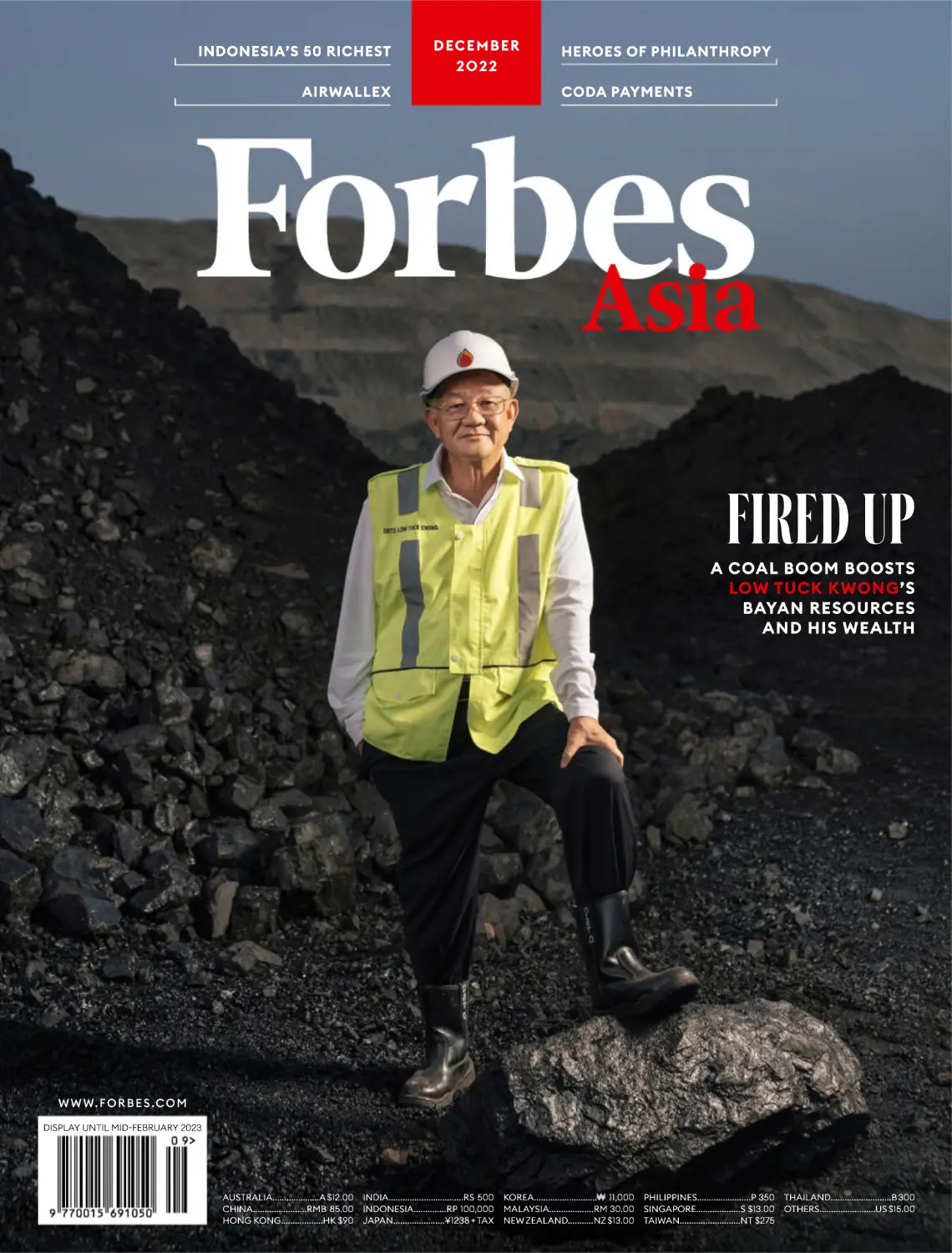
FIRED UP

A COAL BOOM BOOSTS
LOW TUCK KWONG’S
BAYAN RESOURCES
AND HIS WEALTH

W W W. F O R B E S .C O M
DISPLAY UNTIL MID-FEBRUARY 2023

AUSTRALIA....................A $12.00
CHINA.......................RMB 85.00
HONG KONG..................HK $90

INDIA................................RS 500
INDONESIA..............RP 100,000
JAPAN......................¥1238 + TAX

KOREA........................... 11,000
MALAYSIA...................RM 30.00
NEW ZEALAND...........NZ $13.00

PHILIPPINES.......................P 350
SINGAPORE...................S $13.00
TAIWAN..........................NT $275

THAILAND..........................B 300
OTHERS........................US $15.00

BREGUET.COM

CLASSIQUE 5377

Volume 18 • Number 9

December 2022

INSIDE

CONTENTS

4

56
INDONESIA’S 50 RICHEST

56

| Coal Miner

Bayan Resources’ Low Tuck Kwong,
whose wealth jumped nearly fivefold
in the past year, is confident that
coal still has a profitable future.
By Ardian Wibisono

66

| Energy Boost

With six newcomers—three from
coal—collective wealth scaled a
new peak.
By Jane Ho and Naazneen Karmali

COVER CREDIT LOW TUCK KWONG : Photograph by Muhammad Fadli for Forbes Asia

FORBES ASIA

DECEMBER 2022

Volume 18 • Number 9

December 2022

44

CONTENTS

6

15

| Green Flying Machine

FINTECH

28

| Game On

the environment, but even better for
big Wall Street banks that are poised to
reap billions in cheap financing, trading
profits and federal tax breaks.

Futuristic vertical-takeoff air taxis have
grabbed all the headlines—and billions
in venture dollars—but Singapore-based
billionaire Richard Chandler thinks he
has a better idea: conventional batterypowered aircraft that are cheaper to fly
and more reliable than turboprops.

Despite headwinds, Coda Payments
head Neil Davidson is pushing ahead
with big plans for the profitable
Singapore-based payments firm.

By Chris Helman with Matt Schifrin

By Jonathan Burgos

ENTREPRENEURS

By Jeremy Bogaisky

THE LIST

44
20

| Asia’s Heros of Philanthropy

Our 16th edition of the annual list highlights the region’s top 15 philanthropists
who demonstrated a strong personal
commitment to causes such as education and the environment.
Edited by Rana Wehbe Watson

TECHNOLOGY

74
ASIA’S POWERBUSINESS WOMEN

| Fueling The Future

Lucy Liu’s Airwallex maintains its $5.5
billion valuation and looks to grow,
despite the tech industry downturn.

Plug Power’s long-time CEO is repositioning the fuel cell maker to be a producer of hydrogen fuel made from water and
renewable power to cut climate-warming
industrial carbon pollution from the steel,
oil and agricultural industries.

By John Kang

By Alan Ohnsman

20

| Tech Tonic

| Flying High

96

Swiss aviation tycoon Thomas Flohr
aims to almost triple Vista Global’s
fleet of private jets to over 1,000 aircraft
by 2030 amid soaring demand in Asia
and the U.S.
By Jonathan Burgos

THE LIST

100

| 30 Under 30 North America

These entrepreneurs, innovators and
disruptors provide plenty of reason to
believe that tomorrow will be brighter
than today.
Edited by Kristin Stoller and Steven Bertoni
with Olivia Peluso

12

| Fact & Comment

Steve Forbes
NEW BILLIONAIRE

25

| The Guru of Greensboro

Like the Oracle of Omaha, real estate
developer Roy Carroll buys low and
rarely sells. He’s biding his time now,
waiting for the collapse.
By Giacomo Tognini
FORBES ASIA

THE INVESTIGATION

90

| Spinning Gold from

Saving election day.
14

| Tech Connector

Green Bonds

Rich Karlgaard

One of the hottest trends on Wall Street
is prepaid muni bonds, structured to
help local utilities buy decades’ worth
of renewable electricity. It’s good for

2023’s winner is trust.
108

|

Thoughts

On beginnings.
DECEMBER 2022

LUCY LIU: COURTESY OF AIRWALLEX, HEROES OF PHILANTHROPY: MASAO YAMAZAKI FOR FORBES ASIA

INNOVATION

Forging our net zero
future in ASEAN
At UOB, we are committed to building a sustainable ASEAN and
have pledged to achieve net zero by 2050.
We believe that a just transition that supports economic
growth and improves energy access is key to successful
decarbonisation across the diverse economies in the region.
Through our comprehensive suite of solutions, we simplify
sustainable financing to help you meet your sustainability goals.
As the One Bank for ASEAN, this is how we do Right By You.
Find out more at www.UOBSustainability.com

United Overseas Bank Limited Co. Reg. No. 193500026Z

8

BUSINESS
Chief Executive Officer William Adamopoulos
Senior Vice Presidents Tina Wee, Eugene Wong
Vice Presidents Aarin Chan, Janelle Kuah
Director, Circulation Eunice Soo
Sales Directors Michelle Ong, Janice Ang, Kathy Cheng
Deputy Director, Circulation Pavan Kumar
Deputy Director, Events & Communications Audra Ruyters
Deputy Director, Conferences Jolynn Chua
Deputy Director, Marketing & Research Joan Low
Deputy Director, Ad Services – Digital Keiko Wong
Deputy Director/Assistant to CEO Jennifer Chung
Senior Manager, Events & Communications Melissa Ng
Senior Manager, Ad Services Fiona Carvalho
Conference Managers Clarabelle Chaw, Peh Ying Si
Managers, Marketing & Research Gwynneth Chan, Kwang Yoke Peng
Manager, Advertising Vanessa Lim
Assistant Manager, Marketing & Research Goh Yu Zhen
Advertising Executives Nurafida Ibrahim, Maggie Yeo, Lulinda Leung
Circulation Services Taynmoli Karuppiah Sannassy, Jennifer Yim

EDITORIAL
Editor Justin Doebele
Asia Wealth Editor & India Editor Naazneen Karmali
Senior Editors Robert Olsen, Jennifer Wells
Special Projects Director Rana Wehbe Watson
Design Director Mirna Aprilla
Senior Reporter Jonathan Burgos
Associate Editor John Kang
Senior Designer Mossy Chew
Reporter/Multimedia Producer Zinnia Lee
Multimedia Producer Shan Shan Kao
Reporter Catherine Wang
Executive Assistant Sharon Joseph
Contributing Editors Richard Borsuk, Susan Cunningham,
Jane Ho, Gloria Haraito, Brian Mertens, Phisanu Phromchanya,
Amit Prakash, Yessar Rosendar, Mary E. Scott, Ardian Wibisono
ASIA CONTRIBUTOR NETWORK
Beijing Yue Wang
Chennai Anuradha Raghunathan
Delhi Megha Bahree
Ho Chi Minh Lan Anh Nguyen
Hong Kong Shu-Ching Jean Chen
Manila Roel Landingin
Perth Tim Treadgold
Singapore Jessica Tan
Taipei Joyce Huang
Tokyo James Simms

CHAIRMAN AND EDITOR-IN-CHIEF: STEVE FORBES

FORBES MEDIA
Chief Executive Officer and President Michael Federle
Chief Financial Officer Michael York
General Counsel MariaRosa Cartolano
Assistant General Counsel Nikki Koval
Editor-at-Large/Global Futurist Rich Karlgaard
EVP, ForbesWoman Moira Forbes
FOUNDED IN 1917
Editor-in-Chief (1917-54) B.C. Forbes
Editor-in-Chief (1954-90) Malcolm S. Forbes
Editor (1961-99) James W. Michaels
Editor (1999-2010) William Baldwin

EDITORIAL
Chief Content Officer Randall Lane
Executive Editors Caroline Howard, Bob Ivry, Luisa Kroll,
Kerry Lauerman, Michael Noer, John Paczkowski, Matt Schifrin
Design Director Alicia Hallett-Chan
Managing Editor Joyce Bautista Ferrari
Assistant Managing Editors Steven Bertoni, Diane Brady,
Seth Cohen, Kerry A. Dolan, Alice Jackson-Jolley, Rob LaFranco,
Rashaad Lambert (Culture & Community), Jeffrey Marcus,
Janet Novack, Michael Ozanian, Michael Solomon
Editorial Counsel Jessica Bohrer
DIGITAL
Chief Product Officer Nina Gould
Chief Technology Officer Vadim Supitskiy

DECEMBER 2022 — VOLUME 18 • NUMBER 9
FORBES ASIA (ISSN 1793 2181) is published monthly, except bimonthly in December/January, February/March and April/May. FORBES ASIA is printed at
Times Printers in Singapore. Singapore MCI (P) 072/11/2022. Malaysia KDN PPS 1411/01/2013 (022902). All rights reserved. Title is protected through a trademark
registered with the U.S. Patent & Trademark Office. FORBES ASIA is a trademark of FORBES ASIA. Copyright © 2013 FORBES ASIA.
CONTACT INFORMATION
For Subscriptions: visit www.ForbesAsiaSubscribe.com, email subscribe@forbesasia.com.sg or call FORBES ASIA at +65 6836 1652 / +65 6836 9476.
For Advertising: email advertising@forbesasia.com.sg or call FORBES ASIA at +65 6836 3408.
For Article Reprints or Permission to use FORBES ASIA content including text, photos, illustrations and logos: email reprints@forbesasia.com.sg or call
FORBES ASIA at +65 6836 3408. Use of FORBES ASIA content without the express written permission of FORBES ASIA or copyright owner is expressly prohibited.

FORBES ASIA

DECEMBER 2022

Stark Contrasts

10

s we reach the end of the
year, it seems we are experiencing some stark contrasts at the moment—and
ones that question conventional wisdom. Take for example the paradox of one of the world’s most vilified energy sources, coal, enjoying a boom time.
The second richest member of Indonesia’s
50 Richest list, Low Tuck Kwong, is the
owner of Bayan Resources, an Indonesian
coal mining company. He got to that lofty
position based on the strong performance
of his company and its stock in the Indonesian market. Despite members of the G20
pledging to help Indonesia wean itself off
coal in the future, it is still in use in many
countries around Asia-Pacific.
Tech unicorns are experiencing a downturn in funding. Yet that trend doesn’t
apply to the two companies featured in this
month’s issue: Airwallex and Coda Payments. The two fintechs, the first based in
Hong Kong and the other Singapore, are
still able to raise gobs of funds. Coda Payments is the rare profitable unicorn, a species that is highly prized now by investors
worldwide, while Airwallex sports a respectable $5 billion plus valuation.
And finally, when money is becoming
more expensive as rates go up, and there’s
talk of recession in the air, it hardly seems
like an auspicious time to be generous. Yet
our annual Heroes of Philanthropy dispels that notion. Indian billionaire Gautam
Adani has pledged over $7 billion for healthcare, education and skills development. Others may not be able to match that figure but
they are doing their share as well, in both
financial terms as well as demonstrating a
passion for their altruistic endeavors.

A

FORBES ASIA

So on the theme of contrasts, this phrase
was used in this year’s Forbes Global CEO
Conference: the new abnormal. Forbes futurist Rich Karlgaard asks in his column
whether the present economic environment
really is different, with unusual conditions
such as the U.S. having massive numbers of
unfilled job openings. In the midst of this
uncertainty, Karlgaard says trust will become a more valued commodity—and no
doubt Asia, and the world, would welcome
more trust. As always, all comments welcome at editor@forbesasia.com.

JUSTIN DOEBELE
EDITOR, FORBES ASIA

DECEMBER 2022

“With all thy getting, get understanding”

FACT & COMMENT
By Steve Forbes, Editor-in-Chief

Saving Election Day

12

The recent midterm elections in the U.S.
raise several questions regarding issues that
threaten the integrity of our electoral system.
Why can’t states such as California count
votes as quickly as Florida does? Why can’t
most of the voting take place on Election
Day, like it once did? Do new systems, such
as ranked-choice voting, undermine the
democratic process?
Our electoral system in several states is
already broken. Days after Election Day, the
results from many critical races remained
unknown, not because those races were
close but because the counting process
was—and is—interminable. California is the worst offender,
but other states, such as Oregon, are sluggish.
For a fair and highly efficient electoral process, Florida is
the model, the gold standard, in election management. It’s
the third-most-populous state in the country—and along
with Texas is one of the fastest-growing. Even so, ballots in
the Sunshine State were all counted within hours after the
polls closed. No fuss, no big court challenges.
Florida enacted important reforms after the fiasco of the
2000 presidential election, when its sloppy procedures and
badly designed ballots led to protracted litigation and the
notorious “hanging chads.” After that the state cleaned up
its act by passing several reform bills.
In Florida, for instance, a mail-in ballot must be received
by 7 p.m. on Election Day, period. There’s no controversy
over postmarks. The counting of mail-in ballots begins 22
days before Election Day. The count must be posted within
30 minutes after the polls are closed. Some states don’t
even start the count until Election Day itself.
Besides the inexcusably slow counting in California
and Arizona, another thing that stands out, particularly
since the pandemic, is how extended the voting process
has become and—prodded by “temporary” pandemic
measures—is growing. In fact, the words “Election Day” are
misleading. Voting in some states starts a month or more
before Election Day and, given particular mail-in voting
rules, doesn’t end until well after.
The purpose of having an Election Day is so voters can
make decisions about particular candidates and issues
at a given time. And the whole point of a campaign is
for candidates to make their case to voters. Early voting,
especially when it starts in September, distorts the campaign
process. It puts underdogs and lesser-known candidates
FORBES ASIA

at a disadvantage. Often aspirants create
momentum as Election Day nears. But now
it’s not an anomaly for a candidate to win
the balloting on Election Day but still lose
the election.
Another bad consequence is that
candidate debates seem to be a thing of the
past; at most there may be one verbal contest.
In Pennsylvania, a telling—and the only—
debate for the U.S. Senate race was held
well after hundreds of thousands of ballots
had already been cast.
While early voting via mail-in ballots
is entrenched in many states, the time it
begins should be minimized to two to three weeks before
Election Day itself. Moreover, states shouldn’t send out
ballots to one and all, as Nevada does, as this invites fraud.
Mail-in ballots should have to be specifically requested.
There’s another trend that makes a mockery of the
concept of candidates’ winning by receiving more votes
than their opponents: ranked-choice voting. Nevada just
approved it. Alaska and Maine already have it, as do several
cities. Under this weird arrangement, voters don’t just cast
ballots for individual candidates; they also rank the other
candidates in a particular race in order of preference—
second choice, third choice and so on.
If no one receives more than 50% of the first-choice
vote, the candidate with the fewest number of votes is
eliminated, and the second-choice picks for the eliminated candidate are redistributed. The process goes on until a
candidate gets more than 50%.
This becomes really complicated for voters when there
are a number of contests on the ballot.
In the real world, the ranked-choice system is very
undemocratic. The deep-red state of Alaska elected a
Democrat to the House of Representatives, even though
that person would have been clobbered in a straight headto-head contest.
Another electoral perversion is the so-called jungle
primary that’s practiced in various forms by California,
Louisiana and Washington. There are no party primaries;
instead, all candidates for an office are on one ballot. The
top two in that round—even if they’re from the same party—
then face each other in the general election. This ends up
reducing party accountability.
All these changes—way-too-early voting, ranked-choice
voting and jungle primaries—erode the democratic process.
DECEMBER 2022

TECH CONNECTOR
By Rich Karlgaard

2023’s Winner Is Trust
We now turn to 2023, and try to
forecast a global economy that this
magazine’s editor, Justin Doebele,
smartly calls “the new abnormal.”
Goldman Sachs reaches a similar
conclusion. The firm’s recently published Macro Outlook 2023 is called
“This Cycle Is Different.” Here we
must bow to the famous warning of
late investor Sir John Templeton—
“This time it’s different”—as the
most dangerous words in finance.
But what if the facts say otherwise—
that our time is different and unprecedented?
Goldman Sachs explains: “How can core inflation fall so
much with such a small employment hit? The reason, we
think, is that this cycle is different from prior high-inflation periods. First, post-pandemic labor market overheating showed up not in excessive employment but in unprecedented job openings, which are much less painful to
unwind. Second, the disinflationary impact of the recent
normalization in supply chains and rental housing markets
still has a long way to go. And third, long-term inflation expectations remain well-anchored.”
Where, then, to invest in 2023?
An intangible asset—trust—will be the winner in 2023.
Value always rises with scarcity and demand. Trust has
been all-too scarce over the past few years. The decline of
trust has led to disasters in investment and public policy.
Just a short sampling:
• The latest chapter of the biotech fraud, Theranos, led to
the 11-year prison sentence for its charismatic founder,
Elizabeth Holmes. She lied to regulators and customers and caused $10 billion in market value to evaporate.
A bet on Theranos was always a trust bet on Holmes,
which she betrayed.
• The opening chapter of cryptocurrency’s biggest disaster
yet, the exchange firm FTX. Founder Sam BankmanFried had created a cult around his math genius. During
a Zoom call to raise money from Sequoia Capital, a top
global venture firm, he was playing a computer game,
League of Legends—you can’t make this up. He ultimately received $214 million from Sequoia, with no board
seat or audit reports! Just trust. Breathtaking.
• During the last three years, China’s ruling party has lost
FORBES ASIA

trust with many of its dynamic entrepreneurs and private investors.
Will I run afoul of the party? Can
I get my capital out? These kinds
of questions sap creative juice, but
some paranoia is needed when trust
is in decline. Memo to party leaders: It’s impossible to take bold
steps while tiptoeing around risks.
• The global ESG movement has lost
trust. ESG—the idea that investments must account for climate and
social justice impact—was always
the triumph of altruism and hope.
Indeed, ESG stocks outperformed
the broad market for a few years. But that’s only because carbon light stocks outperformed oil, gas and
defense stocks. That flipped a year ago, and now ESG
stocks have underperformed. There remains a good argument for supporting ESG goals, but ESG’s dreamy
subjectivity now lacks trust. What’s needed to restore
trust is an ESG 2.0 based on hard facts and data.
Trust is an eternal value, but its practice is often undermined by greed, fear, rigid ideology and charismatic autocrats. The world has seen a storm of these trust killers in
the last few years. But investors who can see through the
economic fog will see renewed value in trust.
We end this column by quoting two people we highly trust.
Steve Forbes: “Like the air we breathe, we too often take
this critical intangible for granted. We do so at our ultimate competitive peril.”
Lawrence Wong, Singapore’s deputy prime minister and
minister for finance, when asked to describe Singapore’s
brand in a single word: “That is ‘trust.’ It is trust within
Singapore and it is also trust with all our partners. We are
fortunate in Singapore to be a high trust society. And trust
enables many things to get done.”
Rich Karlgaard is editor at large at Forbes.
As an author and global futurist, he has
published several books, the latest of
which is Late Bloomers, a groundbreaking
exploration of what it means to be a late
bloomer in a culture obsessed with SAT
scores and early success. For his past
columns and blogs visit our website at
www.forbes.com/sites/richkarlgaard.
DECEMBER 2022

GETTY IMAGES

14

INNOVATION
By Jeremy Bogaisky

Green Flying Machine

15

Futuristic vertical-takeoff air taxis have grabbed all the headlines—and billions in venture dollars—
but Singapore-based billionaire R I C H A R D CH AN DL ER thinks he has a better idea: conventional
battery-powered aircraft that are cheaper to fly and more reliable than turboprops.

The quiet of a frigid

November afternoon in eastern Washington state is shattered by an earsplitting roar as an F/A-18 fighter jet
screams down the runway at Grant
County International Airport, barreling past rows of undelivered Boeing
737 MAX jets. Inside a nearby hangar is a gleaming white airplane that
could be a key step on the journey to
silencing those jets and erasing their
greenhouse gas emissions: the Eviation Alice. The elegant twin-engine,
which resembles a Cessna Citation
crossed with a balloon animal, is entirely battery-powered and in September became the heaviest electric plane,
at more than 7,260 kilograms, ever to
take flight.
For Richard Chandler, the 63-yearold Singapore-based billionaire investor who controls Eviation and the
company that makes Alice’s electric
engines, MagniX, it’s personal. An
uncle on his father’s side, George Watt,
was an RAF test pilot during World
War II who worked on the Allies’ first
jet engine. An uncle on his mother’s
DECEMBER 2022

Richard Chandler
with the latest
version of Eviation’s
all-electric plane,
Alice, which was
redesigned after a
2020 battery fire
incinerated the first
prototype on the
ground.

I N N OVAT I O N

16

side, Tony Guina, is a car mechanic turned inventor
who worked for years developing high-powered electric motors. For years, the New Zealand–born Chandler funded Guina’s work—mostly as a favor to his
mother. Chandler kicked around the idea of plugging
those engines into Jeepneys in Manila to cut air pollution, but it became apparent that they would always be
too expensive for buses. Then, in 2017, he realized that
they might be perfect for planes.
An all-electric conventional plane would have plenty
of upside. Cleaner air, for one, but also massive savings (Eviation claims more than 40%, potentially as
high as 80%) on energy and maintenance costs (electric motors have far fewer moving parts). But batteries
are decades away from having enough power to propel the big jetliners that carry most travelers. Despite
deep skepticism from the mainstream aviation industry, investors were interested in electric aircraft—but
only bleeding-edge vertical-takeoff and -landing ones.
Billions have been invested in sci-fi visions of air taxis
that could hop from rooftop to rooftop. Joby Aviation,
a Northern California company, raised $820 million
in venture funding from the likes of Intel and Toyota
before going public in a $1.1 billion SPAC deal in 2021.
Chandler had a different take: Why not electrify
small conventional planes? It would be much cheaper
and easier to change just the propulsion system. Plus,
fewer changes would make safety regulators more
comfortable. The simplest solution would be to swap
in green electric engines for old gas-guzzlers on existing aircraft, which was his initial plan with MagniX.
Or you could build an entirely new plane. Like Alice.
Chandler sees the ninepassenger plane as the Tesla
Model S of electric aircraft.
Like Elon Musk’s first $95,000
battery-powered car, Alice will
be expensive ($7 million to
$8 million, more than double
a basic turboprop with similar seat capacity) and rangechallenged (400 kilometers at
best). But Chandler believes
Alice will catalyze the development of electric aircraft in an
industry still skeptical of them.
“It’s a forerunner into a seismic
shift in aviation,” he says.
He’s accustomed to betting against the conventional
wisdom. Starting in the mid1980s, he built a $2.6 billion
fortune making combative,
contrarian investments across
a wide range of industries
(telecom, utilities, finance)
FORBES ASIA

in Russia and developing nations in Asia and Latin
America. In 2019, he bought a 70% stake in Eviation,
an Israeli startup, to show how well MagniX’s engines
could perform in an airplane designed from day one
around electric propulsion. In all, he has spent about
$180 million on Eviation and tens of millions more on
MagniX. Both companies have been relocated to the
Seattle area to take advantage of the Pacific Northwest’s Boeing-anchored aerospace ecosystem.
Eviation doesn’t have meaningful revenue yet, but in
September 2021 MagniX landed a $74 million NASA
contract to work on electric propulsion for larger aircraft. MagniX has the clearer near-term growth path,
too: For roughly the same cost as overhauling a comparable turboprop engine, which can run around
$300,000, customers should be able to give old aircraft a green makeover by swapping in MagniX’s
top-of-the-line 650-kilowatt engine. Range would be
lower, but for some aviation outfits lower operating
costs are the bigger deal. Vancouver-based Harbour
Air, for example, has been testing a MagniX-powered
Beaver seaplane since 2019. It believes it will be able to
carry three or four passengers for a half-hour with reserves, more than enough for its many local 25-minute
routes. United Therapeutics is aiming for hour-long
flights with MagniX electrified Robinson R44 helicopters to deliver transplant organs. MagniX is expecting
the FAA to clear the engines for general use in 2024.
Worldwide, McKinsey estimates roughly 12,000
older small aircraft are suitable for conversion to battery electric or hybrid systems (MagniX is also developing these). In addition, the company is working with

MagniX’s most powerful motor
generates the equivalent of 850
horsepower yet is quiet enough
that Eviation expects Alice won’t be
subject to airport noise curfews.

DECEMBER 2022

GASSING UP

DECEMBER 2022

FORBES ASIA

17
I N N OVAT I O N

Southern California startup Universal HyEveryone is grousing about airfares, but prices are still historically low.
drogen to power 40-seat seat regional airA seat on a domestic flight will set you back an average of $360 these
planes with fuel cells.
days,27% less than in 2002, after adjusting for inflation. Improved fuel
efficiency deserves much of the thanks, with U.S. airlines burning through
But Chandler loves Alice’s prospects. He
24% less gas than two decades ago. Good thing, since the price of jet
and other evangelists hope planes like it will
fuel is up 140% since 2020.
expand regional service to underused small
Airline Fuel Cost and Consumption
airports that are too expensive for current
planes to fly into, for both package delivery
Gallons consumed* (in millions)
Cost of fuel (in million dollars, adjusted)
and passenger service.
*1 gallon = approximately 4 liters
60,000
“Instead of taking trains or cars on 200to 250-mile [320- to 400-kilometer] jour40,000
neys, it’s going to be so much more fun taking an Alice that’s on-demand at a regional
airport near you,” he says. “This has the po20,000
tential to reshape how we think about aviation for the man in the street.” Two hanging
0
2000
2022
questions are whether Alice will actually fly
that far, and whether there’s really demand
U.S. airlines on domestic routes, inflation-adjusted.
Source: Bureau of Transportation Statistics
for it. Eviation touts orders topping $2 billion for almost 300 planes, but nearly all of
them are nonbinding.
One firm order: launch customer DHL,
in seed capital they parlayed into a combined $5 bilwhich is ponying up for 12 cargo-configured planes.
lion fortune before splitting up in 2006.
Light e-commerce boxes are a good fit for Alice. The
A more grounded reason for optimism: government
plane has an unusually wide 2-meter midsection to inmandates and carbon taxes. France has banned shortcorporate 3,720 kilograms of batteries, which leaves it
haul flights when trains are an option, but low-emission
with less overall payload capacity than planes of simiplanes are exempt. Other EU countries are likely to follar size, but lots of interior volume.
low suit. Longer term, Norway plans to transition enAnother potential launch customer, New England–
tirely to e-planes on domestic routes starting in 2040.
based short-hop carrier Cape Air, has signed only a letUpsetting the equilibrium: rifts with Eviation’s
ter of intent. Chairman Dan Wolf likes the promise of
founders, who are upset by Chandler’s seemingly unsaving money on fuel and maintenance, but he’s woryielding commitment to MagniX engines. CEO Omer
ried about the high purchase price and about how long
Bar-Yohay, who first sketched Alice while at a bar in
the batteries will last—and how much it will cost to
Vienna in 2014, was ousted in February. Aviv Tzidon,
replace them.
a serial tech entrepreneur who holds a board seat, acLongevity isn’t the only concern. Eviation insists
knowledges there are no alternatives to MagniX right
batteries are available today that would enable it to fly
now, but he wants to solicit bids. Perhaps established
400 kilometers. Maybe, says Shashank Sripad, a batjet engine makers like Rolls-Royce or French aerotery researcher with a Ph.D. from Carnegie Mellon, but
space giant Safran would step up to compete—and dethey’re in the early stages of being rolled out, and it’s
liver lower prices.
not certain any will prove to be aviation-grade in duKiruba Haran, a University of Illinois engineering
rability, safety or affordability by 2027, when Eviation
professor, credits MagniX for getting engines in the air.
plans to bring the plane to market. (Sripad is a memBut the Magni650 provides only “modest” power for
ber of this year’s Forbes 30 Under 30 North America)
its weight, he says, while big companies and academics
For 400 kilometers plus a safety reserve, Sripad
are making progress on megawatt-scale motors.
estimates Alice will need cells with energy density
Chandler believes MagniX has a commanding
between 340 and 400 watt-hours per kilogram. The
lead. He claims that both General Electric and Pratt
highest currently mass-produced for cars: 300.
& Whitney are trying to buy the engine maker from
In part, Chandler expects Alice to sell because he’s
him (both companies declined to comment). The enmaking it beautiful. He’s sweating the details, citing
gine titans might have bigger budgets, but also the
his many hours on business jets as a globetrotting indistractions of lucrative legacy products. Like Tesla,
vestor, and the eye for design he developed in his 20s
Chandler thinks MagniX’s singular focus on electric
as a women’s wear stylist who helped his family expand
will keep it ahead.
their department store in Hamilton, New Zealand,
“We’re climbing Everest here,” he says. “And guess
into a chain of boutiques. Selling them in 1986 gave
what? It was a New Zealander who got there first.”
Chandler and his brother, Christopher, the $10 million

PROMOTION

Steering Business Growth by
Focusing on Well-Being
DTP President Thiti Thongbenjamas shares the company’s ambitious business plan for
the next three years.
For DTGO Prosperous (DTP), a global investment company, keeping true to its “for all
well-being” business philosophy is crucial to
its future growth as it aspires to become a
true global investment firm.
DTP President Thiti Thongbenjamas says
the philosophy of “for all well-being” places a
strong emphasis on sustainability via innovation, as well as generating positive impact for
the stakeholders, customers and community.
“Global expansion is a key driver in achieving our commitment to social and environmental responsibility,” Thongbenjamas says.

Walking the Talk
At the height of the Covid-19 pandemic, the
hospitality sector suffered a huge blow due
to lockdown measures, which eventually
resulted in staff layoffs and wage cuts.
However, DTP, which acquired 17 hotels
comprising various well-known brands
across the U.K. in October 2019, decided to
retain all of its 1,200 hotel staff and maintain their salaries—a policy that was applied
across the DTGO group of companies, including sister company Magnolia Quality Development Corp, one of Thailand’s leading
property developers.
“We are in the business of people. With
the acquisition, the employees are effectively
our family. During challenging times, families
don’t give up on each other; instead they take
care of one another,” Thongbenjamas says.
The decision to keep all of its employees
in the U.K. proved wise, as the hotels reaped
the benefits when international borders
reopened and lockdowns were lifted. DTP’s
hotels were able to go at full speed immediately and serve their guests at full capacity.
More importantly, the decision has also
opened more doors to new opportunities
and potential partnerships that would play
a key role in helping DTP achieve its expansion plans.

Driving Business Growth
DTP is focusing on brownfield projects and
high-potential assets in order to generate

Thiti Thongbenjamas, President of DTGO Prosperous and
Hansa Susayan, Chairman of DTGO Prosperous

stable and sustainable income for the group
and its investors.
It has four business pillars: global investments, asset management, fund management, and venture capital and innovative
investment. Its global investments business
pillar is mainly responsible for investing in
brownfield property assets. Its asset management pillar is largely responsible for improving its existing assets’ value with the aim of
generating stable income.
Its fund management business pillar is
responsible for raising capital and recycling
capital in order to grow its portfolio. Meanwhile, its venture capital and innovative
investment arm generally focuses on identifying potential startups that can generate
long-term returns and synergize with the
group’s business.
DTP currently has more than US$650 million of assets under management (AUM),
including the 17 hotels in the U.K.
“By end-2025, we hope to grow our AUM
to approximately US$5 billion. It may sound

aggressive, but it is achievable, especially
when you have a vibrant monetizing and
capital recycling plan with the right partners,”
Thongbenjamas says.
To achieve the goal, DTP would need to
make progress in all four business groups.

Well-Being For All
Besides giving its 1,200 staff the muchneeded “umbrella” during the Covid-19 pandemic, DTP also took steps to ensure that it
did not neglect the community in which it
operates.
The company organized various programs
and activities to engage with the local community, including providing assistance and
relief to the homeless.
DTP also takes environmental-related issues
seriously, as it embarks on various initiatives to
increase the adoption of renewable energy.
It applied heat-to-power conversion technology to minimize environmental impact and
reduce energy cost. It also has plans to install
solar panels to further boost its efficiency.

PROMOTION

Hilton Garden Inn Birmingham Brindleyplace, U.K.

These value enhancements, coupled with
improved operational efficiency and assets
have helped increase the hotels’ valuation.
Today, the hotel portfolio is valued around
16% higher than when it was acquired back
in late 2019.

Becoming a True Global
Company
The acquisition of the 17 hotels in the U.K. was
just the start of DTP’s global expansion plan.
Over the next three years, the company aims
to penetrate other European markets, as well
as the U.S. and Asia.
It is also looking to acquire and invest in
student accommodation properties, in particular, those located in Australia, Germany and
the U.S. DTP also plans to acquire retail properties and offices. Meanwhile, DTP is in talks to
invest in various technology companies. “We
are finalizing M&As with them. These companies are expected to play a synergizing role
for DTGO Group’s technology and metaverse
ecosystem,” he says.
Once everything is finalized, it will increase
the group’s investment portfolio, which
includes the American-based biotechnology

company Life Biosciences and the Koreanbased artificial intelligence company Mind AI.
While eyeing global opportunities, Thongbenjamas will also be keeping a close watch
on Thailand.
“We will concentrate a lot on our backyard.
In the coming year, there should be more
opportunities for good value hospitality
assets in Thailand. This is an opportunity for
us to further grow our portfolio and our commitment to Thailand’s tourism, especially in
popular tourist destinations such as Phuket,”
he says.

Riding on Its Successful REIT
Momentum
Besides seeing its U.K. hospitality business
gaining traction and valuation, 2022 is a
momentous year for DTP as it launched its
maiden real estate investment trust (REIT)
called DTPHREIT.
DTPHREIT, which is a buy-back REIT, invests
in hotels and serviced apartments in highpotential areas, including Waldorf Astoria
Bangkok, Magnolias Ratchadamri Boulevard
Serviced Residences and U Khao Yai Hotel.
Investors of the DTPHREIT are expected to

DoubleTree by Hilton Hotel & Spa Chester, U.K.

Crowne Plaza Glasgow, U.K.

receive annual returns of 7% and the DTPHREIT will sell these properties back to their
original owners when the investment period
is over. The REIT was well-received as the
securities were oversubscribed during the
initial offer period.
“While we know that investors will enjoy
the stable high return that the REIT has to
offer from our high-quality assets, we were
still surprised by the strong response from the
investment community as this is our first REIT
fund,” Thongbenjamas says.
The company is in discussions with other
property owners about possible subsequent
launches of similar buy-back REITs, and it is
also exploring the possibility of launching a
private equity fund in the near future.

Business of People
While there are big plans for each of DTP’s
business pillars in 2023 and beyond, Thongbenjamas says the company will remain disciplined in its investment strategy and ensure
that all its ventures, investments and acquisitions meet three criteria.
First, the assets will help the group to
achieve a diversified portfolio. Second, it is
able to monetize the assets by generating
stable income or getting a windfall via divestment. Third, the assets are able to synergize
with the group’s businesses.
“At the end of the day, we are in the business of people. Hence, it is important to
always give back to society and the community,” he says. “That’s why we have a policy of
contributing 2% of our topline to social and
environmental causes, which is consistent
with our ‘for all well-being’ motto.”

www.dtgo.com

20

A S I A’ S P O W E R B U S I N E S S W O M E N

PO
BUSINESS
WOMEN

ust a few short years ago, Lucy Liu
was hanging out in a cafe in Melbourne after quitting her job in China to go traveling. Today, she is cofounder and president of Airwallex,
among the fastest-growing private
companies in the Asia-Pacific region
and one that is proving resistant to
the downtrends in startup financing
and hiring that are rattling the global tech sector.
In the space of just over a year, the fintech unicorn has raised a combined $400 million from an
A-list of investors, including DST Global, Sequoia
Capital China and Tencent. The series E funding
round, which closed in October, kept the company’s
valuation steady at $5.5 billion.

LU CY L I U ’s Airwallex maintains its $5.5 billion valuation

and looks to grow, despite the tech industry downturn.

COURTESY OF AIRWALLEX

BY J O H N K A N G

“We’re very focused
on building the
infrastructure to
empower other
businesses,” says
Lucy Liu, cofounder
and president of
Airwallex.

“In this market, I think investors like to invest in
the leaders of the industries,” says Liu in a video interview. She adds: “I think we have that track record
and have proven that our business model works. We
know what the market needs and we’re really good at
what we’re doing.”
The 31-year-old is one of four cofounders of Airwallex, which started in 2015 providing a software
platform that allows small and medium-sized businesses to pay international invoices and bills without hefty fees. It has since expanded into other fintech offerings, such as bank accounts, collection solutions, virtual credit cards (with Visa), and buy
now, pay later services (in partnership with Atome
Financial, a unit of Singapore-based AI company
Advance Intelligence Group).
FORBES ASIA

21

F U N D I N G F LU R RY
Airwallex has raised $902 million since 2016.

ASIA’S POWER BUSINESSWOMEN

22

Oct 2022 • Series E2
Key investors: 1835i, Hermitage
Capital, Hostplus, Lone Pine
Capital, Salesforce Ventures,
Sequoia Capital China, Square
Peg, Tencent

$100 M

Nov 2021 • E1
1835i, Lone Pine Capital,
Sequoia Capital China

$100 M

Sep 2021 • E
1835i, DST Global, G Squared,
Lone Pine Capital, Salesforce
Ventures, Sequoia Capital
China, Vetamer Capital

$200 M

Mar 2021 • D2
1835i, Greenoaks, Grok
Ventures, Skip Capital

I

Sep 2020 • D1
Not disclosed

$100 M

Apr 2020 • D
1835i, DST Global, Hillhouse
Capital, Horizons Ventures,
Salesforce Ventures, Sequoia
Capital China, Tencent

$40 M

$160 M
Mar 2019 • C
DST Global, Gobi Partners,
Hillhouse Capital, Horizons
Ventures, Sequoia Capital
China, Square Peg, Tencent

Jul 2018 • B
Central Capital Ventura,
Hillhouse Capital, Horizons
Ventures, Sequoia Capital
China, Square Peg, Tencent

$100 M

Dec 2017 • A1
Square Peg
$80 M
May 2017 • A
Gobi Partners,
Mastercard, Sequoia
Capital China, Tencent

Jul 2016 • Pre-series A
Gobi Partners, Gravity Venture
Capital, Huashan Capital

FORBES ASIA

The company makes its money by charging a
small fee on transactions, the size of which depends
on the market and regulations. It has its main offices in Hong Kong and Melbourne and more than
20,000 customers in sectors that include e-commerce and software-as-a-service (SaaS) in more
than 50 markets worldwide, from Australia and
Hong Kong to Singapore, the U.K. and the U.S. Major clients include Chinese online shopping giant
JD.com, Australian airline Qantas, and Tencent’s
online-music arm, Tencent Music Entertainment.
The company says revenue rose 184% in the second
quarter of 2022 from the year-earlier period, without giving a dollar number.
“We’re very focused on building the infrastructure
to empower other businesses,” says Liu, who worked
at China International Capital Corp. (CICC), one of
China’s top investment banks, earlier in her career.
“I think that global financial infrastructure is something that’s quite unique. It takes a lot of time, money,
resources and people to build, and it’s not something
that people can easily copy or catch up to,” she says.

$6 M
$13 M
$3 M
Source: Airwallex

t took nearly two years to construct
the foundation of Airwallex’s proprietary money-moving infrastructure, and, including the latest funding round, it has raised more than
$900 million in total. Most of the proceeds have
been used to expand headcount, now at more than
1,300 across 19 offices worldwide. That has more
than doubled since last year—Airwallex is now one
of the fastest-growing private companies by headcount in Asia, outside of mainland China and India.
Airwallex’s growth was fueled by the Covid-19
pandemic, which accelerated trends toward online shopping and digital entertainment—sectors in
which many of its customers operate. According to
a U.N. trade report, the percentage of internet users
who shop online increased to 60% in 2020-21 from
53% in 2019. The report also notes that the combined online retail sales of China, the U.S., the U.K.,
South Korea, Canada, Australia and Singapore—
which together account for about half of the world’s
gross domestic product—expanded more than a
third to $2.9 trillion in 2021 from 2019.
“We really grew with our customers together in
the different verticals that they operate in, whether
it’s e-commerce, gaming or online education,” says
Liu. “These sectors have really accelerated in the
past two or three years.” One such customer is SleekFlow, a Hong Kong-based SaaS startup that provides an integrated platform allowing products and
services to be sold directly through social media.
Henson Tsai, its founder and CEO, says the company uses Airwallex for all its transactions, noting Airwallex’s low-fee, easy-to-use virtual multicurrency
cards. One major upside for Tsai and others like him
DECEMBER 2022

Global banking services designed
to enable our clients to flourish and
grow since 1812.

One global team with access to sophisticated
financial services, serving our clients to help them
deliver economic progress for their communities,
their families and themselves.
citiprivatebank.com

Scan the QR code
to find out more

Citi Private Bank is a business of Citigroup Inc. (“Citigroup”), which provides its clients access to a broad array of products and services available through bank and
non-bank affiliates of Citigroup. Not all products and services are provided by all affiliates or are available at all locations. Citi, Citi and Arc Design and other marks used herein are service
marks of Citigroup Inc. or its affiliates, used and registered throughout the world. © 2022 Citigroup Inc. All Rights Reserved.

INVESTMENT PRODUCTS: NOT FDIC INSURED • NOT CDIC INSURED • NOT GOVERNMENT INSURED • NO BANK GUARANTEE • MAY LOSE VALUE

M

eanwhile, Liu, who made Forbes
Asia’s Power Businesswomen list in
2020, is looking for the next generation of leaders to join the company, despite the general trend in the
tech industry that has seen many companies slash
jobs after a hiring frenzy during Covid-19. That includes Stripe, which announced early November it
would cut 14% of its more than 8,000 workers, citing inflation, higher interest rates, and less funding
for startups. Liu says that while Airwallex’s “1,300
[employees] may seem like a lot, with the size of the
business that we’re supporting, we’re actually still
quite a lean team.”
Liu declines to give a headcount target for the
company but says it has 140 positions to fill. To that
end, she has been an advisor for a mentor program
at Startup Victoria, one of Australia’s largest entrepreneurship communities, as well as at the University of Melbourne’s startup accelerator program.
Airwallex also provides scholarships and grants to
some of the university’s students. “We really want to
be able to help the students in engineering and IT
specifically because we want to have them see us as
a top choice for their career,” says Liu.
Airwallex was started in 2015 by Liu and three
friends from the University of Melbourne: Jack
Zhang, who was working as a software engineer at
Australia & New Zealand Banking Group; Xijing

FORBES ASIA

Dai, a serial entrepreneur with a master’s degree in
software engineering; and Max Li, an architect. Liu
had taken a career break and was spending time at
Tukk & Co., a specialty coffee shop owned as a side
business by Zhang and Li (which they have since
sold). The two were frustrated in their efforts to pay
suppliers in China for coffee cups and labels. They
thought the cross-border payments process lacked
transparency and exchange-rate and transaction
fees were too high. To solve the problem, the four
including Liu teamed up to start Airwallex, with
Zhang as CEO, Dai as chief technology officer, and
Li as head of design.

From left: Xijing Dai, cofounder and CTO; Jack Zhang, cofounder
and CEO; Lucy Liu, cofounder and president; Max Li, cofounder
and head of design.

While Zhang, Dai and Li had the technical expertise, Liu had something the others didn’t: a network of investors cultivated while working as an investment consultant at CICC that she could tap for
fundraising. According to one early investor in Airwallex, she also served as “the glue between all of
[the cofounders].” Chibo Tang, the Hong Kongbased managing partner of Asian venture capital
firm Gobi Partners, says Liu “became the operations
person and the culture person.” In addition, he says,
“Between the big personalities, sometimes within
the founding team, she was the one who was facilitating a lot of discussions.”
Liu’s ability to smooth over differences may reflect
her background. She was born in China, the only
child of a teacher mother and a serial-entrepreneur
father. At the age of 12, she moved to Auckland and
later attended the University of Melbourne, where
she earned a master’s degree in finance in 2012. She
cites her father as an inspiration for her own foray
into entrepreneurship, saying: “There were a lot of
ups and downs in his career. So I think that sort of
inspired me to be a very resilient person.”
DECEMBER 2022

COURTESY AIRWALLEX

ASIA’S POWER BUSINESSWOMEN

24

is that they no longer have to rely on Swift, a global
system that has dominated cross-border payments
for the past 50 years and that Airwallex, and other
companies like it, aim to disrupt.
While Liu says Airwallex’s infrastructure is difficult to copy, the company nevertheless faces competition from behemoths such as global payments
processor Stripe, which had more than $640 billion in transactions in 2021, and scrappier outfits
in the Asia-Pacific region such as Indonesia’s Xendit, a payments gateway provider with $200 million
in annualized transactions, and payments-solution
company Razorpay in India, with about $90 billion
(all three companies overlap with some but not all
Airwallex activities). Airwallex’s annualized transactions stand at $50 billion.
A report from Deloitte Financial Advisory says
the global market for digital payment transactions will grow at a CAGR of 13% between 2020
and 2026, to $11.3 trillion, down from a pandemic-fueled 28% in 2020. It expects consolidation in
the industry as competition increases and companies scale up. Airwallex has already been the target of a takeover bid. According to a media report,
Stripe made an unsuccessful A$1.6 billion offer for
its smaller rival in 2018 (Airwallex declined to comment). Airwallex tells Forbes Asia it is considering
an IPO as early as 2024.

W

New Billionaire

THE GURU OF
GREENSBORO
Like the Oracle of Omaha, real estate developer
Roy Carroll buys low and rarely sells. He’s biding
his time now, waiting for the collapse.
By Giacomo Tognini
Photograph by Ethan Pines for Forbes
DECEMBER 2022

hen he was 14, Roy E. Carroll
II bought an 800-squarefoot house in Danville, Virginia, using $1,000 in savings
(equivalent to about $5,000
today) that he had cobbled together from odd
jobs like mowing yards, returning bottles and
selling candy. He fixed the place up and sold
it a year later, using the profits to buy a Ford
Mustang that he wasn’t even old enough to
legally drive.
That turned out to be the first of many
properties Carroll bought on the cheap. In
1984, at age 22, the college dropout and his
father, a laid-off grocery store supervisor,
started building custom homes in Greensboro, North Carolina. Business boomed, and
he bought out his dad in 1991 and started developing subdivisions. Within ten years, Carroll switched to more-lucrative apartment
complexes and eventually expanded along
the Sun Belt from Tennessee to Texas.
Now 60, he has built a $2.9 billion fortune
largely made up of real estate, including
more than 13,000 apartments and 29 selfstorage facilities, as well as industrial land
and mixed-use projects. He has also parlayed
that Mustang into a collection of Ferraris, including one that raced at the 24 Hours of Le
Mans last summer.
Carroll’s simple explanation for his success:
“Warren Buffett looks for great companies
and doesn’t trade a lot. That’s our philosophy
in real estate,” he says. “Let’s find a good location and keep it. Why sell the golden goose?”
Indeed. Since that first house back in 1976,
he has sold only two apartment buildings,
in South Carolina. (“I regretted selling both
and tried to buy them back,” he says.) That
plus the fact that he has never brought in
any outside investors and has kept debt levels relatively low—about 40%—means he
can move quickly when opportunity strikes.
That’s what he did in the wake of the housing crash in 2009, and what he hopes to do
again. “[The market] is very frothy,” he says.
“It feels a whole lot like 2006–2007. The
deals just don’t make sense.”
If prices collapse, Carroll will be ready. If
they don’t, he maintains high rents will keep
his business steady. Either way, he’s in the
catbird seat: “It’s hard to time some markets,
but real estate is a slow mover—so you can
see the train wreck coming.”
FORBES ASIA

25

PROMOTION

POSCO Group Focusing on
Green Materials to Achieve
Sustainable Growth
POSCO Group CEO Jeong-Woo Choi shares how he is growing the company
into a world-class green materials provider.

S

tarting from a small fishing village
in Pohang, South Korea more than
50 years ago, POSCO has grown to
become one of the largest steel companies
in the world. Two of the key reasons
behind the company’s success are its focus
on sustainable growth and becoming a
responsible corporate citizen.
Today, POSCO Group is moving towards
becoming a world-class green materials
provider and has embarked on many
initiatives to make the world greener and
reduce carbon emissions.
POSCO Group CEO Jeong-Woo Choi, who
recently won the CEO of the Year award at
the 10th Global Metals Awards by S&P Global
Commodity Insight and was appointed as the
Chairman of the World Steel Association, shares
the company’s future plans and his thoughts
on the importance of sustainable practices and
the steel industry’s future direction.

POSCO Group has grown significantly over the past four years.
What are your priorities for the
company in the near future?
POSCO Group aims to become a world-class
green materials provider using innovative

technologies that have not existed in the
past. These green materials will be used in
industries such as future mobility, housing
and infrastructure, and will contribute to the
realization of future eco-friendly values such
as carbon neutrality.
One of the green materials that we
are working on is green steel. Currently,
we are working on a technology called
HyREX or hydrogen reduction, which could
significantly reduce carbon emissions in the
steelmaking process. By 2028, we hope to
build a HyREX demo plant and commercialize
the technology by 2030.
The group is also looking at expanding its
domestic and overseas production bases
for cathode and anode materials in the
rechargeable battery material business. We will
also start the saltwater-based production of
lithium with an annual capacity of 50,000 tons
in Argentina in 2025. This will play an essential
role in helping the group achieve its goal of
300,000 tons of lithium production by 2030.
Another priority for us is to grow the
secondary battery material business, which
is also one of our fastest growing businesses.
Last July, we held an investor relations event
for the secondary battery material business

Jeong-Woo Choi, POSCO Group CEO

and presented our 2030 goals for significant
materials such as nickel (220,000 tons),
cathode material (610,000 tons), and anode
material (320,000 tons). We also target to
achieve KRW 41 trillion (US$30.8 billion) in
revenue by 2030.

How important is Environmental,
Social and Governance (ESG)
to POSCO Group? What are the
ESG initiatives promoted by the
company?

POSCO Argentina lithium demo plant

P OS CO G ro up h as i m ple m e n ted th e
management philosophy of corporate
citizenship since 2018. In July 2019, the
corporate citizenship charter was released,
with the details and the practice principles
elaborated. The charter mainly embraces
what ESG stands for.
We h ave als o es t a bli s he d t h e E SG
discussion committee, where key
management, including CEOs of the holding
and operating companies, participates every
quarter to debate and discuss the responsive

PROMOTION

measures on ESG issues such as climate
change, safety, diversity, and inclusion, which
are considered crucial by our internal and
external stakeholders.
An advanced governance system is also
set up to detail what was discussed and
report the result to the board of directors and
ESG committee before it is communicated
to stakeholders. We plan to develop the
process further.

Yo u h a v e b e e n r e c e n t l y
appointed as the Chairman of the
World Steel Association. What are
some of your key priorities in this
new role?
Many countries, companies and organizations
have set the goal of achieving carbon
neutrality by 2050. However, the practical
methods and technologies we have currently
fall short of meeting this target.
I n s te a d o f p a r t i a l l y m o d i f y i n g t h e
process based on current technologies
and facilities, we need to develop new
technologies for commercialization and
set up the relevant facilities covering raw
materials for product manufacturing.
In addition, the materials used for new
facilities need to be produced with carbon
neutrality and supplied to steel mills. It
is another challenge to the new supply
channels for carbon-neutral raw materials.
To overcome the challenge, the World
Steel Association plans to develop ongoing
projects in each category and try a new
approach. First, we plan to strengthen the
sharing of technology innovation among
steel companies and promote cooperation
with other industries to create a carbonneutral ecosystem. We will hold conferences
for industry players to keep abreast of the

POSCO Group CEO Jeong-Woo Choi (left) was appointed as the
Chairman of the World Steel Association.

progress on carbon neutrality and new
technologies such as HyREX.
Second, we plan to design an intelligent
safety solution that can fit a new decarbonized
production process. The new carbon-neutral
steelmaking process has been developed
and is headed toward commercialization. In
this regard, we must proactively prepare for a
unique and potential industrial risk.
Third, we plan to define the standards
for green steel. There is rising demand and
interest from various industries for green
steel. However, there are no common criteria
or standards for this.
In determining the standards for green
steel, we plan to involve steel companies,
customers and third-party
independent certification institutes
in the discussion. In addition, we
plan to define green steel within
a set timeline by considering a
roadmap for developing carbon
neutrality technology.
Last but not least, we will try to
secure the supply network of ecofriendly fuel and raw materials
for green steel production. We
plan to create a venue where not
only global raw material partners
but also renewable energy and
hydrogen producers and relevant
POSCO Group awarded “Metals Company of the Year”, associations can discuss while
“Industry Leadership Award: Steel”, sharing information about a broad
“Deal of the Year” as well as “CEO of the Year”. scope of topics, including demand

forecast, procurement risk, and each country’s
policy direction. In addition, we will strive
to enhance the recyclability of steel by
standardizing the categorization system for
steel scraps.

You were also named CEO of
the Year at the 10th Global
Metals Awards by S&P Global
Commodity Insight. What was
your initial reaction?
While I am honored to receive the award,
I need to reiterate that this achievement is
possible only with the dedication of all the
employees of the POSCO Group. Hence, I
want to share this recognition with all the
executives and employees of the group, too.
I hope that all of us at POSCO Group will
remain committed to making POSCO a good
corporate citizen and to building a better,
more sustainable future together. Q

www.posco-inc.com

FINTECH
By Jonathan Burgos

Game On

28

Despite headwinds, Coda Payments head NE I L DAV I DSO N is pushing ahead with
big plans for the profitable Singapore-based gaming payments firm.

Neil Davidson, cofounder
and executive chairman
of Coda Payments.

FORBES ASIA

COURTESY OF CODA PAYMENTS

Coming off 2021’s
global funding highs, Singapore’s Coda
Payments raised $690 million earlier
this year from big league backers including the city-state’s sovereign wealth
fund GIC and America’s Insight Partners and Smash Capital. That investment—its highest ever, which tipped
the value of the payments platform for
online game purchases at $2.5 billion—
rewarded an elusive benchmark among
Southeast Asia’s unicorns: profitability.
The VC funding environment has
since turned bleak amid rising inflation and interest rates and the heightened risk of a global recession. But
that doesn’t worry Neil Davidson,
cofounder and executive chairman of
Coda Payments. The funding raise, a
secondary share sale, gave some returns to early investors including the
firm’s founders, but it wasn’t necessary
to tap fresh capital, he says in a video
call from his office in Los Angeles. The
company already had sufficient cash
flow, which jumped fourfold to $68
million in the year ended September
2021, according to regulatory filings in
Singapore. That’s allowed it to keep its
eye on the prize, getting bigger.
DECEMBER 2022

P L AY T I M E
CODA PAYMENTS HAS BEEN PROFITABLE SINCE 2018
BUT THE PANDEMIC TURBOCHARGED ITS GROWTH.

Revenue
(IN $ MILLIONS)

200
150
100
50
0
-50

2016

DECEMBER 2022

2017

2018

2019

2020

2021

Source: Venture Cap Insights, ACRA

“CODA PAYMENTS HAS A TRACK RECORD
OF HISTORICAL PERFORMANCE THAT’S
VERY CREDIBLE.”
Davidson is chasing new growth outside Southeast Asia, its largest market, with an aggressive
global push across Europe, Asia, Latin America
and the U.S. The expansion will include crossborder payments for games and other products as
well as more app stores.
Since moving back to his hometown in California in 2019 and setting up the Coda office in Los
Angeles the following year, Davidson has been
working on deals with new and existing customers, which he hopes to realize in the next twelve
months. “We're starting from a very tiny position
in these new markets,” the 41-year-old says. “If we
are able to have an impact in these countries, even
growing to a relatively small market share, [that]
will actually generate pretty big returns for Coda.”
Davidson and Leishman, who is Coda Payments’ executive director, initially targeted ecommerce firms as potential customers when
they launched their company 10 years ago. They
were inspired by the rapid adoption of M-Pesa in
Kenya—a mobile phone money-transfer service

Ebit

300
250

29
FINTECH

“Coda Payments has a track record of historical performance that’s very credible,” he notes.
“We can grow a lot over the next few years by
making relatively modest gains in our market
share.” (Davidson and cofounder Paul Leishman
remain substantial shareholders in the company
but declined to disclose their current stakes.)
As stuck-at-home consumers during the pandemic turned to online gaming and other digital
entertainment, Coda Payments’ revenue nearly
quadrupled to $310 million in 2021 from $81
million in 2019, while earnings before interest
and taxes quadrupled to $43 million in the same
period, the filings show. Its software processes
payments for some of the world’s largest sites,
including Activision Blizzard, Riot Games, Sea
Group's Garena, Netease, Tencent and Tinder.
Coda handles over 1 million transactions a day,
and on each one, it takes a 15% cut when users
pay for things such as game accessories and topups. Its main competitors are Apple and Google
but the company’s competitive edge is that it
charges half of what the bigger rivals do for a
similar service.

launched there in 2007—and hoped to replicate
the model first in Indonesia and then across the
region’s fragmented e-tail landscape. “We recognized enormous potential in Southeast Asia,”
Leishman, 39, says by email. “The region had a
large and growing population that was increasingly interested in purchasing digital content.”
The Canadian entrepreneur, who has a business
administration degree from the Ivey Business
School at Western University in Ontario, recently moved back to his hometown in Toronto from
Hong Kong to build partnerships with Western
digital content publishers.
Coda Payments’ first products offered an alternative to using a credit card to pay for online
purchases, such as carrier billing (where payments are charged to a user’s mobile phone bill)
and e-wallets. The cofounders based themselves
in Jakarta where roughly 70% of payments were
still made in cash. “A significant portion of consumers who were coming online for the first time
didn’t have Visa or Mastercard, which at the
time was what people needed to participate in
the internet economy,” says Davidson, an M.B.A.
graduate from Harvard University. “We felt there
was an opportunity to link up local alternative
payment methods that would help unlock a lot of
spending online.”
FORBES ASIA

FINTECH

30

The duo had met in 2009 at GSM Association
(GSMA), a London-based alliance of over 750
mobile carriers from around the world, where
they provided support for mobile payment services for the unbanked in Asia, Africa and Latin
America. In tapping telecoms firms in Southeast
Asia as Coda Payments’ first customers, “We
were able to draw on everything that we learned
at GSMA,” Davidson says. “Some of the relationships that we have built while we were at GSMA
helped us get Coda off the ground.”
They quickly pivoted to online game publishers who had a ready need for their payment software. “If you’re selling a digital product, you obviously cannot use cash on delivery because there’s
no physical delivery,” Davidson says. Within a
few years, they had offices in Singapore (moving
their headquarters there in mid-2014), Malaysia
and California.
Initially Coda Payments integrated its digital payment services on publishers’ websites,
but saw a gap with emerging creators of mobile
games, who typically distribute their products on

Coda’s software processes
payments for some of the
world’s largest sites.

FORBES ASIA

CO O L D OW N
SPENDING ON DIGITAL GAMES CONTINUES TO GROW POSTPANDEMIC, THOUGH AT A SLOWER PACE.

300

Global industry revenue

(IN $ BILLIONS)

250
200
150
100
50
0
2017

2018

Source: Statista

2019

2020

2021

2022

2023

FORECAST

apps. In November 2014, the startup launched
Codashop, which distributes accessories and
credits for both PC-based and mobile games,
today drawing over 50 million visitors every
month across 65 markets. Its Codapay enables
game publishers to accept over 300 modes of
payments on their own websites.
While trends such as a deeper fragmentation
of payment methods benefit the firm, global
spending on digital games has slowed. After
surging 30% to a pandemic high of $197 billion
in 2020, sales growth decelerated to 20% last
year and will likely taper off to 6.5% in 2022,
according to Statista. Still, the company expects
the impact will be minimal, even as the tech sector, including payment giants Stripe and PayPal,
respond to the broader economic downturn with
layoffs. “While we have adopted a more disciplined approach to hiring in the current climate,
we are in the early innings of pursuing a massive
global opportunity, and so continue to invest in
building out our footprint and capabilities,” Davidson says by email, declining to provide specific capital spending plans or earning projections
for this year.
That’s largely because Coda Payments’ key market is expected to hold its own despite the turmoil. Consumption of digital media in Southeast
Asia—including gaming and video streaming—is
projected to triple to $43 billion by 2025 from $14
DECEMBER 2022

COURTESY OF CODA PAYMENTS

“WE THINK WE CAN BE MORE EFFECTIVE
AT BUILDING LONG-TERM VALUE BY
STAYING PRIVATE,”
DECEMBER 2022

“We recognized
enormous potential
in Southeast Asia,”
says cofounder
Paul Leishman.

31
FINTECH

billion in 2019, according to a study published by
Bain, Google and Temasek in October. “Southeast
Asia is benefiting from secular trends such as its
young population and rising affluence across the
region,” says Florian Hoppe, Singapore-based
partner at consulting firm Bain & Co.
Anticipating further growth, Coda Payments’
Singapore-based backer Golden Gate Ventures—
whose more than $1 million investment was valued at over $100 million as of April, generating a
blended IRR of over 100X—will keep the firm in
its portfolio. “Coda is an incredibly strong company, a rare profitable unicorn,” says Vinnie Lauria, a Ho Chi Minh City-based managing partner
at Golden Gate Ventures. It sold some shares in
Coda Payments in April, but aims to hold on to
its remaining stake of less than 5% (currently
valued at $75 million) to get “outsized returns”
once the company launches an IPO.
While Davidson is also confident Coda Payments will continue to gain momentum in the
post-pandemic era, the company isn’t in a rush to
list. “We think we can be more effective at building long-term value by staying private,” he says.
Timing would also depend on market sentiment
improving. “People now have other options to
spend their discretionary income on other than
digital entertainment,” he notes. “While that will
likely attenuate our growth a little bit in the short
run, we’re very confident in the long-term growth
potential of digital entertainment.”
The gaming industry also has to contend with
regulatory clampdowns, most recently in India.
The country banned Garena’s mobile game Free
Fire in February and launched an investigation
six months later into potential anti-money laundering rule violations at payment companies,
including Coda Payment’s Indian subsidiary.
In September, the Enforcement Directorate
searched the firm’s Bangalore office and froze its
accounts totaling 685 million rupees ($8.4 million). “These allegations are without merit and
stem from a misunderstanding of Coda’s business model,” says Coda spokesperson Nikolay
Sushkov in an email. “Coda is cooperating with
the relevant authorities in this investigation.”
The investigation is still pending.

Such oversight is necessary as digital games
and payments associated with it become mainstream, says Darren Yong, Singapore-based head
of research for technology, media and telecommunications in the Asia-Pacific at KPMG. “Regulation needs to evolve and catch up with technology and protect consumers,” he adds.
Collecting payments on a cross-border basis
is a major stumbling block for digital game publishers given the regulatory overheads, Davidson
says. With the company working with locally regulated payment service providers, Coda is playing a key role in helping digital content providers
expand across several jurisdictions, boosting the
company’s market share in new markets around
the world, he adds.
FORBES ASIA

SPECIAL ADVERTISING SECTION

Indonesia Staging a Strong Comeback
Southeast Asia’s largest economy is shaking off the effects of the pandemic and
looking firmly towards a brighter future.
Indonesia has proven to be resilient in the
face of challenges on multiple fronts, from
geopolitical tensions to rising inflation and
interest rates. Buoyed by robust demand for
its natural resources, a vibrant digital sector
and surging foreign investments, Southeast
Asia’s largest economy has weathered the
global turbulence to put itself back on a
growth trajectory.
The country’s economy is expected to
grow by 5.4% in 2022, and by 5.0% in 2023,
according to a report by the Asian Development Bank (ADB) released in September. The Asian Development Outlook 2022
update notes that robust consumer demand
has more than offset lower government
spending, while demand for Indonesia’s
commodity exports has also been healthy,
supporting growth and generating a fiscal
revenue windfall.
“The Indonesian economy is coping well
with threats to growth. Consumer spending

1

Indonesia

is robust and commodity exports have
boomed,” says Jiro Tominaga, ADB Country
Director for Indonesia.
Reflecting this growing optimism over
Indonesia’s outlook, foreign direct investments spiked by almost 64% in the third
quarter of 2022, compared to the same
period in 2021, boosted primarily by development of resources processing. Indonesia’s
Minister of Investment Bahlil Lahadalia says
the economic slowdown in China, one of its
biggest partners, would not affect the flow
of investment into the country.

A Tech Resurgence
Indonesia’s burgeoning digital economy is
also regaining its momentum, driven in part
by the country’s technology startups, whose
innovative solutions are helping to overcome high distribution costs and provide
access to goods and financial services to
more Indonesians.

Indeed, amid an uncertain environment
for the global technology sector, Indonesia’s
startups continue to attract the attention of
investors seeking new avenues for returns.
In particular, industry watchers believe that
the country’s early- to growth-stage investments present an attractive risk-reward profile for investors.
Indonesia is now home to a rising number
of tech unicorns such as Traveloka, Xendit
and Akulaku; local startups raised US$9.4 billion in 2021, almost three times the US$3.42
billion raised a year earlier. Indonesian
venture capital (VC) firms have also been
actively investing in the sector, further fueling growth.
One leading investor in the tech startup
space is Alpha JWC Ventures, Indonesia’s first
independent and institutional VC firm. Established in 2015, the firm’s total assets under
management have grown to around US$700
million across three funds. Its portfolio of

SPECIAL ADVERTISING SECTION

over 70 companies features four unicorns
and 27 centaurs, with valuations of between
US$100 million and US$1 billion.
Indonesia has also seen some of Southeast Asia's most prominent public listings
this year, including GoTo Group, the country’s biggest technology company. As of 10
November, the Indonesia Stock Exchange
has recorded 54 new listings in 2022, exceeding 2021's total.

The Return of Travel
and Spending
Meanwhile, the lifting of pandemic-related
restrictions and the reopening of borders are proving a boon for the country’s
hospitality and consumer sectors. Amid
this recovery, the first Langham Hotel in
Southeast Asia opened its doors in downtown Jakarta.
The ultra-luxurious Langham, Jakarta sits
on the uppermost stories of a skyscraper in
the Sudirman Central Business District, with
upscale shopping and entertainment nearby.
Staying true to its roots, the property pays
homage to the refined British elegance of
the iconic Langham Hotel in London.
Growing confidence in the economy is
also giving a boost to consumer spending.
Fitch Solutions forecasts real household

spending in Indonesia to grow by 4.8% yearon-year in 2022, an improvement from the
2.2% growth recorded in 2021. While household spending will moderate slightly downwards in 2023, growth is expected to remain
strong at 4.7% next year.
As the largest and most successful bread
company in Indonesia, PT Nippon Indosari
Corpindo Tbk. is well-positioned to meet
rising demand for its market-leading bread
and cake products under its flagship brand
Sari Roti.
To capitalize on the buoyant consumer
sentiment, the company announced plans
to enter the chocolate spread and chocolate
milk business, after observing that Indonesian consumers had developed a strong
affinity for Sari Roti’s chocolate flavor.

Healthy Demand for
Natural Resources
Indonesia’s resources sector is expected
to be another beneficiary of the recovering global economy. In particular, palm
oil prices are projected to strengthen as
demand increases for its use in food and
biofuels. Indonesia is a major exporter of the
commodity.
The uptick in palm oil is benefitting
Indonesian producers such as PT Sumber

Tani Agung Resources Tbk (STAA), which
has established itself as a leading and sustainable player in the palm oil industry.
Founded 50 years ago, the company has
leveraged its expertise and experience to
consistently deliver superior results to its key
stakeholders.
STAA is now venturing into the downstream business to fuel growth, and is constructing a refinery and fractionation plant in
Dumai, Riau. Coordinating Minister of Maritime and Investment Affairs Luhut Pandjaitan says Indonesia's exports could surpass
US$300 billion by 2024, as the country regulates the exports of a range of commodities
to encourage investment in local downstream industries.
Meanwhile, sustainability has become
a priority for many businesses in Indonesia. The country’s largest integrated energy
company, Pertamina, is incorporating Environmental, Social and Governance (ESG)
factors into its operations as it views ESG
and sustainability as fundamental to its
future growth.
While threats to growth still abound, Indonesian businesses are riding the economy’s
resilience to position themselves for longterm success as the effects of the pandemic
fades into the background.

Indonesia

2

SPECIAL ADVERTISING SECTION

Building a Sustainable Future for All
Pertamina, Indonesia’s largest integrated energy company, is leading the charge to
a greener future with its new policy initiatives that support the transition to clean
energy technologies and net zero carbon emissions.

For many companies, Environmental, Social
and Governance (ESG) and sustainability are
just marketing buzzwords. However, for Pertamina, the largest integrated energy company
in Indonesia, ESG and sustainability are the fundamentals of its future growth.
Over the years, Pertamina has not only demonstrated its relentless commitment towards
ESG, but it has also made huge progress in
incorporating ESG and sustainability into its
business operations, as well as promoting sustainability across the oil and gas industry and
in Indonesia.

Marching Towards a Sustainable Future

Pertamina is a pioneer in the utilization of geothermal potential in Indonesia,
with a total capacity of 1.8 GW spread across 15 operational areas throughout
the archipelago, one of which is in Kamojang.

Pertamina understands that ESG and sustainability cover a wide area—from making a
positive impact on the climate and environment to becoming a good employer and
corporate citizen.
To ensure that Pertamina stays focused on
its ESG journey, the company has developed a
Sustainability Policy and formed a Sustainability Committee chaired by its President Director
and CEO Nicke Widyawati, who appeared on
Forbes’ list of the World's 100 Most Powerful
Women in 2020 and 2021. Other members of
the committee include board members and
subject matter experts.
At the group level, Pertamina has implemented 16 ESG priority initiatives. These initiatives are in line with global standards such as
the United Nations Sustainable Development
Goals and Task Force on Climate-related Financial Disclosures.

health and safety; ISO 26000:2010 on social
responsibility; and ISO 37001:2016 on energy
management.
Through a holistic implementation of ESG,
Pertamina has shown strong progress. This
year, the company received an ESG Risk Rating
by Sustainalytics of 22.2, and was assessed to
be at “medium risk” of experiencing a material
financial impact from ESG factors, on par with
global companies. With this score, Pertamina
is ranked No. 7 out of 256 companies in the oil
and gas industry, and No. 7 in the integrated oil
and gas sub-industry.
This was a significant improvement from
Pertamina’s ESG rating of 41.6 (severe risk) in
February 2021 and 28.1 in September 2021.
The improvement in ratings shows Pertamina’s
commitment to achieving its ESG goals.

Integrating ESG Into
Operations

Leading Indonesia’s ESG
Agenda

While policies are important in helping an
organization to kickstart its ESG journey and
stay on course, it is also important for Pertamina to have the right processes in place.
To ensure that it integrates ESG into its
operations, Pertamina has adopted numerous international standards governed by the
International Organization for Standardization
(ISO), including the ISO 14001 on environmental management; ISO 45001 on occupational

This year, Widyawati has also taken on the role
of Chair of the Energy, Sustainability & Climate
B20 Task Force. She is tasked with developing policy recommendations for a green
energy transition.
The B20 task force proposes three policy
recommendations. First: increase global
cooperation to accelerate the transition to
sustainable energy utilization by reducing
carbon emissions.

3

Indonesia

Second: enhance global cooperation to
ensure a fair, orderly and affordable transition to
sustainable energy utilization across developed
and developing countries.
And last but not least: encourage global
cooperation to improve energy security at the
consumer level by providing access to clean
and modern energy.

Comprehensive ESG Strategy
and Initiatives
Pertamina’s ESG strategy is mainly focused on
10 areas, including addressing climate change,
reducing environmental footprint, protecting
biodiversity, prevention of major accidents,
cyber security, community engagement and
corporate ethics. Each area of focus comes
with their respective medium- and longterm targets.
To achieve these targets, Pertamina has
identified various initiatives that would be
executed in phases until 2030, including the
formulation of a net zero roadmap, the promotion of human rights, ESG financing and more.
“One of the most important targets we are
aiming for is to reduce our greenhouse gas
(GHG) emission by 30% by 2030, in comparison
to the 2010 baseline. This is key as it supports
the global fight towards climate change and
Indonesia’s goal to achieve net zero emissions
by 2060,” Widyawati says.

SPECIAL ADVERTISING SECTION

Utilization of solar panels in the Dumai refinery area (above, left) and Cilacap refinery area (above, right) is one of Pertamina's efforts
to reduce its carbon footprint and implement energy efficiency with new and renewable energy.

Making Earth Greener
Pertamina is currently taking the lead in the
area of energy transition in Indonesia through
several efforts. Today, Pertamina’s geothermal
plants across 15 sites in Indonesia can produce 1.8 GW of electricity, and the capacity is
expected to double over the next five years.
In the area of green hydrogen production, Pertamina is on track to commercialize
its green hydrogen plant, which is capable of
producing 8,600kg of hydrogen a day from its
geothermal fields. The plant, which is expected
to be operational next year, will start with an
initial capacity of up to 100kg a day.
Pertamina is also taking a strategic role in
Indonesia’s integrated ecosystem of battery
and energy storage. It is collaborating with
several state-owned companies to develop the
battery-powered electric vehicle (EV) industry.
Recently, Pertamina launched general-purpose
electric charging stations as part of its efforts to
encourage the growth of the EV ecosystem in
Indonesia, which is pollution-free and environmentally friendly.

To help drive down carbon footprint and
promote new and renewable energy, Pertamina has implemented the use of solar energy in
several operation areas such as Dumai, Cilacap
and its Green Energy Fuel Stations with 1-2 MW
capacity. In April this year, Pertamina increased
its capacity of solar energy up to 25 MW to
supply its Rokan projects. The company also
utilizes solar cells in several refineries.
Besides that, Pertamina has upgraded some
of its refineries so that they are able to produce greener fuels derived from palm oil such
as biodiesel, green diesel, green avtur and
green gasoline.
Lastly, Pertamina has implemented carbon capture, utilization and storage (CCUS)
in enhancing the production of several oil
and gas fields. The CCUS implementation in
enhanced oil recovery is proposed to take place
in Sukowati Field, while the implementation in
enhanced gas recovery is proposed to take
place in Gundih Field. These two programs, part
of the company’s efforts to reduce its carbon
footprint, are now in subsurface study stage.

Setting More Ambitious Goals
Pertamina’s efforts have helped to reduce its
GHG emissions by at least 7.4 million metric
tons of carbon dioxide equivalent since 2010.
While industry observers may perceive Pertamina’s target of 30% emission reduction by
2030 as ambitious, Widyawati believes Pertamina can achieve more; the company is currently
“evaluating a more ambitious emission reduction target.”
Widyawati says, “Consequently, every
line of business in Pertamina, including
upstream, must contribute to our existing and
future target.”

Efforts Recognized Globally
Pertamina’s efforts have not gone unnoticed;
the company has won several awards in recognition of its sustainability practices over recent
years, including the Corporate Register Reporting Award, Global Corporate Sustainability
Award and Asia Sustainability Reporting Rating.
Pertamina constantly engages national and
international partners to ensure the growth of
new renewable energy, putting its vision and
mission on a swift path to becoming a worldclass energy company.
“Pertamina is moving progressively in producing clean energy and achieving net zero
GHG emission. These achievements will motivate us to keep improving and to be a globally
responsible company,” Widyawati says.

www.pertamina.com

Indonesia

4

SPECIAL ADVERTISING SECTION

Sari Roti, Indonesia’s Bread of Choice
The country’s leading bread company has achieved new levels of success
despite the challenges of the pandemic.

Sari Roti’s factory in Gresik, East Java

Sari Roti, a well-known household brand
for bread owned by PT Nippon Indosari
Corpindo Tbk., continues to reinforce its
position as the leading bread company in
Indonesia by leveraging its advanced manufacturing processes, extensive distribution
network and innovative streak to fuel growth.
The company now controls a 90% market
share in Indonesia’s mass-produced bread
products segment.
It opened four new plants in the last four
years, bringing the company’s total production capacity to 5.1 million pieces of bread
per day produced in 14 strategically located
factories across Java, Sumatra, Kalimantan
and Sulawesi. Another plant in Pekanbaru
is scheduled to open next year to meet
the country’s growing demand for bread
and cakes.
Recently, Indosari launched a new category of cakes through the Sari Kue brand.
It also plans to launch its own chocolate
spread and chocolate milk, following the rising popularity of its chocolate flavor—used
in its bread fillings—among local consumers.

Catering to Local Tastes
Sari Roti and Sari Kue offer more than 100
product varieties developed based on local
tastes and lifestyles, and catering to different
consumer income segments. A few of the
top-selling products are: Roti Tawar Special

5

Indonesia

and Double Soft, and Roti Gandum in the loaf
bread category; Roti Sobek and Roti Kasur
in the sweet bread category; and dorayaki,
cheesecake and lapis Surabaya among the
cake offerings.
Indosari employs advanced technology
to ensure high-quality products known for
its softness. These products are distributed
through an extensive sales network spanning 75,000 sales outlets across 34 provinces
in Indonesia; they are available at minimarts
and supermarkets, as well as general trade
outlets such as small shops and tricycles, and
through direct sales to homes and schools.

Bouncing Back Strongly
Indosari was founded by the Salim Group,
the Yap family and Pasco Shikishima of
Japan. Wendy Yap, who is the co-founder,
President Director and CEO of the company
is the daughter of the late Piet Yap, one of the
founders of PT Bogasari Flour Mills of Indonesia. In 2010, Indosari became the only bread
company to be listed on the Indonesia Stock
Exchange. In November 2017, private equity
firm KKR became the company’s third-largest
shareholder through a rights issue.
Indosari’s strategy to focus on developing Indonesia’s bread market has yielded
positive results. Despite the challenges of
Covid-19, the company recorded an outstanding performance for Q3 2022, achieving

record-breaking sales of IDR 1.04 trillion
(US$62.4 million), up 22% compared to the
same period in the previous year.
Indosari has also been successful in managing raw material and production costs
even as prices in the commodities market
continue to rise due to the unstable global
political and economic environment. In Q3
2022, the company achieved IDR 222 billion
(US$13.3 million) EBITDA and IDR 126 billion
(US$7.6 million) net income, reflecting healthy
margins of 20.7% and 11.7% respectively.
As Indonesia and the rest of the region
emerge from the pandemic, Indosari will
continue to deliver growth and capture
new opportunities by taking advantage of
its financial, innovative and management
strengths through its leading position in the
industry. The company will also continue to
work on executing its Environmental, Social
and Governance (ESG) plans in all its plants
throughout Indonesia.

www.sariroti.com

SPECIAL ADVERTISING SECTION

Making Its Mark on
the Global Palm Oil Sector
Backed by half a century of experience, PT Sumber Tani Agung Resources Tbk
is positioning itself for future success in the palm oil industry.
For over 50 years, Indonesia’s PT Sumber Tani
Agung Resources Tbk (STAA) has established
itself as a leading and sustainable player in
the palm oil industry, leveraging its expertise
and experience to consistently deliver superior results to its key stakeholders.
From owning just 507 hectares of plantations when STAA was first established in
Medan in 1970, the group today controls
some 48,100 hectares of planted areas in
Sumatra and Kalimantan, as well as nine
crude palm oil (CPO) mills, one kernel crushing plant, one solvent extraction plant
and one biogas power plant. On March
10, 2022, the company crossed a key milestone when it was listed on the Indonesia
Stock Exchange.
“With a history spanning more than 50
years, STAA has proven the effectiveness of
its business strategy, with a track record of
stable growth and superior performance,”
says STAA’s President Commissioner Suwandi
Widjaja. “We will continue to strengthen our
position as we work to develop our downstream operations.”

Consistent Outperformance
STAA’s success is reflected in its strong track
record of business and revenue growth over
the years. This outperformance is expected
to continue, underpinned by a number of
robust growth drivers.
Looking ahead, the company’s palm oil
production is expected to improve due
to the plantations’ trees at their prime age
(average age of its palm trees are 13 years),
consistent application of fertilizers and continuous improvement in plantation management as well as strong demand from export
destination countries that continue to rely on
palm oil products.
STAA’s plantations are located in areas
with sufficient rainfall to ensure the rapid
growth of oil palms and maximum production. The company also aligns its operational
management approach to the topography
of the plantation to maintain cost efficiency.

7

Indonesia

Suwandi Widjaja,
President Commissioner of STAA

SPECIAL ADVERTISING SECTION

Fostering Sustainable Growth

PT. Karya Serasi Jaya Abadi, Tebing Tinggi, North Sumatra

These efforts have helped STAA obtain
higher production yields than the industry
average and become one of the top performers in terms of profit per hectare.
The group aims to own 60,000 hectares
of planted area by the end of 2025 and
regularly evaluates acquisition opportunities
that meet its stringent investment criteria.
In September, STAA acquired around 6,000
hectares from IMC Plantation with a transaction value of IDR 306 billion (US$18.4 million).
“We may not be the biggest plantation
in terms of size, but what matters more is
our outperformance compared to our competitors. Our results and market capitalization speak volumes about our success,”
says Widjaja.
To continue its expansion, STAA will
strengthen its production capacity of 60-90
tons/hour by building two additional CPO
mills in Central Kalimantan and South Sumatra by next year in order to align its CPO
production rate with its fresh fruit bunches
production growth.

Expanding Downstream
The CPO industry in Indonesia is supported
by the government's B30 program, which
stipulates that 30% palm oil-based fuel must
be blended into the country’s biodiesel to
lower its fuel imports and boost domestic production of palm oil. B30 has helped
to stabilize CPO prices since its rollout in
December 2019.
Analysts expect demand for biodiesel to
remain strong due to rising crude oil prices.
According to a report by S&P Global, Indonesia's use of palm oil to make biodiesel is
expected to rise by 23% by 2030, while biodiesel use is projected to increase by 7% over
the coming decade.
As the Indonesian government encourages companies to produce more valueadded products, STAA has decided to

venture into the downstream business to
fuel growth. The company is well-positioned
to capitalize on this opportunity as it is able
to supply at least 60% of the raw material
requirement for a CPO refining plant.
As part of this downstream expansion,
STAA is currently constructing a refinery and
fractionation plant with a capacity of 2,000
metric tons CPO per day, a docking facility,
and a 64,000-metric ton storage tank located
on a piece of land measuring 42.6 hectares
in Dumai, Riau. The project is expected to be
commissioned in the last quarter of 2023.

Leveraging Talent
and Technology
STAA’s 50-year track record in the industry,
coupled with its superior operational and
production performance, has been a key
competitive advantage for the company.
At the heart of its success, however, is the
group’s experienced and committed management team, which boasts an average
experience of 30 years in the palm oil sector.
The team has consistently demonstrated
its ability to improve operational processes,
manage price volatility and identify new
business opportunities such as finding suitable locations to plant oil palms and build
CPO mills. It has also been able to empathize
with local cultures in areas where the company operates and implements appropriate Environmental, Social and Governance
(ESG) strategies.
“We believe that the quality of our management team is paramount to maintaining
and developing our business amid increasing market competition,” says Widjaja.
STAA is also leveraging technology to
improve efficiency and cut costs. Among
other initiatives, it has implemented automated solutions for harvesting, fertilizing
and maintenance, and drone technology to
monitor sites at its plantations.

The STAA management team understands
that the group’s operations cannot be separated from the environment where it operates, and that it has a responsibility to the
local environment and communities.
To this end, the company has worked
diligently to integrate sustainable processes
into its operations; these efforts have been
accredited by the government and international organizations. For instance, STAA has
acquired ISO 9001, ISO 14001 and ISPO certifications and also strives to meet RSPO certification requirements to ensure its plantations
satisfy independent evaluation standards.
“Sustainability involves meeting current
needs without sacrificing future generations.
We understand that sustainability processes
are key to improving synergy and ensuring
fairness to all our stakeholders,” says Widjaja.
STAA has built good relationships with the
local communities and authorities in Sumatra and Kalimantan through various corporate social responsibility programs. Under
the nucleus-plasma plantation scheme, for
example, STAA supports small plantations
managed by cooperatives located around
the company’s main plantation area.
STAA has also adopted the 3R principle
(reduce, reuse, recycle) in its waste management strategy. The company owns a biogas
power plant that converts liquid waste into
electricity of approximately 1 megawatt,
which supports its kernel crushing plant to
reduce greenhouse gases. It uses environmentally friendly fuels such as fibers and
shells to replace fossil fuels and turns liquid
waste into plant nutrients. The group is also
conducting a feasibility study to build a solar
panel farm on one of its sites.
Widjaja says, “The oil palm business has
been our core business and focus for over 50
years; we are not engaged in any other business. This single-minded dedication to our
industry has allowed us to develop our operational capabilities and build a sustainable
business that is able to compete effectively
with other leading plantation companies.”

www.sta.co.id

Indonesia

8

SPECIAL ADVERTISING SECTION

Doubling Down on Southeast
Asia’s Tech Startups
Indonesia’s leading venture capital firm, Alpha JWC Ventures, is successfully growing
and nurturing tech’s next big things despite the challenging market conditions.

Alpha JWC Ventures has one of Southeast Asia’s largest teams to manage its funds and support its portfolio companies on the ground.

Amid an uncertain environment for the
global technology sector, innovative startups
from Southeast Asia continue to attract the
attention of investors seeking new growth
opportunities. The region’s technology startups could be valued at US$1 trillion by 2025,
up from US$340 billion in 2020.
Within Southeast Asia, Indonesia has been
a bright spot in the tech and startup ecosystem in recent years. This trend is fueled
in part by Indonesia’s resilient economy;
the Asian Development Bank expects the
region’s largest economy to grow by 5.4% in
2022 and 5.0% in 2023, supported by robust
consumer demand and healthy commodity
exports.
In particular, Indonesia’s early- to growthstage investments present an attractive riskreward profile for investors. Already home to
a number of tech unicorns, the country saw
startups raise US$9.4 billion in 2021, almost
three times the US$3.42 billion raised a year
earlier. Homegrown venture capital (VC) firms
have also been actively investing, further
driving the industry’s growth.
One key player in this space is Alpha JWC

9

Indonesia

Ventures (Alpha JWC), Indonesia’s first independent and institutional VC firm. Established in 2015, the firm has grown to become
a leading player in Southeast Asia’s VC scene,
with total assets under management of
around US$700 million across three funds. Its
portfolio of over 70 companies features four
unicorns and 27 centaurs, with valuations of
between US$100 million and US$1 billion.

Thriving Despite Challenges
While the global economy has slowed down
in 2022, the firm continues to invest in exciting ventures across sectors and sizes in
Southeast Asia. Notable investments include
a US$120 million Series C round for Indonesia’s leading e-grocery startup Sayurbox and
a US$30 million Series B round for regional
e-commerce aggregator Una Brands.
Despite massive correction in valuations
hitting tech companies globally, Alpha JWC
continues to see improvements in its fund
performance. This year, its net asset value
has increased by 10.5% for Fund 1 (Vintage
2016) and by 8.2% for Fund 2 (Vintage 2019)
compared to last year. Meanwhile, its Fund

1 DPI has reached 0.46x and its Fund 2 DPI
is at 0.35x.
The company says its consistent stellar
performance is not possible without the right
investment strategy and portfolio management. The firm prides itself on its deep market expertise and its ability to shape trends.
However, what sets Alpha JWC apart from
its peers is its focus on value creation through
its Alpha-X initiative. Having held on to this
approach since the firm’s inception, Alpha
JWC has perfected its strategy for portfolio
support. With around 40 team members in
Indonesia and Singapore, the firm is ready
to help founders grow on all fronts, from
business strategies and marketing to government relations.
Jefrey Joe, Co-Founder and General Partner at Alpha JWC says, “Value creation has
been our milestone and vision since the
beginning of Alpha JWC Ventures. As a first
mover, we have extensive learnings and
experience to build a solid platform for our
portfolio that keeps on getting better in any
circumstances, including when facing the
current market challenges.”

SPECIAL ADVERTISING SECTION

Edward Tirtanata (left) and James Prananto (right), the co-founders
of Kenangan Group, whose coffee chain, Kopi Kenangan, has started its
regional expansion with outlets in Kuala Lumpur, Malaysia.

Finding and Nurturing the
Next Big Things
Today, Alpha JWC portfolio companies are
leaders in their respective sectors and across
different venture stages—whether its health
foods startup Lemonilo in the consumer segment or digital lenders Funding Societies and
Kredivo in the fintech space.
The firm is also capitalizing on the significant opportunities in Indonesia’s agricultural
industry, which is the largest contributor
to the country’s GDP at 13%. Some of its
investments in this space include e-grocery
Sayurbox, agriculture-focused B2B platform
AgriAku, and end-to-end chicken farm management startup Pitik.
“Our portfolio companies democratize
agriculture with technology to disrupt
the traditional industry landscape, covering upstream to downstream, as well
as supply chain innovation,” says Alpha
JWC’s Co-Founder and General Partner
Chandra Tjan.
In another move to diversify its portfolio, Alpha JWC has entered Indonesia’s

One of Sayurbox’s more than 10,000 partner farmers shows his fresh
produce ready to be delivered to his customers’ doorsteps.

fast-growing electric vehicle sector with its
investment in ALVA, which launched its first
electric motorcycle Alva One in August. Indonesia has the highest two-wheeler ownership penetration in the world at around 42%.
The country is also the third-largest market
for two-wheelers, with 6 million motorcycles
sold annually.
Through its investments, Alpha JWC has
debunked the notion that early-stage startups and profitability are mutually exclusive
concepts. For instance, one of the firm’s
investee companies, cof fee chain Kopi
Kenangan, has chartered a path to profitability since its founding in 2017; its strategy has
helped the company reach unicorn status in
less than four years.
“We are seeing a more normalized investment landscape for tech startups, allowing
founders to focus on business fundamentals
and a path to profitability,” says Tjan.

Expanding the Ecosystem
Beyond growing its portfolio, Alpha JWC
is also at the center of Indonesia’s tech

The leadership team of one of Alpha JWC Ventures’ agricultural investments in 2022,
Farming-as-a-Service startup Beleaf.

ecosystem, from becoming the lead knowledge partner of the G20 Digital Innovation
Network to co-hosting Grab’s accelerator
program this year.
As part of its efforts to groom the next
generation of tech talent and startup founders, the VC launched iGnite, a program that
shares knowledge and expertise in collaboration with education institutions in Indonesia and Singapore. It also partnered with
global companies such as Google to launch
its workshop series under the Alpha-X program, which aims to upskill founders in its
Southeast Asia portfolio.
Alpha JWC continues to set its sights
beyond Indonesia, with 2022 marking the
firm’s entrance into the Philippines through
investments in mom-and-baby e-commerce
platform Edamama and e-grocery startup
Builtamart. To date, Alpha JWC’s portfolio is
present in Indonesia, Singapore, Malaysia,
Thailand, Vietnam, the Philippines, Taiwan,
and the U.S.
“While we are building Indonesia to
become the next global tech hot spot,
we also want to build better economies in
Southeast Asia so that it could offer the best
yields possible for our investors. Aside from
that, we are committed to nurturing founders and helping them build businesses that
are not just profitable, but also have a positive impact on society,” Joe says.

www.alphajwc.com

Indonesia

10

SPECIAL ADVERTISING SECTION

Setting a New Standard for
Hospitality in Southeast Asia
The Langham, Jakarta is redefining the luxury hotel experience in the Indonesian capital.
The first Langham hotel in Southeast Asia
carries all the heritage and glamour of the
iconic brand, but imbues it with a modern
twist that caters to today’s premium traveler.
The ultra-luxurious Langham, Jakarta sits on
the uppermost stories of a skyscraper in the
vibrant Sudirman Central Business District
(SCBD), with upscale shopping and entertainment just a stone’s throw away.
Staying true to its roots, the property pays
homage to the refined British elegance of
the iconic Langham Hotel in London, with
Italian marble floors, grand columns and
luxe furnishings gracing the space. Upon
stepping into the hotel at the street-level
arrival hall, guests are treated to the sight of
a grand Lasvit chandelier—comprising 1,800
glass butterflies—before they make their
way via express elevators to the Sky Lobby
reception on the 62nd floor.
The Langham, Jakar ta’s 223 stylishly
appointed guestrooms and suites give one
a sense of residing in an opulent home away
from home. Each room features plush armchairs, marble bathrooms with deep soaking
tubs and floor-to-ceiling windows.
For those seeking a superior experience,
The Langham, Jakarta’s 336-square meter
Presidential Suite will not disappoint. The

A Destination Under
One Roof

Arrival lobby

suite on the 60th floor boasts a grand foyer,
a spacious lounge and personal butler service. One can also indulge in a dedicated
study and an elegant dining space accompanied by panoramic views of the Jakarta
skyline.
“We are proud to be the first Langham
hotel in Southeast Asia. Our beautifullydesigned property offers the refined British
luxury that the Langham brand is known
for, and the service and amenities to match,”
says Alexander Poindl, General Manager of
The Langham, Jakarta.

Outdoor swimming pool

11

Indonesia

Exploring The Langham, Jakarta is a travel
experience in itself. Whether it’s Chuan
Spa, inspired by traditional Chinese medicine philosophies, the city’s highest heated
indoor sky pool on the 63rd floor or the outdoor pool at The Hampton Garden on the
6th floor, guests will be spoiled for choice
when it comes to pampering themselves.
Meanwhile, The Langham, Jakarta is proving to be a haven for food connoisseurs.
Each of the hotel’s high-end culinary offerings is an unforgettable gastronomic experience whether it’s modern British-European
fare at Tom's by Tom Aikens on the 62nd
floor or the all-day dining treats at the grand
café, ALICE, an intimate space inspired by
Alice’s Adventures in Wonderland.
Also on offer is T’ang Court, the legendary
Cantonese restaurant. Morimoto, a Japanese
restaurant helmed by acclaimed Iron Chef
Masaharu Morimoto, and a rooftop bar are
scheduled to open in early 2023.
“We have partnered with some of the
world’s renowned chefs, such as Tom Aikens and Masaharu Morimoto, to bring the
best of the culinary world to our guests,”
says Poindl.
With 2,100 square meters of f lexible
event space, the hotel is also ideal for those
who wish to host memorable weddings,
high-level conferences or other large-scale
events. The highlight is the grand pillarless
ballroom that can hold some 600 guests for
cocktails.
The Langham, Jakarta is set to become a
landmark of the ultra-luxury hotel and lifestyle destination in the Indonesian capital
as it proudly follows in the tradition of the
legendary Langham brand.

www.langhamhotels.com

A LUXURY ESCAPE IN THE HEART OF THE CITY

District 8, SCBD, Lot 28, Jakarta 12190, Indonesia

T (6221) 2708 7888

langhamhotels.com/jakarta

@Langham_Jakarta

THE LIST

44

ASIA’S HEROES
OF PHILANTHROPY
T

his is our 16th edition of the annual list
that highlights the region’s top philanthropists who have demonstrated a
strong personal commitment to causes
such as education and the environment.
The list is kept to a select group of 15, with nine new
entrants on this year’s list. Previous honorees are considered if they have made recent significant contributions that justify a relisting. One example is Ronnie and
Gerald Chan. The Hong Kong billionaire siblings in October gifted $100 million to the Massachusetts Institute
of Technology (MIT) to establish a new school for design. This comes on the heels of last year’s $175 million
donation to the University of Massachusetts.
A new generation of philanthropists is emerging
across Asia-Pacific as well. Canva’s cofounders
Melanie Perkins and Cliff Obrecht in Australia pledged
last year the majority of their shares in their $26 billion
(valuation) graphic design platform to support charitable initiatives. As climate change continues to be a
major issue of concern worldwide, Hong Kong-based
private equity billionaire Jean Salata and his wife
Melanie gifted $200 million in June to establish a climate and sustainability institute at Harvard University.
Elsewhere, global crises such as the war in Ukraine
prompted tycoons like Japan’s Hiroshi Mikitani, the
founder of e-commerce giant Rakuten, to donate to
humanitarian aid. And on his birthday in June, India’s
richest person, Gautam Adani, pledged a whopping
$7.7 billion to programs related to healthcare, education and skill development.
The unranked list highlights individual altruists in
the Asia-Pacific region who are donating from their
own fortunes, and giving personal time and attention
to their select causes. We do not include corporate
philanthropy except for privately held companies
where the individual is a majority owner.

E D I T E D BY R A N A W E H B E WAT S O N
Research and reporting: Jonathan Burgos,
Gloria Haraito, John Kang, Danielle Keeton-Olsen,
Ramakrishnan Narayanan, Phisanu Phromchanya,
Anuradha Raghunathan, James Simms, Jessica Tan
and Catherine Wang.
I L LU S T R AT I O N S BY
M ASAO YA M AZ AKI FOR FORBES ASIA

FORBES ASIA

Gautam Adani, India's
richest person, pledged
600 billion rupees
Chairman, Adani Group
Age: 60 • India
($7.7 billion) when
he turned 60 in June,
making him one of
India’s most generous philanthropists. The money will
address healthcare, education and skill development.
“At a very fundamental level, programs related to all
these three areas should be seen holistically and they
collectively form the drivers to build an equitable and
future-ready India,” Adani said when announcing
the pledge. The money will be channeled through the
family’s Adani Foundation, whose activities are broken
into nine types of aid, including for the three funded by
the June donation.
The Adani Foundation, founded in 1996, has been
spearheaded since the start by his wife Priti Adani, who
is the chairperson. It annually helps nearly 3.7 million
people across India. —Ramakrishnan Narayanan

Gautam Adani

DECEMBER 2022

Cliff Obrecht

Melanie Perkins

Chief operating officer, Canva
Age: 36 • Australia

CEO, Canva
Age: 35 • Australia

45

a free service designed for K-12 students and teachers
worldwide. The ten-year-old graphic design platform
said in October that over 100 million people use its software tools every month, though investors recently cut
the firm’s valuation to $26 billion amid a broader tech
market rout. —Danielle Keeton-Olsen

Jean Salata, chairman of Hong Kong-based
private equity firm EQT Asia, and his wife
Melanie donated $200 million in June to esChairman, EQT Asia
Age: 56 • Hong Kong
tablish the Salata Institute for Climate and
Sustainability at Harvard University. “Climate
change is the defining issue of our generation,
the defining challenge for our children and
our children’s children,” Salata says by email.
Trustee, Salata Family
While the Salatas have previously given to
Foundation
other schools, including $5 million last year to
Age: 56 • Hong Kong
help build the Salata Technology and Innovation Center at Cathedral Prep-Villa Maria in
the U.S. where Jean went to high school, it is
their first time to back a climate action program. The institute will coordinate research at the university, provide
grants, assist course development and link students with
alumni in the field. “I am optimistic that humankind, collectively, can make a difference. It is not going to be easy.
We are not going to be able to do it alone. No single nation can do it alone. It is a global challenge,” says Salata.
A citizen of Chile, Salata moved to Hong Kong in
1989 and joined Baring Private Equity Asia (BPEA) in
1997, before leading a management buyout of Baring.
In October, Stockholm-listed EQT completed its $7.5
billion acquisition of BPEA and formed BPEA EQT.
—Jonathan Burgos

Jean Salata

Melanie Salata

DECEMBER 2022

FORBES ASIA

ASIA’S HEROES OF PHILANTHROPY

Within a few months of their graphic design
firm’s $40 billion valuation off a $200 million funding raise in 2021, Canva cofounders
Melanie Perkins and Cliff Obrecht
joined other philanthropic billionaires in signing the Giving Pledge,
promising to donate the vast majority of their fortune in their lifetime. The couple gave most
of their Canva shares (30%
of their total 31% stake) to do
good through the company’s
charitable arm, Canva Foundation, calling the decision “not
just a massive opportunity, but
an important responsibility.”
So far, Canva has provided
Covid-19 support in India and humanitarian response
funds in Ukraine, and contributed to a $10 million
project in Malawi that gives money directly to people
living in extreme poverty. The company also donates
access to its premium platform to over 250,000 nonprofits, and has launched Canva for Education initiative,

Geoffrey Cumming
Founder, Karori Capital
Australia

ASIA’S HEROES OF PHILANTHROPY

48

Geoffrey Cumming
made philanthropic history this year with a
A$250 million ($168
million) gift to the University of Melbourne—
among the largest
single donations in
Australia. The money
will help fund a pandemic therapeutic research center, to be
named after Cumming,
within the university’s
Peter Doherty Institute
for Infection and
Immunity. “This new
global medical research
center is conceived as a long-term initiative to provide greater protection for global society against future pandemics,” he was quoted as saying in a univer-

sity press release. “It will
attract top researchers and
scientists from Australia
and around the world, on
long-term contracts, in a
collaborative medical research effort which is designed to enhance global
resiliency.”
Cumming’s wealth
comes from the oil and gas
industry, where he held
leadership roles at Asamera
Oil, Gardiner Oil & Gas
and Western Oil Sands—all
based in Canada—as well as
investment firms Emerald
Capital and Karori Capital
that he founded. A Canadian and New Zealand dual
citizen, he previously donated $100 million toward
a medical research center
at the University of Calgary,
and created and funded the Ryman Prize, which
awards work that has advanced the quality of life for
older people. —D. K-O.

Li Ka-shing
Senior advisor, CK Hutchison Holdings
Age: 94 • Hong Kong

Over the past 12 months, Hong Kong billionaire Li
Ka-shing has donated over HK$1 billion ($128 million)
to various initiatives in mainland China, Hong Kong
and elsewhere in the world through the eponymous Li
Ka Shing Foundation. This includes HK$150 million
to fund research at the Chinese University of Hong
Kong’s Faculty of Medicine and over HK$70 million to
fight Covid-19. The foundation has sought to ease pressure on Hong Kong’s public health system by supporting private hospitals in treating non-Covid patients and
funding the purchase of protective materials for elderly
homes and meals for the underprivileged.
In recent years, its donations have also helped local
businesses impacted by political protests that hit Hong
Kong in 2019 and subsequently during the pandemic.
According to the foundation, since 1980 it has provided
more than HK$30 billion in grants to initiatives including education, medical services and anti-poverty
programs, with about 80% of the projects focusing on
mainland China and Hong Kong. —Jessica Tan
FORBES ASIA

DECEMBER 2022

Self-made billionaire and philanthropist Shiv Nadar counts
among the top donors in India,
Cofounder, HCL
having channeled close to $1 bilTechnologies
lion of his wealth over a few deAge: 77 • India
cades to various social causes
through the eponymous Shiv
Nadar Foundation. This year he donated 11.6 billion rupees ($142 million) to the foundation, which he established in 1994 with the goal of creating an equitable,
merit-based society by empowering individuals through
education. The foundation says it practices “creative
philanthropy,” an approach that focuses on long-term
impact for generations to come.
Nadar, who cofounded HCL Technologies (he stepped
down from executive roles at the IT services company in
2021), has helped set up educational institutions such as
schools and universities via the foundation, which also
promotes art and culture. The foundation’s trustees
include his wife Kiran Nadar, daughter Roshni Nadar
Malhotra and son-in-law Shikhar Malhotra. —R. N.

Shiv Nadar

49
ASIA’S HEROES OF PHILANTHROPY

MIT, with an emphasis on collaboration between its School of Engineering and School of Architecture and
Planning. MIT says the funds will be
used for fellowships, faculty chairs
and other programs.
“Design is a disciplined way of
practicing creativity, and design education is a complement to traditional
STEM [science, technology, engineering and mathematics] education,”
said Gerald Chan, cofounder of investment firm Morningside Group
and a non-executive director of Hong
Kong property group Hang Lung, in
a MIT press release. He noted that
design education gives science and
engineering students the tools to innovate, adding, “MIT is the perfect
home for melding design education
with STEM.”
Cofounder, Morningside Group
Chairman, Hang Lung Group
Age: 71 • Hong Kong
Age: 73 • Hong Kong
MIT is just the latest beneficiary
of the Chan family's donations to
American universities. In September 2021, its foundation donated $175 million to the
The Chan family continued its generosity to U.S. uniUniversity of Massachusetts’ medical school, the largversities in March when its Morningside Foundation
est-ever gift to the university. In 2014, the foundation
donated $100 million to the Massachusetts Institute of
pledged $350 million to Harvard University, Gerald’s
Technology to establish the MIT Morningside Academy
alma mater. At the time, it was the largest donation in
for Design. Launched in September, it will oversee dethe university’s 386-year history. —Catherine Wang
sign-focused academic and research programs across

Ronnie Chan

DECEMBER 2022

Gerald Chan

FORBES ASIA

Ashok Soota
Executive chairman, Happiest Minds Technologies
Age: 80 • India

ASIA’S HEROES OF PHILANTHROPY

50

Tech tycoon Ashok Soota has pledged 6 billion rupees
($75 million) to a medical research trust he founded in
April 2021 to study aging and neurological illnesses. He
started SKAN—which stands for scientific knowledge for
ageing and neurological ailments—with a 2 billion rupee
outlay, which he has since tripled, and bought land near
Bangalore for its headquarters. “There are only two kinds
of people doing [medical] research in India,” Soota says
by phone. “One is the people doing drug discovery and the
other is the people doing research in national and statelevel institutions, which are starved for funds.” He plans
to release the money over the next ten years.
Soota, who gets his wealth from a majority stake in
Bangalore-based software services firm Happiest Minds
Technologies, says SKAN is already working with the Centre for Brain Research at the Indian Institute of Science for
research relating to Parkinson’s disease, and with the National Institute for Mental Health and Neuro Sciences for
research on strokes. In June 2021, SKAN gave a 200 million rupee grant to Soota’s alma mater, Indian Institute of
Technology Roorkee, for funding joint research projects,
creating a lab and sponsoring a professorship and three
faculty fellowships. —Anuradha Raghunathan

Joon Wanavit
Founder, Hatari Electric
Age: 85 • Thailand

In July, Joon Wanavit, the founder of Hatari Electric, one of Thailand’s leading fan manufacturers,
and his family donated 900 million baht ($24 million) to Ramathibodi Foundation, which raises
funds for Ramathibodi Hospital and its public
healthcare services. Of the total, 160 million baht
was earmarked for the hospital’s nursing school,
300 million baht for a medical learning center, and
440 million baht for a new hospital building and
medical innovation center.
According to a Thai news report, the low-profile
entrepreneur was quoted as saying at the time,
“My children have their own careers and money. I
want to donate this money back to general public
patients.” Joon started with a small fan repair
shop before moving into contract manufacturing
for Japanese brands and eventually launching
Hatari Electric’s own top-selling brand of fans. The
privately held company posted 6.3 billion baht in
revenue last year. —Phisanu Phromchanya
FORBES ASIA

DECEMBER 2022

Reiko
Fukutake

Paula Fox

Lindsay Fox

Director, Fox Family
Foundation
Age: 83 • Australia

Founder, Linfox
Age: 85 • Australia

Reiko Fukutake, wife of Japanese education tycoon Soichiro
Fukutake, the former CEO of
Benesse Holdings, founded and
Executive director,
funded the Auckland-based Rei
Rei Foundation
Foundation, which aims to fosJapan
ter “physical, social, spiritual
and emotional” wellbeing in
communities globally. In the year ended March 2021, it
had about NZ$35 million ($21.6 million) in assets and
provided nearly NZ$570,000 in grants. This year, as
part of an ongoing collaboration with the foundation,
Cambodian photographer Kim Hak exhibited in Tokyo
his documentation of everyday objects meaningful to
survivors of the war in Cambodia under the Khmer
DECEMBER 2022

51
ASIA’S HEROES OF PHILANTHROPY

Australian trucking magnate Lindsay Fox and
his wife Paula in April pledged A$100 million
($67 million) to help build Australia’s largest
gallery for contemporary art at the National
Gallery of Victoria (NGV). Named The Fox:
NGV Contemporary, the gallery will offer over
13,000 square meters of display space, laboratories for art conservation and a rooftop terrace with a view of Melbourne’s skyline when it
opens in 2028. The gift coincided with the billionaire’s 85th birthday and marks the largest
donation (by amount) to an Australian art museum by a living donor.
The couple has supported NGV
for almost two decades, contributing
to the acquisition of works by both
international and indigenous artists. Paula, a NGV Foundation board member, said in
April that the family hopes
their donation will inspire
others to support the program and its aim to make
the arts accessible to the
wider community.
In June, a A$152 million
center to detect and treat
skin cancers at Melbourne's
Alfred hospital was named
the Paula Fox Melanoma
and Cancer Centre. Paula,
a melanoma survivor, and
her husband led private
donations to the center that
is expected to treat 300
patients across 25 clinic
rooms a day when it opens
in 2024. —Gloria Haraito

Rouge regime, who later settled in Japan. It also announced two scholarships of NZ$25,000 annually, including tuition, for up to three years to groups underrepresented in higher education at University of Otago’s
National Centre for Peace and Conflict Studies.
In Malawi, the foundation has supported a decadelong project to document the nation’s folktale storytelling and folk songs. From 2019 to 2021, it worked
with the Doc Edge Film Festival to finance short documentaries for children and teenagers in New Zealand
and overseas. The NZ$20,000 grants to filmmakers
covered subjects including a teenage-girl band, a
transgender teen on the autism spectrum, rising sea
levels, and endangered seahorses in Cambodia.
—James Simms
FORBES ASIA

Brahmal Vasudevan
Founder and CEO, Creador
Age: 54 • Malaysia

Shanthi Kandiah

ASIA’S HEROES OF PHILANTHROPY

52

Founder, SK Chambers
Age: 53 • Malaysia

Brahmal Vasudevan, founder and
CEO of Kuala Lumpur-based private equity firm Creador, and his lawyer wife, Shanthi Kandiah, support
local communities in Malaysia and India through the Creador Foundation,
a nonprofit they cofounded in 2018. In
May this year, they pledged to donate
50 million ringgit ($11 million) to help
build a teaching hospital at the Universiti Tunku Abdul Rahman (UTAR)
Kampar campus in Perak state. The
couple stepped in to help bridge a
funding gap on learning that UTAR
had only raised half the amount needed to build the nonprofit facility which, once completed in 2023, will also
provide affordable healthcare. “We are delighted that this
has spurred others to join this cause and it appears the
project is now fully funded,” Vasudevan says by email.
Also in May, the couple donated £25 million ($30
million) to Imperial College London—one of the largest
gifts in its history—to create the eponymous Brahmal

Vasudevan Institute for Sustainable Aviation to pioneer
technologies to help the aviation industry transition
to zero pollution. “We felt that the creation of this institute could hopefully make a meaningful impact on
studying ways of reducing, if not achieving, zero pollution one day,” says Vasudevan, who earned a bachelor’s
degree in aeronautical engineering from the college in
1990. —G. H.

Private equity billionaire Michael Kim
pledged $10 million in September to the
Metropolitan Museum of Art in New
Cofounder, MBK Partners
York, where he has been a board trustee
Age: 59 • South Korea
since 2017. The donation will be used to
renovate the Met’s Oscar L. and H.M.
Agnes Hsu-Tang Wing for modern and contemporary
art, where a gallery will be named after Kim and his
wife Park Kyung-ah. The couple supports the arts “to
add some beauty to the world,” Kim says by email.
An avid art collector, Kim curates the artwork at
MBK Partners, one of the biggest buyout firms in
Asia (by AUM). He also sits on the board of Carnegie Hall. His other philanthropic passion is education. The MBK Scholarship Foundation has awarded education grants to over 175 financially needy
students since its launch in 2007, Kim says. This is
the second consecutive year Kim appears on the list;
in August 2021 he gave $25.5 million to the Seoul
government for a new public library in the South
Korean capital. —John Kang

Michael Kim

FORBES ASIA

DECEMBER 2022

Hiroshi Mikitani
Founder and CEO, Rakuten Group
Age: 57 • Japan

In February, Mikitani tweeted the announcement of
a ¥1 billion ($7.2 million) gift to Ukraine to deal with
the humanitarian fallout of Russia’s invasion earlier
that month. In a letter to Ukraine President Volodymyr
Zelensky released at the same time, Mikitani wrote,
“When I saw your courageous resistance against this
unprovoked attack…I thought about what I could do
for Ukraine in Japan and decided to donate.” Moreover, at the start of the conflict, the $7.4 billion e-commerce and telecom giant (market cap) allowed Ukrainians to use Rakuten’s messaging app Viber—installed on
97% of smartphones in the country—to call any landline or mobile for free. A Rakuten online donation site
for Ukraine started in February has raised nearly ¥1.3
billion from over 70,000 contributors to support aid efforts. In May, Mikitani hosted Ukrainian pop superstar
Tina Karol for a charity music event in Tokyo to help
raise money for the country. The billionaire first met
Zelensky during a visit to Ukraine three years ago to
discuss expanding Rakuten’s presence there. —J. S.

Cofounder, ARA Asset
Management
Age: 66 • Singapore

Andy Lim
Group CEO,
JL Family Office
Age: 37 • Singapore

DECEMBER 2022

ASIA’S HEROES OF PHILANTHROPY

John Lim

53

In 2008, billionaire John Lim, cofounder of ARA
Asset Management (recently acquired by ESR
Cayman), tasked his elder son Andy with setting
up a philanthropic body named after his schoolteacher father. The Lim Hoon Foundation
provides scholarships to so-called sandwich students—driven but disadvantaged youths in Singapore who don’t qualify for most of the country’s grades-based financial support. To date, it
has granted over 1,600 bursaries totaling about
S$1 million ($727,000) to students from primary
school to pre-university levels.
The foundation is a longstanding donor to
Singapore Management University, to which it
contributed S$3 million in April to set up the
JLFO-LHF Scholarship. Every year, about 12
students will receive a four-year scholarship,
valued at S$40,000. Some 50 former and present SMU students have received scholarships
from the foundation over the past decade. “You
see them grow from where they were in an earlier point in life, it's quite inspiring,” Andy says in
an interview at his office. “They moved up the social ladder, and it's important for the younger
kids who are just coming in through the first
year, second year, third year to [have] these role
models.” —J. T.
FORBES ASIA

PROMOTION

The Genius and Mechanics
Behind a Smile
Inspired by the era-defining Smiley,
the RM 88 Automatic Tourbillon
Smiley from Richard Mille is a playful,
limited-edition tourbillon that depicts
the vivid scenes of a surreal dream.

RM 88 Automatic Tourbillon Smiley

A yellow circle, t wo oval eyes, a wide
upturned mouth.
Drawn by Franklin Loufrani just over 50
years ago, the Smiley has become an established symbol in the collective consciousness.
Now more than ever, the popular emoticon
serves as the embodiment of positivity and
joy, and continues to play a universal role at
the heart of pop culture.
This symbolic and exuberant attitude that
is so effectively captured by the Smiley, was
reason enough for the teams at Richard Mille
to want to create an emotion-driven watch
that represented all these values. In particular, the multivalent quality of a smile that is
so fundamental to social interactions and so
expressive of our innate desire to connect
with others.
The result of this three-year quest is the
RM 88 Automatic Tourbillon Smiley—a

timepiece that is both a visually stunning
work of art and an unapologetic feat of precision engineering.
Like the emoticon on which it was inspired,
the RM 88 Automatic Tourbillon Smiley
resonates joy and invokes smiles; thanks in
no small part to the meticulously curated
application of icons of the Smiley world—a
blooming flower, a hot sun, a delicious pineapple, a burgeoning cactus, a pink flamingo
and a vivid rainbow.
This array of micro sculptures has been
seamlessly interwoven into the movement
to form a surreal scene brimming with merriment while simultaneously demonstrating
sheer mastery of the infinitely small. A scene
where Richard Mille’s Creative and Development Director, Cécile Guenat, expresses how
“the decorative elements are spontaneously
placed in the watch, following an explosion

around the tourbillon carriage.”
This timepiece is, quite simply, a joy and a
wonder to behold.

Engineering the Dream
Even as we revel at the completed project, a succession of critical challenges had
to be tackled before the RM 88 Automatic
Tourbillon Smiley could see the light of day.
The challenges revolved around the incorporation of the exquisite micro sculptures,
created by specialist engraver Olivier Kuhn,
into the calibre assembly. Firstly, the dimensions and weight of the gold micro sculptures, each weighing less than a gram, had
to be judiciously calibrated for consistency
while ensuring they were robust enough to
withstand every type of shock.
Another challenge was in determining how
to arrange the objects in three-dimensional

PROMOTION

space around the central motif—the Smiley—to maximize aesthetic effect while facilitating their insertion by the watchmaker.
Holistically, there was also the visual challenge of ensuring enough free space to display the multiple protagonists of this scene
with the greatest possible impact.
In order to meet all these challenges it
was decided that a new in-house calibre was
needed. This was how the CRMT7 calibre
came into being.
The CRMT7 is an all new skeletonized automatic tourbillon movement with hours, minutes and a function indicator that oscillates
at four Hz (28,000 vibrations/h) and features
a power reserve of 50 hours. This movement
has been designed, machined and assembled entirely in-house by Richard Mille.
The new calibre facilitated a simple yet
elegant answer to the challenge of integrating and inserting the iconic micro sculptures.
The solution was to equip the watch with
two baseplates: one technical, to support
the movement, and the other to secure the
ornamental objects on the left-hand side of
the dial. This auxiliary baseplate would subsequently be mounted onto the movement.
This novel arrangement meant that the
micro sculptures could be presented at an
inclined plane, for added volumetric and
three-dimensional effect. However, the
arrangement also required different attachment methods. The pink f lamingo, for
instance, is fastened using a stud while the
sun, the flower, the cocktail glass and the gradient gold rainbow, are affixed with screws.
Meanwhile, the pineapple and the cactus are
pierced by two pins in polished Phynox while
the Smiley itself is assembled on a decorative

bridge, lending the impression that it floats
above the movement.

Focused and Persistent
Attention to Detail
With the major technical issues finally
resolved, the teams at Richard Mille then
got down to the details, sparing no effort in
ensuring every minute element was given
the attention and finish it deserved.
The shining face of the Smiley has been
microblasted and hand-painted in 3N yellow gold while the cocktail glass consists
of a four-part assembly in 3N and 5N gold.
The parasol, the olive (1.7mm in height), the
0.4mm diameter grooved straw—all polished—and the glass, whose base has also
been microblasted for that “chilled” effect,
weigh an astonishing 0.4 grams in total.
The gold flower above is made of 5N gold

and features a mirror-polished heart and a
brushed, rhodium plated petals.
The additional motion work bridge, to
which the Smiley is affixed, takes the form
and colours of a rainbow. This bridge, made
of microblasted ARCAP® with polished angles
and drawn-out edges, gleams with faint
reflections thanks to hand-applied varnishes.
T he small seconds hand alternates
between rain and fine weather by the minute. It glides its way over the ARCAP® cloud
affixed to the tourbillon then hides beneath
a small cloud microblasted and satin finished
in white gold, before re-emerging at the foot
of a rainbow of four shades of gold. Made
of white gold and 2N, 4N and 6N gold, the
rainbow itself has been subjected to alternate
microblasting and drawn-out finishing, a culmination of 25 hours of craftmanship.
A function indicator at 3 o’clock allows
one to see the winding (W) and hand-setting
(H) positions as the crown is pulled out. The
RM 88 Automatic Tourbillon Smiley also
sports a free-sprung balance with variable
inertia for greater reliability when subject to
shocks and during movement assembly or
disassembly.
The entire mechanical ensemble is housed
in a visually stunning case made of ATZ white
ceramic, a material known for its high scratchresistance and a perennial whiteness that
contrasts effectively with the red gold of the
case band.
Beyond such attention to detail, the RM 88
Automatic Tourbillon Smiley is, at its heart,
as enthralling as it is rare. Only 50 pieces are
available worldwide. For more information
about this exceptional timepiece, visit www.
richardmille.com.

I N D O N E S I A’ S 5 0 R I C H E S T

Bayan Resources’ Low Tuck Kwong,
whose wealth jumped nearly fivefold
in the past year, is confident that
coal still has a profitable future.

THE PROFILE
FORBES ASIA

B y A rd i a n W i b i s o n o
DECEMBER 2022

57
INDONESIA’S 50 RICHEST

Low Tuck Kwong in
Tabang coal mine,
East Kalimantan.

P H OTO G R A P H S BY
M U H A M M A D FA D L I FO R FO R B E S A S I A

DECEMBER 2022

FORBES ASIA

INDONESIA’S 50 RICHEST

58

WHILE GLOBAL CAMPAIGNS TO CUT COAL
USE CAST A CLOUD OVER THE FUEL’S LONGTERM FUTURE, THE PAST TWO YEARS HAVE
PROVED EXCEPTIONALLY SERENDIPITOUS FOR
BILLIONAIRE LOW TUCK KWONG,
the founder and president director of Indonesia’s fourth
biggest coal producer, Bayan Resources. The global market has been very strong, as prices soared following Russia’s February invasion of Ukraine. Also, ample rains have
meant that barges needed to carry Bayan’s coal down the
Senyiur River in Borneo to its port at Balikpapan have operated smoothly—unlike earlier years when drought disrupted their shipments and hurt the bottom line.
For the first nine months of this year, Bayan had more
revenue ($3.3 billion) and profit ($1.7 billion) than for all of
2021—and last year already had delivered surging results,
with revenue more than doubling and profit almost quadrupling. Bayan’s share price has increased fivefold since
the beginning of 2021, and tripled this year. (In December,
there will be a 1-to-10 stock split.) The share surge helped
the 74-year-old Low, who owns a majority stake of Bayan,
jump to No. 2 on Indonesia’s 50 Richest list, from 18th,
with wealth shooting up 4.7 times to $12.1 billion.
The government of Indonesia, like many others, is trying
to reduce how much of the country’s power is generated by
coal, and during the Indonesia-hosted G20 summit in November, there was announcement of a program under which
a group of developed countries and private banks would
provide $20 billion to help Indonesia cut coal usage and
develop more renewable energy sources.
This doesn’t worry Low. He’s comfortable with Bayan’s
prospects in an industry that’s under attack but pivotal
for the country. In his message in Bayan’s 2021 annual report, Low said: “Whilst we recognize that coal is considered a sunset industry, our cost-base which is amongst the
lowest in the world, and our low-emissions coal, which is
ranked in the lowest third in terms of CO2 equivalent output, will ensure that we will be amongst the last companies
left standing.”
Bayan’s chief financial officer Alastair Mcleod, when
asked about the $20 billion financing program, says it is a
“very small proportion of the amount needed to transition
Indonesia away from coal.” And he asserted that coal will
be part of the energy mix in developing countries for many
years to come.
FORBES ASIA

SI ZZL IN G
PE R FO RM A N CE
After several flat years, Bayan’s business boomed.

90

Stock price

80

(IN THOUSANDS RUPIAH)

70
60
50
40
30
20
10
0

2018

2019

2020

2021

2022

Nov

Source: Yahoo Finance

3,500

Revenue
Net profit

3,000

(IN $ MILLIONS)

2,500
2,000
1,500
1,000
500
0

2018

2019

Sources: Bayan, Yahoo Finance

2020

2021

Sep
2022

DECEMBER 2022

59
INDONESIA’S 50 RICHEST

To tap the full potential of Tabang mines, Bayan is
spending $400 million on new infrastructure.

Ample rains have meant that barges needed to carry
Bayan’s coal down the Senyiur River in Borneo to its
port at Balikpapan have operated smoothly.

DECEMBER 2022

FORBES ASIA

INDONESIA’S 50 RICHEST

60

From the scene at Low’s operations base at Tabang in
East Kalimantan, through which 85% of company production moves, coal is far from a sunset industry. Tabang is a
beehive of activity. Double trailer hauling trucks, each bigger than an adult blue whale, carry 230 tonnes of coal 69
kilometers from the mines to Senyiur Port around the clock
except for two days a year, Indonesia Independence Day
and Eid al-Fitr. There are currently 150 trucks in the circuit and that number will double to keep up with the company’s target to increase production to 60 million tonnes
annually in 2026.
Bayan must get its black gold to both domestic customers—there are obligations to the country’s power utility—
and international ones. In the first nine months of 2022,
a quarter of Bayan’s coal went to the Indonesian market,
while major international buyers included the Philippines
(30%), South Korea (15%), India (9%), Bangladesh (7%)
and Malaysia (5%).

It's hard to overstate the importance
of coal for Indonesia. It is the world’s
largest exporter of thermal coal.
It’s hard to overstate the importance of coal for Indonesia.
It is the world’s largest exporter of thermal coal, which is
expected to bring in more than $91 billion this year. And
it’s still the biggest source of power at home, accounting for
38% of generated energy in 2021, ahead of petroleum and
natural gas, with renewable energy at just 12%. There’s a
lot of coal in the ground; the energy ministry has forecast
that with an average annual domestic production of 600
million tonnes, Indonesia’s existing coal reserves could last
more than 60 years.

L

ow, who’s seen a lot of ups and downs over 25
years in what he calls a “tough business,” was
born in Singapore. His father, who migrated to
Singapore from Guangzhou in southern China
when he was three years old, started a civil construction firm, Sum Cheong. When Low was 14, he started
helping his father on building projects after school. Sum
Cheong eventually became a successful firm in Singapore
and Malaysia. But rather than planning to take it over, Low
wanted to go out on his own, in a bigger place, and saw
an opportunity in Indonesia, where at that time few people from Singapore did business. In 1973—at age 25—he
secured his first project, doing the groundwork for an ice
cream factory in Ancol, on Jakarta’s coast. Low says he was
the first contractor in Indonesia to use diesel hammers for
piling, which speeded up the work.
While carrying out the job, Low got a big break. He says
he was “very lucky” to meet Liem Sioe Liong, founder of
the Salim Group and a friend of the late President Suharto.
Liem, who later became Indonesia’s richest businessman,
was an owner of the Bogasari flour mill near the ice cream

FORBES ASIA

factory. “He saw us carrying the piles, stopped
us and talked to me. I told him I couldn’t speak
Bahasa Indonesia, and he gave me his name
card, spoke to me in Mandarin and asked me to
see him later,” says Low. This led to Low working with Liem, who died in 2012, and his youngest son Anthoni, who’s No. 5 on the Indonesia’s
50 Richest list. “Both helped us a lot,” Low says.
Low also teamed with Jaya Steel—a subsidiary of Pembangunan Jaya, a joint venture between Jakarta’s provincial government and local
entrepreneurs including the late property tycoon
Ciputra—to establish Jaya Sumpiles Indonesia.
The initial ownership was 50/50, then Low took
full control. Low had work but wanted a more
stable revenue stream than the civil construction
business was providing. At the end of 1987, Low
decided to enter the coal contractor business.
At the time, Indonesia’s coal industry was still
in its infancy. Jaya Sumpiles worked with several
miners for overburden removal, mining and hauling (overburden is the material that must be removed before mining can start). During the 1990s
domestic production rocketed from 4.4 million
tonnes to 80.9 million tonnes, aided by pro-miner policies that boosted investment. In November 1997, after a decade of sector experience and
with needed Indonesian citizenship in hand (he
got it in 1992), Low bought his first concession:
Gunungbayan Pratamacoal, in East Kalimantan.

G LO BA L
PR ICE SU RGE
Coal prices soared following Russia’s
February invasion of Ukraine.
400

Bayan Resources
Newcastle Coal Futures
Indonesia Coal Index

350

300

250

200

150

100

50

0

2018

2019

2020

2021

2022

Sources: Bayan, Investing.com
DECEMBER 2022

A Miner’s Menagerie
61

DECEMBER 2022

FORBES ASIA

INDONESIA’S 50 RICHEST

Low with a baby orangutan born at his private zoo in Tabang.

Low’s Bayan Resources has built much
infrastructure in East Kalimantan to dig
out and transport millions of tonnes of
coal. Currently under construction, as a
personal expenditure, is a rather different kind of structure—an air-conditioned
space where 12 to 16 penguins can live.
“They’ll be here next year,” he says.
It’s part of a private zoo owned by
Low that he initiated in the late 1990s
when he noticed that there were many
wild animals who lost their habitats from
mining and plantation cultivation, and
consequently roamed to villages near
his mines.
Low decided to obtain conservation permits and scale it up to what it
is now. The penguins will join more than
200 species of birds and animals (mostly birds) in Low’s zoo. Surrounding the
aviary, which covers two hectares, are
32-meter high nets. “I love animals,” says
Low during a morning walk in the aviary as a pair of gray crowned cranes
walk nearby. It includes cockatoos, flamingos, ibises, peacocks and hornbills,
which roam around—only the carnivores
like eagles are placed in separate enclosures. Besides the birds, the zoo also
has an assortment of tigers, deer, crocodiles, giant tortoises, alpacas and horses, among others, with Low
regularly adding to the ranks.
Beyond professionals who manage
the zoo, Low also hires people living in
the area and trains them to care for the
animals, providing jobs for those who
live the area. At present, 110 people work
in the zoo on which Low spends more
than 20 billion rupiah ($1.3 million) annually from his pocket. The zoo, which was
open to the public at no charge, used to
be visited by thousands every year. But
Covid-19 forced its closure to the public,
and it has yet to reopen since Bayan
maintains strict protocols for people
coming in and out of the mines.
Low says he intends to give animals
bred at his facility to other zoos and conservation projects. When he visits the
coal mines once or twice a month from
Jakarta, he never misses checking on
his animals, taking pictures and videos,
which he often shares to his phone contacts. In addition to animals, Low also
planted many varieties of plants and
trees in the area in the Tabang concession 180 kilometers northwest of Samarinda, the capital of East Kalimantan.

BORNEO
ISLAND

am
ak
ah
M

Sen
yiu
r Ri
ver

EAST KALIMANTAN

TABANG

Brunei

Malaysia

Indonesia

Senyiur Port

r
ve
Ri

62
INDONESIA’S 50 RICHEST

MAIN EXPORTS
(Jan-Sep 2022)
Bayan logistics routes
Under development

Muara
Pahu Port

PHILIPPINES

8.4

Samarinda

SOUTH KOREA

OU TBO UN D
FRO M B OR NEO
Bayan is building a 101-kilometer
private hauling road from Tabang
to a new port in Muara Pahu on
East Kalimantan’s largest river,
the Mahakam.

4.2

INDIA

2.5

Production started in 1998—which was a dismal time
to start a business in Indonesia, amid the Asian Financial
Crisis and political turmoil that included riots in Jakarta
and Suharto getting pushed out of power. With its first
shipment, the miner lost $3 per tonne as prices slumped.
“Our journey wasn’t easy from the start. People were
laughing at us [for buying the mine]. They said we are gila
[Indonesian for crazy],” Low recalls.
There have long been serious logistical obstacles to mining in coal-rich East Kalimantan. Compared to another
coal mine, Multi Harapan Utama, Low’s first concession
was twice as far from the port at Balikpapan, and its barges
had to take a four-day journey downstream. (It also takes
four days to journey downstream from Tabang, Bayan’s
current main producer, to Balikpapan.) For people to get
to Tabang from Balikpapan entails a nearly two-hour helicopter ride, or a full day by river and roads.

Bayan’s share price has increased
fivefold since the beginning of 2021,
and tripled this year.
Despite obstacles, Low played a hunch East Kalimantan
coal would prove profitable and expanded, acquiring concessions and a majority stake in Dermaga Perkasapratama,
the operator of Balikpapan Coal Terminal, one of the largest in the country, which currently has a stockpile capacity of 1.5 million tonnes or 24 million tonnes annually and
can be extended. In 2004, Low consolidated assets and
established Bayan Resources, named after a local district.
Four years later, after becoming Indonesia’s eighth largest
FORBES ASIA

BANGLADESH

Balikpapan
Coal Terminal

2

MALAYSIA

1.4

(IN MILLION TONNES)

producer, Bayan listed shares on the Indonesia
Stock Exchange. The IPO proceeds went to develop concessions, including the ones in Tabang,
which now consists of 12 mining license permits
covering 34,715 hectares—nearly half the size of
Singapore. The area contains low-ash, low-sulfur sub-bituminous coal with a calorific value
that’s most suitable for coal-powered power
plants, yet is relatively less polluting than other
types of coal.

B

ayan puts Tabang’s huge coal
deposit at nearly 2 billion tonnes,
which could extend the mine’s life
more than 30 years. To cope with
the coal-price cycle and reduce
nature’s seasonal risks, the company has been
implementing a long-term efficiency plan.
Tabang’s low stripping ratio of 2.9 (meaning 2.9 cubic meters of rock and soil have to
be removed to access a tonne of coal) and the
69-kilometer asphalted private road for hauling coal to Senyiur port has significantly lowered Bayan’s production costs and improved
margins, as has use of double trailers to save
fuel. In the first nine months of this year, the
company’s net profit margin was 51% outperforming others as coal prices soared. For all of
2021, the margin was 44%.
Performance depends in part on the level of
the Senyiur River, which is sometimes too low
to operate coal-laden barges. In 2016, 2018 and
DECEMBER 2022

crease from China, as it recovers from the pandemic, and India for the kind of low-ash coal that
fits Bayan’s output. He notes the two countries,
which account for two-thirds of coal consumption,
abstained at the 2021 United Nations Climate
Change Conference (COP26) commitment to stop
issuing permits for coal-powered power plants.
“Bayan has been performing very well. They
have solid operations with favorable geological
conditions that will enable them to ramp up production and capitalize on the current market opportunity,” Migliucci says. Bayan is sitting on a
huge cash pile. The company has over $1.3 billion
of cash and almost $280 million in standby loans,
and zero debts after early repayment of $400 million in bonds last year. With it, Migliucci thinks
the company is better prepared to face tougher
financing situations affecting the coal industry
nowadays. With the cash, Bayan also has the opportunity to expand to minerals that relate to the
green energy and EV industries. McLeod confirms
the company is looking to diversify.
Low, who has a small renewable energy business, says he’ll stay focused on coal. Overlooking a
new 581-meter bridge that will soon be busy with
trucks moving coal 363 days a year, he indicates
belief that Bayan will be bustling for a long time.
“This bridge could last for more than 40 years,” a
beaming Low says.

Bayan’s Balikpapan Coal Terminal is one of the largest in the country
with a stockpile capacity of 1.5 million tonnes or 24 million tonnes
annually and can be expanded.

DECEMBER 2022

FORBES ASIA

63
INDONESIA’S 50 RICHEST

2019, due to insufficient draft for the barges, some Bayan
deliveries were delayed, generating over $3.6 million in
penalty fees to clients. Low even made a move to sell his
shares but canceled the plan as the bids were too low. Interested parties “would have made a fortune now if they
bought the company,” Low says.
To tap the full potential of Tabang mines, Bayan is spending $400 million on new infrastructure. In 2019, it begun
constructing a 101-kilometer private hauling road connecting Tabang and a new port in Muara Pahu on East
Kalimantan’s largest river, the Mahakam. The Mahakam
doesn’t have dry season draft issues and barges can sail at
night. The company is installing three swing barge loaders
at the new port for faster coal loading. Parallel to the private
hauling road, Bayan is also building a road for public use,
helping provide access in the remote area. The whole project, targeted to ramp up production to 60 million tonnes
in 2026, is expected to be completed by the end of 2023.
“We want to be the biggest and the best in Indonesia,”
says CFO Mcleod. At present, the most profitable in the
country is rival coal company Adaro Energy. “They generated $1.3 billion for the first six months, and we generated
$1 billion [in net profit]. But they did 27.5 million tonnes
of sales, while we only did 17 million tonnes,” he says. When
Bayan can match the volume, he claims, “We will be the
most profitable coal company in Indonesia.”
Alberto Migliucci, CEO and founder of Singapore-based
Petra Commodities, sees a good outlook for Indonesian coal
and Bayan. In the medium term, he expects demand to in-

PROMOTION

Positioning for Southeast Asia’s
Green Revolution
Investors can capitalise on the region's net zero transition to build a more resilient portfolio.
By James Cheo, Chief Investment Officer for Southeast Asia at HSBC Global Private Banking and Wealth

Southeast Asia (SEA) plays a pivotal role in the
world’s net zero transition. Southeast Asia is
rich in natural resources and at the heart of
many supply routes across the globe. The
region holds some of the most valuable
natural biodiversity in rainforests, mangroves,
and peatlands.
However, Southeast Asia is also extremely
vulnerable to global warming. Asia has 99 of
the 100 most environmentally at-risk cities
and crop yields could fall as much as 22%
by 2050.
The good news is that many Southeast
Asian governments have pledged ambitious
carbon neutrality plans backed by massive
stimulus to push for green and sustainable
industries. And for good reason as the stakes
are high.
As part of wider response measures,
Southeast Asia’s governments are pledging
investment in green technology. These
commitments not only seek to address
the immediate climate issues but have the
potential to create more than US$1 trillion
in annual economic opportunities by 2030,
according to Bain.
For investors, this is a nascent opportunity
as an emerging thematic trend. But knowing
where governments and industr y will

focus efforts could build resilience into
your portfolio to grow in tandem with
the markets.
Here are themes and market developments
to look out for.
#1: Building sustainable smart cities:
Southeast Asia is expecting a population
surge of 90 million in the next decade, which
will put more stress on existing infrastructure.
Cities are a key contributor to climate change,
responsible for 75% of carbon emissions,
with transport and buildings being the
largest emitters. Smart building solutions
can unlock cost savings by adopting efficient
energy usage.
However, to solve climate change, the
future of transport has to be electric, which
is insignificant at under 1% of market
penetration globally. Indonesia has an
ambitious target of producing 20% of electric
vehicles of their total production in the next
five years.
Globally, electric vehicles are expected to
grow by 36% annually, reaching 245 million
vehicles in 2030 —more than 30 times
above today’s level. Southeast Asia, coming
from a low base, is expected to see bigger
exponential expansion. In the region, electric

two and three-wheelers will represent the
lion’s share of the total electric vehicle fleet, as
this category is most suited to rapid transition
to electric drive.
With such goals, there will be immense
improvements in electric vehicle
infrastructure. For example, Singapore is
aiming to deploy 60,000 charging points
and require all newly-registered cars to be
cleaner-energy models by 2030 and phase
out internal combustion engines by 2040.
#2: Transitioning to greener energy:
In the region, resource extraction and energy
generation are still very much coal-reliant
and inefficient, and must be decarbonised in
a sustainable manner. ASEAN has set a target
of 23% share of renewable energy in primary
energy supply by 2025.
It is not realistic to suddenly replace
fossil fuels with renewables. However, the
transition to natural gas is one low-hanging
fruit. The advancement of green hydrogen
technology can possibly be a solution, but
solar and wind has the potential to grow
significantly due to substantial land mass in
the region.
In Singap ore, the gover nm ent has
commit ted to quadruple solar energy

PROMOTION

deployment by 2025, including covering the
rooftops of public housing blocks with solar
panels. In another decade, the ambition is to
deploy five times that of today, with at least a
two gigawatt-peak, capable of powering over
350,000 households a year.
Si n g a p o re c a n a ls o p l ay a c r u c i a l
role as a clean tech hub as a test bed
o f co mm ercialis ation fo r n ew gre en
technologies—such as green hydrogen and
battery storage capabilities—and scale these
solutions in other markets.
#3: Securing sustainable food chains:
Agricultural practices are subsistence and
inefficient in many parts of the region,
however, employing technology and
localising production are key to feeding a
growing and large urban population in a
sustainable manner.
Singapore, as a small city with limited land
for traditional agriculture, wants to increase
its local food production through vertical
farms and sustainable aquaculture that can
increase yield.
Also, take for instance the upside in
development of alternative plant-based
protein, which is estimated to generate US$14
billion by 2025, globally. Singapore can be
the launchpad for alternative plant-protein
research such as cell-cultured protein, and the
development of a plant-protein production
hub for the region.
Indeed, sustainable agriculture and
food technology can be scaled across SEA
improving yield, production and security
significantly.
#4: Reconfiguring to more efficient
supply chains: SEA’s manufacturing hub
can become a viable alternative to China—
and supply chains can be reconfigured
sustainability. As supply chains shift to this
region, more robotics and automation will
be employed to improve productivity and
energy efficiency.
Furthermore, the implementation of
the Regional Comprehensive Economic
Par tnerships (RCEP), will allow a
standardisation of cross-border regulations,
which will promote trade ef ficiencies,
streamline logistics and eventually reduce
carbon emissions.

Capturing Southeast Asia’s
Green Transition
Southeast Asia’s green transition should not
be ignored by investors.
The investment case for Southeast Asia’s
green opportunities will evolve from a small
set of pure play renewable and clean tech
companies to a broader set of opportunities
across the whole economy. All companies
across all sec tors will be af fec ted by
climate change and are pressured by their
shareholders to become net zero and have
an action plan in place.
There is growing evidence that investors in
the region have recognised the importance
of the net zero transition. In Indonesia,
Southeast Asia’s largest economy, there is
growing demand for ESG solutions from
investors, including high net worth and
ultra-high net worth (UHNW) individuals
and families.
Like their peers in other parts of Asia,
Indonesia’s wealthiest are allocating a greater
portion of their portfolios to ESG products.
This is expected to gain pace as wealth
continues to accumulate in the country.
According to Statista, the number of UHNW
individuals residing in Indonesia is forecasted
to increase to over 1,100 in 2025, from 630 in
2020. Meanwhile, HSBC research shows that
it is projected that Indonesia’s aggregated
financial wealth is expected to grow by over
120% from 2022 to 2030.
The trend will also be fueled by Indonesia’s
sustainable transformation. A study by PwC
found that ESG is a top business priority for
Indonesia, with the government introducing
regulator y changes to strengthen the
sustainable investment landscape.
On this front, HSBC helps its UHNW
clients in Southeast Asia build more resilient
portfolios by delivering a range of ESG
investment solutions; encompassing a
biodiversity thematic discretionary mandate,
sustainable core multi-asset solutions and
private equity impact funds.
There is a need for investors to be aware
of these trends and avoid companies that fail
to adapt to these changes. At the same time,
investors can gain exposure to Southeast
Asia’s green opportunities either through
global companies—with strong ESG scores
that are adapting to these trends, or pure-play

companies that are pushing the boundaries
of green innovation.
As Southeast Asia’s transition into a green
economy gains traction, knowing what lies
ahead will position your portfolio to capture
a golden value creation opportunity.

About James Cheo
Mr. Cheo is a member of the Global Investment
Committee for Private Banking and Wealth
Management and also a member of the
Regional Investment Committee in Asia. In
his role, he spearheads the development of
investment strategies across all asset classes
for global private banking and wealth
management clients in Southeast Asia.
W i t h h is k n o w l e d g e a n d w e a l t h o f
experience, his investment views are frequently
sought after, with appearances on notable
financial media including BBC, Bloomberg,
CNBC, and Channel News Asia.

privatebanking.hsbc.com

Disclaimer
The information contained in this article has not been reviewed in the light of your individual circumstances and is for information purposes only. It does not purport
to provide legal, taxation or other advice and should not be taken as such. No client or other reader should act or refrain from acting on the basis of the content of this
article without seeking specific professional advice. Issued by The Hongkong and Shanghai Banking Corporation Limited.

ENERGY BOOST
66

With six newcomers—three from coal—collective
wealth scaled a new peak.
BY J A N E H O A N D N A A Z N E E N K A R M A L I

uoyed by high global prices
for Indonesia’s commodity
exports, the country’s economy is expected to grow
5.3% in 2022, following a
3.7% uptick in 2021. That momentum,
however, could be curbed by accelerated
inflation. The benchmark stock market
index rose 8% since we last measured fortunes, which helped to lift the collective
wealth of the 50 richest to a record $180
billion, up from $162 billion last year.
A total of 22 tycoons saw their net
worth increase this year, including the
top three. Brothers R. Budi and Michael
Hartono remained at No. 1 with a fortune of $47.7 billion, up $5.1 billion from a year ago. That
was partly due to the November IPO of their Global Digital
Niaga, the parent of e-commerce giant Blibli, which raised
8 trillion rupiah ($510 million) in what was the country’s
second largest IPO this year.
Higher coal prices amid the global energy crisis propelled
Low Tuck Kwong to second place with a nearly fivefold
jump in his wealth to $12.1 billion. Soaring shares of his
Bayan Resources, the country’s fourth largest coal miner,
made him this year’s biggest gainer in both percentage and
dollar terms. The Widjaja family of the Sinar Mas conglomerate slipped to No. 3, but a recovery in the group’s

B

I N D O N E S I A’ S 5 0 R I C H E S T

paper business helped to boost their fortune by $1.1 billion
to $10.8 billion.
An expansion overdrive at his convenience store chain
Alfamart made Djoko Susanto another big gainer this
year. After more than doubling his fortune to $4.1 billion,
Susanto features in the top 10 for the first time. Overall
among the gainers, half a dozen were up by more than $1
billion.There are a total of 46 billion-dollar-plus fortunes,
up from 41 last year.
Banking veteran Jerry Ng, who was
Newcomer
No. 32
last year’s biggest gainer in percentage
Eddy
terms, saw his net worth drop the most in
Sugianto
both percentage (63%) and dollar terms
($2 billion). Shares of his Bank Jago
tumbled from their peak as investors
perceived the lender to be overvalued.
Higher cigarette taxes dragged down the
wealth of tobacco mogul Susilo Wonowidjojo by $1.3 billion to $3.5 billion.
All of the six new faces this year are
billionaires with the coal industry producing three: Dewi Kam, whose 10%
stake in Bayan Resources makes her the
richest newcomer with $2 billion; Ghan
Djoe Hiang, whose Baramulti Group was
founded by her late husband Athanasius Tossin Suharya;
and Eddy Sugianto, who took his coal miner Prima Andalan Mandiri public in 2021. Last year’s IPO of dairy and
processed food supplier Cisarua Mountain Dairy, better
known as Cimory, secured Bambang Sutantio a debut spot
with $1.85 billion.
The minimum net worth this year was $885 million, up
from $695 million in 2021. Six from last year dropped off.
Additional reporting by Sonya Angraini, Gloria Haraito,
Brian Mertens, Phisanu Phromchanya, Anuradha Raghunathan, Yessar Rosendar, Yue Wang and Ardian Wibisono.

METHODOLOGY: This list was compiled using shareholding and financial information obtained from the families and individuals, stock
exchanges, annual reports and analysts. The ranking lists both individual and family fortunes, including those shared among relatives.
Private companies were valued based on similar companies that are publicly traded. Public fortunes were calculated based on stock
prices and exchange rates as of Nov. 18, 2022, and adjustments may have been made for some stocks that are thinly traded or have a low
public float. The list can also include foreign citizens with business, residential or other ties to the country, or citizens who don’t reside in
the country but have significant business or other ties to the country. The editors reserve the right to amend any information or remove any
listees in light of new information.

MANDIRI COAL

THE LIST

I ND ON E S IA’S
5 0 RI CH E ST

Daily Bread
DJOKO SUSANTO

SUMBER ALFARIA TRIJAYA

Feny
Djoko
Susanto

Budiyanto
Djoko
Susanto

Hanto
Djoko
Susanto

1. R. BUDI & MICHAEL
HARTONO
$47.7 BILLION
BANK CENTRAL ASIA
AGES: 82, 83

2. LOW TUCK KWONG
$12.1 BILLION
BAYAN RESOURCES
AGE: 74

3. WIDJAJA FAMILY
$10.8 BILLION
SINAR MAS

4. SRI PRAKASH LOHIA
$7.7 BILLION
INDORAMA CORP
AGE: 70

5. ANTHONI SALIM
$7.5 BILLION
SALIM GROUP
AGE: 73

6. CHAIRUL TANJUNG
$5.2 BILLION
CT CORP
AGE: 60

7. PRAJOGO PANGESTU
$5.1 BILLION
BARITO PACIFIC
AGE: 78

CHANGE IN WEALTH KEY:
UP

DOWN

NEW TO THE LIST

UNCHANGED
RETURNEE

67
THE LIST

Djoko Susanto saw his net worth
more than double to $4.1 billion
as sales soared at Sumber Alfaria
Trijaya, operator of the Alfamart
convenience store chain, thanks
to its expanding network of neighborhood locations. The company
added over 1,000 minimarts last
year to bring its total store count to
over 19,500.
Shaking off pandemic and supply
chain disruptions, 2021 net profit
jumped by almost 84% to 1.9 trillion rupiah ($122.2 million) from a
year earlier, and notched a further
46% gain in the first six months of
this year. According to Fitch Ratings, a return to normal life has “disproportionately”
benefited the country’s minimart operators, who rushed to open new stores after
Indonesia’s Hero Supermarket closed its hypermarket chain last year on lackluster sales; Alfamart is the second largest convenience store chain in Indonesia after
Salim Group’s Indomaret.
Sumber Alfaria Trijaya allocated up to 3.5 trillion rupiah this year to open another
1,000 minimarts and extend current store leases. Meanwhile, its online shopping app
Alfagift continues to see a rise in users, with over 10 million downloads as of midNovember. In another digital play, the firm in June bought a 2.2% stake in online
sharia bank Bank Aladin for 500 billion rupiah, allowing bank customers to make
cash deposits and withdrawals at Alfamart stores.
Susanto, who founded Alfamart in 1989, stepped down from day-to-day management a decade ago. Daughter Feny Djoko Susanto took the reins of the parent
company as president commissioner in 2014 and his younger son, Budiyanto Djoko
Susanto, is commissioner. Eldest son Hanto Djoko Susanto runs property arm
Alfaland as president director and CEO. It recently partnered with toll road operator
Jasa Marga to build and operate hotels in 27 rest areas managed by the state-owned
company. —Yessar Rosendar

IND O NES IA’ S
5 0 R ICH EST

8. BOENJAMIN SETIAWAN
$4.8 BILLION

9. TAHIR
$4.2 BILLION
MAYAPADA GROUP
AGE: 70

10. DJOKO SUSANTO
$4.1 BILLION
ALFAMART
AGE: 72

Wijono (left) and Hermanto Tanoko

Bigger Canvas
WIJONO & HERMANTO TANOKO

11. BACHTIAR KARIM
$4 BILLION
MUSIM MAS GROUP
AGE: 65

12. JOGI HENDRA ATMADJA
$3.95 BILLION
MAYORA INDAH
AGE: 76

13. WIJONO & HERMANTO
TANOKO
$3.65 BLLION
AVIA AVIAN
AGES: 70, 60

14. SUSILO WONOWIDJOJO
$3.5 BILLION
GUDANG GARAM
AGE: 66

15. GARIBALDI THOHIR
$3.45 BILLION
ADARO ENERGY
AGE: 57

Siblings Wijono and Hermanto Tanoko draw more than 60% of their $3.65 billion
fortune from Avia Avian, Indonesia’s leading paint maker by market share. Founded
by their late father Soetikno Tanoko in 1978 in East Java, the company went public
late last year raising 5.76 trillion rupiah ($400 million) in what was the biggest IPO
among its Asian peers in 2021.
“We took Avia Avian public to build visibility to support growth in new markets,”
Hermanto, the company’s president commissioner, says by video call. It sells in 98
cities across 37 provinces and has plans to expand deeper into the hinterland. It’s also
building a new factory in West Java, adding to its two existing factories.
The brothers run a very profitable operation. In the first nine months of 2022,
Avia Avian reported a net profit margin of an eye-popping 21.7%—the global average is 6%—on 4.9 trillion rupiah in revenue. Hermanto says the company can deliver
such high margins because “we have an integrated business, from upstream to downstream.” Apart from paints, Avia Avian together with its affiliates produces paint cans
and machinery and has its own printing facilities and distribution network. For 2022,
Hermanto expects the company to log 10% sales growth.
While shares of Avia Avian are now trading below the IPO price, the brothers’
combined fortune got an 11% boost, largely from Hermanto’s thriving portfolio of
listed companies under his separate holding outfit Tancorp Abadi Nusantara. In the
past year, shares in Tancorp’s bottled water firm Sariguna Primatirta rose by 35%;
property developer Jaya Sukses Makmur Sentosa by 130%; and clothing company
Mega Perintis by 200%.
Hermanto is keen on acquisitions. In October, his Tancorp Bangun Indonesia
spent 151.5 billion rupiah on a 55% stake in Jakarta ceramics maker Cahayaputra Asa
Keramik, which he says has the potential to become a global player. “When it comes
to acquisitions, we will do it when we believe the company can grow faster with us.”
—Gloria Haraito

COURTESY OF AVIA AVIAN

THE LIST

68

KALBE FARMA
AGE: 89

I ND ON E S IA’S
5 0 RI CH E ST

Dragged Down
The fortune of Susilo Wonowidjojo slid further this year as shares of his family’s
cigarette maker Gudang Garam extended a three-year decline amid the government’s
campaign to reduce smoking in Indonesia. His net worth fell 27% to $3.5 billion,
putting him at No. 14 in the ranks of Indonesia’s 50 Richest, down seven spots from
last year.
While sales improved slightly in the first nine months of 2022, net profit plunged
64% to 1.5 trillion rupiah ($96 million) from the year-earlier period, mainly due to a tobacco excise tax increase imposed by the government in January. (This followed a 27%
fall in earnings in 2021).
Taxes accounted for over
85% of the company’s
total cost of sales, leaving it with a paper-thin
profit margin of 1.6%,
compared with last
year’s 4.4%. Moreover,
in November, finance
minister Sri Mulyani
Indrawati announced
additional tax increases
in 2023 and 2024. The
company has said it
plans to raise its prices.
Over the past few
years Indonesia has
stepped up measures
to curb smoking, especially among the young.
Roughly a quarter of
the country’s 276 million population smokes.
Gudang Garam’s overseas sales have fallen
too, down nearly 15%
to 1.8 billion sticks in
2021 year-on-year. The
company
diversified
into construction and
toll road development
in 2019, and is currently building the $600 million Dhoho Airport in Kediri, East
Java, slated to open next October.
Gudang Garam was started by Susilo’s father Surya Wonowidjojo in 1958. Susilo
has been president director of the Kediri-based company, and his sister Juni Setiawati,
president commissioner, since 2009; in June, Susilo’s son Indra was appointed vice
president director. —Ardian Wibisono

16. THEODORE RACHMAT
$3.3 BILLION
ADARO ENERGY
AGE: 78

69

17. MARTUA SITORUS
$3.1 BILLION
KPN CORP
AGE: 62

18. SUKANTO TANOTO
$2.9 BILLION
ROYAL GOLDEN EAGLE
AGE: 72

19. EDDY KUSNADI
SARIAATMADJA
$2.4 BILLION
EMTEK
AGE: 69

20. CILIANDRA FANGIONO
$2.2 BILLION
FIRST RESOURCES
AGE: 46

21. DEWI KAM
$2 BILLION
BAYAN RESOURCES
AGE: 72

22. PETER SONDAKH
$1.9 BILLION
RAJAWALI CORPORA
AGE: 72

CHANGE IN WEALTH KEY:
UP

DOWN

NEW TO THE LIST

UNCHANGED
RETURNEE

THE LIST

GUDANG GARAM

SUSILO WONOWIDJOJO

IND O NES IA’ S
5 0 R ICH EST

23. OTTO TOTO SUGIRI
$1.88 BILLION

THE LIST

70

DCI INDONESIA
AGE: 69

24. BAMBANG SUTANTIO
$1.85 BILLION
CISARUA MOUNTAIN DAIRY
AGE: 63

25. EDWIN SOERYADJAYA
$1.8 BILLION
SARATOGA INVESTAMA SEDAYA
AGE: 73

26. PUTERA SAMPOERNA

Milking Profits

$1.7 BILLION

BAMBANG SUTANTIO

SAMPOERNA STRATEGIC
AGE: 75

27. HAMAMI FAMILY
$1.6 BILLION
TIARA MARGA TRAKINDO

28. ARINI SUBIANTO
$1.5 BILLION
ADARO ENERGY
AGE: 51

29. MOCHTAR RIADY
$1.45 BILLION
LIPPO GROUP
AGE: 93

30. IRWAN HIDAYAT
$1.35 BILLION
INDUSTRI JAMU DAN FARMASI
SIDO MUNCUL
AGE: 75

Indonesians’ growing demand for dairy products made Bambang Sutantio,
founder of Cisarua Mountain Dairy, a new addition to the 50 richest list with a net
worth of $1.85 billion. Shares are up a third since the company, better known as
Cimory, went public in 2021, raising $252 million, Cimory’s revenue, as per provisional numbers for the first nine months of this year, rose 75% to 4.7 trillion rupiah
($94 million). That followed a 120% surge last year to 4 trillion rupiah, thanks
to robust sales of dairy and frozen foods, both of which more than doubled. The
company has almost 2,700 employees and five factories, three that churn out dairy
products and two for processed meat. It’s also the domestic market leader in yogurt products, according to research firm Euromonitor International. The company
plans to double the capacity of its dairy factories this year.
Sutantio’s approach to the business is personal. His goal, he has said, is to make
products that he would be happy to serve his own family. Sutantio studied food technology at the Technical University of Berlin. After graduating in 1984, he became a
sales engineer in Jakarta for Fuehrmeister, a German industrial-equipment company
that makes machinery for food and beverage manufacturers, in a bid to learn more
about the industry.
The entrepreneur started from scratch in 1993 in the family garage. His first
company, Macroprima Panganutama, is now a unit of Cimory and produces sausages
under the Kanzler brand. Cimory, which is also the brand name for the company’s
dairy foods, was set up by Sutantio in 2004. It focuses largely on the domestic market,
but exports some goods to Singapore and Philippines, with eventual plans to expand
to Vietnam and Malaysia. Sutantio is president commissioner while his eldest son,
Farell Grandisuri Sutantio, runs things as president director. —Y. R.

I ND ON E S IA’S
5 0 RI CH E ST

Wealth Creation

Powered Up
31. KIKI BARKI
$1.3 BILLION
HARUM ENERGY
AGE: 83

71

32. EDDY SUGIANTO
$1.27 BILLION
PRIMA ANDALAN MANDIRI
AGE: 76

33. CIPUTRA FAMILY
$1.25 BILLION
CIPUTRA GROUP

Taking Stock
The Jakarta Composite Index is among Asia’s top performers this year.

34. SOEGIARTO
ADIKOESOEMO

(% CHANGE YEAR-TO-DATE )
LAOS

42.24

Laos Composite Index
INDIA

6.73

Nifty 50 Index
INDONESIA
INDIA

S&P BSE 100 Index
INDIA

S&P BSE Sensex Index
INDIA

6.33

35. JERRY NG

6.02

$1.2 BILLION

5.91

S&P BSE 200 Index
INDIA

BANK JAGO
AGE: 57

4.95

S&P BSE 500 Index
SINGAPORE

4.43

Straits Times Index
CHINA

1.49

Shanghai B Shares

As of Nov. 14; local currency returns

Heating Up
GDP growth is expected to accelerate in 2022.

5.1

5.2

5

3.7

5.3

36. LIM HARIYANTO
WIJAYA SARWONO
$1.12 BILLION
HARITA GROUP
AGE: 94

37. MURDAYA POO

FORECAST

(% CHANGE YEAR-ON-YEAR)

5

AKR CORPORINDO
AGE: 84

6.65

Jakarta Composite Index

4.9

$1.22 BILLION

$1.11 BILLION
4.9

5

2023

2024

CENTRAL CIPTA MURDAYA
AGE: 81

-2
CHANGE IN WEALTH KEY:

2015

2016

2017

2018

2019

2020

2021

2022

All sources: Bloomberg

UP

DOWN

NEW TO THE LIST

UNCHANGED
RETURNEE

THE LIST

Amid intensifying geopolitical tensions, Indonesia is getting a fresh look from the
global investment community. International funds have helped make the Jakarta
stock market among Asia’s top performers this year. And while listing activity has
been muted in 2022 overall, Indonesia leads its Southeast Asian peers by deal count
as of mid-November. The rupiah also has held up well against the U.S. dollar. Robust
demand for Indonesia’s coal underpinned exports, and with strong domestic consumption, Southeast Asia’s largest economy is set to expand by 5.3% this year.
The country’s much-touted transition to renewable energy is expected to drive
future growth, paced by Indonesian President Joko Widodo’s climate goal to reach
net-zero emissions by 2050. To help Indonesia reduce its reliance on coal, a group
of governments and lenders announced $20 billion to support the shift at the
G20 summit, which Widodo hosted in Bali in November. High inflation, however, is
also a major worry, and consumer prices are running at a multiyear high. —Rainer
Michael Preiss

IND O NES IA’ S
5 0 R ICH EST

38. HUSODO
ANGKOSUBROTO
$1.1 BILLION
GUNUNG SEWU GROUP
AGE: 67

39. HARY TANOESOEDIBJO
$1.09 BILLION
MNC LAND
AGE: 57

40. HUSAIN DJOJONEGORO
$1.08 BILLION
ORANG TUA GROUP
AGE: 73

41. GHAN DJOE HIANG
$1.07 BILLION
BARAMULTI GROUP
AGE: 79

42. WINARKO SULISTYO
$1.06 BILLION
FAJAR SURYA WISESA
AGE: 76

43. MANOJ PUNJABI
$1.05 BILLION

Box Office Boom

MD PICTURES
AGE: 50

44. MARINA BUDIMAN
$1.04 BILLION
DCI INDONESIA
AGE: 61

CHANGE IN WEALTH KEY:
UP

DOWN

NEW TO THE LIST

New Billionaire

UNCHANGED
RETURNEE

Manoj Punjabi joins the list this year with a net worth of $1.05 billion, thanks to
shares in his Jakarta-listed film studio, MD Pictures, rocketing almost fourfold in the
past year as moviegoers flock back to theaters post-pandemic. Punjabi holds a majority stake in MD Pictures through his holding company, MD Global Investments.
MD Pictures saw its revenue more than double to 382 billion rupiah ($24 million)
in the first nine months of 2022 from the year-earlier period, while net profit soared
sevenfold to 153.9 billion rupiah. For the full year, revenue is expected to double to
500 billion rupiah. “For a content house firm, that’s good and it can keep growing
with the plans of expansion,” says Punjabi, cofounder and president director of the
company, which had a market cap of 23.3 trillion rupiah as of mid-November. His
wife Shania Manoj Punjabi serves as president commissioner.

AHMAD ZAMRONI/HKV/FORBES INDONESIA

THE LIST

72

The movie premiere of Curse
of the Dancing Village (english
title) produced by MD Pictures.

I ND ON E S IA’S
5 0 RI CH E ST

45. HARYANTO
TJIPTODIHARDJO
$1.02 BILLION
IMPACK PRATAMA INDUSTRI
AGE: 59

73

46. SUDHAMEK AGOENG
WASPODO SOENJOTO

THE LIST

$1 BILLION
GARUDAFOOD PUTRA PUTRI JAYA
AGE: 66

47. ALEXANDER TEDJA
$955 MILLION
PAKUWON JATI
AGE: 77

48. SJAMSUL NURSALIM
$940 MILLION

COURTESY OF MD PICTURES

MITRA ADIPERKASA
AGE: 80

MD Pictures’ growth is driven by box office sales, which accounted for 75% of revenue in the nine-month period, up almost 9,000% from a year earlier, when the pandemic kept people out of cinemas. As of October, it had attracted 15 million viewers
in 2022, and it expects to reach 18 million by year-end. One of its hits, a horror film
called Curse of the Dancing Village, is the highest-grossing Indonesian movie of all
time, attracting some 9.2 million viewers and $25 million in receipts.
To fuel expansion, MD Pictures is planning a rights issue of up to 1.9 billion new
shares, equal to 20% of total stock by mid-2023. The offering is expected to raise
as much as 2.4 trillion rupiah that can be used to improve distribution, according
to Samuel Sekuritas Indonesia in a June research note. “My vision is to make MD
Pictures an integrated content company, as content is king,” says Punjabi.
Punjabi earned a bachelor’s degree in marketing and finance from IEU School of
Business (now Esa Unggul University) in Jakarta in 1993. He cofounded MD Pictures
(originally called MD Media) and its affiliate, MD Entertainment, in 2002 with his
wife and parents, taking the lead role in growing the companies that today have
interests in movies, music and animation production, and restaurants.
MD Pictures raised 274.6 billion rupiah in an IPO in 2018. Last year, Chinese tech
giant Tencent Holdings bought almost 15% of the company from Punjabi. The movie
mogul says the investment shows the confidence of the global market in MD Pictures’
potential, adding: “This is a challenge for me to prove it and take MD to the next
level.” —G. H.

49. EDDY KATUARI
$930 MILLION
WINGS GROUP
AGE: 71

50. HAN ARMING
HANAFIA
$885 MILLION
DCI INDONESIA
AGE: 66

FOR MORE INFO, GO TO
FORBES.COM/INDONESIA

F E AT U R E S

Fueling

74

Plug Power’s threemegawatt hydrogen fuel
cell system in Latham,
New York, developed as
a backup generator for
a Microsoft datacenter
in Latham, New York.

FORBES ASIA

DECEMBER 2022

Plug Power’s long-time CEO, A N DY M A R S H is
repositioning the fuel cell maker to be a producer of
hydrogen fuel made from water and renewable power
to cut climate-warming industrial carbon pollution
from the steel, oil and agricultural industries.

F E AT U R E S

BY A L A N O H N S M A N

The Future
P H OTO G R A P H S BY
F R A N C O VO G T F O R F O R B E S

a baking hot Los Angeles afternoon but mercifully cool inside the bustling Beverly Hilton where Plug
Power CEO Andy Marsh just finished speaking at a
tech conference to tout so-called green hydrogen.
Dressed casually in a short-sleeve shirt, he’s upbeat
and preparing to meet with a member of Congress he
won’t name who wants to hear about an aspect of this promising carbonfree energy source that cuts across political lines: jobs.
“Solar and wind projects don’t create a lot of jobs on a continuous basis,” Marsh says in a distinctive southeast Pennsylvania accent. “There’s
jobs in producing hydrogen. Much more than if you build a battery plant.”
For decades hydrogen has been a “water on the road” mirage: an enticing, limitless clean fuel that’s always just up ahead but never quite in
reach. Critics like Elon Musk think it always will be. Billions of dollars were
funneled into hydrogen fuel cell programs by major carmakers starting in
the 1990s, yet today in California, the top market for such vehicles, fewer than 15,000 are in operation—compared with the Golden State’s nearly
900,000 battery and plug-in hybrid autos. But powering transportation is
not the direction Marsh, who’s led Plug Power for 14 years, is taking.
At 66, an age when many long-time CEOs might be looking to wind
down their careers, he’s repositioning the long-time maker of fuel cells
for zero-emission forklifts and stationary power generators. His goal is to
turn it into a leading producer of the hydrogen he’s been buying for Plug’s
fuel cells and supply it to heavy industrial users. But not just any form:
He’s scaling up a zero-carbon way to produce and liquefy the universe’s
most abundant element by extracting it from water to make hydrogen a
major factor in the fight to slow climate change.
And as Plug scales up sales of hydrogen and the technology to produce
it, the company expects sales to jump from $900 million this year to $5
billion in 2026 and $20 billion by the end of the decade. It also predicts
operating income will be in the black by late 2023 as the company shifts
from being a buyer of hydrogen from other companies to a producer and
DECEMBER 2022

75

FORBES ASIA

F E AT U R E S

76

seller, with net profitability in the years
Andy Marsh’s goal is
to follow. Globally, Plug estimates the
to turn Plug Power into
a leading producer of
overall market for green hydrogen will
the hydrogen he’s been
buying for its fuel cells
grow to $10 trillion in the years ahead.
and supply it to heavy
Hydrogen is produced in massive
industrial users.
quantities mainly by using steam to
pull it from natural gas, releasing carbon dioxide in the process. The Energy
Department estimates the U.S. makes
about 10 million metric tons of hydrogen a year, out of more than 100 million tons globally, for industrial applications like steelmaking, oil refining
and agriculture, and nearly all of it is
“gray” hydrogen: made from natural
gas and emitting carbon pollution.
But improved technology to produce
the fuel using electrolyzers—devices
that split water into hydrogen and oxygen using electricity from renewable
sources—is shaking up the clean energy world. Marsh wants dance of green energy would seem to trump hydrogen’s
Latham, New York-based Plug to be not only a top producer inefficiency problem.
Paul Martin, a Toronto-based chemical engineering conof the fuel but also a manufacturer of specialized tankers to
ship it to customers and a seller of electrolyzers that let oth- sultant and member of the Hydrogen Science Coalition,
disagrees. “A low-efficiency approach can work, but only if
ers make their own.
If all goes well, Plug’s green hydrogen plants will be pump- it’s low capital cost,” he said. “The problem with the green
ing out 500 tons of fuel a day by the end of 2025. Amazon hydrogen thing is that the capital cost is high and the effiplans to purchase over 10,000 tons of it a year in a deal worth ciency is low. So as a consequence, the resulting energy is
up to $2.1 billion and Plug Power will also provide Walmart very expensive.”
Nevertheless, Marsh says he sees support for green hywith enough fuel for 9,500 warehouse fuel cell forklifts. The
drogen even in U.S. states like
company is also preparing to sell
Texas, Louisiana and West Virelectrolyzers to customers including
ginia. The hydrogen refineries
New Fortress Energy, billionaire in“The problem with the
Plug Power is building “look like
vestor and Milwaukee Bucks owner
green
hydrogen
thing
oil and gas plants,” says Marsh,
Wes Edens’ energy venture, for an
is
that
the
capital
who’s spent a lot of time in Washindustrial-scale hydrogen plant in
ington in the past year making
Beaumont, Texas.
cost is high and the
his case. They use pipelines simiTo date, Marsh has raised $5 bilefficiency
is
low.”
lar to those for natural gas plants,
lion, including a $1.9 billion inmeaning construction and ongovestment round with South Kore—Paul Martin,
ing maintenance jobs, and will
an conglomerate SK Group. Along
Hydrogen Science Coalition
be shipping out liquified fuel via
with making a few strategic acquitrucks and trains, requiring drivsitions, Plug has used the funding
to build 13 hydrogen refineries across the U.S. and Europe, ers and other support staff. “About 20% of our workers
with construction underway in Georgia, New York, Ten- came from the oil and gas industry,” he says.
Plug has a lot of competition in the nascent green hydronessee, Texas, Louisiana and California, and projects being
readied with partners in Belgium, France, Spain, Portugal, gen space, including from engine giant Cummins, which is
also building up its own electrolyzer business, clean-enerSouth Korea and Australia.
But a key roadblock for hydrogen, whether it’s made from gy powerhouse Nextera, and startups like Nikola, which is
water and renewable energy or methane, is that it’s inher- scaling to make green hydrogen to fuel its electric trucks.
ently inefficient, requiring more energy to produce, com- General Motors, which has been developing hydrogen fuel
press or liquefy and keep it super chilled than simply using cell technology since the 1990s, is also moving to be a player in the green hydrogen space by partnering with Norway’s
the same electricity to power a battery.
Advocates note there’s already a surplus of electric power Nel, a leading producer of electrolyzers, to find ways to lowproduced by large-scale solar and wind farms, especially er the cost of that technology.
“I’m in the camp that [Plug] can hit it and have the right
in the U.S. Midwest and Southwest, that’s more than the
grid can handle at peak. And far more is being added as pieces of the puzzle,” says Cowen equity research analyst Jefthe cost of solar panels and turbines drops. That overabun- frey Osborne, who rates Plug Power shares Outperform.
FORBES ASIA

DECEMBER 2022

DECEMBER 2022

FORBES ASIA

77
F E AT U R E S

at Plug headquarters in Latham.
“They control all the pieces and
After 17 years at Bell, he starthave the cash to pull it off. The chal“I’m in the camp that
ed and ran venture-backed Valere
lenge is all those [green hydrogen
[Plug]
can
hit
it
and
Power which made electric power
plant] sites need interconnections
have the right pieces
equipment for the telecom indusand new green energy built out
try until its sale in early 2008. He
from partners. That can take time.”
of the puzzle.”
then joined Plug Power as its CEO
What’s brightening the outlook
to build up its fuel cell business.
for Marsh and Plug is the land—Jeffrey Osborne,
Fourteen years later, Plug has demark Inflation Reduction Act, or
Cowen equity research
ployed over 50,000 fuel cell sysIRA. When President Joe Biden
tems, mainly for forklifts used by
signed it into law in August, the bill
got attention for its generous incentives for electric vehi- companies including BMW, Amazon and Walmart, which
cles, domestic battery production and wind and solar pow- it claims is more than any other company in the world. It
er to curb carbon pollution. A first-of-its-kind tax credit for also estimates it’s the largest buyer of liquid hydrogen to
green hydrogen was also tucked into the bill. It provides up fuel forklifts and stationary power systems, gaining expertise in working with all aspects of making, shipping and
to a $3 per kilogram tax credit for producers of that fuel.
“IRA is the gravy on top as [Plug Power] started this pro- using hydrogen.
Marsh is convinced the U.S. is poised to become the world’s
cess before IRA was announced,” said Osborne.
Unlike the auto industry’s past efforts to commercial- green hydrogen superpower, with its abundant and growing
ize hydrogen-fueled vehicles, Marsh isn’t initially targeting renewable energy infrastructure and IRA-fueled incentives.
“It’s freaking out people around the world that the U.S.
the transportation industry. Instead, he’s going for things,
he says, “which are not all that exciting” but that are major has such a distinct competitive advantage,” Marsh says, citsources of carbon pollution. Nearly all of this hydrogen will ing recent comments from a European hydrogen industry
be used for stationary electricity generation, fuel for forklifts, group. “Hydrogen Europe is saying the U.S. has taken such
agriculture and “green” steel rather than automobiles. Com- a huge leadership lead in creating green hydrogen and green
bined carbon emissions from steel making and other indus- ammonia that it will be tough for the world to compete.”
Given the urgent need to wean industry, power generatrial applications account for “about 26% of the world’s cartion and transportation off of fossil fuels as rapidly as possibon emissions versus 26% for mobility,” Marsh says.
Marsh also sees trucks as a good candidate for hydrogen, ble as the risk of severe climate change from carbon dioxide
particularly later this decade, and Plug is working with Re- worsens, green hydrogen is looking like an increasingly attractive option. But critics like Martin aren’t convinced that
nault on fuel cell delivery vans.
Both Martin and Robert Howarth, a professor of ecolo- Plug Power and its competitors are pursuing the best solugy and environmental biology at Cornell University, believe tion given hydrogen’s efficiency problems.
“The devil’s in the details and in this case, he has a pitchgreen hydrogen has a role to play, but that its best use is
as a replacement for the dirty industrial variety made from fork that’s labeled ‘thermodynamics’ and he’s waving it at
you and poking you in your sensitive bits every time you
methane used to make ammonia for agriculture.
“About 80% of the population on the earth today is alive walk by,” says Martin.
because we make synthetic nitrogen
fertilizer. It’s critical,” Howarth says.
“If we can do that in a cleaner way, and
green hydrogen is a lot better than gray
or brown hydrogen for that purpose,
then that’s a good use.”
Developing power systems has been
a priority for Marsh, an electrical engineer with degrees from Temple and
Duke universities and an M.B.A. from
Southern Methodist, for four decades.
He began his career in the early 1980s
at the legendary Bell Laboratories in
New Jersey, which is credited with developing the transistor, the laser, photovoltaic cells and radio astronomy,
among other technologies, and whose
scientists won nine Nobel Prizes.
Workers at a Plug Power
“If you were a geeky engineer, it was
facility in Latham, New
York, assemble fuel cell
a place that you revered. It was the
components for forklifts.
place to go,” Marsh says from his office

SPECIAL ADVERTISING SECTION

Building a Better Future with ESG
Progressive companies in Asia are putting sustainability at the heart of their growth ambitions.

A

s the fight against climate change
becomes a key priority for
governments and people around
the world, businesses are heeding the
call by placing Environmental, Social and
Governance (ESG) factors at the top of
their agendas. Many countries are working
towards the ambitious goal of keeping global
temperatures from increasing by more than
1.5 degrees Celsius above pre-industrial levels
by achieving net zero emissions by 2050.
However, the task of achieving this target
1

ESG

remains elusive, with a recent United Nations
report warning that the current climate
plans from governments worldwide are
insufficient to limit rising temperatures.
Against this grim backdrop, a rising number
of companies globally are stepping up their
ESG efforts to help their governments meet
these targets. Investors are also reassessing
their portfolios and channeling more funds
toward responsible companies that operate
sustainably and with clear ESG metrics.
Addressing the problem at its source, energy

companies and product manufacturers
are taking significant steps to reduce the
environmental impact of their operations,
both by embracing circular economy
models and by harnessing renewable energy
solutions such as solar, wind and hydrogen.
One such energy company is Malaysia’s
PETRONAS, which has responded to this
need for change while continuing to provide
a reliable supply of energy. PETRONAS has
been actively working to reduce greenhouse
gas (GHG) emissions from its hydrocarbon

SPECIAL ADVERTISING SECTION

resources, as part of its efforts to achieve net
zero carbon emissions by 2050.
The company’s path to net zero supports
Malaysia’s own ambitions to help limit the
rise in average global temperature to well
below 2 degrees Celsius. Malaysia ratified
the Paris Agreement in 2016 that deals with
GHG emissions and climate mitigation. As
such, PETRONAS has taken progressive steps
to decarbonize its operations by undertaking
and consolidating climate action activities
across the group.
Real estate companies are also changing the
way they do business by placing sustainability
at the core of new developments, ensuring
that water and energy waste are minimized
while implementing eco-friendly initiatives
designed to bring residents closer to nature.

Central Pattana, the property arm of Thai
conglomerate Central Group, is pursuing
sustainable outcomes through a variety of
means, including the use of solar cell and
automation systems at all its developments,
and installing over 400 electric vehicle
(EV) charging stations at Central shopping
centers in 2022. The company is also ramping
up the use of sustainability-based designs at
its projects.
Collectively, these efforts will help Central
Pattana elevate the quality of life of people,
the communities they live in, and ultimately
the planet, while striving simultaneously to
become Thailand’s first mixed-use developer
to reach net zero emissions by 2050.
C e n t r a l Pa t t a n a’s s i s t e r c o m p a n y,
Central Retail, is leading the charge for
environmentally aware retail practices that
reduce waste, cut carbon-based fuel use, and
enrich the quality of life across communities.
The company is fully committed to becoming
Thailand’s first Green and Sustainable Retail
organization. To this end, the company has
set long-term goals to reach net zero by 2050
and developed short-term 2030 goals with a
strategic initiative called ReNEW.
In the aviation space, Airport Authority
Hong Kong (AAHK), the statutory body
overseeing Hong Kong International Airport
(HKIA), is committed to ESG principles.
Since pledging to become the World’s
Greenest Airport, back in 2012, a decade of
transformation has seen AAHK look to make
good on its aspiration across every applicable
ESG metric. Among other initiatives, AAHK
has developed a carbon management plan
which includes expanding the EV fleet from
all airside saloon cars to other airside vehicles,
electrifying and pooling of ground services
equipment at the airport, and developing
innovative energy management solutions
such as the award-winning Weather Forecast
for Air-conditioning Control System.

Focusing on Social Issues
While environmental considerations take
most of the limelight when it comes to
sustainability, companies also recognize the
importance of the social and governance
aspects of the equation in reaching their
organizational goals.
For instance, ensuring that everyone has

access to affordable financial products and
services is critical when it comes to tackling
the social issue of inequality globally. A
large portion of the populations in many
countries remain unbanked or underserved
by the traditional financial system. This lack of
access limits the opportunities of this group,
trapping them in a cycle of poverty.
One financial services provider that has
been dedicated to financial inclusion is
Home Credit, which offers consumer finance
solutions through its responsive mobile
application, bringing credit and other
financial services to millions of individuals
underserved by traditional financial services
institutions. Since its establishment in 1997,
Home Credit has actively worked to provide
a bridge to financial systems as one of three
main pillars in its ESG strategy.
As the importance of ESG gains awareness
in the business world, more companies
are looking for guidance on how they can
embark on this critical journey. Professional
services firm CLA Global TS (formerly known
as Nexia TS) has a long track record of working
with their clients to help them reduce their
carbon footprint. The firm also focuses on the
social and governance aspects of ESG, as it
balances the needs of people and regulators
with that of the environment to promote
ambitious, yet achievable targets for the
companies it works with.
On November 1, the firm joined CLA Global,
a leading global organization comprising
independent accounting and advisory firms,
as the group’s independent network member
in Asia, covering Southeast Asia and China.
CLA Global TS plans to play a pivotal role in
developing the Sustainability Reporting and
Advisory service standards within the CLA
network. The firm’s Sustainability & Climate
Change team has also branched out into
advisory and compliance work by leveraging
its experience in sustainability reporting.
As ESG continues to evolve in Asia, these
companies and more are breaking new
ground in the sustainability space, and
shining a light towards a brighter future for
all in the region and beyond. Q

ESG

2

SPECIAL ADVERTISING SECTION

Runway Success: Hong Kong
International Airport Looks to ESG to
Land Net Zero Status
Committed to operating the World’s Greenest Airport, Airport Authority Hong Kong
has integrated ESG principles into every aspect of its operations.

I

f any global flight hub was going to
lay claim to being the World’s Greenest
Airport, it was always going to be Hong
Kong. Indeed, Airport Authority Hong Kong
(AAHK), the statutory body with overall
responsibility for Hong Kong International
Airport (HKIA), has become renowned for its
commitment to Environmental, Social and
Governance (ESG) principles and its success
in ensuring sustainability is at the very core of
all its operations.
Since pledging to become the World’s
Greenest Airport, back in 2012, a decade of
transformation has seen AAHK look to make
good on its aspiration across every applicable
ESG metric. At the same time, underpinning
it all has been its innovative approach to
sustainable finance.

Environment: Carbon
Reduction and Marine
Enhancement
The centerpiece of AAHK’s drive to minimize
its environmental impact has been its

ambitious carbon reduction program, an
initiative that has been enthusiastically
taken on board by AAHK with the support
and participation of its aviation-related
business partners. Last year, this airportwide alliance signed up to the 2050 HKIA
Net Zero Carbon Pledge, an undertaking
that aligns with the goals of the Paris
Agreement and the concerns highlighted
in the Intergovernmental Panel on Climate
Change (IPCC) 1.5 degrees Celsius report, as
well as the aims of several major global and
local sustainability programs. This was further
bolstered by the introduction of an upgraded
HKIA Business Partners Carbon Support
Program, a scheme designed to ensure all
AAHK’s business partners face fewer obstacles
during their own carbon reduction journey.
While recognizing its global responsibilities,
AAHK has developed a carbon management
plan which includes expanding the electric
vehicle fleet from all airside saloon cars
to other airside vehicles, electrifying and
pooling of ground services equipment

Julian Lee, Executive Director, Finance, AAHK

at the airport, and developing innovative
energy management solutions such as the
award-winning Weather Forecast for Airconditioning Control System. AAHK has also
been quick to address more local concerns.
This has seen it take a lead in protecting
and enhancing the marine environment,
ecology and fishery resources off the coast
of Hong Kong, and has also made HK$400
million (US$51 million) of funding available
to local marine-ecology-oriented universities,
research bodies and fishery organizations.

Social: Community
Investments

Hong Kong International Airport
3

ESG

Recognizing that a greener airport couldn’t
be built without the support of the extended
community, AAHK has invested heavily in
winning over the hearts and minds of the
community. Under the overall umbrella of
its EXTRA MILE program, it has been running
three tailored initiatives since 2018, to unleash

SPECIAL ADVERTISING SECTION

the potential of working youth, non-Chinese
speakers and airport staff with children.
The first of these, Working Holiday@
Lantau, comprises a one -year work
placement program at HKIA, complete with
free accommodation and the opportunity
for participants to trial career option at
the airport. For non-Chinese speakers, The
Pioneer offers a similar year-long work
placement experience, with the aim of
boosting inclusivity and, ultimately, creating
a more multicultural workforce. Finally, for the
children of HKIA employees, EduCare is an
after-school care program geared to creating
a healthy family environment and maximizing
career opportunities for staff members.

Governance: Embedded
Compliance and
Multi-partner Participation
With effective, informed governance,
essential for stewarding all environmental
and related social initiatives, AAHK has
put in place a multi-layered oversight
strategy, which prioritizes coordinating
internal activity and external stakeholder
participation. Engaging a dual top-down/
bottom-up approach, the lead here has
been taken by the Chief Executive Officerchaired Sustainability Executive Taskforce,
which liaises closely with the Internal
Sustainability Committee, a body operating
primarily at the General Manager level.
External businesses are then represented
by the HKIA Sustainability Leaders Group,
which works closely with the in-house teams,
ensuring that all parties are focusing on the
common goals identified as part of the Net
Zero Carbon by 2050 commitment and other
aligned priorities.

Sustainable Finance:
Green Bonds and Positive
Environmental Evaluation
In many ways, the thread binding all AAHK’s
ESG initiatives has been its commitment to
embracing sustainable finance. Within the
organization, the lead here has been taken by
Julian Lee, Executive Director, Finance, AAHK.
While the AAHK has integrated the
concept of sustainable finance into many
of its operations, Lee is particularly proud of
one relatively recent achievement. “Back in
January 2022, we issued our first green bonds
which were well-received, something we
took as a sign we were moving in the right
direction,” Lee says.
The US$1 billion five-year bonds were
certified by the Hong Kong Quality Assurance

Electrified airside vehicles and ground services equipment

“Whether you are traveling through HKIA or using our air cargo services,
you can be confident that every effort is being made to minimize any
adverse environmental impact.” – Julian Lee
Agency as complying with all the relevant
global and local standards governing green
and sustainable finance. According to Lee,
the funds raised have been earmarked for
a number of the AAHK’s key environmental
projects, including decarbonization and
green buildings.
In addition to the bonds issue, the
Authority has notched up several other
landmark achievements on the sustainable
finance front. Most notably, it announced
its first Sustainable Finance Framework in
January this year with Sustainalytics as the
Second Opinion Provider, before seeing
its ESG performance positively evaluated
by Standard & Poor, the world’s largest
financial ratings agency, some six months
later. Operating the first airport with its ESG
rating publicized by S&P globally, AAHK was
described by S&P as “with good capabilities
to address its moderate yet growing
environmental and social exposure, and
focus on maintaining its capacity to navigate
potential disruptions”.

environmental challenge is clearly set to be
greater. This, however, is not something that
Lee finds daunting.
Striking a distinctly upbeat note, he
adds: “Our airport, as part of the aviation
community, is committed to finding solutions
to the environmental challenges—and it’s a
commitment in evidence at every level and
throughout every aspect of our operations.
In terms of our allocation and utilization of
resources, for instance, we are already one of
the world’s most efficient airports.
“While there’s still a lot left to achieve,
whether you are traveling through HKIA
or using our air cargo services, you can be
confident that every effort is being made to
minimize any adverse environmental impact,
considering our commitment in meeting our
net zero targets.” Q

Fly via the Greenest Airport
With HKIA expec ting to welcome an
increasing number of business and leisure
travelers over the coming months, while
air cargo volume is also set for growth, the

www.hongkongairport.com/en
ESG

4

SPECIAL ADVERTISING SECTION

Improving Lives and Nurturing
Communities With Thailand’s
Retail-Led, Mixed-Use Growth
With a new strategic vision embracing the pillars of Environmental, Social and Governance (ESG),
retail-led mixed-use real estate developer Central Pattana is poised to transform the way
we look at and relate to commercial and residential real estate.

C

entral Pattana, the property arm
of Central Group that has a variety
of diverse investments in Thailand
and abroad, is Thailand’s leading retail and
real estate player, and certainly among its
most recognizable with the Central brand
synonymous with shopping malls in the
Kingdom. With a strong market capital of over
3 billion baht (US$83 million), the company’s
portfolio is extensive. Over the next five
years, Central Pattana is on course to own
and manage some 50 shopping centers, 17
community malls, 70 residential projects, 13
office buildings and 37 hotels across more
than 30 provinces in Thailand and overseas.
The team tasked with leading this charge
is helmed by a woman—Wallaya Chirathivat,
Director, President and CEO. She is guided by
the company’s strategic vision—“Imagining
better futures for all”—which comprises three
simple but distinct pillars: Driving Synergies
with Communities, Pioneering Better Lives,
and Creating Purposeful Opportunities.

A Sense of Place
Throughout the company’s 40-year history,
Central Pattana has been an inalienable
part of Thailand and Thai lifestyles. It’s not
uncommon for their retail-led, mixed-use
developments, to be regarded as “Center of
Life” in the communities they operate in.
“We view ourselves as a ‘Place Maker’,”
says Chirathivat. “And we aim to improve
quality of life across the country by creating
transformative spaces. Spaces that are in sync

with the needs, desires and aspirations of the
community as well as the environment.”
A central component of this placemaking
vision is to elevate the quality of life of the
people, the communities and ultimately
the planet, while striving simultaneously to
become Thailand’s first mixed-use developer
to reach net zero emissions by 2050.

Driving Synergies
With Communities
Central Pattana has reinforced its efforts to
promote local art and culture, generate local
wealth and promote regional tourism by
working closely with local SMEs. For example,
over 100,000 square meters of retail space
per year will be set aside for farmers and
community members to sell their products
and services.

Pioneering Better Lives

Retail spaces set aside for farmers
5

ESG

Central Pattana has taken the lead in defining
sustainability benchmarks by focusing on two
critical areas:
(i) Green Energy: Apart from solar cell
and automation systems installed at all
developments, Central Pattana has worked
with partners to install over 400 EV charging
stations at Central shopping centers in
2022, thereby creating the largest and most

extensive network of shopping mall-based
charging stations in all of Thailand.
(ii) Wellness and Get-Togethers: Integration
of well-being and sustainability-based design
will be increased indoors and outdoors.
Inclusive design will ensure access to facilities
by all in the community.

Creating Purposeful
Opportunities
As nurturing and connecting communities
is a key component of its brand purpose, a
Central Pattana Lead and Retail Academy
has been formed to provide retail training
opportunities and business-matching
services within Thailand and internationally.
Thanks to a longstanding focus on
sustainable development, Central Pattana
has been the only Thai company in the real
estate sector to be featured in the Dow
Jones Sustainability World Index (DJSI World)
for four consecutive years and in the DJSI
Emerging Markets Index for eight years. Q

www.centralpattana.co.th/en

SPECIAL ADVERTISING SECTION

Retail Therapy for a
Cleaner, Greener World
Central Retail continues to lead the charge for environmentally aware retail practices that reduce
waste, cut carbon-based fuel use and enrich the quality of life across communities. The company is fully
committed to “The Green and Sustainable Retail” movement and focused on becoming
Thailand’s first Green and Sustainable Retail organization.

C

entral Retail Corporation (CRC) is
one of the largest, specialist retail
businesses in Asia with an extensive
and diverse portfolio of market-leading
brands under management. The company’s
product and services portfolio runs across
multiple categories and can be broadly
divided into five segments: Food, Fashion,
Hardline, Property, and Health & Wellness.
Well aware of the influence and potential
impact a large retail business can have on
the environment and society, CRC has spared
no effort to ensure its responsibilities and
commitment to the communities it serves
reflect its core and longstanding values. The
company’s sustainability commitment starts
with embedding and instilling sustainable
thinking within its ranks and then building on
the highest standards of ESG practices across
all levels of employees, and throughout the
entire value chain of the business.

Net Zero by 2050
“It is Central Retail’s conviction to build
a promising future for the generations
to come by reinforcing its position as
Thailand’s first green and sustainabilityoriented retail establishment,” says Yol
Phokasub, CEO of CRC.
To this end, the company has set longterm goals to reach net zero by 2050 and
developed short-term 2030 goals with a
strategic initiative called ReNEW. ReNEW is an
acronym comprising the four pillars of CRC’s

Central Retail’s efforts to reduce food loss
and food waste at Samui Island, Surat Thani.

Central Retail Corporation promotes opportunities for local communities.

“It is Central Retail’s conviction to build a promising future for the
generations to come by reinforcing its position as Thailand’s first green
and sustainability-oriented retail establishment.”
– Yol Phokasub, CEO of CRC
sustainability strategy, which are:
1) Reduce greenhouse gases by 30%,
through widespread deployment of
solar-cell technology, energy-efficient
refrigeration systems and phased transition
to EV-based vehicles.
2) N a v i g a t e s o c i e t y w e l l b e i n g b y
promoting diversity, equity and opportunity
for local communities by generating yearly
incomes of THB 5.4 billion (US$145 million)
through programs for farmers.
3)Eco-friendly packaging to be
implemented 100% across the business.
Central Retail has, since 2021, reduced
the number of plastic bags it uses by 160
million bags.
4) Waste management and reduction of
food waste by 30%; by ensuring unsold food
still fit-for-consumption is redistributed to
vulnerable communities and groups. Actual
food waste is to be managed more effectively
through composting and conversion into
biogas for community use.
ReNEW will also see existing upcycling
programs accelerated, such as the Journey

to Zero: upcycling PET bottle initiative, which
spurred upcycling through creative reuse
of discarded plastics to create employment
opportunities for local communities.
The company is committed to playing a
defining role in the CRC Green & Sustainable
Retail initiative–by diligently innovating new
industry-wide benchmarks for reducing
waste, applying creative upcycling and
minimizing impact on the environment.
“We have placed long-term roadmaps that
require consistent action and collaboration
across all units and, more importantly, we
intend to pass on this mission to the next
generation,” says Yol Phokasub. “They will
continue performing this key task and
responsibility so as to ensure a promising and
liveable future for generations to come.” Q

www.centralretail.com
ESG

6

SPECIAL ADVERTISING SECTION

Moving Toward Net Zero
Carbon Emissions
Comprehensive and progressive decarbonization is steering PETRONAS’ mission
to be a responsible and trusted energy solutions partner.

T

he call to address global warming
around the world has made it
imperative for industries, not just
governments, to take a clear stand on climate
action. PETRONAS has responded to this
need for change while supporting regional
economic value creation through the reliable
supply of energy.
PETRONAS has been paving ways to reduce
greenhouse gas (GHG) emissions from its
hydrocarbon resources guided by aspirations
to drag this down to net zero carbon emissions
by 2050. In line with Malaysia’s decision to
ratify the Paris Agreement in 2016 that deals
with GHG emissions and climate mitigation,
PETRONAS’ net zero carbon emissions pathway
supports the country’s Nationally Determined
Contributions and the Agreement’s goal to
limit the rise in average global temperature to
well below 2 degrees Celsius and as close as
possible to 1.5 degrees Celsius.
As such, PETRONAS has taken progressive
steps to decarbonize its operations by
undertaking and consolidating climate action
activities across the Group.

Tackling Carbon at Source
Decarbonization is central to PETRONAS’
emissions reduction strategy. Since the
introduction of its carbon commitments ten
years ago, the Group has reduced around 17.5
million tonnes of carbon dioxide equivalent
(MtCO2e) from its operations as at end 2021—
an “equivalent to removing around 3.8 million
gasoline-powered vehicles from the roads,
using the United States Environmental
Pro t e c t i o n Ag e n c y G re e n h o u s e G a s

PETRONAS Vice President and Chief Sustainability Officer Charlotte Wolff-Bye:
“What gets measured, gets managed.”

Equivalencies Calculator,” says Charlotte
Wolff-Bye, PETRONAS Vice President and
Chief Sustainability Officer.
Wolff-Bye, appointed mid-2021, has been
busy with her team at the newly created
Corporate Sustainability unit based at
PETRONAS Twin Towers in Kuala Lumpur.
The task of steering divisions and subsidiaries
under the PETRONAS banner to chart the
Group’s Net Zero Carbon Emissions by 2050
pathway falls on their hands.
Their immediate focus will be to reduce
operational greenhouse gas emissions. To

drive Scope 1 (direct) and Scope 2 (indirect)
emissions reduction, PETRONAS aims to
allocate 20% of the Group’s annual capital
expenditure to finance decarbonization
initiatives and renewable projects from
2022 to 2026. This will help the Group
achieve GHG emissions reductions of 25%
by 2030 from 2019 levels of 57.73 MtCO2e
to reach 43.30 MtCO2e for groupwide
operations, along with zero routine flaring
and venting, and driving energy efficiency
of existing facilities.

Methane Under Fire

PETRONAS’ Partnering to Develop New Energy Solutions
Japan: A study of hydrogen supply chains with ENEOS Corporation.
Also collaboration with JERA Co., Inc. on ammonia and hydrogen supply chains.
South Korea: Developing clean hydrogen supply chain with
Samsung C&T Corporation.
Abu Dhabi: Solar and wind collaboration with Masdar.
Malaysia: Newly launched, wholly owned Gentari Sdn Bhd will accelerate PETRONAS’
renewables, hydrogen and green mobility portfolio within Malaysia, and beyond.
7

ESG

According to the Intergovernmental Panel
on Climate Change (IPCC) 6th Assessment
Report, methane is 82.5 times more potent
than carbon dioxide. Hence methane
emissions are important to be addressed
with urgency. “What gets measured, gets
managed,” says Wolff-Bye. “So, we have set
targets for reducing methane emissions from
our Scope 1 and Scope 2 emissions, a 50%
target to reduce methane from our global
operations by 2025 compared to the 2019

SPECIAL ADVERTISING SECTION

levels, which is to escalate to 70% by 2030.”
Gas flaring, the burning of natural gas
associated with oil extraction, releases
carbon dioxide, methane and other air
pollutants into the atmosphere. Gas flaring
occurs during crude oil extraction when it
is unable to be used or be re-injected into
the reservoir due to regulation, economic,
technical or other constraints.
Ack nowledging this environmental
impact, there has been strong momentum
by PETRONAS in reducing and eliminating
routine flar ing and venting from its
upstream operations, recovering flare gas
and making improvements in compressor
capacity. Amongst many initiatives taken,
a vent-to-flare conversion at the Baronia
BNV platform in Sarawak, initiated in 2010
and commissioned last year, saw the
replacement of a new ignition system which
translated to reduction of GHG emissions
from the venting source by 78%.
Sending another strong commitment
to climate action, PETRONAS endorsed the
World Bank’s Zero Routine Flaring by 2030
initiative. What this means is that by 2030
there will be no routine flaring in new oil
field developments. At existing sites within
its operational control, routine flaring will also
come to an end.
PETRONAS is a signatory member to
the Oil and Gas Methane Par tnership
2. 0 and M ethane Guiding Pr inciples
initiative. These memberships will
enhance PETRONAS’ approach on methane
emissions measurement, reporting and
reduction. The Group will advocate sound
policy and regulations while benefiting

Universiti Teknologi PETRONAS (UTP) Rooftop Solar in Tronoh, Perak—the largest single rooftop
solar installation in Malaysia with 7.4 Megawatt peak capacity.

from the knowledge gained on effective
methane management.

Carbon Capture and Storage
Pre ve n t i n g G H G s f ro m e n te r i n g t h e
atmosphere is important in mitigating climate
change. According to the Intergovernmental
Panel on Climate Change (IPCC) Special
Report on Carbon Dioxide Capture and
Storage, carbon capture and storage (CCS)
can lower overall mitigation costs and
improve flexibility to effectively reduce GHG
emissions. “Limiting global warming means
preventing GHG emissions from occurring
at the first instance, that is, at source,” WolffBye explains. The company is pursuing CCS
as a means of reducing emissions from
its operations. The activity is expected to
commence in 2026.
Partnership is vital to enabling such
infrastructure. PETRONAS engages with
partner organizations, including ExxonMobil,

Kasawari CCS offshore project in Sarawak will reduce environmental impact
when it comes on stream in 2026.

to explore CCS opportunities and technology.
Offshore locations in Malaysia are currently
being assessed for suitability to store carbon.
But the journey to get there is not without
challenges. For one, getting the right
technologies to work together to capture
and transport emissions is critical. All in all,
there needs to be clear policy, regulation
and accessible finance to help incentivize
energy efficiency, emissions reduction and
carbon capture.

Voluntary Carbon Offsets
Engineered solutions aside, the company is
leaning on the natural environment to clean
up the air—the basis of voluntary carbon
markets, which the Malaysia stock exchange
will launch by year end. “It is imperative to
support nature-based climate solutions
in combating emissions,” says Wolff-Bye,
stressing the need to conserve the forests
and wetlands that sequester carbon dioxide
as part of natural processes.
PETRONAS is defining the strategy and
positioning on nature -based climate
solutions. Of interest would be supporting
carbon offset programs within Malaysia—
in which its tropical rainforests have been
identified as amongst the oldest in the world
and are very rich in biological diversity. This
could complete its inclusive decarbonization
approaches as it strives to fulfil net zero
carbon emissions progressively. Q

www.petronas.com/sustainability
ESG

8

SPECIAL ADVERTISING SECTION

An Organization-Wide
Commitment to Helping Others
CLA Global TS (formerly Nexia TS) will continue its mission to give back to society
even as it rebrands as part of a global network.
IPO Reporting, Tax, Risk Advisory, Valuation,
Insolvency & Restructuring, Sustainability &
Climate Change Advisory and more.
As a socially responsible firm, CLA Global TS
believes in contributing to society at large in
areas that align to the core and values of the
firm. The firm’s Corporate Social Responsibility
(CSR) efforts focus mainly on education but,
over the years, has also extended to the
environment and community welfare.
“As a socially responsible firm, we plan
strategically to create winning opportunities
for our people, our clients and most
importantly, our communities. We do not see
it as a program per se. It has to be something
in the core and values of the firm,” says Tan.

Fostering a Spirit of Giving
CLA Global TS offers financial scholarships
for needy students in various institutes of

higher learning, in particular to support
those pursuing the Accountancy degree.
These scholarships also offer opportunities
for internships, and potentially a career path
with CLA Global TS upon graduation.
Beyond scholarships, CLA Global TS has
been involved in numerous other CSR
initiatives, including sponsoring the POSB
PAssion Run for Kids since 2009. The funds
raised at the event go to an education
welfare fund to help less privileged primary
school children.
Since 2008 the firm has also participated in
the Boys’ Brigade Share-a-Gift project, while its
staff regularly contribute food and household
items to the less fortunate in Singapore. These
collective efforts were recognized when CLA
Global TS received the Champions of Good
2022 award earlier this year. Champions
of Good is a national recognition program

“As a socially responsible firm, we plan strategically to create winning
opportunities for our people, our clients and most importantly, our
communities.” – Henry Tan

Henry Tan,
Group CEO & Chief Innovation Officer

P

rofessional services firm CLA Global TS
(formerly known as Nexia TS) has a
long history of giving back to the
community. When given an option during
his National Service to either head back to
camp or volunteer at a children’s home on
a working Saturday, the firm’s co-founder,
Group CEO & Chief Innovation Officer, Henry
Tan, chose the latter.
Founded in 1993, CLA Global TS is an
award-winning Asia-centered Business
Advisor. An independent member firm of
CLA Global Network, CLA Global TS provides
a full spectrum of professional services
including, but not limited to, Assurance &
9

ESG

For more than a decade, CLA Global TS participates annually in Boys’ Brigade Share-a-Gift project,
one of the longest-running community service projects in Singapore since 1988.

SPECIAL ADVERTISING SECTION

launched in 2017 to recognize exemplary
organizations doing good in the community.
Through its various CSR initiatives, CLA
Global TS also aims to promote a spirit of
giving back to the community to its staff,
as well as their family and friends. “As a
professional firm, CLA Global TS not only
has the responsibility to train staff members
in the aspects of technical and professional
skills, but at the same time instill the values
of being socially responsible individuals by
looking beyond themselves,” says Tan.

Guiding Businesses on ESG
As part of its comprehensive ESG offering,
CLA Global TS works alongside organizations
to help them reduce their carbon footprint.
The firm also focuses on the social and
governance aspects of ESG, as it balances
the needs of people and regulators with that
of the environment to promote ambitious,
yet achievable, targets for the companies it
works with.
As sustainability and financial standards
overlap, CLA Global TS acts as a guide to
clients on their journey towards good
sustainability practices and risk management,
which will, in turn, translate into long-term

CLA Global TS was conferred Champions of Good 2022, an initiative under the Singapore National
Volunteer & Philanthropy Centre’s (NVPC) Company of Good Programme.

financial health and stability.
“By embracing sustainable business as
part of our operations, we hope to make this

the foundation of our values of our social
responsibility and growth, as well as our role
as a global citizen,” Tan states.

The Next Chapter

JOINING A GLOBAL FAMILY
On November 1, 2022, Nexia TS unveiled
its new brand name ‘CLA Global TS’ and
joined CLA Global, a leading global
organization comprising independent
accounting and advisory firms, as the
group’s independent network member in
Asia, covering Southeast Asia and China.
CLA Global members share resources
and methodologies, and allow staff from
the entire network to move freely among
member firms as part of a truly integrated
service offering. Led by the same leaders
with more than 30 years of professional
experience, CLA Global TS will continue to
provide assurance, taxation, accounting,
and various advisory services from offices
in Singapore, China and Malaysia.
Staying true to its ESG roots, CLA
Global TS plans to play a pivotal role in
developing the Sustainability Reporting
and Advisory service standards within the
CLA network. The firm’s Sustainability &
Climate Change team has also branched
out into advisory and compliance work by
leveraging its experience in sustainability
reporting. “We are truly honored to be the

first independent network member to
join the CLA Global network. We trust that
with our pool of Asia-Centered Business
Advisors, we will contribute greatly as the
key gateway to Asia within an internally
recognized accounting network,” says
Henry Tan, Group CEO & Chief Innovation
Officer, CLA Global TS.
At the rebranding launch event, Jen
Leary, CEO, CLA said that the CLA Global
Network brings together firms that can be
more resilient in the face of headwinds.
“There’s a lot of risks impacting our clients
and people in our communities, so the
best way to deal with this is to find likeminded firms that are willing to stand
strong and work on behalf of those
entities,” she said.
“That’s exactly why I’m so honored
that CLA Global TS agreed to join the
CLA Global Network. It makes us stronger
from day one. What’s different about CLA
Global Network is that we have firms in
key economies that our clients need us to
be in, and where we feel we can impact
the communities in a positive way.”

CLA Global TS’ recent rebranding not only
kicked off a series of events to celebrate
the firm’s 30th Anniversary in 2023, but also
marked the next chapter in the firm’s ongoing
mission to give back in the area of education.
In its latest effort, CLA Global TS is working
with the Institute of Technical Education (ITE)
College Central to develop a scholarship and
training program for students in business
studies. The program will include book prizes,
scholarships to cover college fees, mentoring
and management trainee programs.
Says Tan: “ With the new scholarship
p ro g r a m w i t h I T E , w e h o p e t o h e l p
graduates in both monetar y and nonmonetary ways to gain skills they need to
succeed, and hope to also identify talents
to join us upon graduation and groom
Singaporean talents who can contribute
positively to the economy.” Q

www.cla-ts.com
ESG

10

SPECIAL ADVERTISING SECTION

Providing a Digital Bridge
to Financial Services
Companies such as Home Credit are helping improve the lives of millions of people
around the world by promoting financial inclusion.

E

nsuring that everyone has access to
affordable financial products and
services is critical when it comes to
tackling inequality globally. In many countries,
however, a large portion of the population
remains unbanked or underserved by the
traditional financial system. This lack of
access limits the opportunities of this group,
trapping them in a cycle of poverty.
Financial inclusion—the process of
providing financial services to those who
are excluded from the formal financial
sector—is key to breaking down barriers and
helping all citizens participate in the formal
economy. Beyond providing important
financial services, such as savings, lending
and insurance products, financial inclusion
can also boost economic growth.
Indeed, the World Bank considers financial
inclusion a key enabler to reduce extreme
poverty and boost shared prosperity. It
has also been identified as an enabler for
seven of the United Nation’s 17 Sustainable
Development Goals.
In Asia Pacific (APAC), financial inclusion is a
particularly pressing concern as hundreds of
millions of people in the region are unable to
access basic banking services. As a result, this
group is unable to save or invest their money,
and is often forced to rely on expensive,
unregulated informal financial services.

Jessica Renier, Managing Director of the
Digital Finance Department, Institute of
International Finance
11

ESG

Digital empowerment sits at the core of Home Credit’s sustainability efforts.

“Financial literacy and empowerment for a better life are closely entwined
and have long been key pillars of our ESG efforts.” – Jean-Pascal Duvieusart,
Chief Executive Officer of Home Credit Group
“Scaling financial inclusion is critical to
support sustainable economic growth in
the APAC region and globally. Particularly in
the region, the digital economy is growing
rapidly, and young, digital-native populations
will drive the next generations of economic
development,” says Jessica Renier, Managing
Director of the Digital Finance Department,
Institute of International Finance.
Renier notes that accelerating financial
inclusion won’t have a “one-size-fits-all”
solution for every jurisdiction. Rather,
she argues, that any financial product
designed to advance financial inclusion
should target the true causes of the lack of
access to the financial system in any given
country or region.
“In many cases this can be traced to lack
of proof of identity, and in others it may be
a structural bias that makes it difficult for

certain groups to obtain a bank account,”
Renier notes. “Emerging technologies and
innovations in financial services need to be
prepared to meet these challenges that will
vary from place to place.”

Dedicated to
Financial Inclusion
According to the World Bank, digital solutions
can play a big role in fostering financial
inclusion. For instance, digital money
platforms that can be accessed via mobile
devices can help to provide financial services
to those living in remote areas. Meanwhile,
digital financial literacy programs are key to
helping people develop the skills they need
to manage their money effectively.
One financial services provider that has
been dedicated to financial inclusion is
Home Credit, which offers consumer finance

SPECIAL ADVERTISING SECTION

solutions through its responsive mobile
application, bringing credit and other financial
services to millions of individuals underserved
by traditional financial services institutions.
Since its establishment in 1997, Home
Credit has actively worked to provide a
bridge to financial systems as part of its
broader ESG (Environmental, Social and
Governance) strategy. “Responsible lending
and financial inclusion have always been at
the heart of Home Credit’s approach and
the value we create for our customers and
partners,” says Jean-Pascal Duvieusart, Chief
Executive Officer of Home Credit Group.
In recent years, the group has expanded
its footprint far beyond its domestic market
in the Czech Republic and now offers its
services in six countries in Asia Pacific and
Central Asia, including Indonesia, Vietnam,
Philippines and India.

Delivering Innovative
Financial Solutions
Over the course of its 25-year history, Home
Credit has developed a track record of
delivering a broad range of innovative financial
products and services in a responsible way.
This heritage is key to the company’s success
in its stated mission to, “empower people to
live the life they want now”.
In 2021, 23% of Home Credit’s customers
were first-time borrowers who had never
used formal financial services before.
Furthermore, 44% of the firm’s consumer
loans carried 0% interest due to partnerships
with retailers and manufacturers.
Through these services, customers were
able to safely and affordably finance a range
of purchases, from two-wheelers and mobile
devices to education for their children,
and even healthcare solutions. To help its
customers make more informed financial
decisions, the company continues to develop
digital platforms that better serve customers
as their demands evolve.
Home Credit has also sought to plug the
wide insurance coverage gap present in
many of its markets by providing access to
policies with the right coverage. This need
for insurance has become more urgent in
recent years as the pandemic drove many
customers to boost the level of healthcare
protection for their families.
Meanwhile, the company is ramping up
its efforts to improve financial knowledge
and skills at scale as it seeks to help reduce
poverty and inequality. In 2021, Home Credit
expanded its reach as part of this education
effort by using gamification and digitalization

TOP: Female communities in India get to grips with financial literacy skills via courses developed
by Home Credit. BOTTOM: Financial literacy classes in Indonesia deliver skills and broader financial
understanding to rural communities.

to drive engagement, reaching a record 109
million people during the year.
“Financial literacy and empowerment for
a better life are closely entwined and have
long been key pillars of our ESG efforts. We
offer accessible, responsible, and affordable
products and services, while giving our
customers the know-how to use them
properly,” says Duvieusart.
Clearly, there are many advantages to
expanding access to finance for all citizens.
By working towards greater financial
inclusion, organizations such as Home Credit
help create a more inclusive economy,
improving the lives of millions of people
around the world.

“Bringing millions of people into the
financial system who currently do not have
access is a worthy endeavor and is critical for
supporting sustainable economic growth
around the world,” Renier says. Q

www.homecredit.net
ESG

12

T H E I N V E S T I G AT I O N

S P I N N I N G
G O L D

F R O M

90

G R E E N

ONE OF THE HOTTEST TRENDS ON
WA L L ST R E E T I S P R E PA I D M U N I B O N D S ,
ST RU C T U R E D TO H E L P LO CA L U T I L I T I E S
B U Y D ECA D E S ’ W O RT H O F R E N E WA B L E
E L E C T R I C I T Y. I T ’ S G O O D F O R T H E
E N V I R O N M E N T, B U T E V E N B E T T E R
F O R B I G W A L L S T R E E T B A N K S T H AT
ARE POISED TO REAP BILLIONS IN
CHEAP FINANCING, TRADING PROFITS
A N D F E D E R A L TA X B R E A K S .

I L LU S T R AT I O N BY S T UA R T B R A D F O R D F O R F O R B E S

B O N D S

BY CHRIS HELMAN
W I T H M AT T S C H I F R I N

91

DECEMBER 2022

FORBES ASIA

T H E I N V E S T I GAT I O N

92

S O C I A L L Y
R E S P O N S I B L E
I N V E S T I N G,
marketed under the moniker “ESG”
(short for environmental, social and
governance), is a huge and growing
business. In 2015 global ESG-related assets were $2.2 trillion, according to PwC, growing to $9.4 trillion in
2020 and nearly doubling in 2021 to
$18.4 trillion. Sustainable bonds are a
big slice of this pie. Globally, over the
last two years, an average of more than
400 bonds have been issued per quarter, totaling over $1.7 trillion, according
to the London Stock Exchange’s Refinitiv group. European issuance is more
than double that of the U.S., but a wave
of new green bonds is coming here.
One particularly vibrant corner of
this market: ESG-certified municipal
bonds, such as those designed to help
local communities prepay for decades’
worth of green electricity. According
to Monica Reid, the founder of Kestrel, which charges “a fraction of a basis
point” of a new bond deal’s face value to
verify new issues as “social,” “green” or
“sustainable,” there have been $85 billion worth of these municipal bonds issued in the U.S. in the last two years.
Reid’s Hood River, Oregon–based team
of 27 analysts and engineers certified
nearly a third of them.
“Not everything is green or sustainable or socially beneficial because it’s
financed with municipal bonds,” Reid
says. “The muni market is also where
coal ash dumps are financed, ports
and airports. It’s where turnpikes
and toll roads are financed. We are
very discerning. Internally we have a
do-no-harm criteria. If repayment is
from oil royalties or gambling revenues, that’s a problem.”
Like so many environmental trends,
this one started in California. Over the
FORBES ASIA

past 14 months enormous Wall Street
banks such as Goldman Sachs and
Morgan Stanley have persuaded ultragreen electric power agencies in Northern California to hand them roughly
$2.7 billion, with $2 billion more in the
works. The power agencies raise that
upfront cash by selling tax-free municipal bonds of the type Kestrel certifies.
In return, the banks so far have promised to deliver into the California power grid 2.2 million megawatt hours per
year of “green” electricity, sourced from
solar, wind and hydropower.
There are many winners. The banks
get cheap loans to spend on whatever
they want. Californians, like the residents of 15 other states and the District of Columbia, get to pick their provider and can choose to put their money toward greener power. And investors can hold the bonds comforted by
the knowledge that they have invested in something not only green but
backed by a big bank’s guarantee.
The loser? Uncle Sam. If Morgan
Stanley issued its own similarly structured corporate debt to raise funds,
it would likely pay 6% or so interest,
subject to federal tax. But when Morgan raises cash via a municipal prepaid green electricity deal at a 4% interest rate, it incurs no federal tax. On
$3 billion in green power munis so far,
that would equate to some $50 million
a year in forgone tax revenue. Maybe
it’s worth it. After all, it’s a model that
could quickly spread across the U.S.
and help underwrite the development
of enormous amounts of greener ener-

gy. But it also could add up to billions
of dollars in hidden annual subsidies
to rich Wall Street banks.
California is one of 10 states that
have enabled the creation of local electricity-purchasing cooperatives called
Community Choice Aggregators. They
have names like Marin Clean Energy
and Silicon Valley Clean Energy, and
were formed to enable Californians to
buy power marketed as 100% “green.”
In recent years these co-ops have entered multidecade contracts directly
with the owners of solar fields and wind
farms to buy their electricity output.
But these electric co-ops are utterly
unequipped to manage a host of complex contracts with financial counterparties. So last year the Marin co-op
joined with sister entities in places like
Silicon Valley, Berkeley and Carmel to
set up what’s known as a conduit issuer, the California Community Choice
Financing Authority (CCCFA), essentially a shell agency with the power to
issue tax-free municipal bonds.
In the last 14 months, CCCFA has
issued $2.7 billion in three different
Clean Energy Project Revenue Bond
deals, with tax-exempt coupon rates of
4%, courtesy of Morgan Stanley and
Goldman Sachs. The money goes toward prepaying for 30 years of renewable electricity. Prepaying comes with
a discount. CCCFA members, for example, expect to save $7 million per
year on their electricity purchases.
Of course, large prepayment for future commodity purchases is a Wall
Street banker’s dream. A close look
at the California bond documents reveals an impressive feat of financial engineering involving a maze of entities,
commodity swaps and derivatives that
DECEMBER 2022

effectively transform billions of green
bond proceeds into a tax-exempt source
of funding and trading profits for Morgan Stanley and Goldman Sachs.
Says Joann Hempel, a vice president and senior credit officer at Moodys, “The banks can use the funds for
whatever they want.”

prepaid revenue bonds
have long been associated with natural gas.
In fact, nearly 95% percent of the estimated $60 billion that
has been issued since the 1990s has been
to purchase that fossil fuel. The idea was
that small municipalities in places like
rural Wilcox County, Alabama, or Omaha, Nebraska, would band together to
sell tax-exempt bonds and use the proceeds to reserve a supply of natural gas
at the same discounted prices that large
city power systems paid.
In 1999, the IRS investigated the
practice. The agency wanted to make
sure traders weren’t using the bond
deals to dodge taxes by using munis
to acquire more gas than they needed, then selling the excess at a markup. In 2003, the IRS ruled that prepaid structures were kosher as long
as 90% of the gas or electricity delivered went to the muni’s regular customers.
Enron’s bankruptcy in December 2001 was a setback
for prepaid gas deals. The
Houston energy firm had
fraudulently boosted its cash
flow by entering into numerous prepaid commodity swaps with banks like JPMorgan and Citibank. In
these circular deals, Enron
would get billions in upfront
payments from the banks in
return for promising to repay
the funds with gas deliveries.
According to forensic investigators, Enron tended to repay
these round-trip borrowings
not with physical molecules
of gas but with the proceeds
of additional prepaid swaps, à
la Charles Ponzi.

DECEMBER 2022

Here’s how a recent Black Belt Energy bond deal worked. In October, Goldman Sachs and Stifel issued $383 million in 5.5% tax-exempt bonds, which
were eagerly snapped up by fund managers including Vanguard, BlackRock
and TIAA-CREF. After accounting for
debt service reserve and other costs including 1% in issuance fees, some $377
million was handed over to a limited
liability company called Aron Energy
Prepay 13 LLC. That LLC was set up
by Goldman Sachs’ commodity trading subsidiary, J. Aron, which has the
ongoing responsibility of securing 30
years of physical gas deliveries as the
project’s “gas supplier.”
Aron Energy Prepay 13 then delivers the money to Goldman Sachs, effectively as an unsecured loan, at lower tax-exempt rates. Then both sides
hedge their exposures; because the revenue that Black Belt’s utility customers receive from selling gas is variable
(based on the market price of gas) but
the payments owed to bondholders are
fixed, Black Belt and Goldman enter
into commodity swaps contracts ensuring that no matter what happens with
gas prices, those bonds will get paid.
The complex prepaid deals work
out well for Black Belt’s gas customers, who lock in low prices, but they’re
even better for Goldman Sachs, because the bank gains access to cheap
funding. J. Aron is also a big
winner, because it gets a longterm captive natural gas buyer for its commodity traders.
In fact, J. Aron is one of the
largest sellers of physical natural gas in North America.
According to Natural Gas Intelligence, during the first six
months of 2022, J. Aron delivered an average of 3.8 billion cubic feet of natural gas
per day, roughly 3% of total
consumption in the United
States, to approximately 400
different municipal utilities.

Monica Reid started Kestrel Verifiers
in 2020 to certify ESG bonds and fight
greenwashing. Next year her company
will launch a subscription service rating
almost all 12,000 muni bonds issued
annually on do-gooder criteria.

FORBES ASIA

93
T H E I N V E S T I GAT I O N

O

n Wall Street, tax-free

Although there were no municipal
bonds involved, the Enron revelations
chilled the market until the 2005 Energy Policy Act gave safe harbor for
munis to get back into the prepaid
business. “They got the IRS to sign off
on a tax exemption. That’s when it exploded,” Hempel says.
Two of the biggest issuers of prepaid natural gas municipal bonds are
Jackson, Alabama’s Black Belt Energy,
a not-for-profit set up to purchase gas
for residents of local cities and for companies operating in the area, including
Boise Cascade, BASF, Louisiana Pacific and Main Street Natural Gas of Kennesaw, Georgia. According to The Bond
Buyer, Black Belt, whose name derives
from the dark, rich soil of this former
cotton plantation region, was the thirdlargest issuer of municipal debt in the
southeastern United States in the first
half of 2022, raising $1.5 billion in prepaid natural gas bonds. That’s in addition to some $5 billion in gas-revenue
bond deals it has floated since 2016.
Georgia’s Main Street Natural Gas
issues gas bonds mostly on behalf of
the Municipal Gas Authority of Georgia. It counts 79 cities and towns as its
members. Since 2006, Main Street has
issued no less than $10 billion in municipal prepaid gas bonds with a host of
Wall Street partners including Merrill
Lynch, JPMorgan, RBC and Citigroup.

T H E I N V E S T I GAT I O N

94

Thanks in part to some $24 billion
in prepaid muni bond gas deals over
the last five years, and commodity
markets roiled by the war in Ukraine,
energy trading is booming on Wall
Street. Goldman’s Global Markets division, powered by J. Aron’s traders,
generated $22 billion in net revenue in
2021, its highest level in 12 years. Other firms active in prepaid bonds include RBC, Toronto Dominion, Morgan Stanley, Citigroup and JP-Morgan. Billionaire Ken Griffin’s flagship
Wellington and Kensington hedge
funds are the latest to jump on the
prepaid muni bandwagon. In January
Griffin’s Citadel teamed up with JPMorgan to issue $626 million in taxexempt bonds via Georgia nonprofit
Main Street Natural Gas.

COV E R YO U R ASSE TS
Worldwide, bond buyers snapped up $481 billion in green bonds last year. But buyer
beware: “Just because it’s green it’s not inherently a better investment,” warns Eve
Lando, who manages billions of munis at Santa Fe, New Mexico–based Thornburg.
Global Green Bonds

F

FORBES ASIA

(IN $ TRILLIONS)

$500

$25

$400

$20

$300

$15

$200

$10

$100

$5

$0

or investors, prepaid
energy bonds, renewable or fossil-fuel, are
a no-brainer. Because
the bonds are ultimately backstopped by the banks, investors
get the rock-solid credits but with the
higher yields typically associated with
investing in the tax-exempt bonds of
conduit issuers. And although these are
30-year bonds, they’re structured to allow issuers to call the bonds and reprice
them within seven years, so they trade
as if they have shorter duration—which
is great when interest rates are rising.
“When you can buy a high-quality intermediate investment and pick up as
much spread as you do in this sector,
it’s a good place to be,” says one mutual
fund manager.
And despite their small-town facade, issuers like Alabama’s Black
Belt are operating far from their home
markets, selling their cheap muni-financed gas as far away as Philadelphia, Arizona and L.A. There is nearly no risk in these deals, and what little there is rests squarely on the shoulders of their bank guarantors. Prepaid bonds have a stellar reputation.
The only big bust was roughly $700
million in gas bonds issued by Main
Street Natural Gas via Lehman Brothers. In 2008, when Lehman went belly-up, Main Street had to scramble to

Global ESG Assets Under Management

(IN $ BILLIONS)

2012

2013

2014

2015

2016

2017

2018

2019

2020

2021

2022

$0

Sources: Refinitiv, an LSEG business, PwC, Lipper, Prequin

rearrange gas supplies, while bondholders ended up recovering only 80
cents on the dollar six years later.
It’s only natural that the banks and
promoters see renewable energy as
the next lucrative frontier for prepaid
deals. The federal Inflation Reduction
Act contains $270 billion to extend for
10 years generous tax incentives like
those that enable investors in solar
and wind projects to book up to a third
of their costs as federal tax credits.
“[Renewables bonds are] creative
and could be just as popular as gas.
Right now, it’s a supply issue,” says Eve
Lando, a portfolio manager at Santa Fe, New Mexico–based Thornburg
Investment Management, which handles $40 billion, including $6.8 billion
in muni bonds.
It’s possible that even natural gas
deals could one day get the green
stamp of approval. In July, the European Union added the fossil fuel—along
with nuclear power—to its green, or
climate-friendly, list. “Natural gas is a
savior of sorts when it comes to bringing down emissions. Converting from
coal to gas is a huge positive,” asserts
Black Belt CEO Matthew McKinley, who says Black Belt is considering renewables, including methane,

which can be captured from landfills
or extracted from bovine “emissions”
in dairies. Such “biogas” sources are
considered carbon-negative because
methane is a far worse warming gas
than CO2, and capturing it prevents it
from wafting into the atmosphere.
Bankers will win with “green” natural gas or renewables like wind and solar. Some Wall Street giants have already gone upstream and gained expertise developing wind, solar and battery systems, incentivized by generous
federal investment tax credits. Over the
past five years, Goldman Sachs Renewable Power has built an enormous portfolio of 850 renewable energy projects
that generate 2,300 megawatts and
$300 million a year in revenue. In June
Goldman spun off the division as MN8
Energy, which now is planning an IPO.
Goldman declined to comment
for this story, but the bank’s California customers are enthusiastic. “We
are looking to retool this solution to
bring down the cost of renewable energy,” says Michael Callahan, associate
general counsel of Marin Clean Energy and general counsel of CCCFA.
“Prepayments in electricity is an extension of gas prepayments, and a bigger opportunity.”
DECEMBER 2022

PROMOTION

cyan Partners dtac to Offer
Cybersecurity Protection in Thailand
Frank von Seth, CEO of cyan, talks about their ongoing partnership with dtac following
their successful launch of dtac’s cybersecurity product for Thailand—dtac Safe.

Trusted Cybersecurity Specialist
cyan Digital Security, one of the leading cybersecurity providers in Europe, has been playing
a key role in safeguarding mobile devices and
their users from cyber threats for many years.
Headquartered in Vienna, Austria, cyan
has partnered with several mobile network
operators in different countries to protect millions of devices and users across the globe
with its growing portfolio of modern cybersecurity solutions.
According to Frank von Seth, CEO of cyan,
one of the key reasons the company is able to
grow its client base consistently is the way it
designs its cybersecurity solutions. “Cybersecurity solutions often tend to be large and complex, but cyan has designed its solutions in a
way that allows mobile carriers to easily deploy
the service and protect their customers at the
mass level,” von Seth says. “We are able to win
the trust of telecom companies due to the simplicity of our solutions.”

Launch of dtac Safe
This year, cyan and dtac launched dtac Safe, a
value-added cybersecurity service aimed at
protecting dtac’s customer base of 19.6 million.
Under the partnership, cyan’s cybersecurity
solution is integrated as an SDK within dtac’s
existing app, which customers already have on
their smartphones. Hence, no additional downloads or ongoing updates are needed. Users
can activate dtac Safe with just a few taps and it
starts protecting their device instantly.
“The digital landscape in Thailand is transforming at a fast pace with more users sharing
personal information and making transactions
online. Therefore, it’s essential to protect users
and give them peace-of-mind while browsing
online. This is where dtac Safe comes in—a mass

Frank von Seth, CEO of cyan, Markus Cserna, CTO of cyan and Dr. Wolfgang Reckendorfer,
Chairman of Dr. Reckendorfer & Partners

cybersecurity product at a very affordable price,”
says Alexandra Reich, the former CEO of dtac.

Raising Awareness,
Driving Growth
According to Independent IT-Security Institute,
450,000 new malwares are found each day.
Cyberattacks keep evolving on a day-to-day
basis which requires cybersecurity providers to
keep up with these developments and be one
step ahead. “Today, we are seeing an increasing
number of attacks against individuals. By just
mistakenly pressing a button or a wrong link,
cybercriminals potentially could have full access
and control of your phone, and you may need to
pay a ransom to regain control of your device,”
says von Seth. With its own research centers
and patent protected methods, cyan is able
facilitate its Threat Intelligence to predict future
threat development patterns and hence offers a
future-ready protection for subscribers.
Although mobile users in Thailand are techsavvy, and aware of the risk of cyberattacks, no
one is immune to the shape-shifting nature of
cyberattacks. Which is why it’s essential to have
a service like dtac Safe that protects you in the
background without you ever having to worry

about clicking the wrong link or losing your
data online. With dtac Safe, you have an invisible
guard making sure you can enjoy your online
journey unbothered.
To help drive the awareness of the importance of cybersecurity, dtac & cyan are working
together on educating users on conscious cyber
threat awareness and introduce attractive plans
and packages to dtac subscribers. “We hope
to make dtac Safe a cornerstone cybersecurity
product that protects all users,” von Seth says.

Expansion in Sight
“Asia is a huge opportunity and an exciting market for us.” With the success story of dtac, cyan
is gearing up to partner with other MNOs in
the Asia Pacific region. “We are already in talks
with key players in countries such as Indonesia,
Vietnam and Singapore,” adds von Seth.
This year, Dr. Reckendorfer & Partners helped
cyan establish a regional office in Thailand to
provide dedicated technical and go-to-market
support for their Asia Pacific partners. “With our
modern cybersecurity solutions and years of
expertise in Western & Asian markets, we believe
we are a perfect partner for MNOs in Asia,” says
von Seth.

cyan Security Group GmbH
Headquarters: Vienna, Austria
Employees: ~160 (globally)
Products: OnNet Security, OnDevice Security,
Child Protection, Clean Pipe DNS,
BSS/OSS Platforms

office@cyansecurity.com
www.cyansecurity.com

ENTREPRENEURS
By Jonathan Burgos

96

Flying High
Swiss aviation tycoon TH O M AS F LOH R aims to almost triple Vista Global’s fleet of
private jets to over 1,000 aircraft by 2030 amid soaring demand in Asia and the U.S.

To cope with growing
demand in Asia, Vista
is taking delivery of
three more Global
7500s by year-end.

Private jet leasing firm Vista
Global Holding is seeing Asian demand soar for
its VistaJet service as the region’s celebrity A-listers—such as K-pop stars Lisa of Blackpink and
V from BTS, who posted photos of their trip to
Paris in June on board a VistaJet—tycoons and
corporate highflyers seek to avoid chaotic airports and infection risk amid a post-pandemic
travel boom. The lift is expected to boost the
company's Ebitda by 86% to $621 million this
year, according to a forecast by ratings agency
Moody's Investors Service. (Privately held Vista
doesn’t release financial figures).
Dubai-based Vista saw a 77% on-year jump
in flights to and from the region in the first
half of 2022. In the third quarter, the company
sold 139% more flight hours across Asia, making it the company’s second-fastest-growing region next to the U.S., its biggest market. Within
Asia, its flights to and from Singapore more than
quadrupled during the quarter as the city-state
hosted back-to-back global events like the Singapore Grand Prix. “Flights from Southeast Asia
to Europe and the trans-Pacific are very important routes for our customers,” Vista founder and
chairman Thomas Flohr, 62, says via video conference from his London office. “Asia, especially
Southeast Asia, wants to be connected nonstop
to the rest of the world.”
The Swiss tycoon attributes Vista’s recent
growth in Asia to its brand-new fleet of Bombardier’s Global 7500—the world’s largest business
jet. In its class, it's the only one capable of flying
over 7,500 nautical miles (13,900 kilometers).
The jet is an ideal fit for flights within Asia and
from Asia to the rest of the world, such as being
able to fly nonstop from Singapore to San Francisco. “Since the introduction of the Global 7500,
we’ve been seeing significant growth in Asia,”
Flohr says, with direct flights to Europe and the
U.S. being most popular.
Vista started flying Global 7500s at the height
of the pandemic in 2020 and claims to be the
DECEMBER 2022

ENTREPRENEURS

COURTESY OF VISTAJET

97

“A S I A , E S P E C I A L LY S O U T H E A ST A S I A ,
WA N T S TO B E C O N N E C T E D N O N STO P
TO T H E R E ST O F T H E WO R L D.”
world’s largest operator of the long-haul jets. It
has more than a dozen of them in its fleet of more
than 360 aircraft, over half of which were built
by Bombardier. To cope with Asian demand, the
company is taking delivery of three more Global
7500s by year-end. The jet has been the linchpin
of Vista’s plans in Asia-Pacific, with the region
expected to make up 20% of its client base in a
few years from 15% currently, Flohr says. Growth
will accelerate once China rolls back Covid-19
travel restrictions, he adds.
Robust demand from Vista and other customers has prompted Canada-based Bombardier to
beef up its Asia-Pacific infrastructure. In September, the aircraft manufacturer opened a new
50,000-square-feet service center in Melbourne,
three months after quadrupling its capacity in
Singapore to 290,000 square feet, its largest
maintenance, repair and overhaul facility in the
region. “We see considerable opportunities in the
FORBES ASIA

Europe and the U.S.
are the most popular
destinations for Vista’s
Asia-based customers.

SETTLING DEBTS
The world of private jets prides itself on luxury and the privacy it
accords the global elite that can afford to pay at least $375,000
for a 15-hour one-way flight from Hong Kong to New York. But
what happens when a client's bill goes unpaid. In April 2016, Vista
Global Holding founder and chairman Thomas Flohr took over
a $22 million Los Angeles mansion from Nigerian businessman
Kolawole Aluko to settle debts he owed Vista Global for unpaid
flights. Four years later, the U.S. government sought to confiscate
the property, alleging that the mansion along with other assets
worth a total of $165 million were purchased using profits from
Nigerian oil contracts that Aluko got by bribing a government official. In April this year, Flohr paid the U.S. government $16 million
to settle the dispute and kept the property, without admission of
any wrongdoing. Flohr initially listed the property at $63 million
the following month. It remains on the market, and the price has
been lowered to $58 million, according to U.S. real estate website
Zillow. Flohr and company declined to comment on the bribery
case and the settlement, saying the matters are private.

FORBES ASIA

January by selling junk bonds that Moody's rated
as Caa1. Vista had planned to use proceeds from
the bonds—which were priced at 6.375% and
handled by Bank of America Securities and Jefferies as joint book runners and Barclays and
Credit Suisse as co-managers—to redeem existing debts. “Further increase in leverage in an environment of rising interest rates would hamper
its cash flow generation and its respective debt
repayment ability,” Giani says. “It could also materially reduce its debt affordability and credit
quality depending on the aggressiveness of its
expansion plan going forward.”
At a price tag of at least $75 million each, the
Global 7500 isn’t cheap, but Flohr—who placed
orders for the plane back in 2012—believes it's
well worth it. “These are big investments but provide big payoff once you have the optimal fleet
size,” says Flohr, who dabbles in motorsports
and owns a Ferrari Formula 1 car driven by Germany's Sebastian Vettel in 2017. Vista generates
DECEMBER 2022

COURTESY OF VISTAJET

ENTREPRENEURS

98

Asia-Pacific,” Matthew Nicholls, Montreal-based
spokesman for Bombardier said by email.
Beyond Asia, Vista is benefiting from rising
affluence around the world. The number of millionaires globally increased 9% to 62.5 million in
2021, according to Credit Suisse’s latest Global
Wealth Report published in September. “We
have witnessed the demand for Vista’s services
soar on every continent,” Steven Langman, cofounder and managing director of Rhone Capital, says by email. The New York-based private
equity firm bought an initial 7.5% stake in Vista
for $150 million in 2017 (valuing the company
at over $2.5 billion) and invested an additional
$200 million the following year. “We believe
growth will continue for many years to come,”
Langman adds. Vista is 85% owned by Flohr and
counts Rhone Capital, Clearbridge and U.S. brokerage Jefferies among its investors.
Moody’s forecasts Vista’s revenues will rise
44% to $2.3 billion this year and reach $2.9
billion in 2023. However, growth may be tempered by interest-rate increases to tame inflation. “Macroeconomic headwinds, and more specifically a recessionary environment in the U.S.
and in Europe combined with surging inflation
would certainly lead to a slower pace of growth
for the business aviation industry and for Vista
Global,” Oliver Giani, a Frankfurt-based senior
analyst at Moody’s, says by email.
Surging borrowing costs amid Vista’s expansion plans could also inflate the company’s debt
in the coming years after it raised $1 billion in

“ W E H AV E W I T N E S S E D T H E D E M A N D
FO R V I STA’S S E R V I C E S S O A R O N
E V E RY C O N T I N E N T.”

Speedy Recovery
Vista Global’s revenue rebounded in 2021 as corporate
executives and celebrities took to the skies.
Revenue
3,000

Ebitda

(IN $ MIL)

2,000

1,000

0
2016

2017

2018

2019

2020

2021

2022*

2023*

*Forecast

On Credit
Vista Global financed its rapid expansion in
recent years through borrowings.
Total Debt (IN $ BIL)

2

1.9

1.9

1.9

2016

2017

2018

2019

1.8

2020

2.1

2021

Source: Moody's Investors Service

DECEMBER 2022

closed). Having expanded its fleet more than five
times in the last five years, it now counts among
the world’s top four business jet leasing companies. Flohr says he’s looking to almost triple
Vista’s fleet to more than 1,000 aircraft by 2030.
The proposed expansion would help narrow
the gap with industry leader, Columbus, Ohiobased NetJets, which is backed by billionaire
Warren Buffett. With a fleet of more than 800
aircraft, privately held NetJets is the world’s biggest private aviation company with a 11% global
market share, having flown more than 540,000
hours in 2021, according to Private Jet Card
Comparisons. Vista is No. 4 with a market share
of 2% and over 96,000 flight hours. Directional
Aviation’s Flexjet and New York-listed Wheels
Up rank second and third, respectively.
Vista’s rapid growth contrasts with pandemicinduced capacity cuts at commercial airlines,
whose losses are estimated to reach as much as
$190 billion between 2020 and this year, the
International Air Transport Association said in
June. “Safety and health concerns have been a
strong demand driver for private jets during the
pandemic,” Flohr says.
Flohr founded Vista after becoming frustrated
with services offered by traditional private jet
leasing companies. He pioneered membership
subscriptions to business jets—offering threeyear contracts that specify the number of hours
clients can fly in a year. The company has invested more than $4 billion in the past decade to
build a global business.
Though Flohr keenly watches competitors, he
says he’s not too obsessed with turning Vista into
the world’s No. 1 private jet leasing company. “I’m
not driven by that,” he says. Instead, he says he’s
more focused on convincing the owners of corporate jets across the world to switch from aircraft
ownership to buying Vista’s subscription packages, which give clients access to the company’s
fleet 365 days a year, minus the hefty operating
expenses associated with ownership.
With Vista’s current fleet accounting for about
4% of the 9,000 mid- to large-sized jets owned
by corporations around the world, Flohr believes
there’s significant room for growth. “We’re just
scratching the surface,” he says.
FORBES ASIA

99
ENTREPRENEURS

strong cash flow from the long-haul jets, with
customers paying between $25,000 to $30,000
an hour for each flight on the Global 7500. That
compares to the average fee of $15,000 an hour
clients pay across the firm’s fleet, depending on
aircraft type, according to the company.
Started by Flohr in Europe in 2004, Vista
has been aggressively expanding its global fleet
through acquisitions, the biggest of which are
those of Germany’s Air Hamburg and U.S.-based
Jet Edge, which Vista bought in the first quarter of this year (terms of the deal were not dis-

THE LIST
P H OTO G R A P H Y BY
T I M TA D D E R F O R F O R B E S

100

FORBES ASIA

Layoffs. In a terrible, topsy-turvy year,
one thing remains constant: Tomorrow’s
brightest young leaders are turning to
entrepreneurship to solve the world’s
biggest problems—on their own terms.
The bold founders on the 2023 Forbes 30
Under 30 North America list have launched
creative companies to put a dent in issues
like global warming, reproductive health,
student debt and financial freedom. To
compile our 12th annual list, Forbes writers and editors—with the help of expert
independent judges—evaluated more than
12,000 candidates on factors including
funding, revenue, social impact, inventiveness and potential. The 600 who made the
cut are both an inspiration and a challenge
to the conventional wisdom. Either way,
they provide plenty of reason to believe
that tomorrow will be brighter than today.
E D I T E D BY K R I S T I N S T O L L E R A N D
STEVEN BERTONI WITH OLIVIA PELUSO

For the full list, please go to
forbes.com/30-under-30/2023

HAILEY
BIEBER

Age: 26
Founder, Rhode Skin

With 60 million followers across

Instagram and TikTok, Bieber—a
model, influencer and wife of Justin—
is one of social media’s most famous
faces. A classically trained ballet
dancer, she scored a modeling deal
with retailer French Connection at
age 17 and has endorsement deals
with Jimmy Choo, Levi’s and Saint
Laurent. In June 2022, Bieber
jumped from model to mogul, creating her Los Angeles–based skin care
startup, Rhode Skin. Demand is outstripping supply—her $29 peptide
glazing fluid has grown a 700,000name waitlist since launch. “I’ve lent
my name and my face to other people’s creative process,” she says. “It
helped me develop mine, and it’s very
empowering to be the one in charge.”
—Isabel Lord, Cassell Ferere
and Allyson Portee

JUDGES: Emily Bode, class

of 2019, fashion designer,
BODE; Daniel Arsham, contemporary artist, Objects IV
Life; Aimee Song, class of 2016,
fashion blogger, Song of Style;
Nicola Vassell, owner, Nicola
Vassell Gallery

101

HAILEY BIEBER WEARS DRESS BY SAINT LAURENT AND JEWELRY BY TIFFANY

ART & STYLE

WA R . INF LAT I O N . M A RK ET C R AS H ES .

Josef Adamu, 29
Founder, Sunday School
Creative
Hailey Bieber, 26
Founder, Rhode Skin
Anjali Chandrashekar, 29
Artist
Quannah Chasinghorse, 20
Model
Olivia Cheng, 24
Founder, Dauphinette
Taryn Cheng, 24
Choreographer
Ji Won Choi, 29
Founder, Ji Won Choi
Olivia Davis, 29
Founder, Art of Choice
Shane Gonzales, 28
Founder, Midnight Studios
Miles Greenberg, 25
Artist
Alix Gropper, 26
Danielle O’Connell, 27
Cofounders, Danielle & Alix
Tanya Gupta, 26
Digital Creator
Jacob Horne, 29
Cofounder, Zora
Charlie Jarvis, 25
Cofounder, Fairchain
Wisdom Kaye, 21
Model
Alan King (Cheung), 25
Bryan Leon, 25
Cofounders, AKINGS
Nicholas Kontaxis, 26
Artist
Nicole McLaughlin, 29
Designer
Flo Ngala, 27
Photographer
Michelle Nguyen, 26
Nail Artist, Coca Michelle
Emily Oberg, 28
Founder, Sporty & Rich
Audrey Ou, 25
Cofounder, TRLab
Bony Ramirez, 26
Artist
Mónica Santos Gil, 29
Founder, Santos by Mónica
Tré Seals, 29
Founder, Vocal Type
Urvi Sharma, 28
Cofounder, INDOGabe Stone Shayer, 29
Dancer, American
Ballet Theatre
Hannah Traore, 27
Founder, Hannah Traore
Gallery
Emily Warden, 27
Founder, Emily Warden
Designs
Anna Weyant, 27
Artist

30 UNDER 30 NORTH AMERICA

JEREMY SCHIEL

Age: 28 • Cofounder, Orbit Fab

Schiel’s Colorado-based aerospace startup has raised more than $14 million from investors

including Lockheed Martin and Northrop Grumman to build celestial gas stations. “The space
industry lacks the cheap energy source to allow people and companies to move goods and
services,” says Schiel, who cofounded Orbit Fab with Daniel Faber in 2018. He’s developing
orbiting tanks and refueling shuttles to fill up satellites running low on the propellants required
to maneuver in space. In October, he signed a $13 million contract with the U.S. government to
deliver hydrazine fuel to Space Force satellites in 2025.
—Alex Knapp and Katharine Gammon

FORBES ASIA

JUDGES: Celine Halioua,

class of 2022, founder, Loyal;
Ann Miura-Ko, cofounding
partner, Floodgate; Dario
Gil, director, IBM Research;
Lori Garver, former deputy
administrator, NASA

DECEMBER 2022

JEREMY SCHIEL WEARS PANTS AND SHIRT BY TODD SNYDER AND DENIM JACKET BY AG

SCIENCE

102

Katelyn Arnold, 29
Research Assistant
Professor, the University of
North Carolina Chapel Hill
Thiago Arzua, 29
Postdoctoral Researcher,
Columbia University
Shree Bose, 28
M.D./Ph.D. Candidate, Duke
University School of Medicine
Adrien Burlacot, 28
Principal Investigator,
Carnegie Institution for Science
Kiersten Formoso, 28
Ph.D. Candidate, University
of Southern California
Nikhil Garg, 29
Assistant Professor,
Cornell Tech
Sneha Goenka, 28
Ph.D. Candidate,
Stanford University
Youhong Guo, 29
Postdoctoral Researcher, MIT
King Hung, 28
Ph.D. Candidate,
Stanford University
Kathleen Hupfeld, 28
Postdoctoral Fellow,
Johns Hopkins University
School of Medicine
Desiree Jones, 28
Ph.D. Candidate, the
University of Texas at Dallas
Allison Koenecke, 29
Assistant Professor,
Cornell University
Margaret Lumley, 29
Cofounder, ChloBis Water
Maggie Miller, 29
Postdoctoral Fellow,
Stanford University
Shannon Miller, 29
Principal Investigator,
the Scripps Research Institute
Jeromy Rech, 29
Postdoctoral Fellow,
Stanford University
Malena Rice, 26
Postdoctoral Fellow, MIT
Charles Roques-Carmes, 28
Postdoctoral Researcher, MIT
Danielle Rose, 26
Matthew Rose, 24
Cofounders, Ceragen
Natalie Rubio, 29
Scientist, Ark Biotech
Jeremy Schiel, 28
Cofounder, Orbit Fab
Daniel Schwalbe-Koda, 29
Postdoctoral Fellow, Lawrence
Livermore National Laboratory
Raphael Townshend, 29
Founder, Atomic AI
Chonghe Wang, 28
Doctoral Student, MIT
Cel Welch, 26
Ph.D. Candidate,
Brown University
Shannah Withrow-Maser, 28
Aerospace Engineer,
NASA Ames Research Center
Emma Xu, 28
Ph.D. Candidate,
Columbia University
Quansan Yang, 28
Postdoctoral Fellow, MIT
Chuanzhen Zhao, 29
Ph.D. Candidate,
Stanford University
Jonathan Zong, 27
Ph.D. Candidate, MIT

30 UNDER 30 NORTH AMERICA

HARSHITA ARORA

Age: 21 • Cofounder, AtoB

For trucking firms, refueling is tricky. They need payment cards that let their drivers buy gas—

but only gas. Precise data on prices and the amount purchased is needed as well. AtoB, which Arora cofounded with Vignan Velivela and Tushar Misra in 2019, makes software to help. More than
24,000 American trucking companies use the app to handle fuel purchasing, payroll, taxes and accounting. “We’re the Stripe or Square for transportation,” says Arora, who grew up in India. In August,
AtoB raised a fresh $155 million for a total of $230 million in equity and debt funding. But it hasn’t
been a totally smooth ride: In October, with recession fears increasing, AtoB laid off 30% of its staff.
—Amy Feldman, Alan Ohnsman and Elisabeth Brier

FORBES ASIA

JUDGES: Tessa Lau, cofounder,

Dusty Robotics; Haley Marie
Keith, class of 2021, cofounder,
MITO Materials; Aicha Evans,
CEO, Zoox

DECEMBER 2022

HARSHITA ARORA WEARS A DRESS BY ALIETTE AND EARRINGS BY MONIES

MANUFACTURING & INDUSTRY

104

Sajag Agarwal, 23
Cofounder, Movley
Austin Appel, 29
Xiao Kao, 25
Russell Nibbelink, 27
Cofounders, Overview
Harshita Arora, 21
Cofounder, AtoB
Jamie Balsillie, 28
Wilson Ruotolo, 29
Cofounders, Hedgehog
Austin Briggs, 23
Justin Fiaschetti, 23
Cofounders, Inversion Space
Amanda Calabrese, 25
Greta Meyer, 25
Cofounders, Sequel
Matthew Carpenter, 29
Peter McHale, 29
Cofounders, Gaia AI
Aarav Chavda, 27
Roland Salatino, 28
Cofounders, Inversa Leathers
Kezi Cheng, 29
Cofounder, Flo Materials
Lukas Czinger, 28
Cofounder, Czinger Vehicles
Shervin Dehmoubed, 20
Founder, EcoPackables
Colin Devine, 29
Cofounder, BotBuilt
Stefan Gresham, 26
Connor Navalta, 26
Jay Vaughn III, 25
Cofounders, Opifex
Samuel Hager, 28
Head of U.S. Engineering,
Peri 3D Construction
Jake Hillard, 27
Rebecca Wong, 25
Cofounders, Red Leader
Steph Hon, 28
Founder, Cadence
Bolis Ibrahim, 28
Sagar Jaiswal, 26
Cofounders,
Argentum Electronics
Cambre Kelly, 29
Cofounder, restor3d
Jasper Lienhard, 29
Cofounder, Foundation Alloy
John Liu, 28
Cofounder, Acel Power
Annabel Love, 26
Courtney Toll, 27
Cofounders, Nori
Sam Lurye, 24
Founder, Kargo
Leila Mashouf, 26
Neeka Mashouf, 26
Cofounders, Rubi Laboratories
Allyson McKinney, 29
Victoria Rische, 29
Cofounders, Solopulse
Alex Rappaport, 27
Cofounder, ZwitterCo
Raghavender Sahdev, 29
Cofounder, NuPort Robotics
Seyed Sajjadi, 28
Cofounder, nFlux AI
Jake Slatnick, 29
Founder, Aira
Rahul Sonwalkar, 25
Tanuj Tiwari, 24
Cofounders, LiveTrucks
Karissma Yve, 29
Founder, Gildform

105
30 UNDER 30 NORTH AMERICA

DAVID BRILLEMBOURG JR. WEARS A HOODIE AND LEATHER JACKET BY ZARA, PANTS BY CARHARTT AND SNEAKERS BY VANS

VENTURE CAPITAL

Alexis Alston, 27
Principal, Lightship Capital
Ammar Amdani, 24
Mohammed Amdani, 27
Cofounders, Adapt Ventures
Leonardo Arango, 29
Principal, One Way Ventures
Maya Bakhai, 28
Founder, Spice Capital
David Brillembourg Jr., 24
Founder, Dune Ventures
David Byrd, 29
Partner, BlueYard Capital
Ilse Calderon, 29
Senior Principal, OVO Fund
Morgan Cheatham, 27
Vice President, Bessemer
Venture Partners
Courtney Chow, 29
Vice President,
Battery Ventures
Tobi Coker, 28
Senior Associate,
Felicis Ventures
Kai Cunningham, 28
Cofounder, Limited Ventures
Nicole DeTommaso, 28
Senior Associate,
Harlem Capital
Christine Esserman, 26
Partner, Accel
Dave Fontenot, 29
Founder, HF0
Murali Joshi, 29
Principal, ICONIQ Growth
Brooke Kiley, 28
Founding Partner,
VMG Catalyst
Alex Laplaza, 28
Partner, Lowercarbon Capital
Erik Lim, 29
Founder, Potluck Ventures
Jai Malik, 27
Founder, Countdown Capital
Juan Pablo Martinez, 29
Robert Sciarrone, 28
Principals, Measure 8
Venture Partners
Hunter McNabb, 29
Partner, 9Yards Capital
Ashley Paston, 28
Partner, Meritech
Chas Pulido, 27
Founder, Alix Ventures
Ali Rohde, 28
Cofounder, Outset Capital
Carli Sapir, 29
Founding Partner,
Amboy Street Ventures
Tim Schlidt, 29
Cofounder, Palo Santo
Nicole Shimer, 28
Vice President,
Insight Partners
Jacqueline Wibowo, 26
Principal, Whale Rock
Yuechen Zhao, 29
Partner, GSR Ventures
Clarey Zhu, 29
Partner, TCV

DAVID BRILLEMBOURG JR.

Age: 24 • Founder, Dune Ventures

For Brillembourg, venture investing is all fun and games. The founder of New York–based Dune

JUDGES: Kathryn Haun,

founder and CEO, Haun
Ventures; Garry Tan, founder
and managing partner,
Initialized Capital; Logan
Bartlett, class of 2017, partner,
Redpoint; Sarah Kunst,
class of 2015, managing
director, Cleo Capital

DECEMBER 2022

Ventures backs entrepreneurs out to shake up the video gaming and streaming worlds. Since
launching in 2020, he has raised $100 million and invested $50 million in 21 companies including
gaming social media startup Medal.tv and virtual-reality game studio Ramen VR. At 18, he dropped
out of New York University to invest in gaming startups for Galaxy Digital, a crypto trading and
Web3-focused VC firm with $2 billion in assets under management. Brillembourg says his age is an
advantage to connecting with gaming’s brash young founders. “I grew up playing games. I understand games. I still play games all day long.”
—Alex Konrad, Maria Gracia Santillana Linares and Elisabeth Brier

FORBES ASIA

30 UNDER 30 NORTH AMERICA

SARA DU

Age: 22 • Cofounder, Alloy Automation

“I love saving time. I love to optimize everything in my life and wanted to make it easy for any-

one to do,” says Du, who dropped out of Harvard to launch New York–based Alloy Automation
in 2019. Du, with cofounder Gregg Mojica, has built a mission control for e-commerce—a nocode interface to connect and automate sales-oriented tasks across hundreds of apps such as
Shopify, Mailchimp, Shippo and Salesforce. Thousands of merchants, including Burberry and
Brooklinen, use Alloy Automation to streamline shipping, billing, digital marketing and customer service. In February, Du raised $20 million from Andreessen Horowitz to grow her 30-person
team and make Alloy Automation more user-friendly. “Many companies use software as a means
to an end, but we think of it as a product people should love.”
—Emmy Lucas and Anthony Tellez

FORBES ASIA

JUDGES: Kelsey Davis, class

of 2021, founder, CLLCTVE;
Natalie Guzman, CMO,
Savage X Fenty; Jeff Goodby,
partner, Goodby, Silverstein &
Partners; Tariq Hassan, CMO,
McDonald’s

DECEMBER 2022

SARA DU WEARS A TOP BY JACQUEMUS, PANTS BY KHAITE AND NECKLACE BY MONIES

MARKETING & ADVERTISING

106

Jonathan Ben-tzur, 28
Yoav Zimmerman, 28
Cofounders, Trendpop
Mike Berro, 26
Founder, Qonkur
Ian Brodie, 26
Rob Schab, 27
Cofounders, Grovia
Christian Brown, 24
Dylan Duke, 23
Cofounders, Glewee
Keturah “Tori” Carter, 28
Senior Team Lead,
Brand Social, Hulu
Johnathan Chen, 29
Cofounder, Tijoh
Jessica Chi, 29
Global Marketing Director,
Fenty Skin
Ábel Czupor, 20
CMO, RadioShack
Robyn DelMonte, 28
Creator, GirlBossTown
Sara Du, 22
Gregg Mojica, 24
Cofounders,
Alloy Automation
Harrison Edwards, 28
CMO, Bitchin’ Sauce
Ahmed El Dani, 28
Founder, Carte
Blanche Studio
Miguel Guerrero, 25
Founder, Otis AI
Jay Ives, 29
Founder, Jives Media
Kishore Kothandaraman, 28
Cofounder, Goldcast
Jesse Leimgruber, 28
Founder, NeoReach
Bradley Martin, 27
Global Director of Brand
Creative Strategy, Nike
Will Mayer, 28
Executive Creative Director,
Equinox
Julia Montgomery, 27
Founder, Influent
Faique Moqeet, 28
Founder, Hamster Garage
Jeremy Moser, 28
Cofounder, uSERP
Andrew Pagonis, 27
Global Product Marketing
Manager, Google
Jena Dominique Pruitt, 29
Cofounder, Made in Color
Alexa Ritacco, 28
CMO, Jenni Kayne
Blair Roebuck, 28
Vice President of Marketing
Science, Valtech
Andrew Spalter, 29
Founder, East Goes Global
DonYe Taylor, 27
Founder, Taylored Consulting
Darren Tolud, 26
Manager, Digital Content,
Roc Nation
Chidera Ufondu, 29
Creative Lead for Brand
Partnerships, Netflix
Nic Weinfeld, 28
Founder, Five to Sixty

NOAH MCQUEEN WEARS A CARDIGAN BY SACAI AND PANTS BY TODD SNYDER

107
30 UNDER 30 NORTH AMERICA

Rana Abdelhamid, 29
Founder, Malikah
Pelkins Ajanoh, 28
Cofounder, CassVita
Kayli Dale, 25
Jacqueline Hutchings, 25
Cofounders, Friendlier
Evan Ehlers, 26
Victoria Wilson, 25
Cofounders, Sharing Excess
Leon Ford, 29
Cofounder, the Hear
Foundation
Jacob Foss, 29
Joshua Shefner, 25
Cofounders, Agricycle Global
Soraya Fouladi, 28
Founder, Jara
Peter Frelinghuysen, 22
Misha Medvedev, 22
Cofounders, Earth Brands
Jack Hartpence, 29
Ellie O’Neill, 29
Cofounders, Powwater
Ernest Holmes, 25
Jaycee Holmes, 27
Tavis Thompson, 24
Cofounders, CodeHouse
Sophia Kianni, 20
Founder, Climate Cardinals
Jhillika Kumar, 23
Conner Reinhardt, 25
Cofounders, Mentra
Pava LaPere, 25
Cofounder, EcoMap
Technologies
Nick Martin, 28
Jo Norris, 28
Cofounders, Carbon Reform
Jada McLean, 29
Founder, Ethically
Noah McQueen, 26
Cofounder, Heirloom
Jamie Norwood, 29
Cofounder, Stix
Izunna Okonkwo, 27
Olamide Oladeji, 29
Abuzar Royesh, 28
Cofounders, Pastel
Alexander Olesen, 27
Graham Smith, 26
Cofounders, Babylon
Micro-Farms
Kiera Peltz, 28
Founder, the Coding School
Ahmed Qureshi, 29
Founder, Valorant Health
Safi Rauf, 28
Founder, Human First
Coalition
Jack Roswell, 24
David Schurman, 25
Oleksiy Zhuk, 24
Cofounders, Perennial
Gabriel Saruhashi, 24
Cofounder, Ameelio
Tim Schnabel, 29
Founder, Switch Bioworks
Nuha Siddiqui, 26
Kritika Tyagi, 26
Cofounders, Erthos
Corten Singer, 28
Tomás Vega, 28
Cofounders, Augmental Tech
Sam Stark, 26
Founder, Green Project Technologies
Hunter Swisher, 28
Founder, Phospholutions
Amélie Vavrovsky, 27
Founder, Formally

NOAH MCQUEEN

Age: 26 • Cofounder, Heirloom

Here’s a cool idea: Use hot rocks to fight global warming. Heirloom superheats limestone to

JUDGES: Cheryl Dorsey,

president, Echoing Green; Jean
Case, chairman, National Geographic Society; Melissa Roberts, class of 2021, founder and
executive director, American
Flood Coalition; Randall Lane,
chief content officer, Forbes

DECEMBER 2022

extract its CO2 and stores the gas far underground. The treated mineral then acts like a wrung-out
sponge, reabsorbing greenhouse gases from the air. “We give rocks superpowers to scrub CO2
out of our atmosphere,” says McQueen, who earned a Ph.D. in chemical engineering from the
University of Pennsylvania. McQueen and cofounder Shashank Samala have raised a $53 million
round and signed carbon offset deals with tech giants Microsoft, Stripe and Shopify.
—Olivia Peluso and Igor Bosilkovski

FORBES ASIA

THOUGHTS ON

Beginnings
108
“And now we welcome the
new year, full of things that
have never been.”

“As a hopeless romantic,
I’m drawn to stories of
improbable beginnings.”

—Rainer Maria Rilke

—Mary Kay Andrews

“For last year’s words belong
to last year’s language /
And next year’s words await
another voice. / And to
make an end is to make
a beginning.”

“Remember tonight, for it is
the beginning of always.”
—Dante Alighieri

“Good seasons start with
good beginnings.”
—Sparky Anderson

—T.S. Eliot

“This route through early
life gave her no small
portion of joy, and, indeed,
it seemed at first that her
desires and her capacities
were basically aligned.”

“Although I couldn’t have
put it into words then,
I needed a new mystery.”
—John Fowles

“It is not the failure that holds
us back but the reluctance
to begin over again that
causes us to stagnate.”

—Zadie Smith

“A man is as big as his
dreams are. If you want to
make big dreams on the
land, you got to step out
and start walking.”

—Charlotte Eriksson

“ You have your whole future
ahead of you. Perfection
doesn’t happen right away.”
—Haruki Murakami

“To acknowledge the
beginnings of people is
a beautiful thing.”
—Noma Dumezweni

“Sometimes it’s enough
to start doing things
differently now.”
—Laini Taylor

“As an opal changes its colors
and its fire to match the
nature of a day, so do I.”
—John Steinbeck

“The beginning is the word
and the end is silence.
And in between are all
the stories.”
—Kate Atkinson

“It’s the start that’s difficult. /
You can start from anything. /
Yes, but you have to decide. /
Yes.”
—Samuel Beckett

FORBES ASIA

Full Circle
March 24, 2014

“I want to do one thing, and do it well,” Jan Koum told
Forbes in 2014. By all appearances, he already had:
His messaging platform, WhatsApp, had ballooned to
470 million users—about 6% of the world’s population—
in just five years. Not bad for a self-taught coder who
immigrated to California from Ukraine when he was 16 and
swept grocery store floors to make ends meet. Koum soon
made his bones at Yahoo—he dropped out of college to work
there in 1998—before striking out on his own after nine
years. The gamble paid off: When Koum appeared on the
cover of Forbes’ Billionaires issue in 2014, he had just inked
“the greatest tech deal of the century”—selling WhatsApp
to Facebook for $22 billion, earning him $6.8 billion.
As a symbol of how far he had come, Koum returned
to a familiar place to sign the deal: an abandoned
building where he had once lined up for food stamps.
Only now his Porsche was parked outside.
SOURCES: LITTLE GIDDING, BY T.S. ELIOT; TRAVELS WITH CHARLEY, BY JOHN STEINBECK;
THE MAGUS, BY JOHN FOWLES; MUSE OF NIGHTMARES, BY LAINI TAYLOR; WAITING
FOR GODOT, BY SAMUEL BECKETT; EMPTY ROADS & BROKEN BOTTLES, BY CHARLOTTE
ERIKSSON; BLIND WILLOW, SLEEPING WOMAN, BY HARUKI MURAKAMI; WHITE TEETH,
BY ZADIE SMITH; HOW THE WEST WAS WON, BY LOUIS L’AMOUR.

—Louis L’Amour

“ Your beginnings will seem
humble, so prosperous will
your future be.”
—Job 8:7

FINAL THOUGHT
“If you really want to get
somewhere, put your eyes
on that horizon. Dream a little.
Set a goal that is romantic
but reasonably possible, then
set out to achieve it.”
—B.C. Forbes

DECEMBER 2022

THE FUTURE
HAS LANDED
Meet the strongest and most advanced fleet in Gulfstream history.
With the addition of the all-new Gulfstream G800™ and G400™,
our expanded portfolio offers an aircraft for every mission.