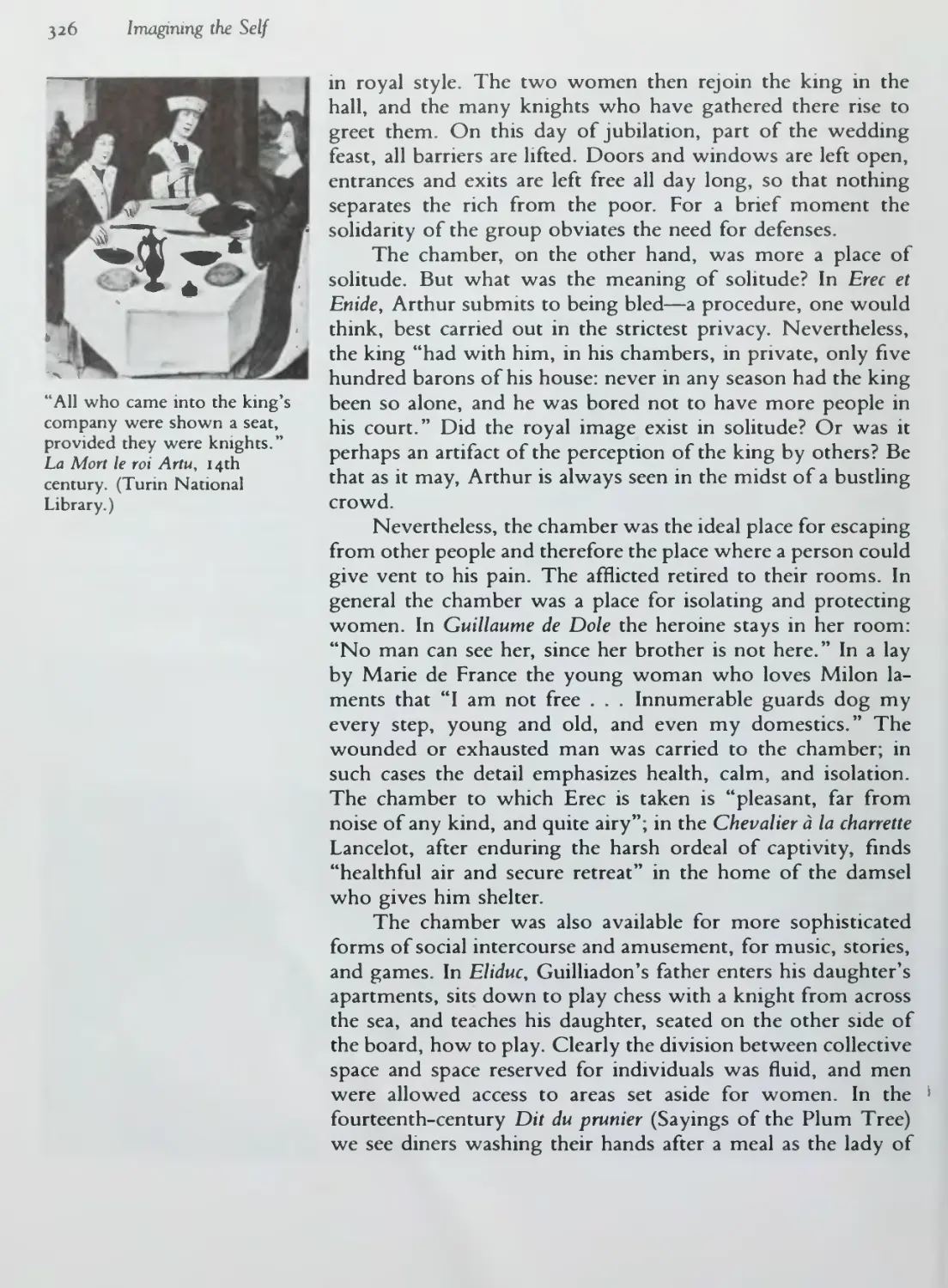
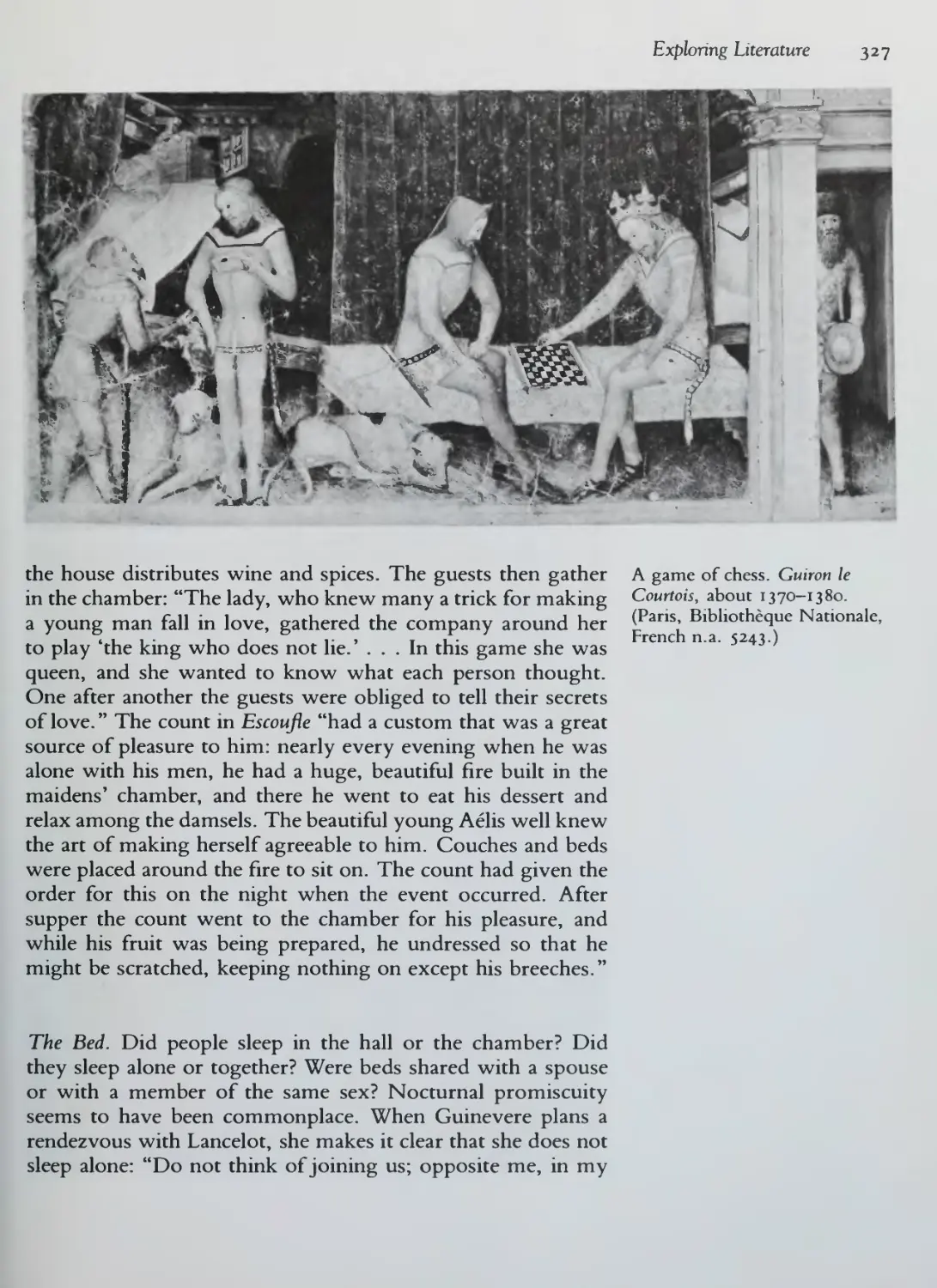
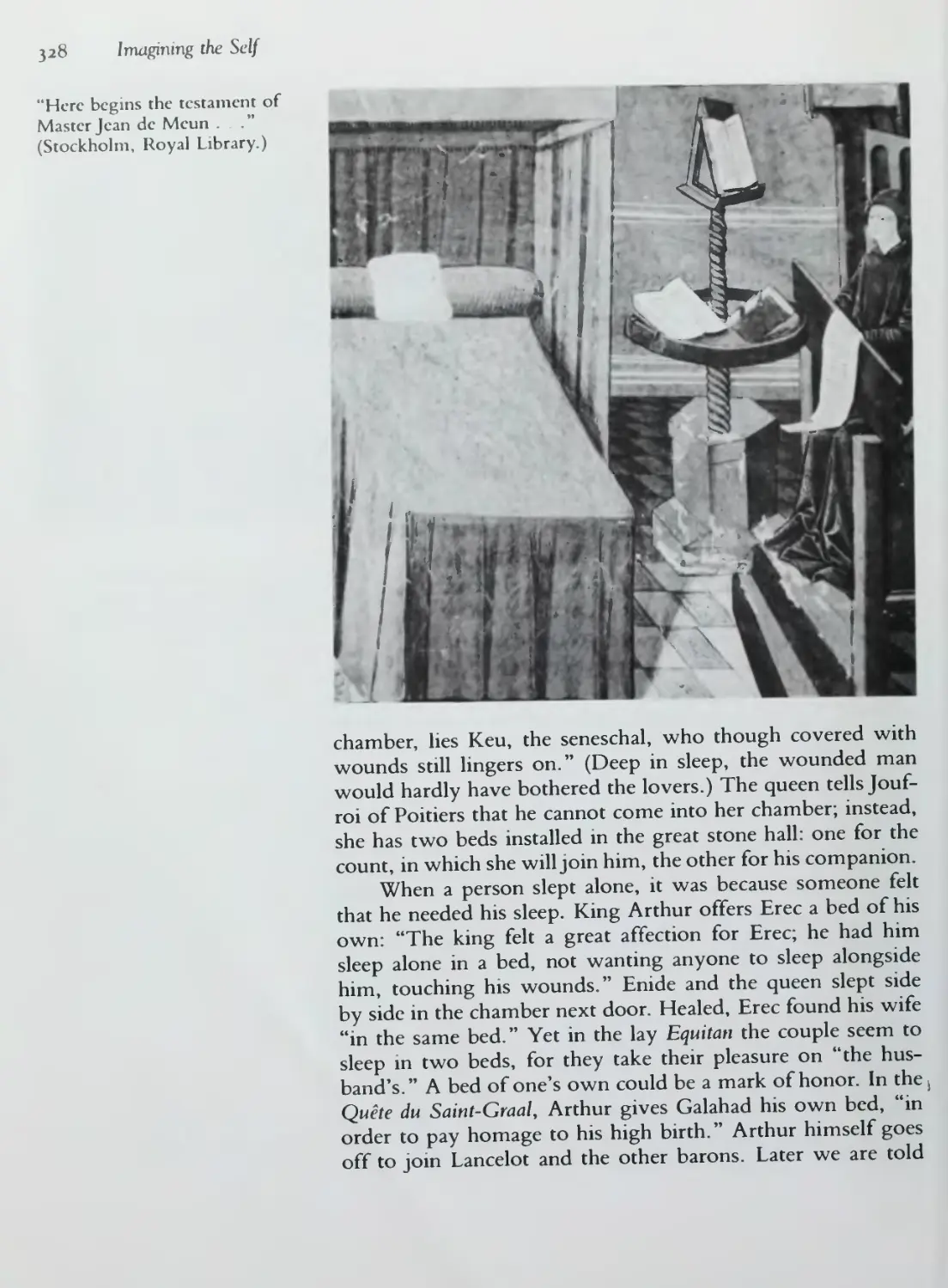
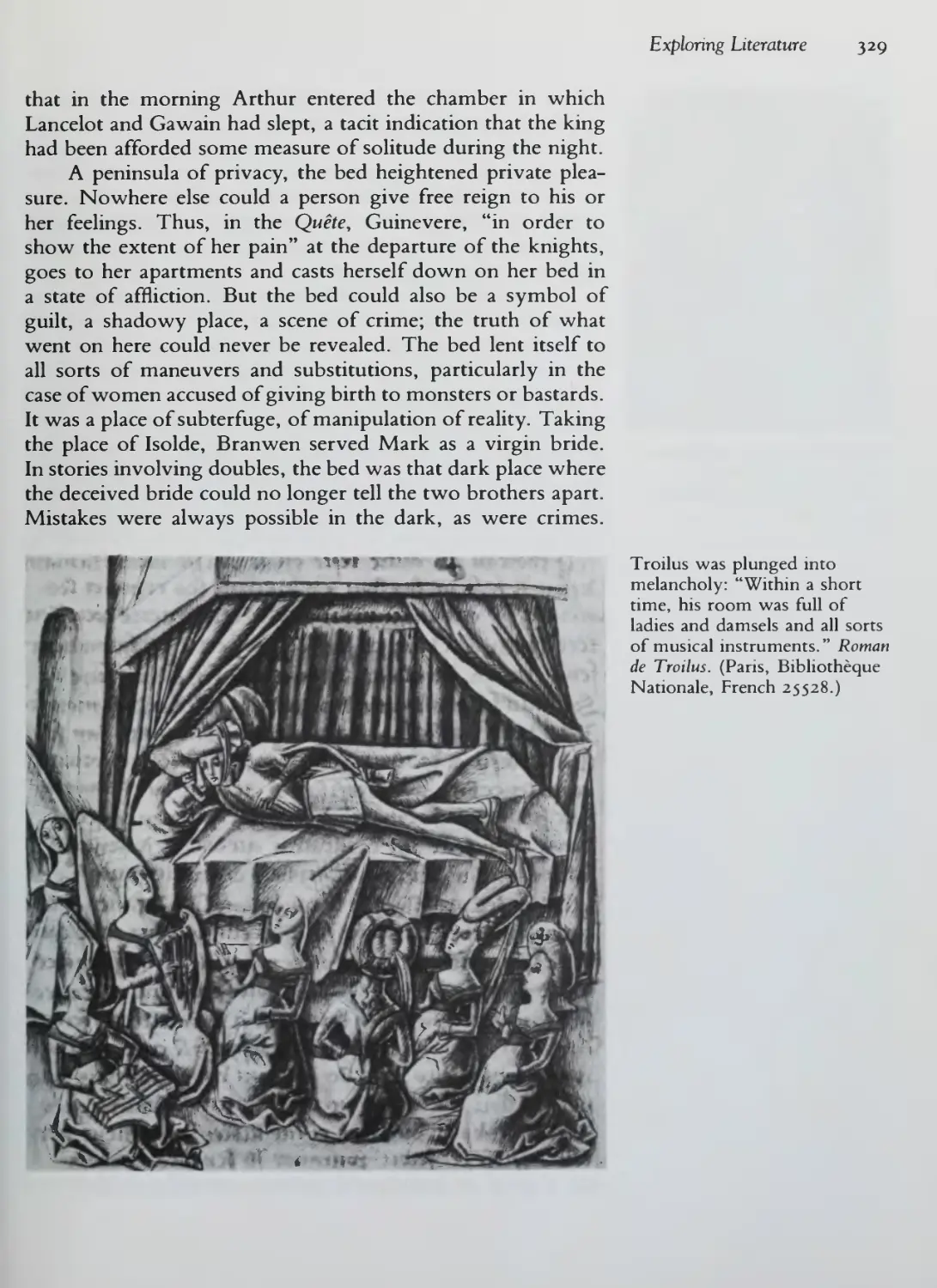
/









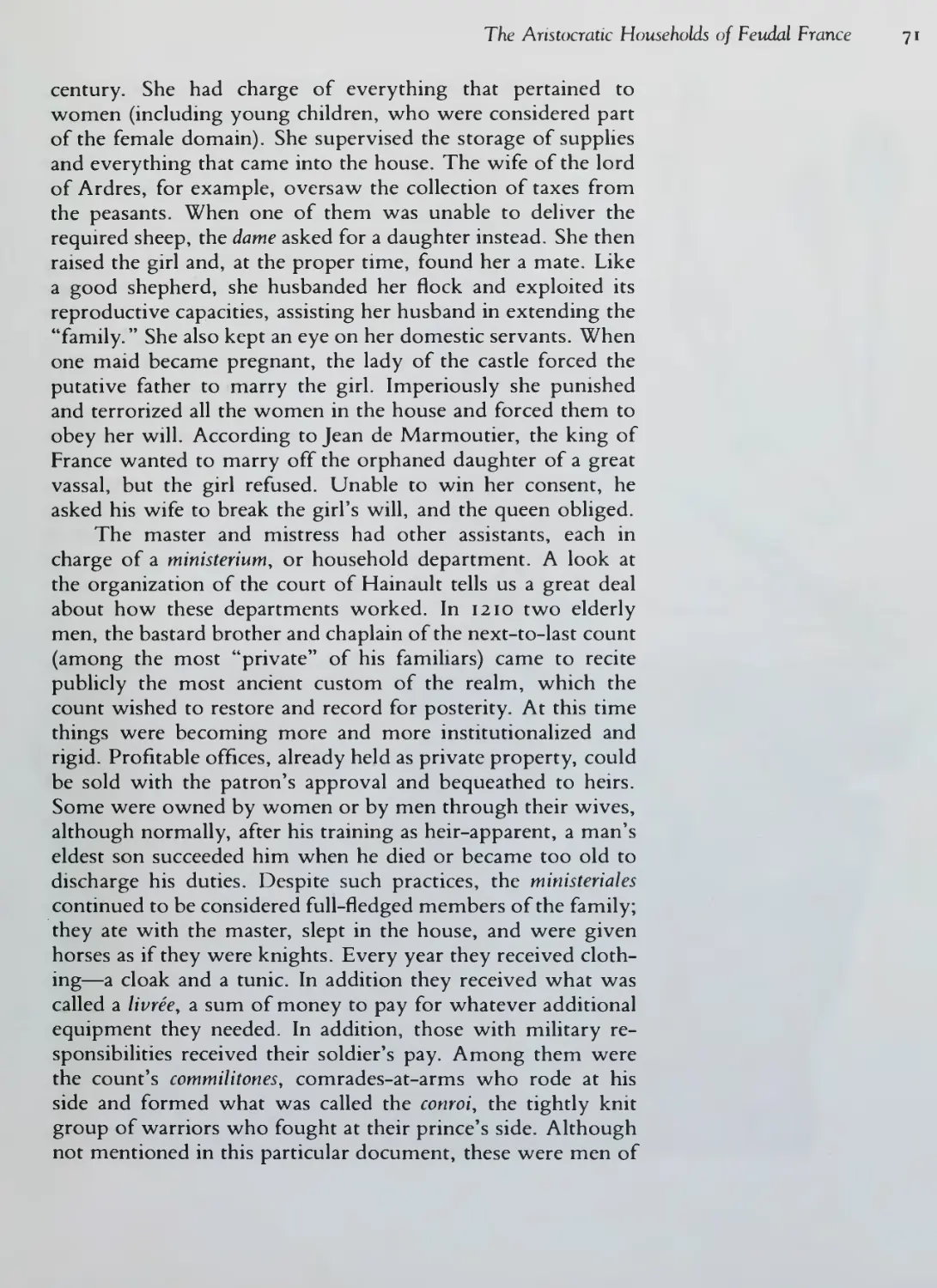
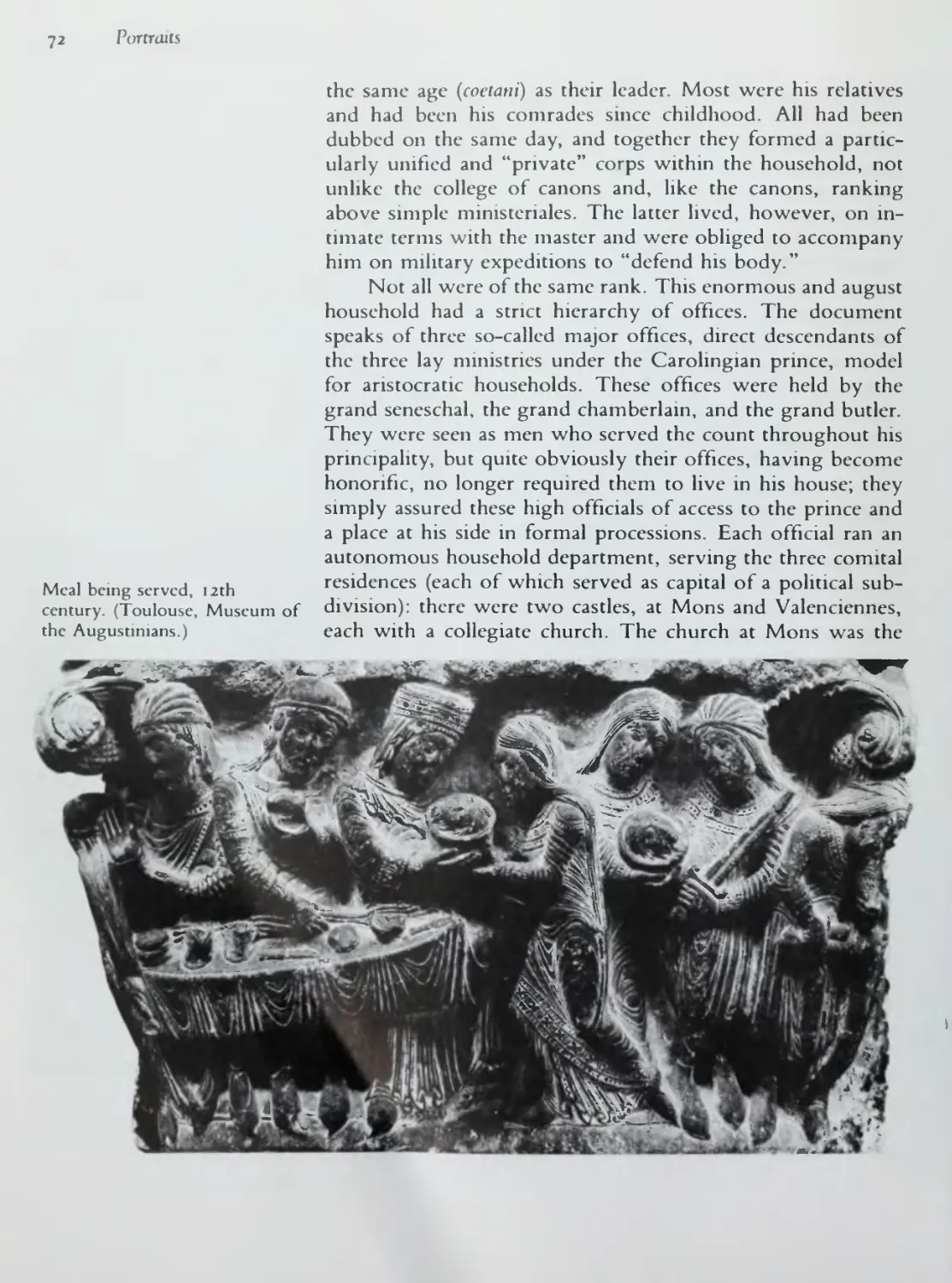
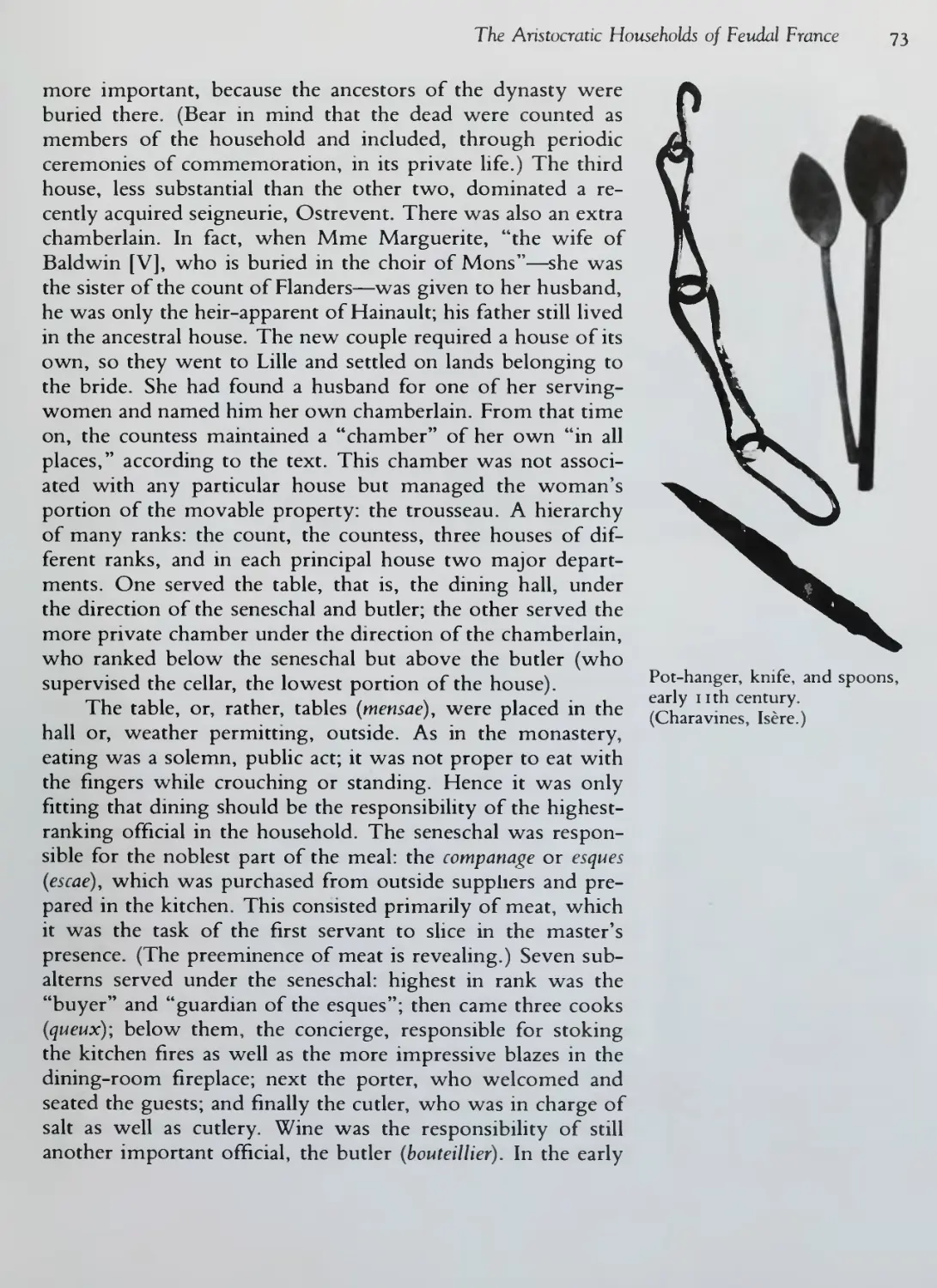
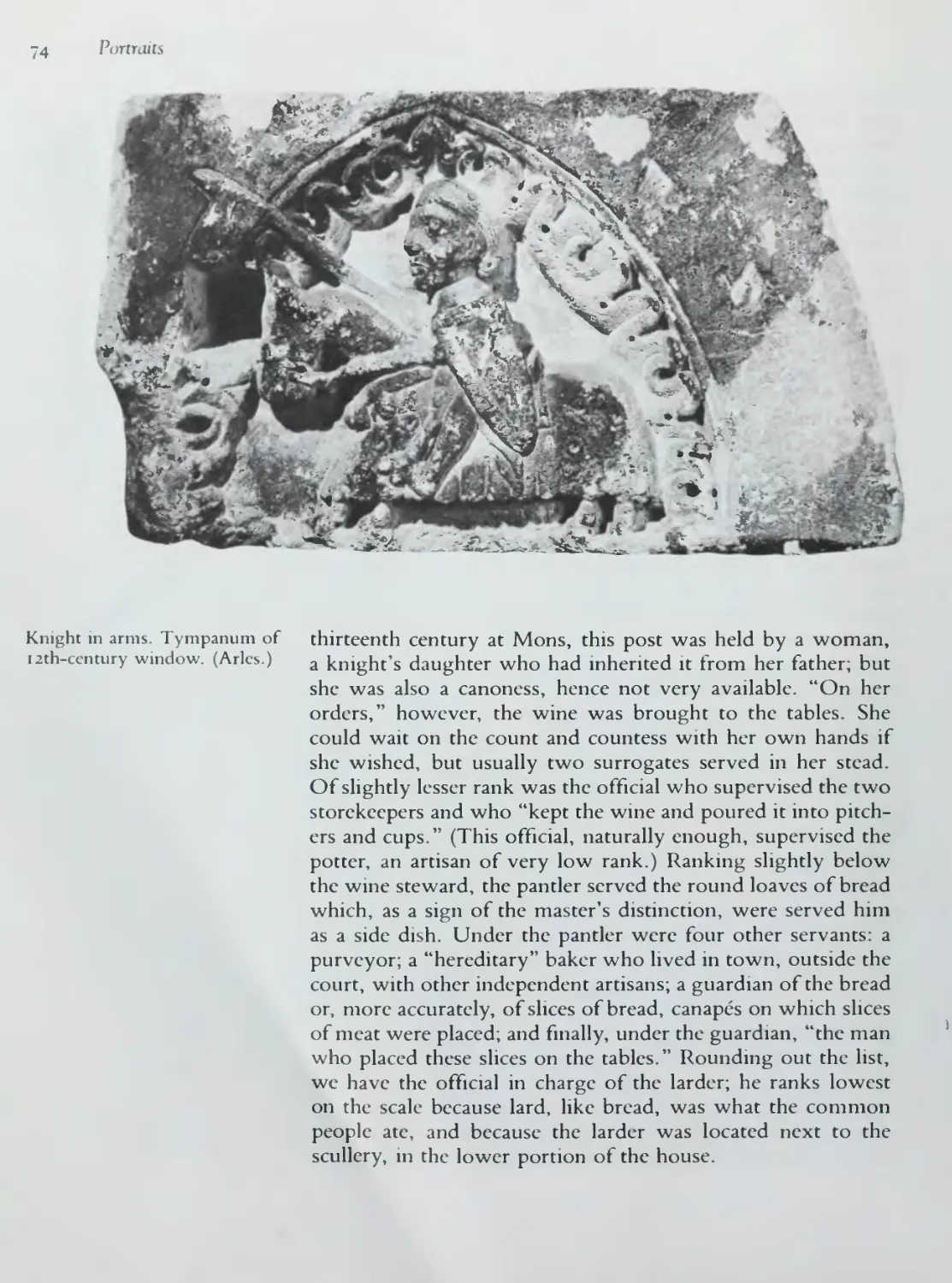
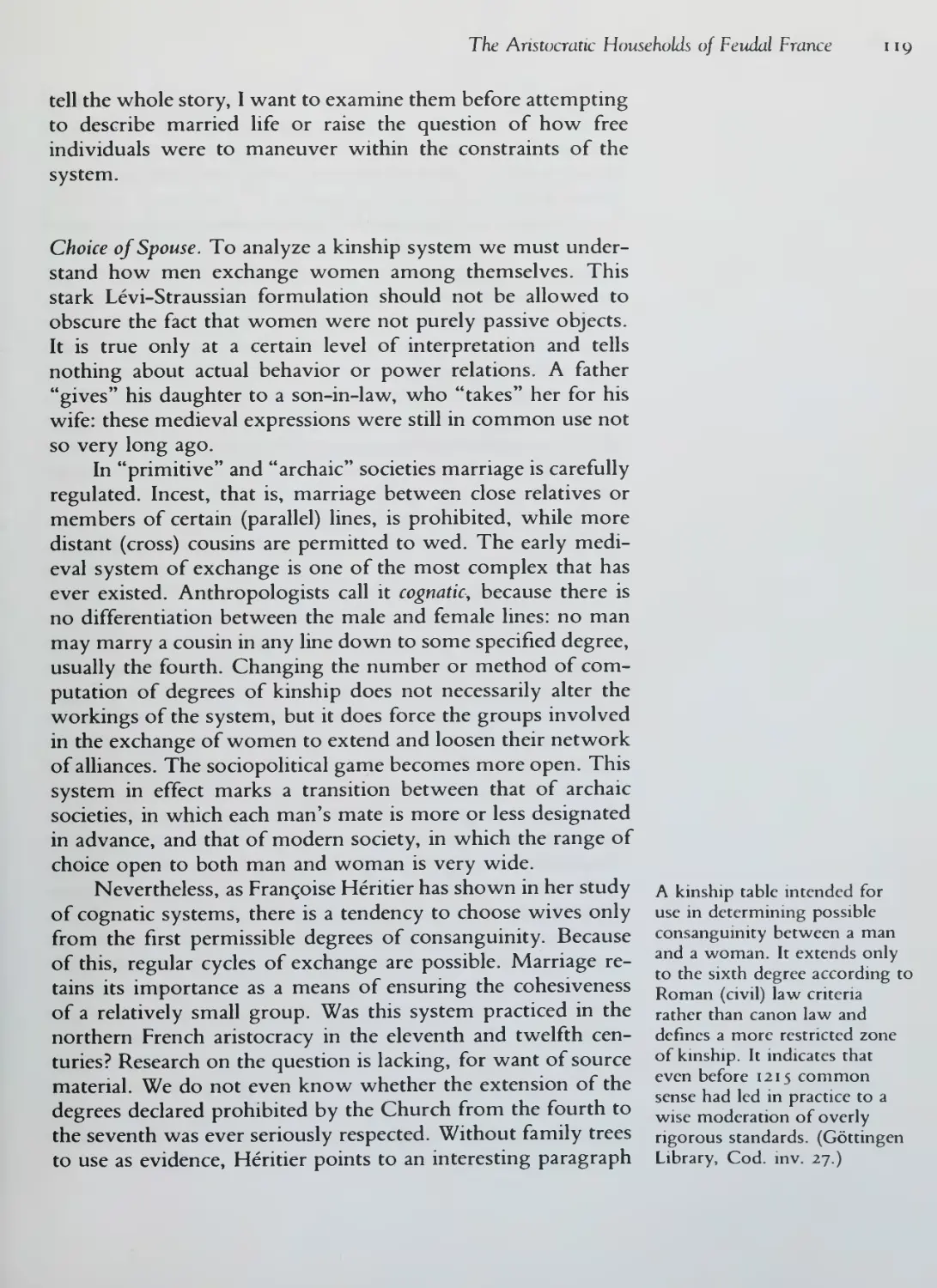



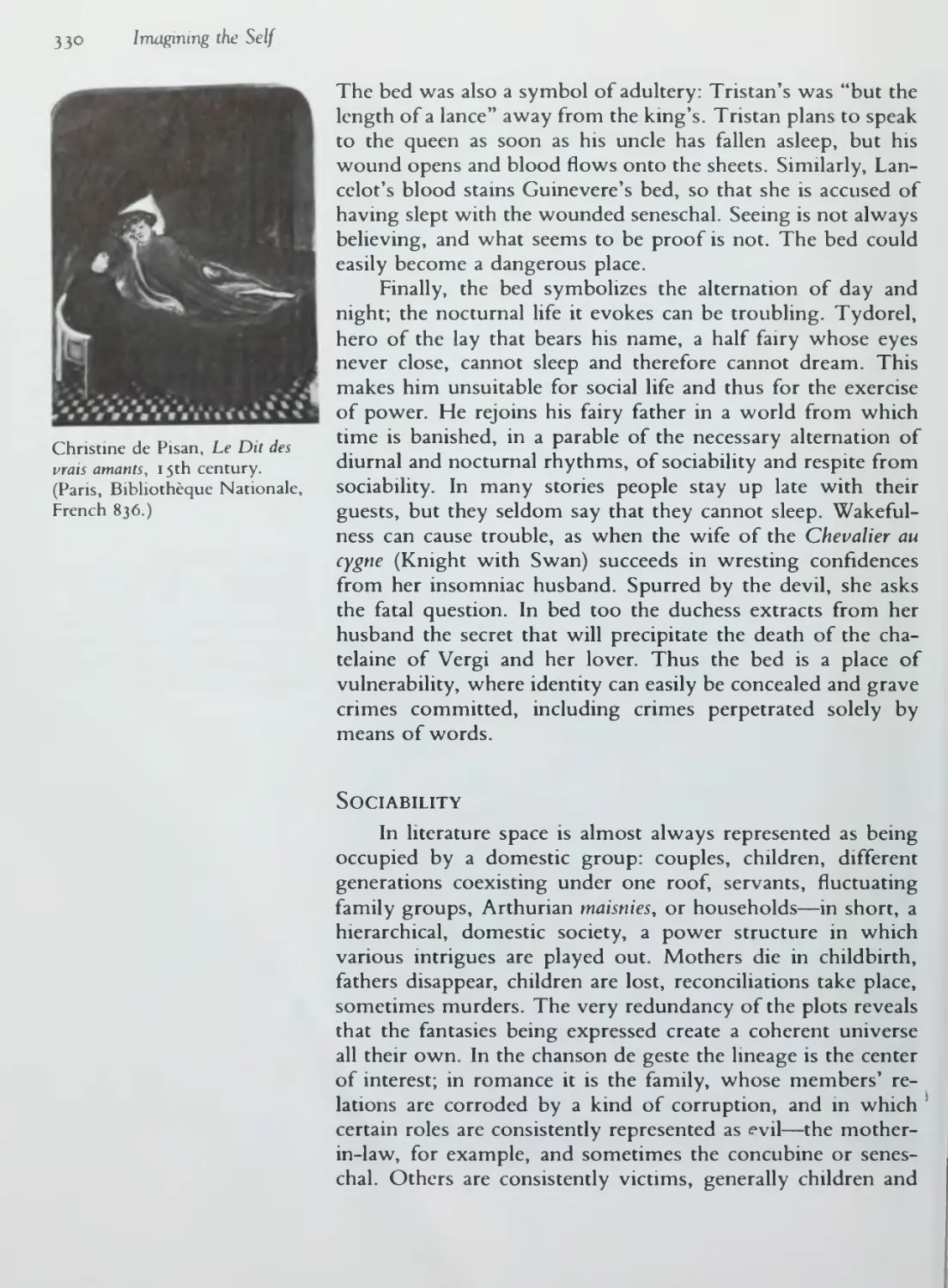


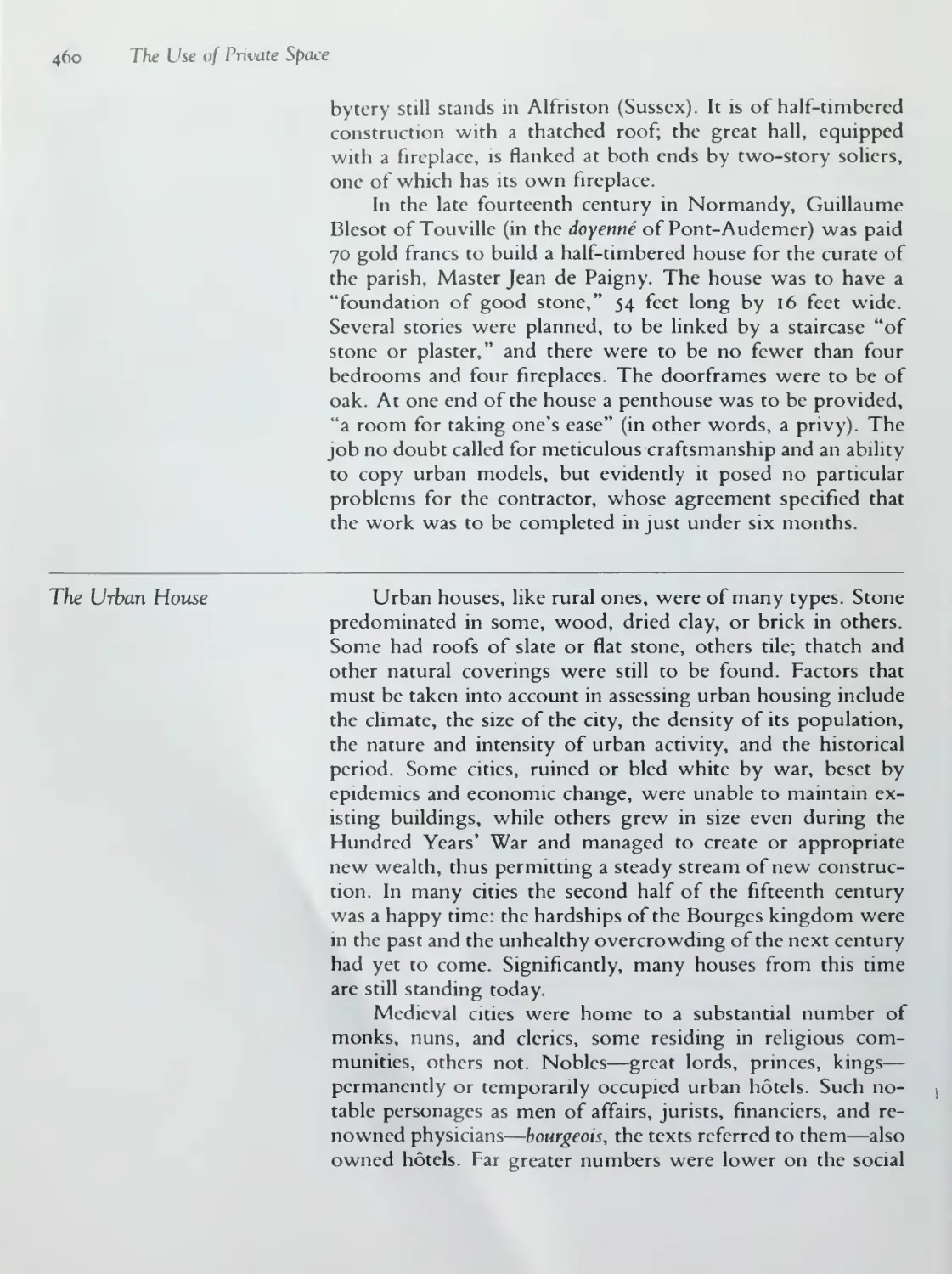


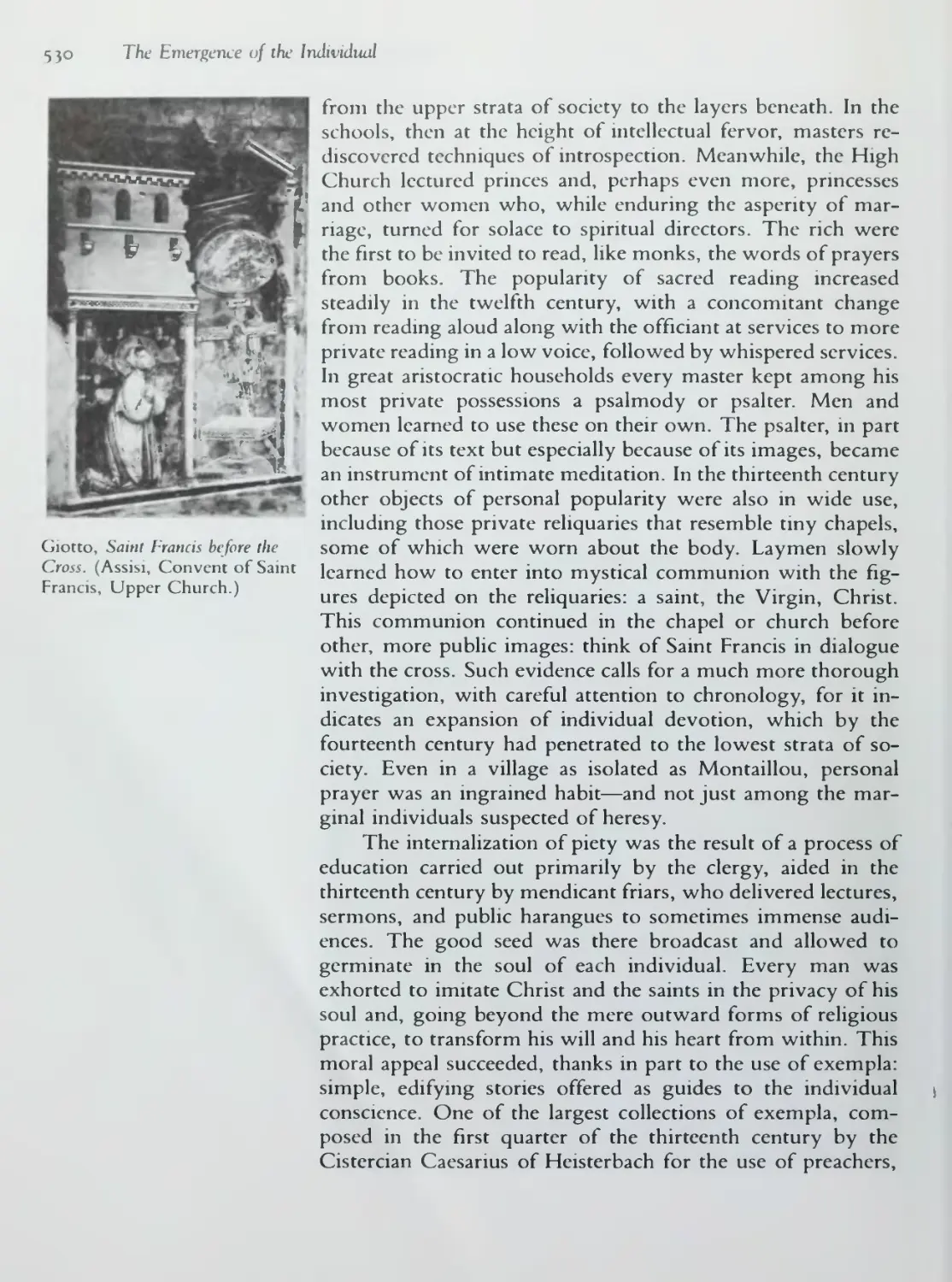
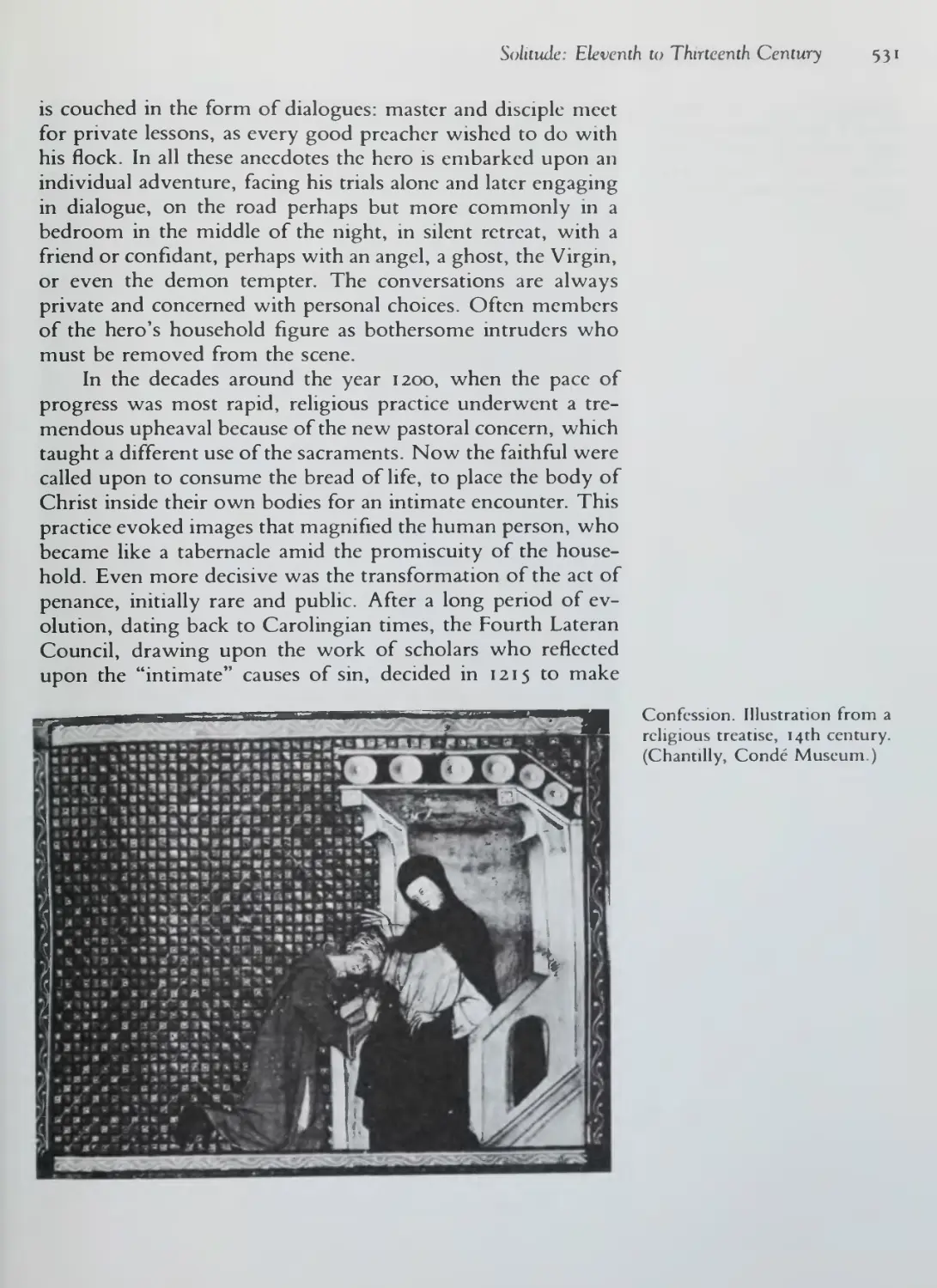
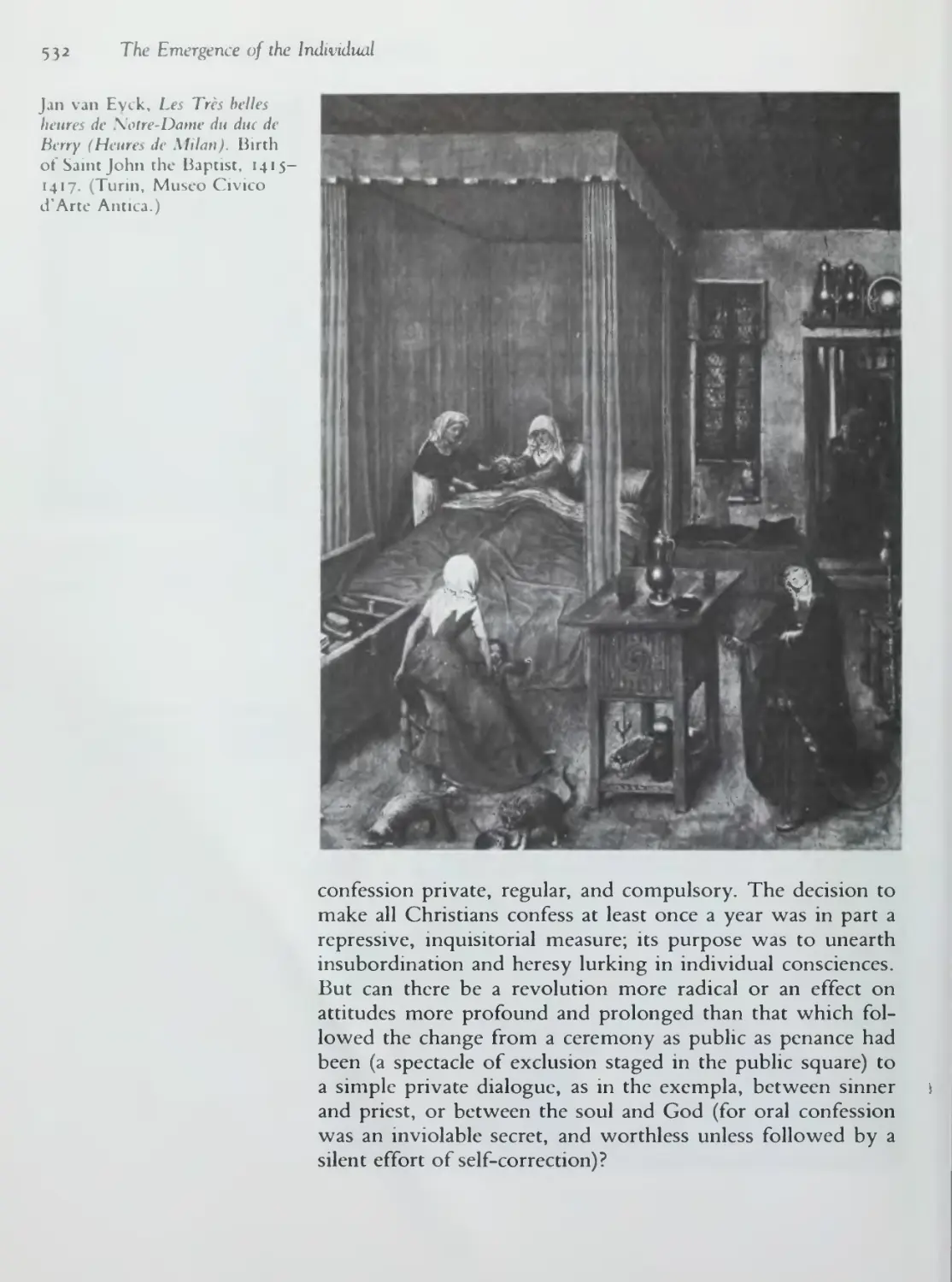
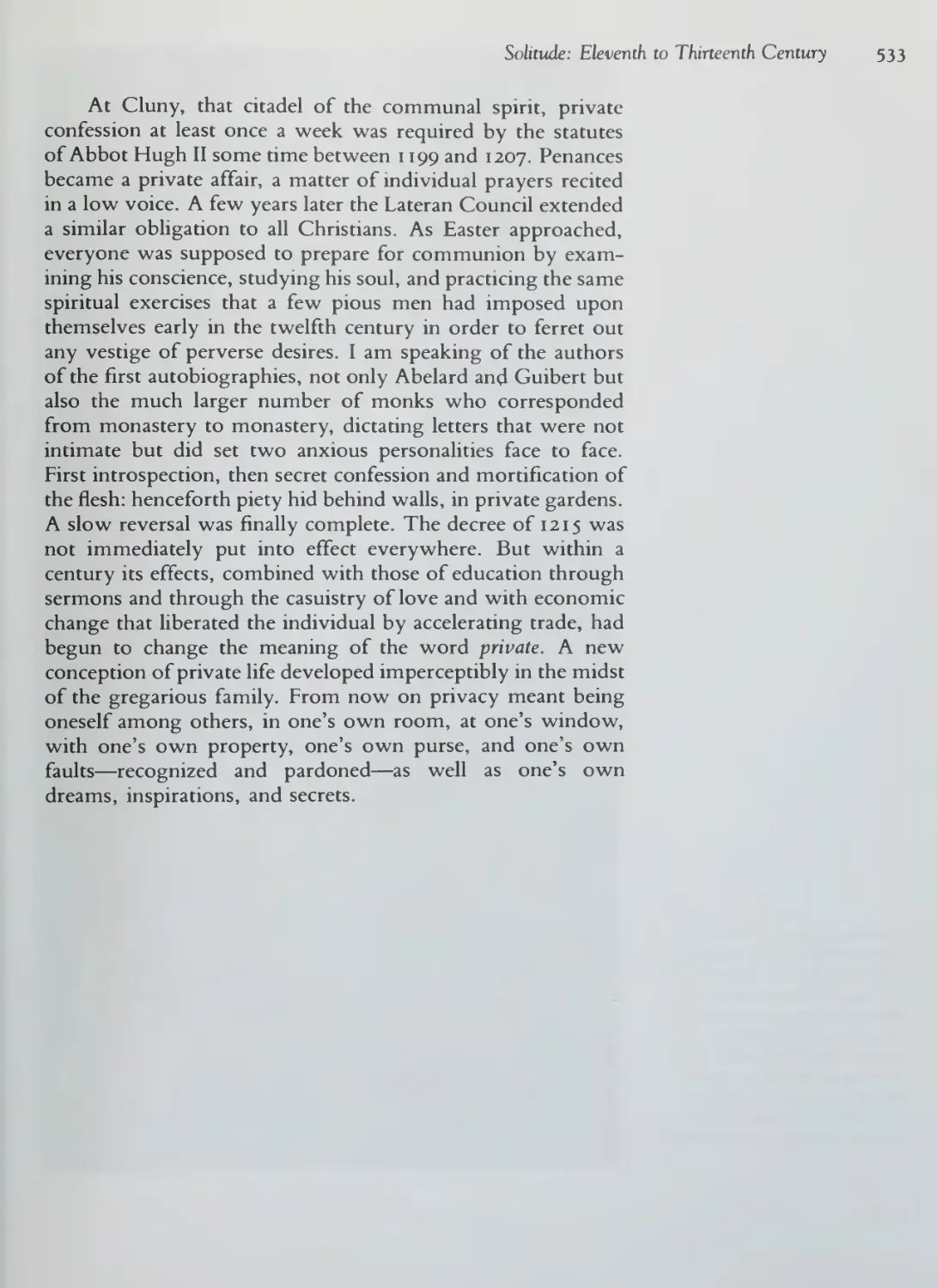
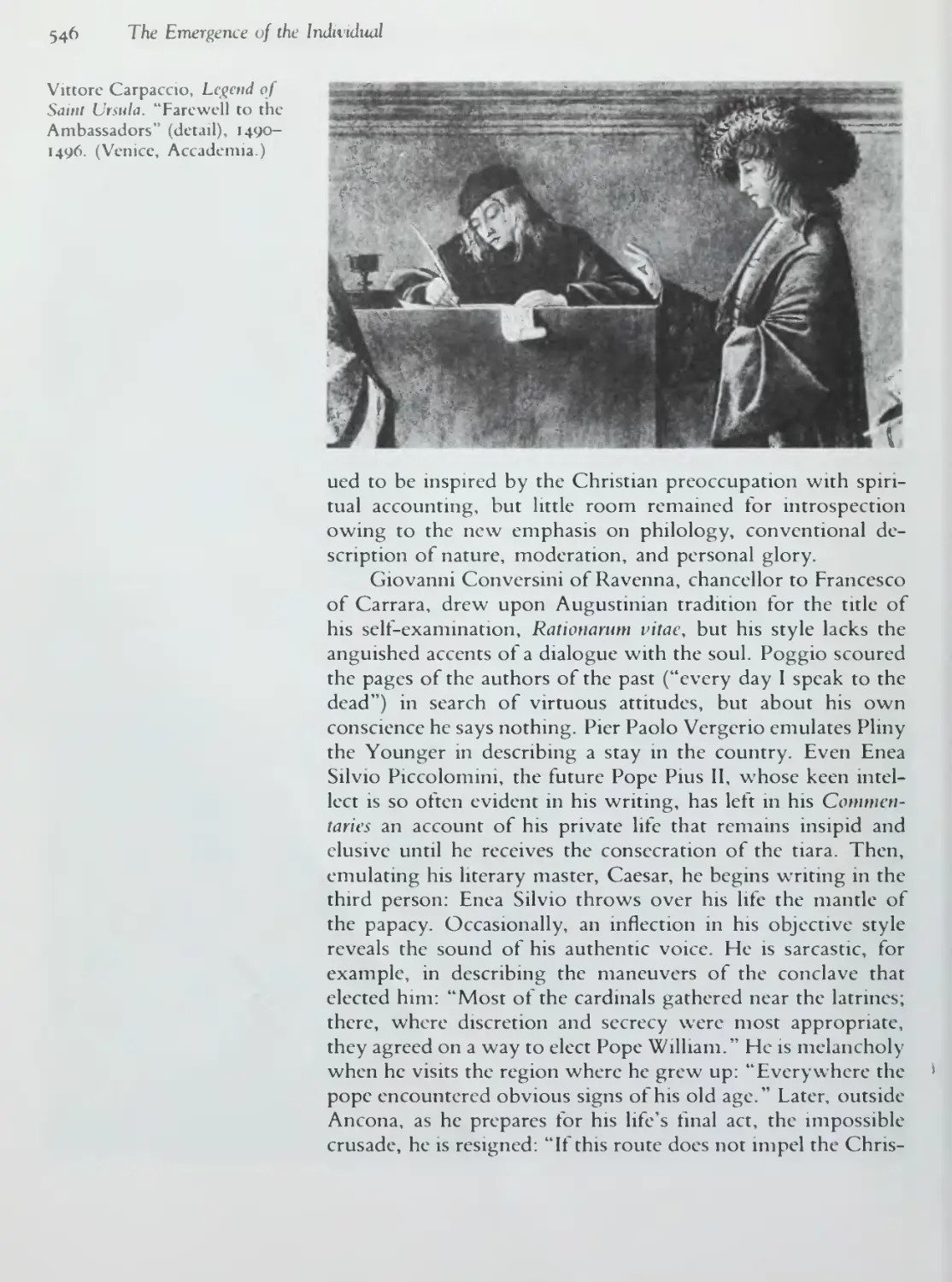
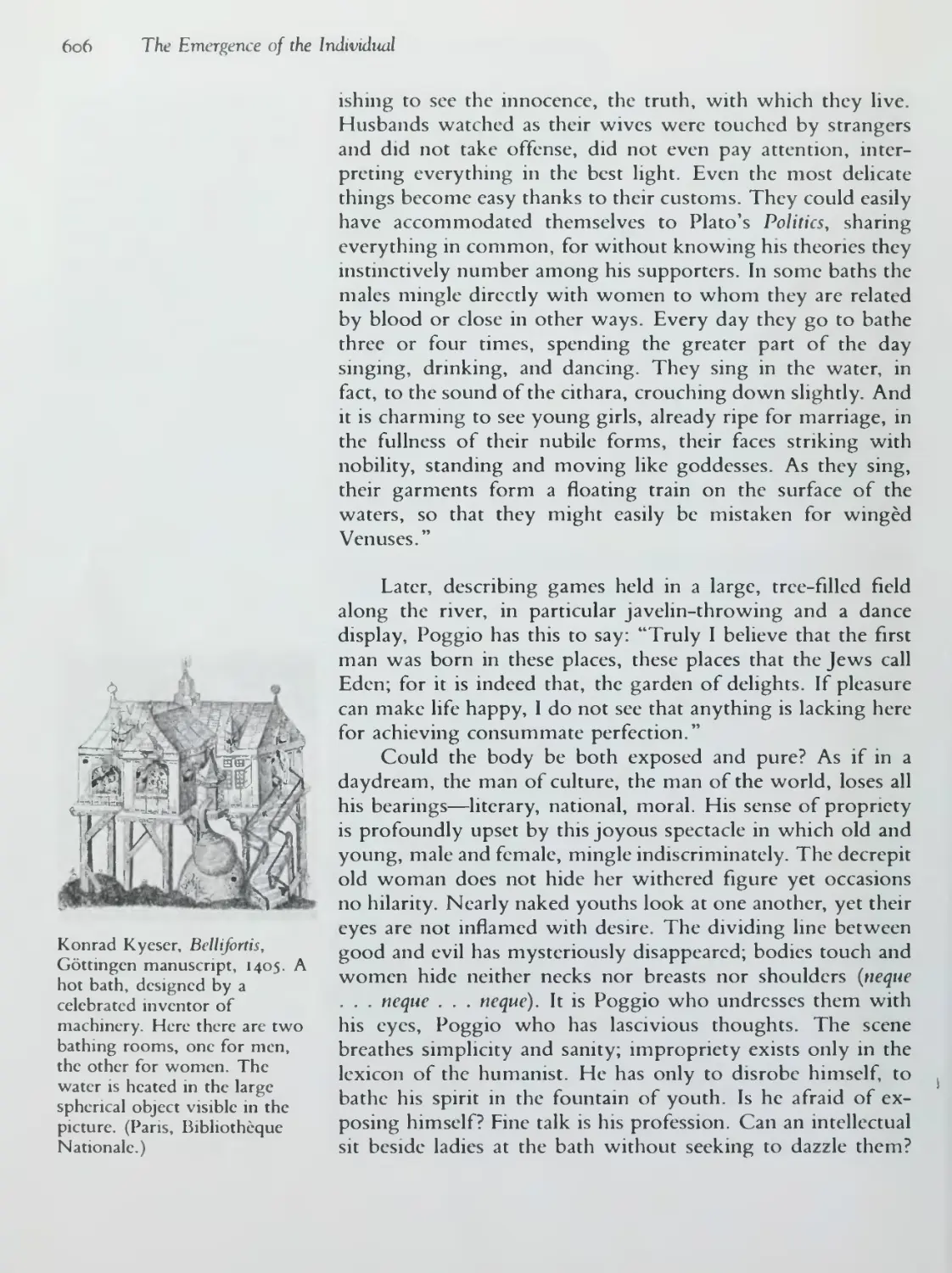

















Текст
                    eorges Diwy,

A HISTORY OF
PRIVATE LIFE
Philippe Aries and Georges Duby
General Editors
II ♦ Revelations of the
Medieval World

A HISTORY OF
PRIVATE LIFE
II ^ Revelations of the
Medieval World
Georges Duby, Editor
Arthur Goldhammer, Translator
The Belknap Press of
Harvard University Press
CAMBRIDGE, MASSACHUSETTS
AND LONDON, ENGLAND

Copyright © 1988 by the President and Fellows
of Harvard College
All rights reserved
Printed in the United States of America
10 9 8 7
Originally published as Histoire de la vie Privée, vol. 2,
De l'Europe féodale à la Renaissance, © Editions du Seuil,
1985.
Library of Congress Cataloging-in-Publication Data
(Revised for vol. 2)
A history of private life.
Translation of: Histoire de la vie privée.
Bibliography: v. i, p. 647-655; v. 2, p.
Includes indexes.
Contents: i . From pagan Rome to Byzantium /
Paul Veyne, editor — 2. Revelations of the medieval
world / Georges Duby, editor; Arthur Goldhammer,
translator.
I. Manners and customs — Collected works. 2. Family
— History — Collected works. 3. Civilizations — History
— Collected works. 4. Europe — Social conditions
— Collected works. I. Aries, Philippe. II. Duby,
Georges.
GT2400.H5713 1987 390'. 009 86-18286
ISBN 0-674-39976-5 (alk. paper) (cloth)
ISBN 0-674-40001-1 (pbk.)

Contents
Preface by Georges Duhy ix
Introduction by Georges Duby i
Private Power, Public Power 3
Portraits by Georges Duby, Dominique Barthélémy,
Charles de La Roncière 33
The Aristocratic Households of Feudal France 35
Communal Living 3^
Kinship 8^
Tuscan Notables on the Eve of the Renaissance 157
Imagining the Self by Danielle Régnier-Bohler 3 1 1
Exploring Literature 313
The Use of Private Space by Dominique Barthélémy,
Philippe Contamine 395
Civilizing the Fortress: Eleventh to Thirteenth Century 397
Peasant Hearth to Papal Palace: The Fourteenth and
Fifteenth Centuries 425
The Emergence of the Individual by Georges Duby,
Philippe Braunstein 507
Sohtude: Eleventh to Thirteenth Century 509
Toward Intimacy: The Fourteenth and Fifteenth Centuries 535
Bibliography 63 3
Credits 639
Index 641

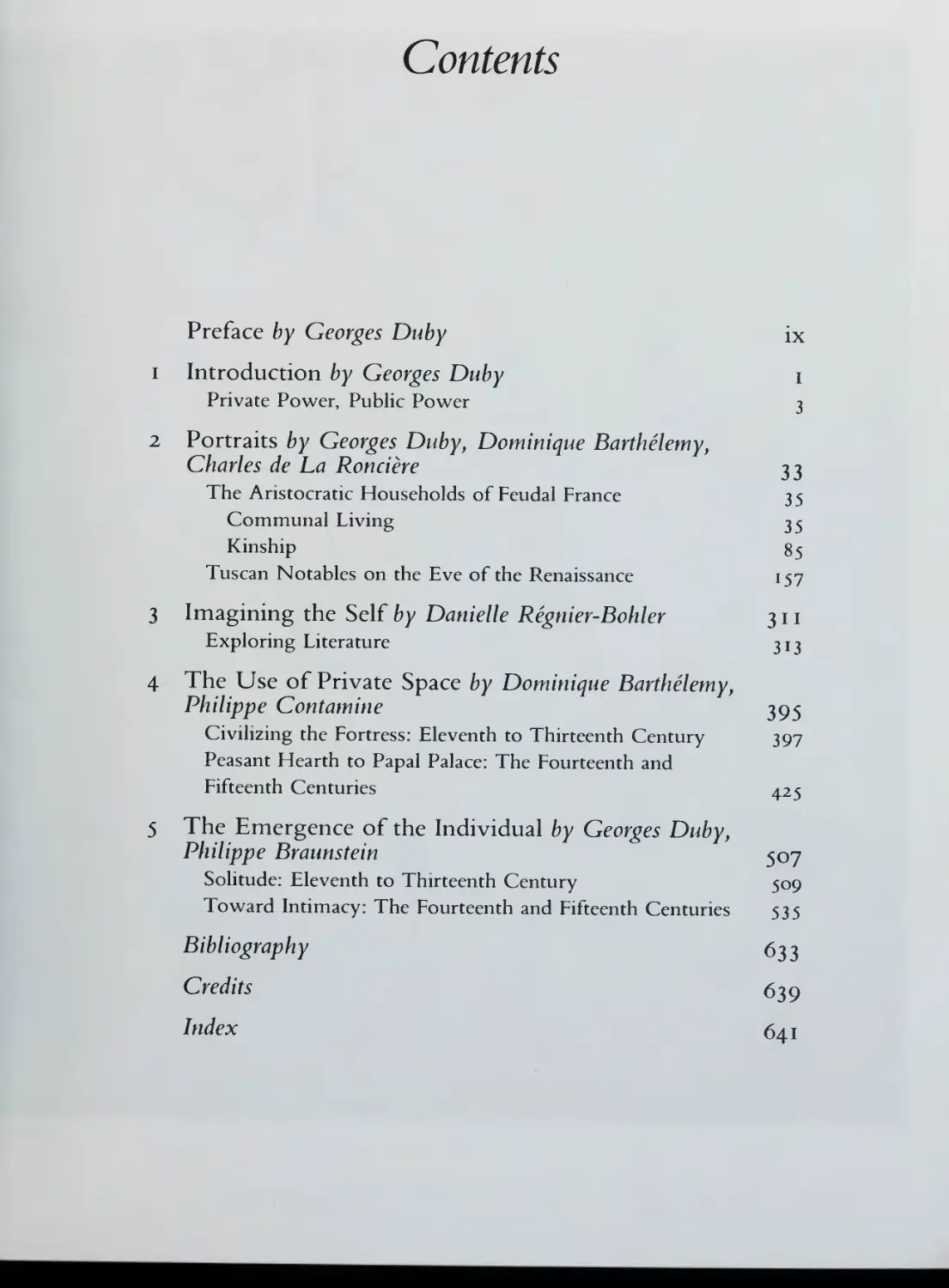
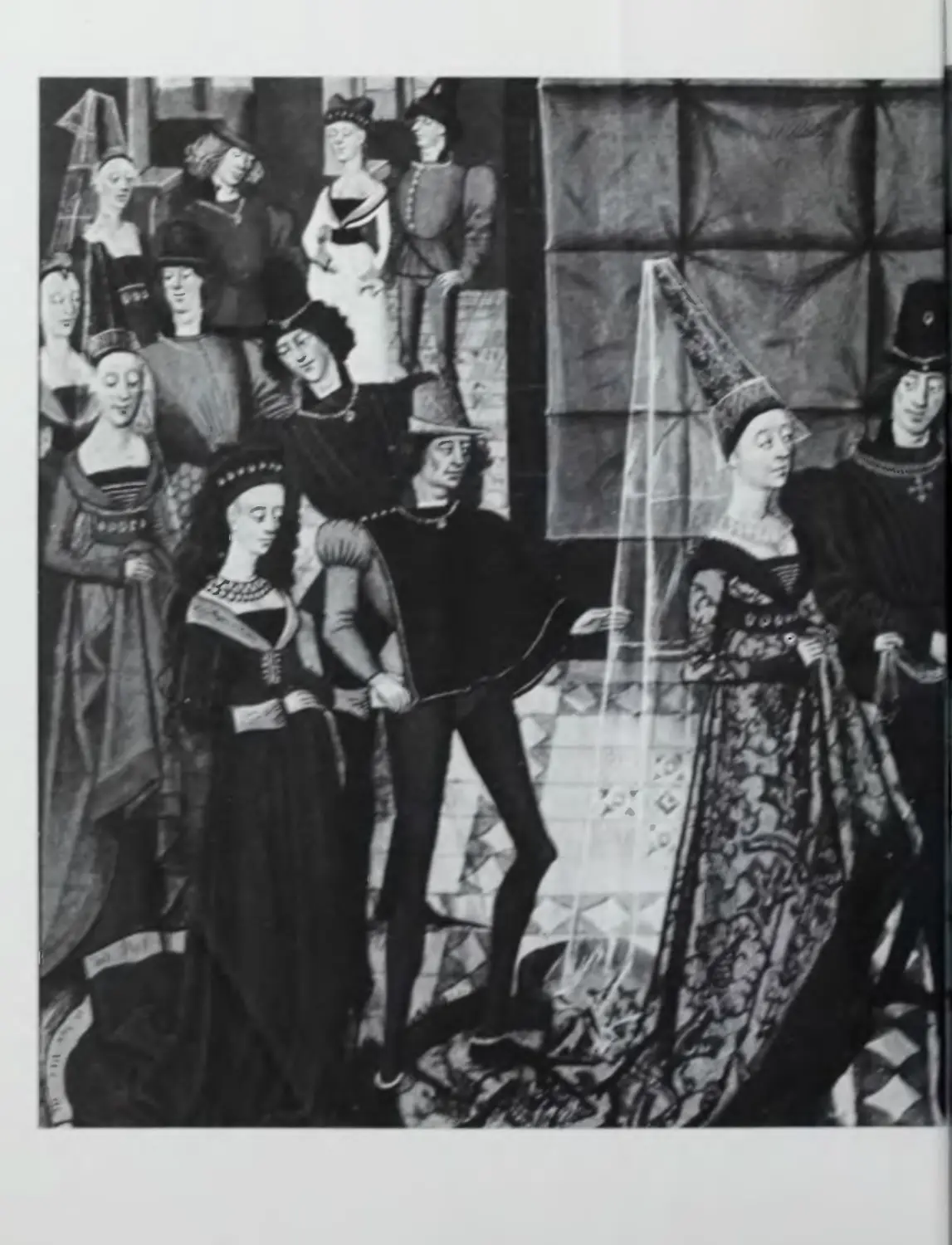
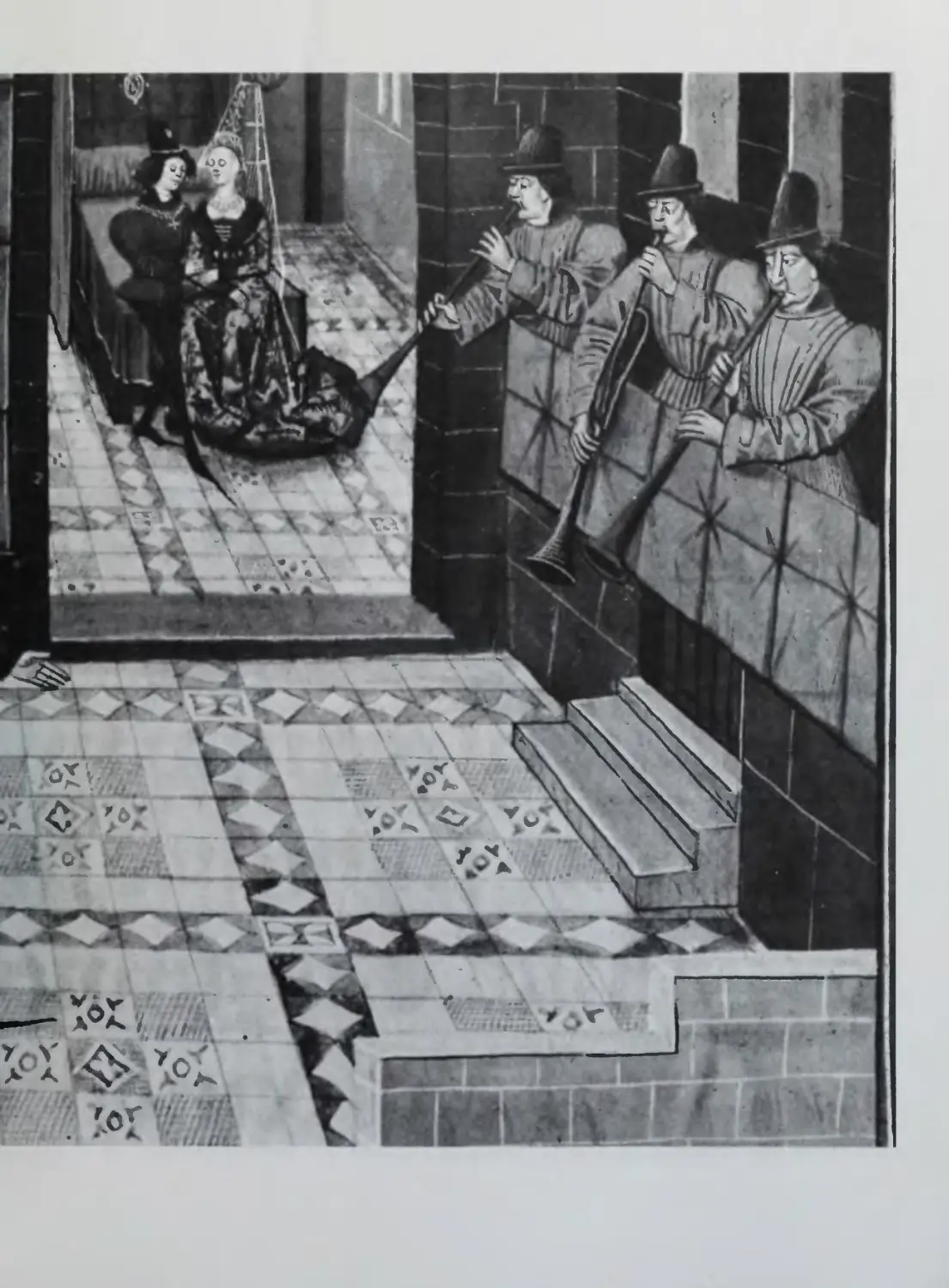
Overleaf: Hall and chamber.
Renaud de Montauhan, 15th century.
(Paris, Arsenal Library, ms 8073.)

Preface
Georges Duhy
1
f N Montaillou , Emmanuel Le Roy Ladurie depicts women, on abun-
JL dant evidence, as much given to gossip and even more to curi-
osity, their eyes glued to keyholes, spying out what goes on inside
other people's houses so they can tell the neighbors about it. He
concludes: "Not until our own day and the advent of more bourgeois
societies enamoured of private life did this female espionage diminish
or at any rate decline somewhat in the face of repression."
This is a clear statement about a question that this book hopes to
answer in part. Is it legitimate (not merely pertinent) to speak of
private life in the Middle Ages, to transfer to such a remote era the
idea of privacy, which first emerged in the nineteenth century in
England, at that time the society that had progressed furthest in the
establishment of a "bourgeois" culture? All things considered, I be-
lieve the question can be answered in the affirmative. It was no more
legitimate for historians to apply, say, the concept of class struggle
to the feudal era, yet it has proved undeniably useful that they have
done so. The exercise not only showed how the concept needed to
be refined but, more important, clarified the nature of power relations
in an archaic social system, in particular those relations that had
nothing to do with class conflict. Hence we have not hesitated to use
the concept of private life, anachronistic as it may be. We have
attempted to identify the dividing line between what people in me-
dieval society considered private and what they did not, and to isolate
that sphere of social relations corresponding to what we nowadays
call "private life."
The exploratory, tentative nature of our investigation cannot be
overemphasized. The text you are about to read has many question
marks. Like archaeologists beginning work on a village abandoned
after the Great Plague of the fourteenth century, we have made some
initial soundings; like them we expect to discover only a few rich
sites — elsewhere coming up empty-handed. The results of our ven-
ture depend on the density and quality of the remains: not only
IX

Preface
written sources but also artifacts, as well as sculpted and painted
images that can tell us something about how people lived.
We begin around a.d. igoo, when the documentary record sud-
denly becomes richer. Another turning point, no less dramatic, oc-
curred some time between 1300 and 1350. After this, everything
takes on a new coloration. The change was in part accidental (pre-
cipitated, most notably, by the Black Plague of 1348-13 50), yet
within a few decades it profoundly altered the way people lived
throughout the Western world. A related phenomenon is the shift
that occurred in the focus of European development, which moved
from northern France to Italy primarily but also to Spain and northern
Germany. Other changes affect our sources of information, enabling
us to see more clearly the realities of what we are calling private life.
During the first half of the fourteenth century a large piece of the
veil that previously masked those realities was suddenly torn away.
Profound developments led men of that age to study material
things with greater lucidity and attention than ever before. As the
contemptus mundi, the attitude of contempt for the world, that had
dominated the high culture of the Middle Ages began to wane,
appearances, deceptive and sinful as they may have been thought to
be, no longer seemed quite so reprehensible as in the past. Conse-
quently, around 1300, art — the art of representing aspects of Hfe by
means of line and volume, the art of painters and sculptors — took a
turn toward what we now call realism. The scales fell away from
men's eyes. Artists began to transcribe exactly what they saw, using
all the techniques of illusion at their disposal. Because painting en-
joyed the fullest arsenal of such techniques, it became preeminent
among the arts, and the first painted images of intimate scenes began
to appear. Through the eyes of the painter we can penetrate the
interior of the home, of private space, after 1350, much as the curious
women of Montaillou had done a few decades earlier. For the first
time the historian has the means to play the voyeur, to observe
without indiscretion what went on in this closed world where Van
der Weyden, for example, placed the Virgin of the Annunciation and
the Angel.
And that is not all. Physical artifacts of private life, of great use to
the historian, become much less scarce after the middle of the four-
teenth century. Archaeology has recovered vestiges of everyday life
that throw light on the last two centuries of the Middle Ages. Most
of the excavations have been carried out on the sites of deserted
villages — and large numbers of villages were deserted after the Black
Plague. Of the castles, urban dwellings, and village houses still ex-
tant, the oldest, with few exceptions, date from the fourteenth cen-
tury, no doubt as a consequence of the rise in the overall standard of

Preface xi
living that followed the period of depopulation initiated by the pan-
demic. This is also true of what remains of furnishings and fmery.
Look at any museum. At the Cluny, for example, there is an extraor-
dinary disproportion between exhibits of items from after 1300 and
those from before; if we look only at those items that concern private
life, the disproportion is even greater.
As realism made its influence felt in literature, the texts begin to
reveal things that had previously appeared only in brief snatches. The
romances ceased to be quite so lost in the mists of reverie. The
documents that survive in ever greater numbers in the archives as
one moves toward the end of the Middle Ages are more loquacious
and inquisitive than earlier sources. Like the new painting, they
enable us to glimpse what went on inside the home, to look behind
the screens, to insinuate ourselves into domestic interiors and spy on
their inhabitants.
Among these new sources are numerous official documents, for
by the fourteenth or fifteenth century the state, stronger and more
powerful than in the past, had conceived the ambition of total control,
of exploiting its citizens to the full. To that end it had to know what
went on in people's minds, the better to extort from them their
belongings and repress their rebellious tendencies. Public authorities
conducted investigations, required declarations, and in various other
ways penetrated the secrets of private life. The record book of Jacques
Fournier, inquisitor and future pope, from which Emmanuel Le Roy
Ladurie learned all he knows about the private life of the peasantry,
dates from the beginning of the fourteenth century. Fournier's was
but one of many similar investigations, the record of which somehow
miraculously escaped the ravages of time.
Because the struggle between rival institutions for control of the
lives of private individuals was intensifying during this period, in
their efforts to resist, people attempted to construct a "wall" around
private life. By the fourteenth century we know a great deal more
about what went on behind that wall, because private individuals
began to write more than before, because they began to employ
notaries for private business, and because we begin to see the first in
that unbroken chain of eloquent documents that have proved so
useful to historians: estate inventories, marriage contracts, and wills.
Soon the archives would begin to collect even more instructive in-
timate writings: letters, memoirs, and family record books.
As the fourteenth century dawns, we catch sight of a vast panorama
that had previously lain almost entirely shrouded in shadow. What
people commonly take to be the Middle Ages, the period that serves
as backdrop to historical novels, of which we dream along with
Victor Hugo and Jules Michelet, is not the period around the year

Preface
1000, nor is it the time of Philip Augustus. It is — in terms of feeUngs,
ways of loving, table manners, rules of etiquette, the inner life, and
piety — the Middle Ages of Joan of Arc and Charles the Bold. The
structure of this book is dictated in large part by the major change
that occurs in the first half of the fourteenth century. What comes
before is far more problematic and, for our purposes, lacking in
substance.
The mists that obscure our view begin to lift around a.d. iooo
and continue to evaporate right down to the dawn of the fourteenth
century, thanks to steady material progress and its effects on spiritual
life. Three centuries of uninterrupted economic growth is a fact to
be reckoned with. What concerns us here, however, is the direct
impact of economic growth on the nature of private life. The increas-
ingly common use of money was not without consequence for the
concept of personal property, for the very idea of what belongs to
one person and not to others. Another consequence of progress was
a gradual transition from a gregarious to a more individualistic ex-
istence, which led to greater introspection; within the privacy of the
house there developed an even more intimate preserve, an inner
privacy of the self. This period of general relaxation and constant
renaissance saw a greater openness to remote or forgotten cultures:
Islam, Byzantium, ancient Rome. People discovered, in the exotic
behavior of others, structures in which the relation of public to
private was different from what they were used to, and the discovery
gradually changed the way they behaved. The steady rise in the
standard of living, the unequal distribution of the fruits of the ex-
panding seigneurial mode of production, and the growing differen-
tiation of social roles heightened the contrasts between city and
countryside, wealthy and poor households, and men and women. At
the same time, the increasingly rapid circulation of men, ideas, and
fashions tended to diminish regional distinctions and spread uniform
standards of behavior throughout the West.
In a work of this kind all observations must be dated as precisely
as possible. Yet we begin at so rudimentary a level that it is not
always possible to organize our scant knowledge in strictly chrono-
logical fashion. We therefore decided that it would be more appro-
priate and useful to structure the work differently. Because we do
not wish to conceal how fragmentary our understanding is, we have
divided the book into various sections. The first of these consists of
two parts. One is concerned with private life from lOOO to 1220,
focusing primarily on the period 11 50-1220 (when the pace of prog-
ress apparently quickened, the gap between generations probably was
wider than it has ever been until recent times, and the sources for
the first time begin to disclose the attitudes of people outside the

Preface xiii
ambit of the Church). Another deals with a period, region, and social
stratum for which we possess especially abundant source materials:
the notables of Tuscany in the fourteenth and fifteenth centuries. The
last major sections of the book are more adventurous. In them we
examine two aspects of the overall evolution of western European
society during an extended period of time — the transformation of
domestic space and the flourishing of the individual — concentrating
on religious and artistic expressions of individuality. Separating these
major sections is one dealing with the imagination; it is based on
literature from northern France composed between the twelfth and
fifteenth centuries. Fiction, though it must be interpreted with a
delicate touch, yields irreplaceable information about how private life
was actually experienced.
This book is a joint project, and in the early stages we dreamed of
working together so closely that it would be impossible to detect
what each person had contributed. It quickly turned out that this was
too ambitious. We did cooperate quite effectively (especially in the
Sénanque colloquia, where we collectively profited from hearing
reports of the work of our invited guests). Each of us complemented
and corrected the work of the others. Yet in the end it seemed less
artificial and more equitable to assign primary responsibility for each
part or section to one individual.

A HISTORY OF
PRIVATE LIFE
Revelations of the
Medieval World

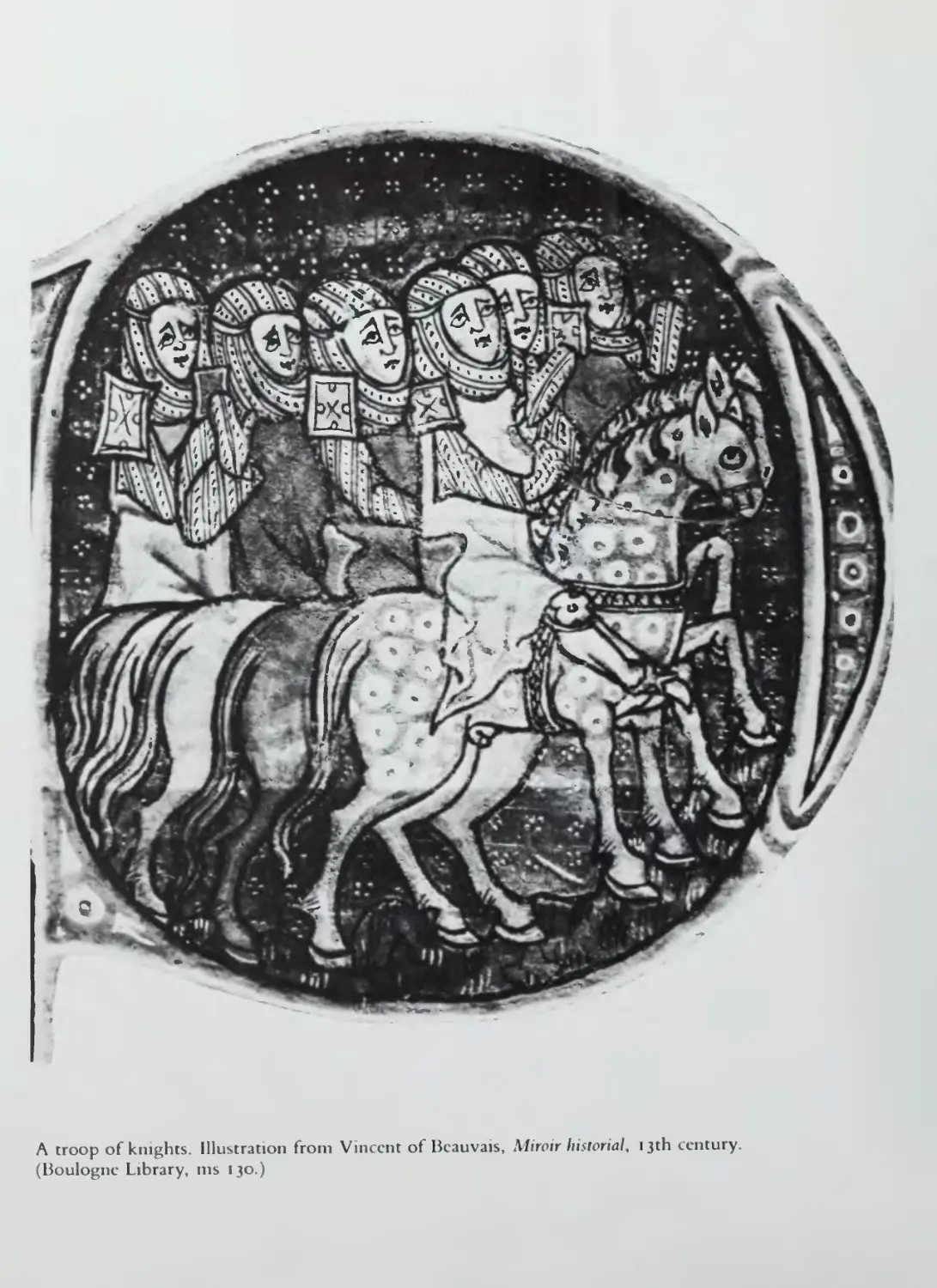
A troop of knights. Illustration from Vincent of Beauvais, Miroir historial, 13th century.
(Boulogne Library, ms 130.)

Introduction
Georges Duby

^ vu 1
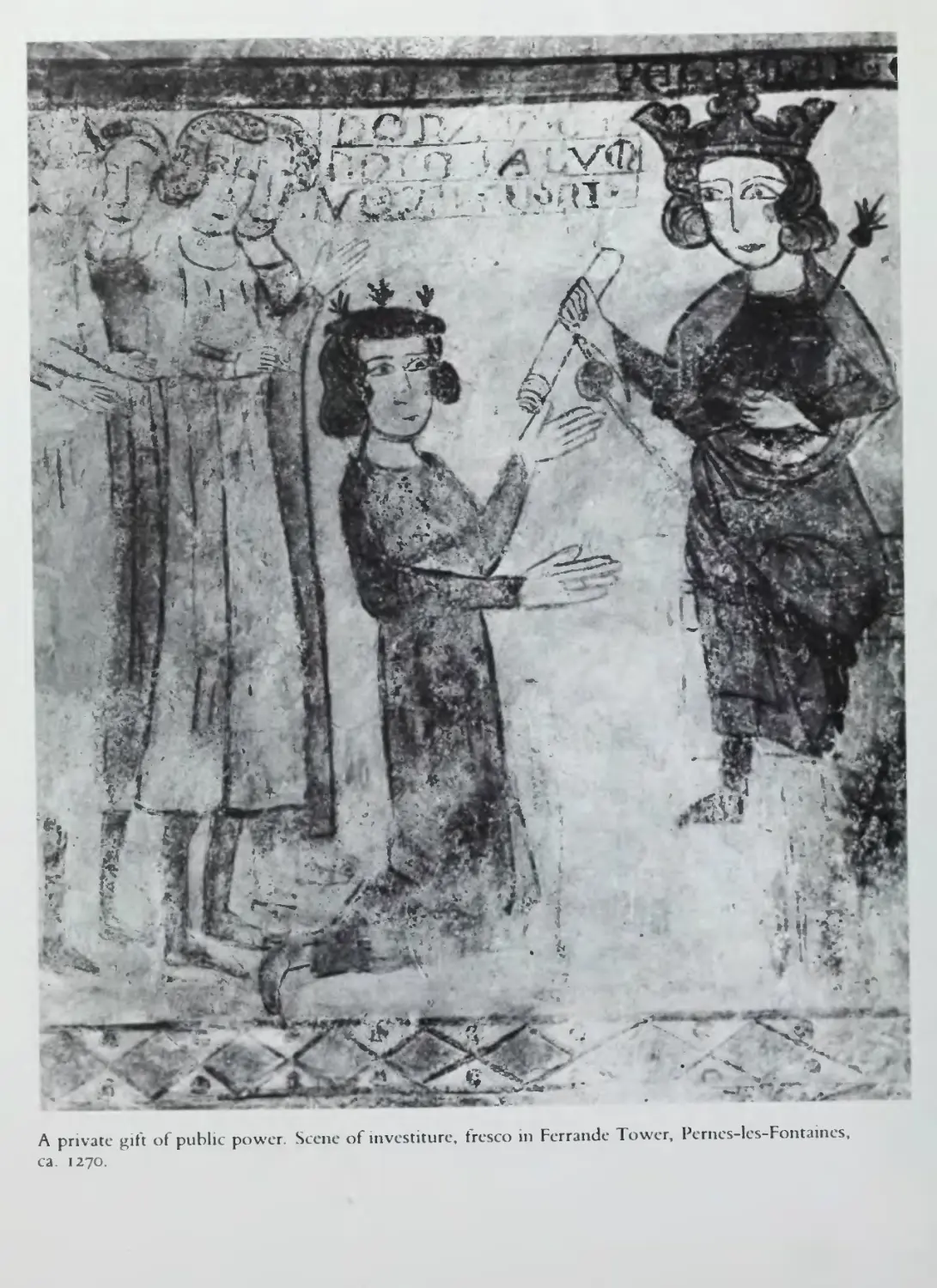
A private gift ot public power, hccnc ot investiture, tresco m Fcrrandc Tower, Feriies-les-Fontaines,
ca. 1270.

(^ Private Power,
Public Power
w,
HAT was private life like in the feudal age? To answer
this question requires a sound method, and there is none
better, I think, than to begin with words, to explore the terrain
of semantics and ferret out the niche in which the concept of
privacy lies hidden. In choosing this approach I feel that I am
being faithful to the spirit of the learned men of the time,
whose function was similar to mine and w^ho, being first of
all grammarians, attempted to fathom the unknown by study-
ing vocabulary, by proceeding from what they knew well to
what they knew less well.
In nineteenth-century French dictionaries, compiled at a
time when the notion of private life first took on its full
importance, one finds the verb priver, meaning to tame or
domesticate. The example in Littré's dictionary, oiseau privé
(domesticated bird), reveals the meaning of the word: to pluck
a creature from the wild and move it into the familiar sur-
roundings of the home. We also find the adjective pnVé, w^hich
in a more general way also suggests the family, the home, the
domestic interior. Among the examples cited by Littré is an
expression just then coming into current use: "Private life
should be lived behind walls." He proposes the follow^ing,
highly revealing gloss: "It is not permissible to inquire or talk
about what goes on in the home of a private individual [par-
ticulier]." As the word particulier in its primary, direct, and
most common meaning indicates, private is here opposed to
public.
In order to understand the meaning of private, we must
refer to the word public. Here is Littré's definition: "That
which belongs to an entire people, that which concerns an
entire people, that which emanates from the people." In other

Intnxiuction
words, authority and the institutions that support it, the state.
This primary meaning shades into another: we call public that
which is shared in common or available for the use of all,
which is not subject to private appropriation but accessible or
widely distributed. This derivation leads to the noun the public,
designating the group to which public goods are available or
distributed. The shift in meaning does not end here: public
also refers to that which is openly visible, manifest. Thus the
word came to signify the opposite of private in the sense of
private property, that which belongs to a particular individual,
as well as the opposite of hidden, secret, or reserved (what is
removed from public view).
In classical Latin a similar constellation of meanings clus-
tered about the antonym publicus/priuatus. In Cicero's vocab-
ulary, to act privatim (the adverb whose opposite is publiée) is
to act not as a magistratus invested with a power emanating
from the people but as a simple private individual, in a differ-
ent juridical realm; the private act was one committed not in
the open, in the forum, before the eyes of all, but inside one's
own house, in isolation, hidden from the view of others. The
noun privatum refers to a person's own resources, property for
his own use; and, again, to the home (in private, ex private:
inside or outside the home). Privus denotes both the singular
and the personal. Thus the two systems of meanings, that of
nineteenth-century French and that of classical Latin, are the
same: the root meaning of public is that of common possession
by all the people; in opposition to this we have two derivative
senses of private, one conveying the idea of exemption or
departure from common usage, the other conveying a sense
of domesticity — the private individual surrounded by those
who are close to him. The legal concept embraces that which
escapes the jurisdiction of the "public power," the power of
the people, as well as that which is protected against intrusion
by the mob. The res publica encompassed whatever belonged
to the community as a whole and which was therefore extra
convnercium, immune from being bartered on the marketplace.
The res privata, on the other hand, was iti commercio and iti
patrimoriio, in other words, subject to a different power, that
of the pater familias, primarily exercised within the walls of the
domus, or house.
If we turn to the Middle Ages and consult the glossaries
of Du Cange or Niermeyer or Godefroy, we find — not sur-
prisingly, since the semantic structure is the same in the nine-
teenth century as in classical Rome — that it remained

Private Power, Public Power
essentially unchanged in the interim. The Latin of the chron-
icles and charters characterizes as publicus that which falls to
the sovereign, which is part of his regalian rights or which
falls within the jurisdiction of the magistrates charged with
preserving peace and justice (as in the expressions via publica,
junctio publica, villa publica, or in Marculf 's Merovingian for-
mula, publica judiciaria potestas). The publicus w^as the agent of
sovereign power, the persona publica, responsible for acting
on behalf of the people to defend the rights of the community.
As for the verb publicare, its meaning was to confiscate, seize,
remove from private use or ownership. In a bequest, for
example, we read: Si absque herede ohirent (If the donors die
without heirs) ad monasterium publicatur praedia vel quid haberent
hereditario jure (all that they held under the laws of inheritance
shall be withdrawn and assigned to the monastery). Or con-
sider this, from Ordericus Vitalis' History: Si facultates inimi-
corum publicarentur paupertas egenorum temperaretur (If the
possessions of the enemies were confiscated, the poverty of
the indigent would be diminished).
In opposition to publicus and related words, privatus and
its derivatives take on their various meanings, suggesting the
familial and nonfestive. (In the Rule of Saint Benedict, for
example, privatis diebus means non-holy days.) The notion of
the festival will prove to be important in what follows. We
shall be looking at ceremonies and staged spectacles, at the
gestures that people made, the words they spoke, and the way
they presented themselves to others. Words associated with
privacy were not applied to this kind of festive behavior but
reserved for more homely activities, especially those pre-
scribed by rule for monks. Thus, in one document in the
archives of the abbey of Saint-Gall, a donor stipulates: Filius
meus privitatem habeat inter illis fratribus (My son will have this
privitas among the brothers of the monastery), that is, he will
enjoy the privileges collectively belonging to the members of
the closed, isolated monastic community, separated by the
walls of the monastery from public society. The vjord privatus
also came to mean "in retreat." In a genealogy composed by
Lambert of Saint-Omer early in the twelfth century, privata is
used to describe the life that Robert le Frison, count of Flan-
ders, led for a time at the monastery of Saint-Bertin. This was
indeed a "private" life, for this prince, this persona publica
invested with the power of governing his people, made a
retreat during the Lent prior to his death, temporarily aban-
doning his sovereign role. By choosing to live inside the

Introduction
cloister, as a simple private individual, and by abandoning his
arms, symbols of his power, he entered another realm of law,
another ordo, that of penitence. Culminating this line of ety-
mological evolution, the word privatae in the written Latin of
the monasteries denoted latrines.
In the Romanesque vernaculars the word "private" meant
almost the same thing as in Latin. Privé, priuance, and priueté
refer, in courtly French, to the people and things included
within the family circle (familiars and not strangers, estrayns o
privais, as it is phrased in a chanson by William of Aquitaine),
to the domestic, to that over which the master of the house
exercised his power ("his men led by twelve of his privés "
says Wace). The attachment remains even when this group is
drawn into the outside world ("wherever I am, I am your
privé " we read in the Chanson d'Aspremont). We also find a
shift in meaning toward the intimate and secret, the same as
in Latin and modern French. The Quest for the Holy Grail
speaks of "great secrets and privetés of Our Lord," and when
Wace, in the Roman de Rou, based on Dudo of Saint-Quentin,
shows the notables of Normandy gathered in secret assembly
to search for ways to avoid the exactions imposed on their
land by the Franks, he says that they have met privément, in
other words, not as in those meetings held in the open where
people spoke their minds and deliberated upon matters of
common concern. Here, although the meeting is concerned
with the common interests of the community, it is carried on
in secret, behind closed doors. This shows how the meaning
of the word changed from affectionate intimacy to clandestine,
hence suspect, activities — suspect, that is, in the eyes of op-
pressive outside authorities. It was therefore the duty of the
authorities to uncover and ferret out such private conspiracies.
Thus the relation between public and private came to be one
of conflict, and the private was seen as contained within an
enclosure, a protected zone, much like a fortress under siege.
This much we learn from a preliminary look at the vo-
cabulary. Let me call attention to the solidity of the meaning
of privacy. The concept remained constant over the ages.
Quite obviously the idea embodied in the Latin word privatus
was still quite clear in the feudal age: namely, that there are
acts, individuals, and objects by law not subject to public
authority; for that reason they are situated in a precisely delin-
eated sphere designed to thwart any attempt at intrusion.
Now, since my purpose is not to define privacy in general but
private life as opposed to public life, the first point to note is

Private Power, Public Power
that this opposition hinges on place. The zone of private Hfe
is apparently that of domestic space, circumscribed by walls,
like those of the cloister to which Count Robert of Flanders
retired so as to exclude from his mind all thoughts but those
of his soul; the tenor of his existence changed the moment he
crossed the threshold. Note, however, that there are degrees
of seclusion and that the notion of private life is relative, since
one moves gradually from the most external to the most
internal, from the forum, highway {strada, estrade), or stage to
the ultimate redoubt where the individual locks away his most
precious riches or thoughts, where he closets himself away in
positions that it would be indecent to exhibit publicly. Con-
sequently, it must be acknowledged that the opposition be-
tween private life and public life is a matter not so much of
place as of power.
But the contrast is not between power and nonpower; it
is betw^een two different kinds of power. Think of two realms
in which peace and order were maintained in the name of
different principles. In both the individual was disciplined,
supervised, corrected, and punished, but correction and pun-
ishment were administered by different authorities. In one the
purpose was to govern the res publica, the populus, the group
of men (women had no place here) who, assembled, consti-
tuted the state, administered communal property, and shared
responsibility for the common good. This is the realm of
collective, hence inalienable goods; as the Romans said, the
public good is extra commercium. The res populi is res nullius,
and its administration is the responsibility of the magistrate,
of rex and lex, the king and the law, the latter being the voice
of the people. Between the res publica and what twelfth-century
texts explicitly designate as the res familiaris stands a funda-
mental legal barrier. One of the cartularies of the Cluny abbey
contains a document entitled dispositio rei familiaris. It is a plan
of management drawn up in 1148 at the behest of the father
of the Cluniac fraternity. Abbot Peter the Venerable, and con-
cerned with improving the domestic economy, as it was
within his duty and power as pater familias to do. The res
familiaris was clearly a cornerstone of family life, where family
here refers to a community distinct from the community of
all the people, defined by its natural meeting place, or perhaps
I should say its natural place of confmement, the house. This
private community was governed not by law but by "cus-
tom." Certain members of the community were also members
of the larger community and therefore fell under the jurisdic-

Introduction
tion of the law, but only as long as they remained outside the
private community and participated in public life.
Private life is therefore family life, not individual but
convivial and founded on mutual trust. Associated with the
various words for privacy was a constellation of other terms.
One of them, commendatio, merits further comment. It is a key
word because it defined the initiation into the harmonious
private community. How should it be translated? Commen-
datio was an act whereby an individual pledged himself, his
very person, to the leader of the group and through the leader
to all the group's members. The relation between member
and leader, a very powerful emotional bond, was called
"friendship" in both Latin and the vernacular; it was the ce-
ment that held the group together. These friendships formed
a bulwark against the "law," which insinuated itself wherever
it could, manifesting its power when successful through a
symbolism of penetration.
Privacy ir\ Early Medieval
Law
Before beginning to study the place of private life in what
has been called feudal society, we must locate the boundary
between two rival powers, one of which was considered "pub-
lic." The nature of feudal society was dramatically disclosed
when, in the last two decades of the tenth and the first two
decades of the eleventh century, the rotten facade of the state,
which had long obscured the underlying social structure, fi-
nally collapsed. What occurred then may seem an invasion
of the state by private pov/ers. In fact, however, the power
structure now exposed to public view was not new; it had
existed for a long time. Previously the documents had scarcely
mentioned it, and then always inadvertently; suddenly they
begin to talk about it openly. This is the essence of a change
that has been called the "feudal revolution." Official docu-
ments never mentioned these existing power relations because
they were still evolving, still taking shape gradually, out of
the public eye, in a realm of which we usually know nothing.
They were private relations that were now thrust into the
foreground and made paramount over all others. Historians
generally agree that fcudalization represents a privatization of
power. We read, for example, in J.-F. Lemarignier's France
médiévale (p. 119), that "public laws ultimately took on a
patrimonial character, and customs, considered in this light
public laws, became the object of transactions." Patrimony
and transaction: these were precisely the features which, in

Private Power, Public Power
classical law, distinguished the res privatae (which were in com-
mercio, in patrimonio) from the res puhlicae. To put it rather
dramatically, as society became feudal, the public sphere
shrank steadily until ultimately everything was private, and
private life was everywhere.
Nevertheless, feudalization should also — and, I think, pri-
marily — be seen as a fragmentation of public power. In Le-
marignier's words: "Public authority was dismembered and at
times reduced to little more than crumbs." This crumbling of
authority ultimately resulted in a broad dissemination of the
prerogatives of government; each great household became a
sovereign state unto itself, where the power exercised by the
master, though limited in scope, nevertheless preserved its
original nature, which was public. So we might equally well
say that in feudal society everything became public. What
happened in reality was that aspects of power perceived to be
public diminished in importance up to the beginning of the
twelfth century; then, as states began to reconstitute them-
selves, the extent of public authority again began to increase.
At no time, however, not even at the nadir of public author-
ity — around iioo — did people lose sight of the idea that there
is a specifically public way to rule. They continued to believe
in the existence of distinctly public rights such as the regalia,
to which the emperor laid claim in Italy in the twelfth century.
(His claim was based on Roman law, newly rediscovered in
this period of renaissance, of return to classical juridical forms
that had been swept away by the great feudal wave.) Study
of the political vocabulary has shown that the private-public
distinction survived. How did the social significance of the
distinction change in this time of upheaval?
What obstacles did public power encounter? At the base
of society stood what was called, in Latin, the populus: a
community of adult males, distinguished by their free status.
In the late tenth century, when the feudal revolution began,
to be free meant to partake of both rights and duties, fixed by
law. The free man enjoyed the right and duty to work with
his fellows to maintain the res puhlica. (Admittedly the notion
of the res puhlica was clearly formulated only in the minds of
the highly educated; still, it was familiar to most literate peo-
ple, for whom the ideal of peace and justice on earth simply
mirrored the perfect order already prevailing, by God's will,
in heaven.) It was the free man's right and duty to defend the
community, as well as the country in which it was located.

lo Introduction
the patria. (Like the res publica, the notion ofpatria had survived
from antiquity and was still current, as is proven by numerous
allusions in the twelfth-century chronicles; the concept of pub-
lic activity was very closely associated with a sentiment that
can only be called patriotism.) Free men were supposed to
defend their community against aggression by participating in
military expeditions — expeditions referred to in early-elev-
enth-century Catalan documents as "public." They were also
supposed to defend it against internal dissension, or "peace-
breaking," by avenging "public" crimes serious enough to
sully the reputation of an entire people; in assemblies called
"public" they helped reconcile other free men who through
some misfortune found themselves in conflict.
These activities were carried out under the direction of
magistrates invested with coercive powers. Magistrates were
authorized to convoke the army, to lead it into battle, to
preside over assemblies of justice, and to carry out the judg-
ments of those assemblies. In compensation for these services
they received a portion of the fmes levied on free men who
broke the peace. Their power varied. It was greatest when in
the field with troops outside the "fatherland." Inside the bor-
ders the power of magistrates was most oppressive and inva-
sive in what were called "dangerous" times (the word danger
being a derivative of the Latin dominiura, denoting a need to
exercise greater powers of domination and more strict disci-
pline). Night was one such time: at Valenciennes, for example,
peace ordinances adopted in 1114 refer to a curfew bell that
signaled when fires were to be extinguished in all hearths and
everyone was to return home. Evacuating public space ensured
that no one would remain abroad except the enemies of peace,
who would thereby reveal themselves and become easier to
eliminate.
Part of the territory of the fatherland fell under the juris-
diction of the public authorities. The Usages ofBarcelotme from
the second half of the twelfth century state that "the highways
and public roads, running water and fountains, meadows,
pastures, forests, and garrigues" are public. Thus public ter-
ritory included primarily roads and other places of passage,
but by extension also places where any errant (meaning
stranger to the community, hence suspect) creature or person
was likely to be found. Such places were kept under surveil-
lance. They were by their very nature "dangerous," because
they were visited by people who came from other places and
were unknown locally (like the communities of aubains, or

Private Power, Public Power 1 1
resident aliens) or people whose beliefs and rites excluded them
from the community (like the Jews). Also included in public
territory were areas of wilderness, or saltus, uncultivated or
uncultivatable land, grazing areas, hunting grounds, places for
gathering the fruits of nature. All these were the collective
property of the people. In the Maçonnais in looo, this public
territory was referred to as the "land of the Franks," meaning
that it belonged not to any one individual but to the entire
community.
Public law tells us about times, places, ways of acting,
and social categories. It also defines the boundaries of a sphere
over which the magistrates had no power, a sphere whose
independence was indicated by obvious signs. Medieval cul-
ture had little use for writing but made a great deal of em-
blems. Because private property legitimately existed in the
private sphere, the signs designating that sphere expressed first
of all a right of ownership. Wooden poles (about which so
much is said in the so-called barbarian laws composed in
Prankish Gaul) were stuck in parcels of land to indicate that
the land belonged to a particular individual. They were planted
in meadows when the grass began to grow and in fields when
the wheat first sprouted — in other words, at the season when
the cultivated plot ceased to be indistinguishable from com-
mon grazing land. I have no hesitation in drawing an analogy
between these poles and the pickets with banners that troops
planted in conquered lands to distinguish between private
booty and collective spoils. Such pickets are mentioned by the
chronicler Galbert of Bruges in his account of the troubles that
followed the murder of Charles the Good, count of Flanders,
in 1 127. Various groups of assailants hastened to attach their
insignia to the tower of the murdered count as well as that of
the provost of the chapter accused of leading the assassins.
These properties were ripe for the taking, for the crime that
had just been committed rendered them vulnerable to public
vengeance. The first marauders to seize the now public prey
withdrew it from collective ownership and incorporated it into
their own patrimony; enclosures went up around the booty,
hke those that surrounded fields and meadows prior to
cultivation.
The most important sign of appropriation and privacy
was not the banner, however, but the barrier, the enclosure,
the hedge — a sign of the utmost legal importance of which
there is much discussion in the regulations governing social

Introduction
life. Consider Salic Law 34,1 concerning "those who break
enclosures (saepes)," or Burgundian Laws 55, 2 and 5, which
state that "when a boundary marker is removed or broken, if
it is done by a free man he shall have his hand cut off, and if
it is done by a slave he shall be killed." The reason for this
severity is that the nature of the peace is not the same on both
sides of the boundary: outside it is public, inside private. The
Prankish texts distinguish between the clausum, within which
vinestocks were planted, and the hedge (haia) surrounding the
park (foresta), uncultivated but enclosed land; both, however,
were private territory, not subject to public law. The distinc-
tion is sharpest, however, with respect to the "court."
The word court comes from the Latin curtis, which in its
primary meaning is synonymous with saepes, enclosure (as in
the Law of the Bavarians 10,15), but it designates a particular
kind of enclosure, that which is erected around the house.
Court and house are in essence one, together constituting the
casa. This much is clear from a document found at the abbey
of Saint-Gall and dating from 771: casa curte circumclosa cum
domibus edificiis (the casa [or territory governed by private
law in which the family resides] enclosed by the court, with
houses, buildings). Or again, consider the capitulary De uillis,
an edict contaming rules ot administration for the royal estates
issued m the time of Charlemagne: ut edificia intra curtes nostras
vel saepes in circuitu bene sint custodire (keep a close watch on
things built inside our courts and our fences). The enclosure
circumscribed the protected zone to which men retired to
sleep, where they kept their most precious belongings, and
where they were required to stay after curfew. Perhaps the
best analogy is from biology: the court was like a cell, with
the house as nucleus and the enclosing fence or wall as mem-
brane, together forming a unified whole to which texts from
the Carolingian era refer as the mansus, the place where a man
lives.
Some houses were not surrounded by enclosures. A peace
edict promulgated in Allemania in the early twelfth century
proclaims: "Let them have peace within houses and courts as
well as within those legitimate areas [that is, recognized by
public law, to which such enclaves posed an obstacle] known
in the vulgar tongue as Hofstatten, whether surrounded by an
enclosure or not." Either the absence of a wall was accidental
or, more commonly, dwellings were grouped within a com-
mon enclosure that served the entire village. Normally no
house was without a surrounding enclosure. When attempts

Private Power, Public Power 13
were made to create new villages for colonists to settle, it was
carefully stated that the lots for building were "courts" and
that the first thing to be done was to erect an enclosure {Liber
traditionum of Freising, 813). The purpose of the enclosure was
to ward off violence, to drive it away from the place where
people were most vulnerable, and the law — public law — was
at pains to guarantee the safety of the atrium, "vulgarly referred
to as the court" (says Hariulf's chronicle), by threatening with
severe punishment anyone who dared to violate the taboo and
cross the threshold, especially at night. Theft, arson, and mur-
der committed by an intruder inside the enclosure were subject
to twice the usual penalty, for the crime was doubled: besides
the offense itself the criminal committed the further felony of
breaking and entering. On the other hand, if the criminal
happened to be a person who normally resided within the
walls, the magistrate could not intervene, could not enter the
courtyard, unless invited by the head of household. In the
early Middle Ages, courts were like islets dotting the territory,
exempt from public law, refuges within which the "people"
asserted collective rights and acted as a community. Anyone
who decided to venture outside had to take along another,
more visible protective shield, another emblem of protection.
For free men this meant bearing arms, signs of their freedom.
Women were required to cover their heads with a veil.
Within the walls were kept all the res privatae or res fami-
liares: private, movable property including reserves of food
and clothing and livestock as well as those human beings not
counted as part of the populus, such as males too young to
bear arms, take part in military expeditions, or sit in assemblies
of justice; women; minors; and the nonfree of both sexes and
all ages. These people were under the jurisdiction not of public
law but of the authority of the head of household, the domus
or dominus (as the Latin sources put it). They were said to be
"in his hand," or, to use the Latinized German of the scribes,
in his mundeburnium, pieces of property like the livestock in
his stables; they comprised the familia, mesnage, maisnie, or
masnade. These people came into another "hand," that of the
public authorities, in only three circumstances: (i) if they
ventured outside the enclosure onto public territory, roads, or
places and were not accompanied by either the head of the
household or other free men of the family; in such cases they
were classed with aliens, and it was up to the magistrate, as
surrogate for paternal authority, to oversee their "conduct"
and maintain discipHne; (2) when the head of household was

1 4 Introduction
absent and no free adult male capable of protecting the minors
of the "family" was available; it was the original function of
the king, which he delegated to his agents, to take care of
widows and orphans; and (3) the authority of the magistrate
could be expressly invoked by an appeal, a complaint, known
as the clamor or "hue and cry"; the grievance was thus made
public, and the guilty parties turned over to communal
authorities.
The truth of the matter is that the dividing line between
pubhc and private, although still referred to in official tenth-
century documents, had long been obscured by private en-
croachment. This was not a consequence of Germanic influ-
ences overwhelming Roman, of barbarism driving out
civilization; the change had already begun to take place before
the destruction of the classical culture of the ancient world. It
was connected with ruralization: the city, which had been
conceived as a stage for the exhibition of public power, was
slowly invaded by the countryside, while the power of the
magistrate was increasingly scattered among rustic house-
holds. Imperceptibly the "court" supplanted the city as the
primary model of social life. Of course the idea persisted, at
least in the minds of cultivated men, that the function of the
king was to preserve peace and justice in a community of free
men, that it was the king's duty to be the agent of what Jonas
of Orléans in the early tenth century called "peace in its plen-
itude" and to bring about the "unanimity of the people."
Nevertheless, as a consequence first of all of the Christiani-
zation of kingship, the king, looked upon as the representative
of God, to be sure, but God the Father, slowly came to be
perceived as a father himself, invested with a power analogous
to that of the fathers who governed in every household. Fur-
thermore, his kingly powers came to be seen more and more
as his private, personal, and hereditary property. This private
appropriation of public power began at the top of the political
hierarchy. As Fustel de Coulanges remarked long ago, publicus
in ancient Rome meant that which belonged to the people; in
Prankish Gaul, that which belonged to the king. The regalian
power had become family property transmissible through cop-
ulation, through the blood, to one's offspring; at each inher-
itance it was either divided among the children "of the blood"
or held undivided by a group of brothers, like a house. Slowly
the palatium or palace in which the sovereign rendered justice
came to be seen as a dwelling place, affecting the meaning of
certain words such as the Latin curia.

Private Power, Public Power 15
Originally that term referred to the assembly of the Ro-
man people; later it came to mean the Senate. In surviving
documents the meaning of curia begins to shift in the eighth
century toward curtis, designating the enclosure from which
public power is legitimately excluded. Conversely, even
the best of scribes use curtis in speaking of the royal palace.
In the most solemn documents they place the words in curte
nostra in the mouth of Charlemagne. Clear evidence of this
interpénétration can be seen in the structure of the imperial
palace at Aix, the prototype of all princely residences in the
Middle Ages. Some elements of this ungainly building were
constructed of fme stone like that used in the public edifices
of ancient Rome, harking back to the urban civic tradition:
the monumental gate; the gallery and the two buildings at
either of its extremities; the basilica to the north where the
sovereign pronounced the law and gave orders to enforce it;
and the oratory to the south, preceded by an atrium where
the people gathered to look upon their sovereign standing
above them or to listen to him speak from a loggia. Here,
however, the throne faced inward, which gave the sanctuary
something of the look of an enclosed room in which the
members of the household sat at the feet of the master, the
terrestrial image of the heavenly Father. And did not the facade
look like a curtis, a barricade between the outside world and
the place where the king lived with his familiars, bathed, slept
in wooden buildings, and fed his men? The palace at Aix and
palaces subsequently erected elsewhere by other Carolingian
princes (like one recently excavated at Fecamp, built on orders
of Duke Richard of Normandy) actually resembled a Roman
villa rustica, housing huge staffs divided into two major de-
partments, the chapel and the chamber, which had somehow
invaded buildings that appeared to be public. In the chapel the
ecclesiastics of the "family" flanked the master whenever he
prayed in public, but they served him even more frequently
on "private" days, when he withdrew to pray in seclusion. In
the chamber was kept the strongbox, which was no longer
regarded, except by linguistic habit, as the public treasury, the
area publica; now it contained the most precious items of the
resfamiliaris. For Carolingian kings, according to a biographer
of Louis the Pious, these included "royal ornaments [emblems
of power, now regarded as private objects], weapons, vases,
books, and priestly vestments." For the Monk of Saint-Gall,
the chamber was a cloakroom where all kinds of clothing were
kept, and we know from a diploma of Charles the Bald dated
867 that flax and wool garments woven by peasant dependents

1 6 Introduction
were collected there each year, along with gifts received from
the most powerful men in the empire. All such gifts, products
of an obligatory but private generosity, together with fees
levied on slaves taken into the royal household — everything
except for beverages and fodder for the horses — were placed,
according to the domestic rules of the Carolingian palace,
under the supervision of the king's wife, who, being a woman,
was excluded from the populus and confined to the palace: a
powerful symbol of the ineluctable transfer of power from the
public to the private sphere.
Another clear sign was the nature of the bond between
the king and the members of his entourage. This was a no-
madic group, which ventured forth each spring on military
adventures and at other times on hunting parties into the
wilderness. What bound its members together, in the palace
and at temporary campsites, was at first the fact that they took
meals together, eating with the master, whom they viewed as
a source of nourishment; these were the "king's guests" men-
tioned in Salic Law. Meals thus played a preeminent symbolic
role in the rites of power. Devotion to the sovereign, expressed
by the word obsequium (deference), and the free gift of their
services made the royal dinner companions dependent on the
king's patronage. The bond was sealed by a gesture of the
hands: the master clasped within his two hands the joined
hands of the man who, by thus submitting his body, placed
himself in the posture of a child before his father. Owing to
the growing importance attached in the eighth, ninth, and
tenth centuries to the gestures associated with the distribution
of food and the establishment of pseudo-filial trust, JUnctio, or
public service, became increasingly identified with attitudes of
friendship, gratitude for food received, and deference of client
toward patron. In springtime, when everyone of importance
in the Carolingian state assembled in the presence of the king,
the atmosphere resembled that of a family reunion, with an
exchange of gifts and banqueting. This royal ostentation was
not a luxury but a necessity. Public and private mingled freely.
If the palace increasingly resembled a private house, the house
of every man who possessed a fraction of the rcgalian power
had to be made to look like a palace. It had to be open, its
interior on display; even more important, the master's meal
had to be a ceremonial occasion. The very high aristocracy,
the counts, turned their homes into palaces as early as the
ninth century. Counts stood in for the absent king in palaces
erected in the cities of the kingdom. Like the sovereign they

Private Power, Public Power 17
were simultaneously public figures and generous fathers; to
demonstrate their generosity they exhibited their privance. The
process of feudalization began with this diffusion of the royal
household model.
In the decades preceding a.d. iooo the pace of change Feudalism and Private Power
accelerated. The chain of authority broke in numerous places,
leaving isolated pockets of power. In the past, kings in their
incessant peregrinations had visited innumerable scattered pal-
aces, which between royal visits were occupied by counts;
these now became autonomous. For some time the counts in
France had considered the public power delegated to their
ancestors by the king a part of their own patrimony. The roots
of dynasties were planted in cemeteries, and the kin of the
counts were organized in lineages, just like those of the king.
Claiming the emblems and virtues of royalty for themselves,
the counts little by little ceased to make regular calls upon the
sovereign; their withdrawal, along with that of the bishops,
dimmed what memories remained in the royal court of the
days when power was a public good. By 1050-1060 the Cape-
tian monarch's only remaining allies were his close relatives,
a few hunting companions and comrades-in-arms, and the
heads of his household departments. The powers of peace and
justice were exercised locally by independent princes, who
from time to time met where their respective territories
touched, on neutral ground, to declare their friendship. At
these meetings each prince comported himself as a monarch,
treating the portion of the kingdom subject to his power as
an annex of his household.
So sudden was the ascendancy of images and customs
formed by, and long associated with, private life that people
soon began to conceive of the state as a kind of family. Con-
sider two examples. That excellent historian Landolf the Old
described, some fifty years after the fact, what the principality
of Milan had been like around a.d. 1000. He speaks of Milan,
the city and its rural surroundings, as though he were describ-
ing a household — in this case the household of Saint Ambrose,
since the regalian power now belonged to the saint's successor,
the archbishop of Milan. It was a well-ordered household,
with the various domestic functions in its immense court di-
vided among ten offices, or "orders," as Landolf calls them.
These were hierarchically ordered, each run by a "master."
Highest in rank and most numerous were the departments

Introduction
charged with administration of the sacred. At the bottom of
the hierarchy, however, were two departments concerned with
secular matters. One comprised the archbishop's household
staff. The other was run by the viscount, heir to the magis-
trates of old but now considered a private officer. Under its
head were included, for the purpose of enforcing the laws or
waging war outside the domus, all the people of Milan, the
entire community of free men, or "citizens" as they are called
here, although Landolf sees them as domestics of the prince,
whom all are supposed to serve. In return the citizens claim
the prince as their patron and expect Saint Ambrose to defend
them as would their own father. On occasion they expect to
be fed by the saint; indeed Archbishop Ariberto is shown in
time of famine distributing coins and clothing and ordering
the master of the bakery to prepare eight thousand loaves each
night and the master of the kitchen to boil eight large measures
of broad beans to feed the hungry. The effect of this image is
to incorporate all the people thus fed into the prince's private
household.
A second example, also Italian but from a later period, is
taken from a document celebrating the victorious expedition
of the Pisans against Majorca in 1113. This epic admittedly
distorts the symbolism somewhat, but the distortion makes
the meaning only more apparent. The camp of the Pisan army,
that is, of the public community convoked for the purpose of
military adventure, is again compared to a house, or, rather,
to a large hall decked out for one of the feasts the master is
obliged to offer his commensals. The tent of the archbishop,
who takes the place of Christ, occupies the center; it is sur-
rounded by the tents of the twelve "great men" who, taking
the place of the apostles, lead troops of combatants. These
leaders are bound to the prelate by kinship, their duty as
vassals, and the fiefs they hold of him, that is, by private
bonds. Each is the patron of a "company" (from the Latin
cum-panis, with bread, again suggesting the idea of shared
nourishment) drawn from the populace, whose tents form a
large circle ringing the smaller circle of the nobility. Patronage
upon patronage: that is the image of princely power in this
time. Each prince thought of his house as sheltering under its
wings a number of subordinate households, each directed by
a grandee exercising power, analogous to that of the prince,
over a portion of the population.
In the eleventh century these satellite houses were castles,
edifices combining symbols of public and private power: on

Private Power, Public Power 19
the one hand the tower, looming and erect emblem of the
power of coercion; on the other hand the enclosure (the castle
wall or chemise as it was called in Old French), emblem of
domestic exemption. Actually autonomous, these houses were
always pictured in imagination as though surrounded by the
house of some patron. Nor was the patron's house considered
totally isolated from the palace of the king. By custom the
heads of subordinate families were obliged temporarily to ally
themselves with the master of the family above them in the
hierarchy. When the latter, emulating the Carolingian kings
of old, invited his friends to gather on major holidays in his
court (which the scribes cannot make up their minds whether
to call curds or curia), they spent several days ostensibly playing
the role of servants.
Listen to Thietmar of Merseburg describing the court
presided over by the king of Germany at the beginning of the
eleventh century. Four dukes serve their prince. (Thietmar
uses the word ministrare; in this reconstruction of the scene,
these great personages play the role of ministeriales, each head-
ing up a domestic department.) One is in charge of food, of
the king's table; this is the highest position in the hierarchy.
Another is in charge of the bedchamber, a third of the wine
cellar, a fourth of the stables. These convivial, almost cousinly
relations were experienced for much longer periods by the
sons of patrons of the second rank, who commonly spent their
adolescence in the next-higher-ranking court, eating with the
master, sleeping and hunting in his company, educated by
him, vying with one another to please him, receiving from
him clothing and pleasure and eventually arms and possibly
even a wife. Weapons and a woman; these were the essentials
that every vassal needed to set up a household of his own,
independent yet closely linked to the prince's succouring
household by reminiscences of shared youth. The fundamental
point is that it was in the forms of private hfe that public
power "disintegrated" in the feudal era. Friendship had its
source in private life, as did pledges of mutual service and
hence that devolution of the right to command, which was
held to be legitimate only where there was mutual devotion,
of protector toward protégés and of protégés toward protec-
tor. The image that ultimately emerged was a hierarchy of
four degrees: the royal household, the princely households,
the castles, and the people, hving in groups around each castle
tower.
With the advent of what we call feudalism, two distinct

20 Introduction
classes of people emerged. Only some adult males were fully
entitled to perform the paramount civic office, that of bearing
arms, furnished with the fmest equipment. In the Latin texts
they are referred to as miles, which means warrior, although
a Latinized form of a word from the spoken language, cabal-
larius, means horseman or knight. The natural place for these
men to perform their assigned mission was the fortress, where
they gathered for limited periods to perform garrison duty.
They also repaired to the fortress when, there being some
threat to public peace, the "cry of the castle" resounded across
the countryside. The master of the castle was commander of
"his" knights. His authority over them, like the prince's au-
thority over him, was familial. Each "castle warrior," upon
reaching adulthood, pledged his body to the chief of the castle;
the pledge was sealed by the giving and receiving of hands,
signifying the gift of oneself, and by a kiss, a sign of peace
and token of reciprocal loyalty. These rites sealed a kind of
bargain, and between the parties to the contract there grew
up bonds that could easily be confused with the bonds of
kinship. Proof can be seen in the word seigneur, "the elder,"
which denoted the party receiving the pledge. Furthermore,
the knights are included in the preambles to seigneurial de-
crees, indiscriminately mixed with the blood relatives of the
seigneur. Finally, the patron felt obliged to feed his "loyal
servants," to give them copious helpings of food from his
own table, or else — but not always — to give them enough
land to live on their own: a fief. The grant of a fief was
accomplished by the rite of investiture, which involved the
passing of a straw from one hand to the other. This custom
appears to have originated in the mists of the very early Middle
Ages, when the passing of the straw was a symbol of adoption.
In pledging himself the knight in effect joined the "fam-
ily" of the master of the castle and became part of his private
life. The acts of a council held at Limoges in 1031, in enu-
merating the men included in the upper echelons of lay society,
mention first the "superior powers," then the "princes of the
second zone," and finally the "knights," adding to the word
milites the most appropriate qualifier, privati: private soldiers.
Thus a fraction of the population was removed from the public
sphere and divided into groups bound together by kinship-
like bonds. Any disputes that might arise among members of
these families were settled privately, in "battle" through ju-
dicial duels or conciliation by the patron. A knight served his
patron as a nephew was supposed to serve his maternal uncle,

Private Power, Public Power 21
offering aid and counsel; all participated in the administration
of a common patrimony, the power of the "ban" associated
with the fortress. One of the knight's duties, incurred in ex-
change for food received or the fief that took its place, was to
keep the yoke on the rest of the populace by making regular
tours around the castle for the purpose of intimidation. These
were known as cavalcades, because their purpose was to dem-
onstrate the superiority of the man on horseback, the agent of
oppression.
The rest of the populace was subject to exploitation,
which also became increasingly a private affair. Throughout
the Middle Ages the people resisted, sometimes overtly but
more often covertly and passively. In fortunate areas, espe-
cially mountainous regions, this resistance was successful, as
it was too in the cities of southern Christendom, the only
cities to maintain their vitality as trade dwindled in the elev-
enth century. In such places the knights were not alone in
holding on to the prime perquisites of freedom, the ability to
gather together with other free men for the purpose of ren-
dering judgment or waging war. In addition to the knights,
the texts speak of boni homines, men "of quality," or, in the
cities, cives, "citizens." (In the camp of the Pisan army men-
tioned earlier, the citizens did not sleep in the tents of the inner
circle yet stood armed and ready to attack Majorca. The
prince-archbishop harangues them like an orator at the forum,
to rouse them to action.) Still, civic attitudes and consciousness
survived in at most a thin layer of the populace below the
knights' maisnies and masnades. The masses were domesticated,
but quite differently from the knights. The "public judge" (as
the council of Anse as late as 994 was still calling the man
who exercised the regalian power) treated his knights as he
treated his sons, sons-in-law, and nephews; he treated the rest
of the inhabitants of the territory subject to his ban as members
of his familia, taking the word in its primary sense, meaning
slaves of his household. Here the private model was one not
of kinship but of servitude, and the image that shaped contem-
porary thinking was that of the great estate inherited from the
rustic early Middle Ages. Here the castle was seen as a do-
manial court {curtis dominicalis) , the enclosure at the center of
any large Carolingian estate, surrounding the master's resi-
dence and its outbuildings. Similarly, the small enclosures or
curdles occupied by peasants were seen as analogous to the
slave huts in which the Carolingian aristocracy had housed its
inferior dependents.

22
Introduction
What the CaroHngians had done in fact was to settle slave
couples on small plots, allowing them to bear and raise chil-
dren. This proved to be the most efficient way of managing
that portion of their capital, or livestock, consisting of man-
cipia; it provided for both the maintenance and the reproduc-
tion of the servile population. The only drawback was that by
giving slaves huts, the masters allowed their animate posses-
sions a modicum of private life. The gift was not generous:
slaves fortunate enough to be given plots of their own were
obliged to spend one out of every two or three days inside
the domanial court doing whatever they were ordered to do;
on those days they took their meals in the refectory and were
thus reincorporated into the master's family. Their women
were obliged to perform communal labor with the other
women of the estate. The master took children from their huts
as needed to replenish the ranks of his full-time servants. He
could take whatever he wished from his slaves: their daughters
to marry off as he pleased (and if a girl's father wished to
reserve this right for himself, he had to pay for it), or a portion
of their inheritance (livestock when a man died, clothing in
the case of a woman). Slaves' courts, unlike those of free
peasants, were not protected by law against confiscatory in-
cursions; they were in effect nothing more than annexes of the
master's house. The master was lord over men, women, chil-
dren, animals, and belongings, just as he was lord over his
oven, his stables, and his granaries.
As society began to be organized along feudal lines in the
early eleventh century, those who wielded the remnants of
what once had been public power sought to establish the
principle that their territories were like the great old Carolin-
gian estates. They attempted to extort from all the residents
and all passing travelers other than knights what they extorted
from their own slaves. As the instruments of public power
were applied to the unarmed segment of the populace, they
assumed an increasingly domanial character. The higher public
tribunals were transformed into family gatherings, in which
the prince or count was joined by his relatives, fief-holders,
and private knights. Similarly, the assemblies that met in the
countryside to judge free men of humble condition became
domestic tribunals. The master of the castle assigned one of
his servants to preside over these private courts, and the poor,
regardless of status, were punished much as in the past slaves
of an estate had been punished.
In the Macon region this transformation was complete by

Private Power, Public Power 23
1030. In other areas it came about later, but everywhere its
effect was gradually to abolish the distinction between those
of the poor who had once been considered free men and the
rest. (I use the term poor as it was used at the time, to refer to
all those who were without power and subject to the ban of
the castle.) This was only natural, since the notion of freedom
had been kept alive in village assemblies, where it was known
that so-and-so was entitled to sit while someone else was
excluded because he belonged from birth to another man, or
that a woman (to cite a late-eleventh-century document tran-
scribed in the cartularies of Cluny) could "legally prove" that
she was not the private property of the man who claimed to
be her master. When these once-public assemblies became
indistinguishable from the domestic tribunals in which the
master punished the misbehavior of his slaves, the notion of
freedom evaporated. This took time: three generations passed
before the charter writers in the rural Maçonnais ceased to
draw a distinction between servi and liberi homines. Fifty years
earlier, however, the expression terra francorum, land reserved
for the use of free men (for communal purposes), had fallen
into disuse, because by this time all peasants, free or not, had
access to communal lands under the control of the lord of the
ban. As early as 1062, one scribe, drawing up an act of do-
nation, referred to the human beings who constituted the gift
as slaves (servi). But he felt obliged to add, "these slaves,
whether free or unfree, " for the theoretical distinction had not
entirely vanished from memory. Yet the fact was that they
were donated indiscriminately by the man who owned them
all, much as he might have donated a herd of livestock.
The second effect of the encroachment of the private
sphere upon the right to dominate the "poor" was that those
who wielded coercive power began to insist that not only
knights but all human beings who resided in their territory
but did not belong to them pledge themselves to their masters.
A Cluniac charter tells of an episode that occurred around
1030 in a village on the banks of the Saône. A "free man" had
come to settle there and had lived for a time "in freedom,"
but at some point he discovered that he must "commend"
himself to the seigneurs of the place. The same word, com-
mendatio, was used to designate the pledge made by a man of
war, and the ritual gestures may not have been very different;
but the consequences were. The commendise of the peasant
made him not a kin of the lord but a member of the familia,
the group of inferior dependents who were obliged to serve.

24
Introduction
not nobly or in a filial manner like knights, but servilely; such
a peasant was no longer his own master but in part the prop-
erty of another man. The wealthy men of the Maçonnais
bought and sold Jrancs (free men) in the eleventh century much
as they bought and sold slaves. Though still called free, these
men were hereditarily bound to the land. Their patron could
enter their homes and confiscate parts of their patrimony; they
could not marry without his consent. By the time the vocab-
ulary of the charters caught up with this major change, a
century after it occurred, two very revealing expressions had
come into use to characterize dependents among whom no
trace remained of the distinctions once sanctioned by law: the
master said, this is my "own" man, that is, he belongs to me,
he is my private property; or he said, this is my homme de
corps, that is, his body is mine.
The lords of the ban rarely succeeded in subjugating all
the "poor" in the lands dominated by their fortresses. Exempt
were the humble folk who served in the households of knights
settled in the district; they, too, were hommes de corps, but their
bodies belonged to another master. The statutes of the city of
Orange promulgated in 1282 declare such people to be de
mainada hospicii, that is, part of the manade of a private house
large enough and well-enough protected to remain to some
degree independent of the castle. Also exempt were the men
and women the statutes referred to as residents (manentes), on
whom seigneurial power weighed less heavily and never en-
tirely lost its public character. The charter of Tende, composed
after 1042, mentions the services due the count, distinguishing
between the unlimited obligation of slaves, homines de sua
masnada, and the strictly limited services owed by the homines
habitatores.
But even people of this sort, who had resisted the power
of the lord with greater success, whose fathers had refused to
perform the rites of submission and join one of the lord's ever-
growing families, were subject to the demands of the man
who called himself their dominus (because he claimed to dom-
inate), and the payment required for the protection he claimed
to offer took on a familial coloration. On specified days they
were required to bring "gifts" to the lord; in lieu of military
service, which they were no longer required to perform, they
had to do corvées, or forced labor in the court of their sire, to
visit his premises, live with him at close quarters, and submit
to his orders. A similar effect was produced by rights known
as gîte, albergue, or recet — the obligation to receive the lord as

Private Power, Public Power 25
a guest in one's home. The pubhc origin of these rights is
beyond question: in late antiquity magistrates on their travels
were given shelter by the citizens.
In the eleventh and tw^elfth centuries this obligatory hos-
pitality periodically broke down the barriers that protected the
private life of the village resident. The seigneur and his entou-
rage came and fed their animals in the peasant's courtil and
camped on his land; the man had to spend day and night in
the company of the lord or one of his knights. Such offensive
intrusion provoked resistance, but even when it was success-
ful, winning a promise that in the future the right ofgîte would
be limited, the equivalent in kind still had to be paid. Sup-
posedly free peasants had to provide wine from their cellars,
bread from their kneading-troughs, and coins from their
strongboxes; when the sire came to sleep in the village they
had to furnish featherbeds. To win such â franchise, or exemp-
tion, was a victory for the people. At least the villager and his
wife could hold on to what was theirs. Writers most confident
of their vocabulary now referred to the subjugated people not
as populus but as plebs; the protective shell around private life
had been weakened and in places even broken. Feudalization
at all levels of the social hierarchy had extended hitherto pri-
vate relations throughout the power structure; the change was
like a tidal wave that swept all dikes before it. Paradoxically,
as society became increasingly feudal, there was less and less
private life because power in all its forms had become more
and more private.
Religion was not immune from the changes. Christians
of the feudal era, at least those whose attitudes we know,
adopted ritual postures of self-renunciation in the face of divine
power. Like knights pledging themselves to the master of the
castle, they threw themselves on their knees, hands joined,
awaiting their reward, hoping to be nourished in the other
world as in the home of a father, aspiring to enter into God's
private realm, his familia, but with a rank appropriate to the
order to which they belonged — at the bottom of a hierarchy
of submission. They sought to assume a position in one of
the interlocking networks of subordinate territories in God's
private domain. God, they knew, was the supreme judge;
Christ on the fmal day would render judgment, flanked by a
council of intimate associates, whose advice he would seek as
lords sought the advice of their associates in the feudal courts,
listening in turn to each baron uphold the cause of loyal sub-

Introduction
ordinates, of those who had pledged themselves to him. In
heaven this assessor's role was filled by the saints, whose
earthly power derived from the privilege they enjoyed, even
before the Last Judgment, of sitting with the Master and
stating their opinions. Sometimes the saints were terrifying
and vengeful — think of the irascible Saint Foy — waging pri-
vate vendettas against those who dared to touch their livestock
or their wine, which is to say, the livestock and wine of their
servants, of the monks who tended their sanctuaries or
watched over their reHcs, their domestics as it were.
The Christian thus pledged himself to the saints, thereby
becoming something like an arrière-vassal of God. The surest
way of winning the saints' protection was to become one of
their domestics, joining the monks who cared for their sanc-
tuaries and making a profession of faith. How many eleventh-
century knights decided on their deathbeds to don the habit
of Saint Benedict and, by making a substantial donation to the
nearest monastery, ensure that they would be counted, in
extremis, as servants of a supernatural patron? How many
sought to be admitted as lay brothers of some rehgious com-
munity (for which an entry fee was exacted)? How many
participated in rites not of vassalage but of serfdom, making
themselves the slaves, the property of a saint, his hommes or
femmes de corps — like the so-called sainteurs, so numerous in
Germany and Lorraine, many born into the highest nobiUty,
who sought protection in this world and the other from their
possessor and rallied beneath his banner, which as we have
seen was a symbol of ownership?
The devout population came to resemble a vast household
divided among numerous residences, each under the protec-
tion of a saint or the Virgin. Welcoming and expansive, these
holy families spread tentacles like their feudal counterparts,
and throughout the eleventh century the dream persisted that
one day all mankind would inhabit one of the many mansions
of the heavenly house. This dream sustained the promoters of
the Peace of God. They hoped to slow the spread of power
from the fortresses, to raise new barriers to its progress, to
establish protected times and places — in short to trace the
boundaries of yet another private domain, this one belonging
to God. To violate the privacy of that estate by pillaging
churches and the areas around them, "cemeteries" and other
sanctuaries {sauvetés) marked by crosses, or to engage in plun-
der on holy days consecrated to God, was to attack his om-
nipotence and risk his private vengeance. Another affront to

Private Power, Public Power 27
God was to attack men and women deemed by reason of their
condition to belong to his house: clerics, monks, unmarried
women, and the poor. Another affront to God was any at-
tempt to seize those whom he had received in his boundless
hospitality in the many places of refuge available to the un-
armed and to fugitives; these were the guests of God, placed
in his mundium, under his hand.
The Peace and Truce of God, by attaching sacred signif-
icance to privacy, helped create a space in which communal
gatherings could take place and thus encouraged the reconsti-
tution of public space at the village level. The churches, where
baptisms took place and the dead were absolved of their sins,
became the seeds around which small closed societies of pa-
rishioners crystallized. In the eleventh and twelfth centuries
many a village grew up in the shadow of the church, in the
zone of immunity where violence was prohibited under peace
regulations. There the "poor" lived in solidarity with one
another, in communal "courts," so to speak, safe from intru-
sion. The villagers, who possessed in common the right to
use that part of nearby land on which no crop was planted
and from which no harvest was taken, were better able to
withstand the pressures of the lord than if they had been
isolated and alone. In some towns, particularly those revital-
ized by growing commerce, solidarity and "friendship"
among citizens was institutionalized, fostered by age-old cus-
toms. Members of mutual defense societies, for example, met
periodically to share meals and especially drink. Solidarity was
also fostered by the ritual of swearing common oaths. These
were a product of the peace movement; initially the idea was
to control the aggressive impulses of the knights by obliging
them to swear to uphold the peace. Later the practice spread
to more humble folk, and it was not unusual for village heads
of household to take a common oath to preserve "concord" —
a matter of the heart — without outside interference. This was
to be done through mediation by friends — through "the hands
of neighbors," as the customs of the town of Cluny put it in
1 166. Disputes were to be settled in private; the so-called
public authorities were called upon only in cases of Jractus
uillae, when the entire community was shocked by a very
serious crime, like "public" adultery or larceny. The count
reserved the right to prosecute such a crime if it occurred in
his city, even within the limits of the cathedral's private ter-
ritory and even if the guilty parties were personal retainers of
the bishop and canons.

Introduction
Enmity was not permitted in these associations. The in-
stitutions of peace promulgated at Laon in 1128, for example,
not only prohibited violence within the protected zone but
also forbade "anyone bearing mortal hatred toward another
to pursue him if he left the city or to set an ambush for him
upon his return." All aggressiveness was to be directed outside
the group, against any threat to the common interest. It was
therefore only natural that an internal power developed;
groups of notables took responsibility for the chore of concil-
iation. The authority of the outside power was limited to so-
called public expeditions and to the administration of what
people in the twelfth century had begun to call "high" justice.
Below this level we witness the re-creation, within the private
space of the community, of a zone of public action and the
delineation of zones of individual privacy.
Only adult males not in the domestic service of someone
else were included in the associations. The text of a convention
signed at Valenciennes in 11 14 is very clear on this point: men
(viri) undergo a ritual of initiation into the active community
at the end of their fifteenth year. Excluded from membership,
although included in the "peace of the city," are minor chil-
dren, all women "regardless of status or rank," and monks,
nuns, and priests, because they are serfs of God. Furthermore,
"any master (dominus) can flagellate or beat any dependent
(cliens) or slave (servus) in town without violating the peace."
If slaves "living together in the same house and under the same
domestic power (dominium) should fight among themselves,
complaints and fines should be directed to their master, that
is, the master of the house (dominus hospicii), and those who
have sworn the oath of peace must refrain from taking any
part, unless death occurs." Elsewhere we read: "The slave,
who eats his master's bread, cannot bear witness with his master
against someone for violation of the peace." In other words,
within the pacified zone subject to common (that is, public)
law, certain islets were excepted, namely, houses whose im-
munity was specially protected by the very same law. "As-
sault" upon one of these houses (breaking and entering) was
subject to the highest fine, the same as that assessed for "pub-
lic" crimes. Communal customs of Picardy, Athis, Oisy, and
Walincourt, written down in the early thirteenth century, rec-
ognize the right of self-defense: a person is not subject to
punishment for killing an assailant inside his house. A person
who, inside a house, strikes a resident is subject to the very
heavy fine of 40 solidi. If the aggressor attempts to gain entry

Private Power, Public Power 29
by force, he must pay 100 solidi, increased to 200 if he suc-
ceeds. Striking proof of the symbohc value attached to private
dwelhngs can be seen in the punishment inflicted by the com-
munity on one of its members who violates the contract of
friendship: his house is destroyed. This is vengeance, but ven-
geance of a public kind, as we see clearly in Valenciennes,
where it was left to the magistrates, to those who had "sworn
the peace oath," to decide whether or not a house should be
razed. Since those who took part were acting in the common
interest, they were to suffer no prejudice: "This act shall give
rise to no war [vengeance of one house against another, led
by a group of relatives or friends against another such group],
enmity, or ambush, since it is the work of justice and of the
prince."
At all levels of society we fmd an enduring distinction
between that which is public and that which is not. The exact
location of the dividing line is fluid, however, and because of
this there is nothing absolute about the notion of private life
in the feudal age. To illustrate, I shall examine an episode in
the history of Genoa, as reported by the commune's notary.
This "commune" was in reality a "company," an association
under private law for a limited period of time, not unlike a
commercial company; its members were the heads of the great
houses of the city whose towers loomed side by side, bluster-
ing back and forth at one another. The parties to the agreement
delegated power to magistrates known as "consuls," a title
borrowed from ancient Rome in an explicit allusion to the res
publica, since it was the function of the consuls to restrain
aggressive impulses. In 1169 an attempt was made to end a
"war" born of a fight on the beach between youths of rival
households, which had been raging for five years. All the
citizens of the city were required to swear a public peace oath,
pledging themselves to pursue anyone who caused trouble.
Although the consuls stopped short of razing the houses be-
longing to the heads of the two hostile clans, they did order
them occupied by pubHc garrisons. A series of public combats
was planned: "six battles or duels on a closed field among the
leading citizens," to be held in the court of the palace — the
pubhc palace — of the archbishop, the supreme patron, invested
with the regalia. The private powers opposed these measures,
however: "the blood relatives and allies of each party" urged
the magistrate to take a different approach and convoke an
assembly of reconciliation. A change of script: the story is no
longer one of civic peace. Now the entire city becomes a

30 Introduction
sanctuary, a zone governed by the Peace of God. Crosses were
set up in front of each doorway, and on the appointed day the
archbishop arrived in ceremonial vestments, bearing rehquar-
ies. The two "enemy captains" were called upon to swear
peace oaths on the Gospels. One refused. He sat on the ground
and would not move despite the supplications of his kin,
"screaming" that he could not forget those members of his
clan who had died "for the war." Ultimately he was dragged
over to the Bible to put an end to the vendettas. This was
unquestionably a case of private vengeance. But was the
pledge to cease and desist also private, or was it public?
Let me turn to another episode in Italian history. (Italians
were in the forefront in reflecting upon the logic of the law,
and the early employment of notaries in Italy gives us a clearer
picture of what happened there.) By the thirteenth century
some families had grown so large that they occupied several
households. To keep peace within them, so-called consorteria
were adopted. These were agreements under which a kinship
group was organized like a commune, and for the same pur-
pose: "the general welfare and increase of the house." Under
these agreements males sixteen and older were obliged to
swear peace oaths. A code of conduct was promulgated. A
"chamber" was set up to take charge of common funds, and
a magistrate, called a consul, was elected to preserve "con-
cord." He did so by having his brothers and nephews meet
regularly to rehearse the terms of the agreement; on a specified
date these same men met to elect a new consul. Thus we have
a situation in which the commune was composed of an asso-
ciation of several case or alberghi, each subject to another au-
thority, private and family-dominated to be sure but curiously
like the ostensibly public authority that administered the still-
larger household, the commune, of which each family house-
hold was a part. Each clan was like a molecule in which power
emanated from the adult males of the race, penetrating and
ensuring harmony among the more strictly private cells of
which the clan was composed. But no attempt was made to
impose the power of the clan by force over any individual
household, for the resistance would have been fierce.
Merely to mention resistance suggests that we have finally
struck the hard core, the elementary kinship group, the "fam-
ily" consisting of a man, his wife, their unmarried children,
and their servants. One household among many, which ex-
changed women among themselves, publicly, in noisy parades
through public streets and squares. But this was a mere pas-

Private Power, Public Power
31
sage, a necessary, ostentatious interlude between two private
ceremonies: the engagement, celebrated in the bride's house,
and the wedding, celebrated in the groom's. Even here, was
not the dining room in which the nuptial banquet was held
less private than the bedroom, not to mention the bed, in
which the marriage would be consummated that night? And
the woman, before being given in marriage by her father,
brother, or uncle, had been required to give a clear statement
of her consent. Some stubbornly refused to do so; hence the
power of the head of household faced obstacles, encountered
still further barriers that protected areas of individual auton-
omy. Just as we thought we were about to grasp medieval life
in its most private aspects, it eludes us. Our investigation
must therefore go beyond the ostensible boundaries of the
private to examine the individual man and woman, body and
soul, in the depths of intimacy.
Land register of Saint-Paul-lès-
Romans.

Beyond the castle gates dinner was shared, as was love. Psalter of Odbert, abbot of Saint-Bertin,
ca. looo. (Boulogne Library, ms 20.)

Portraits
Georges Duby
Dominique Barthélémy
Charles de La Roncière

4i CI tXitt^
» "our'.- r.j
fuir À.c.yi f'
1 r. »-' '■
,^
, . j^>"'»-«»»«f
.. . . ..r^- ■'■'-•
.. . • '■■'■^
i
The heavenly Jerusalem, an image of the perfect abode. Beatus of Licbana, Commentary on the Apocalypse.
(New York, Morgan Library, ms 644.)

^ The Aristocratic
Households of Feudal France
P
RIVATE life in the feudal age — the eleventh and twelfth
centuries — cannot easily be isolated from what surrounded,
penetrated, and resisted it. To understand its nature, we must
know a great deal about the society and culture in general. It
would be imprudent to treat the entirety of western Europe,
that mosaic of very different peoples and customs, as a single
unit; nor would it be wise to attempt to treat all of society,
when the sources are sufficiently informative only about the
dominant strata. I shall deal, therefore, with only the northern
half of the kingdom of France and only with aristocratic fam-
ilies. Subject to the private power of the head of household,
members of these families were involved in relations of two
kinds: those born of living together under a single roof, and
those born of blood and marriage — kinship. Dominique Bar-
thélémy will consider marriage and the family; I will discuss
the household.
G.D.
Communal Living
Georges Duby
To understand the structure of power within the great
feudal houses, as well as the customs and rituals of private
sociability, we should begin with dreams — imaginary ideals
of the perfect home — and Heaven — the lodging of the elect in
the other world. According to the vision of Sunniulf, as re-
ported by Gregory of Tours in the sixth century, souls that
survive their trial in Purgatory eventually come to a "great
white house." Two centuries later another visionary sees much
35

36
Portraits
<M>€U
the same sight: "On the other side of the river loomed huge,
high, resplendent walls." But Saint Boniface, who recounts
it, explains: "this was the heavenly Jerusalem." Not a house,
then, but a city: the metaphor is political and urban; it refers
to a city which, though in decay, continued to fascinate with
its myriad monuments only recently fallen in ruin, a city to
which memories of Rome also attached, a refuge — but a public
one, ready to embrace all the children of God. The arches that
frame the figures of the evangelists in Carolingian miniatures
evoke not a court but the porticoes of a forum. Only later
was the image of a house superimposed upon this ancient
image: the Roman Catholic Church still wished to see heaven
as a mighty city. Primarily, though, people thought of heaven
as a kind of house. On the tympanum at Conques, for ex-
ample, to the right (on the good side) of Christ the Judge,
calm and orderly in contrast to the disorder evident on the
r x^_ left (where the reprobate are cast into the maw of hell), is an
^ mxouoi N IS Li iMt ARttx^.^', architectural symbol: niches open onto a space of concord,
onto the peace that reigned in the center of the cloister; these
niches are covered over as by a cloak, gathered into a single,
communal habitation by a protective roof. In the same period
Bernard of Clairvaux apostrophized heaven in these terms: "O
marvelous house, preferable to our beloved tents." Heaven,
then, is a solidly built house, a place to settle down and rest
after the vagabond life of homo viator — undeniably a place of
lodging.
So much for the fancies of churchmen; let us turn to those
of knights. A text written in the late thirteenth century to
divert people of good society is, though built around a sacred
theme, to an almost sacrilegious degrc: imbued with the
courtly spirit. Its title is Court de paradis (Court of Paradise).
Court is here spelled with a "t" [the usual French spelling is
cour], indicating that it derives from the Latin curtis. Yet this
is also a curia: God the Father "wants to hold court," a plenary
court, on All Saints' Day. He summons the lords and ladies
of his house; his heralds scour "the dormitories, bedrooms,
and refectories." The house is vast, divided as were the most
up-to-date castles into several rooms, each assigned to a par-
ticular class of inhabitant: one room for angels, another for
virgins, and so on. The assembly consists of all the residents
of the household: the tnaistiie of Jesus Christ, "in joyful com-
pany," gazes upon its lord. "Joy" suggests a feast, in this case
a kind of ball. The guest of honor is the Virgin Mary. There
is music and dance; the whole society is invited to join in the
., .'«.v..
t-.
l-.r-^V^ t
Arcades and genealogy. Bcatus
of Liebana, Commentary on the
Apocalypse, mid- nth century.
(Paris, Bibliothèque Nationale,
Latin 8878.)

The Aristocratic Households of Feudal France 37
singing. In a naive way heaven is depicted as a household
sharing in a joyous occasion, brought together to share in
plainsong and round by its master, the senior, whose duty it
was to "make the court merry." Clearly a sacred vision —
ineffablejoy, a choir of angels, universal love — is here contam-
inated by a profane one, in which courtly love, like divine
charity, establishes order by assembling not the elect but the
dining companions of the prince.
The poem suggests that the literature of diversion may
prove to be a useful historical source; surviving fragments of
this literature are much more common after the end of the
twelfth century. In them the dream house eventually ceases to
be regarded as a reflection of heaven. Three main impressions
emerge from the most significant texts. First, the ideal house
required an enclosure. Indeed, as the thirteenth century ap-
proaches, the population density inside the castle walls de-
creases; the court becomes a setting for individual exploits.
Second, the ideal house was highly eroticized in these literary
works composed for "youths," that is, unmarried males. It is
depicted as a female preserve; women are watched, kept under
lock and key, which makes them only more alluring. The
towers are filled with maidens. Here we glimpse the recurring
fantasy of free love — repressed and turned into a myth of
origin in an early-eleventh-century tale by Dudo of Saint-
Quentin, as it was three hundred years later by Father Clergues
at Montaillou. Similarly, the defenders of orthodoxy imagined
that heretical sects engaged in free love in their secret but
Paradise. Conques Abbey, 12th
century.

38 Portraits
fascinating nocturnal meetings; here, however, the fantasy has
pejorative connotations. In courtly romance, whenever the
game of love is given an explicit setting and the hero breaches
the castle walls to seize a woman, the adulterous union tends
to take place underground: making love is not something done
in the open, and when that love is illicit, it must literally bury
itself. Third, in the profane imagination the ideal house was
light and airy: a thousand windows flooded every obscure
recess with light. Further embellishing their image of the
house, writers threw in souvenirs of the River Orontes,
glimpsed on a Crusade, as well as Turkish art, fountains, and
ornament of every sort. In imagination, heaven was a superb
castle filled with people, and the ideal house was a dazzling
paradise fitted out for the joys of life.
The Monastery: Model of Imagination was not strictly necessary. Men could see
Private Life with their own eyes, on earth, exact replicas of the heavenly
abode. These were the Benedictine monasteries, which
claimed to be antechambers and préfigurations of heaven in
this world. Monasteries were therefore walled cities, "clois-
ters" to which access was strictly controlled, with but a single
gate which, like city gates, was opened and closed at fixed
hours. An important monastic office was the hostelry, which
governed all relations with the outside world. Yet monasteries
were essentially houses. Each was home to a "family"; in fact,
the families of monks were the most perfect of all families,
the most carefully organized. The organization of the mon-
astery was governed by the Rule of Saint Benedict, a clear,
well-thought-out, strictly conceived plan for perfection. Since
the ninth century, copious resources had been flowing into the
monasteries, enabling them to take the lead in developing new
agricultural techniques. They are among the best-known me-
dieval residences; quantities of explicit documents tell us a
great deal about how they were organized and run. If we wish
to discover how wealthy people behaved in the privacy of
their homes, we should first look at the monasteries.
At the height of the Carolingian renaissance, between 816
and 820, while Emperor Louis the Pious was putting the
finishing touches on a program of monastic reform patterned
closely after the Benedictine model, a design was prepared of
the ideal monastery. The celebrated plans for Saint-Gall, pre-
served on five pieces of sewn parchment, consist of a series of
scale drawings with legends. They were sent, probably by the
Bishop of Basel, to Abbot Gozbert, who was considering

The Aristocratic Households of Feudal France 39
Plan of Saint-Gall, ca. 820.

40
Portraits
rebuilding the abbey. The plans embody a theory of what a
monastery should be: a place closely attuned to the harmonies
of the spheres, cleaving to the axes of the universe, and per-
fectly balanced in a mathematical sense. The elementary ar-
chitectural unit in the drawings measures forty feet on a side,
with the nave of the church the centerpiece of the entire com-
position. The church was the heart of the whole organism,
the point of contact between heaven and earth. Here the
monks gathered to perform their main function: to sing God's
praises in unison with the choir of angels.
The monks' residence was located south of the area re-
served for the liturgy. Its arrangement resembles that of an
ancient villa. There is an inner court abutting the church. To
one side are the wine cellar, the food stores, the kitchen, and
the bakery. On the other side is the refectory, above which is
storage space for clothing. Along the third side is a hall,
flanked by baths and latrines, and above it a dormitory, which
communicates with the church. Adjoining the residence are
Plan of the Abbey of Cluny in
the mid-ioth century. (After
K. J. Conant.)
a
; — T
west courtyard
jL
stable ('•>> brotlHTs'ijiurtcrs above) I
main gate
external courtyard
cheese
tower

The Aristocratic Households of Feudal France 41
extensive annexes used for agricultural and artisanal purposes,
gardens, granges, stables, barns, workshops, and servants'
huts. To the north, beyond the church to which it is attached,
stands the house of the abbot, equipped with its own kitchen,
wine cellar, and baths. To the northeast, novices and monks
suffering from disease, temporarily excluded from the com-
munity, were confined in a separate residence, divided into
two parts; purges and bleedings were administered in the far
corner of the building. Finally, near the gate, to the northwest,
strangers admitted into the cloister were housed in two build-
ings as fully equipped as the rest. One, next to the abbot's
residence, received the more important guests and pupils from
outside the community; the other, closer to the monks, was
reserved for pilgrims and the poor.
It is clear that the abbey's organization was intended to
reflect the strict hierarchies of the heavenly court. The central
place was God's: the sanctuary. On his right, beyond the north
bay of the transept, was the place of the abbot, who stood
alone; as head of the family he occupied a higher plane. To
the left of the Almighty, occupying the third rank, were the
members of the family: the monks were the sons, all brothers,
all equal, like the angels forming a militia, a garrison sustained
by servants who lived next to the refectory, since the ideal
was autarchy, self-sufficiency. Farthest from the gate, that
fissure open to the world's corruption, were confined the
invalids and young recruits still undergoing training — the
young, the old, and also the dead, since the cemetery was
located here. The most vulnerable part of the community had
to be kept separate on account of its weakness, sheltered, but
also protected by the right hand of God. Here, too, were the
areas reserved for spiritual functions, the school and the writ-
ing studio; the material functions, those which sustained the
body, were relegated to the other side, to the left hand of
God. Note that the graves were placed to the east, on the side
of the rising sun, symbol of the resurrection, whereas visitors
were lodged on the west, the side of the setting sun and
worldly perversity.
These plans were employed in the construction of nu-
merous monasteries in the ninth century, some of them im-
mense, housing extraordinary numbers of people. In 852 one
hundred fifty monks lived at Corbie; one hundred fifty wid-
ows were regularly fed at the gate, and three hundred guests
were received daily in the hostelry. In some monasteries the
staff was too large to be accommodated within the cloister,

42
Portraits
Traces of a Cistercian abbey
abandoned shortly after its
foundation. (Vron, Somme.)
and large towns grew up outside the walls, as around Saint-
Riquier, where each street was occupied by a different type of
worker. In the feudal era most monasteries conformed in gen-
eral outline to the plans for Saint-Gall, although a tendency
toward increasing concentration led to some variation. Con-
sider, for example, the abbey of Cluny under Odilon in the
mid-eleventh century (prior to the sumptuous construction
program undertaken by his successor, Saint Hugh, who, faith-
ful to another dream — the imperial — placed greater emphasis
on public spaces, in keeping with the ancient urban tradition).
The orientation is the same, as is the location of the gate. The
church is still the heart of the abbey, but here slightly off
center. The structure of the monk's residence is the same. The
infirmary and cemetery are to the east, and on the west is a
vast visitor's court and hostelry, again divided into two parts.
But here the abbot has no private residence and lives among
his sons. Nor are there workshops and barns inside the walls.
Under Cluny's interpretation of the Rule of Saint Benedict,
the manual labor that monks were obliged to perform was
merely symbolic. The ideal of self-sufficiency persisted, but
food was supplied by satellite farms called doyennés, scattered
throughout the countryside; these were replicas, on a more
modest scale, of the mother abbey, as is clear from the remains
of the doyenné of Berzé. At Cluny the only outbuildings that
remained were the stables. In this civilization of horsemen,

The Aristocratic Households of Feudal France 43
Dormitory of the Cistercian Abbey of Santa Cruz, Spain.

44
Portraits
Monks on horseback, relies,
and capitulary hall. Life and
Miracles of Saint Maums, late
iith century. (Troyes Library,
ms 2273.)
the taste for riding extended even to the monasteries. The
abbot of Cluny never ventured outside the abbey without a
large mounted escort. Responsibility for making the vestitus,
or items of clothing, and for supplying the exteriora, com-
modities purchased outside the monastery, was shifted to the
merchants, artisans, and hired servants who inhabited the bourg
(town) that grew up at the gates as monks began to be less
stingy about disbursing money. Inside the cloister there was
greater homogeneity: only a single residence existed. In pri-
vate, life was governed by various customaries and statutes,
which specified the monastic routine in great detail.
Communal life in Cluniac monasteries was conceived as
a perpetual liturgy with strict ritual forms. At the center was
the abbot, now integrated into the community he headed and
neither taking meals nor sleeping apart. When ill, he joined
other patients in the infirmary, and like other monks he took
his turn at kitchen duty. Here we see one aspect of the new
monastic life: the increased emphasis on togetherness and fear
of isolation. So gregarious had private life become that the
head of the family no longer had a place where he could be
alone. In return he was shown greater deference by other
monks. All rose whenever he entered or left a room and
bowed when he passed by. Two candles were set before him
in the refectory, and when he went to the church or capitulary
hall for daily meetings, or if he needed to visit one of the
outbuildings by night, a light was carried in front of him by
one of his sons. When he returned from a journey the entire

The Aristocratic Households of Feudal France 45
community dressed up and turned out to meet him. At the
church door he kissed all the monks in a ritual of paternal
embrace, and that day an additional dish was served, as for a
festive occasion. At table the abbot was set apart from the
other monks and served more sophisticated dishes and better
wine. Thus the signs of the abbot's superiority included fire,
the kiss, the wine, the ceremonial greeting, and the pomp of
a "joyous entry" (as the kings would later call their entries).
The abbot was nothing less than the master. He reigned
as sovereign over the monastery, but he did not govern alone.
To assist him he had a group composed of monks referred to
in the customaries as seniores, or elders. Here we see another
important feature of monastic life: the subordination of the
young to the old. The abbot was also assisted by department
Refectory of Poblet Abbey,
Spain.

46 Portraits
Kitchens of the Abbey ot
Fontcvraud, exterior and
interior
Fountains Abbey, Yorkshire,
England.
heads, the officers of the monastery. The prior (or premier)
was a sort of second-in-command, ready to stand in for the
abbot during his absence. Under him were the heads of the
four major departments. In charge of the church was the
sacristan, who opened and closed it at the prescribed hours
and took care of the hturgical accessories and other items
needed by the community for the purpose of prayer. The
chamberlain had charge of everything kept in the "chamber,"
or inner sanctum of the monastery; in particular he was re-
sponsible for handling money and the things that money could
buy. His role increased steadily throughout the eleventh and
twelfth centuries. Everything that came into the monastery
by way of gift, rent, or purchase — fabrics, wine, precious
metals, common coins — passed through his hands, and it was
up to him to oversee the wise redistribution of these items.
He also replaced the monks' worn clothing every spring and
distributed new mattresses and bedclothes every autumn, on
the eve of All Saints'. He supplied shoes for the horses and
razors for the monks and was in charge of all windows except
those in the church. The victus, or food normally grown on
monastery lands, was the responsibility of the cellarer, master
of the cellar stores, where a light was kept burning all the time
lest the monks be tempted to sleep there. Assisted by the wine
steward and the corn chandler (responsible for water, hence
also washing, as well as corn), the cellarer doled out each
monk's daily portion of food; also assisting him was the const-
able, the man in charge of Cluny's ostentatious worldly pas-
time, riding.

The Aristocratic Households of Feudal France 47
^<:>ç^j> t4r-r''^sC^^ V^ v: !-: '>^'.*yV^ f^Z^'-''^ r.i
Saint Benedict spreading his
rule. Martyroloj^y and Obituary of
the Abbey of the Holy Sepulcher,
1 2th century. (Cambrai
Library, ms 829.)
5 VMj rxr litfiuf
jig^^^l^jU^yP^^Ufc PJIMA- The father abbot. Collectaire of
Stavelot, nth century.
(Brussels, Royal Albert I
Library, ms 18 13.)

48
Portraits
Monastic infirmary and
oratory. Life and Miracles of
Saint Maurus, late nth century.
(Troyes Library, ms 2273.)
Relations with outsiders, less pure than the monks and of
lower rank, constituted the fourth monastic office, shared
between the hosteller and the almoner. The almoner distrib-
uted surplus food and clothing to the mdigent. He also paid
weekly visits to bedridden patients outside the cloister, in the
town. (He did not call on women; lay servants under his orders
took care of this.) Inside the cloister he maintained eighteen
indigent prebendaries, or pensioners. The presence of such
duly accredited representatives of the assisted poor was con-
sidered essential at the time in every wealthy household. The
almoner was also responsible for visiting paupers; to give them
lodging was a charitable duty.
A clear distinction was drawn between this and the duty
to offer hospitality to more distinguished guests: visitors of
quality, who shared the same background as the monks and
who were received as friends. Such guests could be recognized
by the fact that they arrived not on foot but on horseback;
they were lodged in buildings administered not by the almoner
but by the hosteller. In the course of Saint Hugh's ambitious
program of construction in the late eleventh century, the guest
house at Cluny took on imposing proportions; it measured
135 feet by 30 feet and was divided into two parts. Here,
suddenly, a ray of light is cast on precisely what we are trying
to discover: the domestic arrangements of the lay aristocracy.
At Cluny there were two dormitories, one for men, with
forty straw mattresses and forty individual latrines, the other

The Aristocratic Households of Fevidal France 49
for women — "countesses and other honorable women" — with
thirty beds and thirty latrines. Between the two was the re-
fectory, where both sexes ate at the same tables. The dining
room was sumptuous, equipped with tablecloths and cups and
a large staff including a maître d'hôtel, a cook, a porter, a boy
to wash the feet of the guests and carry water, and a donkey-
boy who kept the fireplace filled with wood. All these were
paid servants who received their orders from the hosteller, the
officer responsible for relations with the outside world and
thus in contact with its corruption and filth. That is why his
office was also responsible for cleaning the abbey latrines.
Strangers entered the monastery's private space and for a
brief time shared the life of its permanent residents. The com-
munal life was normally open, and the highest-ranking guests
were received with much ceremony. Although at Cluny the
monks lined up in ranks to greet visiting princes, everyone
who crossed the threshold and passed from public territory
into the private space of the monastery was required to adopt
the penitent's way of life. Wives, for example, were not al-
lowed to sleep with their husbands inside the cloister. Un-
married women and especially widows who chose to end their
days in a religious community were admitted into the church
for important services but lived outside the cloister in houses
of their own. One such woman was Ide, countess of Bou-
logne, who lived with an entourage of protégées and servants.
Another was the mother of Guibert of Nogent, who lived
Patron saint punishing a
wicked lord. Life and Miracles of
Saint Maurus, late nth century.
(Troyes Library, ms 2273.)

50
Par irait s
Healing abbot. Life and Miracles
of Saint Maurus, late nth
century. (Troyes Library, ms
2273-)
v-by v;2'<^i IrU.
near the gate of the monastery of Saint-Germer-de-Fly. Al-
though strangers had access at certain hours even to the area
set aside for the liturgy — at Cluny, a sumptuous, semipubHc
festival not unhke the coronation festivals of the royal palace —
they were always barred from the more private areas where
the monks and their father-abbot lived and ate. (Also excluded
were the household servants, who shared the black bread that
was given to the poor.)
The fraternity of monks was divided, as prescribed by
the customaries of Cluny, into four groups, each assigned to
a distinct quarter of the monastery: the novitiate, the infir-
mary, the cemetery, and the cloister. Separated from the
monks' residence by the church, the novices' residence was a
place of transition and gestation. Here the slow process of
spiritual reproduction took place. Children sent to the mon-
astery by their families at a very tender age were fed and
educated. When their apprenticeship was complete, when they
had learned the complexities of monastic behavior and knew
what to do when and how to sing and how to express them-
selves by signs during the periods of silence, they were sol-
emnly initiated into the community of adult monks. The ritual
was one of adoption, of integration. First came a personal
pledge of commitment, the profession: this was a written
formula that was signed and read and then placed on the altar
in the presence of the assembled community. Next came ges-
tures which, like the dubbing of knights, symbolized admis-
sion into a functional group: the former novice donned the

The Aristocratic Huuseholds of Feudal France 51
one item of monastic clothing he still lacked, the cowled robe.
Then there was a ritual of welcome: the kiss of peace was
bestowed on the newcomer first by the abbot and then by
each of his brothers. There followed three days of retreat, of
time spent alone with one's most intimate, secret, private
thoughts. All these signs, like the pre-dubbing rituals of vigil
and bath performed by the prospective knight, suggested
death followed by resurrection. But the three days of solitude
are particularly noteworthy. The retreat was a trial. To become
a monk the novice was required to spend three days in total
silence, his head covered by the cowl and his body by the robe
night and day. The new monk lived as it were in his own
Httle house inside the big house that was the monastery. His
robe was a cocoon in which the metamorphosis of man into
monk took place; it was an inner cloister to which the young
monk retreated, emulating Christ's withdrawal into the tomb
from which he emerged, transformed and reborn, three days
later.
The infirmary, too, was a place of waiting, to which some
members of the community were sent for a time because
tainted by disease. In effect, disease was seen as a mark of sin.
Child with endowment offered
to monastery. Gratiani
Concordantia discordantium
canonum, 12th century. (Douai
Library, ms 590.)

52
Portraiis
Odbert's Psalter, abbey of
Saint-Bcrtin, ca. looo.
(Boulogne Library, ms 20.)
Those who suffered from it had to be isolated during their
period of purgation. At Cluny two rooms m the infirmary
were set aside for purifying ablutions, one for washing feet,
the other for washing dishes. Four other rooms were furnished
with two beds apiece. The abbot, however, enjoyed the priv-
ilege of a private room. Adjoining the infirmary was a separate
kitchen, because ailing monks, made less pure by illness, ate
a different diet from the rest of the community. They were
not forbidden to eat meat, which supposedly replenished the
blood and helped warm ailing bodies. But because the ill
became meat-eaters for a time, they were even more excluded
from the community, and in particular from receiving com-
munion. After extreme unction was administered, however,
meat was no longer served. From that point on the dying
received communion daily; as death drew near, the main con-
cern was to bring them as close as possible to the angelic state,
to wean them gradually from the flesh. The less gravely ill
could be recognized by their canes, signs of weakness, and
their covered heads, signs of penitence. Sickness proved that
they were sinners, hence they were obliged to purify them-
selves through penance. Once cured, they had to pass through
a final stage of purification, receiving absolution before re-
joining their brothers.
A novice becomes a monk.
Guillaume Durand, Pontifical,
14th century. (Paris,
Bibliothèque Sainte-Geneviève,
ms 143.)

The Aristocratic Households of Feudal France 53
Most monks lay for a time in the infirmary before enter-
ing the other world. This transition was another occasion for
collective ritual. No one died alone; death was perhaps the
least private of a monk's acts. The death of a monk was rather
like a wedding in profane society. Around the deathbed was
staged a sort of festival, in which communal bonds were at
their most visible. When his condition worsened, the dying
man was carried by two of his brothers out of the infirmary
and into the meeting hall known as the capitulary for his last
confession, which had to be made in public. He was then
taken back to the infirmary to receive communion and ex-
treme unction and then to bid farewell to the community.
After kissing the cross, he exchanged the kiss of peace with
all his brothers, starting with the abbot, just as he had done
at the end of his novitiate. Once the death agony began, an
unremitting vigil was kept. Crosses and candles were placed
at the foot of the deathbed, and all the monks, alerted by
blows struck against the cloister gate, gathered to recite in
their brother's stead the Credo and various litanies. When the
dying man finally yielded up his soul, his body was washed
by monks, his peers in the hierarchy of age and office. It then
was carried into the church, where psalms were sung, and
finally laid to rest in the cemetery, which was located in the
most private part of the monastery, the third quarter of its
familial space. The dead were by no means cut off from their
living brothers. On the anniversary of a monk's death a tasty
additional dish was served in the refectory. The dead, it was
Life of Saint Omer, late nth
century. (Library of Saint-
Omer, ms 698.)

54
Portraits
The death of a monk. Life and
Miracles of Saint Maurus, late
iith century. (Troyes Library,
ms 2273.)
believed, gave nourishment to the community and ate with
their brothers — and with their brothers only, since strangers
were not allowed to partake of these meals, the crumbs of
which were left for the poor. The dead thus shared once more
in the life of the monastery, for the common meal was the
essential ritual of communal life.
The fourth and fmal quarter of the monastery was the
residence. In Cluny the monks' residence, which occupied the
center of the curtis, was supposed to be the earthly embodiment
of an ideal of private life, as far as possible a mirror of heaven.
The inner court, what we call the cloister, combined the four
elements of the visible universe: air, fire, water, and earth.
With its covered walkway it was an introverted version of the
public square, entirely given over to private concerns. Here
the chaos of time was subdued; everything was strictly regu-
lated according to the seasons, the hours of the day and night.

The Aristocratic Households of Feudal France 55
Different parts of the building were assigned different func-
tions. The most ornate and carefully maintained was the sec-
tion set aside for the opus Dei, the work of God, the special
office of monks, that is, prayer, which was chanted at the top
of the lungs in chorus: this was the church. Alongside it was
the hall {aula), reserved for discussions and judicial proceed-
ings. This was similar to the ancient basilica, but it, too, was
turned inward: whatever was said here was private and secret.
Every day, after Prime, all monks well enough to attend and
not excluded as a result of some punishment gathered in the
hall to renew the bonds of community by reading a chapter
of the rule and a list of the names of the abbey's dead. The
monks also dealt with temporal affairs in much the same
manner as the council of a feudal prince. Finally, as a family
they corrected one another's mistakes: the hall was a scene of
continual self-criticism. Violations of discipline were de-
nounced either by the guilty party himself or by others, for
the purpose of restoring order within the community. The
guilty were first flagellated. (This was the usual penalty in
private, domestic justice, inflicted by a man upon his wife,
children, servants, and slaves.) Then they were separated from
the community for a period of purification. They took their
meals apart and were made to stand at the church door. Their
heads always covered, they lived in retreat, isolated from their
brothers. Again it is important to note that sohtude was en-
visioned as an exile, a trial, a punishment.
Their sins purged, the lost sheep rejoined the flock in the
refectory. Meals, taken in common every day (and supple-
mented in some seasons by light snacks), were ceremonial
occasions, celebrating the unity of brotherhood. The monks
sat in prescribed order around tables whose linen was changed
every two weeks. At these princely banquets each monk found
a loaf of bread and a knife waiting at his assigned place. Bowls
of food were brought in from the kitchen and wine from the
cellar, served in what were called "just" measures, each one
shared by two monks. The rule prescribed that wine was to
be drunk in silence. The monks ate in perfect disciphnc, mod-
ulating their gestures as prescribed by the rule and waiting for
the silent signals of the abbot, seated at the center of the table.
Meals were a communion, and during them the spirit was
occupied, distracted from the flesh, by the voice of one of the
monks, who read out loud.
At dusk the time of danger commenced, for the devil was
abroad. It was imperative that the community close its ranks
Sermons of Saint Bernard, ca.
1 160. (Brussels, Royal Albert I
Library, ms 9645.)

56
Portraits
and keep a sharp watch. In the dormitory, the most private
part of the residence, located on the second story, high above
any creeping menace, no monk was allowed to be alone, and
the abbot lived in the midst of his flock. Lights were kept
burning throughout the night, as in a military camp. Each
monk slept in his own bed, however; the rule strictly prohib-
ited any sharing. The needs of community took second place
in this regard, owing to an unarticulated but obsessive fear of
homosexuality. Ultimately the communal life of the monas-
tery was gregarious; every secret, every intimacy inevitably
became common knowledge, and solitude was held to be a
danger and used as a punishment.
Topography of the Noble
Household
It was essential for us to look at life in the monastery
before turning to the lay nobility, about whose homes there
is far less information. Fortunately, noble households resem-
bled the Cluniac monasteries in many ways, for both housed
people of considerable wealth, certain that it was their role to
govern the masses, spendthrift in their habits, and much given
to luxury. There were, however, two important differences.
First, the leaders of the lay aristocracy contributed to the
common good in a way that differed from that of the monks.
Not having renounced the world, their vocation was to com-
bat evil by force of arms, not by prayer. Accordingly, their
private life was much more ostentatious and open than that
of the monks. It unfolded, moreover, in a setting that for
generations had been reserved for public functions, military
and civil: the noble house incorporated aspects of the fortress
and the palace.
Second, the monastic family, being pure, excluded the
germs of weakness; women and children were not admitted.
(Novices at Cluny were treated as small adults.) By contrast,
the nobleman was duty-bound to marry and produce legiti-
mate offspring. Fertile marriage was the bedrock of social
order. There was no house without marriage, no marriage
without a house. At the center of every household was a single
married couple. When children married they had to leave. So
did the elderly; widows were relegated to monastery towns :
and aged fathers sent into religious retreat or on trips to Je-
rusalem to prepare for death.
Let us begin by exploring the physical aspects of private
space, or at least what we can still see of that space, since the

The Aristocratic Households of Feudal France
57
remains are much less well preserved than those of the mon-
asteries. In France archaeologists attentive to the artifacts of
everyday hfe have been scrupulously exploring those remains
for many years. Their research suggests that the number of
aristocratic households increased considerably between the be-
ginning of the eleventh and the end of the fourteenth century.
The pace of construction seems to have accelerated at two
points. The first expansion took place in the early eleventh
century, when the major principalities disintegrated and the
fragments of regalian power were dispersed. Fortresses and
towers were erected in various places to justify the exploitation
of the peasantry, the exactions made in the name of keeping
the peace. The second phase began at the end of the twelfth
century and continued for a century and a half It witnessed
the construction of large numbers of more modest dwellings,
the so-called maisons fortes, or fortified houses. In Burgundy,
in the Beaune and Nuits regions, at 240 inhabited sites, in-
cluding hamlets, remains of 75 such buildings were found,
several of them crowded together at times on a single terroir,
or expanse of farmland. Many were seats of high justice,
where public crimes were punished. This dispersion was en-
couraged by four factors: the growing wealth of the dominant
class, which profited from increased agricultural production
and the munificence of the reconstituted state; the breakup of
large households, as the knights formerly housed in them were
settled in residences of their own; the relaxation of the strict
controls exercised by family heads over the marriages of sons
(there was less reluctance to allow younger sons to marry, and
each new couple required a house of its own); and finally, the
disintegration of castellanies, which led to further fragmenta-
tion of the powers of command, henceforth held within the
parish under the eminent authority of the state. It is clear that
during the eleventh and twelfth centuries in northern France,
there was a steady increase in the number of places in which
aristocratic families lived. This led to gradual diffusion of
models of behavior originally elaborated in princely
households.
Aristocratic houses required both pubhc and private
spaces, areas for ostentation and retreat; this necessity dictated
their structure. A description can be found in the biography
of Bishop John of Thérouanne, which dates from the first
third of the twelfth century: "The wealthiest and noblest men
of the region customarily pile up earth to form a mound as
high as they can possibly make it, around which they dig a
moat as wide and as deep as possible. Then they fortify this
Saint-Martin-de-la-Brasque,
Vaucluse.
LE CASTELAS
Overall plan, showing
restitutions. (Contour lines at
I -meter intervals showing
height before excavation.)
i: tower? 2: wall 3: house
4: entrance 5: interior moat
6: exterior moat 7: rampart.

58
Portraits
Enclosure and two mottes.
(Vismes. Somme.)
mound with a fence of stout posts. Each enclosure is equipped
with towers, if possible, and a house is built at the center, a
fortress accessible only by a bridge, which dominates the
whole construction." Mounds of earth, a wall enclosing a
dwelling place, a single entrance: the features are similar to
those of a monastery. Here, however, the defensive character
stands out, even in periods of relative peace. Fortified houses
in thirteenth-century Burgundy are distinguished by their
moats and terreaux, or earthen embankments surrounding a
court, and especially by their towers, often the only fortified
element, and indispensable to their purpose. The tower was
the symbol of power, the dominium (from which derives not
only the word danj^er but also donjon) — the power to protect
and exploit. An emblem, sign of a function, like the banner
or the belltower of the abbey church, the tower was not
ordinarily inhabited; archaeologists have turned up very few
vestiges of daily life in their remains. Life was lived elsewhere,
in the house (domus), which was sometimes divided into two
parts.
These houses, less solidly built than their accompanying
towers, have left almost no traces. We can guess how they
were arranged internally, however, by looking at the remains
of some earlier houses, which, because they were occupied by
great princes, had been constructed of stone. At Caen Castle

The Aristocratic Households of Feudal France 59
there is a rectangular structure (100 by 36 feet, 26 feet high)
dating from the second half of the twelfth century. It has two
stories and no vault. There are no openings in the lower story
save for three night-soil dumps in the ground; there is a central
hearth and a well. No doubt there was once a cellar, part of
which served the kitchen. The "noble" upper story consists
of six large bays, several wall chimneys, and a door that was
reached by an exterior stairway. A list of expenditures for
repairs made to the castle in 11 80 brings the ruins to life: the
accounts mention first the tower, the walls, and the chapel,
then the "chambers" and the "hall," which were probably
located in the ruins just described. Michel de Boùard, the
archaeologist who carried out the excavation, suggests that
the terms imply a distinction between "the hall in which public
power was manifested" and the ''private apartment of the
prince." Just as in the monastery, though more marked here,
there was a distinction between space that was more or less
open for the display of power and that which was more closed.
The public portion was apparently suitable for banquets; here
the master served meals to his friends for all to see. There
were windows, halls, and lights. Dishes were ceremoniously
served, brought up from below where servants prepared them
Caen Castle. Vestiges of the
main tower and seigneurial
dwelling, 12th century.

6o Portraits
out of sight. The chamber, the space of privacy, o{ priuance,
may have been contiguous with the hall, separated by a par-
tition that has disappeared or even by a simple tapestry, as at
Vendôme or Troyes. Or it may have been a separate construc-
tion, of more fragile materials that have left no trace, situated
perpendicular to the hall, as was the case at Angers. This
princely model was copied in the fortified houses. A latc-
thirteenth-century house at Villy-le-Moutier in Burgundy, ex-
cavated byJ.-M. Pesez and F. Piponnier, consisted of a large
one-story wooden building approximately 66 by 33 feet, di-
vided into two rooms, one equipped with a chimney for a
formal fireplace, the other with a central hearth for cooking.
Archaeology can show us little more than carcasses. To
restore life to them the historian must consult the written
record. This gives some idea of how these buildings were
decorated, mainly with perishable textiles, whose abundance
and variety is evident from the inventories. In 1071, for in-
stance, an inventory of the property of Arnal Mir, a great
Catalonian lord, tells of a house filled with fabrics and furs
and lists the gloves, hats, mirrors, and other indispensable
accessories required by the master and his relatives. We learn
of the candelabra and utensils of precious metal in the splendid
dining hall. Finally we discover the bedchamber, filled with
more intimate items of comfort, the most important of which
was the "well-appointed" bed: the vocabulary takes on a spe-
cial richness in describing the bedroom's many accessories —
mattresses, feather cushions, covers, tapestries, rugs. On holy
days, when the family paraded in splendor, persons, tables,
and walls were handsomely decorated. In ordinary times,
however, everything was kept in the most inaccessible part of
the house, the lord's chamber. Here, according to the texts,
was also kept the strongbox, the reserve of valuables, partly
in coin, partly in objects that could be exhibited, for the lord
needed to make a show of his wealth. When Charles the Good,
count of Flanders, was murdered, the knights and bourgeois
of Flanders apparently searched in vain for his strongbox, first
in his house, then, during the great pillage ot 1127, in the
tower of Bruges. In the end they fought over the kitchen i
utensils, the lead pipes, the wine, and the flour; emptying the
coffers, they left nothing but the skeleton of a building.
Only the written sources can tell us what parts of the
house were used for various functions and activities. Perhaps
the most explicit testimony is found in the history ot the
counts of Guînes, which describes, in minute detail because it

The Aristocratic Households of Feudal France 6 1
Men in the hall, woman in the
chamber. Peter the Eater,
Scholastic History, late I2th
century. (Paris, Bibliothèque
Nationale, Latin 16943.)
seemed so admirable, the house reconstructed in 11 29 by the
lord of Ardres; built of wood, nothing remains today except
the mound on which it stood. On the ground floor, as at
Caen, were "the cellars and granaries, the coffers, the barrels
and jars." The second story included the habitation where "the
household assembled," that is, the hall where meetings were
held and meals eaten, equivalent to the monastic capitulary
and refectory combined. This was flanked by small rooms
reserved for use by the pantler and cupbearer. Then "came the
great chamber where the sire and his lady slept, adjoining a
room used as a dormitory by the servants and children. Part

02 Portraits
of the great chamber was a place where a fire could be built
at dawn or in the evening, for the sick, or for bleedings, or
to warm the servants and children . . . On the same level, but
set apart from the house proper, was the kitchen." (The
kitchen occupied a separate two-story building. Beneath the
kitchen proper, which contained the hearth, were a pigsty and
chicken coops. The kitchen was linked by a passageway to
the dining hall.) Above the master's bedchamber "upper
chambers had been built. In one the lord's sons slept, if they
wished. In the other his daughters slept, of necessity," watched
over by guards, whose guardroom stood nearby. A corridor
led from the habitation to the loge, a place for relaxation and
private conversation, and from there to the chapel. Just as in
the monastery, there was a gradual transition from the entry
gate to the most private inner recesses. The vertical arrange-
ment is also worth noting: from the nutritive earth and the
lower court where food stores were kept we move up to the
lord's residence, which dominates the building. The residence
proper is segregated from the common space, reflecting the
two components of domestic society, masters and servants;
similarly, there is a distinction between the fire that cooks and
the fire that heats and lights the chamber and reveals the master
in his glory.
Thus, the elevated, magisterial portion of the great aris-
tocratic house was divided into three parts, three functional
areas. In contrast to the monastery, prayer was an important
but secondary function, hence the chapel was relegated to the
periphery; at Ardres, we are told, it was richly painted. More
primary were the military and judicial functions, whose place
was in the great hall. An open space, the hall was located close
to the court and the gate, because it exerted considerable
influence on the outside world. Each person had his place in
the ceremonial ritual, according to rank, just as in the cortèges
in which the power of the family was exposed to public view;
other nobles appeared dressed in their finest attire to hear the
lord state the law and pronounce judgment. People came to
pay him homage. A place for public acts, the hall was pri-
marily a masculine preserve. Female relatives were admitted
for round dances and banquets, however, because this was the
place for festivities of all kinds. Their proper place, however,
was the bedroom, where the third fundamental function was
carried out: reproduction. This was so serious and disturbing
a business that it had to be done in seclusion, in a protected
place. By nature the bedroom was nuptial, conjugal. At its

The Aristocratic Households of Feudal France 63
center stood the bed, the blessed bed to which newlyweds
were led on their wedding night and the place where new
heirs came into the world. The bed was the family womb,
the most private part of the residence. Yet there was no more
solitude in the bedroom than there was in the monks' dor-
mitory. Not far from the lord's bed other people slept, surely
women and perhaps also, for a time at any rate, men, family
members; Tristan's nocturnal adventures suggest as much.
The oppressive promiscuity stimulated the desire to escape.
Everyone knows what a large part windows play in romantic
fiction: unhappily married women stand beside them and
dream of deliverance. Medieval women as well as men were
used to the outdoors. Shut them up for too long and they
suffocated. They escaped to the orchard. Open space — yet not
open to the outside like the court — orchards, like monastery
cloisters, were surrounded by walls. Often water flowed
through these mock forests, as it did through the monasteries.
Here a person could feel alone and lost. Here, too, clandestine
loves were born and nurtured. But when the moment for the
illicit embrace arrived, the lovers repaired underground.
Social relations in these great houses were half private. Domestic Society
half public, for, as a line from the Roman de Renart tells us,
the house was frequented by "privés ou estranges ou amis" —
by familiars or outsiders or friends, three different kinds of
guests. The estranges, or outsiders, were those who had no
special emotional bond with the master of the house. Possibly
the "familiars" were distinguished from the "friends" by a
blood relationship: "out of friendship," the Roman says, the
wolf and the fox call each other uncle and nephew. More
likely the difference was that familiars were official residents
of the house, whereas friends, although they might have free
access and enjoy close relations with the lord, did not reside
there. They came and went, like the occupants of a monas- .
tery's hostelry.
The familiars formed what was referred to in medieval
French as the ménage or maisnie (household), legally defined as
follows in an article of the OHm dated 1282: "His own maisnie
residing in his house (ostel), that is, composed of those who
perform his private tasks at his expense." The defining char-
acteristics of the maisnie are common lodging, common
meals, and collaboration under the lord's orders on some com-
mon task. It is therefore a precise analog of a monastic frater-

Ptirtraits.
Z-COQV.
R-'CAR'
M,
nity. The household could be quite numerous: in thirteenth-
century England Thomas of Berkeley's comprised more than
two hundred people, and the bishop of Bristol needed a
hundred horses to carry his whenever he traveled. What held
together so large a group was the fact that all were subject
to — or as people said at the time, "retained" by — one man's
rule, kept alive by one patron. What twelfth- and thirteenth-
century familiars expected from their patron was in essence
no different from what, according to one formulary, a Mer-
ovingian pledging himself to his lord had expected some five
hundred years earlier: "Food and clothing {uictum et uestitum),
both for my back and for my bed, and shoes, thou shalt
procure me, and all that I possess shall remain in thy power."
Thus a man pledged himself (much as a monk made profes-
sion) in exchange for all that his body and soul might require.
The man who distributed food and shelter also obtained the
right to punish, to flagellate his men. Lord and men formed
a corps, or body, with a head, or chef, and members. A doc-
ument dating from the eve of the twelfth century in the ar-
chives of Cluny refers to the caput mansi, the head of the manse,
or residence and all it contained.
Like the monastic "family," the aristocratic maisnie was
divided into two parts. One group, the servientes (those who
serve), took its meals separately and ate bread less noble, that
is, blacker, than the other. In very large households the ser-
vientes often lived in a town adjoining the main residence. (As

The Aristocratic Households of Feudal France
65
N12TRI
wmmrE^u^
Preparations for seigneurial
banquet. Queen Mathilde
Tapestry, nth century. (Bayeux
Museum.)
the urban renaissance began early in the eleventh century, it is
clear, I think, that the "bourgeois" population was composed
largely of familiars of the lord — the bishop, count, or castel-
lan — who practiced various "crafts.") The other group was
composed of "masters." In profane society the masters in-
cluded not only the lord but also those who assisted him, who
shared responsibility for the two major functions, prayer and
combat. In a house of any size the clergy formed a college of
canons; the lord, though a layman, was a member of that
college and sat at its center. The military function fell to the
knights.
Among these servants of the first rank it is difficult to
distinguish between public and private, friends and familiars.
The prayers recited in the lord's chapel benefited the entire
seigneurie, and his house was a fortress from which peace and
justice emanated into the surrounding territory. Hence the
warriors who actually lived in the house were periodically
joined by other men whose vocation was combat but who
resided in the vicinity in houses of their own. For a period of
time they entered the private domain of the master of the
castle, received their daily pittance and their harness and equip-
ment from him, and became his familiars. After returning to
their own homes they remained his friends, bound to him by
homage, which established a kind of kinship. Most of the
clerks and knights who assisted the lord were bound to him
in any case by true kinship, by blood or marriage. They were

66
Portraits
Reconstruction of one of the
houses at Charavines (Isère),
early i ith century.
his sons, nephews, and cousins, legitimate and bastard aUke.
To other servants the lord gave his daughters in marriage.
Although they were then sent away from the castle to reside
in homes of their own, they remained tied to it, bound from
time to time to return, and to send their descendants to return,
to the lord's maisnie.
Like the monastery, the aristocratic residence was a place
where visitors were welcomed. Its gates were open to the
poor, who were admitted to receive, as m Lazarus' house, the
crumbs from the lord's table; it was a blessing for the master
and his entire household to submit to this necessary and ri-
tualized despoliation. The noble household also received
youths for training. Young men of high birth — sons of the
master's sisters and vassals — were taught the usages of the
court and the arts of war. Travelers of noble rank were also
received, "friends" and "foreigners" alike; these parasites, too,

The Aristocratic Households of Feudal France 67
were essential. An important symbol of power was the gesture
by which the master invited his guests to be seated in the
dining hall to gorge themselves on food and drink and then
to lie down for the night to sleep. On certain days the visitors
included not only passing travelers but representatives of all
the satellite households. On major Christian holidays — Christ-
mas, Easter, and Pentecost — the hall of the princely house
resumed its original function, that of a basilica in which the
regalian powers were exercised; on those days the private was
Rural house and silos. (Buoux,
Vaucluse.)

68
Portraits
entirely dissolved in the public. In every house, great or small,
the wedding feast was the apex of hospitality. The groom's
"family" advanced beyond the walls to meet the bride, es-
corted by her own kin, who accompanied the young woman
to the gate and eventually beyond, right into the nuptial cham-
ber, pausing along the way in the intervening semipublic space
to enjoy a lavish feast.
Order and Disorder
The power structure of this complex and rather fluid
society was also strikingly similar to that of the monastery.
At the head was a solitary male, a father, as in heaven. He
was never supposed to act without seeking counsel, however;
advising him were other males, who formed a hierarchy in
which the young ranked below the old. The paterfamilias thus
occupied the place of God: within his house all life seemed to
emanate from him. Yet there was a considerable difference
between the noble household and the monastery. The residents
of the one did not live in such close proximity to the angels
as those of the other. They were not so far removed from the
flesh. The household was not asexual. As the leader of a
dynasty, the head of the noble household was duty-bound to
perpetuate its existence by engendering offspring. He was
obliged to disseminate females among allied houses to secure
their allegiance and ensure procreation. Because his primary
function was genital, he required a woman for his bed. At the
center of the network of power, then, was a couple. The
females were entirely dominated by the males; nevertheless,
the master's wife was mother to his heirs (and, in the eleventh
century at any rate, if she failed in this function, her husband
would have felt no compunctions about throwing her out).
Hence the lady of the house (domina), legitimate sexual partner
of the master and mother of his progeny, shared some of the
powers of the man she called her lord; she, too, "dominated."
Reproduction meant expansion. Up to now we have
looked at private life on the defensive, huddled behind walls,
whereas in reality the household, like any living organism,
tended to grow. Everything, especially the authority of the
paterfamilias, was arranged so as to maximize this vital out-
ward thrust. Every noble household was constantly in search
of more relatives, more allies, more servants. The castle of
Ardres contained at its heart a nursery, where governesses
took care of the mistress' offspring so that the lady herself

The Aristocratic Households of Feudal France 69
could get on as quickly as possible with the business of con-
ceiving the next child. As soon as children attained the age of
reason they were strictly segregated: girls were carefully
watched to protect their virginity until the moment when they
were conveyed in solemn cortège to the castle of their future
spouse; boys were sent out into the world to seize whatever
they could, particularly wives. They returned home only for
brief visits, as guests.
The progeny of the paterfamilias' own loins were never
enough, so his first duty, after marrying and fathering chil-
dren, was to increase his maisnie still further by taking in
"retainers," men with whom he dined. This aim ruled the
domestic economy. Investment was alien to the medieval
mind. The reserves accumulated in bedchamber, stores, and
wine-cellar were merely provisions laid up for future feasts,
in which the wealth of the house would be lavishly squan-
dered. A Cluniac cartulary from the middle of the twelfth
century contains a constitutio expensae, a "plan of expenditures"
for adding to the resources of the house. The purpose was to
assign the income of the estate to the imperious needs of
indispensable largesse. Thrift was not the great domestic virtue
of feudal times; expansive generosity was, its purpose being
to attract additional allies to a house. True wealth consisted in
allies, or "friends," a point made time and time again in pro-
fane literature.
The patron was obliged to meet the spiritual and physical
needs of the members of his household. Spiritual needs took
precedence over physical ones; accordingly the clergy were
the highest-ranking domestic retainers. Their services were
needed not only in the chapel but also in the dining hall and
even the bedchamber, for the paterfamilias was chief among
those responsible for ministering to the needs of the spirit. As
in the monastery, the father was also a teacher. The eulogy of
Count Baldwin II of Guînes describes him as an "illiterate,"
unable to read books himself yet a great collector of them,
who ordered that Latin texts be translated into a language that
he could understand and then commented on what was read
to him, asked questions, discussed the answers — in short, a
man who studied hard so that he could better fulfill his role
as teacher. To aid in this he supported a staff of assistants
recruited from among graduates of the schools, or "masters."
Some lived in the count's house only temporarily, while work-
ing on translations or adding to the library. Canons or monks
who belonged to a community of ecclesiastics might come to
stay for short periods, aiding their brothers with their spe-
Hunter, 14th century. (Paris,
Bibliothèque Sainte-Geneviève,
ms 1283.)

70
Portraits
Musician. Church ot baint-
Donat (Drome), late I2th
century.
cialized knowledge. Other ecclesiastics remained permanently
in residence. Chaplains of the house, they preached to the
count and his familiars. The count also employed them in
other ways, setting them to write amusing plays or songs in
the vulgar tongue, knowing full well that his friends appre-
ciated these far more than the edifying sermons to which they
also lent an ear.
The lord worked to dispel the boredom that overtook his
men, by nature hunters and warriors, during periods when
these more strenuous activities were unavailable. But he knew
that the best way to please them and to win their loyalty and
obedience was to satisfy their physical desires. As often as
possible he led his retinue after wild game and against rivals
in tourneys, as well as in battle. He made sure that his castle
was well supplied with serving women and his wardrobe well
stocked with "vests," which were handed out in ritual fashion
on major holy days. Without such gifts and "boons," how
could he maintain control over his maisnie? How could he
honorably discharge his office as patron? In 12 19 William,
marshal of England, made ready on his deathbed to distribute
his personal property. He left all his money to the Church,
that it might pray for his soul. He was then reminded that in
his bedchamber there were still quantities of scarlet robes with
squirrel collars and at least eighty fresh skins, which could be
sold for a good price to obtain money to buy more prayers.
William became angry. Pentecost was coming, and on that
day his knights were entitled to new clothing, which he was
determined they should receive. Their lord could not fail them;
even on the brink of death the duty of munificence outweighed
William's concern for his salvation. Before clothing the bodies
of his retainers the lord was obliged to satisfy their appetites,
to serve them plentiful and savory dishes that not only pleased
the tongue but also distinguished the lord's dinner companions
from the vulgar; for them the compana^ium was not merely
something eaten along with the staple bread but the main part
of the meal. Hence a lord could never be stingy. Whether in
bedchamber or dining hall, his power was proportionate to
his willingness to give — in ever greater amounts.
Like the monastery abbot, the lord was aided in domestic
management by household officers. In the feudal age admin-
istrative chores were divided much as they had been in the
Carolingian palace. The lord's first assistant was his wife, who
wielded power analogous to that of the queen in the ninth

The Aristocratic Households of Feudal France 71
century. She had charge of everything that pertained to
women (including young children, who were considered part
of the female domain). She supervised the storage of supplies
and everything that came into the house. The wife of the lord
of Ardres, for example, oversaw the collection of taxes from
the peasants. When one of them was unable to deliver the
required sheep, the dame asked for a daughter instead. She then
raised the girl and, at the proper time, found her a mate. Like
a good shepherd, she husbanded her flock and exploited its
reproductive capacities, assisting her husband in extending the
"family." She also kept an eye on her domestic servants. When
one maid became pregnant, the lady of the castle forced the
putative father to marry the girl. Imperiously she punished
and terrorized all the women in the house and forced them to
obey her will. According to Jean de Marmoutier, the king of
France wanted to marry off the orphaned daughter of a great
vassal, but the girl refused. Unable to win her consent, he
asked his wife to break the girl's will, and the queen obliged.
The master and mistress had other assistants, each in
charge of a ministerium, or household department. A look at
the organization of the court of Hainault tells us a great deal
about how these departments worked. In 12 10 two elderly
men, the bastard brother and chaplain of the next-to-last count
(among the most "private" of his familiars) came to recite
publicly the most ancient custom of the realm, which the
count wished to restore and record for posterity. At this time
things were becoming more and more institutionalized and
rigid. Profitable offices, already held as private property, could
be sold with the patron's approval and bequeathed to heirs.
Some were owned by women or by men through their wives,
although normally, after his training as heir-apparent, a man's
eldest son succeeded him when he died or became too old to
discharge his duties. Despite such practices, the ministeriales
continued to be considered full-fledged members of the family;
they ate with the master, slept in the house, and were given
horses as if they were knights. Every year they received cloth-
ing — a cloak and a tunic. In addition they received what was
called a livrée, a sum of money to pay for whatever additional
equipment they needed. In addition, those with military re-
sponsibilities received their soldier's pay. Among them were
the count's commilitones, comrades-at-arms who rode at his
side and formed what was called the conroi, the tightly knit
group of warriors who fought at their prince's side. Although
not mentioned in this particular document, these were men of

72
Portraits
Meal being served, I2th
century. (Toulouse, Museum of
the Augustinians.)
the same age (coetani) as their leader. Most were his relatives
and had been his comrades since childhood. All had been
dubbed on the same day, and together they formed a partic-
ularly unified and "private" corps within the household, not
unlike the college of canons and, like the canons, ranking
above simple ministeriales. The latter lived, however, on in-
timate terms with the master and were obliged to accompany
him on military expeditions to "defend his body."
Not all were of the same rank. This enormous and august
household had a strict hierarchy of offices. The document
speaks of three so-called major offices, direct descendants of
the three lay ministries under the Carolingian prince, model
for aristocratic households. These offices were held by the
grand seneschal, the grand chamberlain, and the grand butler.
They were seen as men who served the count throughout his
principality, but quite obviously their offices, having become
honorific, no longer required them to live in his house; they
simply assured these high officials of access to the prince and
a place at his side in formal processions. Each official ran an
autonomous household department, serving the three comital
residences (each of which served as capital of a political sub-
division): there were two castles, at Mons and Valenciennes,
each with a collegiate church. The church at Mons was the

The Aristocratic Households of Feudal France 73
more important, because the ancestors of the dynasty were
buried there. (Bear in mind that the dead were counted as
members of the household and included, through periodic
ceremonies of commemoration, in its private life.) The third
house, less substantial than the other two, dominated a re-
cently acquired seigneurie, Ostrevent. There was also an extra
chamberlain. In fact, when Mme Marguerite, "the wife of
Baldwin [V], who is buried in the choir of Mons" — she was
the sister of the count of Flanders — was given to her husband,
he was only the heir-apparent of Hainault; his father still lived
in the ancestral house. The new couple required a house of its
own, so they went to Lille and settled on lands belonging to
the bride. She had found a husband for one of her serving-
women and named him her own chamberlain. From that time
on, the countess maintained a "chamber" of her own "in all
places," according to the text. This chamber was not associ-
ated with any particular house but managed the woman's
portion of the movable property: the trousseau. A hierarchy
of many ranks: the count, the countess, three houses of dif-
ferent ranks, and in each principal house two major depart-
ments. One served the table, that is, the dining hall, under
the direction of the seneschal and butler; the other served the
more private chamber under the direction of the chamberlain,
who ranked below the seneschal but above the butler (who
supervised the cellar, the lowest portion of the house).
The table, or, rather, tables (mensae), were placed in the
hall or, weather permitting, outside. As in the monastery,
eating was a solemn, public act; it was not proper to eat with
the fingers while crouching or standing. Hence it was only
fitting that dining should be the responsibility of the highest-
ranking official in the household. The seneschal was respon-
sible for the noblest part of the meal: the companage or esques
{escae), which was purchased from outside suppliers and pre-
pared in the kitchen. This consisted primarily of meat, which
it was the task of the first servant to slice in the master's
presence. (The preeminence of meat is revealing.) Seven sub-
alterns served under the seneschal: highest in rank was the
"buyer" and "guardian of the esques"; then came three cooks
(queux); below them, the concierge, responsible for stoking
the kitchen fires as well as the more impressive blazes in the
dining-room fireplace; next the porter, who welcomed and
seated the guests; and finally the cutler, who was in charge of
salt as well as cutlery. Wine was the responsibility of still
another important official, the butler {bouteillier). In the early
Pot-hanger, knife, and spoons,
eady nth century.
(Charavines, Isère.)

74
Poriraits
Knight in arms. Tympanum of
12th-century window. (Aries.)
thirteenth century at Mons, this post was held by a woman,
a knight's daughter who had inherited it from her father; but
she was also a canoness, hence not very available. "On her
orders," however, the wine was brought to the tables. She
could wait on the count and countess with her own hands if
she wished, but usually two surrogates served in her stead.
Of slightly lesser rank was the official who supervised the two
storekeepers and who "kept the wine and poured it into pitch-
ers and cups." (This official, naturally enough, supervised the
potter, an artisan of very low rank.) Ranking slightly below
the wine steward, the pantler served the round loaves of bread
which, as a sign of the master's distinction, were served him
as a side dish. Under the pantler were four other servants: a
purveyor; a "hereditary" baker who lived in town, outside the
court, with other independent artisans; a guardian of the bread
or, more accurately, of slices of bread, canapés on which slices
of meat were placed; and finally, under the guardian, "the man
who placed these slices on the tables." Rounding out the list,
we have the official in charge of the larder; he ranks lowest
on the scale because lard, like bread, was what the common
people ate, and because the larder was located next to the
scullery, in the lower portion of the house.

The Aristocratic Households of Feudal France 75
At Mons the "minor chamberlain" (subordinate to a ca-
merarius, himself subordinate to the grand chamberlain of Hai-
nault) was in charge of the chamber and the precious items
stored there. He was responsible not only for "robes" and
other fabric goods but also for preparing the beds "for the
entire court," most of which were unfolded every night in the
hall. He provided the water that his superior presented to the
count and countess; before the meal he himself brought water
for washing to the clerks and knights. Finally, under the su-
pervision of the serving chamberlain (who no doubt retained
charge of the treasury), the minor chamberlain manufactured
and distributed candles, in particular those that were stuck in
a loaf of bread to illuminate the count, countess, and senes-
chal — and no one else — while they were seated at table.
On the one hand, table, light, open fire, pomp and cir-
cumstance; on the other, beds, nighttime, candles, retirement.
The hall was fitted out primarily for celebrations, which were
also representations, displays of the proper order of things.
The count and countess, the ruling couple, occupied the center
of the scene and were served, as a mark of special distinction,
by the highest-ranking servants. But nearby, almost at the
same level, sat the seneschal, who, as major domus, the highest
official in the house, was entitled like the master to eat salted
bread with his slice of meat and to have a light set in front of
him. Since the meal was a public spectacle, a demonstration
of power, the officers of the table had to be knights. They
were given the same equipment, the same livrée, as the patron's
comrades-in-arms. And whenever he mounted his horse they
accompanied him, along with the cooks and the concierge.
Their daily labors influenced the world outside the palace; their
work was open and public. By contrast, the chamber, to judge
by the customs, was hermetically sealed. Gone was the wine
of the feast, offered freely to guests. In the chamber we are
far from the sun, in the place where lustral water and prophy-
lactic lights are used to wash away any bodily taint and push
back the shadows.
Without crowds of witnesses and the use of ceremonial
as an instrument of discipline the master could not have main-
tained order in the household. Trouble pressed in on all sides.
Where the men were concerned, the peril stemmed from the
overt, armed violence that erupted among these warriors and
jousters. Constant effort was required to eliminate causes of
envy and rancor and revivify friendship, a difficult task in
^î- . k^^ *"^ h^
w^
Land register of Saint-Paul-lès-
Romans, compiled between
1339 and 1349. (Valence,
Archives of the Drome.)

76
Portraiis
Embrace
(Charente
century.
C.iiiircn c)t Aulnay
-Maritime), I2th
view of the fact that the court was a place of unending rivalry,
where the young were jealous of the old and all competed for
the favors of the lord and his lady. Knights insulted and chal-
lenged one another and occasionally struck low blows. Em-
ulating each other's behavior, they generated much sound and
fury. Three methods were used to quell disorder. First, the
most unruly knights were expelled from the court. (This was
no doubt one of the more beneficial purposes of the Crusades.)
For similar reasons the lord financed a two-year round of visits
by his eldest son and other new knights immediately after
their dubbing; excesses of youthful ardor could be vented
harmlessly during these years of wandering. It also became
customary to send adolescent boys away from home to receive
their training in the knightly arts. One noble house simply
exchanged its young men with another, but the change of
scene probably helped to diminish conflicts. The rituals of
courtly love were, I think, a second way of curbing the vio-
lence of youth. What we know about those rituals and their
development from the middle of the twelfth century on sug-
gests that the lord used his wife as bait, as a sort of decoy,
offering her as the prize in a game whose rules, increasingly
sophisticated as time went by, obhged participants — the un-
married knights and clerics of the household — to control their
instincts ever more firmly. Finally, the head of the household
wielded judicial power. He could arbitrate disputes and redress
wrongs. Although he could say nothing without the counsel
of his famihars, the latter were obliged to provide it, to speak
in his presence and lay out their disagreements for him to
settle. In the noble hall, as in the abbey's capitulary, the lord,
having listened to all complaints and justifications, periodically
distributed rewards and reprimands. He might, however, de-
cide instead to appeal to the judgment of God. In that case the
court became the scene of a battle or duel over which the caput
mansi presided. Such battles were Hke organized riots, in which
hostile rivals unleashed their violence on one another.
Was this system of regulation effective? Signs of failure
are easy to detect in what little remains of family literature.
In the history of the lords of Ardres — on the whole a pane-
gyric, well documented over four generations — at least one
domestic murder is mentioned: the senior was assassinated in
the forest, allegedly by servants from his kitchen. In the his-
tory of the sires of Amboise (also a panegyric, and also well
documented over four generations) we hear of a brother-in-
law's murder, which was made to look like an accident of
war. The two brothers of the last seigneur mentioned in the

The Aristocratic Households of Feudal France 77
text were killed by their familiars, one in an ambush, the other
by poisoning. There are constant references to the agitation
of the castle knights, who formed opposing parties, one sup-
porting the son, the other supporting the father; younger
brother fought against older brother, son against uncle. These
conflicts were not easily quelled. The master of the castle of
La Haye (an intruder, who married a w^oman w^ho had inher-
ited the property) and his brother were ultimately killed by
their own soldiers, who could no longer put up with them.
Despite this, women were held to be the principal, and
insidious, source of domestic danger. They administered poi-
son, cast spells, sowed discord, and caused weakness, disease,
and death. If the lord was found dead in his bed, his body
bloated, blame was laid at the door of the women of the house,
the mistress first of all.
The threat to established order appeared to stem from the Danger: Women and the
most intimate, private aspects of courtly society. The word Dead
courtly is quite appropriate here: there was little to worry about
from the women who served under the oppressive power of
the mistress. The problem of private peace concerned the well-
born. Hence women of noble birth w^ere kept under close
surveillance and tightly disciplined. The cornerstone of the
system of values that governed behavior in the noble house-
hold was a precept derived from Scripture: women, being the
weaker sex and more prone to sin, had to be held in check.
The first duty of the head of household was to watch over,
punish, and if necessary kill his wife, sisters, and daughters,
as well as the widows and orphans of his brothers, cousins,
and vassals. Since females were dangerous, patriarchal power
over them was reinforced. They were kept under lock and
key in the most isolated part of the house: the chambre des dames
was not a place for seduction or amusement but a kind of
prison, in which women were incarcerated because men feared
them. Some men were allowed to enter the ladies' chamber;
the master in particular came and went quite freely. In ro-
mances he is shown going to the chamber to relax and eat
fruit, his head cradled on the knees of maidens who tousle and
comb his hair and pick out the lice. This was one of the
pleasures reserved for seniores, the fortunate men who ruled
the household. Other men were allowed into the chamber for
various diversions such as reading or singing, but they were
selected by the patron, summoned to enter, and received as
temporary visitors. In fiction, virtually the only source of

78
Portraits
Lord and ladies, 12th century.
(Toulouse, Museum of the
Augustinians.)
information on this subject, no male other than the head of
household and his very young sons is ever shown in residence
in the chamber — except occasionally the wounded and sick,
who were entrusted to the care of women until healed. Men
caught only brief glimpses of the gynaeceum, from which
they were naturally excluded. In their eyes it seemed a
"strange" place, a separate principality ruled by the lady of the
house, whose authority was delegated by the lord. Its mhab-
itants were a hostile, if seductive, tribe, the most vulnerable
of whom were confined even more securely in a religious
community, a sort of internal convent governed by a rule and
run by a mother superior — not the lord's wife but a widow

The Aristocratic Households of Feudal France
79
from his family or a daughter for whom he was unable to find
a husband. The women of the family formed a state within a
state, not subject to the power of any man except the lord
himself. And even the lord's power was only one of super-
vision, that of a suzerain, and contested by ecclesiastics, who
claimed the right to examine the consciences of the women of
the house.
Specific tasks were assigned to this worrisome group, on
the grounds that idleness was particularly dangerous for such
feeble creatures. Ideally women divided their time between
prayer and various kinds of handiwork. They sew^ed and em-
broidered, and when eleventh-century poets wanted to give
voice to women they wrote chansons de toile (literally, linen
songs). Women were responsible for the clothing that people
wore and the ornate fabrics that decorated the chamber itself
as well as the hall and chapel. They had a considerable share
in what we would call artistic creation, both sacred and pro-
fane, but their work was embodied in such fragile materials
that only shreds have survived. Yet all the prayer and all the
work (group activities, much as males hunted and made war
in groups) did nothing to appease the men, persuaded as they
were that women were by their very nature perverse and
obsessed with fantastic anxieties. What, men asked, do women
do together when they are alone, locked up in the chamber?
The answer was: Nothing good.
At this time the Church still practically monopolized
writing; little besides the thought of ecclesiastics is accessible
In the heart of the house, why
wouldn't the woman be
captured? Bible of Saint
Lawrence of Liège, 12th century.
(Brussels, Royal Albert I
Library, ms 9916.)

8o
Portraits
Nurse. Aviccnna, Canon of
Medicine, 13 th century.
(Besançon Library, ms 457.)
A good marriage is a prolific
marriage. Latin Bible, 13th
century. (Orleans Library,
ms 41.)
to the historian. The moraHsts were obsessed with thoughts
of the guilty pleasures which, they had no doubt, women
enjoyed in the gynecaeum either alone or in conjunction with
other women and young children. In the Life of Saint Godelive,
composed early in the twelfth century, we read that women,
particularly young women, are constantly vulnerable to the
pricks of desire, against which there is no defense, and that
they usually satisfy these desires through homosexuality (sus-
picion of which was encouraged by the common practice of
having several members of the same sex share one bed).
Among themselves, women were believed to exchange
secret knowledge of which men had no inkling. This knowl-
edge was passed on to younger women by the "little old
ladies" who appear in any number of stories. In the home of
Guibert of Nogent's father, for example, they knotted and
unknotted aiguillettes. In the thirteenth century Stephen of
Bourbon attacked old women who taught magic to young
village girls. Males were powerless in the face of spells and
philters, which could sap a man's strength or heal his wounds,
kindle his desire or snuff it out. Masculine power ended on
the threshold of the room in which children were conceived
and brought into the world and in which the sick were cared
for and the dead washed. In this most private sanctum, woman
ruled over the dark realm of sexual pleasure, reproduction,
and death.
Domestic society was sharply divided between masculine
and feminine, and this institutionalized division affected many
kinds of behavior and attitudes. In each house there was only
one official, visible, public marriage, that between lord and
lady; the entire household was organized to ensure that the
lord's marriage would be perfect, that is, fertile. But many
other liaisons occurred, illegitimate and hidden. Innumerable
signs attest to the irrepressibility of private sexuality, which
flourished in secrecy and obscurity, in the shadows of the
orchards, cellars, and palace nooks and during the hours of
darkness, unrelieved even by the light of small candles. No
door was secure, and it was easy for a man to slip into a
woman's bed. To hear the moralists and writers of romances
tell it, however, the opposite was more common. With noth-
ing to impede fleeting unions, houses were said to be filled
with willing and even provocative women. Of course there
were servants, but they were small beer, and neither the do-
mestic literature nor the romances have much to say about
them. There were also the noblewomen: the mother-in-law.

The Aristocratic Households of Feudal France
sisters-in-law, and aunts. It is not difficult to imagine what
incestuous relationships might have been formed in such cir-
cumstances. The most active women, we are told, were the
bastard daughters of the lord or his brother the canon; their
children were future concubines. What about the "maids," the
master's legitimate daughters? Were they offered as freely to
knights-errant as fiction suggests in its depiction of the rites
of hospitality? And were men roused from their sleep by
insatiable females as often as the hagiographies allege?
In any case, with so many unmarried men and women
living in close proximity to the lord and his lady, promiscuity
Scenes of childbirth. Illustration
in Alphonse the Wise, Cantigas,
13th century. (Madrid, Escorial
Library.)

82
Portraits
Sophisticated love. Illustration
in Carmina Burana, 13th
century. (Munich Library,
Clm 4660.)
was inevitable. Furthermore, it was considered proper to ex-
hibit the women of the house to friends and visitors as though
they constituted a treasure. Hence honor was a major preoc-
cupation of the lord, who was responsible for maintaining
order at home and protecting the glorious family name.
Honor, although an affair of men, a public matter connected
with shame, was essentially dependent on the conduct of
women, that is, on private behavior. A man could be dishon-
ored by women over whom he exercised power, especially
his wife. The great game, as described in the literature of
courtly love, was to exhort young men to demonstrate valor
by seducing and abducting the lady of the house. This was a
game, but its setting was real life. Undoubtedly the lord's wife
was coveted, and the desire she inspired, sublimated into a
sophisticated form of love, was used as a means of disciplining
young knights. Stern taboos prevented the young knight from
actually riding off with the lady. Yet occasionally she was
taken by violence. The importance of rape in the romances
obviously reflects reality. Sometimes of course the woman
gave herself freely.
Adultery was an obsession in medieval society; envious
eyes lay in wait whenever lovers chanced to meet. To avoid
being shamed, men placed a screen between themselves and
the public. For fear of dishonor women were kept shut away
and closely watched, cloistered when possible, and allowed
out only with an escort when required for public ceremonies
or religious duties. When a woman traveled, a part of the
household "conducted" her to her destination in order to make
certain she could not be seduced. During a lengthy pilgrimage
to Rome in the eleventh century, Adèle of Flanders remained
shut up inside a sort of mobile home, a sedan chair whose
curtains were kept constantly drawn. Prisoners of their castles,
women sometimes escaped, like Corba of Amboise, who
gladly allowed herself to be carried off by her cousin as she
left mass in Tours. As long as women remained confined
within the castle walls, their private mischief brought no dis-
honor on the house. Unless of course there were some profit
in exposing the adultery, which might offer an opportunity
to get rid of a sterile or tiresome wife or a sister in a position
to lay claim to part of an inheritance. In such cases the pater-
familias unveiled the adulteress, shouted her name in public,
so that he might legitimately punish her and turn her out,
assuming he decided not to burn her ahve.

The Aristocratic Households of Feudal France 83
In the chamber, a dying man's
last words. Code of Justinian,
14th century. (Rheims Library,
ms 807.)
Another danger faced by family members came from the
dead, who expected a great deal of the living. Ghosts returned
by night to haunt the chamber where their mortal remains
had been prepared for burial, hoping to be cared for once
more. As in the monasteries, the dead were part of the private
life of the aristocratic household; everything possible was done
to see that their souls did not suffer, so that they would not
trouble the living. As soon as the money was available — and
it took a great deal — a proper place for the remains of departed
family members was constructed. Families founded monas-
teries or collegiate churches and buried their dead in them.
Once such a necropolis was begun, everyone in the family
had to be buried there, arranged in order of rank, as though
the cemetery w^ere an annex reserved for especially dangerous
denizens of the household who needed to be confined like
women. The anniversaries not only of the death but also of
the birth of the deceased were celebrated here. On the birthday
of a departed family member, the family shared its dinner, as
in the monasteries, with the dead — or, more precisely, they
ate for their loved one, in his stead, in order to secure his
blessing. Immediately after the murder of the count of Flan-
ders at Bruges in 1 127, the killers repaired to the chapel, where
they "sat down around the bier, upon which they set bread
and cups as upon a table, eating and drinking over the body

84 Portraits
and believing, in consequence, that no one would exact ven-
geance," that the murdered count would pardon them.
Death itself was both a public and a private affair. The
corpse was moved from one private place — the chamber, the
bed — to another — the tomb — in what was a public, and there-
fore a festive, ceremony. In a procession similar to the mar-
riage procession, the entire household marched in order of
rank, demonstrating its unity for all to see. For the deceased
this was the last public display, the last occasion for generosity;
gifts were distributed to the poor, and a vast banquet was laid
on. Also public during this phase were the signs of mourning,
a spectacle in which the women played the leading roles,
wailing, tearing their clothing, scratching their own faces.
This public demonstration was followed by very private
rites — although the privacy was in fact gregarious, shared with
many people. The ritual farewell began in the hall: in the
presence of all his familiars and friends, the dying man ex-
pressed his last wishes, made fmal arrangements for transmit-
ting his property, and established his heir in a loud voice and
with visible gestures.
At Audenarde, for example, as Baldwin V of Hainault
prepared to die, all the religious relics of the region were
gathered together, as for a public peace assembly, and all his
vassals were summoned to swear on those relics to maintain
the peace. More intimate was the fmal agony, which took
place in the chamber. A poem composed in honor of William,
marshal of England, who died in 1219, gives one of the most
detailed accounts we have from this period of the death of a
prince. Wishing to die at home, William had himself trans-
ported to one of his manors when his illness took a turn for
the worse. He convoked his relatives and friends, and in par-
ticular his eldest son, so that he might be seen arranging his
inheritance and choosing his tomb; then changing his clothes,
donning those of a templar, becoming a full-fledged member
of another fraternity; and, in tears, kissing his wife for the last
time. Once this farewell scene was over (and it was very
similar to that which took place when the lord left home on
a journey), the audience dwindled. Still, the dying man was
never left alone. Night and day people watched over him, as
he gradually rid himself of all his possessions. Once he had
relinquished the patrimony (which was not his but had merely
been given him to hold during his lifetime), he disposed of all
his personal belongings: money, jewels, clothing. He paid his
debts and begged pardon of those he had wronged in life. He
turned his thoughts to his soul and confessed his sins. Finally,

The Aristocratic Hoviseholds of Feudal France 85
on the eve of death, the gates of heaven began to open. WilHam
saw two men dressed in white take up positions alongside
him, one to his left, the other to his right. The next day, at
noon, he bade farewell — this time in private — to his wife and
knights: "I pledge you to God, I am no more. I can defend
myself against death no longer." He thus departed the group
whose leader he had been; divesting himself, he transferred
his power to God. For the first time since birth, he was alone.
Kinship
Dominique Barthélémy
In the preceding section Georges Duby deliberately omitted
discussion of blood relations, treating the medieval familia
without reference to the "family" in the modern sense of the
word. Kinship often interfered with the bonds that developed
from living together under one roof, and vice versa. By failing
to distinguish clearly between coresidence and consanguinity,
and by using the ambiguous term "family" indiscriminately,
many historians have become mired in time-worn ruts.
Kinship is as important to a study of private life as co-
residence. Like metaphors of residence, metaphors of family
played an important part in representing notions of religious
and political solidarity. Like large households, the large clans
studied by social and political historians tell a great deal about
the privatization of power in the eleventh and twelfth centu-
ries. Yet there is something paradoxical about the growth of
kindred groups, for their very size tended to diminish the
importance of private relationships. The autonomy of both
individual and married couple was threatened as much by the
irresistible ascendancy of the "lineage" as by the importunate
presence of the domestic entourage. This was a time when
private life was everywhere and yet nowhere.
Kinship, as a much more abstract relation than the fact The Contribution of Marc
of living together under one roof, raises problems of its own. Bloch
To begin with, we must try to define precisely what a "li-
neage" was. The medieval sources show it in very different
lights, and modern commentators have failed to give a sharp
defmition. Rather than review the historical literature, I shall
comment on the two chapters that Marc Bloch devoted to the
subject in his Feudal Society (1939), the seminal work of all
medieval studies in France.
Bloch takes up the question of blood relations immedi-

86
Portraits
Adam's lineage. Christians of
the Middle Ages took a
passionate interest in biblical
genealogies. Kinship played an
important role in both the
ancient Hebraic and the feudal
world. At the four corners of
this sheet the progeny of the
pnmal couple were fruitful and
multiplied. Apocalypse de
Beatus, iith century. (Paris,
Bibliothèque Nationale, Latin
8878.)
ately before he considers relations of vassalage; he plays down
the importance of the latter by showing that they merely
complemented bonds already formed by kinship, giving co-
herence to what might be called a society of vassals and clans
rather than "feudal society." Vassalage and kinship were com-
monly linked by contemporaries, and the most durable groups
were those that incorporated bonds of both kinds. According
to Joinville, for example, it was the combination o{ li^^esse and
lij^nage, vassalage and kinship, that made Gui de Mauvoisin's
troops so effective in the battle of Mansourah (1250). Bloch
analyzes kinship in terms of legal relations (mobilization for
private wars and common holding of patrimonial rights). Un-
fortunately, he is equivocal on the subject of coresidence, for
he has not yet freed himself from the idea that relatives dwelt
under one roof or at any rate in close proximity. But this does

The Aristocratic Households of Feudal France 87
not prevent him from breaking new ground. He points out
how different medieval society was from our own even in
what might appear to be its elementary and natural funda-
mental unit. "Both in its emotional climate and in its size, the
family of those days was quite a different thing from the small
conjugal family of later times" [Manyon translation, p. 136].
The blood tie was less a matter of emotion than of constraint;
for Bloch and his contemporaries, influenced by Lévy-Bruhl,
this suggested a primitive state of development, with "primitive"
intended pejoratively. Compounding this belief was a suspi-
cion that the strength of the clan came at the expense of the
couple: "But to place marriage at the center of the family
group would certainly be to distort the realities of the feudal
era" [Manyon translation, p. 136]. The wife was only a "half"
member of her husband's clan, and widowhood automatically
excluded (or liberated) her. Nevertheless, by grace of church
and state, incontestable modernity emerges with the dawn of
the thirteenth century, in the form of new attitudes toward
individual rights and public peace. Seeking to further their
own interests, church and state worked unremittingly to relax
the coercive power of kinship.
Bloch's three main themes are to define the contours of
the "lineage" and describe its functions; to investigate the
relation of lineage to "conjugal family"; and to study changes
that began around 11 80. Research inspired by Feudal Society
has refuted some of its author's conclusions, as is to be ex-
pected in a scientific work several decades old. The book's
greatness is apparent from the insights that Bloch's successors
have not sufficiently exploited as well as those that their work
has confirmed. For example, Bloch anticipated the importance
of the anthropological concept of "undifferentiated filiation"
(which means that kinship is recognized through both maternal
and paternal lines, with equal value and similar properties
ascribed to both). Bloch does not merely remark in passing
on the equivalence of maternal and paternal lines; undifferen-
tiated, or cognatic, filiation made it impossible, he argues, for
the "lineage" to serve as the fundamental social unit, as though
it were a substantial reality. "This double link had important
consequences. Since each generation had its circle of relatives
which was not the same as that of the previous generation,
the area of the kindred's responsibilities continually changed
its contours" [Manyon translation, p. 138]. The nature of the
clan is difficult to pin down for reasons having to do with the
nature of the sources on the one hand and the structure of

88
Pmtraits
society on the other. What exactly were these extended fam-
ihes, which shehered and absorbed feudal man in their bosom
and which, in the case of a noble, were the source and symbol
of his power?
Metamorphoses of the
Lineage
Linguistics and the Feudal World. The French words lignage
and parenté, translated, respectively, as lineage and kindred,
derive from Old French and Latin forms that denoted relations
rather than rigidly constituted groups. A person was said to
be related to some powerful personage par lignage or par parenté
(by lineage or by kinship — the terms being practically equiv-
alent) and as a result enjoyed a privileged position in the social
hierarchy. Enguerran IV, sire of Coucy, who was misused by
the royal courts in 1259, owed his rank to the fact that all the
great barons of northern France were de son lignage, of his
lineage, and therefore obliged to offer him their "counsel."
Patri- and matrilateral cousinhoods and relations through mar-
riage also helped to constitute an extensive network of kinship,
which was given particular prominence by the dramatic cir-
cumstances; indeed it may have been specially reconstituted
to cope with the situation.
The same words were applied secondarily to groups, as
in the Arthurian romance //' parentez le roi Ban, or when
Gawaine deplores the enfeeblement oi nostre lignage, our clan.
This usage is less common than that evoking a definite (and/
or contrived) relation. The group crystallized and particular-
ized the kinship relation. Genus, a pure Latin word (not the
direct ancestor of "race"), was used in the same way in the
eleventh and twelfth centuries, primarily meaning that a man
or woman was of "noble" or "illustrious" birth. It was applied
only secondarily to a specific social group, for which a more
exclusive term was prosapia. Cognatio was also applied to
groups, but of slaves rather than aristocrats. To this list should
be added such collective nouns as proches (close relations), amis
[charnels] (friends [by blood]), and the more common parents,
cognats (cognati), and consanguinei. Clearly there were many
roots and derivatives for expressing kinship. The only thing
lacking is a word for "family"! Neither the couple nor the
"conjugal" or "nuclear" family (couple plus children) is prom-
inently indicated.
It would be wrong, however, to conclude from this that
the nuclear family did not exist. Social description and inter-
pretation cannot rely solely on what a society understood
about itself, on the self-image that it was able to (or wished)

The Aristocratic Households of Feudal France
89
to project. In fact, what the society failed to conceptuaUze or
articulate deserves special attention. In his recent Dialogues
with Guy Lardreau, Georges Duby brought up the idea of a
history of silences, of those aspects of private life that went
unmentioned, that words failed to capture. In particular, the
question of kinship cannot be resolved simply by paying close
attention to the vicissitudes of language, since, as Marc Bloch
noted, the changing vocabulary may well indicate that kinship
ties were less powerful than some scholars have suggested.
Feudal France was not linguistically homogeneous. The
langue d'oïl [spoken in northern France] had regional variants.
Hence Latin derivatives probably exhibited regional variations
-iryîMlUIÎlilvs lU
) rufn..iv.U'{rv '^hiivaiTu.v (
GuXM HAXSv/NT
£&.ufR SoiU)J i^mis
fluxL
r~tsrrLi
iON.KfSW.MT
AJiuf rT;S
An exercise in abstraction. In
this 12th-century kinship table,
the reckoning of degrees is
canonical, but the ascending
and descending hnes are
arrayed along the left and right
edges of the triangle, while the
central axis is reserved for
cousinages of the same
generation. The terminology is
interesting: nepos is used for
grandson, whereas nephew is
denoted "son of brother or
sister." Paternal uncles and
aunts were distinguished from
maternal ones: patruus and amita
for the paternal, avunculus and
matertera for the maternal.
(Paris, Bibliothèque Nationale,
Latin 5239.)

90
Portraits
In the nth and I2th centuries
the human body often served
as a metaphor for kinship,
usually starting from the head
(the common ancestor) and
descending to the shoulder
(first-degree kinship) and on
down to the nails (sixth or
seventh degree). In this 12th-
century manuscript the figure
simply serves as a support for
the image: the table is read
from the center out; the direct
line runs up and down the
vertical axis, whereas collateral
relations are farther out to the
right or left. Relatives are
recorded to the sixth canonical
degree. (Auxerre Library,
ms 269.)
and failed to capture the richness of the vernacular. The ab-
sence of specific terms for various possible kinship groups is
noteworthy. Kinship fulfilled a generic social function, linking
different spheres of society.
Family names were not generally used. Modern historians
have given names to major actors on the political stage, such
as the Blois-Champagne and Erembaud, for the sake of ex-
pository clarity. The Giroie, a twelfth-century Norman clan
actually known by that name, were a unique case, pioneers in
the use of patronymics, which were slow to catch on. Their
adoption was in some ways quite artificial, for it was enforced
from outside by government authorities.
As for the nomenclature of kinship. Church Latin made
distinctions that have since fallen into disuse. The two types
of fathers-in-law were distinguished, for example; brothers-
german were distinguished from half brothers. Such distinc-
tions were necessary in a society where death claimed so many
novice warriors and first-time mothers. Couples could not
look forward to long Hves together; this affected the way the
notions of "couple" and "family" were seen. There were dif-
ferent words for the father's brother, patmus, and the mother's
brother, avunculus (which is of course the root of the English
uncle). But there is no evidence to show that attitudes toward
the two kinds of uncles differed, and the nomenclature itself
is rather confused. The medieval vocabulary made distinctions
that we no longer make, but at the same time it conflated
notions that we consider distinct. Nepos meant both nephew
and grandson. The first sense was dominant and prevailed in
the transition to the vernacular, probably because few children
knew their grandfathers. Even among the Capetians, a sturdy
lot, until 1 2 14 no man survived long enough to witness the
birth of his grandson.
Sources. The aristocracy encouraged and made. use of geneal-
ogical literature, which developed first in Flanders and Anjou
and flourished throughout northern France in the twelfth cen-
tury. Georges Duby points out that it reveals at best an "ide-
ology of filiation," a representation more concerned with lineal
descent (lij^nee) than with lineage {lignage) in the strict sense of
the word; in other words, more concerned with the vertical
axis of kinship than with the space defined by combining that
axis with a horizontal one. Nevertheless, this genealogical
literature can be useful: kinship was as much a matter of the

The Aristocratic Households of Feudal France 91
imagination as of "reality" in the narrow (and limited) sense
of the word. To make use of the genealogical sources we must
reconstruct the network of relationships and marriages by
other means. We can then determine how the genealogists
selectively distorted that network and thus deduce the social
and political uses to which their work was put.
Historians commonly labor under the impression that
charters and accounts preserved by churches reveal the raw
stuff of social relations. The fact that these documents often
mention relatives of the individuals with whom they are pri-
marily concerned is considered irrefutable proof that kinship
ties were quite strong. If someone wished to give or sell a
piece of land or source of income to a church, that person
required the approval of his or her close relatives, the so-called
laudatio parentum. (Incidentally, most transactions were neither
simple gifts nor outright sales but something more complex.)
We therefore fmd the names of sons and daughters, brothers,
sisters, and brothers-in-law, cousins, nephews, and so on in-
scribed on these official documents, usually at the bottom.
Foundation of a monastery: in
this case a double investiture of
laymen and monks, financial
and sociopolitical, spiritual and
libidinal. Decretum of Gratian,
14th century. (Laon Library,
ms 372.)

92 Pintraits
This fact has led Bloch and others to the unwarranted
conclusion that the medieval clan was a cohesive economic
unit, often holding property in common. In the first place,
large clans, though interesting, are rarely represented. Statis-
tical analysis shows that the relatives participating in the lau-
datio were usually members of the "conjugal family." On
occasion more remote connections, such as "friends by
blood," were also included. This is particularly true since such
participants may have been overlooked by those who prepared
the briefs for each case; we fmd such omissions whenever we
are able to compare the briefs with more extensive charters
pertaining to the same transactions.
More important, the rights of relatives may have been
overstated. They do not renounce actual enjoyment of a prop-
erty but merely a potential right. Must we assume that the
Church, exalting the individual, sought to diminish the im-
portance of family ties? Is it not more reasonable to suspect
that brothers and cousins were using kinship as a basis for
claims that they knew were unlikely to be upheld but that
might result in the payment of substantial compensation?
Many were no doubt willing to wail the calumnia in the hope
of receiving lo solidi or a palfrey or vermilion slippers or
jewels or furs or pigskins for their wives and daughters —
thereby transforming a right to scrutinize or at most a share
in indivisible property into personal wealth. In all likelihood
in such cases the kinship group was artificially constituted to
exert pressure on monks and clerics who were more compliant
than has been thought. The group was not defined by cores-
idence and did not necessarily own property in common; these
ambiguous documents should not be confused with the cus-
toms associated with inheritance, which were rarely recorded
in writing in the period 1 000-1200. Nevertheless, this sort of
ruse was a common social practice: property and honors were
often claimed in the name of the kindred. People were not
confused about the law or blinded by some sort of mentality:
they argued and vied with one another in subtle ways, using
every means at their disposal.
The historian dissatisfied with the evidence of the practical
record can turn to narrative sources. Though marred by er-
rors, they contain a wealth of interpretation and comment
invaluable for a retrospective sociology. A number of great
historians and chroniclers flourished in northern France around
1 100. The "Frenchman" Guibert of Nogent, the Flemish Gal-
bert of Bruges, and the Norman Ordericus Vitalis paint, in a

The Aristocratic Households of Feudal France 93
rather sinister light, a world not of "feudal anarchy" but of
lineages engaged in brutal but rational competition. In dia-
lectical fashion the power of the great is cited as both cause
and consequence of the strength of their kindred and vassals,
who often lived together under one roof. Yet the contours of
the household are no more clearly delineated than those of the
clan, no doubt because there was no reason to look closely at
such matters; what counted were networks of relations, not
homogeneous social formations.
Finally, there is no reason for us to reject the direct tes-
timony of epic and courtly literature in the langue d'oïl. Car-
olingian and Breton subject matter is here couched in twelfth-
and thirteenth-century settings and dialogues. Historians of
material life have used these sources, so why not accept as
plausible the social relations upon which these fictional plots
are constructed? Here, at least, "feudalism" is not treated as
though it were accursed, as it was by monastic authors blinded
by contempt for the world. The colloquies and monologues
of Guinevere and Lancelot come to us directly from the lay
courts. If there is stylization, it serves as a magnifying glass;
there is no better vehicle for the expression of emotion. Me-
dieval romances, like contemporary ones, embody much more
of reality (broadly understood) than supposedly more "objec-
tive" texts. Thus charters, narrative histories, epics, and
courtly romance all deserve our attention. Each is attuned to
a different level of authenticity; each constructs its own fiction.
The story of the rise, decline, and fall of great families or Fortunes and Misfortunes of
houses (though neither word was apphed at the time to kinship Great Families
groups) was a rich subject for the chroniclers of feudal times
to explore. The theme has remained eminently suitable for
romantic and historical fiction, ideal for illustrating subtle
changes in social relations. The Erembaud clan furnished the
material for a rich portrait of a decade of Flemish life; the
Giroie did the same for more than a century of life in Nor-
mandy, enabling us to appreciate longer-range strategies.
The Erembaud. The kindred of Bertulf, provost of the
collegiate church Saint Donatian of Bruges, achieved notoriety
through a deed in 1127 that ultimately led to their downfall:
the murder of Count Charles the Good. Several contempor-
aries, most notably the notary Galbert of Bruges, described in
minute detail the plot, the crime, and the vengeance of God

94 Portraits
(carried out by the hand of man). Galbert's account is part of
the standard anthology of social history, for it has much to
tell us about the rise of the ministeriales, those servants of
princes and lords who, despite a rapid improvement in fortune
in the twelfth century, were still struggling to cross the crucial
threshold of aristocracy. Nobles or serfs? The ministeriales fell
somewhere between the two extremes, these two hereditary
social conditions preserved in the one case by the group itself
and in the other case in spite of it.
The Erembaud no doubt would have succeeded in ob-
scuring their servile origins had not a knight related to the
clan by marriage been refused a judicial duel in the course of
protracted legal proceedings. Though free initially, he had lost
his free status, it was claimed, because he had been married
for a year to a niece of the provost. Thus the knight, who had
hoped to reaffirm his still precarious status through so illus-
trious a marriage, discovered that his wife bore a hidden taint:
she was a serf. His in-laws found themselves embarrassed and
therefore obliged to react politically against a rival faction
which, conspiring to bring about the downfall of the Erem-
baud, had exhorted the count to enforce his claims upon those
who had been born his serfs.
The intrigue had another cause. The cognatio accused of
bearing the taint of servitude saw itself as avenus, a prestigious
clan with fortresses of its own and the ability to wage private
wars. Bertulf himself indirectly urged his nephews to do so
for the sake of prowess and honor. Borsiard and the other
nepotes Bertulji were locked in unending conflict with the
enemy party, the nepotes Thancmari, equally arrogant and just
as roundly hated by the Brugeois. Relatives and vassals on
both sides were mobilized. In punishment for the infraction
of his public peace legislation, the count destroyed Borsiard's
house, thereby incurring the wrath of the Erembaud.
The result was a conspiracy among several of the pro-
vost's nephews, joined by various other kin not so clearly
defined, and even by one nonrelative. The conspirators mur-
dered the count in the church and at once put into effect a
well-thought-out plan to ensure that William of Ypres, a bas-
tard of the comital family, would become count of Flanders,
thus guaranteeing that the assassins would go unpunished. But
neither the avengers of Charles the Good, men of his house-
hold who sallied forth immediately after his death, nor King
Louis VI, who sought to achieve sovereignty over Flanders
through his candidate William Cliton, was prepared to leave

The Aristocratic Households of Feudal France 95
the field free to such lowborn conspirators. One by one, all
the Erembaud were crushed by the weight of their crime,
including those who had nothing to do with the murder.
Galbert justifies this collective damnation by arguing, a pos-
teriori, that a curse was inherent in the lineage. Indeed, it was
Galbert (or the popular sources from which he drew his in-
spiration) who invented the Erembaud. The name comes from
an ancestor, a rather lowly knight, who betrayed his lord, the
castellan of Bruges (one Boldran, not mentioned in any
charter). This knight committed adultery with his lord's wife,
then cast her husband into a river and along with the unfaithful
spouse seized the castellany. Thus the punishment of the
count's murderers, some of whom were pitched from the top
of a tower, mirrored and compensated for the initial crime, a
fitting end to the history of an infamous — and fictitious — clan.
Nevertheless, the counterfeit of the fabulous deed, which in
the ordinary genealogical literature would have inaugurated
the good fortunes of the genus, is worthy of note: as reward
for some exploit, a young, unknown hero wins the hand of a
young girl or widow, through whom honor (wealth and pres-
tige of the blood) comes to the progeny in the male line.
This lineage, however, is actually a fabrication, as is ev-
ident from the fact that elsewhere the contours of the group
are less rigid. Its central core is patrilineal: promoted to the
rank of caput generis as a result of his holding high office in
the principality, Bertulf manages the careers of his brothers'
sons; having raised them in his house, he feels affection for
them. Although the nephews have established their own
homes, they still look to Bertulf to plan and coordinate their
activities, and his residence remains the center of the group's
prestige. Borsiard's father, Lambert, occupies a place on the
system's periphery. Castellan of Reddenbourg, he sought (in
vain) to keep his distance from a plot in which his son was a
principal conspirator.
Lambert and other kin of the conspirators were victims
of the notion of collective guilt. Several of them attempted to
escape the count's avengers. Bertulf's brother, the castellan
Didier Haket, tried to separate himself from the murderers
before the leading men of Flanders: "We condemn their ac-
tions, and we would have sent them away unequivocally had
we not been obliged, against our wishes, to consider the prox-
imity of our blood" (and thus to give them refuge, aid, and
advice). Was this simply a ruse or a genuine conflict of values?
There are overtones of tragedy in the way in which Didier

QÔ Portraits
here struggles against the bonds of kinship. The struggle was
not unfounded, however. As Galbert and his contemporaries
were aware, some individuals did manage to detach them-
selves from the accursed clan. Beloved by the "people" and
almost a noble, Robert the Child (Didier's son) was accorded
two privileges not granted his "relatives": he was not held in
the dungeon, and he was beheaded rather than hanged. The
consequences of the blood tie were ineluctable.
Not all members of the lineage were equally responsible
for the crime. Galbert identifies a core group of blood rela-
tives, which can only be called a lineage; another chronicler,
Gautier of Thérouanne, identifies a group linked more by
coresidence than consanguinity. For Gautier, Bertulf is pri-
marily a paterfamilias, the master of a household. He believes
moreover that the conspiracy was a contractual arrangement.
The two authors reveal another ambiguity seemingly con-
cocted to confound sociologists: marriage apparently estab-
lished a sort of solidarity between the two clans involved. So
far as we know, the husbands of Bertulf 's nieces did not escape
his clan's downfall; yet throughout the chronicles they remain
in the background, with but a single exception. This suggests
that consanguinity and marriage interacted in complex and
unpredictable ways.
Perhaps it was because this particular genus was of recent
date that the details concerning it are so imprecise. In contrast
to these parvenus, did not the aristocracy exhibit a more solid,
less improvised lineal structure? The Giroie would seem to
offer an excellent example. By the time Galbert's contempo-
rary Ordericus Vitalis relates their story, or, rather, offers us
glimpses of it in the course of his History of the Church, the
family is already four generations old.
The Giroie. This family is typical of the upper strata of
the Norman aristocracy, established by, or at any rate imitative
of, the dukes of the early eleventh century. Lucien Musset has
shown that this aristocracy was composed, as one would ex-
pect, not of legendary "companions of Rollo" but of well-
born Prankish and Breton immigrants. Giroie, founder of the
clan, was descended from "a great French and Breton nobil-
ity." Ordericus Vitalis knew the names of Giroie's father and
grandfather, as well as that of his sister, Hildiarde, mother of
numerous noble children. Giroie's descendants perpetuated his
name by adding it to their own, either simply (Robert "Gi-
roie") or in adjectival form (Guillaume Geroianus, William "the
Giroie").

The Aristocratic Households of Feudal France 97
In the Middle Ages a man's first name was his real and
basic identification. Family ties were indicated by the repeti-
tion of the same names generation after generation. Names
were transmitted as hereditary attributes from father to son
and uncle to nephew, but also (and perhaps primarily) from
maternal grandfather or granduncle to grandson or grand-
nephew. Illustrious names were one of the essential contri-
butions of women to their husbands' clans; such names could
be used only by descendants of the first person to possess
them, and they could be a major asset in a political career.
The virtus of the ancestors flowed in the blood of the hom-
onymous descendants; more than that, the progeny on occa-
sion inherited the honores (offices and possessions) of their
forebears.
In any study of an aristocratic kinship group we must
attempt to understand what choices were being made when
infants were named. For to choose a name was to choose a
destiny. Here, the names William and Robert indicate a link
(probably by marriage though possibly by spiritual kinship)
to the dukes of Normandy. These names tended to replace
Ernaud and Renaud, which apparently date from an earlier
time and were patrilineal. Giroie was merely added as a so-
briquet, to help the members of a patrilineage recognize one
another, although the basic system was one of undifferentiated
kinship, apparently well accepted and exploited, based on the
traditional usage of first names transmitted by women. This
ancient practice was what Karl Ferdinand Werner has called
the "grammar of (cognatic) kinship relations." The male sur-
name transmitted by agnation was an innovation — one is
tempted to call it a pioneering discovery — connected with the
new vigor and density, unknown before the year 1000, of the
aristocracy established in the castles. To manage the new "cas-
trai system" and the power of command associated with it
(the so-called lordship of the ban) was the difficult task that
fell to the descendants of the first Giroie.
The Giroie settled near the border of Maine and Nor-
mandy some time between 1015 and 1027, with the duke's
blessing and the support of the sire of Bellême, a companion-
in-arms of Giroie. The only daughter of the powerful Helgon
was promised to the soldier, but she died prematurely, before
the wedding could take place. This did not prevent Giroie
from assuming title to the fiscus (revenue) of Montreuil and
Echauffour (an estate or fief on which a castle would soon be
built). He then married another noblewoman, who bore him

98 Portraits
THE GIROLE
Auboin the Breton
I
Emaud the Fat of Courcerault
Giroie
■ied
1)N.,
daughter of Hclgon
(desponsata)
2) Gisla
Emaud
tyoung
William the Giroie
Foucois
married
Robert the Giroie
of Saint-Céneri
Giroie Hugh
tyoung tyo""g
l)Hiltrude 2) Emma ^ I . „. I .
Foucois Oiroie
Emaud d'Echaufibur
tl064
married
Emma
daughter of Turstin
William
(left for Italy)
flOÔO
married
Adelaide
cousin of
William the Conqueror
Hugh
of Grandmesnil
Robert II the Giroie
of Saint-Céneri
Unease
William Renaud Pétronille Geva
(left for Italy) monk at Ouche nun at Caen nun at Angers
tll24
married
1) Radegund 2) Felicia
lineage
William
child hostage
tl094
William
of Saint-Céneri
3 daughters
Robert III Giroie
seven sons and four daughters. So fertile a marriage was not
unusual at the time. In order to avoid destructive divisions of
property, therefore, lineages were obliged either to follow an
expansionist policy, competing with other hneages both "at
home" and "abroad," or to subject youngej sons to strict
discipline. Ordericus Vitalis helps us reconstruct the strategy
of the Giroie, but he does not show all of its aspects because
he is committed to a particular representation, compatible both
with what he knows and with what will serve the interests of
his monastery, Saint-Evroul d'Ouche.
In the first generation of Giroie heirs only three of the
seven sons produced male heirs. William the Giroie, eldest of
the survivors (after the death of his brother Ernaud), assumed
command over his brothers. Having obtained the château of
Saint-Céncri, he left it to his younger brother Robert, who
appears to have been an ally in his battle against Giroie's third
son, Foucois. William's preeminence did not come about au-

The Aristocratic Households of Feudal France 99
Hildiarde
mother of 14 noble children
Raoul
Hadvise
Erembourc Emma Adelaide
lale-Couronne ^ ^^. j married married married
cleric ^^ . •. Gascelin of Pont-Echanfray Roger du Merlerault Salomon of Sablé
Robert of Grandmesnil ,
Robert
of G randmesnil
Emaud 3 daughters William I^oul
of whom (left for Italy) (left for Italy)
Hadelize
married
Onfroi du Tilleul
I
Robert of Rhuddlan
tomatically. Originally he and Foucois had divided the honor
of Montreuil between them, and we can only imagine that a
bitter rivalry developed shortly after 1035. Foucois was the
companion and godson of Gislebert, count of Brionne, and
enemy of William the Giroie and his retinue. But he lost the
battle, and Ordericus Vitalis relegates him and his progeny to
obscurity and illegitimacy: his mother is referred to as a
"concubine."
Was this the only marriage of dubious validity in the
entire history of the clan, powerful in an age when the can-
onical rules of marriage were so often abused? It is hard to
believe. Perhaps the point was to discredit those sons who did
not take part in the founding of the Ouche monastery (al-
though they later contributed to it) and about whom the
monks became concerned at a later date. Here we see one of
those competitive stratagems to which Georges Duby alluded
earlier. It is remarkable that in the internal struggles that di-

lOO
Portraits
The burial of great personages
in churches, ad sanctos (among
the saints), was traditional, but
the tombs of Henry
Flantagenct and his wife,
Eleanor of Aquitaine, attest to
a new concern on the part of
French princes about 1200 to
take care with the burial places
of their relatives and adorn
tombs with sculpted images of
individuals, although there was
still no concern with accurate
representation of features.
(Abbey church, Fontevraud.)
vidcd Normandy, the great clans did not line up on one side
or the other but split into factions reflecting their own internal
divisions. The clans survived because they were represented
in both camps. The question was which branch would elim-
inate its rivals or at least gain the upper hand over them. (By
rewriting history, a younger branch could portray itself as the
eldest.)
Of Giroie's four remaining sons, three had premature
deaths; they died "young," unmarried. They included the eld-
est, Ernaud, and the fifth-born, "Giroie," whose "real" first
name is not given. In his final moments this Giroie, who had
been accidentally mortally wounded by a squire, urged his
slayer to flee the vengeance of his brothers, who would have
acted out of concern for honor as much as for brotherly af-
fection. This was the kind of act of piety which, like gifts to
churches, tended to isolate the individual from his kin. An-
other younger son, Raoul Male-Couronne, renounced the per-
ils and sins of knighthood in favor of a clerical career, thereby
acquiring leisure for the cultivation of letters and the study of
medicine.
William thus won ascendancy over his brothers, van-
quishing one, allowing another to pursue a vocation in the
church. He held sway over a patrilineal group whose members
approved one another's "gifts" and "sales" to Saint-Evroul,
participating in the laudatio to the exclusion of all other rela-
tives (but not of lords and vassals). Those who gave their

The Aristocratic Households of Feudal France loi
approval were called consentants or codonateurs, as though the
two terms were equivalent. The practice, however, did not
always indicate that the property being transferred was held
jointly.
By contrast, Giroie's four daughters did not transmit to
their heirs either the patronymic or the equivalent rights over
the patrimony. All married, because marriage posed no threat
to preservation of the patrimony. On the contrary, matrimon-
ial alliances served the interests of the lineage by putting others
in its debt. Erembourc and Emma were married to lesser lords
occupying lands that neighbored the Giroies' sphere of influ-
ence. The head of the clan exerted some influence over his
sons-in-law. The group of "neighbors, men, and cousins"
grew over the space of a generation. The marriages of Adelaide
and Hadvise were, I think, of a different type (isogamie), to
geographically remote partners of social rank roughly equal
to that of their brides, one in Maine-Anjou, the other in
Normandy. When it came to giving wives to other nobles or
nuns to the Church, the lineage was always careful to divide
its daughters equally between these two provinces.
Ordericus Vitalis gives particular weight to the alHance
that was established through the good offices of Hadvise.
In partnership with her sons, the Grandmesnil, William and
Robert Giroie "founded" the abbey of Saint-Evroul around
1050. A special relationship with a monastery was an impor-
tant milestone along the way to acquiring lordship of the ban.
The holy relics in the abbey lent legitimacy and an aura of
permanence to the power of the sword. In the abbeys, which
have been called "family burial grounds," uninterrupted
prayer was offered on behalf of the dead. Epitaphs in fme
Latin verse exalted the family ancestors. The composition of
the founders' group was the result of a deliberate strategy.
William wished to emphasize the alliance with the Grandmes-
nil, whereas his nephews at first wanted to act alone, to build
a monastery on the spot where their father had died. Ouche
was therefore the sanctuary of two lineages rather than of the
descendants of a common ancestor through a single line.
Nevertheless, of the two lineages the Giroie was the more
eminent. Robert of Rhuddlan, who wanted to be buried in
the monastery, was added to the founders; his mother, sister
of the Grandmesnil, was said to be "of illustrious Giroie stock"
{ex clara stirpe Geroianorum).
Because of their association with the new monastery, an
aura of sacredness surrounded both lineages. But they had

102
Portraits
Alms to the churches, a gesture
of salvation. The lay donor,
William of Bezac, gives the
cleric, who represents the saint
to whom the monastery
belongs, a symbolic object: the
column itself This decorative
component of the building
seems to play the role
traditionally assigned to a
knife, branch, piece of straw,
or book. (Romanesque church
of Saint Priest, Volvic.)
to pay dearly for it. Robert of Grandmesnil and Ernaud
d'Echauffour became monks and literally "plundered" their
"relatives" of a part of their wealth, in particular booty from
southern Italy, on behalf of the saint. Their behavior mirrored
that of the calumniatores who fill the pages of the cartularies.
What is more, control of a monastery such as this one was
never assured. The founders had to contend with both the
Gregorian reform and, what proved an even greater threat,
the power of the duke. The Giroie and the Grandmesnil would
fade, but Saint-Evroul would not — not so quickly, at any rate.
The difficulties the families encountered were direct re-
percussions of a grave political crisis that developed around
1060. Robert 1 of Saint-Céneri and Ernaud d'Echauffour, who
rebelled against the duke, did not survive the troubles. The
latter lived just long enough to regain the good graces of
William the Conqueror and recover his briefly confiscated
property before succumbing to poison administered by
Mabillc of Bellêmc in 1064. The elder Giroies and Bellême

The Aristocratic Households of Feudal France 103
had broken bread together, but their descendants now em-
barked on an endless round of warfare with a number of
noteworthy episodes. The Grandmesnil reestabhshed them-
selves more quickly. Their destiny then diverged from that of
their cousins. According to Ordericus Vitalis, the nobility of
the Geroiani began to wane. Their descendants were forced to
flee to southern Italy, an escape route that innumerable
younger or disinherited branches availed themselves of.
But the Giroie returned. The name was kept alive in the
Saint-Céneri branch. In 1088 the liberal Robert Curthose suc-
ceeded the implacable William as duke. Inheritors of great
honores, more or less distant relations deprived of their prop-
erty by Robert's father, hastened to beseech him to restore
their possessions, which Robert did, thus consecrating the
medieval legal concept of a hereditary right to land. When
Geoffroi of Mayenne intervened on behalf of Robert II the
Giroie of Saint-Céneri, he cited in support of his case not
Robert's ancestry but his relation to the duke through his
Knights of the Grail. As prose
fiction endowed these
legendary warriors with a flesh-
and-blood presence, they also
acquired a patrimony, a
heraldic identity, and kin.
Robert of Boron, Histoire
du Graal, ca. 1280. (Paris,
Bibliothèque Nationale,
French 95.)

I04 Portraits
mother, Adelaide, a cousin (consobrina) of William the
Conqueror.
The descendants (progenies) of the Giroie survived nu-
merous difficult situations because they were at once more
and less than a pure patrilineage. An extensive, multilateral
network of kinship helped them through hard times. In 1094,
for example, Robert II found his first wife, his hostage son,
and even his castle all fallen before the might of the Bellême,
yet "with the support of relatives and friends" he regrouped
his forces and rekindled his hope. On the other hand, because
it was necessary to protect the integrity of the land, the lineage
pruned itself back, admitting unmarried brothers and uncles
but excluding cousins; those who made their fortunes else-
where most likely lost contact with their relatives. In 11 19
Montreuil and Echauffour were returned to Robert II. Thus
he succeeded in recovering all of his ancestral patrimony before
he was forced to divide it among his sons. The Giroie had a
strong presence near Saint-Evroul when the old monk chose
to include part of their predecessors' history in his vast fresco.
With hindsight he is able to bring out the peculiar features of
the family's strategy: its ability to multiply alliances while
limiting the number of direct descendants. During one
hundred years of solitude the family, with support from its
kin, fought constantly to further its own interests.
This history — and its historian's viewpoint — is typical in
more than one respect. Most of the castellans of northern
France established their power, as the Giroie did, in the early
eleventh century. For them the crystallization of a dynasty
came later than for the prince and no doubt earlier than for
the lesser knights. A peculiarity of Normandy was the power
of the dukes, whose confiscations of property enabled them
to alter the distribution of power at will. But in the even more
troubled regions of the Loire Valley and the He de France,
assassinations and ambushes could cause similar upheavals,
though with no more effect in the long run on the power of
the principal lineages.
This kinship structure was characteristic of the aristoc-
racy, involved, by vocation as it were, in the great game of
power politics and local domination. "Middling" knights oc-
cur frequently in Ordericus Vitalis' History but rarely as in-
dividualized figures; rather, they are satellites of the
"powerful," caught up in the intrigues of the vast households
to which they belong. As for the peasants, absorbed in pro-

The Aristocratic Households of Feudal France 105
ductive labor, their fragile huts sheltered "small families." The
peasant's strategy was to enlarge his plot of land, not to uphold
honor through matrimonial alliance or private warfare. Incor-
poration of a peasant's land in a seigneurie or parish made him
subject to the customs of the place and associated him with
the anonymous patres buried in the church. Modern ethnology
teaches the same lesson as the social history of the central
Middle Ages: lineages and genealogies are a monopoly of
chieftains.
They are also an ideological construct. Here, instead of
referring frequently and directly to the oral tradition of the
castellans' households, Ordericus has drawn upon the work
of Lambert of Ardres and John of Marmoutier (and his adapt-
ers), invaluable gifts of the second half of the twelfth century.
By comparing these works with some composite genealogies,
Georges Duby has been able to identify their major concerns.
Justifying possession of a patrimony, the genealogists followed
the male line. They were also at pains to show how the clan
added to its luster through splendid (hypergamic) marriages.
Not that nobility originated with women rather than men. If
any status in this society could be acquired through the
mother, it was servitude. Yet even this legacy of the ancient
slave gangs was made largely obsolete by the existence of
genuine marriage and establishment of the couple in the hus-
band's residence as an autonomous unit. Nobility was an in-
nate quality, although it varied in intensity according to the
degree of honor and proximity to kings. Only if the mother's
or grandmother's line was markedly more illustrious than the
father's was it thought justifiable to make a matrilateral detour
from the royal road of ancestry. Had a twelfth-century do-
mestic chaplain of the Giroie imitated the chaplain of the sires
of Ardres, the Giroie ancestors might have been made, by
careful selection, to shine more brightly in the firmament of
the nobility. The merit of the more objective Ordericus Vitalis
is that he offers us a middle stage between the raw data and
the idealized image.
The Chanson de Roland is a precocious masterpiece, the Social Structure and
earliest manuscript version of which stems from the same time Literature
and milieu as Ordericus Vitalis' History of the Church. Yet it
paints a different picture of clan structure. Only two relatives
of the hero are identified: Charlemagne, his maternal uncle,
and Ganelon, his stepfather and enemy. Roland's hatred of his

io6 Portraits
stepfather may well have been a consequence of a struggle for
power between two clans. Marrying the king's sister would
have assured a man of a powerful position at court, and the
woman's remarriage might signify that one of two rival
groups had usurped the position of the other. None of this is
explicitly stated in the text, however. Roland lives not among
"friends by blood" but among companions-in-arms, members
of the royal household. His kindred exist only in an abstract,
virtual sense; he alludes to them in justifying his proud and
fatal refusal to call for aid by blowing the trumpet;
Ne place Damnedeu
Que mi parent pur mei seient blasmet.
May it please God that my relatives
not be blamed on my account.
Ganelon's treachery is judged by the barons, before
whom Charlemagne himself brings complaint, backed by the
loyal young Thierry, his familiar but not a member of his
clan. Opposing them is the felon, assisted by thirty "relatives,"
vague, nameless shadows. Only Pinabel stands out when
called upon to fight a judicial duel, and his relation to the
accused is not specified. Between blows he and Thierry ex-
change peace proposals and offers of mediation. Nevertheless,
Pinabel cannot let Ganelon down. His cry, too, embodies the
values of a "shame culture":
Sustenir voeill trestut mun parentet
N'en recrerrai pur nul hume mortel;
Mielz voeill mûrir qu'il me seit reprovet.
I want to support all my kindred; no
mortal man shall force me to deny them;
1 would sooner die than incur that
reproach.
His defeat leads not only to the torture of the traitor but also
to the hanging of the thirty relatives who had backed his cause.
An ill-defined, unsentimental, even inarticulate kinship: is this
the primitive Germanic tribe?
The atmosphere of Lancelot and Perceval by Chrétien de
Troyes (1170-1190) is more springlike. Chretien's alert pen
gives a more important role to female characters, who occa-
sion more inward feelings in the males. The heroes' adventures
frequently bring them into contact with named and identified
relatives. This always occurs accidentally, however, and the

The Aristocratic Households of Feudal France 107
relative's identity is not usually revealed until after a sponta-
neous sympathy has developed. Does Perceval defend a damsel
against her friend's brutality? Does he bow his head sadly in
remorse upon hearing the words of a hermit? Only later does
he fmd out that the damsel is his cousin and the hermit his
uncle. Similarly, the good Gormemanz de Gorhaut admires
the natural talent of a boy undergoing accelerated training for
knighthood, whom he does not know to be his sister's son.
One almost waits for these episodes to end with an exclama-
tion worthy of Marivaux, such as "I sorely needed for that
boy to turn out to be my nephew!" or "At last I understand
the stirrings of my heart!" Such stories reveal the social prej-
udices of the audience as well as a subtle heritage of "class."
By 1200 both epic and romance had matured, perhaps not
without losing some of their savor. What is more, the dis-
tinction between the two had faded. There was need for a
synthesis of the French with the Breton subject matter, now
scattered through innumerable works. It was at this point that
the patrilineage made its appearance in both literatures. It
quickly took on a central dramatic role, providing a firm
structure for two fictitious societies. Arthur and Charlemagne
lost power to their barons, unlike Philip Augustus, from
whom they borrowed the traits of brutal ingratitude and un-
willingness to take personal risks. What changed was more
than the appearance of an individual; it was the appearance of
the state. This developing literature tended to depict complete
worlds because of its own internal logic, apart from any kind
of determinism, dialectical or otherwise. It is surprising to find
such great similarity between the sources considered most
objective and the epics and romances of the so-called second
age of medieval literature.
Bertran of Bar-sur-Aube divided the heroes of the Prank-
ish epic into three great gests, that is, "races" or "clans": the
clan of the kings; the clan of traitors descended from Doon of
Mainz; and the clan of loyal barons, for whom Bertran pro-
vides an ancestor in the fictional figure of Garin of Montglane.
The second- and third-named clans battle for preeminence in
the realm {seignourie) . This status is of greater interest than any
particular castle or duchy; these are merely pieces in a chess
match. Genuine feeling was reserved exclusively for ancient
patrimonial lands.
Each work in the epic cycle could now be devoted to a
patrilineage representing a segment of one of the three great
gests. It becomes hard to distinguish between the principal

io8
Portraits
character and his brothers. (The chanson Renaud de Montauhan
is also known as the Quatre Fils Aymon.) In the first generation,
the four direct heirs of Garin of Montglane follow the lead of
the youngest, Girart of Vienne (who gives his name to Ber-
tran's chanson). Insulted by the queen, he becomes enmeshed
in a private war with King Charles. Unstinting, his brothers
come to his aid with large troops of vassals. Here the youngest
is in charge because he is the offended party. In the presence
of their aging father the brothers hold a "family council," in
which each states his opinion. Relations among adult members
of the same clan were egalitarian; leadership alternates between
Hernaut, the eldest son and master of the castle, and Girart,
chevetai^ne in battle. Girart, moreover, enjoys a special rela-
tionship with his nephew Aymeri, for whom he feels partic-
ular affection and over whom he wields greater authority than
Hernaut, the boy's father. This establishes Girart as an edu-
cator and "nourisher" of youth, and the boy is admitted to
The gang of four. Riding a
single horse and all roughly the
same size, the Aymon brothers,
like many other 12th-century
knights, probably shared joint
ownership of their steed, which
in practice they would have
ridden in turn. The ideology of
the lineage depicted them as
enjoying equal value; actually
inequalities usually developed.
Renaud de Montauhan, 15th
century. (Arsenal Library,
ms 2990.)

The Aristocratic Households of Feudal France 109
his household after his sense of family honor has been tested:
Molt traoit à sa geste [he was of his clan, or "conformed" to
it in "many respects"].
When the clan is finally reconciled with Charles in a
ceremony known as the asseurement (an agreement to ensure
the peace jointly), young Aymeri at first refuses to offer the
homage of peace. He avails himself of a right recognized in
the customaries of Saint Louis's time to withdraw from a ritual
traces of which are found in documents dating back as far as
the eleventh century. Nevertheless, he allows himself to be
persuaded that he cannot carry on the war by himself. He
embodies the arrogance of youth within the clan. Ill-tamed by
the authority of the senez, senior members of the lineage, at
times he lampoons his grandfather in the presence of other
family members; yet he is the first to defend the clan's honor
at court when a disrespectful baron makes similar fun of the
old man. In the Giroie lineage we saw vertical divisions
emerge between branches. Here we see a horizontal division
between generations, temporary to be sure and more the result
of dynamic tensions than of fatal structural forces, but none-
theless real. This generational conflict was somewhat obscured
by the Latin sources, where the contrast between the idle
wisdom of the seniores and the thoughtless impetuosity of the
juvenes tends to be couched in global social terms rather than
set concretely within the lineage.
In the epic that bears his name, Aymeri de Narbonne, the
young squire has become an aging lord on the brink of senility.
Between him and the first six of his seven sons a conflict
smolders, for Aymeri, dreaming of grandeur for his line,
expels his older sons from the city, keeping only the youngest,
still a child, by his side. His intention is to forestall controversy
and keep the patrimony intact, but the effect is to frustrate the
desires of the six sons and jeopardize lands that now lie de-
fenseless before the Saracens. The author does not find in favor
of the older generation but leaves his audience with contra-
dictory arguments of equal force.
Can we not say that trouvères such as Bertran reproduced
in their work the very process by which the clan came into
existence in real life? In literature, taken out of its social con-
text, we see a development in two stages, whereas in society
the change was more subtle and gradual.
We witness the same evolution in the literature devoted
to the Knights of the Round Table, from Chrétien de Troyes
to the anonymous author who, wrapping himself in the au-

no Portraits
thoritative mantle of Walter Map, completed the vast Lance-
lot-Grail cycle around 1230 with a dramatic narrative of "The
Death of King Artu." In the early romances individual rivalry
in the noble courts proves fruitful, but in the later ones inter-
lineal rivalry unleashes uncontrollable forces of vengeance and
hatred that ultimately lead to the ruin of King Arthur's world.
Though friends by predilection, Lancelot and Gawaine are
tragically separated by the intrigue — and the blood — of three
of Gawaine's brothers.
The two hostile patrilineages are not entirely comparable.
Li parentez le roi Ban (the kindred of King Ban) include the
king's sons (Lancelot and Hector) and nephews (Bohort and
Lionel). Lancelot, as the eldest son in the eldest branch of the
family, is the undisputed leader; he also enjoys control of the
patrimony of Bénoic and Gaunes (while his two cousins enjoy
rights of succession) and the rank of lord. His honor as lover
in the affair with Queen Guinevere is also their concern, and
they defend him. Although he attempts to seek his own des-
tiny by withdrawing in disguise with his squire and wearing
a borrowed coat of arms to detach himself temporarily from
the group, his heart remains transparent to his kin, to brothers
and cousins who feel the same affection and the same powerful
obligations toward one another. Each of the four men heads
a large household of his own, yet their unity is unshakable in
war and tournament alike.
Such unity proves more difficult to achieve among the
five nephews of King Arthur. (Whether these nephews were
sons of a brother or sister of the king we do not know.) In
mourning, he deplores the loss of his flesh and blood in these,
his kindred. From their ostels in town they converged on the
palace, where they could often be found gathered in dark
recesses or corridors whispering and murmuring among them-
selves as though in private. But their sentiments differed, and
they formed no common plan of action. If Agravain was
envious and conspiratorial and Mordret criminal, Gawaine
was courteous and Gaheriet loyal. Had there been a prize for
most vaillans (valiant), it would have gone first to Gawaine,
then to Gaheriet. This lineage was less homogeneous than the
other and lacked its hierarchical organization. Indeed, it is only
the three deaths inflicted by the kin of King Ban that stir
Gawaine's family feelings and impel him to vengeance. Like
the heroes of the great Icelandic sagas (contemporaneous
with these French romances), he is obstinate in quasi-judicial
negotiations over compensation for Gaheriet's death, single-

The Aristocratic Households of Fevuial France
mindedly refusing anything but Lancelot's own life in return.
He makes a public show of the "love" he feels for his lost
brothers, but over the course of the romance the word is cast
into disrepute. Make no mistake: what is at stake is the social
rank of the lineage, and this royal dynasty has no intention of
accepting anything less than the ultimate price for one of its
members.
In the thirteenth century there was nothing anachronistic
about this. Every man had a price or value, which relatives of
a murder victim could legally collect in compensation from
the murderer to restore peace between their respective fami-
lies. Although these prices were no longer precisely fixed by
statute as in the so-called barbarian laws of the early Middle
Ages, the idea of compensation was still familiar in feudal
times; it complicated the determination of a man's social rank.
"Friends by blood" avenged one another not because of the
emotional wounds that the death of one caused the other, nor
even to compensate for the loss of a soldier in interclan rivalry,
but because loss of honor was a matter of great consequence.
La Mort le roi Artu is sociologically interesting for another
reason: the contrast it draws between the parage of Gawaine
and the frérage of Lancelot. (These systems allowed the heirs
of a fief to hold the property undivided under the authority
of the eldest. In parage, the younger brothers aided the eldest
by performing in his stead military services owed to the lord —
or by paying the tax assessed in lieu thereof — but they were
not obliged to do homage to their brother. In frérage, the
younger brothers held their part of the undivided property in
fief from their elder brother, to whom they rendered homage.)
Frérage, a thirteenth-century innovation that introduced vas-
salage relations into the lineage, was accepted in some parts
of northern France by the "feudal" aristocracy, the original
audience of the romances.
Like the chanson of Girart of Vienne, romance was a
mixture of social reality and fiction. Both chanson de geste
and romance reveal or clarify matters that other sources ne-
glect or obscure, such as the rivalry between young and old
or the lack of an emotional distinction between brothers and
cousins. The banishment of the maternal uncle (suggested, for
example, by Bertran of Bar-sur-Aube's transformation of
Girart into a paternal uncle of Olivier) may seem puzzling.
Yet this is consistent with the exaltation of the patrilineage.
The degree to which the abstract relation of kinship must be
supported by the concrete fact of coresidence is striking; each

112 Portraits
manipulates the other. Moving away from the dreamy solitude
and heroic isolation of earlier forms, this eclectic literature
places the individual in his social setting.
What was fictional was the fact that all the kinship func-
tions were ascribed indiscriminately to a single group. In prac-
tice, however, as we learn from the reportage of Galbert of
Bruges and the monumental work of Ordericus Vitalis, kin-
ship relations could not be shrunk to the confines of the pa-
trilineage. The lineage may have controlled the patrimony,
but war mobilized broader cognations. Thus, the literary
sources are right about systems of relations but wrong (or at
any rate stylized) when it comes to the constitution of groups.
Honor and Family Strategy
It will be useful in what follows to distinguish between
(cognatic) kindred — parenté — and (agnatic) lineage — lignage —
reserving kindred for relatives in general and lineage for the
particular group defined by filiation through a single (male)
line. With this distinction we can eliminate the apparent con-
tradiction between Marc Bloch, who recommends caution on
account of the vague nature of "family" obligations, and
Georges Duby, who in his writings on the age of châteaus
confidently fills the stage with battling and conquering
lineages.
The writings of medieval jurists at times come close to
sociology, though they were produced for other ends and
according to different rules. Philippe de Beaumanoir, once the
king's bailiff, began recording and commenting on the Customs
of the Beauuaisis around 1283. In chapters entitled "On degrees
of lineage" and "On war" he illustrates the properties of un-
differentiated filiation. He counts degrees of kinship by the
canonical method: the number of generations between each of
two consanguineous (or more distant) relatives and their com-
mon ancestor. Significantly, his texts contain masculine egos
and patrilateral liaisons, but the context makes it clear that for
him kinship could pass through women as well as men. Def-
initions of kinship were relevant to four kinds of legal ques-
tions: war, marriage, inheritance, and retrait lignager (defined
later) .
Consider war. Beaumanoir raises the question of a judge
who must hear a case involving nobles who excuse their mis-
deeds on the grounds that they were engaged in "warfare" on
behalf of a relative. Under what circumstances can such a
claim be accepted? In medieval usage such wars were not

The Aristocratic Households of Feudal France 1 1 3
described as "private" (an epithet added by more recent com-
mentators). Private violence had not yet been declared illegit-
imate by the state, which sought merely to limit its use to the
noble class, to consanguineous kin of the fourth degree or less,
and without regard to "relations of affinity" (kinship through
marriage). Bourgeois and hommes de la poesté (common sub-
jects of the seigneurie) could not serve as military captains,
though they were automatically involved in the wars of their
lord, if they had one. The offended or offending noble was
flanked by his kindred, organized according to a principle of
structural relativity: the contours of the group varied from
individual to individual. This was a matter not of vacillation
but of rigorous logic, which legists employed in reasoning
about the rules of war. War could not be waged alone, after
all; there was no reason to place in one camp rather than the
other those men to whom both chevetaignes were related in the
same degree. Thus two brothers-german could not fight on
opposite sides; but two half brothers, sons of different moth-
ers, belonged to different clans and therefore would have had
means to fight (their common kin being obliged to remain
neutral). And so it went throughout the zone of legitimate
solidarity. Cousins of the same degree were not required to
take up arms. If of unequal degree, they joined the side to
which they were more closely related.
These observations point up some crucial differences be-
tween consanguinity and vassalage, so alike in so many ways,
in particular in the kinds of obligations that each entailed, that
Marc Bloch referred to the latter as a surrogate form of kin-
ship. Besides lacking a natural hierarchy, kinship was a bond
whose consequences were ineluctable. Once recognized and
accepted, it was not negotiable. If a vassal found himself
caught between conflicting obligations, however, he could
declare that one ligesse took priority over the other and, with
shrewd casuistry, apportion his military or financial contri-
butions accordingly. Between relatives aid was unlimited, and
the obligations of a cousin-german were no less than those of
a brother.
Affection was not accepted as legal grounds in the courts
of Beauvais. Nevertheless, Beaumanoir alludes to it in con-
nection with bastards (who were, to be sure, semi-kin, for
they had no right of inheritance but were obviously of concern
in the rules regarding impediments to marriage). Bastards, he
says, feel a natural love (and community of interest!) with
their half brothers. The rigor of the bond of "friendship by

114 Portraits
f 1 V I ^<" I H f A r IL c^- f^^nL
Was the only real combat, of
which Beaumanoir says
nothing, that between fathers
and sons? Here, the emperor,
Henry IV "the Elder" {senior),
on the left, battles his heir,
Henry V "the Younger"
(junior). Chronik Ottos von
Freising, II77- (Jena University
Library, Cod. Bose q. 6.)
blood" may shed light on the question, but the legist is still
worried about the mobilization of other forces. He avoids the
trap of arguing that relatives must come to one another's aid,
which would have been detrimental to the public peace that
he wished to uphold. Individuals are always free to refuse to
make war, avoiding its perils; if avengers, they may refuse to
haggle over the peace. On the other hand, they have the right
to refuse asseurement against the wishes of the chevetaigne, the
primary party involved: private interest could take precedence
over clan honor. A combat troop was organized for a partic-
ular battle; it had no true hierarchy or firm structure of
authority.
Undifferentiated filiation was useful in the abstract to the
theory of private war. But in practice the theory was adjusted
to give preference to patrilateral cousins. Was the Beauvaisis
that far from the Cornwall of the imagination? The logic of
the law was a long way from knightly ideology, but narrative
and diplomatic sources provide the transition.
In conclusion, let us consider the interaction between the
kinship function and clan structure. When I speak of kinship
function, here limited to filiation (marriage will be discussed

The Aristocratic Households of Feudal France 115
later), I use the word Junction in almost the sense it has in
mathematics. Kinship induces egalitarian relations among men
(all share the same "honor"), without distinction (the same aid
and affection are due cousin and brother), and reciprocity is
unstinting rather than fixed by schedule. Honor is a social
capital that the kindred jointly maintain and exploit. With each
new occasion for evaluation (whether murder or marriage),
the group's rank and composition are called into question. So-
called feudal society recognized the possibility of such close
relations among "friends by blood" in all lines, a possibility
that was in fact frequently realized. William of Grandmesnil's
splendid marriage resulted in "great honor for his kindred" {in
magna honore consanguinitatis sue). When William of Saint-Pan-
thus, a knight-brigand, was hanged in the land of Nesle, his
cousins had to bear the shame. Though they had no part in
his crimes and little sympathy for his suffering, they com-
plained to Saint Louis, but in vain. Such broad solidarities did
not hamper the individual. On the contrary, they enabled him
to exact a price in return for his favors, to extort a return gift
from a religious institution or to live as a parasite on distant
cousins or to go to war for the pleasure of the sport and the
hope of booty. Aristocratic solidarity was the basis of the
noble's freedom and social status, his springboard to fame and
fortune in the public arena.
It was therefore important that accurate memories of all
ancestors be preserved. When we examine the family con-
sciousness of medieval man in its pure state, without inter-
pretation, it seems as cognatic as our own; there are links to
cousinages through all lines, via women as well as men. Con-
sider Lambert of Wattrelos, canon of Saint-Aubert of Cam-
brai. Born in 1108, he composed his genealogy in 11 52. The
document is innocent of conscious manipulation, because it
was the work of a cleric whose office left him relatively free
with respect to his original lineage, a clan of the middling or
minor aristocracy. Lambert is equally interested in ancestors
on both his father's and his mother's side; the same number
of relatives is cited on each. He is loath to neglect his mother's
family because it seems to have been slightly more "honora-
ble" than his father's; many of the churchmen who helped the
young man on his way to the cloister were relatives of his
mother. Similarly, Guibert of Nogent's autobiography (ca.
1 1 15) contains scattered allusions to his consanguinei, suggest-
ing a similar kind of family memory.
Lambert's order of exposition, however, gives priority to

ii6
Portraits
The tower, symbol of the
power of a Hneage. Bible
d'Etienne Harding, 1109. (Dijon
Library, ms 14.)
men over women and to elder over younger. In the canon's
mind, Georges Duby observes, "his paternal family is orga-
nized as a 'house,' a lineage of warriors, in which seniority is
of great importance." It would be a relatively easy matter to
distinguish, within this cognatic kindred, an agnatic lineage.
If we did this, we would see a concrete structure defined by
male/female, elder/cadet oppositions that remain latent in
Lambert's text. The subtle selection effected by his memory
already makes this clear. The center of this agnatic lineage is
surely the family house at Wattrelos. Lambert fails to make
this fully apparent because, unlike domestic genealogists, he
was not a member of the household but a son who had left
to make his life elsewhere.
The clan is what might be called "an elementary unit of
political structure" — but not exactly. Using the properties of
the kinship function, it unified its members against the outside
world. More than that, it maintained disparities among its
members and ensured that those disparities would be accepted
by all. There were differences in the division of the inheritance
and strict rules regarding social roles, most notably in the
impediments to marriage of younger sons. By obscuring in-
ternal conflicts (which promoted change), genealogy legiti-
mated the result; it also served the interests of the group in
public competition.
LXJL TjkakLll
1 — r^-T-

The Aristocratic Households of Feudal France 1 1 7
It is here that we must look for the actual constraints on
individual behavior. But those constraints were the reflection
of a strategy rather than the emanation of a collective attitude.
In northern France, the sacrifice of cadets was a curse peculiar
to the aristocracy. The clan incurred the hostility of its clerical
sons, who were suspicious of bonds of the flesh yet powerless
to overcome them completely. It upset the equilibrium of
couples made or broken by family policy. It invaded the pri-
vate time and space of noble men and women.
The agnatic lineage is necessarily associated with a couple. The Misadventures of the
master of a household and procreator of sons, from which it Couple
derives its substance. Although there was no word for this
couple in everyday language, it was the heart of the family.
In feudal times the most typical and active kinship group
comprised a broad community of interest and affection (de-
spite the absence of permanent coresidence); its members were
adult brothers and cousins. All looked to a central residence
on the family's ancestral property, the focus of the lineage's
prestige, which passed from the couple to the eldest son and
his wife. Reigning jointly over the castle (or at least over the
residential part of the high court), the lord and lady were a
prominent feature of this period.
In studying the condition of women and relations be-
tween spouses the couple is not the proper setting, nor is the
triangle maliciously created by adding a lover. Mediocre but
prolific writers lacking scientific intention or training have, in
the guise of popular history, embroidered on two themes: the
proud and adulated lady, and woman as victim of oppression.
But "women" are not a good subject for history in the "age
of cathedrals" or any other period. Social classes were too
diverse, and women occupied too many different positions
(wives, sisters, mothers, and so on), to permit a unitary treat-
ment. We must examine relations between groups of men,
groups of women, and groups of both sexes.
To what degree was the wife (and mother) integrated into
the clan that received her, and what relations did she maintain
with the one that gave her? These questions are of interest not
just in the feudal era but in other periods as well. But they
assume particular importance in the feudal context, where
many aristocratic marriages were dictated by political imper-
atives. Was the woman a hostage of one clan or an instrument
of the other? Although I do not believe that sociological factors

ii8 Portraits
I
r i

The Aristocratic Households of Feudal France 1 19
tell the whole story, I want to examine them before attempting
to describe married life or raise the question of how free
individuals were to maneuver within the constraints of the
system.
Choice of Spouse. To analyze a kinship system we must under-
stand how men exchange women among themselves. This
stark Lévi-Straussian formulation should not be allowed to
obscure the fact that women were not purely passive objects.
It is true only at a certain level of interpretation and tells
nothing about actual behavior or power relations. A father
"gives" his daughter to a son-in-law, who "takes" her for his
wife: these medieval expressions were still in common use not
so very long ago.
In "primitive" and "archaic" societies marriage is carefully
regulated. Incest, that is, marriage between close relatives or
members of certain (parallel) lines, is prohibited, while more
distant (cross) cousins are permitted to wed. The early medi-
eval system of exchange is one of the most complex that has
ever existed. Anthropologists call it cognatic, because there is
no differentiation between the male and female lines: no man
may marry a cousin in any line down to some specified degree,
usually the fourth. Changing the number or method of com-
putation of degrees of kinship does not necessarily alter the
workings of the system, but it does force the groups involved
in the exchange of women to extend and loosen their network
of alliances. The sociopolitical game becomes more open. This
system in effect marks a transition between that of archaic
societies, in which each man's mate is more or less designated
in advance, and that of modern society, in which the range of
choice open to both man and woman is very wide.
Nevertheless, as Françoise Héritier has shown in her study
of cognatic systems, there is a tendency to choose wives only
from the first permissible degrees of consanguinity. Because
of this, regular cycles of exchange are possible. Marriage re-
tains its importance as a means of ensuring the cohesiveness
of a relatively small group. Was this system practiced in the
northern French aristocracy in the eleventh and twelfth cen-
turies? Research on the question is lacking, for want of source
material. We do not even know whether the extension of the
degrees declared prohibited by the Church from the fourth to
the seventh was ever seriously respected. Without family trees
to use as evidence, Héritier points to an interesting paragraph
A kinship table intended for
use in determining possible
consanguinity between a man
and a woman. It extends only
to the sixth degree according to
Roman (civil) law criteria
rather than canon law and
defines a more restricted zone
of kinship. It indicates that
even before 12 15 common
sense had led in practice to a
wise moderation of overly
rigorous standards. (Gottingen
Library, Cod. inv. 27.)

1 20 Portraits
in a text by the pre-Gregorian cardinal Peter Damian. I would
add the preamble of a Laon charter (1177). Both indicate the
advisability of a new marriage to revive caritas between two
groups once the branches of the family tree have reached a
certain length.
Héritier calls upon medievalists to refme the definition of
the groups involved in the exchange of women. Undifferen-
tiated filiation makes it impossible to define permanent groups;
but if a patrilineage rooted in a principal residence and endur-
ing patrimonial property was effectively in control of the
cognatic kindred, then it, not the kindred as a whole, should
be regarded as the real partner in matrimonial exchange with
its counterpart in another kindred. Certain important aristo-
cratic marriages were decided by the prince. (The Anglo-
Norman monarch often exercised this right.) This does not
mean, however, that the prince was a party to the exchange,
simply that he was capable of regulating interlineal relations,
or at any rate of appearing to act as regulator.
Groups of unilinear filiation (through one line only, in
this case the paternal) may have practiced marriage according
to the rules of undifferentiated filiation. This left room for
maneuvering, hence for strategic calculation, which historians
are just beginning to understand. Lineages in search of prestige
sought to marry their older sons to women of equal or su-
perior rank, choosing to wait rather than make bad marriages.
The family trees of sires or castle knights reveal that this was
a constant preoccupation. If a man married a woman of higher
station, the blood of his Uneage could be irrigated by that of
kings, princes, and counts. This periodic infusion of good
blood not only rejuvenated the family's nobility but ensured
the cohesion of the dominant class. "Good" marriages were
scrupulously recorded in house genealogies. By contrast,
daughters given to lesser lineages were more readily forgotten.
Yet wives were never given purely as a favor. Women num-
bered among the "gifts that create an obligation," to borrow
a phrase used by Jean-Pierre Poly and Eric Bournazel in de-
scribing fiefs. The transfer of women from higher to lower
levels of the social hierarchy entailed a compensatory gift of
services in the other direction. Chains of obligation, often
combined with the obligations of vassalage, linked the various
strata of the aristocracy. It is not true in all societies, however,
that women are given by the higher-ranking lineage. Com-
parative sociology suggests that cultural factors, possibly re-

The Aristocratic Households of Feudal France
lated to the feudal or parafeudal political system, exerted an
influence on marital practices.
For a good illustration of those practices, let us return to
the Giroie clan. It was in the interest of the group to marry
off all its daughters, for a daughter's marriage brought with
it new allies and even debtors. By contrast, it was important
to limit legitimate marriages by male members of the lineage,
for this could result in an unhealthy proliferation of heirs
(agnation being the rule in matters of patrimony). The fact
that Ernaud d'Echauffour's two daughters were relegated to a
convent signals the decline of this branch of the family and its
exclusion from the political contest in Normandy.
Women in this society were prizes to be won. They could
bring to a lineage not only prestige but also valuable posses-
sions such as châteaus. Hence competition was fierce. The
social ascendancy of the knight lucky in love was really just
promotion to a higher grade, however. Georges Duby has
carefully analyzed the nobles and knights of the Maçonnais
around the year iioo. Although all the members of this group
have basically the same origin, the old aristocracy (composed,
one is tempted to say, of those who had "always" been aris-
tocrats but whose nobihty dates, in any case, from before the
year looo) was divided into several strata, differentiated by
the vicissitudes of the battle for castles and inequalities in the
order of birth. The scarcity of honores meant that unfavored
or excluded branches were constantly falling into disrepute.
Men who married above themselves could bring about, or
consecrate, a temporary revival of a family's fortunes.
Most marriages reported in the sources were concluded
only after much dehberation by kindred on both sides. Each
evaluated the other's degree of honor, and heads of both
houses entered into negotiations. The young man and woman
were asked simply to consent to their promotion to adult rank
and to their settlement in a home of their own. What more
did either dream of than this, the natural conclusion of their
education and upbringing? Three by no means atypical ex-
amples from the second half of the eleventh century reveal the
importance and difficulty of the negotiations.
Simon de Crépy-en- Valois, who in 1076 inherited three
strategic counties along the northern border of the Capetian
domain, had to marry to ensure the future of his house. "They
chose for him [a wife from Auvergne], elegant in appearance,
beautiful in visage, and noble in Hneage." But Simon's mo-

122 Portraits
nastic vocation prevented him from consummating the union,
thus rescuing him from a pohtical impasse. For he had received
a rival offer from WilHam the Conqueror, who, with anti-
Capetian sentiments in the back of his mind, also wanted him
for son-in-law.
In the Boulonnais in the mid-eleventh century, several
suitors presented themselves to the parents of the future Saint
Godelive, a young woman of the fmest stock. A man from
Bruges named Bertulf (the same name as the celebrated pro-
vost) was chosen, because he offered the handsomest marriage
settlement. He had not sohcited the advice of his own mother
and father, however. His mother reproached him bitterly,
regretting that he had chosen a woman from so far away and
troubled by her daughter-in-law's black hair, a mark of evil.
She said, according to Godelive's talented hagiographer, Dreu
of Thérouanne: "Couldn't you, dear son, have found a rook
from your own country?" The marriage began under the
worst auspices.
A more adventurous tale comes from the ninth decade of
the eleventh century via Hermann of Tournai. A cadet of
Burgundy, Fulk of Jur, enamored of the nobility and fme
qualities of Count Hilduin of Roucy, sought to marry Adele,
one of the count's many daughters. The "French" father at
first refused the offer of marriage on the grounds that the
suitor was of foreign nationality. Some time later, however,
while traveling in the service of King Philip I, Count Hilduin
was caught in an ambush set by Fulk and redeemed his free-
dom and treasure only at the price of his daughter's hand. As
soon as the promise was given, the count was treated with
honor and showered with the customary gifts. This bold ap-
proach, more elegant and readily forgivable no doubt than a
straightforward abduction, produced a fertile couple, most of
whose children lived and made their careers in the orbit of
their maternal family.
Unlike Simon of Crépy, a powerful heir to whom many
clans sought in vain to marry their daughters, Fulk of Jur
forced his way into that fortunate group of men who married
above their station. In all three examples the kinship network
was widened, even if the kindred sometimes hesitated about
accepting a spouse from another region. Because of their abil-
ity to travel, young men seem to have enjoyed some freedom
of choice, whereas any journey was perilous for women and
girls. No evidence suggests that Godelive of Ghistelles or,
more likely, Adele of Roucy made discreet advances to their

The Aristocratic Households of Feudal France 123
suitors. Female initiative had no place in either hagiography
or the warrior ethic. A century later the fictional Girart of
Vienne spoke harshly to a duchess who, though a desirable
catch, throws herself into his arms:
Or puis bien dire et por voir afier
que or comence le siècle a redoter
puis que les dames vont mari demender.
I can say, certain that 1 speak the truth,
that the world has fallen into its second
childhood, since women go begging for
husbands.
Whereupon Girart shows the ardent duchess the door, re-
minding her that marriage is men's business — like war, which
is suspended briefly for the occasion.
Women had few means of expressing their desires other
than refusal. The Lives of saints are filled with stories of
women who wish to consecrate their virginity to God and
who flee in order to foil the marriages planned for them by
their families. Even a few men shunned marriage, as the story
of Simon of Crépy shows. Around 11 50, Saint Ode of Hai-
nault found escape too perilous, not so much on account of
locked doors in the castle as of dangers outside; so to avoid
an unwanted marriage, she disfigured herself. She had already
refused, in the presence of a priest, to consent to the union,
forcing her family to suspend the ceremony. But the family,
determined that its strategy should succeed, continued to exert
pressure on her. The power to give daughters in matrimony
did not emanate from the father alone but depended on his
ability to win the approval of the matrons of the clan.
Then, too, there were maids who died for love of a
dismissed or slain suitor. In a story told by Ordericus Vitalis,
a maiden in love with Harold, an Anglo-Saxon to whom she
had been promised by her father, WiUiam the Conqueror,
prior to the Battle of Hastings where Harold did battle with
and was slain by his prospective father-in-law, wasted away
aboard the ship that bore her toward another husband, Al-
phonso of Castile. Around 1080 the daughter of a castellan of
Coucy threatened to kill herself Her father and mother had
chosen for her a husband of good family, but she preferred
the prowess of the "famous knight" with whom she had fallen
in love. On the advice of Saint Arnoul (in whose Life the tale
is recounted) she is betrothed to the man of her dreams: "Ca-

124
Portraits
nonical authority prescribes that a girl not be joined in wedlock
with a man she does not want." But, as the text intimates,
accidents will happen to those whose profession is knight-
hood. Soon widowed, the recalcitrant girl eventually comes
to accept the man for whom she was originally intended.
There is an air of spontaneity about the seductive exploits
of twelfth-century knights-errant {milites gyrovagantes) in the
tourney season of northern France. Not all were cadets forced
to leave their homes. Heirs, too, were sent on journeys as part
of the family strategy. Their itineraries were carefully planned,
more for purposes of initiation than for sport. The Church's
opposition to marriages between close kin was undoubtedly
one reason nobles roamed far afield in search of mates. Never-
theless, sons and daughters were unable to shake the subtle
control of their families and the unperceived influence of so-
ciological factors on their inclinations. Risks, occasional sur-
prises, and a rebellion or two were not enough to put an end
to a system of kinship.
Christian Marriages
The first liturgical rituals of marriage appeared in north-
ern France around iioo. I am thinking, in particular, of those
of the Anglo-Norman type (whether elaborated in Britain or
on the continent we do not know), which have been com-
mented on by Jean-Baptiste Molin and Protais Mutembé.
These ceremonies indicate that the power of clerics had made
increasing inroads into family life. Ecclesiastics verified that
both bride and groom had given their consent to the marriage
and conducted investigations to determine whether the degree
of consanguinity was such as to prevent legitimate wedlock.
Did the Church disturb the equilibrium of the aristocracy by
thus allowing women to express their wishes publicly and
perhaps by disrupting marriage cycles through insistence on a
high degree of exogamy? The liberation of women, which for
Michelet constituted, along with the liberation of the "spirit"
and the "communes," one of the three great glories of the
twelfth century, should be evident first of all in the marriage
ceremony, which protected the religious dignity of the bride
(and also established her economic prerogatives). Still, a com-
parison of the liturgical ordines with the brief remarks on noble
marriages found in the hagiographies and chansons de geste
shows that the ecclesiastical enterprise was not only incom-
plete but also inept.
Customary marriage involved two distinct procedures, as

The Aristocratic Households of Feudal France 125
Man puts asunder what other
men's gods have joined
together. The Decretum of
Gratian considers the case of a
married infidel who converts to
Christianity. His wife refuses to
follow his example, so he
marries a Christian. (Autun
Library, ms 80.)
described, for example, in the eleventh-century Life of Saint
Godeliue. His suit accepted, Bertulf received the young lady
"under marital law." She became his sponsa at the moment
that authority over her, the right and duty to protect her in
the public domain, were transferred. Once assured of the
constitution of a marriage settlement, the girl's father handed
his daughter over to her husband. Thereafter the contract was
unbreakable, and Bertulf 's mother's reproaches came too late.
With the wedding ceremony Godelive was installed in her
husband's house (where she would henceforth live as sponsa
nova nupta). Surprisingly, however, her husband, who already
regretted his choice, was not present at this ceremony; he was
represented by his mother, who was obliged to conceal her
rancor with a smile. Bertulf, who did not arrive until three
days later, departed immediately to Hve with his father, leaving
his wife to reign alone — but under surveillance — over the con-
jugal home. The story ends badly. But the hagiographer's
more or less fictionalized account must have had the ring of
truth to its audience. In any case, it illustrates the clear dis-

126
Portraits
The joining of hands. The
bride, her hair still worn long
in the manner of a virgin,
drops her father's hand and
takes that of her husband. The
transfer of a woman from one
man to another was replaced
by a more symmetric
ceremony, in which husband
and wife gave themselves to
each other. Dccrclutn of Gratian,
14th century. (I)ijon Library,
ms 341.)
A festive scene of musical
marriage. The priest is the
main witness, but he is not
responsible for joining the
hands ot bride and groom. The
jut of the wife's hip draws the
eye of the onlooker. Artus le
Restore, 14th century. (Paris,
Bibliothèque Nationale, French
761.)

The Aristocratic Households of Feudal France 127
tinction between the espousal (épousailles), which began the
marriage, and the wedding (noces), which consummated it and
made it indissoluble in the eyes of the Church.
The late-twelfth-century epic of Aymeri of Narbonne is
a more humorous account of the two stages of traditional
marriage. Aymeri, eager to marry the beautiful Hermanjart,
sends his barons to ask her brother, the king of Lombardy,
for her hand; he then goes to claim his wife in person. In the
ensuing negotiations, carried on by men, Aymeri's side alter-
nates between threats and generosity, although there is concern
throughout that Hermanjart's wishes be respected. Was this
because the trouvère wished to please his audience, or was he
reflecting a real custom? In any case, the future bride and
groom desire each other solely on the basis of reputation, since
neither has ever seen the other. The words of the negotiators
seem plausible enough. Aymeri, in extolling the value of the
proposed marriage to his future brother-in-law, says:
En totes corz en seroiz vos plus chier
Et en voz marches plus redoté et fier.
In all courts of justice you will be
judged a man of greater value; and
when you march you will be more
feared.
Convinced, the lord gives Aymeri his sister's hand.
Throughout the journey to Narbonne she is referred to as
espouse or moillier, although the marriage has yet to be con-
summated. The wedding is delayed by a Saracen attack, but
it finally takes place, and Hermanjart becomes the lady of
Narbonne. Amusingly enough, the wedding night occurs be-
fore the official wedding ceremony, a mass celebrated by an
archbishop, from which the guests depart in haste in order to
take their places at tables set for a week-long banquet. This
splendid celebration was intended to exalt both the count
and France, at a time when wealth and power, the one insep-
arable from the other, were measured by liberality and
sumptuousness.
Examination of eleventh- and twelfth-century sources re-
veals that the length of time between the desponsatio and the
nuptiae varied considerably. The longest delays resulted from
certain traditional characteristics of aristocratic life. The two
families often lived far apart, necessitating a lengthy journey

1 28 Portraits
for which the husband bore responsibihty. Sometimes delay
was essential in order to allow betrothed children to reach the
requisite age. (Ive of Chartres implicitly allowed marriages
between children, provided both were seven or older.) Mar-
riages between children were sometimes necessary to seal an
alliance or to effect a reconciliation between warring clans.
Threatened by an uncle, one only child needed a husband to
defend her and her castle. A prince could not put off marrying
a female relative to a recalcitrant lord who had been pillaging
outlying parts of the prmcipality. Accordingly, contemporary
chronicles distinguish quite clearly and quite frequently be-
tween desponsatio and nuptiae, for which the terms "engage-
ment" and "marriage" with their present connotations
obviously are unsuitable translations.
Louis VI, heir to the Capetian throne, was joined by
desponsatio in 1105 to little Lucienne, a "not yet nubile"
daughter of Count Guy of Rochefort. This marked a tempo-
rary reconciliation between a prince who was having a hard
time maintaining control over his domain and the dominant
faction of a powerful patrilineage whose castles encircled Paris.
But the king designate, advised to seek a marriage more in
keeping with his dignity and long-term interests, bestowed
Lucienne on a member of his entourage and yet showed him-
self in no hurry to marry anyone else. (He did not marry in
fact until 11 15.) The transfer was not easily arranged. The
approval of the Council of Troyes (i 107) was required to annul
what Suger called a "contracted . . . marriage." The girl,
however, had not left the donjon of Montlhéry, where she
was chaperoned by her aunt. Considering, with some justice,
that Louis was trying to make a fool of him, her father. Count
Guy, unleashed a war in Ile-de-France.
Twelfth-century canonists and theologians, in Paris par-
ticularly, added a new dimension to the more realistic and
pragmatic marital ethics of Carolingian times. Based on con-
sent, marriage became a sacrament. Carolingian priests had
been concerned mainly with the mutual oaths {fides) of bride
and groom and with the crucial importance of consummation
in establishing the marriage bond. The emphasis, after iioo,
on more spiritual elements reflects the progress of clerical high
culture. In practice, the "minor part" of the sacrament, the
social and carnal elements, retained their importance. LJntil
the Council of Trent, moreover, sexual relations between "fi-
ances" (which if complete established "carnal union" between
man and woman) transformed betrothal into true marriage in

The Aristocratic Households of Feudal France 1 29
ii^iC»tonc^tk^ or cftatouDir mlj^tdavt- otttkctemcnr
Ttuanr.ii ferrmrmeat Otuonô ccojtc Que œnô tcmme tie^imis
I
Note the complex gestures of the hands, indicating three of the principal sacraments: baptism, eucharist,
and marriage. Credo du sire de Joinuille, 14th century. (Paris, Bibliothèque Nationale, French n.a. 4509.)

I30
Portraits
A new power ot the priest,
who is here the person joining
the hands of husband and wife.
Commentary on the Decretum of
Gratian, 13th century. (Laon
Library, ms 372.)
the eyes of canon law. Intercourse confirmed the consent given
in the betrothal.
Was the ritual at the church door mentioned in the Anglo-
Norman ordines anything other than a desponsatio, either the
original one or possibly a public repetition of an espousal
originally made in private? Molin and Mutembé note that
there were "worldly and familial customs that naturally found
their place in the liturgy." The Church revealed these rites by
making them public and placing them under its control; at the
same time it altered their meaning. Nevertheless, we can dis-
tinguish between the features inherited from the civil context
and innovations introduced as part of the Church's spiritual
designs. The priest first verified that consent had been given
and that the rules of nonconsanguinity were satisfied. He was
then satisfied merely to watch the ceremony unfold and to
conclude it with a prayer. The bride (sponsa) was given to the
groom by her father or another close relative acting as guard-
ian. The joining of the right hands concluded the transfer of
a gift — with all the artifice and ambiguity implicit in the act.
(Later, in the thirteenth century, the Church would interpret
it as pledge of faith by both parties, and the priest would join
the hands of bride and groom.) The man then slipped onto
three of his wife's fingers, one after another, the blessed ring
that signified marriage — and was supposed to protect her from
assault by demons. According to ecclesiastical theory, it was
given for love and as a token of fidelity; the reciprocal gesture,
the giving of a ring to the groom by the bride, did not appear
before the sixteenth century. According to two of the twelfth-
century ordines, the wife then prostrated herself before her
husband. Later an attempt was made to transform this part of
the ritual by having both bride and groom cast themselves at
the feet of the priest. But this was too much to ask, and the
Church, adept at the use of trial and error in its efforts to
absorb the marriage ritual, preferred to eliminate the whole
sequence, which was probably only one of many regional
peculiarities.
However much theology extolled the gifts made on both
sides, the ceremony clearly marked the precedence of the hus-
band. He was the active party, bestowing not only the ring
but also the "customary" gifts and presenting a charter of the
marriage settlement along with 13 denarii as prescribed by
Salic Law. The coins went eventually not to the bride but to
the priest, the poor, or certain of the assistants, for the bride
was not so much bought as invested with the mission of giving

The Aristocratic Households of Feudal France 1 3 1
alms on behalf of the couple. Symbolisms would come and
go over the centuries, but the coins remained. "With this ring
I thee wed, with this gold I thee honor, and with this dowry
I thee endow" — some such formula was spoken as the various
acts of the ritual were performed.
Roland's "engagement" to the beautiful Aude, as she is
called in the Chanson of Girart of Vienne, is similar to an es-
pousal. Charlemagne, pressing his nephew's suit, applies first
to the girl's uncle, a warrior captain, and then to the eldest
uncle in the clan (but not to the girl's father, even though he
is present). Hostilities are ended with a banquet, after which
Lady Guibourc sends the richly dressed Aude out of her bed-
chamber. The charming young woman passes from the hand
of her aunt to that of her uncle to that of the king and finally
to her fiancé. He gives her the liturgical ring, and she pays
him in turn with an ensegne, which is really part of the courtly
ritual. An archbishop is present but only as a witness; he takes
no direct part in the ceremony. Had the drama at Ronceveaux
not interrupted this idyll, would the "marriage" have been
This depiction of the velatio (an
ancient ritual in which bride
and groom take their places
under the nuptial veil)
illustrates a 14th-century copy
of the Decretum ofGratian.
(Dijon Library, ms 341.)

132
Poriraits
anything other than a pubHc repetition of this espousal, fol-
lowed by "nuptials" that would have installed the couple as
rulers of a household?
The sources offer numerous examples of ritual donations
first made in private, in the donor's home, and then repeated
in front of a church, or vice versa. The desponsatio, like other
contracts, may have been subject to similar repetition. In that
case the Church would have succeeded only in enforcing a
public repetition of an act already accomplished in the privacy
of the home, to which priests from the Carolingian era on
were in any case frequently granted access.
It was impossible to transfer all of the nuptial ceremony
to the public square. The key element was the blessing of the
bedchamber or — not to put too fme a point on it — the bed.
(It would be more accurate to refer to the home of a married
couple as a bed rather than a hearth.) The henedictio thalami,
well known to modernist historians bent on restoring life to
"old France," figures in certain twelfth-century ordines from
northern France. The blessing dispelled any curse that might
have compromised the couple's fertility and wiped away any
taint of female adultery. (Male escapades did not count.) Bride
and groom then took their places in bed under the watchful
eyes of a circle of close relations whose composition is hard
Alone at last. Rudolf von Ems,
Wilhelm von Orleans. (Munich
Library, Cod. germ. 63.)

The Aristocratic Households of Feudal France 133
to pin down precisely. Once witnessed together in bed, the
couple may or may not have been left alone to consummate
the marriage. A benediction by the priest became customary,
though not without some hesitation on the part of the bishops.
The priests had a rival in the groom's father, according to a
passage in a text of Lambert of Ardres which discusses the last
decade of the twelfth century. I am tempted to view this not
as a survival of an immemorial spiritual patriarchy but as an
attempt by the household powers to usurp religious authority.
The scene in the nuptial bed, which, as thirteenth-century
clerical investigations show, either remained or became the
crucial element in marriage, symbolized what was at stake:
power in and over private life. Feudalism's tentacles touched
even the minor aristocracy, barely free of the taint of servitude.
The same Lambert of Ardres describes the misadventure of
one unfortunate vavasoress, which occurred around iioo.
Having gone to bed with her knight, she is unexpectedly
interrupted by the ministeriale of a powerful neighbor, who
has been sent to collect the colvekerla, a tax with all the un-
pleasant connotations of a formariage, or marriage out of rank
and condition. The poor woman blushes for shame. It is not
so much her modesty that is offended as her sense of social
rank. Through the good offices of the Countess of Guînes she
has the assessment annulled — a blow struck for the cause of
women.
The value of the desponsatio in the eyes of the Church is
evident in a judgment rendered by Ive of Chartres: in case of
death or annulment prior to the nuptiae, the (surviving) party
to the espousal is not free to (re) marry a brother, sister, or
other relative of the other party. This judgment comes from
a prelate who, like many of his contemporaries, was particu-
larly concerned with the prohibition of incest, whose defini-
tion had been broadened considerably. Relations by affinity
(that is, marriage) were taboo to the fourth canonical degree,
and the more frequently invoked relations of consanguinity
were taboo to the seventh degree. Since the canonical degree
of kinship between two individuals was the smaller of the
numbers of generations between each one and their nearest
common ancestor, historians are faced with something of an
enigma: the taboo zone was enormous, particularly in a society
of such limited size. By extending the incest restriction so
broadly, the Carolingian Church (and the even more rigorous
Gregorian Church of the late eleventh century) considerably
complicated the business of marriage. How did common folk,

134
Portraits
hobbled by their ties to a seigneurie, manage to leave their
villages and find nonrelativcs to marry? And how did the well-
born avoid mésalliance without venturing beyond the borders
of their provincial fatherland?
What exactly did the clergy want? The legal documents
are silent as to motives, simply invoking the auctoritates (which
could easily have been selected or interpreted differently). We
are therefore reduced to speculation. If the purpose was solely
to oblige Christians to seek dispensations from the Church,
thus reinforcing the power of the clergy, the procedure was
quite Machiavellian. But in advancing such an explanation,
are we not mistaking effect for cause? As direct parishioners
of the bishops, the aristocracy would have been the first target
of such a move. But it would have been unreasonable for
prelates and monks to place such an obstacle in the way of
endogamic husbandry of their own "herds" of serfs. A more
inspired, "European" outlook may have influenced the appli-
cation of the incest taboo to kings. Eleventh-century monarchs
who refused to marry beneath their station but shunned incest
were forced to await the conversion of petty Slavic and Scan-
dinavian kings and then hasten after their daughters. Or else
they could wait, with all the patience required by diplomatic
complexities, for the hand of a Byzantine princess. The co-
hesiveness of the ninth-century Franks would have been en-
hanced by maintaining the greater ethnic purity of the early
medieval aristocracies. Are we to believe, moreover, that cler-
ics of the noblest blood, known to be quite conscious of their
families' strategic concerns, should have decided as a group,
in a moment of elevation, to fragment the patrimonies of
aristocratic lineages by preventing reconcentration through
marriage?
The best hypothesis concerning the clergy's intentions is
one of confusion. Bernard Guénée suggests that the Church
chose to interpret a symbolic seven in a literal sense. The Bible
and Fathers simply recommended banning marriage to any
recognized relative, not systematically excluding all kin to the
seventh degree as advocated by synods around the year looo.
I should like to propose a similar confusion, not incompatible
with the former but more anthropological in nature. As Beau-
manoir observed, the seven degrees once defined the circle of
possible heirs and companions in private war; in 1283 they
still defined those entitled to the retrait li^na^^er. The origin of
these customs was remote, lost in that "Germanity" to which
the Carolingians wished to adapt all their norms of measure-

The Aristocratic Households of Feudal France 135
ment. Hence they may well have regarded kin of the fifth to
seventh degree, with whom marriage would have been pro-
hibited, as non-kin, members of exogamous groups under the
cognatic system.
We cannot say to what extent the rules of incest were
respected. Kings themselves, models for the people, some-
times married cousins of the fifth or sixth degree. Ultimately
the Church backed down: the Lateran Council in 121 5 reduced
the prohibited range from the seventh to the fourth degree.
Did this decision mark a victory of the traditional cognatic
system? Or had that system already been destroyed? However
that may be, the Church became aware of the contradictory
situation it had created. Intent on making marriage indisso-
luble, it had in fact provided an easy pretext for "divorce."
Like so many misused fathers, Guy of Rochefort rightly at-
tributed the annulment of his daughter's espousal to intrigue.
The history of the period is full of husbands who discovered
that they were related to their wives when it became expedient
to do so. Fulk Rechin, count of Anjou in the late eleventh
Prerogative of the bishop: the
dissolution of a marriage that
has been declared invalid.
Digeste, 13 th century. (Paris,
Bibliothèque Sainte-Geneviève,
ms 394.)

136
Portraits
century, was adept at drawing up genealogies for purposes of
divorce. The same tactic could be used to thwart an opponent's
strategy. Henry Beauclerc, duke of Normandy and king of
England, prevented his disinherited nephew William Cliton
from forging an alliance with the house of Anjou by spreading
word that William was a cousin of the woman he sought to
marry.
In short, prior to the thirteenth century the Church's
attempts to influence the marriage practices of the aristocracy
appear to have been superficial and ambiguous. The presence
of the priest did little to change the meaning of the marriage
ritual. Protections afforded the wife against changes in her
husband's feelings or shifts in his allegiances, sometimes al-
leged to be a major achievement of Christian humanism, were
all but nullified by blind attachment to the astonishing incest
taboo (which facilitated "divorce").
Women, War, and Peace
The frequency of notorious divorces reveals that the sys-
tem of aristocratic marriage suffered a crisis around 1100.
Georges Duby has shown that a conflict existed between the
dynastic strategies of the "warriors" and the demands of the
"priests." As these strategies evolved, the disparity between
the two groups sometimes increased, sometimes decreased,
sometimes underwent qualitative change. The emphasis on
legitimate marriage, with its espousal and nuptial phases, fa-
cilitated the exclusion of bastards. The extreme lengths to
which the incest taboo was carried had more ambiguous con-
sequences, augmenting an uneasiness of which it was probably
not the initial cause. Was this malaise perhaps a sign of grow-
ing individualism? Young men and women did not oppose
the will of the clan, but that will might be altered if the
marriage proved difficult or barren. The failure of the system
opened the way to individual protest. Nevertheless, we still
must determine why this became increasingly apparent about
1 100.
Among the nobility, instability did not affect marriages
as much as it did the policies governing them. Religious his-
tory tells only part of the story. Changes in the condition of
women are easily explained. It was one thing to be the wife
of an eleventh-century warrior involved in the thrusts and
counterthrusts of "feudal anarchy," and quite another to be
the wife of a thirteenth-century lord, part of a fixed hierarchy
under the pacifying influence of the "monarchic state." Yet
this apparent progress produced a complex web of effects.

The Aristocratic Households of Feudal France 137
The tumult of war had spread from castle to castle; by
the end of the eleventh century chaos reigned. Alliances based
on marriage, necessary for securing truces between lineages
and factions, were no more secure than peace itself. What
became of a woman whose husband made war on her father
or brother? Ordericus Vitalis and Suger tell of various ways
such an untenable situation might be ended.
William the Conqueror used his nieces and cousins to spy
on the men to whom he married them. Judith reported the
conspiratorial plans of her Anglo-Saxon husband, Count
Waltheof, yet mourned impressively after his execution in
1075. Robert the Giroie accidentally swallowed the poisoned
apple that his wife, Adelaide, had prepared for another man
(1060). By a troubling coincidence, however, this accident
occurred at a time when Robert was leading a rebellion against
his wife's cousin, the duke of Normandy. Wives were often
used as ambassadors to urge their husbands to go to war on
the side of the wife's kindred. In a sense, the wife ruled the
donjon on behalf of her brothers.
More often, though, women took the part of their hus-
bands. As mistress of the house, a wife had a great deal to
lose by returning to the bosom of her own clan. Julienne,
bastard daughter of Henry Beauclerc, was given to Eustache
de Breteuil along with the château of Ivry. She was at his side
in his battle with the duke-king in 11 19, energetically leading
the defense of the fortress. Henry, meanwhile, did not shrink
from allowing his own hostage granddaughters to be blinded
Fortune and misfortune in the
war of love. In this German
version Tristan does battle v^ith
Nampotenis over Cassie. At
the foot of the ramparts (in the
scene on the right), Tristan
puts down his adversary with a
blow from his sword, but an
enemy soldier wounds him
with a poisoned lance. (Munich
Library, Cod. germ. 51.)

138 Portraits
and mutilated (their noses were cut off). A few months later,
however, autumn brought peace, and the couple's surrender
was accepted in the name of kinship: "Clemency softened the
king's heart in favor of his son-in-law and daughter, and he
regained his benevolence." Unfortunately nothing could be
done to restore the martyred children.
The brutality of the feudal era often wreaked havoc on
private life. Suger relates the heart-rending words spoken by
the wife of Gui de La Roche-Guyon to her brother, who had
killed her husband before her eyes: "Were you not joined by
indissoluble friendship? What is this madness?" Attempting to
defend her fallen husband with her own body, she is badly
beaten, then wrested from the dying man's embrace. To cap
the horror, her two infant sons are thrown from cliffs into the
Seine — a somber scene from the "springtime of the Middle
Ages."
Powerless to mediate or overcome by tragedy, women
sometimes sought refuge in convents under the protection of
the clergy. The order of Fontevraud served as refuge to the
victims of the crisis of political marriage. But most of the
women received by the order had been permanently aban-
doned or were simply too old to remarry.
Women were also instigators of revenge, throwing them-
selves wholeheartedly into the conflicts that disrupted and
shattered their lives. Monastic writers describe with horror
and disapproval viragos (the word is theirs) who, out of hatred
for their husbands, unleashed wars against them. In 1090
"Countess Helvis [of Evreux] was irritated with Isabelle of
Conches [a Montfort] on account of some contemptuous
words, and out of wrath she put all her might to persuading
Count William and his barons to take up arms. So it was that
the jealousies and quarrels of women inflamed the hearts of
courageus men." Shortly before iiii a similar story led to
conflict between Enguerran of Coucy and Gérard of Quierzy.
Wives with forked tongues (and otherwise distinguished by
notorious debauchery) had launched insults and accusations at
one another "in private" — which is to say, with the assurance
that their words would be widely repeated. Guibert of Nogent
describes such women as lewd vipers. Serious study of these
polemics would no doubt reveal that they merely provoked
the eruption of latent conflict between seigneuries, objective
political rivals. Still, they prove that certain wives exerted
considerable influence over their husbands and played an active
role in these feudal battles. Feudal warfare, in many respects

The Aristocratic Households of Feudal France 1 39
a "private" affair, was a concern of women, who exercised
undeniable, though not total, power over the private domain.
Women enjoyed the privilege, in practice as well as in
principle, of being relatively less exposed to war's perils. This
was true to such a degree that some of the proud women who
instigated violent conflict seemed to exercise greater authority
than the warriors who wasted themselves in futile and bloody
cavalcades. Enguerran of Boves, first of the great sires of
Coucy, gained control of the castle in 1079 when its mistress
(and possibly inheritor of her father's rights) became his lover
and, betraying her husband, turned it over to him. But with
the knight's good fortune went the onerous duty of defending
the premises. A more pacific though no less treacherous ex-
ample of female power can be seen in Bertrade of Montfort,
who, worried by steps taken by her terrible husband Fulk
Rechin, made advances to King Philip I, who carried her off
and made her his queen (1093). With the aging monarch under
her thumb, she coordinated the strategies of his sons by two
queens against the young Louis VI. (Conflict with stepmothers
was another fixture of these troubled times.) In Bertrade's
case, the failure of her maneuvers resulted in her being forced
into a cloister after a remarkably long period of conflict.
Abduction remained common until the twelfth century.
But was it merely an act of barbarism and oppression directed
against women? Many women instigated their own abductions
or at any rate aided their abductors. When lovers faced op-
position from their clans, abduction was a means of asserting
individual freedom; if the clans later recognized the fait accom-
pli, it ended happily. A girl imprisoned in her own home or
a wife abused by her husband might look upon her abductor
as a liberator. Women gave themselves in order to attract a
champion. Thus, the meaning of abduction is ambivalent.
Proof of the oppression of women forced to resort to such
measures to free themselves, it was one of their most effective
weapons. Abductions were often rather theatrical affairs; in a
more profound sense they were a kind of ritual. They sym-
bolize the way in which high drama and fierce pleasure were
combined in the lives of feudal women.
The fact is, however, that we know nothing about feudal
woman except what men tell us. The texts that paint her in a
fearsome light are suspect. In Ordericus Vitalis' History
women are constantly shown administering poisons, latter-
day Eves slipping their men venomous apples while hissing
accusations against others. The influence of Old Testament

14© Portraits
Abducted! Roman de Tristan,
15th century. (Chantilly, Condé
Museum.)
^f'ir
models on the mind of a monk brought up on the Bible is
evident. He suggests that his perverse heroines share "that
obscure and powerful influence, one of the rare prerogatives
of the half-savage woman." But like the accusation of witch-
craft in other societies, was not the charge of poisoning in-
tended to discredit any possible attempt to question the male-
dominated social order? The constant suspicion of adultery
may have served a similar function, whatever its factual basis.
Incredulousness is the proper reaction to a report of letters
allegedly written to the companions of William the Conqueror
in 1068 by their libidinous wives, threatening that, unless their
men hurry home to satisfy their desires, they will take lovers.
Women were not kept strictly under lock and key. The
wives of the soldiers of the First Crusade were not locked in
dungeons or forced to wear the legendary chastity belts (not
mentioned in the sources until much later). If women were
confined, it was in much more subtle — and no doubt more

The Aristocratic Households of Feudal France 141
effective — ways. In the first place, they were kept under sur-
veillance by older matrons. The division between youth and
old age affected female as well as male society. Saint Godelive
was murdered by an assassin in the pay of her husband after
being subjected to various forms of persecution. Yet she was
not utterly alone: she had run a household, albeit under su-
pervision, and acquired many supporters. Her sad story proves
that conflict with an oppressive matriarchal mother-in-law
could have devastating consequences. In Ordericus Vitalis the
model of the paterfamilias and just lord is Anseau of Maule,
a man who takes it upon himself to educate and discipline his
noble young wife. The trait that demonstrates Anseau's su-
perior virtue, however, is his rare filial piety, exemplified by
his willingness to maintain his aged mother, no less noble than
his wife, in the house that had belonged to her late husband.
In the twelfth century war was repressed by legislation
of councils and princes, turned outward by the Crusades, and
transformed into a game by the vogue for tourneys. The
clergy approved of the first two only, but all three produced
similar effects, allowing the edifice of state power to be con-
structed while enabling couples to enjoy a more serene private
hfe.
Raoul I, sire of Coucy, married Agnes, daughter of Count
Baldwin IV of Hainault, in 1160. For a dowry she brought
her husband the revenues derived from the annual tax that a
city in her princely father's province was obliged to pay. In
order to guarantee regular collection of the tax, Raoul had
every reason to offer military aid and counsel to his father-in-
law: just compensation (in the form of unreciprocated service)
for the infusion of Carolingian blood into Raoul's clan. This
unequal relationship was part of the logic of the hypergamic
system. Either the sire himself or his predecessor had reserved
for his sister (as dowry right) a share of the tolls collected on
his lands; this was explicitly declared to be a fief-rent, held
first by a brother-in-law of lesser rank and then by his son.
In this second feudal age the aristocracy continued to stand
out from the rest of society by the intensely sociopolitical
significance that it attached to marriage. Pierre Toubert's ob-
servations about Latium can equally well be applied to north-
ern France. The peasant, according to Toubert, was quick to
sell off any land received in dowry if it was located far from
his village. (The peasant woman who married a man from a
village far from the one in which she was born was obliged
by customary charters to accede to the sale.) By contrast, the

142 Portraits
lord who received a remote dowry was careful to hold on to
it, because it extended his strategic influence and involved him
in the preservation of his rights, obligations, and records of
the alliance. The peasant wanted to enlarge the property that
he farmed and acquired land in alodial (as opposed to feudal)
tenure; the noble preferred to acquire feudal tenure, because
his purpose was to maintain his rank and his interests ranged
far more broadly.
Thus, noble marriages created common financial interests
that promoted active alliances. More subtly, the ambivalent
relations between brothers-in-law, because of structural ten-
sions more profound than the vagaries of politics, were per-
petuated in pantomime in the tourneys. Raoul I of Coucy and
Baldwin V of Hainault fought by turns as allies and opponents
in major jousting tournaments. And Gislebert of Mons is clear
about the close ties that remain between Lady Agnes and her
relatives: she is present at a "family reunion" in 1168, but the
whereabouts of her husband at the time are not clear. Agnes
is especially talented at winning the hearts of the "fierce"
knights who hold power over the land along with the sire of
Coucy, to whose court they belong. In this part of the world
she is the lady of knightly romance, which, according to
Georges Duby's interpretation, means that she is not an idol
raised to the pinnacle of courtly society for her own qualities
but an instrument skillfully manipulated by her husband to
secure his own power. It is as though the role of instigating
war, which women of the preceding generation had actually
played in real life, had been transformed into mere sentimental
sovereignty or transposed into fiction (and simultaneously at-
tenuated). The woman exalted in this way could no longer be
abducted in earnest, only in pantomime; she was the prize in
a contest.
By 1200 women had gained security and stability, but at
the cost of some freedom of maneuver. Nevertheless, women
exercised regencies in many places: Blanche ruled in France;
another Blanche ruled in Champagne; and there were women
in command of innumerable seigneuries. This does not mean
that a new career had suddenly opened up to women, or that
the Crusade somehow permitted women to assume greater
responsibilities than previously. The fact is simply that the
conditions under which power was exercised had changed.
What mattered now was not physical prowess in battle but
the ability to keep accounts and preside over councils (with
legists to advise).

The Aristocratic Households of Feudal France 143
This change in external conditions produced ambivalent
effects. The royal and princely peace of the thirteenth cen-
tury — far from uninterrupted — was not necessarily conducive
to the exercise of greater power by women. Premodern aris-
tocratic society was in many ways monolithic and rigid, as
the sight of the fortified castles of the period suggests. Such a
society was not made for the freedom of noble ladies and
damsels.
Conjugal love often manifested itself as death drew near. The Conjugal Family
There are some moving moments in Guibert of Nogent's
account of the Laon commune. When the vidame Adon leaves
home to aid his lord, the bishop, under siege by a rioting mob
in 1 1 12, his wife senses that death lies in wait. Before the
assembled household she begs his pardon for any wrongs she
may have done him; a long embrace precedes the couple's final
kisses. Another scene of tender solemnity is when Anseau of
Maule takes leave of his household three days before what he
expects will be his death. In the presence of the knights of his
castle he admonishes his eldest son to respect church and king
and bestows his fatherly blessing. Turning to his wife, he
preaches chastity in widowhood and asks her permission to
become a monk. Here we see two practices common among
eleventh-century nobles. Many donned the habit of Saint
Benedict just before death, in extremis, or as the sources put
it, ad securendum, in a moment when help was needed; a gen-
erous posthumous gift went to the monastery. It was also
common to break the marital bond in favor of one more pure:
this was the only form of "divorce" permitted by the Church,
and it required the consent of one's spouse.
Marriage was thus exalted and put on display at the mo-
ment of death. Was this a revelation of life's most essential
relationship at a time when falsehood was out of the question,
or was it a final opportunity to shape an image of the ideal?
All we can say with assurance is that the Church was deter-
mined to represent the couple in a certain way, emphasizing
equality between men and women but at the same time por-
traying woman's subjugation. Such coexistence of contradic-
tory principles or ideas is a feature of myth or, as here, of
cultural stereotype and ritual. Marriage was supposed to be
both egalitarian and hierarchical. In this respect it was exactly
analogous to the relation between vassal and lord; indeed, the
two shared common terminology, such as the use of mon

144
Portraits
seigneur (my lord) and ma par (my equal). As for Roman law,
which was not without influence in northern France in the
thirteenth century, its concern for individuals was coupled
with an emphasis on the prerogatives of the husband and
father. Its rationale was the same as that of canon law: in
conjugal partnership {societas) the woman must consent to her
subjugation.
It is not inaccurate to draw a parallel between the forms
of family power and those of state power. T\\ç franchise (free-
dom) allowed the wife was in all likelihood little more than a
new legal concept, with no more real content than ûic franchise
granted to villages in the same period: a carefully specified set
of rules and regulations, an affirmation of theoretical liberty
followed by a precise delineation of constraints imposed upon
that liberty. The liberation of women and the liberation of the
communes, seen by Jules Michelet in the nineteenth century
as important phenomena of the period, must be looked at
skeptically. Communes were required to recognize their lord,
and women were obliged to love their master.
Triumph of the couple. Roman
de la Rose, 13 th century.
(Chantilly, Condc Museum.)

The Aristocratic Households of Feudal France 145
But did they? It is almost a commonplace to say that the
couple as we know it was invented in twelfth-century France:
at first, with the troubadours of disquieting Occitania, outside
of — and opposed to — the bonds of matrimony; later, in the
relative calm of northern France, within the confines of holy
wedlock, which Chrétien de Troyes depicts as no less delight-
ful or profound than adultery. Whether love and marriage
were compatible was the great question that agitated the courts
of Champagne and the Ile-de-France. There was no definitive
answer. Was the debate based on actual marital experience?
Did it influence that experience, or was it simply discussion
of a world of fiction in which anything could happen or which
compensated for what reality lacked?
Eleventh-century men were obsessed with the idea of
wives' committing adultery. This obsession had some basis in
fact, for it was relatively easy for outsiders to enter houses
and the rooms within them. Queens and other noblewomen
accused by hostile factions of suspect relations with men with
whom they plotted in their bedchambers frequently proved
their innocence by undergoing an ordeal: they were made to
hold red-hot iron bars, or they were represented by knights
in duels. In the one case the accused faced her accusers alone;
in the other she needed to find a champion: a friend, relative —
or lover. Isolde, Guinevere, and a whole gallery of heroines
of epic and romance, not all of whom were truly innocent,
managed in this way to escape judgment by the feudal court
of their lord and master. In the late twelfth century, when the
trouvères sent shivers down the spines of their audience with
tales of these dangerous trials, ordeals were apparently already
on the wane (and with them, perhaps, a kind of liberty as
well). Yet they were in widespread use at the beginning of the
century, as is shown by the letters of Yves of Chartres. To be
sure, the great canonist wished to limit the use of this "ille-
gitimate" (or, as we would say today, irrational) proof to cases
where there was no other means of getting at the truth; female
adultery was one such. (The ordeal was particularly shocking
to the medieval mind in that it was a means of "tempting
God." But in adultery there was no witness to virtue upon
whom a woman could call other than the Lord.)
Male sexual excesses posed no threat to the household
order or the purity of the hneage. Such innocuous escapades
are mentioned in the sources only incidentally. The portrait
of Baldwin II, count of Guines (died 1169), by the chaplain
Lambert breathes authenticity: this nobleman's vitahty — as

146
Portraits
In a minor French tale of the
13th century, a jealous
husband, seeing a form
stretched out beside his
sleeping wife, believes that he
has caught her m adultery and
slays her. Too late he discovers
his error: she had taken a small
dog to bed with her. In despair,
the man stabs himself with his
own sword. (Dijon Library, ms
526.)
Lambert puts it, "the intemperance of his loins" — manifested
itself in an immoderate lust for virgins from the time he turned
an adolescent until he was well on in years. He fathered bas-
tards all around Calais and even tried to establish three of them
(since illegitimate offspring had no recognized right to any
part of a man's legacy). Nevertheless, he suffered greatly when
his legitimate wife, the lady of Ardres, died in childbirth. In
every way he seemed distressed and inconsolable. He began
to do good works {opera pietatis) on behalf of the domestici (of
his extended household) as well as minor nobles in difficulty,
of whom there were many in the region. In short, he took
the place of his late wife, who had been patroness to all these
people. We can imagine what relations between her and
Baldwin must have been like: theirs was a good friendship, in
the Ciceronian sense, characterized by careful attention to the
"offices" that each owed the other. Their marriage was a
harmonious partnership, devoted to the management of the
family business, the seigneurie, with its steady inward flow of
revenues and outward flow of gifts.
In order to understand conjugal society we must first
understand the domestic economy that supported it. Full com-
munity property was unknown, although acquests sometimes
accrued to the community. Questions of inheritance of prop-
erty belonging to couples of noble or knightly rank are com-
plex and highly technical. The constitution of the widow's
dower, traditionally provided for under Salic Law, was to
some extent compensated by a dowry (share of an inheritance);
both were considered in the desponsatio. The lengthy pream-
ble to the charter concerning these matters, drawn up in 1177
on behalf of Arnoul of Monceau, affirms the dignity of mar-

The Aristocratic Households of Feudal France 147
riage. It was directed explicitly against heretics, whose egali-
tarian, almost libertarian propaganda proved attractive to
women refractory to the male order. Because he loves his
wife, Arnoul designates the "best part" of his possessions, a
toll at the city of Laon, as her dower. (This was the main
purpose of the document.) But, as the proverb says, what is
earned in bed is collected in widowhood.
In the Capetian realm it was customary in the early thir-
teenth century for a noblewoman to enjoy a dower right (Jus
dotalitii) to half of her husband's property. It was intended to
provide for her after her husband's death in case she did not
remarry. The practice took into account the fact that because
the woman had been given a dowry at the time of her mar-
riage, she no longer had any claim on the patrimony shared
by her brothers. Her widow's dower was not always firmly
established, however. Practicing jurists were careful to men-
tion that the wife consented to any alienation of her husband's
property. Both might appear, for example, before a church
official, where the wife could agree to the gift or sale, relin-
quishing her share of the property or accepting in compensa-
tion an increase in her rights on some other component of the
patrimony. The wife's agreement was said to be "spontaneous
and uncoerced" {spontanea, non coacta). This ensured the valid-
ity of the agreement even if the husband's gifts proved ex-
travagant or if children or, more likely, collateral heirs raised
objections after his death.
After 1 175 the documents indicate a decline in the laudatio
parentum and an increased emphasis on the wife's participation
A woman before a male
tribunal. In Tristan und Isolde,
Isolde attempts to plead against
the charges of adultery that
have been leveled against her.
(Munich Library, Cod. germ.
51.)

148 Pirrtraits
at her husband's side. Does this suggest a triumph of couple
over lineage? The opposite interpretation is equally supported
by the facts: that the lineage obtained the incontrovertible right
known as retrait lignager, attested by Beaumanoir, which gave
it the power to veto any sale, while the wife received in return
nothing more than an incomplete and tenuous guarantee to a
part of the inheritance. The image may be a negative of reality
or a harbinger of things to come.
Widow and Orphan. Broadly speaking, the legists wished to
defend the rights of the widow. Their concern is proof of the
potential tension that existed between a man's wife and his
blood relatives. Marc Bloch was sensitive to this problem, as
is evident in his citation of a brother-in-law's cruel apostrophe
to a widow from the gest Garin le Loheren: the brother-in-law
claims that his mourning is greater than the wife's, because
his loss is irreparable, whereas she will remarry. This speech
reflects more than just the sudden, unthinking emotional re-
action of the moment; it is a public plaint, a claim laid to a
share of the inheritance — a clamor in the full sense of the word.
But was it not the knight's mission in life to "defend
widows and orphans"? I believe that this formula (borrowed
from the traditional definition of regalian rights) was a part of
the Church's injunction to the knight because he was so likely
to oppress them — beginning with his sister-in-law and
nephew. The different branches of a patrilineage found them-
selves in conflict at each inheritance, battling for the means to
maintain a way of life that required inherited wealth. Over
the two centuries that concern us here, the form and intensity
of the struggle may have varied, but the conflict was constant.
What became of the young widow? When Ernaud
d'Echauffour died in 1064, poisoned by Mabille of Bellême,
his wife returned to her own family, taking up residence with
her brother, the seneschal of Normandy. The two young sons
were sent to live in "strange houses," far from their mother,
vulnerable to "penury and injustice." (This did not prevent
them from eventually enjoying illustrious careers — one in the
Church, the other as a knight.) The conjugal unit disintegrated
in the wake of this misfortune.
A very different example is found in the story of Guibert
of Nogent's mother. Guibert, a monk whose father was a
knight, has left a gripping account of a childhood shaped by
tension between patrilineage and conjugal family. His father

The Aristocratic Households of Feudal France 149
* Quiet strength, 12th century.
(Andlau, Sainte-Richarde
Church.)
and mother had married quite young, in the mid-eleventh
century, and enjoyed a residence of their own, with their own
domestic staff, in an oppidum (a precursor of the urban castle
of later years) in the Beauvaisis. Other couples associated with
the father's clan lived in the immediate vicinity, and it is not
hard to imagine that there was both rivalry and mutual support
among them. (For instance, the families competed for the
services of a tutor for their children.) Yet between these young
households there must have been a veil of privacy, for seven
years passed before Guibert's future father admitted to his
relatives that he had been unable to consummate his marriage.
(He may have been intimidated by his wife's higher rank.)

I50
Portraits
Huntress. Equestrian seal of
Sibille of Beaujeu, regent of a
seigneurie as long as her son
remained a minor (until 1217).
(Archives of the Nord.)
The clan then attempted to end the marriage (despite its bemg
hypergamic) by driving the wife to commit some crime (per-
haps by arranging her abduction). The couple resisted these
pressures, and, thanks to an extramarital adventure, Guibert's
father was able to overcome his inhibitions. He subsequently
fathered several children before dying while still a young man,
probably in the aftermath of a period of captivity. Then,
according to the orphaned Guibert, the fury of his father's
relatives was unleashed against his mother. Their aim was to
rid themselves as quickly as possible of this despised woman,
who, though besieged with suitors and lawsuits (possibly over
the dower), refused to remarry. Threat and intimidation were
coupled with blandishment. In a terrible scene the wretched
woman is about to collapse before a hostile castle court (com-
posed of course exclusively of men), when she fmds salvation
by invoking the name of Jesus Christ as sponsus, that is, by
declaring herself ready to embrace a religious vocation, which
gains her the support of the priests. Actually this strong,
almost biblical woman remains mistress of her house and of
the education of her children until Guibert, the last to be born,
reaches the age of twelve or so. Thereafter her only thought
is for the salvation of her soul and of the souls of her sons
and, above all, of her husband; this she proposes to obtain
through penitence, by going to live with other women at the
gate of a monastery. She even adopts a foundling to redeem
her husband's sin (for the experiment that had demonstrated
his virility had produced a bastard).
Conjugal love and maternal love clearly did exist in the
Middle Ages. They are present in Guibert's mother's strug-
gles, visions, and dreams, all of which are closely related
(assuming that she transferred to her son her devotion to her
deceased husband). Other social and emotional aspects of kin-
ship play a part in the story, each with a specific functional
role. The churchman reproaches himself for the detours (dé-
cours) that he followed on the advice of his "friends by blood"
and that took him away from God. The loving son, whose
worship of Mary is explicitly related to his feelings for his
mother, takes up her grievances against her in-laws. But his
father's clan, bent on obtaining social advancement for its
sons, took an active interest in his ecclesiastical career. Guibert
thoroughly detested the elder cousin who headed the clan, but
he nearly obtained a canonry thanks to the cousin's efforts on
his behalf Although the mother's family was apparently of
more exalted rank, it is distinguished only by its failure to

The Aristocratic Households of Feudal France 1 5 1
intervene in the two major crises of the young woman's hfe.
Apparently cognatic kin did not take an active part in social
life but limited themselves to the passive function of repre-
senting social rank. Guibert encounters relatives in all lines
throughout Beauvais and Laon. He cannot and will not disown
his affection for Evrard of Breteuil or his worldly prejudice in
favor of a female cousin who has married and settled in Laon.
Despite his membership in that immense kindred known as
the clergy, the monk is unwilling to renounce his true kin.
The impression remains that the widow is unwilling to
return to her own family. Would they have welcomed her had
she been willing to go? The attention learned thirteenth-cen-
tury jurists paid to matters pertaining to the widow's dower
may be related to a decrease in the frequency of remarriage,
to an estrangement of the couple from their kindred. If correct,
this would suggest that the importance of the couple had
increased. Beautiful Hermanjart, who left her native Lom-
bardy to live with Aymeri of Narbonne, was not destined to
return home. And Lady Guibourc explained to her nephew,
in her favors and her verses, the social reason for this practice
(along with the prosaic but useful notion that accurate ac-
counting makes for good marriages):
El n'a parant en iceste contrée,
Seror ne frère, dont elle soit privée.
De son doaire ne doit estre obliée:
Car li nomez, sire, s'il vos agrée
Plus en avra d'amor a vos tornée.
Si vos en ert plus cortoise et privée.
She has no relative in this region,
no brother or sister with whom she
is privately associated. Do not
forget her dower: state it out loud,
sire, if you choose. In return she
will love you more, she will be
more attentive and devoted to you.
The dowager widow played an important role in the great
lineages of the twelfth century. In the Coucy clan, for exam-
ple, we find a dowager aiding her adolescent son in the first
years of his government, after which she was given a per-
manent residence and lived on the income from her dower,
which, after her death, went either to a younger son or to the
constitution of a new dower (which was kept within the pa-
Seal of Gertrude, countess of
Dabo, 13 th century. (Archives
of Meurthe-et-Moselle.)

152
Portraits
trilineage). She diminished this income somewhat during her
hfetime, however, owing to an interest late in Hfe in founding
and maintaining churches. Between 1130 and 1138 the widow
and son of the terrible Thomas of Marie, sire of Coucy, were
subjected to attack by the count of Vermandois and to re-
proach by monasteries that claimed to have been plundered
by Thomas. His vanquisher. King Louis VI, refused to be
drawn into committing an injustice (or imprudence) by dis-
inheriting Thomas' wife and children. He was content to ap-
propriate the dead man's treasure, leaving his land to his
family. Meanwhile, the bishops and abbots, who had no wish
to see the heirs of the sinner expunged from society, were
willing to settle for restitutions and alms.
In the history of any seigneurie, principality, or kingdom,
the death of a young father and husband marked a period of
weakness. At such times relations with vassals overshadowed
kinship ties, for it was the vassals' obligation to defend — and
opportunity to manipulate — the widow and children. The
peers of a castellany supported and inspired their sire's heir;
the king or suzerain prince defended and disciplined the sons
and daughters of their vassals. It was sometimes hard to dis-
tinguish the child taken hostage from the youngster educated
and encouraged by a patron. As for the great regents men-
tioned earlier, Blanche of Champagne was closely monitored
by Phihp Augustus, who held her son (1200-1216), and
Blanche of France (née Blanche of Castile) saw her "lease" on
the kingdom challenged by the great barons, who in 1229
Reign of a mother. Blanche of
Castile supervises the education
of Louis IX. William of Saint
Panthus, Life and Miracles of
Saint Louis, 14th century.
(Bibliothèque Nationale,
French 5716.)

The Aristocratic Households of Feudal France 153
sought to seize the young Saint Louis by force. Had not their
dying lord, Louis VIII, suggested that they take the heir to
the throne into safekeeping? As in the time of Guibert of
Nogent, a widow's Hfe was a bitter struggle. If she was a
young woman, whether by tyrannical lord or insolent vassals,
she was constantly urged to remarry; she had no choice.
To the end of the twelfth century the great seigneuries,
to the extent that they were not subject to constraining feudal
rule but remained alodial holdings, were largely controlled
and protected by the patrilineage. Practical precepts and the
traditional image of classical feudalism came to the fore later,
and women and children did not thereby gain true freedom.
Traditional histories of France argue that the Capetians took
shrewd and peaceful advantage of the rules of suzerainty. This
actually means that they cast marriageable daughters into
prison, held inquisitorial investigations into questions of kin-
ship, vetoed dangerous alliances, and unscrupulously wreaked
havoc with the private life of the high aristocracy.
The private hfe of the high aristocracy? Perhaps I should
invoke Duby's broadly defined "private domain" and say,
rather, that the Capetians wreaked havoc with the kinds of
strategies just described. The individual and the married cou-
ple enjoyed relatively limited freedom in a society that was
more a society of lineages than it was truly "feudal," both in
the period when violence was more or less unrestrained as
well as after aggression had become more covert.
This essay has been guided by Marc Bloch's conception Conclusion
of the subject. Although my analysis is more detailed and in
some respects different, it tries to answer the same questions
that he posed. The distinction between lineage and kindred,
the theory of cognatic systems, and the historicization of the
ideology of the couple are ideas borrowed from anthropology.
The number and importance of the ideas that I have taken
from Georges Duby should be obvious.
Let me sketch what a history of aristocratic kinship struc-
tures might look like, given the current state of research. The
broad, cognatic, essentially passive kinship group remains the
backdrop, as the actors clash, redefine their relative status, and
make and unmake alliances. The abstract legal concepts of
Philippe de Beaumanoir waned in importance very gradually,
as the functional necessities to which they corresponded slowly
disappeared. At the other extreme, the system was composed

154 Portraits
of simple molecules: nuclear families. Because each couple
established its own household, the composition of society was
constantly changing. The transformation of this ancient unit
into an emotional relationship of modern type was a lengthy
process; yet, given the ambiguity of the evidence and the ever-
present possibility of temporary regression, it seems almost
imperceptible. The work of the militant (and not triumphant)
Church was of considerable importance, but its impact was
limited and society responded to the exigencies of Christian
marriage in a variety of ways.
The aristocracy, the ruling minority, behaved in charac-
teristic ways designed to quell internal rivalry and ensure con-
tinued domination over the rest of society. For a fairly long
period the noble kinship group was more affected by history
than was the peasant family, as can be seen in the way the
aristocratic kinship system responded to two major changes
in the forms of power and exchange. The first change occurred
around looo and resulted in the unleashing of wars of unprec-
edented violence in the various regional societies that survived
the breakup of the Carolingian Empire. The construction of
a host of fortresses and fortified mounds was at once a cause
and a symptom of this new kind of warfare. The "encastle-
ment" of the aristocracy was accompanied by what can only
be called its "enlineagement." Kinship became so important
within the nobility that it resulted in the crystallization of
highly structured groups known as patrilineages. These stood
out against an undifferentiated background of cognatic kinship
and for a time threatened to destroy the conjugal family.
Politically, decentralized power proved more advantageous
than centralized power, and lineal kinship acquired, or reac-
quired, major social functions. For a brief time the nobility
rose to the surface, like an archaic society erected on top of a
more modern one, before it disappeared forever.
A second change, which took place around 1180 in north-
ern France, was among other things socioeconomic: increased
use was made of money as trade revived and economic growth
all but overwhelmed the century. A great consumer of wealth,
the aristocracy was spendthrift in its behavior, and disastrous
transactions by irresponsible "relatives" threatened whole seg-
ments of the nobility with ruin. The right to veto the sale of
clan property (retrait ligna^er) was a fine thing, but it could not
be exercised unless the relatives of the seller were in a position
to equal the price offered by the prospective buyer. The rapid
disappearance of the laudatio parentum, although it does not

The Aristocratic Households of Feiidal France 155
really demonstrate the triumph of the couple, does prefigure
the decline of the clan, a decline hastened by the advent of the
classical feudal order some time between 11 50 and 1200. Es-
tablishing the right of daughters to transmit fiefs and of
younger brothers to receive fiefs directly from the father's lord
(as opposed to parage and frérage), and in particular from the
king, eventually proved fatal to the patrilineage. Together the
economy and the law conspired to ruin the barons of the first
feudal age.
The broad historical overview can be seductive but su-
perficial. An abstract, anthropological approach cannot hope
to reconstruct the actual texture of medieval married life or
clan relations. Nevertheless, if focusing on the kinship system
makes this world seem peculiar and remote, the rare and
indirect testimony of the men and women of the feudal age,
their shouts and their equally significant silences, make us feel
less distant.

Flail ot tlic city of Florence, ca. 1470. A bird's-eye view, looking south, of the principal buildings (sonic
eighty in all). Surrounded by cloisters or gardens and isolated from the city by walls, many of these
monasteries, hospitals, and palaces formed islets of private social life, worlds unto themselves. (Paris,
Bibliothèque Nationale, Latin 4802.)

<^ Tuscan Notables on the
Eve of the Renaissance
Charles de La Roncière
The Contents of the Private World
Man is not made to live alone, except for the few —
hermits and brigands — whose vocation requires isolation. For
the most part man is a social animal; as the Venetian Franciscan
Fra Paolino expressed it in 13 14: Fagli mestiere a vivere con molti
(Make it your business to live with many others). With many
others, yet without chaos. To live in society was to participate,
according to Paolino, in three progressively more exclusive
communities: the overarching political community (city, king-
dom, or other entity); the neighborhood {vicinato); and the
household. His view, widely shared, was that distinct groups
coexisted within the public sphere, the city or kingdom; these
groups enjoyed sufficient autonomy to be considered "pri-
vate." Though centered in the house {casa, ostau, and so on),
private life was not confined within its walls. It extended
beyond the family and its dwelling place into what our Fran-
ciscan called the vicinato. This singling out of the neighbor-
hood suggests that neighbors, people who rubbed shoulders
daily, shared a special kind of solidarity. Through the network
of neighbors the family thrust its antennae into the wider
community — the city or canton.
To live in private was above all to live at home, in the The Family
midst of the family. The family was the heart of private life.
The house or home, that warmest and most indispensable of
private sanctums, was often defined in somewhat restrictive
terms. According to Paolino, its inhabitants included a hus-
band, a wife, their children, and no one else save a female
domestic to wait on them, a luxury Paolino plainly considered
157

158 Portraits
essential. A hundred and twenty years later Leon Battista
Alberti had a similar notion of the family. A husband, a wife,
children, maids, manservants: "That is what people refer to
as the family." If these moralists are right, the elementary unit
of private existence was the married couple. But had couples
in pre-Renaissance Italy really achieved autonomy?
Tax declarations prepared by every taxpayer allow us to
glimpse the composition of the Italian household from the
fourteenth century on. The average size of each household
unit in many cities, especially after 1348, is slightly more than
four persons: in Bologna in 1395 it was 4.3; in Tuscany in
1427, 4.42; in Siena in 1453, 4.28. In some places the average
was less than four: in the city of Florence in 1427 it was 3.8,
and in Lucca in 141 1, 3.91. These small numbers seem to
indicate strictly conjugal families: a father, a mother, and two
children.
But these averages were below normal, mainly because
of the plagues that ravaged the country after 1348. Households
in the early Trecento were probably more robust, and in some
cantons as late as the fifteenth century we fmd homes quite
crowded with inhabitants. In San Gimignano an average of
six peasants crowded around every hearth in 1290; by 1428
the number had increased to more than seven. These figures
suggest that the typical home sheltered more than just a nu-
clear family; closer examination confirrns this hypothesis. Not
only the largest households (those with seven or more mem-
bers) but also those of more modest size (four to five members)
exhibit a notable variety. The remarkable work of David
Herlihy and Christiane Klapisch-Zuber has shown that in Tus-
cany, where the average household size in 1427 was 3.8, house-
holds were of many different kinds: single individuals
(widows, widowers, or unmarried persons); nuclear families
(with or without children); extended families (including an
ancestor, parent or otherwise, or a brother or cousin); and
multiple nuclear families (several related families gathered
around one hearth). The restrictive definition of the family
given above was valid in the majority of cases (54.8 percent),
but not in all. Many people lived alone (13.5 percent of all
households), and not every family enjoyed its own private
residence.
In the Tuscan cities of the Quattrocento few families
shared quarters with other families; only 12 percent of all
hearths served more than one nuclear family. Such sharing
was far more common in the countryside, particularly among

Tuscan Notables on the Eve of the Renaissance 1 59
Andrea Mantcgna, Weddinj^
Chamber (detail of north wall),
ca. 1474. In this family portrait
of the Gonzagas, lords of
Mantua (eighteen in all), the
hands of Marquis Louis III are
recognizable on the left, his
wife, Barbara of HohenzoUern,
on the right, and around them,
not all visible here, sons,
daughters, a bastard(?), and
familiars. A prince's strictly
private world extended far
beyond his household, and its
limits were ill-defmed.
(Mantua, Ducal Palace.)
the better-off. One peasant dwelling in five sheltered more
than one family, and among the wealthier peasants the pro-
portion ran as high as one in two. It might even seem that
such patriarchal households were in fact the original pattern,
that the practice of allowing each nuclear family to establish a
home of its own was a more recent development, but this is
far from certam. In the twelfth and thirteenth centuries in rural
Romagna, for instance, families were apparently quite small
and very few homes sheltered more than seven individuals, at
least in these villages that historians have been able to study.
It was common in this period for rural Italian families to share

i6o
Portraits
houses. Arounil liologna, for example, ii percent of all
hearths were shared in 1392; in the plain the figure rose as
high as 36 percent in 1451. Around Lucca iS percent of hearths
were shared in 1411-1413, and in the Polesina of Ferrara the
figure in 14X1 was 30 percent. While the conditions of urban
life impeded the establishment of multiple (or multinuclear)
households in the cities, more affluent citizens were less af-
fected by these handicaps, hi 1427 st)me 15 percent of Flor-
entine houses whose wealth exceeded 800 florins sheltered
more than one family.
In the cities cohabitation was practiced to different degrees
in different lineages and different generations. Among the
Domenico Cîhirlandaio, Scenes
fiom the Life oj Saitit Iraiuis,
"Miracle of the Resurrected
Child" (detail), I4«3-I486.
Around the magnificent bed in
which the child lies the artist
has placed two groups of some
twenty patricians in all, one of
which IS shown here, the other
on the page opposite. The
family, gathered near the
patron, is in the minority. The
patron, Francesco Sassetti, is
here paying homage to such
eminent citizens as the Albizzi
and Stroz/i, whom he has had
painted mingled with members
of his own family. (Florence,
Santa Trimtà, Sassetti CMiapel.)

Tmcan Notables on ihe Eve of ihe Renaissance 1 6 r
Rucellai, an important Florentine family, only twc^ of twenty-
six households (7.7 percent) included more than one couple in
1427, compared with seven of twenty-eight (25 percent) in
1480. Among the Capponi, an equally well-known Florentme
family, multiple households accounted for 8 percent of all
hearths in 1427, compared with 54 percent in 1469. There was
no fixed rule. Circumstances were decisive. It was common
for a household to undergo a complete transformation in the
course c)f a few generations. In the earliest tax declarations we
encounter a young couple and its children. Fifteen years later
the parents are gone, but the children, now grown, continue
to live together under one roof. Ten years later, still together,
all have families of their own. Finally the "brotherhood" dis-
integrates and one brother, now an aging patriarch, remains
in possession of the premises and prepares the final tax state-
ment on behalf of his sons' families.
For many Tuscans, especially peasants and members of
the bourgeoisie, living in a large family Cwhether extended —
couple, children, and ancestors — or multinuclear) was a fa-
miliar experience. Anyone who lived, however briefly, with
grandfather, cousins, brothers and their families, and so forth
necessarily had a more complicated notion of family privacy
than the moralists suggest. The memoirs (ricordanze) that
many bourgeois Florentines composed in the fifteenth century
frequently attest to their authors' attachment to large groups.
Alberti, for one, frequently has old Giannozzo express his
regret at seeing "families separate, come and go through many
doors; and I have never allowed my brother Antonio to live
apart from me, under another roof." Legislation often en-
shrined the notion of large family groups, and the moralists
viewed them with approval. In Bologna in 1287 a statute
defined the family as consisting of father, mother, brothers,
sisters, and daughters-in-law. (The family envisioned by the
law was of the patriarchal type, in which sons brought wives
home to live under their father's roof.)
However animated and crowded such households may
have been, they normally included only relatives in the male
line. Relatives by marriage or in the female line were accepted
only with the greatest reluctance, no matter how close or
needy (orphans, say, or even bastards). Once received into the
fold, however, even they were treated with hospitality and
affection. As for servants, who Alberti insists were full mem-
bers of the household, we naturally find a goodly number in
the homes of the wealthy; in 1290 the Florentine merchant

102
Portraits
Attributed to Pellegrino di
Mariano, Scenes of Hospital Life
(detail), second half of the 15th
century. Distribution of food to
the patients. This model
hospital, Santa Maria dclla
Scala in Siena, had modernized
its treatment of patients, each
of whom had his own bed,
curtains for privacy, and a
personal plate for food. (Siena,
Pinacoteca.)
Bene Bencivenni employed a valet, five servingwomen, and
a young maid; and Francesco di Marco Datini, the well-known
merchant of Prato, in 1393 employed two valets, two serv-
ingwomen, and a slave. Wealthy households were not typical,
however; artisans hired servants relatively infrequently. Do-
mestic servants did not become a major presence until the
sixteenth century.
The "family" extended beyond the bounds of the home.
In city and countryside everyone had uncles, cousins, and
other kin who shared the privileges of private intercourse.
Here, again, the primary kinship group was the lineage, con-
sisting of descendants of a single ancestor in the male line, and
all aware of their common origin. 0{ the many lineages {con-
sortiere, casate, or evenjamiglie) to be found in fourteenth- and
fifteenth-century Italy, the oldest and best-known adopted
names that manifested family pride. In Florence in 1427 the
practice was sufficiently well established that one taxpayer in
three indicated a family name. The proportion was smaller (20
percent) in other Tuscan cities and still smaller (9 percent) in
the countryside, but occasionally signs of strong family pride
are found even in peasants without a family name: they know
their distant cousins and are aware of belonging to the same
consorteria. Unostentatious solidarity of this sort is very com-
mon at all levels of society. Some lineages were organized by
treaty into a consorzio famigUare, with its own institutions,
leaders, and statutes; such groupings added a third dimension
to private life (along with the household and the lineage).
Finally, marriage attached to each male a further network
of kindreds (paretitadi) through his mother, wife, and daugh-
ters-in-law. Marriage was an affair of state. The stakes were
considerable. Alberti tells us that "many marriages have been,
as everyone knows, causes of a family's ruin, because con-
cluded with quarrelsome, litigious, proud, or malevolent in-
dividuals." On the other hand, wise, carefully planned
marriages had won for families "the enthusiastic zeal of their
allies" (F. Barbaro), "strengthened mutual affection among
new kin and . . . reestablished concord" (San Bernardino of
Siena), and induced families "brought together by kinship . . .
to lend each other charitable assistance and offer mutual coun-
sel, favor, and aid" (Matteo Palmieri). In short, marriage
opened a whole new realm of possibilities, establishing new
contacts and sources of information, winning new allies, and

Tuscan Notables on the Eve of the Renaissance 163
fostering sympathy that not only defined the private sphere
but sometimes proved influential well beyond its limits.
Other forms of private solidarity sometimes comple- Private Life Outside the
mented or competed with family ties. Moralists and other Family
writers praised the values of friendship and neighborliness.
Companionship in all its forms deserves comment here despite
the staid silence of the sources; people were influenced by
those with whom they associated for purposes of sport,
amusement, education, and protest.
In the standard formulas for describing a person's close
ties, friends were always mentioned after relatives {parenti,
amici); in Italy the two were never confounded, as they were
in France. Every family relied on a stable group of friends
who complemented and augmented relatives by blood and
marriage. Often only a handful of these friends were on inti-
mate terms with family members. The memoirs of the Flor-
entine banker Lapo Niccolini (ca. 1410) mention perhaps a
half-dozen. But when needed, those friends were always there,
steadfast, loyal, affectionate, and ready to perform any service,
financial or otherwise. Families took care to expand their circle
of friends, and moralists and memoir-writers stressed the need
for such effort and the advantages that it could bring. Friend-
ship was in itself a great good. The humanists, won over by
ancient exemplars of the virtue, were fervent in its praise. The
question whether friendship was preferable to kinship or vice
versa was widely and passionately debated, even in the entou-
rage of Cosimo de' Medici (Platina). Alberti has no doubt that
friendship is more durable than any parentado, and he does not
hesitate to make even friendship with a person from outside
one's home (Juori casa) a domestic and private (priuato) virtue,
just like honor. The Florentine Giovanni Morelli, a practical
man with little liking for abstruse speculation, advises his
children to emulate himself and his father by "winning the
friendship of good men . . . , virtuous and powerful." The
services that Giovanni says his father rendered to friends and
expected of them in return show how intimate a role friends
played in private life.
For the memoir-writers, relatives, friends, and neighbors
comprised the standard trinity. Neighbors played a role in
everyday life not very different from that of friends and rela-
tives, a role for which proximity ideally suited them. Not
much could be kept secret from neighbors, who were often

164
Portraits
Pietro Lorenzctti, Scenes from
the Life of the Blessed Umiltà
(detail), 1 34 1. Monasteries and
convents offered their
inhabitants a private hfe totally
separate from that of the lay
world yet sharing similar
customs, such as meals in
common or instruction of the
young by their elders.
(Florence, Uffizi.)
useful and in some cases might even be accepted as friends.
Boccaccio tells us that the Florentine patrician Geri Spini
treated his neighbor the baker Cisti as a friend after the latter
good-naturedly offered him a glass of wine. Proximity could
efface social distance.
Certain friends and neighbors were selected to fill the
enviable position of godfather, and it was customary for a
child to have more than one godparent. Godparents were
chosen from outside the family, and in families with many
children this created another circle around the household,
composed of godparents who were on terms of particular
intimacy with the family. The Niccolini, for example, had
thirty-two godfathers and godmothers for their thirteen chil-
dren. Godparentage introduced a note of spiritual kinship (be-
tween, on the one hand, godparent and godchild, and between
godparent and the godchild's parents, on the other), which
people took quite seriously. If the Niccolini entourage is typ-
ical, godparents did not form a homogeneous group, any more
than did the group of neighbors from which they were re-
cruited. Half of the godparents of the Niccolini children came
from the same social class as the family, but ten were drawn
from much lower down the social scale. Yet all commentators
agree that godparents enjoyed freer access to the family's home
than did other outsiders. They could come and go and con-
verse with servants or with the lady of the house without
occasioning gossip among the neighbors. They were part of
the family's private life.
Powerful men (nobles, bourgeois, businessmen) were also
surrounded by what the sources call amici and seguaci; we
would call them clients. Relations with clients were respon-
sible for many political successes in fourteenth- and fifteenth-
century Tuscan cities. In return, patrons recommended their
clients for positions, favors, tax abatements, and many other
rewards which could not be had in any other way. Although
we know little about these client networks, evidence suggests
that relations between patrons and clients were extremely
close. Personalities like Cosimo de' Medici and the patricians
who formed his entourage were besieged by requests for as-
sistance. They were bombarded with letters, constantly asked
for favors, heaped with gifts. Clients fawned for favors and
treated these illustrious patrons like elder brothers, almost like
fathers. They sought to establish between themselves and their
patrons relations of protection and affection. Contemporaries
called such relations amicizia, but they were in fact patterned

Tuscan Notables on the Eve of the Renaissance 165
after kinship relations in the patriarchal clan. Clients consti-
tuted an artificial lineage, an ersatz family that grew up around
powerful figures and was composed of men whose own fam-
ilies were too modest to help them win success or honors. It
was impossible to rise in public life without powerful private
backing.
Beyond the limits of the home and the family there ex- Private Life on the Fringes of
isted a strange world that many people considered too dan- Society
gerous to confront alone. Confraternities, corporations, and
other structured institutions offered the necessary support, but
people also ventured briefly into the dangerous outside world
at times when they could not or would not rely on such
institutional support. Under such circumstances groups
formed spontaneously, extending or replacing the private cir-
cles of relations on which they were often based. For instance,
children of all social classes played together in the streets, as
they do in many societies. In cities neighborhood children
formed brigate, or grpups of friends, as did the youths who
ran errands for artisans in the quarter. By playing together or
amusing themselves repeatedly with the same companions,
young people formed relations of their own. In the country
(in Val d'Eisa, for example), the young companions of Saint
Verdiana, shepherdesses aged six to fourteen who spent their
days scattered about the meadows, occasionally met for a
moment of recreation. In the shade of a tree or chapel the girls
paused to chat about childish things but also about serious
matters: religion and sanctity were among the topics discussed.
Adolescents, too, formed brigate: youths might escort a com-
panion lucky in love through the streets of the town or assem-
ble for a raucous banquet, sometimes repeated year after year.
There was no lack of inventiveness. At times these brigate were
more formally organized; some had uniforms, customs,
names, and more or less secret rituals and entered into rivalry
with other, similar groups. Court documents reveal that in
1420 Florence two bands of youths, the Berta and the Ma-
grone, often came to blows. Florentine men married very late;
not until they were almost thirty were they permitted to
assume family and political responsibilities. The resulting frus-
tration encouraged marginal, extrafamilial forms of sociability,
substitutes for private life in the form of pseudo-consorterie
with "family" names and secret rituals.
Even after marriage many people, especially women, con-

1 66 Portraits
Fra Carncvalc da Urbino,
Visitation (detail), 15th century.
There were many occasions for
women to gather and support
one another, such as childbirth
or illness. Their hrij^atc were a
valued substitute for other
forms of privacy. (Rome,
Barberini Palace.)
tinued to participate in various activities on the fringes of
private life. Their involvement, though sporadic and informal,
was nonetheless significant. Women had their hrigate, which
gathered to escort a member to confession or some other
destination. There were few secrets among group members.
For a woman to travel from village to town or city to city or
to embark upon a more ambitious pilgrimage often meant
joining other women following the same route. Young Agnes,
later to become a saint of the region, traveled to Montepul-
ciano with such a group. And when her emulator, the Blessed
Verdiana, left Castelfiorentino for Santiago da Compostella,
it was in the company of other pilgrims, most of them women
of her village who set out together on purpose. Groups of
pious women, sometimes members of a tertiary order, some-
times widows, used to meet privately in a member's home
for ritual purification. And devout women frequently gathered
around the cells of holy recluses (like the mother of the Blessed
Verdiana).
Men as well as women felt a need for other forms of

Tuscan Notables on the Eve of the Renaissance 167
privacy. Lonely men without families sought company for
support, like Sacchetti's three blind men who went begging
on the same highway and, when evening came, shared the
proceeds in a rented room (Novella 140). Even married men
were occasionally drawn to different types of privacy. On
holidays and Sundays they sought refuge in the countryside,
and the late-fifteenth-century description of holiday revelry at
an inn in Pontassieve in Tuscany surely applies to many other
villages as well: "Some thirty peasants had gathered, as was
customary on holiday evenings, to drink and gamble and
recount their follies." Finally, imagine the different forms of
private experience shared by pilgrims, merchants, shepherds,
and sailors — all occupations that took men far from home and
family for long periods of time.
Everyone in the highly urbanized and sociable Italy of
this period had the opportunity, the obligation, or the desire
to join one or another informal group. Like the family in some
ways, these groups were places where confidences could be
exchanged in an atmosphere of warmth and affection. Friendly
companionship was sometimes only a short way from com-
plicity in crime. Groups of friends sometimes skirted the law
or deliberately engaged in crime. Members of such clandestine
groups felt a passionate attachment to them. In some way they
were almost a caricature of the family.
Games of chance {ad zardum), especially dice, brought
people together. Men everywhere gambled passionately by
day and above all by night in private homes, in certain places
where gambling was tolerated (fairs and markets), but most
of all wherever there was space enough to hide a few players
and a brief candle: deserted marketplaces, loggias, doorways,
palace entries, alleys, streetcorners, riverbanks, and so on.
Muffled voices could be heard as strangers from all parts of
the city gathered. Such encounters were quite outside normal
patterns of sociability, which brought together people who
lived in the same neighborhood or parish. Yet those drawn to
these nocturnal games were passionate about them, despite
the discomfort, cold, and roving police patrols (from whose
reports we know about them). Similar though more furtive,
episodic, and scattered were the gatherings of homosexuals.
Of the same species but more picturesque and cruel (yet
often quite disciplined) were the bands of outlaws, brigands,
and soldiers of fortune recruited from among the victims of
war and pillage. Camping together, gambling together, fre-
quenting prostitutes together, these criminals created a private

i68
Portraits
life of their own, a substitute for family life based on entirely
different norms yet full of nostalgia for a more settled
existence.
The Composition of the
Population
Thus every individual belonged to many different mi-
lieus — household, lineage, kindred, friends, neighbors, com-
panions, and more or less clandestine associations — and was
therefore familiar with hundreds of other people. The demo-
graphics of the period tell us something about the nature of
these acquaintances. Prior to the plagues households were
apparently full of children, although our evidence is spotty
Ambrogio Lorenzetti, The
Effects of Good Government in the
Countryside (detail), 1 338-1 341.
Patrician residence in the
suburbs. Close to the city,
spacious, with broad views of
the countryside (the
crenellations serving merely as
inoffensive decoration), the
country house stood ready to
receive clients and friends.
(Siena, Palazzo Pubblico.)

Tuscan Notables on the Eve of the Renaissance
169
and impressionistic. We do have figures for the late fourteenth
and fifteenth centuries, and they show that by 1371 the pro-
portion of young people in the population of some rural areas
had again reached an unusually high level. In the vicinity of
Prato youths under fifteen accounted for 49 percent of the
population, a far higher percentage than is found today in any
developing country. Twenty years later, in the town of Budrio
near Bologna, the percentage of youths was only slightly
lower (43 percent). The epidemics that were such common-
place occurrences after 1348 cut down children in dispropor-
tionate numbers. In 1427 the under-fifteen age group had
shrunk to just 37 percent of the population around Prato, and
this figure remained fairly constant for some forty years
throughout Tuscany, city and countryside alike. To be sure,
the number of children per household was still high (slightly
less than in Egypt today, slightly more than in China).
But the proportion of the population that was over sixty-
five was also extraordinarily high (9 to 10 percent in rural
Tuscany), much higher than in Egypt or China. The popula-
tion was "elderly" in the demographer's sense, even though
the relative size of this age group decHned after 1430. Another
unusual feature for which there is no good explanation is that
men outnumbered women pretty much everywhere (in Tus-
cany, in the Bologna region, and around Ferrara). This was
especially true in some rural areas and among the wealthier
urban classes.
Thus, family life in the fifteenth century was lived among
large numbers of children (although the numbers tended to
diminish from generation to generation). It also meant fre-
quent contact with the elderly, whose words were heeded by
the young. And finally, given the shortage of women (espe-
cially noticeable among the bourgeoisie and in adult age
groups), it meant much talk about women, but primarily from
a male point of view.
Ambrogio Lorenzetd, The
Effects of Good Government in the
Countryside (detail), 1 338-1 341.
Peasant dwelling: several sturdy
buildings with tile roofs;
outbuildings; three adjoining
residences with multiple stories;
an orchard surrounded by
walls. Although this could be a
hamlet of several hearths, it
more likely was a well-
equipped, isolated farm, on
which the household of the
farmer lived and worked in
comfort. (Siena, Palazzo
Pubblico.)
The Home
Fifteenth-century memoir-writers sought to foster a taste
and respect for (not to say a mystique of) family life. In 1421
the Florentine Gino Capponi recorded in his diary advice to
his children. He recommended that they "remain together for
a time until you are ready to divide the estate harmoniously."
Almost ninety years later, in 15 10, another Capponi, Andrea,
informed his uncle, bishop of Cortona, that he and his brother

1 70 Portraits
had decided to live together and pool their possessions, a
decision that redounded to the honor of the house and satisfied
the bishop's wishes. To live together was also the ideal of
Leon Battista Alberti, who expresses his wish through old
Giannozzo: "I would like all my family to reside under one
roof, to warm themselves at one fire, and to eat at one table."
By "all my family" he means his household, his family in the
narrow sense already discussed. But this much of the patriar-
chal household everyone at this level of society (the upper
urban bourgeoisie) wished to preserve. The desire was par-
tially realized in the practice whereby several families shared
a single dwelling, but the wish was broader and deeper than
this. In their references to unity, honor, and the "house," the
patriarchs expressed nostalgia for a time when family business
was transacted on a daily basis in the home. Their ideal was
a permanent alliance that included not only members of the
household but also the entire lineage and other friends.
Types of Dwellings For each type of household — small or large, rich or poor,
rural or urban — there was a different type of dwelling. Diver-
sity was apparent in the flatlands (around Bologna, in various
parts of Tuscany, and above all in the area around Lodi and
in Lombardy), where workers and small farmers lived in crude
huts with cob walls and thatched roofs, often no more than
13 to 16 by 26 to 33 feet. Small, smoky, lacking interior walls,
sometimes dilapidated, they offered little in the way of com-
fort or intimacy. Farmhouses (poderi) built in Tuscany for
farmers and sharecroppers were better constructed: the walls
and roofs were of sturdier materials (stone or brick for the
walls, clay tiles for the roofs) and the dimensions were larger
(33 to 39 feet by 16 to 20 feet by 16 feet), making these homes
more habitable. Inside the space included a loft and was gen-
erally divided into several rooms, including a larder, a hall,
and one or more bedrooms. Loggias provided space for work-
ing outdoors. This model had hundreds of variants throughout
the Piedmont and in the Emilian Apennines; some had exterior
staircases with a gallery and rooms on the second floor, a
cowshed on the ground floor, and so on. In fortified towns
and villages, where houses had to be crowded close together
inside the town walls, dwellings were built to yet another
pattern. In 1437 there were seven houses in the older portion
of the town of San Colombano near Lodi of robust construc-
tion, with walls made of the same stone as the town walls,

Tuscan Notables on the Eve of the Renaissance 171
which they abutted. They were quite small, however: four of
them measured under 294 square feet of living space, divided
into just two rooms. Here crowded conditions were not nec-
essarily associated with poverty, for these homes were inhab-
ited by the barber and other artisans.
Just as there was greater variety in wealth in the cities, so
too was there greater variety in housing. Uniform building
materials were used in larger cities. The wooden construction
common in the twelfth century was vulnerable to fire. By the
fourteenth century not all wooden buildings had disappeared
from Bologna, Siena, Genoa, and Venice, but the use of safer
materials such as brick and stone had become commonplace.
In Florence brick was used for simpler structures, stone for
the homes of the bourgeoisie. In Siena brick was used for both
simple homes and palaces, at least as a dressing; stone came
into use in the fifteenth century. In Genoa stone was used for
the basic structure and brick for the second and higher stories.
Anonymous, Surrender of Colle
di Val d'Eisa in 1479, 15th
century. The Neapolitan and
papal armies occupy Colle. The
carefully drawn urban scene
depicts a standard model house,
large, with several stories, in
which brick predominates over
wood in the walls and the roofs
are of clay tile. These sturdy
urban dwellings were suitable
for housing several hearths.
(Siena, State Archives,
Biccherna Register, 1479.)

172
Portraits
Simone Martini, The Blessed
Agostino Novello, "Miracles of
the Saint" (detail), polyptych,
1328-1330. Around 1330 many
buildings in overpopulated
cities were expanded with light
additions (like this one of
wood), suspended over the
streets. The towns opposed this
anarchic, unaesthetic, and
dangerous development, which
contributed to fires and acci-
dents. (Siena, Sant' Agostino.)
But standardization of building materials in no way implies
standardization of housing or living conditions.
For the poor, living in the city meant putting up with
crude housing, often worse than that found in the countryside,
hi Florence in 1330 young bachelors newly arrived in the city
shared a single room. Some families (we do not know how
many) were reduced to similar conditions. In fourteenth-
century Tuscany the poor typically lived in small, run-down
wood or cob shanties or in one or two rooms in a multistory
building. If they were lucky, their two rooms adjoined, but
that usually meant living on the very top floor or on the palco
inferior (a sort of mezzanine). Sometimes a family had several
rooms on different floors: a living-dining room on one, a
bedroom on another, perhaps a kitchen on a third, joined by
the building's common staircase. These dark and impractical
apartments, often lacking kitchens, were usually located off
an inner courtyard, leaving the facade to the building's wealth-
ier inhabitants. The building itself might be of good appear-
ance, but, thanks to a strict horizontal and vertical zoning,
apartments were strictly segregated according to the social
station of their inhabitants. The majority of the poor probably
congregated in neighborhoods, streets, and buildings of their
own, and this segregation increased in the fifteenth century,
at least in Florence. Apartments at this level were rented,
usually for short periods (one-year leases in three out of four
cases). Humble folk moved frequently. Poverty limited a fam-

Tuscan Notables on the Eve of the Renaissance 1 73
ily's private space and compressed the household (to the point
of promiscuity). It forced people to break off relations with
friends and neighbors before they could really become estab-
lished. Of course they could still become clients of powerful
patrons, since clientage relations were more flexible and less
tied to living in a certain quarter; but clientage meant a sacrifice
of independence, and it is not altogether clear that the poorest
citizens were allowed to join wealthier circles of clients.
Artisans, shopkeepers, and other members of the group
known as the popolo medio occupied more spacious quarters in
most Italian and especially Tuscan towns. They lived in apart-
ments or houses, usually rented though sometimes owned. At
the heart of these residences we find the two groups of rooms
present in all medieval dwelhngs: the hall (sala) and chamber
(camera). There were additional conveniences: above all, a
kitchen (rarely found in the homes of the poor), increasingly
incorporated into the home itself rather than relegated to the
courtyard, though often placed in a garret on the top floor;
there were also a court, a garden, a larder, a stable, a private
well, and other amenities. Real luxury meant having two or
more bedrooms, located on different floors in a house or
created by dividing a larger room in an apartment. Preferably
the "halls," or living-dining areas, abutted the building's fa-
cade, the bedrooms (especially those of women) were off the
courtyard. In fourteenth-century Florence a newly created grid
of rectilinear streets opened up many new lots; houses were
built to take advantage of the double exposure, to garden and
to street. This established a new relation between house and
neighborhood: whereas small squares had drawn people to-
gether, long, straight streets tended to alienate neighbor from
neighbor. At the same time the intimacy of family life was
enhanced: the garden assumed new importance, as did the
private bedroom.
The wealthier bourgeois, the popolo grasso that comprised
the arti maggiori and the nobility, dwelt more sumptuously.
The fortified and crenellated dwellings, lacking in space and
amenities, in which people of this class had lived in the thir-
teenth century were replaced by more open and spacious
houses in Pisa, Siena, Lucca, Florence, and the Lombard cities.
Constructed, like the homes of the popolo medio, of brick or
stone, they stood out by virtue of their imposing facades,
windows and doorways, and details of embellishment, includ-
ing various kinds of ironwork (rings, lanterns, hooks), marble
colonnettes flanking the windows (Siena), large windows with
This decorative ironwork, used
for holding torches, is from the
Palazzo Giandonati in Florence,
I4th-i5th century. Private
luxury served as a stimulus to
the minor arts.

174
Portraits
Iron flagholdcr, 15th century.
(Siena, Piazza Posticrla.)
full arches (Florence), crenellations along the edge of the roof,
and so on. The earliest Florentine dwellings of this type (the
palaces of the Mozzi, Frescobaldi, Spini, and Peruzzi) appeared
before the end of the thirteenth century, and by the middle of
the next century the leading merchants had adopted this pat-
tern for their urban residences. Sturdy and livable, many have
survived (including those just named), and we can still admire
the long, austere facades, their severe aspects softened by series
of shops along the ground floor and window bays above,
which allowed light to enter and distinguished these homes
from the fortresses of a bygone era.
This type of dwelling, somewhat misleadingly referred
to as a "palace," continued to be built for some time. We do
not know what changes were made over the course of the
century. Not until after 1375 do we learn, from estate inven-
tories, that interior arrangements were quite complex and
varied. According to an inventory compiled in 1390, the Flor-
entine home of Jacopo di Rosso included a grand entry way
(androne), probably vaulted; a vaulted room used as wine cellar
or larder (uolta); two halls (the "first" and the "grand"); two
bedrooms, one off each hall; a kitchen; and servants' quarters.
In all there were five habitable rooms and enormous passage-
ways. Two years earlier Serotino Brancacci had at his disposal
three halls, an antechamber, four bedrooms, two volte, and a
kitchen, all part of a two-story house built around a courtyard
at whose center stood an orange tree. The vaults, one hall,
and one bedroom occupied the ground floor; the second floor
contained the other two halls and the remaining bedrooms.
There were a thousand variations on these themes. The
bourgeoisie was quick to adopt new ideas, such as making
private use of the ground floor. (In times past the ground floor
had been used for commercial purposes or storage.) The num-
ber of halls and bedrooms was increased, yet the relation of
hall to chamber was maintained. Reserves were augmented and
new services provided in order to make the private home more
independent as well as more comfortable. Family life spread
out over two floors, encouraging greater differentiation be-
tween common and private areas. Parents, children, servants,
and couples all enjoyed spaces of their own. The court (still
absent or rudimentary in many buildings) became the aesthetic
and festive center of the home.
The lots created outside the old city in the fourteenth
century constitute a special case. Here, patricians built homes
just as sumptuous as the more traditional palaces, but their

Tuscan Notables on the Eve of the Renaissance 175
situation, at the ends of long lots perpendicular to the street,
made them look much like the simpler homes flanking them.
Built to rectangular plans, these grand edifices shared the same
double exposure to garden and street as their less imposing
neighbors. The garden consisted of that portion of the plot on
which nothing was built; there was no interior courtyard.
These patrician dwellings took their place in long lines of other
houses and were distinguished only by their size (for they
often spanned two lots).
In the fifteenth century this pattern changed unmistaka-
bly. Construction of sumptuous housing continued in the late
fourteenth and early fifteenth centuries, but more often exist-
ing buildings were renovated — by constructing additions,
rearranging rooms, or joining neighboring buildings. Some
buildings were conceived on an even grander scale than before.
Inventories from Florence in the period 1380-1410 tell us of
homes (like those of Palla Strozzi, the Bombeni, the Cappelli,
and the Davanzi) equipped with interior courtyards (cortili)
and twelve or more rooms distributed among three or four
stories. The palace (in this case the word is appropriate) in-
habited in the fifteenth century by the Da Uzzano brothers
(via dei Bardi) contained some thirty rooms, nine on the
ground floor, ten on the second floor, and eleven on the third.
These immense houses respected the overall plan of the city,
however. Often irregular in plan, they followed the outlines
of lots that were frequently assembled out of haphazard pur-
chases. Their facades were ahgned with those of lesser houses,
from which they were distinguished by nothing more than
Vittore Carpaccio, Miracle of the
Relic of the Cross (detail), 1494.
Patrician homes in 15th-century
Venice were as elegant as their
Florentine counterparts. They
accommodated a large private
circle, which on this festival
day overflowed onto the Grand
Canal. The public bridge, made
of wood, is more fragile.
(Venice, Accademia.)

176
Portraits
Medici-Riccardi Palace (1444-
1464), Rucellai Palace (1446-
1450), Antinori Palace (1461-
1466), Strozzi Palace (1489-
early i6th century), Gondi
Palace (1490-1501.) Five
celebrated examples, designed
by Michelozzo, Alberti,
Benedetto da Maiano, and
Giuliano da San Gallo, of
palaces in the new style,
distinguished either by their
decor (Rucellai) or their overall
design (the four others).
Impressively monumental, set
triumphantly m the midst of
the city, with splendidly
decorated facades, and as
intimidating as fortified or holy
places, these palaces combined
the glorious might of a castle
with the tranquil privacy of a
convent. Ideal as a setting for
private pursuits, on occasion
they also served for public
ostentation.
the care taken in cutting their stone and adding finishing
touches. At ground level existing shops were maintained or
new shops were introduced, as in the case of the Davanzati
Palace, described by its owner to the tax authorities in 1498
as "a palace with three shops of the wool arte."
After 1440 palaces began to be built by people who de-
liberately set out to break with tradition. Among these were
the great and renowned Medici (1446), Pitti (first version,
1446), Antinori (1465), Strozzi (1489), and Gondi (1490) pal-
aces. These prestige projects were costly. Whole groups of
existing houses were demolished to make way for the new
structures. Isolated and surrounded by streets that in many
cases touched them on two or three sides, the new buildings
required several ornate facades. Without shops of any kind,
these palaces were given over entirely to private space. They
were immense and magnificent, with gardens and beautiful
cortili, but completely closed in on themselves and protected
from the outside world by high windows and walls and awe-
inspiring gates. A vast courtyard, surrounded by porticoes,
formed the heart of the building, on which all entries and
staircases converged.
Contrary to the suggestion implicit in the majestic archi-

Tuscan Notables on the Eve of the Renaissance 177
^mf^rMfUm
H
•<ia^e<H«*"ai»«3HlHH
TT^.
' '
III I , I I <
J i L
H^?ttP— T ; ■■ ; ■ ' -r ( 1^^ 1 r
J I.
^ ■' (
=3±±
î^
^
zrcT
-1 — ' — ' i
±i
r— r— — r— ' — ^
^Jt%4t^ij a

178
Portraits
Davanzati Palace, I4th-i5th
century, Florence. Built about
1350, this palace respected the
alignment of facades. Its plan
remains irregular, but it stands
out by Its height (four stories);
the number, size, and
alignment of its windows; the
care taken in ornamentation;
and in livability. Occupied at
different times in the 15th
century by one or two
households, it offered a choice
of twenty rooms to live in.
tccturc, and despite the enormous difference in scale between
these palaces and the ordinary bourgeois and merchant dwell-
ings just described, the former were not more livable than the
latter and sometimes less. The four stories of the Davanzati
Palace contained about fifteen usable rooms, whereas even the
most spacious new-style palaces contained no more than a
dozen, according to historian Richard Goldthwaite. A great
deal of the available space in the new palaces was given over
to courtyards and gardens, and the inhabited rooms were so
grandiose that there was no way to increase the amount of
living space.
The wealthiest Florentines thus lived in two kinds of
dwelling. The more recently built palaces were by far the
more prestigious, distinguished from other bourgeois homes
in size and location. It is tempting to view them as the true
model of aristocratic housing in Florence, revealing the real
reason that such palaces existed: to provide a sumptuous and
protective setting for the newly exalted conjugal family and
the superior type of individual that it created.
We must take care, however, lest we be misled by the
imprcssiveness of these palaces and the ambitions of their
builders. Buildings of this magnitude account for only a small
proportion of aristocratic dwellings. From 1430 to 1520, of
the some two hundred households included in the various
branches of the Capponi, Ginori, and Rucellai families, only
two undertook to construct palaces. The rest lived in houses
that they had inherited or purchased, houses of all sizes, gen-
erally old, in some cases dating back more than a century and,
broadly speaking, medieval in design and appearance. Para-
doxically, renovations, additions, and construction of new
stories made these older houses more workable in some ways,
more open and spacious than the new palaces. Such buildings
contained from twelve to as many as thirty rooms, enough
space to shelter large multinuclear families, who lived a kind
of communal existence even when the dwelling space was
divided into separate apartments. This type of extended, pa-
triarchal family flourished in Florence among the aristocracy.
Furnishing the Home
The Use of Rooms. In the homes of the poor one room
served all purposes. As soon as a family could afford more
than one room, specific functions were assigned to each.
Throughout Europe in fact, wherever homes became large
enough lO accommodate two rooms (which was the case in

Tuscan Notables on the Eve of the Renaissance 1 79
even modest rural and urban quarters), one was used as a sala
(living room) and kitchen, the other as a camera (bedroom).
The distinction between sala and camera seems to have been
fundamental throughout Italy, from Genoa to Florence to Na-
ples. As the number of rooms increased, their function was
diversified still further.
In the countryside around Florence (probably typical of a
more general tendency in Italy) peasants wealthy enough to
enlarge their living space hesitated about what to do first: add
space for doing useful work or increase the size of that part
of the home reserved for private pursuits. Papino di Piero of
Certaldo, who headed a family of six, added a second bedroom
to his basic sala-camera as well as a cella, or storage room
(1456). Another family of four, in addition to its sala-camera,
had a storage room and a "bread room" (bakehouse?). Both
families gave priority to working space. Sharecroppers were
better housed. Maso of Montalbino received from his patron
a house with kitchen, dining room, master bedroom, two
smaller bedrooms, one for each of his two sons, and the
indispensable storeroom (ca. 1450). He lived in comfort, as
did a farmer who worked for the Carthusians near Lodi, who
■^Mr^^fM
mmW «
B
^^^^^^, , 1 iir -rtiT . -—
— .,^1^ • mt-^ ""'^l'
IsBiiif
^^^^^^^^. ^"^^S^^^^^m^'- ^^^B ^^B f ^2flS .
■h^BIb.^
B .iPi^f
Vittore Carpaccio, Saint Trifone
Exorcising the Daughter of
Emperor G ordian (detail), 1507.
Carpaccio envisioned this scene
as taking place in a loggia
above a vaulted passage
alongside a palace. The general
appearance of the loggia —
balustrade, columns, roof — is
inspired by numerous Venetian
examples. As often happened in
loggias overlooking the lagoon,
a dozen young people have
come to watch the show, and
tapestries create a festive
atmosphere. (Venice, Scuola di
San Giorgio degli Schiavoni.)

i8o
Portraits
Florence, central court of
Strozzi Palace, late 15th
century, work of Simone del
Pollaiuolo, known as II
Cronaca.
had five rooms at his disposal. But wc do not know for sure
whether this was common among people of this class.
In the city an increase from two rooms to three usually
meant the addition of a kitchen or another bedroom. The
latter was common, for it was easy to create a second bedroom
by building a thin partition of wood, cob, or bricks placed on
end; this, as storytellers will attest, offered httle privacy.
The bigger the house, the more diversified the rooms.
Even the simplest bourgeois home generally had a storage
room. The wealthier the family, the greater its needs. To store
provisions and their share of the crop, the well-to-do built
storage vaults, woodsheds, stables, lumber rooms, and offices
in space previously used for landings or corridors. They also
added living rooms and bedrooms. The wealthiest constructed
vestibules and anterooms, arms rooms, studios, and the like,
especially in the fifteenth century. They added courtyards and
arcades and, on the upper stories, loggias where they could
relax and enjoy the air on hot summer days. Fourteenth-
century aristocrats of Florence and Siena became enamored of
these loggias, as did the Venetians, who liked to sit outside
and gaze upon the lagoon from the liago, termanza, coreselle,
or altane, as they called their innumerable variations on the
theme.
Newly added rooms and other amenities were distributed
among the various floors of the house according to a deliberate

Tuscan Notables on the Eve of the Renaissance
plan. Naturally the storage and service rooms were located
in the basement or on the ground floor, under the arches of
the cortile, which was connected to the street by a vaulted
entry way, the androne. If there was a garden, there was usually
an access to it at ground level to the master's apartments. If
the house did not have shops, rooms opening onto the street
were sometimes turned into bedrooms. But most aspects of
daily life unfolded in the upper stories. The second was the
"noble" floor and contained the most prestigious rooms: the
master bedroom, the anteroom, possibly an arms room, a
studio, and above all the great hall, which sometimes occupied
the entire facade (as in the Davanzati, Pazzi, Guadagni, and
Medici palaces). There were exceptions to this general rule.
The Davanzati Palace had halls on all its floors, with one or
more adjoining bedrooms. Often the pattern of rooms was
duplicated on each floor. Whether the house was divided up
and rented to different families or occupied solely by one
multinuclear family, separate private areas could easily be cre-
ated on any floor.
Furniture. Comfortable furniture was an urban privilege. We
are struck by the paucity of objects that even the well-to-do
peasant home contained. An inventory of the estate of Zanobi,
a peasant from Capannale (Mugello) who died in 1406, sug-
gests that he was relatively well off. He owned his own farm
and was well equipped with agricultural implements, barrels,
beasts of burden, and farm animals (including three pigs). His
stores of grain and wine were sufficient to tide him over to
the next harvest. He had no debt. But in the single room in
which he lived with his wife and three children, the only
noteworthy item of furniture was a bed, quite large (measur-
ing some 6 feet in width), along with bedding and several
chests. We also fmd a kneading trough, a grain bin, two tables
(one small and round), a cauldron, a skillet, and a few pots.
There was no chair or lantern or basin, no dishes or utensils.
Allowing for the usual omissions by the notaries (bowls and
other pottery deemed of no value), it is obvious that Zanobi's
prosperity and success were poured back into his farm, on
which he lavished attention and expense. Many peasants no
doubt shared Zanobi's view that furniture was of little im-
portance, although a few prosperous farmers, influenced by
urban tastes, chose to spend more on chests, benches, tables,
lanterns, and other household amenities.
The furniture of the urban poor (wool carders and the
Florence, central court of
Gondi Palace, late 15th century.
Thanks to the size,
monumentality, and classical
perfection of these courts, they
are fine examples of late-i5th-
century Renaissance style.
Their grandeur reflects their
function, not only as centers of
private life but as areas for
receiving clients, celebrating
holy days, and presenting the
family to the public as
prestigiously as possible.

(82
Portraits
Vittorc Carpaccio, Birth oj the
I ïrijiM (detail), i 504-1 508.
From the bedroom a scries of
service rooms leads to the
garden. From the kitchen, in
the foreground, the
monumental fireplace is visible,
as is a high shelf holding bowls
and pitchers. Note the maid
warming a towel at the fire.
(Bergamo, Accademia Carrara.)
Florence, central court of
Davanzati Palace, 14th century.
The architect had to adapt his
complex design to the
building's irregular plan. But
the care taken with the
arrangement and decoration
(keystones, columns, capitals,
benches) is an indication of the
cortile's social importance.
like) was equally rudimentary and often rented. In their case,
however, the choice was not deliberate. Furniture assumed
much greater importance in urban settings. Becoming wealthy
and moving up in society meant, among other things, acquir-
ing better furniture. Consider the estate (1393) of Antonio, a
Florentine wool dresser (a relatively undistinguished trade).
His eight-room house (four bedrooms) contained 553 items.
Most of these were clothmg, but there were also many pieces
of furniture, including nine beds, at least five of which were
fully equipped with mattresses and the like; seven benches
(measuring almost 50 feet in all); four other seats; two tables;
and a writing desk {tavola da scriuere); to say nothing of smaller

Tuscan Notables on the Eve of the Renaissance 183
items such as lamps, dishes, and hnen. This is still relatively
sober wealth, but all the essentials are present: beds, chairs,
and tables — enough for everyone in the household.
At a higher level of success, fabric merchants, fur dealers,
and mercatores possessed more diversified furniture. They, too,
owned a number of beds, each with its accessories, benches
ô'A to 1 1 'A feet long, stools (deschetti), and trestle tables 7 to
10 feet long. But this furniture was made of finer materials
than that of the less well-to-do (oak for the benches, walnut
for the tables), and there were many other items besides these
basic essentials. To begin with, there were chests of many
varieties. The widow of one furrier had ten in her bedroom,
ranging from large cassapanche around the bed, whose covers
served as benches; to cassoni, tooled metal chests that contained
her trousseau; to forzieri, metal-reinforced caskets; to cassoncelli
(a variant of the cassone) and simple painted boxes. Wealthy
homes normally contained just as impressive a variety of
trunks, chests, and jewel cases for storing the household linen
and valuables. (Armoires are seldom mentioned in the four-
teenth century.) There was a range of other comfort items,
such as household utensils, lanterns, receptacles for meats,
grains, and liquids, tools, and pots, pans, dishes, and the like
made of iron, wood, copper, tin, and ceramic for use in the
kitchen and dining room.
The quest for comfort assumed a more systematic form.
The vogue for chests was associated with a keenly felt need
for order. The poor hung their clothes from long bars attached
to their walls midway between floor and ceiling. The well-to-
do had chests. The need for organization also governed the
way furniture and other objects were distributed among the
rooms of the house. There was still no fixed arrangement,
particularly in regard to provisions. The storeroom, or volta,
and kitchen were the usual storage areas, but some patrons
liked to keep a closer watch on their reserves. One bailiff of
the commune of Florence stored grain and salted meat in his
living room (sala) and transformed his bedroom into a pantry,
heaping sacks of flour and bran, a keg of vinegar, and four
jugs of oil around the three beds. Usually, however, rooms
seemed to have been used for the purposes suggested by their
names (sala, camera, cucina), especially the bedrooms, which
were regarded as the heart of the household. Living rooms
were generally furnished with a table or two and occasionally
benches or stools, although some were left completely empty.
Apart from these basic items, there were sometimes dishes,
i^'' ^ ^^^B^H
^^■^_ '''■--■- '■''*' i^ir^f^SS^^S^^
i ^^^^Mj
'r , rrrT^mm
^■^*
Chest from the crypt of Sixtus
V, 1 6th century. This
strongbox has been specially
reinforced for use in the
apostolic chamber. Private
citizens made do with less
formidable storage. (Rome,
Caste] Sant'Angelo.)

1 84
Portraiis
f^ '■'
1
ii ^
^p
1 1
1 ;tfr
«.^
iM24^
rtt'^
t ^^
■*
^
L
"__ _
m
Vv-\ —
i- J —
i
i
B
bhhIh
r
■
Sassetta, Life of the Blessed
Ranieri Rasini of Borgo San
Sepolcro, 1444. A prelate's
sumptuous bedroom. Note the
monumental bed with high
headboard, spread that covers
even the wooden bed frame,
cassapanca, and vases. The
sophisticated wall decoration
(whether of leather, fabric, or
fresco, we cannot tell) is
elegantly repeated in the chest.
(Berlin, Staatliche Museen
Preussischer Kulturbcsitz.)
food, and various objects such as a chessboard, an account
book, or a clyster. Firewood and construction materials were
temporarily stored here as well. Given the lack of decoration
and scant furnishing, it is obvious that these uninviting rooms
played only a sporadic role in private life. They came to life
during the summer or on important occasions. Decked out
for banquets, with flowers strewn about, these normally
dreary rooms took on a festive charm. The situation may have
changed somewhat after the turn of the fifteenth century. In
1434 Alberti described sale in much more flattering terms. It
was in such rooms that men met to engage in the dialogues
that he so skillfully recounts.
The Bedroom. Bedrooms present a different impression. They
seem to have been in constant use for a variety of purposes,
gay and animated. Their primary use of course was at night,
for sleep and rest. No other place was consistently used for
this purpose; servants, slaves, and children occasionally slept
in the living room, anterooms, or storerooms, but this was
the exception rather than the rule. The function of the bed-
room was at times underscored in a monumental way.
In city and country alike the bed was the basic item of
furniture. Not to own a cot or straw mattress was a sign of
abject poverty. A couple's first investment in furniture (often
financed by the father of the groom) was the purchase of the
matrimonial bed. The bed was a prestige item, as literature,
painting, and notarial records show. Its frame was generally
made of wood, though sometimes of terra-cotta; its width (or
length — the texts are not always clear) ranged from 5/2 to n'A
feet, with about 10 feet the average. The size of these beds
was impressive, but remember that several people often slept
in them, and they were surrounded by trunks. The inventories
distinguish several types, such as lectica, lectiera, lettucio, and
styles, such as lectica nuova alia lombarda. This monumental
piece of furniture was equipped with springs, mattress, covers,
a pair of sheets, a bedspread, pillows, and sometimes piumacci,
small cushions whose purpose is unclear. (They may have
served as bolsters.) Additional sheets and bedspreads were kept
nearby.
So huge a bed was an imposing presence in the room, its
vast surface extended by a ring of chests and embellished by
a colorful spread, sometimes a quilt of many colors in check-
erboard or herringbone pattern, sometimes red or blue or even
snow white, depending on the vagaries of fashion. The bed's

Tuscan Notables on the Eve of the Renaissance 185
curtains further enhanced its monumental character. In the
fourteenth century on the whole beds were still relatively
modest. In the Scrovegni Chapel, Giotto (ca. 1306) depicts
Saint Anne, a recent mother, resting on a simple, narrow
couch without headboard or surrounding chests; its curtain is
nothing more than a veil of inexpensive fabric hung from four
wooden beams attached to the ceiling. Some twenty years
later (ca. 1328) Simone Martini set one of the miracles depicted
in his painting in the Church of Sant'Agostino Novello in a
bourgeois bedroom. The main feature of the painting is an
enormous bed, adjacent to which stands a gleaming red chest.
Yet the bed has no visible frame and no curtains. A generation
later a version of the birth of the Virgin, painted for Santa
Croce by Giovanni da Milano (1365), shows a much fancier
bed, more in keeping with the descriptions found in estate
inventories from the end of the century. A long chest, now a
commonplace feature of the bedroom, stands along one side,
and the bed itself is raised to a higher level, almost as though
it had been placed on a pedestal. A light but elegant curtain
hangs from a rod concealed by the frame.
Still later, around 1430, the beds in which Fra Angelico
paints his human figures in childbirth, sleep, agony, and death
Simone Martini, The Blessed
Agostino Novello, "Miracles of
the Saint" (detail), polyptych,
1328-1330. Here we see
another era (14th century) and
another milieu (petty
bourgeois.) The room and
furniture are simpler; there is
no wooden bed frame and no
wall decoration. The only
luxury is the two red chests in
the foreground, each with a
lock. Note the ingenious but
dangerous method of fitting a
child's cradle into this crowded
room. (Siena, Sant'Agostino.)

1 86
Portraits
Giovanni da Milano, Birth of
the Vir^^ifi, 1365. A bourgeois
scene depicted with elegant
realism (attitudes, clothing,
bed) by a painter attentive to
everyday life. (Florence, Santa
Croce.)
retain many of the same features, some accentuated even fur-
ther. A continuous chest surrounds the bed on three sides,
enlarging it and emphasizing the height of the central portion.
The headboard in some paintings is as tall as man. Because of
the need for access to the chests, finally, these beds have been
moved from the corner of the room to the center of one wall,
making them seem even more ostentatiously monumental.
Although such beds were found in v/ealthy homes, the beds
of more modest folk often conformed to the same models on
a simpler, more economical scale. Frames were made of fir or
pine, for instance, but the wood was planed and surrounded
by chests, the headboard was tall, and the bed was surrounded
by curtains (as in the predella of the Pala da San Marco by Fra
Angclico).
In Venice (1495), the bed on which Carpaccio's Saint
Ursula lies dreaming is also placed in the middle, against one
wall and surrounded by chests that serve as stairs. The head-
board, which is part of the wall, is a masterpiece of sophisti-
cated architecture. A light baldacchino, set very high and
devoid of curtains, covers the whole structure; it is supported
by elegant wooden columns, hi other Venetian paintings we

Tuscan Notables on the Eve of the Renaissance 187
see beds with sumptuous curtains, figures, designs, hunting
scenes — a whole panoply of luxurious embellishment.
The bedroom remained a bustling center of activity
throughout the day, as the furniture and artifacts arranged
around the bed indicate. Inventories from 1 380-1420 list as
many as two to three hundred such items, sometimes more.
Benches, round stools, and even tables, to say nothing of the
many chests, encouraged people to gather in the bedroom for
conversation, work, and even prayer, which was facilitated by
icons and pious artifacts on the walls and furniture. The bed-
room, which the master kept under close surveillance, was
also the strongroom where valuable treasures were kept. That
Vittore Carpaccio, Legend of
Saint Ursula, "Dream of the
Saint," 1495. Wainscotted
bedroom, well lighted by
large, partially glazed
windows, embellished by a
Renaissance woman of letters.
Note the spaciousness, the
refined decoration of common
furnishings, and the books,
objects, and sculpture, new
indications of a worldly
feminine culture. This late-
i5th-century bedroom reflects
the tastes of its occupant more
than did rooms of earlier
periods. (Venice, Accademia.)

i88
Portraits
Vittorc Carpaccio, Lei^end of
Saint Ursula, "Arrival of the
English ambassadors at the
court of the king of Brittany, "
detail of bedroom, 1495. Icon
of the Virgin, a common
decoration in 14th- and 15th-
century bedrooms This one, in
a Renaissance frame, looks
down on the bed. (Venice,
Accademia.)
was one reason for the chests, which served not only as ward-
robes for clothing (kept folded rather than hung) but also as
a storage place for books and personal papers, jewels, table
linen, and possibly china and silverware. Though full, the
room was not overcrowded. Everything was carefully ar-
ranged, and few objects were left lying about. Fourteenth-
century Italians apparently did not care to adorn their bed-
rooms with bibelots, which became fashionable only later on.
The rich fabrics, protective icons, reassuring presence of the
bed, and constant traffic and conversation made the bedroom
the liveliest room in the house.
The great Florentine palaces m the new style are a case
apart. How were their immense rooms to be furnished? At
the beginning of the sixteenth century, fifty years after the
Strozzi Palace was built, its largest rooms remained completely
bare. The massiveness of Florentine furniture of the Cinque-
cento should be seen in light of the need to fill such impressive
spaces in a manner that would not seem ridiculous.
Privacy and Comfort
To feel at home one needs more than just a pleasant room,
and various innovations enhanced people's privacy and com-
fort. In inventories and descriptions we read constantly about
locks and bars (spranga). Were houses generally kept locked?
There are reasons to think so. Private space had to be de-
fended. Great attention was paid to exterior door frames in
both rural and urban homes, probably for reasons of security.
Rural homes in the Lodi region were equipped with stout
door frames. The best of them, which were built of stone,
had wooden doors reinforced by stanchions and incorporating

Tuscan Notables on the Eve of the Renaissance 1 89
various devices to ensure a tight seal: embedded bars perpen-
dicular to the two leaves of the door, bolts, and locks of many
kinds, real masterpieces of the locksmith's craft. Windows
were equipped with full shutters, bars, and frequently iron
grates. Even cottages boasted wooden doors with bars and
locks, though less care was taken than in the homes of the
relatively well-to-do. Keys were lost, and some houses had
entrances that could not be locked. But with few exceptions
windows had shutters.
In the cities, tower houses (still attested in Bologna in
1286) were gradually abandoned; to enter one a person had to
climb a ladder to a door situated halfway up the tower. Yet
vigilance remained the order of the day. New urban homes
were equipped with carefully designed locking systems. The
best known are those used in bourgeois homes, which had
double doors reinforced by thin boards attached by large-
headed nails. Of forbidding aspect, these doors were very
sturdy. They were sealed with a horizontal bar on the inside
together with a lock and possibly a bolt. The mechanisms
were maintained in good working order. Decent w^omen were
supposed to lock the main entrance the moment their husbands
left home. At night the man of the house made sure that
everything was locked up tight and that the key to the main
entrance was itself locked up in his bedroom (Paolo da Cer-
taldo). If ground-floor rooms had windows, they were
equipped with grates, especially if the windows were small
and intended mainly to admit air, hence not provided with
shutters.
The house was supposed to provide protection against
the weather. This need became greater as homes became more
sumptuous, especially after urban houses ceased to resemble
fortresses and added many new openings and windows
throughout. The first concern was to block the breeze, and
the oldest solution to this problem was inside shutters. These
were common in Siena before 1340 but may not have been in
use elsewhere. The twin windows in the Gothic palaces
painted by Lorenzetti seem to lack them; in these houses cur-
tains, hung from long rods stretched horizontally across the
windows at mid-height, provided a lighter, more tenuous
barrier against wind and sun. In any case, closing the shutters
kept out the light as well as the rain and did nothing to stop
the cold. Shutters were but a first step toward comfortable
living.
In order not to dwell in darkness during periods of bad
Florentine tower, 13th century,
via delle Terme. In the 13th
century tower houses like this
one were the linchpin of a
lineage's defenses. (Note the
side openings and brackets for
supporting movable defensive
platforms.) They were also
used, at least temporarily, as
residences. In the 14th century
these same buildings served as
symbols of the lineage's
strength, unity, and political
influence.

190
Portraits
Window and interior shutters
in the Davanzati Palace,
Florence, 14th century. The
reconstruction of the glazed
windows is based on
guesswork. The full shutters
arc hinged vertically but not
horizontally.
weather (without using lanterns), complex shutter designs
were invented, with extra hinges on each leaf and, at the base,
a system of panels that could be pivoted on both horizontal
and vertical axes. But this was a relatively late innovation and
does not seem to have been widely used in Siena in the 1340s
or even in Florence in the 1420s, when the frescoes and paint-
ings of Lorenzetti, Martini, and Masaccio show massive shut-
ters kept partially ajar. Sliding window covers and Venetian
blinds are not mentioned until the last decade of the 1390s,
when they appear in the accounts of the Florentine hospitals.
This was a time when great solicitude was shown to the sick,
and these devices may have been designed expressly for use
in hospitals before being widely adopted in the second half of
the fifteenth century. Window covers did not, however, elim-
inate all the drawbacks of shutters, which kept rooms dark,
allowed drafts, and so on. A more elaborate device made its
appearance early — possibly as early as the beginning of the
fourteenth century — but seems to have been slow to catch on:
finestre impannate, "draped" windows. Their use is most readily
observed in the Florentine hospitals in the 1370s and 1380s,
probably related once again to concern for the patients' wel-
fare. Linen was stretched over a frame and impregnated with
oil to make it translucent; then this frame was fitted into the
window opening to block the breeze without shutting out
the hght. Use of this device gradually spread throughout cen-
tral Italy in the fifteenth century; it is attested in Pisa, San
Gimignano, Montefalco, and Genoa. It was widely used in
the Florentine palaces of the late Cinquecento, especially in
the noble rooms; halls, bedrooms, and offices. It was also
adapted for use in the studios of painters and mosaicists. Glass
windows did not appear until much later. We know of one in
Bologna in 133 i, which was equipped with a latticework of
copper wires to protect the glass. And in 1368 one was in-
stalled in Genoa. In 1391 glass windows were used in at least
two rooms in the Carmelite convent at Florence: the infirmary
(with two windows) and the studio. In the fifteenth century
modest use was made of glass windows in bourgeois houses.
Bear in mind that glass at this time meant small round pieces
of glass joined together by a framework of lead.
The problem of nighttime darkness due to crowded con-
ditions remained. The Florentine patrician Alessandra Maz-
zinghi-Strozzi complains in a letter that a neighbor's house
robs her light. Wc can only imagine what the poorer streets
were like. The cheapest form of lighting was the tallow candle.

Tuscan Notables on the Eve of the Renaissance 1 9 1
widely used in the countryside, where special mortars were
used for beating tallow. Peasant inventories mention oil lan-
terns (lucerna), but forty-eight of the sixty poor to moderately
well-off peasant homes studied by M. A. Mazzi lacked them.
The candle was the peasant's faithful companion through his
daily rounds and nocturnal labors, but its feeble rays were
quickly swallowed up by darkness. Only the light from the
hearth illuminated the faces and gestures of the family mem-
bers gathered round it. The hearthside was the peasant's night-
time gathering place.
Urban houses (or at any rate the bourgeois houses that
we know about) were better equipped. There were lights of
French lock, 15th century. This
superb ironwork reflects the
importance of the lock in the
defense of private property —
and private hves. (Florence,
Bargcllo.)
Key, 15th century. It has a very
beautiful handle, but note
especially the minute working
of the bit and teeth; the
complexity of the design made
the lock inviolable. (Florence,
Bargcllo.)

192 Portraits
Masolino and Masaccio,
Resurrection of Tabitha (detail),
ca. 1425. (Florence, Church of
the Carmine, Brancacci
Chapel.)
Iron lantern, Davanzati Palace,
Florence, I4th-i 5th century.
Light was a luxury indoors and
out.
many kinds, ranging from simple oil lamps (made of earthen-
ware, tin, or iron) to lanterns, "portable lamps," and chan-
deliers of every description, long and short, made of copper,
iron, or in the "English" style. All these objects were found
in well-to-do Florentine homes in the 1400s. They were lo-
cated throughout the house but principally in the bedroom
(six cases) rather than the living room (two cases) or kitchen
(one case). These lightweight lamps were portable, but light
seems to have been a luxury reserved primarily for the bed-
room. Every room contained from two to six brackets in
well-chosen locations from which lamps could be hung. Un-
like the candles used by peasants, these large lamps produced
enough light to illuminate a whole room, so that families and
hrigate could gather at night to converse or transact business.
In addition, lamps were kept burning through the night at the
corners of major palaces, around which they created a mys-
terious and dramatic aura.
Mere candles could do nothing to alleviate the cold, which
was a problem in these poorly caulked, poorly insulated rooms
from November to April. In rural Tuscany in the fourteenth
and fifteenth centuries the fire used for cooking (in the hall or
kitchen) was the only source of heat. Rustic fireplaces were
simple, bare hearths erected on the packed earth with a few
bricks for support. The same was true in the Lodi region in
1440, except for the really well-off households, especially
those of the castelli, whose houses, however modest, included
one and sometimes two fireplaces (for just five rooms). Fire
was more fully domesticated in the cities, where the wall
fireplace with mantelpiece, conduit, and external chimney was
no longer a novelty in the fourteenth century. There were
fireplaces in Venice as early as the thirteenth century; the first
ones in Florence began to appear around 1300. The fireplace
was slow to catch on, however. There were none in Piacenza
in 1320 according to the chronicler G. Musso, nor were there
any in Rome in 1368. At Siena in 1340 Lorenzetti's fresco
reveals only a half-dozen chimneys on the roofs (and these
were not necessarily connected to wall fireplaces). Musso adds
that in Piacenza in 1388 every house contained several fire-
places (but were they true wall fireplaces?). Fireplaces gradu-
ally became popular in Florence; the pace seems to have picked
up in the period 1 370-1420, as the central hearth finally gave
way to the "French-style" fireplace.
Not every house derived the benefit, however. Some
were too small or insubstantial to allow the installation of

Tuscan Notables on the Eve of the Renaissance 193
fireplaces. Paradoxically, this was true of many of the new
houses built on outlying plots in Florence between 1280 and
1340, where builders were reluctant to erect tall chimneys
against their relatively thin walls. Kitchens were located on
the top floor and equipped only with a central hearth. Was it
easier to install fireplaces in bourgeois homes in the older,
more spacious, less rigidly aligned areas of the city? By the
end of the fourteenth century most of them contained at least
one heated room apart from the kitchen. Of eight interiors
known to me, six kitchens, six bedrooms, and two living
rooms contained equipment associated with a fireplace: andi-
rons, tongs, grates, or shovels. Hearths are described in only
two cases, however: a wall fireplace in one master bedroom
and a brazier in a guest room. In this period (late fourteenth
to early fifteenth century) it is certain that wealthy Florentine
homes contained heated rooms adjoining the bedroom (but
not in more than one out of three cases) rather than the living
room. The fireplace had not yet won out, however, and poorly
ventilated hearths were still common, with implements moved
from room to room.
Ambrogio Lorenzetti, The
Effects of Good Government in the
City (detail), 1338-1340. (Siena,
Palazzo Pubblico.)

194
Portraits
Vittore Carpaccio, Miracle of the
Relic of the Cross (detail), 1494.
Chimneys proliferated in
Venice (up to eight per
building) as the Venetians
learned how to vanquish the
cold of the banks of the
lagoon. (Venice, Accadcmia.)
Wherever we are able to observe the use of fireplaces, we
find that they became increasingly common as the fifteenth
century wore on, capturing the fancy of city after city. As
soon as a few residents adopted the new invention, others
were quick to follow. Masons were familiar enough with the
construction of fireplaces to be able to install them in several
different places within a single house, and by the end of the
fifteenth century there were fireplaces in all the principal
rooms of the great palaces. Their hoods took on monumental
proportions, and andirons, tongs, and other related objects,
tastefully sculpted, turned hearths into veritable art galleries.
Venice too was won over, and in Carpaccio's Miracle of the
Relic of the Cross (1494) the presence of numerous chimney
pipes of impressive size makes the roofs of the city resemble
a field of mushrooms.
The Domestic Scene
Sumptuous clothing was out of place in the privacy of
the home. Peasants simply wore their work clothes, which
changed somewhat over the fourteenth and fifteenth centuries
owing to the remote influence of urban fashions. But the fabric
used was still primarily roma^nolo, a coarse brown or gray
material. People dressed in their holiday best (which everyone
owned) only when they left the private setting. In the cities
too people dressed simply at home. Alberti insists on it: new
clothes are for holidays; slightly used clothing is for everyday
business; and really worn clothing is for the home. Palmieri's
view differs slightly: for everyday home use, wear only the
same clothing that everyone else wears. Two types of clothing

Tuscan Notables on the Eve of the Renaissance 195
were thus declared fit (and probably actually worn) for private
use; simple clothes and fancy but worn or outdated costumes
inherited from an ancestor or purchased from the ragpicker.
But as a rule people wore simple clothing around the house.
A woman at home, no matter what her station, was likely to
wear a gonnella (fourteenth century) or gamurra (fifteenth cen-
tury, also known in Lombardy as a zupa); it was a simple
wool tunic with sleeves (which, after 1450, were removable),
worn over the camicia, a long chemise of linen or cotton. So
dressed, she could go about her household chores and even
run errands or make informal visits in the neighborhood. In
cold weather a cloak was added. But the moment one left the
private realm to be seen in the outside world, the gamurra
ceased to be appropriate. At such times the chests were opened
and the richest fabrics brought out, for the clothing worn in
public was a matter of individual and social distinction.
Other liberties could be taken at home. The moralists
recommended that household attire, especially in the living
room where the family gathered, should be perfectly correct,
but in reality it was not considered shocking to appear at
certain moments partially or entirely nude. For sleeping, peo-
ple sometimes wore chemises but might just as easily go
naked, simply because it was hot. Ladies did not worry about
the little daughters who lay beside them or the neighbors who
watched, through windows kept wide open to let in the cool
evening air, as they prepared for bed or rose in the morning.
Women warmed or dried themselves in front of the fire (there
was no lingerie), and men removed their breeches and settled
down to warm themselves by the hearth. Sacchetti advised
men in such circumstances to beware of the cat, which, creep-
ing beneath their stool, might easily mistake certain pendulous
objects for amusing playthings.
Life at home may have been simple and informal, but this
does not mean that it was not often gay, animated, and col-
orful. Flowers were plentiful; fourteenth- and fifteenth-
century painting from Florence and Siena often shows vases
filled with them decorating tables and credenzas or standing
on window sills. In frescoes by Lorenzetti and Masaccio birds
can be seen in cages of cane hanging in windows; caged birds
were sent as a gift to a sick child, Michèle Verini, so that their
songs might cheer him up. (The youthful humanist replied in
perfect Latin.) And there were pets: playful, friendly cats;
dogs; even a goose (which Alberti thought did such a good
job watching over his house); and, last but not least, a bear.
Fireplace in the "Parrot's
Room" on the first floor of the
Davanzati Palace, Florence, late
I4th-i5th century. This
monumental fireplace is
decorated but well equipped
and functional. The large flat
hood became more fashionable
than the conical as fireplaces
moved into patrician halls and
bedrooms in the 15th century.

igt)
Portraits
Carlo Crivclli, Annunciation
(detail), second half of the 15th
century. (Frankfurt-am-Main,
Staatkunstinstitut.)
which despite its leash, performs acrobatic stunts on the ledge
of a house in a painting by Masaccio (Carmine in Florence).
With wealth one could do much to embellish the home,
adding more durable improvements such as tapestries or fres-
coes in the major rooms. Genoese inventories from the 1390s
frequently mention tapestries (but without description), and
the fashion continued into the fifteenth century. In Genoa there
were also "rooms of painted canvas" (mentioned in the late
fifteenth century), genre paintings done on canvas and de-
signed to fill entire rooms, in this case bedrooms. Fabrics and
tapestries were all the rage in Florence as early as the fourteenth
century. Small pieces were used on tables, chairs, and benches,
even in strictly private rooms. Larger pieces, including true
tapestries (arazzi) intended to be hung on walls, headboards,
and even doors, were normally kept in chests and displayed
only on holidays to impress. Fabric items were also used to
embellish fancier clothing, along with makeup, jewelry, and
other showpieces.
As Dante's Vita nuova attests, paintings in fresco and
tempera had been used since the thirteenth century as a less
costly alternative to tapestries; they too are closely related to
private existence, of which they were unflinching witnesses.
Standard and relatively inexpensive motifs such as simple geo-
metric designs (multicolored checkerboards, lozenges, and so
on) are found in combination or alternation with more com-
plex arabesques and, already, the more sophisticated imitations
of fur (vair or ermine). Such motifs, sometimes used to cover
an entire wall, also embellished trompe-l'oeil wall hangings,
which featured painted imitations of brackets, folds, and
fringes. Fashionable and cheap, fresco paintings became a
common feature of inner courtyards, mezzanines (as in the
latc-thirteenth-century Tuscan castle at Poppi), reception halls,
loggias, and even toilets.
The infinite possibilities of painting could be more fully
realized in the houses of the truly affluent, where painted
scenes were common as early as the fourteenth century. Fash-
ionable subjects included trees, elegantly painted on separate
panels, and gardens filled with flowers, birds, and even human
figures, depicting scenes of sport, hunting, or other noble
diversions. One room might well contain paintings on several
different themes. The Davanzati Palace, which has been mag-
nificently preserved and restored, offers a superb sampling
covering three generations, from the late fourteenth well into
the fifteenth century. The hall and two bedrooms, the only

Tuscan Notables on the Eve of the Renaissance 197
rooms in the palace that are fully decorated, all contain careful,
sophisticated, but easy to paint geometric motifs, which cover
the walls up to more than eight feet in height. Above this is
a strip from eight inches to more than a yard wide. In the hall
this contains a frieze of palms with birds against an alternating
background of blue and red. In one bedroom the frieze also
depicts trees, each decorated with an escutcheon and framed
in a Gothic arch. In the other it tells the story of the castellan
of Vergy, the episodes of which take place in a sylvan setting
filled with birds beneath a trompe-l'oeil arcade of semicircular
arches bearing the arms of France. The more affluent the
home, the more sophisticated the embellishment, which di-
verted the inhabitants from their cares and worries.
Painted room (detail),
Davanzati Palace, Florence, ca.
1400. The frescoes were
painted in honor of the
marriage of the young owner,
Davizzi. From bottom to top:
imitation tapestry with key and
lion motif; series of panels
partially masked by a painted
net; trompe-l'oeil ledge on
modillions; imitation arcade
decorated with the arms of
France under which are
depicted episodes from the
Castellan of Vergy, a 13th-
century French romance; and,
finally, coats of arms and a
pamted cornice. This
sophisticated decor was
intended to exalt the owner's
family line as well as to create a
private world into which he
could escape amid visions of
knightly exploits.

198 Portraits
A Nurturing Privacy. The wise family head was careful to store
up reserves in case there should be any interruption to the
supply of vital necessities. If nature or the public authorities
failed to do their part, private families had the means to cush-
ion the blow. That paragon of bourgeois common sense, Paolo
of Certaldo, had this to say in the fourteenth century: "Always
keep a two years' supply of wheat on hand . . . and the same
for oil." The poor of course were unable to abide by this
cautionary rule, and many peasants, especially in periods of
famine, had to sell their wheat before it was ripe. Still, any
extra cash was put to use replenishing supplies at the best
possible price. In Prato in November 1298 the authorities,
seeing that the price of grain was on the rise, conducted a
survey of supplies. In the San Giovanni quarter 30 percent of
the families had no supplies at all; 20 percent held a six months'
supply; and the rest, fully half the population, had enough to
tide them over to the next harvest. In other words, it was not
only the upper strata of the bourgeoisie, the judges and mer-
chants, who kept reserves on hand. Shopkeepers and artisans
did the same, and, given the modesty of their resources and
the size of their reserves, they must have placed a higher
priority (in terms of time and budget) on maintaining ade-
quate reserves than did their more affluent fellow citizens.
The bourgeois of Cinquecento Florence did not abandon
this custom, but their reserves formed a less conspicuous part
of their inventories. Almost all the households about which
we have information kept reserves of wine (a few barrels) and
oil (several jugs). Two out of three kept vinegar, and at least
one in two stored supplies of wheat, other grains, dried veg-
etables, and dried or salted meat. This sample is not as rigorous
as that from Prato. Wheat reserves were certainly more com-
mon among the Tuscan bourgeois, most of whom owned one
or more farms. It is certain that the habit of maintaining ample
reserves was not abandoned, although we cannot be sure just
how much was kept on hand. Special rooms were set aside
for holding stores. Chests of grain (area) were kept in the hall
or more often in the bedrooms; barrels were always stored in
the cella or volta (storeroom) found on the ground floor of
every bourgeois house.
Between pantry and table food naturally had to be pre-
pared. There were kitchens in most dwellings and in all bour-
geois houses. In the thirteenth century these had been located
in the court or garden, but later they were moved into the
main house. For various reasons (including fear of fire and the

Tuscan Notables on the Eve of the Renaissance 1 99
problem of smoke and cooking odors) they were usually con-
fined to garrets, though for convenience at times they may
have been installed on the "noble floors." This urban luxury
soon spread to rural areas, and in the fifteenth century we
know of several affluent rural houses in the Apennines and
parts of Lombardy that were equipped with kitchens, and they
must have existed elsewhere as well.
Kitchens were not the least well equipped of rooms. They
often contained more objects, of greater variety and in some
cases more costly, than hving rooms; Florentine inventories
Hst anywhere from twenty-five to eighty items per kitchen.
In the way of furniture we find kneading troughs, bread bins,
armoires (in the fouteenth century only, and quite rare), and
shelves. Most important of all were the innumerable utensils
of iron, copper, tin, terra-cotta, and wood used for preparing
good meals and excellent banquets. Good food put the master
in good spirits, but even more it was a means of ostentatious
display. Technically advanced kitchens existed in Venice at the
end of the thirteenth century; by the fourteenth century they
could be found in all good houses throughout Italy.
Progress in visual and culinary amenities was facilitated
by improvements in the water supply to private homes. Public
wells, located at streetcorners and public squares and main-
tained by the residents of the neighborhood, were in common
use in Bologna, Piacenza, Florence, and many other cities in
the thirteenth century. The water from these wells was not
always good, however, and not available in sufficient quanti-
ties, and river water, when available, was not necessarily any
better. Various communes therefore set out to improve mat-
ters. Fifty public cisterns were constructed in Venice, while
Siena undertook to build an ambitious network of under-
ground pipes and public fountains. Residents of other com-
munities took it upon themselves to make the necessary
improvements. In Florence, for example, in new lots laid out
north of San Lorenzo in the period 13 20-1 3 80, each building
was equipped with its own private well; there were at least
149 of them.
Wells were not available everywhere, however. Out-of-
the-way streets and poor houses did without; in the via Guelfa,
for instance, there was only one well for every thirty-three
houses. The finer the street and the more costly the construc-
tion, the greater the number of wells; in the better neighbor-
hoods, such as Campo Corbolino, as many as 39 percent of
the houses had wells of their own. Water w^as thus conven-

Portraits
Domestic well with upper-
story access, Florence, 14th
century. The well is directly
under the building, with a shatt
running up to the roof. A
pulley enabled residents to haul
water up to the floors. Double
doors offer access from two
different rooms.
iently available to anyone who needed it, with well shafts
running as high as the third story in some buildings and an
arrangement of puUies, pails, and access doors permitting
water to be hoisted directly from the well — a great boon to
hygiene, cleanliness, cooking, and thirsty people.
Living Together
Shopkeepers and craftsmen usually worked outside the
home. In Florence most artisans rented workshops in a differ-
ent part of the city from where they Hved. Instances are known
in which workshop and residence were combined, but these

Tuscan Notables on the Eve of the Renaissance 201
were rare. During the day working people left their homes —
men, women, and even children (who began work, in some
cases, as early as age eight or ten). Some trades were tradi-
tionally practiced at home, however: weaving (practiced by
both men and women) and above all spinning (practiced by
women). Inventories of woolworkers' furniture (1378) often
include a loom and 2i filatoio, or spinning wheel; these work-
related items were listed along with the furniture and installed
in private residences. The same was true in Siena in the mid-
fifteenth century and in many other places. When husband
and wife were both weavers or the husband was a weaver and
the wife a spinner, they could work together at home through-
out the day and sometimes late into the night. In the country-
side work was even more inseparable from private life. In the
cities it was quite rare for families to work together at home
and more of a threat than a boon to family intimacy, for work
could easily swallow up both day and night, especially in poor
households.
Fortunately there was no lack of opportunity for family
members who dispersed for work in the morning to spend
time together in the evening when work was done (at vespers
in the case of Florentine masons) or all day long on Sundays
and holidays.
Washing was one good opportunity for seeing other fam-
ily members. The mother supervised the washing of the chil-
dren (according to Giovanni Dominici). When adults washed,
they were not always alone, and the early morning hours were
not the only ones reserved for doing one's toilette. It was
normal for a wife to assist in her husband's ablutions. Matrons
had servants help them wash (at least their feet), dress, and
put on makeup. Mutual delousing was so common among the
ladies of Ravenna that a thirteenth-century regulation forbade
anyone from engaging in the activity under public arcades.
Family members were together at and sometimes before
meals. At Fiesole, in July 1338, an observer sketched a house-
wife preparing the evening soup while her fifteen-year-old
daughter sat on a low chest, her elder daughter sat in the
doorway with her chin on her knees waiting for her beau, and
a young rascal of a son paced up and down. Eventually all sat
down for dinner. Eating together was both an ideal, as Alberti
reminds us, and a reality. Rich or poor, Florentine households
owned at least one table, either rectangular and mounted on
trestles or round, and obviously used at mealtimes. (Some
Collective Activities in the
Home

202
Portraits
inventories are explicit: "round dining table," for example.)
Storytellers take it for granted that husbands and wives eat
together, probably along with children above a certain age.
Servants did not eat with the family, except possibly in rural
and relatively modest urban homes.
After supper the family's evening began. There was much
work for everyone, including daily chores such as shelling
beans, scouring, mending, cleaning, and repairs. There was
also a great deal to say; evenings were for conversation, as
they are everywhere. People discussed their daily labor: they
talked "sheep, wheat, buildings, and other usual topics of
married couples," according to a witness reporting the con-
versation of a peasant couple. They discussed their plans for
the future, such as whom their daughter should marry, and
their worries: oppressive taxes, children who were born one
after another and "did nothing but eat," and all the other
complaints that one can read about in the tax declarations,
which record so many tales of woe and echoes of marital
squabbles. Some conversations were absorbed by such matters
as a daughter's dowry, possible investments, and (in the case
of sharecroppers) relations with the landlord or patron. Mor-
alists complained about the licentiousness of private conver-
sation, but there was also talk of religion. Even the most pious
and well-bred families were at times shaken by moments of
A family meal, from an
illustrated manuscript of the
Decameron, 1427. An ill-fitting
rectangular table cloth with
fringes has been placed over a
round, three-legged table.
Father, grown son, mother,
and children have taken their
places on stools around the
table. There are several goblets
and one knife to be shared by
all. The son is being asked to
divide up the food, presumably
because he is so well educated.
(Paris, Bibliothèque Nationale,
Italian 63.)

Tuscan Notables on the Eve of the Renaissance 203
Fainted room (detail),
Davanzati Palace, Florence,
ca. 1400.
anger in which each member "exhaled his bitterness in violent
words," as Saint Catherine's biographer said of her family.
Grandparents sometimes recalled their childhood and dis-
cussed the family genealogy (not always with great confi-
dence). There was outraged comment on local scandals:
bigamy, murder, clerical misconduct, and so on. All these
examples are taken from fourteenth-century Tuscan sources.
The range of conversation among the humanists and the urban
bourgeoisie was naturally broader, but on occasion even they
chatted about the simple matters of daily life. Alberti praised
the charm of relaxed conversation about "cattle, wool, vines,
and seeds," in which vacation permitted him to indulge. But

204 Pmtraits
he could rise to whatever heights the occasion demanded. At
the home of one of his uncles, "the custom was never to speak
of futile things, always of magnificent ones." In real or ima-
ginary dialogues the humanists liked to display their erudition.
In addition to conversation there were games: dice
(frowned upon), chess (often mentioned in bourgeois homes),
and, later, cards. Or the children might be called in (Palmieri
tells us) for alphabet games. When they were a Httle older,
there was evening reading, as in the home of the dignified and
pious notary Lapo Mazzei of Prato, who spent winter evenings
reading Saint Francis' Fioretti to his children (1390). A hundred
years later (1485), an uncle of the young humanist prodigy
Michèle Verini read to him from the Bible after dinner (and
from EucHd for an apéritif).
The structure of the house, not all parts of which were
equally well heated (or cooled), lent itself to evening gather-
ings. During the summer the family often sat together on the
steps or in the garden or in various kinds of loggias. In winter
everyone gathered around the fire in the sala, as the wife read
and the master talked and kept the fire going, while the chil-
dren sat on stools in a variety of attitudes, listening— the scene
formed the subject of innumerable illuminations. On certain
occasions, such as the birth of a child or a case of illness, the
family gathered in the bedroom. To purists, however, this
was an encroachment upon space that properly belonged to
the lady of the house or the couple; in their eyes the place for
family socializing was the living room. This certainly had its
role, but a nuclear family— married couple and children— was
probably more comfortable in the warmer, more intimate
surroundings of the bedroom. The great halls of bourgeois
houses were used mainly to receive large numbers of relatives
and guests, while only a select few were allowed access to the
bedrooms.
The Paterfamilias A household had to be run. Decisions needed to be made
every day. The patrimony and the children were areas of major
responsibility. Much had to be done for children from early
childhood until marriage. In each child two lines and two
traditions converged: the father's and the mother's. Which
would prevail? The same question applied to the patrimony.
Except for households declared in tax documents to be nihil
hahentes (propertyless), all had possessions, if only a few pieces
of furniture and items of clothing. These possessions were a

Tuscan Notables on the Eve of the Renaissance 205
composite of the "patrimony" in the narrow sense of the word
(property brought into the marriage by the husband), ac-
quests, the wife's dowry (and possibly the dowries of daugh-
ters-in-law), and the sons' peculia (obtained by gift or
acquisition). The dowry itself was not treated uniformly. Ju-
rists distinguished between the "estimated" part, which was
carefully inventoried, and the "nonestimated" part, which
consisted of furniture and other items of daily use. Questions
pertaining to the patrimony involved husband, wife, and chil-
dren alike. The responsibilities had to be shared or delegated.
In Italian tradition power belonged incontestably to the
husband. During the twelfth and thirteenth centuries his au-
thority, identified with that of the king, continued to grow in
the eyes of the jurists, especially those at Bologna. The general
view was summed up in the popular thirteenth-century adage,
"Every man is king in his own castle" {Quilibet, in domo sua,
dicitur rex). The father exercised this authority, called the patria
potestas, over his children. It was his alone; as the jurist Azzo
explained, "neither mothers nor maternal grandparents have
power (potestas) over the children." The father's power ex-
tended to all his descendants, in particular his grandchildren,
no matter how old he was, even over sixty {etiam sexagenarius) ,
and no matter how old his children w^ere. This doctrine w^as
not confined to jurists' manuals. Worked out in response to
vital questions, it had an impact on everyday life, in part
through statutes and customs adopted by cities in the thir-
teenth and fourteenth centuries to regulate private life, among
other things. Through those statutes the jurists' thinking im-
pressed itself on people's minds.
The paterfamilias was in the first place the sole trustee of
all family property. He managed his wife's dowry (all of it,
estimata or not, in the thirteenth century) and in some cases
the dowries of his daughters-in-law as well. He could even
sell it, and there was little his wife could do to stop him. In
practice the courts tended to grant the husband full power to
govern the property brought into the marriage by the wife,
who was rendered powerless to thwart decisions potentially
harmful to her property and to her children's future inheri-
tance. The jurists also held that the income from the dowry
should become part of the common family treasury which the
husband managed (rather than reinvested in the wife's prop-
erty). This was to enable the husband to cope with the "un-
bearable burdens" of marriage (that is, current expenses);
naturally it left him free to reinvest his own income in land
Tacuinum sanitatis. Pavia or
Milan, 1 390-1 400. Seated on
his throne, the paterfamilias has
just tasted from a spoon held
out to him by his anxious wife.
He is pleased. The two women
are comforted to know that the
master is satisfied. (Paris,
Bibliothèque Nationale, n.a.
Latin 1673, fol. 50V.)

2o6
Portraits
Gcntilc da Fabriano, Polyptych
Quaratesi, "Story of Saint
Nicholas" (detail), early 15th
century. Honor thy father and
mother. A woman shows
deference toward her elderly
father by helping to remove his
shoes. He is so poor, however,
that he is about to put her and
her sisters to work as
prostitutes in order to survive.
(Rome, Vatican Museums.)
or commodities. Similarly, the father had full control of his
sons' cash reserves and property, again m virtue of the patria
potestas.
The father was master not only of the family property
but also of all family members. His wife and children were
subject to his potestas and obliged to show him obedience and
respect. The teachings of the leading Dominican confessors
upheld the doctrines of their colleagues, the jurists. In 1398
Giovanni Dominici, repeating a precept known to all preach-
ers, reminded a female penitent that a wife was subject to her
husband's command (as long as he ordered her to commit no
sin). The same note is sounded by the moralists Fra Paolino,

Tuscan Notxibles on the Eve of the Renaissance 207
L. B. Alberti, and E. Barbaro: "Sole master in his own home,
the husband does not disclose all the family secrets to his wife.
He trains her to perform her wifely duties and, with due
consideration for the fragility of her body and character, as-
signs her none but minor responsibilities in the household."
In practice this subordination of wife to husband could have
tangible and painful consequences. Communal statutes like
that of Gello in Tuscany (1373) authorized men "to punish
their children, their younger brothers, and also their wives."
Legal texts, laws, and moralistic writings accorded a father
even greater authority over his children, who were obliged to
treat him with respect and total reverence, as though he were
sacrosanct. Whatever public responsibilities a son might have,
they vanished in private. The father's authority and priority
were total (Palmieri). Any failure to respect one's father, any
rebellious behavior, insult, or neglect (of an elderly father)
could lawfully be punished by either the father himself or the
public authorities. As late as 141 5 a Florentine statute autho-
rized fathers or grandfathers to have wayward offspring
thrown into prison. Preachers embroidered upon a related
theme: he who honors his father shall be rewarded in his sons,
receive God's blessing, and so on. Moralists and clergy agreed
that all education stemmed from fathers willing to "adorn the
lives of their sons with the most virtuous morals" (Palmieri).
Giovanni Dominici, author of a treatise on education that
obliged him to be concrete, insisted that children should pre-
face any remarks addressed to their fathers with the words
"Messer si," remain standing in the presence of their parents,
humbly bow their heads when given an order, and in short
always show respect for the man to whom they owed their
existence.
Law and policy reflect custom, and the known facts about
Tuscan family life confirm various aspects of the precepts and
doctrines reviewed above. The statute allowing fathers to im-
prison sons was applied in Florence as late as 1463. In the
great bourgeois families of the fifteenth century patriarchs
were living testimony to the preeminence of the father. Some
retained total control over family finances. In 1480 the aged
Gino Ginori prepared his own tax declaration, in which he
stated of the grown sons who lived under his roof that "they
work with me in my fabric business and do not yet know
enough to strike out on their own." Other patriarchs estab-
lished dowries for their granddaughters. The father's power
in economic matters was also firmly established in the more

2o8 Portraits
modest world of sharecroppers. Around Siena (ca. 1400) share-
cropper famihes appear to have been organized as small cor-
porations, with labor, debts, harvests, and stores all managed,
controlled, and divided up by the father.
Fathers frequently took charge of education, starting with
their wives. At marriage most women were young and in-
experienced, hence necessarily dependent on their husbands'
knowledge. Many husbands must have inflicted on their at-
tentive and frightened young wives pompous harangues such
as the one that old Giannozzo, according to his nephew Al-
bcrti, addressed to the young woman he had married, whom
he intended to teach to be a good housekeeper: "Her natural
gifts and upbringing, but above all my instruction, made my
wife an excellent mother." The father's best efforts, however,
went to the moral and intellectual upbringing of his children
(conducted in part during family evenings, as we saw earlier).
What joy when his pains were rewarded! Affectionate pride is
evident in the letters from Ser Ugolino Verini, a fifteenth-
century notary, to his son Michèle, the young humanist prod-
igy. A demanding father, Ugolino encouraged his son, offered
advice, reprimanded him from time to time, but usually,
aware of the ten-year-old's exceptional gifts and affection for
his father, allowed his tender sentiments to speak: "What joy
your visit [from Florence to Pisa] would have brought me!
No one is dearer to me than you; there is no one I want to
see more than you, my son, who have made my every wish
come true."
Obedience and respect please the master; rebelliousness
and arrogance provoke his anger. Legislation gave him the
right to punish members of his family. His use of this right,
particularly \v --h regard to his wife, met with general ap-
proval. Sacchjtti tells of a family of innkeepers in Romagna
in which the wife grumbled one night when asked to help her
husband, offending a client who happened to witness the
scene. Later, the client's wife died, as did the innkeeper hus-
band, and the former guest married his hostess of one night
with the express intention of punishing her for her past insol-
ence. Which he did, starting on their wedding night, beating,
brutalizing, and otherwise insulting the unfortunate woman.
Whipped, thrashed, and pummeled into obedience, the new
bride swore in a broken. voice that she would be an irreproach-
able spouse. From this Sacchetti pompously drew the conclu-
sion that the quality of a wife depends entirely on her husband.

Tuscan Notables un the Eve of the Renaissance 209
Sacchetti may not have subscribed to the popular proverb that
"good wife or slattern, all women want a beating," but he
was willing to concede that the club was useful for dealing
with the latter. The subject must have rankled, because he
devotes an entire novella to the strained dialogue between
another young bride and one Martin Club. As for children,
the motto was spare the rod and spoil the child, and Giovanni
Dominici pointed out that "punishment, frequent but not fu-
rious, is of great benefit to them."
Though beaten and subjugated, women did wield some Wife and Mother
power in the home, and with strength of character they could
fare rather well. Humanist moralists even approved of this to
a certain degree. Women should confine themselves to the
home, they said, but there they should occupy first place,
"ahead of all the rest of the family." In other words, women
were allowed real authority, albeit in a narrow domain. That
authority was delegated by the husband, who closely super-
vised his wife's activities. But when it came to everyday de-
cisions, the wife had her say and was sometimes free to act
without her husband's approval: on journeys, for instance,
which were common among the merchant class. "She is in
charge of household items, servants, and education of the
children. As princess of the family, it is up to her to govern
and to distribute with care and prudence whatever her husband
gives her ... to develop and improve it." With these bom-
bastic and ambiguous words Ermolao Barbaro paid homage
to the wife's role. San Bernardino of Siena was more direct
and illuminating. His description is picturesque but long; it
shows the wife busy from cellar to attic, keeping an eye on
the supply of oil, salting meat, sweeping, spinning, weaving,
cutting, washing, cleaning clothes, keeping the house in order.
A servant's work? Yes, San Bernardino admits, but a wife
performs such tasks so much better than a servant. And the
work was essential, the foundation of a whole edifice which
the wife controlled: the children's education (upon which Bar-
baro places great emphasis); support of husband and family;
assistance to the poor; and, last but not least, peace and con-
cord. Concord was a primary goal of all government: to assign
responsibility for domestic concord to the wife marks the
beginning of a new way of thinking about the meaning and
purpose of female domestic labor.

2IO Portraits
A wife's daily lot, her moods and humors, are well illus-
trated by the letters of Monna Margherita, wife of Francesco
di Marco Datini, a Prato merchant. At first husband and wife
were nearly always together, but eventually Francesco's work
took him away more and more frequently; hence they ex-
changed letters. By the time their correspondence reveals her
most fully, Margherita is a more mature woman, rather hard-
ened and less willing to put up with her subjugation to a
sometimes difficult spouse. Relations between husband and
wife are therefore more complex but also more vivid. Fran-
cesco, whose occupation made him a particularly vigilant mas-
saio (administrator), harries his companion with daily orders
and warnings so distrustful as to become offensive: "Do not
forget to keep the kitchen windows closed and to water the
orange trees. Do not forget . . . and do not forget . . ."In the
beginning Margherita complies docilely, but eventually rela-
tions between husband and wife become tense. Her sterility,
about which nothing can be done, and her husband's extra-
marital adventures depress and embitter her. Her replies to her
husband's tiresome reproaches become sharper, and she knows
how to wound. We see her draw attention to the difference
in their backgrounds; she is of noble birth, he is not. She
silences his whining by reminding him that it was his decision
to leave home. And she scolds him, vehemently at times, for
his misconduct: change your way of living, she says, and look
to your soul. Her letters exhibit not only remarkable bluntness
but also independence, and Francesco, in moments of lucidity
and contrition, acknowledges that she is right and encourages
her to "do as you think best . . . if only God had willed that
I should listen to you." Thus, a woman of character who,
because her husband was away from home for long periods,
was forced to make hundreds of decisions by herself, could to
some degree stand on her own. Left a widow, such a woman
was better equipped to deal with the new responsibilities that
were suddenly hers.
Nevertheless, a woman's fulfillment came primarily
through the education of her children. Because she was sterile,
Margherita felt particularly frustrated. But her case was far
from the norm. Women assumed the role of educator for a
number of reasons, age first among them. They were generally
younger than their husbands by seven to ten years, having
married at age sixteen to eighteen. Thus they stood midway
between the father's generation and that of the children and
felt particularly close to their older offspring. Mothers stood

Tuscan Notables on the Eve of the Renaissance 2 1 1
for stability and permanence in a world where the men (es-
pecially in the cities) put in long hours as merchants or artisans
and were often forced to travel for long periods. Hence
women exerted great influence over their children — too great
according to some moralists, who feared that the children were
being made soft by being brought up in an overly effeminate
environment. Despite laws backing the authority of the pa-
terfamilias and the moralists' cult of the father, in some seg-
ments of the bourgeoisie the father's role in his children's
existence may have been relatively limited.
In theory, then, a hierarchy existed in the household, a
hierarchy approved and idealized by the moralists, in which
the father enjoyed precedence above the mother. This hierar-
chy was reflected in modes of address, formalities, and other
concrete signs. A husband never used the formal voi (you) in
addressing his wife, but the wife did in addressing her hus-
band. If the husband had a title (messer, maestro), the wife never
forgot to use it: she addressed him as Maestro, voi (Boccaccio).
Among the urban bourgeoisie children too apparently ad-
dressed their fathers as voi.
A Couple Nonetheless. This hierarchy of rank and deference
was often ignored, particularly by common folk, among whom
wives used the informal tu in addressing their husbands, to
whom they could speak quite forthrightly when the occasion
required. Monna Margherita herself uses tu with her persnick-
ety spouse. Indeed, the use of voi seems to have been limited
to certain noble and patrician families faithful to tradition or,
like Alberti, deliberately reactionary. The use of voi by chil-
dren seems to have been more common, but where it persisted
one has the impression that both parents are being addressed.
Much the same thing can be said about other marks of polite-
ness. Dominici holds that certain marks of respect, such as
bowing and maintaining a respectful silence, are essential for
children to learn, but these are to be observed with both
genitori. In stressing the distinction between parents and chil-
dren, Dominici is proposing an ideal, but he is surely reflecting
widespread attitudes. Parents in Tuscany and indeed through-
out Italy probably appeared to their children as a couple, a
tutelary pair enveloped in an aura of joint authority that ob-
scured differences and tended to equalize the partners in a
marriage.

212
Portraits
Personal Privacy
People gathered at home for meals and conversation and
dispersed for work. Everyone had a task. Alberti's Giannozzo,
who omits nothing, warns his wife that she had better have a
suitable job for every person in the household. Since he is
talking about a wealthy household, he means the servants. In
humbler settings, particularly in the countryside, family mem-
bers divided the household chores.
The division of labor could become rather complicated,
as is clear from what we know about the sharecroppers who
worked for the monastery of Monte Oliveto near Siena (1400-
1430). The women spun flax, wove wool, and washed woolen
cloth for the monks. In addition to working their farms, the
men performed various kinds of seasonal work. Boys worked
in the monastery as servants, though with the approval of the
monastery's bursar, families could call them home in busy
times. Because the monastery was so near, sharecropping en-
tailed duties that extended beyond the strict boundaries of the
farm. Each person tried to fmd a niche between two powers,
that of the paterfamilias and that of the bursar, hence indepen-
dent of both. Individuals looked for work that would be both
interesting to themselves and beneficial to their families. Di-
versity was not uncommon in rural areas. In the Val d'Eisa,
for example, a cobbler lived with a family of sharecroppers
and plied his trade. Children could leave home to work in the
city or in a profession without disrupting the harmony of the
family, a situation even more common in towns than in the
countryside.
Isolation This diversification of employment became manifest at
the time when the documents note increasing signs of a more
intense desire for individual privacy. People began to feel a
need to be alone; a privacy within the home developed beyond
the privacy of the home. The need for privacy was reflected
in the arrangement and use of space. The number of rooms
increased, particularly bedrooms. Moreover, the new bed-
rooms could be locked with a key or even more securely
bolted. The house began to be organized as a series of private
spaces of varying degrees of intimacy. Boccaccio shows us a
jealous husband taking leave of his unfaithful wife: "I am going
out for dinner," says the husband, lying, "so you must take
care to bolt the door to the street, the door to the stairway,
and the door to the bedroom." Obviously this family occupied

Tuscan Notables on the Eve of the Renaissance 213
the entire house. To enter, one had to penetrate a first barrier,
the street door. But this gave access only to the ground floor,
used for storing food and other suppHes and on occasion for
guests. There was a bedroom on this level, but it was unoc-
cupied. (The jealous husband hides in it.) The residence itself,
the rooms that were normally occupied, were located on the
second floor, which was separated from the guestroom and
storage area by a stairway door, equipped with a lock. Finally,
the residence was compartmentalized: the couple's bedroom
could also be locked, establishing yet another barrier. Three
doors, three protected spaces, three levels of intimacy: guests,
family, couple.
The Intimacy of the Couple. We are familiar with the master
bedroom, with its chests, tapestries, icons, benches and stools,
bed, and lock and key. Or rather keys. In this ultimate sanctum
the chests themselves were often equipped with locks, which
are always carefully mentioned in inventories. We know,
for example, that in 1380 the bedroom of Bartolo of Castel-
fiorentino and his wife, Catherine, contained a long chest-
bench {cassapanca) with three locks, as well as a regular chest
with two; their anteroom contained two even longer chest-
benches, each equipped with six locks, plus an ordinary chest
with two locks. Households of equivalent wealth were just as
well equipped, while more modest families made do with less
impressive storage. Still, practically every artisan's house had
its locked chest.
Bedrooms were warm, inviting places, and married cou-
ples liked to spend time in them, after supper for example.
The husband instructed his young wife, who listened with
deference and (according to Sacchetti) washed his feet. She
also deloused him (although the storytellers describe this prac-
tice as limited to peasants). By and by the wife might feel
emboldened to bring up her concerns, minor marital frictions:
"I have nothing to wear. You neglect me . . . So-and-so has
better clothes than I do, and so-and-so is more respected.
Everyone thinks I'm ridiculous . . . What did you say to the
neighbor? And the maid?" (Fra Paolino). Eventually calm
would return. Then there might be talk of family business,
etiquette, the children (Alberti). Topics discussed earlier by
the family as a whole were now discussed privately by hus-
band and wife. There was no shortage of subjects.
Finally the time came for sleep or making love. Prepa-
Sienese master, Italian
manuscript of the Meditationes
Vitae Jesu Christ (detail), 1330-
1340. A door with a heavy bolt
for security and intimacy.
(Paris, Bibliothèque Nationale,
Itahan 115, fol. 40V.)

214
Portraits
Couple. From an illustrated
manuscript of the Decameron,
ca. 1370. The preliminaries are
not without importance. (Paris,
Bibliothèque Nationale, Italian
2212, fol. 151.)
rations for the night began, perhaps with a prayer. After bolt-
ing the door for the first time some young couples inaugurated
their life together by falling to their knees and praying for
prosperity, concord, fertility (many sons), wealth, honor, and
virtue (Alberti). We do not know if such nocturnal prayers
were common in more normal circumstances; confraternities
and confessors made evening prayer obligatory, but whether
or not it was widely practiced cannot be ascertained with
certainty.
In the privacy of the bedroom husband and wife made
themselves at home. The man, in shirtsleeves, and the woman,
in chemise with little or nothing under it, did the last bits of
tidying up (Sacchetti). With nothing more to hide the wife's
flesh, her husband became aroused: "You know what some-
body told me tonight? When you go to the bathroom, you
can't even wipe what I'm thinking of!" (Sacchetti). Then, a
fmal kiss.
Exhausted by the day's work, some husbands fell asleep
at once — so much for marital intimacy. Fortunately, this was
not the case with all. Moralists and preachers were much
concerned about these moments of intimacy, about which they
issued innumerable warnings and minute regulations. Story-
tellers were quick to seize the opportunity for ribald humor.
Both shed light on sexual practices.
The preliminaries were not without importance. One lin-
gered over the ragionamenti amorosi (amorous persuasion) be-
fore disrobing. Nudity had its fascination, yet one example
was cited of a Florentine gentleman who was incapable of
recognizing his wife in the nude without seeing her face. As
a matter of modesty, some wives came to bed in nightgowns.
Physicians held that in order to have a good pregnancy and a
handsome child, the woman's desire had to be fully aroused:
farsi ardentemente desiderare. Their view lent authoritative sup-
port to the liking of some couples for toccamenti . . . de la hocca
. . . e con mano, which San Bernardino deplored.
Storytellers and gossips were highly skeptical of the vir-
ginity of women at marriage. When a valet took a wife, no
one in the kitchen had the least doubt that "Lord Rod entered
Black Mound without spilling blood and to the great delight
of the inhabitants" (Boccaccio). But where bourgeois brides
were concerned, the scullery maids were probably wrong.
Since the daughters of the bourgeoisie were kept under close
surveillance until marriage, which came early (age sixteen to
eighteen), the fortress of their virtue probably never opened

Tuscan Notables on the Eve of the Renaissance 215
its gates until they said "I do." The first night may have been
traumatic for these young maidens, dehberately raised in ig-
norance. Afterward they were free to acquire every possible
astuzia and malizia, artifice and ruse. Despite the reticence of
the moralists, we divine from their writings that couples knew
and used positions that grew naturally out of long years of
lovemaking. That is why the fool Calendrino, whose com-
panions have convinced him that he is pregnant, attacks his
wife: "Non vuoi stare altro che disopra" ( You only want to be
on top) (Boccaccio).
From the repeated denunciations of the moralists we also
gather that conjugal sodomy was common in Tuscan cities in
the fifteenth century (but had probably become so only re-
cently). The preachers blamed the naivety of young brides,
who did as they were asked without realizing the gravity of
their acts. Women, it was said, had too much to do with the
education of boys, who were kept celibate for too long. Sod-
omy also may have been connected with contraceptive prac-
tices (coitus interruptus?), which demographic statistics
suggest were almost certainly used, at least by women over
thirty belonging to the petty bourgeois and artisanal class (who
ceased to have children long before menopause).
The storytellers liked to dilate upon the sexual perform-
Memmo di Filippuccio, Couple
Preparing for Bed, ca. 1320. On
the night of the ductio ad
maritum the young newlyweds
discover their wedding
chamber, with its large bed,
chests, and intimate
atmosphere. They are naked
except for their headpieces. In a
moment the maid will let the
curtains fall around the new
couple. (San Gimignano, town
hall, chamber of the podestà.)
)^i?^jiw??«3î«Bg^'^T- w^fmq

2i6 Portraits
Masaccio. Charity of Saint
Nicholas (detail), fragment from
prcdella of polyptych of Pisa
(no longer together), 1426.
Because the bed is so narrow,
only the father can sleep in it.
His daughters sleep sitting up,
leaning against a chest. (Berlin,
Staatliche Museen Preussischer
Kulturbesitz.)
ance of males. In homage to those greatest of sexual athletes,
the priests and monks, the sexual act was referred to as a
"psalm" or "Pater." One monk was said to have recited six
psalms during the night and two more in the morning — surely
a zealous excess of devotion.
Medical beliefs, propagated by oral tradition, held that a
woman who wanted children should pass the moments after
sex in quiet relaxation. Even a mere sneeze could propel the
semen out of its receptacle. Of course if she did not want to
become pregnant, she could sneeze to her heart's content and
move around as much as possible. In the poorest peasant
cottages, with only one room and in some cases one bed for
the entire family, sexual mores must have been quite different.
A Private Room for Everyone. In bourgeois homes the prolif-
eration of rooms often made it possible for unmarried adults
and even children to have their own bedrooms. Among the
elite individuals soon acquired a private space that they could
call their own. These bedrooms were equipped in much the
same fashion as the master bedroom: they had doors with
locks and bolts, locked chests (found even in guest rooms and
maids' rooms), lamps, benches, stools, perhaps an icon or a
hearth, and of course a bed with all its accoutrements. These
rooms offered true comfort and permitted independence, the
need for which seems to have considerably predated the fif-
teenth century; the availability of additional rooms simply ac-

Tuscan Notables on the Eve of the Renaissance 2 1 7
celerated a preexisting tendency. By the fourteenth or fifteenth
century it was no longer utterly Utopian to dream of living as
one wished in one's own home.
Alberti recommended that husband and wife each have a
room so that neither would burden the other unduly — in case
of illness, oppressive heat, or pregnancy, for example. The
two rooms should communicate so that husband and wife
could meet without attracting the attention of gossips. A quiet,
heated, private room was even more indispensable to an el-
derly person, Alberti added. Most of all, however, a private
room was needed by the head of household, particularly if he
belonged to a great lineage. The bedroom was the secret
chamber, where the master of the house contemplated his most
precious possessions and consulted his most valued family
documents as he decided on a proper course of action. Family
documents were "sacred and religious objects"; poring over
them, the father resembled a priest performing a ritual of
commemoration and propitiation in his private temple. In
some houses there was an office or a studio off the master
bedroom, a sort of inner sanctum in which the patron drafted
the Memoirs that he would pass on to his offspring. Preser-
vation of family tradition thus depended on the father's pri-
vacy. Alberti, as was his wont, couched his recommendations
in rather theatrical bombast, but his advice — that the father
should have a private space all his own — had in fact been
followed since the fourteenth century, perhaps widely. Some
men had bedrooms apart from their wives, a practice attested
among the upper strata of the bourgeoisie by Boccaccio as
well as by inventories (13 81). In the fifteenth century there is
mention of such studii in several palaces.
The family books were not always confined to these mas-
culine inner sanctums. Sometimes they were kept (not nec-
essarily under lock and key) in the husband's bedroom (two
instances), sometimes in vast rooms containing two or three
beds and accessible to the entire family (three instances), some-
times in anterooms (one instance), sometimes in all the bed-
rooms of the house (one instance), without any apparent
secrecy or reverence. Nevertheless, men usually had their own
retreats, where they kept family papers and other books, in-
cluding works by Livy and Sallust and Villani's Chronicle, all
of which are cited in the inventories. On Saturday afternoons,
Sacchetti tells us, or in the evening these books were taken
out of the chests, opened on writing tables, and read atten-
tively. As early as the fourteenth century men attached im-
Vittore Carpaccio, Vision of
Saint Augustine (detail), 1502.
Adjoining Augustine's large
study, this tiny, well-stocked
room is reminiscent of those in
which patricians gathered
books and personal belongings
and shut themselves away,
sometimes under lock and key.
(Venice, Scuola di San Giorgio
degli Schiavoni.)

2l8
Portraits
portance to having a room in the house in which they could
pursue private interests without losing touch with their fam-
ilies (and it was often for the sake of their families that they
withdrew into their private rooms).
Women, too, had moments of solitude, sometimes by
choice, sometimes not. Some had their own bedrooms on a
temporary or permanent basis. Great ladies, such as Lucrezia,
the mother of Lorenzo de' Medici, had rooms of their own,
as did aristocrats and wealthy bourgeois women in Naples,
Florence, and Venice. Circumstances sometimes required tem-
porary isolation. In case of illness, for example, it was normal
for a woman to have a bed in a separate part of the house,
maybe in the ground-floor guest room, which was often un-
occupied (Pecorone). Pregnancy was another reason for a
woman to take to her own bed. Affluent women had enough
room to withdraw during the day as often as they wished,
particularly since they had no work other than their household
responsibilities. Some patrician women (or their confessors)
Anonymous, Annunciation, 15th
century. The reading stand, the
Bible opened to the prophecy
of the virgin birth (Isaiah 7:14),
the sumptuous decor, and the
meditative attitude of the
Virgin evoke and inaugurate
the iconography of the
cultivated, scholarly Virgin
who meditates upon pious
works. (Florence, Santa Maria
Novella.)

Tuscan Notables on the Eve of the Renaissance 219
set their sights on personal sanctification and turned their
bedrooms into chapels, cloistered refuges from the outside
world, complete with prie-dieu, crucifix, and icon. Here the
lady of the house came to kneel and pray several times each
day; here she came in the evening to escape idle after-dinner
conversation in reading and prayer. Touched by grace after a
youth spent in fornication. Saint Margaret of Cortona retired
to her bedroom to cry.
But she and others like her were exceptional. Other
women, less pious and less hostile to the world, found more
human uses for their private space. The bedroom was first of
all the sanctum of sentiment and secrecy, an aspect of its
function emphasized by storytellers. In the master's private
space the atmosphere was one of cultivation and almost sacred
devotion to the family; the woman's private space was more
sentimental. Alone with her caskets, a woman reread or an-
swered correspondence and dreamed of her husband or lover;
she became emotional. Separated from the man she loved,
Madonna Fiammetta often retired to her bedroom "more read-
ily alone than with someone else . . . Opening a casket I
removed an object that had belonged to him and looked at it
as filled with desire as if he were there in person; I contem-
plated those objects again and again and kissed them, holding
back my tears . . . Afterwards, I reopened one of his many
letters and, in rereading them, felt comforted almost as if I
had spoken to him."
The matrons who inhabited the cities were sturdier and
more realistic than those who inhabited romances. They went
to their rooms alone or with a servant (if they had one) to
discharge various household responsibilities. They did write
to their husbands and children, but not necessarily in tears and
on subjects in which the emotions played but a small part,
matters of health and above all administration. Women also
drafted correspondence connected with business deals that
they organized themselves, often quite astonishingly complex
and numerous, including speculation on flax, fabric, food-
stuffs, and the like. They dealt with problems of administra-
tion and management in their husbands' absence or after his
death. And of course, in a more feminine vein, they also
attended to their toilette and tried on new clothes.
The wife's private space was in some ways not unlike
that of her husband. Her bedroom was in a sense her office,
from which she presided over activities for which she bore
joint responsibility with the master (such as household man-

220 Portraits
agement and education) or which belonged to her private
province. Later, as women acquired humanist tastes, their
rooms filled with books and the little writing desks seen in
latc-fiftcenth-century Annunciations. Yet women made their
private spaces more domestic and frivolous or else more mys-
tical than their husbands' offices. The woman's room was a
more emotional place, where it was easier to cry but also to
laugh. Women were less often alone in their rooms than men
in theirs. Children, servants, and governesses formed an in-
discreet, sometimes annoying court around the lady of the
house, whom they kept busy, helped, and if necessary com-
forted. This description applies only to well-to-do urban fam-
ilies. Women elsewhere worked all day long, and these
remarks on private space would have left them aghast.
The Place of Children Very young children often shared their mother's lot.
Among the bourgeoisie, however, infants were rarely nursed
by their mothers. Most were turned over to wet-nurses, only
23 percent of whom lived in their employer's home. Three
out of four young children spent their first months away from
home; indeed, 53 percent were not reclaimed by their families
until they were at least eighteen months old. One memoir-
writer says that his father stayed with his nurse until he was
twelve years old!
Some contemporary experts warned parents against the
child's attachment to its nurse, that affectionate, caring sur-
rogate mother. If it persisted after weaning, they said, such an
attachment could weaken, even permanently damage, the
child's natural love for its mother. Sooner or later children
were reclaimed by their parents (assuming that they survived
the first months of life) and reintegrated into the bosom of
the family.
Children slept in cradles of simple construction, equipped
with a light mattress and placed next to the bed or sometimes
even above it, suspended from the ceiling and free to swing
like a hammock (Simone Martini, fifteenth century). Accord-
ing to inventories, such cradles were found in guest rooms,
maid's rooms, and storerooms, suggesting places of storage
rather than use (unless the maid's room off the kitchen, the
camera di cucina, was used by the nurse). None of the cradles
mentioned in our inventories were found in the mother's bed-
room. The child's cradle was in the mother's bedroom for
only a short period, between the time of its return from the

Tuscan Notables on the Eve of the Renaissance 221
Jt
f
4^ ■•-,'
i
Ji
^ÊêSÊÏ^^^ hM '; '■
' ^ '^m
k
^^HIV*^-^j^H
1
£
> ^ #*/
[1
i
M 'à
1 ■ ' -'
'^^^"^ "■'^•^
.^■>
-^ ^. '^^-- ■ -^ ' ^
Filippo Lippi, Miracle of Saint
Ambrose. Women bustle and
confer around an infant. Notice
that the child is sleeping in a
scaled-down model of an adult
bed. (Berlin, Staatliche Museen
Preussischer Kulturbesitz.)
Veronese master of the 15th
century, The Birth of Mary.
Matrons attend to the
newborn, to whom they show
natural affection, mingled in
this case with respect. Inspired
by the example of Elizabeth,
Anne, and Mary and
orchestrated by the female
entourage, maternal love
developed immediately,
although sometimes it had to
be held in abeyance until the
child returned from the nurse.
(Siena, Museum of the Opera
del Duomo.)

222
Portraits
Italian school of the 15th
century, funerary statue of an
infant. This fine piece of
sculpture is moving in its
evocation of the precariousness
of the newborn's existence.
(Paris, Louvre.)
Pietro Lorenzctti, Charity of
Saint Nicholas of Bari (detail),
ca. 1 330-1 340. The poor often
had no private space. Here
three sisters share one bed.
Their father is sleeping on the
chest beside them. (Paris,
Louvre.)
wet-nurse and the momentous moment when it was sent to
sleep with the older children. Diapers, swaddhng clothes, and
other infant items were usually kept close to the mother (in
the bedroom or an anteroom) and under her surveillance, as
though, nursing or not, she personally supervised the condi-
tion of the often extensive and well-maintained layette. One
chest was known to have contained as many as fifty items of
infant clothing.
The fourteenth-century moralist Francesco di Barberino
has many sensible things to say about the care of young chil-
dren. But he addresses himself to the nurse, presumably a
good peasant woman. Did she follow his advice — or even
know about it?

Tuscan Notables on the Eve of the Renaissance 223
Giovanni di Pietro, The Birth of
Mary (detail), fragment of
predella, 15th century. An
elderly man shows tenderness
to a young companion. (Paris,
Louvre.)
The infant mortality rate among the working class and
peasantry was high during the period of plagues (1348-1430).
Infanticide (by smothering) ceased to be rare after 1348; in the
fifteenth century it became even more common. So many
children were abandoned that hospices were established to care
for them — San Gallo and Innocenti in Florence in 1445, for
example. The existence of such facilities encouraged even
more parents to abandon their children. Infants, particularly
girls, were so vulnerable that impoverished parents thought it
better to part with them, assuming they cared about the child
at all.
As soon as a child was old enough to walk and talk,
attitudes changed. The fact that cradles of various sizes have
survived shows that these were not reserved exclusively for
infants. But young children were soon given beds, often
shared with brothers or sisters or a relative or the entire family
(up to six in a bed). Giovanni Dominici describes the children
of affluent famihes as adulated. He himself was kissed and

224 Portraits
licked and sung to sleep. He delighted in hearing frightening
ghost stories. In his playroom were rocking horses, tambour-
ines, drums, painted birds made of wood and ceramic, and a
hundred other gifts. At first sight, to judge by certain inven-
tories, it would seem that some children were spoiled. Chests
in the mother's bedroom held enough clothes to outfit a little
king: clothes of all kinds, solidly made, superbly dyed, and
gleaming with silver buttons. (One item of child's clothing
contained 170 of them.)
Dominici's account, addressed to a lady of very exalted
rank, apparently applied to only a limited number of families,
even within the bourgeoisie. An inventory of a furrier's pos-
sessions showed that his two children had only one coat and
four black tunics, only one of them lined; the daughter of a
communal bailiff possessed only four nightgowns, a house
dress, two simple tunics, and a skirt, all made of ordinary
fabrics. Costly toys are extremely rare. However their parents
may have felt about them, the children of the affluent were
not necessarily spoiled, even if their education became less
strict over the course of the fifteenth century. The wardrobes
of children of the common people were even more meager;
toys are never mentioned.
Children had games and playthings of course, and parents
did not withhold affection. But the child soon shared a room
and bed with elder siblings and therefore also shared their
activities and concerns. The poorer the family, the sooner the
carefree days of childhood came to an end. Many children
began working at an early age, with little girls hired out as
maids as young as age six.
Growing Up. Not all young bachelors slept in their own beds.
In one, rather special case, three young eremites shared a sofa,
on which they were joined one night by their confessor.
Shared beds were common in poor and rural households, but
it seems to have been usual for young men to have beds of
their own, even among the artisan class. Sleeping in one's own
bed did not always mean sleeping alone, since several beds
could be fitted into one bedroom. In 1390 a communal bailiff
who had two bedrooms in his apartment installed all three of
his beds in one of them; only one of the three had curtains.
Catherine of Siena, daughter of a dyer and twenty-fourth child
in a family of twenty-five, had her own bed at least by the
age of fourteen (fortunately for her sisters, who were thus
spared from lying on the boards that Catherine preferred to a

Tuscan Notables on the Eve of the Renaissance 225
mattress). After sharing a room for several months with one
of her brothers, Catherine finally obtained her own room,
which had been denied as punishment for her stubborn refusal
to marry.
Young people wanted to be by themselves, and their wishes
were often granted. Many in the cities and lesser numbers in
the countryside enjoyed rooms of their own. This advance
favored the development of an inner spiritual life as well as an
emotional life. Some children, like Agnes of Montepulciano
and Catherine of Siena, were quick to acquire the habit of
private prayer, while others, somewhat older, privately
boasted to their friends of those other "psalms" so dear to the
storytellers. Young humanists used their private rooms in the
city as well as in their country homes to store and read their
books and compose their works.
Parents called upon the services of their older children.
Saint Catherine was sent on errands at age seven. At thirteen
she was put to work in the kitchen (as punishment). As soon
as she was big enough, she was made to trudge up and down
the two flights of stairs in her house, carrying bundles deliv-
ered to the doorstep. To Francesco di Barberino it seemed
perfectly natural that the daughter of a merchant (even a
wealthy one) should participate in all household activities in
which the mistress of the house was involved. As Paolo of
Certaldo points out, these included baking bread, cooking,
washing, sewing, spinning, and embroidering purses, activi-
ties also held to be appropriate for the daughters of judges and
knights. As for common girls, daughters of peasants and the
like, their work was nothing more or less than that of a
servant. Boys also made themselves useful. When young they
ran errands, and by the time they had grown a little they were
ready to exercise authority. Morelli praises his cousin, a boy
of twelve or fourteen who handled all business matters for his
family of twenty when plague forced them to flee Florence
and take refuge in Bologna.
The chores, daily life, and even working life of children
were controlled by their parents. Even such matters as the
location of a bed or whether to sleep on the porch were
controlled by parental decision, especially in the case of young
girls, whose rooms, beds, locks, hairdos, and household oc-
cupations were subject to the scrutiny of their parents. Parents
influenced the choice of a profession. Apprenticeship contracts
were signed by the father. More generally, fathers adminis-
tered their sons' fortunes, regardless of where the fortunes

220 Portraits
originated, whether by gift, wages, inheritance, or purchase.
The paterna potestas gave the father the right to decide what
the son should do with his wealth, though often emancipation
upon attaining the age of majority limited that power.
Family pressures were particularly intense where marriage
was concerned. The stakes were too high to leave the decision
to the child. The first question was whether or not to marry.
Many boys, particularly in less affluent families, were reluctant
to marry: marriage was too costly, tedious, and burdensome.
Alberti, who deplored this state of affairs, preached firmness:
"Youths must be induced to take wives by persuasion, rea-
soning, and reward, by means of every argument, stratagem,
and artifice." He proceeds to outline a shrewd argument in
favor of marriage. We can well imagine the innumerable dis-
cussions and scenes that must have taken place, the tears that
must have flowed, in connection with the subject. Unlike
boys, girls were not handled with kid gloves. When Catherine
informed her mother of her irrevocable vow of chastity and
showed her shaved head, Monna Lapa nearly choked with
rage. The whole family was furious; reproach and mockery
were showered upon the poor girl's head. A warning was
issued: "Even if it breaks your heart, you will marry." Cath-
erine's room and keys were taken away; she lost her freedom
and was sent to the kitchen as a scullery maid. At stake was
not only the daughter's fate but also the family's. Catherine
was a perfect little girl, and there was every reason to hope
for a good marriage, an "illustrious son-in-law. "
Children sometimes were able to influence the exercise of
parental authority. Popular opinion, in some cases backed by
urban statutes (which contradicted Roman law), held that the
son had a right to participate in the father's dominium (exercise
of paternal authority) over the family patrimony, and this
opinion was widely put into practice. In rural areas sons joined
their fathers in drawing up contracts for sharecropping and
helped in the management of the farm. When a girl married,
her brothers sometimes had a major say in the matter; the
brothers of young Catherine of Siena did. At age fourteen a
boy was considered ready to share his father's responsibilities
in the village assembly. Brothers and sisters supported each
other. As children grew older, they sought to create a private
space for themselves that was more than just a separate bed-
room; they wanted some measure of authority to act
independently.
Despite the impediments of custom and the hesitation of

Tuscan Notables on the Eve of the Renaissance 227
Benozzo Gozzoli, Procession of
the Three Maj^i (detail), 1460.
Like these young squires
attending the three magi, many
youths joined the groups of
pages at court or, more
commonly, the armies of the
condottieri. Although their
enlistment might be brief, no
more than a few months, they
would receive a soldier's pay
and come to know the special
camaraderie that exists only in
camps. (Florence, Medici-
Riccardi Palace.)
parents, boys did achieve a degree of autonomy. They sought
freedom in many areas: rehgion, sex, work, and marriage.
Not all their efforts met with success. When youths were able
to join together in societies that were in a sense substitutes for
the private life of the family — confraternities, youth groups,
associations of apprentices — they were more likely to get what
they wanted. Little is known about these numerous groups,
whose rites and revels helped integrate young men first into
private communities and then, httle by httle, into the fabric
of urban life. For girls there was little if any hope of emanci-
pation. Their only option was to take refuge in prayer, mys-
ticism, or the ultimate assertion of freedom: refusal of
marriage. Their difficulties were compounded by the miso-
gyny that remained strong in many traditional households,
reflected in the works of such memoirists as Paolo of Certaldo.
Girls had to be kept alive of course, and they had to be clothed
in such a way as not to bring shame upon the household. But
it was pointless to overfeed them, and there was no question

228 Portraits
of their ever going out, except to carefully selected events.
Such Was the principle, at any rate, and it was not limited
exclusively to the bourgeoisie, but widely shared.
Growing Old Contemporaries differed as to the threshold of old age.
For Dante it began at age forty-five, for Palmieri at fifty-six,
when uirilitâ ended. This was where decline set in. Real old
age, as we think of it, or decrepitude, as it was called at the
time, began for Dante at age seventy; Palmieri agreed. To
define old age as beginning at age forty-five or even fifty-six
was to classify many fathers of young children as old men:
the Tuscan cadastre for 1427 lists many men between thirty
and forty with children under one year of age. By age fifty-
six a man had hardly begun to know his sons' children, the
grandchildren who would carry on his name and lineage.
Attitudes toward the elderly really concern those over sixty-
five or seventy.
The number of elderly was relatively small: 3.8 percent
of the population of Prato in 13 71; 4.8 percent of that of
Florence in 1480. Circumstances favored the elderly at certain
times, however; in 1427, 10 percent of the Tuscan peasantry
fell into the category, as did 1 1 percent of the working class
and petite bourgeoisie, but only 3-4 percent of the more
opulent classes. Their role in the family was out of all pro-
portion to their numbers, however, particularly in affluent
families and in rural areas, where the old man was always the
head of the family, often presiding over several families. His
children and even grandchildren lived with him under one
roof Memoirists like Alberti exhibit great respect for these
patriarchs and encourage others to ask them questions, heed
their answers, and obey on account of the experience that lies
behind them. Special care was to be taken to ensure that their
bedrooms were comfortable.
In reality, however, these precepts were at times honored
more in the breach than in the observance. The wives of old
men who had entered into second marriages with younger
women sometimes tired of their not very dashing, occasionally
repulsive, and naturally jealous mates, to judge by the fond-
ness of Boccaccio, Sacchetti, and other storytellers for this
stock character of fiction. In his memoirs the money changer
Lippo del Sega, aged sixty-four, recorded with annoyance the
insults heaped upon him by his young wife, who called him
uecchio rimhambito (doddering old fool) and declared that "//
cesso dove ella cacava era più hello . . . que la mia bocca" (the pot

Tuscan Notables on the Eve of the Renaissance 229
she shit in was handsomer . . . than my mouth). His children
often found the old fossil's interminable rule unbearable; the
sources are full of reports about the tension such a situation
could create within the family. But the daily life of the elderly
was more tranquil. Age made them talkative, and they may
have done more to enliven evenings by the fireside than Al-
berti's Giannozzo, who, spurred on by the flattery of all pres-
ent, was a crashing bore.
Old women had a harder lot than old men. Young wid-
ows enjoyed power and authority, even if they had to share
it with their children's tutors, often brothers of the late hus-
bands. But households headed by widows less than thirty-
eight years of age accounted for only 1.6 percent of all house-
holds in Florence in 1427 and for less than i percent in the
countryside. Elderly widows were far more common, and
their position was far weaker. In Florence 8.4 percent of urban
and 5 percent of rural households were headed by widows
over fifty-eight. But these were relatively small households,
numbering scarcely two persons on the average, and their
average wealth was extremely low (200 florins in the city of
Florence, compared with 800 florins for households headed
by men). For a woman, growing old meant confronting wid-
owhood: 46 percent of Florentine women were widows by
the age of sixty, 53 percent by sixty-five, and 75 percent by
seventy. It also meant loneliness and poverty unless the
woman had a son willing to take her in. One elderly woman
confided to a young companion: "What the devil are we good
for once we grow old, other than to stir the ashes in the
fireplace? When we women grow old, no one wants to look
at us, neither our husbands nor anyone else. They send us off
to the kitchen to inspect the pots and pans and talk rot. And
that's not all. Songs make fun of us, and worse!" For a woman,
growing old meant watching her children grow up and dis-
perse. It meant feeling burdensome and abandoned, a useless
relic, the warmth and tenderness of the past gone and
forgotten.
Donatello, Niccolo da Uzzano,
polychrome terra-cotta bust,
early 15th century. A
masterpiece of observation,
lively detail, and interpretation
(reminiscent of ancient
sculpture), this bust was for a
long time a prized possession
of the Uzzano clan, whose
ancestral residence it decorated.
The family included domestics and other servants. The
staff of the typical bourgeois household in fifteenth-century
Florence was relatively small; the great influx of servants did
not come until the sixteenth century. (By 1552, 16.7 percent
of Florence's population consisted of servants.) Even the great
Renaissance palaces employed few servants. Giovanni Rucel-
lai's vast extended family required a half-dozen servants and
The Private Life of Servants

230
Portraits
Paolo Uccello, Birth of the
Virgin (detail), ca. 1440. A
graceful servingwoman hastens
from the kitchen, on an upper
floor, with bouillon and a
chicken wing for the mother in
labor. (Prato, Duomo.)
Francesco Datini employed five, but an ordinary household,
even in the upper bourgeoisie, could make do with two or
three. Staffs of this size were common in the homes of phy-
sicians, notaries, judges, and merchants. Lower down on the
social scale, artisans, shopkeepers, and brokers belonging to
the popolo medio generally employed only one servant, usually
a woman. In Pisa (1428-29), large domestic staffs were even
more unusual.
Youth was an advantage. It has been calculated that in
Florence in 1427, 40 percent (456) of the known male servants
and 39 percent (280) of the known female servants were be-
tween eight and seventeen years of age. Being so close in age
to the children of the household, domestics were treated the
same way: with severity, but as much as possible with justice
and even generosity. They were not beaten for trifles, and
their mistakes were forgiven. At least this was the advice of
writers like Paolo of Certaldo, Alberti, and Giovanni Rucellai.
Youthful servants were assigned a variety of chores, reflected
in the range of words used to describe them: famulus, domicel-
lus, fante, ragazzo, nurse, chambermaid. It is unlikely that all
servants were admitted into the family's private life to the
same degree. In houses with several maids, the chambermaid
was by definition more involved than the others in the private
affairs of her mistress. But this distinction was meaningless in
families where there was but a single maid to perform all
chores, and there were many more of these. The mistress of
the house, who generally married at about age eighteen, found
in her maid a companion of approximately her own age; it
was tempting to turn to her as a confidante, especially since
women were confined to a home which they often shared
with an elderly, strict, and frequently absent husband. Maids
could be pressed into service as accomplices in their mistresses'
romantic affairs. But such stories, while common fare in fic-
tion, have no statistical basis. Be that as it may, maids assisted
their mistress in the most intimate of times — while dressing,
in the bath, trying on clothing — and were their officially des-
ignated companions.
In late-fourteenth-century Florence well-to-do masters
provided proper quarters for their domestics. A room was
often set aside for them near the kitchen or elsewhere in the
house. The servants' quarters sometimes doubled as a store-
room for provisions, old furniture, wood, raw material, and
other items. The presence of kneading troughs and other
equipment made some look like workrooms. But there was

Tuscan Notables on the Eve of the Renaissance 231
always a bed with its accoutrements and often chairs. The bed
and sheets were cruder than the masters' and often acquired
secondhand. The mistress kept the servants' bed hnen in her
own chest and supervised its use, but this was not intended as
punishment; children were treated in the same way.
Although watched closely and punished when necessary,
servants were also shown consideration and respect. Bonds of
affection often developed between masters and servants, par-
ticularly in the case of nurses. Servants who became attached
to the household were rewarded in the master's will with fine
clothing, gold coins, or a plot of land. Sometimes they were
offered permanent room and board in the household of the
heirs, a provision similar to that made for widows. The mor-
alists lavishly dispensed advice for maintaining household har-
mony to masters and servants alike. Francesco di Barberino
placed particular stress on the duties of the chambermaid, who
had access to the very heart of the private home. He advised
her to be deferential, clean, chaste, frank (without flattery for
the mistress), devoted to the children, and above all discreet —
very, very discreet.
However much good will there was on both sides, and
however well the moralists' warnings were heeded, difficulties
remained. The servants' mere presence in the home was
bound to cause problems. Gifts willed to servants by their late
masters were sometimes in lieu of wages that had gone unpaid
for years, exhortations from the confessor notwithstanding.
Many other frictions, if they did not altogether extinguish
affection between master and servant, at least dampened it.
Masters complained that servants were incompetent, lazy, un-
derhanded, and light-fingered. Pretty servingwomen were
overly flirtatious, in the judgment of their mistresses, while
the "old monkeys" who replaced them were too ugly, in the
judgment of the masters. If servants had been able to write
letters, they would have accused their masters of brutality,
stinginess, lasciviousness, and many other vices. Rancor was
obvious: "I would like to see him hanged. I wouldn't lift a
finger to save that arrant liar . . . drenched in vice and cun-
ning," an exasperated Margherita Datini wrote about one of
her servants. Distrust seems to have been rampant on both
sides, judging by the frequency with which masters changed
servants (and servants, masters). In theory, domestics signed
a notarized contract that specified how long they would serve
(up to six years was the most common duration for service
Pietro Lorenzetti, Birth of the
Virgin (detail), 1342. The
young woman on the right, a
servant (as is evident from her
hair), has dressed up for the
master's celebration of a birth.
She has donned her gilt-
trimmed _^d«iwrra and gold belt.
(Siena, Museum of the Opera
del Duomo.)

232
Portraits
Memmo di Filippuccio, Couple
Bathing, ca. 1320. A maid
assists the couple in their
private bath; she will also be
present when they go to bed.
(San Gimignano, town hall.)
contracts in Genoa). In seality, however, such contracts were
not always used or respected. Of thirty engagements men-
tioned in the fifteenth-century memoirs of three Florentine
families, only four were for more than one year. Most servants
were women, and maids normally served from three to six
months, with a median of four months.
Under these circumstances servants were potentially hos-
tile witnesses to what went on in that most intimate of rooms,
the master bedroom; an indiscreet domestic was in a good
position to relay family secrets. Feelings and bodies were ex-
posed to the view of dozens of pairs of eyes as new servants
came and went. In a fresco at San Gimignano a servant is
present as a newly wed couple take their bath. Masters took
precautions to hide their feelings and their escapades, but they
seem to have been indifferent to gossip about their naked
bodies. The real secrets were secrets of family and fortune,
which is why the mistress always wore the keys to doors and
chests on her belt.

Tuscan Notables on the Eve of the Renaissance 233
Domestic Slaves. Coexisting with the free servants in great
houses were the slaves (serui). Mostly from the Near East,
slaves were used in rural Sicily and Spain as well as in the
cities, but they played a particularly important role in the
larger urban households. A 1458 census in Genoa counted
more than two thousand slaves, 97.5 percent of them women
and almost all employed as household maids. Many people
preferred slaves to free servants because they cost less. Even
the most expensive slave cost less than six years' worth of a
servant's wages. Venice, Florence, and other cities all had large
slave populations.
Slaves were purchased when still young. Of 340 slaves
recorded bought in Florence between 1366 and 1397, 40 per-
cent were under twenty-three. They were also penniless.
Everyone in the house reprimanded and beat them, including
the master, mistress, and older children. Witnesses in court
often depicted them as living in fear of being thrashed. As
months passed, however, slaves, especially those admitted into
their mistress' private sanctum, became more sure of them-
selves. Female slaves were supervised primarily by the mistress
of the house. In certain cities such as Friuli and Ragusa, many
wealthy women traditionally kept a devoted slave; in other
cities such as Genoa and Venice, the custom was less a matter
of obligation than of prestige: noble and wealthy matrons took
slaves as their servants. These humble companions often lived
on fairly intimate terms with their mistresses.
The least desirable and most tiring jobs were assigned to
the slave rather than the free servant. But some were put to
work as seamstresses, which left time for conversation. Others
were used as nurses. In 1460 Maria, a slave owned by a family
of Florentine shopkeepers, was left alone in the house all day
long. She entered her mistress' bedroom several times daily,
knew where the jewelry box was kept and where to fmd the
key. We have the impression that she was totally familiar with
the bedroom, that domestic sanctuary, yet that her masters
harbored no suspicion of her. Sometimes a master became so
enamored of a slave that household affairs were placed largely
in her hands. Alessandra Strozzi joked with her son Philip
about this on several occasions (1463)-
Slaves carved out a private niche for themselves. Unlike
free servants, many served the same family for many years.
Some were housed in their own quarters, often attic garrets,
filled with provisions and unused furniture (Florence, 1393)-
Or they might have to sleep in a storeroom alongside firewood

234
Portraits
Florence, Davanzati Palace,
"Peacock Room," ca. 1400.
Beneath superimposed trompe-
l'oeil designs (trefoil arcs and a
blind arcade on corbels), 56
escutcheons (6 visible here) are
set m a decorative motif of
vegetation and birds. Above,
from left to right: the arms of
Robert of Anjou, the
Commune of Florence, and the
Florentine Church; below: the
arms of the Cafferelli, Bardi
(related to the Davizzi through
four marriages prior to 1400),
and Guidotti families.
and building materials (Florence, 1390). We do not know if
they had beds, but in any case they slept alone. The lucky
ones were given better accommodations, perhaps a bedroom
of their own. One slave kept her clothes in what she referred
to as "my room" (Florence, 1450). Slave clothing was simple,
like the clothing worn at home by the masters but made of
cheaper, older fabric. The young slave just mentioned had
complete charge of her wardrobe; she put away her own
clothes and was free to cut up old clothes and use them as she
liked. She was also allowed to wander about the city, visiting
friends who included both freeborn men and women and
emancipated slaves.
The presence of slaves was often an inconvenience. Fam-
ilies found their behavior strange and sometimes hostile; it
reflected alien tastes, choices, and secrets and posed a constant
threat of rebellion. If other members of the household tended
to conform, slaves could at any moment raise the specter of
disobedience. Many slaves were disturbed, even deranged, by
the trauma of capture and exile. Slaves were condemned for
their exotic behavior. They were criticized for gaps in an
education they never received and blamed for pilferage, lying,
argumentativeness, and even unpleasant odors. Last but not
least, wives were frightened by the way the slaves' young
bodies, enticingly exotic, ravished their husbands' senses. Be-

Tuscan Notables on the Eve of the Renaissance 235
tween a quarter and a third of the inmates of Florentine hos-
pices for foundhngs in the period 1 430-1 445 were children of
slave women, hence also of their masters. It was impossible
to maintain, in a situation of childlike dependence, adults eager
to lead autonomous lives. The slave's desire for privacy even-
tually expressed itself in the form of seduction, sedition, vio-
lence, or flight. In the end, many were manumitted.
Private Solidarity
Among the affluent — and not just the aristocracy — partic-
ularly in the cities, the notion of privacy extended beyond the
household to include kin. Reinforced by affection, kinship ties
were strongest among brothers, cousins-german, uncles, and
nephews, many of whom spent part of their childhood to-
gether in an extended household. Mourning was limited to
brothers and other intimates; widows, brothers, and sisters-
in-law all dressed in black. But the feeling of kinship went
further, as can be seen in the work of Alberti and other Tuscan
memoirists, whose recollections are celebrations of their gens,
or clan.
In Florence, Genoa, Bologna, and many other places this
unity of the kindred was sustained and symbolized by many
things. Lineages were distinguished by family names (which
became increasingly common in the fourteenth and fifteenth
centuries) — a sort of label attesting to a community of blood.
A small number of first names tended to be used repeatedly,
generation after generation, in every lineage or branch. Each
name was supposed to bestow upon the newborn not only the
memory but also the vital force of the ancestors who had
borne it previously. A family coat of arms embellished weap-
ons, clothing, houses, chapels, altar decorations, tombs, and
banners reminded everyone of the (supposed) antiquity of the
house, its strength and valor. Land, buildings, and other
highly symbolic possessions such as towers, squares, streets,
chapels, and church patronages were held in common. These
had Httle importance economically (the rest of the patrimony
was divided among the sons at each succession) but a great
deal of importance symboHcally, and kinship is first of all a
matter of consciousness. In the church decorated with the
family coat of arms the family maintained altars, chapels, and
tombs, so that its spiritual energies were directed toward the
same saints, the same ceremonies, and the same ancestors. The
dead were not forgotten, and much was done in the fourteenth
Escutcheon of Mariotto
Sengini, 1442. Note the lion,
the crest, the two escutcheons
of the Commune (silver with
gules lily) and People of
Florence (silver with gules
cross). Mariotto, like all his
predecessors, wanted to leave a
memento of his service as
governor of Pescia (for
Florence) and a symbol of his
family's prominence. (Pescia,
wall of the vicar's palace.)

236 Portraits
and fifteenth centuries to embellish their memory. Memoir-
writers in Florence vied with one another to claim the oldest
ancestor. Giovanni Morelli begins his Memoirs (ca. 1400) by
mentioning not only an ancestor who was alive in 11 70 but
also that ancient relative's great-grandfather. Paintings and
busts of ancestors began to fill palaces after 1450. After 1480
they were joined by what Vasari calls an "infinite" number of
death masks, which were hung everywhere — on fireplaces,
doors, windows, cornices, and what have you. These were
"so natural they they seemed to be alive," innumerable faces
that hung in the privacy of the home and reminded everyone
that the conjugal family was but a single cell in that larger
organism, the lineage.
Fifteenth-century Florentine memoirists advocate extend-
ing kindness and familiarity as far as possible. Obsessed by
financial problems and the vicissitudes of politics in a city
governed by a small number of families, they feel that an
extensive network of close and fervent allies is the best defense
against caprices of fate. Giovanni Rucellai eloquently supports
this widely shared view in a memoir composed for his sons:
"In our city of Florence, I must advise you, it is impossible
to hold on to your wealth without braving enormous diffi-
culties. [He means taxes.] ... I see no other way to defend
oneself than to avoid making enemies; one enemy can do more
harm than four friends can do good. In the second place, stay
on good, indeed excellent, terms with your consortes [members
of the same lineage], allies, neighbors, and other residents of
the gonfalon [district]. I have never been anything but proud
of mine. They have always helped me to obtain tax abatements
in the gonfalon, they have assisted me and shown compassion
for me. On such occasions good friends and devoted relatives
are quite useful. They keep your head above water when you
are about to go under and rescue you from danger ... In
order to be on the best terms with citizens, relatives, and
friends, I exhort you, my sons, to be good, just, honest, and
virtuous and to devote yourselves to good works ... so as
to make yourselves loved. I urge you equally to be most
generous to your truly just, honest, and good friends. I would
not hesitate to make them loans or gifts or to confide in them
completely, sharing with them all my plans, thoughts, success,
and failures (without neglecting to make new friends) ... I
still have to speak to you about the requests for assistance that
family members may address to you; it happens every day.
My opinion is that your duty is to help them, not so much

Tuscan Notables on the Eve of the Renaissance 237
with your money as with your sweat, blood, and everything
else, even your life, as long as the honor of your house and
your family is at stake."
The homily goes on to elaborate on what has already
been said, but the meaning of the passage is clear. It is in the
family's interest to defend its property against the fiscal au-
thorities; for this something more than mere courteous rela-
tions with relatives and neighbors is required. Relations are
particularly close with the extended family (casa), for which
everything must be sacrificed, and with close friends, who are
worthy of complete trust. But to be on "good terms" with
other citizens requires treating them, too, as intimates, inviting
them for meals, sharing confidences, exchanging letters and
visits. This of course is the view of a wealthy merchant. But
the fiscal and political problems with which he is trying to
cope were the same (or similar) for everyone. In reading Ru-
cellai's advice, we become aware of the increasing importance
for every family of extending its circle of intimates as a bul-
wark against the obtrusive solicitude of the state.
Yet this advice, however sound, is hard to put into prac-
tice; full of self-denial, it is too Utopian. Nevertheless, there
were numerous opportunities to invite others into one's pri-
vate domain, though at a simpler, more modest level than
Rucellai's grand strategy.
The way space in cities and villages was organized en- Privacy in the Larger Sense
couraged the formation of bonds between households. The
first to benefit from this phenomenon was the nobility. Fam-
ilies of the Italian aristocracy had long built towers and houses
in compact sections of a city, which they then in a sense
colonized and in some cases fortified. Each family was rooted
in its own district. These patterns, with their resulting neigh-
borhood solidarities, were not disturbed in the fourteenth or
fifteenth century in Florence, Pisa, Siena, or Genoa. In Flor-
ence the several houses of great families were often grouped
together around a tower, church, loggia, or small square. In
Pisa and Siena, castellari, groups of buildings that formed a
fortification around a central palace, continued to house the
leading clans. And in Genoa the alberghi, or leading families
and their clienteles, occupied houses concentrated in rather
small areas. In the suburbs of Genoa the same families built
rural residences, which they were careful to surround with
similar dense neighborhoods. In 1447, for example, the Spi-

238
Portraits
Giovanni Bellini, Architectural
Study, drawing, second half of
the 15th century. Plan for a
Renaissance palace with
columns and capitals, full arch,
niches, and oculi. Outside
provision is made for two
customary centers of
sociability: a covered upper
porch (altana) where the family
and servants could go for fresh
air, and a large lower loggia,
where larger groups of
relatives, friends, and neighbors
could meet and public
ceremonies could be held.
(London, British Museum.)
nola family owned eighteen houses in Quarto. Peasant famiUes
imitated the nobles. In certain Tuscan villages one can identify
veritable hamlets or sections of town which in the fourteenth
century gradually expanded so that growing families could
continue to live together.
Italian cities were therefore agglomerations of separate
cells, sometimes isolated by walls or mazes of tiny streets. In
the fourteenth century cities such as Genoa, Siena, and the old
quarters of Florence retained their original character. Residents
were united by familiarity, complicity, alliances, and common
interests, whether they were members of the same family,
clients, friends, or merely tenants (excluding tenants who
rented for only short periods, as was common among the
poor). In such circumstances it was only natural that people
living in the same neighborhood should meet, converse, and
gossip with one another; sometimes these meetings were for-
mal, organized by the parish, gonfalon, or whatever, but more
often they were private and informal.
Various simple devices were used to facilitate such meet-
ings. In the homes of the affluent, a room on the ground floor
was often set aside for them. The inventory of Piero Mostardi
(Florence, ca. 1390) mentions benches and stools (enough to
seat fifteen to twenty people), tables, as well as pitchers, ca-
rafes, and goblets obviously intended to provide the bri^ate with
refreshments, which were in plentiful supply in the nearby
storeroom, where six hundred liters of red and white wine
were kept. When the weather was good, people liked to be
outside, so benches were placed along the walls of buildings.
There people could sit, perhaps sheltered by a corbelled win-
dow. The squares of Sienese castellari (fortified houses) and
Florentine family seats were often surrounded by such
benches, like miniature agoras suitable for discussions of all
kinds. Cloisters, public wells, bakeries, church parvises, and
cabarets (for men) all provided opportunities to exchange a
few words with a neighbor. The two edifices that best typified
the solidarity of noble family, clients, and neighbors were the
parish church (a sacred place during services and a profane
meeting hall at other times) and the loggia, an open space
surrounded by arcades where family members (and on occa-
sion others) met to gossip, argue, settle disputes, administer
their properties (by receiving vassals and farmers), and show
off. In Genoa some loggias were open to everyone, and people
loitered there throughout the night.
The rural houses of the aristocracy were always adequate

^,JP^"i|!|Jlllj.™i^
Tuscan Notables on the Eve of the Renaissance
239
.#•■■■ "■■
4 m^u^asi^^E^MssL nWi
y^y.^^ -f^y.
'' mt^
.It!
-- . a. ~ . -
: ^.j M" / .,:
>»> /v.;
■\-

240
Portraits
and sometimes ideal for large private gatherings. Alberti, in
his book De re aedificatoria (On Architecture), describes the
model country house under the imposing title: "On the villa
of masters and noble persons with all its parts and its best
location." He recommends that the house be situated so as to
enjoy an extensive view and surrounded by parks suitable for
hunting and fishing. "It should consist of several parts: some
accessible to everyone, others open to a more select company,
still others reserved for intimate uses." The open areas, pat-
terned after princely houses, should consist of immense fields
suitable for use as racecourses. More select areas should include
promenades, bathing pools, meadows, streams, and loggias
for the use of the brigate. Here the old could stroll and the
famiglia froHc (famiglia being taken here in the broad sense to
include the family proper, plus its relatives, servants, and
guests). Indoors, this extended private zone would include
various rooms ringing the cortile, different ones for use in
winter, summer, and the in-between season. The winter
rooms were to be heated, and all were to be spacious and gay.
Rooms near the main entrance were to be set aside for guests.
Except for the palaces of princes, Alberti's dream may
never have come true in quite such handsome style, yet it
reflects the sensibility and taste of wealthy Italians from the
fourteenth century on. Alberti's vision was an amplification
and embellishment of what was already common practice.
Between 1310 and 1320 the Peruzzi, a noted family of Flor-
entine bankers, renovated a recently purchased country house
not far from the gates of Florence, adding a garden dotted
with pools and fountains and a walled enclosure. At the end
of the century the Alberti property was so famous for its
splendors that it was dubbed il Paradiso. Stands of fragrant
pine and cypress were planted near fountains, and "strange
and marvelous" animals grazed in the meadows. Here, close
to the city, Florentines gathered to enjoy the charm of the
countryside, as did other brigate in equally fragrant gardens
outside Naples, Genoa, and Venice.
The Private Life of Youth
The friendly familiarity characteristic of the wider sphere
of private relations began in Italy, as it does everywhere, in
childhood. Neighborhood children played together in groups,
boys and girls alike, without regard to social distinctions. In
fourteenth-century Florence the son of a wealthy merchant
could play with the daughter of an ordinary tailor without
causing any concern. Florentine girls and boys attended the

Tuscan Notables on the Eve of the Renaissance 241
same schools (attested in 1338), so there were opportunities
for acquaintance beyond play. We do not know whether boys
and girls attended the same classes, but in any case young
children make friends more readily with members of their
own sex, whether by predilection, modesty, or obedience.
Young Catherine Benincasa (admittedly more frightened of
the presence of males than most girls are) surrounded herself
with a group of loyal female friends, whose principal delight
in the pursuit of perfection was to flagellate themselves in
secret. Through games and secrets children discovered a pri-
vate world of their own, and at the same time they sowed the
seeds of the future. Allegiances sealed in childhood could be
called upon later: "Even as kids we were pals, we were friends,
as you well know" (Florence, 141 5) — a weighty argument
when, as in this case, a man needed support. Such allegiances
were important, providing a firm basis for adult relations.
Among adolescents (children aged twelve to fourteen and
older), friendships were even stronger and more independent.
Francesco di Barberino considered it permissible for young
girls (except daughters of a prince or king) to meet friends of
Master of the cassone Adimari (?),
Game of "ciuettino," 15th
century. Adolescents play in a
square, while others look on.
The setting was conducive to
forming friendships and
hatching plans. Children had a
hierarchy of their own, a
juvenile private world.
(Florence, Davanzati Palace.)

242
Pimraits
Ambrogio Lorenzetti, The
Effects of Good Gouertiment in the
City (detail), 1 338-1 341. Proper
young ladies could dance at
home or in the family territory
around the home. Public
dancmg was allowed only on
holidays, and the commune
collected a tax. Maidens loved
dancmg, which permitted them
to display their grace and be
close to other members of the
brigata. (Siena, Palazzo
Pubblico.)
their own age in the neighborhood. In frescoes such as the
Buongoverno (Siena, 1338) we see them dancing and singing to
the music of tambourines. Boys, who were allowed to range
more freely outside the family, also sang and danced with each
other (and with girls). Magnificent suburban parks offered
abundant opportunities to the spoiled children of the nobility
and bourgeoisie, typified by the young dandies in the Deca-
meron. They played chess and checkers, wandered about, frol-
icked in the fountains, and so on. At the age of eighteen they
were old enough to go hunting, embark on military expedi-
tions, and so forth. In the more peaceful and plebeian climate
of the cities and towns, boys were boys: they told coarse and
bawdy stories, which only the most exigent and well-orga-
nized families could prevent. The young husband of Bona-
ventura Benincasa (sister of Saint Catherine), "deprived of his

Tuscan Notables on the Eve of the Renaissance 243
parents, regularly saw youths of his own age; these youths,
totally unrestrained in their speech, indulged in more than
their share of coarse talk, and he was not left out!" Poor
Bonaventura, so well bred yet so sad! (Siena, 1360.)
These young gallants organized themselves in gangs, each
with its own name and rituals. They created disturbances and
occasionally fought with rival gangs (Florence, 1420). Some
of these endured for long periods, while others formed spon-
taneously. They amplified youthful emotions and encouraged
seditious behavior. Once, when a Ghibelline was executed, a
gang o{ fanciulli (children and young adolescents) seized the
body, dragged it to the man's home, cut off his hands and
used them as footballs, and for four days prevented his burial
vault from being sealed (Florence, 13 81).
On a more sober and routine note, youths also worked
for a living. At work they entered a different circle of private
acquaintances: their employer, his wife, and other apprentices.
Some apprentices lived where they worked. (Saint Catherine's
father lodged his apprentices under his roof.) Their wages,
which after 1348 were quite substantial, stimulated their tastes
and goaded their desires: to go out on the town, to dress well,
to be in fashion. Young men were interested, as they are
everywhere, mainly in young women; they talked about strat-
i I
Anonymous, Decameron,
"Prologue," 14th century. The
young protagonists of the
Decameron (three boys, seven
girls) surround their queen for
a day. Near the castle are
meadows, groves, and a
fountain, all features of the
"park" customarily available to
members of the upper classes
for their private amusements.
(Paris, Bibliothèque Nationale,
Italian 482, fol. 4v.)

244
Portraits
cgics of seduction, paraded in front of the houses of pretty
girls, ventured out in brigate on amorous expeditions, sere-
naded their beloved, and savored each victory among them-
selves. Festivals were also in fashion. Rich or not so rich,
young men were like tinder, ready to be kindled by the first
report of a festival or joust. These were staged frequently in
Tuscany, Genoa, and perhaps even more in Venezia, where
particularly impressive festivals were held at Treviso (involv-
ing an attack upon the Castello d'Amore), Padua, and above
all Venice, where there was year-round activity. Through
work, festivals, and the like, young people established their
right to a personal privacy of their own. Young men, frus-
trated by exclusion from the established model of private life —
the couple — until they were twenty-seven or twenty-eight
years of age, compensated with coarse language and con-
quests, male and female. Young citizens for whom there was
no real place in established institutions erected a counter-
power in their gangs, whose rules remained their own affair.
As they grew up, adolescents did not abandon their world
but, in search of identities, sampled new kinds of experience.
Relations within the Family
Families came into informal daily contact with outsiders:
neighbors, friends, allies, and strangers. Loggias, neighbor-
hoods, and city squares (surrounded by convenient benches)
were places where men went in the morning or evening when
the weather was good. People came from all parts of Florence
to the most famous squares, like the New Market or Saint
ApoUinaris. Many other people preferred the intimacy of
benches near their homes, where neighbors customarily gath-
ered in the evening. The elderly discussed the past, travels
abroad, foreign countries, and so on (Boccaccio). Men
laughed, telling each other stories (Sacchetti). Above all they
talked about women. One night all present might tease a
neighbor's wife; the next evening the conversation might be
a little naughtier, discussing why women always seem to get
their way in bed (Sacchetti). The conversation was just as
hvely in the loggias of the aristocracy, where from early morn-
ing on men gathered a cerchio — in circles — where communal
affairs were often discussed and private family business some-
times spilled over into the public domain.
People often invited guests into their homes, and there
were frequent comings and goings between one house and
another. Children went to visit their grandparents; mothers,

Tuscan Notables on the Eve of the Renaissance 245
"as was customary, visited their married daughters to make
sure that everything was going well" (Siena, 1360). Cousins
exchanged visits. "Constanza [a cousin of Alessandra Strozzi,
whose 1459 letter I am quoting] comes to the house often to
gossip." Clan members could not avoid meeting constantly in
the streets of their fortified neighborhoods, and even a minor
incident could quickly assemble an army of avengers. One
night a young woman of the Acciaiuoli clan cried for help in
jest; that was all it took for her room to fill in an instant with
worried relatives, male and female (Florence, fourteenth cen-
tury). Friends exchanged visits, and visits to neighbors were
a part of the daily routine. During the day people exchanged
words from door to door or window to window — moments
frequently recorded by painters. At night, if the weather pre-
vented outdoor conversation, several couples or perhaps a
small group of women would gather in a house. This custom
is attested in fourteenth-century Florence as well as in Genoa,
where in the fifteenth century the matrons were apparently in
charge, "exchanging visits with one another and inviting
guests to pass an evening at home."
People were attentive to the needs of the sick. Alberti
once again lays it down as a duty that one must "not abandon
a sick relative . . . but visit him and offer him assistance."
And that was indeed the custom. Monna Alessandra Strozzi
visited the bedsides of her ailing cousins. Friends came to show
their affection for the young humanist Michèle Verini before
and after his operation (1485). They talked and played with
him and cheered him with a little music. Similar solicitude
was shown to the ill at all levels of society, whether a dying
innkeeper, an old man paralyzed with gout, or a housekeeper
stricken with colic (she was being poisoned). Old friends came
to share food and jokes with the man suffering from gout. An
old woman comforted the dying man, "as she did with all of
them" (Sacchetti). Such attention to the sick was so expected
of friends and neighbors that the ailing person was often in-
stalled in the ground-floor bedroom, ideally placed to receive
visitors from outside the family (and perhaps also to prevent
the contagion, although there is no evidence for this). Only
the terror caused by plagues could stem this concern.
Perhaps the most important of all occasions for cementing
private relations outside the family involved food and drink.
To offer a neighbor a glass of wine was a small favor. People
frequently gathered to toast the arrival of a neighbor's new
wine, and some brought strangers with them (Sacchetti). To

246
Portraits
Anonymous, Birth of Saint John
the Baptist, 14th century.
Female cousms and friends
hastened to the bedsides of the
ill and women in childbirth.
Here we see two visitors — a
cousin (the Virgin) and an
older friend or relative —
keeping old Elizabeth company
and playing with the child.
(Avignon, Petit Palais.)
be invited upstairs for a meal was a mark of greater familiarity,
limited to relatives, friends, and neighbors with whom one
had fairly close relations. A wider circle was invited to major
banquets. Priests liked to receive their parishioners, whom
they plied with drink, all priests, according to the storytellers,
being jolly topers. In return, people liked to invite priests with
whom they were friendly or perhaps the local curate. When a
priest came to dinner, he presided over the meal; on his right
sat the master of the house, flanked by his wife and daughters.
Painters employed in the house were sometimes invited to
dinner, and close friends were constantly present. But dinner
invitations were reserved primarily for relatives; for example,
cousins in the Strozzi entourage continually invited each other
to breakfast as well as dinner (Florence, ca. 1450).
For reasons associated with the aristocratic way of life
(with its vacations and obligatory travel) and with the times
(marked by warfare and plague), the aristocracy developed
more comprehensive forms of hospitality. Rooms were set

Tuscan Notables on the Eve of the Renaissance 247
aside for guests who stayed overnight and sometimes hngered
for weeks. Alessandra Strozzi often availed herself of the priv-
ilege, staying with her daughter in the Mugello or with a
brother or cousin in a nearby suburb. She also knew how to
receive others, such as a cousin-german of her husband for
whom her two sons worked in Naples and who happened to
be passing through Florence in 1449. She put him up for eight
days, opened her living and dining rooms to the host of
relatives, allies, and friends who came to greet him, and served
him sumptuous meals day after day. Hospitality was not lim-
ited to the bourgeoisie. Less well-to-do families opened their
homes to friends and relatives as their means allowed. If there
was no guest room, they made available a bed in a room
occupied by a family member, or a place in a bed, or at the
very least a bale of straw in the stable.
Major occasions. The broad circle of private relations came into
its own on major occasions, when the close ties between a
family and its relatives, friends, and neighbors were reaf-
firmed. When a woman became pregnant friends and relatives
were attentive in a thousand ways, and gifts of fine fabric,
silver, and the like poured in. Some births were occasions for
joyful toasts, as when Bernardo Velluti came into the world,
the first son after five daughters (Florence, ca. 1330). Relatives
surely took part in the "great feast" that marked the event.
Clan members were less involved in baptisms, which were
deliberately used to foster artificial kinship with neighbors,
clients, and business associates, from whose ranks the vast
majority of godparents were drawn (Florence, 1380-1520).
The true kin reaffirmed their rights and reclaimed their
rightful place whenever a wedding was held. When Giovanni
del Bene decided that his daughter Caterina would marry, he
wanted the negotiations kept quiet. People told him that this
was impossible. The fiancé had so many relatives, and they
were so happy about the news, that they would never be able
to hold their tongues (Florence, 1380). The custom of con-
sulting both families was no mere formality, especially if one
or the other boasted an illustrious member. Donato Velluti
reports that, when consulted in connection with the marriage
of a second cousin, he gave his assent (Florence, 1350). On
the wedding day all clan members were present. In Florence
the exchange of vows and bestowal of the ring often took
place in the presence of a small group; the regulations required
only that the groom be accompanied by four close relatives.

248
Portraits
Masaccio, A Birth, 1427. A
woman who has just given
birth amid a host of friends and
acquaintances. This is a desco da
parto, a decorated plate, a
traditional gift for young
mothers. (Berlin, Stattliche
Museen Preussischer
Kulturbesitz.)
'^♦^
But other kin soon resurfaced. On the day of the wedding or
the day after, fifteen to twenty relatives of the groom presented
the bride with rings that they had received on similar occa-
sions. Presented by women but supervised by men, these ritual
rings established the bride as a member of her new family and
gave physical embodiment to the welcome afforded the new
couple by the current as well as past generations, whose pos-
sessions the rings once had been.
For the actual marriage feast, which celebrated the begin-
ning of the couple's new life together, mvitations went out to
family members as distant as the third canonical degree (great-
uncles, cousins-german of the parents, and second cousins of
the bride and groom). Friends too were present, in undeter-
mined numbers. Relatives and friends helped make a sump-
tuous feast: those on the groom's side sent provisions for the
banquet, and all sent gifts for the bride. They also served as
witnesses, as Bianchi, a fifteenth-century chronicler from
Modena, points out; the witnesses testified to the fact that the
consent of the spouses was genuine. These feasts became so
ostentatious that worried communes sought to restrain them.

Tuscan Notables on the Eve of the Renaissance 249
In Bologna in 1401 it was forbidden to invite more than
twenty-four ladies to the banquet, not including those of the
host family, and the cortege from one house to another was
regulated accordingly. Florence, Siena, and Modena adopted
similar ordinances.
Clan members turned out in equally large numbers for
funerals. According to Sacchetti, "all the relatives, men and
women," gathered at the home of the deceased, where they
were joined by neighbors. The women wailed and moaned.
The burial of a great personage was often accompanied by
heart-rending screams. When the mother of Giovanni di
Marco saw her son's body returned home (he died in Orvieto),
"she bemoaned her fate with such cries, accompanied by all
the women present, that it sounded like a riot" (Siena, 1394).
Then the body was raised and the funeral cortege formed;
naturally all the clan members participated. Thirteenth-cen-
tury statutes governed these processions in order to discourage
Veronese Master, A Marriage:
The Exchange of Rings, 1490-
1500. The groom takes his
fiancee's right hand and places
the ring, of gold or gold-plated
silver, on her ring finger. As
was often the case in Italy,
there are few witnesses and no
priest. (Berlin, Staatliche
Museen Preussischer
Kulturbesitz.)

250
Portraits
Sano di Pictro, Marriage of
Nobles: The Exchange of Rings,
15th century. Here there is
more pomp and a larger crowd
of relatives and probably
friends. Behind the groom a
man prepares with an
exaggerated flourish to give the
customary slap on the back,
which is often indicated in
paintings. (Siena, State
Archives.)
possible mischief by the alarmingly large crowds of relatives.
In Ravenna only close relatives were allowed to take part and
wailing in church was prohibited.
Thus there was no lack of major family events. In addition
to weddings and funerals, there were the first masses of newly
ordained priests and the dubbing of knights, to name just two.
On all these occasions relatives and friends were drawn into
the family's private sphere, or, rather, the private sphere be-
came common to all, since a dubbing, a marriage, or a funeral
involved an entire lineage. The family honor, posterity, or
survival was at stake. A key role was played in these cere-
monies by women — mothers, wives, sisters-in-law, that is,
women who did not belong to the lineage (or who would
leave it when they married). They represented their own fam-
ilies, allied by marriage with the celebrating family. But they
also took part as individuals, and their participation, even
when ritualized (such as wailing at funerals), gave these oc-
casions a special stamp, compounded of spontaneity, warmth,
and feeling.

Tuscan Notables on the Eve of the Renaissance 251
In the intervals between major occasions, family and
clients were bound together by the exchange of advice and
services. Family members intervened on behalf of relatives
with the authorities and the courts and helped each other in
innumerable ways. Hence relatives had access to one another's
homes; they felt solidarity with other family members and
often affection as well (though at times difficulties did arise).
The humanist Platina emphasized the importance of these ser-
vices at even the highest levels of society by having Cosimo
de' Medici present to his son Lorenzo the following precepts
for family harmony: "Love your brother, and love all your
kin. Do not merely show them esteem, but invite them to
take part in your deliberations, whether they concern private
or public affairs. The counsel of relatives will in all probability
be worth more than that of individuals with whom you have
no blood ties."
Solidarity Put to the Test
The solidarity of the family was often put to the test, and
that of cousinages and lineages even more so. One threat to
family solidarity was the fact that individuals were obliged to
travel in connection with their work (and many liked to do
so); others were forced into exile by the vicissitudes of politics.
Death could strain family ties, particularly if common ances-
tors were forgotten — a very grave matter in a society where
ancestors were supposed to live on in memory as well as in
heaven and continued to play a role in the lineage even after
death. Italians, especially those belonging to the merchant
bourgeoisie (along with the humanists), sought to protect
themselves against these dangers in the fourteenth and fifteenth
centuries.
■">*-t^.rff. .
Anonymous, Decameron, 14th
century. Women mourn beside
the bed of the deceased. Their
waiHng, followed by the pomp
of the funeral ceremony, made
the death of a wealthy
bourgeois more than a private
affair. (Paris, Bibliothèque
Nationale, Italian 482,
fol. 79V.)
Far-flung families were an ancient part of the Italian tra-
dition. Merchants had plied the seas and traveled the world
for centuries. Dealers in wheat, livestock, oil, and other com-
modities combed the countryside for many miles around their
homes. Even peasants frequently went into town, where they
usually stopped for a moment to visit a relative or a former
neighbor who had moved to the big city. In the fourteenth
and fifteenth centuries the situation was aggravated by the
need for citizens to shoulder the burdens of the increasingly
extensive state apparatus; ambassadors, provincial administra-
tors, and court officials were often forced to reside away from
Private Correspondence

252
Pmtraits
Anonymous, Italian Bankers
Abroad, 14th cc-ntury. Three
bankers with their books and a
host of chents. Thousands of
Itahans — merchants, bankers,
lenders, artists — Hved abroad
for long periods. They kept in
touch with their famiHes by
means of oral and written
messages. (London, British
Library.)
l^t^^^:
home. Political purges swelled the ranks of exiles. Many fam-
ilies had to adjust to having a father or son living in exile
several days' journey from home, if not farther.
Fairly regular contact could be maintained with persons
living abroad. Among the steady flow of travelers some were
always willing to carry news and information. "Impatiently I
await the arrival at any moment of Gherardo [who was com-
ing from Bruges] so that 1 can finally hear from a living soul
news of you and all about your health and welfare," Alessan-
dra Strozzi wrote her son Lorenzo in 1459. The family might
take to the road to rejoin an absent member. Alessandra and
her children considered it on several occasions. Because they
lived at opposite ends of Europe — Naples, Bruges, and Flor-
ence — why not all meet in Avignon? Complications put an
end to this plan as to many others; people talked of visiting
Pisa or Bologna, but they stayed home. Waiting for people to
visit could mean losing contact with them altogether.
But there were always letters. Private correspondence was
the pride and joy of fourteenth-century Italians. Exchanging
letters with commercial information had been a tried and true
technique of Italian business for a century or more. As the
generations passed, these business letters increasingly became
joined by purely private correspondence. People gradually
accustomed themselves to the writing desk: men to impart

Tuscan Notables on the Eve of the Renaissance 253
information and convey orders; women to respond and give
advice; children to send a word of affection; stewards and
notaries to render accounts. Not all women knew how to
write. The lower down the social ladder, the less likely they
were to possess that precious skill, and the problem of illit-
eracy seems to have grown worse in Tuscany in the fifteenth
century. Some men, laborers and peasants in particular, were
also illiterate, but they were less numerous than illiterate
women. By 1380 there is abundant evidence of a clear need
and desire to write; innumerable letters have been preserved.
It may be that, in Florence at least, the period 1360-13 80 marks
an upturn in the volume of private correspondence.
Antonello da Messina, Saint
Jerome in His Study, 1475. A
model for intellectuals:
bookshelves, a quiet, spacious
study, a place to think and
experiment — everything that
humanist merchants wanted for
their studies and reading
rooms, where they wrote their
memoirs and prepared their
correspondence. (London,
National Gallery.)

2 54 Portraits
Anyone could send or receive letters. Sharecroppers
sometimes received instructions from their landlords by letter
(Siena, 1400). Other letters were strictly private, concerned
exclusively v;^ith family matters, with private emotions and
concerns, particularly those of women, who wrote some truly
admirable examples of the genre. Alessandra Strozzi, whose
sons were sent into exile by the Medici, kept them informed
of domestic affairs for twenty-three years (1447- 1470). Her
son-in-law, her daughters, and her little Matteo (from the time
he was twelve and a half) added missives of their own. The
two exiles responded. Family life remained intense.
Certain carteggi, or bodies of correspondence, covered a
much wider range. Letters sent to relatives, friends, and clients
reveal not only the scope of private relations but also their
connections with public affairs and institutions and the role
that letter-writing played in overall administration. To take
one example, the Florentine Forese Sacchetti, who was prior
of the commune in 1405, returned to power in 141 1, and
many times served as captain (podesta) of towns in the contado,
or countryside, was bombarded with notes written on pieces
of paper folded several times and bearing an address on the
back. To judge by those that have survived, sometimes several
arrived each day, especially when responsibilities took him
away from Florence. The range of correspondents was wide.
Members of Sacchetti's entourage are of course prominently
represented. His steward, Piero di Giovanni, kept him in-
formed with perfect regularity of the state of his various prop-
erties (with information about harvests, farmers, sales of
provisions, and so forth). When necessary he sent letters one
after another: four were dispatched between 15 and 30 No-
vember 141 7. Sacchetti's close relatives do not appear to have
been great writers, but those of his friends who thought about
him told him so in affectionate letters or charming little notes.
Little yet substantial: "Forese, I went hunting and had a good
day. I am sending you this hare. Eat it if you like with my
loyal «and excellent brother Giovanni." Present or absent,
Forese remained in the hearts of his friends, who found both
words and things to prove it. Other letter-writers inquired
about their wives' and children's health and occupations; con-
cern turned to worry if something was amiss. Ser Bartolomeo
Dei, away in Milan, wished to be kept informed about a
daughter or daughter-in-law who was about to give birth. His
brother-in-law wrote him as often as three times in ten days
(i, 5, and 10 May 1489) with a detailed report on the health

Psalter ot Ingcburge of Denmark. Christ, his coming heralded to his ancestors by
prophecy and dreams, takes his place at the summit of a genealogical tree. At the
root of the tree is Jesse, father of King David. Then come Solomon and, twenty-six
generations later, the Virgin Mary. (Chantilly, Condé Museum, ms 9.)

Cîaming tabic. Alphonse the Wise, Boi^h ot Games, 12X2. (Madrid, Esconal Library.)

icMdlîlecv foti<».iint4roiO fercwr? ctelini s c cou m [tt^Amoz ^ lui© *\)ivifi.
The perilous pleasures of worldly life. Master Ermengol, Love's Breviary,
13th century. (Madrid, Escorial Library.)

Jmtimam m jortuuwu. 14th ccnti.ry. With the rebirth of Roman law and the grownig authority of written
documents (i2th-i3th century), wills again came into use. They enabled an\ndividuai to make known to
his relatives his wishes tor the disposition of his property after death. (Madrid, Escorial Library.)

Attributed to Paolo Uccello,
Birth of the Virgin, 1436. An
episode from the Bible
transposed to Tuscany, as
indicated by the setting (a
patrician bedroom), the decor
(trompe-l'oeil fur tapestry), and
the elegant audience. A birth
was a marvelous occasion for
women to give free rein to
their sympathy and joy and to
employ their skills: a high
point of a woman's life. (Prato,
Duomo, Chapel of the
Annunciation.)

y'WSJWC»''.-":^-
-effiW^'^W^U.
Andrea Mantcgiia, IVcddiui^ (Jiamlnr (dcLul of west wall), 1474. Two small boys caught between the
public and the private. Francesco da CJonzaga, the future marquis, and his brother Sigismond, the
future cardinal, are dressed for the occasion m the family colors. How long the ceremony is, and how-
intimidating! Hands seek each other out. (Mantua, Ducal Palace.)

Jacopo et Lorenzo Salimbeni, History oj Saint John the Baptist (detail), 141 6. Two young men dressed
in the latest French style share the emotions of their elders as they listen to the saint. (Urbino,
Baptistry of Saint John.)

Mco di C;uido of Siciia (active 13 19-1334). Retable (detail), "The city of Perugia presented by its
patron, Saint Ercolano." With two gloved hands, consecrated and maternal, the prelate presents and
protects his city and his spiritual clientele. (Perugia, National Gallery of Unibria.)

\
The happy (female) citizens of the City of Ladies in the kingdom of Femenia. Christme de Pisan
Le Livre de la Cite des Dames, 15th century. (Chantilly, Condé Museum.)

"A small book which would have for name Les Iù'aii<^ilcs des quenouilles (The
Gospels of the Distaff) in lasting memory and souvenir of those women, for all
women to come." i sth century. (C^hantilly, Clonde Museum.)

French translation of Cicero's
De senectute. In this elegant late-
I5th-century manuscript, two
elderly men engage in
philosophical debate: Cato, on
the right, in his professorial
chair with reference books
close by, argues with Atticus
on the left. A fire warms the
room. Another room with a
bed can be seen through the
door in the left rear. (Chantilly,
Condé Museum.)

Christine de Pisan presents a
manuscript of her poems to
Isabeau of Bavaria. The queen
of France, flanked by her
ladics-in-waitmg, receives
Christine in her bedroom.
Sumptuous draperies bear fhe
queen's arms (French fleurs de
hs in dexter, Bavarian
diamonds in sinister). Note the
comfortable chairs and
cushions, the carpeted floor.
The windows arc shuttered,
glazed, and barred; the ceiHng
is paneled. (London, British
Library, Harley ms 4431.)

Master of Tolentino, The Faithful Listen to the Word of God (detail), i6th century. God's word penetrates
hearts and illuminates faces. The artist captures the expression of the innermost feelings. (Tolentino,
San Nicola Chapel.)

Lucas van Lcydcn, The l-iiiiucs,
ca. 1519. Note the hands, the
intensity of the looks, the
gravity of love. (Strasbourg,
Fine Arts Museum.)

German master, The Resurrection of Lazarus (detail), 15th century. From the ornamental pool to the
imaginary river, from the decorative peacock to the conventional sheep, nature bursts in through a breach
in the urban decor, establishing a steady current between interior and exterior, private and universal.
(Mexico City, San Carlos Museum.)

/^'
p
' :;"'"
" "^t
■ .xt'
' .ol.'.
■ £
î.Jt-1
If
â r
'■■-^ ■
il-
t^
r.a>KM'.sn>9fa«>ritgu4ti^.»a*''<*>MI>
Benedetto lionhgli, '/'//c /io(/)' of Stuiit Iircolaiio Is Buried Outside the Walls of Peru_<^ia (detail), 1461-1496.
Note the forbidding facades of the fortified city, inhospitable to the toil of man. (Perugia, National
dallery of Unibria.)

Tuscan Notables on the Eve of the Renaissance 255
of the young woman, then in her ninth month, whose con-
dition caused concern: her legs were quite swollen.
These familiar missives are swamped by a mass of other
letters from distant relatives, clients, and even unknown cor-
respondents, people of every stripe, class, and walk of life.
This flood of correspondence was addressed to the public man,
the one in a position to use his authority or influence in his
correspondents' behalf; most had some favor to ask. To ex-
plore these letters would take us beyond the private domain.
But the dividing line between public and private was not
always clearcut. In asking for help, many letter-writers
adopted the warm and familiar tone, sometimes even the vo-
cabulary of private life, hoping by means of affectionate de-
ference to create a relation of adoptive kinship which would
oblige the recipient to intervene. Everyone called Forese Sac-
chetti maggiore, in homage to his superior status. More mod-
erate correspondents added onorevole. Deference (not to say
sycophancy) reached a crescendo with words such as magnifico,
carissimo, or, rather more presumptuous, onorevole maggiore
come Jratello (most honorable, like a brother, used by peers,
other members of the bourgeoisie) and come padre (used by
others). The word padre recurs three or four times in one
letter, in expressions such as "placing my hope in you as in a
father" or "begging you as a father. " Forese was not unmoved
by these pleas, which were sometimes repeated in more threat-
ening tones. He made inquiries, consulted jurists, and in gen-
eral showed himself to be an understanding patron to his
clients. Unstable as a man's clientele might be, it offered
definite political advantages, and the Florentine memoirists are
categorical; be obliging, don't make enemies. But the mask
of familiarity worn by his correspondents (who were not
entirely hypocritical) worked on his feelings and induced him
to act on behalf of his clients as he would have acted on behalf
of his own family.
Among educated Italians (not all of whom were members
of the urban bourgeoisie), letters were seized upon as a mar-
velous way of maintaining cherished family ties and friend-
ships during periods of separation. Letters not only maintained
relationships, they enriched them. Of course the farther letters
had to travel, the longer one had to wait, so distance slowed
the epistolary dialogue. The answer to a message sent from
Naples to Alessandra Strozzi in Florence on 18 December'1464
did not arrive until 18 January 1465, even though Alessandra
answered within four days of receiving the letter. But every-

256 Portraits
one was aware of the difficulties. The delays only made letters
more precious to those who received them, and correspon-
dence was composed with the slowness of transit in mind.
The correspondent was kept abreast of intimate household
affairs, but they were presented in a particular way. Letters
were sometimes warmer than conversation would have been.
In writing one was forced to fmd words to express affection,
anxiety (redoubled by distance), relief, and joy, words that
came less easily to women's hps in daily intercourse owing to
convention and modesty. Sometimes the gravity of the situ-
ation was concealed from the absent party: Bartolomeo Dei's
brother-in-law confided after his daughter had given birth that
"the swelling of her legs was much worse than I led you to
believe." People went out of their way to keep an absent
family member informed of events at home. They showed
greater interest than usual in those around them. An uncle
might ask for news of his niece. A young son might listen
attentively to the conversation of adults so as to be able to
write knowledgeably to his father about dowries, mortgages,
and taxes. A mother might be especially solicitous of anyone
who had seen or might see her son.
Letter-writing expanded the circle of private relations
even further, at least at this level of requests for favors. Many
such requests were composed by third parties, and it was often
easier to write a letter than to arrange a visit. The letter-writers
expressed themselves in terms that created, however artifi-
cially, a relation of dependence, which sometimes outlived the
granting of the favor.
Memoirs arui Diaries The dead, though beyond receiving letters, were not nec-
essarily out of touch. To begin with, there was prayer, a plea
without explicit response yet widely viewed as a way of re-
questing a favor from God or a saint. Through prayer one
also addressed the souls in Purgatory, where many ancestors
were presumed to reside. There were endless opportunities to
pray for deceased members of one's family at masses and
memorial services instituted by the deceased themselves
through their wills and regularly celebrated (in some cases in
perpetuity) at churches they had attended while alive or in
chapels they had founded. It would be hard to prove, however,
that family members actually participated regularly in these
services or that they used them to revive the memory of the
deceased. Unless a special effort was made, the dead were

Tuscan Notables on the Eve of the Renaissance 257
soon reduced to little more than an annual proclamation of a
name inscribed in an obituary.
Special efforts were made, however. In some lineages oral
traditions concerning ancestors dating back as far as the twelfth
century were still current two or three centuries later. Gio-
vanni Morelli claims on several occasions (ca. 1400) that he
obtained information from elderly relatives, male and female,
which they in turn had obtained from their elders, concerning
an ancestor born in 11 50. Giovanni Rucellai reports that he
benefited greatly from conversations with elderly kinfolk,
who shed light on his family's history. Some great families,
especially those in which groups of relatives lived close to-
gether, seem to have been at pains to preserve a rich oral
heritage from which they derived much knowledge of their
ancestors and a fierce sense of family pride.
In the fourteenth and fifteenth centuries some sought to
learn even more about the past by consulting family papers —
notarized contracts, account books, affidavits, and the like —
and by painting more detailed, lifelike, and convincing por-
traits of their ancestors. People were also careful to leave
accurate information about themselves and their children: age,
name of godfather, hour and day of birth, and so on. Alberti
was the first to recommend this precaution "for many reasons"
(which he does not cite).
People thus ceased to rely on memory alone for such
precious information. In the fourteenth century many families
set aside a few pages in an account book or a notebook pur-
chased specifically for the purpose in which they recorded
whatever information they could glean about their ancestors.
Some listed only direct ancestors and very close relatives (Mo-
relli); others included more distant cousins (Velluti). The pur-
pose of this portrait gallery was not necessarily to flatter but
rather to illustrate how a family lived, to commemorate the
high points of the past, and to emphasize the length and
continuity of the family's participation in a particular line of
business. It was intended, in short, to foster family solidarity
in regard to property, religion, politics, and so on, without
obscuring the uniqueness of each individual member (some-
times marvelously sketched, as in the case of the Velluti, as
far back as the cousins of two generations past) and without
hiding the inevitable frictions and quarrels. Memoirs of a
lineage, these albums {ricordanze, ricordi) helped to create an
informed and personal appreciation of the family past, thus
extending the private realm backward in time.
Filippino Lippi, Portrait of an
Old Man, second half of the
15th century. A taste for
observant and penetrating
family portraits, encouraged by
family feeling as well as by
humanism, was even more
striking in painting than in the
ricordanze. (Florence, Uffizi.)

258 Portraits
The known memoirs are the work of individuals, family
heads interested mainly in their own generation. Ancestors are
worth a tip of the hat, but when the narrative reaches the
author's own time, when it describes his parents, uncles, cous-
ins, and children, the emphasis changes. Giovanni Morelli's
finest and most sensitive pages are devoted to his uncles,
brothers, and sisters. These personal memoirs were jealously
guarded by their authors and their authors' offspring. They
might be shown to intimate friends or lent to brothers and
even cousins (Corsini, Florence, 1476), but generally the au-
thors inisted on the private character of their work. Memoirs
were addressed primarily to the author's children and direct
descendants, who frequently continued the narrative/ They
were for the family, more specifically for the males of the
family. Even the wife was suspect: she belonged to a different
lineage, so the ricordanze were kept secret from her as well.
Two different points of view coexisted in the memoirs.
The portraits of ancestors and elders encouraged family feeling
and perpetuation of family traditions, habits, and traits. Read-
ers were meant to be inspired by past triumphs and chastened
by past mistakes. This aspect, however, sometimes was all
but overwhelmed by what the memoirist had to say about the
present generation. Observations of close relatives and friends
were more detailed and accurate, warmer in tone, and more
strictly private in point of view than were passages based on
historical hearsay. Consider what Giovanni Morelli says about
his brother Morello: he was born on 27 November 1370, "the
evening of Saint Peter of Alexandria; it was a Wednesday
night, when the bell for 8:30 struck at Santa Croce. He was
baptized the following Saturday, 30 November. His four god-
parents were [names and addresses of two men and two
women]. He was given the names Morello and Andrea, Mo-
rello on account of his grandfather, and Andrea, patron of the
day . . . He took for his wife Caterina . . . Castellani." This
was followed by details of the marriage.
Apart from the mention of the grandfather's name, every
detail relates to a strictly private world, centered on the basic
family unit. City, church, and everyday details merely form
a backdrop. In this and similar reports the emphasis is on the
importance of private relations, of solidarity with family, god-
parents, and allied clans. The nuclear family is the hub; more
extensive family solidarities take second place. Family mem-
oirs not only recorded this state of affairs, they helped to create
it. They gave concrete embodiment to the nexus of solidarities

Tuscan Notables on the Eve of the Renaissance 259
and relations that defined the new and more extensive private
world of the basic nuclear family, its connections with in-
laws, godparents, and so forth. These were the relations that
distinguished each family from others belonging to the same
lineage.
Each individual had commitments to his or her spouse Individual Privacy Versus
and children, his or her extended family, and him- or herself Collective Privacy
Where there was conflict between these various commitments,
there was also tension. Consider conflict between husband and
wife. Some wives found their husband's absences hard to bear;
the private life of the family requires two people. Other cou-
ples found living together more difficult than living apart.
Husband and wife often had been brought up in very different
settings, for the mores of different occupational groups varied
widely. Such situations were quite common, and the inevitable
family crises revealed and aggravated these underlying differ-
ences. Some time between 1350 and 1380 a Sienese painter of
crucifixes caught his proud wife in the act of adultery. The
insults and invective that poured out on both sides reveal the
tensions that may have precipitated the break:
He: Filthy whore! You call me a drunk, but you're the one
who hid your lover behind my crucifixes.
She: Are you talking to me?
He: No, I'm talking to a pile of donkey shit.
She: That's just what you deserve.
He: Shameless hussy! I don't know what's stopping me
from sticking this poker you know where.
She: Don't try it ... by the cross of God. If you touch me,
you'll never finish paying for it.
He: You filthy sow, you and your pal over there ...
She: Curse anybody who forces his daughter to marry a
painter. You're all touched in the head, crazy, the
whole lot of you. Always boozing it up, you gang of
debauchees.
This lively episode of Sacchetti reveals the kinds of ten-
sions already alluded to. Living with Mino (the painter) meant
being forced to put up with a coarseness of manner that was
a legacy of his previous bachelor life. Painters were rootless
and intemperate, and a girl raised in a different milieu would
have found these traits difficult to endure. For this marriage
to have worked, the customs of three different private worlds

26o
Portraits
Tacuinum sanitatis, 1 390-1 400.
Wife-beating was a husband's
sacred right, but if he availed
himself of it while under the
influence of drink or in a bad
humor, the consequences for
the couple could be serious. An
adequate diet offered protection
against this evil, according to
the Tacuinum. (Paris,
Bibliothèque Nationale, n.a.
Latin 1673, ^ol- 50v.)
would have had to be reconciled: that of a well-bred young
lady, that of a gang of youths, and that of the milieu of
painters. It is easy to see why the woman was upset, and why
she might have succumbed to temptation.
Troubles and difficulties in the nuclear family also resulted
from a clash of different forms of privacy. Problems some-
times began with the birth of a child; in a poor home another
mouth to feed could spell disaster. Bastards were another
source of trouble. And young widows could not keep their
children by their late husband if they followed their in-laws'
advice and remarried. All three situations could lead to infan-
ticide or abandonment (especially of daughters), for reasons
of necessity in the first case and social convention or self-
interest in the latter two. Bastards and daughters of poor
families were turned over to hospices; children of widows
were left for long periods with their nurses and finally turned
over to their father's family (Tuscany, late fourteenth to fif-
teenth century). In the case of bastards and widows, the in-
terest of the lineage won out. Its honor and unity prevailed
over the feelings of the mother, whatever they may have been.
There were also problems as the children grew up. Some
suffered from a brutal nurse, a cruel mother, or a father's
frequent absence. Paolo Morelli was left with his nurse until

Tuscan Notables on the Eve of the Renaissance 261
he was twelve, and his son, Giovanni di Paolo was abandoned
by his mother when he was four; neither man overcame his
bitterness in later life (Florence, 1380). In other families dis-
satisfaction sometimes reached the point of open insubordi-
nation. In 1380 in Florence a member of the Peruzzi family
devoted an entire page of his book to explaining why he was
reduced to cursing his son. The boy, he said, was disobedient;
the word occurs five times: "Deceitful, treacherous, and false,
he has always disobeyed, betrayed, and ridiculed not only me
but also my neighbors, my commune, my kin, and my allies."
In Cortona the father of the future Saint Margaret evinced
similar hostility to his daughter. After several years of concu-
binage God's servant returned home in tears, dressed entirely
in black. Margaret's father, egged on by her stepmother, re-
fused to receive her (Cortona, thirteenth century).
Sometimes too a father's actions irritated or exasperated
his son. In the Lanfredini family the father arranged an inop-
portune reconciliation with a hostile lineage against the express
wishes of his children. His wife heaped opprobrium upon his
head: "Lanfredino, you are a traitor to yourself and your
children! [She used the formal "you."] How dare you inflict
on your sons the shame of this reconciliation without saying
a word to them or to me! You have deprived them of all their
worldly goods — property, honor, everything." Appalled, one
of the sons wrote to his brother thus: "I tell you, when I left
the house I made an irrevocable decision never again to call
myself his son and to change my name" (Florence, 1405).
Extreme as they are, the examples just cited indicate the two
directions in which children sought to assert themselves.
Sometimes they asked to take a full part in major family
decisions, while other times they wanted to act in full inde-
pendence, to make lives for themselves outside the confines
of the family.
I shall have little to say about the innumerable quarrels
over inheritance, which involved first the dowry and second
the patrimony. These disputes, which concerned not just the
nuclear family but the entire lineage, were a constant stum-
bling block to family solidarity. Not all the families within a
lineage were intimate with one another, and there were plenty
of factors to aggravate natural divisions. Housing, for one:
some families were forced to settle outside the quarter colo-
nized by their kin, ceasing to take part in the daily contacts
that tended to create a private world. No one would accept

262 Portraits
such exile unless forced to do so by poverty or isolation. For
those who did, the one wish was to return to the fold. In the
great Florentine clans about which we know a great deal (the
Ginori, Capponi, and Rucellai), they form a small minority.
Fortune played its part: the poor presumably lived differently
from the rich relatives who were their neighbors. But to judge
by the families just mentioned, in the cities differences of
wealth were not always as decisive as some have maintained.
Disparities of wealth between households belonging to the
same lineage were not as great as once thought; more impor-
tant, family fortunes were unstable. Between one fifteenth-
century cadastre and another (in other words, every decade)
the identity of the wealthiest Ginori changed. Members of the
three families cited were much more uniformly wealthy than
the urban population as a whole. No Ginori household was
counted among the poorest of the poor in the fifteenth century,
and even those whose tax payments were relatively low had
access to the same education, the same responsibilities, and
the same style of life as their wealthier relatives. (Often their
poverty was of recent date.) Solidarity played a part; family
members supported one another.
Lineages were solid enough and had sufficient esprit de
corps to cope with the tensions inherent in their structure.
They were less well equipped to deal with other challenges,
in particular the temptation on the part of some individuals to
strike out on their own in business or investment. Consider
the Velluti family. In the thirteenth century all the males in
the family were partners in a single trading company. Families
sought to keep the patrimony intact or at least to administer
a part of it in common. But in the period 13 10-1330 indepen-
dence was the rule. Estates were commonly divided, and por-
tions were even sold to outsiders. Divisions, inheritances, and
sales sowed discord that often lasted for years or even increased
with time. Donato, author of the Memoirs on which this
account is based, reports ten conflicts among his cousins, sev-
eral of which degenerated into open breaches. Donato himself
was involved in six of them. The result was that the natural
family hierarchies fell apart. The authority of Donato, the
leader of the family (reflected in consultations and arbitrations
in which he took part) was reduced to just one of the five
branches of cousins-german descended from a common pa-
ternal grandfather. Indeed, the real scope of his power was
limited to his brothers and children. Perhaps the most eloquent

Tuscan hJotables on the Eve of the Renaissance 263
sign of the waning of family solidarity was that the vendetta
fell into disuse, at least among the Velluti. No one was willing
to avenge offenses against the clan, and when, after much
shilly-shallying, one cousin finally drew blood in vengeance
for a murder committed in 13 10, the rest of the family took
the view that he was a dangerous eccentric (Florence, 13 10-
1360).
As time passed the solidarity of the lineage gradually
waned in rural areas as well. One village in the Val d'Eisa
between Siena and Florence was dominated by the Belforti, a
family of petty nobles. Three brothers ruled the family at the
beginning of the fourteenth century. Years went by, and the
three founders eventually gave way to their children, three
groups of cousins-german (1330-1340). The once proud family
spirit had meanwhile lost some of its luster. Members of its
main branch were all engaged in thriving professions as mo-
neychangers or landlords and did not hesitate to overdower
their daughters so as to attract illustrious husbands. (Each
daughter received, on the average, more than 1,000 lire in
dowry.) They all settled in the city. As for the brothers of the
family's third branch, all were engaged in modest occupations
(farmers), could afford to give only small dowries to their
daughters (less than 100 lire on average), and continued to live
in their native village. Solidarity of some sort survived, since
people still referred to the family as a consorteria, but there was
no longer any private intimacy among the cousins (Tuscany,
1 300-1 340).
The conclusion to be drawn is the same as that suggested
by our study of the memoirs. The old duties imposed by the
lineage were no longer consistent with the new needs of in-
dividuals for greater freedom to choose a profession and to
invest their wealth; for greater autonomy in matters of justice
(and freedom from implication in the crimes of a kinsman);
and for a more effective defense against the gargantuan ap-
petite of the fiscal authorities. Though still useful, the support
of one's lineage needed to be supplemented by other forms of
solidarity, better tailored to the needs of the individual and
less constraining than the family solidarities of old: neighbors,
friends, and freely chosen allies filled the gap. This new net-
work of allegiances defined a new private sphere, larger than
before and in some ways warmer (with its exchanges of letters,
visits, and invitations to dinner), and different for each indi-
vidual household.

204 Portraits
The Private Cell
Individual personalities were not submerged in the private
milieus of which they were a part. Within a given lineage,
branch, or even nuclear family personal choices were possible;
the well-to-do even enjoyed private space of their own (per-
haps a bedroom) within the home. But families helped indi-
viduals develop their potential in ways other than just leaving
them alone. They took an interest — not always welcome — in
what their members were doing and set an example for the
younger generation to emulate. The stimulus of the family
was particularly important in a society in which the role of
educational institutions and other surrogates for the family
was quite limited.
Mutual Knowledge Living together day after day was an ideal way to gain
intimate knowledge of others — and for women, the only way.
From letters and family record books we learn how attentive
families were to the activities of their members, regardless of
sex, importance, or public position.
Until the first cadastres were compiled in the fifteenth
century, only parents knew the exact ages of their children.
Vital statistics were conveyed by mothers as oral tradition.
When one merchant sat down in 1299 to write his memoirs,
he began by saying that he had been born in 1254, "according
to my mother's memory." A peasant estimated his daughter's
age as ten years, "having heard it from her mother." Alessan-
dra Strozzi knew all the major events in her children's lives
and could date them almost to the day. In 1452 she imparted
some of this information in a letter to her son Lorenzo. "Fi-
lippo's age? On 29 July he will have completed his twenty-
fourth year. Next March the seventh he will have been gone
from Florence for twelve years. You were twenty years old
this past August twenty-first. You left Florence in that month
seven years ago." This was followed by similar information
about her three other children. Biographical reports (as well
as obituaries) were a common feature of the increasingly pop-
ular memoirs, composed by men; but it may be that such
information had previously been the province of women,
transmitted orally and therefore particularly private. Knowl-
edge of precise birth dates was important for planning feasts,
casting horoscopes, and establishing a hierarchy within the
extended family.
Children grew and developed physically under the watch-

Tuscan Notables on the Eve of the Renaissance 265
ful eye of the private entourage. Memoirs frequently attest to
the fact that the physical graces of clan members, young and
old alike, did not go unnoticed by members of the private
inner circle. Giovanni Morelli's descriptions of his brothers,
sisters, and cousins are quite accomplished. Bernardo, a
cousin, was "robust, very big, muscular, very dark-skinned,
and covered with freckles." Bartolo was "fat and fresh, with
white, or rather olive-colored, skin." His elder sister Mea was
"of normal size with a lovely complexion, fresh and blonde,
well turned out, pure charm. Among her many perfections
were her ivory hands, so well made that they might have been
painted by Giotto, long, soft hands with long, thin fmgers
that tapered like candles down to beautifully shaped, shiny red
nails." Family members naturally made fun of one another,
but to live at home was above all to be known, recognized,
distinguished, and admired.
The memoirists have left us not only portraits of what
their kinfolk looked like but even more astute sketches of their
character. Donato Velluti has a few words to say about the
moral qualities of all of his cousins, not only first and second
but even third, male and female alike. Yet he never stoops to
banality or cliché but always seeks to demonstrate his percep-
tiveness and insight. In describing his relatives' character and
behavior he uses no fewer than seventy-nine different adjec-
tives. As a man of the world, Donato is not always admiring,
and he has no compunctions about recording deviant behavior.
His judgments, moreover, are inspired by the values of his
time, milieu, and generation. He is especially appreciative (as
the nuances of his seventy-nine adjectives suggest) of wise
Vittore Carpaccio, Legend of
Saint Ursula, "The Saint's
Dream" (detail), 1495.
Attentive to the profile,
features, character, and personal
charm of the subject, portraits
of women, which sometimes
indulged in rather suggestive
poses behind an ostentatious
facade, reflected the higher
status enjoyed by 15th-century
patrician women in their
private world. (Venice,
Accademia.)

266
Portraits
Filippo Lippi, Scenes Jrom the
Life of Saint John the Baptist
(detail of Herodiad), 1464. In
the guise of a biblical figure,
this is supposedly a portrait of
Lucrezia Buti, the painter's
companion. Elegant and
shrewdly observed, the
painting emphasizes the young
woman's features (especially
her forehead and ears) and her
dazzling throat as well as her
rather gauche modesty.
(Prato, Duomo.)
judgment, prudent management, and polished high spirits and
comes down hard on wickedness and waste. Given these Hm-
itations (his judgments are neither very social nor very Chris-
tian), he is generally benevolent, admiring, and optimistic.
(Seventy-five percent of his adjectives are positive.) His private
circle is very wide indeed, though perhaps not quite ample
enough for his cast of characters to display all their qualities
fully. Yet it remains the center of mutual knowledge and
esteem and the focus of individual development from early
childhood on.

Tuscan Notables on the Eve of the Renaissance 267
The private world was also the cradle of the emotions.
Situations viewed with indifference when they involved out-
siders were here experienced more personally and directly,
with emotion and even passion. Individual sensibilities were
shaped by such experiences.
A subject frequently touched upon in letters was the ab-
sence of loved ones — an absence from which people suffered.
Michèle Verini, barely eleven years old, said as much repeat-
edly to his father, then in Pisa. The shghtest delay in the mail
was worrisome, especially if illness was believed to be the
cause. Whether a letter arrived or not, "your absence," Mi-
chèle told his father, "causes me real suffering," and the confes-
sion, coming as it does from a sensitive and precocious young
man, has the ring of truth.
Physical suffering, harbinger of death to come, was the
hard anvil on which sensibilities were forged. Since hospitals
were intended primarily for the poor, well-to-do patients were
nursed at home. They took to their beds, suffered, agonized,
and died. Suffering and death, and the sight of suffering and
death, were private experiences, common owing to the size
The Sophistication of
Sensibility
Domenico Ghirlandaio, Scenes
from the Life of Saint Finn
(detail), 1475. Saint Fina, who
has taken to her bed voluntarily
(as a form of penitence), is
watched over by two other
women as a saint announces
her impending death. (San
Gimignano, Collegiate
Church.)

j68
Portraits
Andrea del Sarto, The Patients
of San Matteo Hospital, first
quarter of the i6th century.
The great hospitals of the 15th
century were remarkably well
equipped, with individual beds,
benches for visitors, airy
rooms, and solicitous
personnel. For the patients,
all poor, the private world
provided was warmer and
more comfortable than their
own homes. (Florence, San
Matteo Hospital.)
of the family, the precarious health of the population, and
treatment that was often nothing less than brutal.
Correspondence, private diaries, account books, stories
and tales, all illustrate the persistent presence of illness. In
Michèle Verini's family, an uncle of thirty-five, stricken with
dropsy, had been bedridden, his stomach swollen like a
wineskin, for six months (1480). Michele's thirteen-year-old
contemporary Orsino Lanfredini saw his two sisters stricken
with measles (May 1485); they were treated in their parents'
home. It was common to have a relative bedridden for weeks
at a time. Marsh fever was common. Still more serious, cases
of plague were treated at home, and many a will was dictated
by an invalid in domo sua, in his own house. Moralists rec-
ommended that domestics be treated in their patrons' homes,
advice that was certainly followed. If the servant's condition
worsened, however, there were no compunctions about send-
ing him or her to the hospital; patrons like Alessandra Strozzi
comforted themselves with thoughts of the good care that the
hospitals dispensed.
Thus, people were treated at home for relatively minor
illnesses (of the sort still treated at home today) as well as for

Tuscan Notables on the Eve of the Renaissance 269
Ambrogio Lorenzetti, Scenes
Jrom the Life of Saint Nicholas,
"healing of a child" (detail),
1330-1332- This child's serious
condition is blamed on diabolic
magic (worked by a devil
disguised as a pilgrim). The
saint's intervention rescues the
onlookers from their helpless
plight. (Florence, Uffizi.)
major diseases (which nowadays require hospitahzation). Fa-
miharity with sickness often meant famiUarity with suffering,
sometimes for brief periods but often chronic, painful, or even
unbearable; no one could escape the ubiquitous presence of
pain. Michèle Verini's dropsical uncle was constantly thirsty
and woke the entire household with his screams for wine. Five
years later, Michèle himself suffered greatly from an injury
for some time (1485-1487), and surgery to remove a testicle
caused still further torture. Afterward unremitting pain kept
him awake through many a night. His friends' attentions di-
verted him but hardly put an end to his suffering. The longer
he lived, the more he suffered "from excruciating pain."

270
Portraits
Simone Martini, Saint Louis of
Toulouse Crowning ^'"<? Robert
(detail of â pala), 13 17. In the
absence of effective therapy, the
saints were often called upon to
heal the sick. Saint Louis is
here healing an injured child
(note the child-sized bed).
(Naples, Capodimonte
Museum.)
Monna Ginevra, wife of the memoirist Gregorio Dati, re-
mained bedridden at home after giving birth to a child. She
never recovered and died a martyr's death (Florence, 1404).
The sight of excruciating pain was particularly upsetting to
family members. Giovanni Morelli never got over the expe-
rience of watching his son Alberto die. One Sunday morning
the poor child, aged ten, was stricken at school with bleeding
from the nose, nausea, and colic. He then developed a fever,
which never abated. After two days of vomiting, a sharp pain
developed in his groin. His condition worsened with each
passing day. So intense was his suffering, from which he had
not an hour's respite for sixteen days, that he never stopped

Tuscan Notables on the Eve of the Renaissance 271
moaning and crying. Even the most hardened members of the
family were overwhelmed.
Many died at home: children like Alberto (aged ten) and
Orsino Lanfredini (six or seven); adolescents like Michèle Ve-
rini (nineteen) and Lucrezia Lanfredini, Orsino's sister
(twelve); young women like beautiful Mea with the ivory
hands (aged twenty-thfee, eight days after giving birth to her
fourth child, who lived no longer than the other three, all of
whom died before they reached the age of two); and of course
adults and elderly people. People at home repeatedly witnessed
scenes of death: the fear, the preparations (confession, viati-
cum, extreme unction, preparation of the will, prayers), the
funeral (with its wailing women, pomp, and solemn cere-
mony), and finally the cortege. When Valorino di Barna Ciu-
riani completed, in 1430, the memoirs begun by his
grandfather in 1324, he may have cast a melancholy eye over
the vital statistics of his family, recorded in the fmal pages.
Between his twenty-fifth and thirtieth year he had witnessed
the death of a month-old daughter and a father of fifty-eight.
When he was thirty-seven he lost a daughter of fourteen and
an eleven-month-old baby. When he was forty-seven he lost
two daughters, aged thirteen and fifteen. And after reaching
the age of sixty he lost three sons, all around thirty-five, his
wife, a son aged fifty-four, and a granddaughter of seventeen.
(I have omitted from this list any mention of the deaths of
Simone Martini, Blessed
Agostino Novella, "A Child's
Accident" (detail), polyptych,
1328-1330. While playing by
the gates of the city, a boy is
attacked by a wolf but saved
by Saint Augustine's
miraculous intervention. (Siena,
Sant'Agostino.)

272 Portraits
newborns.) Yet he did not begin his diary until he was twenty-
five. The experience of death came very early: Valorino's son
Luigi, who died at thirty-six, had already mourned these same
deaths (of sisters aged fourteen, fifteen, and thirteen, a younger
brother aged eleven months, and a brother aged thirty-one)
when he himself was, respectively, nine, ten, nineteen, twenty,
and thirty-one years of age.
There was nothing new about dying young and in pain,
but the epidemics that ravaged Europe after 1348 made the
experience of early and painful death quite common. The
plague was particularly hard to bear because it took its greatest
toll among the youngest and most innocent and struck them
at home, in private, where they were supposed to be most
secluded and protected, most tranquil and isolated.
The Development of Feelings The foregoing suggests that the private world was the
place where feelings were most likely to flourish. People ob-
viously had frequent and powerful cause to vent their emo-
tions. Such basic emotions as fear, joy, and sadness first
revealed themselves in the intimacy of home, family, and
neighborhood. After all, the private world was inhabited by
the people to whom one felt closest and whose fate was par-
ticularly hkely to elicit an emotional response. Women, whose
lives rarely extended into the public arena, expressed their
feelings most fully in private. Emotions were reinforced by
other family members, who experienced them simultaneously.
Fortunately, the period offers an abundance of family records
and private correspondence, sources which enable us to see
those emotions unfold.
Painting is an invaluable source of information. For the
first time in Italian history, we have religious paintings, fres-
coes, composed of episodes in which various figures, who
constitute a sort of Holy Family, give vent to their deepest
feelings. Not all painters were equally successful in capturing
these emotions, so let us concentrate on Giotto, the undisputed
master of the fourteenth century, considered such and univer-
sally admired even at the time. Take, for example, the figures
in the Scrovegni Chapel at Padua (ca. 1305). Anne and Joachim
meet at the Golden Gate. In their embrace and features we
read the indestructible love of a husband and wife long abused
by fate but profoundly glad to be reunited at last. With the
same look of grave tenderness. Saint Anne reaches out to her
newborn daughter and later accompanies her to the high

Tuscan Notables on the Eve of the Renaissance 273
Giotto, Saint Joachim and Saint
Anne at the Golden Gate (detail),
1 304-1 306. According to a
pious legend in the Apocrypha,
Saint Joachim was forced into
exile by the priests of the
Temple. Upon his return to
Jerusalem, he was met at the
Golden Gate by his wife and
her servants. (Padua, Scrovegni
Chapel.)
priest. Later, in another scene, the Virgin, still lying on the
rough boards where she has just given birth, receives for the
first time from the midw^ives (mentioned in the Apocrypha)
her sw^addled child. Her gesture reveals all the respect, and
her face all the tender, watchful veneration (mixed with fore-
knowledge), that she feels for her son and creator. Years pass.
Bending low over her dead son, she looks at him with the
tearless desperation of one who can cry no more, determined
in her grief to engrave in memory the features of the son who
is soon to vanish forever. In the presence of Jesus' body she
seems no more courageous or hopeful than any mother would
be. Around her saints wail and moan.
The next century brought new talents, new styles, and
new names to the fore, but Madonna and Child continued to
inspire countless variations on familiar themes: tender feelings
toward children, suffering, and death. With ever-greater tech-
nical and psychological mastery, the artists with their sacred
iconography surely contributed to the sophistication of private
sentiments. Free vent was given to innumerable feelings in-

274
Portraits
Giotto, Lamentations over the
Body of Christ (detiiV), 1304-
1306. The curved, veiled
silhouettes and pitiful gestures
heighten the effect of the
moment: a mother's final
embrace of her tortured son.
(Padua, Scrovegni Chapel.)
spired or heightened by the example of the painters, the pop-
ularity of an urbane and humanist literature, and the very
structure of private life.
Harmonious family life, which was happily quite com-
mon, depended on creating and maintaining a climate of af-
fection in the home warmer than could be found anywhere
else. Of this the moralists, starting with Alberti, were con-
vinced: whatever value was ascribed to friendship (for him the
paramount virtue), he was obliged to admit that usually it was
ranked second to conjugal love. Family conversation, open-
hearted frankness, sex, children, household concerns — all con-
tributed to the closeness of the married couple. As for paternal
love, everyone knew how deep, tenacious, and even violent
it could be. Nothing in the world was greater, more constant,
or more all-embracing.
From literature and letters we learn how strong the mu-
tual devotion of family members could be. Husbands and
wives in this period were reticent about expressing their feel-
ings for each other, but other emotions were poured out freely.
Separated from her exiled sons, Alessandra Strozzi cannot
refrain from filling her letters with sighs of frustrated love,
which the passing years only rekindled: "I think I shall die of
the need to see you again . . . With all my heart and soul I
want to live where you are living. My only fear is that I shall
die without seeing you again" (1450-145 1). As one Florentine
woman confided to another, "If you had had children, you
would understand the strength of one's love for them."
Fathers were no less tender-hearted. Boccaccio, in his
offhand way, uses and abuses the noble sentiments of fathers;

Tuscan Notables on the Eve of the Renaissance 275
many a cuckold is deceived by feelings of tenderness toward
his children. What is a monk in nightshirt doing in a woman's
bedroom? Reading verse to a poor, sick child. The father
effusively embraces his son's healer. But in memoirs and letters
there is no shortage of more clear-sighted if equally powerful
instances of paternal solicitude. In the writings of Giovanni
Rucellai, Piero Guicciardini, Piero Vettori, Guido del Palagio,
Cappone Capponi, Giovanni Morelli, and Ugolino Verini we
find an attitude summed up by an aphorism that I borrow
from one of them: "People say that the greatest love there is
is that of a father for his son" (Florence, fourteenth-fifteenth
century). The smile, indeed the mere presence of an infant
very quickly elicits the love of both father and mother. Ac-
cording to Alberti, "the care given an infant by its mother is
far more attentive and diligent than that of a nurse, and so is
the mother's love." Reality was not always so benign, how-
ever. As we saw earlier, affluent Italians were the first to send
their children off to a wet-nurse. Young widows in their haste
to remarry abandoned infants still at the breast. Lower down
the social ladder, we note a suspiciously small number of little
girls relative to the number of little boys. For there were
cases — perhaps a good many — in which poverty, disease, and
the harshness of life eclipsed the feelings of parents for scarcely
formed yet already burdensome children; infanticide was
sometimes the result.
Affection between husband and wife was communicated
to the children. It reinforced and rejuvenated the bonds that
held the extended family together; even friends were included
in its warmth. The child who was raised at home, particularly
among the urban bourgeoisie with its many contacts and re-
lations, became part of a dense and for the most part stable
network of affections. Michèle Verini, who so admired and
cherished his father, was also very close to his Uncle Paolo
("you love me in a special way"), his tutor Lorenzo ("you
love no one more than me"), and his friends; and the word
he used to describe all these relations was amore, love (Flor-
ence, 1480). For him, to have a friend was to love someone
(especially during his illness). Alessandra Strozzi, who com-
manded the affectionate respect of her daughters and sons-in-
law (redoubled by the sight of the suffering she was forced to
endure), lavished on her nephews and cousins all the affection
that her exiled sons were not there to receive. But everyone
acted this way, even men, whose feelings were held in check
by respect for the proprieties. Between uncle and nephew.
Giotto, The Massacre of the
Innocent (detail), 1 304-1 306.
The mothers' gestures,
movements, and faces reveal
their impotent agony. (Padua,
Scrovegni Chapel.)

276 Portraits
cousin and cousin, friend and friend, esteem, with all its nu-
ances — fidanza, fede, stima — was often coupled with affection.
Men said as much and allowed their wives to repeat and write
down their words: "You always showed him so much affec-
tion; help him." And people acted on their feelings, helping
relatives with advice, jobs, and business assistance. Despite
quarrels and disagreements, the family remained the prime
breeding ground of an affection that extended to friends and
relatives alike and was active and productive, the cornerstone
of private solidarity.
Along with affection went the usual host of other feelings,
which flourished in the private setting. Fortunately there was
no lack of occasions for pleasure. The election of a cousin as
prior could gladden the hearts of the entire family. News from
an absent family member or of the birth of a child could make
everyone happy. The height of joy, described several times by
Boccaccio, was a private event with symbolic value: the sur-
prise reunion of a scattered, perhaps desperate family. A
mother is reunited with her long-lost son: torrents of tears, a
thousand kisses, an "overflowing of the purest happiness." A
father recognizes his daughter: his "joy [is] immense." Then
he spies his son: a thousand stories are told, "punctuated by
mutual tears of joy. " Everyone agreed this was the ultimate
happiness.
Yet affection was more often a matter of concern in an
age when separation, exile, disease, and death were constant
threats. Families worried about their absent members, as their
letters attest. If an expected answer failed to arrive, waiting
was tinged with malinconia (anxiety): "How can I describe
those two months of anxiety, with no news of them! I was
certain that something had happened to them!" (Alessandra
Strozzi, 145 1). If, in the end, the news was not good, anxiety
turned to anguish: "Not knowing the nature oï his illness, I
was gripped by anguish" (the same, 1459). If someone at home
fell ill, took to his bed, and was racked by pain, the worry
and anguish were just as intense.
Death cut a swath of devastation. Families knew every
shade of grief, from melancholy to despair. Yet they survived,
because grief was simply the obverse of the feelings of affec-
tion that held the family together. The worse the pain, the
more it was shared among family members, who were drawn
together by their suffering. When twenty-three-year-old Mat-
teo Strozzi died in Naples in 1459, everyone around Alessandra
was greatly concerned. Their letters of condolence, each more

Tuscan Notables on the Eve of the Renaissance 277
Giotto, Death of the Knight
of Celano (detail), very late 13th
century. A sudden death
dumbfounds and frightens
onlookers. The facial
expressions are rather clumsily
rendered in this very early
Giotto, but at the time they
were seen as remarkably
truthful. (Assisi, Convent of
Saint Francis, Upper Church.)
tactful than the next, are filled with sorrow. The news was
broken by a cousin, who had heard it directly from Naples.
He invited a number of relatives to his home; Alessandra was
sent for, the news was broken to her gently, and all who had
gathered at the cousin's house offered their compassion. There
was much mutual consolation in letters and conversations, and
friends and relatives exhorted one another to stand by Ales-
sandra and support her in this time of trial. The bereaved
mother did more than her share to aid in this general process
of healing. As the living heart of her household, she made
sure that the tokens of affection she had received were shared
by the entire family. The rude shock of Matteo's death actually

278 Portraits
drew the family together and even renewed ties with its more
distant aHies.
Tears, it seems, were usually shed in private. We do not
know whether people cried in public, but at home they did
cry, at funerals and reunions, when they suffered and when
they were happy. Were they especially sensitive? Yes, but it
was more that tears were a kind of language whose place was
in the private sphere. Letters and storytellers tell of lonely
tears shed by those suddenly made aware of a solitude enforced
by death, absence, or abandonment, that is, by the abrupt end
of a comfortably domestic private existence. But more often
tears were shared with relatives and friends when a family
suffered a loss beyond words; in such circumstances no other
language would do. When people met after years of separa-
tion, they embraced in tearful silence (Boccaccio, II, 6 and 8;
V, 6 and 7). They cried tears of compassion (Boccaccio, II, 6;
III, 7; VIII, 7) and tears of repentance. And they cried when
they shared a common pain. Still shaken by the news of the
death of his young brother-in-law Matteo, Marco Parenti re-
ceived two letters in quick succession. One, which described
his wife's suffering, caused him to break down and cry. The
other, which focused on his mother-in-law's distress, com-
pletely overwhelmed him: "My tears were doubled." Marco's
tears signify that he has made his in-law's suffering wholly
his own. Although his subsequent letters are filled with ex-
pressions of compassion, he presents his silent tears as the
most eloquent witness to his deep feeling for his wife's family.
Shared tears, even at a distance, speak louder than words. Men
as well as women used the language of tears; crying tran-
scended all conventions.
Only women cried at funerals, but these ritual tears were
intended to communicate the family's pain to the public at
large. Not to shed them was an insult to the honor of the
deceased. But such tears were of necessity extravagant, a trav-
esty of true feelings which did nothing to enhance family
intimacy.
Training the Body and Mind The mind, like the sensibility, was shaped at home. Train-
ing of body and mind was initially a private concern. School,
however important it may have been, came later, in every
sense.
Education began at the nipple, and the child's nurse was
its first teacher. Families were advised to exercise care in

Tuscan Notables on the Eve of the Renaissance 279
choosing a wet-nurse, and to beware, as Palmieri put it, of
the epidemic of "Tartars, Saracens, barbarians, and other ener-
gumens." The same author offered a myriad of other recom-
mendations concerning the prospective nurse's breasts, breath,
age, demeanor, and so on. There was good reason for caution.
Important tasks awaited the successful candidate: besides giv-
ing of her milk, the nurse was expected to sing the baby to
sleep, correct its speech, and even manipulate its face to correct
a misplaced mouth or nose or a case of nearsightedness (Fran-
cesco di Barberino).
The child's "natural" teachers began their ministrations
even before the nurse had completed hers. Alberti, Francesco
Barbaro, and other moralists recommended that the mother
take charge of the child's early education: "The care of very
young children is women's work, for nurses or the mother,"
as Alberti put it. But she was soon joined by the father, who,
in the eyes of the moralists, bore primary responsibility for
the child's moral and intellectual upbringing. It was recom-
mended that training begin quite early. Palmieri reports that
some people delayed their children's instruction until they
reached the age of seven. This, he says, is pure laziness. Teach-
ing should start while the child is still with the nurse, begin-
ning with the rudiments of the alphabet. Parents who followed
this advice enjoyed a two-year head start. Boys required a
teacher from the time they were seven. Maffeo Veggio insists
that boys should be sent to school, where they can make
friends with other boys. Other moralists favored a private
tutor, advice that was adopted by Giovanni Morelli in the
fourteenth century. Later, Lorenzo de' Medici and many others
were taught by private tutors.
Domenico Ghidandaio, Scenes
front the Life of Saint Francis,
"The Confirmation of the
Rule" (detail), 1483-1486.
Patrician families often
entrusted their sons to tutors.
Angelo Politiano, who here
leads the way, filled this post
for the children of Lorenzo de'
Medici, who are shown
following behind him.
(Florence, Santa Trinità,
Sassetti Chapel.)

28o
Portraits
Thus, in affluent families most if not all of the children's
education could take place in the home. In this respect the
wealthy were closer to the peasants and the working class than
to the middle classes. Homes were increasingly well equipped
with educational facilities. As the Renaissance proceeded,
bourgeois houses became more and more suitable places for
intellectual pursuits, equipped with quiet rooms, writing
desks, lecterns, bookcases, and sometimes even libraries
(found in palaces in Florence, Milan, Venice, Naples, and
Rome). The adults who provided these facilities were the first
to take advantage of them, but the children also profited.
Teaching the young was an absorbing task that involved
many household members. The young humanist Michèle Ve-
rini was first taught by his father, who began his lessons quite
early, surely before Michèle reached the age of seven. But the
further he progressed, the larger his household teaching staff
grew; between his tenth and fifteenth years his father em-
ployed a half-dozen teachers for the boy. His uncle Paolo, a
Benozzo Gozzoli, Scenes Jrom
the Life of Saint Augustine, "The
saint is taken to the grammar
teacher," 1 463-1 465. The artist
was inspired both by the
Confessions and by his own
school experience. In Italy
children of different ages were
taught by a single teacher. The
school was another private
world, in which the
schoolmaster took the place of
parental authority. (San
Gimignano, Sant'Agostino.)

Tuscan Notables on the Eve of the Renaissance
physician in his mid-thirties, taught him the rudiments of
mathematics and the Bible; his instruction in the former sub-
ject was eventually completed by another uncle, the mathe-
matician Lorenzo Lorenzi. A priest and a grammarian taught
him Latin until Cristoforo Landino and Angelo Poliziano
learned of the boy's gifts and agreed to offer him their inval-
uable assistance; he was not yet fifteen. Michèle took some
lessons outside the house, others at home. He found touching
phrases to tell each of his teachers how much he cherished
them and how, by teaching him, they were discharging a
paternal duty, â paternum officium. As the boy's tutors, all these
eminent persons, most of them professors at the studio (uni-
versity) of Florence, entered into his private domain. The
domestic faculty, composed of father, uncles, relatives, and
illustrious amici, devoted much time and attention to the ed-
ucation of their young pupil. They exchanged visits, wrote
letters, solicited advice, and consulted one another about their
plans. It was impossible to do too much for a brilliant young
man.
The objectives of this domestic education were not exclu-
sively private, however; far from it. The purpose of a boy's
education was to put him rapidly in possession of the tools of
his trade, so that he could properly and efficiently discharge
his public functions. Bourgeois families prided themselves on
equipping their sons for political careers. As Palmieri points
out, a boy's education consisted not of separate lessons on
"how to organize a business, how to converse with one's
fellow citizens, and . . . how to run a household . . . but of a
unified, practical course of instruction" that covered all these
things. Given the decisive role that family and lineage played
in political life, public success depended on fidelity to private
family values.
Families were less ambitious when it came to educating
their daughters. Although children of both sexes attended the
schools of Florence in 1338, the wisdom of education for girls
was passionately debated, and many moralists were opposed.
Women of leading families were a case apart. Their social
responsibilities required a certain level of culture. They were
therefore taught to write, and some of them did it very well.
Many liked to read. In the fifteenth century the most gifted
knew Latin and sometimes Greek well enough to earn the
satisfecit of a humanist like Leonardo Bruni. Those who aspired
to be nuns learned to read and write, and some studied Latin.
Apart from these privileged few, however, women were ed-

282 Portraits
ucated with an eye to marriage, childrearing, and other private
responsibilities and values. This was the recommendation of
both Francesco Barbaro (De re uxoria, 1416) and Maffeo Veg-
gio {De educatione liberorum, 1440). As a future mother, teacher
of morality and religion, and model for her own daughters,
the adolescent girl, Veggio said, should "be raised on sacred
teachings to lead a regular, chaste, and religious life and to
devote all her time to female labors," punctuated by prayer.
Barbaro placed greater stress on practical training. But the two
authors were in agreement as to general principles, principles
to which many others also subscribed. Since mothers were in
their eyes the repository of private values, it was desirable for
them to devote themselves entirely to the defense and incul-
cation of those values. The education of young girls was
predicated on this belief.
Relations with the Outside World
Protected though they were by doors, locks, distrust of
outsiders, and solidarity with relatives and neighbors, individ-
uals and households did interact with the outside world as a
matter of everyday necessity. Even the best guarded of houses
was not impervious to visits by the indiscreet or importunate.
Domestic arguments became known outside the house.
Changes in mood, behavior, and appearance did not go un-
noticed by local gossips (Boccaccio IX, 5). Neighbor spied on
neighbor whenever a glance across the way seemed worth the
trouble. Narrow streets made voyeurs of everyone. A judge
asks: "Did Monna Selvazza live as a prostitute?" Her honest
neighbor replies: "From a window with a view of Monna S.'s
house, she [the neighbor] saw her countless times naked in
bed with naked men engaging in all the turpitudes commonly
associated with prostitutes" (Florence, 1400). Nothing went
unnoticed for long by nosy neighbors, and gossips reported
on everything, starting with affairs of the heart.
Visitors It was as easy to enter someone's home as to spy on him.
Beggars, street musicians, and would-be suitors congregated
in front of the gates of great houses, and many actually crossed
the threshold. Apart from professional beggars and neighbor-
hood children, many people who performed indispensable
services came and went daily. Sharecroppers paid their land-
lords with crops stored in the attic or cellar; some needed as

Tuscan Notables on the Eve of the Renaissance 283
many as a hundred trips back and forth from the farm, with
sacks loaded on the back of a donkey. A street vendor might
hawk his wares in the entryway. A neighbor's servant might
come to visit a comrade employed within. The barber arrived
to do his duty. (In Ravenna barbers were required to go to
the homes of knightly clients.) The physician might come to
visit his patient, or the midwife to attend a pregnant member
of the family. Notaries and witnesses came for the signing of
contracts. Marriage negotiations were conducted by interme-
diaries. Priests came to discharge their functions — visiting the
sick, administering extreme unction, and so on. One could
easily multiply examples. In addition there were the occasional
drinking companions, banquet guests, paupers invited in for
a meal, and guests who were received for a night or two or
even longer. Wealthy families considered it a duty to receive
guests, in keeping with the ethic of opulence defined, for
example, by the Neapolitan Giovanni Pontano at the end of
the fifteenth century. Liberality and hospitality were among
the inescapable duties of the rich.
Not all guests were admitted very far into the privacy of
the home. Many barely made it across the threshold. Drinking
companions were apparently received in a ground-floor room
off the storeroom; the upstairs living room w^as used for busi-
ness discussions, suppers, and conversations with acquain-
tances and associates. The bedroom was more private, though
not totally inaccessible. Jesters were allowed in, as were farm-
ers sometimes, and of course those who attended the ill: bar-
Pesellino, Scenes fiom the Life of
Saint Como and Saint Damian
(detail), fragment of predella,
ca. 1450. Like their patrons,
Como and Damian, physicians
were regularly admitted into
the intimacy of the bedroom,
which occasionally served as an
operating room. (Paris,
Louvre.)

284
Portraits
School of Ghirlandaio, Succor in
the Home Offered by Members of
the Confraternity of San Martino
dei Buonuomini, late 15th
century. The private life of the
poor — often women living
alone — was alleviated by
charitable visits, generally by
men, since organized charity
was controlled by the
confraternities — male
institutions — of which San
Martino was the most
important. This woman who
has just given birth must have
suffered some temporary
reverse in her fortunes, for she
lies in a grand bed surrounded
by impressive chests. (Florence,
San Martino dei Buonuomini.)
bers, physicians, midwives, and priests with all their retinue.
In the rocche, rural castles of the feudal nobility, the bedroom
often enjoyed the same prestige as in a royal palace; here nobles
stored the documents on which their power was founded and
in the presence of notaries and witnesses registered important
contracts.
Hospitality required that guests be offered a place to sit
in front of the fire or at the dinner table. Priests and physicians
seated themselves familiarly on a patient's sickbed to hear
confession or take a pulse. Guests received for the night were
sometimes offered a place in a bed that was already occupied.
This standard practice in the inns and hospitals was also ac-
cepted in the home.
Receiving guests did not violate the intimacy of the
household. True, stories might be told outside; there was a
risk, or at any rate a fear, of robbery (as Saint Bernardine
recounts); and improvised sleeping arrangements could pro-
voke quarrels or arouse caresses. But none of this was partic-
ularly serious.

Tuscan Notables on the Eve of the Renaissance 285
It was not easy for a woman, especially a young, unmar-
ried woman, to go beyond sporadic contact with outsiders
and confront the world on her own. Women were watched
closely; most people thought this was as it should be, and
certain moralists agreed. For Paolo da Certaldo, "woman is a
vain and frivolous thing ... If you have women in your
house, keep an eye on them. Survey the premises often, and
while going about your business keep them in a state of ap-
prehension and fear." Later he adds: "Women should emulate
the Virgin Mary, who did not leave her house to go drinking
all over town, ogle handsome men, or listen to a lot of idle
talk. No, she stayed home, behind closed doors, in the privacy
of her own home, as was only proper."
Little girls could be indulged. Of course by the time they
were three they were made to sleep in separate rooms and
beds and obliged to sleep in nightgowns (as were boys); mod-
esty was essential (G. Dominici). But no one thought of pre-
venting them from roaming the neighborhood doing favors
for the neighbors or from going home with uncles who came
to visit or from meeting at a friend's home (as did the com-
panions of little Catherine Benincasa, whose mother was very ■
strict).
By the age of twelve, however, a girl's freedom was
finished. Catherine was locked up at home, as was customary
in Siena. Her father and brothers (brothers played a major role
in protecting their sisters) kept her under close guard, and the
moralists, in their insistence on this theme, reveal how seri-
ously it was taken by the public at large. Fra Paolino consid-
ered twelve the age when fathers were well advised to heighten
their vigilance by forbidding their daughters to idle about
town or even engage in private conversation. Diligent and
silent work at home was the only way to deal with the foolish
dreams that filled the heads of these brainless creatures. Fran-
cesco da Barberino paid greater attention to rank. Young ladies
of high station were to be brought up strictly, though not as
strictly as young princesses. Attention was to be paid t,o the <
men they saw, to the flattery they received, even to the looks
directed at them. Young ladies should be kept at home and
away from the windows. Fewer precautions were necessary
in the lower classes. Maffeo Veggio warns against bad com-
pany: boys, girls from outside the family, servants of dubious
moral character. For this the woman of the house bore re-
sponsibility. People were so circumspect that they even re-
frained from bringing their daughters to church, despite angry
Women and the Outside
World
Filippo Lippi, Scenes jrom the
Life of Saint John the Baptist,
"Dance of Salome" (detail),
ca. 1450-1465. Ostensibly a
portrait of Salome, the painting
in fact depicts a girl dancing at
a sumptuous Tuscan banquet in
the painter's own time. It was
permissible for a girl to dance
alone in front of her parents'
guests, but only in a strictly
private setting. (Prato,
Duomo.)

286
Portraits
Antonello da Messina, Saint
Sebastian (detail), 1475. An
evening chat between two
women on a Renaissance
balcony that surrrounds their
palace, while the handsome
young Sebastian sighs in the
courtyard below. (Dresden,
Gemaldegalerie.)
Vittore Carpaccio, Saint Trifone
Exorcises the Emperor's Daughter
(detail), 1507. From decorated
windows in which they show
themselves in their finest attire,
the ladies contemplate the great
urban spectacle, in this case a
battle between the saint and the
beast. (Venice, Scuola di San
Giorgio degli Schiavoni.)
words from the preachers. Piety, chastity, and honor were the
watchwords of maidenly behavior.
Marriage brought only a partial relaxation of this impris-
onment. Despite their newfound household responsibilities,
wives were subject to the will of their husbands as far as
relations with the outside world were concerned. Some hus-
bands were odious and ill-tempered: "Say nothing of going
to weddings, celebrations, or church or even leaving the
house; this wife [of a Rimini merchant] did not dare stand
next to a window or so much as glance outside for any reason"
(Boccaccio, VII, 5). Such extremes were rarely encountered,
and all women were indignant about them. But if that was
the way the master was, what could be done about it?
The moralists' long-winded severity toward these fifteen-
year-old "scatterbrains" shows that there is more going on
here than meets the eye. For all the bluster, the women's
quarters were not impenetrable. The moralists' tone awakens
our curiosity. Just how porous were the walls?
Even the most severely cloistered homes had doors and
windows, at which we have already seen censorious critics
level a fmger of suspicion. Windows were a diversion and a
temptation: open to the street, they were nevertheless pro-
tected against prying eyes by shutters. From windows one
could watch and stare, converse, or show oneself. Indolent
beauties "sat there all day long, leaning on their elbows, hold-
ing in their hands an excuse in the form of a book that seemed

Tuscan Notables on the Eve of the Renaissance
287
Cosme Tura and Francesco
Cossa, Triumph of Minerva
(detail), ca. 1470. Moralists
recommended finding tasks to
occupy the women of the
house. A sampling of their
work (weaving, embroidery) is
shown in this celebrated
composition. (Ferrara,
Schifanoia Palace.)
never to end" (Alberti). Near the main entrance of the house
ladies sat in the evening to chat and watch the passersby (Saint
Antonino). Because the door was so close to the street, this
area was reserved for matrons; young girls were not allowed
to sit here unless chaperoned. Yet this was a place of some
prestige: on traditional holidays the women of the household
assembled here to show themselves off to the town. In Milan
we fmd "matrons and maidens sitting in the doorway on
holidays. With so much gold, silver, enamel, and the occa-
sional pearl sparkling on their fmest attire it would be easy
to mistake them for queens or princesses of the blood"
(G. Fiamma).

288 Portraits
Contact with the outside world for young girls as well as
mature women seldom was limited to such occasions. Do-
mestic and religious duties provided daily opportunities to
venture outside the home. Some women, especially among
the poor, held jobs outside. Others gathered in the market,
around the well, or at the mill. The church was a favorite
destination, especially of well-to-do women whose servants
deprived them of the excuse of having to run errands and who
had plenty of time on their hands. The devout had ample
opportunity to spend hours in church, especially on holidays
and during Lent, and it was fashionable for upper-class women
to gather in church for certain ceremonies: "Sunday morning
all the women go to the Franciscan church" (Pecorone). Even
young women (of relatively modest background, at any rate)
took part in local pilgrimages, visiting two or three churches
in succession without any kind of chaperonage (Boccaccio,
IV, 7).
To cast a glance or take a step outside the home was to
risk meeting people, and in particular men, from outside one's
private world. For adolescent girls such encounters often led
to infatuation. Certain attachments grew out of childhood
friendships or long familiarity, others out of a chance meeting
at an inn. In urban bourgeois families, however, where girls
were strictly supervised and not permitted to discover the
world except through the window, romance often began with
a glance. Innocent young girls fell for young gentlemen merely
because they happened to pass by. (In Palermo in 1280, the
daughter of a pharmacist, while "stationed at the window with
other ladies," made the blunder of falling for the king himself.)
Far more disturbing were the exchanges of glances. Young
dandies strutted up and down beneath the windows, and woe
unto the unfortunate girl who happened to meet one of their
fatal stares! Such an encounter could mark the beginning of a
long seduction, conducted sometimes without the parents'
knowledge, sometimes with their tacit approval. Let us eaves-
drop for a moment on a dialogue between a Venetian mother
and her daughter:
"Where is your scarf, dear?"
"I don't know, mother. Somehow it came loose last night
while I was on the balcony, and I have no idea how it could
have fallen. A young man picked it up."
"How long has this ruse been going on?"
"Nearly a year, mother."
— Lionardo Giustinian, early fifteenth century

Tuscan Notables on the Eve of the Renaissance 289
Gentile da Fabriano, Presentation
at the Temple (detail), predella,
first quarter of the 15th
century. Two well-dressed
patrician women alone in the
street? Yes, but with the
appropriate dignity and
modesty and the excuse of a
religious ceremony. (Paris,
Louvre.)
Disciple of Cristoforo da
Prédis, Massimiliano Sforza in
Milan, 15th century. Galloping
into Milan in search of
romantic adventures, the young
prince draws glances and sighs
from the women in the
windows. (Milan, Trivulziana
Library.)

290
Portraits
Giovanni Mansueti, Miracle of
the True Cross (detail), ca. 1506.
For a procession, mansards,
windows, transoms, grills,
shutters, and every other
opening onto the square are
filled with female figures.
Windows here play the role of
pulpits in churches. Among the
spectators, dressed to the nines,
devotion is rivaled by curiosity
and vanity. (Venice,
Accademia.)
Girls in Genoa were no different. A local poet describes
them as "young nymphs of marriageable age. Anyone can
spot them, stationed in their windows so as to see and be
seen. Every damsel smiles at her beau. Or perhaps she will
toss him flowers, fruits, nuts, anything that can serve as a
token of love. Confessions of love and light banter pass back
and forth ... If a father catches his daughter in the act, he
does not punish her, even if the beau is a good friend. Im-
prisoned as she is, she can do no harm by speaking tender
words to her chosen one. Nothing of consequence will come
of it." Everywhere one heard the strains of dawn and evening
serenades. (Boys and girls also met, more prosaically, at in-
numerable holiday celebrations.)
Marriage
Marriage was the crucial moment in a woman's private
life. In the Trecento the period of infatuations ended early:
girls were married off quite young. In 1370 the average age at
marriage was sixteen in Prato (Tuscany). In 1427, again in
Prato and in Florence, the average was seventeen and a half.
Around 1350 in Siena parents began planning a daughter's
marriage as early as age twelve. A hundred years later they
delayed a little longer, until age fourteen, and girls actually
wed at sixteen or eighteen. There was further evolution after

Tuscan Notables on the Eve of the Renaissance 291
this date. In 1470, in Prato, Florence, and the surrounding
countryside, most brides were twenty or twenty-one. The
long delay may account for the new exuberance of romantic
scenes such as those just described, which rarely led to
marriage.
Marriage was what counted. Whatever the girl's age, her
parents did not casually make a decision with such important
consequences for their private lives. The choice was subjected
to lengthy scrutiny, sometimes for years. Negotiations were
conducted by the parents and in some cases by third parties,
sometimes professional marriage brokers. At the same time
the girl began her seduction, for unless the boy was won over,
the negotiations would not succeed. Nothing was done that
might compromise the girl, but she could be presented in a
window or doorway, flanked by chaperones, with all the
pomp and circumstance of a tableau vivant. She must be well
scrubbed — Monna Pica scolds her daughter Catherine (of
Siena) for her carelessness in this regard: "Wash your face" —
carefully coiffed, perfectly trim, and careful not to smile too
much: a little icon, who everyone hoped would succeed in
capturing the devotion of the eligible young men. If all went
well, there was no lack of suitors. Then the problem was to
choose. All sorts of considerations were taken into account:
the dowry, the prospective groom's social background, his

292
Pmtraits
occupation. Was there a possibility of partnership? Would the
marriage better the girl's social position? (At Fiesole in 1338
an artisan was considered a worthy son-in-law for a peasant.)
Did the groom's family wield political influence? Where did
they live? (The closer the better.) Did the lineage give at least
tacit consent? How did the girl herself feel? Once again the
moralists are not short on advice. Domini ci: "Marry your
daughter to someone of your own class, with the desired
dowry." Alberti: "To take a wife is to search for beauty,
kindred, and riches. Seek advice from all your elders. They
know all there is to know about the families of the candidates,
including generations past." No marriage could be successful
unless both sides knew each other well.
Master of the Cassone Adimari,
The Marriage of Boccaccio
Adimari and Lisa Ricasoli
(detail), painted on a cassone
(wedding chest), 15th century.
Procession in front of the
Florence Baptistry of young
men and women participating
in the sumptuous rite of the
ductio ad maritum, the
installation of the bride in her
husband's home. (Florence,
Accademia.)

Tuscan Notables on the Eve of the Renaissance 293
To marry first her daughters, then her sons, was Alessan-
dra Strozzi's chief concern. After succeeding with the former,
she turned her attention to her sons, in which she was aided
by her two sons-in-law. Innumerable negotiations, consulta-
tions, and hesitations ensued. Some of the prospects were
ravishing, in particular the Tanagli girl, glimpsed at Santa
Maria del Fiore just as sunlight, filtered through the windows
of the church, limned her charming silhouette in angelic ra-
diance. Alas, all of them left something to be desired. One
was brainless, another penniless (and of undistinguished
stock). Alessandra finally came to a decision, but only after
much anguish. No effort was too great when the family's
happiness, honor, security, and survival were all at stake.
At last the wedding day arrived, with all its pomp.
Worked out over centuries, the complexity of the ritual sug-
gests the importance of the occasion for both families, joined
together for one brief moment. In his diary for 1393 the
merchant Gregorio Dati notes: "On 31 March 1393 I consented
and pledged myself under oath to take Isabetta for my wife.
On 7 April, Easter Monday, I gave her the ring in the presence
of Ser Luca, notary. On 22 June, a Sunday, after nones, she
moved into my house, the home of her husband, in the name
of God and good fortune." Without undue romanticism, quite
in the impersonal style of the merchant, this young newly wed
faithfully recorded the three customary stages of Tuscan mar-
riage in the early modern period. Negotiations between the
two families having reached a successful conclusion, a first
contract was signed to record their mutual pledge. In the days,
weeks, months, or years that followed, the espousal was cel-
ebrated. In a formality omitted from Gregorio's account, the
fiancé delivered a receipt for the dowry in the presence of a
notary, who then heard the consent of both parties and pre-
sided over the exchange of rings — with nary a priest in sight.
To the question "Do you, so-and-so, take you, so-and-so
... ?" bride and groom responded "Yes" or "Yes, sir" {Messer
si, according to Poppi and Casentino, 1388). Then the groom
placed a gold (or gold-plated silver) ring on the right ring
finger of his bride and a similar ring on his own ring finger.
(In some cases there was a mutual exchange of rings.) In
Bologna knights and doctors were entitled to two rings, and
three gold rings were needed when Leopold of Austria married
Verde Visconti in Milan in 1350. Then the venerable pater-
familias (or his eldest son, if the father was deceased) officially
transferred authority over his daughter to his new son-in-law.

294
Portraits
In burlesque counterpoint to this solemn ceremony, an on-
looker would occasionally give the groom a vigorous clap on
the back at the moment he spoke his "Yes," presumably to
indicate the vexation of the local male population. (This blow
is often reproduced in frescoes depicting the marriage of the
Virgin.) The wedding ceremony proper was followed by stage
three of the marriage, the installation of the bride in her hus-
band's home. This blessed moment was often delayed, some-
times for months or even years (often for financial reasons),
and families had to bear the continuing burden of young
maidens who were maritale but not ite (that is, not yet physi-
cally settled in the husband's house), because her kin had not
been able to assemble the required dowry. These difficulties
were usually ironed out in the end, and a new household was
constituted, like a tiny cell splitting off from its parent cell
and beginning life on its own.
Clandestine Escapes
Brief flirtations rarely led to marriage: lovers were con-
temporaries, husbands seniors. But flirtation could lead to
other things. Not all marriages were happy or faithful. Esca-
pades were conducted discreetly. The subject of clandestine
loves is a vast one, thoroughly explored by storytellers and
thoroughly obscured by participants; there is no way of count-
ing secrets, no matter how calamitous. Such love affairs were
common, however: everyone said so, and everyone laughed
or complained about them. Many considered them a funda-
mental right.
Servants and slaves, many of them radiant young girls,
offered the men of the house a distraction that discouraged
outside escapades. Bourgeois memoirs are filled with the
names of bastard offspring. Margherita Datini complained
about her young maids (1390), and the moneychanger Lippo
del Sega celebrated his seventieth birthday by raping his ser-
vant (Florence, 1363). So much for the backdrop. The presence
of cousins and nieces could also be disturbing, particularly
when they shared the same bedroom. Cases of incest were
occasionally heard in the courts, as at Pisa in 141 3, where a
cousin and niece were involved; this form of deviant behavior
was perhaps more widespread than it appears.
Outside the home there was ample opportunity for fleet-
ing adventure or regular rendezvous, and perhaps even for
enduring attachment. Every city, even every town (in Liguria)
had its prostitutes. As centuries came and went, the prostitutes

Tuscan Notables on the Eve of the Renaissance 295
remained, despite attempts by the communes to hamper their
trade (by regulating their attire, residence, comings and
goings, and taxes). Yet even these regulations could be re-
laxed. Bordellos were set up in Florence in 1325 and 141 5 and
in Genoa before 1336. In fact cities sometimes encouraged
prostitution as the lesser of two evils, a means of preventing
graver problems such as homosexuality (Florence, 1403). The
omnipresence of prostitution; the surprisingly large numbers
of prostitutes, especially in Venice (where there were more
than 11,000 in the sixteenth century), Rome, and Naples; the
wealth and social success of certain prostitutes in Roman and
Venetian high society in the fifteenth century — all illustrate
the success of the profession and the role played by prostitutes
in breaching, however furtively, the barriers that protected
the family's strict privacy.
Homosexual encounters were similar in their effect, al-
though they sometimes led to more lasting relationships. Ho-
mosexuals were everywhere — in Naples, Bologna, Venice,
and Genoa, for instance. But the sermons of the most brilliant
Tuscan preachers (Giordano of Pisa, ca. 13 10, and Bernardine
Anonymous, Decameron,
illustrated manuscript, 1427.
Two monks, champions,
according to the storytellers, of
the sport of love. At the door
of his abbot's bedroom, a
monk spies on the amorous
activities of the woman he held
in his arms a few moments
earlier. (Paris, Bibliothèque
Nationale, Italian 63, fol. 20v.)

296 Portraits
of Siena, ca. 1420), Dante's barbs {Inferno, XV and XVI); and
alarmed discussions by the authorities, coupled with quite
stringent repressive measures m the early fourteenth and early
fifteenth century suggest that Siena, and especially Florence,
were the principal centers. {Florenzer meant homosexual in
German.) The preachers dotted their I's and crossed their r's,
leaving no doubt that the primary offense was pederasty in-
volving males between the ages of eight and thirty, all or
almost all unmarried. These practices may have been not so
much an alternative to married life as a range of substitutes,
invented by young men compelled to wait many years before
they were allowed to marry and therefore forced to seek other
means of forging their identities and creating a private life for
themselves. Nevertheless, homosexual activity was at variance
with traditional moral norms, and the vogue for it posed a
problem. Without delving into causes, let us note Saint An-
tonino's observation that permissive parents were to blame
for their unhealthy indulgence of "childish games," which
suggests that there was a link between pederasty and changes
in the private life of the family. It is possible that in a world
where such traditional masculine outlets as politics and warfare
had lost some of their luster, boys were increasingly suscep-
tible to values such as gentleness, politeness, and affection,
which were perceived as feminine. Furthermore, many fathers
were frequently absent from the home or much older than
their sons, hence by the time the latter reached working age
the father's authority over them had diminished or evaporated.
As for true clandestine love, think of it as a vast theater
whose actors were drawn from every family and where men
shared the stage with the coquettes and maidens we met ear-
lier, now grown older and perhaps a trifle gone to seed. Those
who remained unmarried were testing their independence;
those who had married were asserting theirs, creating for
themselves a second private realm outside the home, just as
their men did. The storytellers regale us with an endless va-
riety of amorous adventures, recounted from the first sigh to
the final moment of ecstasy. Gifts were exchanged, servants
(often the lady's maid) shuttled back and forth, rendezvous
were set at home, in the garden, at the baths. The jealous
husband's stratagems were circumvented and the goal
achieved: Long live love! Twists in the plot occasionally re-
sulted in wife-swapping (Boccaccio VIII, 8) and bigamy. Laws
against the latter (Venice, 1288; Genoa, thirteenth century;
Bologna, 1498) also publicized it, but without concrete details.

Tt4scan Notables on the Eve of the Renaissance 297
Sometimes events took a darker turn; the lovers rid themselves
of the encumbering husband; farce turned to tragedy. In the
archives of justice we can read minutely detailed interrogations
of the murderers and their accomphces and watch the poignant
drama unfold.
On numerous occasions, usually dictated by tradition, the Ostentatious Display
family, extended or narrow, shared its intimacy and its private
affairs with the public. Private events sometimes required pub-
lic witness or participation: weddings, funerals, baptisms, re-
unions, a son's accession to knighthood, and so on. At all
levels of society these ceremonies were staged with particular
publicity, and the throngs that attended far exceeded the limits
of the family and its private associates. In the lengthy marriage
process, the betrothal and transfer of the ring were private,
but the final rites — the initiation of cohabitation and the visit
to the paternal home (which, at Chioggia in the late thirteenth
century, occurred eight days later) — were the object of a splen-
did public celebration, especially among the popolo grasso.
Guests, acquaintances, clients, onlookers — hundreds of per-
sons participated in the festivities staged in June 1466 by Gio-
vanni Rucellai in honor of the marriage of his son Bernardo to
Nannina de' Medici, Cosimo's granddaughter. Sideboards,
stables, and storerooms were heaped with gifts (mostly wine),
sent by entire villages, monasteries, and even nameless peas-
ants as well as by friends and relatives.
The ductio ad maritum, or escort of the bride to her hus-
band, was traditionally public, so much so that in many places
(Piedmont, Lombardy, Tuscany) fourteenth-century custom
permitted local communities to take part. Remarriages were a
special target, particularly in the fifteenth century, and bands
of youths or even the entire village demonstrated loudly and
memorably as the cortege passed, taunting the bride and mak-
ing weird noises and obscene speeches, ending with a distri-
bution of money or wine
When someone died, especially if he was a great person-
age, the public for miles around was apprised of the fact by
the piercing screams of women. The women of the family
gathered around the body, left to lie in state in the church.
Men stationed themselves outside (Florence, fourteenth
century).
Other public celebrations included homecomings, re-
unions, and banquets staged to honor a reconciliation between

298
Portraits
Pisanello, Wedding^ Banquet,
panel of a wedding chest, first
half of the 15th century. A
banquet was held to celebrate
the final rites of marriage. A
podium and dais for the
newlyweds are seen, as are
squires and valets. Engraved
silver plates are displayed on a
sideboard. (Venice, Correr
Museum.)
feuding clans (an event of considerable importance in Italy).
In all these ceremonies the family honor was at stake. To lose
face in front of strangers was unthinkable. Eventually there
came to be a set decorum for such events, the purpose of
which was to avoid embarrassing blunders and to show the
family off to advantage, while private secrets remained hidden
beneath a splendid facade.
A proper reception required abundant food and drink.
Banquets were showpieces. For Bernardo's wedding Giovanni
Rucellai had a platform of nearly 2,000 square feet erected in
the street and filled with tables, at which as many as five
hundred people a day feasted, served by fifty chefs and
kitchen-boys working in a nearby kitchen, which had been
built expressly for the occasion. Not every affair could boast
of such magnificence, but all ended with a banquet. The decor
rivaled the cuisine. An eminent personality like Rucellai care-
fully decorated the festival platform with tapestries, rich fab-
rics, and fine furniture. To protect the diners in case of
inclement weather, an immense cloth canopy, hght blue in
color, brocaded and festooned with garlands of greenery min-
gled with roses, was stretched over the platform. A credenza
of chased silver stood on the platform. People of more modest
means spread greenery over the floors and decorated walls and
windows with tapestries, woven fabric, or just plain cloth.

Tuscan Notables on the Eve of the Renaissance 299
Most feverish of all was the attention paid to personal
appearance, to makeup and above all to clothing. People
dressed up whenever they appeared in public. For major oc-
casions such as weddings the bourgeoisie spent impressive
amounts on clothing. Along with many other gifts, Marco
Parenti gave his fiancée two ultrasumptuous items for their
wedding, a giornea and a cotta, plus a hat of peacock feathers,
for which he spent a total of 1,000 lire, or four to five years'
wages for a good mason. The case is typical. When ladies of
good society paid even an informal call on a pregnant friend,
they took care about their dress. When Lucrezia Tornabuoni
posed as Saint Elizabeth for the frescoes in Santa Maria No-
vella, she wore a magnificent ^w^m^ccâ of old pink silk studded
with gold stars and worn on top of a white silk gamurra,
embroidered with pomegranates and flowers, whose slashed
shoulders permitted bloused sleeves to protrude. In this attire
she stood for Ghirlandaio.
Over the generations fancy clothes, particularly those of
women, grew steadily more varied and sumptuous. The qual-
ity of the fabric improved as silk, and silk of a richer sort.
Domenico Ghirlandaio, Scenes
jrom the Life of the Virgin,
"Birth of Saint John the
Baptist" (detail), 1486-1490.
Dressed for visiting and flanked
by two matrons, Lucrezia
Tornabuoni enters the
magnificent home of a patrician
friend who has recently become
a mother. (Florence, Santa
Maria Novella.)

300 Portraits
came into common use. Wardrobes became more varied, and
a taste for precious accessories developed. In a Bolognese
document that dates from 1401 and describes nearly two
hundred female costumes, we note 24 decorated with silver,
68 with gold (fringes, embroidered ornaments, brocades), and
48 lined with fur. Our impression, one reinforced by surviving
household inventories, is that fifteenth-century noblewomen
were increasingly able to indicate their rank by their dress.
What is more, they did so without explicit reference to clan
or family; their paramount concern was to distinguish them-
selves personally by means of dress, makeup, and even a
hairstyle that showed off their individual features. Dress pub-
licly demonstrated the illustriousness of a woman's family but
without identifying which family was involved. By thus em-
phasizing the individual, clothing affirmed the value of women
and avenged their private subjugation.
The Authorities and Privacy
The crucial place of private, primarily family, values and
concerns in people's lives and the lives of their communities
called for attention from the authorities, and occasionally for
action.
Communal Legislation The communes took notice of the existence of private
groups at an early date. The words consortes, family, off-
spring, and brothers recur frequently in official documents,
indicating a human, social, and above all political reality with
which the authorities were obliged to reckon. Families were
suspect; private groups usurped the functions of still fragile
thirteenth-century governments. Rival families clashed, each
seeking to further its own interests and ambitions. Against
these powers — magnati, contemporaries called them — the com-
munes raised ramparts of law. This was the first legislation
concerning private groups, and it was defensive, aimed at
imposing peace.
Suspicious or not (those who ruled the cities favored the
families that supported them), this legislation would have had
little effect on what went on in private had it not sought to
regulate the content of private life as well as external relations
between private groups. Roman law codified private as well
as public matters, and we saw earlier that in the twelfth and
thirteenth centuries Bolognese jurists commented extensively
on such questions as the role of the paterfamilias. Following

Tuscan Notables on the Eve of tixe Renaissance 301
their lead, the communes constantly leveled their sights on the
content of private life, a subject evoked in many different
contexts in statutes adopted in the thirteenth and fourteenth
centuries. Even at this early date municipalities were passing
laws concering private housing, specifying the maximum
height of buildings, the materials of which they were to be
constructed, and their alignment (Siena, fourteenth century);
or they were levying taxes on corbelled construction, limiting
the height of towers, and so on. Many insisted that private
wealth be declared to the authorities, so that it could be
properly taxed. The earliest known cadastres were compiled
in the thirteenth, fourteenth, and fifteenth centuries in Verona,
Venice, Perugia, and Florence. Communes also regulated the
way in which private wealth was to be managed, touching on
such matters as who bore responsibility, inheritance, and dow-
ries. They penetrated even further into the intimacy of the
home to delineate and regulate the authority of the husband,
the rights of women and children, emancipations, majorities,
and marriages. (In 1266, for example, in Parma, Guelphs were
forbidden to marry Ghibellines.) There were also laws forbid-
ding the most serious sexual offenses: incest, bigamy, and
above all homosexuality.
The communes were especially interested in areas where
private decisions had or might have public consequences.
Weddings and burials, particularly suspect, were covered by
prolix regulations that omitted nothing: the number and sort
of guests (particularly women); the timing of banquets (Ven-
ice, 1339, 1356; Bologna, 1276, etc.; Genoa, 1484); the value
of the trousseau and wedding gifts (Venice, 1299, 1360; Bo-
logna, 1401); the procedure of funerals, and so on. Surpris-
ingly, the most dreaded of all legislation was that concerning
fashions. The expense and luxury of women's clothing wor-
ried city fathers, who responded with ordinances that read like
fashion catalogs: the sumptuary laws instituted in Bologna in
1 40 1 list sixteen possible categories of infraction of the dress
code, including jewels, belts, rings, embroidery, fur, fringes,
dresses, shoes, and buttons; these categories were themselves
subdivided. Money from fmes poured in; but the job of en-
forcing the laws was a thankless one. The Signorie shut their
eyes when it came to their own feasts. Venice was notorious
in this regard. And women proved devilishly clever: when
one representative of the authorities, a notary, spotted a lady
of fashion wearing a dress that sported a long row of buttons,
he pointed out that buttons were forbidden by law. "Buttons?"

302
Portraits
she replied. "What buttons? These are cupels! Look closely if
you don't believe me. Where are the stems, where are the
buttonholes?" (Sacchetti). Humbled perhaps, the authorities
persisted nonetheless, maintaining their vigilance as the years
passed. At stake were morality and public order, and as power
was gradually concentrated in a smaller and smaller number
of hands, it became more inquisitorial. The Medici went so
far as to scrutinize private correspondence. Thus the private
sphere was constantly infiltrated by values and precepts for-
mulated outside it.
The Authority of the Church
Private homes were used spontaneously as places of wor-
ship. The poor hung medallions and sacred boughs on their
walls, and in many inventories of more affluent homes we
find valuable religious items, such as amber rosaries, crucifixes
(very rare in late-fourteenth-century Florence), an occasional
pious book, but above all portraits of the Virgin.
These icons and other objects were found only in bed-
rooms (including guest rooms and maids' quarters), where
they were apparently used for personal worship; they were
not found in living rooms (Florence, 13 80-1 420). But private
worship was not necessarily associated with icons. At times
the entire family would gather in the living room to hear the
father read some sacred text or to listen to his dinnertime
prayers. In any case, it was in the home that children learned
their first religious acts and recited their first prayers.
As the focus of the hazards, anxieties, and worries that
affected the lives of individuals and those close to them, the
private realm was in a very tangible sense governed by Prov-
idence. Every man, woman, or child was aware of this, and
said so. To watch a loved one grow weak, suffer, and die was
to feel the hand of God, to recognize His power, and to call
upon His mercy. When people spoke in private letters of
trusting to God, they were not merely repeating a habitual
formula but were perfectly sincere. Deceased ancestors pro-
vided another mediation between the private world and
heaven. Honored by masses and prayers that helped speed
them on their way to paradise, the dead — especially the in-
nocents among them, the children — kept family members in
close touch with the other world.
Customary and daily awareness of heaven and its powers
could lead to true piety. But was it really of a nature to train
the conscience? This was the question anxiously raised by

Tuscan Notables on the Eve of the Renaissance 303
moralists and preachers, who saw innumerable dangers lurk-
ing on the fringes of private life or even within its bosom —
dangers that only a sound private education could combat.
Aware that jealousy might lead outsiders to try to vex a family
by magical means, such as tied laces or the mal occhio, evil eye,
cast on children, the moralists recommended attaching a piece
of coral to a child's neck as protection. Some painters show
such charms attached even to the baby Jesus. The Church, for
its part, was not unduly worried about such dangers. Its moral
reflections followed a different line.
To open one's doors to others was in itself a disturbance
that clerics, on this point in agreement with lay moralists,
denounced with melancholy indignation. Weddings, funerals,
baptisms, banquets, indeed all public occasions, were all too
often the cause of misbehavior, disonesta, ranging from culp-
able indulgence and vanity to brushes with emotion and desire;
even a furtive squeeze of the hand could be a mortal sin (Saint
Antonino). Every outside excursion offered a hundred oppor-
tunities for suspect conversations and encounters, especially
for boys who kept dubious company. (Saint Catherine, Pal-
mieri. Saint Bernardine, and Maffeo Veggio all agree.) Even
the most innocuous of encounters might awaken the most
corrupting of tempters, the senses. Dominici emphasizes the
dangers inherent in the sense of smell. Glances, those "darts
of love" (Francesco di Barberino), were also arrows that
pierced the soul and killed it (Saint Antonino). With the ears
one heard words of flattery, ribaldry (whispered or in song),
and foolishness of every kind. (Again I am paraphrasing Saint
Antonino, who here is addressing a great lady and accordingly
limits his list to misdemeanors with which she is likely to be
familiar.) To speak is simply to become involved in the same
conversations. And taste leads to gluttony.
Staying at home is no protection against these tempta-
tions, however. Even in private it is possible to eat too much,
lose one's temper, or engage in idle chatter. Our words and
deeds tell our children about "our vices, our mistresses, our
feasts" (Palmieri), entailing the risk that "those who show no
sign but understand everything . . . will be corrupted by our
depravities" (Saint Antonino). Even at home children could
see people in shocking states of undress, and such dubious
gestures as raising the middle fmger, learned in the streets,
were tolerated by everyone, with the result that children
learned to look upon such misbehavior as natural. Last but
not least were the depravities of the marriage bed.
Detail of bedroom, Davanzati
Palace, Florence, I4th-i5th
century. In a Gothic niche
covered by two doors, a
14th-century artist painted a
crucifixion with the Virgin and
Saint John, an unusual theme
for a home. The statue is a
15th-century procession statue.

304
Portraits
The Church was much concerned about the moral and
spiritual failings of private households. Every family was sup-
posed to be a mirror of the Holy Family and thus a cornerstone
of Christian society, an exemplar of progress toward spiritual
perfection. The most powerful moral lessons would be un-
availing if the family did not provide fertile soil for them to
take root. The family was also the wellspring of religious
vocations and the holy life. Its failure would spell disaster for
spiritual life in general.
Intervention was therefore felt to be urgent, and by the
fourteenth century Dominicans and Franciscans were begin-
ning to assemble the elements of a pastoral of private life.
Brothers soon began family visits; as their efforts expanded,
many became close confidants and friends of numerous house-
holds. Saint Catherine's parents counted a Dominican among
their intimates (Siena, 1360), and two Franciscans of the Ob-
servance volunteered their advice concerning family decisions
to Monna Alessandra Strozzi in the name of their old friend-
ship for her late husband (Florence, 1449).
Sano di Pietro, Saitit Bernardine
Preaching Before the Church of
Saint Francis in Siena (detail),
1430. Preaching often took
place on the squares in front of
churches. Men and women are
separated by a fence. Saint
Bernardine of Siena was fond
of moral themes that touched
on aspects of private life.
(Siena, Duomo.)

Tuscan Notables on the Eve of the Renaissance 305
Master of Tolentino, Scenes
from the Life of Saint Nicholas of
Tolentino, "Saint Nicholas as a
Child Listening to a Sermon,"
14th century. Young boys and
girls were allowed to hear the
great preachers, but for the
most part their religious
education was obtained at
home. (Tolentino, Chapel San
Nicola.)
The close relations that the mendicant friars established
with families laid the groundwork for more specific and "tech-
nical" interventions such as confession (more commonly prac-
ticed, it seems, by women than by men); spiritual guidance,
achieved by means of religious pamphlets (such as those au-
thored by Dominici and Saint Antonino); letters and conver-
sations (again, primarily involving women); and of course
preaching, especially when, after 1350, it came to bear most
heavily on morals. Saint Bernardine invited all members of
the household, even young girls, to come to church and hear
the words of the preachers.
By these various means the friars were able to spread
teachings of which a major, if implicit, objective was to reas-
sert ecclesiastical control over private life. They insisted, as
did the humanists, on the importance of private space, of the
home as a structure for educating the Christian individual (for
the humanists, simply the individual). The home environ-
ment, they stressed, should be calm and conducive to medi-
tation, a retreat and a refuge, a defense against aggression of
all kinds, and physical aggression above all. The home offered
protection against the night, that "forest in which, away from
home, all evils lie in wait" (Ser Ugolino Verini, 1480). The
most private rooms of the palace were also supposed to be
proof against domestic noises and odors (Alberti, De re aedi-

3o6
Portraits
Giovanni Mansueti, A
Conjratemal Procession (detail),
first half of i6th century. A
Gothic church with an old jube
and retables and a Renaissance
altar and mural monuments. A
pope welcomes penitents, each
of whom carries a cross. The
many confraternities offered
companionship (on a private
model), piety (liturgical as well
as personal), and moral
teaching (concerning chastity in
marriage, the family spirit,
charity, and dignity) whose
implications for private life
were of the utmost importance.
(Venice, Accademia.)
ficatoria). At home the agitation and temptation of the world
were attenuated in an atmosphere of peace and quiet.
Once this preHminary goal was achieved, it was possible
to move on to the second stage of the program: to free the
soul from all vanities and desires by means of a discipline
acquired in early childhood. Educators took this task upon
themselves, as did confessors, the former subjecting their pu-
pils and the latter their penitents to a strict discipline, a con-
ditioning, understood and accepted by all. Of primary concern
were the most dangerous agents of lust, the five senses. Sight:
"Turn your eyes to God . . . Open them to heaven, the forests,
the flowers, all the marvels of creation. In the cities and wher-
ever occasions for sin are met, lower your eyes" (Dominici).
"Train the child to turn his eyes away from disturbing sights,
starting with paintings" (Fra Paolino). "Look to your eyes . . .
to your eyes ... to your eyes" (Saint Antonino), and to the
eyes of others, whose curiosity may prove corrupting for your
good works and yourself. Hearing: be careful of what you say
and listen to. Language was sufficiently suspect for Saint An-
tonino to devote three long chapters of his Opera a hen vivere
to it: "Take care with your tongue, so as not to offend God,"
"On the sin of talking too much, and how deserving of blame
are idle words," and "Use even decent words only with dis-
cretion." To be master of one's tongue was also to control
one's laughter (an excess of which was a sin), one's gestures,
and one's play. Nor did taste and touch go unnoticed. 0{
course the ascetic program also extended to sexuality — true
sexuality, that of the married couple (all other forms were
proscribed). Marriage was prohibited during certain periods

Tuscan Notables on the Eve of the Renaissance 307
specified by the Church (and it was a mortal sin if consum-
mation occurred). Marriage rights were to be exercised only
in appropriate places, only during canonical periods (not dur-
ing Lent or days of penitence), and only in natural ways,
meaning no sodomy (a mortal sin of the most serious kind)
and no unusual positions (a mortal sin).
These difficult precepts could be put into practice with
the help and support of the family. Its members were exhorted
to help one another along the path of virtue. Fra Paolino urged
older children to help younger ones obey their parents. And
Giovanni Dominici told parents that if they chose their chil-
dren's friends carefully, offered them good advice, and set
them a good example, God's blessings would reward them.
The pastoral perfected by the Church was diffused widely
not only by its leading spokesmen but by hundreds of friars
scattered throughout Italy's cities and towns in the late four-
teenth and the fifteenth century. The Church's efforts probably
did bolster the faith and improve religious observance by
families. But were these convinced Christians also persuaded
of the need to take a more active role in public, that is, social
and political, life in the world?
Certainly not in the case of women. They were offered
spiritual guidance (and many tertiaries and great ladies ac-
cepted), but its chief purpose was to deepen their inward sense
of piety, their solitary devotion. No sooner were the senses
muzzled, than one found inward solitude everywhere, in
churches, salons, banquets, even on the streets. But the most
propitious setting for this private devotion was the bedroom.
The devout woman's bedroom became her refuge, her cell,

3o8
Portraits
Giotto, Saint Anne Receives a
Visit jrom an Angel, 1 304-1 306.
Praying in her room, Giotto's
Saint Anne illustrates the view
of some religious authorities,
that a woman's bedroom
should be the focal point of her
religious devotion. From the
13th century on, this precept
was put into practice by
generations of penitents,
tertiaries, and pious laywomen
seeking to fmd sanctity in the
only place available to them,
their private rooms (Padua,
Scrovegni Chapel.)
the center of her spiritual exercise. She filled it with the nec-
essary objects, in particular a crucifix, more suitable for pen-
itential meditation than the usual icon of the Virgin. Among
women true private devotion led to estrangement from the
world.
The objectives of private religious education for men
were more controversial. Saint Bernardine pointed out that
men have a duty to act in the world, but neither he nor his
brethren showed much interest in pursuing the subject. In
cultivated circles the voices of the humanists could now be
heard above those of the mendicant friars — not without some
discord. Opinions were divided. Circumstances led Coluccio
Salutati (d. 1406) to write a brief apology for the life of re-
tirement {De saeculo et religione). This current of opinion never
completely died out in the fifteenth century; we encounter it

Tuscan Notables on the Eve of the Renaissance 309
again, for example, in Cristoforo Landino's reflections on the
contemplative life {Questiones camaldulenses, 1475). But the ma-
jority of humanists held the opposite view. Salutati considered
the life of the city too important to accept the view that "to
shun company, avert one's eyes from pleasant things, and shut
oneself up in a cloister or hermitage is the way to perfection."
The wise man has the duty to use all his gifts for the common
good. In their different ways, Poggio, Bruni, and Valla, to
mention only the greatest names, all emphasize this obligation;
they do so. Bruni especially, in the name of a Christian ideal.
On the other hand, they are quite hostile toward preachers
who, among other sins, "preach hypocritically to foolish little
women and simpleminded and no less foolish men," in whom
they inspire a daydreaming faith that diverts attention from
serious matters. The humanists, who believed in civic partic-
ipation, thus rejected a pastoral program according to which
the objective of Christian education for men was the same as
for women: to encourage retreat into a world of private de-
votion. (They did not formulate their objection in these terms,
however.) Contrary to this, they held that a man's training
ought to prepare him for public commitments. But they
looked toward a world whose authorities increasingly were
not those of Christian religion, to a modern world whose
presence was already strongly felt in the fifteenth century.
Domenico Ghirlandaio, Scenes
jrom the Life of the Virgin, "The
Visitation" (detail), 1485-1490.
Dressed grandly for a religious
festival, a patrician woman is
divided between curiosity and
reticence, vanity and modesty,
public ostentation and private
devotion. (Florence, Santa
Maria Novella.)

René d'Anjou, Le Coeur d'amour épris (Vienna, National Library.)

Imagining the Self
Danielle Régnier-Bohler

Rene d'Anjou, Le Coeur d'amour épris (Vienna, National Library.

<^ Exploring Literature
IN studying the emergence of the private sphere, the growing
importance of the individual, and the new contours of do-
mains henceforth regarded as secret or reserved, literary
sources, whether in the langue d'oïl (spoken in northern France)
or the langue d'oc (spoken in the south), offer a rich vein of
information. At times we may labor under the illusion that
literature presents a "slice of (private) hfe." But in fact the
representation of places and communities is governed by lit-
erary codes, and the intimate secrets that appear to yield them-
selves up are actually subservient to metaphor.
Fiction can, however, claim narrative verisimilitude,
which is subject to laws of its own. Literature brings to life
what would otherwise be mere description. It fills in the very
gaps that it seems to create (between scenes, or between con-
flict and resolution). Even the most fantastic tales suggest
finely wrought judgments of the relations between the indi-
vidual and the collectivity; in literature the fluctuating bound-
ary between the one and the many is imagined or, in Utopian
writing, transformed. In some stories the individual is ex-
cluded or banished from the community. In others he excludes
himself, voluntarily, in order to strike roots in a private ter-
ritory all his own. In still others he remains within the com-
munity and subject to its values but seeks to discover "private"
truths. Sometimes the family cell seems to be coming apart in
the face of malevolent forces, yet in the end the initial unity
is restored, improved, and enriched.
I shall concentrate on a few aspects of issues that have
proved especially congenial to the literary imagination. In
particular, I am interested in individuals excluded from society,
whose gradual reintegration tells us something about the na-
313

314 Imagining the Self
Arthur said to Mélion: "I have
a castle that looks out upon the
sea, unequalled in all the world!
It is magnificent, surrounded
by woods, rivers, and those
forests that you loved so
much!" Lai de Mélion. (Paris,
Bibliothèque Nationale, French
8266.)
ture of the underlying culture. I am also interested in the
obsession with doubles and their reconciliation (a fictional
transfiguration, I think, of family rivalries); in clothing, adorn-
ment, and nakedness, which tell us about what the community
kept secret or forgot and what the individual had to rediscover
for himself; and finally, in the symbolism of the gynaeceum,
the often prisonlike women's quarters. Here, we lack the
abundance of detail found in genre painting, so useful for
reconstructing the history of everyday life. Instead, the focus
is on the status of the individual, the knight-errant of courtly
literature, who abandons his community of origin and is
wafted like a seed to distant soil; there he again takes root,
recreating a communal structure that, legendary though it may
have been, was at least safe from decay. In Arthurian romance,
the royal figure, Mark or Arthur, is never tainted by the tragic
transgression that has become one of the myths of the West,
or by the suspicion that, grown endemic, shook the Arthurian
world to its roots. Nevertheless, in the thirteenth-century
Châtelaine de Vergi the sovereign is compromised in a private
drama, and the resolution of the plot lies in a private anecdote
(even if other tales focus primarily on the exaltation of courtly
life and collective joy). Later still, the world of fiction reveals
a notable shift in the individual's relation to the community.
Instead of the Arthurian ordeal, which combined love and
adventure and joined the hero to the community, we now
have secrecy. Jean de Paris wins his fair lady because of his
looks; self-fulfillment is no longer part of courtly romance.
As literature evolves over a long period, new represen-
tations of the individual slowly emerge. Instead of poetry we
have the expression of a lonely conscience, a more indivi-
dualized lyricism that owes nothing to the rhetorical subjects
marshaled by the troubadours and trouvères. As for nonac-
tion, memoirs and chronicles no longer pretend to be neutral;
authors wish to be part of the scene.
The literary sources are still capable of evoking the rela-
tions between individual and community by means of "bio-
logical" symbolism. Sleep, for example, symbolizes the
transition from prenatal "amnesia" to full communal life; in
sleep the mind is filled with the cultural baggage required by
social life. But the men of the Middle Ages, we know, were
suspicious of solitude, which they regarded as an invitation to
the devil; hence any positive evaluation of intimacy, retire-
ment, or introspection is worth noting. I especially want to
call attention to the striking use of dreams as a frame for

Exploring Literature 315
fiction, for exploring the mind's certitudes and obscurities.
Clearly, we are far from regarding the literary sources as
mirrors of reality, reflections of everyday life. The imagination
runs according to its own timetable, governed by authors'
revisions and reworkings of their predecessors; hence I want
to avoid any over-rigid chronology. Works of fiction should
be seen as responses to obsessions, instincts, and tensions —
responses whose purpose is simply to satisfy the mind. The
nature of those obsessions, instincts, and tensions to which
literature responds may be gathered from other, more nor-
mative texts, which pretend to prescribe the proper relation
of the individual (especially the female individual) to the com-
munity. Fiction can be used as evidence in a literary archae-
ology of the private. I am interested in how people conceived
of what eventually came to be known as the "individual," that
is, one who had the right to speak or remain silent, to assume
an identity or wear a mask.
Space and Imagination
Was enclosure a threat or a form of protection? Walls
sometimes imprison, as in Rutebeuf 's description of the resi-
dence of Avarice, the very antithesis of conviviality, a trap in
which the unwary visitor is caught and subjected to the whims
of the mistress of the place, a woman "more dead than alive."
Robert of Blois contrasts the open house with the one that is
shut up all too tightly. Raoul of Houdenc's Songe d'enfer
(Dream of Hell) tells us that in France, alas, everyone keeps
his house shut tight, whereas in Hell people eat with "open
doors." And in Blancandin et l'orgueilleuse d'amour (Blancandin
and the Proud Lover) we encounter nostalgia for an earlier
time when doorkeepers were unnecessary. Thus, walls were
seen as an impediment to the ideal of free intercourse, free
circulation of people and things, and in particular to the free-
dom to eat together. For as Robert of Ho's Enseignements
(Lessons) pointed out, "the meal, you must know, is the
cornerstone of friendship. "
In contrast to this negative representation of enclosure,
we find, interestingly enough in a thirteenth-century text that
champions the cause of women, an argument of a different
order: women enjoy the good fortune of "being born in-
cluded." After creating Adam, the Lord caused him to fall
From Oppressive
Confinement to Desired
Inclusion

3i6 Imaginir^ the Self
asleep and from his side extracted the rib from which Eve
would emerge; thus she was doubly protected, enclosed by
both Eden's walls and Adam's flank. For the author, who
contrasts the space without and the space within, this enclosure
is a positive thing: "Judge you, then, if He did not show
greater love to woman than to man, since He created man on
the outside."
Space Possessed by a Glance. The all-embracing glance construes
space, generally in a reassuring way, as a series of enclosures.
What emerges from the panoramic view, from the "total"
space, is a complex of protected subspaces, readily viewed in
an aesthetic light: "This place fears assault from no quarter; to
starve it is impossible. It was fortified by King Evrain, who
has held it freely all the days of his life and will so hold it as
long as he lives. If he caused the walls to be sealed up, it was
not because he feared anyone but because the city is the more
beautiful for it" {Erec et Enide).
Protection continues to be functional: the traitor who
betrays Arthur in Cligès fortifies the castle with a double wall,
"stockades, moats, drawbridges, trenches, barriers, lists, slid-
ing iron gates, and a great dungeon of square stones," a job
so thoroughly done that there is no need to close the gate. In
private settings vegetation supplemented this protective and
defensive shield. In Le Vair Palefroi, for example, a fortified
house built on a cliff is surrounded by a moat, a thorny hedge,
and, for good measure, a "thick and deserted forest."
The rule of the imagination is this: enclosing walls must
be surrounded by ample open space, and they must connote
not only strength and protection but also interdiction. In the
lays of Marie de France, based on mythical material, the in-
stitutional taboo is surprisingly precise, even though the nar-
rative laws at work here are remarkably economical. In
Guigemar, for example, the wounded knight comes to a place
where a man has imprisoned his wife: the woman's prison is
surrounded by a wall of green marble breached by but a single
door, guarded day and night. In Yonec a young woman in
search of her mysterious bird-lover undergoes initiation in a
city's beautiful environs; the city is surrounded by ramparts
and filled with superb buildings, while beyond it lie swamps
and forests and, in the distance, a river. Imaginary architecture
was often based on the réalités of the feudal age, as the fairy
castle in the Lai de Guinj^amor illustrates. In Floire et Blancheflor

Exploring Literature 3 1 7
the fortified city of the emir who possesses the "art of en-
chantment" IS quite large and surrounded by high walls built
with strong mortar and punctuated by 140 gates and 700
towers; m the center stands a tower 1,200 feet high — the hy-
perbole is typical of Utopian literature.
In other texts we fmd economic symbolism as well as
signs of power. The castle in Le Bel inconnu (The Handsome
Stranger) is set amid mills, rivers, meadows, and vineyards,
and in La Gaste Cité the hero's comprehensive gaze takes in
the city's impregnable, high-walled dungeons and many
houses, surrounded by woods, vineyards, and meadows. Tak-
ing Chrétien de Troyes as our standard of reference, we find,
as the thirteenth century progresses, an increase in the fre-
quency of spatial representations. The choice of viewpoint is
not fortuitous: the individual hero is often denied (or only
grudgingly allowed) access to the enclosed spaces his eye can
see. Walls deliberately divide those who are outside from those
who live within, those who are admitted from those who are
banned. In many tales of Celtic origin the hero is required to
cross a transitional space: an open area, perhaps a moor or a
huge forest through which a river runs, like the forest in which
Gracient encounters a doe that flees in the direction of the
moor. In La Quête du Saint-Graal (The Quest for the Holy
Grail) the enclosure may be of divine origin: arriving at the
imposing castle of the Grail, Lancelot manages to pass through
a gate guarded by two lions. Following the main road inside,
he comes to the dungeon, where he finds not a living soul.
He then goes to the castle's great hall and encounters a firmly
locked door, a symbolic barrier that denies him access to the
Grail. The doors of the room close "without anyone's touch-
ing them," which is considered an "extraordinary occurrence."
Closed spaces can be opened, however. If cities sometimes
resemble castles and castles sometimes resemble cities, fictional
space also connotes an active questioning of authority. Indeed,
the space that opens up before the hero as he leaves the feudal
world leads only to a new enclosure, that of love and its
taboos, a space defined by social taboos; the fairy is often a
"lady" from "another earth." If the theme of individual versus
collectivity forms the heart of the romantic adventure tale, it
is often coupled with another theme: that of crossing bound-
aries, particularly boundaries that only a chosen few can step
across. In twelfth- and thirteenth-century literature collective
space is not a mere backdrop; it is sometimes an enclosure
from which the hero can escape or be banished, sometimes a
"Nearby stood a city entirely
surrounded by walls. Not a
house, a hall, or a tower did
not seem to be made entirely of
silver." Marie de France, Yonec.
(Paris, Bibliothèque Nationale,
French 20127.)

3 1 8 Imagining the Self
fortress for him to conquer. Space is defined by a dense net-
work of enclosures, and even a place as intimate as the orchard,
usually reserved for love, can symbolize a power over the
Other World, as in the final ordeal of Erec et Enide.
"There was, it seemed, no
castle, no fortress, no tower,
and no house fit for human
habitation." La Quête du Saint-
Graal. (Paris, Bibhothcque
Nationale, French 1438.)
The Anguish of an Empty World. The strangeness of the wil-
derness is underscored by innumerable imaginary dwellings,
monuments to the laborer's toil and the architect's imagina-
tion; what is missing or left out is oddly redundant. During
their perilous quest Erec and Enide neither drink nor eat, "for
within a day's march in any direction there is neither castle
nor village nor tower nor fortified house nor abbey nor hos-
pital nor inn." In Le Chevalier à la charrette (The Knight on the
Cart) the maid who goes looking for Lancelot wanders aim-
lessly: "Before coming close and learning anything of him, I
do believe that she may have explored in every direction many
and many a country. But what would be the point of recount-
ing every one of her stops for the night and each and every
lengthy day? Though she followed thousands upon thousands
of trails and let more than a month go by, she knew just as
much, not one bit more or less, than she knew before: all of
it amounted to nothing. One day, while crossing a field in a
glum and pensive mood, she suddenly saw in the distance, on
a shore bordering an arm of the sea, a lonely tower, with not
another house, hut, or manor for a league in any direction."
The Solitary Man. In the Middle Ages the solitary man was
considered dangerous. In Béroul's Tristan, Mark, having
learned that the adulterous couple is in the forest of Morrois,
summons his entourage to announce that he wishes to go out
alone: "Go out alone?" they say. "Was ever a king so impru-
dent?" To which Mark responds: "I shall therefore go without
escort and leave my horse. I shall take with me neither com-
panion nor squire. For once I reject your company." Similarly,
Erec's father responds to an unusual and dangerous situation
by begging him to take along at least some of his knights: "A
king's son must not go alone!" Thirteenth-century narratives
occasionally give quite a realistic account of the dangers to be
expected in such circumstances. In La Fille du comte de Pontieu>
(The Count of Pontieu's Daughter) a husband makes up his
mind to reinforce his wife's escort but takes the wrong trail
through the forest and is rewarded with the sight of his wife

Exploring Literature 319
being raped by five men. In Le Vair Palefroi a young woman
is able to join her lover and marry him only because the escort
conducting her to her intended spouse does its job "badly." A
woman who traveled alone so upset the hero of one lay that
he married her, to his great misfortune.
Sometimes, though, solitude was deliberately sought and
prolonged for extended periods. Hermits lived in cells, some
with crude openings providing minimal contact with the out-
side world. These men performed a definite function for the
community they had abandoned, invariably located some
distance away. Ogrin's hermitage, located in the forest of
Morrois -where fr)rbannis (banished exiles) built wretched huts,
is not described. Instead the narrative stresses its remoteness
from civilization and the long journey through the bocage
(hedged fields) required to reach it. After a similarly long
journey Yvain finds a small, low house with a narrow win-
dow, where the hermit stored food for the wild. In La Quête
du Saint-Graal the many encounters with hermits and recluses
are set in specific locales (a hidden trail, a chapel, a hermitage
on a hill) and at a specific time — in the evening, the time of
conversation. Perceval, for example, loses his way: "Never-
theless, choosing the direction he judged best, he eventually
came to a chapel and knocked on the recluse's tiny window.
She opened at once, for she was not asleep, and, sticking her
head out as far as possible, asked him who he was." She then
explained that after her husband's death she had chosen to
retire to this wilderness because she feared for her life, and
that she had had a house built for her chaplain and his men
and a cell for herself.
Upon reaching the foot of a mountain, Gawain and Hec-
tor follow a narrow trail that leads to the summit, a trail so
rugged that they are soon exhausted. Only then do they notice
a poor house and a tiny chapel, next to which stands a small
garden in which a hermit is gathering nettles for his dinner.
Thus solitude is evoked by the distance that must be traveled
in order to reach it, making its protective value clear.
Solitude and Meaning. All the landmarks encountered in the
territories traversed by the Knights of the Round Table on
their various quests are basically symbols of the subordination
of the "earthly" to the "celestial." These zones of voluntary
seclusion are pregnant with meaning, but it is no accident that
the meaning is secret and almost inaccessible and must be

320
Jmagining the Self
ferreted out. Late-fourteenth-century literature heightened the
obscurity still further. Raimondin, husband of Mclusina, ob-
tains from the pope a pardon for his perjury regarding his
wife and then goes to visit the hermitages of the Montscrrat
abbey. Seven of them line a path that ascends a steep cliff.
Raimondm is to occupy the fourth. These are so remote from
all other dwellings that the church and abbey, seen from
above, look quite minuscule.
In literature encounters with religious solitaries are never
fortuitous. One who has chosen to hve in solitude has estab-
lished a very special relation to the values of the community
that he or she has abandoned. In Yvain the hermit serves as a
link between the wild and civihzation. In Tristan, Ogrin, who
speaks the language of Good and Evil, is able to help Isolde
rejoin society. He becomes the instrument of reconcihation,
traveling from Cornwall to Mont-Saint-Michel, where, on
credit or by bargaining, he purchases furs and silk garments
so that Isolde can dress as befits a queen. In La Quête du Saint-
Graal the meaning of the various adventures is a secret known
only to a hermit or recluse. The hero is aware that there is a
meaning, but he cannot decipher it; the hermits are the inter-
preters, which explains the narration's lengthy discourses and
repeated confessions. Dreams, vehicles of the intimate, must
be interpreted. To Lancelot the hermit says: "Know that this
vision is far richer in meaning than many might think. And
now, listen to me if you wish, and I will tell you the origin
of your race." Indispensable intermediaries between God and
those in search of the Grail, the hermits and recluses have
captured the meaning of each adventure in their lonely words.
Symbolic Places In the fictional imagination certain frequently mentioned
spaces, such as the tower and the orchard, serve special sym-
bolic functions. Furthermore, although the division of the
interior into hall and chamber was apparently functional, ob-
jects such as beds possessed such a multiplicity of meanings
that they too may be considered symbols.
The Tower. A symbol of power, the tower signaled conquest.
Unlike the Chanson de Roland, which takes place almost en-
tirely in the open (with the exception of the orchards in which
Charles and Marsile assemble their respective vassals), the Prise
d'Orange offers an interesting view of the tower, which Wil-

Exploring Literature 321
liam, disguised, enters with his companions. They go first to
the reception hall and from there to the Gloriette tower, whose
"pillars and sections of wall are made of marble." No ray of
sunshine or breath of fresh air can enter. In the heart of the
alien power, William heads for the private domain of the
"Other." Along one side of the chamber a terraced orchard
has been constructed, and there William discovers the object
of his desires: the woman. Symbolizing the power coveted by
the conqueror, the tower is simultaneously a defensive edifice,
a habitable space, and a place of pleasure.
A prison for captives, the tower also stands for the ex-
ercise of undue authority, as many a heroine of the chansons de
toile (songs sung by women while weaving) was aware. Some-
times, though, the tower serves to protect lovers from prying
eyes. Thus, the enclosed spaces of feudal architecture had
many meanings. Prizes in battle, walled enclosures also figured
in private affairs, in the violation of taboos established by
authority. In the Lai du laostic a wall becomes an emblem of
institutional and social taboos in a barely plausible way. The
young woman's love for her neighbor thrives on the obstacle
that stands in its way: "Their houses stood next to each other,
as did the great halls of their dungeons. Between them there
was no obstacle, no separation, other than a great wall of gray
stone."
IS^E^
Dancing in the orchard. "Then
you would have seen the round
dance and the people dancing
their pretty ballet and
performing many a beautiful
dance and many a fme turn on
the new lawn." Guillaume de
Lorris, Roman de la Rose. (Paris,
Bibliothèque Nationale, French
19153-)

322
Imagining the Self
"More than ever I liked his
sweet, measured gestures,
which silenced me." Christine
de Fisan, Le Dit des vrais
amants. (Paris, Bibliothèque
Nationale, French 836.)
The Orchard. A private place as well as a place of sociability,
the orchard similarly reflects an obsession with boundaries and
their ambivalence. The wall around the orchard made it the
ideal spot for lovers to meet, for seductions to take place, for
secrets to be exchanged. Circumscribed, the orchard was a
theater in which woman's charms were exposed, as in the Lai
d'Aristote; a place in which women could vent their woes; a
scene of espionage; and a place of magical silence, as in the
Lai de Tydorel, in which a fairy discovers that the queen is
sterile. For Erec it is the site of a final ordeal of initiation, yet
it is also a place of delights. For lovers, however, the orchard
was mainly a refuge; the castellan of Vergi conducts her love
affairs in secret, in her orchard. But it was also a place of
social gathering, usually reserved for small groups, particu-
larly of women, as in the Lai d'ignauré, where the women,
playing at confession, discover that they are all mistresses of
the same seducer; or, again, in the Lai de Tydorel, where the
queen and her damsels are in the habit of eating their after-
dinner fruits in the orchard and then taking a nap.
When lovers were alone, the orchard was ideal for inti-
macy, but indiscreet and hostile eyes were naturally drawn to
it. In the thirteenth-century Lai de V ombre the lovers' solitude
is shattered when the elusive woman encounters her Double
reflected in the water of a well; the Double does not refuse
the ring the lover offers.
The orchard sometimes symbolizes not the secret rendez-
vous and perilous seductions of courtly love but an enchanted
landscape in which nature's beauty is enhanced by man's ar-
tifice. Derived from the tradition of the locus amoenus (in such
twelfth- and thirteenth-century fiction as Floire et Blanchejior,
le Lai de l'oiselet, le Bel Inconnu, or even Huon de Bordeaux, in
which the orchard contains a fountain of life and youth), the
artificial garden was an enclosed space ideally suited for the
exploration of sensuality. These man-made paradises symbol-
ized the pure joy of repose; every object appealed in some way
to the senses. The arrangement of the garden, the flora, the
various fragrances and sounds all contributed to the effect.
Precursor of the mannerist garden, that apotheosis of sensual-
ity, the medieval orchard promised endless pleasure. Nature,
refined to the height of exquisiteness, became a benevolent
place filled with saving grace, rich not only in fragrances but
also in "good herbs," remedies for disease and old age. Here
the ground has been leveled, whether by the hand of man or
by some magician one cannot say. The orchard in the Oiselet

Exploring Literature 323
seems to be a product of black magic. The light is gentle, and
a bird sings songs of oblivion, desire, youth, or eternal life.
In this hyperaesthetic world the ephemeral reigns supreme.
Yet it is a fragile paradise: when the bird disappears, the trees
wither and the spring runs dry.
Abolition of time or eternal recurrence? The social fable
is exphcit in the Oiselet, which condemns the chaos of its time,
the inversion of social hierarchy: a villein becomes owner of
the orchard, supplanting knights and their ladies. The suspen-
sion and retention of time are evoked by the sensuous qualities
of the cenotaph in Floire et Blancheflor: death is transcended by
rapture of the senses and reiteration of the gestures of desire,
aided by the rhythm of the winds. How better to deny the
lapse of time than by exalting every imaginable sensual plea-
sure? Far from being a mere ornamental motif or a theater of
the senses, the orchard suppresses even the perception of time's
passing by its celebration of pleasure.
Color is all but absent from this Utopia of the senses.
Paradoxically, it is the volatile, the fragrance of trees and grass,
the passing sounds that make happiness last. As fragile as the
body itself, the violated orchard withers away.
L'OJfrande du coeur (The Heart's
Offering), tapestry. (Paris,
Cluny Museum.)
Inner Space: Hall and Chamber. Literature, which depicts dif-
ferent strata of society, reveals various ways of dividing up
domestic space. The commoners' homes described in the fa-
bliaux are quite rudimentary; houses are small, frequently with
but a single room. In one fabliau, a room contains barrels and
chests as well as a bed. When the miller's- daughter had to be
protected, she was locked in a hut to which her father pos-
sessed the only key.
By contrast, the literature depicting aristocratic society
reveals more sophisticated arrangements. It is tempting to
describe the hall as being reserved for collective purposes, for
the more gregarious aspects of private life, while the chamber
was for more secret and intimate uses. But there are problems
with such oversimplification. To be sure, the hall was the
center of collective life: isolated from the street, it was the
usual gathering place, the ideal room for social functions. The
mythical King Arthur used his great hall almost entirely for
social purposes. Grand entries were made there. In the Chanson
de Roland, Charles, returning to Aix, goes to the palace and
enters the hall to inform Aude of the hero's death and the grief
that overwhelms him. The vassals gather in the hall to discuss

324
Imagining ihe Self
Celebration at the court of
King Arthur. "It would have
been difficult to say which one
was the most beautiful and the
most elegant." Lai du mantel.
(Dijon Library, ms 527.)
important affairs: in the Charroi de Nîmes, William, returning
from the hunt, learns from his nephew of Louis's ingratitude.
Hastening to the palace, he "crossed the hall with such im-
petuosity that he broke the thongs of his leather sandals. All
the barons were frightened. When the king saw him, he got
up and went to meet him."
Yet on ritual occasions, when the group gathered to re-
affirm its solidarity, the hall was a place for recreation. At the
Feast of the Ascension, King Arthur presided over a magnif-
icent court, his hall replete with barons; the queen and her
ladies were present too. The knight who kidnaps Guinevere

Exploring Literature 325
in the Chevalier à la charrette throws down a challenge to the
entire assembly. The hall was also the place where, at the end
of a tale, the group gathered to honor the hero. The banquet
honoring Erec's coronation took place in six rooms "so full
that there was hardly space to move between the tables. At
each table there was, truly, a king, a duke, or a count." As
the primary location for the beginning of an adventure, the
hall was not surprisingly subjected to hyperbole in the parodie
lays: in the Lai du cor thirty thousand knights attend the ban-
quet, accompanied by thirty thousand maids!
Even when guests were received on more modest occa-
sions, meals were served in the hall. The "knight in the cart"
and Gawain follow a midget toward a dungeon where they
are to be put up for the night; Lancelot follows a damsel who
gives him shelter in her manor, a "fortress surrounded by high
walls." For her "living place she had had built a vast hall
flanked by many lavishly decorated chambers." A sumptuous
meal is served in the hall: "From the hall shadows were ban-
ished, yet stars already shone in the heavens. A huge number
of twisting, heavy, ardent torches spread a festival of light."
The hall was for receiving guests. When Enide arrives, the
king escorts her first to the great stone hall; next the queen
takes her into the "mistress' chamber," where she dresses her
icmrô
lumtt
"Furthermore, as you know,
wherever knights are found,
whether in pagan or Christian
lands, they come to the Round
Table, and if God accords them
the grace of being seated, they
consider themselves more
fortunate than if they held the
entire world in their
possession." La Quête du Saint-
Graal, 14th century. (Paris,
Bibliothèque Nationale,
French 120.)
mcttut

326 Ima^ning the Self
"All who came into the king's
company were shown a seat,
provided they were knights."
La Mort le roi Artu, 14th
century. (Turin National
Library.)
in royal style. The two women then rejoin the king in the
hall, and the many knights who have gathered there rise to
greet them. On this day of jubilation, part of the wedding
feast, all barriers are lifted. Doors and windows are left open,
entrances and exits are left free all day long, so that nothing
separates the rich from the poor. For a brief moment the
solidarity of the group obviates the need for defenses.
The chamber, on the other hand, was more a place of
solitude. But what was the meaning of solitude? In Erec et
Enide, Arthur submits to being bled — a procedure, one would
think, best carried out in the strictest privacy. Nevertheless,
the king "had with him, in his chambers, in private, only five
hundred barons of his house: never in any season had the king
been so alone, and he was bored not to have more people in
his court." Did the royal image exist in solitude? Or was it
perhaps an artifact of the perception of the king by others? Be
that as it may, Arthur is always seen in the midst of a bustling
crowd.
Nevertheless, the chamber was the ideal place for escaping
from other people and therefore the place where a person could
give vent to his pain. The afflicted retired to their rooms. In
general the chamber was a place for isolating and protecting
women. In Guillaume de Dole the heroine stays in her room:
"No man can see her, since her brother is not here." In a lay
by Marie de France the young woman who loves Milon la-
ments that "I am not free . . . Innumerable guards dog my
every step, young and old, and even my domestics." The
wounded or exhausted man was carried to the chamber; in
such cases the detail emphasizes health, calm, and isolation.
The chamber to which Erec is taken is "pleasant, far from
noise of any kind, and quite airy"; in the Chevalier à la charrette
Lancelot, after enduring the harsh ordeal of captivity, fmds
"healthful air and secure retreat" in the home of the damsel
who gives him shelter.
The chamber was also available for more sophisticated
forms of social intercourse and amusement, for music, stories,
and games. In Eliduc, Guilliadon's father enters his daughter's
apartments, sits down to play chess with a knight from across
the sea, and teaches his daughter, seated on the other side of
the board, how to play. Clearly the division between collective
space and space reserved for individuals was fluid, and men
were allowed access to areas set aside for women. In the
fourteenth-century Dit du prunier (Sayings of the Plum Tree)
we see diners washing their hands after a meal as the lady of

Exploring Literature 327
IE
rt
9
L
'it m
*1-i-dF'^
the house distributes wine and spices. The guests then gather
in the chamber: "The lady, who knew^ many a trick for making
a young man fall in love, gathered the company around her
to play 'the king who does not lie.' ... In this game she was
queen, and she wanted to know what each person thought.
One after another the guests were obliged to tell their secrets
of love." The count in Escoufle "had a custom that was a great
source of pleasure to him: nearly every evening when he was
alone with his men, he had a huge, beautiful fire built in the
maidens' chamber, and there he went to eat his dessert and
relax among the damsels. The beautiful young Aélis well knew
the art of making herself agreeable to him. Couches and beds
were placed around the fire to sit on. The count had given the
order for this on the night when the event occurred. After
supper the count went to the chamber for his pleasure, and
while his fruit was being prepared, he undressed so that he
might be scratched, keeping nothing on except his breeches."
A game of chess. Guiron le
Courtois, about 1 370-1 380.
(Paris, Bibliothèque Nationale,
French n.a. 5243.)
The Bed. Did people sleep in the hall or the chamber? Did
they sleep alone or together? Were beds shared with a spouse
or with a member of the same sex? Nocturnal promiscuity
seems to have been commonplace. When Guinevere plans a
rendezvous with Lancelot, she makes it clear that she does not
sleep alone: "Do not think of joining us; opposite me, in my

328 Imagining the Self
"Here begins the testament of
Master Jean de Mcun . ."
(Stockholm, Royal Library.)
chamber, lies Keu, the seneschal, who though covered with
wounds still lingers on." (Deep in sleep, the wounded man
would hardly have bothered the lovers.) The queen tells Jouf-
roi of Poitiers that he cannot come into her chamber; instead,
she has two beds installed in the great stone hall: one for the
count, in which she willjoin him, the other for his companion.
When a person slept alone, it was because someone felt
that he needed his sleep. King Arthur offers Erec a bed of his
own: "The king felt a great affection for Erec; he had him
sleep alone in a bed, not wanting anyone to sleep alongside
him, touching his wounds." Enide and the queen slept side
by side in the chamber next door. Healed, Erec found his wife
"in the same bed." Yet in the lay Equitan the couple seem to
sleep in two beds, for they take their pleasure on "the hus-
band's." A bed of one's own could be a mark of honor. In the ^
Quête du Saint-Graal, Arthur gives Galahad his own bed, "in
order to pay homage to his high birth." Arthur himself goes
off to join Lancelot and the other barons. Later we are told

Exploring Literature 329
that in the morning Arthur entered the chamber in which
Lancelot and Gawain had slept, a tacit indication that the king
had been afforded some measure of solitude during the night.
A peninsula of privacy, the bed heightened private plea-
sure. Nowhere else could a person give free reign to his or
her feelings. Thus, in the Quête, Guinevere, "in order to
show the extent of her pain" at the departure of the knights,
goes to her apartments and casts herself down on her bed in
a state of affliction. But the bed could also be a symbol of
guilt, a shadowy place, a scene of crime; the truth of what
went on here could never be revealed. The bed lent itself to
all sorts of maneuvers and substitutions, particularly in the
case of women accused of giving birth to monsters or bastards.
It was a place of subterfuge, of manipulation of reality. Taking
the place of Isolde, Branwen served Mark as a virgin bride.
In stories involving doubles, the bed was that dark place where
the deceived bride could no longer tell the two brothers apart.
Mistakes were always possible in the dark, as were crimes.
Troilus was plunged into
melancholy: "Within a short
time, his room was full of
ladies and damsels and all sorts
of musical instruments." Roman
de Troilus. (Paris, Bibliothèque
Nationale, French 25528.)

3 30 Ima^ning the Self
Christine de Fisan, Le Dit des
vrais amants, 15th century.
(Paris, Bibliothèque Nationale,
French 836.)
The bed was also a symbol of adultery: Tristan's was "but the
length of a lance" away from the king's. Tristan plans to speak
to the queen as soon as his uncle has fallen asleep, but his
wound opens and blood flows onto the sheets. Similarly, Lan-
celot's blood stains Guinevere's bed, so that she is accused of
having slept with the wounded seneschal. Seeing is not always
believing, and what seems to be proof is not. The bed could
easily become a dangerous place.
Finally, the bed symbolizes the alternation of day and
night; the nocturnal life it evokes can be troubling. Tydorel,
hero of the lay that bears his name, a half fairy whose eyes
never close, cannot sleep and therefore cannot dream. This
makes him unsuitable for social life and thus for the exercise
of power. He rejoins his fairy father in a world from which
time is banished, in a parable of the necessary alternation of
diurnal and nocturnal rhythms, of sociability and respite from
sociability. In many stories people stay up late with their
guests, but they seldom say that they cannot sleep. Wakeful-
ness can cause trouble, as when the wife of the Chevalier au
cygne (Knight with Swan) succeeds in wresting confidences
from her insomniac husband. Spurred by the devil, she asks
the fatal question. In bed too the duchess extracts from her
husband the secret that will precipitate the death of the cha-
telaine of Vergi and her lover. Thus the bed is a place of
vulnerability, where identity can easily be concealed and grave
crimes committed, including crimes perpetrated solely by
means of words.
Sociability
In literature space is almost always represented as being
occupied by a domestic group: couples, children, different
generations coexisting under one roof, servants, fluctuating
family groups, Arthurian maisnies, or households — in short, a
hierarchical, domestic society, a power structure in which
various intrigues are played out. Mothers die in childbirth,
fathers disappear, children are lost, reconciliations take place,
sometimes murders. The very redundancy of the plots reveals
that the fantasies being expressed create a coherent universe
all their own. In the chanson de geste the lineage is the center
of interest; in romance it is the family, whose members' re-
lations are corroded by a kind of corruption, and in which
certain roles are consistently represented as evil — the mother-
in-law, for example, and sometimes the concubine or senes-
chal. Others are consistently victims, generally children and

Exploring Literature 331
young wives. Here we see certain powers at work. In partic-
ular the women of the house are subject to the authority of
husband and father. Stories of twins, real or fictitious, were
often debates about the respective rights of the older and
younger sons: twinhood is the sign of a type of affective
association, a form of partnership between brothers. Fiction
offers not a portrait of private life as it was actually lived but
a compendium of private difficulties and tensions, pertaining
to both communal life and the status of the individual. The
sites and rituals of sociability, and especially of conviviality,
shed light on the difficult but necessary process of integrating
the individual into the group.
Boundaries. Walls were gradually erected within the house so Private Life: Self and Others
that people could be alone and enjoy personal freedom. Chré-
tien de Troyes's stories are structured as journeys of initiation:
individuals leave the community and embark upon a period
of solitary wandering; eventually they return, covered with
glory and prepared to receive the adulation of the group. In
the thirteenth century, moreover, the body increasingly came
to be seen as a private possession. Normative discourse con-
centrated on it, because it was felt to be open to abuse and
hence a potential disturbance to the life of the group.
Consequently, a notion of "other people's privacy"
emerged. Within the community discretion was essential, ac-
cording to Robert of Blois's Chastoiement des dames; too much
curiosity about the privacy of others was inadvisable. The
admonitions to respect the privacy of others primarily con-
cerned women, as if the female body were the focal point of
all virtue and vice: "Any time you pass by another person's
house, be careful never to look in and never to stop. To stand
agape or idle in front of a person's house is not wise or
courteous behavior. There are things that one does often in
private, in one's own home, that one would not want others
to see, should someone come to the door. And if you want
to enter the house, cough a little upon entering to alert those
within to your arrival, either by this cough or by a word. To
speak plainly, no one should enter without warning."
To Be Alone. How could one be alone in the gregarious privacy
of the home? The organization of domestic space shows that
some areas were more public, others more private.
Fiction reveals how difficult it was to find the right time

332 Imagining the Self
The growing role of writing
Roman de Troilus. (Paris,
Bibliothèque Nationale,
French 25528.)
and place for private conversation. The texts generally portray
these difficulties realistically. Cligès summons his serf Jean to
a private meeting and asks for a safe place where he can meet
his lover. Private conversations are especially common in thir-
teenth-century fiction. Compared with the well-ordered
Arthurian world in Chrétien de Troyes, the early-thirteenth-
century Mort le roi Artu (in which there is precious little
adventure and the Round Table tragically succumbs to faction)
is a theater of intrigue and denunciation. And in Le Vair Palejroi
a man who wishes to convince his uncle to speak to a girl's
father on his behalf searches for a good meeting place, such
as a loge (a small room over an entranceway, or perhaps an
upper-story bedroom): in other words, a place apart.
In Guillaume de Dole, a tale exalting the social virtues of
the good sovereign, private conversation serves a real func-
tion. The partner in these conversations is Jouglet, the minstrel
and friend of the emperor. When the sovereign wants to hear
a good story, he grabs the bit of Jouglet's horse and leads him
off the trail. "Tell me, dear friend, a story to wake me up!"
Even out in the open, private conversation requires a place to
retire to. In a conversation on a balcony the emperor an-
nounces his marriage plans to the seneschal. Later the emperor
(who is said to be "in small company") invites the hero,
William, to come amuse himself in the orchard, scene of yet
another conversation. After learning of the calumny of which
young Lienor has been the victim, the emperor sets out alone
across the fields, his heart filled with sadness. As for the
seneschal, a final conversation results in his being duped. In
the midst of a full assembly. Lienor's messenger entices him
"outside the palace, near the high wall," a place of safety,
sheltered from all prying eyes, but in fact a trap where the
felon is finally captured. Thus, the lovely transparency of the
Arthurian world is gone, supplanted by intrigues carried on
in secret palace niches. In the fourteenth-century Lai du blanc
chevalier (Lay of the White Knight) and the hter Jehan de Saintré
window embrasures lend themselves to secret encounters and
less than honorable negotiations.
The Secret Language of Signs. The late twelfth century saw the
development of secret means of communication. Lovers ex-
change symbolic gifts and letters. As the number of written
messages increases, many are lost, diverted, or tampered with.
Containers such as jewel boxes, clothes chests, and weapons

Exploring Literature 333
cabinets are exalted to such a degree that they become precious
rehquaries, metaphors for the secrets of courtly love, and, on
occasion, key elements of plot and pretexts for a rhetoric of
opening and unveiling.
Some signs of love are visible, others secret. Thirteenth-
century courts were invaded by secret signs. A little dog,
apparently nothing more than a household pet, informs the
lover of the chatelaine of Vergi of the times of their rendez-
vous. In the Lai du chèvrefeuille Tristan wraps honeysuckle
around a hazel branch on which, having removed the bark,
he has engraved his name, a secret sign that says: "My beau-
tiful beloved, this is the way it is: neither you without me nor
I without you!" Yet another sign is the knot that Guigemar's
beloved makes in his tunic in such a way that no one else can
undo it; Guigemar, for his part, wraps a belt around his naked
lover's waist which no one else can break or cut. This secret
sign language establishes an affective space upon which others
are forbidden to trespass. Later, in the masked world oi Jehan
de Saintré, the young man's initiation into courtly life includes
an initiation in the use of a secret language, a hidden code.
By contrast, the token of love is a gift — a ring, say, or a
piece of clothing — whose meaning may not be incomprehen-
sible to others. An element in the representation of self, the
ring is also the most obvious sign of sexuality, a major prize
in stories that incorporate taboos. The liaison with the fairy
dissolves the moment the hero reveals to the hermit the secret
of the seduction. The ring has disappeared! Better integrated
among the signs of sociability are the necklaces women give
their lovers, a gift that we fmd as late as the work of Guillaume
de Machaut. The damsel "was very nimbly going to make a
very pretty necklace, which seemed most sweet to me for it
was made of nutmeg, roses, and violets. When she finished,
she came and placed it over my head" — a living bond that is
in effect an extension of the woman's embrace.
Forbidden Speech. The law of secrecy is a well-known com-
ponent of courtly love; its violation inaugurates the tragedy
of the chatelaine of Vergi: "So it came to pass that he who
had delivered up the secret lost the happiness of it, for the
more intense love is, the worse it is for ideal lovers when one
suspects the other of revealing what should have been kept
secret. And often the result is such woe that love must end in
pain and shame."
Conversations, Communal or
Private. (Paris, Arsenal Library,
ms 5117.)
"As long as you vivant me by
your side, do not ask who I am
and never ask where I come
from." La Chanson du chevalier
au cygne. (Munich, Bayerische
Staatsbibliothek.)

334 Imagining the Self
h J pmoOKTiPnuiurau
'Jt 4>fri LmtpnCnnasirniutt
C 6nlWbirtinf.irrih>ft-
,itirff CuttTv reifolU J»ft-
inltmf iripn n« Cipcfrib
u ^m U<u nmiittulm
A brnn fm |u(I>ii pLi^txi
C tutifrnfisfmiincpmli
n Wwnanolffefixmvt
^ {vnirtrmfcpujuTrinm
^uillntf ff grrniLiArraim
t» c<4MMinlripnnurfUcir
1 o(tffitm'ffa>lotir
f oiMTft <iiid m.u.iiin.t
cqxui }\trlfr.»Ln«nri'»u
1 .wjiuf nuiltîafnHrar
f^«nr imtia.Ti» qurt ooCtnrar
^1 Lufa)mfHirtrr:w>t7U(i xxei
^niUmf mirnralnnTmH
f" non xana tXae loùrC^fpt
s> «rf qujnuwf Kmi m rtwtg»
(F UuTWrt pitttr htni
f 1 fiamwra JHnv ^fW
f .ntrourraiuplai'aH'ni
Cmtthif ii jiifnnuf nrfim
^ ilftnlfM nuHi m nu m b(>a
Roman de Flamenca, second half
of 13th century. (Library of
Carcassonne.)
Encounters between mortals and fairies frequently in-
volve secret taboos. The mortal is not allowed to reveal the
existence of the fairy or to ask where it came from, as in the
Lai de Tydorel or the Chanson du chevalier au cygne. In fairy
tales we find an extreme form of the taboo against revealing
the existence of some private secret (possibly having to do
with the other world). Melusina hides her serpent nature by
invoking such taboos: no one may look at her or inquire about
her past. She attempts to maintain a wall of opacity around
her person, but Raimondin breaches it when he presses his
guilty eye to the door behind which she is bathing.
The importance of writing as an element of fiction in-
creased over the course of the thirteenth century. In Flamenca
the lovers for a long time rely on brief messages, written as
well as spoken, in their search for one another. A letter plays
an important part in Béroul's Tristan, in which Mark has
Isolde's missive read to him by the chaplain: its contents be-
come known publicly. The chaplain breaks the seal, reads the
text, then reads it out loud line by line. Mark then orders that
the barons be summoned and the text read aloud to them.
In La Mort le roi Artu, Arthur himself reads the message
from the damsel whose body has come floating down the river
in a mysterious bark. Here as well as in Tristan the purpose
of the written communication is to reveal information in-
tended to be public and which had been either genuinely
private or made to seem so; as Ogrin says, "To reduce shame
and avoid scandal, it is useful to lie a little." When it came to
sad revelations, visual images may have been preferred to
written messages. At dawn Arthur, a guest in the mysterious
castle of his sister Morgan, sees the paintings made by Lancelot
while held in captivity and deciphers in them his own misfor-
tune. In Philomèle, attributed to Chrétien de Troyes, a poor
mute girl comes upon skeins and spindles in a chest and spins
in colored threads the story of her rape, mutilation, and im-
prisonment — a message that her sister will know how to read.
The image will say what no one has yet dared to voice: the
unspeakable transgression.
In the case of a wild man deprived of reason and memory,
writing informs passersby of the cause of his affliction. The
hero of Dit du lévrier flees into the forest, taking with him
parchment and ink; there he writes about his affliction, his
long years of waiting, and the lady's scorn. The document
becomes the only memory of the man; it is affixed to a tree
so that all may learn of its contents.

Exploring Literature 335
Containers. It is an occasion for rejoicing when hidden things
are revealed. When a werewolf regains human form in
Guillaume de Palerme, the trunks are opened and clothing is
gladly offered to the former scourge. A traveler's chest hides
a coat of arms made of green silk in which the fairy cloaks
the savage in the Dit du lévrier (Sayings of the Greyhound). In
Escoufle a stolen purse is the source of the drama as well as the
pretext for a reconciliation. In La Mort le roi Artu not only
does writing reveal the secret of the beautiful corpse, but the
message itself consists of many layers: bark, tapestries, purse.
Containers were frequently given as presents, thus encourag-
ing the proliferation of ritual acts of opening {la gestuelle de
l'ouverture).
Symbolically, objects might become reliquaries, like the
small chest in one of Marie de France's lays in which the body
of a nightingale is encased, a metaphor for the eternity of
secrecy — guardian of a quintessence and a memory. A wom-
an's husband has killed the nightingale, so, in order to let her
lover know what has happened, the lady wraps the little bird
in a brocade in which their story is embroidered in golden
threads. A courtly man, the lover has artisans make a "chest
of pure gold" covered with precious gems and has the reli-
quary sealed. Other reliquaries convey the symbolic value of
their contents, like the "straw basket" that miraculously pre-
serves beautiful Helaine's arm; and, most of all, that strange
object which for many years preserved the severed hand of
the Manekine, a sturgeon's stomach from which emanated
sweet fragrances that delighted the hearts of all who smelled
them.
"You will find in your stomach
something like the imprint of a
glove: that is the place where
the hand was preserved, winter
and summer alike." La
Manekine. (Cambrai Library.)
The structure of the medieval tale reflected both the struc-
ture and internal problems of the family, especially the ob-
session (no doubt widespread in the feudal era) with rivalries
between heirs. Narrative often ventured outside the closed
circuit of the family; after exogamic episodes of one sort or
another, unity was finally restored. Although the ways in
which the family figured in literature are extremely complex,
certain basic types can be identified. Sexual themes are com-
mon: incest between father and daughter, mother-in-law and
son-in-law, brother-in-law and sister-in-law; rivalries over
women; sexual slanders that lead to the exile of young
mothers.
Domestic Society:
Fluctuations and Restorations

336 Imagining the Self
The Family Domain. In the fabliaux couples were often beset
by tensions and dissidence. Chrétien de Troyes, on the other
hand, stresses the fulfillment of the couple in marriage, the
culmination (as he patiently demonstrates) of courtly love. In
his anti-Tristan romance adultery is replaced by free choice in
legitimate marriage. Nevertheless, tension and misunderstand-
ing are far more common features of fictional marriage in this
period. Unless adultery is involved, however, couples often
survive their marital difficulties. In the short tale entitled Lm
Fille du comte de Pontieu, a man traumatized by having been
forced to look on as his wife is raped protects himself by
breaking off all sexual relations with her. Or in stories of
incest like La Manekine, the reunited husband and wife tem-
porarily master their desire (for the duration of Holy Week)
and embark upon a new life together.
Affectionate feelings toward children are manifest in nu-
merous texts from La Manekine to Tristan de Nanteuil, where
a miracle finally increases the flow of milk from the breasts of
a mother who would rather commit suicide than see her baby
suffer. In a more hierarchical context Ide, countess of Bou-
logne, will not entrust the task of suckling her infants to anyone
else. She discovers, however, that during her absence a nurse
has given suck to her hungry son. Seized by holy wrath, she
shakes the child, causing it to vomit up the substitute nour-
ishment, then feeds it with her own milk. This episode from
the Chevalier au cygne establishes a connection between the
private world of women and the grandeur of the lineage. The
gynaeceum becomes the symbolic locus of the mother's capital
role within the domestic cell; the transmission of mother's
milk becomes a sacred act, such that the child's biological
mother is the only nurse worthy of her glorious progeny.
The Frantic Search for the Father. Another obsession of medieval
literature is ancestry and the question of relations between
parents and children. Relations with the father are quite ob-
viously a major preoccupation of those tales in which a woman
is accused of giving birth to a monster that cannot be a legit-
imate child of her husband. The question of paternity is even
more at issue in stories of combat between father and son,
tragic adversaries who do not know or do not recognize each
other. In Gormont et Isembart the renegade son strikes his own
father in the melee; other examples are found in Doon de la
Roche, Baudoin de Sebourc, Florent et Octauien. The late romance

Valentin et Orson is an instance of parricide. Valentin, who is
carrying a Saracen shield, is attacked by his father. They clash
with such violence that the son's lance passes right through
his father's body: "Today you have killed the father who
engendered us!" cries Orson, the murderer's twin brother.
Exploring Literature 337
Uncles and Nephews. The questioning of blood ties suggests
the degree to which medieval notions of kinship remained
ambiguous. The father's fascination for the son and vice versa
is especially explicit in fairy tales, where the one belongs to
the feudal world and the other to a supernatural world. Father
and son are at once close relatives and total strangers, as in
the Lai de Désiré or, in an even more fantastic way, in Tydorel.
King Tydorel, after learning of his descent from fairies, aban-
dons his crown, spurs his mount, and gallops fully armed into
the depths of the lake from which his father had emerged to
engender him.
The great heroes of the chansons de geste frequently have
no sons, or else their sons are ridiculous figures, like the feeble
Louis in Charroi de Nîmes. Nephews serve as surrogate sons
and enjoy a special relationship with their uncle. R. Bezzola
has pointed out that there is no precedent for this kind of
relationship in Greek, Roman, German, or Celtic mythology.
The symbolic value of the father-son relationship is not hard
"When Gawain had fallen
asleep, the damsel, who was
young and plump, also fell
asleep, soothed by her friend's
tender presence." The king of
Norgales then surprised his
daughter in the arms of the
knight. (Paris, Arsenal Library,
ms 3479-)

338 Imagining the Self
King Arthur and Queen
Guinevere leave the banquet;
14th century. (Turin National
Library.)
to imagine; but this was joined by the nephew-uncle relation-
ship, one of close kinship but without direct succession. Neph-
ews are extremely close to their uncles, who feel a special
affection for them (consider William of Orange and his neph-
ews); they are therefore "distinguished" personages. Yet there
is ambiguity, as in the case of Roland and Charles. The em-
peror's only nephew, Roland is assigned an individual mission,
but "might he not have been more than a nephew? Might he
not have been the emperor's own son?" (Bezzola). According
to a Nordic saga, Roland, to whom the Chanson de Roland
assigns only a stepfather, is in fact the son of Charles and his
sister Gisèle, but this incestuous parentage is not attested in
any French text prior to the fourteenth century. The theme of
the nephew as love child is paramount in the story of Tristan
as related by Gottfried of Strasbourg. Raised by adoptive
parents and kidnapped by Norse merchants, Tristan is taken
in by Mark and learns that he is Mark's nephew. The uncle
so loves his sister's child that he does not want to engender a
successor. Ambiguity also prevails in the antinomic couple of
Gawain and Mordred, Arthur's nephews. Faithful companion
and close adviser to the king, the courtly Gawain becomes the
enemy of Mordred the traitor, who conspires to deprive Ar-
thur of both wife and kingdom. According to one version of
the legend, Mordred is the product of Arthur's incestuous love
for his sister, the wife of King Loth of Orcania and mother of
Gawain. But his incest was innocent, because at the time of
the act Arthur did not know whose son he was, hence had no
idea that Anna was his sister!
Exiles. Closely related to the problem of relations between the
individual and the collectivity (which, even as it imposes lim-
its, defines the individual's status) is the question of exile.
Women are particularly interesting in this regard. Consider
the daughter of the count of Pontieu, who marries the son of
her father's sister. She proves sterile, however, and having lost
all honor and social value, is cast adrift in a barrel; but she
washes ashore in a Muslim country, where she regains both
her social position and her fertility. Sterility turns to fertility
via an initiation that begins with the attack on her body, with
a murder attempt for which she will never repent, and finally
with her coming under the jurisdiction of pagan law. Are we
to assume that this exogamic journey, this temporary rupture
of relations with family and society, was for her a necessary

Exploring Literature 339
and fruitful experience? In any case, exile is frequently a con-
sequence of incestuous relations. The father's desire, barely
suggested in Le Vair Palejroi, is more explicit in Marie de
France's Les Deux amants (The Two Lovers): "Powerful vassals
asked for her hand and would gladly have taken her for their
wife, but the king would not agree, for he could not do
without her. She was his only refuge, and he stayed at her
side night and day." It is quite clearly perverse in La Manekine
and Le Roman du comte d'Anjou.
Courtly Love and Jealousy. Not the least of the causes of do-
mestic tension was jealousy. Indeed, in one sense the institu-
tion of courtly love was a fantastic elaboration of the theme
of jealousy, since the husband, who made love possible, also
made it dangerous. In Arthurian literature the king is little
affected, however. (Arthur does not appear to be either jealous
or suspicious in the Chevalier à la charrette, a story of adultery.)
The effects of adulterous love on private life do not begin to
appear until the thirteenth century. In the Roman du châtelain
de Coucy the jealous husband makes his wife eat the embalmed
heart of her lover, who has died on a Crusade. In exaggerated,
parodie form, jealousy figures in the Lai d'Ignauré, in which
twelve husbands take their revenge. In the Châtelaine de Vergi
the jealousy of the duchess leads to a profanation of love. In
Flamenca, jealousy reaches pathological proportions: the jeal-
ous lover appears out of control, repulsive, the antithesis of
the courtly ideal.
Accused Women. Some domestic plots are so common in me-
dieval fiction that they must have been more than mere en-
tertainment, providing at the very least imaginary release in
the form of a happy ending (after a household has endured
some threat to its well-being). One such plot involved an
accusation of wrongdoing against a woman, particularly a
pregnant woman. As a result of the alleged crime, the wom-
an's child is tainted; her offspring will be illegitimate or even
monstrous. Or a chaste woman is accused of being the object
of her brother-in-law's lust. Sometimes the heroine's perse-
cutor is afflicted with a disease and cured by the victim herself
after confessing his misdeed. The importance of public confes-
sion cannot be overstated, especially confession of guilty de-
sire. In Florence de Rome the confession is repeated obsessively.

340 Imagining the Self
Accusations of monstrous loves are frequent. In the Chevalier
au cygne Queen Beatrix, having maHgned a mother of twins,
herself gives birth to a litter of six. In the later Theseus de
Cologne the queen, having laughed at a deformed cripple, gives
birth to a monster, and a spurned lover accuses her of having
had relations with a midget. Her outraged husband condemns
her to the stake, but the baby is graced by God with beauty,
and the midget defeats the slanderer in single combat. In some
stories the children of accused mothers are banished from their
legitimate families, disinherited, and cast out into the world.
Brothers. Between the twelfth and fifteenth centuries literature
offers innumerable examples of a model nuclear family, usu-
ally with twin brothers for children. This apparently was seen
as an ideal solution to the underlying problem of conflict over
power between two occupants of the same private space.
Drawing upon the ancient enigma of dual birth, the brother
stories seem to be a response to the tendency of feudal society
to fill the lives of younger brothers with endless frustration.
By making the brothers twins, the stories restore equality to
the less favored brother (or even superiority, since the younger
brother sometimes supplants his double, with the latter's full
accord). Occasionally the twin metaphor made it possible to
touch on issues that could not be broached in stories about
real brothers. It thus served as what Georges Duby has called
"social therapy": the rights of the last-born were asserted, and
the need for coexistence was stressed.
Some pairs of brothers were involved in bloody episodes.
The descendants of Oedipus figure in the Roman de Thebes;
the story of Romulus and Remus is briefly sketched in the
prologue to the Roman d'Athis et Prophilias and, in a more
feudal context, in the thirteenth-century Florence de Rome, in
which there is a battle over walls and a deadly struggle for
power. In stories where the brotherly theme is used as a vehicle
for the expression of hatred, one brother is always older, and
the dispute hinges on the rights of the first-born. Fratricide
always involved an older and a younger brother, never twins.
Twins in fact were always exemplary in some way. Fre-
quently victims, they were banished from society in order to
tell the story of their progressive resocialization. Sometimes
the twins' mother is herself an exile — such as the queen of
England in Guillaume d'Angleterre or the beautiful Helaine,
sister of Pepin in Valentin and Orson. Often the children are

Exploring Literature 341
born in the wild, where they lose their mother and are raised
by an animal or brought up by peasants or merchants in a
social setting very different from that into which, by right,
they should have been born. Clearly their close relation to the
mother suggests a survival of archaic materials: the twins
remain tied to the mother's womb. An example is Helaine's
severed arm, which her son Bras (bras means arm), to whose
body the arm has been attached, will preserve until adoles-
cence, carrying it as a relic until his brother, the future Saint
Martin, miraculously reattaches the sacred umbilical cord to
the mother's body.
Deliverance and reconciliation are quite common in these
A knight visits his lady; 15th
century. (Chantilly, Condé
Museum.)

342 Imagining the Self
"The bear showed great
affection for the child and
suckled it for an entire year.
Because of this feeding, the
child became as hairy as a wild
beast and ate raw meat."
Valentin et Orson; manuscript
illustrated by J. Bourdichon,
15th century. (Paris, Ecole des
Beaux-Arts.)
tales, especially those involving the mother's rehabilitation.
Twins are thus the nucleus of the parent-child cell, and there
is a centripetal structure to their stories: the disintegrated fam-
ily is reunited, drawn back toward its center. Yet the children
retain a name that is at variance with their recovered identity:
in one version of Valentin et Orson, Orson, who has been raised
by a bear, is called Nameless, and he keeps this name, as if
the mystery of his birth and of his ejection from the com-
munity had made him in some way unnameable. The twin
tales are stories of acculturation: before they can be reunited
with father and mother, the twins must first recognize each
other as brothers. In Valentin et Orson a savage child is van-
quished by his already acculturated brother. He then acknowl-
edges an allegiance that casts Valentin in the role of lord: Orson
"reached out his hands toward his brother Valentin, begging
his pardon in sign language and indicating that henceforth he
wishes to obey and satisfy his brother's wishes. And he shows
him by signs that he shall never fail to respect his brother's
person or property."
Here there is an apparent paradox: one of the twins is cast
in the role of the elder brother. Yet no situation was more
egalitarian than that of twins. Nevertheless, Guillaume d'An-
gleterre clearly indicates that there is a first-born. Remember
that an article in the customs of Beauvaisis held that testimony
by women was inadmissible except in cases where a mother
was obliged to indicate which of her tw^o male children was
born first: "There is no way to tell which is the elder except
by the testimony of women, and for this reason in this case
they must be believed."
Fictive Twinship. Metaphorical twins were in a sense a hyper-
bolic version of real twins. The origin of their twinship was
different; it was accompanied by new compacts and tested by
new trials. Yet the role of twins as benefactors of the com-
munity was the same, and the idealized, exemplary vision of
flawless solidarity was comparable. These twins are artifacts,
for their twinship is the result of peculiar circumstances: they
are bound forever by a contract of partnership, not unlike
actual documents of ajfrèrement (adoptive brotherhood). But
the bond between them is purely emotional; the partners share
neither blood nor homeland. Ami and Amile come from Berri
and Auvergne, Athis and Prophilias from Rome and Athens,
and Artus and Olivier, the heroes of a fifteenth-century tale.

Exploring Literature 343
from Algarve and Castile. From their first meeting relations
between them are sealed by an explicit contract, whose lan-
guage is quite vigorous: "And when they began to know each
other, they were bound by such perfect love that they formed
an alliance together as stalwart companions, promising each
other that nothing would ever make either abandon the other
except death. For apart from the will of Our Lord God, it was
their opinion that hatred and malevolence could never come
to be where there existed such great love and good company"
{Histoire d'Olivier de Castille et Artus d'Algarbe).
From that day forward the partners agreed to offer the
world "un semblant et une feiture," an appearance of identity.
We are asked to believe that their appearance, similar to the
point of possible confusion, is a result of the contract they
have signed. Even relatives cannot be sure which is which. In
other cases the contract has to be tested before it is valid;
frequently one party is required to search for his double, from
whom separation is unbearable, using some token of recog-
nition. The crucial test involves the prized woman, however.
Athis, aware that Prophilias is dying of love for his, Athis's,
intended wife, imagines a subterfuge in which he marries the
girl but then hands her over to his double on the wedding
night (and for long months thereafter). Another test involves
the gift of children, or, rather, of the blood of children. A
twin who contracts leprosy is cured by blood from his broth-
er's children. In this we may be detecting an echo of traditional
rites involving the exchange of blood.
Twins, both real and contractual, always engaged in a
contest for power. Indeed, there is reason to view twinship
not as a matter of kinship in the narrow sense but as the kernel
of a special type of relation to the community. The sons of
Oedipus and the founders of Rome were consumed by cov-
etousness; by contrast, medieval twins were always associated
with prosperous and expanding kingdoms. Fed by that char-
ismatic pair Claris and Laris, the Knights of the Round Table
extended their conquests into new territories. In medieval
literature an individual and his double often act jointly, the
one reinforcing the power of the other. In some cases, how-
ever, both twins renounce power. Ami and Amile end their
days piously in Lombardy. Valentin and Orson end theirs in
a manner worthy of hagiography. The serene renunciation of
property is, it seems, the best way to extinguish a dangerous
rivalry. Even in the Histoire d'Olivier de Castille, a territorial
romance rooted in the designs of the fifteenth-century court

344 Imagining the Self
of Burgundy, the twin who assumes the role of elder brother
has the good grace to vanish rapidly from the narrative, be-
queathing all his kingdoms to his brother.
Brotherhood, real or fictive, could also be experienced as
the inversion of hatred, an acceptable solution to latent con-
flicts which were presented in literature in sublimated form.
Twinhood symbolized a primitive undivided state, a sharing
of the womb. Twins filled the world with a spirit of concil-
iation, of solid ties, of restored community (and their meta-
phoric homologues depended on the same Utopian notions).
Women and Marriage
The Gynaeceum. By "gynaeceum" 1 mean a group of women
living together in an area set aside for the purpose. Literary
representations may be found in the chansons de toile, chan-
sons de geste, romances, and, at a later date, in veillées — stories
told by groups of women who gathered together after sun-
down. From the thirteenth to the fifteenth century a space
was explicitly or tacitly reserved for women. How constant
was its structure? The question is important for understanding
the relation between women as individuals and groups and the
larger community.
Information about women's space is hard to come by.
Clearly it was sharply delineated from the rest of domestic
space; a distinctly feminine sense of time prevailed within it.
In the chansons de toile women are seen to be dependent and
in a state of virtual rebellion against the institution of marriage.
Woman's time is a time of waiting; time is experienced in-
wardly, and in despair. Occasionally, as in the Roman du comte
d'Anjou, women flee their threatened private space only to
recreate a new female space elsewhere, in which the temporal
dimension is both the same and different. The boundary of
woman's space sometimes is breached by an accursed female,
such as the maistresse of beautiful Euriaut in the Roman de la
Violette.
By contrast, in the Chanson du chevalier au cygne woman's
space is closely guarded, for within it reside the women in
whom the quality of the lineage is vested. In the gynaeceum
woman is exalted in her role as mother; men may enter, but
only for a limited time. In parts of the household where
multiple female functions are on display (lady, retinue, nurses)
spatial references are absent. In the gynaeceum the child re- i
ceives its earliest education; the segregation is functional. The

Exploring Literature 345
internal time of the gynaeceum is consonant with external (or
male) time.
Later, in the Evangiles des quenouilles (Gospels of the Dis-
taff), a work that is the heir of the Decameron and precursor
of a flourishing sixteenth-century genre, the narrator reports:
"It is a true story that one night after supper during the long
nights between Christmas and Candlemas of this past year, 1
went to visit the house of a rather elderly damsel not far from
my neighbor's, where I was in the habit of going to talk, for
several of the neighbors from thereabouts came to spin and
talk of idle and happy things, from which I took great solace
and pleasure." In this women's talk, which must be recorded
by a narrator, the women's group has a very distinctive char-
acter. It defines itself in terms of boundaries. Deliberately
setting themselves apart from the male world, women discuss
an almost magical form of knowledge and convey a kind of
mastery over the community. Here women's time is all-em-
bracing, womblike in the strict sense.
The modalities of various scenes in which females figure
as protagonists depend on the milieu, whether the aristocratic
world of the romances or the peasant world of evening vigils.
These women are made to act and above all to speak in ways
that signal their retirement, their spatial, emotional, or ritual
separation from the community at large. The economy of
means reveals the way in which the literary code functions; a
variety of signs supplement the rare spatial notations. In the
chansons de toile women's private space is a place of reverie,
openness, expectation, and confidence. The visual framing
may be slight, but the verbal notations clearly suggest two
separate spaces: one private and female, and another upon
which the first depends for everything. The heroines of the
chansons de toile seem to live on the brink of rupture with
the authoritarian world of laws. Frames (a window or a tower
crenellation) suggest boundaries crossed by the gaze. By con-
trast, the orchard, an open space, frequently indicates that
private space is about to dissolve, that the gynaeceum has
already broken into fragments. Belle Beatris' lover meets her
in the orchard, from which they plan to make their escape.
Withdrawal is another constant. The heroine frequently
lies in wait or delves inward by means of reading, but usually
she is absorbed in women's work, which we find in lyric as
well as in romances like Guillaume de Dole, Escoufle, and the
Roman du comte d'Anjou. Seated women sew, sing, and speak,
Memory of gesture. Boccaccio,
Des clercs et nobles femmes, ca.
1403. (Paris, Bibliothèque
Nationale, French 598.)

34<> Imagining ûu: Self
at times with a spatial and temporal organization that is not
without consequence for the functioning of collective memory
within the gynaeceum. For example, William's mother and
sister sit by themselves embroidering in the chanson that
Lienor sings to welcome the emperor's messenger. In the six
veillées of the Evangiles there is a striking redundancy of ob-
jects; each is introduced and ended by this reminder of what
the women are doing with their hands: "All brought their
distaffs, flax, spindles, standards, happles, and all the agou-
billes useful in their art."
In narrative fiction the fate of the gynaeceum often de-
pends on a governess. Governesses exhibit either the most
exemplary or the most malicious behavior. In the Roman du
comte d'Anjou a young girl, accompanied by her governess,
flees her father's house. The fugitives hide in the home of a
poor woman, where they pass their time in prayer and work.
(They are skilled at embroidery.) Forced to flee once again,
they are engaged to teach embroidery to a castellan's two
daughters. The governess, who is referred to as the "good
lady" and who calls her young charge "girl," is the younger
woman's confidante; it is she who persuades the girl to flee,
who knows how the house is run, and who gathers together
the gold and silver needed for the escape. Their chambre et
maingnage (chamber and household) open onto an orchard
from which it is possible to reach the forest. Later, the heroine
is persecuted by a malevolent stepmother who starts a rumor
that the girl has given birth to a monster; she is condemned
to be thrown into a well along with her child. The governess
dies of sorrow, a figure of the exemplary mother. The story
suggests that the slander of incest could be used to malign all
womankind. The individual woman stands for the group as a
whole, because in this and other stories the group functions
through doublets. (In two different stories the beautiful He-
laine of Constantinople is "doubled" by another woman, who
goes to the stake in her place.) The value attached to handi-
work in this romance is redundant. The women obtain ma-
nentise and herbergage (food and lodging) because they know
how to work with their hands; they gain security and reinte-
gration into the community because their function is to pass
this knowledge on to two young apprentices, the daughters
of the castellan. Thus the gynaeceum is reconstituted. Indeed,
this gynaeceum is mobile, its cohesion mantained through the *
remembered craft of embroidery. Under threat, the enclosed
women's space dissolves but only in order to seek out a new

Exploring Literature 347
"The old woman led him to
the peephole she had made.
The count peered through it
and saw the violet on the right
breast." Roman de la Violette,
15th century. (Paris,
Bibliothèque Nationale.)
space in which it can exist in freedom, a space that will be
both private and protected. It spreads like a vine.
In contrast, the Roman de la Violette illustrates the disin-
tegration of the gynaeceum. The nurse, by aiding in the vio-
lation of the enclosed woman's world, stands for dissension
among women. She senses the man's nascent desire, offers to
aid in its fulfillment, wrests from the girl the secret of the
intimate sign (the violet), and finally penetrates the symbolic
barrier whose fragility reveals a flaw in the Utopian values of
the gynaeceum, the plural harmony of women.
In the Evangiles des quenouilles we move outside the aris-
tocratic maisnie. One day, a group of wise and prudent ma-
trons decide upon an amusement for the group: "One of us
will begin her reading and recite her chapters in the presence
of all assembled, in order to hold them and fix them perpet-
ually in memory." By reading maxims and commentaries,
then, together with their experience of everyday life, these
women attempt to exercise a magical power over domestic
society. Since some of them have had contact with the occult
sciences, they offer age-old nostrums for making the land
productive and animals fertile along with more superstitious
advice for, among other things, preventing nightmares. Their
seclusion is linked to active leisure and a collective ritual, hence
the repetitive is here sovereign: a moment of cyclical time that

34^ /magining the Self
Very skilltully, Marcia paints
her own portrait with the help
of a mirror. Boccaccio, Des
femmes nobles et renommées, 15 th
century. (Paris, Bibhothèque
Nationale, French 598.)
links past, present, and future. The women form an organized
society, electing one of their number to a term as president,
assigning another to act as secretary and take minutes, while
their audience grows with each passing day. These peasant
women possess a secret knowledge, as is indicated by the
abundance of marks of interpretation, the relations that they
establish among various deciphered "signs," and their ability
to interpret the hidden meaning of things. The group is held
together by the exchange of knowledge. These secrets can
only be passed from woman to woman: "They thanked lady
Abonde for her true Gospels, promising that none would
whisper them in a calf's ear but would divulge and publish
them through all their sex, so that from generation to gener-
ation they might be continued and augmented. "
Thus, today's gynaeceum gives rise to tomorrow's. So-
ciety's future is governed by the authoritative and regulative
utterances of women, who attempt to exert control over all
areas of individual and collective life, from animal husbandry
to the sexual act, from marital disputes to the control of
emotions by means of witchcraft: "If a woman wants her
husband to prefer one of his children to another, she should
make him eat half the tips of his dog's ears and make the child
eat the other half, and by the truth of the Gospel they will
love one another so much that they will scarcely be able to
bear being apart." The gynaeceum embraced wholeheartedly
the magical and oracular function, as the secretary who re-
corded their sayings clearly understood: "It seemed to them
that, through these constitutions and chapters, the world
should henceforth be governed and ruled by them."
Surrounded by boundaries (in some cases imposed by
others), the gynaeceum could create boundaries of its own,
giving rise to a powerful dialectic of inside and outside which
could prove fruitful for the community as a whole. Here it
takes on the status of a sovereign motherland (matrie). Always
hemmed in by language, misfortune, or power, the gynae-
ceum possessed, despite or even because of its segregation, a
strength that preserved and maintained it as an inexpugnable
component of domestic society.
The Couple Alone. Before 1200 depictions of marriage were
often stereotyped, but in the thirteenth and fourteenth centu- *
ries increasingly sophisticated accounts of the state of matri-
mony began to appear, especially in didactic literature. The

Exploring Literature 349
Chevalier de La Tour Landry chastises women who are
tempted to disobey their husbands, "especially in front of
other people," but he adds that "when you are alone with him
privately (priveement seul a seul), you can express your wishes
more freely, according to your knowledge of his demeanor."
He thus defines a private space and time in which relations are
freer and more intimate, as though it were necessary to main-
tain a facade in the presence of other household residents,
while in private one could speak more freely. The Ménagier de
Paris contains some fme examples of marital intimacy. For
instance, the young wife's husband reminds her of how she
had asked him — in private — to correct her behavior in an af-
fectionate way: "You humbly asked me in our bed, as I recall,
that for the love of God I never scold you in a disagreeable
way in front of strangers or servants, but instead that I speak
to you every night in our bedroom and remind you of the
mistakes and naive remarks that you made during the day or
over the past several days, and that I point out to you how
you ought to behave and give you advice on the subject. You
would then not fail to change your ways by following my
advice and you would do your best to do what I asked of
you."
In the Ménagiers "Quint article" (fifth article) we discover
a hierarchy of intimacy, a series of concentric circles centered
From the beginning of the
book that the Chevalier de La
Tour Landry addressed to his
daughters, "still very young
and devoid of wisdom," 15th
century. (Paris, Bibliothèque
Nationale, French 1190.)

350 Imagining the Self
on the husband: "You should be very loving and very private
(très amoureuse et très privée) with your husband above all
other living creatures, moderately loving and private (moienne-
ment amoureuse et privée) with your good and close blood
relatives and your husband's relatives, very distantly private (très
estrangement privée — aloof) from all other men, and com-
pletely distant (du tout en tout estrange — have absolutely noth-
ing to do with) from presumptuous and idle young men."
Affection in marriage is depicted in even greater detail in the
seventh article. A good wife soothes her husband's body and
lets him rest his head "between her breasts." Treated well, the
husband will feel for his wife the same attachment as a child
for those who love it, who show it "love, care (curialités),
privacy (privetés), joys, and pleasures." Some call this "be-
witchment." The Ménagier heartily recommends such be-
witching intimacy, reminding women of the country proverb
according to which "there are three things that drive a good
man from his house: a bad roof, a smoky fireplace, and an
unruly wife."
Women in the Community. Didactic works in the vernacular
give us a good idea of the individual's place in the community.
Books of advice to women, aimed at preparing them to per-
form a suitable function in the community, are particularly
interesting. Women are urged to fashion an image of them-
selves in private and not to show others too much of them-
selves. Misuse of privacy (abuse of the body, of language, or
of sleep, for example) can have adverse repercussions on the
workings of the community. Women are tools; their use must
be carefully controlled.
In the Chastoiement des dames advice to women concerns
the social proprieties as well as proper behavior in what some
would call private, namely, an area of freedom which never-
theless remains under the scrutiny of the larger community.
The status of women is fragile. Robert of Blois stresses how
hard it is for women to regulate their behavior in society. If
they are warm and courteous, there is a danger that men will
misinterpret their intentions. If, on the other hand, their cour-
tesy falls short of what is expected, people will accuse them
of pride. A woman must be above reproach at every step. She
must always maintain control over her body, for she is con-
stantly exposed to view (the eye of course being a source of
evil). She must be careful whenever she does expose herself
and worry about hiding any ugliness. Even in church she must

Exploring Literature 351
"Here begins Le Livre de la Cité
des Dames [The Book of the
City of Ladies] whose first
chapter states why and for
what motive it was written."
About 1405. (Paris,
Bibhothèque Nationale,
French 607.)
know how to look while assuming an attitude of piety: she
should not laugh or speak and, as always, she should be careful
about where she allows her eyes to wander.
In the Book for the Instruction of His Daughters La Tour
Landry holds up a "mirror of old stories" for the benefit of
his daughters, still "petites et de sens desgarnies," small and
lacking common sense. This is a book of exemplary virtue
composed of brisk chapters designed to appeal to a young
girl's mind. Echoing Robert of Blois but written with greater
subtlety, it is a program for shaping feminine nature by teach-
ing proper attitudes toward the body in such a way as not to
hinder the performance of daily chores and communal rites.
A veritable rule of secular life, the book takes the view that a
well-balanced life depends on performing each activity at the
appropriate time, especially sleeping and eating. The one con-
stant throughout the day is piety, which assures a good sleep.
"Eat at the right hours, between prime and tierce, and take
supper at the appropriate hour, depending on the season." To
chasten the flesh still further, the young woman must also
know the proper way to fast, three days a week according to
chapter 6, which depicts a girl whose life is "dissolute and
disorderly from morning till night," who says her prayers as
quickly as possible, who gulps down "soup or some lescherie
(jam?)," and after her parents have gone to bed gives in to the
impulse to eat again. This excessive, gluttonous behavior,
which fails to respect the hours set aside for the day's activities,
will infallibly persist after the girl marries. Another example

352 Imagining the Self
of an improper use of time can be found in an anecdote about
a knight and a lady who, from early youth, liked to sleep late
in the morning (dormir a haulte heure), thereby missing mass
and, worse still, causing others in their parish to miss mass as
well.
Such practical advice is based on a surprising mixture of
moral counsel and anecdotes about posture, attitude, and so
forth. A woman's bearing is of the utmost importance: "When
saying your hours at mass or elsewhere, try not to look like
a turtle or a crane; women look like turtles or cranes when
they turn their faces this way and that and stretch out their
necks and dart their heads back and forth like weasels. Keep
your eyes steady and your back straight like a female blood-
hound, which looks straight ahead without turning its head
to one side or the other. Stand still and look straight ahead,
and if you want to look to one side, turn your body and your
face together."
Order depends upon striking the proper balance between
regard for one's own body and regard for the community.
Infractions of the social code result in punishment of the body.
For having known a false joy the body is chastised. A good
example of misuse of the body can be found in chapter 26: a
woman refuses to dress in her finest clothes for a feast in
honor of the Virgin, on the grounds that no important people
will be present. As punishment her body is afflicted with
swelling and paralysis, and she is quick to repent in a sort of
public confession: "I had a handsome and pleasing body, or
so everyone said in order to please me, and because their words
filled me with pleasure and pride I wore beautiful dresses and
handsome furs, which I made sure were cut carefully and tight.
And it came to pass that the fruit of my womb suffered many
dangers as a result, all that I might enjoy worldly glory and
praise. For when I heard men who wished to please me say,
'Look at that fine woman's body, worthy of being loved by
a good knight!' my heart filled with joy!" No sooner are these
words of repentance uttered than the woman regains her orig-
inal form. Thereafter she adopts a more measured attitude
toward fine clothes and men's regard.
Women were also capable of unseemly haste, for example,
haste in taking up new fashions. In chapter 47 we see a group
of women in church, many dressed in the latest fashion. A
bishop tells them that they look like slugs and unicorns. They
are much aggrieved when they grasp that their cointises (co-
quetries), contrefaictures (artifices), and mignotises (affectations)

Exploring Literature 353
are like the spider's stratagems for catching flies. Nevertheless,
La Tour Landry can adapt his preaching when necessary.
Sometimes it is best to do as everyone else is doing, "since
state and novelty are current everywhere, and everyone takes
part. " Excessive concern with elegance leads first a young lady
and then a young man to ignore common sense in dressing
for the cold. One must learn, La Tour Landry advises, to
avoid "uncivilized dress unsuited to the nature of the season."
Concern with the legitimate and illicit is evident in his
counsels of modesty. Bathsheba washed and combed her hair
in a window where King David could see her, an unfortunate
act of exhibitionism whose consequences were only too well
known: "This sin stemmed from her fondness for grooming
herself and her pride in her beautiful hair, the source of nu-
merous evils. Every woman should therefore groom and dress
in secret; she should not take pride in her hairdo; and to please
the world she should not show her beautiful hair or her throat
or her bosom or anything else that ought to remain
concealed. "
In advice about physical contact with other people. La
Tour Landry and his lady disagree. Relatively tolerant, he is
willing to countenance some touching; his wife is more pru-
dent: "As for my daughters, who are here, I forbid them to
kiss, caress the chest, or be familiar in other ways" {le haisier,
le poetriner et tel manières d'esbatement, terms that reveal just
how ambiguous the interpretation of promiscuity could be).
Even earlier, in the thirteenth-century text Flamenca, familiar
gestures are interpreted in two different ways. "Out of famil-
iarity" the king places his hand on a young woman's breast:
"He thought he was honoring Lord Archambaut when, in his
presence, he embraced his wife and kissed her; he did so
without thought of evil. " Although such a gesture could be
interpreted as normal, it clearly suggested the violation of a
boundary.
Heat and Light in the House. Visitors were seated as close as
possible to the fire, which stood for togetherness and socia-
bility. When Erec is received by Enide's father, the vavassor,
a fire burns brightly. "Brightly and without smoke," the fa-
bliaux always insisted. Fires provided both physical and moral
warmth and gave relief from the fatigue and hardship of travel.
The hearth is the center of the family, and we often see scenes
in which husband and wife sit on cushions near the fire to eat

354 hruiginmg ihe Self
Conversation around a fire.
Guiron Ic Courtois, ca. 1370-
1380. (Paris, Bibliothèque
Nationale, French n.a. 5243.)
Ar-'' •^'W» '..>»»».-'.»••■••»
their meals (food and heat both being ingredients of domestic
bhss).
In the fabhaux Hght is scarce, in contrast to the luminous
debauch of aristocratic tales. In some conjugal scenes light is
used to suggest that love is either legitimate or illegitimate. In
La Tour Landry's Livre, for example, a gentleman and a dam-
sel become involved in a rather heated argument during a
game. The man says that if his partner were really a decent
woman, she would not enter the apartments of men at night
to "hug and squeeze them in their beds, without a candle." A
woman whose lascivious husband always keeps one or two
extra women around the house behaves in an exemplary man-
ner; when the man returns from his debauches or, as he claims,
from his "comfortable chambers," he finds a candle lit and a
towel and water ready so that he can wash his hands.
The fact that in the fabliaux women tend the fire supports
the notion that the wife was all-powerful in the home. If, in
the misogynist world oi Quinze joy es de mariage, a man takes
over this chore, the reason is that things in his house are going
badly. This work, which belongs to a tradition of writing
hostile to women and marriage, is an anthology of the late
fourteenth (or early fifteenth) century. It depicts a wife,
mother-in-law, and female servants who, according to the
introduction, conspire to turn their house into a "constricted
and painful prison, filled with tears." Space is divided between
chamber and hall, or, better still, between a sphere of heat and
a sphere of cold, with a tactile realism that penetrates to the
very quick. The work is confined entirely to this inhospitable

Exploring Literature 355
household; people gather in the garden only before the mar-
riage "trap" is sprung. The wife, a wily woman, takes refuge
in her chamber. Pregnant, she is surrounded by other women,
who plan ways to allay the husband's suspicions. Consensus
and conviviality reign; the women eat and drink. The man,
the husband, is condemned to solitude. Remote from the fire,
he often goes to bed without supper, freezing, wet, and de-
jected. And when he wakes up he has neither fire nor candle
at his side. In this topsy-turvy world the husband stirs the fire
for his wife; while she dresses, he prepares the meal. When
his relatives and friends come to visit, hospitality is denied.
The wife sends all the servants away and permits no welcome
to be prepared. The man is reduced to entertaining his guests
in an unheated hall, his one wretched refuge.
By contrast, the women of the house (wife, chamber-
maid, mother, sister, and cousin) gather in winter around a
w^arm fire and in summer in the garden, bound together by
shared knowledge and song. Domestic space is compartmen-
talized, and the place of each individual within it signifies his
or her status. Whether isolated in his room and subjected to
hunger, thirst, and cold, or forced to receive guests in an icy
hall, the husband's life is a nightmare. There is permanent
conflict in the household. The children and the wife conspire
against the husband, especially the eldest son, who wants to
assume command and who cannot wait for his father to die.
In vain the father dictates a domestic charter, but it does not
help him escape from the trap.
Members of the household entourage, far from being
minor characters, play roles that suggest great concern with
the cohesion of the household unit. In La Belle Helaine de
Constantinople, for example, when the mother-in-law wants to
send a forged letter, she calls upon gens estranges, people with
no connection to the family. In Escoufle, the emperor, influ-
enced by wicked advisers, forgets the promise of marriage that
linked William to Aélis. When William's father died, the sov-
ereign surrounded himself with noviax conseilliers, new advis-
ers, traitors, losengiers, and the text tells us that the emperor
would have done better to have plucked out his own eye, for
these men are always plotting "to stir up evil and do harm."
In a more strictly domestic setting we have the advice to
the young wife in Ménagier concerning the judicious choice of
servants. The tw^elfth-century Lai du blanc chevalier shows a
young wife who suffers from a poor choice of companion.
Her first companion is good: she exhorts the woman to do

356 Imagining the Self
good, does not hesitate to correct her, warns her of false
statements and misleading appearances, and above all is careful
not to flatter. But she is replaced by another, who passes for
2. preude femme (honest woman) but exerts a thoroughly harm-
ful influence, advising the young woman to take a lover in
order to profit from her youth.
The Active Life and the Contemplative Life. With the aid of a
recently discovered text containing a dozen or so rules for a
Christian hfe, which was composed some time between the
thirteenth and the early sixteenth century and which comple-
ments a handful of other sources in Italian and Spanish, we
can see how a woman who wished to secure her salvation was
advised to spend her days. (Here I am indebted to Geneviève
Hasenohr's work on family and married life.) The texts reveal
a tension between individual life and the life of the group,
between sociability and self-fulfillment. These clerical writings
help us to understand better the work of lay moralists like La
Tour Landry and Christine de Pisan. The clergy classified
women as married, widowed, or virgin; marriage ranked be-
low chastity. Because of the value attached to the contempla-
tive life, books of spiritual guidance were composed in the
fourteenth and fifteenth centuries for the use of "simple folk."
They echo the thoughts contained in thirteenth-century ser-
mons in the vernacular.
"The life of contemplatives is better than the life of [those
who are] active," the Sept conditions d'une bonne femme (Seven
Conditions of a Good Woman) reminds us. Compared with
the widow or the virgin, the married woman, burdened by a
heavy handicap, finds it much more difficult to control her
time. Although pastoral texts occasionally propose an active
life for the married woman, there is a clear bias in favor of a
contemplative life lived within the framework of an active
one. According to the Stimulus amoris, attributed to Saint Bon-
aventure and widely available in translation from the early
fifteenth century on, a person wishing to combine a contem-
plative with an active life had no alternative but to turn in-
ward, to explore "the entrails of his heart," to lose himself
entirely in God. But the attempt to graft a contemplative life
onto an active one created tensions, as has often been pointed
out, for temporal duties were disparaged by the spirituality of
contemptus mundi et carnis. Certain "programs for life" like the
Decor puellarum suggest that women's lives were tightly or-

Exploring Literature 357
ganized from morning till night; it was not easy to fmd time
or space for private piety. Daily life was filled with "impedi-
ments." Yet a woman could always turn to the "ark of con-
templative prayer, for the higher the waters of tribulation
mount, the higher the ark of prayer must rise." The most
suitable hour for prayer was the dead of night: "I believe, my
dear daughter, that the most profitable hour for you and us
might be in the middle of the night after going to sleep, after
digesting the meat, when the labors of the world are cast off
and set aside, and when, too, the neighbors will not see you
and no one will look at you except for God, and there will be
no one to see our moans and tears and sighs coming from the
depths of the heart, nor all our bitter clamors, plaints, and
laments, punctuated by heavy sighs, nor our prostration and
kneeling in humility, nor our moist eyes and sweaty, changing
faces, now red, now pale" (anonymous manuscript. Arsenal
Library, 2176).
If the ideal time for meditation was the evening, after
supper, the entire day was filled with moments of contempla-
tion and self-regard. Instead of reading at dinnertime, as
monks did, a program of silent prayer and meditation was
proposed for wives. Husbands, it should be noted, were rarely
present, particularly at bedtime, for wives, like widows, slept
alone and in silence.
The ideal, then, was to maintain within the active life a
state of devotion and meditation capable of sanctifying every
minute of the day. This otherworldly ideal led to forms of
seclusion within the home and even within the bedroom, the
last refuge against the "worldly" life. In the fifteenth century
San Antonino's Opera a ben vivere (Works for Good Living) is
careful to allow time for silent reading and prayer. After dinner
the wife is advised to withdraw as soon as possible into her
bedroom: "In retreat in your room, occupy yourself usefully
by reading, praying, or meditating until vespers is rung." For
those who wish to live a spiritual life, manual labor must be
more than just a palliative for boredom and lack of fervor.
Limits are set on the amount of time that should be devoted
to the household or group, for spiritual improvement depends
on preserving a measure of personal freedom. In Jean le Char-
treux's Decor puellarum (Maidenly Decorum) much of the ad-
vice is concerned with the wisdom of refraining from idle
chatter. By praying until everyone in the house had gone to
bed and then making sure that all doors, windows, and chests
were tightly closed (symbolically sealing the soul off from all

35^ Imagining the Self
temptation), an autarchic inner world was eventually created.
The individual, wholly devoted to God, stood in the dead of
night face to face with herself
Reading was always prescribed — at least "one or two
pages of some pious book for the recreation of your soul." In
this respect, women's daily schedules resembled those pre-
scribed by monastic rules. A letter of spiritual guidance, com-
posed in the late thirteenth or early fourteenth century and
concerned with "the right form of life" for the soul, stresses
solitude in the home. Remain "as secluded as possible in your
room," it counsels, "for it was in her room that the glorious
Virgin was hailed and there that she conceived the son of
God."
The Body
In literary representations the body's status and gestures
are coded in accordance with established conventions. A struc-
ture of self-consciousness gradually emerges in which the body
is not only the sign of an exaltation of the individual (viewed
as giving pleasure to self or others) but also the focus of proper
and improper attitudes toward oneself. On the one hand, the
body is said to be ripe for hyperbolic description; on the other,
it is seen as needing correction (or condemnation). Far from
being a random component of a plausible narrative, the body
"states" the problem of the individual vis-à-vis the commu-
nity; it is a mode of apprehending the world, whether through
the positive evaluation of beauty or the rejection of ugliness
and mortification of the flesh. The flesh looms large against
the backdrop of salvation. As early as the late twelfth century,
Hélinant of Froidmont, whose verses show signs of a nascent
subjectivity, addresses death in these terms: "You who claim
free land and use white throats as whetstones" {Vers de la mort).
Representations of the Body
Models and Seductions. Exaltation of the body is found in the
literature of amusement. Like Gothic sculpture, much given
to depicting the body in twisted and awkward postures, this
literature encodes the body in a quite specific way. A recurrent
topos describes feminine beauty in canonical terms: a creamy
complexion enlivened by a touch of pink; blond hair; har-
monious features; a long face; a high, regular nose; bright.

Exploring Literature 359
happy eyes; and thin, red hps. There is a corresponding male
stereotype, so that a Chgès or an Aucassin is in fact a double
of the woman he loves. The topos of the female body lends
itself to metaphor. Thus the trajectory of love's arrow enables
Chrétien de Troyes to ascribe to each part of the arrow an
element of the female anatomy. Thirteenth-century descrip-
tions of the body were more explicit and concrete: firm breasts
are compared to nuts, for instance, and although the literary
code had no precise counterpart for the tilted hips of sculpture,
a woman's hips were emphasized as a kind of caesura, the
waist being indicated by the laced garment in such a way that
the body's curves could be imagined from the glimpses offered
by the gaps.
As for male beauty, while the chansons de geste relied on
conventional formulas emphasizing muscular development,
courtly narrative did not stint in its description of male per-
fections. Flamenca's lover is described thus: "May's rose when
it blossoms is not so beautiful or vivid as was his complexion,
which combined creaminess with color wherever it was
needed. A more beautiful complexion never existed. He had
shapely ears, large, firm, and red; and a lovely, intelligent
mouth, loving in all that it said. His teeth were quite regular
and whiter than ivory. His chin was strongly etched and, what
made it even more gracious, slightly cleft. His neck was
straight, long, and powerful, and no nerve or bone protruded.
He was broad in the shoulder, as strong as Atlas in that regard.
His muscles were well rounded, his biceps developed, his
arms reasonably thick. His hands were large, strong, and hard.
The joints of his fingers were flat, his chest broad and his
waist narrow. As for his hips, he did not limp! They were
strong and square; his thighs were shapely, thicker on the
inside. His knees were quite smooth; his legs healthy, long,
straight, and close together; his feet were arched on top and
his instep high. No one had ever been able to catch him in a
race.
From these stereotypes, which proliferated throughout
romanesque literature, we see how important complexion was
as an element of physical beauty. The ideal was cream slightly
tinged with pink. Color was taken as a sign of physical com-
plexion, that is, of the body's constitution. As for tempera-
ment, the "sanguine" was preferred, for it yielded a clear
complexion and a happy face, whereas the "melancholic" or
"saturnine" temperament was associated with darker skin.

360 Imagining the Self
Chaucer, introducing the Canterbury pilgrims, tells us that
the franklin is of sanguine complexion: a true son of Epicurus,
he likes a wine-based soup in the morning. In La Tour Landry
the good lover, the one whose suit is likely to be accepted and
who is careful not to risk appearing with an "insipid color"
because he failed to dress warmly enough in cold weather, is
"red as a cock," a fact appreciated by the lady being courted,
for whom complexion is a sign of virility and health.
Given this exaltation of the male body, it is not surprising
to discover that male beauty figures prominently in any num-
ber of skillfully wrought scenes of seduction. In certain scenes
(in Flamenca, for example) the male character is aware of the
advantages to be derived from his body, grooming, and a
certain strategic nonchalance about his appearance. People
were conscious of the liberties they could take with their
bodies in certain situations. In Guillaume de Dole young men
and women of fashionable society are invited to frolic about
"barefoot and sleeves afloat" in the water of a spring; the ladies'
chemises are used as towels, enabling the young gallants to
"graze many a white thigh." Here the association between
clothing and body is weakened, offering glimpses of the flesh,
of nature's own attractions, in a festival of gesture which is at
the same time a festival of the court.
Nature Improved. Fiction and medical treatises agree as to the
place of cosmetics and grooming. Henri de Mondeville de-
scribes parts of the body as items of clothing, as if there were
no way to disclose the body's secrets other than in terms of
social signs. The skin is a cloak, internal membranes are un-
dergarments, and other internal parts are like a fabric wrap-
ping. The body's architecture becomes a social metaphor.
Fictional characters well endowed by nature can afford to
dispense with makeup. In the Roman de la rose Cupid is seated
beside a lady named Beauty, who shines as brightly as the
moon, compared with which the stars are but tiny candles;
she is neither "painted nor made up." For her, embellishment
and artifice are unnecessary. Those less blessed may seek to
improve on nature's handiwork in a variety of ways. In
Mondeville women exchange advice about seduction. Depi-
latory techniques include the use of quicklime, removal of hair
with pincers or fingers dipped in pitch, and — a technique re-
quiring much patience — sticking hot needles into the follicle.
Such techniques, though useful, were best not talked about,

Exploring Literature 361
even to one's husband. If burns resulted from their use,
Mondeville recommended telhng the spouse that the servant
had overheated the bathwater. A pale complexion could also
be remedied. In Les Trois méchines one of three girls getting
ready for a dance sets out on a long journey to obtain a magic
powder that is supposed to cause the blood to rise from the
heels to the face. Robert of Blois in the Chastoiement des dames
says that eating a good breakfast can do wonders for a wom-
an's complexion.
Smell, or the lack of it, was an important part of seduc-
tion. Henri de Mondeville provides several techniques for
eliminating body odors and adding fragrance to the hair with
the help of musk, cloves, nutmeg, and cardamom. In one
allegorical lay, women living in a lover's paradise wear crowns
of rose and eglantine and give off a pleasant fragrance. The
Idle Lady in the Roman de la rose has the seductive advantage
of a "sweet and perfumed breath, " and in the Chastoiement des
dames women are advised to eat anise, fennel, and cumin for
breakfast. It is wise not to get too close: "In the course of
amorous combat do not allow yourself to be embraced, for
unpleasant odors are more of a problem when you are
overheated."
In Chaucer's "Miller's Tale" the handsome lover Absolon
rises at the first crow of the cock, combs his hair, and chews
cardamom and licorice to sweeten his breath. In attempting
to seduce the young girl, he uses an olfactory metaphor con-
noting sweetness and physical pleasure (1. 3698): "My faire
bryd (bird), my sweete cynamome (cinnamon)!" Advice about
clothing was aimed at satisfying the sense of smell: Mondeville
recommends washing clothes occasionally with soap, scenting
them with large numbers of violets, and then sprinkling with
fresh water in which fmely ground iris roots have been allowed
to soak.
{x-K»i « tor .»»• 8mi y^
V tort fisanult iii«.fi4c<#><«*
«• tu »w<Afl(lc (t <ftrt«i8ct«vf
i
'^^'r*
"The history of Griselidis and
of her astonishing patience: its
title is 'The Mirror of Married
Ladies.'" L'Histoire de la
marquise de Saluce miz par
personnages, 1395. (Paris,
Bibliothèque Nationale, French
2203.)
Caring for the Hair. Hair was an important element of a person's
self-image. Blond hair was considered a canonical ingredient
of beauty, as is indicated by the numerous words for blondness
and the many heroines whose names connote blondness, such
as Clarissant, Soredamor, and Lienor. Although narrative lit-
erature preferred blondes, some very elegant women were
nevertheless described as "a little brunette" {Roman de la vi-
olette). Laudine is blonde, but her servant Lunete is an "excel-
lent brunette." In the Geste des Narbonnais Aymeri's third son,

362 Imagining the Self
"She looked at herself in a
handsome and particularly
luminous mirror and saw her
pleasing, colored features and
the shape of her white bosom.
Beuve de Hantone. (Chantilly,
Condé Museum.)
the one who represents the third or nutritive function, has red
hair; the color seems to have had pejorative connotations:
'Tis true, I have heard it said,
that one cannot find a quiet redhead.
That all are violent cannot be gainsaid!
In Lancelot en prose Méléagant has red hair and is covered with
freckles.
Formulas for turning white hair blond again recom-
mended applying to it overnight a paste made of the ashes of
vine stems and ash trees boiled for half a day in vinegar.
Abundant information on hair care can be found in a thir-
teenth-century Anglo-Norman text entitled Ornatus mulierum.
This work is almost contemporaneous with the celebrated
painting commissioned by Adam de La Halle, which depicts
the ravages that time has wrought on his wife since their
marriage; once her hair was "brilliant as gold, full of body,
wavy, and shimmering," but now it is "sparse, dark, and
limp." The text is concerned about the color and health of the
hair, which must be preserved and in some cases encouraged
to grow. Bleaching and dyeing of red, black, and brown hair
are discussed, as is the use of olive oil to keep hair supple.
There is advice about how to cope with dandruff and lice.
Hairwasher is an occupation occasionally mentioned in the
texts: in Escoufle, beautiful Aelis manages to survive in Mont-
pellier by washing the heads of important people; her skill is
the object of much praise.
There were still other ways to amend nature and make
full use of a woman's capital. Tresses, often praised for their
length, could be turned into architectural edifices: in the Roman
de la rose the Idle Lady holds a mirror in her hand and elabo-
rately braids her hair with a precious ribbon. Jean de Meung
offers the following advice: "If she has not a beautiful face, let
her use common sense and offer to the eye the beautiful tresses
that fall upon her neck, because she knows that her hair is
beautiful and nicely braided! The beauty of the hair is indeed
a pleasant sight to see!" On the other hand, undone hair has
high erotic value; the fairy Melusina is perhaps the emblem of
this form of seduction. Wild hair is a sign of sadness. The
allegorical figure Sadness in the Roman de la rose pulls at and
tears out her hair in an access of sorrow. Unruly hair is another
sign of mourning. Laudine, afflicted by sorrow, tears out her
most seductive blond hair before Yvain's eyes. In the Roman

Exploring Literature 363
de la violette Euriaut, desperate over the death of her lover,
thrusts her fingers violently into her braids and undoes her
hair.
Care of the Body. La clé d'amour, an anthology of thirteenth-
century works in the tradition of Ovid, combines advice about
songs, games, and table manners with information concerning
the health and exhibition of the body, useful material for a
history of fetishism. We learn that it is important to make a
proper show of the feet, to use décoUetage, and so on. Breasts
that are too large should be bound, and ample clothing can
conceal excessive thinness. The Chastoiement des dames is in-
sistent on the care of the hands; fingernails, Robert of Blois
says, should not extend beyond the fingertips. More con-
cerned with propriety than with seduction, he also indicates
the proper way to hold the body: "A lady acquires a bad
reputation if she does not carry herself properly. A careful and
agreeable bearing is better than neglected beauty. "
The same text discourages any attempt to exhibit the
body in an unseemly manner. The games of the flesh are
perilous, and it is all too easy to become the cynosure of all
eyes. A sober, controlled display of those parts of the body
that can legitimately be shown, however, is enough to suggest
that the body is beautiful in its entirety. "It is not good for a
lady to bare her white body to anyone other than her inti-
mates. One woman allows a glimpse of breast in order to
show how white her skin is. Another deliberately allows her
side to show. Another exposes too much leg. A wise man
does not praise this way of behaving, for lust takes possession
of the heart by ruse when the gaze is brought into it. For that
reason, the wise man usually says: 'What the eye does not see
afflicts not the heart!' A white throat, neck, face, or hands
indicate, in my opinion, that the body is beautiful underneath
its garments. The woman who bares those parts does not
behave badly, but every lady should know the maxim that
she who exposes her body to the gaze of others does so
behave."
Bathing and Bleeding. Medieval texts refer constantly to the
washing of hands before and after meals. Failure to observe
this custom could be greeted with consternation. In the course
of a journey that takes him from Scotland to Norway, Sone

364 Imagining the Self
Water of the right temperature.
Taatinum satiitatis, ca. 1390-
1400. (Liege, General Library,
ms 1041.)
"^ ,
/'-
>
I,
I.--, /
-/
^«
MfK'UipttCI)
N^
of Nansay, hero of a thirteenth-century romance, discovers
that customs differ from one country to the next: among other
pecuharities, the Norwegians do not wash their hands after
eating! Bathing played an even more important role in litera-
ture, for it fulfilled a symbolic function. The bath represents
intimacy, both spatially and temporally. Although a group of
ladies who belong to the court of the Châtclûitie de Ver^i dress
together, women usually groomed themselves in private.
There was opportunity for transgression in modest solitude,
however, so, as in the Roman de la violette, young girls were
watched when they bathed. Baths encouraged eroticism, and

Exploring Literature 365
it is not surprising to discover that public baths and steam
rooms were regulated and closely watched. Going to the pub-
lic baths seems to have been a risky business, and steam closets
were often installed in private homes by jealous husbands.
In fiction there seems to have been a close connection
between eroticism and the "feminine" moistness of steam. The
significance of this is clear from the Old Lady's words in the
Roman de la rose, when she sees Good Welcome "look at
himself to see if his chapel suits him": "You are still a child
and you do not know what you will do, but I am sure that
sooner or latter you will pass through the flame that burns
everyone, and you will bathe in the tub where Venus steams
the ladies. I am quite sure that you will feel the fire! I therefore
advise you to prepare yourself before you go to bathe, and
that you take me for your teacher, for the young man who
has no one to instruct him takes a perilous bath."
The baths of Bourbon-l'Archambault are the focal point
o( Flamenca, the place where lovers meet. These are therapeutic
baths, whose virtues are spelled out by a sign placed in each.
The sick, lame, and halt flock to the baths from all over. In
each one there is a source of boiling water as well as cold
water to mix with the hot. Each bath is closed and isolated;
there are rooms to rest in after the treatment. Bathing is
governed by the phases of the moon. Flamenca, who claims
to be ill, informs her husband that she would like to bathe on
the following Wednesday, for "the moon is in its last quarter,
but in three days it will be totally dark and my condition will
be improved." Her future lover is offered a bath by his host:
"Today," he says, "I will not use it, because we are too close
to the first of the month. It is better to wait. Tomorrow is
the ninth day of the moon, and the moment will be ripe for
me to bathe. " Thus the lovers gained their moments of soli-
tude, but they were not quite alone: Flamenca's female entou-
rage went with her to the baths, carrying basins and unguents.
But the heroine hits upon a subterfuge so that she can meet
her lover: she invites the ladies of the court to bathe with her,
but since these are volcanic springs with an unpleasant odor,
the ladies will refuse. This narrative is unusually rich in its
documentation of explicit eroticism and of the sociability of
the baths. In reality sexual promiscuity may have been avoided
by admitting men and women on alternate days or by having
segregated baths. Such regulations prove how delicate a matter
bathing was, and the degree to which public morality was at
stake. In Occitanian fiction, moreover, Flamenca's husband
Bleeding. Recueil de traité de
médecine et Image du monde, 15th
century. (Paris, Bibliothèque
Nationale, French 12323.)

366 Imagining the Self
"In a large marble basin with
stairs going down to the
bottom, Melusina was
bathing." Le Roman de Mélusine
ou l'Histoire des Lusignati. (Paris,
Bibhothèque Nationale,
res. Ye 400.)
locked her in the baths; when she wished to exit, she was
required to ring a bell.
The bath was part of the ritual of welcome, an important
item of comfort. The daughter of the count of Anjou is re-
ceived along with her child by the wife of the "mayor," who
immediately has a bath made ready for her. In the Chevalier à
la charrette Lancelot is offered baths and massages by the damsel
who rescues him. Were these baths signs of hospitality, were
they therapeutic, or were they erotic in intent? Generally it is
men who benefit from such attentions, as can be seen in
numerous texts, including Erec et Enide, I'Escoufle, and Sone de
Nansay. In Guillaume de Dole, after the tournament the weary
knights return home, where they are glad to be given hot
water to bathe their wounded necks. In the Lai du blanc che-
valier, in the fourteenth century, the unknown victor in the
tourney "bathed and cupped himself" upon returning home.
In the fabliaux, baths are closely associated with meals. "Bath
on the fire, capon on the spit" — such are the pleasures savored
by the three canonesses of Cologne, as they bathe, eat, and
drink, all while watching the jongleur perform.
Bleeding marked the beginning of a withdrawal into a
private realm, not always without elements of parody. In Erec
et Enide, when Arthur has himself bled: "Never at any time
had the king been so alone, and he was bored not to have
more of his court with him." But the text explains that he
was accompanied, in his "private" apartments, by some five
hundred of his barons. Marie de France has Equitan use bleed-
ing as a device to be alone with the seneschal's wife. When
the king says that he will undergo "bleeding without wit-
nesses," the doors of his chamber are closed. The seneschal
presides over the court as long as the king is indisposed. Here,
privacy is culpable. In the realm of punishment, the Bel Ig-
nauré, who twelve times defiles the institution of marriage,
will also undergo a bath and bleeding.
Discovering the Body
In the Lai d'Aristote a young girl determines to prove to
the elderly philosopher that he is just as fallible as young
Alexander; the weather being mild, she strolls around the
orchard as though she were alone, naked beneath her chemise,
which floats in the breeze as she sings. This theatrical seduction
contains signs of a fetishism that is quite up-to-date. The
hidden parts of the body are as alluring as the visible. When
Lanval is seduced by a fairy lying on a magnificent bed, the

Exploring Literature 367
harmonious proportions of the fairy's body are suggested by
her "bare flank," face, neck, and chest. In contrast to both
patristic tradition and books of etiquette, which counseled
prudence in physical display, literature liberated man's gaze.
Nudity. Medieval literature has much to say about exposure
of the naked body to oneself and others, as well as about the
ambiguous function of clothing (were clothes worn for pro-
tection, modesty, or embellishment?) and the perception of
nudity. The fact that clothing was worn reveals exhibitionistic
impulses and latent feelings of shame. Literature shows us the
embarrassment that people felt when stripped naked, as well
as their implicit or explicit rejection by others; yet nakedness
could also be an occasion for jubilation, at least for men, in
whose self-image the nude body played an important part.
Nakedness could be a sign of exile and rejection. Medieval
nudes are always covered with shame; nudity violates a social
taboo. Initially, however, female as well as male nudes are
seen as segregated from the community. Sometimes this seg-
regation simply marks the observance of some private rite,
such as bathing. But for men it also indicates a transition in
their lives, as they shed their clothing and for a time revert to
the savage state.
The child born outside society or expelled from it at an
early age (such as Tristan of Nanteuil, who was raised by a
doe, or Orson, raised by a bear) recovers his clothing at the
same time that he is reintegrated into the human community.
In addition to stories of acculturation, there are many tales in
which a person perfectly well integrated into the community
(like Yvain of the Round Table) suffers an injury of some kind
and flees society in a deranged condition; in other stories men
are transformed into werewolves. These fictional characters
are separated from society for long periods of time, often for
years; escape from their predicament involves them in a ritual
comprising a number of stages. Naked women are also seg-
regated, but for shorter periods of time and generally within
the confines of private space. In the Roman de la violette, for
example, Euriaut is degraded when prying male eyes catch a
glimpse of her as she bathes.
What does this tell us about the nature of modesty? That
nakedness was supposed to be kept hidden and private, re-
vealed only to a select few, hence that it was a source of
embarrassment, shame, and weakness. It is hardly surprising,
Lettuce was supposed to cure
insomnia and gonorrhea but
interfere with sexual
intercourse and eyesight, effects
which could be alleviated by
mixing it with celery. Tacuinum
sanitatis, ca. 1 390-1400. (Paris,
Bibliothèque Nationale, Latin
n.a. 1673.)

}68 Imagining the Self
In the course of their quest,
Heart and Desire encounter the
midget Jealousy, who has hairy
arms and head and wears two
Hon skins. René d'Anjou, Le
Coeur d'amour épris. (Vienna,
National Library.)
therefore, that those who encounter a naked man along their
route take the attitude of healers confronting the afflicted and
seek to restore the clothing that has been stripped away. The
male nude was always seen as an exile from a world of au-
thority and order, or as a destroyer or opponent of order;
nudity signifies anarchy. The nude is often hirsute in appear-
ance, lawless in behavior, deranged in gesture, and incoherent
in thought. In other words, the male nude signifies a break
with society. By contrast, the female nude almost always
responds to the logic of absolute sovereignty, to the will of
the king or emperor. "We shall accede to your lawful will,"
say the young girls in the Roman du comte de Poitiers when the
emperor insists that they disrobe so that he may choose the
one he wishes to marry. In the tales that constitute the Cycle
de la gageure (Cycle of the Wager), the female nude, whose
privacy has been illicitly violated, is associated with a prize, a
material reward of some sort, such as land. Female nudity
functions in an autarchic and felicitous manner only in stories
of a matriarchal stripe in which the woman uses her nudity as
a decoy.
Nudity is a transitional state. Savage children emerge
from the animal kingdom and progress toward the world of
culture. Or males regress toward savagery, abandoning the
group's cultural signs. The Bisclavret and Mélion, temporarily
excluded from human society, retain human wisdom and
memory; eventually they regain their human form. Some

Exploring Literature 369
men, deranged by love, are likened to werewolves. Social
reintegration begins with the donning of clothes. But the
transition to savagery is like amnesia: the individual loses all
marks of social identity and forgets the laws of behavior.
Spurned by a scornful damsel after completing a pointless
series of trials, the hero of the Lévrier breaks his sword, shreds
his clothes, and wanders deranged into the forest. Yvain flees
all human companionship, hunts game, and eats raw meat.
Amadas sleeps on the rocks. The return of memory, or an-
amnesis, is thus also a matter of taming or domestication: the
twin of the savage Orson, who brings the strange hairy crea-
ture to court, indicates that he "is behaving badly, which fills
Orson with shame." The deranged are notable for their ag-
gressiveness and incommunicativeness. Significantly, the values
of the knightly ethic are also gone: bravery, frankness, and
loyalty. Hairiness, signifying the transition from the human
to the animal realm, is common: the savage man is both naked
and covered, as though the texts scarcely dared to portray the
"naked man." The new skin serves the same functions as
clothing; it mimics the habitable spaces and structures of so-
ciety. Later, when the civilized appearance returns, it is do-
mesticated, pared down, polished, in contrast to exuberant,
unruly nature. The rites of reintegration are specifically in-
tended to contain abnormal excrescence. The hero is asked to
submit to techniques of exhalation, exudation, and purgation
designed to eliminate harmful elements as a necessary prelude
to the reintegration (or reception) of the savage. The treatment
that draws the "rage and melancholy" out of Yvain is not
unlike the therapy the fairy dispenses to the hero of the Lévrier.
having folded back his hood, she attaches to the young man's
forehead herbs that cause him to sweat profusely, thereby
quenching his madness. The sleeping hero wakes and says,
"Lady, I have regained my reason. Blessed is he who has
restored it to me!"
The ritual of the bath, an essential feature of any reinte-
gration into society, occurs in almost all these stories. A dam-
sel in love with Orson finds him nicely built and thinks, "if
he were bathed and steamed, his skin would be white and
soft."
After the hero returns to social consciousness, he divines
how insane his behavior must have been during his period of
amnesia and feels shame for having violated the social code.
He must suddenly confront the stares of other people, stares
in which communal values are crystallized. Amadas learns
Wild men and women. Jean
Wauquelin, Histoire d'Alexandre,
ca. 1448. (Paris, Bibliothèque
Nationale, French 9342.)

370 ÏTiu^ning the Self
what a "repulsive and vile" life he led in the city; it is no accident
that the city — communal space — is mentioned. From his in-
congruous appearance the hero reconstructs his nightmare,
recalling the disorderly behavior that others have witnessed.
In order to evaluate the significance of these stories as symbols
of relations between the individual and the community, we
must examine the role that the group plays in reintegrating
the individual. The group must offer comfort and protection.
In the werewolf stories a room is set aside for the creature so
that, when it regains human form, it need not expose itself to
public view. In the Lai de Mélion Gawain counsels Arthur:
"Take him into a chamber for a private, secret interview, so
that he feels no shame in front of onlookers." In the Dit du
prunier there is even a series of communities into which the
hero is welcomed one after another, proceeding from secret
space to secret space.
Layers of Clothing. After the body has been cared for, it must
be shrouded once more in its material wrappings, layers of
clothing that are described in detail and constitute a metaphor
of the social body. This metaphor is explicitly developed in
Baldwin of Condé's Li Contes dou wardecors, in which the lord's
vassals, his loyal protectors, are compared to body-armor. The
werewolf that returns to human form, the amnesiac who re-
gains his memory, are given sumptuous wardrobes. In the Dit
du prunier the hero receives "robes, horses, coins, and com-
panions." The association of signs of rank, social instruments,
money, and human fellowship is worth noting. If clothing is
a complex sign of the social surroundings and, conversely, the
social matrix is seen as a protective shield against desocializa-
tion, is it correct to view male nudity as the carnal form of
desocialization fantasies or of that exile which so struck Freud
when he encountered it in his patients' dreams? Certain pas-
sages in Amadas et Ydoine suggest that the community plays
an important part in the derangement of the individual cut off
from the group. Amadas is a ritual victim who submits to
daily beating by his fellow citizens. Has he taken upon himself
the collective guilt for some fantasized crime? Seen in this
light, the werewolf tales of folklore may have been parables
of the individual unsuited to social life and therefore rejected
by society, only to be reintegrated later on. Repetitive in
structure, these provide a key to resocialization ceremonials in
general. Nudity in the male seems to serve as an initiation

Exploring Literature 371
trial. Anamnesis accompanies the preparation for amorous
ritual, the epitome of true social integration. The instruction
that Tristan of Nanteuil, no longer a fleeing animal, receives
from a beautiful woman concerns not only clothing but also
matters of love and manners.
"Shame Is To See a Naked Woman." Thus shouts one of the
girls ordered to be stripped naked before the avid gaze of an
emperor in search of a wife. Just as fragile privacy is always
in danger of being exposed to the view of the group, so, too,
is woman stripped naked before society; deprived of her cloth-
ing, she becomes prey to every man's illicit gaze. Unlike the
naked man, the naked woman is always associated with a
nascent or confirmed desire. The process of denuding is some-
times described in violent terms. In the Roman du comte de
Poitiers the emperor summons thirty young women. "Each
one shall be stripped," he commands, "as naked as when she
came from her mother's womb. That is an order, not a
prayer!"
Her perfection and beauty are
the author's reward. Les Douze
Dames de rhétorique, by the Lord
of Montferrand. (Paris,
Bibhothèque Nationale, French
1174.)

^72 ïmag^inin^ the Self
Female seduction. Les Quatre
Fils Aymon. (Paris, Arsenal
Library, ms 5073.)
If, however, a woman enters willingly at her husband's
behest into a game of exhibitionism, she then becomes one of
the signs on which male power rests; in the Lai de Gracient,
for instance, the vassals are required to acknowledge the
queen's beauty once a year. Just as clothing, a form of self-
representation, was apparently the only legitimate form of
exhibition for a man, the naked woman in this case seems to
have been a means to an end. In L'Atre périlleux (The Perilous
Lair), moreover, female nudity was explicitly linked to the
affirmation of manly power.
By contrast, the function of male nudity apparently was
closely connected with rites of sociability and signs of social
cohesion. Exhibitionist tendencies in men are enveloped in
clothing. Woman, on the other hand, is generally depicted in
a situation of shame ("being seen"); her mode of exhibitionism
is not a happy one. A woman is just one sign among others;
her body mediates her relation to society, whereas, for a man,
clothing is a sign of social integration. A metaphor for desir-
able social inclusion, the transition from naked to clothed is
rich in communal symbolism; ritual expulsion and reintegra-
tion are the principal stages in medieval man's relation to his
body. Woman is excluded from this way of looking at things:
stripped, admired, punished, she serves to incite desire and
remains an asset for man in his pursuit of self-enjoyment.
Modesty and Immodesty. Before the fall, nudity served the pretty
function of cloaking innocence: "And because he committed
the sin, Adam lost the robe of innocence and knew shame.
And then the angel drove them out of Eden, in shame; and
they found themselves naked of all grace" (Ci nous dit, chap. 7).
In an era now given over to shame, modesty is evident
when a creature regains its former human appearance. It is
even more explicit in women who are ordered stripped, with
the exception of the haughty queen in the Lai de Graelent
whose only interest is to hear her beauty confirmed. But the
women who are ordered to undress in the emperor's tower
(in order to submit to a test of virginity) challenge the iniq-
uitous order by undressing slowly, under coercion. They re-
move their belts, tear their silk laces, and tremble so as they
open their bodices that the clasps break. By contrast, bathing
exemplifies a man's virility and confirms his manliness. Mod-
esty is out of the question. In Tristan de Nanteuil Blanchandin

Exploring Literature 373
is granted a delay of four days before consummating the mar-
riage. The wife has a basin prepared for a pubHc bath, but the
"husband" flees. An angel appears and offers him/her a choice:
to remain a woman or become a man. The latter alternative
is chosen, and the transsexual prepares for his public bath:
"When he was completely naked, he headed toward the basin.
In the presence of numerous maidens he entered totally nude,
and his member was visibly firm and thick."
Clothing, which seductively emphasized the sex of the
wearer, could also serve, rather paradoxically, as a sexual tal-
isman, protecting the wearer's modesty. Desire was no sooner
aroused than it was defeated. Aye of Avignon and the wife of
Dieudonné of Hungary were protected by a jewel: a ring or
brooch. In Florence de Rome the brooch explicitly causes im-
potence. A jewel has a different power in Le Moniage Guil-
laume, in which the loudmouthed soldier-monk is sent to the
sea for fish. Because his route is infested with bandits, the
monk asks how he should respond, since monks are not al-
lowed to fight. His companions answer that he should not
defend himself unless it is a question of defending his breeches.
Whereupon the man fastens his breeches with a clasp of pre-
cious stones which will catch the bandits' eye. This gives him
the opportunity he has been waiting for: to cut them to pieces!
This is a sort of integration rite, for following this episode the
monks are obliged to accept their stalwart companion, even
though he remains close to a savage condition.
The Individual
Men and women increasingly turned inward in search of
their identity. Reading took on new importance, for it in-
volved such absorption that it altered the very object of the
reader's perception. The sense of reality fell away, replaced by
an inexpressible feeling of happiness. In the fourteenth and
fifteenth centuries stories often were framed as dreams. A
divided self first imagined itself in pursuit of the beloved, then
witnessed discussions that ostensibly had to do with the dream
but in fact were closely concerned with political matters. Lit-
erary texts struggled to define reality and illusion. Dreamers,
unable to grasp the meaning of their dreams, felt anguish;
heroes, caught in a state between wakefulness and sleep, could
not be sure whether or not they existed. The mirror, symbol
Fictions of Inwardness

374 Imagining the Self
of vice or self-idealization, stood for illusion, for the danger
of believing an ostensibly true vision. By the late Middle Ages
the misleading subjectivity of a first-person literature had
staked out new limits to individual territory. Memoirs and
chronicles incorporated elements of personal time in the rep-
resentation of the individual. And even as individuals were
attempting to define themselves, later medieval poetry devel-
oped an obsession with time and a perception of a lost era.
"All the songs that I composed
I did in praise of her. "
Guillaume de Machaut, Le
Remède de Fortune. (Paris,
Bibliothèque Nationale, French
1586.)
Self- Absorption. Vulnerable to the caprices of fate, absent from
the world around him, the individual of fiction was often
called "pensive," that is, absorbed in and by his own thoughts.
Thus, the knight in the Pastourelles dreams on the moors
amid heather and ferns until he spies the shepherd girl.
Watched by Perceval, Arthur, lost in thought, sits at the end
of a table, "pensive and silent," while his knights happily go
on talking. "The king thinks and says not a word." they say,
"the king thinks deeply and utters not a sound." Later, pen-
siveness becomes a sign of moroseness frequently associated
with melancholy, as in the case of Charles d'Orléans; in the
fifteenth century the hero of Coeur d'amour épris (The Heart
Smitten with Love) calls himself "pensive and melancholy."
Of particular significance in this allegorical tale, he has just
encountered Lady Melancholy, a disheveled old woman,
"glum and pensive," who with hands folded sits next to the
fire. Pensiveness thus signifies not only a state of readiness or
a refusal to communicate but also a search for an object worthy
of the mind's attention.

Other situations of withdrawal are associated with read-
ing, a soHtary act that encourages projection into another place
or another time. In one chanson de toile Belle Doette "is
reading a book, but her mind is elsewhere. " Reading puts real-
life experience in perspective; the self-absorption it implies can
easily stir fantasies and spur the imagination. There is a clear
cause-and-effect relation in thirteenth-century tales: a person
first reads, then falls in love. In Claris et Lavis one of the heroes
reads about the death of Pyramus and Thisbe and becomes
susceptible to a confession of love. Flamenca, imprisoned in
the tower, learns about love through books, so that reading
for her is a suspension of time. The present is distanced —
made unreal or surreal — by the way in which reading creates
an aura around the written word, a space of silence and med-
itation. For a brief moment the individual becomes self-
sufficient.
First-Person Literature. The troubadours and trouvères sang of
the most intimate pains and pleasures, those of love and the
flesh. The "I" that occurs in their lyrics, however, is not a
unique and fully realized individual but a universal "I." Based
on repeated motifs, the lyric did not embody a voice that
revealed the individual, not even when the name Vidas or
Razos has been applied retrospectively to the poet's work. The
Exploring Literature 375
"One night this past month . . ."
René d'Anjou, Le Coeur d'amour
épris. (Vienna, National Library.)

37^ Imagining the Self
lyrical "1" is an ego of eternal recurrence, an artifice that
persisted throughout the Middle Ages. Even in a writer like
Villon, what seems to be poignant self-avowal remains rigidly
governed by a set of conventions. Nevertheless, in the last
decade of the twelfth century a more individual voice seems
to have made itself heard. In a fierce apostrophe to death (in
Vers de la mort), Hélinant of Froidmont employs bodily im-
agery, which, while it may not refer to the poet himself, does
indicate that the entire individual, body and soul, is concerned
by life's end:
Mort, toi qui m'as emprisonné pour muer
dans cette étuve où le corps extirpe en suant
les excès qu'il a commis dans le monde,
tu lèves sur tous ta massue,
mais, pour autant, personne ne fait peau neuve
ni ne change ses vieilles habitudes.
Death, to rehabilitate me you have imprisoned
me in this steam bath, in which the body
sweats away the excesses it has committed in
this world; you raise your bludgeon over
everyone, yet no one sheds his skin for a new
one or changes his old habits.
The well-known ancient therapeutic techniques of sweating
and purging are here applied to the rehabilitation of the soul.
A more personalized, individualized view of reality is
found in the Congés d' Arras. Before the gates of the leprosar-
iums closed behind them, Jean Bodel in 1202, and later Baude
Fastoul and Adam de La Halle (whose fate is less tragic) tried
their hands at a genre that is a combination of personal poetry
and occasional poetry, in which some have found what they
consider realistic details of decaying flesh and realistic accounts
of such emotions as worry, depression, and loneliness. As for
love poetry, many scholars have seen a transition from stereo-
typed love songs to a more subjective lyric. But the poetry of
Villon, the "stereotype of poetic anarchism," is in fact com-
parable to that of his thirteenth-century predecessor Rutebeuf.
Both men write poetry that pretends to recount the poet's life,
a poetry of false confidence. This deceptive quality is shaped
by a cultural model. In what some scholars call the evolution
of lyric poetry, the poetry of generalizing abstraction, associ-
ated with singing, was supplanted by a poetry based on con-
fidence, which was associated more with reading. In the

Exploring Literature 377
former, the poetry sung by the great troubadours and trou-
vères, the interpreter appears to identify with the subjectivity
expressed in the poem, with an "I" that is not the poet but
could be. With the disappearance of the singing that enabled
the pubhc to enter into the poetic world, the poet sought to
make this process of appropriation impossible, thus permitting
what has been called "a concrete dramatization of the Ego."
Vidas and Razos seem to have increased the distance between
the reader and the subjectivity expressed in the poem, creating
a "novel of the Ego" (M. Zink).
Even with the inception of such personal writing as mem-
oirs and chronicles, we fmd in lyric poetry a new effort to
define the individual: the impersonal periphrases of old gave
way to phrases like "1 am he who . . . ," indicating an attempt
to animate the individual, to set him in action. Examples
abound in Charles of Orléans: "I am he whose heart is clad in
black," for instance. Allegory fragments the self. The poet
multiplies the number of possible selves with whom the au-
dience might identify, hindering the process of identification.
René of Anjou assigns a mission to a part of the self, the heart,
a synecdoche which assumes responsibility for locating the
beloved. At the close of the Middle Ages, moreover, subjec-
tivity took on spatial attributes. As early as the thirteenth
century Thibaut of Champagne described his loving captivity
as a prison built of desire, whose gates were longing looks
and whose chains were hope; still more visual is Charles of
Orleans's "citadel of the self," a "hermitage of thought."
Christine de Pisan and Alain Chartier also stressed the gates
that barred the way to the inner self, while the high value
placed on solitude and self-absorption is clear in Charles of
Orléans:
Tristesse
m'a si longuement tenu en son pouvoir
que j'ai totalement relégué ma Joie.
Il vaut mieux que je m'écarte de mes semblables:
celui qui est pris d'affliction ne peut qu'embarrasser.
Pour cette raison, je me cloîterai dans mes pensées.
Sadness has held me in its power so long that I
have cast off Joy completely. It is better that I
separate myself from my fellow man. He who is
afflicted can only embarrass. For that reason, I shall
cloister myself in my thoughts.

37^ Imagining ihe Self
A sign of the times: in Voir dit, letters and poems that the
aging poet Guillaume de Machaut exchanged with a very
young woman, the messages received by Guillaume are read
in secret.
Les lettres pris et les ouvry
mais à tous pas ne descouvry
le secret qui estoit dedens,
ains les lisoie entre mes dens.
I seized and opened the
letters, but the secret that
lay within was not revealed
to all, because I read
them between my teeth.
Memoirs and Chronicles. After Joinville, the writer's emotional
investment in his life and times becomes a powerful motive
for writing. Memoirs and chronicles incorporate two different
time scales: one implicit in the narration and another that the
narrator wishes to relate. As the author of the first vernacular
autobiography, Joinville has been credited with "the sensa-
tional introduction of the subject into French literature." As
guarantor of the truth of his narration, the writer who wished
to write "a book of the holy words and good deeds of our
holy King Louis" occupies the stage alone and presents himself
as the subject of his book. Along with the individualization
of the writing subject we find a new emphasis on authenti-
cation of his testimony by means of proofs and guarantees
that strike us as very strange indeed but do not seem to have
caused Joinville's contemporaries any problems. Although
Joinville assumes partial responsibility for what he reports, he
relates facts that he could not have witnessed personally, yet
remains, as M. Perret puts it, "extremely aware of the gravity
and seriousness of his testimonial function." And, as J. Mon-
frin has shown, he quietly reworked his notes concerning the
capture of Damiette with the aid of documents and calendars.
The chronicles that flourished in the fourteenth and fif-
teenth centuries are a veritable mise en scène of the individual.
In the prologue the author of the chronicle establishes his
authorial status and defines himself as an individual, often
using a formula which, after 1300, became a fixture of such
introductions, on the pattern of "I, Jehans Froissars, treasurer

Exploring Literature 379
David Aubert writes under the
watchful eye of Philip the
Good the History of Olivier de
Castille and Artus d'Algarhe.
Manuscript illustrated by
Loyset Liédet, 15th century.
(Paris, Bibliothèque Nationale,
French 12574.)
and canon of Chimay, " or "I, Christine de Pisan, a woman
submerged in the darkness of ignorance compared with the
bright intelhgences."
Similar formulas can be found in the work of Enguerran
de Monstrelet, Georges Chastellain, Olivier de La Marche,
and Jean Molinet; the first-person pronoun followed by the
author's name and surname, title and rank (which situate the
writer socially), followed by a verb indicating the act of writ-
ing. The individual thus designates him- or herself as a unique
person in a "precise social context" and stakes his or her claim
to truthfulness. Indeed, to write seems to mean the same thing
as "to write the truth." The declaration is almost like swearing
an oath, as the authors invoke the mission they have been
assigned, namely, to serve as historiographers (C. Marchello-
Nizia).
Time is a presence not only in memoirs and chronicles
but also in late medieval poetry, where the legacy of the
thirteenth and fourteenth centuries is considerably modified.
Rutebeuf had made use of images of destruction and of his

380 Imagining the Self
"For [Fortune] is neither
assured, nor stable, nor just,
nor lawful and true. When it is
thought to be charitable, it is
greedy, harsh, changing, and
frightful." Guillaume de
Machaut, Le Remède de Fortune.
(Paris, Bibliothèque Nationale,
French 1586.)
-;v<i
";5=5^5^^ ^^
friends' deaths in what seemed to be personal confidences.
Later, Eustache Deschamps was particularly obsessed with
instability and fragility, by old age and the vanity of all things
human, and by his awareness of the "cycle of life, modeled
on the clock that had just been invented." In the work of
Charles of Orléans, personal time is tamed, though not with-
out bitterness. It seems to accord with the seasons and the
rhythms of the cosmos, yet it can also be a source of pain: the
poet describes himself as searching through "the chests of his
memory," aware of how amusing it must seem to others to
see an old man follow "the amorous path" more commonly
associated with the young. Michault Taillevent writes that
"past time never returns," and Pierre Chastellain wrote a
Contre passe-temps (Against Pastime), which he later entitled
Mon temps perdu (My Lost Time), a history of his life inter-
rupted by digressions that he would later amplify in a little
book called Mon temps recouvré (My Time Recaptured). Poets
now became sensitive to the inner sense of time. Villon calls
the self the "minister of wasted time," and Chastellain, who
in some ways anticipates the temporal sense of the Renais-
sance, calls it the "magistrate of time regained" (D. Poirion).
The Inner Voice. In romance we find love stories in which
solitude and its associated inner voice play an integral part.
Roland in his solitary agony offers three prayers to God. More
significantly, in so-called antique romance, and especially in
Chrétien de Troyes, the inner monologue is developed as a
narrative technique that offers occasions for self-explanation,
self-analysis, and self-judgment. The long parallel monologues

Exploring Literature 381
of Soredamor and Alexander in Cligès are secret investiga-
tions, attempts to ferret out the emotional mechanisms that
the subject wishes to describe. Joy, delirium, and pain, all
occur in courtly lyric.
The thirteenth century saw the development of a more
elaborate form of inner monologue, in which the narrator's
account of intimate feelings is paralleled by another, lyrical
voice. There were many forms of inner monologue. Guil-
laume's soliloquy about his love for Flamenca is both a lament
of the power of love and a statement of his plan to enter her
bath via an underground tunnel. Death is the ultimate moment
of solitude. The Châtelaine de Vergi gradually gives up hope
of any possible communication with her beloved, whom she
rightly or wrongly believes guilty of abandonment and be-
"By her aspect she seemed
unstable or at least readily
changeable; her eyes were
blindfolded like the god Cupid.
In her right hand she held a
royal scepter and in her left
hand a wheel that never ceased
to turn." Pierre Michault, La
Danse des aveugles. (Chantilly,
Condé Museum.)

^^^2 Imagining the Self
trayal; she also feels cut off from the community. Her words
are overheard by a young girl crouching in the alcove and
conveyed to the lover, who takes his own life on the body of
his beloved. If death in the Chanson de Roland was the occasion
of a final speech in which the "I" is echoed by a "we," the
chatelaine's final speech is one of tragic isolation. It is not
unlike that of the Lady of Fayel, who faints upon hearing the
final words of her lover, killed by a poisoned arrrow. After
learning that by a cruel ruse of her husband's she has eaten
her lover's heart, she begs to be killed, and, in a typical dying
gesture, presses her arms to her chest, pushing the last breath
from her body.
Identity
The literary imagination was obsessed by problems of
identity — a lost or unknown identity that must be found or
discovered, or an identity that must be concealed and that is
known only through signs whose meaning will later become
clear.
Danse macabre. (Pans,
Bibliothèque Nationale,
Latin 1402.)
Clandestineness . Gesture, clothing, observance of the proprie-
ties — all are discourses by which the body speaks. But the
body can also remain silent, taking advantage of its absence.
In fiction this absence makes sense. The body can be stripped
of the marks that make identification possible. Its appearance
can be modified; the face, for example, can be disguised by
means of a magical herb. Threatened with marriage to a pagan
king, Nicolette, in the thirteenth-century chante fable Aucassin
et Nicolette, rubs an herb over her head and face to darken her
skin. Disguised as a hurdy-gurdy player, she goes to her lover,
Aucassin, whereupon she applies another herb called éclaire
(chelidonium?) to her body, restoring its former beauty.
Sometimes a skin covers the body: in Guillaume de Palerme the
fleeing lovers obtain two white bearskins and a snakeskin from
a kitchen and from these patch together two quilts with which
they disguise themselves.
Another disguise was to dress in one color, as did the Red
Knight and the White Knight. Of course colors had legible
meaning: red indicated evil intentions; green indicated rage;
black at first had many meanings but gradually became in-
creasingly pejorative; and blue revealed the true nature of those
who appeared incognito, as Froissart showed in Le Dit du bleu
chevalier (M. Pastoureau).

Exploring Literature 383
In certain circumstances men and women could refuse
temporarily to reveal their identity. For a long period of time
this was true of girls who, faced with the incestuous behavior
of their fathers, saw no solution other than to flee; their silence
may have been influenced by a desire to conceal what might
be construed as a stain on the family. For the courtly hero,
such as Lancelot in the Chevalier â la charrette, the temporary
absence of a name signifies that a search is under way for a
name worthy of the community's expectations of the hero. In
the Histoire d'Olivier de Castille the hero refuses to reveal his
identity, and the heralds are forced to proclaim as vanquisher
the "red, black, and white knight." Ghosts, too, traveled in-
cognito through this world, as in Richard le Beau or Olivier de
Castille. Clandestinity is an excellent means of adding suspense
to a story.
Interpreting Signs. "Such was Cligès, who possessed wisdom
and beauty, generosity and strength: he had the wood as well
as the bark." The perceived dissonance between appearance
and reality caused uneasiness. In women particularly a contrast
was often drawn between the ideal appearance and the inner
being, as in Galeran de Bretagne or the fourteenth-century Dit
du lévrier, in which a sweet-faced girl is seen to have a heart
filled with pride and "melancholy."
To discover the identity of a fictional character often
requires detective work. The hero's weapons may be a clue,
as may be the color of a knight's costume. The theme of the
masked knight was an important one in thirteenth-century
fiction. The knight chose anonymity and loss of social rank
in order to be recognized by others for his physical valor alone;
only later would he cap his renown with a name. In order to
be recognized and valued for himself, the individual first had
to appear masked. The point may have been that any identity
has to be earned, and once earned must be proven repeatedly.
In the romances of Chrétien de Troyes initiation is associated
with concealment of identity. Perceval himself will not learn
his name until he reaches the court of the Fisher King, after
having failed to ask the question that would have healed the
king and saved the Wasteland from desolation: "And he, who
knew not his name, experienced something like a revelation,
and said that he was called Perceval of Wales. He did not
know whether he was telHng the truth or not, and yet he
spoke the truth, but without knowing it."
Monochrome knight. Tristan en
prose, 1463. (Paris, Bibliothèque
Nationale, French 99.)

384 Imagining the Self
The armorial bearings of
Bohort, Knight of the Round
Table. Lancelot en prose, mid-
15th century. (Paris,
Bibliothèque Nationale,
French 115.)
Further messages about identity lay in secrets that awaited
decoding: mysterious inscriptions, embroidered patterns, and
nameless portraits. In La Belle Helaine de Constantinople the
reproduction of the heroine's face signifies that a search for
her is under way, conducted by her guilty father and the
husband who lost her. The father has an effigy of his daughter
painted on a column of the papal palace in Rome; the husband
carries his wife's picture on his shield. The redundancy of the
motif tends to merge father and husband into a single, if
disjoint, figure, whereas the reproduction of the wife's image
separates her from her identity. A heroine without an identity,
Helaine is yielded up to public regard by both father and
husband.
The Portrait. Oddly, people are not recognized by their features
(except in portraits). In many stories, when father and son
meet after a long absence, they know each other not by their
appearance but by a surge of emotion. This is true in the Lai
de Doon, or again in the Lai de Désiré, in which a fairy sends
a beautiful child to meet its father, from whom the child's
birth has been concealed. In a rather different context, the king
feels a strange affection for the Manekine, who has been found
by a Roman senator and who, unbeknownst to the king, is
actually his own son. The only explanation for his fascination
is a "voice of the blood." Yet a portrait is a good substitute
for an absent lover, whose beloved traits it recalls. Tristan
worships the statue of Isolde: "He speaks his mind to the
statue and wants to remain with it forever. His gaze falls on
Isolde's hand, which reaches out to him with its gold rim, and
he again sees his beloved's haggard face as she says her
farewell."
Images may take unusual forms. Guillaume audaciously
uses Flamenca's husband to send her a message. He writes a
poem supposedly addressed to a mysterious beauty. The mes-
sage contains two images, drawn "with such perfection that
they seemed truly alive. The figure in the foreground knelt in
an attitude of supplication toward the other, who faced her.
A flower in her mouth touched the first word of each verse."
The paintings do not mirror the lovers' features, but Flamenca
has only to fold and unfold the pages of the poem "to kiss
Guillaume's image a thousand times, and a thousand times
more when she folded his lines, for one image seemed to kiss
the other." Copies of the two lovers embrace in fantasy; the

Exploring Literature 385
portrait both deceives and satisfies. Similarly, Guillaume de
Machaut enjoys the "lovely image," the "sweet likeness" that
his servant brings him. No sooner does he receive the portrait
of his lady than "I went quickly and alone to my room, where
I closeted myself away. " Above his bed he places "the pure,
pleasant image, represented in painting," not only to contem-
plate but also to touch and embellish.
Dreams. The dynamics of an individual's inner life can prove
all-absorbing. In the thirteenth century the state of inner ab-
sorption is described in Flamenca in almost clinical terms. The
senses rallv to their "lord and father," the heart, leaving man
unconscious, stupefied, deprived of sight, hearing, and speech:
"The heart is the lord and father. If something good or ill
happens, each of the senses immediately seeks to know his
will, and while they are thus gathered w^ithin, man sees noth-
ing outside and remains as though dumbstruck. And since
good and ill force the senses to turn in this w^ay to the heart,
I am not surprised that when the joy of love, which is a
compound of good and ill, is in the heart, it makes them
gallop to their lord, should he require them. And all the senses
are such that, if one of them delivers its message, the others
are concerned only with offering their help and service, so
that all share but one concern. That is why a person who is
preoccupied sees less, smells less, speaks less, and hears less.
And though you hit him very lightly, he will not even feel
the shock. Everyone knows this from his own experience."
Dreaming invests the very substance of the dreamer, who
imagines himself with a mission to perform in a concrete
physical setting. Twelfth- and thirteenth-century penitentials
and "dream keys" were greatly concerned with the relation
between dreams and visions, the nature of sleep, the dreamer's
responsibility for his dreams, and the connection between
physical sensation and dreaming. Literary texts refer fre-
quently to Macrobius, and dreams are frequently exploited in
romance and allegory. Although dreams may not be under the
control of the conscious mind, the dreamer is responsible for
them. Merlin's virgin mother forgets to make the sign of the
cross, thus giving Satan the opportunity to father a son. The
priest who commands her to renounce the sins of the flesh till
the end of her days adds the proviso, "except in dreams, for
man can do nothing about dreams."
Dreams, apparently impervious to rational investigation
Daughter and pupil of the
painter Cratin, Irene surpassed
her father in talent. Boccaccio,
Des femmes nobles et renommées,
15th century. (Paris,
Bibliothèque Nationale,
French 598.)

386 Imagining the Self
"King Nebuchadnezzar while
dreaming saw things that later
turned out to be true, and often
things that we have thought
during the day appear again at
night when we are dreaming."
Phihppe de Mczières, Le Songe
du l'crtjtT, 15th century. (Paris,
Bibhothèque Nationale, French
12442.)
<&gw</t» }em^rtf. fa.
plue- f^ibtdlemcrvt- et -plfie ï»*2^»n
"Sentent- ne tvyxtoutiA yiae tvtif-fcn
lyi«i£li|P_rj_ra * t- <tnt/i ttnytc 5m»-
and lodged in the most intimate depths of the individual, occur
frequently in medieval fiction. For nearly three centuries
(1200— 1500) they served constantly as "frames for literary fic-
tion" (C. Marchello-Nizia). In the Chanson de Roland Charles,
on his way back to France, experiences several dreams in
which he imagines himself being attacked by Ganelon and
again by a leopard or a boar. As he sleeps, an angel predicts
that a battle will take place and shows him the signs: tempests,
thunder, wind, ice, fire, and flames. The emperor's army is
assailed by monsters, dragons, demons, and griffins, but none
of these terrifying visions disturbs Charles' sleep.
In the Quête du Saint-Graal dreams establish the dynamic
of the narrative, forcing the hero to seek out hermits and
recluses who possess the secret of their meaning. The tale has
much to say about the anxiety of dreamers to grasp the sig-
nificance of their dreams. We see Perceval, "greatly troubled"
after an "extraordinary vision" of two ladies, allegories for the
two laws. He sleeps until the sun is high and then encounters

Exploring Literature 387
a priest: "Lord," he says after much talk, "I beg you to explain
to me a dream that I had last night, a dream so strange, as it
seems to me, that I shall have no peace until I know its
meaning." Later, exhausted by fasting and vigils, Lancelot falls
asleep and sees coming toward him a man surrounded by stars
and accompanied by seven kings and two knights. From a
hermit Lancelot learns that "this vision is far richer in meaning
than many might think." Gawain and Hector, who take shelter
in an old chapel, have dreams "so extraordinary, so charged
with meaning, that they cannot be omitted." Hector awakens
"filled with anguish, tossing and turning, unable to sleep."
Gawain then says: "I had a very strange dream, which woke
me up, and I shall not rest until I know what it means." Every
dreamer insists upon more comprehensive knowledge of the
values upon which the allegory is constructed; meanings that
stem from the deepest recesses of the self await their revela-
tion. Thus every dream calls for interpretation. The dream is
conceived as a world unto itself, and its elusive meaning be-
comes an object of conflict. Not until an appropriate maieutic
brings it to consciousness do its elements acquire their true
significance.
Misleading Dreams. The allegorical tradition, and in particular
the Roman de la rose, lavishly invests the ego. The hero, who
still says "I," embarks upon the most dangerous of quests.
The inner territory is related to the traversal of actual space,
and two time scales are superimposed, one of sleep (true time)
and one of waking (but fictive) consciousness. Here we are on
the threshold of dream: "I went to bed one night as usual, and
while in a deep sleep had a very beautiful and very powerful
dream ... I dreamed one night that I was in that wonderful
time when every creature was impelled by the desire to love.
As I slept, it seemed to me that it was very early in the
morning. I got up from my bed at once, put on my breeches,
and washed my hands."
Sleep is dangerous, however, because illusion can take
hold of the dreamer: thinking he is awake, he may grasp at
shadows. Cligès' uncle, who wants to marry Fenice, possesses
her in nocturnal delusion, when in reality she sleeps unmo-
lested at his side. In Claris et Laris a lover becomes obsessed
with the illusion that he has embraced his beloved; oneiric
confusion leaves him in a hellish hall of mirrors. In the fif-
"I went to bed one night as
usual, and while in a deep sleep
I had a very beautiful and very
powerful dream." Guillaume de
Lorris, Roman de la Rose.
(Chantilly, Condé Museum.)

388 Imagining the Self
tcenth century an incestuous mother-in-law dreams that her
son-in-law is a diabolical dancer who constantly persecutes
her.
Erotic dreams are our best evidence for states apparently
not under the control of the conscious self. A monk dreamt
of a scries of female sex organs parading before his eyes, but
when he reached out to touch one encountered instead a bun-
dle of thorns: a case of cruel dissonance between desire and its
object. In courtly literature dreams are occasionally gifts from
Cupid. In Flamenca, William of Nevers, unable to possess his
lady, feels sleep coming on and implores Cupid to "make me
fall asleep, make me dream as only you can. Show me, at least
in my dreams, the one I cannot see when I am awake. My
Lady, it is of you that I want to speak, and if I can sleep in
you, good will come of it, and profit. Then I shall repeat
constantly: 'You, you, you, Lady, I shall call you My Lady
always, as long as I am awake. If my eyes close outside, inside
I want my heart to remain awake with you. Yes, with you.
My Lady, with you.' But before he finished speaking he had
fallen asleep, and with nothing to stand in his way he contem-
plated his lady in peace. It is common in dreams, moreover,
that we see the object of our desires when we fall asleep with
thoughts of it in mind. "
If not all dreams were managed quite so rationally, dream-
ing was nevertheless a tried and true method of escape. Wil-
liam of England, in the romance that bears his name, is at the
mercy of the uncertain boundaries between consciousness and
unconsciousness. While sitting with company, he dreams of a
hunt and falls into a state of such deep insensibility that the
narrator feels called upon to say: "Do not take me for a liar,
and do not be astonished, for it does happen that people dream
while awake. As in dreams, their thoughts may be either true
or false." William's dream precedes and indeed brings about
his reunion with two sons lost since childhood. The dream is
a kind of revelation, and when the dreamer later reenacts his
dream he takes possession in reality of what the dream had
given him in imagination.
The truth value of the oneiric message is discussed in the
Roman de la rose: "A dream is a way of announcing to human
beings propitious or unfortunate events. Most people dream
at night, in the secret of their minds, many things that sub-
sequently come to pass." In the tradition of amorous dreams,
the fifteenth-century Coeur d'amour épris depicts the heart as a
personage in its own right, separable from the self. The author.

Exploring Literature 389
René of Anjou, insists that evaluating the truth of a dream is
a dehcate matter. He describes himself in his bed, over-
whelmed, tormented, deeply absorbed in thought and entirely
possessed by love:
tant confus
Me vy que près de mourir fus,
car moictié lors par fantasie,
Moictié dormant en resverie,
Ou que fust vision ou songe,
Advis m'estoit et sans mensonge
Qu'Amours hors du corps mon cuer mist.
So confused was I that I lay near death,
whether imagining or dreaming or having
a vision or daydream, it seemed to me
that, truly, Cupid had removed my heart
from my body.
Objectivity is imparted to this entry into the matrix of
dream when, at the end, the author describes himself emerging
from the dream state, filled with sorrow and anguish. (In the
prose sections interspersed with the verse, the author himself
becomes the narrator; this structure is a departure from the
model, the Roman de la rose.) He opens an eye, calls his cham-
berlain, who is sleeping nearby, and confesses his fear that his
heart has been removed from his side: "I am afraid that Cupid
has stolen my heart and carried it away, because when I place
my hand on my side I feel that it is gone. Verily, I cannot feel
it beating." The chamberlain calls for a candle — an instrument
of truth — to be brought in and makes a quick diagnosis: Rene's
side is intact. He advises the dreamer to go back to sleep in
peace, which he does, but not without difficulty. The next
day, René takes up his paper and records his dream "to the
best of my knowledge," a humorous allusion to the imaginary
investigation which, solely through writing, is given reaUty.
The dream is obliterated by the faint ridicule implicit in the
gesture that relegates its illusory truthfulness to the murky
realm in which it belongs. The evaluation of the dream, the
attempt to verify it by objective means, the smile at the illu-
sion, the redundancy of the attestation (whether awake or
asleep, one cannot tell) — all confer upon the dream the rather
ridiculous status of a theater that represents its own rhetoric:
metaphor. Between metaphor and reality the link is sometimes
tenuous. In the Coeur d'amour épris the courtly quest has be-

390 Ima^ning the Self
come a bad dream about a kind of impotence, which may be
what it always was.
The state between sleep and wakefulness — called dor-
veille — accurately reflected medieval concern with the uncer-
tainty of consciousness, the ambiguity of "to be or not to be. "
Consider Raimondin, Melusina's future husband, who wan-
ders into the forest in shock over his uncle's accidental death:
"At midnight he came to a spring known to some as the
Fountain of Thirst and to others as the Enchanted Fountain
because many a miraculous adventure had occurred there in
the past and from time to time still did occur. The spring
bubbled up in a striking setting: between a steep and wild
slope with overhanging rocks and a beautiful meadow that
ran the length of the valley from where the tall forest left off.
The moon shone brightly, and Raimondin's horse went its
own way, for its master, overwhelmed by grief, was stripped
of his will as though he were asleep. Near the fountain three
ladies were frolicking. We shall now recount what the story
tells about one of them, the noblest of the three and mistress
of the other two. According to the story, then, the horse bore
on with Raimondin, pensive, unhappy, desperate over what
had happened, on its back; he no longer guided his horse, the
animal took him where it wished. He did not pull the reins
either to the right or to the left. He had lost his sight, his
hearing, and his understanding. Thus he passed in front of the
spring and the three ladies without seeing them."
Later, a poet of the court of Burgundy, Pierre Michault,
described (in Danse aux aveugles) his inner theater as the place
where his "sensuality" (his sensory perceptions) reposed
in the midst of a bright, clear night. Extreme concentration
("l'assiduité et fréquentation de mon poignant penser") then
developed the faculty of understanding. Note that this differ-
entiation of thought from sensuality (the essence of rational-
ism) required the death of the senses.
Rationalization of another sort occurred in political
dreams, really debates in which the secrets of the unconscious
served as backdrop. The dream was part of a ruse, for political
dreams were really fables about power. In less than a half-
century nearly a dozen works used dream material to reflect
on power, including the Songe de pestilence, the Songe du vieil
pèlerin, the Quadrilogue invectif by Alain Chartier, and the Songe
du vergier. Rhetoric challenged the social order, and "in such
cases it is better to pretend that one is dreaming." The can-
onical formula for dreams {il me Jut advis, followed by the
imperfect of the indicative, suggesting that the dreamer him-

Exploring Literature 391
self was caught up in the dream process) was dropped in favor
of a process in which the dreamer became "the focus (siège) or
scribe of a vision that always involved the royal power." The
dream form must have guaranteed impunity for the writer or
dreamer, who claimed not to be the originator of his tale (C.
Marchello-Nizia) .
The Mirror. The author of a book of religious instruction based
on moral examples (ca. 1320) recounts the story of a lady who
sends her chambermaid to buy a mirror. When the maid re-
turns with a mirror that is not to her lady's liking, she is sent
to buy another. This time she returns with a skull and says:
"Here, look at yourself in this. In all the world there is no
mirror of glass in which you can see yourself better. "
Although the Idle Lady in the Roman de la rose uses a
mirror simply as a beauty aid, mirrors were frequently asso-
ciated with moral education. In La Tour Landry's book of
advice to his daughters, a misused mirror ultimately focuses
the beam of diabolical horrors. Bewitched by her own image
into spending a quarter of the day ministering to her appear-
ance, a lady exasperates those who are waiting for her in
church: "What! Will this lady never be done combing herself
and staring at herself in the mirror?" But it proves to be a
mirror of evil omen: "And as it pleased God to make an
example of her, even as she stared into the mirror she perceived
the enemy, who bared his behind, so ugly and horrible that
the woman lost her reason, as if possessed by the devil." If
the mirror could be used to reveal imperfections of dress and
hairdo, it also served, even more effectively, to bare moral
imperfections and narcissistic excesses. In many texts the mir-
Cleopatra in front of her
mirror. Boccaccio, Les Cas des
nobles hommes et femmes.
(Bergues Library, ms 63.)
"A lady must look in a mirror
for two reasons: to see her face
and to see her conscience." Le
Parement des dames en vers, by
Olivier de La Marche, i6th
century. (Paris, Bibliothèque
Nationale, French 25431.)

392 Imagining the Self
ror appears as an instrument of edification. Sometimes it was
. doubled to guard against illusion or deception. In John of
j t^.,)...„^-.„ï!,..r-.-/t..-.. J I Conde s Dit du miroir, for example, a man msists on havmg a
',J!XlZ'il',IZ2.f.!^Z'-^ ] double mirror so that he can look at himself "inside and out";
-«o,/-^,..^,,™.. — ^ )f I ifli indeed, there exists a mirror à belle gent which must be
I > ,y^ present night and day, a mirror whose obverse is "obscure
i^^ #^S^ ^"<^ diverse." Yet it is advantageous to look into this mirror,
because by doing so one can profit by the wicked deeds of
others:
Dou miroir par double manière
Pues tu veoir oevre pleiniere.
Gentle mirror, in two ways you can
fully expose everything.
The mirror can also be an instrument of seduction, as in
one fabliau in which a woman, upon receiving the squire who
comes to herald her master's arrival, asks the messenger to
hold her mirror so that she can adjust her hood, a narcissistic
gesture that makes her so irresistible that the master is inevi-
^■^^--i^ay^ tably preceded by his man.
-—- - The reflection (or shadow) of being that appears in the
La Roue de fortune (The Wheel mirror deprives reality of a part of its existence and thereby
of Fortune), anthology of promises reality to what is in fact ephemeral. Now, the essence
Z^.^^^^P." ^^^KT^^" "'i^ c ^" i of reality (in courtly love at any rate) being its elusiveness, a
Bibliothèque Nationale, French ■ /• , , ■ , ,, , x , T i i • *r
2 (5 J \ reflection (in the Lai de I ombre) can elegantly absorb it. After
repeated rejections by his lady, a knight has his ring returned
to him. Rather than replace it on his finger, however, he
completes by reflection the gesture that guarantees him hap-
piness. Leaning on the edge of a well, he sees, clearly reflected
in the water, the beautiful and pure image of the woman he
loves most in all the world. He says: "Take this, my dear
friend. Since my lady does not want it, you shall have it
without further ado." As the ring falls, the water is disturbed;
when the turbulence dissipates, the lady, touched by such a
fine courtly gesture, at last grants her love. Elusive reality is
caught by duplication and finally possessed.
If Cupid is to be believed, the Roman de la rose should
have been called "The Mirror of Lovers," after the fable of
the two fountains. In the depths of one lies the lethal mirror
that kills Narcissus. By contrast, the circular fountain in the
park is a source of knowledge, for by leaning over it at any
angle a person can take in all the contents of the garden. If the
first fountain connotes loss of touch with reality through in-
finite regress, the second mirrors the unity of the entire work.

Exploring Literature 393
Yet in the "Book of Regards," said to have been included in
the Roman de la rose "as a mirror within a mirror," Nature
denounces "distorting mirrors and other illusions engendered
by the eyes' infirmity, the mirage of distance, and visions of
wakefulness and sleep, to say nothing of contemplation . . .
warning against any gaze that would attempt to present its
vision as the truth" (R. Dragonetti).
La mort de Narcisse
Sur la fontaine alors se penchant,
il vit dans l'eau claire et nette
son visage, son nez et sa petite bouche;
aussitôt alors il s'étonna,
car son ombre l'avait trahi:
il crut voir dans l'eau
la figure d'un jouvenceau extrêmement beau.
Alors Amour sut bien se venger
du grand orgueil et de la fierté
que Narcisse lui avait opposés.
Son salaire alors lui fut bien donné:
il s'attarda tant sur la fontaine
qu'il aima sa propre image
et à la fin il en mourut.
The Death of Narcissus
Leaning over the fountain, he saw his face,
his nose, and his small mouth in the crystal
clear water. He was immediately surprised,
for his shadow had betrayed him. He
thought he saw in the water the figure of an
extremely handsome youth. Then Cupid
saw how he could avenge himself on
Narcissus for his proud and haughty
opposition. He reaped what he sowed: he
lingered so long over the fountain that he
fell in love with his own image and
ultimately died of it.
Like a mirror, the fountain duplicates reality; it is a si-
mulacrum of creation. In reflection the Other flees and the
One lives, but in danger of death. The poet, too, is in danger,
because it is in the mirror that he has seen the rosebushes laden
with roses and the one rose whose fragrance stands out above
all the others.
The fountain of Narcissus.
Roman de la Rose. (Paris,
Bibliothèque Nationale, French
I2595-)

The master with his pupils. Chronicles ojHainault, 15th century. The landscape and environment have
been transformed by human action. (Paris, Bibliothèque Nationale, French 20127.)

The Use of Private Space
Dominique Barthélémy
Philippe Contamine

Restormel, Cornwall. Built atop a mottc whose circular form it duplicates (thereby reducing construction
costs), this late- 12th-century donjon typifies the concern for improved housing. The roof is missmg,
allowing the hall (perhaps a guardroom) and smaller rooms to be seen.

^ Civilizing the Fortress:
Eleventh to Thirteenth
Century
Dominique Barthélémy
\Y7
\ A /AR raged in the eleventh and twelfth centuries, separat-
V V ing couples and decimating families. It also wreaked
havoc with the physical environment in which the aristocracy
lived. Families were forced to crowd into towers with few
windows owing to fear of missiles fired from below or assaults
by ladder. To impede access, ground-level doors were blocked
up, leaving only narrow entrances 1 8 to 26 feet above ground,
which had to be reached by climbing a removable ladder or
dangerous staircase. In these centuries of iron the shadow of
the donjon, the castle's principal tower, weighed heavily on
private as well as public life. No doubt it impressed the sub-
jects and enemies of the seigneurie, but above all it seems to
have confined knights along with their wives and children in
discomfort and promiscuity. Such, at any rate, is the common
view of life in the feudal era as recounted in countless histories
of France and England.
The best-preserved vestiges of secular architecture from
this period are the donjons, owing partly to their stone con-
struction and prestige status, partly to chance. Some of them
were abandoned and left to fall into ruin; others were con-
verted, hence maintained though not without alteration. Ren-
ovations made in the late Middle Ages or afterward frequently
impede archaeological reconstruction, making it difficult to
determine if surviving ruins are typical of the period's archi-
tecture or whether stone buildings are similar in structure and
appearance to those built largely of wood, which have long
since rotted or burned.
How can we revive everyday life in its entirety, following
men and women as they made their daily rounds and identi-
fying the changing uses to which rooms were put? It will not
397

398
The Use of Private Space
Excavation at Doué-la-Fontaine
(Maine-ct-Loire.) Vestiges of
several eras have been found at
this site in the floor of the great
hall.
o: underlying clay
I : foundation of west wall
2: west wall (ca. 900)
3: floor of previous building
4: floor of building (ca. 900-
950)
5 and 6: holes for posts that
belonged to a previous
wooden edifice.
do to stand before the donjons and dream, as nineteenth-
century historians did. The archaeologists started out with a
fairly good analysis of construction techniques, but they soon
degenerated into pure impressionism, evoking the sadness of
what they saw as cramped and crude dwellings but without
asking whether the inhabitants experienced their surroundings
in this way. More energetic as well as more passionate, today's
researchers are also more cautious. Their learned articles usu-
ally stop short of any discussion of the intimate life of the
household, so hard to grasp by any conventional methodol-
ogy. Because they believe that exact knowledge of a way of
life is fundamental, they refrain from prejudicing the case by
ascribing definite functions to any room or building, and they
resist the temptation to "aesthetically reconstruct" dilapidated
buildings or dead sentiments.
But we are not dealing here with a fascinating but vir-
tually unknowable civilization, a Minoan culture or a Toltecan
tribe, for which the absence of written sources invites bold
hypotheses and forces scholars to content themselves with the
delights and delusions of the imagination. We can turn to

Civilizing the Fortress: Eleventh to Thirteenth Century 399
documents as well as ruins; the section in this book entitled ^
"Communal Living" is based on a fairly rich lode. In chron-
icles and biographies we find praise for master builders and
details of their more official designs. In fiction we find our-
selves looking at feudal dwellings from the inside. We arc
usually more interested in the characters than the decor, in the
social relations and distinctions that existed among them. In
short, documentary evidence can complement the study of
ruins. Nevertheless, a gap remains, a penumbral zone about
which the scrupulous historian had best admit his ignorance.
Most vexing is our inability to say precisely what words
applied to what physical structures: pairs of terms like turris
(tower or donjon) and domus (house or abode), or, again,
camera (chamber) and sala (hall), appear to have been used
sometimes as opposites, sometimes as equivalents. There must
have been significant ambiguity in such terms. The history of
noble habitation seems encapsulated here. Did the aristocracy
condemn itself to live in the donjon, to the point where it
came to be seen as the principal residence, and, if so, what did
the residents do to make it more habitable?
•V >•■
Doué-la-Fontaine, main
entrance (ca. 900).
From the middle of the tenth century towers or donjons
were erected either in the midst of what had been groups of
residences or on new sites where the tower was the sole or
principal edifice. In neither case, however, were these towers
necessarily inhabited permanently.
With every palace, whether inherited from the early Mid-
dle Ages or of more recent construction, 'a city or town was
associated. The palace ruled the town, from which it was set
apart by an "internal" wall; the main rampart encircled both
palace and town. A similar arrangement was found in what
eleventh- and twelfth-century texts call the castrum, or major
castle; it was the kernel of what would develop into a true
city as the pace of economic growth accelerated with the
approach of the thirteenth century. The seigneurial residence —
the castle in the proper sense of the word — was its focal point,
frequently located at the center of a series of concentric
enclosures.
These architectural complexes fulfilled a number of func-
tions. Within a rather extensive oval or polygonal area, mea-
suring from 2.5 to 12.5 acres, surrounded by earthen walls
and moats, stood a number of not very high buildings, ar-
ranged in a fairly loose order and separated by open space. A
The Tower and the Dwelling

400 The Use of Private Space
Montcuq (Lot): donjon dating
from perhaps the 13 th century,
whose crude appearance shows
that not all buildings of this
period benefited from the most
advanced technology.
court (aula) in the strict sense, that is, a reception area, built
atop a half-buried storage room, flanked by what commen-
tators have called, rightly or wrongly, "apartments," and
communicating with a chapel: such was Charlemagne's
establishment at Aix, one duplicated in many other places,
whether because it was widely imitated or because form fol-
lowed function we do not know. Outbuildings were set aside
for work of various kinds: storage of food and arms, stables,
possible additional noble residences, and a collegiate church.
The presence and extent of such buildings is a measure of the
importance of the place and the variety of its uses. All these
features are found in the comital burg of Bruges, quite a large
complex, which furnishes the backdrop for the drama narrated
by Galbert. The first Capetian palace in Paris was already
more constricted, but it did include a distinct royal hall that
abutted the city's ramparts, a residence adjoining it at right
angles, and a chapel.
Towers were slow to appear in both places. At Bruges,
where as was so often the case the lay and clerical powers
were materially and symbolically balanced, the murderers of
Charles the Good were forced to take their last refuge in the
bell tower of Saint Donatian, the collegiate church — and this
as late as 1 127. In Paris it was not until the dawn of the twelfth
century that the king erected a donjon alongside his hall,
doubtless for reasons of prestige more than defense. Yet as
early as the tenth century (during the reign of Louis IV d'Out-
remer) the Carolingians had a tower in their palace at Laon —
or else a highly fortified aula. In all these places there was
plenty of space but neither luxury nor calm. Princes wanted
not cosy rooms but exaltation of their power, evident in the
ostentation of hall and balcony. Aula and donjon were impor-
tant symbols of princely might.
Indeed, they may spring from a common source. Michel
de Boiiard's excavations at Doué-la-Fontaine (Anjou) have
perhaps unearthed an ideal type. A spacious aula, dating from
the early tenth century, measures 76 by 53 feet; the walls, of
modest height (16 to 20 feet), were built level with the ground.
This place served as secondary residence for the prince of the
region, Robert. Following a fire, a second story was added in
940, with external access: this was a donjon of the most ele-
mentary type. Finally, shortly after the year 1000, the whole
structure was buried in a bank of earth, converting the first
two levels into an underground storage area and prison; a
donjon was built on a classic motte. (It burned in the middle

Civilizing the Fortress: Eleventh to Thirteenth Century 401
of the eleventh century.) Clearly architectural continuity be-
tween court and tower, and between the Carolingian era and
the time of so-called banal seigneurie (that is, lordship of the
ban, in the eleventh century), did exist. It is also possible that
contemporary towers at palaces in Compiègne, Rouen, and
elsewhere were donjons that had gradually been constructed
on top o{ aulae.
Not all existing castles acquired towers, however, and the
process proceeded quite slowly. There were regional varia-
tions; in the cities of southern France the larger castles were
without towers. The building of donjons seems to have been
concentrated primarily in northwestern France, chiefly in Nor-
mandy and the Loire Valley, areas rich in good stone and
home to powerful princes and lords. The oldest surviving
example, at Langeais, dates from 994 and was built at the
behest of Fulk Nerra, count of Anjou. When the castle is
studied closely it becomes clear that the count's intentions
wavered. At first he wanted a military bastion, but later he
modified the structure for use as a residence. His successors
restored its military value in the late eleventh century by
Doué-la-Fontaine (Maine-et-
Loire): excavation of the 10th-
century aula, which had lain
buried in an 11th-century
motte; here, the west wall and
entrance. On the left the cross-
section of the motte can be

403 The Use of Private Space
Langeais (Indrc-et-Loirc):
quadrangular building, known
as the "donjon of Fulk Ncrra"
(after the famous and terrifying
count of Anjou), constructed in
994 and later equipped with
buttresses.
reinforcing the walls. In this region the most common ar-
rangement consisted of a donjon with an abutting residence,
whose inhabitants could take refuge in the donjon when nec-
essary. The donjon did not play a central or active role in the
defense of the fortress; it was a redoubt, protected by its
isolation or eccentric location relative to other defenses. Only
in Norman England after 1066, at that time an appendage to
northwestern France whose conquerors lived for a long time
in a constant state of alert, did immense and imposing donjons
serve as permanent residences — and even here this was not
always or exclusively the case. The Tower of London was an
often-copied model.
Let us take a brief look at some of the lesser seigneurial
residences, which proliferated in the eleventh century as the
population grew and local wars erupted in many places, es-
pecially on the fringes of the pagi (ancient counties) and cas-
tellanies. Over the past three decades archaeologists have
uncovered traces and inventoried ruins of a large number of
mottes and towers (either erected on the mottes or standing
alongside them). These isolated fortifications were brigands'
hideouts basically; scattered about the region over which the
lord wished to exercise control, they were more regularly
exposed to danger than were the castle complexes.
These secondary fortifications, totally artificial, some-
times carved out of terraces or barred counterforts, were not
necessarily used as residences in either southern or northern
France. Those that did house a knight's "family," however,
tended to have a private dwelling separate from the tower. So

Civilizing the Fortress: Eleventh to Thirteenth Century 403
it was at Grimbosq in Cinglais; the highest point of the motte
of OHvet was not the site of the residence, which was situated
in a small courtyard between the tower and the most vulner-
able part of the wall. Another courtyard, larger and more
easily defended, was used for keeping animals and for eques-
trian exercises. The residence, whose aristocratic character is
amply attested by jewels and gaming rooms, is in the form of
an aula: a trapezoid 56 feet long by 23-33 feet wide, whose
frame rested on a stone foundation. The kitchen is separate
(another distinctive sign of a noble abode), and a chapel and
second building adjoin the main residence. What we have here
is a reduced-scale model of a prince's or castellan's residence:
the functional distinctions and arrangement of house and for-
Houdan (Yvelines): cylindrical
donjon (50 feet in diameter,
100 feet high), built at the
beginning of the 12th century
by Amaury III, sire of
Montfort. It is bounded by
four towers, one of which (on
the right in the photo) contains
a spiral staircase to the second
floor. The door is 20 feet above
the ground. The interior
centers on the great hall
(following what has been called
the Ardres plan).

404 The Use of Private Space
The donjon of Hcdingham
(Essex), ca. 1140. The second
floor (buih above the ground
floor) is entered through a
vestibule. The third floor
contains the great hall, which
actually occupies two levels,
with a gallery opening onto it.
The top floor contains a series
of bedrooms.
tress are the same. As for Occitanian residences in this same
period (eleventh century), interesting clues are found in ac-
counts of the miracles of Saint Foy (Faith) of Conques. The
tower in this case is usually described simply as a garrison for
warriors; the wives reigned over an adjoining or separate
house, the mansio.
Based on this evidence, I believe that tower and residence
were usually separate, that one complemented the other. There
are various possible explanations why the texts so frequently
confuse domus and turris. One is that the tower was a meto-
nymy for the house, the most prestigious part being taken for
the whole. Second, if it is true that over time aula tended to
evolve into donjon, then the tower in a sense symbolized the
future. Some rural houses were built like donjons but had
habitable first floors (as, for example, an early-twelfth-century
residence at Longueil in Caux). The existence of such mixed
types may have justified the writers' uncertainty. Or again,
the tower may have be-en a part of the house, not just the
place where people took refuge in case of danger, as in Loches
Castle, but one where a part of the family — the men — lived
permanently. In such a case the tower would have been the
aula, and the "house" a mere supplementary "apartment."
This was not the most common situation, however, for in
many palaces and castles the tower was simply a military and,
more important, a symbolic annex to a dwelling that can only
be called an aula.
War or the pressure of political and military aims left its
mark on noble dwellings, inside the tower and out. Even
where the aula was separate, it took on some of the charac-
uppcr story with bedrooms
3rd floo

Civilizing the Fortress: Eleventh to Thirteenth Century 405
Rochester (Kent): royal donjon
built ca. 1 130, in the first
century after the Norman
conquest. It is typical of the
series of donjon-palaces
inaugurated by the Tower of
London: massive cubes with
75-foot vaults, three stories,
and access through a small
donjon (here on the left.)
teristics of a donjon. There are many buildings in France and
England about whose proper appellation the specialists in cas-
tle archaeology remain in disagreement.
There is sometimes little to distinguish between aula and
donjon. Add buttresses to the aula and wall up the door at
ground level and you have a donjon. Cut windows in the
upper stories of the tower and build staircases into the thick
walls and you have something resembling an aula. Yet specific
differentiae can be noted: thick walls, few and small windows,
Degrees of Discomfort

4o6 The Use of Private Space
.J «"►.i/^
Chevreuse (Yvelines): external
outlet of latrines.
and access to the upper stories placed high above the ground
typify the true donjon. Abandonment of the quadrangular plan
in favor of a square or cylindrical structure and increased
height also distinguished the tower from the aula. But char-
acteristics of the latter are evident in the classical trapezoidal
donjon. People did not hesitate to apply the term "aula" to a
large hall, generally placed high above the ground (for less
vulnerability) and equipped with large and beautiful "twinned
Romanesque" windows.
Anglo-Norman donjon-palaces (as Pierre Héliot has
dubbed them) deserve the dual appellation because their di-
mensions (approximately 66 by 42 feet internally) are the same
as those of princely aulae and because their upper floors served
many of the functions that had previously been discharged at
ground level. The chapel was on the second floor, for example,
and additional living space was accessible from the higher
floors. The military function is not obtrusive in these mighty
fortresses of the eleventh and twelfth centuries. The approaches
were guarded, particularly the external stairway, a veritable
bastion sometimes referred to as the "little donjon," and po-
sitions were staked out on the roof, usually crenellated and
accessible via independent staircases built into the wall. Still,
in this, as in any residence based on the donjon, however large
or small, crude living conditions caused problems.
Archaeologists once tended to take a pessimistic view,
doubting that such amenities as fireplaces, recessed walls, and
latrines were part of the original plan. Recent excavations cast
doubt on such skepticism. The beautiful fireplaces found at
Doué-la-Fontaine and in various eleventh-century halls and
the presence of three hearths and two latrines on the second
floor of a primitive (eleventh-century) donjon in the castle of
Ghent suggest early attempts to increase comfort, at least in
the primary and secondary residences of princes. As we ap-
proach the year 1200 we find pipes supplying water to the
upper stories and more elegant wall decorations, as at Ghent,
where a sophisticated masonry structure was imitated. These
findings both support and contradict the conclusions of Ray-
mond Ritter, who allows a few rays of light from the luminous
central Middle Ages to penetrate the darkness of the towers:
"By the late twelfth century the greatest feudal lords had just
begun to discover how terribly sad, how poorly lighted and
ventilated, were the dwellings in which family and servants
lived crowded together in the most peculiar promiscuity."
There were enough windows in the wall of the Vendôme

Civilizing the Fortress: Eleventh to Thirteenth Century 407
residence of Geffroi Martel, count of Anjou, so that, when he
awoke one morning in 1032 next to his wife, he was able to
take in at a glance all the surrounding countryside as well as
a sky filled with shooting stars. There was no lack of openings
in an aula or in any floors of a donjon that served as an aula.
Interiors were undoubtedly rather drab: there was little dec-
oration, not much more than a series of capitals with elegant
colonettes and a few ornaments, perhaps, to accentuate the
relief of a wall, and this in the finest palaces. It takes imagi-
nation to visualize the many tapestries that covered these bare
walls and helped divide interior space into compartments,
alleviating the "promiscuity" deplored by Ritter. There was
also a good deal of furniture, which unlike that of today was
frequently transported from house to house, as princes and
lords together with their entourages made their normal
rounds. Admittedly the construction was crude, but drabness
and crowding were not as serious as was once thought.
There were degrees of discomfort, depending on how
fully the residence was differentiated from the fortress and
whether or not ladies and damsels lived in the place. The
upper stories of the great donjons were better lighted and
probably better heated than the lower ones. There is reason
to believe that progress was made in the construction of don-
Doué-la-Fontaine (Maine-et-
Loire): kitchen adjoining the
great hall and wall fireplace,
ca. 900-930.

4o8 The Use of Private Space
jons over the course of the eleventh and twelfth centuries,
although the increasing habitability of some late-twelfth-cen-
tury examples of the genre probably resulted from the fact
that people now lived in them, that there was an abrupt (albeit
not irreversible) change of function.
The Late Twelfth Century At the end of the twelfth century the aspect of castles
changed: structures were massed more compactly than before
around a fortified center. Military concerns in this period are
said to have been more pressing than ever before, and thus
likely to take precedence over the private life of the nobility.
Henceforth the plan of the fortified residence would be dic-
tated by the cold geometry of angles of fire. Yet there was
progress in domestic amenities. Comfort and gaiety did not
actually flourish; the breakthrough would not come until the
next century, perhaps not before the Renaissance. Neverthe-
less, the austerity of the castle was undeniably diminished.
One detailed and quite illuminating document tells of
work on the ancestral castle at Noyers (Burgundy) commis-
sioned and financed by Bishop Hugh of Auxerre, tutor to his
nephew, the castle's young sire. A keen student of military
architecture, Hugh turned the fortress into an organic unit.
Instead of reducing the donjon to a passive redoubt, as in the
previous period, he made it an active defensive headquarters.
Attention was concentrated on the praesidium principale, the
main fortress, situated on the peak of a promontory dominat-
ing the valley of the Serein. Ditches and catapults were arrayed
in front of it for protection. The castrum, already distinct from
the bourg below, was divided in two by an interior wall.
"Outside the wall of this main portion," Hugh's biographer
explains, "he constructed a palace of great beauty, which com-
pleted its defense: a pleasant seigneurial residence, which he
decorated with numerous ornaments and much taste. He built
underground galleries leading from the wine cellar — located
beneath the donjon — to the palace, which was situated lower
down, so that it was not necessary to enter or leave the main
part of the fortress to procure wine and other supplies ... In
addition, he equipped the principal part of the fortress with a
remarkable array of arms, war machines, and other devices
necessary for its defense. He bought, for a large sum, the
houses of the knights and other houses located within the
walls of the upper fortress and transferred the property to his
nephew. Thus, both in this part of the fortress and in the

Civilizing the Fortress: Eleventh to Thirteenth Century 409
^..^
■*^ii
palace residence, as a measure of prudence, the comings and
goings of those who wished to see the lord in his palace but
outside the walls of the main fortress aroused no suspicions,
and since all foreign residents were excluded in times of dan-
ger, the lord of the castle was no longer obliged to allow
anyone into the upper enclosure of whose loyalty he was not
fully certain." [This English rendering is based on the French
translation in G. Fournier, Le Château dans la France médiévale
(Paris, 1978), pp. 335-336.]
This operation typifies nearly all aspects of the change
that occurred in the second half of the twelfth century. First,
progress was made in integrating donjon, turrets, and trenches
into a coordinated defensive system, ranging from the rather
early attempt in the south of France, at Carcassonne (ca. 1130,
without donjon), to the extraordinary edifices built at Châ-
teau-Gaillard (1190) and Coucy (1230) in the north. Strategy
was the dominant concern. Although the "palace," where the
lord normally resided, was not entirely devoid of military
value, its contours were less constrained by the precepts of
ballistic science than those of other parts of the fortress. At
Château-Gaillard, in the
Andelys (Eure): an application
of the science of fortification.

4 1 o The Use of Private Space
Ghent (Flanders): the castle,
modernized after 1 178 by
Count Philip of Alsace,
dominates the waters of the
Lieve.
Plan of the castle, which covers
more than an acre of ground,
showing entrance (8 and i);
walls (4, 5, 13, and 15); donjon
of 1 1 80 (3, 24); 13th-century
additions to the donjon (11,
12); the "Romanesque gallery"
(10); the "count's residence"
and its annexes (16, 17, 18, 19);
the gallery linking the count's
residence to the donjon (14);
and the cellar entrance (9.)

Civilizing the Fortress: Eleventh to Thirteenth Century 41 1
Château-Gaillard, Richard the Lion-Hearted's "manor" was
situated outside and below the citadel. As in the previous
period, residence and bastion complemented and communi-
cated with one another, yet remained distinct. Advances in
construction techniques benefited both.
Second, Bishop Hugh decorated the palace sumptuously,
proving that not all available funds w^ere sunk into military
equipment. It was important that both strength and wealth be
displayed and exalted.
Third, the knights of Noyers Castle sold their houses in
the main portion of the fortress. The job of persuading them
to do so was probably eased by the fact that in most castellanies
at this time the knights' group was breaking up. Knights no
longer garrisoned the principal castle; instead, they went to
live on their own lands (in some cases paying a tax to under-
write replacement guards), thus inaugurating a second age of
lordship of the ban. In the late twelfth century we find some
trouvères rather nostalgic for the conviviality of the previous
age, which existed partly in their imaginations and had not
been without conflict. Such sentiments helped draw together
the members of the sire's household.
Finally, along with the new household solidarity went a
certain suspiciousness of outsiders. No doubt many old don-
jons had been delivered into enemy hands by cunning and
treacherous visitors. Ordericus Vitalis tells how Ranulf of
Chester and William of Roumare seized the strategic royal
tower at Lincoln in 1141: they sent their wives to visit the
wife of Lincoln's castellan and then, on the pretext of fetching
their women, insinuated themselves into the most private
sanctum, the very heart of the tower. More than one mirac-
ulous delivery of captured prisoners can be explained, in more
mundane sociological terms, by the size of medieval familiae:
with such a crush of people in the castles, it was impossible
to monitor all comings and goings. By the thirteenth century
the lord's desire for security had grown keener.
Still, if no château or fortress was entirely safe from treach-
ery or surprise attack, why did thirteenth-century nobles find
it necessary to seal their walls ever more tightly? Two plausible
explanations are that, as peace spread and the power of the
monarchy increased, the nobility suffered from fantasies of
insecurity and from fits of pride.
Nevertheless, around the turn of the thirteenth century it
became possible both to withstand far more serious sieges and
to live in greater comfort than ever before, whether in the

4 1 2 The Use of Private Space
'"^ '~->HjiS4{^ïkî«
Sousscy (C-ôcc-d"Or): square
three-story tower with vaulted
ground floor, the oldest portion
of an early medieval castle.
fortress itself or in nearby buildings. Progress in defensive
technology and in domestic comfort were in fact identical. To
make the discussion more concrete, let us consider two ex-
amples. Count Philip of Flanders undertook to rebuild his
castle at Ghent in 1178. He reduced its fortified area in order
to strengthen the walls, and he diverted the Liève to create a
moat. In an oblong donjon (86 X 33 feet) he installed two
rooms, one above the other; adjoining the donjon were two
residences. Thus the same logic that governed the work of the
engineers in improving the castle's defenses also governed the
integration of the various elements of the complex. In this
case there was no other choice, owing to lack of space; but
the limitation of space might have been a consequence or at
least a concomitant of stricter household administration. With
residence and donjon linked, it surely was easier to monitor
the activities of castle inhabitants.
What is true overall is also true in detail. In the twelfth
century donjons began to be built with tw^isting, angled, zig-
zagging corridors, vulnerable to loopholes above, so that if
by chance the donjon's narrow door was breached, the enemy
did not suddenly become master of the tower, able to occupy
or burn it at will. But are these new arrangements not the
same as those that Lambert of Ardres revealed in the structure
of the château of Guines, in whose twisting passageways and
mazes knights and maidens, creatures of the great outdoors,
discovered "courtesy," and where, if the evidence of literature
is to be believed, subtlety in the art of private living made
rapid progress?
I would like to propose the somewhat optimistic conclu-
sion that the thirteenth century saw progress in resolving both
the military problem and the residential problem. Its donjons
are both more livable and more easily defended than those of
earlier times. And when one feels more secure, it is only
natural that more time and money be spent on amenities.
Fortified Houses
In the late twelfth century the knights of Noyers, Coucy,
and many other French castellanies ceased to live in the major
castles. Previously they had spent only a part of their time in
the castles, the rest in their rural homes. But now smaller
seigneuries, seigneuries of the second rank, perhaps not really
seigneuries at all, began to prosper. Vulgarized, the word
domiiius was now applied to simple village sires, and every
castellany had a dozen hobereaux, or minor lords, rather than

Civilizing the Fortress: Eleventh to Thirteenth Century 413
one master residing in the principal castle. But anyone who
wished to be considered a dominus was obliged to enhance
the prestige of his domus, to raise its height, surround it by a
moat marking his noble freedom, and perhaps add a tower to
bolster his title of sire; defenses also needed to be shored up.
The proliferation of maisons fortes, fortified houses, in the thir-
teenth century has impressed the archaeologists engaged in
cataloging them, dating them precisely, and, through exca-
vation, reconstructing what they looked like. The situation
had changed dramatically since the eleventh century, when
private wars had suddenly erupted all over northern France.
Now the kingdom was pacified, and instead of warfare, or
perhaps in compensation for its absence, aristocratic preten-
sions were rampant.
The history of rural seigneurial residences in the eleventh,
twelfth, and thirteenth centuries is less well known than that
of the great châteaux. The work of numerous archaeologists
has begun to fill in missing details; I shall use only a few of
their results. Although it is premature to draw any firm con-
clusions, there are signs that the proliferation of new lords
Villy-le-Moutier (Côte-d'Or).
Aerial photograph showing
ditches around a fortified house
(right) and a barn (left.)
Excavation proved that the
earth removed from the broad
but not very deep ditches was
used to enlarge the platforms.

4 1 4 The Use of Private Space
At ViUy-le-Moutier (Côte-
d'Or) numerous bronze and
copper ornaments, pieces of
copper, and the presence of
glass indicate an aristocratic
dwelling. These two oil lamps
symbolize the gap between two
levels of material civilization:
"One is a simple iron cupel
with no mouth, typical of the
lamps used in rural villages; the
other is made of bronze and
has four mouths and a reservoir
enclosed by decorative arcs. It
hung suspended from four
projections that end in animal
heads and would have been
used in a fortified house"
(J.-M Pesez and F. Piponnier).
between 1180 and 1200 marks either another sudden transfor-
mation or the beginning of a new evolution.
At this level of society the problem was not so much to
erect defenses as to distinguish the house of the minor noble
from that of the peasant. From the eleventh to the fifteenth
century a house was distinguished as "aristocratic" by its fur-
niture, arms, and game rooms; rooms remained quite rustic
in construction and feel.
At CoUetière in Dauphiné, mounted warriors were sta-
tioned before 1030 to guard a section of the border; they lived
by hunting, fishing, and raising livestock. An area of some
15,000 square feet was delineated by a stockade, which in the
early Middle Ages served more as a means of staking out a
private space than as a defensive perimeter. Within this fence
stood several large houses, whose traces, preserved by im-
mersion in Lake Paladru, have been unearthed by Michel Co-
lardelle and his coworkers. In each house a northern section
was used for domestic animals, while a better-lit southern
section served as a residence. People did more than just pass
the evening hours and sleep here. Game rooms and musical
instruments suggest a more complex cultural life and active
participation in the exchange economy.

Civilizing the Fortress: Eleventh to Thirteenth Century 415
Somewhat later, noble residences began to be built on
mottes. Fewer vestiges of daily life have survived in these
places. A house at Andone (Charente) is distinguished from
nearby peasant houses by the presence of iron objects, back-
gammon and chess pieces, and dice. This was an ancient site
on which a small castle, or castrum, was built around 975. At
the seigneurial house in Rubercy (Bessin), which dates from
the mid-twelfth to the early thirteenth century, horseshoes,
nails, arrowheads, crossbow bolts, children's rattles, and scab-
bard chapes, all of iron, and pendants, dice, and backgammon
pieces of gilded bronze have been found. Claude Lorren notes
that these items suggest "possibilities for leisure that can be
found only among the aristocracy." During its early years,
from about 11 50 to 1190, the house itself, rectangular in shape
and with packed earth floors and a hearth at ground level,
could scarcely be distinguished from that of commoners in the
neighborhood. Even the improvements made after 1190, di-
viding the interior into a hall, a chamber, and a kitchen (not
separate from the building), remained relatively modest in
scope.
At Rubercy as in Burgundy, the fortified house was char-
acterized by its setting, somewhat apart from the village, on
a flat, rectangular, and slightly elevated platform (quite unlike
the old-fashioned motte); the platform was built of dirt re-
moved from the moat or series of ditches that surrounded it.
Whether or not the tower was used as a residence, it was a
status symbol attached to a rustic dwelling. In this pairing of
tower and residence, the fortified house w^as not unlike the
great castles.
Thus, the home of the minor aristocrat resembled both
that of the common peasant, distinguished from it only by its
location and size and by the richness and variety of its fur-
nishings, and that of the high nobility, whose prestige the
country lords attempted to appropriate for themselves. In the
thirteenth century the minor nobility led the way in the im-
provement of rural housing and finally succeeded in crossing
the threshold of honor and prestige. Consider the fate of a
typical family of allodial landholders of knightly rank. Its
house was at first the center of a farm, a small domain (curtis).
The family wanted to turn it into a small castrum, but the
prince or castellan (sire of the region's principal castle) re-
mained steadfastly opposed. Throughout the eleventh and
twelfth centuries tension persisted, with the scales tipping in
favor of the minor nobility in periods of "anarchy" and in
Chess pawn,
(Paris, Cluny
1 2th century.
Museum.)

4 1 6 The Use of Private Space
favor of the great nobles during periods of "order," that is,
repressive reaction. Around 1200 an unprecedented compro-
mise resulted in feudalization of the land in exchange for the
right to bear titles and build towers. This inaugurated the age
of the fortified house.
The same tensions are evident in the cities of the north
and south. Urban patricians aspired to build steens even larger
than before — and they were already impressive in Galbert's
time for their structure (upper story over storage cellar on an
aula plan) and their capacity to withstand assault and protect
treasures. Ghent Castle, as reconstructed by Count Philip in
1 178, may have been a riposte to the turrets erected by wealthy
bourgeois. In the south the solier (multistory dwelling), con-
ceived along similar lines, was the ancestor, or perhaps the
neighbor, of the tour gentilice (noble's tower). In the cities as
in the countryside, the history of noble housing is fundamen-
tally just a chapter in the history of power.
Residence or fortress? Was it really an issue? If the military
aspects of both the principal castle and the fortified house were
intended partly or even primarily to impress the populace, and
if improvements in the residential quarters were aimed mainly
at heightening that impression, then the question is not of
defense or comfort but of something which can only be called
prestige or status and which played a powerful role in forging
the medieval social imagination.
Hall and Chamber The results of archaeological research are less directly
useful for studying interiors. Texts — words used as antonyms
and synonyms — tell us more about how people moved and
gathered and sat by themselves than do empty rooms whose
arrangement we cannot visualize. The best we can do is to
verify that the arrangements revealed by the written sources
could in fact have existed in the structures that have survived
or been restored. In the past art historians and archaeologists
concentrated exclusively on the remains, speculating on the
basis of their reactions to what they saw.
Rigorous scholars whose work on their own special sub-
jects remains irreproachable could not resist the temptations
of rhetoric or ideology when it came to the private lives of
barons and their ladies. The great Emile Mâle, like many of
his contemporaries moved by "the hero of our epics, the
soldier of our crusades," in 19 17 attempted to capture what
he took to be an organic unity linking the compact severity

Civilizing the Fortress: Eleventh to Thirteenth Century 417
of the donjon to the character of its inhabitants: "This crude
construction shaped feudaHsm, upon which it bestowed its
flaws: the disdain, the pride of the man who has no equals in
his entourage. But it also gave him more than one virtue: love
of tradition and ancient ways and a profound sense of family.
Here, as opposed to the Gallo-Roman villa, there is no gy-
naeceum, no summer triclinium, no winter triclinium, no
baths, no galleries, no host of rooms in which a person could
be alone; there is but a single hall. Father, mother, and children
lived together all day long, crowded one upon the other, often
under threat of danger. In this somber room a warmth of
affection had to exist. The wife especially benefited from so
austere a life; she became the queen of the house. "
Artful as this passage is, it presents the critic with an easy
target. It is full of arbitrary assumptions: that the husband
always lived with his wife and that they raised their children
themselves, for example, or that familiarity always breeds
affection rather than contempt, or that the castle was a refuge
rather than a base of attack. In effect, the bourgeois Catholic
family as idealized by Léon Gautier has simply been trans-
planted into a feudal setting. Mâle relies on the artificial device
of explaining the nature of social life by the character of the
setting as it appears to him. The relation between human
behavior and its physical surroundings is more dialectical and
perhaps less determinate than this analysis suggests. It is sim-
plistic to contrast the sophistication and self-indulgence of
Antiquity with the alleged austerity and purity of the Middle
Ages. And to say that the lady of the house reigned as a queen
is neither adequate nor acceptable.
Nevertheless, even though Mâle fails to place his ideal
family in the midst of an entourage of obliging and impor-
tunate servants and forgets to mention that rooms were di-
vided by lightweight partitions, he is right on two important
points: first, the household was organized around a single,
dominant couple — a pair of masters; and second, they sat by
day and slept by night in the same space. But did not lord and
lady have private areas to which they could retire? And did
not other members of the household — children, guests, and
servants — have rooms of their own?
In describing the multistory donjon, scholars have tended
to place the hall below and the chamber above; thus, the higher
one climbed in the tower, the more private, secluded, and
"feminine" the space became. According to this view there
must have been a gradual transition from the horizontal order

4 1 8 The Use of Private Space
]*7
Royal luxury. Curtains and
columns compartmentalize a
space dominated by the
sovereign without disrupting
its solemnity. The king is
dictating sacred love songs,
accompanied by musicians on
the left and a choir on the
right. Cantigas by Alphonso the
Wise, 13 th century. (Madrid,
Escorial Library.)
of the older palace (aula with adjoining apartments) to the
vertical order of the new donjons. I do not deny the validity
of this interpretation, but more needs to be said. Some donjons
had well-lit, spacious rooms on the upper floors, rooms cer-
tainly better suited than the rest for formal receptions. Hall
and chamber were not strictly opposed spaces in a feudal
residence, as bedroom and living room are in a modern home.
They were whatever men and women wished to make of
them. And we know from certain ambiguities of language
that they used these rooms in sophisticated ways.
Hall and Chamber. In reading eleventh- and twelfth-century
texts, we are sometimes surprised to discover the term camera
used to describe what is in fact an authentic aula (one large
room set atop a cellar). In Bruges (1127) both the count's hall
and Bertulf's are called camera. Similarly, the Miracles of Saint
Foy tells how a prisoner managed to cUmb from his cell to
the upper story, the herilis camera; he then crossed the room
discreetly to a window open to the outside and jumped to
make his escape. Or consider the house, or "wooden tower,"
at La Cour-Marigny (Orléanais, mid-eleventh century), where
Lord Aubry "spoke, ate, and spent the night" with his familia.

Civilizing the Fortress: Eleventh to Thirteenth Century 419
Finally, the "famous" description of the house at Ardres, built
of wooden timbers in 1120, shows that the whole structure
centered on a herilis camera, a "large chamber in which the lord
and his wife slept." Archaeologists have found no trace of a
distinct aula in the vicinity; hence the chamber must also have
been the reception room. Furthermore, some of the titles
ascribed to household servants are highly ambivalent. The
chamberlain of the duke of Normandy, for instance, is the
"first [servant] of my aula and of my camera" (twelfth
century).
How could hall and chamber have been so confused? For
W '
'^■H
¥'' '
' E^H
la
''-1§^^H
m
•...,.
h ff'^l^ -
^■i^m-mm*^^^^"
-.^""
*
mm
. ms
.f •■■*
•
f
.^., .-
Loches (Indre-et-Loire): large
donjon, built at the end of the
nth century, altered in the
middle of the 12th century.
There were three stories, with
wooden floors. Access from the
first to the second was via a
staircase in the wall, from the
second to the third, via a
spiral staircase. The fireplaces
with conical hoods are
contemporary; the windows
open into covered niches (secret
passageways?), whereas from
the outside they look like
simple loopholes.

420 The Use of Private Space
one thing, the study of great palace halls reveals that a wooden
partition may have divided a larger reception area from a
smaller sleeping area. At Troyes, in the palace of the counts
of Champagne, we know that in 1177 there was a partition
on one side of which stood a dais where the prince sat during
banquets, dominating the guests who sat at two large tables
arranged along the longitudinal axis of the room. On the other
side of the partition was the thalamus comitis, the count's "bed"
or "bedroom."
On each floor of a donjon, the large room could serve as
both hall and chamber and could be divided into at least two
parts. Thirteenth-century literature gives an exact picture of
the arrangement: at Camelot, in La Mort le roi Artu, two
distinct banquets are held simultaneously. The king presides
over one in the great hall, while Guinevere presides over the
other in her chamber, where Gawain and his entourage are
seated along with a host of other guests, all served and sub-
jugated by the lady. The text does not make clear whether
this chamber is a floor of the building or a residence abutting
the "hall. " It makes no difference: regardless of whether the
order is horizontal or vertical, entering Guinevere's chamber
marks a step toward greater familiarity. (She forbids a dis-
graced lover from entering.) Yet the functions of her "cham-
ber" are scarcely different from those of her royal husband's
"hall," where the full court assembles.
The precise information gathered by Queen Marguerite's
confessor, William of Saint-Pathus, concerning the private
habits of Louis IX during the last twenty years of his life
clearly show that the private sphere was really a series of
concentric shells. Closest to the king were the mout privé, his
more or less familiar companions such as the chamberlains.
The next shell, the assez privé, included such people as Join-
ville, a high-born knight who could not serve his lord in
privacy. The most secret place of all was the wardrobe (garde-
robe), an isolated section of the royal chamber. There Louis
IX slept, watched over by a single servant; there he prayed in
private and washed the feet of three paupers, careful to hide
this act of personal piety from prying eyes. He also hid his
body, if it is true that a chamberlain who served him for
twenty years never glimpsed his leg above the bulge of the
thigh. The "chamber" was far larger than the wardrobe, large
enough to permit the performance of quasi-public acts, such
as the reception of the sixteen paupers and the touching of

Civilizing the Fortress: Eleventh to Thirteenth Century 421
scrofula victims. Seated at a table in front of a great fire, the
king could receive knights here, but his more intimate entou-
rage ate separately in the wardrobe. There was little to distin-
guish "chamber" from "hall," other than the fact that the
former could accommodate fewer guests. The difference was
in the degree of privacy, not in its nature. For us it is difficult
to appreciate the distinction between valets of the chamber
and valets of the hall. Taken together, they constituted the
hôtel du roi, which played a fairly important role in politics
and followed the king as he moved from castle to castle. In
Paris, Vincennes, Compiègne, and Noyon, as well as in Nor-
mandy and other provinces, the king's hôtel accommodated
itself to different locations without altering its structure. Like
the house of the Lord, that of the king had many mansions;
but his hôtel was a stable unit.
Additional residential space became available in the late
twelfth century. At Ghent Castle, for example, the hall was
located in the central donjon; it was elevated and reinforced.
The two other residences abutted the tower's avant-corps and
probably housed separately the men and women of the court.
In courtly literature, much in demand at Ghent, we sometimes
see a hall from which one or two hôtels can be entered; in the
thirteenth century a structure of this sort formed the heart of
the typical great house.
Was this segregation of the women's quarters without
precedent? From careful study of the Miracles of Saint Foy,
Pierre Bonassie has concluded that the herilis camera at Castel-
pers, where the lord lived with his "familiars," actually housed
only warriors and their concubines, prostitutes whom monks
in the early twelfth century blasted tyrants for frequenting;
wives and children lived apart. Thus, domestic society was
indeed divided in two, but we must take care in reading
expressions such as cumfamilia and cum familiarihus to interpret
the word "family" in its medieval sense. The great edifices
that benefited from the advances made in the twelfth century
are distinguished from earlier abodes simply by the fact that
the women's chambers were prettier, not unlike earlier halls.
Thus, the really pertinent distinction in the language of
the time is not that between hall and chamber but that between
a central room, a hall-chamber, and the smaller rooms ar-
ranged around or alongside it, between a singular and a plural.
This plan — a nucleus surrounded by its satellites — was un-
questionably the atom of private life in the feudal era.

42 2 The Use of Private Space
Rooms: Major and Minor
Etampes (Essonne). Guincttc
Tower, built in the 12th
century, was decorated in the
13th with rare elegance. Here a
corner of the great hall (upper
story) is shown, well lighted
and equipped with a series of
arches that made it possible to
dispense with the central pillar.
At Angers in 11 40 a distinction was drawn between the
"count's aula and all the chambers." Before 1 125, in his palace
at Yvré the bishop of Le Mans disposed of an "aula of stone
with chambers and a cellar." Last but not least, we have the
description given by Lambert of Ardres, who distinguished
between the residential chamber and the diuersoria in which
women, children, and invalids lay curled around the fire.
Lambert described the model household. Pierre Héliot has
noted how frequently the "Ardres formula" was applied in
twelfth-century English donjons, such as those at Rising and
Bamburgh; each floor could be divided by light partitions into
from two to six rooms.
Once again it is romance that best reveals the daily activ-
ities of men and women, though in the guise of dream. Per-
ceval approaches Beaurepaire, a slate-roofed palace; a maiden
spies him through a window of the hall. He climbs a majestic
staircase and discovers this same hall, long and broad and with
a sculpted ceiling. He sits down on a bed covered with a silk
bedspread and there converses with Blanchefleur, the young
mistress of the premises, who is attended in her public ap-
pearances by two white-haired knights. A meal is brought in.
(Note that the bed both embellishes the room and serves as a
couch for conversation, which explains how hall and chamber
could have been confused.) Later everyone apparently retires
to a bedroom of his or her own. Blanchefleur, no doubt using
one of those hidden corridors that architects became so adept
at constructing, rejoins (secretly?) the man who will hence-
forth be her "friend," and together they shed a few tears and
pass a chaste and tender night dreaming of future knightly
exploits.
A few pages later, at the Fisher King's castle, Perceval
admires a hall situated in front of a square tower. At the center
of the hall he finds the king lying fully dressed beneath a
canopy supported by four huge brass columns and in front of
a roaring fire. In this room the visiting knight is given food
and a bed. During the meal he sees the cortege of the Grail
pass by: valets and damsels parade past with the lance, can-
dlesticks, and precious plates; dazzling arms and gleaming gold
objects are removed from one chamber and placed in another
after being carried in procession through the hall. The trea-
sures stored in chests in the heart of the castle are exhibited,
without undue mystery, to important guests.
The prose of thirteenth-century romances became more

Civilizing the Fortress: Eleventh to Thirteenth Century 423
dense. We are shown private conversations and allowed to
eavesdrop on individual soliloquies. In La Mort le roi Artu,
characters speak asides and whisper confidences either at the
windows of the hall of Camelot (where they risk being over-
heard) or in private chambers. The king takes his nephews
into his chamber to hear their denunciation of the queen's
adulterous love for Lancelot, carefully closing the doors. "Se-
cret niches" played an important role in fiction. Such niches
were in fact located in the vaulted halls of the great castles,
which today seem cold and austere.
Even amid the bustle of a great household, there was a
place for everyone. In the palaces, châteaux, and noble abodes
of the central Middle Ages there flourished a characteristic
form of private life. It is pointless to compare it at every turn
to our own, either to point up differences or paint it as a
distant precursor. From Castelpers to Ghent we see the male
and female sections of the household staring at one another in
fascination and fright, occasionally joining together or fur-
tively communicating and interpenetrating. The precise layout
is unimportant, since the structure of the "household" was
largely independent of variations in internal topography.
It is time to abandon the image of the medieval castle as
a place of "terrible sadness." The lay aristocracy preferred fine
clothing to tapestries and easily transportable metal objects to
artworks sculpted in stone. Its fondness for objets d'art was
combined with a taste for the monumental. King Arthur,
visiting the castle of his sister Morgan, first enters a beautiful
hall filled with richly dressed people and illuminated by the
reddish glow of many candles glinting from shields hung on
the walls and filtered through silk hangings. He then passes
into a chamber where a sumptuous table setting of gold and
silver awaits him, and from there into another chamber where
he is greeted with sonorous harmonies, and from there into
still another room. But, someone will object: this was all a
dream. Not at all. It was an amplification of what we can
detect in the fragments of "positive" evidence, which permits
us to conjure up an image of a strange yet familiar feast.
Preludes. Le Chansonnier de
Paris, late 13 th century.
(Montpellier, Atger Museum,
ms 196.)

La Couvcrtoirade (Avcyron). The main street of the village, fortified in the middle ot the 15th century on
order of its lord, the Order of the Hospital. The stone houses have external staircases that lead to the
kitchen and hall; storage rooms arc at ground level.

(^ Peasant Hearth to Papal
Palace: The Fourteenth and
Fifteenth Centuries
Philippe Contamine
When the authorities, primarily for tax purposes, under- Hearth, Family,
took to make a census of the population of late medieval Household
France, they generally counted not heads or houses or even
heads of household but hearths. The practice was traditional,
not an invention of the Christian Middle Ages. Horace in one
of his Epistles mentions a "small estate" or "hamlet" of five
hearths {agellus habitatus quinque focis) . In the ninth century the
polyptych of Irminon repeatedly mentions villae consisting of
so many hearths (foci), some ingénuiles, others servile. Never-
theless, the term does not seem to have become current until
after iioo (when, for example, the hearth tax, or focagium,
was introduced in Normandy; it would have important con-
sequences later on). It remained in common use, at least
among those concerned with matters of demography, until
the end of the eighteenth century. In the Livre des métiers (mid-
thirteenth century), Etienne Boileau prescribes that "no one
may take an apprentice if he is not chefd'ostel, that is, of hearth
and home (feu et leu)." These expressions and others like them
are quite common in the late Middle Ages.
The word "household" (ménage), though less commonly
used, had the same meaning, as is shown by the following
passage from a Burgundian document (1375): "Faire cerche et
inventoire des feux et mesnaiges de tous les habitans" (Locate
and inventory the hearths and households of all inhabitants).
Also found in the sources, particularly in eastern France, is the
word conduit, which probably refers to the chimney pipe of a
fireplace. In fourteenth-century documents concerning Bar-le-
Duc and the surrounding region we find: "Dix conduis ou
maisnages, chascun conduit ou mesnaige garni de trois per-
sonnes" (Ten chimneys or households, each chimney or house-
425

4j6 The Use of Primte Space
1-^tr
Mid- 1 4th-ccntury documents.
The hearth constituted a tax
unit for the prince or lord.
Whoever kept the books for
Saint-Paul-les-Romans, a
seigneurie belonging to the
Hospitallers of Saint John of
Jerusalem, has listed each
tenant's name and, next to it, a
list of amounts owed. The list
includes a woman, no doubt a
widow, with her three
children. (Archives of Drome,
40 H 2.)
hold being associated with three persons); or "Trente et six
conduis tenant feu en la dite ville" (Thirty-six working chim-
neys in said city).
Historians of population and the family have long won-
dered what the precise meaning of the word hearth could have
been. All agree that some hearths were rich and others poor;
beggars had hearths, the menm (little people) had hearths, as
did the gros (the "fat cats," so to speak). But on the average,
how many individuals should be counted per hearth, house-
hold, or chimney?
Voltaire raised the question. "Population" in his Diction-
naire philosophique criticizes a writer who settled on the uni-
form figure of three persons per hearth: "I have computed the
figure for all the regions that I have visited as well as the one
in which I live, and I count four and a half persons per hearth."
Though plausible, Voltaire's figure cannot be accepted uncrit-
ically for the fourteenth and fifteenth centuries. It seems clear,
however, that the word "hearth" had long referred essentially
to the nuclear family: father, mother, and unmarried children.
A good example is provided by the Florentine catasto of
1427. This extraordinary document lists 59,770 households
containing 246,210 persons, an average of 4.42 per hearth.
There is a noticeable difference between the cities, where the
average is only 3.91 persons per household, and the country-
side, where it is 4.74. Clearly, these are average figures that
conceal fairly wide disparities.
ri

Peasant Hearth to Papal Palace: The Fourteenth and Fifteenth Centuries 427
The composition of Tuscan households in 1427
Group
Percent
Living alone:
Widows 6.66
Widowers o.io
Unmarried 0.84
Unknown 6.01
Without family:
Frérèches 1.60
Unrelated individuals 0.69
Households with single conjugal family:
Couples without children 10.26
Couples with children 36.35
Widowers with children 1.83
Widows with children 6.36
Households with extended conjugal family:
With parent, grandparent, aunt or uncle, grandchild, 9-44
nephew or niece
With brother, sister, or cousin, or combination of this 1.20
and the preceding category
Multiple households:
Vertically related
with two nuclei 11.28
with three or more nuclei 2. 1 1
Horizontal (frérèches)
with two nuclei 3.55
with three or more nuclei 1.69
Source; based on David Herlihy and Christiane Klapisch-Zuber, The Tuscans and
Their Families (New Haven: Yale University Press, 1984).
Some households included ancestors or collateral rela-
tions, and in 1422, in the parish of Saint-Pierre at Rheims, 23
percent of the hearths fell into this category. In 1409, according
to a document duly registered with the tabellionage of Rouen,
Jean le Monnier and his wife, Jeanne, delivered themselves {se
rendent) to Tassin le Monnier, their son, and Perrette la Mon-
nière, their daughter-in-law, along with all their worldly
goods, retaining nothing for themselves, on condition that
they be provided "with all necessities for drinking, eating,
sleeping, getting up, lying down, clothing, hearth, bed, and
board, well and sufficiently." In particular, they were to re-
ceive each week, as long as they lived, 20 denarii tournois "to
buy bread or whatever they pleased," as well as a gallon of

42cS The Use of Private Space
Hours oj Charles of Ati^oulcnic,
late 15th century. The carefully
tiled hall adjoining the kitchen.
(Pans, Bibliothèque Nationale,
Latin 1 173.)
Daricy beer daily, plenty ot meat on days when eating meat
was permitted and, when it was not, "such food as would be
served to other guests, such as herring, eggs, or other dishes."
On Sundays they were to receive a more copious meal, in-
cluding among other things a pâté costing 5 denarii tournois.
Along with their young son Jehannin, they were to occupy
either "the upstairs bedroom or the ground-floor room in the
back," which was equipped with a fireplace, as well as the
adjoining room. In other words, they were promised a small
apartment, which was either heated or beatable and more or
less independent of the rest of the house, but they would take
their meals in common with Tassin and his family. Tassin was
supposed to invite his father to dinner personally, each time
repeating the words, "Monsieur, come and be seated." The
first to sit down, the father should also be the last to rise, "if
it so pleased him."
Similarly, documents pertaining to the seigneurie of
Choiseul in the late fifteenth century show that grown children
"did not keep hearths of their own but stayed with their father
or other relatives."
Throughout much of France a hearth could be associated
with an extended family of patriarchal type, with two broth-
ers-in-law, or with two married brothers who pooled all their
resources — labor, wealth, and reserves — and lived from one
stew in a single "hôtel." Bihendo unum uinum, comedendo unum
panem (drinking one wine, eating one bread), read the con-
tracts drafted in Latin and signed before notaries to establish
the ajjreramentum, frérèche, or comparsonnerie. In some cases two
friends not related by blood joined together in lasting part-
nership, to share "a bread, wine, food, victuals, and alimen-

Peasant Hearth to Papal Palace: The Fourteenth and Fifteenth Centuries 429
tation." Evidence for such associations and partnerships exists
from the twelfth to the nineteenth century, but they seem to
have enjoyed renewed popularity in the late Middle Ages,
perhaps owing to an increase in the hardship of daily life.
Enlarging the size of the household was one response of people
in southern and mountainous regions of France to the major
demographic depression resulting from a high mortality rate,
insecurity due to the Hundred Years' War, and the laborious
effort to rebuild the base of agricultural production in prepa-
ration for the return of peace.
Even in northern France the average household size in-
creased, though to a lesser degree. Jean Merrey, a plowman,
died at Choiseul (Haute-Marne) shortly after Easter 1494; he
left a widow, who still maintained her own hearth in 1500,
and at least two sons. One of them, also named Jean, settled
in a nearby village in 1494 and was still living there in 1502.
The other, Nicolas, headed a household in Choiseul by Easter
1496. "Here, in less than two years' time, three hearths re-
placed the one that the father had kept during his lifetime"
(Hélène Olland). Western France was no different. According
to J. Gallet, Carnac counted 173 hearths in 1475; of this total,
131 could be characterized as nuclear families (a couple and its
children) and 42 as extended families (including one household
of 19 persons).
Care should be taken not to exaggerate the extent of the
phenomenon. Various documents, particularly wills, suggest
that the majority of households were relatively small in the
period 13 50-1450 (when the life expectancy and the birth rate
were at their lowest). By contrast, at the beginning of the
fourteenth century and again at the end of the fifteenth, a
higher infant survival rate may have increased the average
household size slightly. I am speaking of course of averages.
Missal from the abbey of
Montierneuf in Poitiers, late
15th century. After returning
home, a man warms his feet by
the fireplace, a famihar gesture
reproduced in innumerable
miniatures. (Paris, Bibliothèque
Nationale, Latin 873.)

4 JO The Use of Private Space
When the sources allow, we find that the range of household
sizes was quite broad, from i to 12 or even more: the record
for Tuscany in 1427 was held by Lorenzo di Jacopo, whose
household in a Florence suburb sheltered ten families, 47 per-
sons in all, distributed among four generations.
At Axat (Aude) in 1306 the average household size was
4.9; in the same year in the village of Caramanly (Pyrénées-
Orientales) it was 5.6. At Rheims in 1422 the figure was 3.6
in Saint-Pierre parish and 3.8 in Saint-Hilaire. In Ypres in 141 2
we find districts with an average of 3.2 and 3.4 persons per
household; by 1437 the numbers had risen to 3.6 and 3.7. At
Carpentras in 1473 (a time of demographic recovery) the av-
erage was as high as 5.1; at Ypres in 1491 it was 4.3.
It is not enough to show that small- to moderate-sized
households predominated in the late Middle Ages. We would
also like to know whether each hearth corresponded to a
distinct dwelling, such as a house. Examples abound, partic-
ularly among the middling to high nobility, of families that
owned numerous residences — manors, castles, even urban ho-
tels — not all of which were rented out; some were left vacant
for a portion of the year. These residences were not always
totally unoccupied; a caretaker, porter, concierge, or, better
still, a castellan or captain kept watch over the premises during
the owner's absence. The demographic crisis also led to the
abandonment of numerous houses inside walled cities as well
as in the open country. Buildings left to the ravages of pillagers
and the weather quickly fell into ruin, leading to a noticeable
and sometimes irremediable decline in the available housing
stock.
By contrast, we find some evidence of overpopulation,
particularly in more active urban centers. In Paris, for instance,
a housing crisis reduced many families to lodgings of a room
or two in an upper story or to rudimentary huts or cabins
crowded into building courtyards; the situation did not im-
prove until the fifteenth century. Cities such as Lyons and
even Cambrai experienced similar overcrowding, reflected in
the subdivision of rental property. In the cities of Brittany,
"crowding appears to have increased as the end of the fifteenth
century drew near. In any case, the records generally show
two or three families sharing a single roof, necessitating the
construction of garrets, additional floors, and the like" (Jean-
Pierre Leguay). At Chambéry in the late fourteenth century
each house sheltered two or three hearths (a population of
perhaps 3,000 people occupied 306 houses).

Peasant Hearth to Papal Palace: The Fourteenth and Fifteenth Centuries
It is difficult to estimate how many houses contained
more than one hearth and how many were allowed to fall into
ruin and to be swallowed up by vegetation, with nothing but
a heap of stones and tiles to mark the spot where a building
once stood. It is not impossible, moreover, that some houses
stood empty while others nearby were overcrowded. Never-
theless, in many cities, a hearth and a house meant the same
thing, regardless of the number of people included in the
household. In Rennes, for example, in the middle of the four-
teenth century, one parish counted 453 houses and 460 tax-
payers, 189 of whom were owners and 271 tenants.
At Porrentruy in 15 18-1520, 251 heads of family occupied
280 houses and barns. In the mid-sixteenth century the city of
Montbéliard contained 375 buildings (including 82 outbuild-
ings, such as barns and stables), whereas 267 bourgeois and
other residents turned out for inspections of arms. "This
shows," says Pierre Pégeot, "that the typical Montbéliard
house sheltered just one family."
In this regard, housing in Rheims was fairly representative
of the late Middle Ages: the typical house was of one story
with a storage loft above; it was not large enough to accom-
modate more than four or five people (that is, one hearth).
To be sure, some houses in the archepiscopal city had more
than one hearth, but these "contained one or two rooms for
rental apart from the principal residence" (Pierre Desportes).
When war threatened, relatives and friends came seeking shel-
ter inside the city walls. Some houses were shared equally
between two heirs, but these were exceptional cases. Not until
much later, in the late eighteenth and early nineteenth century,
did overpopulation and impoverishment lead to profound
changes in interior arrangements (construction of additional
stories, and so on); at that time the population density in-
creased to as much as 7 to 10 persons per house. Similarly,
inside the old fourteenth-century walls at Tours 1,750 houses
sheltered 4,511 families or 13,939 persons in 1 836-1 840; these
figures work out to 3 persons per hearth and two and a half
hearths or families per house.
Some rural houses contained more than a single hearth.
A house at Dracy in Burgundy was apparently divided in two
in the middle of the fourteenth century. In the villages of
Lorraine in the late fifteenth century, tenants renting a portion
of a house were called chambriers. As a result, complex legal
problems arose involving easements, because the tenants
needed access to wells, barn, stable, and threshing ground.

4}i The Use of Private Space
Parks, Plessis, Enclosures Around 1460, in the celebrated Debate Between the Heralds
of France and Enj^land, the herald of England undertakes to
praise his kingdom's belles chasses: "There are so many parks
that it is a beautiful thing, marvelously full of venisons like
stags, goats, and deer." To which the herald of France replies:
"Ahem, Sir Herald, you cause wonderment with this vaunting
of your parks, which are in England; I beg you, tell me if you
have parks as magnificent as those of France, such as the park
of the Vincennes Wood, the park of Lesignan, the park of
Hesdin and several others [added in margin of the manuscript:
'named are all the parks enclosed by walls that are found in
France'] which are enclosed by high walls like closed cities.
Those are parks fit for kings and princes. It is true that you
have in England quite a number of parks, but they are enclosed
only by a small moat, hedge, or picket, as are the vineyards
and pastures of France, except for the park of Wyndesore; and
in fact they are only village greens. So it is not a wise occu-
pation to praise them so."
A polemical passage, surely, yet it is full of details useful
for envisioning the French countryside as it looked in the late
Middle Ages. In most regions the land, particularly arable
land, was delimited by simple markers that could easily be
removed or relocated, or else by a brook, path, tree, rock, or
natural feature of some sort. In the bailliage of Senlis in the
early sixteenth century, the jurisdiction of the high court of
Cugny was delineated by a series of markers: a place known
as the "thicket of Fourches," a large linden tree, a small road,
a grave, a fountain, a roadside marker, and another marker.
Wherever common grazing was the custom, there came a
time, generally after the harvest, when the fields ceased to be
private for a specified period of time. In addition, many peas-
ant villages had commons — collective pasture, wood, or fal-
low land. Pubhc areas existed both inside and outside the
village: not only roads {carreria publica, caminus publicus), foun-
tains, and major waterways but also areas set aside for markets
and for herds of livestock. The tragic depopulation of the
fourteenth and fifteenth centuries increased the amount of
uncultivated land, adding what appeared to be no man's-land;
however, when agricultural reconstruction was courageously
begun after 1450 it became apparent that the old boundaries
oifinages, seigneuries, parishes, and tenures had not been for-
gotten. In one way or another, "agrarian memory" had
survived.

Peasant Hearth to Papal Palace: The Fourteenth and Fifteenth Centuries 433
Despite the use of common lands, private property and
private farming were by far the dominant modes; in fact, farms
and plots were increasingly separated by enclosures of one
kind or another, as is evident from miniatures, plans, per-
spective drawings (after 1500), travelers' accounts, and daily
records. Walls, fences, and hedges served as tangible guides
for surveyors, census-takers, and land-recorders. This passion
for seisin, possession, reflected the landowner's desire to define
the boundaries of that valued and productive region within
which his and his family's private life could unfold safe from
prying eyes, and where in normal circumstances his stores,
movable property, agricultural implements, and livestock
would be safe. People needed protection not only from neigh-
bors and strangers but also from wild animals, whose numbers
started to cHmb at the end of the Middle Ages, as well as from
domestic animals allowed to roam freely. Before harvests,
fields were surrounded by temporary enclosures; in some cases
messiers kept watch day and night. In Flanders the term bock
de vylls referred to the crime of making an opening in the
village enclosure at the time of plowing or harvest. Medieval
farmlands were punctuated by defens, physical barriers that
established zones where trespassing was prohibited by law. In
1460 an important Czech lord, Leo of Rozmital, traveled
through Brittany and was struck by the large number of low
stone walls, called murgiers, surrounding the fields: "Because
of these, the peasants do not need to remain with their grazing
livestock, and the livestock can do no damage to neighbors'
lands."
In regions such as Anjou, farms were grouped closer
together and were easier to isolate. Michel Le Mené writes:
"All descriptions agree. Enclosure was not the result of the
desire for protection alone; it was the physical expression of
possession and in a sense the legal definition. It is no accident
that the customs of Anjou consider the question of enclosures
in the chapter on property. Forming great patches outlined by
trails, estates and plots composed a huge jigsaw puzzle encom-
passing farmland, meadows, marshes, and woods." To cite
one example among many, the sharecropper's lodge at Grand
Thorigné comprised "two abutting houses with fireplaces,
covered with tile, estres, an orchard, lines of huge ornamental
trees, farmland, meadows, pastures, woods, brush, and war-
rens, along with ditches, hedges, and enclosures all around."
In Brittany the word park referred to vast domains that
served for hunting and recreation as well as farmland, forest,
Hours of Louis de Laval, 15th
century. A man and woman
working in a vineyard, which
is surrounded by a stockade
fence; a gate in it can be
seen in the distance. (Paris,
Bibliothèque Nationale,
Latin 920.)

4 34 ^'i*-' ^'■^<-' ^^f Pi'i^'i^ Space
and pasture: for example, the "duke's park" near Morlaix and
the parks of Vannes, Lesneven, and Rhuys. In the park of
Châteaulin a distinction was made between the great and the
small domain, possibly corresponding to an ancient reserve
and its tenures (Jean-Pierre Leguay).
In "open-field" regions, by contrast, plots belonging to
a single peasant were normally scattered over different quarters
or "breaks" of the region. But as we move closer to a rural
village, we see increasing numbers of enclosures made of stone
or trees or cut wood indicating the boundaries of a vineyard
or a meadow, a hemp field or willow plantation, a cottage
garden or toft, a poupris or a boille, a casal or a maine, a
Le Livre des esches d'amour, 15th
century. A clearing planted
with fruit trees. The dogs and
hunters are a reminder of the
real forest nearby. (Paris,
BibHothèque Nationale, French
9 '97)

Peasant Hearth to Papal Palace: The Fourteenth and Fifteenth Centuries 435
iMi>
-.^•'ni^
"*^^W'if'Êf9^^ -"
garden or an orchard. The French, Brunetto Latino writes,
"are better at making meadows and orchards and apple or-
chards around their houses than other people."
At a more elevated social level, lay and ecclesiastical lords
sought to enhance their prestige, their profit, or their pleasure
by dividing their estates into smaller segments emphasizing
their control over the land and their rights of ownership.
Forest wardens were employed to keep intruders out of the
forests and to oversee the exploitation of an invaluable capital
resource. Temporary and permanent warrens kept the lands
well stocked with small game. Castles had both a great court
and a lesser court, the latter reserved for more utilitarian pur-
poses and even mundane agricultural tasks. No noble abode
was without its "pleasure garden" (the expression occurs as
early as the end of the fifteenth century), which does not mean
that herbs, vegetables, and fruits did not occupy most of the
space. The enclosed orchard {hortus conclusus), sometimes sur-
rounded by a crenellated wall, included fountains, trellises,
loges, and wooden fences; nature was domesticated, tamed,
divided into squares with benches and galleries. Literature and
iconography tell us that this was where people came to rest
and enjoy themselves, to sing, to make love openly or secretly,
to debate and disport themselves. The orchard was also the
symbol of the Virgin and virginity, a symbol of paradise lost.
'I 1 1
A design for the convent of
Saint-Antoine-des-Champs in
Paris from the late 15th
century; it is drawn on
parchment. The cloister on the
left includes the church, the
convent buildings, and a
dovecote, as well as a common
and even a small park. On the
right is the abbey farm with a
barnyard for animals. (Paris,
National Archives, N III Seine
730.)

436 The Use of Private Space
A manuscript from the 15th
century. The convent garden is
enclosed by soHd walls with a
high tower and loopholes.
Paths are clearly indicated.
(Paris, Arsenal Library, ms
5216.)
a place sheltered from the omnipresent dangers and disorders
of the outside world (Elisabeth Zadoura-Rio).
Clumsy in composition but precise in detail, a "panoramic
view" done in 1481 of the convent Saint- Antoine-des-Champs
near Paris shows clearly the location, within the cloister, of a
copse, several ponds, fish hatcheries, streams, orchards, a gar-
den, and, in the distance, a barnyard surrounded by farm
buildings.
Christine de Pisan has left us a verse narrative about her
visit in 1400 to the notable priory of Saint-Louis de Poissy,
where her daughter was a Dominican nun. She lists all the
buildings of the convent, which enjoyed a particularly illus-
trious reputation at the time because a daughter of Charles VI
was also in residence. The beauty of the courts is described:
Ainsi partout traçasmes maint pas
Et par grans cours
Larges, longues plus d'un chenal le cours
ou grans chantiers de busche furent sours,
Bien pavées et belles a tous tours.
We walked everywhere, many steps,
through great, broad courts, longer than
a river's course, where great wooden
structures were going up, handsomely
paved and beautiful from every angle.
Later, we come to the garden, a "very lovely paradise, en-
closed by high walls on all sides," with more than 140 fruit
trees growing inside. There is also a beau cloz, a handsome
walled park, in which deer, hare, rabbits, and wild goats frolic;
the ponds are well stocked with fish.
Court, garden, hatchery, pond, park: no late medieval
castle could do without these essential items. So much is clear
(despite overtones of envy and mockery) from the Songe ve-
ritable, which contains a description of the bel chastel of Mar-
coussis, rebuilt at great expense by that most energetic of
parvenus, Jean de Montagu, grand maître d'hôtel to Charles VL
"It is a pleasant and delectable place, as old as it is new,
surrounded by walls and water."
A century later we have the no less magnificent Gaillon
Castle, prideful project of Cardinal Georges d'Amboise, arch-
bishop of Rouen and at the time principal adviser to King
Louis XII. A description by Don Antonio of Beatis, chaplain
and secretary to Cardinal Louis of Aragon, begins with the

Peasant Hearth to Papal Palace: The Fourteenth and Fifteenth Centuries 437
exterior, namely the park, two leagues in circumference and
surrounded by high, thick walls which also protected the castle
garden. This park was all the more remarkable in that it
included both wooded and open areas, small houses to serve
as rest stops during hunts, and of course game of every species.
The square garden enclosed a series of still smaller squares, all
surrounded by a wooden fence, painted green. There was even
an aviary and a huge meadow. Only after admiring all these
marvels did the visitor come to the galleries that led to the
castle itself.
The royal parks were by no means put in the shade by
these splendid places. The park at Vincennes, mentioned in
the Debate Between the Heralds, also figures in the journal of
the Florentine ambassador to Louis XI (i 461-1462), from
which we learn that the perimeter of the park was four miles,
as well as in a roughly contemporary poem by Antoine As-
tesan: "Nearby stands a magnificent forest, from which the
castle, I think, took its name, and which is interspersed with
meadows and copses and surrounded by an unbroken wall. It
is commonly called a park, and 1 once saw one like it near the
castle of Pavia. This park is subdivided internally into several
parts, one for boars with their dangerous tusks, another for
timid deer and stags with huge antlers, and still another for
Le Nouveïin de la vénerie, early
1 6th century. A hunter and his
dog between two impenetrable
forests. In the distance are three
castles separated by hedges or
copses. (Paris, Petit Palais,
collection Dutuit 217.)

438 The Use of Private Space
nimble hares and wild goats. There are such quantities of
rabbits that at times one sees thousands of them all gathered
together. Thus, all the pleasures of the hunt are to be found
m this wood."
Urban Space
The Livre du gouvernement des
princes, a French translation of
De regimine principum by Gilles
de Rome, early i6th century,
showing half-timbered urban
dwellings, signs, workrooms,
and shops along a paved street.
Real cities were often less
attractive. (Paris, Arsenal
Library, ms 5062.)
Building walls was a reflex of the medieval mind, born
perhaps of profound feelings of insecurity (for which events
in France during the Hundred Years' War provided ample
justification). This was just as true in the cities as it was in the
countryside. The typical city was surrounded by a wall and
accessible only through imposing gates, although in France
some cities did not acquire walls until relatively late, and
unprotected, vulnerable suburbs remained or were created,
usually near city gates and along access routes. Then, as the
danger waned and peace returned, many cities tended to ne-
glect their ramparts for reasons of economy, and stout walls
quickly degenerated into porous sieves.
Perhaps the most striking feature of the medieval city was
the scarcity of public places and buildings. Streets and squares
were under the jurisdiction of the municipal, seigneurial, or
royal authorities, and the right of eminent domain was not
unknown. Nevertheless, one has the impression that the public
sphere was limited and residual; worse still, it was constantly
threatened by private encroachment. Such encroachment was
discreet because generally illicit, even if sometimes legalized
by official recognition. In 1437 Master Jacques Jouvenel com-
plained to Charles VII about illicit activities carried on near
his residence in Paris's He de la Cité by fillettes de joye, pros-
titutes, who occupied "several small houses" on "a small pub-
He street named Glatigny. " It must have been quite narrow,
because it was "not a place where horses or carriages can pass"
and by no means indispensable to the "public good," since
other, parallel streets offered more convenient passage through
the quarter. Yielding to Jouvenel's pleading, Charles VII, eager
to show his gratitude to a member of a great family that had
remained steadfastly loyal throughout the period of "divi-
sions," authorized the incorporation of the street into the pri-
vate property of Jacques Jouvenel. The royal charter reads:
"Said street, which was a public way, we have revised and do
hereby revise to be private property in favor of aforesaid
Master Jacques Jouvenel and his posterity."
Between 1439 and 1447 the consuls and citizens of Saint-
Flour found themselves embroiled in a lawsuit against the

Peasant Hearth to Papal Palace: The Fourteenth and Fifteenth Centuries 439
JflVillc {f fiirar. -.ifL, ^'^^ tt iwijurmt» -?-
canons of the collegiate church of Notre-Dame. The subject
of the Htigation was a small street, 4 to 5 feet wide, which
passed through the chapter's cemetery on its way to a com-
munal oven. The chapter attempted to prohibit passage by
erecting a wall around the cemetery. The municipality of
Saint-Flour argued not only that the road was communal
property but also that cemeteries in Auvergne were "public
places" and that it was therefore improper to wall them in.
The cramped, fragmented nature of the public sphere
reflected, in the very topography of the city, the weakness,
lack of resources, and limited ambitions of the state. Streets
were generally so narrow that an avenue 20 or 22 feet across
was considered impressive. Cities were mazes of twisting, tiny
streets, impasses, and courts; squares were small, and there
were few broad vistas or buildings set back from the street;
traffic was always clogged. In fifteenth-century Brittany many
streets were nothing more than corridors, darkened by over-
hanging corbels (Jean-Pierre Leguay).
People did not necessarily look upon the medieval city,
with its picturesque and labyrinthine hodgepodge of streets,
vaulted passageways, and massive walls, as an unalterable and
on the whole unlivable environment. They adjusted to their
View of Panissières (Loire)
from the Armorial by
Guillaume Revel, 15th century.
This important town of the
Forez is hemmed in by its walls
and dominated by the square
tower of the Church of Saint
John the Baptist. Nearby
orchards and walled gardens
can be seen, and small houses
with chimneys and tile roofs
are lined up along a road. In
the distance is the countryside.
(Paris, Bibliothèque Nationale,
French 22297.)

440 The Use of Private Space
Carcassonne in 1462. In the
foreground is the town; in the
background, the cathedral city,
hi between are the bridge over
the Aude, which dates from the
14th century, and a fortification
or outwork that extends the
walls northward.
cities, which they may have seen as offering protection against
not just the weather but intruders of all kinds. But various
indications suggest that many people, and particularly leaders
of the community, wanted to improve living conditions and
deplored the many inconveniences resulting from uncontrolled
growth and uncivic actions by private individuals. New cities,
planned in the thirteenth century by the appropriate authori-
ties, were built with significantly wider streets; the magna
carreyra in Libourne was more than 36 feet wide. We also fmd
spacious squares and a grid of streets laid out at right angles.
Similarly, the few medieval attempts at urban renewal reflect
a genuine feeling for space and harmony of proportions, as do
miniatures depicting the ideal city. A city fortunate enough to
possess a nicely proportioned square did its best to preserve it
from the greed of real-estate promoters and if necessary made
improvements at municipal expense.
In 1484 the city of Troyes sought to obtain from the king
the right to replace the just-abolished Lyons markets. Without
excessive modesty the city fathers described their town as "a
beautiful, large city with fmc houses and beautiful, broad and
spacious streets, fme squares, and public areas for fairs and
markets."

Peasant Hearth to Papal Palace: The Fourteenth and Fifteenth Centuries 441
Travelers occasionally remark on a city's sites. Antonio
of Beatis has this to say about Mechelen (Belgium): "Superb
city, very large and highly fortified. Nowhere have we seen
streets more spacious or more elegant. They are paved with
small stones, and the sides slope down slightly, so that water
and mud never remain standing. In front of the church, which
is quite beautiful, is a square longer and much wider than the
Campo dei fiori in Rome and paved in the same manner as
the streets. The city is traversed by canals, whose waters rise
and fall with the tides."
Municipal ordinances and regulations were promulgated
in various places, more in the fifteenth century than in the
fourteenth, to protect the public health and safety and to
regulate the circulation of men and merchandise. In this respect
France lagged behind other countries, slowly and unenthu-
siastically following examples set in other places. But attitudes
were beginning to change, perhaps because things had dete-
riorated to the point where something had to be done, perhaps
because new diseases like bubonic plague were decimating the
population, or perhaps because a genuine civic spirit had begun
to develop. Most towns had aldermen, aediles, or town coun-
cillors of some sort; these municipal authorities were probably
less strapped for resources than in the past and had the nec-
essary manpower to enforce their decisions. To be sure, they
used their powers to further their own interests and the inter-
ests of their class, but that does not mean that they did not
also feel responsible for the welfare of the citizenry as a whole,
and even more for the city which they so proudly claimed the
right to govern.
I would be presenting only a very partial view of things
if I were to look solely at the public aspect of the medieval
city. Most cities contained numerous churches and religious
communities. These in turn owned many buildings (among
the better built) and often considerable amounts of vacant land;
property in mortmain was urban as well as rural. Cathedral
and coUegial chapters, old monasteries, and convents founded
in the thirteenth century or later often reserved the right,
sometimes the exclusive right, to use courts, cloisters, and
gardens. There were also cemeteries, sometimes isolated like
the Cemetery of the Innocents in Paris but more often adjoin-
ing a parish church (sojourn of the dead and the living, as the
phrase went). Furthermore, most of the houses in many cities
had courtyards in the rear, used for both professional and
domestic purposes, as well as gardens of some sort. Even

44^ T^^' L'se of Private Space
Pierre dc Ocscens, Lc Livre des
/)ri>i<//j/c ihampestres, 15th
century. An urban garden m
which gardeners toil under the
master's eye. (Paris, Arsenal
Library, ms 5064.)
southern cities, generally more cramped, boasted such amen-
ities. The earliest cadaster of Aries mentions a garden in the
Arenas. The archbishop of Aries had a garden inside the arch-
episcopal city, as did the Pope at Avignon (more precisely,
Benedict XII had a garden and Urban V an orchard). Gardens
were even more common in northern and western France, and
not all were located outside the city walls in a sort of suburban
"green belt." Most were located close to the walls, but on the
inside. Even the most densely built areas contained gardens
hidden behind high walls and unbroken facades. At Besançon,
however, in the area bounded by a bend in the Doubs River,
enclosed vineyards belonging to religious establishments
formed islets of green that stood apart from residential sec-
tions. At Rhcims in 1328 a property census (which omits some
or all church property) lists eighteen houses with adjoining
gardens and twenty-eight independent gardens in the episcopal

Peasant Hearth to Papal Palace: The Fourteenth and Fifteenth Centuries 443
city; for the adjacent bourgs the figures are thirty-nine and
seventy, respectively.
Yet the street, narrow, noisy, and foul-smeUing as it was,
retained its power of attraction, for it represented communi-
cation, in every sense of the word: distraction, action, hfe.
Houses turned their best, most ornate side toward the street,
as well as their biggest windows, their signs, and the doors
to their workrooms. The finest rooms faced the street rather
than the court, in particular (to judge by the evidence of several
inventories) the bedroom of the chef d'hôtel and his wife. Ber-
nard Chevalier observes: "Unlike the cities of the Orient,
whose beehive structure encourages clans and ethnic or reli-
gious groups to live turned inward on themselves," late me-
dieval cities "forced the members of an extroverted urban
society into the street."
Histoire de Renaud de Montauban,
15th century. Game room of an
urban hôtel. Note the large
windows and doors and the
rudimentary furniture. (Paris,
Arsenal Library, ms 5073.)

444 ^^ Lise of Private Space
The Peasant House How was space used in the peasant house? Various ap-
proaches to this rather difficult question are possible. We can
begin by looking at regional house types in the recent past
and asking whether such features as method of construction,
social and professional uses, available materials, climate, and
so on can be traced back to the Middle Ages. In other words,
did, say, the Norman-style farm, the Alpine chalet, and the
blockhouse characteristic of certain southern provinces have
medieval precursors? Listen to Jean Dolfuss: "Leaving the
question of construction material aside, urban buildings, end-
lessly diverse in purpose and design, are far more influenced
by the period in which they were built than by the place. By
contrast, rural houses, directly influenced by the geographical
setting and local conditions, exhibit local characteristics that
resist historical change and foreign influences; from province
to province these are the buildings that give the best idea of
the original diversity of French habitations . . . There is every
reason to believe that today's rural house, built on the same
soil and using the same materials as in the past, must in many
cases be quite similar to the dwellings of the remote past." In
other words, we are asked to believe that the rustic house,
child more of its region than of its time, has for centuries
remained an immutable reflection of the eternal rural order.
More prudent than Dolfuss, Jean-Marie Pesez nevertheless
holds that "the important differences appear to be not those
which divide the social classes but those which define distinct
economic and cultural regions, such as northern France and
southern France."
There is nothing wrong with assuming that there is a
rough correlation between types of peasant housing and pre-
vailing regional agricultural techniques and economic condi-
tions. Whether livestock-raising is flourishing or declining in
a region cannot fail to have an impact on the way in which
farm buildings are built and situated. It matters whether the
region is one where grapes are grown or chestnuts gathered
or silkworms raised, whether irrigation techniques have been
perfected, and whether one type of production dominates all
others. Speaking of nineteenth-century farmhouses in Picardy,
Albert Dcmangeon notes: "There are no superfluous ameni-
ties; everything contributes to the agricultural product." The
same remark holds true for houses in the medieval period
considered as tools, as agricultural implements. Such routine
necessities as ovens, mills, and presses required that buildings

Peasant Hearth to Papal Palace: The Fourteenth and Fifteenth Centuries 445
r
be built and made available, on certain conditions, to the
community; each farm could not have its own oven, mill, or
press. One consequence of the disintegration and subsequent
abolition of "feudalism" (in the eighteenth-century sense of
the word) was the proliferation of private mills and even
presses. Furthermore, such things as the layout and mainte-
nance of the house were affected by the status of its inhabitant:
freeholder, perpetual tenant of a lord, farmer, sharecropper,
or subject to mortmain.
The peasant house must be seen in relation to its envi-
ronment. Was it an isolated farmhouse or a house in a village,
flanked by other, similar houses? Were farms in the region
scattered across valleys or grouped together on a hill to form
a fortresslike castrum? Each of the many communal possibil-
ities affected the plan and structure of individual houses.
In addition, some houses were designed for single
women, others for nuclear families, still others for "patriarchs"
with large numbers of offspring. There must have been at
Village of Hermes (Oise),
eady i6th century. Note the
scattered homes, the two mills
on the Thérain (one for corn,
the other for textiles), and the
church with its cemetery. (Oise
Archives, H 4530.)

44 f> The Use of Private Space
Frciuli translation ot
Boccaccio's Dciamtron, i sth
century. People and animals
share the same roof. (Fans,
Arsenal Library, ms 5070.)
least a rough correlation between the size of the house and the
number of human beings (and animals) it was intended to
shelter.
Finally, there were houses for cotters, living on the verge
of poverty; other houses for day laborers who owned few
tools and fewer animals; and still others for well-to-do plow-
men who owned several plows and harnesses and who would
have needed to store quantities of grain and straw and to house
a number of domestics. Obviously the shape of the peasant
house must have depended on the wealth of the peasant who
occupied it.
Among the wide variety of medieval rural houses one
type stands out: the so-called long house {longa domus), some-
times called a mixed house because, in the words of Robert
Fossier, it "sheltered under one roof, at opposite ends of the

Peasant Hearth to Papal Palace: The Fourteenth and Fifteenth Centuries 447
building, both human beings and livestock. Occupants of both
kinds shared one or two entries. If there were two entries,
they were often arranged opposite each other in the center of
the long side of the building." A document from Forez, dated
13 14, describes a hospitium (inn) under whose roof stood a
main room (in the center) with hearth and oven, a storage
room (at one end), a cowshed (at the other end), and above
all three, a hayloft.
It is now generally accepted that the long house was quite
common throughout western Europe. It gradually disap-
peared, mostly because of people's growing unwillingness to
live in permanent proximity to animals. Yet this type of hab-
itation survives even today in certain regions: the Alps,
France's Massif central, Brittany, Wales.
"Civilized" observers were quick to express surprise and
pity at the sight of such archaic and rustic customs. When
Dubuisson-Aubenay visited Brittany in the seventeenth cen-
tury, he had this to say: "In most houses you must pass
through the dining room or kitchen to go to the stable or
cowshed. As in the rest of Brittany, the livestock use the same
1 2 3 Am
< » !! >H.W l I'K U^. ' il l' Iff
southe
WW \\\\v\^
r/^JJ pf(f'ii\{i
cross section AB
Long house at Plumelin
(Morbihan), a modern survival
of the medieval mixed
dwelling, in which people and
animals shared a single roof.
i: clock
2: bench-chest
3: closet
4: covered bed
5: chest
6: foyer
7: bench
8: table-chest

448 The Use of Private Space
entrances as the people, and they are not far from sleeping
together. And since the houses are made partly of a slatelike
stone and mostly of wood, rats and mice are present in greater
numbers than I have ever seen in any other place. The furniture
is like everything else: the beds are very short and very high
off the ground, the tables are high, and the chairs are very
low. There is no shortage of fleas and lice." In 161 8 a traveler
staying at Erbrée (Ille-et- Vilaine) complains of being unable
to sleep "because of the cows, there being where we were
only yourself and the four walls."
Nevertheless, even under a single roof there were more
and less elaborate ways of compartmentalizing space. The long
house is not incompatible with separate entries for men and
animals, and substantial internal partitions could be built to
divide the human part of the habitation into several rooms.
The mingling of men and animals was part of a way of life
that must be looked at as a whole; it was not simply the result
of extreme economic hardship.
Long houses had courts, a point often overlooked. Here
there were sometimes pigsties, threshing grounds, a sheep
pen, a scure (for storing grain), and perhaps an oven for drying
grain. The long house seems unsuited to farms with more
than a few head of livestock. A peasant with a dozen cows
and fifty sheep would have required a different type of
construction.
In the English village of Wharram Percy in Yorkshire
there is a site containing several long houses which archaeol-
ogists have been exploring for the past thirty years. The ear-
liest settlement on the site was apparently abandoned, but in
the twelfth century a rather small village (albeit large enough
to have a parish church) seems to have sprung up around a
seigneurial manor; it was deserted around 15 10 m the wake of
an extension of Hvestock-raising and enclosures. All the
houses, regardless of construction technique or building ma-
terial, are rectangular in shape, ranging from 40 to 90 feet
long and from 15 to 20 feet wide. The entrances are in the
center of the long wall. The section reserved for human hab-
itation possibly included a separate bedroom followed by a
room with central hearth with a hole in the roof to allow
smoke to escape. The roof consisted of a handsome, high
wooden frame covered with thatch. The walls are of soft
limestone, in some cases held in place by wooden members
resting on a stone foundation.
These houses stood within an enclosure — hardly surpris-

Peasant Hearth to Papal Palace: The Fourteenth and Fifteenth Centuries 449
An artist's conception of two
long houses, based on the
excavations at Wharram Percy
(Yorkshire).
Wharram —
reconstruction of
peasant houses
\i^-
/
sector 10, building 4
ing for the Middle Ages. But, as one would have guessed
simply from reading the texts, there was nothing intangible
about the boundaries. Houses did not last very long. On one
site, near the manor, no fewer than nine houses were built in
the space of three centuries, each slightly different from its
predecessor. It is as though houses were not expected to last
more than a generation.
A small number of the houses at Wharram Percy are not
of the long-house type. One of these, dating from the late
thirteenth or early fourteenth century, is divided into two
rooms, one with hearth; it probably sheltered no animals.
At Wawne, also in Yorkshire, traces have been found of
a dozen houses built in the twelfth, thirteenth, and fourteenth
centuries of wattles or wood frames, typically measuring 50
feet by 15 feet. Eventually these houses were abandoned and

450 The Use of Private Space
stone wall
hearth
dram
Plans of long houses in
medieval Devon and Cornwall,
some with two, others with
three rooms. There is as yet no
true fireplace, only a central
hearth.
destroyed, and wheat was grown on the site. Still later, in the
second half of the fourteenth or the fifteenth century, sixteen
new houses were built, possibly at the behest of the lord; they
were oriented in the same way as the old houses and of ap-
proximately the same width (about i6 feet) but only 33 to 43
feet long. Their two rooms, constructed of wood frames on
a base of small stones, were separated by a hearth on a platform
of brick; the roofs were of tile rather than thatch.
There is evidence of long houses of a relatively late date
with adjacent outbuildings or adjoining other long houses or
single-room dwellings. Finally, examples exist of long houses
with habitable upper floors, but these are fairly recent. Were
houses of this type completely unknown in the Middle Ages?
I shall assume that for northern France and England, at any
rate, the answer to this question was no. The typical long
house, then, measured 15 by 50 feet. Assuming that half of
its space was reserved for humans, and subtracting the space
taken up by the common entry, we can calculate that barely
350 square feet remained for a household of five or six persons.
These calculations are confirmed by the plans of long houses
in Devon and Cornwall, where a careful distinction was made
between the space reserved for people and that assigned to
animals.
Other types of rural housing were built. In the so-called

Peasant Hearth to Papal Palace: The Fourteenth and Fifteenth Centuries 451
blockhouse, dwellings and farm buildings were contiguous
and may have shared a single roof, though each retained its
independence. In the court plan buildings were arranged
around a courtyard. Whether these existed in the early Middle
Ages we cannot say with certainty, though written documen-
tation of such types of construction becomes plentiful in the
thirteenth century.
The sources frequently concern farms occupied by a
wealthy or well-to-do freeholder, a sharecropper, or a farmer.
In the late fifteenth century Philippe de Commynes repaired
the sharecroppers' farms on his estate at Argenton; they com-
prised "houses, lodges, silos, sheep pens, animal sheds, and
other things." At about the same time in Lorraine we find a
type of construction in which buildings were aligned along
roadways. Between the facade of the house and the road was
House built in 1619 at Rugney
(Vosges). A similar interior
arrangement probably existed
in Lorraine in the 15th century.
house with 2 bays
1: bedroom 2: kitchen 3: cellar 4: attic 5: stable 6: barn
scale: 1/200

452 The Use of Private Space
a space called the usoir, usuaire, or parge; then came the house
proper, containing, from front to rear, a front room with door
and window, a windowless kitchen, and finally a back room,
in some cases heated by 2i fournot (stove). Normally there was
no hallway; one room opened into the next. Parallel to the
long axis of the house, a second building contained the arault,
threshing ground, and the cowshed, topped by a loft for
storing hay, straw, or grain. Sometimes there was a third
building, again built parallel to the house and used for addi-
tional storage. Beyond lay the garden and hemp field. In some
cases the cowshed was removed to the back of the house, as
in a house built in 1 619 at Rugney (Vosges); in its present state
it contains two hearths, but renovations were made at dates
that cannot be ascertained.
Blockhouses and houses with courtyards were also found
on seigneurial as opposed to peasant farms; they may have
served as models for the peasant houses described in the pre-
ceding paragraph. A typical seigneurial residence of this type
is that of Tristan de Maignelay at Fontains near Nangis in La
Brie, as described in a document dated 1377: "The ostel called
Les Clos contains a great hall with three chambers above and
two below, with four fireplaces above and below. Also, a
large loft, and cowsheds below. A chapel, kitchen and pantry
above, adjoining said chambers and halls, roofed with tile,
well and sufficiently. Also, a barn with ten stalls, roofed with
tile. Also, a rotating dovecote, well stocked with doves. Also,
another house [possibly for farm laborers] containing two
chambers with a cellar ten stairs below and a tile roof. A
henhouse and beneath it a pigsty, with tile roof, surrounded
by walls around the entire abode, including the three gardens."
In other words, not all farmhouses were simple one- or two-
room thatched-roof dwellings with hearth but no fireplace;
some were veritable manor houses.
In 1450 the Grand Prior of France undertook to repair the
commanderies of the Hospitallers, many of which had suffered
grave damage during the war. Seven years later he inspected
the work that had been done on the commandery at Lagny-
le-Sec. Its commander, Brother Jean Le Roy, had begun, as
was only proper, by repairing the chapel. He had then turned
to the main building, the grant maison, where the knights of
the order lived. Other prominent features of the premises
included a "lower hall and chamber, kitchen, wardrobe, and
loft," all covered by a tile roof; two great halls, also with tile
roof and used for the time being as barns; a stable with five

Peasant Hearth to Papal Palace: The Fourteenth arxd Fifteenth Centuries 453
stalls and thatched roof; two animal barns with thatched roofs;
a sheepfold with ten stalls and a tile roof; a square tower, also
with tile roof, containing a pigsty at ground level and a dove-
cote above; another sheepfold, brand new, with seven stalls,
covered with thatch; a hostel where the farmers were housed;
a well, covered by a tile roof; a bedroom above the gate to
the courtyard; a square tower with tile roof used as a prison
and containing an upper-level bedroom with fireplace. "All
these buildings, including those that have been repaired as well
as those that remain in ruins, are situated in an enclosure of
approximately three to four acres, surrounded by walls in
fairly good and adequate condition."
A farm like this can survive only in a prospering rural
economy where agriculture is both diversified and balanced.
The master of the premises, at least, must have lived quite
comfortably. However ancient farms of this type may have
been, their numbers appear to have been growing slowly but
steadily in fourteenth- and fifteenth-century France and Eng-
land. There is general agreement among English historians
that a variety of improvements were made to farm dwellings
during this period: second floors were added; rooms were
divided; and distinct areas began to be assigned to different
functions, such as work, food preparation, food consumption,
rest, and sleep. Animals were banished to separate buildings,
distributed around the courtyard. The central hearth gave way
to a wall fireplace, which drew better and reduced risk of fire.
In 1577 William Harrison wrote: "Houses in our villages and
towns are generally constructed so that neither the milk barn
nor the stable nor the brewery is attached under one roof (as
is the case in many places abroad as well as in the north);
rather, they are separate from the house and independent of
one another."
Finally, there were simple one- or two-room dwellings,
just big enough for a widow or a farm laborer and his family;
these went by a variety of names: cahutes, loges, cabanes, bordes,
burons, maisoncelles, masurettes, masureaux. We read, for exam-
ple, in a document dated 1391, that a man "called hut {quahute)
an old house in which he lived."
In 1417 Jean Petitpas, a plowman at Jaux (Oise), lived
with his wife and three small children in a house that consisted
of 3i foyer and chambre. In 1416 the movable chattels of Marie
the woodcutter, femme de corps of the Duke of Orleans, were
distributed among the three rooms of her abode at Rocourt-
Saint-Martin (Aisne): a kitchen, a bedroom, and a solier (upper

454 ^^ ^^^ ^f P^^<^^^ Space
1 I seed
■I hearth
• ceramic and objects
Plan of house at Dracy (Côtc-
d'Or); first phase, late 13th
century. Open to the north and
south, the house at this point
had only two rooms. The
lower drawing shows the same
house in the second phase of its
existence (14th century). It is
now divided into two dwelling
units, both open to the south,
hi the final phase, which ended
around 1360, the building was
again inhabited by only one
family, which occupied both
parts.
Story). In the same year another Jêmwe de corps of the Duke of
Orleans hvcd in a house with just two rooms, a kitchen and
a bedroom. A cowherd at Rosoy (Oise) hved in a single room,
which contained his few kitchen implements and a broken-
down bed.
Like Wharram Percy in England, Dracy (a hamlet of the
parish of Baubigny in Burgundy) has been the focus of inten-
sive research; a team of French and Polish archaeologists has
been excavating the site since 1965. Established at an unknown
date at the foot of a high limestone bluff, this agricultural and
winemaking hamlet boasted some fifteen hearths in 1285, but
its population dwindled in the late fourteenth century as a
result of pestilence and war and finally died out entirely shortly
after 1400. The last survivors probably moved to a nearby
village where economic prospects were brighter and life was
somewhat easier to bear.
Perhaps the most useful information obtained thus far
comes from a house that burned some time around 1360. It
was a ponderous structure which abutted the limestone bluff
and therefore needed only three walls, constructed of uncut
or rough-hewn stone held in place by a yellowish clay. The
building is roughly square, measuring 27 to 30 feet from north
to south and 35 to 36 feet east to west. Of the 900-odd square
feet thus covered, only about 600 square feet of living space
remained, owing to the thickness of interior and exterior
walls.
This building originally was divided into just two rather
long rooms, one on the north side, the other on the south.
Intended at that time for use by a single family, the house
contained just one hearth, located in the southernmost room.
It was quite remarkable for that time and place, in that the
hearth was a true fireplace, with a chimney of clay-lined wood
supported by the southern wall. In addition, there is a very
carefully wrought stone threshold, which provided a solid base
for the door frame and prevented barnyard filth from being
tracked into the house. The northernmost room also has a
door, on the other facade of the house. The room might have
been used initially as a barn; there is no sign of a fireplace.
Above this room was another floor, or, rather, a loft, probably
accessible by ladder and used for storing grain. A single slop-
ing roof of limestone slabs covered the whole structure: it
started from the north wall, 16 to 20 feet high and descended
rather abruptly toward the south, where it rested on a wall
not more than 8 feet high.

Peasant Hearth to Papal Palace: The Fourteenth and Fifteenth Centuries 455
At some point, perhaps as a result of inheritance or over-
population, the house was divided. A partition separated the
western part (abutting the cliff) from the eastern. The western
section retained the fireplace and the original entrance and had
access to half of the old north room and probably to half of
the upper story as well. But the back room was now window-
less; perhaps it was used for storage rather than as a bedroom.
To make the eastern portion independent, a hearth and a door
were cut into the south side; the northeastern room lost its
entrance because the north door was blocked up. The remains
of furnishings and kitchen utensils turned up by the archae-
ologists do not indicate a doubling of all necessary items,
which suggests that at some later date the two portions of the
house were reunited and the building again occupied by a
single household.
Jean-Marie Pesez sums up the findings: "a ponderous
building, made entirely of stone, with few openings and fairly
low despite the second story, yet a sturdy dwelling that was
used for at least several decades and probably for several gen-
erations, since it was transformed to accommodate a larger
number of inhabitants." Bear in mind that people spent a great
deal of time outside on the exposed platform, a few yards
wide, that extended almost to the next house. Assuming that
a fire was kept going throughout the day (which is by no
Vestiges of houses at Dracy.
The walls, even the interior
ones, were thick, and the
rooms small.

456 The Use of Private Space
An artist's conception of the
village of Dracy (Côte-d'Or) as
it might have been in the 14th
century.
means certain), several generations of people may well have
found even the dark, crude interior a reasonably v^arm and
pleasant abode.
Few documents from the late Middle Ages give a more
concrete picture of the peasant home than the fascinating rec-
ords of an inquisition carried out at the behest of the future
Pope Benedict XII when he was still Jacques Fournier, bishop
of Pamiers (13 18-1325). Among other things, this remarkable
source clearly reveals the essential role of the hospicium, domus,
or ostal. In the upper Ariège Valley, where Fournier displayed
inexhaustible ingenuity in the persecution of heretics, the
house represented stability; it was the center of life for every
man, woman, and child. Though by no means isolated and
cut off, the house was the nest of heresy, the place where
heretics took refuge and waited in hiding until the moment
was ripe. Here, secrets could be exchanged, parleys held,
thoughts spoken freely. Of the various houses mentioned by
the inquisitors, nearly all contained nuclear families: father,
mother, and children. Some two hundred people lived in
Montaillou's forty houses — five per hearth. The only excep-

Peasant Hearth to Papal Palace: The Fourteenth and Fifteenth Centuries 457
tions were one "Catholic" household with five brothers and a
"Cathar" household in which a widow lived with her four
grown sons, all still bachelors.
The central portion of the house (sometimes called the
"house within a house") was the foganha, elsewhere called the
foyer, kitchen, chas, or foconea. A document dated 1377 reads:
"Colin Basin entered said hostel and opened two chests that
were there, one in the chas, the other in the chamber." A
century later (1478), another document was even more ex-
plicit: "The supplicant, who was made uncomfortable by the
cold, lit a big fire in his chas or kitchen . . . and afterward
went to lie down in his bed in a small bedroom off said chas
or kitchen." And further: "Jean Mariât holds the following
inheritances: . . . the house in which he lives, a chaps and two
bedrooms on either side, and a court, orchard, yard, and
outbuildings."
The chas-chambre distinction current in northern France
corresponds to the distinction between foganha and chambre in
Montaillou. One of the tasks of the housekeeper, or focaria,
was to keep a fire going in the foganha at all times during the
day and to cover it carefully at night for fear of fire.
Normally no one slept in the foganha, which was used
for both cooking and eating. Here, in the central room of the
home, with direct access to the street, the women of the
household spent most of their time; the door generally re-
mained open from morning until evening. In winter the bed
of an invalid might be placed close to the fire, much as in Noë
du Fail's sixteenth-century description of a villein's home: "the
good man's bed was placed next to the hearth, enclosed and
raised fairly high."
In Montaillou there were usually several rooms around
the foganha. One of the best descriptions is of the house of
Pierre Michel in the nearby village of Prades d'Aillon. Ac-
cording to his daughter Raimonde, there was first of all a
lower room, which "was arranged in such a way that it ad-
joined the room known as the foganha, and on this side it had
a door which closed, so that no one could see into the lower
room from the foganha when the door was closed. On the
other side there was another door to this lower room, which
led to the threshing ground. Through this door anyone who
wished might enter without being seen by those in the fo-
ganha, if the first door was closed. And no one slept above
this lower room or in the room except for my father and
mother, and the heretic when he was in the house. My broth-

458 The Use of Private Space
ers and I slept in another room which was next to the foganha,
which was in the middle, between the lower room and the
room where we slept, my brothers and I."
It was not impossible, therefore, to be alone (and in this
case the isolation was probably deliberate); the sources fre-
quently speak of doors with bolts and even locks. Keys (as
well as locks) are found in all excavations of medieval sites,
even rural villages. Admittedly, partitions were not solid, and
it may have been possible to listen to or spy on people in the
next room through the cracks.
Besides the foganha and the bedrooms, located on the
ground floor, some houses owned by wealthier villagers in-
cluded a second story {solier) of wood and cob; after climbing
a rudimentary staircase or simple ladder, one could light a fire
for heat or cooking, but the solier served primarily as a bed-
room. The solier (also called sinault or sinal) existed through-
out France, from Metz to Toulouse, from Tournai to
Narbonne, as well as in England; it may have been more
common in southern France, however.
The typical Montaillou house also contained a cellar, a
storeroom, and perhaps a pantry, balconies, or gallery (else-
where called a ualet). Housing here was fairly sophisticated.
Roofs were of shingle and flat enough so that wicker could be
set out to dry. Windows were covered with heavy wooden
shutters. Outside, people placed benches along the street
where they could sit and chat with neighbors or have the lice
removed from their hair in bright sunlight. Animals seldom
cohabited with humans. Most houses had a courtyard {cortile)
that extended into a threshing yard and garden, equipped with
the usual outbuildings: a bread oven, a hoal (cowshed), a cortal
(sheep pen), dovecote, pigsty, straw yard, and storage barn;
shepherds, farm laborers, and female servants slept in the barn
but had neither heat nor light.
Thanks to the combined efforts of archaeologists and
historians, it has been possible to learn something about the
evolution of rural architecture in the Middle Ages. In broad
outline we witness the transition from rudimentary huts built
with whatever materials happened to be at hand (earth, wood,
branches, leaves) to more solid structures, designed to last,
requiring sophisticated construction techniques and a consid-
erable investment of time and money. More substantial homes
became increasingly common from the twelfth century on:
here the family could feel more at home, both materially and
psychologically. The new housing provided better protection

Peasant Hearth to Papal Palace: The Fourteenth and Fifteenth Centuries 459
against cold, rain, and wind and permitted better care and
storage of work and household implements and stores, what
the Middle Ages called estorements d'hôtel. The family in a sense
identified with its house, much as a noble lineage might iden-
tify with its castle.
The fourteenth-century Anglo-Norman poet John Gower
penned this verse version of the proverb we encountered ear-
lier about the three things that could drive a man from his
home — a leaky roof, a smoky fireplace, and a scolding wife:
Trois choses sont, ce dist ly sage,
Que l'omme boutent du cotage
Par fine force et par destresce:
Ce sont fumée et goûte eauage
Mais plus encore fait le rage
Du maie femme tenceresse.
Three things, the wise man says.
Can drive a man from his cottage
By force and distress:
They are smoke and dripping water.
But even more maddening
To the male is a scolding wife.
If the historian is not in a very good position to appreciate
the last of these three nuisances, he can at least hazard a
judgment that the severity of the first two diminished over
the course of the Middle Ages. Limited as these improvements
were, they had an enormous impact on private life. Before
they could come about, changes had to take place in attitudes
as well as in social and economic realities. Building techniques
and social uses of the home may have been affected by what
was happening in the cities as well as by the example of manor
houses constructed in the country. For it was in the cities that
people began to build durable structures, to invest in quality
real estate, to replace open hearths with fireplaces, and roofs
of thatch or shingle with tile and slate.
"Bourgeois" houses built in rural villages were not with-
out influence on their neighbors. Take rural presbyteries. In
1344 the bishop of Bath and Wells ordered that the pastor
serving the parish of West Harptree should have a house in-
cluding a hall, two upper rooms, two storerooms, a kitchen,
a barn, a stable for three horses, five acres of arable land, two
acres of meadow, a garden, and a fence. This was not far
below the level of a squire's house. A fourteenth-century pres-
Hours of the Virgin, ca. 1500.
Beating flax in the courtyard of
a farm in northern France.
Note the series of half-timbered
buildings with thatched roofs.
Each building was designed for
a specific purpose: on the right,
for instance, is a pigsty with a
dovecote on top. (New York,
Morgan Library, ms 399.)

460 The Use of Private Space
bytery still stands in Alfriston (Sussex). It is of half-timbered
construction with a thatched roof; the great hall, equipped
with a fireplace, is flanked at both ends by two-story soliers,
one of which has its own fireplace.
In the late fourteenth century in Normandy, Guillaume
Blesot of Touville (in the doyenné of Pont-Audemer) was paid
70 gold francs to build a half-timbered house for the curate of
the parish. Master Jean de Paigny. The house was to have a
"foundation of good stone," 54 feet long by 16 feet wide.
Several stories were planned, to be linked by a staircase "of
stone or plaster," and there were to be no fewer than four
bedrooms and four fireplaces. The doorframes were to be of
oak. At one end of the house a penthouse was to be provided,
"a room for taking one's ease" (in other words, a privy). The
job no doubt called for meticulous craftsmanship and an ability
to copy urban models, but evidently it posed no particular
problems for the contractor, whose agreement specified that
the work was to be completed in just under six months.
The Urban House Urban houses, like rural ones, were of many types. Stone
predominated in some, wood, dried clay, or brick in others.
Some had roofs of slate or flat stone, others tile; thatch and
other natural coverings were still to be found. Factors that
must be taken into account in assessing urban housing include
the climate, the size of the city, the density of its population,
the nature and intensity of urban activity, and the historical
period. Some cities, ruined or bled white by war, beset by
epidemics and economic change, were unable to maintain ex-
isting buildings, while others grew in size even during the
Hundred Years' War and managed to create or appropriate
new wealth, thus permitting a steady stream of new construc-
tion. In many cities the second half of the fifteenth century
was a happy time: the hardships of the Bourges kingdom were
in the past and the unhealthy overcrowding of the next century
had yet to come. Significantly, many houses from this time
are still standing today.
Medieval cities were home to a substantial number of
monks, nuns, and clerics, some residing in religious com-
munities, others not. Nobles — great lords, princes, kings —
permanently or temporarily occupied urban hôtels. Such no-
table personages as men of affairs, jurists, financiers, and re-
nowned physicians — bourgeois, the texts referred to them — also
owned hôtels. Far greater numbers were lower on the social

Peasant Hearth to Papal Palace: The Fourteenth and Fifteenth Centuries 461
scale, with quarters often wretched or uncertain. Tramps and
beggars went "searching for bread, lurking and idling every-
where, lying under the stalls" and sleeping "in the streets"
(François Villon). For them the city of Tournai built a roofed
barracks in 1439. Vagabonds were joined by students refused
admittance to colleges; elderly men and women; and valets,
maids, and companions who were not lodged in their master's
homes.
Artisans and shopkeepers, though prevented from assum-
ing any major role in government or administration, were
typical of urban society; in some cities they were organized
into guilds and confraternities. Around them gravitated a host
Renaissance house in Chartres,
with a half-timbered spiral
staircase. No doubt the
building survived because of its
fine sculptures.
Work and family: the
workshop of an urban artisan.
In this late-i5th-century
miniature Jean Bourdichon
gives a good idea of the
decorative wood carving that
flourished at the time.

46 i The Use of Private Space
House in Rheims, no longer
standing. A specimen of the
quality housing of northern
France, with two stories above
a workroom, topped by a huge
attic.
of other people who shared the same lot; all together they
accounted for perhaps half of the urban population. Among
the commun, or common people, as they were called, some
were no doubt richer than others; some were engaged in more
prestigious trades or exhibited greater savoir-faire or served a
more important clientele. The less fortunate suffered from any
number of handicaps: large families, old age, sickness, business
reverses. Differences aside, most tradespeople lived in private
residences, of which they occupied, if not the whole house,
then at least the greater part. They used their homes not only
as residences but also as studios and shops. A majority of
the 3,700 houses in Rheims, 2,400 houses in Arras (not includ-
ing the episcopal city), and 6,000 houses in Lille fit this
description.
The value of an artisan's house depended on its location,
size, type of construction, and general condition; some were
appraised at 20 livres, others at four times that amount. In
describing the typical artisan's house, I shall oversimplify; this
is necessary but in some ways misleading. In most French
cities in the fourteenth and fifteenth centuries the houses of
the common people were built directly on the street, without
forecourt of any kind, whether the house was gabled or built
with roof ridge parallel to the facade. Facades were generally
narrow, ranging from 16 to 23 feet in width, sometimes a
little more, sometimes a little less. In the Bourget district of
Nancy some fourteenth-century houses were squeezed into
just II feet of space, while others spread as wide as 33 feet
(Jean-Luc Fray).
Many houses had two floors, one of which was already
referred to (in Paris at any rate) as the rez-de-chaussée (ground
floor). There was usually a basement whose vault (or ceiling)
protruded slightly above ground level, so that one had to
climb two or three steps to reach the slightly elevated ground
floor. Houses varied in depth from about 23 to 33 feet. The
first-floor ceiling was generally 10 to 11 feet high; the second-
floor ceiling was slightly lower, S'A to 10 feet high. The
upper story was often corbelled, which increased the amount
of space available, though at the cost of light, ventilation, and
perhaps decreased structural stability. Above it an attic was
accessible via ladder through a trap door. Wood was the pre-
dominant building material, although stone was used in some
areas, especially for first-floor walls. For better protection
against fire and rain, thatched roofs were often replaced by
slate or tile; this tendency was encouraged or even enforced

Peasant Hearth to Papal Palace: The Fourteenth and Fifteenth Centuries 463
by some town governments. Assuming, then, overall dimen-
sions of 20 by 25 feet, we have, counting both floors, a living
space of approximately 1,000 square feet per hearth (say five
persons), plus the cellar, attic, and whatever outbuildings were
constructed in the rear court, such as a separate kitchen.
In theory, there was no overcrowding. One Parisian
source indicates that the ground-floor entrance, called a huis
or huisserie, was often propped open all day long by means of
a chair: "Une selle apuyee servant a mectre a huis," a chair
used to prop the door, is mentioned in a fifteenth-century
inventory. We also hear of chairs "for sitting by the door" or
"placing outside the door." In 1535 the Venetian ambassador
Marino Giustiniano observed that in Paris it was "customary
for men and women, old and young, masters and servants to
sit in their shops, on their doorsteps, or in the street."
The front door opened onto a narrow corridor, 3/2 to 5
feet wide, which led to two rooms: the front room was called
the ouvroir, échoppe, boutique, or atelier, and the back room the
salle or basse chambre, which opened onto the court. An inside
staircase led up to the second floor, also divided into two or
three rooms. At Montbéliard early in the sixteenth century
external spiral staircases (viorbes) became increasingly
common.
For greater comfort and convenience, some houses had
private wells, which obviated the need for the women of the
house to fetch water from a spring, river, or fountain; the
chore, though no doubt diverting, remained a chore. In Paris,
houses without wells often used the services of hired water-
carriers. Other amenities included shutters (visible in innu-
merable miniatures) for protection against wind, rain, and
cold; oiled paper, parchment, or fabric in the windows; and,
in the most fortunate cases, especially after 1400, fixed or
movable glass panels. Most of the rooms of an artisan's house
were equipped with fireplaces, but this does not mean that all
were used simultaneously or continually. Packed earth or
wooden floors were eventually replaced by beautiful polished
tiles on both stories. Finally, even ordinary houses were
equipped with latrines, more commonly than one might think.
By the late fifteenth or early sixteenth century these were
considered normal and indispensable by many municipal au-
thorities. In 1 5 19 the parlement of Rouen voiced public sen-
timent when it ordered all property owners to "construct and
equip their houses with retraitz en terre [cesspits], and seats
placed and affixed above said conveniences . . . and identical

464 The Use of Private Space
A 15th-century miniature
illustrating an episode in a
French translation of the
Decameron. Note the latrine
between two upper stories.
(Paris, Arsenal Library, ms
5070.)
Heures de Paris, 15th century.
Estate inventory. The notary
writes while his assistants open
the chests and lay out their
contents on a table. (Paris,
Bibliothèque Nationale, Latin
1 176.)
for each apartment." Neighbors sometimes agreed among
themselves about how to deal with the problem. In 1433
Martin Hubert and Pierre Fossecte lived in adjoining houses
on the rue du Fossé-aux-Gantiers in Rouen. Having just built
"brand new cesspits {aisements)" on his property, Hubert
agreed that Fossecte and his wife, in exchange for a payment
of 12 livres, should enjoy the use of a "seat for relief of the
body" as long as they lived: "Which seat shall be located in
said Hubert's gallery at the height of the second floor of the
house of said married couple, at the place where they presently
keep their chamber, in which chamber shall be provided a new
door through which to enter and be seated in this gallery on
the toilet seat, which seat shall be appropriately placed and
shall have a glass window placed at a reasonable height." If
the Fossectes moved, the access door was to be blocked up.
Finally, when the cesspit was cleaned, the cost was to be
divided, one-third for the Fossectes and two-thirds for Hubert.
Nevertheless, there were still too few of these private latrines,
so enlightened municipalities such as Loches, Tournai, and
Rouen built common latrines in the fifteenth century, some-

Peasant Hearth to Papal Palace: The Fourteenth and Fifteenth Centuries 465
times on the city walls, sometimes next to rivers and streams;
there were separate latrines for men, women, and sometimes
children.
Evidence of more modest houses of just two or three
rooms has also survived. These may have been the same
houses classed in tax documents in Rouen, Romorantin, and
Tours as appentis or maisons appentisées (houses covered by a
single sloping roof) as opposed to gabled houses or houses
with ridged roofs.
The estate inventory of Berthon de Santalène (died 1427),
a barber in the village of Crest (Drome) who was neither poor
nor insignificant, lists the following in the home (known as
Dretche charriere) where he lived with his father: a back room
{camera posterior) with two beds, one small and one large; a
front room {camera anterior) with a bed and kitchen utensils; a
workroom {operatorium) with three barber's chairs, five basins,
ten razors, four sharpening stones, two mirrors, and three
silver lancets for bleeding; a storage loft behind the workroom,
used mainly for storing grain; and a cellar. Thus this house
had only three rooms, and "hall" and kitchen were combined:
"Aula sive focanea," as the Provençal sources put it. The
inventory of Guillaume Burelhn, blacksmith at Calvisson in
Gard (died 1442), describes an even simpler dwelling, with a
workshop {la hotiga de la forja) and a second-floor room {lo
solié de l'ostaï) serving as kitchen, bedroom, and hall.
One step closer to poverty, widows, valets, and students
hved in single rooms. No doubt the "poor girl who spun
wool" and whose house, described in the Ménagier de Paris,
"had no kitchen or larder, no oil or charcoal, nothing but a
bed and cover, a spinning wheel, and httle other furniture,"
lived in one room. So did Perrin le Bossu, a poor Parisian
wool carder, who in 1426 was excused from paying the fine
incurred for having picked the lock of one Thomassin Hébert,
goldsmith, whose room "is above that in which said Perrin
resides." Many families in early-fourteenth-century Paris
lived, according to Raymond Gazelles, in a single room, a
mansion, domuncula, or estage.
At the other extreme we find the classic canon's house,
about which we possess particularly abundant information.
Canons generally lived near a cathedral or cloister; their houses
consisted of approximately ten rooms, with garden and court-
yard. There were several bedrooms, the canon's being the best
furnished and no doubt the most pleasant, if not always the
largest; one or two rooms called sala or aula in the Latin

466 The Use of Private Space
documents; a kitchen and pantry; a study (sometimes called a
scriptorium); a chapel; and numerous annexes, such as stables,
storeroom, cellar, gallery, lumber room, charbonnier or char-
coal room, and so on.
At a still higher social level, the hôtels of bishops some-
times followed the model of the canonical house, sometimes
that of the seigneurial or even princely residence. An inventory
of the domus episcopalis laudunensis, the bishop's house at Laon,
compiled after the death of Bishop Geoffroi le Meingre in
1370, oddly enough makes no mention of either a chapel or a
study. But it does note a kitchen and pantry, a lower hall, and
seven bedrooms: one for the bishop, complete with wardrobe,
and others for the official, chaplains, keeper of the seals, col-
lector, cook, and porter. In 1496 the oustel episcopal at Senlis
was somewhat better equipped: still no study, but we do find
a chapel, a small hall, a kitchen and pantry, six bedrooms,
porter's logis et hôtel, and a number of outbuildings, including
a foulerie for treading grapes, a bakehouse, large and small
lofts, stables, cellar, and storeroom.
The inventory of the episcopal house at Alet, which dates
from the death in 1354 of Guillaume d'Alzonne (or de Mar-
cillac), bishop of Alet and abbot of La Grasse, gives some idea
of the magnificence of the place, which contained not only a
chapel and great hall {aula major), also called the tinel, but also
two studies and no fewer than twenty bedrooms, including a
so-called dressing room, distinct from the bishop's bedroom,
which was called the retrocamera, chamber of retirement. The
same distinction between dressing room and bedroom is found
in 1389 at Porte-Mars Castle, the urban residence of the arch-
bishop-duke of Rheims. Here, rooms were assigned by name
to the majordomo, the chaplains, the squires, the kitchen boys,
the butler, and the secretary. In other episcopal residences
rooms were assigned to both lay and ecclesiastical subalterns,
such as the collector, treasurer, vicar, lackey, camerlingo, and
provisioned
We learn a great deal about how the occupant or occu-
pants of a house lived from the distribution and identification
of its rooms. For example, it was "bourgeois" to have a
comptoir, a counting room, rather than an ouvroir, a workroom,
and even more bourgeois to have a study instead of (or in
addition to) a counting room. A stable of horses or mules
indicated that one had reached a station where travel on foot
was unthinkable.
The grande bourgeoisie, the most illustrious notables,

Peasant Hearth to Papal Palace: The Fourteenth and Fifteenth Centuries 467
obviously emulated aristocratic habits. Nevertheless, their ho-
tels generally continued to bear the marks of their professions.
In Rouen, for example, the house of Pierre Surreau, chief tax
collector for Normandy during the reign of the House of
Lancaster, contained two counting rooms, one on the ground
floor near the main entrance where official clerks discharged
their duties, the other on the second floor being "the private
counting room of the deceased," according to his estate in-
ventory (1435). Pierre Legendre, treasurer for war and later
treasurer of France, was an eminent financial official under
Louis XI, Charles VIII, and Louis XII and connected with the
most prosperous families in the kingdom, such as the Briçon-
net; he was ennobled and even dubbed by the king, owned
several seigneuries in Vexin and surely hoped to gain access
to the highest nobility. An inventory of Legendre's property
compiled in 1525 suggests that he had plenty to back up his
ambition, beginning with an extraordinary collection of tap-
estries. His hôtel in the rue des Bourdonnais in Paris was so
splendid that until the recent investigation by André Chastel
it was thought to have been the hôtel of an authentic and pure
aristocratic family. La Trémoille. Nevertheless, despite the
presence of a chapel and parlor, the hôtel also contained three
counting rooms in which work was done.
L'Histoire du Grand Alexandre,
15th century. The comforts of
a bourgeois home. Note the
interior shutters, lozenge-
shaped window panes, and
decorative floor tiles. (Paris,
Petit Palais.)

468 The Use of Private Space
Renaud de Montauhan, 15th
century. The writing room of
an aristocratic residence. Note
the clerks on one side, the
messengers on the other.
Between the two sits the
master, who dictates,
supervises, and gives orders.
(Paris, Arsenal Library, ms
5072.)
The journal kept by Dauvct, prosecutor in the trial of
Charles VII's chief financial official, Jacques Coeur, contains
inventories of several houses owned by Coeur and his business
associates. In Lyons and Rouen the presence of counting
rooms and shops reminds us of the nature of the accused's
occupation. As for the grant maison in Bourges, its owner's
pride and joy, "although incomplete at the time of the trial,
[it] shows that good taste was not incompatible with a par-
venu's penchant for comfort" (Michel Mollat). The towers,
the chapel, the coats of arms sculpted in stone, the galleries
and rostrums all called attention to the princely dimensions of
this noble abode. There were four halls (a record for this type
of residence), and prestigious names were ascribed to many
of the rooms: chambre des galées, chambre des galeries, chambre
des évêques, chambre des angelotetz, salle des mois de l'an. Never-
theless, this aristocratie hôtel was the scene of lucrative busi-
ness activities. In a sense it "derogated from nobility," as is
suggested by the presence of numerous counting rooms, in

Peasant Hearth to Papal Palace: The Fourteenth and Fifteenth Centuries 469
which wooden desks covered with the traditional green cloth
provided convenient services for scrutinizing financial and
commercial documents.
Only in literary accounts did bourgeois hôtels cease — in
the imagination, at any rate — to be distinguished from genu-
inely patrician residences. In a description of early-fifteenth-
century Paris, Guillebert de Mez associates, though not with-
out second thoughts, the "hôtels of bishops and prelates" with
those of "lords of parlement, lords of the Chambre des
comptes, knights, bourgeois, and various officeholders." In
the hôtel (rue de la Verrerie) of Sire Mile Baillet, member of
an old Parisian bourgeois family who was first a money-
changer then an official who held various financial offices under
Charles V and Charles VI, Guillebert notes the presence of a
chapel "where services were celebrated daily," as well as two
residential levels, one for w^inter, the other for summer: "There
were halls, chambers, and studies [the author is careful not to
mention counting room, tablier, or even writing room] down-
stairs for summer use at ground level, and the same upstairs,
for use in winter."
Even more revealing is the hôtel of Jacques Duchié (or
de Dussy), who died a maître de comptes in 1412. The house
was again located on the right bank in the business section of
the city, more specifically in the rue des Prouvaires. Guillebert
de Mez deliberately emphasizes the military aspect of the place,
which was equipped with an arms room, as well as its con-
venience and comfort. He shows how anything that might be
regarded as overly utilitarian has been eliminated: in the court-
yard there are peacocks, oyseaux a plaisance, rather than chick-
ens or ducks. He calls attention to the owner's sophisticated
tastes, his disinterested feeling for culture, and his aristocratic
passion for gambling and music, the latter appreciated not as
a connoisseur but as a participant. "In the court were peacocks
and various other birds of pleasure. The first hall was embel-
lished by various paintings and instructive documents attached
to and hung from the walls. Another room was filled with all
manner of instruments, harps, organs, hurdy-gurdies, guitars,
psalteries, and so forth, all of which Maistre Jacques knew
how to play. Another hall was graced by chessboards, gaming
tables, and all manner of games. [These two rooms prefigure
the gaming and music rooms of the eighteenth century.] Also
there was a beautiful chapel with exquisitely made lecterns,
which were brought to long benches on the left and right.
Also a study, whose walls were covered with precious gems

470 The Use of Private Space
and fragrant spices. Also a chamber with furs of various kinds.
Also several other chambers richly furnished with beds and
ingeniously carved tables covered with rich fabrics and gilt
cloth. Also, in another chamber on an upper floor, there were
many crossbows, some of which were painted with beautiful
figures. There were standards, banners, pennants, bows,
picks, faussars, planchons, axes, guisarmes, mail of iron and
lead, shields, bucklers, breastplates, canon and other devices,
with plenty of arms, and in short there was military gear of
every sort. Also there was a window most wonderfully
crafted, through which a hollow iron head could be projected
out of doors; through this head one could look about and talk
to those outside if need be, without revealing oneself. Also,
atop the entire ostel, was a square room with windows on all
sides to look out at the city. And when one ate, wines and
meats were sent up by pulley, because it was too high to carry
them up. And above the pinnacles of the ostel were beautiful
gilt images."
The Palace of the Popes at The study of urban housing leads naturally to that of
Avignon palaces, which in this period were almost obliged to be located
in town. The term palace does not really designate a type of
building in the architectural sense; rather, it refers to the status
and rank of the building's owner. Thus, certain texts suggest
that the château de Vincennes ought to be called a palace, since
it was a royal residence. As for the arrangement of space, there
was no hard and fast distinction between palaces (like the
king's palace on the He de la Cité in Paris), hôtels (like the
Hôtel Saint-Pol, also in Paris, and the primary residence of
Charles V and Charles VI), and châteaux in the strict sense,
like the Louvre. Appearances, such as the presence or absence
of fortifications, matter little when the inner arrangement and
order of the rooms are determined by a common set of rules.
The same types of rooms are found in the Hôtel Saint-Pol and
in the donjon in the Bois de Vincennes. One of the most
remarkable of all palaces was that of the popes at Avignon.
My remarks about it apply not only to other palaces, both lay
and ecclesiastical, but also to castles of comparable size and
purpose.
In 1305, when Bertrand de Got, archbishop of Bordeaux,
was elected pope, he chose to remain on the French side of
the Alps rather than go to Rome or even set foot on Italian
soil. After much wandering he settled in Avignon in 1309; for

Peasant Hearth to Papal Palace: The Fourteenth and Fifteenth Centuries 471
the next half-century his successors would follow his example.
John XXII, who was bishop of Avignon at the time he
was elected pope, continued to live in his former episcopal
palace, located well inside the twelfth- and thirteenth-century
walls in the northern part of the city, near the cathedral Notre-
Dame des Doms. Improvements made to the palace during
his pontificate (13 16-1334) proved insufficient. Benedict XII
(13 34-1 342), therefore, had the existing structure demolished
and built on its site a residence befitting the prestige of his
office. During the years between 1335 and 1345, extending
into the pontificate of Clement VI (1342-13 52), master builder
Pierre Poisson and his successor, Jean de Louvres, constructed
a "grandiose palace," to borrow the words of a contemporary
chronicler, "of marvelous beauty and extraordinary power,
with its walls and its towers." I am concerned primarily with
this edifice, known as the Palais-Vieux (Old Palace) after
Clement VI undertook to build the Palais-Nouveau {novum
opus, palatium novum); in particular I shall describe the state of
the Old Palace in 1345, so far as can be determined from the
fairly detailed sources and with the help of specialists.
Benedict XII's palace was built around the court of a
cloister in the form of a quadrilateral. It also included, on its
east side, a garden surrounded by a thick wall.
Bien est sa geoille gardée
En son palais se tient fermez.
His jail is well guarded; He
remains shut up in his palace.
These were among the reproaches addressed to the pope by
Jean Dupin in his Mélancolies. Questions of defense, or at any
rate security, were much on the minds of the builders, as is
shown by the massive, high towers adjoining the long build-
ings that border the four sides of the cloister; several of these
towers stand very close together, forming veritable mountains
of masonry. Such precautionary measures were by no means
unwarranted, for in 1398 the papal palace was subjected to a
full siege, with mines, cannonades, and an attempt at arson.
The indomitable Benedict XIII emerged victorious, at least
for a short while. The life of the palace was not directed
exclusively inward. Most of the buildings, as well as the papal
bedroom, offered views of the city and garden through nu-
merous substantial openings, located of course primarily in
the upper stories.

472 The Use of Private Space
GARDEN OF CLEMENT VI
Tower
of the Bell
ground floor
HH palace untill345
' 1 palace of Clement VI and additions
by Innocent VI and Urban V
The Palace of the Popes,
Avignon: plan of ground floor
at the end of the pontificate of
Urban V, 1370. The heavy
black lines indicate the outline
of the structure as it existed in
1345-
North, south, east, and west: four wings surrounded the
cloister, each with two or three stories. Each tower had four
or five levels, linked by stairs cut into the thick walls. Thus
the towers were independent, at least in their upper levels; the
middle and lower levels were linked to the main buildings, by
stairs where necessary. This mingling of horizontal and ver-
tical organization, common in medieval castles, made circu-
lation relatively easy.
Let us begin our tour with the southern wing, the pon-
tiff's own. Here the Great Tower, some 150 feet high, was
built in 1 33 5-1 3 37; known originally as the Tower of the
Pope, the Tower of Lead, or the Tower of the Treasury, today
it is called the Tower of the Angels. Ordinarily, this was where
the pope lived. His chamber (camera turris, camera papae), a
room 33 feet square, with polished floor and wood ceiling,
contained an enormous fireplace and was well lighted by two
large windows, on the southern and eastern sides. Descending
the tower by degrees, we come first to the room of the papal
chamberlain, the pope's minister of finance, the lower trea-
sury, and, finally, to a cellar where it is said that precious

Peasant Hearth to Papal Palace: The Fourteenth and Fifteenth Centuries 473
Tower of
the Bell
second story
site of future apartments of legates
and vice-legates
corner tower
barrels of Beaune and Saint-Pourçain wine were stored. Above
the papal chamber was a large room, which in the time of
Innocent VI was divided to form, on one side, the upper
treasury and, on the other, the library; still higher was a
guardroom used by soldiers of the garrison.
This tower was not self-sufficient; other, indispensable
buildings complemented and supported it. To the north, for
instance, was the Tower of the Study, only three stories high.
At the very bottom was a secret room, headquarters of the
pope's financial operations. Above it was a robing room, and
above that, at roughly the same level as the papal chamber,
the pope's studium, a tiled room measuring 16 by 23 feet. To
the west a quadrangular building adjoining the papal chamber
housed the pope's private kitchen, beyond which stood the
papal dining room, called the Petit Tinel. To the south rose
the so-called Tower of the Wardrobe, 130 feet high, built
by Jean de Louvres in 1342 and 1343, at the beginning of
Clement VI's pontificate. At the bottom of this tower was the
pope's steam room with boiler and lead bathtub; the next two
levels were occupied by private chambers, one above the
The Palace of the Popes,
Avignon: plan of second floor
at the end of the pontificate of
Urban V, 1370.

474 ^^^' ^^^ "/ ^"t'^itt.' Space
The Palace of the Popes,
Avignon: Tower of Angels.
From top to bottom: the
châtelet for the sergeants at
arms; the upper treasury and
library; the pope's bedroom;
the chamberlain's room; the
lower treasury; the cellar.
other. Above them was the so-called Chamber of the Stag,
which was used as a study by Clement VI and which stood
on the same level as the papal chamber; and, at the top of the
tower, the pope's private chapel, dedicated to Saint Michael.
North of the Great Tower stretched a wing of the palace
flanked by the cloister on one side and the garden on the other.
On the ground floor of this building we find the Great Trea-
sury and the Hall of Jesus (so called because of the monogram
of Christ that decorated its walls); on the second floor was the
Petit Tinel, already mentioned, and perhaps also a private
chapel; finally, following a classic model, a dressing room
preceded the papal chamber.
As far from the papal quarters as possible, the northeast-
ern corner of the palace contained the various household de-
partments and storage areas: the butler's pantry, pantry, and
butchering room; the kitchen of Benedict XII and the even
more impressive kitchen of Clement VI; rooms for storing
wood and charcoal; cellars and storerooms; as well as a prison,
an arsenal, and quarters for part of the garrison (the so-called
Tower of Trouillas). And let us not forget the Tower of La-
trines, whose sheer size — it was two stories high — is evidence
of the large number of people (several hundred at least) who
resided permanently in the palace.
The east wing of the cloister linked the pope's personal
wing to the service area of the palace; it abutted the Petit Tinel
and the dressing room. On the ground floor we find the
consistory and above it the Grand Tinel. Used primarily for
official banquets, the Grand Tinel may have served ordinarily
as a common dining room. This wing included a tower, the
Tower of Saint John, with two small chapels, one on the
ground floor and another directly above it.
The largest chapel in the Old Palace occupied the entire
north wing. It was built on two levels; the lower one, referred
to in 1340 as the "big, dark chapel," was soon transformed
into a warehouse and lumber room, and only the upper re-
tained its liturgical function.
The Tower of the Bell defended the northwest corner
of the palace. It was 150 feet high and had four stories, con-
taining rooms for the pope's relatives, members of the papal
court, guards, and the offices of the grand majordomo.
Broadly speaking its functions were the same as those of the
adjoining building, situated on the western side of the cloister
and called the family wing, which housed the pope's servants

Peasant Hearth to Papal Palace: The Fourteenth arul Fifteenth Centuries 475
and other members of his familia who hved and worked here.
Benedict XII had one of his studies here.
Finally, to the south, just beyond the fortified entrance
gate, the Wing of the Conclave housed important guests. King
John the Good of France stayed here, as did Emperor Charles
IV of Luxemburg some years later. Completing the quadri-
lateral, the Tower of the White Cardinal housed pantlers and
butlers and may have had other uses as well.
Having completed our tour, we can see that the papal
palace was well designed to perform a diversity of functions.
It was first of all a fortress, equipped with a garrison whose
size varied according to circumstances. It was a palace, pro-
viding all the facilities necessary for the display of wealth and
power expected of the pontifical court. And it was the head-
quarters of a bureaucracy, widely known for its competence
and zeal.
Undoubtedly too little space had been provided for the
bureaucrats in the Old Palace, for Clement VI's New Palace
was designed primarily to house departments of the papal
administration, in particular the courts (with large and small
courtrooms).
It would be a mistake to think that Benedict XII and his
architect were innovators because they adopted a relatively
rational or at any rate "legible" plan for the palace. What little
we know from the few written documents concerning John
XXII's palace suggests that it was planned in a similar spirit:
on one side the pope's private quarters and reception rooms,
on the other the kitchen and other household departments,
with the offices relegated to a third area.
Was this type of plan new in the fourteenth century? It is
by no means impossible that both lay and ecclesiastical castles
and palaces built in the twelfth and thirteenth centuries had
been designed in similar ways, inspired by the monastic
model, which in turn may have been an adaptation of late
imperial palaces and villas. All we can say is that before the
fourteenth or, stretching a bit, perhaps the thirteenth century,
historical and archaeological documentation is either lacking
or, if it does exist, too imprecise to permit anything more
than a largely imaginary reconstruction.
In fourteenth-century Avignon the Palace of the Popes Courts and Gardens
was far from being the only building structured around an
interior courtyard or cloister. On a smaller scale, the resi-
The Palace of the Popes,
Avignon: Tower of Latrines,
built by Benedict XII.

476 The Use of Private Space
Plan of the livrée of Cardinal dc
la Jugic at Avignon, 1374. To
the left of rue Bouquerie stood
the "small livery," which
housed the working
departments; to the right, the
"grand livery," the cardinal's
residence.
dcnccs — "liveries," as they were called — of the cardinals and
their suite of pages, chaplains, and servants were designed
according to the same principles. A fiscal document dated 1374
gives us an approximate idea of the now-vanished livery of
Cardinal Guillaume de la Jugie, a nephew of Pope Clement
VI, who ordered that the house be built some time after 1350.
The house had two parts. The "small livery," built around a
court, was a rather confused arrangement of upper and lower
chambers, towers, halls, and galleries, apparently used to
house the cardinal's servants, horses, and mules. The "grand
livery," where the master resided, consisted of three buildings
erected around an orchard. It contained a basement for storage;
a ground floor with covered walkways, a Grand Tinel with
fireplace, a painted portico, a "great dressing room," and a
spiral staircase; a second floor, again with covered walkways
linking the five rooms, which included a chapel, a bedroom,
an anteroom, and old and new dressing rooms; and a top floor
with a wardrobe, a covered veranda (for taking the air or
drying the wash?), and, circling the chapel roof, a tiled walk-
way protected by a crenellated wall and topped by a campanile
and four corner turrets. Small and grand livery communicated
by means of a bridge over the street consisting of a gallery at
the second-story level and a bedroom at the third. The exterior
must have had a severe, even repellent, aspect, but that was
because every effort was made to give the rooms a view of
the orchard, which had a griffin at its center. The whole is
reminiscent of fifteenth-century Florentine palaces or of
Jacques Coeur's hôtel in Bourges or, on a somewhat smaller
scale, of the Fondaco dei Tedeschi in Venice. Yet traditional
monasteries were rather similar in design, as were the quad-
rilateral castles so common in France since the time of Philip
Augustus. Perhaps the most original feature of the Cardinal
de la Jugie's grand livery was the use of ambulatories to link
the various rooms on a given level.

Peasant Hearth to Papal Palace: The Fourteenth and Fifteenth Centuries 477
Pierre Legendre's hôtel in Paris (ca. 1500) presents a some-
what different aspect. The entrance courtyard off the rue
Bourdonnais was surrounded by galleries and offices, while
the main residence opened onto both the court and a garden
(or rear court) adjacent to rue Tirechappe. Similarly, the hôtel
of the abbots of Cluny, built for Jacques d' Amboise between
1485 and 1498, included an entrance courtyard, a main build-
ing, an adjacent wing, and a rear garden. Both buildings were
early examples of hôtels built between courtyard and garden,
a plan that became commonplace in the seventeenth and eigh-
teenth centuries. By now won over to urban life, the aristoc-
racy — whether of Church or court, office or trade — sought to
set itself apart from the rest of the urban environment, to
create for itself the most private possible space.
Between court and garden: the
hôtel de Cluny in Paris, built
between 1485 and 1498 at the
behest of Jacques d'Amboise,
abbot of Cluny; restored by
Viollet-le-Duc.
Outside the cities, seigneurial residences in the late Middle
Ages were based on a division of space among great court,
lower court, and garden, indicating a desire to separate "no-
ble" functions from matters pertaining, on the one hand, to
domestic and physical needs and, on the other hand, to private
Castles

478 The Use of Private Space
I ' ^.- ^jffi\^, ^P S;
Plan for the reconstruction of
the château de Gaillon
submitted to Cardinal Georges
d'Amboise, archbishop of
Rouen, early in the i6th
century. On the facing page is
an overall plan of the project.
Dimensions are in cubits, feet,
and inches. In some rooms the
location of the bed is shown.
The detail above shows (top to
bottom) the pantry; the bakery,
with ovens and kneading
troughs; a ladder to the second
story; a washroom; and the
bedroom of the chief
washerwoman. (Vienna
Archives, carton 37,
document 8.)
life and its distractions. At Angers, Tarascon, and Saumur
castles built or renovated by the princes of the House of Valois
and Sicily (Louis II, King René) reflect these concerns. Perhaps
the best example of all is the château de Gaillon: not the castle
actually built in the early sixteenth century by Cardinal d'Am-
boise, whose imposing remains can still be seen today, nor the
plan drawn up by Androuet du Cerceau, but the original and
rather Italianate plan for the project, which fortunately has
survived intact.
The unknown draftsman included a legend on his plans,
from which we can deduce that the castle was to be built
around a vast quadrilateral measuring 34 by 18 toises, 220 by
120 feet, more than 24,000 square feet or three-fifths of an
acre.
This vast space was to have been divided into three parts;
in the rear a garden with fountain bordered by a gallery; in
the middle a great courtyard of more than 10,000 square feet;
and just beyond the entry portal, to be built into what was to
be left standing of the old medieval castle, a lower court,
including a "place for an herb garden to serve the kitchen"
and a washhouse.
The layout is only of the ground level, which contained
three main centers. At one corner the large chapel and its
oratory were to have stood. The chapel was an obligatory and
regular gathering place for all castle residents, regardless of
status, function, or position in the hierarchy. Around the
lower court and herb garden, but extending a long way to
both right and left, were rooms assigned to the various de-
partments of the household: the bakeries, kitchens, harness-
maker's shop, quarters for maids, cooks, and other servants,
and so on. In the far corner and with the best view, close to
the fountain, garden, and gallery, were the master's apart-
ments. They consisted of a very large hall (52 by 26 feet),
followed by a dressing room smaller by perhaps a third, and
culminating, as was customary in seigneurial houses in this
period, in a private retreat, a wardrobe, and — sign of the
owner's high position in the Church — a study and an oratory.
In addition to this tripartite division, there was a vertical
division between the first and second floors, the nature of
which we can only guess. There was also a left-right division:
to the left of the court stood the kitchen, butler's pantry, and
pantry serving the common dining room; and on the right
side the same rooms but serving the master's dining room.

Peasant Hearth to Papal Palace: The Fourteenth and Fifteenth Centuries 479

480 The Use of Pnmte Space
Engraving by Androuet du
Cerceau, i6th century, showing
the château de Gaillon as it was
actually built for Cardinal
Georges d'Amboise. (Pans,
Bibliothèque Nationale.)
Just as in the Palace of the Popes, the plans provided for two
separate kitchens.
Starting in the fifteenth century, construction estimates,
often provided along with building plans, attest to the fact
that French aristocrats sought sound, solid construction with
such amenities as spiral staircases, garrets, and galleries. They
wanted houses that were easy to live in and to heat, rooms
with wainscoted walls, windows with good shutters, and care-
fully tiled floors. It is sometimes specified that occupied rooms
are to be caulked. Steamrooms and bathrooms are not unusual,
and libraries, tennis courts, billiard rooms, and other game
rooms are often mentioned; for the ladies there were dressing
rooms. A curiosity, undoubtedly unique, was the hunting
gallery at Blois Castle. Beatis professed his admiration in 15 18:
"Below the palace stretch three gardens, full of fruits and
foliage; to reach them one follows a covered gallery decorated
on both sides with real deer antlers mounted on very good
painted wooden sculptures of deer; they are mounted in the
wall at approximately ten palms' height, and one sees only
their neck, throat, and forelegs. On stones that protrude from
the walls numbers of wooden dogs have been placed, as well
as hares being chased by dogs, absolutely perfect likenesses as
to size, features, and coat. Similarly, a few falcons are mounted
on artificial hands, also attached to the wall."

Peasant Hearth to Papal Palace: The Fourteenth and Fifteenth Centuries 481
Some seigneurial houses were of such fine quahty that the
construction costs were enormous. During the Enghsh occu-
pation of Normandy, Edmond Beaufort, count of Dorset,
Mortain, and Harcourt, wanted to build a three-story "forti-
fied house and edifice" at Elbeuf on the banks of the Seine.
Each of the first two floors was to have been 12 feet high, and
the third floor was to have been 8 feet high and topped by
garrets, which, given the installation of skylights, would have
been usable living space. Rectangular in shape and equipped
with a number of fireplaces, the building would have mea-
sured 80 by 33 feet. Turrets and meticulously designed latrines
at the four corners would have extended the quadrilateral even
further. A great spiral staircase was planned, along with one
or two smaller staircases. Stone walls three feet thick were
envisioned, plus a slate roof, "gilt and painted copper banners"
with the count's coat of arms mounted on it; a court and
garden; and a tiled kitchen. Naturally such ambitious plans
inflated the projected cost of construction: for a building
whose useful surface area, not counting the garrets, was less
than 8,000 square feet, the cost of masonry, carpentry, plas-
tering, roofing, plumbing, and landscaping would have come
to 6,700 francs. Additional costs incurred for purchase of the
land, as well as for "chests, locks, glass, and other equipment,"
would have resulted in a total of perhaps 8,000 francs — one
hundred times the cost of the presbytery of Touville, with its
2,000 square feet of usable space.
The area reserved for the household departments was
organized as in the urban hôtels, with a place for each of the
traditional métiers. At Angers in 1471, besides the kitchen and
pantry, there was a saucerie for preparing sauces, an eschançon-
nerie for drinks, a paneterie for bread, and 2i fruiterie for fruits.
Although manor houses and castles were primarily resi-
dences of a man (or woman) and his (or her) family, they also
housed fairly large numbers of servants to perform highly and
less highly esteemed functions; married as well as single, these
servants enjoyed temporary or permanent room and board.
The typical household staff of a very high noble seems to have
comprised several dozen people; a middling member of the
nobility, a dozen or so; and a minor noble, perhaps half a
dozen. Hence many castle rooms resembled dormitories or
barracks, with four or five beds and an equal number of locked
trunks for each servant's personal effects. Other rooms were
set aside for the exclusive use of an important household
officer, such as a majordomo, treasurer, collector, or chaplain.

482 The Use of Private Space
Such an official might enjoy the services of a personal valet,
who would have slept in the same room or an adjoining one.
Most servants took their meals in the common dining room,
although a few privileged individuals might be permitted to
receive their livrée of food, candles, and drink in their own
rooms.
Communal Residences
The charterhouse of London,
built outside the city walls, to
the north, in the 14th century.
The large cloister dominates,
with the cells arranged around
it, each with its own garden.
By comparison, the communal
buildings, upper right, seem
cramped.
Castles, like palaces and large urban hôtels, furnished one
of many models of communal living. Barracks did not appear
until much later, but already we fmd university dormitories,
hospitals, lazar houses and leprosariums, and, most important
of all, a whole spectrum of monasteries. For centuries many
of the largest, most beautiful, most complex, and most care-
fully thought-out buildings had been occupied by the regular
clergy, which still flourished as the Middle Ages waned.
One type of monastery combined communal life with
solitary life. The Carthusians, in particular, had success with
this model: in the fourteenth century they added no new
foundations throughout Christendom, and 45 more in the
fifteenth century. The official 15 10 catalogue lists 191 active
Carthusian establishments, 7 of which were reserved for nuns.

Peasant Hearth to Papal Palace: The Fourteenth and Fifteenth Centuries 483
r
In accordance with the wishes of Saint Bruno, founder of the
order, the Carthusian was fundamentally hermitic but with
cenobitic elements in the choir, chapter, refectory, and recre-
ation. Daily attendance at common services was required, but
the refectory was used only on Sundays, with chapter on holy
days, during the weeks of Christmas, Easter, and Pentecost,
on days of burial, or for a new prior's installation. The rest
of the time the Carthusian ate alone an austere meal handed
into his cell through a trap door by an anonymous servant.
Monks' cells were located in individual houses. According to
the statutes of the order, the Carthusian "must take diligent
and due care not to create reasons to leave his cell apart from
the regular and common observances; rather, he should regard
his cell as being as necessary to his salvation and his life as
water is to fish or the sheepfold to sheep. The more he stays
in his cell, the more he will like it, provided he occupies
himself in a disciplined, useful manner with reading, writing,
chanting psalms, prayer, meditation, contemplation, and
work, whereas if he leaves frequently and for frivolous rea-
Carthusian cells at Villeneuve-
lès-Avignon, 14th century.

484 The Use of Private Space
Typical plan of a Carthusian
house according to VioUct-le-
Duc.
A: cloister gallery
B: main corridor
C: main hall (heated)
D: cell, with bed and three
pieces of furniture
E: oratory
F: covered walkway, with
latrines (G) at end
H: garden
I: tower for storing food
K: small portico to allow prior
to see into the garden and
supply the monks with
wood and other necessary
items
L: storage area.
sons, he will quickly find that his cell is unbearable." hi 1398
Philip the Bold donated ten small Bibles to the Carthusian
monastery at Champmol, to be divided among the "cells, so
that any monks suffering from infirmities requiring them to
leave the church may say their service without preventing the
sickroom attendant from attending church and for study if
they lack the opportunity to leave their cell to study the church
Bible or to talk among themselves."
The plan of a typical Carthusian monastery suggests the
extent to which solitary life predominated. Relative to the vast
cloister around which the monks' houses are situated, the other
buildings seem quite insignificant. The houses themselves,
built on one or two levels, offered decent and even comfort-
able lodging. The ascetic aspect of the life lay not in the quality
of the housing, which was far superior to the medieval norm,
but in the voluntary confinement and strict isolation.
The béguinages that flourished in the region of the Rhine
and northern France in the thirteenth and especially the four-
teenth and fifteenth centuries were a quite different type of
establishment. An element of communal life existed in them,
but the hermitic aspects of the Carthusian life were here totally
replaced by individual life in the ordinary sense of the word.
Consider the béguinage of Paris, founded by Louis IX in 1266.
This "enclosure of houses" occupied quite a large space on the
right bank of the Seine near the Porte Barbel but outside the
wall of Philip Augustus; in principle it was cut off from the
outside world after sundown. According to the perhaps op-
timistic testimony of Geoffroi de Beaulieu, the king's confes-
sor, four hundred honestae mulieres or povres béguines resided
there, some of noble birth. They were supported by numerous
public and private charities and also earned their keep by doing
various kinds of work inside and outside the béguinage. The
mistress of béguines, appointed by the king's chaplain and
assisted by a vice-mistress, a porter, and a council of seniors,
was responsible to the prior of the Paris Dominicans for her
charges' behavior, dress, and activities; no one was allowed to
enter the enclosure for any reason without her permission.
Béguines took no religious vows; they pledged themselves to
remain chaste but were free at any time to break that pledge
and return to a worldly life. Normally they were required to
eat and sleep inside the béguinage and to attend certain services
in a chapel, which, incidentally, was also open to residents of
the neighborhood. A few "convent béguines" slept in a com-
mon dormitory and ate in the refectory, while other béguines

Peasant Hearth to Papal Palace: The Fourteenth and Fifteenth Centuries 485
had rooms in houses distinct from the convent's main build-
ing; they were supervised by a maîtresse de chambre. Disciphne
in this largely female institution v^as on the whole rather
flexible. Residents were young and old; some were authenti-
cally devout, others, as was often charged, out-and-out hyp-
ocrites. All retained a considerable degree of personal freedom
while enjoying the comforting benefits of a protective
institution.
Monks of all orders must have been keen to remain loyal
to a way of life meticulously elaborated by their predecessors,
often in the eleventh or twelfth century. In principle there was
no reason for the layout of Cistercian and Benedictine abbeys
and priories to change, and in many cases it did not, as is
evident from study of the ruins of such English monasteries
as Rievaulx, Fountains, and Tintern, where monastic life came
to a sudden end with the Dissolution. Yet defense needs,
coupled in some cases with dramatic decreases in revenue as
well as numbers of monks, did bring about profound changes.
In many monasteries, Francis Rapp writes, "once the prior,
hosteller, infirmary attendant, and cellarer had been appointed,
no ordinary monks remained. Without troops, the general
staff found it impossible to respect the rule of isolation, silence,
and meditation which was supposed to be the essence of the
monastic life. Because abbey finances were insufficient to meet
their residents' most basic needs, superiors were obliged to
close their eyes to infractions of the rule of personal poverty.
Monks paid for authorization to live outside the cloister, to
officiate at services, and even to obtain benefices." These re-
marks, based on a study of monasteries in Alsace, hold true
for many other regions. One very important change involved
the monks' dormitory, which was supposed to be locked every
night by order of the superior and furnished simply with rows
of straw mattresses; now, however, it was sometimes divided
into cells by means of partitions or curtains, sometimes aban-
doned in favor of camerae or camerulae in which monks slept
alone or in groups of two, three, or four.
Inspection reports from Cluniac monasteries are filled
with complaints and injunctions on this subject. After visiting
the Saint- Victor monastery in Marseilles in the early sixteenth
century, Beatis notes: "In this abbey reside approximately fifty
monks of the order of Saint Benedict; they eat here and live
separately. " The dormitory of the Benedictine priory at Lit-
tlemore (Oxfordshire) shows signs of having been subdivided
into separate rooms, all of which remained, however, under

486 The Use of Private Space
Life in the School of Ave Maria
(or Hubant), Paris, 14th
century. This miniature, which
belongs to a series illustrating
the worship, good deeds,
games, and labors of the
pupils, shows six of them
sharing three beds and joining
their hands for evening prayer,
the first words of which are
inscribed on the symbolic
scrolls held in their hands.
(Paris, National Archives, AE
II 408.)
the surveillance of the prior, who had his own room but on
the same floor. Other English cloisters contained pleasantly
wainscoted "studies" with stained-glass windows. Infirmaries
now had private rooms for sick and elderly monks. Not only
abbots and priors but other principal officials had private
rooms or even apartments, and rooms were assigned to monks
who held university degrees or were working toward them.
The following injunction, issued after an inspection tour of
one English monastery in the fifteenth century, contains only
pertinent recommendations: "Eat and drink in a single room,
sleep in a single room, pray and serve God in a single oratory
. . . completely renounce all private retreats and individual
rooms and apartments."
It is tempting, given such widespread flouting of the most
venerable rules of the cenobitic life, to speak of moral and
spiritual decadence, of a growing lack of discipline on the part
of monks without vocations who placed too high a value on
their own comfort and too little value on the monastic rule.
Three points, however, should be made. First, circumvention
of the constraints of communal life occurred long before the
"crisis" of the late Middle Ages. "Decline" almost always set
in early in the history of religious orders, and in some cases
the waning of the initial fervor began even before the first
pioneers had vanished from the scene.
Second, all generalizations are misleading. Some monas-
teries surely remained faithful to the official customs. This was
apparently true of the Dominican priory at Poissy, according
to Christine de Pisan; the parloir remained the only place where
• r piiiCr 5 uni c\i\r\\ a ( Au'
n»*(l- -fie nV, f^T^v r^^bj
i'{ ,
I

Peasant Hearth to Papal Palace: The Fourteenth and Fifteenth Centuries 487
outsiders and nuns were allowed to meet, and the dormitory
appears to have conformed to the rule. During the visit by
the celebrated woman of letters, the men in her train were
prohibited from entering the dormitory:
Mais encor volrent
Plus nous monstrer les dames, qui moult sorent.
Car leur dortouer ordonné comme ilz I'orent
et leurs beaulx liz que sur cordes fait orent
Ils monstrerent
Mais en ce lieu de nos hommes n'entrèrent
Nul, quel qu'il fust, car hommes ne montèrent
Oncques mes la, par droit s'en déportèrent
A celle fois.
But they still wanted to show us the ladies, of
whom there were many, for their dormitory
was arranged as was fit, and their beautiful beds
with webbing [see below for more on this
bedding]; They showed us; but in this place
none of our men entered, for by rule men never
came up here.
Third, and most important, the evolution of spirituality
in itself may have encouraged and to some extent justified the
decision to allow some monks to have rooms of their own in
which to engage in intellectual work and solitary prayer and
perhaps even to sleep. Practices permitted by the mendicant
orders may also have had an influence. Saint Dominic had had
cells built on the upper story of the cloister in Toulouse where
his companions could study and sleep. To be sure, these were
very small rooms: barely large enough for a small bed, just 5
feet wide. But at least each brother could be alone. Subse-
quently cells grew less cramped, if only to make room for a
desk and chair. In the convent of Saint Eustorge in Milan,
wooden partitions were replaced in the late thirteenth century
by walls of hght masonry, but in such a way that the proctor,
as he made his rounds along the central way of the dormitory,
could see at a glance that the brothers were either studiously
seated at their desks or else lying properly in bed. Only senior
professors {lectores actu agentes) were entitled to a room in the
strict sense, one that could be entirely closed off, and most of
these were located in another part of the convent.
In pious and charitable foundations in the late Middle
Ages it was not unusual to dispense with the common dor-

488 The Use of Private Space
mitory. William de La Pole, founder of the hospital of
Ewelme, stipulated that the residents should dispose "of some
space of their own ... a small house, a cell, or a room, with
a fireplace and other necessities of the sort, in which each
person can eat, drink, and rest by himself."
In 1380, at the college of Dainville in Paris, a room was
provided for each pupil, yet all remained under the master's
watchful eye. "Day and night, until they go to bed, the door
is not to be closed, so that the master can visit whenever he
wishes and so that the pupils will increase their zeal for study
and fear to fall into idleness or bad habits. If he deems it
necessary, the master shall be allowed to hold the key to each
room."
In 1443 the statutes of King's College (Cambridge) pre-
scribed a room for every two or three fellows {socii), with a
bed for each and a corner set aside for work {loca studiorum).
There were no individual rooms, to be sure — these may have
been considered too costly or too liberal; but we are a long
way from the common dormitory and overcrowded study
hall. What is more, the fellow most advanced "in maturity,
discretion, and knowledge" was assigned a measure of au-
thority over his companions. Significantly, the poor student
Nicholas, principal character in Chaucer's Miller's Tale, lives
in a carpenter's house at Oxford, where he enjoys a room of
his own, "alloue, withouten any compaignye" (1. 3204).
In the middle of the sixteenth century the jurist Hermann
von Weinsberg of Cologne fondly remembers the room his
father gave him twenty years earlier for his own use, high
atop the family mansion: "About a small room, my studiolo.
When my father commissioned the builders in 1529, they
constructed two small rooms, one atop the other, near the
great room. I took possession of the higher of the two. My
father had a window and a door with lock installed. I brought
up a small table, a chair, and a wall table and installed my
studiolo: books, drawers, paper, writing desk, and so forth,
and whatever I managed to accumulate I carried up there. I
also made myself an altar and placed on it whatever people
were willing to give me. I kept the room locked, so that no
one could enter except my cousin and schoolmate Christian
Hersbach, who was always at my house. This was where I
spent most of my time. When I came home from school, I
went up there to read and write; I took up painting, for my
cousin was a good painter and helped me a great deal. And
my father was very pleased to see me settled there and helped

Peasant Hearth to Papal Palace: The Fourteenth and Fifteenth Centuries 489
me to fix up the room, which kept me from hanging about
the streets. He always kept this httle room for my use, even
when I was at Emmerich; and when I came back, I found
everything just as I had left it."
Medieval men and women, acutely aware of living in an The Bed
impoverished world in which every object had value, seem to
have been fascinated by household furnishings. Writers did
not disdain to celebrate the oustillemens d'ostel in verse more
often than in prose, and in the vulgar tongue more often than
in Latin. It was not enough that a house should be well con-
structed; it also needed to be "well equipped." Of all the
objects mentioned, the bed occurs most often and most prom-
inently. According to Guillaume Coquillart, the bed figures
among the modest possessions of even the "poor and miser-
able" man who owns nothing but "a bed, a table, a bench, a
pot, a salt-cellar, five or six glasses, and a pot for cooking
peas."
The povre filleresse in the Ménagier de Paris was similarly
equipped. Manuals of conversation intended to help the En-
glish learn French and vice versa reflect a similar state of mind:
Ores vous convient avoir lits
lyts de plummes;
pour les povres suz gesir,
lyts de bourre;
sarge, tapites,
kieultes pyntes
pour les lits couvrir;
couvertoyrs ainsi;
bankers qui sont beaulx;
dessoubs le lit ung calys,
estrein dedens.
Now muste ye have bedde:
beddes of fetheris;
for the poure to lye on,
beddes of flockes;
sarges, tapytes,
quilted painted
for the beddes to covere;
coverlettes also;
bankers that ben fayr;
under the bedde a chalon,
strawe therin.

490 The Use of Private Space
Eustache Deschamps's ballad for newlyweds begins with
the bed and its accoutrements: "For your household, new
housekeepers, you will need cots, cushions, beds, and
flocking."
In 1539 Gilles Corrozet, in his Blasons domestiques, enthu-
siastically celebrates the bed just after his celebration of the
bedroom and before remarks devoted to chairs, benches, ta-
bles, dressers, chests, and stools. The terms in which he speaks
of the bed reflect its almost mythical value: not only is it
"delicate and soft" and the "jewel of the bedroom," it is also,
all erotic connotations aside, the "bed of honor, " the chaste
and modest witness to holy wedlock. The bed was almost the
only item of furniture ever bequeathed to a loyal servant, a
needy relative, or a hospital. And in Quercy in the late fif-
teenth century the nuptial bed was regularly included as part
of a girl's dowry; its value was put at 8 to 10 gold ecus. Like
clothing, beds could be purchased secondhand. Indeed, the
profession of secondhand bed dealer, exercised by both men
and women, was often associated with that of ragpicker.
Foreign travelers like Beatis showed no little appreciation
for the beds they found in French inns, though they were even
more enthusiastic about the German bed (that lice-free marvel)
and even the Flemish bed. As early as the thirteenth century
literary texts praise the soefs lits, feather beds, then fashionable
in France.
As the texts just cited suggest, the "complete bed," rep-
resented in numerous works of art, comprised three elements:
the wooden bedframe; the bed proper; and the various fabrics
that were placed on or hung about the bed to enable a person
to sleep safe from prying eyes and disturbing light and breezes.
The principal term for the bedframe was a word still in
use today, châlit, but the words couche and couchette were also
used. Usually of oak, though sometimes of pine or fir, the
châlit was generally equipped with a bottom board (called a
lectum de tahulis in certain Latin texts). Apparently this type of
bedstead was called a châlit horde to distinguish it from the
châlit cordé {lectum cordegii, lectum cordelhium) found in the Hôtel-
Dieu at Paris, the Dominican convent at Poissy, and the castle
at Angers in the time of King René. The latter contained a
base of web or ropes not unlike a modern hammock; the bed
was strung by a straw- or ropemaker and periodically retigh-
tened. We also fmd beds that were both bordé and cordé.
Bedframes were high enough above the floor to permit
cots to be stored underneath; these were pulled out when

Peasant Hearth to Papal Palace: The Fourteenth and Fifteenth Centuries 491
Graduel of Saint-Die, late 15th
century. Nativity. Large bed
with platform. Note the tub,
bucket, cradle, and stool —
simple but well-made furniture.
(Library of Saint-Die, ms 74.)
needed. "A small cot underneath the bed" is mentioned in an
inventory of the house of Hugues Aubert of Rouen, an asso-
ciate of Jacques Coeur (1453). Some cots were equipped with
wheels, for ease in moving them about: "chariolle, couchette
roullonee, charliz roulerez, couchette rouleresse, couchette basse a
roulletz, qu'on boute dessous les lits." Other bedframes could be
disassembled or folded up (perhaps by means of hinges); these
were useful in the field during wartime. Certain bedsteads,
but not all, were equipped with pillars, columns, or risers, in
other words, a wood scaffolding with iron rods to hold the
bed canopy, a major innovation of the thirteenth century, from
which developed the ornamental bed as well as the so-called
lit de justice, a royal throne capped by a dais.
Bedframes were often so high that steps, made of wood
and possibly covered with cloth, were needed to climb into
bed. An inventory of Ménitré, King Rene's country manor,
mentions that the king's chamber contained "two long
wooden trunks, with two locks each, used as steps, and an-
other stepladder in the venelle of the aforementioned bed." The

4^2 The Use of Private Space
How beds were made in the
14th century. The miniature is
supposed to illustrate
Guillaume de DiguUevillc's
Pèlerinage de vie humaine: "The
woman with the stick remade /
the bed with white sheets / and
her companion with the
gamheson [a padded garment]
sang such a song." (Pans, Saint
Genevieve Library, ms 1130.)
terms venelle and ruelle were used as early as the fourteenth
century to refer to the space between the bed and the wall.
Straw (estrairi, fUene) was piled in or on the bcdframe to
form bedding, sometimes called a chutrin. On top of the straw
was sometimes (but not always) a proper mattress, generally
called a coûte, couette, or coetis. Made of twill from Caen, Lunel,
or Brittany, of a fabric called souille, or of fustian, wool, or
even silk sometimes lined with a slip, the mattress was stuffed
with straw waste {poussière, halosse), oats, wool flocking, or,
best of all, feathers or down. In addition to the wool matheras,
the cotton matelas is often mentioned, particularly in southern
France.
Every bed had one or more cushions or a bolster {tra-
versier, traverslit); one or more pillows, often filled with down;
a couple of sheets {linceuls) of variable quality (made of linen,
hemp, cotton, or coarse fabric); a fabric bedspread, possibly
lined with common or valuable fur; and a down comforter,
called a coustepointe or lodier.
The bed curtains and canopy could be arranged in a va-
riety of ways — as a tent, "pavilion," net, half canopy, or full
canopy. In the fifteenth century more than in the fourteenth,
many beds were equipped with canopy, dossiel or headboard,
and three custodes or curtains hung from iron rods. Twill,
serge, silk, woven tapestries, and fur-lined cloth were all used.
There was in fact a hierarchy of beds. Size was one dis-
tinguishing feature: widths ranged from i to 3 lés (a standard
width of cloth), with covers and sheets generally 'A lé wider
than the bed. Other features included the kind of mattress, the
number and quality of sheets and blankets, and the presence
of a pillow in addition to cushions and bolster. The bedframe
was also important: some beds had none, others just a rudi-
mentary wooden frame, while still others were meticulously
carved pieces of furniture. Finally, some beds had a canopy
and curtains, while others, to judge by the evidence of account
books, inventories, and miniatures, had none. Value estimates
accordingly ranged anywhere from a few sous to several dozen
livres. In Paris in the late fifteenth century, a bed of 60 sous
parisis (3 livres) was considered quite ordinary.
In a class by themselves are the ascetic beds found in
monasteries that remained faithful to the spirit of poverty and
penitence. These beds had simple frames, no curtains and
certainly no sheets, and, instead of a soft, warm, down mat-
tress, either a rudimentary bed of straw or an apparently
uncomfortable mattress of bourre lanissee. While staying at the

Peasant Hearth to Papal Palace: The Fourteenth and Fifteenth Centuries 493
Great Carthusian monastery in 15 17, Beatis deplored the fact
that he and his master, the cardinal of Aragon, were obliged
to sleep "on small beds of straw without sheets and with crude
sheepskins for covers." When Louis IX returned from the
crusade, he decided to mortify the flesh by giving up his
feather bed and sleeping on a thin cotton mattress.
Some monastic beds were beautiful in appearance yet still
austere. Christine de Pisan tells us that the nuns in the dor-
mitory at Poissy slept fully dressed, without sheets, and on
flocked rather than down mattresses. Nevertheless, their beds
were covered by elegant woven spreads: "There were no
nightgowns or lingerie and their beds have no frilly down
coûtes but rather materas covered with beautiful Arras tapes-
tries, well made, but this is just decoration, for [the mattresses]
are hard and filled with flocking."
Patients' beds in the mid-fourteenth century leprosariums
and hospitals of the diocese of Paris apparently had neither
frame nor curtain, just a mattress, a pillow, a pair of sheets.
Nuns' dormitory. Miniature
from a manuscript of the
Chronicles of Hainault, 15th
century. Space is carefully
divided into tiny alcoves
separated by wooden
partitions. (Paris, Bibliothèque
Nationale, French 20128.)

494 T^^^' ^^^ '^i Prwaie Space
Resignation and devotion. Jean
Bourdichon's idea of a beggar's
bed, late 15th century. Note
the tattered draperies, the holes
in roof and walls.
and a cover. Other hospitals were more generous, or more
judicious, providing two blankets in summer and three in
winter.
The miners at Cosne in the Lyonnais employed by Jacques
Cocur slept on two types of bed, according to an inventory
presented in evidence at Coeur's trial (1453): one had a couette
and cushions of feathers, two sheets, and two blankets; the
other, a mattress o{ balosse and a single blanket. The estimated
value of the first ranged from 20 to 40 sous, that of the second,
ID sous or less. Neither had a wooden bedframe or curtains.
A celebrated miniature by Jean Bourdichon shows a beg-
gar — symbol of poverty — in his bed: tattered sheets, a straw
mattress with an openwork frame, a wretched blanket with
holes through which the man's legs protrude, one bandaged,
the other with a torn sandal. The bishop's cook at Senlis in
the late fifteenth century was somewhat better off, with a bed
of twill, a feather bolster, a pair of sheets, and a quilt of gray
linsey-woolsey (estimated value for the whole lot: 40 sous
tournois). In 1403 Colin DouUe of Conches (Normandy),
executed for his "demerits," left "a bed, to wit, a flocked
mattress and bolster, a worn, old blanket of reddish cloth, and
two pairs of coarse sheets." Sold at auction, these items fetched
40 sous tournois.
In 1460 Perrette La Havée, a Parisian bourgeoise and wile
to the king's barber, slept in a far more imposing bed, seig-
neurial in inspiration if not in style. The sheets were of linen,
the pillows filled with feathers, and the mattress and cushion
of Flemish drill. The bed, which measured 6 by 7 feet, was
enclosed by a canopy, headboard, and curtains; it was ap-
praised at 8 livres 6 sous 8 deniers parisis. (At the time 4 livres
parisis equaled 5 livres tournois; the ratio for sous and deniers
was the same.)
One step higher in magnificence, an inventory of contents
of the "long chamber" of Thouars Castle, where Louis d'Am-
boise, viscount of Thouars, died in 1470, reveals a large bed-
frame with stairs, a mattress, a bolster, a blanket, a quilt, a
cover, and a garniture; also, a green tapestry canopy, an entre-
deux (headboard cover), and three blue curtains. The adjacent
small bed was done in the same fabrics and decorated in the
same way; it, too, had a canopy. Under the large bed was yet
another "sliding" bed. Five wall tapestries matched those of
the bed.
In the later Middle Ages (the earliest known examples
date from the thirteenth century) canopy, curtains, headboard,

Peasant Hearth to Papal Palace: The Fourteenth and Fifteenth Centuries 495
bedspread, and wall hangings sometimes formed a matched
ensemble called a chambre, which could be used when desired
or else stored in a trunk or armoire or closet; when the style
went out of fashion, the chambre wound up in the attic. Easily
carried about, such bedroom decorations were perfectly in
tune with the needs of a period when important personages
were obliged to move about a great deal.
Some fourteenth- and fifteenth-century bedrooms were
remarkable for the luxury of their furnishings and accoutre-
ments. The documents are filled with examples, though I shall
mention only the chambre that Catherine of Burgundy
brought with her when she married into the Hapsburg dynasty
Roman de Tristan, late 15th
century. Rich man on his
deathbed. Note the sumptuous
fabric in the bedspread,
headboard, and canopy, and the
handsome chair near the head
of the bed, to the man's right.
(Chantilly, Condé Museum,
ms 404.)

490 The Use of Private Space
French translation of
Boccaccio's DefamcroM, 15th
century. Ordinary beds.
(Paris, Bibliothèque Nationale,
French 239.)
in 1393: "A chambre of blue satin embroidered with the arms
of Mademoiselle of Austria, including a full canopy, a head-
board, curtains, ten square cushions of the same embroidered
with the arms of my lady, and also including a fme bedspread,
four tapestries for the walls, a mattress cover, a benchcover,
and six wool cushions with arms as above, and three stairs to
be placed around the bed, and a blue cloth cover, stuffed and
lined with vair. "
Such a sumptuous and extensive chambre was an excep-
tion, a rare prize, yet one that served as a model, a reference
for others. Plain bourgeois interiors soon showed signs of
concern for decoration in the form of tapestries, furs on the
walls, furniture, and even floor, twill and serge, curtains
around bed and windows, cushions, and bench covers. Con-
sider the room in Paris where Maître Pierre Cardonnel, canon
of Notre-Dame, died in 1438. The two beds were covered
with white bedspreads; the deathbed had a canopy, a head-
board, and three cushions of white twill. On the wall were
three vermilion tapestries, one with a white deer at the center
and dotted with white roses. The effect of this white and red
motif must have been striking.
The vast majority of beds, however, lacked even modest
curtains and probably had no wooden frames. Wretched straw
mattresses were placed directly on the floor or on planks, and
covers were of threadbare patchwork, too thin and too few in
number to provide much warmth.
The number of beds in a house was a function of its size,
the resources of its occupants, and the importance of the
household; it could range from one to several dozen. At Cosne
the miners who worked for Jacques Coeur lived in several
buildings containing some fifty beds in all; unfortunately we
do not know how many people shared these beds. In the late
fifteenth century Madic Castle contained thirty-one beds and
thirty-five cots. When interrogated by Prosecutor Dauvet,
Jacques Coeur's despensier (bursar) stated that the "great house
[at Bourges contained] fifteen or sixteen beds, some of which
were quite large, beautiful, and of good quality." In 1525 the
estate inventory of Pierre Legendre, treasurer of France, listed
some twenty beds, half of them cots, scattered through the
rooms of his Paris hôtel in the rue Bourdonnais, with, as a
rule, one bed and one cot per room. His country manor at
Alincourt contained thirty-odd beds, and the one at Garenne
nearly twenty. Thus, Legendre's three main residences — he
had others, but they were nearly empty — contained some sev-

Peasant Hearth to Papal Palace: The Fourteenth and Fifteenth Centuries 497
enty beds, not counting bedframes without mattresses. In 1542
Thouars Castle, with forty-odd rooms, had nearly as many
beds, counting two cradles in the nurse's room and several
folding beds.
People did not normally sleep in all rooms of the castle,
however. Cellars, storerooms, attics, galleries, and garrets
were probably unoccupied. There were seldom any beds in
the kitchen, pantry, counting room, or study, and never any
in the hall. Beds were found in chambres (occasionally even
referred to as chambres a coucher) and their annexes (wardrobes
and retreats), as well as in certain service rooms and above all
in the stables, to prevent the horses from being stolen.
It is often said that a single bed in the Middle Ages could
accommodate not just a married couple, as one would expect,
but also their children (young and not so young); or several
brothers and sisters; or servants employed by the same master;
or strangers who for one reason or another had to share a
room. Soldiers, students, invalids, and paupers often shared
beds, as is amply attested by both written and iconographie
sources. Large beds that were not just "matrimonial" but
"familial" are no myth, as Jeanne de France's book of hours
shows. Nevertheless, intimacy of this kind was considered
undesirable for reasons of comfort, hygiene, and, above all,
morals. In his treatise against lasciviousness, Jean Gerson
writes: "Please God that it should be the custom in France for
children to sleep alone in small beds, or at worst brothers
French translation of
Boccaccio's Decameron.
Bedroom. (Paris, Arsenal
Library, ms 5070.)

498 The Use of Privaie Space
Miniature decorating the
manuscript of the Liure de vie
active de maistre Jehan Henry sur
le fait des offices d'iceluy hostel
Dieu, 15th century, showing
patients' beds in a ward of
Paris's Hôtel-Dieu hospital.
(Paris, Public Assistance
Archives.)
together and sisters or others together, as is the custom in
Flanders." Individual beds were the norm in most monasteries
and even in some colleges. Hospital personnel were concerned
about the problem; at the Hôtel-Dieu in Paris the nurses de-
plored being forced to sleep "little children, both girls and
boys, together in dangerous beds, upon which other patients
died of contagious diseases, because there is no order and no
private bed for the children, [who must] sleep six, eight, nine,
ten, and twelve to a bed, at both head and foot." In other
words, sleeping together was often considered a consequence
of poverty. Anyone who could afford to sleep alone wished
to do so, or at any rate to sleep only with people of their own
choosing.
On the other hand, people did not necessarily want to
sleep apart from their valet or chamberlain or lady's maid or
chambermaid. The servant slept on a cot in the master's own
bedroom or in an adjoining wardrobe, or several servants
might sleep in a room adjacent to the master's. In Madic
Castle, for example, the bedroom next to Madame's was re-
served tor the Jilles de Madame. And in Rouen Castle, in 1436,
"the demoiselles of the captain's wife sleep in the little cham-
ber. " Antonio of Beatis notes that in Picardy hostelry rooms
contain just one bed for the master and another for his valet,
in contrast to Germany, where as many beds as possible are
crowded into every room. Commynes recalls in his Mémoires
that when he was chamberlain to Duke Charles of Burgundy,

Peasant Hearth to Papal Palace: The Fourteenth and Fifteenth Centuries 499
he sometimes slept in the duke's chamber. The pet {mignon)
of a king or great lord shared his bedroom on a regular basis.
And in the Ménagier de Paris the good prud'homme makes this
recommendation to his young wife: "If you use chambermaids
aged fifteen to twenty, at which age girls are foolish and have
not seen much of the world, and if you have them sleep in
your wardrobe or chamber, see to it that there is no low portal
or window close to the street." The implication is that not all
domestics were so favored and that the purpose of having
servants sleep close to the master's bedroom was as much to
keep an eye on them as to make sure that service was available
at a moment's notice.
In works of fiction such as the Cent nouvelles nouvelles
we find masters living in constant proximity to their private
servants. When necessary of course the master could send the
servants away, draw the curtains of his bed, and recover his
privacy.
Contemporary texts like to describe the house as a world Ostentation and Privacy
unto itself within which the chef d'hôtel enjoys full and un-
contested authority. The Ménagier de Paris recommends that at
the end of the day, when the fires have been banked, all the
outside doors be carefully locked and the keys turned over to
a trusted individual — Lady Agnes the beguine or Jean the
bursar — "so that no one can enter without leave. " Alain Char-
tier attempts to dissuade his readers from becoming courtiers
by arguing that nothing is better than living independently in
one's own home: "Once your door is closed, no one can enter
unless you wish it." And François Villon wrote: "The house
is safe but be sure it is shut tight."
Interior space was not homogeneous and undifferentiated,
however, particularly in houses above a certain level of com-
fort. There were various centers of social and private life, of
domestic and professional activity. Some areas were heated,
others were not (and heated does not mean the same thing as
beatable). The kitchen was of course a warm room, as was
the master's bedroom; other bedrooms and the hall were gen-
erally heated. Monasteries had calfectories. In Germany some
rooms were kept heated all day long in wintertime, as we
learn from a passage in the Livre de la description des pays by
Gilles le Bouvier, known as the Berry Herald (mid-fifteenth
century): "For the cold that comes to Germany in the winter
they have stoves that heat in such a way that they are warm

500 The Use of Private Space
Heures de Louis de Laval, late
15th century. A couple sits on a
bench by a fireplace in the
intimacy of their bedroom or
hall. (Paris, Bibliothèque
Nationale, Latin 920.)
in their rooms, and in winter craftsmen do their work and
keep their wives and children there and it takes very httle
wood to heat them. And nobles and soldiers and other idle
people likewise play, sing, drink, and eat and pass the time,
for they have no fireplaces."
Le Bouvier's remark suggests that common practice in
France was quite different: houses had a fair number of fire-
places, which were not kept going all the time but lighted
when someone came in from the wet and the cold; household
members were not obliged to remain gathered around the
stove. Nevertheless, stoves were not unknown, at least in
eastern France (Provence, Savoy, and the County of Bur-
gundy). In the fifteenth century stoves were deliberately in-
troduced into other regions, for example, in the mines owned
by Jacques Coeur and in some of the castles of King René,
who had German specialists install them.
Rooms that were seldom heated include the workroom,
counting room, study, and chapel. When Georges de La Tré-
moille planned the construction of an oratory for private
prayer in his castle at Rochefort-sur-Loire, he specified a
"small footwarmer" as a final luxurious touch for this entirely
wainscoted room. Portable braziers, also used, were carried
from room to room as needed. They were called speyrogadoria
in Provence and fouiers or fouieres in northern France (where
they were made of iron or brass).
People continued to distinguish between hall and cham-
ber, but change was in the air. Despite the size and ornate
decoration of the hall, there was a tendency to convert it into
a sort of antechamber or waiting room. Once again Alain
Chartier will serve as our guide: "The hall of a great prince
ordinarily stinks with and is heated by the breath of the people;
the bailiff taps their heads with his rod. Some are booted in
with a kick, while others try to hold out" until the prince's
private door finally opens.
One solution was to divide the hall into a common hall
and a great hall or a lower hall (used as a waiting room) and
an upper hall (for receptions). More commonly, however, the
chamber was divided into a bedchamber and an official cham-
ber (called a chambre de parement or chambre à parer). In the
latter stood the official bed, majestic but unoccupied. The
young wife in one of the Cent nouvelles nouvelles (Hundred
New Novellas) first entered the great hall of her husband's
hôtel, then moved on to the "chambre à parer, decorated with
beautiful tapestry" and heated with a "fine, roaring fire,"

Peasant Hearth to Papal Palace: The Fourteenth and Fifteenth Centuries 501
A noble family as seen by Jean
Bourdichon, late 15th century.
Calm, comfort, and luxury in
clothing, furniture, plates, and
pitchers (on sideboard).
in which she found a "beautiful covered table" set with a
"fine lunch" and a "handsome buffet well equipped with
tableware."
The official chamber served mixed functions. Though
public, it also belonged to the intimate heart of the household.
Since not just anyone was admitted, there was no risk in
displaying one's wealth, fine silver, and rich tapestries. In the
late Middle Ages it was necessary to appear magnificent as
well as powerful; hence people kept horses for show, swords
for show, fabrics for show, and sideboards for show.
Finally, we come to the household's third focus, the mas-
ter's bedroom, which Gilles Corrozet described as "well lit

502 The Use of Privaie Space
Dits el fails mémorables by
Valcrc Maxime, 15th century.
Note the bathtub in the
bedroom, the woodwork and
shutters, and the clean bed.
(Paris, Bibhothèque Nationale,
French 6185.)
and finely tiled," or, again, "nicely tapestried, clean, carpeted,
tiled, matted." Jean de Roye refers to "beautiful rooms, finely
carpeted and tiled and filled with beds, tapestries, and other
things." And Eustachc Deschamps evokes perfect comfort
thus: "Warm rooms, with covered walls and floors, locked
doors, and windows that do not squeak."
We know from inventories that the chamber was where
jewelry, silver, and important papers (accounts, credits and
loans, private letters) were kept in chests, dressers, "caskets,"
and coffers of various sizes, made of oak or Cyprus, sometimes
with iron fittings but always meticulously closed and locked.
Nearby was the study (sometimes called the secret study), the
"private counting room," or oratory, and of course the privy
chamber (with the inevitable commode) and possibly a steam
closet. This was the utmost private space, the place where one
went to relax and perhaps to play "chamber games," to take
care of body and soul, and to write. In Chartier's words:
Or veult l'amant faire diz, balades,
Lettres closes, segrectes ambaxades,
Et se retrait
Et s'enferme en chambre et retraict
Pour escripre plus a l'aise et a traict.
The lover likes to tell stories, sing,
write secret letters, perform private
embassies, and withdraw, and
closet himself in chamber and privy
to write more comfortably.
Normally, this private space was shared by a husband and
wife. In the residences of the high aristocracy, such as the
Hôtel Saint-Pol in Paris, however, a distinction was made
between what we may call, with slight anachronism, the lord's
apartments and the lady's; each had a separate room and
wardrobe.
The Meaning of the Changes
Churches contained a multitude of private chapels, sepa-
rated by walls of wood or stone and iron grills and equipped
with their own furniture and crypt; each chapel was assigned
to an individual, a family, or a confraternity. Miniatures depict
movable oratories occupied by some important personage in
the act of praying, set apart from a retinue of courtiers and
servants. Some permanent oratories, made of stone, enabled

Peasant Hearth to Papal Palace: The Fourteenth and Fifteenth Centuries 503
Heures de Marie de Bourgogne. A typical oratory in a 15th-century church. The noble lady feels
that she is in her own home, with her dog in her lap, her rosary nearby, and her book of
hours in her hands. (Vienna, National Library, Cod. 1857.)

504 The Use of Private Space
Heures de Bretaj^ne, 15th
century. Another type of
oratory. (Pans, Bibliothèque
Nationale, Latin 11 59.)
the occupant to look down on the altar and other worshipers
without being seen and to come and go discreetly (for ex-
ample, the oratories of Louis XI at Notre-Dame de Cléry and
Notre-Dame de Nantilly and in Saumur and that of Jean
Bourré at Plessis-Bourré). Of course there were also pews,
elbow rests, and prie-dieus; in Flanders men and women were
seated separately.
In no particular order, let me list some of the changes
that occurred in various cities. In many towns the municipal
council met in a special room or building. There were rooms
for tennis and jousting and enclosed areas for practicing with
bow and arrow, crossbow, and arquebus. There were arsenals
for artillery and a tower for the town clock. Some buildings
were set aside for exclusive use by members of the university
(such as the document room and library at Orleans). There
were classrooms for students, as in Saint Paul's School, Lon-
don, described by Erasmus in the early sixteenth century.
Some towns had public libraries (for example, Worcester and
Bristol in the fifteenth century). There were rooms for ar-
chives, like the Trésor des chartes in the royal palace on the
He de la Cité in Paris, north of the Sainte Chapelle. Markets
had lodges and stalls. Many town authorities sought to contain
prostitutes within a particular district, street, or public house.
Common baths were kept under surveillance.
Disparate as these indications are, their meaning is clear,
especially in the light of similar changes affecting the finest
urban hôtels, the most important castles, and the most pres-
tigious palaces. What had once been done more easily outdoors
increasingly moved indoors, and areas that had once served
many different functions were now replaced by spaces whose
functions were rigidly defined.
There was a place for play, another for work, another for
justice, still another for individual or collective prayer, another
for teaching, and yet another for culture (we await the coming
of the theater). Thus, at the very end of the Middle Ages, an
ideal of urban space took shape. That ideal was not without
parallels to the authorities' vision of the ideal society: more
hierarchy, more segregation, stricter regimentation, and closer
monitoring of individual behavior.
From the thirteenth to the sixteenth century urban and
rural housing slowly improved in quaUty. Paradoxically, the
great upheavals of the late Middle Ages may have been nec-
essary for this improvement to take place. Even though the

Peasant Hearth to Papal Palace: The Fourteenth and Fifteenth Centuries 505
authorities now took a more interventionist attitude and were
less willing to allow people to live their own lives in private,
the home, in a dialectical reaction, became more of a refuge,
a place to retreat and catch one's breath.
Greater individualism? Perhaps. But bear in mind that
even during the Renaissance communal housing was still con-
sidered the best, whether that of religious communities,
schoolchildren, invalids, soldiers, or individuals whose power,
prestige, and wealth were reflected first of all in the numbers
of people who moved permanently in their orbit.

Knight. 13th cc-ntury. (Bamberg Cathedral.)

The Emergence of the
Individual
Georges Duby
Philippe Braunstein

Chartres Cathedral, royal portal, ca. 1145.

<^ Solitude: Eleventh to
Thirteenth Century
Georges Duby
p
I
EOPLE crowded together cheek by jowl, living in pro-
miscuity, sometimes in the midst of a mob. In feudal resi-
dences there was no room for individual solitude, except
perhaps in the moment of death. When people ventured out-
side the domestic enclosure, they did so in groups. No journey
could be made by fewer than two people, and if it happened
that they were not related, they bound themselves by rites of
brotherhood, creating an artificial family that lasted as long as
the journey required. By age seven, at which time young
aristocratic males were considered persons of sex, they left the
woman's world and embarked upon a life of adventure. Yet
throughout their lives they remained surrounded, in the strong
sense of the word — whether they were dedicated to the service
of God and sent to study with a schoolmaster or joined a
group of other young men in aping the gestures of a leader,
their new father, whom they followed whenever he left his
house to defend his rights by force of arms or force of words
or to hunt in his forests. Their apprenticeship over, new
knights received their arms as a group, a mob organized as a
family. (Generally the lord's son was dubbed along with the
sons of the vassals.) From that time forth the young knights
were always together, linked in glory and in shame, vouching
for and standing as hostage for one another. As a group,
accompanied by servants and often by priests, they raced from
tourney to tourney, court to court, skirmish to skirmish, dis-
playing their loyalties by showing the colors or shouting the
same rallying cry. The devotion of these young comrades
enveloped their leader in an indispensable mantle of domestic
familiarity, an itinerant household.
Thus, in feudal society, private space was divided, com-
509

5IO The Emergence of the Individual
posed of two distinct areas: one fixed, enclosed, attached to
the hearth; the other mobile, free to move through public
space, yet embodying the same hierarchies and held together
by the same controls. Within this mobile cell peace and order
were maintained by a power whose mission was to organize
a defense against the intrusion of the public authorities, for
which purpose an invisible wall, as solid as the enclosure that
surrounded the house, was erected against the outside world.
This power enveloped and restrained the individuals of the
household, subjecting them to a common discipline. Power
meant constraint. And if private life meant secrecy, it was a
secrecy shared by all members of the household, hence fragile
and easily violated. If private life meant independence, it was
independence of a collective sort. In the eleventh and twelfth
centuries collective privacy did exist. But can we detect any
signs of personal privacy within the collective privacy?
Feudal society was so granular in structure, composed of
such compact curds, that any individual who attempted to
remove himself from the close and omnipresent conviviality,
to be alone, to construct his own private enclosure, to cultivate
his garden, immediately became an object of either suspicion
or admiration, regarded as either a rebel or a hero and in either
case considered "foreign" — the antithesis of "private." The
person who stood apart, even if his intention was not delib-
erately to commit evil, was inevitably destined to do so, for
his very isolation made him more vulnerable to the Enemy's
attacks. No one would run such a risk who was not deviant
or possessed or mad; it was commonly believed that solitary
wandering was a symptom of insanity. Men and women who
traveled the roads without escort were believed to offer them-
selves up as prey, so it was legitimate to take everything they
had. In any case, it was a pious work to place them back in
some community, regardless of what they might say, to re-
store them by force to that clearly ordered and well-managed
world where God intended them to be, a world composed of
private enclosures and of the public spaces between them,
through which people moved only in cortege.
This attitude explains the importance, in real life as well
as in the imagination, of the rest of the visible world, which
consisted of uncultivated stretches containmg neither hearth
nor home: marshes, forests, and other dangerous and seductive
places that stood outside the law, places of strange encounters
where anyone who set foot alone risked finding himself face

Solitude: Eleventh to Thirteenth Century 51 1
to face with savages or elves. Criminals and heretics suppos-
edly sought refuge in these realms of disorder, fearfulness, and
desire, as did those deranged by passion, driven out of their
minds. Tristan carried the guilty Isolde off into the wilderness:
no more bread or salt, only tattered rags and beds of branches.
As soon as the effect of the potion or "poison" that had driven
them mad wore off, however, as soon as their reason was
restored, Isolde commanded Tristan to flee this strange — that
is, isolated — realm and return her to the world of order. For
them, reacculturation meant a return to private life, to the
court, to a gregarious existence.
Yet they returned reinvigorated by their ordeal. To sur-
vive the danger, the tribulation of solitude, whether voluntar-
ily or not, was for the strongest individuals, the elect, an
opportunity for improvement. Thus, Godeliève, "devas-
tated," abandoned by her husband, deprived of "company,"
yet by the grace of God able to withstand every temptation,
progressed step by step toward sainthood. The person who
freely chose to do battle with wickedness and who emerged
victorious from the encounter carried off a prize that was
shared with all the members of the family from which he or
she had parted temporarily. Such was the good fortune of the
champion who defeated a single adversary in a duel, in "single
combat" on a closed field of battle; of the sinner purged of
blame by penitential isolation; and of voluntary recluses like
those of Cologne, of whom it was said that "their holy way
of life spread throughout the city the sweetest fragrance of
good reputation." And such was the good fortune of the
heroes of romance, the knights-errant, who stood out from
the common lot not because they were mad but because they
traveled alone. Nevertheless, if escapist literature depicted
these heroes as exempt from the inevitable conviviality, it may
have been because by the twelfth century some people had
begun to fmd enforced gregariousness too oppressive. In good
society (to the study of which this book is perforce limited),
did people not dream increasingly of escape, even as the prog-
ress of civilization slowly but surely freed individuals from
the conviviality of the household?
Signs of growing personal autonomy are increasingly ev- The Desire for Autonomy
ident in the twelfth century. At this time the pace of economic
change was accelerating and agricultural growth was reviving
highways, markets, and towns; vital ferment (and the appa-

5 1 2 The Emergence of the Individual
Keys, ca. 1340. Excavation at
Dracy, Côtc-d'Or.
A 15th-century lock. (Paris,
Cluny Museum.)
ratus to control it) was transported from the countryside into
the cities; money began to play a major role in everyday
transactions; and the word "to earn" came into common use.
Coffers and purses are mentioned more and more frequently
in the documents, and archaeologists sifting through old ruins
begin to fmd the remains of keys. Evidently people felt a
greater need than ever before to lock up property that was by
its nature movable; they felt a need to save in order to make
themselves less dependent on the family. Individual enterprise
was tolerated and liberated. The common folk accepted the
challenge, rushing to the frontiers where new land was being
cleared or setting up shop in suburbs teeming with merchants
and artisans, some of whom quickly amassed fortunes. The
dominant class was no less eager to acquire wealth. Clerics,
as quick to enrich themselves as the common folk, put their
administrative expertise at the service of princes and knights
who, after dark, sold their tourney trophies for cartloads of
hard cash. The new importance of personal initiative and pri-
vate wealth focused attention on the value of the individual.
Numerous signs attest to the change. Among them were
the images by which this society depicted human perfection.
Some time between 1125 and 1135, the stonecutters working
on the porch of Saint-Lazare in Autun apparently were ordered
by those responsible for the iconography to forgo abstraction
and give individualized expression to each figure. Ten years
later the animation of lips and eyes made the figures on the
royal portal at Chartres seem almost alive. Thereafter even the
body was liberated from the grip of hieratic stereotypes, and,
still later, in the last third of the thirteenth century, a new and
decisive step was taken with the advent of portraiture in sculp-
ture, the quest for likeness.

Solitiuie: Eleventh to Thirteenth Century 513
This long-term evolution in the methods of plastic figu-
ration appears to have been perfectly synchronized with
changes at other levels of the cultural edifice. Early in the
twelfth century the magisterial lecture gave way to the scho-
lastic "dispute": a joust, a duel, a single combat between schol-
ars who clashed like rival champions in a tourney. Even as the
faces of the statues were coming to life, a new idea was taking
hold among scholars meditating upon Holy Scripture, the
explosive idea that salvation was not acquired simply by pas-
sive, sheeplike participation in religious rites but was "earned"
by an effort of self-transformation. Because sin was now held
to reside not in the act but in the intention, in the most intimate
recesses of the soul, the new view was an invitation to intro-
spection, to exploration of the conscience. The apparatus of
moral governance was shifted inward, to a private space that
no longer had anything to do with the community. The pen-
itent cleansed away the taint of sin by contrition, by desire for
moral regeneration, and by willingness to transform himself —
through reason according to Abelard, through love according
to Saint Bernard; both agreed, however, on the need for per-
sonal amendment. Interprétable in similar terms were scho-
lastic meditations on marriage, which gradually accredited the
notion that wedlock is achieved by mutual consent, hence that
the personal commitment of both husband and wife takes
precedence over the collective decision of families.
The flourishing of biography in the twelfth century is
another symptom. To be sure, Abelard and Guibert of Nogent
were imitating ancient models. But their literary works gave
stunning confirmation of the autonomy of the individual, who
was henceforth just as much the master of his memory as of
his personal hoard of cash. The self staked a claim to an
identity within the bosom of the group; it insisted upon its
right to keep secrets, distinct from the secrets of the collectiv-
ity. It is no accident that saints, those heroes of spiritual com-
bat, were frequently celebrated for their ability to hide their
intentions and thus circumvent the hostility of their entourage.
Lying served to protect a more intimate privacy. Saint Simon,
for example, hid his hair shirt from family and servants under
his breastplate, and Saint Hildegund concealed her female sex
beneath a Cistercian monk's habit.
This evolution coincides with the progressive breakup of
the great "families," evidence for which is provided by both
written documents and archaeological excavation. It also co-
incides with the settlement of knights in their own households;
Tomb of Saint Lazarus. Autun,
1 2th century.

514 ^'it' Emcr^eiKC o/ ihc Indwidiuil
the dissolution of communities of canons, each residing in a
private house inside the cathedral cloister; and growing num-
bers of marriages involving younger sons of the aristocracy.
In addition there was increased colonization of areas on the
fringes of ancient village lands. At every level of society in
the feudal era we note a tendency toward division of the basic
cells of private life, which increased in number as they de-
creased in size. The result, however, was greater prominence
for the household, not for the individual. For a long time the
individual remained the prisoner of the family. In order to
follow the final stages of his liberation, we must concentrate
on two narrow sectors of society. Prior to the fourteenth
century progress was clearly visible only in monastic society
and in knightly games and dreams.
Anchorites The Rule of Saint Benedict describes itself as a "rule for
novices." It recommended the cenobitic life to men deemed
not yet strong enough to live as anchorites. But it was under-
stood that there was a higher degree of perfection to be
achieved in solitude, that extreme form of flight from the
world and the flesh which the monk was exhorted to under-
take. The purpose of the rule was to establish conditions
conducive to taking the first steps toward that ideal state. In
fact, the rule circumscribed not so much space as time, isolat-
ing the individual in a material and physical sense so that he
would be free to concentrate on himself. The rule of silence,
the experience of retirement and seclusion, broke communi-
cation between the individual and the group; this was a pri-
vation, but it was also a means of spiritual ascension. In actual
Benedictine communities the ordeal of silence was attenuated.
Living in community, the monks were obliged to communi-
cate, and at Cluny a complex gestural language was developed
for the purpose. Furthermore, the rule was waived daily dur-
ing the meeting in the capitulary and on certain days in the
cloister after the hour of sext. In summer it was waived every
day after nones and distribution of a collation. Neverthless,
"private" conversations (as the Cluniac customs called them)
were prohibited during periods of penitence and Lent. More-
over, the silence o{ the night was exalted — for Bernard it
betokened the highest elevation of soul. Furthermore, a part
of the monk's silent time was devoted to individual or "pri-
vate" reading, yet another exercise in self-absorption and
mystical dialogue with Scripture, that is, with God. Finally,

Solitude: Eleventh to Thirteenth Century 515
Hermit and knight. Illustration
from Roman de Perceval le
Gallois, 14th century. (Paris,
Bibliothèque Nationale, French
I2577-)
the Rule of Saint Benedict exhorted monks to engage in brief
but frequent and intense periods of private prayer.
As Cluny interpreted the Rule, periods of individual au-
tonomy were abbreviated in order to increase the time devoted
to the recitation of psalms, to the collective chant that em-
phasized the unity of the community. Since the beginning of
the eleventh century, however, an alternative to Benedict's
Latin conception of the monastic life had been introduced by
those familiar with the Christianity of the East, which em-
phasized solitude and introspection. Christians were called
upon to do battle with the devil, not in the security of num-
bers, but alone, facing the danger head on. From the Italian
peninsula the new movement spread throughout the West in
the final decades of the eleventh century. A desire to achieve
greater perfection in the desert, in isolation, drove Robert de
Molesmes to break with the customs of Cluny. He founded a
monastery at Cîteaux. The Cistercians proposed to follow the
Benedictine rule to the letter. Thus, they remained faithful to
the principle of communal life. They sought, however, to
distance themselves still further from the tumult of the world
and to cloister themselves behind more solid walls. Around
every abbey they created a halo of sylvan solitude, which they

5i6 The Emergence of the Indwidual
Illustration from the Vie des
Pères au désert, 15th century.
(Paris, Arsenal Library, ms
5216.)
defended jealously against all intruders. They insisted that at
least the leader of each group of monks carry the quest for
individual retirement further still: setting an example for other
monks, the Cistercian abbot shut himself up alone in his cell
at night, the time of greatest danger. He advanced one step
further in his ordeal, for his duty was to keep watch, to man
the abbey's lonely outposts.
The Carthusians went further. Not only did they hve in
the wilderness, among the wild beasts, in the mountains,
symboHc of spiritual ascent, but their rule provided that the
monks would participate in communal hfe for very short
periods only, just for the time it took to complete various
liturgical exercises or festive meals. The rest of the time each
monk would remain closeted in silence in his own hut, obliged
to pray and work as a true monk should: alone.
Carthusianism represents the least anarchic form of the
aspiration to solitude that spread like wildfire in the years
following Saint Bruno's conversion. Everywhere hermits
withdrew into the wilderness (perhaps more so in western
France than elsewhere). Overcoming all obstacles, including
doubts on the part of many bishops, the hermitic movement
was so successful that it infiltrated even the cenobitic orders.
The attitude of Cluny, where doubts about individualism re-
mained strong, is quite revealing. (William of Volpiano de-
nounced it as a form of pride: "Pride is born when someone
has said that he will keep himself hidden in secret and will no
longer deign to see or visit his brothers.") Nevertheless, in the
second quarter of the century Cluny accepted limited experi-
mentation with the anchorite life; the most advanced monks
were permitted to spend time in huts i.i the woods at some
distance from the abbey. Abbot Peter the Venerable himself
liked to make periodic retreats into the forest. Yet the amount
of permissible isolation was carefully apportioned to the
strengths of each individual "athlete of redemption," for anx-
iety about the practice remained. Saint Bernard voices it,
though admittedly he is speaking to a person of weaker con-
stitution than a monk, a nun, a woman: "The desert, the shade
of the forest, and the solitude of silence offer plentiful oppor-
tunities for evil . . . The Tempter approaches in perfect se-
curity." And from Elisabeth of Schonau we hear: "Some love
solitude less for the hope of a harvest of good works than for
the freedom of their own will." Where, indeed, was the line
to be drawn between, on the one hand, hermits tempted by
independence and, like Adam, victims of pride and, on the

Solitude: Eleventh to Thirteenth Century 517
other hand, those determined rebels who were called heretics
and who also fled into the desert, impelled by hopes of a more
direct, personal contact with the Spirit?
In the final third of the twelfth century the hermit played Knights-Errant
a leading role in stories devised for the amusement of knights,
most of them composed in northwestern France. There were
two main reasons for this: first, the forest was one of the two
primary sites of action in medieval romance, and the hermit's
natural place in this period and region was in the woods;
second and more important, the chansons and romances were
composed as compensation for the frustrations of private life
in the feudal era, which so severely cramped individual aspi-
rations. The works depicted in imaginary form that which the
young men who formed the most receptive part of their au-
dience had to do without. Literature exalted the individual and
celebrated his flourishing in freedom from all constraint — in
particular, from religious constraint. Alone and unsupervised,
the hermit represented a tolerant form of Christianity, a reli-
gion freed from the straitjacket of ritual. And freedom, too,
from domestic promiscuity: the knight-errant traveled alone,
led solely by his desires.
Hence this literature teaches us first of all about that which
it denies and proposes to hide from view: it shows in negative
form the power of the gregarious life to stifle and repress. At
the same time it heightened the need for intimacy and helped
to satisfy that need by indicating cracks in the wall through
which the individual might escape, following the example of
the heroes of fiction. Romantic literature could not have cap-
tivated an audience had it cut itself off from reality completely;
the ideal that it nourished must not have been totally inacces-
sible. There can be no doubt that courtly society, like monastic
society, placed increasing value on individual experience and
provided the means for it to flourish.
The Hterature of chivalry fulfilled a pedagogical function:
it called upon the knight to outdo himself, to overcome trial
after tribulation along the way to perfection. Like Cistercian
and Carthusian mysticism, it invited the individual to test
himself, step by step, in silence. The exemplary figure that
literature placed at center stage was that of the knight on the
march, alone in the wilderness, surrounded by dangers and
face to face with the disquieting presence of the woman or
fairy. So far from the scrutiny of others, however, who was

5 1 8 The Emergence of the Individual
The forest and the court. An
illustration from Lancehn, 1274.
(Paris, Bibliothèque Nationale,
French 342.)
in a position to judge him, who could appreciate his value and
award his prize? The action of romance therefore takes place
in two different settings, one solitary, the other crowded with
people: the forest and the court. The literature to which I refer
is rightly named courtly literature. It has a predilection for
sylvan settings, but these are depicted as the obverse of the
real world, a countervalue. In reality, the instruction of which
the romances were one instrument was carried out in the
courts. The knight who wished to advance in the eyes of his
master had to outdo his rivals. Knights lived in private com-
munities as regimented as the monks of Cluny; for younger
sons who had no hope of inheritance, distinction was every-
thing, the basis of all social action. What the literature of escape
evokes with its images of the forest is the series of selection
procedures by which some knights distinguished themselves
from others. Like the saintly hero to whom contemporary
iconography was just beginning to give individualized fea-
tures, the knightly hero separated himself from the mass of
other knights and affirmed his valor through individual ex-
ploit. He exhibited his unique prowess in public victory and
alone reaped the reward — it, too, unique.
The knight's prowess was not only with arms but also in
love. And we must look at the latter in order to fmd the
knightly equivalent of the sylvan huts to which certain Cluniac
monks of the mid-twelfth century retreated in search of them-
selves. In a biography of Robert the Pious written early in the
eleventh century, the monk Helgaud relates an anecdote about
Hugh Capet, who throws his cloak over a couple he finds
fornicating between two of his palace's gates. The most private
of private acts, sex — scandalous at any time other than the
dark of night — must not be seen by anyone; it must be

Solitude: Eleventh tu Thirteenth Century
519
shrouded in obscurity, dissimulated behind closed doors. In-
formation on this point being extremely rare, I shall take the
somewhat anachronistic liberty of referring to depositions
made to the inquisitor by the lady of Montaillou, Béatrice de
Planissoles. She confesses that, while her first husband was
still alive, she was raped, by daylight but in her bedroom,
behind a partition; that later, after being widowed, she was
attacked in her own hôtel by the majordomo, who awaited
her one day at dusk, hidden beneath her bed, and, when the
lamps were put out, slipped furtively in beside her, whereupon
she cried out, alerting the servants, who "were sleeping
nearby, in other beds in her chamber" (in the dark the crowded
living conditions were clearly no obstacle); and, further, that
after remarrying she surrendered one day to a priest, but in
the cellar, with a maid standing watch; that, widowed again,
she enticed to her home another priest, to whom she gave
herself in the vestibule near the door, this being at night, and
when she repeated the sin by day, she waited until her daugh-
ters and servants had gone. Such was the reality of fornication
in these crowded, open houses. Illicit love was perfectly com-
patible with gregarious familiarity. Only an insane passion like
that of Tristan and Isolde required the lovers to flee into the
wilderness of strangeness and unreason.
What we call courtly love, refmed love, was directed
toward the same goal and displayed in the same locales. Yet
it was a society game, played in the midst of a group. Its rules
Prowess of a solitary knight.
Illustration from Artus le
Restore, 14th century. (Paris,
Bibliothèque Nationale,
French 761 .)

520 The Emergence of the Individual
07^*^
Cupid and games of love.
Ivories, 14th century. (Paris,
Cluny Museum.)
were so closely patterned after the structures of domestic so-
ciety that the amorous quest can be interpreted as part of the
constant testing and selection that went on in every great
household. It was as though the master delegated to his wife
the power to choose the best, to select one individual from a
group whose members all attempted to shine in her eyes. Even
more than competition in sports, courtly love spurred the
desire for autonomy that burned within the homogeneity of
community. This was particularly true because one of the rules
of the game of love was discretion. The lovers were obliged
to hide themselves, to withdraw from society, not for brief
copulation in the manner of the lady of Montaillou but per-
manently. They lived within an invisible enclosure, where
they constructed, in the midst of a crowd of familiars, a more
private cell, a refuge for a love constantly threatened by jealous
rivals.
Well played, the game of courtly love created intimacy
and enforced silence, obliging the lovers to communicate by
means of signs, like the monks at Cluny; they made gestures,
exchanged glances, wore particular colors and emblems. When
Tristan and Isolde regain their reason and ask the hermit Ogrin
how to fmd their way back into society, he advises them first

Solitude: Eleventh to Thirteenth Century 521
to purify themselves through contrition, inner remorse, and
personal resolve to resist temptation forever after, and second,
once they are back at court, simply to dissimulate: "Pour honte
ôter et mal couvrir, on doit un peu par bel mentir" (To remove
shame and cover wrong, it is best to lie a little). Among others
they must always lie. For those who did not flee into the
forest, who played the game on the appropriate stage, silence
is the law of love. Andreas Capellanus says as much in his
treatise: "He who wishes to keep his love intact for long must
see to it above all that it is not divulged to anyone and kept
hidden from all eyes. For as soon as several people have
knowledge of it, it ceases at once to develop naturally and will
go into decline." Hence "lovers must not address one another
by signs unless they are sure of being safe from any trap."
Amorous games imposed firm structures upon courtly
society; lovers were obliged to live in secret solitude, as if
there were nothing between them. They hid behind a veil that
their enemies were determined to breach. In these refined
relations between male and female, in this difficult ordeal of
discretion and silence, the first seeds may have been sown,
late in the twelfth century, of what would become intimacy
in the modern sense.
The Image of the Body. Through the eye, love's arrow pene- The Body
trates to the heart it was sent to inflame. All passion begins
with an exchange of glances; later, at the penultimate stage of
love's progress, the beloved might display her nude body to
her lover's eyes. In this tentative exploration of the most
intimate of feudal privacies we must consider the attitudes of
individuals toward their own bodies and the bodies of others.
Those attitudes were governed by the dualist conception
upon which every representation of the world was built. No
one doubted that each individual was composed of a body and
a soul, flesh and spirit. On the one hand, perishable, ephemeral
matter subject to decay, to return unto dust, yet called upon
to reform its ways with a view to resurrection on Judgment
Day; on the other, the immortal. On the one hand, that which
is weighed down by the burden of the flesh, by the opacity
of carnal substances; on the other, that which aspires to celes-
tial perfection. Accordingly, the body was deemed dangerous,
susceptible to temptation. From it, in particular from its nether
parts, uncontrollable impulses naturally emanated. Within it
appeared concrete manifestations of wickedness and corrup-

52 2 The Emergence of the Individual
Illustrations troni Cymrj^ic dc
maistre Henri de Mondeuille
(Mondcville's treatise on
surgery), 14th century. (Fans,
Bibliothèque Nationale,
French 2030.)
tion: disease and infection, to which every body is susceptible.
And to it were appHed purgatory punishments to wipe away
sin and blame. The body was also a sign, revealing the soul's
peculiarities through such features as the color of the hair and
complexion of the skin and, in exceptional cases, by the ca-
pacity to endure the ordeal of immersion in water or the touch
of the red-hot iron. The soul showed through its envelope of
flesh, the body being merely its dwelling place, its home, or,
rather, its court, its enclosure. The body was the outer layer
of a protected zone, restricted as was the domestic space
around it. Having proceeded inward through structure upon
structure, we come finally to the ultimate privacy.
In investigating contemporary ideas of the body I am
indebted to Marie-Christine Pouchelle's important study of
Henri de Mondeville's treatise on surgery, written in Paris in
the early fourteenth century. The terminology Mondeville
uses and the comparisons he makes provide the key to the
symbolic system of which the body was a part, a system
understood not only by learned scholars but also by the com-
mon man, since Mondeville, as a medical practitioner, claims
to have incorporated the layman's thoughts and language into
his work. It is strikingly apparent that the body was seen as a
residence: its interior is called "domestic" and its exterior "syl-
van," terms reminiscent of those two scenes of romantic in-
trigue, the court and the forest.
The body's interior is truly like a court, for the body
itself is a house as vast and complex as any monastery or
palace, and its interior consists of a hierarchy of spaces: a noble
portion, a service portion, and between them a wall — the
diaphragm — similar to the wall that separated the workers in
feudal society from the others. Below this wall lie the body's
nether parts. By nature these must be dominated, subjugated.
There, below, the most dangerous rebellions smolder, in the
common part of the body, the crude part, the place where all
that is superfluous or noxious is eliminated. As in seigneurial
residences, this lower section performs a nutritive function; it
furnishes food to the organs lodged in the noble space above,
the delicate organs associated with the nobler functions of
strength and wisdom. In each of the two sections of the body,
Mondeville tells us, there is an "oven." The purpose of the
lower oven is to cook the nutritive humors, and, rather like a
great kitchen fire, it is designed for slow combustion, for
simmering soups and other peasant dishes; whereas the upper
story contains a roaring fire to light the heart with joy. Here,

Solitude: Eleventh to Thirteenth Century 523
The open body. Illustration
from Art de la médecine et de la
chirurgie, 141 2. (Stockholm,
Royal Library.)
.ct.i..i*«V a'vmfj
«« / " •»«♦"«'■*■"".
J>m# •if«f«t'm«ttft«
as in the church in the center of a monastery, matter is made
spirit, as the humors are distilled in the upper reaches of the
flame where tongues of fire lick the air.
The bodily house is surrounded by an enclosure as un-
breachable as the wall around any private dwelling. On earth
the body's envelope is the ultimate of enclosures, the most
secret and intimate of all; violating it is prohibited by the
strictest of taboos. The body is a fortress, a hermitage, but
one constantly under threat, besieged, as surrounded by the
Satanic as was the refuge of the Desert Fathers. Hence it is
essential that the body be kept under surveillance, especially

524 The Emergence of the Individual
Women. La Chaisc-Dicu,
Hautc-Loirc, 14th century.
those tap-holes through which the Enemy might infiltrate the
castle walls. Moralists urged that a guard be mounted over
such posterns and windows as the eyes, the mouth, the ears,
and the nostrils, portals through which a taste for the world,
hence for sin and corruption, might all too easily enter. A
vigilant watch must be kept, as at the gates of a monastery.
Woman's body is a mirror image of Adam s body; m
particular, the female sex organs are similar in structure to the
male, but turned around, introverted, more secret and thus
more private but also, like anything hidden, suspect. Woman's
body, more susceptible to corruption than man's because less
sealed off from the outside world, requires a more vigilant
guard, and it is to man that the task of surveillance falls.
Woman cannot live without man; she needs to be in a man's
power. Anatomically she is destined to remain secluded in a
supplementary enclosure, never to leave home without an
escort, and then only bundled up in layers of garments more
opaque than those of man. Before woman's body a wall is to
be erected: the wall of private life. By the nature of her body,
she is obliged to live a chaste and retiring life, to keep watch
over herself, and to submit to the governance of man from
birth until death, because her body is dangerous — both in
danger and a source of danger. Man risks losing his honor
because of it, risks being led astray, caught in a trap all the
more perilous for being so alluring.
The Morality of the Body. It is hard to determine what the
morality of the body was before the end of the thirteenth
century, because art, or at any rate that art which has survived,
was not yet firmly realistic and because what was written on
the subject conceals nearly everything. The principle was that
a person must respect his body because the body is the temple
of the soul and will be resurrected on Judgment Day. The
body is to be cared for, but prudently, cherished as Saint Paul
exhorted men to cherish their wives — cautiously and with
suspicion — for the body, like woman, is temptation; it incites
desire in oneself and others. The most informative sources
suggest a strong tendency to fear the body, to neglect it, and
even, in the extremer forms of asceticism, to abandon it to
vermin (but the texts are of course colored by the ideology of
the Church, the extremist views of professional moralists).
Nevertheless, among the dominant class at least, cleanli-
ness was much prized. In the eleventh and twelfth centuries

Solitiuie: Eleventh tu Thirteenth Century 525
the Cluniac monasteries and houses of the lay nobihty contin-
ued to set aside space for baths no less extensive than in the
palaces of the early Middle Ages. No formal dinner (that is,
no dinner given in the great hall with a large crowd of guests)
could begin until ewers had been passed around to the guests
for their preprandial ablutions. Water flowed abundantly in
the hterature of amusement — over the body of the knight-
errant, who was always rubbed down, combed, and groomed
by his host's daughters whenever he stopped for the night,
and over the nude bodies of fairies in fountains and steam-
baths. A hot bath was an obligatory prelude to the amorous
games described in the fabhaux. Washing one's own body and
the bodies of others seems to have been a function specifically
ascribed to women, mistresses of water both at home and in
the wilderness.
Bathing and grooming were regarded with suspicion by
moralists, however, because they unveiled the attractions of
the body. Bathing was said to be a prelude to sin, and in the
penitential of Burchard of Worms we fmd a full catalog of the
sins that ensued when men and women bathed together. Such
suspicions seem to go beyond mere ecclesiastic severity. Lam-
bert of Ardres, the historian of the counts of Guines, describes
the young wife of an ancestor of his hero swimming before
the eyes of her household in a pond below the castle, but he
is careful to indicate that she is wearing a modest white gown.
There were twenty-six public baths in Paris in the late thir-
teenth century, and traces of the strict regulations governing
behavior in these places have survived. Such establishments
were suspect because they were too public; it was better to
wash one's body in the privacy of one's own home. Scrupu-
lous, highly restrictive precautions were taken in the most
orderly of all households, the monasteries. At Cluny the cus-
tom required the monks to take a full bath twice a year, at the
holidays of renewal, Christmas and Easter; but they were
exhorted not to uncover their pudenda. The concern with
modesty was ubiquitous. Monks were apparently not the only
ones who did not undress fully before going to bed. Caught
by surprise in their hut of branches, Tristan and Isolde were
found innocent of blame because their attire was such that it
would have been decent to wear in bed: she in a nightgown,
he still wearing his breeches. Did people undress when they
made love? The length of time that it takes the husbands of
the various Melusinas in all the tales to recognize their wife's
true nature makes one doubt it, as does the extreme restraint

526 The Emergence of the Individual
Funeral cttigy
14th century.
Pas-dc-Calais.
, northern France,
(Musée d'Arras,
)
of erotic literature in the period. No one but a maniac exhib-
ited his body.
Nevertheless, the body was very carefully attired, the
principal aim being to underscore the difference between the
sexes. There was, the moralists constantly pointed out, a fun-
damental obligation to distinguish among "orders," to respect
the primordial division between masculine and feminine;
hence not to hide the traits specific to one or the other. Ac-
cordingly, young dandies who dressed effeminately were vi-
olently attacked, and the few women who dared to dress as
men provoked disgust. Nevertheless, sexual characteristics
were not to be given undue prominence. This concern for
moderation and discretion is particularly apparent in regard to
the hair. For women the hair was a necessary accoutrement,
a natural veil, a sign of inferiority and subjugation. Women
were therefore exhorted to take care of their hair, whereas
men who paid too much attention to theirs were reviled. But
when a woman left her private home and showed herself in
public, she was required to refrain from showing her tempting
locks, for the hair was invested with a terrible erotic power.
Propriety demanded that a woman's hair be gathered and
plaited, and any woman who was not a prostitute and no
longer a child and who ventured out in public, any married
woman who ventured outside her own room into the hall of
the house, was further obliged to hide her tresses beneath a
wimple.
There is, however, every reason to believe that men and
women did not disdain to use their physical charms to enhance
their personal power. Consider the amount of space that Henri
de Mondeville devotes in his treatise to techniques of beauti-
fication. He justifies this in two ways: first, and quite prag-
matically, he points out that the physician who knows the
artifices of seduction can earn quite a bit of money, for the
demand is high; second, and quite revealingly, he thinks it
obvious that a person ought to know how to make full use of
his physical attractions in order to outstrip competitors and
advance in a society in which the individualistic spirit played
an increasingly prominent role.
Mondeville wrote early in the fourteenth century, at the
culmination of a long period of steady progress. During this
period it appears that, as the ideology of contempt for the
flesh waned but before the burden of sexual guilt descended

Solitude: Eleventh to Thirteenth Century 527
Resurrected souls. Typanum
of Bourges Cathedral, 13th
century.
upon western Christianity, the body was slowly but surely
rehabihtated. I see evidence for this assertion in the changing
representations of nudity. Virtually the only instances that
have survived belong to the realm of sacred art. Before 1230
sculptors and painters had deliberately accentuated the per-
versity of the nude, depicting almost no nude figure that was
not either in the grip of evil or an incitation to evil. But after
that date, for example in the image of the resurrected in the
tympanum of Bourges or the figure of Adam in the rood
screen of Notre-Dame in Paris or the Cupid at Auxerre, we
see nudes that are young, radiant, satisfied, reconciled. What
role did humanism, the reawakening awareness of ancient
culture, and the new naturalism that had such a profound
impact on high culture play in these changes? In any case it is
clear that individuals made increasing use of physical beauty
in their attempts to win the recognition of their peers.
"^..
Adam, 14th century. (Paris,
Cluny Museum.)

528 The Emergence of the Individual
Private Devotion The same general movement led each individual to pay
renewed attention to that which the body-fortress protected
for better or worse against the aggressions of Satan: that ill-
defined substance, the soul. The care of the soul also became
an increasingly individual matter, less subject to the control
of the community; religion became more and more a private
affair.
At the beginning of the feudal era the "people," the com-
munity of the faithful, entrusted their deliverance from evil to
delegated representatives. This was first of all the function of
the monastery, a community of men more perfect than others
because they lived cloistered in the utmost privacy. The
monks' task was to pray publicly on behalf of both the living
and the dead, depositing in mankind's account the profits of
their own purifying penance. In other words, the monastery
was the mouth of the people, from which emanated the chants
and prayers of all mankind. The prince fulfilled a similar
mediating function. His piety ensured his subjects' salvation.
If he chanced to sin, the wrath of God immediately fell upon
his subjects. As a public person, he too was obliged to pray
constantly to God. In the third decade of the twelfth century
Galbert of Bruges tells us that Charles the Good, count of
Flanders, went every morning from his bed to the Church of
Saint Donatian to join his auxiliaries, the canons, in chanting
and reading psalms, while the poor, duly registered and cer-
tified, lined up to receive a coin from his right hand. The
majority of men looked upon such spectacles from afar, watch-
ing proxies perform the rites of collective salvation, trusting
them to do their office well.
Not everyone was satisfied with this state of affairs, how-
ever. As far back as the early eleventh century some men and
women were persecuted as heretics because they refused to
accept these specialists in prayer as their intercessors, aiming
instead to communicate personally with the Holy Spirit and
to secure their own salvation through good works. They were
prosecuted as a threat to public order and vanquished because
they were still just a small minority. At the beginning of the
next century others advanced the same claims, but so loudly
that the Church, feeling the challenge, reacted by shoring up
its structures. It continued to rely on princes, in fact on the
host of petty princes that resulted from the fragmentation of
the powers of command; it was the responsibility of each
prince to oversee the religious activities of every member of

Solitude: Eleventh to Thirteenth Century 529
his household. But the Church also assigned a much greater
role than before to the clergy, to ministers whose role was not
to chant in isolation like the monks but to spread the sacra-
ments and the word among the people. But now the people
were rounded up in tidy little flocks — parishes — and closely
watched. They were divided up, supervised, "encapsulated"
as Robert Fossier has observed, and held in close check.
Nevertheless, the established Church would never have van-
quished heresy had it not also responded to people's expecta-
tions by proposing more personal forms of religious practice.
The Church invited ordinary laymen to adopt an attitude
toward the sacred not unlike that previously limited exclu-
sively to the clergy. It called upon individuals to take full
responsibility for their personal progress toward perfection.
The internalization of Christian practices came about very
slowly. It began among the "powerful," among those whose
official duty was to set an example, which then propagated
Prayer over the psalter and
before the image. Illustration
from Heures de Paris, 1400-
1410. (Paris, Bibliothèque
Nationale, Latin 1161.)

53© The Emergence of the Individual
Giotto, Saint i'ruiuis bcjorc the
Cross. (Assisi, Convent of Saint
Francis, Upper Church.)
from the upper strata of society to the layers beneath. In the
schools, then at the height of intellectual fervor, masters re-
discovered techniques of introspection. Meanwhile, the High
Church lectured princes and, perhaps even more, princesses
and other women who, while enduring the asperity of mar-
riage, turned for solace to spiritual directors. The rich were
the first to be invited to read, like monks, the words of prayers
from books. The popularity of sacred reading increased
steadily in the twelfth century, with a concomitant change
from reading aloud along with the officiant at services to more
private reading in a low voice, followed by whispered services.
In great aristocratic households every master kept among his
most private possessions a psalmody or psalter. Men and
women learned to use these on their own. The psalter, in part
because of its text but especially because of its images, became
an instrument of intimate meditation. In the thirteenth century
other objects of personal popularity were also in wide use,
including those private rehquaries that resemble tiny chapels,
some of which were worn about the body. Laymen slowly
learned how to enter into mystical communion with the fig-
ures depicted on the reliquaries: a saint, the Virgin, Christ.
This communion continued in the chapel or church before
other, more public images: think of Saint Francis in dialogue
with the cross. Such evidence calls for a much more thorough
investigation, with careful attention to chronology, for it in-
dicates an expansion of individual devotion, which by the
fourteenth century had penetrated to the lowest strata of so-
ciety. Even in a village as isolated as Montaillou, personal
prayer was an ingrained habit — and not just among the mar-
ginal individuals suspected of heresy.
The internalization of piety was the result of a process of
education carried out primarily by the clergy, aided in the
thirteenth century by mendicant friars, who delivered lectures,
sermons, and public harangues to sometimes immense audi-
ences. The good seed was there broadcast and allowed to
germinate in the soul of each individual. Every man was
exhorted to imitate Christ and the saints in the privacy of his
soul and, going beyond the mere outward forms of religious
practice, to transform his will and his heart from within. This
moral appeal succeeded, thanks in part to the use of exempla:
simple, edifying stories offered as guides to the individual
conscience. One of the largest collections of exempla, com-
posed in the first quarter of the thirteenth century by the
Cistercian Caesarius of Heisterbach for the use of preachers,

Solitude: Eleventh to Thirteenth Century 531
is couched in the form of dialogues: master and disciple meet
for private lessons, as every good preacher wished to do with
his flock. In all these anecdotes the hero is embarked upon an
individual adventure, facing his trials alone and later engaging
in dialogue, on the road perhaps but more commonly in a
bedroom in the middle of the night, in silent retreat, with a
friend or confidant, perhaps with an angel, a ghost, the Virgin,
or even the demon tempter. The conversations are always
private and concerned with personal choices. Often members
of the hero's household figure as bothersome intruders who
must be removed from the scene.
In the decades around the year 1200, when the pace of
progress was most rapid, religious practice underwent a tre-
mendous upheaval because of the new pastoral concern, which
taught a different use of the sacraments. Now the faithful were
called upon to consume the bread of life, to place the body of
Christ inside their own bodies for an intimate encounter. This
practice evoked images that magnified the human person, who
became like a tabernacle amid the promiscuity of the house-
hold. Even more decisive was the transformaJ:ion of the act of
penance, initially rare and public. After a long period of ev-
olution, dating back to Carolingian times, the Fourth Lateran
Council, drawing upon the work of scholars who reflected
upon the "intimate" causes of sin, decided in 121 5 to make
ff ■.■■%■, i-i."«Bi»a'^«-'3-|i"i»:-.a via-»*
4^l4jSl ^# 'LP g »H
a .»■ y H 2 "H B5H''-»"ra
. ( « B ■• m s ' 3 - Hi - 1 •< • ■ n
Confession. Illustration from a
religious treatise, 14th century.
(Chantilly, Condé Museum.)

532 The Emergence of ihe Individual
Jan van Eyck, Les Très belles
heures de Notre-Dame du duc de
Berry (Heures de Milan)- Birth
of Saint John the Baptist, 1415-
14 1 7. (Turin, Museo Civico
d'Arte Antica.)
confession private, regular, and compulsory. The decision to
make all Christians confess at least once a year was in part a
repressive, inquisitorial measure; its purpose was to unearth
insubordination and heresy lurking in individual consciences.
But can there be a revolution more radical or an effect on
attitudes more profound and prolonged than that which fol-
lowed the change from a ceremony as public as penance had
been (a spectacle of exclusion staged in the public square) to
a simple private dialogue, as in the exempla, between sinner
and priest, or between the soul and God (for oral confession
was an inviolable secret, and worthless unless followed by a
silent effort of self-correction)?

Solitude: Eleventh to Thirteenth Century 533
At Cluny, that citadel of the communal spirit, private
confession at least once a week was required by the statutes
of Abbot Hugh II some time between 1 199 and 1207. Penances
became a private affair, a matter of individual prayers recited
in a low voice. A few years later the Lateran Council extended
a similar obligation to all Christians. As Easter approached,
everyone was supposed to prepare for communion by exam-
ining his conscience, studying his soul, and practicing the same
spiritual exercises that a few pious men had imposed upon
themselves early in the twelfth century in order to ferret out
any vestige of perverse desires. I am speaking of the authors
of the first autobiographies, not only Abelard and Guibert but
also the much larger number of monks who corresponded
from monastery to monastery, dictating letters that were not
intimate but did set two anxious personalities face to face.
First introspection, then secret confession and mortification of
the flesh: henceforth piety hid behind walls, in private gardens.
A slow reversal was finally complete. The decree of 121 5 was
not immediately put into effect everywhere. But within a
century its effects, combined with those of education through
sermons and through the casuistry of love and with economic
change that liberated the individual by accelerating trade, had
begun to change the meaning o{ the word private. A new
conception of private life developed imperceptibly in the midst
of the gregarious family. From now on privacy meant being
oneself among others, in one's own room, at one's window,
with one's own property, one's own purse, and one's own
faults — recognized and pardoned — as well as one's own
dreams, inspirations, and secrets.

Bernhard Strigel, Portrait of
Konrad Rehlinj^er of Auj^shurj^
with His Children. Placed under
the sign of Providence or
revealed in the exchange of
glances, relations between
parents and children are set
forth as truthfully in 15th-
century painting as in the
biographical writing of the
period. (Munich, Pinachotck.)
See page 563.

<^ Toward Intimacy:
The Fourteenth and
Fifteenth Centuries
Philippe Braunstein
I HE history of space in the process of becoming private,
A. of the phases of retirement and intimacy, is one of feel-
ings, thoughts, and mental images cultivated in secret but
fixed in private writing. Compared with the sources of earlier
centuries, those of the late medieval period are relatively abun-
dant. Beginning in the thirteenth century, the volume of doc-
uments increases markedly, and a fair proportion of private
documents has survived. Hence we can feel more confident
of entering the private lives of certain individuals whose in-
terest in writing or being painted ensured that some evidence
of their identity, manner, and/or voice would be recorded and
whose record survived the hazards of the archives.
We must, however, delineate carefully the limits of a risky
enterprise. The person who writes about his or her own life,
or extends it in fiction, looks inward with an eye no more
innocent than that which he casts upon the outside world. But
against what standard can we measure the testimony of an
individual, or distinguish between the unique testimony and
the common experience to which it bears witness?
As private writing, or writing about private life, became
more commonplace, profound changes in the attitudes of in-
dividuals toward their families and social groups must have
occurred. People felt a need to transmit, or at least describe,
reactions to events about which earlier generations had been
silent. Although we become aware of modifications induced
by the habit of writing, the increasing availability of the "mir-
ror" that writing provides, we must not conclude that self-
consciousness did not exist or that people previously took no
pleasure in private life and had no interest in defending it.
The ability to write was fairly widespread in the late
535

536 The Emergence of the Individual
Middle Ages. The skill was more commonly found in large
cities than in rural towns, and laymen shared it with clerics.
Writing remained, however, the privilege of a minority of the
European population. The written sources tell us about the
intimate lives of a relatively small number of people, offering
only occasional glimpses of the rest. Evidence from painting,
sculpture, and archaeology, however, can help correct and
extend our imperfect understanding.
A danger lurks in the temptation to view the final cen-
turies of the Middle Ages as a precursor of "modernity" sim-
ply because the people of that age were more garrulous about
each other's secrets than were their ancestors. Sensitivity to
the voices of the past allows us to be astonished by the freedom
of a confidence, the audacity of an expression, the reverie
implicit in a text, the love that is evident in lament over the
death of a child. Anything that brings us closer to the intimate
feelings of people who lived centuries ago tempts us to abolish
the distance that stands between us and a lost world. The trap
of modernity is to assume that nothing is ever new, that men
expressing themselves in private speak the same language
across the centuries.
The abundance of sources for the fourteenth and fifteenth
centuries requires us to overcome two difficulties: we must
not assume a sharp break with earlier times, and we must not
treat the period as though it were the beginning of the modern
age. Every document used (most of the sources are either
Italian or German), every expression uncovered, must be care-
fully weighed in the light of other, contemporary documents
and expressions. Beyond the pleasure of attending to the voice,
we must strive to identify the speaker and situate him in his
milieu.
The Invention of Subjectivity
Social life comprises a series of communities: family, tra-
ditional community, professional groups, subjects of a sov-
ereign. The individual is more than a member of so many
different groups. Self-consciousness is born when the individ-
ual can see himself in perspective, set himself apart from his
fellow man; it can lead to a radical questioning of the social
order. Those who risked abandoning their position in society,
who took to the roads and the forests, lost their social status.
The restless wanderers, shady characters, and madmen who
fill the pages of the romantic adventures so widely read in the

Toward Intimacy: The Fourteenth and Fifteenth Centuries 537
waning Middle Ages were not alone in the forests of disorder,
where charcoal burners, outcasts, and hermits avidly seeking
another world also roamed.
But self-consciousness, as least as it was expressed in
writing, did not often cross the dividing line between the
gregarious and the unorganized. Wedded to familiar habits of
mind and obligations of society, the late medieval citizen was
still quite conscious of the ideology of the common good,
according to which the well-being of all represented an ad-
vance over the convenience of a few. Was Guicciardini's dis-
tinction between a career in public service and an "idle life,
devoid of dignity and perfectly private," a mere topos? His
Piccolomini Palace, work of
Rossellino. Pienza, Tuscany,
15th century.

538 The Emergence of the Individual
W'
r=
Frctorio Palace. Certaldo,
Tuscany, late 13th century.
Public pride, private show.
The facade of the building
bears coats of arms attesting
to glorious marriages and
perpetuating time. The
courtyard, however, is a
tranquil place.
contemporary Willibald Pirckheimcr of Nuremberg makes a
similar remark in his autobiography, where he describes three
years following the death of his father, three years spent pri-
uatus and living only for himself and his friends; after returning
to public life he looks upon a statue of himself and execrates
those who prefer "private sentiments" to "public utility." For
Firckheimer, to participate in public life is an honor: civic
humanism had clearly made its way across the Alps, hidividual
dignity and self-consciousness were most strikingly mani-
fested in service to the republic. Less pretentious chroniclers
such as the Florentine Velluti chose to mention only those
personal matters directly associated with official events. Mem-
oir-writers found it difficult to distinguish between public and
private. Hans Porncr of Brunswick, although he insists that
his book is his own and does not speak for the town council,
in fact deals only with communal affairs, which overwhelm
any personal remarks. The self remained melancholy, unable
to do more than stammer; individuals dared to assert them-
selves only timidly, their model of behavior being that of the
good citizen.
The expression of self was also still colored by references
to family. The wish to construct palace facades aligned with
the street in fifteenth-century Florence has been interpreted as
evidence for a break with the family, whose architectural em-
bodiment was the compact block of houses. The need of
individuals to assert their independence from their forebears
is evident in the glory that attached to success in business or
a career and in the exaltation of the res privata. Make no
mistake, however: the demands of the individual did not end
with the affirmation of family in the narrow sense. Behind the
family facade people insisted on privacy, as is evident from
the way in which rooms were divided among family members;
the primary beneficiary was the master of the house, who now
enjoyed a private study to which he could retire. This was
perhaps the only place where the businessman, paterfamilias,
and humanist could be alone.
Work on behalf of a community or "house" honored the
individual conscious of his responsibility. Prominent men felt
that such activity left little room for private life per se. Anyone
tempted to take the necessary time and resources for his own
use was held back by fear of being judged selfish or vain by
the community; privacy was considered "abject." Outside
public life there was no reputation to be made: Fama non est
nisi publica.

Toward Intimacy: The Fourteenth and Fifteenth Centuries 539
True to their theories, many early modern writers had
Httle to say about private Hfe. A necessarily gregarious exis-
tence left little room for the self to flourish naturally. Authors
brought up on Cicero and Livy sallied forth armed and hel-
meted with virtues. We would prefer less labored styles, less
rigid attitudes, less self-satisfied writers. Nevertheless, there
can be no doubt that the images these public men so carefully
sculpted for posterity did in some way reflect their active,
public lives and, further, that the model elaborated by a few
authors represented an ideal widely shared throughout urban
Europe at the end of the Middle Ages.
Must we abandon the cities for rural solitude and sim-
plicity in order to fmd more intimate forms of self-conscious-
ness? In a fme albeit rhetorical piece of prose, Ulrich von
Hutten makes it clear that the private man is no more easily
discovered in bucolic surroundings. The humanist conscious
of his role in aristocratic and bourgeois society must not look
to the country for stimulants to self-fulfillment; soHtude im-
poverishes, and retreat into the "desert," even so benign a
desert as the family castle, leads to anxiety. The mind thrives
on crowds and excitement:
"The country is agitation and noise.
"You talk of the charms of the countryside, of rest, of
peace . . . Whether perched on a peak or situated in a plain,
the castle was built not for pleasure but for defense, sur-
rounded by moats and trenches, cramped within, burdened
with stables for animals large and small, dark buildings for
bombards and stores of pitch and sulfur, swollen with stores
of armaments and machines of war. Everywhere the disagree-
able odor of powder dominates. And the dogs with their
filth — what a fine smell that is! And the comings and goings
of the knights, among them bandits, brigands, and thieves.
Usually the house is wide open, because we do not know who
is who and do not take much trouble to find out. We hear the
bleating of the sheep, the mooing of the cows, the barking of
the dogs, the shouts of men working in the fields, the grinding
and clatter of carts and wagons. And near the house, which is
close to the woods, we even have the cry of the wolf.
"Every day you must worry about the next, about con-
stant movement, about the calendar of the seasons. You must
plow, dress the soil, work on the vines, plant trees, irrigate
meadows, harrow, seed, manure, harvest, thresh; the harvest
season comes, and then the grape-picking. And if the harvest
Donatello, Marzocco, 1420.
(Florence, Bargello.)

540 The Emergence of the Individual
Bernhard Strigcl, The Birth
of Mary. (Berlin, Staatliche
Museen Preussischer
Kulturbesitz.)
Birth scenes enable us to enter
the most intimate part of the
house, the bedroom, where
women attend to the expectant
mother.
IS bad one year, what astonishing poverty, what astonishing
misery, so that one never lacks occasions for emotion, worry,
anguish, melancholy, despair, or folly, for wanting to go
away, to flee." (Ulrich von Hutten to Willibald Firckheimer,
Vitae suae rationem exponens, 1518.)
Without political ambition other than to encourage the
powerful to favor scholarship, von Hutten describes himself
at the court of the archbishop of Mainz as a man who knows
how to fmd solitude in the midst of tumult. True freedom,
the affirmation of his own identity, comes from the private
cultivation of reading and writing, which frees him from all
public obligations and family burdens. Mystics enjoy the same
privilege, but by other means. In the words of J. Mombaer,
a Brother of the Common Life, "Whether you are awake or
asleep, you are alone even in the midst of others." Von Hutten
contrasts this privilege with the hard life of the peasant, who
has neither the means nor the time to enjoy the vigorous
pleasure of coming to grips with the soul.
First-Person Singular
Men did not speak of themselves without good reason;
the authority of Proverbs, Aristotle, and Saint Thomas com-
bined to curtail narration in the first person. Some writers
have held that truly unfettered autobiography did not exist
until the modern age, when, they say, a new mode of self-
narration was invented and autobiography finally distin-
guished itself from history and apologetics. Man, discovering
himself at the center of the universe, between two infinities,
exulted to find that God had given him the faculty to develop
his potential; autobiography proclaimed the individuality of
destiny.
Autobiographical narrative did not spring fully armed
from the head of the now legitimate individual hero. It
emerged gradually from other forms of narrative, which cen-
tered on the individual in society. Authors felt an irresistible
urge to put in a word for themselves, to indicate their presence
at the side of the road when history passed, to remark on
events, to place before the eye of God the example of their
own tribulations. In other words, egocentric narrative sprang
sometimes from the model of Augustinian confession, some-
times from the concern of prudent administrators to remind
themselves and their families of the lessons of everyday ex-

Toward Intimacy: The Fourteenth arul Fifteenth Centuries 541
perience, and sometimes from the habit of recording memor-
able events in conveniently accessible form.
Late medieval confessions, journals, and chronicles are
sources of information about individual private lives, that is,
about people's bodies, perceptions, feelings, and ideas. The
insights they contain are sincere insofar as sincerity is possible
in memoirs based on memory, in writing that pretends "to
paint the individual not in profde but head on."
In painting, the elimination of scenery from portrait art
gave us faces painted against a neutral background, lending
immortality to individual features for no reason other than to
preserve appearances from decay. But even before that, in-
numerable retables and frescoes contained minor figures more
powerful than the saints or magi who formed the ostensible
subject of the work; among those minor figures we often find
the painter, pretending he was a witness to the very scene he
paints. The individual timidly makes his appearance beneath
the vaults of universal history, surprised by the echoing sound
of his name. The temptation to say more about his minute
self comes into conflict with the majesty of the divine, so he
withdraws, conceahng himself behind third-person narrative
or metaphoric discourse. Language served in many ways to
Ambrogio Lorenzetti, The
Effects of Good Government,
"Departure for a Hunt with
Falcons" (detail), 1338-1341.
Nobles encounter peasants at
work. (Siena, Palazzo
Pubblico.)

542 The Emergence of the Individual
disguise the expression of private feeling. Along with the few
examples of genuine self-affirmation, there are innumerable
instances of reticence and hesitation, whose context and fre-
quency may be useful for distinguishing between one kind of
intimate writing and another. In a work that stands at the
crossroads of autobiography and fiction. Emperor Maximilian
mentions his pain at the death of his young wife, "for they
loved each other a great deal, about which much could be
written" — but he chooses not to write it.
The Language of Confession
Paolo Uccello, Equestrian Statue
of Sir John Hawkwood, ca. 1436.
Grandeur and geometry: the
condottiere. (Florence, Santa
Maria del Fiore.)
More than any other narrative form, confession encour-
ages the author to cast himself in the role of protagonist in a
spiritual adventure. Beyond Franciscan biography, the models
for late medieval confession were Abelard's self-justification,
a literary contemplation of disaster, and above all the Confes-
sions of Saint Augustine. Whereas Abelard's dramatic confes-
sion consisted of a series of discontinuous events, and the
serene confession of Adamo di Salimbene attempted to set the
sinner's silhouette against the light of Saint Francis, Augus-
tine's autobiography, in which a sudden crystallization of feel-
ing suddenly illuminates the whole of the prior life, inspired
several first-rate Italian writers. The most sensitive pages in
Dante, Petrarch, and Boccaccio derive from this profound
remark of Augustine's: "Memory brings forth not reality it-
self, which is gone forever, but the words elicited by the
representation of reality, which as it disappeared impressed
traces upon the mind via the agency of the senses." Beneath
the eye of God inner time is the resurrection of past moments,
revived by the present. Through his thoughts and writing the
new man gives form and meaning to the sinner's hesitant
progress; the narrative begins with conversion, just as the
created world begins with mankind's salvation.
The organizing power of the Augustinian vision inspired
individuals in diverse situations yet fascinated by Augustine's
method and moved by feelings of spiritual kinship. Such emo-
tions touched the heart of Petrarch, who shed tears as he read
the Confessions {inter legendum fluunt lacrimae) and, mimicking
conversion, identified his pain with Augustine's (transformatus
sum in alterum Augustinum). Everyone knows how his dialogue
with his soul, following a pattern inspired by the confessors'
manuals, led him to Mont Ventoux and suggested to him the
image of the citadel in which he closeted himself with his
master's book.
__ J

Toward Intimacy: The Fourteenth and Fifteenth Centuries 543
Dante begins his poetic autobiography, Vita nuoua, with
a methodological preamble that owes everything to the intel-
lectual atmosphere of private reading: "In one section of the
book of my memory is a heading under which I fmd tran-
scribed the words I intend to use in the present work; and if
I do not use them all, I shall at least make a significant sum-
mary." The reductive dryness of the analysis makes the re-
membered experience seem foreordained rather than freely
chosen, but through the ordering prism suddenly appears that
glorious creature of the spirit, Beatrice transfigured: la ^loriosa
donna della mia mente. Dante does not hesitate to show himself
Taddeo di Bartolo, The
Camerlinf^o's Scribe (detail).
(Siena, State Archives.)
Giovanni di Paolo, Saint Jerome
Appearirti^ to Saint Augustine,
1465. Works provoked thought
and evoked images. (Berlin,
Staatlichc Museen Preussischer
Kulturbesitz.)

544 ^^^ Emergence of the Individual
School of Antonio Pollaiuolo.
Reading for work or pleasure.
(Paris, Bibliothèque Nationale.
Dante, The Divine Comedy,
engraving on copper attributed
to Baccio Baldini, after Sandro
Botticelli, 1 48 1. (Paris,
Bibliothèque Nationale.)
in the room where he sought refuge so that he might cry
without being heard: nella mia camera, la ou'io potea lamentarmi
senza esscre udito. The intensity of the emotion depends entirely
on the alchemy of writing. Writing orders the past and thus
keeps the sources of memory alive; it is a liturgy that sustains
love, a cult of memory that constitutes and renews the writer's
pained consciousness.
Petrarch's work contains autobiographical elemerili,
"scattered fragments of his soul." Literature enables the poet
to reassemble the fleeting moments that constitute his elusive
self. For that reason he diligently made marginal notes on
manuscripts in his possession. In the margins of the Aetieid,
in a manuscript embellished by miniatures of Simone Martini,
Petrarch between 1348 and 1372 entered the names of persons
dear to him whom he had lost, thus carrying on a secret
correspondence with those of Virgil's heroes cut down in their
youth. First to be mentioned is Laura, on the back of the
frontispiece, "in the place that comes most often to my atten-
tion." To this immortal woman Petrarch dedicates a tender
and solemn epigraph, in which the various fragments of an
amorous discourse are assembled: "Laura, celebrated for her
own virtues and by my poems, which have sung her at leisure,
appeared to me for the first time in my earliest adolescence,
in the Year of Our Lord 1328, on the sixth day of April, in

Toward Intimacy: The Fourteenth and Fifteenth Centuries 545
the morning, in the church of Santa Clara in Avignon; and in
that same city, in the same month of April, on the sixth day
of the month, at the same hour of the morning, in the year
1348, she was taken, while I was in Verona, alas, ignorant of
what fate had wrought! The sad news reached me at Parma
in a letter from my dear Louis on the morning of the tenth
day of May 1348. Her body, so pure and so beautiful, was
entrusted to the Friars Minor on the very day of her death,
toward evening. As for her soul, like that of the African
according to Seneca, it returned to heaven whence it came:
that is my profound conviction."
Petrarch's assiduous reading of Virgil repeatedly awak-
ened in him the feeling that he had lost everything. In a letter
to Philippe de Cabassoles he wrote: "Every day I die" {quotidie
morior). A man leaves nothing but traces. In the margins of
the Canzoniere, the only place where he recorded his thoughts
daily, Petrarch made notes on his work. He recorded a mem-
ory that came to him, after lying forgotten for twenty-five
years, during a night of insomnia, and an invitation to dine
that delayed his responding to a moment of inspiration. Only
God could reconstruct from such notes, such moments, the
fabric of a life; but the work is there, with its cries and whis-
pers. Memory and its orchestration, literature and life's raw
stuff, are inextricably intertwined. About himself Petrarch left
only a postscript, an Epistle to Posterity. His voice, transmitted
through time, carefully contains his emotion. Despite the dis-
tance that he is pleased to establish between the man he was
and the writer who will remain, he cannot resist the tempta-
tion to describe himself: "Perhaps one of you has heard some-
thing about me ... I was one of your troop, an insignificant
man among mortals . . . Though not blessed with a physique
of the first order, I enjoyed the advantages of youth: a good
complexion, neither brilliant nor pallid, sparkling eyes and an
eyesight that remained acute past sixty years of age and then
weakened, to the point where I was forced, reluctantly, to seek
the aid of glasses." This self-portrait suddenly plunges us back
into the miseries of private Hfe, which Boccaccio, in his literary
portrait of the great man, had attempted to efface by shrouding
personal memories in a veil of ancient clichés.
After Petrarch, humanists often referred to, or produced
pastiches of, Roman literature. In the fifteenth century the
analysis of feeling became noticeably more serene, as writers
turned conformist in style and borrowed their moral doctrine
from noted authors of the past. First-person narrative contin-

54^ The Emergence of the Individual
Vittore Carpaccio, Legend of
Saint Ursula. "Farewell to the
Ambassadors" (detail), 1490-
1496. (Venice, Accademia.)
Lied to be inspired by the Christian preoccupation with spiri-
tual accounting, but little room remained tor introspection
owing to the new emphasis on philology, conventional de-
scription of nature, moderation, and personal glory.
Giovanni Conversini of Ravenna, chancellor to Francesco
of Carrara, drew upon Augustinian tradition for the title of
his self-examination, Rationarum uitae, but his style lacks the
anguished accents of a dialogue with the soul. Poggio scoured
the pages of the authors of the past ("every day I speak to the
dead") in search of virtuous attitudes, but about his own
conscience he says nothing. Pier Paolo Vergerio emulates Pliny
the Younger in describing a stay in the country. Even Enea
Silvio Piccolomini, the future Pope Pius II, whose keen intel-
lect is so often evident in his writing, has left in his Commen-
taries an account of his private life that remains insipid and
elusive until he receives the consecration of the tiara. Then,
emulating his literary master, Caesar, he begins writing in the
third person: Enea Silvio throws over his life the mantle of
the papacy. Occasionally, an inflection in his objective style
reveals the sound of his authentic voice. He is sarcastic, for
example, in describing the maneuvers of the conclave that
elected him: "Most of the cardinals gathered near the latrines;
there, where discretion and secrecy were most appropriate,
they agreed on a way to elect Pope William." He is melancholy
when he visits the region where he grew up: "Everywhere the
pope encountered obvious signs of his old age." Later, outside
Ancona, as he prepares for his life's final act, the impossible
crusade, he is resigned: "If this route does not impel the Chris-

Toward Intimacy: The Fourteenth and Fifteenth Centuries 547
tians to go to war, wc know no other ... As for ourselves,
we know that death Hes ahead, and we do not refuse it." hi
this style there may still be conformity, but it bears the stamp
of experience and is based on the imitation of saints and
martyrs.
With the Commentaries of Pius II we pass imperceptibly
to literature of another kind, in which the only link with
private life is subjective. We are no longer concerned with
those privileged moments that encapsulate the past or with
the need to trace the development of a conscience in intimate
detail. Here the emphasis is on recording, in chronological
order, events notable enough to be saved from oblivion. The
elements of personal engagement and personal choice are cam-
ouflaged by the apparent objectivity of the narrative.
The purpose of late medieval memoirs and commentaries,
as established by such historians as Froissart and Villani, was
to examine the past in the light of experience. The narrator's
emphases and omissions, enumerations and digressions,
sweeping brushstrokes and minute detail, create as it were a
negative self-portrait (particularly when the writer's purpose
is apologetic).
The Bourgeois of Paris, who kept a journal in difficult
times, is an impotent and splenetic observer of events that
transcend him. Philippe de Commynes, on the other hand,
was not only an intimate of his protagonists, Duke Charles
and King Louis, but also an official charged with public and
secret missions. His account of his times, his judgments, de-
scriptions, and portraits, are all colored by his feelings and
muted by the distance between the man of action and the
elderly gentleman enduring a forced retirement. But the au-
thor, the private man, appears only fleetingly, and then only
if one makes an effort to divine his intentions. As for the
personages who occupy the center of the stage, Commynes
shows them "in chambers" only when justified by his literary
design. We see the fury of the duke of Burgundy at having
been deceived, as well as his fearsome melancholy, and we are
shown the king of France in his manor and in the agony of
death, which Commynes pretends to have witnessed to the
final breath.
Some authors, bent on recounting their personal experi-
ences in a historical perspective worthy of their ancient mod-
els, found themselves unable to walk the narrow line between
M.emoirs of Action
Picro dclla Francesca, Portrait of
Sigisniondo Malatesta, 145 1. The
rigor of the composition raises
this portrait of a powerful lord
to the level of an archetype.
(Paris, Louvre.)

548 The Emergence of the Individual
Urs Graf the Elder, Standard
Bearer, 15 14. The Swiss artist
offers his impression —
enthusiastic or sarcastic? — of
the violent heroes he had
chanced to meet in war.
(Museum of Basel.)
public and private. Guicciardini wrote three separate books,
one on public life, one on the history of his family, and a third
on his own life: the History of Florence, the Family Memoirs,
and the Souvenirs {Ricordanze). But in playing the role of his-
toriographer, he composes a portrait of his father without
mentioning that he is the man's son, and when he sets out to
"preserve the memory of certain things that belong to me
personally," he limits himself to recounting the stages of his
distinguished career and to awarding himself a satisfactory
grade for having been a good son and husband. Thus, he
reduces private Ufe to little more than the reputation of a man
noted for having been a good actor on the public stage.
Conversely, other writers sought to defend or explain
their behavior in order to justify some public action. Jorg
Kazmeier, mayor of Munich during that city's troubles in the
late fifteenth century, recounts the events of that time only in
order to explain his flight. Arnecke, mayor of Hildesheim in
the middle of the fifteenth century, defended himself against
accusations of incompetence and prevarication. Gotz von Ber-
lichingen, who in his eighties recounted his quarter of a cen-
tury as a reiter from Switzerland to Hesse, sets out to silence
certain persistent slanders at the cost of bending the truth about
his role in the Peasants' War. His account begins in childhood,
during which his leadership qualities were already in evidence:
"I often heard my father, my mother, my brothers and sisters,
and the domestics who served them say that I was an extraor-
dinary {wunderharlich) lad." With nothing left to lose, the ac-
cused launches a counterattack.
Similarly, Benvenuto Cellini, whose glory was equaled
only by his disgrace, responds to his detractors by pointing
to the prodigies that accompanied selected episodes in his
private and public lives. References to various heroes and
villains give the narrative its rhythm and color, from the
artist's service with Clement VII to his imprisonment in 1556.
There is no dearth of signs to herald the boy's extraordinary
fate: an ancestor who founded Florence, biblical grandparents,
a salamander found near the baby. A mythological prehistory
delivers the hero from the confining limits of his own time.
This autobiography of extremes abandons the public domain
even as it draws upon its author's established reputation.
Adroitly combining narrative and symbolism, it distorts or
conceals the reality of the private life.
With Cellini in the mid-sixteenth century we have reached
the end of an evolution in the manner of telling others about

Toward Intimacy: The Fourteenth arui Fifteenth Centuries 549
Marinus van Reymerswaele,
Tax Collectors. (Munich,
Pinachotek.)
oneself. Fiction, an embroidery upon true or unverifiable facts,
was the final product of developments in three areas: spiritual
introspection, the contemplation of past experience, and fam-
ily history.
Laymen who had acquired the habit of writing usually
saved private papers and records. Notaries and writers em-
ployed on public business, merchants at every level from retail
trade to great international firms, and even some artisans
formed a group that expanded between the thirteenth and
sixteenth centuries to include all the notables in every city in
Europe. Nobles were not excluded, nor were women, who
in some cases took up writing where their fathers or husbands
left off Writing was associated with a concern that one's
property be administered well and that one's heirs inherit a
capital consisting not only of real estate but also of spiritual
precepts and memoirs.
It was difficult to administer or bequeath such spiritual
capital if it was not organized. After 1350 an effort was there-
fore made to catalog and arrange the material in these family
archives, stored in shops, offices, and palace studies: contracts,
accounts, lists of births and deaths, remedies and potions,
correspondence, family trees. Originally these records were
Family Memory

550 The Emergence of the Individual
Marinus van Rcymcrswacic,
Banhcrs. Reports, bookkeeping,
accounts: medieval society
acquired the habit of recording
its activities and keeping
accurate accounts. (London,
National Gallery.)
kept on note cards, reminders which can often be seen stuck
on nails in portraits of merchants and artisans. These gradually
gave way to notebooks and ledgers in which debits and credits
were recorded. It was some time before a distinction was made
between commercial and household accounts, and between
household records and personal memoirs.
The most complete commercial and financial records
were kept first in the cities of central and northern Italy and
then, from the end of the fourteenth century, in the cities of
Germany as well. The use of special ledgers for accounting
purposes led to the elimination from commercial records of
all noncommercial information. This gave rise to so-called
secret books, private business journals, mémoriaux and mena-

Toward Intimacy: The Fourteenth and Fifteenth Centuries 551
gers, livres de raison and books of remembrances, in which
information of a private nature was preserved so that it might
be passed on. Up to the sixteenth century and beyond, the
content of such books varied widely, depending on the fam-
ily's intellectual level. Their organization was quite haphazard,
reflecting their origins as mere collections of daily records and
notes! Clauses of a marriage contract might follow a list of
children's names, or a medication for horses might be included
after a record of their sale.
Mercantile practices are apparent in the summaries drawn
from the account books and the large amount of space devoted
to inventories (for example, of gowns and jewels given by
Lucas Rem of Augsburg to his wife or of relics collected by
Nicolas Muffel of Nuremberg), as well as in the practice of
striking from the list of children the names of those who died
young, which were simply crossed out as though they were
bad debts or paid-up accounts.
As late as the fifteenth century, less sophisticated mer-
chants continued to record a variety of irrelevant information
in their account books, but such astute businessmen as Gio-
vanni Barbarigo of Venice and Anton Tucher of Nuremberg
drew a clear line between business books and private books,
even though they continued to record in their domestic ac-
counts various land rents and personal notes and anecdotes.
Despite its title, the libro segreto of Goro Dati of Florence has
nothing in common with the accounts of the Alberti firm and,
notwithstanding a melancholy preamble on the passage of
time, never rises above notes on personal and family business.
The Zibaldone, "mixed salad," of the Venetian da Canal con-
tains notes on Mediterranean commercial practices similar to
those that might be found in any company office, whereas
Giovanni Rucellai of Florence used the same title for a com-
pendium of his experiences in business and politics that in-
cluded reflections on keeping a household and accounts
pertaining to the construction of the facade of Santa Maria
Novella and the Brancacci Chapel. In the first quarter of the
sixteenth century Lucas Rem of Augsburg attempted to or-
ganize his material in sections on his own career, money spent
on building, and children, yet he retains the misleading title
Tagebuch, journal.
Such a variety of information incidental to active, profes-
sional lives was recorded in these books that we are able to
view from many different angles personal concerns that had
to be kept carefully hidden from public sight. The book of
Marinus van Reymerswaele,
Portrait of an Unknown (detail).
Public and private papers
became a subject for realistic
genre painting in the 15th
century. (Paris, Porgès
Collection.)

552 The Emergence of the Individual
Domenico Ghirlandaio, The
Sacrifice of Patriarch Zacharias
(detail), 1486-1490. (Florence,
Santa Maria Novella,
Tornabuoni Chapel.)
the Valori of Florence bore on its cover the words: "This book
must not be shown to anyone."
Of necessity each generation made its own selection. In
deciding what to pass on to posterity, merchant writers were
guided by two main criteria: utility and dignity. Alone in his
camera privata, the writer insisted on the inalienable and the
exemplary, that is, on decisions that either strengthened or
weakened the society or the family, perhaps praising an ances-
tor or confessing the writer's own errors, and on knowledge
essential to the family's well-being, whether it be how to drain
the cesspool behind the house or how to keep up the family's
network of business contacts and allies.
Consider the livre de raison of Etienne Benoist of Li-
moges, who for twenty years during the first half of the fifteenth
century composed a "family memoir" to pass on to his chil-
dren. In it he recorded births, marriages, and deaths; contracts
(which occupy more than a quarter of the book); and spiritual
advice, if one can lump together under this single heading
prayers, citations from sacred texts (chosen by the entire fam-
ily), and an undated "political testament" by an ancestor with
the same name as the author, a code of conduct already re-
copied in the previous generation. The content of this testa-
ment is essentially private, political events in the Limousin

Toward Intimacy: The Fourteenth and Fifteenth Centuries 553
being evoked only insofar as they affect the family. Ultimately
the purpose of the book is simply to secure the best possible
life for the Benoist family in the years to come.
Among both published and unpublished European chron-
icles, Florence offers the most numerous as well as the richest
source material. Family histories were in vogue because the
age of "civic humanism" had a taste for the antique; because
bloody family rivalries had marked the city's political history;
and because leading citizens were rarely tempted by maritime
adventure (which in other places so often led to changes in a
family's occupation or interrupted the continuity of family
records).
Two of the better known texts illustrate different kinds
of family memoir, one stressing personal experience, the other
long-term memory. Giovanni Morelli was acutely aware of
the antiquity of his family and passionately interested in re-
constructing its genealogy. But the purpose of his Ricordi is
primarily educational: ammaestrare i nostri figluogli (to instruct
our sons). Morelli presents himself in the third person as the
very embodiment of moderation and political conformity, an
exemplary merchant, whose success is due to his knowledge.
"Of average height and weight ... he did not like anything
wicked, in particular anything that might harm the Com-
mune . . . He always strove to live without complications,
never opposing those who governed by word or by deed."
His was a morality of moderation and abstemiousness, not to
mention tax evasion, so that there is little to savor in his
account of his private life except the death of the son, a tragedy
for both the father and the lineage, on which note these util-
itarian memoirs abruptly end.
Donato Velluti belonged to the generation just prior to
Morelli's. His sense of continuity and his historical method
derive, perhaps, from his profession as jurist. Looking back
on his life and career and on his place in that living organism,
the family, he speaks of himself in the first person: "It has
seemed to me that I have written things too much in praise
of myself ... I did so not for my glory but in order to recall
what happened, thinking that it would be pleasant for my
future readers to know the how and the why."
Carefully selecting facts and details, he relates them to the
complexities of the contemporary scene and the long history
of which they form a part. He describes the gout from which
he has suffered since 1347, because the affliction has prevented
him from accepting pubUc office. He discusses his marriage
Pieter Brueghel the Elder, The
Payment oj the Tithe. (Paris,
Museum of Decorative Arts.)

554 ^^^ Emergence of the Individiuil
Vittorc Carpaccio, The Miracle
of the Relic of the Cross (detail),
1494. Members of the
Tornabuoni family and the
Scuola of Saint John the Baptist
have been incorporated into the
holy story. (Venice,
Accademia.)
t4 vTi
for the sake of family continuity. He draws connections be-
tween his career and various episodes in Florentine politics.
His "domestic chronicle," which had increasingly become a
narrative of public events, ends as abruptly as Morclli's "sou-
venirs," with the death at age twenty-two of his son Lam-
berto, afflicted by a disease that attacked his genitals.
Self 'Narration
The private chronicle naturally emphasized the role of the
narrator. Whether or not he was tempted to put himself in the
limelight, his voice was the one that would be heard, his
interpretation the one that would represent the past. After
1400 memoir-writers no longer shrank from incorporating the
nonutilitarian and undignified into their writings. Some au-
thors verged on insouciance and the picaresque: the novel was
about to be born. Let us continue to concentrate on Florence,
this time in the person of Buonaccorso Pitti. In the first third
of the fifteenth century he wrote a chronicle in which the
genealogical background and childhood of the author are
scarcely mentioned. Instead Pitti set out to write an account
of his travels: "Now I will give an account of the journeys I
made to different parts of the world after the death of my

Toward Intimacy: The Fourteenth and Fifteenth Centuries 555
father." The work is novel in that, once the obhgatory pro-
logue is out of the way, it breaks with the traditional model
of personal narrative. The young author is pleased to offer an
unvarnished account of a love affair, the murder of a mason,
and a vendetta conducted against the background of the
Ciompi uprising. His lively pen is guided not by moral virtue
or family honor or the fatuousness of success but by the
flourishing of the individual self As the years pass and the
author's travels come to an end, the tale becomes rather leaden
with details of commercial success and public office; the chron-
icle buries the autobiography beneath the weight of the useful
and proper.
The glimpses of nature in Pitti's journal reveal how far
we have come since the time when merchants first began
keeping brief records. Before life could be seen as a romance,
before men could overcome their reluctance to paint them-
selves in intimate portraits, they had to feel that they owed
more to their own efforts than to either their origin or divine
protection. Pride in success coupled with dialogue between
past and present contributed powerfully to the development
of the new autobiographical literature. Here, however, the
emphasis differed from that of penitential autobiography,
which exhibited the new man looking back upon the disorder
and absurdity of his past. In the new biography the accent
was on youth: on the earnest, often difficult years of childhood
and training. References to family, politics, and spiritual mat-
ters were supported by journals and documents. Like the self-
portrait eternally mirroring the artist's gaze, autobiography,
often composed in life's autumn years, bared the creative en-
ergy of the individual conscious of his destiny.
It is the author's constructive regard, sometimes severe,
more often resigned, that gives flavor to those singular tales
of adventure composed in the late fifteenth and early sixteenth
centuries, primarily in German-speaking areas. The Bildungs-
roman, or novel of apprenticeship, was destined to a great
future north of the Alps. For example, Johannes Butzbach,
who eventually became prior of Laach in Eifel, accentuated
the harshness of his unhappy childhood in his Book of Peregri-
nations (1505). He sets the tribulations of the orphan martyr
in counterpoint against his tranquil years of retirement; mys-
terious are the ways of Providence.
Or consider Matthaus Schwarz of Augsburg, who while
still a child, at the age when the young Durer painted his first
known self-portrait, conceived the ambition of writing an

556 The Emergence of the Individual
Matthaus Schwarz (1497-1574),
Trachtenbuch. Three vignettes
from among the 137 self-
portraits dated and commented
on by the author. In 1509, at
the age of twelve, Schwarz,
who wanted to become a monk
at Saint Ulrich in Augsburg,
shows himself decorating a
private altar in his bedroom.
In 1 5 16, aged nmeteen, the
merchant's son has returned
from an educational journey to
Italy ostentatiously dressed as a
gentleman. In 1547, at age
fifty, he wears a sword, collar
clasp, and gloves, indicating
that he thinks of himself as a
prominent citizen; the taffeta
(daphatt) costume was for a
public ceremony in which he
must have taken part: the
arrival of Emperor Charles V
in Augsburg for a meetmg of
the Reichstag. (Paris,
Bibliothèque Nationale.)
autobiography, an ambition that would become a reality fif-
teen years later, after he had become chief financier for the
Fuggers at age twenty-five. At that time he wrote an account
of his private life entitled The Way of the World and simulta-
neously painted watercolors of himself in various costumes.
A more narcissistic project can hardly be imagined. This bril-
liant mind, this confidant of one of the most powerful men
of his time, led a full life yet deliberately chose to indulge
himself by concentrating his attention on appearances and
frivolities. Having achieved success, the adult cast an eye back
on his childhood. His sentimental and mordant commentary
suggests what feelings the men of the Renaissance, after gen-
erations of self-absorbed literature, harbored toward their
youth.
The Individual Mirrored
A Veronese historian conceived the plan of collecting the
scattered portraits of 1 50 identifiable contemporaries of Can
Grande della Scala, lord of Verona in the fourteenth century.
To take faces of stone and restore their identity: the same
immoderate ambition was shared by Michelet — to bring back
to life individuals whose actions and passions helped shape the
destiny of their society.
Individual portraiture is not practiced" by all civilizations
in all periods. In the West the revival of portraiture in the
middle of the fourteenth century reflected the developing free-
dom of the individual from social and religious constraints.

Toward Intimacy: The Fourteenth and Fifteenth Centuries 557
And in central and northern Italy portrait art no doubt owed
something to the custom of hanging pictures of condemned
criminals on the walls in order that the opprobrium of the
community might be heaped upon them. Finally, portraiture
embodied the respect of families for their ancestors. In Flor-
ence (remotely related, perhaps, to Etruscan tradition) like-
nesses in wax were displayed as devotional objects at Santa
Maria Annunziata or preserved in private palaces and brought
out for holidays and processions as evidence of the clan's
ancient roots and present power.
The first individual portraits are so laden with exemplary
virtues that it is impossible not to speculate about their truth-
fulness. It is no accident that the superb knight of Bamberg
has been compared with the idealized portrait of Saint Louis.
Theoretical visions were embodied in painting, just as images
and sensations were encapsulated in written descriptions. Po-
litical and religious authorities shrewdly made use of both at
a time when hierarchy was embodied in a symbolism of atti-
tude, gesture, and ornament. Even today the forms and colors
of Westminster constitute a striking totemic incantation.
Charles IV was the first medieval Western sovereign to offer
a likeness of himself and his family instead of a portrait of the
perfect monarch. (He was also the first emperor to write his
own biography, in which he included private events devoid
of exemplary value.)
Literary portraits derived from an ancient tradition, which
was carried on in the early Middle Ages by narratives retelling
the glorious deeds of sovereigns (res gestae) and later by chron-
icles and family histories. The royal portraits of the late Middle
Ages, a compromise between conventional representation of
the monarchic function and the use of physical details to con-
vey private virtues, are useful for determining when people
began to concern themselves with veracity in physical descrip-
tion. Between the twelfth and the sixteenth centuries accurate
detail became increasingly important as the rhetoric of king-
ship lost its celebratory function and adopted the free and easy
tone of the chronicler or diplomat.
Emperor Louis the Bavarian (died 1347) was remembered
in four eulogies. One simply noted his elegant appearance; the
other three added color to the portrait by mentioning that he
was slender, soHd, well-proportioned, tall, and upright in pos-
ture. These details support the judgment of elegance, which
Royal Portraits
Giovanni Pisano, Margaret of
Brabant, wife of Emperor Henry
VII (d. 13 11), fragment of her
tomb (13 13). An image of the
queen but above all a powerful
affirmation of her personality.
(Genoa, White Palace.)

558 The Emergence of the Individual
This miniature, from an
illustrated late-i sth-century
manuscript of Cicero's Rhetoric,
shows the painter at work. An
assistant prepares the colors in
small saucers. The patron
himself is represented in the
canvases that decorate the
room. (Ghent, University
Library.)
■Ji-JoBi
no doubt struck observers even though it was a traditional
feature of the princely type. Albertino Mussato's portrait of
Louis's predecessor, Henry VII, emphasizes his stature and
harmonious proportions. Both descriptions insist on main-
taining the proper proportion {commettsuratû conformitas) be-
tween parts of the body, a proportion said to be worthy of a
statue: in the case of Henry VII it is between the legs and the
feet, and in the case of Louis the Bavarian, the shoulders and
the neck.
Beyond these general observations, three of the four au-
thors mention the king's hair. Mussato says it was sparse and
rather reddish, a detail that would be perfectly plausible were

Toward Intimacy: The Fourteenth and Fifteenth Centuries 559
it not contradicted by the other writers and repeated word for
word in the portrait of Henry VII mentioned above. His
complexion, florid for one author, pink for another, seems to
be a figure of rhetoric. The portrait is completed by a few
facial details: prominent eyebrows, a strong nose. Mussato
adds a few character traits: the king, he says, was enterprising,
persevering, courteous, amiable, and gallant. Thus there is
agreement about the monarch's overall appearance, disagree-
ment about the details, and on the whole an overabundance
of adjectives that casts doubt on the portrait. All that is left is
the image of elegance, the memory of a physical presence,
summed up in Heinrich Rebdorf 's witticism: Why can't a king
look like one's image of a king?
For the Scholastics, every visible form revealed the invis-
ible; the created world deciphered itself. The rhythms of ar-
chitecture, the proportions of the human body, the structure
of society — all were in harmony, and the highest expression
of that harmony was the person of the monarch. Charged
with a divine mission, the royal personage was supposed to
conform in appearance, gesture, and voice to the image of his
office, an image recognized by all Christians. To know his
rank it was enough to set eyes on him. Joan of Arc finds
Charles VII in the crowded hall of Chinon. That the king's
appearance should be worthy of his office was part of the
natural order of things. "Majesty was evident in his face," said
Poggio of old Sigismund, entering Rome for his coronation.
According to Johannes Griinbeck, Frederick III, whose broad
shoulders did not conceal his small size {statura plus quam me-
diocri), had worked since childhood to compose his appearance;
all observers were struck by the gravity of his features and by
his amiable reserve. His long face, rather squat body, short-
ness, and timidity were natural defects that Frederick some-
how turned to his advantage, proving that a sovereign's
behavior could compensate for the graces nature had denied
him. More than other men, the king, a public person, con-
structed his own image.
In describing Emperor Maximilian, the Viennese human-
ist Cuspinian resorted to the scholastic metaphor of the four-
square king {statura quadrata , figura quadrata), built like a church
and resplendent with divine majesty. Vitruvius had already
established an analogy between the perfection of the human
body and that of architecture. Beauty and form {Jorma-Jormo-
sus) were often linked in scholastic thinking about creation
and, later, in the numerological speculations of the geometers
Andrea della Robbia, Portrait
of an Adolescent, terra-cotta
(above). Donatcllo, Anonymous
Bust, bronze (below). These
may have been members of the
Medici family. (Florence,
Bargello.)

560 The Emergence of the Individual
Peter I'arler and his team of
sculptors (1375-1385), Portrait
of Emperor Charles IV, one of
twenty-one dynastic statues on
the triforium of Saint Guy's
Cathedral, Prague.
and artists of the Renaissance. Applied to the person of the
prince, this symbolism illuminated both physical and moral
qualities. Just as stained glass filtered the divine light and made
It radiant, so did the gaze of Maximilian dazzle with its bril-
liance. Johannes Grunbeck, vanquished by the emperor's spar-
kling eyes, by his almost sidereal power, thus evoked the
charm to which men and women alike succumbed.
An astonishing tale of seduction shows how susceptible
the emperor was to the physical qualities of others. With the
help of Duke Frederick of Saxony, the young Count von
Zimmern used his physical appearance to win from the em-
peror, in 1497, the restitution of land that had once belonged
to his family: "Sire Wernher, who knew how benevolent and
loyal the prince-elector was, did himself up in the most elegant
possible manner and, since he was a handsome man, well
tbrmed in face, body, and figure, he awaited the king's arrival
along with the other counts and lords. And after supper, when
the princes' dance was over, Sire Wernher put himself forward,
and that was all it took for the emperor to notice him several
times and to feel from his appearance a particular pleasure; and
he asked Duke Frederick, who had done his utmost to remain
close to the king, who this person was." Nothing could be
denied to beauty.
Nevertheless, some late medieval sovereigns were so
common-looking or unattractive that the portraitists refused
to make a virtue of their defects and instead heaped criticism
upon their heads. The embarrassment of the chroniclers at the
sight of ugliness offers proof by contradiction that their more
flattering portraits are truthful. Small stature was the primary
complaint: "though he was small" (etsu oaruys statyra), said
Thomas Ebendorfer of Charles IV. After meeting the sover-
eign, Matteo Villani painted this unflattering portrait: the king,
he said, was of mediocre stature, particularly for a German,
almost a hunchback, with a neck and face that thrust out ahead
of his body. He had black hair, large cheekbones, protruding
eyes, and a bald head. The Prague bust confirms the truth of
this portrait. On this foreign observer the magic of the royal
presence was apparently unavailing, and we hear details of
royal behavior that do not sit well with the stereotypes of
sovereign majesty: during public audiences the emperor whit-
tled a stick with a knife without once looking at the supplicants
who came before him. We sense a reticence to report attitudes
that flagrantly flouted the conventions. Ebendorfer, the king's

Tou/ard Intimacy: The Fourteenth and Fifteenth Centuries 561
biographer, deplores the fact that the monarch dressed in short
clothes, hke a pauper (formam pauperum exprimebat).
On the whole, the realism of the description is all the
more physical when the author cannot sum up the image of
royal majesty in a word. The accumulation of accurate detail
takes the place of the first impression. Whenever the sense of
a perfect harmony (congmentia) underlies the palpable reality,
whenever the private person is able to assume without appar-
ent effort the public role, then the overall tone of the royal
portrait seems truer than its accumulated detail. It satisfies the
spirit even if it fails to assuage all curiosity, hi literature as
well as painting realism was presumably reality without spirit,
mere juxtaposition of details without a guiding idea.
What changed toward the end of the Middle Ages was
the method of analyzing the real, the tools and the vocabulary:
physicians practiced dissection, everyone took frequent
confession, private correspondence was in vogue, mirrors
were commonplace, oil painting had come into fashion. But
multiple viewpoints, virtuosity in imitation, and anatomical
accuracy alone were not enough to enable the artist to pene-
trate to the private individual, any more than squares of col-
ored glass were enough to make a mosaic.
Fifteenth-century Flemish painting is fascinating not sim-
ply because of its realistic portrayal of faces and domestic
scenes but because it is inspired by an idea, a symbolic vision.
The spectator, who stands before the smooth surface of a
portrait, is expected to discover its key, to reconstruct the
individual portrayed and render up his secret.
Late medieval painting and sculpture allow us to compare Donors and Heroes
sources and verify the accuracy of descriptions. Instinctively,
we tend to place greater trust in the painter than in the chron-
icler. Yet painting was shaped in part by social convention and
the intentions of the person commissioning the work. If we
use portraits as sources in the history of private life, we must
ascertain the limits of their reliability. For the portrait placed
the private man in the public eye; it immortahzed a pose,
usually depicting some prominent personage rather awk-
wardly decked out in his Sunday best. Late medieval Europe
was awash with portraits, not least in churches and family
chapels, where pictures of donors and their famiHes threatened
to drive out the Madonna and Child and all the saints. Ap-

562 The Emergence of the Individual
Sandro Botticelli, Portrait of
Lucrezia Tornabuoni (Frankfurt,
Stadtische Galerie.)
The fresco showing the draper
at work draws upon the
imagery of the trades. The tax
collector wanted to leave
behind memory of his
appearance, his specialized
skills, and his happy marriage.
The portraits of Lucrezia
Tornabuoni and Barent van
Orley not only perpetuate
fascinating faces but illustrate
the virtuosity of Botticelli and
Durer in the representation of
character. Fainted in profile,
with impassive features and
striking dress, the wife of the
Florentine banker achieves the
inaccessible beauty of a
goddess. The official painting
of the governor of the
Netherlands has the earnest
grace and urbanity that Durer
believed appropriate to the
genre.
Drapers at Work, a fresco from
Issognc Castle (Val d'Aosta),
15th century.
parcntly there was something reassuring about being physi-
cally present in sacred surroundings. Chancellor Rolin does
not seem surprised to find the Virgin posing in the studio of
Saint Luke; he quite properly falls to his knees.
In the meantime, enthusiasm for things ancient led to
renewed interest in the sharply chiseled profile, which, from
Piero della Francesca to Uccello, emphasized and in some cases
idealized the impassive features of the aristocratic hero or his
lady. The spirit in which such commissions were executed,
the manner adopted to immortalize a face and a name, are
matters for a history of forms and fashions and perhaps, in
the case of retables, for a social history of representations.
We learn more about individuals by concentrating on
changes of two kinds that took place in the fifteenth centuries
in the Low Countries as well as in Italy and the cities of the
Empire. First, artists began to paint patrons engaged in their
professional activities as goldsmiths, moneychangers, busi-
nessmen, or geometers. Although the portrait is still carefully
staged, the patron's pride in personal success, coupled with
the artist's excitement at developing a new genre of painting,
combined to create a new illusion of realism. The likeness of
a face stands out against a familiar background from which
we gain valuable information about the work environment,
interior decoration, and shop tools. The theme of intimate
space, the room in which the humanist's thoughts take wing
w \m^
^^ J
5#flPB<** ^
^k flBBK^
1 ^i

Toward Intimacy: The Fourteenth and Fifteenth Centuries 563
Mannus van Rcymcrswaclc,
The Tax Collector.
(Valenciennes Museum.)
above inkwell and library, was finally treated for its own sake
(using, as pretext, the portrait of Saint Jerome) by Carpaccio,
Durer, and many others.
Some paintings delved even further into the interior, fo-
cusing on the family quarters rather than the shop. Study of
the portraits of bourgeois notables would no doubt reveal that
family pride outweighed professional pride the moment social
success was achieved. No longer depicted exclusively on re-
tables, kneeling and ordered by rank, families now formed a
tranquil circle in which age, character, and individual aptitudes
subtly modifed the harmony that was considered an essential
feature of the style. Culminating the evolution of a genre,
Konrad Rehlinger of Augsburg commissioned the painter
Bernhard Strigel to paint his eight living children and also to
show, through an opening in the wall onto a heavenly scene,
those siblings who had died young (see illustration facing the
start of this section). This is a perfectly abstract scene, nothing
less than an embodiment of part of the family tree.
Albrecht Durer, Portrait of
Barettt van Orley, 1521.
(Dresden, Gemaldegalerie.)
In some paintings family feeling is the main subject, to
the point where all trace of ambient decor is eliminated. Fran-
cesco Sassetti, an agent of the Medici, had himself painted by
Ghirlandaio, without any social affectation in his costume or
pose, alone with his son Teodoro II. The child looks up con-
Expressions and Secrets

564 T^^^ Emergence of the Individual
Two paintings by Domenico
Ghirlandaio. Above, Portrait of
Francesco Sassetti and His Son
Teodoro. (New York, Jules S.
Bache Collection.) Below,
Portrait of an Elderly Man with
His Son. (Paris, Louvre.)
fidently at his father, who has eyes only for the boy. The pose
is as studied as a photographer's portrait might be today. There
is no wink of the eye toward the spectator, and we have no
way of interfering in the dialogue between father and son. In
another portrait the impression of harmony (conj^ruentia) be-
tween father and son is not disturbed by the realism of the
veinous, warty nose, which the feeling transcends. The Fran-
ciscan air of bareness must be seen in light of the serene gravity
of the will that Sassetti drafted in 1488, two years before his
death. It is important to stress that this painting is the product
of a commission; the intimist portrait, painted at a time when
the Florentine banker was responsible for the diastrous fi-
nances of the House of Medici, assumes the character of a
manifesto.
The second change that affected European painting in the
fifteenth century was the advent of the front or three-quarter
view in portraiture, coupled with the elimination of pictur-
esque backgrounds; painting relied instead on sharp contrasts
or velvety blacks, as everything superfluous was eliminated
from the canvas, leaving only a few signs (a coat of arms or
a motto) and a few mute objects (a book, a flower, or a
paternoster). The subject stared out at the spectator: think of
the incisive gaze in the portrait of a man by Memling that
hangs in the Accademia at Venice; or the humble, gentle gaze
of Van Eyck's man with a carnation; or the implacable gaze
of the condottiere Antonello da Messina; or the almost wild-
eyed stare of Oswolt Krel as painted by Durer. At a time
when the ars moriendi and danse macabre were drawing attention
to the body's decay, to its definitive separation from the soul
at death, the individual portrait reaped the benefits of a mu-
tation in the painter's technique, which since Van Eyck had
conferred previously unparalleled depth and transparency on
the painted gaze. The use of oil paint and surface effects made
it possible to make the pupil of the eye shine like a mirror, a
luminous presence that inhabited the portrait as the soul in-
habits the body. When Alberti said that painting was a "trans-
parent window," he was complimenting a mere surface that
could somehow reveal depth. Fifteenth-century portraits take
us into an imaginary space, an inner space, a vertiginous space
born of the encounter between the painter and his model and
destined to recreate in every spectator an image of that
encounter.
In a climate favorable to enigma, portraits were not in-
nocent; they said more by saying less, adopting the rhetoric

Toward Intimacy: The Fourteenth and Fifteenth Centuries 565
of the unadorned. In the simplest cases an object or two was
enough to reveal the secret: a missal, a pair of embroidered
initials, a letter of exchange. But how can we go beyond "this
small pile of foolish things"? The person who was cannot be
summed up in a snapshot with accessories; the unsaid is no
less important in painting than in literature.
At a somewhat higher level of artifice, concern for per-
sonal virtues and personal distinction gave rise to more subtle
and exciting compositions, such as Carpaccio's great portrait
of Francesco Maria della Rovere, duke of Urbino, in which
the hero stands out against a forest of signs. Organized like a
heraldic puzzle, the picture space seems to have sprung fully
armed from the thoughts and nightmares of the sweet-faced
adolescent knight.
A further dimension of mystery was introduced into
painting by the invention of the self-portrait. It is impossible
to count the number of painters who, like master masons
carving the keystone of an arch, succumbed to the temptation
to leave a record of what they looked like. At first they slipped
portraits of themselves into groups of worshipers in their
paintings: Hans Memling stands, a curious onlooker, behind
the retable of Sir John Donne, and Botticelli painted himself
in the proud posture of one of the powerful men of Florence
with whom he spent his time. Later, ceding to the imperious
impulse to paint themselves and forgetting their patrons al-
together, some painters produced solitary self-portraits. The
power of the self-portrait over the spectator comes from the
fact that the painter's relation to his own image incorporates
the mirror into the field of transparency; with a gaze and a
few signs the self-portrait creates a novel of self.
Albrecht Durer painted himself at least eight times. By
the age of fourteen he was already peering intently into his
mirror. His three self-portraits in oil are milestones in the
history of introspection that bridge the divide between the
Middle Ages and the Renaissance. The Portrait with Holly,
which hangs in the Louvre, dates from 1493; it was painted
while the artist was working in Basel, engraving the frontis-
piece to the Letters of Saint Jerome. The young man, whose
elbows rest on the base of the frame (Alberti's "transparent
window"), holds in his hand the sprig of holly from which
the work takes its name. The grave look and neutral back-
ground focus attention on the symbolic plant and the thoughts
Mirrors
Albrecht Durer, Portrait of
Oswolt Krel, 1499. (Munich,
Pinachotek.)

566 The Emergence of the Individual
Two self-portraits by Albrecht
Durer. Left, Portrait with Holly,
1493. (Paris, Louvre.) Right,
Portrait, 1498. (Madrid, Prado.)
Albrecht Durer, Self-Portrait,
1500. (Munich, Pinachotek.)
it arouses. It is impossible to decide which of two possible
interpretations is correct. One holds that Durer, who would
marry the following year (1494), portrayed himself holding a
symbol of marital fidelity (Mannestreue). The other is based on
the fact that holly in Greek is dypsakos, meaning thirsty, hence
that the young man of twenty-two depicted in the painting is
"thirsty" for the truth. The legend, which reads My sack di
^at/als es oheti schtat (My affairs stand as the things above), is
of no great help in settling the matter.
A major milestone was passed in 1498 with Diirer's sec-
ond self-portrait in oil, which hangs in the Prado, hi Venice
the painter had discovered not only light and color but also
Mantegna and the ancient style of draftsmanship. He invented
the independent landscape and the atmospheric watercolor.
And since the Apocalypse with Figures he had achieved renown
throughout Europe. Without arrogance but certain of his
worth, the artist hurled down a challenge to the milieu of
artisans and merchants to which he belonged: he proudly
insisted that he be granted a status in society worthy of his
exalted mission. From Venice in 1506 he wrote his friend

Toward Intimacy: The Fourteenth and Fifteenth Centuries 567
Willibald Pirckheimer: "Here I am somebody; at home I am
a parasite" {Hier bin ich her, daheim ein schmarotzer). Hence the
elegance of the pose, the insolent provocation of the attire,
and the Leonardesque veduta, which expresses an accord be-
tween the secrets of the individual and the mysteries of nature.
The fmal portrait is striking for its rigorously frontal pose
with raised right hand and for its air of mystical fervor. Re-
gardless of whether it was painted in 1500 or 1518, the Munich
portrait clearly accentuates the painter's resemblance to the
figure of Christ. Does the painting connote an inward spiritual
reform, or is it a declaration of the creative power of the artist,
which emanates from the creative power of God? In either
case Durer's life henceforth glowed with the light of spiritu-
ality, as is evidenced by the fervent character of his painting
and intimate writing and by the public testament that accom-
panied his gift to the city of Nuremberg of his last monu-
mental work, the Four Apostles.
By the late Middle Ages it is easier to know people as
individuals, whether they are portrayed by others or yield
themselves up to our regard. Perhaps there was even a new
idea afoot in Europe: an idea of individuality, by which I mean
that a few groups of cultivated, high-ranking individuals
showed greater awareness than their ancestors of the fragile
value of their personal lives.
Making a virtue of what previously would have been
considered a want of reserve, they dared to exalt whatever
was singular in themselves. To that end, they developed new
means of expression, which help us discover who they were.
We possess public and, increasingly, private sources of infor-
mation about urban society in the late Middle Ages with which
we can construct snapshots of individuals as they saw them-
selves or were seen by their contemporaries.
Conjugal love is not surprising, but the invention of the
double portrait of the married couple is: on one side husband
and wife are shown in grace, with all their attractions intact,
and on the other in the horrid putrefaction of death. ReaHsm
in physical description is striking for its lack of moral over-
tones (derived from the tradition of the clinic); it reflects both
medical knowledge and a new intimacy in man's relation to
his body. One of Durer's last self-portraits shows him anx-
iously and without modesty staring at the image of his worn
body. Disease justifies this further step toward intimacy.
Candor
Albrecht Durer, Self-Portrait,
1 5 12. Casting aside
ornamentation and
composition, Durer pursues
his investigation: the intense
truthful stare peers out of the
somber mirror. (Weimar,
Castle Museum.)

568 The Emergence of the Individual
The Body Clothed
In one of Sercambi's novellas we read of a furrier from
Lucca who goes to a public bath and removes all his clothing,
whereupon he is seized with panic at the idea of losing his
identity in the crowd of anonymous bodies. He therefore
affixes a straw cross to his right shoulder and clings to it as
to a buoy. But the cross comes loose and is grabbed by his
neighbor, who says, "Now I am you; begone, you are dead!"
The furrier, out of his wits, is convinced that he has died.
Customs and Society
Black humor is a constant of all ages, as is the man
without qualities who can be killed by a word. The Tuscan
fable reminds us of the tenuousness of a man's professional
and social identity, even in a society in which individual suc-
cess was exalted in every possible way. A man sheds his
identity with his clothing because the social man is a man in
disguise.
Sercambi was clever in choosing a furrier for his character
because the wearing of fur was a mark of distinction. In an
ordered society the naked man is considered wild or an outcast
by those who wear clothes. Nudity, moreover, brings a man
closer to the natural state of the savage, who lurks in dreams
and in the forests of desire. At the outer limits of fable we
encounter social subversion: society was a fragile thing, resting
Painting on a wedding chest.
(Venice, Correr Museum.)

Toward Intimacy: The Fourteenth and Fifteenth Centuries
569
as it did on a consensus embodied in individual appearance.
One of the first disciples of Francis of Assisi, Brother Genieve,
son of a fabric merchant, caused a scandal when he appeared
naked in the square of Viterbo.
The societies of the late Middle Ages remained loyal to
the trifunctional schema but made it more complex and less
legible. Urban economic growth had created innumerable new
social strata between the "workers" and the "magnates." The
richest producers were in a position to wield the sword in
their own defense and felt closer to the ruling powers than to
the subjugated labor force. Ambition and social mobility
blurred clear-cut social distinctions. Statutes governing the
hierarchy of professions in different cities did not always agree.
In fourteenth-century Florence the Arti played a key role in
defining political and social status; in Venice they played no
role at all. Each city's self-image reflected the peculiarities of
its history. Some flexibility was essential to the common good
and was both appreciated and exploited by the ruling groups.
By the end of the fourteenth century, however, the contours
of the dominant classes had become fairly fixed in most self-
governing European cities.
Dress was one of the necessary social proprieties. In as-
semblies and processions each segment of the populace had its
own assigned role and place and could be identified by the
nature and color of the clothing it wore. Costume therefore
became a major issue as economic change found itself impeded
by the established political order. In the name of the "common
good," regulations attempted to prohibit any manifestation of
private arrogance. Innumerable cities passed sumptuary laws
in the fourteenth and fifteenth centuries. As long as each in-
dividual remained in the place and rank ascribed to him by
Providence, the harmony of the body social was not threat-
ened; God, the theory went, had estabhshed an intangible
order of which costume was merely the expression. So much
is clear from the volume published in the mid-sixteenth cen-
tury along with engravings by Jost Ammann of Augsburg of
the clothing worn by people in various professions — a pictur-
esque sociology, based on appearances.
For generations the merchant had been recognized by his
bearing, the Venetian senator by his black costume, the Jew
by his star, and the prostitute by her yellow dress. A late-
fourteenth-century Venetian court document evokes a poor
girl held in a hovel who is saved from being condemned to a
Pisanello, Saint George. The
social man is a man in
costume. (London, National
Gallery.)

570 The Emergence of the bidividual
Jost Amman, engravings for
De omnibus artibus, 1574. A
portrait gallery of the various
trades, with the shop as setting.
The client in the spectacles
shop wears clothing
appropriate to his age. The
maker of cuirasses and other
leather goods is dressed in the
style of the military men who
come to call on him. (Paris,
Bibliothèque Nationale.)
life of prostitution because of the screams she lets out when
the shameful garb of that trade is handed to her.
For both prostitutes and kings dress was little more than
a sign of social function, with some variations. Was private
life more than the hidden face of public appearances? Sooner
or later the public man set aside his public disguise; his private
life was his routine, which we glimpse only by chance. But if
the poor man had only a private Ufe, what can his clothing
tell us about what it was like, since apart from holidays he
wore only work clothes? Outdoor work did not lend itself to
intimacy. And as for bed, both the peasant and the bourgeois
slept naked.
Fortunately there is another way to look at clothing.
Ignoring society's self-image as reflected in its garments, we
can look directly at the contents of the wardrobe as revealed
by inventories and account books. Princely wardrobes are not
very informative. It is sometimes difficult to distinguish be-
tween formal and everyday costumes. Here the more common
items have undoubtedly disappeared, and the difference be-
tween the everyday item and the formal fmery had to do less
with the quality of the fabric than with the presence or absence
of embroidered sleeves, pearled wimples, elaborate hairpieces,
and ceremonial cloaks. But the wardrobes of the bourgeoisie
and peasantry can tell us a great deal that we were unable to
discern in painting or literature. The more or less worn effects
of the deceased were lined up in front of the notary and
succinctly described: "a pair of old shoes; two hoods, one of
them old." An appraising glance quickly revealed which items
were still serviceable or could be made to seem so. Private
account books record not only a description of the item but
also its price. With such information we can evaluate how
much was spent on fabric, how much on ornament, and how
much on labor, and we can trace the replacement of items as
they wore out as well as estimate the proportion of the family
budget spent on clothing.
Ethnographers who have studied societies in which sexual
characteristics are accentuated and bodies decorated rather than
covered teach us that the functional convenience of clothing
is not necessarily its primary quality. Among the poor, how-
ever, items of protection against the rain and cold occupy a
prominent place in fourteenth- and fifteenth-century inven-
tories: hat and hide served their purpose.

Toward Intimacy: The Fourteenth arxd Fifteenth Centuries 571
■'
Peasant Costume. Estate inventories from across Europe pro-
vide a monotonous image of the minimum peasant wardrobe.
F. Piponnier has studied inventories from Burgundian villages
in the second half of the fourteenth century: the basic items
were a tunic, a fur-lined coat, and a hat. When one of these
items was missing, it was usually because it went to pay the
burial costs. There was little distinction between male and
female clothing: the woman's dress was the equivalent of the
man's tunic or surcoat. In Tuscany in this same period a
woman's wardrobe consisted of two tunics, worn one on top
of the other, and a coat. The coat was either a hide turned
inside out or a corset lined with rabbit. (The wealthier peas-
ant's coat was lined with cat fur instead of rabbit.) To complete
the costume, the peasant wore a fabric hood (and men wore
breeches). As for underclothing, men and women wore che-
mises, and men, long underpants. Undergarments were made
of coarse woolen cloth, a fabric of mediocre quality but fairly
warm; men's were usually natural colored or beige, women's
were blue. Men's hoods were usually blue, women's, red
(though sometimes blue or white). Wealth in rural society
took the form of extra items of clothing and decoration, which
could be obtained from itinerant merchants. (One "irregular"
Heinrich Gross, Saint Nicholas'
Mine at Croix-aux-Mines
(Vosges), first half of the i6th
century. This drawing, last of a
series of twenty-five, shows the
miners, dressed in work clothes
with hoods and leather
protectors, being paid for their
services. The accountant, the
judge, and the overseer stand
out from the crowd of workers
by their dress, bearing, and
armament. (Paris, School of
Fine Arts, Masson Collection.)

572 The Emergence of the Individual
The Month of July: Departure for
a Hunt with Falcon (detail).
Fresco of Wcnceslaus, 15th
century. Plucked from the
shadows by the artist is the
peasant charged with making
preparations for the hunt.
(Trent, Good Advice Castle,
Eagle Tower.)
kept five hats in her wardrobe.) Archaeological excavations at
Rougiers, Dracy, and Brandes have turned up silver belt buck-
les and aglets, metal purse clasps, and hoods with buttons.
Jewelry, apart from a few rings, is rare. Gloves created a
sensation: in one fabliau a young peasant uses them as an
enticement when he goes courting.
Haves and Have-Nots. Clothing was just as limited in the lower
strata of urban society. The most systematic and sophisticated
studies of clothing have focused on the slightly better-off
segments of the urban population, tracing the sale of fabrics
or evaluating the efficacy of sumptuary laws. In 1401 the
bourgeois of Bologna were given two days to submit any
gowns they possessed to a commission charged with enforcing
a law regulating luxury in clothing; 210 garments were seized,
and the documents that describe them permit us to judge what
was considered excessive. Extreme variety of ornament was
no longer tolerated: silver stars; gold fringes and chains; em-
broidered rays, leaves, and animals; fur collars and sleeves;
bright colors that required the use of cochineal or antimony
dyes; and pearls and other gemstones were prohibited. In some
cases we can estimate separately the value of fabric, labor, and
ornament in the price of a garment. For example, in Florence,
in 1363, Simone Peruzzi gave his wife a sturdy tunic whose
fabric accounted for only 30 percent of its total cost; the silver
buttons, vair lining, and gold stripes cost the equivalent of
one hundred and forty days of a mason's wages. Equally
scandalous, assuming that the same norms apply, was the
wedding gown made for a Strozzi daughter in 1447, which
cost the equivalent of five hundred days of a skilled laborer's
wages; a garland made of two hundred peacock tail leathers,
shimmering bits of gold, and pearls, all covered with flowers
and gilt leaves, cost 212 livres — one-third of the total. But at
the height of their glory the Peruzzi and Strozzi were not
subject to such restrictions. After all, the wardrobe of Lady
SpinelH, née Gherardini, contained some twenty items valued
at 500 florins in 1380, a trifle compared with the 50,000 florins
left by her husband when he died — the equivalent of eight to
ten years of a mason's labor.
The Economics of Appearance. The figures just cited give some
idea of the economic dimensions of a social fact. They measure

Toward Intimacy: The Fourteenth and Fifteenth Centuries 573
the distance that separated the planet of the rich, about which
we know a httle bit, from that of the poor, about which we
know even less. The significance of everyday life was differ-
ent in these two worlds; in one, clothing was a work of art,
in the other, an item of utility. Moreover, we cannot write
the history of dress without taking account of social change.
In Florence a contemporary of Dante would have invested far
less in his appearance than his granddaughter would have
done. Leaving aside changes in culture and attitude, the Flor-
entine market simply did not offer the same diversity of fabrics
and temptations before 1300 as it did after 1400.
Guardianship accounts from Florence from the last third
of the thirteenth century reveal that the mother of the family
in question dressed in gowns of inexpensive fabric, while the
boys wore clothes of better-quality fabric, warm stanfort for
winter and vermilion serge from Caen for summer. Garments
were seldom replaced. In four years the mother bought only
three new items — less than two complete sets of clothing.
Similar frugality is revealed in the advice contained in the
Ménagier de Paris and in the private accounts of Venetian,
Franconian, and Hanseatic bourgeois from the fourteenth and
fifteenth centuries. In addition to regular outlays, we read of
occasional extra expenses such as marriages: the wedding cer-
emony, gifts, and dowries required investments in fabric, or-
nament, and jewelry. Lucas Rem of Augsburg carefully
recorded in a special section of his Tagebuch the price of black
cloth from Lindau along with brown velvet and gray satin,
all used in his wedding suit, as well as the costs of the rubies,
diamond, and sapphire that he gave his w^ife and the money
spent on the reception.
Other expenses were incurred when a son was sent away
to college or apprenticeship in a distant city. He needed clothes
of good, solid material and comfortable shoes. Nothing wore
out more quickly than shoes; the budget of Anton Tucher of
Nuremberg from the early sixteenth century shows that new
soles were needed every few months as the children grew.
The commissioning of a new suit for a child of ten just starting
school was an event in the life of a family, and children long
remembered having to wear clothes that were too long or too
short or no longer in fashion. Recollecting his past, Hans von
Weinsberg of Cologne evokes the young man who left his
parents' home in 1531 to go to boarding school at Emmerich:
"My father had a robe made for me of gray fabric with many
folds, white shorts, and high boots, and on my head someone
Vittore Carpaccio, Portrait of
Francesco Maria della Rouere,
Duke ofUrbino (detail), 15 10.
This is the first known Italian
portrait of a man standing.
This dreamy but determined
young man is the nephew of
Pope Julius II, whose troops he
commanded in Romagna. The
duke is surrounded by personal
emblems and genealogical
signs. The iris and the lily
evoke the Virgin, whose name
he bears; the leaves of the
British oak or robur {rovere)
that have sprouted behind him
underscore his identity and his
recapture of the duchy from
Cesare Borgia. (Lugano,
Thyssen-Bornemisza
Collection.)

574 '^^^ Emergence of ihe hxdividual
placed a black hat. That was what 1 wore as long as 1 remained
at Emmerich, and better clothes would have been of no use
to me, since the pupils there sat not on benches but on the
floor. In addition, I had a few light summer garments, but
eventually they became too small." Looking back, the mature
adult approves his father's decision, even if the adolescent at
the time gave forth a rather understandable sigh at having to
dress in gray. The primary function of clothing was to keep
the wearer warm. The history of everyday dress turns on this
banality as well as on the careful calculation of costs and the
subsequent sighs of pleasure or regret. Public dress is another
story, one in which luxury, fashion, taste, and superfluity all
play a role.
Dress and Behavior Whether sumptuous or simply convenient, clothing was
an intimate matter, as evidenced by the space devoted to it in
the records of expenses and by the way it helped to shape the
individual's self-image at the end of the Middle Ages. But we
must return to the question of clothing as a sign, for it was
more than simply a mark of social rank. Clothing is more
than fabric and ornament; it affects behavior, determines it or
shows it off. It indicates the stages of life and helps shape the
personality. And it underscores the difference between the
sexes.
Ostentation. There was little difference in dress between work-
ing men and women of the late Middle Ages. At the other
extreme, the immobile silhouettes of powerful public figures
were shrouded in folds of heavy fabrics lined with precious
furs. In between, fashion influenced the choice of fabric and
cut. Fashions became more short-lived and tyrannical owing
to increased economic mobility and diminished access to priv-
ileged castes and circles at court as well as in the city. Styles
became increasingly improbable. The structure of the body
was revealed or emphasized by padding; the form-fitting curve
was combined with folds, blouses, frills, and slashes. Nervous,
violent, sophisticated tashion emphasized breasts and other
features by exposing or suggesting them. Young clergymen
exhibited their muscles and limbs, aiming to look like Saint
George or King Arthur's knights rather than priests. It is quite
possible that changes in armor, with its articulated surfaces
and joints, helped disclose the structure of the male body and
contributed to some of the more fantastic refinements in dress.

Toward Intimacy: The Fourteenth and Fifteenth Centuries 575
After the mid-fifteenth century engravings made known
throughout Europe the image of the amorous youth who
made of the conquest of a lady an enterprise as provocative as
a mihtary adventure.
In the presence of these arrogant fops, sure of their
charms, whose images survive in portraits from Pisanello to
Durer, young women of good society maintained their re-
serve. For a long time the ideal woman had been slender, but
the late Middle Ages preferred a fuller figure. Nevertheless,
female fashion, which loosely followed the evolution of male
dress, limited itself to indicating the waistline, more or less
daringly baring the shoulders, and either hiding or revealing
the hair and a hint of breast. Wimple, hennin, handkerchiefs,
and lace stood as delicate and deceptive defenses between the
public and the intimate. Seductive as a woman might be, she
had best be discreet in her behavior, as recommended by La
Tour Landry in his treatise on the education of young girls.
Travel often revealed truths that remained invisible at
home. Petrarch, visiting Cologne in 1333, described the dis-
turbing simplicity and freshness of a procession of women
engaged in some incomprehensible rite along the banks of the
Rhine: "What shapes!" he wrote from Lyons to his friend
Cardinal Giovanni Colonna, "What poses! [Que forma! quis
habitus!] Their heads garlanded with fragrant herbs, their
sleeves raised above the elbow, they dipped their white hands
and arms into the current, murmuring in their own language
a sweet cantilena." Petrarch was surprised by such a harmo-
nious sight "so far from civilization," that is, far from the
sophisticated and perverse images current in the freer, more
agile society of the Mediterranean. Nevertheless, young Flor-
entines were raised with the same concern for modesty and
dignity as their contemporaries in France and the Empire, to
judge by the tone of private correspondence or by the homilies
of Saint Antonino, archbishop of Florence in the middle of
the fifteenth century. Throughout Europe the dress and be-
havior of married and unmarried women were regulated by a
similar sense of propriety.
Sex and Age. Sumptuary laws were directed primarily at os-
tentatious excess in female clothing, reflecting a deep-rooted
misogyny on the part of medieval lawmakers as well as a
patriarchal view of relations between the sexes. In 141 6 Poggio
described a group of young Swiss beauties whom he glimpsed
Albrecht Durer, A Peasant and
His Wife (above). Heinrich
Aldegrever, Couple (below).
Two couples from the human
comedy: aristocrats and
peasants. Although
distinguished by their dress, the
peasants are hardly wretched.
(Paris, Bibliothèque Nationale.)

57^ The Emergence of the Individual
near Zurich as ripe for marriage. A young girl was a form of
capital, and as a matter of sound investment it was best to
marry her to a man of settled age, perhaps even a graybeard.
Regulations aimed at curtailing the display of luxury and the
size of dowries were intended in part to restrain matrimonial
competition, the stakes of which risked spiraling out of
control.
The married bourgeois buried his bachelor life in his
diary, throwing a somber cloak over the follies of his youth;
needless to say, he would never tolerate a wife who dressed
up or spoke up in private. According to Sassetti, the "perfect
merchant" should have a face comely yet grave; he should
dress in good taste and study his bearing and gestures. The
"perfect courtier," precursor of the seventeenth-century honnête
homme, composed his behavior with great care; clothing played
an important role. As depicted by Baldassare Castiglione, who
recorded dialogue in the entourage of Lorenzo the Magnifi-
cent, the man of taste combined respect for the proprieties
with a carefully calculated elegance. As a means of social
discrimination, clothing enabled individuals to appear in a
manner befitting their age. Fashion was appropriate to youth,
a period of flamboyance between the gray of childhood and
the paler colors of maturity and old age.
During the years of youth and apprenticeship clothing
Perugino, Scenes from the Life of
Saint Bernardine (detail), 1473.
Note the contrast between the
terrifying men at arms and
the tranquil confidence of the
handsome young men.
(Perugia, National Gallery of
Umbria.)

Toward Intimacy: The Fourteenth and Fifteenth Centuries 577
was a means of expressing personal feelings. The use of coded
details of dress to indicate tastes, intentions, and desires was
hardly an exclusive practice of the Middle Ages; following
fashion has always been a way of conforming while at the
same time distinguishing oneself from others. But several fac-
tors in the late Middle Ages reinforced the individual's need
for distinction: the controlling power of the state, which
turned free men into subjects; the gradual shutting off of access
to institutions, forcing individuals to join private circles; and
the continuing favor enjoyed by chivalric romance, which
made King Arthur and his peers models for crowned heads
from Charles VI to Charles VIII. For wellborn youths the
invention of self involved an apprenticeship in ceremony and
symbolism: under Charles VI personal fashions born at the
court of France served as counterpoint to the increasingly strict
rules of etiquette.
Groups of companions and allies identifed themselves by
means of distinctive insignia, signs of recognition derived
from their military, political, and domestic counterparts: coats
of arms, heraldic devices, and liveries. The genealogical re-
searches of Tuscan notables were in some cases based on such
indices, and the memoir of Georg von Ehingen, a mid-fif-
teenth-century Franconian knight, describes the patient recon-
stitution of his family's patrimony from various crosses, coats
of arms, and escutcheons scattered across the countryside from
the Main to the Danube. In the late Middle Ages signs prolif-
erated as society formed itself into regiments. Rhenish, Han-
seatic, and Saxon notables joined "clubs" or Stuben; young
patricians in Italy joined companies like the Venetian Calza,
which Carpaccio indicated by its costume; and people every-
where joined confraternities, which marched in procession
wearing cowls and carrying candles of many different colors.
Even at public games like the Schembartlaufen m Nuremberg
and the Palio in Siena, crowds of people formed images of
heraldic figures and performed codified rituals. Orders of lay
knights were formed throughout Europe from the second
quarter of the fourteenth century on. Members identified
themselves by wearing a cross, ribbon, or cloak, indicating
that they had freely taken a vow to observe the discipline of
the order.
It became customary for princes to distribute uniform
items of clothing every year, thereby both demonstrating their
Signs and Codes
Albrccht Durer, Coats of Arms.
(Paris, Bibliothèque Nationale.

578 The Emergence of the Individual
Painted wooden table,
15th century. (Paris,
Cluny Museum.)
generosity and identifying their subjects by a standard set of
insignia and colors. Books of uniforms issued by the houses
of Saxony and Bavaria in the late fifteenth and early sixteenth
century have survived. Dukes were fond of showing off
crowds of dependents wearing their insignia; they added new
details to their liveries periodically to keep them up to date.
The imperial tradition had bourgeois emulators: the House of
Fugger distributed uniforms to all its personnel, red for mar-
riages and black for funerals of heads of the firm.
Apprenticeship in Dress. If fashions in dress were a coded sys-
tem, people had to learn to read the code in order to avoid
gaffes and make allusions comprehensible. Two mid-fifteenth-
century French texts in which training in the proper way to
dress forms an essential part of a youth's education are the
work of men of action, familiar with the strategy of signs:
Jean de Bueil's Le Jouvencel and Antoine de La Sale's Jc/wm de
Saintré. The latter describes a thirteen-year-old boy who is
aided by a noble lady in inventing his own system of recog-
nition. The atmosphere of the novel is one of education in the
ways of courtesy and love, and the young man painstakingly
constructs the public expression of his intimate feelings. When

Toward Intimacy: The Fourteenth and Fifteenth Centuries 579
asked about his accoutrements by the lady, the boy, Saintré,
describes the coat of arms he has forged for himself: "And
there is one of black damask inlaid with silver thread, its field
filled with green, violet, and gray ostrich feathers in your
colors, bordered by white ostrich feathers, and spotted with
black feathers and ermine."
Invention could not be totally unfettered, however,
against a background so bristling with signs. One needed to
acquire the necessary vocabulary and grammar: monograms,
embroidered devices (of Charles of Orléans or Marguerite of
Burgundy as well as figures of the second rank), heraldic
emblems based on flora and fauna and even invented species,
and a whole language of color, which combined the traditional
symbolism of mystics and scholars with popular beliefs. When
Charles VII jousted as the green knight, the court understood
the chivalric allusion; Florentines knew since at least the be-
ginning of the thirteenth century that "the man in red" meant
the rich man; in placing a crown of roses on his gray head,
Matthaus Schwarz may have been dreaming of Lancelot's cap
of roses; and Anne of Brittany, when she dressed in black to
mourn Charles VIII, was making a political statement, for
Matthaus Schwarz,
Trachtenbuch. Aged twenty-
seven (facing page), the young
financial director of the House
of Fugger in Augsburg records
for posterity a costume that he
probably wore for a feast of
some sort. (Paris, Bibliothèque
Nationale.) In 1549 Schwarz
was fifty-two. He had survived
a heart attack, and in reviewing
the various outfits he had worn
since childhood he included this
picture (below) of a tired man
being carried about in a wagon
of his own design.

580 The Emergence of the Individual
black was the customary color of mourning in Brittany,
whereas in France it was white.
hi short, by choosing to appear in a certain way an in-
dividual made a statement, which was then subject to inter-
pretation. Some messages were perfectly clear and public;
others were assertions of individual freedom in the face of
institutional obligations; still others were private, comprehen-
sible to only one other person or to the members of a select
group — secrets, puzzles, riddles, laments of a broken heart, or
the result of a wager between friends. In his Trachteribuch
Matthaus Schwarz depicts himself attending a ball with friends
all dressed in the same way, with an hourglass attached to the
calf. We shall never know the meaning of this singular gesture.
Fashion, Age, and Memory
^^é^-
Urs Graf, Feathered Lansquenet,
1523. The ultimate
extravagance: the lansquenet
has disappeared behind his
plume of feathers. (Museum
of Basel.)
Several late medieval and early modern authors drew
connections between their personal appearance and events in
private or public life. Count von Zimmern recounts his dis-
satisfaction with his parents, who were insensitive to fashion
and forced their adolescent son to dress in long robes when
the fashion was for short. The chronicle of Limburg makes
adverse comment on the clothes worn by the young in the
1360s. And the household chronicle of Konrad Pellikan of
Ruffach records the unfavorable impression made by the out-
rageous dress of the lansquenets (1480).
The most novel commentary on late medieval and early
Renaissance clothing is undoubtedly that in Matthaus
Schwarz's Trachtenbuch, which consists of vignettes featuring
his own costumes, with the author's remarks. He is not con-
cerned with public dress, which, he charges, is nothing but
costumes for carnival, but with clothing commissioned by
him for various occasions: birthdays, marriages, holidays.
Schwarz compares contemporary fashions with those of earlier
generations; he was probably the first historian of clothing,
with a keen eye for both change and cyclic repetition. He turns
a simple catalog of clothing into a veritable chronicle of private
life, tracing his own history back to his earliest memories —
"as in a fog" — at age four and even beyond, back to his
swaddling clothes, his "first clothing" in this world, and his
mother's womb ("in which I lay hidden"). We are also shown
the indoor dress of the elderly man struck down by a heart
attack ("the hand of God") and forced to hobble about the
house in a brown greatcoat with cane and bonnet.

Toward Intimacy: The Fourteenth and Fifteenth Centuries 581
>*'-T
All that is missing from this intimate portrait is the naked
body, the one thing shared by the invalid in his sickbed, the
anxious merchant, the shivering pauper, and the silk-clad
prince. So in the middle of the book, and not without humor,
Schwarz shows us his own body, "fat as I have become."
Pisanello, Allegory of Lust.
(Vienna, Albertina.)
The Naked Body
Protection or ornament, clothing was the last wrapping
of social life; beyond lay the body's smooth mysteries. Recall
the furrier from Lucca in Sercambi's tale who feared losing
his identity when he removed his clothes to bathe. Centuries
of Christian vigilance and moral prohibitions prevented him
from recognizing himself in his naked but opaque body.
Nudity signified withdrawal from social intercourse.
Even in the tympanums of cathedrals, both the elect and the
damned were clothed. Female nudity as seen by Pisanello was
Stripped Bare

582 The Emergence of the Individual
Matthaus Schwarz,
Trachtenbuch. This is one of the
earhest known portraits of a
man posing naked. (Paris,
Bibliothèque Nationale.)
Albrccht Durer, Young Woman
Posing Naked, 1493. (Bayonne,
Bonnat Museum.)
lascivious, unhealthy, wild. In fiction, captive women were
forced to disrobe so that the emperor could choose a wife,
and naked females were shown participating in scenes of vio-
lence by torchlight. Literary representations associated male
nudity with madness and savagery. The wolf-child and the
deranged knight lost not only memory but also control of
their gestures; they cloaked themselves in animal hides. When
a savage was brought to the court of Charles VI, people saw
the resulting catastrophe as punishment for the infringement
of a taboo. In public executions the condemned were stripped
of clothing. Pisanello's and Villon's portraits of the hanged
and Andrea del Sarto's sketches of the Florentine captains
executed in 1530 depict grotesque marionettes in tunics.
Glory and Torture. Undoubtedly these images reflect certain
obsessions about the body; in all of them the condemned men
are violently, scandalously, degradingly deprived of the reas-
suring and distinguishing protection of clothing. Other images
showed nudity as an invention of Christian culture: Adam in
glory and Jesus on the cross represented to the faithful the
beginning and end of the history of Creation and Redemption,
the splendor of the virgin body and the pain of the martyred
one. In the late Middle Ages this spectacle was made flesh: in
German the same word, Fleisch, referred to both the meat of
animals and the flesh of the human body. This ambiguity is
evident in the weight of humanity found in northern European
painting after 1400, in the triumphant nudity of Adam and
Eve and the tortured nudity of the dying Christ. Virtuoso
artists infused with a morbid piety delighted in images of dead
flesh. From Enguerrand Quarton's Pietà to the German Ves-
perhilder, Mantegna's Dead Christ, and Holbein's predella in
the Basel Museum (in the form of a coffin for a lone cadaver),
painters grimly trod the path of salvation.
But the new Adam fulfilled the promise implicit in the
glorious body of the first man. In the panels of Van Eyck's
Mystical Lamb, Adam and Eve are shown for the first time in
the history of Western painting with complexion, hair, con-
tours, and creases suggesting that they are creatures of flesh
and blood. At Venice, in Rizzo's sculpture, they tremble in
their exemplary nudity. Painted or engraved by Durer, they
embody all the elegance that the rediscovery of Antiquity lent
to their graceful gestures. These tranquil and noble images
domesticated the youthful body and expressed the beauty of
a world in which man became the measure of all things.

Toward Intimacy: The Fourteenth and Fifteenth Centuries 583
The first study of a nude posing for a painter is perhaps
Durer's drawing of a standing young woman, dated 1493. She
has removed her dress but still wears the slippers which protect
her feet from the cold tiles while she poses. This detail of
private life gives additional force to a study of a body exposed
without pretext or ulterior motive to a gaze that examines it
as it might examine a flower or a piece of fruit. Obviously
quite a distance has been traveled since the metaphysical Eve
of Autun, which has left no trace of its gestation. The young
German woman of 1493 is one of many possible fifteenth-
century portraits of Eve and cannot be taken for its model.
Pisanello, Hanged Men.
(London, Oppenheimer
Collection.)
Domestic altar, 15th century.
This retable was small enough
to be used in a bedroom.
(Paris, Cluny Museum.)

584 The Emergence of the Individiuil
Natural Functions
Jorg Brcu the Elder, Inn. Some
guests stuff themselves, others
play backgammon, while
another warms himself at the
tiled fireplace. (Paris, School
of Fine Arts.)
Although health is a crucial factor in an individual's pri-
vate life, we must rely on statistics to understand it. The
iconographie documentation becomes far richer and more re-
liable after about 1470, hence it makes sense to analyze por-
traits from that period statistically to see what can be
determined about physical health. On the evidence of painting
one would no doubt conclude that urban notables were a well-
fed lot, but various details might well reveal complexions and
afflictions useful for understanding the physiological history
of this social group. At the very least a classification of differ-
ent temperaments should prove useful, since, according to the
Calendrier des bergers, character is revealed in the face. The
complexion, believed to be the result of various internal de-
coctions, was such an essential element in medieval perception
of a person's identity that fictional heroines simply painted
their faces when they wanted to pass unnoticed. Beneath the
skin, beyond the complexion, lay the skeleton. Bones too are
a clue to health. How big were tombstones and graves, to say
nothing of suits of armor, collections of which are scattered

Toward Intimacy: The Fourteenth and Fifteenth Centuries 585
all over Europe and do not give the impression that jousters
of the Middle Ages were of small size? In recent years system-
atic exploration of village cemeteries has added to our knowl-
edge of the largest segment of the late medieval population:
the peasantry. Peasants, who lacked the leisure to reflect on
temperament, no doubt had dark, weathered complexions,
just as the literary texts describe them. The few portraits that
represent them as persons rather than stereotypes suggest the
health and vigor of the model; for instance, the smiling Slo-
vene woman who posed for Durer or the bearded man with
sheepskin cap who was painted by Lucas Cranach the Elder.
Studies of skeletal remains, such as those conducted at
Saint-Jean-le-Froid by F. Piponnier and R. Bucaille, have led
to exciting new conclusions about the physical constitution,
diet, and even blood types of rural populations. Unlike miners
who suffered from lead poisoning and skeletal deformations
as a result of working conditions (as in the village of Brandes
in Oisans), Burgundy peasants show unmistakable signs of
good health: well built, they had excellent teeth, and their
bones show no signs of chronic disease. The results of such
pioneering research cannot be extended automatically to all of
Europe. Nevertheless, archaeological findings appear to con-
firm the veracity of the portrait of the peasant found in the
fabliaux or the novellas of Sercambi or in miniatures like those
contained in the Très Riches Heures du duc de Berry. In the prime
of life, peasants had the same innocent, raw vitality that Le
Roy Ladurie noted in the population of Montaillou. They ate,
drank, and made love with much gusto.
Nourishment. The healthy body was undoubtedly better nour-
ished in the late Middle Ages than in earlier times. The sur-
vivors of the Black Plague and their descendants enjoyed
improved living conditions, in certain regions at any rate, to
judge by such indices as increased grain yield, increased con-
sumption of meat in the cities, and a considerable increase in
the consumption of wine and beer from Gascony to the Baltic
and central Europe in the thirteenth to sixteenth century.
Other signs, such as the real wages paid to construction work-
ers, the meals fed to hospital patients, and the diet of the
typical citizen of Aries in the fifteenth century (studied by L.
Stouff), give the impression that budgets were less tight than
before and that people paid more attention to the nutritional
value of food.

586 The Emergence of the Individual
Of course this overall impression should not be allowed
to obscure the steady stream of vagabonds from fallow farm-
land to overpopulated cities, the innumerable victims of armed
raids and guerrilla warfare, and the lack of resistance of even
the best-nourished to epidemic disease. For many people good
food remained an intermittent reality, and usually there was
little to savor but odors and scents emanating from the kitch-
ens of the rich. People imagined never-never lands in which
everything was edible. Rabelaisian feasting belonged to a tra-
dition of celebration in which the entire society shared, but
only occasionally. Whether at home or in public inns, eating
and drinking were normally done in company: indeed, drink-
ing from a common flagon required a whole ritual of etiquette
to determine who would drink first.
Lucas Cranach the Elder,
Portrait of a Peasant. (London,
British Museum.)
Evacuation. Bodily functions other than eating and drinking
were treated with greater discretion. Even the relatively abun-
dant documentation for the fourteenth and fifteenth centuries
has little to say about evacuation, apart from a few hints
contained in texts on medicine and surgery, whose authors,
as M.-C. Pouchelle has shown, were regarded by contempor-
aries as little better than sewer-cleaners and butchers. The
surgeon Henri de Mondeville, author of the first French trea-
tise on the body's inner organs and embalmer of Philip the
Fair and Louis X (the Headstrong), did examine the body's
less noble parts, those situated below the diaphragm where,
as the nutritive humors were cooked, waste accumulated be-
fore being purged.
Municipal governments in the late Middle Ages faced
enormous problems of waste disposal. Commissions of lead-
ing citizens and master architects deliberated on the question,
which was no more than the public form of a problem faced
by every individual and family. For privacy in evacuation
every home needed privies, readily accessible outhouses and
latrines. Castles and walled cities had public latrines that emp-
tied into moats and ditches. (Such latrines are still extant in
the guardroom of Ghent Castle.) hi the fifteenth century in
the city of Nuremberg, open sewers behind every house ran
perpendicular to the river; when waste matter accumulated
because the river was low, it had to be carted outside the walls
and disposed of. From the records of repairs made to the
castles of the dukes of Burgundy and lawsuits in the neigh-
borhood of Sainte-Geneviève in Paris we learn about some of

Toward Intimacy: The Fourteenth and Fifteenth Centuries 587
the issues involved in the provision of bathroom facihties. In
1506 Durer carefully indicated the privies on every floor in a
plan he drew of the house he stayed in.
One circumstance in which modesty suffered as a result
of enforced promiscuity was the long voyage by galley taken
by pilgrims to Jerusalem. Men and women of all orders had
no choice but to witness one another in the most intimate
postures. The Dominican Felix Faber of Ulm, who traveled
to the Holy Land in 1480 and again in 1483, prepared a rather
crudely realistic text for the edification of subsequent travelers.
After returning to his cell in a Swabian convent, he recounted
his adventures and offered some advice:
"As the poet says, 'A ripe turd is an unbearable burden'
[ut dicitur metrice: maturum stercus est importabile pondus]. A few
words on the manner of urinating and shitting on a boat.
"Each pilgrim has near his bed a urinal — a vessel of terra-
cotta, a small bottle — into which he urinates and vomits. But
since the quarters are cramped for the number of people, and
dark besides, and since there is much coming and going, it is
seldom that these vessels are not overturned before dawn.
Quite regularly in fact, driven by a pressing urge that obliges
him to get up, some clumsy fellow will knock over five or
six urinals in passing, giving rise to an intolerable stench.
"In the morning, when the pilgrims get up and their
stomachs ask for grace, they climb the bridge and head for
the prow, where on either side of the spit privies have been
provided. Sometimes as many as thirteen people or more will
line up for a turn at the seat, and when someone takes too
long it is not embarrassment but irritation that is expressed
[nee est ibi verecundia sed potius iracundia]. I would compare the
wait to that which people must endure when they confess
during Lent, when they are forced to stand and become irri-
tated at the interminable confessions and await their turn in a
foul mood.
"At night, it is a difficult business to approach the privies
owing to the huge number of people lying or sleeping on the
decks from one end of the galley to the other. Anyone who
wants to go must climb over more than forty people, stepping
on them as he goes; with every step he risks kicking a fellow
passenger or falling on top of a sleeping body. If he bumps
into someone along the way, insults fly. Those without fear
or vertigo can climb up to the prow along the ship's gunwales,
pushing themselves along from rope to rope, which I often

588 The Emergence of the Individual
did despite the risk and the danger. By dimbing out the
hatches to the oars, one can shde along in a sitting position
from oar to oar, but this is not for the faint of heart, for
straddhng the oars is dangerous, and even the sailors do not
hke it.
"But the difficulties become really serious in bad weather,
when the privies are constantly inundated by waves and the
oars are shipped and laid across the benches. To go to the seat
in the middle of a storm is thus to risk being completely
soaked, so that many passengers remove their clothing and go
stark naked. But in this, modesty [uerecundia] suffers greatly,
which only stirs the shameful [uerecunda] parts even more.
Those who do not wish to be seen this way go squat in other
places, which they soil, causing tempers to flare and fights to
break out, discrediting even honorable people. Some even fill
their vessels near their beds, which is disgusting and poisons
the neighbors and can be tolerated only in invalids, who can-
not be blamed: a few words are not enough to recount what
I was forced to endure on account of a sick bedmate.
"The pilgrim must be careful not to hold back on account
of false modesty and not relieve the stomach; to do so is most
harmful to the traveler. At sea it is easy to become constipated.
Here is good advice for the pilgrim: go to the privies three or
four times every day, even when there is no natural urge, in
order to promote evacuation by discreet efforts; and do not
lose hope if nothing comes on the third or fourth try. Go
often, loosen your belt, untie all the knots of your clothes
over chest and stomach, and evacuation will occur even if
your intestines are filled with stones. This advice was given
me by an old sailor once when I had been terribly constipated
for several days. At sea, moreover, it is not safe to use pills
or suppositories [pilulas aut suppositoria accipere], because to
purge oneself too much can cause worse trouble than
constipation."
This text, based on personal experience, marks an im-
portant step in the description of intimate bodily functions.
With wordplay, irreverent comparison, and reasoned analysis
of specimen cases worthy of a Kriegsspiel, the robustly healthy
Friar Felix, a man with an obvious zest for the pen, has left a
well-turned essay on a delicate subject. Incidentally, his men-
tion of suppositories is worth noting, as is the teaching of
hygienic practices by word of mouth, in this case from man
to man. The author even excuses man's uncontrollable re-

Toward Intimacy: The Fourteenth and Fifteenth Centuries 589
sponse to the sight of other men's sexual parts. Three centuries
earher, Guibert of Nogent had written that such responses
revealed wicked thoughts, but Felix knows better: sight sets
in motion a complex physiological mechanism — all bodily
responses stem from the mind.
"Felix conjunctio!" (happy coupling) the Carmina hurana
exclaims. From the record of physical desire inscribed on
parchment by the monks of Ottobeuren to the love songs of
the Renaissance runs a tradition of physical pleasure that flour-
ished in the late Middle Ages, less reserved than in preceding
centuries. But how closely did the song resemble the act?
Though private by nature, sexual intercourse, the act
upon which every family was founded, was surrounded by a
series of public rituals. Newlyweds climbed into bed before
the eyes of family and friends and the next day exhibited the
sheets as proof that the marriage had been consummated. Yet
the bride was not exposed to public view, nor was the act of
possession or the pleasure it aroused. The sexual act, first or
last, legitimate or furtive, demanded darkness and privacy.
Propriety required that texts concerning powerful personages
avoid mention of anything that might resemble the prelimi-
Ma/cing Love
Michelangelo, The Abduction of
Ganymede. (Paris, Bibliothèque
Nationale.)

590 The Emergence of the Indwidual
The Fables of Bidpai, 15th
century. (Chantilly, Condé
Museum.)
naries to physical love. A few images have survived: of King
Louis the Bavarian, for example, alone in his palace but for
the necessary servants and wholly preoccupied with the prep-
arations for receiving into his bed his second wife. Marguerite
of Holland, with whom he was very much taken.
As for intercourse itself, the only permissible images were
monstrous or fabulous. We see demons possess their victim,
who seems to have strayed into a bestiary. Leda is vexed by
her swan, Ganymede oddly troubled by Michelangelo's eagle.
Between demonology and fable lies the common act of love-
making, which we are never shown.

Toward Intimacy: The Fourteenth and Fifteenth Centuries 591
With some imagination, however, we can reconstruct
what sexual behavior must have been hke from conversations
between lovers, descriptions of various gestures, laws, and
trials in which aberrations were named, judged, and con-
demned. But can we really reconstruct normal sex from special
cases and general rules? Saint Antonino of Florence urged
mothers to bring their daughters to church, where in his ser-
mons he lectured them about unnatural practices that they
might otherwise unwittingly perform as married women; we
are struck not only by the astonishing public discussion of
sodomy but also by the apparent prevalence of the practice.
But did the saintly archbishop launch his public appeal after
hearing just a few disturbing confessions or because so many
of his flock made similar revelations that he became alarmed?
In depositions made under oath, like those that have re-
vealed so much about the parishioners of Montaillou and their
curate, the sexual act is treated as an elementary need of men,
who one way or another find themselves a partner. Violence
often plays a part; the castellan of Montaillou resorts to it out
of desire for the curate's cousin. Sometimes the situation is
reversed. The vicar Barthélémy Amilhac reports the following
conversation: "She said to me, 'Come see me tonight,' to
which I responded, 'What do you want?' And she said to me,
'I love you. I want to sleep with you.' And I said, 'All right.'"
Sancta simplicitas. In Montaillou pleasure guaranteed the in-
nocence of an affair, especially when an ambitious young man
lusted after an "ill-wed" woman, that is, a woman married to
a much older man. This was a favorite theme of literature in
the langue d'oc, a good example of which is the thirteenth-
century romance Flamenca.
The same breathless haste is evident in court documents,
in which we read of violence done to helpless bodies and
pleasure wrested by force. All too often, however, the partners
are not equals: decent women are misled; little boys and girls
fall victim to madmen. One day in 141 2, while their tutor
tarried over a chess game in a Venetian tavern a minute from
their home, the two sons of Amado di Amadi, a wealthy silk
merchant, were lured into the back room of their father's shop
and raped. Severely punished in adults, homosexuality may
not have been an exclusively urban phenomenon, as Jacques
Fournier apparently believed when he carried out his investi-
gation of Cathars in southern France; it seems to have flour-
ished in all social classes but among youths of a particular age.
Indiscriminate sharing of beds had inevitable consequences:

592 The Emergence of the Individual
Arnaud de Verniolles, who figures in the events of Montaillou,
was initiated at Pamiers at age twelve by a roommate. The
custom of segregating boys between the ages often and fifteen
probably suffices to explain the frequency of more or less
serious sexual play among male companions. About the be-
havior of young girls we have even less information than about
boys. Misogynist writers were suspicious of the gynaeceum:
"Women speak in an ugly way among themselves," wrote
Jean Dupin in 1340. And the Roman de la Rose shows young
damsels bathing together. In aristocratic painting of the early
sixteenth century we see female friends dressing and exchang-
ing quite sensual caresses with all the immodesty of goddesses.
Care of the Body The body was freer in the late Middle Ages than it had
been previously, in representation if not in real life; it was also
the object of more attentive care. Various strands of knowl-
edge and sensibility converged in a practical morality, whose
purpose was to maintain the body's mechanism in the best
possible condition. To be sure, new forms of devotion that
developed in the fourteenth century borrowed from the ascetic
tradition the need to put the body in its place. Extreme holi-
ness implies neglect of mortal flesh, and the penitential move-
ment trained flagellants in the mortification and humiliation
of the body.
Nevertheless, the majority of the faithful were exhorted
to imitate Christ, who was not a hermit, after all, but a man
of the people. Saint Antonino and Geilber von Kaisersberg
railed not against the body but against the excess of attention
to the body that distracted people from the essential life of the
spirit. In this respect their preaching did not contradict the
New Aristotle, who sought to understand bodily functions
better in order to help individuals achieve equilibrium: medi-
cine and morality, together and inseparable, promoted the idea
of moderation. This was the central concept of Konrad von
Megenberg's great treatise, Das Buck der Natur (1349), which
recommended a life of the flesh perfectly compatible with a
spiritual inwardness. Diet, exercise, fresh air, frequent baths:
mens sana in corpore sano. The preachers had nothing against
the physical exploits of knights in tournament, which took
nothing away from the spiritual achievements of the athletes
of Christ, in principle all the faithful. Saint George and Saint
Michael were fervently admired throughout Europe in the late
Middle Ages.

Toward Intimacy: The Fourteenth and Fifteenth Centuries 593
Recipes for Living. People copied recipes for healthy living into
family record books between accounts and prayers or bound
them together in pamphlets. These compendiums of knowl-
edge and experience contained some pompous and obscure
nonsense along with traditional remedies and homely medi-
cations juxtaposed with the teachings of academic physicians
employed by princes and municipalities. In the fifteenth cen-
tury, for example, advice on childrearing was widely available.
A 1495 treatise by Dr. Bartholomeus Metlinger of Augsburg
contained lengthy discussions of breast-feeding and weaning,
teething, cradles, fresh air, diet, and the child's first steps.
There was also plenty of advice about prophylactic mea-
sures such as fumigation, amber necklaces, and Venetian trea-
cle, which was supposed to cure anything. Signs of preventive
vigilance are apparent everywhere in the fourteenth and fif-
teenth centuries. For travelers, precautions against foreign
climes were advisable to reduce the risk of infectious germs
or sudden attacks of pestilence. Treatises prepared for Venetian
ambassadors described conditions on the roads of central Eu-
rope and the precautions to be taken while riding or stopping
at inns.
Princes and collectors like the Nuremberg physician Hart-
mann Schedel amassed collections of medical treatises in which
ancient science was combined with other sources of knowl-
edge: information about precious stones, anatomy, the stars,
the pharmacopoeia, and various propitiatory potions. For the
human body was a vast subject, involving matters ranging
from alembication to the zodiac. Various formulas were said
to protect against sudden illness when used as directed. Some-
one in the entourage of Emperor Maximilian compiled an
anthology of formulas contra pestilenciam, supposed to prevent
disease: "No instance is known of death by poisoning or
serious attack by pestilence among those who have drunk this
aqua vita every morning and night. Whoever adopts this habit
will eliminate any poison that might attack him." People ac-
tively sought immunity from disease.
Illness Lurks Abroad. But the enemy was formidable, and while
the doctors analyzed the symptoms, contagion did its work.
When a person was stricken, it was essential that he rally his
strength in order to put his worldly affairs in order and prevent
the demon from gaining a victory. Private life ended in a
public battle in which supernatural forces played a prominent

594 ^^<-' Emergence of the Indwidual
role. Codicils to wills were taken down in feverish haste, and
final letters were written to close relatives if death came far
from home. Even the most robust died quickly; there was
nothing to be done. Accounts of the fnial moments, while the
body still sustains the life of the spirit, are particularly moving.
A few examples will help us to imagine the deaths of private
individuals.
In 1478 a pestilence overtook Venice. Heinrich von den
Chaldenherbergen, an important northern merchant, realized
that he was done for. Bedridden in a room in the Fondaco,
the German section of the city, he summoned his business
associates for help in bringing order to his complex affairs,
which had changed considerably since he drafted a will in
Rome in 1476. We have the following account:
"I, Heinrich Kufuss of Antwerp, attest upon my soul and
conscience that Heinrich von den Chaldenherbergen, agent of
Sir Andolph von Burg, asked me to come ro his room. I went
and saw that he was very ill. And said Heinrich asked me to
go to the Soranzo Bank and have a bill drawn to the credit of
Sire Piero Grimani, which I did in his name. 1 further told
him that he ought to confess and prepare his will and continue
to live as a Christian, and that he would not on that account
die more quickly. And he answered that it would indeed be
Benedetto San Moro, The
Romance of Troy and Other
Stories. Venetian manuscript,
15th century. Physician
administering treatment.
(Venice, Marcienne Library.)

Toward Intimacy: The Fourteenth and Fifteenth Centuries 595
good for him to do so and that he wanted to do it. And I
answered him and said: 'When you were in Rome around two
years ago, to my knowledge you made a will and dispositions,'
and I said to him: 'Do you want the will that you made in
Rome to stand?' And I said: 'Who are your executors?' And
he answered that there was indeed a will, but for the rest he
was no longer sure."
That same year a noble lady, Anna von Zimmern, fell ill,
collapsed, wrote her will, and died:
"While she was holding a bunch of grapes in her hand
without paying particular attention, a tiny yellow worm, sim-
ilar to a small earthworm, emerged from the fruit, climbed
up her little finger — the one called the 'gold finger' — of her
left hand, rolled itself up, and attached itself to the skin. When
she noticed it, she called Sixt von Hausen to remove the worm
from her finger. But shortly thereafter she felt ill, left the
table, and was carried to bed by the young women and others
of the company. On her orders someone was sent in all haste
to Zurich, not more than a German mile away, to find a
doctor.
"Whereupon she hastily set about writing her son. Sire
Johann Wernher, and his wife a missive, the content of which
was as follows: 'My maternal affection and my fondest re-
gards, dearest son and daughter: A tiny worm that came from
a bunch of grapes has contaminated one of my fingers, and
my condition has worsened to the point where I am now
bedridden, quite ill, and very weak, just barely able to write
to make this request. Dearest children, do not fail to send a
messenger without delay to let me know how my beloved
children are doing, the little ones, for I miss you all terribly,
both them and you. But do not be alarmed, and above all
give me news of the little ones. Done at Baden, on the night
of the Nativity of Our Lady 1478.'
"I cannot prevent myself from inserting here a second
letter, the content of which was as follows: 'Dearest son, my
condition has worsened to the point where I no longer have
much hope but to commend myself to Almighty God. I am
now prisoner of His will, and He will treat me according to
His divine wish. All the sacraments were performed in a
Christian manner in great haste prior to this night, for 1 do
not know how things will stand with me tomorrow. There-
fore do not abandon your occupations, but send me imme-
diately my letter of indulgence, so that I may have it with me.

59^ The Emergence of the Individual
John Ardenne of Nawark,
De arte phisicali et de cimrj^ia.
English manuscript, 1412.
A sick woman. (Stockhohn,
Royal Library.)
Do me this favor, and as long as 1 am alive and after my death
show me all the affection of which you are capable. Dearest
son, the letter of indulgence is in the armoire, the keys to
which are in the drawer. Dictated on the day of the Nativity
of Our Lady, in the year 1478.' But before this letter reached
Mosskirch, she was dead."
hi one of two surviving fragments of his diary for 1503,
Durer recounts the suffering and death first of his father, then
of his mother. Awakened too late to help his father, who
broke out in a terrible sweat before expiring, the artist recalled
his mother's terrible agony: "She experienced a cruel death,
and I saw that she was staring at something frightful to behold.
She yielded up her soul in great pain." Her agony prefigured
Durer's own, as his body failed him. He was well aware that
his disease was incurable, for in the painting of himself naked,
he points to a spot on his failing body, and the inscription
reads: "That is where I hurt" {Do ist mir weh).
If the final agony is always a lonely battle, the public
personage owed it to himself and to those around him to set
an example of impassive dignity. Margaret of Austria wrote
to her dear nephew Emperor Charles V the following letter,
which places a seal upon her life as though it were an official
act:
"Malines, the last day of November, 1530.
"To Charles V.
"My Lord,
"The hour has come when I can no longer write you in
my own hand, for I feel so ill that I believe I have but a short
time left to live. Tranquil in my thoughts and resolved to
accept whatever God gives me, without pain other than that
of being deprived of your presence, of not seeing you or being
able to speak to you before my demise, I feel that I must make
up for the words I cannot speak with this letter, which I fear
will be the last you will receive from me.
"I have made you my residuary legatee, and I leave you
your Estates, which during your absence I not only preserved
as they were when you entrusted them to me prior to your
departure but also augmented considerably; I return to you
dominion over them in such wise that I believe I have deserved
not only your satisfaction. My Lord, but also the gratitude of
your subjects and the reward of Heaven. Above all things,
peace is what I recommend to you, and I beg you. My Lord,
in the name of the love that you shall bestow upon this poor

Toward Intimacy: The Fourteenth and Fifteenth Centuries 597
body, to keep also the memory of my soul. I commend to
your grace my poor servants and maids, and address you a
final salutation, begging God that he may offer you, My Lord,
happiness and long life.
"Your very devoted Aunt Margaret"
Youth was exalted for its very vulnerability. Giuliano de'
Medici's blond good looks rallied the citizens of Florence in
the festival glorifying the city's renewal. Old age, Petrarch
explained in a letter to Guido Sette, was the physical equivalent
of a shipwreck, unworthy of much attention. Geiler von Kai-
sersberg ridiculed from the pulpit the wrinkled old woman of
Strasbourg who went for a facelift (ausputzen) and emerged
uglier than ever. There was a suitable age for beautifying
oneself; youth, with nothing to restore, could be forgiven for
wanting to flaunt its natural qualities, as long as it remained
within reason. Cosmetic care was believed to have therapeutic
virtues, and chapters on the maintenance of beauty adorn the
most austere medical treatises.
Purification
Parasites. Cleanliness was important, but before the body could
be cleaned it had to be rid of parasites. To remove Hce, a
person turned to the people he or she loved. In Montaillou
the chore was performed in the sunlight, on rooftops or door-
steps, by wives and mistresses. Pierre Clergue chatted with
Béatrice de Planissoles as she combed him for lice. Or consider
once more that extraordinary microcosm, the galley of pil-
grims. Friar Felix Faber is, as usual, most informative. Para-
sites, he says, will flourish unless one takes precautions. "On
a boat, too many people travel without a change of clothing;
they live in sweat and foul odors, in which vermin thrive, not
only in clothing but also in beards and hair. Therefore the
pilgrim must not be lax; he must cleanse himself daily. A
person who has not a single louse right now can have thou-
sands an hour from now if he has the slightest contact with
an infested pilgrim or sailor. Take care of the beard and hair
every day, for if the lice proliferate you will be obliged to
shave your beard and thus lose your dignity, for it is scandal-
ous not to wear a beard at sea. On the other hand, it is pointless
to keep a long head of hair, as do some nobles unwilling to
make the sacrifice. I have seen them so covered with lice that
they gave them to all their friends and troubled all their neigh-
Sebastian Brant, Stultijera navis
Parisiis (Ship of Fools), 1498. A
man turns to the woman he
loves to remove his lice. (Paris,
BibHothèque Nationale.)

598 The Emergence of the Irxdividual
Jost Amman, 1574. (Paris,
Bibliothèque Nationale.)
M. Albir, Tractatus de
pestilentia, i 5th century. In the
1 6th century the barber and the
master of the baths numbered
among health professionals.
The barber washed his clients'
heads, cut their hair and beard,
and prepared plasters and
dressings. The master of the
bath applied bleeding cups,
massaged his patients, and
treated their sprains. A century
earlier the boundary between
the two professions was even
less clearly defined. Pleasure,
grooming, and health care were
intertwined. (Prague, National
Library of the University.)

Toward Intimacy: The Fourteenth and Fifteenth Centuries 599
bors. A pilgrim should not be ashamed to ask others to scour
his beard for lice."
Filth, which carried with it epidemic disease, somehow
had to be eliminated; on this point common sense and the
general interest were in accord. Caring for the body not only
preserved health but was also a pleasure. Heroes and heroines
with fme hair and white or rosy complexions spent a good
deal of time on their toilettes. Men and women of the late
Middle Ages washed and had themselves massaged more fre-
quently than their offspring, or so it seems, to judge by the
abundance of sources dealing with the beautification and care
of the body.
Beautification. For men beauty care was limited to athletic
exertions followed by ablutions and massage; the comb and
scissors served head and beard according to the canons of
fashion, which, to judge by surviving portraits, changed as
often as fashions in clothing. These attentions, coupled with
various lotions for the body, were all that virility would tol-
erate. Ovid, who remained the fifteenth century's arbiter of
elegance, had long ago pointed out that men's bodies do not
require much attention; the curled dandies of Venice and Flor-
ence, Bruges and Paris, carried things too far. Women took
greater pains to make themselves seductive. Since Hippocrates
insisted that a good physician should be able to answer any
question about the body, treatises on surgery included various
methods of beautification, including cosmetics, depilatories,
breast creams, hair dyes, and even pommades compounded
of ground glass, astringents, and dyes that enabled a woman
to simulate virginity.
Thus, far from the world of sturdy peasant women de-
picted in the Très riches heures, from the spinners and spoolers
of the fabric-making towns, from the Vosges mines of Hein-
rich Gross and the Bohemian mines of Mathias Illuminator,
where women were employed as washers and sorters — far
from such places an artificial ideal of womanhood took shape
in spite of criticism from the Church. This ideal was embodied
in the pale complexion and plucked eyebrows of Agnès Sorel
as she dared to pose, bare-breasted, for a portrait of the Virgin
with Child, or, later, at the time of the Peasants' War, in the
astonishing doll-like girl painted by Baldung Grien, pasty
white beneath her large black hat.
Long hair connoted mourning, and in a mood of black
Johannes de Cuba, Hortus
sanitatis, 1491. (Paris,
Bibliothèque Nationale.)

6oo The Emergence of the Individual
Pisancllo, Younj^ Man
Undressing. (Paris, Louvre,
Rothschild Collection.)
melancholy Charles the Bold allowed his nails to grow un-
checked. Normally, however, people sought to restrain and
curtail nature's exuberance. A construct of culture, a woman
had to be smooth in order to be agreeable. Medical treatises
explained that hair was the condensation of crude vapors and
that excess feminine moisture which did not flow naturally
was transformed into moss that should be trimmed. To re-
move hair women used strips of fabric dipped in pitch or
destroyed hair follicles with hot needles; powerful depilatories
were also used. In a mystery play critical of Parisian debauch-
ery, Mary Magdalene has the following dialogue with her
faithful servant Pasiphaë:
Here arc rich ointments to keep your skin
beautiful and fresh.
"Do I shine enough as I am?" the beauty responds
after a second or two.
More brilliant than a picture.
Bathing. Clean, smooth, brilliant skin was the result of re-
peated baths and much diligent care, capped by the application
of creams. By the late Middle Ages monastic moralists had
ceased to warn about the dangers of bathing. Bathing and
steaming were so widespread at all levels of society that it no
longer seemed appropriate to question the practice of washing
the body frequently from head to toe. As we saw, the Do-
minican Felix Faber enthusiastically approved of bodily clean-
liness and stressed the importance of regular changes of body
linen. In the minds of many people frequent washing may
have assumed the same spiritual value as frequent confession.
There were two ways of bathing: in bathtub or steam
room, alone or with others. Baths at home were prepared in
the bedroom, near the fire which was used to heat the water.
Providing a bath for one's guests was one of the first duties
of hospitality. When Lord Barnabà Visconti in Petro Azario's
tale keeps the promises he has made, incognito, to the peasant
who helps him find his way, he offers him first a hot bath and
then the most sumptuous bed the poor wretch has ever laid
eyes on.
The wealthy bourgeois typically disrobed and bathed at
home, in private. In the home of Anton Tucher of Nuremberg
(ca. 1500), the master of the house undressed in a small room
off his bedroom, where a tub was placed next to a brass
cauldron on a tiled floor covered with wooden latticework.

Toward Intimacy: The Fourteenth and Fifteenth Centuries 60 1
G. D. Platzi, The Witch, i6th
century. Whatever the theme of
this painting may be, the
mirror, basins, fountain, and
flowers strewn about the floor
suggest that this young woman
in sandals had plenty of time to
attend to her body. (Museum
of Leipzig.)
Fragrant herbs were allowed to steep in the bath water. Galen
recommended strewing rose petals over the bather: "So many
were heaped upon me," recounts the hero of an Austrian
courtly epic composed in the late thirteenth century by Ulrich
von Lichtenstein, "that it was impossible to see the bath
water. "
In the country bathing was no less common than in the
city, to judge by the fabliaux. Either inside the house or out,
the bather crouched in a tub of hot water underneath a cover
of taut fabric that kept in the steam. Sometimes two or more
people bathed together in rituals of hospitality or sociability:

6o2 The Emergence of the Individual
Woman in a Tub. (Paris,
Bibliothèque Nationale.)
for example, the bath after the grape harvest, or the baths that
bride and groom took separately on the eve of the wedding,
he with the friends of his youth, she with hers.
Both rural and urban areas contained public baths, some-
tmies administered by the community. Some were for thera-
peutic purposes as well as washing; the ancient tradition of
bathing in hot springs survived in places noted for their healing
virtues. In the fifteenth century thermal cures became fashion-
able, for example, at Bad Teinach in the Black Forest, where
the Wildbad (or wild bath, meaning natural spring) attracted
Duke William of Saxony accompanied by his physician in
1476, or at Hall in the Tyrol, where Ambassador Agostino
Patrizi, on his way to Ratisbon in 1471, paused to describe
the sophisticated installations.
Watery pleasures were widely shared in the late Middle
Ages. North of the Alps the steam bath had long been in wide
use. De ornatu, an Italian treatise on female beauty care, indi-
cates that the sttiphis, the steam bath, is a German invention
{sic Jaciunt mulieres ultramoritanee). The sauna, one of the earliest
descriptions of which is found in the writings of the geogra-
pher and diplomat Ibrahim ben Yacub, who visited Saxony
and Bohemia in 973, was very common in Slavic and Ger-
manic regions. In most villages the steam bath operated several
days a week; its location was marked by a sign depicting a
bundle of leafy branches.
A late-thirteenth-century epic poem attributed to Siegrid
Helbling describes with a wealth of detail all the phases of a
steam bath shared by a knight, his valet, and various others.
No sooner had the master of the bath sounded his trumpet
than people flocked in, barefoot and beltless, carrying chemises
or robes folded over their arms. They lay down on wooden
benches in thick mists of steam that rose from heated stones
upon which water was sprinkled regularly; the back, arms,
and legs were kneaded by masseuses, and sweat was made to
flow by flagellating the skin with branches. The body was
rubbed with ashes and soap. Then a barber trimmed the hair
and beard. Finally, the bathers donned their robes and went
to rest in an adjoining room.
This description accords well with the illustrations in the
Bible of King Wenceslaus of Bohemia and in the Shepherds'
Calendar for 1491. The bath and steam room were places of
relaxation, where people went not only to cleanse their bodies
but also to talk, rest, and amuse themselves. What better place
for amorous encounters of every kind? Some baths had such

Toward Intimacy: The Fourteenth and Fifteenth Centuries 603
bad reputations that it was generally considered disreputable
to work in a bathhouse or as a masseuse. The erotic conno-
tations of water color the descriptions of furtive encounters at
the baths of Bourbon-l'Archambault in Flamenca, an Occitan-
ian poem of guilty love. The immodest and the innocent met
in the baths; bathers were scrutinized, judged, desired, se-
duced. The exchanges of glances that must have taken place
are not hard to imagine. We can go even further in our quest
for the intimate with the help of a text that gives a contem-
porary view of bathhouse behavior. The fresh eyes of a for-
eigner, in this case Poggio visiting Switzerland, correct our
preconceptions.
Bathing for Pleasure and Salvation. In 1414 Pope John XXIII
took with him to the Council of Constance in the capacity of
apostolic secretary the fashionable writer Poggio, friend of the
leading Florentine humanists and well-known collector of an-
cient manuscripts. But when his patron Baldassare Cossa was
suddenly deposed, Poggio found himself without a job.
Thereupon he traveled as an idle spectator to the baths at
Baden, not far from Zurich, where he was surprised by what
he saw:
"Baden — the name means 'baths' in German — is a rather
flourishing city, situated in a valley dominated by very high
mountains close to a great, fast-running river that joins the
Rhine six thousand paces from town. Not far from the city,
four stadia away, is a superb bathing establishment, built along
the river's bank. Around an enormous central square stand
magnificent buildings capable of receiving large crowds of
people. Inside each of these buildings are baths, to which only
certain people are admitted. Some of these baths are public,
others private; there are some thirty in all.
"Two of the baths are public, accessible from either side
of the central square; these are for the common folk, men,
women, youths, and maidens of no particular quality, the
dregs of the populace, who come here in large numbers.
"In these pools a sort of stockade has been constructed
even though these people are at peace; it separates the men
from the women. It is truly laughable to see decrepit old
women bathing alongside young beauties, entering the water
stark naked while men look on, staring at their natural parts
and their buttocks. I often laughed at picturesque spectacles
of this sort, contrasting them with floral games, and in my
IlliJJlJ
Piero of Eboli, Baths of the
Pouzzoles, 14th century. (Paris,
Bibliothèque Nationale.)

6o4 The Emergence of the Individual
Johannes Stumpf, Schweizer
Chronik, 1586. Different ways
of bathing: in a large tub with
several other people over
supper; in the famous baths at
Baden, near Zurich, where
young and old, men and
women, sick and healthy all
swim together in the public
pool, as spectators look on; and
in a swimming hole in the
country — the natural form of
the thermal cure {wildhad).
(Pans, Bibliothèque Nationale.)

Toward Intimacy: The Fourteenth and Fifteenth Centuries 605
heart of hearts I admired the innocence of these people, who
do not fix their eyes on such details and who think and speak
no evil.
"Baths in private homes are quite stylish and also shared
by men and women. Simple grills separate the sexes, and in
them numerous windows have been cut so that people can
drink and converse together and look at one another and even
touch, as is the custom. Above the pools are galleries where
the men sit, watching and conversing. For everyone is allowed
to go to other people's baths, to contemplate, chat, gamble,
and unburden the mind, and they stay while the women enter
and leave the water, their full nakedness exposed to everyone's
view^. No guard observes who enters, no gate prevents one
from entering, and there is no hint of lewdness. In most cases
men and women use the same entrance, and the men encounter
half-naked women while the women encounter naked men.
Men wear a sort of bathing suit at most, while women wear
tunics which are open on top or along the side and do not
cover the neck, the breasts, the arms, or the shoulders. People
often take meals in the water, for which they pay with their
entry token; tables are set on the water, and onlookers often
share meals with the bathers . . .
"As for myself, I watched from the gallery, devouring
with my eyes the customs, habits, amenities, and freedom,
not to say licentiousness of this way of life. It is truly aston-

6o6 The Emergence of the Individual
ishing to see the innocence, the truth, with which they live.
Husbands watched as their wives were touched by strangers
and did not take offense, did not even pay attention, inter-
preting everything in the best hght. Even the most dehcate
things become easy thanks to their customs. They could easily
have accommodated themselves to Plato's Politics, sharing
everything in common, for without knowing his theories they
instinctively number among his supporters. In some baths the
males mingle directly with women to whom they are related
by blood or close in other ways. Every day they go to bathe
three or four times, spending the greater part of the day
singing, drinking, and dancing. They sing in the water, in
fact, to the sound of the cithara, crouching down slightly. And
it is charming to see young girls, already ripe for marriage, in
the fullness of their nubile forms, their faces striking with
nobility, standing and moving like goddesses. As they sing,
their garments form a floating train on the surface of the
waters, so that they might easily be mistaken for winged
Venuses."
Konrad Kyeser, Bellifortis,
Gottingcn manuscript, 1405. A
hot bath, designed by a
celebrated inventor of
machinery. Here there are two
bathing rooms, one for men,
the other for women. The
water is heated in the large
spherical object visible in the
picture. (Paris, Bibliothèque
Nationale.)
Later, describing games held in a large, tree-filled field
along the river, in particular javelin-throwing and a dance
display, Poggio has this to say: "Truly I believe that the first
man was born in these places, these places that the Jews call
Eden; for it is indeed that, the garden of delights. If pleasure
can make life happy, I do not see that anything is lacking here
for achieving consummate perfection."
Could the body be both exposed and pure? As if in a
daydream, the man of culture, the man of the world, loses all
his bearings — literary, national, moral. His sense of propriety
is profoundly upset by this joyous spectacle in which old and
young, male and female, mingle indiscriminately. The decrepit
old woman does not hide her withered figure yet occasions
no hilarity. Nearly naked youths look at one another, yet their
eyes are not inflamed with desire. The dividing line between
good and evil has mysteriously disappeared; bodies touch and
women hide neither necks nor breasts nor shoulders {tieque
. . . neque . . . neque). It is Poggio who undresses them with
his eyes, Poggio who has lascivious thoughts. The scene
breathes simplicity and sanity; impropriety exists only in the
lexicon of the humanist. He has only to disrobe himself, to
bathe his spirit in the fountain of youth. Is he afraid of ex-
posing himself? Fine talk is his profession. Can an intellectual
sit beside ladies at the bath without seeking to dazzle them?

Toward Intimacy: The Fourteenth and Fifteenth Centuries 607
But he knows no German. Never mind; he transforms himself
into a voyeur before this harmonious community of flesh,
joyous and desireless because it wants for nothing. But he is
pained by the feehng that he is an outsider to this spectacle of
satisfaction.
Poggio's uneasiness is further compounded by the fact
that this garden of pleasures, this Eden, is north of the Alps.
Plato's City seems to have come to life in a new social contract,
in harmony, without violence or jealousy: there are no guards
at the gates, no jealous husbands as in Italy. Yet Zurich lies
beyond the northern frontier of Poggio's civilization. He is
body and soul a child of the Mediterranean. For him the north
is a place from which to retrieve ancient manuscripts, which
he brings back by the cartload from places like Cluny, Co-
logne, and Saint-Gall: some were totally unknown in his native
Das Mittelalterliche Hausbuch, a
late-i5th-century manuscript.
In this pen-and-ink drawing all
the ingredients of pleasure are
assembled around the intimate
bath: music, wine, and an
animal-filled garden in which
couples can walk. (Collection
of the princes of Waldburg-
Wolfegg.)

6o8 The Emergence of the Individual
Italy, including thirteen new discourses by Cicero, Quintilian's
Institutio Oratoria, and all of Lucretius. Ancient culture was his
true fatherland, and what could an afflicting glimpse of a
hyperborean paradise weigh against it? Poggio's brief moment
of wonderment may have been the result of a momentary
interruption of his career. In any case, he soon got control of
himself, enigmatically ending the episode of the joyous bath-
ers, an anticipation of the Renaissance, of Michelangelo's mus-
cular Virgin attended by athletic young men and of unclad
merrymaking from Primaticcio to Cranach.
The body in its bath had other connotations in the late
Middle Ages. Renaissance meant not only felicity in the world
but also progress in the spirit, not only a fountain of youth
but also a fountain of eternal life. Illuminated by the pleasure
of the senses, the body also inspired spiritual reform. The
water of salvation was the inspiration for the Strasbourg poet
Thomas Murner's Badenfahrt (Cleansing Journey) (1514), an
allegory of conversion in which Christ borrows the trumpet
of a bathhouse attendant:
Thereupon God, taking pity on us
Began to teach us
How we ought to bathe.
Wash, and purify ourselves, abandoning our shame
To the strength and might of His holy name.
This he did so publicly
That the whole world saw him.
No one could truthfully say
Or complain
Of not having known
How to bathe and purify himself,
How to purify himself anew in God,
How to rise like a new Adam,
Reborn in baptism.
For God gives us in His grace
The power to overcome original sin.
This He did so openly
That the whole world saw Him.
It was God himself who called us to the bath at the sound
of His trumpet.
The poem was illustrated by admirable woodcuts repre-
senting commonplace scenes at the bath, as if the divine word
grew out of the simplest gestures. The life of the body and
the life of the spirit were perfectly congruent, the former
providing concrete illustration of the latter. Conversion was

Toward Intimacy: The Fourteenth and Fifteenth Centuries 609
no exotic quest, no pilgrimage to the ends of the earth, but a
routine practice in which the senses showed the way. Every
time a person performed some specific act, he knew that Christ
had come that much closer. Accept the invitation to bathe,
shed your vices, rid yourself of your sins, reawaken your ardor
to do good, and give thanks to the bathhouse attendant.
Thomas Murner, Die
Badenfahrt, 15 14. Three
moments in the life of a
Christian. (Paris, Bibliothèque
Nationale.)
die hadecur
in das had laden
sick selbst unrein
erkennen
sick ahziehen
vor Gott nackent
stehen
die Jus weschen
den leih reiben
die haut kratzen
in had lecken
der badmantel
das olhad
das tdglich had
das wildhad
dem hader dancken
The Bath of the Soul
thermal cure
invitation to bathe
recognize one's
uncleanness
disrobe
appear naked before
God
wash the feet
rub the body
scrape the skin
flagellate oneself
with branches
the bathrobe
the oil bath
the daily bath
the thermal bath
thank the bathhouse
attendant
purification
revelation
confession
shed one's vices
shame
humility
make confession
penitence
reawaken ardor
shroud
baptism and
extreme
unction
mass
conversion prior
to death
thanksgiving

6io The Emergence of the Individual
Sacred love, profane love: body and water are symbol
and receptacle of the spirit. What is humanism if not the desire
to reconcile appearance with the innermost being?
Sensations and Feelings
In studying the intimate we must depend on means of
expression. Though nothing would seem more constant than
man's perceptual faculties, our ability to record sensation does
change with time, hence so does our picture of ways of living,
feeling, and thinking. In order to gauge the inner life of the
past, or at any rate the difficulty of grasping what it was like,
we must emphasize its differences with the present.
Sight
More than smell or taste, sight has implicitly been rec-
ognized as the sense most indispensable to the historical rec-
ord. To measure space in order to use it, man used what he
saw closest to hand, namely, the parts of his body: the palm,
the armspan, the foot. Even such measures as the league and
the bolt have a direct relation to man's body, to man as sower,
maker, soldier. Beyond the familiar field of vision — wheat cut
high with the reaper, the edge of the forest, the stockade, the
moat, and the wall — stretched spaces difficult for man to mas-
ter: deserts, mountains, swamps. Since defects of vision were
not commonly corrected by eyeglasses, it is hardly surprising
The Harvest, fresco of
Venceslas, 15th century.
(Trent, Good Advice Castle,
Eagle Tower.)

Toward Intimacy: The Fourteenth and Fifteenth Centuries 6i i
Albrecht Altdorfer, Landscape.
An elegant simulation of
reality. (Munich, Pinachotek.)
that the panoramic landscape does not appear in descriptive
literature until quite late, and then only symbolically. Man's
nearsightedness accorded quite well with the priority given to
symbolic representation; it also led to a lasting discordance
between realism in the plastic arts and realistic description in
writing.
Consider spice. Illustrated Christian primers gave wide
currency to signs whose wealth of meaning was accessible to
all; no logical organization of space was assumed. With the
aid of imagination and memory, most of the faithful could
make sense of the elements of a painted or sculpted scene.
Starting in the fourteenth century, however, another type of
figurative representation took hold; it became possible to sug-
gest the movement of figures in space, as perspective created
new symbolic forms. What we tend to regard as an evolution
toward realism in the late Middle Ages was in fact an elegant

6i2 The Emergence of the Individual
r
Albrecht Durer, Fortified Castle.
This watercolor was painted in
the Trcntino, in 1495, during
the artist's first visit to Italy.
(Paris, Louvre.)
simulation of reality, which satisfied a clientele for whom
wealth lay in objects and whose thought was invested in the
space that joined objects together. The truly devout felt a
continued attachment to tangible images, whose symbolic
power was reinforced by contemplation. This was the crux of
the Renaissance debate over the sacred and the profane image,
which turned on physical and cultural characteristics of
perception.
The vocabulary of color, like that of measurement, relied
in large part on intimate metaphors. To judge by heraldry,
fashion, and interior painting, the fifteenth century's sense of
color seems at first sight to have been similar to our own. But
color had symbolic as well as aesthetic value, which added to
the charm of works whose intentions, today hidden, were
obvious to the artist's contemporaries. Also worth noting is
the disparity between the apparent realism of fourteenth- and
fifteenth-century painting and sculpture and the poverty of

Toward Intimacy: The Fourteenth and Fifteenth Centuries 613
the descriptive vocabulary in literary works from the same
period.
When Froissart, while residing at the court of Gaston
Phébus, count of Foix, described the countryside of Ariège,
he spoke of "agreeable" hillsides and "clear" rivers; the chron-
icler's concern was to depict not the picturesque or the natural
but the power and wealth of his host. By contrast, when he
describes Queen Isabeau of Bavaria's entry into Paris, he
pauses with the royal cortege before each station of honor,
and his quill brims with red, blue, and gold. But the colors
are mentioned only as symbols of the homage paid by the
Parisian bourgeoisie to the monarchy.
We could scour the late medieval historical literature for
a very long time indeed without encountering any description
comparable to Durer's Alpine watercolors, the first landscapes
in the history of Western art without utilitarian or allegorical
significance. Conventional symbolism is displaced by lived
reality only in a few emotional essays in which nature serves
as a setting for a remembered adventure of some kind: the
dark waters of the fountain of Vaucluse seen at night exert a
troubling fascination on Petrarch; Charles IV fails to lose him-
self and his army in the isolated and wild woods of Cadore;
and the monk FeHx Faber nearly dies in the Sinai Desert,
tempted by its measureless wastes.
All we have, then, are a few nocturnal scenes, a few
incidents distressing enough to merit a brief sketch. There is
nothing that can compare with the travel diaries of the nine-
teenth century. Even pilgrims to the Near East, those most
alert to the impressions of the exotic, upon arriving — in some
cases in tears — at biblical sites so often visited in imagination,
confine themselves to assuring their readers of the veracity of
the information available to them before they left home. Not
that they were insensitive to the local color; they simply lacked
the vocabulary necessary to describe it. Of the five senses,
sight may not be the most sensitive.
The same tourists' accounts linger over the gardens of the The Other Senses
Holy Land, which Europeans saw as gardens of earthly de-
light, antechambers of paradise. The birds' songs, the sound
of fountains, and the fragrances of the plants enchanted the
knights, bourgeois, and clerics who came to sample the de-
hghts of the Orient. Even in Europe, the walled garden offered
a feast of the senses to powerful personages, lovers, and so-

6i4 T^^^ Emergence of the Individual
Master E.S., Garden of Love
with Chess Players, 15th
century. (Paris, Bibliothèque
Nationale.)
phisticates, a pleasure comparable to that of polyphonic music
or the mélange of bitter and sweet tastes at the dinner table.
The less fortunate had their pleasures too: spices of many
varieties, cut flowers, birds in cages. In a world less antiseptic
and uniform than our own, the senses of smell, hearing, and
taste must have played an essential role in the definition of
pleasure both in reality and in the imagination. Descriptions
and paintings of felicity rely more on harmonious sounds and
subtle fragrances than on seraphic visions to connote a state
of grace. When the mystic Margaretha Ebner describes her
ineffable rapture, the presence of God in the choir of her
church is indicated by gentle breezes and a wonderful
fragrance.
Conversely, unbearable odors define the limits of civili-
zation and give grounds for xenophobia. Stench was indelibly
associated with certain professions and certain parts of cities;
whole segments of the population were made pariahs by their
smell. The monk Felix Faber, who suffered from having to
mingle indiscriminately with sailors and other pilgrims aboard
the galley to the Holy Land, claims that Muslims and Jews
can be distinguished by their odor in the baths at Gaza; Chris-
tians, he says, do not smell as bad. Italians commonly accused
Germans, whatever their status, of carrying the evil odors of
the Empire wherever they went. Campano, a humanist sent

Toward Intimacy: The Fourteenth and Fifteenth Centuries 615
on a mission to the Reichstag at Ratisbon in 1471, speaks of
a persistent, fetid odor; he says that when the foreign visitor
returns home he must wash himself five, six, or even seven
times to get rid of it. Allowing for polemical exaggeration, it
is quite possible that different diets did yield a variety of odors,
which defined cultural frontiers. André Siegfried's "geography
of odors" was not the frivolous invention of an otherwise
serious economist.
To a monk accustomed to the silence of his convent, it is
not surprising that the cacophony of shipboard sounds should
have seemed intolerable. Felix Faber gave careful consideration
to each unpleasantness of the pilgrim's voyage, and noise was
one of them. Violent natural sounds accompanied events of
evil augur, such as the death of a tyrant or the coming of the
devil. According to the Florentine historian Goro Dati, on the
night Gian Galeazzo Visconti died, a hurricane and water-
spouts indicated that his soul had descended to Hell. In ac-
counts of descents into the pit of Saint Patrick, supposed to
be a mouth of Hell in the middle of the Irish landscape, we
are told that the valiant knights who ventured into the bowels
of the earth had to endure lashing winds, abominable cries,
and a devilish din so loud that "all the rivers of the world
could not have made more noise."
Thus, the external world affected all the senses. It was a
world in which ghosts hovered around every living soul, in
which red and blue angels flanked Madonna and Child in
Fouquet's painting, and in which the deserts themselves were
infested with demons in search of prey.
Confronting reality, the individual needed to master his The Expression of Sentiments
emotions. Educators, chansons de geste, and "mirrors of
princes" prescribed what was appropriate for public display
and what should be expressed only in private.
Modesty forbade immoderate discussion of happiness or
grief. Louis of Diesbach notes that when his wife was dying,
he sent the servants away so that he could undress and watch
over the body alone. Anne of Brittany, upon learning at eleven
o'clock at night of the death at Amboise of Charles VIII,
withdrew into her private apartments and refused all company.
The next day, she received the condolences of Cardinal Bri-
çonnet, made no answer, and remained by herself for almost
twenty-four hours. Obviously we cannot say to what degree
she was occupied by grief and to what degree by political

6 1 6 The Emergence of the Individual
Mathis Grunewald, The Retable
of Issenheim (detail), 1511-1516.
Mary Magdalene in extreme
distress. (Colmar, Unterlinden
Museum.)
calculation, but she clearly felt a need to be alone with herself
and perhaps with her God.
Some fathers recorded their devastation upon the death
of a son. Lucas Rem of Augsburg described in his diary the
appearance of children he lost at an early age. One black-eyed
boy lay ill for twenty weeks before expiring, "the saddest
thing 1 ever saw in my life." Giovanni Convcrsini of Ravenna
maintained that pride "prevents me from showing the pain
that is in my heart." More prolix and very moving are the
words of Giovanni di Pagolo Morelli of Florence, who wrote
about the death of his son Alberto, adding: "Months have
passed since his death, but neither 1 nor his mother can forget
him. His image is constantly before our eyes, reminding us
of all his ways and habits, his words and his gestures. We see
him day and night, lunching, dining, inside the house and
out, sleeping and awake, in our villa or in Florence. Whatever
we do, it is like a knife that tears into our hearts . . . For more
than a year I have not been able to enter his room, for no
reason other than my extreme grief."
Alone
Retreat
Retreat and voluntary seclusion were practiced not only
in Carthusian monasteries but also by ordinary citizens, who
when they wanted to be alone repaired to their "thinking
rooms." Montaigne's "back-shop" belonged to a tradition of
private rooms used by late, medieval poets, humanists, and
divines. Ghirlandaio and Durer painted Saint Jerome engaged
in solitary, intimate pursuits in a room specially adapted for
work and meditation in the manner of the Italian studiolo. The
Italian custom was soon adopted north of the Alps. The word
studiolo was even used to denote the locked game room in
which Conrad von Weinsberg of Cologne transported his trea-
sures and presided as priest over an altar of fortune.
According to the Vita nuova, Dante closeted himself in
his private room so that he could shed tears without being
seen. Petrarch became so involved in Saint Augustine's trib-
ulations that he cried, struck his forehead, and wrung his hands
as he read the Confessions in his private chamber; naturally he
was not keen to have witnesses to his emotion. Spiritual retreat
was aided by the silence of an out-of-the-way place. The
constitution of the Brothers of the Common Life, the canons

Toward Intimacy: The Fourteenth and Fifteenth Centuries 617
of Windesheim, recommended "abandoning the world in or-
der to turn one's heart with greater intensity toward God."
Retreat referred to both a place of solitude and a desire to
renounce the world. Unlike Datini, the Prato merchant who
hesitated to accede to the demands of wife and friends that he
turn his thoughts to his soul, the "perfect merchant" envi-
sioned by Benedetto Cortugli in his treatise on practical mo-
rality closed his account books and retired to his country
house, where he spent the remainder of his life preparing for
salvation.
In the spiritual sense retreat referred to an ascensional
movement culminating in an intimate and symbolic place of
Albrecht Durer, Saint Jerome,
1 5 14. (Paris, Bibliothèque
Nationale.)
Domenico Ghirlandaio, Saint
Jerome in His Study, 1480.
(Florence, Ognissanti.)
These paintings of Saint Jerome
give a detailed picture of a
scholar's study and items of
Christian iconography (more
clearly depicted by Durer): the
hon, the hat, and the crucifix.
Ghirlandaio's learned doctor
interrupts his work of
translating the Bible to stare at
the painter and the indiscreet
spectators who peer over his
shoulder. Some commentators
on Durer's painting have put
forward a cosmogonie
interpretation: the dog is Sirius,
the lion Leo, and the tendrils
the Little Bear, suggesting that
Jerome is meditating upon
heaven's infinite vault.

6 1 8 The Emergence of the Individual
Albrecht Durer, Saint Anthony
Readinfi, 15 19. Penitential
silence in the heart of the city.
(Paris, BibHothèque Nationale.)
elevation. Climbing to the summit of Mont Ventoux, Petrarch
was struck by the exemplary nature of the ascent, which
enabled him to contemplate the panorama of his past while
drawing nearer to the essence of life. Ludolph von Sudheim
wrote: "By ascending through the airs, man changes truly."
Retreat was a "fortress of silence," from which man eliminated
everything else in order to receive Jesus Christ. Among the
many definitions of the soul given in the Sermons of Meister
Eckhart, one of the most striking envisions the soul as a
fortified castle: "So high above the world and so mighty, this
little castle is impregnable to all but the gaze of the Almighty.
And because He is One and Simple, He enters in His oneness
what I am calling the fortress of the soul."
In the ultimate retreat man did not go to an ideal room
but turned inward, delved within himself. To ascend inwardly,
to shut out the world, was to create, in the words of the
mystic Mechtilde of Magdeburg, an "intimate silence of the
soul." With such a retreat, "whether awake or asleep, seated,
eating, or drinking, one can be alone even in the midst of
others, alone with Christ" (J. Mombaer).
Surely this higher form of retreat was not within reach
of everyone in the fifteenth century or any other time. Charles
of Orleans, who possessed a vast philosophical and theological
library, was given to melancholy musings in his "thinking

Toward Intimacy: The Fourteenth and Fifteenth Centuries 619
room"; yet he never took the fateful step of embarking on
inward exploration. But many fourteenth- and fifteenth-
century authors did set an example of introspection, even if
limited to testamentary formulas. They looked to the future
with sincere and fervent anxiety. Indications of this can be
seen in the revival of ascetic orders, the success of devotional
confraternities, in some of the more spectacular aspects of the
Mendicants' preaching, and above all in innumerable manifes-
tations of personal piety.
Such dispositions of mind obviously were fortified by The Discipline of Memory
training in self-control. Discipline began in the schools, where
pupils were taught to remain silent, for silence was considered
as important a part of education as the alphabet. In recounting
his childhood memories, one early-sixteenth-century Francon-
ian goldsmith brackets together stille sitzen (sitting quietly)
and buchstabiereri (learning the letters of the alphabet). If silence
makes room for the operation of memory (trained by visual
techniques and implicit in habits of recapitulation), it can ac-
tually shape the structure of thought.
Examples abound of the power and precision of memory
in the Middle Ages, when a scarcity of books made imagery,
particularly religious imagery, a crucial reference. This was
true not only in cultivated circles, where the memory was
sharpened by long training, but also among the common
people, as is shown by court testimony. The most personal
aspects of private life drew on memories that combined the
fruits of study and experience with the oral traditions of the
social group.
Family memory seems not to have exceeded three gen-
erations; beyond that span of time, the histories of great per-
sonages were obliged to rely on archives, traditions, and
legends. Yet individual memory is capable of bringing to life
with astonishing vividness the events and even words of a
good quarter of a century. Petrarch, in the daily record of his
work that goes by the name Rerum uulgarium fragmenta, noted:
"on Friday, 19 May 1368, unable to sleep, I suddenly sat bolt
upright, for there came to me a memory of something that
happened more than twenty-five years earlier." Even more
remarkable is the testimony of Béatrice de Planissoles, chate-
laine of Montaillou, before the inquisitor, in which she men-
tions an event that took place twenty-six years earhcr, or the
poor Douai worker who, after the death of the powerful and

620 The Emergence of the Individual
much-feared fabric merchant Jehan Boinebroke, is able to re-
call the businessman's mocking words to his mother, uttered
thirty years before.
The World of the Mind
A trained memory was a necessity in a society in which
writing remained the prerogative of an elite blessed with
power and/or knowledge. From the early fourteenth century
on, printing techniques made it possible to give wide currency
to images, often accompanied by text, which served as aids
to memory. Pictures aided people in the chore of memoriza-
tion, and the Church was quick to avail itself of this useful
educational tool.
Devotional Methods. In cherished books Petrarch made mar-
ginal notations to jog his memory and remind him of his
suffering and tears. Such notes typify a common medieval
habit of mind. For example, a page printed in Italy in the
Hugo van der Goes, The Death
of Mary. Emotion is contained
and focused by gestures and
meditation. In the foreground
are the two customary objects
of medieval piety, a book of
hours and a rosary. (BerUn,
Staatliche Museen Preussischer
Kulturbesitz.)

Toward Intimacy: The Fourteenth and Fifteenth Centuries 621
fourteenth century shows the Virgin, after the Ascension,
meditating upon the mysteries of the salvation she has just
experienced. Around the doleful Virgin the artist has recapi-
tulated the episodes of the story in chronological order, using
signs reminiscent of ideograms or rebuses, accompanied by
brief captions: the manger is indicated by an ass and an ox;
the garden of Gethsemane, by a sword and a lance among the
trees; the Ascension, by two footprints on a hill. Worshipers
meditated on the life of Christ, emulating Mary, who "kept
all these words, pondering them in her heart," remembering
in the order indicated by the graphic notes certain well-known
episodes of the New Testament and thereby evoking pious
sentiments.
Intimate feelings were further stimulated by the intoxi-
cating monotone of murmured prayers and confessions, the
"voice of the soul" recommended by the Lateran Council of
1 2 14, as well as by the various forms of repetition that num-
bered among the most ancient of religious practices. (The
string of pearls, ancestor of the rosary, is attested as early as
the fourth century.) The recital of a Pater Noster after ten Ave
Marias was the early-fifteenth-century invention of a Carthu-
sian monk at Cologne and marked a stage in the complex
process that established a close connection between the Ave
Maria and the fifteen mysteries of salvation. Condensed for-
mulas, clausulae, concentrated meditation within a circle of
pearls rather than allowing the mind to wander, perhaps to
stray. The pious of the late Middle Ages kept strict account
of their prayers, and if the mechanical nature of the procedure
has often been ridiculed, its ascetic intent has just as often been
overlooked. Such methods were not mere rituahstic excess,
comparable to the practice of ordering thousands of masses in
one's will. When a person counted off the 5,500 wounds of
Christ or the 1,000 bloody steps along the way to Calvary, he
or she was in fact reexperiencing the measureless time of
suffering and penetrating the mysteries of the Passion.
Just as late medieval chroniclers often associated personal
feelings with specific places, so the mendicant orders empha-
sized in their religious teachings such mediating objects as the
rosary (popularized by the success throughout Europe of a
confraternity estabhshed in Cologne in 1474); rehcs (of which
private collections proliferated at times to an incredible de-
gree); pious images (which one contemplated in private); and
written prayers (which people carried with them as they went
about their daily business). In this connection, the archaeolog-
Master of Westphalia, The Mass
of Saint Gregory, ca. 1473. The
Passion is symbolized by
objects of meditation. (Soest,
Church of Saint Mary in the
Fields.)

02 2 The Emergence of the Individual
Bicci di Lorenzo, Annunciation,
a major theme of late medieval
painting. (Pans, Louvre.)
ical discoveries made beneath the woodwork in the choir of
Wienhauscn, a Cistercian church in the state of Luneburg,
enhghten us about private devotional practices in the late thir-
teenth century. Along with pins, knives, and glasses with
wood or leather frames, investigators have found beneath the
canons' stalls pictures that must have fallen from missals or
clothing, colored engravings on wood, paper embossed in lead
molds, and small packets of bone and pieces of silk that suggest
the use of hidden relics. To this class of objects belonged the
schematic crucifixion drawn with pen and ink that Durer
carried on his person and that had no pretensions to being a
work of art.
What signs and images were most often reproduced? In
the late Middle Ages representations of or allusions to Christ's
humanity and suffering were more common than images of
His divine royalty. Christ's suffering was evoked by symbols
such as the whip and the torches o{ the Mount of Olives. In
a society very much aware of heraldic arms and devices. His
five wounds served as the mystical escutcheon of the Son of
Man. Amid objects at once commonplace and holy, such as
clubs, nails, sponge, and ladder, the faithful contemplated
Christ's gaping wound, which stood out like a mandorla.
The "immense appetite for the divine," to which both
Lucien Febvre and Emmanuel Le Roy Ladurie have called
attention, is summed up rather starkly by one writer: "They
loved Christ bleeding." Physical realism was essential to the
Imitation of Christ. Imitation did not mean vaguely emulating
an ideal model of behavior. For the most fervent Christians,
whether gathered in pious confraternities or confined to pri-
vate spiritual exercises, it meant reliving each episode of the
Passion in a manner most trying to body and spirit. For the
devout Christian the Passion should be "kept constantly in
mind" (frequenter in mente, in the words of G. Groote). He
should prepare himself "by pious effusions" (per pias affectiones,
according to the chapter on mass in the constitution of the
Brothers of the Christian Life). Or he should contemplate the
Passion "slowly and with tears" (according to Saint Bona-
venture's treatise on the instruction of novices).
Bonaventure gives the following advice: "Contemplate
the drops of blood, the blows in the face, the persistence of
the whip, the crown of thorns, the derision and spitting, the
hammering of the nails into the palms and the feet, the raising
of the cross, the twisted face, the discolored mouth, the bit-
terness of the sponge, the head hanging with all its weight,

Toward Intimacy: The Fourteenth and Fifteenth Centuries 623
the atrocious death." The worshiper is exhorted to note every
detail of the torture, to scrutinize as if in slow motion the
signs and effects of the execution, and to relive in thought and
in the flesh the abject agony inflicted upon the Savior of the
world.
Trained in the use of such mnemonic and emotive tech-
niques, contemporaries who looked at fifteenth-century reli-
gious works saw more than just superb painting. For example,
Roger van der Weyden's Deposition from the Cross, painted for
the constables of Louvain, who placed the canvas on the altar
of their confraternity, focuses on a particular moment in the
Passion, indicated by the attitudes of the figures. This sump-
tuously painted episode contains the same two signs found in
the humble printed sheets used by more private worshipers:
Christ's pallid corpse and the swooning Virgin. An even more
subtle example is Giovanni Bellini's Madonna in the Accademia
at Venice, in which the adoring Virgin is fully aware of the
destiny of her child, whose arm hangs stiffly as if in death.
These examples show that the altar image and the image of
private piety were not necessarily different species, that the
Sano di Pietro, The
Annunciation to the Shepherds
(detail), 15th century. Seeing is
believing, or believing is
seeing? (Siena, Pinacoteca.)

624 The Emergence of the Individual
liturgical and the intimate were not necessarily opposed. The
greatest inwardness was not incompatible with public display
of piety.
Retable from Everborn Abbey,
15th century. Private devotion
led to commissions for works
of art. Research has been done
on the importance of
workshops in Flanders and
Brabant in the market for pious
objects in 15th-century Europe.
Painted and sculpted retables
were produced in great
numbers. (Paris, Cluny
Museum.)
Prayer. According to the mystical theology of Chancellor Jean
Gerson, "everything is prayer" when the humblest of believ-
ers, the simplest of spirits {etiamsi sit muliercula vel ydiota),
practices the most exalted spirituality without thinking about
it. Whatever the Christian sees becomes material for his pray-
ers. Rooted in constant humility, personal devotion means
readiness to receive the Holy Spirit. Prayer, Gerson writes, is
"the chain that allows the ship to approach the coast without
bringing the coast to the ship." Meditation led to contempla-
tion. Judging by the thousands of handwritten prayers of all
kinds preserved in archives across Europe, some of them
touching in their spontaneity, it would seem that the habit of

Toward Intimacy: The Fourteenth and Fifteenth Centuries 625
prayer, that is, of intimate conversation with a superior being,
profoundly influenced the most secret aspects of private hfe in
the fourteenth and fifteenth centuries.
As with holy images, there was no sharp contrast between
official, liturgical prayer and personal, intimate prayer. Never-
theless, in addition to the great psalms and well-known pray-
ers attributed to various Church Fathers and reproduced in
innumerable handwritten and printed copies, vast numbers of
prayers were offered up in all the circumstances of daily life,
written down, and collected in anthologies. Many of these
prayers were to Mary. There were fashions in prayer, and
from generation to generation and region to region we see
different intercessors being invoked with identical words.
Nevertheless, the prayers that have survived — written for hol-
idays, weekdays, moments of decision, or in thanksgiving
after a time of tribulation — often give vent to spontaneous
personal feelings. We find prayers not only in the "books of
hours," consulted every day, and anthologies of manuscripts,
in which prayers are found next to recipes and formulas, but
also in parchment scrolls, sewn into clothing, and locked in
tiny boxes — evidence of the prophylactic powers ascribed to
these material tokens of man's links to an invisible world.
Ecstasy. Meditation was not clearly differentiated from prayer.
Both were means of access to a reality vaster, higher, and
more luminous than that of this world: the world of spirit
offered glimpses of the world of spirits by way of visions.
Mysticism, even if it was nothing more than an extreme man-
ifestation of the spiritual, enjoyed such resounding success in
the late Middle Ages that it ceased to be a marginal phenom-
enon. If we define mysticism as the annihilation of self in
order to make room for God on earth, we often read of
mystical encounters with the other world in autobiographical
and other accounts of revelations vouchsafed to individuals
favored with experiences of the ineffable. In her dialogues with
Christ, Margaretha Ebner claims to have received many re-
sponses, "impossible to transcribe according to the truth of
this world, for the more abundant grace is, the less possible it
is to express in thought."
In thirteenth-century German the term kunst (art) was
used to denote such ecstatic experiences, which suggests that
they were considered an art, a matter of technique and pre-
paredness, rather than a state. They have since been subjected

626 The Emergence of the Individual
Virgin with Child, early 14th
century. (Orvicto, Museum of
the Opera del Duomo.)
to psychological, psychoanalytic, and clinical scrutiny, which
has called attention to the somatic manifestations of these
spiritual events. But no reductive interpretation of the inner
upheavals described by the mystics can detract from the pure
and painful reality of a love which they understood to be
divine.
Margaretha Ebner was a nun at Medingen who died in
1351, after long years of suffering. Her visions were accom-
panied by hypersensitivity and paralysis. In her hypersensitive
state she heard music, saw luminous shapes, and stammered
in an unknown language: "When I began my Pater, my heart
was seized by grace and I knew not where it carried me.
Sometimes, incapable of prayer, I remained in the grip of a
divine joy from matins until Prime. Sometimes a path opened
before my eyes and speech {Rede) came to me. And sometimes
I was uplifted to the point where I was no longer in contact
with the earth."
Her paralysis was brought on originally by descriptions
of Christ's suffering and later by the mere mention of Jesus'
name. At shorter and shorter intervals she lost all use of her
limbs and her tongue, falling into a cataleptic state that she
called swi^e, silence. In her case we glimpse one of the extreme
forms of religious devotion, described with admirable persis-
tence by a subject eager to note the progress of the flames that
devoured her. In all the literature of the emotions and love
written by medieval women, we owe the moments of freest
expression and most surprising revelation to an intense desire
to record such all-consuming mystical episodes.
For example, Christ frequently appeared to late-four-
teenth-century nuns. "Who is your father," they would ask
upon seeing a child in the cloister. ''Pater twster!" the child
would answer and then disappear. At Adelshausen one nun
moaned day and night for years, inconsolable because she
could no longer see the divine child. The more fortunate
Umiliana dei Cerchi cherished her memories of the visit of
the hatnhino. A violent Agnes of Montepulciano refused to
return to the Virgin the baby that had been entrusted to her
for an hour; from her experience she retained a small cross,
which the child had worn around its neck. Women lavished
devoted attention on wood or plaster images of the Virgin
and dreamed of giving birth to Christ; such identification
stemmed from religious instruction based on immersion in
Bible stories. Familiarity with holy images shaped the imagi-
nation and transformed the frustrations of young nuns. In her

Toward Intimacy: The Fourteenth and Fifteenth Centuries 627
room Margaretha Ebner kept a cradle in which she rocked a
Baby Jesus who refused to sleep so that she would take him
in her arms.
Christ appeared even more frequently in the role of divine
bridegroom. Adele of Brisach spoke of a "union with God
that culminated in a kiss." Christina Ebner pressed herself
against the body of Christ as tightly "as the seal presses against
the wax." Adele Langmann saw Christ enter her cell and give
her a piece of flesh to eat: "This is my body." Margaretha
Ebner saw Jesus reach down from the cross to embrace her;
she lay on his bosom like the apostle John and took nourish-
ment from him. Such ardent scenes are a far cry from Ra-
phael's or Perugino's elegant and chaste paintings of Saint
Catherine's mystical marriage, done for a public that would
not have tolerated more disturbing images.
The origins of such mystical visions did not go unques-
tioned. Margaretha Ebner was well aware that the devil com-
monly appeared as an angel of light: "Suddenly," she writes,
"everything in me turned dark, to the point where I came to
doubt, and against my will to believe." It took renewal of her
physical suffering to restore her certainty of salvation. For
Robert of Uzès, doubt was impossible; at dawn, however, he
experienced an attack of melancholy: "Satan wanted to deceive
me by appearing to me in the form of Our Lord Jesus Christ."
The rarefied atmosphere in which the mystics moved gave
palpable presence to the divine and enabled them to detect
intimate signs that confirmed the veracity of their visions.
Tilman Riemenschneider (1460-
1531), Christ. (Heidelberg,
Windsheim Triptych.)
Other people, some famous, some anonymous, have left
a record of their intermittent ability to see the invisible in a
variety of forms: in somber or luminous dreams, nightmares,
enigmatic encounters, and brief contacts with phantoms and
ghosts.
Some visions derive from the ancient tradition of pro-
phetic dreams; their Hterary or pohtical character saps their
value as evidence of intimate feelings. Nevertheless, they are
full of information about how people conceived of spirits. The
future emperor Charles IV, awakened in the middle of the
night in his tent near Parma by an angel of God, was in no
doubt about the identity of the envoy, whom he addressed as
"lord" {Hen). With this spirit he flew over great distances,
hanging by his hair; he awoke physically exhausted.
According to a pious legend recorded in the family chron-
Seeing the Invisible

628 The Emergence of the Individual
iclc, Count von Zimmern took part in a fantastic scene. Lost
in a forest, the count sees a silent human figure loom up before
his eyes, sent to him for the purpose of making a revelation.
"Since he spoke of God, the count agreed to ride along behind
him." He then sees an enchanted castle whose inhabitants
silently mime an endless feast — a bravura passage in the lit-
erature of enchantment. But then the scene dissolves and the
figure disappears, and amid sulfurous odors and loud cries the
count is shown a vision of Hell. Frightened by the sight of his
uncle being subjected to eternal punishment, he decides to
found an expiatory chapel on the spot; his friends hardly
The Triumph of Death (detail),
15th century. A world replete
with dreams and visions.
(Palermo, Sclafani Palace.)

Toward Intimacy: The Fourteenth and Fifteenth Centuries 629
recognize him, for "his hair and beard have turned so white."
A tale from the autobiography of Burkard Zink of Augs-
burg describes a similar fright, but it is even more unusual
because it serves no moral or literary purpose. After following
two horsemen whom he docs not know through a Hungarian
forest, the author suddenly finds himself alone at dusk, threat-
ened by boars before a mournful castle. He calls upon God
for help, whereupon the castle vanishes and a path appears,
enabling him to escape from danger: "I saw then that I had
been deceived and that I had followed two phantoms on my
ride through the forest . . . When I begged God and made the
sign of the cross, all illusion vanished before my very eyes."
The Enemy made his appearance even in the most closely
guarded places, as evidenced by an unusual anecdote in Charles
IV's account of his youth. An evil spirit made its presence
known by throwing a wine goblet on the floor, after which
the sound of footsteps could be heard. At dawn the glass was
found where the spirit had thrown it. The story belongs to
the genre of unexplained terrors. The devil, never named,
revealed his presence in a sudden blush or a panicked beating
of the heart.
Diffuse anxiety, which occasionally turned to fear, was
the basis of the medieval devil's dual image. Those who had
not met him were unrealistically precise about his appearance,
whereas those whom he afflicted were troubled by the ambi-
guity of his presence. When we examine accounts of his in-
tervention in daily life, we find that whenever the demon is
recognized (which is to say, after he has disappeared), his
appearance is quite commonplace and the physical alterations
(such as premature aging, lethargy, and hysteria) caused by
his presence are quite real. There can be no doubt that a
subjective experience of the presence of evil did exist; but, as
has often been observed, the most frightening demons are
those within.
The True and the Real. Surrounded by celestial and infernal
presences, called upon until the moment of final agony to
choose between the armies of good and evil that besieged the
deathbed, late medieval men and women confronted the in-
visible with open eyes. From the learned cleric to the illiterate
peasant, who shared nothing except their anxiety; from the
noble warrior to the village laborer, who succumbed with
equal ease to cackling Death's embrace; the men and women

630 The Emergence of the Individual
of the late Middle Ages lived in a world still filled with spirits.
Even the finest spectacles could not clarify the dividing line
between the true and the real.
Armande Rives of Montaillou was convinced, on the basis
of experience, that "souls have flesh, bones, and all their
limbs." A few generations later, George the Hungarian, a
knight, asked the angel showing him Purgatory whether the
saints he saw there had bodies. The invisible itself was rooted
in the corporeal, and the community of the dead and of spirits
prolonged its earthly existence by at times mingling with the
living. One day all the elect would be reunited in the immut-
able glory of their Father's house, the spiritual domus of
Heaven, in which the hierarchical structure of human societies
was reproduced.
But as early as the fourteenth century a new age was
dawning, as individuals began to feel the need to perpetuate
their image and memory in this world. In the cities of the
West a great movement began, which pushed back the limits
of the known world and the pillars of Heaven. Around the
figure of man an intangible, geometrical space was created, as
tears, credulity, and amazement were abandoned to the
humble.
Let us cast a final glance upon a most palpable pile of
objects: documents and pictures, letters and chronicles, images
humble and sublime, well-thumbed books of hours, notarized
records cut short by death, shreds of clothing — fragile, uncer-
tain traces, left without commentary. No final interpretation,
no irrefutable, definitive conclusion emerges. The search for
the remains of intimacy is far from complete.

Bibliography
Credits
Index

Bibliography
Acta Sanctorum, ed. Paul Peters. Brussels: Royal
Academy of Belgium, 1961. Margaret of Cortona,
pp. 298-357; Agnes of Montepulciano, pp. 792-
812; Catherine of Siena, pp. 85 iff
Alberti, Leon Battista. I Libri dellafamiglia, ed. Rug-
gero Romano and Alberto Tenenti. Turin, 1969.
De re aedificatoria , trans. Cosimo Bartoli.
Florence, 1550.
Antonino of Florence. Opera a ben vivere. Biblioteca
dei santi, vol. 11. Milan, 1926.
Appuhn, H. "Das private Andachtsbild im Mittelal-
ter am Hande der Funde des Klosters Wienhau-
sen," Leben in der Stadt des Spàtmittelalters. Vienna,
1977, pp. 159-169.
Auge, Marc, ed. Les Domaines de la parenté. Paris:
Maspero, 1975.
Aurell i Cardona, M. "La détérioration du statut de
la femme aristocratique en Provence (Xè-XIIIè
siècles)," Le Moyen Age 91 (1985): 5-32.
Balestracci, D., and G. Piccinni. Siena nel Trecento,
assetto urbano e strutture ediïizie. Florence, 1977.
Barbaros, Francesco. "De re uxoria liber," in E.
Garin, éd., Prosatori ïatini del Quattrocento , La Let-
terature italiana, storia e testi. Milan and Naples,
1952, XIII, 101-137.
Bardet, J.-P., Pierre Chaunu, G. Désert, P. Gouhier,
and H. Neveux. Le Bâtiment. Enquête d'histoire
économique, XlVe-XIXe siècle, /; Maison rurales et
urbaines dans la France traditionnelle. Paris and The
Hague: Mouton, 1971.
Barthélémy, Dommique. Les Deux âges de la seigneu-
rie banale. Coucy (milieu Xle-milieu XI Ile siècle).
Paris: Publications de la Sorbonne, 1984.
Baudrillart, Henri. Histoire du luxe public et privé de
l'Antiquité à nos jours. Paris, 1880.
"Bauernhaus," Lexikon des Mittelalters, vol. I. Mun-
ich, 1980.
Baumgartner, Emil. L'Arbre et le Pain, essai sur la
Queste de Saint Graal. Paris: SEDES, 198 1.
Belgrano, Luigi Tommaso. Vita privata dei Genovesi.
Genoa, 1875; rcpr. Rome, 1970.
Bellomo, Manlio. Profili délia famiglia italiana nell'età
dei comuni, 2nd ed. Catania, 1975.
Bernardino of Siena. Le Prediche volgari, ed. Piero
Bargellini. Milan and Rome, 1936.
Beyer-Frôhlich, Marianne. Die Entwicklung der
deutschen Selbstzeugnisse . Munich, 1930.
Bezzola, R. "Les neveux," Mélanges Frappier. Ge-
neva: Droz, 1970.
Bloch, Marc. La Société féodale, 2nd ed. Paris: Albin
Michel, 1968. In English: Feudal Society, trans. L.
A. Manyon. Chicago: University of Chicago
Press, 1961.
Boccaccio. Decameron, in La Letteratura italiana.
Milan, 1950-1954, VIII, 3-764.
L'Elegia di Madonna Fiammetta, in La Lettera-
tura italiana. Milan, 1950-1954, VIII, 1060-1217.
Bonassie, Pierre. La Catalogne du milieu du Xe à la
fin du Xle siècle. Croissance et mutation d'une société,
2 vols. Toulouse: Université de Toulouse-Le Mi-
rail, 1975.
Bossuat, Robert. Manuel bibliographique de la littéra-
ture française du Moyen Age. Paris: Librairie d'Ar-
gences, i960.
Boûard, M. de. Manuel d'archéologie. Paris: SEDES,
1976.
"De Vaula au donjon. Les fouilles de la motte
de la Chapelle à Doué-la-Fontaine (Xe-XIe)," Ar-
chéologie médiévale 3 (1973): 5-110.
-"La salle dite de l'Echiquier, au château de
Caen," Medieval Archeology 9 (1965): 64-81.
Bouchard, Constance R. "Consanguinity and Noble
Marriages in the Tenth and Eleventh Centuries,"
Speculum 56 (1981): 268-287.
Bourdieu, Pierre. Le sens pratique. Paris, 1980. In
English: Outline of a Theory of Practice. Cambridge
and New York: Cambridge University Press,
1977.
Brucker, Gene A. Renaissance Florence. New York:
Wiley, 1969.
Buchncr, E. Das deutsche Bildnis der Spdtgotik und der
friihen Diirerzeit. Berlin, 1953.
Caggese, R., ed. Statuti della Reppublica fiorentina . I:
Capitano del popolo, 1^22-1^25; II: Podesta, 1^25.
Florence, 19 10-192 1.
Callebaut, D. "Le Château des comtes à Gand,"
Château-Gaillard 11 (1983): 45-54.
Chapclot, J., and Robert Fossier. Le Village et la
Maison au Moyen Age. Paris: Hachette, 1979.
Cherubini, G. Signori, Contadini, Borghesi, Ricerche
633

634 Bibliography
sulla socielà italiana del Basso Medioevo. Florence,
1974-
Chevalier, B. Les Bonnes Villes de France du XI Ve au
XVÎe siècle. Paris: Aubier-Montaigne, 1982.
Cognasso, Fransesco. L' Italia nel Rinascimento, So-
cietà e Costume , I, Vitaprivata. Turin: UTET, 1965.
Cohen, Kathleen R. Metamorphosis of a Death Symbol:
The Transi Tomb in the Late Middle At^es and the
Renaissance. Berkeley and Los Angeles: University
of California Press, I974-
Colardelle, M. "L'habitat médiéval immergé de Col-
letière à Charavines. Premier bilan des fouilles,"
Archéologie médiévale 10 (1980): 167-203.
Comba, Rinaldo, Gabriella Piccinni, and Giuliano
Pinto, eds. Strutture familiari, épidémie, migrazioni
neW Italia médiévale. Naples, 1984-
Contamine, Phillipe, éd. La France de la fin du XVe
siècle. Pans: Editions du CNRS, 1985-
La Guerre au Moyen Age, 2nd éd. Pans: PUF,
1986. In English: War in the Middle Ages, Oxford:
Basil Blackwell, 1984-
-La Vie quotidienne pendant la guerre de Cent Ans,
France et Angleterre, XI Ve siècle, 2nd éd. Paris:
Hachette, 1978.
Daffis-Felicclli, C. "Le 'Popolo San Lorenzo,' un
quartier florentin au XlVe siècle (structures, pa-
trimoines, société), 13 18-1378," unpub. diss. Uni-
versity of Aix-Marseille, 1983-
Dallari, U. "Lo statute suntuario bolognese del 1401
e il registro délie vesti bollate," Atti e Memorie délia
R. deputazione di storia patria per le provincie di Ro-
magna, series 3, 4 (1889): i-44-
Davidsohn, Robert. Storia di Firenze, 8 vols. Flor-
ence, 1956- 1968.
Dauvillier, Jean. Le Mariage dans le droit classique de
l'Eglise, depuis le décret de Gratian (1140) jusqu'à la
mort de Clément V (1314). Paris, I933-
Debord, A. "Fouille du castrum d'Andone à Ville-
Joubert (Charente)," Château-Gaillard 7 (i975):
35-48-
"Motte castrale et habitat chevaleresque.
Mélanges d'archéologie et d'histoire médiévales en
l'honneur du doyen M. de Boiiard (Mémoires et docu-
ments publiés par la Société de l'Ecole des chartes,
XXVH). Geneva and Paris, 1982, pp. 83-90.
Decacs, J. "La motte d'Olivet à Grimbosq (Calva-
dos), résidence seigneuriale du Xle siècle," Ar-
chéologie médiévale 9 ( 1 979) : 1 67ff
Delort. Robert. La Vie au Moyen Age. Pans: Seuil,
1982. in English: Life in the Middle Ages, trans.
Robert Allen. New York: Universe Books, 1982.
Le Moyen Age. Histoire illustrée de la vie quo-
tidienne. Paris: Seuil, 1983.
Demians d'Archimbaud, Gabriellc. Les Fouilles de
Rougiers (Var). Paris: Centre Nationale de Re-
cherche Scientifique, 1982.
Le Diable au Moyen Age, Sénéfiance series, 6. Aix-
en-Provence: CUERMA, 1979.
Dinzelbacher, P. Vision und Visionsliteratur im Mittel-
alter. Stuttgart, 198 1.
Dominici, Giovanni. Regola del governo di cura fami-
liare, éd. D. Salvi. Florence, i860.
Dragonetti, R. "Pygmalion ou les pièges de la fiction
dans le Roman de la Rose," Mélanges Bezzola.
Berne: Francke, 1978-
Duby, Georges. Le Chevalier, la Femme, et le Prêtre.
Pans: Hachette, 198 1. In English: The Knight, the
Lady and the Priest: The Making of Modern Marriage
in Medieval France, trans. Barbara Bray. New
York: Pantheon, 1983.
Guillaume le Maréchal ou le Meilleur Chevalier
du monde. Pans: Fayard, 1984. In EngHsh: William
Marshal: The Flower of Chivalry, trans. Richard
Howard. New York: Pantheon, 1986.
Hommes et Structures du Moyen Age. Paris:
Mouton, 1973.
Saint Bernard, L'art cistercien. Pans: AMG,
1976.
La Société aux Xle et Xlle siècles dans la région
mâconnaise, 2nd cd. Pans: Mouton, 1971.
-and J. Le Goff, eds. Famille et Parenté dans
l'Occident médiéval. Pans and Rome: Ecole Fran-
çaise de Rome, 1978.
Eames, P. Furniture in England, France and the Neth-
erlands from the Twelfth to the Fifteenth Century.
London, 1977-
Eisenbart, Lisellotte Constanze. Kleiderordnungen der
deutschen Stadte zwischen /330 und 1700. Gottingen:
Musterschmidt, 1962.
Erickson, Carolly. The Medieval Vision. Essays in
History and Perception. Oxford, 1976.
Etudes sur la sensibilité au Moyen Age. Proceedings of
the 102nd Congrès national des sociétés savantes
(Limoges, 1977)- Pans, 1980.
"La Femme dans les civilisations des Xe-XIlIe siè-
cles," Proceedings of the Poitiers colloquium, 23-
25 September 1976, Cahiers de civilisations médiévale
20 (1977): 93-^63.
Fink, A. M. and K. V. Schwarzsch Trachtenbiicher.
Berlin, 1963.
Folcna, Gianfranco. ed. Moiti e Facezie del Piovano
Arlotto. Milan and Naples, 1953.
"Les Fortifications de terre en Europe occidentale du
Xe au Xlle siècle," Colloquium at Caen, 2-5 Oc-
tober 1980, Archéologie médiévale 11 (1981): 5-123.

Bibliography 635
Fossier, Robert. Enfance de l'Europe, 2 vols. Paris:
Presses Universitaires de France, 1982.
La Terre et les hommes en Picardie jusqu'à la fin
du XlIIe siècle, 2 vols. Paris and Louvain: Nau-
welaerts, 1968.
Fournier, G. Le Château dans la France médiévale.
Paris: Aubier Montaigne, 1978.
Francesco di Barberino. Reggimento e Costumi di
donna, éd. G. E. Sansone. Turin, 1957.
Frati, L. La Vita privata di Bologna. Bologna, 1900.
Frey, Dagobert. Kunstwissenschajiliche Grundjragen,
1946; repr. Darmstadt, 1972.
Fiinf hundert Jahre Rosenkranz: Kunst und Frômmigkeit
im Spdtmittelalter. Cologne, 1976.
Gaudemet, Jean. Eglise et société en Occident au Moyen
Age. London: Variorum reprints, 1984.
Génicot, Leopold. Les Généalogies {Typologie des
sources du Moyen Age occidental. 15). Turnhout:
Brepols, 1972.
La Noblesse dans l'Occident médiéval. London:
Variorum reprints, 1982.
Giordano da Pisa. Prediche del beato fra G. da Rivalto
dell'ordine de' predicatori, recitate in Firenze dal
MCCCII al MCCCVI, ed. D. Moreni, 2 vols.
Florence, 183 i.
Giovanni. // Pecorone. Ravenna, 1974.
Gmelin, H. "Personendarstellungen bei den floren-
tinischen Geschitsschreibern der Renaissance,"
Beitrdge zur Kulturgeschichte des Mittelalters und der
Renaissance }!, 1927; repr. 1973.
Goldthwaite, R. "The Florentine Palace as Domestic
Architure," American Historical Review 77 (1972):
977-1012.
Gonon, Marguerite. La Vie familiale en Forez au
XI Ve siècle et son vocabulaire d'après les testaments.
Lyons: University of Lyons, 1961.
Goody, Jack. The Development of the Family and Mar-
riage in Europe. Cambridge and New York: Cam-
bridge University Press, 1983.
Grisward, J. H. Archéologie de l'épopée médiévale.
Paris: Payot, 198 1.
Guerreau-Jalabert, A. "Sur les structures de parenté
dans l'Europe médiévale," Annales ESC 36 (1981):
1029-1049.
Guglielminetti, Marziano. Memoria e Scrittura. L'Au-
tobiografia da Dante a Cellini. Milan: Einaudi, 1977.
Guillaume, J., ed. La Maison de ville. Paris, 1984.
Hasenohr, G. "La vie quotidienne de la femme vue
par l'Eglise: l'enseignement des journées chré-
tiennes' de la fm du Moyen Age," Proceedings of
the Krems Congress, 2-5 October 1984, Frau und
spdtmittelalterlicher Alltag.
Heers, Jacques. Le Clan familial au Moyen Age. Paris:
Presses Universitaires de France, 1974.
-Esclaves et Domestiques au Moyen Age dans le
monde méditerranéen. Paris: Fayard, 1981.
Héliot, P. "Sur les résidences princières bâties en
France du Xe au Xlle siècle," Le Moyen Age, ser.
4, 10 (1955): 27-61, 29lff
"Les origines du donjon résidentiel et les don-
jons-palais romans de France et d'Angleterre," Ca-
hiers de civilisation médiévale 17 (1974): 217-234.
-"Nouvelles remarques sur les palais épisco-
paux et princiers de l'époque romane en France,'
Francia 4 (1976): i39ff
Héritier, F. L'Exercice de la parenté. Paris: Seuil, 1981.
Herlihy, David. Medieval Households. Cambridge,
Mass.: Harvard University Press, 1985.
and Christine Klapisch-Zuber. The Tuscans
and Their Families: A Study of the Florentine Catasto
to 1427. New Haven: Yale University Press, 1984.
Hervier, D. Vne Famille parisienne à l'aube de la Re-
naissance. Pierre le Gendre et son inventaire après décès.
Etude historique et méthodologique. Paris: Champion,
1977.
Heyne, M. Fiinf Biicher deutscher Hausaltertiimer, IIL
Korperflege und Kleidung. Leipzig, 1903.
Hinz, B. "Das Ehepaarbildnis. Seine Geschichte vom
15. bis zum 17. Jahrhundert," unpub. diss. Mun-
ster, 1969.
Imhof, Arthur Erwin. Der Mensch und sein Kôrper
von der Antike bis Heute. Munich, 1983.
Kent, Francis W. Household and Lineage in Renaissance
Florence: The Family Life of the Capponi, Ginori,
and Rucellai. Princeton: Princeton University
Press, 1978.
Kriegk, Georg Ludwig. Deutsches Biirgertum im Mit-
telalter. Frankfurt-am-Main: Rûtten & Lôning,
1868-1871.
Laurioux, B. "De l'usage des épices dans l'alimen-
tation médiévale," Médiévales 5, November 1983.
Le Goff, Jacques. La Civilisation de l'Occident médié-
val, 2nd ed. Paris: Arthaud, 1972.
"Mélusine maternelle et défricheuse," Pour un
autre Moyen Age, Paris, 1977, pp. 307-331. In En-
glish: "Melusina: Mother and Pioneer," Time,
Work, and Culture in the Middle Ages, trans. Arthur
Goldhammer. Chicago: University of Chicago,
Press, 1980.
Leguay, Jean-Pierre. La Rue au Moyen Age. Rennes:
Ouest-France, 1984.
Lehoux, F. Le Cadre de vie des médecins parisiens aux
XVIe et XVIIe siècles. Paris: Picard, 1976.
Lenzi, M. L. Donne e Madonne, l'educazione femminile
nel primo Rinascimento italiano. Turin, 1982.

636 Bibliography
LcRoy Laduric, Emmanuel. MotUailhm , villa^^e occi-
tan, de i2g4 à 1324. Paris: Gallimard, 1982. In
English: Motitaillou: The Promised Land of Error,
trans. Barbara Bray. New York: George Brazillcr,
1978.
Lc Lettere di Mar^^herita Datini a Francesco di Marco
(IJS4-1410), ed. Valeria Rosati. Prato, 1977.
Lévi-Strauss, Claude. Les Structures élémentaires de la
parenté, 2nd cd. Paris: Mouton-De Gruyter, 1967.
In English: The Elementary Structures of Kinship,
trans. James Harle Bell and John Richard von
Sturmer, ed. Rodney Needham. Boston: Beacon
Press, 1969.
Lorcin, M. -T. "Le corps a ses raisons dans les fa-
bliaux: corps féminin, corps masculin, corps de
vilain," Le Moyen Ai^e, 3-4, 1984.
Lorren, C. "La demeure seigneuriale de Rubercy
(milieu Xlle-début XlIIe)," Château-Gaillard 7
(1977): 185-192.
Marchello-Nizia, Charles. "L'historien et son pro-
logue: forme littéraire et stratégies discursives," in
D. Poirion, éd., La Chronique et l'Histoire au Aloyen
Age. Paris: Presses universitaires de Paris-Sor-
bonne, 1984.
"Le roman du Châtelain de Coucy et de la
Dame de Fayel," Perspectives médiévales 3 (1977).
-"La rhétorique des songes et le songe comme
rhétorique dans la littérature française médiévale,"
Proceedings of the Colloquium "Dreams of the Middle
Ages," Rome, October 1983.
-"Entre l'histoire et la poétique, le 'songe po-
litique,'" Revue des sciences humaines, Moyen Age
flamboyant, 198 1-1983.
Mazzei, Lapo. Lettere di un notaro a un mercante del
secolo XIV, con altre lettere e documenti, ed. Cesare
Guasti, 2 vols. Florence, 1880.
Mazzi, M. S., and S. Raveggi. Gli Uomini e le Cose
nelle campagne florentine del Quattrocento. Florence,
1983.
Ménard, Phillipe. Les Fabliaux. Contes à rire du Moyen
Age. Paris: Presses Universitaires de France, 1983.
Misch, Georg. Geschichtc der Autobiographie. Frank-
furt-am-Main, 1949-1955. In English: A History
of Autobiography in Antiquity, trans. E. W. Dickcs.
London: Routledge & Paul, 1950.
Molin, Jean-Baptiste, and Protais Mutembé. Le Ri-
tuel du mariagi en France du XI le au XVIe siècle.
Paris: Beauchesne, 1974.
Molmenti, Pompco Gherardo. La Storia di Venezia
nella vita privata, I: La Grandezza. Bergamo, 1905.
Monfrin, J. "Join ville et la prise de Damiette," Aca-
démie des inscriptions et belles lettres, minutes of 1976
meetings. Paris: Klincksieck, 1976.
Morelli, G. di P. Ricordi, ed. Vittorio Branca. Flor-
ence, 1956.
Mortet, Victor. Recueil de textes relatifs à l'histoire de
l'architecture et à la condition des architectes en France
au Moyen Age. Paris: Picard, 191 1.
Le Moyen Age, volume in Dictionnaire des lettres fran-
çaises. Paris: Fayard, 1964.
Murner, Thomas. Die Badefahrt, mit Erlauterungen
iiber das altdeutsche Badwesen, ed. Ernst Mart. Stras-
burg: J. H. E. Heitz, 1887.
Musset, Lucien. "L'aristocratie normande au Xle siè-
cle," in P. Contamine, éd., La Noblesse au Moyen
Age. Paris: Presses Universitaires de France, 1976.
Palmieri, Matteo. Delia vita civile. Bologna, 1944.
Paolino Minorita. Del reggimento délia casa. Perugia,
i860.
Paolo da Certaldo. Libro di buoni costumi, ed. Alfredo
Schiaffini. Florence, 1945.
Paradiso degli Alberti, ritrovi e ragionamenti del 138g,
romanza di Giovanni da Prato, ed. A. Wesselofsky.
Bologna, 1867.
Pastoureau, M. "Et puis vint le bleu," Europe, Le
Moyen Age maintenant , October 1983.
Payen, Jean-Charles. Littérature française, le Moyen
Age, vol. I. Paris: Arthaud, 1970.
Perosa, Alessandro. Giovanni Rucellai e il suo zibal-
done. I: Il Zibaldone quaresimale . London: Warburg
Institute, i960.
"Per una storia delle dimorc rurale," Proceedings of
the Cuneo Colloquium, 8-9 December 1979, Ar-
cheologia Médiévale 7 (1980).
Perret, M. "... A la fin de sa vie ne fuz-je mie"
(Joinville), Revue des sciences humaines. Moyen Age
flamboyant, 1981-1983.
Pesez, J.-M. "Une maison villageoise au XlVe siècle:
les structures," Rotterdam Papers 2 (1975): 139-150.
and F. Piponnier. "Les maisons fortes bour-
guignonnes," Château-Gaillard 5 (1972): 143-164.
Piponnier, François. "Une maison villageoise au
XI Ve siècle: le mobilier," Rotterdam Papers 2
(1975): 151-170.
Platina, Bartholomaeus. L'Ottimo Cittadino, ed. F.
Battaglia. Bologna, 1940.
Poirion, Daniel. Le Poète et le Prince. L'Evolution du
lyrisme courtois de Guillaume de Machaut à Charles
d'Orléans. Paris: Presses Universitaires de France,
1965.
"Le temps perdu et retrouvé ... au XVe
siècle," Revue des sciences humaines. Moyen Age
flamboyant, 1981-1983.
Poirion, R. Littérature française , le Moyen Age, vol. 2.
Paris: Arthaud, 1970.
Poly, Jean-Pierre, and E. Bournazel. La Mutation

Bibliography 63 7
féodale. Paris: Presses Universitaires de France,
1980.
Post, P. "Die franzôsisch-niederlândische Mânner-
tracht 1350-1475," unpub. diss. Halle, 1910.
Pouchelle, Marie-Christine. Corps et Chirurgie à
l'apogée du Moyen Age. Paris: Flammarion, 1983.
Power, Eileen. Medieval Women, éd. M. M. Postan.
Cambridge: Cambridge University Press, 1975.
La Prière au Moyen Age. Sénéfiance series, 10. Aix-
en-Provence: CUERMA, 198 1.
Qucnedey, R. L'Habitation rouennaise. Etudes d'his-
toire, de géographie et d'archéologie urbaines. Rouen,
1926.
Ritter, Raymond. Châteaux, donjons et places fortes.
L'architecture militaire française. Paris, 1953.
Roux, S. La Maison dans l'histoire. Paris: Albin
Michel, 1976.
Sacchetti, Franco. // Trecentonovelle, éd. Vincenzo
Pernicone. Florence, 1946.
Salernitano, Masuccio. // Novellino, éd. Alfredo
Mauro. Bari, 1940.
Scheffler, W. "Die Portrâts der deutschen Kaiser und
Kônige im spâteren Mittelalter (1292-15 19)," Re-
pertorium fur Kunstwissenschaft , 33, 1910.
Schiaparelli, A. La Casa fiorentina e i suoi arredi nei
secoli XIV e XV. Florence: Sansoni, 1908.
Schultz, Alwin. Deutsches Leben im 14. und 15. Jahr-
hundert. Vienna: F. Tempsky, 1892.
Sercambi, Giovanni. Novelle, éd. Giovanni Sini-
cropi. Bari: Laterza, 1972.
Statuta communis Parmae, ab anno 1266 ad annum circiter
1304. Parma, 1867.
Strozzi, A. Macinghi. Lettere di una gentildonna fio-
rentina del secolo XV ai figliuoli esuli, éd. Cesare
Guasti. Florence, 1877.
Suckale, R. "Uberlegungen zur Zeichenhaftigkeit
mittelalterlicher Andachtsbilder," Stàdelsches fahr-
buch 6 (1977): 177-200.
Tamassia, N. La Famiglia italiana nei secoli Decimo-
quinto e Decimosesto. Milan, Palermo, and Naples,
1910; repr. Rome, 1971.
Toubert Pierre. Les Structures du Latium médiéval, 2
vols, Paris and Rome: Ecole Française de Rome,
1974-
"La théorie du mariage chez les moralistes
carolingiens," Settimane di studio del Centra italiano
di studi sull'alto medioevo, XXIV, 1976: il matrimonio
nella società altomedievale. Spoleto, 1977, pp. 233-
285.
Valons, Guy de. Le Monachisme clunisien des origines
au XVe siècle, 2 vols. Paris: Picard, 1935.
Van de Walle, A. "Le château des comtes de Flandre
à Gand: quelques problèmes archéologiques,"
Château-Gaillard 1 (1962): 163-169.
Vauchez, André. La Spiritualité du Moyen Age occi-
dental. Paris: Presses Universitaires de France,
1975-
Velluti, D. La Cronica domestica scrittatura il ijéj e il
1370, a cura di S. Del Limgo e G. Volpe. Florence,
1914.
Vercauteren, F. "Une parentèle dans la France du
Nord au Xle et Xlle siècle," Le Moyen Age, ser.
4, 19 (1963): 223-245.
Verde, A. Lo Studio fiorentino (1473—1303), ricerche e
documenti, III, 2. Studenti "fanciulli a scuola," 1480.
Pistoia, 1977.
Vogt, K. Italienische Berichte aus dem spàmittelalter-
lichen Deutschland, von Francesco Petrarca zu Andrea
de' Franceschi (1333-1492), Kiler Historische Stu-
dien, 17. 1973.
Vogt, M. "Beitrâge zur Geschichte der Visionenli-
teratur im Mittelalter," Palaestra, 146, 1924.
Waas, A. Der Mensch im deutschen Mittelalter. Co-
logne, 1964.
Warlop, Ernest. The Flemish Nobility before 1300.
Courtrai: G. Desmet-Huysman, 1975.
Wood, Margaret. The English Mediaeval House. Lon-
don: Phoenix House, 1965.
Zdekauer, Lodovico. La Vita privata dei Senesi nei
Dugento. Siena: L. Lazzeri, 1896.
Zink, M. "Musique et subjectivité. Le passage de la
chanson d'amour à la poésie personnelle au XlIIe
siècle," Cahiers de civilisation médiévale, July-De-
cember 1982.
La Subjectivité littéraire autour du siècle de Saint
Louis. Paris: Presses Universitaires de France,
1985.
Zoepf, Ludwig. "Die Mystikerin Margaretha Ebner
(i 291-13 51)," Beitrâge zur Kulturgeschichte des Mit-
telalters und der Renaissance , 16. Leipzig and Berhn:
Teubner, 19 14.
Zoli, Andrea, éd. Statuto del secolo XIII del commune
di Ravenna. Ravenna, 1904.

Credits
The sites and objects illustrated in this book (on
the pages noted) are found in various locations, as
follows: Abbey of Fontevraud, 46ab, lOO; Accade-
mia, Florence, 292; Accademia, Venice, 175, 187,
188, 194, 265, 290-291, 306-307, 546, 554; Acca-
demia Carrara, Bergamo, 182a; Albertina, Vienna,
581; Antinori Palace, Florence, 177a; Archives of the
Drome, Valence, 31, 75, 426abc; Archives of
Meurthe-et-Moselle, 151; Archives of the Nord, 150;
Archives of Poitiers, 479; Arsenal Library, Paris, vi-
vii, 108, 333a, 337, 372, 436, 438, 442, 443, 446,
464a, 468, 497, 516; Atger Museum, MontpeUier,
423; Autun Library, 125; Auxterre Library, 90; Bam-
berg Cathedral, 506; Barberini Palace, Rome, 166;
Bargello, Florence, i9iab, 539, 559; Dominique
Barthélémy archives, 410b; Bayerische Staatsbib-
liothek, Munich, 333b; Bayeux Museum, 64-65;
Bergues Library, 391a; Besançon Library, 80a; Bib-
hothèque Nationale, 36, 61, 86, 89, 103, 126b, 129,
152, 156, 202, 205, 213, 214, 243, 251, 260, 295,
314, 317, 318, 321, 322, 325, 327, 329, 330, 332,
345. 347, 348, 349, 35i, 354, 361, 365, 366, 367,
369, 371, 374, 379, 380, 382, 383, 384, 385, 386,
391b, 392, 393, 394, 428, 429, 433, 434, 439, 464b,
472, 473, 474, 475, 480, 482, 493, 494, 496, 500,
504, 515, 518, 519, 522, 529, 544ab, 556, 570, 575,
577, 578b, 579, 582a, 589, 597, 598a, 599, 602, 603,
6o4ab, 605, 606, 607, 609, 614, 617a, 618; Biblio-
thèque Sainte-Geneviève, Paris, 52b, 69, 135; Bic-
cherna Register, State Archives, Siena, 171; Bonnat
Museum, Bayonne, 582b; Boulogne Library, facing
p. I, 32, 52a; Bourges Cathedral, 527a; British Li-
brary, London, 252; British Museum, London, 239,
586; Buoux, Vaucluse, 67ab; Caen Castle, 59; Cam-
brai Library, 47a, 335; Capodimonte Museum, Na-
ples, 270; Castle Museum, Weimar, 567; Castel
Sant'Angelo, Rome, 183; Center for Advanced
Study of Medieval Civilization, Poitiers, 102; Chapel
San Nicola, Tolentino, 305; Chartres Cathedral, 508;
Château-Gaillard, Eure, 409; A. Châtelain, 400, 403,
406, 419; Charavines, Isère, 66, 73; Chevreuse, Yve-
lines, 406; Church of Aulnay, Charente-Maritime,
76; Church of the Carmine, Florence, 192a; Church
of Saint-Donat, Drome, 70; Church of Saint Mary
in the Fields, Soest, 621; Church of Saint Priest,
Volvic, 102; Cistercian Abbey, Santa Cruz, Spain,
43; Cluny Museum, Paris, 323, 415, 512b, 520, 527b,
578a, 583b, 624; Collegiate Church, San Gimignano,
267; Condé Museum, Chantilly, 140, 144, 341, 362,
381, 387, 495, 531, 590; Conques Abbey, 37; Phillipe
Contamine archives, 484; Convent of Saint Francis,
Assisi, 277, 530; Correr Museum, Venice, 298, 568;
La Couvertoirade, Aveyron, 424; Davanzati Palace,
Florence, 182b, 190, 192b, 195, 197, 203, 234, 241,
303; Dijon Library, 116, 131, I46abc, 324; Douai
Library, 51; Doué-la-Fontaine, Maine-et-Loire, 398,
399, 401, 407; Dracy, Côte-d'Or, 512a; Georges
Duby archives, 40; Ducal Palace, Mantua, 159;
Duomo, Prato, 230, 266, 285, 304; Ecole des Beaux-
Arts, Paris, 342; Escorial Library, Madrid, 81, 418;
Ferrande Tower, Pernes-les-Fontaines, 2; Fountains
Abbey, Yorkshire, 46c; Gemaldegalerie, Dresden,
286a, 563b; General Library, Liège, 364; Ghent,
Flanders, 410; Giandonati Palace, Florence, 173;
Gondi Palace, Florence, 177c, 181; Good Advice
Castle, Trent, 572, 610; Gottingen Library, 119; Gui-
nette Tower, Etampes, Essonne, 422; Houdan, Yve-
lines, 403; Issogne Castle, Val d'Aosta, 562b; Jena
University Library, 114; Laboratory of Medieval
Mediterranian Archeology, Aix-en-Provence, 57,
67ab, 414; Langeais, Indre-et-Loire, 402; Laon Li-
brary, 91, 130; Library of Carcassonne, 334; Library
of Saint-Die, 491; Library of Saint-Omer, 53;
Loches, Indre-et-Loire, 419; Louvre, Paris, 222ab,
223, 283, 289a, 547, 564, 566a, 600 (Rothschild Col-
lection), 612, 622; Marcienne Library, Venice, 594;
Medici-Riccardi Palace, Florence, 176a, 227; Pier-
pont Morgan Library, New York, 34, 459; Munich
Library, 82, 132, 137, 147; Municipal Library, Avig-
non, 476; Mussées d'Arles, 74; Museo Civico d'Arte
Antica, Turin, 532; Museum of the Augustinians,
Toulouse, 72, 78; Museum of Basel, 548, 580; Mu-
seum of Decorative Arts, Paris, 553; Museum of
Leipzig, 601; Museum of the Opera del Duomo,
Siena, 221b, 231, 626; National Archives, Paris, 435,
486; National Gallery, London, 253, 550, 569; Na-
tional Gallery of Umbria, Perugia, 576; National
Library, Vienna, 310, 312, 368, 375, 503; National
Library of the University, Prague, 598b; Ognissanti,
Florence, 617b; Oise Archives, 445; Oppenheimer
Collection, London, 583a; Orléans Library, 8ob; Pa-
lazzo Pubbhco, Siena, 168, 169, 193, 242, 541; Petit
Palais, Avignon, 246; Petit Palais, Paris, 431, 437,
467; Piazza Postierla, Siena, 174; Piccolomini Palace,
639

Credits
Pienza, Tuscany, 537; Pinachotek, Munich, 534, 549,
S65, 566c, 611; Pinacoteca, Siena, 162, 623; Poblet
Abbey, Spain, 45; Porgès Collection, Paris, 551;
Prado, Madrid, 566b; Pretoria Palace, Certaldo,
Tuscany, 538; Public Assistance Archives, Paris, 498;
Rcstormcl, Cornwall, 396; Rhcims Library, 83;
Rochester, Kent, 405; Royal Albert I Library, Brus-
sels, 47b, 55, 79; Royal Library, Stockholm, 328,
523, 596; Rucellai Palace, Florence, 176b; Saint Guy's
Cathedral, Prague, 560; Sainte-Geneviève Library,
Paris, 492; Sainte-Richarde Church, Andlau, 149;
San Gimignano Town Hall, 215, 232; San Martino
dei Buonuomini, Florence, 284; San Matteo Hospi-
tal, Florence, 268; Sant'Agostino, Siena, 172, 185,
271, 280; Santa Croce, Florence, 186; Santa Maria
del Fiorc, 542; Santa Maria Novella, Florence, 218,
299, 309, 552; Santa Trinità, Sassetti Chapel, Flor-
ence, 160, 279; Schifanoia Palace, 287; School of Fine
Arts, Paris, 571, 584; Sclafani Palace, Palermo, 628;
Scrovegni Chapel, Padua, 273, 274, 275, 308; Scuola
di San Giorgio degli Schiavoni, Venice, 179, 217,
286b; Soussey, Côte-d'Or, 412; Staatkunstinstitut,
Frankfurt-on-Main, 196; Staatliche Museen Preus-
sischer Kulturbesitz, Berlin, 184, 216, 221a, 248,
249, 540, 543b, 620; State Archives, Siena, 171, 250,
543; State & University Library, Gottingen, 118;
Stifsbibliothek, Saint Gall, 39; Strozzi Palace, Flor-
ence, 177b, 180; Thyssen-Boinemisza Collection,
Lugano, 573; Tomb of Saint Lazarus, Autun, 513;
Trivulziana Library, Milan, 289b; Troyes Library,
44, 48, 49, 50, 54; Turin National Library, 326, 338;
Uffizi, Florence, 164, 257, 269; University Library,
Ghent, 558; Unterlinden Museum, Colmar, 616;
Valenciennes Museum, 563a; Vatican Museum,
Rome, 206; Vicar's Palace, Pescia, 235; Vienna Ar-
chives, 478; Villy-le-Moutier, Côte-d'Or, 413; White
Palace, Genoa, 557; Windsheim Triptych, Heidel-
berg, 627.
Photographs were supplied by the following agen-
cies and individuals: Aerofilms, London, 394; R.
Agachc, 42, 58; J. P. Anders, 184, 216, 221a, 248,
249, 540, 543b, 620; Anderson-Viollet, 257, 268,
569; Bildarchiv Foto, Marburg, 76, 82, 114, 132,
137, 147; Bulloz, 64-65, 368, 434, 467, 486, 571,
S89, 616; CAHMGL C.renoble, 66, 70, 73; CNMH/
SPADEM, 46b (J. Fcuilhe), 52a (J. Feuillic), 53, 86,
100, 149 (Lefevre-Pontalis), 402, 508; CRAM, Caen,
59. 398, 399, 401, 407; K. J. Conant, 40; G. Dagli
Orti, 91, 130, 159, 162, 168, 169, 171, 193, 242, 250,
305, 326, 330, 338, 341, 362, 381, 418, 423, 523,
537. 538, 539, 541. 543b, 554. 559ab, 565, 566ab,
572, 576, 594, 596, 598c, 610, 623, 626; EHESS,
455. 456, 512; F. Garnier, facing p. i, 32, 52, 69,
135, 140, 144, 492, 495, 531; Giraudon, 222, 298,
312, 321, 323, 333a, 337, 342, 375, Ahnari-Giraudon,
172, 174, 176a, 178, 180, 182b, 185, 186, 187, 189,
I9iab, 215, 218, 229, 232, 266, 271, 285, 286, 291,
530, 542, 562a, 563b, 617b, Anderson-Giraudon, 2,
166, 175, i77bc, 179, 181, 182a, 183, 188, 194, 217,
22 lb, 227, 231, 239, 253, 265, 267, 270, 273, 274,
275, 277, 280, 287, 292, 304, 306-307, 308, 546, 552,
554, 586, 628, Bridgeman-Giraudon, 252, 601,
Brogi-Giraudon, I76ab, Bruckmann-Giraudon, 534,
550, 621, CFL, 347, 375, 387, 461b, 494, 498, 501,
506, 52oab, 524, 526, 527, 549, 551, 562b, 563a,
564ab, 568, 581, 583a, 584, 611, 612, Hanfstaengl-
Giraudon, 550, Lauros-Giraudon, 582b, 627; R. Go-
guey, Dijon, 413; M. Langrognet, 173, 189, 190,
192b, 195, 197, 200, 234, 235, 303; MAS, Barcelona,
81; A. Maulny, 479; J. M. Pesez & F. Piponnier, 414;
Rapho/J. M. Charles, 409; E. Renno, 567; Réunion
des Musées nationaux, Paris, 222b, 223, 246, 283,
289a, 323, 412, 512b, 547, 578a, 583, 622, 624;
Roger-Viollet, 309, 461a, 462, 566c, 600; J. Roubier,
37, 46c, 405, 410a, 513, 527a; G. Saint-Yrieix, 412;
Scala, Florence, 160, 161, 164, 192a, 203, 206, 230,
241, 269, 279, 284, 286b; Seuil Archives, 424, 435,
472, 473, 474, 475, 482, 486, 544a, 557, 560, 604ab,
605, 606, 607, 609; Studio M. Delcroix, 335; J.
Vigne, 391, 491; YAN, 72, 78, 440; Zodiaque, 43,
45, 46c, 483.
Credits for color plates, in order of appearance
are: Condé Museum, Chantilly, Giraudon; Escorial
Library, Madrid, G. Dagli Orti; Escorial Library,
Madrid, Giraudon; Escorial Library, Madrid, G.
Dagli Orti; Chapel of the Annunciation, Duomo,
Prato, Scala; Ducal Palace, Mantua, G. Dagli Orti;
Baptistry of Saint John, Urbino, G. Dagli Orti; Na-
tional Gallery of Umbria, G. Dagli Orti; Condé
Museum, Chantilly, G. Dagli Orti; Condé Museum,
Chantilly, Giraudon; Conde Museum, Chantilly, G.
Dagli Orti; British Museum, London, Edimédia ©
Archives Snark; San Nicola Chapel, Tolentino, G.
Dagli Orti; Fine Arts Museum, Strasbourg, G. Dagh
Orti; San Carlos Museum, Mexico City, G. Dagli
Orti; National Gallery of Umbria, Perugia, G. Dagli
Orti.
The authors and editors wish to express their grat-
itude to Michel dc Boiiard, Michel Fixot, and Jean-
Marie Pesez, who generously provided invaluable
documents.
640

Index
References to illustrations are printed in italics.
Abelard, 513, 542
Adamo di Salimbene, 542
Adele of Brisach, 627
Adele of Flanders, 82
Adele of Roucy, 122
Adimari, Boccaccio, 292
Adultery, 38, 82, 140, 145, 146, 294,
591
Age, 45, 76, 169, 229, 257, 259, 264,
575-577, 580
Agnes (Saint), 166
Agnes (wife of Raoul I), 141-142
Agnes of Montepulciano, 225
Agriculture, 433-434, 444, 453
Alberti, Leon Battista, 158, 163, 170,
184, 194, 201, 203-204, 207, 217,
226, 229, 230, 240, 274, 275, 279
Albir, M., 598
Aldegrever, Heinrich, 575
Altdorfer, Albrecht, 611
Amadas et Ydoine, 370
Ambrose (Saint), 17
Amhilac, Barthélémy, 591
Amman, Jost, 569, 570, 598
Androuet du Cerceau, 480
Angelico (Fra), 185
Animals, 44, 195, 196, 433, 447-448
Anne (Saint), 27J, jo8
Anne of Brittany, 579, 580, 615, 616
Anseau of Maule, 141
Anthony (Saint), 618
Antinori Palace, 176
Antonello da Messina, 25J
Antomno (Saint), 303, 306, 357, 575,
591
Antonio of Beatis, 436, 441, 480,
490, 493, 498
Apprenticeship system, 225, 243
Architecture: and heavenly
hierarchies, 41; aula, 403, 465; in
literature, 320-321, 422; war's
effect on, 397, 404-405, 408-412;
fortifications, 408-412; municipal
buildings, 504; regimentation of
space, 505; and the body, 559. See
also Castles; Churches; Donjons;
Houses; Monasticism; Palaces
Ardenne, John, 596
Ariberto (Archbishop), 18
Aristocracy, 78; marriage among, 56,
57, 68, 70; power hierarchy, 62,
64, 68-77; role of women, 62, 63,
68, 70, 77-83; domestic relations,
63-68; kinship, 65-66, 85-93;
festivals held by, 67, 70; household
officers, 70-75; and death, 73, 83-
85; violence in households, 75-
77; choice of names, 97; control
over property, 154-155; in
Quattrocento Tuscany, 157, 162,
169-170, 173, 236, 239-240;
breakup of clan, 513
Aries, 442
Arnal Mir, 60
Arnecke, 548
Arnoul of Monceau, 146-147
Arson, and enclosures, 13
Art de la médecine et de la chirurgie, 32J
Arte phisicali et de cirurgia, De, 596
Artisans, 173, 198-200, 461,
462-463, 465, 550, 562-563
Artus le Restore, 519
Astesan, Antoine, 437
Aucassin et Nicolette, 382
Augustine (Saint), 271, 542, 54J, 616
Autobiographies, 533, 538, 540, 543,
544, 555, 556
Autonomy, personal, 51 1-5 14, 515,
517
Avignon, 470-475
Aymeri de Narhonne, 109, 126, 127
Azario, Petro, 600
Badenfahrt, Die, 608, 609
Baldwin of Condés, 370
Baldwin of Guines, 69, 145-146
Baldwin V of Hainault, 84, 142
Banners, 1 1
Banquets, 53-54, 64-63, 68, 69, 83,
298
Barbarigo, Giovanni, 551
Barbaro, Ermolao, 207, 209
Barbaro, Francesco, 282
Barberino, Francesco di, 222, 231,
241
Barriers, 1 1
Bathing, 201, 2j2, 363-366, 504,
524-525, 592, 600-610
Baudoin de Sebourc, 336
Beauclerc, Henry, 137
Beaufort, Edmond, 481
Beaumanoir, Philippe de, 112, 153
Beauty, 372, 358-373, 5^6, 527,
559-560, 599-600
Beggars, 494
Bel inconnu, Le, 317
Belforti family, 263
Belle Helaine de Constantinople, La,
355, 384
Bellifortis, 606
Bellini, Giovanni, 239, 623
Bencivenni, Bene, 162
Benedict (Saint), 47
Benedict XII, 456, 471, 474, 475
Benedict XIII, 471
Benincasa, Bonaventura, 242-243
Benincasa, Catherine. See Catherine
of Siena
Benoist, Etienne, 552, 553
Berlichingen, Gotz von, 548
Bernard (Saint), 513, 514, 517
Bernard of Clairvaux, 36
Bernardine (Saint), 209, 214, J04
Béroul, 318, 334
Bertrade of Montfort, 139
Bertran of Bar-sur-Aube, 107
Bertrand de Got, 470
Bertulf, 93-96, 122, 125
Beuue de Hantone, ^62
Bicci di Lorenzo, 622
Bigamy, 296, 301
Bildungsroman , 555
Blancandin et l'orgueilleuse d'amour, 315
Blanche of Champagne, 152
Blanche of France, 152
Blasons domestiques, 490
Bloch, Marc, 85-88, 89, 112, 113,
147
641

Indey
Boccaccio, 164, 212, 276. 545
Bodcl, Jean, 376
Body, 361-363, 582; purification
of, 52, 55, 597-610; as metaphor
for kinship, go; Hterary
representations, 358-373; image of,
521-524; morahty of 524-527;
portraiture, 557-567; and
architecture, 559; and clothing,
568, 570, 574; care taken of 526,
592-593; mortification of 592. See
also Health and illness
Boileau, Etienne, 425
Bologna, 160, 235
Bonassie, Pierre, 421
Bonaventure (Saint), 356, 622
Boniface (Saint), 36
Book of Peregrinations, 555
Books and manuscripts, 217, 533,
538, 540, 542-547. 549-556, 593,
599-600. See also names of specific
books
Borsiard, 94
Botticelli, Sandro, 362, 565
Boiiard, Michel de, 59, 400
Boundary markers, 12
Bourdichon, Jean, 461, 494, 501
Bourgeoisie, 113, 173-174, 180, 198,
459-460, 466-470
Bournazel, Eric, 120
Brant, Sebastian, 5Ç7
Breu, Jorg (the Elder), 384
Brigate, 165, 166, 238
Brittany, 447-448
Brueghel, Pieter (the Elder), 33J
Bruno (Saint), 483, 517
Bucaille, R., 585
Buch der Natur, Das, 592
Bueil, Jean de, 578
Burchard of Worms, 525
Buti, Lucrezia, 366
Butzbach, Johannes, 555
Caen Castle, 58, 59
Caesarius of Heisterbach, 530
Campano, 614-615
Canons, houses of, 465-466
Cantigas, 418
Capellanus, Andreas, 521
Capet, Hugh, 518
Capponi, Andrea, 169
Capponi, Gino, 169
Capponi family, 161
Carcassonne, 440
Carmina burana, 589
Carpaccio, Vittore, 173, 17g, 182,
185, 187, 188, 194, 217, 263, 286,
546. 554. 565, 573> 577
Cas des nobles hommes et jemmes. Les,
39 >
Castiglionc, Baldassare, 576
Castles, 18-20, 65, 408, 410, 612;
towers, Î16, 397, 399-405; aula,
403, 404, 405, 406; in late middle
ages, 477-482
Catherine of Burgundy, 495, 496
Catherine of Siena, 224, 225, 226,
241, 285, 291, 304
Cavalcades, 21
Cellini, Benvenuto, 548
Cemeteries, 26, 439, 441, 584, 585;
tombs, too
Cent Nouvelles nouvelles, 499
Ceremonies, 5, 75, 84, 130, 131,
297-300, 589
Château-Gaillard, 411
Châtelaine de Vergi, 314, 339, 364,
381
Chaldenherbergcn, Heinrich von
den, 594-595
Chanson de geste, iii, 330, 337
Chanson de toile, 79, 321, 345
Chanson de Roland, 105, io6, 320,
323, 338, 382, 386
Chanson du chevalier au cygne, 330,
333, 334. 336, 340, 344
Chanson ofGirart of Vienne, 131
Chansonnier de Paris, 423
Charavines, 66
Chanty, 48, 66, 70, 284, 487-488,
577
Charles IV, 475, 557, 560, 613, 627,
629
Charles VII, 438, 559, 579
Charles VIII, 615
Charles of Orléans, 377, 380,
618-619
Charles the Bold, 599
Charles the Good, 11, 60, 93, 528
Charroi de Nîmes, 324, 337
Chartier, Alain, 377, 390, 500, 502
Chartres Cathedral, 308
Chartreux, Jean le, 357
Chastel, André, 467
Chastellain, Georges, 379
Chastellain, Pierre, 380
Chastoiement des dames, 331, 350, 361,
363
Chaucer, Geoffrey, 360, 361, 488
Chevalier à la charrette. Le, 318, 325,
326, 339, 366, 383
Childbirth, 81, 221, 247, 248, 340
Children: in monasteries, 50, 31;
illegitimate, 136, 146, 260, 339;
duties owed orphans, 147-153;
love for, 150, ij^-ii^, 336;
groups of friends, 165, 240-244; in
Quattrocento Tuscany, 168-169,
204, 211, 220-228, 260-261;
abandonment of infants, 221, 260;
infant mortality, 223; infanticide,
223, 260; abuse or neglect of,
260-261; depicted in literature,
336-337; segregation of household
quarters, 421; portraits of,
563-564; infant care, 593; death
of one's child, 616. See also
Education
Chivalry: courtly literature, 37-38,
82, 93, 105-112, 314, 511, 517,
518, 519, 520, 521
Chrétien de Troyes, 106, 317, 332,
334. 336, 359. 380, 383. 440
Christianity: and kingship, 14, 16;
divine power, 25-27; and writing,
79-80; and marriage, 124—136;
prayer, 256, 528-533, 624-625;
authority of Church, 302-309;
introspection, 513; sacraments,
531-532; confession, 53^-533;
retreat, 616-619; devotional
practices, 620-624; religious
ecstasy, 625-627; visionary
experiences, 627-628. See also
Churches; Clergy; Convents;
Monasticism
Chronicles of Hainault, 394, 4Çj
Churches, 27, 91, 102, 441, 502, 504
Ci nous dit, 372
Cicero, 4
Cities, 238, 438-443, 460-461, 504,
505, 587-588
Citizens, 21
Ciuriani, Valorino di Barna, 271
Civic consciousness, 21
Civic service, 537-538, 553
Claris et Laris, 375, 387
Cleanliness, 524-525. See also
Bathing
Clement VI, 471, 473, 474, 475
Clercs et nobles femmes, Des, J43
Clergues (Father), 37
Clergy, 250, 466, 476-477, 528
Cliton, William, 94
Clothing, 79, 194-195, 299-302,
352-353. 371-372. 373. 526,
568-581
Clubs, 577
Cluny (abbey), 7, 40, 42, 44, 48-50,
52, 54. 533
Coeur d'amour épris, j68, 374-375,
388-390
Coeur, Jacques, 468, 494
Colardelle, Michel, 414
642

Index
Collectaire of Stavelot, 47
Colonna, Giovanni, 575
Comfort, 188-194
Commendatio, 8
Commentaries (Pius II), 547
Commentaries (Vergerio), 546
Commentary on the Apocalypse, J4, j6
Common land, 432
Communes, 29, 30, 44-45, 54, 56,
300-302
Commynes, Philippe dc, 498-499,
547
Confessions, 540, 542-547
Confraternities, jo6, 461, 577
Congés d'Arras, 376
Conques Abbey, 37
Contemplative life, in literature,
356-358
Contraception, 215
Contre passe-temps, 380
Convents, 138-139, 164, 4J5, 436,
626
Conversini, Giovanni, 546, 616
Coquillart, Guillaume, 489
Corba of Amboise, 82
Corbie (monastery), 41
Correspondence, 252-256, 276-277,
334, 378
Corrozet, Gilles, 490, 501-502
Cortugli, Benedetto, 617
Cosmetics, 360
Cossa, Francesco, 287
Council of Troyes (1107), 128
Court(s), 12-14, 19, 27, 71, 436,
441-442, 448
Courtiers, 576
Cranach, Lucas (the Elder), 585, 586
Criminals, 167-168
Crivelli, Carlo, iç6
Crusades, 141
Curia, 15
Curthose, Robert, 103
Cuspinian, 559
Cycle de la gageure, 368
Cyrurgie de maistre Henri de
Mondeville, ^22
d'Amboise, Jacques, 477
Damian, Peter, 120
Dancing, 28^, 321
d'Anjou, René, j;2
Danse des aveugles, La, )8i, 390
Danse macabre, j82
Dante, 229, 543, 544, 616
Dati, Goro, 551, 615
Dati, Gregorio, 270, 293
Datini, Francesco, 210, 230
Datini, Margherita, 210, 231
Davanzati Palace, 178, 181, 182, iço,
197, 203, 234
Death, 25/, 628, 629; and banquets,
52-54, 83; of monks, 53-54; in
aristocratie households, 73, 83-85;
memorials to the dead, 222, 235-
236; infant mortality, 223; prayer
services, 256; oral traditions
concerning ancestors, 257; in
Quattrocento Tuscany, 267, 271;
grief, 276-278; ceremonies
associated with, 297; funeral effigy,
526; in painting, 567; images of,
582
Debate Between the Heralds of France
and England, 432, 437
Decameron, 243, 251, 295, 446, 464,
497, 498
Decor puellarum, 356-357
della Robbia. See Robbia
del Sarto. See Sarto
Demangeon, Albert, 444
Demons, belief in, 628-629
Deschamps, Eustache, 490, 502
Deux amants. Les, 339
Dialogues, 89
Diaries and memoirs, 217, 256-259,
264-265, 378-380, 535, 549-556,
593
Diet, 52, 585, 587, 592
Dining, 55, 59-60, 65, 72, 73-74,
198-199, 201-202, 483
Dit des vrais amants. Le, 322, 330
Dit du bleu chevalier. Le, 382
Dit du lévrier, 334, 335, 383
Dit du miroir, 392
Dit du prunier, 326, 370
Dits et faits mémorables, 302
Divine Comedy, The, 344
Dolfuss, Jean, 444
Dominic (Saint), 487
Dominici, Giovanni, 206, 207, 211,
223, 224, 303
Dominus, 412
Donatello, 22c, 33g, 33g
Donjons, 396, 397-409, 412, 417,
418, 41g, 420
Doon de la Roche, 336
Douze Dames de rhétorique, Les,
371
Dracy, 454-456
Dreams, 373, 385-391, (>28
Dreu of Thérouanne, 122
Dubuisson-Aubenay, 447
Du Cange, 4
Dudo of Saint-Quentin, 6, 37
Dupin, Jean, 471, 592
Durer, Albrecht, 555, 363, 564, 565,
566, 567, 373, 577, 582, 583, 596,
()\2, 613, 616, 617, 618
Ebendorfer, Thomas, 560
Ebner, Margaretha, 614, 625, 626,
627
Echauffour, Ernaud d', 102, 147
Eckhart, Meistcr, 618
Ecstatic experiences, 625-627
Education; in Quattrocento Tuscany,
210-21 1, 278-282; private tutors,
279-281; of women, 281-282,
307-308; moral, 306-308; private
religious, 308-309; governesses,
346; student life, 465, 488;
colleges, 488; and private prayer,
530-531; in dress, 578-580
Ehingen, Georg von, 577
Elidue, 326
Ehsabeth of Schonau, 516
Emblems, 11, 13, 19, 235, 577-580
Enclosures, 11, 12, 13, 21, 37, 38,
433-434, 523
Enguerran IV, 87
Enguerran of Boves, 139
Enguerran of Coucy, 138
Epistle to Posterity, 545
Equitan, 328
Erasmus, 504
Erec et Enide, 316, 318, 353, 366
Erembaud clan, 93-96
Escoufie, 327, 345, 355, 362, 366
Evangiles des quenouilles, 345, 346, 347
Everborn Abbey, 624
Exercise, 592
Eyck, Fiubert Van, 564
Eyck, Jan van, 332, 582
Faber, Felix, 587, 588, 600, 613, 614,
615
Fables ofBidpai, The, 389
Families, 8, 30-31, 63-68, 93-105,
157-163; monasteries as, 38, 55;
nuclear family, 87—89; family
names, 90; Bolognese statute
defining (1287), 161; and friends,
163; in Quattrocento Tuscany,
169, 244-251, 264-266; respect for
family life, 169-170; papers and
records, 257, 549-554, 593;
autonomy of family members,
263-264; and sensibility, 274;
depicted in literature, 335—344;
beds shared by, 497-498; portraits
of, 563—564; and memory, 619.
See also Kinship
Family Memoirs, 548
Fastoul, Baude, 376
643

Index
Feasts, 53-54. 69. 83, 298
Febvre, Lucien, 622
Femmes nobles et renommées, Des, 348,
385
Festivals, 5, 67, 70
Feudal Society, 85
Feudalism, 8-9, 17-25. 35-3^
Fiefdoms, 20
Fiesole, 201
Fille du comte de Pontieu, La, 318, 336
Fina (Saint), 267
Fireplaces and hearths, 193, 42c, 459;
in Quattrocento Tuscany, 192-194;
in literature, 354-356; in donjons,
406; in population census, 425-
431; meaning of hearth, 426; in
peasant housing, 453; in late
middle ages, 499-501
Floire et Blanchejior, 316, 322-323
Florence, 156, 160, 165, 198,
200, 201, 207, 296, 597; type of
dwellmgs in, 171, 173-174, 175,
178; features and furnishings of
homes in, 180, 188, 190, 196, 238;
servants and slaves in, 229, 230,
233, 235
Florence de Rome, 339, 340, 373
Florent et Octavien, 336
Fontevraud Abbey, 46
Foreigners, 48-49, 66, 338-339. 510
Fossier, Robert, 446, 529
Fouçois, 99
Fountains Abbey, 46
Fouquet, Nicolas, 615
Fournier, Jacques, 456, 591
Francesca, Piero della, 347
Francis (Saint), 530
Frederick III, 559
Frederick of Saxony (Duke), 560
Free men, 9, 10, 13, 21
Freud, Sigmund, 370
Friendship, 8, 19, 27, 63, 163-167,
238, 240-245, 276
Froissart, Jean, 547, 613
Fugger, House of, 578
Fulk Nerra, 401
Fulk ofjur, 122
Fulk Rechin, 135, 139
Funerals, 249-250, 278, 301
Furniture and furnishings, 60,
1 81-188, 196, 199, 220, 378; beds,
327-330, 489-499; of monasteries,
492-493, 498; of hospitals,
493-494, 496, 498
Fustcl de Coulanges, 14
Cialbert of Bruges, 11, 93-96, 528
Galern de Brela^^ne, 383
Gallet, J., 429
Gambling, 167
Games, 166, 167, 204, 224, 241, 242,
4'5, 469. 504. 520, 614
Gardens, 176, 322, 435-436, 441-
442, 478, 480, 613-614
Garin le Loheren, 147
Gaste Cité, La, 317
Gautier, Léon, 417
Gautier of Thérouanne, 96
Gérard of Quierzy, 138
Genieve (Brother), 569
Genoa, 171, 190, 196, 233, 235, 238,
244
Gentile da Fabriano, 206, 28g
Geoffroi de Beaulieu, 484
Geoffroi of Mayenne, 103
George (Saint), 369, 592
Georges d'Amboise (Cardinal), 436
Gerson, Jean, 497-498, 624
Gertrude, countess of Dabo, 131
Geste des Narbomiais, 361
Ghirlandaio, Domenico, 160, 267,
279, 299, 309, 552, 563, 564, 616;
School of, 284
Ginori clan, 262
Giotto, 185, i-ji-iTi, 274, 275, 277,
308, 530
Giovanni da Milano, 185, 186
Giovanni di Paolo, 543
Girart of Vienne, 123
Giroie clan, 96-104, 121
Gislebert (count of Brionne), 99
Gislebert (of Mons), 142
Giustinian, Lionardo, 288
Giustiniano, Marino, 463
Godefroy, 4
Godelive (Saint), 122, 125, 141
Godparents, 164, 247
Goes, Hugo van der, 620
Goldthwaite, Richard, 178
Gondi Palace, 176, 181
Gormont et Isemhart, 336
Gossip, 282, 286
Gower, John, 459
Gozbert (Abbot), 38
Gozzoli, Benozzo, 227, 280
Graduel of Saint-Die, 491
Graf, Urs, 548, 380
Grandmesnil, Robert de, loi, 102
Gregory of Tours, 35
Gricn, Baldung, 599
Gross, Heinrich, 571
Grunbeck, Johannes, 559, 560
Grunewald, Mathis, 616
Gucnce, Bernard, 134
Guînes, counts of, 60, 69
Guibert of Nogent, 49, 138, 143,
147. 150, 151. 5'3. 589
Guiborc, 151
Guicciardini, 537, 548
Guilds, 461
Guillaume d'Angleterre, 340, 342
Guillaume de Dole, 326, 332, 345,
360, 366
Guillaume de Machaut, 333, 374, 378
Guillaume de Palerme, 335, 382
Guillebert de Mez, 469
Guiron le Courtois, 327, 334
Guy of Rochefort (Count), 128
Hadvise, 101
Hainault, 71, 73
Hair and hair care, 361-363
Haket, Didier, 95
Halle, Adam de La, 362, 376
Harmony, 559
Harrison, William, 453
Hatcheries, 436
Health and illness, 584, 585, 593,
594; in monasteries, 41, 48, 50—
52; and diet, 52; plagues, 158,
168, 169, 268, 272, 441; care of
the sick, 245, 268-272; in Quattro-
cento Tuscany, 268-272;
physicians, 283; bleeding, 365, 366;
and intimacy, 567; medical
treatises, 593, 500—600;
barbers, 398
Health and safety ordinances, 441
Heaven, ideas concerning, 34, 36—56
Hedges, 11-12
Helbling, Siegrid, 602
Helgaud, 518
Hélinant of Froidmont, 358, 376
Helvis of Evrcux, 138
Henry IV, 114
Henry V, 114
Henry VII, 558, 559
Heraldry, 235, 577, 612
Heresy and heretics, 37-38, 528, 529,
532
Héritier, Françoise, 1 19-120
Herhhy, David, 158
Hermann of Tournai, 122
Hermes, village of, 443
Hermits, 319, 320, 517
Heures de Bretagne, 304
Heures de Louis de Laval, 433, 300
Heures de Marie de Bourgogne, 303
Heures de Paris, 464, 329
Hildegund (Saint), 513
Hildiarde, 96
Hilduin of Roucy (Count), 122
Histoire d'Alexandre, 369
Histoire d'Olii'ier de Castille et Artus
644

lnde>
d'Algarbe, 343, 379, 383
Histoire de Renaud de Moiitatihati, 44J
History of Florence (Guicciardini), 548
History of the Church, 104-105
Hôtel du roi, 421
Hobereaux, 412
Homosexuality, 56, 80, 167,
295-296, 301, 591
Honor, 82, 95, 114, 121, 298
Horace, 425
Horses and riding, 42, 44, 46
Hortus sanitatis, 3çç
Hospitality, 25, 48-49, 65-68,
245-247, 284, 601
Hospitallers, 452
Hospitals, 162, 190, 26S, 268,
493-494, 49a, 498. 585
Hours of Charles of Atii^oulême, 428
Hours of the Virgin, 43c
Households, 7, 30; authority figures
in, 13, 204-209, 226; in feudal
France, 13-155; princely and royal,
19-20, 22; holy families, 26;
aristocratic, 35-38, 56-85; heaven
likened to, 36-38; ideal house,
37-38; monastic, 38-56; in
Quattrocento Tuscany, 158-162,
169-235; collective activities,
201-204; division of labor, 212; in
hterature, 330-332; fortified
households, 411, 417—418;
represented by hearths, 425-431;
average size of 428-43 1
Houses, 57-62, 189, 195-196, 212,
216-217, 282-284; fortified, 57-59,
412-423; bedrooms, 60, 62, 63,
173, 184-188, 204, 308, 500;
wealth displayed or stored in, 60,
501—502; segregation by sex or
age, 61-63, 77, 421; of peasants,
i6y, 444-460; of Tuscan
aristocracy, 169-170, 239-240; in
Quattrocento Tuscany, 170-178,
212, 216-217, 236-240; hall and
chamber, 173, 323-327, 418-423,
500; use of rooms, 178-181;
comfort and security of 188-194;
lighting, 190-192; heating, 192,
499-501; supplies and reserves,
198-200; combined workshop and
residences, 200-201; servants'
quarters, 230—231; urban houses,
236-240, 460-470; windows, 286,
287, 2go; worship held in, 302; in
hterature, 320-321, 323-327, 422,
469; latrines and outhouses, 406,
463, 464, 465, 587; wardrobe, 420;
in literature, 422, 469; in late
middle ages, 431, 444-460, 499-
502; and agriculture, 444, 453;
long house, 446-450; blockhouse,
451-452; with courtyards, 451-
452, 458; seigneurial residences,
452; huts, 453-454; of the
bourgeoisie, 459-460; of artisans,
462-463, 465; of clergy, 465-466,
476-477; hôtels, 466-470; stoves,
500; bathtubs, 600, 605. See also
Castles; Donjons; Palaces
Hugh (Saint), 48
Hugh II (Abbot), 533
Hugh of Auxerre (Bishop), 408, 411
Humanism, 309, 527, 545
Hundred Years' War, 460
Hunters, 69, 150
Huon de Bordeaux, 322
Hutten, Ulrich von, 539, 540
Iconography, 188, 218, 273, 302,
303, 435-436, 512, 617, 622
Ide (countess of Boulogne), 49
Identity, in literature, 382-393
Incest, 81, 124, 133, 135-136, 294,
301, 335, 346, 383
Inns, 167, 584
Insanity, 510
Intimacy, 567
Introspection, 509, 513, 515, 517,
530, 533, 549
Isabelle of Conches, 138
Ives of Chartres, 133
Jeanne de France, 497
Jehan de Saintré, 332, 333, 578
Jerome (Saint), 253, 54J, 616, 617
Joachim (Saint), 27J
Joan of Arc, 559
Johannes de Cuba, 399
John XXII, 471, 475
John XXIII, 603
John of Condé, 392
John of Marmoutier, 105
John of Thérouanne (Bishop), 57
John the Baptist (Saint), 246
John the Good (King of France), 475
Joinville, 378
Jonas of Orleans, 14
Jouvencel, Le, 578
Jouvenel, Jacques, 438
Jugie, Guillaume de la, 476
Julienne, 137
Kazmeier, Jôrg, 548
King's College (Cambridge), 488
Kingdoms, fragmentation of 17
Kinship, 153-155; and princely
households, 19-22; as communal
group, 30; genealogies, j6, 86, 89,
90-93, 98; among aristocracy, 65-
66, 85-93; lineage, 85-88, 87-93,
112, 162; and marriage, 87, loi,
113, 1 17-143, 162, 291-293; and
language, 89-90; histories of great
families, 93-105; use of names, 97;
portrayed in chanson, 105-112;
family strategies, 112-117;
kindred, 112; and war, 112-114,
137-143; clan honor, 114; and clan
structure, 114-117; table, 119; and
control over property, 154-155; in
Quattrocento Tuscany, 161-162,
235-237, 262-263
Klapisch-Zuber, Christiane, 158
Knights, 20-21, 65, 74, 76, 103, 104,
108, 277, 314, J41, 506; as officers
of the table, 74; knights-errant,
124, 511, 517-521; and marriage,
124; duties to widows and
orphans, 147; dubbing of, 250;
rural seigneurial residences of,
411-423; settlement in own
households, 513; in love, 518-519;
clothing of, 577
Krel, Oswolt, 565
Kyeser, Konrad, 606
Lai d'Aristote, 322, 366
Lai d'Ignauré, 322, 339
Lai de Désiré, 337, 384
Lai de Doon, 384
Lai de Graelent, 372
Lai de Guingamor, 316
Lai de l'oiselet. Le, 322
Lai de l'ombre, 322, 392
Lai de Mélion, 314, 370
Lai de Tydorel, 322, 334
Lai du blanc chevalier, 332, 355
Lai du chèvrefeuille , 333
Lai du cor, 325
Lai du laostic, 321
Lai du mantel, 324, 326
Lambert of Ardres, 95, 105, 133,
412, 422, 525
Lambert of Saint-Omer, 5
Lambert of Wattrelos, 115, 116
Lancelot en prose, 106, 362, 384, 518
Land registers, 73, 31, 426
Landino, Cnstoforo, 309
Landolf the Old, 17
Lanfredini family, 260, 271
Langmann, Adèle, 627
Laon commune, 143
L'Artre périleux, 372
Lateran Councils, 135, 531, 533, 621
645

Index
Latino. Brunctto, 435
La Tour Landry, Chevalier de, 349,
351. 354. 34^'. 390
Law: legal concepts of privacy, 5, 8-
17; Burgundian, 12; of enclosures,
12-13; Salic, 12, 16, 130, 146;
domestic tribunals, 22-23; public
and private disputes, 27; high
justice, 28; judicial power of head
of aristocratic household, 76; rights
of relatives, 92; hereditary right to
land, 103; compensation to victims
or relatives, in; inheritance of
property, 146; rights of widows,
146—153; father's authority in
Quattrocento Tuscany, 207;
communal legislation, 300—302;
sumptuary laws, 301—302, 569,
572; easements, 431; seisin, 433
Lazarus (Saint), 375
le Bouvier, Gilles, 499-500
le Frison, Robert, 5-6
Legendre, Pierre, 467, 477, 496
Lcmarignier, J.-F. , 8, 9
Leopold of Austria, 293
Leprosariums, 493
Le Roy Ladurie, Emmanuel, 622
Lévrier, 369
L'Histoire de la marqtdise de Saiuce miz
par personnages, }6i
L'Histoire du Grand Alexandre, 467
Libraries, 69, 504
Lice, 597, 599
Lichtenstein, Ulrich von, 601
Li Contes don wardecors, 370
Life of Saint Godelive, 125
Life oj Saint Orner, 33
Lippi, Filippo, 221, 257, 23c, 266,
285
Lippo del Sega, 229
Literacy, 253, 530, 535, 536
Literature, 313-315, 612-613;
Roman, 4, 217, 539, 545, 546, 339;
psalters, J2, 52; courtly literature,
37-38, 82, 93, 105-112, 314, 511,
517, 518, 519, 520, 521; orchards
in, 63, 322-323; chansons de toile,
79. 321, 345; moral, 79-80; chanson
de geste, ni, 330, 337; marriage
depicted in, 126-127, '3'. 348-
350; space and enclosure depicted
in, 315-320; towers in, 320-321;
halls and chambers in, 323-327;
beds in, 327-330; households in,
330-332; private communications
in, 331-332, 423, 520; secret means
of communication in, 332-333;
love depicted in, 333, 339; taboos
in, 333-334; letters in, 334;
containers in, 335; families
depicted in, 335-344; sexual
themes, 335; parricide in, 337;
exiles depicted in, 338—339;
gynaeceum depicted in, 344-348,
592; veillées, 344; women's role in
the community, 350-353; clothing
in. 353. 371-372. 373; fireplaces
and hearths in, 354-356;
contemplative life, 356-358; body
represented in, 358-373; egocentric
narrative, 373-375. 378, 540-542,
545-546, 554-556; first-person
narrative, 375-382; identity in,
382-393; political issues, 390-391;
houses in, 422, 469; pleasure
garden in, 435-436; wilderness in,
511, 517; biography, 513; sacred
reading, 530, 620-624; literary
portraiture, 557-559; medical
treatises, 593, 600; beautification
treatises, 599; visionary, 627-628.
See also Autobiographies;
Confessions; Diaries and memoirs;
names of specific works
Livre de la Cité des Dames, Le, J51
Livre de la description des pays,
499-500
Livre deseschés d'amour. Le, 454
Livre des métiers, 425
Livre des prouffitz champestres. Le,
442
Livre de vie active de maistre fehan
Henry, 4Ç6
Livre du gouvernement des princes, 4j8
Locks and keys, 189, igi, 458, 512
Locus amoenus, 322
L'Offrande du coeur, j2j
Lorenzetti, Ambrogio, 167, 16g, igj,
242, 26g, 541
Lorenzetti, Pictro, 164, 222, 2ji
Lorris, Guillaume de, j2t
Louis (Saint), 153
Louis VI, 94, 128, 139, 152
Louis Vin, 153
Louis IX, 152, 420, 484, 493
Louis of Diesbach, 615
Louis of Toulouse (Saint), 270
Louis the Bavarian (Emperor), 557,
558. 590
Louis the Pious (Emperor), 38
Louvres, Jean de, 471
Love, 37-38. 76, 82, 143-153, 274-
275. 317. 333. 339. 518-521;
courtly literature, 37-38, 82, 93,
105-112, 314, 511, 517, 518-521
Lucca, 160
Mabile of Bellême, 102, 147
Machaut, Guillaume de, 378
Magic, 80
Magistrates, 10, 13, 14, 29
Maisnie, 63-64
Malatesta, Sigismondo, 347
Mâle, Emile, 417
Male-Couronne, Raoul, 100
Mancipia, 22
Manekine, La, jj5, 336, 339
Mansueti, Giovanni, 2go, jo6
Map, Walter, 1 10
Marche, Olivier de La, 379
Marco Datini, Francesco di, 162
Margaret of Brabant, 557
Margaret of Cortona (Saint), 218
Marguerite of Holland, 590
Mariano, Pellegrino, 162
Markets, 504
Marmoutier, Jean de, 71
Marriage, 56-58, 70, 80, 123, 132,
144, 215, 589; and kinship, 87,
loi, 113, 117-143, 162, 291-293;
and lineage, loi; choice of spouse,
119-124, 290-291, 513; and honor,
121; refusal to marry, 123;
Christian marriage, 124—136; incest
rules, 124, 133, 135-136; and
knights-errant, 124; depicted in
literature, 126-127, 131, 348-350;
wedding scenes, 126, 12g, 130,
131, 247-249, 24g, 230, 2g2, 293-
294, 297, 368; divorce, 135-136;
effects of war, 137-143; power
relations in, 143-144; conjugal
love, 143-153. 274-275;
sexual relations, 213-216;
separate bedrooms, 217-218; in
Quattrocento Tuscany, 259—260,
290-294; wife-beating, 260;
average age at marriage, 290; wife-
swapping, 296; escort of the bride,
297; contemplative life compared,
356-357; double portraits, 567;
bathing prior to ceremony, 602
Martel, Geffroi, 407
Martini, Simone, 173, 185, 270, 271,
544
Masaccio, tg2, 216, 248
Masolino, ig2
Master E.S., 614
Master of the Cassone Adimari, 2g2
Master of Tolentino, 303
Master of Westphalia, 621
Maurus (Saint), 49, 30, 34
Maximilian (Emperor), 542, 559,
5^0, 593
Mazzi, M. A., 191
646

Index
Ménagier de Paris, 349-350, 355, 465,
489, 499, 572
Mechelen, 441
Mechtilde of Magdeburg, 618
Medici, Cosimo de', 164, 251
Medici, Giuliano de', 597
Medici, Lorenzo de', 279
Medici clan, 564
Medici Palace, 176
Meditation, 621, 625
Megenberg, Konrad von, 592
Mélancolies, 471
Memling, Hans, 564-565
Memmo di Filippuccio, 215, 2j2
Memoirs and diaries, 217, 256-259,
264-265, 378-380, 535, 549-556,
593
Memory, 619-620
Merchants, 252, 182-183, 550-553,
562-563
Messina, Antonello da, 286
Metalwork, ijj, 174, igi, iç2, 414,
512
Metlinger, Bartholomeus, 593
Meung, Jean de, 362
Michael (Saint), 592
Michault, Pierre, 390
Michelangelo, 58g
Michelet, Jules, 144, 556
Miles, 20
Milites privati, 20
Miracles of Saint Foy, 418, 421
Mirrors, in literature, 373, 390-393
Mittelalterliche Hausbuch, Das, 607
Modesty, 285, 354, 367-368,
372-373, 525. 575, 615
Molin, Jean-Baptiste, 124
Molinet, Jean, 379
Mombaer, J., 540
Mon temps perdu, 380
Mon temps recouvré, 380
Monarchy, 14, 16-17, 557, 560-561.
See also names of specific monarchs
Monasticism, 52, gi, 102, 528;
privatus, 5-6; submission to divine
power, 26; architectural plans of
monasteries, 38-41, 42;
Benedictine order, 38, 485, 514; as
family life, 38, 55; as heavenly
abode, 38-56; hostelries, 38;
residences, 38-41, 42, 54, 56; Rule
of Saint Benedict, 38, 42; and
disease, 41, 48, 50-52; power
hierarchy, 41, 45; Cistercian order,
42, 45, 485, 515-516, 622;
communal life, 44—45, 54, 56;
towns surrounding monastery, 44;
charity, 48; hospitality, 48-49; and
women, 49-50; and children, 50,
51; initiation rituals, 50-51; and
death, 53-54; dining, 55; and
homosexuality, 56; monks in
aristocratic households, 69-70;
founding of monasteries, 102;
authority of monks, 304—305;
Dominicans, 304, 486-487;
Franciscans, 304; Carthusian order,
482-485, 517, 621; monasteries in
late middle ages, 482-487;
mendicant orders, 487; furniture of
monasteries, 492-493, 498;
dissolution of communities, 514;
individual autonomy, 514-515;
role of silence, 514-515;
anchorites, 515-517; solitude and
introspection, 515, 517; cleanliness
of monks, 525
Mondeville, Henri de, 360, 361, 522,
526, 587
Monfrin, J., 378
Moniage Guillaume, Le, 373
Monstrelet, Enguerran de, 379
Montagu, Jean de, 436
Montaigne, 616
Montaillou, 37, 456-458, 592, 630
Monte Ohveto (monastery), 212
Morality, 524-527
Morelli, Giovanni, 163, 236, 257,
258, 265, 270, 279, 553, 616
Mort le roi Artu, La, m, 326, 334,
335, 420, 423
Murder, 13, 76, 94, 95, 146, 223,
260, 297, 337
Murner, Thomas, 608
Musicians, 70
Mussato, Albertino, 558, 559
Musset, Lucien, 96
Mutembé, Protais, 124
Mutual defense societies, 27-29
Names, 90, 97, 162
Neighbors, 157, 163-164
Niccolini, Lapo, 163
Niccolini family, 164
Nicholas (Saint), 26g, J05
Niermeyer, 4
Nouvelin de la vénerie, Le, 437
Noyers Castle, 41 1
Nudity, 367-370, 372-373, 525-527,
568, 581-583, 606
Nurses, 80
Ode of Hainault (Saint), 123
Omnibus artibus, De, 570
Opera a ben vivere, 357
Orchards, 63, 322-323, 435-436
Ordericus Vitalis, 5, 96, 98, 99, loi,
103, 123, 139, 141, 411
Orley, Barent van, 363
Ornatus mulierum, 362
Orphans, duties owed to, 147-153
Ouche monastery, 99, 10 1
Outsiders, 48-49, 66, 338-339, 510
Ovid, 599
Ownership rights, emblems
expressing, 1 1
Padua, 244
Painting and sculpture, 272, 541,
557-567, 622-624; frescoes, 2, 196,
ig7, 272, 562, 572, 610; as
household decoration, 196;
portraiture, 557-567; nudity in,
582-583; perspective, 611-613
Palaces, 14-16, 2jg, 239; in
Quattrocento Tuscany, 174-176,
178; donjon-palaces, 406;
fortification of, 408—412; of
Avignon popes, 470-475
Palmieri, 229
Paolino (Fra), 157, 206, 285, 307
Paolo da Certaldo, 198, 225, 227,
230, 285
Parement des dames en vers, jgi
Parentez le roi Ban, Li, no
Parenti, Marco, 278
Parks, 432-438
Parler, Peter, 360
Pa tria, 10
Patrimony, 8, 260-262
Patrizi, Agostino, 602
Patronage, 18, 164
Paul (Saint), 524
Pèlerinage de vie humaine. Le, 4g2, 504
Peace and Truce of God, 27-30
Peasants, 104-105, 167, 198, 571-
572, 585, 386; houses of, 159-160,
170-172, 179, 181, 182, 444-460
PeHikan, Konrad, 580
Perceval, 106
Perfumes, 361
Perret, M., 378
Perugino, 576, 627
Peruzzi family, 240
Pesellino, 28j
Pesez, Jean-Marie, 60, 444, 455
Peter the Venerable (Abbot), 8, 517
Petrarch, 542, 544, 545, 575, 597,
616, 618, 619, 620
Pets, household, 195, 196
Philip Augustus, 152
Philip I, 139
Philip of Flanders (Count), 412
Phihp the Bold, 484
647

Index
Philomèlc, 334
Piaccnza, 192
Piccolomini Palace, 337
Picro of Eboli, 6oj
Piero, Papino di, 179
Pictro, Giovanni di, 22j
Pilgrimages, 166, 587, 588, 613, 615
Piponnier, F., 60, 571, 585
Pirckheinicr, Willibald, 538, 567
Pisan, Christine de, 356, 377, 436,
486-487, 493
Pisanello, 2g8, 36g, 581, 383, boo
Pisano, Giovanni, 337
Pitti, Buonaccorso. 554-555
Pitti Palace, 176
Platzi, G. D., 601
Poblet Abbey, 43
Poggio, 559, 575-576, 603, 606-608
Poisson, Pierre, 471
Pole, William de la, 488
Poles and pickets, 1 1
Polesina of Ferrara, 160
Politiano, Angelo, 27g
Politics, in literature, 390-391
Poly, Jean-Pierre, 120
Ponds, 436
Pope: palace of Avignon popes,
470-475
Population statistics, 425-431, 432,
441
Populus, 9
Porner, Hans, 538
Pouchelle, Mane-Christine, 522
Poverty, 172-173, 1 81-182
Power, 7; and feudalism, 8-9, 17-25;
divine, 25-27; in aristocratic
households, 35-38, 62, 64, 68-77,
211; monastic hierarchy, 41, 45;
and sexuality, 68-69; marital
relations, 143-144; authority of
paterfamilias, 204-209, 226
Prato, 229
Prayer, 256, 528-533, 624-625
Prédis, Cristoforo da: Disciple of
288
Pretorio Palace, 3^8
Princes, 17-22
Prise d'Oratif^e, 320
Privance, 6
Priuatus, 3-6
Priué, 6
Prii'elé, 6
Prostitution, 294-295, 504
Publicus, 3-5
Quadrilo^ue inuectif, 390
Quatre Fils Aymon, Les, J72
Quête du Saint-Graal, La, 317, 319,
320, 325, 327, 328-329, 386
Quinze joyes de mariage, 354
Ranulf of Chester, 411
Raoul I of Coucy, 141, 142
Raoul of Houdenc, 315
Rape, 82, 519, 591
Rapp, Francis, 485
Ratiouarum vitae, 546
Ravenna, 250
Realism, in literature and art, 561,
564, 567, 612, 613
Rebdorf, Heinrich, 559
Recueil de traité de médecine et Image du
monde, 363
Rehlinger, Konrad, 334, 563
Religion. See Christianity
Reliquaries, in literature, 335
Rem, Lucas, 551, 572, 616
Remède de Fortune, Le, 374, j8o
Renaud de Montauhan , 468
René (King), 491
René of Anjou, 377, 389
Rerum vulgarium fragmenta, 619
Res Jamiliaris, 8, 13, 15
Res privata, 4, 538
Res publica, 4, 7, 9
Retreat and seclusion, 616-619
Reymerswaele, Marinus van, 34g,
330, 35', 563
Rheims, 442, 462
Rhetoric, 33g
Rhuddlan, Robert de, loi
Ricasoli, Lisa, 2g2
Richard te Beau, 383
Richard the Lion-Hearted, 411
Riemenschneider, Tilman, 627
Ritter, Raymond, 406, 407
Rives, Armande, 630
Rizzo, 582
Robbia, Andrea della, 33g
Robert de Molesmes, 515
Robert le Giroie, 98, 101, 137
Robert of Blois, 315, 331, 350, 361,
363
Robert of Flanders, 7
Robert of Ho, 3 1 5
Robert the Child, 96
Robert the Pious, 518
Romagna, 159
Romance of Troy and Other Stories,
The, 394
Roman d'Athis et Prophilias, 340
Roman de Flamenca, 334, 339, 353,
360, 385, 388, 591, 603
Roman de la Rose, 321, 361-362, 365,
387, 3S7, 3««. 391-392. 393,
592
Roman de la violette, 347, 361, 363,
3f)4, 367
Roman de Mélusine ou l'Histoire des
Lusignan, Le, 366
Roman de Perceval le Gallois, 313
Roman de Renart, 63
Roman de Rou, 6
Roman de Thèbes, 340
Roman de Tristan, 493
Roman de Troilus, 32g, 332
Roman du châtelain de Coucy, 339
Roman du comte d'Anjou, Le, 339,
344-346
Roman du comte de Poitiers, 368, 371
Rome, 192
Roncièrc, Charles de La, 157
Roue de fortune, La, 392
Rouen, 463
Rovcre, Francesco Maria della, 373
Roye, Jean de, 502
Rucellai, Giovanni, 230, 236, 298,
551
Rucellai family, 161
Rucellai Palace, 176
Rutebeuf 315, 379
Sacchetti, Forese, 195, 208, 209, 254
Saint-Ceneri, Robert de, 102
Saint-Ceneri, Robert II the Giroie of,
103-104
Saint-Evroul (abbey), 101-102
Saint-Flour, 438-439
Saint-Gall (abbey), 12, 15, 38, 3g, 42
Saint-Gcrmer-de-Fly (monastery), 50
Saint-Martine-de-la-Brasque, 37
Saint-Richarde Church, 14g
Saint-Riquier (monastery), 42
Saints, 26, 26g, 270, 513. See also
names of specific saints
Sale, Antoine de La, 578
San Moro, Benedetto, 594
Sano di Pietro, 230, 304, 623
Sarto, Andrea del, 268
Sassetta, 184
Sassetti, Francesco, 160, 563, 564,
576
Saunas, 602
Savage man, in literature, 368-369
Scholastic History, 61
Scholasticism, 559
Schwarz, Matthaus, 555-556, 579,
580, 382
Schweizcr Chronik, 604 j
Self-consciousness, 536-537, 539
Senses, 610-615
648

lnde:>
Sensibility, 267, 272-278
Sentiment, expression of, 615-616
Sept conditions d'une bonne femme, 356
Sercambi, 568, 581
Sermons of Saint Bernard, 33
Servants, 22-25, 64-66, 230-233,
294, 420-421, 465, 481-482, 498
Sewer systems, 587-588
Sexuality, 80-83, 214, 518-519,
589-592; and power, 68-69;
promiscuity, 81-82; relations
between fiances, 128, 130; and
marriage, 213-316; church's
control over, 306-307; in
literature, 335, 388; and bathing,
602—603. See also Homosexuality
Sforza, Massimiliano, 288
Sharecroppers, housing for, 179
Shopkeepers, 173, 198, 200, 461
Sieges, 41 1
Siegfried, André, 615
Siena, 180, 192, 201, 238, 296
Sigismund, 559
Signs, in literature, 332-333
Silvio, Enea, 546, 547
Simon (Saint), 513
Simon of Crépy-en- Valois, 121, 122
Sin, 513, 531
Slavery, 22, 233-235
Sohtude, 212, 218, 219, 509, 515,
517, 521, 540, 616-630
Songe de Nansay, 366
Songe d'enfer, 315
Songe de pestilence, 390
Songe du verger, Le, j86, 390
Songe du vieil pèlerin, 390
Sorel, Agnès, 599
Souvenirs (Guicciardini), 548
Spinola family, 237-238
Staged spectacles, 5
Stephen of Bourbon, 80
Stimulus amoris, 356
Stouff, L., 585
Street life, 173, 244, 282-283, 4^4^
443
Strigel, Bernhard, 334, 340, 563
Strozzi Palace, 176, 180, 188
Strozzi, Alessandra, 247, 293, 304
Strozzi, Alessandro, 252, 254, 255,
264, 274, 275
Stultifera navis Parisiis, 5gy
Stumpf, Johannes, 604
Subjectivity, 536-542, 547
Sudheim, Ludolph von, 618
Suffering, 267
Suger (Abbé), 138
Superstition, 303
Tacuinum sanitatis, 364, }6j
Taddeo di Bartolo, 34J
Taillevent, Michault, 380
Tapestries, 196, 407
Taxation: hearth tax, 425
Teodoro II, 563
Territory, public, 10-12
Theft, and enclosures, 13
Thibault of Champagne, 377
Thietmar of Merseburg, 19
Thomas of Berkeley, 64
Thomas of Marie, 152
Time, m literature, 379-380
Tornabuoni, Lucrezia, 2C)g, 362
Toubert, Pierre, 141
Tournai, 461
Tournaments, 592
Tourneys, 141
Towns, and monasteries, 44
Trachtenbuch, 556, 5yg, 580, 582
Tractaus de pestilentia, 598
Transactions, 8
Travel, 166, 251-256, 587, 588, 613,
615
Très belles heures de Notre-Dame du duc
de Berry, Les, 332
Treviso, 244
Tristan, 3 18, 320, 334
Tristan de Nanteuil, 336, 372
Tristan en prose, j8j
Trois machines, Les, 361
Tucher, Anton, 551, 600
Tura, Cosme, 287
Tuscany, Quattrocento, 158-309
Tydorel, 337
Uccello, Paolo, 2jo, 542
Urbino, Fra Carnevale de, 166
Ursula (Saint), 265, 346
"Usages of Barcelonne," 10
Uzzano, Niccolô da, 22c
Vair Palejroi, Le, 316, 319, 332, 339
Valenciennes, 10
Valentine et Orson, 337, 340, J42
van Eyck. See Eyck
Vasari, Giorgio, 236
Vassalage, 86, 113, 152
Veggio, Maffeo, 279, 282, 285
Vclluti, Donato, 247, 265, 553, 554
Vclluti family, 262
Venice, 180, 192, 233, 244, 594
Verdiana (Saint), 165
Vergerio, Pier Paolo, 546
Verini, Michèle, 268, 269, 275, 280
Veronese Master, 221, 24g
Vers de la mort, 376
Vie des Pères au désert, 516
Villani, Giovanni, 547
Villis, De, 12
Villon, François, 499
Violence, 75-77, 113, 138
Visconti, Gian Galeazzo, 615
Visconti, Verde, 293
Vita nuova, 616
Vitruvius, 559
Voir dit, 378
Voltaire, 426
Wace (author of Roman de Rou), 6
Walls, 438, 439
War, 10, 112-114, 137-143, 397,
404-405, 408-412
Water supply, 199-200, 463
Wawne (Yorkshire), 449-450
Way of the World, The, 556
Wealth, 60, 183, 188, 501-502, 512
Weinsberg, Conrad von, 616
Weinsberg, Hans von, 572-573
Wenceslaus of Bohemia (King), 602
Werner, Karl Ferdinand, 97
Wet-nurses, 220, 275
Weyden, Roger Van der, 623
Wharram Percy (Yorkshire), 448-449
Wilderness, 510-51 1, 517, 613
William (marshal of England), 70,
84, 85
William of Bczac, 102
William of Roumare, 411
William of Saint-Pathus, 420
William of Saxony, 602
William of Volpiano, 517
William of Ypres, 94
William the Conqueror, 102, 122,
137, 140
William the Giroie, 98, 99, 100
Wills and inheritance, 429, 490,
594-597
Women, 13, 62-63, ^^. 7°- 77-^3,
147; in the ideal house, 37; in
religious communities, 49-50;
widows, 49, 146—153, 230, 260,
465; clans and marriage, 117, 136-
143; and war, 137-143; abduction
of 139, 140; brigatc, 166;
pilgrimages by, 166; in
Quattrocento Tuscany, 169, 206-
207, 208-211, 285-290; household
management, 218-219; elderly
women, 230; education of, 281-
282, 307-308; depicted in
literature, 315-316; gynaeceum,
336, 344-348, 592; community
role of, 350-353; contemplative life
649

I rule y
Women (cont.)
for, 356-358; segregation of
household quarters, 421; body
image, 524; grooming and dress,
526, 575-577; ideal of woman-
hood, 599
Workshops, 200-201
Yonec, 317
Yi'aiti, 320
Yves of Chartres, 145
Zimmern, Anna von, 595
Zimmcrn, Count von, 560, 580, 628
Zink, Burkard, 629
650

I

$18.95
The second volume of A History of Private Life is a treasure trove of rich
and colorful detail culled from an astounding variety of sources. This
absorbing "secret epic" constructs a vivid picture of peasant and patri-
cian life in the eleventh to fifteenth centuries.
"Fourteen different French historians trace this triumph [of individual-
ism] in richly illustrated chapters surveying the terrain of privacy by a
variety of procedures . . . The book is a feast for the eye; it is fascinating,
often compelling in its exquisite detail." , '
— Maureen Quilligan, New York Times Book Review ..■
"Profusely and intelligently illustrated, generously margined, and wisely
and clearly w^ritten . . . [this volume] invites a profound reconsideration
of our notions about much of the past and suggests new ways of looking
at it ... We ought to be inspired to think about our own notion and prac-
tice of private life."
— Edward Peters, The Nation ^
"The material in this second anthology ... is personally involving and
profoundly informative . . . This immense work of imaginative history
lifts us out of our own constructed walls. It reveals to us not only the
shapes and colors of another time, but of our own."
— Paul Kafka, Bloomsbury Review
"This volume offers a very full, richly variegated picture of the life, in dif-
ferent places and at different periods, of the Middle Ages. The lavish and
well-chosen illustrations match the text."
— Maurice Keen, New York Review of Books
"Like its predecessor in the same series, [this book] makes full use of the
whole range of evidence and, most strikingly, the visual . . . This thought-
ful, handsome book would be a fine addition to any library."
— David Herlihy, Boston Globe ' ^
Georges Duby, a member of the Académie Française, is Professor of
Medieval History at the Collège de France. He is the general editor (with
Michelle Perrot) of A History of Women (Harvard).
The Belknap Press of
Harvard University Press
Cambridge, Massachusetts
London, England
Cover illustration: Virgil, Aeneid, 15th century.
(Dijon Library; archives G. Dagli Orti.)
Cover design: Joyce C. Weston
ISBN Q-b7M-M00DL-L
90000
9 780674"400016